Islands
Pacific
Monthly
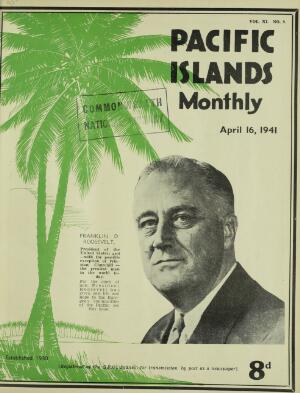
Vol. Xl No. 9.
April 16, 1941
Established 1930
transmission post as a ]
8 a
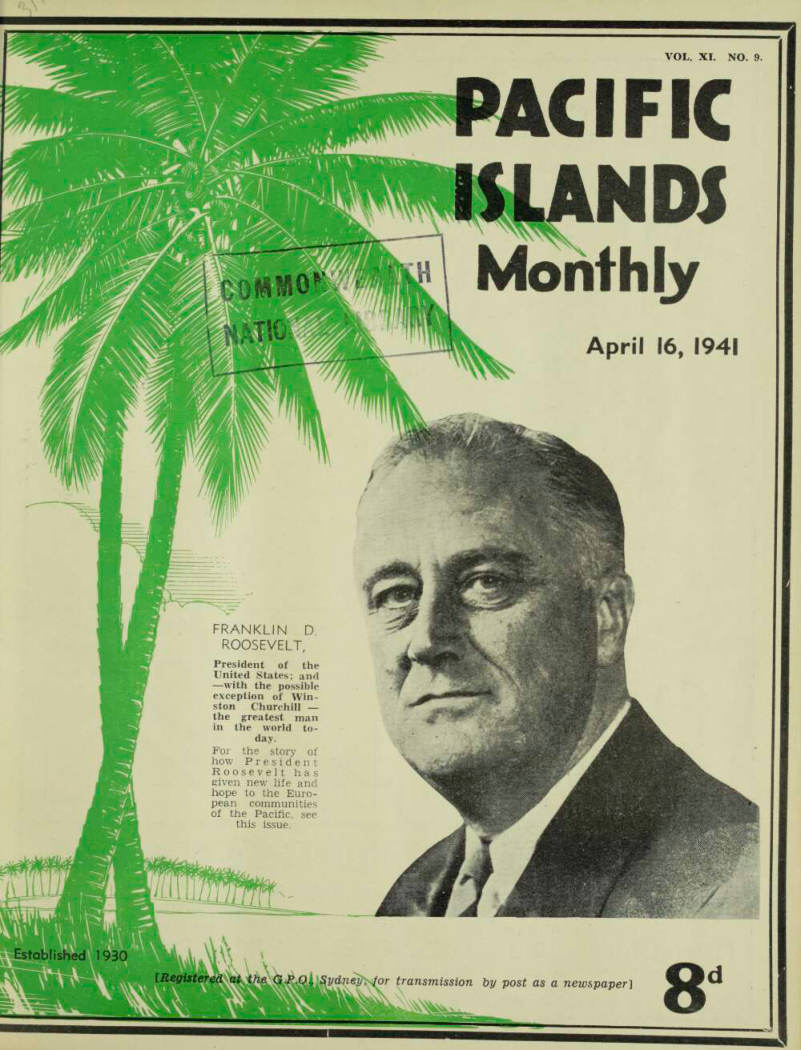
Franklin D.
Roosevelt,
President of the United States; and —with the possible exception of Win ston Churchill the greatest man in the world to day.
For the story of how President Roosevelt has given new life and hope to the Euro pean communities of the Pacific, see this issue.
Advertisements & other items, p. 2 (1 item)
(Arpentlrs
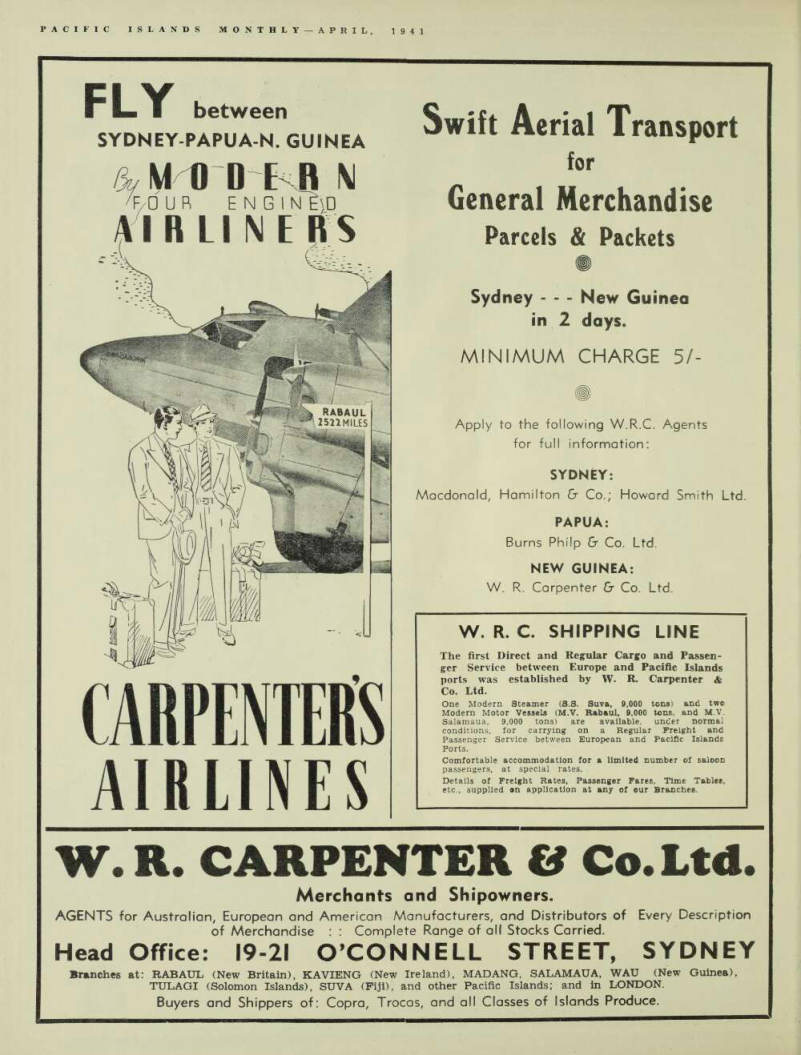
FLY between
SYDNEY-PAPUA-N. GUINEA
Hu M ODER ISI
'F/O UR ENG I N E)0
AIRLINERS
RABAUL
2527. MILES
K %
(ARPENTLRS
AIRLINES
Swift Aerial Transport
for
General Merchandise
Parcels & Packets
Sydney - - - New Guinea in 2 days.
MINIMUM CHARGE 5/-
Apply to the following W.R.C. Agents for full information:
SYDNEY:
Macdonald, Hamilton & Co.; Howard Smith Ltd.
PAPUA:
Burns Philp Gr Co. Ltd.
NEW GUINEA:
W. R. Carpenter £r Co. Ltd.
W. R. C. SHIPPING LINE
The first Direct and Regular Cargo and Passenger Service between Europe and Pacific Islands ports was established by W. R. Carpenter & Co. Ltd.
One Modern Steamer (S.S. Suva, 9,000 tons) and iwc Modern Motor Vessels (M.V. Rabsul, 9,000 tons, and M.V.
Salamaua, 9,000 tons) are available, under norma] conditions, for carrying on a Regular Freight and Passenger Service between European and Pacific Islands Ports.
Comfortable accommodation for a limited number of saloon passengers, at special rates.
Details of Freight Rates, Passenger Fares, Time Tables, etc., supplied on application at any of our Branches.
W. R. CARPENTER & Co. Ltd.
Merchants and Shipowners.
AGENTS for Australian, European and American Manufacturers, and Distributors of Every Description of Merchandise : Complete Range of all Stocks Carried.
Head Office: 19-21 O’CONNELL STREET, SYDNEY
Branches at: RABAUL (New Britain), KAVIENG (New Ireland), MADANG, SALAMAUA, WAU (New Guinea), TULAGI (Solomon Islands), SUVA (Fiji), and other Pacific Islands; and in LONDON.
Buyers and Shippers of: Copra, Trocas, and all Classes of Islands Produce.
Pacific News-Review
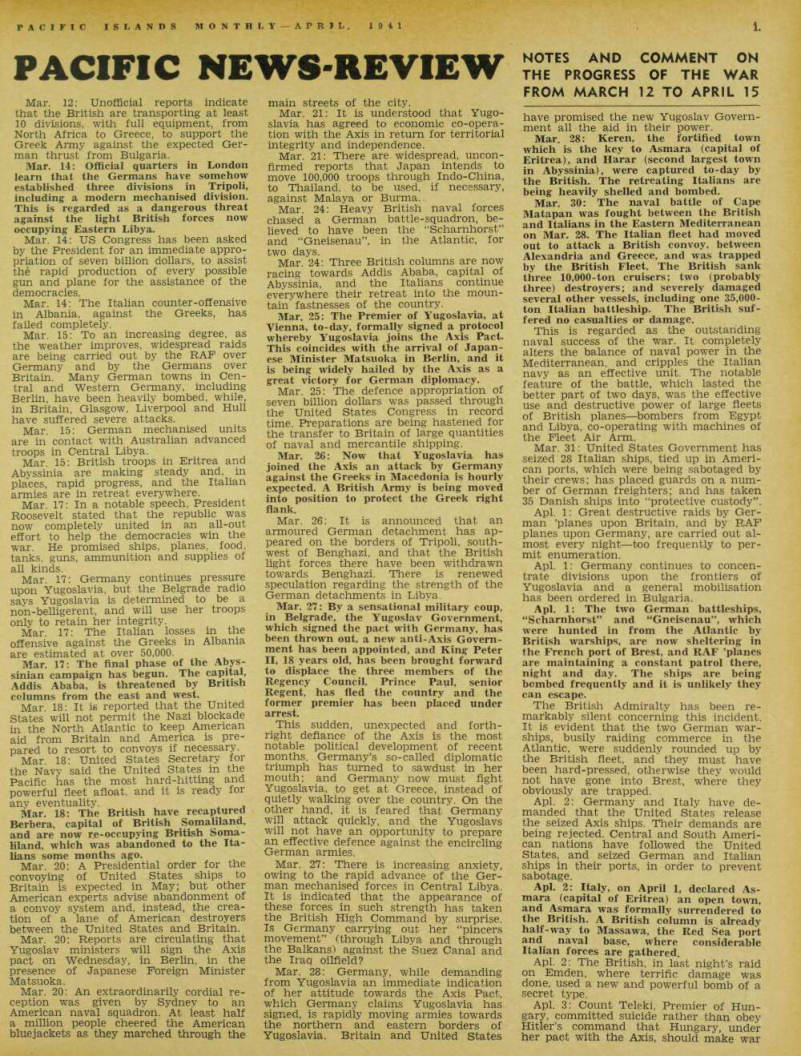
Notes And Comment On
The Progress Of The War
From March 12 To April 15
Mar. 12; Unofficial reports indicate that the British are transporting at least 10 divisions, with full equipment, from North Africa to Greece, to support the Greek Army against the expected Ger man thrust from Bulgaria.
Mar. 14: Official quarters in London learn that the Germans have somehow established three divisions in Tripoli, including a modem mechanised division.
This is regarded as a dangerous threat against the light British forces now occupying Eastern Libya.
Mar. 14: US Congress has been asked by the President for an immediate appro priation of seven billion dollars, to assist the rapid production of every possible gun and plane for the assistance of the Hpmnprfi pjpq Mar. 14: The Italian counter-offensive in Albania, against the Greeks, has failed completely.
Mar. 15: To an increasing degree, as the weather improves, widespread raids are being carried out by the RAF over Germany and by the Germans over Britain. Many German towns in Cen tral and Western Germany, including Berlin, have been heavily bombed, while, in Britain, Glasgow, Liverpool and Hull have suffered severe attacks.
Mar. 15: German mechanised units are in contact with Australian advanced troops in Central Libya.
Mar. 15; British troops in Eritrea and Abyssinia are making steady and, in places, rapid progress, and the Italian armies are in retreat everywhere.
Mar. 17; In a notable speech, President Roosevelt stated that the republic was now completely united in an all-out effort to help the democracies win the war. He promised ships, planes, food, tanks, guns, ammunition and supplies of all kinds.
Mar. 17: Germany continues pressure upon Yugoslavia, but the Belgrade radio says Yugoslavia is determined to be a non-belligerent, and will use her troops only to retain her integrity.
Mar. 17: The Italian losses in the offensive against the Greeks in Albania are estimated at over 50,000.
Mar. 17: The final phase of the Abys sinian campaign has begun. The capital, Addis Ababa, is threatened by British columns from the east and west.
Mar 18: It is reported that the United States will not permit the Nazi blockade in the North Atlantic to keep American aid from Britain and America is pre pared to resort to convoys if necessary.
Mar. 18: United States Secretary for the Navy said the United States in the Pacific has the most hard-hitting and powerful fleet afloat, and it is ready for any eventuality. . , Mar. 18; The British have recaptured Berbera, capital of British Somaliland, and are now re-occupying British Soma liland, which was abandoned to the Ita lians some months ago.
Mar. 20; A Presidential order for the convoying of United States ships to Britain is expected in May; but other American experts advise abandonment of a convoy system and, instead, the crea tion of a lane of American destroyers between the United States and Britain.
Mar. 20; Reports are circulating that Yugoslav ministers will sign the Axis pact on Wednesday, in Berlin, in the presence of Japanese Foreign Minister Matsuoka.
Mar. 20: An extraordinarily cordial re ception was given by Sydney to an American naval squadron. At least half a million people cheered the American bluejackets as they marched through the
main streets of the city.
Mar. 21: It is understood that Yugo slavia has agreed to economic co-opera tion with the Axis in return for territorial integrity and independence.
Mar. 21: There are widespread, uncon firmed reports that Japan intends to move 100,000 troops through Indo-China, to Thailand, to be used, if necessary, against Malaya or Burma.
Mar. 24: Heavy British naval forces chased a German battle-squadron, be lieved to have been the “Scharnhorst” and “Gneisenau”, in the Atlantic, for two days.
Mar. 24: Three British columns are now racing towards Addis Ababa, capital of Abyssinia, and the Italians continue everywhere their retreat into the moun tain fastnesses of the country.
Mar. 25: The Premier of Yugoslavia, at Vienna, to-day, formally signed a protocol whereby Yugoslavia joins the Axis Pact.
This coincides with the arrival of Japan ese Minister Matsuoka in Berlin, and it is being widely hailed by the Axis as a great victory for German diplomacy.
Mar. 25: The defence appropriation of seven billion dollars was passed through the United States Congress in record time. Preparations are being hastened for the transfer to Britain of large quantities of naval and mercantile shipping.
Mar. 26: Now that Yugoslavia has joined the Axis an attack by Germany against the Greeks in Macedonia is hourly expected. A British Army is being moved into position to protect the Greek right flank.
Mar. 26: It is announced that an armoured German detachment has ap peared on the borders of Tripoli, south west of Benghazi, and that the British light forces there have been withdrawn towards Benghazi. There is renewed speculation regarding the strength of the German detachments in Libya.
Mar. 27: By a sensational military coup, in Belgrade, the Yugoslav Government, which signed the pact with Germany, has been thrown out, a new anti-Axis Govern ment has been appointed, and King Peter 11, 18 years old, has been brought forward to displace the three members of the Regency Council. Prince Paul, senior Regent, has fled the country and the former premier has been placed under arrest.
This sudden, unexpected and forth right defiance of the Axis is the most notable political development of recent months. Germany’s so-called diplomatic triumph has turned to sawdust in her mouth; and Germany now must fight Yugoslavia, to get at Greece, instead of quietly walking over the country. On the other hand, is feared that Germany will attack quickly, and the Yugoslavs will not have an opportunity to prepare an effective defence against the encircling German armies.
Mar. 27: There is increasing anxiety, owing to the rapid advance of the Ger man mechanised forces in Central Libya.
It is indicated that the appearance of these forces in such strength has taken the British High Command by surprise.
Is Germany carrying out her “pincers movement” (through Libya and through the Balkans) against the Suez Canal and the Iraq oilfield?
Mar. 28: Germany, while demanding from Yugoslavia an immediate indication of her attitude towards the Axis Pact, which Germany claims Yugoslavia has signed, is rapidly moving armies towards the northern and eastern borders of Yugoslavia. Britain and United States
have promised the new Yugoslav Govern ment all the aid in their power.
Mar. 28: Keren, the fortified town which is the key to Asmara (capital of Eritrea), and Harar (second largest town in Abyssinia), were captured to-day by the British. The retreating Italians are being heavily shelled and bombed.
Mar. 30: The naval battle of Cape Matapan was fought between the British and Italians in the Eastern Mediterranean on Mar. 28. The Italian fleet had moved out to attack a British convoy, between Alexandria and Greece, and was trapped by the British Fleet. The British sank three 10,000-ton cruisers; two (probably three) destroyers; and severely damaged several other vessels, including one 35,000ton Italian battleship. The British suf fered no casualties or damage.
This is regarded as the outstanding naval success of the war. It completely alters the balance of naval power in the Mediterranean, and cripples the Italian navy as an effective unit. The notable feature of the battle, which lasted the better part of two days, was the effective use and destructive power of large fleets of British planes—bombers from Egypt and Libya, co-operating with machines of the Fleet Air Arm.
Mar. 31: United States Government has seized 28 Italian ships, tied up in Ameri can ports, which were being sabotaged by their crews; has placed guards on a num ber of German freighters; and has taken 35 Danish ships into “protective custody”.
Apl. 1; Great destructive raids by Ger man ’planes upon Britain, and by RAF planes upon Germany, are carried out al most every night—too frequently to per mit enumeration.
Apl. 1: Germany continues to concen trate divisions upon the frontiers of Yugoslavia and a general mobilisation has been ordered in Bulgaria.
Apl. 1: The two German battleships, “Scharnhorst” and “Gneisenau”, which were hunted in from the Atlantic by British warships, are now sheltering in the French port of Brest, and RAF ’planes are maintaining a constant patrol there, night and day. The ships are being bombed frequently and it is unlikely they can escape.
The British Admiralty has been re markably silent concerning this incident.
It is evident that the two German war ships, busily raiding commerce in the Atlantic, were suddenly rounded up by the British fleet, and they must have been hard-pressed, otherwise they would not have gone into Brest, where they obviously are trapped.
Apl. 2: Germany and Italy have de manded that the United States release the seized Axis ships. Their demands are being rejected. Central and South Ameri can nations have followed the United States, and seized German and Italian ships in their ports, in order to prevent sabotage.
Apl. 2: Italy, on April 1, declared As mara (capital of Eritrea) an open town, and Asmara was formally surrendered to the British. A British column is already half-way to Massawa, the Red Sea port and naval base, where considerable Italian forces are gathered.
Apl. 2: The British, in last night’s raid on Emden, where terrific damage was done, used a new and powerful bomb of a secret type.
Apl. 3: Count Teleki, Premier of Hun gary, committed suicide rather than obey Hitler’s command that Hungary, under her pact with the Axis, should make war
upon Yugoslavia. Yugoslavia and Hun gary, some time ago, signed a mutual friendship pact and the Premier pre ferred to die rather than break his word.
Apl. 3: The British conquest of Eritrea is now practically complete, and the various British columns are racing to complete the conquest of Abyssinia be fore the rainy season commences.
Apl. 4: After so many successes, British opinion was given a sharp shock by the announcement that the British forces in Libya have retired hurriedly from Ben ghazi eastwards into Cyrenaica owing to heavy pressure by large German forces coming eastward from Tripoli, with large numbers of tanks. No one had taken much notice of American press warnings that a very large German mechanised force had somehow been transferred from Italy to Tripoli.
Apl. 5: The RAF continues to hammer with heavy bombs at the naval base at Brest, where the two German battleships have sought shelter.
Apl. 6: Early to-day Germany declared war on Yugoslavia and Greece, and the waiting German armies marched imme diately against both countries. Ignoring a Yugoslav declaration that Belgrade was an open town, German bombers attacked and seriously damaged the city. It is es timated that the Germans are employing at least one million men, with masses of tanks.
Apl. 6; The British approach to Mas sawa, the Italian port on the Red Sea, compelled five Italian destroyers to put to sea. Three were destroyed by ’planes of the Fleet Air Arm, and two were scuttled by their crews.
Apl. 6: President Roosevelt has ordered the construction of 212 merchant ships for Britain, which will be built in 60 new shipyards and will be ready early in 1942.
Apl. 6: A few hours before Germany declared war on Yugoslavia, Moscow of ficially announced that Russia and Yugo slavia had signed a pact of friendship and non-aggression.
Apl. 7: German columns, led by tanks and dive-bombers, have already pene trated across the Yugoslavian and Greek frontiers, to a depth of 20 to 25 miles.
A British army, comprising British, Aus tralian and New Zealand troops, is in position between Mount Olympus (in Greece, west of Salonika) and Koritza (on the border, between Greece and Albania).
Apl. 7: South African forces reached and occupied Addis Ababa, the capital of Abyssinia, after an extremely rapid march over 700 miles of bad country.
Apl. 8; Under intense German pressure, Yugoslav troops in Southern Serbia with drew, thus uncovering the Greek left flank. This caused a hurried withdrawal of the Greek Army protecting Salonika,
and the way now is apparently open for the Germans to march into Salonika. The Germans, owing to the collapse of the Yugoslav defence, entered the upper parts of the Struma and Varda Valleys, down which they are marching towards the Aegean Sea.
Apl. 8: RAP heavily attacked the Ger man naval base at Kiel. The raid lasted five hours, and enormous destruction was done.
Apl. 8: The British in Libya are still falling back, and German and Italian forces have occupied Derna.
The British, however, have practically finished their task of cleaning up the Italian forces in Eritrea and Abyssinia and probably 100,000 men will be released for the defence of the western frontier of Egypt, if necessary.
Apl. 9: The Germans to-day occupied the Greek port of Salonika. Most of the Greek forces in Salonika and Eastern Thrace, together with most of their war materials, were successfully withdrawn behind the Greek and British front, westward of Salonika.
Apl. 9: The Italian Red Sea port of Massawa was occupied by the British to-day.
Apl. 9: President Roosevelt announces that plans are afoot to take perman ent possession of 69 Italian, German and Danish ships, recently seized in United States ports. This will make additional shipping available to Britain.
Apl. 9: A British Admiralty announce ment indicates that an intense battle is proceeding in the Northern Atlantic between German U-boats and dive bombers, on the one side, and British warships on the other. The Prime Minis ter (Mr. Churchill) has stated that on the outcome of this battle, which may last for months, really depends the out come of the war.
Apl. 10: German forces are thrusting eastward from Bulgaria towards the Adriatic in an effort to divide the Yugo slav armies in the north from the Greeks and British, in the south. Generally speaking, Yugoslav armies, totalling per haps 700,000 men, have put up a very brave and courageous, but scattered and disorganised, resistance to the Germans.
Apl. 10: British tanks and reinforce ments, which were sent by .sea, have been established in strong force at Tobruk, in Libya. Otherwise, the British forces are still falling back upon the Egyptian frontier. Over 2,000 British have been captured, including three British generals.
Apl. 10: The Japanese Foreign Minis ter, Matsuoka, is now in Moscow, con ferring with the Soviet authorities and seeking a pact with Russia.
Apl. 10; The British Commander in Chief in the Far East is visiting Manila
and Hong Kong, where he is holding conferences with American and British commanders.
Apl. 11: The Germans have occupied most of northern Yugoslavia, including Zagreb (capital of Croatia). Croatia has been proclaimed an independent state under Nazi protection.
Apl. 11; Hungarian armies are march ing against Yugoslavia, in obedience to Nazi demands under the Axis-Hungarian pact.
Apl. 13: The German and Italian troops in Libya have surrounded the British troops in Tobruk, and have advanced and occupied Bardia. The British are still falling back to western frontier of Egypt.
Apl. 13: Russia and Japan signed a pact of neutrality and friendship to-day.
Matsuoka, the Japanese Foreign Minis ter, has departed for Tokyo, He was farewelled at the railway station by Sta lin—an unprecedented gesture by the Russian dictator.
Apl. 14: The defeated and retreating Italian forces are now cooped up in all sorts of valleys in Abyssinia, and are being mopped up by the British Imperial Forces.
Apl. 14: British and Empire forces have repulsed many German tank attacks in Greece; but it is officially announced that the British have withdrawn to pre pared positions, further back. The Ger mans are re-organising for a fresh push, for which they have accumulated huge supplies at Monastir, but they are being hampered by bad weather and incessant attacks by the RAF.
Apl. 14: Further reports say that the Serbs, thrusting southwards along the coast into Albania, have occupied Dur azzo and are attacking the Italians in the rear.
Apl. 14: The German Libyan columns have now reached the western frontier of Egypt and have occupied Solium and Fort Capuzzo.
Apl. 14: The RAF is still hammering away at the two German battleships in the French port of Brest.
Apl. 15: The Greek armies have been withdrawn from Koritza (on the border between Greece, Bulgaria and Albania).
Apl. 15: The British Army has been instructed to withdraw from the west ern border of Egypt to the line of Mersa Matruh, 150 miles inside the Egyptian border, where it will meet the advancing German forces on the strong defensive lines which were built to meet the Italian invasion last year.
Apl. 15: The British forces, encircled by the Germans at Tobruk (on the coast of Libya) are still defending themselves.
Presumably, they are being supplied by the British from the sea.
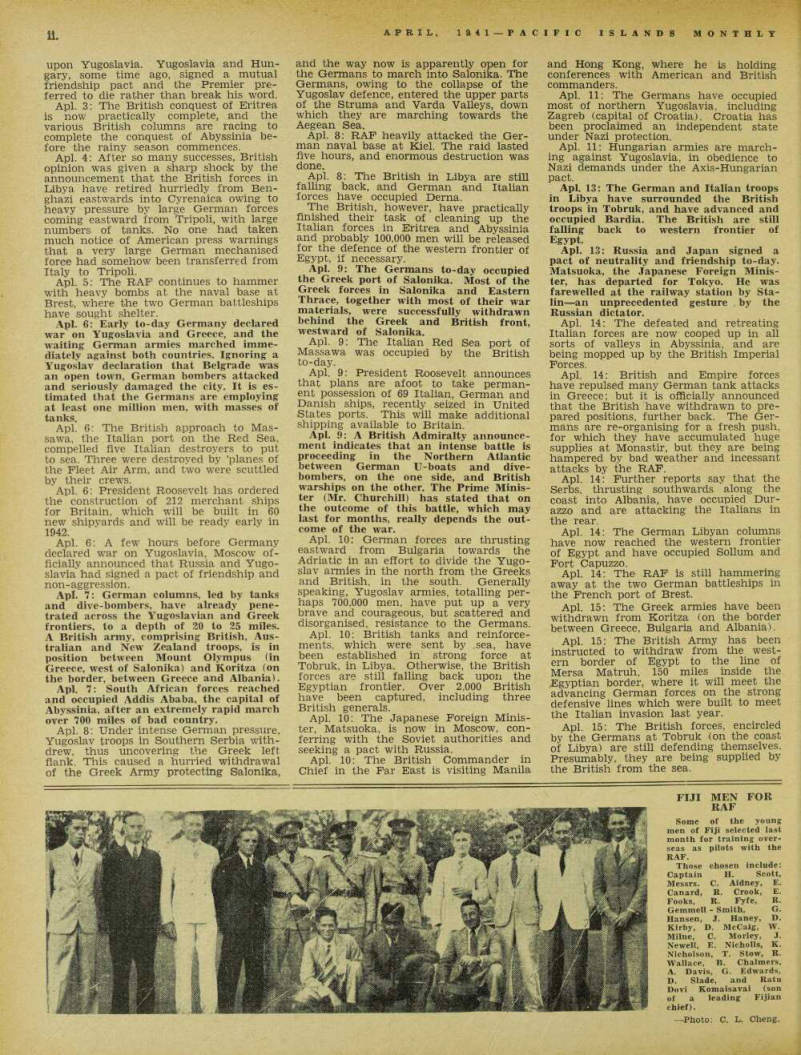
Fiji Men For
Raf
Some of the young men of Fiji selected last month for training over seas as pilots with the
Raf.
Those chosen include: Captain H. Scott, Messrs. C. Aidney, E.
Canard, R. Crook, E.
Fooks, R. Fyfe, R.
Gemmell - Smith, G.
Hansen, J. Haney, D.
Kirby, D. McCaig, W.
Milne, C. Morley, J.
Newell, E. Nicholls, K.
Nicholson, T. Stow, R.
Wallace, B. Chalmers, A. Davis, G. Edwards, D. Slade, and Ratu Dovi Komaisavai (son of a leading Fijian chief).
Photo; C. L. Cheng.
Pacific Islands Travellers
PER LINER FOR LORD HOWE IS., NORFOLK IS., N. HEBRIDES & BSI; Messrs. Blandy, Buffett, Baxter, Bushell, Bjorkman, Bruce, Con nor, Dunstan, Driver, Dalton, Edmonds, Ent wisle, Fenton, Troughton, Rennison, Josselyn, Stopp, Jones, Walker, Lahiflf, Klein, Taylor, Tur ner, Treacust, Smoothey, Gillett, Scarr, Ingham, Leal, Jones, Smith. Mesdames Greene, Nobbs, Spurway, Hankinson, Davison, Dean, Mac Lean, Perry, Quintal, Bjorkman. Misses Clipstone, Everett, Williams.
PER LINER FROM NG, BSI & NORFOLK IS.: Messrs, Campbell, Ellis, Tudberry, Robertson, Adam, Palmer, Williamson, Stackpool, Palmer, Douglass, Gordon, Meldrum, Smith, Lawson, Blake, Elkington, Johnstone, Pascoe, Deakin, Speedie, Topping. Mesdames Palmer (2), Wash ington, Wishart, Griffiths, Scobie, Taylor, Wild, Doherty, Doyle, Mann, Johnson, Lotze, Rixon, Edwards, Radford, Taylor. Misses Kennedy, Rogerson (2).
PER LINER FROM BSI, N. HEBRIDES, NOR FOLK & LORD HOWE IS.: Messrs. Kilgour, Morris, Small, Armstrong, Adams, Ayres, Ben nett, Brooks, Buffett, Christian (3), Evans, Gib bons, Heron, Menzies, Mitchell, Nobbs, Part, Prickett, Bevan, Christmas, Cowie, Phipps, Skeoch, Rev. Lawton. Mesdames Armstrong, Adams, Bennett (2), Brooks, Dewey, Evans, McLean, Rodgers, White, Cowie, Dignam, Law
ton, Lewis, McCann. Misses Baxendale, Byrnes, McCann.
PER LINER FOR PAPUA & N. GUINEA: Messrs. Monteith, Russell, Griffith, Staker, O’Malley (2), McDonald, Harvey, Bertie, Hayles, O’Brien, Street, Cook, Norris, Pratt, Theckston, Rogerson, Jullian, Maxfleld, Burnett, O’Logh len, Holden, Bergin, Barker, Toogood, Camp bell, Harold, Honan, Powell, Lamont, Freeman, Penman, Jolly, Summerhayes, Dance, Butler, Snadden, Cox, Kellaher, Brudo, Williams, Stan ton, Gibbs, Mellish, Sowerby, Rush, Mclver, Crapp, Hoffman, Jarrett, Snadden, Rev. Fenn, Rev. Mone. Mesdames Montieth, Russell, Daniel son, Griffith, Lumley, McDonald, Garden, Waud, Logan, O’Loghlen, Barker, Cahill, Broughton, Freund, Spencer, Pym, Eastwell, Fenn, Mone, Rogerson, Theekston, Brewer, Wiley, Burnett, Dunstan, Bedser, Barker, Pratt, Honan, Orr- Hooper, Harold, Powell, Griffiths. Misses Har ris, Reid, Holmes, Pearce, Manning (2), Thomp son, Orr-Harper.
PER LINER FOR FIJI; Messrs. Adair, Bur gess, McMillan (2), Moate, Payn, Parker, Pol lock. Roenfelt, Williams. Mesdames Alison, Clark, Donaldson, Lynch, McMillan, Norris, Parker, Stocks, Williams. Misses Brown, Lynch, Morris, Parker (2), Williams (2).
PER LINER FROM FIJI: Messrs. Loftven, Hewitt, Samuel, Mowbray, Harrison, Capell,
Stevenson, Grainger, Allman, Davis, McKinnon, Hodge, Gault, Burnett, Tiller, Slade, Morley, Gemmell, Smith. Mesdames Robinson, Samuel, Mowbray, Stevenson, Allman, Davis, McKinnon, Hodge, Grainger. Misses Allman, Hodge, Rial.
PER LINER FROM FIJI; Messrs. Ford, Rie menschneider, Whan, Aidney, Canard, Chalmers, Crook, Davis, Edwards, Hansen, Kirby, Mansell, Mercer, McCaig, Nicholson, Nicholls, Scott, Wallace. Mesdames Riemenschneider, Shelley.
Miss Shelley.
PER LINER FOR FIJI: Messrs. Henderson, Parker, Harness, Riley. Mrs. Parker. Miss Sinclair.
PER AIRLINER TO PAPUA & N.G.: Messrs.
Maxwell, Skelly, Walsh, Oliver, Brotherton, Doughty, Stubbs, Lawrence, Ward, Keenan, Howard, Thorogood, Anderson, Attwood, Gar diner, Gillingswater, Josch, Peacock, Lappin, Bell, Rowlands, Broadfoot, Buckeridge, Fulton.
Mesdames Blackman, Meakes, Clarke, Hilder, Bonney, Gillingswater, Barwick (2), Sellen, Hicks. Misses Toby, Clarke (2), Anderson.
Per Airliner From Papua & N.G.:
Messrs. Shoobridge, Smith, Bulgin, Wilton, Lloyd, Ingold, Krutschnitt, Gwiney, Fraser, Bergsbrandt, Ashwell, Colyer, Bell, Parer, Blackby, Richardson, Lawrence, Matheson, Robins, Lockel, Tompsett, Gordon, Flower, Beckitt, Eichorn, Gordon. Mesdames Dickenson, Gwiney, Wilton, Potts, Ingold, Welch, Slggins, Parer, Leahy, Fredericks, Bell. Sister Gannon.
Advertisements & other items, p. 5 (1 item)
South Pacific Line
K. P. M.
SOUTH PACIFIC LINE.
Royal Packet Navigation Co. Ltd., Paketvaart House, 255 George Street, Sydney. (N. V. Konlnklljke Paketrsart MaatschapplJ—lncorporated In the Netherlands Indies) Saigon, Diethehn & Co.; Port Moresby and Samarai, Steamships Trading Co.
Ltd.; Rabaul, Salamaua and Wan, W. R Carpenter & Co. Ltd.; Port Vila, Gubbay Freres; Noumea, Carlo Leoni; Auckland, Russell & Somers Ltd.; Wellington, Johnston & Co. Ltd. p. m ■i c • :: i D x
M{>ORT VILA
, V x ■
SYDNEY,
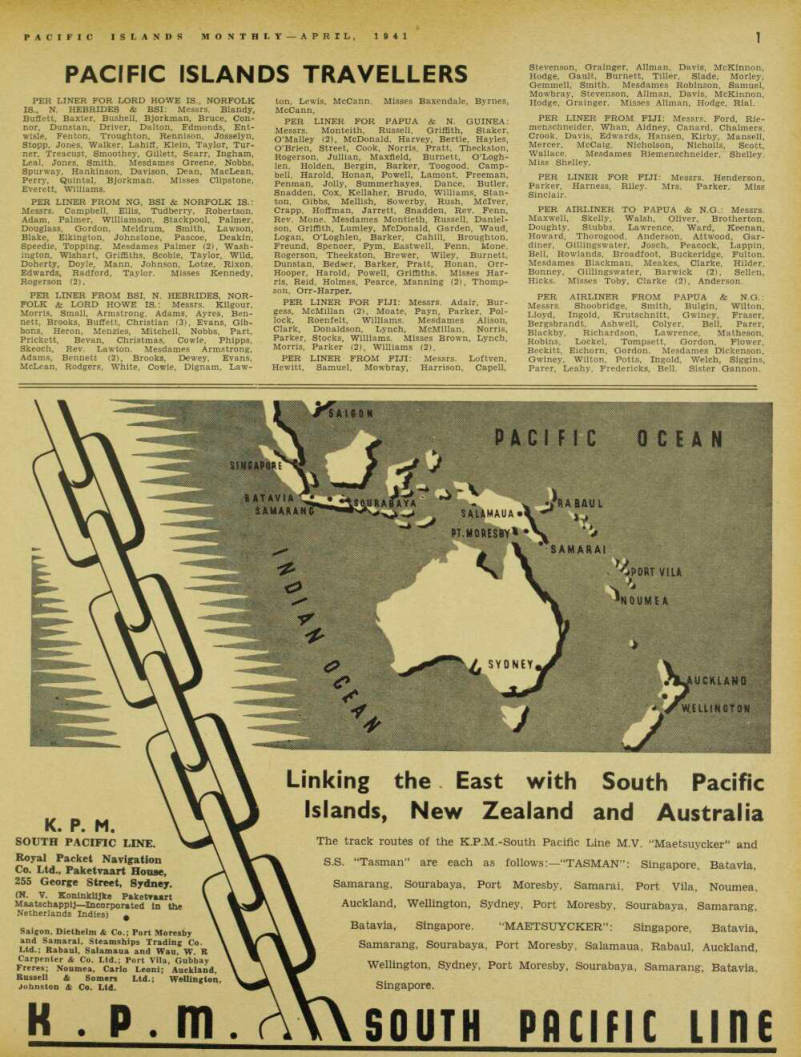
Linking the East with South Pacific
Islands, New Zealand and Australia
The track routes of the K.P.M.-South Pacific Line M.V. “Maetsuycker” and S.S. “Tasman” are each as follows:—“TASMAN”: Singapore, Batavia, Samarang, Sourabaya, Port Moresby, Samarai, Port Vila, Noumea, Auckland, Wellington, Sydney, Port Moresby, Sourabaya, Samarang, Batavia, Singapore. “MAETSUYCKER”: Singapore, Batavia, Samarang, Sourabaya, Port Moresby, Salamaua, Rabaul, Auckland, Wellington, Sydney, Port Moresby, Sourabaya, Samarang, Batavia, Singapore.
SOUTH PACIFIC Line
Advertisers
Advanx Tyre & Rubber Co. Pty.
Ltd 14 “Airzone” Radio . 23 Amalgamated Wire less of Aust. . 56 Amplion (A/sia) Ltd 16 Angus & Coote Ltd. 13 Arnott’s Biscuits . 35 Atkins Ltd., W. . . 42 Atoma Engineering Co .15 “Ausoline” ... 66
B.A.L.M. Ltd. ... 43
Bank of N.S.W. . . 62 Barnet Glass Rub ber Co. Ltd. . . 20 “Bidomak” ... 21 Broomfields Ltd. . 44 Brown & Co. Ltd., G 9 Brunton’s Flour . 31 Budge Pty. Ltd., Jas 52 Burns. Philp & Co., Ltd 2 B.P. Magazine . . 38
B.P. (S.S.) Co. . . 28
Burns Philp Trust Co. Ltd 47 Carlton & United Breweries Ltd. . 33 Carpenter Ltd., W.
R cov. 2 Chapman & Sherack 45 Chivers & Sons Ltd. 28 Clyde Batteries . . 50 Coleman Lamp & Stove Co. . 40, 42 Colonial Mutual Life Assurance Society Ltd 46 Colonial Sugar Re fining Co. Ltd. . 53 Compressor & Air Equipment Co. . 58 Coral Starch ... 35 Cosmopolitan Hotel 66 Crammond Radio . 49 "Cystex” ... 51 De Meric Pty. Ltd. 64 Dewar’s Whisky . . 17 Doan’s Pills ... 52
Donaghy & Sons Ltd 59 Donald Ltd., A. B. 36 Dr. Williams Pink Pills 40 Dunlop Perdriau Rubber Co. Ltd. . 63 Eaton Ltd., J. W. . 41 Electrolux Refrigerators . . 32 Fletcher & Sons . 43 Flit 50 Ford Sherington Pty. Ltd 22 Garden Vale Pro ducts Ltd. ... 30 Garrett & Davidson 58 Gilbey’s Gin ... 36 Gillespie’s Flour . 34 Gold Flake Cigar ettes 47 Gowing Bros. Ltd. 22 Grand Pacific Hotel 37 Grove & Sons, W.
H 11 Guinea Airways Ltd cov. 3 Hampton Court . 14 Heinz Co. Ltd., H.
J 27 Hemingway & Robertson Pty.
Ltd 10 Holbrook’s Ltd. . . 31 Horlicks Malted Milk 24 Hotel Moresby . . 66 International Correspondenc Schools ... 7 Jones & Co., H. . 57 Kodak (A/sia) Pty.
Ltd 8 Kolynos Dental Cream 12 Kopsen & Co. Ltd. 20 Kork-N-Seal Ltd. . 3f) Lea & Perrins Sauce 54 Legal Notice ... 37 Levenson’s Radio . 60 Lustre Hosiery Ltd. 55 Maxwell Porter Ltd. 41 McHrath’s Ltd. . . 54 McNiven Bros. Ltd. 13
“Mendaco” ... 59 Miller & Co. Pty.
Ltd 65 Nelson & Robert son Pty. Ltd. . 15 Nestle’s Milk ... 29 Newmarket Saddlery ... 63 Nock &r Kirbv Ltd. 51 Noyes Bros. Ltd. . 58 Pacific Is. Society . 17 Papua Hotel, The . 66 Philips Lamps (A/sia) Pty. Ltd. 61 “Pinkettes” ... 61 Prescott Ltd. ... 34 Price’s Radio Ser vice 65 Prouds Ltd. . . .11 Rivertstone Meat )| Co. Ltd 18 Rohu, Sil . . . . 45
Royal Packet Navi gation Co. ... 1 Scott Ltd., J. . .44 Scott’s Emulsion . 10 Springwood Ladies’
College ... 66 Steamship Trading Co. Ltd 14 Sterling Varnish Co. 7 Sullivan Ltd., C. . 59 Swallow & Ariell . 26 Talkeries, The . . 16 Taylor & Co., A. . 52 “Tenax” Soap . . 25 Tillock & Co. Ltd. 48 Toohey’s Ltd. ... 19 Tooth & Co. cov. 4 Tucker & Co. . . 55 Vacuum Oil Co. . 39 Vincent’s A.P.C. . 25 “Vi-stim” ... 46 West, Harry ... 64
Woods Great Pep permint Cure, 18, 38, 48 Wills Ltd., W. D. & H. 0 38
Weymark & Son . 34 Wright & Co. . .65 Wright & Co. Ltd., E 44 Wunderlich Ltd. . . 41
Private Gordon W. Smith, of the AIF, formerly of Bougainville Island and New Guinea, and an old boy of King’s Col lege, Auckland, was in Sydney in April.
Mrs. Mathews, wife of Rev. H. Mathews, rector of St. John’s Anglican Church, Port Moresby, Papua, died suddenly while working in her garden on March 20. With her husband and three children, she had spent nearly 15 years in the Territory having arrived in Papua from North Aus tralia—and she was held in very high esteem by all who knew her.
Contents
Pacific News-Review i Fiji Men for RAF ii We Now Are Under United States Protection 3 Late News 4 A Copra Marketing Board —But No Solution of Shipping Problem .. 5 Re-arrangement of BP Ships ... 5 Hesitations of Japan 6 French Colonies’ Finance and Exchange 6 Hunt for Pacific Raiders 7 Troubles of China and Japan ... 8 Miners’ Strike in New Guinea ... 9 Another Matson Cruise to Tahiti .. 12 Tropicalities 13 When Tonga Built Great Canoes .. 17 Japanese Pearlers in DEI 18 “Lord Haw-Haw” and the Copra Planters 19 Memories of “Queen Emma” 20 Japan’s Mandated Islands 25 Copra Factory Ships 27 Cassava Mill in New Guinea 28
Australia’s Record in the Territories 30 Hurricane Damage in Fiji 36 America’s Pacific Tourists 41 New Caledonia Knocks at Australia’s Door 42 A Tongan’s 102 Years 44 Deep Drilling for Oil in Papua ... 45 Jubilee of New Guinea Mission ... 46 The Tara-La-La—One Evening in Suva 47 Making Money Talk in BSI 48 How Were Nazi Raiders Helped? .. 51 A Section for Women 54 Comparative War Efforts 57 The Bamu River Mission (Papua) .. 57 Mining News 58 Short Wave Radio Programmes ... 61 Islands Produce Quotations 62 Pacific Exchange Rates 63 Copra and Rubber Prices 64 Overland Droving in TNG 65 New Caledonia’s Fifth Column ... 65 Islands Displays at Royal Show ... 66
Advertisements & other items, p. 6 (1 item)
til 11 Eli
(fii i u ll R?^ Mi -
ISIIRIII
mil W v j*l
any
Hill
til 11 Eli
tin
Head Office: 7 Bridge Street, Sydney—Australia Code Address: " Burphil"
BURNS, PHILP
& Co. Ltd.
GENERAL MERCHANTS
SHIPOWNERS
TOURIST AGENTS
BUYERS OF ALL CLASSES OF ISLAND PRODUCE Regular Steamer Services from Australia to New Guinea Papua Solomon Is.
Lord Howe Is.—Norfolk Is. —New Hebrides—Hongkong—Java and Singapore
Pacific Islands Monthly
The Newspaper-Magazine of the South Seas [Registered at the G.P.O. y Sydney, for transmission by post as a newspaper ,]
Owned and Produced by Pacific Publications Pty. Ltd., Union House, 247 George Street, Sydney.
rrrpj rpufjMp f Msiisgiiig Director .. BIV 5037 U > Business and Editorial MA 7101
P.O. Box 3408 R
Registered Address of Telegrams, Radiograms, and Cables: “Pacpub”, Sydney.
Contributions.
Articles, Stories, and Photographs dealing with Pacific Islands subjects are invited and will be paid for on publication.
Subscription Rates.
Per Annum, within British Empire, Prepaid, Post Free 8/- Per Annum, elsewhere, prepaid, Post Free . 10/- Single Copies 8d
Editor and Publisher:
R. W. Robson, F.R.G.S.
Assisted by Selwyn Hughes, Advertising Manager: L. W. Bailey.
Advertising Office and Printing-House: 29 Alberta Street, Sydney.
Advertising rates furnished on application.
Colours, etc., by Arrangement.
Process Blocks made at Advertiser’s expense when required. Screen 100.
Changes of Advertising Copy should reach this Office by Ist of each month, otherwise previous advertisement may be repeated.
IN LONDON, the Pacific Islands Monthly Is on sale at the Bookstall, Australia House, The Strand, London.
Agents.
The following are authorised to receive sub scriptions for the Pacific Islands Monthly;— Islands Branches of Burns, Phllp & Co., Ltd., and Burns Philp (South Sea) Co., Ltd.
Islands Branches of W. R. Carpenter & Co., Ltd.
Islands Branches of Morris, Hedstrom, Ltd.
T. A. Olsson, Wau, New Guinea.
G. Thomas & Co., Rabaul, New Guinea.
Whitten Bros., Ltd., Samarai, Papua.
Steamships Trading Co., Papua. All Branches.
B.N.G. Trading Co., Ltd., Port Moresby, Papua.
J. Muir, Suva, Fiji.
N. C. Mackenzie-Hunt, Walnunu, Bua, FIJI.
Islands Branches and Representatives of W. H.
Grove & Sons, Ltd., Auckland, New Zealand.
Cook Islands Trading Co., Rarotonga, Cook Is.
A. C. Rowland, Papeete, Tahiti.
Representative In London: W. C. HARVEY, Coronation House, 4 Lloyds Avenue, London, E.C.3, from whom may be obtained copies of Pacific Islands Monthly, Pacific Islands Year Book, advertising schedules, etc.
Vol. XI. No. 9.
April 16, 1941
Prirp [ “ d Per Copy rilLc ( Prepaid; 8/- p.a.
We Now Are Under United States Protection
T'WO years ago, we in the Pacific A lived in complacent security, under the White Ensign and the Anglo-French Alliance. A few voices warned that a combination of the three predatory nations (Germany, Italy and Japan) might mean a re turn to jungle law and the destruc tion of our Pacific world; but most people dismissed the idea as fan tastic.
Ten months ago, Germany crushed France and, with Italy as attendant jackal, began to divide up Western Europe, North Africa and Asia Minor, as spoils. Now, we were shaken; but, still, we felt remote and secure, our trust in Mother England.
Six months ago, Japan became the official ally of Germany and Italy.
The three predatory nations now were together, shrieking for the kill.
We in the Pacific faced stark reality at last. Between us and probable enslavement—possible extermination —there were only the deeply pre occupied British fleet, and the then uncertain goodwill of the United States.
To-day, we feel secure again; but all our complacency is gone. We know, now, that had it not been for the clear vision, unswerving courage and inspired leadership of one of history’s greatest men, Britain to-day might have been fighting her last grim battle, and we here in the Pacific almost certainly would have been facing something worse than death. Within a few months, Franklin Delano Roosevelt, President of the United States, changed the face of the world, and the course of history. is neither exaggeration nor A hyperbole. Without the moral support and material help of America the British Empire could not have survived, in the form in which we know it to-day.
Historians, with a better perspective
upon present events, will say that, had America stood by wnile tne Axis disrupted the British Empire, the United States themselves surely would have been enslaved, and the home of democracy destroyed. But that consideration never must ob scure the greater fact that the United States, coming to our aid so promptly, and in such generous, overwhelming measure, allowed us to carry on the war with our chins up, while our home lands remain unsoiled by the Nazi hoof, and our effort is not de flected by the howls of the jackals in the Mediterranean and the Orient.
Before it is all over, the British Empire will be sorely battered and mauled. But, with American help, we shall survive and, with American help, we shall create a better and cleaner world, fit for free men to live in. We shall know, not a “New Order” or a “Co-prosperity League”, under which the world would become a plaything for egocentric dictators and racial fanatics, but an Anglo- American Peace, in which human decencies will be preserved, and “free dom shall not perish from the earth”.
AS this is written, newspapers and radio commentators are moaning about “our grave reverses in Libya and the Balkans”, and the Russo- Japanese Pact, and “the black out look”—typical of the way the people are misinformed and misled. The Balkans and Libya battles are im portant only insofar as they are keeping the Nazis away from the Suez Canal and the Haifa oil-line; and the Russo-Japanese “agreement” does not alter the general strategical position—unless it should be the final factor in inducing Japan to enter the war and commit national hara-kiri. The average commen tator’s view of the war is obscured by the smoke of the battles. These
are grave, grim days, in which we are sacrificing our finest men and dis sipating our national wealth; but the outlook is not discouraging. This war will be decided upon the sea, and in the air.
TT?i arly in June > 1940, just when Hitler was directing his Panzer
divisions against France, this fore
cast was published in the PIM:— Much of France will be over-run, and the valiant French armies will be partly crippled.
But the French will not surrender.
There will be bitter fighting against Italy in the Mediterranean, probably with heavy naval and air losses on both sides. Italian sub marines will severely damage British shipping in the Atlantic, Indian Ocean and Pacific.
The United States, and Turkey, will enter the war, beside the Allies.
If Italy attacks a Balkans country, Greece wall join the Allies, and Russia may enter the war against Italy. Roumania may join Ger many.
Hitler, at an early moment, will launch a terrific attack against Britain, by air and sea.
The Allies should expect no victories and little encouragement this summer. They will be “all out” to save themselves from disaster.
They must hold on; and they will be aided therein by the dominating strength of the British-French-A meric an fleets. That fact may keep Spain quiet.
Meanwhile, the United States will come to their aid, with aeroplanes, munitions, sea power and, if needed, a great expeditionary force.
Russia and Japan remain as incalculable factors. Either Power may go either way.
The war will begin to change in the Allies’ favour in 1941, as a result of their mounting air-power, plus their existing sea-power.
But there are black months ahead.
Except that the collapse of France
was unforeseen—like Mr. Churchill,
we expected that France would con tinue to fight, from her bases in North Africa—that was a reasonably accurate forecast. And it still stands —especially the sentence: “The war will begin to change in the Allies’ favour in 1941, as a result of their
mounting air-power, plus their exist
ing sea-power”.
Therein lies our future hope.
Britain, alone—and even Britain and America in combination cannot challenge German military power in Europe. But if the German Panzer divisions can be kept in Europe (their
appearance in Libya certainly is dis concerting, if not alarming), and we maintain our command of the sea, plus our tremendous and growing striking-power in the air, we should begin to note the turn of the tide late in 1941. Before then, we must sur vive the still unforeseen perils of the European summer, and master the colossal submarine-dive bomber at tacks on our Atlantic shipping.
MEANWHILE, here in the Pacific, supported by growing evidence of America’s goodwill and friendship, we calmly await what the morrow may bring forth. If Japan elects to challenge the combined might of Britain and Holland (which inevit ably means also the United States), we can face the issue confidently.
The nation which invokes armed might shall perish by the sword.
It is more important that we shall plan for the post-war to-morrow. We foresee a period in which the world will be divided between the Nazi tyrants, and an Anglo-American alliance. The swift, decisive steps taken by President Roosevelt mean, not only that the United States will help Britain through this war, but that Britain and America are linked permanently together, for their mutual protection, for the freedom of mankind, and for the solution of the countless problems—political, econo mic, industrial, social—produced by our too - rapidly - developing civi lisation; and which, if not solved, will surely lead us into more wars. * * * WE in the Pacific—British, French, Dutch—should recognise that already we are living under the pro tection of the United States, and that this is likely to be a permanent con dition. Its implications will become clearer, as the months pass. It does not mean the severance of home ties —it means that the Pacific nations and territories, like the South Ameri can countries, will depend, for their safety and freedom, upon the guar dianship of the world’s greatest re public, and the protection of the Anglo-American accord (which may become a formal alliance).
The masses of people who, in Sydnev, Brisbane, Auckland and Tahiti, in March, wildly cheered the visiting American warships, and over whelmed them with hospitality, are not political analysts—but, instinc tively, they knew and appreciated the position.
Ancient Cannon May
Fight Again
Nukualofa, March 10.
A METAL drive, organised by the Government to assist the Empire war effort, has resulted in the accumulation at the yard of the Gov ernment Workshops, of several tons of scrap metal of all sorts and conditions, from ship anchors to church bells.
Even the ancient cannon from priva teers and other European vessels which called at Tonga a century ago were resurrected from their last resting places In remote islands and brought to Nukua lofa. Who knows? Some of these anti ouated pieces may go into the making of their modern counterparts.
Late News
UNDERGROUND miners at New Guinea Goldfields Ltd. Golden Ridges workings were still on strike (see article on page 9) when this issue went to press. The Co.’s Sydney agents stated on April 15 that the men had not then been dismissed nor the mines closed down; that operations would re-com mence as soon as the men returned to work; and that alluvial mining was still in progress. An earlier report from Wau said that 98 men had been paid off; that No. 4 shaft had caved in at Edie Creek; and that three pumps were then under water.
AUSTRALIAN officials at present are investigating in Sydney a process patented by Mr. A. G. Tomlinson, under which, it is claimed, a valuable motor spirit, and by-products, are cheaply produced by low-temperature carbonisation of copra. It is calculated by the promoters that if copra can be bought at £lO per ton, landed in Sydney, the process will return £6 per ton, net profit.
SIX young Samoan men, in Apia, on March 10, having completed a 3years’ course, received their gradua tion certificates and were informed that
they now will be employed in Samoa by the Administration as Native Dental Officers. The Native Dental Clinic, con ducted at the Apia Hospital by Mr.
Francon Williams, is unique in the Paci fic. Selected men are now being sent for training to the Apia school, from other territories.
IT was announced in Australian Par liament, on April 2, that “the pro posal to construct the Salamaua- Wau road is receiving active considera tion”.
FROM a business correspondent in Rabaul, dated April 4; “Things are taking a change for the better here just now. The rapid development of the timber industry is making a difference to the Territory, and we now are getting rid of some of our copra stocks —all of which helps.” New Guinea’s products now are gold, copra, timber, and cocoa, with a little coffee and rubber.
A group of Islands women on April 16 formed a Sydney auxiliary of the New Guinea Comforts Fund. Any Islands women residing in Sydney, and willing to assist in providing comforts for Islands men on active service, should get in touch with Mrs. Harold Page, on tele phone FL 1066.
How Suva was battered in the hurricane at end of February. Top picture shows a tree across Williamson Road, in front of Oceanic Private Hotel. In lower, one sees the Government offices through the wind-torn trees of the famous avenue. The two dial-faces in the clock-tower were blown out by the hurricane. (Photos by C. L. Cheng.)
Advertisements & other items, p. 8 (1 item)
4
APftiL, 1 9 4 1 PACtFIC ISLANDS MONTHLY
Shipping Problem
A Copra Marketing Board But No Solution of Shipping Problem
rE Minister in Charge of Australia’s Pacific Territories (Mr. T. J. Col lins) announced on April 10 that a Pacific Copra Marketing Board is to be set up shortly, with head-quarters in Sydney. It will represent the Govern ments of Australia, New Zealand, Fiji and the Western Pacific High Commis sion. with subordinate committees in each territory, and it will bring all the copra production of the British and French territories in the South Pacific into one pool, and market same to the best advantage.
Mr. Collins said that it should be pos sible to dispose of a substantial quantity of the present copra output—but the difficulty is to secure transport.
The crux of the problem is shipping.
Mr. Collins says that “Government con trol of marketing is considered neces sary, to enable sales to be allocated to the various countries and to economise in shipping space.”
But an interesting position may arise, as between the operations of this Mar keting Board and the vigorous enterprise already displayed by such firms as W. R.
Carpenter & Co., Ltd. Messrs. Carpen ter, instead of sitting and wailing about the difficulties of the copra industry, have been instrumental in establishing a large copra-crushing mill in Vancouver, and in securing shipping to carry South Pacific copra to the mill—a veritable godsend to the South Pacific copra industry. Sir Walter Carpenter has been in America for some months where, apparently, he has secured for this enter prise the active goodwill of the Canadian and United States Governments.
It may be expected that the Carpenter interests will not kindly accept any inter ference in their shipments at this stage by the Governments —which, after many weary months, still are dithering around with the copra problem, and which have not yet even appointed the Copra Mar keting Board which was first discussed
in the middle of last December.
The Australian Minister, Mr. Collins, has shown energy and enterprise in try ing to organise this copra pool; but even he cannot move the mountains of bureaucratic inertia—democracy’s great est wartime danger.
IT was announced late in March that Messrs. Carpenter had purchased in Canada an iron steamer, 51 years old, 4,618 tons, and were reconditioning her to carry copra between the South Pacific and Vancouver. She is an old tanker, built of thick iron plates—slow, but when reconditioned, she should be thoroughly serviceable. She had been used for years as a floating fish reduc tion plant at Lansing.
A member of the Carpenter firm said to the “PIM” recently: “We have com plete confidence in copra. If the authori ties would only let us have three or four freighters per annum to carry the copra to market, we could sell the whole of the production of the territories in which we are interested, at prices which would make it unnecessary for the Australian Government to provide funds wherewith to subsidise copra-growers.”
SO far as financial assistance to copra growers is concerned, it was an nounced by Mr. Collins that con certed action by the South Pacific Gov ernments is to be confined to market ing—any financial aid to planters (the difference between marketing receipts and a living wage) is to be provided by the individual territories. It was under stood that there was to be some co ordination of financial effort between the different territories, but there is no indi cation of this.
The Minister announced that the Commonwealth Government will appoint a board to regulate and control the copra industrv in New Guinea and Papua, and assist in the distribution of financial aid (which will be provided by the Common
wealth Government to supplement the proceeds from copra sales).
The outstanding feature of all this discussion is the extreme slowness with which Governments act. It is six months since Sir Harry Luke and Mr. Collins, recognising the condition of South Paci fic copra planters, arranged the copra conference in Sydney. That took place in mid-December. Four months have passed since then. Another two or three months probably will elapse before the proposed organisation will begin to function —and, by that time, the copra producers will either be dead from star vation, or will have made other arrange ments which will make them indepen dent of Government assistance.
It was announced, recently, that Brit ain had undertaken to buy from the Pacific Copra Marketing Board, to be formed, about 100,000 tons of copra—a quota to be allotted to each British and French territory. But the position in relation to transport is becoming worse.
Britain can take 100,000 tons of copra, but it may be impossible to provide transportation for much of it.
Young Papuan's Service In Abyssinia
SOME weeks ago, the news papers referred to four young Australian sol diers who had been sent deep into the heart of Abys sinia, to organise the native Abvssinians as a force to fight against the Italians.
It was said that one of the four came from Papua.
It transpires that he is young Ronald Woods, who was an assistant on the Godson rub ber plantation. “Itikinumu”, in Papua. His father is a member of the staff of Messrs. Pitt Son and Badgery, Sydney.
Sergeant Ronald John Woods was three years in Papua before ill-health forced him to leave the Terri tory. He was in Sydney when war was declared and he im mediately enlisted in the AIF, and left for the Middle East in January, 1940. Although then only a private, he was selected, together with the three other Australians, for special service in Abyssinia.
In Cairo, he received three months of special training with all sorts of wea pons, and then went into Abyssinia
The accompanying photograph, taken
in Cairo, shows the four young Austra lians who were in Abyssinia—K. Burke L. Body, W. Howell and R. Woods (of Papua),
B.P. Motor Ships
Re-arrangement of Inter- Island Fleet
OWING to restricted operations in trad ing and shipping, Burns, Philp and Co. Ltd., in recent months, have re arranged their fleet of small, inter-island motor-vessels.
SS “Mirani”, 739 tons, has been sold to the AUSN Company and now is in the Queensland coastal service. She was built in Scotland in 1928 and saw service in New Guinea before being transferred to the New Hebrides in October, 1935, to replace the old “Makambo”.
MV “Moamoa” has been sold to the Colonial Sugar Refining Co. and now is running along the Australian coast. She was built at Hong Kong in 1937 and entered the Gilbert Islands service the same year. She has a length of 145 ft., breadth, 28 ft., and depth, 9 ft.
The motor vessels “Matafele” and “Ma mutu”, both of which were built for Burns Philp (SS) Co. Ltd. in Hong Kong in 1938 for work in the Central Pacific, have been sold to Burns, Philp and Co.
Ltd., to replace the “Muliama” and “Mai wara” in the New Guinea inter-island service.
The ‘‘Matafele” (335 tons) entered the Samoan inter-island service in December, 1938, to replace the “Makoa”, which was wrecked on a reef at Hull Island some months earlier. Later, she was trans ferred to the Fiji coastal trade. She has a length of 110 ft.; breadth, 25 ft.; depth, Hi ft.; and two full diesel engines give a speed of 9 knots. The “Matafele” has cargo space for about 120 tons of copra and can carry 8 passengers.
The “Mamutu” entered the Solomon Is lands inter-island trade in 1938. She has a length of 110 ft.; breadth, 251 ft.; depth, 111 ft., and is 300 tons gross.
The “Maiwara”, which has been sold was well known in the New Guinea inter island service. She is a steamer of 621 tons, and was built at Glasgow in 1924.
The “Muliama”, which will shortly sup plement the service between Sydney and Papua and New Guinea, was built in Hong Kong in 1937, and entered the New Guinea inter-island trade towards the end of that year. She is a motor-vessel of 689 tons, 165 ft. long and 31 ft. broad.
Her passenger accommodation is for 8 people, and the dining room seats 24,
in Europe
The Hesitations
Of Japan
New Instalment :: "Honourable Jonah" in Europe
LAST month, we described in detail the Pacific situation as we saw it in relation to Japan. We explained;— 1. —That Japan, in recent years, has passed into the control of a Nazi-militarist clique, which has involved her in a disastrous war against China, and committed her to a plan called “New Co-Prosperity Order in the East”, under which she hopes to seize control of ter ritories in and near South-eastern Asia. 2. —That Japan, seeing Holland and France over-run bv Germany, prepared to seize East Indies (Dutch) and Indo-China (French) and. to that end, became a full-blown —but, as yet, non-belligerent—member of the Axis Pact in October, 1940. 3.—That Japan was halted in her move against the East Indies by the stern warning of United States; but, bv a variety of subter fuges, she now is virtually in control of Indo- China and Thailand. 4.—That, to counter American aid to Britain, Germany tried to induce Japan to go to war with United States, and Japan actually assem bled great forces near Indo-China, ready for a southwards thrust, while her newspapers and radio commenced to prepare the populace for war. , . , s.—That the clearly belligerent temper ot United States, plus the heavy defeats inflicted upon Italy by Britain and Greece, caused Japan to pause. What would happen to her if Ger many could not defeat Britain? Large British forces appeared in Malaya and Singapore. 0 —Finally, the Japanese Government gave the equivalent of a “Hold everything!” order while Mr. Matsuoka (Foreign Minister) departed for Berlin, Rome and Moscow, to consult with Hil ler and Mussolini, and try to induce Russia to enter a non-aggression pact (thus ei ? SUr i" S protection for Japan’s backside, should she fin ally decide to attack Malaya and make a gran at the East Indies). rAT was the position when we went to press on March 14. The voluble Mr Matsuoka was then on his way across Siberia, to Europe.
Since then, developments have been watched closely by Pacific dwellers whose future clearly may be affected by the Matsuoka activities and Japans P oll jy- The Axis plans for the first part of the little diplomat's tour went so far astray that a very comical situation was created.
Berlin received Matsuoka with vast cheers and bunting, and gleefully an nounced that Yugoslavia had joined the Axis Pact. This “great diplomatic victory for Germany” was expected to profoundly imnress the Oriental visitor.
Two days later. Yugoslavia kicked out the treacherous Ministers who had en tered the Pact, and made an anti-Axis declaration of freedom and independence.
Mr. Matsuoka hurried away from Ber lin to Rome. Possibly, he could not bear to witness the rage of Hitler and the humiliation of von Ribbentrop. Maybe, he thought Mussolini would be more reas suring. , . On the day that he arrived in Rome, the British caught a large section of the Italian fleet in the Eastern Mediter ranean, and sank most of it. Matsuoka was “entertained” royally in Rome, and went back to Berlin.
A clever London cartoonist drew a picture of a boat in a rough sea. In the stern sat Hitler and Mussolini, sick and miserable. Forward sat Matsuoka, smiling blandly. The caption read: “Honourable Jonah is Aboard!”.
“Honourable Jonah”, still smiling and talking, left for Moscow the day that the now baffled and snarling Germany declared war on Yugoslavia and Greece.
A half-suggestion that he would visit London came to nothing. London was cold.
Perhaps that is why Mr. Matsuoka talked like this: — On April 6, en route to Moscow (a message to the German and Italian peoples): “My visit served to strengthen my belief in the victory of the Axis, and the successful establishment of the New Order”.
On April 7, from Moscow, to German Foreign Minister von Ribbentrop: “I heard your broadcast on the Yugoslav- Greek situation. Heil! Success and good luck!”.
There is no doubt about where his sentiments lay.
From Moscow, during the ensuing week, he watched the German armies sweep over northern Yugoslavia and strike down through Thrace; and now he is on his way back to Japan, with a pact with Russia in his pocket, and probably in his heart a conviction that the events in the Balkans presage the defeat of Britain.
“If it is true that Mr. Matsuoka in Berlin and Rome said Japan was on the side of the Axis in all circumstances and wished it complete success in the war, and if that statement represents the considered view of the Japanese Govern ment, then a dis-service has been done to the hopes of understanding in the Pacific,” said the Australian Minister for External Affairs (Sir Frederick Stewart) on Anril 3.
Following outspoken hopes in Japan of a Russo-Japanese accord, based on a “southwards policy, without ambitions in Siberia”. Baron Hiranuma, Japanese Home Minister on April 10 gave to pro vincial governors a warning “to be ready for a big crisis in East Asia at any moment”.
LET there be no miscalculation. If Britain suffers anything that looks to Japan like a major disaster, Japan will move southwards.
But it is America, rather than Britain, which Japan fears, Japan will argue that an undefeated Britain a staunch America in the Pacific, while a defeated Britain would mean that America would be far too busy with the Atlantic to worry about what Japan was doing in the Pacific Britain will not be defeated. But if Japan does not soon get rid of the gang of chattering Nazi militarists who now are leading her to disaster, they may at any moment, accept a British setback as a major defeat, and throw the Japanese into a war in which their country will be utterly destroyed.
Papua's New Timber
Industry
From Our Own Correspondent
Pt. Moresby, April 4.
MR. T. Flower has commenced work on his timber-getting enterprise in Galley Reach. The district is well known for its timber resources, and fel ling is now in progress. Mr. Flower expects to ship 200.000 ft., in logs, every month for Australian and American markets The timber, which is mainly softwood and veneer timber, should be in great demand. Additional plant is expected shortly. Mr. E. Chester, formerly of Lolorur Plantation, who has previous ex perience in Papuan timbers, will be in charge of the work at Galley Reach.
Mr. M. B. Baker, Acting-Director of Agriculture at Rarotonga, returned from furlough in New Zealand in February.
Free French
Colonies
Regularisation of Finance and Exchange
AN agreement which was signed in London on March 19 between the British Government and General de Gaulle (leader of Free France) provides for credits necessary to finance the ad ministration of the Free French Colonies and also covers financial arrangements and foreign exchange.
It fixes the rate of exchange between the French Colonial franc and the pound sterling at 176.625, which was the parity of the franc against the pound before the capitulation of France.
It is provided that each Colony of the Free French Empire can dispose of the foreign exchange proceeds of exports and its gold production under the control of the Council of Defence of the Free French Empire. This Council is in a position to use the surplus exchange re sources of one colony to meet the deficits of another. This Council is also seeking to organise markets for the products of the various French Colonies.
The new arrangement gives the Free French Colonies access to practically all the facilities available to the British Em pire. The new arrangements are of special interest to New Caledonia, New Hebrides, and French Oceania.
RE-ORGANISATION of France’s South Pacific colonies as units of the Free French Empire, in close collabora tion with British Dominions and United States, is proceeding rapidly . . . Mons. R.
Brunot, on a diplomatic mission from General de Gaulle to French and British Pacific territories, arrived in Auckland on April 13 . . . Earlv in March, 329 Europeans and over 1,000 natives had enrolled in New Caledonia, as volunteers, to fight for General de Gaulle . . . New Caledonian Nickel Co. has sold most of its output to America; and, to save freights, it now is proposed to refine nickel matte in Noumea, which will re-open a large proportion of the fur naces closed when France capitulated . . .
With the object of presenting to General de Gaulle a fighter plane, a tank, an anti-aircraft gun, or any other type of armament, a committee consisting of the following has been set up in New Heb rides to collect funds: Mme. G. Hill, Messieurs L. de Gaillande, F. Rossi, E.
Reid, Jnr., R. N. A. Larney.
Advertisements & other items, p. 10 (1 item)
Your Wrapper !
Look on the Front of
The figures stamped there /if any) show the date when your subscription expires.
This date will appear on wrappers of three issues preceding expiration, thereby giving 3 months’ notice. If, at the end of that time, we have not been instructed to continue to send the journal to you, it will be discontinued.
Your subscription (8/- p°r annum, or 10/- in the case of countries outside the
British Empire—which includes postage)
may be sent direct, or may be paid to any of our agents (listed on Page 3).
The postage required for this issue is:— To Australia and New Zealand 2d.
To United Kingdom via All-sea routes ... 2d.
To other British Possessions 2d.
To U.S.A. and Foreign Countries 40-
PACIFIC PUBLICATIONS PTY. LTD.
Persistent Report About Count von Luckner
British Hunt For Pacific Raiders
APIA, March 2.
THE latest information which has fil tered through here is that our old acquaintance, Count Felix von Luckner, actually is in command of a German raider operating in the Indian Ocean.
Said To Be Commander Of
Raiders
The special correspondent of the Lon don “News-Chronicle” in Manila reported about March 20 that he had learned from a reliable source that Count von Luckner is commanding Germany’s Pacific raiders from the Norwegian auxiliary cruiser “Glengarry” (7,100 tons), which von Luckner seized during the invasion of Norway.
British ships and planes have taken up a widespread hunt in the Pacific, said the correspondent, and are now counter attacking. The Germans are using modern Norddeutscher Lloyd and Ham burg-Amerika ships, armour-plated, heav ily gunned, and capable of from 18 to 22 knots.
Previously the Nazis successfully used two Dorniers for scouting and guarding their ships. Britain’s counter weapon is now long-range patrol bombers.
On February 14, Mr. Lowell Thomas, the traveller and author, reported having received in New York a letter from Count
von Luckner, written from Halle, Ger many, in which von Luckner remarked: "I spend most of my time hunting in the Harz mountains and living in a log cabin, almost cut off from the world”.
The “PIM”, a few months ago, re printed a newspaper report which had received prominence in American papers, that Count von Luckner, owing to his anti-Nazi views, had been placed in a concentration camp in Germany.
Raiders In The Pacific
THERE have been frequent, persistent reports that German and Italian vessels, which are being fitted out in Far East ports as commerce-raiders, or which are trying to escape from Japanese ports to the open sea. away from the British blockade, are being as sisted by Japanese naval authorities.
It was confidently stated, about the end of March, by one section of newspapers, that Japan was planning to transfer cer tain Japanese warships from Japan to Germany; that German crews would come across Siberia and man the vessels in Japanese ports; and that the vessels would be used against British shipping in the Pacific.
A New York newspaper, on March 30, said that under the “Lease-and-Lend”
Act the warships of the Australian, New Zealand and Netherlands East Indies navies, which were convoying merchant ships across the Pacific, were now free to make use of the American naval dock yards in Honolulu, and that the Dutch Ensign and the Union Jack would soon be as familiar in Hawaii as the Stars and Stripes.
It was reported, about the middle of March, that the British freighter “Spey bank”, of 5.154 tons, which was on her way from the Par East to New York, via Panama Canal, with a cargo of rub ber, tin, hemp, and sugar worth about £200,000, was sunk by an enemy raider.
It is impossible to give any details; but it can be said definitely that Britain’s dispositions in the Pacific are now such as to prevent any large-scale enemy
raiding, as in 1940. Any raids now will be hit-and-run affairs —and the running will have to be swift, if the Hun con cerned hopes to escape.
Mr. R. D. Blandy, British Resident Commissioner in the New Hebrides, who has been on short furlough in Australia, sailed from Sydney for Vila, during the month.
Mr, A. S. Young, well-known travelling representative for Sargood, Gardiner Ltd., Islands merchants, of Sydney, is now in Papua and New Guinea on one of his regular business trips. He will re turn to Sydney in April.
Captain Campbell Serves
Again
From Our Own Correspondent
Rarotonga, March 4.
THE country’s need has once more claimed Captain J. D. Campbell, well-known Cook Islands identity.
Although Captain Campbell is well over age, his varied experience has earned
him acceptance by the powers-that-be.
He has now lived in Rarotonga for more than twenty years, first arriving as a guest of Mr. F. W. Platts, then Resi dent Commissioner, and afterwards accepting the managing-directorship of the Cook Islands Native Association, which position he has held ever since.
The business is now left in the hands of Mr. Arumaki Strickland, Euronesian sub manager.
Captain Campbell is remembered by many famous naturalists and anthro pologists for his valuable help and for the hospitality at his beautiful home at Turoa, Titikaveka. Perhaps one of his greatest objects of pride is his motor 6ar, which he has had ever since he arrived on the island.
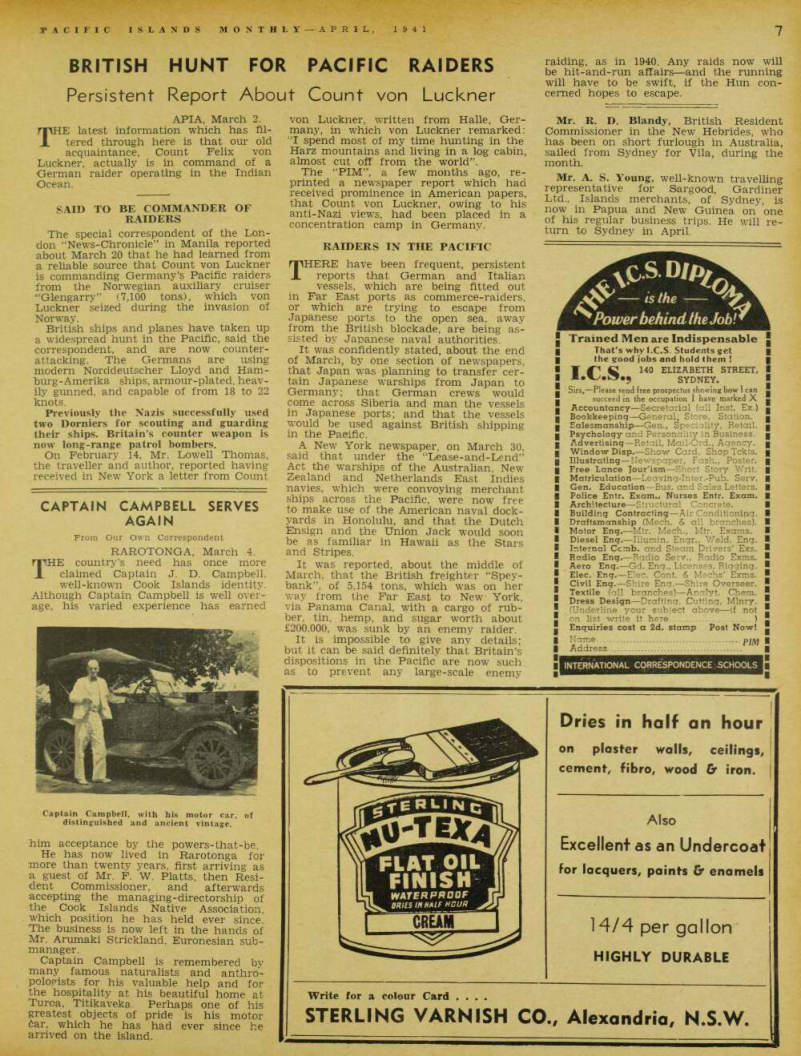
Captain Campbell, with his motor car, of distinguished and ancient vintage.
Advertisements & other items, p. 11 (1 item)
Finish
Trained Men are Indispensable That’s why I.C.S. Students get the good jobs and hold them !
Sirs, —Please send free prospectus showing how I can succeed in the occupation I have marked X Accountancy —Secretarial (all Inst. Ex.) Bookkeeping —General. Store, Station.
Salesmanship —Gen., Speciality, Retail.
Psychology and Personality in Business.
Advertising —Retail, Mail-Ord., Agency.
Window Disp. —Show Card, Shop Tckts.
Illustrating —Newspaper, Fash., Poster.
Free Lance Jour'ism —Short Story Writ.
Matriculation —Leaving-Inter.-Pub. Serv.
Gen. Education —Bus. and Sales Letters.
Police Entr. Exam.. Nurses Entr. Exam.
Architecture —Structural Concrete.
Building Contracting —Air Conditioning.
Draftsmanship (Mech. & all branches).
Motor Eng. —Mtr. Mech., Mtr. Exams.
Diesel Eng. —lllumin. Engr., Weld. Eng.
Internal Ccmb. and Steam Drivers' Exs.
Radio Eng. —Radio Serv., Radio Exms.
Aero Eng. —Gd. Eng., Licenses, Rigging.
Elec. Eng. —Elec. Cont. & Mechs' Exms.
Civil Eng. —Shire Eng.—Shire Overseer.
Textile (all branches) —Analyt. Chem.
Dress Design —Drafting, Cutting, Mlnry. (Underline your subject above —if not on list write it here ) Enquiries cost a 2d. stamp Post Now! 1.C.5.,
140 ELIZABETH STREET,
SYDNEY.
Name...
Address
PIM
INTERNATIONAL CORRESPONDENCE SCHOOLS
Dries in half an hour on plaster walls, ceilings, cement, fibro, wood fir iron.
FINISH
H WATERPROOF
DRIES IM HALF HCUR
CREAM I
Also Excellent as an Undercoat for lacquers, paints fir enamels 14/4 per gallon
HIGHLY DURABLE
Write for a colour Card ...
STERLING VARNISH CO., Alexandria, N.S.W.
His Sfslbfss
Hurricane Dislocates Nz
Fruit Supplies
mHE hurricane which was experienced I in fhP Fiii Prronn at the end of Feb
a H ifHe
His Sfslbfss
unfortunate effect of considerably reduc ing the production of bananas and oranges, which customarily go from those territories to the NZ market. This fruit trade is a welcome set-off against
the economic effect of the present lack of copra markets.
It was announced from New Zealand recently th T a ‘ u i e supply of oranges from the Cook Islands is likely to be reduced
SJ&SfJZ tumm'AustmUa'for a
sent
orange groves—nevertheless. New Zea jancj will experience a shortage of this fruit for a while. However, within a few months, it is likely that the plantations will have recovered.
Eastern Chaos
Respective Troubles of China and Japan
Special Despatch to PIM from Marc T. Greene-
Hong Kong, Feb. 26.
CHINESE prospects of victory in the war with Japan are being gravely threatened by two factors—increasing economic chaos and the widening rift between the Chungking Government and the Communist forces.
Another serious development is the in efficiency and corruption in the operation of the Burma Road.
The lack of qualified drivers and mechanics, and the “squeeze” to whichi both are resorting in order to enhance their wages, are so holding up traffic that supplies, mainly from America, are arriving at the railhead at Lashio twice as fast as they are getting into the in terior over the road.
The average wage of the drivers, who are in about the most difficult and dan gerous service that could be found any where, is the equivalent of $l2, US currency, per month, and of the mechanics even less. Consequently, the drivers get even by selling gasoline out of the supply trucks for 15 Chinese dollars a gallon, whereas it costs the Government 25 dollars.
American policy regarding China is about to undergo a radical change, and it is believed that there will be exercised a much closer supervision over Chinese economic and financial policy. It is also rumoured that there is to be a change of Ambassadors. (Since Mr. Greene wrote that, Mr. Gauss, American Minister in Australia, has left to become Ambassador in China.—Ed. “PIM”.) The position in Hong Kong is quiet, and, although the expansion of defences goes on, no developments are looked for in the near future.
Meanwhile, hundreds of bereft hus bands are getting more and more restive at the absence of their families down in Australia. There is said to be some ap prehension lest the families get over-fond of that pleasant land.
The Japanese are, in all likelihood, pre paring for a definite move in southem Indo-China, out of which they hope to recoup their weakening internal economy.
Prince Konoye announces that the war has cost Japan, so far, more than 17,500,000,000 yen. This drab information is said to have had the House of Peers "in tears”. As for the Japanese people,, their capacity for tears is long since exhausted.
Nobody takes Matsuoka’s rantings very seriously, yet there is always the danger that, in the increasing difficulties of Japan’s position, she may be driven to some desperate, even if suicidal, act.
Tahiti Schooner
Disappears
Rarotonga, March 1.
NO further news has yet come to hand Concerning the fate of the missing schooner “Tereora”, which left Tahiti on January 16, for Raiatea, and has not been seen again. This is the second schooner that Etablissements Donald Tahiti have lost during the year, the other being the old “Vaite”, which recently fell foul of a reef in the Tuamotus, There is a suspicion that the “Tereora’' was a victim of enemy action. All the surrounding reefs and islands have been thoroughly searched by Donalds’ new schooner “Vaitere”, without a trace being found.
Advertisements & other items, p. 12 (1 item)
The Snapshots
s
you will treasure to-
morrow are the ones
you take to-day! ...
To-morrow's priceless movies can be made at moderate cost to-day with Cine-Kodak Eight Let us show you.
Keep the Kodak busy picturing
friends and family, the soldier about to embark and remember to include a "Snapshot from Home" in every letter abroad.
KODAK (A'asla) PTY.LTD.
379 GEORGE STREET, SYDNEY
9 WOLFE STREET, NEWCASTLE
• Visit your nearest Kodak Dealer for full supplies of dependable Made-in-Australia Kodak Film
New Guinea
Miners’ Strike in New Guinea Hint That Co. May Cease Operations
From Our Own Correspondent WAU, April 4.
THE underground miners employed by New Guinea Goldfields Ltd. are on strike, and have brought a large number of alluvial miners out with them. The strike commenced to take shape on March 14 at Golden Ridges and spread to Edie Creek.
Apart from contract work, on which many of these miners are engaged and which provides a handsome return to them, tne rate of pay under which the men are engaged, and under which they agree to work on taking up their jobs, is 25/- per shift of seven shifts a week.
The two main demands of the men appear to be an increase of 5/- per shift and a 44-hours week. There are appar ently other demands and alleged griev ances, which have not been made public.
In addition to any pay, either by wages or contract, which the men re ceive, they are housed free and receive free electric light, in addition to other concessions.
It must be said, in fairness, that there are a large number of the miners whose hearts are not in the strike; but the fear of being called “scabs” and so forth has been sufficient to make them throw in their lots with a minority of malcon tents.
A simple arithmetical reckoning will show that with an increase of 5/- per shift, and a 44-hours week, the men would be 10/- per week worse off than they are under present conditions.
All efforts at a settlement have failed, including a visit by the Administrator (Sir Walter McNicoll) who interviewed the men. The whole of the underground workings of New Guinea Goldfields Ltd. are idle, the safety men have been with drawn, and the mines are in a fair way to becoming a write-off.
The fact that the alluvial miners, who have no grievance whatever, have been brought out in sympathy with the other miners, shows how completely the men’s leaders have failed to appreciate the situation. It is quite on the cards that the interests which control NGG, who never have been very enthusiastic about the New Guinea field, will take this opportunity of “writing-off” NGG alto gether.
It is likely, if the strike does not soon end, that the directors will dismiss the whole staff, and close down temporarily, pending the organisation of a new staff.
NGG employees are the foundation of much of Wau’s trade, and commercial interests will be struck a severe blow through any long strike, or closing-down of the mines.
And what will be the Administration’s attitude towards the presence, for any length of time, of these men and their families in the Territory? It is obvious that they cannot be allowed to remain in the Territory with no visible means of support.
It is fortunate that the Co. concerned has sufficient staff men to carry on the alluvial workings and thus maintain a certain output of gold.
The Co. has taken no action regarding the strikers’ continued occupation of their free houses. About 40 per cent, of the men on strike are married.
It is just possible that the Common
wealth may intervene. It is vital to Australia’s war effort that the produc tion of gold shall continue.
Case For The Men
The Morobe Goldfields strike was re ferred to in the Commonwealth Parlia ment on March 25 by Mr. Ward, who said the men had adopted this method of directing attention to certain disabili ties under which they work. They had been told that the conditions of their employment in New Guinea would be similar to those on the mining fields in Australia. They were promised 25/- a shift, and, if they worked on contract, which was optional, up to 30/- a shift.
They found the conditions entirely dif ferent from those in Australia. Numer ous accidents had happened. The men were working with obsolete machinery, and the dust menace in the mines had reached serious proportions.
“The timbering of the mines, done in softwood, is entirely unsatisfactory; many of the mines are in danger of col lapse. In one case the only entrance to one mine collapsed, and great difficulty was experienced in digging out the men entombed. In addition, no facilities are provided for rescue work, and no first aid kits are available at many of the mines. These conditions apply particu larly to the mines at Anderson’s Creek and at the Upper Ridges.
“The men ask that an inspection be made of the mines immediately, and that every protection be given to enable them to work in safety.
“They also complain that when en gaged on contract work they are often robbed by those in charge of the mines.
It appears that natives are employed to count the trucks, the men being paid on a tonnage basis. However, in February, in one instance, a difference of 150 tons
was found between the mill return and the men’s check. The men also ask, therefore, that a weigh-bridge be instal led in order to afford them protection against exploitation in this way, “They also ask for a minimum wage of 30/- a shift and one day’s holiday a month, and for the payment of overtime (which is now paid for at ordinary rates) at time and a half. This is necessary, as the cost of living is approximately 30 per cent, higher than in Australia. They also request that suitable sheds and accom modation, ample supplies of drinking water and sanitary conveniences be pro vided at every level in the mines.
“These men have repeatedly brought their complaints under the notice of the company, but so far no effort has been made to rectify any of their grievances.
Consequently they have now ceased work.”
The Government made no reply to Mr.
Ward’s statement. It is understood that it regards its powers, in relation to New Guinea, as too limited to allow it to do anything.
Advertisements & other items, pp. 13-14 (2 items)
9
PA ci tic Islands monthly April, i 9 4 i
Here’S The Set
m
THAT GETS RESULTS!
798 verified Radio Stations were received on a Standard ULTIMATJ Receiver—a world’s record! An ULTIMATE was used by Commande R. E. Byrd at the South Pole; the Australian adviser to the Britisl Broadcasting Commission depends on an ULTIMATE. ULTIMATI Receivers hold nine Champion of Champions Awards. Ask the lead ing Short-wave Experts and Technicians about ULTIMATE perform ance—that’s proof! Obtainable in 8 and 10 Valve Electric Console 7-valve Dual-wave Vibrator Console; 6 and 8 Valve Dual-wave Elec trie Mantel; 7-valve Dual-wave Vibrator Mantel.
SPECIALLY SUITED TO ISLAND CONDITIONS
Before you decide on a Radio get particulars of ULTIMATE Cut out this Coupon and post to-day.
GEORGE BROWN & CO. PTY. LTD., 267 Clarence Street, Sydney.
Please send me without obligation full particulars of ULTIMATE Receivers.
NAME
ADDRESS
P.I II
Til
M
SUB
GEORGE BROWN & CO. PTY. LTD., 267 Clarence Street, Sydney.
NOW
id th£' tUwe/
Start NOW to protect
your chest and lungs
and to build up resistance to infection, BE-
FORE grave winter ail-
ments develop.
That "chesty" cough, if neglected, may easily lead to bronchitis, 'flu, pneumonia and other serious lung troubles.
It is a sign of dangerous weakness in the whole body, and particularly in chest and lungs.
It is the amazing THOROUGHNESS with which it acts that has made Scott's Emulsion famous as the finest of all body-building and protective tonics. With Scott's, the throat is quickly soothed and that troublesome cough quickly disappears. But, more important still, the general strength fitness and resistance to infection are built up, so that the system is made absolutely SAFE against those infections of the chest and lungs to which it is now dangerously exposed.
SCOTT’S
Emulsion
ALL /
AND STORES
ALL m
CHEMISTS 2/9
tun STORES 1 *
What do your Employers
really think abont yon •
J Do You impress them as being the right man for * promotion? 2 Do You show them by your business knowledge that you * are fitted to take more and bigger responsibilities?
Do You hope they will promote you, or leave you as you are?
Here are three very important questions which you should answer —to yourself. If the answer to the third question is, “You wish to be where you are,” and there are no likely contenders for YOUR present position, then there is nothing more to say but if you really want to impress your employers with the fact that you desire promotion and bigger responsibilities
What are You doing about it?
There is only one way to obtain promotion, that is to Earn it by learning more about business. There is only one quick way to learn more, and that is to study business.
Department of Accountancy and Commerce, Accountancy and Secretaryship Cost Accountancy Banking and Securities General Business Training Executive Training Course in Modern
Hemingway & Robertson
The Accountancy Specialists Founders of Commercial Education • n Australasia. 127 A BARRACK HOUSE, 16 BARRACK ST., SYDNEY 127 A BANK HOUSE, BANK PLACE, MELBOURNE, C.l.
Also at Brisbane, Adelaide, Perth, Hobart, Launceston and Newcastle.
Here is where we can help you The House of Hemingway & Robertson is an organization established since 1897 to provide personal advancement through business education. SPECIAL TUITION and FACILITIES have been provided for men who live in the Islands, and many H. & R. students who have, in past years, enrolled and completed their training whilst residing in even the remotest centres, have secured promotion with their own firms or bigger opportunities in new positions in Australia. They testify to the value of H. &R. training and the service given. H. &• R. originated and developed the Personal-Individual Method of Tuition and wherever mails go, H. & R. tuition is effective.
Another feature of the H. & R. specialized training service is the One Fixed Fee policy. There is only one cost ... no text books to buy. If you want to progress as rapidly as you should, post the coupon for our illustrated handbook.
Department of Distribution, Marketing and Advertising Marketing and Selling Practical Retail Selling Show Card and Ticket Writing Business &. Modern Merchandising
r~To HEMINGWAY & ROBERTSON,
Please send me free copy of the new, 108 page illustrated handbook ■ “The Guide to Careers in Business.”
I Name I Address Age Career Interested in £7AA/509
United States' New Consuls Go
to Posts in Pacific
MR. Wainwright Abbott, newly ap pointed United States Consul in Fiji, arrived by the “Monterey” at Suva in mid-March. He is accompanied by Mrs. Abbott. Until recently Mr.
Abbott was US Consul stationed at Ham burg, in Germany.
Mr. K. de G. MacVitty, who recently was in Sydney, on his way to take up duty as US Consul in New Caledonia, has now arrived in the French Colony.
Advertisements & other items, p. 14 (1 item)
10
APRIL, 1941 PACirtC ISLANDS MONTHLY
Rubber Control?
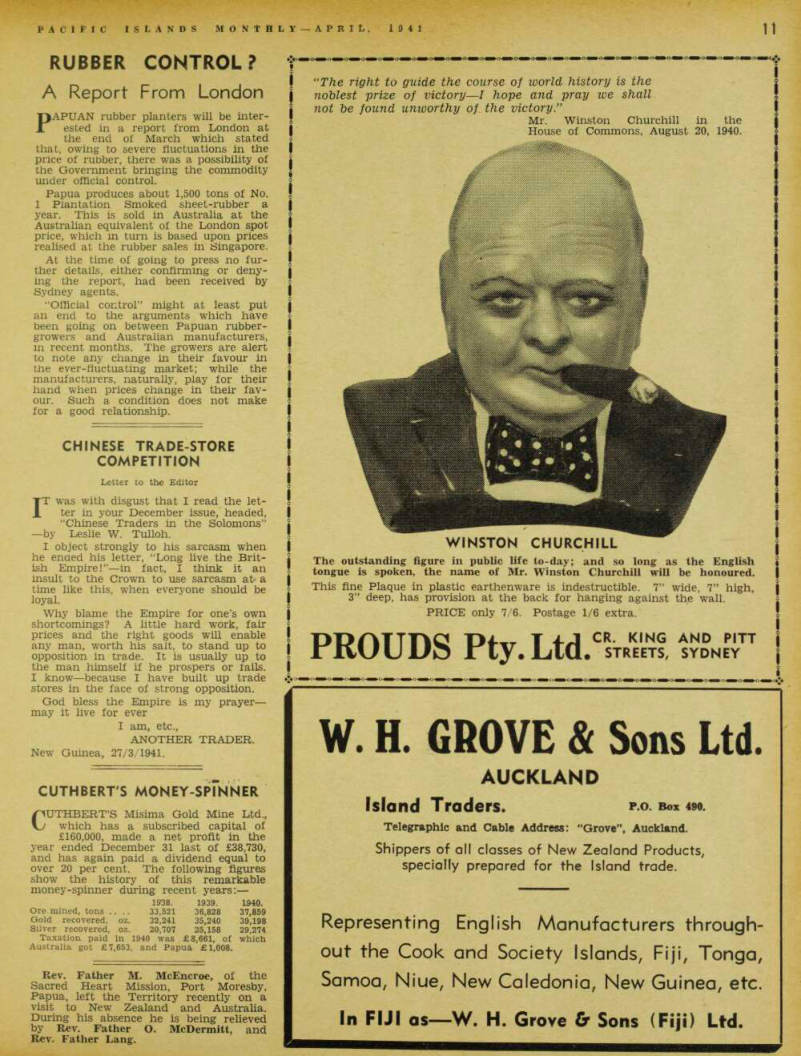
A Report From London
PAPUAN rubber planters will be inter ested in a report from London at the end of March which stated that, owing to severe fluctuations in the price of rubber, there was a possibility of the Government bringing the commodity under official control.
Papua produces about 1,500 tons of No. 1 Plantation Smoked sheet-rubber a year. This is sold in Australia at the Australian equivalent of the London spot price, which m turn is based upon prices realised at the rubber sales in Singapore.
At the time of going to press no fur ther details, either confirming or deny ing the report, had been received by Sydney agents.
“Official control” might at least put an end to the arguments which have been going on between Papuan rubber growers and Australian manufacturers, in recent months. The growers are alert to note any change in their favour in the ever-fluctuating market; while the manufacturers, naturally, play for their hand when prices change in their fav our, Such a condition does not make for a good relationship.
Chinese Trade-Store
Competition
Letter to tbe Editor IT was with disgust that I read the let ter in your December issue/ headed, “Chinese Traders in the Solomons” —by Leslie W. Tulloh.
I object strongly to his sarcasm when he ended his letter, “Long live the Brit ish Empire!”—in fact, I think it an insult to the Crown to use sarcasm at> a time like this, when everyone should be loyal.
Why blame the Empire for one’s own shortcomings? A little hard work, fair prices and the right goods will enable any man, worth his salt, to stand up to opposition in trade. It is usually up to the man himself if he prospers or fails.
I know —because I have built up trade stores in the face of strong opposition.
God bless the Empire is my prayer— may it live for ever I am, etc.,
Another Trader.
New Guinea, 27/3/1941.
Cuthbert's Money-Spinner
CUTHBERT’S Misima Gold Mine Ltd., which has a subscribed capital of £160,000, made a net profit in the year ended December 31 last of £38,730, and has again paid a dividend equal to over 20 per cent. The following figures show the history of this remarkable money-spinner during recent years:—
Rev. Father M. McEncroe, of the Sacred Heart Mission, Port Moresby, Papua, left the Territory recently on a visit to New Zealand and Australia.
During his absence he is being relieved by Rev. Father O. McDermitt, and Rev. Father Lang.
1938. 1939. 1940.
Ore mined, tons ... 33,521 36,828 37,859 Gold recovered, oz. 32,241 35,240 39,198 Silver recovered, oz. 20,707 25,158 29,274 Taxation paid in 1940 was £8,661, of which Australia got £7,653, and Papua £1,008.
Advertisements & other items, pp. 15-16 (1 item)
W. H. GROVE & Sons Ltd.
“The right to guide the course of world history is the noblest prize of victory—l hope and pray we shall not be found unworthy of the victory.”
Mr. Winston Churchill in the House of Commons, August 20, 1940.
WINSTON CHURCHILL
The outstanding figure in public life to-day; and so long as the English tongue is spoken, the name of Mr. Winston Churchill will be honoured.
This fine Plaque in plastic earthenware is indestructible. 7” wide, 7” high, 3” deep, has provision at the back for hanging against the wall.
PRICE only 7/6. Postage 1/6 extra.
PROUDS Pty. Ltd/USf
KING AND PITT
SYDNEY
W. H. GROVE & Sons Ltd.
AUCKLAND
Island Traders. p.o. box 490.
Telegraphic and Cable Address; “Grove", Auckland.
Shippers of all classes of New Zealand Products, specially prepared for the Island trade.
Representing English Manufacturers throughout the Cook and Society Islands, Fiji, Tonga, Samoa, Niue, New Caledonia, New Guinea, etc.
In FIJI as—W. H. Grove & Sons (Fiji) Ltd.
'hn v< - m ' l h
* \\V"/ 'VJ
trom BORNtO I ,
COMES A LEGEND of Sll/UJ M
man wo sesame a cwcoptcem
ALTHOI/OH worn THE 30P/ OfA-
CfiOCOO/l£ , H/S TEETH
AHP TOH6VE HEM AWE?
THOSE'^PaMA/V.
Wp *Z, r A & y)&
siES&S&S^
&«- »§gW» % **'
Hawaii-Pago-Tahiti-Los
Matson Cruise
Hawaii-Pago-Tahiti-Los Angeles
IN August of last year the Matson Line ran a cruise to Tahiti, for the bene fit of American, Australian and New Zealand tourists. This cruise, which was something of an experiment, was so successful that plans have been made for another cruise to Tahiti in May—but, this time, mostly for Ameri cans.
The “Mariposa” will leave Los Angeles on May 24, visit Honolulu on May 29, and arrive at Pago Pago (American Samoa) on June 3.
Here, the “Mariposa” will meet the north-bound “Monterey”, and a change over will take place. The American tourists will transfer from the “Mari posa” to the “Monterey”. The “Mari posa” will continue on her regular run to Fiji, New Zealand and Australia, and the tourist-laden “Monterey” will leave Pago Pago on the same day (June 3) and arrive at Papeete on June 6.
Arrangements have been made so that the tourists will have three full days in Tahiti before returning to Los Angeles on June 9. Thus the Americans will make a round tour of Hawaii, American Samoa and Tahiti; and Australians and New Zealanders on the “Monterey” will visit Fiji, Pago Pago, Papeete and then on to America —but they will miss Hawaii.
BP Profits Hold Up Very Well
rE annual report of Burns Philp (South Sea) Co. Ltd., for the year ended January 31, shows that net profit has fallen; but it is down by only £lO,OOO compared with last year, and £12,000 compared with 1939 (non-war) a remarkable result, considering the tre mendous dislocation of shipping services and war’s paralysing effect on enter prise. Details:—
The report states that the shortage of shipping to carry copra overseas, and the unprofitable prices obtainable in Mexico, now the only available market, caused a suspension of operations by many small planters and the closing down of some trading stations.
The restricted operations in copra, trading, and shipping affected revenue from these sources, but earnings from merchandising and investments were moderately satisfactory.
Sir Ernest Fisk, Australia’s Director of Economic Co-ordination, who is a mem ber of the Pacific Islands Society, has been invited to address the Society at an early date on the development of radio in the Pacific.
h Yhear ended January 31. 1939. 1940. 1941. £ £ £ Gross profit . . . . 184,269 191,683 164,226 Net profit 51,232 49,353 38,971 Dividend, p.c. .. ey 4 6 Vi 5 Amount of div. . 46,875 46,875 37,500 To reserve .. .. 5,000 — — Carried forward . 8,978 11,456 12,927 Depreciation . .. 23,048 23/,568 17,728
Liabilities—
Capital 750,000 750.000 130.000 750,000 Reserve fund .. 125,000 130,000 Creditors 48,347 55,708 57,180
Assets—
Cash 62,356 65,714 68,805 Property and 357,280 shipping .. 314,226 384,546 Investments .. 264,564 258,096 281,433 Merchandise . .. 127,830 98,803 91,496 Debtors 193,450 165,005 169,843
Tropicalities
A NOVEL scheme for raising money for patriotic purposes has been evolved by the Free French Government In Tahiti, Raffles are now being held, for Joyrides in the Government aeroplane, the six prize-winners of each raffle being taken on an aerial tour over Tahiti and Moorea.
In more normal times, such a scheme would have presented a wonderful opportunity to an enterprising aeroplaneowner. In most cases, introducers of the motor car to Pacific islands made small fortunes out of selling joyrides on the “pereoo karotini” (kerosene buggy).
In Rarotonga, for instance, an ambitious young Euronesian from Papeete used to charge 5 - per soul for a ride of about a quarter of a mile. The incredible excitement of going round the whole island (a distance of 21 miles) cost the unfortunate traveller £5. • THE following appeared in “Rabaul Times” of March 14: — Personal-Two girls wish to correspond with two planters, view matrimony. Reply: Miss MacMillan, c 'o London F urs. 155 King street Sydney.
The “PIM”, much intrigued, sent a reporter to call upon London Furs. It was sheer mischance that the lad was young and handsome. When he mentioned the advertisement, and stated that he would like more details, he was quickly appraised by two or three pairs of sophisticated eyes, and the atmosphere was friendly, if not embarrassing.
So he hastily explained that he was not a tropical coconut-grower—he was only an ordinary reporter. All trace of hospitality disappeared immediately, and the unhappy youth was driven out by something colder than an Antarctic blast. There definitely was nothing for the press. If the gentlemen of New Guinea want to know anything more about the easily-panicked ladies of Lon-
don Furs, they must find out for them selves. , * . ...
M R ' Ken ' Garden ' formerly with Mr. 111 Ward Williams in Papua, and later a pilot in the Guinea Airways ser vice, is doing notable work, now, in fly ing big bombers from San Diego, USA, to the Atlantic, for delivery to Britain, He is described as “a wizard pilot, who will be heard of after the war”, It was Ken. Garden who received a white feather from a girl in a West Eng land city. He was flying “buses” from South Africa to England for Imperial Airways, and had just come in from a particularly bad and risky trip, when the lady passed along her chosen insult, The angry and exasperated Ken. did not hesitate. He slapped her face, The lady resented it. She charged him, before a magistrate, with assault.
The magistrate wasted no words. He complimented the airman on his prompt action, and dismissed the charge. Then, looking over his spectacles at the female patriot, he said:— “And if vmir fnfhpr dopq nnt thnr- J OUr I^ me .V l 0068 no \ “l°r oughlv birch you, I will come and do it myself!” * AMONG a recently-discovered tribe in Central New Guinea was found a custom calling for the women to carry the smoke-dried heads of their husbands for a year after death. These gruesome relics were slung around their necks as a reminder of their wifely obli nations—not even death releases them from their ties.
The wearing of human bones as orna ments is not uncommon in several dis tricts in both Papua and New Guinea, In the Samberigi Valley. Western Papua, the hands of dead relatives are smoke-dried and suspended from the neck. The women of the Bara tribe wear the skulls of their dead babies as mementoes. In the district at the head
of the great Fly River, fingers are threaded on lengths of cane to form necklaces worn by the semi-nomadic tribes there.
Jaw bones do not lend themselves to
the European idea of adornment, but they are worn in memoriam by the natives of the Middle Fly, while those of enemies killed in battle are worn as trophies by some of the warlike moun tain people.
Perhaps the most grotesque ornament of all is the human thigh bone rubbed down to the thickness of an inch and worn as an ornamental hairpin by men on the Wharton Range in Northern Papua.—M.L. * RECENT reports from Hollywood indi cate that Nordhoff and Hall, the talented American authors who now reside in Tahiti, are “in the money” again. Paramount Films have paid them
60,000 dollars for the film rights to a story called “Botany Bay”—and some indication of the story is given by the fact that a newly-arrived film actor named Hayden is to play in “Botany Bay” the part of an adventurous Ameri can sea captain of the 1780 period.
A few years ago, after Nordhoff and Hall had made a very pretty clean-up on their three books dealing with the mutiny on the “Bounty” (“Mutiny”, “Men Against the Sea” and “Pitcairn Island”) Charles B. Nordhoff came to Sydney to dig out some further material relating to the career of Captain Bligh —who, it will be remembered, became Governor of NSW after the mutiny of the “Bounty”. This new book and film by the collaborators suggest that Mr. Nordhoff’s visit was not unprofitable. * POINTED and pithy paragraph from a recent issuer of “Rabaul Times”:— Teapot, a familiar figure in the din ing-room of the Rabaul Hotel, was found out when he purloined a dollar, belong ing to one of the guests of the hotel; he pleaded guilty and was sentenced to receive six strokes in private. The case was heard at 10 a.m. and the lad was back on his job at noon, all legal tech nicalities having been conformed with.
That is what we call justice administered as it should be. No long, drawn-out pro cedure; no loss of time to the emplover and the delinouent satisfied that he has paid for his offence. ♦
Hell In 1941
A grower stood at the Pearlv Gate, His face was worn and old; He meekly asked the Man of Fate Admission to the Fold.
“What have you done,” Saint Peter asked, “To seek an entrance here?”
“Grown coconuts—that was my task.
For many and many a year.”
And then the gate did open sharp, As Peter touched the bell.
“Come in,” he said, “and take a harp— You’ve had enough of Hell!”
ANON —Papua. * rE analogy of certain customs of the Middle Fly River natives in Papua and those of the aborigines of North Queensland has been remarked upon more than once by travellers and writers; and an incident related in a diarv of the famous nrospector Christie Palmer ston, published in the “Queensland Figaro” over 50 years ago, gives evidence of this similarity.
After a raid, the Papuans of the Middle Fly decapitate their victims and sever the lower jaw bone; they also cut off the hands and feet. Palmerston’s diary re corded that while prospecting Wairambar Creek, off South Johnston River, on Sep tember 7, 1886. he and five of his abori gines came upon a cannibal feast, in which the bodies of the victims had been decapitated and the lower jaws severed, while the feet and hands were also missing. It appears that a distant tribe had killed two of his “boys” and carried their bodies away, and it was while tracking down the attackers that Palmer ston surprised them cooking portions of the bodies on heated stones.
The diary also tells that a few days later Palmerston met G. E. Clarke and W. Joss, who were prospecting the dis trict. Clarke was the well-known miner who, with Mosman, opened up Charters Towers, and who was murdered by na tives of the Mambare River in Papua in Julv, 1895, while leading the first pros pecting party up the headwaters, above
the rapids.—“Kiribisi.”
IT is announced that canteen orders for the benefit of troops overseas may now be purchased at post offices in Papua and New Guinea, in denominations of 2/-, 3/- and 5/-. They are accepted in all AIF canteens abroad, and this means of transferring credit from the home-land to the boys overseas is a welcome way of sending appreciated gifts to them. The canteen order was introduced in Australia about the middle of 1940. and the ‘‘Pacific Islands Monthly” then pointed out to the Com monwealth authorities, in forthright words of one syllable, that it was very unfair that the canteen orders were not available in the post offices in the Ter ritories, which had been just as loyal and generous as the mainland in supply ing men for the AIF. It is satisfactory now to see that the canteen orders are available in the Territories —but the time it has taken to extend the arrange ment from the mainland to the Terri tories is a pretty example of how slowly and how cumbersomely these Govern ment departments work. * ' T>LAIN English” says a few words, in i season:— We are continually being reminded of the paper shortage, and the need for economy. Newspapers and other users have complied; but not Government de partments. If ordinary language and English were used, three pages could be condensed into one; but not with offi cialese. This is for people with plenty of time and paper at their disposal.
Here is a choice sample from the New Hebrides.
Regulations 1, 2 and 3. 1941, all deal with straying cattle, and fencing, and boundaries, and if nlain English had been used, they could have been easily
condensed into one regulation. Regula tion 3 is simply used to interpret Nos. 1 and 2; and Clause 3 reads: — ‘‘For the purpose of this Regulation (‘this’ should have read ‘these’) cattle shall be held to mean any animal of the equine, bovine, asinine, porcine, ovine, coprine or cervine breed, and any cross between them.”
Incidentally, the too frequent use of the phrase ‘‘up to £2O fine, and one month’s imprisonment, or both”, for purely civil offences, is in bad taste in a community of freemen. It savours too much of Nazism.
Advertisements & other items, pp. 17-18 (1 item)
Sparkle!
You must have
A dull and lifeless Diamond is no Diamond at all. It’s fiery, scientillating sparkle that you look for. And you get it always in Angus & Coote’s guaranteed Diamonds. £2O/0/0 nr irwr 39 See how different . . . how thoroughly exclusive this ring is. Two glorious centre Diamonds in “Pillar” settings of Platinum.
Rings are made in 18 ct. White or Yellow Gold, whichever you prefer. £lO/0/0 v- A Ring of distinction. The lively, sparkling centre Diamond is securely held in a new “Pillar” setting.
Angus & Coote guarantee Safe Delivery, to any address for you. £lB/10/0 Unforgettable loveliness expressed in a “Solitaire” Engagement Ring. Note the “Coronet” setting, and the leaf shoulders.
Settings are of Pure Platinum, always. £l6/10/0 m The “Delysia” setting, pioneered by Angus & Coote, is here introduced in a Solitaire of rare distinction. Once on the finger It will be cherished for ever.
Each Diamond in each Ring is guaranteed for cut and colour. Angus & Coote will give you your money back if you are not quite satisfied with your purchase.
ANGUS &COOTE
500 GEORGE STREET, SYDNEY
NIVEN’S
PURE ICE CREAM
IN THE PACIFIC
Port Moresby Introduces a Soda Fountain From Our Own Correspondent
PORT MORESBY, Dec.
As reported
P.I.M.
in AN up-to-date soda fountain and milk 1 bar, including an ice cream parlour, has been recently opened in Port Moresby, and is extremely popular with all sections of the community since the hot weather has set in. Clay and Co., are the enterprising firm responsible for the innovation: and the bar, which is to be run on strictly cash lines, promises to be a marked success.
Agents for J. R.
Clay & Co.— J. C. Merrillees & Co., 133 Pitt Street, Sydney.
The above is "A SUCCESS".
What has been done in Port Moresby can be done elsewhere — Enquiries welcomed by J. C. Merrillees & Co., or direct by
%AC NIVEN'S Salisbury Rd., Camperdown, Sydney
9 — Cable Address: “Macscones,” Sydney.
Visitors to Sydney
HAMPTON COURT,
KING’S CROSS.
The Furnished Plats that give everything, and only a few minutes from the heart of the city.
Rentals from £3/3/- weekly.
Write Manager for fuller particulars.
TYRE
REBUILDING
FOR PROFIT
Not only within Australia Is ADVANX the 1 largest selling tyre rebuilding equipment, but In the Americas, South Africa, India .and the East ADVANX is successfully merchandised against powerful local competition. Traders who are interested in tyre rebuilding for profit are invited to write for complete Information on the ADVANX range of tyre moulds and retreading accessories.
TYRE I
RUBBER CO. PTY.LTD.
NEILD & McLACHLAN AVENUES. BUSH CUTTERS BAY, SYDNEY, NEW SOUTH WALES.
Telegrams and Cables, ‘‘BADVANX”, SYDNEY.
Steamships Trading
Company Limited
PORT MORESBY SAMARA! MISIMA, PAPUA.
WHOLESALE & RETAIL MERCHANTS, SHIPOWNERS,
PLANTERS, ENGINEERS & SLIP PROPRIETORS.
Customs, Shipping, Insurance, and Forwarding Agents.
MANAGING AGENTS AND VISITING REPRESENTA-
TIVES FOR COCONUT AND RUBBER ESTATES.
A full range of Merchandise always in stock, including Plantation, Mining, Prospecting and General supplies.
All classes of ship repairs and engine overhauls undertaken. Vessels up to 400 tons gross slipped at any tide on our patent Slipway, Port Moresby.
AGENTS FOR: —Vacuum Oil Co. Pty., Ltd., Bankers & Traders Ins. Co., Royal Packet Navigation Co., American Trading & Shipping Co., Wunderlich, Ltd., Dodge Motor Co.. Diamond T Motor Trucks, Johnston Outboard Motors, Sawmillers & Traders, Ltd., Coral Sea Insurance Co., Australian General Electric Refrigerators, Hallstroms Kerosene Refrigerators, B.A.L.M. Paints, Kodak, Ltd., Acme Bakery Co.
SYDNEY REPRESENTATIVES: Nelson & Robertson Pty. Ltd., 12 Spring Street.
WRITE, CABLE, OR CALL FOR PARTICULARS
STEAMSHIPS TRADING COMPANY LIMITED
Head Office: Port Moresby. Cable Address: "Steamships".
Papuan Awarded Rhs
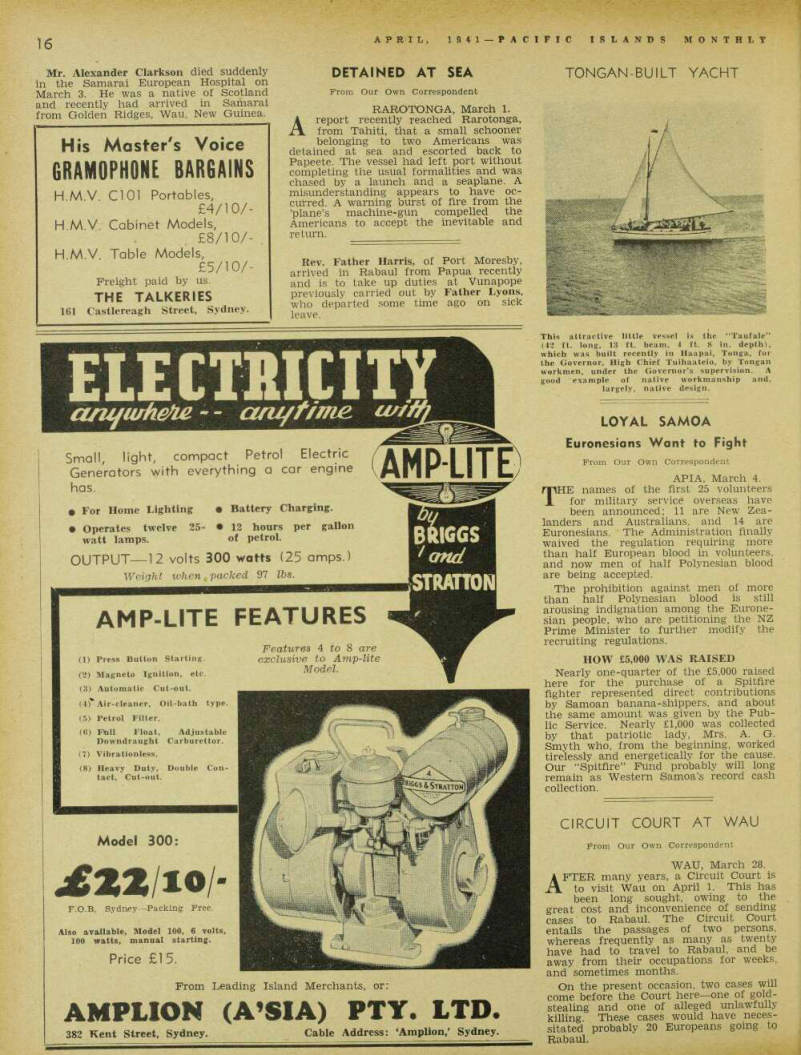
Bronze Medal
From Our Own Correspondent
Pt. Moresby, April 2.
FOR his bravery in saving the lives of two small boys, Boudano, a native of the Middle Fly River in Western Papua, recently was awarded the Royal Humane Society’s bronze medal.
Boudano was on board the MV “Chin ampa”, anchored off Sevirimabu village on August 13, 1939. It was a dark night and the flood tide caused the vessel to pitch and roll. While tossing about she collided with a native canoe, smashing it to pieces and throwing the occupants into the stream. Three natives managed to scramble aboard the “Chinampa”, but two small boys, entangled in the wreck age, were carried away into the darkness.
Without a moment’s hesitation, Bou dano dived overboard to their assistance and supported them in the turbulent waters. The three of them were picked up by the vessel’s dinghy after having been swept three miles down the river.
Boudano was recommended for the medal by the late Sir Hubert Murray.
Mr. Alexander Clarkson died suddenly in the Samarai European Hospital on March 3. He was a native of Scotland and recently had arrived in Samarai from Golden Ridges, Wau, New Guinea.
Advertisements & other items, pp. 19-20 (1 item)
Charcoal Gas Producer
NELSON & ROBERTSON
PTY., LTD.
Established 1895.
Islands Merchants
All classes of merchandise purchased at wholesale prices and original invoices supplied to Islands clients.
Purchasers of Laup (New Guinea Walnut).
Cocoa Beans, Rubber and other Islands' produce sold on commission.
SOLE AGENTS FOR
ANKAR INSULATING
WALLBOARD
BEEBE PORTABLE
WINCHES
SKANDIA ENGINES
Nelson & Robertson
Pty. Ltd. 12 Spring Street, Sydney, Australia.
m ig
GAS MIXING VALVE
'I
WATER-COOLED TUYERE
Easily assemble your own
Charcoal Gas Producer
from our parts and working drawings
Charcoal Gas.—The most economical power fuel known, for Cars, Trucks, Stationary Engines, etc., is simply water and air drawn through a charcoal fire, filtered from ash and soot, thoroughly cooled and then mixed with air to form an explosive mixture.
The hopper, which holds the charcoal, the water tank, filters and cooler can be built by a novice, but the tuyere, mixing valve, grate and lids must be* made correctly if the plant is to be efficient.
The plant shown in the Blue Prints will operate any engine from 5 to 50 horsepower.
The petrol system is not altered unless you wish, and you can drive on petrol or charcoal gas at will.
One bag of charcoal, weight 70 lb., equals 5 gallons of petrol in fuel value.
The Atoma parts required to build the unit shown in the Blue Print are:— 1 idling vent 15/6 1 hopper lid 19/6 1 drip tap 6/6 2 filter lids 13/6 each 2 water unions ... 2/2 each 1 cleaning door 13/6 10 lb. lining 1 grate 8/6 compound .. 9d. per lb. 1 tuyere £2/13/6 4 lb. steel wool .. 2/2 per lb. 1 mixing valve £5.. 2 lb. sisal or 1 manifold adaptor 12/6 rope fibre ... 1/3 per lb.
The price of this complete list is £l3/19/6 F. 0.8. The parts can be bought separately if required.
Make all cheques, money orders and postal notes payable to—
ATOMA ENGINEERING COY.
17 O'Connell Street, Sydney, N.S.W.
His Moster's Voice
GRAMOPHOHE BARGAINS
H.M.V. Cl 01 Portables, £4/10/- H.M.V. Cabinet Models, £B/10/- H.M.V. Table Models, £5/10/- Freight paid by us.
THE TALKERIES
161 Castlereagh Street, Sydney.
ELECTRICITY
ctnuu/hefre - - uffrr^
Small, light, compact Petrol Electric Generators with everything a car engine has.
AMP-LITE
• For Home Lighting • Operates twelve 25watt lamps. • Battery Charging. • 12 hours per gallon of petrol.
OUTPUT—I 2 volts 300 watts (25 amps.) Weight when , packed 97 Ihs. m
l and
STRATTON
AMP-LITE FEATURES H
(1) Press Button Starting. (2) Magneto Ignition, etc. (3) Automatic Cut-out. (iT Air-cleaner, Oil-bath type. (5) Petrol Filter. (6) Ftall Float, Adjustable Downdraught Carburettor. (7) Vibrationless. (8) Heavy Duty, Double Contact, Cut-out.
Features 4 to 8 are exclusive to Amp-lite Model.
Model 300; /!•/- F. 0.8. Sydney—Packing Free.
Also available. Model 100, 6 volts, 100 watts, manual starting.
Price £1 5. ®2*s&Straiton ms a From Leading Island Merchants, or:
AMPUON (A’SIA) PTY. LTD.
382 Kent Street, Sydney. Cable Address: ‘Amplion,’ Sydney.
Detained At Sea
From Our Own Correspondent
Rarotonga, March 1.
A report recently reached Rarotonga, from Tahiti, that a small schooner belonging to two Americans was detained at sea and escorted back to Papeete. The vessel had left port without completing the usual formalities and was chased by a launch and a seaplane. A misunderstanding appears to have oc curred. A warning burst of fire from the ’plane’s machine-gun compelled the Americans to accept the inevitable and return.
Rev. Father Harris, of Port Moresby, arrived in Rabaul from Papua recently and is to take up duties at Vunapope previously carried out by Father Lyons, who departed some time ago on sick leave.
Tongan-Built Yacht
This attractive little vessel is the “Taufale” (42 ft. long, 13 ft. beam. 4 ft. 8 in. depth), which was built recently in Haapai, Tonga, for the Governor, High Chief Tuihaateio, by Tongan workmen, under the Governor’s supervision. A good example of native workmanship and, largely, native design.
Euronesians Want to Fight
Loyal Samoa
From Our Own Correspondent APIA, March 4.
THE names of the first 25 volunteers for military service overseas have been announced; 11 are New Zea landers and Australians, and 14 are Euronesians. The Administration finally waived the regulation requiring more than half European blood in volunteers, and now men of half Polynesian blood are being accepted.
The prohibition against men of more than half Polynesian blood is still arousing indignation among the Eurone sian people, who are petitioning the NZ Prime Minister to further modify the recruiting regulations,
How £5,000 Was Raised
Nearly one-quarter of the £5,000 raised here for the purchase of a Spitfire fighter represented direct contributions by Samoan banana-shippers, and about the same amount was given by the Pub lic Service. Nearly £l,OOO was collected by that patriotic lady, Mrs. A. G.
Smyth who. from the beginning, worked tirelessly and energetically for the cause.
Our “Spitfire” Fund probably will long remain as Western Samoa’s record cash collection.
Circuit Court At Wau
From Our Own Correspondent WAU, March 28.
AFTER many years, a Circuit Court is to visit Wau on April 1. This has been long sought, owing to the great cost and inconvenience of sending cases to Rabaul. The Circuit Court entails the passages of two persons, whereas frequently as many as twenty have had to travel to Rabaul, and be away from their occupations for weeks, and sometimes months.
On the present occasion, two cases will come before the Court here—one of gold stealing and one of alleged unlawfully killing. These cases would have neces sitated probably 20 Europeans going to Rabaul.
Lost Century
When Tonga Built
Great Canoes
Interesting Link With Lost Century
Prom Our Own Correspondent
Nukualofa, Jan. 6.
AMONG old used papers in the registry of the Supreme Court, Nukualofa, ready for the fire, was found an interesting link with the picturesque period when Tongan adventurers, under the great Tongan warrior-chief, Henele Ma’afu, plundered and almost conquered the whole of Fiji. It was a copy of an old will, made some thirty years ago.
The will, dated June 12, 1918, is in Tongan, and this is a literal translation: “This is the will of Telusila Gauamo, widow of Manase Gauamo, domiciled in Nukualofa, Togatabu. 1 make this will concerning my piece of land in Fiji, known as Nalovo, on the main land of Cakaudrove. It is my desire to bequeath this land. ... I got this land from Tui Cakau Ratu Goleanavanua. My husband, Manase Gauamo, and I, were given this land as reward for the building of the vessel Ramarama. . . , The Fijian Chief Roko Tui Ratu Rabici is occupying and cultivating this land without my per mission. ...”
Manase Gauamo, the husband of the woman who made the will, was a skilful Tongan canoe-builder who, with a num ber of Tongans, built for Tui Cakau a big double-canoe called the Ramarama, whose keel was laid at Somosomo, Fiji, in 1873. Apparently it was for this ser vice that a piece of land at Cakaudrove was given by Tui Cakau to Manase Gauamo, as mentioned in the will.
The Ramarama is said to have been 99 feet long, and carried a crew of 50.
On one journey, between xaviuni and Bau, she accommodated an additional 200 warriors.
It took five years to build the Rama rama, and she was later given by Tui Cakau to Cakobau. She made three voy ages to Tonga, from Fiji, before she was finally broken up at Somosomo. Her masthead, and several of her steer oars (which are 34 feet in length) are in the Suva Museum.
The Tongans were expert builders of big ocean-going double-canoes; but, ow ing to lack of good, hard, buuuing woods in Tonga, woods had to be brought from Fiji; and, often Tongans had to go and build their canoes in Fiji, which is rich in the Vesi, an excellent hardwood for canoe building. These canoes were con structed of planks, sewn together with coconut sennet; the lower part of the hulls generally carved from a single tree.
In these great ocean-going, double canoes Tongans made voyages to Fiji, Samoa, Uvea, Kotuma, Futuna and other far-distant Island groups of the Pacific.
Traces of these voyages may be seen to day in Tongan colonies, like the inhabi tants of Lua Niua in the Solomons, des cendants of those early, daring Tongan voyagers, scattered throughout the Pacific.
When King George Tubou I, of Tonga ?oi? a v isit .to King Cakobau, of Fiji, in 18bo, he sailed with his warriors in a fleet of 30 big double-canoes, and, after participating in the attack and capture of the great fortress of Kaba, returned safely to Tonga with the whole of his fleet.
Rev. G. H. D. Voss, who is on extended leave in Australia from the Melanesian Mission station on the south coast of New Britain, TNG, has been appointed acting-rector of Holy Trinity, Ingham, Queensland.
"Cheng-Ho" Makes Happy
Visit To Rarotonga
From Our Own Correspondent
Rarotonga, March 4.
A strange craft presented itself to the sight of early risers at Avarua, Rarotonga, on February 7. The modernised Chinese junk “Cheng-Ho”, owned by Mrs. Archbold (aunt of the millionaire leader of the Archbold expe ditions in New Guinea) was six days out from Samoa.
The owner, captain and crew were much taken with the beauty and out-of the-way charm of Rarotonga. Days were spent inspecting local schools and attend ing special entertainments, interspersed with picnics and hospitality aboard.
The Rarotongans took a special interest in their American visitor, inasmuch as she is related to John D. Rockefeller, whose Trust has so much benefited the Islands by introducing improved and free medical service.
The mostly Filipino crew were a great
novelty to the islanders, who do not remember a Filipino landing before, and they were treated right royally. Our Maoris, in their turn, were most hospi tably received aboard ship.
Although the “Cheng-Ho” had planned to stay several weeks at Rarotonga, a sudden drop in the barometer made it necessary to bear away from the treach erous reef, and she sailed on the after noon of February 15 for Panama, via Tahiti.
Advertisements & other items, p. 21 (1 item)
s^eP itwith
PACIFIC ISLANDS SOCIETY
Visitors from the Islands to Sydney (or those interested in Islands affairs), are advised to communicate with the honorary secretary of the above Society, which has been formed to study the history, traditions, economics, and political developments of the Pacific Islands.
Annual Meeting will be held at Hotel Carlton, Sydney, at 8 p.m., Wednesday, April 30.
Address for Correspondence:
THE PACIFIC ISLANDS SOCIETY,
Box 2434 MM., G.P.0., Sydney.
s^eP itwith
Hurricane Calm!
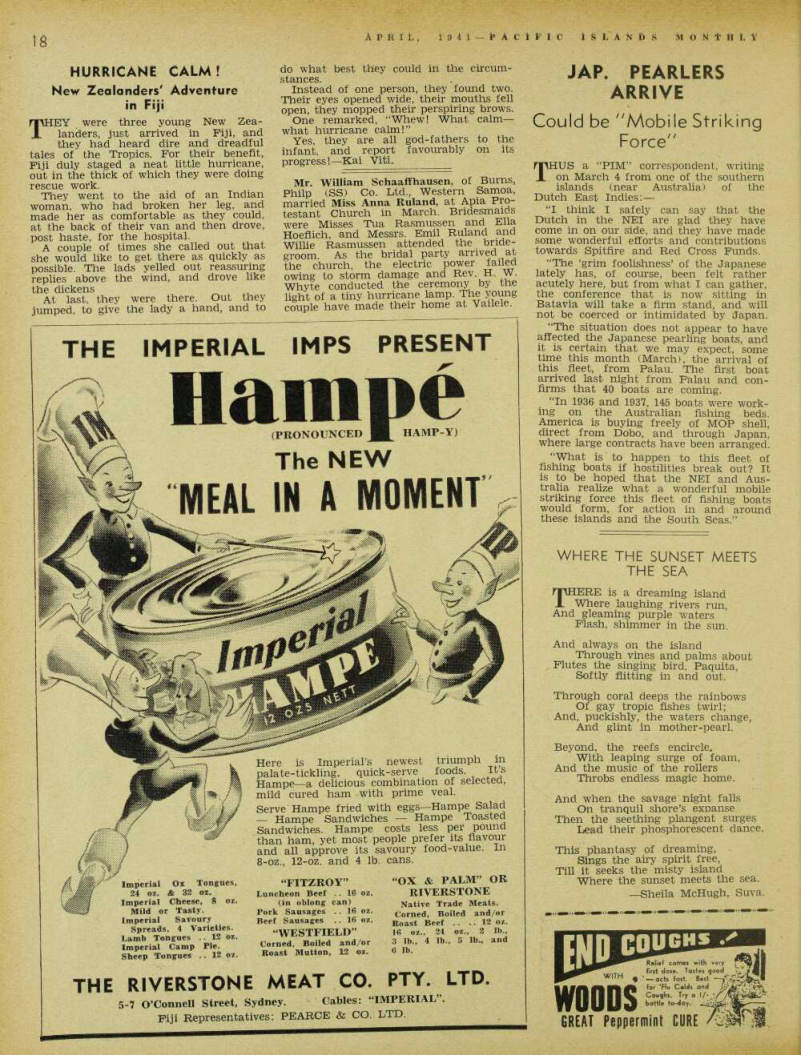
New Zealanders' Adventure in Fiji
rEY were three young New Zea landers, just arrived in Fiji, and they had heard dire and dreadful tales of the Tropics. For their benefit, Fiji duly staged a neat little hurricane, out in the thick of which they were doing rescue work.
They went to the aid of an Indian woman, who had broken her leg, and made her as comfortable as they could, at the back of their van and then drove, post haste, for the hospital.
A couple of times she called out that she would like to get there as quickly as possible. The lads yelled out reassuring replies above the wind, and drove like the dickens At last, they were there. Out they jumped, to give the lady a hand, and to
do what best they could in the circum stances Instead of one person, they found two.
Their eyes opened wide, their mouths fell open, they mopped their perspiring brows.
One remarked, “Whew! What calm — what hurricane calm!”
Yes, they are all god-fathers to the infant, and report favourably on its
progress!—Kai Viti.
Mr. William Schaaffhausen, of Burns, Philp (SS) Co. Ltd., Western Samoa, married Miss Anna Ruland, at Apia Pro testant Church in March. Bridesmaids were Misses Tua Rasmussen and Ella Hoeflich, and Messrs. Emil Ruland and Willie Rasmussen attended the bride groom. As the bridal party arrived at the church, the electric power failed owing to storm damage and Rev. H. W.
Whyte conducted the ceremony by the light of a tiny hurricane lamp. The young couple have made their home at Vailele.
Could be "Mobile Striking
Jap. Pearlers
Arrive
Could be "Mobile Striking Force"
THUS a “PIM” correspondent, writing on March 4 from one of the southern islands (near Australia) of the Dutch East Indies: — “I think I safely can say that the Dutch in the NEI are glad they have come in on our side, and they have made some wonderful efforts and contributions towards Spitfire and Red Cross Funds.
“The ‘grim foolishness’ of the Japanese lately has, of course, been felt rather acutely here, but from what I can gather, the conference that is now sitting in Batavia will take a firm stand, and will not be coerced or intimidated by Japan.
“The situation does not appear to have affected the Japanese pearling boats, and it is certain that we may expect, some time this month (March), the arrival of this fleet, from Palau. The first boat arrived last night from Palau and con firms that 40 boats are coming.
“In 1936 and 1937, 145 boats were work ing on the Australian fishing beds.
America is buying freely of MOP shell, direct from Dobo, and through Japan, where large contracts have been arranged.
“What is to happen to this fleet of fishing boats if hostilities break out? It is to be hoped that the NEI and Aus tralia realize what a wonderful mobile striking force this fleet of fishing boats would form, for action in and around these islands and the South Seas.”
Where The Sunset Meets
The Sea
r:ERE is a dreaming island Where laughing rivers run, And gleaming purple waters Flash, shimmer in the sun.
And always on the island Through vines and palms about Flutes the singing bird, Paquita, Softly flitting in and out.
Through coral deeps the rainbows Of gay tropic fishes twirl; And, puckishly, the waters change, And glint in mother-pearl.
Beyond, the reefs encircle.
With leaping surge of foam, And the music of the rollers Throbs endless magic home.
And when the savage night falls On tranquil shore’s expanse Then the seething plangent surges Lead their phosphorescent dance.
This phantasy of dreaming, Sings the airy spirit free, Till it seeks the misty island Where the sunset meets the sea. —Sheila McHugh, Suva.
Advertisements & other items, p. 22 (3 items)
18
APfclL, i 9 4 i - p A c t f t c Islands MoNtiiLi
Meal In A Moment
THE IMPERIAL IMPS PRESENT
(PRONOUNCED HAMP-Y)
The NEW
MEAL IN A MOMENT
<ss
eft
imP
y % Here is Imperial’s newest triumph m palate-tickling, quick-serve foods. Its Hampe—a delicious combination of selected, mild cured ham with prime veal.
Serve Hampe fried with eggs— Hampe Salad Hampe Sandwiches Hampe Toasted Sandwiches. Hampe costs less per pound than ham, yet most people prefer its flavour and all approve its savoury food-value, in 8-oz., 12-oz. and 4 lb. cans.
Imperial Ox Tongues, 24 oz. & 32 oz.
Imperial Cheese, 8 oz.
Mild or Tasty.
Imperial Savoury Spreads. 4 Varieties.
Lamb Tongues .. 12 oz.
Imperial Camp Pie.
Sheep Tongues .. 12 oz.
“FITZROY”
Luncheon Beef .. 16 oz. (in oblong can) Pork Sausages .. 16 oz.
Beef Sausages .. 16 oz.
“WESTFIELD”
Corned, Boiled and/or Roast Mutton, 12 oz.
“OX & PALM” OR
RIVERSTONE
Native Trade Meats.
Corned, Boiled and/or Roast Beef .. ..12 oz. 16 oz.. 24 oz., 2 lb., 3 lb., 4 lb., 5 lb., and 6 lb.
THE RIVERSTONE MEAT CO, PTY. LTD
5-7 O’Connell Street, Sydney. Cables: “IMPERIAL”.
Fiji Representatives; PEARCE & CO. LTD.
Woods
WITH
GREAT Peppermint CURE
Relief come* with very first doie. Taitei good act* fait. Beit for 'Flu Celdi and Coughi. Try a l/* t bottle to-day.
I v^Sbr
"Lord How-Haw" and
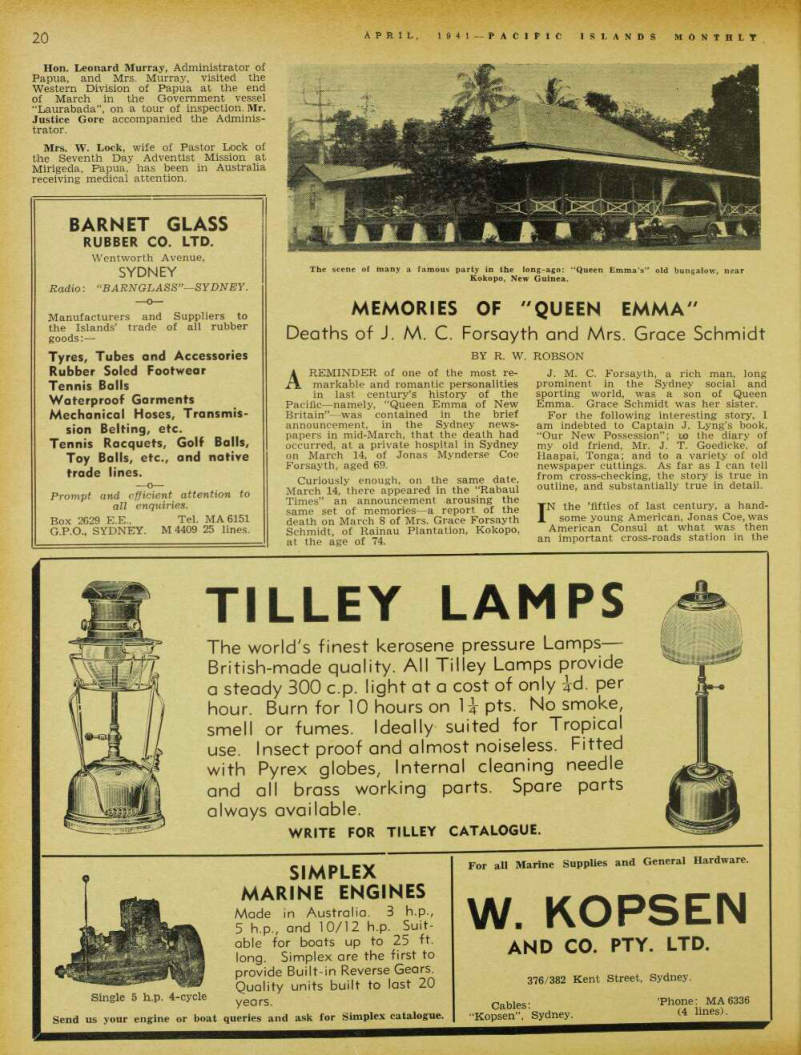
the Copra Planters
By “Ga Nt Bulu”
I ORD Haw-haw, the Hun of Berlin is j a lying renegade; but there are times, when he is not putting over the Goebbels propaganda, when he seems to come near to the truth. He has said that the British masses are such fools that they allow themselves to be ruled by trusts and combines—greedy, ruthless groups of international financiers who control the instrumentalities of demo cratic government in the interests of their filthy game of profit-making.
We copra-growers listen to this, with some perturbation, because we know that, even before war broke out, our industry was controlled by a great international combine, whose only interest in us was to force us to produce copra at the lowest possible rates. The lower our incomes, the bigger were the combine’s profits.
We have chosen to fight for our demo cratic system, rather than accept the “new order” offered by Hitler and Haw haw, because we believe that, when the war is over, the democratic system will ruthlessly rid itself of the filthy trusts and combines, and the brutal selfishness of money-power, and all the other para sitical growths of our developing social order.
But, I frankly confess, I begin to lose heart when I read such things as the following. It is from page 68 of “Science in War”, written by a group of scientific men to describe what our country is doing under war conditions. This extract is from the section headed “Food”: — “With the lessons of Lord Devonport’s failure in our minds, we might have ex pected that the Government would set up a scientific advisory committee on nutri tion at the start of this war, at the latest.
Such a committee was tardily produced nine months after war was declared.
Admirable as this committee is in its constitution, there is little evidence that the advice it will give will be taken, be cause, as we have already seen, business interests conflict with the application of scientific discoveries in the Ministry of Food.
“Let us take a current example. In November last, the Food Ministry issued a statement which suggested that all mar garines sold in this country contained added vitamins, to make them equivalent in vitamin content to average summer butter. Yet in December it was still pos sible to buy margarine that had been vitamized (?) by the addition of skimmed milk (which contains none of the vita mins contained in butter) or had only one vitamin added, and nothing on the label to indicate this deficiency. The suggestion of the Ministry was therefore wilfully false.
“The fourth report of the select com mittee on national expenditure has called attention to what was known privately to be a scandal: that the trade directors in the Ministry were representatives of vested interests that conflicted with the interests of the public. In at least one case an important trade official has been simultaneously performing his duties in the Ministry and engaged as a trade re presentative in negotiating with the Ministry as regards the operating mar gins to be allowed to his own trade.
“The report also mentions the appre hensions that programmes are being settled on the basis of a rough and ready compromise between various interests, and not on the basis of a plan scienti fically devised in the interests of the country as a whole. The recent pooling of margarine supplies, and the decision
to issue only two brands, both of which are said to be vitamized, are minor cor rections of this mistake.”
This substantiates the article written by me in “PIM” of June, 1940, in which I showed that the Ministry of Food, in association with the margarine producers, had raised the price from Bd. to 9d. per pound. I attached to the article a cut ting from the “Bulletin”, of Glasgow.
There is but one conclusion any South Sea copra planter can come to —namely, that there is no hope for an industry controlled by a combine that not only has a hold and octopus-clamp on the Ministry of Food, in the form of the members of the combine being not only members of the combine, but also mem bers of the Ministry of Food.
Think of the hopelessness of a con ference in Australia, comprised mostly of Government officials, sitting looking for a market for copra, when there is ap
parently only one market to look at— namely, the combine market, which is controlled both in the Ministry of Food and outside the Ministry of Food, Miss F. J. Pearce, nurse at Kiriwina, Papua, for the Methodist Mission, re turned to the Territory in March, after an absence of over a year owing to ill health. She has been a member of the Mission for more than 25 years.
Miss Margaret Loughman and Miss lona Tout recently arrived in Suva to join the Fiji Nursing Service as staff sisters.
Rev. J. W. F. Gillan, principal of the Tangoa Training Institute (New Hebrides) conducted by the Presbyterian Mission, is at present in Victoria on furlough.
He is studying at Melbourne University for the degree of Bachelor of Education.
Hon. Leonard Murray, Administrator of Papua, and Mrs. Murray, visited the Western Division of Papua at the end of March in the Government vessel “Laurabada”, on a tour of inspection. Mr.
Justice Gore accompanied the Adminis trator.
Mrs. W. Lock, wife of Pastor Lock of the Seventh Day Adventist Mission at Mirigeda, Papua, has been in Australia receiving medical attention.
Advertisements & other items, pp. 23-24 (2 items)
19
i* ACn I C ISLANDS MONTIILV- APRIL, 1941
Flag
a ■& %
mssk
LAN -
r 4N TANCE
KCQ°
22 ?«! m m 't « 2 if emu 2-
gk a
K FRIENo
TOOHEYS
FLAG
" H E HE'S
BARNET GLASS
RUBBER CO. LTD.
Wentworth Avenue,
SYDNEY
Radio : “BARNGL ASS”—SYDNEY.
Manufacturers and Suppliers to the Islands’ trade of all rubber goods;— Tyres, Tubes and Accessories Rubber Soled Footwear Tennis Balls Waterproof Garments Mechanical Hoses, Transmission Belting, etc.
Tennis Racquets, Golf Balls, Toy Balls, etc., and native trade lines.
Prompt and efficient attention to all enquiries.
Box 2629 E.E., Tel. MA 6151 G.P.0., SYDNEY. M 4409 25 lines.
TILLEY LAMPS
The world's finest kerosene pressure Lamps British-made quality. All Tilley Lamps provide a steady 300 c.p. light at a cost of only id. per hour. Burn for 10 hours on li pts. No smoke, smell or fumes. Ideally suited for Tropical use. Insect proof and almost noiseless. Fitted with Pyrex globes, Internal cleaning needle and all brass working parts. Spare parts always available.
WRITE FOR TILLEY CATALOGUE.
For all Marine Supplies and General Hardware.
W. KOPSEN
AND CO. PTY. LTD.
376/382 Kent Street, Sydney.
Cables; “Kopsen”, Sydney. ’Phone: MA 6336 (4 lines).
Single 5 h.p. 4-cycle
SIMPLEX
MARINE ENGINES
Made in Australia. 3 h.p., 5 h.p., and 10/12 h.p. Suitable for boats up to 25 ft. long. Simplex are the first to provide Built-in Reverse Gears.
Quality units built to last 20 years.
Send us your engine or boat queries and ask for Simplex catalogue.
Memories Of "Queen Emma"

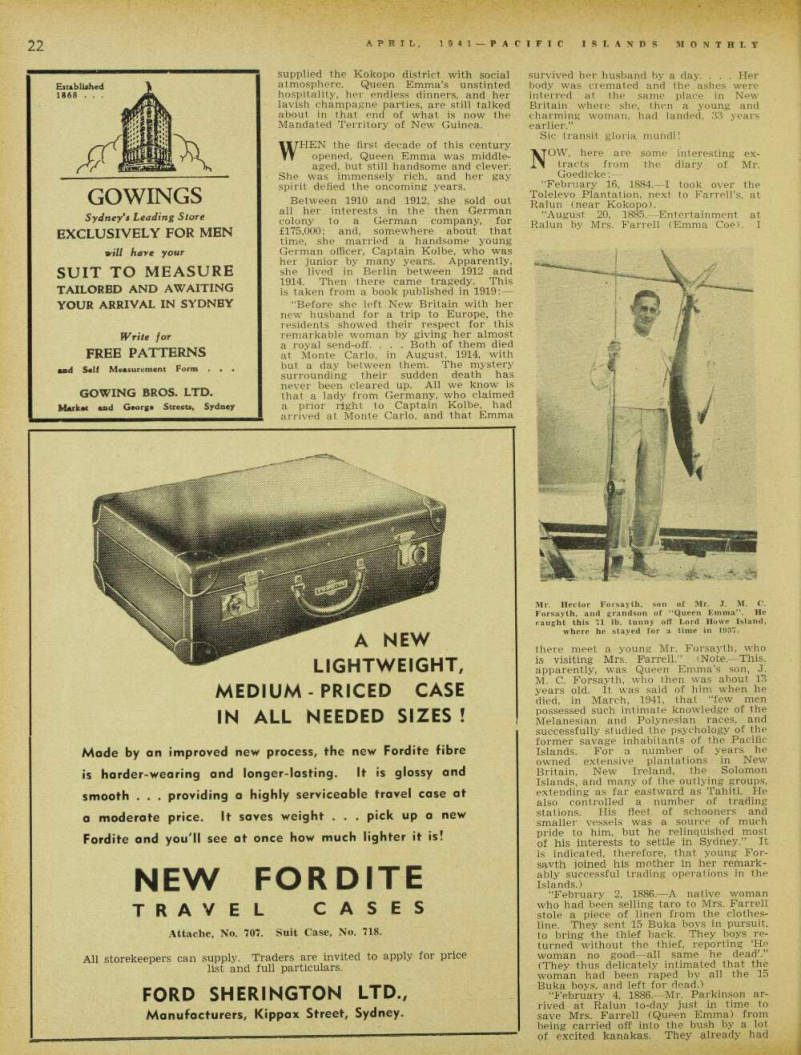

Deaths of J. M. C. Forsayth and Mrs. Grace Schmidt
By R. W. Robson
A REMINDER of one of the most re markable and romantic personalities in last century’s history of the Pacific —namely, “Queen Emma of New Britain” —was contained in the brief announcement, in the Sydney news papers in mid-March, that the death had occurred, at a private hospital in Sydney on March 14, of Jonas Mynderse Coe Forsayth, aged 69.
Curiously enough, on the same date, March 14, there appeared in the “Rabaul Times” an announcement arousing the same set of memories—a report of the death on March 8 of Mrs. Grace Forsayth Schmidt, of Rainau Plantation, Kokopo, at the age of 74.
J. M. C. Forsayth, a rich man, long prominent in the Sydney social and sporting world, was a son of Queen Emma. Grace Schmidt was her sister.
For the following interesting story, I am indebted to Captain J. Lyng’s book, “Our New Possession”; to the diary of my old friend, Mr. J. T. Goedicke, of Haapai, Tonga; and to a variety of old newspaper cuttings. As far as I can tell from cross-checking, the story is true in outline, and substantially true in detail.
IN the ’fifties of last century, a hand some young American, Jonas Coe, was American Consul at what was then an important cross-roads station in the
The scene of many a famous party in the long-ago: “Queen Emma’s” old bungalow, near Kokopo, New Guinea.
Pacific, Apia, in Western Samoa. It was “unspoiled Polynesia”—a rich and beau tiful country, wherein Europeans found a life of ease, and the most alluring women in the Pacific.
It is not surprising that Jonas Coe, soon after his arrival in Apia, married a beautiful Samoan girl. One report says that he married, in succession, two sisters, and another report says that, by his marriage, he had five children, of whom Emma was the eldest. It is sug gested, in one place, that Grace was older than Emma, and Grace’s name does not appear in the list of five children. Grace may have been a child of the first marriage: but as Grace was born in 1867, and Emma about 1855, it is likely she was the youngest (sixth) child of the second marriage. At any rate, we know that there were six Coe children, as follows: — Grace, born in 1867; educated in United States and Dubbo, NSW; joined Emma in New Britain in 1886; married Captain Rondahl in 1896 and settled at Kakabaul; married Walter Schmidt in 1912.
Emma, whose story follows. Born about 1855, married Forsayth 1871, married Kolbe about 1912, died 1912.
Phoebe, who later joined Emma in New Britain, and there married Mr.
Parkinson, who was manager for Queen Emma.
Essey, who married Captain Jobst.
Robert and William, both of whom were in New Britain with Queen Emma fifty years ago.
Emma grew up in Apia, and was des cribed by a contemporary writer as the cleverest and most beautiful girl in Samoa. She was sent to San Francisco for her education; and, when she re turned to Samoa, she “knocked ’em cold”. It appears that every eligible male in the South Seas scrambled for the hand of the beauty, and the prize went to a cultured Englishman, named Forsayth.
The marriage was not a success. One gets the impression of a jealous husband who was rather hedged around with a sense of the proprieties, and a beautiful and popular young wife, whose soaring and exalted spirit could not be held down.
They remained together long enough to have one son —the J. M. C. Forsayth, who died on March 14 —and (according to one not very reliable record) one daughter. Then they appear to have parted.
THE general belief is that Emma left Forsayth and ran away with Thomas Farrell, a miner from New Zealand, who was then a hotelkeeper in Apia.
But a New Guinea correspondent, who ought to know, assures me that that was not so. He says that Forsayth was drowned, while at sea; that Consul Coe tried hard to induce Emma then to marry a man in Samoa, of whom he thought highly; but that Emma rebelled, and ran away with Farrell.
It is clear, however, that Emma For sayth and Thomas Farrell, two people of notable quality and good looks, did come together at this time (somewhere be tween 1875 and 1880); that they were happy together; and that eventually they fitted out a trading schooner and went adventuring together into the north-west, far away from the probably disapproving people of Samoa.
Some records suggest that they never married. My incomplete data indicate that they did marry. She was known, for the next 30 years, as “Mrs. Farrell”.
There is here a wonderful story of romance and adventure —but we shall skip it —this is war-time, and paper is rationed. In due time Emma and Farrell arrived in the little Duke of York group (between the great islands of New Ire land and New Britain) and began trad
ing with the natives. Their enterprises flourished, and soon they had many trading stations and ships. They moved across to the mainland, near the entrance to what is now Rabaul Harbour, and, buying land from the natives for the proverbial song, they established cocnut plantations in what is now the Kokopo district.
THIS probably was about 1879 or 1880.
It was an interesting period. The Germans were thrusting into the South Seas, and displaying a lively interest in the New Guinea region, which afterwards became known as their colony of Bismarck Archipelago.
That singularly ill-fated colonising expedmon, led by the Marquis de Rays, arrived about this time (1880) and tried to establish a settlement in the feverridden district at the southern tip of New Ireland, near where Emma and Farrell had established their first trading station, in the Duke of York Islands.
They helped to rescue the wretched survivors of the Colony.
171R.0M 1880 to 1900, when she appar- I 1 ently was between 25 and 45 years of age, was the halcyon period of the life of Emma Forsayth (or Farrell) She now was a handsome, vital woman of immense personal charm and marked business ability. Farrell, her partner, was closely associated with her in the “eighties”, out it is reported that he died somewhere about 1890, and that she went on very successfully alone.
By this time, there was a considerable and growing German community in Rabaul district, and the Farrells and the Germans seemed to vie with each other in unrestricted hospitality. Emma was soon rich; her trading schooners ranged all over the north-western Pacific; and it was then that she ac quired the soubriquet of Queen Emma” —by which she was known until her death.
Queen Emma’s household grew rapidly, She brought from Samoa brothers, sisters and numerous other relations—handsome, high-spirited young people, who definitely
supplied the Kokopo district with social atmosphere. Queen Emma’s unstinted hospitality, her endless dinners, and her lavish champagne parties, are still talked about in that end of what is now the Mandated Territory of New Guinea.
WHEN the first decade of this century opened, Queen Emma was middle aged, but still handsome and clever.
She was immensely rich, and her gay spirit defied the oncoming years.
Between 1910 and 1912, she sold out all her interests in the then German colony to a German company, for £175,000; and, somewhere about that time, she married a handsome young German officer, Captain Kolbe, who was her junior by many years. Apparently, she lived in Berlin between 1912 and 1914. Then there came tragedy. This is taken from a book published in 1919: — “Before she left New Britain with her new' husband for a trip to Europe, the residents showed their respect for this remarkable woman by giving her almost a royal send-off. . . . Both of them died at Monte Carlo, in August, 1914, with but a day between them. The mystery surrounding their sudden death has never been cleared up. All we know is that a lady from Germany, who claimed a prior right to Captain Kolbe, had arrived at Monte Carlo, and that Emma
survived her husband by a day. . . . Her body was cremated and the ashes were interred at the same place in New Britain where she, then a young and charming woman, had landed, 33 years earlier.”
Sic transit gloria mundi!
NOW, here are some interesting ex tracts from the diary of Mr.
Goedicke: “February 16, 1884.—1 took over the Tolelevo Plantation, next to Farrell’s, at Ralun (near Kokopo).
“August 20, 1885.—Entertainment at Ralun by Mrs. Farrell (Emma Coe). I
there meet a young Mr. Forsayth, who is visiting Mrs. Farrell.” (Note. —This, apparently, was Queen Emma’s son, J.
M. C. Forsayth, who then was about 13 years old. It was said of him when he died, in March, 1941, that “few men possessed such intimate knowledge of the Melanesian and Polynesian races, and successfully studied the psychology of the former savage inhabitants of the Pacific Islands. For a number of years he owned extensive plantations in New Britain, New Ireland, the Solomon Islands, and many of the outlying groups, extending as far eastward as Tahiti. He also controlled a number of trading stations. His fleet of schooners and smaller vessels was a source of much pride to him, but he relinquished most of his interests to settle in Sydney.” It is indicated, therefore, that young For savth joined his mother in her remark ably successful trading operations in the Islands.) “February 2, 1886. —A native woman who had been selling taro to Mrs. Farrell stole a piece of linen from the clothes line. They sent 15 Buka boys in pursuit, to bring the thief back. They boys re turned without the thief, reporting ‘He woman no good—all same he dead’.” (They thus delicately intimated that the woman had been raped by all the 15 Buka boys, and left for dead.) “February 4, 1886. —Mr. Parkinson ar rived at Ralun to-day just in time to save Mrs. Farrell (Queen Emma) from being carried off into the bush by a lot of excited kanakas. They already had
Mr. Hector Forsayth, son of Mr. J. M. C.
Forsayth, and grandson of “Queen Emma". He caught this 71 Ib. tunny off Lord Howe Island, where he stayed for a time in 1937.
tied Mrs. Farrell, pig-fashion, to a pole, to be carried off, as a revenge for the rape committed by the Buka boys.”
In his diary, during 1886, Mr. Goedicke refers to “Farrell, Junior”, on a number of occasions; and says that in Sydney on May 16, 1886, he called on Mr. Thomas Farrell, at Petersham. * * * The story of Queen Emma—her glori ous youth, her adventurous and romantic life, and her tragic, mysterious death— should be well worth telling, if only someone will get busy now, and inter view in New Guinea, and elsewhere, a number of ageing people, who are the last surviving links with that colourful period of the 'eighties.
Advertisements & other items, pp. 24-28 (2 items)
20
APRIL, IHI-P ACIfK! ISLANDS MONTHLY
Bidomak
“The Tonic of the Century 99
for NERVES, BRAIN
AND THAT ‘DEPRESSED FEELING’
BIDOMAK has restored radiant health to thousands because it provides these vital minerals: ferrum, calcium, potassium, sodium,
phosphates, glycerophosphates, sucrose, copper
and manganese in a predissolved easily assimilated liquid form.
BIDOMAK gives you a good appetite—brings
restful sleep—strengthens tired nerves—relieves stomach upsets and dyspepsia—builds energy, "pep" and endurance. Makes you well and keeps you well.
BIDOMAK contains no dangerous drugs or
opiates—start taking BIDOMAK to-day!
SCIENTIFIC
CONTROL
Manufactured in the Bidomak Pharmaceutical Laboratories, one of the most up-to-date, hygienic laboratories in the Southern Hemisphere, to which is attached a fully-qualified Doctor of Medicine, and under the control of a qualified chemist who was trained in the most modem English Laboratories in the world.
EXHAUSTED WITH THE LEAST EXERTION.
LIFE NOW WORTH LIVING.
“Since last October I have been thoroughly run down, I had no appetite and got exhausted with the least exertion and didn't feel like doing anything but just laze about. I was advised to try Bidomak. I am very glad that I took the advice.
My appetite has returned and I can now do a day’s work without being done up, and altogether life has taken on a brighter tinge. I would advise anyone that has that run-down feeling to try Bidomak.” (Sgd.) H. Stubbs, Brisbane Rd., Manly, E.2., Queensland.
GET BIDOMAK TO-DAY!
At All Leading Island Stores
Estal 1868 IX
GO WINGS
Sydney’s Leading Store
EXCLUSIVELY FOR MEN
SUIT TO MEASURE
TAILORED AND AWAITING
YOUR ARRIVAL IN SYDNEY
Write for
FREE PATTERNS
mnA Self Measurement Form . . .
COWING BROS. LTD.
Market and Georg# Streets, Sydney will have your
A NEW
LIGHTWEIGHT,
MEDIUM - PRICED CASE
IN ALL NEEDED SIZES !
Mode by on improved new process, the new Fordite fibre is harder-wearing and longer-lasting. It is glossy and smooth . . . providing a highly serviceable travel case at a moderate price. It saves weight . . . pick up a new Fordite and you'll see at once how much lighter it is!
NEW FORDITE
TRAVEL CASES
Attache, No. 707. Suit Case, No. 718.
All storekeepers can supply. Traders are invited to apply for price list and full particulars.
FORD SHERINGTON LTD.,
Manufacturers, Kippax Street, Sydney.
We Knew
all the answers
and built a better set
Agents for New
Guinea, Papua and
Solomon Islands:—
have here the best range of "torrid zone" radio receivers ever produced. Before production was ever started on sets for island listeners, we checked up on weather conditions—best valves— best cabinet materials—best speaker—best circuits—all were taken into consideration to make the best radio and give you utmost reliability under tropical weather conditions. And here Airzone present a range of receivers beautiful of tone fascinating in cabinet design amazing in long distance reception and remarkably reliable under any condition whatsoever. Particular attention was given to overseas short wave reception.
Innumerable developments have been made in these receivers so that overseas reception can be received with amazing clarity and volume.
"Airzone's tone is Airzone's own."
Above left is Model 6552 A, Airzone's new "Concert Star." a 5 Valve A.C. Mantel Dual Wave of wonderful long distance reception.
Here again, at left. Airzone proudly presents Model 5098. 5 Valve 1.4 Volt Battery mantel Dual Wave. Also as Model 5059, 5 Valve Vibrator powered Dual Wave.
At right is Airzone's massive 8 Valve A.C.
Dual Wave Console Model 1082 A, designed for far-reaching overseas reception.
At left is veneered mantel made in 4 models —Model 1062 AM, 6 Valve A.C. Dual Wave; Model 1072VM, 7 Valve Vibrator Dual Wave; Model 1162 WM, 6 Valve 2 Volt Battery Dual Wave; and Model 1252VM, 5 Valve Vibrator Dual Wave.
W. R. CARPENTER & CO., LTD.
19 O Connell Street, Sydney; Salamaua. Rabaul. Kavieng and Madang, N.G.. and Tulagi. Solomon Islands.
iiiiiii.
mm ||ini||
lllnifl
fA
HllllJ
■■Hr
nihn
mm in m mud Designed and manufacts by Airzone (1931) Lt Camperdown, N.S.W. HAS ■uni Ml "H| H
nlhii
mu in in mu
mill
i»
hi Itillll
liiiiii
m, H| ■■ (limn
111
NEED MARRIAGE
SPOIL A WOMAN S
BE A U 7 Y?
Jack and Betty Tyler were a happily married couple. They had two of the loveliest little youngsters you could imagine. Jack had a good position and Betty was the sort of woman who knew how to make friends and keep them. They should have been happy . . . very happy But they weren’t, and here’s the reason why. Betty had always sworn to herself before marriage that she would not let marriage ruin her appearance. Of course, it’s easy to make such promises to yourself, but they’re not always so easy to keep. Listen now to Jack.
Betty is powdering her nose. Jack is looking at her in a very critical way. After a while he says: You’re always messing round with your powder puff. What’s the matter with you lately? If it’s not your powder puff it’s your lipstick.”
Those few words cut Betty to the quick. She didn’t say anything at the time, but, that night before she went to bed she sat in front of her big mirror. She looked at herself closely. This is what she thought : “He’s noticed '. . . I’m losing my looks . .. . no wonder . . . this heat. You’d think I was forty ; to look at me. I’m always tired, wofn out. What IS the matter with me?”
Then she looked at herself very critically in the mirror and this is what site saw. Her eyes were dull, her skin had a strained, pinched look ... it was pasty too. Her hair was lifeless and there were tiny little lines beginning to show round her eyes, and above her eyebrows.
Something had to be done! She decided to have a chat to her doctor. She told him everything.
And then finished up by saying:— “I know it’s no use trying to fix myself up with face creams and powder and paint. It’s something more than that, doctor, and it’s beginning to show on my face! Do you think it’s the heat?”
“Well, Mrs. Tyler,” said the doctor, “it’s not just the heat alone. The most important thing you’ve told me is that you wake tired in the mornings. That means a lot. You see, when you wake tired in the morning you naturally become more tired as the day goes on. You feel dull, listless. And that’s really Night-Starvation, Not many people realise it, but even at night you go on using up energy. Your heart beats, your lungs make muscular movements; and it stands to reason, if energy isn’t replaced, you wake tired. And that’s when this hot climate begins to tell on you. The best thing for you is Horlicks. Get some Horlicks and drink a cupful every night before you go to bed.
You’ll feel right as rain in no time.”
Horlicks made a wonderful difference to Betty. It was marvellous the way her strength and vitality came hack. A couple of months after her visit to the doctor, she and Jack were starting off one morning for a picnic. The children were ready, all the sandwiches were cut. Betty had been going like fury all the morning and still looked so fresh and lovely that Jack remarked on it.
“Bet,” he said, “it’s marvellous the difference that’s come over you during the last month. You look really lovely!” * * * If you wake up tired . . . get more tired as the day goes on, then the chances are that you’re suffering from Night-Starvation. Remember what the doctor said. A cupful of Horlicks last thing at night before bed guards against Night-Starvation and replaces energy lost during sleep.
You wake up feeling full of life and vitality.
!*OIUJCO
Jorli
Sat-
m
Sydney Polynesian Club and Free French
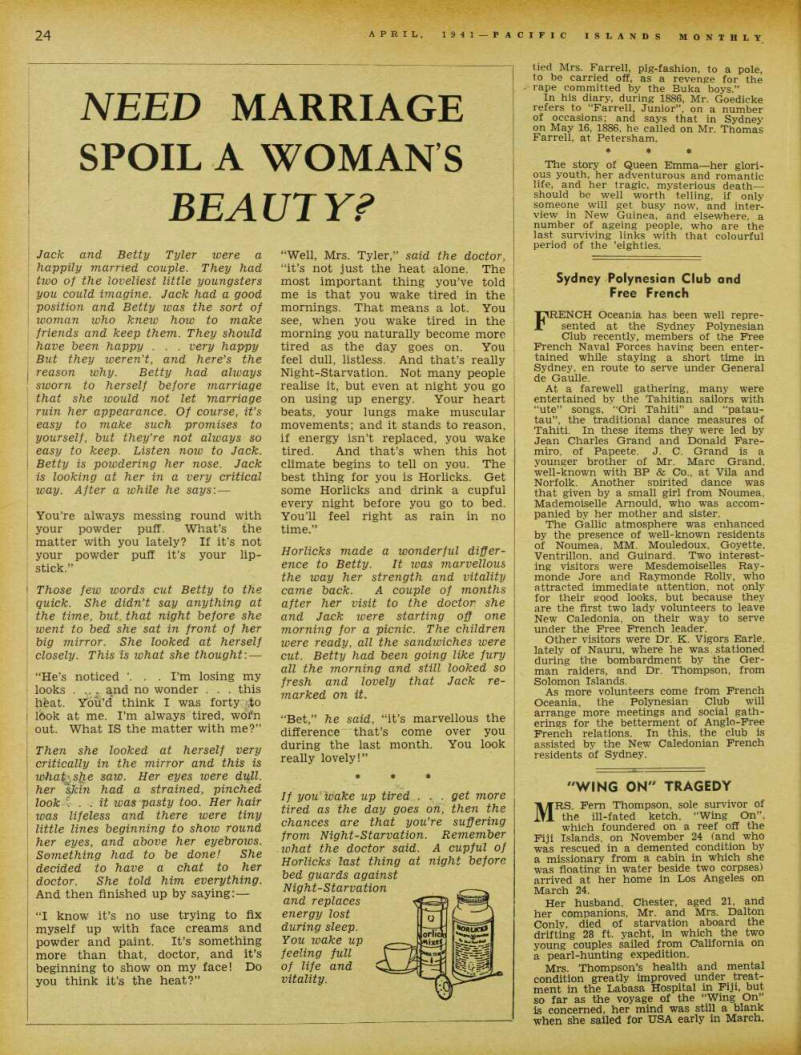
Free French
FRENCH Oceania has been well repre sented at the Sydney Polynesian Club recently, members of the Free French Naval Forces having been enter tained while staying a short time in Sydney, en route to serve under General de Gaulle.
At a farewell gathering, many were entertained by the Tahitian sailors with “ute” songs, “Ori Tahiti” and “patau tau”, the traditional dance measures of Tahiti. In these items they were led by Jean Charles Grand and Donald Fare miro, of Papeete. J. C. Grand is a younger brother of Mr. Marc Grand, well-known with BP & Co., at Vila and Norfolk. Another soirited dance was that given by a small girl from Noumea, Mademoiselle Arnould, who was accom panied by her mother and sister.
The Gallic atmosphere was enhanced by the presence of well-known residents of Noumea, MM. Mouledoux, Goyette, Ventrillon, and Guinard. Two interest ing visitors were Mesdemoiselles Ray monde Jore and Raymonde Roily, who attracted immediate attention, not only for their good looks, but because they are the first two lady volunteers to leave New Caledonia, on their way to serve under the Free French leader.
Other visitors were Dr. K. Vigors Earle, lately of Nauru, where he was stationed during the bombardment by the Ger man raiders, and Dr. Thompson, from Solomon Islands.
As more volunteers come from French Oceania, the Polynesian Club will arrange more meetings and social gath erings for the betterment of Anglo-Free French relations. In this, the club is assisted by the New Caledonian French residents of Sydney.
“Wing On" Tragedy
MRS. Fern Thompson, sole survivor of the ill-fated ketch, “Wing On”, which foundered on a reef off the Fiji Islands, on November 24 (and who was rescued in a demented condition by a missionary from a cabin in which she was floating in water beside two corpses) arrived at her home in Los Angeles on March 24.
Her husband. Chester, aged 21, and her companions, Mr. and Mrs. Dalton Conly, died of starvation aboard the drifting 28 ft. yacht, in which the two young couples sailed from California on a pearl-hunting expedition.
Mrs. Thompson’s health and mental condition greatly improved under treat ment in the Labasa Hospital in Fiji, but so far as the voyage of the “Wing On” is concerned, her mind was still a blank when she sailed for USA early in March.
Japan In The South Seas
How She Transformed Her Mandated Islands Into a First-class Asset
/t FTER commenting upon Japan’s claim to “southwards expansion”, a writer recently in the Melbourne “Her ald” supplied the following interesting information about conditions as they exist in the Japanese Mandated Islands early in 1941. The following is part of the article :— LET us see what Japanese southern expansion means and how far it has already gone. Let us begin with Nanyo, the Japanese Mandated Islands in the South Seas, also our near neighbours, for the mandate adjoins ours.
We in Australia know very little about these islands, which is a pity, for they are an example of progressive colonisa tion that ought to give us cause to think.
Japan has turned a group of islands that nobody wanted into a first-class asset.
Divided into the Mariana, Marshall and Caroline Groups, these Japanese islands at our northern door number about 1400; among them one solitary island, Guam, belongs to the United States. To the east lie the Hawaiian Islands, to the west the Philippines and Celebes, to the north the Bonin Islands and, to the south New Guinea.
About 113,000 people, of whom more than 70,000 are Japanese, now inhabit Nanyo.
Once upon a time, the islands belonged to Germany, but they passed under Japanese Mandate at the end of the Great War. Their non-restoration is part of the price that Germany pays for Japan’s allegiance to the Axis, Japanese colonisation was attempted in the earliest days of Japan’s influence.
Among pioneer companies of Nanyo were Nishimura Takushoku K. K. (Nichmi mura Development Co. Ltd.), and Nanyo Shokusan K. K. (South Sea Industrial Co. Ltd.). These began the cultivation of sugar on Saipan, largest of the Maria nas, importing Japanese labour.
The enterprise fell on difficult days, however, and about 1000 immigrants found themselves near starvation. It was even suggested that the mandate should be returned to the League. At the last moment, when the immigrants were in a desperate position, the Orien tal Development Co. came to the rescue and established the Nanyo Kohatsu K. K. (or South Sea Development Co. Ltd.) which took over the business of the others.
That was in 1921. The company was capitalised at 3,000,000 yen (the yen to day is worth about 1/7 in Australian cur rency). In 1930 the capital was increased to 7,000,000 yen, in 1933 to 20,000,000 yen, and in 1937 to 40,000,000 yen (roughly £A3,200,000).
Nanyo Kohatsu now covers all the South Seas Islands once regarded as useless. It is an extraordinary story of intensive development. The staple ex ports to-day are phosphate, copra, sugar, dried bonito and alcohol. The sugar plantations are in Saipan, Tenian, Rota and Auguigan.
Nanyo Kohatsu holds 126,062 acres of land on the mandated islands. Its pre sident and directing genius is Harutsugu Matsue, a Japanese educated at a uni versity in the United States.
JAPANESE interests spread into Hal mahera. Celebes, Ceram, Aru. Timor, the Philippines and Dutch New
Guinea, with all of which there is regu lar sea communication: in addition, the Nanyo islands are now comprehensively linked by air.
This does not cover the whole field of Japanese investments in this part of the world, however. The Nomura Overseas Investment Department, a subsidiary of the Nomura Gomei Kaisha, of Osaka, has large capital investments in the South Seas as well as in South America.
Its first investment in the South Seas region was made after a visit by the head of the Nomura family, Tokushichi Nomura, in 1914. Impressed by the rich resources of the area he bought up a German rubber plantation in Borneo which came on the market shortly after the outbreak of the Great War.
TO-DAY the Nomura East Indies Development Co., founded in 1917, and capitalised at 5,000,000 guilders, with head-quarters at Bandjermasin.
Dutch Borneo, has under its manage ment vast plantations in Borneo and Sumatra. The plantations in Borneo are mainly of rubber trees, and those in Sumatra of oil palm, coffee and rubber.
The company has four rubber refine ries, including one at Bandjermasin, for treating crude rubber produced by the natives, treating nearly 60,000,000 yen worth of rubber annually. In addition it has seven sheet rubber factories.
There is a development of even greater interest to Australians, however. In November, 1931. Nanyo Kohatsu pur chased every right-formerly held by the Phoenix Company of Germany for the exploitation of areas in northern Dutch New Guinea.
Nobody in Australia knows much about Dutch New Guinea, and most people up to now have cared less. The Japanese take a greater interest. The “Osaka Mainichi”, one of the leading papers- of Japan, recently investigated Japanese
activities there, and its special correspondent, Shintaro Shimasaki, embodied his conclusions in four articles.
Mr. Shimasaki points out that an estimate puts the population of the whole of New Guinea Island at 200,000 the population of one small ward in TTokyo.
Roads, he says, seem to have been left out of thecolonia! scheme of New Guinea by the Dutch Such as exist at all are usually mere paths, and in many piaces there are none. In northern Dutch New Guinea he found not even a horse vehicle, much less a car.
Sea communication is bad, but a weekly air service has recently been opened Sf a es^i r ally" nS ptonlering in nnrfh Tuffimiit a Diitrh attpmot at colonisation bv half-castes failed Some work was done by individual Japanese, and in 1933 Nanyo Kohatsu purchased the land belonging to Jutaro Hosotani, a Japanese who had gone there in i9ii.
This was only 882 acres, and in 1937 the company leased an additional 2205 acres, employing 1500 workers to cultivate cotton and jute, with an interest also in tapioca, coconuts, fibrous plants and rubber.
A lease has been drawn up with the Dutch authorities for 2450 acres of as yet undeveloped land. In all the Nanyo Kohatsu interests in New Guinea are:— pinnfnHnn Momi Sarmi Nabire Resin Plantation. Momi.barmi.
Area loocaH 735 54 77 175 PinnnPrt S 2695 8575 ’
No coolies 1200 50 300 "
Tmfrf n rp about 30 Jananese at Momi toeeat
thS Elsewhere,
fold troubles” in the distressing conditions of the jungle.
Putting together the total amount of territory marked out for development by the Japanese and by the Dutch themselves, Mr. Shimasaki remarks, the total does no t exceed 24,500 acres, but territory with the possibility of development is unlimited.
“ W ell wate red by the inexhaustible waters that come out of the snow-capped mountains, with vast territories as yet uneX plored for their possible treasures> the resources of New Guinea present intriguing possibilities. Even the regions bordering on the sea coast alone are to take care of enormous numbers of immigrants.”
Shimasaki thinks that statements iri by prospectors that the chances of oil discovery are slight must be taken with a gram of salt.
The attitude of the authorities towards Japanese, he says, is one of “extreme nervousness”, and armed soldiers—under the guise of protection—follow the Japanese visitor about. The office of Nanyo Kohatsu was twice searched.
Mr shimasaki thinks the Dutch claim on New Guinea “vague and doubtful”, an d compares the Dutch administration unfavorably with that of the Australian parts of New Guinea.
“Question remains whether the Dutch are entitled to sovereignty over their land » he says . “Holland has too much land and even the development of Sumatra is just beginning.”
In any case, he considers, the Dutch have made a mess of New Guinea—and as Palau is only 500 miles away the Japanese are the people for the job.
Holland should be willing to turn over
the job of exploiting New Guinea to the Japanese—at least Mr. Shimasaki says so - Nor is Mr. Shimasaki alone in believ ing that Dutch New Guinea is unlikely to remain a blank on the map for ever, c A ..<.u c Development ot South Seas
Fishing Industry
Tttn ,
rivHE key to a solution of Japan s food A problem is stated by the ‘‘Chugai Shogyo” newspaper to lie in the development of the fishing industry in the South Seas, reported the “NZ Her aid” on February 18.
Experimental Ashing stations were set U P ln the Japanese mandated islands nine years ago and investigations re vealed that the shores of these islands are washed by a north equatorial cur knr}gmg rich schools of bomto, while another cross-current carries large numbers of tunny.
About 70 Japanese fishing boats, dis placing from 100 to 200 tons each, are a t present operating the year round in the waters near the Caroline Islands and the seas north of New Guinea. Each trip is said to net the boats about 60,000 yen, or about £3,750, and nine trips are normally made by each vessel per year, thus bringing ship earnings to 540,000 yen, or about £33,750.
The “Chugai Shogyo” suggests the establishment of advance bases in the mandated islands. Cold storage ships would be constructed to transport foiDd, drinking water, fuel and other necessities to the fishing vessels operating m the South Seas. Saipan and Ponape Islands are suggested as the best sites for such advance bases.
Advertisements & other items, pp. 29-30 (2 items)
25
PAclflc Islands Mo fitfitt - APRIL, 19 4 1
'fable**
GET POSITIVE
RELIEF FROM
Tested and proved for over 20 years, genuine Vincent’s A.P.C. is acknowledged by the medical profession and the public as the safest and best to relieve all pains and tropical fevers. The reason why Vincent’s A.P.C. is safer and more effective is because it is prepared on the prescription originated by the medical superintendent of one of Australia’s largest public hospitals, where it was first used. Genuine Vincent’s A.P.C. is the only A.P.C. prepared on this scientific hospital prescription. No other A.P.C. i& the same as Vincent’s.
Cv < rowous t
TA>L E T S
1/4 AND 2/*.
SINOIIS 2d. *o.
FOR SAFETY’S SAKE—SAY “VINCENT’S”.
fjou)
4s h m O u s\ GERMS of Diphtheria, Malaria, Dhobie Itch, Tinea or Surfers’ Foot, cannot live under “TENAX” lather.
Tropical Skin Diseases can be cured by its regular
9 V per
'fable**
NO VARIATION HAS BEEN
MADE IN ITS COMPOSITION—
judged from the only truq angle, r that of quality, TENAX has no competitors as a satisfactory germicidal soap, eleven times as rapid in action as carbolic, yet NON-
IRRITANT and NON-POISONOUS. The
Medical Journal of Australia states that TENAX is a germicidal soap that may be recommended with confidence.
TENAX
GENUINE
GERMICIDAL
SOAP
PRODUCT OF AUSTRALIAN SOAPS, LTD.
SHREDDED WHEATMEAL
Delicious golden brown biscuits, rich with nourishing whole wheat grains, ripened to perfection in Natures' sunny kitchens.
There's health in every mouthful of these crisp crunchy biscuits.
MILK ARROWROOT
Children grow up strong, healthy and virile it they have plenty of Swallow & Ariel! Milk Arrowroot Biscuits. The kiddies love them, and their nourishment qualities are second to none. h*: 1 «■ - ■(5l i
CLUB CHEESE
These delightful little biscuits are savouries in themselves! Favourites with hostesses everywhere because they're delicious for suppers and afternoon teas.
These popular biscuits, crisped to perfection by Australia's Leading Biscuit Bakers, are specially tropic-packed in airtight tins, thus retaining all their fresh-from-the-oven flavor and crispness. Try them yourself! They're just as good as Swallow & Ariell's other famous products . . . CABIN BISCUITS . . . NAVY and PILOT BREAD . . . PLUM PUDDINGS
CANTERBURY CAKES
'cuMs/untt,
>WALiOW* ARIC It ltd
, ii h ii r wirrriDi/ Australia's Famous Biscuit Bakers
PORT MELBOURNE . VICTORIA
48 Years At Sea

CAPTAIN HENRY LOW, who recently retired from the service of Morris, Hedstrom, Ltd., is shown on the bridge of his last command, the
Fiji interinsular motor-vessel “Tui Cakau”. Of
his 66 years, 48 have been spent at sea—the great majority among the islands of the Fiji Group. An account of Captain Low’s career was published in December “PIM”.
Ships
Copra Factory
Practical Economics of the Plan
Letter to the Editor ON looking over my file of the “PIM”
I came across Mr. Richard Howard’s letter about a “Copra Factory Ship’’, dated Navua, Fiji, 8/10/40.
A year or two ago a party in NZ tried to form a company for copra products, and included in their plan was a factory ship. No doubt it is a splendid idea, but could it be managed now that we are at war? I have my doubts.
The introduction of the factory ship to the South Seas copra industry would be productive of even greater changes than those already effected by modern whaling enterprise in the Antarctic.
Throughout the Dominion, the public press has lamented New Zealand’s “lost opportunities’’ in the latter industry, which has been productive of £10,000,000 worth of whale oil annually. But the rationalised production of vegetable oil under modern methods presente equal, if not greater, possibilities. The South Seas copra industry, especially, which at pre sent attains the figure of something like £3,000,000 annually, is capable of almost unlimited expansion.
Expression Of Oil
In brief, the copra would be crushed on board the factory ship, the coconut oil run into storage tanks, and the resi due converted into coconut meal, all at the one operation. A ship of from 2,000 to 3,000 tons gross, oil-burning (to ensure reliability), and capable of a fair speed (say 10 to 12 knots per hour) would be fitted with the most up-to-date
oil-expressing machinery.
The ship’s machinery would be situated aft, and the factory section amidship, in the lower hold. The oil crushing plant would be fed by gravitation from two hoppers, situated above the factory, and the oil would be automatically pumped through filters into specially-constructed tanks, which would be maintained at a
constant temperature. From the storage reservoirs the oil would be pumped into a second series of tanks for the final filtering process, and then into contain ers ready for export.
The residue coconut cake would, in its turn, be passed through a pulverising machine, and the resultant meal weighed and bagged ready for export.
Production
The net average production in terms of crude coconut oil would be 90 tons a week, plus a total of 50 tons of coconut meal.
Before the war, a ship of the above tonnage would have cost about £30,000.
And the expressing machinery fitted in and ready for working would cost a fur ther. say, £B,OOO.
I have no doubt that, if a company could be floated, even to-day (especially in the Fiji Group) with such a factory ship, which could also work the out lying islands, together with Tonga, it
would certainly pay. This crushed coco nut is perfect chicken feed and the coconut cake is good for pigs—much better, in fact, than crude copra.
I am, etc.,
Mataka.
Auckland, NZ, 2/3/41.
Mr. John McKay, of Wau, who arrived back in New Guinea in February from a visit to Sydney, will shortly return to Australia to take up duties with the RAAF. Mrs. McKay intends to live in Melbourne while her husband is on active service.
Mr. J. Kruschnitt, chairman of directors of New Guinea Goldfields Ltd., visited Morobe Goldfields in March, accompanied by his daughter, Mrs. Barbara Welch, of San Francisco. After a fortnight’s stay, during which time they were the guests of Mr. and Mrs. K. B. Gross, Mr. Krusch nitt and Mrs. Welch returned to Mount Isa, Qld., on March 23.
Mr. R. Hyne, Chief Magistrate and Legal Adviser in the Solomon Islands, recently arrived in Australia on leave, accompanied by Mrs. Hyne.
Mr. George H. Morgan, formerly mana ger of the trans-Pacific department of the Union SS Co., of NZ Ltd., died in Sydney on March 17, aged 72. Mr. Mor gan commenced his career as a clerk in the Tasmanian Steam Navigation Co., and was chief clerk when the company was taken over by the USS Co. After serving at several branches, he was transferred to NZ as manager at New Plymouth. Prom 1906 to 1914 he was manager of the Suva, Fiji, branch; then he returned to Australia as manager at Newcastle. In 1916 he was appointed manager of the trans-Pacific department in Sydney and retained that position until his retirement in 1934.
Advertisements & other items, pp. 31-32 (1 item)
Heinz
57 AIDS TO BETTER MENUS
TOMATO
KETCHUP
TOMATO
SAUCE
TOMATO KETCHUP — Made
from Sun-ripened Tomatoes.
Medium Bottles .. 8 ozs.
TOMATO SAUCE A Pure
Appetising Sauce.
Large Bottles .. 13 ozs.
OVEN-BAKED
BEANS
WITH PORK AND
TOMATO SAUCE.
ALSO VEGETARIAN
Individual Tins, 4 ozs.
Small Tins, 8 ozs.
Medium Tins, 16 ozs.
TOMATO JUICE
A delicious health-giving and appetising drink Small Tins, 8 oz.
Med. Tins, 16 oz.
No. 5 Tins, 60 oz.
SPAGHETTI
Cooked in Tomato Sauce with Cheese Individual Tins. 4 ozs.
Small Tins, 8 oz.
Med. Tins, 16 oz.
VEGETABLE
SALAD
Carden-fresh Vegetables with Mayonnaise. Small Tins, Boz.
HEINZ
FAMOUS IliiiiUi PRODUCTS
MADE IN AUSTRALIA
HEINZ
PERFECT
m soups
READY-TO-SERVE
In 8 oz. and 16 oz. Tins
CREAM OF TOMATO
CREAM OF ASPARAGUS
CREAM OF CELERY
CREAM OF CHICKEN
CREAM OF GREEN PEA
CREAM OF MUSHROOM
CREAM OF ONION
CREAM OF SPINACH
CREAM OF TOHEROA
BEAN SOUP with HAM
CHICKEN VEGETABLE
KIDNEY SOUP
MULLIGATAWNY
OXTAIL
VEGETABLE
GENUINE TURTLE SOUP
MACARONI
Cooked in Cream Sauce with Cheese.
Individual Tins, 4 ozs.
Small Tins, 8 ozs.
Medium Tins, 16 ozs.
MAYONNAISE
Delightful on Salad.
Small Bottles, 4 ozs.
Med. Bottles, 7 ozs. 18 oz. Bottles 57 oz. Bottles
BEEFSTEAK
SAUCE
Fruits, Vegetables and Spires, skil- iftsssrai fully blended.
Medium Bottles, 7\ ozs.
STRAINED FOODS
For Infant Feeding and Special Diets.
Strained Carrots Strained Beets Strained Prunes Strained Green Beans Strained Vegetable Soup Strained Beef and Liver
SWEET GHERKINS
Small Bottles
H. J. HEINZ CO. PTY. LTD.
Regd. Office: BENDIGO ST., RICHMOND E.l, VICTORIA
SWEET MUSTARD
PICKLE
Small Bottles Heinz delicious varieties are available
from Storekeepers
throughout Papua , New Guinea and Pacific Islands.
BURNS PHILP
(SOUTH SEA) CO. LTD.
Inc. in Fiji
Island Traders and Shipowners
Registered Office :
SUVA
FIJI
Also Branches at:
Fiji: Levuka, Lautoka, Labasa, Ba, Sigatoka, Rotuma.
Tonga: Nukualofa, Haapai, Vavau.
Samoa: Apia, Pago Pago (American Samoa).
Solomons: Makambo, Gizo, Faisi.
New Hebrides: Vila.
Gilberts: Tarawa. ,< Burnsouth" S ’ Norfolk Is. Niue. Wallis Is.
Futuna Is.
CHI VERS
FAMOUS ENGLISH PRODUCTS
CANNED ENGLISH VEGETABLES
CANNED ENGLISH FRUITS
OLDE ENGLISH MARMALADE
GOLD MEDAL JAMS
JELLY CRYSTALS, ETC.
Obtainable from all leading Grocery Stores
WRITE TO DEPARTMENT “A”
CHIVERS & SONS LTD.
Histon, Combs., Eng.
FOR ATTRACTIVE RECIPE BOOK
C<"" lirttKjlllL
CHlvfißS
4 COLD /i
& ST/q/MD/JR O
\\ FRESH
ENGLISH
PEAS
axO
Cassava Flour

Mill Now Operating in New Guinea
A PRACTICAL step to utilise the cas sava plant as a foodstuff for natives has been taken in New Guinea by W. R. Carpenter and Co. Ltd. A mill has been erected at Toboi, outside Rabaul, and now is turning out a good quality cassava flour which, mixed with wheatmeal flour ground locally, is used for making bread and other foods for native labourers.
Cassava (known in South America as manioc and in Australia as tapioca) grows prolifically in the tropics, as a large tuberous root. In the WRC plant,
the cassava roots are sliced by specially designed cutters, then placed on drying trays in a hot-air drier containing 40 beds. When thoroughly dry, the sliced roots are known, in New Guinea, as “gaplek” and are put through the elec trically-operated mill which grinds them into flour of a fine texture.
Already Carpenters have some 60 acres of cassava under cultivation, planted between rows of coconut palms.
Supplies of gaplek are also being pur chased from the natives, at the same price per pound as hot-air dried copra.
Cassava Industry In Brazil
IN view of the interest shown by Islands planters generally in articles dealing with cassava in the “PIM”, we publish the following information extracted from an official Brazil publica tion, just issued: — THE manioc (cassava) is one of the many plants indigenous to America.
Its early history in Brazil is clouded with uncertainty and does not permit a statement other than to say that it existed here prior to 1500. One writer states that when the Portuguese first landed in Brazil, the Guarani and Tupi namba Indians were cultivating it.
Uses of manioc are numerous. In some sections of Brazil, it is called “Brazilian bread”. As a food, it is consumed in various forms, cooked, baked, or manu factured into pure or mixed flours.
Manioc powder (or “fuba”) is utilised in the making of biscuits, buns, porridge, purees, sweets and other similar foods.
The fermented manioc serves as a base for a special type of ale more commonly found among the Indians.
Lately, the Government has made it compulsory to mix 8 per cent, of manioc flour with other flours in the manufac ture of mixed breads and baked goods in order to alleviate to some extent the heavy adverse balance created by imports of wheat and wheat-flour. In 1939, Brazil produced 33,336 metric tons of manioc for mixture with other types of flour.
The leaves of the plant, as well as the stalks and root, are used as forage for livestock.
In order to prepare the manioc tuber for industrial purposes, it is peeled and is dried either in the sun or in ovens.
The flour yield is equivalent to about one-fourth of the weight of the root.
The majority of the starch extracted from manioc is used in the laundry or bleaching industries.
It is also used to a certain extent in the manufacture of dextrin, glucose, syrup, acetone, etc. There recently has been developed a new field of utilisation for manioc—power alcohol. A modern distillery has been erected at Divinopolis (State of Minas Gerais) and the output in 1939 amounted to 2,400,000 litres of substitute fuel.
NOT only the cultivated, but also the wild manioc is grown on a large scale in Brazil. The root of the former may be consumed, baked or cooked, but the latter can be used only after the toxic portion has been elimin ated.
Manioc is planted in Brazil in two sea sons, depending upon the region. In the south, the sowing is done from August to December and in the north, from January to May; in either case this is done during the rainy season. The cul tivated manioc, called “aipim” or “maca xeira”, is harvested after the eighth month, while the root is still tender and tasty. However, manioc destined for industrial purposes, whether cultivated or
wild, is allowed to pass through two cycles of growth before harvesting—that is to say, about 20 months —because this prolongation doubles the industrial yield.
The best soil for the cultivation of manioc is either siliceous or siliceous clay. When planted about a metre apart, a hectare contains some 10,000 plants. Each plant yields a minimum of four kilograms, equivalent to 40 metric tons per hectare. On virgin soil, the yield at times exceeds 100 metric tons per hectare. No other tuber returns greater amounts of bodily substance than does manioc, nor does any other furnish so much food by weight per unit of land.
The manioc flour industry is well organised in Brazil to-day; the annual output in recent years has been averag ing about one million metric tons. It is either manufactured in small ovens on the grower’s property or in large mills. The production is thus limited in the case of the former and is usually only sufficient to meet home needs; whatever surplus may be created is sold in neighbouring districts. Flour milled in the large industrial units is much better in quality, entirely free from impurities and, therefore, more widely demanded.
In 1939, Brazil produced 1,080,410 tons of manioc flour, compared with 952,800 in 1938; 931,342 in 1937; 876,277 in 1936; and 1,004,265 in 1931-35.
Conditions in Brazil are extremely favourable for the installation of mills on manioc plantations, thus advantage ously affecting the development of the industry. A plant requires but a small operating force —usually 6 or 7 persons are capable of producing 5 metric tons of flour daily. The deterring factors to Brazil’s progress in the modernisation and industrialisation of this commodity are scarcity of capital and the relatively high cost of mechanical equipment. An adjustment to this difficultv is found in the tendency among small growers to form co-operatives to acquire equipment, etc. fTIHE leading producer of manioc in the X world is the Dutch East Indies, whose output in 1937 amounted to 7,637,400 metric tons. Brazil was second with a production of 5,355,000 metric tons. The following tables show the pro duction and export figures (in metric tons) of the main manioc-producing countries: —
Brazil’s average annual production of manioc roots in the five-year period 1928- 32 was 5,028,000 metric tons and in the five-year period 1933-37 increased to 5.994.571 metric tons. In 1938, output totalled 5.355,000 metric tons while in 1939, this had risen to 6,598.922 kilograms valued at 679,689 contos-de-reis (about £1.093,870 Aust.).
Brazil exports flour to Argentina.
Uraguay, Peru. Portugal, Belgium, and England. Manioc starch goes mostly to
Production
1937 1936 (Metric Tons) Dutch East Indies .. . 7.637,400 7.480,800 Brazil 5 355,000 5.218,505 Madagascar 1,560,000 1,500,000 Ivory Coast — 420.000 Dahomey 300,000 300,000 Argentina (19331 — 294,700 Senegal 139,400 107,800 French Sudan 107,800 104,500 Peru (1929) — 139,400 French Guinea 100,800 80,100
Exports
1938 1937 (Metric Tons) Dutch East Indies .. . 267,000 417,319 Madagascar 55,859 37.956 Malava 16.041 17.800 Indo-China 8 445 12,129 Brazil 5,092 3,608 Dominica* 1,715 2,394 ♦Imported by United States of America.
USA and Britain. In recent years, manioc flour has shown a distinct trend to a lower price per unit in terms of gold— the average price for 1938 was £3/10/stg., for 1940 it was £2/1/- stg.
Miss I. Littler, of the Papuan Treasury Dept., has been in Australia on leave.
Advertisements & other items, pp. 33-34 (1 item)
Nestles
I
SWE
s
LKr A ” D ANGLO
C °- (AUSTRAL* B^
m»’ eS
M 1!;; ti<
H' t fO* f) 7 -4> 6 {«<' \\ x ia* tv>
SP^C^
N \JS
Weparco 551
»»T\i \ND N^'
*p.
NOVO
S\^ Nestle’s Sweetened Condensed Milk perfectly solves the problem of providing a safe milk supply for tropical climates. Nestle’s Sweetened Condensed Milk ,is milk supplied from healthy cows grazing on rich pastures and from the moment it is received at the condensery until it is finally sealed into its dust-proof, germ-proof containers the most effective precautions are taken to ensure its purity. Whenever you use Milk use Nestle’s Sweetened Condensed Milk—it is absolutely pure and safe.
COPYRIGHT 8227
NESTLES
S.
Kork-N-Seal
USE
• Hand Applied Airtight Pressure Proof
FOR ALL HOME BOTTLING
—THE LITTLE CAP THAT
will Re-seal 1,000 Times Kork-N-Seal (Aust.) Pty. Ltd.
102-104 EDINBURGH RD.,
MARRICKVILLE.
SYDNEY, AUSTRALIA.
FUR HOME
Always . . make sure you have at hand an ample Reserve of these r, Australia’s Choicest Products: Brussels Sprout* While Turnips Sweet Coro Tomato Puree Tomato Sauce Tomato Soup Tutti Fruit Saoce (Worcfilerjhiif flavor) Beetroot Spinach Cahhage Carrots Parsnips Celery Green Peas French Beans Cauliflower fc 1 gar Delicious
Garden
Vale
GARD-CN VALE
IY (
N PRODUCTS LIMITED
\ 2-4 BROWN VTR-E-ET, N-EWTOWN
it SYDM-EY. AUSTRALIA
Ready-toserve Vegetables
And Papua

Australia’S Record In N. Guinea
Demand for New Policy in Challenging Article
by F. W. Eggleston
yl N article by Mr. F. W. Eggleston, dealing with the manner in which Aus tralia is discharging her obligations in the Territories of Papua and New Guinea, has been published in the “Austral-Asiatic Bulletin”. As it is a valuable article, insomuch that it lines up most of the cognate facts, and offers some challeng ing arguments, and is of interest to all Pacific residents, we have taken the lib erty of publishing it.
It is a good thing that a man of Mr.
Eggleston’s ability and eminence should have dealt with this important subject, at a time when the question of whether European nations may properly hold undeveloped Pacific territories is being insistently raised by Japan. Nevertheless, we do not accept all Mr. Eggleston’s conclusions, and have ventured to say so, in places.
IN New Guinea, the handling of the natives has been very creditable.
This is, of course, chiefly due to Sir Hubert Murray, who had great imagina tion and insight and, though he took up the task without preliminary training, he soon knew all there was to be known on the subject, and applied his knowledge with great discrimination.
The fact that Australians are capable of appreciating scientific principles in these matters is shown by the fact that
when the Mandate Administration was formed, the staff took a pride in apply ing, with some significant exceptions in detail, the principles which Murray had laid down.
On the whole, developmental and eco nomic work on these islands compares favourably with any islands in the West ern Pacific and Indian Oceans, except Java and Sumatra, and possibly Fiji. (Editorial Note: We cannot let this pass. New Guinea, for 15 years, has enjoyed rich revenues—especially latterly, from gold. Yet, where is the develop ment, apart from that carried out by the gold companies themselves, in Mor obe? Where are the public works, the new agricultural industries, the new plantings in the old-established indus tries, which should be a feature of pro gress in a new country?) The New Guinea service was recruited immediately after the war somewhat hur riedly. Men now occupying the leading positions were soldiers and in some cases wireless operators without special educa tion or training for the problem of a tropical dependency. Yet they have done quite a good job.
It will easily be realised, however, that there are certain dangers in such a situation and, if we are really in earnest in our desire to administer these terri tories with credit, and to do justice to the indigenous inhabitants, there should be at reasonable intervals a review by some unofficial publicist of the situation and occasionally an official review by a Royal Commission. If this is not done in a responsible way we are almost cer tain to have an alternation between complacency and violent criticism, with a possibility of untoward developments occurring when least expected. Criticism evoked by sudden events like this is liable to concentrate very unfairly on individuals. (Editorial Note; Mr. Eggleston doubt less is referring to newspaper attacks on allegedly-inept Administrators. Can he deny that New Guinea, during most of the last 25 years, has been administered by men, ex-soldiers or ex-politicians, who never were trained for this class of work, and who had not previously had any experience of tropical administration?) The first requirement for a colonial policy is a due recognition by the Com monwealth Government of its responsi bilities. With this will come an organi sation suitable to the task in hand, and public interest and informed discussion will prevent any derogation from sound principles. It may be said that the responsibility has not been sufficiently recognised: indeed, up to a point, the success of New Guinea Administration has been due to the fact that, owing to lack of keen interest in Australia, those on the spot have been given a fairly free hand.
In Papua, there has been a marked tendency to give as little trouble to Can berra and make as few demands as pos sible. This is all very well when condi tions are static and finances are ade ouate. The economic and financial his tory of Papua in recent years shows, however, that the position cannot be left as it is.
Policy Wanted
THE essentials of a statesmanlike policy in relation to our tropical dependen
cies may be summarised as follows: (1) A competent department at Can berra and a full sense of responsibility on the part of the Government and the Federal Parliament for the policy pursued. (2) Ample financial provision for the territories. The old idea that territories must pay for themselves and provide their own capital must be abandoned. (3) The organisation of the territorial services so as to provide for scientific development of the economic potentiali ties of the territories and the expert handling of native problems. (4) A well-thought-out economic pol icy; the interest of the territories should be given at least the protection which Australian industries get, and special encouragement should be given to indus tries which have difficult problems of development.
Let us take these in order.
Commonwealth Responsibility
IT can hardly be suggested that con ditions in Canberra are satisfactory.
The Territories section is a section of the Prime Minister’s Department in variably put in charge of an Assistant Minister who is looking for promotion.
Whenever the vacancy occurs he is pro moted, and there is a change.
The staff is a small one, composed exclusively of clerical officers, whose ability is shown by the fact that they carry on the administration effectively though they possess no qualifications for the technical problems involved in the government of tropical dependencies.
The worst feature of the system is the lack of interest and apparent sense of responsibility shown by members of the Federal Parliament in regard to New Guinea problems. One would think that the nature of the problems would induce some intelligent member to make the Territory the subject of special study, but I know of nobody who has done so. (Evidently he never heard of the late “Texas” Green, who made up in sound commonsense, what he lacked in scien tific knowledge.—Ed. “PIM”.) The only members who are active in Territorial matters are men who are in touch with vested interests there. These get an at tention which they do not merit; policy is influenced in irregular ways.
An instance of this was the choice of the road from Wau to Salamaua, spon sored by one or two powerful bodies. The influence exercised by the Labour Union on the mining fields is most unfortunate.
This body is concerned only to serve the
interests of the white employee, and has no enlightened conception of native policy or interest in native welfare. We are ceasing to regard the Australian Labour Party as idealistic, but I was not prepared to see such a completely self-regarding attitude as I saw in the New Guinea branch. (Editorial Note: This, if Mr.
Eggleston will permit us to say so, is untrue and unfair. The editor of the “PlM”—who spent twenty profitless years on the daily press, reporting the ut terances of all kinds of public bodies, and “public men”, or commenting on same— attended a meeting of this Wau Labour Party, and talked, later, with several of its members. Afterwards, he wrote an article praising the un-Labour-like breadth of vision of this body in relation to all questions which arose, and said it could more fittingly be called the New Guinea Progress Association. Mr. Eggle ston is either prejudiced against Labour generally, or was singularly unfortunate in his Labour contacts in Wau.) It seems clear that the status of the Territorial Section should be elevated and have a department head of professional standing, capable of advising the Govern ment in the problems, economic, social, ethnological and educational, involved in the government of a tropical dependency.
I do not say that he can be an expert in all. but a man of learning and culture will be able to appraise values in these denartments of knowledge.
An efficient department at Canberra would overcome the difficulty, which is at present felt, that New Guinea, Papua.
Nauru and Norfolk Islands are all treated in watertight compartments. The officers of New Guinea and Papua hardly ever meet to consider their common problems.
This has been dimly felt by Ministers at Canberra, and has inspired several sug gestions for amalgamation, which came uo against legal obstacles. But the dif ficulties of isolation can be mitigated by intelligent) policy at Canberra.
Whether experts in agricultural and in dustrial economics should be stationed at Canberra or the territories is a moot point. They are needed most in the Terri tories. but I am convinced that there should always be an officer, seconded to Canberra from one or other of the Terri tories for a turn of duty, to give the administration and the politicians some sense of reality.
Financial Aid
rr\HE British policy always has been that X a colony should itself raise its own
capital on its own assets. In the earlier stages of economic expansion, during the XlXth century, this was permissible, but the economic changes of the last few generations have made it impossible, and Britain has had the unpleasant experience in some of her colonies of seeing her colonists living at a deplorable standard of living.
She has now supplemented her policy of niggardly grants in aid by a policv of capital advances, and a sum of £50,000,000 has been set aside for this purpose.
The nosition in our Mandated Territory is that the gold mining industry is so prosperous that no grant in aid is necessary. But the gold mining industry will probably cease to be profitable in 20 years’ time, and a good deal more should be done to make provision for this eventuality by public works and agricultural development. (Editorial Note: The “PIM”, and other critics, have been urging this very thing for at least ten years, but without result. It will require a lot more than Mr.
Eggleston’s mild and reasoned advocacy to get action in Canberra. Rabaul waits always on Canberra —and Canberra usually forgets that Rabaul even exists.
Sir Hubert Murray, at Port Moresby, would not wait —he often took his own line, and ignored Canberra —and everyone, including Canberra, now agrees that he was a great administrator!) Papua has little gold, and her finances are difficult. The Federal Government makes a grant of £4O-£45.000 per annum.
Even with this the administration is starved. There are certain new develop ments, such as the military establishment at Port Moresby and the search for oil. which are helping, but unless oil is found or new industries developed, the future of Papua is not at all promising. The ad ministration is not able to do much develoning, the mileage of roads is in finitesimal and a comparison with the medical service in New Guinea shows up the Papuan service in a bad light, not withstanding the noble service of the Papuan personnel.
The district offices are insufficiently staffed.
It is nrobablytrue that both Territories are really poor in natural resources and their reaction to capital expenditure would not be satisfactory. But their stra tegic importance to Australia is immense.
Whether they are* an asset in this respect, or a liability, we cannot allow them to fall into the hands of a hostile power.
We therefore must snend money on them and economic development will reduce this cost, even if it does not return full interest on the capital.
The Commonwealth should therefore be prepared to assist both Territories with capital advances —Papua, now, and New Guinea immediately the gold shows signs of working out. This should take the form of a well-devised public works policy, the provision of equipment for ports and shipping, the construction of roads and the like. In New Guinea, more public works might be done out of revenue while the gold is so lucrative.
Administration
THE services in both Territories are performed by a body of loyal public servants who have been highly suc cessful in most of the work they have done. They have secured triumphs in exploration and pacification, and the small loss of life, whether of white or black, is a great testimony both to the skill displayed in overcoming great natural obstacles and the spirit in which the enterprise is undertaken. The cadet system in New Guinea, which ensures a modicum of ethnological training, will improve the scientific standing of the staff.
There is no cadet system in Papua.
Selection of staff is made in the Territory, or from applicants of higher age, with experience elsewhere, and thus urged on to ensure efficiency.
But, however the staffs are recruited or trained, there can be no assurance of real success unless the direction is assisted by expert advice from trained scientists, There is a distinguished anthropologist in Papua, but none in New Guinea. The impression one gets in New Guinea, in the native services, is administrative efficiency, but a lack of scientific guidance; the impression in Papua is scientific direction, but a starved administration.
The result is that in Papua, though development and pacification is retarded, the labour problem is well in hand and an excellent and just code of regulations in force. New Guinea must, on the other hand, face a crisis in the supply of native labour.
Owing, on the one hand, to the pressure of mining and trade union interests
and, on the other, to lack of scientific appreciation of the population problem labour has been over-recruited and the supply is likely to be insufficient. The New Guinea labour regulations are dis tinctly inferior to those in Papua in protecting the natives, and the rates of pay are much too low, especially in the mining industry.
In New Guinea, there are enlightened district officers who are aware of these problems; but, as they rarely meet each other and are not encouraged to express their opinions, no satisfactory tradition is being built up. In fact, there is a severely administrative point of view in the department, and few men of scientific influence.
New Guinea is rather unfortunate in that the great German Missions, Catholic and Protestant, maintain themselves from the profits of commercial enterprise and their influence on the labour ques tion has thus been compromised. Their influence on education has been equally
significant. The only genuine native education is in a few Government schools; there is no specific education adminis tration in New Guinea and no expert, the Chief Secretary administering the service which exists.
In Papua, on the other hand, the Missions co-operate with the Government and submit to expert inspection, with the result that there is a considerable amount of native education.
The medical services in New Guinea are magnificent, and could assist the very much inferior services in Papua if there was sufficient liaisons between them. (Editorial Note: The statement that New Guinea’s medical services are “mag
nificent”—presumably, native medical service is meant—is astonishing. Com pared with the service given in other South Pacific territories, the medical work among natives in New Guinea and Papua is small, poor, and uninspired. That is not the fault of the medical officers, but is due to lack of money and absence of an administrative policy. There is nothing in the Australian territories to compare with the splendid NMP service, now operating and expanding in all the other South Pacific territories.) This curious alternation of efficiency and inadequacy between the two terri tories shows that a reorganisation in both is very much needed, and if there was
real interest in Canberra, and expert ad vice, it would not be allowed to be delayed.
Economic And Developmental
Policy
THE economic problems of both terri tories are somewhat similar. New Guinea has its sold, which should be made to pav for future organisation.
Anart from sold, all the economic ac tivities of both territories face difficulties.
There is a good deal of rubber land in Papua and probably a great deal could be found in New Guinea.
Conra is. however, the main cron in bearing, and its future is dark. The Nor wegians and Japanese are massacring the whales, and they probably will be all gone in a few years. Then copra may revive but the difficulty about copra is that coconuts will grow on any coral strand.
There is in New Guinea at the experi mental farm at Keravat. a startling development in breeding outsize in coco nuts which may lift production onto a different plane, but generally speaking, it seems desirable to get into alternative crons In the meantime, the conra producers are in dire straits and it is essential to do something to retrieve them. The wheat growers in Australia are able to extort terms because they have votes.
Many of these produce on marginal country which can never produce wheat at a profit. We should regard the copra producers as just as much our concern as the wheat growers.
In any constructive scheme, the great firms like Burns. Philp and Co., Car penter and Co., etc., should be called upon to bear a part. It is somewhat dis turbing to see these companies maintain ing their dividends while their clients are so badly hit. In a world constructed as ours is. we cannot afford to treat New Guinea as if free trade existed. We should assure New Guinea production its due place in the Australian market. Rubber and other crops could be definitely en couraged if stable prices in our protected markets could be assured them.
Lastly, an agricultural nolicv should be laid down, based on native activity and native lands, designed to produce crons which would supplement and widen the native consumption, raise their living standards and enable them to develop a higher social organisation. These islands are not very rich, as a whole, but there are fertile patches at different elevations, and thus great opportunities for diver sification.
These ideas for a long range develop mental policy are the suggestion of one interested in the territory and in the proper discharge of the responsibility of the Commonwealth. They should be a matter of expert examination. There is probably not an officer of the adminis tration who does not realise the necessity of such inquiry, but as it is, they work under a sense of frustration, unless there is more interest in Australia.
Comment By Experienced
Administrator
PTIHAT is the end of Mr. Eggleston’s X. timely article. We invited a Svdney man, deeply experienced in Pacific administration, to comment, and this is what he says:— I agree with much that he says, but his article shows that he is theoretical rather than practical, and that his knowledge of the Territories is limited.
Our chief obstacles to quicker develop ment and progress are set out by him, but he beats about the bush in stating them and omits some. However, it is a great thing to have a man like Mr.
Eggleston try and stir up Australian opinion.
Dutch officers and others interested in
native matters have stated that New Guinea’s Native Labour Ordinance and Regulations are outstanding in merit.
The native labour problems of Papua are small compared with those of New Guinea since there has been so little development of Papua. New Guinea had Mr. Chinnery (said to be an eminent anthropologist, and trained in Papua) there until three years ago, so it cannot be said that they had not had an anthropologist. In fact, some there think that they had too many.
New Guinea’s officers, as a class, probably are ahead of Papuan officers in education and in scientific training.
In addition to attending lectures and passing an examination in Anthropology at Sydney University, officers of the New Guinea District Services have to study and pass examinations in the following subjects before promotion to Assistant District Officer: — (a) Law (Powers and Duties of Jus tices; Criminal Law and Procedure; Evidence; Contracts; and General). (b) Native Administration (covers several subjects). (c) Medicine and Hygiene. (d) Mapping. (e) General Administration (covers several subjects).
Advertisements & other items, pp. 35-38 (1 item)
(XvickcnSy,
ftotHy^oc&s
Here is a suggestion.
At your next party
serve Holbrooks
Anchovy Eggs.
Boil the eggs hard and remove the shells carefully. Halve lengthways. Take out the yolk and pound it into a smooth paste with Holbrooks AnchoVy Paste. Replace the mixture, garnish with Holbrooks Capers and serve cold on lettuce leaves.
There are other varieties of Holbrooks Fish and Meat Pastes, which are excellent, tOO: Bloater Salmon Salmon & Shrimp Chicken & Ham Ham & Tongue Veal & Tongue Turkey & Tongue oo\,
IhMade
PRODUCING UNIFORM GOOD RESULTS SINCE 1868
ALWAYS ASK FOR IT
Modern Refrigeration for the South Sea Islands
The ELECTROLUX kerosene operated
REFRIGERATOR
MARVEL
OF
MODERN
SCIENCE
THE
MIRACLE
OF
ICE
FROM
HEAT
ELECTROLUX offers economical, modern and completely efficient
REFRIGERATION FOR ISLANDS' HOMES.
FREEZES CONTINUOUSLY WHILE SMALL LAMP BURNS. ' Freezing controlled by simply regulating height of flame. Uses only f gallon of kerosene per week.
MOTORLESS ... NO PARTS TO GET OUT OF ORDER.
MODEL L 22
Capacity 2.2 cubic feet.
MODEL L3BO MODEL LKSSO
• (as illustrated) ® Capacity Capacity 4 cubic feet. 5.5 cubic feet.
GUARANTEED FOR TWO YEARS.
s* • Write to your Local Distributor for prices and full details.
Obtainable from: W. R. Carpenter & Company Ltd.—Sydney, and the following New Guinea Branches: Rabaul, Salamaua, Wau, Kavieng, Madang, and Wewak.
Representation in Papua W. R. Carpenter & Coy. (Solomon Is.) Pty. Ltd.—Tulagi, British Solomon Islands.
On Chong & Company Pty. Ltd.—Butaritari, Gilbert and Ellice Islands, and New Hebrides.
A SW BliM I U 3XII fl
VIUOI3W
WA'^A-.VASVA I
PRESCOTT Pty. Ltd.
SUSSEX ST., SYDNEY,
are sole wholesale agents for
PINEAPPLE BACON&HAMS
DAISY brand BUTTER "375" BUTTER in TINS llb.-21b.-slb. Sixes.
LEA & PERRINS’ Sauces and Most other Super-Quality Lines of the Trade,such as Cheese, Eggs. Etc.
We ore Specialists
\ ’Phones: MA 8612 (4 lines).
Cable Address: “Weymarkson.”
Codes—Bentleys Private.
Let us have your confidence. Sixty years is our record of supplying the leading Houses throughout the World in - - - -
FRESH FRUIT VEGETABLES PRODUCE
WEYMARK & SON LTD.
FRUIT AND PRODUCE MERCHANTS
14-18 STEAMMILL STREET - - - SYDNEY
a
ANCHOR FLOUR
THE STANDARD OF QUALITY
m m I Isi
GILLESPIE BROS. PTY. LTD
SYDNEY - AUSTRALIA
On Wallis Island
They are Polynesians on Uvea (Wallis Island), and so the time-honoured Kava ceremony takes place, when distinguished visitors arrive. In this picture, the formal presentation of food stuffs (complementary to the Kava ceremony) is seen. The occasion was the arrival of a French official party. Uvea is a dependency of New Caledonia. (Photo, supplied by Polynesian Club.)
Tropics
To Preserve Books in the Tropics
REV. John W. Dixon, of Salamo, Papua, writing in the “Mission Review”, gives the following useful informa tion for preserving books in the tropics:— Make a solution comprising: 1 oz. cor rosive sublimate, 1 oz. carbolic acid, and 2 pints methylated spirits. Paint it lightly on both the inside and outside covers of books, especially along the margin and backs where paste has been used. After the solution has dried, the books can be handled with perfect safety.
It is further suggested that Islands bookbinders could help to resist the insect plague by adding half an ounce of copper sulphate to every pound of paste used in binding.
Nurse Dorothy Holmes arrived in Rabaul, New Guinea, in March, to take up duties with the Methodist Mission.
Mrs. M. E. Thompson, who has served for a number of years as head of the Methodist Mission’s large girls’ school at Nukualofa, Tonga, will shortly retire.
"War in the Pacific?"
ONE of the world-problems most vital to the future of Pacific Islands residents is, “Where is Japan going?”
One of the ablest commentators on in ternational affairs is Kurt Offenburg.
Mr. Offenburg has just completed a little book, “War in the Pacific?”, dated Feb ruary 18, 1941, and it has been published by Angus and Robertson, Sydney, at 1/per copy. Here, you have an enigmatic situation, summed up in a striking fashion, Mr. Offenburg sees Japan, fear ful of the United States, still resisting Hitler’s urgings to attack British Malaya and Dutch East Indies; but he thinks much depends upon Russia. If Matsuoka can make a non-aggression pact with Russia (he is in Moscow, as this is written), Japan may decide to put all to hazard, and strike southwards.
Sister M. Mathias, Missionary Sister of the Marist Societv, died in February at Tinputz. Bougainville, TNG. For many years she was Regional Mother of the Society, but was compelled some time ago to resign from that position owing to ill-health.
Major F. Hewitt, Sydney manager of Lever Bros. Pty. Ltd., visited Fiji in March.
News has been received in Sydney of the death in England through an acci dent of Dr. W. H. MacGranahan, MB, Chß (Edin.), formerly Medical Officer of the New Guinea Mission. Dr. Mac- Granahan, with his wife, went to Gona, Papua, in 1934, and retired three years ago to undertake medical work in England.
Rev. Henry Nelson Drummond, form erly of the Melanesian Mission, died recently in South Australia. Mr. Drum mond gave up a lucrative position to join the Mission in 1903, serving in the Santa Cruz district and then as priest in-charge of Raga, New Hebrides. Prom 1914 until 1920 he was warden of St.
Barnabas’, Norfolk Island. Mr. Drum mond’s health precluded his return to the tropics and he worked for some years in NZ before going to South Aus tralia. He made some valuable contri butions to Mission literature in the Raga and Mota language.
Advertisements & other items, pp. 39-40 (1 item)
Qmottis
PURE RICE
STARCH
Always ask for . . . *(
CORAL BRAND
100% PURE
CORAL BRAND
RICESTRRCH
Noted for Its
QUALITY
and
WHITENESS.
Goes Farthest and gives Lasting Finish
WELL NOT
STICK TO
IRON.
Obtainable from Leading Island Stores.
Manufactured by
AUSTRALIAN RICE, LTD.,
Sydney, N.S.W.
THE FAVOURITE
SCHOOL LUNCH
Usually the school lunch is a very scratchy meal, eaten just when the vigorous exercise of the playground has made a strong demand on the endurance of the child. However, with little trouble it can be improved in value and made wonderfully attractive, simply by adding buttered Milk Arrowroot Biscuits. All children love them.
Qmottis
FAMOUS
MILK
ARROWROOT
BISCUITS
ALWAYS ASK YOUR GROCER FOR ARNOTT'S I
A. B. DONALD Ltd.
AUCKLAND
ISLAND TRADERS & GENERAL MERCHANTS
P.O. Box 1509. Cobles £r Telegrams, "Kingdom", Auckland.
strength weather saps it back ? uts $ Rich in juniper and healthful herbs
THE GIN OF GENERATIONS
Morobe District Raises
£10,000
From Our Own Correspondent WAU, March 21.
AT a meeting held at Bulolo on March 16, it was disclosed that £3,300 is already in hand towards the pur chase of a “Spitfire” ’plane for the RAF.
It is hoped the balance will be raised within .three months.
In one way and another, Morobe Dis trict has raised £lO,OOO for patriotic purposes since the outbreak of war. Con sidering the relatively few European residents in the district this is no mean effort. Conspicuous among the contri butions is £3OO raised at Watut, where a mere handful of individual miners work alluvial and sluicing propositions. Parti cipating in the collections are the “Spitfire” Fund, Red Cross, Comforts Fund. London Relief Fund, and Am bulance Fund.
Suva Battered
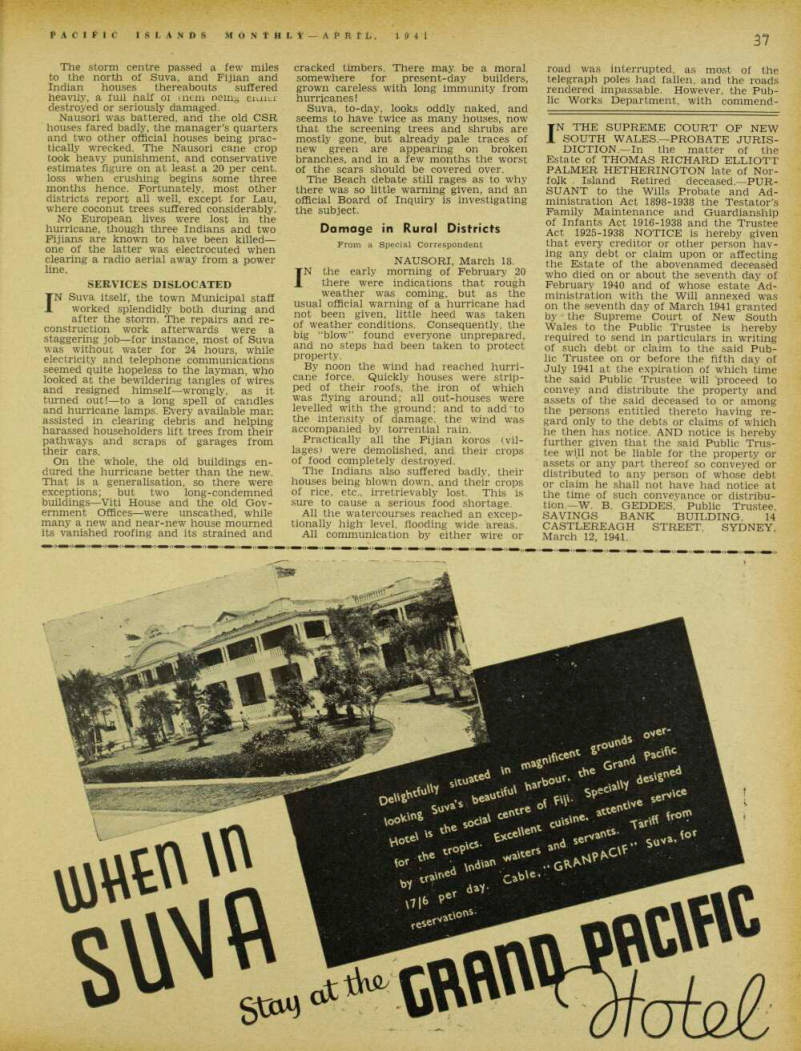
Worst Hurricane in 30 Years
Prom Our Own Correspondent SUVA, March 17. /|LD-TIMERS in Fiji are comparing V/ Suva’s recent hurricane with the big “blow” of 1910, and have decided that this February storm was the worst for 30-odd years.
Hurricanes hereabouts are usually pre ceded (often for days beforehand) by a mounting chorus of hammering, bolt shooting, and precautionary unheaval generally. Few hurricane seasons pass without an “alert”, and often after a false alarm residents swelter for a couple of days behind their stuffy, battened win dows, grumbling at the over-cautious authorities who issue “warnings”, until fairer weather and a rising barometer signal the “all clear”.
So, when the “glass” began to fall on February 20, peonle were uneasy but not seriously alarmed, and went about their business as usual. As the morning wore on. conditions grew worse. Business men, with an uncertain glance from their baro meters to the nakedness of the signal flagstaff, remembered how often they had been warned in the past, and decided with a shrug that the authorities probably knew their job—-if there was no warning out. there couldn’t be much wrong.
Which was a nity! Because when the black balls were hoisted at 10.20 a.m., it was too late for them to do very much.
When they tried to telephone their homes and pass on the warning, many telephone wires were already down in a tangle of smashed trees.
A torrent of wind raged in from the south, shot through with howling gusts that grew always stronger and more fre quent. A little after noon, the anemometer registered its maximum of 110 m.p.h.— then ran off the record-sheet. Another hour’s chaos and then came a lull, which the weather-wise spent in reinforcing their eastern and northern defences.
After some 20 minutes there was a frenzied renewal of the assault from the east, veering gradually to north-east.
Towards nightfall, the wind dropned somewhat, and though a lieavy gale blew all night, next day dawned clear and only moderately windy.
But what a day it had been! A wind force estimated at between 120 and 130 m.ph. and 6.4 inches of stinging rain had left the town badly battered. Up rooted trees, fallen telegraph poles and tangled masses of wires, corrugated iron, end broken branches were everywhere.
From each house came the occupants to gaze ruefully on the wreckage of their garages and gardens, their broken trees and gutterings and missing roof-iron, and to draw what comfort they could from the fact that the house next door was just as bad and sometimes worse.
Yachts Driven Ashore
AT Walu Bay anchorage, the small boats suffered badly, many of them being either swamped or driven ashore —two of them were perched high up among the mangroves, while others lay at odd angles along the beach.
Burns Philp (SS) Co.’s building and the Union Soap Co.’s mill both lost portions of their roofs. Two faces of the new Government Buildings’ clock were blown in and the interior mechanism damaged.
The Attorney General’s house was un roofed, while big trees along Victoria Parade lay prone in all directions. The Government Domain and Botanical Gar dens were a pathetic tangle of smashed
vegetation.
The storm centre passed a few miles to the north of Suva, and Fijian and Indian houses thereabouts suffered heavily, a full half of inem oemg eiuitr destroyed or seriously damaged.
Nausori was battered, and the old CSR houses fared badly, the manager’s quarters and two other official houses being prac tically wrecked. The Nausori cane crop took heavy punishment, and conservative estimates figure on at least a 20 per cent, loss when crushing begins some three months hence. Fortunately, most other districts report all well, except for Lau, where coconut trees suffered considerably.
No European lives were lost in the hurricane, though three Indians and two Fijians are known to have been killed— one of the latter was electrocuted when clearing a radio aerial away from a power line.
Services Dislocated
IN Suva itself, the town Municipal staff worked splendidly both during and after the storm. The repairs and re construction work afterwards were a staggering job—for instance, most of Suva was without water for 24 hours, while electricity and telephone communications seemed quite hopeless to the layman, who looked at the bewildering tangles of wires and resigned himself—wrongly, as it turned out! —to a long spell of candles and hurricane lamps. Every available man assisted in clearing debris and helping harassed householders lift trees from their pathways and scraps of garages from their cars.
On the whole, the old buildings en dured the hurricane better than the new.
That is a generalisation, so there were exceptions; but two long-condemned buildings—Viti House and the old Gov ernment Offices—were unscathed, while many a new and near-new house mourned its vanished roofing and its strained and
cracked timbers. There may be a moral somewhere for present-day builders, grown careless with long immunity from hurricanes!
Suva, to-day, looks oddly naked, and seems to have twice as many houses, now that the screening trees and shrubs are mostly gone, but already pale traces of new green are appearing on broken branches, and in a few months the worst of the scars should be covered over.
The Beach debate still rages as to why there was so little warning given, and an official Board of Inquiry is investigating the subject.
Damage in Rural Districts
From a Special Correspondent NAUSORI, March 18.
IN the early morning of February 20 there were indications that rough weather was coming, but as the usual official warning of a hurricane had not been given, little heed was taken of weather conditions. Consequently, the big "blow” found everyone unprepared, and no steps had been taken to protect property.
By noon the wind had reached hurri cane force. Quickly houses were strip ped of their roofs, the iron of which was flying around; all out-houses were levelled with the ground; and to add to the intensity of damage, the wind was accompanied by torrential rain.
Practically all the Fijian koros (vil lages) were demolished, and their crops of food completely destroyed.
The Indians also suffered badly, their houses being blown down, and their crops of rice, etc., irretrievably lost. This is sure to cause a serious food shortage.
All the watercourses reached an excep tionally high level, flooding wide areas.
All communication by either wire or
road was interrupted, as most of the telegraph poles had fallen, and the roads rendered impassable. However, the Pub lic Works Department, with commend-
In The Supreme Court Of New
South Wales.—Probate Juris
DICTION. —In the matter of the
Estate Of Thomas Richard Elliott
Palmer Hetherington Late Of Nor
folk Island Retired deceased.—PUR SUANT to the Wills Probate and Ad ministration Act 1898-1938 the Testator’s Family Maintenance and Guardianship of Infants Act 1916-1938 and the Trustee Act 1925-1938 NOTICE is hereby given that every creditor or other person hav ing any debt or claim upon or affecting the Estate of the abovenamed deceased who died on or about the seventh day of February 1940 and of whose estate Ad ministration with the Will annexed was on the seventh day of March 1941 granted by ■ the Supreme Court of New South Wales to the Public Trustee is hereby required to send in particulars in writing of such debt or claim to the said Pub lic Trustee on or before the fifth day of July 1941 at the expiration of which time the said Public Trustee will proceed to convey and distribute the property and assets of the said deceased to or among the persons entitled thereto having re gard only to the debts or claims of which he then has notice. AND notice is hereby further given that the said Public Trus tee wi.ll not be liable for the property or assets or any part thereof so conveyed or distributed to any person of whose debt or claim he shall not have had notice at the time of such conveyance or distribu tion.—W. B. GEDDES, Public Trustee,
Savings Bank Building, 14
Castlereagh Street, Sydney,
March 12, 1941.
able promptitude, temporarily restored communication. Only a day or two elapsed before messages could be trans mitted, and cars were able to traverse the roads. Gangs of workmen are still putting the finishing touches to the repairs.
The flooded watercourses caused much damage to bridges, and there were sev eral land-slides.
Advertisements & other items, pp. 41-42 (2 items)
37
pacific islands m o n t h l a aprh, i d 4 i
w
Por children'* coughs and cold*
get WOODS'GREAT PEPPER-
MINT CURE. Safe —the best for 45 years. Tastes good and bring* relief with the very first dose. Handy-siied bottle, only I/*. Al»o in 2/- and 3/- sizes.
READ THE
B.P. MAGAZINE
AUTUMN NUMBER
iiiiiiiiiiiiiiiiiiiiiiiiiiiiiiiiuiiiiiiiiiiiiiiiiiiiiiiiiiiiiiiiiiiiiiiiiiiiiiiiiiiiiiiiiiin
NOW ON SALE
Short Stories Pictures Travel Articles - - - - Pages for the Children Stage Latest Fashions Screen A
ONE SHILLING PER COPY.
ON SALE AT ALL NEWSAGENTS AND BOOKSELLERS D D
Mjd,vj m strength
MPSI
S P£
CIA
I LY
, D '«> H.O.WH- tS
IBS"!?) Ltd.. SYDNQ
Pa oked
for
t HOPi
ST RAUAjt
A* 895 Capstans are available in both
MEDIUM and FULL STRENGTH
CAPSTA
TOBACCO AND CIGARETTES
Plantations Damaged
in Samoa
Prom Our Own Correspondent APIA, March 13.
ON Saturday and Sunday, March 1 and 2, a severe “blow” of almost hurri cane force, accompanied by torrential rain, struck Western Samoa.
The disturbance started with strong southerly winds, then gradually the storm centre shifted until Apia received the full force. Wind velocity was recorded at the Observatory at 63 m.p.h. Considerable damage was done to banana and cocoa plantations. Roads around Apia were blocked by fallen trees in all directions, though no casualties were reported.
Heavy rain fell for 36 hours, and over 16 inches were recorded. Owing to the low rainfall average during the past 12
months the rivers were able to carry off the water; in fact, some watercourses were flowing for the first time for over 18 months.
The hydro scheme was temporarily out of action, and the town had a full “black out” for one night.
By Monday morning, the 3rd, the force of the “blow” had spent itself. Since then Apia has suffered from extremely hot and sultry weather, occasionally in terrupted by showers of rain.
Banana Quotas Will Be Filled
THOUGH much damage was done to banana plantations, particularly in the hills and on the east coast, it may not be so serious as first reports in dicated. We hear that Fiji and Niue suffered worse than us and this may result in Samoa being called upon to make up any shortage in their shipping quotas. Agents here expect that we can do this, as in recent months a large sur plus of fruit had been offered for shipment.
A big consignment of fruit was waiting on the wharf to be loaded on an overseas steamer when the storm hit Apia and the delay caused by the “blow” allowed the bananas to ripen. Most of the ship ment had to be left behind when the vessel sailed.
It was decided to distribute the fruit gratis to residents who cared to pay transport. Thus over 3,000,000 bananas were carted away. This was a bad loss to growers, who, besides losing their fruit, had also to pay the transport from plan tation to wharf.
Two Miners Killed At
Edie Creek, Tng
From Our Own Correspondent WAU, March 21.
ON the night of Sunday, March 9, two miners, George Cooper and James Crevey, were killed in the Edie Creek gold-mines. Working near No. 1 level, filling debris into a truck standing in the cage, they gave the signal to be lowered to the winchman on the surface. The cage, with its occupants, got out of con trol and dropped 400 feet. Both miners were killed instantly.
An inquiry into the circumstances of the accident opened on March 20 and is still proceeding.
George Cooper had been associated with Papua and the Territory of New Guinea for over 24 years, and left a family of five daughters and one son in Samarai.
James Crevey arrived in the Territory only about four months ago. Both were buried at Wau on March 11.
NG Public Service


THE following staff movements in the New Guinea Public Service were announced re cently:—
Permanent Staff Transfers
Health Dept. —Dr. E. A. Holland, Medical Officer, Kavieng to Rabaul.
Agriculture Dept. —J. A. Ewen, Inspector and Instructor, Namatanai to Kavieng; M. C.
Crocker, Inspector and Instructor, Kieta to Rabaul.
Temporary Engagements
Treasury Dept. —R. H. Forsyth, clerk; D. J.
Rankin, storeman.
Health Dept.— Mrs. D. G. D. Phillips, Cook- Housekeeper; Miss O. Wood, Nurse.
Police Force Transfers
C. Thomas, Warrant Officer. Kavieng to Rabaul: N. B. N. Blood, Warrant Officer, Rabaul to Wewak; F. E. Towner, Warrant Officer, Namatanai to Rabaul. Mr. R. Caldwell, District Commissioner in the Fiji Administration, arrived in New Zealand recently to spend two
months’ leave.
Mr. Max. Woodhouse, of the Bank of NSW staff in Fiji, recently married Miss Esther Steward, daughter of Mr. and Mrs. R. W. Steward, of Suva, at Holy Trinity Pro-Cathedral, Suva. They arrived in Sydney by liner from Fiji in March, Mr. Woodhouse having been transferred to one of the bank’s branches in Australia.
Advertisements & other items, pp. 42-44 (2 items)
38
A*»ft I t, 194 1 PACIFIC IS L A f) g MOKTftLt
/
7 7 / 7 Va / / / / 0 0 V
VACUUM
OlAUir PRODUCTS
TAKE THE
“LEAD” FEELING
OUT OF YOUR LEGS
Get More Oxygen in Your Blood and Get the Pep that Sends You Bounding Up the Stairs.
You are slowly smothering if your blood is lacking in enough red cells and the rich red colouring matter they contain, called hemoglobin. It’s the hemoglobin which picks up the life-giving oxygen from your lungs and carries it to every part of your body. Without enough hemoglobin, your body is being oxygen-starved. Your organs, glands and tissues slow down . . . you feel tired, pepless, depressed . . . your nerves often become jittery—you get easily upset.
What you need is Dr. Williams’ Pink Pills. These world-famous pills help rebuild your hemoglobin which makes your blood rich and red and so aids your system in getting the vitalising oxygen it needs. Get Dr. Williams’ Pink Pills to-day from your chemist or store.
See for yourself how quickly your “always tired”, nervous, depressed feeling fades away—and once again you feel “alive”, full of pep and go.***-
New Mission Vessel In Papua
The Methodist Mis sion’s new vessel, “Eliam”, now in service in Eastern Papua. She was built by Papuans of the Salamo Technical Institu tion, under the guidance of Mr.
George Harrison, and local timber was largely em ployed. —Block by courtesy of “Mission Review”.
Increased Taxes For
Samoa ?
From Our Own Correspondent APIA, March 13.
AT the Legislative Council meeting yesterday, a proposed ‘‘Revenue Amendment Ordinance” containing stringent increases in taxation designed to place Administration finances on a sound basis came before members. The debate was adjourned until next week.
Pointing to recent rises in various im port duties, Hon. O. F. Nelson, European elected member, declared that the tax payers should have a voice in regard to the levy of taxes as well as the disposal of revenue. He moved that new licence fees and taxes, as well as changes in existing ones, should be submitted before
hand to the Legislative Council, as is done with the Annual Estimates. The motion was lost by the votes of official members.
Mr. Nelson put forward a motion that the Council’s proceedings should be given wider publicity both in English and in the Samoan language. This was passed unanimously.
Complaints against alleged differen tiation between European and Samoan children at Government schools were refuted by Administration officials.
Sister Melva Clark and Nurse Zelda Morgan arrived in Suva recently to join the staff of the Fiji Nursing Service.
Miss Elsie Smith, of the. Methodist Mis sion’s Dilkusha ' Orphanage, Fiji, has been spending furlough in Victoria.
Advertisements & other items, p. 44 (2 items)
40
April, hu-? acific islands monthly
iLi ruqLct!
"'<t / *- \ r ¥A 500
CANDLE
POWER
14 I 300
CANDLE
POWE*
BRIGHTER LIGHT
for
BETTER SIGHT
Coleman Products can be obtained from all Leading Firms throughout the Pacific Islands.
Coleman Mantles supply Sun-like light.
Instant Lighting Stoves tr Irons giving maximum of heat in minimum of time
EASE OF OPERATION
combines
ECONOMY with COMFORT
In case of difficulty In obtaining supplies write to:— Pearce & Co., Suva, Fiji Is.
America’s Pacific

Tourists Two Points of View
Letter to the Editor I HAVE read with disgust, and very deep regret of the visits to Tahiti of the American cruise-ships, yet I am not at all surprised at what happened.
It will always happen when this sort of expedition appears; and, if the Chinese and others so bilked the tourists as to disgust them with Tahiti and keep them and their ilk from ever coming again, whv that is all very much to the good.
Nothing worse could happen to Tahiti than to be made an objective of these American cruises.
I read with interest, and the keenest sympathy, the comment of my valued friend, Rowland, that the island is “re turning to something like the quiet and peace we knew before the tourist ex ploitation”. That gives me a keen nos talgic pang.
I am, etc.,
Marc T. Greene.
Hong Kong, Feb. 1.
Letter to the Editor YOUR January issue at hand and, as usual, full of good things—calling a spade a spade, hewing to the line, and letting the chips fall where they may.
However, there is one sour note which I cannot help referring to—the squawks of “Our Own Correspondent” in Papeete in regard to Americans, over a long period.
In January issue, he reports the de parture of the American colony and de cries the California bungalows which have been left behind. All well and good; that’s news. But when he launches forth upon the objectionableness of Americans outside their own country, it is something gratuitous and unneeded at this time. Incidentally, this is not the first time your Papeete corres pondent has put in his little dig concern ing Americans.
All of us who have the common Eng lish language have something much more pressing, these days, than saying nasty things about each other, and letting pre judices govern what we write. We have a common enemy—Hitlerism—and un less we are to be swallowed by that msnster, which opposes the democratic way of life, we must have a common understanding. The spleen of your Papeete correspondent toward Americans serves no good purpose at this hour.
Let’s adjourn our pettiness for the present, swallow our dislikes, and try to build up understanding among those who speak English. That will go a long way toward strength in facing what we must in the Pacific.
At least Americans are not Japs.
Neither are they Nazis nor Fascists. The Papeete writer gives the idea that Americans might be more objectionable than Axis thieves. Pettiness such as this defeated France, and it might defeat the English-speaking democracies if we let it flourish.
I have seen objectionable Australians and New Zealanders outside their own countries. I have met up witn objec tionable Englishmen away from home.
I’ve run across plenty of objectionable Americans. Nevertheless I do not suffer from the idea that any of these people were anything more than individuals.
The ratio of objectionable people is about the same the world over, regardless of nationality. It’s just plain human nature
for some of homo sapiens to be offensive.
So why pin it on the millions of others who are decent?
Feed your Papeete correspondent arsenic, for the duration. After that, let him yowl all he wants at Americans.
Tnen it won’t matter. But, in tne mean time, let’s hold our tongues and face the common enemy.
Thanks for the chance to get this off my chest.
I am, etc.,
John Hungerford, Jr.
Reseda, Calif., USA, 3/3/1941.
Editorial Note: Our Californian friend is a little too severe upon our Papeete correspondent—who, also, is a good American, The latter has not anim adverted upon Americans generally— only upon that tourist class which, now and again, comes milling into his be loved Tahiti, and, so to speak, upsets the balance of nature.
The eldest son of Mr. A. M. Gurau, of Apia, Samoa, is apparently a prisoner in German hands. He is a marine en gineer, and his ship was torpedoed in the Atlantic. He was among survivors who reached the French port of Lorient, now in German hands
Rev. J. W. Dixon, of the Teachers’
Training College at Salamo, Papua, is at present engaged in revising the New Testament in the Dobuan language. He intends to retire from active Mission work in the Territory next year.
Advertisements & other items, pp. 45-46 (1 item)
Wunderlich
Timber, Joinery
ETC.
PREPARED BUILDINGS ready for erection a specialty.
SHIP AND BOAT BUILDING.
TIMBERS specially catered for.
FIBROLITE, PLYWOODS,
GALVANISED IRON.
CONSIGNMENTS shipped
by RETURN STEAMERS
to the Islands.
John W. Eaton
PTY. LTD.
WEST CRESCENT STREET,
NORTH SYDNEY.
Telephones: X 84051 (6 lines.)
BITUMENOID ROOFING
MADE IN AUSTRALIA.
Bltumenoid Roofings, Dampcourse and Insulating Felts are made from the world's best raw materials. Warranted to stand the most rigid tests.
BITUMENOID THE BEST
Roofing, 1,2, 3-ply; Flooring, Waterproof Materials; Saturated Pelt; Resilient Road Jointing; Natural Asphalt Dampcourse: 2 and 3-ply Dampcourse; 1-2 lb. Lead-core Dampcourse; Roofing Cement; Asphalt Paints; Roofing Compound.
SAMPLES AND PRICE LISTS ON APPLICATION.
MAXWELL PORTER & SON LTD.
ESTABLISHED 1888. BUILDERS’ SUPPLIES.
107 BEDFERN ST., BEDFERN, SYDNEY, N.S.W. Phone: M 3167. Cables Bltumenoid.
0 *J* I ST (Estd.
WUNDERLICH LIMITED,
A Durabestos Home built from a design in our Free booklet.
Note: In the Islands, Corrugated Durabestos would ensure a weather-tight roof.
Years), REDFERN, SYDNEY.
WUNDERLICH
DURABESTOS
ASBESTOS CEMENT BUILDING SHEETS
SIMILAR TO EUROPEAN MAKES
now made by
COLEMAN LAMP & STOVE CO.
LTD.
Toronto, Ontario, Canada and sold by All Leading Stores in the Pacific Islands.
In case of difficulty in obtaining supplies write to —
PEARCE & CO.—SUVA, FIJI IS.
New Caledonia Knocks at Australia's Door

Urgent Need For Markets Japanese Trade Prohibited
THE growing economic co-operation be tween New Caledonia and Australia was emphasised, in March, when Mr. H. Lafleur, of Noumea, paid a visit to Sydney to interview the Common wealth Government on the possibility of Australia increasing its imports of nickel and chrome.
Mr. Lafleur, who is prominently con nected with the Colony’s mining industry, visited Canberra, where he had dis cussions with Commonwealth officials; and, although in an interview with the “PIM” he could not divulge the nature of these discussions, he said that if he was not successful he would proceed to the United States in a few weeks, to try and interest that country in New Cale donia’s excess nickel and chrome produc tion.
New Caledonia has large deposits of minerals, the most important of which are nickel, chrome and iron. There is a smelting works in Noumea conducted by the Societe le Nickel, and, prior to the French capitulation, the production from ihis company—about 10,000 tons of nickel mattes (68 per cent.) a year—went to France and Belgium. The bulk of the chrome ore went to America and Great Britain: and Japan, who was not allowed to buy refined metals, received 70,000 tons of nickel ore (3 per cent.) and 80,000 tons of iron ore (50-52 per cent.) each year.
With the French and Belgian markets gone, New Caledonia looked to Australia for assistance in placing the nickel pro duction; and, as the result of negotia tions, Australia is taking 7,800 tons of
nickel mattes per year. Mr. Lafleur said the Colony hoped Australia would buy the balance of the matte production, and large quantities of nickel ore.
New Caledonia produces between 60.000 and 70,000 tons of chrome ore each year, and of this 50,000 tons goes to America and British interests. Aus tralia is importing between 1,500 and 2.000 tons, and Mr. Lafleur is trying to build this import up to 10,000 tons a year. Commenting on the fact that Aus tralia has just signed a trade agreement with Southern Rhodesia for the pur chase of (among other things) a quantity of chrome, Mr. Lafleur said New Cale donia could supply all of Australia’s needs at a price which would be con siderably lower than Southern Rhodesian chrome, because of the shorter distance to be freighted.
Mr. Lafleur said he hoped to interest Australia in the Colony’s copper ore deposits, and mentioned that a small percentage of gold had been found in this ore.
The fact that Australia might not be able to use all of the Colony’s metal should not deter them from buying, he said. Arrangements could be made whereby Australia could buy the metals and re-sell them to America —thus build ing up the much-needed dollar exchange.
Australian pounds were equally as wel come in New Caledonia as dollars.
REFERRING to Japan’s position to-day, Mr. Lafleur said that a recent order from the de Gaulle Government in London practically prohibited trade be
tween New Caledonia and Japan. Ex ports of nickel and iron ore to Japan have ceased, with the exception of a partial exemption, which permits the Japanese-owned “Cascade” mine at Goro to ship 8,000 tons of iron ore each month.
This Japanese company employs about 550 French and Javanese and can pro duce 30,000 tons of ore per month; but, as they have no place to store surplus production, it is not thought that they will continue operations under the 8,000 tons a month licence.
Recently a Japanese company nego tiated for the purchase of 10,000 tons of chrome ore, and arrangements had just been completed—the ore had been ob tained and the money had been placed in the bank —when the order prohibiting exports to Japan was received. The deal fell through, and the 10,000 tons of chrome is still in New Caledonia, await ing shipment to some other market.
America is interested in the Colony’s minerals, Mr. Lafleur continued. Re cently, Mr. Ernest E. Johnson, United States Maritime Commissioner for the East, furnished his Government with a report on the nickel and chrome avail able in New Caledonia.
Other Products THE Colony’s timber industry was quite satisfactory, as Australia is taking all the kauri logs available; but there are large stocks of copra and trochus shell lying in store awaiting shipment.
During his visit to Australia, Mr.
Lafleur took the opportunity to investi gate the possibility of expanding the coffee market. Although Australians are not great coffee-drinkers, like the Americans, he hoped they would acquire a taste for the excellent Arabica and Robusta types grown in the Colony.
America was not a likely market for New Caledonian coffee, because it is well supplied by Brazil—the largest producer in the world—and other nearby countries.
“In any case it is too far from us”, he said. “The country we must sell our coffee to is Australia, just four days from Noumea”.
Mr. Lafleur said it was his personal opinion that the Island should have a commercial representative in Australia.
“As our exports are not back to normal, foreign exchange and imported goods are still severely rationed; but, if Aus tralia can buy more of New Caledonia’s products these restrictions will be lifted, paving the way to a profitable trade connection between the two countries”.
Mr. Lafleur paid a visit to New Zealand on his return to Noumea by air in April.
Advertisements & other items, p. 46 (1 item)
Willia
Established 50 years—and carrying one of the largest stocks of Iron and Steel in Australia.
I I
Atkins Pty. Ltd.
Iron & Steel Merchants
ENGINEERS' SUPPLIES
Head Office 449-451 KENT ST., SYDNEY.
FULL, COMPREHENSIVE & UP-TO-DATE RANGE IN ALL
DEPARTMENTS, INCLUDING THE FOLLOWING LINES:—
STEEL DEPARTMENT
MILD STEEL:
Rounds, Squares, Flats, Half-rounds, Hexagons, Bevel, Shoeing, Tyre, Angles, Tees, Sheets, Plates, Girder Plates, Chequer Plates, Channels, Hoops, Etc.
BRIGHT STEEL:
Rounds, Squares, Hexagons.
Extra Special High Speed Tool Steel, Mining Steel, Blister Steel and Spring Steel, Rounds, Flats & Squares.
Bar Iron— All sections and sizes.
COACH & MOTOR HARDWARE.
Engineers' Supplies:
Set Screws, Studs, Metal Thread Screws, Coach Screws, Files, Cotter Pins, Bright and Black Bolts, Rivets, Etc., Hack Saw Blades.
Power Transmission Gear: Including Plummer Blocks, Couplings, Collars, Etc.
Coach and Motor Hardware: Axles, Springs, Wheelstufl, Duck, Paints.
Farriers' Supplies: Horse Nails, Anvils, Vices, Etc.
Motor-Trimmers and Motor Builders' & Motor Painters' Requirements
C. A. WILLEY'S
Quick-Drying Coach and Car Paints, Roughstuff, Elastic Gloss, Synflex Enamels, Lacquers.
Cable Address: WILATKIN, SYDNEY.
DUCO Lacquers and DULUX Enamels—FAßßEX Motor Toppings and Leather Cloths, House Cr Decorators' Paints, Varnishes & Brushware Sole Distributors of CHAMPION'S Decorators Paint Products.
Distributing Agents for BROLITE Lacquers, SYNFLEX Enamels and ''POLYGLOSS'' Finish.
Fire In Wau
From Our Own Correspondent WAU, April 2.
ON the night of Sunday, March 23, the charming residence of Mrs. F. M.
Fuller was completely destroyed by fire. Mrs. Fuller was asleep when the fire started, and when she awoke there was no hope of saving anything. The unfortunate lady lost all she possessed, including many family treasures which only recently had arrived from Australia.
Mrs. Fuller has taken up residence with her son, Mr. Alan Fuller, until she can rebuild.
Miss Hazel Betham (Commercial and Sports Queen) topped the poll in the recent Queen Carnival held in Western Samoa, which raised £944 for the “Spit fire Fund”. Miss Aggie Mann (Adminis tration Queen) ran second and Miss Sala Mataafa (Samoan Queen) was third.
The Dahl Pea
A Substitute For Rice
From Our own Correspondent
Pt. Moresby, April 2.
IN recent discussions here on suitable substitutes for rice for feeding native labourers, attention has been drawn to the possibilities of the Dahl (or Dal) Pea, used extensively both in India and Egypt.
In Egypt, the plant (which lasts three years) has been known to yield 4,000 lb. to the acre in good soil. The crop is obtained in the first year, and the seeds can be used in the green state as well as when ripe. The pea is also largely cultivated in Jamaica and in Assam and other eastern countries, where it is used by the peasantry, in conjunction with other foodstuffs.
According to the well-known agricul tural authority, Mueller, there are two varieties—a small plant ripening in three to f our months, and a larger and more prolific variety, requiring longer to ripen, sometimes nine months.
Mr. Leo. Austen, Resident Magistrate at Daru, Western Papua, who has been cultivating the Dahl Pea for many years for his personal use, has suggested that at a time like this when the price of rice is on the upward grade, plantations could cut down the cost of native rations by growing a Dahl crop, Mr. Austen picks the pea as soon as it is fully grown, and then cooks it like an ordinary pea. For storing, the pea is picked as soon as the pods shows signs of turning yellow; it is then shelled and dried in the sun. Should the crop be left to dry on the shrub, it usually is attacked by weevils.
The variety Mr. Austen grows attains
a height of 9 ft., planted 9 to 10 ft. apart. After fruiting, the shrubs are pruned to within a couple of feet from the ground to allow for thicker growth for the following year’s crop.
Mr. Tom Flower, who a few years ago was a successful builder at Wau, New Guinea, has lately been travelling around Papua and New Guinea, making a close survey of timber resources. Mr. Flower appears to have entered in substantial fashion into the rapidly-developing tim ber industry of Papua and New Guinea
Advertisements & other items, pp. 47-48 (1 item)
- and I use
7 W U rm a 3
DISTRIBUTORS: Greenwood & Laws, Ltd., Rabaul and Wan; Steamships Trading Co., Ltd., Port Moresby and Samarai; Millers, Ltd., Suva, Fiji.
Product of British Australian Lead Manufacturers Pty., Ltd., makers of “Dulux” Finishes.
Do You Know that the Famous
YOUNGER
STOVES and
RANGES
made with extended Firebox specially for long Wood fuel, are Self-Setting and, provided sufficient Flue Piping is attached, can be used in almost any position?
The No. 7W “Younger” Ranger can now " be supplied fitted with Legs, as per Illustration.
Younger Stoves Ask for quotation for this Range, also illustrated Catalogue ThroiUhoat U the and Price List for both Single and Double Oven Stoves. Pacific islands.
G. FLETCHER & SON 50 Oxford Street, Sydney.
Ship Chandlery Hardware
/Write for j
Ship Chandlery /
Catalogue J
BROOMFIELDS LIMITED
152 SUSSEX STREET :: SYDNEY.
Cables; “Boom”, Sydney.
Special “In Bond” Prices for all Islands enquiries quoted on application.
Sole Agents for: Large and Complete Stocks of
SHIP CHANDLERY
IRONMONGERY OF ALL KINDS, PAINTS,
WHITE LEAD AND OILS.
P. H. MUNTZ & CO.’S 3-CROWN BRAND METAL SHEATHING.
PEACOCK & BUCHANS’ ENGLISH READY-MIXED PAINTS.
Woven Wire for all Industry \
COPRA DRYING TRAYS, FLOORS, Etc.
FRUIT DRYING TRAYS, MINING SCREENS.
Heavy Mosquito Gauze in Phosphor Bronze and other Metals Impervious to Salt Sea Air.
WIRE DOOR MATS AND GENERAL WIRE WORKS
E. WRIGHT & CO. LTD.
Office and Works: 148-152 Cleveland Street, Sydney, N.S.W.
Telegraphic Address: “Wrightmake,” Chippendale. yvu i £ CD
*BL is*
Scott’s “Renown” Brand Rope
Cordage and
Binder
Twine
Cable Address: Ropeyard, Sydney.
of Every
Description
MANUFACTURED AT
MASCOT, N.S.W.
J. SCOTT
PTY. LTD.
Head Office and Store
163 CLARENCE STREET,
SYDNEY,
N.S.W.
Pacific Islands Society
EARLY Links Between Australia and New Guinea” was the subject of an illustrated talk by Mr. C. Price Conigrave, at the March meeting of the Pacific Islands Society, when Mr. Alfred E. Stephen presided.
Among visitors present were Mr. H. C.
Monckton (former Commissioner of Native Affairs in Fiji), and his brother, Mr. E. P. Monckton (Solomon Islands), Miss Ana Laurenson (of Apia, Samoa), Miss Colahan (Labasa, Fiji), and Mrs.
Douglas McGregor (Edie Creek, NG).
Years
A Tongan's 102
Testimony to Value of Christian Education
Prom Our Own Correspondent
Nukualofa, Feb. 3.
IN the death of Bauliasi Taumoebeau, a venerable old Tongan, which occur red to-day at Nukualofa, aged 102 years, there passed away one who took an active and important part in the affairs of church and state during the interesting transition period in the history of Tonga.
T a u m o ebeau, when about 28, was among the first students en rolled at the well known Tubou College to be trained for mis sionary work, when it was es tablished by Dr.
J. E. Moulton in 1866. He was also third among the first four “kau matematika” an adaption of the word mathe matician used to distinguish those who have passed the college quali fying examina tion and thus had their names en scrolled in letters of gold on the college honour board, which was
empanelled on the wall at the front end of the college building. They also received a college cap and gown, similar to that worn by university graduates.
At the conclusion of his training, Taumoebeau embarked on missionary work. He was stationed at the village Nukunuku, Toga tabu, his first station, when King George Tubou I called the first Parliament of the Kingdom and granted the Constitution in 1875, estab lishing proper government, limiting the absolute powers of the king and chiefs, and defining the obligations and privi leges of citizenship. From his retentive memory, he often recounted the impres siveness of this great occasion.
Taumoebeau was occupied with mission ary work until the Government decided to have a college of their own and he was asked to establish the Tonga College, in 1881. There he remained for about a quarter of a century, first as principal of the college, then as senior tutor.
After he left Tonga College in 1905, he took up further missionary duty until he finally retired about 1920, living quietly with one of his sons, Afu Taumoebeau, who is Police Magistrate at Nukualofa.
Living to a great age, Taumoebeau wit nessed the development of modern Tonga.
He saw the various stages in the social, economical and religious progress of the Tongans, and he was often heard to re mark that Tonga had advanced a long way since those far-off days when he was a young student at Tubou College. The real significance of his life is that it is testimony that, under the influence of Christian education, Polynesians may live a useful, contented and happy life, ac cording to European standards.
Jione Havea, a young Tongan preacher, will carry out deputation work in the Australian States this year for the Methodist Mission.
Bauliasi Taumoebeau, on his 100th birthday.
Deep Drilling For Oil
What Australasian Petroleum Co.
Has Done in Papua
From Our Own Correspondent
Pt. Moresby, March 21.
ANOTHER step forward in the search for oil in Papua was taken on March 8 when the Australasian Petroleum Co. commenced drilling operations in their first deep test well at Kariava, on the Vailala River.
This drilling follows large-scale ex ploratory work, which included a com prehensive aerial survey covering 28.000 sq. miles of territory and detailed geological and geophysical investigations.
An engineering task of vast proportions had to be undertaken when the site of the test well was chosen in May, 1940.
Heavy drilling equipment had to be trans ported from Pt. Moresby, necessitating the installation of special facilities at Pt. Moresby, and wharves, jetties, cranes, etc., at transhipment bases on the Vailala River.
From the final off-loading base, 75 miles from the river mouth, a road 3i miles through dense jungle country and over sharply dissected terrain had to be constructed. It took six months to build, at a cost of £12,000.
During the construction of the road, work went ahead on the erection of quar ters for the European and native staffs and numerous other buildings, such as hospitals, stores, workshops, etc. All this entailed many thousands of tons of materials which had to be carried up stream in vessels navigating the difficult waters of the Vailala’s upper reaches.
Search For Oil in New Caledonia A VISITOR from New Caledonia recently told the “PIM” that seven years ago he found a deposit of oil about five miles from Koumac, a small town at the northern end of the island.
He did not develop interest in his dis covery, however, when he found that, under French law. ownership of a newly discovered oilfield automatically passes to the State.
The presence of oil in New Caledonia is nothing new. As far back as 1905, traces of oil were found in various parts of the Colony, which is right on the oil belt, curving south-eastwards from the Dutch East Indies, through New Guinea and Papua, down to New Zealand.
Twenty years ago, a Queensland syndi cate spent between £20,000 and £30,000 in a fruitless effort to find payable oil in NC. Drilling operations were actually commenced near Noumea, and shortly afterwards a bore was put down near Koumac, where traces of oil had been found in a small stream.
Geologists from Europe and America have visited the Colony at intervals over the past quarter of a century, and the island has been thoroughly examined.
One expert, who carried out research in New Caledonia, said he did not think there was any possibility of obtaining large quantities of oil because, geologic ally speaking, the structure of the island was “too upset”.
Mrs. Brewster (formerly Miss Loudon, daughter of the well-known Papuan planter) is now living with her husband in Los Angeles. She reports that, in another apartment in the same building are Mr. and Mrs. Jack Ringers. Mrs.
Ringers, not long ago, was Miss Jean O’Dea, the pretty daughter of Mr. T.
O’Dea. Guinea Airways manager in Port Moresby.
Cook Is. Wedding
From Our Own Correspondent
Rarotonga, March 4.
AN, interesting wedding took place on February 22, when Mr. Ronald Powell, globe-trotter, and author of “I Sailed in the Morning” married Miss Elisabeth Marsters. The ceremony was performed at the home of Mr. William Watson, a local trader, by Mr. Stephen Savage.
Mrs. Powell is a member of the Pal merston Island Marsters family, and lived there until five years ago, when she came to Rarotonga as a school teacher. With the aid of the newly installed radio station at Palmerston,
the Islanders there were advised of the event and, at the time of the ceremony, a special service was held in their tiny church.
Mr. Powell, in the course of a short speech, said that he had seen and lived in very many parts of the world, in cluding famed Tahiti, but the day he sighted Rarotonga from the deck of the schooner he felt that this was to be his last port.
Captain Charles Whitehead, of Sama ra!, Papua, who has been in Papua for over 40 years, recently celebrated his 75th birthday. This grand old pioneer was greeted by many Papuan friends on his birthday.
Mr. H. T. C. Harlie Messenger, who for some years was engaged in com mercial flying on the New Guinea Gold fields and later took over the Iboki plan tation, in the Talasea district of New Britain, died on March 8. He enlisted for active service overseas recently but was discharged owing to ill-health. After the last war he was a pilot in the RAF, and served in Iraq.
Advertisements & other items, pp. 49-50 (1 item)
/lifer
GIFTS TO SOLDIERS OF
AUSTRALIAN NOVELTIES
Wallets made from quality selected genuine Kangaroo, Crocodile, Lizard and Snake Skins.
No. 828 A. Gent’s De-luxe Wallet, sterling silver mounts, measures 6i x 4.
Kangaroo 25 -. Crocodile 35 -. Iguana 32/6. Snake 30/-.
No. 786. Novel Combination Tobacco (holds 2 oz.) and Pipe, Pouch, with zipper fastener. Lined oil silk. Measures 6i x 4. Kangaroo 12/6.
Iguana 18/6. Snake 17/6.
No. 779. Cigarette Tobacco Pouch (holds 2 oz.). Position for papers. Press button fasteners. Measures 6 x 3i. Kangaroo 14/6. Iguana 21/-.
Snake 19/6.
No. 70. Genuine Kangaroo Money Belt, with pockets. Price 10/6.
Many other designs to choose from. These essentially Australian Wallets are <. ideal gifts for a soldier. SEND FOR ILLUSTRATIONS.
SIL ROHU
148 ELIZABETH STREET (Near Market St.) SYDNEY Quality Firearms and Fishing Tackle. ’Phone: MA 3540.
man
/lifer
■ o I ss=a i T H 1
BUILT TO SUIT ISLAND CONDITIONS
The Chapman Super Pup generates 4£ h.p. and is particularly favoured for work boats and fishing craft, as well as usual pleasure craft. Special Chapman Patented Features provide outstanding economy and ease of operation. The Patent Self-Starting Magneto (instantly mounted or demounted, automatically timed by dropping into position) can be swung around by a hand lever to suit ahead or astern driving of boat. Reverse gear-box is entirely eliminated.
The Chapman Patent Floatless Type Carburettor combined with the proved Petroil System of lubrication (£ pint of lubricating oil is mixed with each gallon of petrol put into tank) provides utmost economy. As with all Chapman Pup engines, the Super Pup is started easily by merely pulling the wheel backwards against compression! Write for free interesting details of this and other Pup Engines. There are 22 different models, from 2i to 20 h.p.
IX
Vigour Restored,
Glands Made Young
In 24 Hours
It is no longer necessary to suiter from loss of vigour and manhood, weak memory and body, nervousness, impure blood, sickly skin, depression, and poor sleep, because an American Doctor has discovered a quick, easy way to end these troubles.
This discovery is in pleasant, easy-to-take tablet form, is absolutely harmless, does away with gland operations and is bringing new youth and vigour to thousands. It works directly on the glands and nerves, and puts new, rich blood and energy in your veins. In 24 hours you can see and feel yourself getting younger. A"our eyes sparkle, you feel alive and full of youthful vigour and power.
And this amazing, new gland and vigour restorer, called Vi-Stim, is guaranteed. It has been proved by thousands in America and is now distributed by chemists here under a guarantee of satisfaction or money back.
Vi-Stim must make you feel full of vigour and energy and from 10 to 20 years younger, or you merely return the empty package and get your money back. A special, double-strength bottle of 48 Vi-Stim tablets costs little, and the guarantee protects you.
Vi-Stim
GUARANTEED
to Restore Manhood and Vitality . . .
Should Officials Learn
Local Language?
From Our Own Correspondent
Rarotonga, March 4.
Administration officials in the Cook Islands were delighted to hear recently that a bonus of £lO per annum would be paid in future to any member of the service passing examinations in the local Maori langu age. While progressives applaud this as a step in the right direction, it has been suggested in some quarters that it would be more to the point were the Govern ment to subtract £lO p.a. from the sala ries of men who did not pass these examinations.
In comparison with the territories of Western Samoa and Fiji, it is surprising how few Europeans in the Cook Islands can speak Maori fluently. The official classes in all the territories seem to shirk this important task, but non-offi cials usually are noticeable for their pro ficiency. In a Group like the Cook Islands, where the same tongue can be understood over hundreds of sauare miles of islands (even as far as Tahiti and New Zealand), such an omission is inexcusable.
Arrivals in Sydney from Norfolk Island in March included Mrs. Charles Bennett, and her son. Mr. Morris Bennett, and the latter’s wife. The travellers later pro ceeded to NZ where Mrs. Bennett will make her home with her son and daughter-in-law in Wellington. Mrs.
Bennett organised the Girl Guide move ment at Norfolk Island, and was also prominent in Red Cross affairs during her lengthy stay there.
Jubilee of New Guinea
Mission
IN August this year the New Guinea Mission, the Church of England missionary organisation working in the eastern end of Papua, will celebrate its Jubilee of 50 years’ work in the Territory.
Plans are now afoot for large-scale celebrations at the head station, Dogura.
In addition, the Mission, through the Australian Board of Missions, will make a special drive throughout the Common wealth to provide funds for extending its fine work in Papua.
It was on August 10, 1891. that Rev.
Albert Maclaren and Rev. Copland King landed from a whale-boat on the shores of Bartle Bay and chose a site for the first mission station, on a plateau a mile back from the beach. There, to-day, stands the new Anglican Cathedral of St. Peter and St. Paul, built in 1939.
Maclaren and King were joined in October, 1891, by Mr. and Mrs. Samuel Tomlinson and Mr. C. E. Kennedy.
Shortly afterwards, King became ill and returned to Australia. Two months later, on his way south for medical treatment, Maclaren died on board the steamer just before reaching Cooktown, Qld. Some of the supporters of the Mission in Aus tralia then advocated the abandonment of the enterprise, but the little party at Dogura carried on. Later, King recovered sufficiently to take charge in Papua again.
Nowadays, the New Guinea Mission has a staff of nearly 30 European and native priests and some 25 European women missionaries. The present bishop is Rt.
Rev. Philin Strong. MA, who came out from England in 1937.
Advertisements & other items, p. 50 (2 items)
46
AhR t L , 1941 - PACIFIC ISLA M t) S MONT tt L
The Colonial Mutual Life
ASSURANCE SOCIETY LIMITED
During 1939 the Society issued Policy Contracts to the number of <3,3^55 These Policy Contracts, during their currency guarantee to the holders, on survivance, or to heirs in the event of premature death, no less a sum than £12,627,642
CHIEF AGENTS FOR PACIFIC ISLANDS:
MORRIS, HEDSTROM LTD,
hibiscus in his hail "with iooklrfg
The Tara-La-La
One Evening in Suva
By “Kai Viti”
IT was Terry who sprang the notion.
“Look here,’’ quoth he, “I’m going native. I’m going to a tara-la-la, and I don’t care if all conventional Suva knows it. Come on, anyone else?”
So it was that at half-past nine that night eight of us were snooping down back-alleys and other places of ill-repute, looking for “sounds of revelry by night”.
All Nations' Street boasted several kava saloons; there was a Samoan lass doing the hula down Naqaqi way—but no Tara-la-la. Then we thought of Flagstaff. And there—ah!—the very thing.
Below us lay a level field, with per haps a tussock here and there, but it seemed to suit the purpose, for there was quite a crowd. An orchestra, con sisting of two guitars, three ukuleles and three kerosene tins, supplied the hot rhythm. Evidently the musicians on the kerosene tins were masters of the art thereof —the general effect was of drums wailing and, in unison with male Fijian voices, the music was strange, barbaric.
A lantern supplied what little light there was. Round it a Chinaman was pacing regularly; Terry suggested he was a light worshipper, and was at his devo tions: but investigations revealed he was the owner of the lantern and was keep ing watch thereon.
The light lent an eeriness and mystery to the scene. This, and the strange music, with its undercurrent of passion, made me feel that the native was still half-savage and uncivilized.
But I soon realised that it was 1941.
The native belles were all clad in even ing dress, very modern and fashionable.
One, with cigarette in hand, made me very conscious of my short frock —even though I had the compensation of not getting any grass seeds in my skirt.
The crowd ambled past us with the peculiar tara-la-la shuffle —one to the right, one to the left—done with that undulating grace that seems the heritage of the South Seas.
A black-eyed belle swayed up to Terry and whispered “Sst”, an invitation to the dance, and soon he was on the green, arm round the lady’s waist, bending and ambling, kicking and swaying. The music became wilder —the crowd began to do a combination of the Palais Glide and the Hula, completely dominated by the music. I felt like joining in, myself, and batted an eyelid to a tall stalwart nearby. Alas! No response!
Soon, the Master of Ceremonies, re splendent in a pair of discarded jockey pants, called a halt for supper. We expected native repast—but, no! Down the hill trotted a fat Indian, basket on head, and the crowd sat down to Indian roti and curry.
The M.C. strolled over to inform us that the pancake, with a spoonful of curry, cost a penny. Terry gave him 5/-. He went off to return ruefully with the whole of the supply. We explained that we wanted sufficient for the party —the rest was baksheesh. Here there were profuse thanks, and a shower of compliments, and a significant remark that our generosity would not go un rewarded—with a sly smirk at Terry.
After all had dined, and spat, after the fashion of Islanders, we were on with the dance.
The MC was busy picking out all the prettiest lasses, and I whispered that
perhaps they were going to do a speciality for our benefit. But they were brought over, with much giggling and coyness, to us; and the MC. with a grand wave of the hand, presented them to Terry, and made him to understand that for the night they were his, and were to entertain him as he wished. beauty lef with" 1 a th yaqona bowl b nearby
hibiscus in his hail "with iooklrfg
up adoringly into his eyes, at his feet, and another singing languorously at his slGe - Terry is now very tara-la-la minded.
He looks on the Grand Pacific turn-outs with slight contempt—and he always gives the MC five shillings.
Miss L. Lovell-Smith, of the X-ray section of the Suva Colonial War Memorial Hospital, spent March in New Zealand on furlough „ T .„. . , , Dr : William Armstrong, m charge of a hospital at Lenakel, Tanna, New Hebri des, or the Presbyterian Church, is now accompanied 6 by Mrs. Armstrong 6l ThS Xss, with them native gh-1 adopted Wh™Di- Armstrong leaves for the New Hebrides in Rev. Geo.
Anderson, foreign missionary secretary for the Presbyterian Church in Victoria, hopes to accompany them to visit all the mission stations and investigate the work generally.
Advertisements & other items, p. 51 (2 items)
47
PACIFIC ISLANDS MoKtMLt - APfttt, 1941
Burns Philp Trust Go. Ltd.
SEND FOR THIS BOOK
~The ~Taik 'That U/ant
Whether you have already made your Will, or whether 4 you have postponed the matter, it is suggested that you write for a copy of the book, " The Task That Few Men Want." It will be sent to you free of charge. It is a book which outlines a practical plan for ensuring the protection and security of your interests, and the faithful execution of the wishes your Will expresses— without risk and without placing any burden on others.
I
BURNS PHILP TRUST GO. LTD.
7 BRIDGE STREET
SYDNEY
HILL’S famous GOLD FLAKE
dijiurrltrs of arette In case of difficulty in obtaining supplies write to Box 1861, G.P.0., Sydney.
Timber-Getting In East
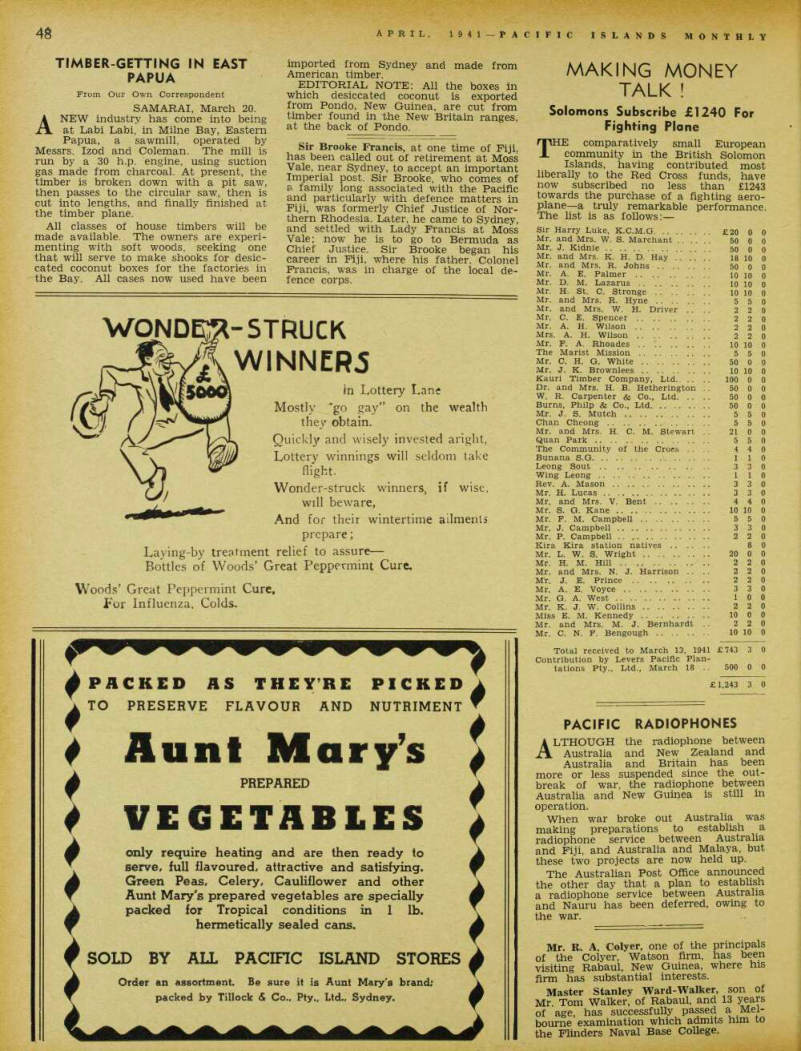
Papua
From Our Own Correspondent SAMARAI, March 20.
ANEW industry has come into being at Labi Labi, in Milne Bay, Eastern Papua, a sawmill, operated by Messrs. Izod and Coleman. The mill is run by a 30 h.p. engine, using suction gas made from charcoal. At present, the timber is broken down with a pit saw, then passes to the circular saw, then is cut into lengths, and finally finished at the timber plane.
All classes of house timbers will be made available. The owners are experi menting with soft woods, seeking one that will serve to make shocks for desic cated coconut boxes for the factories in the Bay. All cases now used have been
imported from Sydney and made from American timber.
EDITORIAL NOTE: All the boxes in which desiccated coconut is exported from Pondo, New Guinea, are cut from timber found in the New Britain ranges, at the back of Pondo.
Sir Brooke Francis, at one time of Fiji, has been called out of retirement at Moss Vale, near Sydney, to accept an important Imperial post. Sir Brooke, who comes of a family long associated with the Pacific and particularly with defence matters in Fiji, was formerly Chief Justice of Nor thern Rhodesia. Later, he came to Sydney, and settled with Lady Francis at Moss Vale; now he is to go to Bermuda as Chief Justice. Sir Brooke began his career in Fiji, where his father. Colonel Francis, was in charge of the local de fence corps.
Making Money
Talk !
Solomons Subscribe £1240 For Fighting Plane
rE comparatively small European
community in the British Solomon
Islands, having contributed most
liberally to the Red Cross funds, have now subscribed no less than £1243 towards the purchase of a fighting aero
plane—a truly remarkable performance.
The list is as follows: Sir Harry Luke, K.C.M.G £2O 0 0 Mr. and Mrs. W. S. Marchant 50 0 0 Mr. J. Kidnie 50 0 0 Mr. and Mrs. K. H. D. Hay 18 10 0 Mr. and Mrs. R. Johns 50 0 0 Mr. A. E. Palmer 10 10 0 Mr. D. M. Lazarus 10 10 0 Mr. H. St. C. Stronge 10 10 0 Mr. and Mrs. R. Hyne ... 550 Mr. and Mrs. W. H. Driver ... 220 Mr. C. E. Spencer 22 0 Mr. A. H. Wilson 220 Mrs. A. H. Wilson 220 Mr. F. A. Rhoades .. .. 10 10 0 The Marist Mission 550 Mr. C. H. G. White 50 0 0 Mr. J. K. Brownlees 10 10 0 Kauri Timber Company, Ltd 100 0 0 Dr. and Mrs. H. B. Hetherington .. 50 0 0 W. R. Carpenter & Co,, Ltd 50 0 0 Burns, Philp & Co., Ltd. 50 0 0 Mr. J. S, Mutch 5 5 0 Chan Cheong 550 Mr. and Mrs. H. C. M. Stewart . . 21 0 0 Quan Park 550 The Community of the Crocs ... 440 Bunana S.G 1 1 0 Leong Sout 330 Wing Leong 110 Rev. A. Mason 330 Mr. H. Lucas 330 Mr. and Mrs. V. Bent 4 4 0 Mr. S. G. Kane 10 10 0 Mr. F. M. Campbell 55 0 Mr. J. Campbell 3 3 0 Mr, P. Campbell 2 2 0 Kira Kira station natives 8 0 Mr. L. W. S. Wright 20 0 0 Mr. H. M. Hill .. 220 Mr. and Mrs. N. J. Harrison ... 220 Mr. J. E. Prince 220 Mr. A. E. Voyce 330 Mr. G. A. West 100 Mr. K. J. W. Collins 22 0 Miss E. M. Kennedy 10 0 0 Mr. and Mrs. M. J. Bernhardt .. 2 2 0 Mr. C. N. F. Bengough 10 10 0 Total received to March 13, 1941 £743 3 0 Contribution by Levers Pacific Plan tations Pty., Ltd., March 18 . 500 0 0 £1,243 3 0
Pacific Radiophones
ALTHOUGH the radiophone between Australia and New Zealand and Australia and Britain has been more or less suspended since the out break of war, the radiophone between Australia and New Guinea is still in operation.
When war broke out Australia was making preparations to establish a radiophone service between Australia and Fiji, and Australia and Malaya, but these two projects are now held up.
The Australian Post Office announced the other day that a plan to establish a radiophone service between Australia and Nauru has been deferred, owing to the war.
Mr. R. A. Colyer, one of the principals of the Colyer, Watson firm, has been visiting Rabaul, New Guinea, where his firm has substantial interests.
Master Stanley Ward-Walker, son of Mr Tom Walker, of Rabaul, and 13 years of age, has successfully passed a Mel bourne examination which admits him to the Flinders Naval Base College.
Advertisements & other items, pp. 52-53 (2 items)
Aunt Mary’s
WONDER- STRUCK
WINNERS
I sr. in Lottery Lane "go gay" on the wealth Mostly they obtain.
Quickly and wisely invested aright, Lottery winnings will seldom take flight.
Wonder-struck winners, if wise, will beware, And for their wintertime ailments prepare; Laying-by treatment relief to assure— Bottles of Woods’ Great Peppermint Cure, Woods’ Great Peppermint Cure.
For Influenza. Colds.
PACKED AS THEY’RE PICKED
TO PRESERVE FLAVOUR AND NUTRIMENT
Aunt Mary’s
PREPARED
VEGETABLES
only require heating and are then ready to serve, full flavoured, attractive and satisfying.
Green Peas, Celery, Cauliflower and other Aunt Mary's prepared vegetables are specially packed for Tropical conditions in 1 lb. hermetically sealed cans.
SOLD BY ALL PACIFIC ISLAND STORES
Order an assortment. Be sure it is Aunt Mary's brand; packed by Tillock & Co.. Pty. Ltd., Sydney.
Listening to
Their Home
Town..
Petty Officers, Peter Foster Cole and
Jim Ingall, of the U.S. cruiser "Portland", during the visit of the Ameri-
can Squadron to Brisbane, listening
to their home town on a Crammond
World Wide 1.4 volt Economy model
Portable.
Their praise of the performance was
without limits.
Anywhere and
Everywhere in the
World
. . .it's all the same to the Crammond.
Proved Performance
In fhe Tropics
Crammond Sets are widely sold throughout New Guinea and the Islands ... All coils and intermediates are impregnated and armour-plated against effects of moisture and heat, and furthermore, EVERY
RECEIVER CARRIES an
UNCONDITIONAL
GUARANTEE
y
EASY
TERMS
ANYWHERE
Full Range of 1.4 v.
Economy, Vibrator, Battery and All Electric in Portables. Mantels and Console Models.
FOR TWO YEARS
and a further TWO YEARS'
warranty against faulty
workmanship.
SERVICE AGENTS
ESTABLISHED
Two Service Agents are appointed, one in Port Moresby and one at Wau, and Crammond’s invite ap-
plications from others capable
of undertaking adjustments
or repairs.
Wewak, New Guinea.
Crammond Radio Mfg. Co. 8 Queen Street, Brisbane.
Dear Sirs, — Confirming my Radiogram of to-day which reads:—
“REPEAT ORDER MACDHUI
COMPLETE AERIAL, ETC.”
. . NIXON.
I am pleased to be able to inform you that I sold my Crammond yesterday to a friend who is going bush and intends to remain out about five months and as he could not wait for the “Macdhui”
I reluctantly let him have mine, and so put some business in your way and obliged him.
The set was much admired here and was going great guns, anH this morning I feel lost without it, so hope to get the new one without delay.
Wishing you every success and hoping to still do more for you in the future.
Yours faithfully.
(Sgd.) V. R. NIXON.
FREE SHORT WAVE
SELECTOR
carrying world-wide range, unique and given FREE. Simply send 2d. in stamps to cover postage.
HIVESVILLE, via PROSTON.
READ Crammond Radio Mfg. Co., Tiiio 8 Queen Street, Brisbane. ims Dear Sirs,— Many thanks for the short wave Selector which has proved to be a boon to me.
Yours faithfully,
(Sgd.) H. G. BALCHIN.
Crammond Radio
MANUFACTURING CO.
NO. 8 QUEEN STREET, BRISBANE.
Please send me full particulars of Models, Terms List, etc.
NAME
ADDRESS (P.1.M.)
State whether Battery, Vibrator, Economy, Electric.
Please use BLOCK LETTERS for name and address.
Your Radio

'T'O-DAY, more than ever before, residents in A the Pacific territories require high-class radio receiving sets. It is not only of interest to them, but it is vital to their safety that they should know the measure of the world’s news from day to day. For that reason, their radio sets must be, above all things, reliable.
Picture the plight of a man in an isolated place whose radio unexpectedly breaks down, and he cannot get repairs made. For that reason, readers of this journal probably will be interested in the business announcement in this issue of the well-known Queensland firm of Crammond Radio, who have been established in Brisbane for over 20 years as manufacturers of high-grade receivers. The firm announces that it has a wide range of receivers for sale, and that it has appointed two service agents—one in Port Moresby and one in Wau—and is seek ing other agents who are capable of under taking radio adjustments or repairs.—*** Mr. Fred. R. Isom, of Hautabu, Gua dalcanal, British Solomon Islands, and
Mrs. Isom, have been spending furlough
in Sydney. He is printer for the Mela nesian Mission, with which he has been associated for 28 years.
The death in December last of Mr.
Harry Forbes, formerly Clerk and
Accountant in the British Service in the New Hebrides, was announced in the Western Pacific High Commission Gaz ette in February.
New Governor
Native Welcome To
WHEN the new Administrator of Papua (Hon. H. L. Murray) was in Eastern Papua recently, he received a formal welcome in Samarai, by the half-castes and the natives. The addresses were made by Mazeppa Bacca, for the half-castes, and by a native of Wamira (near Dosmra) named Roy Namuri, for the natives.
Mazeppa’s address was brief, and in
English. Roy Namuri spoke in Wedauan,
which was translated by Yen. Arch deacon Thompson, of the Anglican Mission.
The picturesque phraseology of the native address, as translated by Arch deacon Thompson, is published in full:— In this meeting of natives we represent, not onlv ourselves, but also all the natives in this district. We offer our warmest greeting to you and we are very glad to gather here to meet vou; we are very glad indeed that you have been appointed to be our Administrator; we offer to you our respect and our confidence.
Sir William MacGregor, and other G n, '"’ , nors. whom we did not know personally, built up Panua and ruled it well, but now their work is finished and they are at rest. The late Sir Hubert Murray was our Governor, and in his hands Papua was well cared for for manv years: so that all the natives living on the coast, as also those in the hills, in every part of Papua, were instructed in the wavs of the Government, and the natives gave un all their old, bad customs. And now also Sir Hubert Murray is at rest.
The Papuans have full confidence in you, likewise in your work and in your authority.
Our children who ar° here to-dav. and others who are now growing no. and still others who are as yet unborn, will follow you and will be loyal to you in all the good work you may do.
Formerly we listened to the instruction of our grandfathers and our grandmothers, and we followed in their ways, but now we have nut all these things away and have planted our feet in your footprints, and we shall follow you closely. The name Papua is the name we honour and uphold.
We ask you to water the good seed, so that it may not wither. The name of this seed is Papua. All the natives join with us in this greeting and in this welcome.
The practice of wearing a bone in the septum of the nose is fairly common throughout the whole of Melanesia; but, according to anthro pologists, it is gradually disappearing. The younger generations of to-day do not regard it with very much favour—particularly as the insertion of the bone is rather painful.
NG Public Service
staff movements in the New Guinea A Public Service were announced in March:—
Transfers
Health Dept.—Dr. H. S. Roberts, Medical Officer, Salamaua to Kavieng.
District Services Dept.—L. S. Dix, Clerk, Sala maua to Rabaul.
Lands Dept.—B. T. Webb, Surveyor, Rabaul to Salamaua.
Agriculture Dept.—M. C. Crocker, Inspector and Instructor, Rabaul to Madang.
Temporary Engagements
Government Secretary’s Dept.—Mrs. E. Rich ards, Assistant Teacher.
District Services Dept.—L. J. Higgins, Clerk.
Health Dept.—Mrs. M. Ryan and Mrs. M. E.
Goss, Nurses.
Public Works Dept.—J. L. Ormond. Overseer Native Labour.
Police Force Transfers
W. H. Bedser, Warrant Officer, Madang to Wau; R. Watson, Warrant Officer, Rabaul to Wau.
Advertisements & other items, p. 54 (2 items)
Clvde
Stop experimenting with trouble.
How can you possibly know that you’ll get from here to there with an unsponsored battery you bought at a bargain price?
Stick to Clyde—the Batteries that not only have Australia’s largest commercial Engineering Works as a birthplace, but Batteries that are guaranteed unconditionally for long life and efficiency.
CLVDE
BATTERIES
"MORE POWER TO YOU"
Manufactured by
THE CLYDE ENGINEERING
CO. LTD.
Granville, N.S.W.
Main Sales & Service Division, 61-65 Wentworth Avenue, Sydney. ’Phone: M 6738.
Branches at Brisbane, Melbourne, Adelaide.
On Moth**.
it isacorrt cannD t © t e *hausa gents n{ Aerg° ne thG m \s of kno** n
*rr»sr3«
Th*ays a \\ $ subs^^f s> 1 refuse a» * u sta »n, ana spray *»". ° to humans.
P IS harmless - er lS
V Be sure the Kills, flies MotKs| Mosquitoes Cockroaches/ Silver-fish Bed Buos/ Ants
ALWAYS KILLS
Helped ?
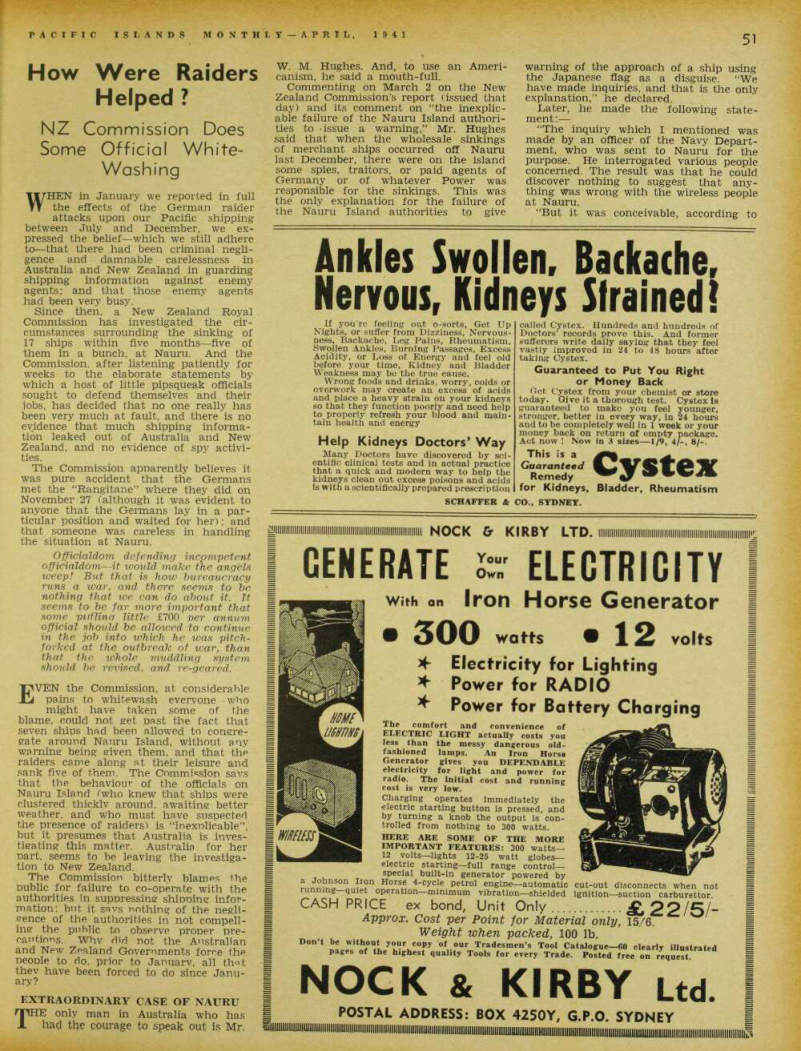
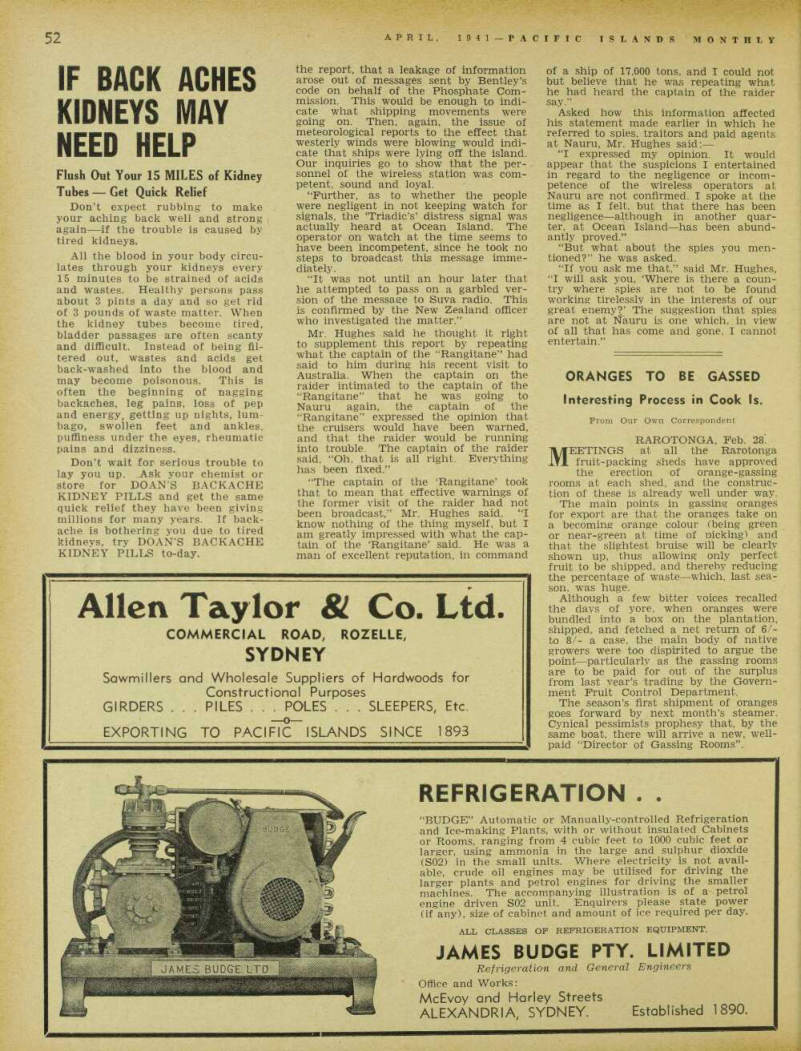
How Were Raiders
NZ Commission Does Some Official White- Washing
WHEN in January we reported in full the effects of the German raider attacks upon our Pacific shipping between July and December, we ex pressed the belief—which we still adhere to—that there had been criminal negli gence and damnable carelessness in Australia and New Zealand in guarding shipping information against enemy agents; and that those enemy agents had been very busy.
Since then, a New Zealand Royal Commission has investigated the cir cumstances surrounding the sinking of 17 ships within five 'months—five of them in a bunch, at Nauru. And the Commission, after listening patiently for weeks to the elaborate statements by which a host of little pipsqueak officials sought to defend themselves and their jobs, has decided that no one really has been very much at fault, and there is no evidence that much shipping informa tion leaked out of Australia and New Zealand, and no evidence of spy activi ties.
The Commission apnarently believes it was pure accident that the Germans met the “Rangitane” where they did on November 27 (although it was evident to anyone that the Germans lay in a par ticular position and waited for her); and that someone was careless in handling the situation at Nauru.
Officialdom defending incompetent officialdom —it would make the angels weep! But that is how bureaucracy runs a war, and there seems to he nothing that we can do about it. It seems to be far more important that some pirflina little £7OO ver annum official should be allowed to continue in the job into which he was pitch forked at the outbreak of war, than that the whole muddling system should be revised, and re-geared.
EVEN the Commission, at considerable pains to whitewash everyone who might have taken some of the blame, could not get past the fact that seven ships had been allowed to congre gate around Nauru Island, without any warning being given them, and that the raiders came along at their leisure and sank five of them. The Commission savs that the behaviour of the officials on Nauru Island (who knew that ships were clustered thicklv around, awaiting better weather, and who must have suspected the presence of raiders) is “inexnlicable”, but it presumes that Australia is inves tigating this matter. Australia for her part, seems to he leaving the investiga tion to New Zealand.
The Commission bitterly blames the public for failure to co-operate with the authorities in suppressing shipping infor mation: but it savs nothing of the negli gence of the authorities in not compell ing the public to observe proper pre cautions. Whv did not the Australian and New Zealand Governments force the people to do. prior to Januarv. all thev have been forced to do since Janu ary?
Extraordinary Case Of Nauru
THE only man in Australia who has had the courage to speak out is Mr,
W. M. Hughes. And, to use an Ameri canism, he said a mouth-full.
Commenting on March 2 on the New Zealand Commission’s report (issued that day) and its comment on “the inexplic able failure of the Nauru Island authori ties to 'issue a warning,” Mr. Hughes said that when the wholesale sinkings of merchant ships occurred off Nauru last December, there were on the island some spies, traitors, or paid agents of Germany or of whatever Power was responsible for the sinkings. This was the only explanation for the failure of the Nauru Island authorities to give
warning of the approach of a ship using the Japanese flag as a disguise. “We have made inquiries, and that is the only explanation,” he declared.
Later, he made the following state ment:^— “The inquiry which I mentioned was made by an officer of the Navy Depart ment, who was sent to Nauru for the purpose. He interrogated various people concerned. The result was that he could discover nothing to suggest that any thing was wrong with the wireless people at Nauru.
“But it was conceivable, according to
the re P° r L a leakage of information arose out of messages sent by Bentley’s code on behalf of the Phosphate Com mission. This would be enough to indi cate what shipping movements were going on. Then, again, the issue of meteorological reports to the effect that westerly winds were blowing would indi cate that ships were lying off the island.
Our inquiries go to show that the per sonnel of the wireless station was com petent, sound and loyal, “Further, as to whether the people were negligent in not keeping watch for signals, the ‘Triadic’s’ distress signal was actually heard at Ocean Island. The operator on watch at the time seems to have been incompetent, since he took no steps to broadcast this message imme diately.
“It was not until an hour later that he attempted to pass on a garbled ver sion of the message to Suva radio. This is confirmed by the New Zealand officer who investigated the matter.”
Mr. Hughes said he thought it right to supplement this report by repeating what the captain of the “Rangitane’’ had said Australia. When the captain on the raider intimated to the captain of the “Rangitane” that he was going to Nauru again, the captain of the “Rangitane” expressed the opinion that the cruisers would have been warned, and that the raider would be running into trouble. The captain of the raider said, “Oh, that is all right. Everything has been fixed ‘‘The captain of the ‘Rangitane took H? at , to mean that effective warnings of the former vlslt of the raider had not been broadcast/ - Mr Hughes said. “I know nothing of the thing myself, but I am grea tiy impressed with what the cap tain of the ‘Rangitane’ said. He was a man of excellent reputation, in command
of a ship of 17,000 tons, and I could not but believe that he was repeating what he had heard the captain of the raider say.”
Asked how this information affected his statement made earlier in which he referred to spies, traitors and paid agents at Nauru, Mr. Hughes said; — “I expressed my opinion. It would appear that the suspicions I entertained in regard to the negligence or incom petence of the wireless operators at Nauru are not confirmed. I spoke at the time as I felt, but that there has been negligence—although in another quar ter, at Ocean Island —has been abund antly proved.”
“But what about the spies you men tioned?” he was asked.
“If you ask me that,” said Mr. Hughes, “I will ask you, ‘Where is there a coun try where spies are not to be found working tirelessly in the interests of our great enemy T The suggestion that spies are not at Nauru is one which, in view of all that has come and gone, I cannot entertain.”
Advertisements & other items, pp. 55-56 (1 item)
Nervous, Kidneys Strained!
Ankles Swollen, Backache, Nervous, Kidneys Strained!
If you’re feeling out o-sorts. Get Up Nights, or suffer from Dizziness, Nervousness, Backache, Leg Pains, Rheumatism, Swollen Ankles, Burning Passages, Excess Acidity, or Loss of Energy and feel old before your time, Kidney and Bladder Weakness may be the true cause.
Wrong foods and drinks, worry, colds or overwork may create an excess of acids and place a heavy strain on your kidneys so that they function poorly and need help to properly refresh your blood and maintain health and energy
Help Kidneys Doctors’ Way
Many Doctors have discovered by scientific clinical tests and in actual practice that a quick and modern way to help the kidneys clean out excess poisons and acids Is with a scientifically prepared prescription
called Cystex. Hundreds and hundreds of Doctors’ records prove this. And former sufferers write daily saying that they feel vastly improved in 24 to 48 hours after taking Cystex.
Guaranteed to Put You Right or Money Back Get Cystex from your chemist or store today. Give it a thorough test. Cystex Is guaranteed to make you feel younger, stronger, better in every way, in 24 hours and to be completely well in 1 week or your money back on return of empty package.
Act now ! Now in 3 sizes—1/9, 4/-, 8/-.
for Kidneys, Bladder, Rheumatism
This is a Guaranteed
Remedy
Cystex
SCHAFFER 8c CO.. SYDNEY.
NOCK & KIRBY LTD. iiiiiiiiiiiiiiiiii mr.
GENERATE Jr ELECTRICITY
imm
1 mm
with on Iron Horse Generator
300
watts
1 2 volts
4 Electricity for Lighting
* Power for RADIO
Power for Battery Charging
The comfort and convenience of ELECTRIC LIGHT actually costs you less than the messy dangerous oldfashioned lamps. An Iron Horso Generator gives you DEPENDABLE electricity for light and power for radio. The initial cost and running cost is very low.
Charging operates Immediately the electric starting button is pressed, and by turning a knob the output is controlled from nothing to 300 watts.
HERE ARE SOME OF THE MORE
IMPORTANT FEATURES: 300 watts—
-12 volts—lights 12-25 watt globes— electric starting—full range controlspecial built-in generator powered by —• 4-cycle petrol engine—automatic cut-out disconnects when not u nmg quiet operation—minimum vibration—shielded ignition—suction carburettor.
CASH PRICE ex bond, Unit Only 4? 22/5/- Approx. Cost per Point for Material only , 15/6 KJI Weight when packed, 100 lb.
Don’t be without your copy of our Tradesmen’s Tool Catalogue—6o clearly illustrated pages of the highest quality Tools for every Trade. Posted free on request.
NOCK & KIRBY Ltd.
I POSTAL ADDRESS: BOX 4250 Y, G.P.O. SYDNEY I
iiUMHUHHIII?
IF BACK ACHES
KIDNEYS MAY
NEED HELP
Flush Out Your 15 MILES of Kidney
Tubes Get Quick Relief
Don’t expect rubbing to make your aching back well and strong again—if the trouble is caused by tired kidneys.
All the blood in your body circulates through your kidneys every 15 minutes to be strained of acids and wastes. Healthy persons pass about 3 pints a day and so get rid of 3 pounds of waste matter. When the kidney tubes become tired, bladder passages are often scanty and difficult. Instead of being filtered out, wastes and acids get back-washed into the blood and may become poisonous. This is often the beginning of nagging backaches, leg pains, loss of pep and energy, getting up nights, lumbago, swollen feet and ankles, pufflness under the eyes, rheumatic pains and dizziness.
Don’t wait for serious trouble to lay you up. Ask your chemist or store for DOAN’S BACKACHE KIDNEY PILLS and get the same quick relief they have been giving millions for many years. If backache is bothering you due to tired kidneys, try DOAN’S BACKACHE KIDNEY PILLS to-day.
Allen Taylor 81 Co. Ltd.
COMMERCIAL ROAD, ROZELLE,
SYDNEY
Sawmillers and Wholesale Suppliers of Hardwoods for Constructional Purposes GIRDERS . . . PILES . . . POLES . . . SLEEPERS, Etc.
EXPORTING TO PACIFIC ISLANDS SINCE 1893
dli
JAMES BUDGE LTD
REFRIGERATION . .
“BUDGE” Automatic or Manually-controlled Refrigeration and Ice-making Plants, with or without insulated Cabinets or Rooms, ranging from 4 cubic feet to 1000 cubic feet or larger, using ammonia in the large and sulphur dioxide (SO2) in the small units. Where electricity is not available, crude oil engines may be utilised for driving the larger plants and petrol engines for driving the smaller machines. The accompanying illustration is of a petrol engine driven SO2 unit. Enquirers please state power (if any), size of cabinet and amount of ice required per day.
ALL CLASSES OF REFRIGERATION EQUIPMENT.
JAMES BUDGE PTY. LIMITED
Refrigeration and General Engineers Office and Works:
McEvoy and Harley Streets
ALEXANDRIA, SYDNEY. Established 1890.
Oranges To Be Gassed
Interesting Process in Cook Is.
From Our Own Correspondent
Rarotonga, Feb. 28!
MEETINGS at all the Rarotonga fruit-packing sheds have approved the erection of orange-gassing rooms at each shed, and the construc tion of these is already well under way.
The main points in gassing oranges for export are that the oranges take on a becoming orange colour (being green or near-green at time of nicking) and that the slightest bruise will be clearly shown up, thus allowing only perfect fruit to be shipped, and thereby reducing the percentage of waste —which, last sea son, was huge.
Although a few bitter voices recalled the days of yore, when oranges were bundled into a box on the plantation, shipped, and fetched a net return of 6/to 8/- a case, the main body of native growers were too dispirited to argue the point—particularly as the gassing rooms are to be paid for out of the surplus from last year’s trading by the Govern ment Fruit Control Department.
The season’s first shipment of oranges goes forward by next month’s steamer.
Cynical pessimists prophesy that, by the same boat, there will arrive a new, well paid “Director of Gassing Rooms”.
Advertisements & other items, pp. 57-58 (2 items)
53
PAci t i C ISLANDS MONTHLY APRIL, 1941
tTH MASOiftTEf
NOHftS THE TIME
TO MODERNISE
THE demands and requirements of troubled times
have probably dispelled—"-for the duration”—your
dreams of a new home. But there is no need whatsoever to allow Hitler & Co. to intern you in that home which has grown a little shabby or a little out-moded. You can transform it; amplify it; give it new rooms. You can add or modernise verandahs, carry out a dozen-and-one delightful plans for rejuvenating and glamorising your present home. Those dingy walls can be charmingly concealed; those worn floors given new strength and eye-appeal. Be thankful for Masonite—the grainless, splinlerless, steelstrong boards which can be worked with ordinary tools, bent, grooved, bevelled, painted, lacquered—treated and finished in any way your heart or mind may desire. Modernising with Masonite is INEXPENSIVE (many of the smaller alterations you can do yourself), yet the joh will last for the duration of your life.
Masonite Quartrboard De-Luxe, Presdwood, weather-defying Tempered Presdwood and tile-like Temprtile come to you or your builder in boards up to 12' x 4'—the most versatile all-wood boards ever produced—rightly praised all over the world as “The Wonder Boards of 1000 Uses”!
MODERNISE WITH
t ☆ Masonite boards are made in Australia from Australian timbers hitherto thought commercially useless. They possess the advantages of wood without its disadvantages.
Masonite is used for both modernisation and new construction: for floors, counter tons
Minim
and table tops, for "tiling**, for partitioning in fact, for "1,000 uses".
PRESDWOOD
TEMPRTILE
THE COLONIAL SUGAR REFINING CO. LTD. (Building Materials Division) . .
. . . TEMPERED PRESDWOOD
..QUARTRBOARD DE-LUXE
Sydney . . Melbourne . . Brisbane . . Adelaide . . Perth
“ Shorts” For Small Jobs
Masonite ‘‘Shorts ” — off-cuts from large sheets—are identical in quality with the standard Masonite Boards, hut are offered at considerably reduced prices.
They’re ideal for small jobs such as those shown here and are available in sizes up to 4 m x 4 in. and in i in. and 3/16 in. thicknesses. t i
NUT & SCREW BOX.
DOG KENNEL.
TOOL RACK.
Ine/ie!d mmzm
SAUCE
lliedhiiOteh UteWcrld cmf
ECONOMICAL. BECAUSE YOU NEED
JUST A FEW DROPS AT A TIME -
Send Your Next Grocery Order to . . .
McILRATH’S
WHERE YOUR MONEY BUYS MORE
I.X.L. Peaches in Syrup, 16 oz 6/3 doz.; Case Lots 4 doz., 24/- case Nestle’s Pure Cream, 4 oz 3/9 doz.; Case Lots 8 doz., 28/- case I.X.L. Best Assorted Jam, 12 oz 7/- doz.; Case Lots 6 doz., 36/- case Sunshine Full Cream Pdr. Milk, 12 oz.. 14/3 doz.; Case Lots 3 doz., 42/- case Ideal Unsweetened Milk, case lots 8 doz. 6 oz. or 4 doz. 12 oz. tins 21/- case Brookes Grape Fruit Juice, 10 oz 8 3 doz.; Case Lots 2 doz., 15/6 case I.X.L. Tomato Juice 10 oz., 5/3 doz.; 15 oz., 7/3 doz.
Nestle’s Malted Milk, 16 oz 2/3 tin; 26/- doz.
Red Feather Camp Pie ... 8 oz., 5/9 doz.; 12 oz., 7/9 doz.; 16 oz., 9/3 doz.
Norco Pork Sausages, 16 oz lid. tin; 10/6 doz.
Pure Tomato Sauce, 10 oz 7d. hot.; 6/9 doz.
Gartside’s Sweet Corn, New Season’s, 10 oz tin; 7/3 doz.
Rosa Best Western Honey, 2 lb 1/6 jar; 17/9 doz.
Yoga Tea, Australia’s Best Tea Value, 6 lb. tins 2/5 lb.
Mcllrath’s Special Sweet Sherry, 26 oz 2/2 bot.; 25/6 doz.
Selmore Port, Sherry and Muscat, 40 oz 2/9 flagon; 32/- doz.
Penfold’s Royal Reserve Port, 26 oz 3/9 bot.; 44/- doz.
HALF-DOZEN LOTS CHARGED AT DOZEN RATES.
All Prices F. 0.8. Sydney. Cases and packing free.
All consignments carried by air are packed in special fibre cartons— without extra charge—in order to reduce aerial freight.
Comprehensive Price Lists Available Post Free.
McILRATH’S Pty. Ltd.
EXPORT DEPARTMENT
202-204 PITT STREET, SYDNEY
AUSTRALIA
A Section For Women
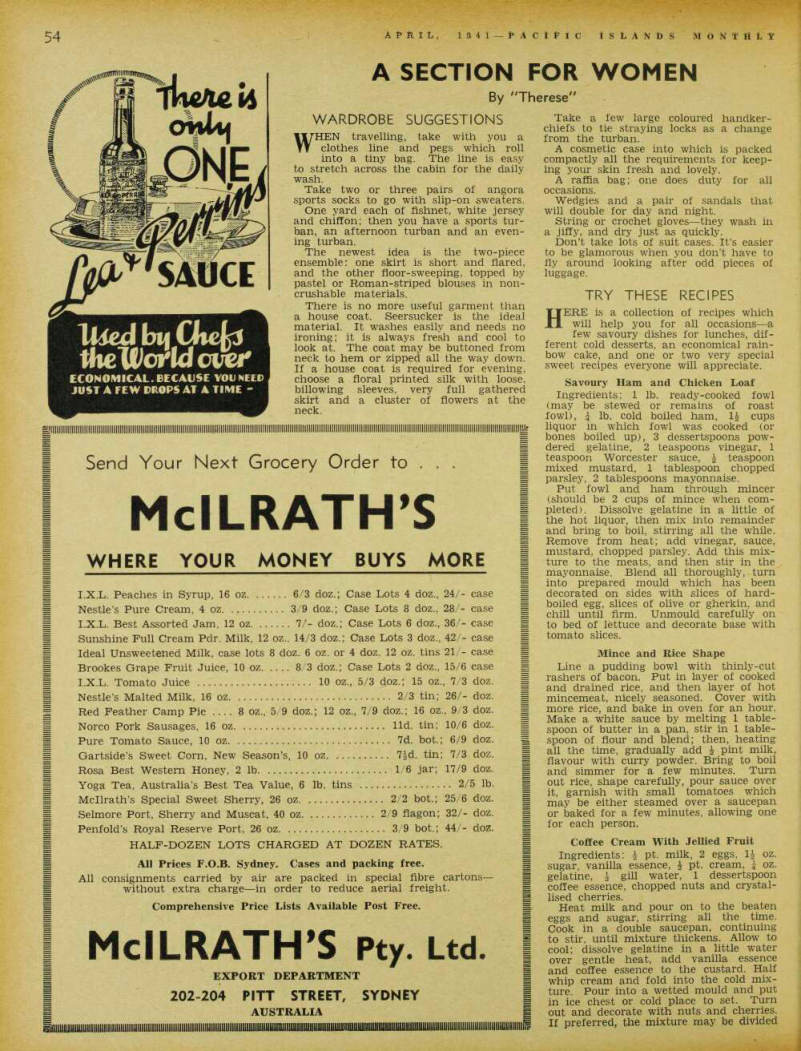
By "Therese"
Wardrobe Suggestions
WHEN travelling, take with you a clothes line and pegs which roll into a tiny bag. The line is easy to stretch across the cabin for the daily wash.
Take two or three pairs of angora sports socks to go with slip-on sweaters.
One yard each of fishnet, white jersey and chiffon; then you have a sports tur ban, an afternoon turban and an even ing turban.
The newest idea is the two-piece ensemble: one skirt is short and flared, and the other floor-sweeping, topped by pastel or Roman-striped blouses in non crushable materials.
There is no more useful garment than a house coat. Seersucker is the ideal material. It washes easily and needs no ironing; it is always fresh and cool to look at. The coat may be buttoned from neck to hem or zipped all the way down.
If a house coat is required for evening, choose a floral printed silk with loose, billowing sleeves, very full gathered skirt and a cluster of flowers at the neck.
Take a few large coloured handker chiefs to tie straying locks as a change from the turban.
A cosmetic case into which is packed compactly all the requirements for keep ing your skin fresh and lovely.
A raffia bag; one does duty for all occasions.
Wedgies and a pair of sandals that will double for day and night.
String or crochet gloves—they wash in a jiffy, and dry just as quickly.
Don’t take lots of suit cases. It’s easier to be glamorous when you don’t have to fly around looking after odd pieces of luggage.
Try These Recipes
HERE is a collection of recipes which will help you for all occasions—a few savoury dishes for lunches, dif ferent cold desserts, an economical rain bow cake, and one or two very special sweet recipes everyone will appreciate.
Savoury Ham and Chicken Loaf Ingredients: 1 lb. ready-cooked fowl (may be stewed or remains of roast fowl), i lb. cold boiled ham, li cups liquor in which fowl was cooked (or bones boiled up), 3 dessertspoons pow dered gelatine, 2 teaspoons vinegar, 1 teaspoon Worcester sauce, £ teaspoon mixed mustard, 1 tablespoon chopped parsley, 2 tablespoons mayonnaise.
Put fowl and ham through mincer (should be 2 cups of mince when com pleted). Dissolve gelatine in a little of the hot liquor, then mix into remainder and bring to boil, stirring all the while.
Remove from heat; add vinegar, sauce, mustard, chopped parsley. Add this mix ture to the meats, and then stir in the mayonnaise. Blend all thoroughly, turn into prepared mould which has been decorated on sides with slices of hard boiled egg, slices of olive or gherkin, and chill until firm. Unmould carefully on to bed of lettuce and decorate base with tomato slices.
Mince and Rice Shape Line a pudding bowl with thinly-cut rashers of bacon. Put in layer of cooked and drained rice, and then layer of hot mincemeat, nicely seasoned. Cover with more rice, and bake in oven for an hour.
Make a white sauce by melting 1 table spoon of butter in a pan, stir in 1 table spoon of flour and blend; then, heating all the time, gradually add i pint milk, flavour with curry powder. Bring to boil and simmer for a few minutes. Turn out rice, shape carefully, pour sauce over it, garnish with small tomatoes which may be either steamed over a saucepan or baked for a few minutes, allowing one for each person.
Coffee Cream With Jellied Fruit Ingredients; i pt. milk, 2 eggs, U oz. sugar, vanilla essence, i pt. cream, £ oz. gelatine, \ gill water, 1 dessertspoon coffee essence, chopped nuts and crystal lised cherries.
Heat milk and pour on to the beaten eggs and sugar, stirring all the time.
Cook in a double saucepan, continuing to stir, until mixture thickens. Allow to cool; dissolve gelatine in a little water over gentle heat, add vanilla essence and coffee essence to the custard. Half whip cream and fold into the cold mix ture. Pour into a wetted mould and put in ice chest or cold place to set. Turn out and decorate with nuts and cherries.
If preferred, the mixture may be divided
into individual sweet dishes and deco rated before serving. Served with jel lied fruit, either as a top layer or sep arately, this cream is very popular.
Banana and Coffee Meringue Ingredients; 4 or 5 bananas, \ pt. strong coffee, 4 small sponge cakes or sponge coffee, 4 small teaspoons cornflour, i pt. milk, 2 tablespoons sugar, 2 egg whites, 1 dessertspoon butter, 2 table spoons apricot jam.
Spread jam in the bottom of a lightly buttered oven dish and cover with banana slices. Blend cornflour with half of the sugar, and a little extra cold milk. Boil the milk with the coffee and pour on to blended cornflour, then return to the pan and cook, stirring all the while, for a few minutes. Add butter and remainder of sliced bananas. Allow to cool a little, then whisk egg whites stiffly with remainder of the sugar and pile high on top of the pudding. Bake in a moderate oven for Creamy Caramel Ingredients: i lb. butter, \ lb. sugar, 1 tin sweetened condensed milk.
Put butter and sugar into a pan and let it melt over a low heat, mixing well together and stirring all the while. Then, very slowly, pour in the condensed milk.
If you have an asbestos mat use it, as mixture is inclined to “catch” on the bottom of the pan for a while. Stir thoroughly over low heat until mixture becomes pale caramel brown and sets into a soft ball. Pour into a buttered dish, allow to cool, then cut into squares.
Rainbow Cake Ingredients: i lb. butter, i lb. sugar, 3 eggs, i cup milk, i lb. flour sifted with 2 teaspoons cream of tartar and 1 tea spoon carbonate soda, 1 dessertspoon cocoa, cochineal, vanilla.
Beat butter and sugar to a cream; add egg yolks and beat again. Stiffly whisk the whites and fold them into the mix ture. Lastly sift in the flour mixture and blend thoroughly. Divide mixture into three parts—put one part plain, flavoured with vanilla, into a greased sandwich tin; tint the second with cochineal to make a delicate pink; and add cocoa to the third part. Spread both coloured parts into separate buttered sandwich tins the same size as the first, and bake in a moderate oven until cooked. Put together when cold with lemon cheese or icing. Ice all over.
When Mishaps Occur
Even in the best regulated households mishaps occur, but when they hap pen in the kitchen there is no need to waste the food, for a little simple first aid will work wonders.
Burnt Milk If you burn milk when boiling it for the day, the burnt taste can be avoided by pouring it at once from the saucepan into a jug, then placing the jug into a basin of cold water. When the milk is cold the burnt taste will have disappeared.
If the milk has boiled over and made a mess on your stove, sprinkle well with a little salt. The disagreeable smell will vanish and later the dried remains can be brushed off.
Over-boiled Potatoes When potatoes have been left so long that they have over-boiled and broken into pieces, drain off all the moisture possible. Put the pot over a low flame, leaving the lid off; stir frequently until the excess moisture has evaporated. Add a lump of butter and salt or pepper to taste; beat well with a fork; add finely chopped parsley and serve as mashed potato.
Curdled Mayonnaise When mayonnaise is made in a hurry, it may be curdled by adding oil too quickly. To correct this, put an extra egg yolk into a basin, add the strained curdled sauce to it drop by drop, stirring all the time with a wooden spoon—if possible, stand the basin on ice.
Mr. VV. M. Livie, Inspecting Engineer for the Colonial Sugar Refining Co., visited Fiji in March.
Advertisements & other items, pp. 59-60 (2 items)
Ask Jl
Unique Delicacy
Tiki Toheroa Soup is a unique delicacy. In this concentrated soup is retained all the goodness and delicious flavour of the Toheroa, found only on the Ninety Mile Beach, New Zealand. Tiki Toheroa Soup is prepared in a few minutes. Ask for it at your store.
Packed in i and 1 lb. tins.
TIKI
TOHEROA
SOUP
TUCKER & CO. PTY. LIMITED,
SYDNEY.
~~4 I
Ask Jl
or -s
LINGER lE.
\ 1 £i f
You II
its extra
quality
* .. * ■: v
FROM ALL AUSTRALIAN DEPT. STORES
And in the Pacific from Burns Philp & Co. Ltd.
V * * * ~v o vO it*** ct* ot* v t»' C CO No technical knowledge required . . .
Keep in touch with the world expedite business transactions —be prepared to quickly call medical or other services in an emergency.
Install an A.W.A. Teleradio 38.
Compact radiotelephone providing communication facilities for parts beyond the reaches of landlines. Reliable and economical.
Illustrated booklet and quotations gladly supplied on request.
AMALGAMATED WIRELESS (A/SIA) LIMITED
47 YORK STREET, SYDNEY 167 QUEEN STREET, MELBOURNE Branches at: Wellington, Suva, Rabaul, Port Moresby and other island centres.
56
APRIL, i94i-PAclFic Islands monthly
Comparative War Efforts
Letter to the Editor WE continually read comparisons, made by English visitors—musical and otherwise—between the complacent attitude to the war of the average Aus tralian and the all-in effort of the British people.
It is not often a fair comparison, as the conditions are different. Right here, against our door, in the Pacific, doing the same class of work and service, we have two parallel services, working al most side by side. One, the Papua and New Guinea Administration actually two separate services, but for the sake of comparison they arp taken together— -100 per cent. Australian, and the other, the Western Pacific High Commission, 99 per cent. British.
From the 100 per cent. Australian Ad ministrations, according to the “PIM”, over 60 have gone on active service in one capacity or another, and only a few temporary officers have filled the vacan cies thus caused.
From the 99 per cent. British service, few have gone. It is known that the of ficial attitude to joining up is prohibitory.
Officers have been warned that anyone going on active service will not be re stored to his position. In other words, he will be dismissed from the service if he goes.
What would be said of a commercial firm that took this attitude?
Are the New Hebrides, Solomon Islands, Gilbert Is., etc., officials so much more useful than those of New Guinea, that they cannot be spared?
I am, etc..
Australian.
New Hebrides, 7/3/41.
EDITORIAL NOTE; Australians, New Guinea-ites, officials of the Western Paci fic Commission —all are of exactly the same breed as the people of Britain, and comparisons such as the foregoing are not only invidious, but useless. In such struggles as that now proceeding, it is the breed that counts—or (to use better known terms) morale, or “guts”. Breed is the thing that makes the German a formidable foe, and the Italian much less formidable. Apart from that, it is prob able that the New Guinea-Papua services are much more liberally staffed than those of Solomons. New Hebrides, etc.
The Bamu River Mission
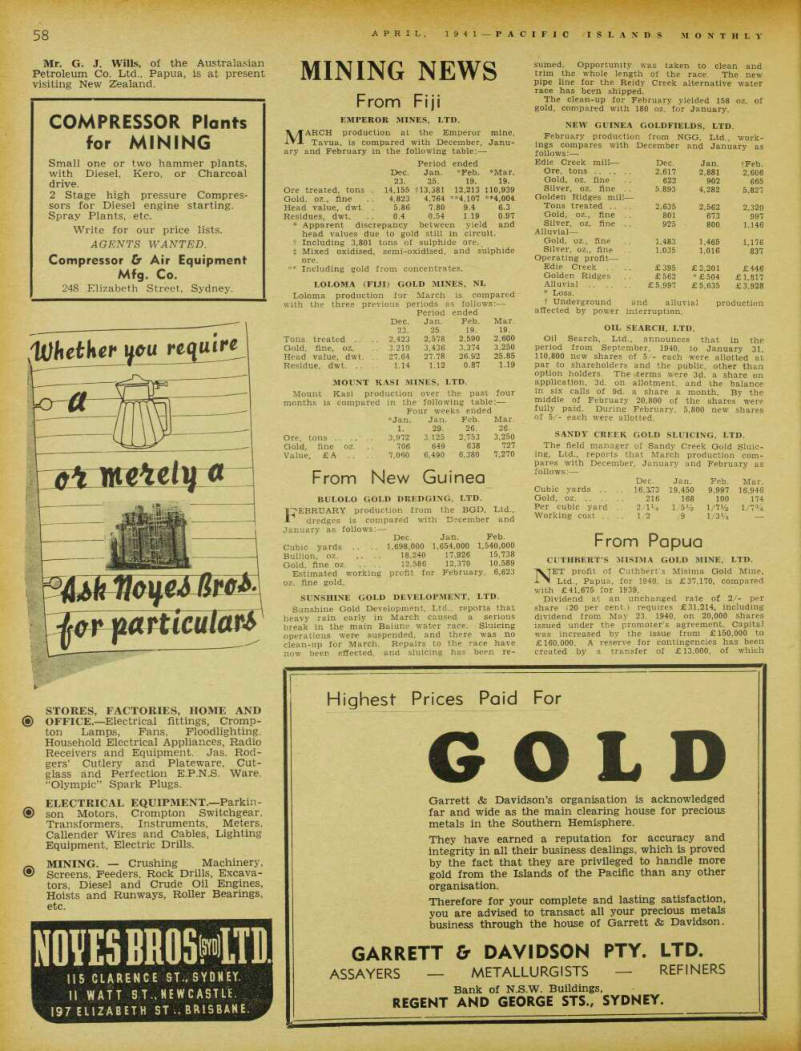
OUT in the dripping jungle, on the western coast of the Gulf of Papua, where it seems to be always rain ing, where the prevailing land is mud flat, and there are approximately a mil lion mosquitoes to each individual of the numerous native population, Mr. Harry Standen and his wife, Eva, carry on what is now called the Bamu River Mission.
If there had been no Fly River to rank among the biggest rivers in the world, the Bamu River might be famous —but, as it is, the Bamu, although a very big waterway, is overshadowed by the huge Fly River, a hundred miles south.
Several years ago Mr. and Mrs. Stan den were members of the UF Mission in Papua and there they learned something of the clamant needs of the numerous peoples of the Bamu River delta, living mostly under wretched conditions of disease and ignorance. So, early in 1936 these two young people married and went off to the Bamu River, practically on their own account, to do what they could for the poor natives. For nearly five years now they have been carrying
on, with the assistance of a number of big-hearted people in Australia —mostly in Sydney, where under the inspiration of Rev. H. M. Arrowsmith, of Church House, Sydney, and Miss M. Nicholas, of 6 Day Street, Marrickville —they are carrying on educational and medical work.
It is hard, difficult and frequently dis couraging work; but, by increasing de grees, they are seeing some results. At first they travelled very dangerously about these queer waterways in the delta of the Bamu, depending for trans port upon native canoes. Then a few friends clubbed together and provided them with a 25 ft. launch, the “Pioneer’’, and this, with its comfort, speed and safety, has been a godsend to them.
The Standens are concentrating upon the children. Up the river from them there are about 20 large villages, and they have followed the system of taking two selected boys from each of the vil
lages and bringing them to their mis sion station, at Maipani, on the lower Bamu. for training in medical and edu cational work. Soon, those trained boys will be available to go back into the natives villages, to heal and educate.
This is just one small example of the work that is being done unostentatiously in little, out-of-the-way places in these great primitive lands by small bands of devoted missionaries.
His Honour Mr. James Scott Neill, Ad ministrator of Dominica, who was a warded a CMG recently, is well known in the Central Pacific. He commenced his Service career in Fiji in 1914 and served at various places in the Colony as a District Officer before he was transferred to Tonga as British Agent and Consul in 1927. He was appointed to his present post four years ago.
Mr. G. J. Wills, of the Australasian Petroleum Co. Ltd., Papua, is at present visiting New Zealand.
Advertisements & other items, pp. 61-62 (1 item)
m*
VVa iPm K Ji r* yt m m Delicious IXL Canned Foods —Jams—Soups & Sauces are Australia's choicest quality * Obtainable from all Leading Island Storekeepers.
H. JONES & CO. PTY. LTD.
HOBART & SYDNEY
COMPRESSOR Plants
for MINING
Small one or two hammer plants, with Diesel, Kero, or Charcoal drive. 2 Stage high pressure Compressors for Diesel engine starting.
Spray Plants, etc.
Write for our price lists.
AGENTS WANTED.
Compressor & Air Equipment
Mfg. Co.
248 Elizabeth Street, Sydney.
Whet her you require
07 m\ s.
STORES, FACTORIES. HOME AND
(5) OFFICE. —Electrical fittings, Crompton Lamps, Fans, Floodlighting.
Household Electrical Appliances, Radio Receivers and Equipment. Jas. Rodgers’ Cutlery and Plateware, Cutglass and Perfection E.P.N.S. Ware.
“Olympic” Spark Plugs.
ELECTRICAL EQUIPMENT.—Parkin-
son Motors, Crompton Switchgear, Transformers, Instruments, Meters, Callender Wires and Cables, Lighting Equipment, Electric Drills. MINING. Crushing Machinery, ® Screens, Feeders, Rock Drills, Excavators, Diesel and Crude Oil Engines, Hoists and Runways, Roller Bearings, etc.
NOVESBROSmLTO
lIS CLARENCE ST., SYDNEY.
II WATT S T., HEWCASTLE.
L 197 ELIZABETH ST BRISBANE, .
Highest Prices Paid For
GO L D
Garrett & Davidson’s organisation is acknowledged far and wide as the main clearing house for precious metals in the Southern Hemisphere.
They have earned a reputation for accuracy and integrity in all their business dealings, which is proved by the fact that they are privileged to handle more gold from the Islands of the Pacific than any other organisation.
Therefore for your complete and lasting satisfaction, you are advised to transact all your precious metals business through the house of Garrett & Davidson.
GARRETT & DAVIDSON PTY. LTD.
ASSAYERS METALLURGISTS REFINERS
Bank of N.S.W. Buildings,
REGENT AND GEORGE STS., SYDNEY.
Mining News
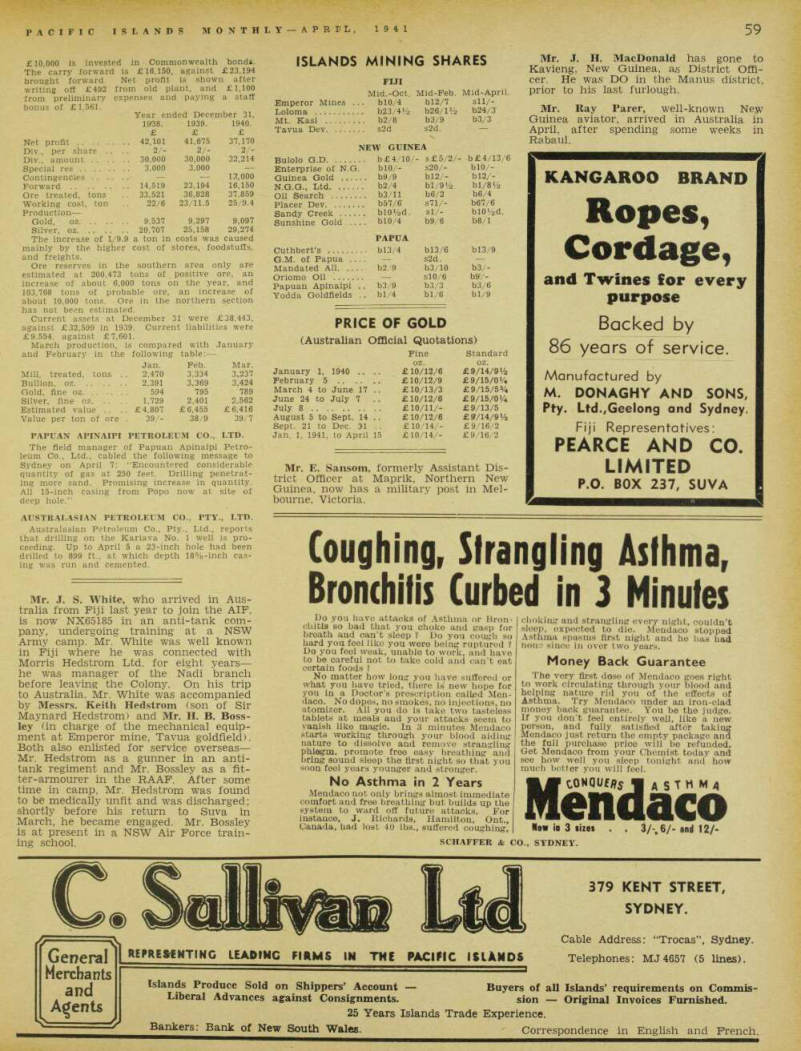
From Fiji
Emperor Mines, Ltd.
MARCH production at the Emperor mine, Tavua, is compared with December, Janu ary and February in the following table: —
Loloma (Fiji) Gold Mines, Nl
Loloma production for March is compared with the three previous periods as follows: —
Mount Kasi Mines, Ltd.
Mount Kasi production over the past four months is compared in the following table; —
From New Guinea
Bulolo Gold Dredging, Ltd.
F'EBRUARY production from the BGD, Ltd., dredges is compared with December and January as follows; —■
Sunshine Gold Development, Ltd.
Sunshine Gold Development, Ltd., reports that heavy rain early in March caused a serious break in the main Baiune water race. Sluicing operations were suspended, and there was no clean-up for March. Repairs to the race have now been effected, and sluicing has been re
sumed. Opportunity was taken to clean and trim the whole length of the race. The new pipe line for the Reidy Creek alternative water race has been shipped.
The clean-up for February yielded 158 oz. of gold, compared with 180 oz. for January.
New Guinea Goldfields, Ltd.
February production from NGG, Ltd., work ings compares with December and January as follows:
Oil Search, Ltd.
Oil Search, Ltd., announces that in the period from September, 1940. to January 31, 110,800 new shares of 5 - each were allotted at par to shareholders and the public, other than option holders. The terms were 3d. a share on application, 3d. on allotment, and the balance in six calls of 9d. a share a month. By the middle of February 20,800 of the shares were fully paid. During February, 5,800 new shares of 5/- each were allotted.
Sandy Creek Gold Sluicing, Ltd.
The field manager of Sandy Creek Gold Sluic ing, Ltd., reports that March production com pares with December, January and February as follows:
From Papua
Cuthbert’S Misima Gold Mine, Ltd.
NET profit of Cuthberfs Mislma Gold Mine, Ltd., Papua, for 1940, is £37,170, compared with £41,675 for 1939.
Dividend at an unchanged rate of 2/- per share (20 per cent.) requires £31,214, including dividend from May 23. 1940, on 20,000 shares issued under the promoter’s agreement. Capital was increased by the issue from £150,000 to £160,000. A reserve for contingencies has been created by a transfer of £13,000, of which
Period ended Dec. Jan. *Feb. *Mar. 23. 25. 19. 19.
Ore treated, tons . 14,155 f13,381 12,213 J10,939 Gold, oz., fine 4.823 4,764 **4,107 **4,004 Head value, dwt. . 5.86 7.80 9.4 6.3 Residues, dwt. 0.4 0.54 1.19 0.97 * Apparent discrepancy between yield and head values due to gold still in circuit. t Including 3,801 tons of sulphide ore. t Mixed oxidised, , semi-oxidised, and sulphide ore. ** Including gold from concentrates.
Period ended Dec. Jan. Feb. Mar. 23. 25. 19. 19.
Tons treated . . . . 2,423 2,578 2,590 2,600 Gold, fine, oz. . . 3.210 3,436 3,374 3,250 Head value, dwt. . 27.64 27.78 26.9’2 25.85 Residue, dwt 1.14 1.12 0.87 1.19
Four weeks ended *Jan.
Jan.
Feb.
Mar. 1. 29. 26. 26.
Ore, tons 3,972 3.125 2,753 3.250 Gold, fine oz. 706 649 638 727 Value. £ A 7,060 6,490 6.380 7,270
Dec.
Jan.
Feb.
Cubic yards .. 1,698,000 1,654,000 1,540,000 Bullion, oz 18,240 17,926 15,738 Gold, fine oz 12,586 12,370 10,589 Estimated working profit for February, 6,623 oz. fine gold.
Edie Creek mill— Dec.
Jan. tPeb.
Ore, tons . . .. 2.617 2,881 2,606 Gold, oz. fine 622 902 665 Silver, oz. fine 5.893 4,282 5,827 Golden Ridges mill— Tons treated . . 2,535 2,562 2,320 Gold, oz., fine 801 673 997 Silver, oz. fine 925 800 1.146 Alluvial— Gold, oz., fine 1,483 1,465 1,176 Silver, oz., fine 1,035 1,016 837 Operating profit— Edie Creek £ 395 £2,201 £446 Golden Ridges £562 4 £504 £1,817 Alluvial £5,997 £5,635 £3,928 * Loss. t Underground and alluvial production affected by power interruption.
Dec. Jan. Feb. Mar.
Cubic yards . . . . 16.3.73 19,450 9,997 16,946 Gold, oz 216 168 100 174 Per cubic yard . 2 1 J 4 l/5Va l/7y 2 l/7 3 4 Working cost .. .. 1/2 /9 1/3 V 4
£ 10,000 is invested in Commonwealth bonds.
The carry forward is £16,150, against £23,194 brought forward. Net profit is shown after writing off £492 from old plant, and £l,lOO from preliminary expenses and paying a staff bonus of £1,561.
The increase of 1/9.9 a ton in costs was caused mainly by the higher cost of stores, foodstuffs, and freights.
Ore reserves in the southern area only are estimated at 200,473 tons of positive ore, an increase of about 6,000 tons on the year, and 103,768 tons of probable ore, an increase of about 10,000 tons. Ore in the northern section has not been estimated.
Current assets at December 31 were £38,443, against £32,599 in 1939. Current liabilities were £9.554, against £7,601.
March production, is compared with January and February in the following table:—
Papuan Apinaipi Petroleum Co., Ltd.
The field manager of Papuan Apinaipi Petro leum Co., Ltd., cabled the following message to Sydney on April 7: “Encountered considerable quantity of gas at 250 feet. Drilling penetrat ing more sand. Promising increase in quantity.
All 15-inch casing from Popo now at site of deep hole.”
Australasian Petroleum Co., Pty., Ltd.
Australasian Petroleum Co., Pty., Ltd., reports that drilling on the Kariava No. 1 well is pro ceeding. Up to April 5 a 23-inch hole had been drilled to 899 ft., at which depth 18 s s-inch cas ing was run and cemented.
Mr. J. S. White, who arrived in Aus tralia from Fiji last year to join the AIF, is now NX65185 in an anti-tank com pany, undergoing training at a NSW Army camp. Mr. White was well known in Fiji where he was connected with Morris Hedstrom Ltd. for eight years— he was manager of the Nadi branch before leaving the Colony. On his trip to Australia, Mr. White was accompanied by Messrs. Keith Hedstrom (son of Sir Maynard Hedstrom) and Mr. H. B. Boss ley (in charge of the mechanical equip ment at Emperor mine, Tavua goldfield).
Both also enlisted for service overseas— Mr. Hedstrom as a gunner in an anti tank regiment and Mr. Bossley as a fit ter-armourer in the RAAF. After some time in camp, Mr. Hedstrom was found to be medically unfit and was discharged: shortly before his return to Suva in March, he became engaged. Mr. Bossley is at present in a NSW Air Force train ing school.
Year ended December 31, l£tf8. 1939. 1940. £ £ £ Net profit .. 42,101 41,675 37,170 Div., per share . . 2/- 2/- 2 - Div., amount .. .. 30,000 30,000 32,214 Special res 3,000 3,000 — Contingencies . . .. — 13,000 Forward . . 14,519 23,194 16,150 Ore treated, tons .. 33,521 36,828 37.859 Working cost, ton 22/6 23/11.5 25/9.4 Production- Gold, oz 9,537 9,297 9,097 Silver, oz 20,707 25,158 29,274
Jan. Feb. Mar.
Mill, treated, tons .. 2.470 3,334 3,237 Bullion, oz 2,391 3,369 3,424 Gold, fine oz 594 795 789 Silver, fine oz 1,729 2,401 2.562 Estimated value .. .. £4,807 £6,455 £6,416 Value per ton of ore . 39/- 38/9 39/7
Islands Mining Shares
Price Of Gold
(Australian Official Quotations)
Mr. E. Sansom, formerly Assistant Dis trict Officer at Maprik, Northern New Guinea, now has a military post in Mel bourne, Victoria.
Mr. J. H. MacDonald has gone to Kavieng, New Guinea, as District Offi cer. He was DO in the Manus district, prior to his last furlough.
Mr. Ray Parer, well-known New Guinea aviator, arrived in Australia in April, after spending some weeks in Rabaul.
Fiji
Mid.-Oct.
Mid-Feb.
Mid-April.
Emperor Mines . blO/4 b!2/7 sll/- Loloma .. b23/4y 2 b26/lVz b24/3‘ Mt. Kasi .. b2/8 b3/9 b3/3 Tavua Dev . . s2d s2d. — Bulolo G.D
New Guinea
.. b£4/10/- s£5/2/- ■ b£4/13/6 Enterprise of N.G. blO/s20/blO/- Guinea Gold .,.. .. b9/9 b!2/b!2/- N.G.G., Ltd . . b2/4 bl/9V 2 bl/8y 2 Oil Search .. b3/ll b6/2 b6/4 Placer Dev .. b57/6 s71/b67/6 Sandy Creek ... .. blOVad. sl/blO^d.
Sunshine Gold .. .. blO/4 b9/6 b8/l Cuthbert’s
Papua
bl3/6 b!3/9 G.M. of Papua . . — s2d. — Mandated All. ... . b2/9 b3/10 b3/- Oriomo Oil — slO/6 b&/- Papuan Apinaipi .. b3/9 b3/3 b3/6 Yodda Goldfields .. bl/4 bl/6 bl/9
Pine Standard oz. oz.
January 1, 1940 .. .. £10/12/6 £9/14/9% February 5 £10/12/9 £ 9/15/0 V* March 4 to June 17 .. £10/13/3 £9/15/5% June 24 to July 7 £10/12/6 £9/15/0% July 8 £10/11/- £9/13/5 August 5 to Sept. 14 .. £10/12/6 £0/14/9% Sept. 21 to Dec. 31 .. £10/14/- £9/16/2 Jan. 1. 1941, to April 15 £10/14/- £9/16/2
Advertisements & other items, pp. 63-64 (1 item)
Coughing, Strangling Asthma,
KANGAROO BRAND
Ropes,
Cordage,
and Twines for every purpose
Backed by
86 years of service.
Manufactured by
M. DONAGHY AND SONS,
Pty. Ltd..Geelong and Sydney.
Fiji Representatives:
PEARCE AND CO.
LIMITED
P.O. BOX 237, SUVA
Coughing, Strangling Asthma, Bronchitis Curbed in 3 Minutes
Do you have attacks of Asthma or Bronchitis so bad that you choke and gasp for breath and can’t sleep ? Do you cough so hard you feel like you were being ruptured ?
Do you feel weak, unable to work, and have to be careful not to take cold and can’t eat certain foods I No matter how long you have suffered or what you have tried, there is new hope for you in a Doctor’s prescription called Mendaco. No dopes, no smokes, no injections, no atomizer. All you do is take two tasteless tablets at meals and your attacks seem to vanish like magic. In 3 minutes Mendaco starts working through your blood aiding nature to dissolve and remove strangling phlegm, promote free easy breathing and bring sound sleep the first night so that you soon feel years younger and stronger.
No Asthma in 2 Years
Mendaco not only brings almost immediate comfort and free breathing but builds up the system to ward off future attacks. For instance, J. Richards, Hamilton, Ont., Canada, had lost 40 lbs., suffered coughing,
choking and strangling every night, couldn’t sleep, expected to die. Mendaco stopped Asthma spasms first night and he has had none since in over two years.
Money Back Guarantee
The very first dose of Mendaco goes right to work circulating through your blood and helping nature rid you of the effects of Asthma. Try Mendaco under an iron-clad money back guarantee. You be the judge.
If you don’t feel entirely well, like a new person, and fully satisfied after taking Mendaco just return the empty package and the full purchase price will be refunded.
Get Mendaco from your Chemist today and see how well you sleep tonight and how much better you will feel. mm tONOUfflj A s T H M 4
Mendaco
Now id 3 sizes
3/-, 6/- and 12/-
SCHAFFER & CO., SYDNEY.
Q
General
Merchants
and
Agents
REPRESENTING LEAPING FIRMS IN THE PACIFIC ISLANDS
379 KENT STREET,
SYDNEY.
Cable Address: “Trocas”, Sydney.
Telephones: MJ 4657 (5 lines).
Islands Produce Sold on Shippers’ Account Buyers of all Islands’ requirements on Conunis- Liberal Advances against Consignments. sion Original Invoices Furnished. 25 Years Islands Trade Experience.
Bankers: Bank of New South Wales. Correspondence in English and French.
NOW READY.
Levenson’s Blue Book of Games for Home, Club, Parties, etc. Send for it.
WORLD'S LATEST
GAMES
Darts Boards with 6 Darts, 8/6.
Play Brass Competition Darts, Set of 3, 3/11, 4/6, 5/6. Monopoly, 11/6.
Totopoly, 11/6. Bucaneer, 11/6. 3 of the World’s Most Popular Games Chinese Checkers, 2/9, 5/-, 9/- Tripoly Card Game , 5/3. De Luxe Type, 10/6. Poker Rummy, 1/1
FOREIGN STAMPS.
Just Landed; Packets of Stamps.
Send 2/6 for wide range of World’s Stamps. Special selection of 100 different All World Stamps, including 2 Free Stamps valued in 1939, S.G. Catalogue at 1/8, PRICE 2/9. 204 All World Stamps, with 3/8 stamp gift, 3/9. Writes for Lists.
RADIO VALVES.—We guarantee i Better Price. Send your order.
ALL DRY BATTERIES STOCKED.
Dice of all kinds in stock. Poker Dice, 6/6, 7/6, 8/6, 10/6, set of 5.
Crown & Anchor Dice, set of 3, 5/6.
Full Set with Cloth and Shaker, 10/6. H. & T., 5 & 6. and Hazard Dice Stocked. Write for Lists.
“PRESTO”
THE
MAGIC
BOX
The most Amazing Trick— Just out.
“Presto”. —The greatest, most alluring and outstanding little trick ever Introduced, 2/9. Post Free.
RADIOS. All
kinds; all waves.
Built to order.
We have hundreds giving excellent service right throughout the South Sea Islands. Quotes for asking.
RADIO ACCUMULATORS.
l9/- 2O- / 22/6 36/8 45/6 66/- 73/9 B4/6
HEADPHONES.
12/6, 17/6.
S.T.C., British, 30/-; 8.T.H., 30/-; Lissen, British, 19/6. All 4,000 ohms.
Ericcson’s Professional Type, 47/6. m
POLICE PATROL MULTI STRAND
RUBBER COVERED AERIAL.
Needs No Separate Lead-In. 50 ft., 2/6; 100 ft., 5/-.
MAN-O-WAR HEAVY DUTY
INSULATED AERIAL, MULTI
STRAND WIRES.
50 ft., 5/-; 100 ft. 10/-.
LEARN MORSE CODE. “LIKE-A-
FLASH” KITS, KEYS & BUZZERS.
P.M.G. type Key with Professional Buzzer & Battery, all assembled on Base Board, 42/6. box. No opening and closing lid.
With De Gaulle Flag Symbol, or Australian, N.Z., British, A.1.F., R.A.A.F., R.A.N., U.S.A., Dutch, or Norwegian Flag Medallion attached, 3/6 each.
Hunting and Sporting Knives. Remington U.S.A. made, 10/6, 12/6, 15/6, 16/6. (All in Sheath.)
MAKE YOUR OWN RECORDINGS.
Overhead Cutting Gear and Cutting Head for Home Radio-Gramophone Recording, £6/6/-. Used in conjunction with your present radio.
Records, Needles, etc., etc. Metal Discs, 1/-, 1/6.
PRESTO, THE MAGICT BOX.
MOST AMAZING TRICK EVER.
Special Wholesale Price in quantities.
POCKET VOLT
METERS.
Two Reading Pocket Meter, for A and B Batteries, 2/6, 3/9, 4/9, 7/6. 3 Reading, A and B Batteries, and up to 30 M/A, 10/6. 3 Reading De Luxe Model, 12/6. 4 Reading, 14/-.
BOOKS! BOOKS! BOOKS! The Be-
ginners’ Book of Radio. The Radio Beginners’ Dictionary. 2/- the 2. The Wireless Constructor’s Enoyclopaedia. Giant size, 7/6. Newnes “Everyman’s” Wireless Book, 6/6.
The Book of Practical Radio, also The Book of Practical Television, 8/6 each. Fouisham’s Giant “Party and Fun Book”, 1/6. Humorous Stories and Recitations, 3/9. Card and Conjuring Tricks, 3/9. Tea- Cup Fortune Telling, 3/9. 100 Party Games for Old and Young, 1/9.
Popular Magic and Amateur Conjurer, 1/9. 50 Best Party Games, 1/6. Tricks with Cards, 1/6.
The World's Latest Match Box 2/6. Bakelite, indestructa b 1 e. One match always ready by tipping of the 2/9
POST
POST
FREE.
FREE.
2/9 Bench Reads Type All in Meter Radio, 30/-.
Now available (not less than 107parcels): Magic Wand, 1/6 Jafet’s Wallet, 1/-; Obedient Ball, 1/6; Mystic Head Chopper, 2/6; Shy Lock, 2/-; Dribble Glass, 2/-; Ventrillo, 1/-; Magic Coin, 1/-; Nest of Nests, 5/-; Voice Echoer, 1/-; Magic Bottle, 1/-; 3 Bell Trick, 1/-.
Wonderful Rattle Box Trick, 2/6. Mixed Parcels of Tricks,' 10/-, 20/-, 30/-, 40/-, 50/-.
Parcel of Jokes. 10/-, 12/6, 15/-.
Morse Set Buzzer or light with single switch. All parts include adjustable Key, Switch, Buzzer, Lamp and Battery, all assembled on Base Board, 30/-.
Morse Code Set “De Luxe”. Adjustable High-grade Key, Buzzer and Battery. All mounted on base board ready for use, 27/6.
Adjustable Morse Code Key on Bakelite Base, highly plated parts, 12/6. Higher grade instrument.
De Luxe Junior Morse Code Outfit.
Mounted Key Buzzer and Battery. 13/6 complete. Morse Book, 1/-.
Felt Pennants; A.1.F., R.A.N., R.A.A.F. and all other branches of Defence Forces, 3/6 each.
Just Arrived; British-built Crystal Pick-up (84/- value), 49/6 each.
Guaranteed. w®* 63/- From London. “Cosmocord” De Luxe Crystal Pick-up, with Built-In Vol.
Control, 58/6. Magnetic type Pickups, complete with volume control and tone arm. British Make, 30/-. 35/-, 38/6, 45/-. Studio Model, 50/-.
SWOOP! BRITAIN’S BEST.
“Amplion,” Bakelite PICK-UP, with Volume Control incorporated. Brand new, in original cartons. Listed to sell at 38/6. Now 32/6. Fits and suits all sets. Battery or Electric.
De Luxe Model British-built Lightning Arresters, complete for indoor or outdoor use, 6/-.
Microphones for Speech, Song or Music. Hook-up in a jiffy to any set. 15/-, 17/6, 18/6 complete.
Hydrometers for Accumulator testing, 2/9. Volt Meters, 2 reading, 10/6.
Aerial Stay-wire strainers, 2/6.
Non-jam Pulleys with halyard bolt, 1/9. Special Radio Earth Spike 4/6. 4 in. 4 in 1 Nickel Screw Drivers, bakelite or metal, 2/-. . Fountain Pen size.
Ormond 3 in. Front-panel Vernier Dial, 2 actions, 8/6.
Batteryless Type Hand - holding Microphones, fit any set, 25/-, 1,500 ft. beam Focussing Torch, 8/6.
Portable battery operated Light with pull switch and Battery Block, 8/6.
Swiss Music Boxes for Cigarette, Trinkets, etc., 25/-, 30/-, 45/-.
Full Range Morse Code Keys and Sets from our Factory. Wholesale and Retail. Write for full Price Lists.
P.M.G. Model Adjustable Morse Code Key. Precision fittings, 19/6.
Rubber Head-’phone Pads, 2/6 pr. \W / /// / 39/6 Morse Code Light and Buzzer Set.
A precision De-luxe outfit that cannot be bettered. Perfect Adjustable Morse 9ode Key, with professional type Buzzer. Light to Buzzer throw-over Switch, and Battery, all ready mounted.
J. LEVENSON Radio “r
Write for Pin-Game, Punch GAMES, NOVELTIES AND HOBBIES, Totem and Si, 226 A PITT STREET, SYDNEY j££,“ a Manufacturers, Importers, and Exporters. Leaflets
IMMlimnnill N.S.W., AUSTRALIA. (HlllfllllllllTimmiTt
Cable address: “Leveradioh”. Goods forwarded V.P.P. or Sight Draft. Satisfaction and Service Guaranteed. We can supply by mall all General Merchandise at a Better Price. Quotations with pleasure. Please add freight and packing. Write for full list of interesting leaflets of Games, Hobbies, Novelties, and Electrical Goods. Write for fall list of Radio Meters.
We Can Supply, at a Keen Price, Any Available Article You Require.
Australian Short Wave
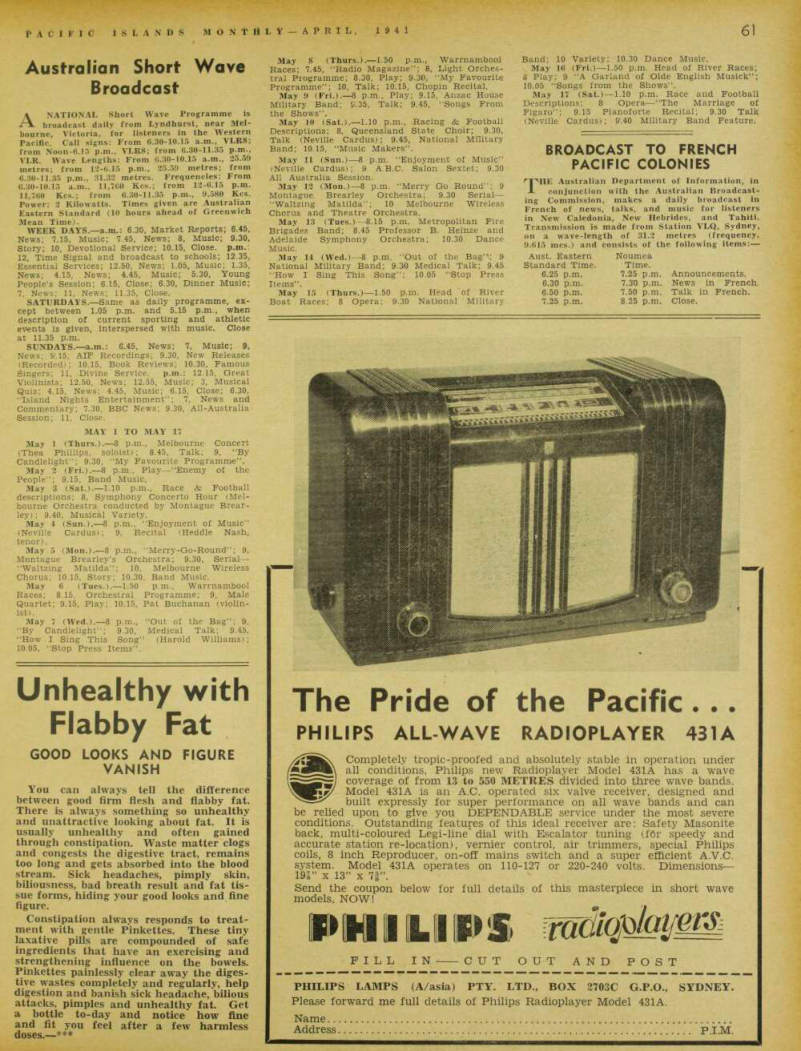
Broadcast
A NATIONAL Short Wave Programme is broadcast daily from Lyndhurst, near Mel bourne, Victoria, for listeners in the Western Pacific. Call signs: From 6.30-10.15 a.m., VLRB; from Noon-6.15 p.m., VLRB; from 6.30-11.35 p.m., VLR. Wave Lengths: From 6.30-10.15 a.m.. 25.59 metres; from 12-6.15 p.m., 25.59 metres; from 6.30-11.35 p.m., 31.32 metres. Frequencies: From 6.30-10.15 a.m., 11,760 Kcs.; from 12-6.15 p.m. 11,760 Kcs.; from 6.30-11.35 p.m., 9,580 Kcs.
Power: 2 Kilowatts. Times given are Australian Eastern Standard (10 hours ahead of Greenwich Mean Time).
WEEK DAYS.—a.m.: 6.30, Market Reports; 6.45, News; 7.15, Music; 7.45, News; 8, Music; 9.30, Story; 10, Devotional Service; 10.15, Close, p.m.: 12, Time Signal and broadcast to schools; 12.35, Essential Services; 12.50, News; 1.05, Music; 1.35, News; 4.15, News; 4.45, Music; 5.30, Young People’s Session; 6.15, Close; 6.30, Dinner Music; 7, News; 11, News; 11.35, Close.
SATURDAYS.—Same as daily programme, ex cept between 1.05 p.m. and 5.15 p.m., when description of current sporting and athletic events is given, Interspersed with music. Close at 11.35 p.m.
SUNDAYS. —a.m.: 6.45, News; 7, Music; 9, News; 9.15, AIF Recordings; 9.30, New Releases (Recorded); 10.15, Book Reviews; 10.30, Famous Singers; 11, Divine Service. p.m.: 12.15, Great Violinists; 12.50, News; 12.55, Music; 3, Musical Quiz; 4.15, News; 4.45, Music; 6.15, Close; 6.30, “Island Nights Entertainment”: 7, News and Commentary; 7.30, BBC News; 9.30, All-Australia Session; 11, Close.
May 1 To May 17
May 1 (Thurs.). —8 p.m., Melbourne Concert (Thea Phillips, soloist); 8.45, Talk; 9, “By Candlelight”; 9.30, “My Favourite Programme”.
May 2 (Fri.).—B p.m., Play—“ Enemy of the People”: 9.15, Band Music.
May 3 (Sat.). —1.10 p.m., Race & Football descriptions; 8, Symphony Concerto Hour (Mel bourne Orchestra conducted by Montague Brear ley): 9.40, Musical Variety.
May 4 (Sun.).—B p.m., “Enjoyment of Music” (Neville Cardus); 9, Recital (Heddle Nash, tenor).
May 5 (Mon.). —8 p.m., “Merry-Go-Round”; 9, Montague Brearley’s Orchestra; 9.30, Serial — “Waltzing Matilda”; 10, Melbourne Wireless Chorus: 10.15, Story; 10.30, Band Music.
May 6 (Tues.). —1.50 p.m., Warrnambool Races; 8.15, Orchestral Programme; 9, Male Quartet; 9.15, Play; 10.15, Pat Buchanan (violin ist).
May 7 (Wed.). —8 p.m., “Out of the Bag”; 9, “By Candlelight”: 9.30, Medical Talk; 9.45, “How I Sing This Song” (Harold Williams); 10.05, “Stop Press Items”.
May 8 (Thurs.). —1.50 p.m., Warrnambool Races; 7.45, “Radio Magazine”; 8, Light Orches tral Programme; 8.30, Play; 9.30, “My Favourite Programme”; 10, Talk; 10.15, Chopin Recital.
May 9 (Fri.). —8 p.m., Play; 9.15, Anzac House Military Band; 9.35, Talk; 9.45, “Songs From the Shows”.
May 10 (Sat.). —1.10 p.m., Racing & Football Descriptions; 8, Queensland State Choir; 9.30, Talk (Neville Cardus); 9.45, National Military Band; 10.15, “Music Makers”.
May 11 (Sun.) —8 p.m. “Enjoyment of Music” (Neville Cardus); 9 A.B.C. Salon Sextet; 9.30 All Australia Session.
May 12 (Mon.) —8 p.m “Merry Go Round”; 9 Montague Brearley Orchestra; 9.30 Serial— “ Waltzing Matilda”; 10 Melbourne Wireless Chorus and Theatre Orchestra.
May 13 (Tues.) —8.15 p.m. Metropolitan Fire Brigades Band; 8.45 Professor B. Heinze and Adelaide Symphony Orchestra; 10.30 Dance Music.
May 14 (Wed.) —8 p.m. “Out of the Bag’*,; 9 National Military Band; 9.30 Medical Talk; 9.45 “How I Sing This Song”; 10.05 “Stop Press Items”.
May 15 (Thurs.) —1.50 p.m. Head of River Boat Races; 8 Opera; 9.30 National Military
Band; 10 Variety; 10.30 Dance Music.
May 16 (Fri.) —1.50 p.m. Head of River Races; 8 Play; 9 “A Garland of Olde English Musick”; 10.05 “Songs from the Shows”.
May 17 (Sat.) —1.10 p.m. Race and Football Descriptions; 8 Opera—“ The Marriage of Figaro”; 9.15 Pianoforte Recital; 9.30 Talk (Neville Cardus); 9’.40 Military Band Feature.
Pacific Colonies
Broadcast To French
THE Australian Department of Information, in conjunction with the Australian Broadcast ing Commission, makes a daily broadcast in French of news, talks, and music for listeners in New Caledonia, New Hebrides, and Tahiti.
Transmission is made from Station VLQ, Sydney, on a wave-length of 31.2 metres (frequency, 9.615 mcs.) and consists of the following items:—
Aust. Eastern Noumea Standard Time.
Time. 6.25 p.m. 7.25 p.m.
Announcements. 6.30 p.m. 7.30 p.m.
News in French. 6.50 p.m. 7.50 p.m.
Talk in French. 7.25 p.m. 8.25 p.m.
Close.
Advertisements & other items, p. 65 (2 items)
Planlips mdimkm
f* m * * >• ■e
The Pride of the Pacific...
PHILIPS ALL-WAVE RADIOPLAYER 431 A
Completely tropic-proofed and absolutely stable in operation under all conditions, Philips new Radioplayer Model 431 A has a wave coverage of from 13 to 550 METRES divided into three wave bands.
Model 431 A is an A.C. operated six valve receiver, designed and built expressly for super performance on all wave bands and can be relied upon to give you DEPENDABLE service under the most severe conditions. Outstanding features of this ideal receiver are: Safety Masonite back, multi-coloured Legi-line* dial with Escalator tuning (for speedy and accurate station re-location), vernier control, air trimmers, special Philips coils, 8 inch Reproducer, on-off mains switch and a super efficient A.V.C. system. Model 431 A operates on 110-127 or 220-240 volts. Dimensions — 19i” x 13” x 7|”.
Send the coupon below for full details of this masterpiece in short wave models, NOW!
Planlips mdimkm
FILL IN
CUT OUT AND POST
PHILIPS LAMPS (A/asia) PTY. LTD., BOX 2703 C G.P.0., SYDNEY.
Please forward me full details of Philips Radioplayer Model 431 A.
Name Address P.I.M.
Unhealthy with
Flabby Fat
GOOD LOOKS AND FIGURE
VANISH
You can always tell the difference between good firm flesh and flabby fat.
There is always something so unhealthy and unattractive looking about fat. It is usually unhealthy and often gained through constipation. Waste matter clogs and congests the digestive tract, remains too long and gets absorbed into the blood stream. Sick headaches, pimply skin, biliousness, bad breath result and fat tissue forms, hiding your good looks and fine figure.
Constipation always responds to treatment with gentle Pinkettes. These tiny laxative pills are compounded of safe ingredients that have an exercising and strengthening influence on the bowels.
Pinkettes painlessly clear away the digestive wastes completely and regularly, help digestion and banish sick headache, bilious attacks, pimples and unhealthy fat. Get a bottle to-day and notice how fine and fit you feel after a few harmless doses.— **♦
Sub-Division in Port Moresby
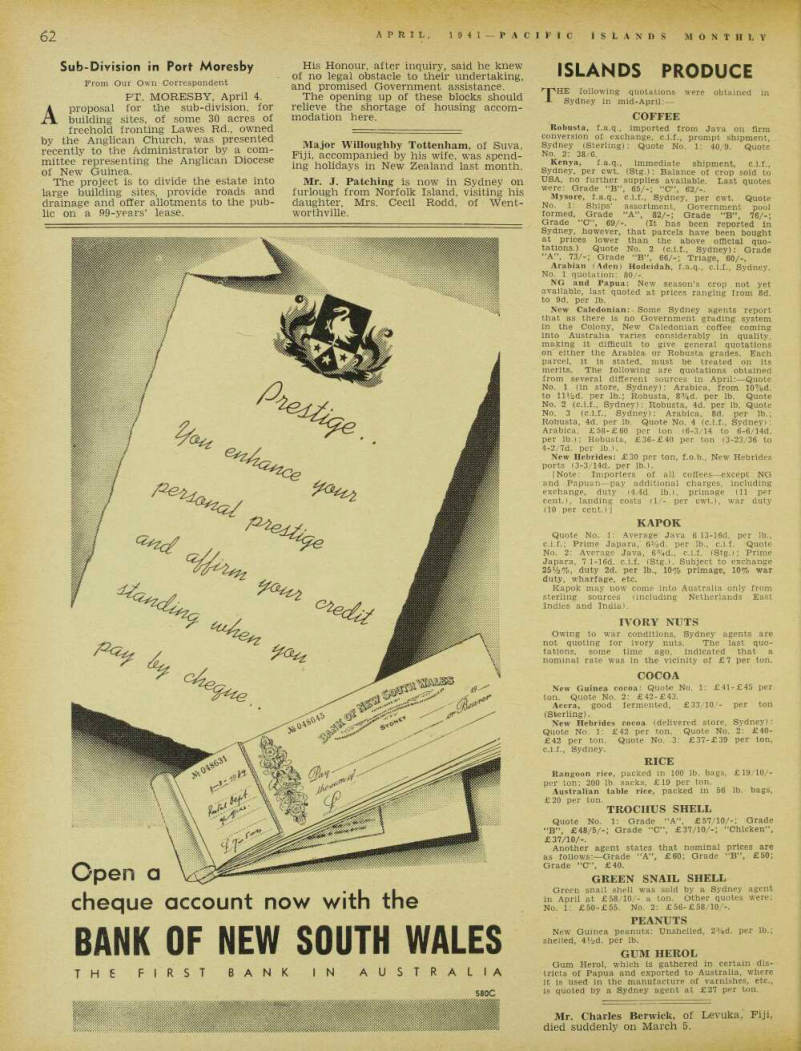
From Our Own Correspondent
Ft. Moresby, April 4.
A proposal for the sub-division, for building sites, of some 30 acres of freehold fronting Lawes Rd., owned by the Anglican Church, was presented recently to the Administrator by a com mittee representing the Anglican Diocese of New Guinea.
The project is to divide the estate into large building sites, provide roads and drainage and offer allotments to the pub lic on a 99-years’ lease.
His Honour, after inquiry, said he knew of no legal obstacle to their undertaking, and promised Government assistance.
The opening up of these blocks should relieve the shortage of housing accom modation here.
Major Willoughby Tottenham, of Suva, Fiji, accompanied by his wife, was spend ing holidays in New Zealand last month.
Mr. J. Patching is now in Sydney on furlough from Norfolk Island, visiting his daughter, Mrs. Cecil Rodd, of Went worthville.
Islands Produce
THE following quotations were obtained in Sydney in mid-April:—
Coffee
Robusta, f.a.q., imported from Java on firm conversion of exchange, c.i.f., prompt shipment, Sydney (Sterling): Quote No. 1: 40/9. Quote No. 2: 38/6.
Kenya, f.a.q., immediate shipment, c.i.f., Sydney, per cwt. (Stg.); Balance of crop sold to USA, no further supplies available. Last quotes were; Grade “B”, 65/-; “C”, 62/-.
Mysore, f.a.q., c.i.f., Sydney, per cwt. Quote No. 1: Ships’ assortment, Government pool formed, Grade “A”, 82/-; Grade “B”, 76/-; Grade “C”, 69/-. (It has been reported in Sydney, however, that parcels have been bought at prices lower than the above official quo tations.) Quote No. 2 (c.i.f., Sydney): Grade “A”, 73/-; Grade “B”, 66/-; Triage, 60/-.
Arabian (Aden) Hodeidah, f.a.q., c.i.f., Sydney.
No. 1 quotation: 80/-.
NG and Papua: New season’s crop not yet available, last quoted at prices ranging from Bd. to 9d. per lb.
New Caledonian: Some Sydney agents report that as there is no Government grading system in the Colony, New Caledonian coffee coming into Australia varies considerably in quality, making it difficult to give general quotations on either the Arabica or Robusta grades. Each parcel, it is stated, must be treated on its merits. The following are quotations obtained from several different sources in April:—Quote No. 1 (in store, Sydney): Arabica, from 10 7 / B d. to llVzd. per lb.; Robusta, B%d. per lb. Quote No. 2 (c.i.f., Sydney): Robusta, 4d. per lb. Quote No. 3 (c.i.f., Sydney): Arabica, Bd. per lb.; Robusta, 4d. per lb. Quote No. 4 (c.i.f., Sydney): Arabica, £5B-£6O per ton (6-3/14 to 6-6/14d. per lb.); Robusta, £36-£4O per ton (3-23/36 to 4-2/7d. per lb.).
New Hebrides: £3O per ton, f.0.b., New Hebrides ports (3-3/14d. per lb.). [Note; Importers of all coffees —except NG and Papuan—pay additional charges, including exchange, duty (4.4 d. lb.), primage (11 per cent.), landing costs (1/- per cwt.), war duty (10 per cent.)]
Kapok
Quote No. 1: Average Java 6 13-16 d. per lb., c.i.f.; Prime Japara, per lb., c.i.f. Quote No. 2: Average Java, 6%d., c.i.f. (Stg.l; Prime Japara, 7 l-16d. c.i.f. (Stg.). Subject to exchange 25%%, duty 2d. per lb., 10% primage, 10% war duty, wharfage, etc.
Kapok may now come into Australia only from sterling sources (including Netherlands East Indies and India).
Ivory Nuts
Owing to war conditions, Sydney agents are not quoting for ivory nuts. The last quo tations, some time ago, indicated that a nominal rate was in the vicinity of £7 per ton.
Cocoa
New Guinea cocoa: Quote No. 1: £4l-£45 per ton. Quote No. 2: £42-£43.
Accra, good fermented, £33/10/- per ton (Sterling).
New Hebrides cocoa (delivered store, Sydney): Quote No. 1: £42 per ton. Quote No. 2: £4O - per ton. Quote No. 3: £37-£39 per ton, c.i.f., Sydney.
Rice
Rangoon rice, packed in 100 lb. bags, £l9/10/per ton; 200 lb. sacks, £l9 per ton.
Australian table rice, packed in 56 lb. bags, £2O per ton.
Trochus Shell
Quote No. 1: Grade “A”, £57/10/-: Grade “B”, £4B/5/-; Grade “C”, £37/10/-; “Chicken”, £37/10/-.
Another agent states that nominal prices are as follows: —Grade “A”, £6O; Grade “B”, £5O; Grade "C”, £4O.
Green Snail Shell
Green snail shell was sold by a Sydney agent in April at £5B/10/- a ton. Other quotes were: No. 1: £5O-£55. No. 2: £56-£5B/10/-.
Peanuts
New Guinea peanuts; Unshelled, 2 3 Ad. per lb.; shelled, 4y 2 d. per lb.
Gum Herol
Gum Herol, which is gathered in certain dis tricts of Papua and exported to Australia, where it is used in the manufacture of varnishes, etc., is quoted by a Sydney agent at £27 per ton.
Mr. Charles Berwick, of Levuka, Fiji, died suddenly on March 5.
Advertisements & other items, p. 66 (2 items)
62
April, ihi-mcuic islands monthly
Bank Of New South Wales
A & G*zcS y
Open a
cheque account now with the
BANK OF NEW SOUTH WALES
THE FIRST BANK
I N • x ••
AUSTRALIA
580 C
Exchange Rates
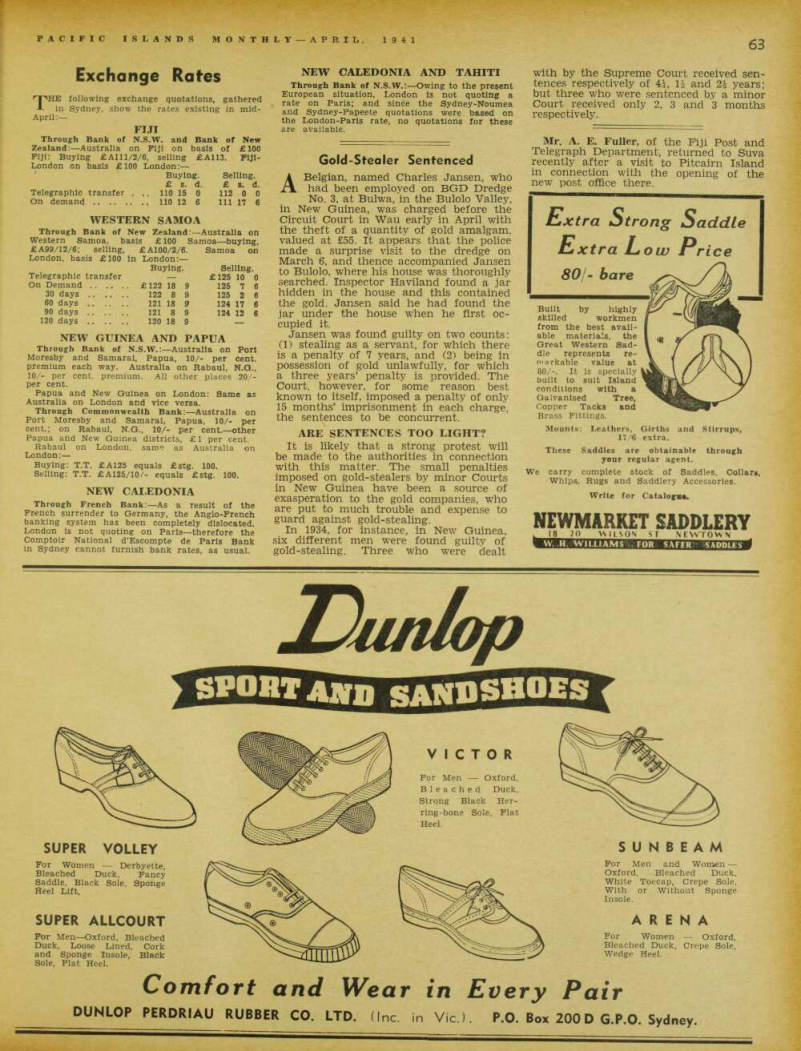
THE following exchange quotations, gathered in Sydney, show the rates existing in mid- April:—
Fiji
Through Bank of N.S.W. and Bank of New Zealand:—Australia on Fiji on basis of £lOO Fiji: Buying £Alll/2/6, selling £AII3. Fijl- London on basis £lOO London:—
Western Samoa
Through Bank of New Zealand;—Australia on Western Samoa, basis £ 100 Samoa—buying, £ A99/12/6; selling, £AIOO/2/6. Samoa on London, basis £lOO in London:—
New Guinea And Papua
Through Bank of N.S.W.:—Australia on Port Moresby and Samaral, Papua, 10/- per cent, premium each way. Australia on Rabaul, N.Q., 10/- per cent, premium. All other places 20/per cent.
Papua and New Guinea on London: Same as Australia on London and vice versa.
Through Commonwealth Bank;—Australia on Port Moresby and Samarai, Papua, 10/- per cent.; on Rabaul, N.G., 10/- per cent.—other Papua and New Guinea districts, £ 1 per cent.
Rabaul on London, same as Australia on London:— Buying: T.T. £AI2S equals £stg. 100.
Selling: T.T. £AI2S/10/- equals £stg. 100.
New Caledonia
Through French Bank:—As a result of the French surrender to Germany, the Anglo-French banking system has been completely dislocated.
London is not quoting on Paris—therefore the Comptoir National d’Escompte de Paris Bank in Sydney cannot furnish bank rates, as usual.
New Caledonia And Tahiti
Through Bank of N.S.W.:—Owing to the present European situation, London is not quoting a rate on Paris; and since the Sydney-Noumea and Sydney-Papeete quotations were based on the London-Parls rate, no quotations for these are available.
Buying. Selling. £ s. d. £ s. d.
Telegraphic transfer , .. 110 15 0 112 0 0 On demand 110 12 6 111 17 6
Buying, Selling.
Telegraphic transfer — £125 10 0 On Demand £122 18 9 125 7 6 30 days 122 8 9 125 2 6 60 days 121 18 9 124 17 6 90 days 121 8 9 124 12 6 120 days 120 18 9
Gold-Stealer Sentenced
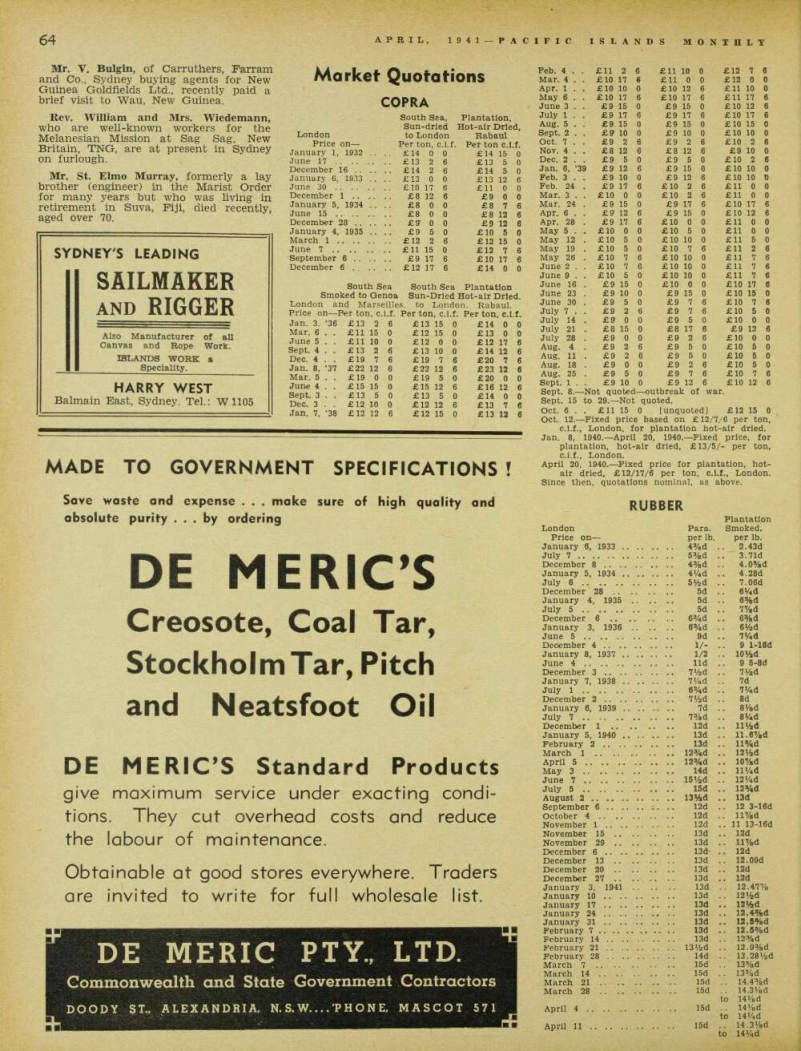
A Belgian, named Charles Jansen, who had been employed on BGD Dredge No. 3, at Bulwa, in the Bulolo Valley, in New Guinea, was charged before the Circuit Court in Wau early in April with the theft of a quantity of gold amalgam, valued at £55. It appears that the police made a surprise visit to the dredge on March 6, and thence accompanied Jansen to Bulolo, where his house was thoroughly searched. Inspector Haviland found a jar hidden in the house and this contained the gold. Jansen said he had found the jar under the house when he first oc cupied it.
Jansen was found guilty on two counts: (1) stealing as a servant, for which there is a penalty of 7 years, and (2) being in possession of gold unlawfully, for which a three years’ penalty is provided. The Court, however, for some reason best known to itself, imposed a penalty of only 15 months’ imprisonment in each charge, the sentences to be concurrent.
Are Sentences Too Light?
It is likely that a strong protest will be made to the authorities in connection with this matter. The small penalties imposed on gold-stealers by minor Courts in New Guinea have been a source of exasperation to the gold companies, who are put to much trouble and expense to guard against gold-stealing.
In 1934, for instance, in New Guinea, six different men were found guilty of gold-stealing. Three who were dealt
with by the Supreme Court received sen tences respectively of 4i, U and 2| years; but three who were sentenced by a minor Court received only 2, 3 and 3 months respectively.
Mr. A. E. Fuller, of the Fiji Post and Telegraph Department, returned to Suva recently after a visit to Pitcairn Island in connection with the opening of the new post office there.
Mr. V. Bulgin. of Carruthers, Farram and Co., Sydney buying agents for New Guinea Goldfields Ltd., recently paid a brief visit to Wau, New Guinea.
Rev. William and Mrs. Wiedemann, who are well-known workers for the Melanesian Mission at Sag Sag, New Britain, TNG, are at present in Sydney on furlough.
Mr. St. Elmo Murray, formerly a lay brother (engineer) in the Marist Order for many years but who was living in retirement in Suva, Fiji, died recently, aged over 70.
Advertisements & other items, pp. 67-68 (1 item)
jDunlop
Extra Strong Saddle
Extra Low Price
80/- bare
Built by highly skilled workmen from the best available materials, the Great Western Saddle represents remarkable value at 80/-. It is specially built to suit Island conditions with a Galvanised Tree, Copper Tacks and Brass Fittings.
Mounts; Leathers, Girths and Stirrups, 17/6 extra.
These Saddles are obtainable through your regular agent.
We carry complete stock of Saddles, Collars, Whips, Rugs and Saddlery Accessories.
Write for Catalog**.
NEWMARKET SADDLERY
- 18 20 \MLSON ST NEWTOWN
W. H. WILLIAMS FOR SAFER SADDLES
jDunlop
SPORT AND SANDSHOES
VICTOR
For Men Oxford, Bleached Duck, Strong Black Herring-bone Sole, Plat Heel.
SUPER VOLLEY
For Women Derbyette, Bleached Duck, Fancy Saddle, Black Sole, Sponge Heel Lift.
SUPER ALLCOURT
For Men—Oxford, Bleached Duck, Loose Lined, Cork and Sponge Insole, Black Sole, Plat Heel.
SUNBEAM
For Men and Women Oxford, Bleached Duck, White Toecap, Crepe Sole, With or Without Sponge Insole.
ARENA
For Women Oxford, Bleached Duck, Crepe Sole, Wedge Heel.
Comfort and Wear in Every Pair
DUNLOP PERDRIAU RUBBER CO. LTD. (Inc. in Vic). P.O. Box 200 D G.P.O. Sydney.
SYDNEY'S LEADING
SAILMAKER
and RIGGER
Also Manufacturer of all Canvas and Rope Work.
ISLANDS WORK a
Speciality.
HARRY WEST
Balmain East, Sydney. Tel.: WllO5
MADE TO GOVERNMENT SPECIFICATIONS !
Save waste and expense . . . make sure of high quality and absolute purity ... by ordering
DE MERIC’S
Creosote, Coal Tar,
Stockholm Tar, Pitch
and Neatsfoot Oil
DE MERIC’S Standard Products give maximum service under exacting conditions. They cut overhead costs and reduce the labour of maintenance.
Obtainable at good stores everywhere. Traders are invited to write for full wholesale list.
* DE MERIC PTY., LTD ■
Commonwealth and State Government Contractors
DOODY ST., ALEXANDRIA. N.S.W...THONE. MASCOT 571
i ±
Market Quotations
Feb. 4 . . £11 2 6 £11 10 0 £12 7 6 Mar. 4 . . £10 17 6 £11 0 0 £12 0 0 Apr. 1 . . £10 10 0 £10 12 6 £11 10 0 May 6 . . £10 17 6 £10 17 6 £11 17 6 June 3 . . £9 15 0 £9 15 0 £10 12 6 July 1 . . £9 17 6 £9 17 6 £10 17 6 Aug. 5 . . £9 15 0 £9 15 0 £10 15 0 Sept. 2 . . £9 10 0 £9 10 0 £ 10 10 0 Oct. 7 . . £9 2 6 £9 2 6 £10 2 6 Nov. 4 . . £8 12 6 £8 12 6 £9 10 0 Dec. 2 . . £9 5 0 £9 5 0 £10 2 6 Jan. 6, ’39 £9 12 6 £9 15 0 £10 10 0 Feb. 3 . . £9 10 0 £9 12 6 £10 10 0 Feb. 24 . £9 17 6 £10 2 6 £11 0 0 Mar. 3 . . £10 0 0 £10 2 6 £11 0 0 Mar. 24 . £9 15 0 £9 17 6 £10 17 6 Apr. 6 . . £9 12 6 £9 15 0 £10 12 6 Apr. 28 . £9 17 6 £10 0 0 £11 0 0 May 5 . . £10 0 0 £10 5 0 £11 0 0 May 12 . £10 5 0 £10 10 0 £11 5 0 May 19 . £10 5 0 £10 7 6 £11 2 6 May 26 . £10 7 6 £10 10 0 £11 7 6 June 2 . . £10 7 6 £10 10 0 £11 7 6 June 9 . . £10 5 0 £10 10 0 £11 7 6 June 16 . £9 15 0 £10 0 0 £10 17 6 June 23 . £9 10 0 £9 15 0 £10 15 0 June 30 . £9 5 0 £9 7 6 £10 7 6 July 7 . . £9 2 6 £9 7 6 £10 5 0 July 14 . £9 0 0 £9 5 0 £10 0 0 July 21 . £8 15 0 £8 17 6 £9 12 6 July 28 . £9 0 0 £9 2 6 £10 0 0 Aug. 4 . £9 2 6 £9 5 0 £10 5 0 Aug. 11 . £9 2 6 £9 5 0 £10 5 0 Aug. 18 . £9 0 0 £9 2 6 £10 5 0 Aug. 25 . £9 5 0 £9 7 6 £10 7 6 Sept. 1 . . £9 10 0 £9 12 6 £10 12 6 Sept, 8.—Not quoted—outbreak of war.
Sept. 15 to 29.—Not quoted.
Oct. 6 . . £11 15 0 [unquoted] £12 15 0 Oct. 12. —Fixed price based on £12/7/6 per ton, c.l.f., London, for plantation hot-air dried.
Jan. 8, 1940.—April 20, 1940.—Fixed price, for plantation, hot-air c.i.f., London. dried, £13/5/- per ton, April 20, 1940. —Fixed price for plantation, hotair dried, £12/17/6 per ton, c.l.f., London.
Since then, quotations nominal, as above.
Rubber
Plantation London Para.
Smoked.
Price on— per lb. per lb.
January 6, 1933 .. ... 4%d 2.43d July 7 .. .. 5%d .. 3.71d December 8 .. .. .. .. 4%d 4.0%d January 5, 1934 .. .. .. 4Vid .. 4.28d July 6 .. .. 5»/ a d 7.06d December 28 .. .. 5d 6V-id January 4, 1935 .. .. 5d 6%d July 5 .. .. 5d .. 7%d December 6 .. .. 6%d January 3, 1936 .. .. 6%d ey 2 d June 5 .. .. 9d .. 7%d December 4 .. ., .. .. 1/- 9 l-18d January 8, 1937 .. ... 1/2 .. 10%d June 4 .. .. lid 9 5-8d December 3 .. .. .. 7»/ a d January 7, 1938 .. .. .. 7Vid 7d July 1 .. .. 6 3 Ad 7%d December 2 .. .. .. .. 7‘/ 2 d 8d January 6, 1939 .. ... 7d .. sy 8 d July 7 8%d December 1 .. . .. UMid January 5, 1940 .. ... 13d .. n.ey.d February 2 ,. .. ... 13d .. ny«d March 1 .. .. .. 12‘/id April 5 .. ioy«d May 3 ... 14d .. ny 4 d June 7 .. i2y 4 d July 5 .. .. 15d .. 12%d August 2 .. .. 13%d .. 13d September 6 .. .. ... 12d .. 12 3-16d October 4 .. .. .. .. 12d .. ny 8 d November 1 .. .. ... 12d .. 11 13-16d November 15 .. .. .. 13d .. 12d November 29 .. .. .. 13d .. ny 8 d December 6 .. .. .. .. 13d .. 12d December 13 ., .. .. 13d .. 12.09d December 20 .. .. .. 13d .. 12d December 27 .. .. .. 13d .. 12d January 3, 1941 .. .. 13d .. 12.47% January 10 .. .. ... 13d .. 12 %d January 17 .. .. ... 13d .. 12%d January 24 .. .. .. 12.4%d January 31 .. .. ... 13d .. 12.8%d February 7 ... 13d .. 12.5 s /ad February 14 .. .. .. .. 13d .. 12y 4 d February 21 .. .. .. . . 13y 2 d .. 12.9%d February 28 .. .. ... 14d .. 13.28y 2 d March 7 . . .. .. .. 15d .. 13 s /sd March 14 .. .. .. .. 15d .. 13 3 / 4 d March 21 ... 15d . . 14.4 3 / 8 d March 28 . . .. ... 15d . . 14.3y 8 d to 14%d April 4 ... 15d .. 14V 8 d to 14‘Ad April 11 ... 15d .. 14.3y 8 d to 14»/ 4 d
Copra
South Sea, Plantation, Sun-dried Hot-air Dried, London to London Rabaul Price on— Per ton, c.i.f.
Per ton c.i.f.
January 1 1932 £14 0 0 £14 15 0 June 17 . £13 2 6 £13 5 0 December 16 .. £14 2 6 £14 5 0 January 6, 1933 £13 0 0 £13 12 6 June 30 . £10 17 6 £11 0 0 December 1 .. £8 12 6 £9 0 0 January 5 1934 £8 0 0 £8 7 6 June 15 . £8 0 0 £8 12 6 December 28 .. £9 0 0 £9 12 6 January 4 1935 , . £9 5 0 £10 5 0 March 1 . . . £12 2 6 £12 15 0 June 7 . £11 15 0 £12 7 6 September 6 . . £9 17 6 £10 17 6 December 6 . £12 17 6 £14 0 0 South Sea South Sea Plantation Smoked to Genoa Sun-Dried Hot-air Dried.
London and Marseilles, to London. Rabaul.
Price on— Per ton, c.i.f.
Per ton, c.i.f.
Per ton, c.i.f.
Jan. 3. ’36 £13 2 6 £13 15 0 £14 0 0 Mar. 6 . . £11 15 0 £12 15 0 £13 0 0 June 5 . . £11 10 0 £12 0 0 £12 17 6 Sept. 4 . . £13 2 6 £13 10 0 £14 12 6 Dec. 4 . . £19 7 6 £19 7 6 £20 7 6 Jan. 8, '37 £22 12 6 £22 12 6 £23 12 6 Mar. 5 , . £19 0 0 £19 5 0 £20 0 0 June 4 . . £15 15 0 £15 12 6 £16 12 6 Sept. 3 . , £13 5 0 £13 5 0 £14 0 0 Dec. 3 . . £12 10 0 £12 12 6 £13 7 6 Jan, 7, ’38 £12 12 6 £12 15 0 £13 12 6
Overland Droving
In N. Guinea
Is This the Dawn of a New Cattle Industry?
From Our Own Correspondent WAU, March 28.
WHAT is the biggest undertaking in cattle-droving ever undertaken in New Guinea is now under way.
Mr. C. Blake and two assistant drovers left Wau this week for Madang, going overland, to collect there and drive to the Goldfields some 200 head of cattle.
With mounts and pack-horses, and some twenty natives, the party set off from a starting point near Bulwa.
The distance to be covered is at least 300 miles, and a track will have to be blazed in many parts of the route — although there are stretches of rolling kunai country which will afford good grazing for horses and cattle.
The cattle have been purchased by Mr.
Alan Fuller, to be —as far as can be gathered—a food reserve for Morobe Goldfield in case of emergency.
Many rivers will have to be crossed en route and some high ranges nego tiated.
N. Caledonia
Fifth Column In N. Caledonia
FANTASTIC stories of Allied defeats, and of the imminent return of Vichy emissaries have been sedu lously spread in recent months in New Caledonia —where 95 per cent, are for de Gaulle, and 5 per cent, are pro-Nazi die-hards.
Recently, the Governor (M. Sautot) announced special measures:— “My administration is alive to the dan ger of these cowardly attacks delivered daily by the Fifth Column members and has decided to put a stop to it. War rants are out for three persons, two of them Government servants, the other a private citizen. Serious measures are to be taken against members of two Gov ernment services who have been hostile to the new regime of de Gaulle since last September. It is not the moment, when victory is in our hands, to be discour aged, and so the Government of Free France addresses another appeal to all to rally round its leader, closer than ever, in the sacred cause of the libera tion of France and the safeguarding of French honour.”
Messrs. A. I. Biggs and D. A. Smith arrived in Fiji recently to join the teach ing staff of the Suva Boys’ Grammar School as secondary assistant masters.
French Coffee and Cocoa Coming
to Australia
A REPORT from Noumea to the effect that the Australian Government had guaranteed to purchase the whole of the New Caledonian unsold coffee crop with the offer of unrestricted import licences was published widely in Australian newspapers on April 7; but inquiries by the “PIM” reveal that this statement is somewhat premature. Dis cussions are proceeding between the Aus tralian and New Caledonian Govern ments in connection with the Colony’s coffee production, but as yet nothing definite has been decided upon.
New Caledonia produces about 2,000 tons of coffee a year, and prior to the French capitulation the whole of this went to France. With the French mar ket gone, New Caledonians looked to Australia to assist them, and the Com monwealth Government agreed to allow the coffee to come into Australia on the same basis as other countries. Since then increasing quantities of Robusta and Arabica grades have been sold in Sydney at good prices.
New Hebrides cocoa planters, who were in exactly the same position as New Caledonia coffee planters, have been substantially assisted by the Australian Government. New Hebrides cocoa was subject to the following charges: Duty, id. a lb.; primage 5 per cent.; primage
on value of containers, 10 per cent.; and & war duty Qf 1Q per cen t. The j d alb duty has been suspended “for the dura
tion”; and the whole of the New Heb rides cocoa crop of 1,200 tons a year is coming to Australia. To-day, it is sell ing in Sydney at prices ranging from £3B to £42 a ton.
Mr. I. Shoobridge, of the NG Crown Law Office, is on furlough in Sydney.
Advertisements & other items, pp. 69-70 (1 item)
Seagoin Metal
PRICE'S RADIO
can supply
Radio Parts
to repair most types of Radio Receiving Sets. Also up-to-date Kits to build your own.
RADIO SETS SPECIALLY
DESIGNED FOR TROPICAL
USE.
From small 2-valve sets for use with headphones, to Multi-valve sets.
Let us know your requirements— we will quote by return mail.
PRICE'S RADIO
5 & 6 Angel Place, Sydney, N.S.W.
11l
FOR RELIABILITY
AND LONG SERVICE
USE
MILLER'S "ANCHOR"
BRAND ROPES AND
CORDAGES
Manila, Sisal, New Zealand Coir and Cotton Rope of every description, Twine, Sewing Twine, Shop Twine, Binder Twine and Fishlines, Lashings, Halters, Plough Reins, Sack Cord, Blind Lines, etc.
LENGTH STRENGTH
QUALITY GUARANTEED
• I Manufactured by: JAMES MILLER & CO. PTY. LTD.
MELBOURNE, VIO., AUST.
Suva Agents: A. S. FAREBROTHER & CO.
And at Lautoka, P.O. Box 36. Tel.: 261.
Sydney Agents: p. T. TAYLOR LTD.
u - Th M e i & *• I I Built by W.
L. Holmes & Co Sydney.
Seagoin Metal
a typical modern luxury a registered trade mark.* Illustrated is the "Yarroma’ cruiser, which has: MONEL propeller shafting
MONEL galley equipment
MONEL rigging rope Monel is outstanding for propeller shafting since it is strong, tough and highly resistant to corrosion . . . ideal for galley equipment as it is silvery-white, attractive and easy to keep clean and bright . . . particularly suitable for hull fastenings because Monel can never rust since it contains no iron.
May we tell you more about Monel—The Seagoin’ Metal’
WRIGHT & COMPANY
81 CLARENCE STREET, SYDNEY, N.S.W.
At Blue Mountains—Springwood, N.S.W.
Springwood Ladies 1 College
Est. 1897. Kindergarten to Leaving Certificate, Tennis, Riding, Swimming, Team Games. Unequalled climate. Pure Jersey Milk. Senior and Junior Houses.
Open-air sleeping. Inclusive fees. Special vacation arrangements for Island pupils.
M. E. DURAND, Principal.
IT ATTRACTS —THEY EAT IT —THEY DIE
CERTAIN
DEATH
USOLINE
NEVER
KNOWN
TO FAIL!
AUSOL! NE CO.,
314 CROWN STREET, SYDNEY
(Established 1919)
COCKROACH
DESTROYER
IT'S A PASTE !
Packed in 6 oz., 1 lb. & 3 lb. tins.
Obtainable from Islands Stores of: —
BURNS, PHILP & CO. LTD.
W. R. CARPENTER & CO.
LTD.
MORRIS, HEDSTROM LTD.
W. S. TAIT & CO. PTY. LTD.
COSMOPOLITAN HOTEL
SAMARA I
FIRST-CLASS
ACCOMMODATION
For Tourists & Commercials Electric Light, Ballroom Billiards, Freezing Works, Cold Store.
Best Brands of Liquors.
MODERATE TARIFF.
Fishing Trips and Launch Excursions Arranged.
WHERE TO STAY IN
HOTEL MORESBY
M
NEAR THE
WHARF.
MODERN
ACCOMMODATION
ONLY THE BEST
BRANDS OP
WINES, SPIRITS
AND BEERS
IN STOCK.
LICENSEE:
Hotel Moresby
Ltd.
PORT MORESBY
The PAPUA
HOTEL
Catering specially for Tourists and Travellers.
Licensee: Papua Hotel, Ltd.
First-class Accommodation. Parties Arranged.
Situated on high ground overlooking both coasts, its Spacious Lounges are always Cool and comfortable . . . Cars meet all Steamers.
Displays at Royal Show
Fiji Shows How
THREE Pacific territories—New Guinea, Papua and Fiji—were represented at the Royal Empire Show in Sydney during April.
The New Guinea and Papua exhibits were unimpressive. They comprised merely a small collection of wood-carv ings, baskets, canoes, pottery, spears, etc., and several photographs: in fact, the only thing in either exhibit which excited any interest at all was the col ourful poster at the back of each stand —a native, with spear aloft, in the case of New Guinea, and a village (presum
ably Hanuabada) in the Papua display.
Sharply contrasting with the New Guinea and Papua exhibits was the Fiji stand. A wide variety of tapa cloths provided the background; and, on a plat form running around the exhibit, sam ples of the Colony’s products were laid out. Copra, bananas, canned pineapple, tobacco, coir, cotton, polished shell, sugar cane, candlenuts and ginger were dis played prominently, and the model can oes, spears and huts were relegated to secondary positions. In the centre of the stand a brightly-lit photograph showed a typical scene in a Fiji village, and a map of the Colony was also displayed; it was obvious that the organisers had laid out the exhibit more as a cross sec tion of Fiji’s commercial value than a display of museum pieces.
In a glass case samples of the Colony’s mineral wealth were featured, and a graph showed the rise in gold produc tion from £2,279 in 1932 to £1,136,546 in 1940—“ developed very largely with Aus tralian capital”.
Another poster emphasised the unfav ourable trade balance between Australia and Fiji. A long line represented the £561,000 worth of Australian goods im ported into the Colony from Australia each year and a much shorter line the £77,200 worth of Fijian goods which Aus tralia buys.
Mr. L. Bailey-Mugg, of Dalgety & Co. (representatives of the Fiji Government in Sydney) was in charge of the stand and he was assisted by Mr. C. Monckton (former Minister of Native Affairs in the Colony). He said the idea of having a Fiji stand at the Show originated sub sequent to discussions between Austra lia and Fiji, and was made possible by the keenness of Dr. H. W. Jack, Director of Agriculture. Two Fijian soldiers were sent' to Australia with the exhibit, and were in attendance at the stand, where plenty of printed information also was available.
Export of Woollen Goods to Islands
Islands
AN Islands buying agent in Sydney advises that the following instructions have been issued by the Central Wool Committee, Mel bourne, in connection with the export of woollen goods to the Pacific Islands:— “When goods containing wool are intended for export to New Caledonia, New Hebrides, and other South Pacific Islands, application for per mission to ship must be made to the Central Wool Committee in Melbourne and the Restricted Goods Permit and License produced for endorse ment by an officer of that body. The goods to be exported will be subject to a surcharge of 25% on the raw wool content.”
It is understood that this regulation does not apply to export of woollen goods to New Guinea.
Advertisements & other items, pp. 70-72 (3 items)
66
APRIL, 1941 PACIFIC ISLANDS MONTHLY
Published by Pacific Publications Pty., Ltd., Union House, 247 George Street, Sydney. (Telephone: 8W5037). Wholly set up and printed in Australia by the Sydney and Melbourne Publishing Co., Pty., Ltd., 29 Alberta Street, Sydney. (Telephone: MA7101).
Afril, 1941 P Acific Islands Monthly
Guinea Airways.
ill - r. mm ■ a m m ■I ■ fl f % M©* -•, Hf Guinea Airways' planes wing swiftly from Port Moresby to the Gold Fields in 1 hour 40 minutes, whereas, by surface routes, the same journey drags over 6 to 7 weary days . . . Save time—save money —travel throughout New Guinea and Papua by
CHARTER SERVICE
Guinea Airways service provides special passenger and freight land and sea planes for charter to any point in New Guinea and Papua. Investigate!
Book by steamer from Australia to Port Moresby and thence by Guinea Airways’ planes which serve over 50 aerodromes and landing grounds throughout New Guinea and Papua. . . . Obtain full information!
New Guinea Office: LAE, Mandated Territory of New Guinea.
Branch offices and agents at Wau, Salamaua, Pt. Moresby and Sydney.
TOOTH k CO LIMITED"
■/ IN -I
v WAVERIEY BREWERY.
E 21 .0)y 3L?v> u\k V \>* N'- S . N ' \ nVXS -V ■ ' ' ■' .v« «'*V '■ •;^%x; V\ :vc ' \‘ Hnw* ti
'TOOTH I CO.UMITt*'
xWAvuitruiwut^ '-J/
ensures a
PERFECT DRINK
cwu/ t/ie ct€?m deal
PRESERVES THE FLAVOUR
When ordering lager, first look for the
Diamond-shaped Label-that is your guaran-
tee of quality. Then notice the "Spot" Crown Seal, it is designed to retain that quality, and ensure perfect freshness and flavour in any
climate.
RESCHS^LAEER