Pacific
Islands
Monthly
Vol. Xl No. 8.
March 15, 1941
Established 1930
[Registered at or transmission by post as a newspaper ]
8 d
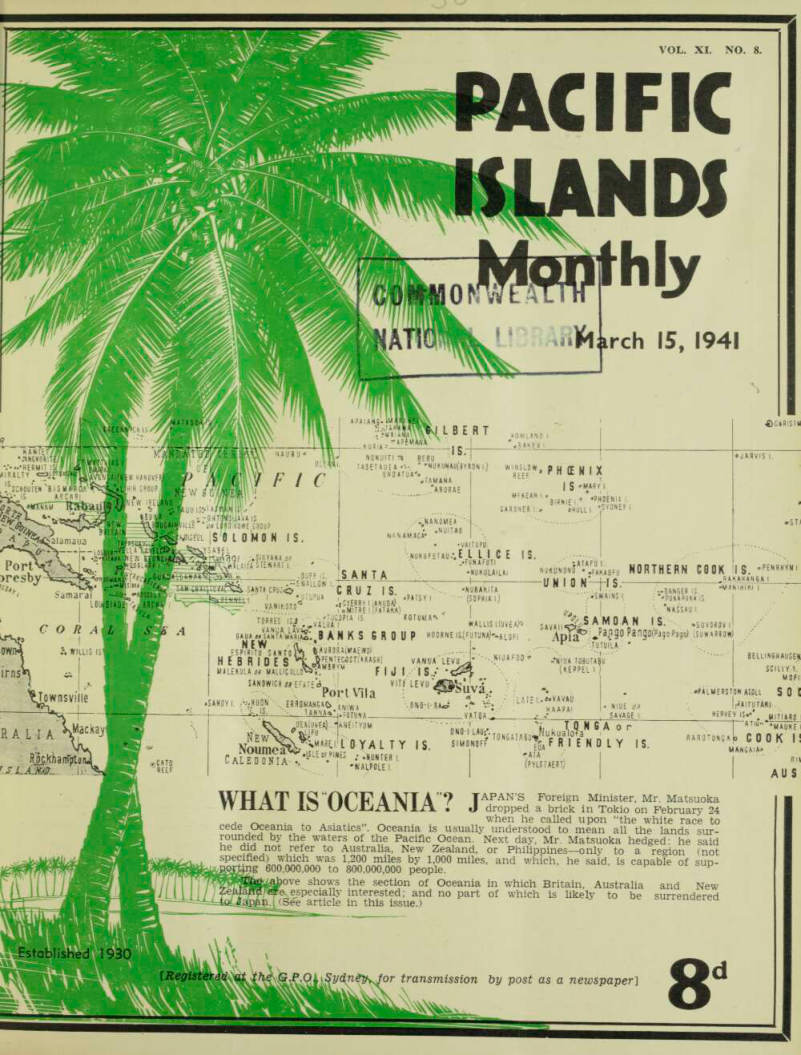
What Is"Oceania"?
JAPAN'S Foreign Minister, Mr. Matsuoka dropped a brick in Tokio on February 24 when he called upon “the white race to cede Oceania to Asiatics”. Oceania is usually understood to mean all the lands sur rounded by the waters of the Pacific Ocean. Next day, Mr. Matsuoka hedged: he said he did not refer to Australia, New Zealand, or Philippines—only to a region (not specified) which was 1,200 miles by 1,000 miles, and which, he said, is capable of sup- Porting 600,000,000 to 800,000,000 people. p The above shows the section of Oceania in which Britain, Australia and New Zealand are especially interested; and no part of which is likely to be surrendered to japan. (See article in this issue.)
Advertisements & other items, p. 2 (1 item)
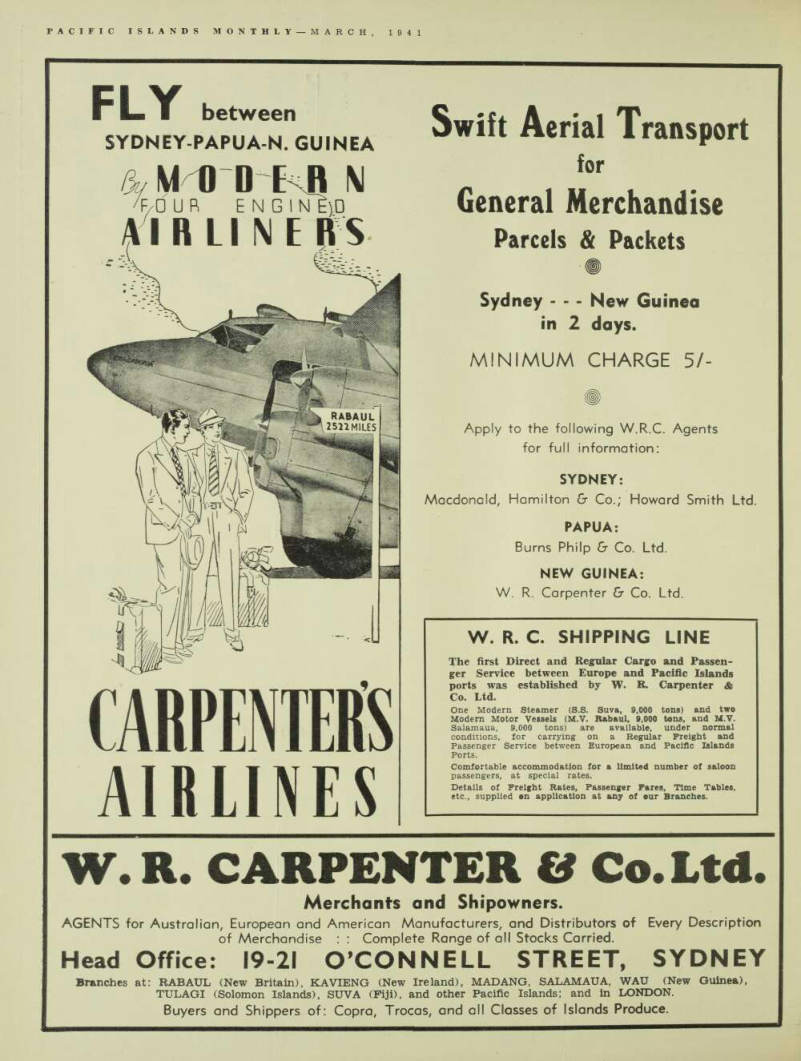
Carpenters
FLY between
SYDNEY-PAPUA-N. GUINEA
MOD PR N
F/O U R ENG I N E)D
AIRLINE RS
RABAUL
2 52”! MILES
fftn-i /
CARPENTERS
AIRLINES
Swift Aerial Transport
for
General Merchandise
Parcels & Packets
Sydney - - - New Guinea in 2 days.
MINIMUM CHARGE 51-
Apply to the following W.R.C. Agents for full information:
SYDNEY;
Macdonald, Hamilton Gr Co.; Howard Smith Ltd.
PAPUA:
Burns Ph ilp Gr Co. Ltd.
NEW GUINEA;
W. R. Carpenter Gr Co. Ltd.
W. R. C. SHIPPING LINE
The first Direct and Regular Cargo and Passenger Service between Europe and Pacific Islands ports was established by W. R. Carpenter & Co. Ltd.
One Modern Steamer (S.S. Suva, 9,000 tons) and two Modem Motor Vessels (M.V. Rabaul, 9,000 tons, and M.V.
Salamaua, 9,000 tons) are available, under normal conditions, for carrying on a Regular Freight and Passenger Service between European and Pacific Islands Ports.
Comfortable accommodation for a limited number of saloon passengers, at special rates.
Details of Freight Rates, Passenger Fares, Time Tables, etc., supplied on application at any of our Branches.
W. R. CARPENTER & Co. Ltd.
Merchants and Shipowners.
AGENTS for Australian, European and American Manufacturers, and Distributors of Every Description of Merchandise Complete Range of all Stocks Carried.
Head Office: 19-21 O’CONNELL STREET, SYDNEY
Branches at: RABAUL (New Britain), KAVIENG (New Ireland), MADANG, SALAMAUA, WAU (New Guinea), TULAGI (Solomon Islands), SUVA (Fiji), and other Pacific Islands; and in LONDON.
Buyers and Shippers of: Copra, Trocas, and all Classes of Islands Produce.
Pacific News-Review
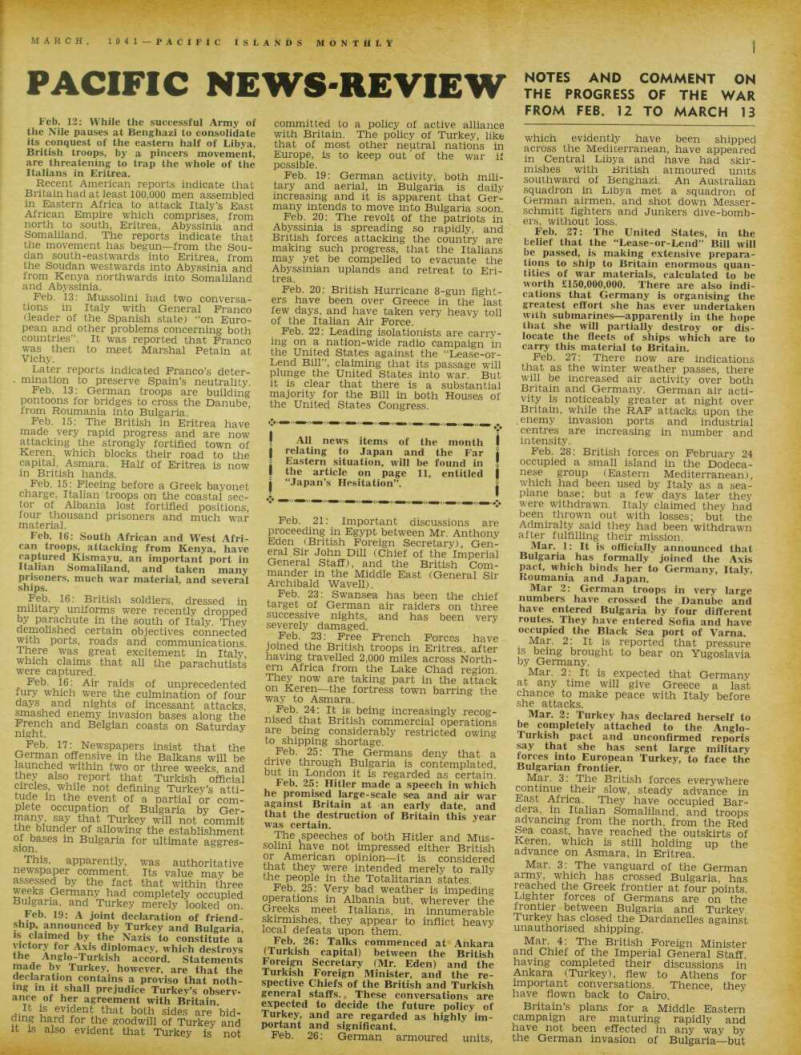
Feb. 12: While the successful Army of the Nile pauses at Benghazi to consolidate its conquest of the eastern half of Libya, British troops, by a pincers movement, are threatening to trap the whole of the Italians in Eritrea.
Recent American reports indicate that Britain had at least 100,000 men assembled in Eastern Africa to attack Italy’s East African Empire which comprises, from north to south, Eritrea, Abyssinia and Somaliland. The reports indicate that the movement has begun—from the Sou dan south-eastwards into Eritrea, from the Soudan westwards into Abyssinia and from Kenya northwards into Somaliland and Abyssinia.
Feb. 13: Mussolini had two conversa tions in Italy with General Franco (leader of the Spanish state) “on Euro pean and other problems concerning both countries’’. It was reported that Franco was then to meet Marshal Retain at Vichy.
Later reports indicated Franco’s deter mination to preserve Spain’s neutrality.
Feb. 13: German troops are building pontoons for bridges to cross the Danube from Roumania into Bulgaria.
Feb. 15: The British in Eritrea have made very rapid progress and are now attacking the strongly fortified town of Keren, which blocks their road to the capital, Asmara. Half of Eritrea is now in British hands.
Feb. 15: Fleeing before a Greek bayonet charge, Italian troops on the coastal sec tor of Albania lost fortified positions, four thousand prisoners and much war material.
Feb. 16: South African and West Afri can troops, attacking from Kenya, have captured Kismayu, an important port in Italian Somaliland, and taken many prisoners, much war material, and several ships.
Feb. 16: British soldiers, dressed in military uniforms were recently dropped by parachute in the south of Italy. They demolished certain objectives connected with ports, roads and communications There was great excitement in Italy, which claims that all the parachutists were captured.
Feb. 16: Air raids of unprecedented fury which were the culmination of four days and nights of incessant attacks, smashed enemy invasion bases along the French and Belgian coasts on Saturday night. J Feb. 17: Newspapers insist that the German offensive in the Balkans will be launched within two or three weeks, and they also report that Turkish official circles, while not defining Turkey’s atti tude in the event of a partial or com plete occupation of Bulgaria by Ger many say that Turkey will not commit the blunder of allowing the establishment of bases in Bulgaria for ultimate aggres sion. && This, apparently, was authoritative newspaper comment. Its value may be assessed by the fact that within three weeks Germany had completely occupied Bulgaria, and Turkey merely looked on.
Feb. 19: A joint declaration of friend ship announced by Turkey and Bulgaria, is claimed by the Nazis to constitute a victory for Axis diplomacy, which destroys the Anglo-Turkish accord. Statements made by Turkey, however, are that the declaration contains a proviso that noth ing m it shall prejudice Turkey’s observ ance of her agreement with Britain.
“ “ evident that both sides are bid ding hard for the goodwill of Turkey and it is also evident that Turkey is not
committed to a policy of active alliance with Britain. The policy of Turkey, like that of most other neutral nations in Europe, is to keep out ’of the war if possible.
Feb. 19: German activity, both mili tary and aerial, in Bulgaria is daily increasing and it is apparent that Ger many intends to move into Bulgaria soon.
Feb. 20: The revolt of the patriots in Abyssinia is spreading so rapidly, and British forces attacking the country are making such progress, that the Italians may yet be compelled to evacuate the Abyssinian uplands and retreat to Eri trea.
Feb. 20: British Hurricane 8-gun fight ers have been over Greece in the last few days, and have taken very heavy toll of the Italian Air Force.
Feb. 22: Leading isolationists are carry ing on a nation-wide radio campaign in the United States against the “Lease-or- Lend Bill”, claiming that its passage will plunge the United States into war. But it is clear that there is a substantial majority for the Bill in both Houses of the United States Congress.
All news items of the month relating to Japan and the Far Eastern situation, will be found in the article on page 11, entitled “Japan’s Hesitation’’.
Feb. 21: Important discussions are proceeding in Egypt between Mr. Anthony Eden (British Foreign Secretary), Gen eral Sir John Dill (Chief of the Imperial General Staff), and the British Com mander in the Middle East (General Sir Archibald Wavell).
Feb. 23: Swansea has been the chief target of German air raiders on three successive nights, and has been very severely damaged.
Feb. 23: Free French Forces have joined the British troops in Eritrea, after having travelled 2,000 miles across North ern Africa from the Lake Chad region.
They now are taking part in the attack on Keren—the fortress town barring the way to Asmara.
Feb. 24: It is being increasingly recog nised that British commercial operations are being considerably restricted owing to shipping shortage.
Feb. 25: The Germans deny that a drive through Bulgaria is contemplated, but in London it is regarded as certain.
Feb. 25: Hitler made a speech in which he promised large-scale sea and air war against Britain at an early date, and that the destruction of Britain this year was certain.
The speeches of both Hitler and Mus solini have not impressed either British or American opinion—it is considered that they were intended merely to rally the people in the Totalitarian states.
Feb. 25: Very bad weather is impeding operations in Albania but, wherever the Greeks meet Italians, in innumerable skirmishes, they appear to inflict heavy local defeats upon them.
Feb. 26: Talks commenced at Ankara (Turkish capital) between the British Foreign Secretary (Mr. Eden) and the Turkish Foreign Minister, and the re spective Chiefs of the British and Turkish general staffs.. These conversations are expected to decide the future policy of Turkey, and are regarded as highly im portant and significant.
Feb. 26: German armoured units,
Notes And Comment On
The Progress Of The War
From Feb. 12 To March 13
which evidently have been shipped across the Mediterranean, have appeared in Central Libya and have had skir mishes with British aimoured umts southward of Benghazi. An Australian squadron in Libya met a squadron of German airmen, and shot down Messer schmitt fighters and Junkers dive-bomb ers, without loss.
Feb. 27: The United States, in the belief that the “Lease-or-Lend” Bill will be passed, is making extensive prepara tions to ship to Britain enormous quan tities of war materials, calculated to be worth £150,000,000. There are also indi cations that Germany is organising the greatest effort she has ever undertaken with submarines—apparently in the hope that she will partially destroy or dis locate the fleets of ships which are to carry this material to Britain.
Feb. 27: There now are indications that as the winter weather passes, there will be increased air activity over both Britain and Germany. German air acti vity is noticeably greater at night over Britain, while the RAF attacks upon the . enemy invasion ports and industrial centres are increasing in number and intensity.
Feb. 28: British forces on February 24 occupied a small island in the Dodeca nese group (Eastern Mediterranean), which had been used by Italy as a sea plane base; but a few days later they were withdrawn. Italy claimed they had been thrown out with losses; but the Admiralty said they had been withdrawn after fulfilling their mission.
Mar. 1: It is officially announced that Bulgaria has formally joined the Axis pact, which binds her to Germany, Italy, Roumania and Japan.
Mar 2: German troops in very large numbers have crossed the Danube and have entered Bulgaria by four different routes. They have entered Sofia and have occupied the Black Sea port of Varna.
Mar. 2: It is reported that pressure is being brought to bear on Yugoslavia by Germany.
Mar. 2: It is expected that Germany at any time will give Greece a last chance to make peace with Italy before she attacks.
Mar. 2: Turkey has declared herself to be completely attached to the Anglo- Turkish pact and unconfirmed reports say that she has sent large military forces into European Turkey, to face the Bulgarian frontier.
Mar. 3: The British forces everywhere continue their slow, steady advance in East Africa. They have occupied Bar dera, in Italian Somaliland, and troops advancing from the north, from the Red Sea coast, have reached the outskirts of Keren, which is still holding up the advance on Asmara, in Eritrea.
Mar. 3: The vanguard of the German army, which has crossed Bulgaria, has reached the Greek frontier at four points.
Lighter forces of Germans are on the frontier between Bulgaria and Turkey.
Turkey has closed the Dardanelles against unauthorised shipping.
Mar. 4; The British Foreign Minister and Chief of the Imperial General Staff having completed their discussions in Ankara (Turkey), flew to Athens for important conversations. Thence, they have flown back to Cairo.
Britain’s plans for a Middle Eastern campaign are maturing rapidly and have not been effected in any way by the German invasion of Bulgaria—but
little has been published as to the char acter of these plans.
Mar. 4; German anxiety over the firm stand taken by Turkey in relation to the occupation in Bulgaria was shown when a German plane landed in Turkey, with a courier, from Hitler, carrying a special message of re-assurance to the Turkish Government.
Mar. 4: The Soviet Government has told Bulgaria that the entry of German troops into that country means the extension of the war into the Balkans and that, therefore, Russia cannot sup port the attitude that has been taken up by Bulgaria.
Mar. 4: Waves of German bombers on Monday night attacked the port of Car diff, scattering the greatest number of incendiary bombs the town has yet known. At the same time the RAF heavily attacked invasion ports on the Channel Coast and industrial centres in the Rhineland.
Mar. 5: The British Prime Minister received the Japanese Ambassador and received from him a detailed reply from the Japanese Government, in reply to the representations made by Mr. Church ill to the Ambassador a few days ago.
It is hoped in some quarters that this interchange of views may tend to improve the situation in the East.
Mar 5: Official figures show that in the 62 days of the campaign in Libya the Army of the Nile captured as prison ers 133.295 Italians.
Mar. 5: It is announced that when this year’s construction programme is com pleted, Britain will have 19 battleships, 8 aircraft carriers, 75 cruisers, 256 destroyers, and 50 submarines. The total naval strength of Germany and Italy will be 9 battleships, 2 aircraft carriers, 32 cruisers (including pocket-battleships), 78 destroyers and 240 submarines.
Mar. 6: It is considered clear that Ger many’s move through Bulgaria is in tended to involve Greece and Britain in that theatre of war, and is intended also to threaten the independence of Turkey.
But it is believed that Hitler is now puzzled with recent British moves in the Balkans.
Mar. 6; First Lord of the Admiralty said: “We are to-day in a far better position than I would have dared to expect in view of the adverse situation of nine months ago. Never in the his tory of sea power, -however, have we been in more need of numbers of ships and men.”
Mar. 7; There is intense diplomatic activity in Belgrade and the best informed observers expect that Yugoslavia, rather than face the likelihood of an invasion by German armies, will make some kind of a non-aggression pact with the Axis.
The British Government has asked Yugoslavia for a clear statement of its intentions.
Mar. 7: A British squadron last Tues day raided the Norwegian islands of Svolvor, opposite the Bay of Narvik, and destroyed the fish-oil industry which the Germans had established there, cap tured about 200 German prisoners, and brought away about 300 young Norwe gians who were anxious to join the British and fight against the Nazis.
Mar. 7: British forces operating on the East African front have now taken more than 10,000 prisoners and enormous quantities of war booty. The advance in both Eritrea and Southern Abyssinia continues satisfactorily.
Mar. 8: The United States Senate to day, by 60 votes to 31, passed the “Lease or-Lend” Bill —an act regarded as one of the most important in modern history.
It is expected that the new measure will come into operation very quickly and
will allow much assistance to be given to Britain.
Mar. 9; The New Zealand cruiser “Leander” caught and sank a fast Italian raider in the Indian Ocean.
Mar. 9: When the South African forces seized .the port of Kismayu, in Italian Somaliland, five Italian ships were cap tured while others were scuttled, and two German ships were destroyed.
Mar. 9: The “blitz” returned to Lon don in full blast on Saturday night.
Continuous waves of raiders gave the capital the longest and most intense visi tation for two months.
Mar. 10: Turkey has announced that she is determined to fight for her own independence and that she will co-oper ate with Britain to make the most effec tive use of her army and her geographi cal position.
Mar. 10: The Greek drive, which began on Friday, in the central front in Albania, resulted in new positions and over 1,000 prisoners being taken. This was continued on Saturday when another 1,120 prisoners were taken.
Mar. 10: It is reported that USA may lend 40 United States destroyers and 10 light cruisers to Britain, in return for the loan of three modern British battle ships. Britain very urgently needs these light craft, while America wants more battleships in the North-west Pacific to face the Japanese fleet.
Mar. 11: Greece and Yugoslavia now are being subjected to increasing Nazi propaganda. The purpose of propaganda, and of German armies on their frontiers, is to force them to join the Axis, without fighting.
There is every indication that a critical diplomatic struggle is going on in the Middle East and the Balkans, each side trying to secure the goodwill or co operation of Turkey and Yugoslavia.
Mar. 12: Nazi influence is seen in the declaration of the Vichy Government that, if Britain prevents food-ships reaching France, French warships will convoy the food-ships. This is part of a Nazi plan to set Britain and France fighting each other.
Mar. 12: Allied forces in East Africa are now racing the weather, trying to get possession of as much of Eritrea and Abyssinia as possible before the rainy season opens.
Mar. 12: There are unconfirmed reports that large British forces are landing in Greece. .
This may explain the recent har dening” in the attitude of Turkey and Yugoslavia, both of whom are eager to preserve their independence. The position of Yugoslavia, virtually surrounded by the Axis, seems hopeless, however.
Mar. 13: President Roosevelt signed the Lease-or-Lend Bill on Tuesday evening.
It is expected to change history.
It is noted, as a curious coincidence, that the Bill is officially known as “No 1776”, its serial number. It was in 1776 that America declared her independence and broke away from Britain.
Monsieur F. Puaux, who formerly was vice-consul at the French consulate in Sydney, has joined the Free French Forces and has gone to Noumea, at the invitation of Governor Henri Sautot, to assist in the administration of New Caledonia.
Mr. J. Mitchell, accountant for Bulolo Gold Dredging Ltd., Bulolo, New Guinea, is at present in Sydney on leave. He will be returning to the Territory in April.
M. Henri Bonneaud, director of the New Caledonian merchant firm of Etablisse ments Ballande, left Noumea recently by PAA clipper for USA, on business.
Berlin's Lies
Conditions in N.
Caledonia
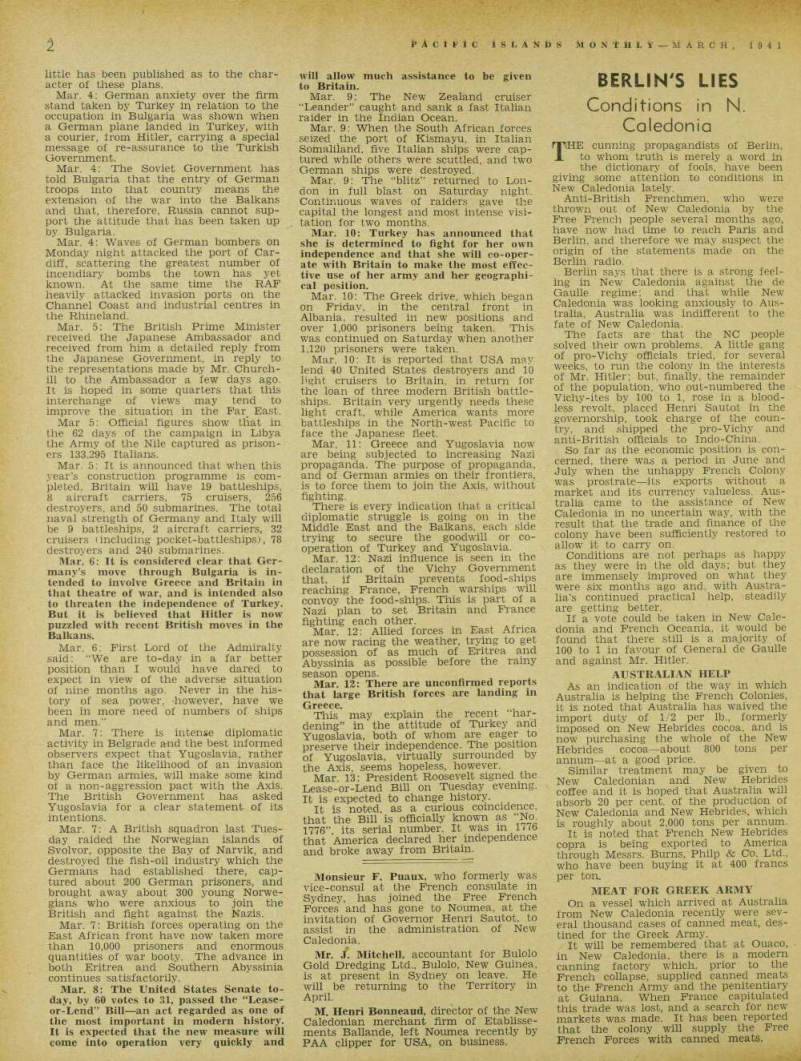
THE cunning propagandists of Berlin, to whom truth is merely a word in the dictionary of fools, have been giving some attention to conditions in New Caledonia lately.
Anti-British Frenchmen, who were thrown out of New Caledonia by the Free French people several months ago, have now had time to reach Paris and Berlin, and therefore we may suspect the origin of the statements made on the Berlin radio.
Berlin says that there is a strong feel ing in New Caledonia against the de Gaulle regime; and that while New Caledonia was looking anxiously to Aus tralia, Australia was indifferent to the fate of New Caledonia.
The facts are that the NC people solved their own problems. A little gang of pro-Vichy officials tried, for several weeks, to run the colony in the interests of Mr. Hitler; but, finally, the remainder of the population, who out-numbered the Vichy-ites by 100 to 1, rose in a blood less revolt, placed Henri Sautot in the governorship, took charge of the coun try, and shipped the pro-Vichy and anti-British officials to Indo-China.
So far as the economic position is con cerned, there was a period in June and July when the unhappy French Colony was prostrate—its exports without a market and its currency valueless. Aus tralia came to the assistance of New Caledonia in no uncertain way, with the result that the trade and finance of the colony have been sufficiently restored to allow it to carry on.
Conditions are not perhaps as happy as they were in the old days; but they are immensely improved on what they were six months ago and, with Austra lia’s continued practical help, steadily are getting better.
If a vote could be taken in New Cale donia and French Oceania, it would be found that there still is a majority of 100 to 1 in favour of General de Gaulle and against Mr. Hitler.
Australian Help
As an indication of the way in which Australia is helping the French Colonies, it is noted that Australia has waived the import duty of 1/2 per lb., formerly imposed on New Hebrides cocoa, and is now purchasing the whole of the Nfew Hebrides cocoa—about 800 tons per annum —at a good price.
Similar treatment may be given to New Caledonian and New Hebrides coffee and it is hoped that Australia will absorb 20 per cent, of the production of New Caledonia and New Hebrides, which is roughly about 2,000 tons per annum.
It is noted that French New Hebrides copra is being exported to America through Messrs. Burns, Philp & Co. Ltd., who have been buying it at 400 francs per ton.
Meat For Greek Army
On a vessel which arrived at Australia from New Caledonia recently were sev eral thousand cases of canned meat, des tined for the Greek Army.
It will be remembered that at Ouaco, in New Caledonia, there is a modern canning factory which, prior to the French collapse, supplied canned meats to the French Army and the penitentiary at Guiana. When France capitulated this trade was lost, and a search for new markets was made. It has been reported that the colony will supply the Free French Forces with canned meats.
Pacific Islands Travellers
By Steamer To Port Moresby (Papua);
Messrs. Orr, Harper, Barwick, Stafford, Long, Nicholson, Healy. Mesdames Taylor, Spencer, Nicholson, Healy.
BY STEAMER TO SUVA (FIJI): Messrs. Adams.
Hewitt, Henderson, Humphries, Livie, Snowsill (2), Stendrup, West, Gifford, Wright (5). Mes dames Adams, Angermunde, Henderson, Humphries, Snowsill, Stendrup, West. Misses Snowsill (2), Witherow, Mills.
By Steamer To Solomon Islands,
PAPUA & N. GUINEA: Messrs. Chester, Scott, Mitchell, Young, Judd, Black, Godson, Ham mond, Dickie, Bogers, Finn, Monger, Sydler, Crane, Etheridge, Days, Todd, Bohm, Tynan, Brewster, Adams, McGee, Baldwin, Parker, Robinson, Buston, Pollard, Benson. Father Harris. Mesdames Chester, Godson, Swensen, Barker, Gray, Wilog, Ross, Champion, Mitchell, Wilson, Hall, Blaikie, Hayes, Clarke, McGrath, Hammond, Haynes, Minogue, Wilkinson, Days, Donaldson, Newbury, Upwich, Robinson, Regan.
Misses Rainey, Cleaver, Hayes, Buchanan, Craig, Donaldson, Cattanach, Kruger.
BY STEAMER FROM NEW GUINEA & PAPUA: Messrs. Allan, Arnold, Ancroft, Abel, Babb, Bryant, Bardin, Bell, Bott, Burns, Christianson,’
Clarke (2), Coote, Dix, Everett, Furler, Pittness, Flynn, Garwood, Hoppen, Holland, Hindman, Keogh, Keenan, Lawry, Mahoney, McConchie, Mcßean, McPherson, Mitchell, Mason, O’Connor (2), Parkhill, Pollard, Paul, Packwood, Plummer,
Rayner, Stewart, Smith (2), Symes, Thompson, Vivian, White, Woolcott, Watson, Worden, Warrant, Young. Mesdames Bryant, Burns, Chater, Clarke, Coote, Flynn, Fell, Holland, Mason, O’Neill, Peadon, Parks, Pemberton, Smith, Scott, Thompson, Worden. Misses Brown, Marrie, Merchant, Randall.
By Steamer From N. Guinea, Solomon
ISLANDS & NORFOLK IS.: Messrs. Attwood, Campbell, Davis, Foster, Frazer, Humphries, Hesselle, Hand, Hyne, Monckton, Moore, Rieneck, Rawnsley, Schuy, Thomson, Nobbs (2). Mes dames Campbell (2), Clarke, Ferris, Gallagher, Green, Hancock, Murphy, Naulty, Pascoe, Rieneck, Smith, Stewart, Tudberry, Thomson, Nobbs, Hyne. Misses Binskin, Common, Cox, Farland, Oxley, Pattison, Roads, Sly, Wilson.
PER STEAMER FROM SUVA: Messrs. Buckle, Clay, Faber, Fenner, Griffiths (2), Handley, Irvine, Keyte (3), Lindsay, Robertson, Scott, Seymour, Snodgrass, Stanton, Stevenson, Twentyman, van Geldren, Woodhouse, Damji, Denovan, Fong, Kapadia, Lau, McGregor, Pardey (3), Poon, Garnett, Poynton, Ramji, Singh, Smith, Soni, Soon, Tuilovont. Rev.
Pardey. Mesdames Barry, Clay, Fenner, Griffiths, Handley, Irvine, Keyte, Faber, Rutter, Scott, Robertson, Seymour, Stocks, Summerbell, Wheatley, Woodhouse, Greene, Nunn, Pardey, Ramji. Misses Greene, Pardey, Ramji, Smith, Clay, Costello. Princess Radziwell.
PER STEAMER TO SUVA: Messrs. Aspinall.
Broome (2). Bremner, Connie, Finlayson, Doughty, Williams. Mesdames Aspinall, Broome, Bremner, Connie, Finlayson, Menzies, Rowley.
Misses Bremner, Haigh, Rowley (2).
PER AIRLINER TO PAPUA & N. GUINEA: Messrs. Duncan, Hendry, Forrester, Roenfelt, Adair, Huie, Mackenzie, Blackett, Schultz, Temple-Watts, Rich, Peters. Mesdames Sinclair, Temple-Watts, Rich. Miss Huie.
PER AIRLINER FROM N. GUINEA & PAPUA: Messrs. Hutchinson, McAviney, Hanees, King horn, Lega, Wood. Mesdames Buchanan, Crisp, Lega, Wood. Miss Dovey.
PER AIRLINER FROM NG & PAPUA; Messrs.
Adair, Roenfelt, Wilson, Roberts. Mesdames Kane, Wilson. Master Kane.
Dr. and Mrs. C. Hosking, and their two children, returned to Rabaul, New Guinea, in February after an extended holiday in Australia. He is a medical officer in the Health Department.
Mother Francis, who recently installed four Sisters on Small Buka, New Guinea, where they will be engaged in mission work for the Marist Mission, passed through Sydney early in March on her return to the United States. She con nected with the PAA clipper at Auck land. NZ, and flew to San Francisco.
Advertisements & other items, p. 5 (1 item)
South Pacific Line
wmm - • - ? ■ i;S: ■
iMAUA
>A,
.Mmrviu
m ~: * ■ ■■■' • \ : :
OUMtA
SYDNEY,
" . v"-‘ , . *
K. P. M.
SOUTH PACIFIC LINE.
Royal Packet Navigation Co. Ltd., Paketvaart House, 255 George Street, Sydney. (N. V. Konlnklijke Paketvaart Maatschapplj—lncorporated In the Netherlands Indies) Saigon, Diethelm & Co.; Port Moresby and Samarai, Steamships Trading Co.
Ltd.; Rabaul, Salamaua and Wau, W. R Carpenter & Co. Ltd.; Port Vila, Gubbay Freres; Noumea, Carlo Leoni; Auckland, Russell & Somers Ltd.; Wellington, Johnston & Co. Ltd,
k . p . m.
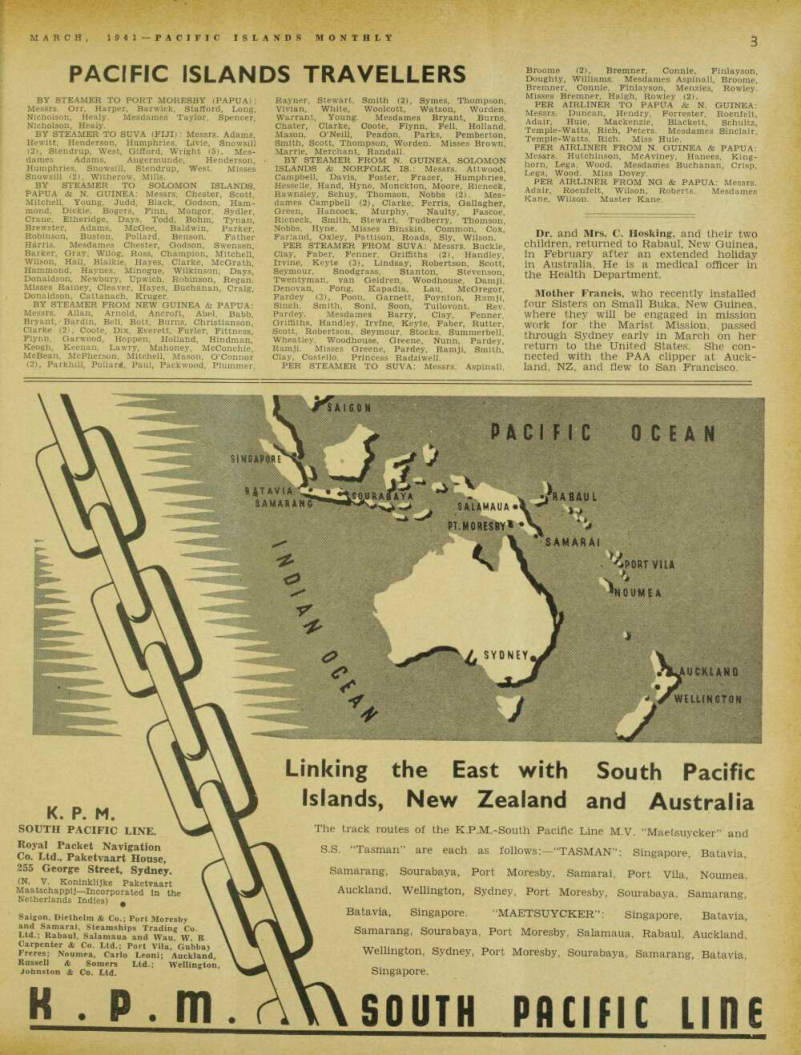
Linking the East with South Pacific
Islands, New Zealand and Australia
The track routes of the K.P.M.-South Pacific Line M.V. “Maetsuycker” and S.S. “Tasman” are each as follows:—“TASMAN”: Singapore, Batavia, Samarang, Sourabaya, Port Moresby, Samarai, Port Vila, Noumea, Auckland, Wellington, Sydney, Port Moresby, Sourabaya, Samarang, Batavia, Singapore. “MAETSUYCKER”: Singapore, Batavia, Samarang, Sourabaya, Port Moresby, Salamaua, Rabaul, Auckland, Wellington, Sydney, Port Moresby, Sourabaya, Samarang, Batavia, Singapore.
SOUTH PACIFIC Line
Advertisers
Advanx Tyre & Rubber Co. Pty.
Ltd 12 “Airzone” Radio . 19 Angus & Coote Ltd. 15 Arnott’s Biscuits , 35 Atkins Ltd., W. . . 37 “Ausoline” ... 57 Baker Ltd., W. Jno. 52
B.A.L.M. Ltd. ... 43
Bank of N.S.W. . . 60 Barnet Glass Rub ber Co. Ltd. . . 49 Berger’s Paints . . 40 “Bidomak” ... 21 Broomfields Ltd. . 38 Brown & Co. Ltd., G 13 Brunton’s Flour . 33 Burns, Philp & Co., Ltd 4 B.P. Magazine . . 62
B.P. (S.S.) Co. . . 32
Burns Philp Trust Co. Ltd 45 Callose & Sons Pty.
Ltd., B 11 Carlton & United Breweries Ltd. . 27 Carpenter Ltd., W.
R. . . . . cov. 2 Chapman & Sherack 39 Chivers & Sons Ltd. 32 Clyde Batteries . . 57 Coleman Lamp & Stove Co. . . 20, 62 Colonial Mutual Life Assurance Society Ltd 42 Colonial Wholesale Meat Co. Ltd. . . 16 Compressor & Air Equipment Co. . 56 Coral Starch ... 35 Cosmopolitan Hotel 64 "Cystex” 59 Dewar’s Whisky . . 44 Doan’s Pills ... 60 Donaghy & Sons Ltd 63 Donald Ltd., A. B. 48 Dr. Williams Pink Pills 43 Eaton Ltd., J. W. 41 Electrolux Refrigerators . . 26
Eno’s Fruit Salt . 63 Excelsior Supply Co. Ltd 46 Fletcher & Sons . 41 Flit 50 Ford Sherington Pty. Ltd. ... 18 Foster Clark Ltd. . 54 Garden Vale Pro ducts Ltd. ... 30 Garrett & Davidson 56 Gilbey’s Gin ... 10 Gillespie’s Flour . 34 Gourock Rope Co. 42 Gowing Bros. Ltd. 18 Grand Pacific Hotel 49 Grove & Sons, W.
H 10 Guinea Airways Ltd cov. 3 Guinness Stout . . 36 Hampton Court . 10 Heinz Co. Ltd., H.
J 22 Holbrook’s Ltd. . . 38 Horlicks Malted Milk 29 Hotel Moresby . . 64 International Correspondence Schools ... 9 Jones & Co., H. . 52 Knox Grammar School 24 Kolynos Dental Cream 14 Kopsen & Co. Ltd. 47 Kork-N-Seal Ltd. . 30 Lea & Perrins Sauce 55 Levenson’s Radio . 58 Lustre Hosiery Ltd. 53 Maxwell Porter Ltd. 43 Mcllrath’s Ltd. . . 55 McNiven Bros. Ltd. 15 “Mendaco” ... 44 Miller & Co. Pty.
Ltd 50 Nelson & Robert son Pty. Ltd. . . 20 Nestle’s Milk ... 23 Newmarket Saddlery . .61 Nock & Kirby Ltd. 51 Noyes Bros. Ltd. . 56 Pacific Is. Society . 11 Papua Hotel, The . 64
Philips Lamps (A/sia) Pty. Ltd. 59 Pike Bros. Ltd. . . 16 “Pinkettes” ... 64 Position Wanted . 51 Prescott Ltd. ... 34 Price’s Radio Ser vice 57 Prouds Ltd. ... 11 Ransomes, Sims & Jefferies Ltd. . . 61 Riverstone Meat Co.
Ltd 28 Rohu, Sil . . . . 62 Royal Packet Navi gation Co. ... 3 Scott Ltd., J. ... 38
Smyth Pty. Ltd., J. H 47 Spinet Cigarettes . 45 Springwood Ladies’
College 53 Steamships Trading Co. Ltd. ... 12 Sterling Varnish Co 9 Sullivan Ltd., C. . 61 Swallow & Ariell , 31 Talkeries, The . . 54 Taylor & Co., A. .
“Tenax” Soap . . 25 Thornycroft (A/sia) Pty. Ltd 51
Tillock & Co. Ltd. 63 Toohey’s Ltd. ... 17 Tooth & Co., . cov. 4 ‘■2o6” Private Hotel 12 Vincent’s A.P.C. . 25 “Vi-stim” ... 46 West, Harry ... 50 Weymark & Son . 34
Wills Ltd., w. D. & H. 0 48 Woods Great Pep permint Cure, 12. 55, 62 Wright & Co. Ltd., E 28 Wunderlich Ltd. . .41
Brother Xavier Koch, SM, of the Marist Mission, arrived in Sydney from the British Solomon Islands in February to undergo medical treatment. He will return to the Protectorate as soon as his health permits.
Contents
Pacific News-Review 1 Conditions in New Caledonia ... 2 South Seas Travellers 3 Japan—And Stark Realities 5 No N. Caledonian Metals for Japan 6 Islands Roll of Honour 6 Hurricane in Central Pacific 6 Baudouin Still Head of Bank of Indo-China 7 Relief for Copra Planters 7 Pat Costello’s New Fiji Gold Mine .. 8 American Consul Goes to Noumea .. 8 NG Air Service Re-arranged ... 8 The Polynesian Club 9 New Hebrides Timber Industry ... 9 About Islands People 10 Japan’s Hesitation Summary of Events in Far East and Pacific 11 Tropicalities 16 Another Cook Medal Found 17 Ficus Rubber from TNG 17 Outbreak of “Vailala Madness’ in Papua 18 The Salamaua-Wau Road 21 Expert Advice for Planters 22 Burial Caves in Eastern Polynesia .. 24 Papuans Turn to Litigation 25 The Sulu of Fiji 25 The Pia Plant of Samoa 27
Recruiting in Western Samoa .. .. 28 Will Oil be Found in Islands? ... 29 All is Vanity! 30 Training Polynesians to Save Their People 31 Leprosy in the Solomons 34 Sic Transit Gloria Mundi—A Fijian Tale 36 Sampan That Rescued French Air men 38 Papuan Tragedy of 1901 39 Use of Copra Meal 40 “German Submarine” 41 Chinese in Wau, TNG 42 1 The Solomons To-day 43 A Sunday in Papeete 44 The District Officer System 46 Nauru’s “Lively New Year” 47 Late Frank Rostier, of Fiji 48 Are We to Become “American Colonies”? 49 A Section for Islands Women ... 52 Shark Fishing in Tonga 55 Islands Mining Notes 56 Short Wave Radio Programmes ... 59 Copra and Rubber Quotations ... 60 Produce and Exchange Rates ... 61 Rare Tongan Stamp 62 Personal Notes 64
Advertisements & other items, p. 6 (1 item)
Burns, Philp
Sf II!
H
llllElllfHtilllKil
■■ i 111
iiijll
11 > Head Office: 7 Bridge Street, Sydney—Australia Code Address: " Burphil"
BURNS, PHILP
& Co. Ltd.
GENERAL MERCHANTS
SHIPOWNERS
TOURIST AGENTS
BUYERS OF ALL CLASSES OF ISLAND PRODUCE Regular Steamer Services from Australia to New Guinea —Papua Solomon Is.
Lord Howe Is. —Norfolk-Is. New Hebrides —Hongkong—Java and Singapore
Pacific Islands monthly
The Newspaper-Magazine of the South Seas
[Registered at the G.P.O. y Sydney, for transmission "by post as a newspaper .] Published Once Each Month and Circulated in Australia and New Zealand and in the following Pacific Territories and Islands Groups:
Australian Territory of Papua.
Mandated Territory (Australia) of New Guinea, Bismarck Archipelago and Northern Solomon Islands.
Australian Territory of Norfolk Island.
New Zealand Territory of Cook Islands.
Mandated Territory (New Zealand) of Samoa.
British Colony of Fiji.
British Solomon Islands Protectorate.
British Protectorate of Tongan Islands.
British Crown Colony of Gilbert and Ellice Islands.
Mandated Territory of Nauru.
British and French Condominium of New Hebrides.
French Colony of New Caledonia.
French Colony of Oceania (Tahiti, etc.).
American Territory of Eastern Samoa.
American Territory of Hawaiian Islands.
American Territory of Guam.
Mandated Territory (Japan) of Marshall, Caroline and Mariana Islands.
Owned and Produced by Pacific Publications Pty. Ltd. Union House, 247 George Street, Sydney.
TELEPHONE f Managing Director .. BW 5037 ( Business and Editorial MA 7101
P.O. Box 3408 R
Registered Address of Telegrams, Radiograms, and Cables: “Pacpub”, Sydney.
Contributions.
Articles, Stories, and Photographs dealing with Pacific Islands subjects are invited and will be paid for on publication.
Subscription Rates.
Per Annum, within British Empire, Prepaid, Post Free 8/- Per Annum, elsewhere, prepaid, Post Free . 10/- Single Copies 8d
Editor and Publisher:
R. W. Robson, P.R.G.S.
Assisted by Selwyn Hughes.
Advertising Manager: L. W, Bailey.
Advertising Office and Printing-House: 29 Alberta Street, Sydney.
Advertising rates furnished on application.
Colours, etc,, by Arrangement.
Process Blocks made at Advertiser’s expense when required. Screen 100.
Changes of Advertising Copy should reach this Office by Ist of each month, otherwise previous advertisement may be repeated.
IN LONDON, the Pacific Islands Monthly Is on sale at the Bookstall, Australia House, The Strand, London.
Agents.
The following are authorised to receive sub scriptions for the Pacific Islands Monthly:— Islands Branches of Burns, Phllp & Co., Ltd., and Burns Philp (South Sea) Co., Ltd.
Islands Branches of W. R. Carpenter & Co., Ltd.
Islands Branches of Morris, Hedstrom, Ltd.
T. A. Olsson, Wau, New Guinea.
G. Thomas & Co., Rabaul, New Guinea.
Whitten Bros., Ltd., Samarai, Papua.
Steamships Trading Co., Papua. All Branches.
B.N.G. Trading Co., Ltd., Port Moresby, Papua.
J. Muir, Suva, Fiji.
N. C. Mackenzle-Hunt, Walnunu, Bua, FIJI.
Islands Branches and Representatives of W. H.
Grove & Sons, Ltd., Auckland, New Zealand.
Cook Islands Trading Co.. Rarotonga, Cook Is.
A. C. Rowland, Papeete, Tahiti.
Representative In London: W. C. HARVEY, Coronation House, 4 Lloyds Avenue, London, E.C.3, from whom may be obtained copies of Pacific Islands Monthly, Pacific Islands Year Book, advertising schedules, etc.
Vol. XI. No. 8.
March 15, 1941
Prirp 1 ,a - Per Copy rnoe ( Prepaid: 8/- p.a.
Japan—And Stark Realities
ON page 11 of this issue there is published an article in which an attempt is made to present all the facts and probabilities in relation to the Japanese claim to control the territories of the Pacific (“Oceania”) —a subject of vital interest to- every European dweller in the Pacific. , Ever since this journal was estab lished, in 1930, articles have been published in which was presented the argument that, if European nations holding colonies in and around the Pacific did not give consideration to the plight of landless Japan, an inter-racial explosion in the Pacific was inevitable. Nothing that has happened since September, 1939, gives us cause to amend that argu ment; but much has happened to modify our conclusions.
Because of events due to her ill calculated and criminal attack upon China, Japan in recent years has passed under the control of Fascists and militarists; and these people have thrown the great Asiatic Power into the arms of the predatory Hitler and the strutting Mussolini. Had the middle-class statesmen who so suc cessfully guided the destinies of Japan in the first 30 years of this century been still in control, Japan W9UM to-day be at least the neutral friend of Britain and the United States, using the unforeseen situation created by the war against Hitlerism to advance her proper claims for more territories to colonise, and wider op portunities for her trade expansion.
But Japan, apparently, has chosen another path. Her foreign policy is based, now, on the presumed defeat of Britain. She is officially and actually allied with our deadly enemies. Her navy, her armies, and her air fleets now are lined up in the vicinity of South China and Indo china, gazing eagerly southwards, awaiting a word which will start them advancing towards the rich lands of “Oceania”, to which already they openly have laid claim. Their leaders, in what appears to be a delirium of hysterical, nationalistic excitement, continue to make state ments to the anxiously listening world, which are not consistent with each other nor in accordance with plain facts; and which, to use an Americanism, “do not make sense”.
Japanese statesmen, for instance assured us suavely on March 10 that Japan desires nothing but good neighbourliness and peace in the Pacific; and one of her leading news papers announces flamboyantly on March 11 that “the forthcoming Thai- French peace agreement marks the first concrete step in Japan’s south ward policy”. We know that the Thai- French peace agreement establishes Japan in Indo-China; and that south ward of Indo-China there are only Malaya and the Dutch East Indies Since Indo-China is the “first con crete step”, we can only assume that Malaya or the Dutch East Indies are to be the second concrete step.
We must remember that we are
dealing with an Asiatic mind, and a nation in a strange condition of exaltation; and, while observing the proprieties of diplomacy, we must prepare for the worst.
THE Foreign Minister of Japan, Mr.
A Matsuoka, with an impressive entourage, left Tokyo on March 11 for Berlin and Rome; and he told the press that he would meet the leaders of Germany and Italy and preach “my long - cherished world - peace views”. He admitted that he would make a call at Moscow—which means of course, an effort to persuade Stalin not to interfere with the “southward policy”. The Berlin radio says: “The German nation looks forward to this visit with joy, for it will provide an opportunity to discuss all questions of co-operation under the Three Power Pact”. On the very same day, March 11, the first Japanese Minister to Australia, Mr. Kawai, arrives and makes to Australia the soothing and pleasant assurances of friendship and peace, which are the accustomed utterances of Japanese representatives in such circumstances. Admiral Nomura made them, when he arrived in Washington, a month ago, and was practically frozen out. They come strangely from the country which grabbed Manchuria, attacked in offensive China, and now, taking ad vantage of France’s plight, are pro ceeding to exercise control of Indo china.
THE Anglo-Saxon powers have A learned very much in the last ten years. In 1930 we—believing that
the world was ready for peace—had disarmed ourselves to the point of extreme vulnerability. We were put ting our faith in the League of Nations and our confidence in the assurances of other Powers. To-day, in a world dominated by jungle law, among nations which literally slobber with greed whenever they contem plate the possibility of looting our Empire, we are fighting for our very existence, with not one dependable friend in the world except our cousins of the United States—whose eager ness for the preservation of the de cencies of civilisation equals our own, but whose sword yet is undrawn. What are we to accept—the stark facts of reality (which include the enormous, armed forces of Japan standing at the line of Indo-China, and an ag gressive Japanese press) or the sooth ing assurances of Mr. Kawai and of Mr. Matsuoka, who at this moment is racing across Asia to hold a soul communion with our arch enemies, Hitler and Mussolini?
Are we to put our faith in the well tried democratic institutions in which we believe, and which are the pro duct of two thousand years of Western European social evolution: or a so-called “New Order in Europe ’ and “Co-prosperity League in Asia’’— fantastic things which are the pro duct of strange people and strange cliques that have sprung up in a night?
We believe now, as we have believed for months, that there is little danger of war with Japan so long as we are strong, well-armed and vigilant; but that, if Britain or America is weak ened, either by defeat in war or “appeasement” in the diplomatic field, the Third Member of the Axis will launch an attack upon us in the Pacific, without warning and without mercy.
"Commissaire Ramel" Lost
THE French liner, “Commissaire Ramel” (10,161 tons), which before the out break of war ran between France and the South Seas (Papeete, Suva, Vila, and Noumea) was lost by enemy action last September, according to an official announcement made in March.
The “Ramer was taken over from Messageries Maritime Co. by the British authorities and manned with an Aus tralian crew. Shortly after leaving Aus tralian waters for the United Kingdom, she was intercepted by a Nazi raider in the Indian Ocean and sunk by gunfire.
The officers and crew were taken prisoners.
Early this month, when British forces made their great drive into Italian Somaliland, the town of Merka (south of Mogadishu, the capital) fell into our hands. There, the British unexpectedly found and released 200 Allied seamen who had been landed at various times from German raiders and among these men were 42 of the “Commissaire Ramel’s” officers and crew.
Mrs. Leonard Murray, wife of the new Administrator of Papua, and their son Dennis, who have been on a lengthy visit to NSW and South Australia, re turned to Port Moresby early in March.
For the first time in many years, the “first lady of the land” of Papua will be in residence at Government House.
No Metals For Japan
Decision in N. Caledonia
PASSENGERS who arrived in Auckland from Noumea on March 1 stated that the Government of New Cale donia had placed a complete prohibition on the export of metals to Japan, and four Japanese vessels, which recently arrived at Noumea for ore, were waiting there, unable to load.
New Caledonian interests are seriously concerned at the economic effect of this embargo. A ready market has been found for all the chrome ore produced, but all the nickel ore has not yet been sold — although hopes are entertained of dis posing of it to the United States. It now is necessary to find a new market also for the iron ore.
Representatives of New Caledonian interests have arrived in Australia to deal with this situation, and it is possible that they will proceed to the United States.
Mr. Kuroki. who opened a consulate for Japan at Noumea about a year ago, has been recalled to Japan and has left New Caledonia by flying boat. His suc cessor in the Noumea consulate, Mr.
Yamashita, has already arrived there and has taken charge of affairs on behalf of Japan.
One of Mr. Yamashita’s first official acts was to place a wreath on the Nou mea war memorial. Many returned sol diers refused to attend, but a few French and about 200 Japanese were present.
Part-Japanese Co.
There has been formed in Noumea a company which calls itself “Societe Gen erale Sud Pacifique”—a limited company with 50,000 francs capital.
Its object is to generally control all operations concerned either directly or indirectly with the buying and selling, importing or exporting of all merchan dise, all arrangements regarding com mission, representation, brokerage, and in a general sense all commercial opera tions, whether of an agricultural, indus trial or financial nature, or otherwise.
Directors are: Alfred Richard Lomont, of Noumea; Paul Baumier, of Noumea;
Shojiro Omo, of Japan; and Kenchi Kashima, of Noumea. The joint mana gers are Tokiya Taniguchi and Charles Mennesson, both of Noumea.
Missing
Roll Of Honour
(It is hoped to assemble, here, the names or men, former residents of the Pacific Territories, which appear in British and French casualty lists, or in lists of honours awarded. We should be grateful if relations and friends would send us details.) Died from Wounds Sergeant-Pilot Peter Clarkson Wise, son of Mr. W. Wise, OBE, Director of Public Works in Fiji. Wounded by anti aircraft gunfire during bomber raid over Germany, January, 1941. Returned with crew safely to aerodrome, died two days later.
Flying-Officer Moresby Gofton, of the R.AJ 1 ., son of Mrs. F. S. Stewart, of Wau, New Guinea. Reported missing, 17/5/1940. Now believed killed.
Flying-Officer K. J. A. Johnstone, of the R.A.F., who was born in Suva in 1915. Reported missing, 1/5/1940. His mother was a daughter of the late Mr H. Thiele, for many years a' member of the Colonial Sugar Refining Co.'s staff in Fiji.
Flight-Lieutenant G. J. I. Clarke, of the RAAF, serving overseas, formerly Assistant Flight Superintendent of Car penter Airways, New Guinea. Reported missing 25/9/1940.
Wounded
Stanley Higgs, son of Mr. and Mrs.
Gordon Higgs, of W. R. Carpenter and Co., Ltd., well-known in New Guinea.
Member of an English Lancers regiment, wounded during evacuation from Dun kirk, May, 1940.
Private H. G. Turner, of Samarai, Eastern Papua, wounded in action in Western Desert, Egypt, January, 1941.
Miss A. V. Williams, of Ballarat, Vic toria, has been appointed to the staff of the Paton Memorial Hospital at Vila, New Hebrides.
Suva Chinese Entertain Mr. W. H. Donald
On his way to Tahiti, where he will stay for a time, writing his memoirs, Mr. W. H. Donald, adviser to the Chinese leader, Generalissimo Chiang Kai-shek, spent a few days in Fiji in January, awaiting steamer connection with Papeete. In Suva, he was welcomed and enter tained by the Chinese community, and the group photograph shows him at the home of Mr. C.
H. G. Honson, one of the leading Chinese mer chants. Left to right : Miss Annie Honson,
Mrs. Honson, Miss Ansie Lee (Mr. Donald’s private secretary), Mrs. Y. S. Chen (wife of the Chinese Vice-Consul), Miss Ida Honson, Mr.
Gordon Honson, Mr. K. C. Liang (headmaster of the Fiji-Chinese School), Mr. W. H. Donald, and Mr. C. H. G. Honson. Mr. Donald, who is an Australian, has been in China for 40 years, and he will return there after his sojourn in French Oceania. —Photo: C. L. Cheng.
Central Pacific
Hurricane in Central Pacific Extensive Damage in Fiji and Niue
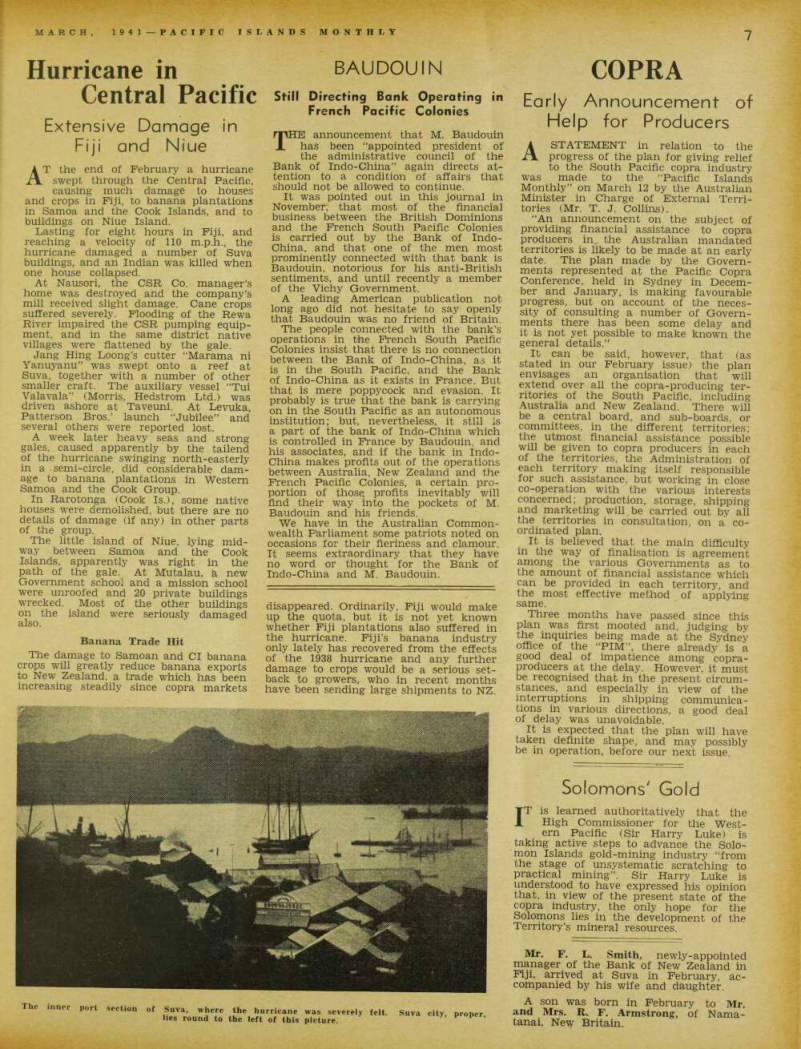
AT the end of February a hurricane swept through the Central Pacific, causing much damage to houses and crops in Fiji, to banana plantations in Samoa and the Cook Islands, and to buildings on Niue Island.
Lasting for eight hours in Fiji, and reaching a velocity of 110 m.p.h., the hurricane damaged a number of Suva buildings, and an Indian was killed when one house collapsed.
At Nausori, the CSR Co. manager’s home was destroyed and the company’s mill received slight damage. Cane crops suffered severely. Flooding of the Rewa River impaired the CSR pumping equip ment, and in the same district native villages were flattened by the gale.
Jang King Loong’s cutter “Marama ni Yanuyanu” was swept onto a reef at Suva, together with a number of other smaller craft. The auxiliary vessel “Tui Valavala” (Morris, Hedstrom Ltd.) was driven ashore at Taveuni. At Levuka, Patterson Bros.’ launch “Jubilee” and several others were reported lost.
A week later heavy seas and strong gales, caused apparently by the tailend of the hurricane swinging north-easterly in a semi-circle, did considerable dam age to banana plantations in Western Samoa and the Cook Group.
In Rarotonga (Cook Is.), some native houses were demolished, but there are no details of damage (if any) in other parts of the group.
The little island of Niue, lying mid way between Samoa and the Cook Islands, apparently was right in the path of the gale. At Mutalau, a new Government school and a mission school were unroofed and 20 private buildings wrecked. Most of the other buildings on the island were seriously damaged also.
Banana Trade Hit The damage to Samoan and Cl banana crops will greatly reduce banana exports to New Zealand, a trade which has been increasing steadily since copra markets
disappeared. Ordinarily, Fiji would make up the quota, but it is not yet known whether Fiji plantations also suffered in the hurricane. Fiji’s banana industry only lately has recovered from the effects of the 1938 hurricane and any further damage to crops would be a serious set back to growers, who in recent months have been sending large shipments to NZ.
The inner port section of Suva, where the hurricane was severely felt. Suva city, proper lies round to the left of this picture.
Baudouin
Still Directing Bank Operating in French Pacific Colonies
rE announcement that M. Baudouin has been “appointed president of the administrative council of the Bank of Indo-China” again directs at tention to a condition of affairs that should not be allowed to continue.
It was pointed out in this journal in November, that most of the financial business between the British Dominions and the French South Pacific Colonies is carried out by the Bank of Indo- China, and that one of the men most prominently connected with that bank is Baudouin, notorious for his anti-British sentiments, and until recently a member of the Vichy Government.
A leading American publication not long ago did not hesitate to say openly that Baudouin was no friend of Britain.
The people connected with the bank’s operations in the French South Pacific Colonies insist that there is no connection between the Bank of Indo-China, as it is in the South Pacific, and the Bank of Indo-China as it exists in France. But that is mere poppycock and evasion. It probably is true that the bank is carrying on in the South Pacific as an autonomous institution; but, nevertheless, it still is a part of the bank of Indo-China which is controlled in France by Baudouin, and his associates, and if the bank in Indo- China makes profits out of the operations between Australia, New Zealand and the French Pacific Colonies, a certain pro portion of thosq profits inevitably v/ill find their way into the pockets of M.
Baudouin and his friends.
We have in the Australian Common wealth Parliament some patriots noted on occasions for their fieriness and clamour.
It seems extraordinary that they have no word or thought for the Bank of Indo-China and M. Baudouin.
Copra
Early Announcement of Help for Producers
A STATEMENT in relation to the progress of the plan for giving relief to the South Pacific copra industry was made to the “Pacific Islands Monthly” on March 12 by the Australian Minister in Charge of External Terri tories (Mr. T. J. Collins).
“An announcement on the subject of providing financial assistance to copra producers in. the Australian mandated territories is likely to be made at an early date. The plan made by the Govern ments represented at the Pacific Copra Conference, held in Sydney in Decem ber and January, is making favourable progress, but on account of the neces sity of consulting a number of Govern ments there has been some delay and it is not yet possible to make known the general details.”
It can be said, however, that (as stated in our February issue) the plan envisages an organisation that will extend over all the copra-producing ter ritories of the South Pacific, including Australia and New Zealand. There will be a central board, and sub-boards, or committees, in the different territories; the utmost financial assistance possible will be given to copra producers in each of the territories, the Administration of each territory making itself responsible for such assistance, but working in close co-operation with the various interests concerned; production, storage, shipping and marketing will be carried out by all the territories in consultation, on a co ordinated plan.
It is believed that the main difficulty in the way of finalisation is agreement among the various Governments as to the amount of financial assistance which can be provided in each territory, and the most effective method of applying same.
Three months have passed since this plan was first mooted and, judging by the inquiries being made at the Sydney office of the “PIM”, there already is a good deal of impatience among copra producers at the delay. However, it must be recognised that in the present circum stances, and especially in view of the interruptions in shipping communica tions in various directions, a good deal of delay was unavoidable.
It is expected that the plan will have taken definite shape, and may possibly be in operation, before our next issue.
Solomons' Gold
IT is learned authoritatively that the High Commissioner for the West ern Pacific (Sir Harry Luke) is taking active steps to advance the Solo mon Islands gold-mining industry “from the stage of unsystematic scratching to practical mining”. Sir Harry Luke is understood to have expressed his opinion that, in view of the present state of the copra industry, the only hope for the Solomons lies in the development of the Territory’s mineral resources.
Mr. F. L. Smith, newly-appointed manager of the Bank of New Zealand in Fiji, arrived at Suva in February, ac companied by his wife and daughter.
A son was born in February to Mr. and Mrs. R. F. Armstrong, of Nama tanai, New Britain.
Pat Costello's New Fiji Gold
Mine
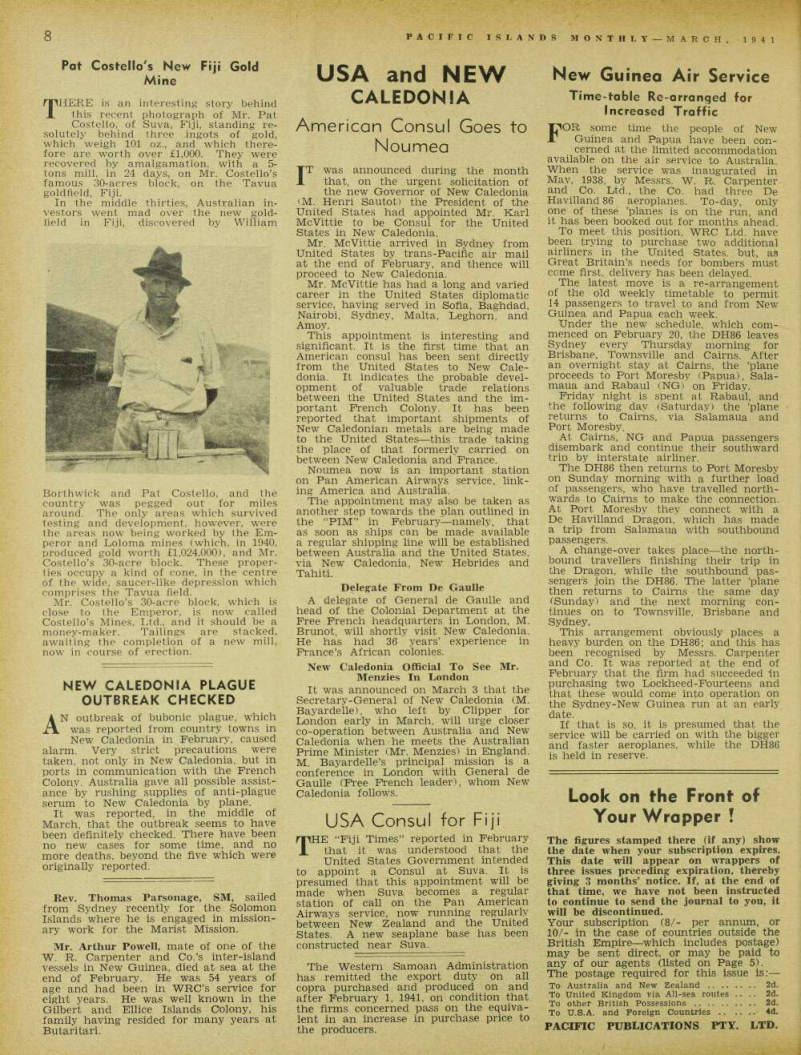
THERE is an interesting story behind this recent photograph of Mr. Pat Costello, of Suva, Fiji, standing re solutely behind three ingots of gold, which weigh 101 oz., and which there fore are worth over £l,OOO. They were recovered by amalgamation, with a 5tons mill, in 24 days, on Mr. Costello’s famous 30-acres block, on the Tavua goldfield, Fiji.
In the middle thirties, Australian in vestors went mad over the new gold field in Fiji, discovered by William
Borthwick and Pat Costello, and the country was pegged out for miles around. The only areas which survived testing and development, however, were the areas now being worked by the Em peror and Loloma mines (which, in 1940, produced gold worth £1,024,000), and Mr.
Costello’s 30-acre block. These proper ties occupy a kind of cone, in the centre of the wide, saucer-like depression which comprises the Tavua field.
Mr. Costello’s 30-acre block, which is close to the Emperor, is now called Costello’s Mines, Ltd., and it should be a money-maker. Tailings are stacked, awaiting the completion of a new mill, now in course of erection.
New Caledonia Plague
Outbreak Checked
AN outbreak of bubonic plague, which was reported from country towns in New Caledonia in February, caused alarm. Very strict precautions were taken, not only in New Caledonia, but in ports in communication with the French Colony. Australia gave all possible assist ance by rushing supplies of anti-plague serum to New Caledonia by plane.
It was reported, in the middle of March, that the outbreak seems to have been definitely checked. There have been no new cases for some time, and no more deaths, beyond the five which were originally reported.
Rev. Thomas Parsonage, SM, sailed from Sydney recently for the Solomon Islands where he is engaged in mission ary work for the Marist Mission.
Mr. Arthur Powell, mate of one of the W. R. Carpenter and Co.’s inter-island vessels in New Guinea, died at sea at the end of February. He was 54 years of age and had been in WRC’s service for eight years. He was well known in the Gilbert and Ellice Islands Colony, his family having resided for many years at Butaritari.
USA and NEW
Caledonia
American Consul Goes to
Noumea
IT was announced during the month that, on the urgent solicitation of the new Governor of New Caledonia (M. Henri Sautot) the President of the United States had appointed Mr. Karl McVittie to be Consul for the United States in New Caledonia.
Mr. McVittie arrived in Sydney from United States by trans-Pacific air mail at the end of February, and thence will proceed to New Caledonia.
Mr. McVittie has had a long and varied career in the United States diplomatic service, having served in Sofia, Baghdad, Nairobi, Sydney, Malta, Leghorn, and Amoy.
This appointment is interesting and significant. It is the first time that an American consul has been sent directly from the United States to New Cale donia. It indicates the probable devel opment of valuable trade relations between the United States and the im portant French Colony. It has been reported that important shipments of New Caledonian metals are being made to the United States —this trade taking the place of that formerly carried on between New Caledonia and France.
Noumea now is an important station on Pan American Airways service, link ing America and Australia.
The appointment may also be taken as another step towards the plan outlined in the “PIM” in February—namely, that as soon as ships can be made available a regular shipping line will be established between Australia and the United States, via New Caledonia, New Hebrides and Tahiti.
Delegate From De Gaulle A delegate of General de Gaulle and head of the Colonial Department at the Free French headquarters in London, M.
Brunot, will shortly visit New Caledonia.
He has had 36 years’ experience in France’s African colonies.
New Caledonia Official To See Mr.
Menzies In London It was announced on March 3 that the Secretary-General of New Caledonia (M.
Bayardelle). who left by Clipper for London early in March, will urge closer co-operation between Australia and New Caledonia when he meets the Australian Prime Minister (Mr. Menzies) in England.
M. Bayardelle’s principal mission is a conference in London with General de Gaulle (Free French leader), whom New Caledonia follows.
USA Consul for Fiji
THE “Fiji Times” reported in February that it was understood that the United States Government intended to appoint a Consul at Suva. It is presumed that this appointment will be made when Suva becomes a regular station of call on the Pan American Airways service, now running regularly between New Zealand and the United States. A new seaplane base has been constructed near Suva.
The Western Samoan Administration has remitted the export duty on all copra purchased and produced on and after February 1. 1941, on condition that the firms concerned pass on the equiva lent in an increase in purchase price to the producers.
New Guinea Air Service
Time-table Re-arranged for Increased Traffic
FOR some time the people of New Guinea and Papua have been con cerned at the limited accommodation available on the air service to Australia.
When the service was inaugurated in May, 1938, by Messrs. W. R. Carpenter and Co. Ltd., the Co. had three De Havilland 86 aeroplanes. To-day, only one of these ’planes is on the run, and it has been booked out for months ahead.
To meet this position, WRC Ltd. have been trying to purchase two additional airliners in the United States, but, as Great Britain’s needs for bombers must come first, delivery has been delayed.
The latest move is a re-arrangement of the old weekly timetable to permit 14 passengers to travel to and from New Guinea and Papua each week.
Under the new schedule, which com menced on February 20, the DHB6 leaves Sydney every Thursday morning for Brisbane, Townsville and Cairns. After an overnight stay at Cairns, the ’plane proceeds to Port Moresby (Papua), Sala maua and Rabaul (NG) on Friday.
Friday night is spent at Rabaul, and the following day (Saturday) the ’plane returns to Cairns, via Salamaua and Port Moresby.
At Cairns, NG and Papua passengers disembark and continue their southward trip by interstate airliner.
The DHB6 then returns to Port Moresby on Sunday morning with a further load of passengers, who have travelled north wards to Cairns to make the connection.
At Port Moresby they connect with a De Havilland Dragon, which has made a trip from Salamaua with southbound passengers.
A change-over takes place—the north bound travellers finishing their trip in the Dragon, while the southbound pas sengers join the DHB6. The latter ’plane then returns to Cairns the same day (Sunday) and the next morning con tinues on to Townsville, Brisbane and Sydney.
This arrangement obviously places a heavy burden on the DHB6; and this has been recognised by Messrs. Carpenter and Co. It was reported at the end of February that the firm had succeeded in purchasing two Lockheed-Fourteens and that these would come into operation on the Sydney-New Guinea run *at an early date.
If that is so, it is presumed that the service will be carried on with the bigger and faster aeroplanes, while the DHB6 is held in reserve.
Advertisements & other items, p. 10 (1 item)
Look on the Front of
Your Wrapper !
The figures stamped there (if any) show the date when your subscription expires.
This date will appear on wrappers of three issues preceding expiration, thereby giving 3 months’ notice. If, at the end of that time, we have not been instructed to continue to send the journal to you, it will be discontinued.
Your subscription (8/- per annum, or 10/- in the case of countries outside the British Empire—which includes postage) may be sent direct, or may be paid to any of our agents (listed on Page 5).
The postage required for this issue is: — To Australia and New Zealand 2d.
To United Kingdom via All-sea routes ... 2d.
To other British Possessions 2d.
To U.S.A. and Foreign Countries 4d.
PACIFIC PUBLICATIONS PTY. LTD.
Polynesian Club
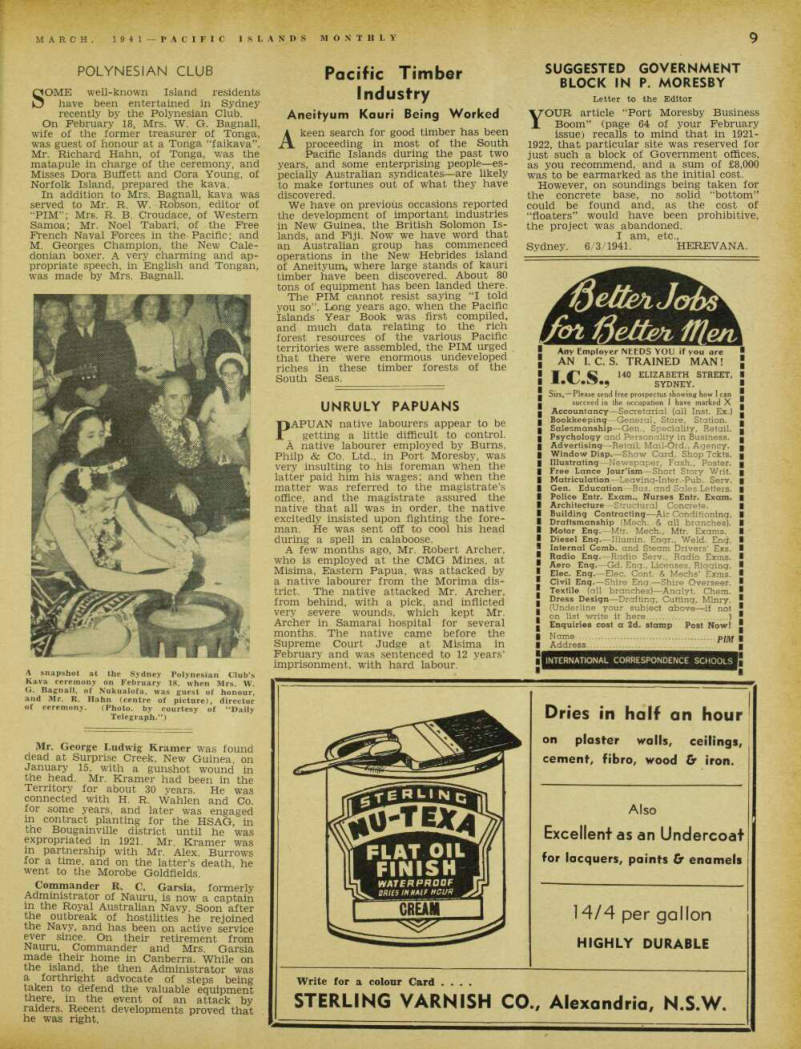
SOME well-known Island residents have been entertained in Sydney recently by the Polynesian Club.
On February 18, Mrs. W. G. Bagnall, wife of the former treasurer of Tonga, was guest of honour at a Tonga “faikava”.
Mr. Richard Hahn, of Tonga, was the matapule in charge of the ceremony, and Misses Dora Buffett and Cora Young, of Norfolk Island, prepared the kava.
In addition to Mrs. Bagnall, kava was served to Mr. R. W. Robson, editor of ‘PIM’'; Mrs. R. B. Croudace, of Western Samoa; Mr. Noel Tabari, of the Free French Naval Forces in the Pacific; and M. Georges Champion, the New Cale donian boxer. A very charming and ap propriate speech, in English and Tongan, was made by Mrs. Bagnall.
Mr. George Ludwig Kramer was found dead at Surprise Creek, New Guinea, on January 15, with a gunshot wound in the head. Mr. Kramer had been in the Territory for about 30 years. He was connected with H. R. Wahlen and Co. for some years, and later was engaged in contract planting for the HSAG, in the Bougainville district until he was expropriated in 1921. Mr. Kramer was in partnership with Mr. Alex. Burrows for a time, and on the latter’s death, he went to the Morobe Goldfields.
Commander R, C. Garsia, formerly Administrator of Nauru, is now a captain in the Royal Australian Navy. Soon after the outbreak of hostilities he rejoined the Navy, and has been on active service ever since. On their retirement from Nauru, Commander and Mrs. Garsia made their home in Canberra. While on the island, the then Administrator was a forthright advocate of steps being taken to defend the valuable equipment there, in the event of an attack by raiders. Recent developments proved that he was right.
A snapshot at the Sydney Polynesian Club’s Kava ceremony on February 18, when Mrs. W.
G. Bagnall, of Nukualofa, was guest of honour, and Mr. R. Hahn (centre of picture), director of ceremony. (Photo, by courtesy of “Daily Telegraph.”)
Industry
Pacific Timber Industry Aneityum Kauri Being Worked
A keen search for good timber has been proceeding in most of the South Pacific Islands during the past two years, and some enterprising people—es pecially Australian syndicates—are likely to make fortunes out of what they have discovered.
We have on previous occasions reported the development of important industries in New Guinea, the British Solomon Is lands, and Fiji. Now we have word that an Australian group has commenced operations in the New Hebrides island of Aneityum, where large stands of kauri timber have been discovered. About 80 tons of equipment has been landed there.
The PIM cannot resist saying “I told you so”. Long years ago, when the Pacific Islands Year Book was first compiled, and much data relating to the rich forest resources of the various Pacific territories were assembled, the PIM urged that there were enormous undeveloped riches in these timber forests of the South Seas.
Unruly Papuans
PAPUAN native labourers appear to be getting a little difficult to control.
A native labourer employed by Burns.
Philp & Co. Ltd., in Port Moresby, was very insulting to his foreman when the latter paid him his wages; and when the matter was referred to the magistrate’s office, and the magistrate assured the native that all was in order, the native excitedly insisted upon fighting the fore man. He was sent off to cool his head during a spell in calaboose.
A few months ago, Mr. Robert Archer, who is employed at the CMG Mines, at Misima, Eastern Papua, was attacked by a native labourer from the Morima dis trict. The native attacked Mr. Archer, from behind, with a pick, and inflicted very severe wounds, which kept Mr.
Archer in Samarai hospital for several months. The native came before the Supreme Court Judge at Misima in February and was sentenced to 12 years’ imprisonment, with hard labour.
Suggested Government
Block In P. Moresby
Letter to the Editor
YOUR article “Port Moresby Business Boom” (page 64 of your February issue) recalls to mind that in 1921- 1922, that particular site was reserved for just such a block of Government offices, as you recommend, and a sum of £B,OOO was to be earmarked as the initial cost.
However, on soundings being taken for the concrete base, no solid “bottom” could be found and, as the cost of “floaters” would have been prohibitive, the project was abandoned.
I am, etc.,
Sydney. 6/3/1941.
Herevana.
Pitcairn Island’s first divorce action was mentioned in Wellington, NZ, in February, when Mrs. Chester Young claimed divorce from Mr. Young on the ground of three years’ separation. The case was postponed when the respond ent objected that a decree granted in NZ might not be recognised among the islanders, who rejected the idea of divorce.
Advertisements & other items, pp. 11-12 (1 item)
SS£lf*4
Any Employer NEEDS YOU if you are
AN I. C. S. TRAINED MAN!
Sirs, —Please send free prospectus showing how I can succeed in the occupation I have marked X Accountancy —Secretarial (all Inst. Ex.) Bookkeeping —General. Store, Station.
Salesmanship —Gen., Speciality, Retail.
Psychology and Personality in Business.
Advertising Retail, Mail-Ord., Agency.
Window Disp. —Show Card, Shop Tckts.
Illustrating Newspaper, Fash., Poster.
Free Lance Jour'ism —Short Story Writ.
Matriculation —Leaving-Inter.-Pub. Serv.
Gen. Education— Bus. and Sales Letters.
Police Entr. Exam., Nurses Entr. Exam.
Architecture —Structural Concrete.
Building Contracting— Air Conditioning.
Draftsmanship (Mech. & all branches).
Motor Eng. Mtr. Mech., Mtr. Exams.
Diesel Eng. Illumin. Engr., Weld. Eng.
Internal Comb, and Steam Drivers' Exs.
Radio Eng. —Radio Serv., Radio Exms.
Aero Eng. —Gd. Eng., Licenses, Rigging.
Elec. Eng. —Elec. Cont. & Mechs' Exms.
Civil Eng. —Shire Eng.—Shire Overseer.
Textile (all branches) —Analyt. Chem.
Dress Design —Drafting, Cutting, Mlnry. (Underline your subject above—if not on list write it here ) Enguiries cost a 2d. stamp Post Now! 1.C.5.,
140 ELIZABETH STREET,
SYDNEY.
Name .
Address.
PIM
INTERNATIONAL CORRESPONDENCE SCHOOLS
SS£lf*4
CREAM
Dries in half an hour on plaster walls, ceilings, cement, fibre, wood & iron.
Also Excellent as an Undercoat for lacquers, paints Cr enamels 14/4 per gallon
HIGHLY DURABLE
Write for a colour Card ...
STERLING VARNISH CO., Alexondria, N.S.W.
Visitors to Sydney
HAMPTON COURT,
KING’S CROSS.
The Furnished Flats that give everything, and only a few minutes from the heart of the city.
Rentals from £3/3/- weekly.
Write Manager for fuller particulars.
aaSSMBr
Rich in jumper and healthful herbs K
W. H. GROVE & Sons Ltd.
AUCKLAND
Island Traders. p.o. b<« 49«.
Telegraphic and Cable Address: “Grove”, Auckland.
Shippers of all classes of New Zealand Products, specially prepared for the Island trade.
Representing English Manufacturers throughout the Cook and Society Islands, Fiji, Tonga, Samoa, Niue, New Caledonia, New Guinea, etc.
In FIJI as—W. H. Grove & Sons (Fiji) Ltd.
About Islands People
Mr. G. A. Loudon, of Port Moresby, Papua, is at present spending a few weeks at Wentworth Falls, NSW. He had a bad attack of influenza contracted in Papua, but is now fit and well again.
Mrs. Constance Wright, who is one of the best known and highly-esteemed pioneer women of Papua and New Guinea, is now a resident of Charters Towers, North Queensland.
Mr. A. S. Evensen, manager of Coconut Products Ltd., Pondo, New Guinea, who recently was ordered South for health reasons, arrived in Sydney in mid-March by the mail-plane. Mr. H. R.Goodwyn, of W. R. Carpenter Ltd.’s Rabaul staff, has assumed the management for the time being.
The Governor of Fiji and High Com missioner of the Western Pacific, Sir Harry Luke, arrived in Auckland in mid- February by the “Mariposa”, and will spend a few weeks’ holiday in Rotorua and Wellington, NZ.
Mrs. R. B. Coudace, and her daughter, Miss Jean Croudace, of Western Samoa, who have been holidaying in Sydney for some weeks, left for New Zealand, en route to Apia, early in March. They were entertained at several farewell parties, prior to departure.
Mr. R. E. Mountstephens, who has been a planter in Vanua Levu, Fiji, for 10 years, arrived in Sydney in December, and since has joined the Royal Aus tralian Navy, with commissioned rank.
Mrs. Mountstephens is residing at Bay view, near Sydney.
Miss Hazel Colebrook, who was a well known member of the staff of Messrs.
W. R. Carpenter & Co., in Salamaua, New Guinea, died in Prince Alfred Hos pital, Sydney, at the beginning of March.
Miss Colebrook, who came from Goul burn, NSW, had been twelve years in the Territory. She became seriously ill on the ship on her way to Sydney.
Mr. and Mrs. Walker-Flynn, of Rabaul, New Guinea, left the Territory recently for leave in Australia. Mr. Walker-Flynn is attached to the Public Works Depart ment, and during his absence will be relieved by Mr. J, L. Ormonde.
Now in Sydney waiting to be called up by the RAAF (for which he has been doing his preliminary training), is Mr.
J. B. S>. Brammell, ARM in the Papuan Government’s service. Mr. Brammell, who has been in Sydney since September, is the son of the late Mr. B. W. Brammell, Commissioner for Native Affairs, and his sister is Miss Elsie Brammell, of the Australian Museum’s ethnological staff in Sydney. Of late he has been stationed at Lake Kutubu, an area in the north west of Papua, where he did exploratory work with Mr. Ivan Champion.
MR. NOEL McFARLANE, one of Suva’s rising young lawyers, and MR. A. J. ARMSTRONG, who has just retired from the Fiji District Administration, in which on several occasions he acted as Assistant Adviser on Native Affairs and also as Chief Police Magistrate at Suva.
Japan’S Hesitation

Strange Story of Events in Far East and Pacific, as Seen Against Historical Background :: Where Our Fate is Being Decided :: Japan Demands "Oceania”.
\ 7 ESTERDA Y, we were told that Japan is about to go to war, to drive southwards and to seize our Pacific ter ritories. To-day, it seems that Japan will not go to war, and that the Pacific will remain pacific. To-morrow, we probably shall hear that Japan is on the rampage, and that, at last, “we are for it”.
And so it goes on; and has gone on, for months. It is extraordinarily con fusing for the residents of isolated Pacific territories. In this article, writ ten on March 11, an attempt is made to explain what is happening, and why there is confusion.
First, let us have the historical back ground, which explains much; next, let us analyze the remarkable events of the past month; and then let us examine the latent probabilities of the present situation.
Historical Background
WHY are the Japanese, our friends and allies in 1914-18, now threaten ing to attack us? It is because the Japan of 1914-18 was a very different Japan from that of to-day.
During the past quarter-century, there has arisen in Japan a strong school of thought which demands Eastern Asia for the Asiatics, with Japan as their Heaven-born leader. This is based on a of national self-hypnotism, of which the Japanese are peculiarly cap able; and it has been given substance and support by the industrialisation of Japan, which creates a demand for new markets, new sources of raw material, new territories for a population that is over-crowding the Japanese archipelago.
The growth of this school inevitably brings Japan into conflict with her old friend, Britain. Look at the map. The Union Jack, or the flags of Britain’s allies, France and Holland, fly over every Far Eastern land which Japan might covet.
JAPAN, at first, turned north-west, into China; and in 1931 she seized Man churia. It was a blatant territorial rape, without political justification or historical excuse. It was the first test of the worth-whileness of the League of Nations.
The League dithered and fumbled, and did nothing. The United States was greatly angered; but USA, owing to that never-to-be-forgotten betrayal of Wood row Wilson by the Senate, was not a member of the League, and could do nothing at Geneva. USA, however, called upon the signatories of the Nine-Power- Pact to join with her in restraining Japan. 6
Britain “cray-fished”—Americans never will forgive Sir John Simon (then Britain’s Foreign Minister) for that—and Japan got away with her booty.
One wonders what was Britain’s policy at that time. Or did she have any policy? We must remember that in 1931, poor Britain had had two doses of Ram say Macdonald government, and she was very weak and discredited in inter national affairs. Probably, following the Macdonald pattern, Britain then was for appeasement in the Far East, in the hope of retaining Japanese alliance.
But it was foolishness. Asiatic diplo macy—and the Japanese represent, par excellence, the Asiatic mind—recognises as strength only the big stick in the ruthless hand. After 1931, having suc cessfully defied European might, Japan set out to create a mighty Japanese Empire, to embrace Eastern Asia and Oceania.
JAPANESE diplomats were convinced, after their coup in Manchuria, that Britain and France were effete and decadent. The rise of Fascism and Naz ism interested them greatly. If Germany and Italy could overthrow Britain and France, how easy would be the seizure of Indo-China, Malaya, Hong Kong, Burma, Borneo, East Indies, and God knows what else (even the Philippines and New Guinea), by the Sons-of- Heaven!
To us, in the early ’thirties, that may have seemed a fantastic dream. But, for the Japanese, it was no phantasy. It became the backbone of their foreign policy. And so, by about 1934-5, we see them (1) planning the conquest of China, (2) engaging in very serious discussions in Berlin and Rome and (3) organising anti-British feeling by planned and cal culated propaganda, as a first step in driving the European nations out of the
countries in the Far East.
For years, British diplomats of the Baldwin-Chamberlain school would not believe that Japan was going towards the “Axis”. But the foreign policies of Germany, Italy and Japan had two things
in common: Each country aggressively demanded new territories; each country coveted the colonies of Britain and France.
When Italy also defied the League of Nations, and seized Abyssinia, and “got away with it”, the ultimate adherence of Japan to the Axis was inevitable. The Abyssinian incident proved to Japan that Britain and France were decadent.
FROM then on, the militarists, or Fascists, came quickly to the con trol of Japan.
In 1935, as part of Japan’s clear-cut plan to secure East Asia and Pacific hegemony, Japan invaded China; but, Anglo-French pressure upon Japanese anti-Fascist industrialists, caused a with
drawal. In 1937, when Japan again Invaded China, the position had changed.
Italy, in Abyssinia, and Germany, in Rhineland, Austria and elsewhere, were openly defying Britain and France, and encouraging Japan to do likewise. The Japanese moderates weakened, and the militarists took charge, and pressed on with their inexcusable attack upon China.
True, that Chinese campaign went sadly awry. To-day, nearly four years after it commenced, China still is un conquered, while Japan, economically, is bled almost white. Nevertheless, Japan still hopes that somehow she can hang on to eastern China, and conquer the coastal provinces by slow infiltration of immigrants and commercial penetration, as demonstrated in Mindinao (Philip pines) and Hawaii.
But there are two nations whom Japan greatly fears —nations which may upset her long-range plan; Russia and Amer ica. Both have caused violent bendings and twistings in her foreign policy.
EARLY in 1939, Japan was feeling the strain of China’s resistance, and was inclining more and more to alliance with the Axis. In August, 1939, came the German-Russian Non-Aggres sion Pact.
Japan reacted violently. When the European war broke out, and for months afterwards, Japan spurned Berlin and Rome—she would not grasp the hand that had made a friend of Russia. Hit ler, then, was indifferent to Japan’s feel ings. Japan walked alone.
By mid-1940, Hitler was master of all Europe, except Britain. The rich colo nies of France and Holland, cut off from their mother countries, were dangling helplessly beneath the furiously-sniffing nose of Japan.
To Japan, this seemed like a gift from the gods. The long-coveted Indo-China and East Indies seemed to be hers for the taking. She had been prepared to wait half a century for them.
JAPAN moved tentatively southwards.
Russia, still mesmerised by Hitler, did nothing. But from the United States (see Cordell Hull’s statement of April 18, 1940), in clear, unequivocal tones, there came a warning, “Hands off!’’ The status quo must be preserved.
Japan paused, snarling. So near —and yet so far! Japanese diplomacy, now definitely opportunist, decided to wait a little.
During the autumn of 1940, Hitler tried to invade Britain, and failed. If there was chagrin in Berlin, there must have been rage in Tokio. For a prostrate Britain would have meant that America might be defied, and an easy road pro vided for Japanese occupation of the coveted territories in East Asia and Oceania.
AND now we see a most interesting thing. The emissaries of Hitler appear in Tokio with soft and coo
ing words, and pleasant reassurances.
Japan suddenly finds that she has lov ing friends. Why?
By September, 1940, Hitler had realised that, since he could not immediately overthrow Britain, he must (before he may enjoy his European conquest) be prepared to meet the United States, now coming fast to the aid of the last Euro pean democracy.
His only hope of beating Britain, since he failed in the autumn of 1940, is to divert American help. The easiest way to do this is to start an American - Japanese war.
Remember, Hitler has no love for Asiatics; and the Japanese cherish, for all Europeans, ineradicable hatred and contempt. But, suddenly, Hitler wants Japan’s help against America and Britain: and Japan is frantically anxious to seize this unexpected opportunity of getting possession of French and Dutch (and perhaps British) territories in and near Asia. Each will use the other, if he can.
THE plan is made. On October 28. 1940, Japan formally enters into an alliance with Germany and Italy.
We do not know the exact terms of the new pact. But we know its purport.
As soon as Germany and Italy have fully engaged Britain in Europe. Japan is to move against Britain, in Asia and the Pacific, and engage in war with the United States, if necessary. Germany undertakes to keep Russia quiet and gentle.
Germany is to have a free hand in Europe, Italy in Africa, Japan in Asia and Oceania. It is all so simple. United States can have both Americas, if she only will stay quiet.
Japan moves at once, to do her part.
In December, she withdraws part of her troops from South China, and starts a row between Thailand (which does whatever Japan says) and Indo-China, so that she may intervene to restore peace in Indo-China—good Hitlerian technique.
BUT the plan slips. Britain and Greece strike at Italy, in the Mediterranean and Balkans areas with all their strength, in December, January and February, and Italy receives such a thrashing that she is on the point of collapse. She is saved only by the action of Germany, in rushing forces into Italy, Sicily and Bulgaria.
Italy’s failure shakes Japan; but Japan still proceeds—though hesitantly—with her preoarations for a southwards drive upon Indo-China, Malaya and East Indies.
Then powerful British forces, includ ing Australians, appear in Malaya; there are increasing signs of Anglo-American determination to co-operate in maintain ing the status quo in the Pacific; Ger many and Italy have not yet produced the victories over Britain they had promised; and Japan has paused.
That is the position at the moment of this writing.
Remember, the Japanese are Asiatics, and only one thing counts with them— ruthless power. An unconquered Britain and an angry, arming America mean that Japan stays at home, to plead mel lifluously for more territories and trade opportunities—to which, as a matter of human justice, she is entitled. A broken Britain, and an isolated America mean that Japan will sweep triumphantly over all Eastern Asia and the Western Pad
fic, in a campaign of extermination of all that is European.
Now, against the background sketched in the foregoing columns, read the fol lowing summary of the events of the past month:— The Events of a Critical Month HERE, in chronological order, with commentary, are set out the events of a most critical month in Far Eastern affairs. In February, Japan seemed to be moving to war. Then, impressed by the resolute attitude of Britain and America, and the failure of Germany and Italy to do anything, she moved less and less aggressively; until, finally, it is announced that Mr. Mat suoka is going off to Berlin —for consul tation.
Feb, 13: Japan is moving large forces towards Indo-China. A Japanese battle fleet is off to Haiphong, northern port of Indo-China. New formations of British and Australian air forces in Malaya are “construed as a silent warning that Japanese acquisition of bases in Indo- China and Thailand will meet with opposition.”
American Defences
Feb. 13: Announced that United States is going to spend 8,000,000 dollars on strengthening the naval base at Pago Pago (Eastern Samoa) and 5,000,000 on Guam (the advanced American base, among the Japanese mandated islands —Caroline Group). A year ago, USA proposed to spend £30,000,000 on Guam, but abandoned the plan when Japan protested.
Feb. 14: Melbourne “Herald” says the possibility of Japan entering the war is “ominously closer”; and speculates that Japan would strike at Malaya, through Thailand: at the Dutch East Indies; and at New Caledonia. Other probabilities would be Nauru (valuable phosphates) and Timor (only 400 miles from Austra lian Darwin) where there are already many Japanese.
Feb. 14: Reported from New York that three German raiders have left Japan ese ports for operations in the South Pacific.
Feb. 17: This has been a week-end of tension in Australia, in which events of major importance in the Far East were momentarily expected. But Mr. W. M.
Hughes made this statement: “Unless Britain suffers major defeat, the situa tion in the Far East, though grave, need not unduly disturb us.”
Feb. 18: Large Australian military force has arrived in Singapore, and been distributed through Malaya, on a defence basis. American newspapers emphasise that this, and the American decision to establish a strong base at Guam, show that the policy of trying to appease Japan has ended.
Feb. 19: USA is taking steps to strengthen her naval establishments upon the Pacific Islands of Palmyra, Johnson, Midway, Wake, Kingman, Rose.
Tutuila and Guam.
Are We Nervous?
Feb. 20: Japanese spokesmen in Tokio and Washington insist that Britain and USA are unnecessarily nervous—Japan’s intentions are entirely peaceful. She sought merely economic expansion and has no intention of seizing territories.
American commentators amusingly ask: Then what are Japanese troops doing in China, Hainan Island, Indo- China and Thailand, and why are Japan ese naval forces clustering so thickly around Indo-China?
Feb. 20: An offer by Japan to act as
mediator or to take whatever action was calculated to restore normal conditions, not only in East Asia, but anywhere in the world, was coldly received in London. where there is a much clearer understanding of Hitlerism than there appears to be in Tokio.
Feb. 22: Japan’s reaction to America’s decision to strengthen the defences of Guam and Samoa is that it represents part of Anglo-American plans to intimidate Japan, and that it is certain to aggravate relations between Japan and the USA.
Feb. 24: The “trade talks” in Batavia between Dutch and Japanese (interrupted because Japan said she could not recognise the authority of the Dutch Government, in exile in London) have been resumed. The Japanese demand all kinds of trade concessions. The Dutch are quiet and courteous.
Demand For “Oceania”
Feb 24- World-wide sensation railed bv the following statement made ta Japanese Diet Mint S•— 7 Matsuo * a (Foreign “I believe that the white race must cede Oceania to the Asiatics. My theory
north"and 2d*l M 0 miles “St
and west must be mide a nlacf to whfch Asiatic raoDlec^™terate P This reeion has sufficient natural resources to support from 600,000,000 to 800,000,000 people.
We believe that we have a natural right to migrate there. While it is difficult to conduct political affairs according to advocated ideals. I believe that the white race must cede Oceania.”
Mr. Matsuoka said that at present he was without a definite programme for the establishment of the Greater East Asia Co-prosperity Sphere, but that he hoped to obtain Oceania as a migration region for Asiatics by means of an under st&ndins? with thp Furonpan and AmpHcan peoples European and Amen The vagueness of Japan’s claim left most commentators guessing. Japan later explained that “Oceania” did not include Australia, New Zealand or the Philippines, but did include “such
sparsely-settled areas as New Guinea”.
Then, it was asked, what land did it include which would give room for 600,000,000 people? There was no answer.
It is authoritatively held that Oceania proper comprises practically all the islands in the Pacific, and measures 5,000 miles east to west, by 3,000 miles north to south. It does not include Philip pines, Hawaii. East Indies, or the main land of New Guinea.
Feb. 24: There are persistent reports that Japanese have occupied aerodromes in Indo-China.
Pact With Russia Sought
Feb. 25: Japan’s Foreign Minister, declaring that the building up of friendly relations between Russia and Japan was “fundamental” in solving impending problems between the two countries, stated that negotiations for a commer cial treaty were progressing. He is expected to make a personal visit to Moscow to conclude a non-aggression pact with the Soviet satisfactory to Japan. This is regarded as a part of Japan’s preparations for a southwards drive.
Feb. 25: The armistice between Thai land and Indo-China, arranged by Japan while she “negotiated” peace between them, has been extended until March 7.
The armistice, etc., are regarded by Anglo-American observers merely as Japan’s method of securing her foothold in both countries. The Vichy Govern ment is showing reluctance to negotiate, and Japan has submitted compromise proposals.
Feb. 26: As an indication of the, per sistence of Japanese South Seas pene tration, it is announced that a Japanese flying-boat service has been commenced between Yokohama, Palau (Western Carolines), Dutch East Indies and Dilli, in Portuguese Timor, only 400 miles from Darwin. There is no demand for this service, and Timor already is served by two regular seaplane services, one Dutch and one Australian.
(Continued On Page 50)
Dutch New Guinea
Feb. 26: Japanese Foreign Minister Matsuoka said: “Japan has no definite, immediate programme for Oceania. But, as a long-range ideal, Western Powers should realise that Japan and Asiatic Powers must have some place to send their excess population, and that the islands of Oceania are the logical place, since they are largely undeveloped and under-populated.” He declared that after Japan’s withdrawal from the League of Nations in 1932, he had asked the Dutch Government to allow Asiatic
migration to New Guinea, which was under-populated and undeveloped.
Almost simultaneously, at Batavia, the Dutch New Guinea Development Co. announced a plan to open vast jungle territories and to establish rubber, cocoa, and oil palm estates. It proposes to explore thousands of square miles of forests as a sequel to a year’s work in air mapping.
The Dutch point out that the 735,000 square miles of the Netherlands Indies, including Dutch New Guinea’s 155,000 square miles, have a population of 70,000,000, nearly 100 to the square mile.
Java’s huge surplus population is being steadily shifted on to the other islands of the Indies.
Indo-China “Crisis”
March 1: A serious crisis has arisen because France will not agree to Japan’s plan for settling the Thailand-Indo- China dispute.
A Japanese official at Saigon said that with 12,000 Japanese troops in Tongking (northern Indo-China), a large Japanese air force at Hanoi (Indo-China), Japan ese warships outside Haiphong, and other warships off southern Indo-China, the French must agree to the latest Japan ese proposals. The statement was sig nificant, as showing the extent to which the Japanese have entered Indo-China, where they have no right whatever.
The Thailand-Indo-China crisis finds the Dutch, Indonese, and Chinese in the Netherlands East Indies resolved firmly to face any threat. Defence measures include the establishment of many secret aerodromes.
March 2: Japan received a conciliatory reply from France, and a settlement of the Thailand-Indo-China dispute, on terms which leave Japan in virtual occu pation of both countries, is now expected.
A “Warning”
March 4: A warning that if Britain attempted to use Chinese national troops for the defence of Burma, that colony would become a battlefield in which the Japanese would trap and crush the com bined forces of Britain and China was made by the spokesman of the Japan ese Army in Formosa. This, he said, would result in the permanent closing of the Burma Road arms route to China.
Britain would also be “digging her own grave”.
March 5: Heavily armed battalions of United States marines have sailed from San Diego to positions in the Pacific, believed to be Samoa and Christmas Island. The moves will extend the American defensive line in the Pacific and help to close the gap between Hawaii and Australia, regarded as a strategic weakness.
March 6: Japan announces “basic understanding” between Indo-China and Thailand.
March 9: Japan’s Foreign Minister, Mr. Matsuoka, is about to leave Tokio for Berlin. Commentators say that Hit ler wants him to explain why Japan is hesitating, and not carrying out her share of the Pact—which is to attack Britain in the Pacific, March 11: The Japanese, on March 9, “quietly evacuated” the 250 miles of South China Coast which, on March 3, they occupied with flourishes and propa gandist boasting. There is no explana tion of the “mystery retreat”.
Note: For a summing-up of the position in relation to Japan and the Pacific territories, see our main article on page 5.
Miss P. Mills, BA, of the Methodist Mission, has returned to Suva, Fiji, after furlough in Australia.
Advertisements & other items, pp. 13-18 (2 items)
11
MAUch, i94l pacific Islands moNtHLV
Wedding Presents
Serviceable
M
•MPm
.r This handsome case of half dozen heavily silverplated Fruit Salad Spoons and Forks with Salad Server will make a very useful gift. .. 30/- * - ■x.
Case of Va dozen Tea or Fruit Knives of stainless mirror finish, another useful and acceptable gift 17/ 6 Our 1&41 Catalogue is now available.
Write for a copy. It is finely illustrated and will prove a useful guide to the latest designs and values in Diamonds, Jewellery, Watches, Clocks., Silverplate, China and Cut Glassware.
PROUDS PTY. LTD.
Cnr. KING & PITT STREETS,
SYDNEY.
NEW AUSTRALIAN-MADE FOOD DELICACIES
B.C. MACARONI.—HighIy concentrated and made wholly of pure semolina. Delicate and nutritious. Made In dozens of shapes.
B.C. TOMATO CONSERVE.—Fresh tomatoes in triple concentrated form. 4, 8 and 16 oz. cans.
VITTORIA Tomato Conserve in 6 and 16 oz. cans.
B.C. PEELED EGG TOMATOES.—Canned whole, as tasty and wholesome as fresh tomatoes. 12 and 20 oz. cajis.
B.C. TOMJATO PUREE.—For use straight from the tin. 6 and 12 oz. sizes.
B.C. ROASTED SWEET RED PIMENTOS.—Ready to
serve. 4 and 12 oz. cans.
B.C. GREEN PIMENTOS.— PickIed in wine vinegar 12 and 16 oz. cans, 10 and 18 oz. jars.
B.C. SWEET PlCKLES.—Choicest fresh vegetables in pure wine vinegar. 10 and 18 oz. jars.
B.C. SALAMI.—Best quality, made from purest meats.
g PEELED ■
I*CC TOMATOES
V.
Prl
SVDNtV^®
Traders invited to write for full particulars.
B. CALLOSE & SONS PTY. LTD.,
22 Campbell Street, Sydney.
PACIFIC ISLANDS SOCIETY
Visitors from the Islands to Sydney (or those Interested in Islands affairs), are advised to communicate with the honorary secretary of the above Society, which has been formed to study the history, traditions, economics, and political developments of the Pacific Islands.
Regular monthly meetings held at Hotel Carlton, Sydney.
Address for Correspondence:
THE PACIFIC ISLANDS SOCIETY,
Box 2434 MM., 0.P.0., Sydney.
Islands' Visitors to Sydney Will find excellent accommodation at
"106" PRIVATE HOTEL
204-8 Victoria Street, Kings Cross, Sydney.
Every Comfort, Splendid Table.
Tariff from 35/- per week.
MRS. C. PYATT, Proprietress.
Tel. FL 4272.
md
KEEPING THE
"FIZZ"
IN THE BOTTLE !
The ADVANX “Slic Seal” bottle W’ closure is the most effective means of keeping bottle contents as lively as the first moment opened.
Just a matter of inserting, then folding over the bottle neck . . . the double vacuum seal does the rest! Traders are invited to write for samples of the ADVANX “Slic Seal” bottle closure
TYRE Er
RUBBER CO. PTY. LTD.
NEILD & McLACHLAN AVENUES, RUSH CUTTERS BAY, SYDNEY, NEW SOUTH WALES.
Telegrams and Cables, “RADVANX”, SYDNEY.
Steamships Trading
Company Limited
PORT MORESBY SAMARA! MISIMA, PAPUA.
WHOLESALE & RETAIL MERCHANTS, SHIPOWNERS,
PLANTERS, ENGINEERS & SLIP PROPRIETORS.
Customs, Shipping, Insurance, and Forwarding Agents.
MANAGING AGENTS AND VISITING REPRESENTA-
TIVES FOR COCONUT AND RUBBER ESTATES.
A full range of Merchandise always in stock, including Plantation, Mining, Prospecting and General supplies.
All classes of ship repairs and engine overhauls undertaken. Vessels up to 400 tons gross slipped at any tide on our patent Slipway, Port Moresby.
AGENTS FOR: —Vacuum Oil Co. Pty., Ltd., Bankers & Traders Ins. Co., Royal Packet Navigation Co., American Trading & Shipping Co., Wunderlich, Ltd., Dodge Motor Co., Diamond T Motor Trucks, Johnston Outboard Motors, Sawmillers & Traders, Ltd., Coral Sea Insurance Co., Australian General Electric Refrigerators, Hallstroms Kerosene Refrigerators, B.A.L.M. Paints, Kodak, Ltd., Acme Bakery Co.
SYDNEY REPRESENTATIVES: Nelson & Robertson Pty. Ltd., 12 Spring Street.
WRITE, CABLE, OR CALL FOR PARTICULARS
STEAMSHIPS TRADING COMPANY LIMITED
Head Office: Port Moresby. Cable Address: "Steamships".
The first dose of WOODS'
GREAT PEPPERMINT CURE
eases throat, relieves pain. Get quick, pleasant help from 'Flu
Colds.Coughs.Throatand Chest
complaints with WOODS'
GREAT PEPPERMINT CURE.
piu m best
U
ULTIMATE
11 Cut out this Coupon and post to-day.
7-VALVE PORTABLE MANTEL
WORLD-WAVE VIBRATOR MODEL
Specially suited for Island conditions An unique Dual Purpose high quality Set exclusive to “ULTIMATE”.Two sets in one—a superior mantel model and easily-carried multi-wave Vibrator Portable. Instantly detachable lid effects the transformation.
Specially suited to Island reception. Magnificent performance under all circumstances. Thorough dependability guaranteed by “ULTIMATE”. Will satisfy the most fastidious expert.
Take it anywhere—picnics, meetings, dances, boating parties, car outings, etc., etc. —performance will always he superb! Exclusive Light Ray Tuning (obtainable only in “ULTIMATE. Five controls: Tone, Volume, Dial Lamp (for conservation of Battery Power), Wave Band and Tuning ; Broadcast 1600-550 kilocycles ; Short Wave 16-52 metres; special 8 in. Rola Reproducer (sealed against humidity) ; High Fidelity Push-Pull Output (unusual in Vibrator Models) ; A.V.C. Spin Tuning, etc., etc. INSECT-PROOF!
Also obtainable in 5-Valve World-Wave Battery Vibrator, in 6- Valve World Wave, and 8 and 10-Valve All-Wave Electric.
GEORGE BROWN & CO. PTY. LTD., 267 Clarence Street, Sydney.
Please send me particulars of “ULTIMATE ” Radio Receivers as advertised in “Pacific Islands Monthly.
Name...
Address. u
Til
M m Wa GEORGE BROWN & CO. PTY. LTD., 267 Clorenee St., Sydney
vw?/
TOOCW
WTH foUNV
W?Scieah Mr// Ato**,., ng \*-.j(oi'' 0 V . ft v<
is^g&r s
M *o^ ~#5S 3 ■fbo- %h vf Vfiffi' of.fr.
Look in your Cutlery
Drawer
But look critically, just to see how many forks with bent prongs, how many knives with over-yellowed handles . . . how many spoons from which original shapeliness has departed. Make a list then, and don’t let a day pass till you order replacements.
Cutlery prices must Increase, so be a “wise one” and order NOW.
Postage paid by Angus & Coote. = li”
Here’s a fine Canteen with 42 pieces of good, British cutlery. The six table and six dessert knives have curved, mirror-finished, stainless steel blades, and well-balanced, white xylonite handles. The remaining thirty spoons and forks, six of everything, are plated with pure Silver, and branded Angus & Coote’s “Special”. Send a deposit on this fine Canteen NOW. . . . You’ll save by doing so. . . . Price complete . . .95/ Post free.
Want a few “replacement” knives? Well here you are. Mosley’s famous “RUSNOR- STAIN” with Stainless Steel, mirror finished blades, which you may have curved or straight. Well-balanced handles are grained xylonite.
Table Knives, 3/9 ea- Dessert Knives, 3/g ea.
Now what about Spoons and Porks. There are sure to be some needed. ANCO Al quality, Silverplated Spoons and Forks are specially made by Dixon, of Sheffield, for Angus & Coote, and they’re wonderfully good.
All post free.
Tea Spoons are 1/6 ea. Dessert Spoons and Forks and Soup Spoons are 2/9 each.
Table Spoons and Forks, 3/6 each.
You’ll find a copy of Angus & Coote’s Catalogue handy. It’s yours for the
asking.
ANGUS &COOTE
500 GEORGE STREET, SYDNEY
fgƒ
A "PACKARD"
Electric Razor
for £2/2/-
Usually sold
at £5/15/- Pike Brothers have now only a limited number of these Electric Razors in stock. The decision to clear the balance of this line at £2/2/- each means a saving of £3/13/- to every purchaser.
“Packard” is one of America’s best makes of Electric Razors. Operates on 220 volts A.C. —D.C. Circuits.
Let us have your order right away.
PIKE BROTHERS
LIMITED
Queen Street, Brisbane.
Equal to the World’s Best
Throughout Australia and Overseas there is an ever-increasing demand for
COLONIAL & BRONTE
HIGH-GRADE CANNED MEATS
There is no better quality—none more wholesome.
TRADE MEATS FOR THE ISLANDS
order
“COLONIAL* BRAND
Roast, Corned and Boiled Beef Packed in 6,5, 4,3, 2, 1 lb. and 12 oz. tins.
Also Corned Beef in 12 oz. Taper Tins.
Roast, Corned and Boiled Mutton. 1 lb, and 12 oz. tins.
Choice Dripping 36 lb., 2 lb., 1 lb. tins, and 1 lb. packets.
Under present conditions it is wise to ensure that you have ample stocks of all our lines. ■ "
CA M P P
Ml AT
The Colonial Wholesale Meat Coy. Pty. Ltd.
30 GROSVENOR STREET, SYDNEY
Tropicalities
rE directorate of Lever Bros, and Unilever, Ltd., has been reorganised.
Mr. Clement E. Davies, KC, MP, and Mr. Albert Van den Bergh, are among those who have retired, but Mr Davies remains legal adviser to the company.
Mr. Geoffrey Heyworth, formerly of Sydney, has been re-elected vice-chair man. This is one of the great inter national combines (annual profit, at least £12,000,000) which will be destroyed, if the democratic system is to survive, after the war. * NOW that Port Moresby is to have a good water supply and conse quently a less barren appearance in the dry seasons—it is to be hoped that public-spirited residents there will form a Street Planning Association. Co operative effort between citizens and Administration could do very much to beautify this little town —its topography and general situation are in favour of something of the kind—once water is available. Excellent results have been attained by a Street Planning Associa tion in Darwin, under the direction of the Administrator there, Mr. Abbott. * LORD Moyne is now secretary of State for the Colonies, in succession to the late Lord Lloyd.
Lord Moyne was a visitor to New Guinea, in his private yacht, some three or four years ago, and residents of that part of the world will remember the con troversy that ensued when he claimed
that he was the discoverer of the pigmy tribes of the northern slopes of the New Guinea mountains.
Lord Moyne’s scientific enthusiasm had run away with his care for historic fact, because the pigmies had been discovered many years before—probably by the late Father Kirschbaum.
Lord Moyne, who is 61 years old, is a very rich man. He was Mr. Walter E.
Guinness, a member of the famous brew ing family, and was made a peer in 1932.
He has given very distinguished service to the Empire as a member of various Governments, and as a member of vari ous im P° rtant colonial commissions, and ment ' * , T r r P HE people of Wau, New Guinea, -L raised no less than £B3/15/- for . . war funds, when they attended a P lc mc race meeting organised recently tho Wau Golf Club. There were some interesting races. In the Austra han-bred event, the favourite, Brown t? avld ’ . was sur P r ismgly left behind by th o sprinter, Dollar Princess; but when B + rowa David raced off into the rough, stumbled, and shed his rider (veteran Major E. B. Ayris) in a severe fall, it was realised that something was wrong, Ayris, when he limped back, concussed and badly bruised, reported that he had lost a stirrup early in the race. There were two other surprises when two of Mrs. Stewart’s horses, neither of which had been given a chance, romped home in their respective races.
Another Cook

Medal
ONE stormy evening, about eight years ago, the “Lorna D”, schooner yacht, of Victoria, 8.C., lay at anchor, weatherbound, in historic Friendly Cove, Nootka, Vancouver Island.
Late that night, a canoe scraped alongside. Its occupant was a priest, who asked for a lift, down the coast, as far as Hesquit, where there is a Catholic mission and Indian village.
We invited him aboard, and told him he was welcome to come along with us.
We hoped to pull out at daybreak, so
we hoisted his canoe and belongings on deck, and then went below, to warm up, at the galley stove.
The conversation naturally came around to the historic spot we were anchored in. This was where Captain Vancouver met the Spaniards, and settled the question of possession, in a friendly meeting.
After searching in his numerous pockets, Father A brought to light a weather-beaten medal, similar to the one described in “PIM” of January, 1941, and which medals were distributed by Captain Cook to native chiefs on his second voyage.
I made a sketch of the medal that night, as I was interested in its history; and I find, on comparing this with the drawing in “PIM” that they are identical, except for a few corroded spots.
Father A was given this medal by an Indian chief, of Yuquot, or Nootka village. The latter, I believe, round it on the sandy beach, many years before.
It was Father A ’s intention to present it to the Provincial Museum in Victoria.—Lorna Davidge, schr. “Lorna D”, Suva.
Cairn erected at Friendly Cove, Nootka, Van couver Is., British Columbia, to commemorate Cook’s visit in 1778. Yuquot, or Nootka Village, in background.
New Industry in Samoa
From Our Own Correspondent
Apia, Feb. 12.
Anew industry which now is making headway in Samoa is the production of arrowroot starch from Cassava.
Packaged, it is sold locally and also ex ported to New Zealand where it finds an increasing market, since it can be uti lized both for cooking and in the laundry.
Cassava starch is being manufactured at the NZ Reparation Estates’ factory at Vailele, where machinery grates and pulps the roots into a mash which, after the addition of water, is sieved into vats.
When the starch has been allowed to pre cipitate, it is sliced into blocks and sun-dried, ready to be packeted.
Mr, W, G. Keith, of Burns, Philp and Co. Ltd.’s inspection staff arrived at Rabaul, TNG, in mid-February to act as New Britain manager during the ab sence in Australia of Mr. P. Coote.
N. Guinea
Ficus Rubber From N. Guinea Part Taken by Mr. George Murray
Letter to th« Editor RELATIVE to the letter published in the current month’s PIM over the name of “Bagiai”, in which he takes the credit of introducing Ficus rubber to the Australian market from the De partment of Agriculture, Rabaul, and bestowes it on Mr. Vic. Maxwell, may I be permitted to say that Mr. George Murray, Director of Agriculture, found a market for Ficus rubber in Australia as long ago as 1934.
During 1934 (I cannot recall the exact date, from memory), I received a circular from the Agricultural Department ad vising me of the experiments carried out with Ficus rubber, by it. I was informed that crude rubber, obtained by tapping
-the trees, and allowing the latex to flow onto and dry upon banana leaves, could be marketed in Australia for at least sd. per lb.
Messrs. Nelson and Robertson also wrote to me, in the same year, offering to market any parcels of such crude rubber which I might forward to them.
I understand the above company han dled the rubber supplied by the Agricul tural Department. Rabaul, and that it was the Advanx Tyre Co., of Sydney, that carried out the experiments with it.
Mr. Maxwell did not commence pro ducing Ficus rubber until 1939, in the Madang district. Vic. will, I feel sure, readily acknowledge that the credit for finding a market for it belongs to Mr.
G. H. Murray, Dept, of Agriculture, Rabaul.
I am, etc.,
E V. O’Brien.
Madang, TNG. 27/2/’4l.
Advertisements & other items, pp. 19-20 (1 item)
IjoubJeU
'cCdt/t
o(7^
TOOHEYS
OATAVEAL
STOUT
Estsl I*6£ IX
GO WINGS
Sydney’s Leading Store
EXCLUSIVELY FOR MEN
SUIT TO MEASURE
TAILORED AND AWAITING
YOUR ARRIVAL IN SYDNEY
Write for
FREE PATTERNS
•ad Self Measurement Form . . .
GOWING BROS. LTD.
Market and George Streets, Sydney will have your
A NEW
LIGHTWEIGHT,
MEDIUM - PRICED CASE
IN ALL NEEDED SIZES !
Made by an improved new process, the new Fordite fibre is harder-wearing and longer-lasting. It is glossy and smooth . . . providing a highly serviceable travel case at a moderate price. It saves weight . . . pick up a new Fordite and you'll see at once how much lighter it is!
NEW FORDITE
TRAVEL CASES
Attache, No. 707. Suit Case, No. 718.
All storekeepers can supply. Traders are invited to apply for price list and full particulars.
FORD SHERINGTON LTD.,
Manufacturers, Kippax Street, Sydney.
Crazy Natives
Strange Outbreak in Gulf Division of Papua
From Our Own Correspondent
Pt. Moresby, Feb. 28.
ON February 21, the Administration re ceived a report from the Assistant Resident Magistrate at Kairuku, Yule Island (Mr. W. H. H. Thompson) of an outbreak of religious hysteria in the two villages, Inawai’a and Inavabuo, in the Mekeo district. This had led to a violent and frenzied attack on the In awai’a Roman Catholic Mission Station nearby, in which the priest in charge, an Italian, Father Goitre, was nearly killed, and the Sisters were compelled to take refuge with their pupils behind the closed doors of the church.
According to Mr. Thompson, the hys teria was due to confused rumours con nected with the war, and the wild ravings of a half demented school-girl, who in a dream was shown that God would soon appear Himself to punish the wicked village of Inawai’a.
Some attempt was made by the Sisters to quieten her ravings, but she evaded them and, entering the villages, soon af fected the people. This was on February 14. They erected altars, decorated with
paradise plumes, to appease God’s wrath, and prayed wildly—first with prayers learned at the Mission, and, later, to gods of their own imagining. Collections of monies were also made, as propitiatory offerings, and the entire village popula tion danced round in wild abandon, waving ramis as flags, until they had worked themselves into an hysterical frenzy.
As their frenzy mounted, hundreds sur rounded the Mission compound, where the Sisters collected their pupils and with drew inside the church.
One native, lova Eko, becoming bolder, entered the compound and attempted to force his way through the door. Failing, he snatched up a heavy conch shell, which held Holy Water and, with it and a heavy stick, attempted to kill Father Goitre, who had heard the Sisters’ screams and came running to their aid.
The priest’s head was cut severely by the shell. Two other natives came in, and punched the priest; but eventually he got the maddened men away, and sent for help.
On his arrival from the coast, in a lorry, with a party of native police, Mr.
Thompson found the people dancing about, and generally behaving in a wild and hysterical manner. Men and women were reeling, as if drunk, while others disnlayed coloured ramis as flags, while singing.
Mr. Thompson was at first received with loud applause, but when they rea lised he was not an answer to their prayers for modern armaments, they took to the bush.
After visiting the Mission and col lecting evidence, Mr. Thompson returned to the villages, dispersed the dancers and demolished the altars, and the following day held court and committed lova Eko for trial on a charge of attempting to murder Father Goitre, and sentenced two other natives, on charges of assault. After restoring order, he detailed police to pro tect the Mission, and returned to Yule Island.
Later reports show that the outbreak died away as quickly as it came.
“Vailala Madness’’
This kind of religious frenzy has been noted on other occasions among natives of the Gulf division; it is usually called “Vailala Madness”. Quite a little thing— an unusual phenomenon, a girl’s dream, an old man’s senile imagining—will start a kind of hysteria which will overwhelm a whole community and drive it to the wildest excesses.
Emirau Is. Helpers Not Forgotten

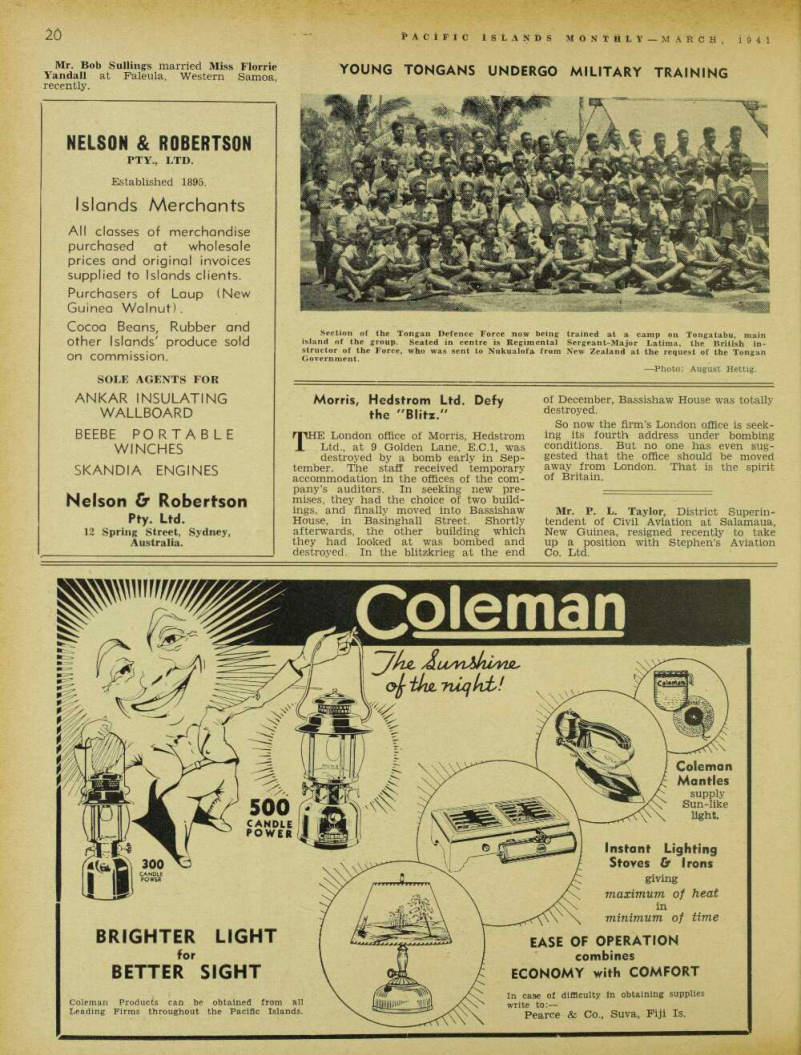
TWO acetylene lighting plants are to be shipped to two families on Emirau Island, New Guinea, where 496 sur vivors from ships sunk by German raiders were landed on December 21. The two married couples on Emirau, Mr. and Mrs.
J. A. Cook, and Mr. and Mrs. Collett, gave the passengers and crews much as sistance in difficult circumstances.
The crew of the “Rangitane” decided that the most suitable form of recognition would be lighting plants, as the two families were dependent upon oil lamps.
When the committee of the King George’s Fund for Sailors heard of this, it took over the expense. It felt that sailors who had been shelled and lost all their pos sessions, should not be allowed to pay for the equipment. A shipping company will carry the two plants to New Guinea, freight free.
Mr. Ronald Bates, a member of the Morobe staff of New Guinea Goldfields Ltd., for many years, has joined the RAAF, and was given a rousing send-off by old comrades in New Guinea.
Mr. Bob Sullings married Miss Florrie Yandall at Faleula, Western Samoa, recently.
Advertisements & other items, pp. 21-22 (1 item)
nllin
have here the best range of "torrid zone" radio receivers ever produced. Before production was ever started on sets for island listeners, we checked up on weather conditions—best valves— best cabinet materials—best speaker—best circuits—all were taken into consideration to make the best radio and give you utmost reliability under tropical weather conditions. And here Airzone present a range of receivers beautiful of tone fascinating in cabinet design amazing in long distance reception and remarkably reliable under any condition whatsoever. Particular attention was given to overseas short wave reception.
Innumerable developments have been made in these receivers so that overseas reception can be received with amazing clarity and volume.
"Airzone's tone is Airzone's own."
Above left is Model 6552 A, Airzone's new "Concert Star," a 5 Valve A.C. Mantel Dual Wave of wonderful long distance reception.
Here again, at left. Airzone proudly presents Model 5098, 5 Valve 1.4 Volt Battery mantel Dual Wave, Also as Model 5059, 5 Valve Vibrator powered Dual Wave.
At right is Airzone's massive 8 Valve A.C.
Dual Wave Console Model 1082 A, designed for far-reaching overseas reception.
Agents for New
Guinea, Papua and
Solomon Islands:—
m .
At left is veneered mantel made in 4 models —Model 1062 AM, 6 Valve A.C. Dual Wave; Model 1072VM, 7 Valve Vibrator Dual Wave; Model 1162 WM, 6 Valve 2 Volt Battery Dual Wave; and Model 1252VM, 5 Valve Vibrator Dual Wave.
W. R. CARPENTER & CO., ETD.
19 O'Connell Street. Sydney; Salamaua. Rabaul. Kavieng and Madang, N.G., and Tulagi. Solomon Islands. 1111111 l
mill
ii
nil., mini
mini minn rJ
liiniil
nllin
mm in in
mill
Designed and manufactnrei hv Airzone (1931) Ltd.
Camperdown, N.S.W. HA36J, mm in .. H |H
nllin
mu min in in
lillilmlmilll
inn m nimn
llinill
NELSON & ROBERTSON
PTY., LTD.
Established 1895.
Islands Merchants
All classes of merchandise purchased at wholesale prices and original invoices supplied to Islands clients.
Purchasers of Laup (New Guinea Walnut).
Cocoa Beans, Rubber and other Islands' produce sold on commission.
SOLE AGENTS FOR
ANKAR INSULATING
WALLBOARD
BEEBE PORTABLE
WINCHES
SKANDIA ENGINES
Nelson & Robertson
Pty. Ltd. 12 Spring Street, Sydney, Australia.
ema
3^
Auyyihklvm
o-jf ilvi Tuql^t!
s *SS * / S r & N 500
CANDLE
POWER
300
CANDLE
POWW
BRIGHTER LIGHT
for
BETTER SIGHT
Coleman Produces can be obtained from all Leading Firms throughout the Pacific Islands. \ Coleman Mantles supply Sun-like light.
Instant Lighting
Stoves & Irons giving maximum of heat in minimum of time
EASE OF OPERATION
combines
ECONOMY with COMFORT
In case of difficulty in obtaining supplies write to:— Pearce & Co., Suva, Fiji Is.
Young Tongans Undergo Military Training
Section of the Tongan Defence Force now being trained at a camp on Tongatabu, main island of the group. Seated in centre is Regimental Sergeant-Major Latima, the British in structor of the Force, who was sent to Nukualofa from New Zealand at the request of the Tongan Government. —Photo: August Hettig.
Morris, Hedstrom Ltd. Defy
the "Blitz."
rE London office of Morris, Hedstrom Ltd., at 9 Golden Lane, E.C.I, was destroyed by a bomb early in Sep tember. The staff received temporary accommodation in the offices of the com pany’s auditors. In seeking new pre mises, they had the choice of two build ings, and finally moved into Bassishaw House, in Basinghall Street. Shortly afterwards, the other building which they had looked at was bombed and destroyed. In the blitzkrieg at the end
of December, Bassishaw House was totally destroyed.
So now the firm’s London office is seek ing its fourth address under bombing conditions. But no one has even sug gested that the office should be moved away from London. That is the spirit of Britain.
Mr. P. L. Taylor, District Superin tendent of Civil Aviation at Salamaua, New Guinea, resigned recently to take up a position with Stephen’s Aviation Co. Ltd.
Road
That N. Guinea
Administrator Clears the Air
A statement of importance on the subject of the Wau-Salamaua road was made on February 1 by the Administrator of New Guinea (Sir Walter McNicoll), to the “Morobe News”, a new, well-edited and well-printed journal, published in Wau.
The Administrator said: “You can tell your readers that I have always been a strong advocate of the construction of a road from the coast to the goldfields, but I am definitely not in favour of the short route.”
His Honour then went on to say that as a servant of the Commonwealth Gov ernment he had nothing personally to gain by expressing himself on this point, but that he based his opinion on reliable information, and he was only actuated by a desire to serve the best interests and welfare of the Territory.
“I would go further,” he said, “and state that I am not in favour of the construction of a road that is to be financed by a public loan, or that a toll should be imposed when this road is completed, but rather that Government funds should bear the cost of its con struction.”
Morobe interests may not be pleased by this, but at least they can thank the Administrator for the first honest and forthright statement on vexed problem that has been made for w r o years. Now everyone knows where he stands.
How War Conditions Affect
Samoan Finances
From Our Own Correspondent
Apia, Feb. 10.
ESTIMATES for the current financial year, which have just been pub lished after considerable delay, show the effects of a tightening up of trade and markets due to war condi tions. A summary of the Administra tion’s revenue and expenditure is as follows:
Decreases in revenue this year are ex pected for the Health Department (sale of medical liquor). Postal and Radio De partment, and Treasury and Customs De partment (export and import duties), while decreases in expenditure are bud geted for in Public Works (mainten ance of buildings and new buildings), and under the heading of “Recoverable Expenditure (NZ Government)”.
There is a possibility, however, that this year’s deficit may be eliminated and the budget balanced, as the estimates appear to be on the conservative side.
Mr. W. Phillpotts, who is well known in Rabaul, New Guinea, as manager of Burns, Philp and Co.’s merchandise de partment, has been transferred tem porarily to Salamaua, where he will take over the management of that branch while Mr. G. H. Roberts is spending fur lough in Australia.
1940-41 1939-40 Estimated Estimated Actual £ f £ Receipts .. . 102,562 115,226 131,416 Expenditure . 113,824 133,143 135,648 Deficit .. 11,262 17,917 4,232
Those "Savage" Samoans I
rE people of Samoa will be astonished to learn how savage they are. An American artist, Mr. Edward Dair. is in Sydney, at present, “working on a book”. He accompanied the ill-starred Fahnestock expedition to various Terri tories (The expedition’s yacht was wrecked on the Great Barrier Reef.). A Sydney interviewer makes Mr. Dair say this: — “In Samoa, Mr. Dair wanted to paint a portrait of a particularly lovely Samoan girl, Vaivasa. But before he was allowed, he (and other men members of the crew of the Director II) had to submit to a painful initiation ceremony and become honorary members of her tribe.
“It was a nerve-racking business al together,” said Mr. Dair. “Drums were beating, men were chanting, others were making kava, and the whole ritual was carried out with a ceremony and serious ness that got under your skin. The tattooing—which is done with a shark’s
tooth —was so painful that we had to be held down on the ground. Natives have their entire legs tattooed as part of the ceremony. We were treated lightly, but what they did do was bad enough!”
Mr. Dair apparently was talking about Samoa, and not the Solomons or New Guinea. These travellers!
Miss Shirley Alice Coles, only daughter of Mr. and Mrs. Gilbert Coles, of Namo sau. was married to Mr. John Graeme Berry, of Rarawai, in Fiji on February 15.
Mr. R, F. Pickering, who was manager in Fiji for the Bank of NSW for several years, has taken up an appointment at the Townsville, Queensland, branch.
Mr. L. D. Gilpin died at Wau, New Guinea, recently. He had been on the Morobe goldfields as a contractor for several months, and a short time ago sustained a leg injury which commenced a series of illnesses culminating in his death.
Miss Ruth Turnbull, daughter of Mr.
A. C. Turnbull (Acting Administrator of Western Samoa), and Mrs. Turnbull, returned to New Zealand in February, ents*at P VauSnaf “ y Mr. A. Bakker has retired from the position of general manager in Australia of the Royal Navigation Co. Ltd., which runs the KPM steamer service in the Western Pacific, Royal Netherlands Indies’ Airways Ltd. (KNILM), and the Holland-Australia Line. He will leave for London next month to take up an appointment with the Netherlands Shipping and Trading Committee, the organisation formed to take over control of all Dutch vessels which sailed into British ports after the Nazi invasion of Holland. Mr Bakker has been succeeded by Mr. N. D.
Lammers, who has been assistant general manager of the Royal Packet Navigation Co. for some years.
Advertisements & other items, pp. 23-24 (1 item)
Bidomak
N ERVES?
BRAIN FAG?
DEPRESSED FEELING?
You Need BIDOMAK to End
“MINERAL STARVATION”!
“Bidomak” supplies in easily assimilable form those vital mineral elements lacking in the modern diet, which you need to build strong healthy nerves, a good appetite and resistance against ills. Thousands once run-down, tired and nervy are now wonderfully well—“thanks to Bidomak”!
OVERCOME TROPICAL LETHARGY
BIDOMAK actually overcomes the effects of severe tropical conditions and brings you back to the pinnacle of good health and spirits safely and pleasantly. The depressing after-effects of Malaria are banished quickly by taking a course of BIDOMAK.
Read what Mrs. Edith Lockyer of North Perth says about “Bidomak’\ T have been suffering from insomnia, loss of appetite, and nerves, and various treatments were unavailing, and I finally reached the point where a complete breakdown appeared imminent, I was then only 6 stone 2 lb. in weight.
“I was Persuaded to try BIDOMAK and after six weeks’ treatment I sleep soundly and eat well, and now weigh 8 stone 1 lb I oz ”
SCIENTIFIC CONTROL
Manufactured in the BIDOMAK Pharmaceutical Laboratories one of the most up-to-date, hygienic laboratories in the Southern Hemisphere, to which is attached a fully qualified Doctor of Medicine, and under the control of a qualified chemist who was trained in the most modern English Laboratories in the world.
Start To-day on a Course of
BIDOMAK
A T The Tonic of the Century.
ALL LEAD I NG ISLAND STORES
57 AIDS TO BETTER MENUS
TOMATO
KETCHUP
TOMATO MM
SAUCE
TOMATO KETCHUP— Made
from Sun-ripened Tomatoes.
Medium Bottles .. 8 ozs.
TOMATO SAUCE A Pure
Appetising Sauce.
Large Bottles .. 13 ozs.
OVEN-BAKED
BEANS
WITH PORK AND
TOMATO SAUCE.
ALSO VEGETARIAN
Individual Tins, 4 ozs.
Small Tins, 8 ozs.
Medium Tins, 16 ozs.
TOMATO JUICE
A delicious health-giving and appetising drink Small Tins. 8 oz.
Med. Tins, 16 oz.
No.sTins.6ooz.
SPAGHETTI
Cooked in Tomato Sauce with Cheese Individual Tins. 4 ozs.
Small Tins, 8 oz Med. Tins. 16 oz.
VEGETABLE
SALAD
Garden-fresh Vegetables with Mayonnaise. Small Tins, Boz.
HEINZ
FAMOUS IllalilZi PRODUCTS
MADE IN AUSTRALIA
. , HEINZ
:§| PERFECT
rSOUPS
READY-TO-SERVE
In 8 oz. and 16 oz. Tins
CREAM OF TOMATO
CREAM OF ASPARAGUS
CREAM OF CELERY
CREAM OF CHICKEN
CREAM OF GREEN PEA
CREAM OF MUSHROOM
CREAM OF ONION
CREAM OF SPINACH
CREAM OF TOHEROA
BEAN SOUP with HAM
CHICKEN VEGETABLE
KIDNEY SOUP
MULLIGATAWNY
OXTAIL
VEGETABLE
GENUINE TURTLE SOUP
MACARONI
Cooked in Cream Sauce with Cheese.
Individual Tins, 4 ozs.
Small Tins, 8 ozs.
Medium Tins, 16 ozs.
MAYONNAISE
Delightful on Salad.
Small Bottles, 4 ozs.
Med. Bottles, 7 ozs. 18 oz. Bottles 57 oz. Bottles
BEEFSTEAK
SAUCE
Fruits, Vegetables and Spices, skilfully blended.
Medium Bottles, 7J ozs.
STRAINED FOODS
For Infant Feeding and Special Diets.
Strained Carrots Strained Beets Strained Prunes Strained Green Beans Strained Vegetable Soup Strained Beef and Liver
SWEET GHERKINS
Small Bottles
SWEET MUSTARD
PICKLE
Small Bottles
H. J. HEINZ CO. PTY. LTD.
Regd. Office: BENDIGO ST., RICHMOND E.l, VICTORIA Heinz delicious varieties are available from Storekeepers throughout Papua .
Neiv Guinea and Pacific Islands.
Expert Advice For
Planters Why Cannot NG Department Serve Adjaining Territaries?
A N experienced agricultural officer of the British Colonial Service, now attached to the British Solomon Islands administration, Mr. Johns, has spent some time recently in New Guinea, studying there the work of the New Guinea Department of Agriculture, with a view to reporting to his chiefs on the advisability of establishing an agricul tural service in the British Solomon Islands.
Mr. Johns is a man of wide experience in tropical agriculture, and has served in Fiji, Zanzibar, Tanganyika, Kenya and the West Indies. He has shown a keen and practical interest in the work of the
Department of Agriculture in New Guinea—especially the experimental sta tion at Keravat.
The inquiries of Mr. Johns, and the apparent needs of the British Solomon Islands (for it is obvious that adminis trations generally are doing everything possible to encourage planters to turn their attention to something other than coconuts) again directs attention to the absurd system of watertight administra tive compartments, which are so notable a feature of government in the South Pacific Territories.
For example, there is in the Territory of New Guinea a Department of Agri culture staffed by men who, in training, experience, skill and personal enthu siasm will compare with the staff of any similar institution anywhere in the world.
It is a fact that the Australian Territory of New Guinea not only has large areas of land available for tropical agriculture, but it also has a Department of Agricul ture that is completely capable of direct ing a vast programme of agricultural development. The reasons why the Ter ritory of New Guinea, in such circum stances has remained, in a developmental sense, virtually stagnant, is a political story, and has nothing to do with the present argument.
In the two great tropical territories adjoining the territory of New Guinea — namely, the Territory of Papua and the British Solomon Islands —there are no departments of agriculture. There merely are officials (one or two) who attend to Administrative matters regarded as agricultural in character.
Yet the agricultural problems and requirements of Papua and the Solomon Islands are almost exactly, if not exactly, the same as those of New Guinea.
There apparently is not the slightest rea son —except the ridiculous political rea son labelled “boundaries” why the expert and well-staffed Department of Agriculture in New Guinea should not make its services available to Papua and Solomon Islands.
Both of the latter territories are British—one Australian and one British Colonial Office —and it ought to be a matter of simple arrangement for the two territories to get the benefit of an organisation which easily could extend its operations over three territories.
Someone may say: “But the Solomon Islands come under the jurisdiction of Suva, and in Fiji there is already a Department of Agriculture of high repute.”
That is perfectly true. But it is a fact that there is a far closer resemblance between the agriculture conditions of the Solomon Islands and New Guinea, than between the Solomon Islands and Fiji— so much so, that it is clear that if the Solomon Islands had to have this kind of expert service from either New Guinea or Fiji, it naturally would prefer New Guinea.
The foregoing argument has been put forward by thoughtful people at intervals during the past 10 years—and not one bureaucrat anywhere has taken any notice of it. But Nemesis is here, in the shape of a collapsed copra market. Unless the bureaucrats can induce the planters to produce something else, calculated to keep the territories’ revenue in existence, the bureaucrats will lose their own jobs.
So, during the next year or two, we can expect to see the bureaucrats excessively busy on behalf of the agriculturists.
Mrs. W. S. Brown, wife of the manager of Burns, Philp & Co. Ltd., Normanton, Queensland, died in February. She was a sister of Mrs. T. E. Craig, of Samarai, Papua.
New Administrator

Welcomed
From Our Own Correspondent
Port Moresby, March 2.
THE new Administrator of Papua (Hon.
H. Leonard Murray, CMG) recently made a happy tour through East ern Papua, where he was heartily wel comed at the various centres by both the European and native communities.
His Honour, travelling in the “Laura bada”, went right along the north-east coast and then out through the eastern islands to Misima. There were innumer able ceremonies of welcome, and a cor dial spirit of goodwill and friendship was manifest on both sides.
In his various visits in the Samarai district, his Honour was accompanied by the Bishop of New Guinea. Mr. Justice Gore, the Hon. Mr. Bignold, MLC. and the Hon. George E. Aumuller, MLC.
An Anti-Pest Grass
A grass which is said to drive away mosquitoes, ticks, and snakes, aroused scientific interest in America lately.
Dr. Thomas Henry, science editor of the North American Newspaper Alliance, visualised thousands of square miles of tropical country being opened to settle ment, because the grass ousts these three white man’s burdens. English doctors “discovered” the grass in Caracas, Venezuela, and supplied the Venezuelan Government with large quantities of seed.
The Pan-American Sanitary Bureau stated that an analysis shows the grass —a species of melinis multiflora —to be a very rich pasture for horses, cows, and mules, but probably unsuitable for sheep.
But the N.S.Wales Government Agros tologist (Mr. Whittet), when interviewed by a Sydney “Sun” reporter, said he knew what the grass was and he did not think much of it. Melinis multiflora, a melli fluous name for cattle feed, has been known in Australia for 50 years, Mr.
Whittet explained. It had been grown to some extent in Queensland, and on the north coast of New South Wales. But the first essential of a grass was to be palatable to the consumer, and to Aus tralian cattle, it was as nearly repugnant as to ticks.
“The grass,” added Mr. Whittet, “is un popular among cattle because of its sticky nature. They prefer the naturalised pas tures. That story about ticks goes back to the ‘dark ages’, but I am not qualified to say if it is also taboo to snakes and mosquitoes. I can only tell you about the qualities of the grass.”
Mr. R. A. Vivian, a well known Resi dent Magistrate of Papua, recently sta tioned at Kerema, has arrived in Aus tralia, on furlough.
Mr. B. G. Johnston, of Itikinumu, Sogeri district, Papua, who recently left for Australia, has been called up for ser vice in the Empire air plan.
Mr. R. N. Stevens, recently attached to the Government Stores Department, Port Moresby, and who enlisted in the Air Force has, according to reports, recently passed all tests and is now Leading Air craftsman, and declared fit for service overseas.
Mr. A. J. Tritton, of the Commonwealth Bank staff, has been transferred from one of the NSW branches to relieve Mr. H.
Kinghorn at Rabaul, New Guinea, while the latter is on leave.
Advertisements & other items, p. 25 (1 item)
Nestles
For the health oj the family
7^ \ x >4. [± ■si)
YOU MUST HAVE
v
MILK
■Ss
sweeten Eip
si 11 'Hu Nothing is so beneficial, indeed essential, to the health of children and grown-ups as an adequate supply of pure milk. But, it is important to guard against contaminated milk, especially in hot climates, and that is why you should always use Nestle’s Sweetened Condensed Milk.
Nestle’s Sweetened Condensed Milk is sealed against all risk of contamination and you can open every Nestle’s tin in the certain knowledge that the contents are absolutely pure and fresh. Nestle’s Sweetened Condensed Milk is the safest milk you can buy. : r ®Pared SPECIALLY R . Ep AREE> IN AUSTBALIfeJ v
(AU ST RALA SIA ) \$W
NESTLES
-MILK
COPYRIGHT B.
Where The Ancients
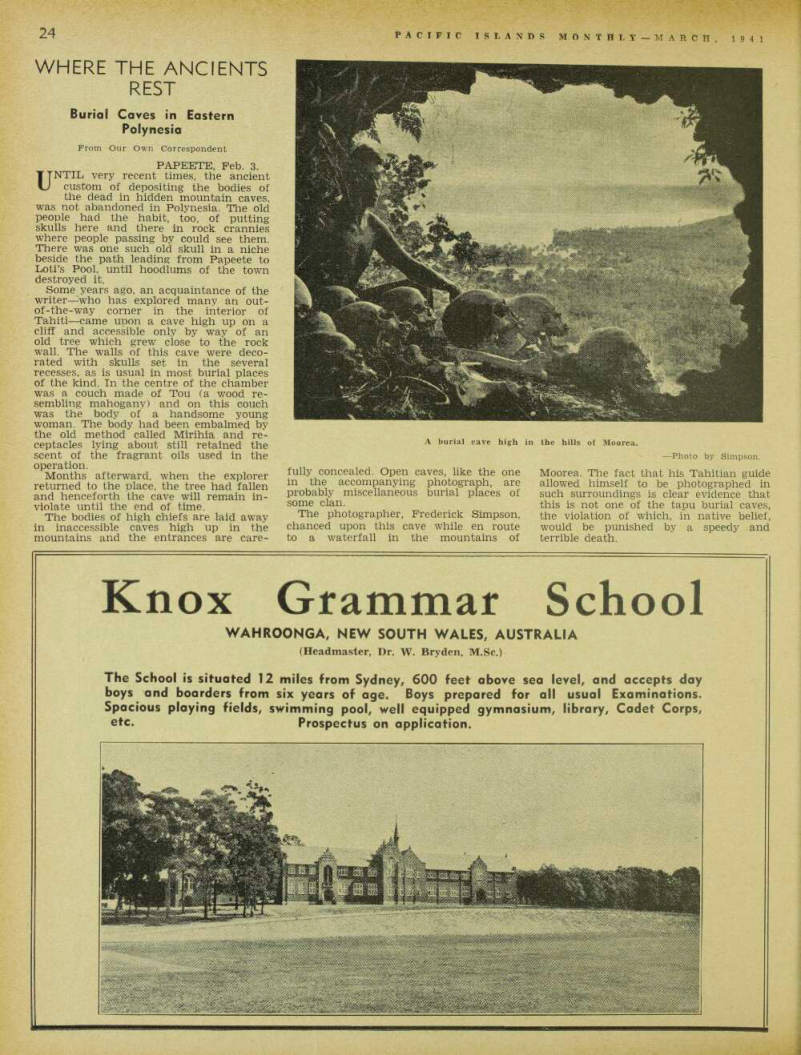
Rest
Burial Caves in Eastern Polynesia
From Our Own Correspondent
Papeete, Feb. 3.
UNTIL very recent times, the ancient custom of depositing the bodies of the dead in hidden mountain caves, was not abandoned in Polynesia. The old people had the habit, too, of putting skulls here and there in rock crannies where people passing by could see them.
There was one such old skull in a niche beside the path leading from Papeete to Loti’s Pool, until hoodlums of the town destroyed it.
Some years ago, an acquaintance of the writer —who has explored many an out of-the-way corner in the interior of Tahiti—came upon a cave high up on a cliff and accessible only by way of an old tree which grew close to the rock wall. The walls of this cave were deco rated with skulls set in the several recesses, as is usual in most burial places of the kind. In the centre of the chamber was a couch made of Tou (a wood re sembling mahogany) and on this couch was the body of a handsome young woman. The body had been embalmed by the old method called Mirihia and re ceptacles lying about still retained the scent of the fragrant oils used in the operation.
Months afterward, when the explorer returned to the place, the tree had fallen and henceforth "the cave will remain in violate until the end of time.
The bodies of high chiefs are laid away in inaccessible caves high up in the mountains and the entrances are care-
fully concealed. Open caves, like the one in the accompanying photograph, are probably miscellaneous burial places of some clan.
The photographer, Frederick Simpson, chanced upon this cave while en route to a waterfall in the mountains of
Moorea. The fact that his Tahitian guide allowed himself to be photographed in such surroundings is clear evidence that this is not one of the tapu burial caves, the violation of which, in native belief, would be punished by a speedy and terrible death.
A burial cave high in the hills of Moorea.
—Photo by Simpson.
Advertisements & other items, p. 26 (1 item)
Knox Grammar School
WAHROONGA, NEW SOUTH WALES, AUSTRALIA
(Headmaster, Dr. W. Bryden, M.Sc.) The School is situated 12 miles from Sydney, 600 feet above sea level, and accepts day boys and boarders from six years of age. Boys prepared for all usual Examinations.
Spacious playing fields, swimming pool, well equipped gymnasium, library. Cadet Corps, etc. Prospectus on application. ■ 1 m
Litigation
Papuans Turn to Litigation Ownership of an Aerodrome
DISCARDING primitive weapons, 24 Papuan natives have “gone mod ern” and are making tribal history by using a peculiarly white man’s weapon—litigation—to fight his intrusion into their domain (said Melbourne “Argus” of February 25).
Scene of the latest stage of their battle is not a steamy, tropical jungle, but the modern courtroom of the High Court, when yesterday the conflict was carried on in a refined atmosphere of legal debate. And the only fuzzy heads to be seen were the bewigged ones of lawyers and three High Court judges.
In the law notices appeared the announcement, “Geita-Sebea and others v. The Territory of Papua.” Geita-Sebea is the native nominated by his kinsmen as their leader in a legal action in which the legal rights of natives whose land has been taken from them by white men are being argued.
About 1930 the Papuan Administration compulsorily acquired about 71 acres of land near Port Moresby, used by the Kila Kila tribe of about 287 natives for rota tion crops, for the establishment of a commercial aerodrome. No rent was paid to the natives, but they were paid for clearing the grass. Later a lease was obtained at a yearly rental of £4, and a new lease for 10 years was negotiated at a rental of £l5 a year.
Now the natives have appealed to the High Court against a decision of Judge Gore, the resident judge, awarding them £454 compensation for the land. Through their legal representative, Mr. R. D. Ber tie, of Port Moresby, they are claiming compensation of £4,479/12 6, plus 10 per cent., and £l,OOO damages.
Old Proclamation
The resident judge held that the legal right of the natives depended on the tenure they possessed, and that whatever land they held was a recognition of the security promised them by Commodore Erskine, who, when proclaiming a pro tectorate over the territory in 1884, addressed the natives thus, “Your lands will be secured to you.”
Mr. T. W. Smith (who appeared for the Territory of Papua) argued that the natives did not possess the land in fee simple, and that their rights depended on native custom law. If they were owners in fee simple, he said, they would be entitled to the “fixtures” on the land, which included a radio and meteorolo gical station, Customs and quarantine offices, and other Government buildings!
On behalf of the natives, it was claimed that they did own the land in fee simple. The land had not been acquired by cession or conquest, but by settlement, and only the common law was introduced into the country on its original settlement.
Mr Justice Starke remarked that there should have been some treaty with the natives.
The Court referred the appeal back to the resident judge for further informa tion on native customs, and other questions.
On the Bench were Sir George Rich Acting Chief Justice: Mr. Justice Starke! and Mr. Justice Williams.
A new member of the Pacific Islands Society is Mrs. E. E. Zarcal, a former resident of Thursday Island. Before her return to Australia, Mrs. Zarcal resided in Paris for twenty years.
The Sulu Of Fiji
By “Amel”
FIRST cousin to the Balinese sarong, and distantly related to the Scot tish kilt, the Fijian sulu has a charm and utility all its own.
Wrapped around waist or bosom, and falling to below the knees or just above the ankles, it gives the wearer grace and dignity. This fathom length of material, whether silk, satin or calico, is an almost indispensable part of a Fijian’s ward robe.
Not the least of its attributes is its adaptability. It may be used as a sheet, a tablecloth, a laundry basket, a sail for somebody’s punt, or something to carry the baby in. It can be twisted to make either a turban, or a pair of trousers.
The sulu was worn long before Euro peans came to Fiji; but, in those days, its manufacture involved the tedious process of beating out a parchment-like material from the bark of a tree. On this pliable background of white or ivory cream, the Fijians placed their own clear-cut patterns in black or brown vegetable dye.
To-day, however, when nearly every Fijian village sprouts a Chinese or Indian trading store, a few shillings will buy sulus for the whole family. There is a multitude of colours from which to choose. Designs are weird and wonder ful, and there is great scope for indi vidual tastes.
But it is rather disconcerting to see a wicked-looking bomber winging its way across the back view of a Fijian damsel, or “Remember Me’’ written in Fijian across the sulu of a cynical old bachelor!
Occasionally, whims of fashion affect the sulu. Several years ago. buttons replaced the time-honoured “tucked-in“ method of fastening it. But buttons fell off and were lost, and, with one thing and another, “tucking-in” soon came back to favour again.
Nowadays, shorts, long trousers and European dress styles are, to a large extent, replacing the sulu for every-day wear; but the Fijians’ affection for it still remains, and, on ceremonial occa sions, only the very best sulu is con sidered good enough.
Advertisements & other items, pp. 27-28 (1 item)
SOtf
GET POSITIVE
RELIEF FROM
Tested and proved for over 20 years, genuine Vincent’s A.P.C. is acknowledged by the medical profession and the public as the safest and best to relieve all pains and tropical fevers. The reason why Vincent’s A.P.C. is safer and more effective is because it is prepared on the prescription originated by the medical superintendent of one of Australia’s largest public hospitals, where it was first used. Genuine Vincent’s A.P.C. is the only A.P.C. prepared on this scientific hospital prescription. No other A.P.C. is the same as Vincent’s.
Cv
COWDIRS i
TABLETS
1/4 AND 2/4.
SINGLES 2d. •«.
FOR SAFETY’S SAKE—SAY “VINCENT'S”.
SOtf
4 GERMS of Diphtheria, Malaria, Dhobie Itch, Tinea or Surfers’ Foot, cannot live under “TENAX” lather.
Tropical Skin Diseases can be cured by its regular use.
9 d P ef
f abl et '
W/ - m m ’a M SB
NO VARIATION HAS BEEN
MADE IN ITS COMPOSITION—
judged from the only true angle, that of quality, TENAX has no competitors as a satisfactory germicidal soap, eleven times as rapid in action as carbolic, yet NON-
IRRITANT and NON-POISONOUS. The
Medical Journal of Australia states that TENAX is a germicidal soap that may be recommended with confidence.
TENAX O ‘ NUNE
GERMICIDAL I
PRODUCT OF AUSTRALIAN SOAPS,
SOAP
LTD.
Modern Refrigeration for the South Sea Islands
The ELECTROLUX
KEROSENE OPERATED
REFRIGERATOR
MARVEL
OF
MODERN
SCIENCE
THE
MIRACLE
OF
ICE
FROM
HEAT
ELECTROLUX offers economical, modern and completely efficient
REFRIGERATION FOR ISLANDS' HOMES.
FREEZES CONTINUOUSLY WHILE SMALL LAMP BURNS.
Freezing controlled by simply regulating height of flame. Uses only % gallon of kerosene per week.
MOTORLESS ... NO PARTS TO GET OUT OF ORDER.
MODEL L 22
Capacity 2.2 cubic feet.
MODEL L3BO
(as illustrated) Capacity 4 cubic feet.
MODEL LKSSO
Capacity 5.5 cubic feet.
GUARANTEED FOR TWO YEARS.
• Write to your Local Distributor for prices and full details.
Obtainable from: W. R. Carpenter & Company Ltd.—Sydney, and the following New Guinea Branches: Rabaul, Salamaua, Wau, Kavieng, Madang, and Wewak.
W. R. Carpenter & Coy. (Solomon Is.) Pty. Ltd. —Tulagi, British Solomon Islands.
On Chong & Company Pty. Ltd.—Butaritari, Gilbert and Ellice Islands.
Representation in Papua and New Hebrides.
Arrowroot
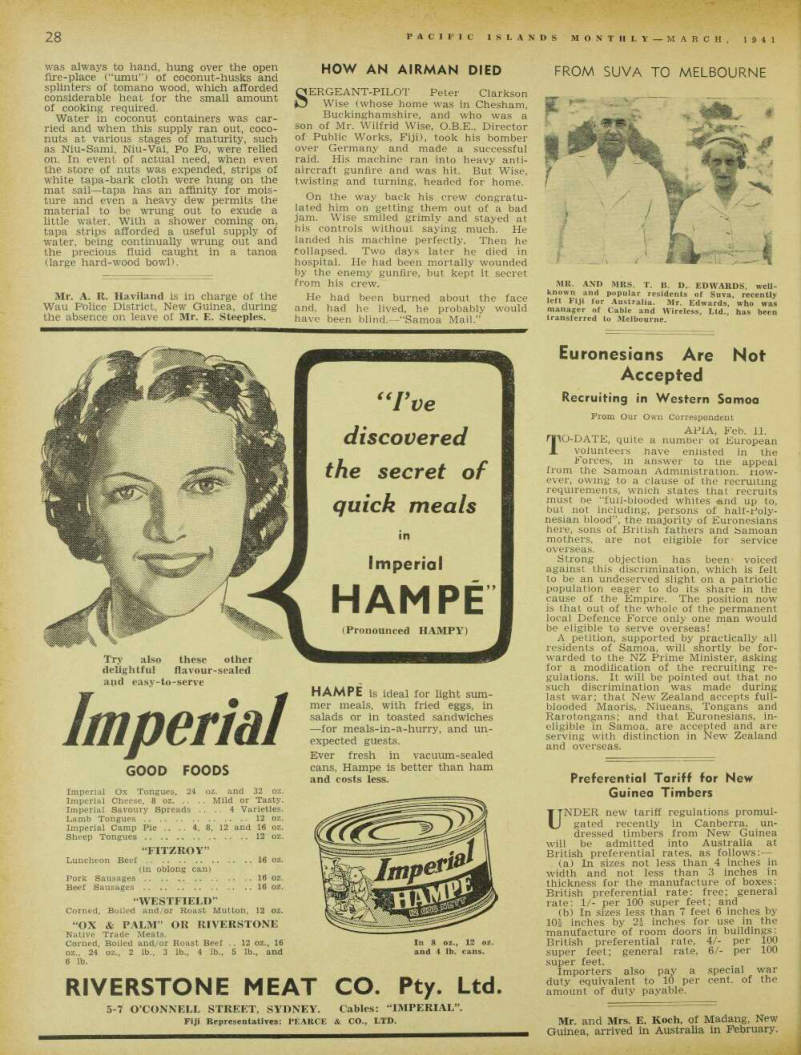
How Early Polynesians Used the Now-Neglected Pia Plant
By H. C. Reed, Apia, Samoa
TO-DAY, in the Pacific, planters and other employers of labour are eagerly seeking substitutes for rice and simi lar imported rations supplied to natives working on copra and rubber estates and in the mining industries.
To an increasing degree, locally-grown foodstuffs are being included in the labourers’ diet. One of several Islands plants valuable in this connection, but long neglected since Europeans settled in the South Seas, is Pia, an indigenous arrowroot, formerly one of the stable foodstuffs of the peoples of marginal- Polynesia.
Except for the preparing of dessert foods, invalid dishes, and “Vai-salo” (re garded by Polynesians as the most nourishing of foods, especially for the nursing mother), Pia is but little used or even known to the younger generation of to-day. Its very name has changed, for in parts of the Pacific, Pia is now called Masoia.
Evidence of large-scale planting of the Pia bulb in earlier days in the Islands exists in the form of lengthy stone fences which once formed the boundaries of native arrowroot-gardens. The cultivation of Pia (or Tacca-pinnatifida, as the stem less dwarf-growing plant is botanically known) was simple, just a matter of dividing the cluster of small bulbs which form at the base of the plant, and drop ping the bulblets into holes made a foot apart.
The stone boundaries have long been a matter of conjecture, for the earliest white settlers concluded that these mys terious stone piles were, in all probability, native‘‘‘forts”! Native forts do exist to the present day, but these are of a totally different structure, and are found only on well-defined battlefields.
Great quantities of the dry, long keeping arrowroot were packed in coconut leaf baskets, lined with the sacred white Tapa-bark cloth and hung from the house-rafters of the high chiefs in readi nessi for any festive occasion, such as the arrival of Malo (visitors). Or supplies would be put on board one of the great double-floated sailing “alias”, the giant canoes which formerly carried huge amounts of foodstuffs, plus a passenger list of stalwart Polynesians numbering upwards of 140, to the farthermost corners of the vast Pacific. Material evidence backed by oral tradition goes to prove that the Polynesian mariners carried large quantities of Pia-arrowroot to is lands as far distant as “Pito te fonua” known to us as mysterious Easter Island.
TO provision an ocean-going canoe for a protracted voyage, required mature consideration.
Foodstuffs no longer made use of to-day were specially prepared weeks prior to setting out to sea. Bananas were sun dried, pressed into rolls of about two pounds weight, and bound tightly in the dry leaves of the “Ti” plant (Draceana).
The whole package was then securely bound up with a rope made from the Fou bark. The name of these prepared pack ages was “Sai-Fei’i”, and bananas thus prepared had long keeping qualities.
Every Matai (head of a family) was expected to contribute a basket of Fla arrowroot to the expedition. Such packages were heavy, but Pia was regarded im portantly as the medium of exchange to be bartered for coconuts, fowls, hogs, dried shark-flesh, and even those curious cart-wheel-like forms of so-called
“money” found in the islands of the Palau, Marshall, and Caroline Groups, whence they were carved.
Pia-sua, a dessert dish resembling rich tapioca, which has been highly esteemed since ancient times, formed an easily prepared and nourishing food when the “alias” were at sea. It consisted of a large bowl of the cream of rasped coco nuts heated up to boiling-point by means of hot stones, and thickened to a solid paste by adding dry Pia.
Among other foods carried on these long sea journeys was Calavy, a thick malt-like syrup made by cutting the tip of the flowering spathe of a coconutpalm, collecting the sap, and then boiling it until it became a rich sweet syrup.
Calavy is not often made these days, but the method of storing it is of interest.
The very largest form of coconut the Pacific knows is called the “Niu-Vai” (holder of water) and when cleaned of the kernel, often holds up to three or
four pints of water. These nuts were filled up to the “lot” eye with Calavy syrup, and were then sealed by means of a gum prepared by heating breadfruit tree sap. Coconuts thus filled would be plaited up with sennet (coir string) and hung in the rigging of the canoe to be used as required, rpo supplement the root and starchy JL foods on the voyage, live turtles were carried, secured to special pegs fitted at the bottom of the canoe thus acting more or less as “ballast”’ Oc casionally the turtles were allowed a “dip” in the briny, being tethered to coir rope Undoubtedly, turtle meat often saved the grim situation when hunger threatened as this form of sea-food could be eaten like oysters, cut up into dice and dipped in sea-water, or small portions could be heated over burning coconut husks and partaken with raw kumeras.
Dried shark-meat, as with the Bonito,
was always to hand, hung over the open fire-place (“umu”) of coconut-husks and splinters of tomano wood, which afforded considerable heat for the small amount of cooking required.
Water in coconut containers was car ried and when this supply ran out, coco nuts at various stages of maturity, such as Niu-Sami, Niu-Vai, Po Po, were relied on. In event of actual need, when even the store of nuts was expended, strips of white tapa-bark cloth were hung on the mat sail —tapa has an affinity for mois ture and even a heavy dew permits the material to be wrung out to exude a little water. With a shower coming on, tapa strips afforded a useful supply of water, being continually wrung out and the precious fluid caught in a tanoa (large hard-wood bowl).
Mr. A. R. Haviland is in charge of the Wau Police District, New Guinea, during the absence on leave of Mr. E. Steeples.
Advertisements & other items, p. 29 (1 item)
Foster’S
park ling refreshment from pure Malt and Hops...
■ AIT4
LAGER
How An Airman Died
SERGEANT-PILOT Peter Clarkson Wise (whose home was in Chesham, Buckinghamshire, and who was a son of Mr. Wilfrid Wise, 0.8. E., Director of Public Works, Fiji), took his bomber over Germany and made a successful raid. His machine ran into heavy anti aircraft gunfire and was hit. But Wise, twisting and turning, headed for home.
On the way back his crew Congratu lated him on getting them out of a bad jam. Wise smiled grimly and stayed at his controls without saying much. He landed his machine perfectly. Then he Collapsed. Two days later he died in hospital. He had been mortally wounded by the enemy gunfire, but kept it secret from his crew.
He had been burned about the face and, had he lived, he probably would have been blind. —“Samoa Mail.”
From Suva To Melbourne
MR. AND MRS. T. B. D. EDWARDS, well known and popular residents of Suva, recently left Fiji for Australia. Mr. Edwards, who was manager of Cable and Wireless, Ltd., has been transferred to Melbourne.
Accepted
Euronesians Are Not Accepted Recruiting in Western Samoa
From Our Own Correspondent
Apia, Feb. 11.
TO-DATE, quite a number of European volunteers have enlisted in the Forces, in answer to tne appeal from the Samoan Administration. How ever, owing to a clause of the recruiting requirements, which states that recruits must be “full-blooded whites *nd up to, but not including, persons of half-Poly nesian blood”, the majority of Euronesians here, sons of British fathers and Samoan mothers, are not eligible for service overseas.
Strong objection has been voiced against this discrimination, which is felt to be an undeserved slight on a patriotic population eager to do its share in the cause of the Empire. The position now is that out of the whole of the permanent local Defence Force only one man would be eligible to serve overseas!
A petition, supported by practically all residents of Samoa, will shortly be for warded to the NZ Prime Minister, asking for a modification of the recruiting re gulations. It will be pointed out that no such discrimination was made during last war; that New Zealand accepts full blooded Maoris, Niueans, Tongans and Rarotongans; and that Euronesians, in eligible in Samoa, are accepted and are serving with distinction in New Zealand and overseas.
Preferential Tariff for New
Guinea Timbers
UNDER new tariff regulations promul gated recently in Canberra, un dressed timbers from New Guinea will be admitted into Australia at British preferential rates, as follows: (a) In sizes not less than 4 inches in width and not less than 3 inches in thickness for the manufacture of boxes: British preferential rate: free; general rate: 1/- per 100 super feet; and (b) In sizes less than 7 feet 6 inches by 10g inches by 21 inches for use in the manufacture of room doors in buildings: British preferential rate, 4/- per 100 super feet; general rate, 6/- per 100 super feet.
Importers also pay a special war duty equivalent to 10 per cent, of the amount of duty payable.
Mr. and Mrs. E. Koch, of Madang, New Guinea, arrived in Australia in February.
Advertisements & other items, p. 30 (1 item)
Imperial
“I’ve
discovered
the secret of
quick meals
in
Imperial
HAMPE
(Pronounced HAMPY) Try also these other delightful flavour-sealed aud easy-to-serve
Imperial
GOOD FOODS
HAMPE is ideal for light summer meals, with fried eggs, in salads or in toasted sandwiches —for meals-in-a-hurry, and unexpected guests.
Ever fresh in vacuum-sealed cans, Hampe is better than ham and costs less.
Imperial Ox Tongues, 24 oz. and 32 oz.
Imperial Cheese, 8 oz Mild or Tasty.
Imperial Savoury Spreads .. .. 4 Varieties.
Lamb Tongues 12 oz.
Imperial Camp Pie .. .. 4,8, 12 and 16 oz.
Sheep Tongues 12 oz.
“FITZROY”
Luncheon Beef 16 oz. (in oblong can) Pork Sausages 16 oz.
Beef Sausages 16 oz.
“WESTFIELD”
Corned, Boiled and/or Roast Mutton, 12 oz.
“OX & PALM” OK RIVERSTONE
Native Trade Meats.
Corned, Boiled and/or Roast Beef . . 12 oz., 16 oz., 24 oz., 2 lb., 3 lb., 4 lb., 5 lb., and 6 lb.
Imper#
In 8 oz., 12 oz. and 4 lb. cans.
RIVERSTONE MEAT CO. Pty. Ltd.
5-7 O’CONNELL STREET, SYDNEY. Cables: “IMPERIAL”.
Fiji Representatives: PEARCE & CO., LTD.
the Islands?
Will Oil be Found in the Islands?
Letter to the Editor
IN the December “PIM” were pub lished several articles dealing with the search for oil in Papua and New Guinea —I should like to add the re sults of my own experiences.
I was in Port Moresby, years ago, when the Anglo-Persian Oil Co. and the Australian authorities were making full enquiries into the Vailala field, before they withdrew from the Territory. Like many others, I indulged in an after dinner smoke on Ryan’s Hotel verandah, and one night met six or seven oil men who had just come in from Vailala to catch the South-going BP steamer. We talked for a time and the conversation eventually turned to Papua’s oil pros pects.
One man, with a foreign name, and who spoke with a slight American drawl, declared that his observations led him to believe “they’ll never get permanent oil in New Guinea”. He added that after seeing the results of many bores he had come to the conclusion that “the island was badly fractured by earth quakes”. It would be possible to find oil, but the flow would not last—and he had sent in his report to that effect. I wonder if this report is known to those now concerned with the drilling in Papua?
I may say that years ago I was in terested in a small syndicate formed to enquire into reported coal and oil fields on the south of New Ireland. This was later cancelled, as there was no chance of getting capital just after the last war.
It was said that after heavy rain oil was washed down the flooded creeks and, in addition, there were salt springs on the level country.
Little has been said about oil in the Solomons—oil has been reported there also, and on one island there is a con siderable quantity in the salt water, which, through the ages, has put a coat ing of black grease on the rocks.
I am, etc.,
Traveller.
Kavieng, TNG, 24/1/41.
Popular Medico Returns
To Tonga
From Our Own Correspondent
Nukualofa. Feb. 2.
THE recent appointment of Dr. C. M.
Dawson as Medical Officer at Vavau has caused satisfaction in Tonga.
Dr. Dawson is particularly well-known here, for he was C.M.O. in the Groun from 1918 until his retirement in 1933, when he took up private practice in Western Samoa. He is welcome, not only on account of the present shortage of doctors in Tonga, but also for his skill, his unique tropical experience and his genuine interest in the well-being of the natives.
Dr. Dawson is the ideal type of Islands doctor. Steady, patient and tireless, with an astonishing aptitude for work, he quietly tackles his tasks and achieves a Great deal without show or flourish.
There is no “on duty” and “off duty” hours with him, sparing not himself day or night, in attending to the needs of his patients. This devotion to his work enables him to understand the natives and win their confidence-half the battle against their tendency towards native cures.
Mr. McMillan, of the New York Museum, USA, is at present in New Cale donia carrying out research work in connection with the Colony’s bird life.
In the beginning of Morobe, Gregor MacDonald and his beach store were among Salamaua’s outstanding land marks. A few months ago, Gregor MacDonald died. Recently, a SE gale and high tides piled up the waters on the isthmus, and MacDonald’s old house was washed away. And so time marches on.
Advertisements & other items, pp. 31-32 (1 item)
Two Letters . . .
Frank Peters hit his nails as he read the letter. His wife sat opposite, watching. . . . She looked worried, depressed. ‘‘Bad news, Frank?”
“Read it yourself. Couldn’t be much worse.”
This is what she read : Dear Frank, — When the Board of Directors decided to give you charge of our Islands Branch, I was absolutely certain that you were the right man for the job. As a matter of fact, Frank, you know as well as I do that it was my influence that finally turned the vote in your favour. Now I have to write and tell you, Frank, that we are dissatisfied with your work. The last few months have been a great disappointment. What’s happened to you? Your sales figures for the months of February and March are far lower than last year’s, and lower than they have been for the past five years for the same two months.
There must be a reason for this, Frank, so write at once and give me a full explanation so that I will have something to tell the Board.
In the meantime, for Pete’s sake get your sales figures up, otherwise nothing I can say will alter the fact —we’ll have to make a change.
Kindest regards to you and Mary,
JOHN.
“He says he wants an explanation.
What are you going to tell him, Frank?”
“What can I tell him? Everything he says is true. Sales are down.
There’s no doubt about it, I’m a flop. How can I put my heart and soul into my work when I always feel like this—tired all the time. I even wake up tired nowadays.”
“Darling, I know you haven’t been yourself for the last couple of months. You haven’t got your old energy. You’d better go down and see Doctor Martin.”
So Frank saw Doctor Martin. After giving him a thorough examination Doctor Martin said :— “Frank, the reason why you’re run
down, nervy and tired all the time is very simple. Naturally, this climate takes it out of you. And that’s not all! Tiredness, nerviness —these things are really symptoms of Night-Starvation. You’ve probably never realised it, but while you sleep your body goes on burning up energy. Your heart has to beat 35.000 times and your lungs make 20.000 muscular movements. Naturally, this takes it out of you, and if energy isn’t replaced during sleep you wake tired, and stay tired all day long. You get nervy, run down, and lose your confidence. My advice is, drink a cupful of Horlicks every night before you go to bed.
And so Frank started drinking Horlicks every night before bed.
Three months passed. We meet Frank again. He is opening another letter. When he finishes reading' it, he passes it across to Mary. ‘‘Darling, read this ! Isn’t it marvellous?”
This is what Mary read : Dear Frank, — Your latest sales figures were the best thing you could possibly have sent down. There’s no doubt about it, Frank, you can turn on the heat when you have to. All the talk about calling you back to Sydney has been forgotten. As a matter of fact, confidentially, you might find a little something in your stocking at Christmas. Keep up the good work.
JOHN.
Do you find yourself waking tired in the morning, even after a good night’s sleep? Do you get nervy, irritable, over small things that don’t really matter? Is the climate getting you down? Then the chances are that you, too, are suffering from Night-Starvation. Horlicks replaces energy lost during sleep, so that you wake refreshed, clear eyed and alert. Start drinking Horlicks night and you’] soon get back all your old drive and vitality. !>orucic» I orli TZ
S!5Sf
mm
Kork-N-Seal
FOR
HOME
USE
• Hand Applied Airtight Pressure Proof
FOR ALL HOME BOTTLING
—THE LITTLE CAP THAT
will Re-seal 1,000 Times Kork-N-Seal (Aust.) Pty. Ltd.
103-104 EDINBURGH RD„
MARRICKVILLE.
SYDNEY, AUSTRALIA.
Always . . . make sure you have at hand an ample Reserve of these Kf Australia's Choicest Products Green Peas Beetroot Brussels Sproott French Beans Spinach While Turnips Cauliflower Cabbage Sweet Corn Brussels Sprouts White Turnips Sweet Corn Tomato Puree Tomato Sauce Tomato Soup Tutti Fruit Sauce try s I*
IBs
Delicious
Garden
Vale
•J I s a Mg ms Ready-toserve Vegetables
All Is Vanity !
rE modern Polynesian is no irrespon sible child of nature. He is an accurate observer, an appraiser of no mean ability and, withal, a philoso pher.
In his remote island he views the drama of the human merry-go-round from a position off-stage, whence he can see the wigs and grease-paint and tin sel of the actors, and the shoddy back ing of scenery which appears so sub stantial and alluring from beyond the foot-lights. Hence he has few illusions; and, however much his ancestors were inclined to transfigure the leaders and warriors of their migrations into demi gods, he, to-day, is no worshipper of idols.
Even when such super-men as Doctor Piltdawn (great anthropologist), Profes sor Ossian (renowned anatomist),. Pro fessor Grosbeak (famed ornithologist), and Curator Wangle (of the Minnefornia Museum), together with many equally eminent colleagues, came to the Islands, the Polynesian was not impressed.
On the contrary. After Piltdown had bruised his skull with strange measur ing instruments; Ossian, prowling in the fastnesses of the mountains, had discov ered and carried away the bones of his ancestors; Grosbeak, like a pestilence, had destroyed to extinction his island birds; and Wangle had plundered every tapu sanctuary of ancestral images and venerated heirlooms (for, apparently, no other purpose than to entomb them, together with spoil from many other lands, in a gloomy museum, there to be viewed with open-mouthed wonder by
nursemaids who, with their charges, rush in from the nearby city park to escape the downpour on very rainy days) even then the Polynesian has never been able to comprehend the reasons for the adula tion and obsequious obedience accorded them by their reputedly intelligent com patriots.
The less so, when he sees that the Science these men serve has, after all, been more of a curse than a blessing to the majority of mankind. Science has transformed the peaceful firmament into a hideous babel of parau (talk); has congested the highways of a once quiet countryside with storming monsters; has torn the minds of men from ancient anchorages into a sea of bewilderment and confusion more and more con founded; and, worst, has contrived instruments that empower the brigands of our age to fill the world with woe.
The Polynesian, contemplating all these things, finds expression for his thoughts in his Book of Wisdom: “E faufaa ore rahi teie; e mea faufaa ore rahi roa!
E mea fafaa ore anna’e a aita i toe”— which expresses eloquently in Tahitian the second verse of the first chapter of Ecclesiastes (“Vanity of vanities—all is
vanity”) .-
A.C.R.
Names On New Guinea
Maps
Letter to the Editor IN looking over a recently-drawn map of Papua and the mainland of New Guinea, I was struck by the fact that the names of two men, who have added very substantially to our geo graphical knowledge of the great island —namely, Mr. Ivan Champion and the late Mr. Jack Hides—have not been given to any of the newly discovered moun tains, lakes, rivers, etc.
On this new map, I see the names of such well-known explorers as Karius, and O’Malley, and there are the Leonard Murray Mountains—and it is fitting and proper that all these names should be there. But I am sure that everyone will agree that the names of Champion and of Hides (both representing the names of men and of families closely identified with the present as well as the early his tory of Papua) should be given to out standing geographical features, so that they may be always remembered in this great new land.
The map I refer to is that in the recently published “Bulletin of the Arch bold Expedition”, and I note therein that the lake in Papua, which was first seen from the air by Jack Hides and Ivan Champion, is therein named Lake Mar guerite. That was the name given to it by Jack Hides, as a compliment to his wife. But I think that, since then, the official tendency has been to call it Lake Kutubu. Would it not be a fitting tribute to the memory of the young explorer if it were called Lake Hides? If not, let it be called Lake Champion, in recognition of the great services given by the Cham pion brothers, in exploring all the new country thereabouts.
I am, etc.,
Loloki.
Port Moresby, Papua. 4/2/1941.
Friends in Tahiti will learn with regret of the death of Mr. George Rayner, which took place at Springwood, Blue Mountains, NSW, in February. Mr. Rav ner (who was the step-father of Lord Gifford) made several lengthy stays in Tahiti, to which Island he was much attached.
Training Polynesians To Save Their
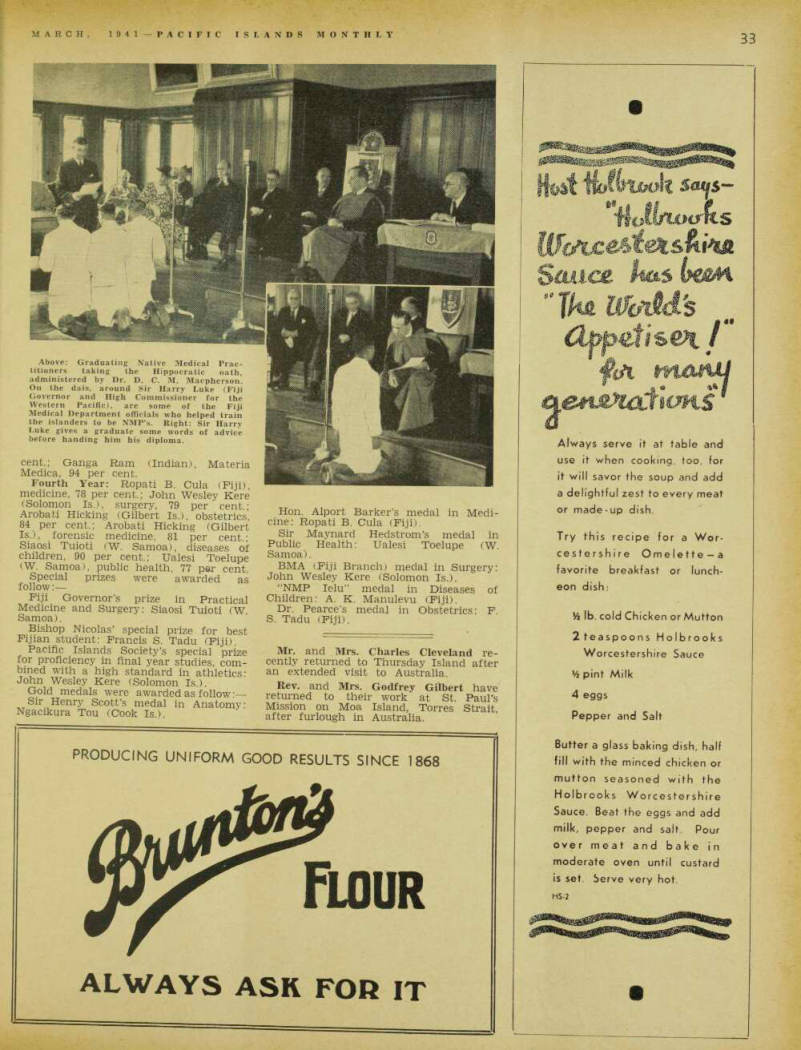
People
Invaluable Work of Suva's Famous Central Medical School
AUGMENTING the band of Native Medical Practitioners, whose devoted work among Pacific Islanders has earned deserved praise from medical authorities everywhere, another 12 Poly nesians graduated from the famous Central Medical School at Suva on December 23 and received their diplomas from the Governor of Fiji (Sir Harry Luke) at an impressive ceremony in the Fiji Legislative Council Chamber.
The new NMP’s are:— Ropati Bakata Cula, Fiji.
Francis Saula Tadu, Fiji.
Aseri Koroi Manulevu, Fiji.
Wilisoni Fakamanoa Tigarea, Rotuma.
Ualesi Toelupe, Western Samoa.
Siaosi Tuioti, Western Samoa.
John Wesley Kere, British Solomon Is.
Arobati Kicking, Gilbert and Ellice Is.
Tentau lotama, Gilbert and Ellice Is.
Morde Eria, Nauru.
Sateki Tubou, Tonga.
Uiliami Fehoko Tufui, Tonga.
Address by Sir Harry Luke
IN a notable address to the students and graduates, Sir Harry Luke said: — I think I first realised how colossal were the opportunities of the Native — and Indian—Medical Practitioner on behalf of his fellowmen when, a year and a half ago, I paid my first visit to the New Hebrides and beheld, in the
northern islands of that group, the heaviest incidence of crippling and dis figuring disease that I have had the misfortune to encounter in any popula tion. The missionaries there are putting up a magnificent fight, with the Bible in one hand and the needle for n.a.b. injections in the other; but I have never ceased to regret that funds are not avail able to multiply by 50 the two former students of the Central Medical School, now battling against sickness in the New Hebrides. Something similar in the way of opportunity still remains for the NMP’s working in Rotuma.
I first realised something of the achievement of those who have gone forth from this School as healers and as apostles of health when I came to visit Nauru, the Solomons and, later, the Gilbert and the Ellice Islands. Those territories cannot afford a large staff of European doctors; and it is to the NMP's that they have to look to carry the pre cepts and practices of modern Western medical science to their people. In the Gilbert and Ellice Islands, in particular, with its highly developed system of native government, European supervision is reduced to a minimum; but the NMP has risen to the occasion. After inspecting the native hospital in the remote island of Little Makin, northern most of the Gilberts, I noted in my diary:—
“The NMP’s are doing wonderful work in these islands and so are the dressers who, in places where there is no Medical Practitioner, are the sole repositories of medical science.”
Two weeks later, I wrote at Funafuti, head-quarters of the Ellice Islands:— “In the afternoon went over the really excellent hospital which, started some years ago by Macpherson, has managed since his departure to maintain the high standard set by him under the super vision of such admirable NMP’s as Tutu and Tatoa.”
What Nmp’S Are Doing
IT was on account of experiences of this sort, showing that those who have gone out from this School are not content to work only under the supervision of others, but are willing, and able, to take the initiative, that I felt justified in declaring, at the Graduation Ceremony last year, that .the Central Medical School is, in my opinion, one of the most beneficent gifts which British rule has conferred upon the native races of the Pacific.
Since the completion last year of the “Viti” has enabled me once more to visit adjoining territories, I have been able to repeat some of these experiences.
Exactly 40 days ago my party and I spent some hours in Niuafoou, the most outlying part of the Kingdom of Tonga, an island literally as well as metaphoric ally off the map in that it is seldom shown on charts. Yet, even in this remote place, we were pleased to see the position which the Tongan Medical Practitioner had won for himself, and the way in which he and his wife, in their little house in which the Central Medical School Diploma is prominently
displayed, live up to the dignity of one of the world's most honourable professlons ' A few days later, at the fine Apia hospital, I saw some of our graduates who are working in the island of Upolu; on the following day in Savaii, one of the cultural cradles of the Polynesian race, we watched the NMP injecting children for yaws; two days later Dr. Macpherson, who was accompanying me, was able to see for himself in Pago Pago the good account the School is giving of itself in American Samoa. And in Southern Lau, where we spent a little time on our return journey to Suva, the two NMP’s whom we had taken on the cruise from Fiji were able to make themselves useful in assisting Dr. Macpherson and the Travelling Native Medical Practitioner of Lau in carrying out village inspections of children.
Need For Expansion
IT was my hope to have seen in 1940 the beginnings of a new, better and permanent Central Medical School, but the exigencies and stringencies of war have unhappily deferred the fulfil ment of this hope. It should be realised by all that the conditions under which our medical students are now housed and taught are no longer satisfactory.
Classroom space has become cramped.
The laboratories for the teaching of chemistry, physics, biology and physio logy are inadequate in both space and equipment.
A generous credit from the Rockefeller Foundation for a health centre is “frozen” until the site of the health centre to be can be freed by the removal of the antiquated and no longer credit able hostel of the School. Museum faci lities are wholly lacking, and such facili
ties are essential for medical teaching.
Many valuable specimens collected over a period of years await proper space for display. I should like to see a section of such a museum devoted to specimens illustrative of the various special condi tions found in the Western Pacific and contiguous territories.
There is also much need for improve ment in library facilities for up-to-date text-books form part of the tools with which the doctor practises his art The Central* Medical School, made possible in part through the munificent aid of the Rockefeller Foundation, began as the extension of an experiment in medical education which had proved suc cessful in Fiji. It has now outgrown that stage, and I should like to see its usefulness expanded to the extent where it may become the recognised medical training-centre for most if not all the natives of Polynesia, Micronesia and Melanesia, and a place where systematic research into the peculiar medical prob lems of the Pacific Islands can be con ducted. All great medical schools have had similar small beginnings, and to each of them has come a time when their consolidation, improvement and, if pos sible, permanent endowment have become matters of concern to those responsible.
Wanted: A Benefactor
IDO not think I was wrong in refer ring to this School in a foreword I wrote some months ago to a num ber of “The Native Medical Practitioner” —the School’s very excellent journal founded by Dr. Clunie—as “a microcosm of the Pacific”. After all, the students at present in the School represent many territories: Fiji (including Fiji-born Indians and Rotuma), Tonga, Gilbert and Ellice Islands, British Solomon Islands, Anglo-French Condominium of the New Hebrides, NZ Mandated Terri tory of Western Samoa, the Cook Islands and Niue, Nauru (which is under Australian administration), and Ameri can Samoa; and we hope before long to be able to bring that most distant of the territories which come within my juris diction as High Commissioner for the Western Pacific, namely, Pitcairn Island, within the scope of the School’s opera tions. Thus you will see that the School flings the net of its valuable activities extremely wide.
I am, therefore, not without hope that some generous potential benefactor or benefactors may become interested in the future of this comprehensive institu tion to the extent of making it possible to provide the new buildings and equip ment which are so badly required. Such benefactors would in this way not only nobly commemorate their generosity in perpetuity, but would help to extend the benefits of medicine and public health over an immense area, populated by some of the most attractive races in the world.
Prize-Winning Students
PRIZES won during the year were presented to the following students: First Year: Mahesh Prasad (Indian), chemistry, 98 per cent.; Mahesh Prasad (Indian), biology, 94 per cent.; Peni S.
Vuiyale (Fiji), physics, 93 per cent.; Filipi Vulaono (Fiji), anatomy, 89 per cent.; Semisi Fonua (Tonga), physiology, 89 per cent.
Second Year: Ngacikura Tou (Cook Is.), anatomy, 89 per cent.; Jale W.
Masi (Fiji), physiology, 82 per cent.; Jale W. Masi (Fiji), bacteriology, 93 per cent.; Jale W. Masi (Fiji), surgery, 89 per cent.; Ganga Ram (Indian), medicine, 83 per-
cent.; Ganga Ram (Indian), Materia Medica, 94 per cent.
Fourth Year: Ropati B. Cula (Fiji), medicine, 78 per cent.; John Wesley Kere (Solomon Is.), surgery, 79 per cent.; Arobati Kicking (Gilbert Is.), obstetrics, 84 per cent.; Arobati Kicking (Gilbert Is), forensic medicine, 81 per cent.; Siaosi Tuioti (W. Samoa), diseases of children, 90 per cent.; Ualesi Toelupe (W. Samoa), public health, 77 par cent.
Special prizes were awarded as follow: Fiji Governor’s prize in Practical Medicine and Surgery; Siaosi Tuioti (W Samoa).
Bishop Nicolas’ special prize for best Fijian student; Francis S. Tadu (Fiji).
Pacific Islands Society’s special prize for proficiency in final year studies, com bined with a high standard in athletics: John Wesley Kere (Solomon Is.).
Gold medals were awarded as follow: Sir Henry Scott’s medal in Anatomy • Ngacikura Tou (Cook Is.).
Hon. Alport Barker’s medal in Medi cine: Ropati B. Cula (Fiji).
Sir Maynard Hedstrom’s medal in Public Health: Ualesi Toelupe (W.
Samoa).
BMA (Fiji Branch) medal in Surgery: John Wesley Kere (Solomon Is.).
“NMP lelu” medal in Diseases of Children; A. K. Manulevu (Fiji).
Dr. Pearce’s medal in Obstetrics: F.
S. Tadu (Fiji).
Mr. and Mrs. Charles Cleveland re cently returned to Thursday Island after an extended visit to Australia.
Rev. and Mrs. Godfrey Gilbert have returned to their work at St. Paul’s Mission on Moa Island, Torres Strait, after furlough in Australia.
Above: Graduating Native Medical Prac titioners taking the Hippocratic oath, administered by Dr. D. C. M. Macpherson.
On the dais, around Sir Harry Luke (Fiji Governor and High Commissioner for the Western Pacific), are some of the Fiji Medical Department officials who helped train the islanders to be NMP’s. Right: Sir Harry Luke gives a graduate some words of advice before handing him his diploma.
Advertisements & other items, pp. 33-35 (1 item)
Plum Pudding
0 / s J* a***?
WSt l&p
z 1(X Jo***
PLUM PUDDING
You'll earn fribufe from your family when you serve Swallow's delicious Plum Pudding. They're full flavoured and expertly prepared by Swallow's master cooks. Everybody loves plum pudding and the rich goodness of Swallow's is unique.
Specially tropic-packed in air-tight tint of exact quantities. , . but always allow for extra helpings. % lb. ... 3 serves, 1 lb. ... 4 serves, 1 lb. ... 9 serves, 2 lb. ... 12 serves, 3 lb. ... II serves.
SWALLOW & ARIELL LTD.
Port Melbourne, Australia
BURNS PHILP
(SOUTH SEA) CO. LTD.
Inc. in Fiji Island Traders and Shipowners Registered Office :
$U V A
FIJI
Also Branches at: Fiji: Levuka, Lautoka, Labasa, Ba, Sigatoka, Rotuma.
Tonga: Nukualofa, Haapai, Vavau.
Samoa: Apia, Pago Pago (American Samoa).
Solomons: Makambo, Gizo, Faisi.
New Hebrides: Vila.
Gilberts: Tarawa. 5 Norfolk Is. Niue. Wallis Is. Futuna Is.
A N
VCRS
PIRE
coods
GOLD MEDAL JAMS
CANNED ENGLISH FRUITS
CANNED ENGLISH
VEGETABLES
CUSTARD POWDER
OLD ENGLISH MARMALADE
JELLY CRYSTALS, ETC.
Obtainable from all Leading Grocery Stores. --- Write to Department A., Chlvers and Sons, Ltd., Histon, Cambridge, England, for attractive Recipe Book.
E. 76.
ibXtaok
UfcfacestetsArtM
Sauce U
Tfm Wtfitd
I t ce •«
fitx m
Always serve it at table and use it when cooking, too, for it will savor the soup and add a delightful zest to every meat or made-up dish.
Try this recipe for a Worcestershire Omelette-a favorite breakfast or luncheon dish: Vi lb. cold Chicken or Mutton 2 teaspoons Holbrooks Worcestershire Sauce Vt pint Milk 4 eggs Pepper and Salt Butter a glass baking dish, half fill with the minced chicken or mutton seasoned with the Holbrooks Worcestershire Sauce. Beat the eggs and add milk, pepper and salt. Pour over meat and bake in moderate oven until custard is set. Serve very hot.
HS-2
PRODUCING UNIFORM GOOD RESULTS SINCE 1868
ALWAYS ASK FOR IT
Crashed Plane Located in Wild NG country
Wild NG country
From Our Own Correspondent WAU Feb 15 A PARTICULARLY good job of work was done by Assistant District Officer D. Vertigan, Mr. H. Erskine (Medical Department), and Captain Tay lour (Civil Aviation Inspector) in locating the Hercules plane which crashed near Marble Creek, a tributary of the Bitoi River, on February 6. This region is wildly mountainous, heavily timbered and scarred with deep, forbidding ravines, but the three men and 20 natives reached the wrecked machine after 16
hours’ hard and difficult travelling from Black Cat settlement. An indication of the “toughness” of the journey is gained by the fact that they had to cross swiftly-running creeks about 40 times.
The bodies of the pilot, Frank Buchanan, 24, and his naative passenger, killed in the accident, were carried back to Black Cat.
The Hercules, one of Stephens’ Aviation Co.’s fleet, was flying between Sala maua and Wau, and it appears that it was carried by a down-draught into a narrow opening in the mountains, where there was little hope of turning to re gain height. Apparently the machine went into a spin and crashed.
Solomons
Leprosy In The
Pressing Need for Government Action
Prom a Special Correspondent rE article in the November “PIM”, pointing out that there now are about 900 lepers in the British Solo mon Islands, for whom the Administra tion has done practically nothing, directs attention to a ■ problem that should receive immediate attention.
Leprosy control and treatment, more than any other branch of native wel fare, should be a straight-out Govern ment responsibility, as it is in other British Colonial territories, yet it has been left mainly to the missions to alle viate the sufferings of these wretched people. For instance, the Melanesian (Anglican) Mission provides special treat ment for a number of lepers at its Fauabu hospital on Malaita. The lepers are segregated from other hospital patients, live in individual houses which are kept scrupulously clean, run their own extensive food gardens, and are generally well cared for. Certain of the huts are maintained by European sub scribers in England and Australia, but the main burden of the cost is upon the general funds of the Mission, A special study of leprosy and its treatment on modern lines was under taken at Fauabu by the former medical officer of the Mission, Dr. C. S. James; and this has been continued by his suc cessor, Dr. J. D. Thompson. The Metho dist Mission hospital (the Helen Goldie Memorial Hospital), at Vella Lavella, near Gizo, also has a small leper ad junct under Dr. A. G. Rutter, who, like Dr. Thompson, is a young New Zea lander and a comparatively recent arri val in the Protectorate. While the zeal and service of these two institutions in the cause of the unfortunate lepers are to be admired, they represent a mere nibble at the problem in the Protec torate.
The BSI Government did make a start in the desired direction in 1937, when Dr. James Ross Innes, a specialist now occupying a key advisory and research position in leprosy control in Africa, under the Colonial Office, went to the Protectorate and made an intensive analysis of the situation. Working under difficult conditions of transport and assisted by Administrative officers and selected NMP’s, Ross Innes examined 26,615 natives in Malaita, Guadalcanal.
Ysabel, Nggelo, and San Cristoval. Of this number, 221 were found to be lepers, some in an advanced and incurable con dition; this represented a percentage of 1.02, making an estimated total of 900 lepers for the whole Protectorate popu lation of approximately 90,000.
Ross Innes’s report was completed in March, 1938. and published as a Gov ernment paper at Suva. It created a good deal of interest in medical and native administration circles.
After stating certain detailed conclu sions, and making some shrewd observa tions upon BSI native affairs in general, Ross Innes recommended unequivocally the setting-up of a special leper colony under direct Government medical con trol, to be developed on the modern lines of the Uzuakoli Leper Colony in Nigeria.
He selected Ysabel District as probably the most suitable region for the location of the proposed settlement.
So far, so good. The work of Ross Innes. including the publication of the report, probably cost the Solomons’ Trea
sury well over £l,OOO. But, as with cer tain other similarly practical and well reasoned expert jobs done by outside specialists in the various Western Pacific territories, nothing further appeared to happen. In other words, while the ini tiative for the scientific approach came from higher authority, the first step being taken regardless of local adminis trative apathy, nothing appears to have been done locally to implement the experts’ reports, in spite of the obvious urgency of the problems concerned.
Ross Innes was at pains in his report to point out the essential relation be tween campaigns for improved health and sanitation and the intelligent combat of disease on the one hand, and the educational standards of the native people on the other. Widespread illiter acy, such as exists in certain parts of the Solomons, necessarily renders any in structional and preventive measures in health practically ineffectual. What is required before any large-scale scheme of health improvement and betterment of everyday hygiene can be effective, Ross Innes contends, is a higher standard of educational attainment among the natives, including vernacular literacy.
This conclusion is of special interest when it is noted that, as with leprosy, all the schooling received by BSI natives is provided by the missions, with no organised or regular system of super vision or financial assistance from the Government.
Here, then, are two closely-related, urgent needs in the field of native wel fare in the Solomons—leprosy and edu cation. In face of such a situation, it surely is difficult for the Treasury at Tulagi to justify its slow accumulation over a period of years of £90,000 of reserve funds, upon which, until drawn upon recently because of war conditions, a tight hold has always been kept.
Advertisements & other items, p. 36 (1 item)
Prescott Pty. Ltd.
SUSSEX ST., SYDNEY,
are sole wholesale agents for
PINEAPPLE BACON&HAMS
DAISY brand BUTTER "375" BUTTER in TINS llb.-21b.-slb. Sixes.
LEA & PERRINS’ Sauces and Most other Super-Quality Lines of the Trade, such as Cheese, Eggs. Etc.
We ore Specialists . . . .
X ’Phones: MA 8612 (4 lines).
Cable Address: “Weymarkson.”
Codes—Bentleys Private.
Let us have your confidence. Sixty years is our record of supplying the leading Houses throughout the World in - - - -
FRESH FRUIT VEGETABLES PRODUCE
WEYMARK & SON LTD.
FRUIT AND PRODUCE MERCHANTS
14-18 STEAMMILL STREET - - - SYDNEY
“ANCHOR FLOUR
THE STANDARD OF QUALITY
55 W s
GILLESPIE BROS. PTY. LTD
SYDNEY - AUSTRALIA
Tropics
Bacon-Curing In The
Letter to the Editor
I READ with interest the article “Coconuts for Pigs” in the December “PIM”, describing how Mr, R. T.
Ricketts, a Fijian planter, is raising 250 pigs on his coconut estate. There is no doubt that coconuts, in green form, are good food for pigs—most of the surplus nuts are fed to pigs by natives in this part of New Guinea. One point, how ever—if copra is fed to animals, it should always be ground first.
The main problem associated with pig raising is to find a market. Another thing many planters would like to know is: Can bacon be made in a tropical climate without cold storage plant?
Would it be possible to supply cool stor age space merely by excavating a sort of underground shelter on the side of a hill?
In view of the extensive bacon industry in Queensland, it should be possible to produce bacon in the Territories, for pigs can be raised cheaply enough. I imagine the trouble would be to keep the bacon in good condition long enough for ship ment. Perhaps some “PIM” reader could supply his experience with this part of the bacon industry
I am, etc.,
Baconite.
New Ireland, TNG, 17/1/41.
Editorial Note
Inquiries by the “PIM” into the ques tion of cool storage reveal that the idea of an underground shelter is quite feas ible. In many parts of Australia, where there are no factory-curing facilities, farmers cure their own bacon during the
winter months, in cellars. The curing should be conducted in a humid atmos phere, with a regular temperature of from 40 to 45 deg. Fahr. Extremes of temperatures are unfavourable. The room should be perfectly clean, and as far removed as possible from any source of contamination, such as drains, rub bish, dust, etc. There should be efficient ventilation, so that the carcase may be exposed only to pure air, and the floor of the room—preferably concrete—must be such that it can be readily cleansed.
There is a wide market for properly cured bacon and Islands planters, once they have shown that they can produce good bacon, would have no more diffi culty in disposing of their product than have the farmers of New South Wales or Queensland. If bacon producers can not contact a market through their own merchants, they may write to us, and we will introduce them to an agent who can handle their business.
Mr. Eugene F. Paul, prominent Apia business man, whose interests include the Gold Star Transport Co. Ltd., returned to Western Samoa in February after a busi ness trip to New Zealand.
A son, Donald Glen, was born to Rev. and Mrs. L. A. McArthur, Methodist mis sionaries of Rabaul, New Guinea, on February 20.
Advertisements & other items, p. 37 (1 item)
Qrru*t±!s
PURE RICE
STARCH
Always ask for . . ,
CORAL BRAND
100% PURE
Noted for Its
QUALITY
and
WHITENESS.
Goes Farthest and gives Lasting Finish
WILL NOT
STICK TO
IRON*.
Obtainable from Leading Island Stores.
CORfli BRAND
RICE BTfIRDH
Is s; c«*ai ..'VlVA.* Manufactured by
AUSTRALIAN RICE. LTD.,
Sydney. N.S.W.
OFTEN BUTTERED
NEVER BETTERED
CRISP, LIGHT BISCUITS which
bring out the flavour of cheese and add a new attractiveness to fresh or stewed fruit.
A delicious supplement to hara or paste or other tasty savoury, and still an epicurean delight, served simply with fresh butter.
The rich excellence of these famous Biscuits is the result of 67 years of specialisation.
They are packed in air-tight tins or packets for picnic convenience.
Qrru*t±!s
FAMOUS
SAO BISCUITS
ALWAYS ASK YOUR GROCER FOR ARNOTT'S !
Norfolk Island's Trade
FIGURES released by the NI Collector of Customs in February show that Norfolk Island’s imports and exports for the six months ended December 31, 1940 (with 1939 values for comparison) were:—
Mr. J. G. Hutchinson, of the New Guinea Treasury Department, has enlisted in the Royal Australian Air Force.
Imports
From From Australia Pacific Is. 6 months ended Dec. 31, 1939 £12,714 £140 6 months ended Dec. 31, 1940 £15,180 £17
Exports
To To Australia Pacific Is. 6 months ended Dec. 31. 1939 £2,818 £21 6 months ended Dec. 31, 1940 £1,663 £64
Sic Transit Gloria Mundi
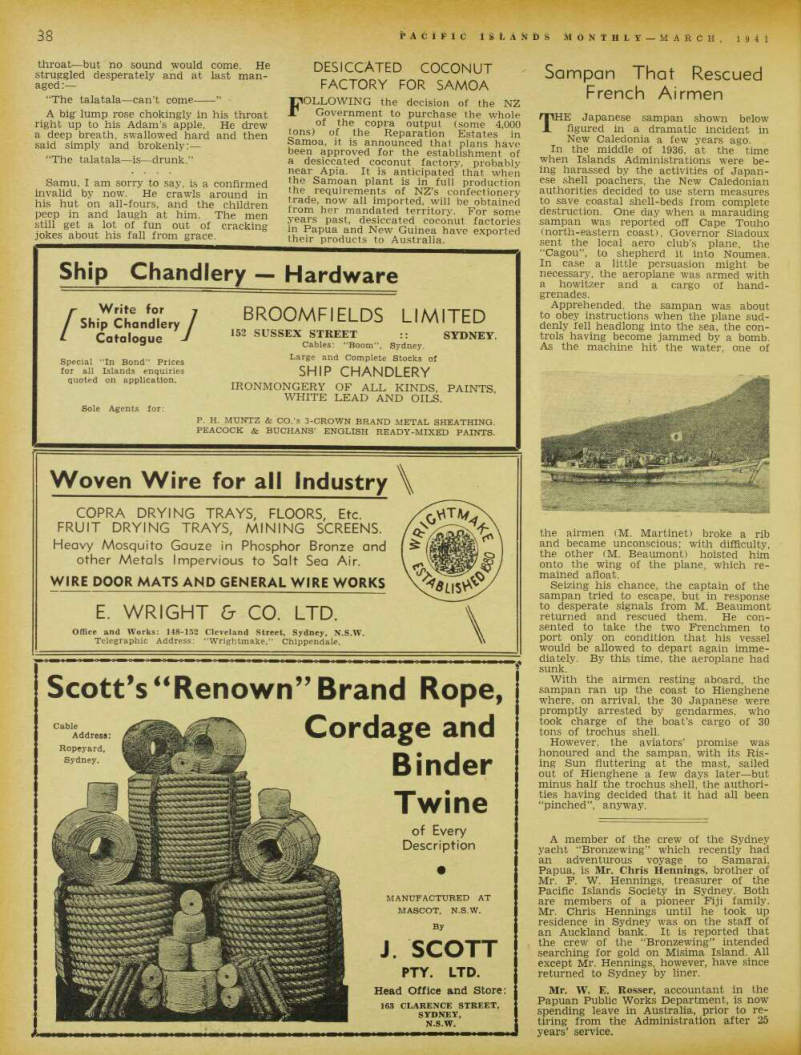
By E. Hennings
OLD Samu sat on the verandah of his little house lost in deep thought.
He had had an awful shock.
The kava party, last night, had lengthened over all three cock-crows, nearly into daylight, and this morning, when he tried to get up, his legs had given way under him. He had crawled around on all-fours until they supported his body again. That was the beginning of the end, the ignominious end of a kava drunkard.
Sucking his old pipe, he ruminated, his face, still a little ashen from his fright, screwed up in deep wrinkles, and the twinkle gone from his wicked eyes. If he weren’t to become the laughing-stock of the little community, something dras tic had to be done to keep him from the kava bowl.
It occurred to him, now, that of late, after his various drinking bouts, the tone of the men had become rather free and easy, considering that, as a former cap tain, he was a person of some standing.
There was a way out, which not only would prevent him from further over indulgence, but also would restore and enhance his position. He sighed, and moved uneasily where he sat on his haunches, the offending legs tucked under him.
No, it was not easy to make that deci sion; but needs must when the devil drives. He would turn over a new leaf, forsake the kava bowl. He would join the church!
It seemed really a hint from above that yesterday a canoe had called in, with a native preacher (talatala) on board, and since it would sail again to morrow there was no time to be lost.
When all the people had gone into their houses for breakfast, and he knew him self unobserved. Samu rose unsteadily.
After a few attempts, he managed a fairly straight course across the village green to the house where the preacher had been left alone in becoming solitude before the morning service. Samu sat down on the mat and came straight to the point.
“Inia,” he said earnestly, “it is well known to you that this is an ‘empty island’; no village, just a coconut plan tation. The workers come and go.
Sometimes there is a preacher among them and then they are happy. Just now there isn’t and that is not good.
It’s the singing,” he ventured in explana tion. “They eat too much on a Sunday.
“Now, I have given up the seafaring life to spend the rest of my days with mv master here. I have long striven to join the church. Be of a kindness and allow me to act as lay-preacher.”
The talatala looked him over search ingly. In spite of his Sunday best, Samu looked the last person to be entrusted with the spiritual welfare of the flock.
“Are you. by any chance, the man Samu who once took holy orders over on the mainland?”
Samu winced. Then he bent over with a most ingratiating smile and said, with disarming frankness: — “All you’ve heard is true. I did join up in Munivatu. I did get money from the master to buy a Bible and hymnbook, and spent it all in the kava saloons with the pretty girls. I did disgrace myself by being sick of kava in church during service. I was kicked out—but, brother,” here he registered deepest emotion, “I have repented since and led a better life.
Does not the holy book say that the flesh is weak and that those who repent shall be forgiven?”
Now Samu could talk the hindleg off an iron horse and. once going, he pleaded his case with such artistry that the preacher, bewildered and overcome, was persuaded to introduce him during the following service as lay-preacher on probation.
THE congregation was inclined to take it as a great joke, Samu’s reputa tion being what it was, but his easy manner and the eloquence with which he delivered himself from the pulpit surprised them into many a whis pered “Sa matai dina!” (“Well done!
What an expert!”) For a short while, everything went well. Samu, quite the reformed charac ter, kept aloof from his former boon companions. In true Christian spirit, he befriended a lonely youth called Bera, the “Slow One”, the butt of many jokes on account of a misshapen leg. Gradu ally, he wheedled out of his master all
the paraphernalia of a real talatala: white shirt, black necktie, black coat; and, after, by dint of putting on a jolly good show of rapidly failing eyesight, the master’s lady gave him one of her old spectacles (with case, mind you!), his appearance in the pulpit became a real star turn.
However, pride cometh before a fall, and the devil lies ever in waiting for the unwary.
“Bera,” Samu confided to his young admirer, one Sunday morning, whilst they shared tentatively 6d. worth of kava in the seclusion of his house, “we are going to have a po-lotu to-day!”
Now “lotu” is the church service, and a “po-lotu” a continuous one, held every first Sunday in the new month. All the neighbouring villages take part, entering the church separately whilst singing their hymns and, in due course, religious fervour rises to a high pitch, culminating at times in rather unexpected if not embarrassing manifestations.
“A po-lotu?” Bera gasped. “But would you know how to manage that?”
“Why should I not?” retorted Samu rather nettled, “when my father was a talatala all his life—” checking himself suddenly when he realised that the long hidden cat was out of the bag at last!
Hastily he talked on to cover the slip: “Since we have three different gangs, they can come in separately, like vil lages, and once we get them going there is no saying what confessions may not be made.” He gave Bera a broad wink —there was that trouble of pretty Seleni’s, which kept them all guessing, and though the trouble itself was only too obvious by now, the perpetrator was still unknown.
Bera eyed his protector rather anxi ously as he tossed off another cup-full
of the beverage which, to the uninitiated, looks exactly like last week’s soap-suds left in the wash boiler. But, presently, he loped off to take the word round the different houses.
When seen next, Samu had taken the seat of honour in the ring round the kava bowl, on the verandah of the head man’s house, and when the time came for morning service the “lali”, a hol lowed wooden log used by the Fijians as drum as well as church bell, called in vain.
“It’s my rheumatism,” explained Samu to the loyal youth after he had tried to balance himself on wobbly legs. “It always comes on like this when the wind goes round to the north. Be a good boy and tell them I am too busy preparing a fine sermon for this evening.”
The po-lotu promised to be a great event, judging by the various prepara tions that Sunday afternoon. Bera kept close watch on Samu’s house, where the door had remained closed ever since his return from the >kava party in the morning.
At last, when the evening meal passed without a sign of his friend, anxiety drove him to push the door open. There was Samu lying on the mat, in blissful oblivion, beside an empty kava bowl which, to judge from the still wet ring under its rim, had once been full! How had the old reprobate managed to get the stuff? Perhaps, by sending a child to the plantation store. Or had it been gratuitously supplied by somebody envi ous of his glory, or for the sake of a practical joke?
Neither violent shaking nor a bucket of cold water had the slightest effect.
Samu just grunted like a full hog, and succumbed again, an inert mass.
Slowly the “lali” began to toll. Bera
became desperate in his efforts. He made a mixture of a little kava with a hand ful of those small wild chili peppers which nearly bite your head off, and forced it down his throat. It really roused him from his stupour, and what little he managed to say was most un talatala-like.
“The service! The lali!” urged Bera, dragging him into a sitting position.
“Get up! The po-lotu!”
“Tell ’em t’ go t’ hell!” Samu drawled with a dreadful leer, and the next moment he was dead to the world again.
BY that time, dressed in their very best, oiled, scented and neatly coif fured, the congregation had filled the house serving as church. Singing their hymns, one gang had entered after the other, received by those already pre sent with more hymns, and they had sung ever since.
Now, silence had fallen on the congre gation. People began to look at each other: what had become of the preacher?
The headman gave out another hymn.
It had 10 verses and gave the talatala ample time to make an appearance.
When the 10 verses came to an end, with the pulpit still empty, a marked uneasiness came over the crowd. The elders put their heads together, the women cuffed their restless offspring, the girls giggled and the boys showed off.
Suddenly, a deep silence fell on the crowd. In the door stood Bera, dis hevelled, and shrinking from the ordeal before him. Blindly, he made his way to his seat among the young men, where he remained sitting with his head bowed deep in shame and confusion. But the tension of the assembly slowly forced him up. He stood, lifted his head, blinked his eyes in rapid succession, cleared his
throat —but no sound would come. He struggled desperately and at last man aged:— “The talatala—can’t come ”
A big lump rose chokingly in his throat right up to his Adam’s apple. He drew a deep breath, swallowed hard and then said simply and brokenly:— “The talatala —is—drunk.”
Samu, I am sorry to say, is a confirmed invalid by now. He crawls around in his hut on all-fours, and the children peep in and laugh at him. The men still get a lot of fun out of cracking jokes about his fall from grace.
Advertisements & other items, pp. 38-40 (2 items)
Guinness
Stout
FOR STRENGTH
I sii t m
STOCKED BY ALL BRANCHES OF
Brown & Joske Ltd. W. R. Carpenter & Co. Ltd.
Burns Philp & Co. Ltd. Morris Hedstrom Ltd. dvertiseinent of Export Bottlers Ltd., London. A. Macfee A Co. Ltd., Wapplnc, Liverpool, FfiHand.
William Atkins Pty. Ltd.
Established 50 years—and carrying one of the largest stocks of Iron and Steel in Australia.
Head Office 449-451 KENT ST., SYDNEY.
FULL, COMPREHENSIVE & UP-TO-DATE RANGE IN ALL
DEPARTMENTS, INCLUDING THE FOLLOWING LINES:—
STEEL DEPARTMENT
MILD STEEL:
Rounds, Squares, Flats, Half-rounds, Hexagons, Bevel, Shoeing, Tyre, Angles, Tees, Sheets, Plates, Girder Plates, Chequer Plates, Channels, Hoops, Etc.
BRIGHT STEEL:
Rounds, Squares, Hexagons.
Extra Special High Speed Tool Steel, Mining Steel, Blister Steel and Spring Steel, Rounds, Flats & Squares.
Bar Iron— All sections and sizes.
Iron & Steel Merchants
ENGINEERS' SUPPLIES
COACH & MOTOR HARDWARE.
Engineers' Supplies: Set Screws, Studs, Metal Thread Screws. Coach Screws. Files, Cotter Pins, Bright and Black Bolts, Rivets, Etc.. Hack Saw Blades.
Power Transmission Gear: Including Plummer Blocks, Couplings, Collars, Etc.
Coach and Motor Hardware: Axles, Springs. Wheelstuff, Duck, Paints.
Farriers' Supplies: Horse Nails, Anvils, Vices, Etc.
Motor-Trimmers and Motor Builders' Cr Motor Painters' Requirements
C. A. WILLEY'S
Quick-Drying Coach and Car Paints, Roughstuff, Elastic Gloss, Synflex Enamels, Lacquers.
DUCO Lacquers and DULUX Enamels—FAßßEX Motor Toppings and Leather Cloths, House fir Decorators' Paints, Varnishes fir Brushware Sole Distributors of CHAMPION'S Decorators Paint Products.
Distributing Agents for BROLITE Lacquers, SYNFLEX Enamels and "POLYGLOSS" Finish.
Ship Chandlery Hardware
/Write for j
Ship Chandlery /
Cataloaue J
Catalogue
BROOMFIELDS LIMITED
152 SUSSEX STREET SYDNEY.
Cables: “Boom”, Sydney.
Special “In Bond” Prices for all Islands enquiries quoted on application.
Sole Agents for; Large and Complete Stocks of
SHIP CHANDLERY
IRONMONGERY OF ALL KINDS, PAINTS,
WHITE LEAD AND OILS.
P. H. MUNTZ & CO.’S 3-CROWN BRAND METAL SHEATHING.
PEACOCK & BUCHANS’ ENGLISH READY-MIXED PAINTS.
Woven Wire for all Industry
COPRA DRYING TRAYS, FLOORS, Etc.
FRUIT DRYING TRAYS, MINING SCREENS.
Heavy Mosquito Gauze in Phosphor Bronze and other Metals Impervious to Salt Sea Air.
WIRE DOOR MATS AND GENERAL WIRE WORKS
E. WRIGHT & CO. LTD.
Office and Works: 148-152 Cleveland Street, Sydney, N.S.W.
Telegraphic Address: “Wrightmake,” Chippendale. mm
Scott’s “Renown” Brand Rope,
Cordage and
Binder
Twine
Cable Address: Ropeyard Sydney. m M *
of Every
Description
MANUFACTURED AT
MASCOT, N.S.W.
J. SCOTT
PTY. LTD.
Head Office and Store
163 CLARENCE STREET,
SYDNEY,
N.S.W.
desiccated coconut
Factory For Samoa
FOLLOWING the decision of the NZ Government to purchase the whole of the copra output (some 4,000 tons) of the Reparation Estates in Samoa, it is announced that plans have been approved for the establishment of a desiccated coconut factory, probably near Apia. It is anticipated that when the Samoan plant is in full production the requirements of NZ’s confectionery trade, now all imported, will be obtained from her mandated territory. For some years past, desiccated coconut factories in Papua and New Guinea have exported their products to Australia.
Sampan That Rescued
French Airmen
THE Japanese sampan shown below figured in a dramatic incident in New Caledonia a few years ago.
In the middle of 1936, at the time when Islands Administrations were be ing harassed by the activities of Japan ese shell poachers, the New Caledonian authorities decided to use stern measures to save coastal shell-beds from complete destruction. One day when a marauding sampan was reported off Cape Touho (north-eastern coast), Governor Siadoux sent the local aero club’s plane, the “Cagou”, to shepherd it into Noumea.
In case a little persuasion might be necessary, the aeroplane was armed with a howitzer and a cargo of hand grenades.
Apprehended, the sampan was about to obey instructions when the plane sud denly fell headlong into the sea, the con trols having become jammed by a bomb.
As the machine hit the water, one of
the airmen (M. Martinet) broke a rib and became unconscious: with difficulty, the other (M. Beaumont) hoisted him onto the wing of the plane, which re mained afloat.
Seizing his chance, the captain of the sampan tried to escape, but in response to desperate signals from M. Beaumont returned and rescued them. He con sented to take the two Frenchmen to port only on condition that his vessel would be allowed to depart again imme diately. By this time, the aeroplane had sunk.
With the airmen resting aboard, the sampan ran up the coast to Hienghene where, on arrival, the 30 Japanese were promptly arrested by gendarmes, who took charge of the boat’s cargo of 30 tons of trochus shell.
However, the aviators’ promise was honoured and the sampan, with its Ris ing Sun fluttering at the mast, sailed out of Hienghene a few days later —but minus half the trochus shell, the authori ties having decided that it had all been “pinched”, anyway.
A member of the crew of the Sydney yacht “Bronzewing” which recently had an adventurous voyage to Samarai, Papua, is Mr. Chris Hennings, brother of Mr. F. W. Hennings, treasurer of the Pacific Islands Society in Sydney. Both are members of a pioneer Fiji family.
Mr. Chris Hennings until he took up residence in Sydney was on the staff of an Auckland bank. It is reported that the crew of the “Bronzewing” intended searching for gold on Misima Island. All except Mr. Hennings, however, have since returned to Sydney by liner.
Mr. W. E. Rosser, accountant in the Papuan Public Works Department, is now spending leave in Australia, prior to re tiring from the Administration after 25 years’ service.
Papuan Tragedy of 1901 Letter
1901 Letter to the Editor
I THINK Mr. Edward Auerbach is slightly in error in his story, pub lished in September “PIM”, of the 1901 tragedy when two Papuan miners were killed by Orakiva natives.
The murdered men were Tom Comp ton and Jack King—l knew them well, for they had asked me to join them about six months earlier, to work a piece of ground on the Lower Ikora. As I had arranged to go to the Yodda, I declined.
I was in Samarai when the report of the murders came through. It was said that the miners had bought a pig and then put their arms down. The Oraki vas grabbed the rifles and attacked the two men. Their mate —I did not know him —ran to their assistance, but he was too late —both men were dead. He made his escape with some of the carriers.
I do not know if the details of the report were true or not, but I am quite certain that the Yodda miners did not form a punitive expedition, nor did any one else go out before the Government party. Armit, who was RM and War den, died about the same time as the tragedy occurred, and that caused the delay. Alec. Elliot was only gaoler at Bogi at the time.
Archie Walker and De Lemour were sent out to punish the murderers, and Walker allowed Billy Ivory to accom pany them, though he had to promise he would not fire a shot unless attacked.
The natives put up quite a willing scrap against the armed police. They had no hope, of course, with spears and disc clubs against rifles.
From prisoners captured, the party made out that the miners’ bodies were thrown into the Kumusi. Walker failed to find any human bones that could be identified as European, although he made an extensive search.
I have been 42 years in Papua, and the reason I have written this is be cause I do not like to hear it said that George Arnold and Jack Murphy took the law into their own hands and shot natives indiscriminately. During the 10 years I followed mining I never knew prospectors to do any wanton shooting of natives, though I have known a couple of bad characters who committed murder. The Government always dealt promptly with any murders, either white or brown.
While on the job, one more correction: Recently I read that Rossel Islanders have as many as five wives; I have lived here 27 years and know that the com mon habit is one man one wife. Odd natives have two; and I have known two men with three wives. A fairly common custom is for several men to buy one woman, even though some of the men are already married. The women do not like, it, but they have to obey their male relatives.
I am, etc.
D. H. Osborne.
Rossel Island, Eastern Papua. 7/12/’4O.
Mr. F. Shaw Meyer, a field worker for the British Museum, who has been making collections in Papua, recently left Pt. Moresby for the East, en route to England. In recent months, he collected many species of rodents in the Denewa and Gwoira Mountains, North-eastern Division.
Two Deaths At Wau
From Our Own Correspondent WAU, Feb. 15.
WITHIN a week, the deaths have oc curred of two well-known and esteemed residents of the Morobe Goldfields —Mr. Edward Turner and Mr.
Carl Beck.
Mr. Turner had lived in Wau and dis trict since 1932, and at the time of his death was managing the Wau Carrying Co., which he recently sold to Stephens’
Aviation Co. “Ted”, as everybody called him, was known in days gone by for his generosity to any cause in need. Among his many activities, he was a building contractor, and built the present Bank of NSW building and many others in Wau. Mr. Turner is survived by Mrs.
Turner and three children.
Born in Victoria in 1893, Mr. Beck went to Papua in 1923 from Queensland, where he spent the earlier portion of his life. In 1926, he took over management of the Kokopo Hotel in New Britain, but left for Australia the following year. He was at Mount Isa for a while, then re turned to Papua and later crossed to the Morobe Goldfields, where he had been with Koranga Gold Sluicing Co. since 1934. He left a widow and two daughters, Nance (Mrs. J. Lowe, of Bulolo), and Daphne; his brother, Mr. Norman Beck, is on the staff of the Public Works De partment, Rabaul.
Master R. Dulare Martintar, P.O. Nadi, Fiji, is seeking pen-friends in the Pacific willing to exchange letters, snaps, and magazines.
Advertisements & other items, p. 41 (2 items)
39
MA R C fit , I§4 1 - PACIFIC ISLANDS MONTHLY
Allen Taylor & Co. Ltd.
COMMERCIAL ROAD, ROZELLE,
SYDNEY
Sawmillers and Wholesale Suppliers of Hardwoods for Constructional Purposes GIRDERS . . . PILES . . . POLES . . . SLEEPERS, Etc.
EXPORTING TO PACIFIC ISLANDS SINCE 1893
trum
♦ 6 mm m 8 u * 1 li 1 r ■HU i: ■
BUILT TO SUIT ISLAND CONDITIONS
The Chapman Super Pup generates 4i h.p. and is particularly favoured for work boats and fishing craft, as well as usual pleasure craft. Special Chapman Patented Features provide outstanding economy and ease of operation. The Patent Self-Starting Magneto (instantly mounted or demounted, automatically timed by dropping into position) can be swung around by a hand lever to suit ahead or astern driving of boat. Reverse gear-box is entirely eliminated.
The Chapman Patent Ploatless Type Carburettor combined with the proved Petroil System of lubrication Q pint of lubricating oil is mixed with each gallon of petrol put into tank) provides utmost economy. As with all Chapman Pup engines, the Super Pup is started easily by merely pulling the wheel backwards against compression! Write for free interesting details of this and other Pup Engines. There are 22 different models, from 2£ to 20 h.p.
Samoa's £5,000 for "Spitfire
Fund" Now in Sight
From Our Own Correspondent
Apia Ttph 11
ENERGETIC efforts by the War' Fund Committee, with the support of all residents, have succeeded in bring ing the object of the “Spitfire” Drive— £s,ooo for a fighter-plane for Britain— into sight.
A Queen Carnival, in which the Ad ministration Queen, the Commercial and Sports Queen, and the Samoan Queen are competing, promises to be
successful —a special show given recently in aid of the Fund brought in £7O.
Samoan banana-shippers have contri buted another £216, carrying their total subscription to the splendid amount of well over £l,OOO.
Hon. H. W. Champion, C.8.E., Govern ment Secretary, was appointed Deputy Administrator of Papua during February while the Administrator, Hon. Leonard Murray, visited the Eastern and North eastern Divisions of the territory on official duties.
Copra Meal
By-Product Has Restricted Use as Stock Fodder
THOUGH recent practical experiments have shown that raw copra is un suitable as stock fodder, coconut (or copra) meal manufactured after the oil is extracted has proved to be quite suit able as a general food for cattle, pigs, sheep, and poultry.
In a report issued by the Victorian Agricultural Department, Mr. A. C T Hewitt, M.Agr.,Sc., states that the Commonwealth Government is seeking to dispose of 82,500 tons of copra an nually, the output of Papua and New Guinea, and he estimates that 33,000 tons of coconut meal would be available from this, having a market value of £6 per 2,000 lb., f.0.r., Australian capital cities.
Coconut meal has a 20 per cent, higher food value than pollard, but it is not so palatable, declares Mr. Hewitt in his re port; and it should not comprise more than 25 per cent, of the total ration on account of deleterious properties. These are associated with a high water absorb ing capacity which largely accounts for the laxative effects attributed to the meal. When fed in excess of the propor tion mentioned, the meal absorbs so much water that the capacity of the stomach is seriously reduced, with the result that it may not be possible for the animals to consume the remainder of their required ration.
The tendency of the oil in the meal to become rancid reduces its feeding value.
This is worse in a poorly dried meal, or when kept in a moist atmosphere. It is customary to moisten the meal before feeding, thereby increasing its pala tability, but this also increases the labour cost of feeding. The protein is of only slightly higher quality than cereal protein.
Because of the foregoing restrictions on its use, and because copra meal is relatively unknown as a stock food and will require forceful selling, I give it the same monetary value as pollard, viz., £6 per 2,000 lb.
Coconut meal is self-balanced and not a protein-rich foodstuff, as is frequently claimed. When fed to dairy cows and pigs, very hard butter and lard are pro duced. Horses, sheep and poultry can also be fed on coconut meal as portion of the ration.
Normally, more than 500,000 tons of bran and pollard are produced in Aus tralia each year, but considerably less wheat is now being gristed on account of lost flour markets and, therefore, pro portionally less bran and pollard will be produced. Little difficulty should there fore be encountered in disposing of an increased quantity of coconut cake to the dairy, pig and poultry industiSes in place of bran and pollard at the price already quoted.
At the present time, about 4,000 tons of coconut meal is, with difficulty, sold annually in Australia, at prices ranging up to £lO/5/- per 2,000 lb. in Victoria.
Probably this meal is costing £4 per ton (in selling expenses only) to sell at this price.
The annual Australian production of coconut meal is about 10,000 tons, of which about 6,000 tons was being shipped to Europe before the war. Since the war large stocks have accumulated be cause the price asked per ton has been far too high to attract attention, though owing to dry conditions and higher prices for stock foods generally, in creased movement ha's been taking place.
My enquiries indicate that only 1,000 tons of copra could be handled with existing plant in Victoria. In addition to this, there are mills in other States,
and the Council for Scientific and In dustrial Research is investigating their possibilities. It seems probable, however, that to handle 82,500 tons of copra con siderable capital expenditure on plant would be required.
Advertisements & other items, p. 42 (1 item)
iflr
) u i/r
(/SKSja? 3
I 1 / /A /
■Tf lIMPU AtITHMITIC %
to find that 5 x 1 5 is greater than 3 x 20. Similarly, you can prove that it costs more to paint your house with "cheap” paint than with BERGER’S PAINT, because it requires more paint and you don’t get half the service !
"8.P.” has all the qualities necessary for entire satisfaction. "8.P.” gives a solid covering that defies the weather, it will protect your property for years and, furthermore, the quality of "8.P.” is guaranteed on the can. For satisfaction on the job, use * m % m m 9-
AGENTS THROUGHOUT THE ISLANDS.
"8.P.” Keeps on Keeping on !
Copra As Fodder In Nz
TWO thousand tons of copra from Samoa will arrive in New Zealand this month for use as stock feed and for the manufacture of coconut oil.
It has been arranged by the NZ Internal Marketing Department. A second ship ment of 2,000 tons will arrive in May or June and there may be others later.
The chief purnose of the importation is to meet the shortage of stock feed.
The normal price of copra in Samoa is £l2 to £l5 a ton. It will be sold to New Zealand farmers at £B/10 - a ton at wharf. The copra will be used mainly for nigs, but also for cattle and sheen.
Its feed value pound for pound is said to be one and three-ouarter times that of barley or barley meal. An experimental shinment of 100 tons arrived in November and was distributed to farmers through out the North Island. Reports are that it has been satisfactorv.
It is recommended that copra should be fed dry at the rate of from I lb. a day for young nigs to lh lb. a day for large pigs, in addition to the usual skim milk or other feeds. Experiments are now being conducted to find whether the feeding of copra right up to the time of killing has any effect on the quality of the bacon.
In the meantime it is not recommended that it should be fed during the last four or six weeks before killing.
Some of the copra will also be used in the manufacture of coconut oil. A plant for the extraction of the oil was established in Auckland early this year.
EDITORIAL NOTE—The foregoing is from a report published in several New Zealand papers by the NZ Press Asso ciation. It is surprising to note that there Are no warnings concerning the effect of feeding raw copra to stock. Experiments in Australia indicated that the NZ method of feeding copra to stock caused much trouble and some deaths among the animals. The correct method seems to be to thoroughly mill or break up the copra, and supply it with about an equal proportion of other, and recognised food.
"German Submarine"
By “Amel”
IT was just after the outbreak of war, and rumours were flying thick and fast.
“This one reached me through the medium of the Fijian Bush Wireless”, said our neighbour’s wife.
Mentally extracting a grain from the salt cellar, I gave my attention to the tale. It was certainly very interesting.
The Fijian who circulated it had not lacked imagination with which to embroider the details.
It seemed that nothing less than a German “submarine” had appeared from nowhere and anchored off a village on the east coast of the island. Oh, yes, it was a submarine. . . No doubt about that. It was long and grey, and had a conning-tower. And it must have been German, because the crew could speak neither English nor Fijian!
They rowed ashore in their dinghy (!), and made signs to the Chinese store keeper that they wanted tins of meat and biscuits. Then they rowed back to their “submarine” and went aw ly. Of
course, they submerged. All the Fijians who were watching saw them submerge!
Next, the “submarine” —which had by now become famous—bobbed up outside the Government Station, several miles along the coast. But the most import ant officials were absent, and only returned in time to see the “submarine” heading out to sea again.
The DC. the PM, the DMO, and all the other local abbreviations piled into the Government launch and gave chase; but the “submarine” was too swift, and eluded them. They could see it vanish ing in the distance.
“Isn’t it a thrilling tale?” asked our neighbour’s wife, when she had finished it.
“Yes,” I agreed. “It’s a real credit to the Fijian Bush Wireless. But I would like to know what the ‘submarine’ really was.”
Next day. our curiosity was satisfied.
It was a Japanese fishing launch from Suva.
Two sections of the Papuan Adminis tration—the Department of Native Affairs and the Government Secretary’s Depart ment—have been combined and hence forth will be under the direction of the Papuan Government Secretary, Hon H. W. Champion. The Native Affairs Department was established when the territory was first being settled, to super vise the policy of contact between
European employers and native labourers —a job nowadays involving purely routine work that can be handled by magistrates and patrol officers of the Service.
Advertisements & other items, p. 43 (1 item)
Younger
Timber, Joiner/
ETC.
PREPARED BUILDINGS ready for erection a specialty.
SHIP AND BOAT BUILDING.
TIMBERS specially catered for.
FIBROLITE, PLYWOODS.
GALVANISED IRON.
CONSIGNMENTS shipped
by RETURN STEAMERS
to the Islands.
John W. Eaton
PTY. LTD.
WEST CRESCENT STREET,
NORTH SYDNEY.
Telephones: XB 4051 (6 lines.)
Re /// E
jffll 1
H~i} ill All the colourful, washable advantages of ceramic wall tiles is provided at less c«t when you use DURATILE. Write for descrip tive literature. Wunderlich Ltd., Crown and Cleveland Sts,, Redfern. Sydney, «rn
DURATILE
Do You Know that the Famous
YOUNGER
STOVES and
RANGES
made with extended Firebox specially for long Wood fuel, are Self-Setting and, provided sufficient Flue Piping is attached, can be used in almost any position?
The No. 7W “Younger” Ranger can now be supplied fitted with Legs, as per Illustration.
Younger Stoves Ask for quotation for this Range, also illustrated Catalogue Throughout and Price List for both Single and Double Oven Stoves. Pacific islands.
FLETCHER & SON 50 Oxford Street, Sydney.
"Monterey”.
For Those Who “Kill A Tin”
ALL those Pacific residents whose necessary kitchen equipment includes a stout tin opener will be interested in the advertisement in this issue of B. Callose & Sons Pty., Ltd.
This firm now is marketing in the Islands an extensive range of canned foods of continental type. Under the B.C. trade mark the Co. is supplying all kinds of preserved vegetables, peeled egg tomatoes, egg-plant, gherkins, pimentos and concentrated tomatoes—lines which make it easy to increase the scope of your menu economically and without risk of waste. Traders and Islands people interested should write to B. Callose & Sons Pty., Ltd., 22 Campbell Street, Sydney, for further particulars, including catalogues.—*«* Mr. E. G. Theodore, head of the leading
Fiji goldmining companies, returned to
Suva from Australia by the February
"Monterey”.
Chinese In Wau, Tng
Letter to the Editor
I have been assured by the ADO in Wau, in connection with the pro posed Chinatown, that even when Chinatown is an accomnlished fact, it will still be optional whether the Chinese shift into Chinatown, or remain as they are, scattered among the European popu lation of Wau.
Here is another matter that needs attention: As the law stands to-day, no Chinese in the Territory is allowed to take out a trade licence. So the Chinese circumvent the law, by getting Europeans to dummy for them. A European proceeds to the District Office and, for the sum of £3. procures a trader’s licence, with very few questions asked concerning the licence. The European allows this licence to be displayed over the doorway of a Chinese trade store: and, for this, the Chinaman concerned pays to the Euro pean, whose good name he has stuck up outside his trade store, a few pounds per annum.
By the aforesaid arrangement, both the European and the Chinese concerned, go on their way, rejoicing to think that once again the Government has been blinded with science.
One can draw one’s own conclusions when one is confronted with so many European names appearing over the door ways of Chinese tradestores.
I am, etc.,
Wau Tng. A. G. Villiers.
21/2/1941.
EDITORIAL NOTE: This matter has been causing discussion in the Morobe district lately. It was pointed out by a writer in a recent issue of the “Morobe News”, in reply to urgent representations
by Mr. Villiers, that the Chinese of the New Guinea territory are an important and law-abiding section of the com munity, and that they are doing every thing possible to assist the British war effort, especially in the regularity and size of their donations to the various war funds. The Chinese themselves are in favour of a section of Wau being set aside as a “Chinatown”.
The writer pointed out that the only real grievance against the Chinese is that certain of them induce unprincipled Europeans to allow their names to ap pear, for a monetary consideration, above the doors of what actually are Chinese trade stores —thus defeating the laws in troduced by the Administration for the proper conduct of the Chinese trading community. The Chinese in New Guinea are as well entitled as any other member of the community to make a living with in New Guinea; but they, as well as other sections, must observe the spirit as well as the letter of the law.
Miss Erna Lyons, only daughter of Hon. A. P. Lyons, Director of Public Works in Papua, and Mrs. Lyons, was successful in passing the Queensland Junior examinations for which she re cently sat in Australia. Another successful candidate was Miss Cherie Dougherty, daughter of Mr. and Mrs. Dougherty, of Port Moresby; while her sister, Heather Dougherty, passed the Queensland Tech nical College’s shorthand and book keeping examinations.
Mr. Alfred E. Stephen, of Sydney, presi dent of the Pacific Islands Society, has been an inmate of the Lister Hospital since mid-February. His many friends will be glad to know that he is responding to treatment.
Advertisements & other items, p. 44 (1 item)
The Colonial Mutual Life
BIRKMYRE’S
WATERPROOF CANVAS
0 The Original and Best for all purposes where a thoroughly waterproof covering is required.
S A I LC LOTH S. DUCKS. &c.
of FLAX. HEMP, and COTTON.
FISHING NETS,
LINES and TWINES
Extensive Stocks Carried.
Enpuring Prompt Despatch
GOUROCK ROPES Cr
CANVAS LTD.
397 KENT STREET. SYDNEY, N.S.W.
THE COLONIAL MUTUAL LIFE
ASSURANCE SOCIETY LIMITED
During 1939 the Society issued Policy Contracts to the number of 655 These Policy Contracts, ■ during their currency guarantee to the holders, on survivance, or to heirs in the event of premature death, no less a sum than £12,627,642
CHIEF AGENTS FOR PACIFIC ISLANDS;
MORRIS, HEDSTROM LTD.
The Solomons
By “Solomonoo”
UNLIKE the man who said he was walking about to save funeral ex penses, we in the Solomons just could not afford to give a kitchen cock roach a decent burial, just now.
As a sign of the times, the two big European stores in Tulagi were never at a lower ebb in the matter of supplies, and a ghost-like appearance litters their shelves.
The other day—around Xmas time — an old-timer entered one of the stores to make a few purchases and, after being turned down over meat, rice, bacon, potatoes, onions, flour, biscuits, benzine, kerosene, sugar, and a number of other necessities —not to mention beer —he asked what sort of storekeeping it was that allowed of such laxity at such a time. “Well, you see,” said the manager, apologetically, “the reason is that Ah Fat (as we will call the Chinese store keeper alluded to) missed out on his last orders to Sydney, and all his customers have been coming to us, and have cleaned us up!”
At this point, the old-timer put his hands in his face and burst out crying, after which he proceeded to Chinatown and procured most of what he needed.
To him there was a sort of sorry humour about the fact that it was largely the spoon-feeding and preferential treatment that Ah Fat had received at the hands of at least one of the Big Stores, all through the long depression, that had built him up to his present stage of opposition.
Still, there is always something to be thankful for. If a German raider nosed into Tulagi, looking for supplies, and saw the state we were in, he would probably be moved to pity, and leave us something to go on with.
White traders, of course, are numbered with the nast. But their shades, in these days, find amusement in marvelling as to how the numbers of Chinese traders who have replaced them can scratch out a living. Surely there must be a valuable lesson to be learned from them in the matter of balancing budgets, which even Treasurer Johnson and his staff could profit by. And, with the continued influx of cadets and officials generally, one is left in amazement as to how he (the Treasurer) manages to pull the ends together.
The Hat Came Off!
The state of Mission finances was in dicated the other day when a Bishop met a gold miner in Tulagi, and asked him how the gold-mining was going.
“Haven’t you heard the good news?” said the miner.
“No,” said the Bishop.
“Well, one of our local experts, who claims to be one of the three leading geologists of the world, has examined the field and declares that we are sitting on a bare 56 millions of pounds’ worth of gold, and that that is only the start of what lies behind. So.” continued the miner, “in future I will expect you to take your hat off when you speak to me.”
The Bishop removed his hat, turned it over and held it out in a significant manner, and said: “I certainly will!”
Mining And Miners
Talking of mining, several unfortunate copra-catchers whom circumstances have brought to a state of poverty, took it up as a final resort. Soon, moans were heard about “unnecessary restrictions”, and demands for “guarantees” against payment of labour.
One gave the Mines Department a guarantee and, when labour was being
signed on for him, the Labour De partment demanded still another one.
Rumour has it that at this point the doctor had to be called in to extract a ball of red tape from the victim’s throat; but this has not been confirmed.
This was under the “old” Mining Rules; but, now that the “new” ones have at last come to hand, after being many years on the way from Fiji, God help us! After a glance over them, one greatly fears that if he feels like shedding tears over his adversities, he will first have to fork out 7/6 for a “water licence” and then another 7/6 to cancel it, after the well of tears dries up.
Strange Weather
“Is there a weather cycle?” asks December “PIM”.
Well, I don’t know —but, over the last 35 years, I cannot recall a milder Nor’-west season (so far as we have gone) than the present one. Once, you could set your watch by a blow, arriving in the early part of January, and there would probably be a few pipe-openers during December; but, so far this year, all the “blitzing” seems to have been reserved for the other side of the globe. May it soon blow the taint of war—and Hitler —clean off this unhappy sphere!
Mr. R. H. French, assistant manager of the Pqndo establishment (factory and plantations) in New Guinea, died very suddenly on February 22, while super vising the loading of a steamer. He was only 41 years old. He had been 18 years in the Territory and was highly esteemed.
Miss Jean Wilson has been transferred from the Rabaul to the Salamaua (New Guinea) branch of Messrs. Burns, Philp and Co. Ltd.
Mr. E. Roenfelt, vice-president of the Seventh Day Adventist Mission, accom panied by Mr. R. Adair, treasurer, arrived in Rabaul by air from Sydney in mid- February to make a tour of inspection of their mission stations both in New Guinea and in the Solomon Islands.
Advertisements & other items, pp. 45-46 (1 item)
- and I use
TAKE THE
“LEAD” FEELING
OUT OF YOUR LEGS
Get More Oxygen in Your Blood and Get the Pep that Sends You Bounding Up the Stairs.
You are slowly smothering if your blood is lacking in enough red cells and the rich red colouring matter they contain, called hemoglobin. It’s the hemoglobin which picks up the life-giving oxygen from your lungs and carries it to every part of your body. Without enough hemoglobin, your body is being oxygen-starved. Your organs, glands and tissues slow down . , . you feel tired, pepless, depressed . . . your nerves often become jittery—you get easily upset.
What you need is Dr. Williams’ Pink Pills. These world-famous pills help rebuild your hemoglobin which makes your blood rich and red and so aids your system in getting the vitalising oxygen it needs. Get Dr. Williams’ Pink Pills to-day from your chemist or store.
See for yourself how quickly your “always tired”, nervous, depressed feeling fades away—and once again you feel “alive”, full of pep and go.***
BITUMENOID ROOFING
MADE IN AUSTRALIA.
Bltumenoid Roofings, Dampcourse and Insulating Felts are made from the world's best raw materials. Warranted to stand the most rigid tests. t
BITUMENOID THE BEST
Roofing, 1 2, 3-ply; Flooring, Waterproof Materials; Saturated Pelt; Resilient Road Jointing; Natural Asphalt Dampcourse: 2 and 3-ply Dampcourse; 1-2 lb. Lead-core Dampcourse: Roofing Cement; Asphalt Paints; Roofing Compound.
SAMPLES AND PRICE LISTS ON APPLICATION.
MAXWELL PORTER & SON LTD.
ESTABLISHED 1888. BUILDERS’ SUPPLIES.
107 REDFERN ST., REDFERN, SYDNEY, N.S.W. Phone: M 3157. Cables Bitumenold.
i*m ma
- and I use
DISTRIBUTORS: Greenwood & Laws, Ltd., Rabaul and Wau; Steamships Trading Co., Ltd., Port Moresby and Samarai; Millers, Ltd., Suva, Fiji.
“8.A.L.M.” PAINT
FOR A BETTER
JOB. Long experience has shown practical men the wisdom of relying
on QUALITY
paint —“B.A.L.M.”
Paint for lasting satisfaction, protection and decoration. For safety’s sake, next time, use “8.A.L.M.”
the PRE-TESTED
paint!
A Product of British Australian Lead Manufacturers Pty., Ltd., makers of “Dulux” Finishes.
No Asthma
in 2
Years
Two years ago J. Richards, Hamilton, Out., Canada, was in bed with Asthma. Had lost 40 pounds weight, suffered coughing, choking and strangling every night—couldn’t sleep— expected to die. Mendaco stopped spasms first night and he has had none since—in OVER TWO YEARS. Mendaco is so successful it is guaranteed to give you free, easy breathing in 24 hours and to stop your Asthma completely in 8 days or money back on return of empty package.
Ends Asthma . . . Now 3/-, 6/- and 12/-
SCHAFFER & CO., SYDNEY.
Mendaco
.V =•7.^ r. & L,
ORW'A
ORWA
D:: A»■>»*. -vii\ .i
ORW'AR'S^S''^
OR WAR'S &£
orwarsorwwo aR• 5 OR WAR S 0 R.WA R*S
AR'S OR WAR SORW'A RS
VAR'S ORWAR S ORW'AR’S
RW A R- S OEW A R S OR WAR'S
;>;;■ WAR'S ORWA R S ORW'AR'S
R'S ORWAR’S ORWaR'S OR WAR'S
TVVAR SORWaR'SORWAR'SOR WAR'S
OR WAR’S ORWAR'S ORWAR'S OR WAR'S ORWA R S ORWAR'S OR WAR'S OR WAR’S R-R WAR'S OR WAR'S OR WAR'S ORW'A RS. RR WAR S OR WAR'S ORW.f AS OR WAR'S ORWAR'* OR. WAR'S OR WAR'S OR WAR'S ORWAR'S OR WA R'S OaW'aRS ORWAR QS WAR'S ORWAR'S ORW'A R' S ORW'A RS OR W
R'S DRV
ORW'aR SOR
SOR
R'S VR, A'R AR
A R'S DRW A R 'S
AR'S ORWAR'S
AR'S ORWAR'S
A R’S ORWAR’S
ORW'A RS ORWAR'S
ORWAR'S ORWAR'S OR WAR'S
ORWAR'S OR WAR'S OR WAR'S OR WAR'S
iRWAR'SOR WAR'S ORWAR'S ORWAR'S ORWAR’S
'aR'S ORWAR'S ORWAR'S OR WAR’S ORWAR'S ORWA R'S S ORWAR’S OR WAR'S ORW'A’R S ORW'aKS ORWAR'S ORWAR'S SORWAR'SORW A R' S 0 R WAR’S OR WA K' SOR 'WA R' S 0 R WAR'S 0 RWX R' S
OK WAR’S ORW'A R
ORWAR'S
OEwJk'S
OH WAR
DRW'/
ORW'A
OR'W.
ORW';
ORW'A.'
ORW'A
ORWAR'S OH WAR'S ORWAR’S ORWaR S ORWAR'S OR WAR'S OK WAR’S ORWAR’S OR WAR’S ORWAR’S ORWARS ORWAR'S OR WAR'S OR WARS ORWAR'S ORWAR'S ORWAR'SORWAR'S ORWAR'S OR WARS ORWAR’S ORWAR'S OR WEAR'S ORW'A R'S ORWAR'S OR'W AR'SOR WARS ORWAR’S ORWaR'S ORWAR'S ORWAR'S ORWAR'S OR WARSORWAR’SORWaR'SORWaR'S ORWAR'S OR WAR'S ORWAR'S ORWAR’S ORWAR'S ORWAR’S OR WARS OR WAR'S ORWAR'SORWARS ORWAR’S ORW'aR’S
ORWAR'S
ORWAR'S ORWAR'S ORW'A
0 R W A R' S OR WAR.’ S OR W A
ORWAR’S ORWaR'SORW'AR,
OR W A R'S ORW'A R'S ORW'A
ORW'AR'S OR WAR'S OR WAR'
OH WAR'S OH WARS ORW'
R'S OR WAR'S
WAR’S OH WA R'S ORWAR'S
SR'SORWAR'SOHWAR'SORWaR’S
WR S ORWaR S ORWAR’S ORWAR'S
RWAR $ ORW A R S ORWAR'S OR. WAR'S ORWAR'S
RW'aR’S ORW'AR’S OR WAR'S OR WAR'SORWAR'S
ORW'AR'SORW'aR S ORW'AR'S OR WAR'S OR WAR'S ORWAR'S ORWAR S ORWaR'S
ORWAR'S ORWAR'SORWAR'S ORWAR'SORWAR'S ORWARS ORWAR'SORWAR'S
s K\ A* OR A R RW RW
'AJR’S ORWAR
OR WAR'S ORW A
OH
DRW
ORW'
ORW
OHW
ORW
ORWaR
ORW'AR'S OR WAR'S OR WAR'
OR WAR'S ttRWAR^OVWAR;
ORWaR SORW'A' iHE; i
ORW'A R’S ORWARKj ORW'AR'S 0
OR WA R'S OR WAR'S OR WAR'S ORWAR’S ORW'A R’S ORW'AR'S ORW'aR'S ORW'AR'S ORW'A R'S ORWARS ORW'AROS ORW'AR'S ORW'AR'S OR W'AR'S OR .VMS'S ORWAR'S OV: W'a R'S ORW'AR'S ORWARS ORWAR'S OR WAR'S OR WAR'S ORWAR'S ORWAR'S OIOA'AR'S ORWAR'S OR WAR'S ORWAR'S ORW AR'S OKW aR SOKWAR/SORW AR'S ORWAR'S ORWAR'S OR WAR'S ORWAR'S ORWAR'S ORWAR’S ORW'AR’S ORW'AR'S
AR'S
AR'S
:ars rs R'S AR?w*rw A.rs
A R’S ORW'A R.’ S
EWaR'S ORWAR'S
R WAR'S OR'WAR'S
O SWA R'S ORWAR'S
ORWAR'S ORW'AR’S
Papeete
A Sunday In
By Mrs. Lorna Davidge, of Victoria, 8.C., who, with her husband and son, is cruising leisurely in the South Seas. rE celebrations of Saturday night seem barely to have died away, be fore the life of Sunday morning has started. By 4 a.m. the market carts, trucks and wheelbarrows from the coun try are rattling and clattering along the Rue de Commerce; the Chinese carts, drawn by weary little horses, that know their way without guidance, allow the driver and his family to nod sleepily among their garden produce, which fills all available space.
There is a running-light swinging un der the cart, as these early market folk start long before the first rays of the sun touch with gold the distant peaks of
Moorea, or the schooners’ top-masts in the harbour. From each schooner comes the lusty crow of fighting-cocks as they greet the morning; the minah-birds have already started to chatter and sing; while columns of blue wood smoke spiral up amongst the green tree-tops. The church bells are ringing for early Mass.
By this time, people are arriving from all directions, on foot, bicycle or in queer little two-wheeled carts, all carrying baskets, hurrying as much as they ever hurry in Tahiti, to the early market, which opens its gate at 5.30 a.m., an nounced by the loud clanging of a large brass bell.
The market place is an open-air, up to-date affair, built of concrete and iron and is thronged with a gay, flower-decked crowd of Tahitians, Chinese and Euro peans. The hum of conversation and laughter rises above the expostulations of chickens, pigs and ducks, tied by their legs to anything handy.
ALL the stalls attract crowds, but the most excitement seems to be around the fish vendors, where all sorts of odd, fearful and colored denizens of the reef and lagoon are offered for sale.
There are large shrimps threaded on sticks, shell-fish already shelled and strung on strings, neat bunches of cray fish tied together like flowers, sea cen tipedes, big tuna and bonito, strings of oomah (a small herring-like fish), pois sion rouge, hari-hari, and fresh-water eels neatly skinned and cut up. Chopped up shell-fish, mixed with coconut sauce, are sold sealed in lengths of green bamboo. „ , . , All kinds of tropical fruits find a quick sale, being ready to take away in plaited coconut baskets. The Chinese control the garden vegetables and meat departments entirely, leaving the fish and fruit to the Tahitians—who gossip happily amongst their heaps of taro, pawpaws, bread fruit, etc. ..
Brown-clad policemen move amongthe crowds with pencil and note book. They seem to be checking sales, or collecting dues, and often get into an argument with some “Mania”, who has all her rela tions and friends handy to back her up, if necessary. . ..
On a clean floor-space, Chinamen sit on their heels, amongHsttess-lookmg and chickens, tied by the leg, waiting f °The y Tahitians don’t take business as seriously as do the Chinamen but laugh joke and gossip with their friends. But sales go on, just the same. .
The flower section is handled by women, who sell their sweet smelling of ferings, in bunches, or leis. the latter usually made of “Tiare Tahiti .
Smiling vahines are beginning to leave the market now, baskets ioaded with salad and fruit on one arm, while the other may carry a dangling string of fish or a live chicken, or even a squealing piglet A boy on a bicycle with a young pig so tied by its feet to the handlebars
The schooner-yacht Lorna D. lying beside the Quai, Papeete.
that it forms a kind of basket, con taining four coconuts, heads for home with his bargain.
Outside is rather a depressing sight.
There is a grey-painted cart, with a wooden cage built on it, in charge of two prisoners from the “calaboose”, and a gendarme; and stray dogs are pushed into it at intervals by means of a long stick, for this is the dog pound. All dogs without licences find themselves in it, sooner or later, and, after being held eight days, they depart this life, unless their fines are paid.
The business day of the market is finished by 7.30 a.m. The crowds begin to thin out. Many go for their morning coffee and rolls, at the nearby Chinese restaurants; others leave in big trucks seating fifty or more, with food and pur chases piled up on the roof. They might be going to a picnic, or a wedding, for they leave with laughter and singing, as wine and guitars are passed round, rE stone seats along the Quai are crowded with gossiping groups, dis cussing the latest news, hot off the “coconut radio”. Sitting on the business end of one of the up-ended cannon, that serve as bollards along the Quai wall, is a little old man, in police uniform, smoking a long, churchwarden pipe. He is a pensioner, but still has his duties as park guard. All the vahines and children call to him as they pass.
Along the Quai comes a native with a woollen cap perched on top of his curly hair. He is spearing odds and ends, in the harbour water, along the wall; a root of taro, an orange, a fish or eel, anything is grist for his mill.
The church bells begin to ring again and long serpentine lines of young boys and girls, m charge of the Catholic Brothers and Sisters, wind round corners on their way to church. The congregations of other denominations, Mormon, Protestant and Seventh Day, may be seen strolling m family groups or couples; the old women dressed in long black Mother Hubbards, with high-crowned black hats; the girls are usually in well-made white or light-colored dresses. The elderly men affect black, high-collared coats and hats, light trousers and umbrellas. They never seem to use those umbrellas in sun or rain.
Sailors from the Government schooners and gunboats, in their neat white uni forms, and caps with a red pom-pom, stroll by with their vahines, and soldiers in khaki shorts, shirts and helmets, clomp along in their heavy nailed boots.
They all are generally headed for the wine shops or cafes, where they may spend the day, singing and dancing.
From eleven o’clock on, the Quai seems deserted, until about 5 p.m., when the soldiers, sailors and church processions appear again. Groups of girls with flowers m their splendid hair walk by, hand in hand, heading for the dancing, which continues until 11 p.m. Then the crowds pass again, on their way home. The pickets round up those who have to be in barracks, but are making heavy weather of it.
Soon the little town appears to sleep, except for a few white-clad couples sit ting on the stone benches, and the only sounds are the distant thrumming of a guitar, the surf breaking out on the reef, and the nightly song of the crickets. So we go aboard our little schooner, moored at the Quai, and turn in.
Mrs. Leonard Murray, wife of the re cently appointed Administrator of Papua hopes to leave by air for Port Moresby sometime this month. Since her husband’s return to Papua, Mrs. Murray has been visiting friends in Melbourne.
Recent Bishop Museum
Publications
The Hawaiian planter. By e. s.
Craighill Handy. Volume I. —His Plants, Methods and Areas of Culti vation. BP Bishop Museum Bulletin, 161, 227 pages, 8 plates, 21 figures, 1940.
An ethnologist presents a detailed and valuable account of Hawaiian agriculture before European discovery. He discusses in detail taro, sweet potato, yams and bananas; and gives notes on bread fruit, coconut, pandanus, kukui (Aleu rites), kou (Gordia), hau (Hibiscus
tiliaceus), wauke or paper mulberry (Broussonetia) , olona ( Touchardia ), awa ( Piper ), ti ( Cordyline or Taetsia), gourds, arrowroot, turmeric, bamboo, ilima ( Sida ), hibiscus, and pineapple. Details of native varieties are given; and exten sive bibliography and glossary,
Coleoptera From The Caroline
ISLANDS. By K. G. Blair. BP Bishop Museum Occasional Papers. Vol. 16, No. 6, pages 131-157, 12 figures, December 10, 1940. A distinguished British Museum entomologist records 74 species of beetles from material collected by a Bishop Museum Micronesian expedition and
specimens in the British Museum. Of the species, 25 are described as new to science.
Report On A Collection Of
Samoan Coleoptera. By Elwood
C. Zimmerman. BP Bishop Museum Occasional Papers. Vol. 16, No. 7, pages 159-176, 1 fig., January 22, 1941, In re cording 46 species of beetles from Tutuila, American Samoa, of which 10 are new records and four new to science, the Bishop Museum entomologist makes the point that the insect fauna of Samoa is far from adequately collected. He col lected the specimens here reported upon, in the foothills above Pago Pago Har bour, during about three hours’ stop over in 1938.
Many people in the South Pacific territories will learn with regret of the death of Colonel J. G. Koopman, which occured in Holland on February 11.
Colonel Koopman retired in 1930 from the Netherlands Indies Army, and re sided in Sydney from 1932 to 1939 as the representative of the Dutch Air Lines.
He was a man of charming personality and the embodiment of courtesy, and he was well-liked by all who met him in connection with Dutch Airways’ business.
Those who knew Colonel Koopman in Australia can imagine how he hated living under the heel of the Nazis in Holland.
Advertisements & other items, pp. 47-48 (1 item)
of (Duality
HONESTY FIDELITY
When making gout Will
Safeguard your interests. Ensure their protection and security. Avail yourself of the advantages to be derived from the appointment of this Company as your trustees, in preference to any one individual. Write to or call on any Branch of Burns, Philp & Company Limited, or Burns Philp (South Sea) Company, Limited, for the folder which fully explains these advantages.
Give careful consideration to the benefits to be gained by appointing as your Executors—
BURNS PHILP TRUST CO. LTD.
DIRECTORS
JAMES BURNS LEWIS ARMSTRONG
ROBERT JOHN NOSWORTHY JOSEPH MITCHELL
BURNS PHILP TRUST CO. LTD.
capital —£2oo,ooo 7 BRIDGE STREET SYDNEY, N.S.W.
(Oprettfo
of (Duality
♦♦♦ In case of difficulty in obtaining supplies, write to
BOX 18G1 K., G.P.0., SYDNEY.
Vigour Restored,
Glands Made Young
In 24 Hours
It is no longer necessary to suffer from loss of vigour and manhood, weak memory and body, nervousness, impure blood, sickly skin, depression, and poor sleep, because an American Doctor has discovered a quick, easy way to end these troubles.
This discovery is in pleasant, easy-to-take tablet form, is absolutely harmless, does away with gland operations and is bringing new youth and vigour to thousands. It works directly on the glands and nerves, and puts new, rich blood and energy in your veins. In 24 hours you can see and feel yourself getting younger. Your eyes sparkle, you feel alive and full of youthful vigour and power.
And this amazing, new gland and vigour restorer, called Vi-Stim, is guaranteed. It has been proved by thousands in America and is now distributed by chemists here under a guarantee of satisfaction or money back.
Vi-Stim must make you feel full of vigour and energy and from 10 to 20 years younger, or you merely return the empty package and get your money back. A special, double-strength bottle of 48 Vi-Stim tablets costs little, and the guarantee protects you.
Vi-Stim
GUARANTEED
to Restore Manhood and Vitality . . .
The Most Extensive Manufacturers in the British Empire of
RUBBER STAMPS,
INKS, STENCILS,
Marking Devices,
ACME STAMP PADS
OFFICE ft STATIONERY SUPPLIES
We also Manufacture & Supply a Complete Line of
LIMEWASHING AND
SPRAYING MACHINES
for all purposes.
Let us know your requirements and we will quote by return.
WRITE FOR OUR GENERAL CATALOGUE
Limewashing Machine
EXCELSIOR SUPPLY CO. PTY. LTD.
278 host Office Place,
MELBOURNE, VIC.
HEAD OFFICE :
160 BROADWAY,
Formerlu known as George St., West,
SYDNEY, N.S.W.
50 Victoria Street,
WELLINGTON, N.Z.
Some Interesting
District Officer
System
Some Interesting Comment
11THAT is the most effective system of ▼ T using District Officers? It is an old, vexed problem in many territories.
Recently, Gordon Thomas discussed the matter interestingly in “Rabaul Times”.
He had come upon a conv of the ‘‘Fiji Times”, and he says:— “There has been, apparently, some criticism of government organisation in Fiji, and a Reorganisation Report has been submitted. A Fijian nominated Councillor—one Ratu J. L. V. Sukuna, CBE—had much to say about young District Officers and their work amongst the people. ‘They (the people) found themselves controlled by District Com missioners who came and went,’ said Ratu Sukuna. ‘They had no sooner settled down than they were moved somewhere else, or had to take leave, and when they returned, probably went to some other district.’
“Continuing, the Fijian Councillor pointed out that the official himself could not be blamed: ‘they were new and knew nothing of the language and nothing of the customs—yet they were sent to rule over native people and chiefs grey in years. . . . How could the Fijians have any faith in officers who had no know ledge of the Fijians?’
“Now, I have no idea what kind of a man Ratu Sukuna is. Presumably, a man of some standing, as he had received the CBE at some time or other, and evidently a man of perception and wisdom, judging from his remarks which might well apply to many other colonies and territories in the Pacific.” (We interpolate, to inform Mr. Thomas that Ratu Sukuna is one of the out standing men in Fiji. He is of noble Fijian birth, completed his education at Oxford, served with distinction in the 1914-18 war, in the French Foreign Legion, and has been recognised, for years, as one of the wisest men in the administrative service of Fiji. He was the Commissioner in charge of the Lau group, until recently, when he took charge of the newly-created Fiji Land Board.) Mr. Thomas proceeds: “One of the greatest causes of dissatisfaction and dis content in outstation areas is the too constant change of officials, the lack of continuity in the interpretation of policy. Each individual officer has his own Ideas of values, methods of putting into practice the principles of a wide policy governing native administration. Some have been blessed by the gods with ini tiative; others are unimaginative, fearful of using their own judgment and conse quently abide by each stop and comma of the Regulations.”
Now in Australia, with the intention of studying the aborigines, is Miss Doretto Miko, of New York, and until recently of Hawaii, where she carried out investi gations among the ancient burial-places in that group. Miss Miko is an MA, of the University of Minnesota, and she has lived among the Hawaiians, Fijians, Samoans, and Maoris to get a first-hand knowledge of local culture. The visitor expects to spend about six months in Australia. Miss Miko says that, of all the native peoples among whom she has lived, she prefers the Samoans. Not only are they essentially hospitable, she says, but many of them still live as their people have lived for countless genera tions.
Advertisements & other items, p. 48 (1 item)
46
pacific Islands mo sihii - march, 1s 4 l
Nauru's "Lively New
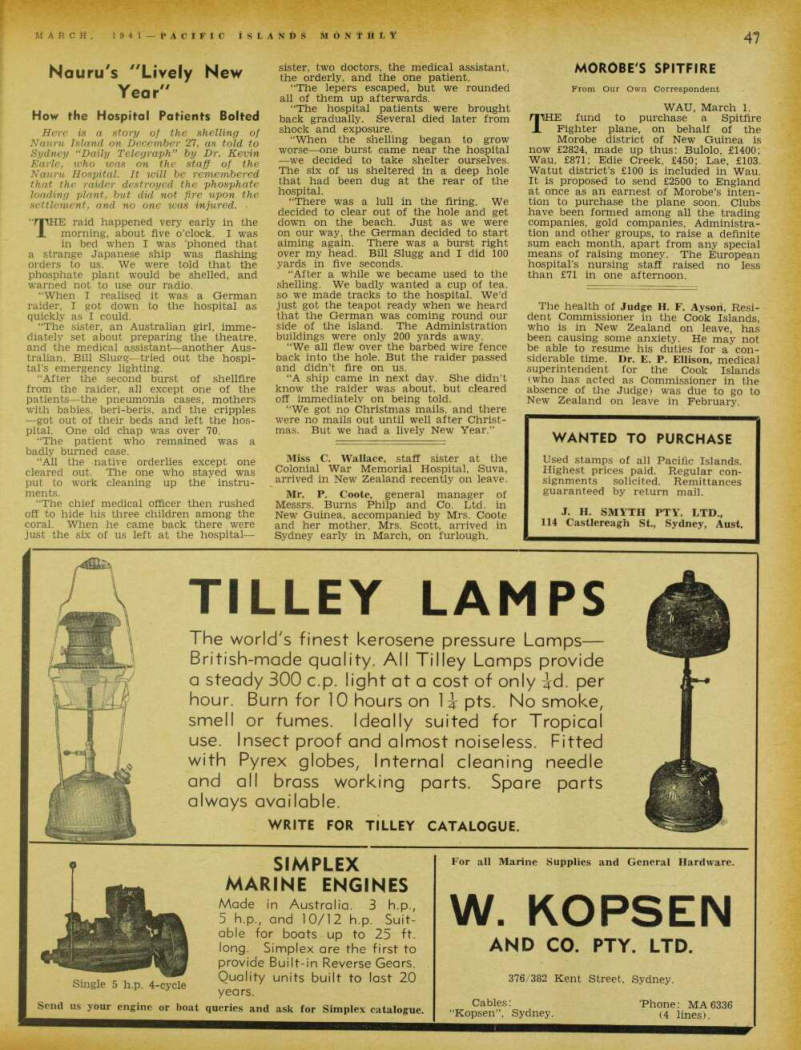
Year"
How the Hospital Patients Bolted
Here is a story of the shelling of Nauru Island on December 27, as told to Sydney “Daily Telegraph” by Dr. Kevin Earle, who was on the staff of the Nauru Hospital. It will be remembered that the raider destroyed the phosphate loading plant, but did not fire upon the settlement, and no one was injured.
“mHE raid happened very early in the A morning, about five o’clock. I was in bed when I was ’phoned that a strange Japanese ship was flashing orders to us. We were told that the phosphate plant would be shelled, and warned not to use our radio.
“When I realised it was a German raider, I got down to the hospital as quickly as I could.
“The sister, an Australian girl, imme diately set about preparing the theatre, and the medical assistant—another Aus tralian, Bill Slugg—tried out the hospi tal’s emergency lighting.
“After the second burst of shellfire from the raider, all except one of the patients—the pneumonia cases, mothers with babies, beri-beris, and the cripples —got out of their beds and left the hos pital. One old chap was over 70.
“The patient who remained was a badly burned case.
“All the native orderlies except one cleared out. The one who stayed was put to work cleaning up the instru ments.
“The chief medical officer then rushed off to hide his three children among the coral. When he came back there were just the six of us left at the hospital—
sister, two doctors, the medical assistant, the orderly, and the one patient.
“The lepers escaped, but we rounded all of them up afterwards.
“The hospital patients were brought back gradually. Several died later from shock and exposure.
“When the shelling began to grow worse —one burst came near the hospital —we decided to take shelter ourselves.
The six of us sheltered in a deep hole that had been dug at the rear of the hospital.
“There was a lull in the firing. We decided to clear out of the hole and get down on the beach. Just as we were on our way, the German decided to start aiming again. There was a burst right over my head. Bill Slugg and I did 100 yards in five seconds.
“After a while we became used to the shelling. We badly wanted a cup of tea. so we made tracks to the hospital. We’d just got the teapot ready when we heard that the German was coming round our side of the island. The Administration buildings were only 200 yards away.
“We all flew over the barbed wire fence back into the hole. But the raider passed and didn’t fire on us.
“A ship came in next day. She didn’t know the raider was about, but cleared off immediately on being told.
“We got no Christmas mails, and there were no mails out until well after Christ mas. But we had a lively New Year.”
Miss C. Wallace, staff sister at the Colonial War Memorial Hospital, Suva, arrived in New Zealand recently on leave.
Mr. P. Coote, general manager of Messrs. Burns Philp and Co. Ltd. in New Guinea, accompanied by Mrs. Coote and her mother. Mrs. Scott, arrived in Sydney early in March, on furlough.
Morobe's Spitfire
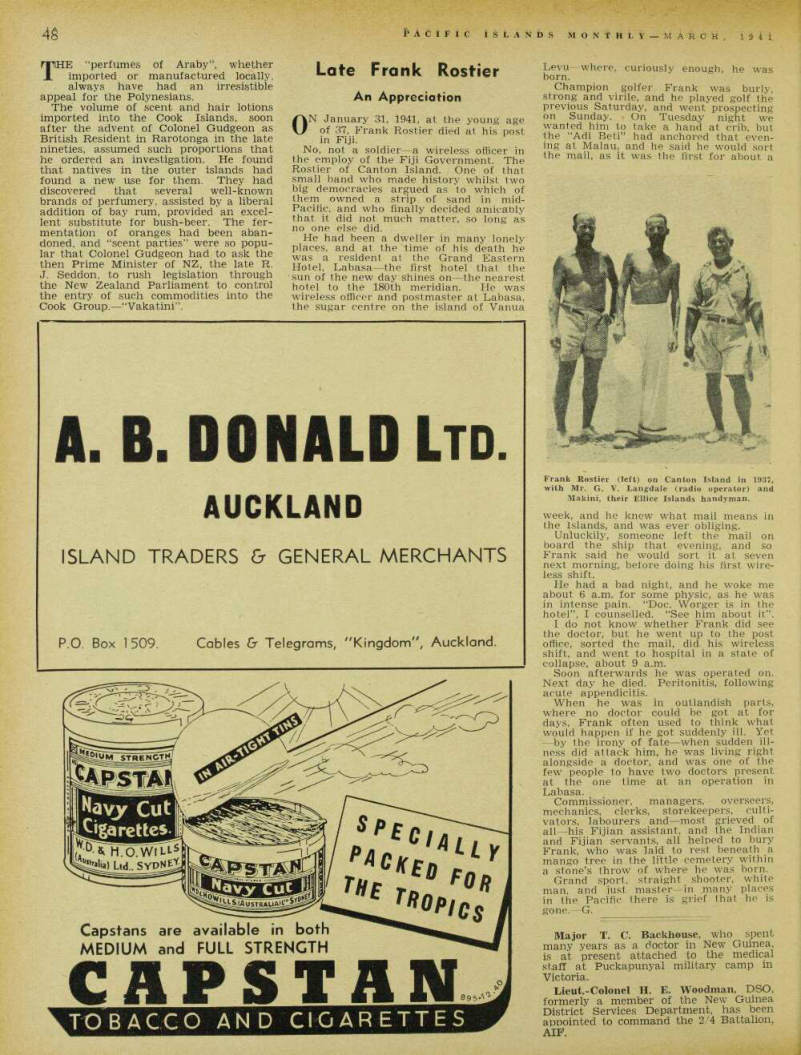
From Our Own Correspondent WAU, March 1.
THE fund to purchase a Spitfire Fighter plane, on behalf of the Morobe district of New Guinea is now £2824, made up thus: Bulolo, £1400; Wau. £871; Edie Creek. £450; Lae, £lO3.
Watut district’s £lOO is included in Wau.
It is proposed to send £2500 to England at once as an earnest of Morobe’s inten tion to purchase the plane soon. Clubs have been formed among all the trading companies, gold companies, Administra tion and other groups, to raise a definite sum each month, apart from any special means of raising money. The European hospital’s nursing staff raised no less than £7l in one afternoon.
The health of Judge H. F. Ayson, Resi dent Commissioner in the Cook Islands, who is in New Zealand on leave, has been causing some anxiety. He may not be able to resume his duties for a con siderable time. Dr. E, P. Ellison, medical superintendent for the Cook Islands (who has acted as Commissioner in the absence of the Judge) was due to go to New Zealand on leave in February.
THE “perfumes of Araby”, whether imported or manufactured locally, always have had an irresistible appeal for the Polynesians.
The volume of scent and hair lotions imported into the Cook Islands, soon after the advent of Colonel Gudgeon as British Resident in Rarotonga in the late nineties, assumed such proportions that he ordered an investigation. He found that natives in the outer islands had found a new use for them. They had discovered that several well-known brands of perfumery, assisted by a liberal addition of bay rum, provided an excel lent substitute for bush-beer. The fer mentation of oranges had been aban doned, and “scent parties” were so popu lar that Colonel Gudgeon had to ask the then Prime Minister of NZ, the late R.
J. Seddon, to rush legislation through the New Zealand Parliament to control the entry of such commodities into the Cook Group.—“Vakatini”.
Advertisements & other items, pp. 49-50 (1 item)
Tilley Lamps
WANTED TO PURCHASE
Used stamps of all Pacific Islands.
Highest prices paid. Regular consignments solicited. Remittances guaranteed by return mail.
J. H. SMYTH PTY. LTD.,
114 Castlereagh St., Sydney, Aust.
TILLEY LAMPS
The world's finest kerosene pressure Lamps— British-made quality. All Tilley Lamps provide a steady 300 c.p. light at a cost of only per hour. Burn for 10 hours on No smoke, smell or fumes. Ideally suited for Tropical use. Insect proof and almost noiseless. Fitted with Pyrex globes, Internal cleaning needle and all brass working parts. Spare parts always available.
WRITE FOR TILLEY CATALOGUE.
Single 5 h.p. 4-cycle
SIMPLEX
MARINE ENGINES
Made in Australia. 3 h.p., 5 h.p., and 10/12 h.p. Suitable for boats up to 25 ft. long. Simplex are the first to provide Built-in Reverse Gears.
Quality units built to last 20 years.
Send us your engine or boat queries and ask for Simplex catalogue.
For all Marine Supplies and General Hardware.
W. KOPSEN
AND CO. PTY. LTD.
376/382 Kent Street, Sydney.
Cables: ’Phone: MA 6336 “Kopsen”, Sydney. (4 lines).
A. B. DONALD Ltd.
AUCKLAND
ISLAND TRADERS & GENERAL MERCHANTS
P.O. Box 1509. Cables Gr Telegrams, "Kingdom", Auckland.
?r>>
lApst
s P£ Cin m
lly
A H.O.WILI- 5
PAc KEO
g*[ia) Ltd.. SVDN^J
F OR
'He
THOPi
Mb'* ikk^AuSTRAUAIi SYt Capstans are available in both
MEDIUM and FULL STRENGTH
CAPSTA
TOBACCO AND CIGARETTES
Late Frank Rostier
An Appreciation
ON January 31, 1941, at the young age of 37, Frank Rostier died at his post in Fiji.
No, not a soldier —a wireless officer in the employ of the Fiji Government. The Rostier of Canton Island. One of that small band who made history whilst two big democracies argued as to which of them owned a strip of sand in mid- Pacific, and who finally decided amicably that it did not much matter, so long as no one else did.
He had been a dweller in many lonely places, and at the time of his death he was a resident at the Grand Eastern Hotel, Labasa —the first hotel that the sun of the new day shines on—the nearest hotel to the 180th meridian. He was wireless officer and postmaster at Labasa, the sugar centre on the island of Vanua
Levu —where, curiously enough, he was born.
Champion golfer Frank was burly, strong and virile, and he played golf the previous Saturday, and went prospecting on Sunday. On Tuesday night we wanted him to take a hand at crib, but the “Adi Beti” had anchored that even ing at Malau, and he said he would sort the mail, as it was the first for about a
week, and he knew what mail means in the Islands, and was ever obliging.
Unluckily, someone left the mail on board the ship that evening, and so Frank said he would sort it at seven next morning, before doing his first wire less shift.
He had a bad night, and he woke me about 6 a.m. for some physic, as he was in intense pain, “Doc. Worger is in the hotel”, I counselled. “See him about it”.
I do not know whether Frank did see the doctor, but he went up to the post office, sorted the mail, did his wireless shift, and went to hospital in a state of collapse, about 9 a.m.
Soon afterwards he was operated on.
Next day he died. Peritonitis, following acute appendicitis.
When he was in outlandish parts, where no doctor could be got at for days, Frank often used to think what would happen if he got suddenly ill. Yet —by the irony of fate —when sudden ill ness did attack him, he was living right alongside a doctor, and was one of the few people to have two doctors present at the one time at an operation in Labasa.
Commissioner, managers, overseers, mechanics, clerks, storekeepers, culti vators, labourers and —most grieved of all—his Fijian assistant, and the Indian and Fijian servants, all helped to bury Frank, who was laid to rest beneath a mango tree in the little cemetery within a stone’s throw of where he was born.
Grand sport, straight shooter, white man, and just master —in many places in the Pacific there is grief that he is gone.—G.
Major T. C. Backhouse, who spent many years as a doctor in New Guinea, is at present attached to the medical staff at Puckapunyal military camp in Victoria.
Lieut.-Colonel H. E. Woodman, DSO, formerly a member of the New Guinea District Services Department, has been appointed to command the 2/4 Battalion,
Aif,
Frank Rostier (left) on Canton Island in 1937, with Mr. G. V. Langdale (radio operator) and Makini, their Ellice Islands handyman.
Fiji Shows Them How F
A WELL-KNOWN resident of Fiji, Sir Maynard Hedstrom, adopted an ingenious and unusual method of assisting the Fiji Bomber Fund.
The committee in charge arranged a subscription list, divided into five sec tions—namely for £lOO, £5O, £25, £lO and £s—with room for ten names on each section. Sir Maynard announced that he would head and end each list—that is to say, his name would go in the first name-place and, when the next eight places were filled, he would fill the tenth place.
It was virtually a challenge to the people of Fiji, and they could not let it go. In a short time, all the name places were filled, and then Sir Maynard came in with his second lot of donations. That meant that he gave two cheques of £lOO each to the £lOO section; two cheques of £5O each for the £5O section; two cheques of £25 each for the £25 section; two cheques of £lO each to the £lO sec tion; and two cheques of £5 each to the £5 section.
But the other contributors would not leave it there. By the middle of Feb ruary they had carried most of the sec tions far beyond the tenth place—we note from the “Fiji Times” that on Feb ruary 17, 35 people had contributed £lO each to the £lO list, and 53 £5 each to the £5 list.
At the end of February the Bomber Fund had reached £66,000 (Fiji cur rency), which, of course, is in addition to the £5,000 sterling donated by Mr.
S. H. Ellis for a Spitfire fighter.
Gunner Colin Yonge, of the Suva Defence Battery, married Miss Phyllis Gilboy, of Suva, at the Holy Trinity Pro-cathedral, recently.
Are We to Become
'American Colonies'?
Some Possibilities of Pacific Situation
A thoughtful man to whom I was chatting recently in Sydney re marked: “I wonder if you people interested in Pacific trade realise what is happening. By the time this war is over, and everything settles down again, it seems inevitable that the territories of the Pacific, including Australia and New Zealand, will be practically colonies of the United States.”
I replied: “Well, the prospect does not appal me. I am sure that we would all prefer to remain British—but if world affairs indicated that a change is coming, then I should just as soon be American.”
To-day, many people are thinking this way. The United States, to-day, is the world’s greatest power; and it seems cer tain that the United States and Britain will become very close allies in order to save civilisation from destruction at the hands of Totalitarianism. Even after Germany and Italy are defeated, there remains Russia —also a mighty Totali tarian state.
The events of 1941 will show the trend of the coming years; and the indications are that, for decades to come, the great Anglo-Saxon nations, leaders in the fight for individual liberty and the decencies of life, will go constantly armed and vigilant. Under such conditions, it is quite possible that the British communi ties of the South Pacific—including Aus tralia and New Zealand—will come under the direct protection of the United States.
If Japan finally consents to become Hitler’s instrument, and enters the war,
we may find ourselves being protected by American warships at a very early date.
Even if Japan sees the abyss in time, and does not go forward to war, it seems likely that Japan, for years to come— until she is certain that Britain and America cannot be defeated—will remain as a menace to our security; and, to that extent, we shall look to the United States for protection, and make closer political and commercial ties with the great republic.—R.
Advertisements & other items, pp. 51-52 (2 items)
wimW®*
BARNET GLASS
RUBBER CO. LTD.
Wentworth Avenue,
SYDNEY
Radio : “B ARN GLASS”—,SYDNEY ,
Manufacturers and Suppliers to the Islands’ trade of all rubber goods:— Tyres, Tubes and Accessories Rubber Soled Footwear Tennis Balls Waterproof Garments Mechanical Hoses, Transmission Belting, etc.
Tennis Racquets, Golf Balls, Toy Balls, etc., and native trade lines.
Prompt and efficient attention to all enquiries.
Box 2629 E.E., Tel. MA 6151 G.P.0., SYDNEY. M 4409 25 lines.
ds ° vcr ' n \f\c® nt r ° U ?ac^' c . s \tuated bo ur. th . w des'6 ncd *** , s *>**" < f vv- * ecli ' *** j *»** . , c e^ e °* ' a***"* , r0 * .. - tci- - Ti. tr a\ne o b ' e ’ |6 ? cr e ser^ ooS -
wimW®*
SYDNEY'S LEADING
SAILMAKER
AND RIGGER
Also Manufacturer of all Canvas and Rope Work.
ISLANDS WORK a
Speciality.
HARRY WEST
Balmain East, Sydney. Tel.: W 1105
lit
USE
FOR RELIABILITY
AND LONG SERVICE
MILLER'S "ANCHOR"
BRAND ROPES AND
CORDAGES
Manila, Sisal, New Zealand Coir and Cotton Rope of every description. Twine, Sewing Twine, Shop Twine, Binder Twine and Fishlines, Lashings, Halters, Plough Reins, Sack Cord, Blind Lines, etc.
LENGTH
STRENGTH
QUALITY GUARANTEED
Manufactured by: Suva Agents: Sydney Agents;
JAMES MILLER Cr CO. PTY. LTD.
MELBOURNE, VIC., AUST.
A. S. FAREBROTHER Cr CO.
And at Lautoka, P.O. Box 36. Tel.: 261.
P. T. TAYLOR LTD.
Z‘ ent kmll c °T b ‘n»lon C *l / s?t£ °n Fli t J h ° U l d a/w ays That ’s st 'tute s . cf? d r efus e y a // ns,st L ta,n » and ' U/ sUb - ; huma «s. e / S Amtell not ,s °° tho k° e Su **e tho Ss to Cne b ott/ e . be s °/d/er r Kills. nies Molhst \ Cockroaches/ » \ Silverfish / A '
ALWAYS KILLS
50
PACIFIC ISLANDS MONTHLY MARCH, 1941
JAPAN'S HESITATION
(CONTINUED FROM PAGE 15)
Autobiography Of Noted
Polynesian
ANOTHER interesting book is promised from the pen of Professor Peter H.
Buck; Director of the Bishop Museum in Hawaii, and a world authority on the Polynesians. At the re quest of friends, the scientist is contem plating an autobiography, and while on vacation recently in Hawaii he began to make notes for this work. His “Vikings of the Sunrise” is now unprocurable in this part of the world, and publishers regret that they did not seize the op portunity of printing an Australian edition. Copies of his “Anthropology and Religion”, published by the Yale Univer sity Press, are even more scarce, and can already be regarded as “collectors’ pieces”. All Dr. Buck’s earlier books have greatly increased in value. A volume of reminiscences would now make fascina ting reading.
The story of Te Rangi Hiroa is indeed one of the romances of the Pacific in modern times. Trained as a medical man, this son of an Irish father and a nobly born Maori mother, became a member of the New Zealand Parliament, then a Cabinet Minister, and finally abandoned a safe and assured post in the public service to follow what had been his hobby —the study of ethnology and anthro pology. From a field post in the Bishop Museum, he eventually became head of that institution of world renown, and a nrofessor at Yale. No other member of his race has explored such unknown fields, or brought brighter renown upon the Polynesian peoples.—“Eriki.”
Marine Insurance
WAR marine insurance rates between New Zealand, Australia and the Pacific Islands have been increased by 50 per cent, as a result of the pre sence of raiders in the Pacific.
New Zealand advices state that the rate between NZ and Australia remained at 2/6 per £lOO for some time after the outbreak of war, but more recent increases have raised it to 30/-, the last advance being one of 10/-. Rates between NZ, Fiji, Samoa and Hawaii have gone from 30/- to 40/-, but there has been no increase in the 40/- charge between NZ and the west coasts of Canada and the United States.
Australian shipping companies report that on January 30 the rate between Australia and the Western Pacific Islands (New Guinea, Papua, Solomon Islands, etc.) rose from 30/- to 40/- per cent.
Mr. Ivan Palmer, who was bom in Fiji and spent his boyhood there, left the staff of Sydney “Sun” in February to train as a pilot with the Royal Aus tralian Air Force. An old boy of King’s College, Auckland, Mr. Palmer was for some years on the staff of “The Straits Times” in Singapore, and specialised in aerial developments in the East. On one occasion he flew from Singapore to Bankok, and he was also one of the first newspaper correspondents to cross the Tasman Sea by air. His first trip across that ocean, incidentally, was with Dwight Long in the “Idle Hour”, whom he ac companied to Singapore.
Mr. and Mrs. K. B. Gross arrived back in Wau, New Guinea, in March, after a holiday in Australia. Mr. Gross is gen eral manager of New Guinea Goldfields Ltd.
Advertisements & other items, pp. 53-54 (1 item)
Generate Sr Electricity
POSITION WANTED
Active, healthy man wants position plantation, store, or clerical nature.
Accustomed native trade.
E. F. Everett, Cairns, N. Queensland.
iillllllllllllllllllllllllllllllllllllllllllllllllilllllllllllllllllllli NOCK & KIRBY LTD. iiiiiiiiiiiiiiiiiiiiiiiiiiiiiiiiiiiiiiiiiiiiiiiiiiiiiiiiiiiiiiiiiiiinii^
GENERATE Sr ELECTRICITY
HOME
ÜBHrUfS
mm
with an Iron Horse Generator
300
waffs
1 2 volts
Electricity for Lighting
* Power for RADIO
* Power for Battery Charging
The comfort and convenience of ELECTRIC LIGHT actually costs you less than the messy dangerous oldfashioned lamps. An Iron Horse Generator gives you DEPENDABLE electricity for light and power for radio. The initial cost and running cost is very low.
Charging operates Immediately the electric starting button Is pressed, and by turning a knob the output is controlled from nothing to 300 watts.
HERE ARE SOME OF THE MORE
IMPORTANT FEATURES: 300 watts—
-12 volts—lights 12-25 watt globes— electric starting—full range control— special built-in generator powered by a Johnson Iron Horse 4-cycle petrol engine—automatic cut-out disconnects when not running—quiet operation—minimum vibration—shielded Ignition—suction carburettor.
CASH PRICE ex bond, Unit Only 22/5/”
Approx. Cost per Point for Material only, 15/6.
Weight when packed, 100 lb.
Don’t be without your copy of our Tradesmen’s Tool Catalogue—6o clearly illustrated pages of the highest quality Tools for every Trade. Posted free on request.
NOCK & KIRBY Ltd.
POSTAL ADDRESS: BOX 4250 Y, G.P.O. SYDNEY ~llllllllllllllllllillllllllllllllllllllIlllllllllllllllllltlllllllllllllllllltmilllllllllllllimillimillllMmimill(MlltMMIMMMM«ai* a a a
30 H.P.
DIESEL
MARINE
ENGINE.
Robust, Easy- Starting, No Fire Risk, Economical, □
(AUST.) PTY. LTD.
ALL BRITISH MARINE
PETROL AND DIESEL ENGINES
are not subject to import restrictions. Good deliveries can be given from stock, and your enquiries will be given our immediate attention.
AUSTRALIAN AGENTS for the famous Stuart Turner Marine Engine and Auxiliary Lighting Sets.
PYRMONT.
Cable Address: “Thornmotor”, Sydney.
The House of Steel
for Quality Cutlery
CD We have a large range of Scissors, Knives, Razors, etc.
W. JNO. BAKER
3 HUNTER STREET, SYDNEY.
Established 1888.
IXL
Delicious Canned Foods—Jams—Soups & Sauces
are Australia’s choicest quality
POPULAR IXL PACKS INCLUDE
IXL JAMS.—AII kiuds, 12 oz., 24 oz. and 5 lb. tins.
IXL JAMS (in 1 lb. Jars). —Lemon Shred, Orange Shred, Marmalade, etc.
IXL CANNED FRUlTS.—Peaches. Pears, Apricots, etc., 1(5 oz. and 30 oz. tins.
IXL SPECIAL FRUITS. Gooseberries, Blackberries, Blackcurrants, Cherries, Grapes, Greengages, Golden Drops, Quinces, etc.
IXL DICED FRUIT SALAD.—IO and 30 oz. tins.
IXL BAKED BEANS with Pork and Tomato Sauce (commonly known as Pork and Beans), 4 oz., 12 oz., 16 oz. tins.
IXL SPAGHETTI (in Tomato Sauce with Cheese). —4 oz., 8 oz. and 16 oz. tins.
IXL GOLDEN CORN, 5 oz., 8 oz., and 16 oz. tins.
IXL SOUPS.—Cream of Tomato Soup, 8 oz. and 16 oz. Cream of Vegetable Soup, 8 oz. and 16 oz. Cream of Celery Soup, 8 oz. and 16 oz. Special Pea Soup, 8 oz. and 16 oz. Toheroa Soup, 8 oz. and 16 oz.
IXL TASMANIAN RICED POTATOES.—
6 lb. tins.
IXL CRAYFISH, 8 oz. tins, IXL CURRIED BAKED BEANS, 4 oz. and 8 oz. tins.
IXL CURRIED SPAGHETTI, 4 oz., 8 oz. and 16 oz. tins.
IXL PICKLES.—AII kinds, 6 oz., 14 oz. 16 oz. and 18 oz. bottles.
IXL TOMATO SAUCE.—4 oz., 10 oz. and 20 oz. bottles.
IXL WORCESTERSHIRE SAUCE (OR
RELISH).—S oz., 10 oz., and 20 oz. bottles.
Obtainable from all Leading Island Storekeepers.
ASK YOUR GROCER FOR
HI
crimed
GRAPE FRUIT
A DELICIOUS SUMMER FRUIT
TRY IT FOR BREAKFAST
YOU WILL LIKE IT
H. JONES & CO, PTY. LTD.,
HOBART & SYDNEY
A Section For Women
By "Therese"
NEW season’s clothes always are fraught with interest to every woman in whatever country she may live—and the present autumn fash ions are no less interesting to tropic dwellers than to their city sisters. This year the autumn palette is splashed with colours than run the gamut of every shade on the colour chart —Bedouin, pheasant, and harvest colours vie with pastels that steal their shades from the muted tones of Persian carpets.
Bedouin tones —dashing and new—are inspired by the surge of events in the East. Trooper blue, fortress tan, battalion red, oasis green and Caliph purple are their names. Pheasant shades, rich and glowing, include brown, which seems to be ousting black from pride of place.
There are yellows, with a hint of orange in them, bronzes, vivid blues, greens and deep reds, all as vital in colouring as the feathers of the pheasant. Harvest tones present a softer appearance—corn yel low, sheaf green, vineyard, husk beige, harvest gold and storm blue.
Fabrics are entirely new. There are jerseys that drape softly, boucle with a difference, angora soft as thistledown, camelton cloths (for coats) and novelty weaves a-plenty. Checks in striking combinations are exceptionally popular.
One check has brown and pheasant yel low as the predominating shades, with fine lines of lilac and tomato reds run ning through, thus giving wonderful scope for accessories. Tweeds are very “tweedy”, with a definitely English air about them that ensures success.
THE choice of style is legion, but, as always, jackets and ensembles lead the way.
Coats include box, swagger, stroller, plain, tailored and dressmaker styles.
New features are extended shoulders which give that square-cut tailored look, slim waists accentuated by the extended shoulders, front fulness, pockets and still more pockets, and stitched revers. Pock ets are in a variety of shapes and sizes, from the strictly tailored to the large pouchy ones softly gathered.
Necklines have become important over-night, and are the focal point of fashion. Woollen frocks like those of heavy crepe are bedecked at the neck line with beads and sequins; dinner frocks do likewise with delightful effect.
Fabrics for evening have never been more glorious. There are taffetas of incredible beauty with blendings of colour that rival Joseph’s coat; others are tin sel-woven in striped and floral effects.
Velvets are rich in colour and deep of pile, and are an ideal medium for the new pencil-slim silhouette with drapings and fulness in front. Evening frocks, in the main, have that pencil-slim line, but here and there the bouffant frock is seen—mostly evolved from taffetas and laces with taffeta foundations.
COLOUR combinations are clever for both day and evening wear.
Hydrangea blue and Persian pink are calculated to charm the heart of any woman. An evening gown of blue chalky crepe is topped by a jacket of pink moire with sequin embroidery in blue of a deeper shade ornamenting the pockets.
Lime green and clover shades find equal success. A lime green evening frock has the bodice cleverly draped. The skirt is plain from the waist to hips, from whence simulated pleats continue to the hem of the skirt. A huge cluster of clover pink flowers is thrust at the waist and the long gloves of fine suede are in the same pinky shade. To go with this lovely model, there is a coat of heavy crepe in a deeper clover shade than the accessories; both collar and pockets are heavily sequined in still deeper shades.
Caliph purple is an enchanting colour for evening wear. Silver is the trim ming note here, with perhaps a discreet dash of wicked red. One gown in this colour has epaulettes and bunchy pockets of silver sequins. The epaulettes strike a military note and this trend, by the way, is prevalent in both day and even ing wear.
SILVER kid is used cleverly on a hydrangea blue ensemble with
a swagger cape and slim-fitting frock.
The cape has epaulettes of kid and the pockets are trimmed in the same design.
Kid also trims dresses of every shade.
One suit of cocoa brown, cut trimly in military style, has the jacket edged com pletely with off-white kid, which also is used for the gloves and bag that accom pany it. Oatmeal-flecked suits have the same treatment but, as a matter of con trast, brown kid and brown accessories are brought into commission.
The military note is again evident in evening capes and in braided jackets and frocks. This is mostly seen in the same colour as the garment itself, but white braiding is exceedingly effective on black.
Leopard trims are also used. For the ultra-moderns, there are full coats of this fur fabric, but the conservative woman will be happy with little pieces here and there. A very attractive frock of heaven blue angora has leopard pockets and the hat is trimmed with a narrow band to match. The same fabric also forms the collar of a brown coat, the sleeves of which are cut balloon fashion.
Brown can be worn with many of the new shades and the brown frock worn with an emerald green hat which flaunts a scarlet feather is an indication of the trend towards colour.
ACCESSORIES play an important part in the scheme of things. There are handsome handbags, Australian made, too, that have all the precious details of the imported bags of pre-war days. They are in nappa, plain and fancy calf, patent leather, suede and even fabric to match or contrast with the general ensemble. The shapes are varied and whether you carry one of the pouch variety, an envelope shape, or one of the very new ones that look like miniature
portmanteaux, you will be “in the swim”.
Gloves are a triumph of simple per fection. Impeccably tailored, they have yet about them a softly feminine air— peccary, suede, wash-leather and kid are all present and correct. Delicate shades for evening wear add attraction to any gown.
Nowadays, you can have a hat to match each merry mood. There are velours, felts, and velvets, with wide brims, narrow brims, upturned brims and no brims at all. Also charming are sombreros, dashing and debonair, man nishly-tailored felts and others slightly more feminine.
Fobs for tailleurs or sports jackets are quaint and amusing. Pish, flesh and fowl disport themselves gaily on coat lapels and add a gay touch of contrast.
Household Hints
DII> you know that— Tannin inside a teapot is best cleansed with common salt.
The juice of a tomato rubbed over face, neck and arms acts as a bleach for dis persing sunburn.
When washing kitchen towels and dish cloths add a little borax to the water—lt makes them a good colour and removes all dirt and grease.
To get a good polish on a table top, wrap a velvet cloth around a cold iron to make a thick pad and rub up surface as though ironing. Old furniture treated this way will shine like glass and be free from smears and uneven polish marks.
Old shaving brushes can be used for applying polish to stoves and grates and are useful in saving polish and getting into elusive corners.
Sour milk is excellent for cleaning lacquer trays which crack very easily if washed with water.
When the kitchen is hot and stuffy and the smell of cookery lingers in spite of wide open windows, put a few drops of essence of lavender into a bowl of hot water. Oil of lavender is expensive but, being highly concentrated, only a little is necessary.
An excellent idea if you have gone without a meal and have that sinking feeling is a raw egg beaten up in milk, or if you cannot digest milk use the juice of an orange. This can be given to a child who is off his food and it often re stores the appetite.
Put a little pure glycerine on tea stains, then after letting it stand for a while, wash out and the stain will disappear.
If there is any painting going on and you don’t care for the smell of it, slice some onions in a pail of water. These are said to absorb the odour.
Add a little kerosene to the water with which your linoleum is cleaned: the dirt comes off easier. For the rest of the year polish your linoleum—don’t keep swamping it with cold water, if you want it to last.
If you keep copperware about the house, fill them with boiling water before polishing. You’ll be surprised how much easier it becomes.
Scratches on silverware can be treated with a paste of olive oil and putty pow der. Rub the paste gently over the marks
until the scratches disappear.
Wicker chairs can be cleaned —but not with soap and water! A rag dipped in
paraffin is best; polish with a soft cloth.
Use a mixture of ammonia and cold water to clean fibre matting; dry in the open.
Try wrapping your best silver in cello phane if you use it only occasionally— it never tarnishes this way.
Alan (“Bill”) Imlay —son of Captain N.
Imlay, late of the Treasury, Port Moresby, and now serving with Australia’s Machine Gun Training Battalion —made a splendid showing at the North Sydney Boys’ High School Swimming Carnival on March 3.
He won all six Age Championships in which he was eligible to compete, and created new School records for three of them. Alan, although only just turned 13. is in 3rd Year at the School.
Mr. M. Pitt, Assistant District Officer in the NG Service, was recently trans ferred to Madang.
Advertisements & other items, pp. 55-56 (1 item)
Ask fi
At Blue Mountains—Springwood, N.S.W.
Springwood Ladies' College
Est. 1897. Kindergarten to Leaving Certificate. Tennis, Riding, Swimming, Team Games. Unequalled climate. Pure Jersey Milk. Senior and Junior Houses.
Open-air sleeping. Inclusive fees. Special vacation arrangements for Island pupils.
M. E. DURAND, Principal.
1
Ask fi
or G
LINGERIE :
1 f Youll its extra
quality
FROM ALL AUSTRALIAN DEPT. STORES
And in the Pacific from Burns Philp & Co. Ltd.
GRAMOPHONE
RECORDS
SEND US YOUR ORDERS
Goods sent C.O.D. at no extra charge.
Catalogues sent without obligation.
THE TALKERIES
161 Castlereagh Street,
SYDNEY
sMLOff
an old
BAY
BO ~a ave
A>- ..* TODAY ?
«£ v\\W
OWE
•f a
fRV3\'
c
and
CRtA^
V1737A •«&«e
CUStA#
Pwffil* Children just can’t imagine anything nicer to eat than fruit and Foster Clark’s delicious Creamy Custard Foster Clark’s Custard has a world-wide reputation for flavour and quality. It’s four-fifths milk, therefore rich in nourishment.
Your family will never tire of Foster Clark’s Custard. It is so delicious —and can be served so many different ways.
Write for your FREE copy of Elizabeth Craig’s Recipe Book to Foster Clark (Aust.) Ltd „ Dept. R. 8., Redfern. N.S.W. Enclose a penny stamp for postage.
Sold by all grocers—in 3 sizes and 4 flavours. * ✓
Much Rumbling
But No Fire
WHEN the Returned Soldiers of Rabaul, New Guinea, called their annual meeting recently, there was much talk of “doings”—wnich were variously estimated to extend from “letting off steam” to “blood-letting”. So there was a record attendance of over 40. It was expected that officialdom was in for hot criticism.
But, if anything happened, the public is in the dark. A distant observer, like the “PIM”, is intrigued by this curiously inadequate report in the “Rabaul Times' “The general business of the meeting opened with a motion of censure, and after some discussion was put to the meeting and lost by 41 votes to 2.
“Other matters which were discussed were the various aspects of a defence policy and the advisability of making certain recommendations.”
What were the “censure” and the “cer tain about, anyway?
Papuan Wild Bean May Be
Poisonous
From Our Own Correspondent
Port Moresby, March 1.
TWO native children died in the North- Eastern division as the result of eating raw beans from the vine known as Korisi, a form of Lima bean.
Samples of similar beans were sent by the Administration to the New South Wales Department of Public Health, where the Government Analyst reported that they contained .019 and .020 per cent, of hydrogen cyanide.
Specimens of the beans and leaves were also submitted to the Chief Botanist, Sydney Gardens, who reported that they were varieties of Phoseolus Lunatus, or “Lima” bean. He said that in their wild state they may be extremely poisonous, with cyano-genetic properties; but the cultivated forms rarely contain danger ously high amounts of cyano-genetic glucoside.
Soaking in water for 24 hours, fol lowed by proper boiling, should render them safe for eating. Generally speak ing, the forms with dark coloured seeds are considered more likely to contain poison.
Records show that stock have been poisoned by eating the plant, also human beings, after eating the cooked beans.
The root is also considered poisonous.
The death in Sydney, on January 24, of Lieutenant-Colonel George D. H.
Allen was received with as much regret by the whole community of Fiji, as it was by the Colonial Sugar Refining Co.
Ltd., in whose service he had been since 1903. He was over 30 years in Fiji, most of the time in charge at Rarawai. He was transferred to Lautoka as manager in 1940. He came to Australia for medi cal advice a few months ago, but appar ently his health was good, and his death was unexpected. He was 57 years old.
He was described as a first-class agricul turist and an able administrator, and he was notably successful in his contacts with the Indian and Fijian people. He served in the last war, in India and Palestine, and rose to be Lieut.-Colonel; and when the present war broke out he was appointed a major in the Fiji Defence Force. A public memorial ser vice for Lieut.-Colonel Allen was held on the recreation ground at Rarawai in Fiji early in February.
Shark Fishing In Tonga
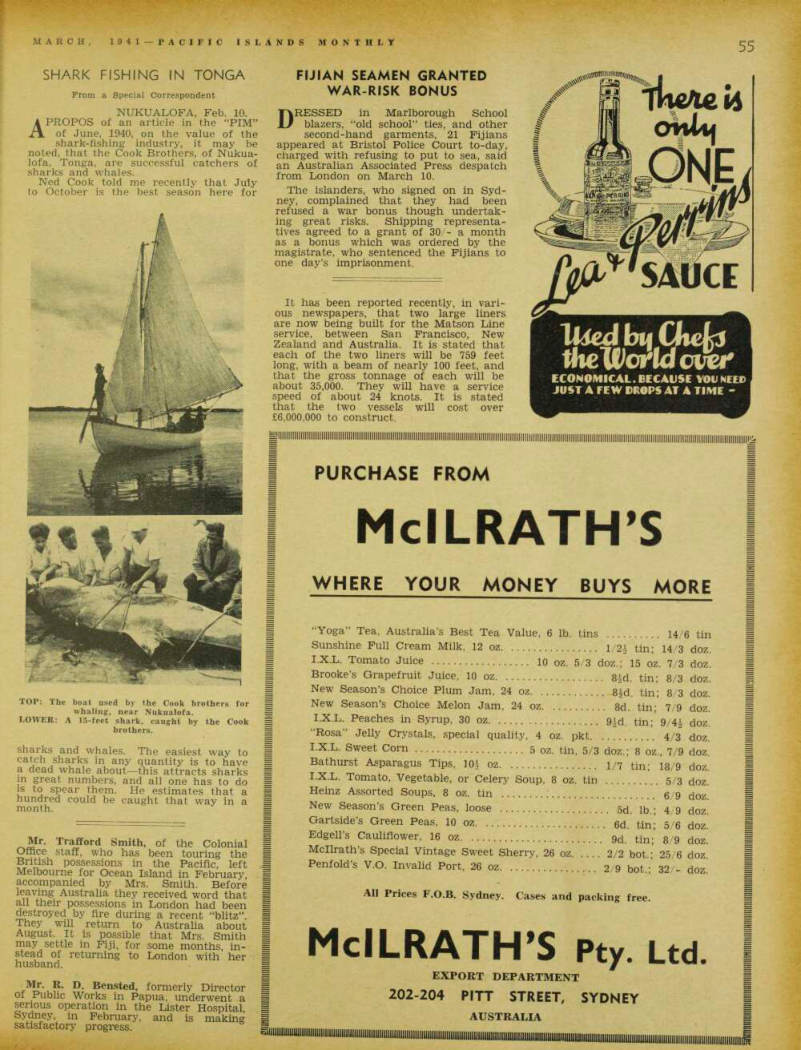
From a Special Correspondent
Nukualofa, Feb. 10.
APROPOS of an article in the “PIM” of June, 1940, on the value of the shark-fishing industry, it may be noted, that the Cook Brothers, of Nukua lofa, Tonga, are successful catchers of sharks and whales.
Ned Cook told me recently that July to October is the best season here for
sharks and whales. The easiest way to catch sharks in any quantity is to have a dead whale about—this attracts sharks m great numbers, and all one has to do is to spear them. He estimates that a hundred could be caught that way in a month.
Mr. Trafford Smith, of the Colonial Office staff, who has been touring the British possessions in the Pacific, left Melbourne for Ocean Island in February, accompanied by Mrs. Smith. Before leaving Australia they received word that all their possessions in London had been destroyed by fire during a recent “blitz”.
They will return to Australia about August. It is possible that Mrs. Smith may settle in Fiji, for some months, in stead of returning to London with her husband.
Mr. R. D. Bensted, formerly Director of Public Works in Papua, underwent a serious operation in the Lister Hospital, Sydney, in February, and is making satisfactory progress.
TOP; The boat used by the Cook brothers for whaling, near Nukualofa.
LOWER: A 15-feet shark, caught by the Cook brothers.
Fijian Seamen Granted
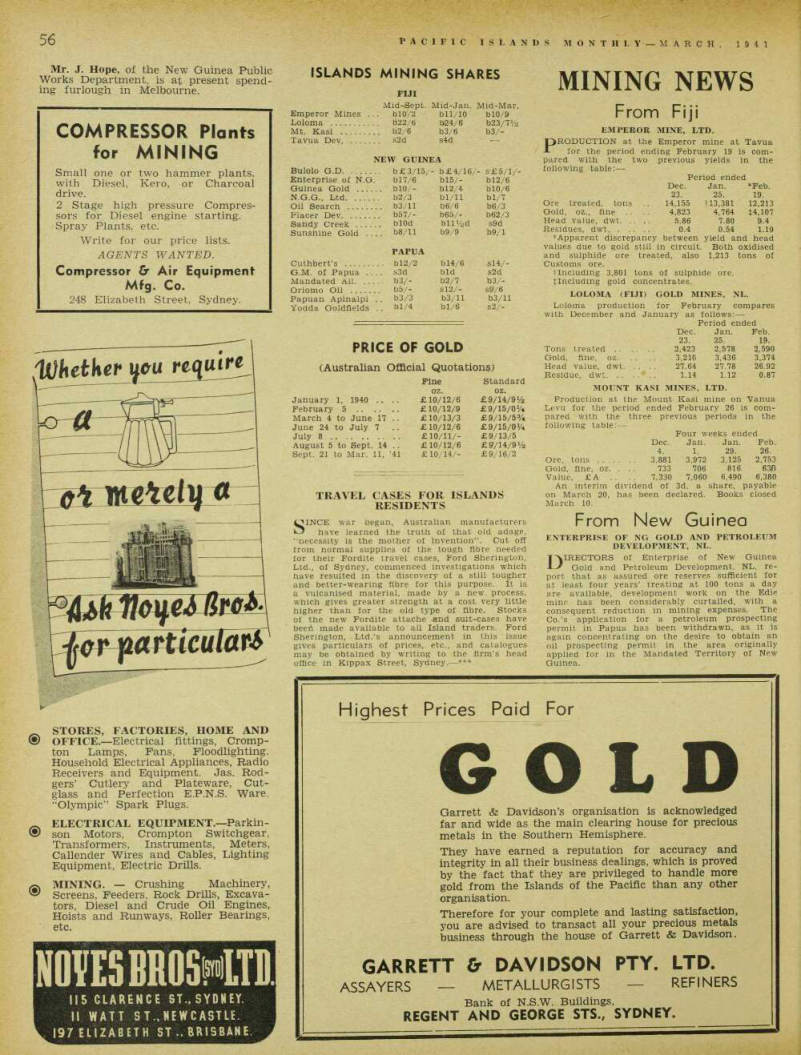
War-Risk Bonus
DRESSED in Marlborough School blazers, “old school” ties, and other second-hand garments, 21 Fijians appeared at Bristol Police Court to-day, charged with refusing to put to sea, said an Australian Associated Press despatch from London on March 10.
The islanders, who signed on in Syd ney, complained that they had been refused a war bonus though undertak ing great risks. Shipping representa tives agreed to a grant of 30/- a month as a bonus which was ordered by the magistrate, who sentenced the Fijians to one day’s imprisonment.
It has been reported recently, in vari ous newspapers, that two large liners are now being built for the Matson Line service, between San Francisco, New Zealand and Australia. It is stated that each of the two liners will be 759 feet long, with a beam of nearly 100 feet, and that the gross tonnage of each will be about 35,000. They will have a service speed of about 24 knots. It is stated that the two vessels will cost over £6,000,000 to construct.
Mr. J. Hope, of the New Guinea Public Works Department, is at present spend ing furlough in Melbourne.
Advertisements & other items, pp. 57-58 (1 item)
Mcilrath’S
H
RUB
SAUCE
\lied bii Chekf
theWcrld ever
ECONOMICAL. BECAUSE YOU NEED
JUST A FEW DROPS AT A TIME -
PURCHASE FROM
McILRATH’S
WHERE YOUR MONEY BUYS MORE
“Yoga” Tea, Australia’s Best Tea Value, 6 lb. tins 14/6 tin Sunshine Full Cream Milk, 12 oz l/2£ tin; 14/3 doz.
I.X.L. Tomato Juice 10 oz. 5/3 doz.; 15 oz. 7/3 doz.
Brooke’s Grapefruit Juice, 10 oz tin; 8/3 doz.
New Season’s Choice Plum Jam, 24 oz Bid. tin; 8/3 doz.
New Season’s Choice Melon Jam, 24 oz Bd. tin; 7/9 doz.
IX L. Peaches in Syrup, 30 oz tin;’9/4* doz.
“Rosa” Jelly Crystals, special quality, 4 oz. pkt 4/3 doz.
I.X.L. Sweet Corn 5 oz. tin, 5/3 doz.; 8 oz., 7/9 doz.
Bathurst Asparagus Tips, 10i oz 1/7 tin; 18/9 doz.
I.X.L. Tomato, Vegetable, or Celery Soup, 8 oz. tin 5/3 doz.
Heinz Assorted Soups, 8 oz. tin 6 9 doz.
New Season’s Green Peas, loose sd. lb.; 4 9 doz.
Gartside’s Green Peas, 10 oz 6d. tin;’ 5/6 doz.
Edgell’s Cauliflower, 16 oz 9d. tin; 8/9 doz.
Mcllrath’s Special Vintage Sweet Sherry, 26 oz 2/2 bot.; 25/6 doz Penfold’s V.O. Invalid Port, 26 oz 2/9 bot.;’ 32/- doz.
All Prices F. 0.8. Sydney. Cases and packing free.
McILRATH’S Pty. Ltd.
EXPORT DEPARTMENT
202-204 PITT STREET, SYDNEY
AUSTRALIA
COMPRESSOR Plants
for MINING
Small one or two hammer plants, with Diesel, Kero, or Charcoal drive. 2 Stage high pressure Compressors for Diesel engine starting.
Spray Plants, etc.
Write for our price lists.
AGENTS WANTED.
Compressor & Air Equipment
Mfg. Co.
248 Elizabeth Street, Sydney.
Methetyeu require
kr-a
nh merely a
i : -
STORES, FACTORIES, HOME AND
® OFFICE. —Electrical fittings, Crompton Lamps, Fans, Floodlighting.
Household Electrical Appliances, Radio Receivers and Equipment. Jas. Rodgers’ Cutlery and Plateware, Cutglass and Perfection E.P.N.S. Ware.
“Olympic” Spark Plugs.
ELECTRICAL EQUIPMENT.—Parkin-
'S) son Motors, Crompton Switchgear, Transformers, Instruments, Meters, Callender Wires and Cables, Lighting Equipment, Electric Drills.
MINING. Crushing Machinery, Screens, Feeders, Rock Drills, Excavators, Diesel and Crude Oil Engines, Hoists and Runways, Roller Bearings, etc.
NOVESBROSmLTD.I
lIS CLARENCE ST., SYDNEY.
II WATT ST..NEWCASTLE.
197 ELIZABETH ST .. BRISBANE,
Islands Mining Shares
Fiji
Mid-Sept.
Mid-Jan.
Mid-Mar.
Emperor Mines . . . blO/2 bll/10 blO/9 Loloma b‘22/6 b24/6 b23/7V 2 Mt. Kasi .. b2/6 b3/6 b3/- Tavua Dev . . s2d s4d — Bulolo G.D
New Guinea
b £ 3/15/- b£ 4/16/ - s£5/l/- Enterprise of N.G bl7/6 bl5/bl2/6 Guinea Gold ... . .. blO/bl2/4 blO/6 N.G.G., Ltd . . b2/3 bl/11 bl/7 Oil Search .. b3/ll b6/6 b6/3 Placer Dev .. b57/b65/b62/3 Sandy Creek . ... . blOd bliy 2 d s9d Sunshine Gold .. b8/ll b9/9 b9/l Cuthbert’s
Papua
bl4/6 sl4/- G.M. of Papua . . . . s3d bid s2d Mandated All. .. .. b3/b2/7 b3/- Oriomo Oil b5/- Sl2/s9/6 Papuan Apinaipi .. b3/3 b3/ll b3/ll VTodda Goldfields bl/4 bl/6 S2/-
Price Of Gold
(Australian Official Quotations) Pine Standard oz. oz.
January 1, 1940 .. .. £10/12/6 £ 9/14/9Vi February 5 £10/12/9 £9/15/0V4 March 4 to June 17 .. £10/13/3 £9/15/5% June 24 to July 7 £ 10/12/6 £9/15/0% July 8 £10/11/- £9/13/5 August 5 to Sept. 14 .. £ 10/12/6 £9/14/9 Vi Sept. 21 to Mar. 11, '41 £10/14/- £9/16/2
Travel Cases For Islands
Residents
SINCE war began, Australian manufacturers have learned the truth of that old adage, “necessity is the mother of invention”. Cut off from normal supplies of the tough fibre needed for their Fordite travel cases, Ford Sherington, Ltd., of Sydney, commenced investigations which have resulted in the discovery of a still tougher and better-wearing fibre for this purpose. It is a vulcanised material, made by a new process, which gives greater strength at a cost very little higher than for the old type of fibre. Stocks of the new Fordite attache and suit-cases have beeh made available to all Island traders. Ford Sherington, Ltd.’s announcement in this issue gives particulars of prices, etc., and catalogues may be obtained by writing to the firm’s head office in Kippax Street, Sydney.— ***
Mining News
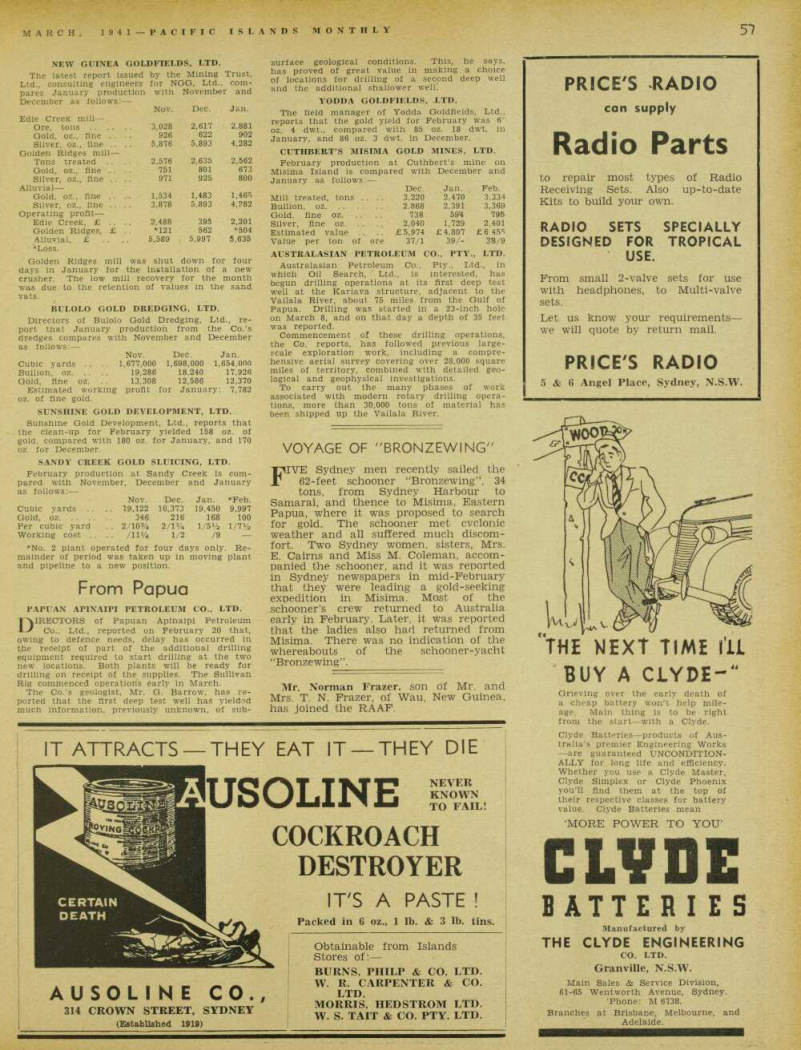
From Fiji
Emperor Mine, Ltd.
PRODUCTION at the Emperor mine at Tavua for the period ending February 19 is com pared with the two previous yields in the following table:—
Loloma (Fiji) Gold Mines, Nl.
Loloma production for February compares with December and January as follows:
Mount Kasi Mines, Ltd.
Production at the Mount Kasi mine on Vanua Levu for the period ended February 26 is com pared with the three previous periods in the following table:—
From New Guinea
Enterprise Of Ng Gold And Petroleum
Development, Nl.
DIRECTORS of Enterprise of New Guinea Gold and Petroleum Development, NL, re port that as assured ore reserves sufficient for at least four years’ treating at 100 tons a day are available, development work on the Edie mine has been considerably curtailed, with a consequent reduction in mining expenses. The Co.’s application for a petroleum prospecting permit in Papua has been withdrawn, as it is again concentrating on the desire to obtain an oil prospecting permit in the area originally applied for in the Mandated Territory of New Guinea.
Period ended Dec. Jan. *Feb. 23 25 19 Ore treated, tons . . 14,155 t!3,381 12,213 Gold, oz., fine . . . . 4,823 4,764 $4,107 Head value, dwt 5.86 7.80 9.4 Residues, dwt 0.4 0.54 1.19 *Apparent discrepancy between yield and head values due to gold still in circuit. Both oxidised and sulphide ore treated, also 1,213 tons of Customs ore. tlncluding 3,801 tons of sulphide ore. gold concentrates.
Period ended Dec. Jan. Feb. 23. 25. 19.
Tons treated 2,423 2,578 2,590 Gold, fine, oz 3,210 3,436 3,374 Head value, dwt 27.64 27.78 26.92 Residue, dwt 1.14 1.12 0.87
Four weeks ended Dec. Jan.
Jan.
Feb. 4. 1. 29. 26.
Ore. tons 3,881 3,972 3.125 2,753 Gold, fine, oz. . .. 733 706 816 63B Value. £ A .. . . 7,330 7,060 6,490 6,380 An Interim dividend of 3d. a share, payable on March 20, has been declared.
March 10.
Books closed
New Guinea Goldfields, Ltd.
The latest report issued by the Mining Trust, Ltd., consulting engineers for NGG, Ltd., com pares January production with November and December as follows:
Golden Ridges mill was shut down for four days in January for the installation of a new crusher. The low mill recovery for the month was due to the retention of values in the sand vats.
Bulolo Gold Dredging, Ltd.
Directors of Bulolo Gold Dredging, Ltd., re port that January production from the Co.’s dredges compares with November and December as follows; —
Sunshine Gold Development, Ltd.
Sunshine Gold Development, Ltd., reports that the clean-up for February yielded 158 oz. of gold, compared with 180 oz. for January, and 170 oz. for December.
Sandy Creek Gold Sluicing, Ltd.
February production at Sandy Creek Is com pared with November, December and January as follows:
From Papua
Papuan Apinaipi Petroleum Co., Ltd.
DIRECTORS of Papuan Apinaipl Petroleum Co., Ltd., reported on February 20 that, owing to defence needs, delay has occurred in the receipt of part of the additional drilling equipment required to start drilling at the two new locations. Both plants will be ready for drilling on receipt of the supplies. The Sullivan Rig commenced operations early in March.
The Co.’s geologist, Mr. G. Barrow, has re ported that the first deep test well has yielded much information, previously unknown, of sub
surface geological conditions. This, he says, has proved of great value in making a choice of locations for drilling of a second deep well and the additional shallower well.
Yodda Goldfields, Ltd.
The field manager of Yodda Goldfields, Ltd., reports that the gold yield for February was 6" oz. 4 dwt., compared with 85 oz. 18 dwt. in January, and 86 oz. 3 dwt. in December.
Cuthbert’S Misima Gold Mines, Ltd.
February production at Cuthbert’s mine on Misima Island is compared with December and January as follows:
Australasian Petroleum Co., Pty., Ltd.
Australasian Petroleum Co., Pty., Ltd., in which Oil Search, Ltd., is interested, has begun drilling operations at its first deep test well at the Kariava structure, adjacent to the Vailala River, about 75 miles from the Gulf of Papua. Drilling was started in a 23-inch hole on March 8, and on that day a depth of 35 feet was reported.
Commencement of these drilling operations, the Co. reports, has followed previous large scale exploration work, including a compre hensive aerial survey covering over 28,000 square miles of territory, combined with detailed geo logical and geophysical investigations.
To carry out the many phases of work associated with modern rotary drilling opera tions, more than 30,000 tons of material has been shipped up the Vailala River.
Nov.
Dec.
Jan.
Edle Creek mill— Ore, tons 3.028 2,617 2,881 Gold, oz., fine . . .. 926 622 902 Silver, oz., fine .. .. 5,876 5,893 4,282 Golden Ridges mill— Tons treated 2,576 2,635 2,562 Gold, oz., fine .. . . 751 801 673 Silver, oz., fine .. 971 925 800 Alluvial— Gold, oz., fine .. 1,534 1,483 1,465 Silver, oz., fine .. 3,878 5,893 4,282 Operating profit— Edie Creek, £ .. 2,488 395 2,201 Golden Ridges, £ . . *121 562 *504 Alluvial, £ .. 5,589 , 5,997 5,635 •Loss.
Nov. Dec. Jan.
Cubic yards . . . . 1,677,000 1,698,000 1,654,000 Bullion, oz 19,286 18,240 17,926 Gold, fine oz. . . 13,308 12,586 12,370 Estimated working profit for January; 7,782 oz. of fine gold.
Nov. Dec. Jan. *Feb.
Cubic yards . . . . 19,122 16,373 19,450 9,997 Gold, oz 346 216 168 100 Per cubic yard . . 2/10 3 A 2/1»A 1/5 Va l/7 l /a Working cost .. .. /IDA 1/2 /9 — •No. 2 plant operated for four days only. Remainder of period was taken up in moving plant and pipeline to a new position.
Dec. Jan. Feb.
Mill treated, tons . . . . 3,220 2,470 3.334 Bullion, oz 2,868 2,391 3,369 Gold, fine OZ 738 59’4 795 Silver, fine oz 2,040 1,729 2,401 Estimated value .. £5,974 £4,807 £6 Value per ton of ore 37/1 39/- 3*8/9
Advertisements & other items, pp. 58-59 (1 item)
Gold
Highest Prices Paid For
Garrett & Davidson’s organisation is acknowledged far and wide as the main clearing house for precious metals in the Southern Hemisphere.
They have earned a reputation for accuracy and integrity in all their business dealings, which is proved by the fact that they are privileged to handle more gold from the Islands of the Pacific than any other organisation.
Therefore for your complete and lasting satisfaction, you are advised to transact all your precious metals business through the house of Garrett & Davidson.
GARRETT & DAVIDSON PTY. LTD.
ASSAYERS METALLURGISTS REFINERS
Bank of N.S.W. Buildings,
REGENT AND GEORGE STS., SYDNEY.
IT ATTRACTS —THEY EAT IT —THEY DIE
VINO
USOLINE
NEVER
KNOWN
TO FAIL!
AUSOLINE CO.
314 CROWN STREET, SYDNEY
(Established 1919)
COCKROACH
DESTROYER
IT'S A PASTE !
Packed in 6 oz., 1 lb. & 3 lb. tins.
Obtainable from Islands Stores of; —
BURNS, PHILP & CO. LTD.
W. R. CARPENTER & CO.
LTD.
MORRIS, HEDSTROM LTD.
W. S. TAIT & CO. PTY. LTD.
Voyage Of "Bronzewing"
FIVE Sydney men recently sailed the 62-feet schooner “Bronzewing”, 34 tons, from Sydney Harbour to Samarai, and thence to Misima, Eastern Papua, where it was proposed to search for gold. The schooner met cyclonic weather and all suffered much discom fort. Two Sydney women, sisters, Mrs.
E. Cairns and Miss M. Coleman, accom panied the schooner, and it was reported in Sydney newspapers in mid-February that they were leading a gold-seeking expedition in Misima. Most of the schooner’s crew returned to Australia early in February. Later, it was reported that the ladies also had returned from Misima. There was no indication of the whereabouts of the schooner-yacht “Bronzewing”.
Mr. Norman Frazer, son of Mr. and Mrs. T. N. Frazer, of Wau, New Guinea, has joined the RAAF.
Advertisements & other items, pp. 59-60 (1 item)
Clyde
PRICE'S RADIO
can supply
Radio Parts
to repair most types of Radio Receiving Sets. Also up-to-date Kits to build your own.
RADIO SETS SPECIALLY
DESIGNED FOR TROPICAL
USE.
From small 2-valve sets for use with headphones, to Multi-valve sets.
Let us know your requirements— we will quote by return mail.
PRICE'S RADIO
5 & 6 Angel Place, Sydney, N.S.W.
r 4 ' v
THE NEXT TIME i'll
BUY A CLYDE-"
Grieving over the early death of a cheap battery won’t help mileage. Main thing is to be right from the start —with a Clyde.
Clyde Batteries—products of Australia’s premier Engineering Works —are guaranteed UNCONDITION- ALLY for long life and efficiency.
Whether you use a Clyde Master, Clyde Simplex or Clyde Phoenix you’ll find them at the top of their respective classes for battery value. Clyde Batteries mean
‘MORE POWER TO YOU’
CLYDE
BATTER IE S
Manufactured by
THE CLYDE ENGINEERING
CO. LTD.
Granville, N.S.W.
Main Sales & Service Division, 61-65 Wentworth Avenue, Sydney. ’Phone: M 6738.
Branches at Brisbane, Melbourne, and Adelaide.
DE GAULLE
FREE FRENCH FLAG
Neat Enamelled Tie or Coat Pins for lady or gent, 2/-, 18/- doz. Write for Wholesale List.
WORLD'S LATEST
GAMES
Dart Boards, with 6 Darts Play Brass Competition Darts, Set of 3, 3/11, 4/6, 5/6. Monopoly, 11/6.
Totopoly, 11/6. Bucaneer, 11/6. 3 of the World’s Most Popular Games.
Chinese Checkers, 2/9, 5/-, 9/-.
Tripoly Card Game , 5/3. De Luxe Type, 10/6. Poker Rummy. 1/1.
Model Brass Roughcasts of Hurricanes, Spitfires, Wirraways, Hudsons, •Curtis, D 36. All 3/- each. Avro Ansons and Douglas DC2, 3/6.
Finished and polished models, 2/extra. Chrome finished, 3/- extra.
HIGHEST GRADE MODEL PLANE
KIT, 15/-, 18/6, and 21/-. Cheaper makes, 2/6, 3/6, 4/6, 5/6, and 6/0.
“PRESTO”
THE
MAGIC
BOX
The most Amazing Trick— Just out. 1 "Presto”.—The greatest, most allur- ing and outstanding little trick [ ever Introduced, 2/9. Post Free.
RADIOS. All
kinds; all waves.
Built to order.
We have hundreds giving excellent service right throughout the South Sea Islands. Quotes for asking.
RADIO ACCUMULATORS.
2 Volt, 110 Amp 19/- *o- / 22/6 S6/S 45/6 78/9 84/6
HEADPHONES.
9/6, 12/6, 17/6.
S.T.C., British, 30/-; 8.T.H., 30/-; Lissen, British, 19/6. All 4,000 ohms. m Ericcson’s Professional Type, 47/6. wi l,|
POLICE PATROL MULTI STRAND
RUBBER COVERED AERIAL.
Needs No Separate Lead-in. 50 ft., 2/6; 100 ft., 5/-.
MAN-O-WAR HEAVY DUTY
INSULATED AERIAL, MULTI
STRAND WIRES.
50 ft.. 5/-; 100 ft. 10/-.
LEARN MORSE CODE. “LIKE-A-
FLASH” KITS, KEYS & BUZZERS
P.M.G. type Key with Professional Buzzer & Battery, all assembled on Base Board, 42/6.
The World’s Latest Match Box 2/6. Bakelite, indestructa b 1 e. One match always ready by tipping of the box. No opening and closing lid.
With De Gaulle Flag attached, or U.S.A., Norway, British, Australian,
A.1.F., R.A.A.F., R.A.N., Dutch,
Flag Medallion attached, 3/6.
Hunting and Sporting Knives. Remington U.S.A. made, 10/6, 12/6, 15/6, 16/6. (All in Sheath.) Throwing Knives, in Sheath, 7/6.
Repeating Toy Re v o 1 v e r s.
Just like the real thing. 4/11, 5/6, 7/6, 8/6.
Write for special Wholesale List of Buzzers, Morse Keys and Sets.
Adjustable Buzzers, 4/9. Others,4/11, 5/6 and 15/-. As illustrated, 15/-.
METERS.—Pocket Volt Meters, 2 Reading for A. & B. Batteries, 8/6. 10/6.
WATES. —4 in 1 Meter: 0 to 6. 0 to 15. 0 to 180 volts: 0 to 30 M/A, 14/-.
TELSEN.—Millimeter A.C., D.C, British. Reads everything in Radio.
Bench Type, 30/-.
Emicol Universal D.C. Meters, Bench type, reads 0 to 6, 0 to 150 volts, 0 to 30 M.A.S., 0 to 2,000 ohms, 30/-.
Nickelled Pocket Meter: 0 to 25 volts, 0 to 5 amperes: 35/- value: now 15/-.
BOOKS! BOOKS! BOOKS! The Be-
ginners’ Book of Radio. The Radio Beginners’ Dictionary. 2/- the 2. The Wireless Constructor’s Eneyclo* paedia. Giant size, 7/6. Newnes ’’Everyman’s” Wireless Book, 5/6.
The Book of Practical Radio, also The Book of Practical Television, 8/6 each. Foulsham’s Giant “Party and Fun Book”, 1/6. Humorous Stories and Recitations, 3/9. Card and Conjuring Tricks, 8/9. Tea- Cup Fortune Telling, 3/9. 100 Party Games for Old and Young, 1/9.
Popular Magic and Amateur Conjurer, 1/9. 50 Best Party Games, 1/6. Tricks with Cards, 1/6.
TYPE
SOUNDER^
Now available (not less than 10/parcels): Magic Wand, 1/6 Jafet’s Wallet, 1/-; Obedient Ball. 1/6; Mystic Head Chopper, 2/6; Shy Lock, 2/-; Dribble Glass. 2/-; Ventrillo. 1/-; Magic Coin, 1/-; Nest of Nests, 5/-; Voice Echoer, 1/-; Magic Bottle, 1/-; 3 Bell Trick, 1/-.
Wonderful Rattle Box Trick, 2/6. Mixed Parcels of Tricks, 10/-, 20/-, 30/-, 40/-, 50/-.
Parcel of Jokes, 10/-, 12/6, 15/-.
Sill/,
Morse Set Buzzer or light with single switch. All parts include adjustable Key, Switch, Buzzer, Lamp and Battery, all assembled on Base Board, 30/-.
M/A Morse Code Set “De Luxe”. Adjustable High-grade Key, Buzzer and Battery. All mounted on base board ready for use. 27/6. \VI// Adjustable Morse Code Key on Bakelite Base, highly plated parts, 12/6. Higher grade instrument.
De Luxe Junior Morse Code Outfit.
Mounted Key Buzzer and Battery. 13/6 complete.
Felt Pennants, A.1.F., 3/6. R.A.N. and all other branches of Defence Forces available, 3/6.
From London. “Cosmocord” De Luxe Crystal Pick-up, with Built-In Vol.
Control, 58/6. Magnetic type Pickups, complete with volume control and tone arm. British Make, 30/-. 35/-, 38/6, 45/-. Studio Model, 50/-.
SWOOP! BRITAIN’S BEST.
“Amplion,” Bakelite PICK-UP, with Volume Control incorporated. Brand new, in original cartons. Listed to sell at 38/6. Now 32/6. Fits and suits all sets.
De Luxe Model British-built Lightning Arresters, complete for indoor or outdoor use, 6/-.
Microphones for Speech, Song or Music. Hook-up in a jiffy to any set. 15/-, 17/6, 18/6 complete.
Hydrometers for Accumulator testing, 2/9’.
Aerial Stay-wire strainers, 2/6.
Non-jam Pulleys with halyard bolt, 1/9. 4 in. nickel Screw Drivers, bakelite or metal, 2/-.
Ormond 3 in. Front-panel Vernier Dial, 2 actions, 8/6.
Batteryless Type Hand - holding Microphones, fit any set, 25/-. 1,500 ft. beam Focussing Torch, 8/6.
Portable battery operated Light with pull switch and Battery Block, 8/6.
Swiss Music Boxes for Cigarette, Trinkets, etc., 25/-, 30/-, 45/-.
RADIO VALVES.—We guarantee a Better Price. Send along your order.
Dice of all kinds in stock. Poker Dice, 6/6, 7/6, 8/6, 10/6, set of 5.
Crown & Anchor Dice, set of 3, 5/6.
Full Set with Cloth and Shaker, 10/6. H. & T., 5 & 6, and Hazard Dice Stocked.
P.M.G. Model Adjustable Morse Code Key. Precision fittings, 19/6.
Rubber Head-’phone Pads, 2/6 pr. \\ \ l / / 39 Si* Morse Code Light and Buzzer Set.
A precision De-luxe outfit that cannot be bettered. Perfect Adjustable Morse Code Key, with professional type Buzzer. Light to Buzzer throw-over Switch, and Battery, all ready mounted.
iiinmnmmnnra Write for Punch Board Leaflets nmnimimiinnii
J.LEVENSON Radio
GAMES, NOVELTIES AND HOBBIES.
226 A PITT STREET, SYDNEY
Manufacturers, Importers, and Exporters.
N.S.W., AUSTRALIA.
iiiniiiiiiiiniiiiiiiiiii
Write for Pin-Game.
Totem and Odds and Evens Leaflets
iiiiiiimiiiinmiinit
Cable address: "Leveradioh”. Goods forwarded V.P.P. or Sight Draft. Satisfaction and Service Guaranteed. We can supply by mail all General Merchandise at a Better Price. Quotations with pleasure. Please add freight and packing. Write for full list of interesting leaflets of Games, Hobbies, Novelties, and Electrical Goods. Write for full list of Radio Meters.
We Can Supply, at a Keen Price, Any Available Article You Require.
Australian Short Wave
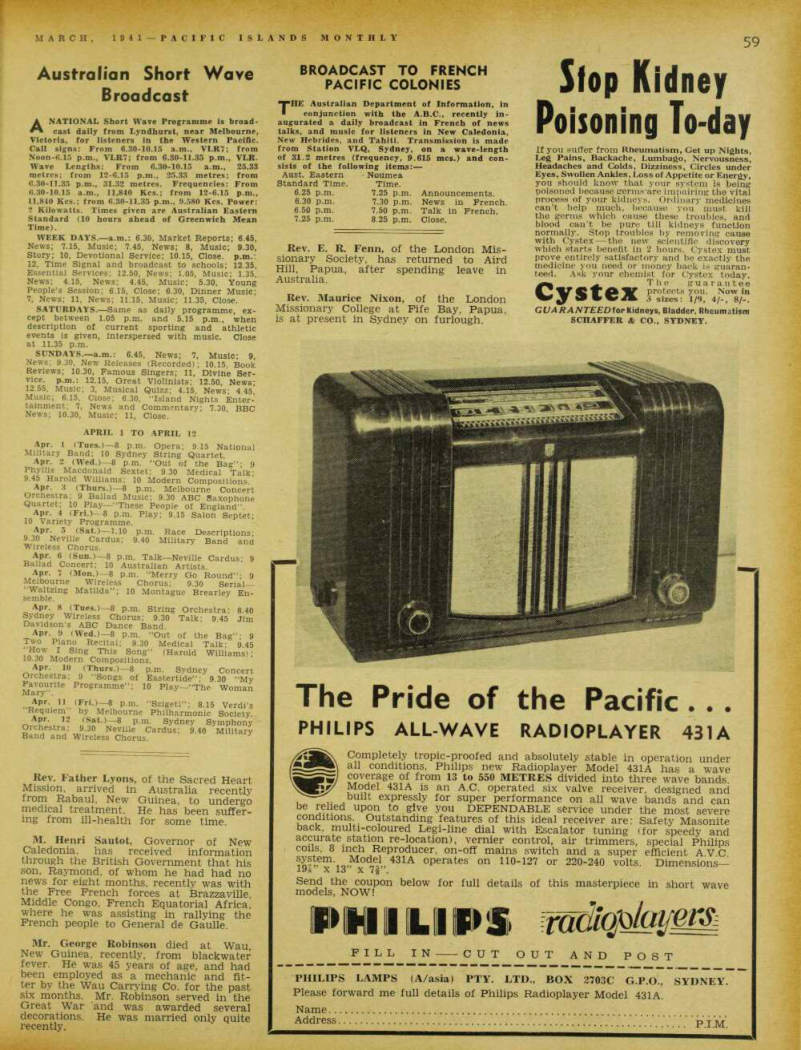
Broadcast
A NATIONAL Short Wave Programme is broad cast daily from Lyndhurst, near Melbourne, Victoria, for listeners in the Western Pacific.
Call signs: From 6.30-10.15 a.m., VLR7; from Noon-6.15 p.m., VLR7; from 6.30-11.35 p.m., VLR.
Wave Lengths: From 6.30-10.15 a.m., 25.33 metres; from 12-6.15 p.m., 25.33 metres; from 6.30-11.35 p.m., 31.32 metres. Frequencies: From 6.30-10.15 a.m., 11,840 Kcs.; from 12-6.15 p.m., 11,840 Kcs.; from 6.30-11.35 p.m., 9.580 Kcs. Power: 2 Kilowatts. Times given are Australian Eastern Standard (10 hours ahead of Greenwich Mean Time).
WEEK DAYS.—a.m,: 6.30, Market Reports; 6.45, News; 7.15, Music; 7.45, News; 8, Music; 9.30, Story; 10, Devotional Service; 10.15, Close, p.m.: 12, Time Signal and broadcast to schools; 12.35, Essential Services; 12.50, News; 1.05, Music; 1.35, News; 4.15, News; 4.45, Music; 5.30, Young People’s Session; 6.15, Close; 6.30, Dinner Music; 7. News; 11, News; 11.15, Music; 11.35, Close.
SATURDAYS.—Same as daily programme, ex cept between 1.05 p.m. and 5.15 p.m., when description of current sporting and athletic events is given, Interspersed with music. Close at 11.35 p.m.
SUNDAYS.—a.m.: 6.45, News; 7, Music; 9, News; 9.30, New Releases (Recorded); 10.15, Book Reviews; 10.30, Famous Singers; 11, Divine Ser vice. p.m.: 12.15, Great Violinists; 12.50, News; 12.55, Music; 3, Musical Quizz; 4.15, News; 4.45, Music; 6.15, OIOS'S; 6.30, “Island Nights Enter tainment; 7, News and Commentary; 7.30 BBC News; 10.30, Music; 11, Close.
April 1 To April 12
Apr. I (Tues.)—B p.m. Opera; 9.15 National Military Band; 10 Sydney String Quartet.
Apr. 2 (Wed.)—B p.m. “Out of the Bag”; 9 Phyllis Macdonald Sextet; 9.30 Medical Talk -9.45 Harold Williams: 10 Modern Compositions.’
Apr. 3 (Thurs.) —8 p.m. Melbourne Concert Orchestra: 9 Ballad Music; 9.30 ABC Saxophone Quartet; 10 Play—“ These People of England”
Apr. 4 (Fri.)—B p.m. Play; 9.15 Salon Septet; 10 Variety Programme. a ™ pr ‘ 5 (Sat.) —1.10 p.m. Race Descriptions; 9.30 Neville Cardus; 9.40 Military Band and Wireless Chorus.
Apr, 6 (Sun.)—B p.m. Talk—Neville Cardus; 9 Ballad Concert; 10 Australian Artists.
Apr. 7 (Mon.)—B p.m. “Merry Go Round”; 9 Melbourne Wireless Chorus; 9.30 Serial Waltzing Matilda”; 10 Montague Brearlev En semble.
Apr. 8 (Tues.)—B p.m. String Orchestra; 8.40 Sydney Wireless Chorus; 9.30 Talk; 9.45 Jim Davidson’s ABC Dance Band.
Apr. 9 (Wed.)—B p.m. “Out of the Bag”- 9 Two Piano Recital; 9.30 Medical Talk; 945 , n H ° w „ l J Sm g Song” (Harold Williams): 10.30 Modern Compositions.
Apr. io (Thurs.)—B p.m. Sydney Concert Orchestra: 9 “Songs of Eastertide”; 9.30 “Mv Favourite Programme”: 10 Play—“ The Woman Mary .
Apr. II (Fri.)—B p.m. “Szigeti”; 8.15 Verdi’s Requiem ’ by Melbourne Philharmonic Society „ Apr - 12 <Sat.)—B pm - s y dne y Symphony Orchestra; 9.30 Neville Cardus; 9.40 Military Band and Wireless Chorus.
Rev. Father Lyons, of the Sacred Heart Mission, arrived in Australia recently
from Rabaul, New Guinea, to undergo
medical treatment. He has been suffer ing from ill-health for some time.
M. Henri Sautot, Governor of New Caledonia, has received information through the British Government that his son, Raymond, of whom he had had no news for eight months, recently was with the Free French forces at Brazzaville, Middle Congo, French Equatorial Africa, where he was assisting in rallying the French people to General de Gaulle.
Mr. George Robinson died at Wau New Guinea, recently, from blackwater fever. He was 45 years of age, and had been employed as a mechanic and fit ter by the Wau Carrying Co. for the past six months. Mr. Robinson served in the Great War and was awarded several decorations. He was married only quite
recently.
Broadcast To French
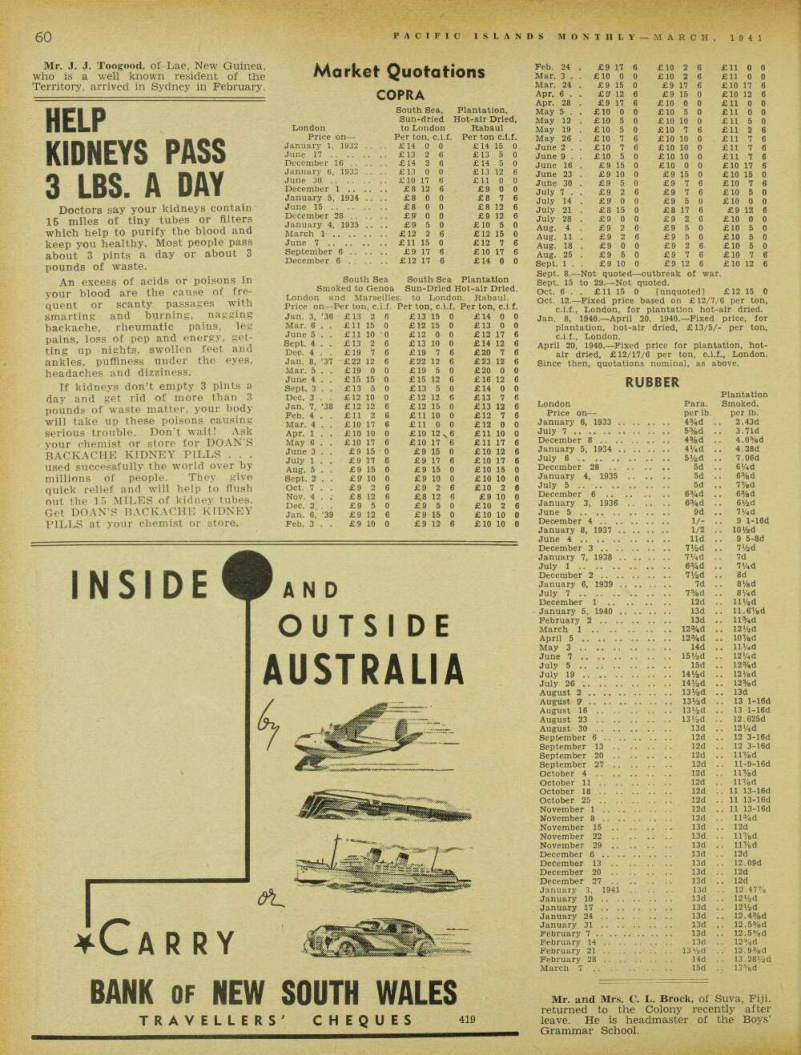
Pacific Colonies
THE Australian Department of Information, in conjunction with the A.8.C., recently in augurated a daily broadcast in French of news talks, and music for listeners in New Caledonia, New Hebrides, and Tahiti. Transmission is made from Station VLQ, Sydney, on a wave-length of 31.2 metres (frequency, 9.615 mcs.) and con sists of the following items:— Aust. Eastern Noumea Standard Time. Time.
Rev. E. R. Fenn, of the London Mis sionary Society, has returned to Aird Hill, Papua, after spending leave in Australia.
Rev. Maurice Nixon, of the London Missionary College at Fife Bay, Papua, is at present in Sydney on furlough.
6.25 p.m. 7.25 p.m.
Announcements. 6.30 p.m. 7.30 p.m.
News in French. 6.50 p.m. 7.50 p.m.
Talk in French. 7.25 p.m. 8.25 p.m.
Close.
Mr. J, J. Toogood, of Lae, New Guinea, who is a well known resident of the Territory, arrived in Sydney in February.
Advertisements & other items, pp. 61-62 (1 item)
Slop Kidney
Poisoning To-day
If you suffer from Rheumatism, Get up Nights, Leg Pains, Backache, Lumbago, Nervousness, Headaches and Colds, Dizziness, Circles under Eyes, Swollen Ankles, Loss of Appetite or Energy, you should know that your system is being poisoned because germs’are impairing the vital process of your kidneys. Ordinary medicines can’t help much, because you must kill the germs which cause these troubles, and blood can’t be pure till kidneys function normally. Stop troubles by removing cause with Cystex the new scientific discovery which starts benefit in 2 hours. Cystex must prove entirely satisfactory and be exactly the medicine you need or money back is guaranteed. Ask your chemist for Cystex today.
The guarantee I MT C V protects you. Now In 3 sizes; 1/9, 4/-, 8/-.
GUARANTEEDfor Kidneys, Bladder, Rheumatism
SCHAFFER & CO.. SYDNEY.
H igw The Pride of the Pacific . ..
PHILIPS ALL-WAVE RADIOPLAYER 431 A
Completely tropic-proofed and absolutely stable in operation under all conditions, Philips new Radioplayer Model 431 A has a wave coverage of from 13 to 550 METRES divided into three wave bands Model 431 A is an A.C. operated six valve receiver, designed and built expressly for super performance on all wave bands and can be relied upon to give you DEPENDABLE service under the most severe conditions. Outstanding features of this ideal receiver are: Safety Masonite back, multi-coloured Legi-line dial with Escalator tuning (for speedy and accurate station re-location), vernier control, air trimmers, special Philips coils, 8 inch Reproducer, on-off mains switch and a super efficient A V C fyfjf 431 A operates on 110-127 or 220-240 volts. Dimensions— -iy* x io x .
Send the coupon below for full details of this masterpiece in short wave models, NOW!
PHILIPS
FILL IN CUT OUT AND POST
PHILIPS LAMPS (A/asia) PTY. LTD., BOX 2703 C G.P.0., SYDNEY.
Please forward me full details of Philips Radioplayer Model 431 A.
Name Address
P.I.M.
HELP
KIDNEYS PASS
3 LBS. A DAY
Doctors say your kidneys contain 15 miles of tiny tubes or filters which help to purify the blood and keep you healthy. Most people pass about 3 pints a day or about 8 pounds of waste.
An excess of acids or poisons in your blood are the cause of frequent or scanty passages with smarting and burning, nagging backache, rheumatic pains, leg pains, loss of pep and energy, getting up nights, swollen feet and ankles, puffiness under the eyes, headaches and dizziness.
If kidneys don’t empty 3 pints a day and get rid of more than 3 pounds of waste matter, your body will take up these poisons causing serious trouble. Don’t wait! Ask your chemist or store for DOAN’S
BACKACHE KIDNEY PILLS . . .
used successfully the world over by millions of people. They give quick relief and will help to flush out the 15 MILES of kidney tubes.
Get DOAN’S BACKACHE KIDNEY
PILLS at your chemist or store.
INSIDE
AND
OUTSIDE
AUSTRALIA
*Ca R RY
BANK OF NEW SOUTH WALES
TRAVELLERS' CHEQUES 419
Market Quotations
Mr. and Mrs. C. L. Brock, of Suva, Fiji, returned to the Colony recently after leave. He is headmaster of the Boys’
Grammar School.
Feb. 24 . £9 17 6 £10 2 6 £11 0 0 Mar. 3 . . £10 0 0 £10 2 6 £11 0 0 Mar. 24 . £9 15 0 £9 17 6 £10 17 6 Apr. 6 . . £9 12 6 £9 15 0 £10 12 6 Apr. 28 . £9 17 6 £10 0 0 £11 0 0 May 5 . . £10 0 0 £10 5 0 £11 0 0 May 12 . £10 5 0 £10 10 0 £11 5 0 May 19 . £10 5 0 £10 7 6 £11 2 6 May 26 . £10 7 6 £ 10 10 0 £11 7 6 June 2 . . £10 7 6 £10 10 0 £11 7 6 June 9 . . £10 5 0 £ 10 10 0 £11 7 6 June 16 . £9 15 0 £10 0 0 £10 17 6 June 23 . £9 10 0 £9 15 0 £10 15 0 June 30 . £9 5 0 £9 7 6 £10 7 6 July 7 . . £9 2 6 £9 7 6 £10 5 0 July 14 . £9 0 0 £9 5 0 £10 0 0 July 21 . £8 15 0 £8 17 6 £9 12 6 July 28 . £9 0 0 £9 2 6 £10 0 0 Aug. 4 . £9 2 6 £9 5 0 £10 5 0 Aug. 11 . £9 2 6 £9 5 0 £10 5 0 Aug. 18 . £9 0 0 £9 2 6 £10 5 0 Aug. 25 . £9 5 0 £9 7 6 £10 7 6 Sept. 1 . . £9 10 0 £9 12 6 £10 12 6 Sept. 8.—Not quoted—outbreak of war.
Sept. 15 to 29.—Not quoted.
Oct. 6 . . £11 15 0 [unquoted] £12 15 0 Oct. 12.—Fixed price based on £12/7/6 per ton, c.i.f., London, for plantation hot-air dried.
Jan. 8, 1940.—April 20, 1940.—Fixed price, for plantation, hot-air c.i.f., London. dried. £13/5/ - per ton, April 20, 1940.—Fixed price for plantation, hotair dried, £12/17/6 per ton, c.i.f., London.
Since then, quotations nominal, as above.
Rubber
Plantation London Para.
Smoked.
Price on— per lb. per lb.
January 6, 1933 .. .. .. 43/ 4 d . 2.43d July 7 . 3.71d December 8 . . .. .. .. 43/ 8 d . 4.0 5 /ad January 5, 1934 .. .. .. 4»Ad . . 4.28d July 6 .. .. sy 2 d . . 7.06d December 28 . . . .. .. 5d . . 6y 4 d January 4, 1935 . .. .. 5d . . 63/ad July 5 .. .. 5d . . 7 7 /ad December 6 .. ,. . . 63/ 4 d . . 63/ 8 d January 3, 1936 . .. . . 63/ 4 d . . 6>/ 2 d June 5 . . .. 9d . . 7*/ 4 d December 4 .. .. .. .. 1/- . 9 l-16d January 8, 1937 .. .. .. 1/2 . . lOMsd June 4 .. .. lid . . 9 5-8d December 3 .. .. . 7y 2 d January 7, 1938 .. .. .. ?y 4 d . . 7d July 1 .. 63/ 4 d . . 7*/ 4 d December 2 .. .. .. .. 7>/ 2 d . . 8d January 6, 1939 .. .. .. 7d . . S'/ad July 7 . 8»/ 4 d December 1 .. .. .. 12d . . Iiy 2 d January 5, 1940 .. .. .. 13d . . 11.6 7 /ad February 2 .. .. ... 13d . . ll 3 / 4 d March 1 .. .. 123/ 4 d . . 12»/ 2 d April 5 . 10 7 /ad May 3 ... 14d . . ny»d June 7 .. .. 15»/ 2 d . . I2y 4 d July 5 .. .. 15d . . 12 3 / 4 d July 19 .. .. 14V 2 d . . 12y 8 d July 26 .. .. 14y 2 d . . 123/ad August 2 . 13d August 9 . 13 l-16d August 16 .. .. .. .. 13y 2 d . . 13 l-16d August 23 .. .. .. .. 13y 2 d . . 12 . 625d August 30 . . .. .. .. 13d . . 12*/ 4 d September 6 . . .. ... 12d . . 12 3-16d September 13 . . ... 12d . . 12 3-16d September 20 . . .. .. 12d . . ll 7 /ad September 27 .. ... 12d . ll-9-16d October 4 .. .. ... 12d . . llYad October 11 .. .. ... 12d . ll 7 /ad October 18 .. . . ... 12d . . 11 13-16d October 25 .. . . ... 12d . . 11 13-16d November 1 .. .. ... 12d . 11 13-16d November 8 . . .. ... 12d . 113/ 4 d November 15 .. . ... 13d . . 12d November 22 .. . .. .. 13d . . ll 7 /ad November 29 .. . ... 13d . . ll 7 /ad December 6 .. .. .. .. 13d . . 12d December 13 .. . ... 13d . . 12.09d December 20 .. . ... 13d . . 12d December 27 .. . .. .. 13d . . 12d January 3, 1941 ... 13d . . 12.47Tb January 10 .. .. ... 13d . . 12y 2 d January 17 .. .. ... 13d . . 12y 2 d January 24 .. .. ... 13d . . 12.43/ad January 31 .. .. ... 13d . . 12.5%d February 7 ... 13d . . 12.5%d February 14 .. . . .. .. 13d . . 12 3 / 4 d February 21 ., .. .. .. 13y 2 d . . 12.93/ad February 28 . . . . ... 14d . . 13 . 28*/ 2 d March 7 ... 15d . 13 %d
London Price January 1, on— 1932
Copra
South Sea. Plantation, Sun-dried Hot-air Dried, to London Rabaul Per ton, c.i.f. Per ton c.i.f. . . . . £14 0 0 £14 15 0 June 17 . £13 2 6 £13 5 0 December 16 . . £14 2 6 £14 5 0 January 6, 1933 £13 0 0 £13 12 6 June 30 . £10 17 6 £11 0 0 December 1 . . £8 12 6 £9 0 0 January 5, 1934 £8 0 0 £8 7 6 June 15 . £8 0 0 £8 12 6 December 28 . . £9 0 0 £9 12 6 January 4 1935 , . . , £9 5 0 £10 5 0 March 1 £12 2 6 £12 15 0 June 7 . £11 15 0 £12 7 6 September 6 .. £9 17 6 £10 17 6 December 6 . £12 17 6 £14 0 0 South Sea South Sea Plantation Smoked to Genoa Sun-Dried Hot-air Dried.
London and Marseilles, to London. Rabaul.
Price on— Per ton, c.i.f.
Per ton . c.i.f.
Per ton . c.i.f.
Jan. 3, ’36 £13 2 6 £13 15 0 £14 0 0 Mar. 6 , . £11 15 0 £12 15 0 £13 0 0 June 5 . . £11 10 0 £12 0 0 £12 17 6 Sept. 4 . . £13 2 6 £13 10 0 £14 12 6 Dec. 4 . . £19 7 6 £19 7 6 £20 7 6 Jan. 8, ’37 £22 12 6 £22 12 6 £23 12 6 Mar. 5 . . £19 0 0 £19 5 0 £20 0 0 June 4 . . £15 15 0 £15 12 6 £16 12 6 Sept. 3 . . £13 5 0 £13 5 0 £14 0 0 Dec. 3 . . £12 10 0 £12 12 6 £13 7 6 Jan. 7, ’38 £12 12 6 £12 15 0 £13 12 6 Feb. 4 . . £11 2 6 £11 10 0 £12 7 6 Mar. 4 . . £10 17 6 £11 0 0 £12 0 0 Apr. 1 . . £10 10 0 £10 12 N 6 £11 10 0 May 6 . . £10 17 6 £10 17 6 £11 17 6 June 3 . . £9 15 0 £9 15 0 £10 12 6
July 1 . .
£9 17 6 £9 17 6 £10 17 6 Aug. 5 . . £9 15 0 £9 15 0 £10 15 0 Sept. 2 . , £9 10 0 £9 10 0 £10 10 0 Oct. 7 . . £9 2 6 £9 2 6 £10 2 6 Nov. 4 . . £8 12 6 £8 12 6 £9 10 0 Dec. 2 . . £9 5 0 £9 5 0 £10 2 6 Jan, 6, ’39 £9 12 6 £9 15 0 £10 10 0 Feb. 3 . . £9 10 0 £9 12 6 £10 10 0
Islands Produce
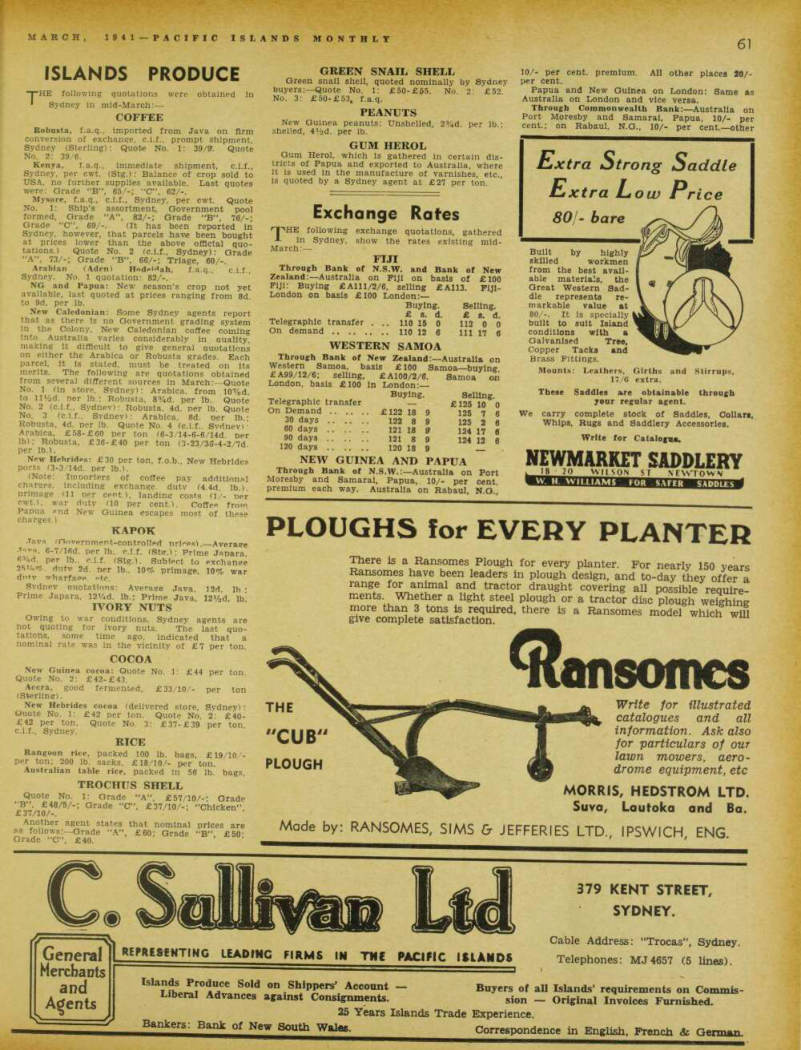
“THE following quotations were obtained in * Sydney in mid-March:—
Coffee
Bobusta, f.a.q., imported from Java on Arm conversion of exchange, c.i.f., prompt shipment, Sydney (Sterling): Quote No. 1: 39/9. Quote No. 2: 39/6.
Kenya, f.a.q., immediate shipment, c.i.f., Sydney, per cwt. (Stg.): Balance of crop sold to USA, no further supplies available. Last quotes were: Grade “B”, 65/-; “C”, 62/-.
Mysore, f.a.q., c.i.f., Sydney, per cwt. Quote No. 1: Ship’s assortment, Government pool formed, Grade “A”, 82/-; Grade “B”, 76/-; Grade “C”, 69/-. (It has been reported in Sydney, however, that parcels have been bought at prices lower than the above official quo tations.) Quote No. 2 (c.i.f., Sydney): Grade “A”, 73/-; Grade “B”, 66/-; Triage, 60/-.
Arabian (Aden) f.a.q., c.i.f., Sydney. No. 1 quotation: 82/-.
NG and Papua: New season’s crop not yet available, last quoted at prices ranging from 8d to 9d. per lb.
New Caledonian: Some Sydney agents report that as there Is no Government grading system in the Colony, New Caledonian coffee coming into Australia varies considerably in quality, making it difficult to give general quotations on either the Arablca or Robusta grades. Each parcel, it is stated, must be treated on its merits. The following are quotations obtained from several different sources in March: —Quote No. 1 (in store, Sydney): Arabica. from 10 7 / B d. to liy 2 d. ner lb.; Robusta, B%d. per lb. Quote No. 2 (c.i.f., Sydney): Robusta. 4d. per lb. Quote No. 3 (c.i.f., Sydney): Arabica, Bd. ner lb.; Robusta, 4d. per lb. Quote No. 4 (c.i.f.. Svdnev) : Arabica, £5B-£6O per ton (6-3/14-6-6/14d. per lb); Robusta, £36-£4O per ton (3-23/3.G-4-2/7d per lb.).
New Hebrides: £3O per ton, f.0.b., New Hebrides ports (3-3/14d. per lb.). (Note: Importers of coffee pay additional charges, including exchange, duty (4.4 d. lb.), primage (11 per cent.), landing costs (1/- per cwt.). war duty (10 per cent.). Coffee from Papua and New Guinea escapes most of these charges.)
Kapok
Java fGovernment-controlled prices).—Average Jev*. 6-7/16d. per lb., c.i.f. (St?.); Prime Japara fi3/ * d - per lb., c.i.f. (Stg.). Subiect to exchange dutv 2d. per lb.. 10% primage. 10% war dntv wharfage ot.c.
Svdnev quotations: Average Java. 12d. lb • Prime Japara, 12V 4 d. Ib.; Prime Java, 12V 2 d lb
Ivory Nuts
Owing to war conditions, Sydney agents are not quoting for ivory nuts. The last quo tations. some time ago, indicated that a nominal rate was in the vicinity of £7 per ton.
Cocoa
New Guinea cocoa; Quote No. 1; £44 per ton Quote No. 2: £42-£43.
Accra, good fermented, £33/10/- per ton (Sterling).
New Hebrides cocoa (delivered store, Sydney); Quote No. 1: £42 per ton. Quote No. 2: £4O - per ton. Quote No. 3: £37-£39 per ton, c.i.f., Sydney.
Rice
Rangoon rice, packed 100 lb. bags, £l9/10/per ton; 200 lb. sacks, £lB/10/- per ton.
Australian table rice, packed in 56 lb. bags,
Trochus Shell
Quote No. 1; Grade “A”, £57/10/-; Grade “B”. £4B/5/-; Grade “C”, £37/10/-; “Chicken” £37/10/-.
Another agent states that nominal prices are as follows:—Grade “A”, £6O; Grade “B” £5O - “C”, £4O.
Green Snail Shell
Green snail shell, quoted nominally by Sydney buyers:—Quote No. 1; £5O-£55. No. 2: £52 No. 3: £5O- £53, f.a.q,
Peanuts
New Guinea peanuts: Unshelled, 2%d. per lb.; shelled, 4y 2 d. per lb.
Gum Herol
Gum Herol, which is gathered in certain dis tricts of Papua and exported to Australia, where it is used in the manufacture of varnishes, etc., is quoted by a Sydney agent at £27 per ton.
Exchange Rates
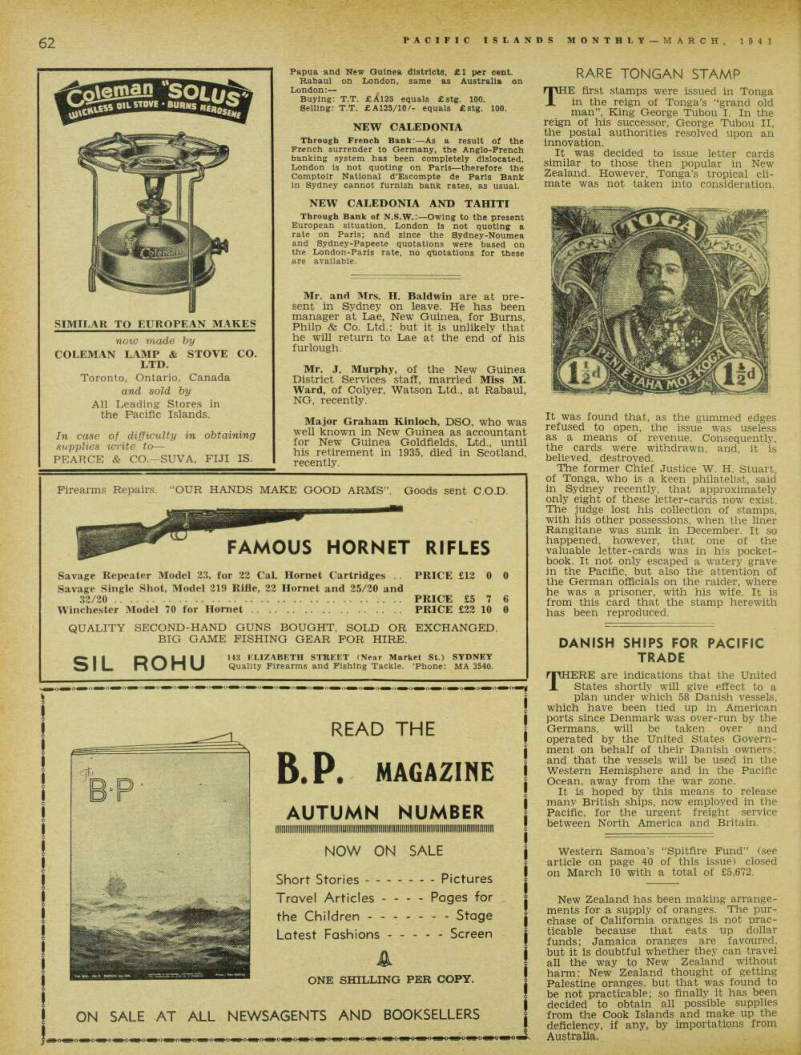
r P HE following exchange quotations, gathered A in Sydney, show the rates existing mid- March:—
Fiji
Through Bank of N.S.W. and Bank of New Zealand:—Australia on Fiji on basis of £lOO Fiji: Buying £ All 1/2/6, selling £AII3. Pill- London on basis £lOO London:—
Western Samoa
Through Bank of New Zealand:—Australia on Western Samoa, basis £lOO Samoa—buying £ A99/12/6; selling, £AIOO/2/6. Samoa on London, basis £lOO In London:—
New Guinea And Papua
Through Bank of N.S.W.:—Australia on Port Moresby and Samaral. Papua, 10/- per cent, premium each way. Australia on Rabaul, N.G.,
10/- per cent, premium. All other places 20/per cent.
Papua and New Guinea on London: Same as Australia on London and vice versa.
Through Commonwealth Bank:—Australia on Port Moresby and Samaral, Papua, 10/- per cent.; on Rabaul, N.G., 10/- per cent.— other
Buying.
Selling. £ s. d. £ 8. d.
Telegraphic transfer . .. 110 15 0 112 0 0 On demand 110 12 6 111 17 6
. , Buying, Selling.
Telegraphic transfer — £125 10 0 On Demand £122 18 9 125 7 6 30 days 122 8 9 125 2 fl 60 days 121 18 9 124 17 6 90 days 121 8 9 124 12 6 120 days 120 18 9
Papua and New Guinea districts, £1 per cent.
Rabaul on London, same as Australia on London:— Buying: T.T. £AI2S equals £stg. 100.
Selling: T.T. EAI2S/10/- equals £stg. 100.
New Caledonia
Through French Bank;—As a result of the French surrender to Germany, the Anglo-French banking system has been completely dislocated.
London is not quoting on Paris—therefore the Comptoir National d’Escompte de Paris Bank in Sydney cannot furnish bank rates, as usual.
New Caledonia And Tahiti
Through Bank of N.S.W.; —Owing to the present European situation, London Is not quoting a rate on Paris; and since the Sydney-Noumea and Sydney-Papeete quotations were based on the London-Parls rate, no quotations for these are available.
Mr. and Mrs. H. Baldwin are at ore sent in Sydney on leave. He has been manager at Lae, New Guinea, for Burns, Philp & Co. Ltd.; but it is unlikely that he will return to Lae at the end of his furlough.
Mr. J. Murphy, of the New Guinea District Services staff, married Miss M.
Ward, of Colyer, Watson Ltd., at Rabaul, NG, recently.
Major Graham Kinloch, DSO, who was well known in New Guinea as accountant for New Guinea Goldfields, Ltd., until his retirement in 1935, died in Scotland, recently.
Advertisements & other items, pp. 63-64 (1 item)
Ploughs For Every Planter
Extra Strong Saddle
Extra Low Price
80/- bare
Built by highly skilled workmen from the best available materials, the Great Western Saddle represents remarkable value at 80/-. It is specially built to suit Island conditions with a Galvanised Tree, Copper Tacks and Brass Fittings.
Mounts: Leathers, Girths and Stirrups, 17/6 extra.
These Saddles are obtainable through year regular agent.
We carry complete stock of Saddles. Collars.
Whips, Rugs and Saddlery Accessories.
Write for Catalogue.
NEWMARKET SADDLERY
18 20 WILSON ST \E VVTOW N
W. H WILLIAMS FOR SAFER SADDLES
PLOUGHS for EVERY PLANTER
There is a Ransomes Plough for every planter. For nearly 150 years Ransomes have been leaders in plough design, and to-day they offer a range for animal and tractor draught covering all possible requirements. Whether a light steel plough or a tractor disc plough weighing more than 3 tons is required, there is a Ransomes model which will give complete satisfaction. wm
THE
CUB
PLOUGH
Write for illustrated catalogues and all information. Ask also for particulars of our lawn mowers „ aerodrome equipment, etc
MORRIS, HEDSTROM LTD.
Suva, Lautoka and Ba.
Made by: RANSOMES, SIMS & JEFFERIES LTD., IPSWICH, ENG.
c.
General
Merchants
and
Agents
REPRESENTING LEADING FIRMS IN TMC PACIFIC ISLANDS
379 KENT STREET,
SYDNEY.
Cable Address: “Trocas”, Sydney.
Telephones: MJ4657 (5 lines).
“LSrST S ° ld on .Shippers' Account Bayers of all Islands’ requirements on Commis- Liberal Advances against Consignments. s ion - Original Invoices Furnished. 25 Years Islands Trade Experience. of New South Wales. Correspondence in English, French <fe German.
SIMILAR TO EUROPEAN MAKES
now made by
COLEMAN LAMP & STOVE CO.
LTD.
Toronto, Ontario, Canada and sold by All Leading Stores in the Pacific Islands.
In case of difficulty in obtaining supplies write to —
PEARCE & CO.—SUVA, FIJI IS.
Firearms Repairs. “OUR HANDS MAKE GOOD ARMS”. Goods sent C.O.D.
FAMOUS HORNET RIFLES
Savage Repeater Model 23, for 22 Cal. Hornet Cartridges .. PRICE £l2 0 0 Savage Single Shot, Model 219 Rifle, 22 Hornet and 25/20 and 32/20 . . PRICE £5 7 6 Winchester Model 70 for Hornet PRICE £22 10 0 QUALITY SECOND-HAND GUNS BOUGHT, SOLD OR EXCHANGED.
BIG GAME FISHING GEAR FOR HIRE.
SIL ROHU
143 ELIZABETH STREET (Near Market St.) SYDNEY Quality Firearms and Pishing Tackle. 'Phone: MA 3540.
B‘ D =>*■• -
READ THE
B.P. MAGAZINE
AUTUMN NUMBER
iiiiiiiiiiiiiiiiiiiiiiiiiiiiiiiiiiiiiiiiiitniiiiiiiiiiiiiiiiiiiiiiiiiiiiiiiiiiiin
NOW ON SALE
Short Stories Pictures Travel Articles Pages for the Children Stage Latest Fashions Screen A
ONE SHILLING PER COPY.
ON SALE AT ALL NEWSAGENTS AND BOOKSELLERS
Rare Tongan Stamp
THE first stamps were issued in Tonga in the reign of Tonga’s “grand old man”, King George Tubou I. In the reign of his successor, George Tubou 11, the postal authorities resolved upon an innovation.
It was decided to issue letter cards similar to those then popular in New Zealand. However, Tonga’s tropical cli mate was not taken into consideration.
It was found that, as the gummed edges refused to open, the issue was useless as a means of revenue. Consequently, the cards were withdrawn, and, it is believed, destroyed.
The former Chief Justice W. H. Stuart, of Tonga, who is a keen philatelist, said in Sydney recently, that approximately only eight of these letter-cards now exist.
The judge lost his collection of stamps, with his other possessions, when the liner Rangitane was sunk in December. It so happened, however, that one of the valuable letter-cards was in his pocket book. It not only escaped a watery grave in the Pacific, but also the attention of the German officials on the raider, where he was a prisoner, with his wife. It is from this card that the stamp herewith has been reproduced.
Danish Ships For Pacific
Trade
rERE are indications that the United States shortly will give effect to a plan under which 58 Danish vessels, which have been tied up in American ports since Denmark was over-run by the Germans, will be taken over and operated by the United States Govern ment on behalf of their Danish owners; and that the vessels will be used in the Western Hemisphere and in the Pacific Ocean, away from the war zone.
It is hoped by this means to release many British ships, now employed in the Pacific, for the urgent freight service between North America and Britain.
Western Samoa’s “Spitfire Fund” (see article on page 40 of this issue) closed on March 10 with a total of £5,672.
New Zealand has been making arrange ments for a supply of oranges. The pur chase of California oranges is not prac ticable because that eats up dollar funds; Jamaica oranges are favoured, but it is doubtful whether they can travel all the way to New Zealand without harm: New Zealand thought of getting Palestine oranges, but that was found to be not practicable; so finally it has been decided to obtain all possible supplies from the Cook Islands and make up the deficiency, if any, by importations from Australia.
New Hotel For Port
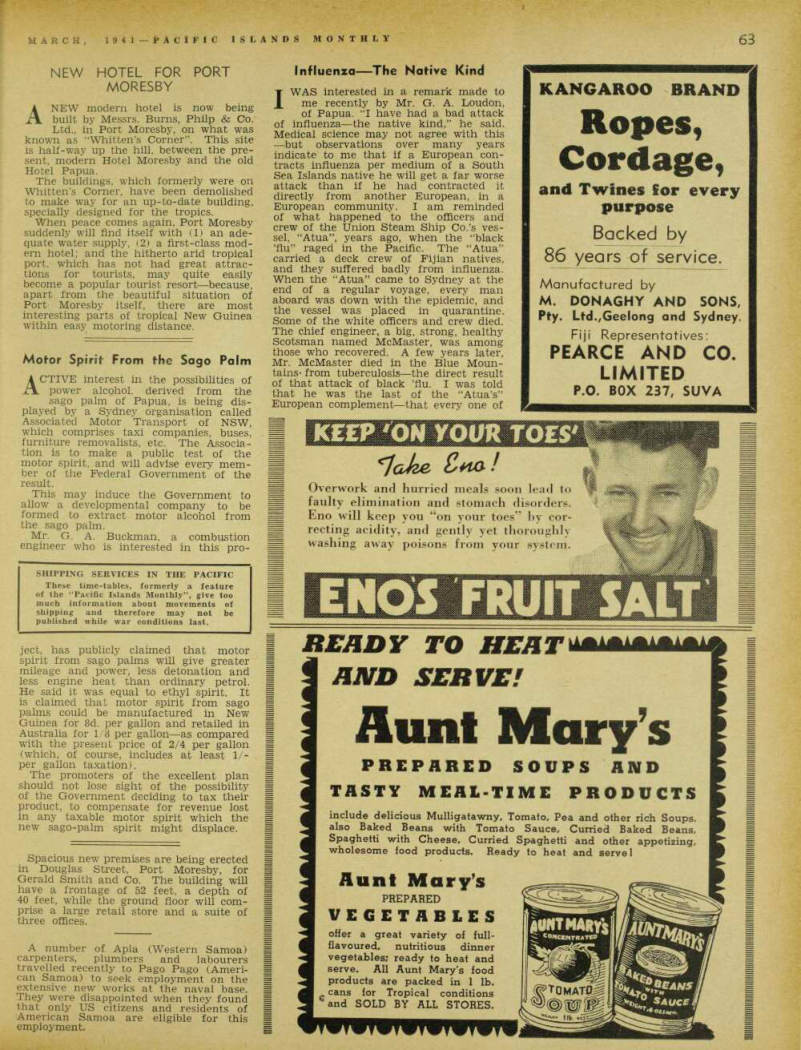
Moresby
ANEW modern hotel is now being built by Messrs. Burns, Philp & Co.
Ltd., in Port Moresby, on what was known as “Whitten’s Corner”. This site is half-way up the hill, between the pre sent, modern Hotel Moresby and the old Hotel Papua.
The buildings, which formerly were on Whitten’s Corner, have been demolished to make way for an up-to-date building, specially designed for the tropics.
When peace comes again, Port Moresby suddenly will find itself with (1) an ade quate water supply, (2) a first-class mod ern hotel; and the hitherto arid tropical port, which has not had great attrac tions for tourists, may quite easily become a popular tourist resort—because, apart from the beautiful situation of Port Moresby itself, there are most interesting parts of tropical New Guinea within easy motoring distance.
Motor Spirit From the Sago Palm
ACTIVE interest in the possibilities of power alcohol, derived from the sago palm of Papua, is being dis played by a Sydney organisation called Associated Motor Transport of NSW, which comprises taxi companies, buses, furniture removalists, etc. The Associa tion is to make a public test of the motor spirit, and will advise every mem ber of the Federal Government of the result.
This may induce the Government to allow a developmental company to be formed to extract motor alcohol from the sago palm.
Mr. G. A. Buckman, a combustion engineer who is interested in this pro
ject, has publicly claimed that motor spirit from sago palms will give greater mileage and power, less detonation and less engine heat than ordinary petrol.
He said it was equal to ethyl spirit. It is claimed that motor spirit from sago palms could be manufactured in New Guinea for Bd. per gallon and retailed in Australia for 1/8 per gallon—as compared with the present price of 2/4 per gallon (which, of course, includes at least 1/per gallon taxation).
The promoters of the excellent plan should not lose sight of the possibility of the Government deciding to tax their product, to compensate for revenue lost in any taxable motor spirit which the new sago-palm spirit might displace.
Spacious new premises are being erected in Douglas Street, Port Moresby, for Gerald Smith and Co. The building will have a frontage of 52 feet, a depth of 40 feet, while the ground floor will com prise a large retail store and a suite of three offices.
A number of Apia (Western Samoa) carpenters, plumbers and labourers travelled recently to Pago Pago (Ameri can Samoa) to seek employment on the extensive new works at the naval base.
They were disappointed when they found that only US citizens and residents of American Samoa are eligible for this employment.
Advertisements & other items, p. 65 (1 item)
Shipping Services In The Pacific
These time-tables, formerly a feature of the “Pacific Islands Monthly”, give too much information about movements of shipping and therefore may not be published while war conditions last.
Influenza—The Native Kind
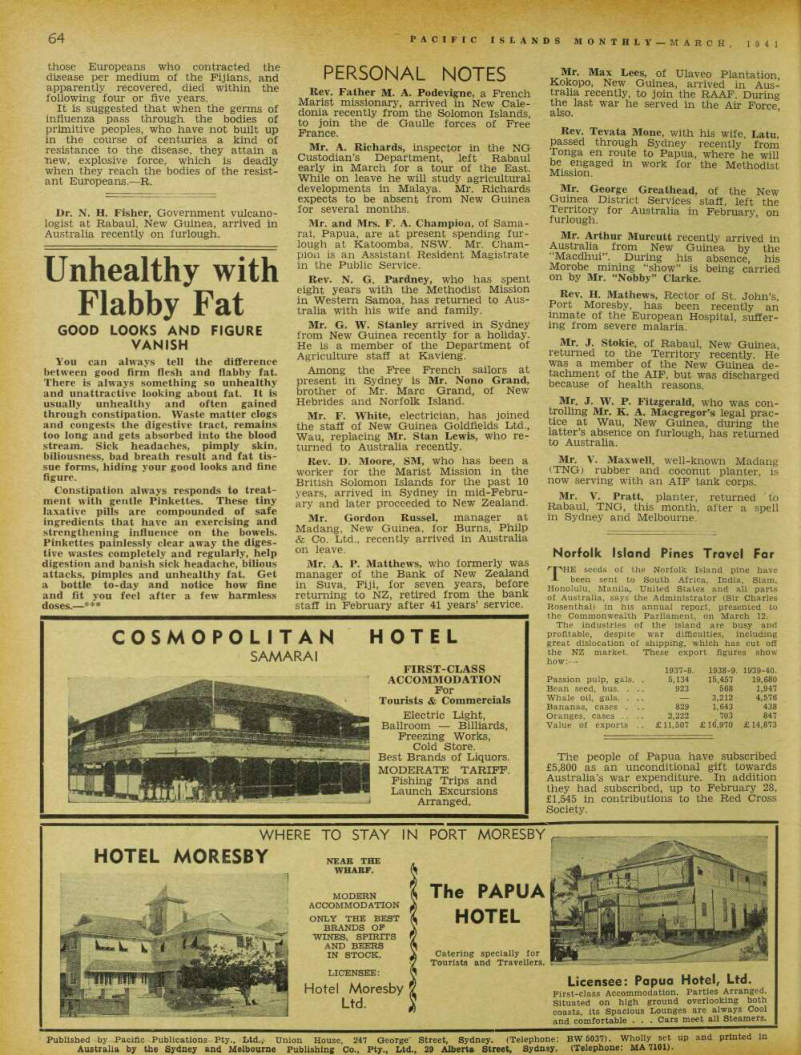
I WAS interested in a remark made to me recently by Mr. G. A. Loudon, of Papua. “I have had a bad attack of influenza—the native kind,” he said.
Medical science may not agree with this —but observations over many years indicate to me that if a European con tracts influenza per medium of a South Sea Islands native he will get a far worse attack than if he had contracted it directly from another European, in a European community. I am reminded of what happened to the officers and crew of the Union Steam Ship Co.’s ves sel, “Atua”, years ago, when the “black ’flu” raged in the Pacific. The “Atua” carried a deck crew of Fijian natives, and they suffered badly from influenza.
When the “Atua” came to Sydney at the end of a regular voyage, every man aboard was down with the epidemic, and the vessel was placed in quarantine.
Some of the white officers and crew died.
The chief engineer, a big, strong, healthy Scotsman named McMaster, was among those who recovered. A few years later, Mr. McMaster died in the Blue Moun tains' from tuberculosis—the direct result of that attack of black ’flu. I was told that he was the last of the “Atua’s”
European complement—that every one of
those Europeans who contracted the disease per medium of the Fijians, and apparently recovered, died within the following four or five years.
It is suggested that when the germs of influenza pass through the bodies of primitive peoples, who have not built up in the course of centuries a kind of resistance to the disease, they attain a new, explosive force, which is deadly when they reach the bodies of the resist
ant Europeans.-
R.
Dr. N. H. Fisher, Government vulcano logist at Rabaul, New Guinea, arrived in Australia recently on furlough.
Advertisements & other items, pp. 65-66 (2 items)
63
MARCH, 19 41—t*A C 1 F I C ISLANDS MONTHLY
Aunt Mary’s
KANGAROO BRAND
Ropes,
Cordage,
and Twines for every purpose
Backed by
86 years of service.
Manufactured by
M. DONAGHY AND SONS,
Pty. Ltd./Geelong and Sydney.
Fiji Representatives:
PEARCE AND CO.
LIMITED
P.O. BOX 237, SUVA
*7 (Me.
Overwork and hurried meals soon lead to faulty elimination and stomach disorders.
Eno will keep you “on your toes” by correcting acidity, and gently yet thoroughly washing away poisons from your system.
READY TO HEAT
AND SERVE!
Aunt Mary’s
PREPARED SOUPS AND
TASTY MEAL-TIME PRODUCTS
include delicious Mulligatawny, Tomato, Pea and other rich Soups, also Baked Beans with Tomato Sauce, Curried Baked Beans, Spaghetti with Cheese, Curried Spaghetti and other appetizing, wholesome food products. Ready to heat and serve 1
Aunt Mary’s
PREPARED
VEGETABLES
offer a great variety of fullflavoured, nutritious dinner vegetables; ready to heat and serve. All Aunt Mary's food products are packed in 1 lb. cans for Tropical conditions
v and SOLD BY ALL STORES.
tomato^
Unhealthy with
Flabby Fat
GOOD LOOKS AND FIGURE
VANISH
You can always tell the difference between good firm flesh and flabby fat.
There is always something so unhealthy and unattractive looking about fat. It is usually unhealthy and often gained through constipation. Waste matter clogs and congests the digestive tract, remains too long and gets absorbed into the blood stream. Sick headaches, pimply skin, biliousness, bad breath result and fat tissue forms, hiding your good looks and fine figure.
Constipation always responds to treatment with gentle Pinkettes. These tiny laxative pills are compounded of safe ingredients that have an exercising and strengthening influence on the bowels.
Pinkettes painlessly clear away the digestive wastes completely and regularly, help digestion and banish sick headache, bilious attacks, pimples and unhealthy fat. Get a bottle to-day and notice how fine and fit you feel after a few harmless doses.— ***
COSMOPOLITAN
SAMARA I
HOTEL
FIRST-CLASS
ACCOMMODATION
For Tourists & Commercials Electric Light, Ballroom Billiards, Freezing Works, Cold Store.
Best Brands of Liquors,
MODERATE TARIFF.
Fishing Trips and Launch Excursions Arranged.
WHERE TO STAY IN PORT MORESBY
HOTEL MORESBY
NEAR THE
WHARF.
MODERN
ACCOMMODATION
ONLY THE BEST
BRANDS OP
WINES, SPIRITS
AND BEERS
IN STOCK.
LICENSEE:
Hotel Moresby
Ltd.
The PAPUA
HOTEL
Catering specially for Tourists and Travellers.
Licensee: Papua Hotel, Ltd.
First-class Accommodation. Parties Arranged.
Situated on high ground overlooking both coasts, its Spacious Lounges are always Cool
Personal Notes
Rev. Father M. A. Podevigne, a French Marist missionary, arrived in New Cale donia recently from the Solomon Islands, to join the de Gaulle forces of Free France.
Mr. A. Richards, inspector in the NG Custodian’s Department, left Rabaul early in March for a tour of the East.
While on leave he will study agricultural developments in Malaya. Mr. Richards expects to be absent from New Guinea for several months.
Mr. and Mrs. F, A. Champion, of Sama rai, Papua, are at present spending fur lough at Katoomba, NSW. Mr. Cham pion is an Assistant Resident Magistrate in the Public Service.
Rev. N. G, Pardney, who has spent eight years with the Methodist Mission in Western Samoa, has returned to Aus tralia with his wife and family.
Mr. G. W. Stanley arrived in Sydney from New Guinea recently for a holiday.
He is a member of the Department of Agriculture staff at Kavieng.
Among the Free French sailors at present in Sydney is Mr. Nono Grand, brother of Mr. Marc Grand, of New Hebrides and Norfolk Island.
Mr. F. White, electrician, has joined the staff of New Guinea Goldfields Ltd., Wau, replacing Mr. Stan Lewis, who re turned to Australia recently.
Rev. D. Moore, SM, who has been a worker for the Marist Mission in the British Solomon Islands for the past 10 years, arrived in Sydney in mid-Febru ary and later proceeded to New Zealand.
Mr. Gordon Russel, manager at Madang, New Guinea, for Burns, Philp & Co. Ltd., recently arrived in Australia on leave.
Mr. A. P. Matthews, who formerly was manager of the Bank of New Zealand in Suva, Fiji, for seven years, before returning to NZ, retired from the bank staff in February after 41 years’ service.
Mr. Max Lees, of Ulaveo Plantation, Kokopo, New Guinea, arrived in Aus tralia recently, to join the RAAF. During the last war he served in the Air Force also.
Rev. Tevata Mone, with his wife, Latu, passed through Sydney recently from Tonga en route to Papua, where he will be engaged in work for the Methodist Mission.
Mr. George Greathead, of the New Guinea District Services staff, left the Territory for Australia in February, on furlough.
Mr. Arthur Murcutt recently arrived in Australia from New Guinea by the “Macdhui”. During his absence, his Morobe mining “show” is being carried on by Mr. “Nobby” Clarke.
Rev. H. Mathews, Rector of St. John’s, Port Moresby, has been recently an inmate of the European Hospital, suffer ing from severe malaria.
Mr. J. Stokie, of Rabaul, New Guinea, returned to the Territory recently. He was a member of the New Guinea de tachment of the AIF, but was discharged because of health reasons.
Mr. J. W. P. Fitzgerald, who was con trolling Mr. K. A. Macgregor’s legal prac tice at Wau, New Guinea, during the latter's absence on furlough, has returned to Australia.
Mr. V. Maxwell, well-known Madang (TNG) rubber and coconut planter, is now serving with an AIF tank corps.
Mr. V. Pratt, planter, returned to Rabaul, TNG, this month, after a spell in Sydney and Melbourne.
Norfolk Island Pines Travel Far
THE seeds of the Norfolk Island pine have been sent to South Africa, India, Siam, Honolulu, Manila, United States and all parts of Australia, says the Administrator (Sir Charles Rosenthal) in his annual report, presented to the Commonwealth Parliament, on March 12.
The industries of the island are busy and profitable, despite war difficulties, including great dislocation of shipping, which has cut off the NZ market. These export figures show how:—
The people of Papua have subscribed £5,800 as an unconditional gift towards Australia’s war expenditure. In addition they had subscribed, up to February 28, £1,545 in contributions to the Red Cross Society.
1937-8. 1938-9. 19*39-40.
Passion pulp, gals. . 5,134 15,457 19,680 Bean seed, bus. . .. 923 568 1,947 Whale oil, gals. ... — 3,212 4,576 Bananas, cases . .. 829 1,643 438 Oranges, cases . . .. 2,222 703 847 Value of exports .. £11,507 £16,970 £14,873
Advertisements & other items, pp. 66-68 (2 items)
64
PACIFIC ISLANDS MONTHLY MARCH, 1941
Published by Pacific Publications- Pty., Ltd.,- Union House, 247 George' Street, Sydney. (Telephone: BW 5037). Wholly set up and printed in Australia by the Sydney and Melbourne Publishing Co., Pty., Ltd., 29 Alberta Street, Sydney. (Telephone: MA7101).
Hichway
/ / h j \ \i To-day multi-engined 'planes fly high above impenetrable jungle and precipitous mountains, harsh barriers that make a 35 mile overland journey (like Salamaua to the Gold-fields) stretch into 10 days of hard, dangerous trekking . . . but 'way up in the sky travelling time is reduced from days to minutes of safety and comfort.
Guinea Airways' 'planes have safely carried over 65,000 tons of freight and thousands of passengers from the coast to the Gold-fields, and maintain regular services throughout New Guinea and Papua. Guinea Airways' reliable 'planes and skilled personnel have made the
SKYWAY A HIGHWAY WITHOUT HAZARD travel
always and send all your freight by Guinea Airways to save time and money.
Guinea Airways Service provides special passenger and freight land and sea ’planes for private charter to any point in New Guinea and Papua. Obtain full particulars from the nearest Guinea Airways representative.
New Guinea Office: LAE, Mandated Territory of New Guinea. SAFerrnttyr Branch Office and Agents at Wau, Salamaua, Pt. Moresby and Sydney.
m
FIRST CHOICE... with those
who prefer a bitter beer
If you like a bitter beer—you'll enjoy the rich wholesome flavor of Resch's Waverley Bitter Ale. Best appreciated after a hot, trying day—Waverley Bitter Ale is a real health drink for the tropics. For a refreshing change, make YOUR next order - - - -
WAVERLEY BITTER ALE
IN THE BOTTLE WITH THE GREEN LABEL