Pacific
Islands
Monthly
Vol. Xl No. 7.
February 14, 1941
Established 1930
[Registered at the transmission by post as a newspaper ]
8"
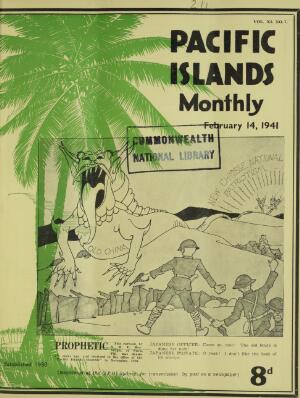
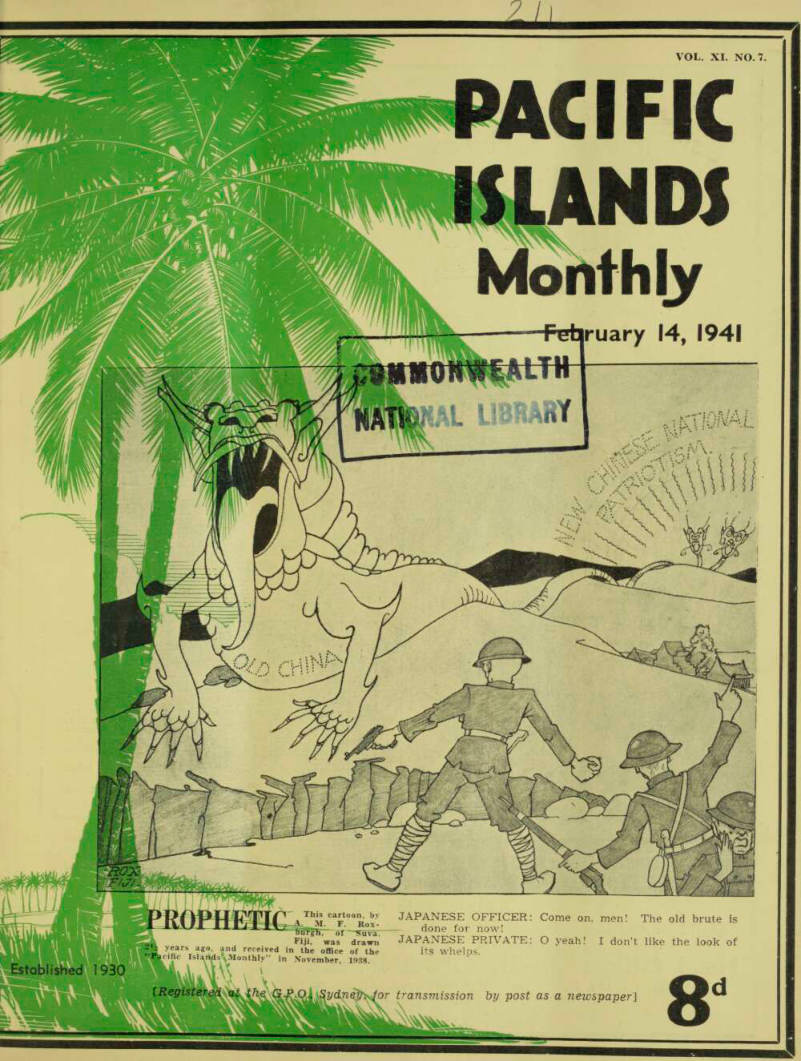
PHOPHETIC This cartoon, by JAPANESE OFFICER: Come on, men! The old brute is A. M. F. Rox- done for now!
Fiji, was drawn JAPANESE PRIVATE: O yeah! I don’t like the look of 2 ½ years ago, and received in the office of the "Pacific Islands Monthly" in November, 1938.recced in the office of the its whelps.
Advertisements & other items, p. 2 (1 item)
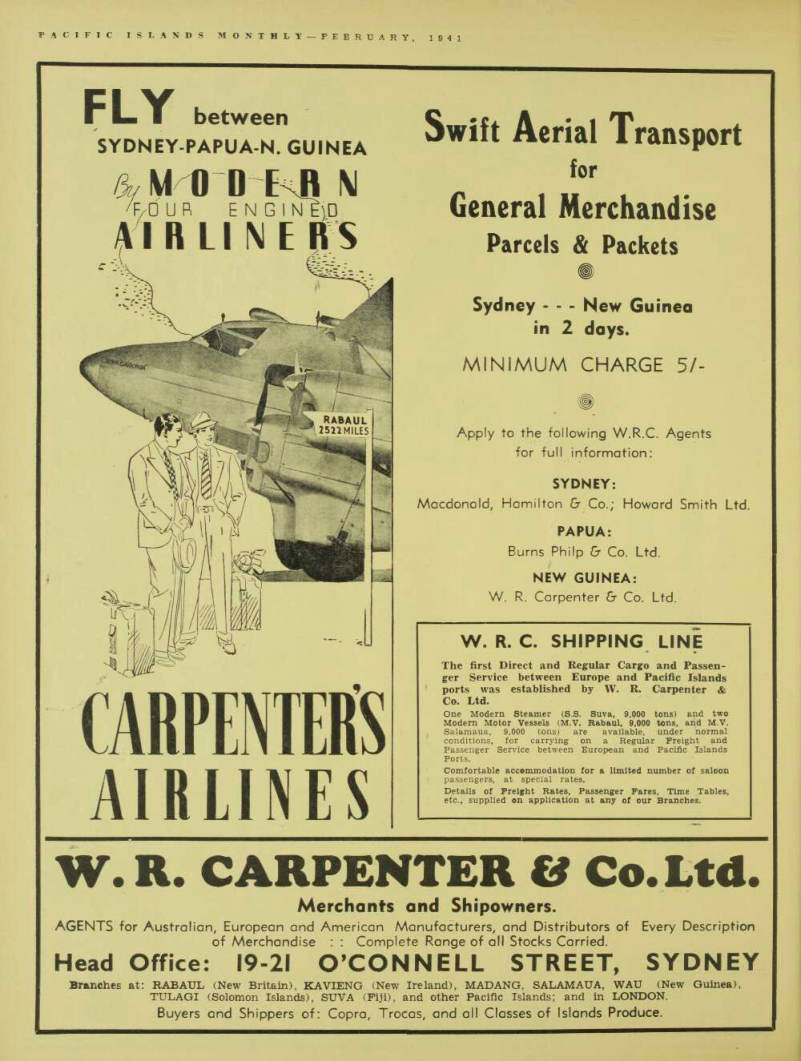
Carpenters
FLY between
SYDNEY-PAPUA-N. GUINEA
M 0 II E R M
F/D UR EN G I NEyD
AIRLINE RS
RABAUL
2521 MILES
r 4
CARPENTERS
AIRLINES
Swift Aerial Transport
for
General Merchandise
Parcels & Packets
Sydney - - - New Guinea in 2 days.
MINIMUM CHARGE 51-
Apply to the following W.R.C. Agents for full information:
SYDNEY:
Macdonald, Hamilton Gr Co.; Howard Smith Ltd.
PAPUA:
Burns Philp & Co. Ltd. /
NEW GUINEA:
W. R. Carpenter £r Co. Ltd.
W. R. C. SHIPPING LINE
The first Direct and Regular Cargo and Passenger Service between Europe and Pacific Islands ports was established by W. R. Carpenter & Co. Ltd.
One Modern Steamer (S.S. Suva, 9,000 tons) and two Modem Motor Vessels (M.V. Rabaul, 9,000 tons, and M.V.
Salamaua, 9,000 tons) are available, under normal conditions, for carrying on a Regular Freight and Passenger Service between European and Pacific Islands Ports.
Comfortable accommodation for a limited number of saloon passengers, at special rates.
Details of Freight Rates, Passenger Pares, Time Tables, etc., supplied on application at any of our Branches.
W.R. CARPENTER & Co. Ltd.
Merchants and Shipowners.
AGENTS for Australian, European and American Manufacturers, and Distributors of Every Description of Merchandise Complete Range of all Stocks Carried.
Head Office: 19-21 O’CONNELL STREET, SYDNEY
Branches at; RABAUL (New Britain), KAVIENG (New Ireland), MADANG, SALAMAUA, WAU (New Guinea), TULAGI (Solomon Islands), SUVA (Fiji), and other Pacific Islands; and in LONDON.
Buyers and Shippers of: Copra, Trocas, and all Classes of Islands Produce.
Pacific News-Review
Notes And Comment On
The Progress Of The War
From Jan. 14 To Feb. 13
Jan. 14: The British forces in the Western Desert are now hammering at Tobruk and the surrender of this im portant port is expected shortly.
Jan. 14: Despite unfavourable condi tions created by deep snow, and the most bitter winter on record, the Greek forces in Albania continue the offensive against the Italians, and are scoring many minor successes.
Jan. 16: The German Air Force, opera ting Stuka dive-bombers from its new bases in Sicily, made its first attack upon British warships in the Mediterranean on January 10. The modern aircraft carrier “Illustrious” 23,000 tons, was hit and severely damaged. Over 20 seaplanes were destroyed and about 80 men killed.
The “Illustrious” sought shelter in Malta, where she was again attacked by Stukas.
The Germans were beaten off, however, and the “Illustrious” then went to Alex andria under her own power, and now is undergoing repairs. The British cruiser “Southampton”, 9,000 tons, was set on fire, and sunk; and two British des troyers are damaged.
Jan. 16; It is reported that a large proportion of the Stuka dive-bombers have been destroyed by the British. De tails are awaited. A British warship sank an Italian destroyer in the Sicilian Channel.
The appearance of German dive bombers in the Mediterranean, and their challenge to the British Fleet, is the most disturbing development of recent months. It remains to be seen whether the Navy can deal with this challenge.
For several weeks, the British Navy has had the Mediterranean practically to it self—the Italian Navy has refused to come out of its ports. The Germans have sent their dive-bombers in an effort to restore the balance.
Jan. 16: RAF bombers yesterday de livered their heaviest blow upon the German naval base at Wilhelmshaven.
Jan. 16; Italian troops on the central front in Albania, have ceased retreating and are now resisting the Greek advance.
Jan. 16: There are many indications that the occupation of Bulgaria by Ger man troops is imminent.
The Italian empire and Italian forces are crumbling. Unless Italy gets active support from Germany, she cannot last much longer. This is apparent to the Germans, and consequently we may ex pect they will do something to stiffen Italian resistance. Their first and most obvious step is to send some of their spare armies—and they have many ar mies to spare—down through the Balkans to attack the Greeks in the rear and thus save the Italian armies in Albania from destruction. The Germans will only take this course if they are assured that Turkey will not resist their march from Bulgaria into Greece. There is nothing to show what Turkey intends to do —and the feeling is growing that Turkey, in all circumstances short of invasion, will remain neutral.
Jan, 16: There are indications that, under the personal direction of the for mer Emperor of Abyssinia, the natives are being rallied and organised as a patriot army to eject the Italians.
Jan, 17: American attention for the present is concentrated upon the con sideration by Congress of President Roosevelt’s bill to lend or lease arma ments to Britain. Indications are that the bill will be carried in each Chamber by a large majority.
Jan. 17: The RAF raid upon Wilhelm shaven on Wednesday night left the naval base a sea of flames —and the des
truction was added to by another but smaller raid on Thursday morning, and another on Thursday night.
German raids upon British towns have been for some time upon a lesser scale, and less intense in character.
Jan. 17; German dive-bombers from Sicily made their second appearance in the Mediterranean and carried out a number of heavy raids on Malta.
Jan. 19: Since June, 1940, Britain’s average of weekly shipping losses has risen from 41,000 tons to 90,000 tons.
Britain is counteracting this by building, buying, and chartering new ships and by switching as many as possible from long to short voyages.
Jan. 20: At first, German dive-bombers in the Mediterranean were regarded as a serious challenge to the Royal Navy.
In three days, they did as much civilian damage in Malta as the Italians did in eight months. But, since Germany com menced these attacks with dive-bombers, she has lost at least 87 Stukas out of a force estimated at 150 and this has con siderably altered the outlook. Germany apparently lost 35 dive-bombers in raids on Malta in five days.
Jan. 20: A new British army has re captured Kassala, Sudan, and is now in vading the Italian territory of Eritrea.
The Italians are rapidly retreating from the Sudan front.
Jan. 20: The Istambul correspondent of the “Daily Mail” says that if German troops march through Bulgaria to attack Greece, Turkish troops will march at the same time to bar their way —acting as Bulgaria's ally but, if need be, as Bul garia’s enemy.
This may be the position, but all the indications are that it represents “wishful thinking”. Turkey has become almost as inscrutable as Russia, and it is hard to guess her intentions; but all the indica tions are that she will remain neutral unless her own territory is invaded.
Jan. 20: Nazis are now putting strong pressure on Marshal Petain to form, for collaboration with Germany, a new French Government in which M. Laval will be included.
Jan. 21: British and Australian forces have begun their assault upon Tobruk (Libya). Operations are proceeding sat isfactorily.
Jan. 21: Heavy raids have been made by the RAF on the new German Stuka bases in Sicily.
Jan. 21: Dissatisfied members of the Iron Guard in Roumania have revolted against General Antonescu, who is now virtually the dictator of Roumania, under German control. The revolt is directed against Antonescu and the German regime. Clashes are occurring through out the country.
Jan. 21: France has officially an nounced her insistence on the full ob servance of the armistice with Germany —which means that she will not sur render her fleet, or allow Germany to use French naval bases in Africa.
Jan. 22: Despite bitter weather, the Greeks are maintaining their initiative in the central sector of the Albanian front.
Jan. 22: A British force has now pene trated 40 miles into Eritrea and is pur suing the retreating Italians.
Jan. 23: The Iron Guards have cap tured Bucharest radio, in Roumania, and broadcast an appeal to the Army, “Do not fire upon your brothers”. Antonescu has appealed to the Germans for assis tance.
Jan. 22: British residents of Japan have been advised to leave the country
“before the impending crisis between Japan and USA comes to a head”.
Jan. 23; Tobruk, the Italian stronghold in Libya, surrendered about 30 hours af ter the first assault was launched, and was occupied by British and Australians on January 22. All observers agree in according great praise to the gallantry, courage and steady discipline of the at tackers.
Jan. 24: British and Australian forces are pushing on rapidly from Tobruk to the westward, in pursuit of the retreat ing Italians. They are already at Derna, about 90 miles west of Tobruk.
Jan. 24: The British advance in East Africa continues on all fronts. The British have now deeply invaded Eritrea, and other British forces are reported to be invading Abyssinia from west and the south. The Abyssinian emperor, Haili Selassie, has gone into Abyssinia and is assisting the British military mission in organising and arming native patriots.
Jan. 24: It is authoritatively reported that the German Embassy in Tokio is urging Japan to embark upon a thrust against Britain in the Far East, to synchronise with a Nazi attempt to invade Britain in February or March.
Jan. 25: The revolt in Roumania has not yet been quelled and 30,000 armed men are converging on Bucharest.
Jan. 26: The offer of Japan to mediate in the “war” between Thailand and Indo-China has been accepted by the Vichy Government. It is expected that Japan will use this circumstance to obtain a firm footing in Indo-China.
Jan. 26; It is now definitely stated that Antonescu has crushed the revolt in Roumania, and is in charge of the situa tion. About 1,000 persons lost their lives in various fighting.
Jan. 26: The Japanese Foreign Minis ter (Mr. Matsuoka) said that apparently USA regarded China. Australia and New Zealand as her first line of defence and, unless she listened to Japanese demands that she reconsider her attitude, there was only a slim hope of friendly relations continuing. He added that Japan must dominate the Western Pacific, not for Japan’s sake, but for the sake of humanity.
Jan. 26: President Roosevelt made an unprecedented gesture by sailing out into the fog, in Chesapeake Bay, to meet the new British Ambassador, Lord Halifax, who arrived on the new British battle ship "King George V”.
Jan. 27; There is a marked absence of German air attacks upon Britain. Lon don enjoyed its sixth successive quiet night.
Jan. 27: It is reported in America that Japan and Russia have reached an agreement representing an all-round ad justment of various matters which have been in dispute between them. It Is believed that in this fashion Japan is trying to protect herself against any pos sible attack by Russia, if, and when, she commits herself to expansionist activi ties in the Pacific.
Jan. 27: The announcement that British patrols have now penetrated deep into Italian Somaliland indicates that, apart from operations in Libya, British armies are now attacking and invading Italian East Africa (Eritrea, where they have penetrated 100 miles; west and south Abyssinia; and Italian Somaliland).
Jan. 27: Mr. Wendell Willkie, Republi can candidate at US Presidential elec tions, was given a tremendous welcome
in Britain, where he now is personally investigating the condition of Britain in relation to the war. He will be back in USA on February 10.
Jan. 27; Although there are few Ger man raids upon England, RAF bombers are making repeated raids upon military objectives in Germany.
Jan. 28: Italian forces at Derna are offering a strong resistance to British tanks and Australian mechanised cavalry.
Jan. 28: Reports indicate much discon tent in Italy—amounting in places to revolt. Mussolini, reacting to the strain of war reverses, is drastically altering his Government. The notorious Count Ciano, Foreign Minister and Mussolini’s son-in-law, with three other members of the Cabinet, have been sent to the Albanian front.
Jan. 29; General Metaxas, dictator of Greece, is dead, aged 70. He was a strong personality and his death is a serious loss to the allies.
Jan. 29: A series of Italian counter attacks in Albania have been repulsed with heavy losses, and the Greeks have made important strategic advances.
Jan. 30: Indications are that the Aus tralian casualties at Bardia were about 560 and at Tobruk about 300 —a total of 860 up to date.
Jan. 30: Derna, a Libyan town 90 miles west of Tobruk, was captured this morn ing by British and Australian forces, who already are pushing on rapidly towards Benghazi—a large town, seaport and naval base.
Jan. 31: In a bombastic speech on the eighth anniversary of his accession to power, Hitler said that Germany will launch her decisive last stroke in this historic year. A new submarine war would begin this spring. Britain then would see that Germany had not been sleeping.
Jan. 30: The RAF on Monday raided Naples, and the German Stuka bases in Sicily.
Jan. 30: Indications are that the United States Congress will pass the Lease and Lend Bill, with an amend ment providing that the great powers given to the President will expire on June 30, 1943.
Jan. 31: Not only have the Greeks during the past week checked great counter attacks by picked Italian troops, but have themselves attacked and gained new positions of much tactical value.
Jan. 31: London on Thursday suffered the worst daytime air raid for months.
Feb. 2; British forces, pushing on in Eritrea, have captured the town of Agor dat, and taken many prisoners and much war material, including 11 tanks.
Feb. 2: A political crisis of much importance is developing in France, where there is a struggle between Mar shal Petain, who wants rigid adherence to the terms of the armistice, and Ger many, who seeks the use of France’s remaining fleet and her North African air bases against Britain.
It is significant that General Weygand, who remains in North Africa as com mander in chief of the French Army there, in a broadcast, appealed to all Frenchmen to remain loyal to Petain.
Feb. 2: Opinion is held in Washington that general conditions in Germany are such that Germany, at any moment, may launch a very powerful attack upon Britain, employing all kinds of weapons, including poison gas.
Feb. 3: Canada proposes to send over seas 25 new air squadrons, a third Cana dian division and a fourth armoured division.
Feb. 4: Chinese Governmental sources
insist that Japan’s action in acting as mediator between Thailand and French Indo-China, in the course of which she has firmly established herself in Indo- China, presages an attack upon British Malaya and Singapore. British and American diplomats admit the serious ness of Far East developments.
Feb. 4: The British, since they began their general attack in Italian East Africa, have occupied 10,000 square miles of enemy territory in Italian East Africa.
Feb. 4: Reports from Vichy are con flicting. It is established that Admiral Darlan, supporting Marshal Petain, insists that the French Fleet shall remain in French hands.
Feb. 5: British forces, marching rapidly westward towards Benghazi, captured and occupied Gyrene.
Feb. 5: The Australian Prime Minister < Mr. Menzies) has arrived in Palestine, en route to London, and delivered addresses to large numbers of Australian soldiers.
Feb. 5: Newspaper correspondents insist that a German move through Bulgaria against Greece is certain. Bulgaria has been resisting German diplomatic pres sure, but the country’s position has become desperate and tragic.
Feb. 5: Slowly and steadily, literally mountain-ridge by mountain-ridge, the Greeks are advancing on the Albanian front, under appalling weather condi tions, and are repelling a series of coun ter attacks, which appear to be growing in strength.
Feb. 5; Bombers of the RAF, in raids on industrial Germany, made the heaviest attacks for a fortnight. The latest Ger man attacks on parts of England were not on a large scale.
Feb. 6; Britain’s Mediterranean Fleet, under Admiral Cunningham, made another sweep through the central Mediterranean, without meeting any of the enemy. The Admiral issued a stir ring order, instructing his ships to shoot the German dive-bombers out of the sky.
It appears that the consternation caused originally by the appearance of the Stukas in the Mediterranean, and the serious damage they did to the Brit ish Fleet, has subsided. It has been found that Stuka dive-bombers make an excellent target and both land and naval forces have learned how to destroy them —with disastrous results for the Ger mans.
Feb. 6: The growing power of the RAF was demonstrated when two large for mations of bombers, escorted by fighters, made sweeps over the northern districts of occupied France. They were not challenged by the enemy.
Feb. 7: As a result of a brilliant action by combined British and Australian forces, the important town and port of Benghazi has been captured. The re maining Italian forces in that part of Libya, estimated at between 20,000 and 30,000, have been made prisoners, much war material has been seized, and the whole of the province of Cyrenaica (which is the eastern portion of the Italian colony of Libya) is now in British hands.
It appears that, while British and Aus tralian forces marched along the coast road and made a powerful demonstra tion, inducing the Italians to come out in front of Benghazi and prepare to defend, a British armoured force, using secondary roads and camel-tracks, dashed 150 miles across the desert base of the triangle in about 30 hours, and suc ceeded in taking positions southwards and south-eastwards of Benghazi, in
time to trap the Italian forces and pre vent their escape.
All that remains of Libya in Italian hands is the province and town of Trip oli, far to the westward. There are at least 400 miles of barren desert between Benghazi and the habitable portions of Tripoli. Therefore, it is not thought likely that the British forces will con tinue their drive westward.
Feb. 7: Meanwhile, the British forces are advancing in the various parts of Italian East Africa where operations have been undertaken. If they can take Keren, in Eritrea, the capture of the capital, Asmara, will be within sight.
Feb. 9: An important section of the British Mediterranean Fleet to-day heavily bombarded Genoa, Italy’s most important commercial port, while sea planes from the Ark Royal simultane ously bombed Leghorn and Pisa.
This attack, carried out in defiance of the Italian Fleet and the German Stukas, in Sicily, demonstrates in a remarkable fashion Britain’s naval dominance in the Mediterranean.
Feb. 9: USA House of Representatives, by 260 to 165, passed the “Lease-or-Lend Bill” and sent it on to the Senate.
Feb. 10: Italian forces which escaped from Benghazi before the British trap was sprung, and now fleeing over 400 miles of barren desert towards Tripoli, are being constantly harassed by RAF bombers.
Feb. 10: The worst weather reported in 20 years has brought the war in Cen tral Albania practically to a standstill.
Troops have been found frozen at their posts.
Feb. 10: RAF bombers are making fre quent concentrated attacks on what are called the “invasion ports”—the Chan nel ports of France —and have done much damage to Nazi establishments there.
They have destroyed numbers of barges, apparently gathered for the proposed attack upon Britain.
Feb. 10: The British Prime Minister (Mr. Churchill) in a broadcast review of the war position to date, made his most inspiring speech. He declared that Britain must be prepared to meet attacks on a colossal scale, including gas, para chute and glider attacks. “But,” he added, “everything is ready. We are far stronger than ever before, and incom parably stronger than in July, August and September last.”
Feb. 10: Statements made in London that Turkey will give immediate help to Bulgaria in the event of a German attack through Bulgaria against Greece, are described in Ankara (capital of Turkey) as “premature”.
Feb. 11: Marshal Petain continues his grim diplomatic struggle against Laval.
He is determined to preserve the honour of France by refusing to allow the French-German armistice to be turned into an alliance with Germany against Britain. The action of Petain in remov ing Flandin from the office of Foreign Minister (which Germany had de manded), but putting in his place Admiral Darlan as deputy-premier and Foreign Minister, represents a check to the Germans.
Feb. 11: It is considered that Bulgaria’s difficulties are increasing daily under increasing German threats, which include the wholesale invasion of the country by so-called German tourists, who are really military technicians in civilian clothes.
Feb. 13: RAF bombers have made upon Ostend (invasion port) and Rotterdam and Hanover some of “the biggest aerial attacks of the war”.
Advertisements & other items, p. 4 (1 item)
2
FESEtJARV, IS’4l —tAC 1 f 1 C ISLANDS MONTHLT
Pacific Islands Travellers
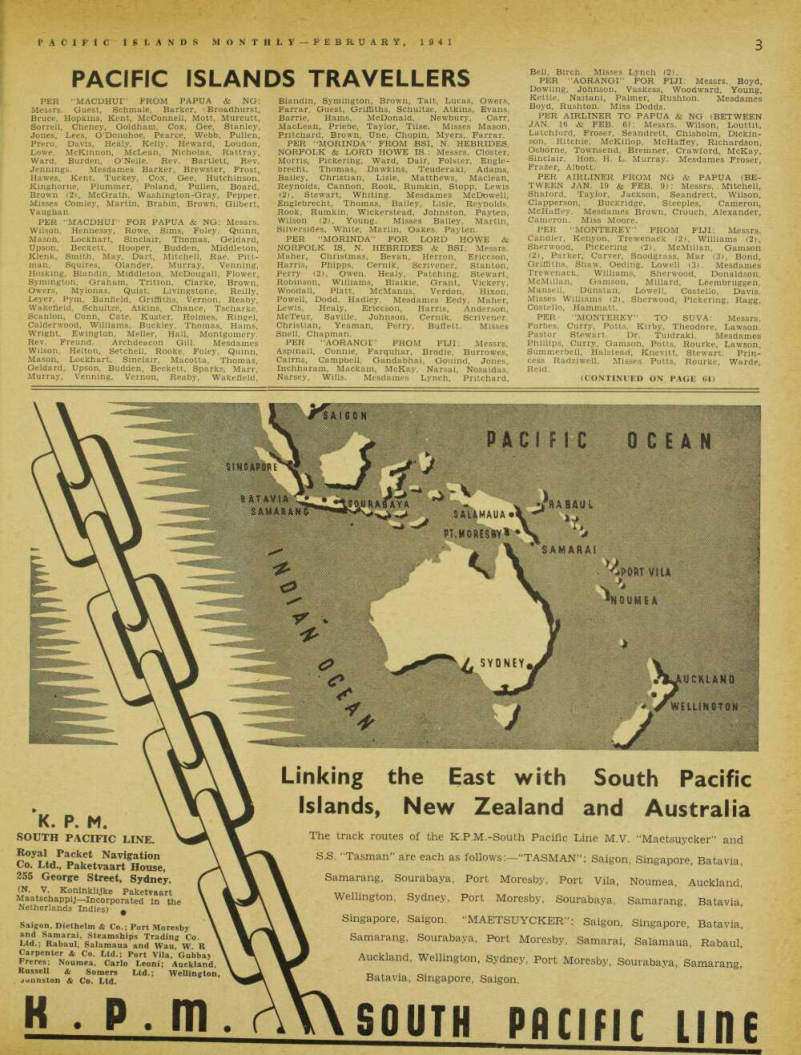
Per “Macdhui” From Papua & Ng:
Messrs. Guest, Schmale, Barker, Broadhurst, Bruce, Hopkins, Kent, McConnell, Mott, Murcutt, Sorrell, Cheney, Goldham, Cox, Gee, Stanley, Jones, Lees, O’Donohoe, Pearce, Webb, Pullen, Prero, Davis, Healy, Kelly, Heward, Loudon, Lowe, McKinnon, McLean, Nicholas, Rattray, Ward, Burden, O’Neile. Rev. Bartlett, Rev.
Jennings. Mesdames Barker, Brewster, Frost, Hawes, Kent, Tuckey, Cox, Gee, Hutchinson, Kinghorne, Plummer, Poland, Pullen, Board, Brown (2), McGrath, Washington-Gray, Pepper.
Misses Comley, Martin, Brabin, Brown, Gilbert, Vaughan.
PER “MACDHUI” FOR PAPUA & NG: Messrs.
Wilson, Hennessy, Rowe, Sims, Foley, Quinn, Mason, Lockhart, Sinclair, Thomas, Geldard, Upson, Beckett, Hooper, Budden, Middleton, Klenk, Smith, May, Dart, Mitchell, Rae, Pitt man, Squires, Olander, Murray, Venning, Hosking, Blandin, Middleton, McDougall, Flower, Symington, Graham, Tritton, Clarke, Brown, Owers, Mylonas, Quist, Livingstone, Reilly, Leyer, Pym, Banfield, Griffiths, Vernon, Reaby, Wakefield, Schultze, Atkins, Chance, Tscharke, Scanlon, Conn, Cate. Kuster, Holmes, Ringel, Calderwood, Williams, Buckley, Thomas, Hams, Wright, Ewington, Meller, Hall, Montgomery.
Rev. Freund. Archdeacon Gill. Mesdames Wilson, Helton, Setchell, Rooke, Foley, Quinn, Mason, Lockhart, Sinclair, Macotta, Thomas, Geldard, Upson, Budden, Beckett, Sparks, Marr, Murray, Venning, Vernon, Reaby, Wakefield,
Blandin, Symington, Brown, Tait, Lucas, Owers, Farrar, Guest, Griffiths, Schultze, Atkins, Evans, Barrie, Hams, McDonald, Newbury, Carr, Mac Lean, Priebe, Taylor, Tilse. Misses Mason, Pritchard, Brown, Une, Chopin, Myers, Farrar.
Per “Morinda” Prom Bsi, N. Hebrides,
NORFOLK & LORD HOWE IS.: Messrs. Closter, Morris, Pickering, Ward, Dair, Folster, Engle brecht, Thomas, Dawkins, Teuderaki, Adams, Bailey, Christian, Lisle, Matthews, Maclean, Reynolds, Cannon, Rook, Rumkin, Stopp, Lewis (2), Stewart, Whiting. Mesdames McDowell, Englebrecht, Thomas, Bailey, Lisle, Reynolds, Rook, Rumkin, Wickerstead, Johnston, Payten, Wilson (2), Young. Misses Bailey, Martin, Silversides, White, Marlin, Oakes, Payten.
Per “Morinda” For Lord Howe &
NORFOLK IS. N. HEBRIDES & BSI: Messrs.
Maher, Christmas, Bevan, Herron, Ericcson, Harris, Phipps, Cernik, Scrivener, Stanton, Perry (2), Owen, Healy, Patching, Stewart, Robinson, Williams, Blaikie, Grant, Vickery, Woodall, Platt, McManus, Verdon, Hixon, Powell, Dodd, Hadley. Mesdames Eedy, Maher, Lewis, Healy, Ericcson, Harris, Anderson, McTeur, Saville, Johnson, Cernik, Scrivener, Christian, Yeaman, Perry, Buffett. Misses Snell, Chapman.
Per “Aorangi” From Fiji: Messrs.
Aspinall, Connie, Farquhar, Brodie, Burrowes, Cairns, Campbell, Gandabhai, Gouind, Jones, Inchharam, Mackam, McKay, Narsai, Nosaidas, Narsey, Wills. Mesdames Lynch, Pritchard,
Bell, Birch. Misses Lynch (2).
Per “Aorangi” For Fiji: Messrs. Boyd,
Dowling, Johnson, Vaskess, Woodward, Young, Kettle, Naitani, Palmer, Rushton. Mesdames Boyd, Rushton. Miss Dodds.
PER AIRLINER TO PAPUA & NG (BETWEEN JAN. 16 & FEB. 6): Messrs. Wilson, Louttit, Latchford, Froser, Seandrett, Chisholm, Dickin son, Ritchie, McKillop, McHaffey, Richardson, Osborne, Townsend, Bremner, Crawford, McKay, Sinclair. Hon. H. L. Murray. Mesdames Froser, Frazer, Albott.
PER AIRLINER FROM NG & PAPUA (BE TWEEN JAN. 19 & FEB. 9): Messrs. Mitchell, Shaiord, Taylor, Jackson, Seandrett, Wilson, Clapperson, Buckridge, Steeples, Cameron, McHaffey. Mesdames Brown, Crouch, Alexander, Cameron. Miss Moore.
Per “Monterey” From Fiji; Messrs.
Candler, Kenyon, Trewenack (2), Williams (2), Sherwood, Pickering (2), McMillan, Gamson (2), Parker, Carver, Snodgrass, Mar (3), Bond, Griffiths, Shaw, Ceding, Lowell (3). Mesdames Trewenack, Williams, Sherwood, Donaldson, McMillan, Gamson, Millard, Leembruggen, Mansell, Dunstan, Lowell, Costello, Davis.
Misses Williams (2), Sherwood, Pickering, Ragg, Costello, Hammatt.
Per “Monterey” To Suva: Messrs.
Forbes, Curry, Potts, Kirby, Theodore, Lawson.
Pastor Stewart. Dr. Tuidraki. Mesdames Phillips, Curry, Gamson, Potts, Rourke, Lawson, Summerbell, Halstead, Knevitt, Stewart. Prin cess Radziwell. Misses Potts, Rourke, Warde, Reid.
(Continued On Page 64)
Advertisements & other items, p. 5 (1 item)
south piumc Line
Sl
kMAUA
J #A : 1 m
SAMARAI
VUA
K. P. M.
SOUTH PACIFIC LINE.
Royal Packet Navigation Co. Ltd., Paketvaart House, 255 George Street, Sydney. (N. V. Konlnklijke Paketvaart Maatschappij— Incorporated In the Netherlands Indies) Saigon, Diethelm & Co.; Port Moresby and Samarai, Steamships Trading Co.
Ltd.; Rabaul, Salamaua and Wau, W. R Carpenter & Co. Ltd.; Port Vila, Gubba> Freres; Noumea, Carlo Leoni; Auckland, Russell & Somers Ltd.; Wellington, junnston & Co. Ltd.
k.p . m
SYDNEY,
t
mmhh ■
Linking the East with South Pacific
Islands, New Zealand and Australia
The track routes of the K.P.M.-South Pacific Line M.V. “Maetsuycker” and S.S. “Tasman” are each as follows:—“TASMAN”; Saigon, Singapore, Batavia, Samarang, Sourabaya, Port Moresby, Port Vila, Noumea, Auckland, Wellington, Sydney, Port Moresby, Sourabaya, Samarang, Batavia, Singapore, Saigon. “MAETSUYCKER”: Saigon, Singapore, Batavia, Samarang, Sourabaya, Port Moresby, Samarai, Salamaua, Rabaul, Auckland, Wellington, Sydney, Port Moresby, Sourabaya, Samarang, Batavia, Singapore, Saigon.
south piumc Line
Advertisers
Advanx Tyre & Rubber Co. Pty.
Ltd 10 “Airzone” Radio . 17 Amplion (A/sia) Ltd 41 Amalgamated Wire less of Aust. . . 50 Angus & Coote Ltd. 15 Arnott’s Biscuits . 33 Atkins Ltd., W. . . 36 “Ausoline” ... 62
B.A.L.M. Ltd. ... 37
Bank of N.S.W. . . 61 Barnet Glass Rub ber Co. Ltd. . . .42 “Bidoraak” ... 12 Broomfields Ltd. . . 54 Brown & Co. Ltd., G 13 Brunton’s Flour . . 31 Budge, Jas. Pty.
Ltd 48 Burns, Philp & Co.
Ltd 4 B.P. Magazine ... 22
B.P, (S.S.) Co. . . 28
Burns Philp Trust Co. Ltd 10 Carlton & United Breweries Ltd. . . 21 Carpenter Ltd., W.
R cov. 2 Chapman & Sherack 39 Chivers & Sons Ltd. 28 Coleman Lamp & Stove Co. . . 34, 60 Colonial Mutual Life Assurance Society Ltd. ... 63 Colonial Sugar Re fining Co. Ltd. . 47 Compressor & Air Equipment Co. . . 56 Coral Starch ... 33 Cosmopolitan Hotel 64 “Cystex” 56 De Meric Pty. Ltd. 46 Dewar’s Whisky . . 51 Doan’s Pills ... 64 Donaghy & Sons Ltd 62 Donald Ltd., A. B. . 44 Dr. Williams Pink Pills 38 Eaton Ltd., J. W. . 35
Electrolux Refrigerators . . 20 Eno’s Fruit Salt . . 60 Fletcher & Sons . 37 For Sale 12 “Flit” 54 Garrett & Davidson 56 Garden Vale Pro ducts Ltd. ... 30 Gilbey’s Gin ... 40 Gillespie’s Flour . 32 Gowing Bros, Ltd. . 61 Grand Pacific Hotel 45 Grove & Sons, W.
H 11 Guinea Airways Ltd cov. 3 Heinz Co. Ltd., H. j 27 Holbrook’s Ltd. . . 31 Horlicks Malted Milk 24 Hotel Moresby . . 64 International Correspondence Schools ... 9 Jones & Co., H. . 14 Kopsen & Co. Ltd. 49 Kork-N-Seal Ltd. . 30 Kriesler (A/sia) Pty. Ltd 43 Lea & Perrins Sauce 52 Levenson’s Radio . 58 Lustre Hosiery Ltd. 53 Maxwell Porter Ltd. 35 Mcllrath’s Ltd. . . 52 “Mendaco” ... 48 Miller & Co. Pty.
Ltd 55 Nelson & Robertson Pty. Ltd 16 Nestle’s Milk . . 15, 29 Nock & Kirby Ltd. 16 Noyes Bros. Ltd. . 57 Pacific Is. Society . 51 Papua Hotel, The . 64 Philips Lamps (A/sia) Pty. Ltd. 59 “Pinkettes” ... 54 Porter & Co., D.
H 39 Prescott Ltd. ... 32 Price’s Radio Ser vice 61 Prouds Ltd 11
Rivertstone Meat Co.
Ltd. ... 18 Rohu, Sil . . . . 55 Royal Packet Navi gation Co. ... 3 Scott Ltd., J. ... 38 Springwood Ladies’
College 53 Steamships Trading Co. Ltd 42 Sterling Varnish Co. 9 Sullivan Ltd., C. . 60 Sunripe Cigarettes . 22 Swallow & Ariell . 26 Talkeries, The ... 46 Taylor & Co., A. . 62 “Tenax” Soap . . 25 Tillock & Co. Ltd. 44 Toohey’s Ltd. ... 19
Tooth & Co. . cov. 4 “206” Private Hotel 12 Vacuum Oil Co.
Ltd 23 Vincent’s A.P.C. . . 25 “Vi-stim” 63 West, Harry ... 49 Weymark & Son . 32 Whitelaw & Co., James 57 Wills Ltd., W. D. & H. 0 40 Woods Great Pep permint Cure, 14, 55, 59’
Wright & Co. . . 55 Wright & Co. Ltd., E. ... 38 Wunderlich Ltd. . . 35
Rev. W. T. and Mrs. Taylor, who are workers for the New Guinea Mission at Boianai, Papua, arrived in Sydney in February on furlough.
Rev. G. H. D. Voss, who returned to Australia recently from New Britain, New Guinea, where he was engaged in work for the Melanesian Mission, hopes to join the military forces as a Chaplain.
Mr. R. P. Garrity, of the Melanesian Mission Boy’s School at Vureas, New Hebrides, has returned to New Zealand, where he hopes to enter a theological college.
Contents
Pacific News-Review 1 Pacific Islands Travellers 3 Real War About to Begin 5 N. Caledonian Metals, and Japan .. 6 Plan to Save Copra Industry ... 6 Shipping Line For French Colonies 7 Survivor of Yacht Tragedy 7 USA’s Base at Pago Pago 7 Cassava For New Guinea? 8 Search For Power Alcohol 8 Pacific Raiders 9, 10 Strange Theft Case in Tonga ... 9
Tropicalities 11
N. Guinea Capital to be Removed? 12 Canton Is. Now Under PAA ... 13 Modern Malaria Remedies 14 Trans-Pacific Air-Mails 18 Papuans and New Administrator .. 21 Conditions in New Caledonia ... 22 Cheeky Natives and Discipline ... 24
Stevenson’s Grave at Vailima ... 26 A Hair-Do in Fiji 27 ► “Nutfall” in the Solomon Is 30 Australia’s Territories 32, 40 A Land of no Pests 33 Cook Islander’s Hectic Career ... 34 How Nauru Took Raider’s Shelling .. 35 New Light on Rossel Is. Horror .. 37 Rabaul’s Worst Earthquake 38 Chinese Leader’s Scorn For Australia 41 Death of “Alf” Belfield 42 NZ Troops in Fiji 44 When Noumea Was in a Fever ... 46 Section For Women 52 Islands Mining News 56 Short Wave Radio Programmes .. 59 Copra and Rubber Prices 60 Exchange and Market Quotations .. 61 Demand For Pacific Timber 62
Advertisements & other items, p. 6 (1 item)
H in f ie
% : 5 lt f:; ,■ .• \ vi
until H
TO
ijiiftti
, mi
in hi
■in
H in f ie
hi in
i Head Office: 7 Bridge Street, Sydney—Australia Code Address: "Burphil"
BURNS, PHILP
& Co. Ltd.
GENERAL MERCHANTS
SHIPOWNERS
TOURIST AGENTS
BUYERS OF ALL CLASSES OF ISLAND PRODUCE Regular Steamer Services from Australia to New Guinea —Papua—Solomon Is.
Lord Howe Is.—Norfolk Is. New Hebrides —Hongkong—Java and Singapore
Pacific Islands Monthly
The Newspaper-magazine of the South Seas [Registered at the G.P.0., Sydney, for transmission by post as a newspaper .]
Published Once Each Month and Circulated in Australia and New Zealand and in the following Pacific Territories and Islands Groups:
Australian Territory of Papua.
Mandated Territory (Australia) of New Guinea, Bismarck Archipelago and Northern Solomon Islands.
Australian Territory of Norfolk Island.
New Zealand Territory of Cook Islands.
Mandated Territory (New Zealand) of Samoa.
British Colony of Fiji.
British Solomon Islands Protectorate.
British Protectorate of Tongan Islands.
British Crown Colony of Gilbert and Ellice Islands.
Mandated Territory of Nauru.
British and French Condominium of New Hebrides.
French Colony of New Caledonia.
French Colony of Oceania (Tahiti, etc.).
American Territory of Eastern Samoa.
American Territory of Hawaiian Islands, American Territory of Guam.
Mandated Territory (Japan) of Marshall, Caroline and Mariana Islands.
Owned and Produced by Pacific Publications Pty. Ltd., Union House, 247 George Street, Sydney.
tpi fphonp S Managing Director .. BW 5037 I Business and Editorial MA 7101
P.O. Box 3408 R
Registered Address of Telegrams, Radiograms, and Cables: “Pacpub”, Sydney,
Contributions.
Articles, Stories, and Photographs dealing with Pacific Islands subjects are invited and will be paid for on publication.
Subscription Rates.
Per Annum, within British Empire, Prepaid, Post Free 8/- Per Annum, elsewhere, prepaid, Post Free . 10/- Single Copies 8d
Editor and Publisher:
R. W. Robson, F.R.G.S.
Assisted by Selwyn Hughes.
Advertising Manager: L. W. Bailey.
Advertising Office and Printing-House: 29 Alberta Street, Sydney.
Advertising rates furnished on application.
Colours, etc., by Arrangement.
Process Blocks made at Advertiser’s expense when required. Screen 100.
Changes of Advertising Copy should reach this Office by Ist of each month, otherwise previous advertisement may be repeated.
IN LONDON, the Pacific Islands Monthly is on sale at the Bookstall, Australia House, The Strand, London.
Agents.
The following are authorised to receive sub scriptions for the Pacific Islands Monthly;— Islands Branches of Burns, Philp & Co., Ltd., and Burns Philp (South Sea) Co., Ltd.
Islands Branches of W. R. Carpenter & Co., Ltd.
Islands Branches of Morris, Hedstrom, Ltd.
T. A. Olsson, Wau, New Guinea.
G. Thomas & Co., Rabaul, New Guinea.
Whitten Bros., Ltd., Samaral, Papua.
Steamships Trading Co., Papua. All Branches.
B.N.G. Trading Co., Ltd , Port Moresby, Papua.
J. Muir, Suva, Fiji.
N. C. Mackenzle-Hunt, Walnunu, Bua, FIJI.
Islands Branches and Representatives of W. H.
Grove & Sons, Ltd., Auckland, New Zealand.
Cook Islands Trading Co., Rarotonga, Cook Is.
A. C. Rowland, Papeete, Tahiti.
Representative in London: W. C. HARVEY, Coronation House, 4 Lloyds Avenue, London, E. 0.3, from whom may be obtained copies of Pacific Islands Monthly, Pacific Islands Year Book, advertising schedules, etc.
Vol. Xi. No. 7.
February 14, 1941
D . ( od. Per Copy, r rICe £ Prepaid: 8/- p.a.
The Real War Is About To Begin
TO keep the international situation in focus, it is as well to look over the phases of the war. It may be seen that it is too soon, yet, for cheer
ing and flag-waving.
1. September, 1939-March, 1940: Poland over run by Germans.
March-Aprjl, 1940: Norway, Denmark, Holland, Belgium, over-run by Germans. 3. May-June, 1940: France over-run by Germans and capitulates; Italy enters the war; British army escapes via Dunkirk. 4. August-September, 1940: Germany fails to invade Britain, or destroy her by air power. 5. September, 1940: Japan formally joins Germany and Italy in Axis Alliance. 6. October, 1940; Italy attacks Greece, but is repelled by Greeks and badly mauled. 7. November, 1940: United States, by re electing President Roosevelt, declares in favour of all aid of Britain short of belligerency. 8. December, 1940-February, 1941: Italy thrashed unmercifully by British air, naval and military forces in Mediterranean and North Africa.
It may be coincidence, but it is a
fact that, since Germany was joined
in the battlefield by Italy and the
predatory Mussolini, Germany has
had no success, worth mentioning.
On the contrary, Hitler’s plans have gone sadly awry.
His 1940 strategy seems clear, in the light of after-events. Italy, be tween October and March, was to smash British power in and around the Mediterranean; Germany was to march, via Fascist Spain and the cowed Balkans, and help seal up each end of the Mediterranean, while Italy took possession of Africa; Japan was to give the coup de grace to British naval power in the Pacific, and keep
the United States quiet; and, then, in March, Germany was to spring upon a weakened Britain, and destroy her, and become mistress of the world.
But Italy was the fatally weak link in the chain of planned events. Little Greece, heroically and unexpectedly, exposed Italy’s Achilles heel in Albania fwhich, curiously enough, is right against “the heel of the Italian boot”); and Britain, with smashing blows, destroyed the power of which the crowing Dagoes in Rome had ceaselessly boasted.
The failure of Italy has changed many things. Spain has refused to open her gateways to the Hun armies.
The Balkan countries, while still ap parently complaisant, are making difficulties for Mr. Hitler. Above all, Japan, seeing Anglo-American naval power still unchallenged and un broken, clings desperately to the edge of neutrality, afraid to take the plunge to which she virtually was committed, four months ago.
America now is vociferously pro- British. Unhappy, broken France is regaining her courage and spirit.
OUT let us not be deceived by all these later events. The humilia tion of Italy, while a pleasant thing to see, leaves Germany still the vic torious and arrogant mistress of Europe, unbroken and terrifyingly powerful, resolved at all costs to des troy Britain, so that she may enjoy world hegemony.
Germany will resume in March the
attack on Britain which she broke off in November. We do not know what has been going on in Germany dur ing these winter months: but we can be quite sure that the Germans, with Teutonic thoroughness, have worked out an invasion plan which they be lieve will not fail. They will not under-rate Britain’s strength, shown in the Battle of Britain in September, and proved against the Italians. The Hun is powerful, utterly ruthless, and determined that, after so successfully conquering Europe, he shall not be deprived of his prey by the uncon quered, tenacious British.
So the attack, when it comes, will be on a scale never before seen in the world, and it will be “all in”. Will the Hun, fighting to retain his spoils, hesitate to break every law of humanity, decency or moral right?
He will not.
BRITAIN can take it. The British -Lf know what to expect; and they, too, have not been idle this winter.
Their hands have been immensely strengthened by the virtual collapse of Italy: but production of war material—much of it of a new and secret character—has proceeded on a scale without precedent, while the whole nation has been prepared and organised for a trial such as it never has known.
Britain, probably, will be on the defensive during most of 1941. In 1942, with Britain’s strength still growing, and Germany’s decreasing, the European situation will change.
It then will be black-out for the dictators.
THE international situation was never more ominous than at this moment. Germany has enormous armies which she does not need for the attack on Britain. The indications are that those armies are to be used in (a) entering Italy and bolstering Italian morale; (2) attacking Greece in the rear, through Bulgaria, to save the Italians in Albania from destruc tion; (3) entering Spain, from France, so as to attack Gibraltar and thus counter the strategic value of British successes in North Africa.
Nazi emissaries are working cease lessly upon Japan, trying to induce her to attack the United States, and thus interfere with America’s muni tions aid to Britain.
MEANWHILE, we of the British and French Pacific territories may be called upon suddenly to show the qualities so magnificently displayed by our folk at home. Powerful in fluences are working in and with Japan for peace. But if the Jingoes, now partially in control in Tokio, get their way, Japan may attack Britain, and at any moment.
Now that Italy is crippled, Japan’s entry into the war would do little more than embarrass Britain: it will not seriously weaken her in the vital struggle in Europe. British-Austra lasian units, aided by the considerable forces which the Dutch have as sembled in the Indies, probably could hold the Japanese in the North western Pacific for a while. In that period, the United States probably would decide to fight—and then it would be, God help Japan!
But, whether or not America came in, and even assuming that British- Dutch-Australian forces were strong enough to confine the Japanese generally to the Asiatic sector, such a development would gravely disturb conditions in the Pacific. We do not think, even now, that it will come; but wise individuals should prepare for it, just as wise Administrations and Governments have been prepar ing, for many months past.
SOME years ago, proficiency in crime was the pass to social distinction in the gaol of an out-back district of Papua.
A rigid social order ,was introduced by the prisoners themselves. Instead of taking their meals while sitting on the orison floor, with their tin plates of rice beside them, the prisoners made a long dining table, which they covered with a once-white calico cloth.
At the head of the table presided the prisoner who had to serve the longest sentence. The rest were arranged in order of “merit”.
If there happened to be two men. serving equally long terms, crimes of violence took precedence over mere theft.
There is word of Mr. George Hansen, planter, of Namatanai, New Guinea, who went to Britain late in 1937, and who married Miss Anna Ballantyne, of Samarai. Our Samarai correspondent says; “Mr. J. Ballantyne has received word, through the Red Cross, that his daughter Anna (Mrs. George Hansen) is safe in Germany. Anna, with her husband, is staving at a lakeside resort and she says she is well and happy”.
Missing
Roll Of Honour
(It is hoped to assemble, here, the names men, former residents of the Pacific Territories, which appear in British and French casualty lists, or in lists of honours awarded. We should be grateful if relations and friends would send us details.)
Flying-Officer Moresby Gofton, of the RAF., son of Mrs. F. S. Stewart, of Wau, New Guinea. Reported missing, 17/5/1940. Now believed killed.
Flying-Officer K. J. A. Johnstone, of the R.A.F., who was born in Suva in 1915. Reported missing, 1/5/1940. His mother was a daughter of the late Mr H. Thiele, for many years a member of the Colonial Sugar Refining Co.’s staff in Fiji.
Flight-Lieutenant G. J. I. Clarke, of the RAAF, serving overseas, formerly Assistant Flight Superintendent of Car penter Airways, New Guinea. Reported missing 25/9/1940.
Wounded
Stanley Higgs, son of Mr. and Mrs.
Gordon Higgs, of W. R. Carpenter and Co., Ltd., well-known in New Guinea.
Member of an English Lancers regiment, wounded during evacuation from Dun kirk, May, 1940.
Private H. G. Turner, of Samarai, Eastern Papua, wounded in action in Western Desert, Egypt, January, 1941.
Valuable Metals From
Not For Japan
Valuable Metals From New Caledonia
rE most difficult and delicate problem with whfch the pro-de Gaulle Government of New Caledonia has had to deal was the disposal of the colony’s important production of chrome and nickel.
When France collapsed, the colony’s natural market for these metals was cut off. It was vital, if the colony’s com mercial structure was to be preserved, that the metals be sold, somewhere. They represent, in a normal year, two-thirds of the value of the colony’s exports.
There was one eager market available.
Japan urgently wanted all the metals which New Caledonia could sell. But Japan, about the time that New Caledonia committed itself to de Gaulle and the British Alliance, became a partner of the Allies’ enemies (Germany and Italy). It was natural that New Caledonia, guessing the ultimate destination of the chrome and nickel, was reluctant to sell to Japan.
The position was embarrassing.
However, Governor Sautot’s dilemma was solved for him by the march of events. The United States and Australia, making munitions to an increasing degree, found themselves able to buy all New Caledonia’s metals at a satisfactory price; and the Governor told his Council, at a public session in December, “that the problem had been resolved and that the colony would be assured that the United States and countries of the British Em pire would take the entire nickel and chrome production. That would mean that New Caledonia’s commercial balance would be completely secured, permitting a resumption of imports”.
Koitaki Rubber Estates Ltd., a Papuan £75,000 company, made a profit of £12,156 out of rubber in the year ended June 30, 1940. Previous net profits have been: 1936, £7,964; 1937, £10,425; 1938, £3,556; 1939, £9,882,
Should Save
Planters
Plan For Copra Industry :: Support by Britain
A PLAN for handling, marketing and shipping the copra output of all the Pacific territories south of the Equator is taking definite shape, and may be expected to come into operation within the next few months. This is the plan outlined and finally framed at the Pacific Copra Conference in Sydney, early in January.
Mr. T. J. Collins, Australian Minister for Territories, who presided at the Con ference, told the “PIM” on February 12 that the plan now was under considera tion by the several Pacific Administra tions concerned, and he hoped to be able to make a public statement about it when he had their replies, at an early date.
Details of the plan are known to us, but we will not publish same until we have official permission.
It can be stated, however, that the plan, which, at first, was somewhat vague and unimpressive, was given shape and direction by the strong hand of the British Government, which undertook, in the event of co-operative action being agreed to as between the Pacific ter ritories, to purchase a surprisingly large amount of copra per annum.
The individual Administrations and Governments concerned must also under take certain obligations in the matter of providing a subsidy for every individual copra producer within their respective territories.
All interests concerned —the Adminis trations, the big merchandising firms, the big shipping firms, and the planters —come within the framework of this comprehensive plan. It is probable that there will be a central controlling authority, working through a committee in each territory. The French Colonies will benefit equally with the British.
We can say that the preliminary sur vey indicates that there will be, even tually, an organised market capable of taking care of practically the whole out put of the South Pacific on a basis which will allow the copra growers to carry on —but it should be emphasised that all this has become possible owing to the substantial support given to the plan by the British Government.
Messrs. Carpenter's Copra-Mill
Plan
REPORTS have been circulating in North American newspapers regard ing the copra-mills to be established near Vancouver by what is described as “a new company headed by the Austra lian millionaire”, Sir Walter Carpenter.
It was stated, for example, that the mill will cost 250,000 dollars; capital will be partly Australian and partly Cana dian: that the site of the mill was ori ginally in Vancouver, but because of trouble with the municipal authorities, was moved to New Westminster, on the Frazer River, near Vancouver; the mills plan to treat 24,000 tons of copra per annum, “from Samoa”; that the provi sional directors of the new company are Sir Walter Carpenter (president); R. O.
Campney, KC, E. F. Riddle, and E. E.
Buckerfield, as directors, with John Ray mond, of San Francisco, as American representative of the company. (See Foot of Column, Next Page)
(Continued from Page 6.)
We referred these various reports to the head office of Messrs. W. R. Car penter & Co. Ltd., in Sydney, and were informed that the published details were generally so incorrect as to be fantastic.
We were told that a project of the kind indicated is under consideration, but that it is not sufficiently advanced to permit of a statement being made.
We understand, however, that not only has the plan taken definite shape under the personal direction of Sir Walter Car penter (who is now in America) but that already the first mill is almost completed and will be in operation in March, and that it will be capable of treating copra at the rate of 30,000 tons per annum.
The project has been approved and sup ported by certain British Governments, and it is likely that this new Canadian mdustry, before the end of this vear, will be shedding a new benefit upon industry ac^c copra-producing
Shipping Line For French Colonies
French Colonies
Important Project Under
Discussion
PLANS are being made for the organi sation of a line of steamers to serve the Free French Colonies in the Pacific, running between Australia and North America, and calling at New Cale donia, New Hebrides and Tahiti.
The “Bulletin du Commerce”, Noumea, said, at the end of December, that Governor Sautot had been informed by General de Gaulle “that an English com pany will shortly commence a monthly shipping service between Australia, New Caledonia, New Hebrides, Tahiti and USA. Three vessels will be employed on this line. There is also word of another vessel for the Free French Colonies in the Pacific. There will be thus four ships to serve New Caledonia and the other French possessions in the Pacific. ' A representative of a Sydney shipping board is expected in Noumea to organise the employment of vessels and to establish their definite itinerary.”
This report was referred, on January 24, to Sir Thomas Gordon, head of the Australian Shipping Board, which repre sents the British Ministry of Shipping.
He said that the matter of providing the French Colonies with a shipping line had been under consideration, and the Aus tralian Board had offered to send a representative to Noumea. But that was all finished with now. The matter was now in the hands of General de Gaulle.
M. Brenac (his representative in Sydnev), the British Minister of Shipping, and the Governors of the French Colonies.
On January 27. M. Brenac announced that he had registered Agence Maritime France Libre Pty. Ltd., with a nominal capital of £5,000. to act as agent for any vessel or vessels which Britain might place at the service of the Free French Colonies.
Patrol Officer G. Greathead, who has been doing good work in the untamed Ramu-Mt. Hagen section of New Guinea for about two years, is due in Australia on well-earned furlough, in February.
Hon. H. Leonard Murray, Administrator of Papua, after being present at the Pacific Copra Conference, and attending to a good deal of departmental business in Canberra and Melbourne, left Sydney for Port Moresby on January 23.
Survivor of "Wing On"
Yacht Traged y
THE sole survivor of the yacht “Wing- On ”, wrecked on the northern coast of Vanua Levu, Fiji, on November 24, Mrs. Fern Thompson, is making slow progress under medical treatment in Suva. Her physical condition is improved, but her mental state is giving anxiety.
Her father is to come from America to take her home.
It will be remembered that two married couples sailed on this little yacht from Los Angeles on August 14 for the Poly nesian islands. Apparently, owing to lack of experience, the yacht was not very well found or equipped.
The yacht missed the various islands for which it was headed, supplies ran out and the four people aboard slowly starved to death.
Mrs. Thompson’s husband died on November 7, and was buried at sea. The yacht eventually drifted quietly onto the rocky coast of Vanua Levu, and there was noticed and boarded by a Seventh Day Adventist missionary, Pastor Ferris.
He found the vessel half full of water, and Mrs. Thompson in a demented con dition, floating in the cabin, keeping her self alive by clinging to the furniture.
The bodies of the captain and his wife, who evidently had died some time pre viously, were also in the water in the cabin.
The missionary rescued Mrs. Thomp son, but the yacht rapidly broke up and disappeared.
Tahiti Quiet
Britain's Loyal Allies
Fiom Our Own Correspondent
Papeete, Jan. 14.
EVERYTHING is running very smoothly in this Colony under present conditions.
Of course, the copra problem has not yet been solved, but, thanks to the generous assistance of the British Gov ernments, there is no severe hardship— as far as food supplies are concerned, at any rate.
The Government of the Colony is in the hands of men who know the require ments of the Colony. The present Gov ernor has served in many parts ©f French Oceania as Administrator. The Advisory Council is composed of representatives of old families who have been here for
generations. All ele ments sympathetic to the Vichy Govern ment have been elim inated and we now have an undivided loyalty to the de Gaulle Government and to the alliance of the British Empire, in every part of this Administration.
Suva Medical
School
A notable address, given on December 23 by the Governor of Fiji, Sir Harry Luke, at the graduation ceremony at the Suva Medical School, will be Publi sh e d in the March issue of the
Pim.
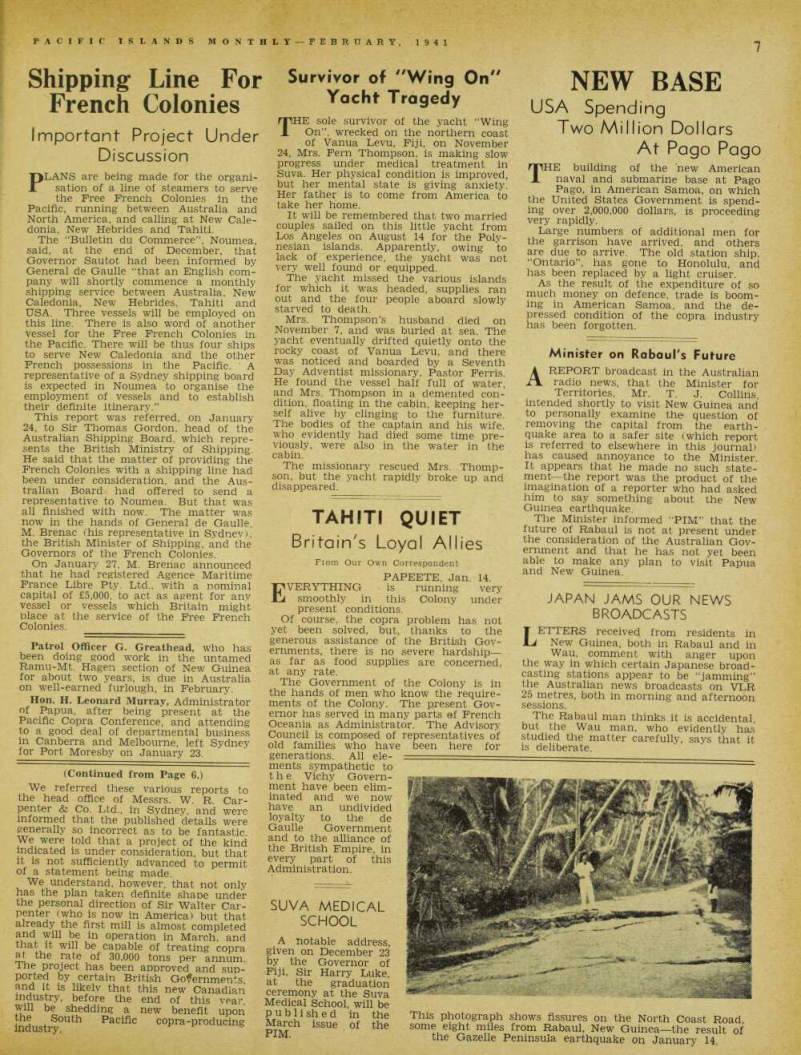
This photograph shows fissures on the North Coast Road some eight miles from Rabaul, New Guinea—the result of the Gazelle Peninsula earthquake on January 14
New Base
USA Spending Two Million Dollars At Pago Pago
THE building of the new American naval and submarine base at Pago Pago, in American Samoa, on which the United States Government is spend ing over 2,000,000 dollars, is proceeding very rapidly.
Large numbers of additional men for the garrison have arrived, and others are due to arrive. The old station ship.
"Ontario”, has gone to Honolulu, and has been replaced by a light cruiser.
As the result of the expenditure of so much money on defence, trade is boom ing in American Samoa, and the de pressed condition of the copra industry has been forgotten.
Minister on Rabaul's Future
A REPORT broadcast in the Australian radio news, that the Minister for Territories. Mr. T. J. Collins, intended shortly to visit New Guinea and to personally examine the question of removing the capital from the earth quake area to a safer site (which report is referred to elsewhere in this journal) has caused annoyance to the Minister.
It appears that he made no such state ment—the report was the product of the imagination of a reporter who had asked him to say something about the New Guinea earthquake.
The Minister informed -PIM” that the future of Rabaul is not at present under the consideration of the Australian Gov ernment and that he has not yet been able to make any plan to visit Papua and New Guinea.
Japan Jams Our News
Broadcasts
LETTERS received from residents in New Guinea, both in Rabaul and in Wau, comment with anger upon the way in which certain Japanese broad casting stations appear to be “jamming” the Australian news broadcasts on VLR 25 metres, both in morning and afternoon sessions.
The Rabaul man thinks it is accidental, but the Wau man, who evidently has studied the matter carefully, says that it is deliberate.
Cassava
Arguments for Introduction in N. Guinea
mHERE are rumours in the departments X of a doughty fight being waged by Hon. George Murray, MLC, Director of Agriculture in New Guinea, in favour of the recognition of the cassava plant as (1) a foodstuff suitable as a substitute for rice in the feeding of native labour ers and (2) a valuable source of power alcohol.
There are indications that the scien tific investigation for which Mr. Murray has pleaded will be made.
The astonishing thing is that there should be any argument about the mat ter, or any need for a scientific investi gation. People who do not know any thing about cassava obviously do not know anything about the conditions of life in tropical countries generally.
Cassava is the West Indian name of the plant named Manioc. It is other wise known as Brazilian Arrowroot, and it is popularly known in Britain and Australia as Tapioca.
It is widely cultivated in tropical America (of which it is a native) and in tropical Africa, Malaya and the Dutch East Indies. It is, with rice, a staple article of native food in the Netherlands Indies —anyone who has been there, away from the tourist tracks, will have seen cassava, in various forms, being eaten by the natives. In South America, where also it is a staple foodstuff, it is well known as Farina.
Cassava grows very easily in all tropi cal countries, as a bulky, tuberous root of great size, often weighing 30 lb. The milky juice of the plant is more or less poisonous; but, as soon as the root is grated or sliced and dried, all unplea sant properties disappear. It is grated fine for making into bread, scones or thin cakes and it is exported to Europe, from South America, in large quantities, in the form of chips, for the manufac ture of starch, alcohol/dextrin, glucose, etc.
The cassava plant grows practically wild in New Guinea, where already there are large quantities of it, and where already it is used as a foodstuff by the natives.
Mr. Murray’s contention is that it would be easy to cultivate cassava exten sively as a substitute for rice, which is now increasingly dear, and whose import is an embarrassment to Australia because of its demands on overseas exchange.
Some New Guinea interests, which have what might be called a “rice com plex”, are anxious to develop rice culti vation. This could be done, no doubt — but its inauguration might be a lengthy and slow process. In the meantime, here is cassava, waiting to be grown and developed.
It should be remembered that rice has not long been known to New Guinea natives —only since European employers began to import it for feeding planta tion and mine labourers.
Miss Dorothy Holmes, of Tasmania, has been appointed to the vacancy in the Methodist Mission’s Stewart Hospital, New Britain, caused by the retirement of Miss M. Battersby.
Brother Gamillus Rossignol has taken up duties in the New Hebrides as a Marist missionary. He arrived in Sydney from America some time ago.
Death Of Brilliant Samoan Teacher
Apia, Jan. 2.
rE Department of Education lost one of its best Samoan teachers when Karene,, principal of Malifa Gov ernment School, which is attended by 1000 pupils, died
after a long illness, at the age of 38.
Karene was edu cated at Malifa School, where he was a clever pupil.
He later became one of the out standing school teachers in the Government service, and he was pro moted to be an inspector. His musi cal talents were very remarkable, as he not only acted as band and choir leader, but also was a composer. For instance, he set Rob ert Louis Steven son’s “Requiem” to music. He was an all-round sportsman,
and he was particularly interested in cricket and football. Several years ago he made an educational tour of New Zealand. He leaves a wife and three children.
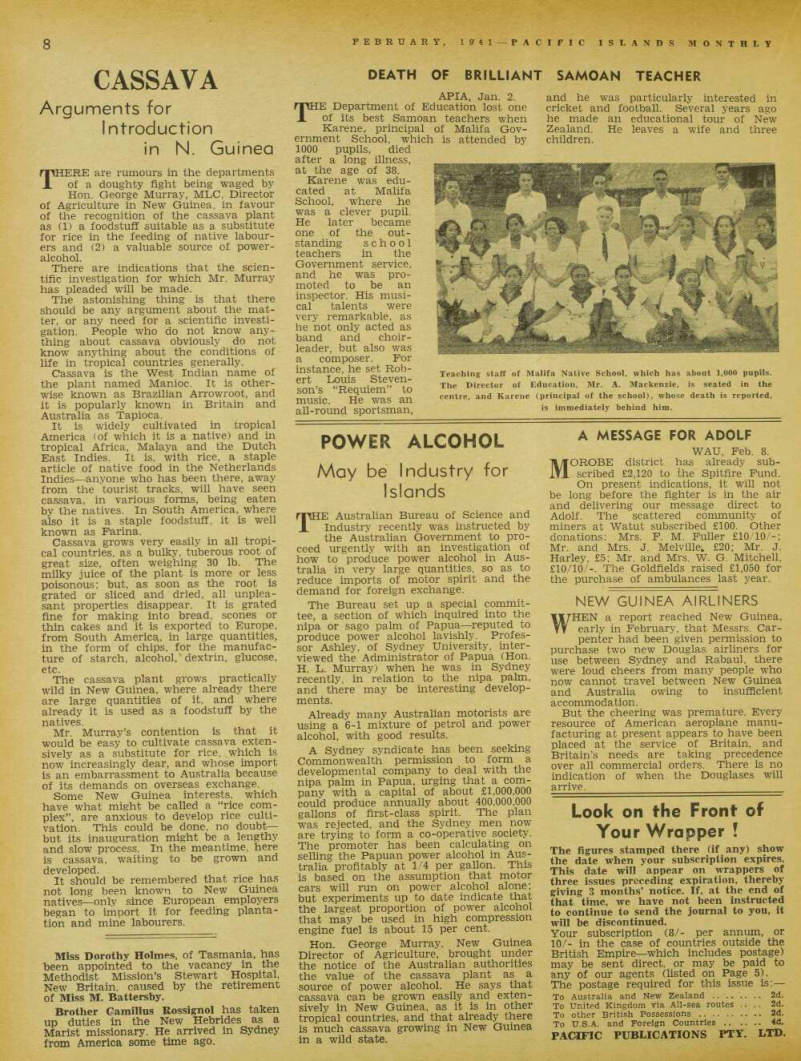
Teaching staff of Malifa Native School, which has about 1,000 pupils.
The Director of Education, Mr. A. Mackenzie, is seated in the centre, and Karene (principal of the school), whose death is reported, is immediately behind him.
May be Industry for
Power Alcohol
May be Industry for Islands
rE Australian Bureau of Science and Industry recently was instructed by the Australian Government to pro ceed urgently with an investigation of how to produce power alcohol in Aus tralia in very large quantities, so as to reduce imports of motor spirit and the demand for foreign exchange.
The Bureau set up a special commit tee, a section of which inquired into the nipa or sago palm of Papua—reputed to produce power alcohol lavishly. Profes sor Ashley, of Sydney University, inter viewed the Administrator of Papua (Hon.
H. L. Murray) when he was in Sydney recently, in relation to the nipa palm, and there may be interesting develop ments.
Already many Australian motorists are using a 6-1 mixture of petrol and power alcohol, with good results.
A Sydney syndicate has been seeking Commonwealth permission to form a developmental company to deal with the nipa palm in Papua, urging that a com pany with a capital of about £1,000,000 could produce annually about 400,000,000 gallons of first-class spirit. The plan was rejected, and the Sydney men now are trying to form a co-operative society.
The promoter has been calculating on selling the Papuan power alcohol in Aus tralia profitably at 1/4 per gallon. This is based on the assumption that motor cars will run on power alcohol alone; but experiments up to date indicate that the largest proportion of power alcohol that may be used in high compression engine fuel is about 15 per cent.
Hon. George Murray, New Guinea Director of Agriculture, brought under the notice of the Australian authorities the value of the cassava plant as a source of power alcohol. He says that cassava can be grown easily and exten sively in New Guinea, as it is in other tropical countries, and that already there is much cassava growing in New Guinea in a wild state.
A Message For Adolf
WAU, Feb. 8.
MOROBE district has already sub scribed £2,120 to the Spitfire Fund.
On present indications, it will not be long before the fighter is in the air and delivering our message direct to Adolf. The scattered community of miners at Watut subscribed £lOO. Other donations: Mrs. F. M. Fuller £lO/10/-; Mr. and Mrs. J. Melvillei, £2O; Mr. J.
Harley, £5; Mr. and Mrs. W. G. Mitchell, £lO/10/-. The Goldfields raised £1,050 for the purchase of ambulances last year.
New Guinea Airliners
WHEN a report reached New Guinea, early in February, that Messrs. Car penter had been given permission to purchase two new Douglas airliners for use between Sydney and Rabaul, there were loud cheers from many people who now cannot travel between New Guinea and Australia owing to insufficient accommodation.
But the cheering was premature. Every resource of American aeroplane manu facturing at present appears to have been placed at the service of Britain, and Britain’s needs are taking precedence over all commercial orders. There is no indication of when the Douglases will arrive.
Advertisements & other items, p. 10 (1 item)
Look on the Front of
Your Wrapper !
The figures stamped there (if any) show the date when your subscription expires.
This date will appear on wrappers of three issues preceding expiration, thereby giving 3 months’ notice. If, at the end of that time, we have not been instructed to continue to send the journal to you, it will be discontinued.
Your subscription (8/- per annum, or 10/- in the case of countries outside the British Empire—which includes postage) may be sent direct, or may be paid to any of our agents (listed on Page 5).
The postage required for this issue is:— To Australia and New Zealand 2d.
To United Kingdom via All-sea routes ... 2d.
To other British Possessions 2d.
To U.S.A. and Foreign Countries 4d-
PACIFIC PUBLICATIONS PTY. LTD.
The Raiders
Well Hidden While Huns Boast in Japan
AFTER the sensational disclosures, at the end of December, of enemy raider activities in the Pacific, Ger man communities in China and Japan boasted that, within a month, the ac tivities of German raiders in the Pacific would be doubled. It was declared that Germans in Japan were organising raids on a great scale.
More than a month has passed, and nothing has happened.
Actually, there has not been a word published' about the raiders since the three sinister ships discharged their prisoners on Emirau Island on December 21, and scuttled away north among the equatorial islands.
They still may get an unguarded ship or two; but Pacific Territories residents may accept the assurance that the danger from German raiders which was so marked in November and December is now much less. Nothing can be said about our defence dispositions; but it may be stated that the position now is very different to what it was.
The raiders, sooner or later, will come out of their hide-outs; and then there will be a new kind of story to tell.
Mormons Go
Strange Development in Pacific Missions
From Our Own Correspondent
Papeete, Jan. 4.
BY direct order, it is said, of the head of the church in Utah, USA, the Mormon missions have been with drawn from French Oceania and Tonga.
No reason has been given for this decree, nor is there any indication whether the withdrawal is temporary or permanent.
The principal activities of this mission have been centred in the Tuamotu Is lands, and at Tubuai in the Australs; although there is a chapel and an ad ministration building in Papeete.
The entire staff of the mission departed, on November 19, on board of the schooner “Bernice”, chartered to take the company to Honolulu.
The withdrawal would have been more dignified if Mr. Cannon, the head of the mission, had not given two interviews — one at Honolulu, the other at San Francisco. If Mr. Cannon is correctly reported, he has mis-represented condi tions in French Oceania —much to the delight of the yellow press—and has added another chapter to the vast litera ture of “things that are not so”.
New Taxes In Fiji
IN order to provide large additional sums for defence, the Legislative Council of Fiji in December author ised an increase in the port and cus toms tax by three per cent.; and decided that all persons now paying the resi dential tax shall pay also 10/- per annum as a special war tax.
Mr. Vishnu Deo, one of the Indian members, opposed the latter tax because 80 per cent, of it would fall on the Indian community. He said that the Indians did not object to paying a war tax —but did object to the manner in which it was proposed to collect it.
A reassuring statement was made to him by the Governor.
"Stolen" Pup
Extraordinary Case of C. S.
Ramsay, of Tonga
By A. Cowley, Nukualofa
WILL you please give all possible publicity to the case of Mr. C. S.
Ramsay, a well-known resident of Tonga, who was sentenced by Judge W.
H. Stuart to six months’ imprisonment for the theft of a puppy. It was shown that the puppy wandered away from its native owner, and that when it appeared at the home of Mr. Ramsay he fed and cared for it, for about three weeks.
I was in Court throughout the pro ceedings, and I unhesitatingly declare that a fair hearing by the Court was im possible on account of personal ill-feeling.
The Judge was appointed a “Com petent Authority” to permit or forbid the importation of commodities into Tonga during the war. Ramsay incurred his ire in connection with this matter. Add to this that Ramsay stands in the relation ship of Uncle to Fanny Ramsay (who was maligned during the Uliti trial) and you have some explanation of this amazing treatment of Ramsay.
The so-called trial was extraordinary.
The Judge brow-beat witnesses, branded them as “liars”; burlesque, combined with sneering sarcasm, in which Ramsay was caricatured and made to appear ridiculous as a rescuer of half-starved puppies.
Amid it all there was not one tittle of evidence that the puppy had ever been confined or tied up: the evidence showed that the puppy had simply attached it self to the combined places of Ramsay and the adjoining butchery: that it at all times was free to come and go at will. Ramsay had transgressed the law by selling a bottle of liquor to a sick native at Niua Fo’ou many years ago, and this was raked up against him.
There was no moral issue involved.
The case calls for a re-hearing before an impartial tribunal as soon as possible.
The puppy has been killed by a lorry, and Stuart and his wife were reported as drowned in the mishap to the “Rangi tane”.
On arrival in Tonga, the Judge was a large purchaser of furniture and effects of the late George Scott. The order to proceed to British Guiana did not afford much time in which to dispose of things,
and Judge Stuart asked the Government to relieve him of the furniture. (I am giving his own version, as narrated to me personally.) The Government was favourable, and had an official value the effects. At the eleventh hour he re ceived a curt intimation that the Gov ernment would not buy. I was at Judge Stuart’s house the day he sentenced Ramsay, and both he and his wife were in a delirium of rage at the Govern ment’s refusal to purchase. I am pre pared to say that the Judge was not in any condition to deal justly and impar tially with any matter requiring calm and balanced judgment.
Advertisements & other items, p. 11 (1 item)
\C- S Dtt*
is the /
Power behind the Job!
Trained Men are Indispensable That’s why I.C.S. Students get the good jobs and hold them !
If 1 140 ELIZABETH STREET,
SYDNEY.
Sirs, — Please send free prospectus showing how I can succeed in the occupation I have marked X Accountancy —Secretarial (all Inst. Ex.) Bookkeeping —General, Store, Station.
Salesmanship —Gen., Speciality, Retail.
Psychology and Personality in Business.
Advertising —Retail, Mail-Ord., Agency.
Window Disp. —Show Card, Shop Tckts.
Illustrating —Newspaper, Fash., Poster.
Free Lance Jour'ism— Short Story Writ.
Matriculation —Leaving-Inter.-Pub. Serv.
Gen. Education —Bus. and Sales Letters.
Police Entr. Exam., Nurses Entr, Exam.
Architecture —Structural Concrete.
Building Contracting —Air Conditioning.
Draftsmanship (Mech. & all branches).
Motor Eng. —Mtr. Mech., Mtr. Exams.
Diesel Eng. —lllumin. Engr., Weld. Eng.
Internal Ccmb. and Steam Drivers' Exs.
Radio Eng. —Radio Serv., Radio Exms.
Aero Eng. —Gd. Eng., Licenses, Rigging.
Elec, Eng. —Elec. Cent. & Mechs' Exms.
Civil Eng. —Shire Eng.—Shire Overseer.
Textile (all branches) —Analyt. Chem.
Dress Design —Drafting, Cutting, Mlnry. (Underline your subject above— if not on list write it here ) Enquiries cost a 2d. stamp Post Now!
Name Address,
PIM
INTERNATIONAL CORRESPONDENCE SCHOOLS
m
CREAM
Dries in half an hour on plaster walls, ceilings, cement, fibre, wood Cr iron.
Also Excellent as an Undercoat for lacquers, paints Cr enamels 14/4 per gallon
HIGHLY DURABLE
Write for a colour Card ...
STERLING VARNISH CO., Alexondria, N.S.W.
Gilbert Islands Divided
Into Two Districts
BY proclamation, in December, the
High Commissioner of the Western Pacific divided the Gilbert Islands (part of Gilbert and Ellice Islands Colony) into two administrative dis tricts, as follows:
Northern Gilbert Islands District
Tarawa.
Maiana.
Apamama—now commonly know as Abemama.
Kuria.
Aranuka.
Apaiang—now commonly known as Abaiang.
Maraki—now commonly known as Marakei.
Taritari or Makin—now commonly known as Butaritari.
Makin or Makin Meang—now commonly known as Little Makin.
Southern Gilbert Islands District
Peru—now commonly known as Bern.
Nonuti—now 7 commonly known as Nonouti.
Taputeuea—now commonly known as Tabi teuea.
Nukunau—now commonly known as Nikunau.
Onoatoa—now commonly known as Onotoa.
Arorai—now commonly known as Arorae.
Tamana.
The Equator is the dividing line
between the two districts.
Miss E. E. Brabin, BA, of the Methodist
Mission Girls’ School at Vunairima, New
Guinea, was married to Mr. E. W. Pearce,
in Tasmania, on January 30.
Raiders In
Pacific
Japanese Reports on Pending Activities
THERE has been no word of the German raiders since they landed the 496 survivors from sunken ships on Emirau Island on December 22, and fled to the northwards.
It was reported from New York on January 19 that Germans in the Par East confidently predicted that within a month the activities of German raiders in the South Pacific would at least be doubled. The German Ambassador in Tokio had called a conference there of all German naval and mercantile marine ofiicers to discuss the extension of raiders’ activities and the replenishment of supplies.
The Germans, it was understood, are pressing the Japanese to allow them a free hand in the use of Japanese ports and naval bases for refuelling and supply.
Captains of numerous neutral and allied ships en route to Shanghai from the South Pacific reported in January that they picked up extraordinary radio messages, ostensibly between German raiders and a central broadcasting sta tion secreted either in Japanese mandated territory, or close to it.
Residents of South Pacific territories should not be unduly alarmed by these reports. No details are available, of course: but it can be said that Britain is much better equipped now to deal with enemy raiders in the Pacific than she was prior to December last.
Maupiti Sees Its First 'Plane
From Our Own Correspondent
Papeete, Jan. 2.
THE little island of Maupiti came into the news in December when the Governor of French Oceania made a visit of ceremony.
His Excellency went by aeroplane. The people of Maupiti had never before seen an aeroplane, and a chief magistrate of the colony rarely goes there.
Maupiti is a little mountainous island situated to the westward of Ra’iatea and Bora Bora. It is guarded by vast reefs, through which there is but one shallow and tortuous pass. Maupiti is, therefore, very rarely visited.
New Year Honours
rE following were included in the New Year Honours:— Dr. H, W. Jack, MBE. Director of Agriculture, Fiji, promoted to OBE.
Mrs. Ruby Derrick to be MBE. Mrs.
Derrick is notable for long years given to assisting and educating the native women of Fiji.
Mr. F. G. L. Holland, MBE. Director of Education, Gilbert and Ellice Islands Colony, promoted to OBE.
Mr. R. H. Garvey, Assistant to Resi dent Commissioner, New Hebrides, to be
Mbe.
The Governor of Fiji has awarded Cer tificates of Honour to: — Ratu Glanvill Wellington Lalabalavu, Roko Tui Cakaudrove; and Ratu Save naca Komaisavai, late Assistant to the Native Lands Commission.
Rev. J. C. Rundle, chairman of the Methodist Mission at Dobu. Papua, will leave the Territory on furlough at the end of the year.
Advertisements & other items, p. 12 (1 item)
IV/ten making gout
SPORT AND
SAND SHOES
ADVANX Sport and Sand Shoes have what is required to satisfy style-minded and critical buyers. Produced in Australia’s most modern factory, tney give complete satisfaction to the wearer and provide added goodwill and profits to the dealer.
ADVANX invite your enquiry for complete details of their delightfully comfortable and practical Sport and Sand Shoes.
TYRE
RUBBER CO.
£r
PTY. LTD.'
NEILD & McLACHLAN AVENUES, RUSH CUTTERS BAY, SYDNEY, NEW SOUTH WALES.
Telegrams and Cables, “RADVANX”, SYDNEY.
HONESTY FIDELITY
IV/ten making gout
Safeguard your interests. Ensure their protection and security. Avail yourself of the advantages to be derived from the appointment of this Company as your trustees, in preference to any one individual. Write to or call on any Branch of Burns, Philp & Company Limited, or Burns Philp (South Sea) Company, Limited, for the folder which fully explains these advantages.
Give careful consideration to the benefits to be gained by appointing as your Executors—
BURNS PHILP TRUST CO. LTD.
DIRECTORS
JAMES BURNS LEWIS ARMSTRONG
ROBERT JOHN NOSWORTHY JOSEPH MITCHELL
BURNS PHILP TRUST CO. LTD.
capital— £2oo.ooo 7 BRIDGE STREET SYDNEY, N.S.W.
Tropicalities
HE was a beery derelict,, and we were abusing him for bringing in under sized fish, to trade for drink, when he suddenly burst out:— “Wot the ’ell do you know about it?
Was you ever fishing for sponges in the Bah’mas wid a Malay skipper aboard, who ’ad a watch in one ’and, and a revolver in the other, ready to pot yer if yer showed yer ’ead above water a second under the specified two minutes?
An’ then, if yer escaped the battery, was yer ever cussed in four different land widges for bringin’ up squidges instead of glove-sponges? Or was yer ever divin’ fer pearl-shell in the Aru Islands, in the Murluckers, with a nigger what ’ated you like pizen, on the pump, ready and willin’ to cut off your air supply the minnit the skipper’s eye was off ’im?
“I say, was you ever in them predica ments? ’Cause, if yer wasn’t, don’t talk to a perfessional fisherman. An’ if you wos, yer ought to be pole-axed fer doin’ nigger’s work. Blast yer!”
He got his drink. —C.B.S. ♦ GUESTS of honor at a sherry party given by the Pacific Islands Society on January 29 were Mr. and Mrs.
Trafford Smith, of London, and Mrs.
R. B. Croudace, and her daughter, Miss Jean Croudace, of Apia, Western Samoa.
Mr. Trafford Smith is an official of the British Colonial Office who has been travelling extensively in the British terri tories in the Pacific administered by the Colonial Office. The exact character of his mission is unknown, so he has become something of a mystery man. He recently has been in the Solomon Islands and he now is awaiting transportation to the Gilbert and Ellice Colony.
Mrs. and Miss Croudace were also the guests of honor at a Polynesian Club meeting in Sydney on January 21. The two ladies, good looking and amiable, have given charming demonstrations of Samoan songs and dances, and have made a host of new friends in Sydney. ♦ THE Brotherhood of the Bottle are shouting with joy, says our Tahiti correspondent. The island bards are intoning paeans of praise to the sound of harps with a thousand strings; poetasters are composing sonnets and madrigals to celebrate the advent of a new nectar which promises to disperse the gathering clouds of a very grim and dismal future.
Diminishing stocks of “Mountain Dew” and “Three Star Lightning” (that cannot be replenished), had awakened black forebodings.
This new liquid delight is derived from pineapples—and there is no end of pine apples in these islands. The South Sea pineapple is especially rich in sugar. The more sugar, the more good cheer will produce itself in every gallon. In addition, the name is enticing and the price low. * PERSISTENT reports, in some of the sensational newspapers, that Felix, Count von Luckner, is in command of one of the German raiders in the Pacific, appear to have no basis in known facts.
One report of von Luckner placed him in a Nazi concentration camp. Another said that he was hunting in the Hartz Mountains, in Germany. Nevertheless, many people believe that his recent Paci fic journey was not unconnected with Nazi operations in that ocean.
A von Luckner relic is in the posses sion of an Aucklander, Mr. H. C. Hills.
In September, 1917, when, as a Fijian
police official, Mr. Hills proceeded to Wakaya with a party of unarmed native constabulary and captured the Count, a telescope came into his pos session. Though it was taken from the German commander, it is believed that he must have purloined it at one of the islands. Lettering showed that it had been manufactured in Auckland about fifty years ago.—“Eriki”. * MEMBERS of Sydney’s Polynesian club recently were much interested in meeting two residents of Chatham Island, Mrs. Haydee Idiens and Miss E.
Hough, who belong to the little-known Chatham Maori or Moriori race. The ladies were members of the party of 496 persons from sunken ships, put ashore in New Guinea by German raiders, and, later, brought to Sydney. They were travelling to Lyttleton in the little steamer “Holmwood” when it was cap tured by raiders. They lost all their personal belongings and furniture —they were actually on their way to start a new home life in Christchurch. ♦ A WRITER in this journal, in January, after carefully reviewing survivors' reports of the mass landing of prisoners from German raiders on Emirau Island on December 21, remarked: “An extraordinary good job appears to have been done by the District Officer at Kavieng, who took charge of the situa tion”. We now learn from the “Rabaul Times” that the DO in question was Mr.
J. I. Merrylees, and a correspondent says: “He immediately placed himself behind his office table, gave his commands clearly and explicitly and Kavieng jumped into action. Too much commendation cannot be given to Mr. Merrylees for his prompt and capable handling of the situation”.
Good work! ♦ IN one issue of the “Rabaul Times” (January 10) it is reported, in one place, that two native employees of the Burns Philp store (one. had been on the staff for 16 years) had been sent to gaol for stealing from the stock; in another place, that 33 native labourers,
from Natava district, were sentenced to a week’s gaol; while, in the leading column, the editor (a very old resident of the Territory) comments acidly upon the growing cheekiness and lack of discipline among native labourers generally. This is no new thing. Who or what is responsible for this apparent failure to properly con trol New Guinea natives?
Miss B. Coulson, of the Methodist Mis sion at Kiriwina, Papua, will go on fur lough in August.
Advertisements & other items, pp. 13-14 (1 item)
W. H. GROVE & Sons Ltd.
Serviceable
Wedding Presents
t This handsome case of half dozen heavily silverplated Fruit Salad Spoons and Forks with Salad Server will make a very useful gift. .. 30/v A Case of V 2 dozen Tea or Fruit Knives of stainless mirror finish, another useful and acceptable l7/6 gift.
Our 1941 Catalogue is now available.
Write for a copy. It is finely illustrated and will prove a useful guide to the latest designs and values in Diamonds, Jewellery, Watches, Clocks, Silverplate, China and Cut Glassware.
PROUDS PTY. LTD.
Cnr. KING & PITT STREETS,
SYDNEY.
W. H. GROVE & Sons Ltd.
AUCKLAND
Island Traders. p.o. box 49«.
Telegraphic and Cable Address: “Grove”, Auckland.
Shippers of all classes of New Zealand Products, specially prepared for the Island trade.
Representing English Manufacturers throughout the Cook and Society Islands, Fiji, Tonga, Samoa, Niue, New Caledonia, New Guinea, etc.
In FIJI as—W. H. Grove & Sons (Fiji) Ltd.
Islands 7 Visitors to Sydney Will find excellent accommodation at
"206 7/ PRIVATE HOTEL
204-8 Victoria Street, Kings Cross, Sydney.
Every Comfort, Splendid Table.
Tariff from 35/- per week.
MRS. C. PYATT, Proprietress.
Tel. FL 4272.
m
CAUSE
STARVED
N E RVES
THESE COMPLAINTS
» NERVES $ SLEEPLESSNESS » POOR APPETITE ® BRAIN-FAG ® ANAEMIA ® LACK OF ENERGY « HEADACHES ® DEPRESSED FEELING ® TROPICAL LETHARGY
End Mineral Starvation with
BIDOMAK
The Tonic of the Century
For NERVES,
BRAIN AND THAT "DEPRESSED
FEELING"
Men, Women and Children all benefit by taking Bidomak, which is a scientific compound providing the vital mineral elements—ferrum, calcium, sodium, phosphorus, phosphates, glycero-phosphafes—with catalytic copper and manganese salts added to speed the activity of the other minerals. Bidomak builds energy, "pep", endurance and helps to overcome the depressing after effects of tropical lethargy and malaria.
No longer need you feel tired and languid, start on a course of vital, energy-building Bidomak and regain your zest for life.
AT ALL LEADING ISLAND STORES
Buoy Lost In Storm
From Our Own Correspondent
Papeete, Jan. 2.
DURING the last days of December, a violent storm bringing with it a boisterous toerau (an evil northerly wind), caused some damage on land and at sea in French Oceania.
On Tahiti, many trees were blown down and, along the north-east coast, the sea waves invaded the land far above normal highwater mark.
The seas about Makatea Island were so tempestuous that one of the massive buoys—to which ships moor while loading phosphate—broke from its anchorage and floated away. The phosphate company has offered a reward of 30,000 francs to any vessel that may recover the buoy and tow it to Makatea or Papeete.
Miss N. Brown, BA, of the Methodist Mission at Rabaul, NG, has retired.
Suspicion In
Rabaul
Plan For Capital's Removal?
APPARENT anxiety on the part of the Commonwealth Government to re vive the plan to move New Guinea’s chief administrative establishment from Rabaul to a less volcanic area—pre sumably on the mainland—has been noted in Rabaul with suspicion.
“There are too many powerful interests close to the Government, whose pockets would be benefited if the capital were moved to the mainland” is how one resi dent expresses it, in a private letter to the editor. “Our suspicions were not al layed by the broadcast of a statement by Dr. Woolnough, which was much criticised here.
“The truth is that there is no more danger here now than there has been at any time since Vulcan exploded in 1937.
The Observatory keeps a very good watch on the volcanoes, and we are all satisfied that, if another eruption is coming, we shall have plenty of warning of it.
“The recent earthquake was simply an earthquake, with its centre a long way from here. It was a really first-class shake; but we have become well accus tomed to guiras, in the last 25 years.
“I do not for a moment suggest that Ministers and officials are planning any thing improper. They are naturally anxious about our situation. The trouble is that they are so ignorant of conditions here that the clever gentlemen who whisper in the lobbies can put it all over them, when they want something done in the tropical territories for their own advantage.”
The Yen. S. R. M. Gill, Archdeacon of the Mamba District, Papua, will return to Samarai this month after spending furlough in Australia. He had intended to visit England, but owing to war con ditions, cancelled the trip.
Rev. A. P. Jennings, principal of St.
Aidan’s Training College (conducted by the New Guinea Mission), Divari, Papua, arrived in Sydney in January on furlough.
Advertisements & other items, p. 14 (1 item)
For Sale
TWO MARK 1 GYPSY MOTHS, in
absolutely Faultless Condition. Fitted with Blind Flying Instruments.
Aerobatic Harness in Both Seats.
Safety Slots. Chromium Plated Rigging Wires . . . One Machine 50 Hours since complete rebuild . . . Other Machine 1,500 Hours since new, and 70 Hours . since certificate of airworthiness.
Both Machines painted Two Shades of Blue in Dulux.
For Full Particulars Write
QUEENSLAND AIR UNIVERSITY
LTD.
Box 1936 W, G.P.O. Brisbane.
American Samoa's
Natives
A CENSUS of the native population of American Samoa, taken in April, 1940, gives the following interesting result. The figures of earlier years are given, for comparison:— 1900 5679 1912 7251 1920 8056 1930 10,055 1940 12,908 The figures for the islands, separately, are:—
Manua Tutuila Swain’s 1900 . . 1,756 3,921 1912 .. 1,797 5,454 1920 1,871 6,185
Isso
2.147 7,809 99 1940 . . 2.597 10,164 147 Swain's Island was annexed to American Samoa in 1925.
Fiji Gold, £8,000,000
THE Tavua goldfield of Fiji, rejected by quite a few orthodox mining engineers in the middle ’thirties, looks like producing ultimately about £8,000,000 worth of gold. Since its estab lishment in 1935, the Emperor mine has produced 169,395 fine ounces, and Loloma, since September, 1937, has given 114,086 ounces—the total production of both being worth about £3,000,000. It is cal culated that Emperor still has 336,906 and Loloma 173,362 ounces, worth about £5,000,000.
Canton Island
Now Under PAA Administration
THE Department of the Interior of the United States, in November last, transferred the administration of Canton Island from the USA Government to Pan American Airways.
Canton, as one of the Phoenix group, was British from 1890. In 1899, Britain leased the group to Pacific Islands Com nany, Sydney, for guano exploitation.
The Co. withdrew about 1909. Then the group, including Canton but not Ender bury, was leased, for 87 years from Jan uary 1, 1914. to Samoa Shipping and Trading Co. Ltd., a subsidiary of Burns, Philp and Co. Ltd. Attempts to plant coconuts on Canton Island failed.
By 1935, American trans-Pacific airways interests were giving marked attention to Canton Island, on the direct track be tween Honolulu and Fiji, and claiming it as American. In 1936, Britain re-ahnexed Canton, just to make sure. In 1937, Bri tish and American scientific parties visited the island to observe an eclipse, and each planted there its national flag.
In August, 1938, a British party occupied the island, and they were followed by an American party of occupation in November, 1938.
The argument was amicably settled in April, 1939, by the two nations agreeing to joint occupation. The Burns, Philp in terests. so as to remove any embarrass ment for Britain, formally withdrew from the group, which became part of the Gilbert and Ellice Islands colony. Within a year, Pan American Airways had con structed there a fine, modern, sea-plane base, complete with hotel for travellers, and it is now in regular use.
Mr. F. R. and Mrs. Isom, of the Melan esian Mission Press, Guadalcanal, Solo mon Islands, are at present in Sydney
on furlough.
Now in the Polynesian islands is the Marie, a yawl-rigged yacht of 9i tons, owned and captained by Mr. Frank Dona, a Dutchman. His companion on the yacht is Mr. Cyril Bowen, of Auck land. They are lazing round the Paci fic, and sailing from one port to another just as the urge takes them. The Marie is out of Auckland (says “Samoa Her ald”) and has called at Niue. The travel lers will remain in Samoan waters for a few weeks, then proceed to Suva, where they will remain over the hurri cane season.
Advertisements & other items, pp. 15-16 (1 item)
“Ultimate”
7-VALVE PORTABLE MANTEL
WORLD-WAVE VIBRATOR MODEL
Cut out this Coupon and post to-day.
Specially suited for
Island conditions
An unique Dual Purpose high quality Set exclusive to “ULTIMATE”.Two sets in one—a superior mantel model and easily-carried multi-wave Vibrator Portable. Instantly detachable lid effects the transformation.
Specially suited to Island reception. Magnificent performance under all circumstances. Thorough dependability guaranteed by “ULTIMATE”. Will satisfy the most fastidious expert.
Take it anywhere—picnics, meetings, dances, boating parties, car outings, etc., etc .—performance will always he superb! Exclusive Light Ray Tuning (obtainable only in “ULTIMATE”). Five controls: Tone, Volume, Dial Lamp (for conservation of Battery Power), Wave Band and Tuning ; Broadcast 1600-550 kilocycles- Short Wave 16-52 metres; special 8 in. Rola Reproducer (sealed against humidity) ; High Fidelity Push-Pull Output (unusual in Vibrator Models) ; A.V.C. Spin Tuning, etc., etc. INSECT-PROOF!
Also obtainable in 5-Valve World-Wave Battery Vibrator, in 6- Valve World Wave, and 8 and 10-Valve All-Wave Electric.
GEORGE BROWN & CO. PTY. LTD., 267 Clarence Street, Sydney.
Please send me particulars of “ULTIMATE” Radio Receivers as advertised in “Pacific Islands Monthly”.
Name Address. u
Til
M
Til
* 3r GEORGE BROWN & CO. PTY. LTD., 267 Clarence St., Sydney
Handy-sized bottle
HftSTY COUGHS
You get immediate relief with the first dose of
WOODS' GREAT PEPPER-
MINT CURE. Tastes good, acts fast; best for 'Flu Colds.
Coughs. Throat and Chest ailments. Try a I/- bottle.
QTL
"-yp.
A H. v
s-'mATO
SAUCE
Obtainable from all Leading Island Storekeepers.
H. JONES Cr CO. PTY. LTD.
HOBART & SYDNEY
Modern Malaria Remedies
By Dr. Adrien Albert, Commonwealth Research Fellow attached to the Department of Organic and Applied Chemistry, University of Sydney. Copyright.
THE RECENT report of an outbreak of malaria in Sydney, affecting several survivors from the “Rangitane”, will come as no surprise to those who know the part of the Pacific where these brave people were marooned. Emirau is indeed favoured by Plasmodium- carrying mos quitos, and medical guardians of the 500 castaways were doubtless prepared for an outbreak of the disease, once the ten days’ incubation period had passed.
Although the expected symptoms were not complained of, it is unlikely that the authorities were lulled into any false sense of security, since an unsuspecting and considerably distracted survivor would easily overlook the first evidence of malarial infection—believing it, if mild, to be a “cold”, and attributing to “sea
sickness” any attack of vomiting.
Moreover, people contracting malaria within the tropics, and passing at once to temperate regions, are well-known to experience a lag in the development of symptoms. In fact, as far back as 1875, cases were recorded of patients, who had not been exposed to mosquitos since the previous summer, developing their first symptoms in spring. Lags of this kind are most common in benign tertian malaria, which makes it almost certain that the present victims are infected with the parasite corresponding to this form.
Survivors to have Synthetics AS IT is understood that the Common wealth is sparing no expense to give the survivors the most speedy and permanent cure known—namely, treat ment with the synthetic anti-malarials— it is interesting to trace the history of these comparatively new drugs, which have to so large an extent, replaced the traditional remedy, quinine.
As is well known, quinine is expensive, because in harvesting the bark of the cinchona tree, the plantation must be felled and much time is lost before the stump burgeons into robust growth. In deed, some planters prefer to uproot the trees and make use also of the less valuable root-bark, rather than to wait until coppicing develops a fresh crop of
marketable bark. . .
The chemical structure of quinine has been known for many years, but all ef forts of scientists to prepare it by arti ficial means have been in vain. For that reason, workers in the field of medical chemistry are always eager to discover some substance as effective as quinine one that could be prepared synthetically, thus rendering dwellers in the tropics independent of the vagaries of crops and of the foreign policy of nations who raise these. , . , .
Germany, in particular, busied herself with this work, realising that tropical colonies must eventually belong to that country which can wage war without falling victim to the diseases prevalent there. This research was entrusted to four particularly skilled workers: Schule mann, Schonhofer, Wingler and Roehl, and it ended in 1926 in the discovery of plasmoquine, a synthetic chemical whose raw materials are benzol, derived from coal-tar, and ethylene, which is the waste-gas obtained in cracking petroleum for motor-spirit. . . But it must not be imagined from con sideration of these humble, starting materials that making plasmoquine would be “a nice business proposition’. Indeed, the extensive processing called for must account for a very considerable pro portion of the current selling price.
Hard to Make ALTHOUGH almost too technical to be referred to in a popular account, such as this, the stages m the syn thesis of plasmoquine are worth citing, if only to afford an impression of their utter complexity. .
First of all, the ethylene gas is treated with “Tropical Bleach”, giving a liquid, epichlorhydrin. The latter is warmed with diethylamine (often obtained as a by-product in explosives complex product is condensed with acetoacetic ester, a fragrant hqmd ob tained from alcohol and acetic acid by means of the explosive metal, s o. dl um.
This same metal, whose important de fence uses cause it to disappear Periodi cally from the market, is also needed to
bring about the reaction now being considered. The product so obtained has to be boiled with sulphuric acid and is then reduced with hydrogen generated from acid and a metal, after which it must be carefully dried and treated with the fuming sulphur compound called thionyl chloride.
The net result is a highly alkaline liquid usually referred to as “the basic side-chain” of plasmoquine and more cor rectly as l-diethylamino-4-chloropentane.
But that is only half the story; for the benzol must be just as tediously fabri cated until it becomes amino-methoxy quinoline, to which the “basic side-chain” is chemically linked.
The product, plasmoquine, was found to cure birds experimentally infected with malaria, and so was recommended for the treatment of human malaria, in the belief that it would take the place of quinine. The results obtained were at first disappointing, until it was realised that the proper use of plasmoquine was to supplement and not to supplant quinine therapy.
The fact is that, whilst quinine acts on the schizonts (that is the form in which 90 per cent, of the parasites exist inside the body) plasmoquine acts on the para sites’ sexual forms, which are responsible for the actual transmission of malaria.
Hence a more complete cure is obtainable with plasmoquine plus quinine, than with either separately.
Atebrin and Quinine Compared A TRUE substitute for quinine was found, however, in 1932, when Mauss and Mietzsch. of the Bayer Com pany, announced the discovery of atebrin, a yellow substance which has since become of the very greatest importance.
In the synthesis of atebrin. the same alkaline liquid is used as a “basic side chain”, but a nucleus of terrific com plexity, derived from a well-known series of yellow dyestuffs, replaces the simple quinoline nucleus of plasmoquine.
Right from the start, atebrin has been
outstanding as a drug for the effective handling of the malaria problem. Its principal advantage over quinine is the freedom from toxic effects experienced by patients who are taking a course of treatment. The headaches, nausea and ringing in the ears, so well known in quinine medication, are completely absent when atebrin is used. As for its efficiency, compared with quinine, the 1933 report of the Malaria Commission of the League of Nations may be quoted:— “Quinine and atebrin seem to be about equally effective for the treatment of attacks of tertian and quartan malaria, but in malignant tertian, atebrin in un doubtedly superior to quinine/’
Atebrin, however, suffers from one dis advantage: It forms a most indigestible combination with plasmoquine, and, whilst quinine and plasmoquine may be given simultaneously with good results, several hours should elapse after a course of atebrin treatment before plasmoquine is given to rid the now schizont-free blood of the remaining sexual forms.
This warning is worth emphasising, as tablets containing both drugs are oc casionally seen. To-day, the following prescription is widely used, and produces quicker and more permanent cures of malaria than were ever obtained by the use of quinine: 0.1 gramme of atebrin is given three times a day for seven days, followed by 0.01 gramme of plasmoquine three times a day for four days.
Various Brands WHEN these remedies were first an nounced in Germany, their chemical composition remained secret. Later on, a group of Russian workers disclosed their true nature. To this very day, any chemist wishing to prepare a batch of atebrin for experimental purposes is ob liged to read, if he can. the outlandish hieroglyphics in which Russian journals continue to be printed.
It is a matter for congratulation that supplies of these vital drugs are still coming forward in wartime. The original
atebrin and plasmoquine are being made in the USA, whilst an English firm is preparing these drugs under the names of Quinacrine and Praequine respectively.
Atebrin has been adopted by the British Pharmacopoeia as an official drug under the name of Mepacrine, and it is most likely that this non-proprietary name will come into general use.
For the treatment of severe cases there will be Mepacrine injections. At present, the Drugs Sub-Committee (of which I am a member) of the Australian As sociation of Scientific Workers is going into the possibility of producing these vital drugs in Australia.
Prophylaxis IT WOULD probably disappoint Islanders if I were to close this article without some reference to the prevention of malaria.
Actually, whether or no this disease can be prevented by medication is a question that has given rise to much controversy.
However, it is now generally admitted that no known drug can greatly reduce the likelihood of one’s catching malaria, but that it is possible, by regular dosage of quinine or atebrin, to experience only mild symptoms when the disease is even tually contracted.
Whether a continuous or intermittent course of prophylactic treatment is ad visable, or whether it would be less strain on the physique to run the risk of an occasional attack of malaria, can be decided only after consultation with a medical man who is well acquainted with local conditions.
Rev. E. A. Clarke, of the Methodist Mission in Papua, has retired, because of ill-health, and at present is in Adelaide.
Advertisements & other items, pp. 17-18 (1 item)
Angus & Goote
THE "KEEP-IT-COOL"
Silverplated Butter Dish
Keeps Butter Crisp and
Fresh during the whole
meal - time
Fill the deep base of this wonderful, threepiece Butter Dish with cool water or broken ice, put butter on the tray illustrated in centre sketch, and replace lid. . . . That’s all you do to keep butter fresh and Arm during meals on these hot summer days.
The dish is handsome, too. It is heavily Plated with pure Silver, highly polished, and finished with an ebony-black knob.
Dish measures 3Vi ins. high by 6 ins. across and holds half a pound. Sent post free to any address for only sq/-
DON’T BE WITHOUT YOUR USEFUL
A. & C. CATALOGUE . . . SENT POST
FREE.
f. bkho
THE FAMOUS “INDESTRUCTIBLE
Waterproof . . Shockproof . . . Dustproof . Anti-magnetic . . . Warranted for 25 years , . . Unconditionally guaranteed for 12 months. Illustration shows Aviator's Model with long, centre-seconds hand.
Stainless Steel Case and band, price £B/10/-.
Other Gentlemen’s Stainless Steel “Indestructibles” £7/5/- £7/15/- The Ladies’ “Indestructibles” with’ Stainless Steel cases are £7/10/- (long centreseconds hand) and £B/10/- each.
T- -20 14/6 Two grand Cups that will stimulate eagei competition. Both are Gold-lined and heavily plated with pure Silver. Cup marked “fV’ i® ins - hi gh (including Bakelite Plinth). Bis 9Vi ins. high.
ANGUS & GOOTE
500 GEORGE STREET, SYDNEY
On the 24th October, 1940, Nestles withdrew “Ideal” Unsweetened Milk from their Gift Offer. This withdrawal avoided an upward adjustment of selling prices, and was done with the permission of the Commonwealth Prices Commissioner.
Although it is now three months since the withdrawal actually took effect, apparently owing to time difficulties involved, gift applications including “Ideal” Milk labels are still being received from residents of Island territories.
Please note, therefore, that no further gifts can be allowed for "Ideal" Unsweetened Milk labels.
COPYRIGHT 1146
WESTLE’S GIFT DEPT, 169 GEORGE ST. (Near Circular Quay), SYDNEY
NELSON & ROBERTSON
PTY., LTD.
Established 1895.
Islands Merchants
All classes of merchandise purchased at wholesale prices and original invoices supplied to Islands clients.
Purchasers of Laup (New Guinea Walnut).
Cocoa Beans, Rubber and other Islands 7 produce sold on commission.
SOLE AGENTS FOR
ANKAR INSULATING
WALLBOARD
BEEBE PORTABLE
WINCHES
SKANDIA ENGINES
Nelson & Robertson
Pty. Ltd. 12 Spring Street, Sydney, Australia.
illllllillllllllllllllllllllllllllllllllllillllllllllllllllllllllllllll NOCK & KIRBY LTD. iiiiiiiiiiiiiiiiiiiiilillllllllliiilllllllllllililliiliilillilllllllllli|
I GENERATE Jr ELECTRICITY
With an Iron Horse Generator i
mi U6Hm mm 300
watts
1 2 volts
Electricity for Lighting
* Power tor RADIO
Pf Power for Battery Charging
The comfort and convenience of ELECTRIC LIGHT actually costs you less than the messy dangerous oldfashioned lamps. An Iron Horse Generator gives you DEPENDABLE electricity for light and power for radio. The initial cost and running cost is very low.
Charging operates immediately the electric starting button is pressed, and by turning a knob the output is controlled from nothing to 300 watts.
HERE ARE SOME OF THE MORE
IMPORTANT FEATURES: 300 watts—
-12 volts —lights 12-25 watt globes— electric starting—full range control— S special built-in generator powered by i= a Johnson Iron Horse 4-cycle petrol engine—automatic cut-out disconnects when not = running—quiet operation—minimum vibration—shielded ignition—suction carburettor.
CASH PRICE ex bond, Unit Only
= Approx. Cost per Point for Material only, 15/6.
Weight when packed, 100 lb.
Don’t be without your copy of our Tradesmen’s Tool Catalogue—6o clearly illustrated H pages of the highest quality Tools for every Trade. Posted free on request.
NOCK & KIRBY Ltd.
POSTAL ADDRESS: BOX 4250 Y, G.P.O. SYDNEY
aHUIUIIIIIIHIIIIIIIIIIIIIIIIIIIIIIIIIIIIIIIIIIIIIIIIIIIIIUM^
Strange Creatures Of
Papuan Wilds
From Our Samarai Correspondent
A MOST interesting exhibition of mar supial and rodent skins, collected frofn the Denewa and Gwoira Mountains, N.E. Coast of Papua, for the British Museum, was arranged in Sama rai (Papua) in January by Mr. F. Shaw Mayer.
It was startling to see all the differ ent species of rodent that are in this country. There was a large tree-climb ing kangaroo whose fur runs in the opposite direction to other furred crea tures, so that when he sleeps with his head down the rain runs off him. There were all sorts of rats, from the tiny grass-rat to creatures measuring about three feet from nose to tail; black and white striped ’possums, one of which had an elongated middle claw, which it uses to insert in hollow trunks to extri cate wood grubs on which it feeds; a species of rat, about 8 inches lone, with a tail for all the world like a feather.
Also on display was the very rare Bird of Paradise. “Princess Stephanie”, a gor geous jet-black bird with two very long tail feathers of iridescent black, which change colour to bronze, green and deep purple as they reflect the sun’s rays.
Another beautiful and uncommon bird was the “Helena six-plumed” Bird of Paradise, also black, with a “bib” and top-notch of iridescence, that changed colour and snarkled like sequins. He had six thread-like plumes of black, with circular tins, which he raised, with a lot of loose feathers round his waist, that stuck out like a “ballet” skirt when he danced.
Port Moresby Water Supply
In June
From Our Own Correspondent
Pt. Moresby, Feb. 1.
fTVHE drought—exceptionally long and JL severe—is over. We got heavy rain on January 24. With full tanks now and the water scheme ahead, it seems that our constantly recurring water prob lem is at an end.
All remaining pipes, machinery and equipment required for bringing Port Moresby’s water supply from the Laloki River have arrived and installation is proceeding rapidly. The officer in charge, Mr. H. G. Hannam, anticipates that the scheme will be in operation by next June,
Sir C. Rosenthal Reappointed to Norfolk Is
Norfolk Is.
THE appointment of Major-General Sir Charles Rosenthal, KCB, CMG. DSO.
VD, as Administrator of the Terri tory of Norfolk Island has been extended by the Commonwealth Government for a period of three years from November 4, 1940, with salary and allowances as before.
The re-appointment has been received in Norfolk Island with satisfaction. The initiative and ceaseless energy of Sir Charles Rosenthal have done much to restore economic security in the Territory during the past two years, despite war conditions, Sister Majorie Arliss, of the New Guinea Mission, returned to Dogura, Papua, recently, after a visit to Sydney.
While in Australia. Miss Arliss underwent an operation but has now recovered com
pletely.
Advertisements & other items, p. 19 (1 item)
W. R. Carpenter & Go., Ltd.
IN TUNE WITH EVERY OCCASION
Whether in sun porch camp mantel radio lor or city or on location. it y flat * there's an Airzon ever y occasion. 4. 4. 4- For quiet entertainment. or midnight dance party. news bulletins ■Mw or local sporting results.
Airzone fine Radio can satisfy your every need. 4. for latest war m K. 0 At left is the "Symphony Leader"
Model 5098, 5 Valve 1.4 Volt Battery Dual Wave Mantel, designed to measure up to the exacting requirements of those without electric current. Also as Model 5059, 5 Valve Vibrator Powered Dual Wave. Both are Airzone masterpieces of Mantel Model Art! ■ Above is shown Airzone's new mantel production, Model 1072VM. It is a 7 Valve Vibrator Powered Dual Wave Mantel with EVERY feature of a console radio in mantel form. The seven valves make it very powerful and long distance or local reception is extremely good. Also as a 6 Valve A.C. Dual Wave Model 1062 AM housed in the same cabinet.
AGENTS FOR NEW GUINEA, PAPUA AND SOLOMON ISLANDS-
W. R. CARPENTER & GO., LTD.
19 O Connell Street, Sydney; Salamaua, Rabaul, Kavieng and Madang, N.G.: and Tulagi, Solomon Islands Designed and manufactured by Airzone (1931) Ltd., Camperdown. N.S.W., Australia. HA3SO.
Hin
Rarotonga
Native Head Of
Mrs. Love Awaits Hearing of Appeal
THE question of succession to the late Tinirau, Makea-ariki-nui of Raro tonga, has not yet been finally settled. Latest advice from New Zealand is that an appeal is pending, and that it will be heard in Wellington early this year.
Meanwhile Makea Takau (daughter of Makea Tinirau), to whom the title was awarded, is remaining in New Zealand where, of late, she has been interesting herself in war charities. Captain Love, her husband, is with a Maori battalion, on active service abroad.
In the circumstances, it has been
decided not to publish Judge Ayson’s decision in the Makea succession case until the appeal is heard. Curiously enough, he was the judge who heard the claims in connection with Tinirau’s case, in 1924, which is considered to be one of the most important judgments in the legal history of Rarotonga, and a docu ment of first-rate historical importance.
The 14-years-old daughter of Mr. and Mrs. E. Washington, of Port Moresby, has been successful in passing the Queensland State Scholarship examina tion. Therese is a pupil of the Convent School, and is the first pupil in Port Moresby to have secured this honour.
Unfortunately, conditions applying to candidates sitting in Papua do not allow successful pupils to take advantage of the scholarship. At present, success is merely an honour.
Trans-Pacific
Airmails
New Australian Line Suggested
rAT Australia and America soon will be linked by two trans-Pacific air lines, one of which will be Austra lian, was a prediction made in San Francisco on January 14 by the noted Australian airman, Captain P. G. Tay lor, who, accompanied by Captain Les ter Brain, operations manager of Qantas Empire Airways Ltd., is on a special mis sion to the United States.
Captain Taylor said that Australia believed that aviation must be developed on an international basis and that land ing facilities must be granted by one country to the lines of other countries.
Australia certainly would welcome the completion of the Pan American Airways line, thus bringing the PAA clippers to Australian shores, and the Australians hoped to receive the same welcome in Hawaii and the American mainland.
As Captain Brain is closely connected with the organisation which, up to the outbreak of war, regularly carried out the seaplane mail service between Eng land and Australia via the East Indies, it is clear that an important move is afoot.
Nothing has been published beyond what is stated above, and Captain Tay lor’s mission is .described as “secret”, but the idea evidently is that there shall be a weekly airmail between Australia and the United States, the mail being carried one week by Pan American Air ways and the other week by British-Aus tralian interests'. rE South Pacific fortnightly air-mail and passenger service, between New Zealand and San Francisco, con tinues to be satisfactorily maintained by the big flying-boats of Pan American Airways.
There has been published a report that, at an early date, Pan American Airways will establish a “loop” seaplane service direct from Noumea to Brisbane and Sydney, with incoming mails and passengers, while mails and passengers for New Zealand will continue to go directly southeast from Noumea, as at present. This may be part of the plan on which Captains Taylor and Brain are working.
New Clippers nearing completion at the Boeing factory at Seattle are ex pected to begin to augment Pan Ameri can Airways’ Atlantic and Pacific air services by May 1. They are a later version of the present Boeing Clippers, will be more powerful, and will have an increased fuel capacity. The purchase of three Atlantic Clipper type flying boats from Pan American Airways to be used to maintain Empire communications was announced in December, when it was believed that six new Clippers had been ordered from the Boeing factory.
Matson Service Interrupted
The Matson line announced in January the temporary removal of the liner Mariposa from the American -Australian run between July 16 and September 6, because of expected heavy travel be tween California and Hawaii.
Rev H. Robinson, of the Methodist Mission station at North-West Ferguson, Papua, is in Australia on furlough.
Advertisements & other items, p. 20 (2 items)
18
February, isii-HctFic islands monthly
Hampe
THE IMPERIAL IMPS PRESENT
(PRONOUNCED HAMP-Y)
The NEW
MEAL IN A MOMENT
A.
Imp*
% Here is Imperial’s newest triumph in palate-tickling, quick-serve foods. It’s Hampe—a delicious combination of selected, mild cured ham with prime veal.
Serve Hampe fried with eggs—Hampe Salad Hampe Sandwiches Hampe Toasted Sandwiches. Hampe costs less per pound than ham, yet most people prefer its flavour and all approve its savoury food-value. In 8-oz., 12-oz. and 4 lb. cans.
Imperial Ox Tongues 24 oz. & 32 oz.
Imperial Cheese, 8 Mild or Tasty.
Imperial Savoury Spreads, 4 Varieties.
Lamb Tongues .. 12 oz Imperial Camp Pie.
Sheep Tongues .. 12 oz
“FITZROY’’
Luncheon Beef . . 16 oz. (in oblong can) Pork Sausages .. 16 oz.
Beef Sausages . . 16 oz.
“WESTFIELD’’
Corned, Boiled and/or Roast Mutton, 12 oz.
“OX & PALM’’ OR
RIVERSTONE
Native Trade Meats.
Corned, Boiled and/or Roast Beef .. .. 12 oz. 16 oz., 24 oz., 2 lb., 3 lb., 4 lb., 5 lb., and 6 lb.
THE RIVERSTONE MEAT CO. PTY. LTD.
5-7 O’Connell Street, Sydney. Cables: “IMPERIAL”.
Fiji Representatives: PEARCE & CO. LTD.
Judge Stuart
Departs
Experiences on Raiders
NOT the least of the difficulties that faced Judge W. H. Stuart, formerly Chief Justice of Tonga, while he was in Sydney in January (after his escape from the German raiders), was the loss of his official wig and gown.
With all his other worldly possessions, they are now at the bottom of the Pacific Ocean in the liner Rangitane. The Judge did his best to secure others, both in Sydney and Auckland; but when he left Sydney for USA by air-mail on January 16, he had not succeeded. As wigs are not worn in USA, there is little likelihood of his obtaining one there.
Both the Judge and his wife were heavy losers as a result of the Rangitane disaster. Ancestral portraits, silver, and glass were all lost—also his commission as Chief Justice of British Guiana. Ac tually, the latter document was deliber ately destroyed to prevent it falling into the hands of the Germans who boarded the Rangitane.
One document, which was shown to the raiders, was a letter of appreciation from the Tongan Privy Council, in which the Judge was referred to as being “on pension for 100 days.”
Mrs. Stuart, who spoke German, and who feared that her husband would be detained as a prisoner if he were recog nised as an official of importance, pleaded that he was in a state of mental dis order, and the ruse worked.
Incidentally, Judge Stuart was allowed to visit all three German vessels, in search of his trousers, and so he acquired much information that later was received with gratitude by Australian intelligence officers. He was the only prisoner per mitted to visit all the ships, and unless the Germans had regarded him as quite harmless they would never have given him that privilege.
Another Stuart possession now at the bottom of the sea is Queen Salote’s fou.
It was given by one of the Palace ser vants at Nukualofa to Mrs. Stuart’s cook.
The latter, in turn, presented it to his mistress as a gift of peculiar significance!
Judge Interviewed
A Commission of Inquiry, set up in New Zealand to investigate charges that much valuable information had “leaked” from NZ to the German raiders, inter viewed Judge and Mrs. Stuart in Auck land, on their way through to America.
The following was published in the news papers on February s: There were certain gaps in the evi dence, added Mr. Cornish (Solicitor- General), addressing the Commission.
One person had been referred to some time ago as a very high judicial officer, on whose behalf startling revelations were promised. Although that high judicial officer, who. Mr. Cornish believed, was a Judge in Tonga, had been given every opportunity to make a statement in New Zealand, and had done so—as had his wife—these statements had given the Commission very little assistance, and had fallen very short of what the public had been led to believe they would be.
It was only fair, however, to say that tne Judge had disclaimed having said in Australia much of what had been at tributed to him.
Mr, O. D. Schafer, merchandise mana ger of Steamships Trading Co., Port Moresby, Papua, arrived in Australia recently on holidays.
Concerning Polynesian
"Nobility"
Letter to the Editor MAY one encroach on your valuable space to make a pertinent inquiry regarding the abnormally large number of persons of noble and royal Polynesian blood whose names occasion ally appear in the “social” pages of Sydney newspapers. Judging from these reports, Polynesia would appear to be almost denuded of all its chiefly people.
The question is, Would they be the same at home? Are they the real thing, or (to put it in vulgar phrase) are they “having the Australians on”?
There has been too much nonsense written on these matters, and it is high time for a little delving into genealogical tables, or “whakapapa”, as the NZ Moari has it, so as to refute these ridiculous statements of royal descent.
The blame does not rest so much with these so-called nobilities, as with the ig
noramuses of the Sydney press, who pander to “giving the public what it wants”.
I am, etc.,
Nga Matariki.
Polynesian Club of Sydney.
Mrs. Alfred Page, chieftainess of the Pacific Islands Society, Sydney, arranged a welcome at her home in Bronte for Mrs. R. D. Croudace, of Apia, Samoa, and her daughter, Jean, on their arrival in Sydney in January, and as a fare well for Mrs. C. P. Purcell, of Penang, Malaya. Those present included Prince Tuboutoa (of Tonga), Mrs. E. Marie Irvine (who has been engaged on a biography of Queen Salote), Miss Ana Laurenson (Apia) and Mr. Eric Rams den. Mrs. Irvine also arranged a recep tion when several prominent members of the Pacific Islands Society met Mrs. G.
W. Bagnall, of Nukualofa (wife of the former Minister of Finance in Tonga).
Advertisements & other items, pp. 21-22 (1 item)
flag ae*
m i
Q3H3Z
'Z
ohe a
x friend y& CvO
TOOHEVS
flag ae*
" H E HE'S
Modern Refrigeration for the South Sea Islands
The ELECTROLUX
KEROSENE OPERATED
REFRIGERATOR
MARVEL
OF
MODERN
SCIENCE
THE
MIRACLE
OF
ICE
FROM
HEAT
ELECTROLUX offers economical, modern and completely efficient
REFRIGERATION FOR ISLANDS' HOMES.
FREEZES CONTINUOUSLY WHILE SMALL LAMP BURNS.
Freezing controlled by simply regulating height of flame. Uses only f gallon of kerosene per week.
MOTORLESS ... NO PARTS TO GET OUT OF ORDER.
MODEL L 22 MODEL L3BO MODEL LKSSO Capacity © (as illustrated) Capacity 2.2 cubic feet. Capacity 4 cubic feet. 5.5 cubic feet.
GUARANTEED FOR TWO YEARS.
• Write to your Local Distributor for prices and full details.
Obtainable from: W. R. Carpenter & Company Ltd.— Sydney, and the following New Guinea Branches: Rabaul, Salamaua, Wau, Kavieng, Madang, and Wewak.
W. R. Carpenter & Coy. (Solomon Is.) Pty. Ltd. —Tulagi, British Solomon Islands.
On Chong & Company Pty. Ltd. —Butaritari, Gilbert and Ellice Islands.
Representation in Papua and New Hebrides.
Native People
New Administrator and Native People How Appointment Was Received in Papua
Prom a Special Correspondent
Port Moresby, Jan. 10.
rE delight of the natives of Papua at the appointment in December of Mr. Leonard Murray as Adminis trator was expressed in a series of village demonstrations. The natives loved Sir
Hubert Murray, and they regard his
nephew as his son and natural successor.
“Governor Murray no die” they say.
“He live here now.” There has been re joicing from Manu-Manu, in the west, to
Hula, in ihe east.
Everyone who has visited Government House will remember Lohia, the late Governor’s smiling and courteous Papuan chauffeur and personal servant.
Lohia came to see me, and emotionally shook my hand. “Taubada, I no old man now” he said, smacking himself on the chest —he almost did a pas seul.
Lohia is a man of importance in the native councils. In this direction, the new Administrator is going to get good
service and loyal co-operation.
On December 23, Mr. Murray gave this address to the assembled village con stables and councillors of the native vil lages in the Port Moresby district:— I remember, very well, many of you coming together to see me 10 months ago, to tell me how sad you felt because your old Governor had died, and how sorry you were for me. And I shall not forget that wonderful Death Feast you gave to show your sadness and to honour his name and memory. His death was a great loss to all the people of Papua.
Now the big Australian Government has made me your Administrator. The name has been changed from Governor to Administrator.
I feel proud that the Australian Government has given me that high position, and I am happy to be the Administrator of Papua, be cause I love this country, and have lived most of my life here. I know nearly all the white people, and many hundreds of the native people, and I have many friends among both.
I shall try to keep doing for all the people what the old Governor would have done if he had lived longer. I worked with him for so long, and he trusted me. I knew his ways and how he thought. Now I want you to think of me as your friend, like you thought of him.
In a message to the white people of Papua, in “The Papuan Courier”, on Friday, I said that I want to help to make the Papuan native people a better, happier and healthier people; and to help white people and natives to under stand each other better, so that they will like and help each other.
In many of the big things in Papua white people and native people want much the same.
Both want to win this war; both want the country to be healthy and their children to grow up into strong men and women; both want Papua to be a happy place for all. But sometimes, in the smaller things, white and native don’t want the same, and often the Government has to decide fairly between the two. I will always try to be fair. I don’t know whether you have a word the same as the English word, “balance”. But it means: Like a set of scales, when neither end goes down. You see these scales. Well, when the interests are different, I will try to keep a fair balance.
In this time of war—and it is a big war— the Governments in England and Australia and all our lands have to do many things that they would not do when there is no war. They do these things to make sure that we will win.
Sometimes, some of our rights and freedom have to be taken from us. They are taken from the white people as well as from the natives, and you must not mind this any more than the white people mind it, because it is done for our King and the safety and good of us all.
I will not close my ears if you feel you have not had fair treatment from the Government or anyone else, or if you or your people have troubles that you think I can make easier for you. The old Governor was always ready to hear you, and I want to be the same. But it
is better to go first to those other Government men whose duty it is to look after you. Come to me if they are unable to help you. Don’t think of the Magistrates only as “men of punishment”. Sometimes they have to punish natives if they do wrong, just as they have to punish white people. But they are your friends, and want to help you.
This is nearly the end of my talk. You won’t be able to remember all my words, but you will remember the general meaning of what I have said, and I want you to spread it among your people.
Three years ago you gave a big paper to the old Governor, Sir Hubert Murray, after he had been your Governor for 30 years. It was written in both Motu and English and signed by many hundreds of natives. In it you said:— “During all these years we have seen your good works and all the helpful things you have done. When we have come to speak to you, you have not closed your ears, nor have you frowned on us, but received us, and listened to us, and taken action for us. We have seen all the good things you have done, and our happiness is great be cause of you.”
I only hope, when I go, that you will be able to think a little bit like that about me.
Mr. Percival George Bezar, aged 54, collapsed and died while attempting to assist several swimmers who were in dif ficulties in the Rewa River near Nausori, Fiji, on January 18. The “Fiji Times” reports that Mr. Bezar was trading on his own account in Tonga before he joined Henry Marks and Co. Ltd., at Nadi, Fiji. Later he became associated with Morris, Hedstrom Ltd., and was second in charge of the Co.’s Nausori branch at the time of his death.
Mr. Samuel Coffey, who died at Lautoka in January, aged 70, was an official of the Colonial Sugar Refining Co. in 1900.
After spending some time on several of the Co’s, estates he took up land on his own account, and eventually opened up the Nabutolu Estate. He was a prominent figure in agricultural circles, and took a keen interest in bowls. It was as a mem ber of the Fiji bowls team that he visited Sydney in 1938, for the Empire Games Carnival.
THOUGH Professor Peter H. Buck, who rose to the rank of major fn the last war and secured a DSO, is no longer of military age, he is doing his “bit” for New r Zealand and Australian lads who pass through Honolulu en route to Canada for training in the air service. In a recent letter to Mr. Eric Ramsden, secretary of the Pacific Islands Society, Te Rangi Hiroa remarked: “The men are not allowed ashore, so the local Red Cross meets the boat every month to distribute leis, cig arettes, and magazines. A company of hula dancers and singers are also fur nished to entertain them. I have been recruited into the service and go out to contribute my small part in voicing the goodwill and welcome of the Hawaiian people.” Incidentally, if the New Zea landers ever require to have their haka (war dance) polished up, they would have no better mentor than Dr. Buck.
He is an expert on the haka.
Advertisements & other items, pp. 23-24 (1 item)
Victoria
BITTER
i r ittlß m urn j m i
READ THE
B.P. MAGAZINE
SUMMER NUMBER
iiiiiiiiiiiiiiiiiiiiiiiiiiiiiniiiiiiin
NOW ON SALE
Short Stories Pictures Travel Articles - - - - Pages for the Children Stage Latest Fashions Screen A
ONE SHILLING PER COPY.
ON SALE AT ALL NEWSAGENTS AND BOOKSELLERS
English Cigarettes of Quality
HILL'S famous
Sunripe
• In case of difficulty in obtaining supplies, write to Box 1861 K., G.P.0., Sydney
New Caledonia
System of Government Under Free France
A DECREE of the Governor of Free France in New Caledonia, dated December 16, in accordance with an ordinance of December 10, issued by the head of Free France, appointed the members of the Administrative Council of New Caledonia, which replaces the former General Council (Conseil-Gen eral). They are as follows: Audrain, Jean, accountant, Noumea.
Berges, Pierre, planter, La Foa.
Brunelet, Clement, miner. Noumea.
Devillers, Leon, grazier, Houailou.
Henriot, Auguste, planter, Kone.
Janisel, Maurice, planter, Pouebo.
Mayet, Just, representative of the Union of Employees at Noumea.
Mouledous, Emile, merchant, Voh.
Morlet, Georges, merchant, Bourail.
Roily, Henri, planter, Gomen.
Dr. Trubert, practitioner, Noumea.
The Director of the Societe le Nickel, Noumea.
A second decree, dated December 16, called the Administrative Council together for an ordinary session on December 21.
M. Pelicier
The Saigon radio announced recently the revocation of the authority formerly given to M. Pelicier, governor of New Caledonia. It is learned from an American newspaper that M. Pelicier. who left Noumea by PAA flying boat on September 4, embarked at New York on September 18 for France, via Lisbon.
Before leaving New York, M. Pelicier told a reporter that he hoped to receive from the Vichy Government a post in Africa.
While he was at San Francisco, M. Peli cier conferred with the French Consul in that city in connection with finding a new market for New Caledonian coffee.
Market For Preserved Meat
The following is from the “Bulletin du Commerce”. Noumea: The Governor of Free France in New Caledonia is happy to bring to the notice of graziers in the centre and north of the colony that, at his suggestion, General de Gaulle will buy for French African troops the whole stock of preserved meats from the fac tory at Ouaco. General de Gaulle has paid to the colony the sum of £16,000 (about 2,800,000 francs) for the purchase of preserved meats. This credit will per mit the company at Ouaco to order immediately from America the tin-plate necessary for the manufacture of the containers.
New Market For Australian
Wine
By a recent vessel from Sydney to Noumea a large quantity of Australian wine was shipped. The wine was sold to New Caledonian consumers at a price ranging from 8 francs 50 to 9 francs per litre. Algerian wine, to which New Caledonian consumers are accustomed, is priced at 6 francs 25 per litre.
Is There A Weather
Cycle?
Letter to the Editor IN YOUR December number, when dis cussing under heading of “Is there a weather cycle?”, the apparent periodicity of South Pacific droughts, you ask; Can the old hands in the Pacific say whether the present weather abnor malities were noticed by them between 1900 and 1905?
Yes—there were drought conditions in the Central and Eastern Divisions of Papua—then British New Guinea. See the Annual Report, 1902-03, pp. 8/16, and 1905-06, p. 8. I remember rice being sup plied to the islanders of the D’Entre casteaux Group, where, in Fergusson and Goodenough islands, the yam crop had failed in the usually prolific gardens.
I am, etc.,
R. A. Vivian.
Kerema, G.D., Papua, 20/l/’4l.
Mr. and Mrs. F. A. Champion left Papua recently on 4i months’ leave. He is an ARM in the Public Service and has been in charge of the police camp at Mapamoiwa for some time. He has been relieved by Patrol Officer A. Tim perley, who has just completed furlough in Australia.
Advertisements & other items, pp. 25-26 (1 item)
Plume
ANY CAR
I V PLUME has set the standard for years, the finest petrol in the Islands. Its outstandingly high quaIities—VOLATILITY gives that quick starting and flashing acceleration for which Plume is renowned, whilst HIGH ANTI-KNOCK means more power and greater mileage. You'll find that Plume IS miles better in yours, and any car.
VACUUM OIL COMPANY PTY. LTD.
Many a man is discussed like this by his employers
The scene is the Board of Directors room in a big company in Sydney.
It is Friday morning at 10.30. The Board is sitting.
CHAIRMAN OF THE BOARD: “Well,
here’s the salary list. Johnson’s asking for a rise—says that living expenses are very heavy up in the Islands, as well as having two girls to educate down here in Sydney.”
Ist DIRECTOR: “That’s all very well, but does Johnson’s work justify a rise? Personally, I don’t think so.” 2nd DIRECTOR: “I agree. Johnson isn’t turning out to be quite the success we thought he would be.
As a matter of fact, I really think we should consider a change.” 3rd DIRECTOR: “Well, frankly, I’m sorry for Johnson, because I recommended him and you must agree he did a lot of excellent work in the past. Still, the general feeling seems to be against him, so we’d better forget that rise of his.”
And what about Johnson? Why was it he was not the success he should have been? Let us look inside his bungalow and see. . . .
Fred Johnson is leaning against the verandah rail talking to his wife, Rita.
“I don’t know Rita—none of the things we dreamed about seem to be coming true, do they? I thought that when we came up here we could really get in amongst the money. It seems to take twice as much to live here as anywhere else.
Bills—bills—l’ve never finished paying bills!”
“Cheer up, Fred, it’s not as bad as all that.”
“Not as bad —it’s worse! The trouble is this rotten tiredness of mine.
The everlasting tiredness—l even wake up tired nowadays. How can a man put his mind on his job when he’s got this tiredness hanging over his head?”
“Darling, I really think that tiredness of yours is serious. It’s not right for you to always feel like that—l’ve noticed it. Now look— for my sake will you go and see Dr.
Morris?”
And so Fred Johnson went along and saw Dr. Morris. Dr. Morris gave him a thorough examination.
Then, when he had finished, he said : “Fred, you’ve probably never realised it, but you’re suffering from night starvation. You see, it’s not a well-known fact, but while you sleep your body goes on burning up energy. Heart beats, breathing and other automatic actions—these take it out of you. Naturally unless energy is replaced during sleep you’re bound to wake tired and feel unequal to your job. Now the best thing for you, Fred, is Horlicks.
Horlicks guards against night starvation and helps you to wake refreshed.”
So Fred started drinking Horlicks every night and it made a wonderful difference to him. We meet him again two months later. He is hurrying up the garden path to his bungalow carrying a letter in his hand. As he approaches the door he calls . . . ‘Rita—Rita.”
“Yes dear —what is it?”
“Darling, I landed that order I was telling you about. This means a rise for me now” . . .
Do YOU wake tired —feel run down?
Are YOU worried about your job?
If so, drink a cupful of Horlicks regularly last thing at night. You see tiredness, lack of energy and dulness are really symptoms of night starvation, and Horlicks guards against night starvation. ?6ruco orli luwM ixe
Campaign
An Anti-Disrespect League
"Rabaul Times" Launches Campaign
From a Special Correspondent
Rabaul, Jan. 11.
EVERY two or three years our local editor (Gordon Thomas) takes up his pen, and points out—with every justification—the mistakes being made by the Government in its policy in handling native labourers. If one per uses the files of “The Rabaul Times” it can be seen that for many years past this writer has advocated the enforce ment of discipline amongst natives, not only for the benefit of the employer, but for the welfare of the natives themselves and their succeeding generations. He points out that the economic freedom enjoyed by the natives allows of no pres sure being made on employees to per form their tasks satisfactorily, else they are “fired”. Consequently the sack holds no terror for them. For years, he points out —and everyone who employs or comes in contact with natives know —there has been a growing tendency for native employees to exhibit a disrespectful atti tude towards those they are serving. The fault, says Mr. Thomas, lies in the fact of the native “getting away” with so many acts of disobedience and insubor dination without disciplinary action being taken; the reason for this is the com plicated manner in which information must be laid before the authorities, and the time occupied in hearing cases. He suggests that some form of summary punishment should be introduced; but deplores the fact that any form of cor poral punishment is immediately howled down by officials and termed “flogging”, when in reality adequate punishment would be the same as meted out to children attending school in any civilised country.
“Are we prepared,” writes Mr. Thomas, “to take the responsibility—as the teach ers of our civilisation to these native people—of rearing a race of ill-man nered, irresponsible, arrogant people, quite unfitted to take their place in the scheme of things as industrious workers, and approachable human beings? . . .
We shall never carry out the task satis factorily if we continue along the lines we are going. Officials must be prepared to take the long view, and not content themselves by squaring their conscience with the thought: Let things go on as they are—at least until I retire on pen sion. This laissez faire attitude in respect to a policy introduced two decades ago, and now found to be a failure is only amassing trouble.” And that expresses an opinion held by a number of people in Mandated New Guinea.
One of our troubles, added to the natives’ behaviour, is that there are Europeans who even encourage this trait amongst the natives: while other Euro peans, arriving in the Territory, do not go to the trouble to ascertain what their deportment should be in a native country.
Mr. Roy Sowerby, of Bulolo, New Guinea, married Miss Norma Peters, also of Bulolo, on February 1. A reception was held after the ceremony at the Golf Club, of which Mr. Sowerby is captain.
Mr. and Mrs. E. J. Frame, of Port Moresby, returned to Papua recently after a visit to Australia. Mr. Frame, who is manager of the BNG Trading Company, underwent an operation in Australia but has recovered satisfactorily.
Tragedy
A Memory of a Papuan Tragedy
IN December, we published (e Old 1 Tamata Station and the Murder of John Green” —the story of a long-forgot ten gold-mining tragedy of Eastern Papua. When the Mambare district, after the murder, was hurriedly evacu ated by the miners, three men (Schmitt, Burns and Ryan) were left behind —they were further inland, on an almost inac cessible creek. Here is John Schmitt’s diary—an old document recently re-dis covered in Port Moresby.
IAND my mate, David Davis, left the police camp, Tamata Junction, Mambare River, on September 23, 1896, with six carriers. It took us ten days to get to McLaughlin Creek.
Davis started back on October 4 for more rations. Davis a bit sick. I am all right, but knocked up by the worst track I ever travelled on.
October 18: Have been prospecting two weeks, and got 15 dwt. gold; the creek is a roaring torrent every night. I can’t do anything in it till the wet sea son is over; she is too rock-bound.
October 22: Just got a prospect; will get a little gold if there is any extent of it. Enoch Sayre sick, and going away.
I bought his rations.
October 23: Boys arrived to-day with rations; been away 21 days. Dave sick, down at the police camp.
November 7: Gold cut clean out; got 5h oz. in four days. Dave and the boys arrived to-day with rations; boys been away 15 days.
November 12: Been to bushmen (Neneba); got sweet potatoes and pig; they are very friendly; been away five days; sent four boys down for rations.
December 6: Boys arrived yesterday— been away 22 days; landed here with li bags rice and about 16 lb. bacon. Been getting a little gold lately. Dave been sick again, seven or eight days; all right again now. Sent the boys down again to-day; suppose it will be their last trip, for their time is up on 31st.
December 20: Two boys came back to day; left the other two on the road. I kicked against a sharp stone, and some bone broke inside. I got a piece out about the size of a dice, but it still keeps sore. This happened on the 13th; had a few days of fever. Dave been laid up since the 15th.
December 27: Dave went down to sign the boys off; two have not arrived yet; took three, left one here; am afraid he will die on my hands.
December 28: Boy arrived to-day with half-bag rice; they started with three bags. I told Cabado he would have to stop to look after Peter, the sick boy, but he must have advised him to start on the road, for I did not see either of them again. I expect he will get him along the road a piece, and then leave him to die; he is a cunning rascal. I can’t do anything; my foot is very bad.
January 13: Only three left on the creek—Ryan about one mile up the creek, and Burns one mile down the creek from my camp. Very wet, thun derstorms every day. Beautiful morn ings, but sun very hot.
January 21: Ryan’s boys arrived yes terday with the news that Mr. Green and four police boys and three prisoners got killed at the new police camp on the 14th. The man in charge of Whitten’s store says he is going down the river on 26th. I am afraid I could not be down in time to catch the boat, so we intend to stop here till relief comes. We have
about nine weeks’ rations. Sent the boys down with a letter to that effect.
January 28: Ryan came back to-day with the news that Ned Crow had died on the road going down; also that the boy Peter had died at the crossing of the Chirima. I thought my foot was right, so I went to work two days; but it got bad again.
April 27: Been up at the village (Nen eba) six weeks; sick all the time; made three attempts to get back, but could not manage it. I thought somebody would be up before now; but there is none come yet.
May 2; Two men, Kelly and Nettle, arrived from Port Moresby over the mountains; been over two months on the road. I got a little flour, tea, and sugar from them.
May 14: Burns came back to-day; he was away 15 days trying to Port Moresby. He was in a very bad state when he got here.
June 6; Clunas and Elliott arrived to day from the Lower Mambare. I am going down with the boys to-morrow. I believe there is good gold in this dis trict, but it is very difficult to prospect unless a man is well prepared and got plenty of boys; without them a man can’t do anything. I got a very little gold for the time I was here—l 4 oz. 12 dwt. for my share—but I had no boys since Christmas, and been sick most of the time.
Miss M. L. Devitt, of the staff of the Melanesian Mission office in Sydney, has been appointed assistant-secretary of the Pacific Islands Society in Sydney.
Mr. Eric Ramsden, secretary of the Pacific Islands Society in Sydney, has been elected a member of the Societe d’Etudes Oceaniennes of Tahiti. Mr.
Ramsden, who has been engaged on a biography of James Busby, the first Gov ernment official in New Zealand, has recently published an account of the viti cultural activities of Mr. Busby in pam phlet form. The pamphlet went into its second edition in January.
Mrs. E. Marie Irvine, of Sydney, who was in Tonga last year engaged on a biography of Queen Salote, hopes to have her book published early this year.
Advertisements & other items, p. 27 (1 item)
Get Positive
RELIEF FROM
Tested and proved for over 20 years, genuine Vincent’s A.P.C. is acknowledged by the medical profession and the public as the safest and best to relieve all pains and tropical fevers. The reason why Vincent’s A.P.C. is safer and more effective is because it is prepared on the prescription originated by the medical superintendent of one of Australia’s largest public hospitals, where it was first used. Genuine Vincent's A.P.C. is the only A.P.C. prepared on this scientific hospital prescription. No other A.P.C. is the same as Vincent’s. cv
(^6'VUU/V^-
POWDERS &
TA■L I T $
1/4 AND 2/4.
SINGLES 2d. to.
FOR SAFETY’S SAKE—SAY “VINCENT’S”.
/ No«> 4t si /; O; O r, /> ♦ GERMS of Diphtheria.
Malaria, Dhobie Itch, Tinea or Surfers’ Foot, cannot live under “TENAX” lather.
Tropical Skin Diseases can be cured by its regular
9 d P ef
'fah I®**
NO VARIATION HAS BEEN
MADE IN ITS COMPOSITION—
judged from the only true angle, that of quality, TENAX has no competitors as a satisfactory germicidal soap, eleven times as rapid in action as carbolic, yet NON-
IRRITANT and NON-POISONOUS. The
Medical Journal of Australia states that TENAX is a germicidal soap that may be recommended with confidence.
TENAX
GENUINE
GERMICIDAL
SOAP
I A PRODUCT OF AUSTRALIAN SOAPS, LTD.
Stevenson's Grave at Voilima Cared
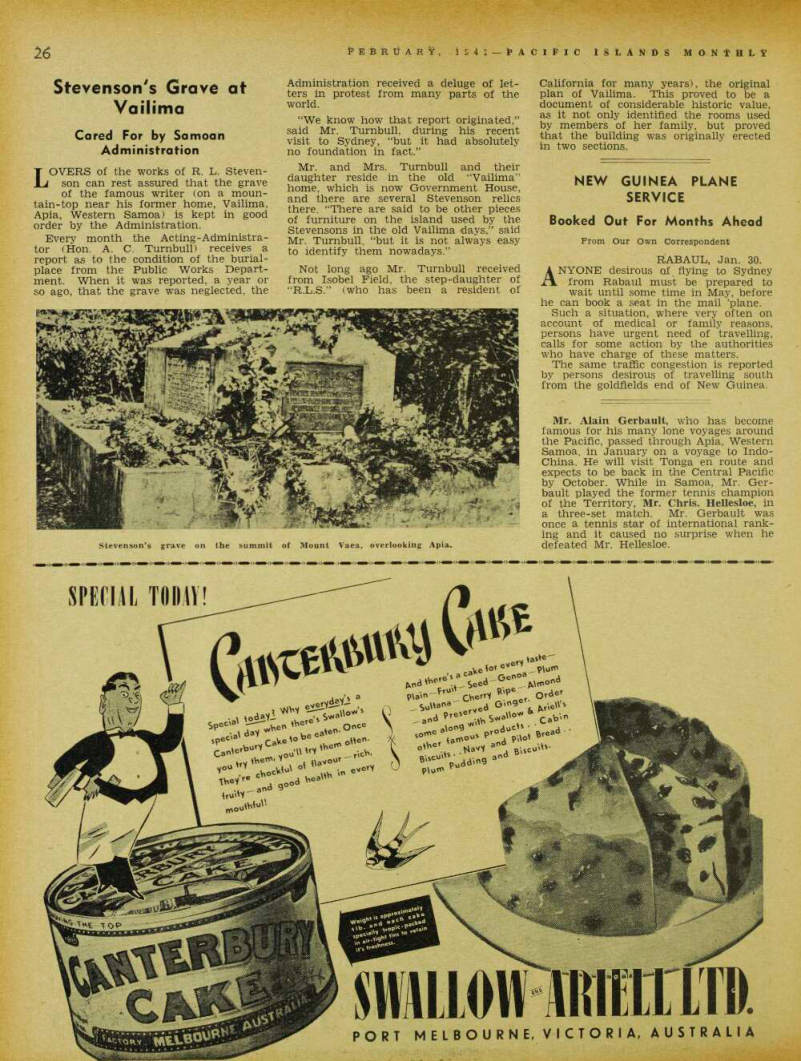
Voilima Cared For by Samoan Administration
LOVERS of the works of R. L. Steven son can rest assured that the grave of the famous writer (on a moun tain-top near his former home, Vailima, Apia, Western Samoa) is kept in good order by the Administration.
Every month the Acting-Administra tor (Hon. A. C. Turnbull) receives a report as to the condition of the burial place from the Public Works Depart ment. When it was reported, a year or so ago, that the grave was neglected, the
Administration received a deluge of let ters in protest from many parts of the world.
“We know how that report originated,” said Mr. Turnbull, during his recent visit to Sydney, “but it had absolutely no foundation in fact.”
Mr. and Mrs. Turnbull and their daughter reside in the old “Vailima” home, which is now Government House, and there are several Stevenson relics there. “There are said to be other pieces of furniture on the island used by the Stevensons in the old Vailima days,” said Mr. Turnbull, “but it is not always easy to identify them nowadays.”
Not long ago Mr. Turnbull received from Isobel Field, the step-daughter of “R.L.S.” (who has been a resident of
California for many years), the original plan of Vailima. This proved to be a document of considerable historic value, as it not only identified the rooms used by members of her family, but proved that the building was originally erected in two sections.
Stevenson’s grave on the summit of Mount Vaea, overlooking Apia.
New Guinea Plane
Service
Booked Out For Months Ahead
From Our Own Correspondent
Rabaul, Jan. 30.
ANYONE desirous of flying to Sydney from Rabaul must be prepared to wait until some time in May, before he can book a seat in the mail ’plane.
Such a situation, where very often on account of medical or family reasons, persons have urgent need of travelling, calls for some action by the authorities who have charge of these matters.
The same traffic congestion is reported by persons desirous of travelling south from the goldfields end of New Guinea.
Mr. Alain Gerbault, who has become famous for his many lone voyages around the Pacific, passed through Apia, Western Samoa, in January on a voyage to Indo china. He will visit Tonga en route and expects to be back in the Central Pacific by October. While in Samoa, Mr. Ger bault played the former tennis champion of the Territory, Mr. Chris. Hellesloe, in a three-set match. Mr. Gerbault was once a tennis star of international rank ing and it caused no surprise when he defeated Mr. Hellesloe.
Advertisements & other items, p. 28 (2 items)
26
February, is4i daciEic islands montaly
Today!
ttV
m 4 3 ' pe " a v.l-1 C‘>'' e '° be °" e "' Can ' e ' l m vou r icV>.
' . i\ a voUT '' OU e V,ocV(u> Hh i» W" C , -ood " ea '"' / BfS5 p OP P CL rv cd O'” an.«> -.«<» P ' e >° we ‘ ,Tn'° uS P '°l°P.'°' B,ea,J *«“''V u d*"9 -* plo^
PORT MELBOURNE, VICTORIA, AUSTRALIA
A Hair-Do In Fiji
By “Amel”
THERE’S no hanky-panky about the hair-dressing style of a Fijian woman.
She never raves because her back hair won’t stay put. She never moans because those adorable baby curls, on which she spent such a lot of time, came out in the wash. She fears no competition from her sister, her friends, or her copper coloured mamma.
Nobody tells her that her latest “hair do” makes her look a fright. She never has a latest hair-do. Year in, year out, her style never alters.
The ever-milling fashions of her white sisters leave her unmoved and slightly contemptuous. Her coiffure has been the same—a dense, fuzzy, wiry mop, neatly trimmed all over—for as long as she can remember.
Strangely enough, her hair is fine and silky when she is a baby. From then on, however, repeated clipping, goodly doses of tropical sunshine and frequent mas saging with coconut oil, coarsen it beyond recognition.
During the clipping process, a small area at the back of her head is left to grow. When she reaches young woman hood, this longer hair is made into a bunch of tiny plaits, which are unravelled and replaited at intervals in her life, until, on attaining marriageable age, she can dangle them over her shoulder. She is then considered a most eligible damsel.
Very soon, she wins a husband for her self, whereupon the plaits—symbol of single blessedness —are cut off.
After marriage, her hair still interests her —when she thinks of it—and once a week, she runs a ten-pronged wooden comb through it, while her girl-friends gather round to help her trap the live stock. Yes, indeed —and why not? What is a flea or so between friends?
No special night is shampoo night for a Fijian belle. As a matter of fact, she requires at least a whole day to do the job properly.
First, she must decide what “type” she will be —a ticklish problem, let me tell you. She has the choice of three shades.
She can buy some purple marking-dye at the local Chinese store, dip her head in a strong solution of it and cause a mild sensation in church on Sunday morning. She can be a red-head —Fijians are very fond of red hair —but it would mean a lot of fuss, burning lime and what not. And she really cannot afford threepence-worth of marking-dye for the purple hair-do.
So, on third thoughts, she decides to retain her own black locks, and hopes that her lord and master will love her just the same.
When she starts to shampoo her crowning glory, she dons the absolute minimum of old clothes, and finds plenty of elbow-room somewhere in the back yard. Then she empties the contents of the ash-bin into a dish of water, mixes it to a smooth paste, and pours it over her head.
Not content with having this nausea ting mess trickling down her neck, she strolls along to the nearest mangrove swamp and, scooping up a billyful of the blackest, smelliest, slimiest mud she can find, she smears it on top of the first mixture!
The resultant effect is guaranteed to keep the most loving husband at bay!
But, lo! When she has washed, combed, trimmed and oiled her raven tresses, a more elegant coiffure could not be imagined. Her white sisters may eye it curiously, and secretly pity its wearer for her lack of hair-style variety, but the
coiffure of a Fijian belle has three ex cellent virtues. It protects her from the hot sun; its thickness breaks the fall of any stray coconuts that may come her way, and —best of all, perhaps—its up keep costs practically nothing!
Morobe Gold
Prom Our Own Correspondent WAU, Jan. 24.
December, 1940, showed a gold output of 45,551 ounces, valued at £259,012 Australian, declared for export. The six months from July 1, therefore, pro duced gold worth £ A 1,585,518. Thus the £3,000,000 mark may be reached, if not passed, in the year 1940/1941.
Mr. N. Deck, of the South Sea Evan gelical Mission, Solomon Islands, is at present on furlough in Sydney.
Mr. A. C. Rapadzi, manager of the New Caledonian mining corporation, the Societe le Nickel, returned to Noumea by flying-boat in mid-January, after a visit to Australia.
Colonel J. E. Workman, Commissioner of Police in Fiji, arrived at Auckland, NZ, in January, on two months’ furlough.
He was accompanied by Mrs. Workman.
Rev. C. K. Crump and Mrs. Crump, of the NZ Presbyterian Mission in the New Hebrides, are at present spending leave in New Zealand.
Mrs. J. C. Barley, wife of the Resident Commissioner of the Gilbert and Ellice Islands Colony, paid a holiday visit to Melbourne late in January, after spend ing some time in Brisbane.
Mr. C. H. Luxmore, of Buka Passage, New Guinea, has returned to his home after spending a long holiday in Queens land.
Advertisements & other items, p. 29 (1 item)
Heinz
57 AIDS TO BETTER MENUS
TOMATO
KETCHUP
TOMATO ipVj
SAUCE
TOMATO KETCHUP— Made
from Sun-ripened Tomatoes.
Medium Bottles 8 ozs.
TOMATO SAUCE A Pure
Appetising Sauce.
Large Bottles .. 13 ozs.
OVEN-BAKED
BEANS
WITH PORK AND
TOMATO SAUCE.
ALSO VEGETARIAN
IndividuaJ Tins, 4 ozs.
Small Tins, 8 ozs.
Medium Tins, 16 ozs.
TOMATO JUICE
.4 delicious health-giving and appetising drink Small Tins, Boz.
Med. Tins, 16 oz.
No. 5 Tins, 60 oz.
SPAGHETTI
Cooked in Tomato Sauce with Cheese Individual Tins. 4 ozs.
Small Tins, 8 oz Med. Tins. 16 oz.
VEGETABLE
SALAD
Garden-fresh Vegetables with Mayonnaise. Small Ti ns, Boz.
HEINZ
FAMOUS IllilJUi PRODUCTS
MADE IN AUSTRALIA
HEINZ
W«lif uj—
KSil PERFECT
SOUPS
READY-TO-SERVE
In 8 oz. and 16 oz. Tins
CREAM OF TOMATO
CREAM OF ASPARAGUS
CREAM OF CELERY
CREAM OF CHICKEN
CREAM OF GREEN PEA
CREAM OF MUSHROOM
CREAM OF ONION
CREAM OF SPINACH
CREAM OF TOHEROA
BEAN SOUP with HAM
CHICKEN VEGETABLE
KIDNEY SOUP
MULLIGATAWNY
OXTAIL
VEGETABLE
GENUINE TURTLE SOUP
H. J. HEINZ CO. PTY. LTD.
Regd. Office: BENDIGO ST., RICHMOND E.l, VICTORIA
MACARONI
Cooked in Cream Sauce with Cheese.
Individual Tins, 4 ozs.
Small Tins, 8 ozs.
Medium Tins, 16 ozs.
g MAYONNAISE
Delightful on Salad.
Small Bottles, 4 ozs.
Med. Bottles, 7 ozs. 18 oz. Bottles 57 or. Bottles
BEEFSTEAK B
SAUCE S
Fruits, Vegetables (El and Spices, skilfully blended.
Medium Bottles, J 7J ozs.
STRAINED FOODS
For Infant Feeding and Special Diets.
Strained Carrots Strained Beets Strained Prunes Strained Green Beans Strained Vegetable Soup Strained Beef and Liver
SWEET GHERKINS
Small Bottles
SWEET MUSTARD
PICKLE
Small Bottles Heinz delicious varieties are available
from Storekeepers
throughout Papua , New Guinea and
Pacific Islands.
Time Marches On !
What it Does to Papuan Primitives
From Our Own Correspondent
Port Morpsrv Tnn On
Pori Muklbby, Jan. 20.
AFTER 50 years of careful administra tion, the Papuan native is beginning to show that he is prepared to take his place in the ranks of civilisation.
The more intelligent of these budding Australians find their diversion in forg ing cheques on forms privily removed from the cheque-books of their employ ers. It is true that, in this, they are more ambitious than successful: but, in the matter of gambling, they show dis tinct promise.
Wharf labourers already have made for themselves a reputation for modem ity. Few cases of beer are now landed
in the stores with their full complement of bottles, and the missing utensils are frequently found, either stowed away In some obscure corner of the cargo-shed, or playing the part of “dead marines”, with beer - fille d native labourers lying nearefullv hpsidp thpm P eacelull y testae tnem - Recently, police evidence disclosed that many broken cases of various goods in the of a vessel, where native wharf “ e Q r f s t d emntv botUes—the bottles were bottles were and some • hac J a beer left ln them and several full bottles were found hidden in various places. Native Api Evara was subsequently convicted and fined £2O, in default two months’ im prisonment. He was charged before the Resident Magistrate with being unlaw fully in possession of intoxicating liquor.
The Curse!

Last, Final Insult From the Tuamotus
THE Tamil speech of Southern India is reputed to possess a copious vocabulary of abusive and vituper ative words that far surpasses, in variety and splendour, the choicest treasure of other languages.
An expert can search out the victim’s ancestry, even to the most remote rami fications—tracing each line to some beast of the field or forest, and casting doubt on the legitimacy of each generation— until by one, thunderous, all-embracing word he brands the shivering wretch the descendant of gibbons and Barbary apes.
In this achievement, the Tamil has ante-dated our modern scientists by many centuries. But, unlike his European brother—who complaisantly endows scientists, that they may ransack the earth’s strata in quest of still more humble forebears—the Tamil is roused to fury, rivalling the raging hurricanes, and his vilifier is pleased.
So far as we know, no other language possesses a single term which can pro duce, so devastating emotions, except the Tuamotu dialect of the Polynesian This is most surprising, because the whole edifice of Polynesian vituperation is founded on but two corner-stones — pig and dog. There are never any ex peditions into ancestral by-ways.
Qualifying adjectives do, indeed, sharpen and envenom the arrows of abuse; but to none is given power (com parable with the awful Tamil word) to shake the very foundations of the human spirit, save only to the Tuamotu term “Naeke kurakura”.
Now, naeke kurakura translates into the relatively mild English “red dog”. Yet there abides within it some esoteric significance, obscured in the twilight of ancestral tradition, which mortally wounds the dignity of a Tuamotu Poly nesian.
An example came to our knowledge some time ago. A big, rotund native of one of the “emerald garlands flung on a sapphire sea” (who, under the tutelage of generations of buccaneers, short weight artists, usurers and traffickers in miscellaneous skulduggery, had become expert in “ways that are dark and tricks that are vain”) had applied his learning in the course of his dealings with a Papeete trader; and had been caught red-handed.
This trader is no amateur in the science of invective. Furthermore, he is deeply learned in the colloquial argots of Polynesian dialects. The occasion, he considered, called for the full exercise of his powers and, accordingly, he girded his loins to produce a master piece.
The trader achieved a really admirable anthology of opprobrium, gathering his materials from European as well as Polynesian sources. His audience listened attentively, with visible admiration, and applauded his fervid peroration with a broad grin.
For a moment the trader was stunned.
Then there flashed to his mind the memory of the ultimate Tuamotu insult.
He knew of its potency only by reputation.
It seemed a feeble thing, compared with the withering words he had already spoken. Still, it was the only weapon left in his arsenal.
“You are a naeke kurakura”, he shouted.
The effect was startling. The grin vanished. The native’s eyes lost their ex pression of admiring attention and be
came baleful, feral. His whole body trembled from the storm of anger and humiliation which raged within him.
The trader drew a deep sigh of relief.
His forlorn hope had brought him vic
tory.-
A.C.R.
Advertisements & other items, p. 30 (2 items)
28
February, ihi-pacific islands m6nt ft t t
kCOLD /i
BURNS PHILP
(SOUTH SEA) CO. LTD.
Inc. in Fiji Island Traders and Shipowners Registered Office ;
SUVA
FIJI
Also Branches at: Fiji: Levuka, Lautoka, Labasa, Ba, Sigatoka, Rotuma.
Tonga; Nukualofa, Haapai, Vavau.
Samoa: Apia, Pago Pago (American Samoa).
Solomons: Makambo, Gizo, Faisi.
New Hebrides: Vila.
Gilberts: Tarawa. 5 Norfolk Is. Niue. Wallis Is. Futuna Is.
CHI VERS
FAMOUS ENGLISH PRODUCTS
CANNED ENGLISH VEGETABLES
CANNED ENGLISH FRUITS
OLDE ENGLISH MARMALADE
GOLD MEDAL JAMS
JELLY CRYSTALS, ETC.
Obtainable from all leading Grocery Stores
WRITE TO DEPARTMENT “A”
CHSVERS & SONS LTD.
Histon, Combs., Eng.
FOR ATTRACTIVE RECIPE BOOK
CHIV£RS’i
kCOLD /i
FRESH /M
WjS&\ ENGLISH fjmt
PEAS
AMO
Samoans Anxious To Enlist
QUITE a number of Samoans have applied to the Administration of Western Samoa for permission to serve with the New Zealand forces in the present war.
“Of course, we could not accept their services, as this is a Mandated Territory under the League of Nations,” said the Acting-Administrator (Hon. A. C. Turn bull) during his visit to Sydney. “But we have appreciated the spirit of loyalty shown by these men.”
Mr. Turnbull added that the Samoans had responded most liberally to the Spit fire Fund in Apia, and to all other pat riotic appeals.
Introduced
New Guinea's New Rubber How Ficus Was Introduced
Letter to the Editor YOUR article, “Ficus Rubber”, in the November “PIM”, was read with interest.
While we here appreciate to the full the good work that Mr. Murray, our Director of Agriculture, has done in New Guinea, the person to whom credit must be given for the introduction of Ficus rubber to the Australian market (and, in fact, the re-start of rubber production in New Guinea), is Mr. Victor Maxwell.
When the full story of New Guinea’s present entry into the rubber market of Australia is known, it will be found most interesting. It will cover, first, Mr.
Maxwell’s fight with the Administration to obtain permission to take a party of New Guinea natives to Papua to teach them the process of rubber-tapping, etc.; and, after he had gained permission, the opposition he met from the Papuan rub ber planters, when he arrived there; and all that he accomplished in the short period he held his party in Papua.
The story would tell how, on his return, he took over a Para and Ficus rubber plantation in the Madang dis trict; his uphill fight, and the hard work he put in carrying out experiments with Ficus until he was able to get the rub ber manufacturers of Australia to accept it.
This story should be placed on record in the pioneering history of the various industries of New Guinea.
Mr. Maxwell was a Digger in the last war and he is again doing his bit as a S/Sgt. instructor in the Australian forces.
Mr. Maxwell’s system of treating Ficus rubber is the one being carried out in New Guinea to-day.
I am, etc.,
Bagiai.
New Guinea, 9/1/1941.
Advice has been received in Sydney of the birth of a daughter to the Bishop of Melanesia and Mrs. Baddeley, at Siota, Solomon Islands. The Bishop and his wife now have a son and daughter. Mrs.
Baddeley is a daughter of the Bishop of Adelaide.
Mr. Ernest McGeady, son of Mr. and Mrs. McGeady, of Suva, Fiji, has enlisted with the NZ Forces for overseas service.
He left the Colony at the age of 14 and, after education in the Dominion, entered into business there.
Advertisements & other items, pp. 31-32 (1 item)
Nestles, S-Milk
Nestle’s Sweetened Condensed Milk has been described as “Sealed Purity.” And so it is! Absolutely pure and germ free when it leaves Nestle’s Condenseries, it reaches you in the same perfect condition because it is sealed against all chance of contamination, whether from heat or any other cause. Nestle s Sweetened Condensed Milk remains pure and fresh indefinitely while unopened—it is the SAFE milk for use in a tropical climate.
COPYRIGHT 8225
Kork-N-Seal
FOR HOME USE
• Hand Applied
Airtight
Pressure Proof
FOR ALL HOME BOTTLING
—THE LITTLE CAP THAT
will Re-seal 1,000 Times Kork-N-Seal (Aust.) Pty. Ltd.
102-104 EDINBURGH RD„
MARRICKVILLE.
SYDNEY, AUSTRALIA.
4 /
V-ARI-CTICf
Australia’s Choicest Products: Green Pea* Beetroot French Bean* Spinach Cauliflower Cabbage Carrots Brussels Sprout* White Turnip* Sweet Coro Tomato Puree Parsnips Tomato Sauce Celery Tomato Soup Tutti Fruit Saoce (Worcestershire flavor) Always . . . make sure you have at hand an ample Reserve of these Delicious . srk m m 1
QardenVaJ,
m
Garden
* i
Vale
• IB m s£n Ready-toserve Vegetables
"George"
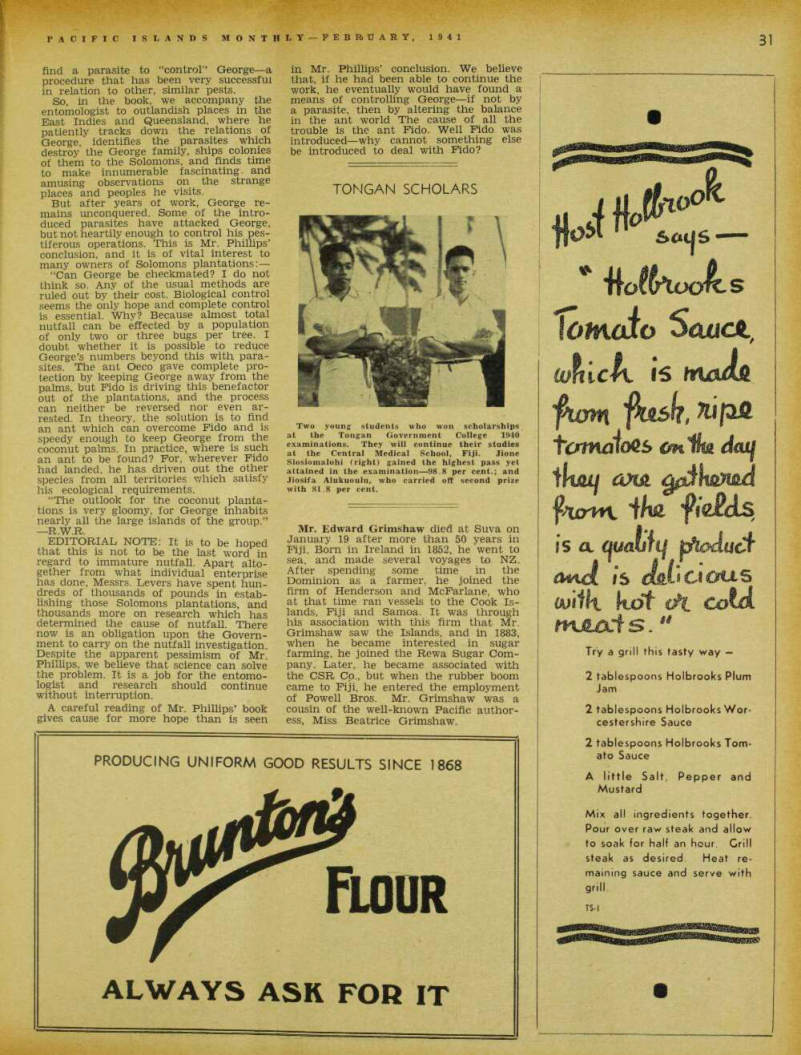
In Pursuit Of
Entomologist's Fascinating Story of His Study of "Nutfall" in Solomon Islands.
COCONUT QUEST: by J. S. Phillips.
Published by Jarrolds, London; distri buted by Hutchinson & Co., Box 99, Melbourne. Price, 16/- stg.
HAVE you ever met an entomologist with a rich sense of humour, an artist’s ability to paint travel pictures in words, and the unusual gift of investing a hunt for bugs and bug “controls” with all the excitement of a thriller? If not, meet Mr. Phillips.
The story of Mr. Phillips is of special interest to coconut planters, because he is the man who attacked the mystery of immature nutfall in the Solomons. But all men who like a first-class travel book, and a racy and accurate description of conditions in the Pacific Islands, are recommended to read “Coconut Quest”.
The real story commenced several years ago, when Solomon Islands coconut planters began to report excessive nut fall. Normally, about 60 per cent of the young nuts fall off the fruiting-branches of the palms. But, in the affected plan tations, 90 per cent, of young nuts fell; and this made the trees unprofitable.
No one knew why the nuts fell. For years, experts argued and fought about it. Scientists from Fiji said it was the work of an insect. Two insects were sus pect: 1, Axiagustus; 2, Amblypelta coco phaga. There were not many of No. 2
about, so the Fiji men declared No. 1 guilty. Years passed—and careful ex periments proved that No. 1 was innocent.
Immature nut-fall increased. More ex perts were consulted. They decided that the trouble was due to local conditions of soil, rainfall and cultivation. Again, argument was long and painful. Certain planters made their own tests. They en closed fruiting-branches in fine gauze.
Those branches bore the normal quantity of nuts, while practically all the exposed branches, right alongside, lost most of their young nuts. Clearly, nutfall was caused by something that could not get through the mesh.
Levers Pacific Plantations Ltd. (owning most of the best plantations in the Solo mons) had by now become weary of con tributing to the cost of apparently useless experiments, and they decided to spend their money, instead, in employing a special entomologist. Mr. J. S. Phillips was engaged in London, and he arrived in Tulagi about the time that local opinion had discarded all other theories and agreed that excessive nutfall was caused by a bug. But what bug?
Bug No. 1 had been proved innocent.
The only other bug, No. 2. was declared to be too infrequent to be guilty. But they shut him up, in a gauze enclosure, with young coconuts, on an uninfected plantation—and 90 per cent, of the nuts fell!
Mr. Phillips forthwith applied himself to the study of Amblypelta cocophaga, whom, for the sake of convenience, he called “George”. He discovered how George worked. He was not a numerous, but he was a very, very busy bug; and two or three of him in a palm-top could destroy nearly all young nuts. He sank his proboscis into the youngsters and (al though this is not yet proved) he dis charged into them a poison which was fatal. Investigation proved, beyond doubt, that George caused the spreading nutfall which threatened to ruin all the plan tations in Guadalcanal and Malaita.
But why had this happened? The scientist had a real puzzle here, George was indigenous—he had been in the Solomons for centuries. The coconut plantations had been there for fifty years. Why had George not attacked before?
Mr. Phillips tracked George to the deep jungle and the uncultivated places, and studied him there; and after patient search, and fitting clues together like a fiction detective, he got the answer. Ants!
He made friends with two kinds of ants, Pheidole oceanica and Oecophylla smaragdina (nitida), which he promptly christened Fido and Oeco. And this is what he found. Under ordinary con ditions, Oeco, an alert, long-legged, big and busy ant, living much in the palm tops, takes good care of George and slaughters him before he can bite many young coconuts. Oeco is indigenous, and a natural enemy of the bug, George.
Fido is not. He is a small, pugnacious ant, which evidently was introduced to the Solomons by Europeans, just as he was in Hawaii. And in the Solomons, as in Hawaii and elsewhere, he is steadily driving the native ants back into the uncultivated country. Fido flourishes on cultivated land, where he can travel about easily and that is why he has ex terminated Oeco only in the plantations; and that, in turn, is why George has been allowed to come in and destroy the young nuts. For Fido is useless as an enemy of George. The quick and lively Oeco can catch George; the smaller and slower Fido cannot.
What a head-ache for a bug-hunter!
Mr. Phillips obtained data from the British Museum and decided that it might be possible, by a study of George’s brothers in East Indies and Australia, to
find a parasite to “control” George—a procedure that has been very successful in relation to other, similar pests.
So. in the book, we accompany the entomologist to outlandish places in the East Indies and Queensland, where he patiently tracks down the relations of George, identifies the parasites which destroy the George family, ships colonies of them to the Solomons, and finds time to make innumerable fascinating, and amusing observations on the strange places and peoples he visits.
But after years of work, George re mains unconquered. Some of the intro duced parasites have attacked George, but not heartily enough to control his pes tiferous operations. This is Mr. Phillips’ conclusion, and it is of vital interest to many owners of Solomons plantations:— “Can George be checkmated? I do not think so. Any of the usual methods are ruled out by their cost. Biological control seems the only hope and complete control is essential. Why? Because almost total nutfall can be effected by a population of only two or three bugs per tree. I doubt whether it is possible to reduce George’s numbers beyond this with para sites. The ant Oeco gave complete pro tection by keeping George away from the palms, but Fido is driving this benefactor out of the plantations, and the process can neither be reversed nor even ar rested. In theory, the solution is to find an ant which can overcome Fido and is speedy enough to keep George from the coconut palms. In practice, where is such an ant to be found? For, wherever Fido had landed, he has driven out the other species from all territories which satisfy his ecological requirements.
“The outlook for the coconut planta tions is very gloomy, for George inhabits nearly all the large islands of the group.”
—R.W.R.
EDITORIAL NOTE: It is to be hoped that this is not to be the last word in regard to immature nutfall. Apart alto gether from what individual enterprise has done, Messrs. Levers have spent hun dreds of thousands of pounds in estab lishing those Solomons plantations, and thousands more on research which has determined the cause of nutfall. There now is an obligation upon the Govern ment to carry on the nutfall investigation.
Despite the apparent pessimism of Mr.
Phillips, we believe that science can solve the problem. It is a job for the entomo logist and research should continue without interruption.
A careful reading of Mr. Phillips’ book gives cause for more hope than is seen
in Mr. Phillips’ conclusion. We believe that, if he had been able to continue the work, he eventually would have found a means of controlling George—if not by a parasite, then by altering the balance in the ant world The cause of all the trouble is the ant Fido. Well Fido was introduced —why cannot something else be introduced to deal with Fido?
Tongan Scholars
Mr. Edward Grimshaw died at Suva on January 19 after more than 50 years in Fiji. Born in Ireland in 1852, he went to sea, and made several voyages to NZ.
After spending some time in the Dominion as a farmer, he joined the firm of Henderson and McFarlane, who at that time ran vessels to the Cook Is lands, Fiji and Samoa. It was through his association with this firm that Mr.
Grimshaw saw the Islands, and in 1883, when he became interested in sugar farming, he joined the Rewa Sugar Com pany. Later, he became associated with the CSR Co., but when the rubber boom came to Fiji, he entered the employment of Powell Bros. Mr. Grimshaw was a cousin of the well-known Pacific author ess, Miss Beatrice Grimshaw.
Two young students who won scholarships at the Tongan Government College 1940 examinations. They will continue their studies at the Central Medical School, Fiji. Jione Si0osiomalohi (right) gained the highest pass yet attained in the examination—98.8 per cent.; and Jiosifa Aiukuoulu, who carried off second prize with 81.8 per cent.
Advertisements & other items, p. 33 (1 item)
fum fkssk
fa *
lonwio Saact,
mfncA. is hfaJ
fum fkssk
tomatoes dmj
tka*/ a>o» gfdkumA
ftom i/ufieMs
is a. tfuatfijproduct
a*uJt is JpJ
(Af iiit kdt Cotd
mJLats. "
Try a grill this tasty way 2 tablespoons Holbrooks Plum Jam 2 tablespoons Holbrooks Worcestershire Sauce 2 tablespoons Holbrooks Tomato Sauce A little Salt, Pepper and Mustard Mix all ingredients together.
Pour over raw steak and allow to soak for half an hour Grill steak as desired Heat remaining sauce and serve with grill.
TS-I
PRODUCING UNIFORM GOOD RESULTS SINCE 1868
ALWAYS ASK FOR IT
How Kavieng Helped
Raider Victims
From a Special Correspondent
Rabaul, Jan. 10.
ON the arrival in an Australian port of the 496 survivors, who were landed on Squally Island (Emirau) from German raiders, no mention whatever was made of the clothing and comforts which were distributed to them by the Red Cross members in Rabaul.
Likewise, when they arrived in Rabaul, no mention was made of the initial assistance rendered to these survivors by
the people of Kavieng who, short of pro visions themselves, owing to the disrupted steamer schedule, despatched provisions, clothing and comforts to EmiraU—and these were among the first to reach the survivors.
One does not necessarily look for any special thanks for such acts Still it does not seem equitable that one section of people should reap all the honour and glory of giving help to war-sufferers, while others are ignored. Kavieng resi dents opened their purses and their wardrobes as liberally as any, and some record should be made of their stout action.
Tropical Cinderellas
How Australia's Pacific Territories Are Governed
rUS Mr. F. W. Eggleston (a well known Melbourne barrister) in an article in the December “Austral- Asiatic Bulletin”, entitled “Australia and the Territories”:— “It can hardly be suggested that con ditions in Canberra are satisfactory. The Territories Section is a section of the Prime Minister’s Department, invariably put in charge of an Assistant Minister who is looking for promotion. Whenever the vacancy occurs he is promoted, and there is a change . . . The worst feature of the system is the lack of interest and apparent sense of responsibility shown by members of the Federal Parliament in regard to New Guinea problems . . .
“It seems clear that the status of the Territorial Section should be elevated, and have a department head of profes sional standing, capable of advising the Government in the problems, economic, social, ethnological and educational, involved in the government of a tropical dependency.”
“I do not agree with this statement,” says a Papuan correspondent. “It would mean that some academic ass would strut about in Canberra throwing his weight around, while his decisions would torment us further.”
But there is much to be said for Mr.
Eggleston’s argument. It is a fact that, for long years, the affairs of Australia’s great tropical territories have been nobody’s business, and that there has been a complete absence of any nolicy that could be described as intelligent, constructive, far-sighted or continuing.
Colonial Office Man on Long Pacific Tour
Long Pacific Tour
ANEW departure on the part of the Colonial Office has been to send Mr. Trafford Smith, one of its young officials, on an official tour of almost all the British nossessions in the Pacific, on which he has been engaged for two years. Mr. Smith, who arrived in Syd ney late in December, and proceeded at once to Canberra, had just comnleted a visit to the Solomon and New Hebrides groups, and New Guinea.
Early in the year he will visit the Gil bert and Ellice groups, and eventually return to England via the United States.
Until Malcolm MacDonald’s retirement from the Secretaryship of the Dominions, Mr. Smith was his private secretary.
During the Coronation celebrations he had much to do with the official visitors from the Colonies, including Fiji.
Most of the two years spent in the Pacific has been occupied by a study of Fijian problems. While in Suva Mr.
Smith had an opportunity of flying to Tonga, where he saw the Governmental authorities. He was in the party that travelled in the New Zealand flying-boat “Aotearoa”, which gave expert advice on aeronautical affairs to the Tongan Gov ernment.
While in Sydney, Mr. and Mrs. Traf ford Smith renewed acquaintance with Prince Tuboutoa, of Tonga, in whose company they had dined at Govern ment House in Suva.
Dr. T. C. Backhouse, formerly of New Guinea, is now a major in the medical section of the Australian Military Forces.
Advertisements & other items, p. 34 (1 item)
Prescott Pty. Ltd.
SUSSEX ST., SYDNEY,
are sole wholesale agents for
PINEAPPLE BACON&HAMS
DAISY brand BUTTER "375" BUTTER in TINS llb.-21b.-slb. Sizes.
LEA & PERRINS’ Sauces and Most other Super-Quality Lines of the Trade, such as Cheese, Eggs. Etc.
We ore Specialists . . . .
X ’Phones: MA 8612 (4 lines).
Cable Address: “Weymarkson.”
Codes—Bentleys Private.
Let us have your confidence. Sixty years is our record of supplying the leading Houses throughout the World in - - - -
FRESH FRUIT VEGETABLES PRODUCE
WEYMARK & SON LTD.
FRUIT AND PRODUCE MERCHANTS
14-18 STEAMMILL STREET - - - SYDNEY
“ANCHOR FLOUR”
THE STANDARD OF QUALITY
■ il
GILLESPIE BROS. PTY. LTD.
SYDNEY - AUSTRALIA
A Land Of No
Pests
WHEN the sun goes down over Tahiti and we light the reading lamp on our verandah, many visitors from another world come to keep us company.
Sometimes they are twinkling frag ments of exquisite colours that seem to be petals of flowers, borne by the night breeze from some lovely garden. At another season, it will be a numerous company, fluttering on iridescent wings a dance of the faeries about our light or, in their place, a band of tiny maenads swirling around the flame in delirious frenzy.
Occasionally, a lone wanderer—a honey bee from our neighbour’s apiary, over taken by nightfall whilst on an expedi tion to some distant garden of blossoms, comes to beg sanctuary until the mor row’s sun shall light him on his way.
Unfortunately, all our visitors do not come from the Fairy Court of la Nouvelle Cythere. Ferocious armoured harriers, bristling with “jaws that bite and claws that snatch”, ascend from some Teutonic Nibelheim to worry and sting and finally put us to flight.
Happily, these forays are not continu ous. Indeed, the people of French Oceania are particularly fortunate—as compared with the inhabitants of other tropical countries—in the almost total absence on these islands of poisonous and disease-carrying insects.
Scorpions are so rare that one may live in the islands for years without see ing one. The centipedes are small, their bite not dangerous, and domestic fowl devour any that venture into the neigh bourhood of dwellings.
There are no malaria-carrying mos ouitoes. Saint Patrick, on his way to Paradise, paused at Tahiti long enough to drive all the serpents into the sea: turning them into eels, so that they could never again invade the dry land.
Consequently, unshod natives and tourists in shorts can travel anywhere on the island, free from any fear of lurk ing monsters or flying disease-carriers.
A.C.R.
Ice-Cream From Coconut
THE following is from an English trade journal:— Evidence of the many uses to which desiccated coconut may be put is con tained in the annual renort of the Direc tor of Commerce and Industries in Cey lon. The offer of a silver cup at a Desic cated Coconut Culinary Competition produced such an interesting array of entries that over 10,000 people visited the exhibition. Curries, dry eatables, betel mixtures, chutneys, sweets, Western cakes and Eastern delicacies were among the things submitted, and one competi tor sent in ice-cream made with milk squeezed from desiccated coconut Attempts to enlarge the island’s trade in desiccated coconut in India have been largely frustrated by the problem of find ing' containers to meet the exacting demands of the Indian climate. Packing in tins both locally and in England, and in cellulose packets, has Droved unsatis factory. The solution of this nroblem, upon which depends Ceylon’s ability to grasp and maintain vast markets in the interior of India, is still the subject of experiment.
Mr. O. Savage, Mangaia (Cook Islands) manager for A. B. Donald Ltd., left for furlough in New Zealand in January.
Boneyard
"Papuan Chief" Arrives in Boneyard
From Our Own Correspondent
Port Moresby. Jan. 20.
STEAMSHIPS Trading Co. received advice early in January that the old steamer, “Papuan Chief”, form erly owned by them and recently sold to a Japanese firm, arrived safely at Yokohama on January 7. The vessel left Port Moresby with a Japanese crew on November 12.
Advertisements & other items, p. 35 (1 item)
CLmo4±s
PURE RICE
STARCH
Always ask for . . .
CORAL BRAND
100% PURE
Noted for Its
QUALITY
and
WHITENESS.
Goes Farthest and gives Lasting Finish
WILL NOT
STICK TO
IRON.
Obtainable from Leading Island Stores.
Manufactured by
AUSTRALIAN RICE, LTD.,
Sydney, N.S.W. —
1 CORAL BRAND
RICE STARCH
THE SOLOMONS
Tis not orchids on high Tetipari that grow, Nor the sea through the palms, Nor Gavutu’s bold zinnias that dazzle and glow, Nor Soraken’s charms, But friendship extended in far distant places As lamps in the night, The clasp of a hand and welcoming faces That are their delight. —Freda Mac Donnell.
THEY KEEP YOU FIT
AND KEEP YOU SLIM
The whole grain of rich, sun-ripened wheat, transformed, after careful selection, into a perfect health food, delicious for breakfast, for afternoon tea or supper.
Arnott's Famous Shredded Wheatmeal Biscuits are rich in precious vitamins and proteins, and very easily digested. ... Try them with butter, cheese, jam or honey.
CLmo4±s
FAMOUS
SHREDDED
WHEATMEAL
BISCUITS
ALWAYS ASK YOUR GROCER FOR ARNOTT'S !
a Polynesian
Tangata Dies
The Colourful Career of a Polynesian
From Our Own Correspondent
Rarotonga, Jan. 10.
A REMARKABLE life for any man, much less a simple native of the South Seas, ended tragically in Rarotonga recently. Te Tangata Kere kere, a native of Atiu, had a chequered career in the Cook Islands, Tahiti and America, and was deported from nearly every country he visited.
Born in Atiu, he went at an early age to Tahiti, where he learned to play a dashing guitar and to sing the racy native “ute” (songs in a high voice, peculiar to this part of Polynesia). Even at this early age, he was considered abnormal, a long, swaggering, swarthy Don Juan, always out for a fight or to attract attention.
About 1930, Tangata caught the fancy of a Spanish-American visitor to Tahiti, who took him back to the United States, and thence on to Mexico. The swagger ing Polynesian, who could play the guitar and who sang at the least encour agement, was a great hit there, and he stayed several months, receiving in exchange for his artistic efforts an ele mentary education in the use of the knife.
One night, while staying at a small hotel, Tangata was smitten with home sickness. He took a suitcase of his bene factor, containing a suit of clothes and some important papers, and fled across the border to San Francisco. Being then without any means of support, in the depth of the depression, he was deported by the authorities to Tahiti.
In Tahiti he was now a much-travel led man and, after spending a short time learning to be a boxer, he spent four years raising many sorts of trouble —until at last, in 1936, after some ugly rumours concerning the death of a Chinaman, he was again deported, this time to Rarotonga.
A few months of brawling and gaol soon earned him a free ticket to his home island of Atiu, where it was thought he might calm down. Within a few days, he was imprisoned in Atiu for wife-beating and fighting, and even tually he was returned to Rarotonga as a hopeless case. After another few months of gaol, he was freed, and settled down to a comparatively peaceful life as a shoemaker. He was married to Vic toria, a pretty native girl, of Mangaia.
Last August, however, he was again prosecuted for galloping a horse through the main settlement of Avarua. Another prison term ensued and, during this, he was taunted by his fellow-prisoners con cerning his wife’s infidelity. Becoming at last desperate, he managed to borrow money to pay the rest of his fine, and hurried back to his home in the village of Parekura, a colony of natives of Manihiki and other outer islands.
On arriving home, Tangata was coldly received by Victoria, who had apparently grown tired of him, and he left her. A period of pathetic serenading with the guitar followed, the woman refusing to listen to his plaintive love songs, until at last, on December 4, she told him in plain language that she was finished with him and added insult to injury by addressing him by his last name of Kerekere (a dark-skinned man, consid ered an insult amongst the light-brown Polynesians).
Infuriated, the man took his leather cutting knife from his belt, made a rush
at Victoria and stabbed her several times in the breast and neck. Victoria’s elder sister, who was in the native house, ran to the rescue, and also received severe stabs, although she succeeded in landing a blow with a reap-hook in the pit of his back.
A nearby youth, Koteka, rushed to the scene of the screams, but was caught in the arm by the knife of the now insane Tangata, who then ran to the bush, about 200 yards distant, and disappeared.
A search was immediately instituted by the police, helped by the Union Steam Ship Company labour gang, but with no result. Rumours, all unreliable, came in from all parts of the island that he had been sighted; many of the natives living in the remote valleys came into the settlement, as Tangata was obviously by now desperate.
At last, on the afternoon of December 10, the unfortunate man was found, hung, on a small hill behind Avarua, called Tua Kata. He had used the bark of the “au” tree for his suicide. Appar ently he killed himself on the same day as he ran amok, probably on account of the pain of his wound and the Poly nesian fear of “tupapaku” (evil spirits of the night).
Such instances of homicide are most rare amongst these islanders. All those wounded were taken to hospital, and have recovered.
Monsieur Oscar Meyer, the French anthropologist, who worked in Tahiti, Marquesas, and in New Guinea, is now with the French forces in Indo-China.
In a recent letter, M. Meyer states that he was actually on a New Caledonia-bound vessel for six hours, and was then, with other soldiers, ordered off by the authori ties. He hopes to return to Australia when permission can be obtained.
Advertisements & other items, p. 36 (1 item)
ojf tin. ruqhi'!
wz-
Aurtlt
mmt y v 500 K
CANDLE
POWER
300 *(**
CANDLE
POWER
BRIGHTER LIGHT
for
BETTER SIGHT
Coleman Products can be obtained from all Leading Firms throughout the Pacific Islands.
Coleman Mantles supply Sun-like light.
Instant Lighting Stoves & Irons giving maximum of heat in minimum of time
EASE OF OPERATION
combines
ECONOMY with COMFORT
In case of difficulty in obtaining supplies write to: — Pearce & Co., Suva, Fiji Is.
Shelling
How Nauru Took the Shelling
From a Special Correspondent
Nauru, Jan. 20.
DECEMBER, 1940, will be remembered as the blackest month in the re corded history of Nauru.
It started badly, and it finished worse.
During the second week-end (Sunday, Bth) the island was visited by a mysterious ship, flying Japanese colours.
On the Saturday afternoon, the vessel circled the island, passing quite close to the reef.
In the early hours of Sunday morning a ship was seen to be on fire, and it gradually drifted over the horizon. Sub sequently, it was learned that the pas sengers were safe; but they were gruelling hours for those watching from the shore, who knew there had been friends or relations on board, and did not know their fate. As other ships failed to report during the day, it was suspected, and afterwards confirmed, that several ships had been destroyed.
This same week-end saw the com mencement of a furious westerly which, lasting a week, was the worst anyone had ever experienced at Nauru. Coconut trees fell like a pack of cards—one falling and striking another, and so bringing down many others. There were narrow escapes from injuries. Trees fell across native houses. The boat harbour was damaged, and the moorings suffered from the storm.
People were recovering from this on slaught of the elements and had enjoyed a less exuberant Christmas than usual, when on the morning of the 27th. a German raider visited and heavily shelled the island.
The Administration evidently was sus picious the previous evening as there had been a complete black-out. Then, at day break on the 27th, a searchlight began to flash, calling-up the island. A message was received, advising the Adminis tration that if it refrained from using the wireless, there would be no indis criminate shelling.
The captain of the raider gave warning so that we might evacuate the settlement, and his first bursts were either blanks, or the shells went along the reef into the sea. Actually, the noise from these was the first indication most people had of the raider's arrival. And by then he was just about in their back-door!
Enormous damage was done by shell fire to the industrial plant on Nauru, but there was no loss of life.
There was no panic. The women and children were extraordinarily calm during the shelling. The morale was splendid; Nauru can take it!
Through the visitation of the raider, the production of a three-act farce, “Facing the Music”, was postponed, but on January 8, Mr. Fred. Harmer pro duced it and took the lead. To put on this show at the end of such a disturbing month was a splendid effort and the residents were grateful to Mr. Harmer, the cast, and all assistants for an event which helped them forget their anxieties.
The proceeds, £2O, went to the Nauru war funds.
Ocean Island Takes
Precautions
After hearing of the shelling of Nauru, prompt action was taken at Ocean Island.
The women and children were evacuated from the settlement near the industrial plant and, had any raider arrived, they would have been safe. It was believed that a raider was in the vicinity. By Monday, December 30, everything was back to normal again. This event has given the residents some idea of what
they will do, and where they will go if at any future time, they have less warn ing of a raider’s visit. Meanwhile, they remain on the alert.
Cured By Fear
When the raider shelled Nauru, a car called at the native hospital to take sick patients away to a less vulnerable spot.
There was an old native who had been on his back for six months, and who cal culated he would be there for another six months. However, when the driver inquired for him he was told that the patient had left the hospital on foot, and was still running.
Death Of William Harris
The death of William Harris, a well known figure in Nauru for many years, was caused indirectly by the shelling.
While running from the danger zone he strained his heart. He was buried on January 5. He was the official Govern ment interpreter and an instructor in Moure School, where he taught the Nauruan boys boat-building. He leaves behind a big family of boys and one girl.
Mr. E. Kenyon, well-known represen tative of “Berger’s Paints”, paid a visit to Suva, Fiji, in January.
Advertisements & other items, p. 37 (1 item)
Wunderlich
Timber, Joinery
ETC.
PREPARED BUILDINGS ready for erection a specialty.
SHIP AND BOAT BUILDING.
TIMBERS specially catered for.
FEBROLITE, PLYWOODS.
GALVANISED IRON.
CONSIGNMENTS shipped
by RETURN STEAMERS
to the Islands.
John W. Eaton
PTY. LTD.
WEST CRESCENT STREET,
NORTH SYDNEY.
Telephones: XB 4051 (6 lines.)
BITUMENOID ROOFING
MADE IN AUSTRALIA.
Bltumenold Roofings, Dampcourse and Insulating Felts are made from the world’s best raw materials. Warranted to stand the most rigid tests.
BITUMENOID THE BEST
Roofing, 1,2, 3-ply; Flooring, Waterproof Materials; Saturated Felt; Resilient Road Jointing; Natural Asphalt Dampcourse: 2 and 3-ply Dampcourse; 1-2 lb. Lead-core Dampcourse; Roofing Cement; Asphalt Paints; Roofing Compound.
SAMPLES AND PRICE LISTS ON APPLICATION.
MAXWELL PORTER & SON LTD.
ESTABLISHED 1888. BUILDERS’ SUPPLIES.
107 REDFEEN ST., REDFERN, SYDNEY, N.S.W. Phone: M 3157. Cables Bltumenold.
£ 0 rr i A Durabestos Home built from a design in our Free booklet.
Note: In the Islands, Corrugated Durabestos would ensure a weather-tight roof.
WUNDERLICH LIMITED, (Estd. 52 Years), REDFERN, SYDNEY
WUNDERLICH
DVRABESTOS
ASBESTOS CEMENT BUIIDINB SHEETS
Tuboutoa
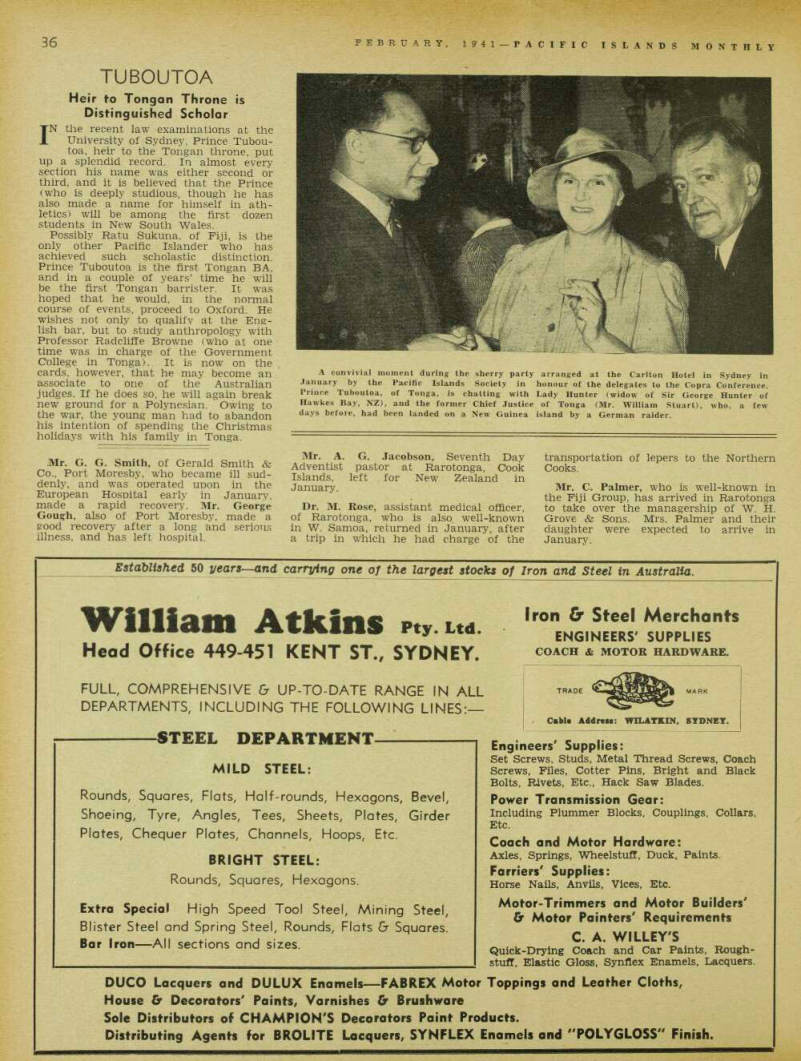
Heir to Tongan Throne is Distinguished Scholar
IN the recent law examinations at the University of Sydney, Prince Tubou toa, heir to the Tongan throne, put up a splendid record. In almost every section his name was either second or third, and it is believed that the Prince (who is deeply studious, though he has also made a name for himself in ath letics) will be among the first dozen students in New South Wales.
Possibly Ratu Sukuna, of Fiji, is the only other Pacific Islander who has achieved such scholastic distinction.
Prince Tuboutoa is the first Tongan BA, and in a couple of years’ time he will be the first Tongan barrister. It was hoped that he would, in the normal course of events, proceed to Oxford. He wishes not only to qualify at the Eng lish bar, but to study anthropology with Professor Radcliffe Browne (who at one time was in charge of the Government College in Tonga). It is now on the cards, however, that he may become an associate to one of the Australian judges. If he does so, he will again break new ground for a Polynesian. Owing to the war, the young man had to abandon his intention of spending the Christmas holidays with his family in Tonga.
Mr. G. G. Smith, of Gerald Smith & Co.. Port Moresby, who became ill sud denly, and was operated upon in the European Hospital early in January, made a rapid recovery. Mr. George Gough, also of Port Moresby, made a good recovery after a long and serious illness, and has left hospital.
Mr. A. G. Jacobson, Seventh Day Adventist pastor at Rarotonga, Cook Islands, left for New Zealand in January.
Dr. M. Rose, assistant medical officer, of Rarotonga, who is also well-known in W. Samoa, returned in January, after a trip in which he had charge of the
transportation of lepers to the Northern Cooks.
Mr. C. Palmer, who is well-known in the Fiji Group, has arrived in Rarotonga to take over the managership of W. H.
Grove & Sons. Mrs. Palmer and their daughter were expected to arrive in January.
A convivial moment during: the sherry party arranged at the Carlton Hotel in Sydney in January by the Pacific Islands Society in honour of the delegates to the Copra Conference.
Prince Tuboutoa, of Tonga, is chatting with Lady Hunter (widow of Sir George Hunter of Hawkes Bay, NZ), and the former Chief Justice of Tonga (Mr. William Stuart), who. a few days before, had been landed on a New Guinea island by a German raider.
Advertisements & other items, p. 38 (1 item)
William Atkins Pty. Ltd.
Established 50 years—and carrying one of the largest stocks of Iron and Steel in Australia.
Head Office 449-451 KENT ST., SYDNEY.
FULL, COMPREHENSIVE & UP-TO-DATE RANGE IN ALL
DEPARTMENTS, INCLUDING THE FOLLOWING LINES:—
Iron & Steel Merchants
ENGINEERS' SUPPLIES
COACH & MOTOR HARDWARE.
STEEL DEPARTMENT
MILD STEEL:
Rounds, Squares, Flats, Half-rounds, Hexagons, Bevel, Shoeing, Tyre, Angles, Tees, Sheets, Plates, Girder Plates, Chequer Plates, Channels, Hoops, Etc.
BRIGHT STEEL:
Rounds, Squares, Hexagons.
Extra Special High Speed Tool Steel, Mining Steel, Blister Steel and Spring Steel, Rounds, Flats Gr Squares.
Bar Iron— All sections and sizes.
Cftbl* Address: WILATXIN, SYDNEY.
Engineers' Supplies: Set Screws, Studs, Metal Thread Screws, Coach Screws, Files, Cotter Pins, Bright and Black Bolts, Rivets, Etc., Hack Saw Blades.
Power Transmission Gear: Including Plummer Blocks, Couplings, Collars, Etc.
Coach and Motor Hardware: Axles, Springs, Wheelstufl, Duck, Paints.
Farriers' Supplies: Horse Nails, Anvils, Vices, Etc.
Motor-Trimmers and Motor Builders' & Motor Painters' Requirements
C. A. WILLEY'S
Quick-Drying Coach and Car Paints, Roughstuff, Elastic Gloss, Synllex Enamels, Lacquers.
DUCO Lacquers and DULUX Enamels—FABREX Motor Toppings and Leather Cloths, House & Decorators' Paints, Varnishes fir Brushware Sole Distributors of CHAMPION'S Decorators Paint Products.
Distributing Agents for BROLITE Lacquers, SYNFLEX Enamels and "POLYGLOSS" Finish.
More Light on the Rossel Island Horror
Eating A Chinaman A Day
of the most horrible tragedies in the history of the Pacific Islands occurred in 1858, when a French ship, carrying 317 Chinese coolies from China to the new Australian goldfields, was wrecked on Rossel Island, Eastern Papua.
The Chinese were captured by the natives, kept prisoners, and eaten at the rate of two or three per day.
Details of this incident were unknown until recently. In October, we published an article, which was a translation by Mrs. Mollie Lett (Port Moresby) of a section of an old French book she had found. In this, the story was told from the point of view of the French officers who had had charge of the vessel in question—the three-masted sailing-ship, “Saint Paul”.
Through the kindness of Mr. G. B.
Sheldon, of Dobo, Aroe Islands, Nether lands Indies, we now have some further details of the grisly affair. Mr. Sheldon has sent the following extract from the diary of the late Frank L. Jar dine, of Somerset, Cape York, North Queensland: IN 1864, Captain Charles Edwards, of the three-masted schooner, “Blue Belle”, rescued the last of the sur vivors (three of them) from Rossel Island. One died on the passage, and the other two were handed over to Mr.
John Jardine, the first Government Resi dent at Somerset.
The men, Chinese, could speak but little English. However, an interpreter explained that when the “St. Paul” struck, and it became evident there was, owing to the heavy seas breaking over her, no hope of getting her off, the Euro pean officers and crew of the ship ordered and forced the Chinese below, and battened them down, to prevent them rushing the boats when leaving the ship.
On the next day, some canoes landed on the lee side of the reef and, at low water, were able to stand in the water, waist deep, alongside the ship. The natives ferried the Chinese in then canoes to a small island, close to a larger one, where the natives’ village was. But the island on which the Chinese were landed was uninhabited, and represented as being barren and waterless.
The natives brought the Chinese food and water almost daily, consisting of fish, including sharks, turtles, and some tubers resembling potatoes. The natives were kind to the Chinese, and made signs that a ship was coming for them.
The Chinese, getting tired of this waiting, one day tried to get into the canoes. But the natives kept them off, taking seven men, and explaining by signs that they would return to-morrow.
This they did, and took away another four.
This daily action continued for some time. The Chinese, becoming suspicious, tried to force their way into the canoes.
This the natives resisted, and a fight ensued, in which 11 of the Chinese were killed, and many wounded by spears.
Two days elapsed before the canoes returned. The natives, as usual, brought food, but the Chinese were afraid to meet their captors and receive this food The natives chased them, killing three, and also taking away three bodies of those who had died of wounds received in the first fight.
After this, the natives brought food and left it in a certain spot, and then hunted the Chinamen, killing and taking away their daily supply of meat.
In May, 1911, Sir William McGregor, who at that time was Governor of Queensland, was making a trip in North ern Queensland: and, during this trip, he paid a visit to Rossel Island. Sir William’s version of this 47-years-old disaster, is that the natives fed the Chinese, and treated them kindly, until taken away by a passing ship, and that the killing and eating story was but fabrication.
The niggers themselves were Sir Wil liam’s informants, and he believes them.
The Chinese were mine, and I believe them. That’s all—only a matter of opinion on hearsay.
The detailed story, as told by the Frenchmen in the old book (see October
“ PIM”), fits in with, and appears to con firm, the story as related by Mr. Jar dine. It is unlikely that Mr. Jardine ever saw the French book.
Rev. Walter George Ivens, Litt.D., died in England recently. He was a priest in Melanesia for 40 years and, during a long term of distinguished missionary service, he became an outstanding authority on the peoples and languages of Melanesia. He was the author of two books which dealt mainly with the part of the Pacific he knew best—the Solomons.
Mr. J. Cox, who was well known as chief engineer in the W. R. Carpenter inter-island steamship service in New Guinea, has been called up for active service, and he and Mrs. Cox left the Territory early in January.
Advertisements & other items, p. 39 (1 item)
and I use
‘i {•
Im a
DISTRIBUTORS: Greenwood & Laws, Ltd., Rabaul and Wan; Steamships Trading Co., Ltd., Port Moresby and Samarai; Millers, Ltd., Suva, Fiji.
“8.A.L.M.” PAINT
FOR A BETTER
JOB. Long experience has shown practical men the wisdom of relying
on QUALITY
paint —“B.A.L.M.”
Paint for lasting satisfaction, protection and decoration. For safety’s sake, next time, use “8.A.L.M.”
the PRE-TESTED
paint! ■y A Product of British Australian Lead Manufacturers Pty., Ltd., makers of “Dulux” Finishes.
Ms Do You Know that the Famous
YOUNGER
STOVES and
RANGES
made with extended Firebox specially for long Wood fuel, are Self-Setting and, provided sufficient Flue Piping is attached, can be used in almost any position?
The No. 7W “Younger” Ranger can now “ be supplied fitted with Legs, as per Illustration.
Younger Stoves Ask for quotation for this Range, also illustrated Catalogue Throughout U thc and Price List for both Single and Double Oven Stoves. Pacific islands.
G. FLETCHER & SON 50 Oxford Street, Sydney.
Rabaul's Worst Earthquake
Exaggerated Radio Reports Cause Irritation in New Guinea
From Our Own Correspondent
sion upon a resident of Rabaul. In fact, we rather pride ourselves on our sangfroid where seismic activity is con cerned, Rllf , . nnn
t at^ 2,2 u
themselves^hm^Hedlv l
an ?L ha ? a earthquakei m hv- JJJf toe Hill T£ e Man W o V,«v, lo ?t?- S aft€r s f ls " nf cf™ ? eglst ; ered a fhnt? InrTnn^h^A 81 Forel scale—and nnwfnp enough to a ma J or calamity 0 anyone.
Fortunately for Rabaul, the epicentre was some distance away—it was reck oned as 20 to 30 miles distant, Later in the day, it was discovered that the greatest damage had been done out along the North Coast Road and in the vicinity of the Government Experi mental Station at Keravat, with the neighbouring plantations of Tavilo, Rau
lawat and Kabaira all in the picture so far as material damage was concerned.
Fissures which opened up in the Methodist Mission property at Vuna kambi were 40 feet deep, and chains long; native houses had crumpled, up like cards; the mission hospital wa's a wreck, and much damage was done to medical supplies. Sister Beale, who awoke out of a dream in which her ship was being torpedoed, suddenly found that a water-tank near her bedroom window had sprung a leak; but, nothing daunted, she made her way (at times on hands and knees) to the door, and hurriedly went to the houses of her native charges—the ground meanwhile rising and swelling and, at times, open ing up in large fissures.
Houses at all surrounding plantations were tossed from their piles, and the amount of crockery damaged is tremen dous.
Roadways in this area, and continuing on up to the Toma highlands, have fallen in, and in one or two places whole hill sides have tumbled down. At one place, the natives reported that there had been a great subsidence, and a lake had formed; on closer inspection, however, it was found that, owing to a large land slide, the river had become blocked and a lake formed.
Out at the Baining, a 100-ton rock came careering down the mountainside, and lodged in the middle of a road; and natives from the Massawa (Baining) dis trict had fears of a subsidence, many of them fleeing to the upper heights.
Copra kilns and houses, both European and native, were severely damaged in the Baining area.
The shock was severely felt at Pondo, over on the west coast of the Gazelle Peninsula. In central New Britain, around Gasmata, the shock was not so severe. New Ireland, Manus and Madang scarcely had any indication of it. Sala maua and Wau experienced merely a small tremor.
The vulcanological observatory recorded that most of the earlier shocks were tec tonic, and therefore not of local vol canic origin; all of which was pleasing for the Rabaul people, who, incidentally, now seem to conneqt everything seismic with Matupi and Vulcan volcanoes, and what happened to them in May, 1937.
Detailed reports show no loss of life, except a small native baby.
The estimated cost of replacement of the buildings damaged is, roughly, £20,000.
During the past week the authorities have issued a daily bulletin, based on the observations made by the local vul canologist, and these have been posted in conspicuous places and have been instrumental in allaying many of the fears which naturally arise at such a time. It was found that the majority of the tremors recorded were not of local origin. Also, it must be remembered that the seismograph is a most delicate instrument, recording many more tremors than are felt by human beings.
Rabaul residents, and others in the outlying district of the Gazelle Penin sula, were just settling down to the idea that all was over, and that it was just one more quria (native name for earth quake) to add to the list, when, from over the air in Sydney, came a state ment attributed to Dr. W. G. Woolnough
(Geological Adviser to the Common wealth, who has recently retired and who, in company with Dr. Stehn, made a geological survey of Rabaul shortly after the eruption in 1937). By the time the broadcast report had passed from one mouth to another, the statements were most alarming: Rabaul was about to be wiped off the face of the earth by the biggest ’quake ever; far greater than that of Krakatau in 1883.
With that thought in their minds, local residents wondered just what the posi tion was—especially in view of the fairly reassuring reports coming from the local observatory. Apparently it was not so much what the learned geologist said, as what people said he said—and the little bit more tacked on to it for luck.
Another instance of alarming reports was illustrated on January 24, when the announcer from VLQ7, on the 6.30 a.m. session, gave it out that the intensity and frequency of the tremors were “increasing”. The actual message which was transmitted from here by the press correspondent was that they were “decreasing”. I know, because I was the correspondent.
Statements of this kind may make sen sational reading for a disinterested pub lic in Australia, but they are not good for Australians who have relations and friends here.
Incidentally, our women-folk here have quite enough to put up with, without false statements like these coming over the air. It makes one wonder how much of truth is in the news distributed from some of our broadcasting stations.
Advertisements & other items, p. 40 (2 items)
38
FEBRUARY, IMI- PACIFIC ISLANDS MONIBLt
Cordage and
TAKE THE
“LEAD” FEELING
OUT OF YOUR LEGS
Get More Oxygen in Your Blood and Get the Pep that Sends You Bounding Up the Stairs.
You are slowly smothering if your blood is lacking in enough red cells and the rich red colouring matter they contain, called hemoglobin. It’s the hemoglobin which picks up the life-giving oxygen from your lungs and carries it to every part of your body. Without enough hemoglobin, your body is being oxygen-starved. Your organs, glands and tissues slow down . . . you feel tired, pepless, depressed . . . your nerves often become jittery—you get easily upset.
What you need is Dr. Williams’ Pink Pills. These world-famous pills help rebuild your hemoglobin which makes your blood rich and red and so aids your system in getting the vitalising oxygen it needs. Get Dr. Williams’ Pink Pills to-day from your chemist or store.
See for yourself how quickly your “always tired”, nervous, depressed feeling fades away—and once again you feel “alive”, full of pep and go.***
Woven Wire for all Industry \
COPRA DRYING TRAYS, FLOORS, Etc.
FRUIT DRYING TRAYS, MINING SCREENS.
Heavy Mosquito Gauze in Phosphor Bronze and other Metals Impervious to Salt Sea Air.
WIRE DOOR MATS AND GENERAL WIRE WORKS
E, WRIGHT & CO. LTD.
Office and Works: 118-152 Cleveland Street, Sydney, N.S.W.
Telegraphic Address; ‘Wrightmake,” Chippendale,
Scott’s “Renown” Brand Rope,
Cordage and
Binder
Twine
Cable Address Ropeyard, Sydney.
of Every
Description
MANUFACTURED AT
MASCOT, N.S.W.
J. SCOTT
PTY. LTD.
Head Office and Store:
163 CLARENCE STREET,
SYDNEY,
N.S.W.
Rarotonga and Cyclone
Tense Waiting
From Our Own Correspondent
Rarotonga, Jan. 8.
ON NEW Year’s Eve, a report reached Tlarotonga that a tropical cyclone had struck Penrhyn and Manihiki Islands, in the Northern Cook Group, and had done considerable damage.
The Apia meteorological station re ported a southward path, probably sweeping round to strike Rarotonga, and when the new station on Palmerston Island wirelessed that a hurricane was approaching that island, this theory seemed more than likely correct.
The Union Steam Ship Company’s launches and lighters in the harbour at Avarua, which had already been pulled down in readiness for a ship’s arrival, were hastily hauled up again by volunteer gangs on New Year’s Day and placed well inland, past the Administration offices.
One had already been slightly damaged by the now turbulent sea.
A hot, oppressive stillness and increas ingly high seas warned of worse to come, and all the machinery arranged under the Government Emergency Scheme came into operation. Runners from the Boys’ Brigade stood by, Europeans re ported to the main offiQes of the Ad ministration, and owners of houses on the beach side of the main road moved their belongings inland.
After two days, however, the sky ap peared to clear and the seas diminished in size, until, on the 3rd, the danger was deemed over. On the morning of tne 4th, there was a high gale, with heavy seas.
It will be severe, indeed, if Rarotonga, which has only just recovered from the terrific hurricane of early 1935, is struck again. The orange crop, again heavy this season, would become a total loss, and the excessive sea spray would destroy most of the island’s food crops.
Young Rarotongans, however, do not worry much. Every cloud has a silver lining. The heavy seas make excellent surfing across the lagoon.
Papuan In Abyssinia
AN Australian officer, with four spe cially-selected Australian sergeants, is in charge of the first army of native Abyssinians, which has been formed in the Soudan under the eye of the Emperor, Haile Selassie, and which has now marched into Abyssinia to attack the Italians. It was reported in the newspapers on January 23 that one of the four sergeants is “a rubber planter from Papua”.
Captain A. S. Fitch, well-known head of Steamships Trading Co. Ltd., Port Moresby, returned to Papua recently af ter one of his periodical visits to Aus tralia.
Mrs. P. Coote, wife of the manager of Burns, Philp and Co.’s Rabaul branch, returned to the Mandated Territory re cently after holidaying in Australia.
Mr. W. J. (“Billy”) Candler, one of the best known “knights of the road” in the Pacific, paid one of his periodical visits to Fiji in January.
Mr. J. McAdam, who is well known in Papua as a member of BNG Ltd.’s staff, married Miss Monica Faith Matthews, of Port Moresby, in St. John’s Church, recently.
Tamasese, son of the Samoan high chief of the same name, who was killed at Apia on December 29, 1929, will enter the Central Medical School at Suva early this year to train as a native medical practitioner. The Acting- Administrator (Hon. A. C. Turnbull) announced during his visit to Sydney in January that young Tamasese had quali fied for entry in the ordinary way, and that his admission would be entirely on his own merits. His father, whose mem ory is honoured by Samoans, was one of the leaders of the Mau.
Dr. Giblin, who is to be the new Medi cal Officer there, left Port Moresby, for Kariava (the new oil town that has been carved out of the jungle on the Vailala River, at the back of the Gulf of Papua) on January 11.
Advertisements & other items, pp. 41-42 (1 item)
Propellers
All Sizes to 54 in. diameter . . . any pitch.
SHAFTS MADE TO ORDER.
Bearing and Stuffing Boxes—Rudders — Tanks for Water and Fuel—Exhaust Pipes and Mufflers.
Copper, Bronze and Aluminium Founders.
D. H. PORTER & CO.
43-45 DRUITT STREET, SYDNEY.
a 41
man
L 6 i U m i 1
BUILT TO SUIT ISLAND CONDITIONS
The Chapman Super Pup generates 4] h.p. and is particularly favoured for work boats and fishing craft, as well as usual pleasure craft. Special Chapman Patented Features provide outstanding economy and ease of operation. The Patent Self-Starting Magneto (instantly mounted or demounted, automatically timed by dropping into position) can be swung around by a hand lever to suit ahead or astern driving of boat. Reverse gear-box is entirely eliminated.
The Chapman Patent Floatless Type Carburettor combined with the proved Petroil System of lubrication (£ pint of lubricating oil is mixed with each gallon of petrol put into tank) provides utmost economy. As with all Chapman Pup engines, the Super Pup is started easily by merely pulling the wheel backwards against compression! Write for free interesting details of this and other Pup Engines. There are 22 different models, from 2£ to 20 h.p.
saps stre/ift
#\?nc\ys nuts it bdck
Rich in juniper and healthful herbs ...
I’C
IHliffliiOF CENERAIDNS
M strength s p£
Ci A
*5
r#r rl f °p
JZ^oncs
lls Wl sydneJ S*Mia) Ltd : H ow
SYP^I
=kkSjAUSTRAUA)i; Capstans are available in both
MEDIUM and FULL STRENGTH
GAPSTA
TOBACCO AND CIGARETTES
Where Australia Fails To Help
New Guinea
Letter to the Editor
I WAS most interested in several sub jects mentioned in November “PIM”.
In it, you discuss the efforts to establish scrap rubber industry in New Guinea; but you omitted to mention that Australia imposes a duty of 2d. per lb., plus 10 per cent, war surcharge on it.
There is another new industry which, together with scrap rubber, is proving the means of saving many planters from absolute ruin, and that is the cutting of “laup”, or New Guinea walnut. This is cut into flitches, or quarter-logs, and is shipped to Australia; but, again, there is a substantial duty on these. I under stand that whole logs are admitted duty
free. But the handling of whole logs means expensive equipment, quite beyond the means of the average planter.
In the same issue, it is said that duties on several commodities entering Austra lia from New Caledonia have been either removed or lowered. I think this is an excellent idea, as when I was there some years ago, I noticed how trade between the two countries was being hampered by excessive duties on both sides.
But charity begins at home. If there is to be any lowering of duties on Islands products, surely Australian territories should be considered first.
In this connection, I think that we can hardly expect USA to lift the duty on our copra, entering there, as suggested in a recent “PIM”, as a means of help ing Australian planters, while Australia herself charges heavy duties on products from her own territories.
That letter headed “Is NG Foreign or British?” is very timely. For all purposes which suit them, such as commandeering our gold production, foreign credits, etc., and insisting on laws being passed which benefit Australia rather than the Terri tory, apparently we are an integral part of the Commonwealth. But, when it is a question of our getting essential sup plies from Australia, it is quite a differ ent matter. Prices of commodities for internal use are strictly controlled. Prices for export here apparently are not.
There is also the matter of censorship.
I fail to see why letters between Aus tralia and New Guinea should be cen sored, any more than letters between different States. No one wishes to have the liberty of discussing war news; but it is very irritating to have one’s personal affairs pried into unnecessarily, espe cially in a small community like this, where everyone is personally known to the local censors.
I am, etc.,
R. P. Willmott.
Kuraiba Plantation, Rabaul, TNG. 10/1/1941.
Mr. J. C. Barley's Lucky
Escape
WHEN Mr. J. C. Barley (now Resident Commissioner, Gilbert & Ellice Islands Colony) contracted, in the Solomon Islands, a type of malaria that still renders him subject to long periods of sickness, he probably wrote himself down as one of Life’s unlucky wights.
But Lady Luck has a curious way of adjusting the balance.
Mr. Barley, last November, was in South Queensland, on sick leave; and it was arranged that he should sail for his home, on Ocean Island, by the BPC ves sel “Triona”.
Through some mischance, Mr. Barley did not sail by the “Triona”; and the “Triona”, on December 7, was sunk by a German raider, off Nauru. The crew were released by the enemy, but all important official personages were car ried off as prisoners—and still are being buffeted around the Pacific somewhere, as prisoners. Mr. Barley escaped all that, Mr. “Classic” Strickland, sub-manager for dagger & Harvey, in Rarotonga, and Mr. D. Munro, planter, of Arorangi, Rarotonga, returned from New Zealand in January.
Chinese Leader's Scorn
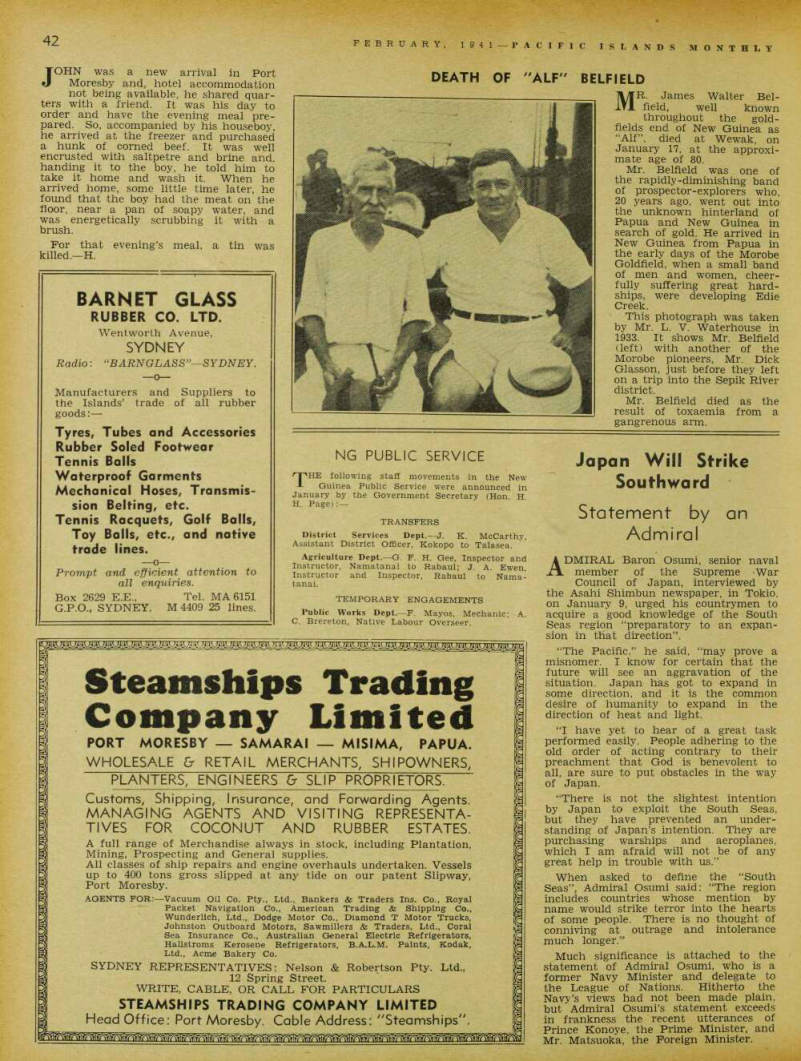
For Australia Sidelight on the Sino-Japanese Struggle
THE gesture of Mr. W. H. Donald, once an Australian newspaper man and more recently world-famous as the confidential adviser of Marshal Chiang Kai-shek, in avoiding Australia, and proceeding to Tahiti via New Zea land, was complacently ignored by the Australians* But some day his words may be recalled. He has retired tem porarily from his post in China, and is going to settle for a while in Tahiti and write his memoirs.
“I got a steamer going to the Solo mons,” he told the “New Zealand Her ald” on January 16, “and my objective is Tahiti, where I intend to do my writ ing. No, I won’t go back to Australia.
I left there 38 years ago, and I have never been back. With Australian poli tics the way they are, I won’t go.”
Mr. Donald claimed that the tenacity of the Chinese in carrying on the war with Japan, and immobilising the Japan ese armies, had saved Britain and the Empire from attack by Japan at a most critical time.
He said that, since October, 1938, when they took Hankow, the Japanese had not had even an apparent success, except when they got into Nanning, but they had already been turned out of that.
“They have been defeated in all thrusts during the last couple of years,” said Mr. Donald, “and now they are in such a state that to extricate themselves is almost an impossibility. They are to get no more reinforcements.”
Mr. Donald recalled that Japan had time and again offered peace terms, but Marshal Chiang Kai-shek had never even deigned to consider them. Three times the Japanese had sent peace terms through the Germans, three times through the Italians, several times through puppet governors, and once through the British Ambassador. Chiang Kai-shek stoutly told the British Ambas sador, “There will be peace when every Japanese soldier is out of China—not before.”
Trading With Japan
It was China, Mr. Donald said, that had pricked the bubble of Japanese invincibility. The Japanese had defied international laws and behaved with inhumanity. From his collection of photographs, Mr. Donald produced one of Japanese soldiers practising bayonet thrusts on live Chinese coolies whose hands were bound behind their backs, while a large crowd stood round watch ing.
Yet the Australian and New Zealand Governments were trading with Japan and sending her things to be used against China, he said. Although Japan had joined Britain’s enemies, Australia sent an Ambassador “to take hold of her blood-soaked hand.” But if it had not been for the stand China had made at such cost. Japan would even now have carried out her proeramme of southward expansion to these lands.
“The Chinese feel very bitterly the attitude of the democracies,” said Mr.
Donald. “They have got nothing from us that they have not paid for. The Russians have supplied them freely and done 10 or 20 times as much for them as we have. Madame Chiang Kai-shek once said: ‘lf we can do without Britain in war we can do without her in peace.’
The Japanese army is demoralised, and
another winter is on them. They must be suffering terribly.”
As another reason for confidence in Chinese victory, Mr. Donald told of the wonderful development of the Chinese armament industry, which was now mak ing machine-guns and other armaments on a vast scale. Chiang Kai-shek had estimated that, even if outside supplies were completely cut off, they had enough munitions to supply them for a year.
A request that persons able to supply land-snail shells from New Guinea, Papua, Solomon Islands, and other is lands in the south-western Pacific, will communicate with him, has been received from an American collector, Mr. W. H.
Weekes, of 508 Willoughby Avenue, Brooklyn, New York, USA. Anyone in terested should write direct to Mr.
Weekes.
Mr. and Mrs. W. Wynyard, and family, returned to New Zealand recently after four years in Western Samoa, where Mr.
Wynyard was a member of the Govern ment Service, latterly as Public Trustee.
He worked hard as honorary organiser of the Western Samoa War Fund, and the Fund Committee presented him with an illuminated address.
Mr. J. B. Taylor, who died in Sydney recently, aged 77, was well known in Fiji fifty years ago as manager of some of the CSR Co’s, estates on Viti Levu. He left the Colony in 1919.
Mr. and Mrs. R. E. P. Dwyer, of the New Guinea Department of Agriculture, returned to Rabaul recently after leave in Australia.
Miss D. Blake, who has given 10 years’ service in Papua for the New Guinea Mission, is returning to Australia shortly to marry the Rev. A. Shirley, rector of Pialba.
JOHN was a new arrival in Port Moresby and, hotel accommodation not being available, he shared quar ters with a friend. It was his day to order and have the evening meal pre pared. So, accompanied by his houseboy, he arrived at the freezer and purchased a hunk of corned beef. It was well encrusted with saltpetre and brine and, handing it to the boy, he told him to take it home and wash it. When he arrived home, some little time later, he found that the boy had the meat on the floor, near a pan of soapy water, and was energetically scrubbing it with a brush.
For that evening’s meal, a tin was killed.—H.
Advertisements & other items, pp. 43-44 (1 item)
Electricity
aru/tuhede - - am//'/me. u//.
Small, light, compact Petrol Electric Generators with everything a car engine has. • For Home Lighting • Battery Charging. • Operates twelve 25- • 12 hours per gallon watt lamps. of petrol.
OUTPUT—I 2 volts 300 watts (25 amps.) Weight when packed 97 lbs.
AMP LITE
BRIGGS
1 and
STRATTON
AMP-LITE FEATURES
(1) Press Button Starting. (2) Magneto Ignition, etc. (3) Automatic Cut-out. (4) Air-cleaner, Oil-bath type. (5) Petrol Filter. (6) Full Float, Adjustable Downdraught Carburettor. (7) Vibrationless. (8) Heavy Duty, Double Contact, Cut-out.
Features 4 to 8 are exclusive to Amp-lite Model.
Model 300:
<£22'io o
F. 0.8. Sydney—Packing Free.
Also available, Model 100, 6 volts, 100 watts, manual starting.
Price £1 5.
RICCS & SIRATTO
From Leading Island Merchants, or:
AMPUON (A’SIA) PTY. LTD.
382 Kent Street, Sydney. Cable Address: ‘Amplion,’ Sydney.
BARNET GLASS
RUBBER CO. LTD.
Wentworth Avenue,
SYDNEY
Radio : “BARNGLASS” — SYDNEY.
Manufacturers and Suppliers to the Islands’ trade of all rubber goods:— Tyres, Tubes and Accessories Rubber Soled Footwear Tennis Balls Waterproof Garments Mechanical Hoses, Transmission Belting, etc.
Tennis Racquets, Golf Balls, Toy Bolls, etc., and native trade lines.
Prompt and efficient attention to all enquiries.
Box 2629 E.E., Tel. MA 6151 G.P.0., SYDNEY. M 4409 25 lines.
Steamships Trading
Company Limited
PORT MORESBY SAMARAI MISIMA, PAPUA.
WHOLESALE & RETAIL MERCHANTS, SHIPOWNERS,
PLANTERS, ENGINEERS & SLIP PROPRIETORS.
Customs, Shipping, Insurance, and Forwarding Agents.
MANAGING AGENTS AND VISITING REPRESENTA-
TIVES FOR COCONUT AND RUBBER ESTATES.
A full range of Merchandise always in stock, including Plantation, Mining, Prospecting and General supplies.
All classes of ship repairs and engine overhauls undertaken. Vessels up to 400 tons gross slipped at any tide on our patent Slipway, Port Moresby.
AGENTS FOR: —Vacuum Oil Co. Pty., Ltd., Bankers & Traders Ins. Co., Royal Packet Navigation Co., American Trading & Shipping Co., Wunderlich, Ltd., Dodge Motor Co., Diamond T Motor Trucks, Johnston Outboard Motors, Sawmillers & Traders, Ltd., Coral Sea Insurance Co., Australian General Electric Refrigerators, Hallstroms Kerosene Refrigerators, B.A.L.M. Paints, Kodak, Ltd., Acme Bakery Co.
SYDNEY REPRESENTATIVES: Nelson & Robertson Pty. Ltd., 12 Spring Street.
WRITE, CABLE, OR CALL FOR PARTICULARS
STEAMSHIPS TRADING COMPANY LIMITED
Head Office: Port Moresby. Cable Address: "Steamships".
Death Of "Alf" Belfield
MR. James Walter Bel field, well known throughout the gold fields end of New Guinea as “Alf”, died at Wewak, on January 17, at the approxi mate age of 80.
Mr. Belfield was one of the rapidly-diminishing band of prospector-explorers who, 20 years ago, went out into the unknown hinterland of Papua and New Guinea in search of gold. He arrived in New Guinea from Papua in the early days of the Morobe Goldfield, when a small band of men and women, cheer fully suffering great hard ships, were developing Edie Creek.
This photograph was taken by Mr. L. V. Waterhouse in 1933. It shows Mr. Belfield (left) with another of the Morobe pioneers, Mr. Dick Glasson, just before they left on a trip into the Sepik River district.
Mr. Belfield died as the result of toxaemia from a gangrenous arm.
Ng Public Service
'T'HE following staff movements in the New A Guinea Public Service were announced in January by the Government Secretary (Hon. H H. Page):—
Transfers
District Services Dept.—J. K. McCarthy, Assistant District Officer, Kokopo to Talasea.
Agriculture Dept.—G. F. H. Gee, Inspector and Instructor, Namatanai to Rabaul; J. A. Ewen, Instructor and Inspector, Rabaul to Nama tanai.
Temporary Engagements
Public Works Dept.—F. Mayos, Mechanic; A.
C. Brereton, Native Labour Overseer.
Japan Will Strike

Southward Statement by an Admiral
ADMIRAL Baron Osumi, senior naval member of the Supreme -War Council of Japan, interviewed by the Asahi Shimbun newspaper, in Tokio, on January 9, urged his countrymen to acquire a good knowledge of the South Seas region “preparatory to an expan sion in that direction”.
“The Pacific,” he said, “may prove a misnomer. I know for certain that the future will see an aggravation of the situation. Japan has got to expand in some direction, and it is the common desire of humanity to expand in the direction of heat and light.
“I have yet to hear of a great task performed easily. People adhering to the old order of acting contrary to their preachment that God is benevolent to all, are sure to put obstacles in the way of Japan.
“There is not the slightest intention by Japan to exploit the South Seas, but they have prevented an under standing of Japan’s intention. They are purchasing warships and aeroplanes, which I am afraid will not be of any great help in trouble with us.”
When asked to define the “South Seas”, Admiral Osumi said: “The region includes countries whose mention by name would strike terror into the hearts of some people. There is no thought of conniving at outrage and intolerance much longer.”
Much significance is attached to the statement of Admiral Osumi, who is a former Navy Minister and delegate to the League of Nations. Hitherto the Navy’s views had not been made plain, but Admiral Osumi’s statement exceeds in frankness the recent utterances of Prince Konoye, the Prime Minister, and Mr. Matsuoka, the Foreign Minister.
Mr. and Mrs. William Beddows, two of Fiji’s best-known identities, celebrated their golden wedding anniversary on Jan uary 6. Fifty years ago they were married at Taveuni. Mr. Beddows has been con- “es W m production production, ana norse ana cattle raising.
Mr. H. H. Marchington, of Suva, Fiji, is at present serving overseas with the New Zealand forces. He soent the greater part of his life in the Colony, but had been living in the Dominion for some time.
Mr. J. R. Shaw, who was injured in an accident several weeks ago, died at Lautoka recently. He was employed with the Fiji Kauri Timber Company.
Advertisements & other items, pp. 45-46 (1 item)
Special
% Vj 0 0 4 y**
KRIESLER
MODEL
A Super KRIESLER of outstanding engineering design; offering for the first time a 100% Short Wave Radio giving world range reception of a standard previously impossible. •- ■- * 523 L u. mmmm. r ■
Ps«u
safe
Features:
The reduction of fading to negligible proportions.
Increased Signal Strength.
Vastly improved signal to noise ratio.
Marvellous Selectivity (means reduced heterodyne interference).
Calibrated in Metres, Megacycles and Countries.
Syncromatic Band Indicator.
Geometric Logging Device. 10" Speaker.
Twin Syncromatic Dials. 7 latest type valves with 10 valve performance and many other revolutionary features to give a quality of reception hitherto unavailable.
Wave Coverage: 13 to 225 metres (unbroken) ■ m To Kriesler A/sia Pty. Ltd., 43 Alice St., Newtown,
N.S.W.
I Please forward me full particulars of (indicate with J cross at side model in which interested): I O XP Model, 7 valve A/C Short Waver.
J I 1 XPB Model, 7 valve A/C Short Waver I and B/cast.
J I 1 XPV Model, 6 volt Vibrator Short J L - 1 Waver.
I NAME
ADDRESS
A. B. DONALD Ltd.
AUCKLAND
ISLAND TRADERS & GENERAL MERCHANTS
P.O. Box 1509. Cables & Telegrams, "Kingdom", Auckland.
PACKED AS THEY'RE PICKED
TO PRESERVE FLAVOUR AND NUTRIMENT
Aunt Mary’s
PREPARED
VEGETABLES
only require heating and are then ready to serve, full flavoured, attractive and satisfying.
Green Peas, Celery, Cauliflower and other Aunt Mary's prepared vegetables are specially packed for Tropical conditions in 1 lb. hermetically sealed cans.
SOLD BY ALL PACIFIC ISLAND STORES
Order an assortment. Be sure it is Aunt Mary's brand; packed by Tillock & Co., Pty., Ltd., Sydney.
New Zealand Troops In Fiji
The following article was published in “New Zealand Herald” on January 22: F fulfil MENT of New Zealand’s * u ? dertakin g to accept a full share 0 f responsibility for Empire defence, & hSSSif 6 arran gement Newton in of
FVnpSSSwSJi Si lts °t the
cfahrmod P Pii?° JwS5 haV6 bBen stationed m Fiji -An official announce ment of the establishment of Dominion troops there has now been made by the Government.
The defence of Fiji assumed fresh im portance recently when the general
question of home defence was closely studied in New Zealand. A detailed examination of the position in the South Pacific, and of possible developments, resulted in the inclusion of Fiji in a general scheme, and close collaboration is being maintained between the two Governments.
The arrival of a modern fighting force, complete with motorised equipment,’ brought the total number of motor vehicles in Fiji to a new record figure.
The high standard of accommodation for troops set in New Zealand when the large-scale establishment of new camps was begun on the outbreak of war, has been fully maintained in Fiji. There are several camps, built during a fine weather period, the main one being a few miles from Suva.
Most of the men at the main camp are already quartered in wooden dormitories after the pattern of those built at the newer camps in the Dominion, with iron roofs and push-out shutters instead of windows. Some of the troops occupy bell tents, while at another camp the majority of the men are housed in tents of the New Zealand Public Works Department pattern. As a subsidiary to the main camp, there is a smaller establishment across the road to accommodate specialist units.
Special attention was paid by the authorities to the adequate drainage of the areas on which the camps have been built, with a view to the maintenance of the highest possible standard of health. Tiled drains were laid throughout the main camp, and a special line was taken from the Suva reservoir to the camp to provide an adequate water supply. Shower-huts are provided, and the troops regularly have swimming parades at Suva Point.
Samoan Missionaries
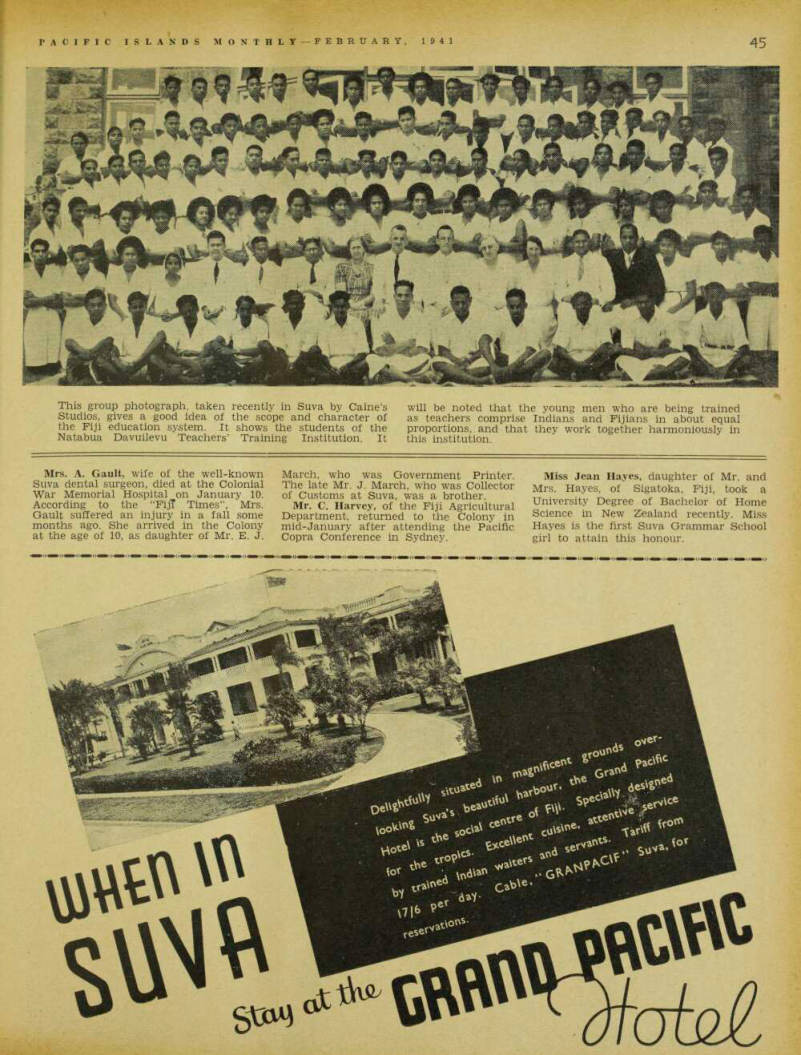
A SMALL party of Samoans passed through Sydney in mid-February en route to their homes after mis sionary service in Papua and New Guinea for the London Missionary Society. They included Auauana, and his wife, Vaiaga, who have been working in both Territories for more than 30 years, the last three of which were spent at Gemo Island, Port Moresby, where there is a leper station, erected by the Government and staffed by the LMS.
Talotonu, with his wife and family, has been in Papua for nine years, and will return early next year after spending furlough in Samoa. The wife of another missionary, who died in Parma after two vears’ service there, also returned to her home.
Miss Phyllis Abel, a member of the famous family which conducts the Kwato Mission, near Samarai, Papua, returned to the Territory recently after a holiday in England, America and Australia.
Rev. Henry Nelson Drummond, who was a worker for the Melanesian Mis sion in the New Hebrides, Solomons and Norfolk Island in the early part of this century, died in Australia recently.
Mr. A. Gibb, of Western Samoa, was a passenger for New Zealand recently.
He is connected with the NZ Reparation Estates.
Mr. J. R. B. Stewart, an archaeologist from Cyprus, was in Sydney recently. He is interested in art designs, and is engaged in a comparison of those of the Middle East and the Pacific.
Mrs. A. Gault, wife of the well-known Suva dental surgeon, died at the Colonial War Memorial Hospital jDn January 10.
According to the “Fiji Times”, Mrs.
Gault suffered an injury in a fall some months ago. She arrived in the Colony at the age of 10, as daughter of Mr. E. J.
March, who was Government Printer.
The late Mr. J. March, who was Collector of Customs at Suva, was a brother.
Mr. C. Harvey, of the Fiji Agricultural Department, returned to the Colony in mid-January after attending the Pacific Copra Conference in Sydney.
Miss Jean Hayes, daughter of Mr. and Mrs. Hayes, of Sigatoka, Fiji, took a University Degree of Bachelor of Home Science in New Zealand recently. Miss Hayes is the first Suva Grammar School girl to attain this honour.
This group photograph, taken recently in Suva by Caine’s Studios, gives a good idea of the scope and character of the Fiji education system. It shows the students of the Natabua Davuilevu Teachers’ Training Institution. It
will be noted that the young men who are being trained as teachers comprise Indians and Fijians in about equal proportions, and that they work together harmoniously in this institution.
Rev. Harry K. Bartlett, L.Th., a well known Methodist missionary, arrived in Sydney recently from Misima, Papua, on furlough. He attended the annual board meeting of the Mission in Sydney early in February, and later proceeded to Adelaide.
Bishop Cecil Wilson, who was Bishop of Melanesia from 1894 to 1911, died at Perth, WA, on January 19, aged 81.
Mr. J. Mulvey, of the New Zealand Reparation Estates, Western Samoa, paid a visit to the Dominion recently.
Advertisements & other items, pp. 47-48 (1 item)
orou^ 5
. n * l **V.\ ds over '
ml .o^ eol & rra „d P jc ' f - sW j* ed '" ujrbouf- ’*'* ft o des'S° e<i *° W be»" lVfU ' , fn>- SpeC> Jfrf*** A W. . c e" ire ne »« e 0 rt (ro^
~*-%*-«£-• TtL-
- tC- **.“£*** V*** 6 C> e ' -(6 9 er fese^ 0 ""
GRAMOPHONE
RECORDS
SEND US YOUR ORDERS
Goods sent C.O.D. at no extra charge.
Catalogues sent without obligation.
THE TALKERIES
161 Castlereagh Street,
SYDNEY
DESTROY GERMS AND INSECTS...
Inexpensively, easily and effectively with De Meric's Standard Products.
De Meric's Disinfectants are made in liquid and powder form. They are ideal for island conditions. They're obtainable at good stores everywhere . . . ask tor De Meric's Lysol, Napthalene, Non-Staining Fly Spray, Moth Balls, etc.
DE MERICS
STANDARD PRODUCTS
Traders are invited to write for full wholesale list to
DE MERIC PTY. LTD.
Commonwealth and State Government Contractors, Doody Street, Alexandria, N.S.W.
When Noumea Was In A Fever

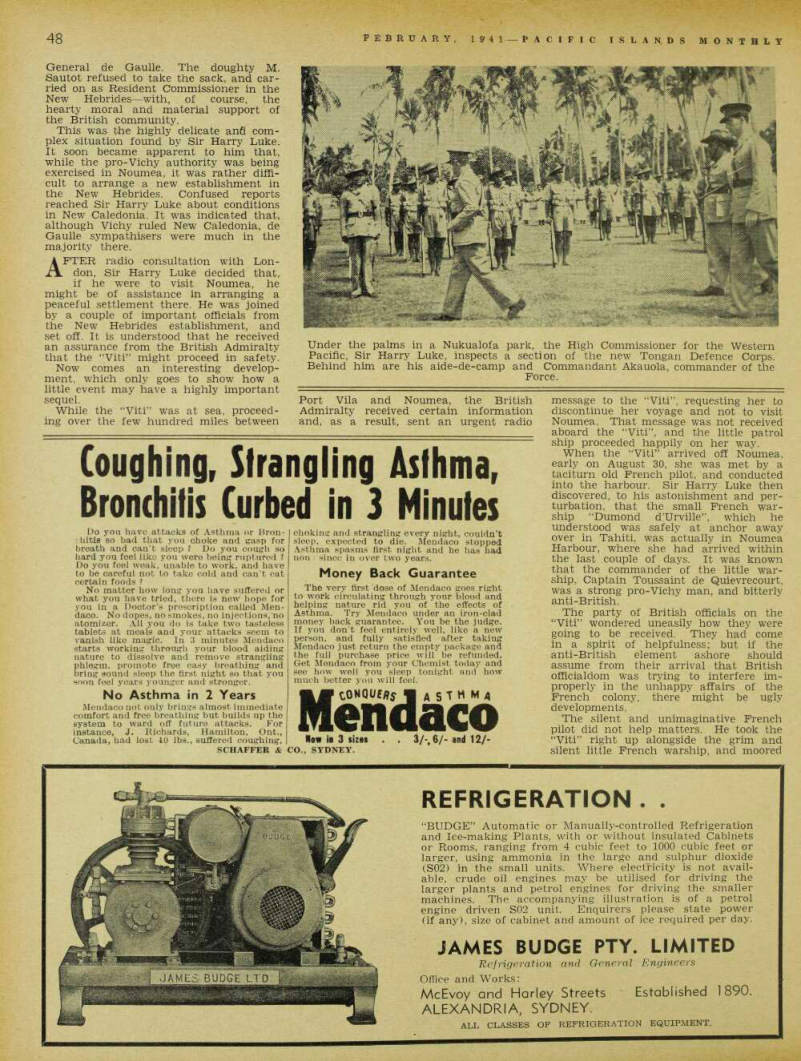
How the Loss of on Admiralty Message Brought in Sir Harry Luke as Peacemaker
By R. W. Robson
WHEN France capitulated in June, 1940, and found herself subject to the Nazis, the French Colonies in the Pacific -were isolated. They were not entirely cut off from the mother country, insofar that they were in- radio communication with the Petain Govern ment at Vichy; but everyone knew that the Vichy Government was acting under the. direction of the Huns. Anything done by the Administrators of the French Pacific Colonies was suspect by the British Territories in the Pacific, which were still fighting Germany, and which adjoined the French Colonies on every side.
For a time, the situation in the New Hebrides was simply chaotic. Here there is a Condominium—that is, France and Britain have exercised joint control of the territory, and French and British public servants work side by side in the administration. Naturally, the British were not very happy in such close asso ciation with men who were taking their orders from Vichy, which, in turn, was
accepting instructions from Mr. Hitler.
On the part of some of the French (cer tainly they were very few) a hatred of the British was suddenly and surpris ingly manifested.
But, apart from politics, the position of the New Hebrides was deplorable.
There was no market anywhere for the principal products of the New Hebrides —copra, coffee, cocoa, cotton—and the French currency, which hitherto had been interchangeable with the British and Australian currency, and which was in general use throughout the New Heb rides, suddenly became valueless. Every one who owned francs made it his busi ness quickly to get rid of them, and to obtain British money, instead.
It is said that Messrs. Burns, Philp & Co.’s Vila branch found itself, in no time at all, with about 500,000 francs on its hands, which no one wanted. The posi tion was aggravated by certain bold economic adventurers who brought in francs from all over the place—especially New Caledonia and the Loyalty Islands —and got them changed for British money.
THE economic confusion in New Hebrides became a matter of serious concern to the British High Commissioner for the Western Pacific (Sir Harry Luke). Opportunely, his new patrol boat, “Viti”, arrived in Suva from Hong Kong, and Sir Harry decided imme diately to visit the New Hebrides.
When the “Viti” arrived in Port Vila Sir Harry found that he had a real job of work on hand. British officials, under Sir Harry’s direction, set to work to straighten things out, but progress was slow and difficult. A silent war was going on in the ranks of French officialdom.
The position then was that the French Resident Commissioner (M. Henri Sau tot) had declared himself, outspokenly and courageously, on July 18, for General de Gaulle —the first French colonial administrator to do so—while other French officials, to whom he might naturally have looked for support, were cunningly and savagely pro-Vichy. A high French judicial officer set to work, by underground and devious means, to unseat M. Sautot, so that he might himself become Resident Commissioner.
A couple of minor, but none the less important officials, assisted him, and, for a time, it looked as if the gallant M.
Sautot was going to be destroyed by the forces of Vichy. But he fought on courageously.
One of the officials whom Sautot sus pected of strong pro-Vichy sentiments was in charge of the French native police, which force was much stronger numerically than the British native force. So M. Sautot, with the connivance of good friends, in the quiet and dark ness of one night, contrived to remove all the ammunition supplies of the police. It was then pointed out to the Resident Commissioner that the police still had bayonets. The night operation was repeated, and a couple of mornings later the police found that, while they had most excellent rifles, they had neither bayonets nor bullets.
Meanwhile, the Governor of Noumea (who is also French High Commissioner for the Western Pacific, with jurisdiction over the French section of the New Hebrides) had curtly “sacked” M. Sautot, for his act in allying himself with
General de Gaulle. The doughty M.
Sautot refused to take the sack, and car ried on as Resident Commissioner in the New Hebrides —with, of course, the hearty moral and material support of the British community.
This was the highly delicate and com plex situation found by Sir Harry Luke.
It soon became apparent to him that, while the pro-Vichy authority was being exercised in Noumea, it was rather diffi cult to arrange a new establishment in the New Hebrides. Confused reports reached Sir Harry Luke about conditions in New Caledonia. It was indicated that, although Vichy ruled New Caledonia, de Gaulle sympathisers were much in the majority there.
AFTER radio consultation with Lon don, Sir Harry Luke decided that, if he were to visit Noumea, he might be of assistance in arranging a peaceful settlement there. He was joined by a couple of important officials from the New Hebrides establishment, and set off. It is understood that he received an assurance from the British Admiralty that the “Viti” might proceed in safety.
Now comes an interesting develop ment, which only goes to show how a little event may have a highly important sequel.
While the “Viti” was at sea, proceed ing over the few hundred miles between
Port Vila and Noumea, the British Admiralty received certain information and, as a result, sent an urgent radio
message to the “Viti”, requesting her to discontinue her voyage and not to visit Noumea. That message was not received aboard the “Viti”, and the little patrol ship proceeded happily on her way.
When the “Viti” arrived off Noumea, early on August 30, she was met by a taciturn old French pilot, and conducted into the harbour. Sir Harry Luke then discovered, to his astonishment and per turbation, that the small French war ship “Dumond d’Urville”, which he understood was safely at anchor away over in Tahiti, was actually in Noumea Harbour, where she had arrived within the last couple of days. It was known that the commander of the little war ship, Captain Toussaint de Quievrecourt, was a strong pro-Vichy man, and bitterly anti-British.
The party of British officials on the “Viti” wondered uneasily how they were going to be received. They had come in a spirit of helpfulness; but if the anti-British element ashore should assume from their arrival that British officialdom was trying to interfere im properly in the unhappy affairs of the French colony, there might be ugly developments.
The silent and unimaginative French pilot did not help matters. He took the “Viti” right up alongside the grim and silent little French warship, and moored
Under the palms in a Nukualofa park, the High Commissioner for the Western Pacific, Sir Harry Luke, inspects a section of the new Tongan Defence Corps.
Behind him are his aide-de-camp and Commandant Akauola, commander of the Force.
her at the quay, only 20 feet away from the warship’s bow.
THEN a general situation of extra ordinary confusion developed. The pre-capitulation Governor, M. Peli cier, was still in charge, and he sent a formal welcome to Sir Harry Luke, and invited him to luncheon. A little later Sir Harry Luke was invited to dinner by the Governor, who, it appeared, was Colonel Denis.
When the puzzled Englishmen asked the meaning of it all, they were informed that Noumea that day was in process of changing governors—M. Pelicier, finding the position untenable in view of the very strong pro-de Gaulle sentiment in the Colony, had decided to leave, and he was handing on the governorship, under instructions from Vichy, to Colonel Denis, who was in charge of the military detachments in Noumea.
Colonel Denis, it appeared, was even more pro-Vichy than M. Pelicier.
Meanwhile, a formal call on Sir Harry Luke, aboard the “Viti”, was made by Captain de Quievrecourt, commander of the “Dumond d’Urville”. Sir Harry Luke speaks French very fluently, and he Quickly learned that the warship’s com mander. while frigidly polite and cour teous, was intensely anti-British—in fact, he made a number of remarks which the British officials were bound to resent.
We do not know exactly what occurred —officials naturally are reticent about these matters—but we do know that the commander of the sloop departed from the “Viti” in high dudgeon, with all his naval feathers bristling.
What with a hostile warship com mander right alongside, and two embar rassed governors trving to observe pro per official formalities ashore, and an excited civil populace on the wharf beside the “Viti” roaring for de Gaulle, and for Britain. Sir Harrv Luke found the general situation “definitely sticky”.
IT was suggested officially to Sir Harry, at an early stage of his visit, that perhaps it would be better if the “Viti” withdrew from Noumea. It is probable that he himself felt that it would have been better had he not come; but, since he was there, he felt also that it would create a very bad impression in the minds of the over whelming majority of the civil popu lation (obviouslv pro-de Gaulle) if he. the leading British official in that part of the world, were to withdraw too quickly.
So he told the French Governor— which one, history sayeth not!—that he had come to discuss economic affairs with Australia’s official representative in New Caledonia, Mr. B. C. Ballard, and that, in any event, he wanted to have a clear understanding with French head ouarters in Noumea in regard to the difficult economic and administrative situation existing in the New Hebrides; and so the “Viti” stayed alongside the wharf, and discussions went on.
It was noon on August 30 before offi cial formalities were over. During Fri dav afternoon and Saturday the British officials were kept extremely busy—the little ship was packed out with parties of pro-de Gaulle and pro-Vichy adher ents. The people of Noumea insisted on assembling on the wharf alongside the “Viti”, and cheering for de Gaulle and Great Britain. The blue-jackets from the “Dumont d’Urville” joined the civi lians in cheering for de Gaulle; but their officers on the warship were quite defin itelv hostile.
Sir Harry Luke and his officials attended a series of official functions,
where traditional French hospitality was extended to them. They found it a little difficult to decide to whom they should address themselves as head of the French Colony—so they got over it by calling both M. Pelicier and Colonel Denis “Your Excellency”.
During the following day (Saturday, August 31) the pro-de Gaulle sentiments of the Noumea population bubbled up perceptibly, and demonstrations became more frequent and marked. It was clear that the high officials adhering to the Vichy Government —especially the de parting and the new Governor, and the warship’s captain—were alarmed, and that the growing tenseness might lead to an explosion. It was evident, too, that the temper of Colonel Denis, commander of the garrison, and Captain de Quievre court, commander of the warship, was such that they were quite prepared to use the forces at their command to sup press a pro-de Gaulle revolt by force, if necessary.
When he found that he could do noth ing more to straighten out the tangle, Sir Harry Luke decided quickly to con clude his formal conversations with the French Government, and depart; and the “Viti” accordingly left Noumea before dusk on Saturday, August 31.
I have reason to believe that as the little Fijian patrol-ship departed, more than one pair of official British binocu lars were focussed anxiously on the unfriendly French warship still lying beside the Noumea wharf.
IT will be remembered that it was only a few days later that the people of New Caledonia took matters into their own hands, deposed Colonel Denis from the Governorship, and installed in his place the staunch Henri Sautot, who suddenly appeared in Noumea Har bour. I should very much like to tell the story of how Henri Sautot actually came from Port Vila—but that story will have to wait until war precautions in relation to maritime information are not necessary.
Had the admiralty message reached Sir Harry Luke between Port Vila and Noumea, the “Viti”, of course, would not have entered Noumea. I believe that its non-receipt was a very good thing.
The little, unarmed, harmless “Viti”, carrying the highest British official in the Pacific, entered Noumea Harbour at a most critical moment. If the “Viti” had been a British warship, almost cer tainly there would have been an explo sion ashore, and probably there would have been serious fighting and bloodshed between British and French forces. As it was, the arrival of the British party, and the tactful behaviour of the pleasant and charming Sir Harry Luke, disarmed the excited French factions. The pro- Vichy officials could do nothing, except snarl; while the arrival and confident bearing of the British official party gave great heart, encouragement and impetus to the de Gaulle adherents, who, shortly afterwards, bloodlessly took command of the situation.
The Admiralty message missed the “Viti”—but it was a lucky miss.
Advertisements & other items, pp. 49-52 (1 item)
Ith Masonitt!
MOW IS THt TIME
TO MODERNISE
% m Na THE demands and requirements of troubled times have probably dispelled—“for the duration”—your dreams of a new home. But there is no need whatsoever to allow 7 Hitler & Co. to intern you in that home which has grown a little shabby or a little out-nioded. You can transform it; amplify it; give it new rooms. You can add or modernise verandahs, carry out a dozen-and-one delightful plans for rejuvenating and glamorising your present home. Those dingy walls can be charmingly concealed; those worn floors given new strength and eye-appeal. Be thankful for Masonite—the grainless, splinterless, steelstrong boards which can be worked with ordinary tools, bent, grooved, bevelled, painted, lacquered—treated and finished in any way your heart or mind may desire. Modernising with Masonite is INEXPENSIVE (many of the smaller alterations }ou can do yourself), yet the job will last for the duration of your life.
Masonite Quartrboard De-Luxe, Presdwood, weather-defying Tempered Presdwood and tile-like Temprtile come to you or your builder in boards up to 12' x 4'—the most versatile all-wood boards ever produced—rightly praised all over the world as “The Wonder Boards of 1000 Uses”!
MODERNISE WITH
Masonite boards are made in Australia from Australian timbers hitherto thought commercially useless. They possess the tages of wood without its disadvantages.
Masonite is used lor both modemieation and new construction; for floors, counter tops and table tops, lor ‘’tiling**, for partitioning —in fact, for **l.ooo uses*'. 11l d S fl (H T I;
PRESDWOOD . . . TEMPERED PRESDWOO
TEMPRTILE ... QUARTRBOARD DE-LUX
THE COLONIAL SUGAR REFINING CO. LTD. (Building Materials Division) . . Sydney . . Melbourne . . . . Adelaide . . Per
“Shorts” For Small Jobs
Masonite “Shorts’ * — off-cuts from large sheets—are identical in quality with the standard Masonite Boards, hut are offered at considerably reduced prices.
They’re ideal for small jobs such as those shown here and are available in sizes up to 4 in X 4 in. and in £ in. and 3/16 in. thicknesses.
NUT & SCREW BOX. DOG KENNEL.
Coughing, Strangling Asthma, Bronchitis Curbed in 3 Minutes
Do you have attacks of Asthma or Bronchitis so bad that you choke and gasp for breath and can’t sleep ? Do you cough so hard you feel like you were being ruptured ?
Do you feel weak, unable to work, and have to be careful not to take cold and can’t eat certain foods ?
No matter how long you have suffered or what you have tried, there is new hope for you in a Doctor’s prescription called Mendaco. No dopes, no smokes, no injections, no atomizer. All you do is take two tasteless tablets at meals and your attacks seem to vanish like magic. In 3 minutes Mendaco starts working through your blood aiding nature to dissolve and remove strangling phlegm, promote free easy breathing and bring sound sleep the first night so that you soon feel years younger and stronger.
No Asthma in 2 Years
Mendaco not only brings almost immediate comfort and free breathing but builds up the system to ward off future attacks. For instance, J. Richards, Hamilton, Ont., Canada, had lost 40 lbs., suffered coughing,
choking and strangling every night, couldn’t sleep, expected to die. Mendaco stopped Asthma spasms first night and he has had non : since in over two years.
Money Back Guarantee
The very first dose of Mendaco goes right to work circulating through your blood and helping nature rid you of the effects of Asthma. Try Mendaco under an iron-clad money back guarantee. You be the judge.
If you don’t feel entirely well, like a new person, and fully satisfied after taking Mendaco just return the empty package and the full purchase price will be refunded.
Get Mendaco from your Chemist today and see how well you sleep tonight and how much better you will feel.
CONQUfffJ 1 A S T H M 4
Mendaco
Now ii 3 sizes
3/-, 6/- and 12/-
SCHAFFER &
CO., SYDNEY.
JAMES BUDGE LTD
REFRIGERATION . .
“BUDGE” Automatic or Manually-controlled Refrigeration and Ice-making Plants, with or without insulated Cabinets or Rooms, ranging from 4 cubic feet to 1000 cubic feet or larger, using ammonia in the large and sulphur dioxide (SO2) in the small units. Where electricity is not available, crude oil engines may be utilised for driving the larger plants and petrol engines for driving the smaller machines. The accompanying illustration is of a petrol engine driven SO2 unit. Enquirers please state power (if any), size of cabinet and amount of ice required per day.
JAMES BUDGE PTY. LIMITED
Refrigeration and General Engineers Office and Works:
McEvoy and Harley Streets Established 1890,
ALEXANDRIA, SYDNEY.
ALL CLASSES OF REFRIGERATION EQUIPMENT.
SYDNEY'S LEADING
SAILMAKER
AND RIGGER
Also Manufacturer of all Canvas and Rope Work.
ISLANDS WORK a
Speciality.
HARRY WEST
Balmain East, Sydney. Tel.: W 1105
Introducing
ii
KOPSENOL
M
Timber & Fabric Preservative
Made in Australia from imported American base materials to the American formula
KOPSENOL" IS A STRONG & POWERFUL
FUNGICIDE AND INSECTICIDE
PRESERVES ALL CLASSES OF TIMBER, CANVAS,
FABRICS, NETS, CORDAGE, ETC,
"Kopsenol" ensures definite protection against decay, rot, mildew, in new or used materials. 1 " Kopsenol " has over 4 % colloidal content, at which figure the product has the greatest penetration value.
Consisting mainly of Metallic Salts ”
Stops, and Prevents Decay
PRICE IS/- per gallon
Special quotations for large quantities.
W. KOPSEN & CO. PTY. LTD,
Shipchandlers Cr Hardware Merchants
376-382 KENT ST., SYDNEY.
Cables: "Kopsen”, Sydney. ’Phone MA 6336 (4 lines).
* * * * o <0 to* 4 C** fJtJ* c o No technical knowledge required . . .
Keep in touch with the world expedite business transactions—be prepared to quickly call medical or other services in an emergency.
Install an A.W.A, Teleradio 38.
Compact radiotelephone providing communication facilities for parts beyond the reaches of landlines. Reliable and economical.
Illustrated booklet and quotations gladly supplied on request.
AMALGAMATED WIRELESS (A/SIA) LIMITED
47 YORK STREET, SYDNEY 167 QUEEN STREET, MELBOURNE Branches at: Wellington, Suva, Rabaul, Port Moresby and other island centres.
Enemy Spies and Pacific Shipping
Pacific Shipping
(Published in “New Zealand Herald” on January 28) “jTIROM New Zealand and from Aus- JT tralia information is going out daily to enemy raiders which are lying around our coasts,” said Captain James H. Miller, master of the steamer Holm wood, which was sunk last November, when he described in an address to the Christchurch Returned Soldiers’ Associa tion his experiences as a prisoner on an enemy raider.
“I have put it to our Government that there is leakage of information from this country,” Captain Miller said. “They have replied that it is impossible, but it is not impossible. I know it is hap pening, because I have seen results of it. The captain of the raider I was on boasted that he knew the movements of every ship leaving these shores and even knew the actual times that the vessels left port.
“For instance, the German commander told the captain of the Rangitane pre cisely the hour and minute at which he left Auckland on his last voyage and also the exact time at which he hove anchor off Rangitoto Island the following morn ing.”
After the sinking of the Triona on December 6 the German commander told Captain Miller that he had a ship to sink that night and another one the next morning. On the following morning they were approaching Nauru Island and the commander said: “You see that island on the starboard bow? That is your future home, for I am going to put you ashore there.”
At that moment a ship was reported by one of the officers and the com mander turned to Captain Miller and his companions. “There you are, gentlemen,” he said. “The Triadic is on time.” This was just another example of accurate information the raider possessed about all British shipping in the South Pacific.
EDITORIAL NOTE: The foregoing should be read in conjunction with the article, “The Story of the Pacific Raid ers”, on page 15 of the January issue of this journal.
Cost Of Native Labour
IN order to assist copra growers in these difficult times, the Fijian Legisla tive Council amended the Labour Ordinance to provide for the suspension,
for the present, of the clause which requires payment of a minimum wage.
Mr. Alport Barker, in criticising the plan, said the planters would not get native indentured labour to work for them for less than 4/- per week.
Advertisements & other items, pp. 53-54 (1 item)
Pacific Islands Society
Visitors from the Islands to Sydney (or those interested in Islands affairs), are advised to communicate with the honorary secretary of the above Society, which has been formed to study the history, traditions, economics, and political developments of the Pacific Islands.
Regular monthly meetings held at Hotel Carlton, Sydney.
Address for Correspondence:
THE PACIFIC ISLANDS SOCIETY,
Box 2434 MM., G.P.0., Sydney.
MX W,.
KW.
rfi
f-, s 7
DRW
OK W'A
OKWA
OSWA
OK WAR
okwars
OS WAR'S 0~
OS WAR
OK W'a RS OK W'A '&'
OSCAR'S OS WAR'S OKWA R
aR'S OS WAR'S OS.WARS
; AR'S OSWAR'S OKW'AR S
WR'S OKWAR S OKW'AR'S
WA R’ S DEW A K S OK WAR'S
WAR'S OKWaRS OKWAR'S
' WAR’SOKWaK'SOS WAR'S
:aR'S OKWAR'S OSWAR'S
•KW'AK'S OS WAR'S OS WAR'S
OKWAR'S OS WAR'S OS WAR'S OKWAR S OKWA R'S OS WAR'S OS>'.i OK WAK'i> O;: WAR'S OS WAR'S OKWARS OKWAR'S OS W A R' S OKW.
PS WAR'S OS WAR'S OKWA R S DF.V/AK S OS W OS WAR'S OKW.VR S OKWaK’S OS WAR'S OS V
OKW'aR'S
OKwJs'S
OK WAR'
OKWA.
OKWA
OSW
OSW;
OK W'A'
OKWA
A.WSOK
K#*OS;
R'S /-.A/ R S
■OS OKWAR'S
fRSOKW'.ARS
•K'SOKW'AK'S
WAR'S OKWAR'S
A R'S OS WAR'S
A R’S OKWAR’S
R S OKW'ARS OKWAK'S
A.R'S OKW'aR S OKWAK'S OS WAR'S
W7TR> OKWAK S OS WAR'S OS WAR'S OSWAR'S TKW'aK S OS WAR'S OS WAR'S OSW A R'S OKW'AR’S ?aK'S OKWAR'S os WAR'S OKWAR S OK WAR'S OKWARS S OS, V/AR'S os WAR'S OKW'aR S OKWaK'S OKWaR'S OKWAR'S S os: W A R'S OS wAR' S OK W AR’ SOKW A K' S OKWA R'S O S 'WAR'S OSWX R' S OK.WAR'S OSWAR'SDS WAR'S OKW'aR *OKWAR S OSWAR'S OS WAR'S OKWAR’S OS WAR'S OKWAR'S OKW'aR S OS. WAR'S OS WAR'S OKWAR S OKWAR'S OKWAR'S OK WAR'S OKWAR'S OKWAR'S OS WAR'S OKWAR’S OKW'aRS OK WAR'S OK WAR'S OKWAR'S OS WAR'SOK WAR'S OKWAR’SOKWWR^S OKWAK'S OS WAR'S ORWAR'S OS WAR'SOKWAR’SOKWaR'SOKWaK'S OKWAR'S OS WAR'S OSWAR'S OKWAR'S OKWAR'S OKWAR’S OKW'ARS OS WAR'S OS WAR'S OKWAR S OK WAR'S OKW'aR S OK W'A R'S OKWA R'S OS.WA R' S O'
OSVMR'S OKWAR'S OSWA'
0S W A R'S OKWAR’S OK W'A
OKW'AR S OKWAR'S OKWA K
OKWWR'SOKW'ASRSOKWA
OKWAK'S OS WAR'S OS WAR'
OS WAR’S OSW'AR'S OKW
AR S 02
'A?*: ri?
OKWAR'S
R'S OKWAR'S
AR'S OKWAR'S
WS O;
SOSWAR'S OKWAR'S OSW'AR’S
ARS OK W' a R' S OKWA R' S OK WA R'S >SWAR S OKW A R S OKWAR'S OS. WAR'S OKWAR'S OKW'aRS-OK W'A R'S OS WAR'S OS WAR'S OKWAR’S OKWAR’S OKW'AR'S OKWAR'S OKWAR'S OS WAR'S OS W AR’S OKW'AR S OKWAR'S OKWAR'S OKWAR'S OS W AR'S OS WAR'S OKWA
RS OKWAR'S
S OKWAR S OK
- I OS
AR'S
OKW
AR’S
OKW
Ov :ars v A
OSW
R'S
OSW
A* 0;; R'S
OKW
A=:
■AR’S
WA
OKW
kw'a:r’
OKWAR'S OK WAR'S OS WAR
OKWAR'S OS WAR'S OS WAR'S OSW'AR'S OKWAR'S OKWAR’S
OS WAR'S OS WAR
OKWAR SOKW'AR
OKV/aK'S OKW'ARS
R’S OKWAR'S OK W'A R'S
£>S WAR'S OKWAR'S
OSWAR’S OKWAR'S
OKWAR'S OKWAR’S
OS WAR'S OS WARS OSWARSOKWAR’SOKWaR'S OKW'aR S OKWAR'S OKWAK'S OS WA R S OKWA R' S OKW'AR S OKW'a R'S OK W'A RS OS W'A R'S OS. WA R'S OS WAR'S OKW'AR'S OKWAR'S OKW'AR S OK W'A R'S OS WAR'S OSWAR'S OS WAR'S OSW'AR'S OR WAR'S OKWAR'S OS WAR'S OSWAR'S OSW A R'S OKWA R. S OKWAR'S OKWAR’S OKWAR'S OSWAR'S OSWAR'S OKWARS OKW'AR'S OK WAR'S OKW'AR’S OKW” AR'S
HP
SAUCE
Sv
Tkejjfuit sauce
uma I vmd/eduded A Li At Perkins product
PURCHASE FROM
McILRATH’S
WHERE YOUR MONEY BUYS MORE
“Yoga” Tea, our speciality 2/4 lb.: 6 lb. tin, 2/5 lb.
“Sunshine” Full Cream Milk, 12 oz 1/2| tin; 14/3 doz.
“Ideal” Unsweetened Milk, 6 oz. or 12 oz 21/- case “1.X.L.” Peaches in Syrup, 30 oz 9id. tin; 9/4£ doz.
Nestle’s Pure Reduced Cream, 4 oz. tin 3/9 doz.
Osprey Choice Red Salmon, 8 oz 1/2 tin; 13/6 doz.
New Season’s 3-crown Choice Evap. Apricots l/3£ lb.
Quail Strawberry Jam, 24 oz 1/3 tin; 14/9 doz.
“Rosa” Honey, Finest Garden, 2 lb 1/6 jar; 17/9 doz.
“1.X.L.” Baked Beans 4 oz. 3/9 doz.; 8 oz. 6/3 doz.
“1.X.L.” Spaghetti in Sauce 4 oz. 4/3 doz.; 8 oz. 6/3 doz.
“Red Feather” Camp Pie 8 oz. 5/9; 12 oz. 7/9; 16 oz. 9/3 doz.
“1.X.L.” Sweet Corn 5 oz. 5/3 doz.; 8 oz. 7/9 doz.; 16 oz. 13/6 doz.
Nestle’s Malted Milk 8 oz. 1/3; 16 oz. 2/3 tin “Rosa” Pure Household Soap, large 6d. bar; 5/6 doz.
Assorted Toilet Soaps, 4 oz 2/3-doz.; 22/6 gross Special Vintage Port or Sherry, 26 oz 2/6 bot.; 29/6 doz.
All Prices F. 0.8. Sydney. Cases and packing free.
McILRATH’S Pty. Ltd.
EXPORT DEPARTMENT
202-204 PITT STREET, SYDNEY
AUSTRALIA
A Section For Women
By "Therese"
Your Wardrobe in Wartime
THE matter of being well turned out in these days, when economy is the greatest consideration, is no easy task. But the royal road to being well dressed is careful choice and careful upkeep. Everything must be well thought out before a single garment is bought.
Extravagance is usually the result when we fail to do this. It may be a bother to work out the problem of what to buy, bearing in mind the things you have already, their colours and accessories; but if you don’t, you will find yourself with the wrong clothes.
The great idea in all clothes is to keep them fresh and gay. This means a cer tain amount of upkeep, which involves both time and money. That is why it is wise not to have all the clothes one would like, so that there is always a margin for spending on upkeep. The importance of spotlessness, pressing and never a stitch undone or a button miss ing cannot be too strongly insisted upon.
These are the basic principles of success ful dressing.
Linens, as always, hold pride of place
in a tropic wardrobe. Jumper outfits have deserved popularity, and one in white linen with workmanlike pockets on the jacket is very effective. If you want this for more sporting occasions wear a culotte instead of a skirt. Well cut culottes are ideal for relaxing or sporting occasions.
A frock of pink washing silk, with white collar, sailor-fashion, is a particu lar favourite. The sleeves are short, the skirt made with kick-pleat front and back, and a pocket at the side for utility.
Turquoise blue is a favourite colour for tennis, and a really practical idea is a romper suit, with bodice and pleated shorts in one, with a button-on skirt to slip on when leaving the courts. The bodice buttons to a round neck-line, the shorts have a tailored pleat in front and back, and the skirt buttons from waist to hem.
“Just let me slip into something com fortable” is the first thought on entering the house, after hard exercise. But just because you want to be comfortable is no reason to forget all the rules of fashion. It is easy to don a hostess gown, and so becoming when it is flower sprigged and made on long flowing lines.
Short puff sleeves and open V neckline are ideal points for tropic wear, or the neck-line may button in a Peter Pan collar or deliberately collarless effect.
The trouser type of garment is fav oured for relaxation by many women, who declare that the freedom of a trouser-type lounging suit fits into the relaxing scheme of things better than a gown. These suits range from man tailored suits to those of brilliantly col oured silks with balloon trousers, and are most attractive.
Beauty Hints
Cheek rouge is the most misused of all cosmetics. Always remember that red is the most conspicuous colour in nature —that’s why they use it for traffic lights and danger signals. Therefore, it should be used sparingly and in proper relation to the face.
For example, women with round faces should apply rouge along a vertical pat tern to give the appearance of length to the face. The girl with the longer face should adopt a horizontal rouge pattern to make it appear fuller and rounder.
It is the popular belief that those with hollow cheeks should place the rouge above the hollows on the cheek bones.
This only serves to make the hollows more conspicuous. Placing rouge over the hollow spaces fills them in as high lights on the face.
Too prominent features may be sub dued by the proper application of a foundation cream—a darker tone on a too-broad nose, and a lighter tone to bring out the contours of the cheek bones or dimpled chin.
Make-up should match only the tones of the skin, and if this injunction is obeyed there will be no chance of a ner son who matters being frightened off by purple lips or orange-blooming cheeks.
Pineapple Recipes
PINEAPPLES are always plentiful in the tropics. They are invaluable ingredients in a fruit or vegetable salad or served as a dessert. The skin and core make a refreshing drink, and alone, or in combination with other fruits, pineapple makes a delicious jam.
Grilled pineapple is an excellent accom paniment to meats, and a little grated
pineapple added to curry gives it new interest. Make up your mind to let pineapple appear frequently on your menu. Here are a few suggestions to help you along.
Pineapple Tart Take a medium sized pineapple and grate the flesh. Put into a pan with half a cup of sugar and one tablespoon of butter. Mix one tablespoon of corn flour with a little water, add the beaten yolk of an egg and a pinch of salt.
Bring pineapple mixture just to boiling point, thicken with the cornflour mix ture, stirring all the time till it thickens.
Add a few drops of lemon juice or essence.
Make a short pastry crust by rubbing lh oz. each of butter and good dripping into 6 oz. of self-raising flour and one dessertspoon of sugar. Form into a paste with a little beaten egg and milk.
Line a pie plate with half of the mix ture, then roll out the other half ready for the top. Spread the very hot pine apple mixture on the bottom layer, cover with the top piece, press edges together, decorate and make a slit in the centre. Brush with the remainder of the beaten egg and sprinkle with sugar lightly. Bake in a moderate oven until the pastry is a golden brown. Serve hot or cold.
Pineapple Pudding
Melt 2 oz. of butter in a pan. sift in 2 oz. of flour and stir until thick. Then gradually add 2\ cups of milk and boil gently for 4 minutes stirring all the time.
Remove from fire, add 3 oz. of sugar, the yolks of 3 eggs, and lastly the stewed flesh of a pineapple which has been grated and allowed to become cool again.
Pour the whole mixture into a buttered pie-dish and bake in a moderate to slow oven for a half-hour. Beat the whites
of the eggs with sugar to form a mer ingue, pile it on top and return to the oven to set.
Pineapple Mousse Grate the flesh of a small pineapple, add a half-pint of water and sugar to taste and simmer till the pineapple is tender. Tip the contents of a pint packet of lemon jelly into a basin.
Strain the juice from the pineapple, and, using one and a half cups of juice, mix till the crystals are dissolved, then beat in the pineapple and leave until just beginning to thicken. Then fold in a i pint of whipped cream and pour into a wet mould. Set in ice chest or refrigerator.
Spiced Pineapple This is an excellent accompaniment to cold meats and salads and also for add ing to curry or other made dishes. Make a syrup of one cup of sugar, quarter of a cup of pineapple juice (obtained by putting the sliced pineapple into a col ander so that the juice can drain off) and a quarter of a cup of vinegar, a stick of cinnamon and a little grated nutmeg.
When it has boiled to syrup consistency, put through a strainer and return to the pan. Peel and slice a ripe pineapple, divide the slices into quarters and remove the cores. Press a clove into each piece of pineapple, plunge into the boiling water and simmer slowly for 20 minutes.
Put into jars, seal when cold.
Stuffing for Lamb Grated pineapple makes a delicious flavouring for stuffing a leg or shoulder of lamb. To one cup of fine white bread crumbs, add one tablespoon of melted butter, three-quarters of a teaspoon of salt, pepper to taste, and a little chop ped parsley. Mix in from half to one
cup of grated pineapple and a little lemon juice, also about one-third tea spoon ground ginger if liked. Stuff the cavity in the leg or shoulder of lamb with this mixture, skewer well and bake in a fairly hot oven. Any pineapple juice remaining can be mixed with a little lemon juice and used to baste the lamb alternately with the dripping.
Mrs. M. Clarke, Auckland, sends a recipe for Pineapple and Celery Salad 1 pkt. pineapple jelly, 1 cup boiling water, juice of 1 lemon, 2 tablespoons vinegar, £ teaspoon salt, 1 cup well drained crushed pineapple, i cup grated celery (root), 1 large grapefruit cut in small pieces.
Dissolve the pineapple jelly in the boiling water, add lemon juice, vinegar, and salt. Allow to partly set. Add fruit and allow to set till firm. Serve with a boiled salad dressing. Delicious with tinned salmon, etc.
Rev. R. and Mrs. Jones, of the New Guinea Mission, have returned to Papua.
For the past year he has been in residence at St. Francis’ College, Brisbane, pre paring for ordination, and recently was admitted to the diaconate by the Arch bishop of Brisbane.
Advertisements & other items, pp. 55-56 (2 items)
53
PACIFIC ISLANDS MCKtBLt - FEBRUARY, 1941
Springwood Ladies' College
At Blue Mountains—Springwood, N.S.W.
Est. 1897. Kindergarten to Leaving Certificate. Tennis, Riding, Swimming, Team Games. Unequalled climate. Pure Jersey Milk. Senior and Junior Houses.
Open-air sleeping. Inclusive fees. Special vacation arrangements for Island pupils.
M. E. DURAND, Principal.
FROM ALL AUSTRALIAN DEPT. STORES
And in the Pacific from Burns Philp & Co. Ltd.
Unhealthy with
Flabby Fat
GOOD LOOKS AND FIGURE
VANISH
You can always tell the difference between good firm flesh and flabby fat.
There is always something so unhealthy and unattractive looking about fat. It is usually unhealthy and often gained through constipation. Waste matter clogs and congests the digestive tract, remains too long and gets absorbed into the blood stream. Sick headaches, pimply skin, biliousness, bad breath result and fat tissue forms, hiding your good looks and fine figure.
Constipation always responds to treatment with gentle Pinkettes. These tiny laxative pills are compounded of safe ingredients that have an exercising and strengthening influence on the bowels.
Pinkettes painlessly clear away the digestive wastes completely and regularly, help digestion and banish sick headache, bilious attacks, pimples and unhealthy fat. Get a bottle to-day and notice how fine and fit you feel after a few harmless doses.— ***
Ship Chandlery Hardware
/Write for j
Ship Chandlery /
Catalogue J
Special “In Bond” Prices for all Islands enquiries quoted on application.
BROOMFIELDS LIMITED
152 SUSSEX STREET :: SYDNEY.
Cables: “Boom”, Sydney.
Large and Complete Stocks of
SHIP CHANDLERY
IRONMONGERY OF ALL KINDS, PAINTS,
WHITE LEAD AND OILS.
Sole Agents for: P. H. MUNTZ & CO.’s 3-CROWN BRAND METAL SHEATHING.
PEACOCK & BUCHANS’ ENGLISH READY-MIXED PAINTS.
WIN THE WAR
='* ' S I Ur :, ootent W"* *^n.' h f„r n l bination ° f P ot fi it ha % £"twn definite filing be e«e«ed • dis of kno'-n ins.s^g exhaust.»e hy u power. T f use all sub har m'ess - FUt 'm n r ot «ain. and e .s b soldie^ - humans. the bottle.
Drilling in Papuan jungle About
to Commence
JN less than a year after Australasian A Petroleum Co. Pty. Ltd. selected a site for drilling, in the dense jungle near the Vailala River, some 75 miles inland from the Gulf of Papua, drilling will commence. The site was selected in April, 1940, and drilling is expected to operate next month, in oil-mapping the territory, selecting the site, clearing the jungle, transporting £200,000 worth of machinery, constructing a drilling rig 130 feet high, and housing and caring for a large staff, the Company has spent £700,000 and established a new Papuan township, which has been named Kariava.
Now, everyone concerned will await with the keenest interest the result of the drilling. The drill can go down to 10,000 feet, and on its verdict depends whether Australia is to have an independent oil supply. .. , Mrs. Bignold, wife of the Crown Law Officer of Papua, Mr. E. B. Bignold, ar rived in Australia by plane in January, to undergo treatment in con nection with her sight.
Civilisation
The Men Who Saved Civilisation How "Cobber" Kain Died :: And Other Stories
r-DAY, Britain is strong and fighting
confidently through to victory, and
130,000,000 hitherto aloof Americans are coming gladly to our aid, and a dozen little nations, now under Hitler’s heel, are daring to hone for the restoration of their liberties —all because, in the latter half of 1940, Britain repelled the Huns, and would not surrender. How did non
military Britain survive, while France,
reputedly owning “the World’s finest army”, was smashed?
The answer is, “the RAF”. As Mr.
Churchill said: “Never did so many owe so much to so few”. The achievements of Britain’s airmen, between April and September, 1940, go on record among the finest things in the history of our race.
They saved us from the Hun.
It is an epic story—and practically
nothing of it has yet been told. But here, just to hand, is the outstanding book of the war, up to date —“Fighter Squadrons”, by Noel Monks, published out here by
Angus and Robertson Ltd., Sydney, at
it gives the war correspondent’s account of what he saw of the RAF in Prance, up to the Dunkirk evacuation.
It is an intimate, personal story of the young British men whose heroism and sacrifice saved their country from Nazi slavery, and of “the miracle machine” which they operated, the Hawker Hurri cane fighter. It is a book that makes one’s blood tingle, and gives one renewed con fidence in the future of one's race. Here is one story, out of dozens in this remark able book (which, incidentally, is certain to be a “best-seller”) It is Friday, June 7, 1940. On a dusty emergency aerodrome near Blois, in France, a two-seater Magister communication plane is being loaded up with kit by an orderly. A tin helmet and a gas-mask complete the loading, and the orderly reports to a group of young pilots wearing the uniform of the Royal Air Force, chatting gaily a few yards away:— “Gear aboard. Good luck, sir.”
A tall, broad-shouldered, black-haired flying offlcer, with the ribbon of the Distinguished Fly ing Cross newly sewn below his wings, leaves the group and walks to the waiting plane. He calls, “Cheerio, chaps! Be good”, to his colleagues and climbs into the cockpit, settles himself, gives a mechanic the thumbs-up. The engine roars.
Suddenly a mischievous grin spreads over the face of the young giant in the Magister. On the port side of him he has caught sight of a Hurricane fighter. It is his old ship. Only yesterday at 20,000 feet, over Rheims, he had “squeezed the teat” that controlled its eight machine-guns, and down went his twenty-fifth “Nazi”.
So he uncurls his long legs from the cockpit of the Magister and, going across to the Hurri cane, wedges himself into the cockpit.
“One more beat-up, me lads,” he calls, and he is off across the aerodrome in a cloud of hot dust.
The Magister’s engine is left ticking over nicely.
With a roar like a thunderclap, the Hurricane comes back over the ’drome, above the heads of the little group of officers —only just above their heads, because it is barely twenty feet off the ground, is upside down, and travelling at 360 miles an hour. The boys call this a “beat-up”.
Still upside down, the Hurricane shoots up to 1,500 feet in less than a minute, turns right side up, then starts a series of rolls earth ward.
That is just how the young man In the Hurricane is feeling, rolling about in the thin air. The little Magister below, with its engine ticking over nicely, is going to take him home to England for special duties.
Two rolls are completed. The group of RAF officers suddenly stop laughing and chattering.
One says anxiously, “What the hell?” as the Hurricane goes into a third roll, which his ex perienced eye can see will bring it mighty close to mother earth.
Then three or four of them yell “Cobber,
Cobber”, and start running. There is a crash.
The Hurricane does not quite complete the third roll. The port wing touches the ground. . . .
While the young officers are lifting their dead comrade from the wreckage, a mechanic climbs into the cockpit of the Magister and switches off the engine. * * ♦ That is how Flying-Officer E. J. (“Cobber”) Kain, 73 (Fighter) Squadron, Royal Air Force, died. He was the first Ace in the war against Nazidom.
New Caledonia Solving
Its Troubles
THE following important points made by Governor Henri Sautot, when he addressed the new Administrative Council in Noumea on December 23 (the new Council replaces the Conseil-General, which had been in existence since 1885), indicate the improving condition of the Colony.
The Council, for the present, was nominated by the Governor. A represen tative Council would be chosen by popular vote, however, as soon as inter national conditions permit.
The Colony’s canned meat products had been sold to the Free French army. Ef forts were being made to sell the Colony’s coffee in Australia. Australian duties against New Hebrides cocoa had been removed. The British were co-operating in the establishment of a French ship ping line, to run between Australia and United States, via New Caledonia, New Hebrides and Tahiti. A plan to establish a copra-crushing mill in Noumea was being supported. The cultivation of cotton for the Australian market, and of tobacco for the local market, was recommended.
The delicate problem of disposing of the metal products of the colony in such a way that the interests of the Allies would not be harmed, has been solved.
Is There Too Much of "Dictatorship"
"Dictatorship" in New Guinea?
SOMEONE should make a protest about the cavalier way in which the Legislative and Executive Coun cils of New Guinea appear to be treated.
Those bodies surely have some respon sibility in the administration of the Ter ritory, and should expect to be consulted when such important matters as the copra industry, shipping conditions, development of new industries, suggested removal of capital, etc., are under con sideration. But the fact is they are not consulted as they should be—the Execu tive Council rarely, and the Legislative Council virtually not at all.
In the British Crown Colonies, the Executive Council, or a similar body, near to the Governor, has a most import ant function to perform, in a consulta tive and advisory capacity. It is a sub ject of comment, in inner circles in New
Guinea, that the members of the Execu tive Council feel that they are being ignored.
At meetings of the Legislative Coun cil, members give of their best—a perusal of the official report indicates that it is always helpful, and should be of value to the Administrator. One is struck by the note of sincerity that runs through the utterances of all members, especially those described as “unofficial”. But the regard in which “Hansard” is held “at the top” is indicated by the fact that, though the last meeting of Council was held in September, the report was not published until the end of January.
Public-spirited citizens in New Guinea can be -excused for saying that the
Administratorship has now become a Dictatorship, and that it is only a waste of time to take any active interest in public affairs.
This is a matter worthy of attention of the new Minister, Mr. Collins, when — and if—he visits the Territory in March.
Advertisements & other items, p. 57 (1 item)
3 Reasons
fi ii
KIDDIES’ COUCHS
Break nasty coughs and colds quickly.
Sooth* nose, throat chest and lungs.
Safe and pleasant to take. Handy-siwd bottle. I/*.
"‘‘WOODSY cure
Our Hands Make Good Arms” —‘Fishing Tackle to Tackle Fishing”—Goods Sent C.O.D.
No. 828 A De-luxe Wallet, sterling silver mounts, measures 614 x 4. Kangaroo 25/-.
Crocodile 35/-. Iguana 32/6. Snake 30/-. No. 487. —Gent’s Bank Note Wallet, with divisions 4 x 3%. Kangaroo 14/6. No. 786.—Novel Combination Tobacco (holds 2 oz.) and Pipe Pouch, with zipper fastener. Lined oil silk. Measures 614 x 4. Kangaroo 12/6. Iguana 18/6. Snake 17/6. No. 779.—Cigarette Tobacco Pouch (holds 2 oz.). Position for papers. Press button fasteners, measures 6 x 314. Kangaroo 14/6. Iguana 21/-. Snake 19/6. No. 70.—Genuine Kangaroo Money Belt, with pockets. Price 10/6. Many other designs to choose from. These essentially Australian Wallets are ideal gifts for a soldier. Trophies of your shooting trips can be tanned, made up as above, or to other selected styles. Write for latest Catalogue (400 illustrations). Big Game and Barrier Reef Fishing Gear for Hire.
GIFTS TO SOLDIERS OF
AUSTRALIAN NOVELTIES
Wallets made from quality selected genuine Kangaroo, Crocodile, Lizard and Snake Skins.
SIL ROHU
143 ELIZABETH STREET (Near Market St.) SYDNEY Quality Firearms and Fishing Tackle. ’Phone: MA 3540.
n
FOR RELIABILITY
AND LONG SERVICE
USE
MILLER'S "ANCHOR"
BRAND ROPES AND
CORDAGES
Manila, Sisal, New Zealand Coir and Cotton Rope of every description. Twine, Sewing Twine, Shop Twine, Binder Twine and Fishlines, Lashings, Halters, Plough Reins, Sack Cord, Blind Lines, etc.
LENGTH STRENGTH
QUALITY GUARANTEED
Manufactured by: JAMES MILLER Er CO. PTY. LTD.
MELBOURNE, VIC., AUST.
Suva Agents: A. S. FAREBROTHER Cr CO.
And at Lautoka, P.O. Box 36. Tel.: 261.
Sydney Agents: p. J. TAYLOR LTD.
3 REASONS
WHY IT PAYS
TO INSTAL A
%} I) n
SHAFT
Ask your boat builder to quote for a Monel shaft in your boat. 1 Because a Monel shaft is strong, tough, rigid, and thus • able to withstand the most gruelling punishment. 2 Because a Monel shaft cannot rust, resists corrosion even • in tropical waters, and so retains its strength and toughness indefinitely. 3 Because a Monel shaft assures safe, trouble-free ■ operation, and gives years of extra service.
WRIGHT & COMPANY, 81 Clarence St. Sydney. N.S.W. a sole Australian Distributors of Monel. a is a registered trade mark.
Price Of Gold
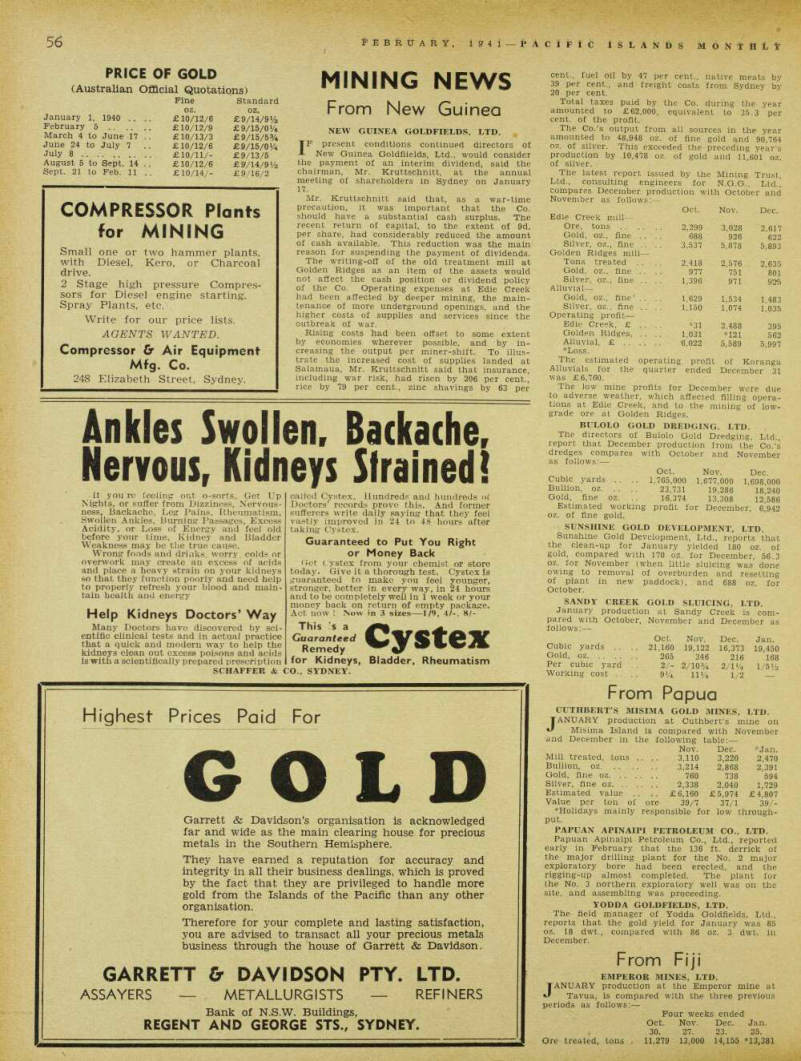
(Australian Official Quotations) Fine Standard oz. oz.
January 1, 1940 .. .. £ 10/12/6 £9/14/9% February 5 £10/12/9 £9/15/0 Vi March 4 to June 17 .. £ 10/13/3 £9/15/53/4 June 24 to July 7 .. £10/12/6 £ 9/15/0 y 4 July 8 .. . £10/11/- £9/13/5 August 5 to Sept. 14 .. £ 10/12/6 £9/14/91/2 Sept. 21 to Feb. 11 .. £10/14/- £9/16/2
Mining News
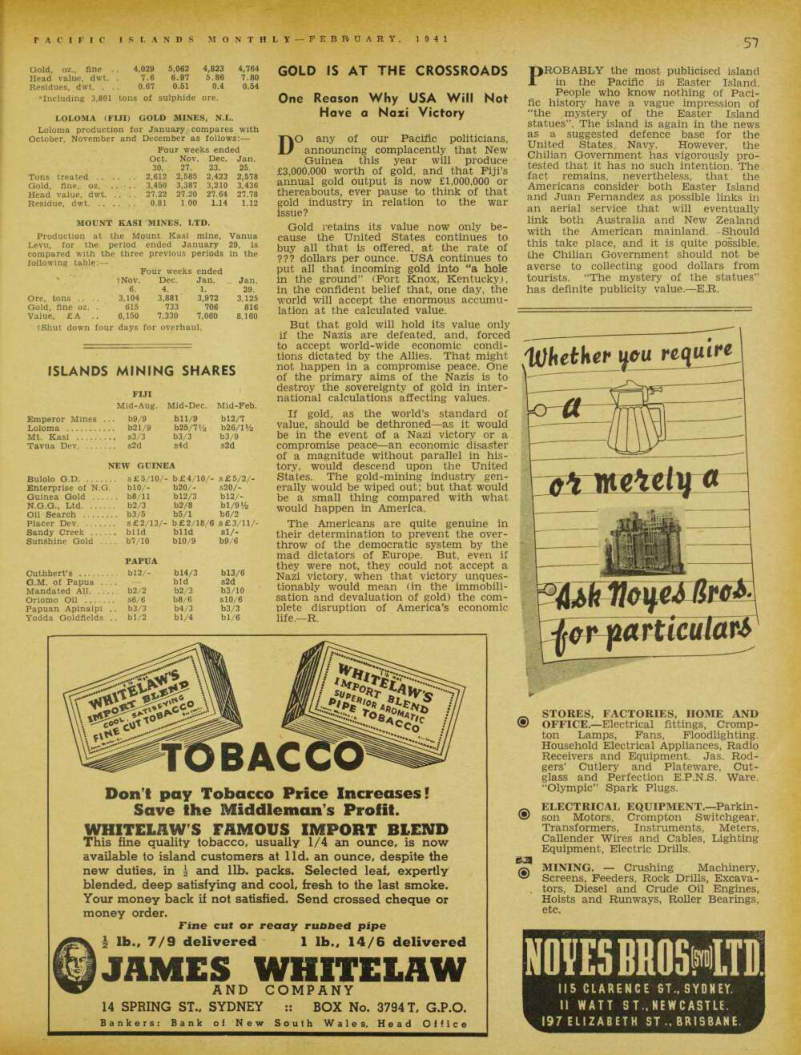
From New Guinea
New Guinea Goldfields, Ltd,
IF present conditions continued directors of New Guinea Goldfiields, Ltd., would consider the payment of an interim dividend, said the chairman, Mr. Kruttschnitt, at the annual meeting of shareholders in Sydney on January 17.
Mr. Kruttschnitt said that, as a war-time precaution, it was important that the Co. should have a substantial cash surplus. The recent return of capital, to the extent of 9d. per share, had considerably reduced the amount of cash available. This reduction was the main reason for suspending the payment of dividends.
The writing-off of the old treatment mill at Golden Ridges as an item of the assets would not affect the cash position or dividend policy of the Co. Operating expenses at Edie Creek had been affected by deeper mining, the main tenance of more underground openings, and the higher costs of supplies and services since the outbreak of war.
Rising costs had been offset to some extent by economies wherever possible, and by in creasing the output per miner-shift. To illus trate the increased cost of supplies landed at Salamaua, Mr. Kruttschnitt said that insurance, including war risk, had risen by 206 per cent., rice by 79 per cent., zinc shavings by 63 per
cent., fuel oil by 47 per cent., native meats by 39 per cent., and freight costs from Sydney by 20 per cent.
Total taxes paid by the Co. during the year amounted to £62,000, equivalent to 35.3 per cent, of the profit.
The Co.’s output from all sources in the year amounted to 48,948 oz. of fine gold 90,764 oz. of silver. This exceeded the preceding year’s production by 10,478 oz. of gold and 11,601 oz. of silver.
The latest report issued by the Mining Trust, Ltd., consulting engineers for N.G.G., Ltd.,’ compares December production with October and November as follows:
The estimated operating profit of Koranga Alluvials for the quarter ended December 31 was £6,760.
The low mine profits for December were due to adverse weather, which affected filling opera tions at Edie Creek, and to the mining of low grade ore at Golden Ridges.
Bulolo Gold Dredging, Ltd.
The directors of Bulolo Gold Dredging, Ltd., report that December production from the Co.’s dredges compares with October and November as follows:
Estimated working profit for December, 6,942 oz. of fine gold.
Sunshine Gold Development, Ltd.
Sunshine Gold Development, Ltd., reports that the clean-up for January yielded 180 oz. of gold, compared with 170 oz. for December, 56.3 oz. for November (when little sluicing was done owing to removal of overburden and resetting of plant in new paddock), and 688 oz. for October.
Sandy Creek Gold Sluicing, Ltd.
January production at Sandy Creek is com pared with October, November and December as follows:
From Papua
Cuthbert’S Misima Gold Mines, Ltd.
JANUARY production at Cuthbert’s mine on Misima Island is compared with November and December in the following table: —
Papuan Apinaipi Petroleum Co., Ltd.
Papuan Apinaipi Petroleum Co., Ltd., reported early in February that the 136 ft. derrick of the major drilling plant for the No. 2 major exploratory bore had been erected, and the rigging-up almost completed. The plant for the No. 3 northern exploratory well was on the site, and assembling was proceeding.
Yodda Goldfields, Ltd.
The field manager of Yodda Goldfields, Ltd., reports that the gold yield for January was 85 oz. 18 dwt., compared with 86 oz. 3 dwt. in December.
From Fiji
Emperor Mines, Ltd.
JANUARY production at the Emperor mine at Tavua, is compared with the three previous periods as follows:
Oct.
Nov.
Dec.
Edie Creek mill — Ore, tons 2,299 3,028 2,617 Gold, oz., fine . . . . 688 926 622 Silver, oz., fine . . .. 3,537 5,878 5,893 Golden Ridges mill— Tons treated . . .. 2.418 2,576 2,635 Gold, oz., fine .. . . 977 751 801 Silver, oz., fine . . 1,396 971 925 Alluvial— Gold, oz., fine * .. 1,629 1,534 1,483 Silver, oz., fine .. .. 1,150 1,074 1,035 Operating profit— Edie Creek, £ .. *31 2,488 395 Golden Ridges, .. 1,031 *121 562 Alluvial, £ 6,022 5,589 5,997 *Loss.
Oct.
Nov.
Dec.
Cubic yards .. . . 1,765,000 1,677,000 1,698,000 Bullion, oz. 23,731 19.286 18,240 Gold, fine oz. 16,374 13,308 12,586
Oct. Nov. Dec. Jan.
Cubic yards .. .. 21,160 19,122 16,373 19,450 Gold, oz 265 346 216 168 Per cubic yard .. 2/- 2/10 3 A 2/1 Vi l/5y 2 Working cost .. .. 9*4 liy 4 1/2 —
Nov.
Dec. ♦Jan.
Mill treated, tons . . .. 3,110 3,220 2,470 Bullion, oz 3,214 2,868 2,391 Gold, fine oz. . . . . .. 760 738 594 Silver, fine oz. .. . . . . 2,338 2,040 1,729 Estimated value ., .. £6,160 £5,974 £4,807 Value per ton of ore 39/7 37/1 39/- ♦Holidays mainly responsible for low throughput.
Four weeks ended Oct. Nov. Dec. Jan. 30. 27. 23. 25.
Ore treated, tons . 11,279 13,000 14,155 *13,381
Loloma (Fiji) Gold Mines, N.L.
Loloma production for January, compares with October, November and December as follows: —
Mount Kasi Mines, Ltd,
Production at the Mount Kasi mine, Vanua Levu, for the period ended January 29, is compared with the three previous periods in the following table: —
Gold, oz., fine . . 4,029 5,062 4,823 4,764 Head value, dwt. . 7.6 6.97 5.86 7.80 Residues, dwt. . .. 0.67 0.51 0.4 0.54 ‘Including 3,801 tons of sulphide ore.
Four weeks ended Oct. Nov. Dec. Jan. 30. 27. 23. 25.
Tons treated 2,612 2,585 2,423 2,578 Gold, fine, oz. ... 3,450 3,387 3,210 3,436 Head value, dwt 27.22 27.20 27.64 27.78 Residue, dwt 0.81 1.00 1.14 1.12
Four weeks ended tNov. Dec. Jan. Jan. 6. 4. 1. 29.
Ore, tons .. .. 3,104 3,881 3,972 3,125 Gold, fine oz. . 615 733 706 816 Value, £ A .. 6,150 7,330 7,060 8,160 •fShut down four days for overhaul.
Advertisements & other items, p. 58 (2 items)
56
February, i?4i pacific islands mont fl l $
Gold
COMPRESSOR Plants
for MINING
Small one or two hammer plants, with Diesel, Kero, or Charcoal drive. 2 Stage high pressure Compressors for Diesel engine starting.
Spray Plants, etc.
Write for our price lists.
AGENTS WANTED.
Compressor & Air Equipment
Mfg. Co.
248 Elizabeth Street, Sydney.
Ankles Swollen. Backache, Nervous, Kidneys Strained!
it you re feeling out o-sorts, Get Up Nights, or suffer from Dizziness, Nervousness, Backache, Leg Pains, Rheumatism, Swollen Ankles, Burning Passages, Excess Acidity, or Loss of Energy and feel old before your time. Kidney and Bladder Weakness may be the true cause.
Wrong foods and drinks, worry, colds or overwork may create an excess of acids and place a heavy strain on your kidneys so that they function poorly and need help to properly refresh your blood and maintain health and energy
Help Kidneys Doctors’ Way
Many Doctors have discovered by scientific clinical tests and in actual practice that a quick and modern way to help the kidneys clean out excess poisons and acids is with a scientifically prepared prescription
called Cystex. Hundreds and hundreds of Doctors’ records prove this. And former sufferers write daily saying that they feel vastly improved in 24 to 48 hours after taking Cystex.
Guaranteed to Put You Right or Money Back Dot Cystex from your chemist or store today. Give it a thorough test. Cystex is guaranteed to make you feel younger, stronger, better in every way, in 24 hours and to be completely well in 1 week or your money back on return of empty package.
Act now ! Now in 3 sizes—l/9, 4/-, 8/-
c Tzvi d Cystex
for Kidneys, Bladder, Rheumatism
SCHAFFER &
0., SYDNEY.
Highest Prices Paid For
GOLD
Garrett & Davidson’s organisation is acknowledged far and wide as the main clearing house for precious metals in the Southern Hemisphere.
They have earned a reputation for accuracy and integrity in all their business dealings, which is proved by the fact that they are privileged to handle more gold from the Islands of the Pacific than any other organisation.
Therefore for your complete and lasting satisfaction, you are advised to transact all your precious metals business through the house of Garrett & Davidson.
GARRETT & DAVIDSON PTY. LTD.
ASSAYERS METALLURGISTS REFINERS
Bank of N.S.W. Buildings,
REGENT AND GEORGE STS., SYDNEY.
Islands Mining Shares
Fiji
Mid-Aug.
Mid-Dec.
Mid-Feb.
Emperor Mines .. b9/9 bll/9 bl2/7 Loloma b21/9 b25/7V 2 b26/l»/ 2 Mt. Kasi s3/3 b3/3 b3/9 Tavua Dev s2d s4d s2d
New Guinea
Bulolo G.D s£5/10/' - b £4/10/s £5/2/- Enterprise of N.G. blO/b20/s20/- Guinea Gold . b8/ll bl2/3 bl2/- N.G.Q., Ltd b2/3 b2/8 bl/9V 2 Oil Search . b3/5 b5/l b6/2 Placer Dev s£2/13/- - b£2/18/6 s£3/ll/- Sandy Creek . blld blld sl/- Sunshine Gold ... . b7/10 blO/9 b9/6 Cuthbert’s
Papua
. bl2/bl4/3 bl3/6 G.M. of Papua . .. — bid s2d Mandated All b2/2 b2/3 b3/10 Oriomo Oil .
S6/6 b8/6 slO/6 Papuan Apinaipi , . b3/3 b4/3 b3/3 Yodda Goldfields . . bl/2 bl/4 bl/6
Gold Is At The Crossroads
One Reason Why USA Will Not Have a Nazi Victory
DO any of our Pacific politicians, announcing complacently that New Guinea this year will produce £3,000,000 worth of gold, and that Fiji’s annual gold output is now £1,000,000 or thereabouts, ever pause to think of that gold industry in relation to the war issue?
Gold retains its value now only be cause the United States continues to buy all that is offered, at the rate of ??? dollars per ounce. USA continues to put all that incoming gold into “a hole in the ground” (Fort Knox, Kentucky), in the confident belief that, one day, the world will accept the enormous accumu lation at the calculated value.
But that gold will hold its value only if the Nazis are defeated, and, forced to accept world-wide economic condi tions dictated by the Allies. That might not happen in a compromise peace. One of the primary aims of the Nazis is to destroy the sovereignty of gold in inter national calculations affecting values.
If gold, as the world’s standard of value, should be dethroned —as it would be in the event of a Nazi victory or a compromise peace—an economic disaster of a magnitude without parallel in his tory, would descend upon the United States, The gold-mining industry gen erally would be wiped out; but that would be a small thing compared with what would happen in America.
The Americans are quite genuine in their determination to prevent the over throw of the democratic system by the mad dictators of Europe. But, even if they were not, they could not accept a Nazi victory, when that victory unques tionably would mean (in the immobili sation and devaluation of gold) the com plete disruption of America’s economic life.—R.
PROBABLY the most publicised island in the Pacific is Easter Island.
People who know nothing of Paci fic history have a vague impression of “the mystery of the Easter Island statues”. The island is again in the news as a suggested defence base for the United States Navy. However, the Chilian Government has vigorously pro tested that it has no such intention. The fact remains, nevertheless, that the Americans consider both Easter Island and Juan Fernandez as possible links in an aerial service that will eventually link both Australia and New Zealand with the American mainland. Should this take place, and it is quite possible, the Chilian Government should not be averse to collecting good dollars from tourists. “The mystery of the statues”
has definite publicity value.-
E.R.
Advertisements & other items, pp. 59-60 (1 item)
Notes Brosrttd
Whether you require
ei meUly «n
STORES, FACTORIES, HOME AND
® OFFlCE.—Electrical fittings, Crompton Lamps, Fans, Floodlighting.
Household Electrical Appliances, Radio Receivers and Equipment. Jas. Rodgers’ Cutlery and Plateware, Cutglass and Perfection E.P.N.S. Ware.
“Olympic” Spark Plugs.
0 ELECTRICAL EQUIPMENT.—Parkin-
® son Motors, Crompton Switchgear, Transformers, Instruments, Meters, Callender Wires and Cables, Lighting Equipment, Electric Drills. &2I /gv MINING. Crushing Machinery, Screens, Feeders, Rock Drills, Excava- . tors, Diesel and Crude Oil Engines, Hoists and Runways, Roller Bearings, etc.
NOTES BROSrtTD
115 CLARENCE ST.. SYDNEY.
II WATT ST.,NEWCASTLE.
197 ELIZABETH ST .. BRISBANE.
*5 C® a* 5* to o'- C* 1 T
BAC
** /A fP 4fv ?** %p *Rq T Os **r.
A C C 0 Don’t pay Tobacco Price Increases!
Save the Middleman’s Profit.
WHITELAW’S FAMOUS IMPORT BLEND
This fine quality tobacco, usually 1/4 an ounce, is now available to island customers at lid. an ounce, despite the new duties, in i and 11b. packs. Selected leaf, expertly blended, deep satisfying and cool, fresh to the last smoke.
Your money back if not satisfied. Send crossed cheque or money order.
Fine cut or ready rubbed pipe i lb., 7/9 delivered 1 lb., 14/6 delivered
JAMES WHITELAW
AND COMPANY
14 SPRING ST., SYDNEY :: BOX No. 3794 T, G.P.O.
Bankers: Bank of New South Wales, Head Office
DE GAULLE
FREE FRENCH FLAG
The Cross of Lorraine, Tie or Coat Pin for gents, Brooches for ladies, enamelled on metal. 2/- each. 18/- per dozen.
WORLD'S LATEST
GAMES
Dart Boards, with 6 Darts Play Brass Competition Darts, Set of 3, 3/11, 4/6, 5/6. Monopoly, 11/6.
Totopoly, 11/6. Bucaneer, 11/6. 3 of the World’s Most Popular Games.
Chinese Checkers, 2/9, 5/-, 9/-.
Tripoly Card Game 5/3. De Luxe Type, 10/6. Poker Rummy, 1/1.
Pot Luck, 1/1.. Playing Card Lotto, 1/6. We Stock All Kinds of Indoor Games. Send for Booklet.
Spinning Wheel Race Game. Shows Horses and Odds. Spin wheel for result. 8 in. diameter. 21/- and 42/-. With Betting Sheet.
Write for full lists of Games for Hotels, Clubs, Carnivals, Bazaars, etc.
HIGHEST GRADE MODEL PLANE
KIT, 15/-, 18/6, and 21/-. Cheaper makes, 2/6, 3/6, 4/6, 5/6, and 6/0. <5
“PRESTO”
THE
MAGIC
BOX
The most Amazing Trick- Just out.
“Presto”. —The greatest, most alluring and outstanding UttJe trick ever introduced, 2/9. Post Free.
Money back if it’s not the best yet
RADIOS. All
kinds; all waves.
Built to order.
We have hun dreds giving ex cellent service right throughout the South £ Islands. Quotes for asking.
RADIO ACCUMULATORS.
2 Volt, 110 Amp 19/- 2 .. 150 20/- 4 „ 65 20/6 4 „ 90 22/6 6 .. 90 86/8 6 .. HO 46/6 6 „ 130 66/- 6 .. 150 7S/9 6 .. 170 84/fl
HEADPHONES.
9/6, 12/6, 17/6.
S.T.C., British, 30/-; 8.T.H.. 30/-; Lissen, British, 19/6. All 4,000 ohms. m Ericcson’s Professional Type, 47/6. nv-i I.
POLICE PATROL MULTI STRAND
RUBBER COVERED AERIAL.
Needs No Separate Lead-in. 50 ft., 2/6; 100 ft., 5/-.
MAN-O-WAR HEAVY DUTY
INSULATED AERIAL, MULTI
STRAND WIRES.
50 ft., 5/-; 100 ft. 10/-.
LEARN MORSE CODE. “LIKE-A-
FLASH” KITS, KEYS & BUZZERS.
P.M.G. type Key with Professional Buzzer & Battery, all assembled on Base Board, 42/6.
The World's Latest Match Box 2/6. Bakelite, indestructa b 1 e. One match always ready by tipping of the box. No opening and closing lid.
With De Gaulle Flag attached, or U.S.A., Norway, British, Australian,
A.1.F., R.A.A.F., R.A.N., Dutch,
Flag Medallion attached, 3/6.
Hunting and Sporting Knives. Remington U.S.A. made, 10/6, 12/6, 15/6, 16/6. (All in Sheath.) Throwing Knives, in Sheath, 7/6. r Repeating Toy Revolvers.
Just like the real thing. 4/11, 5/6, 7/6, 8/6.
TYPE
SOUNDER
High-pitched Tone De Luxe Pro fcnoconol Belter. The beet »Mt «*/-
S P I NNING
CHOCOLATE
WHEELS.
£B/10/-.
High - grade D e Luxe, Neat, small, compact, for Clubs, Hotels, etc. 64 numb e r e d sections. Sheet of 64 Tickets Id. per sheet.
Adjustable Buzzers, 4/9. Others,4/11, 5/6 and 15/-. As illustrated, 15/-.
Now available (not less than 10/parcels): Magic Wand. 1/6 Jafet’s Wallet, 1/-; Obedient Ball, 1/6; Mystic Head Chopper, 2/6; Shy Lock, 2/-; Dribble Glass, 2/-; Ventrillo, 1/-; Magic Coin, 1/-; Nest of Nests, 5/-; Voice Echoer, 1/-; Magic Bottle, 1/-; 3 Bell Trick, 1/-.
Wonderful Rattle Box Trick, 2/6. Mixed Parcels of Tricks, 10/-, 20/-, 30/-, 40/-, 50/-.
Parcel of Jokes, 10/-, 12/6, 15/-, Morse Set Buzzer or light with single switch. All parts include adjustable Key, Switch, Buzzer, Lamp and Battery, all assembled on Base Board, 30/-.
Morse Code Set “De Luxe”. Adjustable High-grade Key, Buzzer and Battery. All mounted on base board ready for use, 27/6.
Adjustable Morse Code Key on Bakelite Base, highly plated parts, 12/6. Higher grade instrument.
De Luxe Junior Morse Code Outfit.
Mounted Key Buzzer and Battery. 13/6 complete.
De Luxe Junior Morse Code Set.
Buzzer Key Light, Throw-over Switch. All mounted with Battery.
d®* 63/- From London. “Cosmocord” De Luxe Crystal Pick-up, with Built-in Vol.
Control, 58/6. Magnetic type Pickups, complete with volume control and tone arm. British Make, 30/-. 35/-, 38/6, 45/-. Studio Model, 50/-.
SWOOP! BRITAIN’S BEST.
“Amplion,” Bakelite PICK-UP, with Volume Control incorporated. Brand new, in original cartons. Listed to sell at 38/6. Now 32/6. Pits and suits all sets.
Play, Talk, Sing, Joke through your Radio. Great Pun. Batteryleas type.
Microphone for Hand Holding or Hanging, 22/6. Complete with Flex fixed in a second. Others, 12/6, 15/-, 17/6, 25/-, 28/6, 32/6. All plus 2/for Battery and 1/6 for 20 ft. Cord. m nr. 8.0. E. Table Type Microphone. Highly recommended for Amateur or Professional use. Built-in Transformer and Battery with Volume Control incorporated.
Just plug into pickup terminals of any set. 39/6. New Bullet Model, also 39/6.
RADIO VALVES. —We guarantee a Better Price. Send along your order.
Dice of all kinds in stock. Poker Dice, 6/6, 7/6, 8/6, 10/6, set of 5.
Crown & Anchor Dice, set of 3, 5/6.
Full Set with Cloth and Shaker, 10/6. H. & T., 5 & 6, and Hazard Dice Stocked. \' t P.M.G. Model Adjustable Morse Code Key. Heavy Precision Fittings on solid Wooden Base. 19/6. \\\///.
Morse Code Light and Buzzer Set.
A precision De-luxe outfit that cannot be bettered. Perfect Adjustable Morse Code Key, with professional type Buzzer. Light to Buzzer throw-over Switch, and Battery, all ready mounted, for im mediate use, on strong solid wooden Base Board, 39/6 the outfit.
METERS.—Pocket Volt Meters. 2 Reading for A. & B. Batteries, 8/6. 10/6.
WATES.—4 in 1 Meter: 0 to 6, 0 to 15. 0 to 180 volts: 0 to 30 M/A, 14/-.
TELSEN.—Millimeter A.C., D.C.
British. Reads everything in Radio.
Bench type, 22/6.
Emicol Universal D.C. Meters, Bench type, reads 0 to 6, 0 to 150 volts, 0 to 30 M.A.S., 0 to 2,000 ohms, 30/-.
Nickelled Pocket Meter: 0 to 25 volts, 0 to 5 amperes; 35/- value; now 15/-.
BOOKS! BOOKS! BOOKS! The Be-
ginners’ Book of Radio. The Radio Beginners’ Dictionary. 2/- the 2. The Wireless Constructor’s Encyclopaedia. Giant size, 7/6. Newnes “Everyman’s” Wireless Book, 6/6.
The Book of Practical Radio, also The Book of Practical Television, 8/6 each. Fouisham’s Giant “Party and Fun Book”, 1/6. Humorous Stories and Recitations, 3/9. Card and Conjuring Trfcks, 3/9. Tea- Cup Fortune Telling, 3/9. 100 Party Games for Old and Young, 1/9.
Popular Magic and Amateur Conjurer, 1/9. 60 Best Party Games, 1/6. Tricks with Cards, 1/6.
J.LEVENSON Radio "S"
GAMES, NOVELTIES AN® HOBBIES. Totem and
226 A PITT STREET, SYDNEY ” d Manufacturers, Importers, and Exporters.
N.S.W., AUSTRALIA. 1111111111111111111111111
Cable address: “Leveradloh”. Goods forwarded V.P.P. or Sight Draft. Satisfaction and Service Guaranteed. We ean supply by mail all General Merchandise at a Better Price. Quotations with pleasure. Please add freight and packing. Write for full list of interesting leaflets of Games, Hobbies, Novelties, and Electrical Goods. Write for full list of Radio Meters.
iiiimnnnnnnim
Write for Punch Board Leaflets nirnirnmniiimii
We Can Supply, at a Keen Price, Any Available Article You Require.
Australian Short Wave
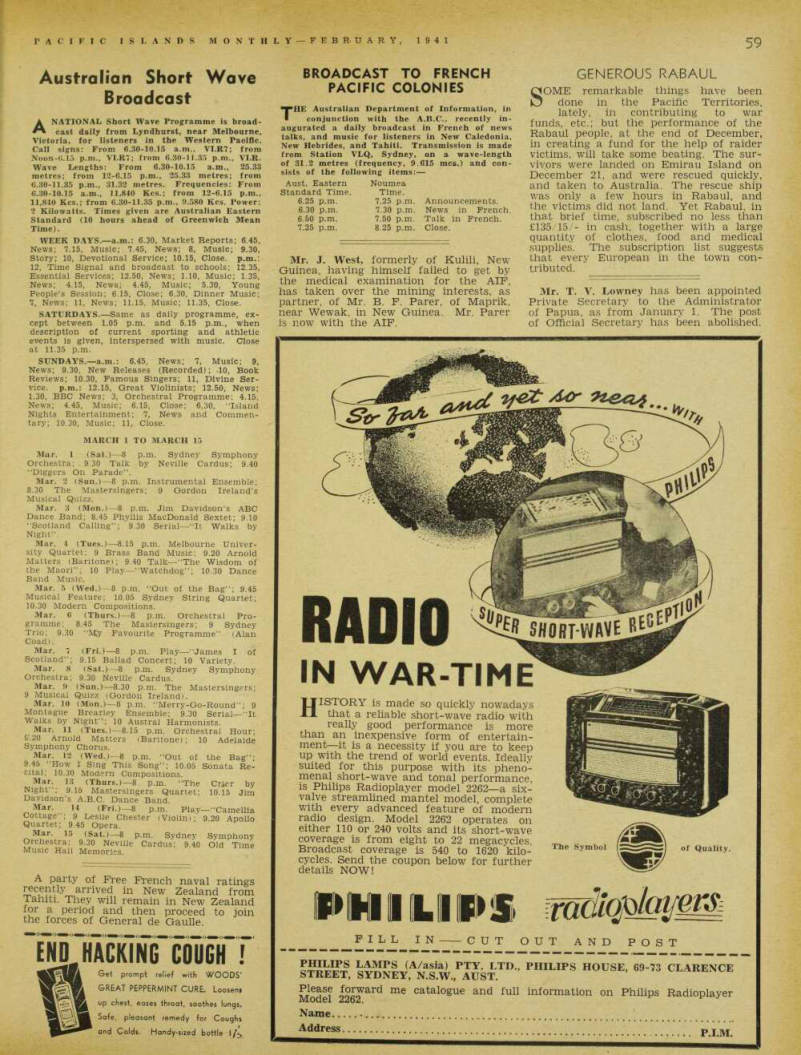
Broadcast
A NATIONAL Short Wave Programme is broad cast daily from Lyndhurst, near Melbourne, Victoria, for listeners in the Western Pacific.
Call signs: From 6.30-10.15 a.m.. VLR7; from Noon-6.15 p.m., VLR7; from 6.30-11.35 p.m., VLR.
Wave Lengths: From 6.30-10.15 a.m., 25.33 metres; from 12-6.15 p.m., 25.33 metres; from 6.30-11.35 p.m., 31.32 metres. Frequencies: From 6.30-10.15 a.m., 11,840 Kcs.; from 12-6.15 p.m., 11,840 Kcs.; from 6.30-11.35 p.m., 9.580 Kcs. Power: 2 Kilowatts. Times given are Australian Eastern Standard (10 hours ahead of Greenwich Mean Time).
WEEK DAYS.—a.m.: 6.30, Market Reports; 6.45, News; 7.15, Music; 7.45, News; 8, Music; 9.30, Story; 10, Devotional Service; 10.15, Close, p.m.: 12, Time Signal and broadcast to schools; 12.35, Essential Services; 12.50, News; 1.10, Music; 1.35, News; 4.15, News; 4.45, Music; 5.30, Young People’s Session; 6.15, Close; 6.30, Dinner Music; 7, News; 11, News; 11.15, Music; 11.35, Close.
SATURDAYS. —Same as daily programme, ex cept between 1.05 p.m. and 5.15 p.m., when description of current sporting and athletic events is given, interspersed with music. Close at 11.35 p.m.
SUNDAYS.—a.m.: 6.45, News; 7, Music; 9, News; 9.30, New Releases (Recorded); 10, Book Reviews: 10.30, Famous Singers; 11, Divine Ser vice. p.m.: 12.15, Great Violinists; 12.50, News; 1.30, BBC News; 3, Orchestral Programme; 4.15, News; 4.45, Music; 6.15, Close; 6.30, “Island Nights Entertainment; 7, News and Commen tary; 10.30, Music; 11, Close.
March I To March 15
Mar. 1 (Sat.) —8 p.m. Sydney Symphony Orchestra; 9.30 Talk by Neville Cardus; 9.40 “Diggers On Parade”.
Mar. 2 (Sun.) —8 p.m. Instrumental Ensemble; 8.30 The Mastersingers; 9 Gordon Ireland’s Musical Quizz.
Mar. 3 (Mon.) —8 p.m. Jim Davidson’s ABC Dance Band; 8.45 Phyllis MacDonald Sextet; 9.10 “Scotland Calling”; 9.30 Serial—“lt Walks by Night”.
Mar. 4 (Tues.) —8.15 p.m. Melbourne Univer sity Quartet: 9 Brass Band Music; 9.20 Arnold Matters (Baritone): 9.40 Talk—“ The Wisdom of the Maori”; 10 Play—“ Watchdog”: 10.30 Dance Band Music.
Mar. 5 (Wed.) —8 p.m. “Out of the Bag”; 9.45 Musical Feature; 10.05 Sydney String Quartet; 10.30 Modern Compositions.
Mar. 6 (Thurs.) —8 p.m. Orchestral Pro gramme; 8.45 The Mastersingers; 9 Sydney Trio; 9.30 “My Favourite Programme” (Alan Coad).
Mar. 7 (Fri.)—B p.m. Play—“ James I of Scotland”; 9.15 Ballad Concert; 10 Variety.
Mar. 8 (Sat.) —8 p.m. Sydney Symphony Orchestra; 9.30 Neville Cardus.
Mar. 9 (Sun.) —8.30 p.m. The Mastersingers; 9 Musical Quizz (Gordon Ireland).
Mar. 10 (Mon.) —8 p.m. “Merry-Go-Round”; 9 Montague Brearley Ensemble; 9.30 Walks by Night”; 10 Austral Harmonists.
Mar. 11 (Tues.) —8.15 p.m. Orchestral Hour; &'.20 Arnold Matters (Baritone); 10 Adelaide Symphony Chorus.
Mar. 12 (Wed.) —8 p.m. “Out of the Bag”; 9.45 “How I Sing This Song”; 10.05 Sonata Re cital; 10.30 Modern Compositions.
Mar. 13 (Thurs.) —8 p.m. “The Crier by Night”; 9.15 Mastersingers Quartet; 10.15 Jim Davidson’s A.B.C. Dance Band.
Mar. 14 (Fri.)—B p.m. Play—“ Camellia Cottage ; 9 Leslie Chester (Violin); 9.20 Apollo Quartet: 945 Opera.
Mar. 15 (Sat.) —8 p.m. Sydney Symphony Orchestra; 9.30 Neville Cardus; 9.40 Old Time Music Hall Memories.
A party of Free French naval ratings recently arrived in New Zealand from Tahiti. They will remain in New Zealand for a period and then proceed to join the forces of General de Gaulle.
Broadcast To French
Pacific Colonies
THE Australian Department of Information, in conjunction with the A.8.C., recently in augurated a daily broadcast in French of news talks, and music for listeners in New Caledonia, New Hebrides, and Tahiti. Transmission is made from Station VLQ, Sydney, on a wave-length of 31.2 metres (frequency, 9.615 mcs.) and con sists of the following items:—
Mr. J. West, formerly of Kulili, New Guinea, having himself failed to get by the medical examination for the AIF, has taken over the mining interests, as partner, of Mr. B. F. Parer, of Maprik, near Wewak, in New Guinea. Mr. Parer is now with the AIF.
Aust. Eastern Noumea Standard Time.
Time. 6.25 p.m. 7.25 p.m.
Announcements. 6.30 p.m. 7.30 p.m.
News in French. 6.50 p.m. 7.50 p.m.
Talk in French. 7.25 p.m. 8.25 p.m.
Close.
Generous Rabaul
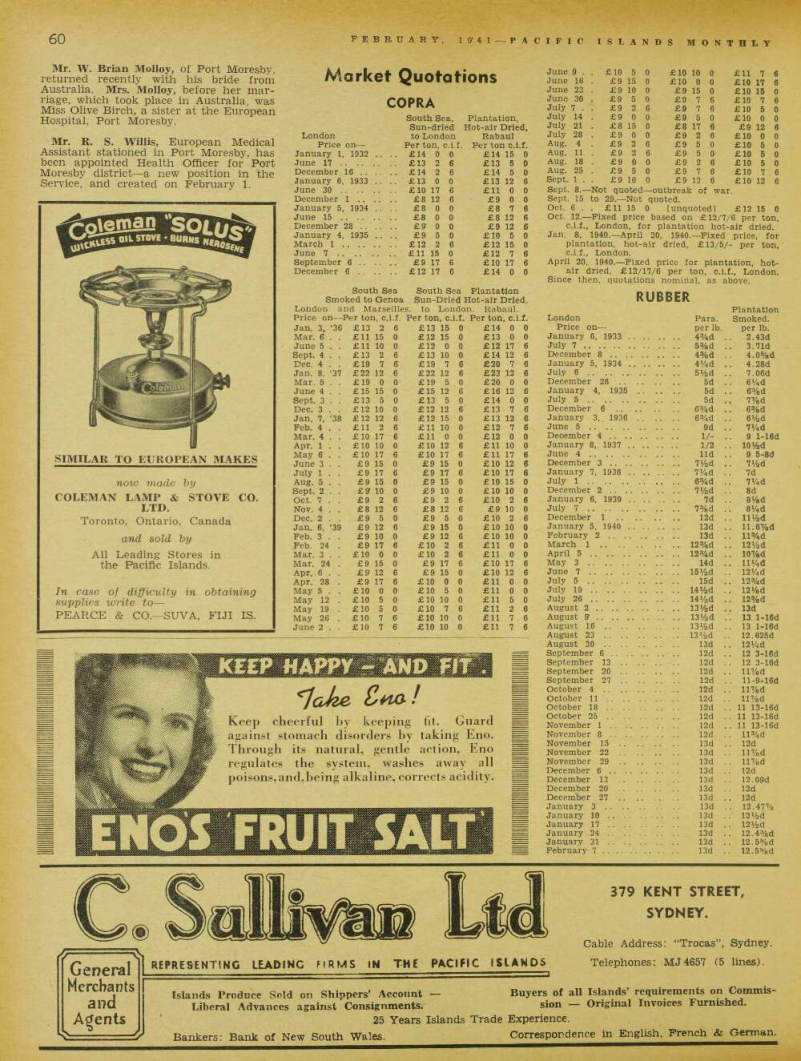
SOME remarkable things have been done in the Pacific Territories, lately, in contributing to war funds, etc.; but the performance of the Rabaul people, at the end of December, in creating a fund for the help of raider victims, will take some beating. The sur vivors were landed on Emirau Island on December 21, and were rescued quickly, and taken to Australia. The rescue ship v/as only a few hours in Rabaul, and the victims did not land. Yet Rabaul, in that brief time, subscribed no less than £135/15/- in cash, together with a large quantity of clothes, food and medical supplies. The subscription list suggests that every European in the town con tributed.
Mr. T. V. Lowney has been appointed Private Secretary to the Administrator of Papua, as from January 1. The post of Official Secretary has been abolished.
Mr. W. Brian Molloy, of Port Moresby, returned recently with his bride from Australia. Mrs. Molloy, before her mar riage, which took place in Australia, was Miss Olive Birch, a sister at the European Hospital, Port Moresby.
Mr. R. S. Willis, European Medical Assistant stationed in Port Moresby, has been appointed Health Officer for Port Moresby district—a new position in the Service, and created on February 1.
Advertisements & other items, pp. 61-62 (2 items)
Radio
StrfaA
\t M •c?
SHORTWAVE R]Mgi
RADIO
IN WAR-TIME
HISTORY is made so quickly nowadays that a reliable short-wave radio with really good performance is more than an inexpensive form of entertainment—it is a necessity if you are to keep up with the trend of world events. Ideally suited for this purpose with its phenomenal short-wave and tonal performance, is Philips Radioplayer model 2262—a sixvalve streamlined mantel model, complete with every advanced feature of modern radio design. Model 2262 operates on either 110 or 240 volts and its short-wave coverage is from eight to 22 megacycles.
Broadcast coverage is 540 to 1620 kilocycles. Send the coupon below for further details NOW!
PHI
>» The Symbol of Quality I
FILL IN
CUT OUT AND POST
STREET, IYDNIY (A N a |^. P^ST. TD ’ PHILIPS HOUSE ’ 69 ,3 CLARENCE Tvr lo H S ? oo£? ard me catal °SU€ and full information on Philips Radioplayer
iVi.OQ.OJI
Name Address P.I.M.
SIMILAR TO EUROPEAN MAKES
now made by
COLEMAN LAMP & STOVE CO.
LTD.
Toronto, Ontario, Canada and sold by All Leading Stores in the Pacific Islands.
In case of difficulty in obtaining supplies write to —
PEARCE & CO.-SUVA, FIJI IS.
Keep cheerful hy keeping fit. Guard against stomach disorders hy taking Eno.
Through its natural, gentle action, Eno regulates the system, washes away all poisons, and,being alkaline, corrects acidity.
ENOS FRUIT SALT
C® Safe®
General
Merchants
and
Agents
REPRESENTING LEADING FIRMS IN THE PACIFIC ISLANDS
379 KENT STREET,
SYDNEY.
Cable Address: “Trocas”, Sydney.
Telephones: MJ4657 (5 lines).
Buyers of all Islands’ requirements on Commission Original Invoices Furnished.
Islands Produce Sold on Shippers’ Account Liberal Advances against Consignments. 25 Years Islands Trade Experience.
Bankers: Bank of New South Wales. Correspondence in English. French & German.
End Hacking Cough !
SB Get prompt relief with WOODS'
GREAT PEPPERMINT CURE. Loosen*
up chest, eases throat, soothes lungs.
Safe, pleasant remedy for Coughs ond Colds. Handy-sized bottle I/-,
Market Quotations
June 9 . . £10 5 0 £ 10 10 0 £11 7 6 June 16 . £9 15 0 £10 0 0 £10 17 6 June 23 . £9 10 0 £9 15 0 £ 10 15 0 June 30 . £9 5 0 £9 7 6 £10 7 6 July 7 . . £9 2 6 £9 7 6 £10 5 0 July 14 . £9 0 0 £9 5 0 £10 0 0 July 21 . £8 15 0 £8 17 6 £9 12 6 July 28 . £9 0 0 £9 2 6 £10 0 0 Aug. 4 . £9 2 6 £9 5 0 £10 5 0 Aug. 11 . £9 2 6 £9 5 0 £10 5 0 Aug. 18 . £9 0 0 £9 2 6 £10 5 0 Aug. 25 . £9 5 0 £9 7 6 £10 7 6 Sept. 1 . . £9 10 0 £9 12 6 £10 12 6 Sept. 8.—Not quoted —outbreak of war.
Sept. 15 to 29.—Not quoted.
Oct. 6 . . £11 15 0 [unquoted] £12 15 0 Oct. 12.—Fixed price based on £12/7/6 per ton. c.l.f,, London, for plantation hot-air dried.
Jan. 8, 1940. —April 20, 1940.—Fixed price, for plantation, hot-air c.i.f., London. dried, £13/5/- - per ton, April 20, 1940.—Fixed price for plantation, hotair dried, £12/17/6 per ton, c.l.f., London.
Since then, quotations nominal, as above.
Rubber
Plantation London Para.
Smoked.
Price on— per lb. per lb.
January 6, 1933 .. 2.43d July 7 3.71d December 8 4.0 s /sd January 5, 1934 .. .. .. 4%d . 4.28d July 6 .. .. 5V 2 d ., 7.06d December 28 .. 6 l / 4 d January 4, 1935 . .. .. 5d ., 6%d July 5 .. .. 5d . 7y 8 d December 6 . . . .. 6%d 6%d January 3, 1936 , . .. 6%d ., ey 2 d June 5 .. .. 9d 7y»d December 4 .. .. 1/- . 9 l-16d January 8, 1937 .. , .. .. 1/2 ., . ioy 2 d June 4 .. .. lid ., 9 5-8d December 3 .. .. 7»/ 2 d ., 7%d January 7, 1938 .. .. .. 7%d ., 7d July 1 .. .. 6%d .. 7>/ 4 d December 2 .. .. 7y 2 d .. 8d January 6, 1939 .. .. .. 7d ., sy 8 d July 7 sy 4 d December 1 .. . .. 12d ., , ny 2 d January 5, 1940 .. .. .. 13d ., , 11.6%d February 2 .. .. 13d ., , ll%d March 1 . .. 12 3 Ad ., . i2y 2 d April 5 .. .. 12 3 Ad ., , ioy 8 d May 3 , ny 4 d June 7 i2y 4 d July 5 .. .. 15d .. , 12%d July 19 .. .. 14V 2 d .. , 12Vsd July 26 .. .. 14>/ 2 d ., , 12%d August 2 .. .. 13%d ., . 13d August 9 .. .. 13‘/ 2 d ., . 13 l-16d August 16 .. .. 13y 2 d .. . 13 l-16d August 23 .. .. 13y 2 d .. 12.625d August 30 .. .. 13d .. , 12>/ 4 d September 6 .. .. 12d .. , 12 3-16d September 13 .. . .. .. 12d .. , 12 3-16d September 20 .. ., .. .. 12d .. , ll%d September 27 .. . .. . . 12d ., . ll-9-16d October 4 ... 12d .. ny 8 d October 11 .. . . 12d ..
Iiy 8 d October 18 .. . . 12d .. 11 13-16d October 25 .. .. 12d 11 13-16d November 1 .. .. 12d ., , 11 13-16d November 8 .. .. 12d .. ll%d November 15 .. .. ,. . . 13d ., . 12d November 22 ,. .. 13d .. ll%d November 29 . . .. . .. 13d .. , ny 8 d December 6 . . .. 13d .. 12d December 13 .. .. ... 13d .. 12.09d December 20 . . .. ... 13d .. 12d December 27 . . .. . .. 13d .. , 12d January 3 .. .. 13d . . 12.47% January 10 .. .. 13d .. 12%d January 17 . . .. 13d .. 12%d January 24 .. .. 13d .. 12.4%d January 31 .. .. 13d ,. 12.5% d February 7 .. .. 13d .. 12.5 5 / 8 d
London Price January 1 on— 1932
Copra
South Sea, Sun-dried to London Per ton, c.i. £14 0 0 Plantation, Hot-air Dried, Rabaul f. Per ton c.i.f, £14 15 0 June 17 . £13 2 6 £13 5 0 December 16 .. £14 2 6 £14 5 0 January 6 1933 £13 0 0 £13 12 6 June 30 . £10 17 6 £11 0 0 December 1 .. £8 12 6 £9 0 0 January 5 1934 £8 0 0 £8 7 6 June 15 . £8 0 0 £8 12 6 December 28 . . £9 0 0 £9 12 6 January 4 1935 . . £9 5 0 £10 5 0 March 1 £12 2 6 £12 15 0 June 7 . £11 15 0 £12 7 6 September 6 .. £9 17 6 £10 17 6 December 6 . £12 17 6 £14 0 0 South Sea Smoked to Genoa South Sea Plantation Sun-Dried Hot-air Dried.
London and Marseilles, to London. Rabaul.
Price on— Per ton, c.i.f.
Per ton, c.i.f.
Per ton, c.i.f.
Jan. 3, ’36 £13 2 6 £13 15 0 £14 0 0 Mar. 6 . . £11 15 0 £12 15 0 £13 0 0 June 5 . . £11 10 0 £12 0 0 £12 17 6 Sept. 4 . . £13 2 6 £13 10 0 £14 12 6 Dec. 4 . . £19 7 6 £19 7 6 £20 7 6 Jan. 8, '37 £22 12 6 £22 12 6 £23 12 6 Mar. 5 . . £19 0 0 £19 5 0 £20 0 0 June 4 . . £15 15 0 £15 12 6 £16 12 6 Sept. 3 . . £13 5 0 £13 5 0 £14 0 0 Dec. 3 . . £12 10 0 £12 12 6 £13 7 6 Jan, 7, ’38 £12 12 6 £12 15 0 £13 12 6 Peb. 4 . . £11 2 6 £11 10 0 £12 7 6 Mar. 4 . . £10 17 6 £11 0 0 £12 0 0 Apr. 1 . . £10 10 0 £10 12 6 £11 10 0 May 6 . . £10 17 6 £10 17 6 £11 17 6 June 3 . . £9 15 0 £9 15 0 £10 12 6 July 1 . . £9 17 6 £9 17 6 £10 17 6 Aug. 5 . . £9 15 0 £9 15 0 £10 15 0 Sept. 2 . . £ 9 10 0 £9 10 0 £10 10 0 Oct. 7 . . £9 2 6 £9 2 6 £10 2 6 Nov. 4 . , £8 12 6 £8 12 6 £9 10 0 Dec, 2 . . £9 5 0 £9 5 0 £10 2 6 Jan. 6, ’39 £9 12 6 £9 15 0 £10 10 0 Feb. 3 . . £9 10 0 £9 12 6 £10 10 0 Feb. 24 . £9 17 6 £10 2 6 £11 0 0 Mar. 3 . . £10 0 0 £10 2 6 £11 0 0 Mar. 24 . £9 15 0 £9 17 6 £10 17 6 Apr. 6 . . £9 12 6 £9 15 0 £10 12 6 Apr. 28 . £9 17 6 £10 0 0 £11 0 0 May 5 . . £10 0 0 £10 5 0 £11 0 0 May 12 . £10 5 0 £10 10 0 £11 5 0 May 19 . £10 5 0 £10 7 6 £11 2 6 May 26 . £10 7 6 £10 10 0 £11 7 6 June 2 . . £10 7 6 £10 10 0 £11 7 6
Islands Produce
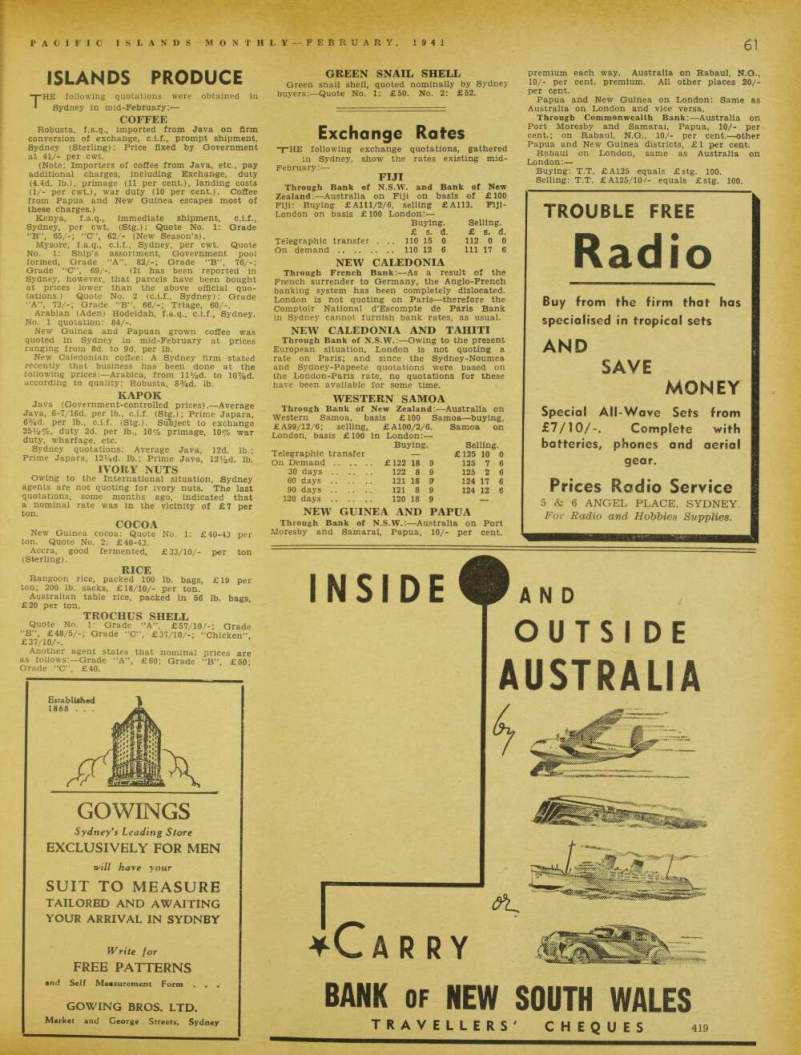
THE following quotations were obtained in Sydney in mid-February;—
Coffee
Robusta, f.a.q., imported from Java on firm conversion of exchange, c.1.f., prompt shipment, Sydney (Sterling): Price fixed by Government at 41/- per cwt. (Note: Importers of coffee from Java, etc., pay additional charges, including Exchange, duty (4.4 d. lb.), primage (11 per cent.), landing costs (1/- per cwt.), war duty (10 per cent.). Coffee from Papua and New Guinea escapes most of these charges.) Kenya, f.a.q., Immediate shipment, c.i.f., Sydney, per cwt. (Stg.): Quote No. 1: Grade “B”, 65/-; “C”, 62/- (New Season’s).
Mysore, f.a.q., c.i.f., Sydney, per cwt. Quote No. 1: Ship’s assortment. Government pool formed, Grade “A”, 82/-; Grade “B”, 76/-; Grade “C”, 69/-. (It has been reported in Sydney, however, that parcels have been bought at prices lower than the above official quo tations.) Quote No. 2 (c.i.f., Sydney): Grade “A”, 73/-; Grade “B”, 66/-; Triage, 60/-.
Arabian (Aden) Hodeidah, f.a.q., c.i.f., Sydney.
No. 1 quotation; 84/-.
New Guinea and Papuan grown coffee was quoted in Sydney in mid-February at prices ranging from Bd. to 9d. per lb.
New Caledonian coffee: A Sydney firm stated recently that business has been done at the following prices:—Arabica, from liy 2 d. to 10y B d. according to quality; Robusta, B%d. lb.
Kapok
Java (Government-controlled prices).—Average Java, 6-7/16d. per lb., c.i.f. (Stg.); Prime Japara, 6%d. per lb., c.i.f. (Stg.). Subject to exchange 251/2%, duty 2d. per lb., 10% primage, 10% war duty, wharfage, etc.
Sydney quotations: Average Java, 12d. lb.; Prime Japara, 12y 4 d. lb.; Prime Java, 12y 2 d. lb.
Ivory Nuts
Owing to the International situation, Sydney agents are not quoting for ivory nuts. The last quotations, some months ago, indicated that a nominal rate was in the vicinity of £7 per ton.
Cocoa
New Guinea cocoa: Quote No. 1: £4O-43 per ton. Quote No. 2: £4O-43.
Accra, good fermented, £33/10/- per ton (Sterling).
Rice
Rangoon rice, packed 100 lb. bags, £l9 per ton; 200 lb. sacks, £lB/10/- per ton.
Australian table rice, packed in 56 lb. bags. £2O per ton.
Trochus Shell
Quote No. 1: Grade “A”, £57/10/-; Grade “B”, £4B/5/-; Grade “C”, £37/10/-; “Chicken” £37/10/-.
Another agent states that nominal prices are as follows:—Grade “A”, £6O; Grade “B” £5O - “C”, £4O.
Green Snail Shell
Green snail shell, quoted nominally by Sydney buyers;—Quote No. 1: £5O. No. 2: £52.
Exchange Rates
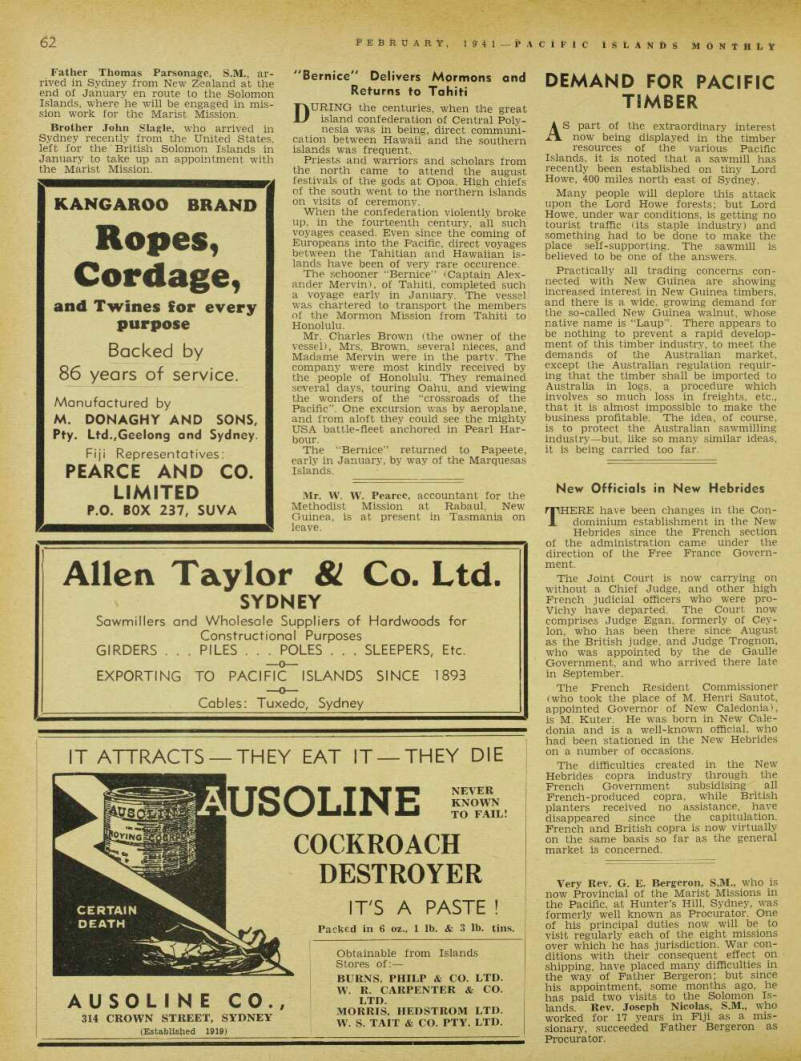
THE following exchange quotations, gathered in Sydney, show the rates existing mid- February:—
Fiji
Through Bank of N.S.W. and Bank of New Zealand;—Australia on Fiji on basis of £lOO Fiji: Buying £Alll/2/6, selling £AII3. FIJI - on basis £lOO London: —
New Caledonia
Through French Bank;—As a result of the French surrender to Germany, the Anglo-French banking system has been completely dislocated.
London is not quoting on Paris—therefore the Comptoir National d’Escompte de Paris Bank in Sydney cannot furnish bank rates, as usual.
New Caledonia And Tahiti
Through Bank of N.S.W.: —Owing to the present European situation, London is not quoting a rate on Paris; and since the Sydney-Noumea and Sydney-Papeete quotations were based on the London-Parls rate, no quotations for these have been available for some time.
Western Samoa
Through Bank of New Zealand; —Australia on Western Samoa, basis £lOO Samoa —buying, £ A99/12/6; selling, £AIOO/2/6. Samoa on London, basis £lOO in London: —
New Guinea And Papua
Through Bank of N.S.W.:—Australia on Port Moresby and Samarai, Papua, 10/- per cent.
premium each way. Australia on Rabaul, N.Q., 10/- per cent, premium. All other places 20/per cent.
Papua and New Guinea on London: Same as Australia on London and vice versa.
Through Commonwealth Bank:—Australia on Port Moresby and Samarai, Papua, 10/- per cent.; on Rabaul, N.G., 10/- per cent. —other Papua and New Guinea districts, £1 per cent.
Rabaul on London, same as Australia on London:— Buying: T.T. £AI2S equals £stg. 100.
Selling: T.T. £AI2S/10/- equals £stg. 100.
Buying.
Selling, £ s. d. £ s. d.
Telegraphic transfer . .. 110 15 0 112 0 0 On demand .. 110 12 6 111 17 6
Buying. Selling.
Telegraphic transfer — £125 10 0 On Demand £122 18 9 125 7 6 30 days 122 8 9 125 2 6 60 days 121 18 9 124 17 6 90 days 121 8 9 124 12 6 120 days 120 18 9 —
Father Thomas Parsonage, S.M., ar rived in Sydney from New Zealand at the end of January en route to the Solomon Islands, where he will be engaged in mis sion work for the Marist Mission.
Brother John Slagle, who arrived in Sydney recently from the United States, left for the British Solomon Islands in January to take up an appointment with the Marist Mission.
Advertisements & other items, pp. 63-64 (2 items)
*Car ry
TROUBLE FREE
Radio
Buy from the firm that has specialised in tropical sets
AND
SAVE
MONEY
Special All-Wave Sets from £7/10/-. Complete with batteries, phones and aerial gear.
Prices Radio Service
5 & 6 ANGEL PLACE, SYDNEY.
For Radio and Hobbies Supplies.
INSIDE
r *Car ry
AND
OUTSIDE
AUSTRALIA
BANK of NEW SOUTH WALES
TRAVELLERS' CHEQUES 419
KANGAROO BRAND
Ropes,
Cordage,
and Twines tor every purpose
Backed by
86 years of service.
Manufactured by
M. DONAGHY AND SONS,
Pty. Ltd.,Geelong and Sydney.
Fiji Representatives:
PEARCE AND CO.
LIMITED
P.O. BOX 237, SUVA
Allen Taylor & Co. Ltd.
SYDNEY
Sawmillers and Wholesale Suppliers of Hardwoods for Constructional Purposes GIRDERS . . . PILES . . . POLES . . . SLEEPERS, Etc.
EXPORTING TO PACIFIC ISLANDS SINCE 1893
Cables: Tuxedo, Sydney
IT ATTRACTS —THEY EAT IT —THEY DIE us
OVING
NEVER
KNOWN
TO FAIL!
USOLINE
COCKROACH
DESTROYER
IT'S A PASTE !
Packed in 6 oz., 1 lb. & 3 lb. tins.
AUSOLINE CO
314 CROWN STREET, SYDNEY
(Established 1919) Obtainable from Islands Stores of: —
BURNS, PHILP & CO. LTD.
W. R. CARPENTER & CO.
LTD.
MORRIS, HEDSTROM LTD.
W. S. TAIT & CO. PTY. LTD.
Go Wings
Estal 186 i X
Sydney’s Leading Store
EXCLUSIVELY FOR MEN
SUIT TO MEASURE
TAILORED AND AWAITING
YOUR ARRIVAL IN SYDNEY
Write for
FREE PATTERNS
and Self Measurement Form . .
COWING BROS. LTD.
Market and George Streets, Sydney will have your
"Bernice" Delivers Mormons and Returns
Returns to Tahiti
DURING the centuries, when the great island confederation of Central Poly nesia was in being, direct communi cation between Hawaii and the southern islands was frequent.
Priests and warriors and scholars from the north came to attend the august festivals of the gods at Opoa. High chiefs of the south went to the northern islands on visits of ceremony.
When the confederation violently broke up, in the fourteenth century, all such voyages ceased. Even since the coming of Europeans into the Pacific, direct voyages between the Tahitian and Hawaiian is lands have been of very rare occurence.
The schooner “Bernice” (Captain Alex ander Mervin), of Tahiti, completed such a voyage early in January. The vessel was chartered to transport the members of the Mormon Mission from Tahiti to Honolulu.
Mr. Charles Brown (the owner of the vessel), Mrs. Brown, several nieces, and Madame Mervin were in the party. The company were most kindly received by the people of Honolulu. They remained several days, touring Oahu, and viewing the wonders of the “crossroads of the Pacific”. One excursion was by aeroplane, and from aloft they could see the mighty USA battle-fleet anchored in Pearl Har bour.
The “Bernice” returned to Papeete, early in January, by way of the Marquesas Islands.
Mr. W. W. Pearce, accountant for the Methodist Mission at Rabaul, New Guinea, is at present in Tasmania on leave.
Demand For Pacific
Timber
AS part of the extraordinary interest now being displayed in the timber resources of the various Pacific Islands, it is noted that a sawmill has recently been established on tiny Lord Howe, 400 miles north east of Sydney.
Many people will deplore this attack upon the Lord Howe forests; but Lord Howe, under war conditions, is getting no tourist traffic (its staple industry) and something had to be done to make the place self-supporting. The sawmill is believed to be one of the answers.
Practically all trading concerns con nected with New Guinea are showing increased interest in New Guinea timbers, and there is a wide, growing demand for the so-called New Guinea walnut, whose native name is “Laup”. There appears to be nothing to prevent a rapid develop ment of this timber industry, to meet the demands of the Australian market, except the Australian regulation requir ing that the timber shall be imported to Australia in logs, a procedure which involves so much loss in freights, etc., that it is almost impossible to make the business profitable. The idea, of course, is to protect the Australian sawmilling industry—but, like so many similar ideas, it is being carried too far.
New Officials in New Hebrides
THERE have been changes in the Con dominium establishment in the New Hebrides since the French section of the administration came under the direction of the Free France Govern ment.
The Joint Court is now carrying on without a Chief Judge, and other high French judicial officers who were pro- Vichy have departed. The Court now comprises Judge Egan, formerly of Cey lon, who has been there since August as the British judge, and Judge Trognon, who was appointed by the de Gaulle Government, and who arrived there late in September.
The French Resident Commissioner (who took the place of M. Henri Sautot, appointed Governor of New Caledonia), is M. Kuter. He was born in New Cale donia and is a well-known official, who had been stationed in the New Hebrides on a number of occasions.
The difficulties created in the New Hebrides copra industry through the French Government subsidising all French-produced copra, while British planters received no assistance, have disappeared since the capitulation.
French and British copra is now virtually on the same basis so far as the general market is concerned.
Very Rev. G. E. Bergeron, S.M., who is now Provincial of the Marist Missions in the Pacific, at Hunter’s Hill, Sydney, was formerly well known as Procurator. One of his principal duties now will be to visit regularly each of the eight missions over which he has jurisdiction. War con ditions with their consequent effect on shipping, have placed many difficulties in the way of Father Bergeron; but since his appointment, some months ago, he has paid two visits to the Solomon Is lands. Rev. Joseph Nicolas, S.M., who worked for 17 years in Fiji as a mis sionary, succeeded Father Bergeron as Procurator.
Death Of Mr. S. G. C. Knibbs
rE death occurred in Sydney on February 5 of Mr. Stanley George Curthoys Knibbs. FRGS, formerly Commissioner of Lands, Crown Surveyor and Commissioner of Works in the Solo mon Islands. He was born in 1886 and educated in Sydney, and joined the sur vey staff of the CSR Co. in Fiji, in 1911.
He went to the Solomons as Crown Sur veyor in 1913 and for 27 years held many positions in that administrative service.
He was an Official Member of the Advisory Council, and on one occasion acted as Resident Commissioner. He retired in 1939. He was a son of the late Sir George Knibbs (formerly Com monwealth Statistician) and he was the author of “The Savage Solomons as They Were and Are”, published in 1929. He is survived by Mrs. Knibbs and a daughter.
With Captain George Dibbern, owner, and Miss Eileen Morris, of Napier, on board the 32 ft. ketch Te Rapunga ar rived at Napier on January 24. The ketch left New Zealand five years ago to sail round the world and now, having sailed 35,000 miles in the vessel, Miss Morris has returned to her mother’s home in Napier. The Te Rapunga left Honolulu in October for Palmerston Island, which was reached after an uneventful voyage.
When warning was given of a hurricane, Captain Dibbern and Miss Morris left Palmerston Island and on January 1, 60 miles off the island, they met the hurri cane, and their ketch was severely bat tered. Dibbern is a German, and, after his case had been considered at length, he was interned “for the duration”.
Australian Wine For
French Colonies?
THE Australian wine trade, if it is at all alert, will try to replace some of the market lost in Europe by getting the Australian product into the French colonies of New Caledonia, New Hebrides and Tahiti, where the customary supply of wine from Algeria has been completely cut off.
As everyone knows, ordinary wine is part of the regular diet of the orthodox French families and its sudden cessation is definitely a hardship. Importers are trying to introduce Australian wines, but the price apparently is 3 francs per bottle higher than Algerian wine—and this is
more than the ordinary colonist can pay.
The fact that Australian wine has an alcoholic content of 13.5, or from 1.5 to 2 degrees more than Algerian, is no recommendation to the Frenchmen. The French people also have been accustomed to drinking a good deal of beer, imported from France and Japan, but this has now risen in price to 14 francs for a large and 7 francs for a small bottle —which also puts the overseas product out of con sideration. Here, again, there is a chance for the introduction of the excellent light beers of Australia and New Zealand.
It is reported that an American resident of Noumea is about to open a small brewery there and, if there is no reduc tion in the selling prices of the Australian wines and beers, he should do very well.
A native Papuan deacon recently was advanced to the priesthood, in the new Cathedral at Dogura, by the Bishop of New Guinea (Right Reverend Philip Strong), There are now ten Papuan Priests working in the Diocese of New Guinea.
One of the best known USS Co. liners running between Australia and New Zea land, the “Maunganui”, has been taken over as a hospital ship. She had a good record as a troopship in the last war.
She is a fine seaboat, roomy and com fortable.
Advertisements & other items, pp. 65-66 (2 items)
Shipping Services In The Pacific
These time-tables, formerly a feature of the “Pacific Islands Monthly’’, give too much information about movements of shipping and therefore may not be published while war conditions last.
Gland Discovery
Restores Youth
In 24 Hours
Sufferers from loss of vigour, nervousness, weak body, impure blood, failing memory, and who are old and worn-out before their time will be delighted to learn of a new gland discovery by an American Doctor.
This new discovery makes it possible to quickly and easily restore vigour to your glands and body, to build rich, pure blood, to strengthen your mind and memory and feel like a new man in only 8 days. In fact, this discovery, which is a home medicine in pleasant, easy-to-take tablet form, does aw T ay with gland operations and begins to build new vigour and energy in 24 hours, yet it is absolutely harmless and natural in action.
The success of this amazing discovery, called Vl-Stim has been so great in America that it is now being distributed by all chemists here under a guarantee of complete satisfaction or money back. In other words, Vi-Stim must make you feel full of vigour and energy and from 10 to 20 years younger, or you merely return the empty package and your money will be refunded. A special, double-strength bottle of 48 Vi-Stim tablets costs little and the guarantee protects you.
Vi-Stim
GUARANTEED
to Restore Manhood and Vitality . . .
SCHAFFER & CO.. SYDNEY.
THE COLONIAL MUTUAL LIFE
ASSURANCE SOCIETY LIMITED
During 1939 the Society issued Policy Contracts to the number of r r r - - 66,655 These Policy Contracts, during their currency guarantee to the holders, on survivance, or to heirs in the event of premature death, no less a sum than £12,627,642
CHIEF AGENTS FOR PACIFIC ISLANDS:
MORRIS, HEDSTROM LTD.
YOU CAN STOP
THAT BACKACHE
But You Must First HELP YOUR KIDNEYS to Flush Out Acid Poisons Recognise backache as a signal that there is something wrong with your kidneys.
Your kidneys contain 15 miles of tiny tubes and filters. Every three minutes all the blood in your body passes through these tubes to be filtered of waste matter and acid poisons. Unless your kidneys remove about 500 grains of dangerous impurities, these tubes become clogged, causing backache, leg pains, loss of pep and energy, getting up nights, lumbago, swollen feet and ankles, puffiness under the eyes, headaches, rheumatic pains and dizziness. Frequent or scanty passages with smarting and burning also show there is something wrong with your kidneys or bladder.
Don’t delay and don’t experiment. Go to your chemist or store
for DOAN’S BACKACHE KIDNEY
PILLS. Use them faithfully and give your kidneys the help they need before it is too late. Millions of users the world over have had quick, satisfying relief. Do as your neighbour does take DOAN’S
BACKACHE KIDNEY PILLS
to-day.
COSMOPOLITAN
SAMARA I
HOTEL
FIRST-CLASS
ACCOMMODATION
For Tourists & Commercials Electric Light, Ballroom Billiards, Freezing Works, Cold Store.
Best Brands of Liquors.
MODERATE TARIFF.
Fishing Trips and Launch Excursions Arranged.
Pacific Islands Travellers
(CONTINUED FROM PAGE 3)
PER “TEGELBERG” TO PT. MORESBY:
Messrs. Alexander, Collins, Cooney, Dillon, Eastwell, Fedoseyeff, Grills, Guest, Havill, Kirsten, Lynch, Matthew, McLeod, Molloy, Ryan, Smith, Sutcliffe, Taylor, Tomlin, Watson, Wiggins. Mesdames Johnson, Molloy, Phillips, Sutcliffe, Wiggins. Miss Mackay.
WHERE
HOTEL MORESBY
TO STAY IN PORT MORESBY
J*
NEAR THE
WHARF.
MODERN
ACCOMMODATION
ONLY THE BEST
BRANDS OP
WINES, SPIRITS
AND BEERS
IN STOCK.
LICENSEE:
Hotel Moresby
Ltd.
The PAPUA
HOTEL
Catering specially for Tourists and Travellers.
Licensee: Papua Hotel, Ltd.
First-class Accommodation. Parties Arranged.
Situated on high ground overlooking both coasts, its Spacious Lounges are always Cool
New Guinea 'Plane Lost
WAU. Feb. 10.
AT about noon on Thursday, February 6, a Hercules ’plane, owned by Stephens Aviation Co., in charge of Pilot Frank Buchanan, and carrying one native as passenger, left the aerodrome at Salamaua for Wau, and completely disappeared. New Guinea mainland lately has suffered severe gales, and flying over the mountainous country is hazardous.
For four days, ’planes searched the 50 miles of mountain and jungle between Salamaua and Wau, and on February 10 they located the missing ’plane. It evi dently had crashed, and both men were dead. Pilot Buchanan had been over a year in this service. He was married and his wife lives in Wau.
Port Moresby's Business
Boom
HALF an acre in the centre of Port Moresby, on top of the ridge, where the European school now stands, is to be leased by tender—tenders closing on March 31. The school is to be re moved and re-erected nearby.
There is much business activity in Port Moresby at present, and so there is a good deal of interest in this site.
Burns, Philp & Co. Ltd. are preparing to build another modern hotel close to the site of the old Papuan Hotel, and a report that rival interests contemplate acquiring the new site, with a view to building a third hotel, has caused some speculation.
One wonders why the Government does not retain this excellent site, for a worth while block of administrative buildings, as was done in Suva.
Miss Patience Rowe, BA, who is engaged is mission work for the Anglican Mission at Labasa, Fiji, is at present in Australia on furlough. She expects to return to the Colony in April.
Solomon Is. Residents Help
Red Cross
Contributions to the Tulagi (Solomons Islands) branch of the Red Cross Society have been as follows: — September.—Mr. A. Cant, 10/-; Miss D. Harry, 10/6; Plant Guessing Competition, £l/1/6; Mem bers’ Weekly Donations, £2/19/6; Chief Officer “Pinna”, £1; Mrs. Campbell, £l/1/-; Natives of Lord Howe, £l/14/-; “Housey”—run by Mrs.
Scott and Miss Higgenbotham, £4; Sale of fruit, 8/6; teapots, £1; savouries, £6/4/-.
October. —Mr. and Mrs. Johns, £1; Sale of Faisi turtle shell, £l/6/-; Sale of stool from Major Sanders, 8/-; Mr. L. P. Jones, £l/10/-; Mr. C. E. J. Wilson, £l/1/-; Archery Competition —run by Mrs. Beveridge and Mrs. Train, £3/5/-; Mrs. F. N. Harris, £l/1/-; Mrs. R.
Hyne, £l/1/-; Sales: teapots, 4/6; savouries, £6; Members’ Weekly Subscriptions, £l/11/-.
November.—Captain Wilding, £l/10/-; Mr. P.
J. O’Brien, £l/1/-; Captain Bray, £5; Mr.
Wilbur Clarke, 10/-; Melbourne Cup Sweep B.P.’s (5%), £l/10/-; “Solomon Surprises”, produced by Miss Hackett, £36/17/4; Asia (Lord Howe), 6/-; Father Boch and Natives of Mission, £2O; Mr. and Mrs. Bernhardt, £l/1/-; Mr. Monckton, £5; Mr, and Mrs. Taylor, £5; Sales: Savouries, £5/12/6; fruit, £l/12/4; Chutney, jam, etc., from Faisi ladies, 11/-.
December.—W. Jack, 1/-; J. Riria, 1/-; L.
Lanhau, 1/-; G. Gideon, 1/-; M. Waitai, 1/-; A. Arifera, 1/-; Gaginna, 1/-; Esau, 1/-; W.
Paia, 1/-; Walter, 1/-; Mamarah, 1/-; Gagi, 2/-; Kilata, 1/-; Georgie, 1/-; K. Kisitee, 1/-.
The Supreme Court in New Guinea, after a lengthy hearing, finally decided that Mr. Nunan, a Rabaul sawmiller, was not guilty of the death of a native labourer, whom he had punched severely, for some misdemeanour, and who subse quently died of a ruptured spleen. The evidence indicated that the native could
very easily have been fatally injured,
and that he might have received the fatal injury in half a dozen ways. The Court, however, fined Mr. Nunan £3O for unlawful assault on the native.
Although war conditions have been, in a financial sense, “tough” on the Pacific missions, the general secretary of Over seas Missions for the Methodist Church of Australia, Rev. J. W. Burton, states that the total income for 1940 was £95,742, compared' with £93,785 in 1939.
Seeing the difficulties with which they were faced, all the officers of this mis
sionary organisation, early in the year
decided to do their utmost to meet a difficult situation, with the foregoing very satisfactory result.
Advertisements & other items, pp. 66-68 (2 items)
64
February, iS'4l —paci p i c islands monthly
Published by Pacific Publications Pty., Ltd., Union House, 247 George Street, Sydney. (Telephone: BW 5037). Wholly set up and printed in Australia by the Sydney and Melbourne Publishing Co., Pty., Ltd., 29 Alberta Street, Sydney. (Telephone: MA7101).
Highway
WITHOUT
HAZARD
M i 'm To-day multi-engined 'planes fly high above impenetrable jungle and precipitous mountains, harsh barriers that make a 35 mile overland journey (like Salamaua to the Gold-fields) stretch Into 10 days of hard, dangerous trekking . . . but 'way up in the sky travelling time is reduced from days to minutes of safety and comfort.
Guinea Airways' 'planes have safely carried over 65,000 tons of freight and thousands of passengers from the coast to the Gold-fields, and maintain regular services throughout New Guinea and Papua. Guinea Airways' reliable 'planes and skilled personnel have made the SKYWAY A HIGHWAY WITHOUT HAZARD — travel always and send all your freight by Guinea Airways to save time and money.
SPEEDY CHARTER. SERVICE
Guinea Airways Service provides special passenger and freight land and sea planes for private charter to any point in New Guinea and Papua. Obtain full particulars from the nearest Guinea Airways representative.
GUINEA AIRWAYS LTD.
New Guinea Office: LAE, Mandated Territory of New Guinea. SAFETY FIRST Branch Office and Agents at Wau, Salamaua, Pt. Moresby and Sydney.
• more •
FACTION
I AC c 9 3 3 I 5* V V A < S O A V\^ CO A v 0 s r HEN the sun beats down with throatparching fierceness—when the air shimmers with the tropical heat—that's when you'll really appreciate the cooling, enjoyable qualities of K. 8.; for the hotter the weather, the more real refreshment there is in a cool, satisfying glass of TOOTH'S K.B. LAGER.