Monthly
Pacific
Islands
Vol. Xi. No. 6.
January 14, 1941
Established 1930
IRegistered at the G.P.0., Sydney, for transmission by post as a newspaper ]
8 d
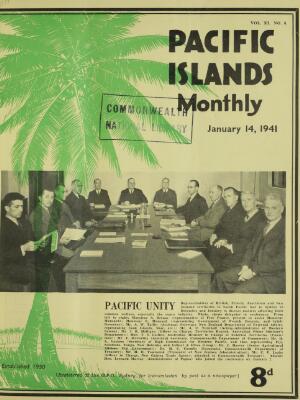
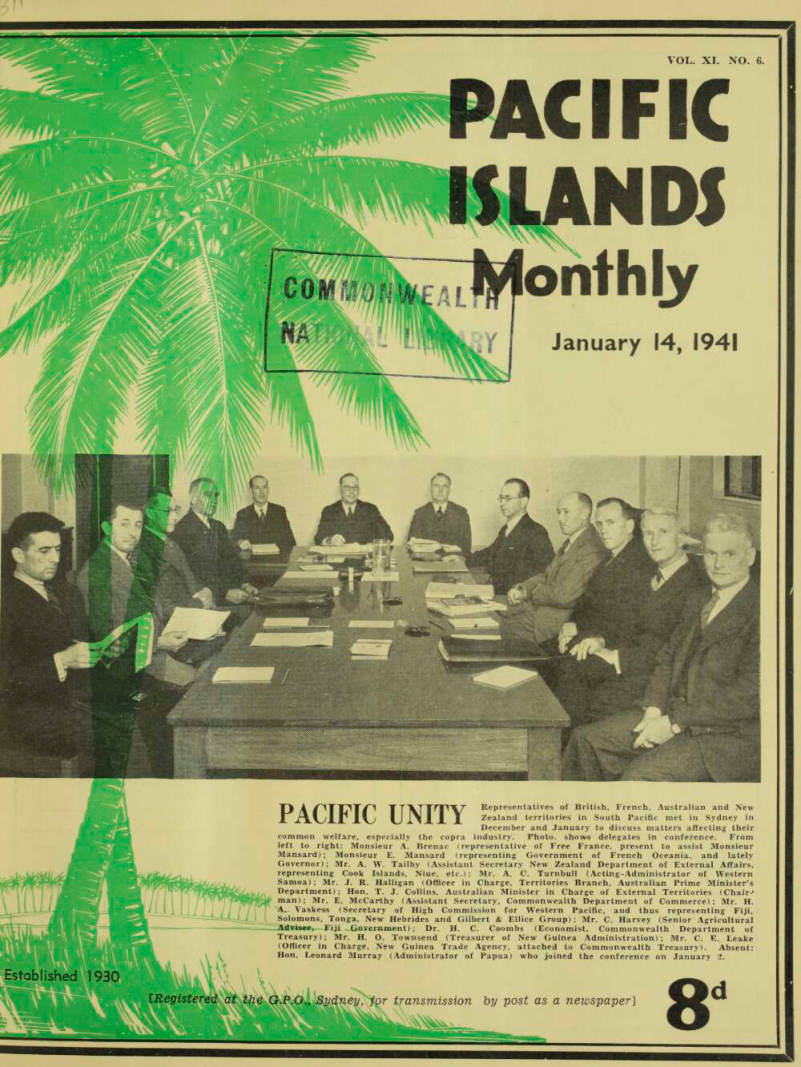
PACIFIC UNITY Representatives of British, French, Australian and New Zealand territories in South Pacific met in Sydney in December and January to discuss matters affecting their common welfare, especially the copra industry. Photo. shows delegates in conference. From left to right: Monsieur A. Brenac (representative of Free France, present to assist Monsieur Mansard); Monsieur E. Mansard (representing Government of French Oceania, and lately Governor); Mr. A. W. Tailby (Assistant Secretary New Zealand Department of External Affairs, representing Cook Islands, Niue, etc.); Mr. A. C. Turnbull (Acting-Administrator of Western Samoa); Mr. J. R. Halligan (Officer in Charge, Territories Branch, Australian Prime Minister’s Department); Hon. T. J. Collins, Australian Minister in Charge of External Territories (Chair man); Mr. E. McCarthy (Assistant Secretary, Commonwealth Department of Commerce); Mr. H.
A. Vaskess (Secretary of High Commission for Western Pacific, and thus representing Fiji, Solomons, Tonga, New Hebrides and Gilbert & Ellice Group); Mr. C. Harvey (Senior Agricultural Adviser , Fiji Government); Dr. H. C. Coombs (Economist, Commonwealth Department of Treasury); Mr. H. O. Townsend (Treasurer of New Guinea Administration); Mr. C. ,E. Leake (Officer in Charge, New Guinea Trade Agency, attached to Commonwealth Treasury). Absent: Hon. Leonard Murray (Administrator of Papua) who joined the conference on January 2.
Advertisements & other items, p. 2 (1 item)
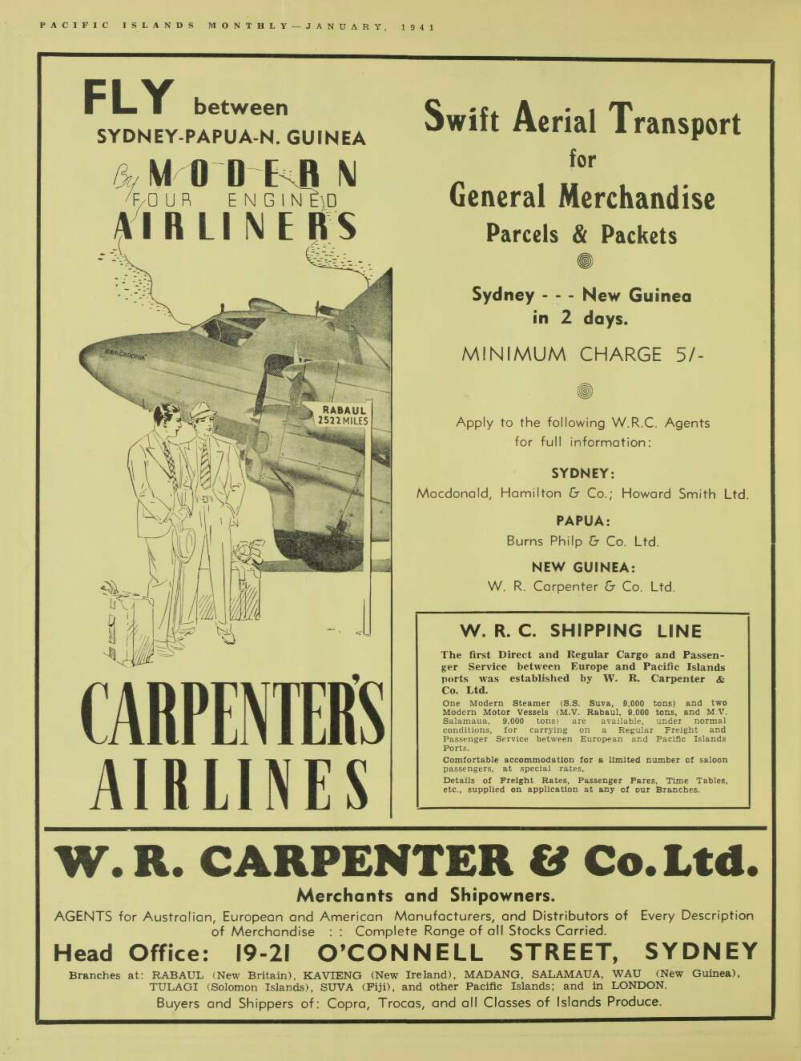
Carpenters
FLY between
SYDNEY-PAPUA-N. GUINEA
MO DEB M
/F/0 UR EN G I NE)D
\ I RUNE RS
RABAUL
2 sil MILES - r
CARPENTERS
AIRLINES
Swift Aerial Transport
for
General Merchandise
Parcels & Packets
Sydney - - - New Guinea in 2 days.
MINIMUM CHARGE
Apply to the following W.R.C. Agents for full information:
SYDNEY:
Macdonald, Hamilton £r Co.; Howard Smith Ltd.
PAPUA:
Burns Philp & Co. Ltd.
NEW GUINEA:
W. R. Carpenter & Co. Ltd.
W. R. C. SHIPPING LINE
The first Direct and Regular Cargo and Passenger Service between Europe and Pacific Islands ports was established by W. R. Carpenter & Co. Ltd.
One Modern Steamer (S.S. Suva, 9,000 tons) and two Modern Motor Vessels (M.V. Rabaul, 9,000 tons, and M.V.
Salamaua, 9,000 tons) are available, under normal conditions, for carrying on a Regular Freight and Passenger Service between European and Pacific Islands Ports, Comfortable accommodation for a limited number of saloon passengers, at special rates.
Details of Freight Rates, Passenger Fares, Time Tables, etc., supplied on application at any of our Branches.
W.R. CARPENTER & Co. Ltd.
Merchants and Shipowners.
AGENTS for Australian, European and American Manufacturers, and Distributors of Every Description of Merchandise : : Complete Range of all Stocks Carried.
Head Office: 19-21 O’CONNELL STREET, SYDNEY
Branches at; RABAUL (New Britain), KAVTENG (New Ireland), MADANG, SALAMAUA, WAU (New Guinea), TULAGI (Solomon Islands), SUVA (Fiji), and other Pacific Islands; and in LONDON.
Buyers and Shippers of: Copra, Trocas, and all Classes of Islands Produce.
Pacific Islands Travellers
■ PER ••MORINDA" FROM BSI & N HEBRIDES: Messrs. Austic, Crawshaw, Hamilton, Hanlin, Heally, Isom, Jepson, Fleming, Hicks, Maher, Morris, Lee, Mason, Moewle, Smithers, Wilson!
Sadler. Mesdames Hicks, Isom, Wilson, Buffett, Christian, Dean. Heally. Maclean, Menzics Stopp, Crawshaw, Hanklnson. Misses Malone, Everett, Fellowes, Gabbutt, Snell, Eacott.
PER “MALAITA” FROM PAPUA, NG & BSI: Messrs. Baddiley, Bellingham, Boye, Bray. Carey, Gr ®* g . R° W £ S ’ GloVe J\ G , i ; een ’A.^ amilt0 D n V Hill, Judo, Mackenzie, Metcalf Miller, Petersen, Rentoul, Robinson (2) Rutter Smith Terry, Turner, Weidemann Kikolo. Mesdames Baddiley, Boye Boyl ®’ Bunting, Dunstan, Hill, Judd, Mackenzie, Mapletoft Miller, Naumann, Rentoul, Smith, Weidemann. Misses Barker, Christopher, Craig, Harkness, Harry, Higginbotham, Stead. p PR -a/tatatta” WAT? PAPTTA wrp - D£!T MAiuAiiA r OR PAPUA NG & BSI: Messrs. Stephen Bla^ x c r hard ’ W hite > Geldard, Waddell, Rutledge, Widdy, Fraser, Wilson, Munro, Lincoln, Livingstone, Hayes, Weekes, Shrubsall Crellin, Macklin, Wechsler, G^ ne - Fmch ’ „ ay ’ sto ” e ’ Hand, Wade, Phillips, Evenett, Phillips, Hartley, Markwell, Timperley Dean Rev Slagle. Mesdames Jones, Gannon, Blanchard, Hartley, White, Geldard, Cairns, Mill, Dunn, Gibbs, Dougherty, wade, Neale. Misses Selby, Pennefather, Coleman,
Waterston, Roads, Arllss, Parkinson, Dunn, Ryan, Bmskm.
PER “MORINDA” FOR LORD HOWE & NOR FOLK IS., BSI & N. HEBRIDES: Messrs. Picker tag, Lewis, Closter, Stewart, Cottee, Bennett, Beveridge, Monaghan, Lewis, Lee, Martin, Rippon. Mesdames Page, Perry, Cottee, McDowell, James. Bennett, Beveridge, Monaghan McCann, Martin, Rippon. Misses Oakes, Silver sines, James, McCann, Buryness. Buffett, Baxen
dae"
Per “Empress Op Russia” To Fiji:
Messrs. Bryce (2), Benson, Hemming, Keyte (2), Twentyman, Clarkson, Little (2), Wilkinson.
Mesdames Bryce, Hemming, Oliver, Wilkinson.
Miss Macdonald.
PER "AWATEA” FROM FIJI: Messrs. Mount- Stephens, Tilney, Wright (2), Walcot, Eria, Allen, Curry, Fenner, Farrar, Fowler, Humphries, Harvey, Kirby, Mathews, Pratt, Potts, Riley, Snowsill, Thompson, Vaskess, Gillon. Mesdames Mountstephens, Tilney, Wright, Walcot, Allen, Fenner, Humphries, Mathews, Pratt, Potts, Rourke, Snowsill, Van Gelderen. Misses Mount- Stephens (2), Allen, Humphries. Kell, McKinlay, Potts. Rourke, Snowsill (2), Witherow, Aitken- Swan. ’
Per “Mariposa” Prom Fiji: Messrs.
Pinlayson, Garland, De Veaux, Underwood, Wilson, Adams, Gifford, Costa, Campbell, Aitken.
Revs. Steadman, Bock, Boorman. Mesdames Pinlayson, Rowley, Adams, Boorman, Broome, Berry, Campbell, Steadman, Bock. Misses Row ley (2), Gale, Nason, Steadman, Branster, Rowe, Berry. Sister Florence.
PER “MARIPOSA” TO FIJI; Messrs. Candler, Harvey, Kenyon, Kikola, Lees, Maesepp. Mes dames Cottew, Young. Misses Costello, Tate (2). TO PAGO PAGO; Mr. Wetzell.
PER AIRLINER TO PAPUA & NG (BETWEEN DEC. 19 & JAN. 2): Messrs. Neill, Dickson, Taylor, Pinkerton, Thomas, Pearce, Glenn, Gray, Simmons, Spence. Mesdames Eldred, Macdonald, Sneddon, Wood. Misses Milliken, Dovey, Chandler, McGahan.
PER AIRLINER FROM PAPUA & NG (BE TWEEN DEC. 22 & JAN. 5): Messrs. MeKillop, Jennings, Powell, Schultz, Montieth, Gilling wafcer, Murray. Mesdames Ethell, Powell, Fraser, Ziabbtsky, Roberts, Noakes, Nicholl, Jenyns, Stevens. Misses Stewart, Healy.
Sir Hugh Lett, president of the Royal College of Surgeons, was created a baronet in the New Year Honours. He is in wartime charge of London’s hos pitals. Mr. Lewis Lett, of Port Moresby, is his brother.
Advertisements & other items, p. 3 (1 item)
South Pacific Line
MAUA
■■■ m m -«ar ■■»»wlB88l!g8jg : • ' . ' KA
SYO
NEY
4
K. P. M,
SOUTH PACIFIC LINE.
Royal Packet Navigation Co. Ltd., Paketvaart House, 255 George Street, Sydney. .?• . v - Koninklijke Paketvaart Maatschappij— Incorporated In the Netherlands Indies) Saigon, Diethelm & Co.; Port Moresby and Samarai, Steamships Trading Co.
Ltd.; Rabaul, Salamaua and Wau, W. R Carpenter & Co. Ltd.; Port Vila, Gubbaj Freres; Noumea, Carlo Leoni; Auckland, Russell & Somers Ltd.; Wellington, juunston & Co, Ltd.
k.p . m
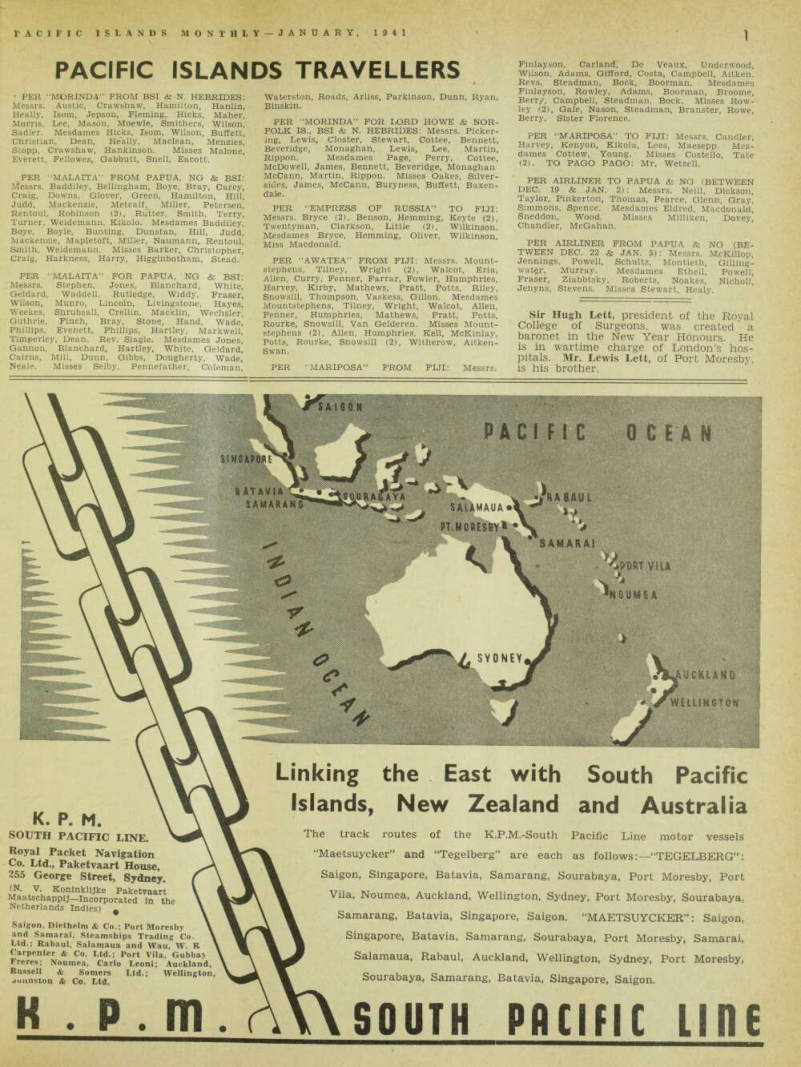
Linking the East with South Pacific
Islands, New Zealand and Australia
The track routes of the K.P.M.-South Pacific Line motor vessels “Maetsuycker” and “Tegelberg” are each as foIIows:—“TEGELBERG”: Saigon, Singapore, Batavia, Samarang, Sourabaya, Port Moresby, Port Vila, Noumea, Auckland, Wellington, Sydney, Port Moresby, Sourabaya, Samarang, Batavia, Singapore, Saigon. “MAETSUYCKER”: Saigon, Singapore, Batavia, Samarang, Sourabaya, Port Moresby, Samarai, Salamaua, Rabaul, Auckland, Wellington, Sydney, Port Moresby, Sourabaya, Samarang, Batavia, Singapore, Saigon.
SOUTH PACIFIC Line
Pacific News-Review
Notes And Comment On
The Progress Of The War
From Dec. 11 To Jan. 13
Dec. 11: The British Army under General Wavell launched an offensive against the Italians in the Western Desert of Egypt at dawn on December 9.
The Italian defences crumpled every where. The British, working to a closely co-ordinated plan, in which the RAF and the RAAF are co-operating overhead, while the British Navy shells the Italians from the sea, are sweeping on quickly and taking large numbers of prisoners.
Dec. 11: Following on the important loan made to China recently by the United States, Britain is to lend China £5,000,000. These gestures by the two great democratic nations represent Democracy’s reply to the threats of the Dictators, made at the behest of Japan, that if the Democracies assist China against Japan, the Axis Powers would take action against them.
Dec. 11: The Italians are still retreat ing in the coastal and central sectors of Albania and there has been fierce fight ing in the northern sector, with further successes for the Greeks.
Dec. 11: A speech by Hitler—the first for a considerable time —strikes an entirely different note. In contrast with the bombastic boasting of the past six months, Hitler now tells the German people that they are I faced with great tasks and sacrifices and that, if they are defeated in this war, German culture and nationalism will be set back for centuries.
Dec. 11: The rapidly-advancing British forces have isolated and surrounded the Italian stronghold of Sidi Barrani and are advancing along the coast towards the frontiers of Libya. The Italians are retreating* rapidly and surrendering in thousands.
Dec. 12: Although the Greeks are mak ing slow progress and constantly harry ing the Italians, it is clear that Albanian operations are almost at a standstill owing to bitter winter weather. The country is covered deeply with snow.
Dec. 12: Sidi Barrani, Western Egypt, was captured by British on December 10.
A most important part is being played by RAF in rolling back the Italian armies into Libya.
Dec. 12: In one of the most outspoken statements made by a representative of Britain since the war began, Lord Lothian, British Ambassador in United States, warned Americans that their fate was linked with that of Britain. “With your help, Britain is sure of victory,” he declared. His frank warning made a tremendous public impression. The fol lowing day Lord Lothian died suddenly.
Dec. 13: At least 20,000 prisoners have been taken already by the British in the Western Desert, with enormous quanti ties of tanks, guns and equipment. Con sidering their equipment and fortifica tions, the quick collapse of the Italian armies has caused general surprise. The routed Italian armies are retreating rapidly towards Libya, with the British in full pursuit.
Dec. 14: A German raider on Decem ber 7 and 8 sank a number of British freighters near Nauru Island.
Dec. 14: Within limitations imposed by winter weather, the British continue to conduct large-scale air raids against objectives in Germany, while the Ger mans continue their blitzes against British towns. Sheffield has had a par ticularly severe attack.
Dec. 15: The British, pursuing the retreating Italians, have crossed the frontier into Libya. Prisoners estimated at 25,000 and enormous war material are being transported to Egypt.
Dec. 15: The British made three air raids on Naples last night. An Italian warship was severely damaged by a bomb.
Dec. 15: The head of the French State (Marshal Petain) has discharged Laval from the position of Foreign Minister and appointed Flandin in his place. Laval is reported under arrest.
Dec. 16: Japanese newspapers and Gov ernment spokesmen are still uttering threats of war against the United States —but American preparations to aid Britain to the fullest extent are going on without disturbance. Japan, while talking much, is obviously hesitating. She has plans made and a force assembled for the southwards thrust which many believe is planned against the East Indies; but, in view of America’s firm and uncompromising attitude, and the apparent difficulties of Japan’s Axis partners in defeating Britain in Europe, Japan does not care to take the irre vocable step.
Dec. 16; The British already have counted 27,000 Italian prisoners in the Western Desert and more are still coming in. They have captured Solium, a small port, and are pushing on towards Bardia.
The British victory in Egypt has been hailed with delight throughout the United States and commentators say that prob ably this destruction of the Italian Libyan army is the most important war development since the collapse of France.
The defeat of the Italians by the Greeks in Albania and the British in Egypt has destroyed Italy’s plan against the Suez Canal and the Haifa pipeline. This must cause a re-casting of Axis plans.
Dec. 16: It is persistently reported that Petain has refused permission to Ger many to send troops across southern France to the aid of Italy.
Dec. 17: It appears that Laval had quarrelled violently with Petain and had planned a coup timed for last Sunday, under which Laval expected to get con trol of the Vichy Government. He was acting in close collaboration with the Germans and one of his first acts, had he succeeded, would have been a declara tion of war against Britain. He is now under close arrest.
Dec. 17: RAF bombers on Sunday night made a prolonged raid on targets in the Berlin area; while German bombers attacked industrial regions in the north
of England.
Dec. 17: The RAF bombed Mannheim, an important German railway and in dustrial centre, from 8 p.m. Monday until dawn on Tuesday. It was one of the most devastating raids made against a German town.
Dec. 17: It is believed that, as a result of the RAF bombing of Naples on Sat urday, probably five of Italy’s six capital ships now have been accounted for.
Dec. 17: Although the Italians at Sidi Barrani in the Western Desert were fairly easily defeated, the Italians at other strong points 'near the Libya frontier put up a stronger resistance, but were “mopped up”. The British forces are row deep in Libya. They have isolated Bar dia and are pushing on towards Tobruk, Dec. 18: Now that Italy has proved useless as an ally in the Mediterranean, and the Vichy Government has refused Germany’s request to allow German troops to pass through southern France, there is much speculation concerning Hitler’s future plans. Some believe that he will organise an invasion of England on a vast scale —others that he will use his military strength to strike at the British Empire through the Balkans and
Turkey. But his plans and movements are enveloped in mystery.
Dec. 18; The Australian troops have entered the battle in the Western Desert and an American correspondent reports that they will attack Bardia. Dec. 18: The Italians are contesting every step of the Greek advance in Albania—but, slowly and steadily, the Greeks are advancing. It is believed that the Italians are preparing anew defence line north of Valona—which means that they are contemplating abandoning half of Albania to the Greeks.
Dec. 19: Although the British in the Western Desert have taken some 30,000 prisoners, and enormous booty, and have invaded Libya, their total losses in killed and wounded do not exceed 1,000.
Dec. 19: Germans intervened in the situation at Vichy, with the result that Laval, who had been placed under arrest by Petain, was released and is now active in his pro-German associations in Paris.
He is out of the Government, but he told pressmen that his political career is not at an end.
Dec, 20: There are persistent uncon firmed reports that Germany is sending large reinforcements to Italy’s assist ance. Some say that 50,000 Germans have entered Italy.
Dec. 20: On Wednesday, a strong British naval force under Admiral Cun ningham passed through the Straits of Otranto and successfully bombarded Valona, Italy’s main supply port in southern Albania. Lighter British forces penetrated 150 miles into the Adriatic without a sign of Italian warship or merchantman.
Dec. 23: Manchester last night became the object of an enemy blitz —its first big aerial attack. It lasted many hours; numerous fires were started and much damage done. Last night the RAF attacked enemy targets in Norway, Ger many and Italy. The German indus trial city of Mannheim received another pounding.
Dec. 23; The British have now evacu ated 36,000 prisoners from the Western Desert, including 1,700 officers.
Dec. 24: Negotiations between France and Germany are reported to have been resumed at the point where they were broken off when Petain dismissed Laval.
Dec. 25: It is announced officially that the Australians are moving up to join the British in the impending attack on Bardia.
Dec. 25: It is understood that the Ger mans intend to refrain from making air attacks upon Britain on December 25 and 26 “unless compelled to retaliate”, and that the British will take the opportunity to rest their pilots and look over equip ment.
Dec. 25; The United States is enjoy ing its most prosperous Christmas since 1929; the Christmas celebrations are the gayest since the slump.
Dec. 25: The Greeks, still advancing slowly, now hold a quarter of Albania, and are only 20 miles from Valona.
Dec. 27: People everywhere are dis cussing the strange, unsought and un declared Anglo-German truce in the air war. Londoners have not heard the air raid sirens since Monday night-. There was moonless, foggy weather over the English Channel during the Christmas holidays and a calm sea —perfect con ditions for an attempt at invasion—and the heavily-armed guards who line the English Channel coasts were doubled in case Hitler tried a surprise thrust.
Dec. 28; Nauru Island, in the Pacific, was shelled heavily by an enemy raider.
Buildings and loading equipment were seriously damaged.
Dec. 28: In an engagement between British warships and a powerful Ger man warship, in the Atlantic on Christ mas morning, the raider was hit amid ships, but escaped, owing to her superior speed. One British cruiser was slightly damaged.
Dec. 30: Reports from neutral sources, that the Vichy Government, resenting continuous German pressure and refus ing to hand over the French fleet to Germany, is making plans to leave for North Africa, are not accepted in Lon don. There is no doubt, however, that there have been lively exchanges between the Germans and the Vichy Government, and that Petain insists on the Franco- German armistice being observed.
Dec. 30: The RAF is carrying out a systematic plan to smash the submarine bases and aerodromes in western France from which raiders leave to prey on merchant shipping in the north Atlan tic. Smashing attacks on the French Channel ports are taking place every night.
Dec. 31: President Roosevelt announced that the United States must become the great arsenal of Democracy. He said: “We have furnished Britain with great material support—we will furnish far more in the future. No dictator or com bination of dictators will weaken that determination by threat of how they will construe that determination.” Mr. Roose velt added that he believed that the Axis powers were not going to win the war and he based that belief on the latest and best military information of Europe.
Dec. 31: On the night of Sunday, De cember 29, great waves of German bomb ers dropped tens of thousands of incen diary bombs, in a deliberate attempt to set the City of London afire. Enormous damage was done. Large areas of the city were converted into a blazing inferno.
Famous buildings, including the Guild Hall, were destroyed. Fleet Street has been badly smashed. • Jan. 1: While smoke rose from the burning ruins of some of London’s most beautiful and most ancient monuments, British people solemnly affirmed that their primary purpose in 1941 is the defeat of the enemy and the creation of anew and better order when victory is won.
Jan. 1: All authorities agree that Ger many, in the first six months of 1941, will try by every means in her power to successfully invade and over-run Britain.
Jan. 1: Japan’s Premier Konoye says there will be strained relations in the Pacific in 1941 because Japan was “firmly determined to break the Anglo- American conception of the status quo”.
Lasting peace and prosperity, he said, could be attained only by forcing large scale changes, and Japan had under taken the re-organisation of East Asia.
Jan. 1: The chief lesson of the incen diary raid on London last Sunday night is that the cities must in future be guarded by thousands of “spotters”.
Their posts will be on the roofs of buildings, and their duty will be to extinguish the incendiary bombs which are dropped. Such services are being hurriedly organised on a vast scale. Had they been in existence in last Sunday’s raid, half the fires could have been prevented.
Jan. 3: RAF, on Wednesday night, heavily attacked the city of Bremen, and enormous damage has been done there.
The city was blasted with bombs, and then set on fire with incendiaries, Jan. 3: British forces have reached the
outer defences of Tobruk, in Libya; while a large force, including one Australian division, is preparing to assault Bardia.
Jan. 3: There are constant reports of German troop movements across Hun gary to Roumania, and general belief that Germany is preparing an invasion of the Balkans through Bulgaria, with a view to taking Greece in the rear, and possibly attacking British oil wells in Iraq, and the Suez Canal.
Well-informed people do not accept this theory. There are growing indica tions that the people of Roumania in tensely dislike their German overlords, and general rebellion is simmering.
Great damage has been done by sabotage to the Roumanian oil-wells, to prevent Germany securing the maximum oil supply. Large German forces which are moving into Roumania are to keep the country in subjection.
Jan. 3: Survivors totalling 496, landed from German raiders in New Guinea and brought to Australia, reached an Aus tralian port on January 1. Full story elsewhere in this issue.
Jan. 3: Further Greek successes in Albania have imperilled Italian positions on the coastal sector. The Italians are believed to be retiring to their new for tified line, back of Valona.
Jan. 3; For the second night in succes sion, German bombs fell on Eire. Dublin suffered some damage. Eire is making strong protests to Germany.
Jan. 4; Striking just before dawn on Friday, January 3, an Australian division, supported by British tanks, penetrated the defences of Bardia.
Jan. 4: On three successive nights RAF forces dropped explosive bombs and 20,000 incendiary bombs on Bremen, vir-
News of New Guinea men in the AIF—See page 68.
Shipping Services In The Pacific
These time-tables, formerly a feature of the “Pacific Islands Monthly”, give too much information about movements of shipping and therefore may not be published while war conditions last.
tually wiping out the shipbuilding yards, docks, warehouses, factories and railways of that important German city.
Jan. 5; Official figures of Britain’s merchant shipping losses disclose that for three weeks the total has not been much more than half the average. It is too soon to hope that Britain’s mea sures against U-boats are taking effect.
It is not denied that Britain’s ship ping losses are serious—so much so that rationing of Britain’s food has been con siderably increased—and that the air attacks upon London and important Eng lish cities have caused enormous destruc tion. Nevertheless, Britain steadily is increasing her output of war materials and gaining in military strength, and her confidence in ultimate victory is grow ing, There is much evidence that Britain is accumulating an enormously powerful fleet and air force with which to smash Germany in the coming summer. New British battleships increase Britain’s battleship strength to 19—more than the combined strength of Germany, Italy and Japan.
Jan. 6: Carrying out what is described as a “clockwork” attack on Bardia, Brit ish and Australian troops penetrated the defences of the town on Friday and com pleted its occupation on Saturday and Sunday. It surrendered at 1 p.m. on the sth. They have taken enormous quanti ties of war materials and over 30,000 prisoners—making a total of 68,000 Italian prisoners since the British attack began.
Jan. 7: The Italians have abandoned the aerodrome, near Tobruk, in Libya,
and the British have captured 40 planes, which had been damaged by RAF bomb ing and abandoned. The Australians who attacked Bardia suffered about 600 casualties.
Jan, 7: It is persistently reported that Germany will occupy Bulgaria. Turkish officials say that if German forces move across Bulgaria to attack Greece, Tur key will fight.
Jan. 7: Amy Johnson, famous woman flyer, who was engaged in “ferrying” machines for the Air Force, came down in . the Thames Estuary in mysterious circumstances and was drowned.
Jan. 8: The important seaport of Tobruk, in Libya, is now invested by British forces.
Jan. 8: Ships of the Petain Navy are passing through the Straits of Gibraltar, unmolested by the British, and going to bases in French West Africa.
Jan. 8: Most important decisions have been taken by the United States Con gress, implementing the determination of the Government not only to give every possible aid to Britain, short of war, but to spend the unprecedented total of 10 billions of dollars before June 30, 1942, upon the American army, navy and air force.
It is clear that the virtual collapse of Italy, the hesitancy of Japan in plunging the Pacific area into war, and the clearly stated determination of the United States to do everything possible to prevent the defeat of Britain, have created a situa tion of extraordinary difficulty for Hit ler. Commentators are studying every scrap of information from Germany and central Europe, seeking some indication of how Hitler is going to solve his problem.
Jan. 9: The Greeks have captured and occupied the important town of Klimura.
Greek destroyers penetrated the Adriatic and shelled Valona.
Jan. 9: The British now virtually sur round Tobruk, in Libya.
Jan. 10: Native Abyssinians, supported by British aeroplanes, are harrying the Italians. Americans report that Britain has assembled 100,000 men in Kenya, wherewith to attack the Italians in Somaliland and Abyssinia.
Jan. 10: A Nazi broadcast says that Britain is preparing to invade Eire, and Germany is determined to react in the same way as in Norway and Belgium— that is Germany will invade Eire.
Jan. 11: Reported from Switzerland that Mussolini has dismissed 14 regional Fascist leaders, on suspicion of disloyalty.
Jan. 11: President Roosevelt hlas ordered the American Navy to be man ned to full strength and to be divided into an Asiatic fleet, a Pacific fleet apd an Atlantic fleet. The creation of an Asiatic fleet is new and significant.
Jan. 13: The British continue to ham mer Tobruk with artillery and aero planes. The town must fall soon.
Jan. 13: German air forces definitely have joined the Italians in the Mediter ranean zone.
Jan. 13: Another German fire-raid on London on Saturday night failed, owing to alertness of thousands of rooftop spot ters in extinguishing bombs.
Mr. Justice Gore returned recently to Papua after a short visit to Australia.
His Honor was accompanied by his son, Mr. Richard Gore.
Dr. w. E. Giblin, well-known in New Guinea and Papua, passed through Port Moresby recently on his way to Sydney.
He will return to Papua early in the New Year, to take up his duties with the APC at the new oil township Kariava, in the Gulf of Papua, on the Vailala river.
Advertisers
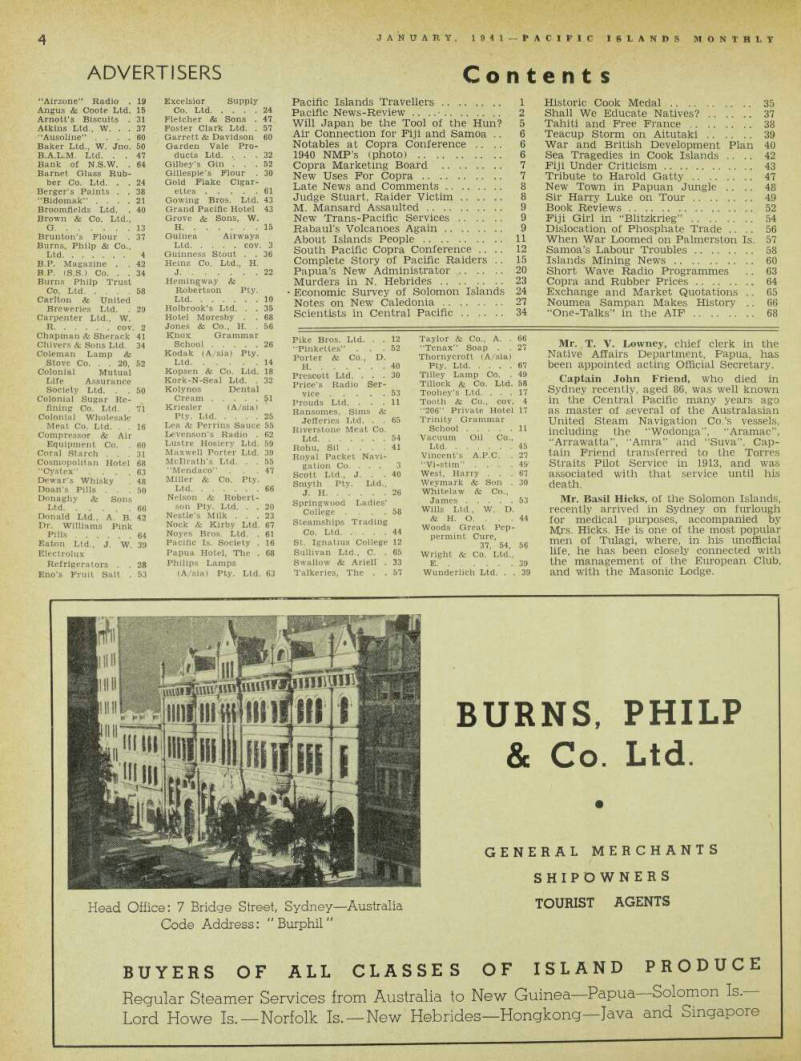
“Airzone” Radio . 19 Angus & Coote Ltd. 15 Arnott’s Biscuits . 31 Atkins Ltd,, W. . . 37 “Ausoline” ... 60 Baker Ltd., W. Jno. 50
B.A.L.M. Ltd. . , 47
Bank of N.S.W. . 64 Barnet Glass Rub ber Co. Ltd. . . 24 Berger’s Paints . . 38 “Bidomak” ... 21 Broomflelds Ltd. . 40 Brown & Co. Ltd., G 13 Brunton’s Flour . 37 Burns, Philp & Co., Ltd 4 B.P, Magazine . . 42
B.P. Is.S.) Co. . . 34
Burns Philp Trust Co. Ltd 58 Carlton & United Breweries Ltd. . 29 Carpenter Ltd., W.
R cov. 2 Chapman & Sherack 41 Chivers & Sons Ltd. 34 Coleman Lamp & Stove Co. . . 20, 52 Colonial Mutual Life Assurance Society Ltd. . . 50 Colonial Sugar Re fining Co. Ltd. . 71 Colonial Wholesale Meat Co. Ltd. . . 16 Compressor & Air Equipment Co. . 60 Coral Starch ... 31 Cosmopolitan Hotel 68 “Cystex” ... 63 Dewar’s Whisky .48 Doan’s Pills ... 50 Donaghy & Sons Ltd 66 Donald Ltd., A. B. 42 Dr. Williams Pink Pills 64 Eaton Ltd., J. W. 39 Electrolux Refrigerators . . 28 Eno’s Fruit Salt . 53
Excelsior Supply Co. Ltd 24 Fletcher & Sons . 47 Foster Clark Ltd. . 57 Garrett & Davidson 60 Garden Vale Pro ducts Ltd. . . .32 Gilbey’s Gin .’ . .52 Gillespie’s Flour . 30 Gold Flake Cigar ettes 61 Gowing Bros. Ltd. 43 Grand Pacific Hotel 43 Grove & Sons, W.
H 15 Guinea Airways Ltd cov. 3 Guinness Stout . . 36 Heinz Co. Ltd., H.
J 22
Hemingway &
Robertson Pty.
Ltd 10 Holbrook’s Ltd. . . 35 Hotel Moresby . . 68 Jones & Co., H. . 56 Knox; Grammar School 26 Kodak (A/sia) Pty.
Ltd 14 Kopsen & Co. Ltd. 18 Kork-N-Seal Ltd. . 32 Kolynos Dental Cream 51 Kriesler (A/sia) Pty. Ltd 25 Lea & Perrins Sauce 55 Levenson’s Radio . 62 Lustre Hosiery Ltd. 59 Maxwell Porter Ltd. 39 Mcllrath’s Ltd. . . 55 “Mendaco” ... 47 Miller & Co. Pty.
Ltd 66 Nelson & Robert son Pty. Ltd. . . 20 Nestle’s Milk ... 23 Nock & Kirby Ltd. 67 Noyes Bros. Ltd. . 61 Pacific Is. Society . 16 Papua Hotel, The . 68 Philips Lamps (A/sia) Pty. Ltd. 63
. „ T( , 1?
' ’ 52 & Co.. ’ D w 4n
Presco tt Ltd. ’. '. !30
p . Radio Ser s Radl ° ber 53 Prouds Ltd n Ransomes Sims’ & Tpffprips Ltd 65
M ea ’t Co’.
Ltd 54 R h ’ aii 41
g™ cket - Navi l
eation C o 3 Scott Ltd ° J ’ ’ 40 Smyth P ty. Ltd.. j u 2fi ’. ’ ’ ‘ T ‘ ’ ’, Spnngwood Ladies’ 01 C ° Ue ® e ’ ’ .’. ’
Steamships Trading Co - Ltd 44 St. Ignatius College 12 Sullivan Ltd., C. . 65 Swallow & Ariell . 33 Talkeries, The . . 57
Taylor & Co., A. . 66 “Tenax” Soap . . 27 Thornycroft (A/sia) Pty. Ltd 67 Tilley Lamp Co. . 49 Tillock & Co. Ltd. 58 Toohey’s Ltd. ... 17 Tooth & Co., cov. 4 “206” Private Hotel 17 Trinity Grammar School 11 Vacuum Oil Co., Ltd 45 Vincent’s A.P.C. . 27 “Vi-stim” . . . .49' West, Harry ... 67 Weymark & Son . 30 Whitelaw & Co., James 53 Wills Ltd., W. D. & H. O. . . .44 Woods Great Pep permint Cure, 37, 54, 56 Wright & Co. Ltd., E 39 Wunderlich Ltd. . . 39
Mr. T. V. Lowney, chief clerk in the Native Affairs Department, Papua, has been appointed acting Official Secretary.
Captain John Friend, who died in Sydney recently, aged 86, was well known in the Central Pacific many years ago as master of several of the Australasian United Steam Navigation Co.’s vessels, including the “Wodonga”, “Aramac”, “Arrawatta”, “Amra” and “Suva”. Cap tain Friend transferred to the Torres Straits Pilot Service in 1913, and was associated with that service until his death.
Mr. Basil Hicks, of the Solomon Islands, recently arrived in Sydney on furlough for medical purposes, accompanied by Mrs. Hicks. He is one of the most popular men of Tulagi, where, in his unofficial life, he has been closely connected with the management of the European Club, and with the Masonic Lodge.
Contents
Pacific Islands Travellers 1 Pacific News-Review 2 Will Japan be the Tool of the Hun? 5 Air Connection for Fiji and Samoa .. 6 Notables at Copra Conference ... 6 1940 NMP’s (photo) 6 Copra Marketing Board 7 New Uses For Copra 7 Late News and Comments 8 Judge Stuart, Raider Victim 8 M. Mansard Assaulted 9 New Trans-Pacific Services 9 Rabaul’s Volcanoes Again 9 About Islands People 11 South Pacific Copra Conference ... 12 Complete Story of Pacific Raiders .. 15 Papua’s New Administrator 20 Murders in N. Hebrides 23 • Economic Survey of Solomon Islands 24 Notes on New Caledonia 27 Scientists in Central Pacific 34
Historic Cook Medal 35 Shall We Educate Natives? 37 Tahiti and Free France 38 Teacup Storm on Aitutaki 39 War and British Development Plan 40 Sea Tragedies in Cook Islands ... 42 Fiji Under Criticism 43 Tribute to Harold Gatty 47 New Town in Papuan Jungle .. .. 48 Sir Harry Luke on Tour 49 Book Reviews 52 Fiji Girl in “Blitzkrieg” 54 Dislocation of Phosphate Trade ... 56 When War Loomed on Palmerston Is. 57 Samoa’s Labour Troubles 58 Islands Mining News 60 Short Wave Radio Programmes .. 63 Copra and Rubber Prices 64 Exchange and Market Quotations .. 65 Noumea Sampan Makes History .. 66 “One-Talks” in the AIF 68
Advertisements & other items, p. 6 (1 item)
Burns, Philp
I* uu wm II lII] iSI
III)
in in mi M
nun
Head Office: 7 Bridge Street, Sydney—Australia Code Address: " Burphil"
BURNS, PHILP
& Co. Ltd.
GENERAL MERCHANTS
SHIPOWNERS
TOURIST AGENTS
BUYERS OF ALL CLASSES OF ISLAND PRODUCE Regular Steamer Services from Australia to New Guinea —Papua Solomon Is.
Lord Howe Is.—Norfolk Is. —New Hebrides—Hongkong—Java and Singapore
Pacific Islands Monthly
The Newspaper-Magazine of the South Seas [Registered at the G.P.0., Sydney, for transmission hy post as a newspaper.']
Owned and Produced by Pacific Publications Pty. Ltd., Union House, 247 George Street, Sydney.
TELEPHONE ( Mana S ln S Director .. BW 5037 U ( Business and Editorial MA 7101
P.O. Box 3408 R
Registered Address of Telegrams, Radiograms, and Cables: “Pacpub”, Sydney.
Contributions.
Articles. Stories, and Photographs dealing with Pacific Islands subjects are Invited and will be paid for on publication.
Subscription Rates.
Per Annum, within British Empire, Prepaid, Post Free 8/- Per Annum, elsewhere, prepaid, Post Free . 10/- Single Copies 8d
Editor and Publisher:
R. W. Robson, F.R.G.S.
Assisted by Selwyn Hughes.
Advertising Manager; L. W. Bailey.
Advertising Ofißce and Printing-House; 29 Alberta Street, Sydney.
Advertising rates furnished on application.
Colours, etc., by Arrangement.
Process Blocks made at Advertiser’s expense when required. Screen 100.
Changes of Advertising Copy should reach this Office by Ist of each month, otherwise previous advertisement may be repeated.
IN LONDON, the Pacific Islands Monthly Is on sale at the Bookstall, Australia House, The Strand, London.
Agents.
The following are authorised to receive sub scriptions for the Pacific Islands Monthly:— Islands Branches of Burns, Phllp & Cos., Ltd., and Burns Philp (South Sea) Cos., Ltd.
Islands Branches of W. R. Carpenter & Cos., Ltd.
Islands Branches of Morris, Hedstrom, Ltd.
T. A. Olsson, Wau, New Guinea.
G. Thomas & Cos., Rabaul, New Guinea.
Whitten Bros., Ltd., Samaral, Papua.
Steamships Trading Cos., Papua. All Branches.
B.N.G. Trading Cos., Ltd., Port Moresby, Papua.
J. Muir, Suva, Fiji.
N. C. Mackenzie-Hunt, Walnunu, Bua, FIJI.
Islands Branches and Representatives of W. H.
Grove & Sons, Ltd., Auckland, New Zealand.
Cook Islands Trading Cos., Rarotonga, Cook Is.
A. C. Rowland, Papeete, Tahiti.
Representative In London: W. C. HARVEY, Coronation House, 4 Lloyds Avenue, London, E.C.3, from whom may be obtained copies of Pacific Islands Monthly, Pacific Islands Year Book, advertising schedules, etc.
Vol. XI. No. 6.
January 14, 1941
n . < Rd. Per Copy.
Price Prepaid: 8/- p.a.
Will Japan be the Tool of the Hun?
AMONG all the diplomatic horrors of this tragic twentieth century, there has been no more pathetic sight than that of the present-day Japan, stumbling around in the international darkness, and appar ently headed for the abyss.
The situation in the Pacific, to day, is critical, beyond description. At any moment, Japan may find herself at war with the United States and the British Empire. If that happens, the Japanese Empire will be wiped out, and Japanese nationhood and culture which definitely have a place in the world—will be set back by hundreds of years.
Neither Britain nor the United States has sought this position—the Fascist dictators of Japan are en tirely to blame. Japan’s attempt to drive Anglo-American-Dutch interests out of East Asia and the North-West Pacific commenced in 1936; and by the end of 1938 (when Japanese “statesmen” had decided that the meaning of Munich was that Totali tarianism had triumphed over Demo cracy) it had become marked. In 1938 and 1939, when Britain was so deeply preoccupied in Europe that she was almost helpless in Asia, the Japanese thought the time fitting to insult and abuse British subjects, and drive British merchants and officials out of China. Britain just had to take it”; but British people will not forget damnable incidents at Tientsin, Shanghai, and elsewhere. By 1940 the blind military fools of Japan had turned their hatred upon Americans, and anti-American incidents were numerous. Thus was created an atmosphere in which Anglo-American diplomacy must find it hard to be patient with the bombastic gentle men in Tokio.
There never was any need for all this. Well-informed opinion in Britain and United States recognises clearly
the fearful problem of Japan (100,000,000 people, packed into the Japanese Archipelago, must find new territories and markets, or perish); and we realise also that upon the great colonies-owning Powers lies an obligation to meet the needs of Japan, as an alternative to recurring wars in Asia and the Pacific. This politico-economic problem is com plicated greatly, and its solution de layed, by the differences in Japanese living standards and industrial con ditions, in comparison with those of Europe. Nevertheless, Anglo-American opinion—especially the Americans, whose foreign relations history is non imperialistic, and almost a continuous record of national altruism—was mov ing steadily towards a solution; when the Fascist elements in Japan some how got control, and tied the Asiatic Empire to the tail of the Rome- Berlin Axis.
IF ever a great Power was “led up the garden path” by false diplo macy it was Japan. The Germans have little regard for the Japanese— in fact, most of their notable written references to Japan, prior to 1936, are contemptuous; but, when Hitler planned world domination, he wanted something with which to threaten America and keep her quiet, while he dealt with Prance and Britain, and Japan seemed to suit his purpose. To the Japanese Fascists, Germany was the agency which would cripple Britain and cow America, and leave the Eastern world under Japanese domination; to the Germans, Japan was merelv a willing tool, to be un scrupulously used. And used she has been. Germany, with devilish clever ness, has manoeuvred Japan into the position that, if Germany declares herself at war with the Americans, Japan also must fight them. None who know the Nazis can have any
doubt that thev will abandon Japan, and tear up the Pact, whenever it suits them.
If Japan had kept clear of the Axis, as wisdom demanded, and Japan’s leaders had conducted them selves properly, Japan certainly would have had a place at the peace con ference, and Japan probably would there have received, without sacrifices, all the territory and concessions which human justice says she should have.
AS it is, what probably will happen?
America is now committed com pletely to the defence of democratic freedom and the common decencies of life. When the Nazi Hun finds his great plan going astray—which prob ably will be before the middle of 1941 —he will, almost certainlv. in a mili tary and an international sense, go mad. He will use every filthy weapon at his command, such as poison gas, and he will attack the United States.
By that time, he clearly will be a beaten Hun; but, under the Pact made between Germany, Italy and Japan, Japan then will be expected to de clare war upon America. Will Japan do it?
Out of America, there has come not one word indicating an eagerness to fight Japan. All the fire-eating and blood-spitting have been done by the Japanese—the New Year declarations of their Premier, their “spokesmen”, and their newspapers indicated a spirit exceedingly bellicose. The Premier, Prince Konoye, for example, said Japan was “completely loyal to the Axis”, and was “determined to break the Anglo-American conception of the status quo in the Far East”.
America, on the other hand, is quiet, but completely confident, and is making preparations for any eventuality, with impressive speed.
The greatest fleet ever seen in the Pacific lies in the North-West Pacific —strong enough, by itself, to destroy
everything Japanese that floats upon the blue sea. But U.S.A. would not be alone. It has just been disclosed that Britain now has 19 capital ships —more than the combined total of Germany, Italy and Japan—and, since most of Italy’s six battleships met disaster at Taranto and Naples, it may be assumed that considerable British naval strength can be based on Singapore and Australia.
JAPAN is exceedingly vulnerable.
Japan’s army, while fairly good —though not comparable with northern European troops—will be kept fully employed by the millions of Chinese now training and arming; the quality of her air force is only moderate; and her navy, while be lieved to rate very high in equipment, efficiency and fighting spirit, will certainly be driven off the seas by the combined forces of United States and Britain, Without command of the sea, Japan is lost. Her sea-borne com merce now is her economic life-blood.
In 1919, she had 1,418 merchantmen, of 2,325,000 tons. By 1939, she had 2,337 ships, tonnage 5,629,000. In the same period, her merchants have pene trated into every corner of every land in and around the Pacific. Tens of millions of poor industrial workers in Japan now depend on that trade. If she stays neutral, she holds most of that, and will be favourably placed in the new order which mankind is determined shall follow this war. If, led by her greedy, foolhardy Fascists, she goes into the war beside Germany, her ultimate economic collapse, apart from her military defeat, may well rank among the greatest disasters in human history.
But, though the situation is bal
anced on a knife-edge, there still is hope. There are many wise men in Japan, and they must see where adherence to that Pact with Ger many may lead them. If Japan is determined to fight, she should have struck two months ago, when Britain was less strong and confident, and America’s policy not so well-defined.
The fact that she did not do so sug gests that there is in Japan less con fidence in an Axis victory than may be indicated by the clamorous pub licists of Tokio.
Notable Figures at Copra
rE three outstanding figures among the delegates to the Pacific Copra Conference in Sydney in December and January were Mr. H. Leonard Mur ray, the new Administrator of Papua; Mr. A. C. Turnbull, Acting Administra tor of Western Samoa: and Mr. H. H.
Vaskess, Secretary of the High Commis sion for the Western Pacific, who repre sented the Governor of Fiji (Sir Harry Luke).
Papua’s new Administrator made a most favourable impression. The general comment was “a worthy successor of his famous uncle”.
Many people were eager to meet Mr.
Turnbull, and his kindly and courteous manner, combined with his conscientious application to the difficult work of the conference, also made a very good im pression. Mr. Turnbull was overwhelmed with offers of hospitality, and made many new friends in Australia; but, unfortunately, he had to leave for Auck land, on the way back to his Territory, early in the month.
Mr. Vaskess already is well known in Sydney. He was here on long leave a few months ago, and his two sons are pupils at Cranbrook School, Rose Bay.
Air Connections For Fiji
Fiji and Samoa Development Probable Soon
IT MAY be expected, as an early development in trans-Pacific trans portation, that Fiji, and probably Western Samoa, will be linked with the San Francisco-Honolulu-Auckland service of Pan American Airways.
Fiji undertook the construction of a seaplane base, near Suva, some months ago, and this is practically ready for use.
Seaplane base facilities have been provided, also, in Western Samoa. It is not likely, at present, that the PAA clippers will call at Apia; but it is probable that there will be a connecting link, by seaplane, between Apia and Suva.
The matter has received official con sideration; but it is mixed up with a variety of other matters, involving shipping services, Anglo-American re lations in the Pacific, and defence con siderations.
J. J. A. King Is Free
ON December 14, Mr. J. J. A. King, of 'New Guinea, who in December, 1935, was found guilty of “at tempting to do bodily harm by firing on natives”, and sentenced to 10 years’ im prisonment, was unconditionally released from an Australian gaol.
In September last, the PIM made lengthy reference to the case of King, and indicated that the opinion was strongly held in some quarters that he had been wrongly convicted and far too savagely sentenced.
We were gathering information, with a view to asking for a review of the case, when we learned that Mr. King had been released. He is now living with his family at 300 Koonang Road, Carnegie, S.E.9, Melbourne.
Students of the 1940 Class, qualifying as Native Medical Practitioners, Suva Medical School, Fiji. Doctors Hoodless (right) and Maxwell (left) seated in centre of group.
Probable Result of Copra
New Marketing
Board
Probable Result of Copra Conference
THE Pacific copra conference (see re port on page 12) concluded its deliberations on January 9.
The chairman, Hon. T. J. Collins (Australian Minister in Charge of Ex ternal Territories) informed the “Pacific Islands Monthly” that a nlan for dealing co-operatively with the South Pacific copra industry had been formulated, and would be submitted by the delegates to their individual governments. In the meantime, pending their consideration the proposals were confidential.
It is believed that a South Pacific Marketing Board is the basis of the plan.
It is known, also, that important com munications, giving certain undertak ings, were received by the conference, from London.
Mr. Collins said that every possible angle of the copra problem had been considered, and a" great amount of valu able information co-ordinated and examined. The problem, of course, re solved itself finally into one of market ing, and of available freights. In that respect, certain witnesses who had come before the conference had supplied valuable information.
In opening the conference on Decem ber 18. Mr. Collins said: “We come to the point whether better results would be achieved, for all copra-producing terri tories of the South Pacific, by concerted action.
If we conclude that we can combine to our common advantage, our discussions should show the way in which our combined effort should be organised, and whether it would be better to establish a joint marketing organisation, or merely to adopt uniform practices in each territory, with a measure of co-operation be tween each place. ... If the full quantity of copra normally produced could be sold at a world price, the problem of a low return might be capable of being dealt with by each territory acting independently—in other words, a matter between the individual administration and its producers and merchants. If, however, as ap pears to be the case our whole production cannot be sold in the ordinary way, and certain of the sales that can be effected are possible only as between Governments (Britain has expressed willingness to take a considerable quantity of copra from British areas in the Pacific) some concerted action on the part of those areas appears to be necessary. There is, moreover, the question of providing shipping—and to make the best use of available shipping it would seem that co-ordinated action on the part of the administrations would be better than allowing the ordinary trading methods to be used when ships can be obtained.” believed that this statement by e J .J^ rin J s^er Sives a general indication of the character of the plan which has been formulated.
“I sincerely hope that out of this con ference will come a plan which will con tmue in perpetuity and provide methods of joint marketing of the nroducts of the South Pacific territories’” said the Minister. “I consider that if we are to properly discharge our obligations to these Pacific Islands territories in the future there must be regular co-operative action in the profitable marketing of their products. We cannot expect to hold these rich territories unless we develop and make use of their abundant resources. This can be accomplished best by united action among the South Pacific governments concerned, rather than by isolated and sporadic efforts by indivi dual governments, which frequently end in breaking the hearts of the individuals who put their money and life work into Islands enterprises, and then are left high and dry.”
Sergeant (to very dumb recruit): If 'Itler ’ad the likes o’ you to deal with, 'e wouldn’t be ’ankering after no colonies!
Samoa in Good Economic
Heart
Prom Our Own Correspondent
Apia, Dec. 19.
rpHE purchase by the New Zealand ± Government of 4,000 tons of Samoan copra, to be used as pig fodder in the Dominion, not only clears all the accumulated Reparation Estates’ copra out of our stores here, but also removes all other accumulations, so that for the moment our position in relation to copra is very good. The transaction affects seven copra-buying firms, as well as the Reparation Estates.
Prospects look bright for a good crop of cocoa this season, and the present local price ranges from £35 to £4O per ton.
There has been a record export of bananas from Samoa to New Zealand this season—22s,ooo cases.
The combined effect of the New Zea land purchase of copra, plus the good market for cocoa and bananas, has much improved the economic outlook here.
Minister May Visit
Territories
AUSTRALIA'S new Minister for Exter nal Territories (Hon. T. J. Collins, MP) whose work in connection with the Pacific Copra Conference has made so favourable an impression on all who came in contact with him, intends to make a visit to Papua and New Guinea at an early date, in order that he may meet some of the principal officials and gam some first-hand knowledge of tropical administration conditions.
Road "Pilgrimage"
From Our Own Correspondent 0„ r Wau, Jan. 2.
WING to the short Christmas holiday period, the “pilgrimage” from Wau to Salamaua in aid of the Road plan, was postponed until Easter. As this holiday is 3 h months ahead, it is, of course, possible that a portion of the Road will have been built by then!
Copra
All Interests Active in Facing Market Difficulties
A LTHOUGH the copra outlook con il tinues dismal—it could not be other wise, with the whole European market except Britain, closed against it —the ingenuity and resource of mer chants, traders and governments has re sulted in a surprising amount of South Pacific copra being shifted during the last few weeks. It is finding markets in unexpected places.
There has been in all countries a hur ried examination of the possibility of using copra for other purposes—especially as stock fodder.
In Australia, sheep-farmers, anxiously seeking fodder during the drought (now ended), used unprepared copra, in bulk, and succeeded in poisoning hundreds of sheep. It was found that crushed copra, properly combined with other fodders, is a quite satisfactory stock food; but this is an uncertain market, fluctuating sharply according to the rainfall, and in any event does not represent a large amount of copra.
New Zealand has experimented on a large scale with copra as a food for pigs, and. properly mixed with other fodders, it has been found so satisfactory that NZ Government has arranged to nurchase the whole of the output of the Samoan Reparation Estates (about 4,000 tons per annum). This is being taken at £8 per ton, in store, New Zealand. This leaves Western Samoa with only about 10,000 or 11,000 tons p.a. to dispose of.
Fiji copra-producers have shown the liveliest interest in the possibility of selling copra to NZ pig-farmers, but the information available" indicates that the price (£NZB per ton) does not cover Fiji production costs after all charges are paid.
THE most interesting development of the month is the report—so far un confirmed—that Sir Walter Car penter, head of the Carpenter companies, now in America, has completed arrange ments for the establishment in Canada of a large copra-crushing plant, capable perhaps of dealing with at least 50.000 tons p.a. An American journal, in November, announced that the money had been found and a company formed, and the names of two prominent American men, together with that of Sir Walter Carpenter, were given as the new board. Carpenter headquarters in Sydney declined to make any comment.
After the three Carpenter ships, “Suva”, “Salamaua” and “Rabaul”, were taken over by the British Government a year ago, the firm bought two American steamers, “Admiral Chase” and “Admiral Wiley”, for Pacific freighting. “Wiley” was wrecked on her first voyage. “Chase” is now carrying on a regular service. It is reported that Messrs. Carpenter have practically completed the purchase of another Pacific freighter, similar to the “Admiral Chase”.
A steamer has been assigned to New Caledonia and the New Hebrides to pick up French copra for a market that has become available; and another is scheduled to load 4,000 tons of French copra in French Oceania. These dis positions, made by British interests, will give substantial help to the French colonists.
When France capitulated, numerous cargoes of nickel mattes, from New Cale donia, were stored in Indo-China. There then was no European market for them.
Word has been received that they were sold to Japan for 500 dollars per ton.
Short News And Comments
MR. John McAdam Frame, second son of Mr. and Mrs. E. J. Frame, of Port Moresby, was married in Port Moresby on December 21 to Miss Monica Faith Mathews, second daughter of Rev.
H. Mathews and Mrs. Mathews, of Port Moresby. The bride’s father, the Rector of St. John’s conducted the service. The bride was attended by her two sisters, Misses Margery and Valery, as brides maids. Mr. W. Crosby was best man.
This wedding linked two well known Papuan families. Mr. and Mrs. Frame have spent over 20 years in the country, and Rev. H. Mathews and Mrs. Mathews have lived for many years in Port Moresby. * WHEN the train carrying the people rescued from the German raiders arrived in Sydney on Sunday, January 5, Australian radio listeners were treated to about half an hour’s dreadful oratory by a battery of Australia’s bab bling politicians, both Federal and State.
One had a mental picture of hundreds of unfortunates lined up on the arrival platform, while the Commonwealth and State “leaders” orated at them. If the gentlemen had said anything worthy of note, the thing would have been ex cusable. As it was, it was simply terrible.
The Governor-General’s welcome was brief and dignified—and sufficient.
Not one of the orators, busily collecting publicity for himself, thought it necessary to say a word of praise for the people who really had done so much for the refugees —as, for example, the neople of Rabaul, and the kindly folk in the Australian coastal towns through which the train had passed.
And, above all, not one word was said about the kindness and sacrifice of Mr. and Mrs. Cook and Mr. and Mrs. Collett, the lone Europeans residing in Emirau Island. The Cooks and the Colletts did not babble platitudes at the survivors— they simply gave up their houses, and their precious stores, and everything that they had, in order to help the unfor tunates—and as far as one can ascertain, they have not received, therefor, any official thanks.
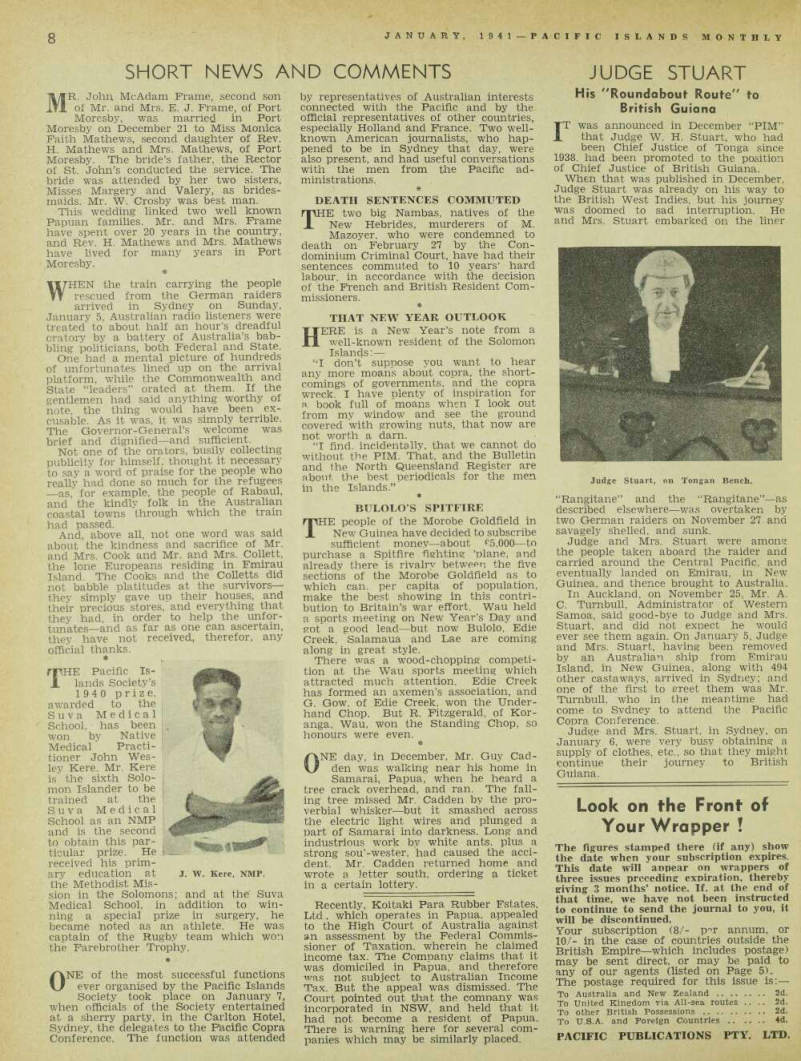
fITHE Pacific Ts- A lands Society’s 1940 prize, awarded to the Suva Medical School, has been won by Native Medical Practi tioner John Wes ley Kere. Mr. Kere is the sixth Solo mon Islander to be trained at the Suva Medical School as an NMP and is the second to obtain this par ticular prize. He received his prim ary education at the Methodist Mis-
sion in the Solomons; and at the' Suva Medical School, in addition to win ning a special prize in surgery, he became noted as an athlete. He was captain of the Rugby team which won the Farebrother Trophy. * ONE of the most successful functions ever organised by the Pacific Islands Society took place on January 7, when officials of the Society entertained at a sherry party, in the Carlton Hotel, Sydney, the delegates to the Pacific Copra Conference. The function was attended
by representatives of Australian interests connected with the Pacific and by the official representatives of other countries, especially Holland and France, Two well known American journalists, who hap pened to be in Sydney that day, were also present, and had useful conversations with the men from the Pacific ad ministrations. *
Death Sentences Commuted
rE two big Nambas, natives of the New Hebrides, murderers of M.
Mazoyer, who were condemned to death on February 27 by the Con dominium Criminal Court, have had their sentences commuted to 10 years’ hard labour, in accordance with the decision of the French and British Resident Com missioners. *
That New Year Outlook
HERE is a New Year’s note from a well-known resident of the Solomon Islands: — ‘T don’t suppose you want to hear any more moans about copra, the short comings of governments, and the copra wreck. I have plenty of inspiration for a book full of 'moans when I look out from my window and see the ground covered with growing nuts, that now are not worth a darn.
“I find, incidentally, that we cannot do without the PIM. That, and the Bulletin and the North Queensland Register are about the best periodicals for the men in the Islands.” *
Bulolo’S Spitfire
THE people of the Morobe Goldfield in New Guinea have decided to subscribe sufficient money—about £5,000 —to purchase a Spitfire fighting ’plane, and already there is rivalry between the five sections of the Morobe Goldfield as to which can. per capita of population, make the best showing in this contri bution to Britain’s war effort. Wau held a sports meeting on New Year’s Day and got a good lead —but now Bulolo, Edie Creek, Salamaua and Lae are coming along in great style.
There was a wood-chopping competi tion at the Wau sports meeting which attracted much attention. Edie Creek has formed an axemen’s association, and G. Gow, of Edie Creek, won the Under hand Chop. But R. Fitzgerald, of Kor anga, Wau, won the Standing Chop, so honours were even. * ONE day, in December, Mr. Guy Cad den was walking near his home in Samarai, Papua, when he heard a tree crack overhead, and ran. The fall ing tree missed Mr. Cadden bv the pro verbial whisker—but it smashed across the electric light wires and plunged a part of Samarai into darkness. Long and industrious work by white ants, plus a strong sou’-wester, had caused the acci dent. Mr. Cadden returned home and wrote a letter south, ordering a ticket in a certain lottery.
Recently, Koitaki Para Rubber Estates, Ltd., which operates in Papua, appealed to the High Court of Australia against an assessment by the Federal Commis sioner of Taxation, wherein he claimed income tax. The Company claims that it was domiciled in Papua, and therefore was not subject to Australian Income Tax. But the appeal was dismissed. The Court pointed out that the comnany was incorporated in NSW, and held that it had not become a resident of Papua.
There is warning here for several com panies which may be similarly placed.
J. W. Kere. NMP.
Judge Stuart
His "Roundabout Route" to British Guiana
IT was announced in December “PIM” that Judge W. H. Stuart, who had been Chief Justice of Tonga since 1938. had been promoted to the position of Chief Justice of British Guiana.
When that was published in December, Judge Stuart was already on his way to the British West Indies, but his journey was doomed to sad interruption. He and Mrs. Stuart embarked on the liner
“Rangitane” and the “Rangitane”—as described elsewhere —was overtaken by two German raiders on November 27 and savagely shelled, and sunk.
Judge and Mrs. Stuart were among the people taken aboard the raider and carried around the Central Pacific, and eventually landed on Emirau, in New Guinea, and thence brought to Australia.
In Auckland, on November 25, Mr. A.
C. Turnbull, Administrator of Western Samoa, said good-bye to Judge and Mrs.
Stuart, and did not expect he would ever see them again. On January 5, Judge and Mrs. Stuart, having been removed by an Australian ship from Emirau Island, in New Guinea, along with 494 other castaways, arrived in Sydney; and one of the first to greet them was Mr.
Turnbull, who in the meantime had come to Sydney to attend the Pacific Copra Conference.
Judge and Mrs. Stuart, in Sydney, on January 6, were very busy obtaining a supply of clothes, etc., so that they might continue their journey to British Guiana.
Judge Stuart, on Tongan Bench.
Advertisements & other items, p. 10 (1 item)
Your Wrapper !
Look on the Front of
The figures stamped there (if any) show the date when your subscription expires.
This date will anpear on wrappers of three issues preceding expiration, thereby giving 3 months’ notice. If. at the end of that time, we have not been instructed to continue to send the journal to you, it will be discontinued.
Your subscription (8/- p°r annum, or 10/- in the case of countries outside the British Empire—which includes postage) may be sent direct, or may be paid to any of our agents (listed on Page 5).
The postage required for this issue is:— To Australia and New Zealand 2d.
To United Kingdom via All-sea routes ... 2d.
To other British Possessions 2d.
To U.S.A. and Foreign Countries 4d.
PACIFIC PUBLICATIONS PTY. LTD.
Sydney
M. Mansard
Brutally Assaulted in Sydney
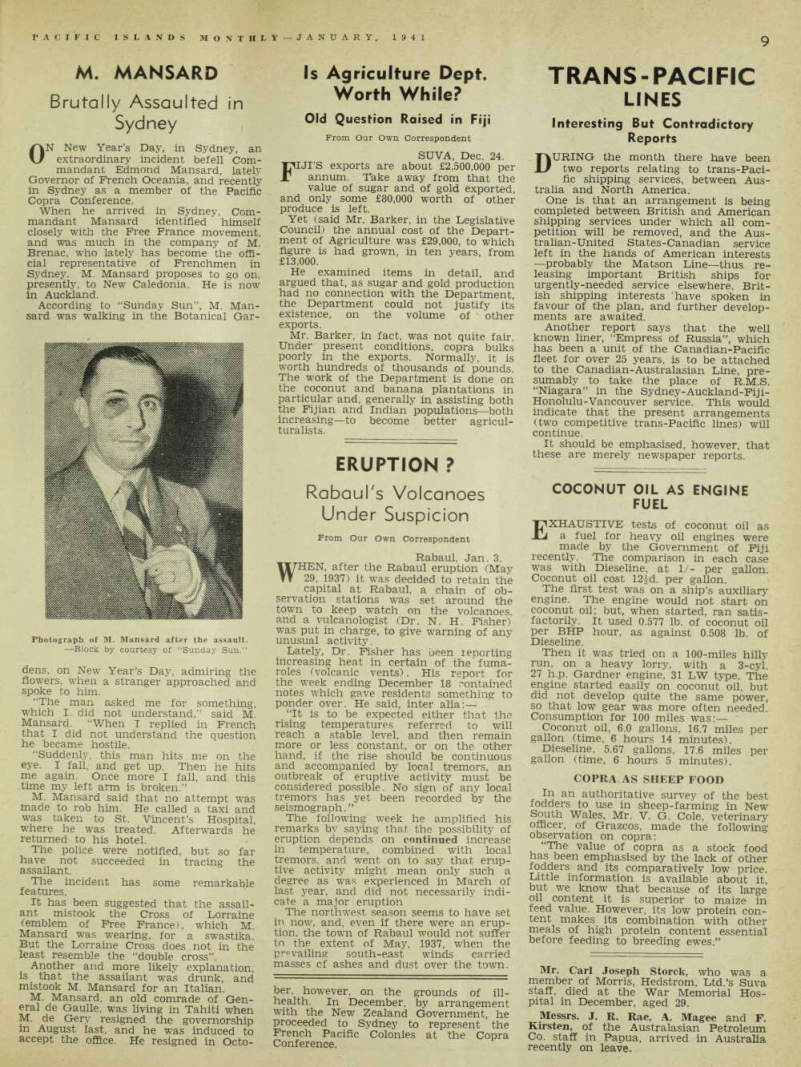
ON New Year’s Day, in Sydney, an extraordinary incident befell Com mandant Edmond Mansard, lately Governor of French Oceania, and recently in Sydney as a member of the Pacific Copra Conference.
When he arrived in Sydney. Com mandant Mansard identified himself closely with the Free France movement, and was much in the company of M.
Brenac, who lately has become the offi cial representative of Frenchmen in Sydney. M. Mansard proposes to go on, presently, to New Caledonia. He is now in Auckland.
According to “Sunday Sun”, M. Man sard was walking in the Botanical Gar-
dens, on New Year’s Day, admiring the flowers, when a stranger approached and spoke to him.
“The man asked me for something, which I did not understand,” said M.
Mansard. “When I replied in French that I did not understand the question he became hostile.
“Suddenly, this man hits me on the eye. I fall, and get up. Then he hits me again. Once more I fall, and this time my left arm is broken.”
M. Mansard said that no attempt was made to rob him. He called a taxi and was taken to St. Vincent’s Hospital, where he was treated. Afterwards he returned to his hotel.
The police were notified, but so far have not succeeded in tracing the assailant.
The incident has some remarkable features.
It has been suggested that the assail ant mistook the Cross of Lorraine (emblem of Free France), which M.
Mansard was wearing, for a swastika.
But the Lorraine Cross does not in the least resemble the “double cross”.
Another and more likely explanation, is that the assailant was drunk, and mistook M. Mansard for an Italian.
M. Mansard, an old comrade of Gen eral de Gaulle, was living in Tahiti when M. de Gery resigned the governorship in August last, and he was induced to accept the office. He resigned in Octo
ber, however, on the grounds of ill health. In December, by arrangement with the New Zealand Government, he proceeded to Sydney to represent the French Pacific Colonies at the Copra Conference.
Photograph of M. Mansard after the assault. —Block by courtesy of “Sunday Sun.”
Is Agriculture Dept.
Worth While?
Old Question Raised in Fiji
Prom Our Own Correspondent
Suva, Dec. 24.
FIJI’S exports are about £2,500,000 per annum. Take away from that the value of sugar and of gold exported, and only some £BO,OOO worth of other produce is left.
Yet (said Mr. Barker, in the Legislative Council) the annual cost of the Depart ment of Agriculture was £29,000, to which figure is had grown, in ten years, from £13,000.
He examined items in detail, and argued that, as sugar and gold production had no connection with the Department, the Department could not justify its existence, on the volume of other exports.
Mr. Barker, in fact, was not quite fair.
Under present conditions, copra bulks poorly in the exports. Normally, it is worth hundreds of thousands of pounds.
The work of the Department is done on the coconut and banana plantations in particular and, generally in assisting both the Fijian and Indian populations—both increasing—to become better agricul turalists.
Under Suspicion
Eruption?
Rabaul's Volcanoes Under Suspicion
From Our Own Correspondent Rabaul, Jan. 3.
WHEN, after the Rabaul eruption (May 29, 1937) it was decided to retain the capital at Rabaul, a chain of ob servation stations was set around the town to keep watch on the volcanoes, and a vulcanologist (Dr. N. H. Fisher) was put in charge, to give warning of any unusual activity.
Lately, Dr. Fisher has been leporting increasing heat in certain of the fuma roles (volcanic vents). His report for the week ending December 18 contained notes which gave residents something to ponder over. He said, inter alia:— “It is to be expected either that the rising temperatures referred to will reach a stable level, and then remain more or less constant, or on the other hand, if the rise should be continuous and accompanied by local tremors, an outbreak of eruptive activity must be considered possible. No sign of any local tremors has yet been recorded by the seismograph. ”
The following week he amplified his remarks by saying that the possibility of eruption depends on continued increase in temperature, combined with local tremors, and went on to say that erup tive activity might mean only such a degree as was experienced in March of last year, and did not necessarily indi cate a major eruption The northwest season seems to have set in. now, and, even if there were an erup tion. the town of Rabaul would not suffer to the extent of May, 1937, when the prevailing south-east winds carried masses of ashes and dust over the town.
Trans-Pacific
Lines
Interesting But Contradictory Reports
DURING the month there have been two reports relating to trans-Paci fic shipping services, between Aus tralia and North America.
One is that an arrangement is being completed between British and American shipping services under which all com petition will be removed, and the Aus tralian-United States-Canadian service left in the hands of American interests —probably the Matson Line —thus re leasing important British ships for urgently-needed service elsewhere. Brit ish shipping interests 'have spoken in favour of the plan, and further develop ments are awaited.
Another report says that the well known liner, “Empress of Russia”, which has been a unit of the Canadian-Pacific fleet for over 25 years, is to be attached to the Canadian-Australasian Line, pre sumably to take the place of R.M.S.
“Niagara” in the Sydney-Auckland-Fiji- Honolulu-Vancouver service. This would indicate that the present arrangements (two competitive trans-Pacific lines) will continue.
It should be emphasised, however, that these are merely newspaper reports.
Coconut Oil As Engine
Fuel
Exhaustive tests of coconut oil as a fuel for heavy oil engines were made by the Government of Fiji recently. The comparison in each case was with Dieseline, at 1/- per gallon.
Coconut oil cost 12£d. per gallon.
The first test was on a ship’s auxiliary engine. The engine would not start on coconut oil; but, when started, ran satis factorily. It used 0.577 lb. of coconut oil per BHP hour, as against 0.508 lb. of Dieseline.
Then it was tried on a 100-miles hilly run, on a heavy lorry, with a 3-cyl. 27 h.p. Gardner engine, 31 LW type. The engine started easily on coconut oil, but did not develop quite the same power, so that low gear was more often needed.
Consumption for 100 miles was:— Coconut oil, 6.0 gallons, 16.7 miles per gallon (time, 6 hours 14 minutes).
Dieseline, 5.67 gallons, 17.6 miles per gallon (time, 6 hours 5 minutes).
Copra As Sheep Food
In an authoritative survey of the best fodders to use in sheep-farming in New South Wales, Mr. V. G. Cole, veterinary officer, of Grazcos, made the following observation on copra: “The value of copra as a stock food has been emphasised by the lack of other fodders and its comparatively low price.
Little information is available about it, but we know that because of its large oil content it is superior to maize in feed value. However, its low protein con tent makes its combination with other meals of high protein content essential before feeding to breeding ewes.”
Mr. Carl Joseph Storck, who was a member of Morris, Hedstrom, Ltd.’s Suva staff, died at the War Memorial Hos pital in December, aged 29.
Messrs. J. R. Rae, A. Magee and F.
Kirsten, of the Australasian Petroleum Co. staff in Papua, arrived in Australia recently on leave.
Advertisements & other items, p. 12 (1 item)
eming way
CAREERS for NEW Men
and an Organisation to help You with
NEW WAYS for NEW TIMES
is vital to You ... a golden opportunity to -■L the man who wants to take advantage of the opportunities and who does not allow himself or his ideas ( to become obsolete simply because he lives in remote centres.
Industry is seeking New men . . . for NEW ways ... in NEW times . . . and you, if you start NOW, can be in a position to take your choice.
Whether you seek ADVANCEMENT SECURITY COMFORT PRESTIGE MONEY whether you wish to reach your goal in the areas in which you now reside, or wish eventually to secure a position on the mainland, H. & R. have the facilities that can assure the achievement of your desires.
The House of Hemingway & Robertson is an organisation established since 1897 to provide personal advancement through business education.
'V- -4i f
Jil]
hiifM LJ PM
■t'-v -{ i
Hi .fm essii*
eming way
Robertson
Founders The Accountancy Specialists of Commercial Education in Australasia.
3A BARRACK HOUSE, 16 BARRACK STREET,
SYDNEY
3A BANK HOUSE, BANK PLACE,
MELBOURNE, C.l.
Also at Brisbane, Adelaide, Perth, Hobart, Launceston, Newcastle
SPECIAL TUITION and SPECIAL FACILITIES have
been provided for men who live in the Islands, and the many H. & R. students who have, in past years, enrolled and completed their training whilst residing in even the remotest centres, have secured their degrees often in less time than those living on the mainland. They testify to the value of H. & R. training and the service given.
H. & R. originated and developed the Personal-Individual Method of Tuition and wherever mails go, H. & R. tuition is effectively given without loss of time. You train in the comfort of your home, and progress as fast as you wish. There is no loss of time.
Another feature of the H. & R. specialized training service is the One Fixed Fee policy. There is only one cost . . . no text books to buy. All that you have to pay is the outward postage on your work we pay return postage.
If you want to take advantage of the times and progress as rapidly as you should, post the coupon for our illustrated handbook.
CAREER TRAINING FOR 1941 ... and after Courses developed and modernised to meet NEW conditions The House of Hemingway & Robertson has developed new courses and re-designed existing training plans to ensure the most efficient tuition service for present-day conditions of business. The career training provided covers: — Department of Accountancy and Commerce.
Accountancy and Secretaryship.
Cost Accountancy.
Banking and Securities.
General Business Training.
Department of Distribution.
Marketing and Advertising.
Marketing and Selling.
Practical Retail Selling.
Show-Card and Ticket Writing.
To HEMINGWAY & ROBERTSON,
Please send me FREE copy of the new, 108 page illustrated handbook, “The Guide to Careers in Business,” and details of how the H. & R. Personal-Individual Tuition Method will train me successfully for the career marked below.
Name Age Address Career interested in 127AA/489
About Islands People
M. Nicholas Hagen, of Noumea, New Caledonia, who is affectionately known throughout the Pacific as “Tibby”, left St. Vincent’s Private Hospital, Sydney, on January 11. Three months ago he was admitted to hospital seriously ill, suffering from pneumonia and asthma.
He will be convalescent in Sydney for some time before returning to Noumea.
Mr. T. R. McCullough, a director of New Guinea Goldfields, Ltd., returned to Australia in December after a visit to the Co.’s workings at Wau, New Guinea.
Mrs. Crowdace and her daughter, Miss Jean Crowdace, of Apia, Western Saraca, arrived in Sydney in January for a holi day, which may extend to two months.
Mrs. Crowdace is now the lessee of the well-known Casino Hotel, at Apia.
Pilot-Officer Len Bayliss, elder son of Mr. and Mrs. T. W. Bayliss, of Bulolo, New Guinea, who was accidentally killed in Sydney on November 18 (he fell out of an aeroplane at a height of 3,000 feet, when instructing a pupil) arrived with his parents in Salamaua in 1927, and m Wau in 1928. He and his brother Collin were the first European children on the Morobe goldfield. In 1928, they walked with their parents from Wau to Fdie Creek. Len Bayliss was a highly skilled airman, with 700 hours to his credit. He lost his life, apparently, be cause his harness failed to hold him to the body of the aeroplane when it was flying almost upside-down.
A son of Mr. Lewis Lett is a captain in a famous English regiment, and he has been in the thick of the fighting in the Western Desert in Egypt.
Dr. C. H. Bonney has settled in Wau as medical officer to New Guinea Gold fields, Ltd., and general practitioner. He practised in Papua about four years ago.
He is a good golfer, and a man of genial and comradely temperament.
Pastor W. W. and Mrs. Petrie arrived in Australia recently from Apia, Western Samoa, where he is an SDA missionary.
Mr. R. Johns has been seconded from Fiji to the Solomon Islands as Govern ment Agricultural Officer.
Mr. and Mrs. G. Atherton, chief oper ator at Pan American Airways radio station at Noumea, New Caledonia, arrived in Auckland by Clipper at the end of December. He was accompanied by Mrs. Atherton.
Mr. F. T. M. White, Inspector of Mines, and Mr. G. K. Roth, District Officer, Suva, have been appointed mem bers of the Board of Trustees, Fiji Museum.
Mr. Dudley K. Palmer, Ph.C., Govern ment Pharmacist in the Fiji Civil Ser vice, died in Melbourne in December, aged 45 He was connected with the CSR Co., Ltd., in Fiji, before joining the Civil Service in 1928.
Mrs. Montgomery, wife of the deputy chief geologist of Australasian Petroleum Co., Port Moresby, Panua, paid a visit to Melbourne by air in December.
Miss Phoebe Mills, 8.A., of the Metho dist Mission Girls’ School, Suva, is at present on furlough in Queensland.
Mr. Alec. Strathearn, of the NG Registrar-General’s Department, married Miss Adelaide Watt, at Rabaul recently.
Mr. V. A. Pratt, of Tobera Plantation, New Britain, TNG, arrived in Australia m December and nroceeded to Victoria where he will spend three months' holi day with Mrs. Pratt.
Air Marshal A. W. Tedder, C. 8., who was recently appointed Deputy to Air Officer Commanding the RAF in the Middle East, served for a short time in the Fiji Civil Service in 1914, before en listing for service overseas.
Miss N. Brown, who for the past three years has been a worker for the Methodist Mission at the Chinese School.
Rabaul, New Guinea, has retired, and now will be associated with the Student Christian Movement in Australia.
Mr. J. J. Stubb, a well-known re sident of Suva, Fiji, left the Colony recently to take up residence in New Zealand. He came to Fiji in 1919 and was connected with Messrs. A. M.
Brodziak, Ltd., before going into business on his own account four years later.
Mr. W. Panton, staff surveyor in the Lands Department, Papua, is now on leave, at the expiration of which he will retire from the service.
Rev. and Mrs. N. G. Pardey, of the Methodist Mission College at Piula, Western Samoa, will shortly return to Australia, Mr. R. McKenzie arrived in Australia from New Guinea by ’plane in December.
He is foreman at New Guinea Gold fields, Ltd.’s Kulolo workings, and will spend furlough at Ballarat, Victoria.
Mr. O. M. Samuel, manager of the Bank of New Zealand at Suva, Fiji, has been transferred. He will be succeeded by Mr. F. L. Smith, who was stationed at the Levuka branch some years ago.
Mr. D. P. Parry, chief clerk in the Suva branch of the Union SS Co. for the past six years, has left Fiji on leave prior to transfer.
Mr. and Mrs. L. Austen arrived in Australia from Papua recently for three months’ holiday. He is well-known in the territory as Resident Magistrate at Daru.
Rev. and Mrs. H. H. Bock, of the Methodist Mission, are at present spend ing furlough in Victoria. Mr. Bock, who is stationed at Ba, expects to return to the Colony in June.
Advertisements & other items, p. 13 (1 item)
Trinity Grammar School
Serviceable
Wedding Presents
1 s £ This handsome case of half dozen heavily silverplated Fruit Salad Spoons and Forks with Salad Server will make a very useful gift. .. 30/- * N3* Case of V 2 dozen Tea or Fruit Knives of stainless mirror finish, another useful and acceptable gi« 17/6 Our IS4I Catalogue is now available.
Write for a copy. It is finely illustrated and will prove a useful guide to the latest designs and values in Diamonds, Jewellery, Watches, Clocks, Silverplate, China and Cut Glassware.
PROUDS PTY. LTD.
Cnr. KING & PITT STREETS,
SYDNEY.
TRINITY GRAMMAR SCHOOL
SOMMER HILL, N.S.W.
A Church of England Boarding and Day
School for Boys
(One of the Associated Schools of New South Wales) Situated in extensive grounds on the most elevated site in the Western Suburbs of Sydney, with fine ovals and other playing fields, tennis courts, swimming pool, etc. Spacious modern classrooms.
Separate Preparatory School at Strathfield,
Next term commences Tuesday, February 11.
Illustrated Prospectus will be forwarded on application to the Bursar at Summer Hill.
Headmaster: V. S. MURPHY, M.A. (Oxon.)
Tonga To Grow Peanuts
From Our Own Correspondent
Nukualofa, Dec. 8.
ABOUT two tons of peanut seeds have arrived to be distributed among Tongan growers by the Agriculture Department.
Experiments in the growing of peanuts during the year show that a high grade of peanuts suitable for export can be grown in Tonga, so the Agriculture Department has decided to take it up seriously. If this new industry proves successful, another item will be added to Tonga’s list of exports, which now includes bananas, pineapples and melons.
Future Of Copra Industry
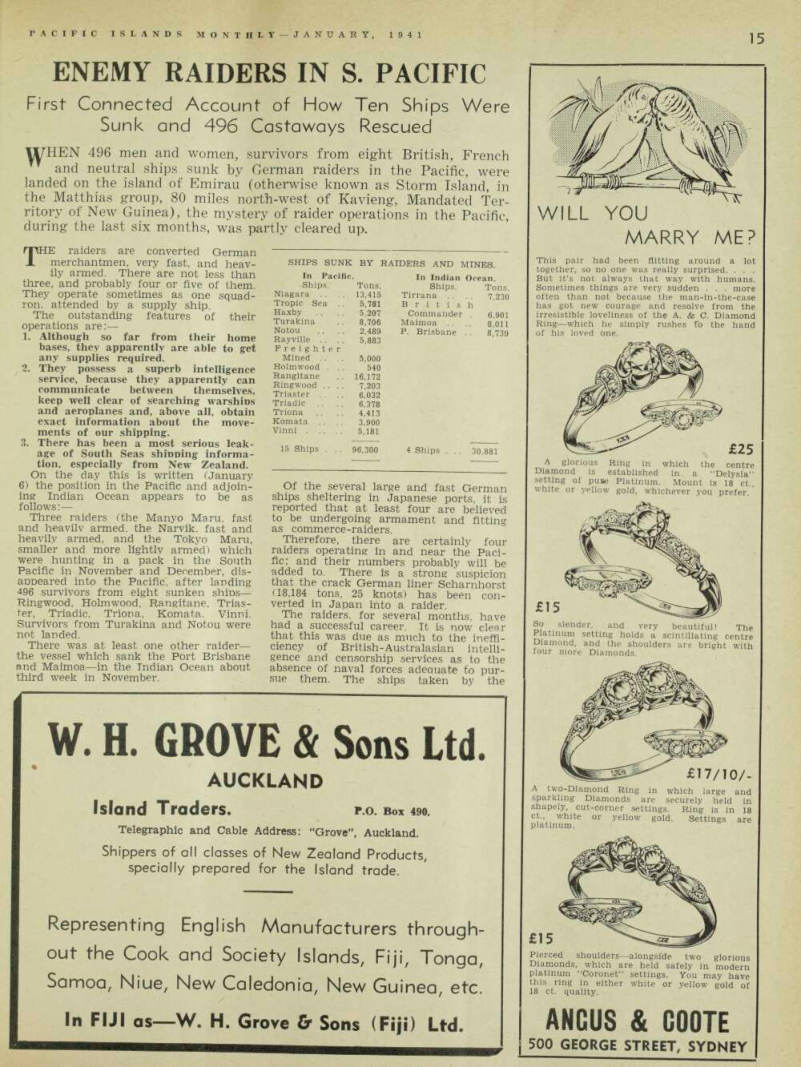
Representatives of all South Pacific Territories Attend Conference in Sydney
of the most interesting developments in the history of south Pacific administration took place in December when, at the invitation of the Australian Government, delegates from all the British and French Territories south of the Equator assembled in Sydney to consider the position of the South Pacific copra industry and to decide whether it was possible and practicable to take united action in relation to same.
THE full list of the members of the conference will be found on the front cover of this issue, under the group photograph.
The conference, under the chairman ship of Hon. T. J. Collins, Australian Minister for External Territories, com menced its sittings in the Commonwealth offices, Sydney, on December 19; and, although Christmas holidays caused dis location. the members stuck at it during the remainder of the month, and the conference finally did not break up till January 9.
This is the first time in the history of South Pacific administration that the representatives of all these territories have met in this way. Such a confer ence had been urged on many occasions, as a means of exchanging experiences between administrations whose problems and general conditions are almost iden tical: but although some of the western administrations had come together once or twice, and there had been more than one conference of Polynesian admini
strators, a meeting of all administra tions, British and French, had never before been regarded as possible.
It was a very serious matter —namely the effect of the war upon the: copra industry—which brought them all to gether on this occasion; and, if it has initiated a series of such conferences and opened the way to a discussion of many Pacific problems in common, the copra collapse will not have been an undiluted tragedy.
MR. Collins, the Australian Minister who had just taken charge of the Department, and Mr. J. R. Halligan, the Departmental head, were responsible for the organisation of the conference.
The original suggestion came from Sir Harry Luke, Governor of Fiji. Mr. Collins liked the idea, and asked for the co operation of New Zealand and the French colonies, which was gladly given.
The conference discussed many aspects of the copra industry, and a large num ber of alternative plans for assisting the
industry, temporarily and permanently; and it listened with close attention to the views of numerous witnesses who came before it.
Each delegate came armed with statis tics relating to his own territory and to the position in general; and, when all of these were pooled, it was apparent that the general situation was approxi mately as follows: — EXCEPT for the copra which Britain could consume, the European mar ket for copra was practically cut out, which meant that only the British market was available for tne huge pro duction of Ceylon, India, Burma, Indo china, Malaya, Dutch East Indies, East Ainca and Pacific Islands.
It was apparent that, owing to the need for conserving shipping, Britain would prefer to take the copra nearest at hand rather than south Pacific copra, which is most distant from the European market.
Therefore, pending the restoration of normal conditions, it became necessary to regard south Pacific copra production as being practically cut off from its normal marxet. Unless new markets could be found for this copra, or new uses for coconut oil developed, there were avail able only two alternatives —namely, store the copra, or cease production.
Various plans for pooling and storing the copra were considered; but, before committing itself to these, the conference very carefully examined (a) the adjust ment of existing copra markets to south Pacific production, (b) the possibility of new markets, (c) the development of new uses for copra.
An examination of available data indicated that there would be a market for a certain amount of Pacific Islands copra in Britain; that there also was a market for a definite quantity in Mexico; that large crushing mills which are being erected in Canada by interests associated with Messrs. W. R. Carpenter & Co. Ltd. probably will provide a new and unexpectedly large market for a large quantity of Pacific Islands copra; and that a few thousand tons per annum of copra (probably Samoan) will be dis posed of in New Zealand and Australia as fodder for stock, especially pigs.
It was understod that, during the pro gress of the conference, important com munications passed between the Austra lian Government and the British Gov ernment on the subject of providing a market for south Pacific copra.
The matters discussed at length included, of course, the system of keep ing a skeletonised copra industry to gether by making sustenance allow ances to planters of sufficient volume to permit them to remain on their planta tions.
Position Of Papua
rE new Administrator of Papua, Hon.
H. L. Murray, was welcomed to the conference some days after it started. When responding, and express ing his eagerness to assist the copra industry in any way possible, he ex plained the position of Papua.
The Territory of Papua was by no means a giant among the copra producers of the Pacific, but the industry was of much more importance to Papua than the quantity of copra exported might suggest. For the four years, just before the war, their average export of copra was just over 11,000 tons annually. Their best year was 1936-37, when we exported over 13,500 tons. The price then was good, and there was increased native production.
In the year ended June 30, 1939, copra made only 14 per cent, in value of the total Papuan produce exported. But this percentage did not mean that the economic stability of Papua was dependent only to that extent on copra. A great proportion of Papua’s settled European
population had been dependent on copra, and many thousands of natives were partially dependent on it. Further, the proceeds of the copra industry were spent wholly in the Territory.
“The copra industry has its place in our native policy,” continued Mr. Murray. “We have for many years induced natives to plant coconuts individually, and to make coconut plantations collectively. By this means they have been able, either directly or indirectly, to pay their taxes, and to gratify their simple needs. The shrinkage of the native Taxes Fund (which is expended solely in matters directly and exclusively benefitting the natives) is embarrassing us in continuing our medical, - educational and other services to natives; while
the fact that the Government appears to have misled them about the return they would derive from their industry has produced some be wilderment which might easily undermine their confidence in us to some degree.
“But that is only one aspect of the matter.
We have much in mind the position of our European producers generally, and of our 40 or 50 individual European producers, and their families in particular. Their position is much worse than that of the natives because, in the case of the Europeans, there is no equivalent to the normal village life, which provides a native with his hut, his garden land, his hunt ing, fishing, etc., which at least enable him to live without hardship.
“The Government revenues have also suffered
severely, owing to the absence of any returns from our own coconut plantations, the loss caused by the paying off and return to their villages of between 3.000 and 4,000 native labourers from the plantations, and many other direct and indirect losses caused by the present position.”
Copra Generalisations
MR. R. W. ROBSON, editor of the “Pacific Islands Monthly”, was courteously invited by the chair man to address the conference. He sub mitted the following notes: — It would be impertinence on my part to attempt to instruct this conference in matters relating to the copra industry—most of the members know more about it than I do. But there are certain broad generalisations based on the present extraordinary position which I am glad to be able to place before the delegates for their consideration.
History Of Copra Industry
First—a brief survey of the copra industry gives the following facts: — (a) There have oeen extraordinary fluctuations in copra prices during past two decades, which clearly are the result, apart from tne law of supply and demand, of the manipulations of the world copra markets by an all-powerful international combine, and of the steady introduction into a field, hitherto held almost entirely by coconut oil of other oils, hitherto debarred by their character, but now admitted be cause tney have been treated by new and increasingly efficient processes of de odorisation and purification, etc. tb) There was, prior to the war, increasing recognition of the fact that the copra market is controlled largely by forces superior to the law of supply and demand —so that individual planters have not felt the same sense of security and, to an in creasing degree, they have been seeking alternative crops, as an insurance against the inevitable lean periods. (C) This industry, formerly based on private enterprise by individual planters, has been invaded by large trading corporations, who have to an increasing degree taken over old plantations, or established new plan tations —so that, year by year, the copra owned or immediately controlled by the big firms has become a larger proportion of the total output of the South Pacific.
These circumstances had created difficult con ditions for the South Pacific copra industry long before the outbreak of the present war.
Should Industry Be Saved?
The present war introduces a new set of difficulties, without apparently solving any of those which previously existed. The whole of the European market, except that of Britain, has disappeared; and even if it were re-opened to-morrow, there is insufficient tonnage available at a moderate rate to permit South Pacific copra to be sold profitably in Europe. That, I under stand, is the problem with which this con ference is immediately faced.
Therefore, it boils down to this: In view of the difficulties which confronted the industry prior to September, 1939, plus the acute troubles created by the war, is it worth-while to attempt to save the copra industry?
Without going into it at length, I express the opinion, which is the opinion of most competent students of the industry, that the post-war world will require a very large and possibly increasing quantity of coconut oil, but with the provisos that it is unlikely that the price will ever be sensationally high, as it was after the 1914-18 war, and that some attempt must be made to control the Unilever combine.
The Pacific Administrations cannot afford to let the industry die if there is any prospect of the reasonably profitable sale of its product after the war. Some territories, to an increasing ex tent, have established industries alternative to copra; but there are other territories —and, more particularly, important sections of the terri tories which have alternative industries —which are wholly dependent upon copra. The dis appearance of the copra industry from the South Seas, wiping out a vast organisation of little traders and shipowners, would create a depression that would last for decades.
Suggested Alterations
If the interests concerned are to turn to the question of how to keep the industry in being, I submit that the alternatives are:—
(Continued on Page 53)
(a) Subsidies to growers, without any attempt to collect the coconuts for commercial use, until there is a market clearly available; tb) A system of pooling copra, and storing it, in the hope that a market may eventually open somewhere, growers to be financed on a basis of contributions to the pool— as in the Dutch East Indies; (c) A system of establishing crushing mills in central places in the groups, or possibly using a mill-ship; (d) A search for new markets—North America, for example—(U.S.A., Mexico, Japan); (e) The possible development of new indus tries, based on South Pacific coconut production—i.e., the Carpenter plan of establishing large crushing mills in Canada, contiguous to the North American market.
In considering these alternatives it is neces sary to remember that nowadays, in the majority of Territories, copra production can be divided sharply into three classes—namely, the copra produced by the native landowners, the copra produced by individual and independent Euro pean planters, and the copra produced by th® large corporations, to which reference has al ready been made. Each of these classes of copra production represents in itself a problem for the individual administration—and, in that regard, I respectfully suggest there is the most urgent need for consultation among the dif ferent administrations.
Attitude Of Big Corporations
I am not aware of the attitude of the big South Seas trading and planting corporations towards this conference. But their interests in the various Territories are so great, and so delicately balanced, that I should not be sur prised if they display a certain amount of sensitiveness and suspicion, and what mav appear to be an unwillingness to co-operate Perhaps delegates will permit me to say that this situation requires tactful handling. I think that the problems with which you are faced cannot be solved without the goodwill and co-operation of these great corporations—while. *t th® same time. I imagine that delegates, at this stage, are unwilling to compromise them s® I ves in any way with nurely commercial con siderations. I believe, however, that the big cornorations are nuite sincerelv anxious to co onerate—and, if I were handling this delicate situation. I should make a straight apneal to their patriotism. The heads of all the big corporations are not unconscious of the fact that, in their vast developmental operations they have performed important Imperial service in the South Pacific.
Finally, and most important of all I would urge upon this conference that it recognises that herein may lie the beginning of a per manent organisation that will control or in nuence administration and development in tb p South Pacific in the futnr®. The presence here of the representatives of Free France is highly significant. J
Advertisements & other items, pp. 14-16 (3 items)
When Visiting
By Appointment
BRISBANE
Pay us a call and let us take your measurements, colour preferences, size records, etc. These will be of great assistance to us for future reference.
A range of the latest Suitings will be gladly forwarded on request.
Pike Brothers Ltd.
Queen Street
St. Ignatius’ College
Riverview Sydney
Boys are prepared for Intermediate and Leaving Certificate Examinations and for Exhibitions, Scholarships and Bursaries at the University.
Boys are arranged in three Divisions according to age. Each Division has its own Library, Debating Society, Cricket and Football Fields, and Tennis Courts.
Senior and Junior Rowing Sheds, with a large fleet of pleasure and racing boats.
Private Swimming Baths.
Prospectus and further particulars on application to the — Rector; St. Ignatius’ College, Riverview, Sydney, Australia.
Tel.: JB 1106.
BOARDING AND DAY SCHOOL
• - M
Conducted by the Jesuit Fathers
ONE OF SYDNEY'S GREAT PUBLIC SCHOOLS
“ULTIMATE”
7-VALVE PORTABLE MANTEL
WORLD-WAVE VIBRATOR MODEL
Specially suited for
Island conditions
An unique Dual Purpose high quality Set exclusive to “ULTIMATE”.Two sets in one—a superior mantel model and easily-carried multi-wave Vibrator Portable. Instantly detachable lid effects the transformation.
Specially suited to Island reception. Magnificent performance under all circumstances. Thorough dependability guaranteed by “ULTIMATE”. Will satisfy the most fastidious expert.
Take it anywhere—picnics, meetings, dances, boating parties, car outings, etc., etc. —performance will always he superb! Exclusive Light Ray Tuning (obtainable only in “ULTIMATE”). Five controls: Tone, Volume, Dial Lamp (for conservation of Battery Power), Wave Band and Tuning ; Broadcast 1600-550 kilocycles ; Short Wave 16-52 metres; special 8 in. Rola Reproducer (sealed against humidity) ; High Fidelity Push-Pull Output (unusual in Vibrator Models) ; A.V.C. Spin Tuning, etc., etc. INSECT-PROOF!
Also obtainable in 5-Valve World-Wave Battery Vibrator, in 6- Valve World Wave, and 8 and 10-Valve All-Wave Electric.
Cut out this Coupon and post to-day.
GEORGE BROWN & CO. PTY. LTD., 267 Clarence Street, Sydney.
Please send me particulars of “ULTIMATE” Radio Receivers as advertised in “Pacific Islands Monthly”.
Name Address GEORGE BROWN & CO. PTY. LTD., 267 Clarence St., Sydney
And now-
KODACHROME / ,
t LW
SAT^ Al
.A
for the
MINIATURE CAMERA
-A DREAM come true! The viewing oi a Kodachrome Transparency is like looking through a window at reality itself! See for yourself the glorious purity and brilliance ol colour captured by this new film for all 35mm. and Kodak Bantam models. Join the swing ro colour photography —demonstrations daily
OF ALL KODAK DEALERS
THROUGHOUT THE ISLANDS
KODAK (A/ASIA) PTY. LTD.
379 George Street, Sydney D A » «
FREE
DATA
BOOK
Write or call.
Mention the type of your miniature camera
13
PAcif’lC ISLANDS 1941
Enemy Raiders In S. Pacific
First Connected Account of How Ten Ships Were Sunk and 496 Castaways Rescued
Vi/’HEN 496 men and women, survivors from eight British, French T and neutral ships sunk by German raiders in the Pacific, were landed on the island of Emirau (otherwise known as Storm Island, in the Matthias group, 80 miles north-west of Kavieng, Mandated Ter ritory of New Guinea), the mystery of raider operations in the Pacific, during the last six months, was partly cleared up.
rE raiders are converted German merchantmen, very fast, and heav ily armed. There are not less than three, and probably four or five of them.
They operate sometimes as one squad ron. attended by a supply ship.
The outstanding features of their operations are:— 1. Although so far from their home bases, they apparently are able to get any supplies required. 2. They possess a superb intelligence service, because they apparently can communicate between themselves, keep well clear of searching warshins and aeroplanes and, above all, obtain exact information about the move ments of our shipping. 3. There has been a most serious leak age of South Seas shinning informa tion. especially from New Zealand.
On the day this is written (January 6) the position in the Pacific and adjoin ing Indian Ocean appears to be as follows: Three raiders (the Manyo Maru. fast and heavily armed, the Narvik, fast and heavily armed, and the Tokyo Maru, smaller and more lightly armed) which were hunting in a pack in the South Pacific in November and December, dis anpeared into the Pacific, after landing 496 survivors from eight sunken shins — Ringwood, Holmwood, Rangitane, Trias ter, Triadic, Triona. Komata. Vinni.
Survivors from Turakina and Notou were not landed.
There was at least one other raider— the vessel which sank the Port Brisbane and Maimoa—in the Indian Ocean about third week in November.
Of the several large and fast German ships sheltering in Japanese ports, it is reported that at least four are believed to be undergoing armament and fitting as commerce-raiders.
Therefore, there are certainly four raiders operating in and near the Paci fic; and their numbers probably will be added to. There is a strong suspicion that the crack German liner Scharnhorst (18,184 tons, 25 knots) has been con verted in Japan into a raider.
The raiders, for several months, have had a successful career. It is now clear that this was due as much to the ineffi ciency of British-Australasian intelli gence and censorship services as to the absence of naval forces adequate to pur sue them. The ships taken by the
Ships Sunk
By Raiders And Mines.
In Pacific.
In Indian Ocean.
Ships.
Tons.
Ships.
Tons.
Niagara 13,415 Tirrana 7.230 Tropic Sea 5.781 B r i t i s h Haxby 5,207 Commander 6,901 Turakina 8,706 Maimoa 8,011 Notou 2,489 P. Brisbane 8,739 Rayville .. .. 5,883 Freighter Mined .. 5,000 Holmwood . . . 540 Rangltane 16,172 Ringwood .. 7,203 Triaster 6,032 Triadic 6.378 Triona 4.413 Komata .. 3,900 Vinnl 5.181 15 Ships ... I 96,300 4 Ships . .. 30.881
raiders —especially the five sunk at Nauru —were just a gift to the enemy.
But the lesson has been learned. A new system of naval protection for our ships, and a much closer guard over shipping information, is coming rapidly into operation. The raiders will not have such pleasant cruising, in the future.
HERE is the history of raider activity in the Pacific, up-to-date. It has been very carefully compiled, from hundreds of newspaper clippings. A study of the dates and of the circum stances (which have been cross-checked, where possible, but are not necessarily free from error) disclose a number of interesting things. They show how the raiders work, for example, and the inadequacy of our intelligence services.
The First Raider
JUNE 19, 1940: RMS Niagara, 13,415 tons, sunk by mines off east coast of Auckland, NZ.
This was the first public indication of the presence of enemy ships in South Pacific waters. It may be presumed that
this mine-layer was the raider which took the Tropic Sea.
JUNE 16: Norwegian Tropic Sea, 5,781 tons, laden with wheat, from Sydney, captured by raider near Norfolk Island.
The raider placed a prize crew aboard and sent the Tropic Sea off to Germany.
She got as far as coast of Spain, when she was intercepted by a British sub marine, and was scuttled.
Gallant Turakina
JULY: Freighter Haxby, 5,207 tons, sunk in Pacific. Crew taken prisoners.
AUGUST 20: British freighter, Tura kina, 8,706 tons, sunk by raider in Tas man Sea, when proceeding eastwards from Sydney.
An epic battle occurred. Captain “Jock” Laird had always said that if he met a raider he would fight to a fin ish, and he did. The raider apparently was the Narvik, carrying 8 in. and 6 in. guns, while the Turakina had only one little stern gun. Yet the Turakina fought off the big ship for 2i hours, and was not taken until over 30 of her crew of 58 had been killed. The Narvik was hit several times. Little is known of this gallant action—none of the Tura kina survivors have been released. The Narvik was reported in the Caribbean Sea on July 13. She could have got around to this point in five weeks. It is reported, indirectly, that Captain Laird was killed.
AUGUST 20 (approximately) : French steamer Notou, 2,489 tons, destroyed by raider when en route from Sydney to Noumea.
There are no details. She must have been in the vicinity when the Turakina action occurred. Turakina and Notou
survivors are known to have been aboard tho raiders which landed 496 other sur vivors on December 21; but they seem to have been kept apart from other sur vivors, and retained aboard—probably, because they were aboard the Narvik in September and October, when the latter made rendezvous with the other raiders at secret bases.
It was from this point, apparently, that the Narvik operated with the Manyo Maru (believed to be the German ship Kulmerland) and the smaller Tokyo Maru. We have no further word of raiders in the South Pacific until — SEPTEMBER; Tirrana, 7,230 tons, cap tured in Indian Ocean.
How Mines Were Laid
NOVEMBER 9: Two freighters, one British and one American, sunk by mines in Bass Strait, between Austra lia and Tasmania.
Germans on one of the raiders boasted to a woman survivor (who wrote it in her diary) that they laid two minefields in Bass Strait on the eve of the Mel bourne Cup (November 4), because they guessed that Australian officialdom would be so preoccupied with that great social event as not to have much time to be looking for the enemy. It may be boast ing—but the dates fit in.
NOVEMBER 23: British Commander, 6.901 tons, Maimoa (8,011 tons), and Port Brisbane (8,739 tons)’ destroyed by raider in Indian Ocean about this date.
Germans 7 Information
NOVEMBER 25: The 40-years-old NZ coastal steamer Holmwood, 540 tons, taken by raiders four hours after she left Chatham Islands for New Zealand.
Survivors say the Holmwood suddenly
found itself amid three hostile ships. The Germans explained that they wanted fresh meat. They knew exactly when the old Holmwood was leaving the Chat hams, and that she was carrying 1,400 sheep, so they just came along, gathered her in, transferred passengers and crew (29 altogether) and sheep, and sank her.
NOVEMBER 27: Liner Rangitane, 16,172 tons, built in 1929, met at dawn by two raiders, which immediately opened fire upon her, without warning.
Three were killed and many wounded, including women, before boats were launched. Ship was sunk.
This was a brutal and horrible sea crime. The liner carried over 100 pas sengers, some of whom, especially two young women, were badly wounded and facially disfigured. The Rangitane’s one gun was not used —it was put out of action by the first salvo.
Passengers aboard included Judge and Mrs. Stuart, lately of Tonga. He was on transfer to British Guiana.
The Germans boasted that they “knew exactly where to pick up the Rangi tane”—and their actions suggested that this was true.
NOVEMBER: Norwegian motorship Ringwood, 7,203 tons, built in 1926, sunk by raiders.
When and where this happened, there is no indication. But it apparently was in November in the South Pacific/
A "Sitting Shot"
DECEMBER 6,7, 8: Near Nauru, the raider Manyo Maru sank Triona and Vinni on 7th, and Komata on Bth, and raider Narvik sank Triadic and Triaster early on Bth.
Bad weather lashed Nauru, making loading-gear unworkable, and gradually seven ships, sent to load phosphate, and forced to await quieter seas, congregated around the island—a “sitting shot” for the raiders. The latter operated with extraordinary care and cunning, so as not to alarm the ships; and the latter, incredible as it may seem, apparently were given no warning of the danger.
Only two escaped. The ships lost were;—
The three Phosphate Commission shins carried passengers for Nauru and Ocean Islands and, as far as can be ascertained, the following is the complete list of their passengers who landed on Emirau:— 5.5. TRIASTEH: J. Fraser, fitter, of Ocean Island staff, and Mrs. Fraser; Mrs. Reynolds, wife of F. J. Reynolds, electrician, Ocean Island staff. 5.5. TRIADIC: Mrs. J. T. Langar and two children (one child wounded); Mr. C. R.
Ferguson, senior clerk, Nauru staff, and Mrs.
Ferguson; Mr. Dillon, concreter, Nauru staff, and Mrs. Dillon; Mrs. W. T. A. Allen.
Most of these five ships were shelled without warning, and some Filipino sailors were killed and a few Europeans injured. The small son of Mrs. J. Lan gar. a passenger on the Triadic for Nauru, was badlv wounded.
One survivor (Mrs. Charles Adams, of Ocean Island), who was on the Triona, describing her departure from the ship, said: “As I entered my cabin. I saw a German sailor stealing my things. He stole a wrist watch from its case. It was a present for my houseboy. On my bed was a large book of recipes which I had collected since my girlhood. They stole that, too. The Germans raided this entire ship like a lot of pirates and took awav all food, drink and bedding.”
DECEMBER 9: The raiders proposed to land survivors upon Nauru, but weather continued bad.
There is much confusion in survivors’ accounts of what happened then; but it is indicated that the raiders went off to the northwards, and lay together for a day or two somewhere among the Jap anese Mandated Islands (probably the Marshall Islands); and that, after arranging supplies and re-sorting pri soners, they sailed southwards.
Survivors Landed on Emirau
DECEMBER 21: Raiders landed 496 survivors upon Emirau Island, in St.
Matthias (Squally) group, 80 miles north west of Kavieng, in New Ireland, Terri tory of New Guinea.
Although the newspapers interviewed scores of survivors, not one said whe ther two or three raiders visited Emirau.
The Germans brought the survivors ashore in boat-loads, made rough-and ready dispositions for their shelter and sustenance, gave them a small quantity of food, and departed at midnight.
Emirau, a narrow island, 10 miles long, was settled about 1912 by a German named Wilde. He had many fights with
the natives, at first, but gradually he established his plantation, and made a fortune. After the last war, it passed into Australian ownership. About 1930, the coconut plantations there were acquired by Messrs. W. R. Carpenter and Co. Ltd. When the raiders came to Emirau in December there was a native population of 260, scattered in some four villages, a number of native labourers, and four Europeans—Mr. and Mrs. E. A.
Collett, in charge of a sawmill business there, and Mr. and Mrs. Cook, who have charge of the Carpenter plantation.
Ship.
Owners.
Tonnage.
Built.
Triaster Brit. Phosph. Comm. 6,032 1935 Triadic Brit. Phosph. Comm. 6,378 1938 Triona Brit. Phosph. Comm. 4,413 1931 Komata Union S.S. Co. , . . 3,900 1938 Vinni Norwegian 5,181 1937
It would appear that the raiders anchored in a little bay at one end of the island (where their seaplane flew about continually) and that the survivors had to make their way as best they could to the settlement at the other end, 9i miles away. Considerable parties appear to have camped anywhere, and actually, despite poor food and plagues of mos quitoes, to have revelled in the clean sea and bush, after German prison-ships. .The island is traversed by a road, and there is one motor-truck and one bul lock-waggon. The truck was used for the transport of the 70 women and 7 children among the 496 survivors; and the men, many of them barefoot, walked.
The women have told how, as they travelled along in the truck, they saw scores of exhausted men lying down beside the road.
The seven captains, under the senior captain (from the Rangitane) took charge of the extraordinary community, and the two European couples (the Col
letts and the Cooks) placed their houses, food and all they had unreservedly at the disposal of the castaways; and, gradually, some order was evolved.
The first consideration was food and shelter for the various camps. There were four classes of people to be pro vided for—the passengers from the vari ous ships; the officers; the European crews; and some 200 Chinese and Fili pinos, from the various crews. It seems that an attempt was made to provide a general camp for each class. The Europeans’ houses, and rapidly con structed palm-leaf huts, were given to the women and children, and the men camped out comfortably enough under the trees. Food was scarce. The island produces little beyond coconuts. The food grown by the natives barely suffices for their own needs.
The captains turned at once to the problem of escape. How could they com municate quickly with Kavieng, 80 miles away? The Germans had left them an
ancient and leaky lifeboat, which might serve, as a last resort. It was learned that a good cutter, the property of the SDA mission, was at another island, only 18 miles away, and this was sent for, and willingly loaned.
The Germans left on the evening of December 21. At 3.30 p.m. on December 22, the mission cutter, with the chief officer of the Rangitane, the chief officer of the Vinni, and Mr. Collett, left for Kavieng; and it arrived December 23.
The arrival of the cutter in Kavieng, and prompt communication of the news by radio to Rabaul and Australia, started tremendous activity. It is suffi cient to say, concerning this, that within a week the 496 castaways had all been removed from the island and landed at a Queensland port, and given every assistance that money and kindly thought could provide. The cutter reached Kavieng on December 23. The whole of the castaways were landed in Australia on January 1.
An extraordinarily good/ job appears to have been done by the District Offi cer at Kavieng, who took charge of the situation. A boat with a doctor, medi cal supplies, foodstuffs, etc., was back in Emirau by the evening of the 24th and other craft quickly followed. The women, children, sick and wounded were taken to Kavieng; and the whole of them, from Emirau and Kavieng (except for a small number who came south by plane) were brought to Australia by an Australian naval vessel.
Rabaul Generosity
The ship from Emirau made a brief call at Rabaul, shortly after Christmas.
It was at first understood that the 500 survivors would be landed and cared for in Rabaul; and the people of Rabaul, under the direction of administrative officers —notably, Mr. R. Melrose —made preparations to receive them. Remarkably good work was done by the emergency committee of the Rabaul Red Cross — so much so, that when the ship arrived in harbour, accommodation had been prepared in all the hotels, boarding houses and private houses, large stocks of foodstuffs had been organised, and very large supplies of clothing and other necessary personal equipment accumu lated. The generosity of the people, no less than the organising ability disclosed, was most favourably commented upon by everyone. The rescue ship made only a brief stay, however, and the survivors did not land. But the clothing, etc., sub scribed by the people of Rabaul was received aboard by the survivors with delight. Rabaul residents who were so generous should know that, judging by the remarks of the people after they landed in Australia, the thoughtfulness and kindness of the people of Rabaul have made lifelong friends and well wishers of the hundreds of men, women and children who had been caught by the raiders, and deprived of everything.
Nauru is Shelled
DECEMBER 27: German raider shelled and destroyed phosphate storage and shipping plant at Nauru.
For five days, the raiders were not reported. At dawn on December 27, the Manyo Maru. flying Japanese colours, appeared off Nauru, 800 miles north eastward of Emirau, and the Germans radio’d that they intended to shell the loading jetties and that the people ashore, if they wanted to avoid loss of life, should not use their radio. At 6.40 a.m. the raider came in close, showed the Nazi flag, and shelled the loading equipment, the great cantilever, the load ing jetties, the oil storage tanks, the
(Continued on Page 51)
Mr. L. E. Ford, of Rarotonga, who went to NZ in August, is now serving with the Royal NZ Air Force.
mooring gear, etc. It departed soon afterwards. The destruction was great.
The oil was still burning 24 hours later.
No private property was damaged, and no one was injured.
Fortunately, the power plant was intact, and the news was radio’d to Aus tralia immediately.
Much valuable plant has been erected at Nauru Island since the British Phosphate Commission began working the deposits at the end of the Great War. Formerly the island belonged to Germany, and between 1906 and 1919 the deposits were worked by the Anglo-Ger man Pacific Phosphate Company, which also operated at Ocean Island and else where. The company’s Nauru and Ocean Island interests were purchased by the British, Australian and New Zealand Governments for £3,500,000 in 1919, and the British Phosphate Commission, con sisting of one representative of each Government, was set up that year.
The construction of a great cantilever wharf at a cost of about £200,000, as a means of overcoming the lack of a har bour of any kind, has been a major development carried out by the commis sion. The phosphate is carried out to the end of the cantilever by an endless chain of buckets and is tipped auto matically into the hold of the vessel moored below. It is estimated that the destruction of all this equipment, and of three modern ships, means a loss to the Commission of well over £1,000,000.
The Commission employs a white staff of about 90 on the island, many of the employees having their wives and fami lies with them. The white population also includes an administration staff and a number of missionaries. There are also about 1,400 Chinese coolies and about 100 Chinese artisans in the Commission’s employ, while the native Nauru Island ers total about 1,700.
Advertisements & other items, pp. 17-22 (2 items)
W. H. GROVE & Sons Ltd.
WILL YOU
MARRY ME?
This pair had been flitting around a lot together, so no one was really surprised. . . .
But it’s not always that way with humans.
Sometimes things are very sudden . . . more often than not because the man-In-the-case has got new courage and resolve from the irresistible loveliness of the A. & C. Diamond Ring—which he simply rushes fo the hand of his loved one. £25 A glorious Ring in which the centre Diamond is established in a “Delysia” setting of puue Platinum. Mount is 18 ct.. white or yellow gold, whichever you prefer. r £15 So slender, and very beautiful! The Platinum setting holds a scintillating centre Diamond, and the shoulders are bright with four more Diamonds. £17/10/- A two-Diamond Ring in which large and sparkling Diamonds are securely held in shapely, cut-corner settings. Ring is in 18 ct., white or yellow gold. Settings are platinum. £15 Pierced shoulders—alongside two glorious Diamonds, which are held safely in modern platinum “Coronet” settings. You may have this ring in either white or yellow gold of 18 ct. quality.
ANGUS & GOOTE
500 GEORGE STREET, SYDNEY
W. H. GROVE & Sons Ltd.
AUCKLAND
Island Traders. p.o. box 490.
Telegraphic and Cable Address: “Grove”, Auckland.
Shippers of all classes of New Zealand Products, specially prepared for the Island trade.
Representing English Manufacturers throughout the Cook and Society Islands, Fiji, Tonga, Samoa, Niue, New Caledonia, New Guinea, etc.
In FIJI as—W. H. Grove & Sons (Fiji) Ltd.
PACIFIC ISLANDS SOCIETY
Visitors from the Islands to Sydney (or those Interested in Islands affairs), are advised to communicate with the honorary secretary of the above Society, which has been formed to study the history, traditions, economics, and political developments of the Pacific Islands.
Regular monthly meetings held at Hotel Carlton, Sydney.
Address for Correspondence:
THE PACIFIC ISLANDS SOCIETY,
Box 2434 MM., G.P.0., Sydney.
Equal to the World’s Best
Throughout Australia and Overseas there is an ever-increasing demand for
COLONIAL & BRONTE
HIGH-GRADE CANNED MEATS
There is no better quality—none more wholesome.
TRADE MEATS FOR THE ISLANDS
order
COLONIAL” BRAND
Roast, Corned and Boiled Beef Packed in 6, 5, 4, 3, 2, 1 lb. and 12 oz. tins.
Also Corned Beef in 12 oz. Taper Tins.
Roast, Corned and Boiled Mutton. 1 lb. and 12 oz. tins.
Choice Dripping 36 lb., 2 lb., 1 lb. tins, and 1 lb. packets.
Under present conditions it is wise to ensure that you have ample stocks of all our lines. i CA H P P
WHOUSALC
MtAT
The Colonial Wholesale Meat Coy. Pty. Ltd.
30 GROSVENOR STREET, SYDNEY
Islands 7 Visitors to Sydney Will find excellent accommodation at
"206" PRIVATE HOTEL
204-8 Victoria Street, Kings Cross, Sydney.
Every Comfort, Splendid Table.
Tariff from 35/- per week.
MRS. C. PYATT, Proprietress.
Tel. FL 4272.
SsB &
S^\NTANCE
R :-£ V Ml >5
CIJ?G
I ?G A
FRIEIS/o
; c^o
TOOHEVS
FLAG (Uo
n
H E HE'S
BRITANNIA OUTBOARDS
Marvellous English quality. No other country can produce an outboard like this. Solid bronze under-water gear, chrome plated. Silent, vibrationless power. Utmost economy. These are only some of the features. Let us send you an illustrated leaflet which will prove that Britain can turn out marine outboards superior to any other. 4 B.H.P. Super Twin. Weight 53 lb. Price £5O.
I Single 5 h.p. 4-cycle
SIMPLEX MARINE ENGINES
Australia’s finest in small marine engine manufacture. 7 models from 3 h.p. to 12 h.p. Suitable for boats from 14 ft. to 30 ft. long.
The new twin 10/12 h.p. is now available, and has just been accepted by the Navy for small boats.
Gives smooth running at all speeds, with reserve of power for any weather. Economical, easy starting, easy to instal.
Let us send you full particulars of all models.
SIMPLEX LAUNCHES ALSO AVAILABLE.
TILL
KEROSENE LAMPS
Made at London, England, despite the Blitzkrieg. 14 models available, providing from 300 to 2000 c.p. light. The only lamps which will burn kerosene efficiently. No flickering, no • insect trouble, no worry.
Illustrated is the popular Tall Table Lamp, 300 c.p. and suitable for all large rooms. An ideal Xmas present. Write for Tilley catalogue or see local agent.
All our lines can be purchased through any Sydney Agent if preferred.
For all Shipchandlery, Boatgear, Mining Supplies and Hardware.
W. KOPSEN &c< > pTY LTD
380 KENT STREET, SYDNEY. Cables: “Kopsen”, Sydney.
IN TUNE WITH EVERY OCCASION
Whether in sun porch camp mantel radio for every occasion. + + 4. For quiet entertainment,
or midnight dance party,
or on location. or city flat
;U theres an Airzone
91-
cS LJ
for latest
war \ \ - At left is the "Symphony Leader"
Model 5098, 5 Valve 1.4 Volt Battery Dual Wave Mantel, designed to measure up to the exacting requirements of these without electric current. Also as Model 5059, 5 Valve Vibrator Powered Dual Wave. Both are Airzone masterpieces of Mantel Model Art!
Above is shown Airzone's new mantel production.
Model 1072VM. It is a 7 Valve Vibrator Powered Dual Wave Mantel with EVERY feature of a console radio in mantel form. The seven valves make it very powerful and long distance or local reception is extremely good. Also as a 6 Valve A.C. Dual Wave Model 1062 AM housed in the same cabinet.
AGENTS FOR NEW GUINEA, PAPUA AND SOLOMON ISLAND S-
W. R. CARPENTER & CO., LTD.
19 O Connell Street Sydney: Salamaua. Rabaul, Kavieng and Madang. N.G.; and Tulagi, Solomon Islands Designed and manufactured by Airzone (1931) Ltd., Camperdown. N.S.W.. Australia. HA3SO. i i
NELSON & ROBERTSON
PTY., LTD.
Established 1895.
Islands Merchants
All classes of merchandise purchased at wholesale prices and original invoices supplied to Islands clients.
Cocoa Beans, Rubber and other Islands 7 produce sold on commission.
SOLE AGENTS FOR
ANKAR INSULATING
WALLBOARD
BEEBE PORTABLE
WINCHES
SKANDIA ENGINES
Nelson & Robertson
Pty. Ltd. 12 Spring Street, Sydney, Australia.
19
1* ACI F 1 C ISLANDS MONTHLY JANUARY, 1d 4 1
Mr. H. Leonard Murray
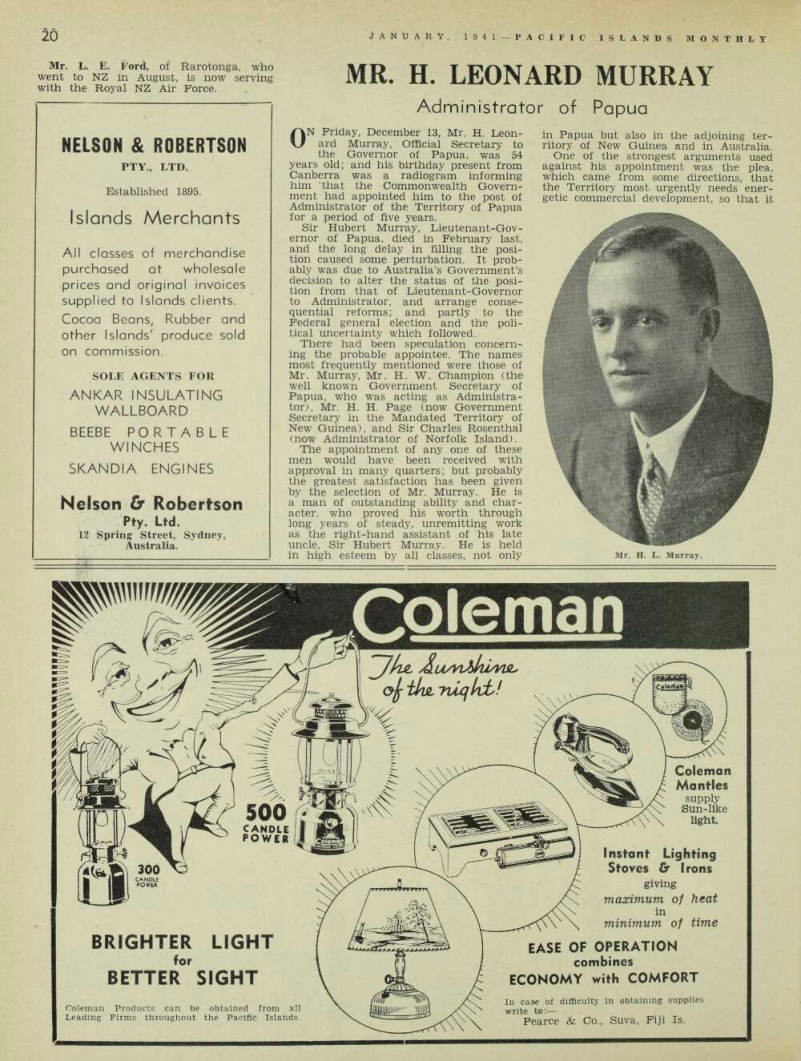

Administrator of Papua
ON Friday, December 13, Mr. H. Leon ard Murray, Official Secretary to the Governor of Papua, was 54 years old; and his birthday present from Canberra was a radiogram informing him that the Commonwealth Govern ment had appointed him to the post of Administrator of the Territory of Papua for a period of five years.
Sir Hubert Murray, Lieutenant-Gov ernor of Papua, died in February last, and the long delay in filling the posi tion caused some perturbation. It prob ably was due to Australia’s Government’s decision to alter the status of the posi tion from that of Lieutenant-Governor to Administrator, and arrange conse quential reforms; and partly to the Federal general election and the poli tical uncertainty which followed.
There had been speculation concern ing the probable appointee. The names most frequently mentioned were those of Mr. Murray, Mr. H. W. Champion (the well known Government Secretary of Papua, who was acting as Administra tor), Mr. H. H. Page (now Government Secretary in the Mandated Territory of New Guinea), and Sir Charles Rosenthal (now Administrator of Norfolk Island).
The appointment of any one of these men would have been received with approval in many quarters; but probably the greatest satisfaction has been given by the selection of Mr. Murray. He is a man of outstanding ability and char acter, who proved his worth through long years of steady, unremitting work as the right-hand assistant of his late uncle, Sir Hubert Murray. He is held in high esteem by all classes, not only
in Papua but also in the adjoining ter ritory of New Guinea and in Australia.
One of the strongest arguments used against his appointment was the plea, which came from some directions, that the Territory most urgently needs ener getic commercial development, so that it
Mr. H. L. Murray.
may no longer be a liability upon Aus tralia. Mr. Murray, owing to his train ing and environment, was said to be more of an academic than a practical administrator. The Government was impressed with this view; but after inquiry it accepted the evidence it had that Mr. Murray, while imbued with the high ideals in relation to native affairs, which distinguished his uncle’s ad ministration, was also a man of thor oughly practical outlook, as had been demonstrated by his work on the recent amalgamation commission.
The greatest satisfaction at his ap pointment was expressed within the Ter ritorial services. The selection of a man from within the Papuan service to fill the highest position in Papua will encourage all the principal officials of the tropical services, who on so many occasions in the past ten years, ana when high positions were being filled, have been passed over by the Common wealth Government in favour of ex-poli ticians and ex-soldiers. The Federal Government at last has recognised that there is an important principle to be observed in making these appointments.
It will be a bold Government that will ignore this principle in the future, as it was ignored in the past.
Mr. Murray has received hundreds of congratulatory messages from all quar ters —none more sincere, probably, than those from members of the commercial community in Papua who urged upon the Government that the Murray native policy had been advanced to the detri ment of the Territory’s commercial wel fare. The commercial interests were quite impersonal in their representations —Mr. Leonard Murray always has been held in high regard by all of them.
It may be disclosed that the final choice lay between Mr. Leonard Murray and Mr. Champion, and that fact per haps caused embarrassment in both Canberra and Port Moresby. Mr. Cham pion, both through his personal quali ties and his long service—he has acted as Lieutenant-Governor and Administra tor on many occasions—had strong claims to the position; and he would have been more than human if he had not desired this appointment as the coping-stone of his career. However, his attitude towards Mr. Murray, when the appointment was announced, was both broad-minded and sporting. It no doubt was a relief to Mr. Murray, who must have been anxious to have the co-opera tion and goodwill of this important departmental head; and it certainly was appreciated in Canberra, where it was feared that Mr. Murray’s appointment might be regarded by Mr. Champion as an expression of want of confidence.
That is not the case. As a matter of fact, a special appointment is planned by Canberra wherein it is believed Mr.
Champion will be able to give even more valuable service than in the past.
Mr. Leonard Murray arrived in Papua in 1905, as assistant private secretary to his uncle, who was then Judge Murray.
In 1913 he became Judge Murray’s private secretary. In 1916 he was made official secretary to the Governor, and in 1925 he was appointed a member of both the Legislative and Executive Councils. In 1936 he was awarded the decoration of Commander of the British Empire, in recognition of his distinguished services.
His wife is a lady of charming qualities; and Port Moresby, as a social centre, will be very glad that, after these long and empty years, the big rambling Govern ment House on the hill behind the Ter ritory’s capital will again be presided over by the Administrator’s lady.
MR. Murray is a son of the late Mr.
Aubrey Murray (half-brother of Sir Hubert Murray) and grandson of Sir Terence Murray. This is a most dis tinguished family. Professor Sir Gilbert Murray, who was in the 1941 Honours list, is an uncle of the new Administra tor. Another close relation was the immortal W. S. Gilbert.
Mrs. Murray was Miss Pauline Her bert, daughter of the late Judge Her bert, of Papua.
Mr. Leonard Murray has several dis tinguishing characteristics. He is a fine athlete, and was once a champion swim mer. He also is a first-class navigator.
For very many years he acted as cap tain of the Administration’s ship “Lau rabada”, taking her without mishap along hundreds of miles of very dan gerous coast. He has accumulated much data about these coasts, and about the remarkable river-bores of the western division.
Mrs. Hattie Sewell, who was well known and highly esteemed in Eastern Papua, died in Cairns on November 27.
She first went to Papua with her hus band, Mr. Tom Sewell, in 1918.
Mr. R. A. Phillips, a member of the staff of the Department of the Interior, Papua, was married in Port Moresby recently to Miss Elizabeth C. M. Flood.
Miss Olive Birch was bridesmaid and Mr.
Brian Molloy was groomsman.
Mr. K. A. Lewis, who is an engineer in the Papuan Department of Public Works and a well known resident of the Terri tory, was married in Port Moresby on November 30. to Miss Elsie Protheroe. of Brisbane. Mrs. I, C. Halliday was matron-of-honour.
Mr. B. C. Ballard, official representa tive of the Australian Government in New Caledonia, who was on a visit to Australia in November, returned to New Caledonia at the middle of December.
Advertisements & other items, pp. 22-23 (1 item)
o-fr ilia riiqLcL!
r*. jU
s j y 500 E
CANDLE
POWER
300
CANDLE
P OWW
BRIGHTER LIGHT
for
BETTER SIGHT
Coleman Products can be obtained from all Leading Firms throughout the Pacific Islands.
Coleman Mantles supply Sun-like light.
Instant Lighting
Stoves & Irons giving maximum of heat in minimum of time
EASE OF OPERATION
combines
ECONOMY with COMFORT
In case of difficulty in obtaining supplies write to:— Pearce & Co., Suva, Fiji Is.
BIDOMAK
“The Tonic of the Century”
for NERVES, BRAIN
AND THAT ‘DEPRESSED FEELING’
& BIDOMAK has restored radiant health to thousands because it provides these vital minerals: ferrum, calcium, potassium, sodium,
phosphates, glycerophosphates, sucrose, copper
and manganese in a predissolved easily assimilated liquid form.
BIDOMAK gives you a good appetite—brings
restful sleep—strengthens tired nerves—relieves stomach upsets and dyspepsia—builds energy, "pep" and endurance. Makes you well and keeps you well.
BIDOMAK contains no dangerous drugs or
opiates— start taking BIDOMAK to-day!
SCIENTIFIC
CONTROL
Manufactured in the Bidomak Pharmaceutical Laboratories, one of the most up-to-date, hygienic laboratories in the Southern Hemisphere, to which is attached a fully-qualified Doctor of Medicine, and under the control of a qualified chemist who was trained in the most modern English Laboratories in the world.
EXHAUSTED WITH THE LEAST EXERTION.
LIFE NOW WORTH LIVING.
“Since last October I have been thoroughly run down, I had no appetite and got exhausted with the least exertion and didn’t feel like doing anything but just laze about. I was advised to try Bidomak. I am very glad that I took the advice.
My appetite has returned and I can now do a day’s work without being done up, and altogether life has taken on a brighter tinge. I would advise anyone that has that run-down feeling to try Bidomak.” (Sgd.) H. Stubbs, Brisbane Rd., Manly, E.2., Queensland.
GET BIDOMAK TO-DAY!
At All Leading Island Stores
Samoan Notes

From Our Own Correspondent
Apia Dec 14
WESTERN Samoa is having a tough, uphill fight, in certain directions.
As copra is practically worthless, the natives dependent on copra are returning to the way of life of their forefathers, and are doing without Euro pean luxuries, and depending on their own products for food, clothing and lighting.
The exceptions among the Samoans are the banana growers and shippers, who may be considered the Samoan plu tocracy, with ample revenue accruing from the large banana exports. During November and December of this year, over 22.000 cases of bananas were ship ped, and the cash therefrom is an important source of revenue for traders and merchants.
Thefts
A recent shortage of native food especially taro and breadfruit, caused an epidemic of thefts and burglaries, espe cially from European banana planta tions in the Apia district.
A distressing occurrence was reported from the island of Savaii, where a small, Dutch, yawl-rigged yacht, the “Marie”, of 9i tons, owned and captained by Mr.
Frank Dona, a Dutchman, with Mr! Cyril Bowen, of Auckland, as companion, struck the reef at Avao, Fagamalo. It was found that she had sustained seri ous damage, including a large hole in the bottom, and she had to be beached.
While Messrs. Dona and Bowen were on shore, as guests of Mr. J. Menzies, manager of Burns Phllp at Fagamalo, a gang of natives boarded the little craft and pillaged it thoroughly, stealing ropes, provisions and everything movable, smashing the lockers and doing a lot of damage. Later, some of the culprits
were caught by a Samoan policeman and are now on their way to Apia to be tried.
Wartime Conditions
Coming into force as from December 5, the Administration is levying an addi tional 15 per cent, surcharge on the amount of import duty payable by importers. This is designed to balance the dwindling revenue of the Adminis tration.
Though Apia firms have succeeded in shipping most of the cocoa in store, there seems at present no prospect of trans port for copra on hand. A plan to sell a large quantity of copra to Japanese interests would probably not be sanc tioned by the Government.
The Samoa Spitfire Fund is up to about £4.200 now, and another £BOO will give the £5,000 aimed at. The goal will be reached in the near future. A num ber of sporting and social functions are planned for the fund.
American Samoa
At the Annual Fono, 1940, of American Samoa, Governor L. Wild gave a review of the social and economic conditions of the Territory. He mentioned the efforts made to grow edible canna in American Samoa, to help solve the food problem of the Samoans, the Department of Agriculture having distributed 60,000 edible canna bulbs.
A marked improvement in public health has been observed, and cases of yaws and trachoma have decreased. On the other hand, tuberculosis has caused more deaths than any other disease.
The income of this Government has greatly decreased owing to the inter national situation, and the expenditures for 1940 will exceed the revenue by approximately $lO,OOO. The estimated budget expenditure in 1941 is $96,000 and the income about $BO,OOO. The annual poll tax of $6.75 cannot be further reduced.
Exports of native industrial products, mats, baskets and fans, rings, etc., have considerably increased in recent years and form an important part of native income. Samoan floor mats are exported in large quantities for use of the American Army and Navy in locations where climatic conditions make the Samoan floor mat desirable.
During 1939, 747 tons of copra were shipped to the United States for sale on consignment. The average price received was $31.36 per ton delivered on the dock at San Francisco. The price continued to drop during the year until the low price of $1.35 per hundred pounds was received for the last shipment. Until the end of the year 1940 the price of $O.BO per hundred pounds will be paid to pro ducers. Unless the market price increases, a new and lower price will be set for the new year, to avoid having to sub sidise copra from the general funds.
Isolated Tokelaus
THE annual official visit to the isolated Tokelau Islands, a dependency of the Mandated Territory of Western Samoa, took place recently when the Samoan Secretary of Native Affairs, Mr.
C. V. McKay, visited the group in the Government launch “Pilot”. The natives, who had been without sea communica tion with the outside world for several months, were found to be in excellent health. Owing to the state of the copra market no branch stores are being operated in the Tokelau Islands at present.
Advertisements & other items, p. 24 (1 item)
Heinz
57 AIDS TO BETTER MENUS
TOMATO
KETCHUP
TOMATO M
SAUCE
TOMATO KETCHUP - Made
from Sun-ripened Tomatoes.
Medium Bottles .. 8 ozs.
TOMATO SAUCE A Pure
Appetising Sauce.
Large Bottles .. 13 ozs.
OVEN-BAKED
BEANS
WITH PORK AND
TOMATO SAUCE.
ALSO VEGETARIAN
Individual Tins. 4 ozs.
Small Tins, 8 ozs.
Medium Tins, 16 ozs.
TOMATO JUICE
A delicious health-giving and appetising drink Small Tins. 8 oz.
Med. Tins, 16 oz.
No. 5 Tins. 60 oz.
SPAGHETTI
Cooked in Tomato Sauce with Cheese Individual Tins. 4 ozs.
Small Tins, 8 oz Med. Tins. 16 or.
VEGETABLE
SALAD
Garden-fresh Vegetables with Mayonnaise. Small Tins, Boz.
HEINZ
FAMOUS lllililZi PRODUCTS
MADE IN AUSTRALIA
HEINZ
WoMita y m l \ soa *- m
™ SOUPS
READY-TO-SERVE
In 8 oz. and 16 oz. Tins
CREAM OF TOMATO
CREAM OF ASPARAGUS
CREAM OF CELERY
CREAM OF CHICKEN
CREAM OF GREEN PEA
CREAM OF MUSHROOM
CREAM OF ONION
CREAM OF SPINACH
CREAM OF TOHEROA
BEAN SOUP with HAM
CHICKEN VEGETABLE
KIDNEY SOUP
MULLIGATAWNY
OXTAIL
VEGETABLE
GENUINE TURTLE SOUP
MACARONI
Cooked in Cream Sauce with Cheese.
Individual Tins, 4 ozs.
Small Tins, 8 ozs.
Medium Tins, 16 ozs.
MAYONNAISE
Delightful on Salad.
Small Bottles, 4 ozs.
Med. Bottles, 7 ozs. 18 oz. Bottles 57 oz. Bottles
BEEFSTEAK
SAUCE
Fruits, Vegetables and Spices, skilfully blended.
Medium Bottles. 7£ ozs.
STRAINED FOODS
For Infant Feeding and Special Diets.
Strained Carrots Strained Beets Strained Prunes Strained Green Beans Strained Vegetable Soup Strained Beef and Liver
SWEET GHERKINS
Small Bottles
SWEET MUSTARD
PICKLE
Small Bottles
H. J. HEINZ CO. PTY. LTD.
Regd. Office: BENDIGO ST., RICHMOND E.l, VICTORIA Heinz delicious varieties are available from Storekeepers throughout Papua , New Guinea and .Pacific Islands.
Ten People

Killed
Wholesale Arrests After Gruesome Murders in N. Hebrides
From a Special Correspondent THERE has been a series of gruesome murders In the Batnafnu-Melsisi district of the island of Pentecost, New Hebrides, within the last two months.
For years past, there has been trouble between a mission school community there and the bush people. The former claim that, unable to get matters fixed up by the proper authorities, despite appeals, they took matters into their own hands.
Some six months ago a school adher ent interfered with the wife of a heathen chief. He, catching them in the act, killed the boy. The school people then decided to kill the heathen chief. He was warned and got away.
Thereupon, the school people turned their attention to the man who warned him. A party of fifty people surrounded his house, riddled it with bullets and, then seeing and hearing nothing, con cluded no one was in it and proceeded to destroy it. Suddenly a man rushed out of the house. They fired at him and missed. Then a woman, carrying an infant, rushed out. They shot the woman and, in falling, the infant was killed, too. They then* broke into the house and killed a little girl with knives and axes.
Another chief now offered to pay pigs and make peace, and sent a message to the school people. The latter told him to come back next week. The next day the school people attacked the chief’s village, killed him. wounded his wife and son and also killed at least two other men.
The total of killed, after the series of murders, was 10 (including two women and two children) and two other people wounded.
These killings were not done by wild bush people but by people calling them selves Christians, and with ammunition and guns supplied to them.
The Administration acted, and arrested a white teacher and 16 school people and one heathen. The school people claimed they had been told by the “Government” to take the law into their own hands— a statement which is being enquired into.
Pentecost is about 40 miles from the residence of two district agents, one British and one French. Pentecost people say they have been neglected by the Administration who answered appeals by procrastination or by very hurried and very infrequent visits by the officers concerned. There has been from one to three years between visits, and these only to a few places and for a few hours at a time. There is no reason why these outside islands should be neglected.
Pentecost has good anchorages and land ings all along the coast.
Mr. S. Bennett, manager for Messrs.
A. B. Donald Ltd., in Rarotonga, and European member of the Island Council, left for New Zealand on furlough in December, accompanied by Mrs. Bennett and daughter Dorothy.
Mrs. Robinson, wife of Rev. H. Robin son, Methodist missionary at Fergusson Island, Eastern Papua, recently arrived in Australia to live with her people in Sydney.
Advertisements & other items, pp. 25-26 (1 item)
Nestles
K i i B I / \ rn / % * n*‘‘ 5 !
I ;|j| r^ are d SPECIALLY
(AUSTRALASIA)
Nestle’s Sweetened Condensed Milk has been described as “Sealed Purity.” And so it is! Absolutely pure and germ free when it leaves Nestle’s Condenseries, it reaches you in the same perfect condition because it is sealed against all chance of contamination, whether from heat or any other cause. Nestle’s Sweetened Condensed Milk remains pure and fresh indefinitely while unopened—it is the SAFE milk for use in a tropical climate.
NESTLES
.'MILK
COPYRIGHT 8225
BARNET GLASS
RUBBER CO. LTD.
Wentworth Avenue,
SYDNEY
Radio : “BARNGLA88”—SYDNEY.
Manufacturers and Suppliers to the Islands’ trade of all rubber goods:— Tyres, Tubes and Accessories Rubber Soled Footwear Tennis Balls
Waterproof Garments
Mechanical Hoses, Transmission Belting, etc.
Tennis Racquets, Golf Balls, Toy Balls, etc., and native trade lines.
Prompt and efficient attention to all enquiries.
Box 2629 E.E., Tel. MA 6151 G.P.O., SYDNEY. M 4409 25 lines.
SHEAFFER’S WORLD FAMOUS
Streamlined, Feather Touch PENS and PENCILS
If you want Design, Beauty and Quality buy
a SHEAFFER
All Lifetime Pens are guaranteed for the life of the user except against loss and wilful damage.
When serviced, they are subject to a small fee for insurance, postage .and handling.
Beautiful and Useful Gifts for All Occasions.
SKEIP - The
Successor to Ink makes all Pens write better. 2oz.l/6, 4oz.2/6 Plus Postage Distributors Identify the Lifetime Pen by the white dot
74T LTSC AA 3T
Feather Touch Lifetime Pencil Regular Pen Lifetime Pen Pencil 9/6 2b/- 761- each 351- ea. each each The working parts of the Sheaffer Pencil are guaranteed against wear for the lifetime of the user.
When serviced they are subject to a small fee for insurance, postage and handling.
All Sheaffer regular pens are guaranteed against defects of material and workmanship.
Obtainable from Selected Jewellers and Stationers everywhere
EXCELSIOR SUPPLY GO. PTY. LTD.
L 278 Post Office Place,
MELBOURNE, VIC.
HEAD OFFICE}
160 BROADWAY,
SYDNEY, N.S,W.
50 Victoria Street,
WELLINGTON, N.Z.
Neglected Solomons

Economic Surveys Urged in Criticism by Old Resident
A THOUGHTFUL and constructive monograph, dealing with the present condition and probable future of the British Solomon Islands, has been writ ten by a gentleman with a long experi ence and intimate knowledge of the affairs of that protectorate.
It is too lengthy to reproduce here ; and, in any event, it is not now timely, because it discusses commercial and transport conditions as they existed nine months ago. Since then, those conditions have changed very much.
A number of the writer’s observations and recommendations deserve considera tion, however—if he can pei'suade any one to consider them. The fact is, how ever, that this anxious and harassed world to-day—and probably for some years to come—will regard a little topsy turvydom in the Solomons as among the least of its troubles.
THE writer makes the point that, in abandoning the sterling basis and accepting the Australian £ as the unit of its currency, the Solomons administration did private planters in the
Solomons a grave injustice, while un necessarily giving the Australian trad ing firms a rich bonus. He urges a return to sterling and the establishment of a Solomons bank, which would print and issue its own currency. He proceeds:— Such a bank would be a complete check upon the individual income and profit of those operating by production or trading in the Protectorate.
We suffer under another great dis ability. It is being tied under the Gov ernment of the Fijis. We have no con tact with that Colony, and I think they must regard us as being a perpetual pro ducing dairy cow to be milked regularly without it being necessary for them to provide any feed whatever.
All our revenue should come by direct taxation upon copra. None of our imports should be burdened with customs of any
description. We should be a free port excepting only, I am inclined to suggest, an impost upon certain luxuries.
All our endeavours should be turned to producing more copra, more gold, and harvesting the unexploited natural pro ducts already available and ripe, such as timbers, fibres, canes and kapok. Other crops which could be grown profitably are coffee, cocoa, rice, tobacco, .ginger and curry root. These are non-perish ables but all require the labour of women and children, which we are not allowed to use. Realistic economic reform is here vital. The present state of the independent grower is one of insolvency.
Government aid to the independent producer should be granted from the surplus funds in the hands of the Gov ernment (funds which copra produced) not only to save those producers, but to save the Solomon Islands.
Our currency would very quickly assume its proper valuation in the world by virtue of the natural increase of exports.
Our gold should be held as a backing for our currency issue. For every addi tional £1 value of gold in our Treasury, or our Bank’s treasury, we could issue notes to the extent of £5.
There are, and have been, many laws made for the alleged protection of the native, and the question of paternalism toward the natives will bear analytical consideration.
The attitude of the native toward the Government has a very strong element of cunning contempt, similar to that of a son who has a too indulgent father, and his insignificant contribution toward the upkeep of the Protectorate, or the British family, is due solely to the pater nal laws or attitude, without insisting that he contribute to the harvesting of the resources which nature has provided.
To encourage him to work would not inflict a hardship, as far as labour is concerned, but would add to his wealth, his self-respect, and possibly his ambi
tion. The native is certainly of a docile and happy disposition, and he is most happy when working hard under just treatment for a white man. My short experience is that he enjoys work and takes a certain amount of pride in accomplishment.
I will now refer to two elements in the Protectorate that to me are uneco nomic from a Government standpoint. (1) The Chinese trader is not a producer, depending as he does upon the labour of the producer, mostly native. (2) The Chinese mechanic is some asset, his labour hours being constructive.
Another element, very delicate to touch upon, is the missionaries. In some cases they do produce crops for their own con sumption and sale; they also educate the native in crafts which he is able to absorb and which are useful when once taught. It is not, however, the disposi tion or capacity of the native, in the main, to become a mechanic. Neither, do I believe, from a world-wide experi ence, that theoretical learning adds to the happiness or integrity of such a population of mixed breeds as those which we call the native of the Solomon Islands.
IWILL close with two very strong recommendations. The first is that
an agricultural survey be made by such a man as Professor Johns, who not only is a scientist but a practical scien tist, with his feet rooted in the soil. Dr.
Tempany, in London, informed me that Johns was undoubtedly, amongst the younger men specialising in agriculture, the outstanding man upon coconuts. I estimate his fee at between £3,000 and £5,000, and Professor Johns should have at his disposal a soil and water analyst.
Outside of this, from an agricultural standpoint, reasonable help and encour agement should be given to those who will give the time, labour and land for experimentation with new profitable plants, such as the cocoa tree especially, and, secondarily, the date palm, both of which products never reach less than 2d. a pound wholesale, and are two of the greatest food products in the world from a tropical standpoint. There are a number of other plants that I am satisfied would do well in these islands, but it is very questionable as to their economic value for revenue.
THE second recommendation is a geo logical report upon the metalliferous formations. I am convinced that the islands of Guadalcanal and Malaita are especially interesting. The first report should be what is known as a General Structure Report, which for an island like Guadalcanal, would cost about £7,000. If a general report and economic report were required they would probably cost a further £3,000. I am convinced that this would be the cheapest money that was ever spent in these islands.
These two reports should show the way to double the ouput of wealth from the islands in not more than five years.
OTHER matters warranting the most serious investigation and analysis include the depopulation of these islands since the establishment of the Protectorate. From an original popula tion of over 200,000 natives the number has fallen to 90,000 at present, and is still on the decline, according to all the information obtainable.
Every source of information admits that the medical department has now complete control of those epidemic diseases which took toll in the past, so we must look for other causes.
The first and most obvious cause is the segregation of the sexes by labour regu lations, which only allow males to be employed under two-year contracts, dur ing which period the most ambitious only go out to labour and are taken out of circulation for their most important use of reproduction. It is interesting to note that the percentage of crime is very high from sexual offences owing to the above segregation. We must remember that every native under restraint as an offender, is out of circulation as a pro ducer of wealth, and is a charge on the producer.
It is of vital interest to the welfare of this Protectorate to investigate the present cost of the Government. It is in the position of being probably unique in the Empire, and most likely in the world, inasmuch that for every two and a quarter white men engaged in pro duction of natural resources (not trad ing) one Government official is required.
The present Empire situation demands and requires the marshalling of all our efforts in production of war materials and wealth if we are to survive as a free people.
Mr. C. R. Graham, of Apia, Western Samoa, arrived in Australia recently.
An Appeal to Readers
PAPER is a commodity “officially rationed”. We are liable to severe penalties if we waste paper.
Sending our journal to people whose sub scriptions have expired, and who have not yet ordered renewal, is regarded as waste.
Hitherto, we always have continued to send the “P.1.M.” for three months, to expired sub scribers, while awaiting their renewals. Now, it is not permitted.
We do not wish to lose old readers. Old readers do not wish to lose continuity of “P.1.M.” issues.
Therefore, for “the duration of the argument with Adolf”, please notify renewal promptly, when warning of the expiry of your subscription is given.
Advertisements & other items, pp. 27-28 (1 item)
Special
/ 4 m m
KRIESLER
MODEL
A Super KRIESLER of outstanding engineering design; offering for the first time a 100% Short Wave Radio giving world range reception of a standard previously impossible.
Features:
The reduction of fading to negligible proportions.
Increased Signal Strength.
Vastly improved signal to noise ratio.
Marvellous Selectivity (means reduced heterodyne interference).
Calibrated in Metres, Megacycles and Countries.
Syncromatic Band Indicator.
Geometric Logging Device. 10" Speaker.
Twin Syncromatic Dials. 7 latest type valves with 10 valve performance and many other revolutionary features to give a quality of reception hitherto unavailable.
Wave Coverage: 13 to 225 metres (unbroken) n
HI : llli
111 I To Kriesler A/sia Pty. Ltd., 43 Alice St., Newtown,
* N.S.W.
J Please forward me full particulars of (indicate with ■ cross at side model in which interested): I [l] XP Model, 7 valve A/C Short Waver.
I I—l XPB Model, 7 valve A/C Short Waver I L —' and B/cast. j XPV Model, 6 volt Vibrator Short I L “ J Waver.
I NAME
ADDRESS
WANTED TO PURCHASE
Used stamps of all Pacific Islands.
Highest prices paid. Regular consignments solicited. Remittances guaranteed by return mail.
J. H. SMYTH PTY. LTD.,
114 Castlereagh St., Sydney, Aust.
Knox Grammar School
WAHROONGA, NEW SOUTH WALES, AUSTRALIA
(Headmaster, Dr. W. Bryden, M.Sc.) The School is situated 12 miles from Sydney, 600 feet above sea level, and accepts day boys and boarders from six years of age. Boys prepared for all usual Examinations.
Spacious playing fields, swimming pool, well equipped gymnasium, library, Cadet Corps, etc. Prospectus on application.
' mm ■
New Caledonia—II.

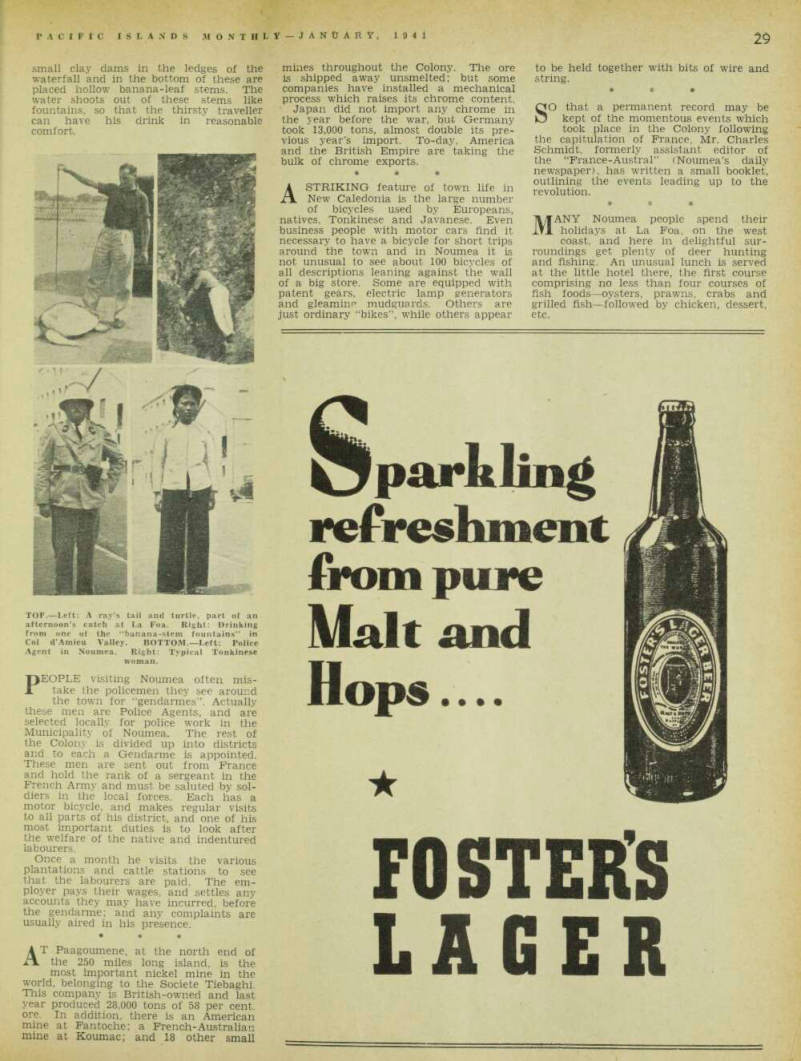
From Notes Mode in New Caledonia—II.
By Brian Stein
OF all the goods rationed in New Caledonia perhaps the one missed most is cooking oil. Ordinarily, a French family uses about 3k pints a month, but all it is allowed to-day is Ik pints. This oil came from France, and now comes from North Ainca; but the possibilities of crushing peanuts and bancoule nuts (both of which grow wild in the Colony) and purifying the oil for table use, are being investigated. Copra, also, has been mentioned as a possible source of cooking oil. * * * MR. B. C. Ballard has quietly and effi ciently taken over his duties as offi cial representative in Noumea of the Australian Government. One of his first difficulties, on his arrival in August, was the scarcity of suitable offices; but he now has secured a dignified suite in a modern new building. Mr. Ballard, who spent about six years in the New Hebrides presenting claims to the Joint Court of the Condominium Govern ment on behalf of the Commonwealth, speaks French fluently, and has a thor ough knowledge of the French legal system. * * * IN 1939 New Caledonia exported 9,300 tons of nickel mattes (68 per cent.) to France and Belgium. When Hit ler over-ran both these countries, the Societe le Nickel, which controls the large, smelting works at Noumea, had to look for a new market for this nickel, and following the visit of Mr. Paul Vois to Australia in July, Australia agreed to take 450 tons a month (5400 tons per annum). To-day, only two of the three furnaces at the smelting works are working, but a representative of the Societe is expected to visit Australia shortly to try and build exports up to their former level.
The Societe’s small fleet of colliers take coal from Australia to Noumea for the smelting works, and then return mostly empty. Referring to this recently a well known mining man said it was a pity these boats could not carry cargoes of nickel ore (3-4 per cent.) back to New castle. He said the Colony easily could supply 60,000 tons of this ore each year. ♦ ♦ ♦ A SIGHT that should never be missed by a visitor to Noumea can be seen after a short walk to the top of one of the hills at the back of the town.
Across Bulari Bay rises a high moun tain, its summit at times wreathed in clouds. The earth of this particular part of the country is highly mineralised and is dark red in colour; and as the rays of the setting sun reach the side of the mountain it glows as though afire — hence its name, Mont D’Or or Mount of Gold. This glowing mountain in the foreground and the winding coastline in the background, give a colour picture so unusual and fantastic as to seem unreal. ♦ * * LACK of French newspapers and the restricted shipping connections have made Caledonians more dependent than ever on the radio for news. In the streets of Noumea, any night between 7.30 and 8 p.m., one sees large groups intently listening to the French programme of news and music broadcast from Australia.
There are about 2,000 radio sets in the Colony, and most of these came from France and America. With France cut off, and a lack of dollar exchange, Australia now will play an important
part in supplying the Colony’s radio requirements. Many people have diffi culty in getting service for their sets, and one Englishman, after waiting many weeks to get his wireless repaired locally, decided that the quickest way would be to send it to Australia. * * * rREE types of coffee are produced in New Caledonia—namely, Arabica, Robusta and Excelsior. The first two are exported but the latter is not a very high quality coffee and is grown mainly by natives. Owing to cyclonic weather, production in 1939 was smaller than usual—l,223 tons, against 1,767 in 1938, and 1,894 in 1937. Formerly France took all of this coffee; but, since the capitulation, production has been stored.
Algeria (French North Africa) has offered to take 1,200 tons a year at good prices; but, owing to shipping difficulties and blockade conditions, New Caledonia can not accept this offer. Shipments are beginning to come to Australia, and efforts are being made to interest America —one of the largest coffee drinking countries in the world—and samples of the best New Caledonian coffees have been sent to the United States. * * * DESPITE the fact that most of New Caledonia resembles the country districts of Australia, the Colony has not the rabbit pest. In fact, rabbits are regarded as a delicacy and most people breed them; and it is quite com monplace to hear one gentleman inquire of another how his rabbits are doing.
Experiments have shown that if rabbits are turned loose to breed of their own accord, they usually die or are killed by rats. • * ♦ ALONG the road to Col d’Amieu, on the west coast, many little water falls run down the mountainside.
Travellers pause at these rivulets now and again for a refreshing drink of icy water; but to the visitor, the prospect of leaning on a precarious footing and the risk of getting a free shower hardly looks worth a drink of water. A closer inspection of these falls, however, reveals a number of little spouts of water issu ing from hollow sticks. Natives build
small clay dams in the ledges of the waterfall and in the bottom of these are placed hollow banana-leaf stems. The water shoots out of these stems like fountains, so that the thirsty traveller can have his drink in reasonable comfort.
PEOPLE visiting Noumea often mis take the policemen they see around the town for ‘ gendarmes ’. Actually these men are Police Agents, and are selected locally for police work in the Municipality of Noumea. The rest of the Colony is divided up into districts and to each a Gendarme is appointed.
These men are sent out from France and hold the rank of a sergeant in the French Army and must be saluted by sol diers in the local forces. Each has a motor bicycle, and makes regular visits to all parts of his district, and one of his most important duties is to look after the welfare of the native and indentured labourers.
Once a month he visits the various plantations and cattle stations to see that the labourers are paid. The em ployer pays their wages, and settles any accounts they may have incurred, before the gendarme: and any complaints are usually aired in his presence. * * ♦ AT Paagoumene, at the north end of the 250 miles long island, is the most important nickel mine in the world, belonging to the Societe Tiebaghi.
This company is British-owned and last year produced 28,000 tons of 58 per cent, ore. In addition, there is an American mine at Fantoche; a French-Australian mine at Koumac; and 18 other small
mines throughout the Colony. The ore is shipped away unsmelted; but some companies have installed a mechanical process which raises its chrome content.
Japan did not import any chrome in the year before the war, but Germany took 13,000 tons, almost double its pre vious year’s import. To-day, America and the British Empire are taking the bulk of chrome exports. * * * A STRIKING feature of town life in New Caledonia is the large number of bicycles used by Europeans, natives, Tonkinese and Javanese. Even business people with motor cars find it necessary to have a bicycle for short trips around the town and in Noumea it is not unusual to see about 100 bicycles of all descriptions leaning against the wall of a big store. Some are equipped with patent gears, electric lamp generators and gleaming mudguards. Others are just ordinary “bikes”, while others appear
to be held together with bits of wire and string. * * * SO that a permanent record may be kept of the momentous events which took place in the Colony following the capitulation of France. Mr. Charles Schmidt, formerly assistant editor of the “France-Austral” (Noumea’s daily newspaper), has written a small booklet, outlining the events leading up to the revolution. * * * MANY Noumea people spend their holidays at La Foa. on the west coast, and here in delightful sur roundings get plenty of deer hunting and fishing. An unusual lunch is served at the little hotel there, the first course comprising no less than four courses of fish foods —oysters, prawns, crabs and grilled fish —followed by chicken, dessert, etc.
TOP.—Left: A ray’s tail and turtle, part of an afternoon’s catch at La Foa. Right: Drinking from one of the “banana-stem fountains" in Col d’Amieu Valley. BOTTOM.—Left: Police Agent in Noumea. Right: Typical Tonkinese woman.
IN November, there was a shortage of tobacco in Noumea. Supplies from France have been cut off, and Indo- China’s future is uncertain; and it is likely that Australia will supply the bulk, if not all, the Colony’s needs.
Prior to the 1914-18 war, cigarettes and tobacco were manufactured in Noumea, but the industry could not compete with the French and Indo-Chinese blends and eventually closed down. Even before that an attempt was made to establish a tobacco industry in the Colony. Samples of leaf were sent to Prance, where it was found to be too strong in nicotine; but agriculturalists say that this tobacco
was planted in the wrong season, and point out that there are people in the Colony to-day who grow their own requirements—although each person is not allowed to have more than 20 plants. The main trouble with the tobacco produced in New Caledonia was that it would not burn very easily—a difficulty which perhaps could be over come by research, * * * VTOT 50 lon S ago, practically the whole ll of the shops and homes of Noumea were built of wood. To-day, many new brick shops are being built, and around the outskirts of the town are
dozens of modern brick cottages. It is feared in the Colony that these building operations may be affected by the grow ing shortage of cement. This has been coming from Indo-China for many years, but now the Colony is uncertain of fur ther supplies and it is possible that New
Zealand will be asked to replace Indo china as the Colony’s supplier. It is interesting to note that cement imports have risen gradually from 839 tons in 1918 to 7,068 tons in 1939. * * * IN addition to nickel, chrome and iron, New Caledonia has deposits of manganese, antimony, mercury, cin nabar, copper and silver; but owing to lack of markets they are not exploited to any extent. Gold and lead have been found in small quantities, but the high cost of working has prevented exploita tion. An average of between 6 and 8 grains of gold has been found in the copper ore. The Colony’s deposits of coal are very poor in quality and in 1939 178,000 tons of coal and coke were imported from Australia. » * * rE question of intensifying cotton cultivation in New Caledonia has been raised in recent weeks; and recently the Department of Agriculture obtained samples of Australian cotton seed. Cotton growing was commenced in 1900, and in 1922 700 tons were ex ported to France. The industry lan guished in more recent years and to-day
TOP. —Noumea’s modern Treasury. SECOND & BOTTOM.—Two of the many new brick bungalows being built around town.
the annual production is about 100 tons.
A cotton mill is operating at Kone, but another, at Noumea, has been closed.
New Caledonia cotton is not looked upon very favourably by Australian manufac turers, hence the importation of Aus tralian seed; but it is considered that the country between Noumea and La Foa is suitable for cultivating a large quantity of good cotton. * * * ALTHOUGH New Caledonia has about 103,000 head of cattle, only a small proportion of these are dairy breeds; and quite recently the Colony imported most of its butter and cheese from Aus tralia. A cheese factory has been established at Bourail and produces about 2 tons a month; butter-making machinery arrived from Australia re cently, and is expected to go into pro duction very soon. Meanwhile, attempts are being made to induce graziers to separate their milk and send the cream to Bourail. The main dairy herds of the Colony consist of Illawarra and Jer sey breeds (Australian). * * * rAVELLING along the road between Noumea and La Foa, on the west coast, one is struck by the undu lating country’s resemblance to Austra lia. It is covered with niaouli trees, which are similar to the eucalypt; and here and there are seen acres of dead niaouli trees, ringbarked by cattle own ers to make room for more grasslands, just as is done all over the country dis tricts of Australia. * * * WHEN the pro-Petain Government officials were repatriated from New Caledonia to Indo-China recently, Caledonians had the opportunity of establishing a civil service made up almost entirely of local Frenchmen. For years, the people had expressed dissatis faction with the system whereby the most important Government positions were held by civil servants sent out from France. They maintained that these positions could be filled quite easily by local men—and with less expense. * * * MANY visitors to Noumea complain of the lack of night-life. “Almost as soon as it gets dark the town becomes lifeless,” they say. This, to a degree, is correct. Apart from the three talkie theatres very little entertainment is found in the evenings, and the dances, etc., which were held quite regu larly before the war have now become few and far between.
The long working hours also must be takep into consideration. Noumeans rise between 5.30 and 6 a.m. Business commences at 7 and ceases at 11 a.m., for lunch and siesta. Shops re-open at 1.30 and close for the day at 5.30 p.m.
By the time business people have dinner at 7 p.m., possibly they do not feel inclined for much night life! * * -* THE lack of newspapers and magazines from France is one of the hardest trials Caledonians are put to.
One newsagent said he sold large quan tities of French daily newspapers, such as the “Matin” and “Soir”; but now the Colony gets nothing. In Noumea a daily, the “France-Austral”, and a bi-weekly, the “Bulletin du Commerce”, provide local news; but, owing to the shortage of newsprint, these papers have been reduced considerably in size. * * * NEW Caledonia imported 4,500 tons of rice in 1939; but, faced with the necessity of conserving overseas exchange, many people are asking whe ther this rice can be grown locally.
About 20 hectares of water-rice is under cultivation near St. Louis and yields about 3 tons to the hectare. Another man has been growing rice at Yate for several years and is getting 5 tons per hectare. The Department of Agriculture has been active, and recommends the Golden Caroline upland rice for culti vation in the Colony. Efforts were made to secure five tons of seed from the Indo-Chinese, Javanese and Austra lian Governments, without success, and now the Government has approached the Fiji Government for supplies. The whole question, as one man put it, was not whether rice can grow—it will! —but whether it can be grown as cheaply as the imported product. * * * NEW Caledonia has a most unusual pest in the 300,000 deer found all over the island. These deer origin ally came from Sumatra (Java), but multiplied to such a degree that they have become a nuisance. Several great shooting drives have taken place, and hunting is very popular. The law for bids night shooting, because of the pos sibility of the hunter mistaking a cow or horse for a deer. There are some law-breakers, however, who drive along the road, shining a torch into the bush.
The deer, attracted by the light, comes out into the beam and provides an
excellent target for the waiting marks man. * * * FORMER passengers on the Matson liner “Monterey” who have occasion to visit Noumea by P.A.A. Clipper, will meet an old friend in Mr. J. E. Higgins, formerly purser on the “Monterey”, and
who now is purser on the luxury yacht “Southern Seas”, stationed at Noumea as a floating hotel for the aerial travellers. * * * CALEDONIANS are interested in the future of the large meat canning works at Ouaco, on the north-west coast. The Societe de Ouaco was estab lished in 1880 by a group of French men: but, after years of financial trouble, the control of the company passed into British hands. Until the French armistice the Societe held large contracts for the supply of canned meats to the French Army, the penitentiary at Guiana and the French Colonies in the Pacific.
France was very particular in its speci fications—one of which provided that the meat juices must be contained in the pack. These meats, canned by spe cial machinery, are used as a hot food, with vegetables. Under the direction of Colonel H. B. Dix, the company also has built up a vegetable canning trade, and during dry seasons Caledonians can always get local vegetables, in cans.
Deer meat is also canned.
The Societe obtained its tin supply from France and was expecting a ship ment when that country collapsed. Can ning went on, however, until the stocks of tin were used up. Little canning is done during the summer months; and it is expected that during this period the company will make arrangements for supplies of tin. and still more important, look around for new markets. * * * AT several points around Noumea air raid shelters have been built. They are trenches, about 5 foot deep, which zig-zag along for a short dis
tance. When war "was declared the trenches were dug and for several nights the town was “blacked out”; but when it was seen that Hitler did not want to bomb the town, the lighting precautions were lifted.
JAPAN is not allowed to import any processed metals from New Cale donia: but over the past few years has been taking large quantities of nickel and iron ore out of the Colony, There is only one Japanese nickel com pany—the Societe de I’Oceanie —and it has French directors. This company has three mines at Kua, “Oulie-Oulie”, ‘•Yamamoto SI” and Yamamoto PI”: and commenced operations in 1936. The following year production was 13,400 tons, and this has increased until in 1939 nearly 40.000 tons were produced. In addition to their own production, the Japanese buy ore from small mining concerns, and this is taken away by large Japanese cargo vessels.
Another Japanese company—Societe le Fer—is exploiting the Colony’s resources of iron ore at the “Cascade” mine, Goro.
This company commenced operations early in 1939 and by the end of the year had exported 83,000 tons of ore in 10 vessels. The company expects to export between 400,000 and 500,000 tons a year eventually, and it is said that the only reason which might prevent it from doing so is the inability of its plant to handle this vast quantity.
The Department of Mines, in an offi cial report, said the iron ore was just as rich in its natural state as after cal cination. and estimated that there were several thousand million tons in the Colony.
Compared with other irons, however, New Caledonia’s 50-52 per cent, ore is not very rich.
Japan has become interested in the Colony’s cobalt deposits and recently a sample shipment of 14 tons was sent to Japan by the “Naniwa Maru”. This mineral has never been exploited, as much experience is necessary for its extraction.
On April 18, Governor Pelicier, acting
TOP.—Air raid shelter in Place de Cocotier.
BOTTOM. —A frequent visitor to Noumea—the Japanese “Momoyama Maru”.
under instructions from Paris, gave the Japanese quite a shock, when he pro hibited the export of metals to Japan.
Shortly afterwards this ban was lifted. ♦ * * I FORMERLY New Caledonia obtained its school books and writing paper from France, but now the Colony is looking for a new source of supply.
Samples of writing paper have been sent to Australia: but it is unlikely that this country will be given the opportunity of printing French text books. Those from France were cheap, and it would be very expensive to get the Colony’s small needs printed in Australia. New Cale donia is making efforts to get text books from Canada, where there is a large French population. * * *
CALEDONIANS, particularly the younger
generation, drive very fast, outside the towns. They admit this, but say any risk is outweighed by their knowledge of the roads. “Knowledge of roads” is certainly necessary, for the country is rugged in parts and roads do not just wind in and around the hills in “hairpin” bends, but in “corkscrew bends”. For the hardier souls, a fast drive up into the country is a thrilling experience. * * * A N important problem in New Cale- A donia to-day is the future of 11,000 Javanese and Tonkinese, who, under five-year contracts, supply the bulk of the Colony’s labour requirements. Fur ther supplies from Indo-China are un certain, owing to the lack of shipping and the disturbed state of affairs there; and an adverse exchange position tends to make the indenturing of Javanese expensive. The only labour alternative,
however, is the still more expensive and lackadaisical natives. One cattle owner, who employs indentured labour on his station, summed up the general feeling among employers by saying, “We dare not even think of our Javanese and Tonkinese labour, being curtailed.” * * * THE far-reaching effect of being cut off from France was felt even in the garage business of New Caledonia.
The most popular cars are Citroens and Renaults, and one garage owner said that prior to the war he imported about 53 cars a year. When war broke out that figure decreased slightly. To-day he did not know where he was going to get cheap cars. Another problem which pre sented itself was a supply of spare parts for these cars when they break down.
This difficulty is expected to be over come by sending samples to Australia to be duplicated.
The Colony gets petrol direct from America and when war broke out, a petrol-rationing scheme was introduced.
When it was found that the saving was so slight that it was not worth the trouble, the restrictions were lifted, and the best petrol in Noumea to-day costs 1/9 a gallon.
Mr. R. Mounsey, acting-manager for Messrs. W. H. Grove & Sons, in Raro tonga. returned to New Zealand in December. Mr. A. L. Lewis, late mana ger, who is also well-known in Samoa, has joined the staff of the Internal Marketing Division at Wellington.
Dr. C. M. Dawson, MLC, of Western Samoa, after a short visit to the Terri tory, left again for New Zealand, to con tinue his war-work, as a medical officer.
Advertisements & other items, pp. 29-34 (1 item)
Get Positive
RELIEF FROM
Tested and proved for over 20 years, genuine Vincent’s A.P.C. is acknowledged by the medical profession and the public as the safest and best to relieve all pains and tropical fevers. The reason why Vincent's A.P.C. is safer and more effective is because it is prepared on the prescription originated by the medical superintendent of one of Australia’s largest public hospitals, where it was first used. Genuine Vincent's A.P.C. is the only A.P.C. prepared on this scientific hospital prescription. No other A.P.C. is the same as Vincent’s.
Gj e/yuuyvvG/
f OWOIIS 4
TAIL I T S
1/4 AND 2/4.
SIN6US2d *a
FOR SAFETY’S SAKE—SAY “VINCENT’S”.
Nottf
■ i o -J; A • GERMS of Diphtheria, Malaria, Dhobie Itch, Tinea or Surfers’ Foot, cannot live under “TENAX” lather.
Tropical Skin Diseases can be cured by its regular
9 V P er
NO VARIATION HAS BEEN
MADE IN ITS COMPOSITION—
judged from the only true angle, that of quality, TENAX has no competitors as a satisfactory germicidal soap, eleven times as rapid in action as carbolic, yet NON-
IRRITANT and NON-POISONOUS. The
Medical Journal of Australia states that TENAX is a germicidal soap that may be recommended with confidence.
TENAX
GENUINE
GERMICIDAL
SOAP
I A PRODUCT OF AUSTRALIAN SOAPS, LTD.
Modern Refrigeration for the South Sea Islands
The ELECTROLUX kerosene operated
REFRIGERATOR
ELECTROLUX offers economical, modern and completely efficient
REFRIGERATION FOR ISLANDS' HOMES.
FREEZES CONTINUOUSLY WHILE SMALL LAMP BURNS.
Freezing controlled by simply regulating height of flame. Uses only gallon of kerosene per week.
MOTORLESS ... NO PARTS TO GET OUT OF ORDER.
MODEL L22 MODEL L380 MODEL LK550
Capacity (as illustrated) • Capacity 2.2 cubic feet. Capacity 4 cubic feet. 5.5 cubic feet.
GUARANTEED FOR TWO YEARS.
• Write to your Local Distributor for prices and full details.
Obtainable from: W. R. Carpenter & Company Ltd. —Sydney, and the following New Guinea Branches: Rabaul, Salamaua, Wau, Kavieng, Madang, and Wewak.
W. R. Carpenter & Coy. (Solomon Is.) Pty. Ltd. —Tulagi, British Solomon Islands.
On Chong & Company Pty. Ltd. —Butaritari, Gilbert and Ellice Islands.
Representation in Papua and New Hebrides.
parltling
refreshment from pure Malt and Hops •• • • ««
FOSTER'S
LAGER
PRESCOTT Pty. Ltd.
SUSSEX ST., SYDNEY,
are sole wholesale agents for
PINEAPPLE BACON&HAMS
DAISY brand BUTTER "375" BUTTER in TINS llb.-2lb.-5lb. Sizes.
I LEA & PERRINS’ Sauces
and Most other Super-Quality Lines of the Trade, such as Cheese, Eggs, Etc.
We ore Specialists . . . .
X ’Phones: MA 8612 (4 lines).
Cable Address; “Weymarkson.”
Codes—Bentleys Private.
Let us have your confidence. Sixty years is our record of supplying the leading Houses throughout the World in - - - -
FRESH FRUIT — VEGETABLES — PRODUCE
WEYMARK & SON LTD.
FRUIT AND PRODUCE MERCHANTS
14-18 STEAMMILL STREET - - - SYDNEY
‘ANCHOR FLOUR
THE STANDARD OF QUALITY
*5
GILLESPIE BROS. PTY. LTD
SYDNEY - AUSTRALIA
PURE RICE
STARCH
Always ask for . . . 66
CORAL BRAND
100% PURE
I
CORAL BRAND
RICEBTfIROH
com iflL Noted for Its
QUALITY
and
WHITENESS.
Goes Farthest and gives Lasting Finish
WILL NOT
STICK TO
IRON.
Obtainable from Leading Island Stores.
Manufactured by
AUSTRALIAN RICE, LTD.
Sydney, N.S.W.
THE FAVOURITE
SCHOOL LUNCH
Usually the school lunch is a very scratchy meal, eaten just when the vigorous exercise of the playground has made a strong demand on the endurance of the child. However, with little trouble it can be improved in value and made wonderfully attractive, simply by adding buttered Milk Arrowroot Biscuits. All children love them.
Qmottis
F A M O US
MILK
ARROWROOT
BISCUITS
C 34 ALWAYS ASK YOUR GROCER FOR ARNOTT'S I
Kork-N-Scal
FOR HOME USE
e Hand Applied Airtight Pressure Proof
FOR ALL HOME BOTTLING
—THE LITTLE CAP THAT
will Re-seal 1,000 Times
KORK-N-SEAL (Aust.) LTD.
106 COMMONWEALTH STREET,
SYDNEY, AUSTRALIA.
GARD-EN VALE
K PRODUCTS LIHIT-CD
2-4 BROWN STRC-ET, N-EWTON/N
(YDMCY. AUSTRALIA
Always . . . make sure you have at hand an ample Reserve of these v/ Australia*s Choicest Products : fA Brussels Sprouts White Turnip* Sweet Corn Tomato Puree Tomato Sauce Tomato Soup Tutti Fruit Sauce (Worcestershire 9»*or) Beetroot Green Peas French Beans Cauliflower Spinach Cabbage 16- Carrots Parsnips li Celery
gaftenV&e
ti
Garden
Vale
iuuNUFAcma •» 1 Delicious . .
Ready-toserve Vegetables
Britain's Brave
Spirit
Message to L.M.S.
Conference
Prom Our Own Correspondent
Pt. Moresby, Dec. 3.
WHEN the missionaries maintained in Papua by the London Missionary Society met in Port Moresby recently, for their annual conference, they naturally were anxious and uneasy.
London is the headquarters of their great organisation: and the Huns have been assuring the world, for months, that they are destroying London.
But London still was on the job: and did not even forget little, distant, Papua.
A cablegram came in from London reading “All’s well here”, and the con ference was given, in addition, the astonishing information that, despite war and air raids, contributions for the development of mission work had been coming in so freely in Britain that the financial position actually was better than a year ago.
Seven native Papuan teachers were ordained at the Poreporena Church, on completion of their 10 years of training and probation. These men will take up their work as teachers and pastors in their various districts.
Those present at the session included the Rev. Maurice Nixon, Mr. P. Chat terton, Revs. F. J. Searle, J. Gilkison, H.
J. E. Short, R. Rankin, D. E. Ure, H.
A. Brown, S. H. Dewdney, R. Perry, E.
R. Fenn, H. L. Schlencker, Sister Fair hall, Miss Colledge and other ladies.
Advertisements & other items, p. 35 (1 item)
Swallowarielll-
r * - *, s ; ,x >-■••• w * ! f IS no UIT K S P^ ,ar . f Ve : y L he,e! “ Milk Arrowroot.” full CANTERBURY CAKES Chockful of flavour .. rich, of nourishment, .deal for k.dd.es. "Club Cheese," a savory fruity . . and with an invifing "Home Made" flavour, in itself, and Shredded Wheafmeal," Swallow's own Plain . . Fruit delicious new health biscuit. every taste.
Seed, elc. There's a variety to suit
... ONLY IF ITS SWALLOWS
Tasty eating comes only from good cooking and finest ingredients, and Swallow & Ariell's products have both. So always say SWALLOW'S when ordering Biscuits . . . Puddings . . . Cakes . . . Cabin Biscuits . . . Navy and Pilot Bread.
Remember that all Swallow's Products are specially tropic-packed in air-tight tins to retain their freshness.
SWALLOWARIELLL-
PORT MELBOURNE, VICTORIA, AUSTRALIA
PLUM PUDDINGS Expertly prepared by Swallow's master cooks. Everyone loves "Olde Englyshe" style plum pudding and the rich goodness of Swallow's is unique.
Party of Scientists in Central Pacific
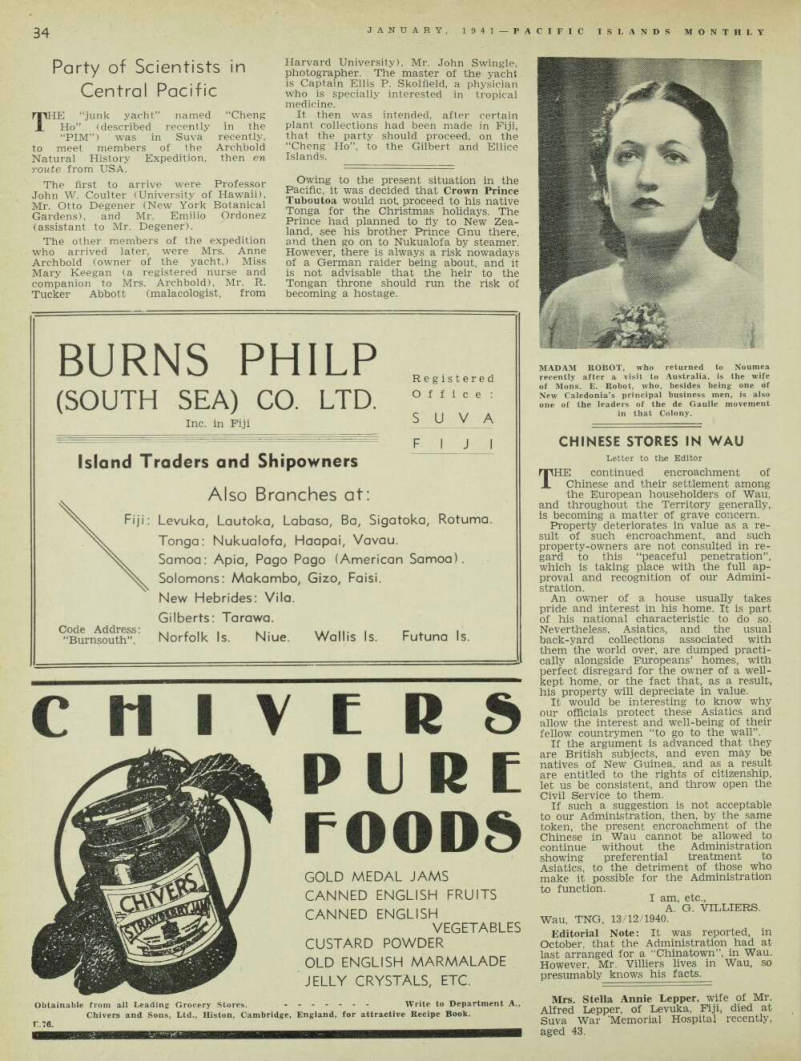
Central Pacific
THE “junk yacht” named “Cheng Ho” (described recently in the “PIM”) was in Suva recently, to meet members of the Archbold Natural History Expedition, then en route from USA.
The first to arrive were Professor John W. Coulter (University of Hawaii), Mr. Otto Degener (New York Botanical Gardens), and Mr. Emilio Ordonez (assistant to Mr. Degener).
The other members of the expedition who arrived later, were Mrs. Anne Archbold (owner of the yacht,) Miss Mary Keegan (a registered nurse and companion to Mrs. Archbold), Mr. R.
Tucker Abbott (malacologist, from
Harvard University), Mr. John Swingle, photographer. The master of the yacht is Captain Ellis P. Skolfield, a physician who is specially interested in tropical medicine.
It then was intended, after certain plant collections had been made in Fiji, that the party should proceed, on the “Cheng Ho”, to the Gilbert and Ellice Islands.
Owing to the present situation in the Pacific, it was decided that Crown Prince Tuboutoa would not proceed to his native Tonga for the Christmas holidays. The Prince had planned to fly to New Zea land, see his brother Prince Gnu there, and then go on to Nukualofa by steamer.
However, there is always a risk nowadays of a German raider being about, and it is not advisable that the heir to the Tongan throne should run the risk of becoming a hostage.
MADAM ROBOT, who returned to Noumea recently after a visit to Australia, is the wife of Mons. E. Robot, who, besides being one of New Caledonia’s principal business men, is also one of the leaders of the de Gaulle movement in that Colony.
Chinese Stores In Wau
Letter to the Editor THE continued encroachment of Chinese and their settlement among the European householders of Wau, and throughout the Territory generally, is becoming a matter of grave concern.
Property deteriorates in value as a re sult of such encroachment, and such property-owners are not consulted in re gard to this “peaceful penetration”, which is taking place with the full ap proval and recognition of our Admini stration.
An owner of a house usually takes pride and interest in his home. It is part of his national characteristic to do so.
Nevertheless, Asiatics, and the usual back-yard collections associated with them the world over, are dumped practi cally alongside Europeans’ homes, with perfect disregard for the owner of a well kept home, or the fact that, as a result, his property will depreciate in value.
It would be interesting to know why our officials protect these Asiatics and allow the interest and well-being of their fellow countrymen “to go to the wall”.
If the argument is advanced that they are British subjects, and even may be natives of New Guinea, and as a result are entitled to the rights of citizenship, let us be consistent, and throw open the Civil Service to them.
If such a suggestion is not acceptable to our Administration, then, by the same token, the present encroachment of the Chinese in Wau cannot be allowed to continue without the Administration showing preferential treatment to Asiatics, to the detriment of those who make it possible for the Administration to function.
I am, etc.,
A. G. Villiers.
Wau, TNG, 13/12/1940.
Editorial Note: It was reported, in October, that the Administration had at last arranged for a “Chinatown”, in Wau.
However, Mr. Villiers lives in Wau, so presumably knows his facts.
Mrs. Stella Annie Lepper, wife of Mr.
Alfred Lepper, of Levuka, Fiji, died at Suva War ‘Memorial Hospital recently, aged 43.
Advertisements & other items, p. 36 (1 item)
Vcrs
BURNS PHILP
(SOUTH SEA) CO. LTD.
Registered Office : Inc. in Fiji Island Traders and Shipowners Also Branches at:
S UVA
FIJI
Fiji: Levuka, Lautoka, Labasa, Ba, Sigatoka, Rotuma.
Tonga: Nukualofa, Haapai, Vavau.
Samoa: Apia, Pago Pago (American Samoa).
Solomons: Makambo, Gizo, Faisi.
New Hebrides: Vila.
Gilberts: Tarawa. 5 Norfolk Is. Niue. Wallis Is. Futuna Is.
i 81 Sj
VCRS
P IJ R C
FOODS
GOLD MEDAL JAMS
CANNED ENGLISH FRUITS
CANNED ENGLISH
VEGETABLES
CUSTARD POWDER
OLD ENGLISH MARMALADE
JELLY CRYSTALS, ETC.
Obtainable from all Leading Grocery Stores. --- Write to Department A., Chivers and Sons, Ltd., Histon, Cambridge, England, for attractive Recipe Book. r. 76.
Historic Medals
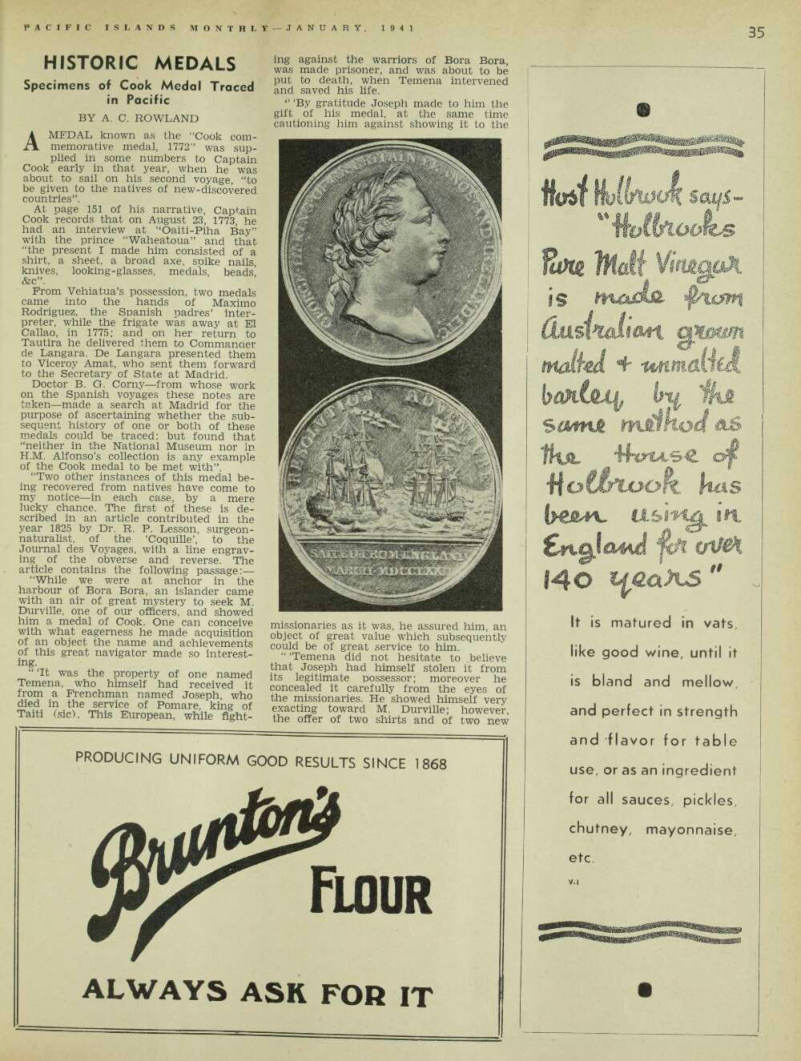
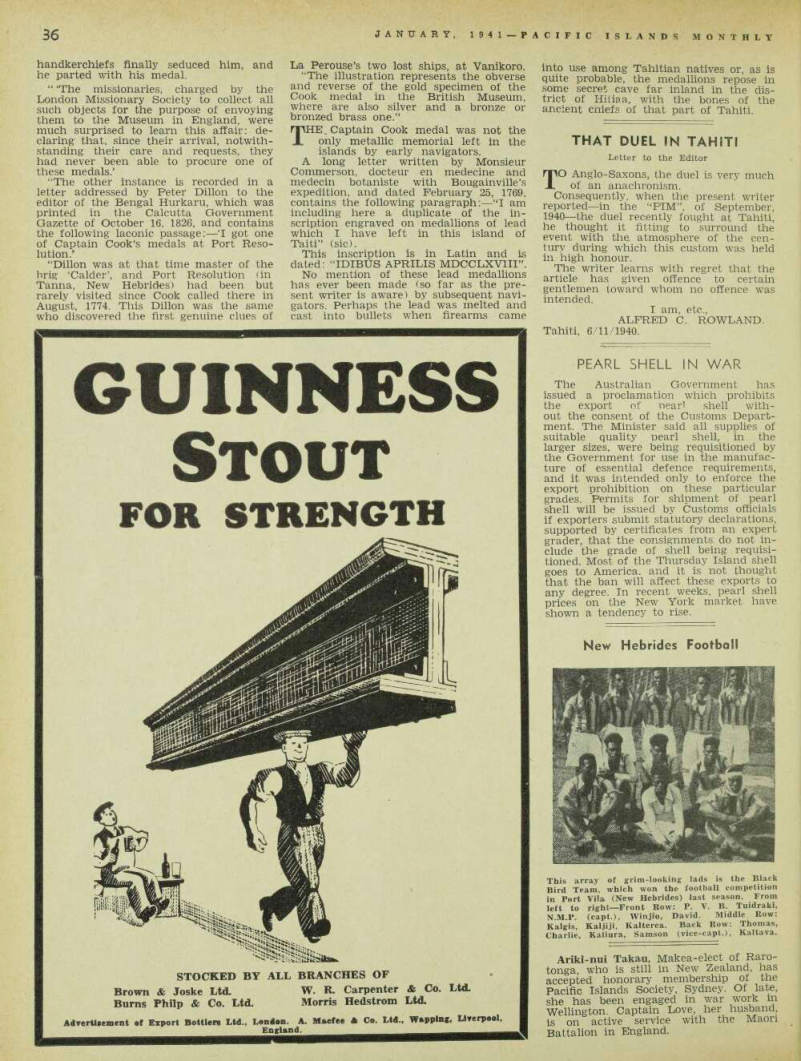
Specimens of Cook Medal Traced in Pacific
By A. C. Rowland
A MEDAL known as the “Cook com memorative medal, 1772” was sup plied in some numbers to Captain Cook early in that year, when he was about to sail on his second voyage, “to be given to the natives of new-discovered countries”.
At page 151 of his narrative, Captain Cook records that on August 23, 1773, he had an interview at “Oaiti-Piha Bay” with the prince “Waheatoua” and that “the present I made him consisted of a shirt, a sheet, a broad axe, soike nails, knives, looking-glasses, medals, beads, &c”.
From Vehiatua’s possession, two medals came into the hands of Maximo Rodriguez, the Spanish padres’ inter preter, while the frigate was away at El Callao, in 1775; and on her return to Tautira he delivered them to Commanacr de Langara. De Langara presented them to Viceroy Amat, who sent them forward to the Secretary of State at Madrid.
Doctor B. G. Corny—from whose work on the Spanish voyages these notes are taken—made a search at Madrid for the purpose of ascertaining whether the sub sequent history of one or both of these medals could be traced: but found that “neither in the National Museum nor in H.M. Alfonso’s collection is any example of the Cook medal to be met with”.
“Two other instances of this medal be ing recovered from natives have come to my notice —in each case, by a mere lucky chance. The first of these is de scribed in an article contributed in the year 1825 by Dr. R. P. Lesson, surgeon naturalist, of the ‘Coquille’, to the Journal des Voyages, with a line engrav ing of the obverse and reverse. The article contains the following passage:— “While we were at anchor in the harbour of Bora Bora, an islander came with an air of great mystery to seek M.
Durville, one of our officers, and showed him a medal of Cook. One can conceive with what eagerness he made acquisition of an object the name and achievements of this great navigator made so interest ing.
“Tt was the nronerty of one named Temena, who himself had received it from a Frenchman named Joseph, who died in the service of Pomare, king of Taiti (sic). This European, while fight
ing against the warriors of Bora Bora, was made prisoner, and was about to be put to death, when Temena intervened and saved his life.
“ ‘By gratitude Joseph made to him the gift of his medal, at the same time cautioning him against showing it to the
missionaries as it was, he assured him, an object of great value which subsequently could be of great service to him.
“ ‘Temena did not hesitate to believe that Joseph had himself stolen it from its legitimate possessor; moreover he concealed it carefully from the eyes of the missionaries. He showed himself very exacting toward M. Durville; however, the offer of two shirts and of two new
handkerchiefs finally seduced him, and he parted with his medal.
“ ‘The missionaries, charged by the London Missionary Society to collect all such objects for the purpose of envoying them to the Museum in England, were much surprised to learn this affair: de claring that, since their arrival, notwith standing their care and requests, they had never been able to procure one of these medals.’
“The other instance is recorded in a letter addressed by Peter Dillon to the editor of the Bengal Hurkaru, which was printed in the Calcutta Government Gazette of October 16, 1826, and contains the following laconic passage:—T got one of Captain Cook’s medals at Port Reso lution.' “Dillon was at that time master of the brig ‘Calder’, and Port Resolution (in Tanna, New Hebrides) had been but rarely visited since Cook called there in August, 1774. This Dillon was the same who discovered the first genuine clues of
La Perouse’s two lost ships, at Vanikoro.
“The illustration represents the obverse and reverse of the gold specimen of the Cook medal in the British Museum, where are also silver and a bronze or bronzed brass one.”
THE, Captain Cook medal was not the only metallic memorial left in the islands by early navigators.
A long letter written by Monsieur Commerson, docteur en medecine and medecin botaniste with Bougainville’s expedition, and dated February 25, 1769, contains the following paragraph:—“l am including here a duplicate of the in scription engraved on medallions of lead which I have left in this island of Taiti” (sic).
This inscrintion is in Latin and is
Dated: “Idibus Aprilis Mdcclxviii”.
No mention of these lead medallions has ever been made (so far as the pre sent writer is aware) by subsequent navi gators. Perhaps the lead was melted and cast into bullets when firearms came
into use among Tahitian natives or, as is quite probable, the medallions repose in some secret cave far inland in the dis trict of Hitiaa, with the bones of the ancient chiefs of that part of Tahiti.
Advertisements & other items, pp. 37-38 (1 item)
ffcrtf HvllfUtoi
"Uvttto
fafU lHaii VirutgaK
I <31* i s nu>jA&
CiusinAtmt g
waited 4- t
honbu\, by ikz
S wmk tnsfi <auS
fhjL j4xriA
jj o ttftuoh,
(>€ivn_ in.
Sriglotul jtf%
140 uaaK "
It is matured in vats, like good wine, until it is bland and mellow, and perfect in strength and flavor for table use, or as an ingredient for all sauces, pickles, chutney, mayonnaise, etc
PRODUCING UNIFORM GOOD RESULTS SINCE 1868
ALWAYS ASK FOR IT
GUINNESS
Stout
FOR STRENGTH
m i lift
STOCKED BY ALL BRANCHES OF
Brown & Joske Ltd, W. R. Carpenter & Co. Ltd.
Bums Philp & Co. Ltd. Morris Hedstrom Ltd.
Advertisement «f Export Bottlera Ltd., London. A. Macfee A Co. Ltd., Wapplng, Liverpool, England.
That Duel In Tahiti
Letter to the Editor TO Anglo-Saxons, the duel is very much of an anachronism.
Consequently, when the present writer reported—in the “PIM”, of September, 1940 —the duel recently fought at Tahiti, he thought it fitting to surround the event with the atmosphere of the cen tury during which this custom was held in high honour.
The writer learns with regret that the article has given offence to certain gentlemen toward whom no offence was intended.
I am, etc.,
Alfred C. Rowland.
Tahiti, 6/11/1940.
Pearl Shell In War
The Australian Government has issued a proclamation which prohibits the export of neari shell with out the consent of the Customs Depart ment. The Minister said all supplies of suitable quality pearl shell, in the larger sizes, were being requisitioned by the Government for use in the manufac ture of essential defence requirements, and it was intended only to enforce the export nrohibition on these particular grades. Permits for shipment of pearl shell will be issued by Customs officials if exporters submit statutory declarations, supported by certificates from an expert grader, that the consignments do not in clude the grade of shell being requisi tioned. Most of the Thursday Island shell goes to America, and it is not thought that the ban will affect these exports to any degree. In recent weeks, pearl shell prices on the New York market have shown a tendency to rise.
New Hebrides Football
Ariki-nui Takau, Makea-elect of Raro tonga, who is still in New Zealand, has accepted honorary membership of the Pacific Islands Society, Sydney. Of late, she has been engaged in war work in Wellington. Captain Love, her husband, is on active service with the Maori Battalion in England.
This array of grim-looking lads is the Black Bird Team, which won the football competition in Port Vila (New Hebrides) last season. From left to right—Front Row: P. V. B. Tuidraki, N.M.P. (capt.), Winjio, David. Middle Row: Kalgis, Kaljiji, Kalterea. Back Row: Thomas, Charlie, Kaliura, Samson (vice-capt.), Kaltava.
Lively Controversy About
Shall We Educate
Natives?
Lively Controversy About Nauru
ENDLESS columns of the Melbourne newspapers were filled recentlv with a verbal war on the subject of whether —from the varying noints of view of educational science, native admini stration, Polynesian temperament, and so on—it was wise to proceed with the edu cation of selected Nauruan youths upon the lines initiated by Mr. Hurst, of Gee long, some time ago.
Mr. Hurst is a practical and energetic philanthropist who has taken a keen interest in the natives of Nauru, and who has brought parties of them to Australia, from time to time, to give them a good secondary and technical education.
Mr. Hurst and his friends insist that, in this way, not only are the natives of the fortunate island (they are all very rich, because they get benefits from a fund accumulated by a royalty of rid. per ton on all phosphate mined) given education and social advantages, but also by this means Australia is carrying out her mandate obligation to the people.
But critics have arisen who take an other view. They declare that an investi gation of the condition of all the boys who have been brought to Australia for training shows that no permanent bene fit is conferred. They say that the youths go back to Nauru, where for a time they swagger a great deal and boast about their special knowledge and experiences, and that presently they are absorbed into the normal village life and
forget all that they have learned, ex cept that they are made permanently discontented.
There has been a lively argument, and a complete difference of opinion as to whether the system has provided the Nauruan community with a handy and useful class of educated natives, and given permanent benefits.
Possibly, there is something to be said on both sides. It is certain that a hap hazard system of secondary and tech nical education will do more harm than good among Islands natives. But, on the other hand, if men like Mr. Hurst did not come along and devote time and money to making such educational facili ties available to young Polynesians, the outlook for some of these Islands com munities would be bleak, indeed.
What is needed is a co-ordinated and scientifically directed education plan, covering all these islands, and providing for (1) A reasonable system of primary education; (2) Facilities for secondary pnd technical education, where desired; (3) A method of ensuring that these educated islanders were not sent back to become merely focal points of discon tent in their various villages, and pro viding useful employment for them.
Australia should have initiated such a plan years ago—her Pacific obligations are heavy enough to warrant it—but the blight of the professional politician is over everything that Australia touches, and it was too much to expect anything like that, even in normal years, and there is no hope of it under war condi tions.
Miss J. Jones, of the New Guinea Ad ministration’s hospital at Namanula, Rabaul, New Guinea, arrived in Sydney recently on leave.
Departure of American
Colony
From Our Own Correspondent
Papeete, Nov. 20.
THE American colony in Tahiti and adjoining islands has simply evap orated. The few who still are here are on the waiting list of the steamship company for cabin accommodation when ever available.
One party chartered the schooner “Bernice” to take them to Honolulu.
Our island is returning to something of the quiet and peace we knew before the curse of tourist exploitation. That ghastly city of California bungalows, which has ruined the west side of Tahiti, is still there but the occupants have departed.
Why it is that the American abroad spoils the primitive life of any place, is something I have never been able to ex plain. It was so in Mark Twain’s time, and it is doubly so to-day.
Our economic difficulties are precisely like those of all the island colonies where copra is the chief source of revenue.
Those optimists who believed that a world war would advance the price of copra to dizzy heights are grievously disappointed.
Advertisements & other items, p. 39 (1 item)
William Atkins Pty. Ltd.
For children's coughs and colds
get WOODS' GREAT PEPPER-
MINT CURE. Safe —the best (or 45 years. Tastes good and brings relief with the very first dose. Handy-sized bottle, only I/-. Also In 21- and 3/- sizes.
Established 50 years—and carrying one of the largest stocks of Iron and Steel in Australia.
William Atkins Pty. Ltd.
Head Office 449-451 KENT ST., SYDNEY.
Iron Cr Steel Merchants
ENGINEERS' SUPPLIES
COACn & MOTOR HARDWARE.
FULL, COMPREHENSIVE & UP-TO-DATE RANGE IN ALL
DEPARTMENTS, INCLUDING THE FOLLOWING LINES:—
-STEEL DEPARTMENT
MILD STEEL;
MARK
Cable Address: WILATKIN, SYDNEY.
Rounds, Squares, Fiats, Half-rounds, Hexagons, Bevel, Shoeing, Tyre, Angles, Tees, Sheets, Plates, Girder Plates, Chequer Plates, Channels, Hoops, Etc.
BRIGHT STEEL:
Rounds, Squares, Hexagons.
Extra Special High Speed Tool Steel, Mining Steel, Blister Steel and Spring Steel, Rounds, Flats Gr Squares!
Bar Iron— All sections and sizes.
Engineers' Supplies: Set Screws, Studs, Metal Thread Screws. Coach Screws. Files, Cotter Pins, Bright and Black Bolts. Rivets, Etc., Hack Saw Blades.
Power Transmission Gear: Including Plummer Blocks. Couplings, Collars, Etc.
Coach and Motor Hardware: Axles, Springs, Wheelstufl, Duck, Paints.
Farriers' Supplies: Horse Nails, Anvils, Vices, Etc.
Motor-Trimmers and Motor Builders' & Motor Painters' Requirements
C. A. WILLEY'S
Quick-Drying Coach and Car Paints, RoughstulT, Elastic Gloss, Synflex Enamels, Lacquers.
DUCO Lacquers and DULUX Enamels—FAßßEX Motor Toppings and Leather Cloths, House Cr Decorators' Paints, Varnishes & Brushware Sole Distributors of CHAMPION'S Decorators Paint Products.
Distributing Agents for BROLITE Lacquers, SYNFLEX Enamels and "POLYGLOSS" Finish.
Morris Hedstrom Clerk Charged
With Stealing £1787
„ From Our own correspondent
A Nukualofa, Dec. 6.
TRUSTED clerk, employed for many years by Messrs. Morris Hedstrom, Ltd., Nukualofa, Stanley Hosea Brown, aged about 35, a Euronesian, was charged with embezzling £1787, the property of his employers.
The evidence suggested that Brown, who was in charge of the books, handled the cash and did the banking, made false entries in the cash book, purporting
to show that £787 had been debited to the firm’s head office, Suva, and £lOOO had been deposited in the Tonga Gov ernment Savings Bank, Nukualofa.
The thefts, which extended from May. 1938 to November, 1940, were revealed by an audit by Mr. C. W. Aidney, of Suva.
It is considered surprising that suspi cion was not aroused sooner, for Brown’s extravagant mode of life had been a matter of “beach comment” for a con siderable time. On the other hand, Brown was very well known and popu lar, and regarded as a model of trust worthiness and respectability.
de Gery
Tahiti And Free
France
The Position of Governor de Gery
At the request of a high official of French Oceania, dated in Papeete on November 17, we publish the follow ing, exactly as it is transmitted to us\ — Une mise au point au sujet du role de I’ancien Gouverner de Tahiti lors du rattachement de la Colonie a la cause de la France Libre.
DANS le numero de septembre du Pacific Islands Monthly, nous lisons un article sur le ralliement des colonies francaises a la cause du General de Gaulle.
Get article est manifestement tendancieux et nous vous serions reconnaissant de vouloir bien inserer la rectification suivante en ce qui concerne Tahiti.
Le mouvement en faveur de la France Libre, pour la continuation de la lutte centre I’ennemi commun aux cotes de la Grande Bretagne et de tous nos allies, a eu pour cause unique un elan de patriotisme sincere et profond chez tousles Franqais de I’Oceanie. Lors de la signature de I’armistice de juin, non seulement les metropolitains, mais encore tousles indigenes, ont ressenti intensement I’outrage fait a leur Patrie et ils ont eprouve I’ardent desir de ne pas se plier au joug sous lequel on voulait courber la France.
Le Gouverneur Chastenet de Gery a continue a jouer, lors de ce mouve ment, le role qu’il tenait avec habilete depuis son arrivee a Tahiti: il a essaye de tromper la population avec des promesses vagues et confuses, en lui dissimulant soigneusement la gravite de la situation. Sentant bien que la reaction du peuple, comme celle des corps constitues, comme celle des Chefs de services adminis tratifs, serait brutale s’il leur com muniquait les decisions effarantes du Gouvernement de Vichy, M. de Gery s’est borne a afficher une attitude en apparence impartiale entre les deux tendances qui se manifestaient, par tout dans le monde, au sujet de la conduite a tenir pour assurer I’avenir de la France.
Ce gouverneur, que I’article en question nous presente comme ayant “plus fait que n’importe quel autre pendant ces 30 dernieres annees pour les indigenes et pour la colonie”, a essaye de poursuivre, dans cette periode critique, la politique d’inaction aboslue qui lui avait si bien reussie jusqualors.
Malheureusement pour lui, les elements fascistes, peu nombreux mais actifs a Papeete meme, ne lui ont pas permis de maintenir cette attitude.
Ils ont reclame, dans de petitions virulentes, I’application des mesures politiques repressives prises par le gouvernement de Vichy. La tur bulence malheureuse de ces elements a contraint le Gouverneur a promul guer les derniers decrets parus en France et e’est cette promulgation qui
a amene I’organisation et I’action immediate de tous ceux dont le coeur etait avec la France libre.
A la suite d’une action maladroite et prematuree, M. de Gery a done vu se dresser centre lui la population unanime et il a ete oblige alors de prendre position officiellement et de demettre. II s’est retranche derriere le devoir d’obeissance, mais ceci, nous pouvons I’afflrmer n’etait qu’une attitude de parade. Les convictions de M. de Gery ont ete suffisamment precisees dans la correspondance par venue au Gouvernement des E.F.O. depuis son depart: I’ancien gouver neur de Tahiti, par esprit de famille, part esprit partisan, est de ceux qui considerent la defaite de notre mal heureux pays comme un bienfait, car cette defaite a permis I’abolition d’un regime qu’il detestait en secret: le regime de la Republique de la Liberte.
II ne saurait y avoir de doute, M. de Gery n’hesitait pas, il n’y avait dans son coeur aucun conflit cor nelien: il attendait simplement d’avoir la force pour poursuivre dans les E.F.O. la campagne odieuse de per secutions politiques centre ceux que, dans sa correspondance, on traite de “salopards” et qui constituent simple ment la masse ardente et la force du peuple de France.
Advertisements & other items, p. 40 (1 item)
Berft
w m *< % 2 & 1 it*
AND SEXTANT/
the mariner can locate his exact position and know just what he is doing. But
WHEN IT COMES TO HOUSE PAINTING
results obtained are according to the material used.
With "8.P.” BERGER’S PAINT (Prepared) you are assured of satisfaction. "8.P.” is guaranteed on the can, not to crack, chip nor peel. Its covering capacity, durability and, therefore, economy leave nothing to be desired. Be sure to use —
Berft
Paint
(PREPARED)
AGENTS THROUGHOUT THE ISLANDS.
ff B.P.” Keeps on Keeping on !
Teacup Storm
What Happened on Aitutaki
From Our Own Correspondent
Rarotonga, Dec. 10.
IT is interesting to recall instances of how the placid atmosphere of a South Sea Island can be changed int(p a storm of discontent by the odd actions of a few isolated inhabitants.
The beautiful little island of Aitutaki, in the Lower Cook Group, which harbours some 1,700 natives and 6 Euro peans, should be the last place where serious friction might present itself. But conditions there have been more than uncomfortable recently.
A dispute first arose over the last orange payment of the year, when the Government announced 3/8 per case. This was not in accord with the growers’ esti mate and dissatisfaction was felt. When f further 6d. per case was deducted by the Resident Agent as a contribution to Patriotic Funds, a storm broke. The people of Aitutaki are as loyal as any in the Cook Group—which has sent generous contributions to New Zealand— but they wished to make their own pay ments on a voluntary basis.
Arrangements were made immediately to despatch a telegram of protest to the Resident Cmnmissioner at Rarotonga, but the radio officer said he could not send it.
As tempers were now frayed, and no steamer or schooner was expected at Aitutaki for two months, the leaders of the opposition had two whaleboats pro visioned and made ready to sail the 120 miles to Rarotonga.
Meanwhile, a police reserve of returned native soldiers had been formed by the Resident Agent and, on the morning that the delegates to Rarotonga were due to sail, the boats were found securely locked, hauled up and guarded by police men. (in view of recent whaleboat tragedies in nearby islands, this would seem a fortunate action.) Nothing more could be done. The
situation remained strained, particularly as other Europeans on the island were already estranged from the authority, until the schooner “Tiare Taporo” called at Aitutaki in early October.
After an inquiry held in camera, at Rarotonga, the delegates, headed by Nootai Henry and Roi Auri, returned to their home. In due course. Judge F.
McCarthy, from Rarotonga, paid a ten days’ visit.
All now appears quiet again—although a four months’ hurricane season, with no boat call, is apt to be very trying on frayed nerves.
It is difficult, in this case, to say where the blame lies. But one can say, very emphatically, that the New Zealand Gov ernment cannot be too careful in select ing men to take local charge of these iso lated Polynesian communities. They must have had some experience of Islands conditions and of the Polynesian char acter. The better types of European trader or schooner captain, with years of local experience, usually make admirable Resident Agents. Such men as Captain Viggo Rasmussen, “Dave” Brown, of Mauke, and L. H. Trenn, of Manihiki, run their little domains with a minimum of fuss and a maximum of consideration for their flocks.
Advertisements & other items, p. 41 (1 item)
Bitumenoid Roofing
Timber, Joiner/
ETC.
PREPARED BUILDINGS ready for erection a specialty.
SHIP AND BOAT BUILDING.
TIMBERS specially catered for.
PIBROLITE. PLYWOODS.
GALVANISED IRON.
CONSIGNMENTS shipped
by RETURN STEAMERS
to the Islands.
John W. Eaton
PTY. LTD.
WEST CRESCENT STREET,
NORTH SYDNEY.
Telephones: XB 4051 (6 lines.)
SPACIOUS, MODERN
HOMES AT LOW COST
can be built to any architectural design with DURABESTOS (asbestos - cement) Building sheets. Booklet—of 16 homes \ —free from Wunderlich Limited, Crown and Cleveland Sts., Redfern, Sydney.
LUL/fIDEP^L/CN
os y
BUILDING
SHEETS
Woven Wire for all Industry \
COPRA DRYING TRAYS, FLOORS, Etc
FRUIT DRYING TRAYS, MINING SCREENS.
Heavy Mosquito Gauze in Phosphor Bronze and other Metals Impervious to Salt Sea Air.
WIRE DOOR MATS AND GENERAL WIRE WORKS
E. WRIGHT & CO. LTD.
Office and Works: 148-152 Cleveland Street, Sydney, N.S.W.
Telegraphic Address: “Wrightmake,” Chippendale. f- <*r £ tn
*&L ISV^
BITUMENOID ROOFING
MADE IN AUSTRALIA.
Bitumenoid Roofings, Dampcourse and Insulating Felts are made from the world’s best raw materials. Warranted to stand the most rigid tests.
„ BITUMENOID THE BEST
\r 2 : 3 : ply; Floorin e- waterproof Materials; Saturated Pelt; Resilient Road Jointing; Natural Asphalt Dampcourse; 2 and 3-ply Dampcourse; 1-2 lb. Lead-core Dampcourse: Roofing Cement; Asphalt Paints; Roofing Compound.
SAMPLES AND PRICE LISTS ON APPLICATION.
MAXWELL PORTER & SON LTD.
ESTABLISHED 1888. BUILDERS’ SUPPLIES.
107 BEDFEBN ST., REDFERN, SYDNEY. N.S.W. Phone: M 3157. Cables Bitumenoid.
Developmental Plan
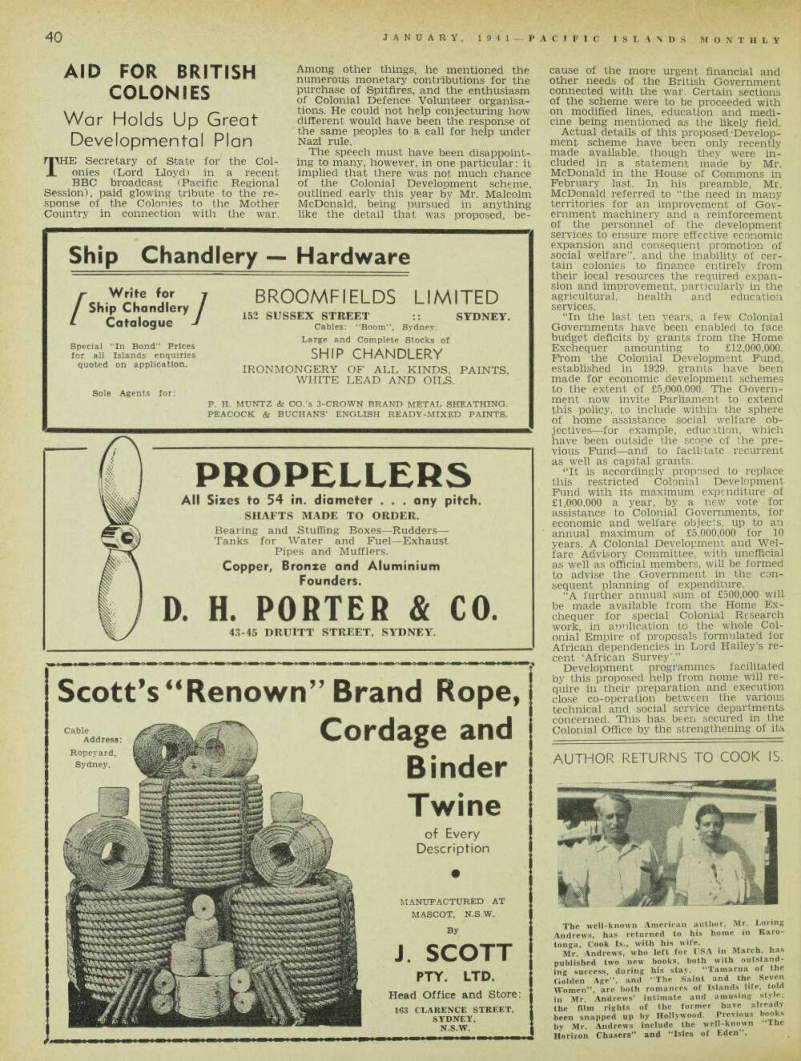
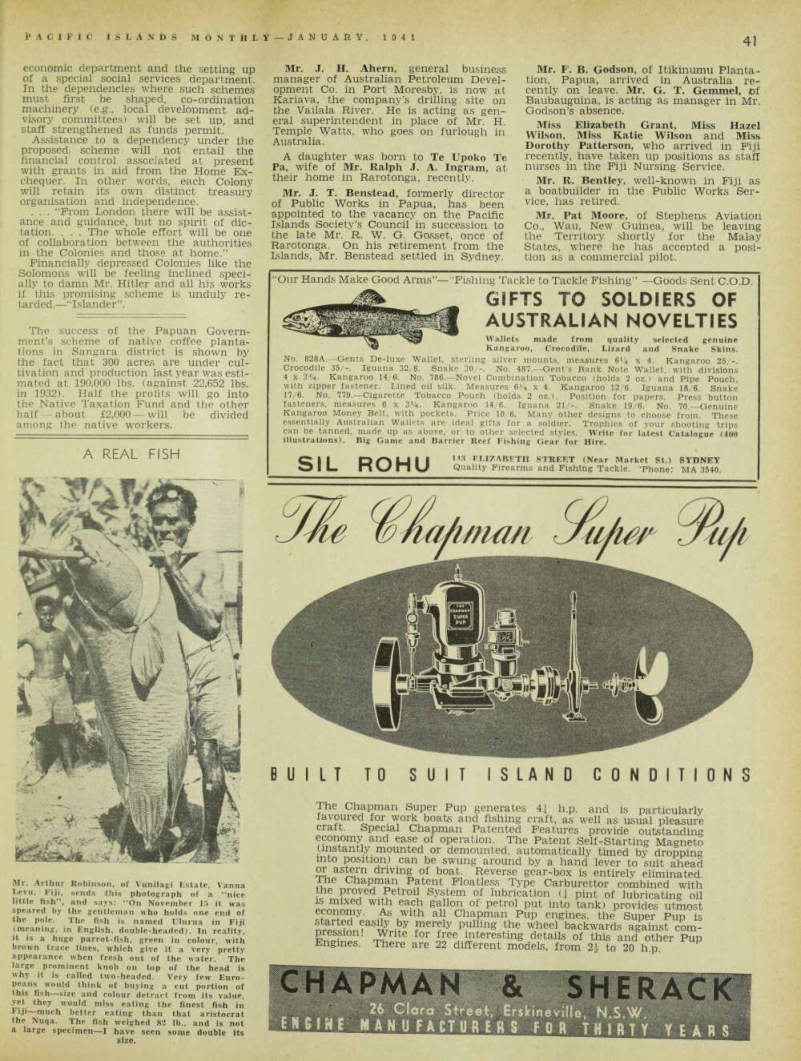
Aid For British
Colonies
War Holds Up Great Developmental Plan
THE Secretary of State for the Col onies (Lord Lloyd) in a recent BBC broadcast (Pacific Regional Session), paid glowing tribute to the re sponse of the Colonies to the Mother Country in connection with the war.
Among other things, he mentioned the numerous monetary contributions for the purchase of Spitfires, and the enthusiasm of Colonial Defence Volunteer organisa tions. He could not help conjecturing how different would have been the response of the same peoples to a call for help under Nazi rule.
The speech must have been disappoint ing to many, however, in one particular; it implied that there was not much chance of the Colonial Development scheme, outlined early this year by Mr. Malcolm McDonald, being pursued in anything like the detail that was proposed, be
cause of the more urgent financial and other needs of the British Government connected with the war. Certain sections of the scheme were to be proceeded with on modified lines, education and medi cine being mentioned as the likely field.
Actual details of this proposed’Develop ment scheme have been only recently made available, though they were in cluded in a statement made by Mr.
McDonald in the House of Commons in February last. In his preamble, Mr.
McDonald referred to “the need in many territories for an improvement of Gov ernment machinery and a reinforcement of the personnel of the development services to ensure more effective economic expansion and consequent promotion of social welfare”, and the inability of cer tain colonies to finance entirely from their local resources the required expan sion and improvement, particularly in the agricultural, health and education services.
“In the last ten years, a few Colonial Governments have been enabled to face budget deficits by grants from the Home Exchequer amounting to £12,000,000.
From the Colonial Development Fund, established in 1929, grants have been made for economic development schemes to the extent of £5,000,000. The Govern ment now invite Parliament to extend this policy, to include within the sphere of home assistance social welfare ob jectives—for example, education, which have been outside the scope of the pre vious Fund —and to facilitate recurrent as well as capital grants.
“It is accordingly proposed to replace this restricted Colonial Development Fund with its maximum expenditure of £1,000,000 a year, by a new vote for assistance to Colonial Governments, for economic and welfare objects, up to an annual maximum of £5,000,000 for 10 years. A Colonial Development and Wel fare Advisory Committee, with unofficial as well as official members, will be formed to advise the Government in the con sequent planning of expenditure.
“A further annual sum of £500,000 will be made available from the Home Ex chequer for special Colonial Research work, in annlication to the whole Col onial Empire of proposals formulated for African dependencies in Lord Hailey’s re cent ‘African Survey’.”
Development programmes facilitated by this proposed help from home will re quire in their preparation and execution close co-operation between the various technical and social service departments concerned. This has been secured in the Colonial Office by the strengthening of its
economic department and the setting up of a special social services department.
In the dependencies where such schemes must first be shaped, co-ordination machinery (e.g., local development ad visory committees) will be set up, and staff strengthened as funds permit.
Assistance to a dependency under the proposed scheme will not entail the financial control associated at present with grants in aid from the Home Ex chequer. In other words, each Colony will retain its own distinct treasury organisation and independence. . . . “From London there will be assist ance and guidance, but no spirit of dic tation. . . . The whole effort will be one of collaboration between the authorities in the Colonies and those at home.’’
Financially depressed Colonies like the Solomons will be feeling inclined speci ally to damn Mr. Hitler and all his works if this promising scheme is unduly re tarded. —“Islander”.
The success of the Papuan Govern ment’s scheme of native coffee planta tions in Sangara district is shown by the fact that 300 acres are under cul tivation and production last year was esti mated at 190,000 lbs. (against 22,652 lbs. in 1932). Half the profits will go into the Native Taxation Fund and the other half about £2,000 will be divided among the native workers.
Author Returns To Cook Is.
The well-known American author, Mr. Loring Andrews, has returned to his home in Raro tonga, Cook Is., with his wife.
Mr. Andrews, who left for USA in March, has published two new books, both with outstand ing success, during his stay. “Tamarua of the Golden Age”, and “The Saint and the Seven Women”, are both romances of Islands life, told in Mr. Andrews’ intimate and amusing style; the film rights of the former have already been snapped up by Hollywood. Previous books by Mr. Andrews include the well-known "The Horizon Chasers” and "lsles of Eden”.
Advertisements & other items, p. 42 (1 item)
Cordage and
Ship Chandlery Hardware
/Write for j
Ship Chandlery /
Catalogue J
BROOMFIELDS LIMITED
152 SUSSEX STREET :: SYDNEY.
Cables: “Boom”, Sydney.
Special “In Bond” Prices for all Islands enquiries quoted on application.
Sole Agents for; Large and Complete Stocks of
SHIP CHANDLERY
IRONMONGERY OF ALL KINDS, PAINTS,
WHITE LEAD AND OILS.
P. H. MUNTZ & CO.’S 3-CROWN BRAND METAL SHEATHING.
PEACOCK & BUCHANS’ ENGLISH READY-MIXED PAINTS.
PROPELLERS
All Sizes to 54 in. diameter . . . any pitch.
SHAFTS MADE TO ORDER.
Bearing and Stuffing Boxes —Rudders — Tanks for Water and Fuel —Exhaust Pipes and Mufflers.
Copper, Bronze and Aluminium Founders.
D. H. PORTER & CO.
43-45 DRUITT STREET, SYDNEY.
Scott’s “Renown” Brand Rope,
Cordage and
Binder
Twine
Cable Address: Ropeyard, Sydney.
of Every
Description
MANUFACTURED AT
MASCOT, N.S.W.
By
J. SCOTT
PTY. LTD.
Head Office and Store
163 CLARENCE STREET,
SYDNEY,
N.S.W.
A Real Fish
Mr. J. H. Ahern, general business manager of Australian Petroleum Devel opment Co. in Port Moresby, is now at Kariava, the company’s drilling site on the Vailala River. He is acting as gen eral superintendent in place of Mr. H.
Temple Watts, who goes on furlough in Australia.
A daughter was born to Te Upoko Te Pa, wife of Mr. Ralph J. A. Ingram, at their home in Rarotonga, recently.
Mr. J. T. Benstead, formerly director of Public Works in Papua, has been appointed to the vacancy on the Pacific Islands Society’s Council in succession to the late Mr. R. W. G. Gosset, once of Rarotonga. On his retirement from the Islands, Mr. Benstead settled in Sydney.
Mr. F. B. Godson, of Itikinumu Planta tion, Papua, arrived in Australia re cently on leave. Mr. G. T. Gemmel, of Baubauguina, is acting as manager in Mr.
Godson’s absence.
Miss Elizabeth Grant, Miss Hazel Wilson, Miss Katie Wilson and Miss Dorothy Patterson, who arrived in Fiji recently, have taken up positions as staff nurses in the Fiji Nursing Service.
Mr. R. Bentley, well-known in Fiji as a boatbuilder in the Public Works Ser vice, has retired.
Mr. Pat Moore, of Stephens Aviation Co., Wau, New Guinea, will be leaving the Territory shortly for the Malay States, where he has accepted a posi tion as a commercial pilot.
Arthur Robinson, of Vunilagi Estate, Vanua Levu, Fiji, sends this photograph of a “nice little fish”, and says: “On November 15 it was speared by the gentleman who holds one end of the pole. The fish is named Ulurua in Fiji (meaning, in English, double-headed). In reality, it is a huge parrot-fish, green in colour, with brown trace lines, which give it a very pretty appearance when fresh out of the water. The large prominent knob on top of the head is why it is called two-headed. Very few Euro peans would think of buying a cut portion of this fish—size and colour detract from its value, yet they would miss eating the finest fish in Fiji-much better eating than that aristocrat the Nuqa. The fish weighed 82 lb., and is not a large specimen—I have seen some double its size.
Advertisements & other items, p. 43 (2 items)
41
Pacific islands monthLF - January, 1941
Sil Rohu
“Our Hands Make Good Arms”—“Fishing Tackle to Tackle Fishing” —Goods Sent C.O.D.
GIFTS TO SOLDIERS OF
AUSTRALIAN NOVELTIES
Wallets made from quality selected genuine Kangaroo, Crocodile, Lizard and Snake Skins.
No. 828 A.—Gents De-luxe Wallet, sterling silver mounts, measures 6!4 x 4. Kangaroo 25/-.
Crocodile 35/-. Iguana 32/6. Snake 30/-. No. 487.—Gent’s Bank Note Wallet, with divisions 4 x 3%. Kangaroo 14 6. No. 786.—Novel Combination Tobacco (holds 2 oz.) and Pipe Pouch, with zipper fastener. Lined oil silk. Measures 6' 4 x 4. Kangaroo 12/6. Iguana 18/6. Snake 17/6. No. 779. —Cigarette Tobacco Pouch (holds 2 oz.). Position for papers. Press button fasteners, measures 6 x 3V 4 . Kangaroo 14 6. Iguana 21/-. Snake 19/6. No. 70—Genuine Kangaroo Money Belt, with pockets. Price 10 6. Many other designs to choose from. These essentially Australian Wallets are ideal gifts for a soldier. Trophies of your shooting trips can be tanned, made up as above, or to other selected styles. Write for latest Catalogue (400 illustrations). Big Game and Barrier Reef Fishing Gear for Hire.
SIL ROHU
US ELIZABETH STREET (Near Market St.) SYDNEY Quality Firearms and Fishing Tackle. ’Phone: MA 3540. %
/nan
an/r
an m •'>! ’ i i n * m (I,Mi 1 mm
iii
BUILT TO SUIT ISLAND CONDITIONS
The Chapman Super Pup generates 4i h.p, and is particularly favoured for work boate and fishing craft, as well as usual pleasure craft. Special Chapman Patented Features provide outstanding economy and ease of operation. The Patent Self-Starting Magneto (instantly mounted or demounted, automatically timed by dropping into position) can be swung around by a hand lever to suit ahead SJ, as^ n of boat. Reverse gear-box is entirely eliminated.
The Chapman Patent Floatless Type Carburettor combined with f?^P r fJ ed f? etrol l Sy^em of lubric ation (* pint of lubricating oil Wl l h ea .<£ gahon of’ Petrol put into tank) provides utmost -f s u Wlth aI J Cha P man Pu P engines, the Super Pup is S wrn y ? ier f ly wheel backwards against compression! Write for free interesting details of this and other Pun Engines. There are 22 different models, from 2£ to 20 hp
Fiji Infant Mortality
THE following was published in this journal in August last:— “A correspondent of the ‘Fiji Times’ makes the startling statement that the infant mortality among native Fijians, in the Lau group, has reached the alarm ing proportion of 50 per cent, of the birth rate. No explanation is given of this extraordinary figure.”
We are informed, officially, that the relevant statistics for the Lau group, from January to June of this year (which are the latest available) were as follow: Fijian births: 129.
Still-births: 2.
Deaths of children between birth and 1 month: 4.
Deaths of children between 1 month and 1 year: 9.
Similar figures have obtained for many years past.
It is clear that the report quoted had no basis in fact.
Tonga Buys A Spitfire
From Our Own Correspondent
Nukualofa, Dec. 4.
A BIG bazaar, held to-day in the pub lic square, Nukualofa, in aid of the “Tongan Spitfire Fund”, in which large quantities of foodstuffs, mats, tappas and other Tongan produce were sold, realised £l7O, which made up the balance of the amount required for the fighter plane.
The way in which the Tongans have responded to these various war efforts is remarkable, since their main and almost sole means of income is copra, which sells now at 100 lbs. (more or less) for one shilling.
Two Tragedies
Polynesians Lost in Cook Is.
From Our Own Correspondent
Rarotonga, Nov. 29.
SHIPWRECKS are rare in the compar atively quiet waters of the Cook Group, but this month witnessed two of the worst tragedies of recent years.
The inhabitants of the remote islands of Atiu, Mauke and Mitiaro have long been accustomed to making voyages in open whaleboats over the 30 odd miles that separate one island from another.
Such voyages, in sound boats and fair weather, could not be considered danger ous, and to lose two separate boats within a few days of one another is extra ordinary.
One whaleboat, belonging to the Cook Islands Administration at Mitiaro, made the trip to Mauke to take back Mr.
David Brown, Resident Agent of Mauke, to his home. When returning to Mitiaro the boat took on extra passengers (mak ing a total of 12 natives in all). After it left Mauke, squally weather set in, and the boat and occupants have not been heard of since. As radio is now installed on all the Cook Islands, it is feared that all are lost.
Almost at the same time, a whaleboat left the island of Atiu, to the north, for Mitiaro, with one Irangi, a Mangaian, in charge. Soon, a heavy squall overtook the craft, which capsized. Irangi, carry ing his little grand-daughter, struck out for the distant shore of Atiu. He was followed by all except a youth, Matipi, who perceived that their only chance lay in righting the boat and trying to make land.
Matipi called to the swimmers: “E Irangi ma e! E oki mai, kia mate tatou ko tai ngai.” (O Irangi and others, come back so that we shall at least all die to gether.) Only two other youths, of the six swimmers, returned. The three boys, after a long struggle, righted the boat.
Darkness fell, and the cold and hungry survivors tried to reach the uninhabited islet of Takutea (16 miles from Atiu), but wind and current were too strong.
After two days of exposure, with neither food nor water, the half-dead lads were washed up on one of the tiny islets sur rounding Manuae Island, and managed to assuage thirst and hunger with a few coconuts.
Early next morning, they found their way over to the settlement of Manuae, where a copra-making gang assisted them.
Soon after, the schooner “Tiare Taporo” called and returned the boys to Atiu. Irangi, his son and grand-daughter, and one other man, perished.
Wallis Island Is Neutral!
From Our Own Correspondent
Apia, Dec. 15.
FAMED as the lone French yachtsman, Alain Gerbault, who has been stay ing in Pago Pago for several months, has left for the smallest French colony in the Pacific, Wallis Island.
There he hopes to be, as he expressed it, away from the political dissensions rag ing in France and French colonies.
Wallis Island, with its half-dozen Europeans, wants to remain neutral in the present conflict.
Mr. R. H. Barron, Government dental surgeon at Rarotonga, left for New Zea land by the “Matua”, in December.
Advertisements & other items, p. 44 (1 item)
A. B. Donald Ltd.
AUCKLAND
ISLAND TRADERS & GENERAL MERCHANTS
P.O. Box 1509. Cables Gr Telegrams, "Kingdom", Auckland.
READ THE
B.P. MAGAZINE
SUMMER NUMBER
lIIIIIIIIIIIIIIIIIIIIIIIIIIIIIIIIIIIIIIIIIIIIIIIIIIIM
NOW ON SALE
Short Stories Pictures Travel Articles - - - - Pages for the Children Stage Latest Fashions Screen A
ONE SHILLING PER COPY.
ON SALE AT ALL NEWSAGENTS AND BOOKSELLERS
Fiji Under Criticism
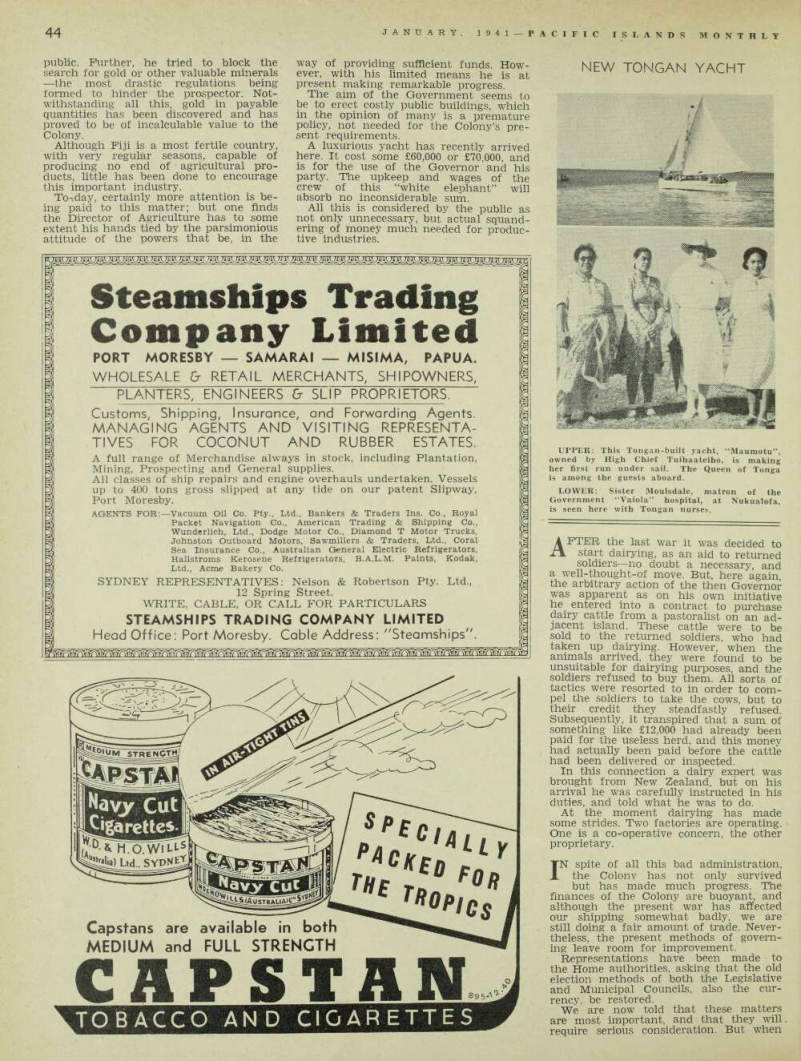
A Resident of 25 Years Finds Much Wrong With Administration
By Richard B. Howard
AFTER nearly 25 years of residence in the Crown Colony of Fiji, I often go over my impressions of the manner in which this Colony has been, and still is. being administered, and I come to the conclusion that there is much room for improvement.
Fiji, hitherto, has been plastered with administrators, selected bv the Home authorities, who apparently lack the experience, vision and initiative essential in developing a new country. The Colony is exceptionally fertile, with a most salubrious climate; but, through poor administration, its progress has been sadly checked.
The land policy has been, and still is, a most weird affair. No freeholds may be obtained, except in a few instances, when many years ago, the natives sold some of the land to Europeans. Now, the only way to obtain land is by lease. In order to obtain a lease it is necessary to gain the consent of the group of natives who may claim ownership. This is no easy matter, as if only one of the natives will not agree, the deal will not eventuate.
This is most discouraging, because months may have been spent, at not a little cost, In searching for a suitable area. No assistance will be given by the authorities, whose duty it is to collect the rents, which are ultimately distribred to the natives who may claim to be the owners, less ten per cent.
Again the colony is over-run by Gov-
ernment officials, lawyers, medical men and missionaries, all of whom are non producers and may be fairly considered parasites; the former being granted all sorts of concessions, the cost of which is paid from the public funds. All imports are heavily taxed, including a poll tax, besides a multitude of license fees, TT'OR some years, the system of electing X 1 members to the Legislative and Municipal Councils was by ballot, which had much to commend it, and proved satisfactory. But it was always arranged that an overwhelming majority of public servants were nominated by the Governor, and were instructed to vote as directed. It will be easy to stand that under these conditions the progress of the Colony was hampered, No matter what was proposed by an elected member, let it be ever so practi cal or commonsense, it would be bludgeoned out by the official majority, A case in point will give some idea of the arbitrary manner in which the Colony’s affairs are administered. Only two or three vears ago, an Administrator decided to do away with the elective svstem and institute that of nomination, This was strenuously opposed by the public, but the Administrator proved adamant. He was asked to have a refer endum taken, and he refused, The consequence is that to-day the Colony is governed by what is practically
a dictatorship, and may be considered a Totalitarian country. Democracy as understood by a Britisher, is dead in Fiji.
Again, not being satisfied with this, the Administrator changed the currency of the Colony to suit his own ideas. No heed whatsoever was given to protests by the public. This has proved to be most in convenient to business people and the
public. Further, he tried to block the search for gold or other valuable minerals —the most drastic regulations being formed to hinder the prospector. Not withstanding all this, gold in payable quantities has been discovered and has proved to be of incalculable value to the Colony.
Although Fiji is a most fertile country, with very regular seasons, capable of producing no end of agricultural pro ducts, little has been done to encourage this important industry.
To-day, certainly more attention is be ing paid to this matter; but one finds the Director of Agriculture has to some extent his hands tied by the parsimonious attitude of the powers that be, in the
way of providing sufficient funds. How ever, with his limited means he is at present making remarkable progress, The aim of the Government seems to be to erect costly public buildings, which in the opinion of many is a premature policy, not needed for the Colony’s pre sent requirements.
A luxurious yacht has recently arrived here. It cost some £60,000 or £70,000, and is for the use of the Governor ’ and his party. The upkeep and wages of the crew of this “white elenhant” will absorb no inconsiderable sum, All this is considered by the public as not only unnecessary, but actual squand ering of money much needed for produc tive industries.
Advertisements & other items, pp. 45-46 (1 item)
Go Wings
Established 1868 7
Sydney*s Leading Store
EXCLUSIVELY FOR MEN
will have your
SUIT TO MEASURE
TAILORED AND AWAITING
YOUR ARRIVAL IN SYDNEY
Write for
FREE PATTERNS
and Saif Measurement Form . • .
COWING BROS. LTD.
Market and Gaorga Streets, Sydner
»SSS
EMM\j
Steamships Trading
Company Limited
PORT MORESBY — SAMARAI — MISIMA, PAPUA.
WHOLESALE & RETAIL MERCHANTS, SHIPOWNERS,
PLANTERS, ENGINEERS & SLIP PROPRIETORS.
Customs, Shipping, Insurance, and Forwarding Agents.
MANAGING AGENTS AND VISITING REPRESENTA-
TIVES FOR COCONUT AND RUBBER ESTATES.
A full range of Merchandise always in stock, including Plantation, Mining, Prospecting and General supplies.
All classes of ship repairs and engine overhauls undertaken. Vessels up to 400 tons gross slipped at any tide on our patent Slipway, Port Moresby.
AGENTS FOR:—Vacuum Oil Co. Pty., Ltd., Bankers & Traders Ins. Co., Royal Packet Navigation Co., American Trading & Shipping Co., Wunderlich, Ltd., Dodge Motor Co., Diamond T Motor Trucks, Johnston Outboard Motors, Sawmillers & Traders, Ltd., Coral Sea Insurance Co., Australian General Electric Refrigerators, Hallstroms Kerosene Refrigerators, B.A.L.M. Paints, Kodak, Ltd., Acme Bakery Co.
SYDNEY REPRESENTATIVES: Nelson & Robertson Pty. Ltd., 12 Spring Street.
WRITE, CABLE, OR CALL FOR PARTICULARS
STEAMSHIPS TRADING COMPANY LIMITED
Head Office: Port Moresby. Cable Address: "Steamships".
,U M STRENGTH
s p £c IA U Y W.D
•* H.O.WiU 5
Th£ td*
Ltd.. SVDN^
f or
ißOpi
Ll°w svpM =4iS^AusTRAUA)i; Cs Capstans are available in both
MEDIUM and FULL STRENGTH
CAPSTAN*
TOBACCO AND CIGARETTES
New Tongan Yacht
AFTER the last war it was decided to start dairying, as an aid to returned soldiers—no doubt a necessary, and a well-thought-of move. But, here again the arbitrary action of the then Governor was apparent as on his own initiative he entered into a contract to purchase dairy cattle from a pastoralist on an ad jacent island. These cattle were to be sold to the returned soldiers, who had taken up dairying. However, when the animals arrived, they were found to be unsuitable for dairying purposes, and the soldiers refused to buy them. All sorts of tactics were resorted to in order to com pel the soldiers to take the cows, but to their credit they steadfastly refused.
Subsequently, it transpired that a sum of something like £12,000 had already been paid for the useless herd, and this money had actually been paid before the cattle had been delivered or inspected.
In this connection a dairy exoert was brought from New Zealand, but on his arrival he was carefully instructed in his duties, and told what he was to do.
At the moment dairying has made some strides. Two factories are operating.
One is a co-operative concern, the other proprietary.
IN spite of all this bad administration, the Colony has not only survived but has made much progress. The finances of the Colony are buoyant, and although the present war has affected our shipping somewhat badly, we are still doing a fair amount of trade. Never theless, the present methods of govern ing leave room for improvement.
Representations have been made to the Home authorities, asking that the old election methods of both the Legislative and Municipal Councils, also the cur rency, be restored.
We are now told that these matters are most important, and that they will require serious consideration. But when
UPPER: This Tongan-built yacht, “Maumotu”, owned by High Chief Tuihaateiho, is making her first run under sail. The Queen of Tonga is among the guests aboard.
LOWER: Sister Moulsdale, matron of the Government “Vaiola" hospital, at Nukualofa, is seen here with Tongan nurses.
they were done away with, it required only the stroke of a pen.
Another matter that should be con sidered is our postal service. We now have a road completely encircling the island of Levu, and numbers of vehicles daily make the round trip. Yet it takes days to get a letter from the far end of the island. As a matter of fact, there should be no difficulty in arranging for at least a daily delivery of mails.
The police department also would be the better of some attention. It is very evident that more European constables are required.
ANOTHER expensive proceeding is the apnointment, at large salaries, of officers who enjoy the title of Dis trict Commissioner. Evidently, it would be considered infra dig to follow the ex amnle set by our neighbouring Colonies and appoint a Sergeant of Police (Euro
pean), to such positions. It has been found that these officers, with the as sistance of two or three honorary justices of the peace, carry out the duties re quired of them efficiently, and one can see no reason why such appointments would not be desirable in Fiji, This would mean a large saving. About one fourth of the money now being spent in salaries and concessions would be saved, and the necessary duties carried out equally as well.
The writer would not be surprised if he should be placed in the same category as the Irishman who, on landing in America, asked “Sure, now, my bhoy, have you a Governmint in this country?”
The reply being in the affirmative, the Irishman said, “Faith, thin, I’m agin it.”
Nevertheless, the writer could quote innumerable other incidents of bad ad ministration.
It strikes one as puzzling why the
Home authorities do not select an Ad ministrator for these tropical South Pacific Crown Colonies from Australia One of those hard-headed, far-seeing successful pioneers should fill the job ad mirably.
Advertisements & other items, pp. 47-48 (1 item)
MoMoil
t 'T°og*/
)\ yf <r V & o/ &*> w a m \bs wC %» < % ■s j
VACUUM
DUALITY PRODUCT
If is in your interests to know the essentials of the CORRECT motor oil tor these days. It must be TOUGH, to protect the moving parts of the engine. It must be CLEAN, tor impurities cause breakdowns. It must RESIST heat and friction. It must be TENACIOUS and retain its qualities after miles of the hardest driving. And having these qualities, it must SAVE petrol, repairs and money! , . . All these CAPITAL virtues uniquely belong to—
MoMoil
The World*s Quality Oil In England, in Australia, throughout the Empire, Mohiloil is the most popular motor oil. It’s tough film protects the engine from its enemies of friction and wear.
VACUUM OIL COMPANY Pty. Ltd. (Incorp. in Aust.)
BOOH SHELVES
CUPBOARDS
' NEST
Of TABLES
>1
TOYS
TRAYS
Q
MTP*.
(an ANY OTHER HANDYMAN)
at/SVUP THEM
w
TABLE
MATS
HANDY BOXES
FROM
MASONITE
ANY of the smaller fittings or fixtures your home requires can be made, easily and economically, with Masonite “SHORTS”. “Shorts” are perfect pieces of Masonite, smaller than standard size sheets, but available in sizes from 2 ft. x 1 ft. to 4 ft. x 4 ft.— and sold at very special prices! They are knotless, grainless, non-chipping and non-splintering, and take any finish.
Ideal for any of the suggestions shown here, and countless other uses. as well.
Get all the facts about Masonite—The Wonder Board of 1000 Uses—from your nearest store or write to us for literature and full details.
N.B.—Masonite is easy to work with standard carpenters’ tools.
THE COLONIAL SUGAR REFINING CO. LTD. (Building Materials Division) Sydney. Melbourne. Brisbane. Adelaide. Perth.
Why Fiji Is An "Autocracy"
WE are glad to publish the conclu sions of an old and respected resi dent of Fiji like Mr. Howard: but we think that Mr. Howard has omitted, in his arguments and summary, to take into consideration certain conditions that are peculiar to this Colony.
Much of Mr. Howard’s criticism, for mstance, is centred on what he calls the “dictatorial powers of the Governor” He himself refers to the fact that the some what limited franchise enjoyed by the Colony was removed by the then Gov ernor, Sir Murchison Fletcher, a few years ago, and an almost completely nominative system substituted. So seri ous a step was not taken without grave reasons—and Mr. Howard does not refer to those reasons.
Despite enemy representations to the contrary, the Great Britain of to-day is acutely conscious of her obligations to all subject races, and, in her Crown colonies, she is careful to take no step which might deprive non-European races of privileges for the apparent benefit of European races, and especially the British.
Fiji is a very good case in point. Here we have three large communities—the governing race (the British), the indigen ous race (the Fijians, who are increas ing in numbers and quickly adapting themselves to European customs and ways of life), and an introduced Asiatic race (who also are rapidly increasing in numbers, and who belong to an ancient civilisation, which gives them a pride and traditions of their own).
There was the particular and peculiar problem with which the Government of Fiji had to deal. The European colonist naturally wanted the usual European privileges, and full freedom for develop ment. But the country had been ceded to Britain by the Fijian chiefs under conditions which placed on them a spe cial obligation to guard the land inter ests of the Fijian people. It is expressly provided in the constitution of this Colony that the native people shall not be deprived of the fee simple of their land. Then there is the Indian com munity—industrious, frugal, intelligent, proud, urgently demanding land for cul tivation and a share in the government of the country.
It is very easy for the Europeans in Fiji to say “the Government of this country is our job.” But how would such an attitude be regarded in Whitehall, where it is the special care of British statesmanship to prove to the leaders of the Indian Empire that the Indian people have equal status with the people of the British Empire?
As everyone acquainted with the his tory of Fiji knows, the position in Fiji became a Colonial Office nightmare, and it was finally resolved by two bold steps.
The franchise, a source of perpetual squabbling between Europeans and Indians, was wiped out altogether, and, under a benevolent autocracy, placed in the hands of the Governor, a nomina tive system of representation was intro duced which apparently has given fair representation to the various communi ties in the public bodies of the Colony.
The new system of land ownership and administration, of which Mr. Howard is so critical, is really a bold and, on the whole, a commendable effort to bring
order out of disorder, and remove the several causes of ceaseless discontent.
Both of these reforms were the work of Sir Murchison Fletcher and his assistants: and the two succeeding Gov ernors, Sir Arthur Richards and Sir Harry Luke, have followed out the policy thereby initiated with clear vision, and a ready conception of the ultimate pur pose of the Colonial Office.
There is a good deal of grumbling in Fiji, especially by those who do not lift their eyes beyond purely local issues.
But, from Britain’s point of view, there is far more in the Government of Fiji than the mere administration of the Colony for the benefit of the European residents there—it must align itself with the higher purposes of Imperial policy.
People who are far enough away from Fiji to see the clear picture are inclined to give more praise than blame to the Government of Fiji in regard to its achievements over the past ten years.
Harold Catty
Tribute to Mon Who Organised the PAA South Pacific Service
THE trans-Pacific service of Pan American Airways, between San Francisco and Auckland, is now running regularly; and, owing to enemy interference with our shipping services, the new air-line is of great value to Australia and New Zealand.
The man who created this new inter national link is Harold Gatty (now PAA manager at Auckland); and this is what an Australian newspaper said about him recently:— This quiet, friendly Tasmanian, grad uate of Jervis Bay Naval College, then merchant marine officer, was one of the pioneers of the science of air navigation that makes ocean flight arrivals certain.
He stepped into aviation through navi gation, into fame by his round-the-world flight with Wiley Post, then into avia tion diplomacy.
For him, five years of endless inter national negotiation ended in Septem ber, when he stepped ashore from the Clipper and watched the first regular mail unloaded.
He knows, better than anyone else, how many times the service was nearly wrecked before it was ever begun. He knows how easy it would have been for the American company to decide against spending the fortune it has laid out on its base and big hotel on uninhabited Canton Island, and on facilities at Nou mea. He knows, better than most, the full story of the mysterious British and American “expeditions” that sailed for secret destinations, left colonising parties behind, and how the mysteries and rivalries were ended by the Anglo- American agreement for joint use of Canton.
Also, he knows that history will record as the real Pacific aviation pioneers not the American airline, but Australia’s
almost-forgotten men—Kingsford-Smith,
Ulm and Taylor.
The American crews, old in the prac tice of a new science, taking watch and watch about in their huge machine, availing themselves of the most modern technique in navigation, radio and meteorology, must sometimes think with respect and wonder of those first Paci fic flights—down in the old, slow, mag nificent Southern Cross, back in her namesake, the Lady.
Yacht Lost
From Our Own Correspondent
Samarai, Dec. 20.
THE yacht “Aurora Star”, captained and, owned by Mr. Perry, who has been cruising in these waters, was lost near Nivani Island on November 29.
While the yacht was negotiating a passage, the engine failed and. owing to the strong tide and heavy head winds, she was thrown on the rocks, and sank in 62 fathoms. The occupants, Mr. Perry and his son, narrowly escaped drown ing, but managed to get to Nivani in a dinghy.
The “Aurora Star” was about 25 tons, and was well equipped. She was not insured. The survivors lost everything they possessed. Mrs. Perry, who had been on board, had left for Australia.
Mr. August Collins, a member of the crew of Burns Philp (SS) Co.’s motor boat “Tiafau”, in Samoa, was lost re cently when the boat was travelling be tween Apia and Salailua (on the south coast of Savaii). Reports say that he was washed overboard and that a search was made, without success.
Advertisements & other items, p. 49 (2 items)
47
I* ACI F t C ISLANDS MONTHLY JANUARY, 19 4 1
mre R
NoAsthma
In 2
Years
Two years ago J. Richards, Hamilton, Out., Canada, was in bed with Asthma. Had lost 40 pounds weight, suffered coughing, choking and strangling every night—couldn’t sleep— expected to die. Mendaco stopped spasms first night and he has had none since—in OVER TWO YEARS. Mendaco is so successful it is guaranteed to give you free, easy breathing in 24 hours and to stop your Asthma completely in 8 days or money M back on return of ITIVIIvUIVU empty package.
Ends Asthma . . . Now 3/-, 6/- and 12/.
SCHAFFER & CO., SYDNEY.
Ima
mre R
- and use
DISTRIBUTORS: Greenwood & Laws, Ltd., Rabaul and Wau; Steamships Trading Co., Ltd., Port Moresby and Samarai; Millers, Ltd., Suva, Fiji.
“8.A.L.M.” PAINT
FOR A BETTER
JOB. Long experience has shown practical men the wisdom of relying
on QUALITY
paint “8.A.L.M.”
Paint for lasting satisfaction, protection and decoration. For safety’s sake, next time, use “8.A.L.M.”
the PRE-TESTED
paint! 3 A Product of British Australian Lead Manufacturers Pty., Ltd., makers of “Dulux” Finishes.
Do You Know that the Famous
YOUNGER
STOVES and
RANGES
made with extended Firebox specially for long Wood fuel, are Self-Setting and, provided sufficient Flue Piping is attached, can be used in almost any position?
The No. 7W “Younger” Ranger can now be supplied fitted with Legs, as per Illustration.
Younger Stoves Ask for quotation for this Range, also illustrated Catalogue U the and Price List for both Single and Double Oven Stoves. Pacific islands.
G. FLETCHER & SON 50 Oxford Street, Sydney.
Another "Enlarged Spleen" Case
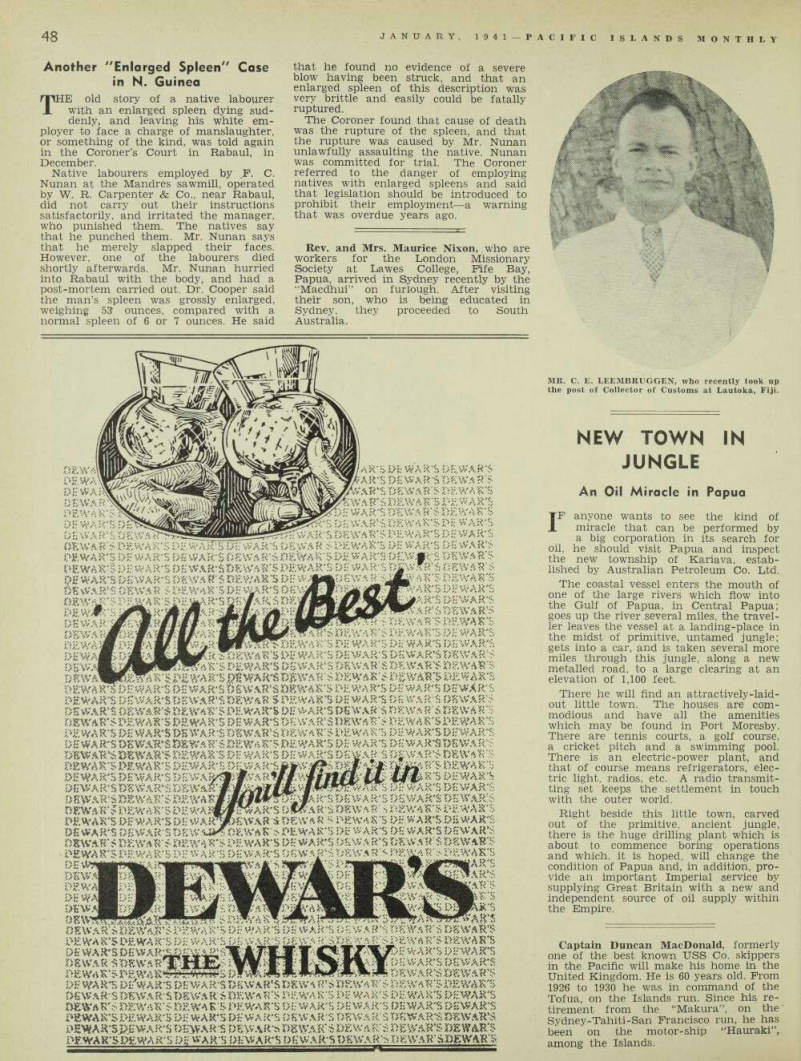
in N. Guinea
rE old story of a native labourer with an enlarged spleen dying sud denly, and leaving his white em ployer to face a charge of manslaughter, or something of the kind, was told again in the Coroner’s Court in Rabaul, in December.
Native labourers employed by .F. C.
Nunan at the Mandres sawmill, operated by W. R. Carpenter & Co., near Rabaul, did not carry out their instructions satisfactorily, and irritated the manager, who punished them. The natives say that he punched them. Mr. Nunan says that he merely slapped their faces.
However, one of the labourers died shortly afterwards. Mr. Nunan hurried into Rabaul with the body, and had a post-mortem carried out. Dr. Cooper said the man’s spleen was grossly enlarged, weighing 53 ounces, compared with a normal spleen of 6 or 7 ounces. He said
that he found no evidence of a severe blow having been struck, and that an enlarged spleen of this description was very brittle and easily could be fatally ruptured.
The Coroner found that cause of death was the rupture of the spleen, and that the rupture was caused by Mr. Nunan unlawfully assaulting the native. Nunan was committed for trial. The Coroner referred to the danger of employing natives with enlarged spleens and said that legislation should be introduced to prohibit their employment—a warning that was overdue years ago.
Rev. and Mrs. Maurice Nixon, who are workers for the London Missionary Society at Lawes College, Fife Bay, Papua, arrived in Sydney recently by the “Macdhui” on furlough. After visiting their son, who is being educated in Sydney. they proceeded to South Australia.
MR. C. E. LEEMBRUGGEN, who recently took up the post of Collector of Customs at Lautoka, Fiji.
Jungle
New Town In
An Oil Miracle in Papua
IF anyone wants to see the kind of miracle that can be performed by a big corporation in its search for oil, he should visit Papua and inspect the new township of Kariava, estab lished by Australian Petroleum Co. Ltd.
The coastal vessel enters the mouth of one of the large rivers which flow into the Gulf of Papua, in Central Papua; goes up the river several miles, the travel ler leaves the vessel at a landing-place in the midst of primitive, untamed jungle; gets into a car, and is taken several more miles through this jungle, along a new metalled road, to a large clearing at an elevation of 1,100 feet.
There he will find an attractively-laid out little town. The houses are com modious and have all the amenities which may be found in Port Moresby.
There are tennis courts, a golf course, a cricket pitch and a swimming pool.
There is an electric-power plant, and that of course means refrigerators, elec tric light, radios, etc. A radio transmit ting set keeps the settlement in touch with the outer world.
Right beside this little town, carved out of the primitive, ancient jungle, there is the huge drilling plant which is about to commence boring operations and which, it is hoped, will change the condition of Papua and, in addition, pro vide an important Imperial service by supplying Great Britain with a new and independent source of oil supply within the Empire.
Captain Duncan MacDonald, formerly one of the best known USS Co. skippers in the Pacific will make his home in the United Kingdom. He is 60 years old. From 1926 to 1930 he was in command of the Tofua, on the Islands run. Since his re tirement from the “Makura”, on the Sydney-Tahiti-San Francisco run, he has been on the motor-ship “Hauraki”, among the Islands.
Advertisements & other items, p. 50 (1 item)
s
"5 v ft &
AR'S DE WAR'S DE.WARS
A R'S DE WA R'S DEWA RE-
AR V S DEWAR'S DRWAR'S
WAR'S DEWAR'S DR WAR'S
WAR'S DEWAR'S DRWAR'S
DEWAR'S DEWAR'S DE WAR'S
DEWAR'S DRWAR'S DEWAR'S
DEWAR'S DRWAR'S DE WARS DE WARS DEWA R :/• DRWAR'S DE WAR'S OS WAR'S DEWAR'S DE WAR'S DEWAR'S DEWARSDRWARSDR WAR'S DE.W.f > * DEWAR'S
osWAR-sDEW'AR'SE>R WAR'S DEWAR'S DEWAR' SDEWAR S
DEW A R’Sjfcr AR'S DRWAR'S
gtt 49 DRWAR'S
AR'S DEWAR'S
a rs dewar's w .rr< •;•• drwars drwar's
AR'S DRWAR'S DRWAR'S DE WAR'S
»ak ?• DEWA'R'S DE WAR'S DEWAR'S DEWAR'S
RWAR'S D;; WAR'S DEWAR'S DEWAR'S DEWARS
DEW
DRWA
DE WA
SEW
DRW
DE W
DEW
DRWAR'S DR WAR'S DEWARS DRW
pE WAR'S DEWAR'S DEWAR'S DR WAR'S DE W DR WAR'S DEWAR :/• DR WAR'S DE WAR'S DEV OEWAfi'
DRW/f<'
DEWAR'
DEWA?
DRWA
DEW
DEW/
DRW'a:
AWSDR
R'S aR RS aR'S DRWAR'S DEWAR'S DRWAR S DR WAR'S DRW ARS 'SD D
VARS
VA.R%
-A
/DEWAR'S DR WARS
f: DRiiiA R'S DRWA RE
R'SDRWARA
FAR'S DEWARS
S DR WAR'S pi'WAR'S D£WAR S DRWaRS Dr WEAR'S DR WAR'S DRW'A R'S DR WAR'S DE WAR'S DEW AR'S DRW AR'S DRWA R'S DEWAR'S DE WX R S DRWAR'S DEWAR'S DEWAR'S DRWaR S DRWAR'S DEWAR'S DE WAR S DEWAR S DE WAR'S DRWaR'SDRW'aR SDRW'AR'SDEWAR’S DE W'AR SDRW'a R SDR'WAR S DRW'AR'S DRWAR'S DR. WAR'S DE WAR'S DEW A R'' S DRWaR'S DRWAR'SDRWAR'S
DRWAR'SDEWAR/SDEV/aR'SDRV/AR'SDRW'aR'SDRW'AR'SDEWAR'SDEWAR'S
DEWAR'SDEW'A'R'SDEWaR'SDRWaR'SDRWAR'SDE WAR'SDEWAR'SDEWAR'S
DEWAR'S. DRWAR'S DRWAR'S DE WAR'S DE WA
DEW'AR 'S DRW'AR'S DRWAR'SD/
DEWAR'SDEWAR'SDEWA
dev;aß'SDewaß‘Sd:ews
DEAR'S DEWAR'S DEWAR'S DEWARS
DEWA R'£ DEW' AR' S DRW A eC#£w AR'S Dfw A R'S DE'W a R'S DE'W AR’SDEWA R' S DEWAR'S DEWAR'S DE W WAR S DEWAR S DEWAR'S DEWAR'S DEWAR'S DE WAR'S DEWARS DEW U** DEWaR S DRWA R'S DE WAR'S DE WAR'S DEWAR'S DE WAR'S DRWA R' S DEWA R'S DRWAR'S DE WAR'S DEW A R'S DEWAR S DEW AR'S DEWAR'S DRW'AR'S DEW AR'S DEWAR'S DEWAR'S DEWARS DRWaR';/- DEWAR'S
AR'S
AR'S
RS R'S ;s
5 DEWAR'S DEWAR'S DEWAR'S
E W aRS DEWAR'S DRWAR'S
EtJ&g WAR'S DE WAR'S
DE WAR'S DE WAR'S
DEWAR S DEWAR’S
I DE
DEW.
V W.
DRW
i R :w
DEW
AS
DEW.
DEW
AR SS DE
WAR
DEW A
DEWA
DRW
DEWA R'S DEWAR'S DE WAR'S
DE WAR'S DEWARaS
DEWAR E
DEWaR'S DEWARS D R WA R'S D DE WA R'S DE'WAR'S DEWA R'S DEWAR'S DEW A R'S DEW A R'S DRW A R S DRWA R'S DEW'AR'S DEWA R'S DE WaR S DE Wa R'S DRWA R'S DE WAR'S DRWA R'S DRWAR'S
DEWaR'SDEWAR'SDEWAE SDRWAR'SDEWAR'S DEWAR'S DEWAR'SDEWAR'S
DEWARS DRWAR'S DE WAR'S DE WAR'S DEW'AR'S DEWARS DEWA R'S DEW'AR'S.
DEWAR'SPE WAR'S DEWAR S DEW'AR'S DEWAR’S DEW aR'S DEWAR'S DEWAR'S DEWAR'S DRWA R'S DE DEWAR'S DEWAR'S DEWA R'S D E W'A K S DEWAR’S
Sir Harry Luke On Tour
Colls at Fijian, Samoan and Tongan Islands
rE Governor of Fiji and High Com missioner for the Western Pacific, Sir Harry Luke, KCMG, left Suva on November 11 in the Royal Colonial Ship “Viti”, on an official visit to some central Pacific islands. He was accom panied by Mr. F. R. Charlton, OBE (Dir ector of Lands, Mines and Surveys, Fiji), Dr. D. C. M. Macpherson (Acting Direc tor of Medical Services, Fiji, and Acting Central Medical Authority for the West ern Pacific Territories), Mr. P. D. Mac donald (Assistant Secretary to the West ern Pacific High Commission) and Lieutenant A. C. Reid, Aide-de-Camp.
After visiting the island of Wailagi lala in the Lau Group, a call was made at the volcanic Tongan island of Nuia fo’ou, famous for its “tin can” mail. A landing was effected with some difficulty, but in safety, in an island boat. A large proportion of the island’s 1.500 inhabi tants, in gala attire, welcomed the party, and a surprisingly good brass band, organised by the Catholic Mission, pre faced the formal ceremonies of welcome by playing “God Save the King” and the Tongan National Anthem, His Excellency was honoured by the performance of the Royal Kava Cere mony, which usually is performed only for members of the ruling house of Tonga. After partaking of a lavish Tongan feast and enjoying the native dances and the singing of an excellent choir, trained by the Methodist Mission, the party climbed to* the crater to see the crater lake, which occupies about one-third of the island. After formal visits, the party re-embarked, while “For
He’s a Jolly Good Fellow” was chanted in harmony by a choir of school children.
THE next port of call was Apia, where the visit was a private one.
Here, after the ascent to Robert Louis Stevenson’s tomb on Mount Vaea, the Western Samoan Administrative and medical authorities conducted the party over the hospital and dental clinic, and to Mulinu’u, the burial place of the kings of Samoa and the seat of the Native Administration and the Fono of Faipule.
Miss Downs showed the party over the London Missionary Society’s Papauta Girls’ School, where several Ellice Island ers are among the pupils.
Next morning, the party landed near Fagamalo, on Savaii Island and, accom panied by Mr. Robson, the Resident Com missioner, was accorded a most friendly native welcome. Another brief call was made that evening at Apia, when the Acting Administrator and his party were entertained at dinner on the “Viti” before she sailed for Pago Pago, on Tutuila Island.
ON arrival at Pago Pago, formal visits were exchanged with Captain Wild, USN, the present Governor of American Samoa, after which the party attended a “stag” luncheon at Govern ment House, at which the senior naval officers of the station were present. His Excellency stayed at Government House during the two days’ visit, and the party was most hospitably entertained. The purpose of this visit was to return the
official call made by the then Governor of American Samoa to Suva in 1939.
ON the run to Tonga, the “Viti” passed the perfect cone of Kao Island, which rises 3,380 feet out of the sea, and Tofua Island, which is aoi active volcano.
Nukualofa was reached at 8 a.m. on November 21. After paying an official call on Queen Salote, DBE, the party was entertained by the Tongan Govem
ment at an open-air picnic at Hufaga lube, on the south coast of Tongatabu.
The afternoon was devoted to official inspections, and in the evening Sir Harry entertained the Queen, the Premier, the Agent and Consul, and Mrs. Armstrong, the Minister of Police and Mrs. Akaoulu, the heads of the churches and other prominent people at dinner on the “Viti”, His Excellency, in his capacity as High Commissioner, discussed official matters at some length with the Queen and her
Prime Minister, and the British Agent and Consul. He also visited the Defence Force camp and inspected and addressed the Force, which gave a very smart account of itself.
Other members of the party visited the hospital and the Lands and Survey Department, and were taken to see such remarkable objects of interest as the “Lagi” (Tomb of the Kings) and the Ha-amoga.
NUKUALOFA was left at dawn on November 23, and at about 11 a.m. the “Viti” was off the periodically disappearing Falcon Island (in Tongan, Fonuafo’ou).
Making a difficult and somewhat dan gerous landing through the heavy surf breaking on the steep black beach, the party spent half an hour on shore. The island was found to be composed of black scoria and ash. The scene was exceed ingly grim and sinister, relieved only by one small coconut palm, about 3 feet high.
RETURNING to Fijian waters, calls were made at the Southern Lau Islands of Vatoa (which was dis covered by Captain Cook during his second voyage in 1774), Ogea, Fulaga, Kabara and Totoya, at all of which His Excellency was ceremonially received by the chiefs and people.
The principal village of each island was inspected and at Tovu village, in Totoya, Dr. Macpherson and two native medical practitioners carried out a medical inspection of the children.
Suva was reached on Wednesday morn ing, November 27.
Mr. J. B. McAdam. of the NG Forestry Department, arrived in Australia recently on leave. He was accompanied by Mrs.
McAdam.
Advertisements & other items, pp. 51-52 (1 item)
Tilley
Vigour Restored,
Glands Made Young
In 24 Hours
It is no longer necessary to suffer from loss of vigour and manhood, weak memory and body, nervousness, impure blood, sickly skin, depression, and poor sleep, because an American Doctor lias discovered a quick, easy way to end these troubles.
This discovery is in pleasant, easy-to-take tablet form, is absolutely harmless, does away with gland operations and is bringing new youth and vigour to thousands. It works directly on the glands and nerves, and puts new, rich blood and energy in your veins. In 24 hours you can see and feel yourself getting younger. Your eyes sparkle, you feel alive and full of youthful vigour and power.
And this amazing, new gland and vigour restorer, called Vi-Stim, is guaranteed. It has been proved by thousands in America and is now distributed by chemists here under a guarantee of satisfaction or money back.
Vi-Stim must make you feel full of vigour and energy and from 10 to 20 years younger, or you merely return the empty package and get your money back. A special, double-strength bottle of 48 Vi-Stim tablets costs little, and the guarantee protects you.
Vi-Stim
GUARANTEED
to Restore Manhood and Vitality . . .
Brilliant Lighting—Simple in use—One
TILLEY
KEROSENE VAPOUR LAMPS AND LANTERNS
Give light of 300 candle-power for 6 hours for Id.
No Wicks
No Chimneys
No Smell
Draught Proof
Insect Proof
British Made
Throughout.
A brilliant light, efficient in performance, cheap to run— these are some points which make the Tilley Lamps and Lanterns so outstanding. Their popularity throughout the British Dominions, Colonies and other parts of the world is shown by their rapidly increasing sales. Burn ordinary kerosene under pressure and are preheated by the same oil so that only one fuel is necessary. The Kerosene Lighter draws its oil supply from the container of the Lamp itself and does away with the use of methylated spirit. Designed to withstand rough usage. Absolutely safe. Makes no hissing noise and all indoor models are fitted with a special silencer. British made throughout of the finest material
and workmanship.
T.L. 10.
fuel only
P.L. 54.
Obtainable from —
W. KOPSEN & CO. PTY. LTD.
376-380 KENT STREET, SYDNEY
who also stock all Spare Parts, together with many other types of Tilley Lamps and Radiators.
Also stocked by leading Storekeepers throughout the Pacific Islands.
If any difficulty, write direct to: HE TILLEY LAMP CO., HENDON, LONDON, N.W.4.
The Tilley Table Lamp with its clear, white, steady light shows your room to the best advantage, as well as banishing eyestrain when reading or doing needlework.
No smell or glare. Does not flicker when standing in a draught. Made throughout in lacquered brass and fitted with opal shade. Free from danger and cannot explode.
Tilley Storm Lantern Is invaluable for all indoor or outdoor work; can be hung up, stood down or carried about as required. Will burn steadily anywhere, unaffected by weather, however severe. Wind and rainproof. Strongly made of brass. No parts to rust, corrode or get out of order. You cannot do better than get this All- British Storm Lantern.
DON’T NEGLECT
A Common Case of Piles. It may
Lead to Serious Results.
When people, generally, understand that all such fatal diseases as Fistula, Ulcer of the Rectum, Fissure, etc., almost invariably begin in a simple case of Piles, they will learn the wisdom of taking prompt treatment for the first appearance of this trouble. DOAN'S OINT MENT is unequalled for every form of Piles—Bleeding, Itching, Protruding, and Blind Piles, and hundreds of lives have been saved by using this cheap but effective remedy right from the start, because at such times a single tin has often effected a cure, while in the old deep-seated, chronic cases, several tins are sometimes necessary.
DOAN’S OINTMENT is healing, antiseptic and soothing. That is why it is equally successful in overcoming Eczema and other skin complaints. But be sure you get
DOAN’S.
L.M.S. Feels Financial Pinch
From Our Own Correspondent
Rarotonga, Dec. 10.
WARTIME conditions have complicated the positions of the various South Sea Missions.
In the Cook Islands, the strongest of the three Missions, the London Mission ary Society, may be very short of funds in the near future. Advice has been received from the headquarters in Lon don that, owing to war conditions, the Cook Islands, at least for the present, will have to provide for their own Euro pean “orometua” (pastor) and other expenses.
The international Catholic Church and the American-founded Seventh Day Adventist Mission may not be embar rassed financially, to the same degree.
Papua's Enlistments
Pt. Moresby, Dec. 20.
UP to the end of November, 23 officers of the Papuan Civil Service had enlisted —a fair average out of 144, when it is remembered that some 30 members are over military age, and that many have been refused permission to enlist owing to shortage in the different staffs.
Miss L. I. Lawrence, of the Methodist Mission’s Home for Indian Children at Dilkusha, Fiji, arrived in Sydney re cently from Suva and proceeded to Vic toria on furlough.
Mr. Rennick, who has been on the staff of the Commonwealth Copra Company at Giligili, near Samarai. Papua, for some time, has been transferred to the Solo mon Islands.
Advertisements & other items, p. 52 (1 item)
The Colonial Mutual Life
ASSURANCE SOCIETY LIMITED
During 1939 the Society issued Policy Contracts to the number of 66,655 These Policy Contracts, during their currency guarantee to the holders, on survivance, or to heirs in the event of premature death, no less a sum than £12,627,642
CHIEF AGENTS FOR PACIFIC ISLANDS:
MORRIS, HEDSTROM LTD.
Among Those Captured
By W.C.G.
ALL the Ocean Island and Nauru Europeans who were victims of the raiders are well known.
Captain A. Rhodes, master of the MV Triaster, the chief passenger-carrying vessel of the British Phosphate Commis sion’s pre-war fleet of four ships (of which three were destroyed by the raid ers) is the senior captain of the BPC fleet. A quiet, conscientious, pleasant speaking man, little more than five feet in height, he had been many years in the service of the BPC, starting as a junior mate on the old Nauru Chief.
The Triaster was always regarded as the family ship of the BPC fleet, having comfortable accommodation for about 40 passengers. She carried a Filipino crew.
The fate of Capt. Rhodes is not yet definitely known. His home is at Elstern wick, Melbourne.
Chief Engineer S. Kersey, also of Tri aster, is equally well known. A big, bluff Australian, living at St. Kilda, Melbourne, he spent much of his spare time on board amusing the children and carving coconut shells into ornaments. His nephew, of Ballarat, a junior engineer on one of the other BPC vessels which were destroyed, is not included in the list of those rescued.
Captain J. Callender, of Brighton Melbourne, master of the Triadic, had also seen years of service as an officer with the BPC fleet, having fairly recently been promoted to a command.
Fourth-Engineer Keith Godridge, of Glenferrie, Melbourne, had been asso
ciated with Chief Kersey on the Triaster for some years, and was a popular figure amongst the younger Europeans, as was Electrician “Jimmy” Armstrong, a Bel fast man, of the Triaster. “Robby” (W.
P. Robinson) had been the chief stew ard of the Triaster, with Captain Rhodes, for some years. Well known to all the Europeans of the two islands, “Robby” was most popular with the children. An Englishman by birth, his home is at Brighton, Melbourne.
Gordon R. Ferguson, known to all at Nauru as “Fergy”, who was on board the Triadic with his wife, had been six years
at Nauru, latterly as senior clerk in the BPC office. He was married in Nauru fast June to Nerna, sister of Mr. Jack Reddin, of the BPC staff at Ocean Island ' Mr. George Dillon, one of the old hands of Nauru, came from England and joined the BPC service 20 years ago.
Mrs. Mabel MacPherson is the wife of “Molly” MacPherson, who has charge of the locomotive branch of the BPC at Nauru. They have spent over 20 years on Nauru and are both generally liked. , .
Mrs. J. T. Langar, who was captured with her two little boys, Jim and Brian, on the Triadic, and who appears to have had a nerve-wracking experience, is the wife of Mr. Jim Langar, BPC stevedore at Nauru, who has spent most of his life on the island, where his father also was employed in the phosphate industry. The two children have spent their lives at Nauru. Mrs. Langar had come to Australia for medical attention for Jimmy, who had broken his leg with a scooter at Nauru. It is a coincidence that Jimmy was wounded in the leg by shrapnel fmm tbp rairipr’c «bpll<? from the raiders shells.
Mrs. W. Allan is the wife of the Assistant Civil Engineer at Nauru. Bill Allan has spent about 15 years with the BPC at both Ocean Island and Nauru. Prior to her marriage, Mrs. Allan was on the office staff of the BPC at Nauru, Mrs. F. F. Harmer, who was captured with her schoolboy son, Keith, is the wife of the power-house foreman at Nauru. Mr. Harmer, an Englishman. came to Nauru ten years ago, on the installation of special electrical machinery.
Mrs. Stringer, wife of Captain Harry Stringer, harbour-master at Ocean Island, and formerly assistant harbourmaster, with Captain “Pop” Preece, at Nauru, was captured aboard the Triona.
She is one of the most popular ladies of the islands Mrs. C. Adams, who was aboard the Triona, is the wife of one of the mechanical and electrical engineers at Ocean Island, and was previously stationed at Nauru. A University graduate in engineering, and a good sport, Charles Adams joined the BPC technical staff about four years ago.
Advertisements & other items, pp. 53-54 (2 items)
51
Sfory of Pacific Raiders (Continued from Page 18)
PACIFIC ISLANDS MONTHLY JANUARY, 1941
Oqtov
V
KHOW
I 8 HA/ <cA*k# 50 0 f/0 ft** 0/1”
CP rAS GV> ty# *o* v\tf ! 0 f 6 of s !!• 6 « UK
/SSi
®%SS I
FOOO WEP&EP /A/ CKfV/CeS
Between teeth cause 'bqcter/al
mouth." KOLXNOS P»HY\SE?TVC 6UBBL6S
K 6ERMS AUP PREVENT j
'bacter/al mouth'/
YOUR TEETH
A?// <*7'**&** “ Hs. *s *BP W--' -v* wrm
E: Si vs> *E» NEW LUBTNE.
®", yW Irt A A jsm<S > economical f J z-4573 r/r/ff
®r It NO AS OAPHMN rOOTH-i^OP
S"o EASTS !'t WM ON
cK, BUY BAUSA /S
<nnH
I, c.
V 1 a * & 1? 6
Unhealthy with
Flabby Fat
GOOD LOOKS AND FIGURE
VANISH
You can always tell the difference between good firm flesh and flabby fat.
There is always something so unhealthy and unattractive looking about fat. It is usually unhealthy and often gained through constipation. Waste matter clogs and congests the digestive tract, remains too long and gets absorbed into the blood stream. Snk headaches, pimply skin, biliousness, bad breath result and fat tissue forms, hiding your good looks and fine figure.
Constipation always responds to treatment with gentle Pinkettes. These tiny laxative pills are compounded of safe ingredients that have an exercising and strengthening influence on the bowels.
Pinkettes painlessly clear away the digestive wastes completely and regularly, help digestion and banish sick headache, bilious attacks, pimples and unhealthy fat. Get a 1/3 bottle to-day and notice how fine and fit you feel after a few harmless doses.—***
%% o s
SIMILAR TO EUROPEAN MAKES
now made by
COLEMAN LAMP & STOVE CO.
LTD.
Toronto, Ontario, Canada and sold by All Leading Stores in the Pacific Islands.
In case of difficulty in obtaining supplies write to —
PEARCE & CO.—SUVA, FIJI IS.
New Books
A REMARKABLE number of new books have been issued recently by Messrs.
Angus & Robertson, Ltd., of Sydney.
“The Woman At The Mill”, By
Frank Dalby Davidson, 7/6. This is a good Australian novel, soundly based on Australian outback life, of the kind made popular in recent years by Mr. Davidson.
“Wooden Hookers”, By C. Bede
Maxwell, the result of much painstaking research, are true tales of heroism from the most colourful decade of Australia’s history—remarkable stories of the men who sailed these wooden hookers and who poured their life’s blood into Aus tralia in the early 19th century, and so founded a nation. It is not only a most readable book, but it is also a valuable work of reference. But, as so often hap pens in these compilations, it loses much of its value for reference because the author has failed to add an index.
A Christmas Series
These Sydney publishers, with com mendable enterprise, have sought to fill a blank created by oversea trade condi tions and have supplied an attractive series of books for boys and girls as Christmas gifts.
“Daredevils Op The Sky”, By
Norman Ellison, 4/9. This is a book that will be prized by all Australian boys, for it tells the thrilling, almost incredible story, of Australia’s air pioneers.
“THE GREAT TREK”, by lon Idriess, 4/9. This is the story of the Jardine ex pedition—one of the greatest feats in Australian exploration.
“Headhunters Of The Coral
SEA”, by lon Idriess, 4/9. A book of ad venture that will appeal to both old and young—the story of two white lads who were shipwrecked on Torres Strait long years ago and had amazing adventures among the head-hunters there. It is all based on recording facts which have been dug up by Mr. Idriess in his thor ough nains-taking way.
“Book Of Cross-Word Puzzles
AND STORIES”, bv John Tombs, 4 9.
“Pixie O’Hara’S Story Book”,
4/9. Miss O’Hara needs no introduction to Australian children —she has been one of their favourite authors for years. The book is illustrated with her inimitable sketches.
Advertisements & other items, p. 54 (1 item)
palter saps strength
MV
it back
Rich in jumper and healthful herbs I %
'isammi
Re-organisation of Pacific French
Pacific French
FREE Frenchmen in Australia in support of the nion to form p Paeifie force to continue Fran op’s w*r the Axis Powers' said M Andre Brenac (representative in Australia of General de Gaulle) in a statement in Rydnev “Sun” of Januarv 6.
Th e present aim is to act together 3.00° men. well-eouipped and trained.
Unfortunately, there are not enough Frenchmen in Australia to form a sep arate force, and. unless plans are changed, they will become part of the Pacific army, comprising residents of Tahiti, New Caledonia and other islands.
“A number of applications have alreadv been received here for the force,” M. Brenac added. “At present, those men who want, to see France rise anew can either go to New Caledonia to .i°in the AIF We all regret that it will not be possible, owing to the small numbers, for the men to train in the land of their adoption, Australia,”
Naval men who wish to serve with Admiral Muselier, leader of the Free French Navy, can, however, go into almost immediate action. Arrangements have been made in Sydney for them to leave for London, where Admiral Muse lier has his head-quarters, as soon as they apply for service.
M. Brenac is calling a meeting for February to discuss the form which the Free French Movement will take in Australia. Membership will be open to Australians and subjects of occupied countries who believe in the ultimate renaissance of France.
Mr. John Rennie, who died at the Suva War Memorial Hospital recently, was well-known in Fiji. Born in New Zealand, he went to the Colony 70 years ago. He became interested in sugar plant ing and carried on the “Viti” estate on the Upper Rewa for some years before selling out to the CSR Co. Later he en gaged in banana cultivation at “Naboro” estate, near Navua; but plant disease and hurricanes hampered his efforts, Mr. Rennie then joined the Fiji Govern ment as a Works Department overseer, retiring in 1922. A widow, one son and two daughters survive him.
Advertisements & other items, p. 55 (2 items)
53
Pacific Copra Conference (Continued from Page 14)
PACIFIC ISLANDS MONTHLY JANUARY, 1941
’James Wh1Telaw
PRICE'S RADIO
can supply
Radio Parts
to repair most types of Radio Receiving Sets. Also up-to-date Kits to build your own.
RADIO SETS SPECIALLY
DESIGNED FOR TROPICAL
USE.
From small 2-valve sets for use with headphones, to Multi-valve sets.
Let us know your requirements— we will quote by return mail.
PRICE'S RADIO
5 & 6 Angel Place, Sydney, N.S.W.
Whether in the Forces or just “carrying on,” you must keep fit . . . and keep smiling.
Let Eno help you to attain and keep perfect health, hy correcting acidity and gently yet
thoroughly dismissing food waste.
STS
r •5 bco -CO OV c® T
BAC
*'*. ** m *&fp $*hr °*T su p a Rq *o *Ar *A C C Don’t pay Tobacco Price Increases!
Save the Middleman’s Profit.
WHITELAW’S FAMOUS IMPORT BLEND
This fine quality tobacco, usually 1/4 an ounce, is now available to island customers at lid. an ounce, despite the new duties, in \ and 11b. packs. Selected leaf, expertly blended, deep satisfying and cool, fresh to the last smoke.
Your money back if not satisfied. Send crossed cheque or money order.
Fine cut or reaay rubbed pipe 2 lb.# 7/9 delivered 1 lb. f 14/6 delivered
’JAMES WH1TELAW
AND COMPANY
14 SPRING ST., SYDNEY :: BOX No. 3794 T, G.P.O.
Bankers: Bank ol N e w South Wales, Head Office
Fijion Taxpayers Moan
Costly "Viti"
From Our Own Correspondent
Suva, Dec. 24.
IN the good, pre-war years, when money was plentiful, the Govern ment of Fiji ordered the construc tion in Hong Kong of a patrol-ship or yacht, for the use of the Governor of Fiji, especially in his work as High Com missioner of the Western Pacific.
So the handsome “Viti” was built, and delivered in 1940 (after war had com menced, and finances had tightened); and already the new Governor of Fiji has found her very useful. War has dis located shipping schedules, and His Excellency could not get about the Cen tral Pacific, if he did not have the “Viti”.
But Fiji taxpayers are moaning dis mally. They regard the “Viti” as too expensive, and they are urging the Gov ernor to sell her (she cost £70,000, and could be sold now for perhaps £120,000), and purchase a couple of sea-planes for his inter-island and inter-Territories work.
Mr. Alport Barker, in the Legislative Council, calculated that the “Viti” costs £67 per day in harbour, and, at sea, in addition £l4 for every 100 miles run.
Mr. Barker admitted that Council had approved the building of the ship: but no one had had any idea that costs would be so high.
Mrs. C. J. J. T. Barton, wife of the Colonial Secretary of Fiji, died in Eng land recently. Mr. Barton is en route to England, and during his absence Mr.
C. W. T; Johnson, Assistant Colonial Secretary, will carry out his duties.
"Blitzkrieg"
A Fiji Girl in the "Blitzkrieg"
The following letter from a Fiji girl in London is supplied by Mrs. E.
Hennings, of Naitauba, Fiji.
DO you remember my complaint about the tedious waiting for the “Blitz krieg” to eventuate? Well, it has come—right now there is a dog-fight going on overhead. One can hear them, though not see, as it is misty, with very low clouds. I hope they shoot the lot down!
There isn’t a district in London which hasn’t had a dose of it. A lot of dam age has been done, but there are re markably few casualties.
The good old ARP (Air Raid Precau tion) has come into its own at last; we are called out nearly every night. I wondered, after almost a year of prac tising mock raids, what would the real thing be like, being just then on day shift.
Those of the girls on night-duty had some nasty experiences. One found after rushing up to the hospital with her cases that they had died of haemorrhage in transit. Another one was lifted, in her bus, by a blast, from one side of the road to the other; and, as she realised what had happened, she suddenly saw a head rolling across the street in front of her.
Not funny.
I thought I would be scared stiff the first time, when I had to go out in the night, but there were so many things to think of—getting into my gum boots alone prevented me from worrying about anything else. Actually, it was all most exciting. A nearly full moon simplified driving without lights.
There was no traffic, except for ambu lances, fire engines and police cars.
Everything was deadly quiet till I got to Hyde Park corner, when literally all the guns there went off. I jumped about three feet, and landed heavily on the accelerator with my size seven boots, which was all to the good.
When the guns ceased, the silence was almost unearthly. A thick pall of smoke and dust settled down which, with the moonlight filtering through, made the scene distinctly eerie.
Pounding on in my ancient Austin, I reached the bombed area. No casualties, but the police asked me to go round the block to where Queen Anne’s Man sions had received a direct hit.
“Keep well to the right, madam, please,” said the constable, ever so politely. “There’s a lot of glass and debris on the road—thank you, madam.”
Screaming bombs whistled around us whilst we were talking, but I can hon estly say that I wasn’t particularly dis turbed. In fact, now, as long as they don’t drop too close, I don’t mind at all.
There were no casualties there either, and I returned to the station, having had a grand drive there and back, shooting all traffic lights, going round islands the wrong side of the road and generally ignoring all traffic regulations.
Our ARP depot was called in at Buck ingham Palace. We nearly outdid our
selves in efficiency, and the King and Queen sent us a personal message tnank ing us for our services.
HOWEVER, I have had genuine casual ties since, when certain non-mili tary institutions “they” had been trying to get for weeks past received direct hits. A terrible mess.
While I was waiting for the buried to be dug up, there was another alarm, too sudden to take shelter. We just flung ourselves flat on the ground. Luckily, nothing was dropped close.
One soldier beamed at me and said; “You are in the front line now!” True enough, I thought. There were four killed, six wounded and several buried I saw one dug up, the cook, but she was stone dead.
One gets accustomed to the noise of gunfire and bombs, though the horrid grr-grr of the German air-craft getting closer is still rather disturbing. The only real trouble is the difficulty of sleeping with all that row going on, especially if you have to work in daytime and can’t make it up. You’re just dozing off nicely, when suddenly some terrific explosions occur, almost beside you, or else all the Hyde Park AA guns go off. It sounds like hell let loose.
However, this, too, is a matter of organising yourself. I get plenty of sleep, now, even when the mobile guns seem to park right outside the house.
They make an incredible racket but, once gone to bed in the basement, I never hear anything.
Also, I have developed a fantastic appetite, all my spare time being occu pied by either sleeping, or eating the most colossal meals. I suppose there is a certain nervous tension, even if you aren’t actually conscious of it, which makes you hungry.
WE have air raids during the day, too, but I ignore them. I put on my tin hat when out in the street, and otherwise go about in the ordinary way.
If you were to dart into cellars and shel ters every time the sirens moan, I feel sure you’d grow fur and go blind like moles.
There was a terrific lot of gunfire going on the other night, when a friend took me out to dinner, and on our way there we could hear the shrapnel falling through the trees in Berkeley Square, like large hail-stones.
At the Cafe de Paris life was gay, with alcohol and champagne flowing. We had a nice pheasant, with etc.—all very pleasant, and quite the best way of whiling away the time during air raids!
Now and again the band leader announced tha.t the sirens had gone off, or that all was clear, but nobody was
particularly interested.
There was another alarm just when we were about to leave and, with no taxis in sight, my friend proposed to walk me home. Being minus the trusty tin hat, I decided to stay at the hotel, where I slept soundly on a mattress on the floor, until the “all clear” about 5 a.m., whilst he spent all next day at a first aid post, after being hit on the head by a piece of shrapnel! Which goes to show that if you ask for trouble, you generally get it!
Another friend gave me a “siren suit” for wear in the air raid shelters. It’s green, yellow, black and red tartan trou sers, with a black jacket. I decided to wear it going to work and, when I turned up at the ARP station for the next shift, the entire personnel burst into: “The Campbells are coming!” Now they call me “Jock”. What a lot you have to put up with during a war!
I have been greatly cheered during
the last few days. The “blitzkrieg” is nothing like it was. Things look a deal more cheerful all round, and I have a feeling that this isn’t going to be a ten years’ war, after all. I am blooming, and likely to continue so for the dura tion. So don’t worry yourself and keep your chins up—all of them!
Mrs, Emma Elizabeth Garrick, one of Fiji’s oldest pioneers, died recently at the age of 88. Wife of the late Joseph Hector Garrick, she arrived in the Colony in 1869 and witnessed the ceremony on October 10, 1874, when Great Britain took over the group. Mrs. Garrick married twice, her first husband being the late Mr. William Scott, and the surviving family of three sons and one daughter are well-known in the Colony—Sir Henry Scott, KC, of Suva; Mr. A. H. E.
Scott, retired bank manager at present in Sydney; Mr. Godfrey Garrick, of Sydney; and Mrs. Pilling, wife of Mr.
H. G. Pilling, CMG, Governor of St.
Helena.
Rev. and Mrs. W. R. Steadman, who are well-known in Fiji after 20 years of service among the Indian population for the Methodist Mission, have returned to Australia. They will not be returning to the Colony.
THE boy and his Mary, after serving two years on a Papuan plantation, in charge of a newly-married couple, arrived in Port Moresby and imme diately waited on residents in search of work.
The newly-weds, apparently were still* a loving couple, and whenever the wife spoke to her husband she addressed him as “hubby dear”.
The boy, who claimed to understand all that was necessary in housework, in the course of his walk-about, visited the home of one of our highly-paid public servants. After questioning the boy. Mrs.
P. S. decided that he would be suitable, and engaged him to start work the fol lowing morning. As the boy was leaving to pick up his gear and his Mary, his new employer asked him his name. He thought for a moment and said, “You call me hubby dear!” He lost the job. — H.
PRINCE John Gu, the youngest son of Queen Salote, has returned to Tonga from Auckland, where he was at school for three years. He is to proceed to Newington College, Sydney, which his father, Prince Tugi, and his elder brother. Crown Prince Tubouto’a (now a law student at Sydney Univer sity) attended. Taking after the mag nificent physique of his mother’s family, Prince John now stands well over six feet. His great-grandfather. King George Tubou I, was unsurpassed, as a young man, for his athletic prowess. His dar ing, in his youth (when he was called Taufa’ahau, or Ginigini Ofolaga) was a by-word in many islands of the Pacific.
There is a waterfall over a high and dangerous cliff, which the Samoans still point out to-day as that over which Taufa’ahau made a leap during one of his visits to Samoa, and which no one has attempted to leap since.
Advertisements & other items, pp. 56-58 (2 items)
Imperial
Ive
discovered
the secret of
quick meals
Imperial
HAMPE
(Pronounced HAMPY) Try also these other delightful flavour-sealed and easy-to-serve
Imperial
GOOD FOODS
HAMPE is ideal for light summer meals, with fried eggs, in salads or in toasted sandwiches —for meals-in-a-hurry, and unexpected guests.
Ever fresh in vacuum-sealed cans, Hampe is better than ham and costs less.
Imperial Ox Tongues, 24 oz. and 32 oz.
Imperial Cheese, 8 oz Mild or Tasty.
Imperial Savoury Spreads .. . 4 Varieties.
Lamb Tongues 12 oz.
Imperial Camp Pie .. .. 4,8, 12 and 16 oz.
Sheep Tongues 12 oz.
“FITZROY”
Luncheon Beef 16 oz. (in oblong can) Pork Sausages 16 oz.
Beef Sausages 16 oz.
“WESTFIELD”
Corned, Boiled and/or Roast Mutton, 12 oz.
“OX & PALM” OK RIVERSTONE
Native Trade Meats.
Corned, Boiled and/or Roast Beef .. 12 oz., 16 oz., 24 oz., 2 lb., 3 lb., 4 lb., 5 lb., and 6 lb.
Imp^l
In 8 oz., 12 oz. and 4 lb. cans.
RIVERSTONE MEAT
5-7 O’CONNELL STREET, SYDNEY.
Fiji Representatives; PEARCE
CO. Pty. Ltd.
Cables: “IMPERIAL”.
& CO., LTD.
Woods
Relief first dose acts fast. Best for 'Flu Colds and Coughs. Try a I/- i bottle to-day. with very Tastes good
GREAT Peppermint CURE
v-^
'"±A • Ihe/ieii lUedbuChekf theWcrld ever
ECONOMICAL. BECAUSE YOUNEED
JUST A FEW DROPS AT A TIME -
PURCHASE FROM
McILRATH’S
WHERE YOUR MONEY STILL BUYS MORE
Yoga Tea, Our Speciality 2/4 lb.; 6 lb. tins 2/5 lb.
Sunshine Full Cream Milk, 12 oz tin; 14/3 doz.
Ideal Unsweetened Milk, 6 oz. or 12 oz 21/- case I.X.L. Peaches in Syrup, 30 oz 9>d. tin; 9/4* doz.
Rosa Jelly Crystals, 4 oz 4*d. pkt.; 4/3 doz.
Nestle’s Pure Reduced Cream, 4 oz. tin 3/9 doz.
Osprey Choice Red Salmon, 8 oz 1/2 tin; 13/6 doz.
Canadian Sardines, Unwrapped, 4 oz sd. tin; 4/6 doz.
New Season’s Finest Khadrawi Dates Bd. lb.; 7/6 doz.
New Season’s Finest Stoned Dates 9d. lb.; 8/6 doz.
Mcllrath’s Special Fruit Cake, 3 lb. sealed tin 5/3 each I.X.L. Sweet Corn 5 oz. 5/3 doz.; 8 oz. 7/9 doz.; 16 oz. 13/6 doz.
A.J.C. Asparagus Tips, 10* oz 1/4* tin; 16/3 doz.
Edgell’s Asparagus Tips, 10 2 L oz 1/7 tin; 18/9 doz.
Nut Cheese or Nut Meat, 16 oz 1/4 tin; 15/9 doz.
Rosa Pure Household Soap, large 6d. bar; 5/6 doz.
Assorted Toilet Soaps, 4 oz 2/3 doz.; 22/6 gross Remember Our Service Department: We purchase any goods, irrespective of their nature, at lowest rates.
All Prices F. 0.8. Sydney. Cases and packing free.
Special Export Price Lists Available, Post Free.
McILRATH’S p ty . Ltd.
EXPORT DEPARTMENT
202-204 PITT STREET, SYDNEY
AUSTRALIA
*i ■V i Mi m WS rn* «~ 1 m Delicious IXL Canned Foods—Jams—Soups & Sauces are Australia’s choicest quality ★ Obtainable from all Leading Island Storekeepers.
H. JONES & CO. PTY. LTD., HOBART & SYDNEY
Pacific Phosphate
Dislocation of important Trade
WHEN it was known that the German raiders had destroyed the loading equipment at Nauru Island and simk no less than three of the Phos phate Commission’s fleet of phosphate carrying ships, the report was wide spread in Australia and New Zealand that this would have a serious effect upon the food-production capacity of the Dominions, because super-phosphate is now an important article in the opera tions of most primary producers.
Reassuring statements have been made, however. The possibility of an interruption of the phosphate supply had been foreseen for over a year, and very large stocks have been accumulated in Australia and New Zealand—sufficient to allow the fertiliser business to proceed normally for a long time. Furthermore, the equipment at Ocean Island has not been interfered with, and supplies still may be obtained from there.
It is possible, also, that supplies will be available at Makatea Island, in French Oceania.
Nevertheless, it stands to reason that the operations of the British Phosphate Commission will be seriously dislocated by the loss of the Nauru Island equip ment and the destruction of three big steamers.
Fiji's Price-Fixing System
From Our Own Correspondent
Suva, Dec. 23.
THE operation of the system of price fixing adopted by Fiji Legislative Council in December will be watched with interest.
After war broke out, Fiji set up a Competent Authority to fix prices of cer tain goods. Prices of goods not specified were controlled by a general limitation of profits. But the machinery was not adequate and, in November, a set of new regulations was introduced. But further legislation was found to be necessary, so a new Bill was introduced, and passed in the face of considerable opposition from non-official members.
The Bill makes provision for setting up committees in each district to watch prices and hear representations from the public. That committee will report to the central committee in Suva and if it is deemed necessary to fix a price the Competent Authority will do so.
All four sons of the Administrator of New Guinea (Sir Walter McNicoll) and Lady McNicoll are now on active service.
Major Ronald McNicoll is a-Staff Officer of Engineers in the Middle East; Lieu tenant-Commander Alan McNicoll, R.A.N., who left for England on ex change duty early in 1939, has been serving in a British cruiser as Torpedo Officer from the outbreak of the war; Corporal David McNicoll is in a Mechan ised Cavalry Unit; and now Mr. F.
McNicoll, B.Sc., has received his com mission as an Engineer in the Australian Service.
Advertisements & other items, p. 58 (2 items)
56
JANUARY, i94l—P A £ I F 1 C tStA N D S MONTHLY
Kiddies’ Coughs
Break nasty coughs and colds quickly.
Sooth* nose, throat, chest and lungs.
Safe and pleasant to take. Handy-ta*d bottle. I/-.
cure
When War Loomed On Palmerston Is
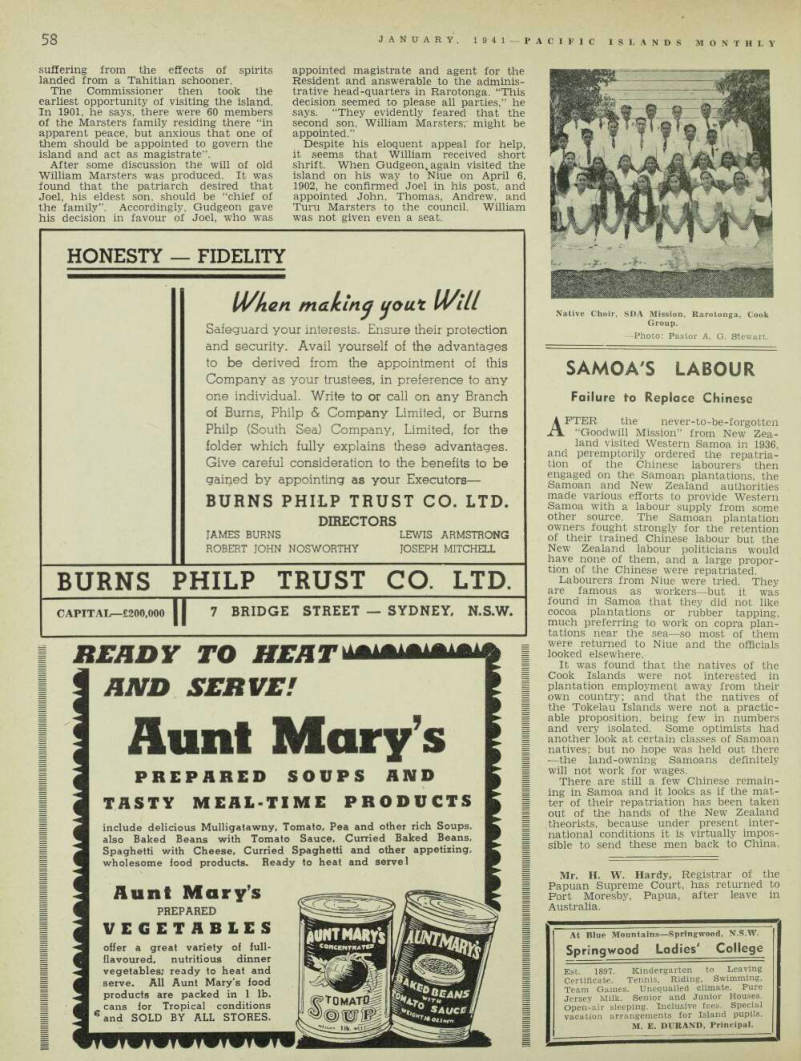
Palmerston Is.
Forgotten Incident of the Marsters Family
By Eric Ramsden
WHEN old William Marsters, the patriarch of Palmerston Island, died fn 1899, he left his family hope lessly divided.
Marsters, an Englishman, settled this island with the assistance of three native women. The latter are referred to as Tahitians. But, as the Marsters them selves say they came from Penrhyn, they should know. From 1862, the year that he arrived with his women, he set out to populate the previously uninhabited island.
Sara was regarded as his legitimate wife. Te Pou was her sister. The third member of the party was their cousin Matavei.
The story of this Englishman on his lonely island, one of the outposts of Poly nesia, is as remarkable as any in the Pacific. Some day it will be considered worthy of a book. The descendants of Marsters have always been wanderers: to-day they are found in many parts of the Pacific.
BUT when the old man died these English-speaking Euronesians did what many another family has done—they fought among themselves.
How the Palmerston islanders received their first Magistrate and Council is related in a forgotten despatch which Colonel W. E. Gudgeon, then British Commissioner at Rarotonga, prepared for the edification of the New Zealand Par liament in the early part of this century.
At that time, New Zealand’s adminis tration in the Cook Group was in the experimental stage. Considerable trouble was occasioned by French schooners dumping guns and liquor at certain islands.
“It will not be possible to prevent the demoralisation of the islands in the British Pacific so long as these Tahitian traders are allowed to visit any of our islands without entering at Rarotonga and clearing therefrom,” Colonel Gud geon informed Lord Ranfurly, then Gov ernor of New Zealand. “As things are at present, any schooner may land arms and spirits unchecked.”
The New Zealand Parliament acted on his advice and approved of the necessary legislation.
It so happened that when a German cruiser called at Rarotonga in August, 1901, John Marsters (a son of old Wil liam) was visiting that island. The Ger man commander, who had been at Palmerston Island earlier in the month, carried a letter (apparently to the Com missioner at Rarotonga) from John’s brother. William. For reasons which Wil liam explained, he did not want John to return.
THIS letter of William Marsters (which was an appeal to the Governor of Fiji for help) is of definite historic importance and is worthy of recording in detail. Authentic material relating to this family does not often come to light.
“I am living on this island, together with two brothers of my own, and four teen half-brothers of two other mothers,”
William wrote on August 17, 1901. “We three brothers are in a quarrel with the fourteen half-brothers. The latter want to take possession of the island and to send us three away, though we think ourselves the real and first owners from
my father, who took possession of the island. He died two years ago.
“About three months ago, there came a schooner and brought a lot of guns for these people. I told the skipper not to bring these guns ashore, as there was no need for guns at all on the island.
About one week later there arrived another schooner, who stayed here for one day to get copra.”
It appeared that half-brother John embarked on this vessel for Tahiti, the supposition being that he proposed to get more guns. At any rate, William thought he had no business there, and was not anxious for his return—unless he was of peaceful mind. Therefore, he urged the Governor to send help and, at the same time, settle the vexed question of the Marsters “heritage”.
COLONEL Gudgeon (Commissioner at Rarotonga) sent for John Marsters and warned him of the conse
quences of disturbing the peace at Palmerston Island. In the previous May, a missionary had found the people there
suffering from the effects of spirits landed from a Tahitian schooner.
The Commissioner then took the earliest opportunity of visiting the island.
In 1901, he says, there were 60 members of the Marsters family residing there “in apparent peace, but anxious that one of them should be appointed to govern the island and act as magistrate”.
After some discussion the will of old William Marsters was produced. It was found that the patriarch desired that Joel, his eldest son, should be “chief of the family”. Accordingly, Gudgeon gave his decision in favour of Joel, who was
appointed magistrate and agent for the Resident and answerable to the adminis trative head-quarters in Rarotonga. “This decision seemed to please all parties,” he says. “They evidently feared that the second son, William Marstersr might be appointed.”
Despite his eloquent appeal for help, it seems that William received short shrift. When Gudgeon, again visited the island on his way to Niue on April 6, 1902, he confirmed Joel in his post, and appointed John, Thomas, Andrew, and Turu Marsters to the council. William was not given even a seat.
Native Choir, SDA Mission, Rarotonga, Cook Group. —Photo: Pastor A. G. Stewart.
Advertisements & other items, pp. 59-60 (2 items)
57
raCl f I c Islands monthly —jantr a fi v, 1941
Foster Clark's
GRAMOPHONE
RECORDS
SEND US YOUR ORDERS
Goods sent C.O.D. at no extra charge.
Catalogues sent without obligation.
THE TALKERIES
161 Castlereagh Street,
SYDNEY
. I i *** *i
WlN*'-”.
MV \\
We had
FRUIT and
CREAMY CUSTARD
There are no complaints and no left-overs when you give the family Foster Clark’s rich, delicious, Creamy Custard. No other Custard can compare with Foster Clark’s for flavour —and its fine quality is famous all over the world.
It’s delicious and nourishing with any fruit —and it can be used in dozens of delightful dishes. You’ll find the recipes in Elizabeth Craig’s Recipe Book. Foster Clark’s Custard is very economical. Why not buy the penny packet —to try?
Write for your FREE copy of Elizabeth Craig's Recipe Book to Foster Clark (Aust.) Ltd., Dept. R. 8., Redfern, N.S.W. Enclose a penny stamp for postage.
Sold by all grocers—in 3 sizes and 4 fl^vo-'-s Rf ] V i 736 A
FOSTER CLARK'S
HONESTY FIDELITY
IVken making gout Wilt
Safeguard your interests. Ensure their protection and security. Avail yourself of the advantages to be derived from the appointment of this Company as your trustees, in preference to any one individual. Write to or call on any Branch of Burns, Philp & Company Limited, or Burns Philp (South Sea) Company, Limited, for the folder which fully explains these advantages.
Give careful consideration to the benefits to be gained by appointing as your Executors—
BURNS PHILP TRUST CO. LTD.
DIRECTORS
JAMES BURNS LEWIS ARMSTRONG
ROBERT JOHN NOSWORTHY JOSEPH MITCHELL
BURNS PHILP TRUST CO. LTD.
capital —£2oo,ooo 11 7 BRIDGE STREET SYDNEY, N.S.W.
READY TO HEAT
AND SERVE!
Aunt Mary’s
PREPARED SOUPS AND
TASTY MEAL-TIME PRODUCTS
include delicious Mulligatawny, Tomato, Pea and other rich Soups, also Baked Beans with Tomato Sauce, Curried Baked Beans, Spaghetti with Cheese, Curried Spaghetti and other appetizing, wholesome food products. Ready to heat and serve 1
Aunt Mary’s
PREPARED
VEGETABLES
offer a great variety of fullflavoured, nutritious dinner vegetables; ready to heat and serve. All Aunt Mary's food products are packed in 1 lb. cans for Tropical conditions
® and SOLD BY ALL STORES.
TOMATO#
Samoa's Labour
Failure to Replace Chinese
AFTER the never-to-be-forgotten
“Goodwill Mission” from New Zea land visited Western Samoa in 1936, and peremptorily ordered the repatria tion of the Chinese labourers then engaged on the Samoan plantations, the Samoan and New Zealand authorities made various efforts to provide Western Samoa with a labour supply from some other source. The Samoan plantation owners fought strongly for the retention of their trained Chinese labour but the New Zealand labour politicians would have none of them, and a large propor tion of the Chinese were repatriated.
Labourers from Niue were tried. They are famous as workers—but it was found in Samoa that they did not like cocoa plantations or rubber tapping, much preferring to work on copra plan tations near the sea—so most of them were returned to Niue and the officials looked elsewhere.
It was found that the natives of the Cook Islands were not interested in plantation employment away from their own country; and that the natives of the Tokelau Islands were not a practic able proposition, being few in numbers and very isolated. Some optimists had another look at certain classes of Samoan natives: but no hope was held out there —the land-owning Samoans definitely will not work for wages.
There are still a few Chinese remain ing in Samoa and it looks as if the mat ter of their repatriation has been taken out of the hands of the New Zealand theorists, because under present inter national conditions it is virtually impos sible to send these men back to China.
Mr. H. W. Hardy, Registrar of the Papuan Supreme Court, has returned to Port Moresby, Papua, after leave in Australia.
Advertisements & other items, p. 60 (1 item)
Springwood Lodies / College
At Blue Mountains—Springwood, N.S.W.
Est. 1897. Kindergarten to Leaving Certificate. Tennis, Riding, Swimming, Team Games. Unequalled climate. Pure Jersey Milk. Senior and Junior Houses.
Open-air sleeping. Inclusive fees. Special vacation arrangements for Island pupils.
M. E. DURAND, Principal.
Rationing
Fiji Under Petrol
PETROL rationing is now in operation in Fiji. The following is the scale for each class, in gallons:—
Mlotor Launches: 75 per cent, of normal re quirements for restricted class, to 85 per cent, for semi-essential class.
Restricted;— Essential:— Horse Monthly Horse Monthly Power Ration Power Ration 1 — 7 8 1—8 14 8—9 10 9 — 15 20 10 — 12 12 16 — 19 26 13 — 15 14 20 — 29 32 16 — 19 16 30 and over 36 20 and over 18 Semi-essential:- Horse Monthly Power Ration 1—9 12 10 — 12 14 13 — 15 16 16 — 19 18 20 and over 22
Pacific Cyclone
TWO villages were destroyed in a series of violent storms over Pen rhyn Island, the Cook group, on New Year’s Eve. When one-third of the houses in one village, and two-thirds in another, were destroyed, inhabitants fled inland. Coconut plantations were razed, but there was no loss of life.
Suwarrow, another island in the group, also survived a destructive cyclone.
Mr. and Mrs. Burton returned to New Zealand in December after having com pleted his term of service as Postmaster at Rarotonga, Cook Islands.
Polynesian Soldiers
A LARGE party of Maori soldiers from New Zealand, on their way to the front, were entertained in Sydney some time ago by the Polynesian Club.
They came from most of the N.Z. tribes, and there were emotional scenes on their first visit as they recognised members of their own “hapu” among club members.
The “hongi” (the nose rub of old Polynesia) was seen everywhere. In fact, the scene resembled a Maori tangi for a while, rather than a social gathering.
However, with their natural ebullience, the soldiers soon proved themselves ex cellent entertainers in guitar playing, singing, and dancing.
The Club chieftainess (Mrs. Waikainga Tipene) and her cousin, Mrs. Nehua Barley, discovered that they were related to half the men in the room, the Ngapuhi element predominating at that particular gathering. Among the younger men was Private Paikea, whose father is a member of the N.Z. Parliament.
It did not take the Samoan-speaking members long to find out that there were two Samoans among the New Zealanders —Arthur Leger, from Pago Pago and Tonga, and Dick Jessup, from Apia.
At each gathering, as well as the last one, soldiers and members united in singing the sad Maori farewell “haere ra” (or “Po atarau” as some call it) the Maori tune which has captivated the ear of the world.
Rev. D. F. Boorman, 8.A., who for the past four years has been a worker for the Methodist Mission in the Lau Group, Fiji, is expected to return to Australia shortly.
Costly Australian Wine
A BOTTLE of Australian wine, which costs 2/6 in Sydney, is sold for 7/in New Guinea—which surely is an outrageous charge, and gives justifica tion to the argument of a correspondent of the Rabaul “Times”, who says that under existing conditions every encour agement should be given to people in the Pacific territories to drink Australian wines. War conditions throughout the world have cut off the greater part of Australian wine producers’ overseas mar kets, and they surely are entitled to the profitable, if smaller and less noticeable, markets near home.
Mr. N. Osborn, a geologist with Aus tralasian Petroleum Co., Port Moresby, Papua, arrived in Australia by ’plane re cently on a short holiday.
The American yacht “Yankee”, on a world cruise under the command of Captain Irving Johnson, has reached the Dutch East Indies. The “Yankee” was in Port Moresby in July. Captain Johnson was accompanied by his wife and two children, and 12 American passengers, who were “sailing before the mast”.
Advertisements & other items, pp. 61-62 (1 item)
Ask fi
The House of Steel for Quality Cutlery n a We have a large range of Scissors, Knives, Razors, etc.
W. JNO. BAKER E™;
3 HUNTER STREET, SYDNEY.
Established 1888.
V
Ask fi
* or
LINGERIE
> % f
Youll
its extra
quality
tm* I
FROM ALL AUSTRALIAN DEPT. STORES
And in the Pacific from Burns Philp & Co. Ltd.
COMPRESSOR Plants
for MINING
Small one or two hammer plants, with Diesel, Kero, or Charcoal drive. 2 Stage high pressure Compressors for Diesel engine starting.
Spray Plants, etc.
Write for our price lists.
AGENTS WANTED.
Compressor & Air Equipment
Mfg. Co.
248 Elizabeth Street, Sydney.
Highest Prices Paid For
GOLD
Garrett & Davidson’s organisation is acknowledged far and wide as the main clearing house for precious metals in the Southern Hemisphere.
They have earned a reputation for accuracy and integrity in all their business dealings, which is proved by the fact that they are privileged to handle more gold from the Islands of the Pacific than any other organisation.
Therefore for your complete and lasting satisfaction, you are advised to transact all your precious metals business through the house of Garrett & Davidson.
GARRETT & DAVIDSON PTY. LTD.
ASSAYERS METALLURGISTS REFINERS
Bank of N.S.W. Buildings,
REGENT AND GEORGE STS., SYDNEY.
IT ATTRACTS —THEY EAT IT —THEY DIE
IUSOLINE
ys
OVINQ
NEVER
KNOWN
TO FAIL!
COCKROACH
DESTROYER
IT'S A PASTE !
AUSOLI N E CO.,
314 CROWN STREET, SYDNEY
(Established 1919)
PRICES:
lib. 5/- . . . Bibs. 10/-.
Postage Extra.
Remit Cash with Order, Obtainable also from Islands stores of:
BURNS, PHTLP & Co. Ltd.
W. R. CARPENTER & Co. Ltd.
From Fiji
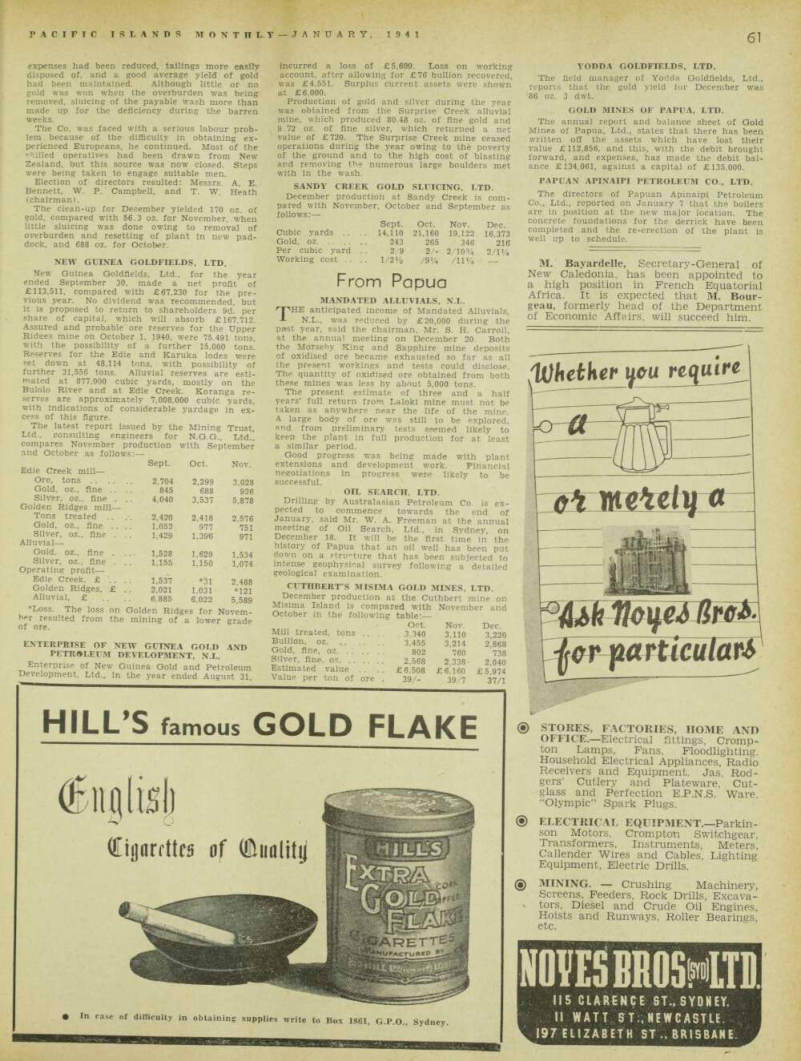
Mining News
Emperor Mines, Ltd.
THE annual meeting of Emperor Mines, Ltd., was held in Melbourne on December 23.
The chairman (Mr. W. H. Smith) said it was expected that dividends would be resumed at an early date. Normally a dividend would have been declared in November, but capital expen diture on expansion had temporarily reduced funds available for distribution. This develop ment has been successful and ore reserves are satisfactory, positive ore being sufficient to keep the mill employed for five years at present rate of production. Mining by the open cut method provides mill requirements and can be con tinued for a further three to four years to provide the major portion of mill feed.
The treatment of semi-oxidised and sulphide ore, commenced at the Emperor Mill in May, 1939', was satisfactory: and concentrate treat ment was particularly successful.
There are about 850 Fijians working on the Emperor Mine.
A profit of £206,899 Fijian (£A232,761) for the year ended June 30 was struck after pro viding £31,007 for depreciation, £52,852 for development, £4,230 for amortisation and
£19,036 for income tax. Dividends absorbed £190,000, and since the end of the year a further payment of 6d. a share absorbed £47,500.
December production is compared with the three previous periods in the following table:—
♦lncluding gold from concentrates. tAll oxidised ore from the low grade section of the open cut was treated during period.
Loloma (Fiji) Gold Mines, N.L.
Loloma (Fiji) Gold Mines, N.L., earned a net profit of £289,382 for the year ended June 30. Dividends absorbed £247,500, and two additional payments of 1/- a share have been made.
During the year, 33,342 tons were treated for 48,006 oz, of gold. Costs were slightly reduced.
Between 400 and 500 Fijians are working at the mines.
At the annual meeting in Melbourne on December 23, Mr. P. F. Cody (chairman) said that any lingering doubts as to the poten tialities of the Tavua goldfield as an important producer should now have been dissipated and shareholders can reasonably look forward to many years of successful production from the field.
December production is compared with the three previous months as follbws:—
*ln addition, 1,002 oz. was recovered from the annual clean-up of concentrates, slags, and amalgam. The total recovery was 4,212 oz.
Mount Kasi Mines, Ltd.
January production at the Mount Kasi mine, Vanua Levu, is compared with the three pre vious periods as follows: —
From New Guinea
Bulolo Gold Dredging, Ltd.
Bulolo Gold Dredging, Ltd., For The
year ended May 31, 1940, made a net profit of 4,806,408 Canadian dollars (£ A 1,373,259) compared with 3,874,085 dollars (£A1,106,881) for the previous year. Production from the Co.’s eight dredges was a record and compares with 1938 and 1939 as follows:
Grs. fine gold per yard* .. .. 5,793 5,221 4,862 *lncludes silver values converted into gold.
The new 2,800 h.p. hydro-electric plant ®n the Upper Baiune has been completed, and should ensure a constant supply of power, even in abnormally dry seasons. Approximately 4,342 tons of machinery and supplies were air-trans ported to the property from Lae, thus making 34,020 short tons carried by the Co.’s aeroplanes to May 31, 1940.
Working costs, excluding amortisation and gold tax, were 8.2 S cents per yard, or 12.59 cents, including the Government royalty and gold tax, compared with 9.84 cents and 11.72 respectively in the previous year.
November yield compares with September and October as follows: —
Estimated working profit for November, 6,538 oz. of fine gold.
Sunshine Gold Development, Ltd.
Mr. F. W. Torrington (chairman) told share holders at the annual meeting of Sunshine Gold Development, Ltd., on December 19, that a sluicing plant put into operation at the mine was producing satisfactory results. Working:
Four weeks ended Oct. Oct. Nov. tDec. 2. 30. 27. 23.
One treated, tons .. 9,899 11,279 13,000 14.155 Gold, oz., fine . . . 3,026 4,029 *5,062 *4,823 Head value, dwt. . 10.75 7.6 6.97 5.86 Residues, dwt 1.1 0.67 0.51 0.4
Four weeks ended Oct. Oct. Nov. Dec. 2. 30. 27. 23.
Tons treated .. .. 2,628 2,612 2,585 2,423 Gold, fine, oz. .. 3,419 3,450 3,387 *3,210 Head value, dwt. . 27.4 27.22 27.20 27.64 Residue, dwt 1.38 0.81 1.00 1.14
• Four weeks ended ♦Oct. fNov.
Dec.
Jan. 6. 4. 1.
Ore, tons .. . 4,040 3,104 3,881 3,972 Gold, fine oz. . 853 615 733 706 Value, £A .. . 8,530 6,150 7,330 7,069 ♦Five weeks. tShut down four days for overhaul.
Year ended May 31, 1938. 1939. 1940.
Bullion, oz. . . 194,956 228,602 268,108 Gold, fine oz. . 134,715 158,970 185,016 Silver, oz. .. . 58,891 67,939 81,567 Cubic yards . . . 11,222,000 14,688,000 18,353,000
Sept.
Oct.
Nov.
Cubic yards .. . . 1,790,000 1,765,000 1,677,000 Bullion, oz. .. . 22,574 23,731 19,286 Gold, fine oz. . 15,575 16,374 13,308
expenses had been reduced, tailings more easily disposed of, and a good average yield of gold had been maintained. Although little or no gold was won when the overburden was being removed, sluicing of the payable wash more than made up for the deficiency during the barren weeks.
The Co. was faced with a serious labour prob lem because of the difficulty in obtaining ex perienced Europeans, he continued. Most of the ••killed operatives had been drawn from New Zealand, but this source was now closed. Steps were being taken to engage suitable men.
Election of directors resulted: Messrs. A. E.
Bennett, W. P. Campbell, and T. W. Heath (chairman).
The clean-up for December yielded 170 oz. of gold, compared with 56.3 oz. for November, when little sluicing was done owing to removal of overburden and resetting of plant in new pad dock, and 688 oz. for October.
New Guinea Goldfields, Ltd.
New Guinea Goldfields, Ltd., for the year ended September 30, made a net profit of £113,511, compared with £67,230 for the pre vious year. No dividend was recommended, but it is proposed to return to shareholders 9d. per share of capital, which will absorb £167.712.
Assured and probable ore reserves for the Upper Ridges mine on October 1, 1940, were 75,491 tons, with the possibility of a further 15,000 tons!
Reserves for the Edie and Karuka lodes were set down at 48,114 tons, with possibility of further 31,556 tons. Alluvial reserves are esti mated at 877.000 cubic yards, mostly on the Bulolo River and at Edie Creek. Koranga re serves are approximately 7,008,000 cubic yards, with indications of considerable yardage in ex cess of this figure.
The latest report issued by the Mining Trust, Ltd., consulting engineers for N.G.G., Ltd., compares November production with September and October as follows:
•Loss. The loss on Golden Ridges for Novem ber resulted from the mining of a lower grade of ore.
Enterprise Of New Guinea Gold And
Petroleum Development, N.L.
Enterprise of New Guinea Gold and Petroleum Development, Ltd., in the year ended August 31,
incurred a loss of £5,609. Loss on working account, after allowing for £76 bullion recovered, was £4,551. Surplus current assets were shown at £6,000.
Production of gold and silver during the year was obtained from the Surprise Creek alluvial mine, which produced 80.48 oz. of fine gold and 9.72 oz. of fine silver, which returned a net value of £720. The Surprise Creek mine ceased operations during the year owing to the poverty of the ground and to the high cost of blasting and removing the numerous large boulders met with in the wash.
Sandy Creek Gold Sluicing, Ltd.
December production at Sandy Creek is com pared with November, October and September as follows: —
From Papua
Mandated Alluvials, N.L.
r ''HE anticipated income of Mandated Alluvials, A N.L., was reduced by £20,000 during the past year, said the chairman, Mr. S. H. Carroll, at the annual meeting on December 20. Both the Morseby King and Sapphire mine deposits of oxidised ore became exhausted so far as all the present workings and tests could disclose.
The quantity of oxidised ore obtained from both these mines was less by about 5,000 tons.
The present estimate of three and a half years’ full return from Lalokl mine must not be taken as anywhere near the life of the mine.
A large body of ore was still to be explored, and from preliminary tests seemed likely to keen the plant in full production for at least a similar period.
Good progress was being made with plant extensions and development work. Financial negotiations in progress were likely to be successful.
Oil Search, Ltd.
Drilling by Australasian Petroleum Co. is ex pected to commence towards the end of January, said Mr. W. A. Freeman at the annual meeting of Oil Search, Ltd., in Sydney, on December 18. It will be the first time in the history of Papua that an oil well has been put down on a structure that has been subjected to intense geophysical survey following a detailed geological examination.
Cuthbert’S Misima Gold Mines, Ltd.
December production at the Cuthbert mine on Misima Island is compared with November and October in the following table;—
Yodda Goldfields, Ltd.
The field manager of Yodda Goldfields, Ltd., reports that the gold yield tor December was 'B6 oz. 3 dwt.
Gold Mines Of Papua, Ltd.
The annual report and balance sheet of Gold Mines of Papua, Ltd., states that there has been written off the assets which have lost their value £112,856, and this, with the debit brought forward, and expenses, has made the debit bal ance £134,061, against a capital of £135,000.
Papuan Apinaipi Petroleum Co., Ltd.
The directors of Papuan Apinaipi Petroleum Co., Ltd., reported on January 7 that the boilers are in position at the new major location. The concrete foundations for the derrick have been completed and the re-erection of the plant is well up to schedule.
M. Bayardelle, Secretary-General of
New Caledonia, has been appointed to
a high position in French Equatorial
Africa. It is expected that M. Bour geau, formerly head of the Department of Economic Affairs, will succeed him.
Sept.
Oct.
Nov.
Edie Creek mill— Ore, tons 2,704 2,299 3,028 Gold, oz. ( fine .. 845 688 926 Silver, oz.. fine . . .
Golden Ridges mill— 4,040 3.537 5,878 Tons treated .. 2.420 2.418 2,576 Gold, oz., fine .. 1,052 977 751 Silver, oz., fine . . . 1,429 1.396 971 Alluvial— Gold, oz., fine . .. 1,528 1,629 1.534 Silver, oz.. fine . .. 1,155 1.150 1.074 Operating profit— Edie Creek. £ .. 1.537 •31 2.488 Golden Ridges, £ .. 2.021 1,031 *121 Alluvial, £ 6,885 6.022 5,589
Sept. Oct. Nov. Dec.
Cubic yards .. .. 14,110 21,160 19,122 16,373 Gold, oz 243 265 346 216 Per cubic yard .. 2/9 2/- 2/10% 2/1 V 4 Working cost .. .. 1/2V 2 /9% /liy 4 —
Oct. Nov. Dec.
Mill treated, tons .. . 3.340 3.110 3 220 Bullion, oz 3.455 3.214 2 868 Gold, fine, oz 802 760 738 Silver, fine, oz 2.568 2.338 2 040 Estimated value .. .. £6.508 £6.160 £5,974 Value per ton of ore . 39/- 39/7 37/1
Advertisements & other items, pp. 63-64 (1 item)
for particulars
'Whether ipu require
oil
A'twe’ielytt
fAWIToyei SreS-
for particulars
(•) STORES, FACTORIES, HOME AND
OFFlCE.—Electrical fittings, Crompton Lamps, Fans. Floodlighting.
Household Electrical Appliances, Radio Receivers and Equipment. Jas. Rodgers’ Cutlery and Plateware, Cutglass and Perfection E.P.N.S. Ware “Olympic” Spark Plugs.
(•) ELECTRICAL EQUIPMENT.—Parkin-
son Motors, Crompton Switchgear, Transformers, Instruments, Meters, Callender Wires and Cables, Lighting Equipment, Electric Drills. (5) MINING. Crushing Machinery, Screens, Feeders, Rock Drills, Excava- - tors, Diesel and Crude Oil Engines, Hoists and Runways, Roller Bearings, etc.
HILL’S famous GOLD FLAKE
€i]|nrdlra of
CO** fFO
rett£
actuMß In case of difficulty in obtaining supplies write to Box 1861, G.P.0., Sydney.
P.M.G. Model Adjustable Morse Code $ Key. Heavy Precision Fittings on I solid Wooden Base. 19/6. <■ Morse Buzzer and Light Set, as illustrated, 25/-. I// /, Morse Code Light and Buzzer Set.
A precision De-luxe outfit that cannot be bettered. Perfect Adjustable Morse Code Key, with professional type Buzzer. Light to Buzzer throw-over Switch, and Battery, all ready mounted, for im mediate use, on strong solid wooden Base Board, 39/6 the outfit. 63 From London. “Cosmocord” De Luxe Crystal Pick-up, with Built-in Vol.
Control, 58/6. Magnetic type Pickups, complete with volume control and tone arm. British Make, 30/-. 35/-, 38/6, 45/-. Studio Model, 50/-.
SWOOP! BRITAIN’S BEST.
“Amplion,” Bakelite PICK-UP, with Volume Control unequalled. Brand new, in original cartons. Listed to sell at 37/6. Now 32/6. Fits and suits all sets.
Play, Talk, Sing, Joke through your Radio, Great Fun, Batteryless type.
Microphone for Hand Holding or Hanging, 2276. Complete with Flex fixed in a second. Others, 13/8, 15/-, 17/6, 25/-. 28/6, 32/6. All plus 2/for Battery and 1/6 for 20 ft. Cord. m B.G.E. Table Type Microphone. Highly recommended for Amateur or Professional use. Built-in Transformer and Battery with Volume Control incorporated.
Jnst ping into pickup terminals sf any set. 39/6. New Bullet Model, also 39/6.
DE GAULLE
FREE FRENCH FLAG
The Cross of Lorraine, Tie or Coat Pin for gents, Brooches for ladies, enamelled on metal. 2/- each. 18/- per dozen.
POLICE PATROL MULTI STRAND
RUBBER COVERED AERIAL.
Needs No Separate Lead-in. 50 ft., 2/6; 100 ft., 5/-.
MAN-O-WAR HEAVY DUTY
INSULATED AERIAL, MULTI
STRAND WIRES.
50 ft.. 5/-; 100 ft. 10/-.
“PRESTO”
THE
MAGIC
BOX
The most Amazing Trick— Jjist out.
“Presto”. —The greatest, most alluring and outstanding little trick ever Introduced, 2/9. Post Free.
Money back If It’s not the best yet Electric 240 volt G r a m o p h one Motors, complete 50/-. Hlghestgrade Gramophone Needles, long lasting, 3/6, 4/6, 5/6 box.
RADIO ACCUMULATORS.
2 Volt. 110 Amp 17/- 2 „ 150 *O/- 4 65 20/6 4 .. 90 22/6 6 90 86/1 6 „ 110 45/6 6 „ 130 66/- 6 „ 150 78/B 6 170 84/6
HEADPHONES.
9/6, 12/6, 17/6.
S.T.C., British, 30/-; 8.T.H., 30/-; Lissen, British, 19/6. All 4,000 ohms.
M Ericcson’s Professional Type. 39/6.
WORLD'S LATEST
GAMES
Dart Boards, with 6 Darts Play Brass Competition Darts, Set of 3, S/11, 4/6, 5/6L Monopoly, 10/6.
Totopoly, 10/6. Bucaneer, 10/6. 3 of the World’s Most Popular Games.
Chinese Checkers, 2/6, 4/6, 8/6.
Trlpoly Card Game, 5/-. De Luxe Type, 10/6. Poker Rummy, 1/-.
Pot Luck, 1/-. Playing Card Lotto, 1/-. We Stock All Kinds of Indoor Games. Send for Booklet.
Spinning - Wheel Race Garnet Shows Horses and Odds. Spin wheel for result. 8 in. diameter. 21/- and 42/-. With Betting Sheet.
Write for full lists of Games for Hotels, Clubs, Carnivals, Bazaars, etc.
HIGHEST GRADE MODEL PLANE
KIT, 15/-, 18/6, and 21/-. Cheaper makes, 2/6, 3/6, 4/6, 5/6, and 6/B.
LEARN MORSE CODE. “LIKE-A-
/LASH” KITS, KEYS & BUZZERS.
P.M.G. type Key with Professional Buzzer & Battery, all assembled on Base Board, 42/6.
BOOKS! BOOKS! BOOKS! The Be-
ginners’ Book of Radio. The Radio Beginners* Dictionary. 2/- the 2. The Wireless Constructor’s Enoyclepaedia. Giant size, 7/6. Newnes “Everyman’s” Wireless Book, 6/6.
The Book of Practical Radio, also The Book of Practical Television, 8/6 each. Foulsham’s Giant “Party and Fun Book”, 1/6. Humorous Stories and Recitations, 8/9. Card and Conjuring Tricks, 3/9. Tea- Cup Fortune Telling, 3/9. 100 Party Games for Old and Young, 1/9.
Popular Magic and Amateur Conjurer, 1/9. 50 Best Party Games, 1/6. Tricks with Cards. 1/6.
The World's Latest Match Box, 2/-. Bakelite, indestructa b 1 e. One match always ready by tipping of the opening and closing ends Gaulle Flag attached, or U.S.A., Norway, British, Australian,
A.1.F.. R.A.A.F., R.A.N., Dutch,
Flag Medallion attached, 3/6.
With I >• Remington, U.S.A. made, Hunting and Sporting Knives In Sheath, 10/6. A Beautiful Article.
Throwing Knives, in Sheath, 7/6.
METERS.—Pocket Volt Meters. 2 Reading for A. & B. Batteries, 8/6. 10/6.
WATES. —4 in 1 Meter: 0 to 6, 0 to 15. 0 to 180 volts; 0 to 30 M/A, 14/-.
TELSEN.—Millimeter A.C., D.C British. Reads everything in Radio.
Bench type, 22/6.
Emicol Universal D.C. Meters, Bench type, reads 0 to 6, 0 to 150 volts, 0 to 30 amps, 0 to 2,000 ohms, 30/-.
Nickelled Pocket Meter: 0 to 25 volts, 0 to 5 amperes: 35/- value; now 15/-.
Repeating Toy Re v o 1 v e r s.
Just like the real thing. 4/11, 5/6, 7/6, 8/6.
P.M.G. Type Morse Code Sounders, 35/-.
TYPE
SOUNDER
M-flh pitched Tone D« laic I ftnwonol Buner. The bea W/- Felt Pennants, A.1.P.,
R.A.A.F.,
R.A.N.,
3/6 each.
Adjustable Buzzers, as illustrated, 4/9. Others, 4/11, 5/6 and 15/-.
I'vv Morse Set Buzzer or light with single switch. All parts include adjustable Key, Switch, Buzzer, Lamp and Battery, all assembled on Base Board, 30/-.
Morse Code Set “De Luxe”. Adjustable High-grade Key, Buzzer and Battery. All mounted on base board ready for use, 27/6. \\l// Adjustable Morse Code Key on Bakelite Base, highly plated parts, 12/6. Higher grade instrument.
De Luxe Junior Morse Code Outfit.
Mounted Key Buzzer and Battery. 13/6 complete.
De Luxe Junior Morse Code Set.
Buzzer Key Light, Throw-over Switch. All 'mounted with Battery. 16/6.
Now available (not less than 10/parcels): Magic Wand, 1/6 Jafet’s Wallet, 1/-; Obedient Ball. 1/6; Rattle Box; Mystic Head Chopper, 2/6; Shy Lock, 2/-; Dribble Glass, 2/-; Ventrillo. 1/-; Magic Coin, 1/-; Nest of Nests, 5/-; Voice Echoer, 1/-; Magic Bottle, 1/-; 3 Bell Trick, 1/-. 2 Knife Trick. 6/6. Giant Dice Trick, 1/6. Wonderful Rattle Box Trick, 2/6. Mixed Parcels of Tricks, 10/-. 20/-, 30/-, 40/-, 50/-.
J. LEVENSON Radio “' l,n
Write for Pin-Game, Punch GAMES, NOVELTIES AN© HOBBIES. Totem and 226 A PITT STREET, SYDNEY g dd n s ,* nd Manufacturers, Importers, and Exporters. Leaflets niminnnninniii n.s.w.. Australia. iiiiifnniiifTmmmr Cable address: “Leveradloh”. Goods forwarded V.P.P. or Sight Draft. Satisfaction and Service Guaranteed. We can supply by mall all General Merchandise at a Better Price. Quotations with pleasure. Please add freight and packing. Write for full list of interesting leaflets of Games, Hobbies, Novelties, and Electrical Goods. Write for full list of Radio Meters.
We Can Supply, at a Keen Price, Any Available Article You Require.
Australian Short Wave
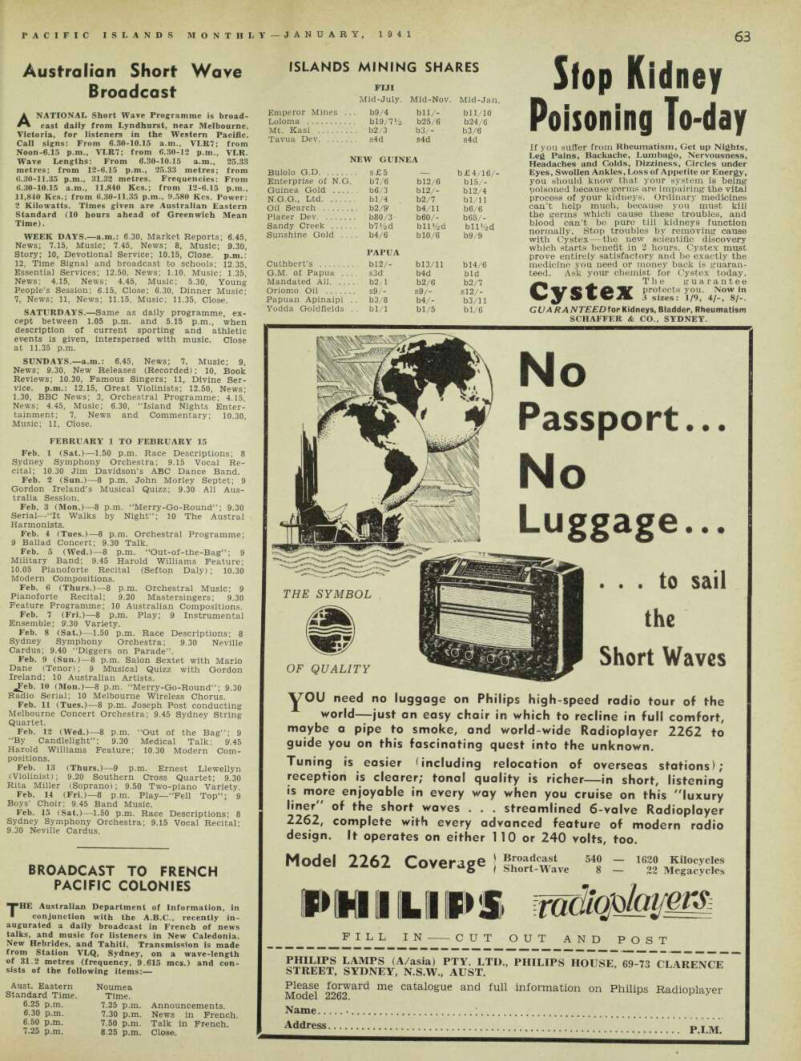
Broadcast
A NATIONAL Short Wave Programme is broad cast daily from Lyndhurst, near Melbourne, Victoria, for listeners in the Western Pacific.
Call signs: From 6.30-10.15 a.m., VLR7; from Noon-6.15 p.m., VLR7; from 6.30-12 p.m., VLR.
Wave Lengths: From 6.30-10.15 a.m., 25.33 metres; from 12-6.15 p.m., 25.33 metres; from 6.30-11.35 p.m., 31.32 metres. Frequencies: From 6.30-10.15 a.m., 11,840 Kcs.; from 12-6.15 p.m., 11,840 Kcs.; from 6.30-11.35 p.m., 9.580 Kcs. Power: 2 Kilowatts. Times given are Australian Eastern Standard (10 hours ahead of Greenwich Mean Time).
WEEK DAYS.—a.m,: 6.30, Market Reports; 6.45, News; 7.15, Music; 7.45, News; 8, Music; 9.30, Story; 10, Devotional Service; 10.15, Close, p.m.: 12, Time Signal and broadcast to schools; 12.35, Essential Services: 12.50, News; 1.10, Music; 1.35, News; 4.15, News; 4.45, Music; 5.30, Young People’s Session; 6.15, Close; 6.30, Dinner Music; 7, News; 11, News; 11.15, Music; 11.35, Close.
SATURDAYS.—Same as daily programme, ex cept between 1.05 p.m. and 5.15 p.m., when description of current sporting and athletic events is given, Interspersed with music. Close at 11.35 p.m.
SUNDAYS.—a.m.: 6.45, News; 7, Music; 9.
News; 9.30, New Releases (Recorded): 10, Book Reviews; 10.30, Famous Singers; 11, Divine Ser vice. p.m.: 12.15, Great Violinists; 12.50, News; 1.30, BBC News; 3, Orchestral Programme; 4.15, News; 4.45, Music; 6.30, “Island Nights Enter tainment; 7, News and Commentary; 10.30, Music; 11, Close.
February 1 To February 15
Feb. 1 (Sat.) —1.50 p.m. Race Descriptions: 8 Sydney Symphony Orchestra; 9.15 Vocal Re cital; 10.30 Jim Davidson’s ABC Dance Band.
Feb. 2 (Sun.) —8 p.m. John Morley Septet; 9 Gordon Ireland’s Musical Quizz; 9.30 All Aus tralia Session.
Feb. 3 (Mon.) —8 p.m. “Merry-Go-Round”; 9.30 Serial—“lt Walks by Night”; 10 The Austral Harmonists.
Feb. 4 (Tues.) —8 p.m. Orchestral Programme; 9 Ballad Concert; 9.30 Talk.
Feb. 5 (Wed.) —8 p.m. “Out-of-the-Bag”; 9 Military Band; 9.45 Harold Williams Feature; 10.05 Pianoforte Recital (Sefton Daly); 10.30 Modern Compositions, Feb. 6 (Thurs.) —8 p.m. Orchestral Music; 9 Pianoforte Recital; 9.20 Mastersingers; 9.30 Feature Programme; 10 Australian Compositions.
Feb. 7 (Fri.) —8 p.m. Play; 9 Instrumental Ensemble: 9'.30 Variety.
Feb. 8 (Sat.) —1.50 p.m. Race Descriptions; 8 Sydney Symphony Orchestra; 9.30 Neville Cardus; 9.40 “Diggers on Parade”.
Feb, 9 (Sun.) —8 p.m. Salon Sextet with Mario Dane (Tenor); 9 Mjusical Quizz with Gordon Ireland: 10 Australian Artists. lO (Mon.) —8 p.m. “Merry-Go-Round”; 9.30 Radio Serial; 10 Melbourne Wireless Chorus.
Feb. 11 (Tues.) —8 p.m. Joseph Post conducting Melbourne Concert Orchestra; 9.45 Sydney String Quartet.
Feb. 12 (Wed,)—B p.m. “Out of the Bag”; 9 “By Candlelight”: 9.30 Medical Talk; 9’.45 Harold Williams Feature; 10.30 Modern Com positions.
Feb. 13 (Thurs.) —9 p.m. Ernest Llewellyn (Violinist); 9.20 Southern Cross Quartet; 9.30 Rita Miller (Soprano); 9.50 Two-piano Variety.
Feb. 14 (Fri.) —8 p.m. Play—“ Fell Top”; 9 Boys’ Choir; 9.45 Band Music.
Feb. 15 (Sat.) —1.50 p.m. Race Descriptions; 8 Sydney Symphony Orchestra; 9.15 Vocal Recital; 9.30 Neville Cardus.
Pacific Colonies
Broadcast To French
THE Australian Department of Information, in ■ conjunction with the A.8.C., recently in augurated a daily broadcast in French of news talks, and music for listeners in New Caledonia, New Hebrides, and Tahiti. Transmission is made from Station VLQ, Sydney, on a wave-length of 31.2 metres (frequency, 9.615 mcs.) and con sists of the following items:—
Aust. Eastern Noumea Standard Time. Time. 6.25 p.m. 7.25 p.m. Announcements. 6.30 p.m. 7.30 p.m. News in French. 6.50 p.m. 7.50 p.m. Talk in French. 7.25 p.m. 8.25 p.m. Close,
Islands Mining Shares
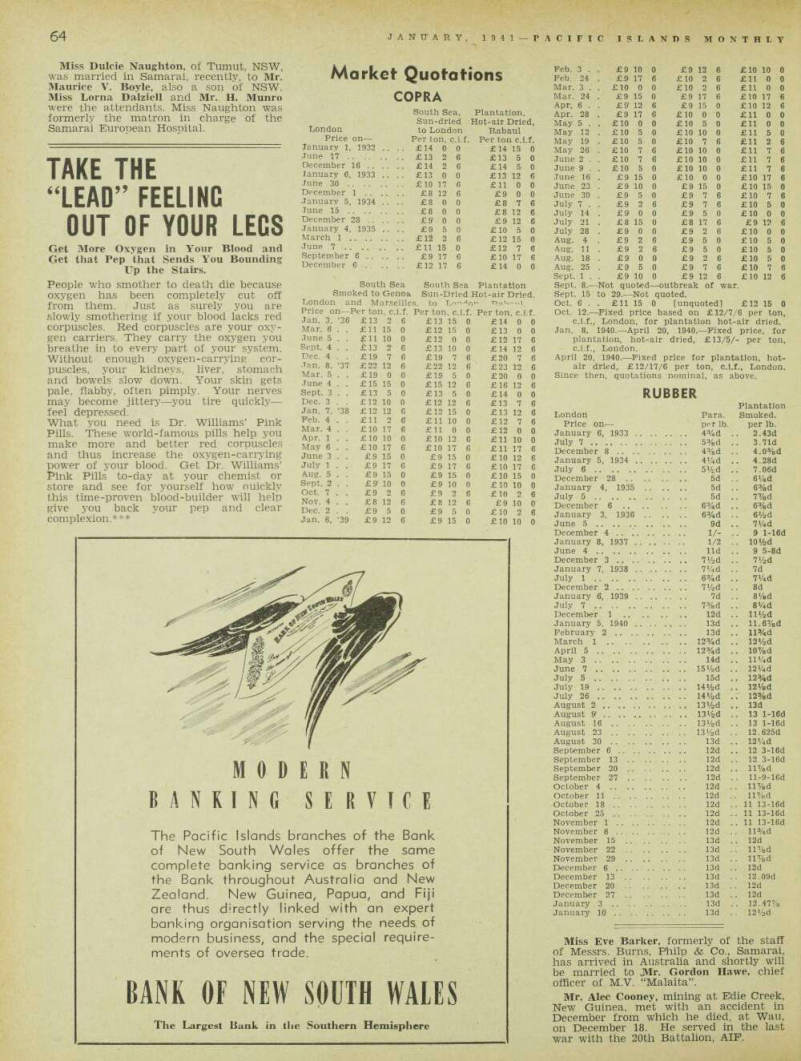
Fiji
Mid-July.
Mid-Nov.
Mid-Jan.
Emperor Mines . b9/4 bll/bll/10 Loloma bl9/7‘/2 b25/6 b24/6 Mt. Kasi .. b2/3 b3/b3/6 Tavua Dev s4d s4d s4d Bulolo G.D
New Guinea
s£5 — b£4/16/- Enterprise of N.G b7/6 b!2/6 b!5/- Guinea Gold . .. . ,. b6/3 b!2/b!2/4 N.G.G., Ltd bl/4 b2/7 bl/11 Oil Search .. b2/& b4/ll b6/6 Placer Dev b80/3 b60/b65/- Sandy Creek ... b7V 2 d bllVid bllVzd Sunshine Gold . . .. b4/6 blO/6 b9/9 Cuthbert’s
Papua
. b!2/b!3/ll b!4/6 G.M. of Papua . . . . s3d b4d bid Mandated All. . .. b2/1 b2/6 b2/7 Oriomo Oil s9/s9/s!2/- Papuan Apinaipi .. b3/8 b4/b3/ll Yodda Goldfields .. bl/1 bl/5 bl/6
Miss Dulcie Naughton, of Tumut, NSW, was married in Samarai, recently, to Mr.
Maurice V. Boyle, also a son of NSW.
Miss Lorna Dalziell and Mr. H, Munro were the attendants. Miss Naughton was formerly the matron in charge of the Samarai European Hospital.
Advertisements & other items, pp. 65-66 (1 item)
Slop Kidney
Poisoning To-day
If you suffer from Rheumatism, Get up Nights, Leg Pains, Backache, Lumbago, Nervousness, Headaches and Colds, Dizziness, Circles under Eyes, Swollen Ankles, Loss of Appetite or Energy, you should know that your system is being poisoned because germs are impairing the vital process of your kidneys. Ordinary medicines can’t help much, because you must kill the germs which cause these troubles, and blood can’t be pure till kidneys function normally. Stop troubles by removing cause with Cystex— the new scientific discovery which starts benefit in 2 hours. Cystex must prove entirely satisfactory and be exactly the medicine you need or money back is guaranteed. Ask your chemist for Cystex today. - The guarantee C VCS ■ A protects you. Now in jf 9 3 sizes: 1/9, 4/-, 8/-.
GUARANTEED for Kidneys, Bladder, Rheumatism
SCHAFFER & CO.. SYDNEY.
No 4t x
Passport...
No
Luggage...
f • •
THE SYMBOL
Wt
OF QUALITY
to sail
the
Short Waves
need no luggage on Philips high-speed radio tour of the world—just an easy chair in which to recline in full comfort, maybe a pipe to smoke, and world-wide Radiopiayer 2262 to guide you on this fascinating quest into the unknown.
Tuning is easier (including relocation of overseas stations); reception is clearer; tonal quality is richer—in short, listening ■ s more enjoyable in every way when you cruise on this "luxury liner of the short waves . . . streamlined 6-valve Radiopiayer 2262, complete with every advanced feature of modern radio design. It operates on either 110 or 240 volts, too.
Model 2262 Coverage j
phi li ips
FILL IN CUT OUT AND POST
I?reet, c'^nce'
P le 3 s ® forward me catalogue and full information on Philips Radiopiayer
JVLOQ0I ZZoZ.
Name 540 — 1620 Kilocycles 8 — 22 Megacycles Address
P.I.M.
TAKE THE
“LEAD” FEELING
OUT OF YOUR LEGS
Get More Oxygen in Your Blood and Get that Pep that Sends You Bounding Up the Stairs.
People who smother to death die because oxygen has been completely cut off from them. Just as surely you are slowly smothering if your blood lacks red corpuscles. Red corpuscles are your oxygen carriers. They carry the oxygen you breathe in to every part of your system.
Without enough oxygen-carrying corpuscles, your kidneys, liver, stomach and bowels slow down. Your skin gets pale, flabby, often pimply. Your nerves may become jittery—you tire quickly— feel depressed.
What you need is Dr. Williams’ Pink Pills. These world-famous pills help you make more and better red corpuscles and thus increase the oxygen-carrying power of your blood. Get Dr. Williams’
Pink Pills to-day at your chemist or store and see for yourself how ouickly this time-proven blood-builder will help give you back your pep and clear complexion.***
MODERN
BANKING SERVICE
The Pacific Islands branches of the Bank of New South Wales offer the same complete banking service as branches of the Bank throughout Australia and New Zealand. New Guinea, Papua, and Fiji are thus directly linked with an expert banking organisation serving the needs of modern business, and the special requirements of oversea trade.
BANK OF NEW SOUTH WALES
The Largest Bank in the Southern Hemisphere
Market Quotations
Miss Eve Barker, formerly of the staff of Messrs. Burns, Philp & Co., Samarai, has arrived in Australia and shortly will be married to JMr. Gordon Hawe, chief officer of M.V. “Malaita”.
Mr. Alec Cooney, mining at Edie Creek, New Guinea, met with an accident in December from which he died, at Wau, on December 18. He served in the last war with the 20th Battalion, AIF.
Feb. 3 . . £9 10 0 £9 12 6 £10 10 0 Feb. 24 . £9 17 € £10 2 6 £11 0 0 Mar. 3 . . £10 0 C £10 2 6 £11 0 0 Mar. 24 . £9 15 0 £9 17 6 £10 17 6 Apr. 6 . . £9’ 12 6 £9 15 0 £10 12 6 Apr. 28 . £9 17 6 £10 0 0 £11 0 0 May 5 . . £10 0 C £10 5 0 £11 0 0 May 12 . £10 5 C £10 10 0 £11 5 0 May 19 . £10 5 C £10 7 6 £11 2 6 May 26 . £10 7 6 £10 10 0 £11 7 6 June 2 . . £10 7 e £10 10 0 £11 7 6 June 9 . . £10 5 C £ 10 10 0 £11 7 6 June. 16 . £9 15 C £10 0 0 £10 17 6 June 23 . £9 10 C £9 15 0 £10 15 0 June 30 . £9 5 C £9 7 6 £10 7 6 July 7 . . £9 2 £9 7 6 £10 5 0 July 14 . £9 0 C £9 5 0 £10 0 0 July 21 . £8 15 ( £8 17 6 £9 12 6 July 28 . £9 0 C £9 2 6 £10 0 0 Aug. 4 . £9 2 £9 5 0 £10 5 0 Aug. 11 . £9 2 £9 5 0 £10 5 0 Aug. 18 . £900 £926 £10 5 0 Aug. 25 . £9 5 C £9 7 6 £10 7 6 Sept. 1 . . £9 10 £9 12 6 £10 12 6 Sept. 8. —Not quoted—outbreak of war.
Sept. 15 to 29.—Not quoted.
Oct. 6 . . £11 15 0 [unquoted] £12 15 0 Oct. 12. —Fixed price based on £12/7/6 per ton, c.i.f., London, for plantation hot -air dried.
Jan. 8. 1940. —April 20, 1940.—Fixed price, for plantation, hot-air dried, £13/5/- per ton, c.i.f., London.
April 20, 1940. —Fixed price for plantation, hotair dried, £12/17/6 per ton, c.i.f., London.
Since then, quotations nominal, as above.
Rubber
Plantation London Para.
Smoked.
Price on per lb. per lb.
January 6, 1933 .. . 43/4 d . 2.43d July 7 .. 53/ 8 d . ,. 3.71d December 8 .. .. 4%d . 4.0 5 /ad January 5, 1934 .. . 4V 4 d . ,. 4.28d July 6 . . .. .. 5V:d . . 7.06d December 28 . . .. ... 5d ey 4 d January 4, 1935 .. ... 5d . . 6%d July 5 .. ... 5d . . 7 7 /ad December 6 .. .. .. .. 6 3 / 4 d . . 6 3 /ad January 3, 1936 .. .. 63/ 4 d . . ey 2 d June 5 ,. ... 9d . . 7y 4 d December 4 .. :. ., ... 1/- . 9 l-16d January 8, 1937 .. ., 1/2 . . ioy 2 d June 4 .. ... lid . 9 5-8d December 3 .. .. 7V 2 d . ,. 7y 2 d January 7, 1938 .. . 7V 4 d . 7d July 1 .. .. .. 6 3 / 4 d . . ?y 4 d December 2 .. .. 7V 2 d . 8d January 6, 1939 .. . 7d 8y a d July 7 ., . . .. 7%d . sy 4 d December 1 .. .. .. . . 12d . ny 2 d January 5. 1940 .. . 13d . . 11.6 7 /ad February : 1 ... 13d . . ll 3 / 4 d March 1 .. .. 12 3 / 4 d . . 12V 2 d April 5 .. .. .. 12 3 /4d . . 10 7 /ad May 3 .. ... 14d . . ny 4 d June 7 .. ., .. 15V 2 d . . 12y 4 d July 5 .. ... 15d . . 12%d July 19 .. .. .. 14>/ 2 d . . 12y a d July 26 .. .. .. 14y a d . . 12%d August 2 , . 13d August 9 13y 2 d . . 13 l-16d August 16 .. .. 13y 2 d . . 13 l-16d August 23 .. .. 13y 2 d . . 12.625d August 30 ... 13d . . i2y 4 d September 6 ... 12d . . 12 3-16d September 13 . . . . ... 12d . . 12 3-16d September 20 . . . . ... 12d . . llYad September 27 . . . . ... 12d . ll-9-16d October 4 ... 12d . ll 7 /ad October 11 ... 12d . 11 %d October 18 ... 12d . 11 13-16d October 25 ... 12d . . 11 13-16d November 1 ... 12d . 11 13-16d November 8 ... 12d . . ll 3 / 4 d November 15 .. .. ... 13d . . 12d November 22 . . .. ... 13d . . ll 7 /ad November 29 .. .. ... 13d . . ll 7 /ad December 6 ... 13d . . 12d December 13 . . . . ... 13d . . 12.09d December 20 . . . . ... 13d . . 12d December 27 . . . . ... 13d . , 12d January 3 ... 13d . . 12.47% January 10 ... 13d . . 12y 2 d
London Price January 1 on— 1932
Copra
South Sea, Plantation, Sun-dried Hot-air Dried, to London Rabaul Per ton. c.i.f. Per ton c.i.f. £14 0 0 £14 15 0 June 17 . £13 2 6 £13 5 0 December 16 .. £14 2 6 £14 5 0 January 6 1933 . . . . £13 0 0 £13 12 6 June 30 . £10 17 6 £11 0 0 December 1 . . £8 12 6 £9 0 0 January 5 1934 £8 0 0 £8 7 6 Tune 15 . £8 0 0 £8 12 6 December 28 . . £9 0 0 £9 12 6 January 4 1935 . , £9 5 0 £10 5 0 March 1 £12 2 6 £12 15 0 June 7 . £11 15 0 £12 7 6 September 6 .. £9 17 6 £10 17 6 December 6 . £12 17 6 £14 0 0 South Sea South Sea Plantation Smoked to Genoa Sun-Dried Hot-air Dried.
London and Marseilles, to L"^ TV -OpVv "111.
Price on— Per ton, c.i.f.
Per ton. c.i .f.
Per ton . c.i f.
Jan. 3, ’36 £13 2 6 £13 15 0 £14 0 0 Mar. 6 . . £11 15 0 £12 15 0 £13 0 0 June 5 . . £11 10 0 £12 0 0 £12 17 6
Sept. 4 . .
£13 2 6 £13 10 0 £14 12 6 Dec. 4 . . £19 7 6 £19 7 6 £20 7 6 Jan. 8. '37 £22 12 6 £22 12 6 £23 12 6 Mar. 5 . . £19 0 0 £19 5 0 £20 0 0 June 4 . . £15 15 0 £15 12 6 £16 12 6 Sept. 3 . . £13 5 0 £13 5 0 £14 0 0 Dec. 3 . . £12 10 0 £12 12 6 £13 7 6 Jan. 7. ’38 £12 12 6 £12 15 0 £13 12 6 Feb. 4 . . £11 2 6 £11 10 0 £12 7 6 Mar. 4 . . £10 17 6 £11 0 0 £12 0 0 Apr. 1 . . £10 10 0 £10 12 6 £11 10 0 May 6 . . £10 17 6 £10 17 6 £11 17 6 June 3 . . £9 15 0 £9 15 0 £10 12 6 July 1 . . £9 17 6 £9 17 6 £10 17 6 Aug. 5 . . £9 15 0 £9 15 0 £10 15 0 Sept. 2 . . £9 10 0 £9 10 0 £10 10 0 Oct. 7 . . £9 2 6 £9 2 6 £10 2 6 Nov. 4 . . £8 12 6 £8 12 6 £9 10 0 Dec. 2 . . £9 5 0 £9 5 0 £10 2 6 Jan. 6, ’39 £9 12 6 £9 15 0 £10 10 0
Islands Produce
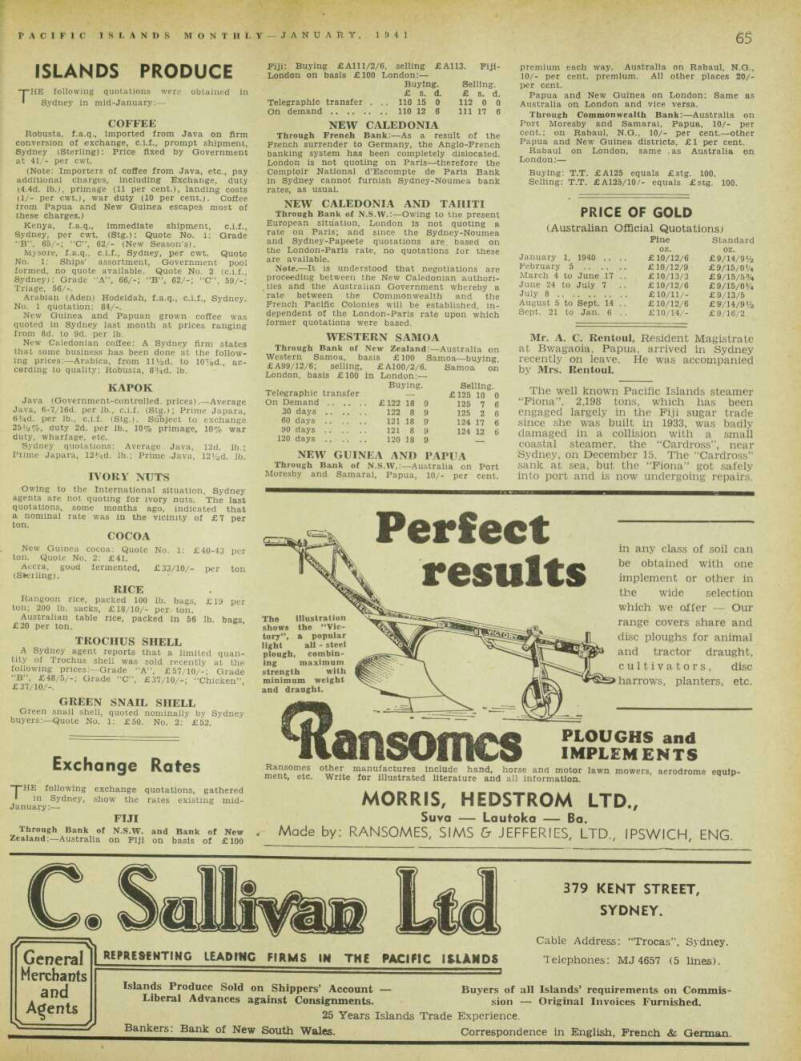
T“HE following quotations were obtained in I Sydney in mid-January:—
Coffee
Robusta, f.a.q., imported from Java on firm conversion of exchange, c.i.f., prompt shipment, Sydney (Sterling): Price fixed by Government at 41/- per cwt. (Note: Importers of coffee from Java, etc., pay additional charges, including Exchange, duty (4.4 d. lb.), primage (11 per cent.), landing costs (1/- per cwt.), war duty (10 per cent.). Coffee from Papua and New Guinea escapes most of these charges.) Kenya, f.a.q., immediate shipment, c.i.f., Sydney, per cwt. (Stg.): Quote No. i; Grade “B”, 65/-; “C”, 62/- (New Season’s).
Mysore, f.a.q., c.i.f., Sydney, per cwt. Quote No. 1; Ships’ assortment, Government pool formed, no quote available. Quote No. 2 (c.i.f., Sydney): Grade “A”, 66/-; “B”, 62/-; “C”, 59/-; Triage, 56/-.
Arabian (Aden) Hodeidah, f.a.q., c.i.f., Sydney.
No. 1 quotation: 84/-.
New Guinea and Papuan grown coffee was quoted in Sydney last month at prices ranging from Bd. to 9d. per lb.
New Caledonian coffee; A Sydney firm states that some business has been done at the follow ing prices:—Arabica, from liy 2 d. to 10 7 / B d., ac cording to quality; Robusta, 8 3 /4d. lb.
Kapok
Java (Government-controlled, prices).—Average Java, 6-7/16d. per lb., c.i.f. (Stg.); Prime Japara, 6 3 /4d. per lb., c.i.f. (Stg.). Subject to exchange 25V 2 %, duty 2d. per lb., 10% primage, 10% war duty, wharfage, etc.
Sydney quotations: Average Java, 12d. lb.; Prime Japara, 12 l Ad. lb.; Prime Java, 12y 2 d. lb.
Ivory Nuts
Owing to the International situation, Sydney agents are not quoting for ivory nuts. The last quotations, some months ago, indicated that a nominal rate was in the vicinity of £7 per ton.
Cocoa
New Guinea cocoa; Quote No. 1: £4O-43 per ton. Quote No. 2: £4l.
Accra, good fermented, £33/10/- per ton (Sterling).
Rice
Rangoon rice, packed 100 lb. bags, £l9 per ton; 200 lb. sacks, £lB/10/- per ton.
Australian table rice, packed in 56 lb. bags, £2O per ton.
Trochus Shell
A Sydney agent reports that a limited quan tity of Trochus shell was sold recently at the following prices;—Grade “A”, £57/10/-; Grade ”B”, £4B/5/-; Grade “C”, £37/10/-; “Chicken”. £37/10/-.
Green Snail Shell
Green snail shell, quoted nominally by Sydney buyers:—Quote No. 1; £5O. No. 2; £52.
Exchange Rates
T“HE following exchange quotations, gathered in Sydney, show the rates existing mid- January:—
Fiji
Through Bank of N.S.W, and Bank of New Zealand:—Australia on Fiji on basis of £lOO
Fiji: Buying £Alll/2/6, selling £AII3. Fijl- London on basis £lOO London:—
New Caledonia
Through French Bank:—As a result of the French surrender to Germany, the Anglo-French banking system has been completely dislocated.
London is not quoting on Paris—therefore the Comptoir National d’Escompte de Paris Bank in Sydney cannot furnish Sydney-Noumea bank rates, as usual.
New Caledonia And Tahiti
Through Bank of N.S.W.:—Owing to the present European situation, London is not quoting a rate on Paris; and since the Sydney-Noumea and Sydney-Papeete quotations are based on the London-Parls rate, no quotations for these are available.
Note.—lt is understood that negotiations are proceeding between the New Caledonian authori ties and the Australian Government whereby a rate between the Commonwealth and the French Pacific Colonies will be established, in dependent of the London-Paris rate upon which former quotations were based.
Western Samoa
Through Bank of New Zealand;—Australia on Western Samoa, basis £lOO Samoa—buying £ A99/12/6; selling, £AIOO/2/6. Samoa on London, basis £lOO In London:—
New Guinea And Papua
Through Bank of N.S.W.:—Australia on Port Moresby and Samarai, Papua, 10/- per cent.
premium each way. Australia on Rabaul, N.G., 10/- per cent, premium. All other places 20/per cent.
Papua and New Guinea on London: Same as Australia on London and vice versa.
Through Commonwealth Bank;—Australia on Port Moresby and Samarai, Papua, 10/- per cent.; on Rabaul, N.G., 10/- per cent.—other Papua and New Guinea districts, £1 per cent.
Rabaul on London, same .as Australia on London:— Buying: T.T. £AI2S equals £stg. 100.
Selling: T.T. £AI2S/10/- equals £stg. 100.
Buying.
Selling. £ s. d. £ s. d.
Telegraphic transfer . .. 110 15 0 112 0 0 On demand .. 110 12 6 111 17 6
Buying. Selling.
Telegraphic transfer — £125 10 0 On Demand £122 18 9 125 7 6 30 days 122 8 9 125 2 6 60 days 121 18 9 124 17 6 90 days 121 8 9 124 12 6 120 days 120 18 9
Price Of Gold
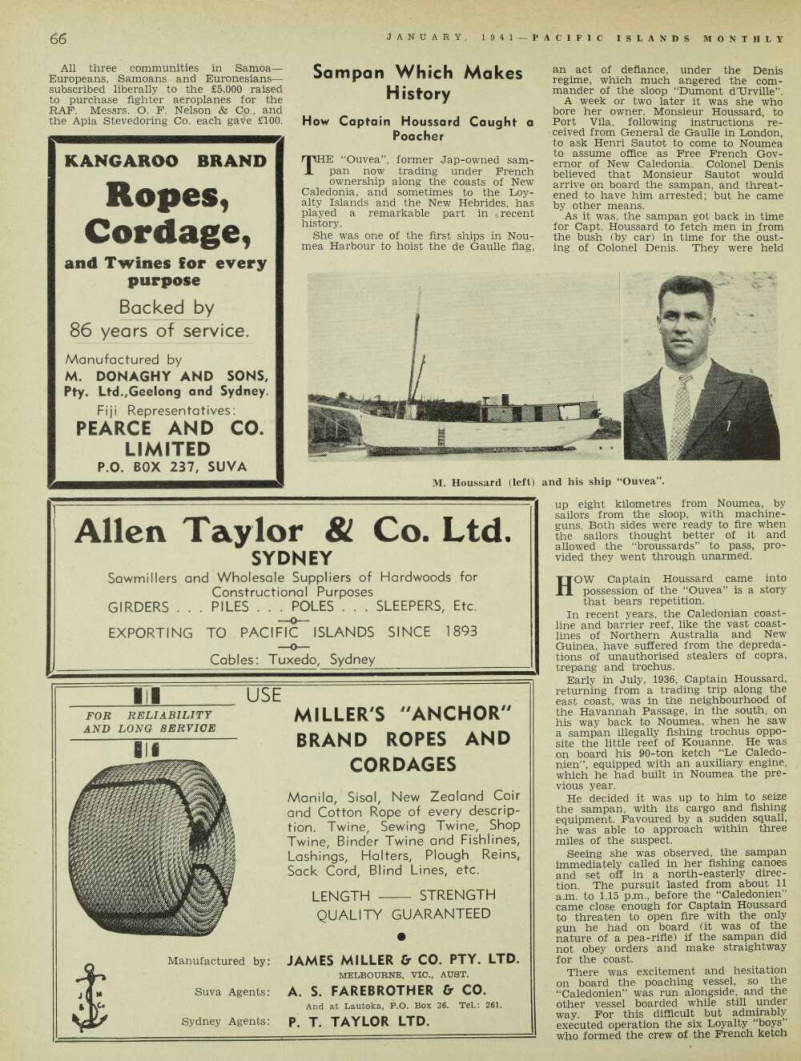
Mr. A. C. Rentoul, Resident Magistrate at Bwagaoia, Papua, arrived in Sydney recently on leave. He was accompanied by Mrs. Rentoul.
The well known Pacific Islands steamer “Fiona”, 2,198 tons, which has been engaged largely in the Fiji sugar trade since she was built in 1933, was badly damaged in a collision with a small coastal steamer, the “Cardross”, near Sydney, on December 15. The “Cardross” sank at sea, but the “Fiona” got safely into port and is now undergoing repairs.
(Australian Official Quotations) Pine Standard oz. oz.
January 1, 1940 .. .. £ 10/12/6 £ 9/14/9 % February 5 £10/12/9 £ 9/15/0 •/« March 4 to June 17 .. £10/13/3 £ 9/15/5 3 /» June 24 to July 7 £ 10/12/6 £ 9/15/0 y 4 July 8 £10/11/- £9/13/5 August 5 to Sept. 14 .. £10/12/6 £8714/9% Sept. 21 to Jan. 6 .. £10/14/- £9/16/2
All three communities in Samoa — Europeans, Samoans and Euronesians — subscribed liberally to the £5,000 raised to purchase fighter aeroplanes for the RAF. Messrs. O. F. Nelson & Co., and the Apia Stevedoring Co. each gave £lOO.
Advertisements & other items, pp. 67-68 (1 item)
Perfect
rail
results
The illustration shows the “Victory”. » popular light all - steel plough, combining maximum strength with minimum weight and draught. in any class of soil can be obtained with one implement or other in the wide selection which we offer Our range covers share and disc ploughs for animal and tractor draught, cultivators, disc harrows, planters, etc.
ansomcs
PLOUGHS and
IMPLEMENTS
Ransomes other manufactures include hand, horse and motor lawn mowers, aerodrome eauloment, etc. Write for illustrated literature and all information.
MORRIS, HEDSTROM LTD.,
Suva Lautoka Ba.
Made by: RANSOMES, SIMS & JEFFERIES, LTD., IPSWICH, ENG.
General
Merchants
and
Agents
STB
REPRESENTING LEAPING FIRMS IN THE PACIFIC ISLANDS
379 KENT STREET,
SYDNEY.
Cable Address: “Trocas”, Sydney.
Telephones: MJ 4657 (5 lines).
Buyers of all Islands’ requirements on Commission Original Invoices Furnished.
Islands Produce Sold on Shippers’ Account Liberal Advances against Consignments. 25 Years Islands Trade Experience.
New South Wales. Correspondence in English, French & German.
KANGAROO BRAND
Ropes,
Cordage,
and Twines tor every purpose
Backed by
86 years of service.
Manufactured by
M. DONAGHY AND SONS,
Pty. Ltd.,Geelong and Sydney.
Fiji Representatives:
PEARCE AND CO.
LIMITED
P.O. BOX 237, SUVA
Allen Taylor & Co. Ltd.
SYDNEY
Sawmillers and Wholesale Suppliers of Hardwoods for Constructional Purposes GIRDERS . . . PILES . . . POLES . . . SLEEPERS, Etc.
EXPORTING TO PACIFIC ISLANDS SINCE 1893
Cables: Tuxedo, Sydney
FOR RELIABILITY
AND LONG SERVICE
MILLER'S "ANCHOR"
BRAND ROPES AND
CORDAGES
Manila, Sisal, New Zealand Coir and Cotton Rope of every description. Twine, Sewing Twine, Shop Twine, Binder Twine and Fishlines, Lashings, Halters, Plough Reins, Sack Cord, Blind Lines, etc.
LENGTH STRENGTH
QUALITY GUARANTEED
Manufactured by: Suva Agents: Sydney Agents:
JAMES MILLER Cr CO. PTY. LTD.
MELBOURNE. VIC., AUST.
A. S. FAREBROTHER Cr CO.
And at Lautoka, P.O. Box 36, Tel.: 261.
P. T. TAYLOR LTD.
History
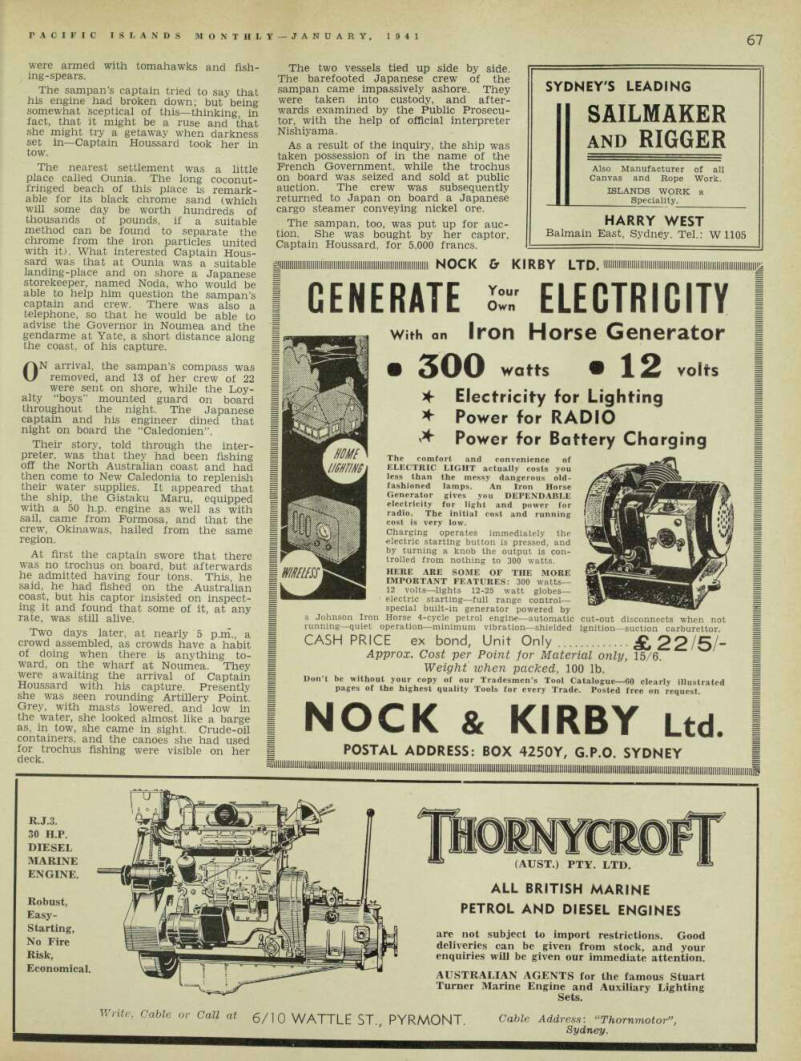
Sampan Which Makes History How Captain Houssard Caught a Poacher
THE “Ouvea”, former Jap-owned sam pan now trading under French ownership along the coasts of New Caledonia, and sometimes to the Loy alty Islands and the New Hebrides, has played a remarkable part in recent history.
She was one of the first ships in Nou mea Harbour to hoist the de Gaulle flag,
an act of defiance, under the Denis regime, which much angered the com mander of the sloop “Dumont d’Urville”.
A week or two later it was she who bore her owner, Monsieur Houssard, to Port Vila, following instructions re ceived from General de Gaulle in London, to ask Henri Sautot to come to Noumea to assume office as Free French Gov ernor of New Caledonia. Colonel Denis believed that Monsieur Sautot would arrive on board the sampan, and threat ened to have him arrested; but he came by other means.
As it was, the sampan got back in time for Capt. Houssard to fetch men in from the bush (by car) in time for the bust ing of Colonel Denis. They were held
up eight kilometres from Noumea, by sailors from the sloop, with machine guns. Both sides were ready to fire when the sailors thought better of it and allowed the “broussards” to pass, pro vided they went through unarmed.
HOW Captain Houssard came into possession of the “Ouvea” is a story that bears repetition.
In recent years, the Caledonian coast line and barrier reef, like the vast coast lines of Northern Australia and New Guinea, have suffered from the depreda tions of unauthorised stealers of copra, trepang and trochus.
Early in July, 1936, Captain Houssard, returning from a trading trip along the east coast, was in the neighbourhood of the Havannah Passage, in the south, on his way back to Noumea, when he saw a sampan illegally fishing trochus oppo site the little reef of Kouanne. He was on board his 90-ton ketch “Le Caledo nien”, equipped with an auxiliary engine, which he had built in Noumea the pre vious year.
He decided it was up to him to seize the sampan, with its cargo and fishing equipment. Favoured by a sudden squall, he was able to approach within three miles of the suspect.
Seeing she was observed, the sampan immediately called in her fishing canoes and set off in a north-easterly direc tion. The pursuit lasted from about 11 a.m. to 1.15 p.m„ before the “Caledonien” came close enough for Captain Houssard to threaten to open fire with the only gun he had on board (it was of the nature of a pea-rifle) if the sampan did not obey orders and make straightway for the coast.
There was excitement and hesitation on board the poaching vessel, so the “Caledonien” was run alongside, and the other vessel boarded while still under way. For this difficult but admirably executed operation the six Loyalty “boys” who formed the crew of the French ketch
M. Houssard (left) and his ship “Ouvea”.
were armed with tomahawks and fish ing-spears.
The sampan’s captain tried to say that his engine had broken down; but being somewhat sceptical of this—thinking, in fact, that it might be a ruse and that she might try a getaway when darkness set in—Captain Houssard took her in tow.
The nearest settlement was a little place called Ounia. The long coconut fringed beach of this place is remark able for its black chrome sand (which will some day be worth hundreds of thousands of pounds, if a suitable method can be found to separate the chrome from the iron particles united with it). What interested Captain Hous sard was that at Ounia was a suitable landing-place and on shore a Japanese storekeeper, named Noda, who would be able to help him question the sampan’s captain and crew. There was also a telephone, so that he would be able to advise the Governor in Noumea and the gendarme at Yate, a short distance along the coast, of his capture.
ON arrival, the sampan’s compass was removed, and 13 of her crew of 22 were sent on shore, while the Loy alty “boys” mounted guard on board throughout the night. The Japanese captain and his engineer dined that night on board the “Caledonien”, Their story, told through the inter preter, was that they had been fishing off the North Australian coast and had then come to New Caledonia to replenish their water supplies. It appeared that the ship, the Gistaku Maru, equipped with a 50 h.p. engine as well as with sail, came from Formosa, and that the crew, Okinawas, hailed from the same region.
At first the captain swore that there was no trochus on board, but afterwards he admitted having four tons. This, he said, he had fished on the Australian coast, but his captor insisted on inspect ing it and found that some of it, at any rate, was still alive.
Two days later, at nearly 5 p.ni., a crowd assembled, as crowds have a habit of doing when there is anything to ward, on the wharf at Noumea. They were awaiting the arrival of Captain Houssard with his capture. Presently she was seen rounding Artillery Point.
Grey, with masts lowered, and low in the water, she looked almost like a barge as, in tow, she came in sight. Crude-oil containers, and the canoes she had used for trochus fishing were visible on her ripnk
The two vessels tied up side by side.
The barefooted Japanese crew of the sampan came impassively ashore. They were taken into custody, and after wards examined by the Public Prosecu tor, with the help of official interpreter Nishiyama.
As a result of the inquiry, the ship was taken possession of in the name of the French Government, while the trochus on board was seized and sold at public auction. The crew was subsequently returned to Japan on board a Japanese cargo steamer conveying nickel ore.
The sampan, too, was put up for auc tion, She was bought by her captor, Captain Houssard, for 5,000 francs.
Advertisements & other items, p. 69 (1 item)
Nock & Kirby Ltd.
SYDNEY'S LEADING
SAILMAKER
AND RIGGER
Also Manufacturer of all Canvas and Rope Work.
ISLANDS WORK a
Speciality.
HARRY WEST
Balmain East, Sydney. Tel.: WUOS
llllllilllllllliiiiiiiiiiliilllliiiiiiiiilliliiliiiiiiiiiliiiiiililiii NOCK & KIRBY LTD. lillilllllillllilllliiiiiiiillllllllllllilllllillliiliiiiiiiiiiiiii
GENERATE Jr ELECTRICITY
with an Iron Horse Generator
mi
LIGHTING
£ mm 300 watts
1 2 volts
* * A
Electricity for Lighting
Power tor RADIO
Power for Battery Charging
The comfort and convenience of ELECTRIC LIGHT actually costs you less than the messy dangerous oldfashioned lamps. An Iron Horse Generator gives you DEPENDABLE electricity for light and power for radio. The initial cost and running cost is very low.
Charging operates immediately the electric starting button is pressed, and by turning a knob the output is controlled from nothing to 300 watts.
HERE ARE SOME OF THE MORE
IMPORTANT FEATURES: 300 watts—
-12 volts—lights 12-25 watt globes— electric starting—full range control — special built-in generator powered by a Johnson Iron Horse 4-cycle petrol engine—automatic cut-out disconnects when not running—quiet operation—minimum vibration—shielded ignition—suction carburettor CASH PRICE ex bond, Unit Only £22/5/- Approx. Cost per Point for Material only, 15/6.
Weight when packed, 100 lb.
Don’t be without your copy of our Tradesmen’s Tool Catalogue—6o clearly illustrated pages of the highest quality Tools for every Trade. Posted free on request
NOCK & KIRBY Ltd.
POSTAL ADDRESS: BOX 4250 Y, G.P.O. SYDNEY n
R.J.3. 30 H.P,
DIESEL
MARINE
ENGINE.
Robust, Easy- Starting, No Fire Risk, Economical. i u Write, Cable or Call at &/]Q WATTLE ST u KD m c—■
(AUST.) PTY. LTD.
ALL BRITISH MARINE
PETROL AND DIESEL ENGINES
are not subject to import restrictions. Good deliveries can be given from stock, and your enquiries will be given our immediate attention.
AUSTRALIAN AGENTS for the famous Stuart Turner Marine Engine and Auxiliary Lighting Sets.
PYRMONT.
Cable Address : “Thornmotor”, Sydney.
Personal Notes
Mr. Donald Bannatvne, who was well known in Fiji as a member of the Fiji Civil Service until his retirement some years ago, died in the War Memorial Hospital, Suva, recently. He joined the Service as a clerk in the Customs Depart ment in 1914, saw active service abroad as a member of the 1917 Fiji Reinforce ments, and took up duties again in 1919.
He was chief clerk in the Treasury when he retired in 1932.
Mr. Trafford Smith, of the British Colonial Office, arrived in Sydney in December from the Solomon Islands.
Together with Mrs. Smith, he has visited most of the central and western Pacific territories during the past two years.
Mr. George Step, managing director of the well-known firm of Islands agents, C. Sullivan Pty. Ltd., returned to Sydney from New Caledonia by ’plane at the end of December.
Miss Dulcie Naughton, matron of the Samarai Hospital, has resigned and gone on leave, and the matron’s position has been taken over by Miss Dunstan, who recently arrived from the South. Miss Sheridan also arrived from thq South to take the place of Sister V. Irwin, who has been appointed to take charge of the European Hospital in Port Moresby.
The untimely death occurred recently in Brisbane, of Mrs. Fred. Berge, who was the daughter of a Papuan pioneer and who was well and affectionately known throughout the Territory. Mrs.
Berge was only 34 years old. Her death recalls a tragedy of 1930, when she lost her husband and four children in the Vaiviri disaster at Kerema. She was brought to the beach, after a terrific struggle and an arduous swim of several hours by two native boys, who later were awarded a special decoration.
"One-Talks" In The
Aif
(From M. W. S. Rylands, "on Active Service Abroad with AIF.) TT SEEMS a long time ago since the 1 first New Guinea enlistments left what was, in retrospect, a holiday camp on the edge of Rabaul’s beautiful harbour.
They left, full of ideas of sticking together and forming a New Guinea company or something similar; and so they did, for a while, in their first Queensland camp. Then aptitude and interest sent some to Officers’ Training Schools and others to Technical Units, and one would think the chances of again meeting these and others Islanders, once they had been swallowed up in the AIF, rather remote.
Most of the original company had al ready sailed when I left Australian shores, but in the same unit v/ere P’eter Dennis, from Bulolo, and two others who had enlisted in Australia; Robin McKay (Kiep plantations) and Bill Alley, from Soraken.
When we marched into our first camp in Palestine we were allotted an ropes, in the person of “Our Mr.
Administrative Officer, to show us the Tribolet”, as BP’s might well say.
A day’s leave in Jerusalem came round, in due course, and walking down Jaffa Road towards the Jaffa Gate I was startled to hear “Abinoon Master!”
I swung round and there was Ralph Connor (W. R. Carpenter’s) with three stripes much in evidence on his arm.
From him I learned that in the next camp to ours there was quite a large New Guinea community, I went down one Sunday to meet them again, and found Cec. Hendrick (ex-PWD on the mainland) holding down a job as Trans
port Sergeant; Les Hewlett (District Ser vices) an Intelligence Sergeant, and now at an Officers’ Training School. With him, as understudy, was Dick Cardew (WRC) and last, but not least, was the well-known ex-purser of the “Maiwara” —Bill Kalbfell.
That seemed a pretty good Islands quota for one small area, but it was by no means the end. Getting a camn in order for some newcomers, we stayed there until they arrived, and among the pile of kitbags I noticed NG numbers.
Enquiries produced Bombardier Fred Smith (BP’s) and Gunners Wilkinson and Tally, both from the Administration staff. Needless to say, a few beers were consumed in the canteen that night, and the air was full of queries about mutual friends.
Back to my own camp again, and there was Toby Donald (Sergeant now) who used to be on Soraken, but is now a big cavalry man. Also, absorbing the intricacies of a machine-gun at our Weapon Training School, was an officer who used to strike terror into native malefactors and those who contravened the NLO within striking distance of Kieta: yes, Raleigh Farlowe was the name. His batman’s name I do not know, but I will remember gratefully that he was able, after a brief reconaissance, to brighten a dry Sunday morning with half-a-dozen of good Melbourne beer.
Up the road a few kilometres from here is Driver Don Colley, from “Baniu”, on Bougainville, and with us recently was Dud Harricks, from the Solomons. Down the road a little way is Captain “Blue”
Allen, of Wau, likely to be gazetted to his majority, I believe. Perhaps the series of curves known as the “seven sisters”, going down the last hill before climbing to Jerusalem, will give him ideas for the abortive road to Wau which he talked into being, and on the survey of which I lost many gallons of honest sweat.
Major Walstab upholds the majesty of the law (military, this time) in a town where Samson once went with immoral intent; though, having seen it, I was sur prised at his success. Also there, is Corporal Guy Black (ex-District Services) who will help anyone to make an allot ment, if his conscience pricks when he thinks of the little wife keeping the wolf from the door and the rent collector from coming too far inside.
Just a small slice of Palestine—and we find the men from the Islands well in evidence. I have heard of many more, in Egypt and elsewhere: but the purpose of this article is just to show that it is often quite a short road which produces a “One-Talk” in the AIF. (For the benefit of Polynesia, it may be explained that in Melanesia, in Pidgin English, “One- Talks” are natives who speak the same
language.).
Advertisements & other items, pp. 70-72 (2 items)
68
JANUARY, 1941 PACIFIC ISLA N t) S MONTHLY
Published by Pacific Publications Pty., Ltd., Union House, 247 George Street, Sydney. (Telephone: BW 5037), Wholly set up and printed in Australia by the Sydney and Melbourne Publishing Co., Pty., Ltd., 29 Alberta Street, Sydney. (Telephone: MA7101).
Cosmopolitan Hotel
SAMARA I
FIRST-CLASS
ACCOMMODATION
For Tourists & Commercials Electric Light, Ballroom Billiards, Freezing Works, Cold Store.
Best Brands of Liquors.
MODERATE TARIFF.
Fishing Trips and Launch Excursions Arranged.
WHERE TO STAY IN
HOTEL MORESBY
x
NEAR THE
WHARF.
MODERN
ACCOMMODATION
ONLY THE BEST
BRANDS OP
WINES, SPIRITS
AND BEERS
IN STOCK.
LICENSEE:
Hotel Moresby
Ltd.
PORT MORESBY
The PAPUA
HOTEL
Catering specially for Tourists and Travellers.
Licensee: Papua Hotel, Ltd.
First-class Accommodation. Parties Arranged, Situated on high ground overlooking both coasts, its Spacious Lounges are always Cool and comfortable . . . Cars meet all Steamers.
m m ■ S 3 m ' m
JSHIi
■ ■ f mmM >» .
A Guinea Airways 7 planes wing swiftly from Port Moresby to the Gold Fields in 1 hour 40 minutes, whereas, by surface routes, the same journey drags over 6 to 7 weary days . . . Save time—save money —travel throughout New Guinea and Papua by
Guinea Airways.
CHARTER SERVICE
Guinea Airways service provides special passenger freight land and sea planes for charter to any point in New Guinea and Papua. Investigate!
Book by steamer from Australia to Port Moresby and thence by Guinea Airways’ planes which serve over 50 aerodromes and landing grounds throughout New Guinea and Papua. . . . Obtain full information!
LRE SRLRIMnun
New Guinea Office: LAE, Mandated Territory of New Guinea.
Branch offices and agents at Wau, Salamaua, Pt. Moresby and Sydney. [HE WORLDS LARGEST FREIGHT CARRYING AIR SERVICE.
8» A <4 , * " * V V'*' V.
"\»V '\OV- - v^\o* . \ SvN^
WAVERIEY BREWERY
k /a \E 21/^f w JViAv.. /d/
W AVEAUY U*wht
kO nV. ensures a
PERFECT DRINK
cmc/t/ie cbcmt deal
PRESERVES THE FLAVOUR
When ordering lager, first look for the Diamond-shaped Label-that is your guarantee of quality. Then notice the "Spot" Crown Seal, it is designed to retain that quality, and ensure perfect freshness and flavour in any climate.
RESCH’S^IACER