Pacific
Islands
Monthly
Vol. Xi. No. 5,
December 14, 1940
Established 1930
ißegistered at i 7 ie transmission by post as a newspaper ]
8 d
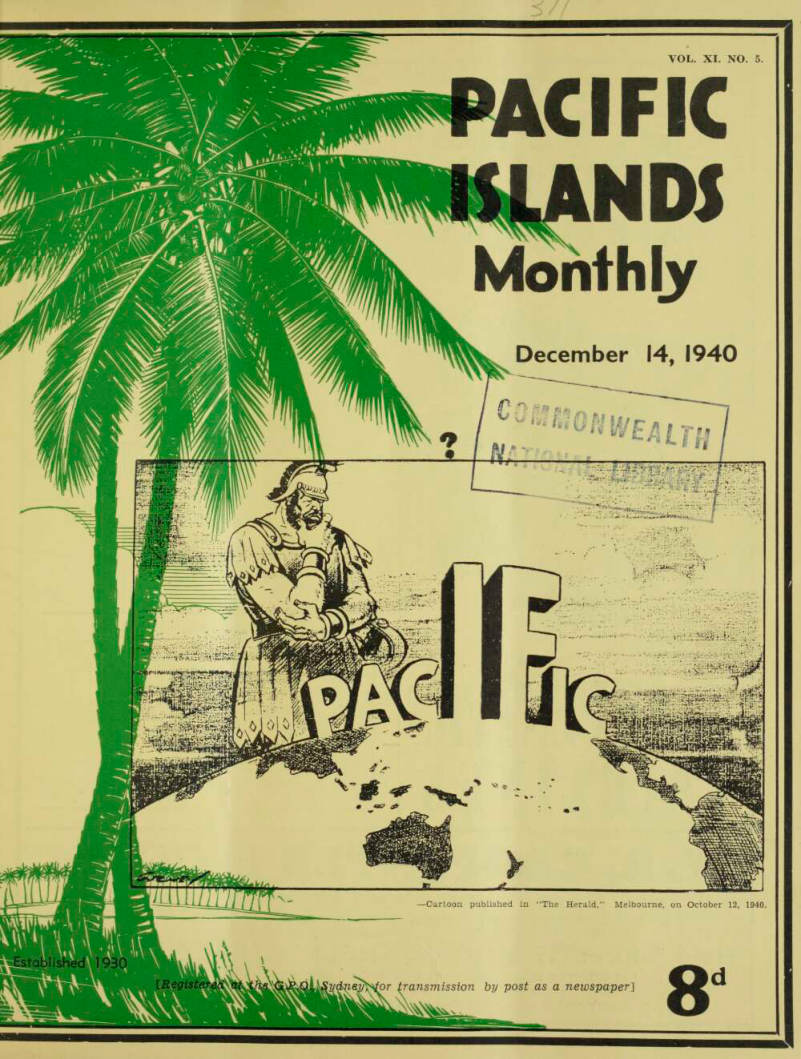
—Cartoon published in “The Herald,” Melbourne, on October 12, 1940,
Advertisements & other items, p. 2 (1 item)
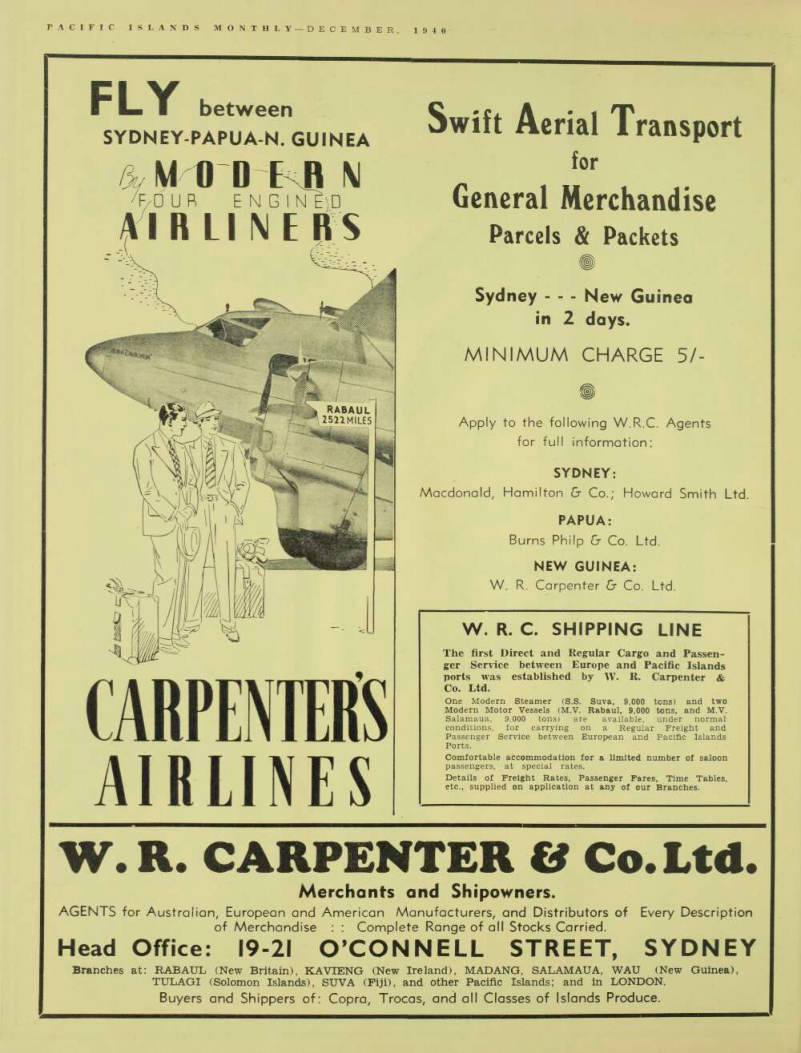
Carpenters
FLY between
SYDNEY-PAPUA-N. GUINEA
mon r n m
/P/d U R ENG I N E)D
AIRLINERS
RABAUL
2521 MILES
-r.
K *
CARPENTERS
AIRLINES
Swift Aerial Transport
for
General Merchandise
Parcels & Packets
Sydney - - - New Guinea
in 2 days.
MINIMUM CHARGE
S Apply to the following W.R.C. Agents for full information:
SYDNEY:
Macdonald, Hamilton £r Co.; Howard Smith Ltd.
PAPUA:
Burns Philp £r Co. Ltd.
NEW GUINEA:
W. R. Carpenter £r Co. Ltd.
W. R. C. SHIPPING LINE
The first Direct and Regular Cargo and Passenger Service between Europe and Pacific Islands ports was established by W. R. Carpenter & Co. Ltd.
One Modern Steamer (S.S. Suva, 9,000 tons) and two Modern Motor Vessels (M.V. Rabaul, 9,000 tons, and M.V.
Salamaua, 9,000 tons) are available, under normal conditions, for carrying on a Regular Freight and Passenger Service between European and Pacific Islands Ports.
Comfortable accommodation for a limited number of saloon passengers, at special rates.
Details of Freight Rates, Passenger Pares, Time Tables, etc., supplied on application at any of our Branches.
W. R. CARPENTER & Co. Ltd.
Merchants and Shipowners.
AGENTS for Australian, European and American Manufacturers, and Distributors of Every Description of Merchandise : Complete Range of all Stocks Carried.
Head Office: 19-21 O’CONNELL STREET, SYDNEY
Branches at: RABAUL (New Britain), KAVIENG (New Ireland), MADANG, SALAMAUA, WAU (New Guinea), TULAGI (Solomon Islands), SUVA (Fiji), and other Pacific Islands; and in LONDON.
Buyers and Shippers of: Copra, Trocas, and all Classes of Islands Produce.
Pacific News-Review
Notes And Comment On
The Progress Of The War
From Nov. 12 To Dec. 11
Nov. 12: The Italian forces in the mountains of southern Albania, having been severely defeated by the Greeks, are now struggling back in retreat, through the various mountain valleys, and are being harassed on the land by the Greek infantry and by British and Greek airmen.
Nov. 12: “I do not believe that the era of Democracy can or will be crushed out in our lifetime”, declared President Roosevelt, in one of the first speeches he has made since his re-election. Signs all over USA indicate a growing organised effort to give assistance to Britain.
Nov. 12: The Russian Premier, Molotof, is now in Berlin having consultations with Hitler. There is much speculation as to the purpose and outcome of these talks.
Nov. 13: A dozen mines have been swept up in Bass Strait. Southern Aus tralia, where they were released by an enemy raider, and which caused the sinkings of two ships.
Nov. 13: The British Fleet air arm, on Monday night, made a smashing attack on Taranto, one of Italy’s main naval bases, and, with aerial torpedoes, sank or crippled three battleships, two cruisers and two auxiliary ships.
This is the most striking naval success in the war to date. It is pointed out, by experts, that it completely alters the balance of naval power in the Mediter ranean—half the heavy units of the Italian Fleet are now out of action. Dur ing the succeeding days, British aero planes took photographs of Taranto, which confirm the damage done in the action. It is also seen that Italy has hurriedly moved practically the whole of her strong fleet, which she had assembled at Taranto, to more distant bases.
Nov. 13: The German claim that a pocket-battleship had destroyed a British convoy of 36 ships in the North ern Atlantic is now proved wrong. A pocket-battleship attacked the convoy, and was herself immediately and most heroically attacked by the British armed merchant cruiser “Jervis Bay” which, although out-gunned and out ranged, kept the enemy battleship busy until she was herself blown to pieces.
By that time the convoy had scattered widely, and the German battleship was able only to find a few individual ships.
Through the self-sacrifice of the “Jervis Bay”—described as one of the finest ex ploits in the glorious history of the British navy—no less than 31 out of 36 ships in the convoy escaped safely into port.
Nov. 13: There are heavy concentrations of Japanese naval and military forces in and about Hainan Island. It is believed that Japan has planned a major south wards operation, probably against Indo- China and possibly against the Dutch East Indies; but is hesitating until she knows: (1) the probable reaction of America, and (2) the result of the talks in Berlin between Hitler and Molotof.
Nov. 14: Night after night, during this moonlight period, German air flotillas are raiding districts in Britain, and heavy and growing forces of RAF bombers are attacking important industrial centres throughout Germany.
Nov 15: The German air attack against Britain has taken a new form, called “one-town-blitz”. There is an enormous concentration of German machines against one particular town, which is virtually wiped out. This happened last night to Coventry, a well-known town in the Midlands. Practically the whole of the centre of the city was destroyed.
Deaths 200; injured 800.
Nov. 15; An important statement by Tass, Soviet official newsagency, is that Japan and the Soviet have not agreed on respective spheres of influence in the Far East, and that the Soviet has not promised to cease to give aid to the Chinese National Government. This is represented as a great disappointment to Japan, who has her forces all ready for a southwards thrust, which she dare not make, unless she is reasonably sure of the attitude of Russia.
Nov. 17: Smashing attacks on Ham burg by the RAF are regarded as ven geance for the German destruction of Coventry.
The captain of the “Jervis Bay”, who went down with his ship, was awarded posthumously the Victoria Cross, “for valour in challenging hopeless odds and giving his life to save many ships”.
Nov. 18: The Greeks are fighting magnificently along the whole front and are steadily driving the Italians back everywhere. Important developments are expected soon.
Nov. 18: The Russian Premier has re turned to Moscow and there still is no indication of results of his talk with Hitler. The belief is growing, however, that failure has attended Hitler’s frantic efforts —seen in his consultation with Central European powers, with France, Spain and finally with Russia—to organ ise his “new order irt Europe”. It would appear that Russia is as aloof and incal culable as ever. This is borne out by the attitude of Turkey, which continues to make military preparations, and pro fesses herself satisfied with the inter national situation and her treaty with Britain.
Nov. 18; In a blustering speech, Musso lini declared that the Italian defeat on the south Albanian front by the Greeks would be terribly avenged. Although the Italo-Greek war commenced with the sudden unprovoked invasion of Greece by the Italians, he blamed Greece, “on the instigation of Britain”, for the com mencement of the war.
Nov. 18: The Japanese Imperial Con ference has decided to give the Chinese National Government (Chiang Kai Shek) “a last chance” to consider its attitude towards Japan and make a sat isfactory peace.
Nov. 19: The Greek army has cap tured Koritza, an important Italian base in southern Albania, with many prisoners and much war material.
Nov. 19: It is reported that King Boris of Bulgaria made a secret visit to Berlin to interview Hitler. This has given rise to the belief that Bulgaria may open a way for German armies to come to the assistance of the Italians, by attacking the Greeks through Thrace.
Nov. 20: Germans carried out their second “one-town-blitz” last night, when they made a concentrated air attack upon Birmingham and did great damage.
Nov. 21: There now are indications that Hitler has failed seriously in his plan to create in Europe a “new order” with which he could oppose Britain, and offer a peace conference.
Up to the present, apart from Ger many, Italy arid Japan, the only nations which have formally joined up with the Axis-bloc are Roumania (which is virtu ally under Hitler’s thumb) and Hungary (which has been obeying his orders for some time). Prance, under Retain, has so far resisted his arguments (although Laval is in favour) for reasons that are not clear. Spain and Bulgaria, nominally very friendly to the Axis, have not joined up. Russia remains still aloof.
Piquancy is given to this virtual stale
mate in Europe by a growing belief that there is motion between Hitler and Mussolini. Germany shows no sign of going to Italy’s assistance against Greece.
It is stated confidently that Mussolini embarked on the attack on Greece in de fiance of Hitler’s wishes.
It is clear that Italy’s attack upon Greece, making Greece a belligerent, allowed Britain immediately to take pos session of Crete as an important naval and air base; and this, together with the de struction of half of the heavy units of the Italian navy, has altered the strate gical situation in the Mediterranean, to Italy’s disadvantage. It can be under stood that this development has greatly angered Germany.
Nov. 21: United States Army has re leased to Britain 26, four-engmed Con solidated Bombers, each of which has a range of 3,000 miles. It is expected that America will also give Britain 20 of the latest type of “Flying Fortresses’’.
Nov. z 2: Seeking revenge for Taranto, Italian bombers for ten nights in suc cession have attacked units of the British fleet in Alexandria, but they have failed to do any damage to warships or fortifi cations.
Nov. 22: Koritza, the main Italian ad vance base in Albania, actually was oc cupied by the Greeks to-day after bitter fighting around the mountainous out skirts of the town. Greeks appear also to have broken the Italian lines in Epirus, on the coastal section. British planes are constantly attacking the Italian columns, which appear to be in retreat all along the front.
Nov. 22: The arrogance and the vaunting ambitions of the Axis Powers are well illustrated in an article just published in a Japanese Army newspaper, m Shanghai, named “Sin Shun Pao’’, which says that the scope of the pact between Japan and the Axis envisages stabilisation of Europe, of Africa, of the Far East, and of Australia. This is the first time that any Japanese newspaper, anywhere, has openly included Australia by name within the framework of Japan’s southward expansion programme.
It is officially announced that Japan is still offering the Chinese National Gov ernment a final chance to participate in direct peace negotiations.
Meanwhile Japan—apparently owing to her uncertainty of the probable attitude of USA and Russia, has not committed herself definitely to the southwards ex pedition. Nevertheless Japanese forces, economic and military, are gradually tak ing possession of sections of the late French Colony of Indo-China.
Nov. 24: The German “one-town blitz’’ was last night directed against the city and port of Southampton. There was a great concentration of German machines. Extensive damage and many casualties were caused.
No attempt is being made by the British authorities to deny that these successive raids against important Eng lish cities represent a serious problem.
Nevertheless, on the balance of damage caused, the advantage probably lies with the RAF, which night after night, with monotonous regularity, despite very bad weather, is making concentrated attacks on German industrial centres practically all over the Reich.
Nov. 25: Troops from Thailand (Siam) are reported to have clashed with French Indo-China troops. Thailand is claiming the restoration of certain territories taken by Indo-China some 30 or 40 years ago. It is suggested in some quarters that
the Thailand move is anti-Japanese; but it is well to remember that Thailand is honeycombed with Japanese and per meated by Japanese influences, and if Japan eventually takes all Indo-China, as evidently she plans to do, Thailand undoubtedly will become actually, if not officially, part of the Japanese Empire.
Nov. 25: The Greek Army is continuing its advance into Albania along the whole of the 160 miles front, Italians retreat ing rapidly everywhere. So swiftly has the position changed in the past few days that it is possible the disorganised Italian forces will not be able to stand along the defence line they recently attempted to establish in southern Albania.
Nov. 26: Chinese experts believe that the two things which are likely to stop Japan from expanding southwards are her inability to reach an understanding with Russia and her failure to effect a peace settlement with General Chiang Kai Shek. Japan now is planning recogni tion of the puppet Government set up in Nanking under Wang Ching-Wei as the Official Government of China; but this will not affect the National Govern ment’s determination to fight on for the independence of China.
Nov. 26: At the close of the conference held during the past month in Delhi, India, it was announced that the east ern group of British Empire countries re presented there will shortly, under the plan of organisation that has been initi ated, give an ever-increasing volume of substantial aid to Britain.
This development obviously is of great importance. As long as the Red Sea route can be kept open—and the ability of the Italian forces, in Somaliland and Abys sinia, to interfere with it, is steadily decreasing—the Fastern, African and Pacific countries of the British Empire, can unaided provide the British Armies in the Mediterranean area with all neces sary reinforcements and supplies.
Nov. 27: The British Mediterranean fleet to-day again caught sight of an Italian fleet, comprising two battleships and various cruisers and destroyers, and attacked immediately. But the Italians fled at high speed towards their bases in Sardinia and, although they were pur sued for some distance, and engaged at extreme range, it is not thought that much damage was done.
Nov. 27: An enemy raider in the south Indian Ocean has sunk two large British freighters, “Port Brisbane” 8,000 tons and “Maimoa” 8.700 tons. Both have been en gaged in carrying important cargo be tween Britain and Australasia.
Nov. 27; Britain has announced offici ally that if Bulgaria does not directly or indirectly assist the enemies of Britain to attack her allies, Britain intends to ensure that at any peace conference, the integrity and independence of Bulgaria will be respected. This apparently is hav ing a good effect. There are several in dications that, for the present. Bulgaria does not intend to abandon her neutral ity.
Nov. 27: The Greek Army, advancing steadily along the coast, is now expected to seize from the Italians two important points in southern Albania —the port of Saranda and important base of Argyro kastron.
Nov. 27: It is frankly acknowledged that Britain’s most serious problem now is that of replacing the merchant shipping which is being destroyed by the enemy at the rate of not less than 60,000 tons per week.
It appears that the Germans have adopted a new technique, and send their submarines far out into the Atlantic to hunt in “packs”, with a view to paralys ing the important traffic between the United States and Britain.
It is recognised that the only way of solving this problem, if a new means of checking the submarines cannot be de vised, is to reinforce Britain’s shipbuilding efforts with a mighty and concerted ship building programme in the United States.
Conversations between Britain and United States are proceeding, with this end in view.
Nov. 28: 'Die German’s “one-town blitz” last night was directed against the English city of Plymouth. It was a prolonged attack in which much material damage and many casualties were caused.
The Germans in these “one-town-blitzes” do not seek out military objectives—they simply use a great concentration of aero planes to pour an enormous mass of ex plosives upon the centre of the cities.
Nov. 29: The Iron Guard of Roumania, a Fascist organisation, has assassinated hundreds of political personages, in the most cruel manner, on the grounds that their execution is necessary for the good order and government of the country.
Nov. 30: M. Chiappe, a ruthless French bureaucrat who had just been appointed Governor of Syria, by the Vichy Govern ment, with instructions to stop the drift in Syria towards Britain, was on his way to Syria in a large French aeroplane when he inadvertently flew over the scene of the British-Italian naval en gagement on November 27. Fighting planes—whether British or Italian is not clear —attacked and destroyed the French plane, and M. Chiappe and another high French official were drowned. The Vichy Government says that Britain is to blame.
Nov. 30: Japan, having failed to in duce the Chinese National Government to enter peace negotiations, to-day formally recognised the “puppet admini stration” formed by Wang Ching-Wei, at Nanking, as “The National Government of the Republic of China”, and asked other nations to similarly recognise it.
Chiang Kai Shek’s Government, at Chungking, declares Wang Ching-Wei to be a traitor and says that if any other country recognises the puppet govern ment it will be regarded by Chungking as an “unfriendly act”.
Nov. 30: President Roosevelt announced to-day that the United States was im mediately making a loan to China (the Chiang Kai Shek Administration at Chungking) of 50,000,000 dollars for gen eral purposes, and would probably make an early allocation of a further 50,000,000 dollars for the stabilisation of China’s currency.
This is one of the most startling developments of the war. It is a formal intimation to Japan that the United States will not recognise the so-called “New Order in the East”. It is a stag gering blow to the plans of Japan who, now, can make no progress southwards unless (1) the Axis Powers become domin ant over Britain, the United States and China, or (2) Japan defeats the United States in the Pacific in a separate war.
Dec. 2: A new Greek thrust on the northern front, in which 5,000 Italians were captured, has started a general re treat by adjacent Italian forces, leaving a huge gap in the Italian centre. Greek advance is continuing slowly in snow storms.
Dec. 2: Mr. Kennedy, lately United States Ambassador in London, has re signed. His activities in the United States indicate that while he is sym pathetic to Britain, he is an active agent of those who favour a policy of appease ment—it is believed that there are a con siderable number of them in Britain and the United States, working for peace negotiations with Hitler.
Dec. 2: Germans, on Monday night, directed their against Bristol. Considerable damage, but casual ties not numerous. The raids on
Southampton on Saturday and Sunday night caused 370 deaths, Dec. 4: The Germans are boasting that a new phase has opened in the attack on Britain, in that submarines are now hunt ing in “packs”, and crippling Britain's merchant shipping. Meanwhile, the United States is making plans to release to Britain every merchant ship she can spare.
Dec. 4: The United States is about to release old-type planes for China to assist her in the war against Japan.
Dec. 5: Germany and Roumania have signed an agreement, effective for 10 years, for “the economic re-construction of Roumania”.
Dec. 6: While the Greeks are still at tacking and the Italian armies generally in Albania are in full retreat, a start ling development has occurred in the re signation of Marshal Badoglio. Italy’s Chief of Staff, and probably the most im portant man in Italy next to Mussolini.
A large number of prominent military and naval officers are also resigning, and this development is clearly the result of marked discontent with Mussolini’s con duct of the war.
Dec. 6: The Greeks have captured Saranda, Albania’s third seaport.
Dec. 6: The peace moves of the “ap peasement gang” in Britain were scotched effectively when the House of Commons rejected, by 341 votes to 4, a motion urg ing the Government to set forth Britain’s terms and call a peace conference.
Dec. 8: It is announced that, following on the high officers’ resignations, serious internal disturbances have broken out in the principal Italian cities.
Dec. 8: It is believed that Bulgaria has been holding secret conferences with emissaries from Russia, and Bulgaria has been urged by Russia to maintain neu trality.
Dec. 8: The announcement that Russia will continue to recognise the Chiang Kai Shek regime as China’s National Gov ernment is a sharp reverse to the Axis, and a pleasant surprise to the United States.
Dec. 9: The Greeks have occupied the important town of Argyrokastron (prin cipal Italian base in southern Albania) and are pursuing the retreating Italians towards central Albania.
Dec. 9: London on Saturday night ex perienced one of the most serious raids the Germans have yet made on Britain.
Very extensive damage was countered by the heroic work of the volunteer defence force.
Dec. 10: Although there are large concentrations of Japanese military and naval forces at Hainan Island, the Japanese still are hesitating in their southwards thrust. The support of United States and Russia to the anti-Japanese Government of China has seriously checked Japanese war-mongers. It is thought that the latter will not strike southwards unless Britain receives a seri ous reverse or the United States influence weakens.
Meanwhile, there is an extraordinary quietness about Germany’s political oper ations. Hitler, who was racing about Europe, interviewing the leaders of Spain, France, Hungary, Russia, Roumania, etc., a month ago, is now seldom mentioned.
Germany, apparently, is making no move to assist Italy—the impression is growing that there is serious friction between the German and Italian dictators.
Dec. 11: The announcement that British forces in Western Egypt are in contact with Italians all along the Libyan front, and have taken 4,000 prisoners, is accepted in London as an indication that Britain has launched an offensive against the Italian Army in Libya.
Pacific Islands Travellers
Per “Macdhui” From Papua & Ng:
Messrs. Aitken, Burnet, Blencowe, Brewster, Coote Cook (2), Dubout, Emery, Fenn, Finn, Frazer, Gay, Huie, Havill, Higgins, Hanson, Kyngdon, Keith, Lonregan, Lyon, Lowney, Lockhart. Morris, Mears, McCarthy, McGregor, Mitchell, Moen, Munro, Middleton, McLean, O’Malley, Olander, Philpott, Pennington, Rogerson, Ringal, Saunders, Skinner, Staker, Simpson, Taylor, Taylour, Topal, Tremain, Walker, Walsh, Webb, Dr. Woolnough. Rev. Freund, Rev. Lingood, Rev.
Nixon, Rev. Flatten. Mesdames Barnes, Coote, Cook, Evenson, Fenn, Freund, Gillingwater, Hobson, Huie, Havill, Lingood, Lees, Lonregan, Lyon, Lockhart, Minogue, McGregor, Mitchell, McGilvery, Munro, Nixon, Nicholas, Flatten, Rogerson, Speedie, Shorthouse, Saunders, Skinner, Terrey, Woolnough, Perichorn. Misses Hawkes, Harris, Jones, Reinhardt.
PER “MACDHUI” TO PAPUA & NG: Messrs.
Deaths, Simms, Frame, Taylor, Walsh, Hardy, McDonald, Crampton, Ward, MacKinnon, Faithorn, Warren, Murdoch, Sandery, Shield, Welsh, Fitzpatrick, Butnell, McFarlane, Collete, Marchant, Brewer, Laws, Roberts, Keen, Batchelor, Munro, Rose, Wilson, Pryce, Collier, Bray, Innes, Nicholson, Ward, Burley, McLeod, Babidge, Gentle, Stuckey, Pemberton, Vickery, McSorley, Johnston, Maxwell, Lowe, Crowe, Coe, Livingstone, Ewen, Furlong, Blood, Reed, Doyle, Richardson, Rudd, Woodman, Parker, Anisimoff,
Simpson, Hollander, Norris, Doone, Taylor. Capt.
Fitch. Judge Gore. Bishop Strong. Mesdames Frame, O’Reilly, Hardy, Ward, Razey, Crampton, Deboom, Collier, Wilson, Brewer, Lowe, Coe, Sully, Newell, Carr, Duncan, Griffiths, Furlong, Blood, Ireland, Lyons, Hartley, Saker, Wood man, Parker, Walsh, Yandell, Simpson. Misses Moore, Edge, Hall, Davidson, McKenna, Lyons, Bignold (2), Burke, Munro, Arnott, Abel. Brown, Ward, Rutledge, Rogerson (2), Voysey (2), Allan, Mullaly, Stewart, Lyons, Maxwell.
PER “NEPTUNA” FROM NG; Messrs. Brown, Bretag, Calow, Henry, Hill, Hughes, Rich, Ragg, Simmonds, Skippington, Milne, McDougall, Sin clair, Maunsell-Turner, Brinston, Thomas, Whitehead. Mesdames Russell, Allison, Brown, Day, Rich, Johnson, McKay, McLean, Sinclair, Thomas, Duncan, Pratt. Sister Mathilda.
PER “MALAITA” FOR PAPUA, BSI & NG; Messrs. Everlngham, Kelsall, Swan, Dixon, Gib son Hardy, Simpson, Upwich, Walsh, Buchan, Clarke (2), Crowe, Ross Alsop, Attlee, inaikle, Chapma-n Stock, Bmskm, Colman. Father Lebel. Mesdames Brennan, Glanville, Johnson, Clarke. Misses Hart, Smith, Scope, Parkin, Lotze. . _n
Per “Morinda For Lord Howe And
NORFOLK IS., N. HEBRIDES AND BSI: Messrs.
Bengough, Jepson, Fenton, Payton, Crawshaw, Smithers, Mason, Martin, Hanlin, Wilson, Skeoch, Jones, Quintal, Rumkin, Matthews. Mes
dames Crawshaw, Olsson (2), Martin, Nobbs, Wilson, Quintal, Rumkin. Misses Scott-Holland, Eacott, Buffett, Robbins, Marlin, King, Payten.
Per Airliner From Papua & Ng
(BETWEEN NOV. 17 & DEC. 9): Messrs. Peters, Aubrey, Potter, Marlow, Mac Queen, Laws, Hendy, Forrester, Waddell, Webster, Smith (2), Phillips, Hay, Zoffman, Davis, McGilvray, Tompkinson, McKenzie, McCulloch, Pyke, Osborne, Taylor, Weddell, Wilson. Father Glover. Mesdames Dettman, Montgomery, Tomp kinson, Moore.
PER AIRLINER FOR PAPUA & NG (BETWEEN NOV. 21 & DEC. 5): Messrs. Bath, Sayers, Deland, Trembath, Jennings, Horton, Bretag, Scherp, Maunsell-Turner, Smith, Leahy, Kane, Richardson, Pendleton, Gee, Sherringham. Mes dames Scherp, Gee, Morgan. Miss Flood.
PER “MONTEREY” FOR FIJI: Messrs. Abbott, Utu, Swingle. Mesdames Archbold, Paley. Miss Keegan. TO PAGO PAGO: Messrs. Casserie, Kneubuhl, Lowry. Mesdames Hastings, Schriner, Thane.
Per “Aorangi” From Fiji: Messrs. Boyd,
Connie, Dowling, Edwards, Makinsoh, Main, Piper, Powell, Tsiang, Young, Evans, Johnson, Lees, Little, Rushton. Mesdames Boyd, Connie, Edwards, Livie, Makinson, Mumford, Parker, Tsiang, Benjamin, Johnson, Mills, Rushton.
Misses Bailey, Edwards (2), Parker (2), White.
PER “AORANGI” FOR FIJI: Messrs. Banting (2), Carver, Cowan, Gamson, Lawton, Lawson, Swann, Stevenson, Snodgrass (2), Tange, Tre
(Continued On Page 64)
Advertisements & other items, p. 5 (1 item)
South Pacific Line
SA w i v \ K C£V *
n ..Hnn»\
KT.MORESBY*
g \ •'SAHARAI
\ , Mport viu
V. \oUMI*
P "L ■■■
SYDNEY
s. / II , v
/JUiUCKUNf 1
V
- /wtumeToi
I Ww/A '
K. P. M,
SOUTH PACIFIC LINE.
Royal Packet Navigation Co. Ltd., Paketvaart House, 255 George Street, Sydney. (N. V. Konlnklijke Paketvaart Maatschappij—lncorporated In the Netherlands Indies) Saigon, Diethelm & Co.; Port Moresby and Samarai, Steamships Trading Co Ltd.; Rabaul, Salamaua and Wau, W. R Carpenter & Co. Ltd.; Port Vila, Gubbaj Freres; Noumea, Carlo Leoni; Auckland, Russell & Somers Ltd.; Wellington, Johnston & Co. Ltd. p . m
Linking the East with South Pacific
Islands, New Zealand and Australia
The track routes of the K.P.M.-South Pacific Line motor vessels “Maetsuycker” and “Tegelberg” are each as follows: —“TEGELBERG”: Saigon, Singapore, Batavia, Samarang, Sourabaya, Port Moresby, Port Vila, Noumea, Auckland, Wellington, Sydney, Port Moresby, Sourabaya, Samarang, Batavia, Singapore, Saigon. “MAETSUYCKER”: Saigon, Singapore, Batavia, Samarang, Sourabaya, Port Moresby, Samarai, Salamaua, Rabaul, Auckland, Wellington, Sydney, Port Moresby, Sourabaya, Samarang, Batavia, Singapore, Saigon.
SOUTH PACIFIC Line
Advertisers
“Airzone” Radio . 19 Amalgamated Wire less (A/sia) Ltd. 47 Amplion (A/sia) Ltd 27 Arnott’s Biscuits . 35 Atkins Ltd., W. . . 44 “Ausoline” ... 62
B.A.L.M. Ltd. . . 42
Bank of N.S.W. . . 60 Barnet Glass Rub ber Co. Ltd. . . 45 “Bidomak” ... 17 Broomflelds Ltd. . 40 Brown & Co. Ltd., G 15 Brunton’s Flour . 37 Budge Pty. Ltd..
Jas 57 Burns, Philp & Co.
Ltd 4 B.P. Magazine . . 54
B.P. (S.S.) Co. . . 32
Burns Philp Trust Co. Ltd 48 Carlton & United Breweries Ltd. . 23 Carpenter Ltd., W.
R cov. 2 Chapman & Sherack 31 Chivers & Sons Ltd. 32 Clyde Engineering Co. Ltd 28 Coleman Lamp & Stove Co. . . 16, 30 Colonial Mutual 'Life Assurance Society Ltd. . . 10 Compressor & Air Equipment. Co. . 57 Coral Starch ... 35 Cosmopolitan Hotel 64 De Meric Pty. Ltd. 45 Dewar’s Whisky . 46 Doan’s Pills . . 30 Donaghy & Sons Ltd 62 Donald Ltd., A. B. 38 Eaton Ltd., J. W. 43 Electrolux Refrigerators . . 22 Eno’s Fruit Salt . 61 Fletcher & Sons . 42 “Flit” 57 Garrett & Davidson 56
Garden Vale Pro ducts Ltd. ... 36 Gilbey’s Gin ... 64 Gillespie’s Flour . 34 Gourock Ropes & Canvas Ltd. ... 59 Gowing Bros. Ltd. 63 Grand Pacific Hotel 39 Grove & Sons, W.
H 11 Guinea Airways Ltd. . . . cov. 3 “Hansman” Shoes 10 Heinz Co. Ltd., H.
J 50 Holbrook’s Ltd. . . 37 Horlick’s Malted Milk 53 Hotel Moresby . . 64 In Memoriam . .11 Jones & Co., H. . 13 Kopsen & Co. Ltd. 18 Kork-N-Seal Ltd. . 36 Kolynos Dental Cream ... 49 Kriesler (A/sia) Pty. Ltd, . . .26 Lea & Perrins Sauce ... 51 Levenson’s Radio . 58 Lustre Hosiery Ltd. 51 Macnaughts Shoe Stores Ltd. ... 10 Maxwell Porter Ltd. 43 Mcllrath’s Ltd. . . 52 McWilliams Wines 55 Merrillees & Co., j: c 6i Miller & Co. Pty.
Ltd 63 Moffat-Virtue Ltd. 14 Nelson & Robert son Pty. Ltd. . 12 Nestle’s Milk . 33 Nock & Kirby Ltd. 61 Noyes Bros. Ltd. . 56 Pacific Is. Society 13 Papua Hotel, The 64 Philips’ Lamps (A/sia) Pty. Ltd. 59 Pike Bros. Ltd. . . 16 Porter & Co., D H 40 Prescott Ltd. ... 34
Price’s Radio Ser vice 52 Prouds Ltd. ... 11 Riverstone Meat Co.
Ltd 20 Rohu, Sil . . . . 31 Royal Packet Navi gation Co. ... 3 Scott Ltd., J. ... 40 Spinet Cigarettes . 38 Springwood Ladies’
College ... 49 Steamships Trading Co. Ltd 28 Sterling Varnish Co. 9 St. Ignatius. College 24 Sullivan Ltd., C. . 54 Swallow & Ariell . 55 Talkeries, The ... 24 Tasman Marine Engines . . . .41 Taylor & Co., A. . 56 “Tenax” Soap . . 25 Thornycroft (A/sia) Pty. Ltd 63
Tillock & Co. Ltd. 16 Tpohey’s Ltd. . .21 Tooth & Co., cov. 4 “206” Private Hotel 14 Trinity Grammar School ... 60 Vacuum Oil Co.
Ltd 29 Vincent’s A.P.C. . 25 Wenona School for Girls 12 West, Harry ... 48 Weymark & Son . 34 Whitelaw & Co., James 54 Wills Ltd., W. D. & H. 0 48 Woods Great Pep permint Cure, 14. 41, 59, 62 Wright & Co. Ltd., E 64 Wright & Co. . . 62 Wunderlich Ltd. . . 43
Miss E. E. Brabin, BA, of Vunairima, New Britain, will shortly retire from the Methodist Mission to be married to Mr.
E. W. Pearce, of the Mission staff at Rabaul.
Mrs. C. W. Blakelock, of Suva, Fiji, died in the War Memorial Hospital re cently, aged 37.
Mr. E. V. O’Brien, well-known planter of Madang, New Guinea, arrived in Aus tralia recently.
Mr. Ted Fulton, formerly of Maprik, northern New Guinea, is now a bomb adier with the Ist Battery, 2/Ist Field Regiment, 6th Division Artillery, AIF, in the Middle East.
Mr. M. B. Baker, Acting Director of Agriculture at Rarotonga, Cook Islands, left for New Zealand, on furlough, in October.
Contents
Pacific News-Review i Pacific Islands Travellers 2, 64 This is Not a Merry Christmas .. ’ 5 New Peoples of Central New Guinea 6 Copra and Shipping Shortage ... 6 Chance for Pacific Timbers 7 Market for Suva 7 Tahiti for Free France 8 Cotton Growing in New Guinea .. 8 Japanese Expansion in Polynesia .. 9 Australia’s Pitiful Record in NG .. 9 About Islands People li Tropicalities 12 Is There Oil in Papua? 15 Schooner Launched in Tahiti .. .. 16 Recent Bishop Museum Publications 17 “Polynesia” and “Melanesia” 18 An Artist in Tahiti 21 Copra as Food for Pigs 23, 63 A South Seas Reverie 24 Notes on New Caledonia 25
Phosphate as War Factor 31 What Japanese Nazis Are After .. 32 Landing a Car on Coral Island ... 34 Captain H. Low Retires 36 Sunday Is. Now Weather Station 37 Memories of Loma Loma 38 A Murder in Old Papua 41 When Jorgensen Visited Tahiti ... 42 De Gaulle Flag in Pacific 44 Why Easter Is. is Chilean 45 How de Rochefort Escaped from Noumea 48 A Section for Women 50 Catholic Missions in NG Defended 52 How Carpenter Ship Was Lost ... 54 Islands Mining News 55 Short Wave Radio Programmes .. 59 Copra and Rubber Prices 60 Exchange and Market Quotations .. 61 Fiji Yacht Tragedy 62 Pitcairn Is. Stamp Issue 64
Advertisements & other items, p. 6 (2 items)
4
DBdBMBEfi, 1940 —BACIP’IC ISLANDS MONTHLY
Burns, Philp
fi nmw^ m ini in uuif II 11
iiiih
111 H Head Office: 7 Bridge Street, Sydney—Australia Code Address: " Burphil"
BURNS, PHILP
& Co. Ltd.
GENERAL MERCHANTS
SHIPOWNERS
TOURIST AGENTS
BUYERS OF ALL CLASSES OF ISLAND PRODUCE Regular Steamer Services from Australia to New Guinea —Papua—Solomon Is.
Lord Howe Is.—Norfolk Is. New Hebrides —Hongkong—Java and Singapore
Pacific Islands Monthly
The Newspaper-Magazine of the South Seas [.Registered at the G.P.0., Sydney, for transmission by post as a newspaper .]
Published Once Each Month and Circulated in Australia and New Zealand and in the following Pacific Territories and Islands Groups:
Australian Territory of Papua.
Mandated Territory (Australia) of New Guinea, Bismarck Archipelago and Northern Solomon Islands.
Australian Territory of Norfolk Island.
New Zealand Territory of Cook Islands.
Mandated Territory (New Zealand) of Samoa.
British Colony of Fiji.
British Solomon Islands Protectorate.
British Protectorate of Tongan Islands.
British Crown Colony of Gilbert and Ellice Islands.
Mandated Territory of Nauru.
British and French Condominium of New Hebrides.
French Colony of New Caledonia.
French Colony of Oceania (Tahiti, etc.).
American Territory of Eastern Samoa.
American Territory of Hawaiian Islands.
American Territory of Guam.
Mandated Territory (Japan) of Marshall, Caroline and Mariana Islands.
Owned and Produced by Pacific Publications Pty. Ltd., Union House, 247 George Street, Sydney.
c Managing Director .. BW 5037 Business and Editorial MA 7101
P.O. Box 3408 R
Registered Address of Telegrams, Radiograms, and Cables: “Pacpub”, Sydney.
Contributions.
Articles, Stories, and Photographs dealing with Pacific Islands subjects are Invited and will be paid for on publication.
Subscription Rates.
Per Annum, within British Empire, Prepaid, Post Free 8/- Per Annum, elsewhere, prepaid, Post Free . 10/- Single Copies 8d
Editor and Publisher:
R. W. Robson, F.R.G.S.
Assisted by Selwyn Hughes.
Advertising Manager: L. W. Bailey.
Advertising Office and Printing-House: 29 Alberta Street, Sydney.
Advertising rates furnished on application.
Colours, etc., by Arrangement.
Process Blocks made at Advertiser’s expense when required. Screen 100.
Changes of Advertising Copy should reach this Office by Ist of each month, otherwise previous advertisement may be repeated.
IN LONDON, the Pacific Islands Monthly Is on sale at the Bookstall, Australia House, The Strand, London.
Agents.
The following are authorised to receive sub scriptions for the Pacific Islands Monthly:— Islands Branches of Burns, Phllp & Co., Ltd., and Burns Philp (South Sea) Co., Ltd.
Islands Branches of W. R. Carpenter & Co., Ltd.
Islands Branches of Morris, Hedstrom, Ltd.
T. A. Olsson, Wau, New Guinea.
G. Thomas & Co., Rabaul, New Guinea.
Whitten Bros., Ltd,, Samara!, Papua.
Steamships Trading Co., Papua. All Branches.
B.N.G. Trading Co., Ltd., Port Moresby, Papua.
J. Muir, Suva, Fiji.
N. C. Mackenzle-Hunt, Walnunu, Bua, FIJI.
Islands Branches and Representatives of W. H.
Grove & Sons, Ltd., Auckland, New Zealand.
Cook Islands Trading Co., Rarotonga, Cook Is.
A. C. Rowland, Papeete, Tahiti.
Representative In London: W. C. HARVEY, Coronation House, 4 Lloyds Avenue, London, E.C.3. from whom may be obtained copies of Pacific Islands Monthly, Pacific Islands Year Book, advertising schedules, etc.
Vol. XI. No. 5.
December 14, 1940
p r ; r * ( Bd. Per Copy, rnce £ Prepaid: 8/- p.a.
This is Not a Merry Christmas
THIS is the grimmest Christmas that we British people have known for hundreds of years. We face terrifying realities.
The modern Hun—a queer, horrible creature, a combination of the callous, robot mind of the German with the beastliness of the Nazi—is battering at England’s door. As he sees the spoils, over which he slobbered in September in greedy anticipation, getting farther away, while England’s strength grows, his attack becomes more savage, more brutal and sense less.
We escaped, in 1940, dangers which beggar description. But there are more to come. If we are to remain a free people, we may have to endure, in 1941, trials and sacrifices such as we never have known. If we are to conquer the monster that our bumble footed diplomacy, unchecked capital ism and fantastic theorising let loose upon the world in 1938-39, we must be prepared for things that, last Christmas, would have seemed a lunatic’s dream.
But, because victory goes, inevitably, to the people with the strongest morale, we need not fear the future.
We know now what we did not know a year ago, that there is no weakness in the British spirit—that it is, in deed, unconquerable.
The record of these past ten months is magnificent—there has been nothing like it, in memory. Our people have been battered from Arras
to Dunkirk, smashed flat in London and Coventry, treacherously attacked and sunk in Atlantic darkness, des troyed by grossest incompetence among Norwegian mountains—but every man—and woman—has died without a whimper, his chin high and his spirit triumphant. In fact, the courage of our people, of all classes, at all times, in all circumstances— whether attacking an enormously stronger Graf Spee, or being filthily buried in a London slum, or gallantly rescuing comrades from a “hell-ship”, or tackling a 20-to-l enemy in Eng land’s skies—has been so unvarying, among all classes, that probably it will supply the future historian with one of the most glorious chapters in our history.
The world, in centuries to come, will thank God for this gallant British snirit; for, had it not been for the capacity of the British people to “take it”, the Hun must have triumphed, and personal freedom, and most of the decencies of life, would have vanished from the earth.
It is a grim Christmas—not much merriment for those whose friends are being bombed in England, and whose relations are on active service somewhere; little peace of heart for those who recoernise the strains and stresses we all must endure before the tide turns, and victory begins to flow our way. • But, at least, there is consolation in the thought that the spirit of our
race has been proved, refined and hardened in this cruel fire of war.
These people who, with such gallant courage, fouerht off the apparently irresistible onslaught of the Hun, will not be content with the muddled, selfish organisation of society which ruled their lives prior to 1939. They will—and rightly—demand the new world that already they have earned.
There is a bad time coming for pro fessional politicians, “guinea-pig” directors, privileged nincompoops, and all the rest of the parasitical rubbish which has fastened itself upon our national economy in the fat and easy days of peace. Sometimes, to this writer, the possibilities of the peace of to-morrow appear more terrifying than the actualities of the war of to day. * * « IT is a hellish prospect that we see, this Christmas. There is no joy in it. But there is solid comfort in the thought of the dangers we have escaped, the proof that we have of the fine snirit of our young men, and the assurance thus given of ultimate victory and a cleaner and better world.
Mr. Thomas Watson, an old resident of the Cook Islands, died at Arorangi, Raro tonga. in September. The late Mr. Wat son, many years a well-known planter, had retired to his plantation to live en tirely alone, and it was not until three days after he passed away that he was found dead from heart failure. A large number of European and Maori friends attended the funeral.
Study
New Peoples of Central N. Guinea Fascinating Field of Study
THREE articles of unusual interest are published in the December issue of “Oceania” —the journal of anthro pology issued by the Australian National Research Council, of Sydney.
The first article gives what is, as far as we know, the first studied account by a scientist (Mr. F. E. Williams, the Papuan Government anthropologist) of the natives of Lake Kutubu, which is in the Central Western region of Papua, opened up to European exploration only during the past two or three years. These are people entirely new to science, and Mr. Williams’ description of them has considerable general, *as well as scientific, interest.
These people are well worth investi gation. They may supply some valuable data concerning long-distance migrations from Asia to Oceania.
An article which is related to the fore going is entitled “Stone Axes of Mount Hagen, New Guinea” by Mr. L. G. Vial.
The Mount Hagen people are, in a sense, just over the range from the Kutubu people—they are all part of the large, unknown populations of those unexplored plateaus in the centre of New Guinea.
The way in which these primitive folk systematically produce stone axes of beautiful design, polish and balance, makes a fascinating story.
The third article is entitled “Rennell Island Tatoo Markings”, by Mr. D.
Trench. This also has special interest, because the Rennell Island people are sandwiched in between Melanesia and Polynesia, and show signs of the char acteristics of each.
What Nazism Means To You
And Me
From a striking editorial in the “Sydney Morning Herald” of Decem ber 9:— “Wei have lived a generation to see something I consider to be the essence of evil,” said General Smuts last June. It is its racial theory which gives to Nazism its essentially evil character, because if Nazism prevails, the theory, carried to the extremes which the Germans are even now practising, must plunge the world into an endless night of savagery and oppression.
The longer the war goes on, the more clearly is the whole non-Ger man world coming to grasp this fact, and in this growing realisation lies the hope for the future. Force has long been an instrument of policy in human affairs, but mankind has had to wait until the twentieth century of the Christian era to see it exalted into an all-embracing philosophy or religion. Yet it is Nazism’s very excess, a fantastic excess that belongs properly to nightmares and lunatic ravings, which will in the end confound it.
Mine Engineer Killed
A TRAGEDY occurred at the gold mines on Misima Island, Eastern Papua, on October 26, when Mr. A.
E. Jeffery, the chief engineer on Cuth berts Misima Gold Mines was killed in stantly by electrocution. He was buried on October 27.
Mr. Jeffery had been a resident of Misima for approximately ten years.
Judge Stuart
Promotion to Guiana Ends Strained Situation
JUDGE W. H. Stuart, who has been Chief Justice of Tonga since 1938, has been promoted to the position of Chief Justice of British Guiana.
The departure of Judge Stuart may end a position of strain and difficulty in Tonga. The Judge is a courageous man, who does his duty exactly as he sees it; and he had to undertake the unhappy task of dealing with the position of Mr.
Bagnall (the Kingdom’s Treasurer) in relation to certain scandals which had occurred in his Department. Mr. Bag nall has been 30 years in Tonga, and his qualities had won for him many loyal friends. Some of the latter found them selves in conflict with the Judge. There was friction in one or two other direc tions—Judge Stuart is not a man toler ant of the easy ways that develop in a tropical community.
If the Judge is a literary man, his two years in Tonga will have supplied him with abundant material for an interest ing book.
Missing
Roll Of Honour
(It is hoped to assemble, here, the names or men, former residents of the Pacific Territories, which appear in British and French casualty lists, or in lists of honours awarded. We should be grateful if relations and friends would send us details.)
Flying-Officer Moresby Gofton, of the R.AJP., son of Mrs. F. S, Stewart, of Wau, New Guinea. Reported missing, 17/5/1940. Now believed killed.
Flying-Officer K. J. A. Johnstone, of the R.A.F., who was born in Suva in 1915. Reported missing, 1/5/1940. His mother was a daughter of the late Mr.
H. Thiele, for many years a member of the Colonial Sugar Refining Co.’s staff in Fiji.
Flight-Lieutenant G. J. I. Clarke, of the RAAF, serving overseas, formerly Assistant Flight Superintendent of Car penter Airways, New Guinea. Reported missing 25/9/1940.
Wounded
Stanley Higgs, son of Mr. and Mrs.
Gordon Higgs, of W. R. Carpenter and Co., Ltd., well-known in New Guinea.
Member of an English Lancers regiment, wounded during evacuation from Dun kirk, May, 1940.
Sir Walter Carpenter, head of the group of Carpenter companies, left Sydney on another business visit to the United States, at the end of November.
Mr. Donald Waugh, who for over 20 years was one of the best known and most highly respected District Officers in New Guinea, and who retired a few months ago to make his home in Sydney, died on December 2, after a lengthy ill ness, at the age of 65. Mr. Waugh entered the British Army at an early age, and saw service in India and South Africa. He was in Northern Queensland, in 1914, and he immediately joined the Australian forces. He was sent with the Australian expeditionary force to New Guinea, and given a commission; and administrative duties in New Guinea subsequently became his life’s work. He leaves behind him a widow and four children—two of them sons who have enlisted in the Australian forces for service overseas.
Copra
Market Cut Off by Freight Shortage
rE copra position remains bad, and the prospects gloomy. Some copra is being got away, but there is an increasing shortage of shipping and, despite decreased production in all direc tions, there are growing accumulations in most of the Islands stores.
The Sydney firms were advised on November 22 that the British Ministry of Food is again buying copra at about £l2 per ton c.i.f., London, but as freight and other charges from Rabaul to Lon don are by now about £ll per ton ster ling, there was nothing in the trade.
In reply to strong protests, the British authorities suggested that South Pacific copra be shipped from the South Seas to Singapore and thence to Britain—-the freight then from Singapore to Britain being around £6/10/- sterling. But the freight from Rabaul to Singapore makes this impracticable.
It is obvious that Britain at present prefers.to buy Dutch East Indies and Malayan copra.
Very strong representations have been made to the Commonwealth Government by Pacific planting interests in rela tion to the copra industry—but Canberra apparently can give little help. It is all a matter of shipping. If there are to be large accumulations of Australian pro duce in Australia owing to lack of ship ping, the South Pacific territories which produce copra can expect little mercy.
It is expected that Sir Walter Car penter, while in the United States, will make unofficial efforts at Washington to induce the United States to open its doors to a limited amount of South Pacific copra. If this could be done the position may be eased.
Copra-Fed Sheep Die
SERIOUS mortality has occurred among sheep fed on copra in the Narrabri district of NSW (says “Sydney Morning Herald” of 11/12/1940). The copra was not fed as a meal, but in an unprepared state.
It is suspected that copra when fed to excess contains something toxic to animals, although thousands of sheep have been fed on it with excellent results. Experts discount the suggestion that the toxic ele ment is in the fat.
One authority recommends that not more than 25 per cent, of the ration should be copra meal, though a much higher percentage has been used with success. It is considered that, mixed with wheat or other grains and with hay, copra may be put to good use in the feed ing of stock.
The subject is creating much interest in the north-west, where considerable quantities of copra meal are being used.
Messrs. Burns Philp state that graziers, unable to get other fodders in this drought period, have been eagerly experimenting on a large scale with copra—feeding it “raw” to the sheep, without any oil ex traction. It is confidently believed that if the oil content of copra is reduced, and it is then mixed with other recognised fod ders, it will be completely satisfactory.
Mr. D. R, Blyton arrived in Wau, New Guinea, recently to replace Mr. A.
Aubrey as accountant at the Bank of NSW. Mr. Aubrey, who was in the Terri tory for two years, has returned to Aus tralia.
Chance For Pacific Timbers
Australia's Softwoods Shortage Now Accentuated by War
A SITUATION which provides the Australian, New Guinea and Suva Governments with a unique oppor tunity to establish new Pacific industries exists in connection with Pacific Islands timber.
As everyone knows, there are great forests on practically all the innumer able mountainous islands of the South Pacific. There is much fine hardwood, a good deal of semi-hardwood, and a little softwood.
These timbers are mixed with a great deal of useless tropical rubbish. Only in a few cases are there islands of good timber which can be easily handled.
Most of it “takes finding”.
In recent years, as the forests of the temperate, settled countries have been cut out, timber-getting industries have been established in Fiji, New Caledonia, Solomons and New Guinea —especially the latter. The timber has been going, in logs, to Australia and America. Aus tralia maintains a jealous, heavy duty upon sawn timber.
The demand for timber, in Australia, in recent months, has become very urgent. There is a marked shortage of softwoods. Victoria has demanded the right to supply “softwood” to New South Wales. NSW retorts that it is not soft wood, but semi-hardwood from the Gippsland forests, recently ruined by fires, which Victoria is trying desperately to turn into money.
There is snarling and fighting beneath the calm surface of the industry.
Meanwhile, New Guinea interests have been seeking an amendment of the tariff, to allow New Guinea sawn tim ber to enter Australia. If that were done, the New Guinea timber industry would be soundly established; and sawn timber could be delivered, at moderate prices, direct to Australian consumers.
At present, they can send only logs—a costly and wasteful system.
But Australian timber interests, already monopolistic and well guarded
politically, scream in fury at the very suggestion of such an arrangement.
They insist that they shall mill and sell all the timber which is distributed in Australia.
NOW, however, war conditions have intervened. Australia is forbidden to import from non-sterling coun tries (North America) any redwood or red cedar; while Oregon and hemlock imports are reduced by more than half.
Already, inquiries and tests are being made to see what Australia can offer to replace the valuable imports now cut off. It is announced (“SMH” of Dec. 7) that “in some quarters it is believed that New Guinea can, supply timbers which have not previously been exploited.”
The Minister for Customs also stated; “A concession would be allowed on tim bers imported from New Guinea for the manufacture of boxes and doors. This decision had been taken to encourage timber production in New Guinea.”
This probably will be implemented by some license system which, it is pre sumed, will apply also to Papua.
There is something worth while wait ing for the man or men who can step in,, now, and organise a timber trade between Australia and New Guinea, Papua, Solomons, Fiji and New Cale donia. Australian timber-consumers, in a very short time, will be shouting fran tically for supplies; and the Australian timber rings, however they may try to protect their monopolies, cannot dam back this flood.
This is an opportune time to break down the opposition to the importation of sawn timber from Australia’s Pacific territories —timber which is produced by European labour, with Australian capi tal, under Australian conditions.
Attention should be given to freights.
It costs 13/6 per hundred to take logs from near Rabaul to Sydney, and only 33 dollars per thousand feet to carry logs from Vancouver to Sydney.
Port Moresby's 50-Yeors-Old
Church
From Our Own Correspondent
Port Moresby, Dec. 1
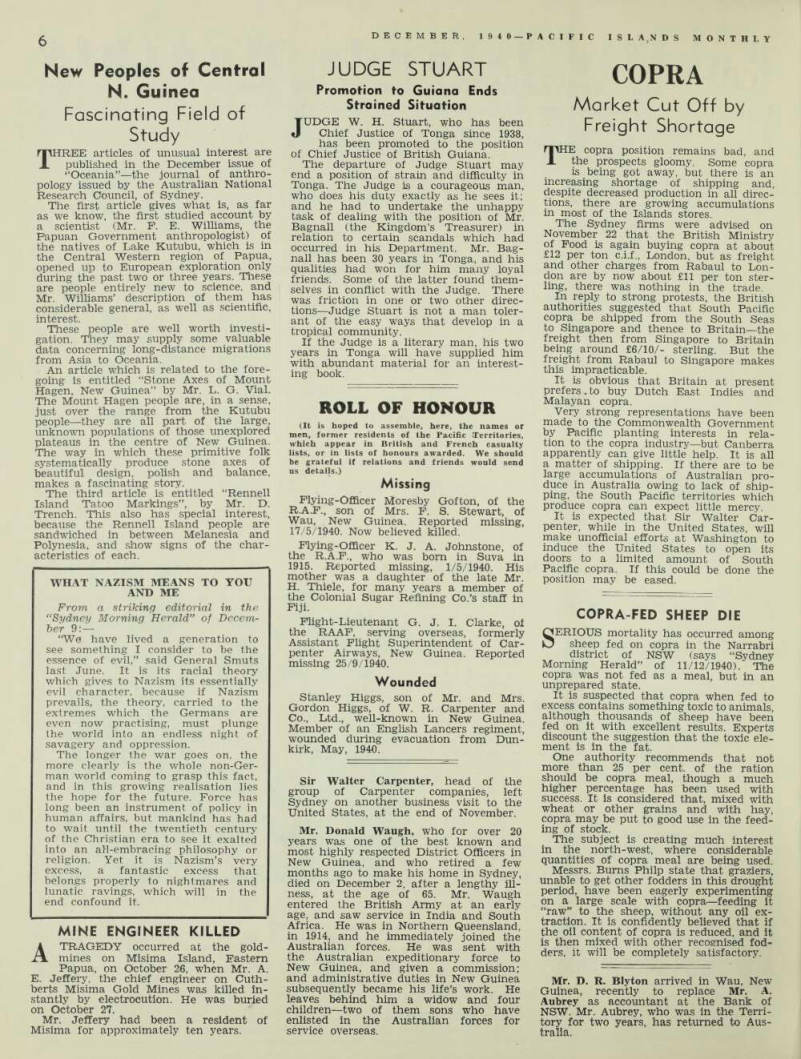
ON Sunday, November 17, a large con gregation gathered in Ela Protest ant Church, Port Moresby, to cele-
brate the 50th anniversary of its estab lishment in 1890. A service was conducted by the Senior Missionary of the LMS in Papua, Rev. H. J. E. Short, assisted by Rev. S. J, Rankin and Rev. Maurice Nixon, Chairman of the LMS.
The service was an impressive one, and in his sermon Mr. Short testified to the soundness and dignity of the Church’s contribution to the life of the community over the years, and he made a stirring call to a new allegiance.
The Senior Elder, Mr. C. H, Brough, sketched the history of the church since subscriptions were raised towards the building fund by the first LMS missionary in Papua, Rev. G. W. Lawes. Of the 62 subscribers to the fund. Mr. A. C. Eng lish, of Kapa Kapa, is the only one liv ing to-day. The names included those of Sir William MacGregor, Sir Samuel Griffiths, Sir James Burns, Sir James Reading Fairfax (“Sydney Morning Herald”) and many others, long passed away.
Mr. S. A. Lonergan, Assistant Govern ment Secretary in the New Guinea Ad ministration arrived in Australia with Mrs. Lonergan recently on leave. Mr. C.
Meares has taken Mr. Lonergan's place during his absence.
The church building, photographed in 1890.
Plan to Meet Clamant
Suva Market
Plan to Meet Clamant Public Need
IT is an astonishing fact that, in the considerable and rapidly-growing city of Suva there is no adequate provision for markets.
The early morning market is a feature of life in all Pacific centres— notably, Noumea, Rabaul, Papeete. In Suva, with its five communities (Euro pean, Fijian, Indian, Chinese and Euro nesian), and its daily accumulations of perishable, tropical foodstuffs, the mar ket is a necessary affair. But, until now, it has been a primitive arrange ment —mostly a meeting of vendors and buyers in the open air under somewhat unhygienic conditions. There are only two small shelter-sheds, incapable of housing the fruit, vegetables, fish, etc, that are brought in.
The Suva Town Board, with the approval and assistance of the Govern ment, now P r °P° se s to spend some £14,000 on erecting a suitable building on a suitable site in the centre of the town.
It is not a good time to undertake public expenditure of this kind. But, as Mr. G. K. Roth (chairman of the Town Board) pointed out, the need is very urgent, and “who can say when costs will be again as low as they now are?"
Seek An Alternative To
Rice?
WAR conditions generally, and political conditions in the Far East, all of which have interfered with ship ping, threaten to bring about a rice famine in New Guinea.
New Guinea imports large quantities of rice from Saigon, Rangoon, etc., for the feeding of the tens of thousands of native labourers employed there. The price of rice, delivered in the New Guinea ports, has risen sharply in recent weeks This is very embarrassing—but it may prove to be a very good thing if it com pels the N.G. administration, and N G interests generally, to devise some other means of providing their thousands of native labourers with a staple food— either a cereal grown in New Guinea or something made from Australian flour. It often requires a “good” war, or a “good” fire, to clean up economic conditions which should never have been allowed to exist.
to Japan
"Papuan Chief" Goes as Scrap to Japan
THE old “Papuan Chief”, after long years of service on the Papuan Coast, and after being wrecked, salvaged and repaired, was sold recently by Steamships Trading Co. Ltd. to the Japanese as “scrap”, and was removed from Port Moresby.
A Japanese ship, “Tashema Maru”, arrived in Port Moresby on November 9 with cargo, and a spare crew for the “Papuan Chief”, which was transferred to the Japanese flag and named “Kapi Maru”. The latter sailed out of Port Moresby on November 12, but broke down near the reef and anchored ( off Local Island. Repairs were made, and next day she sailed for Samarai and the East.
Tahiti Is For
Free France
Dr. De Curton Now
Governor
rERE has been an extraordinary series of events in the Government of French Oceania.
In June, France was betrayed by the Fascist enemy within, and capitulated.
In July and August, a little gang of Fascists tried to seize power in Tahiti.
In August, a plebiscite showed that 5,364 people were for General de Gaulle and Free France, and 18 against.
The official Governor, M. de Gery, then resigned and left the colonv.
Three members of the Privy Council and the Mayor of Papeete took over the government.
Early in September, Edmond Man sard. an old comrade of General de Gaulle, became Governor M. Mansard was too ill to carry on.
It was officially announced, on Novem ber 9, that M. Mansard had resigned, and had made a recommendation to General de Gaulle.
It was announced, late in November, that Doctor de Curton had been appointed Governor of French Oceania, and was working in harmony with M.
Henri Sautot, the Free French Governor of New Caledonia.
The Spirit Of France
THE following is a summary of the announcement made by M. E. Man sard on November 9:— My Dear Friends, —In the month of September your qualified representatives, conferring upon me a confidence which will remain the greatest honour of my life, proposed me for the heavy task of Governor of this country.
When I was nominated by the Leader of Free France, my ambition was to serve our little country, these magnificent archipelagos placed in the very heart of the Pacific Ocean, to con secrate myself to that heavy task, and with your aid to strive for the liberation and regeneration of France, our unhappy and much-loved Mother land, betrayed by villainous politicians and over run by the Boche.
I reckoned, however, without my ill-health.
During this grave period, I am chained to mv bed. Therefore, in view of my ill-health, I was forced on the 30th September last to resign my duties. In conjunction with Members of the Government, I proposed to General de Gaulle, the nomination of Doctor de Curton. At this prave hour, the choice of a young man seems to us necessary. Dr. de Curton is energetic and courageous and must succeed. Give him your confidence.
I thank all those who have helped me. 1 wish for the happiness of everyone.
Long live the French establishments of Oceania.
Long live Free France and her Leader, General de Gaulle.
Long live Great Britain, our faithful ally.
May a lofty and upright mind, and a well placed heart unite everyone for the victory of our arms.
E. Mansard.
Was Suppressed
How a Fascist Clique Was Suppressed
Prom Our Own Correspondent
Papeete, Oct. 18.
AT last, after many delays due to a variety of causes—of which trans port is not the least—l am able to supply a connected story of what hap pened here between the time when France made her tragic capitulation to the enemy in June, and we in French Oceania finally placed ourselves in the ranks of Prep France at the end of August.
Here, in French Oceania, we are very
isolated. We knew in June, of course, that Prance had been over-run by the Hun and that French leaders, of whom we had expected resistance to the death, had surrendered to Hitler and formed what was called the Vichy Government.
But, until the middle of August, we in Papeete believed that we were nart of the French Empire, and that, whatever Vichy might do, we were definitely still at war on the side of our British allies.
That, we believed, was the wish, and per haps the intention, of our then Governor, M. de Gery, whom we highly esteemed.
On June 25, the Governor issued a proclamation to the ponulation of Tahiti virtually stating that we were still at war as an ally of Great Britain. We did hear, however, that certain Fascist gentlemen in high places in this colony were bringing heavy pressure to bear on the head of our colony to induce him to adhere to the Vichy Government.
A large section of our community be came restless and suspicious. The “Com mittee of Free France” was formed.
When certain regulations, manifestly emanating from Vichy, appeared in our official journal, and at the same time our local Fascists issued a manifesto demand ing restrictive laws—comparable only to those in force in Poland and Nazi Ger many—against those who favoured Free France, the Committee of Free France decided to act.
It insisted that there be taken a plebi scite of the whole population. The plebi scite was taken in mid-August and it re sulted in 5,564 people voting for Free France and General de Gaulle, and only 18 voting against. Thus was disclosed the real strength of our gang of Fascists.
Thereupon the Governor, the popular M. de Gery, took the only course open to him, and resigned office. He shortly afterwards departed for Ban Francisco, en route to Europe. The direction of the Government was assumed by three mem bers of his private council—namely MM.
Erahnne, G. Lagarde and E. Martin, to gether with the Mayor of Papeete, M.
George Bambridge. All of these men are members of old and influential families in Tahiti.
The radiogram announcing the result of the plebiscite, and the fact that the Government temporarily was in the hands of the four men named, was despatched to General de Gaulle on the evening of September 2. Listeners were
thrilled to hear, in the early morning broadcast of the 8.8. C. on September 3, the announcement that the message had been received by General de Gaulle.
Early in September, the Government of New Zealand arranged an economic accord with the Tahiti administration, to last for the duration of the war. New Zealand, in many ways, gave the French colony immediate assistance.
A steamer of the Messageries Maritime Line, which had come from France via Panama, and had been lying in Papeete for a considerable time, was brought into useful operation.
On September 18 our local Fascists tried to stage a coup d’etat, but it was immediately put down by the authorities, without any riot or bloodshed. The Fascist ring-leaders were then gathered up and placed aboard the MM liner, which sailed away with them a few days later.
Since that day everything in the colony has - been calm.
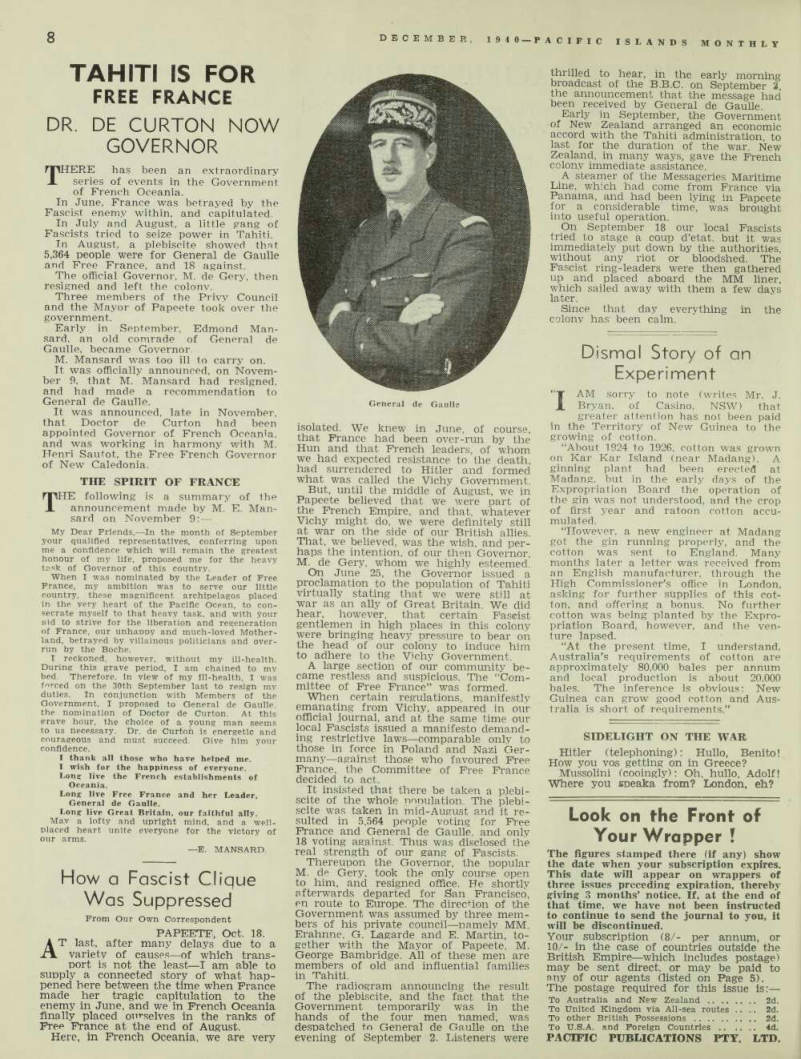
General de Gaulle
Experiment
Dismal Story of an Experiment
“T AM sorry to note (writes Mr. J.
JL Bryan, of Casino, NSW) that greater attention has not been paid in the Territory of New Guinea to the growing of cotton.
“About 1924 to 1926, cotton was grown on Kar Kar Island (near Madang). A ginning plant had been erected at Madang. but in the early days of the Expropriation Board the operation of the gin was not understood, and the crop of first year and ratoon cotton accu mulated.
“However, a new engineer at Madang got the gin running properly, and the cotton was sent to England. Many months later a letter was received from an English manufacturer, through the High Commissioner’s office in London, asking for further supplies of this cot ton, and offering a bonus. No further cotton was being planted by the Expro priation Board, however, and the ven ture lapsed.
“At the present time, I understand, Australia’s requirements of cotton are approximately 80,000 bales per annum and local production is about 20,000 bales. The inference is obvious: New Guinea can grow good cotton and Aus tralia is short of requirements.”
Advertisements & other items, p. 10 (2 items)
Sidelight On The War
Hitler (telephoning): Hullo, Benito!
How you vos getting on in Greece?
Mussolini (cooingly); Oh, hullo, Adolf!
Where you speaka from? London, eh?
Look on the Front of
Your Wrapper !
The figures stamped there (if any) show the date when your subscription expires.
This date will appear on wrappers of three issues preceding expiration, thereby giving 3 months’ notice. If, at the end of that time, we have not been instructed to continue to send the journal to you, it will be discontinued.
Your subscription (8/- per annum, or 10/- in the case of countries outside the British Empire—which includes postage) may be sent direct, or may be paid to any of our agents (listed on Page 5).
The postage required for this issue is:— To Australia and New Zealand 2d.
To United Kingdom via All-sea routes ... 2d.
To other British Possessions 2d.
To U.S.A. and Foreign Countries 4d.
PACIFIC PUBLICATIONS PTY, LTD.
Japanese Expansion In Polynesia
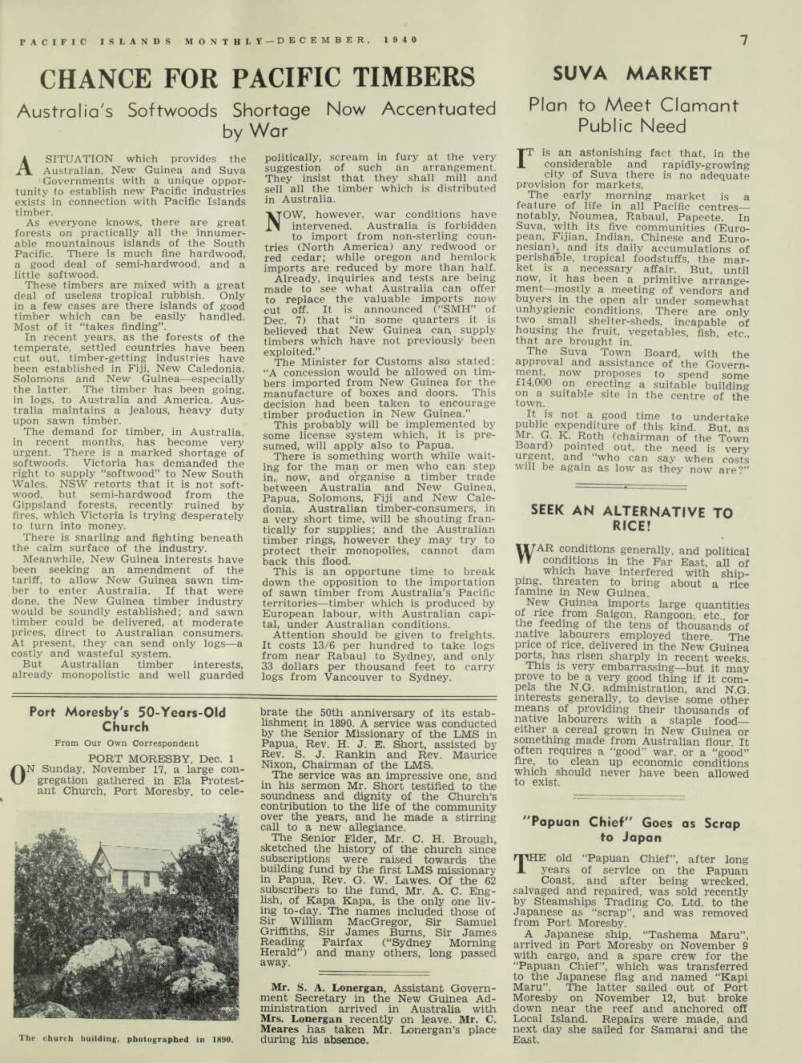
As has been pointed out frequently in this journal, the Japanese penetration of the South Seas goes on steadily. This is a recent photograph of a large con crete building, under erection in the centre of Nukualofa, Tonga, for Banno Brothers, Japanese merchants.
High tariffs do not prevent the expan sion of Japanese merchandising in European countries. Labour conditions in Japan are immensely different to Euro
pean industrial conditions, with the result that Japanese goods are produced at a tithe of the cost of European goods, and can be sold against them at a profit, in spite of “prohibitive” tariffs.
There, in a sentence, is the crux of the Pacific problem. We want to trade peace fully and amicably with Japan; but how can we do this, while the standards of life of Japan’s industrial masses are so different to our own?
Australia's Pitiful Record
in N. Guinea A Flea For an Economic Survey
IT is reported that the Wau branch of the Australian Labour Party is strongly urging that an economic survey be made of the Mandated Ter ritory of New Guinea.
If this energetic little body, with its headquarters on the Morobe goldfield, can induce the Commonwealth Govern ment to undertake a New Guinea stock taking, and scientifically line up for examination the enormous undeveloped wealth of New Guinea, it will have done Australia a great national service.
It is nothing short of a tragedy that Australia should have been in possession of this great, rich territory for more than twenty years, with the enormous funds, providentially supplied by the gold industry, available for development, and that it should have done so little with the Territory. A great gold indus try has been established —but that has been the result of enterprise by indi vidual miners and well-managed com panies—the Australian Government and the New Guinea administration can take little credit for that. Little else, worthy of mention, has been accom plished.
Yet the amiable Sir John Latham, on his way to Japan as Australian Minis ter, when entertained at afternoon tea at Government House. Rabaul, made a speech in which he warmly praised the admirable achievements of the Austra lian administration in New Guinea. One wonders what Sir John knows of the matter, anyway—and what the older European residents of New Guinea (who do know something about it) think of Australia’s record there. It is a pity Sir John does not have a chat with some of them, away from the atmosphere of Namanula.
THERE is now a “hush-hush” policy in relation to New Guinea. “Do not criticise Australia’s performances there.” one is told. “You will only strengthen the hands of our enemies, who are seeking justification of their plans to deprive us of our territories.”
This war has shown that it is not our British people who fear the truth, but thick-skulled bureaucrats and dithering politicians—spawn of our rotten political machine —who are given responsibility for our national activities. They will seize upon any excuse to hide their notorious inefficiency.
New Guinea is a case in point. New Guinea could be developed as a tropical
territory of great value, along lines indicated by Java and the Philippines.
Instead, for over 20 years, New Guinea has been nothing but a plaything for politicians.
We challenge anyone to study the New Guinea annual reports, and point to any period (apart from the brief adminis tratorship of General Tom Griffiths) when New Guinea was apparently being governed in accordance with a defined plan and a developmental policy. Yet the Territory has had the men (a well trained, capable corps of keen young Australians) and the money (available in the rich royalties of the gold industry).
It simply has lacked a creative force and an administrative touch in Can berra and Rabaul.
Tribute To Mrs. F. S. Stewart
From Our Own Correspondent WAU, Dec. 5.
YESTERDAY, December 4, Mrs. F. s.
Stewart was the guest at a party at the Wau Club, when the Wau community took the opportunity of say ing good-bye to her as part-owner and recently manageress of the Hotel Bulolo, where she long has been held in high regard. Felicitous speeches were made, and Mrs. Stewart was presented with a handsomely-fitted travelling case.
Loss Of Her Son
It was with deep regret that residents of Wau and district learned that notifi cation had been received by Mrs. Stew art from the Air Ministry, that all hope that her son, Pilot Officer Moresby Gof ton. might still be alive, has been aban doned. Moresby Gofton. who was serv ing with the RAF, failed to return from a flight over Norway about the time when the Germans attacked that coun try; and his name now apparently must be inscribed in the Roll of Honour as the first man from the Morobe Gold fields to give his life for the Empire in the present war.
Mr. H. E. Nicholl, Senior Road Fore man in the Public Works Department, has retired from the Fiji Civil Service.
Advertisements & other items, pp. 11-12 (1 item)
Flat Oil
FINISH
WATERPROOF
. DRIES IN NAIF HOUR
CREAM
Write for a colour Card ...
STERLING VARNISH
Dries in half an hour on plaster walls, ceilings, cement, fibre, wood tr iron.
Also Excellent as an Undercoat for lacquers, paints & enamels 14/4 per gallon
HIGHLY DURABLE
Alexandria, N.S.W.
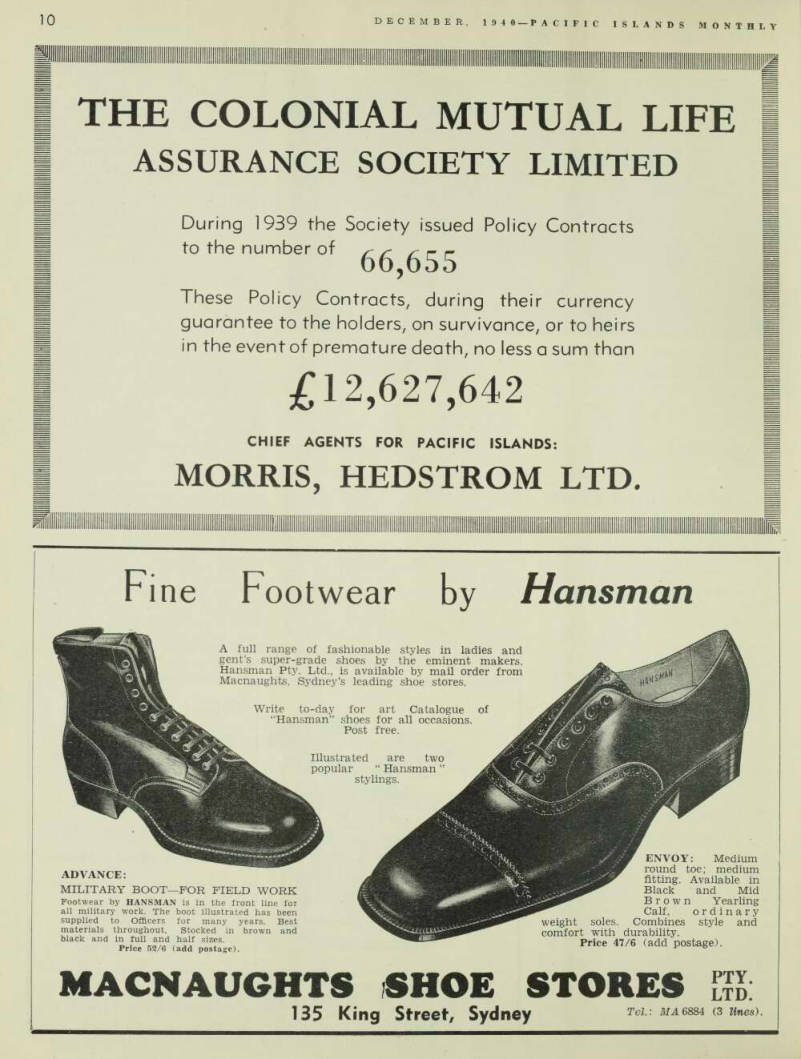
THE COLONIAL MUTUAL LIFE
ASSURANCE SOCIETY LIMITED
During 1939 the Society issued Policy Contracts to the number of r r r - - 66,655 These Policy Contracts, during their currency guarantee to the holders, on survivance, or to heirs in the event of premature death, no less a sum than £12,627,642
CHIEF AGENTS FOR PACIFIC ISLANDS:
MORRIS, HEDSTROM LTD.
Fine Footwear by Hansman
ADVANCE:
MILITARY BOOT—FOR FIELD WORK
Footwear by HANSMAN is in the front line for all military work. The boot illustrated has been supplied to Officers for many years. Best materials throughout. Stocked in brown and black and in full and half sizes.
Price 52/6 (add postage). 0 0 s A full range of fashionable styles in ladies and gent’s super-grade shoes by the eminent makers.
Hansman Pty. Ltd., is available by mail order from Macnaughts, Sydney’s leading shoe stores.
Write to-day for art Catalogue of “Hansman” shoes for all occasions.
Post free.
Illustrated are two popular “ Hansman ” stylings.
ENVOY: Medium round toe; medium fitting. Available in Black and Mid Brown Yearling Calf, ordinary Combines style and comfort with durability.
Price 47/6 (add postage). weight soles.
MACNAUGHTS SHOE STORES m
135 King Street, Sydney
LTD.
Tel: MA 6884 (3 lines).
About Islands People
Mr. E. S. Paul, the well-known pro prietor of the Gold Star transport ser vices in Samoa, went to New Zealand recently on a holiday. But probably, while in New Zealand, he is doing some thing about petrol restrictions. New Zea land has exaggerated ideas regarding petrol rationing, and Samoa has suffered thereunder. The boat service between Apia and Pago Pago, established several months ago by Mr. Paul, is running sat isfactorily.
Mr. George Step, managing director of the well-known firm of Islands agents, C.
Sullivan Pty., Ltd., left Sydney by ’plane on December 6 on one of his periodical visits to Noumea, where, on this occasion, he will stay about two weeks.
Mr. H. B. Smith, branch inspector of W. R. Carpenter & Co., Ltd., returned to Sydney by ’plane recently after a visit of inspection to New Guinea.
Mr. Frank Stock, postmaster at Tulagi, BSI, returned to the Protectorate in mid-November, after spending furlough in Sydney and Melbourne.
Mr. H. H. Fraser, who is engaged in tributing activities for New Guinea Gold fields, Ltd., in Morobe District, TNG, was in Victoria on a holiday visit in Novem ber. He was accompanied by Mrs.
Fraser and their daughter.
Mr. and Mrs. H. E. Tattersall, accom panied by their four children, reached Sydney from Western Samoa recently and proceeded to Queensland where they will reside in future. Mr. Tattersall, who has been in ill-health for some time, which necessitated his leaving the tropics, served in the Great War with the British Coldstream Guards. A mem ber of the Samoan Administration for over 20 years, his last position was plan
tation overseer with the NZ Reparation Estates.
Miss Sheila Page, daughter of the well known Government Secretary and Deputy Administrator in New Guinea, is about to enter upon a course of training as a nurse in Royal Prince Alfred Hos pital, Sydney. She recently has been feted at many farewell parties in Rabaul.
Mrs. Charlotte Dorothea Hahn, who died in Sydney on December 3 at the age of 53 was well-known in Tonga, where she was at one time a close friend of Queen Salote. She came from two of the oldest families in Central Pacific— the Riechelmanns and Cockers; and her grandfather, Mr. Joseph Cocker, was first British Consul in the Group. Mrs.
Hahn is survived by two sons and a daughter—Richard. Charles and Olita — all of whom are living in Sydney. One of her sisters is Mrs. W. G. Bagnall, of Tonga.
Mr. Dion Coote, son of the manager of Burns, Philp & Co., Ltd., Rabaul, New Guinea, arrived in Sydney recently for medical treatment.
Mr. A. C. Turnbull, Acting-Admini strator of Western Samoa, arrived in New Zealand in November, with Mrs. Turn bull. During his absence, the post of Acting-Administrator is being filled by Mr. W. R. McCulloch.
Mr. and Mrs. A. G. Smyth, well-known and popular residents of Apia, Western Samoa, celebrated their Ruby Wedding (40 years) in October —they were married on October 8, 1900, by Rev. Weld- Thomas at the Quetta Memorial Church, Thursday Island.
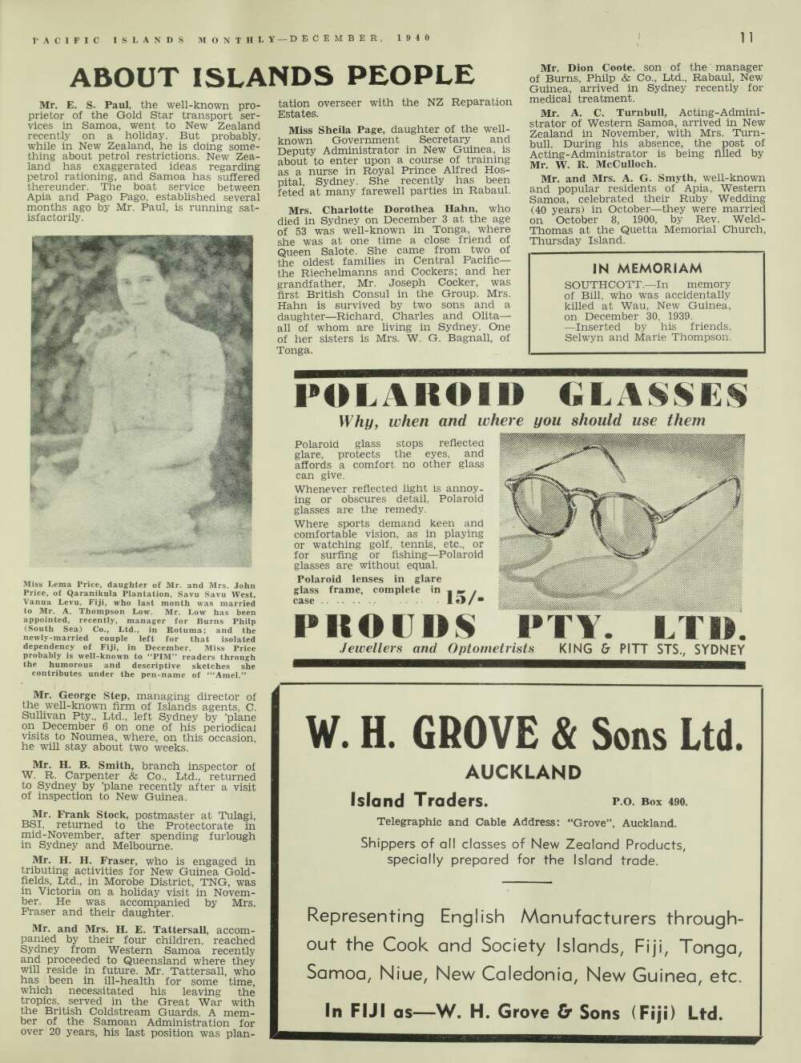
Miss Lema Price, daughter of Mr. and Mrs. John Price, of Qaranikula Plantation, Savu Savu West, Vanua Levu, Fiji, who last month was married to Mr. A. Thompson Low. Mr. Low has been appointed, recently, manager for Burns Philp (South Sea) Co., Ltd., in Rotuma; and the newly-married couple left for that isolated dependency of Fiji, in December. Miss Price probably is well-known to “PIM” readers through the humorous and descriptive sketches she contributes under the pen-name of ‘“Amel.”
Mrs. D. Cahill recently returned to Samarai, Eastern Papua, after 12 months’ absence in Australia.
Advertisements & other items, pp. 13-14 (2 items)
In Memoriam
SOUTHCOTT. —In memory of Bill, who was accidentally killed at Wau, New Guinea, on December 30, 1939. —lnserted by his friends, Selwyn and Marie Thompson.
W. H. GROVE & Sons Ltd.
FOLAKOin GLASSES
Why, when and where you should use them Polaroid glass stops reflected glare, protects the eyes, and affords a comfort no other glass can give.
Whenever reflected light is annoying or obscures detail, Polaroid glasses are the remedy.
Where sports demand keen and comfortable vision, as in playing or watching golf, tennis, etc., or for surfing or fishing—Polaroid glasses are without equal.
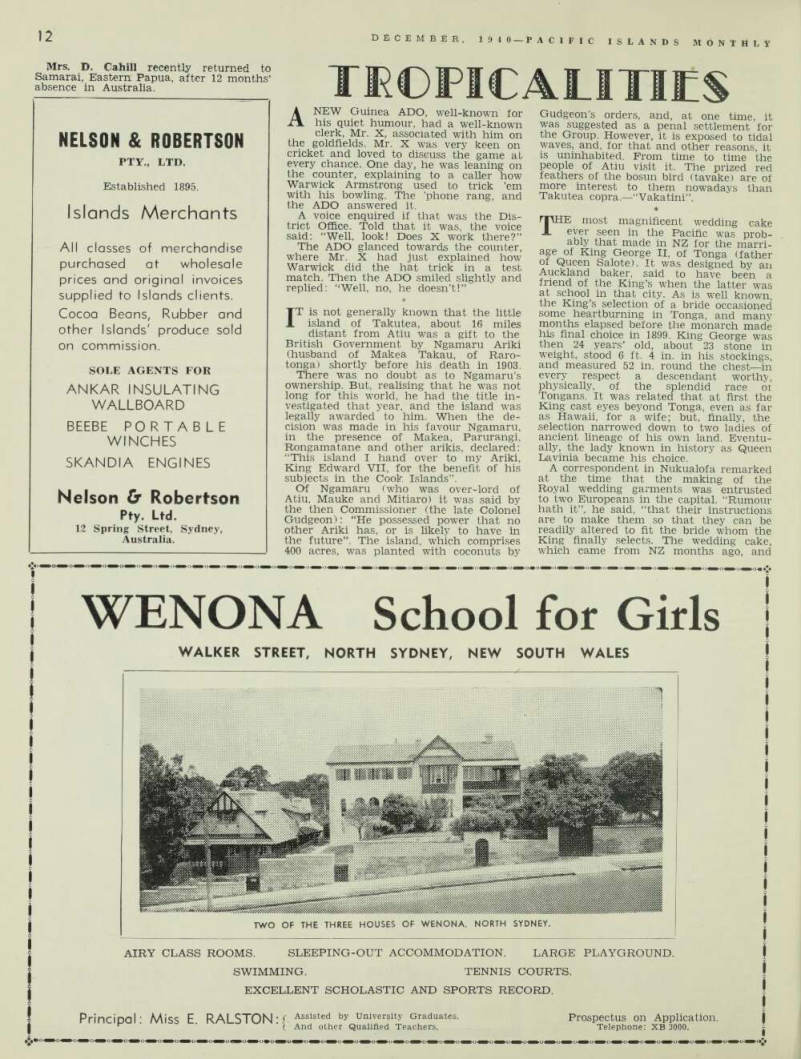
Polaroid lenses in glare glass frame, complete in case 15/-
morns itv. ltd.
Jewellers and Optometrists KING & PITT STS., SYDNEY
W. H. GROVE & Sons Ltd.
AUCKLAND
Island Traders. p.o. bo* 490.
Telegraphic and Cable Address: “Grove”, Auckland.
Shippers of all classes of New Zealand Products, specially prepared for the Island trade.
Representing English Manufacturers throughout the Cook and Society Islands, Fiji, Tonga, Samoa, Niue, New Caledonia, New Guinea, etc.
In FIJI os—W. H. Grove & Sons (Fiji) Ltd.
NELSON & ROBERTSON
PTY., LTD.
Established 1895.
Islands Merchants
All classes of merchandise purchased at wholesale prices and original invoices supplied to Islands clients.
Cocoa Beans, Rubber and other Islands' produce sold on commission.
SOLE AGENTS FOR
ANKAR INSULATING
WALLBOARD
BEEBE PORTABLE
WINCHES
SKANDIA ENGINES
Nelson & Robertson
Pty. Ltd. 12 Spring Street, Sydney, Australia.
Tropicalilies

ANEW Guinea ADO, well-known for his quiet humour, had a well-known cl f™. Mr. x > associated with him on the goldfields. Mr. X was very keen on cricket and loved to discuss the game at every chance. One day, he was leaning on the counter, explaining to a caller how Warwick Armstrong used to trick ’em with his bowling. The ’phone rang, and the ADO answered it.
A voice enquired if that was the District Office. Told that it was, the voice said: “Well, look! Does X work there?”
The ADO glanced towards the counter, where Mr. X had just explained how Warwick did the hat trick in a test match. Then the ADO smiled slightly and replied: “Well, no, he doesn’t!” 1™ . , T is not generally known that the little island of Takutea, about 16 miles distant from Atiu was a gift to the British Government by Ngamaru Ariki (husband of Makea Takau, of Rarotonga) shortly before his death in 1903.
There was no doubt as to Ngamaru’s ownership. But, realising that he was not long for this world, he had the title investigated that year, and the island was legally awarded to him. When the decision was made in his favour Ngamaru, in the presence of Makea, Parurangi, Rongamatane and other arikis, declared: “This island I hand over to my Ariki, King Edward VII, for the benefit of his subjects in the Cook Islands”.
Of Ngamaru fwho was over-lord of Atiu. Mauke and Mitiaro) it was said by the then Commissioner (the late Colonel Gudgeon); “He possessed power that no other Ariki has, or is likely to have in the future”. The island, which comprises 400 acres, was planted with coconuts by
Gudgeon’s orders, and, at one time it was suggested as a penal settlement for the Group. However, it is exposed to tidal waves, and, for that and other reasons, it is uninhabited. From time to time the people of Atiu visit it. The prized red feathers of the bosun bird (tavake) are of more interest to them nowadays than Takutea copra.—“Vakatini” * mHF mnct i
T**pvp? In wedding cake
A St cl ? c .T as prob_ KirSnSSSI! tt N ? £? r the H 1^ 1 ' of (father AuiSwi S ’ f designed by an mmJf’nf een a 5 - the I ?l tt^ r was at school in that city. As is well known, the King’s selection of a bride occasioned some heartburning in Tonga, and many months elapsed before the monarch made his final choice in 1899. King George was then 24 years’ old, about 23 stone in weight, stood 6 ft. 4 in. in his stockings, and measured 52 in. round the chestin’ every respect a descendant worthy, physically, of the splendid race oi Tongans. It was related that at first the King cast eyes beyond Tonga, even as far as Hawaii, for a wife; but, finally, the selection narrowed down to two ladies of ancient lineage of his own land. Eventu ally, the lady known in history as Queen Lavinia became his choice.
A correspondent in Nukualofa remarked at the time that the making of the Royal wedding garments was entrusted to two Europeans in the capital. “Rumour hath it”, he said, “that their instructions are to make them so that they can be readily altered to fit the bride whom the King finally selects. The wedding cake, which came from NZ months ago, and
which has since nourished some millions of ants and copra bugs, is in the hands of a local confectioner, who is busily re pairing their ravages. Meanwhile nobody, apparently not even the bridegroom, knows for whom the dresses and cake are intended!”
When the King did marry, Nukualofa residents were worried for a time by a series of mysterious fires—apparently, some Tongans who were annoyed with their monarch for his choice expressed their feelings that way!—“Moaroa”.
“ VTEVER in the history of the world has there been a conflict on whose outcome so much is at stake; never before has our Empire, or any other Empire, been to the same extent the shield and buckler of human civilisation.” —A passage from a stirring address to the Fiji Legislative Council by Sir Harry Luke. ♦ IN 1914, after German atrocities had been committed in France, a portrait of “All Highest” appeared in “Pear son’s Magazine” (says a New Guinea correspondent). And, under it, were lines, something like this:— Some say there is a Mongol strain persists in Prussian blood: When bursting from the crowded East there came that evil flood, Of flat-faced, lusting devils, spawn of Hell’s own womb, Who entered Rome with Attica, and left of Rome—a tomb That when the Hunnish tribesman went a raiding in the West, They left an ugly Hunnish babe at many a German breast.
This maybe is a legend. But, if that tale be true, How proud to-day would Attila, All Highest, be of you!
If (says our New Guinea friend) you put the words “All Lowest” in place of “All Highest”, and placed them under a portrait of the gentleman “with the brow of a Christ and the moustache of a Charlie Chaplin”, it would exactly ex press our viewpoint of to-day. * HUMAN freaks are occasionally re ported, but it is seldom that one is found in Polynesia. A curious case was reported, however, from Raiatea, in 1867. A native child was born that year, on this island, with two heads, four arms and four legs. A medical official was despatched from Tahiti by the French Government to report on this case.
Eventually, both the infant and its par ents were brought to Tahiti, the intention being to exhibit the freak of nature. The child lived for a time. —“Eriki”. * THE Fijian crew of the cutter were talk ing. That unending topic, war, was the subject, and talk drifted to what they would do to Hitler if they caught him. Various boys had a stab at the mouth-watering idea; then Jone, the shameless, raised his voice.
“If I catch, I would eat him”, he de clared emphatically. “Yes”, he went on, “eat him, but not ‘Vakadua’ (right at once) but bit by bit.” Then, his eyes glazing with anticipation, he continued.
“On Monday, I eat his little finger, on Tuesday his third finger, on Wednesday his big finger, then on Thursday his index finger . . .”
The rest of the tale was an orgy of blood-thirsty imagination. By the time Jone got to the Fuehrer’s shoulder-joint, I gave it best; acting as chairman at the hideous banquet, I sharply rapped the hammer. —“Rox”. * ONE of the prized exhibits of the Dominion Museum at Wellington (NZ), is the axe called “Te Toki a
Rei Meitei”, which, according to Moriori tradition, was brought by the chief Moe from their original home, in the canoe Oropuke. This weapon, and another of equal importance historically, was found at the foot of a tree in the Chatham Is lands.
Both axes are regarded as evidence that the Moriori people originated in New Zealand. As they were in those islands prior to the Maori invasion of 1836, they must have been brought by the original Moriori migrants. It is believed that the Moriori migrated to the Chathams from New Zealand about 1150 —200 years be fore the main migration of Tahitian voyagers from the Society Group to New Zealand. When certain Taranaki (NZ) tribes invaded the Chathams in 1836, there were at least 1,800 Moriori then living. But, from that time, the race de clined rapidly. Tommy Solomon, the last Moriori (who weighed 30 stone) died in 1933.—E.R.
THE Burns Philp Trust Bill, which is a measure designed to give a proper legal standing to the Trust Company, established in recent years by the big firm to handle trustee business and manage estates of deceased per sons, passed the last stage in the NSW Parliament in the dying hours of the
session on December 5. It was cease lessly and bitterly opposed by the two great Sydney trust companies, which now have a kind of monopoly of that kind of business in NSW —so much so that they hold virtually a controlling inter est in several leading Australian cor porations. They succeeded in having the Bill held up for special examination, and they even briefed counsel to state argu ments against it. It is a curious and in teresting fact that this measure, so bitterly opposed by people representing
monopolies and money power, was op posed also by the Labour Party. How ever, the bill was carried eventually by a majority of 5 votes.
The Bill was altogether 14 months in the legislative machine, and the fact that it finally went through is a tribute to the tenacity and patience of BP’s gen eral manager at headquarters, Mr. C.
H. Chester. Night after night, month after month, he could be seen sitting quietly in the public gallery of the NSW Parliament, waiting for the occasional appearances of his long-cherished mea sure. Through all the weary months he beamed pleasantly through his spectacles at friend and foe alike; but, if one only could have read his mind, and learned his real opinion of Parliamentary processes, his thoughts might have been worthy of publication in the “PlM”—which is said to be notorious for its loathing of poli ticians and all their works. * A SIGN of the times was noticed in the ports of Fiji last month, where
a five-masted schooner from over sea was seen loading sugar. It is nearly 25 years since a similar sight was seen —when then, as now, war had destroyed so many steamships that it was neces sary to bring the old-time sailing ships into use as freighters.
Advertisements & other items, pp. 14-16 (2 items)
12
DECEMBER. 1940 PACIHC ISLANDS MONTHLY
WENONA School for Girls
WALKER STREET, NORTH SYDNEY, NEW SOUTH WALES m-mm mmm W®
ifeii
TWO OF THE THREE HOUSES OF WENONA. NORTH SYDNEY.
AIRY CLASS ROOMS. SLEEPING-OUT ACCOMMODATION. LARGE PLAYGROUND.
SWIMMING. TENNIS COURTS.
EXCELLENT SCHOLASTIC AND SPORTS RECORD.
Principal: Miss E. RALSTON :f Assisted by University Graduates. r ' \ And other Qualified Teachers.
Prospectus on Application.
Telephone: XB 3000.
PACIFIC ISLANDS SOCIETY
Visitors from the Islands to Sydney (or those Interested in Islands affairs), are advised to communicate with the honorary secretary of the above Society, which has been formed to study the history, traditions, economics, and political developments of the Pacific Islands.
Regular monthly meetings held at Hotel Carlton, Sydney, Address for Correspondence:
THE PACIFIC ISLANDS SOCIETY,
Box 2434 MM., G.P.0., Sydney.
Throughout Australasia and overseas
IXL
ft'4-
Canned Foods, JAMS
FRUITS and SAUCES
are selected for their unequalled
QUALITY&FLAVOUR
Some Popular IXL Varieties
IXL JAMS. —All kinds, 12 oz., 24 oz. and 5 lb. tins.
IXL JAMS (in 1 lb. Jars).—Lemon Shred, Orange Shred, Grape Fruit Shred, Marmalade, etc.
IXL CANNED FRUITS. Peaches, Pears, Apricots, etc., 16 oz. and 30 oz. tins.
IXL SPECIAL FRUlTS.—Gooseberries, Blackberries, Blackcurrants, Cherries, Grapes, Greengages, Golden Drops, Quinces, etc.
IXL TOMATO JUICE.—IO oz. and 15 oz. tins.
IXL PICKLES.—AII kinds, 6 oz., 14 oz. and 18 oz. Jars.
IXL SPECIAL PICKLES.—Packed in special 16 oz. Jars.
IXL TOMATO SAUCE.—4 oz., 10 oz., and 20 oz. bottles.
IXL WORCESTERSHIRE SAUCE (OR
RELISH). —5 oz., 10 oz., and 20 oz. bottles.
IXL BAKED BEANS (with TOMATO SAUCE).
—4 oz., 10 oz., and 16 oz. tins.
I XL
IXL SPAGHETTI (in Tomato Sauce with Cheese).—4 oz., 8 oz. and 16 oz. tins.
IXL SOUPS. —8 oz. and 16 oz. Cream of Tomato Soup. 8 oz. and 16 oz. Cream of Vegetable Soup. 8 oz. and 16 oz. Cream of Celery Soup. 8 oz. and 16 oz. Cream of Pea Soup. 8 oz. and 16 oz. Toheroa Soup.
I XL
Obtainable from all Leading Island Storekeepers.
H. JONES & CO. PTY. LTD. - - - HOBART AND SYDNEY.
Islands' Visitors to Sydney Will find excellent accommodation at
"106" PRIVATE HOTEL
204-8 Victoria Street, Kings Cross, Sydney.
Every Comfort, Splendid Table.
Tariff from 35/- per week.
MRS. C. PYATT, Proprietress.
Tel. FL 4272.
FOR DEPENDABLE LOW COST
ELECTRICITY , decide upon
PHILIPS
ELECTRIC LIGHTING PLANT
Dependability, Service, Low Running Costs, Simplicity, make the Philips Lighting Plant outstanding. *, This Philips Plant gives 25% more generating power, less running hours and lower upkeep cost. Operating at low speed it saves wear and tear.
The generator is separately mounted in accordance with standard power house design, and is not hung on to the engine as is the case with cheaper plants. The Philips runs at the low speed of 1800 R.P.M. and is equipped with forced draught cooling. Mechanical governor maintains constant engine speed at any generator load. A press of the button will start the engine. Similar plants have been supplied by us to the Royal Australian Air Force.
PRICE (less Battery) ex bond, including Federal Sales Tax .. . . £45 YOU CANNOT GO WRONG IF YOU CHOOSE A PHILIPS.
WRITE FOR FULL PARTICULARS.
Telegrams: “Virtue”, Sydney. ’Phones: FL5214 (6 lines).
MOFFAT-VIRTUE LTD. -1=
11-25 PALMER ST., SYDNEY. BOX 15848, G.P.O.
SHOWROOMS: 44 Bridge St. (opp. Winchcombe, Carson, Ltd.), Sydney
AND AT BRISBANE and LONGREACH, Q’LD.
Suva Red Cross Carnival
Rev. George Thomas, who last year visited Nauru and Ocean Islands as Anglican Chaplain has recently taken up appointment as Organising Secretary of the Australian Board of Missions for Victoria, with headquarters at St. Paul’s Cathedral buildings, in Melbourne. He succeeds Rev. Maurice Jones, who travel led extensively in Papua and New Guinea a year or two ago in furtherance of the work of the A.B.M. and wrote an inter esting booklet on the work of the N.G.
Anglican Missions. Rev. Jones is now vicar of a Brunswick parish, Melbourne.
QUEEN OF PEACE.—A photograph of a charming young Indian lady, Miss Rena Grant, daughter of Mr. and Mrs. J. F. Grant, of Suva, Fiji.
Advertisements & other items, p. 16 (1 item)
The first dose of WOODS'
GREAT PEPPERMINT CURE
eases throat, relieves pain. Get quick, pleasant help from 'Flu Colds,Coughs,Throatand Chest complaints with WOODS
GREAT PEPPERMINT CURE
Papua?
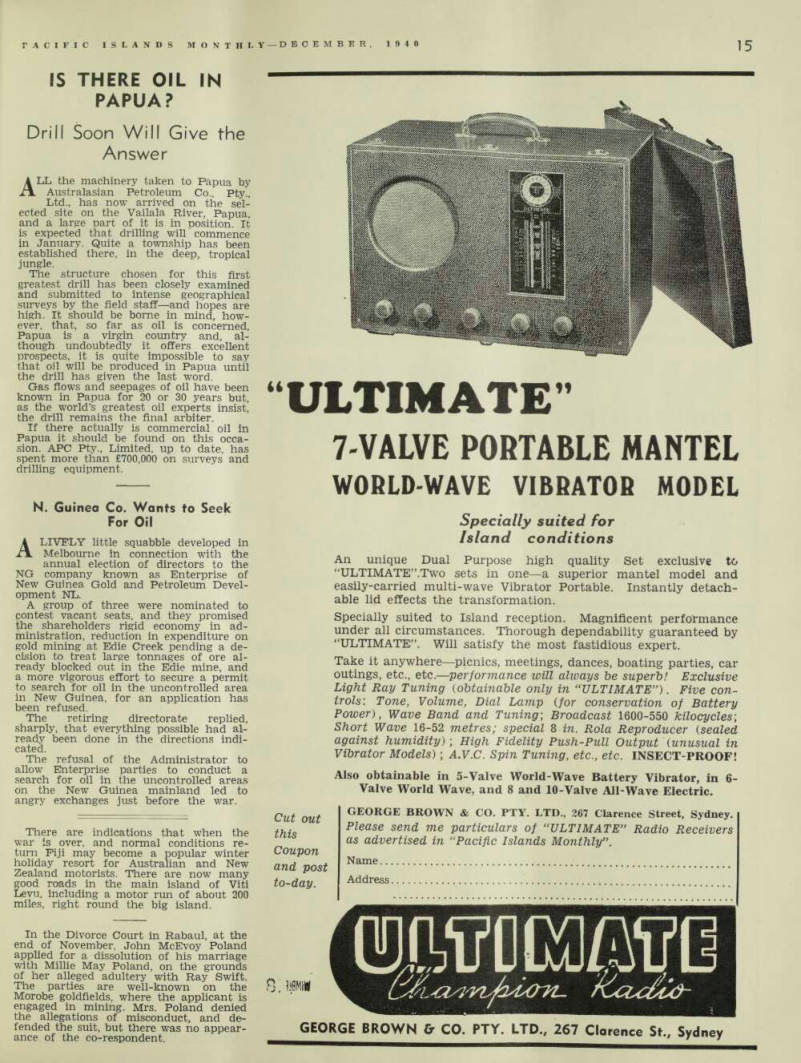
Is There Oil In
Drill Soon Will Give the Answer
ALL the machinery taken to Papua by Australasian Petroleum Co., Pty., Ltd., has now arrived on the sel ected site on the Vailala River, Papua, and a large part of it is in nosition. It is expected that drilling will commence in January. Quite a township has been established there, in the deen, tropical jungle.
The structure chosen for this first greatest drill has been closely examined and submitted to intense geographical surveys by the field staff—and hopes are high. It should be borne in mind, how ever, that, so far as oil is concerned, Papua is a virgin country and, al though undoubtedly it offers excellent prospects, it is quite impossible to say that oil will be produced in Papua until the drill has given the last word.
Gas flows and seepages of oil have been known in Papua for 20 or 30 years but, as the world’s greatest oil experts insist, the drill remains the final arbiter.
If there actually is commercial oil in Papua it should be found on this occa sion. APC Pty., Limited, up to date, has spent more than £700,000 on surveys and drilling equipment.
N. Guinea Co. Wants to Seek
For Oil
A LIVELY little squabble developed in Melbourne in connection with the annual election of directors to the NG company known as Enterprise of New Guinea Gold and Petroleum Devel opment NL.
A group of three were nominated to contest vacant seats, and they promised the shareholders rigid economy in ad ministration, reduction in expenditure on gold mining at Edie Creek pending a de cision to treat large tonnages of ore al ready blocked out in the Edie mine, and a more vigorous effort to secure a permit to search for oil in the uncontrolled area in New Guinea, for an application has been refused.
The retiring directorate replied, sharply, that everything possible had al ready been done in the directions indi cated.
The refusal of the Administrator to allow Enterprise parties to conduct a search for oil in the uncontrolled areas on the New Guinea mainland led to angry exchanges just before the war.
There are indications that when the war is over, and normal conditions re turn Fiji may become a popular winter holiday resort for Australian and New Zealand motorists. There are now many good roads in the main island of Viti Levu, including a motor run of about 200 miles, right round the big island.
In the Divorce Court in Rabaul, at the end of November, John McEvoy Poland applied for a dissolution of his marriage with Millie May Poland, on the grounds of her alleged adultery with Ray Swift.
The parties are well-known on the Morobe goldfields, where the applicant is engaged in mining, Mrs. Poland denied the allegations of misconduct, and de fended the suit, but there was no appear ance of the co-respondent.
Mr. Geoffrey Holmes, formerly of Kavieng, New Guinea, is now serving with the RAF in England.
Advertisements & other items, pp. 17-18 (2 items)
15
r ACIFIC ISLANDS MONTHLY DECEMBER, 1940
cpjoc™
44
ULTIMATE
1* Cut out this Coupon and post to-day.
7-VALVE PORTABLE MANTEL
WORLD-WAVE VIBRATOR MODEL
Specially suited for Island conditions An unique Dual Purpose high quality Set exclusive to “ULTIMATE”.Two sets in one—a superior mantel model and easily-carried multi-wave Vibrator Portable. Instantly detachable lid effects the transformation.
Specially suited to Island reception. Magnificent performance under all circumstances. Thorough dependability guaranteed by “ULTIMATE”. Will satisfy the most fastidious expert.
Take it anywhere—picnics, meetings, dances, boating parties, car outings, etc., etc. — performance will always be superb! Exclusive Light Ray Tuning (obtainable only in “ULTIMATE”). Five controls: Tone, Volume, Dial Lamp (for conservation of Battery Power), Wave Band and Tuning ; Broadcast 1600-550 kilocycles', Short Wave 16-52 metres; special 8 in. Rola Reproducer (sealed against humidity) ; High Fidelity Push-Pull Output (unusual in Vibrator Models) ; A.V.C. Spin Tuning, etc., etc. INSECT-PROOF!
Also obtainable in 5-Valve World-Wave Battery Vibrator, in 6- Valve World Wave, and 8 and 10-Valve All-Wave Electric.
GEORGE BROWN & CO. PTY. LTD., 267 Clarence Street, Sydney.
Please send me particulars of “ULTIMATE” Radio Receivers as advertised in “Pacific Islands Monthly**.
Name Address
pj, pm
cpjoc™
r<^Cu£o&-
GEORGE BROWN fir CO. PTY. LTD., 267 Clarence St., Sydney
A GIFT
—any man
would appreciate
Such a gift will give years of service . . . Something a man will be proud to own and pleased to use. The
ROLLS RAZOR
is English made—it’s good—and well made. Complete with Razor hone and strop. Supplied in strong nickel-plated presentation case .. .. 57/6 Mail your order immediately and save possible disappointment
PIKE BROTHERS
LIMITED
Queen Street, Brisbane
SIMILAR TO EUROPEAN MAKES
now made by
COLEMAN LAMP & STOVE CO.
LTD.
Toronto, Ontario, Canada and sold by All Leading Stores in the Pacific Islands.
In case of difficulty in obtaining supplies write to —
PEARCE & CO.—SUVA, FIJI IS.
Australia's Lost Opportunities in
the Pacific
AN address on “Mysteries of the Pacific” was given at the November meeting of the Pacific Islands Society in Sydney by Mr. Thomas Danbabin. Aus tralian journalist and author. He said that as far back as 1875. the New South Wales Cabinet urged Britain to annex the South Sea Islands which, later, were taken over by Germany. Another chance came on November 18, 1914, when it was announced that an Australian expedition would assume control of the Marshall and Caroline groups. On November 24, however, the British Government stated officially that it was not considered ad visable that the expedition should go north of the Equator, and the Australian authorities had to agree.
On February 7. 1917. the British Gov ernment asked Australia if there was any objection to a pledge being given to sup port Ja nan’s claim to keen these islands.
Australia offered no objection.
Mr. Dunbabin said that this war might bring even greater changes in the Pacific than did the last war. Already there was talk of re-drawing the map of the West ern Pacific. It was up to Australian to see that the Commonwealth did not again lose opportunities for ex tending its influence in an area that was so vital to her interests. “This time the Australian Government has not told the world about its Pacific plans”, he added.
“Let us hope that Australia will not be caught again so easily.”
Two sweeps conducted at Samarai, Eastern Panua, on the result of the Melbourne Cun in November resulted: Miss Leoni Skelly £6l: Miss Nance Campbell £3O; Mesdames Searle and Lees £10; and Mr. T. Lowney £5l; “Three Jacks” (Misima) £2O; Mr. “Nobby”
Clarke (“Macdhui”) £lO. Profits went to the Red Cross (£l7) and the Samarai Library Institute (£2O).
Schooner Launched In
Tahiti
Prom Our Own Correspondent
Papeete, Oct. 18.
SHIPBUILDING has been for many years an important industry at Papeete. The major number of inter island vessels now navigating the waters of French Oceania have been built in local ship yards.
The latest construction has been the handsome schooner “Vaitere”, built for
the Cie Francaise Maratime de Tahiti by the Chantier Leprado.
This vessel has been constructed to re place the historic schooner “Vaite”, which was wrecked in the Tuamotu Archipelago.
October 18, 1939.
The “Vaitere” was launched, with traditional ceremonies, on October 10, 1940. Mademoiselle Leprado, daughter of the constructor, christened the schooner after the ancient manner, in the pre sence of a distinguished company.
The vessel’s length over-all is 104 feet, beam 25 feet and depth 10 feet. Esti mated cargo capacity, 120 tons of copra.
It is equipped with two Atlas Imperial full diesel engines, each 75 hp.
Mr. and Mrs. E. Johnson, of Edie Creek, New Guinea, spent furlough in Victoria in November. He is mill superintendent for New Guinea Goldfields, Ltd.
Mr. H. F. Ayson, Resident Commis sioner at Rarotonga, who has been in poor health for some months, left with Mrs. Ayson for New Zealand in October, on sick leave.
The new schooner “Vaitere.”
Advertisements & other items, p. 18 (1 item)
Aunt Mary’s
PACKED AS THEY’RE PICKED
TO PRESERVE FLAVOUR AND NUTRIMENT
PREPARED
VEGETABLES
only require heating and are then ready to serve, full flavoured, attractive and satisfying.
Green Peas, Celery, Cauliflower and other Aunt Mary's prepared vegetables are specially packed for Tropical conditions in 1 lb. hermetically sealed cans.
SOLD BY ALL PACIFIC ISLAND STORES
Order an assortment. Be sure it is Aunt Mary's brand; packed by Tillock & Co., Pty., Ltd., Sydney.
Recent Bishop Museum

Publications
OCEANIC, American Indian, and Afri can Myths of Snaring the Sun, by Katharine Luomala; B. P. Bishop Museum Bulletin 168, 58 pages, 2 maps, 1940. Dr. Luomala gives synopses of sun snaring myths among the Polynesians, Melanesians, Micronesians, American Indians and peoples of Africa. She dis cusses the distribution of these stories and related themes of moon-snaring and wind-snaring. Bibliography of 150 refer ences. She concludes that each area has “independently developed its own myth complex about the theme, and that, except for occasional startling conver gence, the development was along differ ent lines. A type myth was clearly dis tinguishable for each area and each type differed, except in the most superficial and general ways, from the type myths of the other areas. Since the myths of each area were so different, and the dis tribution so discontinuous, without any evidence of loss in intervening areas, it was concluded that the theme was inde pendently invented in each major diffu sion area.”
New Species and New Records of Ela terid Beetles from the Pacific, by R. H. van Zwaluwenburg. B. P. Bishop Museum Occasional Papers. Vol. 16, No. 5. pages 91-130, 6 figures, October 18. 1940. Records 62 species, of which 28 are described as new to science, from Melanesia, Micro nesia and New Guinea.
Southern Lau Islands: an ethnography, by Laura Thompson. B. P. Bishop Museum Bulletin 162, 228 pages, 5 plates. 21 figures, 1940. The Lau Islands, of eastern Fiji, are of interest to the eth nologist, for they form a place of transi tion between two different cultures, Mela nesian on the west and Polynesian on the east. The Southern Lau Islands especially are of interest, for, because of their ruggedness and isolation, they have to a considerable extent escaped invasion by the white man and the inevitable changes which follow in his wake. They retain their native population, living a simple life. During 1933 and 1934 a study was made of these Lauan people by Dr.
Laura M. Thompson, under the auspices of the B. P. Bishop Museum. Bulletin 162 presents a report on this study. It gives a clear and accurate picture of the geography of these islands, especially the island of Kambara, the people and their culture. Dr. Thompson learned their language and lived with them their daily life. The subjects covered include the social organisation of the natives, with its tradition and ceremony; the economic life, including problems of obtaining and preparing food: arts, crafts, exchange, and details of the past from archaeolo gical studies.
Ophioglossum, Rollandia, and Scaevola, by Harold St. John. Hawaiian Plant Studies 9.
B.P. Bishop Museum, Occasional Papers, Vol. 15, No. 28, pages 351-359, 1 figure, June 26, 1940.
New records and forms of Hawaiian plants.
Plant-Parasitic and Free-Living Nematodes in Hawaii, by J. M. Oliveira. Bishop Museum Oc casional Papers, Vol. 15, No. 29, pages 361-373, July 15, 1940. An annotated list of 85 species of nematode worms, belonging to 56 genera, of which 38 are reported in Hawaii for the first time; extensive bibliography.
New Species of Dicotyledenous Spermatophytes from Tahiti, by John W. Moore. Bishop Museum Occasional Papers, Vol. 16, No. 1, pages 1-24, 14 figures, June 28, 19'40. Describes 14 new species of plants collected in 1927 by L. H.
Mac Daniels.
A Revision of the Hawaiian Species of Myrsine (Suttonia, Rapanea) (Myrsinaceae), by Edward Y. Hosaka. Bishop Museum Occasional Papers, Vol. 16, No. 2, pages 25-76, 21 figures, June 26, 1940. A monographic revision of this genus of plants, giving its history, morphology, distri
bution in Hawaii, keys to species and varieties; descriptions, figures, references and notes, to 21 species and 4 varieties, of which 8 species and 2 varieties are described as new; also 9 new combinations and a new name.
Three Polynesian Ferns, by E. B. Copeland.
B.P. Bishop Museum Occasional Papers, Vol. 16, No. 3, pages 77-79, 1 figure, June 28, 1940. Des cribes Gonocormus samoensis new species from Samoa; and records Polypodium lepidum from Samoa and Selliguea Feei from the Marquesas.
Itinerary of Hugh Cuming, by Harold St. John.
B.P. Bishop Museum Occasional Papers, Vol. 16, No. 4, pages 81-90, portrait, July 19, 1940. Notes and letter giving some observations of a natur alist in South-eastern Polynesia in 1827-1828.
The new Ahioma Road, providing 25 miles of motor-lorry road between
Waigani and Ahioma, Eastern Papua, was
opened officially in October by Mr. S.
Elliott-Smith, ARM, in the presence of a
large gathering of Europeans and natives.
Milne Bay planters celebrated the occa sion with sports events, canoe racing and a feast for the natives.
Mr. Andrew Kelly, formerly a well known solicitor in Rabaul, New Guinea, is now partner in the Sydney legal firm of Lynch and Kelly. After leaving New Guinea, he attempted to join the Navy, with which he served during the Great War, but his services were not required.
Mr. Justice Bruce, Puisne Judge of the Gold Coast Supreme Court and a former official of the Western Pacific High Commission, lost his life at sea recently as a result of enemy action while re turning from England to West Africa, states the “Fiji Times”. Thomas Bruce, MA, who was born in 1885, went to Fiji as Crown Solicitor in 1913; and he was Acting Attorney-General on a number of occasions. Following two years’ ser vice abroad in the Great War, he re turned to the Pacific and acted as Resi dent Commissioner of the Gilbert and Ellice Islands Colony in 1920-21. He was appointed Resident Magistrate in Jamaica in 1922, later serving in Kenya and the Gold Coast.
Advertisements & other items, p. 19 (2 items)
17
PACIFIC ISLANDS iiONllILt- DECEMBER, 194 d
Bidomak
“The Tonic of the Century”
for NERVES, BRAIN
AND THAT ‘DEPRESSED FEELING’
BIDOMAK has restored radiant health to thousands because it provides these vital minerals: ferrum, calcium, potassium, sodium, phosphates, glycerophosphates, sucrose, copper and manganese in a predissolved easily assimilated liquid form.
BIDOMAK gives you a good appetite—brings restful sleep—strengthens tired nerves—relieves stomach upsets and dyspepsia—builds energy, "pep" and endurance. Makes you well and keeps you well.
BIDOMAK contains no dangerous drugs or
opiates—start taking BIDOMAK to-day!
SCIENTIFIC
CONTROL
Manufactured in the Bidomak Pharmaceutical Laboratories, one of the most up-to-date, hygienic laboratories in the Southern Hemisphere, to which is attached a fully-qualified Doctor of Medicine, and under the control of a qualified chemist who was trained in the most modem English Laboratories in the world.
EXHAUSTED WITH THE LEAST EXERTION.
LIFE NOW WORTH LIVING.
“Since last October I have been thoroughly run down, I had no appetite and got exhausted with the least exertion and didn’t feel like doing anything but just laze about. I was advised to try Bidomak. I am very glad that I took the advice.
My appetite has returned and I can now do a day’s work without being done up, and altogether life has taken on a brighter tinge. I would advise anyone that has that run-down feeling to try Bidomak.” (Sgd.) H. Stubbs, Brisbane Rd., Manly, E.2., Queensland.
GET BIDOMAK TO-DAY!
At All Leading Island Stores
Chinese Traders In The
Solomons
Letter to the Editor HAVING, like so many others, been driven from the Solomon Islands by the “far seeing” policy of the Resident Commissioner there, in issuing unlimited trading licences to Chinese, I will not be renewing my subscription to your journal.
Like many others, I have sons and relatives at the war, while wise repre sentatives of the British Government drive good colonists out and force them to abandon their holdings, so that Cantonese Chinese may prosper. Long live the British Empire!
I am. etc.,
Leslie W. Tulloh.
Melbourne, 18 11/1940.
Polynesia And
Melanesia
How the Names Were Given
TO-DAY the islands of the Southern Pacific are divided geographically into three parts: Polynesia, Melan esia and Micronesia, said Rev. Walter Ivens (former travelling Secretary for the Melanesian Mission) in an article published in the “Church Standard” (Sydney) on November 29.
Polynesia is the name given to the eastern groups, Tahiti, Samoa, Tonga, etc.; Melanesia comprises the western portion from Fiji to New Britain through the New Hebrides and the Solomons; Micronesia is the name given to the is lands lying nearest the equator, the Carolines, Marshalls, etc. The three names are Greek, and the last five letters, “nesia”, denote “island’. The first
parts of the names denote respectively. ‘•Many”, “Black”, “Little”.
In the case of the first and third, “Polynesia” and “Micronesia”, there is a decided aptness in the naming, as a glance at any good map will show; but it is evident that there is a departure from strict etymology in the case of “Melanesia”—the islands being green in colour and not black. The name must therefore be considered to mean “Black Islanders”, or “Islands of the black”.
This is to strain the word, undoubtedly, but the excellence of the other two names makes up for the faultiness of the third.
Who was responsible for these three names? On page two of Commodore Erskine’s book “A Cruise Among the Is lands of the Western Pacific”, there is a statement that “Melanesia is the name given by the French to all that tract be tween the meridian of Tonga and New Guinea inhabited by the Polynesian negro races”. The date of Erskine’s voyage was 1849.
The accounts of the voyages of Bougainville, La Perouse and D’Urville, the three French explorers of the Southern Pacific, do not show any use of the name “Melanesia”, though D’Urville does use the term “Polynesie”.
His visit to the Western Pacific took place in 1827, and in 1833 he published a chart which shows the three names used in their present-day connotation. It would seem, then, that we owe the names to him.
There is a tendency nowadays to reckon Melanesia as part of the “South Sea Islands”, but this term was applied originally to the islands of the Eastern Pacific, the first known islands in the “South Seas”, and Melanesia proper, with its heavier rainfall and its malarial conditions, has not the type of climate that one associates with the “South Sea Islands”.
To any one who knows the natives of, say, Mota (Banks Group, New Hebrides), or even of the Solomon Islands, it is obvious that the term “black” is not applicable to the colour of their skins.
On the whole, it is true to say that the average “Melanesian” is chocolate in colour and not black. There are, doubt less, varying shades even of chocolate, but, “nigger brown” is a well-known colour. How, then, came D’Urville to re gard Melanesians as “blacks”?
I think the answer is found in the fact that D’Urville began his naming at Fiji. Commodore Erskine states quite de finitely that certain chiefs of Fiji whom he saw, Thakombau and others, had skins of “a decided black, quite differ ent from the copper colour of the Poly nesians”. To anyone coming from Samoa or Tonga, as D’Urville did, the difference between the light coloured skins of the Polynesians and the darker coloured skins of the Fijians would be very noticeable.
Erskine speaks of “the quantity of hair” on the bodies of the latter, which “give a kind of bluish black tinge”.
We can be grateful, therefore, to Cap tain Dumont D’Urville for giving us the pleasant-sounding names, Polynesia, Mel anesia and Micronesia, even if the sec ond name does not quite fit the chocolate coloured peoples who come under that division.
Mr. E. G. Theodore, head of the Loloma and Emperor mining companies at Vatukuola, Fiji, visited Sydney and Melbourne during November in connec tion with his Australian newspaper in terests.
Miss Helen Goldsbury arrived in Fiji from New Zealand recently to take up a teaching post at the Methodist Mission’s new Ballantine Memorial Girls’ School.
She has had considerable teaching ex perience among Maori girls.
Advertisements & other items, pp. 20-21 (2 items)
Til L E
BRITANNIA OUTBOARDS
Marvellous English quality. No other country can produce an outboard like this. Solid bronze under-water gear, chrome plated. Silent, vibrationless power. Utmost economy. These are only some of the features. Let us send you an illustrated leaflet which will prove that Britain can turn out marine outboards superior to any other, 4 B.H.P. Super Twin. Weight 53 lb. Price £5O.
Single 5 h.p. 4-cycle
SIMPLEX MARINE ENGINES
Australia’s finest in small marine engine manufacture. 7 models from 3 h.p. to 12 h.p. Suitable for boats from 14 ft. to 30 ft. long.
The new twin 10/12 h.p. is now available, and has just been accepted by the Navy for small boats.
Gives smooth running at all speeds, with reserve of power for any weather. Economical, easy starting, easy to instal.
Let us send you full 'particulars of all models.
SIMPLEX LAUNCHES ALSO AVAILABLE.
TIL L E
KEROSENE LAMPS
Mads at London, England, despite the Blitzkrieg. 14 models available, providing from 300 to 2000 c.p. light. The only lamps which will burn kerosene efficiently. No flickering, no ■ insect trouble, no worry.
Illustrated is the popular Tall Table Lamp, 300 c.p. and suitable for all large rooms. An ideal Xmas present. Write for Tilley catalogue or see local agent.
All our lines can be purchased through any Sydney Agent if preferred.
For all Shipchandlery, Boatgear, Mining Supplies and Hardware.
W. KOPSEN • CO. PTY. LTD.
380 KENT STREET, SYDNEY. Cables: "Kopsen”, Sydney.
W. R. Carpenter & Co., Ltd.
IN TUNE WITH EVERY OCCASION
Whether in sun porch
IWW!
or on location. \ there's an Airzon tv flat or c i i y camp mantel radio lor every occasion, -f -f -f For quiet entertainment. s£J
or midnight dance party
#S news bulletins for latest war or local sporting results. \ * Airzone fine Radio can satisfy your every need. 4. 4. 4 m m At left is the "Symphony Leader"
Model 5098, 5 Valve 1.4 Volt Battery Dual Wave Mantel, designed to measure up to the exacting requirements of those without electric current. Also as Model 5059, 5 Valve Vibrator Powered Dual Wave. Both are Airzone masterpieces of Mantel Model Art!
Above is shown Airzone's new mantel production, Model 1072VM. It is a 7 Valve Vibrator Powered Dual Wave Mantel with EVERY feature of a console radio in mantel form. The seven valves make it very powerful and long distance or local reception is extremely good. Also as a 6 Valve A.C. Dual Wave Model 1062 AM housed in the same cabinet.
AGENTS FOR NEW GUINEA, PAPUA AND SOLOMON ISLANDS:—
W. R. CARPENTER & CO., LTD.
19 O'Connell Street, Sydney; Salamaua, Rabaul, Kavieng and Madang, N.G.; and Tulagi, Solomon Islands Designed and manufactured by Airzone (1931) Ltd., Camperdown, N.8.W., Australia. HA3SO.
Rabaul Man Killed in Fall
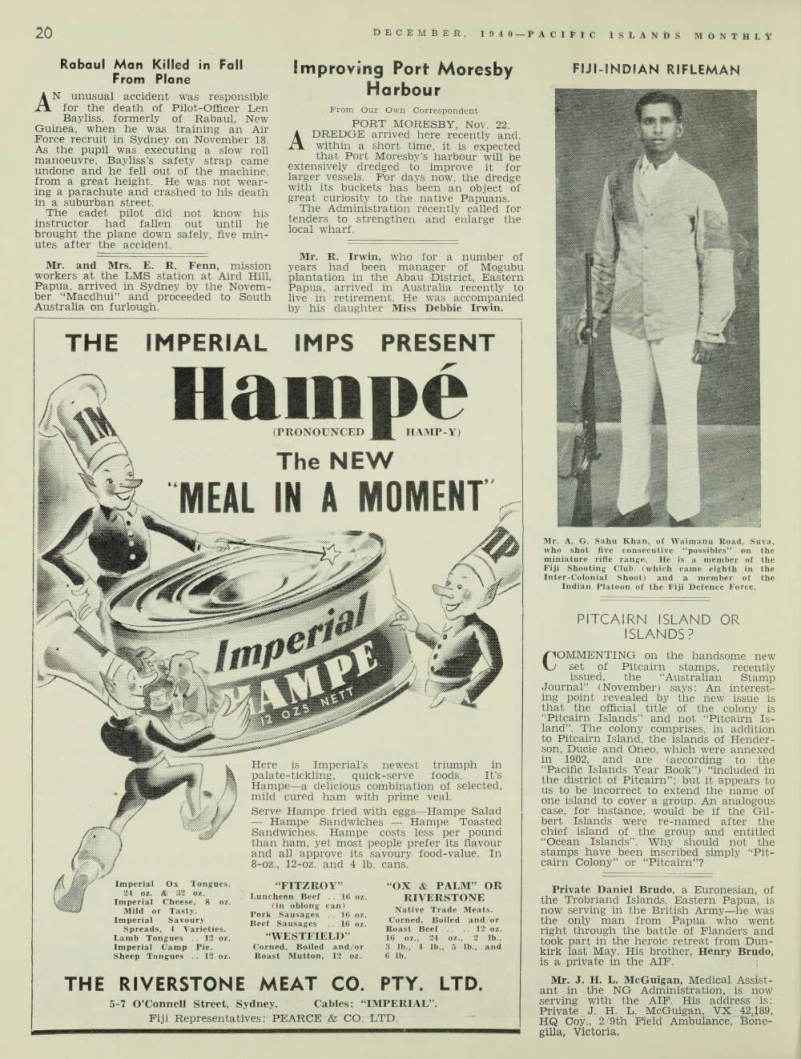
From Plane
AN unusual accident was responsible for the death of Pilot-Officer Len Bayliss, formerly of Rabaul, New Guinea, when he was training an Air Force recruit in Sydney on November 18.
As the pupil was executing a slow roll manoeuvre, Bayliss’s safety strap came undone and he fell out of the machine, from a great height. He was not wear ing a parachute and crashed to his death in a suburban street.
The cadet pilot did not know his instructor had fallen out until he brought the plane down safely, five min utes after the accident.
Mr. and Mrs. E. R. Fenn, mission workers at the LMS station at Aird Hill, Papua, arrived in Sydney by the Novem ber “Macdhui” and proceeded to South Australia on furlough.
improving Port Moresby
Harbour
From Our Own Correspondent
Port Moresby, Nov. 22.
A DREDGE arrived here recently and, within a short time, it is expected that Port Moresby’s harbour will be extensively dredged to improve it for larger vessels. For days now. the dredge with its buckets has been an object of great curiosity to the native Papuans.
The Administration recently called for tenders to strengthen and enlarge the local wharf.
Mr. R. Irwin, who for a number of years had been manager of Mogubu plantation in the Abau District, Eastern Papua, arrived in Australia recently to live in retirement. He was accompanied by his daughter Miss Debbie Irwin.
Fiji-Indian Rifleman
Mr. A. G. Sahu Khan, of Waimanu Road, Suva, who shot five consecutive “possibles” on the miniature rifle range. He is a member of the Fiji Shooting Club (which came eighth in the Inter-Colonial Shoot) and a member of the Indian Platoon of the Fiji Defence Force.
Pitcairn Island Or
Islands?
COMMENTING on the handsome new set of Pitcairn stamps, recently issued, the “Australian Stamp Journal” (November) says: An interest ing point revealed by the new issue is that the official title of the colony is “Pitcairn Islands” and not “Pitcairn Is land”. The colony comprises, in addition to Pitcairn Island, the islands of Hender son, Ducie and Oneo, which were annexed in 1902, and are (according to the “Pacific Islands Year Book”) “included in the district of Pitcairn”; but it appears to us to be incorrect to extend the name of one island to cover a group. An analogous case, for instance, would be if the Gil bert Islands were re-named after the chief island of the group and entitled “Ocean Islands”. Why should not the stamps have been inscribed simply “Pit cairn Colony” or “Pitcairn”?
Private Daniel Brudo, a Euronesian, of the Trobriand Islands, Eastern Papua, is now serving in the British Army—he was the only man from Papua who went right through the battle of Flanders and took part in the heroic retreat from Dun kirk last May. His brother, Henry Brudo, is a private in the AIF.
Mr. J. H. L. McGuigan, Medical Assist ant in the NG Administration, is now serving with the AIF. His address is: Private J. H. L. McGuigan, VX 42J89, HQ Coy., 2/9th Field Ambulance, Bone
gilla, Victoria.
Advertisements & other items, p. 22 (1 item)
Meal In A Moment
THE IMPERIAL IMPS PRESENT
(PRONOUNCED HAMP-Y)
The NEW
MEAL IN A MOMENT
/fa \ % M'' &
eft
Imp
y Here is Imperial’s newest triumph in palate-tickling, quick-serve foods. It’s Hampe—a delicious combination of selected, mild cured ham with prime veal.
Serve Hampe fried with eggs—Hampe Salad Hampe Sandwiches Hampe Toasted Sandwiches. Hampe costs less per pound than ham, yet most people prefer its flavour and all approve its savoury food-value. In 8-oz., 12-oz. and 4 lb. cans.
Imperial 24 oz.
Imperial Ox Tongues, & 32 oz.
Cheese, 8 oz.
Mild or Tasty.
Imperial Savoury Spreads, 4 Varieties.
Lamb Tongues . , 12 oz.
Imperial Camp Pie.
Sheep Tongues . . 12 oz.
FITZROY’’
Luncheon Beef . , 16 oz. (in oblong can) Pork Sausages . . 16 oz.
Beef Sausages . . 16 oz.
‘‘WESTFIELD’’
Corned, Boiled and/or Roast Mutton, 12 oz.
“OX & PALM’’ OR
RIVERSTONE
Native Trade Meats.
Corned, Boiled and/or Roast Beef . . .12 oz. 16 oz., 24 oz., 2 lb.. 3 lb., 4 lb., 5 lb., and 6 lb.
THE RIVERSTONE MEAT CO. PTY. LTD,
5-7 O’Connell Street, Sydney. Cables: “IMPERIAL”.
Fiji Representatives: PEARCE & CO. LTD.
Art That Concealed
Art !
A Tahitian Scandal With Comic Trimmings
SINCE that dolorous day when a syn dicate of art dealers and a peri patetic novelist emblazed the name Gauguin on the architrave of the temple of fame, this island of Tahiti has been an atelier of artists from every corner of the world—except, perhaps, the Ant arctic Continent.
Among them was a portrait painter from Denmark. He was introduced to us bv an esteemed friend and neighbour who, in his young days, had been a cap tain in the Danish army.
Now, .iust at that time, both the cap tain and the writer had been denounced as unshriven heretics and contumacious Philistines by a college of painters drawn from all the schools —from post impressionist to sur-realist. So when the man from Copenhagen told us he was a great artist, we anpeared duly humble (as was fitting in the presence of great ness). and let him do most of the talk ing. We did not wish any more court martials until we were sure of ourselves.
Later, when the great Dane took us to view his paintings, the captain and the writer looked long into each other’s eyes, then raised our right hands and swore eternal fealty to our Philistinism.
But we held our peace, and listened patiently while the painter discoursed eloquently on “My art”.
In due time, the artist had rented apartments at Papeete, unpacked his paints and brushes and set about the task of finding natives to people his masterpieces.
One of his achievements was his suc cess in persuading one of the real beauties of the island, an eminently re spectable matron, to sit for her portrait.
Tahitians of her type usually shun artists and writers. Experience has taught them to be wary. But in this case the captain had vouched for his fellow countryman.
Two or three sittings had enabled the artist to finish those charming features and shapely head on his canvas. Then, having made sketches of her figure and costume, he told the matron that no more sittings would be necessary.
When he had thus disposed of her, he called in a model from a less conven tional stratum of society, and finished the picture in the “altogether”!
The artist used every precaution to guard the secret of this substitution.
While the paint was drying, the canvas was set on an easel, in the most remote corner and kept covered. Unfortunately, a temporary absence from the studio left the man-of-all-work the opportunity to appease a curiosity which was eating into his vitals. He raised the covering from the picture; and. within an hour all Papeete knew what he had seen.
Now, being old-fashioned and hostile to “Progress”, our domicile had been connected neither with the island tele phone system nor the coconut telegraph.
Consequently, we were still ignorant of the happenings recorded above, when the Danish artist appeared at our threshold, bearing an oblong object concealed under heavy wrappings of thick paper.
“I beg a service of you”, he said. “Will you keep this parcel in a safe place until I come for it?”
“Be particularly careful”, he added, “that the wrappings are not disturbed.”
We sensed some misgivings; but we had no reason for refusal, and we con-
A little later we awoke to the fact that we had given shelter to a veritable Pan dora’s Box.
Relays of eyes had followed the parcel to its destination.
Enlightenment and an exceedingly great tempest arrived simultaneously.
We summoned the artist. The interview was short; but charred spots on the woodwork of our front porch, which several coats of paint cannot entirely conceal, bear witness to its fervency.
The captain, when he heard the story, spoke words and nhrases in Danish so potent that the old Scandinavian fire god Loki aopeared, and the captain had to chase him away with the garden hose to ore vent having his house burnt down.
In the last act of the drama, the handsome matron —guarded by two burly brothers —committed hari-kari on her image, while the painter tore his hair and shrieked “My art! My art!”
Shortly afterwards he sailed away, and we have seen him no more.—A.C.R.
Port Moresby Introduces a Soda
Fountain
sented.
From Our Own Correspondent
Port Moresby, Dec. 1
AN up-to-date soda fountain and milk bar, including an ice cream parlour, has been recently opened in Port Moresby, and is extremely popular with all sections of the community since the hot weather has set in. Clay and Co., are the enterprising firm responsible for the innovation: and the bar, which is to be run on strictly cash lines, promises to be a marked success.
Rt. Rev. P. N. W. Strong, MA, Bishop of New Guinea, has completed his ex tensive tour of Australia and will return to Papua this month. He lectured on the Mission’s work to audiences in NSW, Victoria, Western Australia and Tas mania.
Advertisements & other items, pp. 23-24 (1 item)
Flag
ACQ
AN
§A»NTANCE
mM loi?e friend C^O
TOOHEYS
FLAG
Modern Refrigeration for the South Sea Islands
The ELECTROLUX
KEROSENE OPERATED
REFRIGERATOR
MARVEL
OF
MODERN
SCIENCE
mmi
CSSS
THE
MIRACLE
OF
ICE
FROM
HEAT
ELECTROLUX offers economical, modern and completely efficient
REFRIGERATION FOR ISLANDS' HOMES.
FREEZES CONTINUOUSLY WHILE SMALL LAMP BURNS.
Freezing controlled by simply regulating height of flame. Uses only gallon of kerosene per week, MOTORLESS ... NO PARTS TO GET OUT OF ORDER.
MODEL L 22
Capacity 2.2 cubic feet.
MODEL L3BO
© (as illustrated) • Capacity 4 cubic feet.
GUARANTEED FOR TWO YEARS.
Write to your Local Distributor for prices and full details.
MODEL LKSSO
Capacity 5.5 cubic feet.
Obtainable from: W. R. Carpenter & Company Ltd.—Sydney, and the following New Guinea Branches: Rabaul, Salamaua, Wau, Kavieng, Madang, and Wewak.
W. R. Carpenter & Coy. (Solomon Is.) Pty. Ltd. —Tulagi, British Solomon Islands.
On Chong & Company Pty. Ltd.—Butaritari, Gilbert and Ellice Islands.
Representation in Papua and New Hebrides.
Coconuts For
Pigs
Profitable Industry—Provided There is a Market
VALUABLE information about the way in which the at present value less coconut can be used profitably as oie-fodder has been given to the “Fiji Times” by Mr. R. T. Ricketts, a planter of Koro, Fiji.
Mr. Ricketts says “there is a fortune in pigs”. He makes the important point that he does not feed copra to his pigs— only the raw nuts, which they eat eagerly.
Mr. Ricketts has on his Koro coconut olantation some 250 pigs which graze on the grass under the trees. Apart from the grass, their only food is the raw coconut, cut in two and left on the ground. The procedure is that one of his Fijian labourers goes out every morn ing and calls to the herd, which come to his call and follow him through the plantation as he cuts open the fallen coconuts, where they have dropped, and he leaves them on the ground.
In the afternoon the pigs are again called and are fed near the homestead.
The only time that they are actually in an enclosed area is when they are col lected for shipping.
The Fijian only employs part of his time in tending the pigs. The consump tion of nuts is five daily per pig, three in the morning and two in the after noon. A pig fed on these lines will dress at 100 lb. in nine months.
The pork is used by local butchers and a sample exported received a first-class report.
WRITING recently in a New Zealand newspaper, a Mr. J. Beasley said: — “I fed pigs on copra 30 years ago and found it superior to any other food. The pigs were more satisfied with it and the pork was far superior in flavour. It was as firm as if it had been frozen. I always received the best price in the market for my pigs. I also exhibited at the agricultural show for four years, and took first and champion prize each time.
Any farmer can be quite safe feeding pigs on copra. I found one sack would be as good as two sacks of sharps, by placing half a sack in a large cask and filling it up with water or skim milk, letting it soak for 12 hours and if pos sible adding one gallon of molasses.”
MUCH interest has been taken by coconut planters and copra inter ests in the idea of using coconut meat as a fodder for pigs; but, as in so many of these things, persons concerned ask, Where is the market? Pigs of superior quality may be raised on coconut meat, or even on copra; but, under pre sent world conditions, the market is not easily seen. Britain used to buy huge quantities of bacon, etc., from Denmark and it is assumed she now will seek to fill her needs elsewhere. But no one has any data. (See further comment by a Fiji planter, elsewhere in this issue.) Rev. and Mrs. Rankin, of the LMS station at Saroa, Papua, are at present in Sydney on furlough. Their young son Dauncey, who accompanied them, has gone to a Melbourne college for education.
Rev. James Benson, ThL, of the New Guinea Mission, Gona, Papua, has been appointed organising secretary of the Diocese of Goulburn, NSW, for the next three months. He then will return to Papua.
Government Control of Cook
Is. Products
Prom Our Own Correspondent
Rarotonga, Oct. 21.
IT was not altogether with unfeigned delight that Cook Islanders learned that the New Zealand Government had taken control of their kumara (sweet potato) and small citrus fruit ex ports (as well as oranges).
After excellent returns had material ised from the sale of kumaras, grapefruit, lemons and mandarins to local trading firms, it is felt that the Government control will almost surely bring trouble in its wake. Kumaras are in such de mand on the NZ market that it was even necessary to obtain export sup plies by schooner from the outlying is land of Aitutaki; and comparatively large areas of land in Rarotonga have been planted in expectation of a con tinued fair price. Should returns dimin
ish, even as a result of seasonal demand, or conditions of export become stricter, the Fruit Control will almost certainly get the blame for it.
One well-known planter, who recently has received excellent prices for ship ments of grapefruit and tangerines, ex pressed the opinion that control had to be taken of the smaller citrus fruits In order not to show up the poor orange prices. It seems probable, however, that with the attention that the Government is now giving to efficient fruit distribu tion in New Zealand prices are likely to be more encouraging in the not-so-dis tant future.
Miss Marjorie Hamilton Macindoe, eldest daughter of Mr. and Mrs. W. E, Macindoe, of Lami, was married to Mr.
Don Stokes, eldest son of Mrs. and the late Mr G. F. Stokes, of Nausori, Fiji, at St. Andrew’s Presbyterian Church, Suva, recently.
Papuan natives, under the direction of Mr. C. Fisher, are building another 45 ft. launch at the London Missionary Society’s station at Isuleilei, Fife Bay. The vessel will be similar to the “Oliver Tompkins”, now in commission.
Advertisements & other items, p. 25 (1 item)
Ctoria
BITTER
{friß m WM >1
A South Seas
Reverie
By “Amel”
SIGHING over the mountains, loitering in the valleys, hastening over rivers and skimming down to the sea, a warm breeze is bringing its fragrance to temper the heat of a tropical summer’s day.
I recline at ease in the shade of a dense-foliaged mango tree, whose branches are burdened with clusters of ripening fruit. My dog. Lassie, snores gently beside me. No. that is not cor rect . . . Lassie never snores. Being a lady through and through, she just breathes heavily. She seems to sense that I am writing about her, for she has opened one melting brown eye, winked a roguish wink, and gone to sleep again. . .
The tide is dead low. and, out on the broad expanse of the bay, the sinister shapes of many coral reefs are plainly visible. They lie beneath the shining sea like somnolent monsters, in places so close to the surface that they are a trap for unwary mariners. But they are also a treasure trove for shell and coral seek ers, and a never-failing source of food for the native fisher-folk.
A string of islands, like pieces of a jade-green necklace, sprawl out from the mainland. Ascending lazily from the largest of them, a pale wisp of smoke marks the spot where a narty of fisher women are baking their taro, their vam, or their brightly-coloured fish, fresh from the sea.
I can picture them squatting beside the fire, waiting eagerly for their food to cook, with their tongues wagging inces santly and their skimpy ragged sulus twisted carelessly around copper-brown
waists. When their meal is finished, and the tide has started to turn, they will wend their way homeward to the villages that nestle behind those distant hills.
At each swoop of the wind, the coco nut palms along the beach dip and sway gracefully. Their faint rustling comes up the hill to me. The sound has a soothing effect. In the daytime, it takes the edge off that loneliness which sometimes assails dwellers in quiet places; at night, like the waves murmuring on the shore, or rain drumming on the roof, it lulls one to sleep.
How rich is the verdure of this tropic land! Even the humble mangrove is vividly green. The cushiony smoothness of it sweeps back from the sea-shore and merges into the darker-green foothills.
But the colour is lost again in the loftv, shadow-dappled mountains, which fill the northern skyline like piles of crumpled blue velvet.
A vast expanse of sea, unbroken and empty, save for one dim island, stretches far south. Over my shoulder, the sun is dying in the west, and its glow is seep ing up the valley.
Lassie yawns in utter boredom, and glances suggestively down at the home stead. But I am not ready to go yet. I want to watch the matchless beauty of the tropical sunset, until the sun dis appears amid a host of crimson banners.
And I want to say a prayer of thankful ness that so much unchanging loveliness still exists in a world of change, ugli ness and strife.
The shadows are lengthening and the soft wind goes whisoering past, as Las sie and I walk slowly down the hill.
Rev. Samuel J. Gibson, who died in Sydney on December 2 aged 81 years, spent six years in Fiji as a member of the Methodist Mission, from 1884 to 1890.
Advertisements & other items, p. 26 (2 items)
Gramophones
HIS MASTER'S VOICE
We have a number of demonstrating cabinet models, which RETAILED
FORMERLY AT £37/10/-. These
instruments are practically brand new, and once sold, further stocks are unprocurable. Each instrument is fully guaranteed for three years, and we will Deliver straight to your nearest port for— £9/15/- Six popular records, and needles, included. Can be sent C.O.D. if desired, but a deposit of 10% must accompany order.
"TALKERIES"
(The Gramophone Store) 161 Castlereagh Street, Sydney, N.S.W.
St. Ignatius’ College
Riyerview Sydney
Boys are prepared for Intermediate and Leaving Certificate Examinations and for Exhibitions, Scholarships and Bursaries at the University.
Boys are arranged in three Divisions according to age. Each Division has its own Library, Debating Society, Cricket and Football Fields, and Tennis Courts.
Senior and Junior Rowing Sheds, with a large fleet of pleasure and racing boats.
Private Swimming Baths.
Prospectus and further particulars on application to the— Rector : St. Ignatius’ College, Riverview, Sydney, Australia.
Tel.: JB 1106.
BOARDING AND DAY SCHOOL
Conducted by the Jesuit Fathers
ONE OF SYDNEY'S GREAT PUBLIC SCHOOLS
New Caledonia
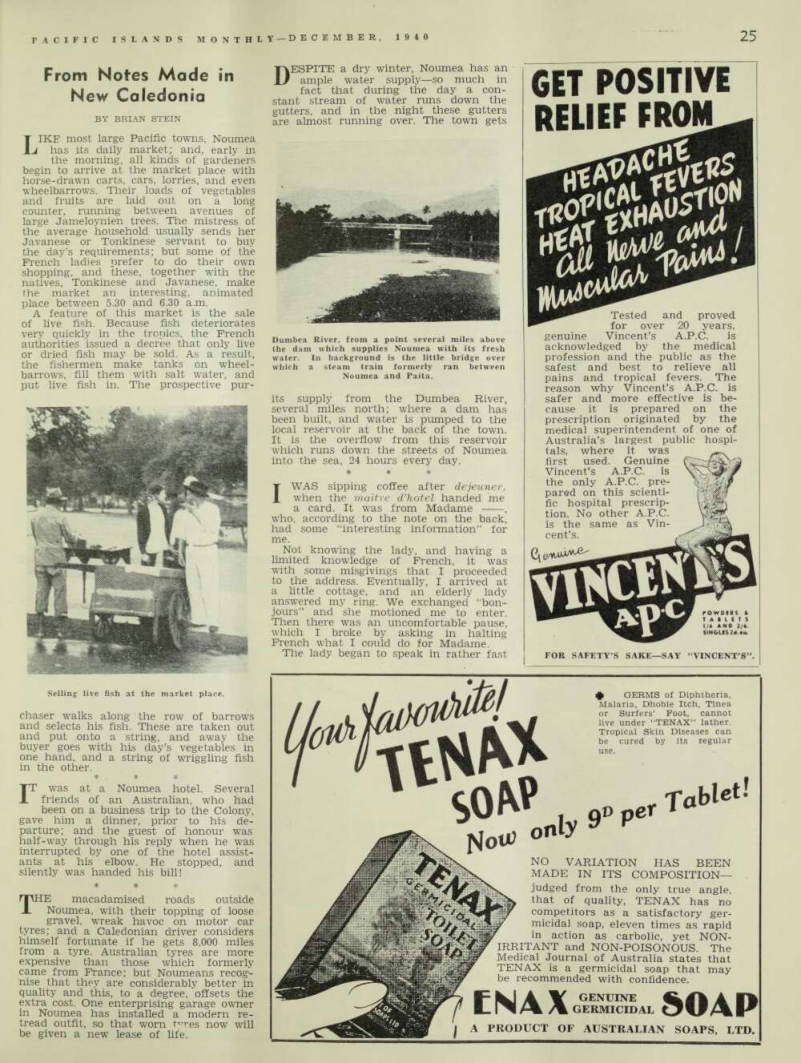
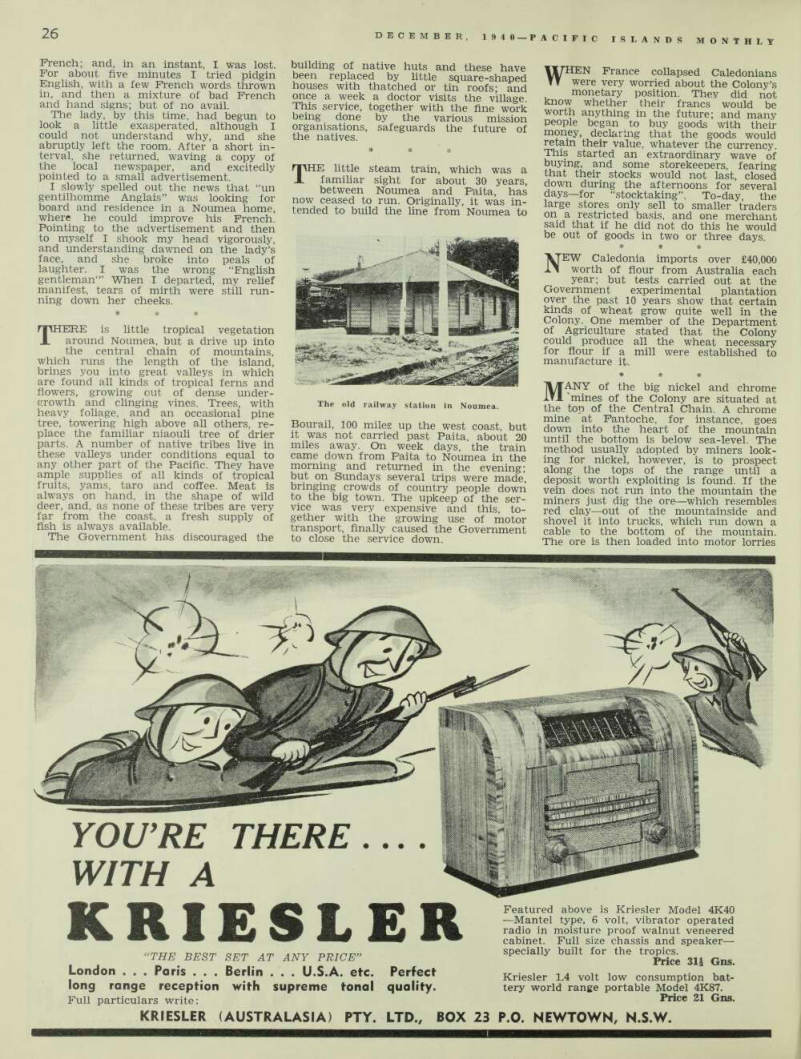
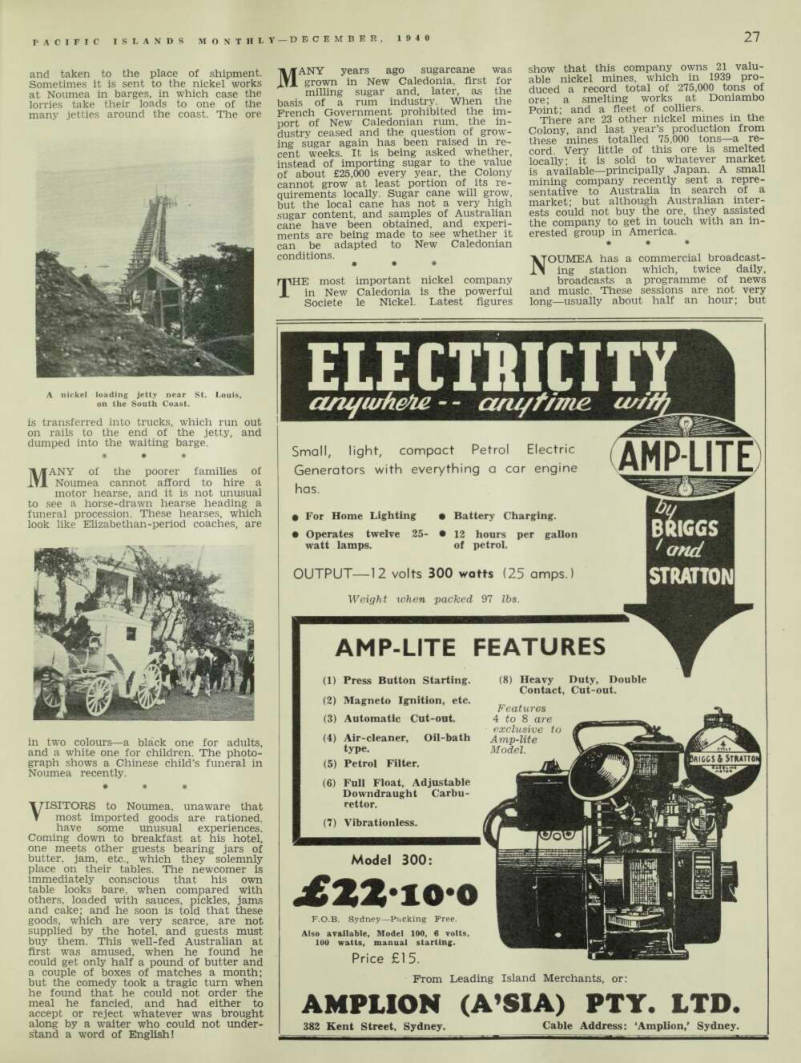
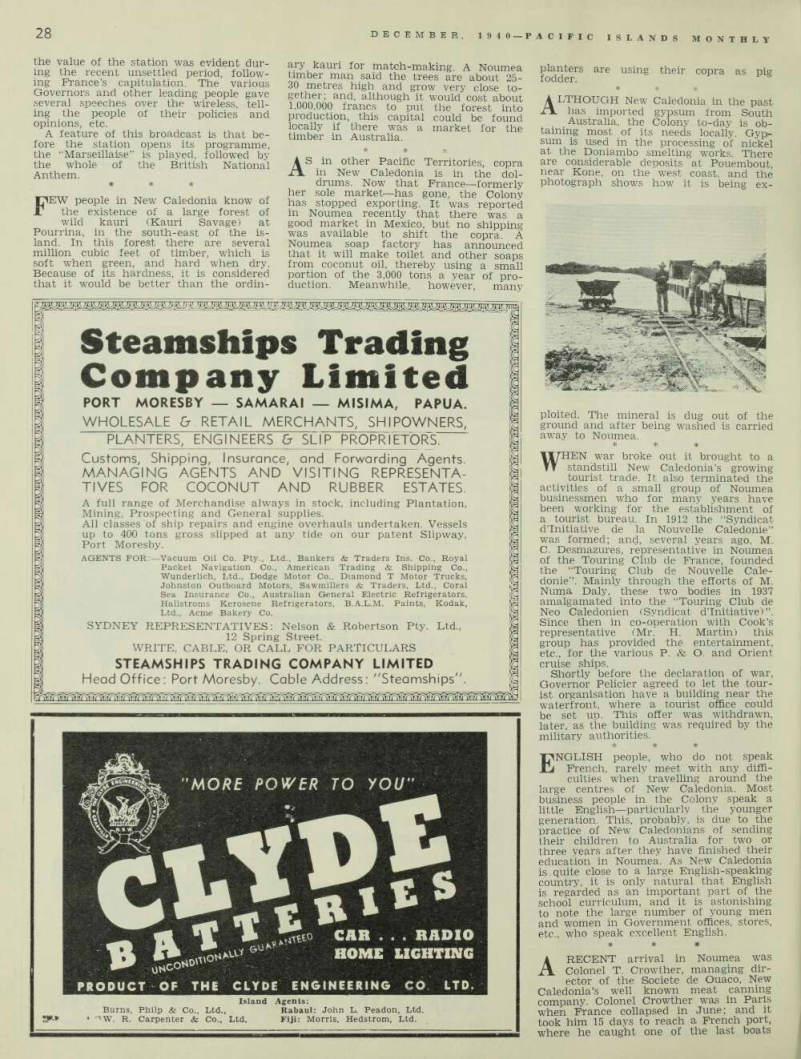
From Notes Mode in New Caledonia
By Brian Stein
LIKE most large Pacific towns, Noumea has its daily market; and, early in the morning, all kinds of gardeners begin to arrive at the market place with horse-drawn carts, cars, lorries, and even wheelbarrows. Their loads of vegetables and fruits are laid out on a long counter, running between avenues of large Jameloynien trees. The mistress of the average household usually sends her Javanese or Tonkinese servant to buy the day’s requirements; but some of the French ladies prefer to do their own shopping, and these, together with the natives, Tonkinese and Javanese, make the market an interesting, animated place between 5.30 and 6.30 a.m.
A feature of this market is the sale of live fish. Because fish deteriorates very quickly in the tropics, the French authorities issued a decree that only live or dried fish may be sold. As a result, the fishermen make tanks on wheel barrows, fill them with salt water, and put live fish in. The prospective pur-
chaser walks along the row of barrows and selects his fish. These are taken out and put onto a string, and away the buyer goes with his day’s vegetables in one hand, and a string of wriggling fish in the other. * * * IT was at a Noumea hotel. Several friends of an Australian, who had been on a business trip to the Colony, gave him a dinner, prior to his de parture; and the guest of honour was half-way through his reply when he was interrupted by one of the hotel assist ants at his elbow. He stopped, and silently was handed his bill! * * * THE macadamised roads outside Noumea, with their topping of loose gravel, wreak havoc on motor car tyres; and a Caledonian driver considers himself fortunate if he gets 8,000 miles from a tyre. Australian tyres are more expensive than those which formerly came from France; but Noumeans recogl - that they are considerably better in quality and this, to a degree, offsets the extra cost. One enterprising garage owner in Noumea has installed a modern re tread outfit, so that worn now will be given a new lease of life.
DESPITE a dry winter, Noumea has an ample water supply—so much in fact that during the day a con stant stream of water runs down the gutters, and in the night these gutters are almost running over. The town gets
its supply from the Dumbea River, several miles north; where a dam has been built, and water is pumped to the local reservoir at the back of the town.
It is the overflow from this reservoir which runs down the streets of Noumea into the sea, 24 hours every day. ♦ * * I WAS sipping coffee after dejeuner, when the maitre d’hotel handed me a card. It was from Madame , who, according to the note on the back, had some “interesting information” for me.
Not knowing the lady, and having a limited knowledge of French, it was with some misgivings that I proceeded to the address. Eventually, I arrived at a little cottage, and an elderly lady answered my ring. We exchanged “bon jours” and she motioned me to enter.
Then there was an uncomfortable pause, which I broke by asking in halting French what I could do for Madame.
The lady began to speak in rather fast
Selling live fish at the market place.
Dumbea River, from a point several miles above the dam which supplies Noumea with its fresh water. In background is the little bridge over which a steam train formerly ran between Noumea and Paita.
French; and, in an instant, I was lost.
For about five minutes I tried pidgin English, with a few French words thrown in, and then a mixture of bad French and hand signs; but of no avail.
The lady, by this time, had begun to look a little exasperated, although I could not understand why, and she abruptly left the room. After a short in terval, she returned, waving a copy of the local newspaper, and excitedly pointed to a small advertisement.
I slowly spelled out the news that “un gentilhomme Anglais” was looking for board and residence in a Noumea home, where he could improve his French.
Pointing to the advertisement and then to myself I shook my head vigorously, and understanding dawned on the lady’s face, and she broke into peals of laughter. I was the wrong “English gentleman 0 ’ When I departed, my relief manifest, tears of mirth were still run ning down her cheeks. * * * THERE is little tropical vegetation around Noumea, but a drive up into the central chain of mountains, which runs the length of the island, brings you into great valleys in which are found all kinds of tronical ferns and flowers, growing out of dense under growth and clinging vines. Trees, with heavy foliage, and an occasional pine tree, towering high above all others, re place the familiar niaouli tree of drier parts. A number of native tribes live in these valleys under conditions equal to any other part of the Pacific. They have ample supplies of all kinds of tropical fruits, yams, taro and coffee. Meat is always on hand, in the shape of wild deer, and, as none of these tribes are very far from the coast, a fresh supply of fish is always available.
The Government has discouraged the
building of native huts and these have been replaced by little square-shaped houses with thatched or tin roofs; and once a week a doctor visits the village This service, together with the fine work being done by the various mission organisations, safeguards the future of the natives. * * * THE little steam train, which was a familiar sight for about 30 years, between Noumea and Paita, has now ceased to run. Originally, it was in tended to build the line from Noumea to
Bourail, 100 miles up the west coast, but it was not carried past Paita, about 20 miles away. On week days, the train came down from Paita to Noumea in the morning and returned in the evening; but on Sundays several trips were made, bringing crowds of country people down to the big town. The upkeep of the ser vice was very expensive and this, to gether with the growing use of motor transport, finally caused the Government to close the service down.
IITHEN France collapsed Caledonians ▼ ▼ were very worried about the Colony’s monetary position. They did not know whether their francs would be worth anything in the future; and many people began to buy goods with their money, declaring that the goods would retain their value, whatever the currency.
This started an extraordinary wave of buying, and some storekeepers, fearing that their stocks would not last, closed down during the afternoons for several days—for “stocktaking”. To-day, the large stores only sell to smaller traders on a restricted basis, and one merchant said that if he did not do this he would be out of goods in two or three days. * * * NEW Caledonia imports over £40,000 worth of flour from Australia each year; but tests carried out at the Government experimental plantation over the past 10 years show that certain kinds of wheat grow quite well in the Colony. One member of the Department of Agriculture stated that the Colony could produce all the wheat necessary for flour if a mill were established to manufacture it. * * * MANY of the big nickel and chrome 'mines of the Colony are situated at the top of the Central Chain. A chrome mine at Fantoche, for instance, goes down into the heart of the mountain until the bottom is below sea-level. The method usually adopted by miners look ing for nickel, however, is to prospect along the tops of the range until a deposit worth exploiting is found. If the vein does not run into the mountain the miners just dig the ore—which resembles red clay—out of the mountainside and shovel it into trucks, which run down a cable to the bottom of the mountain.
The ore is then loaded into motor lorries
The old railway station in Noumea.
and taken to the place of shipment.
Sometimes it is sent to the nickel works at Noumea in barges, in which case the lorries take their loads to one of the many jetties around the coast. The ore
is transferred into trucks, which run out on rails to the end of the jetty, and dumped into the waiting barge. * * ♦ MANY of the poorer families of Noumea cannot afford to hire a motor hearse, and it is not unusual to see a horse-drawn hearse heading a funeral procession. These hearses, which look like Elizabethan-period coaches, are
in two colours—a black one for adults, and a white one for children. The photo graph shows a Chinese child’s funeral in Noumea recently. * * * VISITORS to Noumea, unaware that most imported goods are rationed, have some unusual experiences.
Coming down to breakfast at his hotel, one meets other guests bearing jars of butter, jam, etc., which they solemnly place on their tables. The newcomer is immediately conscious that his own table looks bare, when compared with others, loaded with sauces, pickles, jams and cake; and he soon is told that these goods, which are very scarce, are not supplied by the hotel, and guests must buy them. This well-fed Australian at first was amused, when he found he could get only half a pound of butter and a couple of boxes of matches a month; but the comedy took a tragic turn when he found that he could not order the meal he fancied, and had either to accept or reject whatever was brought along by a waiter who could not under stand a word of English!
MANY years ago sugarcane was grown in New Caledonia, first for milling sugar and, later, as the basis of a rum industry. When the French Government prohibited the im port of New Caledonian rum, the in dustry ceased and the question of grow ing sugar again has been raised in re cent weeks. It is being asked whether, instead of importing sugar to the value of about £25,000 every year, the Colony cannot grow at least portion of its re quirements locally. Sugar cane will grow, but the local cane has not a very high sugar content, and samples of Australian cane have been obtained, and experi ments are being made to see whether it can be adapted to New Caledonian conditions. * * * THE most important nickel company in New Caledonia is the powerful Societe le Nickel. Latest figures
show that this company owns 21 valu able nickel mines, which in 1939 pro duced a record total of 275,000 tons of ore; a smelting works at Doniambo Point; and a fleet of colliers.
There are 23 other nickel mines in the Colony, and last year’s production from these mines totalled 75,000 tons—a re cord. Very little of this ore is smelted locally; it is sold to whatever market is available—principally Japan. A small mining company recently sent a repre sentative to Australia in search of a market; but although Australian inter ests could not buy the ore, they assisted the company to get in touch with an in erested group in America. ♦ ♦ • NOUMEA has a commercial broadcast ing station which, twice daily, broadcasts a programme of news and music. These sessions are not very long—usually about half an hour; but
A nickel loading jetty near St. Louis, on the South Coast.
the value of the station was evident dur ing the recent unsettled period, follow ing France’s capitulation. The various Governors and other leading people gave several speeches over the wireless, tell ing the people of their policies and opinions, etc.
A feature of this broadcast is that be fore the station opens its programme, the “Marseillaise” is played, followed by the whole of the British National Anthem. * * * FEW people in New Caledonia know of the existence of a large forest of wild kauri (Kauri Savage) at Pourrina, in the south-east of the is land. In this forest there are several million cubic feet of timber, which is soft when green, and hard when dry.
Because of its hardness, it is considered that it would be better than the or din
ary kauri for match-making. A Noumea timber man said the trees are about 25- 30 metres high and grow very close to gether; and, although it would cost about 1,000.000 francs to nut the forest into production, this canital could be found locally if there was a market for the timber in Australia. * * * AS in other Pacific Territories, copra in New Caledonia is in the dol drums. Now that France—formerly her sole gone, the Colony has stopped exporting. It was reported in Noumea recently that there was a good market in Mexico, but no shipping was available to shift the copra. A Noumea soap factory has announced that it will make toilet and other soaps from coconut oil, thereby using a small portion of the 3,000 tons a year of pro duction. Meanwhile. however, manv
planters are using their copra as pig fodder. * * * ALTHOUGH New Caledonia in the past has imported gypsum from South Australia, the Colony to-day is ob taining most of its needs locally. Gyp*sum is used in the processing of nickel at the Doniambo smelting works. There are considerable denosits at Pouembout. near Kone, on the west coast, and the photograph shows how it is being ex-
ploited. The mineral is dug out of the ground and after being washed is carried away to Noumea. * * * WHEN war broke out it brought to a standstill New Caledonia’s growing tourist trade. It also terminated the activities of a small group of Noumea businessmen who for many years have been working for the establishment of a tourist bureau. In 1912 the “Syndicat d’lnitiative de la Nouvelle Caledonie” was formed; and, several years ago, M.
C. Desmazures, representative in Noumea of the Touring Club de France, founded the “Touring Club de Nouvelle Cale donie”. Mainly through the efforts of M.
Numa Daly, these two bodies in 1937 amalgamated into the “Touring Club de Neo Caledonien (Syndicat d’lnitiative)”.
Since then in co-operation with Cook’s representative (Mr. H. Martin) this group has provided the entertainment, etc., for the various P. & O. and Orient cruise ships.
Shortly before the declaration of war, Governor Pelicier agreed to let the tour ist organisation have a building near the waterfront, where a tourist office could be set uo. This offer was withdrawn, later, as the building was required by the military authorities. * * * ENGLISH people, who do not speak French, rarely meet with any diffi culties when travelling around the large centres of New Caledonia. Most business people in the Colony speak a little English—particularly the younger generation. This, probably, is due to the practice of New Caledonians of sending their children to Australia for two or three vears after they have finished their education in Noumea. As New Caledonia is quite close to a large English-speaking country, it is only natural that English is regarded as an important part of the school curriculum, and it is astonishing to note the large number of young men and women in Government offices, stores, etc., who speak excellent English. * * * A RECENT arrival in Noumea was Colonel T. Crowther, managing dir ector of the Societe de Ouaco, New Caledonia’s well known meat canning company. Colonel Crowther was in Paris when Prance collapsed in June; and it took him 15 days to reach a French port, where he caught one of the last boats
for England. After a stay in London, he left for America, arriving there after 16 days’ zig-zagging across the Atlantic. At New York he caught a plane for San Francisco; spent a day there, and flew to Noumea by PA A clipper—the whole journey from New York to Noumea taking just 6 days.
Colonel Crowther’s last visit to the Colony was some 20 years ago, and he said the outstanding change which had taken place was the road system in the country. Formerly, he had had to travel up the coast by boat, and then on horseback, to reach his company’s prop erties. To-day, main roads take him to any of his interests in the island.
(To Be Continued)
Advertisements & other items, pp. 27-32 (1 item)
fabl et
GET POSITIVE
RELIEF FROM
Tested and proved for over 20 years, genuine Vincent's A.P.C. is acknowledged by the medical profession and the public as the safest and best to relieve all pains and tropical fevers. The reason why Vincent’s A.P.C. is safer and more effective is because it is prepared on the prescription originated by the medical superintendent of one of Australia’s largest public hospitals, where it was first used. Genuine Vincent’s A.P.C. is the only A.P.C. prepared on this scientific hospital prescription. No other A.P.C. is the same as Vincent’s. rowons t
TA■L C T S
1/* AND 2/A.
SINOK& 24. •<*
FOR SAFETY’S SAKE—SAY “VINCENT’S”.
soM*
Nouj
* m & - •’< Vi 4 GERMS of Diphtheria, Malaria, Dhobie Itch, Tinea or Surfers’ Foot, cannot live under “TENAX” lather.
Tropical Skin Diseases can be cured by its regular
9° P cr
fabl et
NO VARIATION HAS BEEN
MADE IN ITS COMPOSITION—
judged from the only true angle, that of quality, TENAX has no competitors as a satisfactory germicidal soap, eleven times as rapid in action as carbolic, yet NON-
IRRITANT and NON-POISONOUS. The
Medical Journal of Australia states that TENAX is a germicidal soap that may be recommended with confidence.
ENAX GERMICIDAL SOAP
I A PRODUCT OF AUSTRALIAN SOAPS, LTD.
■J m m
YOU’RE THERE ...
WITH A
KRIESLER
“THE BEST SET AT ANY PRICE”
London .. . Paris .. . Berlin .. . U.S.A. etc. Perfect long range reception with supreme tonal quality.
Full particulars write:
KRIESLER (AUSTRALASIA) PTY. LTD., BOX
Featured above is Kriesler Model 4K40 —Mantel type, 6 volt, vibrator operated radio in moisture proof walnut veneered cabinet. Full size chassis and speaker— specially built for the tropics.
Price 312 Gns.
Kriesler 1.4 volt low consumption battery world range portable Model 4K87.
Price 21 Gns.
P.O. NEWTOWN, N.S.W.
ELECTRICITY
a/u/iunebe - - am m/ Small, light, compact Petrol Electric Generators with everything a car engine has. • For Home Lighting • Battery Charging. • Operates twelve 25- • 12 hours per gallon watt lamps. of petrol.
OUTPUT —12 volts 300 watts (25 amps.) Weight when packed 97 lbs.
AMP-LITE)
BRIGGS
1 and
STRATTON
AMP-LITE FEATURES
(1) Press Button Starting. (2) Magneto Ignition, etc. (3) Automatic Cut-out. (4) Air-cleaner, Oil-bath type. (5) Petrol Filter. (6) Full Float, Adjustable Downdraught Carburettor. (7) Vibrationless. (8) Heavy Duty, Double Contact, Cut-out.
Features 4 to 8 are exclusive to Amp-lite Model.
RICCS ft STRATTO
Model 300: j£ 22*10*0 F. 0.8. Sydney—Packing Free.
Also available, Model 100, 6 volts, 100 watts, manual starting.
Price £1 5.
From Leading Island Merchants, or:
AMPUON (A’SIA) PTY. LTD.
382 Kent Street, Sydney. Cable Address: ‘Amplion,’ Sydney.
Steamships Trading
Company Limited
PORT MORESBY SAMARA! MISIMA, PAPUA.
WHOLESALE & RETAIL MERCHANTS, SHIPOWNERS,
PLANTERS, ENGINEERS & SLIP PROPRIETORS.
Customs, Shipping, Insurance, and Forwarding Agents.
MANAGING AGENTS AND VISITING REPRESENTA-
TIVES FOR COCONUT AND RUBBER ESTATES.
A full range of Merchandise always in stock, including Plantation, Mining, Prospecting and General supplies.
All classes of ship repairs and engine overhauls undertaken. Vessels up to 400 tons gross slipped at any tide on our patent Slipway, Port Moresby.
AGENTS FOR:—Vacuum Oil Co. Pty., Ltd., Bankers & Traders Ins. Co., Royal Packet Navigation Co., American Trading & Shipping Co., Wunderlich, Ltd., Dodge Motor Co., Diamond T Motor Trucks, Johnston Outboard Motors, Sawmillers & Traders, Ltd., Coral Sea Insurance Co., Australian General Electric Refrigerators, Hallstroms Kerosene Refrigerators, B.A.L.M. Paints, Kodak, Ltd., Acme Bakery Co.
SYDNEY REPRESENTATIVES: Nelson & Robertson Pty. Ltd., 12 Spring Street.
WRITE, CABLE, OR CALL FOR PARTICULARS
STEAMSHIPS TRADING COMPANY LIMITED
Head Office: Port Moresby, Cable Address: "Steamships".
iPßgfet "MORE POWER TO YOU"
» agjgt it it * * t n G'-* *o^'
s CAR RADIO
HOME LIGHTING
U^CO
PRODUCT OF THE CLYDE ENGINEERING CO LTD, Island Agents: Burns, Philp & Co., Ltd., Rabaul: John L. Peadon, Ltd.
W. R. Carpenter & Co., Ltd. Fiji: Morris, Hedstrom, Ltd.
PLUME
ANY CAR
A *< 4
KIDNEYS
MUST REMOVE
EXCESS ACIDS
Help 15 MILES of Kidney Tubes
Flush Out Poisonous Waste
If kidneys don’t pass 3 pints a day and get rid of 3 pounds of waste matter, the 15 miles of kidney tubes and filters become clogged with poisonous waste and the danger of acid poisoning is greatly increased.
This acid condition is a danger signal and may be the beginning of nagging backaches, leg pains, loss of pep and energy, getting up nights, lumbago, swollen feet and ankles, puffiness under the eyes, rheumatic pains and dizziness.
Frequent or scanty passages, with smarting and burning, show there is something wrong with your kidneys or bladder.
Most people watch their bowels, which contain only 2 7 feet of intestines, but neglect the kidneys, which contain 15 miles of tiny tubes and filters.
Don’t delay! Ask your chemist or store for DOAN’S BACKACHE KIDNEY PILLS . . . used successfully the world over by millions of people. They give quick relief and will help to flush out the 15 MILES o.f Kidney tubes. Get DOAN’S
BACKACHE KIDNEY PILLS at
your chemist or store.
Fiji's Impressive Gifts To

War Effort
WHAT the Governor (Sir Harry Luke) called “a truly impressive contribu tion to the Empire’s war effort” is being made by the people of Fiji—Euro peans, Fijians. Indians and Euronesians.
The position, early in November, was:— The Bomber Fund stands at over £61,000; the amount so far remitted to the Red Cross and St. John of Jerusa lem Joint Appeal Fund is £12,610; and there has been subscribed in aid of .the London Air Raid Relief the sum of £1,526.
Amounts have also been allocated by the Fiji War Appeals Board to King George’s Fund for Sailors and to St. Dunstan’s; and there have been private gifts of a fighter ’plane, of money and of garments which do not figure in these totals.
The Great Council of Fijian Chiefs, meeting in Levuka in October for dis cussion of native affairs, voted £2OOO from the Draiba Rest House Fund, for the Fiji Bomber Appeal—a spontaneous and striking gesture.
is There a Weather Cycle?
Letter to the Editor IT is with interest that I have compared the opinions of the older residents of these Islands on the subject of weather conditions. The recent cold spell in Rarotonga has awakened memories of better days in the breasts of these old timers— days when such things as sweaters and blankets were unheard-of in this so-called tropical clime. One and all are concertedly adamant in then statements that the local weather is go ing rapidly “to the dogs”. Can this be true, or is that these olders and betters have fallen into the error of most of their ilk in saying that “there’s nothing now like the good old days?”
Yours inquiringly,
Ralph J. A. Ingram.
Rarotonga, Cl., 21/10/1940.
Editorial Note
Mr. Ingram wrote facetiously; but, actually, he directs attention to a very interesting phenomenon. One seems to see a connection between all South oeas weather, insofar that abnormality in Australia, for example, usually is bal anced by abnormality out in the Central Pacific. Eastern Australia, until December, suffered a long-continued and very bad drought: and attention is increasingly being given to the theory that Australia’s rain cycle is between 35 and 40 years.
In other words, Australia, every 35 years or so, can expect a drought that lasts from 3 to 5 years. There is much data to support this belief—including the fact that Australia’s last great drought was between 1900 and 1905. Can the old hands in the Pacific say whether the present weather abnormalities were noted by them between 1900 and 1905?
Advertisements & other items, p. 32 (1 item)
ofr iivi niqkt!
V9Z- " / »53 y 500
CANDLE
POWER
300
BRIGHTER LIGHT
for
BETTER SIGHT
Coleman Products can be obtained from all Leading Firms throughout the Pacific Islands.
JxuAajJuAnsL,
ofr iivi niqkt!
( -x Coleman Mantles supply Sun-like light.
Instant Lighting
Stoves Gr Irons giving maximum 0/ heat in minimum of time
EASE OF OPERATION
combines
ECONOMY with COMFORT
In case of difficulty in obtaining supplies write to: — Pearce & Co., Suva, Fiji Is.
Phosphate As
War Factor
Great Value of Pacific Fields
BECAUSE this war has a great economic background, and economic considerations frequently cause moves which do not appear to be justi fied on military grounds, it is important to consider the phosphate industry of the Pacific.
Pacific phosphate is taken from three main sources: Nauru Island and Ocean Island (in the Central Pacific—both British) and Makatea Island (in French Oceania); and smaller supplies come from New Caledonia and Netherlands Indies.
Modern farming conditions made an adequate supply of phosphate rock, for conversion into super-phosphates, indis pensable; and three great agricultural countries —Australia, New Zealand and Japan—draw their main supplies of phosphate from the places mentioned.
Nauru and Ocean Island carry depo sits of approximately 100,000,000 tons of the finest phosphate rock in the world — it has a phosphate content of 80 per cent. In the year ended June 30, 1939, those two islands exported 1,224,515 tons of phosphate rock. The British Phos phate Commission which works the deposits on the two islands reports that in that year Australia took 800,000 tons, New Zealand 300,000 tons, Britain 60,000 tons, and the balance was divided between Japan and Scandinavia. Maka tea, the French Island, produced appro ximately 100,000 tons per annum in pre war days, which went mostly to Pacific markets.
The world’s largest producers of phos phate rock are, in their order of import ance; United States, Tunisia, Morocco, and Nauru-Ocean Island. Although Nauru and Ocean Island come only fourth in production, they carry the richest rock.
As a result of war conditions, the organisation which supplies phosphate rock to Australia and New Zealand fell into some confusion —partly as the result of shipping disorganisation, and partly owing to a sharply increased demand for phosphate from the Pacific. By August, 1940, the price had risen considerably in Australia, supplies had fallen, and agriculturists and pastoralists were in a state of high alarm. However, the Prices Commissioner in Australia took control of the situation and forced the interests concerned to reduce their price by 4/- per ton as from July 1; while the Phosphate Commission announced, about the same time, that new arrangements would permit larger production on the islands and more regular shipments.
The New Zealand Phosphate Commis sioner (Sir Albert Ellis) said in Auckland that he expected Nauru-Ocean Island to produce at the rate of 1,250,000 tons per annum. He said the labour supply there had been considerably increased by bringing in Chinese from Hongkong and native labourers from the Gilbert and Ellice Group. There are now on the two islands 175 Europeans, and 2,500 labour ers, engaged on phosphate rock produc tion, Japanese agricultural industry, to an increasing extent, is dependent upon good, regular supplies of phosphate; and Japan, in consequence, is intensely inter ested in the future control of the phos phate islands. There are phosphate deposits on the Japanese mandated
islands (Carolines, Marshalls, etc.), but they provide less than 100,000 tons per annum, whereas in an ordinary year, before the war, Japan imported about 1,000,000 tons of phosphate rock.
Japan buys largely from Nauru-Ocean Island and Makatea and, in this con nection, it is worth remembering that, when the Great War broke out, in 1914, and Australian, New Zealand and Japan ese forces moved out rapidly into the Pacific to occupy the German colonies, an Australian force had settled in Nauru, and raised the British flag there, only a few hours before a Japanese force appeared.
If ever war conditions should develop between Britain and Japan, the two great phosphate islands of Nauru and Ocean Island, only a few hundred miles
from the Japanese Mandated Terri tories, would be in a very exposed position.
There is interest, also, in the future of the French island of Makatea. The deposits there, which are very consider able and very rich, have been controlled by a French company. There is no information as to what has been going on there since the collapse of France; and, if the French Empire is not restored, the future of Makatea is bound to be the subject of a diplomatic headache or two, in the future.
Mr. Joseph McCarthy, a Government teacher on one of the Torres Strait Is lands, married Miss Viti Smith, of Wollongong, NSW, recently.
Mrs. Frances Augusta Evelyn Swann, who spent more than 57 years in Fiji, died at Suva in November, aged 89. Mrs.
Swann arrived in the Colony in 1883 with her first husband, Mr. Cutbush; and, following his death some years later, she married Mr. Arthur James Swann. Mrs.
Swann had a large family, most of whom are well-known residents of Fiji.
Mr. and Mrs. Y. S. Chen arrived at Suva, Fiji, recently, where he will take up the position of Chinese Vice-Consul in the Colony. Mr. Chen, who formerly was stationed in India, replaces Mr. C.
T. Tsiang, who left Suva in November for Bombay.
Mr. and Mrs. Mark Pitt, after a holi day in Australia, recently returned to Rabaul, TNG, and later proceeded to Madang, where Mr. Pitt has taken over the duties of Assistant District Officer.
Advertisements & other items, pp. 33-34 (1 item)
rncm
Firearms Repairs. “OUR HANDS MAKE GOOD ARMS” Goods Sent C.O.D.
R
FAMOUS
HORNET
L E S
Savage Repeater Model 23, for 22 Cal. Hornet Cartridges .. PRICE £l2 0 0 Savage Single Shot, Model 219 Rifle, 22 Hornet and 25/20 and
32/20 PRICE £5 7 61
Winchester Model 70 for Hornet PRICE £22 10 0 Fox Decoy Whistle —“Bring the Fox to You” PRICE 3 6 QUALITY SECOND-HAND GUNS BOUGHT. SOLD OR EXCHANGED.
BIG GAME FISHING GEAR FOR HIRE.
SIL ROHU
143 ELIZABETH STREET (Near Market St.) SYDNEY Quality Firearms and Fishing Tackle. ’Phone: MA 3540.
u % (L (I. w-
rncm
6 I IE KMi m m I l
BUILT TO SUIT ISLAND CONDITIONS
The Chapman Super Pup generates 4£ h.p. and is particularly •favoured for work boats and fishing craft, as well as usual pleasure craft. Special Chapman Patented Features provide outstanding economy and ease of operation. The Patent Self-Starting Magneto (instantly mounted or demounted, automatically timed by dropping into position) can be swung around by a hand lever to suit ahead or astern driving of boat. Reverse gear-box is entirely eliminated.
The Chapman Patent Floatless Type Carburettor combined with the proved Petroil System of lubrication (J pint of lubricating oil is mixed with each gallon of petrol put into tank) provides utmost economy. As with all Chapman Pup engines, the Super Pup is started easily by merely pulling the wheel backwards against compression! Write for free interesting details of this and other Pup Engines. There are 22 different models, from to 20 h.p.
BURNS PHILP
(SOUTH SEA) CO. LTD.
Inc. in Fiji
Island Traders and Shipowners
Registered Office :
SUVA
FIJI
Code Address: “Burnsouth”.
Also Branches at: Fiji: Levuka, Lautoka, Labasa, Ba, Sigatoka, Rotuma Tonga: Nukualofa, Haapai, Vavau.
Samoa: Apia, Pago Pago (American Samoa).
Solomons: Makambo, Gizo, Faisi.
New Hebrides: Vila.
Gilberts: Tarawa.
Norfolk Is. Niue. Wallis Is. Futuna Is.
CHI VERS
FAMOUS ENGLISH PRODUCTS
CANNED ENGLISH VEGETABLES
CANNED ENGLISH FRUITS
OLDE ENGLISH MARMALADE
GOLD MEDAL JAMS
JELLY CRYSTALS. ETC.
Obtainable from all leading Grocery Stores
WRITE TO DEPARTMENT “A”
CHIVERS & SONS LTD.
History Combs., Eng.
FOR ATTRACTIVE RECIPE BOOK
CC" nrrtKjJ
CHIV£RS
COLD
standard
PRESH j*i
ENGLISH
PEAS
What Japanese Nazis Are After
Control of All Pacific West of 180th Longitude
BECAUSE nothing of a sensational character has happened in the North-West Pacific since Japan, early in October, announced her adher ence to the Axis Pact, and her deter mination to create “a New Order in the East”, it would be exceedingly foolish for the European Territories in the Paci fic to imagine that nothing has hap pened. or that the general situation is not exceedingly delicate.
Japan, permitting herself to be made the plaything of German diplomacy, has committed herself to a policy which, if pursued on the lines announced by her representatives, must presently bring
her into collision with Anglo-American power. But it may not go so far as that.
All the Japanese are not Nazis and fools.
They yet may see the dangers ahead, and alter course.
MEANWHILE, they are pressing on with their preparations for their “New Order”. What is this “New Order”, exactly? It means a Japanese dictatorship over South-eastern Asia and the great islands in the seas to the southward. It means that Japan shall be as supreme in South-eastern Asia as Germany now is in Central and West ern Europe—where the Hun stands with his feet on the necks of a dozen pros trate peoples, and howls about his love of humanity and his high cultural standards!
The thing was well explained in the following cablegram sent from New York, and published in Melbourne “Herald” on November 14:— A former Commander-in-Chief of the Japanese Navy (Admiral Takahashi), for the first time defines the scope of the “New Order in Asia”, which he says begins at Manchukuo and ex tends southward to Australia, eastward to parallel 180, and westward to the Bay of Bengal, says the Tokyo correspondent of the “New York Times”.
General Takahashi, in an article in the periodical “Himode”, declares that the “New Order” will be constructed in several stages.
First of all, Japan demands Manchukuo, China, Burma, the Straits Settlements, New Caledonia, New Guinea, the Philippines and Indo-China.
“Australia and the Dutch Indies can be in cluded later,” he adds, “and the New Order’ can be enlarged if our strength increases.”
The “New York Times” correspondent says that the above definition was evolved at a round-table conference of naval officers called by the editor of “Himode” to discuss Japan’s place in the Axis, and whether America and Japan were likely to fight.
Commander Hirade said that the Axis alliance laid on Japan the heaviest naval burden in her history, but did not necessarily mean immediate war.
Vice-Admiral Hamada said that America’s participation in the European war would auto matically involve Japan, but the Triple Alliance probably would delay hostilities.
The correspondent says that Admiral Hamada added: “War cannot be postponed infinitely.
Circumstances beyond control necessitate a Japanese-American showdown”.
Admiral Takahashi said: “Japan determinedly faces war with America, otherwise she would not have entered the Axis Alliance”. War could be prevented only by American readiness to abandon the “open door” policy, and recognise the “New Order”.
He strongly deprecated the Japanese tendency to belittle America’s preparations. The alliance was intended to prevent America from interfer ing in Europe, but she might interfere in East Asia. Until that day, Japan must be prudent and not provoke the United States, That does not seem to leave much room for rearrangement or compromise.
But it must be noted that these people who define their precious “New Order” —and who, therefore, are after Malaya, Burma. Dutch East Indies, Philippines, Borneo, New Guinea, New Caledonia and perhaps Northern Australia —are naval and military officers. The latter classes are known Fascists, and fiercely anti- British.
The great majority of Japanese— including the rich and powerful middle classes and industrialists —do not want war. They know, only too well, that if they get into collision with the United States (and any extension beyond Indo- China will mean war), the Japanese Empire will be destroyed.
The pro-Nazi Japanese, for all their talk of a “New Order”, know this very
well; and they are even undertaking their seizure of Indo-China (which is not likely to be a casus belli ) very gin gerly indeed. Step by step, they are taking complete control of the former French Colony, and there is no doubt of their ultimate object. They will try to filch Indo-China, but they will not expand further while Britain and USA stand undefeated.
But if our flag should go down in Europe, the pro-Nazis of Japan would get a great access of strength and influ ence. and it is certain that they then would try to extend their “New Order” over the regions mentioned above.
MEANWHILE, however, the Japanese Government -(at present actively pro-Nazi and anti-British) is push ing on with preparations for the “New Order”. In mid-November the Japanese Foreign Office announced the creation of a “Bureau of South Seas Affairs”, to deal with matters relating to Australia, New Zealand, Indo-China, Thailand, Malaya, Philippines, and Netherlands Indies.
The Japanese high officials seem always to be issuing wordy statements about their South Seas plans and ambitions, and one rather loses track of them all.
But, running through them all, there is one definite, underlying purpose: Japan, if she can, will influence and direct the affairs not only of the Asiatic countries near her, but also of the European colonies and dominions in the Central and South Pacific. If we lost the war, we should have to accept Nazi domination, through Japanese mouths.
That is the exact meaning of the Japanese-Axis Pact and the “New Order” in the East.
Whet Happens in Lonely Islands
When Markets Disappear
From Our Own Correspondent
Rarotonga, Oct. 21.
WITH the complete absence of a copra and pearl market, the atoll islands of the Northern Cooks (Manihiki, Rakahanga. Penrhyn, Puka Puka. etc.) are faced with the complete cessation of supplies of their long-accustomed cotton goods. rice, sugar and flour.
It is understood that the Cook Islands Administration is conferring with the New Zealand Government, with a view to purchasing local copra at a payable price, but no result has yet been made known. The large trading firms, who have been “carrying” these islands for' the past twelve months, have now been compelled to cease buying copra alto gether as. with full sheds and no prospect of a steamer, the risk is too great.
Mr. L. Trenn, Resident Agent of Mani hiki and Rakahanga. who returns from leave to his post this month, is making efforts to revive the export on a large scale of the beautiful Manihiki hats, mats, baskets and belts which were so famous all over the Pacific. These are of the finest manufacture, and materials, and can be bought more cheaply now than ever before in view of existing con ditions. Those interested in these, or any other. South Sea handicrafts should communicate with Mr. Trenn or the Cook Islands Administration.
Mr. Alfred Lennard McGowan, son of Mr. and the late Mrs. W. E. McGowan married Miss Amelia Maud Gosling, daughter of Captain and Mrs. H. Gos ling, of Suva, Fiji, at St. Andrew’s Presbyterian Church recently. The couple have made their home at Tavua.
Advertisements & other items, p. 35 (1 item)
Nestles,S-Milk
\ X V I i I I S / WN n ! S 4 \ V -T / / m %% i s weetenM 1 ! = < ® par ed SPECIALLY for|J Spared in
l-K ANGLO-SWISSf
(Australasia) xi Nestle’s Sweetened Condensed Milk has been described as “Sealed Purity.” And so it is! Absolutely pure and germ free when it leaves Nestle’s Condenseries, it reaches you in the same perfect condition because it is sealed against all chance of contamination, whether from heat or any other cause. Nestle’s Sweetened Condensed Milk remains pure and fresh indefinitely while unopened—it is the SAFE milk for use in a tropical climate.
NESTLES,s-MILK
COPYRIGHT 8225
Date Of First Lae-Wau
Flight
y , Letter to ttie Editor ON page 13 of the November “PIM", a paragraph refers to the date of the first aeroplane flight from Lae to Wau, in April, 1927.
The official records of Guinea Gold No Liability, which owned the first ’plane, contain a cablegram, received shortly after the flight, from its representative in Salamaua, reading as follows: “Plane regular service inaugurated Monday, April 18. No difficulty.”
A schedule, on file also, indicates that, on the first completed flight two pas sengers (evidently Messrs. Mullins and Lewers) were taken to Wau, and three were flown back to the coast on that day. At this time, Mr. C. J. Levien was, unfortunately, in Rabaul, and thus a first-hand report from him is lacking.
I am, etc.,
C. V. T. Wells.
Adelaide,
ED. NOTE: This information courte ously supplied by the chairman of Guinea Airways Ltd., fixes the historic date beyond argument—it was April 18, and not April 17, as had been supposed.
It's Over The Reef!
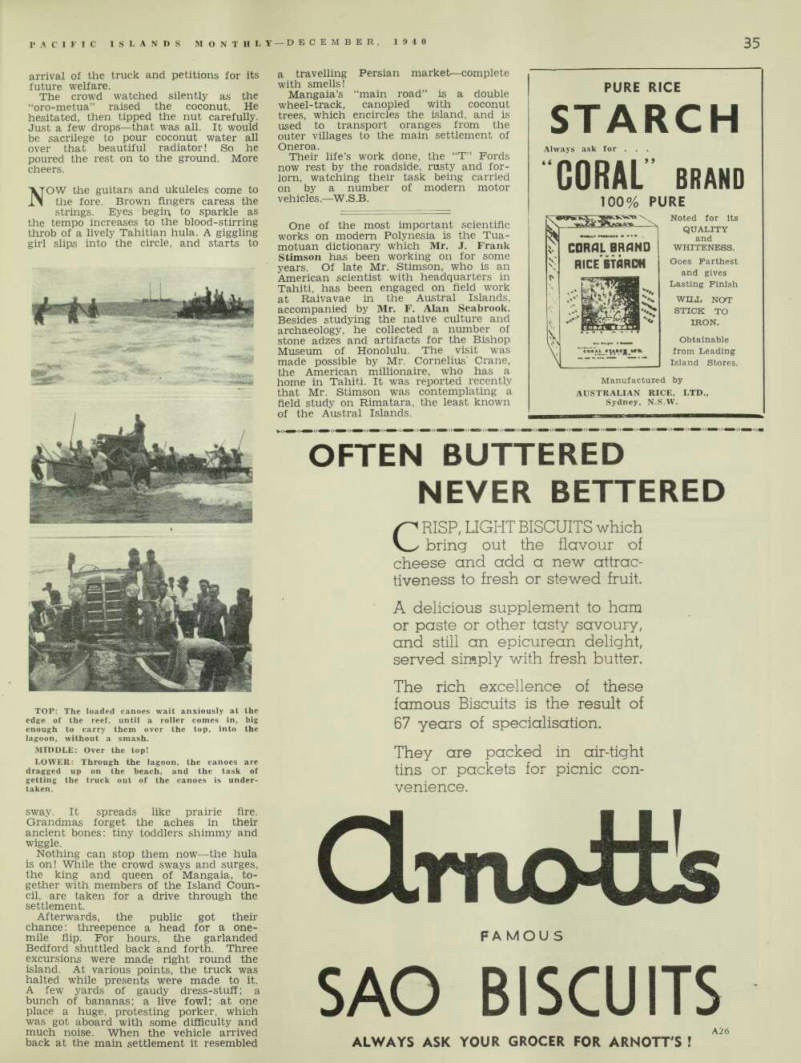
Landing a Motor Truck on Coral Island
rE exacting feat of getting their out rigger canoes over the foaming reefs of Mangaia has been the daily task of the natives of that island for long generations. Mangaia has no har bours or anchorages. The outer edge of the reef falls away into deep water.
Crossing the reef is at all times a tricky business, but in bad weather the Man gaians perform miracles of seamanship.
Their greatest feat is that of landing a modern motor truck. To date, seven vehicles have been brought ashore with out mishap.
Two canoes, which are hollowed from single tree-trunks, are lashed parallel, spaced with timbers, so that the wheels of the vehicle will settle snugly into the hulls, and taken out to the ship.
Now comes the nerve-racking business of lowering the truck into the canoes from the deck of a pitching and sway ing schooner.
We hold our breath as it dangles pre cariously from the cargo hoist, swinging with the motion of the ship and rising and falling in alternate rushes. Time and again, the hovering truck is almost settled into the canoes, but before it can be released it is jerked into the air, and the canoes go sheering off. Eventually it is settled in the canoes and the tackle cleared.
The strange and valuable cargo is now paddled over the ocean swells to the reef, where comes the difficult task of getting it “over the top”.
The craft is halted just outside the breaking surf, one moment lifted level with the reef, the next sinking into the trough, with the jagged coral looming in a formidable barrier.
The art of landing on the reef is to choose the “right wave”, to lift the craft above the level of the coral and sweep it over into the quiet shallows inside, aided by the strenuous efforts of the paddlers and the skilful handling of the “rangatira” at the steering oar. A mis judgment would crash the canoes onto the sloping outer edge of the reef, at the mercy of the next curling sea, rpHE Mangaians have become accus- JL tomed to that white-man’s mir acle, the dear old “T” Ford; but the arrival of an up-to-date Bedford truck, with its shining cellulose and chromium plating, luxurious upholstery, and dazzling instrument panel with many “clocks”, was a new sensation for them.
For several days, while a garage was being constructed for this purring god of power, four elders of the community guarded it day and night, their women folk bringing them food.
Came the day of the christening cele brations. This event called for something special in the way of a feast. Eighty pigs were roasted in the “umus”; and these, together with vast quantities of fowl and taro, were heaped in long rows on the grass in front of the cargo-shed which served as a grandstand.
The great moment arrived. Cheers rent the air as the truck, so festooned with flowers and streamers that the driver had difficulty in seeing his course, moved slowly up the Lane of Plenty.
Midway, it halted. Hatless, the “oro metua”, or native pastor of the L.M.S. church, approached, in his hand an opened drinking-nut. Prayers were offered in thanksgiving for the safe
arrival of the truck and petitions for its future welfare.
The crowd watched silently as the “oro-metua” raised the coconut. He hesitated, then tipped the nut carefully.
Just a few drops—that was all. It would be sacrilege to pour coconut water all over that beautiful radiator! So he poured the rest on to the ground. More cheers.
NOW the guitars and ukuleles come to the fore. Brown fingers caress the strings. Eyes begin, to sparkle as the tempo increases to the blood-stirring throb of a lively Tahitian hula. A giggling girl slips into the circle, and starts to
sway. It spreads like prairie fire.
Grandmas forget the aches in their ancient bones: tiny toddlers shimmy and wiggle.
Nothing can stop them now—the hula is on! While the crowd sways and surges, the king and queen of Mangaia, to gether with members of the Island Coun cil, are taken for a drive through the settlement.
Afterwards, the public got their chance: threepence a head for a one mile flip. For hours, the garlanded Bedford shuttled back and forth. Three excursions were made right round the island. At various points, the truck was halted while presents were made to it.
A few yards of gaudy dress-stuff; a bunch of bananas; a live fowl; at one place a huge, protesting porker, which was got aboard with some difficulty and much noise. When the vehicle arrived back at the main settlement it resembled
a travelling Persian market—complete with smells!
Mangaia’s “main road” is a double wheel-track, canopied with coconut trees, which encircles the island, and is used to transport oranges from the outer villages to the main settlement of Oneroa.
Their life’s work done, the “T” Fords now rest by the roadside, rusty and for lorn, watching their task being carried on by a number of modern motor vehicles. —W.S.B.
One of the most important scientific works on modem Polynesia is the Tua motuan dictionary which Mr. J, Frank Stimson has been working on for some years. Of late Mr. Stimson, who is an American scientist with headquarters in Tahiti, has been engaged on field work at Raivavae in the Austral Islands, accompanied by Mr. F. Alan Seabrook.
Besides studying the native culture and archaeology, he collected a number of stone adzes and artifacts for the Bishop Museum of Honolulu. The visit was made possible by Mr. Cornelius Crane, the American millionaire, who has a home in Tahiti. It was reported recently that Mr. Stimson was contemplating a field study on Rimatara, the least known of the Austral Islands.
TOP: The loaded canoes wait anxiously at the edge of the reef, until a roller comes in, big enough to carry them over the top, into the lagoon, without a smash.
MIDDLE: Over the top!
LOWER: Through the lagoon, the canoes are dragged up on the beach, and the task of getting the truck out of the canoes is under taken.
Hon. O. F. Nelson, of Western Samoa, who was reported in last issue to be in ill-health and gone on furlough to New Zealand, actually was much better in November. He cancelled his projected trip, and was able to resume active business.
Advertisements & other items, pp. 36-38 (2 items)
Prescott Pty. Ltd.
SUSSEX ST., SYDNEY,
are sole wholesale agenrs for
PINEAPPLE BACON&HAMS
DAISY brand BUTTER "115" BUTTER in TINS llb.-21b.-slb. Sizes.
LEA & PERRINS’ Sauces and Most other Super-Quality Lines of the Trade, such as Cheese, Eggs. Etc.
We are Specialists . . . . \ ’Phones: MA 8612 (4 lines).
Cable Address: “Weymarkson.”
Codes—Bentleys Private.
Let us have your confidence. Sixty years is our record of supplying the leading Houses throughout the World in - - - -
FRESH FRUIT VEGETABLES PRODUCE
WEYMARK & SON LTD.
FRUIT AND PRODUCE MERCHANTS
14-18 STEAMMILL STREET - - - SYDNEY
“ANCHOR FLOUR”
THE STANDARD OF QUALITY
i i :
GILLESPIE BROS. PTY. LTD
SYDNEY - AUSTRALIA
mm
CLmotils
PURE RICE
STARCH
Always ask for . . .
CORAL BRAND
100% PURE
Noted for Its
QUALITY
and
WHITENESS.
Goes Farthest and gives Lasting Finish
WILL NOT
STICK TO
IRON.
Obtainable from Leading Island Stores.
CORAL BRAND
RICE STARCH
“•V.h.fMV*. 11 Manufactured by
AUSTRALIAN RICE, LTD.,
Sydney, N.S.W.
OFTEN BUTTERED
NEVER BETTERED
CRISP, LIGHT BISCUITS which
bring out the flavour of cheese and add a new attractiveness to fresh or stewed fruit.
A delicious supplement to ham or paste or other tasty savoury, and still an epicurean delight, served simply with fresh butter.
The rich excellence of these famous Biscuits is the result of 67 years of specialisation.
They are packed in air-tight tins or packets for picnic convenience.
CLmotils
FAMOUS
SAO BISCUITS
A 26 ALWAYS ASK YOUR GROCER FOR ARNOTT'S !
Kork-N-Seal
FOR HOME USE
• Hand Applied Airtight Pressure Proof
FOR ALL HOME BOTTLING
—THE LITTLE CAP THAT
will Re-seal 1,000 Times
KORK-N SEAL (Aust.) LTD.
100 COMMONWEALTH STREET.
SYDNEY, AUSTRALIA.
Australia's Choicest Products: Brussels Sprooi* White Turnips Sweet Corn Tomato Puree Tomato Sauce Tomato Soup Tutti Fruit Sauce (Worcestershire flavor) Green Peas French Bean* Cauliflower Beetroot Spinach Cabbage Carrots Parsnips Celery W
gaticfiVd7>
m * m Always . . . make sure you have at hand an ample Reserve of these Delicious . .
Garden
Vale
Ready-toserve Vegetables
"Tagua" Back In Central
Pacific
From Our Own Correspondent
Rarotonga, Oct. 21.
THE Cook Islands schooner “Tagua”, long-owned by the Cook Islands Trading Co., and used in the South eastern Pacific trade, is now under charter to the New Zealand Government for general services. After some months in New Zealand and Suva, for re-fitting and the installation of a new engine, she re-appeared at Rarotonga in Octo ber.
The “Tagua” will transport lepers from Rarotonga and Aitutaki to the leper concentration island, and carry out cer tain other duties in the Northern Cooks.
Before the present Government charter, the “Tagua” had been chartered by Mr. Richard Damon, of the famous Honolulu banking family, and the for tunate crew spent a happy three months chasing rainbows around the Eastern Pacific.
Mr. V. A. Florance, solicitor, who has been practising at Wau, New Guinea, for several years, has transferred his practice to Rabaul. He has taken offices in the WRC building, Rabaul.
Mr. H. B. Gibson, European Elected Member for the Eastern Division in Fiji, went to New Zealand in November where his father, Mr. A. B. Gibson, was gravely ill.
Mr. S. H. Ellis, of Suva, left Fiji for New Zealand recently for a holiday, after several months of indifferent health.
Farewell To The
Sea
Captain Henry Low, of Fiji, Retires
WHEN the MV “Tui Cakau” returned to Suva yesterday from Lautoka she was brought alongside the wharf by Captain Henry John Low for the last time (said the “Fiji Times”, on November 1) Captain Low, 48 of whose 66 years have been spent sailing the seas, has retired and will henceforward live ashore.
Henry Low was born on Taveuni in 1874, his father, Mr. Charles Wallace Low, being in charge of a large cotton plantation there. Later Mr. C. W. Low entered into partnership with Hennings Bros., in the Lau Group; and then he settled in Levuka, at that time the capital of Fiji and a thriving mercantile and shipping town. But Levuka’s ex> citements were not sufficient for young Henry so, in 1892, he shipped as mate on the ketch “Alice” (J. C. Smith &' Co.) trading between Levuka, Ba. Lautoka and Labasa. After some years in this trade, he then served two years before the mast in the “Rotuma”, a sailing vessel belonging to Captain Kaad and trading between Fiji and Rotuma, the is lands of Wallis and Futuna, and Sydney.
Returning to Fiji, he took command of the CSR Co.’s “Marama” and spent nine years with the comnany, as master of this vessel and later of the “Rani”.
In 1910, Captain Low joined the South Pacific Lumber Co. as master of the schooner “Confianza”. After four years in the lumber trade, he formed an asso ciation which was to last for 26 years, for in 1914 he was given command of the Fiji Shipping Co.’s “Adi Keva”. Under this firm and later under Morris, Hed strom, Ltd., which took over the Fiji Shipping Co.’s fleet, Captain Low has been master of the old “Adi Keva”, her successor the new “Adi Keva”, the “Sir John Forrest”, the “Adi Rewa”, and lastly the “Tui Cakau”.
During the past 40 years Captain Low gained a knowledge of the seas, reefs, islands and waterways of Fiji which probably exceeds that of any other one man. There are few islands in the Group which do not know the sturdy figure and stentorian voice of Henry Low. The sea men who have passed through his hands and have been trained by him must be numbered by the hundred. He has prob ably done favours and executed com missions for every trader and plantation owner in the remoter islands.
Captain Low retires with a proud re cord —Fiji waters are notoriously narrow and dangerous, but in his 35 years as master of interinsular craft he never has lost a ship. Another source of gratifica tion which perhaps tempers his inevitable regret at leaving the sea is that he has handed over command of the “Tui Cakau” not to a stranger, but to his own son, Mr. D. L. Low.
Mrs. Wat! Vuni Harris, relict of the late Mr. John Harris, died recently at Levuka, Fiji, aged 80 years. She was buried at Rukuruku, Ovalau, where she spent the greater part of her life.
Mr. R. F. Pickering, manager in Fiji for the Bank of NSW, has been trans ferred to Townsville, Queensland, on promotion, and will leave the Colony this month. His successor is Mr. T.
Bryce.
Mr. Parkin Christian, of Pitcairn Is land, paid a visit to New Zealand re cently to undergo an operation.
Why Japan's Interest
in Timor?
THE announcement, made in “Sydney Morning Herald” on November 16, that a Japanese Government-sub sidised airline is about to run between Palau (Western Carolines Japanese mandate), via the Moluccas or Dutch New Guinea, to Dilli, capital of Por tuguese Timor (the East Indies island nearest to Australia) is a matter of sharp interest to Australia, and to all British and French territories in the Western Pacific.
Why should the Japanese start this line?
Timor is only a small island, divided between Portugal and Holland, and already it has a weekly airmail, pro vided by the Dutch, which connects with the regular Dutch East Indies airlines.
The Japanese, for years, have shown a lively interest in Timor—presumably, because it is Portuguese, and various land-hungry nations are alwavs hoping to pick up the remnants of Portugal’s once great colonial empire.
From Australia’s viewpoint, Timor is embarrassingly close to Darwin—it is a water hop of only a few hundred miles.
While Dutch or Portuguese are there, Australia will not worry. But if Japan ese —Hitler’s new ally—were to make any kind of base there, the position would be less satisfactory.
However. Portugal and Holland are Britain’s allies. Portugal has not yet given the Japanese the rieht to land at Dilli. and Holland has not p-iven them permission to fly over the East Indies.
Palolo Arrives
THE peculiar coral worm called “palolo”, which comes to the sur face on only one or two days each year, and which is regarded in Samoa as a great table delicacy, appeared in the waters around Savai’i, Sa’moa, on Wed nesday. October 23, and fishermen made a good haul.
The palolo comes to the surface onlv in the "dawn of the opening of the third quarter of the moon in Savai’i and the same period of the moon in November in Upolu Immediately the sun appears, the floating mass apparently dissolves and in a few minutes there is not a trace to be seen.
Sunday Is.
Interesting, Fertile Spot is Now Weather Station
AGAIN and again, world-weary people have sought a refuge upon beautiful, fertile, well-watered Sunday Island, in the Kermadec Group, mid-way be tween New Zealand and Tonga. Life there is easily sustained, and one’s isolation is not endangered, because there is no harbour, and ships can anchor off the rocky coasts only in quiet weather.
The little colonies do not last, however.
Sometimes they give one reason for their collapse, sometimes another: but the real reason is that, however sick the colonists may be of the sight of other human be ings, after a year or two they find they cannot stand the loneliness.
Recently, as part of the South Pacific meteorological network for the trans pacific airways, the New Zealand Govern ment established a weather station on Sunday Island, and the following descrip tion of the place is supplied by Mr. H.
Lukins, a meteorologist, who spent several months there. We predict that, since a permanent weather station and staff mean that Sunday Island must now be a regular steamer call. Sunday Island soon will be regularly colonised.
Sunday Island is a volcano. Its crater is about two miles in diameter, and contains three lakes. The island, about 7,000 acres, is very much broken with precipices and ravines. Rainfall is about* 60 inches a year. Summer temperatures range be tween 80 and 90 degrees.
Passion fruit, bananas, oranges, cape gooseberries and tomatoes grow wild all over the island. Norwegian rats, immi grants from a wrecked ship, have over run the island and ousted the native rat.
Cats, too, abound having originally been left on the island by whalers. The cats have so many birds to eat that they hardly trouble to catch the rats. The goats still number between 1,000 and 2,000. They play havoc with the vegeta tion. There are thousands of tuis and many European birds, such as blackbirds linnets and* starlings. Mutton birds have riddled the island with their holes. God wits, grey duck on the lakes and birds from the tropics occassionally appear.
Petrels are exceedingly numerous. The eggs provide free and easily accessible food for the rats, and young birds dainty meals for cats and rats, and yet the bird popu lation does not seem to be affected. Fish up to 180 lb. in weight are caught off the rocks. Turtles are also taken. The rock pools teem with small fish.
Advertisements & other items, p. 39 (1 item)
HoMrtook WcisW
Mtaf ttof Imo
S(CMjS—-
S(mOL is a Vicious
tftrul of pti** wostod
t* .spices. it
on kof (A coi ; i meats,
fcA mcujortnoise
cbt€SSilW|S I'M.
of
fasftj •t cofou*fu£
Here are some suggestions- Spread some cutlets lightly with butter, dip into Holbrooks Mustard Sauce; cover with breadcrumbs and fry in hot fat.
When making gravy add one dessertspoon Holbrooks Mustard Sauce.
Holbrooks Mustard Sauce with toasted ham or bacon sandwiches.
Equal parts of Holbrooks Mustard Sauce, butter and cheese beaten to a stiff paste, and spread or heaped on savoury biscuits.
MS-1
PRODUCING UNIFORM GOOD RESULTS SINCE 1868
ALWAYS ASK FOR IT
Fiji Wants A Threepenny
Piece
From our own correspondent
Suva Nov 12
ONE of the matters brought ’ before the recent meeting of the Fiji Legis lative Council was a proposal to re introduce the threepenny piece in the Colony. When new coinage of. a special Fijian design was introduced at the be ginning of 1934, to replace British cur rency in use for 60 years, the humble threepence was not included—the then Governor (Sir Murchison Fletcher) was of opinion that coins of smaller denom inations, penny and halfpenny, made for cheap prices, small profits, and quick turnover.
At the recent session, most of the un
official members of the Council including Ratu Sukuna and the two Indian repre sentatives, supported Hon. Alport Barker’s motion that the threepence be put back - circu^a tion. Business and banking ite rein “ 1 oductlon ’ some members stated, The discussion was brought to a halt, however, when Sir Harry Luke (Governor) pointed out that coinage was a restricted subject—legislation must not be intro duced without the prior consent of the Secretary of State, in England. He added that the text of the debate would be sent to London. But members do not imagine that anything will be done about it—Fiji’s need for threepences assumes very insignificant proportions these days, while the Battle of Britain rages.
Memories Of Loma
Loma
Charming Old Port in a Forgotten Archipelago
By G. Scoresby Shepherd
STRANGE how memories of Loma Loma, that slumbering old port in the Lau (South-eastern Fiji) Archi pelago, persist so vividly.
Several years ago, I left it and later, after eight roving months, left Fiji.
Since then, I have wandered far and fre quently among the Western Pacific Is lands, touching at dozens of different ports, sometimes lingering, other times just passing through on tourist cruises.
Loma Loma, should be submerged be neath a welter of other kaleidosconic Is-
lands memories, like something fine that has to be sifted out through the running sands in the glass; but it is not so. Mem ories of the old port stand out with crystalline clearness.
Indelible pictures flash across my mind. I see the faded port languishing on the eastern shores of Vanua Balavu, far away east from flourishing Suva, some 180 miles. I see its forsaken appearance —the tumbledown villas that straggled along the contour of the palm-fringed beach, now occupied by Euronesians and Fijians; the faded administrative Gov ernment buildings on the town’s northern outskirts, with the walls of their com pound gapped and crumbling; the ruins that were once stores and hotels, when cotton was King of Commerce in early halcyon days, and Loma Loma was on the map.
I see its driftage-strewn beach and crashing surf. Rather do I hear the surf.
And what a surf it was! The reef was far out, broken, and could not check the breakers. On they came, an endless pro cession of them, until they piled up on the beach, and then their roar was like the reverberation of artillery. Between impacts there was a heavy silence, dramatically intensified by the previous roar. A little pyramid-shaped islet, Yanu-Yanu, in the centre of the harbour, barely took off their rough caress. I do not recollect ever seeing that lagoon
tranquil.
MEMORY recalls its inhabitants —the Lauans. A fine, yet curiously little known race, these natives. Part
A Lauan nurse.
Fijian, part Tongan, descendants of the Tongan invaders who conquered Lau in the fifties under leadership of that genius Ma’afu, they brought out the best of two races, both in physique and intellect. They were fairer in complex ion than the Fijians, softer in features, bigger in build; yet lacked the secessive passiveness of the Tongans. Many of them were bi-lingual, speaking with ease either Tongan or Fijian. The Lauans who gravitated down to Suva generally made good as native doctors, while others were clerks in Government offices.
The Lauan girls were excellent nurses and surely must be ranked amongst the finest-looking women in the South Seas.
There was a complete Tongan village in the town, its inhabitants had not racially intermingled with the Fijians to any extent. A scattering of Indian dairy farmers lived frugally on the outskirts.
Also, there were Chinese, who kept one of the larger stores in the town. The other store was a branch of a big Euro pean firm.
This latter store interested me greatly.
It was surprisingly well stocked with mer chandise, ranging from a ship anchor to a packet of pins. But most of its goods were as inaccessible to the natives as were the glassed exhibits of any Museum.
For this was the dark days of ’3l, when the economic blizzard had even ferreted out Loma Loma. (The years have swung full circle: the conditions described hereunder by Mr.
Shepherd are virtually the conditions ruling to-day, 10 years afterwards. —Ed.
“Pim”.)
Copra had crashed; £4/10/- for Lauan planters, and freight was high. Many plantations were closing down. Money was scarce in Loma Loma, and debts had piled up high at the store. The natives had resorted to bartering, and had re
verted to some of their old customs. For instance: the old women were working overtime, beating tapa, to replace the flamboyant sulus; and, instead of buying kerosene, many were obliged to use coco nut oil for lighting purposes.
But I don’t think anybody was un happy about it all. There may have been some grumbling among young ex-Suva
natives, but the majority of Lauans had always led a singularly withdrawn existence, when compared with Fijians in other parts of the Archipelago.
Gaudy coloured sulus, silk shirts and singlets, and European kitchen utensils, were all very nice, but as I have said, they all had their native equivalents.
Nobody ever went hungry, and what the stomach doesn’t miss, the heart doesn’t really mind—in Polynesia, at any rate.
DO the old women of Loma Loma still beat
tapa cloth all day, as they did then?
What a row there was!—the exulting roar of the breakers, and the staccato tattoo of the tapa beaters, both competing for supremacy. Curiously, I realised after a while that I failed to notice these sounds. I suppose the ear became inured to the constant diapason of the two, and the mind refused to register them.
Apart from myself, the only Europeans in Loma Loma were the Resident DC and the storekeeper, with his wife and child.
In fact, on the whole of the Island, there were only two other Europeans: the inevitable missionary and a recluse planter. Once, Loma Loma had a popu
lation of 100 Europeans, which was al ways augmented by a floating commun ity. In 1931, I comprised Loma Lomas floating population. In a week, all of Vanua Balavu knew that I was residing in the town; in three months, all of Northern Lau knew.
I have called Loma Loma a port, rather, I should have said an ex-port.
During early days, when Levuka was Fiji’s capital, Loma Loma was a port of entry into Fiji, and the cross-roads of Lau. In ’3l, a strange sail—even a small cutter—would bring the entire town down to the beach. The only regular ship was the “Malake”, a BP steamer which called monthly at Northern Lau ports, dropping mails and stores and shipping copra. It was the “Malake” which brought me up on her last trip; they took her off the circuit, owing to lack of business, and I understand she was not replaced, A Lakemba mission ship, a copra ketch from Levuka and the Government in spection ship “Pioneer”, were the only vessels which one might occasionally ex
View of Loma Loma Harbour from the hills behind the settlement; Yanu-Yanu islet in background.
pect to see. Lau’s waters had a monopoly of submerged coral reefs, and there had to be definite inducement for ships to make the long trip from Suva.
Regular appearance of the “Malake” was not the only sight the natives were to miss, late in ’3l. The European Commissioner was replaced by Ratu Sukuna, that brilliant Fijian chief, who administered Lau until 1939; the missionary on Vanua Balavu was recalled to Suva; ditto the storekeeper and his family, a Euronesian trader taking his place. And, fir Vl lly vJ le ? •• • down to Levuka, with the firm resolution of returning
soon. But, somehow there was that nme for fresh Islands horizons and new faras I never did go back—and now Isunnose that I never shall suppose Mrs nollpl G Jfnea D a?rfvcd u on ?£’ y W hfle d her h„S d * sho . r V holl ?S y Mnrnhp h rnidfipiH<f d wa vlsltm £ the Morot)e Goldfields.
Miss A. Brown of thP rvrmm r Office, Rabaul NG, is at Aus^ tralia on four months’ leave
Advertisements & other items, pp. 40-42 (2 items)
A. B. Donald Ltd.
AUCKLAND
ISLAND TRADERS & GENERAL MERCHANTS
P.O. Box 1509. Cobles £r Telegrams, "Kingdom", Auckland.
Cijjflrfttcs
nf (Etunlitij
++♦+ In case of difficulty in obtaining supplies, write to
BOX 1861 K., G.P.0., SYDNEY.
(dfiß®
O''*'' . . -»”"* » "““ rf r *• <*** (oV "» rb ° So^ aS , w d*'l ned ■ Sp e °*" 7 , r xice o( f"' „, w e ie< . te nif« ° .„, »« e ° l -oC>»' 0 cu^'° e- »** t *cett* nl c \\e v** 0 ' r** "** , ser** I"*' 1 "*' „ rt » t ' d „ vJ»' lcr ,A u> da ° ra' 0 ® 0 f ,. Sov-'° V -0^ c^ e ' r da>' b 9 e
Ship Chandlery— Hardware
r Write for j
j Ship Chandlery j
I Catoloaup J
Catalogue
Special “In Bond” Prices for all Islands enquiries quoted on application.
Sole Agents for:
BROOMFIELDS LIMITED
i 52 SUSSEX STREET SYDNEY.
Cables: “Boom”, Sydney.
Large and Complete Stocks of
SHIP CHANDLERY
IRONMONGERY OF ALL KINDS, PAINTS
WHITE LEAD AND OILS.
P. H. MUNTZ & CO.’s 3-CROWN BRAND METAL SHEATHING.
PEACOCK & BUCHANS’ ENGLISH READY-MIXED PAINTS.
PROPELLERS
All Sizes to 54 in. diameter . . . any pitch.
SHAFTS MADE TO ORDER.
Bearing and Stuffing Boxes —Rudders— Tanks for Water and Fuel—Exhaust Pipes and Mufflers.
Copper, Bronze and Aluminium Founders.
D. H. PORTER & CO.
43-45 DRUITT STREET, SYDNEY.
Scott’s “Renown” Brand Rope,
Cordage and
Binder
Twine
Cable .
Address; Ropeyard, Sydney.
of Every
Description
MANUFACTURED AT
MASCOT, N.S.W.
By
J. SCOTT
PTY. LTD.
Head Office and Store:
163 CLARENCE STREET,
SYDNEY,
N.S.W.
Few Ships
N. Guinea Goldfield Has a Grievance
From Our Own Correspondent WAU, Nov. 20.
ITIOR some considerable time the ship £ ping facilities to and from Sala maua, the port of this most import ant part of New Guinea, have been bad, and now they assume the proportions of being appalling.
With one more ship removed from this run-transferred to other duty—the mainland finds itself now with the pros pect of one ship every eight weeks or thereabouts.
It has been suggested many times that the E. & A. ships might very well be diverted to Salamaua, and now con sideration of this suggestion becomes imperative.
The capital (Rabaul) is in no way inconvenienced in the matter of ship ping; and, apparently, no consideration is given to those who, especially in war time, perform the Territory’s most use ful function—namely, produce the bulk of the Territory’s revenue.
Fiji's New Tariffs
TO meet increased defence expendi
ture, the Fiji Legislative Council
recentiv anpmved a new tariff schedule, the principal items of which are:— Ale and beer. —Increase of 4/- a case on bottled beer and 10/- a drum on draught beer.
Candles.—Now iy 2 d. a lb. British and 3d. a lb. foreign.
Dhall.—lncreased from 60/- and 90/- a ton to 75/- and 112/6.
Sharps and pollard.—lncreased from 30/- and 50/- a ton (2,000 lb. 1 to 40/- and 60/-.
Benzine and similar oils. —Increased Id. a gallon.
Rice (dressed or broken).—lncreased from 40/and 60/- a ton to 50/- and 75/-.
Soap.—lncreased from Id. and 2d. per lb. to 2d. and 4d. per lb.
Spirits.—lncreased from 26/- and 39/- to 36/and 49/- a gallon.
Tobacco (manufactured). —Prom 7/- and 10/6 a lb. to *9/8 and 13/2 a lb.
Cigars.—From 9/- and 13/6 a lb. to 12/- and 16/6 a lb.
Cigarettes.—From 8/- and 12/- per lb. to liz ard 15/-.
Wines.—From 4/- and 6/- to 5/- and 7/6 r gallon.
Still wines (containing more than 40% proof spirit).—Prom 26/- and 39/- to 36/- and 49/-.
Sparkling wines (containing more than 40% proof spirit).—From 26/- and 39/- to 36/- and 49/-.
Mormons Leave Pacific
MONTH by month, Mormon mission aries have been leaving the Pacific Islands. It is reported from Samoa that most of the staff of the Mormon Mission Society has been recalled, and in October about 40 American citizens left Samoa for Salt Lake City. The work of the mission in Samoa now is being carried on by Samoans, under the super vision of an elder.
Mr. Richard William Robinson, one of Fiji’s pioneer townsmen, died at Levuka recently, aged 79 years.
Miss Gwenneth Clare, elder daughter of Mr. and Mrs. J. G. Miedecke, of Magia Plantation, Western Samoa, was married to Mr. Leicester Mitchell Cook, of Wellington, NZ, at Apia recently.
Old Tomato Station
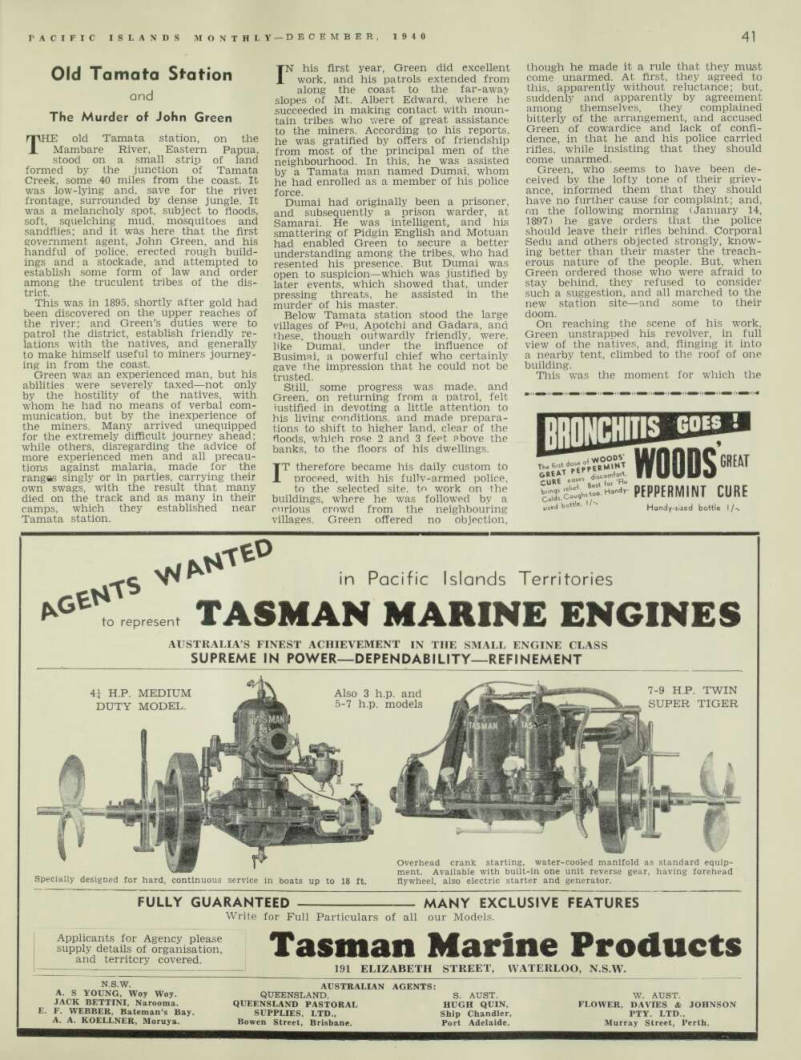
and The Murder of John Green
THE old Tamata station, on the Mambare River, Eastern Papua, stood on a small strip of land formed by the junction of Tamata Creek, some 40 miles from the coast. It was low-lying and, save for the river frontage, surrounded by dense jungle. It was a melancholy spot, subject to floods, soft, squelching mud. mosquitoes and sandflies; and it was here that the first government agent, John Green, and his handful of police, erected rough build ings and a stockade, and attempted to establish some form of law and order among the truculent tribes of the dis trict.
This was in 1895, shortly after gold had been discovered on the upper reaches of the river; and Green's duties were to patrol the district, establish friendly re lations with the natives, and generally to make himself useful to miners journey ing in from the coast.
Green was an experienced man, but his abilities were severely taxed—not only by the hostility of the natives, with whom he had no means of verbal com munication, but by the inexperience of the miners. Many arrived unequipped for the extremely difficult journey ahead; while others, disregarding the advice of more exnerienced men and all precau tions against malaria, made for the ranges singly or in parties, carrying their own swags, with the result that many died on the track and as many in their camps, which they established near Tamata station.
IN his first year, Green did excellent work, and his patrols extended from along the coast to the far-away slopes of Mt. Albert Edward, where he succeeded in making contact with moun tain tribes who were of great assistance to the miners. According to his reports, he was gratified by offers of friendship from most of the principal men of the neighbourhood. In this, he was assisted by a Tamata man named Dumai, whom he had enrolled as a member of his police force.
Dumai had originally been a prisoner, and subsequently a prison warder, at Samarai. He was intelligent, and his smattering of Pidgin English and Motuan had enabled Green to secure a better understanding among the tribes, who had resented his presence. But Dumai was open to suspicion—which was justified by later events, which showed that, under pressing threats, he assisted in the murder of his master.
Below Tamata station stood the large villages of Peu, Apotchi and Gadara, and these, though outwardly friendly, were, like Dumai, under the influence of Busimai, a powerful chief who certainly gave the impression that he could not be trusted.
Still, some progress was made, and Green, on returning from a patrol, felt iustified in devoting a little attention to his living conditions, and made prepara tions to shift to higher land, clear of the floods, which rose 2 and 3 feet Pbove the banks, to the floors of his dwellings.
IT therefore became his daily custom to proceed, with his fullv-armed police, to the selected site, to work on the buildings, where he was followed by a curious crowd from the neighbouring villages. Green offered no objection,
though he made it a rule that they must come unarmed. At first, they agreed to this, apparently without reluctance; but, suddenly and apparently by agreement among themselves, they complained bitterly of the arrangement, and accused Green of cowardice and lack of confi dence, in that he and his police carried rifles, while insisting that they should come unarmed.
Green, who seems to have been de ceived by the lofty tone of their griev ance, informed them that they should have no further cause for complaint; and, on the following morning (January 14, 1897) he gave orders that the police should leave their rifles behind. Corporal Sedu and others objected strongly, know ing better than their master the treach erous nature of the people. But, when Green ordered those who were afraid to stay behind, they refused to consider such a suggestion, and all marched to the new station site—and some to their doom.
On reaching the scene of his work, Green unstrapped his revolver, in full view of the natives, and, flinging it into a nearby tent, climbed to the roof of one building.
This was the moment for which the
natives were waiting They rushed Green and two of his police and, after spearing them to death, turned their attention to the native prisoners.
Corporal Sedu and a number of police were some distance away, getting timber.
They heard the disturbance, and returned to see if they could be of any assistance to their master. He was past help when they arrived; and most of them paid for their bravery with their lives.
Those who managed to escape made for the miners’ camp. The miners hurried to the scene and rescued Green’s mutilated body, carried it back to the old station, and buried it in a prominent position on the river frontage.
The massacre did not end with the killing of Green and his police and prisoners. Twenty-two carriers also had disappeared.
The miners, realising that as soon as
the news spread, the whole country would be up in arms, made for the coast. They went down the river on rafts, and they were forced out to sea by natives, who had just attacked and murdered a party as it was entering the river.
Except for three men on the distant slopes of Mt. Scratchley (Schmitt, Ryan and Burns, with whom the Tamata miners were unable to communicate) the Mam bare was left in possession of its war like tribes until Sir William MacGregor arrived, with his Commandant of Police, and restored order.—MOLLIE LETT.
Mrs. W. E. Grose, widow of one of New Guinea’s best-known and most highly respected planters, who died a few months ago in Melbourne, is now matron at the well-known Tudor House School, Moss Vale, NSW.
Advertisements & other items, pp. 43-44 (1 item)
Tasman Marine Engines
" i WOODS’
GRt Al B B
CURE eases 'flu
PEPPERMINT
nied bottle. '/ • Handy-siied bol niDc
\f4^
in Pacific Islands Territories
to represent
TASMAN MARINE ENGINES
AUSTRALIA’S FINEST ACHIEVEMENT IN THE SMALL ENGINE CLASS
SUPREME IN POWER—DEPENDABILITY—REFINEMENT
4i HP. MEDIUM
DUTY MODEL.
7-9 HP. TWIN
SUPER TIGER
Also 3 h.p. and 5-7 h.p. models t Specially designed for hard, continuous service in boats up to 18 ft.
Overhead crank starting, water-cooled manifold as standard equipment. Available with built-in one unit reverse gear, having forehead flywheel, also electric starter and generator.
FULLY GUARANTEED
MANY EXCLUSIVE FEATURES
Write for Full Particulars of all our Models, Applicants for Agency please supply details of organisation, and territory covered.
Tasman Marine Products
191 ELIZABETH STREET, WATERLOO, N.S.W.
N.S.W.
A. S YOUNG, Woy Woy.
JACK BETTINI, Narooma.
E. F. WEBBER, Bateman’s Bay.
A. A. KOELLNER, Moruya.
AUSTRALIAN AGENTS;
QUEENSLAND. S. AUST.
QUEENSLAND PASTORAL HUGH QUIN,
SUPPLIES, LTD., Ship Chandler, Bowen Street, Brisbane. Port Adelaide.
W. AUST.
FLOWER, DAVIES & JOHNSON
PTY. LTD.,
Murray Street, Perth.
I W \ "! /k DISTRIBUTORS; Greenwood & i Laws Ltd., Rabaul and Wau; Steamships Trading Co. Ltd., Port Moresby and Samarai; L Millers Ltd., Suva, FIJI.
For Protection and
Appearance - - use
“B A L M” Paint
PROTECTION —is the main job of Paint , . , APPEARANCE is next . . . and. to get the most efficient combination of both . . . use “8.A.L.M.” Paint.
“8.A.L.M.” Paint is a product of scientific research and practical experience . . . It has been tested for durability, protective qualities and colour retention, and proved to be the best that can be made.
Measure the value of Paint by years of service, protection and appearance, and NOT by cost per tin. Specify “8.A.L.M.”
Paint.
A Product of British Australian Lead Manufacturers Pty. Ltd.
If you want "Perfection in Cooking" use a
“Younger”
COOKING STOVE
r These stoves have been on the market in Australia for over Sixty Years, and are still recognised as “The Best”.
They are made with Extended Firebox specially for Long Wood fuel, also special stoves with Cast Iron Oven suitable for Island requirements.
Send for Illustrated Catalogue and Price of Single and Double Oven Stoves.
G. FLETCHER & SON
50 OXFORD STREET, SYDNEY.
"King" Jorgen
Jorgensen
When Iceland's Future King Visited Tahiti
By Eric Ramsden
rHITI has had many strange visitors since the island’s contact with Europeans, but none more colourful than Jorgen Jorgensen (or Jurgensen) who was there for a couple of months in 1806. Neither did the missionaries there ever have a more trenchant critic than the man who, three years later, seized Iceland and proclaimed himself king.
Information that a new biography of the Dane was about to appear in Lon don induced me to peruse his “State of Christianity in the Island of Otaheite and a Defence of the Pure Precepts of the Gospel Against Modem Antichrists”, which he published in a positively im pressive edition in London in 1811.
The book, long since forgotten, and important only for its sidelights upon the LMS missionaries, contains much of the religious balderdash of the period. It is undoubtedly one of the rarities of Paci fic literature. The Mitchell Library’s copy was presented by Jorgensen to the then Colonial Secretary, Alexander Mc- Leay. The author called himself “A Foreign Traveller”.
Jorgensen was that, and a great deal more. Tahiti was, of course, merely an incident in his exciting life. He has been called “Monarch of Iceland, naval cap tain, revolutionist, diplomatic agent, author, dramatist, nreacher, political prisoner, gambler, hospital dispenser, Continental traveller, explorer, editor, expatriated exile, and colonial constable”.
One might also add, liar and spy. How ever, the Dane was a man of undoubted intelligence-even if he did end his days in a ditch in Tasmania.
He had had some experience in whal ing and sealing in the Pacific, before he called at Tahiti on the whaler “Alexan der” in 1806. Jorgensen was accom panied by a couple of Maoris. He col lected a Tahitian chief and the latter’s friend, and he took them to London, where he presented the quartette to Sir Joseph Banks. Banks was kindness itself. But within a year the Tahitians were dead, also one of the Maoris— despite the care of the Rev. Joseph Hard castle (in whose care Banks had placed them). Marquis, the surviving Maori, was proof against the rigours of the Eng lish climate for a time, because “he became a tolerable carpenter and kept himself employed”.
FOR the missionaries in Tahiti—Jor gensen had ample time to study them while he collected provisions, salted meat, etc., for the voyage—he had nothing but contempt. He considered them deficient in address. Their be haviour was timid, he said, without being respectful. In fact, they looked “like humble petitioners at a gentleman’s door, and it is easy to observe that they are men of no education”. In short, they were not gentlemen, and the Tahitians were quick to see, by the manner in which they were treated by other Euro peans, that they were not chiefs.
Jorgensen stated that, although there were fourteen missionaries on the island (and they had been there since 1797) they had only one convert. This girl, of about fourteen years, was reared in the household of the Rev. W. Henry and his wife. (I suspect that she was the half
caste daughter of George Stewart, the “Bounty” midshipman, whose wife was Peggy, the Tahitian). Jorgensen says the child was brow-beaten and terrorised by the missionary, and reduced to a mere skeleton. When she committed the smallest fault, he says, she was threat ened by her stern master with “the wrath of the Christian god”.
The fate of this girl, incidentally, is one of the minor mysteries of the "Bounty” tragedy. It has been inferred that she eventually visited her father’s home in the Orkneys.
THOUGH Jorgensen did not like Henry, he was more kindly disposed to wards the Rev. John Jefferson (whose grave was discovered by Mr. W.
W. Bolton, near Arue, in 1935). To me, Jefferson has never seemed an attractive personality. It was because of his intol erance and pigheadedness that his col league, the Rev. Thomas Lewis, found a grave so early in life. Lewis, after vainly asking his companions to marry him, eventually lived with a Tahitian girl, and was mysteriously killed by her lover.
Missionary historians are apt to skip over the Jefferson-Lewis episode which, though sordid in a way, was not with out importance.
Jefferson, he says, was a truly pious man (which is not doubted). In order to mortify the flesh, he retired unto himself, and, in his meditations —to the surprise of the Tahitians—uttered “the most hollow and dismal groans”. “He was never seen smiling, nor to enjoy a moment’s happiness,” wrote the Dane.
Jefferson, it might be explained, was in poor health, and died soon after. In appearance, Jorgensen says he was “like a ghost, his skin tinged with a yellow and deadly hue, like a man who has the jaundice.”
The Dane has some scathing things to say of a missionary whom he calls “J ”. (Obviously, this man was not Jefferson, and there was no other mis sionary then in Tahiti whose surname began with that initial.) This man, he says, came on his ship, drank more brandy than was good for him, and then, in a burst of confidence, declared that his colleagues were “canting hypocrites”. rERE is more substance to Jorgen sen’s portrait of Pomare, which is by no means flattering. The Dane says the King was 6 ft. 4 in. in height, and was “exceedingly intemperate”: he consumed brandy until the officers would give him no more, cursed the Christian god and exalted that of the Tahitians, and, finally, “took up a whole leg of mutton and gnarled it with his great and ugly teeth”. It is not a pretty picture, especially, as in the year of the Dane’s visit, Pomare was in the throes of writ ing to all and sundry, and the mission ary press was doing its best to present him favourably to its extensive public.
Pomare, of course, was shrewd enough to use the missionaries for his own pur pose, and at that time was writing to the Mission headquarters in London in the following strain: “Friends, I hope also you will send me plenty of muskets and powder, for wars are frequent in our country. Should I be killed, you will have nothing in Tahiti. Do not come here when I am dead. Tahiti is a regardless country.” On missionary-pur chased muskets (some of which came from Sydney) the ambitious Pomare rode to political power.
Jorgensen makes an interesting remark concerning the King’s bodyguard. Pom are, he wrote, had “200 majestic looking warriors, some even hailing from Peru”.
It has always been assumed that Pom
are’s guard comprised natives from the Paumotus.
The climax in Jorgensen’s career came in 1809, when, with the help of British trading interests, he seized Iceland, made the Danish Governor a prisoner, and declared himself King, or Protector. His regime (which was of the comic-opera variety) had lasted barely two months, when a British officer arrived at Reik javik to investigate. Jorgensen was taken back to England as a prisoner.
Gaming led to his eventual downfall, and finally, he was transported, to end his days in Tasmania, where, “gin warmed and not unhappy, he died in a wayside ditch”. Thirty-three years had passed since his brief hour of glory as the regal Protector of Iceland, Mr. and Mrs. Roy Hyde, of Wau, NG, accompanied by their daughter and son, recently arrived in Australia from the Morobe Goldfields. They will not be re turning to the Territory.
Mr. D. Haig, who has been manager of the Yorkshire Insurance Co., at Rabaul, TNG, arrived in Sydney recently on transfer. He has been succeeded by Mr. S. E. Costelloe.
Advertisements & other items, p. 45 (1 item)
Wunderlich
Timber, Joinery
ETC.
PREPARED BUILDINGS ready for erection a specialty.
SHIP AND BOAT BUILDING.
TIMBERS specially catered for.
FIBROLITE, PLYWOODS,
GALVANISED IRON.
CONSIGNMENTS shipped
by RETURN STEAMERS
to the Islands.
John W. Eaton
PTY. LTD.
WEST CRESCENT STREET,
NORTH SYDNEY.
Telephones: XB 4051 (6 lines.)
BITUMENOID ROOFING
MADE IN AUSTRALIA.
Bitumenoid Roofings, Dampcourse and Insulating Pelts are made from the world's best raw materials. Warranted to stand the most rigid tests.
BITUMENOID THE BEST
Roofing, 1,2, 3-ply; Flooring, Waterproof Materials; Saturated Pelt; Resilient Road jointing; Natural Asphalt Dampcourse; 2 and 3-ply Dampcourse; 1-2 lb. Lead-core Dampcourse: Roofing Cement: Asphalt Paints; Roofing Compound.
SAMPLES AND PRICE LISTS ON APPLICATION.
MAXWELL PORTER & SON LTD.
ESTABLISHED 1888. BUILDERS’ SUPPLIES.
107 REDFERN ST., REDFERN, SYDNEY, N.S.W. ’Phone: M 3157. Cables Bitumenoid.
'i m 0 0 & 0
~*smss
A Durabestos Home built from a design in our Free booklet.
Note: In the Islands, Corrugated Durabestos would ensure a weather-tight roof.
WUNDERLICH LIMITED, (Estd. 52 Years), REDFERN, SYDNEY.
WUNDERLICH
DURABESTOS
ASBESTOS CEMENT BUILDING SHEETS
French Cocoa And
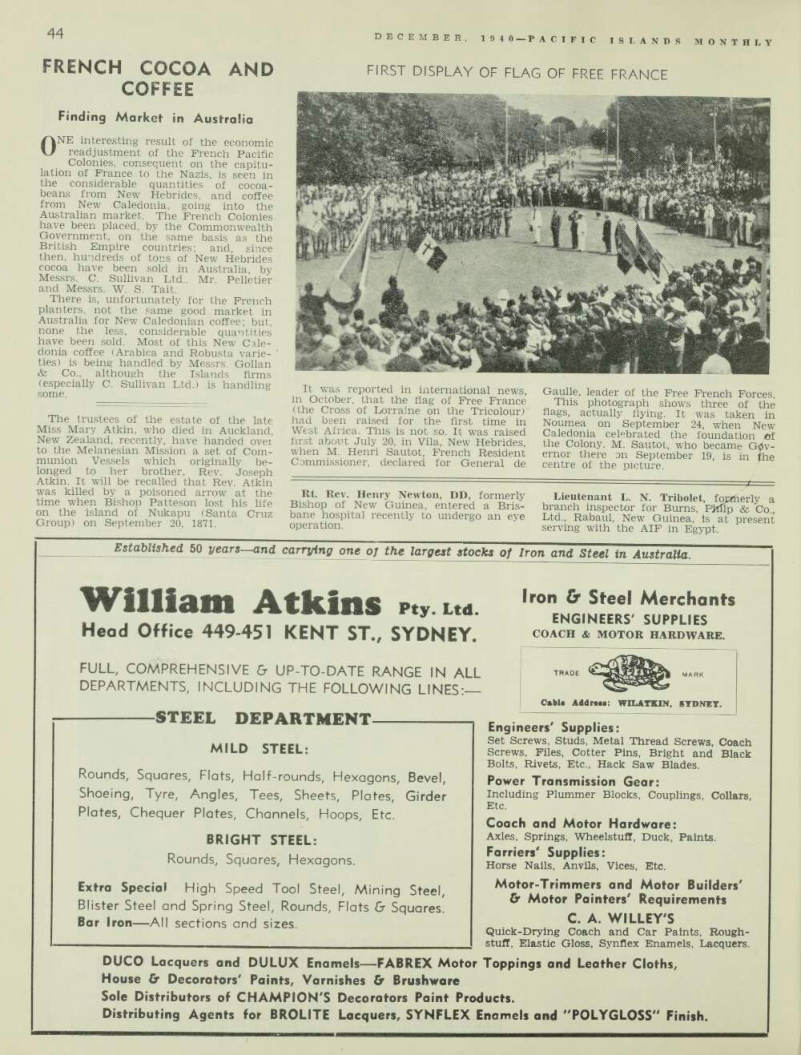
Coffee
Finding Market in Australia
ONE interesting result of the economic readjustment of the French Pacific Colonies, consequent on the capitu lation of Prance to the Nazis, is seen in the considerable quantities of cocoa beans from New Hebrides, and coffee from New Caledonia, going into the Australian market. The French Colonies have been placed, by the Commonwealth Government, on the same basis as the British Empire countries: and, since then, hundreds of tons of New Hebrides cocoa have been sold in Australia, by Messrs. C. Sullivan Ltd.. Mr. Pelletier and Messrs. W. S. Tait.
There is, unfortunately for the French planters, not the same good market in Australia for New Caledonian coffee; but. none the less, considerable quantities have been sold. Most of this New Cale donia coffee (Arabica and Robusta varie ties) is being handled by Messrs. Gollan & Co., although the Islands firms (especially C. Sullivan Ltd.) is handling some.
The trustees of the estate of the late Miss Mary Atkin, who died in Auckland, New Zealand, recently, have handed ovei to the Melanesian Mission a set of Com munion Vessels which originally be longed to her brother. Rev. Joseph Atkin. It will be recalled that Rev. Atkin was killed by a poisoned arrow at the time when Bishop Patteson lost his life on the island of Nukapu (Santa Cruz Group) on September 20, 1871.
Rt. Rev. Henry Newton, DD, formerly Bishop of New Guinea, entered a Bris bane hospital recently to undergo an eye operation.
Lieutenant L. N. Tribolet, formerly a branch inspector for Burns, Philp & Co., Ltd., Rabaul, New Guinea, is at present serving with the AIF in Egypt.
First Display Of Flag Of Free France
It was reported in international news, in October, that the flag of Free France (the Cross of Lorraine on the Tricolour) had been raised for the first time in West Africa. This is not so. It was raised first about July 20, in Vila, New Hebrides, when M. Henri Sautot, French Resident Commissioner, declared for General de
Gaulle, leader of the Free French Forces.
This photograph shows three of the flags, actually flying. It was taken in Noumea on September 24, when New Caledonia celebrated the foundation of the Colony. M. Sautot, who became Gov ernor there on September 19, is in {he centre of the picture.
Advertisements & other items, p. 46 (1 item)
William Atkins Pty. Ltd.
Established 50 years—and carrying one oj the largest stocks of Iron and Steel in Australia.
Head Office 449-451 KENT ST., SYDNEY.
FULL, COMPREHENSIVE & UP-TO-DATE RANGE IN ALL
DEPARTMENTS, INCLUDING THE FOLLOWING LINES;—
Engineers' Supplies: Set Screws, Studs, Metal Thread Screws, Coach Screws, Files, Cotter Pins, Bright and Black Bolts, Rivets, Etc., Hack Saw Blades.
Power Transmission Gear: Including Plummer Blocks, Couplings, Collars, Etc.
Coach and Motor Hardware: Axles, Springs, Wheelstuff, Duck, Paints.
Farriers' Supplies: Horse Nails, Anvils, Vices, Etc.
Motor-Trimmers and Motor Builders' & Motor Painters' Requirements
C. A. WILLEY'S
Quick-Drying Coach and Car Paints, Roughstuff, Elastic Gloss, Synflex Enamels, Lacquers.
DUCO Lacquers and DULUX Enamels—FABREX Motor Toppings and Leather Cloths, House & Decorators' Paints, Varnishes fir Brushware Sole Distributors of CHAMPION'S Decorators Paint Products.
Distributing Agents for BROLITE Lacquers, SYNFLEX Enamels and "POLYGLOSS" Finish.
STEEL DEPARTMENT
MILD STEEL:
Rounds, Squares, Flats, Half-rounds, Hexagons, Bevel, Shoeing, Tyre, Angles, Tees, Sheets, Plates, Girder Plates, Chequer Plates, Channels, Hoops, Etc.
BRIGHT STEEL:
Rounds, Squares, Hexagons.
Extra Special High Speed Tool Steel, Mining Steel, Blister Steel and Spring Steel, Rounds, Flats Gr Squares.
Bar Iron— All sections and sizes.
Iron & Steel Merchants
ENGINEERS' SUPPLIES
COACH & MOTOR HARDWARE.
Cabls Address: WILATKIN, SYDNEY.
Is Chilean

Why Easter Is.
Interesting Story of Tahitian Pastoral Enterprise
By A. C. Rowland
DURING the seventh and eighth de cades of the last century, the ships of John Brander voyaged back and forth between Tahiti and Valparaiso, laying their course to raise the mountain tops of Faster Island over the horizon, as landmarks for the navigating officers.
Easter Island was then a no-man’s land. It had, indeed, been visited and claimed by explorers from many countries; first for Holland by its veritable dis coverer, Roggeveen, in 1722; then, 48 years later, for Spain; At that period “the paramount aim of the Spanish Government was to exclude every foreign power from acquiring a foothold at any point in or adjacent to those wide-spread dominions of His Catholic Majesty collectively known as the ‘lndies’. It was this policy that sup plied the motive for the despatch, in 1770, of the ship-of-war ‘San Lorenzo’ commanded by Dbn Felipe Gonzalez, and the frigate ‘Santa Rosalia’, commanded by Don Antonio Domonte, to search out and annex Easter Island”.
The expedition landed. No foreigners were found there. “The Islanders pro claimed our Sovereign as their own. Three crosses were erected on a lofty hill”— “which (the report adds) the natives were seen to pull down the very next day.”
Captain Cook called there in 1774 and La Ferouse in 1786. Both, undoubtedly, claimed the island for their respective countries. These were followed by other navigators.
All that these explorers found, however, was a rather bleak country-side, studded over with massive stone' terraces sup porting hundreds of stone images etern ally staring inland and, apparently, keep ing watch and ward over some central sacred object which had long since dis appeared. This was very interesting—and was destined to stir up scientists of a later age into frenzies of speculative theories, but to practical navigators it offered no prospect of material gains, either in treasure or commerce. Moreover the natives descended from an expedi tion led by a doughty old Polynesian warrior named Hotu Matua, who landed on Easter sometime in the 14th century— were truculent and hostile.
In consequence, the island was left to its own inhabitants, who amused them selves merrily with internecine warfare, that culminated in the throwing down of all the stone images they could move, until (about 1864) missionaries of the Roman Catholic Church landed there.
Sometime in the 1870 decade, John Brander, of Tahiti, conceived the idea of establishing a cattle and sheep ranch on Easter Island. A co-partnership was formed that included the Roman Catholic Mission, a French resident of Papeete, and John Brander. Cattle and sheep were transported to Easter and the Frenchman went there as resident man ager. This individual soon goaded the natives to fury by his autocratic and slave-driving methods, and they rose against him and slew him.
Later on, John Brander Junior—his father having died—bought the interest of his mother and went to Easter as dir ector of the enterprise.
All went smoothly between the Church interests and the Branders; but the widow of the murdered Frenchman was the fly in the ointment —a very rest
less and contentious fly indeed. On that account it was decided to dispose of the property; and negotiations towards that end were undertaken with a Chilean firm at Valparaiso.
By happy fortune the Chilean gun boat “Abtao” appeared at Papeete at that very time. Her commander, Captain Toro, courteously offered to take Mr.
Arthur Brander, as his guest, to Easter Island, where he could consult with his brother and then proceed to Valparaiso.
ON the voyage, it occurred to someone that, inasmuch as the property in terests were about to pass into Chilean hands, it would be expedient to place the island under the sovereignty of Chile. Mr. John Brander Junior —being the son of a Scotsman —had kept the British flag hoisted over his station dur ing the period of his residence —without, however, having taken formal possession in the name of Her Majesty. He could, therefore, offer no objection when Cap tain Toro landed and proclaimed the is land a part of the Chilean Republic.
Messrs. Arthur and John Brander were passengers on the “Abtao” to Val paraiso, where the Easter Island interests were taken over by the Chilean com pany, who subsequently disposed of them to Messrs. Balfour, Anderson and Com pany—a Scottish company at Valparaiso.
The Roman Catholic Mission and the
Branders were in harmonious accord in all matters concerning the liquidation of the co-partnership. The widow of the Frenchman was still the fly in the oint ment. Ten years of litigation were neces sary before the end of the matter was achieved.
Mr. Alan Ritchie, of the AWA staff at Rabaul, TNG, is at present in Australia undergoing treatment to his nose which was injured in a motor accident in New Guinea recently.
Archdeacon Gill, of the New Guinea Mission at Mamba, Papua, arrived in Sydney recently on furlough. He has visited Tasmania and Victoria and ex pects to be in Australia for some months.
Archdeacon Gill went to Papua from England more than 30 years ago as a pioneer of the Anglican Church; he is a practical carpenter, and has taught many natives a useful knowledge of building and furniture making.
Advertisements & other items, pp. 47-48 (1 item)
De Meric’S
BARNET GLASS
RUBBER CO. LTD.
Wentworth Avenue,
SYDNEY
Radio : “BARNGLASS”—SYDNEY.
—o— Manufacturers and Suppliers to the Islands’ trade of all rubber goods:— Tyres, Tubes and Accessories Rubber Soled Footwear Tennis Balls Waterproof Garments Mechanical Hoses, Transmission Belting, etc.
Tennis Racquets, Golf Balls, Toy Balls, etc., and native trade lines. —o — Prompt and efficient attention to all enquiries.
Box 2629 E.E., Tel. MA 6151 G.P.0., SYDNEY. M 4409 25 lines.
DISINFECTANTS AND
INSECT DESTROYERS
Here are products of the quality and strength essential for efficiency under island conditions. You can make a real job of it. .. at minimum cost. . . with .. .
De MERIC’S
STANDARD PRODUCTS
DISINFECTANTS, ( LIQUID AND
POWDER), LYSOL, NAPTHALENE,
NON-STAINING FLY SPRAY, MOTH
BALLS, ETC.
Obtainable at good stores everywhere. Traders are invited to write for full wholesale list.
DE MERIC PTY. LTD.
COMMONWEALTH AND STATE GOVERNMENT CONTRACTORS
Doody Street, Alexandria, N.S.W.
vo^ Good <«*> health
Fiji Economises
BECAUSE of the ever-increasing
demands of the war and defence services, the Governor of Fiji (Sir Harry Luke) had to cancel the building of a new hospital at Ba, building work at the Central Medical School and Hostel at Suva, and many other public works.
He told the Legislative Council that he did this with great reluctance: but war needs were paramount, and defence expenditure continued to grow.
Fiji’s revenue in 1939 was £930,866 (the highest on record) but expenditure was £1,095,928. The Colony’s general credit balance, in consequence, had been reduced from £455,642 to £293,918, on December 31, 1939.
Despite financial limitations, however, the Government, in the past year, improved the Sigatoka water supply, installed a chlorination plant for the Tavua supply, completed the Suva Tech nical Training Centre and the Lautoka post office, and carried out many minor public works.
Death-Blow That
Missed
Miraculous Escape of B.S.I.
Skipper
IN an article entitled “The Blathering of Jim” (September “PIM”), a review of a recently-published book, “Jim of the Seven Seas”, mention was made of a treacherous attack on a BSI recruiting vessel during which the skip per, lying in his bunk, had a miraculous escape from death at the hands of a Malaitaman. Old-timers in the Islands were asked if they knew the name of the captain concerned.
By last mail from BSI. Mr. C. R. Big nell, well-known planter of Fulakora, Ysabel Island, courteously supplied the
following information:—
“I think the incident referred to took place on Lever Bros.’ auxiliary schooner, ‘Ruby’ (25 tons), when she was recruit ing plantation labour in 1913. The skip per’s name was Louie Appleberg, a Swede.
“At anchor off Uru, Malaita, the ‘Ruby’ had taken recruits on board throughout the day. During that night, the recruits rushed the mate, Tommy Jones, an Aus tralian, who was on watch on deck; and he was killed, though not before accounting for several natives.
“Louie was asleep in his cabin below, at the time, and one of the natives, carrying an axe, crept up to the bunk to deal a fatal blow. On the wild down swing, the axe caught in a beam over head, thus saving Louie’s life; but he received a wound in the shoulder. Jump ing up, the skipper promptly shot the native and then, joined by one of the crew armed with an iron pump handle, he rushed up on deck. In the fray that followed, seven of the recruits were killed, the rest leaping overboard and swimming ashore.
“Appleberg sailed back to Tulagi and reported the attack to the Government, but I do not think anything was ever done about it. After this affair, Louie lost his nerve and eventually went to Sydney—that was the last I knew of him.
“Though personally I never have heard of James Brook, who wrote ‘Jim of the Seven Seas’, he may have passed through the Solomons at some time and got the story from one of the old hands.”
N.G. Council Meeting
Postponed
From Our Own Correspondent WAU, Nov. 9.
A MEETING of the New Guinea Legisla tive Council was to have taken place on November 24; but it has been postponed until some time in Feb ruary, next year. This postponement has not yet been gazetted officially, but individual members were advised while in Rabaul.
There may be some good reason for this prorogation, but apart from the official mind it is difficult to understand why. At present there are a number of pressing matters which non-official mem bers desire to bring before the Council, and this apparently unnecessary delay is bewildering.
The Bay Loo Co., Ltd.’s tender—£3,B7o —was accepted recently by the NG Ad ministration for the erection of a wharf cargo shed at Madang.
Advertisements & other items, pp. 49-50 (1 item)
Amalgamated Wireless (A/Sia) Limited
v~ * * * * O «► o vO . s ot»
tvtv
XjTi' C
C© No technical knowledge required . . .
Keep in touch with the world expedite business transactions —be prepared to quickly call medical or other services in an emergency.
Install an A.W.A. Teleradio 38.
Compact radiotelephone providing communication facilities for parts beyond the reaches of landlines. Reliable and economical.
Illustrated booklet and quotations gladly supplied on request.
AMALGAMATED WIRELESS (A/SIA) LIMITED
47 YORK STREET, SYDNEY 167 QUEEN STREET, MELBOURNE Branches at: Wellington, Suva, Rabaul, Port Moresby and other island centres.
SYDNEY'S LEADING
SAILMAKER
and RIGGER
Also Manufacturer of all Canvas and Rope Work.
ISLANDS WORK a
Speciality.
HARRY WEST
Balmain East, Sydney. Tel.: w 1105
HONESTY FIDELITY
When making gout Wilt
Safeguard your interests. Ensure their protection and security. Avail yourself of the advantages to be derived from the appointment of this Company as your trustees, in preference to any one individual. Write to or call on any Branch of Burns, Philp & Company Limited, or Burns Philp (South Sea) Company, Limited, for the folder which fully explains these advantages.
Give careful consideration to the benefits to be gained by appointing as your Executors—
BURNS PHILP TRUST CO. LTD.
DIRECTORS
JAMES BURNS LEWIS ARMSTRONG
ROBERT JOHN NOSWORTHY JOSEPH MITCHELL
BURNS PHILP TRUST CO. LTD.
capital —£2oo,ooo 7 BRIDGE STREET SYDNEY, N.S.W.
CAPSTAN
Capstan Cigarettes, round airtight 50's, Medium and full strength.
SPECIALLY
PACKED FOR
THE TROPICS
Capstan Navy Cut Tobacco, made from the finest Virginia leaf. -If-*
Noumea
Escape From
A Memory of De Rochefort
By A. G. Miller
SIXTY-NINE years ago, Paris was the scene of a Communist nutsch.
Napoleon 111 surrendered to the Prus sians at Sedan, his lovely Empress fled to England, and the French canital en dured a terrible siege. The Commune fol lowed. Street orators, idealists, anarchists, and cranks seized power.
Among the members of the “National Government” was a lean, quick-tempered journalist named Victor Henri Marquis
de Rochefort. Editor of the Left Wing La Lanterne”, he had been released from gaol by the revolution.
The Versailles Government decided to conquer Paris. While the Prussian Army looked on, Federal batteries shelled the City of Light, Frenchman fought French man on the barricades. Defiant Reds scattered oil and started huge fires, be fore facing execution squads. Prisons and hulks were soon crammed with a weird assortment of prisoners—looters, Apaches Reds, scallywags and honest citizens who were unlucky enough to be caught on the wrong side of the barricades.
De Rochefort, who had fallen out with his colleagues, had left the city, but was arrested at Meaux. A political firebrand, the Marquis was the type who is always “agin the Government’’. A military court ordered his transportation to New Cale donia, along with 3,000 other stormy petrels.
“La Nouvelle” had a sinister reputation.
There were cannibals in its wild ranges, convicts died swiftly in the road-gangs, sharks cruised beyond the reefs. To a Parisian man-of-letters, exile on this re mote island appeared worse than death.
After a long imprisonment, de Roche fort sailed from Brest in August, 1873.
The “Virginie’s” 140 prisoners included four women. One was the notorious Louise Michel, another a West Indian mulatto, “la grosse Victorine”. The old frigate was a slow sailer, quarters were cramped, yet the Marquis seemed annoyed that he was not wearing chains.
In early December, the prison-ship reached Noumea. As his sentence was “life imprisonment in a fortified place”, Henri de Rochefort was confined on Ducos Peninsula, across the bay.
Here political exiles lived in huts, did no work, and suffered mainly from mosquitoes and boredom. Hoping to escape, the Marquis taught his friends to swim.
Hardy convicts had reached Queensland in open boats, but these Parisians knew nothing of navigation and seamanship.
However, Bastien Grandthille, ex-Com mander of the National Guard, was a ticket-of-leave exile, and could wander around Noumea’s dusty water-front. One day the barque “P’.C.E.” arrived from Newcastle. While her cargo of coal was being unloaded, Grandthille had a long talk with Captain Law. £6O changed hands.
TOWARDS sunset on March 19, 1874, de Rochefort, Grousset and Pain slipped away from their hut and swam to a small rock. A severe thunderstorm kept guards under shelter, and presently a rowing boat appeared. At sunrise, six Frenchmen lay hidden in the barque’s grimy hold.
Law had planned to get under way at dawn, but the wind dropped to a dead calm. “P.C.E.” stood for “Peace, Comfort, Ease”, none of which were shared by his nervous passengers, who waited anxiously for the boom of a signal gun, the warn ing to close the port and search all ship ping. A steam gun-boat “La Vire”, lay in the stream. Captain Law kept his telescope swinging between this warship and Fort Constantine.
Towards noon, a light southerly breeze sprang up. Law weighed anchor at once, but the pilot refused to take the barque down the usual channel past Debrun Is land: if the wind failed, the “P.C.E.” would drift on to the coral reefs. They compromised on the little-used passage between He Nou and the prison camp on Ducos Peninsula. Slowly the ship moved away from the anchorage. The escapees were lucky; the breeze held, and a much relieved captain shook hands ’ with the pilot at Amedee lighthouse.
Seaman Pugh was startled to see six coal-stained strangers emerge from the
hold. One of them was an architect, Achille Balliere, who had spent ten months in New Caledonia. Obliged to re port once a month to the police, he was free to wander anywhere within fifteen miles of the town. Balliere killed time by drawing plans for a theatre and a pri vate residence, both of which he sent to the Intercolonial Exhibition at Sydney.
Like the Marquis and Mr. Pugh, he wrote of his experiences in the South Seas, and all three books found their way into the Mitchell Library, Sydney.
Eight days later, the 291-ton vessel entered the Hunter River, N.S.W. The citizens of Newcastle were mildly excited when the news spread that Captain Law had brought some French Communards with him. Landing was a simple matter.
There were no fearsome dictation tests in the ’seventies, no passport regulations, and no awkward questions asked. A customs officer merely inquired whether these passengers owed the master any money. Actually, de Rochefort had promised Law a further 8,500 francs (£340), and half the party remained be hind while th° Marquis raised a loan in Sydney. Seaman Pugh and his mates re ceived a bonus of £4/10/- from the “P.C.E.'s” generous skipper.
SOME newspapers suggested that the French authorities had condoned this mass escape. The refugees were most annoyed by this attitude. Balliere claimed that Governor de la Richerie was recalled, several high officials dismissed, and new regulations strictly enforced.
Still, it does seem strange that such im portant prisoners were not missed at the morning roll-call. With 800 exiles at Ducos camp, the gendarmes were lax in failing to search every departing vessel.
Inquisitive Sydney folk stood patiently outside Courvoisier’s Hotel, eager to gape at these “celebrated characters”, as the “Sydney Morning Herald” cautiously termed them.
The French Consul, M. Simon, was angry because many people looked on de Rochefort and his companions as politi cal martyrs, and even invited them to dinners and picnics. The Marquis sat quietly in the Stranger’s Gallery at Parlia ment House. He knew very little English at the time, and his arch-enemies, Thiers and MacMahon, were far away in Paris.
M. Simon was thankful when these embarrassing visitors left for Europe. De Rochefort hobnobbed with Royalty at Honolulu. He saw Niagara, and probably he felt much better after scribbling in a visitor’s book; “This fall is profound, but my own is far greater—The Shadow of Napoleon III”.
An amnesty, in 1880, brought France’s most spectacular political figure back to Paris. The Marquis hated the Third Re public almost as much as he detested the Second Empire.
For participating in General Boulanger’s abortive coup, he was expelled from France for a time.
The years did not mellow Henri de Rochefort. He revelled in the Panama Scandals and the Dreyfus Affair, and he outlived most of his bitter enemies. He died in June, 1913, at the ripe age of 82.
Advertisements & other items, pp. 50-51 (2 items)
48
BfiCfiMSER, 1&40 PACIFIC! ISLANDS MONTHLY
® I- is l
Wl if > m
NOW
* Jf legenp has it that a uon
CONSENTED TO HAVE HIS TEETH ANP
/CLAWS PRAWN OUT IN ORDER THAT HE MIGHT MARRY A FAIR PANISEL . WHEN
HIS TEETH ANP CLAWS WERE CO/VE
THE FATHER OF THE FAIR DAMSEL
FELL ON THE UON ANP SLEW
h/m. Such is l/fe •• • V ... Si t£Tt s iB- yo u* reWTShu. *** 1 f af r * v£ i?rwE p rt** s m€ a
KOLVHOS *
® I- is l
At Blue Mountains—Springwood, N.B.W.
Springwood Ladies' College
Est. 1897. Kindergarten to Leaving Certificate. Tennis, Riding, Swimming, Team Games. Unequalled climate. Pure Jersey Milk. Senior and Junior Houses. Openair sleeping. Inclusive fees. Special vacation arrangements for Island pupils.
M. E. DURAND, Principal.
A Section For Women

By "Therese"
SOUTH Sea Islands flower prints, trick printed crepes and seersuckers will go to the making of better and brighter wardrobes for 1941. Suitable for day or evening wear, they also are ideal for hostess gowns, the most useful garments women have had for years. Prints have the decided advantage of laundering perfectly and many of them are creaseresistant.
The present fashion silhouette is youthful and any mother of 35 may sally forth in the same type of clothes that find favour with her daughter—for instance, the pinafore frock with pleated skirt and vivid printed blouse with puff sleeves looks equally delightful on either, Lingerie trims on frocks will keep “wash boys” busy and their snowy whiteness makes any frock look cool and re-
freshing. White linen pique, broderie Anglaise and exquisitely embroidered handkerchief linen all are used for cuffs, collars and jabots. Nowadays, clever women make blouses, cuffs, collars and even entire evening dresses and coats with lace, in addition to trimming hats.
Jackets are worn with anything and everything, these days. There is an epi demic of them—boleros, bell boy jackets and monkey jackets. The straight skirt takes hip length or slightly longer jackets, and these are particularly smart when fashioned of check or striped linen over a plain skirt. The jacket is an ex cellent accompaniment to slacks, too, making them attractive wear even for the older woman. Slacks must be well cut, of course, and it really is foolish for an amateur to make them.
Swim suits are more delightful than ever for 1941. They are presented in satin lastex, wool, rubber and cotton and each is attractive. All are figure mould ing, with the exception of the cotton variety which is made in little girl frock fashion, demure and unsophisticated in design.
Beach coats of necessity find a place in the tropical wardrobe. These are charming and original in design and mostly are made on tailored lines with wide skirts, giving freedom of movement.
Some button from neck to hem, while others add hoods to protect the wearer from a too ardent sun. Multi-coloured cottons patterned in bold designs are the best medium. Coats are of varying length, but for a good all-rounder choose one that reaches to your toes. If you favour a shorter length, however, what about a knee-length jacket of gaily striped cotton lined with towelling?
Recipes
AREALLY good plum cake is appre ciated in any climate and during the Christmas season its value is doubled. Here is a tested recipe that is rich in flavour and colour:— Christmas Cake Take II lb. flour, 14 lb. castor sugar, 1 lb. butter, I lb. raisins, I lb. sultanas, I lb. currants, 4 lb. each of cherries, lemon peel (finely shredded), almonds (blanched and chopped), dates and figs, 10 eggs, 1 teaspoon mixed spice, 1 teaspoon baking soda (no cream of tartar required), I glass brandy, 1 teaspoon glycerine and a few drops of essence of lemon.
Soak fruit overnight in brandy. Mix castor sugar and butter until well creamed: add eggs one at a time, beating well after adding each egg. Sift in all dry ingredients including a pinch of salt.
Lastly add fruit and glycerine. Mix very well; put in tin lined with three thick nesses of brown paper. Bake for at least 31 hours in even temperature oven.
Simple Sweet Mince An excellent recipe for easily prepared sweet mince without which no Christmas fare is complete:— One large apple, 3 tablespoons sul tanas or raisins, 2 tablespoons sugar, a little grated lemon rind or lemon peel, 1 teaspoon each cinnamon and mixed spice, 1 good teaspoon butter (melted). Chop apples and raisins finely, add other in gredients and mix well. A little brandy may be added, if desired.
Meringues Simple to make, delicious to taste and most attractive to look at, nut meringues are well worth trying.
Boil 1 lb. 10s oz. sugar in II tea cups of water for quarter of an hour, stir ring constantly. Beat whites of four eggs until so stiff that you can turn the bowl upside down without spilling. Place beaten egg whites in a double boiler (the pot should be able to hold three quarts), add boiled sugar and beat over a quick flame until crust begins to form.
Remove from fire and form meringues with the help of 2 teaspoons or a pip ing tube. Lay them on an oiled baking tin. Place a nut in the top centre of each meringue and bake slowly in moderate oven until dry. These quantities will make 40 meringues.
Used as a garnish, meringues make a delicious addition to trifle. There also are lots of ways of varying them with fresh fruit and the addition of chopped nuts.
Savoury Biscuits W.D. (Papua) sends the following recipe: Rub 1 dessertspoonful butter and one dessertspoonful potted meat (or anchovy)
into one cup of self-raising flour. Mix to stiff paste with a little milk; roll out to desired thickness. Cut and cook in mod erate (not hot) oven for 10 minutes. May be used as savoury biscuits or with usual savoury fillings or toppings.
Banana Croutes J.G. (Samoa) suggests:— Four bananas, 1 egg, frying fat, sea soning, flour. Peel bananas; remove all stringy bits, cut them lengthwise and then across. Beat up the egg; season with salt and cayenne. Flour the pieces of banana; coat them with egg; and then again with flour. Have ready a pan of hot fat and put in the pieces a few at a time; fry till crisp and a golden brown.
Drain well and serve very hot.
Note:—Bananas egged and crumbed and fried in deep fat make a delicious ac companiment to cold meat.
Egg Plant Recipe Mrs. M. Clarke, Whenuapai, Upper Harbour, Auckland, a regular “PIM” reader, who was at one time resident in Tonga and Fiji, contributes:— Peel egg plant, cut into I inch slices and put on soup plate. Season with salt and pepper, adding half a gill of cold milk. Turn well in seasoning and then flour well. Melt 2 tablespoons butter in a meat dish; put in egg plant and fry 3 minutes each side. Carefully break same number of eggs over slices: season with pepper and salt. Bake in moderate oven for five minutes and serve with buttered toast.
Pineapple Delight One level teaspoon gelatine, 2 table spoons lemon juice, 2 tablespoons cold water, I cup shredded pineapple and juice, 3 tablespoons boiling water, 2 egg whites, h cup sugar, i cup whipped cream.
Soak gelatine in cold water; add boil
ing water and mix with sugar, lemon juice and pineapple. Allow to half set.
When it is beginning to thicken beat until frothy, add stiffly beaten egg whites and lastly whipped cream. Turn into a wet mould and chill.
Sea-Food Avocado Make use of the Avocado pear when ever possible. Try this attractive recipe:— Two cups of lobster and crab meat mixed (or'crab only may be used), 1 cup milk, 1 cup cream, 4 tablespoons butter, 4 tablespoons flour, salt, pepper (cayenne), 3 avocados (not too ripe).
Break up lobster and crab meat. Heat milk and cream in double boiler. Melt butter and blend with flour; add slowly to milk and cook over hot water until sauce is smooth; season to taste; add crab and lobster meat. Cut avocados length-wise and remove stones. Peel, then fill the avocados with the hot creamed mixture; bake in hot oven for 15 to 20 minutes in a pan with a little hot water. Keep covered while baking, so that avocados will retain their colour.
Baked Salmon Rounds One large can salmon, salt and pepper, 2 tablespoons butter, 1 teaspoon chopped parsley, 4 slices lemon.
Chill salmon in the can; drain and cut into four slices. Put in pan, dust with salt, pepper and parsley; dot with butter or margarine. Cover and bake 20 minutes.
Garnish with lemon. Serve with tartare sauce and peas, but any green vegetable goes well with this.
Tartare Sauce One tablespoon vinegar, 2 tablespoons mustard (dry), a teaspoonful flour, 1 oz. salt, yolks of 2 well-beaten eggs. 1 tea cup water.
Thoroughly mix ingredients. Dissolve 2 oz. butter before fire and add to mixture; stir continuously until it boils. If too stiff
add water or vinegar as it must pour out like cream. Thinly sliced good pickles or a teaspoon of Tarragon vinegar is an im provement.
Captain T. A. McPherson, master of the Melanesian Mission’s “Southern Cross V”, has returned to Sydney from the Solomon Islands, where the vessel has been laid up for the duration of the war.
Advertisements & other items, pp. 52-54 (1 item)
Heinz
57 AIDS TO BETTER MENUS
TOMATO
KETCHUP
TOMATO p
SAUCE
TOMATO KETCHUP— Made
from Sun-ripened Tomatoes.
Medium Bottles .. 8 ozs.
TOMATO SAUCE A Pure
Appetising Sauce.
Large Bottles .. 13 ozs.
OVEN-BAKED
BEANS
WITH PORK AND
TOMATO SAUCE.
ALSO VEGETARIAN
Individual Tins, 4 ozs.
Small Tins, 8 ozs.
Medium Tins, 16 ozs.
TOMATO JUICE
A delicious health-giving and appetising drink Small Tins, 8 oz.
Med. Tins, 16 oz.
No. 5 Tins, 60 oz.
SPAGHETTI
Cooked in Tomato Sauce with Cheese Individual Tins. 4 ozs.
Small Tins, 8 oz.
Med. Tins, 16 oz.
VEGETABLE
SALAD
Garden-fresh Vegetables with Mayonnaise. Small Tins, Boz.
HEINZ
FAMOUS iliiiiUi PRODUCTS
MADE IN AUSTRALIA
HEINZ
PERFECT
SOUPS
READY-TO-SERVE
In 8 oz. and 16 oz. Tins
CREAM OF TOMATO
CREAM OF ASPARAGUS
CREAM OF CELERY
CREAM OF CHICKEN
CREAM OF GREEN PEA
CREAM OF MUSHROOM
CREAM OF ONION
CREAM OF SPINACH
CREAM OF TOHEROA
BEAN SOUP with HAM
CHICKEN VEGETABLE
KIDNEY SOUP
MULLIGATAWNY
OXTAIL
VEGETABLE
GENUINE TURTLE SOUP
MACARONI
Cooked in Cream Sauce with Cheese.
Individual Tins , 4 ozs.
Small Tins, 8 ozs.
Medium Tins, 16 ozs.
MAYONNAISE
Delightful on Salad.
Small Bottles, 4 ozs.
Med. Bottles, 7 ozs. 18 oz. Bottles 57 oz. Bottles
BEEFSTEAK
SAUCE
Fruits, Vegetables and Spices, skilfully blended.
Medium Bottles, ozs.
STRAINED FOODS
For Infant Feeding and Special Diets.
Strained Carrots Strained Beets Strained Prunes Strained Green Beans Strained Vegetable Soup Strained Beef and Liver
SWEET GHERKINS
Small Bottles
SWEET MUSTARD
PICKLE
Small Bottles
H. J. HEINZ CO. PTY. LTD.
Regd. Office: BENDIGO ST., RICHMOND E.l, VICTORIA Heinz delicious varieties are available from Storekeepers throughout Papua , New Guinea and Pacific Islands.
PURE TOMATO
CONTENT
w si
IN A CLASS OF ITS OWN
V I
Ask fi
or
LINGERIE :
> Li + You ’ll love > its extra
quality
FROM ALL AUSTRALIAN DEPT. STORES
And in the Pacific from Burns Philp Cr Co. Ltd.
RADIO REPAIRS!
We Specialise in Radio Parts
FOR TROPICAL USE !
Try us for those spare parts for your Radio. Large stocks of specially treated components always on hand. We can supply speaker transformer windings , for all makes of speakers by return jjjli mail. We undor- ■ • ■'' • I take all r repairs.
If unable to ge; set repaired local! it to us. We attend to all customs formalities.
Papua and New Guinea residents can get parts by return air-mail.
Prices Radio Service
5 & 6 ANGEL PLACE, SYDNEY
For Radio and Hobbies Supplies
PURCHASE FROM
McILRATH’S
WHERE YOUR MONEY STILL BUYS MORE
I.X.L. Peaches, sliced or halves, 30 oz 9id. tin; 9/44 doz.
Nestle’s Pure Reduced Cream, 4 oz 4d. tin; 3/9 doz.
I.X.L. Tomato Juice 10 oz, 4/9 doz.; 15 oz. 6/9 doz.
Mcllrath’s Special Quality Fruit Cake, 3 lb. sealed tins ... 6 6 each Nestle’s Malted Milk 8 oz. 1 3 tin; 16 oz. 2 3 tin Sunshine Full Cream Powd. Milk, 12 oz 14/3 doz.
“Rosa” Full Cream Cond. Milk. 14 oz 7/6 doz.
“Yoga” Tea, Our Speciality pkts.,2/4 lb.; 6 lb. tins 2/5 lb.
“Rosa” Self-raising Flour, 2 lb 7d. pkt.: 1/1 tin Red Feather Camp Pie, 4oz. 3/9 doz.; 8 oz. 5/9 doz.; 12 oz. 7/9 doz.
Riverstone Sheep Tongues, 12 oz 13 tin; 14/9 doz.
I.X.L. Tomato Sauce, 10 oz 9d. bot.; 8/6 doz.
“Rosa” High Grade Sweet Mustard Pickles, large 1/14 jar Eta Peanut Butter 4 oz. jars 9d.; 8 oz. jars 1/2; 12 oz. jars 1/5 Morton’s Assorted Fish Pastes, 1 oz 3d. tin; 2/9 doz.
Mermaid Shaker Salt, 1 lb 3d. pkt.; 2/9 doz.
I.X.L. Baked Beans with Pork, 4 oz. 3/9 doz.; 8 oz. 6/3 doz.; 16 oz. 9/9 doz.
Remember Our Service Department!
We purchase any goods, irrespective of nature, at lowest rates.
ALL PRICES F. 0.8. SYDNEY.
Cases and Packing Free.
Special Export Lists Available, Post Free.
McILRATH’S Pty. Ltd.
EXPORT DEPARTMENT
202-204 PITT STREET, SYDNEY
AUSTRALIA
Spirited Defence of Catholic Missionaries in
New Guinea
Letter to the Editor
KINDLY permit me to reply to your “Special correspondent’s” letter from Wau, published in your October issue.
Under the cloak of replying to Rev.
Father Madigan’s outburst, your corres pondent has made a cowardly attack on a noble band of women, of various nationalities, who form nart of the com munity of missionaries at Alexishafen (Sek). Your correspondent has used his imagination in detailing alleged infringe ments of the Native Labour Regulations by these Sisters! Thus, he casts a grave slur on the very officials he seeks to de fend.
It is this sort of irresponsible piffle which our erstwhile friends of the League of Nations Executive love to get hold of, to try to trick Australia’s representatives into admitting that she is not carrying out the terms of the Mandate in the best interests of the natives.
After 25 years’ residence in New Guinea, I unhesitatingly say that our Admini stration has built up a Colonial Service second to none. We have a very fine body of intelligent young Australian manhood
serving the Commonwealth there and, from my observations, very few have fallen by the wayside. They are quite capable of defending themselves against your “Special” correspondent and Father Madigan, however, so I shall re sort to that wonderful band of women at Alexishafen—who are doing invaluable work, indirectly, for the Commonwealth Government, in educating and caring for the natives, and who have no opportunity of defending themselves.
When I say that I have lived near them for 20 years, you will concede that I should know something of them and their work. There are Mother Superiors from convents from the United States.
Holland and Germany, music and school teachers and nursing sisters from the same countries and from Switzerland—as cultured and refined a community of ladies as could be found in any nart of the world.
Many have laid down their lives with out earthly reward, after battling for 20 years and more to imnrove the mental, moral and social outlook of the native women placed in their care. Many more have lived in New Guinea for upwards of 30 years without a holiday, or even once returning to the land of their birth. What sacrifices has not this entailed—fevers and privations of all sorts! But they bear it all cheerfully, and carry on their noble work of christianising and teaching the natives, with a stout heart, and a smile for all.
Let me tell you here that these women have no love for Hitler, or the German brutes who are destroying life and property under his direction. Their lives are dedicated to the service of their mis sion, and the advancement of the natives committed to their care. During the past 20 years, I have seen them borne on frail canoes, often through raging seas, going to succour native mothers in vil lages several miles distant from the Convent.
In one such village there were 300 piccaninnies, alone, in it. Also, there are now many families resident in it with from 5-10 children —ample testimony to the care and attention given to native mothers and infants by the Sisters.
Here is an example of the spirit of these wonderful women. A young Ameri can Nun, a fully qualified nursing Sister, was met in the bush when going her rounds, alone, on horseback, one day.
Asked how she was progressing with her horsemanship, she replied “Oh, this fellow is an old rascal! He has sat me down pretty three times already; the last time he sat in my lap!”
She still carries on bravely, unheralded and unsung, and can be seen at any time, going her rounds of the villages adjacent to her mission station, on the mainland of New Guinea.
NOW, to deal with some of your corres pondent's grossly misleading state ments contained in his letter. No native women, or Nuns, work in the desiccated coconut factory at Alexishafen.
Nor have they ever done so. Also, to my knowledge, there were never more than 100 native women under the care of the Sisters, at any time, during the past 20 years. Those placed in their care, by par ents and guardians, are trained by the Sisters, but are free to leave the mission at any time. Others, indentured to the mission, help in the kitchen, laundry, vegetable and flower gardens, etc.
All are housed in a two-storeyed Euro pean dwelling, and food is both plenti
ful and nourishing. Several Sisters sleep in cells, close to the women, just as they do in convents in Europe and Australia, and there are no wired enclosures. In fact, most of the native women come from villages from which their “boy" friends have been recruited. Thus, their future husbands literally work side by side with them, and ample opportunity for social intercourse is given them.
The educational work carried on by the Sisters in all parts of the world is well-known, and needs no elaboration here. Here is one example, of many, of the training given to native women by the Alexishafen Sisters, worthy of men tion. A young, orphaned, native girl was placed in their care when she was about 8 years of age. She was given a thorough training and, later, married a native from her village, indentured to the mission.
She is now the mother of 6 bouncing children, makes their clothes, etc., and, a short time ago, I was astounded to see her take an important part in a Passion Play, put on by the Missionaries at Christmas. This woman and her husband have been at the Mission for many years now, where her husband has made con tract after contract. Thus another mis statement is nailed (that natives do not renew their contracts at Alexishafen).
THERE is no doubt in my mind about the good work being done by both the Lutheran and Catholic Missions, among the natives. There used to be a very fine old German couple named Schultz, in charge of the Lutheran Mis sion Station at Nob-o-Nob, near Madang In 1921, there was an outbreak of “pneumonic influenza” in a village in the hinterland. What do you think this old couple did? They took a couple of cows into the village, and nursed the sick back to health and strength. All the thanks they received for their efforts were that the “Tulla-tullas" (Protestant Missionar ies) were no good, as there had been no sickness amongst the “Popi” natives!
However, the epidemic spread to “Popi” territory the following year, so honours were even.
During the last war, the small Catholic Mission steamer “Gabriel" was the only reliable boat running along the mainland coast. She also made voyages to Rabaul, bringing belated mails and food supplies to mainland garrisons, on her return.
The “Stella Maris” has since taken her place, and I have no doubt that the mis sion would be only too happy to co-operate with the Administration by placing the ship at its disposal, if and when re quired.
With regard to the aeroplane flying from the mission aerodrome: it is owned by “Madang Aerial Transport Syndicate”.
This syndicate was formed by Mr. Stan Johnson and myself in January of this year. We bought a “Fox Moth” plane in Adelaide and, as there seemed to be no prospect of expanding our activities, due to the war, I withdrew from the syndi cate. Mr. Johnson now controls and owns the business. So your correspondent has drawn another blank with his random shafts.
I am, etc.,
E. V. O’Brien.
Mililat Plantation, Madang, TNG.
Miss M. McCormick, who is a sister in the Fiji Nursing Service, was in New Zealand during November on three months’ leave.
Mr. and Mrs. Brett Sewell, who were married at the ABM Chapel in Sydney m September, have returned to Samarai, Papua. The bride formerly was Miss Effie Evennett, youngest daughter of Mr. and Mrs. E. Evennett, of Samarai.
Advertisements & other items, pp. 55-56 (1 item)
Need Marriage
SPOIL A WOMAN’S
BE A UTY?
Jack and Betty Tyler were a happily married couple. They had two of the loveliest little youngsters you could imagine. Jack had a good position and Betty was the sort of woman who knew how to make friends and keep them. They should have been happy . . . very happy.
But they weren’t, and here’s the reason why. Betty had always sworn to herself before marriage that she would not let marriage ruin her appearance. Of course, it’s easy to make such promises to yourself, but they’re not always so easy to keep. Listen now to Jack.
Betty is powdering her nose. Jack is looking at her in a very critical way. After a while he says : You’re always messing around with your powder puff. What’s the matter with you lately? If it’s not your powder puff it’s your lipstick.”
Those few words cut Betty to the quick. She didn’t say anything at the time, but that night before she went to bed she sat in front of her big mirror. She looked at herself closely. This is what she thought : ‘‘He’s noticed . . . I’m losing my looks . . . and no wonder . . . this heat. You’d think I was forty to look at me. I’m always tired, worn out. What IS the matter with me?”
Then she looked at herself very critically in the mirror and this is what she saw. Her eyes were dull, her skin had a strained, pinched look ... it was pasty too. Her hair was lifeless and there were tiny little lines beginning to show round her eyes, and above her eyebrows.
Something had to be done! She decided to have a chat to her doctor.
She told him everything. And then finished up by saying: ‘‘l know it’s no use trying to fix myself up with face creams and powder and paint. It’s something more than that, doctor, and it’s beginning to show on my face! Do you think it’s the heat?”
“Well, Mrs. Tyler,” said the doctor, “it’s not just the heat alone. The most important thing you ve told me is that you wake tired in the mornings. That means a lot. You see, when you wake tired in the morning you naturally become more tired as the day goes on. You feel dull, listless. And that’s really Night-Starvation. Not many people realise it, but even at night you go on using up energy. Your heart beats, your lungs make muscular movements; and it stands to reason, if energy isn’t replaced, you wake tired. And that’s when this hot climate begins to tell on you. The best thing for you is Horlicks. Get some Horlicks and drink a cupful every night before you go to bed. You’ll feel right as rain in no time.”
Horlicks viade a wonderful difference to Betty. It was marvellous the way her strength and vitality came back. A couple of months after her visit to the doctor she and Jack were starting off one morning for a picnic. The children were ready, all the sandwiches were cut. Betty had been going like fury all the morning and still looked so fresh and lovely that Jack remarked on it.
“Bet,” he said, “it’s marvellous the difference that's come over you during the last month. You look really lovely!” * ♦ ♦ If you wake up tired ... get more tired as the day goes on, then the chances are that you’re suffering from Night-Starvation. Remember what the doctor said. A cupful of Horlicks last thing at night before bed guards against Night-Starvatior and replaces energy lost during sleep.
You wake up feeling full of life and vitality.
IJorucK*
*2 cc® 9* 10 o'c© T
BAC
S: Ti< M *Mp 4*y °Ht s Up S 9h *R 0 r O **Ar *A C C Don’t pay Tobacco Price Increases!
Save the Middleman’s Profit.
WHITELAW’S FAMOUS IMPORT BLEND
This fine quality tobacco, usually 1/4 an ounce, is now available to country customers at lid. an ounce, despite the new duties, in \ and lib. packs. Selected leaf, expertly blended, deep satisfying and cool, fresh to the last smoke.
Your money back if not satisfied.
Fine cut or ready rubbed pipe i lb., 7/9 delivered 1 lb., 14/6 delivered
JAMES WHITELAW
AND COMPANY
14 SPRING ST., SYDNEY :: BOX No. 3794 T, G.P.O.
Bankers: Bank of New South Wales, Head Oifice
m ' 1 ■ W: m
READ THE
B.P. MAGAZINE
SUMMER NUMBER
iiiiiiiiiiiiiiiiiiiiiiiiiiiiiiiiiiiiiiiiiiiiiiiiiiiiiiiiniiiiiiiiiiiiiiiiiiiiiiiiiiiiiiiiin
NOW ON SALE
Short Stories Pictures Travel Articles - - - - Pages for the Children Stage Latest Fashions Screen A
ONE SHILLING PER COPY.
ON SALE AT ALL NEWSAGENTS AND BOOKSELLERS
How Carpenter Ship
Was Lost Extraordinary Circumstances
THERE are extraordinary features sur rounding the loss of the 4,000 tons freighter “Admiral Day” which, having just been purchased in the US by Messrs. W. R. Carpenter &! Co., Ltd., and transferred to the British flag, was wrecked on Canton Island in August through the “carelessness and negligent navigation” of the master.
The vessel was thoroughly seaworthy and in good condition, and left San Fran cisco on August 9, 1940, and in due course raised Canton Island light, on a clear night, in fine weather.
According to the naval court (which sat in Rabaul recently and enquired into the circumstances) there was ample time and plenty of sea-room to avoid contact with the island, but the master made no attempt to give the island a wide berth, nor to follow the Admiralty route given him. He refused to heed a warning given him by the Chief Engineer.
The Court decided that he could have prevented the vessel from stranding if he had immediately stopped and turned her round. The Court also said that the vessel might have been refloated had immediate salvage operations been com menced after stranding.
Another curious fact is that the Master and Third Officer (who was the officer on watch at the time of the accident) also the helmsman and the look-out man, were not brought to the Naval Court of Enquiry, but were allowed to scatter to different parts of the world; and the ship’s log-book was not made available to the Court.
The hearing opened in Rabaul on November 8 and it delivered its finding on November 22.
It will be remembered that two Ameri can freighters, the “Admiral Day” and the “Admiral Chase”, were purchased recently by W. R. Carpenter and Co., for use in the Pacific freighting trade.
Later.
The above is a summary of the find ing of the Naval Court, as published in the “Rabaul Times”.
It is stated in Sydney that this was only a “preliminary inquiry”; that there will have to be a fuller inquiry by a competent authority: that evidence was not withheld from the Rabaul Court; and that the Captain, supported by other shipmasters in the vicinity at the time, has a complete! answer to the charges of carelessness and negligence.
Mrs. H. K. Bartlett, accompanied by her three children, arrived in Sydney from Papua recently and later went on to South Australia. Her husband, who is a Methodist missionary on Misima Is land, is remaining in Papua.
Advertisements & other items, p. 56 (1 item)
Agents
C.S m o
General
Merchants
and
Agents
REPRESENTING LEADING FIRMS IN THE PACIFIC ISLANDS
379 KENT STREET,
SYDNEY.
Cable Address: “Trocas”, Sydney.
Telephones: MJ4657 (5 lines).
Islands Produce Sold on Shippers’ Account Buyers of all Islands’ requirements on Commis- Liberal Advances against Consignments. sion Original Invoices Furnished. 25 Years Islands Trade Experience.
Bankers; Bank of New South Wales. Correspondence in English. French & German.
Morobe Gold Output
Prom Our Own Correspondent
Wau, Nov. 9.
OCTOBER proved a splendid month for the amount of gold won from Morobe goldfield—s7,974 oz., valued at £ A 383,382, the best month since April, 1939.
For the period July 1 to October 31 of the current year, total gold declared for export has reached 176,536 oz. at an assessed value of £A1,109,654. This is well up to the best average and augurs well for a good year. It is hoped that our Ad ministration may ponder over these gold figures and remove all obstacles prevent ing commencement of the Salamaua- Wau road, thus enabling mining com panies to work lower grade ores and so increase the production of this much needed commodity.
Death of Captain John Benton
INTERESTING experiences among the Pacific Islands of 50 years ago were included in the lifetime of Captain John Benton, who died in Auckland on November 15, aged about 70.
Captain Benton went first to sea in 1889, in the schooner “Olive”, which was engaged in the Islands trade. The crew left the vessel at Apia to take part in the Malietoa war and the “Olive” was delayed until that was settled. In his various commands he had many exciting experiences, one of which concerned the three-masted schooner “Jessie”. During a hurricane Captain Benton and his crew had to abandon the ship. They landed on an island, and when the hurricane had passed they found the schooner had broken her cable, and they were forced to row the 300 miles to Noumea.
Mining News
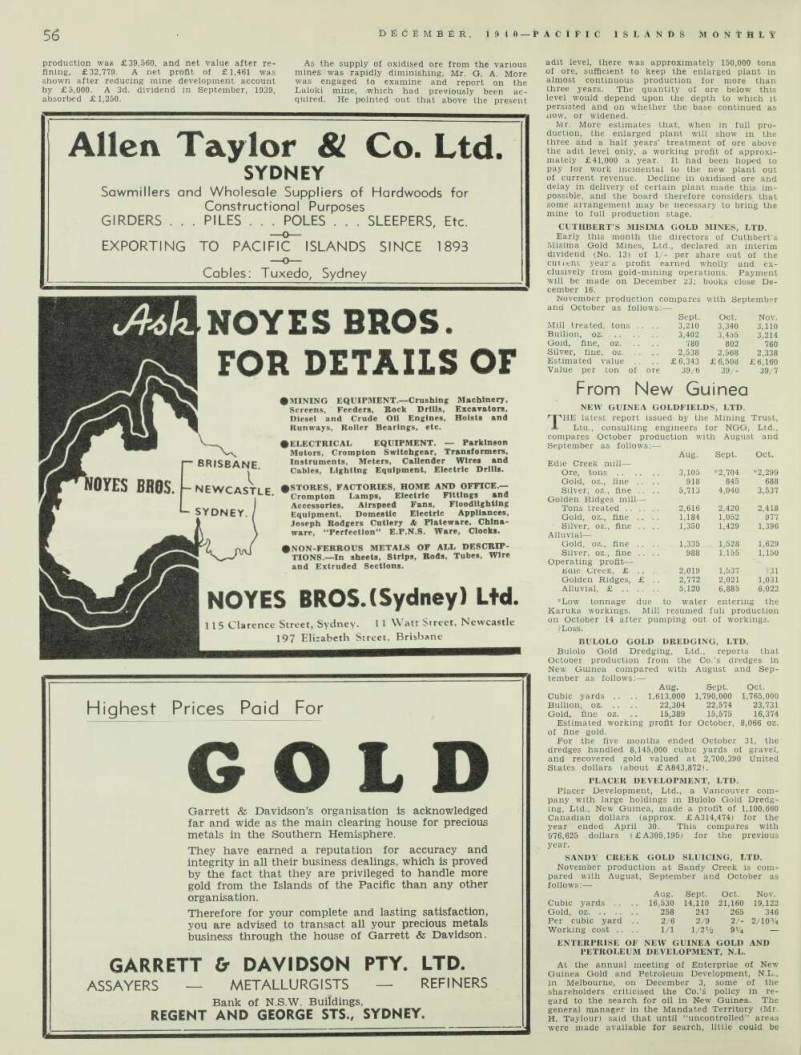
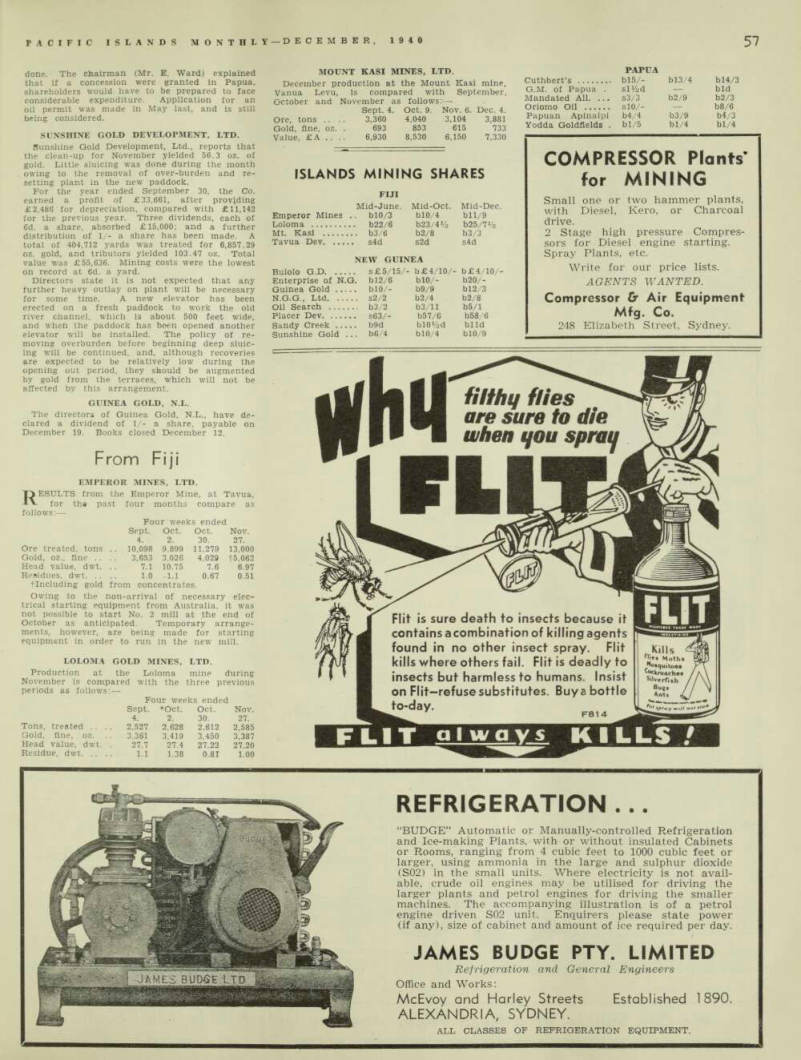
From Papua
Papuan Apinaipi Petroleum Co., Ltd.
THE Board is advised that prospects gener ally are more favourable to-day than they have ever been of obtaining oil in commercial quantities,” said Mr. W. M. Marks (chairmant at the annual meeting of Papuan Apinaipi Petro leum Co., Ltd., in Sydney on November 25.
A major drilling plant, worth £40,000, was hired from the Commonwealth Government and operations commenced at Oiapu on March 15 last. After examining cores from the well, which reached 2,764 ft., the Commonwealth Chief Geological Adviser (Dr. W. G. Woolnough) and the Co.’s own geologist (Mr. G. Barrow) advised the removal of operations to a site three miles south-east from the present location. The new hole would save about 2,500 ft. of drilling. It is believed that oil is lying, and being retained, under a cap of igneous rocks on which drilling operations will be made. Transfer of equip ment, etc., will take about nine weeks. No. 1 hole has been cased to 2,555 ft. and can be returned to at any time. If the Co. makes use of casing from an old bore, abandoned many years ago, a saving of £lO,OOO will be made.
The Commonwealth Government has advanced £20,000 to the Co. Mr. Marks said that the Co. had enough money in hand to put the new well down; and added that ‘‘big financial in terests overseas” had approached him and showed great interest in the possibilities of future operations. Shareholders would be con sulted if and when any offer was made.
Oil Search, Ltd.
Oil Search, Ltd., in its report for the year ended June 30, states that drilling of the first test well in Papua by the Australasian Petro leum Co., Pty., Ltd., is expected to commence in January at a site on the Vailala River, about 75 miles from the mouth. The decision was made after findings and recommendations of the field staff were reviewed by experts in London and New York. The bulk of the machinery has been landed at the site. Over £700,000 has been spent by APC Pty., Ltd., on surveys and drilling to date.
Mandated Alluvials, N.L.
For the year ended July 31, 1940, Mandated Alluvials, N.L., treated 5,018 tons of oxidised ore and 3,025 tons of sulphide ore for 516 tons of matte (containing 2,884 oz. fine gold, 7,820 oz. silver and US'.75 tons copper). Total value of
production was £39,560, and net value after re fining, £32,779. A net profit of £1,461 was shown after reducing mine development account by £5,000. A 3d. dividend in September, 1939, absorbed £1,250.
As the supply of oxidised ore from the various mines was rapidly diminishing, Mr. G. A. More was engaged to examine and report on the Laloki mine, which had previously been ac quired. He pointed x»ut that above the present
adit level, there was approximately 150,000 tons of ore, sufficient to keep the enlarged plant in almost continuous production for more than three years. The quantity of ore below this level would depend upon the depth to which it persisted and on whether the base continued as now, or widened.
Mr. More estimates that, when in full pro duction, the enlarged plant will show in the three and a half years’ treatment of ore above the adit level only, a working profit of approxi mately £41,000 a year. It had been hoped to pay for work incidental to the new plant out of current revenue. Decline in oxidised ore and delay in delivery of certain plant made this im possible, and the board therefore considers that some arrangement may be necessary to bring the mine to full production stage.
Cuthbert’S Misima Gold Mines, Ltd.
Early this month the directors of Cuthbert’s Misima Gold Mines, Ltd., declared an interim dividend (No. 13) of 1/- per share out of the cunent year’s profit earned wholly and ex clusively from gold-mining operations. Payment will be made on December 23; books close De cember 16.
November production compares with September and October as follows; —
From New Guinea
New Guinea Goldfields, Ltd.
r T'HE latest report issued by the Mining Trust, -I- Ltd., consulting engineers for NGG, Ltd., compares October production with August and September as follows: —
*Low tonnage due to water entering the Karuka workings. Mill resumed full production on October 14 after pumping out of workings. (Loss.
Bulolo Gold Dredging, Ltd.
Bulolo Gold Dredging, Ltd., reports that October production from the Co.’s dredges in New Guinea compared with August and Sep tember as follows:
Estimated working profit for October, 8,066 oz. of fine gold.
For the five months ended October 31, the dredges handled 8,145,000 cubic yards of gravel, and recovered gold valued at 2,700,390 United States dollars (about £A843,872).
Placer Development, Ltd.
Placer Development, Ltd., a Vancouver com pany with large holdings in Bulolo Gold Dredg ing, Ltd., New Guinea, made a profit of 1,100,660 Canadian dollars (approx. £A314,474) for the year ended April 30. This compares with 976,625 dollars (£A305,195) for the previous year.
Sandy Creek Gold Sluicing, Ltd.
November production at Sandy Creek is com pared with August, September and October as follows:
Enterprise Of New Guinea Gold And
Petroleum Development, N.L.
At the annual meeting of Enterprise of New Guinea Gold and Petroleum Development, N.L., in Melbourne, on December 3, some of the shareholders criticised the Co.’s policy in re gard to the search for oil in New Guinea. The general manager in the Mandated Territory (Mr.
H. Taylour) said that until “uncontrolled” areas were made available for search, little could be
Sept. Oct. Nov.
Mill treated, tons .. .. 3,210 3,340 3.110 Bullion, oz 3,402 3,455 3,214 Gold, fine, oz 780 802 760 Silver, fine, oz 2,538 2,568 2,338 Estimated value .. .. £6,343 £6.508 £6,160 Value per ton of ore 39/6 39/- 39/7
Aug.
Sept.
Oct.
Edie Creek mill— Ore, tons 3,105 *2,704 *2,299 Gold, oz., fine .. .. 918 845 688 Silver, oz., fine . . .. 5,713 4,040 3,537 Golden Ridges mill — Tons treated 2,616 2,420 2,418 Gold, oz., fine .. .. 1,184 1,052 977 Silver, oz., fine .. 1,350 1,429 1,396 Alluvial — Gold, oz., fine .. 1,335 1,528 1,629 Silver, oz., fine .. 988 1,155 1,150 Operating profit— Ecue Greek, £ .. . 2,019 1,537 131 Golden Ridges, £ .. 2,772 2,021 1,031 Alluvial, £ 5,120 6,885 6,022
Aug.
Sept.
Oct.
Cubic yards .. . . 1,613,000 1,790,000 1,765,000 Bullion, oz. .. . 22,304 22,574 23,731 Gold, fine oz. . 15,389 15,575 16,374
Aug. Sept. Oct. Nov.
Cubic yards .. .. 16,530 14,110 21,160 19,122 Gold, oz 258 243 265 346 Per cubic yard .. 2/6 2/9 2/- 2/10% Working cost .. .. 1/1 l/2»/2 9*/4 —
done. The chairman (Mr. E. Ward) explained that if a concession were granted in Papua, shareholders would have to be prepared to face considerable expenditure. Application for an oil permit was made in May last, and is still being considered.
Sunshine Gold Development, Ltd.
Sunshine Gold Development, Ltd., reports that the clean-up for November yielded 56.3 oz. of gold. Little sluicing was done during the month owing to the removal of over-burden and re setting plant in the new paddock.
For the year ended September 30, the Co. earned a profit of £33,661, after providing £2,486 for depreciation, compared with £11,142 for the previous year. Three dividends, each of 6d. a share, absorbed £15,000; and a further distribution of 1/- a share has been made. A total of 404,712 yards was treated for 6,857.29 oz. gold, and tributors yielded 103.47 oz. Total value was £55,636. Mining costs were the lowest on record at 6d. a yard.
Directors state it is not expected that any further heavy outlay on plant will be necessary for some time. A new elevator has been erected on a fresh paddock to work the old river channel, which is about 500 feet wide, and when the paddock has been opened another elevator will be installed. The policy of re moving overburden before beginning deep sluic ing will be continued, and, although recoveries are expected to be relatively low during the opening out period, they should be augmented by gold from the terraces, which will not be affected by this arrangement.
Guinea Gold, N.L,
The directors of Guinea Gold, N.L., have de clared a dividend of 1/- a share, payable on December 19. Books closed December 12.
From Fiji
Emperor Mines. Ltd.
RESULTS from the Emperor Mine, at Tavua, for th« past four months compare as follows: —
tlncluding gold from concentrates.
Owing to the non-arrival of necessary elec~ trical starting equipment from Australia, it was not possible to start No. 2 mill at the end of October as anticipated. Temporary arrange ments, however, are being made for starting equipment in order to run in the new mill.
Loloma Gold Mines, Ltd.
Production at the Loloma mine during November is compared with the three previous periods as follows:
Mount Kasi Mines, Ltd.
December production at the Mount Kasi mine, Vanua Levu, Is compared with September, October and November as follows:
Four weeks ended Sept.
Oct.
Oct.
Nov. 4. 2. 30. 27.
Ore treated, tons . . 10,098 9.899 11,279 13,000 Gold, oz,, nne .. 3,653 3,026 4,029 15.062 Head value, dwt. ., 7.1 10.75 7.6 6.97 Residues, dwt. .. . 1.0 -1.1 0.67 0.51
Four weeks ended Sept. *Oct. Oct. Nov. 4. 2. 30. 27.
Tons, treated .. .. 2.527 2.628 2,612 2.585 Gold, fine. oz. . . 3.361 3,419 3,450 3,387 Head value, dwt. . 27.7 27.4 27.22 27.20 Residue, dwt 1.1 1.38 0.81 1.00
Sept. 4.
Oct. 9.
Nov. 6.
Dec. 4.
Ore, tons .. 3,360 4,040 3,104 3,881 Gold, fine, oz. . 693 853 615 733 Value, £ A ,. .. 6,930 8,530 6,150 7,330
Advertisements & other items, pp. 57-58 (2 items)
Wauowiamhuj
ms w mm m s
WINES
SMOOTH out your worries of these trying days with a perfect aperitif and a smoothly restful glass of port, each evening.
You’ll thoroughly appreciate YEN- DARRA Extra Dry SHERRY or
ROYAL RESERVE Sweet SHERRY
and VINTAGE 99 PORT—products of Australia’s leading wine makers for over 60 years.
Write to your nearest agent for supplies:—C. J. CASHMAN & CO.,
DARWIN; J. R. CLAY & CO.,
PAPUA; F. R. FORSYTH, NEW
GUINEA; C, R. YOUNGER,
SOLOMON ISLANDS.
4 J
SHREDDED WHEATMEAL
Delicious golden brown biscuits, rich with nourishing whole wheat grains, ripened to perfection in Natures' sunny kitchens.
There's health in every mouthful of these crisp crunchy biscuits.
MILK ARROWROOT
Children grow up strong, healthy and virile if they have plenty of Swallow & Ariel) Milk Arrowroot Biscuits. The kiddies love them, and thei r nourishment qualities are second to none. m * it. * w P’ m* m & *•* M tk is x%v •fe. • ,V *. . .' J . « • %£r 1 1 < ■
CLUB CHEESE
These delightful little biscuits are savouries in themselves! Favourites with hostesses everywhere because they're delicious for suppers and afternoon teas.
These popular biscuits, crisped to perfection by Australia's Leading Biscuit Bakers, are specially tropic-packed in airtight tins, thus retaining all their fresh-from-the-oven flavor and crispness. Try them yourself! They're just as good as Swallow & Arie M's other famous products . . . CABIN BISCUITS . . . NAVY and PILOT BREAD . . . PLUM PUDDINGS
CANTERBURY CAKES.
J3j4ccuJsfame
WAUOWiAMHUj
Australia’s Famous Biscuit Bakers PORT MELBOURNE . VICTORIA
Allen Taylor 81 Co. Ltd.
SYDNEY
Sawmillers and Wholesale Suppliers of Hardwoods for Constructional Purposes GIRDERS . . . PILES . . . POLES . . . SLEEPERS, Etc.
EXPORTING TO PACIFIC ISLANDS SINCE 1893
Cables: Tuxedo, Sydney
A
BRISBANE.
V
OYES BROS.
SYDNEY
NOYES BROS.
FOR DETAILS OF
• MINING EQUIPMENT.— Crushing Machinery.
Screens, Feeders, Bock DrlUs, Excavators, Diesel and Crude Oil Engines, Hoists and Runways, Roller Bearings, etc.
• ELECTRICAL EQUIPMENT. Parkinson
Motors, Crompton Switchgear, Transformers, Instruments, Meters, Callender Wires and Cables, Lighting Equipment, Electric Drills.
NEWr ACTI c •STORES, FACTORIES, HOME AND OFFICE.— TV ' M3, Lt. i Flprfrlr Fittings and Accessories, Airspeed Fans, Floodlighting Equipment, Domestic Electric Appliances, Joseph Rodgers Cutlery & Plateware, Chinaware, “Perfection” E.P.N.S. Ware, Clocks.
• NON-FERROUS METALS OF ALL DESCRIP-
TIONS.—In sheets, Strips, Bods. Tubes, Wire and Extruded Sections.
NOYES BROS.(Sydney) Ltd.
115 Clarence Street, Sydney. 1 1 Watt Street, Newcastle 197 Elizabeth Street, Brisbane
Highest Prices Paid For
GOLD
Garrett & Davidson’s organisation is acknowledged far and wide as the main clearing house for precious metals in the Southern Hemisphere.
They have earned a reputation for accuracy and integrity in all their business dealings, which is proved by the fact that they are privileged to handle more gold from the Islands of the Pacific than any other organisation.
Therefore for your complete and lasting satisfaction, you are advised to transact all your precious metals business through the house of Garrett & Davidson.
GARRETT & DAVIDSON PTY. LTD.
ASSAYERS METALLURGISTS REFINERS
Bank of N.S.W. Buildings,
REGENT AND GEORGE STS., SYDNEY.
56
DfiefiMfiEß, 1H 0- Hdil’ic ISLANDS MOVt B L t
Islands Mining Shares
Papua
Cuthbert's b!5/b!3/4 b!4/3 G.M. of Papua . siy 2 d — bid Mandated All. ... s3/3 b2/9 b2/3 Oriomo Oil slO/- — b8/6 Papuan Apinaipi b4/4 b3/9 b4/3 Yodda Goldfields . bl/5 bl/4 bl/4
Fiji
Mid-June.
Mid-Oct.
Mid-Dec.
Emperor Mines .. blO/3 blO/4 bll/9 Loloma .. b22/6 b23/4>/2 b25/7* 2 Mt. Kasl ... b3/6 b2/8 b3/3 Tavua Dev. ... .. s4d s2d s4d Bulolo G.D. ,..
New Guinea
... s£5/15/- b£4/10/b£4/10/- Enterprise of N.G. b!2/6 blO/b20/- Guinea Gold .. ... blO/b9/9 b!2/3 N.G.G., Ltd. .. b2/4 b2/8 Oil Search . ... ... b3/2 b3/ll b5/l Placer Dev. ... s63/b57/6 b58/6 Sandy Creek .. ... b9d blOV 2 d blld Sunshine Gold ... b6/4 blO/4 blO/9
Advertisements & other items, pp. 59-60 (1 item)
filthy flies
COMPRESSOR Plants’
for MINING
Small one or two hammer plants, with Diesel, Kero, or Charcoal drive. 2 Stage high pressure Compressors for Diesel engine starting.
Spray Plants, etc.
Write for our price lists.
AGENTS WANTED.
Compressor Cr Air Equipment
Mfg. Co.
248 Elizabeth Street, Sydney.
filthy flies
are sure to die
when you sprat/
m Flit is sure death to insects because it contains acombination of killing agents found in no other insect spray. Flit kills where others fail. Flit is deadly to insects but harmless to humans. Insist on Flit-refuse substitutes. Buy a bottle to-day.
FBI 4
FLIT always KILLS
PUT
Kills Moth* Mosquito** «<kn>ache* s 'lv»rfith Bug* .
Ants i
u James budge ltd
REFRIGERATION...
“BUDGE” Automatic or Manually-controlled Refrigeration and Ice-making Plants, with or without insulated Cabinets or Rooms, ranging from 4 cubic feet to 1000 cubic feet or larger, using ammonia in the large and sulphur dioxide (SO2) in the small units. Where electricity is not available, crude oil engines may be utilised for driving the larger plants and petrol engines for driving the smaller machines. The accompanying illustration is of a petrol engine driven SO2 unit. Enquirers please state power (if any), size of cabinet and amount of ice required per day.
JAMES BUDGE PTY. LIMITED
Refrigeration and General Engineers Office and Works:
McEvoy and Harley Streets Established 1890.
ALEXANDRIA, SYDNEY.
ATT. CLASSES OF REFRIGERATION EQUIPMENT.
LEARN MORSE CODE. “LIKE-A-
FLASH” KITS, KEYS & BUZZERS.
P.M.G. type Key with Professional Buzzer & Battery, all assembled on Base Board, 42/6.
Junior Morse Code Key, 12/6 Practice Buzzer Set, 7/6. Buzzer and Light Morse Cede, 25/-.
PRESTO"
THE
MAGIC
BOX
The most Amazing Trick- Just out.
"Presto”.—The greatest, most alluring and outstanding little trick ever Introduced. 2/9. Post Free.
Money back If it’s not the best yet. ” • '.I 1 1 &
POLICE PATROL MULTI STRAND
RUBBER COVERED AERIAL,
Needs No Separate Lead-in. 50 ft., 2/6; 100 ft., 5/-.
MAN-O-WAR HEAVY DUTY
INSULATED AERIAL, MULTI
STRAND WIRES.
50 ft., 5/-; 100 ft. 10/-, Electric 240 volt Gramoph one Motors, complete 50/-. Hlghestgrade Gramophone Needles, long lasting, 3/6, 4/6, 5/6 box.
RADIO ACCUMULATORS.
2 Volt. 110 Amp 17/- 2 „ 160 20/- 4 65 20/6 4 90 22/6 6 90 36/3 6 „ 110 45/6 6 130 66/- 6 „ 150 73/9 6 170 84/6
HEADPHONES.
9/6, 12/6, 17/6.
S.T.C., British, 30/-; 8.T.H.. 30/-; Lissen, British, 19/6. All 4,000 ohms.
WORLD'S LATEST
GAMES
Dart Boards, with 6 Darts Play Brass Competition Darts, Set of 3, 3/11, 4/6, 5/6L Monopoly, 10/6.
Totopoly, 10/6. Bucaneer, 10/6. 3 of the World’s Most Popular Games.
Chinese Checkers, 2/6, 4/6, 8/6.
Trlpoly Card Game. 5/-. De Luxe Type, 10/6. Poker Rummy, 1/-, Pot Luck, 1/-. Playing Card Lotto, 1/-. We Stock All Kinds of Indoor Games. Send for Booklet.
Morse Set Buzzer or light with single switch. All parts include adjustable Key, Switch, Buzzer, Lamp and Battery, all assembled on Base Board, 30/-.
Morse Code Set “De Luxe”. Adjustable High-grade Key, Buzzer and Battery. All mounted on base board ready for use, 27/6.
The World's Latest Match Box, 2/-. Bakelite, indestructa b 1 e. One match always ready by tipping of the box. No opening and closing ends.
Remington. U.S.A, made, Hunting and Sporting Knives In Sheath, 10/6. A Beautiful Article.
Throwing Knives, in Sheath, 7/6.
Repeating Toy Re v o 1 v e r s.
Just like the real thing. 4/11, 5/6, 7/6, 8/6.
P.M.G. Type Morse Code Sounders, 35/-.
P.M.G.^
TYPE "
sounder!
Now available (not less than 10/parcels): Magic Wand, 1/6 Jafet’s Wallet, 1/-; Obedient Ball, 1/6; Rattle Box; Mystic Head Chopper, 2/6; Shy Lock, 2/-; Dribble Glass, 2/-; Ventrillo, 1/-; Magic Coin, 1/-; Nest of Nests, 5/-; Voice Echoer, 1/-; Magic Bottle, 1/-; 3 Bell Trick, 1/-. 2 Knife Trick, 6/6. Giant Dice Trick, 1/6. Wonderful Rattle Box Trick, 2/6. 10/-, 20/-, 30/-, 40/-, 50/- Parcels.
HIGHEST GRADE MODEL PLANE
KIT. 15/-, 18/6, and 21/-. Cheaper makes, 2/6, 3/6, 4/6, 5/6, and 6/0.
Hiflh-pitched Tone Oe Lux* Pro fe<«<onal Bauer. The beet made «/- Adjustable Buzsers 4/9. Others 4/11, 5/6 & 15/-.
Adjustable Morse Code Key on Bakelite Base, highly plated parts, 12/6. Higher grade instrument.
De Luxe Junior Morse Code Outfit.
Mounted Key Buzzer and Battery. 13/6 complete.
De Luxe Junior Morse Code Set.
Buzzer Key Light, Throw-over Switch. All mounted with Battery. 16/6.
METERS.—Pocket Volt Meters. 2 Reading for A. & B. Batteries, 8/6. 10/6.
WATES. —4 in 1 Meter: 0 to 6, 0 to 15. 0 to 180 volts: 0 to 30 M/A, 14/-.
TELSEN.—Millimeter A.C., D.C British. Reads everything in Radio.
Bench type, 22/6, PIFCO —A.C.-D.C. Bench Type Radiometer. British. Reads 0 to 30 M/A Valve and Circuit Tester, 0 to 240 V. 0 to 15 V.. 25/-.
BOOKS! BOOKS! BOOKS! The Be-
ginners’ Book of Radio. The Radio Beginners’ Dictionary. 2/- the 2. The Wireless Constructor’s Encyclopaedia. Giant size, 7/6. Newnes “Everyman’s” Wireless Book, 5/6.
The Book of Practical Radio, also The Book of Practical Television, 8/6 each. Foulsham’s Giant "Party and Fun Book”, 1/6. Humorous Stories and Recitations, 3/9. Card and Conjuring Tricks, 3/9. Tea- Cup Fortune Telling, 3/9. 100 Party Games for Old and Young, 1/9.
Popular Magic and Amateur Conjurer, 1/9. 50 Best Party Games, 1/6. Tricks with Cards, 1/6.
BLADE
RAZOR
SHARPENER,
Highly recommended “Re-juv”
Razor Blade Sharpeners. 7/6. Now 2/6.
Spinning Wheel Race Game. Shows Horses and Odds. Spin wheel for result. 8 in. diameter. 21/- and 42/-. With Betting Sheet.
Write for full lists of Games for Hotels, Clubs, Carnivals, Bazaars, etc.
P.M.G. Model Adjustable Morse Code Key. Heavy Precision Fittings on solid Wooden Base, 19/6.
S.
Morse Buzzer and Light Set, illustrated, 25/-. I// /, J Morse Code Light and Buzzer Set.
A precision De-luxe outfit that cannot be bettered. Perfect Adjustable Morse Code Key, with professional type Buzzer. Light to Buzzer throw-over Switch, and Battery, all ready mounted, for im mediate use, on strong solid wooden Base Board, 39/6 the outfit. 58/6 From London. “Cosmocord” De Luxe Crystal Pick-up, with Built-in Vol.
Control, 58/6. Magnetic type Pickups, complete with volume control and tone arm. British Make, 30/-, 35/-, 38/6, 45/-. Studio Model, 50/-.
SWOOP! BRITAIN’S BEST.
“Amplion,” Bakelite PICK-UP, with Volume Control unequalled. Brand new, in original cartons. Listed to sell at 37/6. Now 32/6. Pits and suits all sets.
Play, Talk, Sing, Joke through your Radio. Great Fun. Batteryless type.
Microphone for Hand Holding or Hanging, 22/6. Complete with Flex fixed in a second. Others, 12/6, 15/-, 17/6, 25/-, 28/6, 32/6. All plus 2/for Battery and 1/6 for 20 ft. Cord.
B.G.E. Table Type Microphone. Highly recommended far Amateur or Profeeaional use. Built-in Transformer and Battery with Volume Control incorporated.
Just plug Into pickup terminals >f an; set. 39/6. New Bullet Model, also 39/6.
“■ J. LEVENSON Radio “IT
Write for Pin-Game, Punch GAMES. NOVELTIES AND HOBBIES. Totem a nd “ e o ; fl r t„ 226 A PITT STREET, SYDNEY ° T dd n s s a " d Manufacturers, Importers, and Exporters. Leaflets nmmnilllllliniil N.S.W.. AUSTRALIA. IllllimilllUTTlllinir Cable address: “Leveradloh”. Goods forwarded V.P.P. or Sight Draft. Satisfaction and Service Guaranteed. We can supply by mall all General Merchandise at a Better Price. Quotations with pleasure. Please add freight and packing. Write for full list of interesting leaflets of Games, Hobbies, Novelties, and Electrical Goods. Write for full list of Radio Meters.
We Can Supply, at a Keen Price, Any Available Article You Require.
Australian Short Wave
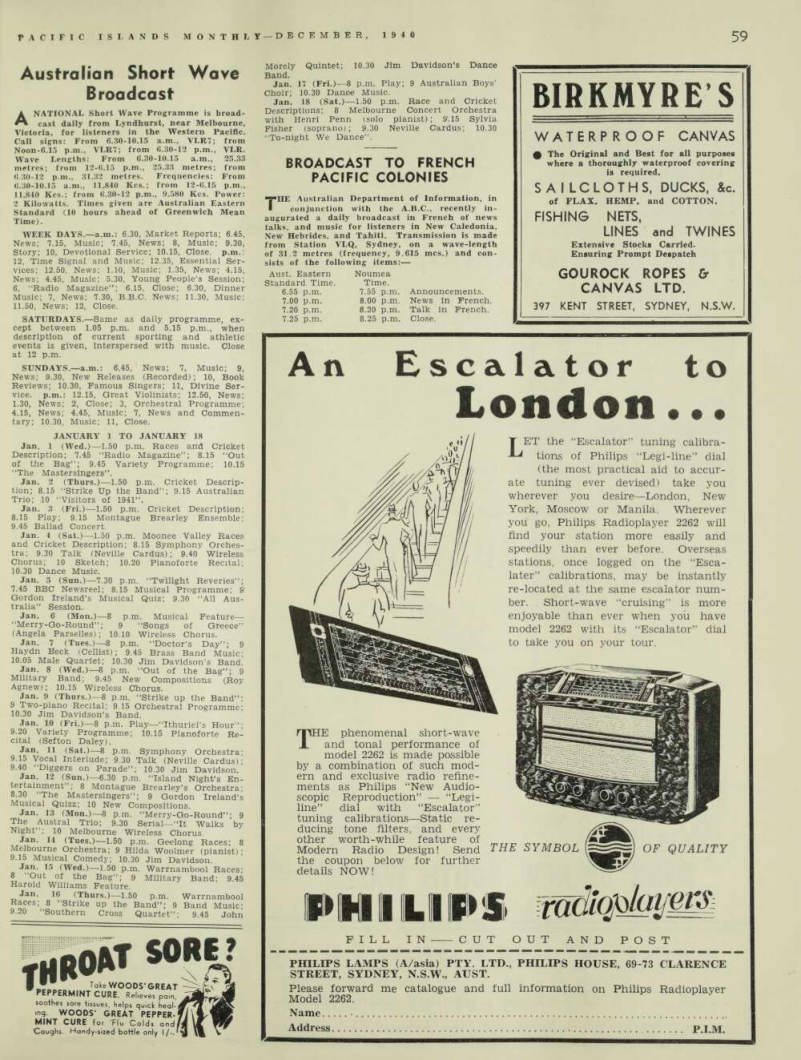
Broadcast
A NATIONAL Short Wave Programme is broad cast daily from Lyndhurst, near Melbourne, Victoria, for listeners in the Western Pacific.
Call signs: From 6.30-10.15 a.m., VLR7; from Noon-6.15 p.m., VLR7; from 6.30-12 p.m., VLR.
Wave Lengths: From 6.30-10.15 a.m., 25.33 metres; from 12-6.15 p.m., 25.33 metres; from 6.30-12 p.m., 31.32 metres. Frequencies: From 6.30-10.15 a.m., 11,840 Kcs.; from 12-6.15 p.m., 11,840 Kcs.; from 6.30-12 p.m., 9.580 Kcs. Power: 2 Kilowatts. Times given are Australian Eastern Standard (10 hours ahead of Greenwich Mean Time).
WEEK DAYS.—a.m.: 6.30, Market Reports; 6.45, News; 7.15, Music; 7.45, News; 8, Music; 9.30, Story; 10, Devotional Service; 10.15, Close, p.m.: 12, Time Signal and Music; 12.35, Essential Ser vices; 12.50, News; 1.10, Music; 1.35, News; 4.15, News; 4.45, Music; 5.30, Young People’s Session; 6, “Radio Magazine”; 6.15, Close; 6.30, Dinner Music; 7, News; 7.30, 8.8. C. News; 11.30, Music; 11.50, News; 12, Close.
SATURDAYS.—Same as daily programme, ex cept between 1.05 p.m. and 5.15 p.m., when description of current sporting and athletic events is given, interspersed with music. Close at 12 p.m.
SUNDAYS.—a.m.: 6.45, News; 7, Music; 9, News; 9.30, New Releases (Recorded); 10, Book Reviews; 10.30, Famous Singers; 11, Divine Ser vice. p.m.: 12.15, Great Violinists; 12.50, News; 1.30, News; 2, Close; 3, Orchestral Programme; 4.15, News; 4.45, Music; 7, News and Commen tary; 10.30, Music; 11, Close.
January 1 To January 18
Jan. 1 (Wed.) —1.50 p.m. Races and Cricket Description; 7.45 “Radio Magazine”; 8.15 “Out of the Bag”; 9.45 Variety Programme; 10.15 “The Masterslngers”.
Jan. 2 (Thurs.) —1.50 p.m. Cricket Descrip tion; 8.15 “Strike Up the Band”; 9.15 Australian Trio; 10 “Visitors of 1941”.
Jan. 3 (Fri.) —1.50 p.m. Cricket Description; 8.15 Play; 9.15 Montague Brearley Ensemble; 9.45 Ballad Concert.
Jan. 4 (Sat.) —1.50 p.m. Moonee Valley Races and Cricket Description; 8.15 Symphony Orches tra; 9.30 Talk (Neville Cardus); 9.40 Wireless Chorus: 10 Sketch; 10.20 Pianoforte Recital; 10.30 Dance Music.
Jan. 5 (Sun.) —7.30 p.m. “Twilight Reveries”; 7.45 BBC Newsreel; 8.15 Musical Programme; &' Gordon Ireland’s Musical Quiz; 9.30 “All Aus tralia” Session.
Jan. 6 (Mon.) —8 p.m. Musical Feature— “Merry-Go-Round”; 9 “Songs of Greece” (Angela Parselles); 10.10 Wireless Chorus.
Jan. 7 (Tues.)—B p.m. “Doctor’s Day”; 9 Haydn Beck (Cellist): 9.45 Brass Band Music; 10.05 Male Quartet; 10.30 Jim Davidson’s Band.
Jan. 8 (Wed.)—B p.m. “Out of the Bag”; 9 Military Band; 9.45 New Compositions (Roy Agnew); 10.15 Wireless Chorus.
Jan. 9 (Thurs.)—B p.m. “Strike up the Band”: 9 Two-piano Recital; 9.15 Orchestral Programme; 10.30 Jim Davidson’s Band.
Jan. 10 (Fri.) —8 p.m. Play—“lthuriel’s Hour”; 9.20 Variety Programme; 10.15 Pianoforte Re cital (Sefton Daley).
Jan. 11 (Sat.)—B p.m. Symphony Orchestra; 9.15 Vocal Interlude: 9.30 Talk (Neville Cardus): 9.40 “Diggers on Parade”; 10.30 Jim Davidson.
Jan. 12 (Sun.)—6.3o p.m. “Island Night’s En tertainment”: 8 Montague Brearley’s Orchestra; 8.30 “The Mastersingers”; 9 Gordon Ireland’s Musical Quizz; 10 New Compositions.
Jan. 13 (Mon.) —8 p.m. “Merry-Go-Round”; 9 The Austral Trio; 9.30 Serial—“lt Walks by Night”; 10 Melbourne Wireless Chorus.
Jan. 14 (Tues.)—l.so p.m. Geelong Races; 8 Melbourne Orchestra; 9 Hilda Woolmer (pianist): 9.15 Musical Comedy; 10.30 Jim Davidson.
Jan. 15 (Wed.)—l.so p.m. Warrnambool Races; 8 “Out of the Bag”; 9 Military Band; 9.45 Harold Williams Feature.
Jan. 16 (Thurs.)—l.so p.m. Warrnambool Races; 8 “Strike up the Band”; 9 Band Music; 9.20 “Southern Cross Quartet”; 9.45 John
Merely Quintet; 10.30 Jim Davidson’s Dance Band.
Jan. 17 (Fri.) —8 p.m. Play; 9 Australian Boys’
Choir; 10.30 Danoe Music.
Jan. 18 (Sat.) —1.50 p.m. Race and Cricket Descriptions: 8 Melbourne Concert Orchestra with Henri Penn (solo pianist): 9'.15 Sylvia Fisher (soprano;; 9.30 Neville Cardus; 10.30 “To-night We Dance”.
Pacific Colonies
Broadcast To French
THE Australian Department of Information, in conjunction with the A.8.C., recently in augurated a daily broadcast in French of news talks, and music for listeners in New Caledonia, New Hebrides, and Tahiti. Transmission is made from Station VLQ, Sydney, on a wave-length of 31.2 metres (frequency, 9.615 mcs.) and con sists of the following items:—
A 11st. Eastern Noumea Standard Time.
Time. 6.55 p.m. 7.55 p.m.
Announcements. 7.00 p.m. 8.00 p.m.
News In French. 7.20 p.m. 8.20 p.m.
Talk in French. 7.25 p.m. 8.25 p.m.
Close.
Advertisements & other items, p. 61 (1 item)
London...
BIRKMYRES
WATERPROOF CANVAS
• The Original and Best for all purposes where a thoroughly waterproof covering is required.
S A I LC LOTH S, DUCKS, &c.
of FLAX, HEMP, and COTTON.
FISHING NETS,
LINES and TWINES
Extensive Stocks Carried.
Ensuring Prompt Despatch
GOUROCK ROPES &
CANVAS LTD.
397 KENT STREET, SYDNEY. N.S.W.
A n
Escalator to
London...
LET the “Escalator” tuning calibrations of Philips “Legi-line” dial (the most practical aid to accurate tuning ever devised) take you wherever you desire —London, New York, Moscow or Manila. Wherever you go, Philips Radioplayer 2262 will find your station more easily and speedily than ever before. Overseas stations, once logged on the “Escalater” calibrations, may be instantly re-located at the same escalator number. Short-wave “cruising” is more enjoyable than ever when you have model 2262 with its “Escalator” dial to take you on your tour.
'r* THE phenomenal short-wave and tonal performance of model 2262 is made possible by a combination of such modern and exclusive radio refinements as Philips “New Audioscopic Reproduction” “Legiline” dial with “Escalator” tuning calibrations—Static reducing tone filters, and every other worth-while feature of Modern Radio Design! Send THE SYMBOL the coupon below for further details NOW! *r
OF QUALITY
PlflllLl
s
FILL IN
CUT OUT AND POST
PHILIPS LAMPS (A/asia) PTY. LTD., PHILIPS HOUSE, 69-73 CLARENCE
STREET, SYDNEY, N.S.W., AUST.
Please forward me catalogue and full information on Philips Radioplayer Model 2262.
Name • Address P.I.M.
SORE
f Take WOODS'GREAT
PEPPERMINT CURE. Relieves pain, soothes sore tissues, helps quick heal-
ing. WOODS' GREAT PEPPER-
MINT CURE for 'Flu Colds and Coughs. Handy-sized bottle only I /-.
How Is Your Radio
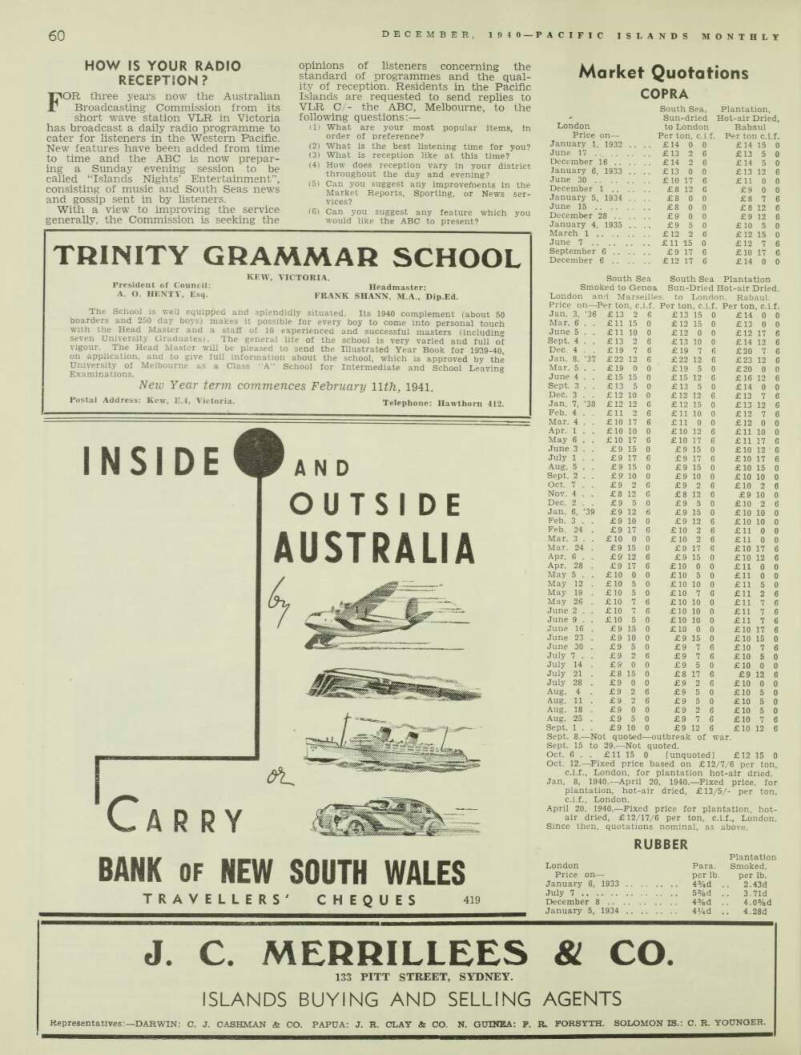
Reception?
FOR three years now the Australian Broadcasting Commission from its short wave station VLR in Victoria has broadcast a daily radio programme to cater for listeners in the Western Pacific.
New features have been added from time to time and the ABC is now prepar ing a Sunday evening session to be called “Islands Nights’ Entertainment”, consisting of music and South Seas news and gossip sent in by listeners.
With a view to improving the service generally, the Commission is seeking the
opinions of listeners concerning the
standard of programmes and the qual ity of reception. Residents in the Pacific Islands are requested to send replies to VLR O/- the ABC, Melbourne, to the
following questions:—
(1) What are your most popular items, In order of preference? (2) What is the best listening time for you? (3) What is reception like at this time? (4) How does reception vary in your district throughout the day and evening? f 5) Can you suggest any improvements in the Market Reports, Sporting, or News ser vices? (6) Can you suggest any feature which you would like the ABC to present?
Market Quotations
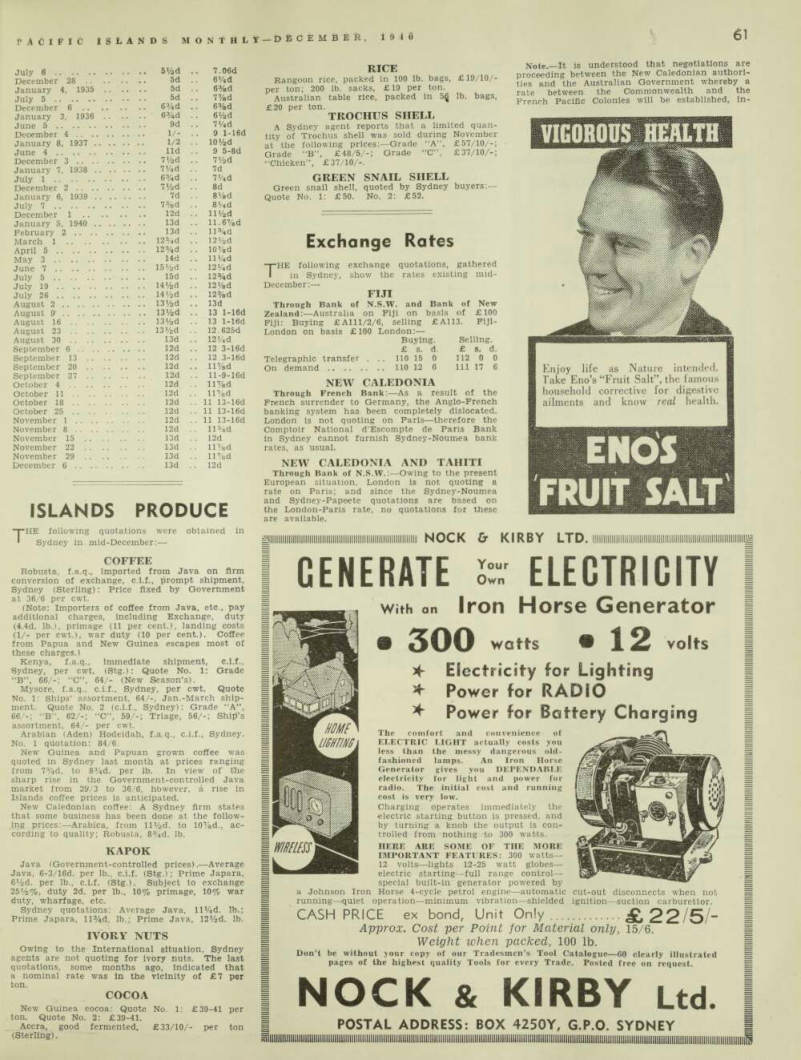
Copra
South Sea, Plantation, Sun-dried Hot-air Dried, London to London Rabaul Price on— Per ton, c.i.f.
Per ton c.i.f.
January 1, 1932 £14 0 0 £14 15 0 June 17 . £13 2 6 £13 5 0 December 16 .. £14 2 6 £14 5 0 January 6, 1933 £13 0 0 £13 12 6 June 30 . £10 17 6 £11 0 0 December 1 .. £8 12 6 £9 0 0 January 5, 1934 £8 0 0 £8 7 6 June 15 . £8 0 0 £8 12 6 December 28 . . £9 0 0 £9 12 6 January 4, 1935 , . £9 5 0 £10 5 0 March 1 , £12 2 6 £12 15 0 June 7 .. £11 15 0 £12 7 6 September 6 .. £9 17 6 £10 17 6 December 6 .. £12 17 6 £14 0 0 South Sea South Sea Plantation Smoked to Genoa Sun-Dried Hot-air Dried.
London and Marseilles, to London. Rabaul.
Price on—■: Per ton, c.i.f.
Per ton, c.i.f.
Per ton. c.i.f.
Jan. 3, ’36 £13 2 6 £13 15 0 £14 0 0 Mar. 6 . . £11 15 0 £12 15 0 £13 0 0 June 5 . . £11 10 0 £12 0 0 £12 17 6 Sept. 4 . . £13 2 6 £13 10 0 £14 12 6 Dec. 4 . . £19 7 6 £19 7 6 £20 7 6 Jan. 8. ’37 £22 12 6 £22 12 6 £23 12 6 Mar. 5 . . £19 0 0 £19 5 0 £20 0 0 June 4 . . £15 15 0 £15 12 6 £16 12 6 Sept. 3 . . £13 5 0 £13 5 0 £14 0 0 Dec. 3 . . £12 10 0 £12 12 6 £13 7 6 Jan. 7, ’38 £12 12 6 £12 15 0 £13 12 6 Feb. 4 . . £11 2 6 £11 10 0 £12 7 6 Mar. 4 . . £10 17 6 £11 0 0 £12 0 0 Apr. 1 . . £10 10 0 £10 12 6 £11 10 0 May 6 . . £10 17 6 £10 17 6 £11 17 6 June 3 . . £9 15 0 £9 15 0 £10 12 6 July 1 . . £9 17 6 £9 17 6 £10 17 6 Aug. 5 . . £9 15 0 £9 15 0 £10 15 0 Sept. 2 . . £9 10 0 £9 10 0 £10 10 0 Oct. 7 . . £9 2 6 £9 2 6 £10 2 6 Nov. 4 . . £8 12 6 £8 12 6 £9 10 0 Dec. 2 . . £9 5 0 £9 5 0 £10 2 6 Jan. 6. ’39 £9 12 6 £9 15 0 £10 10 0 Feb. 3 . . £9 10 0 £9 12 6 £10 10 0 Feb. 24 . £9 17 6 £10 2 6 £11 0 0 Mar. 3 . . £10 0 0 £10 2 6 £11 0 0 Mar. 24 . £9 15 0 £9 17 6 £10 17 6 Apr. 6 . . £9 12 6 £9 15 0 £10 12 6 Apr. 28 . £9 17 6 £10 0 0 £11 0 0 May 5 . . £10 0 0 £10 5 0 £11 0 0 May 12 . £10 5 0 £10 10 0 £11 5 0 May 19 . £10 5 0 £10 7 6 £11 2 6 May 26 . £10 7 6 £10 10 0 £11 7 6 June 2 . . £10 7 6 £10 10 0 £11 7 6 June 9 . . £10 5 0 £10 10 0 £11 7 6 June 16 . £9 15 0 £10 0 0 £10 17 6 June 23 . £9 10 0 £9 15 0 £10 15 0 June 30 . £9 5 0 £9 7 6 £10 7 6 July 7 . . £9 2 6 £9 7 6 £10 5 0 July 14 . £&' 0 0 £9 5 0 £10 0 0 July 21 . £8 15 0 £8 17 6 £9 12 6 July 28 . £9 0 0 £9 2 6 £10 0 0 Aug. 4 . £9 2 6 £9 5 0 £10 5 0 Aug. 11 . £9 2 6 £9 5 0 £10 5 0 Aug. 18 . £9 0 0 £9 2 6 £10 5 0 Aug. 25 . £9 5 0 £9 7 6 £10 7 6 Sept. 1 . . £9 10 0 £9 12 6 £10 12 6 Sept. 8. —Not quoted —outbreak of war.
Sept. 15 to 29.— Not quoted.
Oct. 6 . . £11 15 0 [unquoted] £12 15 0 Oct. 12. —Fixed price based on £12/7/6 per ton, c.i.f., London, for plantation hot-air dried.
Jan. 8, 1940. —April 20, 1940.—Fixed price, for plantation, hot-i air dried, £13/5/- per ton, c.i.f., London.
April 20, 1940.—Fixed price for plantation, hotair dried, £12/17/6 per ton, c.i.f., London.
Since then, , quotations nominal, i is above.
Rubber
Plantation London Para.
Smoked.
Price onper lb per lb.
January 6, 1933 .. .. 4%d .. 2.43d July 7 .. . .. .. 5%d .. 3.71d December 1 i . . . .. .. 43/ 8 d 4.0%d January 5, 1934 .. . . 4>/ 4 d .. 4.28d
July 6 7.06d December 28 . .. 5d 6V 4 d January 4, 1935 .. . , .. 5d 6%d July 5 . .. 5d 7%d December 6 .. 6 3 / 4 d 6 3 / a d January 3, 1936 .. . . .. 6 3 / 4 d 6'/ 2 d June 5 . .. 9d 7'/ 4 d December 4 . .. 1/- 9 1-16d January 8, 1937 1/2 10 Vid June 4 . .. lid 9 5-8d December 3 7'/ 2 d January 7, 1938 .. .. . .. 7'/ 4 d 7d July 1 7V 4 d December 2 8d January 6, 1939 .. .. ... 7d 8 Va d July 7 . .. 7%d 8V 4 d December 1 .. 12d 11 '/ad January 5, 1940 .. .. . .. 13d 11.6 7 /sd February 2 . .. 13d ll 3 4d March 1 .. 12 3 / 4 d 12'/ 2 d April 5 . .. 12 3 / 4 d 10 7 / 8 d May 3 . . . 14d ll'/ 4 d June 7 . .. 15'/ z d 12'/ 4 d July 5 . . .. 15d 12 3 / 4 d July 19 . .. 14'/ 2 d 12'/ 8 d July 26 . .. 14'/ 2 d 12 3 / a d August 2 13d August ff . .. 13'/ad 13 l-16d August 16 13 l-16d August 23 . .. 13'/ad 12.625d August 30 . . . 13d 12 */ 4 d September 6 . .. 12d 12 3-16d September 13 . .. 12d 12 3-16d September 20 . . . 12d llVad September 27 . .. 12d ll-9-16d October 4 . .. 12d ll 7 /ad October 11 . . . 12d ll 7 /ad October 18 . . . 12d 11 13-16d October 25 . . . 12d 11 13-16d November 1 ... 12d 11 13-16d November 8 . . . 12d ll 3 / 4 d November 15 . . . 13d 12d November 22 . . . 13d iiy 8 d November 29 . . . 13d ny 8 d December 6 ... 13d 12d
Advertisements & other items, p. 62 (2 items)
Carry
TRINITY GRAMMAR SCHOOL
KEW, VICTORIA.
President of Council: Headmaster: A. O. HENTY, Esq. FRANK SHANN, M.A., Dip. Ed.
The School is well equipped and splendidly situated. Its 1940 complement (about 50 boarders and 250 day boys) makes it possible for every boy to come into personal touch with the Head Master and a staff of 10 experienced and successful masters (including seven University Graduates). The general life of the school is very varied and full of vigour. The Head Master will be pleased to send the Illustrated Year Book for 1939-40 on application, and to give full information about the school, which is approved by the University of Melbourne as a Class “A” School for Intermediate and School Leaving Examinations.
New Year term commences February 11th, 1941.
Postal Address: Kew, E. 4, Victoria. Telephone: Hawthorn 412.
INSIDE
AND
OUTSIDE
AUSTRALIA
VL
Carry
BANK OF NEW SOUTH WALES
TRAVELLERS' CHEQUES
419
J. C. Merrillees & Co.
133 PITT STREET, SYDNEY.
ISLANDS BUYING AND SELLING AGENTS
Representatives:—DAßWlN: C. J. CASHMAN & CO. PAPUA: J. R. CLAY & CO. N. GUINEA: P. R. FORSYTH. SOLOMON IS.; C. R. YOUNGER.
Islands Produce
—I“HE following quotations were obtained in * Sydney in mid-December: —
Coffee
Robusta, f.a.q., imported from Java on firm conversion of exchange, c.1.f., prompt shipment, Sydney (Sterling): Price fixed by Government at 36/6 per cwt. (Note: Importers of coffee from Java, etc., pay additional charges, including Exchange, duty (4.4 d. lb.), primage (11 per cent.), landing costs (1/- per cwt.), war duty (10 per cent.). Coffee from Papua and New Guinea escapes most of these charges.) Kenya, f.a.q., immediate shipment, c.1.f., Sydney, per cwt. (Stg.): Quote No. 1: Grade “B”, 66/-; “C”, 64/- (New Season’s).
Mysore, f.a.q., c.i.f., Sydney, per cwt. Quote No. 1; Ships’ assortment, 64/-, Jan.-March ship ment. Quote No. 2 (c.i.f., Sydney): Grade “A”, 66/-; “B”, 62/-; “C”, 59/-; Triage, 56/-; Ship’s assortment, 64/- per cwt.
Arabian (Aden) Hodeidah, f.a.q., c.i.f., Sydney.
No. 1 quotation: 84/6.
New Guinea and Papuan grown coffee was quoted in Sydney last month at prices ranging from 7 3 /4d. to 8 3 /4d. per lb. In view of the sharp rise in the Government-controlled Java market from 2973 to 36/6, however, a rise in Islands coffee prices is anticipated.
New Caledonian coffee: A Sydney firm states that some business has been done at the follow ing prices:—Arabica, from liy 2 d. to KT/sd., ac cording to quality; Robusta, 8 3 /4d. lb.
Kapok
Java (Government-controlled prices).—Average Java, 6-3/16d. per lb., c.i.f. (Stg.); Prime Japara, eVid. per lb., c.i.f. (Stg.). Subject to exchange 2572%, duty 2d. per lb., 10% primage, 10% war duty, wharfage, etc.
Sydney quotations: Average Java, HVid. lb.; Prime Japara, ll%d. lb.; Prime Java, 12V2d. lb.
Ivory Nuts
Owing to the International situation, Sydney agents are not quoting for ivory nuts. The last quotations, some months ago, Indicated that a nominal rate was in the vicinity of £7 per ton.
Cocoa
New Guinea cocoa: Quote No. 1: £39-41 per ton. Quote No. 2: £39-41.
Accra, good fermented, £33/10/- per ton (Sterling).
Rice
Rangoon rice, packed in 100 lb. bags, £l9/10/per ton; 200 lb. sacks, £l9 per ton.
Australian table rice, packed in lb. bags, £2O per ton.
Trochus Shell
A Sydney agent reports that a limited quan tity of Trochus shell was sold during November at the following prices:—Grade “A”, £57/10/-; Grade “B”, £4B/5/-; Grade “C”, £37/10/-; “Chicken”, £37/10/-.
Green Snail Shell
Green snail shell, quoted by Sydney buyers:— Quote No. 1: £5O. No. 2: £52.
Exchange Rates
THE following exchange quotations, gathered in Sydney, show the rates existing mid- December: —
Fiji
Through Bank of N.S.W. and Bank of New Zealand:—Australia on Fiji on basis of £lOO Fiji: Buying £Alll/2/6, selling £AII3. Fijl- London on basis £lOO London: —
New Caledonia
Through French Bank;—As a result of the French surrender to Germany, the Anglo-French banking system has been completely dislocated.
London is not quoting on Paris —therefore the Comptoir National d’Escompte de Paris Bank In Sydney cannot furnish Sydney-Noumea bank rates, as usual.
New Caledonia And Tahiti
Through Bank of N.S.W.; —Owing to the present European situation, London is not quoting a rate on Paris; and since the Sydney-Noumea and Sydney-Papeete quotations are based on the London-Paris rate, no quotations for these are available.
Note.—lt is understood that negotiations are proceeding between the New Caledonian authori ties and the Australian Government whereby a rate between the Commonwealth and the French Pacific Colonies will be established, in
Buying.
Selling. £ s. d. £ s. d.
Telegraphic transfer . .. 110 15 0 112 0 0 On demand 110 12 6 111 17 6
dependent of the London-Paris rate upon which former quotations were based.
Western Samoa
Through Bank of New Zealand;—Australia on Western Samoa, basis £lOO Samoa—buying £ A99/12/6; selling, £AIOO/2/6, Samoa on London, basis £lOO in London:—
New Guinea And Papua
Through Bank of N.S.W,:—Australia on Port Moresby and Samarai, Papua, 10/- per cent, premium each way. Australia on Rabaul, N.Q., 10/- per cent, premium. All other places 20/per cent.
Papua and New Guinea on London: Same as Australia on London and vice versa.
Through Commonwealth Bank:—Australia on Port Moresby and Samarai, Papua, 10/- per cent.; on Rabaul, N.G., 10/- per cent.—other Papua and New Guinea districts, £1 per cent.
Rabaul on London, same as Australia on London:— Buying: T.T. £AI2S equals £stg. 100.
Selling: T.T. £AI2S/10/- equals £stg. 100.
Buying. Selling.
Telegraphic transfer — £125 10 0 On Demand £122 18 9 125 7 6 30 days 122 8 9 125 2 6 60 days 121 18 9 124 17 6 90 days 121 8 9 124 12 6 120 days 120 18 9
Advertisements & other items, pp. 63-64 (2 items)
61
!> AtIFIC ISLANDS MONTHLY DECEMBER, 1940
Generate Iz Electricity
VIGOROUS
TH Enjoy life as Nature intended.
Take Eno’s “Fruit Salt”, the famous household corrective for digestive ailments and know real health.
ENO>S
FRUIT SALT
lllllllllllllllllllllllllliilllllllllllllllllllillllllilllilllilllllii NOCK & KIRBY LTD. liillllllllllllllilllllllllllllllliiiiilillllliliililliiilH^
GENERATE Iz ELECTRICITY
HOME
mm mm
with an Iron Horse Generator
• 300 watts •12 volts
jf Electricity for Lighting
* Power tor RADIO
* Power for Battery Charging
The comfort and convenience of ELECTRIC LIGHT actually costs you less than the messy dangerous oldfashioned lamps. An Iron Horse Generator gives you DEPENDABLE electricity for light and power for radio. The initial cost and running cost is very low.
Charging operates immediately the electric starting button is pressed, and by turning a knob the output is controlled from nothing to 300 watts.
HERE ARE SOME OF THE MORE
IMPORTANT FEATURES: 300 watts—
-12 volts—lights 12-25 watt globes— electric starting—full range controlspecial built-in generator powered by a Johnson Iron Horse 4-cycle petrol engine—automatic cut-out disconnects when not running—quiet operation—minimum vibration —shielded ignition—suction carburettor. r\ & CASH PRICE ex bond, Unit Only £ 22/5 “ Approx. Cost per Point for Material only, 15/6.
Weight when packed, 100 lb.
Don’t be without your copy of our Tradesmen’s Tool Catalogue—6o clearly illustrated pages of the highest quality Tools for every Trade. Posted free on request.
NOCK & KIRBY Ltd
POSTAL ADDRESS: BOX 4250 Y, G.P.O. SYDNEY
Hondy-sized bottle
H&STY mens
You get immediate relief with the first dose of
WOODS' GREAT PEPPER-
MINT CURE. Tastes good, acts fast; best tor 'Flu Colds, Coughs. Throat and Chest ailments. Try a 1/- bottle.
KANGAROO BRAND
Ropes,
Cordage,
and Twines for every purpose
Backed by
86 years of service.
Manufactured by
M. DONAGHY AND SONS,
Pty. Ltd.,Geelong and Sydney.
Fiji Representatives:
PEARCE AND CO.
LIMITED
P.O. BOX 237, SUVA
Price Of Gold
(Australian Official Quotations) Pine Standard oz. oz.
January 1, 1940 . . .. £ 10/12/6 £ 9/14/9 V 2 February 5 £ 10/12/9 £ 9/15/0 Vt March 4 to June 17 .. £10/13/3 £9/15/53/4 June 24 to July 7 .. £ 10/12/6 £ 9/15/0% July 8 .. . £10/11/- £9/13/5 August 5 to Sept. 14 . . £ 10/12/6 £9/14/9 ft Sept. 21 to Nov. 30 .. £10/14/- £9/16/2 December 8 £10/14/- £9/16/2
Three Dead In Yacht
Tragedy
A TRAGEDY of the sea was brought to light in Fiji on November 25 when a mission ketch sighted a wrecked cutter on a reef at Visoqo, Vanua Levu, Fiji. On board, the missionary found an emaciated young woman almost dead from starvation, and the dead bodies of a woman and a man.
It appears that the cutter (“Wing On”) left Seattle (USA) on August 14 for the Marquesas with Mr. and Mrs. Dalton Arthur Conly and Mr. and Mrs. Chester A. Thompson, of Los Angeles, aboard.
The yacht probably was thrown off its course by a cyclone, which is mentioned in the roughly-kept log, and continued blindly for some 5,000 miles without sighting land.
Starvation overtook the yacht’s com pany and Thompson died on November 7, being buried at sea. Conly (master of “Wing On”) died on November 13 and his wife about November 23. The sole surviving member, Mrs. Fern Thompson, after being rescued, was taken to Labasa Hospital, gravely ill.
An attempt will be made later to sal vage the yacht.
Departure of Dr. Giblin From Wau
Wau
From Our Own Correspondent DR. W. E. Giblin, who was so well known throughout Papua for many years as Government medical offi cer, and who on retirement came to Wau, in June, 1936, as medical officer to the New Guinea Goldfields Ltd. and general practitioner, has now retired; and he left for Australia by air in December. Dr. Giblin has had a very busy 4i years on the Goldfield. A marked increase in the married population, in recent years, and the fact that the Chinese community has been growing since the China-Japan incident com menced, all added to the calls on the doctor’s time.
However, his old Territory has claimed him again; and, after a short sojourn in Australia, where Mrs. Giblin preceded him a year ago to establish a home on the North Shore line, in Sydney, Dr.
Giblin will go back to Papua as medical officer for the Australasian Petroleum Company.
Prior to his departure, Dr. Giblin was given a public farewell in the Wau Club, when a handsome presentation was made to him and expressions of good wishes were tendered. Subsequently, he was entertained by the staff of the New Guinea Goldfields Ltd. at a buffet din ner at the Wau Hotel, when the general manager (Mr. K. B. Gross) wished him everything good in his new sphere of activities on behalf of the company.
Advertisements & other items, pp. 64-65 (1 item)
Iusoline
IT ATTRACTS —THEY EAT IT —THEY DIE
°T'NG
CERTAIN
DEATH
NEVER
KNOWN
TO FAIL!
COCKROACH
DESTROYER
IT'S A PASTE
AUSOLINE CO.,
314 CROWN STREET, SYDNEY
(Established 1919)
PRICES;
lib. 5/- . . . Bibs. 10/-.
Postage Extra.
Remit Cash with Order.
Obtainable also from Islands stores of:
BURNS. PHILP & Co. Ltd.
W. R. CARPENTER & Co. Ltd.
5 c iq
CORROSION RESISTANT, CANNOT RUST,
STRONGER THAN STEEL, EASILY WORKED,
is the ideal . . £ SALT WATER TANKS, MOSQUITO GAUZE material tor your PROPELLER SHAFTS, MARINE HARDWARE Let us tell you WHY—full information will gladly be forwarded, free and post free, by: WRIGHT & COMPANY. 81 Clarence St.. Sydney. N.S.W. ■ 1 Monel is a registered trade mark.
Owing to severe pressure on our space, the result of paper-rationing conditions, the section entitled
“SHIPPING SERVICES IN
PACIFIC” is not published this month. It will appear as usual in the January issue.
For Pigs
Copra As Food
Economic Factor Much in Doubt
PUBLIC interest in the subject of using copra or undried coconuts as fodder for stock seems to be growing. The “PIM” is being asked constantly for information, but we can supply only the results of discussions in Fiji, New Guinea, etc. (See article on page 23 of this issue.) An important contribution was made to the “Fiji Times” of November 11, by Mr. N. S. Chalmers, who conducts his Waidranu Plantation and farm on mod ern lines. He says he raised good cattle: but there is no market for them, so about 150 head a year were killed, and converted into meat meal for pigs. As for pigs: Mr. Chalmers introduced the best strains obtainable in New Zealand, and conducted the pig farm in scientific fashion: a liberal proportion of copra screenings was introduced into their food: but, although costs were kept low, there was no profitable market for first class pigs., and pig-raising was being abandoned. Mr. Chalmers concludes:— “I am one of those who believe that copra districts will never be able to pro duce pigs of that high quality demanded by overseas markets unless the producer is prepared to feed them on rations which must make production unprofitable.
Owing to there being no winter in this country we are unable to produce those root crops which can be produced so cheaply in other countries and which form such an important part of the pig ration. Figures compiled by the New Zealand Pig Recording Association tend to show that pig raising becomes un profitable when the supply of skimmed milk is insufficient to feed the pigs on hand. It is then that the farmer invari ably quite his surplus.”
Not Fed On Copra Only
IT was reported recently that a small bacon pig fed solely on copra in Fiji under the supervision of the
Director of Agriculture was slaughtered in Fiji, half of it being retained in Suva and the other half being frozen and sent to Hydra Bacon & Meat Co., in Auckland, to cure. It was of most excel lent quality. It was said that this test had demonstrated the value of copra as a pig food, if used in rationed quantities.
The Director of Agriculture in Fiji, however, reports that the pig (which was of Large White type, medium size) was not fed solely on copra. It was bred by Mr. A. McKenzie, of Rewa, Fiji, a dairy man, and it is believed that a large part of the animal’s diet was milk, or milk products.
Tests Suggested
Letter to the Editor IN a recent issue of “PIM” I noticed that experiments had been carried out in the use of copra for fattening pigs. The article suggested that much copra could be used for this purpose, but the inference seemed to be that this should be done on the plantation.
As the export of pig products (bacon, hams, etc.) is the second string in the economy of the dairying districts of this State, I suggest that endeavours be made with the Department of Agricul ture in Sydney to arrange for the feed
ing of experimental litters at one or other of the State agricultural farms or col leges. It may be possible of demonstra tion that copra, used as a supplemen tary ration in varying proportions, may be more economical than complete farm feeding.
I am, etc.,
Casino, NSW.
J. Bryan.
Advertisements & other items, pp. 65-66 (1 item)
Roft
Established 1868 cc rS
GOWINGS
Sydney’s Leading Store
EXCLUSIVELY FOR MEN
will have your
SUIT TO MEASURE
TAILORED AND AWAITING
YOUR ARRIVAL IN SYDNEY
Write for
FREE PATTERNS
and Self Measurement Form . • .
COWING BROS. LTD.
Market and George Streets, Sydney
II
FOR RELIABILITY
AND LONG SERVICE
I
USE
MILLER'S "ANCHOR"
BRAND ROPES AND
CORDAGES
Manila, Sisal, New Zealand Coir and Cotton Rope of every description. Twine, Sewing Twine, Shop Twine, Binder Twine and Fishlines, Lashings, Halters, Plough Reins, Sack Cord, Blind Lines, etc.
LENGTH STRENGTH
QUALITY GUARANTEED
• Manufactured by: JAMES MILLER & CO. FTY. LTD.
MELBOURNE, VIC., AUST.
Suva Agents: A. S. FAREBROTHER & CO.
And at Lautoka, P.O. Box 36. Tel.: 261.
Sydney Agents: p. f. TAYLOR LTD.
R.J.3. 30 H.P.
DIESEL
MARINE
ENGINE.
Robust, Easy- Starting, No Fire Risk, Economical.
Write, Cable or Call at 5/] Q WATTLE ST
ROfT
HORN
(AUST.) PTY. LTD.
ALL BRITISH MARINE
PETROL AND DIESEL ENGINES
are not subject to import restrictions. Good deliveries can be given from stock, and your enquiries will be given our immediate attention.
AUSTRALIAN AGENTS for the famous Stuart Turner Marine Engine and Auxiliary Lighting Sets.
PYRMONT.
Cable Address : “ Thornmotor”, Sydney.
—rafter saps strength
& /?/cA m jumper and healthful herbs % h
Woven Wire for all Industry
COPRA DRYING TRAYS, FLOORS, Etc.
FRUIT DRYING TRAYS, MINING SCREENS.
Heavy Mosquito Gauze in Phosphor Bronze and other Metals Impervious to Salt Sea Air.
WIRE DOOR MATS AND GENERAL WIRE WORKS
E. WRIGHT & CO. LTD.
Office and Works: 148-152 Cleveland Street, Sydney, N.S.W.
Telegraphic Address; “Wrightmake,” Chippendale.
COSMOPOLITAN
SAMARA I
HOTEL
FIRST-CLASS
ACCOMMODATION
For Tourists & Commercials Electric Light, Ballroom Billiards, Freezing Works, Cold Store.
Best Brands of Liquors.
MODERATE TARIFF.
Fishing Trips and Launch Excursions Arranged.
"Philatelic Tragedy"
IN November we published an article, based on information received from New Zealand, entitled “Philatelic Tragedy—Pitcairn Island Stamps”. It was stated that, while arrangements had been made to issue the first of the new Pitcairn Is. stamps at Pitcairn on Nov ember 25, simultaneously with an issue of the stamps at Suva (now administra tive headquarters for Pitcairn), there had been a misunderstanding in Suva, and that, to the world-wide dismay of philatelists, the stamps were issued in Suva on October 25.
Late in November, it was announced by the Secretary to the Western Pacific High Commission (Mr. Vaskess) that the original issue-date for the new stamps was October 25, and that that date had never been altered. It was made clear that, if the date of issue at Pitcairn was altered, Suva did not authorise it, and knows nothing, officially, about it.
What N. Guinea Planters
May Do
IN thoroughly practical fashion, Mr.
Victor A. Pratt, a New Guinea planter, in an article in “Rabaul Times” of December 6, outlines alter native crops for the planter who has been crippled by the copra position.
Mr. Pratt points out that rice or tapioca could be grown in the Territory to take the place of imported rice; that tobacco can be grown abundantly and manufactured in New Guinea to take the place of the imported trade article; that soap can be made, su to speak, “on the premises”, of a quality superior to cheap imported soaps; that coconut oil can be mixed with certain commo dities and used as a fuel for some engines: that oil cake is a good food for live stock and a splendid fertiliser; that New Guinea is awaiting someone to start canning tropical fruits and juice.
But nothing can be done without gov ernmental co-operation.
P.I. Travellers —From Page 3 wenack, Trotter, Wignall, Watson, Bond, Doughty, Hill, Miller, Ravui, St. George-Ryder, Singh, Varea. Mesdames Banting, Hopkins, King, Swann, Tange, Lees, Maguire, Nunn.
Misses Banting, Bohle, King, Swann, Marlow, Donald, Worbey.
Advertisements & other items, pp. 66-68 (2 items)
64
biCEMBEft, i 9 4 fl-H ci H c ifeLANbs m 6 K t L $
Published by Pacific Publications Pty., Ltd., Union House, 247 George Street, Sydney. (Telephone: 8W5037). Wh ol |y an d printed in Australia by the Sydney and Melbourne Publishing Co., Pty., Ltd., 29 Alberta Street, Sydney. (Telephone: MA7IOD.
Hotel Moresby
WHERE TO STAY IN
NEAR THE
WHARF.
MODERN
ACCOMMODATION
ONLY THE BEST
BRANDS OF
WINES, SPIRITS
AND BEERS
IN STOCK.
LICENSEE:
Hotel Moresby
Ltd.
PORT MORESBY
The PAPUA
HOTEL
Catering specially for Tourists and Travellers.
M
Licensee: Papua Hotel, Ltd.
First-class Accommodation. Parties Arranged.
Situated on high ground overlooking both coasts, its Spacious Lounges are always Cool and comfortable . . . Cars meet all Steamers.
wmm Hi ■ m ' : m ■: -- ■- <■ '! • V i ® 5 ■ ... m ■ y \ & m •i , . « mmm : I ft /"■ ii r m ■ ■ Guinea Airways' planes wing swiftly from Port Moresby to the Gold Fields in 1 hour 40 minutes, whereas, by surface routes, the same journey drags over 6 to 7 weary days . . . Save time—save money —travel throughout New Guinea and Papua by
Guinea Airways.
An
/7/#mrrs
CHARTER SERVICE
Book by steamer from Australia to Port Moresby and thence by Guinea Airways’ planes which serve over 50 aerodromes and landing grounds throughout New Guinea and Papua. . . . Obtain full information!
New Guinea Office: LAE, Mandated Territory of New Guinea.
Branch offices and agents at Wau, Salamaua, Pt. Moresby and Sydney, THE WORLDS LARGEST FREIGHT CARRYING AIR SERVICE/
FIRST CHOICE... with those
who prefer a bitter beer
If you like a bitter beer—you'll enjoy the rich wholesome flavor of Resch's Waverley Bitter Ale. Best appreciated after a hot trying day—Waverley Bitter Ale is a real health drink for the tropics. For a refreshing change, make YOUR next order - - - -
WAVERLEY BITTER ALE
IN THE BOTTLE WITH THE GREEN
LABEL