Pacific
Islands
Monthly
Vol. X. No. 11.
June 15, 1940
Established 1930
[Registered at transmission by post as a newspaper ]
8 a
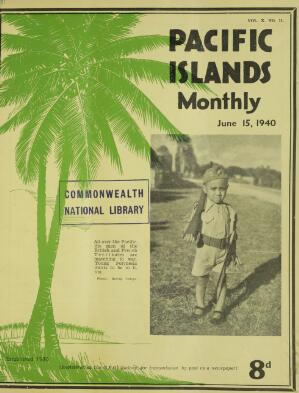
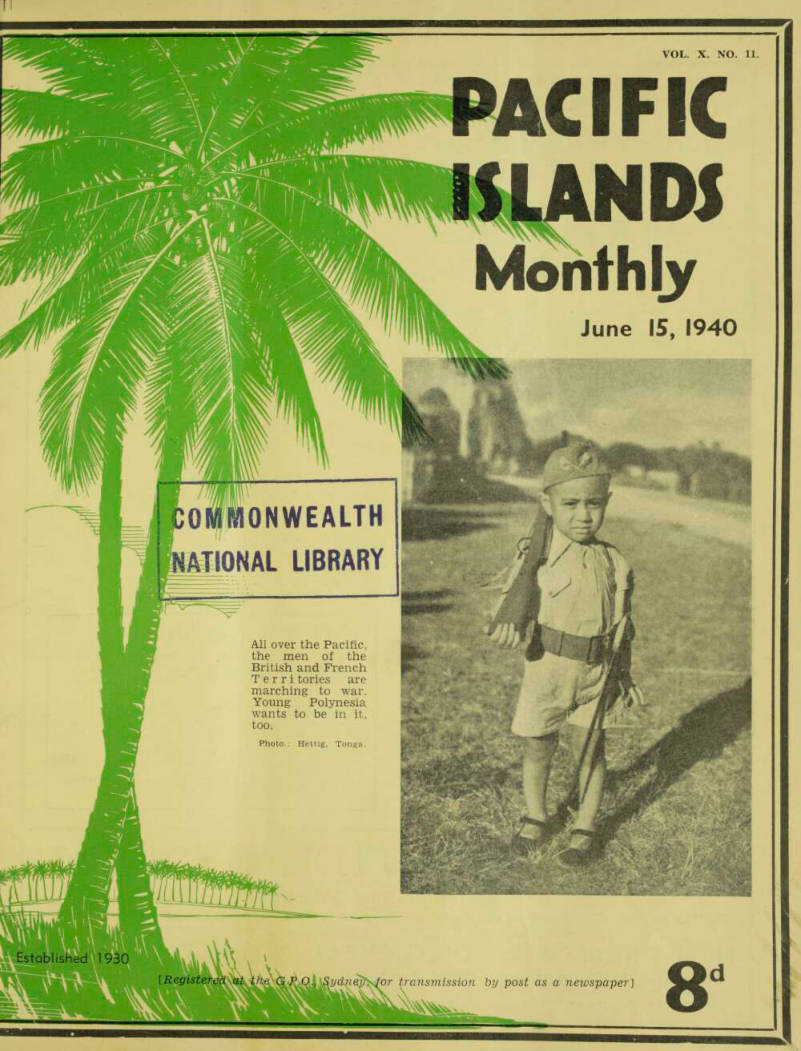
All over the Pacific, the men of the British and French Terri tories are marching to war.
Young Polynesia wants to be in it, too.
Photo.: Hettig, Tonga.
Advertisements & other items, p. 2 (2 items)
Pacific Islands Monthl y—J une 15, 1940
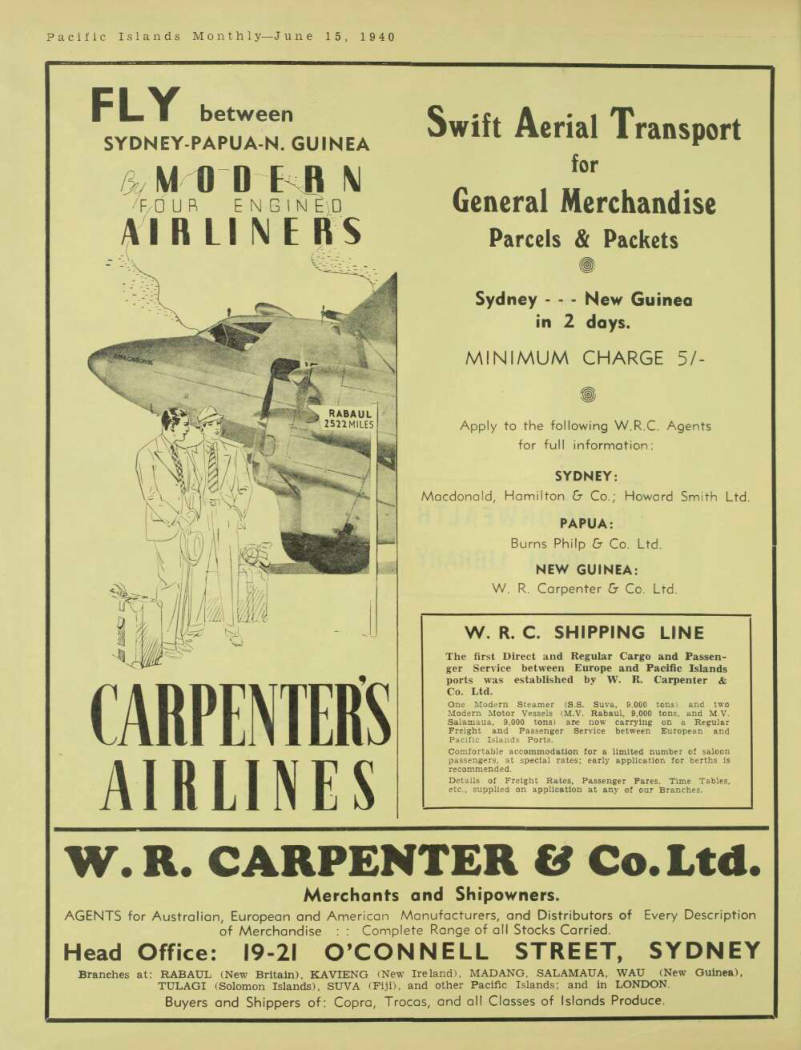
Carpenters
FLY between
SYDNEY-PAPUA-N. GUINEA
MOO E R \
FOUR ENGINES
AIRLINERS
RABAUL
2521 MILES
i or sj
CARPENTERS
AIRLINES
Swift Aerial Transport
for
General Merchandise
Parcels & Packets
Sydney - - - New Guinea
in 2 days.
MINIMUM CHARGE
Apply to the following W.R.C. Agents for full information:
SYDNEY:
Macdonald, Hamilton Cr Co.; Howard Smith Ltd.
PAPUA:
Burns Philp Cr Co. Ltd.
NEW GUINEA;
W. R. Carpenter Cr Co. Ltd.
W. R. C. SHIPPING LINE
The first Direct and Regular Cargo and Passenger Service between Europe and Pacific Islands ports was established by W. R. Carpenter & Co. Ltd.
One Modern Steamer (S.S. Suva, 9,000 tons! and two Modern Motor Vessels (M.V. Rabaul, 9,000 tons, and M.V.
Salamaua, 9,000 tons) are now carrying on a Regular Freight and Passenger Service between European and Pacific Islands Ports.
Comfortable accommodation for a limited number of saloon passengers, at special rates; early application for berths is recommended.
Details of Freight Rates, Passenger Pares. Time Tables, etc., supplied on application at any of our Branches.
W.R. CARPENTER & Co. Ltd.
Merchants and Shipowners.
AGENTS for Australian, European and American Manufacturers, and Distributors of of Merchandise : Complete Range of all Stocks Carried.
Head Office: 19-21 O’CONNELL STREET,
Every Description
SYDNEY
Branches at: RABAUL (New Britain), KAVIENG (New Ireland), MADANG, SALAMAUA, WAU (New Guinea), TULAGI (Solomon Islands), SUVA (Fiji), and other Pacific Islands; and in LONDON.
Buyers and Shippers of: Copra, Trocas, and all Classes of Islands Produce.
Pacific News-Review
Notes And Comment On
The Progress Of The War
From May 15 To June 11
May 15: The Germans, who simultan eously invaded Holland, Belgium and Luxembourg on May 10, now occupy the whole of the northern half of Holland; are half-way across the southern half of Holland; have thrust in deeply along the Albert Canal, between Holland and Bel gium; are deep into Belgium on the east ern side; and are thrusting into France in great strength on the line of the Meuse, south of Luxemburg, near Sedan.
The “Fifth Column” (resident Germans, and traitors who have turned against their own country) are attacking the de fenders behind their own lines, causing enormous confusion. Parachutists, dropped by passenger-carrying aeroplanes from Germany, have descended upon many aerodromes in Holland and Belgium, where, aided by the Fifth Column, they are attempting to gain possession.
British and French, advancing rapidly from the Franco-Belgium frontier, have joined the Belgians on a line near the Belgo-Dutch frontier.
May 15: The Dutch army has obeyed the order of its Commander in Chief to cease fighting, “to save civilians and pre vent further bloodshed”.
The surrender of the Dutch caused no surprise. They fought bravely but, in spite of many warnings, it actually was ill-equipped to meet the German thrust.
The Germans attacked with mechanised columns; the Dutch had little mechanisa tion. The Germans were preceded by clouds of bombing and fighting aero planes—the Dutch had only 30 planes al together. In addition, Holland w r as honey combed by the Fifth Column. Resident Germans, co-operating with Dutch Nazis and German parachutists, seized a large part of Rotterdam. They were driven off the aerodrome by Dutch troops, but they clung to the waterfront and the vital river bridges.
Holland’s greatest error, however, had been her refusal to co-operate with Britain and France in military staff talks, so that this emergency was not provided for. Britain and France could only rush troops up to the Belgo-Dutch frontier, and send strong air forces to the assist ance of the Dutch armies.
May 16: France claims that, although the German armoured columns have broken through the French front, near Sedan ,the French are successfully counter-attacking. It was reported, how ever, that German armoured columns are far ahead of the main forces and attack ing the French in the rear. The RAF has ceaselessly attacked the German columns and bases and, although far outnumbered, has been bringing down four German machines for every one British lost.
May 17: The Germans, pushing for ward mechanised columns in overwhelm ing strength, through the Sedan gap, have reached the Aisne River, 30 miles south-west of Sedan. The front to the northwards through Belgium, held by French, British and Belgian armies, is unbroken, but bending.
The French War Office continues to issue re-assuring communiques, but it is now clear that a situation of extreme gravity has developed southwards of Sedan. The French assume that they have only to close this narrow salient to trap large forces of Germans, but it is not working out that way. If the Ger mans are not quickly driven out of this salient, the Allied armies to the north wards m Belgium, must retire towards the Channel.
May 19: The German thrust south wards from the break in the French line at Sedan continues, and the Germans are hourly enlarging the area which they now occupy behind the French lines.
As a result of this, the Allied front in Belgium has fallen back, and a new line is forming westwards of Brussels. Brus sels and Antwerp are abandoned to the enemy. The Germans dominate the mouth of the Scheldt River. The Gov ernment of Belgium has moved to Ostend.
May 19: German mechanised columns on the Aisne, instead of continuing southwards on Paris, have wheeled sharply westwards and are thrusting towards Arras, Amiens and the Channel ports.
May 19: There are indications of Gov ernmental confusion and alarm in
France. While French communiques con tinue re-assuring, the Germans are hourly increasing their advantages. The French cannot cope with the new form of warfare which has developed. The Premier, M. Reynaud, announced that he had called to his side as Vice-Premier, Marshall Petain, 84, famous as a com mander in the last war.
Marshal Gamelin, Commander-in- Chief, said that the battle now in pro gress would decide the future of the world, and continued: “Any soldier who cannot advance should allow himself to be killed, rather than abandon that part of our national soil entrusted to him. The order is conquer or die!”
The outstanding features of this colos sal battle are the use of German mecn anised columns, and the magnificent courage and achievements of British Royal Air Force. These young airmen are fighting ceaselessly and, although vastly outnumbered, they continue to assert their complete ascendency in the air, in both skill and courage.
May 20: The Germans, continuing their drive with extraordinary force and ten acity, are advancing rapidly westwards.
They are approaching Peronne, Amiens and Landrecies and Cambrai.
General Weygand, 72, recently in charge in the near East, has been ap pointed Allied Commander-in-Chief, re placing Marshal Gamelin. He has taken complete charge and already is attempt ing to re-organise the position.
The British army is on a strong line westwards of Brussels, and British rein forcements are continually disembarking at French ports.
Meanwhile, Italian newspapers are try ing to whip the Italians into a storm of hate against the Allies, and build up a war spirit in Italy, so that Italy may enter the war beside Germany.
There are three strong influences in Italy opposing Mussolini’s drive towards war. They are the Vatican, the Royal Family, and the middle classes. Of these, the strongest is the Pope. His sympathies are with the Allies, and he had said that if Italy goes to war for Germany, he will leave Rome. Most Italians are good Catholics. It is significant that the offi cial newspaper of the Vatican, the “Romano Observatore”, because it was the only daily newspaper publishing uncol oured and apparently truthful war re ports, run up quickly from a circulation of 80,000 to nearly 2,000,000. It is be lived that the King is against interven tion, but the Crown Price Humbert, who is Commander-in-Chief of the Italian armies, has allied himself with Mussolini in eagerness for war.
May 21: The German mechanised armies, thrusting westwards from the Aisne, have crushed the French Ninth Army and captured Abbeville (near the mouth of the River Somme, on the Eng lish Channel), Arras, Amiens and Rethel.
Apparently nothing can stop these mechanised columns. The French armies, severely disorganised, have taken up a line along the rivers Aisne and Somme.
The Germans have ceased their thrust at Paris and now are engaged in a circling movement, westward and north-westward, along the coast, towards Bologne and Calais, threatening to cut off from France the Allied armies (estimated at 750,000 men) left in Belgium. A colossal military disaster threatens the Allies.
May 21: All Germany is singing a song of triumph and hate. Goering, in news paper interviews, praised Hitler as “a very brave soldier, an outstanding states man, an extraordinary strategist and the greatest living war leader”. Goering con tinued: “Hitler’s decisions are impulsive, not the result of long staff discussions.
He has broken all well-established milit ary principles, just as he designed the Polish campaign and the bold stroke in Norway. Germany’s west front thrust was also Hitler’s own idea. Not since Frederick the Great have we been ruled by so great a genius.”
May 22: Despite strong counter-attacks at Arras and Cambrai, the Germans are holding all their gains and are thrusting along the French coast towards Boulogne.
May 22: The French Premier (M, Reynaud) frankly acknowledged that the German break-through at Sedan was due to military errors by the French High Command. The line of the Meuse, west wards of the Maginot Line, had not been held in sufficient strength. The High Command believed that it was impossible for Germany to attack in this mountain ous region with large forces of tanks and mechanised troops. Owing to a tragic oversight, the bridges over the Meuse had not been destroyed and enemy divisions poured across into France in an endless stream.
The map now shows an amazing Ger man salient, like a bent finger, over 100 miles long, and nowhere more than 30
miles wide. Commentators confidently ex pect a great Allied counter-attack, to cut off this salient.
May 22: The Germans have severed all communications between France and the Allied armies in Belgium.
May 22: Fighting is proceeding in out skirts of Boulogne. The general situation is extremely grave.
It is now clear that the Germans have completely surprised the Allies in a new technique in attack. Instead of the old method of intense artillery preparation and an infantry advance, the Germans throw forward a screen of dive-bombers followed immediately by masses of heavy tanks, which spread out fan-wise as soon as they have made a breach in the enemy line. The tanks are followed by light mechanised units, motor cyclists and masses of infantry. We now have a war of open movement, instead of a war of trenches. The Allied armies have neither aeroplanes nor tanks big enough or in sufficient numbers to develop effec tive counter-attacks.
May 23: Under the new and sweeping powers of the Emergency Powers Act, the British Government may override all laws and take any measures necessary for the defence of the country. Large numbers of persons who might have pro vided the enemy with a “Fifth Column” in Britain, and members of the British Fascist Party, including Sir Oswald Mosely, have been imprisoned.
May 24: German forces have occupied Boulogne, and a fast German column is approaching Calais, Other German armies, working south along the coast of Belgium, are attacking the Belgian army, on the Scheldt River. British and French forces are lighting valiantly, but, unless there is a successful counter-attack on a great scale, they must fall back towards the coast.
May 24; Fascist leaders and newspapers in Italy are screaming for war, and every thing indicates that Italy is on the verge of war. Yet nothing is done. The position is puzzling. Restraining influences are strong representations made direct to Mussolini by President Roosevelt, and an indication from Moscow that, if Italy interferes with the Balkan nations, Russia will move.
Associated Press of America announces authoritatively that Mussolini will make a statement of Italy’s position on June 11 and enter the war on June 12.
May 26: Fifteen French generals and many police chiefs have been dismissed.
Marshal Gamelin has entirely disappeared —he is not even employed in the war staff.
May 27: The battle continues most violently. The Germans have moved southwards, along the Belgian coast, on the Scheldt River, and northwards along the French coast, near Calais.
The only bright spot in a situation of desperate gravity are the amazing per formances of the Royal Air Force. These young Britishers, with superb spirit, are fighting ceaselessly, day and x night, at tacking enemy concentrations all over Belgium, and France, and strong points and transport far into Germany, Tales of their heroism are countless. They carry on until they drop with exhaustion, sleep a little, and carry on again. They defeat the German airmen four times out of five.
May 28: King Leopold, Commander-in- Chief of the Belgians, without giving the Allies any warning, and acting on his own authority, ordered the Belgian army of 300,000 men to lay down its arms, and the Belgians capitulated to the Germans
at dawn to-day. The Belgians held the part of the front nearest the Channel, and the British and French armies in Belgium (estimated at about 350,000 men) now are in extreme danger of being sur rounded by the enemy thrusting north wards from Calais and southwards from the Scheldt.
May 29: There is a mounting clamour from all United States people, that the nation shall forthwith throw off the semblance of neutrality and give the ut most possible aid to the Allies. “Five hundred planes now might alter the course of the war and save civilisation.”
May 29: The British and French forces in Flanders are now withdrawing to the only port still open to them, Dunkirk.
The Germans, using enormous forces, are pressing in from every direction. Aided by the Royal Air Force, the Allies are fighting heroically. Only a miracle now can save these finely-equipped and un broken armies.
May 29: Narvik, the iron ore port in Norway, which has been in German occu pation since earlv Anril. was to-day cap tured by an Allied force.
May 30: A new type of British fighter, the Defiant, has come into operation in the R.A.A.F., with extraordinary results. 52 German machines were shot down yesterday, and 17 were badly damaged, with the loss of only 10 British machines.
May 31: Evacuation of British and French troops from Dunkirk is proceed ing in fairly orderly fashion, despite at tacks by every kind of force which the Germans can bring against them.
Weather is good, and Britain and France have sent to the work of transportation every kind of craft which will float. Ger many is using countless aircraft, trying to stop transportation.
June 2: The evacuation of the Allied troops nearly completed. The French have been fighting magnificent rear-guard actions. The Allies, by letting the sea into large reclaimed areas, north and south of Dunkirk, helped in keeping the enemy back. Only men and the equip ment they carry is being got away. Huge quantities of the most valuable war material are being systematically destroyed, before abandonment.
June 3: German bombers to-day drop ped over 1,000 bombs on Paris. Much non military damage was done, and over 250 people killed and 600 wounded.
June 3: The Nazis aie causing trouble in the republics of South America. Very large number of Germans and Italians are organised, and are demanding money of the “beaten subjects” of Scandinavia, Holland and Belgium, and are even try ing to control Danish and Norwegian merchant ships.
June 3: Britain’s Prime Minister (Mr.
Churchill) said evacuation of 335,000 British and French troops from Flanders was completed. Only a few rear-guard units remain. He said that a week ago he feared that he would have had to an nounce the greatest military disaster in history—he did not believe that more than 20,000 or 30,000 men could escape.
Nevertheless, the Allies had suffered a colossal military disaster. They had lost all their equipment in Flanders and the enemy held all the Channel ports, right down to Boulogne, whence he could launch an attack upon Britain.
The Allies know that the enemy will lose not one moment in launching an at tack against France. It is expected that nis drive will be made direct at Paris. II the French line breaks, it is likely that Italy will immediately attack France in the back—from the direction of the Mediterranean.
June 3: All British factories now are working three shifts a day. seven days a week, turning out war equipment. So as to resist attacks from the air or sea, half a million volunteers, mostly middle-aged men, have been enrolled, armed and organised, to act as local defence guards.
June 4; About 5,000,000 people in Hol land, Belgium and Northern France abandoned everything and ran when the German hordes approached. About 20,000 refugees have reached England, and be tween 1,000,000 and 1,500,000 have crossed into France. The fate of the rest is un known. Tens of thousands were killed on the roads, where the Germans machine gunned them mercilessly and ran over them, even as they screamed and pleaded, with tanks and mechanised units.
June 5: At dawn to-day, the enemy be gan an attack, in overwhelming force, on the French front, from the sea to the Maginot Line, at Montmedy. The greatest battle in history has commenced.
June 8: The Battle of Northern France now has continued for four days. The German attack increases hourly in in tensity—it is calculated that the Germans are using at least 2,000,000 men. They are employing thousands of tanks. It seems incredible that the French armies, out numbered and with vastly less equipment, can stand up to the strain much longer.
So far, they have held the line—the Ger mans have got through in only two or three places, and the penetration is not as yet important.
It is clear that the French have com pletely altered their technique of de fence. Instead of thin lines of trenches, their lines are organised in great depth, with strong posts (whence artillery de stroys the tanks at pointblank range) and traps (which also destroy the tanks).
Aeroplanes, armed with cannon, also have been found effective against tanks. The French open up their ranks, let some tanks through, and then close up again and attack the oncoming infantry.
Meanwhile, the strong posts, far behind, mop up the tanks. It is calculated that since the battle commenced the French have destroyed nearly 1,000 tanks. But, still, the Germans come on in overwhelm ing masses.
June 8: Italy now is completely on a war footing. Italians have been called home from adjoining countries. Women and children have been evacuated from Italian cities. Black-out restrictions have been imposed. Italian ships everywhere have been ordered to remain in port.
June 8: After hesitation, argument and legalistic wrangling, the United States Government has found a way to ship aeroplanes and munitions direct to the Allies without breaking the laws. It is an nounced that aeroplanes are now on their way, and that 1,000 modern machines, and large numbers of 75 m.m. guns (which the French are using with deadly effect on tanks) will be quickly despatched.
June 10: Remaining Norwegian forces surrender. King and Government go to England. Allied forces abandon Narvik.
June 10: Mussolini announces that Italy will be at war against Britain and France, as from midnight.
June 10: President Roosevelt announces that United States, being completely sym pathetic with Allies, is going immediately to their aid with all material resources, and will “prepare for all emergencies”.
June 11: Enemy has penetrated Chan nel end of French line. His armoured columns are on Lower Seine, approaching Paris. French armies are generally re treating in good order. Paris is being evacuated.
A Month Of Disasters
May 10.—Germans invade Holland, Bel gium, Luxemburg.
May 15.—Holland surrenders to Germany.
May 16.—German mechanised columns break French line on Meuse, and pour into Northern France.
May 19. —Brussels and Antwerp taken by Germans.
May 20.—General Weygand displaces Marshal Gamelin as Allied Commander.
May 24.—Germans, wheeling westward through France, capture Boulogne, and approach Calais.
May 28.—Belgian army surrenders to Germany.
May 29—June 4.—Evacuation of British and French armies from Flanders to England.
June 5. —Whole German army thrown against French on Aisne-Somme front.
June 10.—Norway surrenders to Germany.
June 10.—Italy declares war on Britain and France.
June 11.—Germans near Paris.
Advertisements & other items, pp. 3-4 (2 items)
1
Pacific Islands Monthl y—J une 15, 1940
2
June 15, 194 O—P acific Islands Monthly
Pacific Islands Travellers
PER “MALAITA” FOR 8.5.1., PAPUA & N.G.
PORTS; Messrs. Aitchison, Atkinson, Adams, Bell, Cheetham, Collins, Craigie, Dickinson, Dando, Farmer, Fulton, Glenn, Gladstone, Green, Godwin, Gorringe, Horton, Hobbs, Irvine, Johnson, James, Kuter, Lawrence, Morris, Marchant, Newbury, O’Brien, Rigden, Robbins, Rowe. Shiels, Scott, Summerland, Sinclair, Slaviero, Strickland, Try, Wakeling. Mesdames Alley, Dickinson, Glenn, Gay, Griffiths, Hobbs, Kuter, Stibbard, Short, Sinclair, Try. Misses Hunt, Mason, O'Malley (2), Rescorl, Schroder, Touzeau.
Per “Malaita” From 8.5.1., Papua &
N.G. PORTS: Messrs. Bourne, Burnett, Challis, Chant, Champion, Darby, Eginton, Feakins, Head, Jackett, Moodie, Moore, Quelch, Richey, Rowley, Ryan, Skelly, Stronge, Walker, Worthington. Father Goedert. Mesdames Bourne, Challis, Champion, Deck, Hardy, Kidnie, Moore, Piddington, Halston-Searle, Stewart, Swanson, Train, Walker, Whitehead. Misses Braid, Parsons, Rodger, Sweet.
Per “Morinda” For Lord Howe Is.,
NORFOLK IS.. N. HEBRIDES, & 8.5.1.: Messrs.
Bairstow, Ballard, Brooks, Buffett, Christian, Downing, Fleming, Haig, Harris, Hook, Jones, Long, Litchfield, Larney, Martin, Mitchell, Menzies (2), Nicholls (2), Ohlen, Rowe, Roe,
Stronge, Say, Tattle, Turnbull, Thompson (2).
Revs. Anderson and Stallan, Mesdames Bair stow, Brooks, Clarke, Downes, Gilet, Haig, Har ris, Honegger, Lisle, McLean, McGrath, Moltke, Newbury, Ohlen, Smith, Say, Stallan, Tattle, Whiting, Young. Misses Brumpton, Baxter, De Preville, Hand.
Per “Maetsuycker” To Papua: Messrs.
Ashcroft, Thomas, Rayner, Watson, Muddell.
Miss Drinkwater.
Per “Monterey” For Suva; Messrs. Arn
heim, Edwards, Ellis (2), Massey, Marks, Mfchelmore, Mitchell, McFarlane, McWilliam, Bull, Cant, Hawkins, Jullian (2), Olds, Rud dell, Weatherston. Sir H. Gepp. Mesdames Edwards, Ellis, Marks, Michelmore. Mitchell, Munro, Wallace, Bull, Cant, Janssen, Jullian, Smith, Snowsill. Misses Bailey, Dowling, Ed wards (2), Ellis, Marks, Mitchell, Munro, Jullian.
PER “NIAGARA” FROM SUVA: Messrs. Livie, Stephenson, Southey, Wood, Earl, Joughin.
Mesdames Stephenson, Hathaway, May, Earl, Emery. Miss May.
PER “AORANGI” FOR SUVA: Messrs. Alison, Brook, Barry. Carew, Cozens, Freeman, Gem mell-Smith, Hamson (2), Hibberd, King, Me- Oullagh, Rogers, Rutter, Snodgrass, Twenty man, Trivett, Wood, Clarkeson, Griffiths, Ken
nedy, McLaren, Southwood, Whiting, Badall, Wiley. Mesdames Alison, Barry, Cozens, Free man, Hamson, Handley, Higginson, Hibberd, King, Ransome, Rutter, Snodgrass, Twentyman, Trivett, Wood, Clarkeson, Griffiths, Kennedy, Whiting, Badall, Wiley. Misses Cozens, For rest, Rice, Snodgrass, Twentyman (2), Trivett, Clarkeson, Menzies, Ward.
PER AIRLINER TO PAPUA & N.G.: Messrs.
Preston, Austin, Lucas. Mesdames Speedie, Thurston, White. Miss Comley.
Per Airliner From Papua & N.G.:
Messrs. Goodwin, Anderson, Genunjro, Brother ton, Perrott, Swift, Kaberry. Mesdames Judd, Übank.
PER AIRLINER TO PAPUA & N.G.: Messrs.
Richardson, Kirkman, Smith, Johnson, White, Thornley, Wood. Mesdames Ryan, Ross, Thorn ley, Forsyth.
Per Airliner From Papua And N.G.:
Messrs. Smith, McLachlan. Mesdames, Hill, Hewson, Sutherland, May. Miss Sutherland.
Per Airliner From N.G. & Papua:
Messrs. Blackpool, Smith, Joseph, McKenzie, Spensely. Mesdames Franks, Kennedy. Miss Neale.
PER AIRLINER FOR PAPUA & N.G.: Messrs.
Wolfe. Lane, Pringle, Stephens, Yeoman, Guild, Carroll.
PER AIRLINER FROM N.G. & PAPUA: Dr.
Carney, Messrs. Corfe, Baker.
Advertisements & other items, p. 5 (1 item)
South Pacific Lire
Irsi
SAI
p. m
PAC
IA N J ill
ATA
Am
SAMARAK
MALI A
I y*
SA^IA
Si VitA & <P & SY
NEY
mm ■I fmiumian * / * P
K. P. M.
SOUTH PACIFIC LINE
Royal Packet Navigation Co. Ltd., Paketvaart House, 255 George Street, Sydney. (N. V. Koninklljke Paketvaart Maatschappij—lncorporated In the Netherlands.) Saigon, Diethelm & Co.; Port Moresby and Samarai, Steamships Trading Co.
Ltd.; Rabaui, Saiamaua and Wau, W. E.
Carpenter & Co. Ltd.; Port Vila, Gubbay Freres; Noumea, Carlo Leoni; Auckland.
Russell & Somers Ltd.; Wellington, Johnston & Co. Ltd.
K
Linking the East with South Pacific
Islands, New Zealand and Australia
The track routes of the K.P.M.-South Pacific Line new motor vessel “Maetsuycker” and the well-known passenger steamer “Tasman” are each as follows:—“TASMAN”: Saigon, Singapore, Batavia, Samarang, Sourabaya, Port Moresby, Samarai, Port Vila, Noumea, Auckland, Wellington, Sydney, Port Moresby, Sourabaya, Samarang, Batavia, Singapore, Saigon. “MAETSUYCKER”: Saigon, Singapore, Batavia, Samarang, Sourabaya, Port Moresby, Saiamaua, Rabaui, Auckland, Wellington, Sydney, Port Moresby, Sourabaya, Samarang, Batavia, Singapore, Saigon.
SOUTH PACIFIC LIRE
Advertisers
Amalgamated Wire less (A/sia) Ltd. 47 Am.pfl.ion (A/sia) Pty. Ltd. ... 51 Angus & Coote Ltd. 67 Arnott’s Biscuits . 35 Atkins Ltd., W. . 39 “Ausoline” ... 70 Barnet Glass Rub ber Co. Ltd. . . 69
B.A.L.M. Ltd. . . 40
Bank of N.S.W. 67, 68 “Bidomak” ... 21 Blaxland Rae Pty.
Ltd 51, 49 Broomfields Ltd. . 45 Brown & Co. Ltd.
G 14 Brunton’s Flour . 33 Budge Ltd., Jas. . 43 Burns, Philp & Co.
Ltd 4 B.P. Magazine . . 36
B.P. (S.S.) Co. . . 40
Burns Philp Trust Co. Ltd. . . 51, 26 Carlton & United Breweries Ltd. . 31 Carpenter Ltd., W.
R cov. 2 Chapman & Sherack 45 drivers & Sons Ltd. 56 Christie’s Pty. Ltd. 69 “Cinnamolia” Pre parations ... 48 Clvde Engineering bo. Ltd 43 Coleman Lamp & Stove Co. 28, 44 Colonial Mutual Life Assurance Socty.
Ltd 51 Coral Starch ... 35 Cosmopolitan Hotel 72 “Cystex” ... 71 De Meric Pty.
Ltd 48 Dewar’s Whisky . 58 Doan’s Pills ... 46 Donaghy & Sons Ltd 42 Donald Ltd., A. B. 54 Eaton Ltd., J. W. 41
Electrolux Refrigerators . . 30 Eno’s Fruit Salt . 65 Eveready Batteries 23 Fletcher & Sons . 42 Ford Sherington Ltd 22 Garden Vale Pro ducts Ltd. ... 32 Garrett & Davidson 63 Gilbey's Gin . 50 Gillespie’s Flour . 34 Goodwin, Ltd., A.
E 64 Gourock Rope Ex port Co. ... 68 Gowing Bros. Ltd. 52 Grand Pacific Hotel 55 Grove & Son, W.
H 56 Guest House For Sale 16 Guinea Airways Ltd. . . . cov. 3 Halvorsen Sons Pty. Ltd. ... 71 Holbrook’s Ltd. . . 33 Horlicks Malted Milk 17 Hotel Moresby . . 72 Jones & Co. Ltd., H 16 Joyce Biscuits Ltd. 20 Kambala School . 62 Kolynos Dental Cream ... 18 Kopsen & Co. Ltd. 27 Kork-N-Seal Ltd. . 32 Kriesler (A/sia) Pty. Ltd. ... 53 Lea & Perrins Sauce ... 60 Levenson’s Radio . 66 Maxwell Porter Ltd. 41 Mcllrath’s Ltd. . . 60 McWilliam’s Wines 59 Merrillees & Co., J. C 59 Miller & Co. Pty., Ltd 26 Moffat-Virtue Ltd. 15 Nock & Kirby Ltd. 46 Noyes Bros. Ltd. . 65 Pacific Is. Society 13
Papua Hotel, The . 72 Philips’ Lamps (A/sia) Pty. Ltd. 19 Position Wanted . 65 Pike Bros. Ltd. . . 22 Porter & Co., D.
H 49 Prescott Ltd. ... 34 Prouds Ltd. ... 11 Rohu, Sil . . . . 49 Royal Packet Co. . 3 Scott’s Emulsion . 13
Scott Ltd., J. . . 38 Spartan Lacquers Pty. Ltd. ... 44 Springwood Ladies’
College ... 72 Steamships Trading Co. Ltd 38 Sterling Varnish Co. 11 St. Ignatius College 37 Sullivan Ltd., C. . 50 Sunripe Cigarettes 54 Sutton, M. . . .61
Swallow & Ariell . 61 Talkeries, The . . 52 Taylor & Co., A. . 65 “Tenax” Soap . . 29* Tillock & Co. Ltd. 52 Toohey’s Ltd. . . 25 Tooth & Co. . cov. 4 United Radio Dis tributors Ltd. . . 63 Vacuum Oil Co. . 24 Vincent’s A.P.C. . 29 West, Harry ... 44
Weymark & Son . 34 Wills Ltd., W. D. & H. O. ... 36 Wise Bros. Pty.
Ltd 59 Wittner’s Pty. Ltd. 12 Woods Peppermint Cure . . 20, 63, 72 Wright & Co. . . 69 Wright & Co. Ltd.
E 42 Wunderlich Ltd. . . 41
Contents
Pacific News-Review 1 South Seas Travellers 3 ■ Grim Prospect for Copra Producers 5 The Course of the War 6 The “Peaceful” Germans of N. Guinea 6 Islands Roll of Honour 6 U.S.A. Naval Strength in Pacific .. 7 Higher Fares & Freights in W. Pacific 7 Fiji Taxation Changes 7 Proposed P.A.A. Yacht Link Between New Caledonia and Australia .. 7 War’s Reaction on Pacific Industries 8 N.G. Road Still Held Up 8 Tahiti Buys More Australian Goods 9 Administrator of Panua 9 Future of Dutch East Indies 9 Flying-Officer Gofton, of N.G., Missing 10 Islands Men Eager to Join Up ... 10 Tropicalities n About Islands Peonle 13 Workers’ Compensation Act in Fiji .. 14 The “Pandemonium” 16 Death of Hon. W. E. Grose, of T.N.G. 16 Port Moresby Water Suoply .. .. 17 Japanese in Carolines & Marshalls .. 18 Crush Copra in the Islands? 19 Possibilities of Shark-Fishing Industry 20 Australian Politicians & Mr. E. G.
Theodore 20 Samoan Child-Murderer Sentenced to Death 22 With Dechert’s Bitser to Edie Creek 23 Whence Came the Polynesians? ... 27 New Bishop Museum Publications .. 29
Those N.G. Native Labour Guarantees 31 Pacific Territories & Copra Price .. 32 “Jimmy” Preston’s Lost Gold Reef .. 33 How the “Maungaroa” Came and Went 34 R. D. Frisbie’s New Book on Puka puka 37 One Night at Sea—A Papuan Tale 38 Native Producers in New Guinea ... 39 First Printing Press in Polvnesia ... 40 Things You Need Not Take; to Tahiti 42 Native Population of N. Guinea ... 43 Papua’s Western Division 44 Use Coconut Products in the Islands! 45 Death of Captain A. Middenway ... 46 Health of G. E. Natives 48 Work of Dr. S. M. Lambert in South Seas . .. 49 Exploring Central New Guinea—Sec tion 4 (Conclusion) 50 A Post Office in Rural Fiji 55 Papuans Will be Boys 56 Tribute to Papua’s Early Missionaries 57 The Innocent Abroad—A New Guinea Epic 58 A Section for Islands Women 61 Pacific Is. Mining News 63 Short Wave Radio Programmes ... 67 Produce & Exchange Rates 68 Copra & Rubber Quotations 69 Death of Miss Florence Young, Founder of S.S.E. Mission .. .. 70 Shipping Services in the Pacific ... 71 Progress of Fiji’s Gold Mines 72
Advertisements & other items, p. 6 (2 items)
4
June 15, 194 O—P acific Islands Monthly
Burns, Philp & Co. Ltd.
GENERAL
MERCHANTS
i in :
DBSP
11l 111 in hi
HI Hi
§ i
SHIPOWNERS
TOURIST AGENTS
Head Office: 7 Bridge Street, Sydney—Australia Code Address: "BurphU'' BUYERS OF ALL CLASSES OF ISLAND PRODUCE Regular Steamer Services from Australia to New Guinea Papua Solomon Is. —Lord Howe Is. —Norfolk Is. —New Hebrides —Java and Singapore
Pacific Islands Monthly
The Newspaper-Magazine of the South Seas [Registered at the G.P.0., Sydney, for transmission by post as a newspaper .]
Owned and Produced by Pacific Publications Pty. Ltd., Union House, 247 George Street, Sydney.
-mvPHnNP t Managing Director .. BW 5037 £ Business and Editorial MA 7101
P.O. Box 3408 R
Registered Address of Telegrams, Radiograms, and Cables; “Pacpub”, Sydney,
Contributions.
Articles, Stories, and Photographs dealing with Pacific Islands subjects are invited and will be paid for on publication at usual rates.
Subscription Rates.
Per Annum, within British Empire, Prepaid, Post Free 8/- Per Annum, elsewhere, prepaid, Post Free . 10/- Slngle Copies Bd.
Editor and Publisher:
R. W. Robson, F.R.G.S.
Assisted by Selwyn Hughes.
Advertising Manager; L. W. Bailey.
Advertising Office and Printing-House: 29 Alberta St., Sydney.
Advertising rates furnished on application.
Colours, etc by Arrangement.
Process Blocks made at Advertiser’s expense when required. Screen 100.
Changes of Advertising Copy should reach this Office by Ist of each month, otherwise previous advertisement may be repeated.
IN LONDON, the Pacific Islands Monthly is on sale at the Bookstall, Australia House, The Strand, London.
Agents.
The following are authorised to receive sub scriptions for the Pacific Islands Monthly;- Islands Branches of Burns, Philp & Co., Ltd., and Burns Philp (South Sea) Co., Ltd.
Islands Branches of W. R. Carpenter & Co., Ltd.
Islands Branches of Morris, Hedstrom, Ltd.
G. Thomas & Co.. Rabaul, New Guinea.
T. A. Olsson, Wau, New Guinea.
Whitten Bros., Ltd., Samaral, Papua.
Steamships Trading Co., Papua. All Branches.
B.N.G. Trading Co., Ltd., Port Moresby.
J. Muir, Suva. FIJI.
N. C. Mackenzie-Hunt, Wainunu, Bua, Fiji.
Islands Branches and Representatives of W. H.
Grove & Sons, Ltd., Auckland, New Zealand.
Cook Islands Trading Co., Rarotonga, Cook Is.
A, C. Rowland, Papeete, Tahiti.
Representative in London: W. C. HARVEY, Coronation House, 4 Lloyds Avenue, London, E.C.3, from whom may be obtained copies of Pacific Islands Monthly, Pacific Islands Year Book, advertising schedules, etc.
Vol. X. No. 11.
June 15, 1940
Prirpl 8d - Per c°Py nn-ej. Prepaid: 8/- p.a.
Grim Prospect For Copra Producers
AT the moment of this writing (June 11) the outlook for our copra industry is dark. Coconut planters in the South Seas would be wise to face up to the facts.
Two things threaten to depress the industry for the present, so far as the South Pacific territories are con cerned. They are, lack of markets, and lack of transportation.
The events of the past few weeks have reduced the copra market very seriously. When war broke out, in September last, all the Central Euro pean markets immediately were cut off. Nothing further happened until April, when Germany suddenly seized Denmark and Norway, and isolated Sweden. That meant that the whole Scandinavian market also was gone— an important factor. The next rush by the Nazis, in May, resulted in the occupation by the enemy of Holland, Belgium and a part of Northern France, causing the most severe dis location of the copra market up to that time.
Planters need not be reminded that the largest single producer of copra in the world is the Netherlands Indies, and the distribution of that trade, of course, was controlled from Hol land. From the moment that Germany seized Holland, that enormous copra business was dislocated, and mostly was compelled to seek new markets.
Finally, after months of hesitation, Italy has entered the war—and that, of course, means that practically the whole of the Mediterranean demand is cut off, including the extremely im portant Marseilles market for second class copra.
Under these war conditions, the European market for copra is con fined almost wholly to Britain, France and the Iberian Peninsula. We have
lost the important markets of Ger many, Austria, Czechoslovakia, Poland, Norway, Sweden, Denmark, Holland, Belgium, Italy, and parts of France.
Britain and France want coconut oil urgently, and in large quantities, for the manufacture of margarine, especially. But Britain, in the plainest possible terms, has informed the big firms which handle South Pacific copra that she can get all the vege table oil seeds she requires from places much nearer than the South Pacific —and that that is a primary con sideration, owing to the need for con serving merchant shipping.
As far as can be ascertained, Britain and France will accept African, Mala yan and Dutch East Indies copra, in that order, in preference to South Pacific copra, because of the saving represented in transportation time and cost. The proper allocation of merchant shipping is a thing vital to the war effort of the Allies—and, so far as Great Britain is concerned, the South Pacific territories are the Antipodes, and therefore represent the greatest distance over which copra can be carried. Those of us who may have felt thankful that we are so far from the battlefields may now contemplate the other side of the picture; we are at a serious dis advantage in getting our produce to the market.
Naturally, copra merchants in the South Seas have been turning anxi ously around, seeking markets alter native to Europe. There has been a certain amount of regular sale in Mexico; but, lately, the Mexican market, owing to currency troubles and a mounting threat of political disturbances, has become irregular and untrustworthy. There is little, if any, market available in the United States —copra from the Philippine
Islands more than supplies North American needs.
It appears that copra producers in the South Pacific Territories are faced with the greatest crisis in the history of their industry. The Islands stores are bulging with copra, and there is no sign at present of sufficient ships being made available to take it away. The big trading firms say, now, that they have bought copra to the limit of their resources—they dare not store any more. The Common wealth Government, urgently ap pealed to by men and interests in the Australian Pacific Territories, has pointed out that it dare not form a copra “pool”, because copra is too perishable a commodity. The sug gestion put forward by a prominent member of the New Guinea Legis lative Council, that Australia should bring Papuan and New Guinea copra to Australia, and mill it there, and store the oil, etc., and make advances to the producers against these pro ducts, was investigated, but was held to be not practicable.
It appears that, for a time, the copra producers will just have to ac cept the fact that there is little market for their produce, and try to carry on, as best they may. They may be certain of all possible help from the Administrations. It is most important that they be encouraged to remain on their plantations, some how.
Everything depends upon the events of the next few weeks. If the war goes against the Allies, there will be a general rearrangement of inter national affairs, as well as of indivi dual lives, and the condition of the copra industry will be one of the least of the things we shall have to worry about. If, on the other hand, we can hold the mad-men of Europe for a few months, while we restore our military strength, and retain our freedom and independence, it should
not be very long—probably not more than a few months—before trade conditions will be re-established, and suddenly we may find half the world clamouring for the products of the coconut plantations.
Wise men will make dispositions to enable them to stand a siege, and to hang on, somehow. There will be losses, discouragement, a great need for a brave spirit. But the pendulum will swing again.
The Course of the War
P.1.M.” forecasts have been fairly accurate, so we venture to predict the events of the next few months. The indications are: Much of France will be over-run, and the valiant French armies will be partly crippled. But the French will not surrender.
There will be bitter fighting against Italy in the Mediterranean, probably with heavy naval and air losses on both sides. Italian submarines will severely damage British shipping in the Atlantic, Indian Ocean and Pacific.
The United States, and Turkey, will enter the war, beside the Allies.
If Italy attacks a Balkans country, Greece will join the Allies, and Russia may enter the war against Italy. Roumania may join Germany.
Hitler, at an early moment, will launch a terrific attack against Britain, by air and sea.
The Allies should expect no vic tories and little encouragement this summer. They will be “all out” to save themselves from disaster. They must hold on; and they will be aided therein by the dominating strength of the British - French - American fleets. That fact may keep Spain quiet.
Meanwhile, the United States will come to their aid, with aeroplanes, munitions, sea-power and, if needed, a great expeditionary force.
Russia and Japan remain as in calculable factors. Either Power may go either way.
The war will begin to change in the Allies’ favour in 1941, as a result of their mounting air-power, plus their existing sea-power.
But there are black months ahead.
Accumulation of cocoa stocks in West Africa, owing to, the loss of pre-war mar kets, particularly in Germany, Holland and Scandinavia, has created serious pressure on available storage space. The British Government has decided, after consultation with Gold Coast and Nigerian Governments, to destroy the middle crop. This crop is of inferior qual ity to the main crop and, by quickly breeding insect pests, becomes a menace to the new crop.
Mr. W. B. Ball, District Officer in New Britain, has been appointed Superintend ent of the N.G. Police Force, succeeding Colonel John Walstab, who has enlisted.
Mr. H. Cooper arrived in Suva from the African Gold Coast in May to join the Fiji Civil Service.
Missing
Roll Of Honour
(It is hoped to assemble, here, the names or men, former residents of the Pacific Territories, which appear in British and French casualty lists, or in lists of honours awarded. We should be grateful if relations and friends would send us details.)
Flying-Officer Moresby Gofton, of the RAF., son of Mrs. F. S. Stewart, of Wau, New Guinea. Reported missing, 17/5/1940.
Flying-Officer K. J. A. Johnstone, of the R.A.F., who was born in Suva in 1915. Reported - missing, 1/5/1940. His mother was a daughter of the late Mr.
H. Thiele, for many years a member of the Colonial Sugar Refining Co/s staff in Fiji.
Intern Them !
The "Peaceful" Germans of New Guinea
r rVHERE will be, in New Guinea, almost J. unanimous endorsement of the fol lowing resolution, adopted on May 24 at a special meeting, held in Rabaul, of the executive officers of the New Guinea Branch of the Returned Soldiers League:— “This sub-branch views with great con cern the unrestricted freedom still being granted to enemy subjects and German sympathisers in New Guinea.
“The anti-British attitude of these persons, indicated by their display of Nazi emblems in their residences and their general bearing of contempt to wards all things British, will, in the considered opinion of local ex-Service men, be the cause of some regrettable action by the patriotic section of the community; and it is therefore recom mended to the State Executive that the Administrator be requested to take action similar to that taken by the British Government, by arranging for the depor tation and/or internment of all enemy aliens and all persons having or suspected of having Nazi sympathies, and in par ticular the following persons,” (A list followed.) The “P.l.M.’', at the outbreak of war, applauded the decision of the Govern ment, to deal with cases on their merits.
Known Nazi sympathisers, and anti- British persons were interned: but many apparently harmless people were allowed to go free, under supervision. That is the British way.
But when the Hitler “Blitzkreig” was commenced, and the Allies suffered re verse after reverse, in Norway, Belgium and France, our so-called “harmless”
Germans in New Guinea could not con tain themselves—they not only cheered, which was perhaps understandable, but also they displayed a hitherto carefully hidden hatred of the British.
So there is only one thing to do—and the old soldiers have indicated it.
There is no need to be squeamish. The events of the past few weeks in Norway, Holland, Belgium and France show the kind of treachery—euphemistically called “Fifth Column”—of which our German “friends” are capable.
Mr. R. W. Gosset, president of the Geographical Society of N.S.W. and a Council member of the Pacific Islands Society, suddenly collapsed and died in Sydney on June 11. He lived for many years in the Cook Islands, and was re garded as an authority on Pacific history.
Mr. H. C. Monckton, Adviser in Native Affairs, Fiji, retired from the Colonial Service recently, after a service extending over 40 years, and left for New Zealand and Australia, with Mrs.
Monckton. They have not yet decided where they will make their future home.
Kurukuru Grass
COMMENT has been caused by official inquiries in Australia and in Papua, concerning British Australian Fibre Co., Ltd., Fibres, Ltd., and Common wealth Hemp Corporation, Ltd.—all ap parently connected with British and Aus tralian Paper and Pulp Co., Ltd. The latter was registered in April, 1936, in Canberra, with a nominal capital of £3,000,000, and one of its objects was to exploit the Kurukuru (or kunai) grass ot Papua and New Guinea. Little has been done there but the companies still hold large tracts of grass land in Papua.
Indian Unrest
In Fiji
Usurers Who Demand 40%
THE following matters, of direct inter est to Fiji, were dealt with at the annual meeting of the Colonial Sugar Refining Co., by the chairman (Mr. E. R. Knox), in Sydney, on May 29: “Over the last two years there has been an undercurrent of unrest amongst the Indian cane-growers and labour in Fiji.
This has been more political than eco nomic, and we are convinced that the origin is outside the Colony.
“Nevertheless, there is an evil in Fiji that should be checked, namely, the usurer who seeks to keep his borrowing victims in his clutches, and preys upon them with gruelling rates of interest, sometimes as high as 40%. the existence of this inquitous business is the cause of much unhappiness and hardship, and we are investigating ways and means of combating it so far as our own people are concerned.
Pineapple Industry
“As regards our newly-established pineapple industry in Fiji, the additions to the Cannery forecast last year were installed in time, and were in use for the summer pack completed last Febru ary. Marketing is progressing satisfac torily despite limitations imposed upon imports in some of our markets. Con siderable areas were planted in 1939, ex ceeding those planted in previous years, and additional farmers have commenced pineapple growing. There are now pros pects of rapid development.”
U.S.A. Naval
Might
What is Happening in the Pacific
WHILE United States publicists, to an increasing degree, are urging that it is vital to the future of the world’s greatest republic that she should sup port the Allies in the war against Hitlerism, the United States navy is quietly but steadily strengthening its position in the north-east Pacific.
An order issued in Honolulu, in the beginning of June, incorporating the Hawaiian detachment of 30 warships into the United States fleet, is inter preted as an indication that the great United States fleet, now in Hawaii, will not return to its bases in California at any early date.
Meanwhile, in all the Central Pacific islands which have been taken over by the United States as part of the naval de fence plan, large numbers of men are engaged on defence works.
At Midway Island, for instance, 1,400 miles west of Honolulu, there were 350 men at work, in March, under expert engineers, constructing a naval and ad vanced seaplane base at a cost of 2,000,000 dollars.
Over 100 men have been employed for about six months on Johnston Island, 700 miles south-west of Honolulu, deep ening the main lagoon of the little sandy atoll and dredging a channel to give communication with the open sea.
Another large party of men is at work at the group of islands called Palmyra, about 1,000 miles south of Honolulu, where 1,000,000 dollars is being spent on the construction of a seaplane and land ing base.
Details of these various operations have been published recently in American newspapers. It is safe to assume that there is a good deal more going on, of which nothing has been heard.
All this is of vital interest to British and French people in the Pacific Terri tories and Dominions; for, whether we realise it or not, we are under the pro tection of the United States. If our European mother-nations were defeated there would be only the Stars and Stripes between us and the kind attentions of the Berlin-Rome-Tokio “Axis”—which might just as well be spelled “axes”.
Freights
Higher Fares And
For All Western Pacific
THE Commonwealth Prices Commis sioner has announced that, as from May 23, 1940, charges may be made up to a maximum of per cent, in ex cess of the rates operative on August 31, 1939, in respect of freight and passage rates between Australia and the Terri tories of New Guinea and Papua, and between and within those Territories.
This applies also to Solomon Islands and New Hebrides services.
On October 8. 1939 fares and freights were increased 10 per cent., so this latter increase amounts to an additional 2 h per cent, on the original fares.
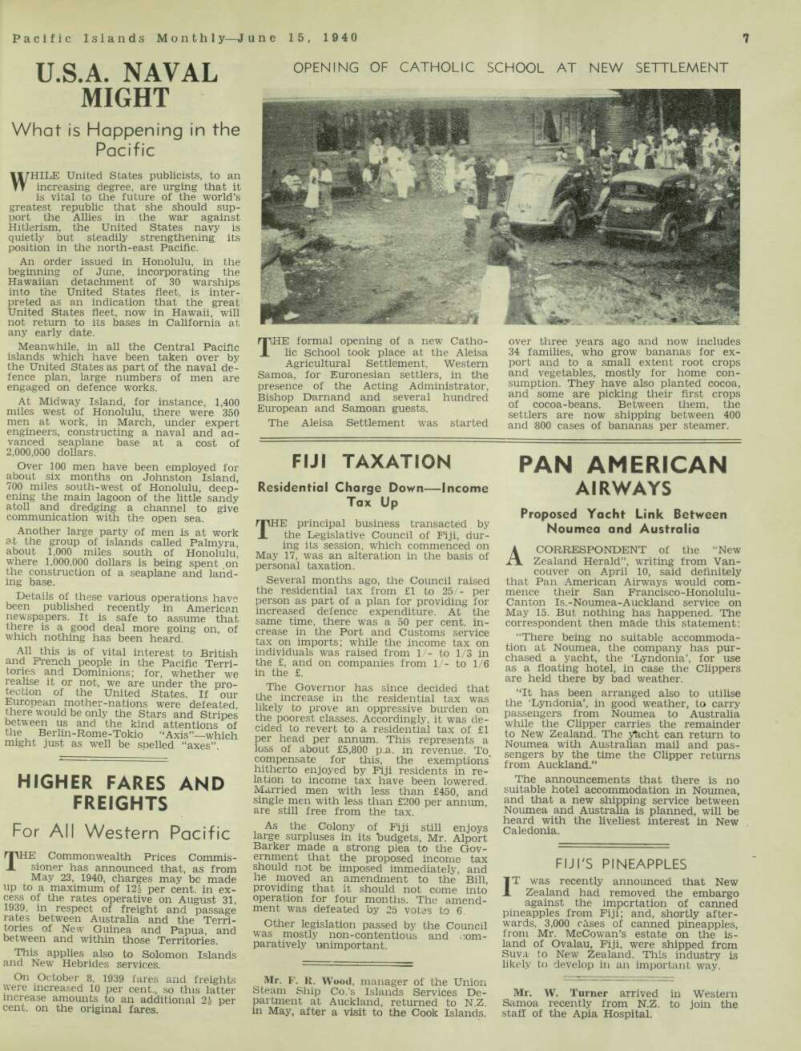
Opening Of Catholic School At New Settlement
THE formal opening of a new Catholie School took place at the Aleisa Agricultural Settlement, Western Samoa, for Euronesian settlers, in the presence of the Acting Administrator, Bishop Darnand and several hundred European and Samoan guests.
The Aleisa Settlement was started
over three years ago and now includes 34 families, who grow bananas for ex port and to a small extent root crops an d vegetables, mostly for home con sumption. They have also planted cocoa, a |? d some are picking their first crops of cocoa-beans. Between them, the settlers are now shippmg between 400 and 800 cases of bananas per steamer.
Fiji Taxation
Residential Charge Down—lncome Tax Up
THE principal business transacted by the Legislative Council of Fiji, dur ing its session, which commenced on May 17, was an alteration in the basis of personal taxation.
Several months ago, the Council raised the residential tax from £1 to 25/- per person as part of a plan for providing for increased defence expenditure. At the same time, there was a 50 per cent, in crease in the Port and Customs service tax on imports: while the income tax on individuals was raised from 1/- to 1/3 in the £, and on companies from If- to 1/6 in the £.
The Governor has since decided that the increase in the residential tax was likely to prove an oppressive burden on the poorest classes. Accordingly, it was de cided to revert to a residential tax of £1 per head per annum. This represents a loss of about £5,800 p.a. in revenue. To, compensate for this, the exemptions’ hitherto enjoyed by Fiji residents in re lation to income tax have been lowered.
Married men with less than £450, and single men with less than £2OO per annum, are still free from the tax.
As the Colony of Fiji still enjoys large surpluses in its budgets, Mr. Alport Barker made a strong pJea to the Gov ernment that the proposed income tax should not be imposed immediately, and he moved an amendment to the Bill, providing that it should not come into operation for four months. The amend ment was defeated by 25 votes to 6 Other legislation passed by the Council was mostly non-contentious and com paratively unimportant.
Mr. F. R. Wood, manager of the Union Steam Ship Co.’s Islands Services De partment at Auckland, returned to N.Z. in May, after a visit to the Cook Islands.
Pan American
Airways
Proposed Yacht Link Between Noumea and Australia
A CORRESPONDENT of the “New Zealand Herald”, writing from Van couver on April 10, said definitely that Pan American Airways would com mence their San Francisco-Honolulu- Canton Is.-Noumea-Auckland service on May 15. But nothing has happened. The correspondent then made this statement: “There being no suitable accommoda tion at Noumea, the company has pur chased a yacht, the ‘Lyndonia’, for use as a floating hotel, in case the Clippers are held there by bad weather.
“It has been arranged also to utilise the ‘Lyndonia’, in good weather, to carry passengers from Noumea to Australia while the Clipper carries the remainder to New Zealand. The y&cht can return to Noumea with Australian mail and pas sengers by the time the Clipper returns from Auckland.”
The announcements that there is no suitable hotel accommodation in Noumea, and that a new shipping service between Noumea and Australia is planned, will be heard with the liveliest interest in New Caledonia.
Fiji's Pineapples
IT was recently announced that New Zealand had removed the embargo against the importation of canned pineapples from Fiji; and, shortly after wards, 3,000 cases of canned pineapples, from Mr. McGowan’s estate on the is land of Ovalau, Fiji, were shipped from Suva to New Zealand. This industry is likely to develop in an important way.
Mr. W. Turner arrived in Western Samoa recently from N.Z. to join the staff of the Apia Hospital.
Advertisements & other items, p. 9 (1 item)
7
Pacific Islands Monthl y—J une 15, 1940
Industries Booming
War's Reaction On Pacific Industries
Thin Time For Copra-Growers—But All Other Industries Booming
NOT only has there been insufficient shipping provided to lift South Pacific copra; but, as explained in our main article, the extension of the war has cut off several important mar kets.
Until mid-June, the big trading firms continued to buy copra; but the inability of London to provide ships (despite most urgent appeals from Governments and institutions), and the rapidity with which Germany has over-run Western Europe, must mean that copra-buying henceforth will be cut down to a minimum.
The big trading firms are all following the same policy—assisting planters to survive this difficult, lean period, while insisting on drastic economies, so that funds will last as long as possible.
The South Pacific copra industry is under a dark cloud; but that does not mean that it is “finished”, or that the Pacific Territories are crippled. The Terri tories learned their lesson in the Depres sion and now maintain alternative in dustries —every one of which is booming (as described in an article on page 32).
Copra "Pool" Considered
Impracticable
k PLEA to the Commonwealth Govern- A ment, on behalf of copra producers in Papua and New Guinea, was made in the House of Representatives at Canberra by Mr. A. E. Green on May 23.
Mr. Green read extracts from articles in the "Pacific Islands Monthly” and the “Papuan Courier”, and urged that, if the Government could not provide sufficient ships to take the copra to waiting mar kets overseas, at least it should make provision to store copra in Australia, and advance to the growers some cash against the stocks hqjd. Mr. Green warned the Government that unless something practical was done to help the planters in the Territories, economic dis aster might ensue.
Later, the Minister in Charge of Terri tories (Mr. Nock) said that the plight of the copra-producers in Papua and New Guinea, caused by the shortage of ship ping, was receiving the most urgent at tention of the Government, which was doing everything it could to have ships diverted from the important work of carrying Australian produce to Europe, to copra-carrying.
The suggestion of a copra pool, said Mr, Nock, was not practicable. Copra was a perishable commodity, and soon de teriorated, and the Government dare not take the risk of holding any large stock for any uncertain period. Such articles as wheat and wool lent themselves readily to the purpose of a pool, because they could be stored for a long time and did not deteriorate. But that did not apply to copra.
His Life’S Work In Jeopardy
IN the “P.1.M.”, last month, we pub lished the story of a New Guinea planter who had devoted all his life to the establishment of a plantation, and who now sees his life’s work in danger of extinction, owing to the complete con trol of the market by the buyer, and the apparent inability of the copra producers of the world to create any kind of pro tective organisation. Here is the brief story of another planter—this time a man
in Eastern Papua—contained in a letter received during the month by the Editor: “I came to this Territory, as a youth, 35 years ago, and planted up from virgin jungle. In all those years I have had only two trips South. All my income has been absorbed by the plantation, leaving no surplus for luxuries. Now, at the age of 55, I find that I may have to try to earn a living for myself and my family in a world that asks only for youth, and my only trade is that of a coconut grower. Most of the other pioneer
planters are in a similar position. We are on an isolated island —my wife, at times, has not seen another white woman for twelve months. Yet, if we had an income •that would give us a reasonable degree of comfort, we would not mind the iso lation. Under present conditions, nothing less than £l5 per ton c.i.f. London will be of any benefit to the planters.”
Territories' Copra
Figures For Four Years
BEING under question in the Australian Parliament by that doughty fighter for Pacific Territories interests, Mr.
A. E. Green, M.P., the Minister for Territories (Mr. Nock) gave the follow ing information, which we have arranged in tabular form: —
Copra Shipped From Territories
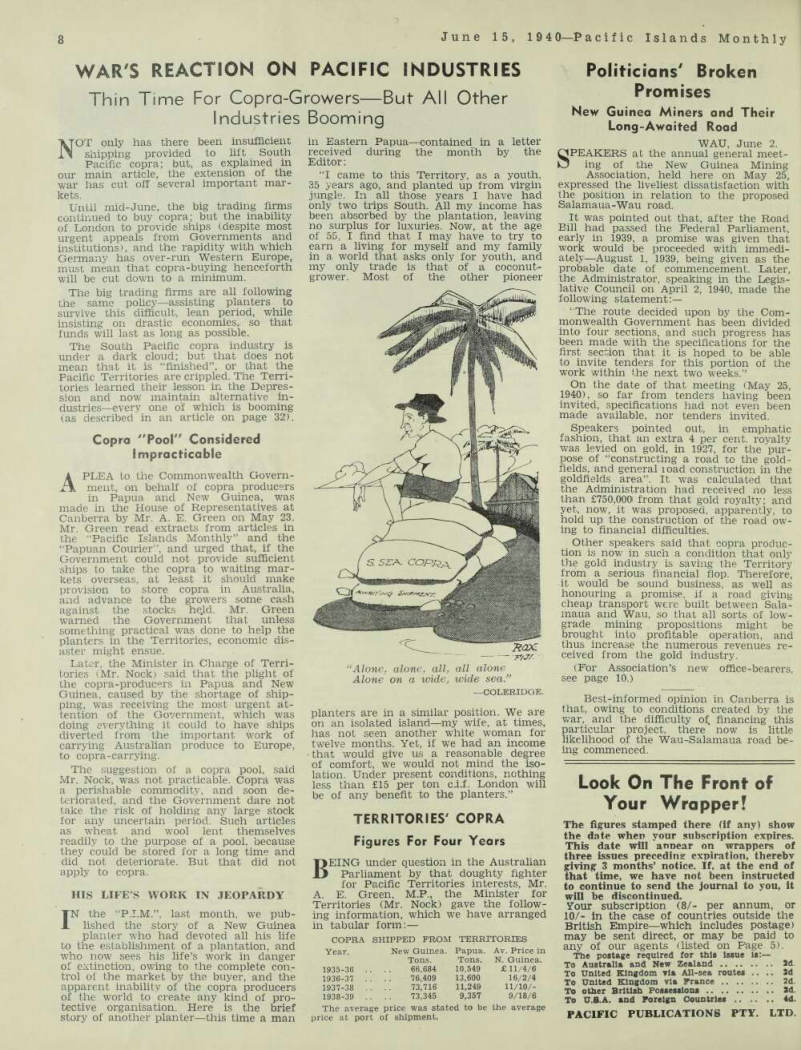
“Alone, alone, all, all alone Alone on a wide, wide sea.”
—Coleridge.
Year.
New Guinea.
Papua.
Av. Price in Tons.
Tons.
N. Guinea. 1935-36 .. 66,684 10,549 £11/4/6 1936-37 .. 76,409 13,600 16/2/4 1937-38 73,716 11,249 11/10/- 1938-39 .. 73,345 9,357 9/18/6 The average price at port price was stated to be of shipment. the average
Politicians' Broken
Promises New Guinea Miners and Their Long-Awaited Road
WAU, June 2.
SPEAKERS at the annual general meet ing of the New Guinea Mining Association, held here on May 25, expressed the liveliest dissatisfaction with the position in relation to the proposed Salamaua-Wau road.
It was pointed out that, after the Road Bill had passed the Federal Parliament, early in 1939, a promise was given that work would be proceeded with immedi ately—August 1, 1939, being given as the probable date of commencement. Later, the Administrator, speaking in the Legis lative Council on April 2, 1940, made the following statement;— ‘ The route decided upon by the Com monwealth Government has been divided into four sections, and such progress has been made with the specifications for the first section that it is hoped to be able to invite tenders for this portion of the work within the next two weeks.”
On the date of that meeting (May 25, 1940), so far from tenders having been invited, specifications had not even been made available, nor tenders invited.
Speakers pointed out, in emphatic fashion, that an extra 4 per cent, royalty was levied on gold, in 1927, for the pur pose of “constructing a road to the gold fields, and general road construction in the goldfields area”. It was calculated that the Administration had received no less than £750,000* from that gold royalty; and yet, now, it was proposed, apparently, to hold up the construction of the road ow ing to financial difficulties.
Other speakers said that copra produc tion is now in such a condition that only the gold industry is saving the Territory from a serious financial flop. Therefore, it would be sound business, as well as honouring a promise, if a road giving cheap transport were built between Sala maua and Wau, so that all sorts of low grade mining propositions might be brought into profitable operation, and thus increase the numerous revenues re ceived from the gold industry. (For Association’s new office-bearers, see page 10.) Best-informed opinion in Canberra is that, owing to conditions created by the war, and the difficulty o£ financing this particular project, there now is little likelihood of the Wau-Salamaua road be ing commenced.
Advertisements & other items, p. 10 (2 items)
8
June 15, 194 O—P acific Islands Monthly
Your Wrapper!
Look On The Front of
The figures stamped there (if any) show the date when your subscription expires.
This date will annear on wrappers of three issues preceding expiration, thereby giving 3 months’ notice. If, at the end of that time, we have not been instructed to continue to send the journal to you, it will be discontinued.
Your subscription (8/- per annum, or 10/- in the case of countries outside the British Empire—which includes postage) may be sent direct, or may be paid to any of our agents (listed on Page 5).
The postage required for this Issue Is:— To Australia and New Zealand 2d.
To United Kingdom via All-sea routes ... 3d To United Kingdom via Prance 2d.
To other British Possessions 3d.
To U.B.A. and Foreign Countries 4d.
PACIFIC PUBLICATIONS PTY. LTD.
Tahiti Will Buy
From Australia
New Trade Grows Out of War Conditions
ON the outbreak of war, in September last, both the British and French Governments took steps to pre serve their dollar exchange in the United States. The effect of this was quickly felt in Tahiti, where American made goods represented about half of the French Colony’s imports.
The position in the Colony to-day was outlined to the “P.1.M.” early in June, by Mr. Sin Kung Po, prominent Papeete merchant, who arrived in Sydney re cently to “build up relations between Australian manufacturers and Tahiti merchants”.
“Since the war began,” Mr. Po stated, “we have not been able to obtain the dollar exchange to buy American goods and, therefore, we have had to find a new source of supply. Practically the whole of the goods imported into French Oceania prior to the war came from America, Europe and the East. Since then very few goods have been imported from the Orient, and imports from Europe and America have practically ceased, “Tahiti merchants are all in the same position, and will have to buy from Australia now, as European countries cannot get regular supplies of raw materials, and communications between the Colony and Europe are also very irregular.
“We are after general merchandise— tinned meats and milk, hardware, glass ware, cotton goods, etc. —and we are anxious to obtain these goods from Aus tralia. Tahiti now is giving preference to sterling countries when purchasing goods.
“Australian manufacturers have met me in every possible way. They have had difficulty in obtaining raw materials for goods usually exported, but they expect that this problem will be soon eliminated, paving the way for increased export business.
“The shipping facilities between Aus tralia and Tahiti are quite satisfactory, from our point of view; and, since my arrival here, I have arranged for the export of considerable quantities of Aus tralian manufactures to Tahiti, as well as numerous samples. This will be maintained. I have met with no diffi culties in arranging shipping space for my goods.
“No doubt it will take time before the people over there get used to the new type of manufactures: these are a little higher in price, but the quality is first class and I think the people will turn favourably towards them.
“At present, there is not much recip rocal trade between the two countries, but I hope that under these new arrangements a barter system, whereby Tahitian vanilla beans will be exchanged for Australian manufactures, will be established, and grow into considerable dimensions.”
Mr. Po said his business specialised in vanilla beans, and was one of the big gest exporters of this product in the Society Islands.
“Business conditions in Tahiti are quite normal,” he continued. “We have been very fortunate in having the usual
prices for our copra and vanilla main tained. The Colony produces between 180 and 200 tons of beans per annum, and it is a very valuable industry.”
Prior to the war, beans were exported principally to America and Europe, added Mr. Po, who expressed a desire to see Australia increase her present very small imports of this product.
“I would like to see the business in vanilla beans develop on a bigger scale,” he continued. “Since I have been here I found that importers of vanilla beans are somewhat handicapped by a quota system, and people who want to buy Tahiti beans cannot get them, sim ply because of this. I think that now. as Britain and France are fighting side by side, there is no reason why either Government should impose such restric tions. It has been difficult to buy Aus tralian goods in the past, but these dif ficulties are rapidly being overcome,” he concluded.
Mr. Po, who is also well known in the Society Group as Ah You, arrived in Tahiti some 27 years ago; and, three years later, he founded the now flour ishing merchant business of Sin Tung Hing Co., which has branches in vari ous parts of French Oceania. He will leave Australia this month on his return to Tahiti.
Administrator Of
Papua
Legislation, But No Appointment
NO appointment yet has been made to the position of Administrator of Papua, in succession to the late Sir Hubert Murray, and none seems likely yet.
It was necessary, before consider ing an appointment, that legislation should be passed, altering the title from “Lieutenant-Governor” to “Admini strator”. This bill was brought in in the last hours of session on May 31. It changes the title, as stated, and also provides that the salary for the position shall be reduced from £l,BOO per annum to £1,500 per annum, the same as is re ceived by the Administrator of the Man dated Territory of New Guinea.
The new minister for the Territories, Mr. Howard Nock, may make an effort, probably next month, to pay a flying visit to Panua and New Guinea; and if that can .be arranged it is possible that the Papuan appointment will not come before Cabinet until he has returned and made a formal report.
Europe
Future Of East
Indies
Awaiting Events in Europe
THE future of the Dutch East Indies is now uncertain. Whatever happens must affect all Pacific Territories.
When Germany over-ran Holland, in May, the Netherlands sovereign and Government took refuge in England, and it was announced that the administration of all Dutch Colonies would be directed from there, and that there would be no alteration in the status of any of them.
Japan and the United States, however, continued to manifest the liv°liest inter est in the East Indies. The attitude of both Powers was set out clearly in the “P.1.M.” last month.
After that, it was assumed that there would be no interference with the East Indies, so long as that Territory of 60.000,000 people was governed in the same way as in the past.
On May 22, the German Ambassador in Tokio delivered the following message to the Japanese Foreign Office: “The German Government is not interested in the East Indies problem.”
There were many guesses at to what this might mean. Did Germany indicate that she left the disposal of the Indies to Japan, or that she did not intend to interfere with the Dutch Colonial Empire?
On May 24, it was reported that Russia, Germany and Japan proposed to hold, at Peiping (the former capital of China), a conference to discuss the future of the Netherlands East Indies.
The same day. the Australian Minister for External Affairs. Mr. McEwen. made a statement. He said that, previously, he had stated that three Pacific powers— Japan, the United States of America, the United Kingdom—together with Aus tralia, had severally declared that the position of the Netherlands East Indies should not be affected by hostilities in Europe.
“The only thiQg that I can add to that statement”, continued the Minister, “is that I have since had an interview in Canberra with Mr. Akiyama, the Consul- General for Japan, when assurances on behalf of the respective governments were given that neither Australia nor Japan would take any action likely to affect the present position in regard to the status quo in the Netherlands East
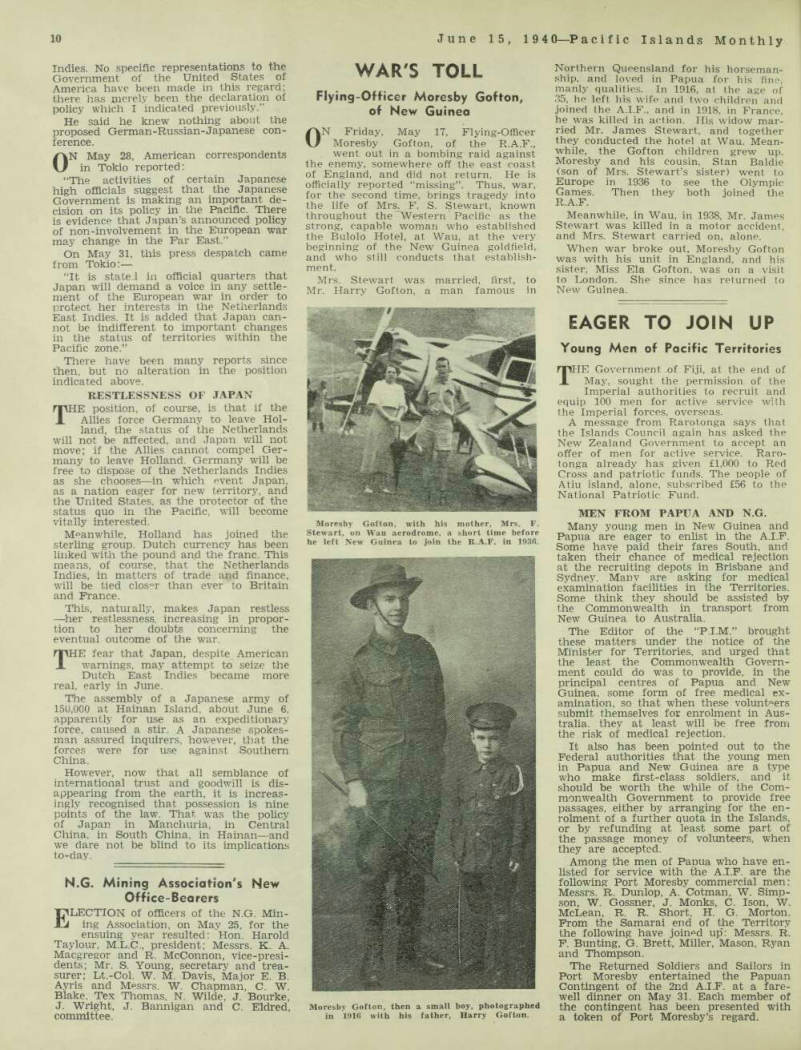
Basket-ball 18 a favourite game among the young people in Samoa, and the photograph shows one of the leading teams, “Army and Navy”, in their picturesque sports dress. The girls, however, wear shorts when playing.
Indies. No specific representations to the Government of the United States of America have been made in this regard; there has merely been the declaration of policy which I indicated previously.”
He said he knew nothing about the proposed German-Russian-Japanese con ference.
ON May 28, American correspondents in Tokio reported: “The activities of certain Japanese high officials suggest that the Japanese Government is making an important de cision on its policy in the Pacific. There is evidence that Japan’s announced policy of non-involvement in the European war may change in the Far East.”
On May 31, this press despatch came from Tokio:— “It is stateJ in official quarters that Japan will demand a voice in any settle ment of the European war in order to protect her interests in the Netherlands East Indies. It is added that Japan can not be indifferent to important changes in the status of territories within the Pacific zone.”
There have been many reports since then, but no alteration in the position indicated above.
Restlessness Of Japan
THE position, of course, is that if the Allies force Germany to leave Hol land, the status of the Netherlands will not be affected, and Japan will not move; if the Allies cannot compel Ger many to leave Holland. Germany will be free to dispose of the Netherlands Indies as she chooses—in which event Japan, as a nation eager for new territory, and the United States, as the protector of the status quo in the Pacific, will become vitally interested.
Meanwhile, Holland has joined the sterling group. Dutch currency has been linked with the pound and the franc. This means, of course, that the Netherlands Indies, in matters of trade and finance, will be tied clos°r than ever to Britain and France.
This, naturally, makes Japan restless —her restlessness, increasing in propor tion to her doubts concerning the eventual outcome of the war.
THE fear that Japan, despite American warnings, may attempt to seize the Dutch East Indies became more real, early in June.
The assembly of a Japanese army of 150,000 at Hainan Island, about June 6, apparently for use as an expeditionary force, caused a stir. A Japanese spokes man assured inquirers, however, that the forces were for use against Southern China.
However, now that all semblance of international trust and goodwill is dis appearing from the earth, it is increas ingly recognised that possession is nine points of the law. That w 7 as the policy of Japan in Manchuria, in Central China, in South China, in Hainan—and we dare not be blind to its implications to-day.
Advertisements & other items, p. 11 (1 item)
9
Pacific Islands Monthl y—J une 15, 1940
N.G. Mining Association's New
Office-Bearers
IjILECTION of officers of the N.G. Min- J ing Association, on May 25, for the ensuing year resulted: Hon. Harold Taylour, M.L.C., president; Messrs. K. A.
Macgregor and R. McConnon, vice-presi dents; Mr. S. Young, secretary and trea surer; Lt.-Col. W. M. Davis, Major E. B.
Ayris and Messrs. W. Chapman, C. W.
Blake. Tex Thomas, N. Wilde, J. Bourke, J. Wright, J. Bannigan and C. Eldred, committee.
War's Toll
Flying-Officer Moresby Gofton, of New Guinea
ON Friday, May 17, Flying-Officer Moresby Gofton, of the R.A.F., went out in a bombing raid against the enemy, somewhere off the east coast of England, and did not return. He is officially reported “missing”. Thus, war, for the second time, brings tragedy into the life of F. S. Stewart, known throughout the Western Pacific as the strong, capable woman who established the Bulolo Hotel, at Wau, at the very beginning of the New Guinea goldfield, and who still conducts that establish ment.
Mrs. Stewart was married, first, to Mr. Harry Gofton, a man famous in
Northern Queensland for his horseman ship, and loved in Papua for his fine, manly qualities. In 1916, at the age of 35, he left his wife and two children and joined the A.1.F., and in 1918, in France, he was killed in action. His widow mar ried Mr. James Stewart, and together they conducted the hotel at Wau. Mean while, the Gofton children grew up.
Moresby and his cousin, Stan Baldie (son of Mrs. Stewart’s sister) went to Europe in 1936 to see the Olympic Games. Then they both joined the
R.A.F.
Meanwhile, in Wau, in 1938, Mr. James Stewart was killed in a motor accident, and Mrs. Stewart carried on, alone.
When war broke out, Moresby Gofton was with his unit in England, and his sister, Miss Ela Gofton, was on a visit to London. She since has returned to New Guinea.
Moresby Gofton, with his mother, Mrs. F.
Stewart, on Wau aerodrome, a short time before he left New Guinea to join the R.A.F. in 1936.
Moresby Gofton, then a small boy, photographed in 1916 with his father, Harry Gofton,
Eager To Join Up
Young Men of Pacific Territories
rpHE Government of Fiji, at the end of J. May, sought the permission of the Imperial authorities to recruit and equip 100 men for active service with the Imperial forces, overseas.
A message from Rarotonga says that the Islands Council again has asked the New Zealand Government to accept an offer of men for active service. Raro tonga already has given £l,OOO to Red Cross and patriotic funds. The people of Atiu island, alone, subscribed £56 to the National Patriotic Fund.
Men From Papua And N.G.
Many young men in New Guinea and Papua are eager to enlist in the A.I.F.
Some have paid their fares South, and taken their chance of medical rejection at the recruiting depots in Brisbane and Sydney. Many are asking for medical examination facilities in the Territories.
Some think they should be assisted by the Commonwealth in transport from New Guinea to Australia.
The Editor of the “P.1.M.” brought these matters under the notice of the Minister for Territories, and urged that the least the Commonwealth Govern ment could do was to provide, in the principal centres of Papua and New Guinea, some form of free medical ex amination, so that when these volunteers submit themselves for enrolment in Aus tralia. they at least will be free from the risk of medical rejection.
It also has been pointed out to the Federal authorities that the young men in Papua and New Guinea are a type who make first-class soldiers, and it should be worth the while of the Com monwealth Government to provide free passages, either by arranging for the en rolment of a further quota in the Islands, or by refunding at least some part of the passage money of volunteers, when they are accepted.
Among the men of Papua who have en listed for service with the A.I.F. are the following Port Moresby commercial men: Messrs. R. Dunlop, A. Cotman, W. Simp son, W. Gossner, J. Monks, C. Ison, W.
McLean, R. R. Short. H. G. Morton.
From the Samarai end of the Territory the following have joined up: Messrs. R.
F. Bunting, G. Brett, Miller, Mason, Ryan and Thompson.
The Returned Soldiers and Sailors in Port Moresby entertained the Papuan Contingent of the 2nd A.I.F. at a fare well dinner on May 31. Each member of the contingent has been presented with a token of Port Moresby’s regard.
Tropicalities
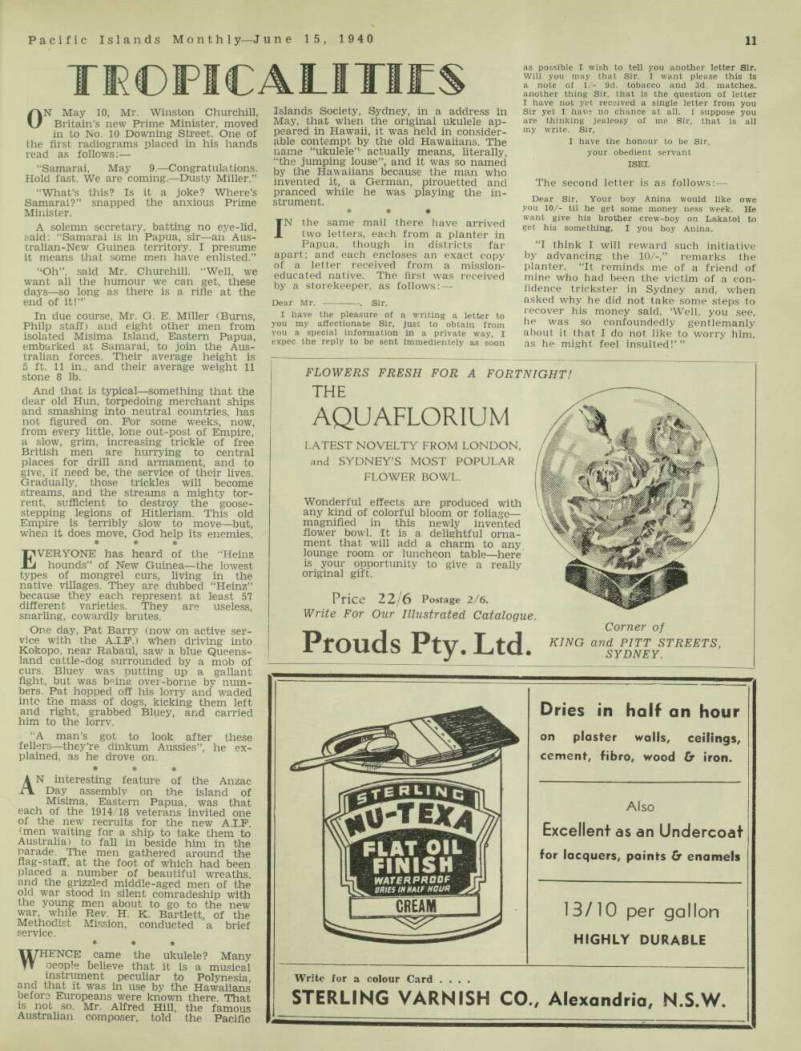
ON May 10, Mr. Winston Churchill, Britain’s new Prime Minister, moved in to No. 10 Downing Street. One of the first radiograms placed in his hands read as follows: “Samarai, May 9.—Congratulations.
Hold fast. We are coming.—Dusty Miller."
“What’s this? Is it a joke? Where’s Samarai?” snapped the anxious Prime Minister.
A solemn secretary, batting no eye-lid, said: “Samarai is in Papua, sir—an Aus tralian-New Guinea territory. I presume it means that some men have enlisted.”
“Oh", said Mr. Churchill. “Well, we want all the humour we can get, these days—so long as there is a rifle at the end of it!"' In due course, Mr. G. E. Miller (Burns, Philp stall) and eight other men from isolated Misima Island, Eastern Papua, embarked at Samarai, to join the Aus tralian forces. Their average height is 5 ft. 11 in., and their average weight 11 stone 8 lb.
And that is typical—something that the dear old Hun, torpedoing merchant ships and smashing into neutral countries, has not figured on. For some weeks, now, from every little, lone out-post of Empire, a slow, grim, increasing trickle of free British men are hurrying to central places for drill and armament, and to give, if need be, the service of their lives.
Gradually, those trickles will become streams, and the streams a mighty tor rent, sufficient to destroy the goose stepping legions of Hitlerism. This old Empire is terribly slow to move—but, when it does move, God help its enemies. * * » EVERYONE has heard of the “Heinz hounds" of New Guinea—the lowest types of mongrel curs, living in the native villages. They are dubbed “Heinz” because they each represent at least 57 different varieties. They are useless, snarling, cowardly brutes.
One day, Pat Barry (now on active ser vice with the A.1.F.) when driving into Kokopo, near Rabaul, saw a blue Queens land cattle-dog surrounded by a mob of curs. Bluey was putting up a gallant fight, but was b°ing over-borne by num bers. Pat hopped off his lorry and waded into the mass of dogs, kicking them left and right, grabbed Bluey, and carried him to the lorrv.
“A man’s got to look after these fellers—they’re dinkum Aussies”, he ex plained, as he drove on. * * * AN interesting feature of the Anzac Day assembly on the island of Misima, Eastern Papua, was that each of the 1914/18 veterans invited one of the new recruits for the new A.I.F. (men waiting for a ship to take them to Australia) to fall in beside him in the parade. The men gathered around the flag-staff, at the foot of which had been placed a number of beautiful wreaths, and the grizzled middle-aged men of the old war stood in silent comradeship with the young men about to go to the new war, while Rev. H. K. Bartlett, of the Methodist Mission, conducted a brief service. * • ♦ WHENCE came the ukulele? Many people believe that it is a musical instrument peculiar to Polynesia, and that it was in use by the Hawaiians before Europeans were known there. That is not so. Mr. Alfred Hill, the famous Australian composer, told the Pacific
Islands Society, Sydney, in a address In May, that when the original ukulele ap peared in Hawaii, it was held in consider able contempt by the old Hawaiians. The name “ukulele" actually means, literally, “the jumping louse", and it was so named by the Hawaiians because the man who invented it, a German, pirouetted and pranced while he was playing the in strument. * * • IN the same mail there have arrived two letters, each from a planter in Papua, though in districts far apart; and each encloses an exact copy of a letter received from a mission educated native. The first was received by a storekeeper, as follows: Dear Mr. . Sir.
I have the pleasure of a writing a letter to you my affectionate Sir, just to obtain from you a special information in a private way, I expec the reply to be sent immedientely as soon
as possible I wish to tell you another letter Sir.
Will you may that Sir. I want please this Is a note of 1/- 9d. tobacco and 3d. matches, another thing Sir, that is the question of letter I have not yet received a single letter from you Sir yet I have no chance at all. i suppose you are thinking jealeosy of me Sir, that is all my write. Sir, I have the honour to be Sir, your obedient servant
Isei.
The second letter is as follows: Dear Sir, Your boy Anina would like owe you 10/- til he get some money ness week. He want give his brother crew-boy on Lakatoi to get his something. I you boy Anina.
“I think I will reward such initiative
by advancing the 10/-," remarks the
planter. “It reminds me of a friend of mine who had been the victim of a con fidence trickster in Sydney and, when asked why he did not take some steps to recover his money said, ‘Well, you see, he was so confoundedly gentlemanly about it that I do not like to worry him, as he might feel insulted!’’’
Advertisements & other items, pp. 13-14 (2 items)
11
Pacific Islands Monthl y—J une 15, 1940
Aquaflorium
FLOWERS FRESH FOR A FORTNIGHT!
THE
LATEST NOVELTY FROM LONDON,
and SYDNEY’S MOST POPULAR
FLOWER BOWL.
Wonderful effects are produced with any kind of colorful bloom or foliage— magnified in this newly invented flower bowl. It is a delightful ornament that will add a charm to any lounge room or luncheon table—here is your opportunity to give a really original gift.
Price 22/6 Postage 2/6.
Write For Our Illustrated Catalogue. € m m
Prouds Pty. Ltd.
Corner of
KING and PITT STREETS,
SYDNEY.
Dries in half an hour on plaster walls, ceilings, cement, fibro, wood Cr iron.
TE«
CREAM
Also Excellent as an Undercoat for lacquers, paints & enamels 13/10 per gallon
HIGHLY DURABLE
Write for a colour Card ...
STERLING VARNISH CO., Alexandria, N.S.W.
y i¥.-BH
Australia's Leading Footwear Mail
Order House—Established Over 28 Years
Wittner Footwear is guaranteed first quality—guaranteed to give fair wear—guaranteed to give Satisfaction or Money Refunded! Goods despatched same day as received.
Order with absolute confidence, by number, remitting in Australian currency.
Mail Orders to:—Box 1281, G.P.0., Melb.
ACCLAIMED ! I Only recently
introduced to Islands yet
100's sold already I
POST FREE!
21 Men! The handiest boot you can buy. American style Sin. leg protects from dust, seeds, thorns, reptiles—also from the wet in the rainy season.
Sales are reaching a record “high”. They’re phenomenal!—No, colossal! And the reason is it’s the perfect boot at the right price. The amazingly durable upraised pattern-tread Tyre Cord soles—a generous half inch of actual Motor Tyre material, plus a full I inch tread —WON’T SLIP—WON’T WEAK OUT!! They’re brass-screwed, stitched and stuck to a stout selected-leather midsole, which is sewn and screwed to a strong leather insole. Note other outstanding features: —Double Tanned Uppers —8 inch leg. Black or Brown. 3 Rows Waxed Thread Stitching. Riveted Flaps for Strength. Half Bellows Tongue. Solid Leather Insoles, to which is sewn and screwed solid Leather Outer Sole, to carry the Tyre Cord Sole. Tyre-cord, Safety, Non-skid Sole, Sewn and firmly solutioned on. Extra Wide Fitting, Comfortable Shape. Guaranteed, All Sizes, 5 to 11— 27/6. Post Free. Order numbers at right.
SAME BOOT—but with SHORT LEG
With shorter (ordinary height) tops, and the same soles, uppers and other outstanding features, 20/-.
BLACK ONLY. ORDER XX 1045.
Smart All-Purpose Shoe
for you Ladies !
LIGHT
BUT
STRONG !
in BLACK CALF
BROWN CALF
BLUE CALF
12 1 Flippant Fringe Tongue for the smarter woman. So comfy, too! In smooth foot-soothing calfskin, attractively punched, with strong weltstitched leather-soles and solid leather heels. Full and half sizes 2 to 7, 12/9. Order XX 43056, for Black— XX 53056, Blue—XX 63056, Brown.
POST
FREE!
W«\W» \
iieq v
LorVhe
l-fovrtp
ft W*/
lit
I HI
nwE
MM ORDER
if XX1046
r BLACK
XX 1047
BROWN
17/6 22/6, 91
Three- VSrjSjt
Decker \ * Soles. *** **
WI TIMER'S PTY. LTD.
Head Office & Mail Order Dept.,
480-484 Collins St., Melbourne, Aust
TOECAP
XX 756
PLAIN
XX 856 The boot with the extra quality. Extra strong and extra long-wearing with those 3-decker soles. Uppers are tougher quality black box yearling calf—very pliable. The shape is medium, wide and comfortable; a boot that is TRUE ECONOMY. Pull and half sizes 5 to 11, 17/6 pair. For Plain Vamp, order XX 856; Toecap, XX 756.
Address Orders to
BOX 1281 G.P.0.,
Melbourne, Victoria, Aust
DOUBLE
TANNED
ORDER
TOUGHEST you can buy! xxloo9 For long honest wear here’s the boot you want.
Guaranteed for 6 months —will last easily 18 months with care. Note the following features. Super quality uppers, chrome-tanned, water-resisting—Stout 3-decker Heavy Duty Soles—Note Clump Soles —One-piece Vamp with Imitation Cap—Wetproof Tongues—Unbreakable Backs—Soles Flat Nailed for Extra Wear —Sizes 5 to 11, 22/6. Order XX 1009,
Please Remit Payment in
Australian Currency.
Order by Number.
About Islands People
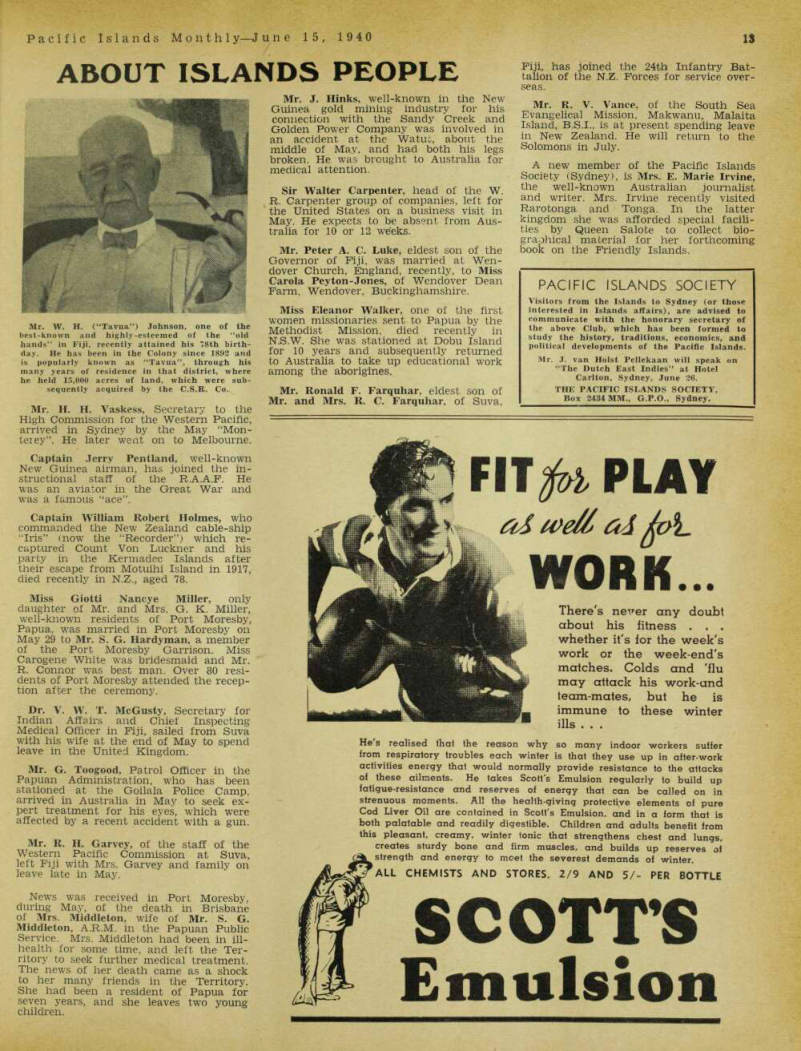
Mr, H. H. Vaskess, Secretary to the High Commission for the Western Pacific, arrived in Sydney by the May “Mon terey”. He later went on to Melbourne, Captain Jerry Pentland, well-known New Guinea airman, has joined the in structional staff of the R.A.A.F. He was an aviator in the Great War and was a famous “ace”.
Captain William Robert Holmes, who commanded the New Zealand cable-ship “Iris” (now the “Recorder”) which re captured Count Von Luckner and his party in the Kermadec Islands after their escape from Motuihi Island in 1917, died recently in N.Z., aged 78.
Miss Giotti Nancye Miller, only daughter of Mr. and Mrs. G. K. Miller, well-known residents of Port Moresby, Papua, was married in Port Moresby on May 29 to Mr. S. G. Hardyman, a member of the Port Moresby Garrison. Miss Carogene White was bridesmaid and Mr.
R. Connor was best man. Over 80 resi dents of Port Moresby attended the recep tion after the ceremony.
Dr. V. W. T. McGusty, Secretary for Indian Affairs and Chief Inspecting Medical Officer in Fiji, sailed from Suva with his wife at the end of May to spend leave in the United Kingdom.
Mr. G. Toogood, Patrol Officer in the Papuan Administration, who has been stationed at the Goilala Police Camp, arrived in Australia in May to seek ex pert treatment for his eyes, which were affected by a recent accident with a gun.
Mr. R. H. Garvey, of the staff of the Western Pacific Commission at Suva, left Fiji with Mrs. Garvey and family on leave late in May.
News was received in Port Moresby, during May, of the death in Brisbane of Mrs. Middleton, wife of Mr. S. G.
Middleton. A.R.M. in the Papuan Public Service. Mrs. Middleton had been in ill health for some time, and left the Ter ritory to seek further medical treatment.
The news of her death came as a shock to her many friends in the Territory.
She had been a resident of Papua for seven years, and she leaves two young children.
Mr. J. Hinks, well-known in the New Guinea gold mining industry for his connection with the Sandy Creek and Golden Power Company was involved in an accident at the Watut, about the middle of May, and had both his legs broken. He was brought to Australia for medical attention.
Sir Walter Carpenter, head of the W.
R. Carpenter group of companies, left for the United States on a business visit in May. He expects to be absent from Aus tralia for 10 or 12 weeks.
Mr. Peter A. C. Luke, eldest son of the Governor of Fiji, was married at Wen dover Church, England, recently, to Miss Carola Peyton-Jones, of Wendover Dean Farm, Wendover, Buckinghamshire.
Miss Eleanor Walker, one of the first women missionaries sent to Papua by the Methodist Mission, died recently in N.S.W. She was stationed at Dobu Island for 10 years and subsequently returned to Australia to take up educational work among the aborigines.
Mr. Ronald F. Farquhar, eldest son of Mr. and Mrs. R. C. Farquhar, of Suva,
Fiji, has joined the 24th Infantry Bat talion of the N.Z. Forces for service over seas.
Mr. R. V. Vance, of the South Sea Evangelical Mission, Makwanu, Malaita Island, 8.5.1., is at present spending leave in New Zealand. He will return to the Solomons in July.
A new member of the Pacific Islands Society (Sydney), is Mrs. E. Marie Irvine, the well-known Australian journalist and writer. Mrs. Irvine recently visited Rarotonga and Tonga. In the latter kingdom she was afforded special facili ties by Queen Salote to collect bio graphical material for her forthcoming book on the Friendly Islands.
Mr. W. H. (“Tavua”) Johnson, one of the best-known and highly-esteemed of the “old hands” in Fiji, recently attained his 78th birth day. He has been in the Colony since 1892 and is popularly known as “Tavua”, through his many years of residence in that district, where he held 15,000 acres of land, which were sub sequently acquired by the C.S.R. Co.
Advertisements & other items, pp. 15-16 (2 items)
13
Pacific Islands Monthl y—J une 15, 1940
Scott’S
PACIFIC ISLANDS SOCIETY
Visitors from the Islands to Sydney (or those interested in Islands affairs), are advised to communicate with the honorary secretary of the above Club, which has been formed to study the history, traditions, economics, and political developments of the Pacific Islands.
Mr. J. van Holst Pellekaan will speak on “The Dutch East Indies’’ at Hotel Carlton, Sydney, June 26.
THE PACIFIC ISLANDS SOCIETY,
Box 2434 MM., G.P.0., Sydney.
Wii
FIT fa, PLAY
aS we/l al
WORK
• • • There's never any doubt about his fitness . . . whether it's for the week's work or the week-end's matches. Colds and 'flu may attack his work-und team-mates, but he is immune to these winter ills . . .
He s realised that the reason why so many indoor workers suffer from respiratory troubles each winter is that they use up in after-work activities energy that would normally provide resistance to the attacks of these ailments. He takes Scott's Emulsion regularly to build up fatigue-resistance and reserves of energy that can be called on in strenuous moments. All the health-giving protective elements of pure Cod Liver Oil are contained in Scott's Emulsion, and in a form that is both palatable and readily digestible. Children and adults benefit from this pleasant, creamy, winter tonic that strengthens chest and lungs, creates sturdy bone and firm muscles, and builds up reserves of strength and energy to meet the severest demands of winter.
ALL CHEMISTS AND STORES. 2/9 AND 5/- PER BOTTLE
SCOTT’S
Emulsion
Just Relea
H •» .. ' • v - - BiSiSSrX; 77ie
ULTIMATE
Mantel Model
Featuring Light Ray Tuning with Spinner Control; Photo Process Dial with Selective Illumination and many important improvements. Specially protected against insect invasion and impregnated against humidity.
Compact and very efficient. The ideal set tor the Islands!
6-VALVE DUAL WAVE 7-VALVE DUAL WAVE
ELECTRIC MODEL VIBRATOR MODEL
Send this Coupon To-day Special Export Price for the Islands GEORGE BROWN & CO. PTY. LTD., 267 Clarence St., Sydney.
Please send me, without obligation, particulars of the “ULTIMATE” Mantel Radio Receiver.
Name...
Address.
GEORGE BROWN & CO. PTY. LTD., 267 Clarence Street, Sydney.
Workers' Compensation
Act in Fiji Not Applicable to Agriculturists
ALTHOUGH there is a large industrial population in Fiji, the workers there hitherto have not had the advantage of a Workmen’s Compensa tion Act, which is now an essential part of the industrial machinery of most countries of the British Empire.
Late in May, however, the Fiji Legis lative Council passed a Workmen’s Com pensation Act, which is to come into operation forthwith. It is provided that the Act will not apply to industries classed under the headings of “agricul ture” or “coconut plantations”.
Thus, presumably, while the mining company or the transport company must pay compensation to workers injured or killed in its employ, a company grow ing sugar or coconuts is free from that obligation. It is a surprising distinc tion. Are the limbs or life of a man engaged in sugar or coconut production less valuable than those of a miner or sailor?
The Act provides that the minimum claim, in the event of death, will be £lOO, and the maximum £6OO.
Interest in this legislation will be felt in New Guinea, where there has been lately a good deal of discussion con cerning an adequate Workers’ Compen sation Act.
New Guinea's Resources
Any Share of That £50,000,000?
rAT indefatigable worker for the public good, Mr. Henry Eekhoff, of Lae, New Guinea, has been vigor ously placing before the Australian Mini ster for Territories a suggestion that the Mandated Territories should receive some portion of the £50,000,000 made available by the British Imperial Government for colonial development.
Mr. Eekhoff has submitted to the Mini ster a plan under which money could be used advantageously for the reading, settlement and planting of large areas in New Guinea.
If Mr, Eekhoff succeeds in overcoming Canberra inertia, and getting under way some plan for the real agricultural de velopment of the Territory—a thing which has been hung up for at least 20 years— he will deserve all the medals which the public funds of New Guinea can buy.
As a matter of fact, it would be im pudence on the part of the Australian Government to ask Great Britain for a share of that £50,000,000 of colonial grant for expenditure in New Guinea. New Guinea, by reason of its gold industry, is one of the most richly-endowed tropical territories in the world and, if the country had been properly governed, it would have shown, between 1930 and 1940, a magnificent record of develop ment and progress. As it is, the less said about its record the better.
Mr. J. T. McEvoy, planter, of Manus, New Guinea, who was recently on fur lough in Australia, bought a schooner in Cairns for inter-island work and Cap tain Cruickshank came down recently from New Guinea with three of a crew to sail the schooner to Manus.
Advertisements & other items, p. 16 (1 item)
14
June 15, 1940—Paciflc Islands Monthly
Paramount Ariki-Elect
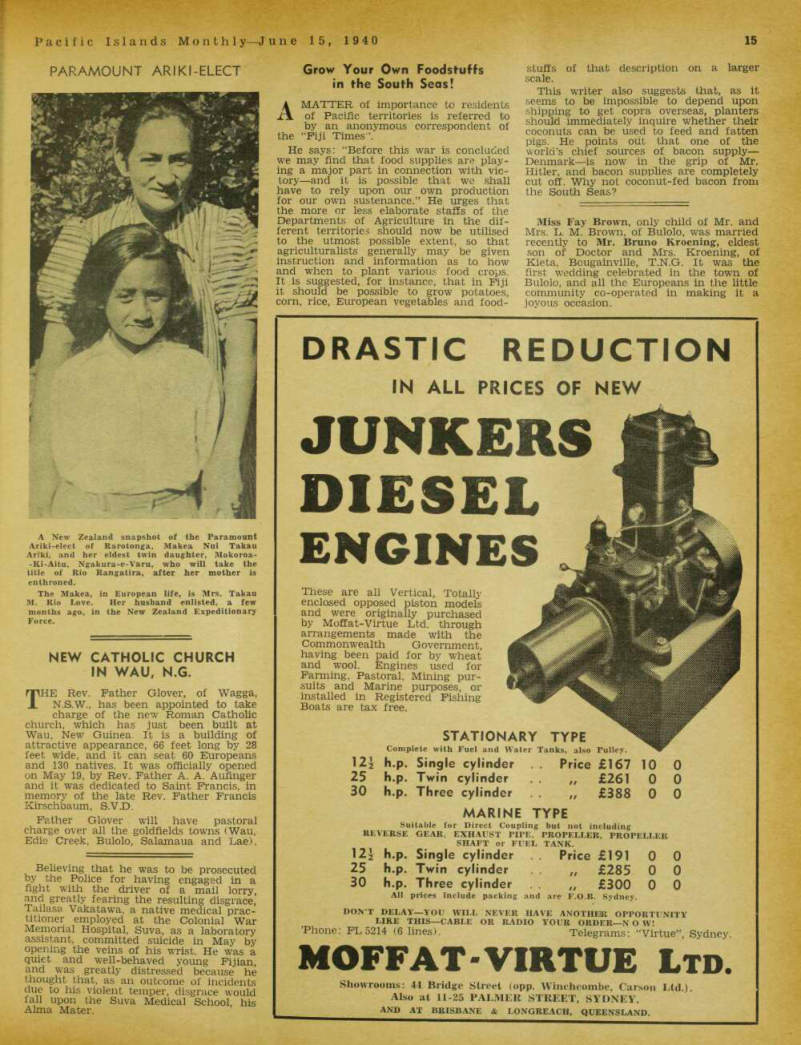
A New Zealand snapshot of the Paramount Ariki-elect of Rarotonga, Makea Nui Takau Ariki, and her eldest twin daughter, Mokoroa -Ki-Aitu, Ngakura-e-Varu, who will take the title of Rio Rangatira, after her mother is enthroned.
The Makea, in European life, is Mrs. Takau M. Rio Love. Her husband enlisted, a few months ago, in the New Zealand Expeditionary Force.
New Catholic Church
In Wau, N.G.
THE Rev. Father Glover, of Wagga, N.S.W., has been appointed to take charge of the new Roman Catholic church, which has just been built at Wau, New Guinea. It is a building of attractive appearance, 66 feet long by 28 feet wide, and it can seat 60 Europeans and 130 natives. It was officially opened on May 19, by Rev. Father A. A. Aufinger and it was dedicated to Saint Francis, in memory of the late Rev. Father Francis Kirschbaum, S.V.D.
Father Glover will have pastoral charge over all the goldfields towns (Wau, Edie Creek, Bulolo, Salamaua and Lae).
Believing that he was to be prosecuted by the Police for having engaged in a fight with the driver of a mail lorry, and greatly fearing the resulting disgrace, Tailasa Vakatawa, a native medical prac titioner employed at the Colonial War Memorial Hospital, Suva, as a laboratory assistant, committed suicide in May by opening the veins of his wrist. He was a quiet and well-behaved young Fijian, and was greatly distressed because he thought that, as an outcome of incidents due to his violent ternner, disgrace would fall upon the Suva Medical School, his Alma Mater.
Grow Your Own Foodstuffs
in the South Seas!
A MATTER of importance to residents j\ of Pacific territories is referred to by an anonymous correspondent of the “Fiji Times ’.
He says: “Before this war is concluded we may find that food supplies are play ing a major part in connection with vic tory—and it is possible that we shall have to rely upon our own production for our own sustenance.’’ He urges that the more or less elaborate staffs of the Departments of Agriculture in the dif ferent territories should now be utilised to the utmost possible extent, so that agriculturalists generally may be given instruction and information as to how and when to plant various food crops.
It is suggested, for instance, that in Fiji it should be possible to grow potatoes, corn, rice, European vegetables and food
stuffs of that description on a larger scale.
This writer also suggests that, as it seems to be impossible to depend upon shipping to get copra overseas, planters should immediately inquire whether their coconuts can be used to feed and fatten pigs. He points out that one of the world’s chief sources of bacon supply— Denmark —is now in the grip of Mr.
Hitler, and bacon supplies are completely cut off. Why not coconut-fed bacon from the South Seas?
Miss Fay Brown, only child of Mr. and Mrs. L. M. Brown, of Bulolo, was married recently to Mr. Bruno Kroening, eldest son of Doctor and Mrs. Kroening, of Kieta, Bougainville, T.N.G. It was the first wedding celebrated in the town of Bulolo, and all the Europeans in the little community co-operated in making it a joyous occasion.
Advertisements & other items, p. 17 (2 items)
15
Pacific Islands Monthl y—J une 15, 1940
Junke
DRASTIC REDUCTION
IN ALL PRICES OF NEW
DIESE
ENGINE
These are all Vertical, Totally enclosed opposed piston models and were originally purchased by Moffat-Virtue Ltd. through arrangements made with the Commonwealth Government, having been paid for by wheat and wool. Engines used for Farming, Pastoral, Mining pursuits and Marine purposes, or installed in Registered Fishing Boats are tax free.
Complete with Fuel and I 12J h.p. Single cylinder . Price £167 10 0 25 h.p. Twin cylinder . . „ £261 0 0 30 h.p. Three cylinder . . „ £3BB 0 0
MARINE TYPE
Suitable for Direct Coupling but not including
REVERSE GEAR, EXHAUST PIPE. PROPELLER, PROPELLER
SHAFT or FUEL TANK.
121 h.p. Single cylinder Price £l9l 0 0 25 h.p. Twin cylinder . . „ £285 0 0 All prices include packing and are F. 0.8. Sydney.
DON’T DELAY—YOU WILL NEVER HAVE ANOTHEfR OPPORTUNITY LIRE THIS—CABLE OR RADIO YOUR ORDER—N OW!
MOFFAT-VIRTUE Ltd.
Showrooms: 44 Bridge Street (opp. Winchcombe, Carson Ltd.).
Also at 11-25 PALMER STREET, SYDNEY.
AND AT BRISBANE & LONGREACH, QUEENSLAND.
STATION
30 h.p. Three cylinder . . „ £3OO 0 0 ’Phone: FL5214 (6 lines).
Telegrams: “Virtue”, Sydney.
The "Pandemonium"
London "Times" is Complacent About it?
IN a letter to the London “Times”, published on April 1. 1940, on the subject of a proposed Franco-British postage stamp, the High Commissioner for the Western Pacific, Sir Harry Luke, directed attention to the fact that in the Condominium of the New Hebrides, Franco-British postage stamps have been in use without interruption since 1911.
Sir Harry Luke added: “British and French officials jointly conduct the ad ministration of the Condominium in close harmony and co-operation”.
In a leading article, published on April 2, the “Times” refers to the letter of Sir Harry Luke, and proceeds, complacently and ponderously, to express pleasure at
the apparently successful and satisfactory outcome of the Condominium experiment.
It is a pity that the “Times” could not spend 24 hours in the New Hebrides and see something of the absurdities and ex pense of the Condominium system, with its triplication (French, British and Joint) of departments and services. And all this is being done to govern 800 French, 200 British and 40,000 or 50,000 primitive natives!
Heaven help us all if the ridiculous Condominium Government of the New Hebrides is to be taken for a model for Anglo-French colonial collaboration in the future!
Mr. C. Ferris, formerly of Dunelm School, New Zealand, recently arrived in Fiji to take up a teaching post with the Anglican Mission.
Hon. W. E. Grose
Untimely Death in Melbourne
TTIHE death occurred on Friday, May 31, A in a private hospital at Melbourne, of Hon. William Ernest Grose, one of the best-known planters in New Guinea, and an unofficial member of the New Guinea Legislative Council.
Mr. Grose had been several weeks in Australia, in an endeavour to assist the Commonwealth authorities in providing sufficient shipping for the removal of accumulations of New Guinea copra. He apparently contracted a chill in Sydney,
and was far from well; and, some two or three weeks later, it was reported from Melbourne that he was severely ill from lung complications, and little hope was held out for his recovery.
Mr. Grose was born in 1893, and he served in the Great War as a captain, in the Seventh Australian Infantry Brigade.
As a captain attached to the staff, he undertook important duties at the end of the war, supervising the embarkation of Australian troops returning from France. In 1921 he went to New Guinea as private secretary to the Administrator; in 1923 he became Superintendent of Police and he was Warden on the newly discovered goldfield in Morobe in 1927.
He then resigned from the New Guinea service and took up a plantation in the Kavieng district in New Ireland, and he had carried on his plantation ever since.
He took a keen interest in the activities of the New Guinea Planters’ Association, and it was in that capacity that he re ceived nomination as an unofficial mem ber of the Legislative Council, and he gave considerable assistance to the Ad ministration in various matters connected with planting interests. His sudden and untimely death will cause a shock to resi dents of New Guinea, by whom he was held in high esteem.
Advertisements & other items, p. 18 (3 items)
16
June 16, 194 O—P acific Islands Monthly
choice quality.
AUSTRALIA’S BEST
■XL
CANNED FOODS, JAMS,
SOUPS Cr SAUCES
are known in many countries for their
choice quality.
Have you tried oil these?
IXL BAKED BEANS (with TOMATO
SAUCE). —40z., lOoz, and 16oz. tins.
IXL CURRIED BAKED BEANS, 4 oz. and 10 oz. tins.
IXL CURRIED SPAGHETTI, 4 oz., 8 oz. and 16 oz. tins, IXL SPAGHETTI (in Tomato Sauce with Cheese). —40z., Boz. and 16oz. tins.
IXL JAMS. —All kinds, 120 z., 240 z. and 51b. tins.
IXL JAMS (in 11b. Jars). —Lemon Shred, Orange Shred, Marmalade, etc.
IXL CANNED FRUlTS.—Peaches, Pears, Apricots, etc., 16oz. and 30oz. tins.
IXL SPECIAL GOLDEN QUEEN PEACHES.
16oz. and 30oz. tins.
IXL SPECIAL FRUITS. Gooseberries, Blackberries, Blackcurrants, Cherries, Grapes, Greengages, Golden Drops, Quinces, etc.
IXL SOUPS. —Boz. and 16oz. Cream of Tomato Soup, Boz. and 16oz. Cream of Vegetable Soup. Boz. and 16oz.
Cream of Celery Soup. Boz. and 16oz. Cream of Pea Soup. Boz. and 16oz. Toheroa Soup.
IXL CANNED TOMATOES.—I6oz, and
30oz. tins.
IXL DICED FRUIT SALAD.—I 6 and 30oz. tins.
IXL TOMATO JUICE* —lOoz. and 15oz. tins.
IXL TASMANIAN RICED POTATOES.—
61b. tins.
IXL PICKLES.—AII kinds, 60z., 14oz. and 18oz. Jars.
IXL TOMATO SAUCE.—4oz., lOoz., and 20oz. bottles.
IXL WORCESTERSHIRE SAUCE (OR
RELISH). —50z., lOoz., and 20oz. bottles.
IXL OLIVES. —6oz. and 13oz, jars.
Obtainable from all Leading Island Storekeepers.
IT'S WORTH A LOT TO KNOW THE QUALITY IS ALWAYS IHfcßt
0 BER
«r> ••
SPflCHifTl
DEUCIBUS ON
s TO ST
m THEM FOB BREAKFAST
IXL PRODUCTS ARE QUALITY PRODUCTS
H. JONES & CO. PTY. LTD., HOBART & SYDNEY
Guest House For Sale
WAU, NEW GUINEA.
Fully furnished, cutlery, crockery, linen, etc., Electric Light, 11 Bedrooms, Dining-room, Kitchen, Pantry, Large Lounge, 2 Bathrooms, 2 Native Labour Staff Quarters. Prospects of obtaining liquor license. Prospects of Wau-Salamaua Road construction commencing shortly.
Apply G. A. Anderson, Box 15, JWau, New Guinea.
| Port Moresby
Port Moresby
Water Supply
From Our Own Correspondent
Port Moresby, June 1.
THE survey of the water plan for Port Moresby, including the town reticulation, which has been car ried out by the Commonwealth surveyor, Mr. Stoddart, is nearing completion, and tenders for the supply of pipes, for the pipe-line, have been called by the De partment of the Interior at Canberra.
Tenders for the supply and erection of a water-purification plant also have been called, and closed on May 28.
It is understood that the entire water supply system will be supervised and constructed by the Commonwealth De partment of the Interior, under the direction of Mr. H. G. Hannam, Com monwealth Works Director stationed in Port Moresby.
The Department of the Interior is undertaking works in Port Moresby, including the water scheme, which are estimated to amount to approximately £150,000.
Solving Fiji's Education
Problems
ADDRESSES delivered at the tenth annual conference of the Fiji Teachers' Union, which was held in Suva in May, show that considerable progress is now being made In the urgent but difficult work of providing a primary education for the whole of the children in the Colony.
The European children, for the most part, are provided for, and the missions have done much for the Fijian children; but it is suggested that the needs of the Indian children, who generally are eager for education, have not been sufficiently cared for in past decades. However, the addresses at the conference showed that this problem is being rapidly solved, and the Assistant Director of Education (Mr.
A. H. Phillips, B.Sc.) declared that much solid progress had been made in recent years.
In welcoming Mr. Phillips, the Presi dent, Mr. Hari Charan, 8.A., Dip. Ed., said: “The Fiji Teachers’ Union came into being in 1930 as a result of the fusion of the Suva and Lautoka Teachers’
Associations. Since its inception the Union has grown in strength and influ ence. It has as its objectives (1) the ex tension of education to each and every child in Fiji and (2) the promotion and improvement of the standard and status of the teaching profession . . . We hold that primary education is the right of every child beyond all considerations of race, nationality or creed.”
Norfolk Is. Products
OPERATED side by side, under the same manager (Mr. H. E. Silver sides) are two factories on Norfolk Island—namely, a butter factory and a passion-fruit pulping and canning fac tory. This year, nearly 200 tons of passion-fruit were harvested at Norfolk Island, and yielded 90 tons of pulp. This pulp after being subjected to a special cooling process, was sealed in 4-gallon cans, and held in a cooling chamber until the steamer arrived from Sydney.
During the past six months, both can ned passion-fruit and a quantity of butter have been exported to Australia,
Advertisements & other items, pp. 19-20 (2 items)
17
Pacific Islands Month 1 y—J une 15, 1940
Many a man is discussed
like this by his employers
The scene is the Board of Directors room in a big company in Sydney.
It is Friday morning at 10.30. The Board is sitting.
CHAIRMAN OF THE BOARD; “Well,
here’s the salary list. Johnson’s asking for a rise—says that living expenses are very heavy up in the Islands, as well as having two girls to educate down here in Sydney.”
Ist DIRECTOR: “That’s all very well, but does Johnson’s work justify a rise? Personally I don’t think so.” 2nd DIRECTOR: “I agree. Johnson isn’t turning out to be quite the success we thought he would be.
As a matter of fact, I really think we should consider a change.” 3rd DIRECTOR: “Well, frankly, I’m sorry for Johnson, because I recommended him and you must agree he did a lot of excellent work in the past. Still, the general feeling seems to be against him, so we’d better forget that rise of his.”
And what about Johnson? Why was it he was not the success he should have been? Let us look inside his bungalow and see. . . .
Fred Johnson is leaning against the mantelshelf talking to his wife, Rita.
“I don’t know Rita—none of the things we dreamed about seem to be coming true, do they? I thought that when we came up here we could really get in amongst the money. It seems to take twice as much to live here as anywhere else.
Bills—bills—l’ve never finished paying bills!”
“Cheer up, Fred, it’s not as bad as all that.”
“Not as bad—it’s worse! The trouble is this rotten tiredness of mine.
The everlasting tiredness —I even wake up tired nowadays. How can a man put his mind on his job when he’s got this tiredness hanging over his head?”
‘‘Darling, I really think that tiredness of yours is serious. It’s not right for you to always feel like that—l’ve noticed it. Now look— for my sake will you go and see Dr..
Morris?”
And so Fred Johnson went along and saio Dr. Morris. Dr. Morris gave him a thorough examination.
Then, when he had finished, he said: — “Fred, you’ve probably never realised it, but you’re suffering from night starvation. You see, it’s not a well-known fact, but while you sleep your body goes on burning up energy. Heart beats, breathing and other automatic actions—these take it out of you. Naturally unless energy is replaced during sleep you’re bound to wake tired and feel unequal to your job. Now the best thing for you, Fred, is Horlick’s.
Horlick’s guards against night starvation and helps you to wake refreshed.”
So Fred started drinking Horlick’s every night and it made a wonderful difference to him. We meet him again two months later. He is hurrying up the garden path to his bungalow carrying a letter in his hand. As he approaches the door he calls . . .
“Rita—Rita.”
“Yes dear—what is it?”
“Darling, I landed that order I was telling you about. This means a rise for me now” . . , Do YOU wake tired—feel run down?
Are YOU worried about your job?
If so, drink a cupful of Horlick’s regularly last thing at night. You see tiredness , lack of energy and dulness are really symptoms of night starvation, and Horlick’s guards against night starvation. «OrucKs orlic
PO YOU KNOW ?
W/CE A YEAR. THE
AUCIEUT CRtTE SACRIFICED
SOU REPRESENTm
THEY TORE THE UY/M6 BUU TOj i
PIECES WITH THE/*
Teem, AS A TRIBUTE TO
THEIR RE US ZOOS FER/OOR and /a t%e STRENGTH of their UETH you*, teeth-
iM/LLSTAY STROPS,
TREE FRO/A PRNTAC
DECAY. WHEH yOO USE
MLYHOS ♦ mwos
CLEANS TEETH-
SURGICALLY. MAT
pom to
NAKED
mire £H0 L t \
I ws
vntJTTEEW like
SNAKES ‘
iO ■- : "SSZTZSSZSZT-
EXISTI/VO- B/RPS ARE
Bor pacaeontolos/srs
Y OR/O-JYAICY HAI
TOOTHLESS
SAY
TEETH LIKE
It /^teiACfCt
T^bu%^^sJ h a AL P *<%
t it 3 - WSiIS &am
U=l device £ ;r; ‘teseSHfiX. r ° a m of
KOIYMQJ
DENTAI
CREAM
and £'•
/> lOk * 7 )m/* I^ /c £ KMAFx*°* y *os. r O'
Japanese in Carolines
and Marshalls
AFTER having had her memory jolted on two or three occasions, Japan has at last produced to the League of Nations a report covering, for the year 1938, her administration of the Caroline, Marshall and Mariana Islands, over which she holds a League Mandate.
The figures are not very illuminating.
Only the total trade for 1937 is given, but those figures indicate an increase of 39 per cent, over the trade of 1936. The total population on June 30, 1938, is given as 121,128, of whom 70,141 were Japanese, 50,868 were natives, and 119 were foreigners, chiefly Spanish missionaries, or Chinese.
It was reported, on good authority, only a few weeks ago, that there are now 100,000 Japanese in those mandated islands. It is clear that the native popu lation is practically stationary. There were 45,600 in 1920, 46,500 in 1930, 50,300 in 1934. and 50,500 in 1936.
It is practically impossible for Euro peans to enter this mandated territory.
Tragic Death of Popular Apia
Resident
Apia, May 3.
rE discovery on Wednesday after noon, April 24, of the body of Mr.
W. E. Links, one of the best known residents of the Territory, caused shock and regret among his numerous friends.
It was at first believed to be a case of
suicide, but cir cumstances and new evidence now indicate that death was caused by the accidental discharge of a 22gauge pea-rifle, which. Mr. Links intended to take along on an excur sion to a planta tion, for which he had everything ready packed.
Mr. Links was born in New South
Wales in 1892, and came to Samoa in 1925, from the Solomon Islands, in the employ of Messrs. Burns Philp (S.S. Co.) Ltd. By industry and ability, he quickly became assistant-manager, and his per sonal charm and marked efficiency materially helped in extending the busi ness of the firm. In December last, he resigned his position, and had planned to take up a position with another Apia firm He was a public-spirited man and contributed freely and generously to every worthy cause. His funeral was very largely attended.
Fiji has a Society of Science and In dustry, which collates and places on re cord useful information about the Group.
In May, three interesting addresses were delivered to a meeting of members. Rev.
W R. Steadman described about 40 vari eties of flowers, called “annuals”, which have been introduced to Fiji and estab lished in cultivated gardens. Mr. G. E.
Mabin gave details of botanical features noted on recent trips made by him into the mountains. Mr. B. E. V. Parham, M A., gave an account of about 200 specimens of Fiji ferns which he has observed and studied.
Mr. W. E. Links
Crush Copra In The Islands
A Planter's Plea For Reorganised Industry
Letter to the Editor
THE article written by Vincent C. Davis-, in your March issue, gives the arguments for and against crushing copra in the Islands.
As your editorial note points out, there is no advantage in simply crushing copra for the oil, in the Islands. Why should copra be crushed in the Islands, as the price is practically the same for crushed and uncrushed copra. I agree that this will always be so, as long as oil or copra passes into the Unilever maws.
But, on the other hand, has Mr. Davis or the editor considered the fact that the raw product is not where the Combine gets its huge profit? The facts are these: The Combine pays as little as possible for its raw product, and sells its manu factured goods at high prices, and the margin between the raw product and the manufactured article (I quote margarine only) is astounding.
I attach hereto a copy of the Scottish “Bulletin” of February 5, 1940. It reads:—
“Margarine Will Be Dearer—
Prices of margarine, selling at more than sd. a pound, are to be increased by a penny per pound, when present packed stocks are exhausted. This will mean that the maximum price of margarine which is fixed by the Margarine Manufacturers’
Association in consultation with the Ministry of Food, will be 9d. a lb. instead of Bd.”
Work it out for yourself. Margarine at sd. a lb. is £46/13/4 ner ton, and mar garine at 9d. a lb. is only £B4 per ton!
The editor calculates 5 tons of copra will produce 3 tons of oil alone. (Let’s leave out the residue, and confine our selves to the oil.) There must still be 3 tons of margarine, in a lot of 3 tons of oil. It does not evaporate in conversion to margarine. Then that three tons of oil will, in the finished product, be worth in margarine, at sd. a lb., £140; and at 9d. a lb.. £252.
This, then, is why copra should be crushed in the Islands and, when crushed, made into the finished product of mar garine; and here is where the huge profits of the Combine come from. The raw product, copra or raw oil, will never rise higher than what the Combine is prepared to give for it.
The Combine buys 5 tons of copra and pays (on your figures) £66/10/-; for these 5 tons, produces 3 tons of oil, and has a valuable cake residue of 2 tons, and the cost of marketing the three tons of mar garine. Let’s put it high, at 25 per cent, off retail prices. On the sd. a lb. basis this leaves the margarine worth £lO5 per three tons and, with 2 tons of cake, valued at £7/10/- a ton, we find 5 tons of copra worth £l2o—or, per ton, the value of the copra is £24 a ton.
On the 9d. a lb. basis, 3 tons are worth in margarine £252. Again allow 25 per cent, for marketing. The three tons of margarine are now worth £lB9. The two tons of cake are worth £l5. The total is £204 for the five tons of copra—or £4O/16/a ton.
It will be seen that the Combine “makes” the price of whale oil and copra by its control of all crushers, in all European countries. No rise in price can ever be looked for on the raw product, copra, as it is controlled by the Combine.
The plain remedy is, crush copra in the Islands and also manufacture mar garine and soap in the Islands. Then only
can copra be given its true value in re lation to the manufactured products of copra.
Co-operative mills would pay for copra based on oil content as valued by the finished product, and it’s as plain as day-light that copra then would be worth 2 to 3 times its present Islands value.
The Combine’s profits of millions is not made out of buying and selling either whale oil or coconut oil, but is made out of the margarine value. The raw pro ducts are bought for the bare cost of production. The value skyrockets between that raw product price and the manu
factured product. Then why not let our copra remain in the Islands and follow the Combine’s example. Grow our own copra, crush our own copra, make our own margarine, instead of letting the Combine do it for us—and take our profit?
I am, etc.,
Ganibulu.
Vanua Levu, Fiji, 25/4/1940.
Mr. W. McMurtrie, who had been well known for many years on the New Guinea goldfield, died in Wau on May 16. He had been engaged in alluvial mining on the Watut River for some time and he was only 31 years old.
Mr. Tom Miller, 51, well-known in New Guinea as the manager of various coco nut estates died in Rabaul on May 17.
Advertisements & other items, p. 21 (2 items)
19
Pacific Islands Monthl y—J une 15, 1940
Philips
cAustxulasia s CjpJjiejl
fQadio r Qeeeiner
ALREADY acclaimed throughout Australasia as a short-wave performer without peer or parallel, Philips Radioplayer Model 2262 brings to you news and entertainment from the four corners of the earth —clearly and with volume to spare. Available for either 110-240 volt operation. Model 2262 is only one of the many magnificent tonal performers in the extensive Philips Radioplayer range.
Model 2262 includes such outstanding exclusive features as “New Audioscopic Reproduction” (sound you can almost SEE), ‘“Legi-line” dial with “window” .and Escalator tuning systems for greater shortwave tuning ease, low level tone compensation and new static tone control.
PHILIPS
0 Made by The Largest Radio Organisation in the British Empire.
FILL IN CUT OUT AND POST
i— PHILIPS LAMPS (A/asia) PTY. LTD. . . PHILIPS 1
HOUSE 69-73 CLARENCE STREET SYDNEY, '
N.S.W., AUS.
I Please forward me all information on Model 2262.
Name Address P.I.M.
Industry
Sharks
May be Basis of an Industry
Representing a group of Auckland business men, Mr. G. F. Russell arrived recently in Suva to investigate the possibility of establishing a shark fishing industry in Fiji.
It is not known, yet, whether there are sharks in Fiji in sufficient numbers, and capable of being caught, to justify such an enterprise, but Mr. Russell carries equipment for testing out the matter thoroughly, and he is being assisted in
his inquiries by the Fiji Government.
Commercial shark-fishing is now an established industry in several countries, he told the “Fiji Times”, and the pro ducts of shark-fishing are as follows; Hide, which produces the strongest and most durable leather, suitable for high quality goods.
Oil, from the liver, which is compar able with cod-liver oil, and has high medicinal and commercial value.
Gelatine, obtained from the shark’s fins, which is esteemed as a delicacy by the Chinese.
Poultry meal and fertilisers made from the carcase—these products being of re markably high value.
Also obtained from the shark are glue, from the head; teeth, which have a regu lar market; and a number of valuable extracts obtained from internal glands.
Readers of this journal should note the above facts. If there are any parts of the Pacific where there are sharks in large numbers, existing under conditions which might allow them to be caught fairly easily, there is a possibility of establishing a valuable industry. Such information probably would be welcomed by Mr. Russell.
E. G, Theodore
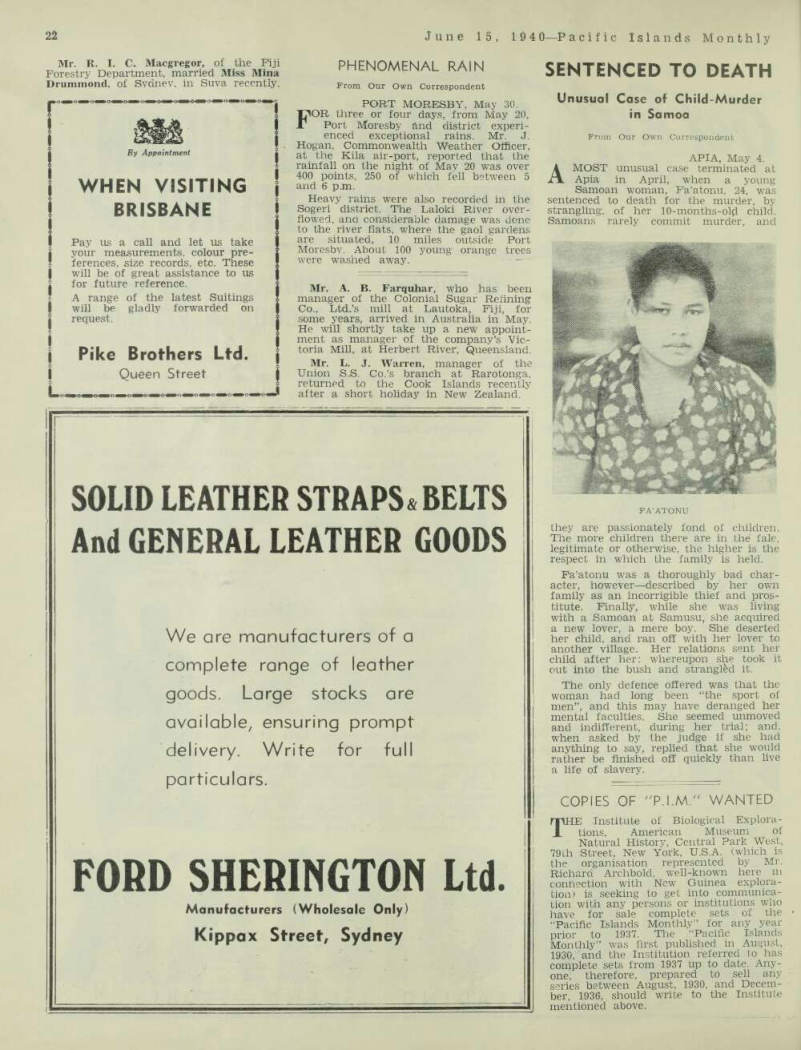
Leader of Fiji Gold Industry Named in Extraordinary Incident
RESIDENTS in Fiji, who raise their hats to the man who defied the re ports of experts, and established the now highly prosperous and profitable p'old-mining industry in Fiii —Mr. E. G.
Theodore—will be interested in an inci dent in Australia recently.
The Premiers and Treasurers of all the States gathered in conference to consider their loan requirements for public works.
The Federal Treasurer, busy financing Australia’s war effort, told them, bluntly that they would have to reduce their de mands to the lowest limit and that, above all, they should cut out all waste.
The Premiers in conference, produced an excellent nlan —namely, that the whole of the States’ works programmes should be co-ordinated, and that the most able man available be secured to act as supervisor and co-ordinator of public works activities.
Th°y nominated for the job Mr. E. G, Theodore —a man of advanced political views, who had been noted for his out standing ability when Premier of Queens land and Commonwealth Treasurer, and who retired in disgust from politics sev eral years ago and devoted himself to business —to his own great personal benefit.
It was Mr. Theodore who established the new gold industry in Fiji, which has com pletely altered the economic outlook in that Colony; and it was Mr. Theodore, also, who was largely responsible for the establishment of a new newspaper enter prise in Sydney.
But, as soon as the plan was known in Canberra, there arose from the arro gant politicians there a squawk which was really terrible. ‘"What!” they cried. “Are we going to ask favours of ‘Red Ted’? Is it possible that, in ’ order to get a man to put the public works of Australia in order, the Premiers propose to turn to a person of whom we long have disapproved? Have the Premiers forgotten that here in Canberra are we, men capable of saving the country in any kind of crisis? We won’t stand for this! If the Premiers dare to introduce ‘Red Ted’ among us, we shall resign forthwith.”
The clamour was so great that the Prime Minister (Mr. Menzies)—who never, at any time, seems to have a mind of his own—uttered smoothing words, and assured the yelping politicians that he had not proposed to appoint Mr. Theo dore to any position, and that Mr. Theo dore had never been communicated with, anyway—it was only an idea of the Premiers, And that, up to the moment, is the end of the plan.
Actually, it was so admirable a plan that it is difficult to believe that it emanated from a Premiers’ Conference.
Of all men in sight, Mr. Theodore prob ably is the one most suited to fill the position contemplated, and to give to Australia services of outstanding value in wartime. But here, as always, the Commonwealth interests have been sub verted to the whims and prejudices of Australia’s useless tribe of professional politicians.
Mr. J. Grahamslaw arrived in Queens land in May by air from Port Moresby, Papua, to visit his wife who has been in a Cairns hospital. It was his first visit to Australia in 30 years.
Mr. R. I. C. Macgregor, of the Fiji Forestry Department, married Miss Mina Drummond, of Svdnev. in Suva recently.
Advertisements & other items, pp. 22-24 (4 items)
20
June 15, 194 O—P acific Islands Monthly
O Yc E
BRONCHITIS.
GOES
wem WOODS®"
lagi.es* PEPPERMINT CURE
4 ,ied '! • Hondy-siied bottle I/-.
ROIIIB 01TS
<7astu &iscuMsj
M m SI r i-^rv / S %Jk ■WO** . o rm %k Here they are . . . Joyce Beulah Oat Cakes, made with the choicest rolled oats. They have a deliciously rich flavour. They are crisp and short. Beulah Oat Cakes are an appetising addition to lunch and supper menus. Buy a pound and taste the difference.
O YC E
BEULAH OAT CAKES
TRADERS are invited to write for rull particulars and price lists to
JOYCE BISCUITS PTY. LTD.
CAMPERDOWN, SYDNEY. N.S.W.
21
Pacific Islands Monthl y-—J une 15, 1940
offha j DEPRESSED
CALCIUM
HEART,
TEETH,
BLOOD,
BONES,
NERVES.
PHOSPHORUS
BRAIN,
GLANDS,
BLOOD.
r 4 I
SODIUM
BLOOD
v„
OVERCOME TROPICAL LETHARGY-
Get NEW PEP, VIGOUR & VITALITY!
Do You Suffer from :
Nerves, Listlessness, Langour, Tropical Lethargy, Headaches,
Nervous Dyspepsia, Anaemia, Lack of Confidence, Tight, Screwed-up Feeling in the Brain, Neuralgia, Nerve Pains,
"Depressed Feeling"?
POTASSIUM
MUSCLE,
BLOOD.
The real cause of these troubles is the absence of vital mineral salts from the food, which lead to mineral-starved nerves and all the depressing effects of nervous disorders.
Get a supply of these minerals, which include ferrum, calcium, potassium, sodium, phosphates, glycerophosphates and sucrose, into the system, and nerves and that run-down, depressed feeling will vanish.
“BIDOMAK” TASTES FINE
WILL MAKE YOU WELL.
“BIDOMAK” tastes fine, and contains all the necessary minerals in a pre-dissolved, liquid form. After taking it, you again feel fit and well. Your energy is magnified, your brain sharpened to razor edge, you eat, sleep and feel better. You regain self-confidence, and are restored to a heath level where you’ll glory in vitality.
L:.
SCIENTIFIC CONTROL
Manufactured in the Bidomak Pharmaceutical Laboratories, one of the most up-to-date, hygienic laboratories in the Southern Hemisphere, to which is attached a fully qualified Doctor of Medicine, and under the control of a qualified chemist, who was trained in the most modern English Laboratory in the world.
The Depressing After-Effects
of MALARIA
“BIDOMAK” actually overcomes the effects of severe tropical conditions and brings you back to the pinnacle of good health and spirits safely and pleasantly. The depressing aftereffects of Malaria are banished quickly by taking a course of “BIDOMAK” —“The Tonic of the Century”.
Nervy, Run-down—Now Eats and
Sleeps Well.
“For some time I have suffered with nerves.
I was very run-down and couldn’t sleep. Since taking BIDOMAK I feel a very different woman—can eat and sleep well. I have my three children on BIDOMAK, too. and can see a wonderful difference in them since using this tonic.” (Signed) Mrs. A. Floyd, Belinga. 7/5/39. 7
AT ALL LEADING ISLAND STORES
By Appointment
WHEN VISITING
BRISBANE
Pay us a call and let us take your measurements, colour preferences, size records, etc. These will be of great assistance to us for future reference.
A range of the latest Suitings will be gladly forwarded on request.
Pike Brothers Ltd,
Queen Street
SOLID LEATHER STRAPS*BELTS
And GENERAL LEATHER GOODS
We are manufacturers of a complete range of leather goods. Large stocks are available, ensuring prompt delivery. Write for full particulars.
FORD SHERINGTON Ltd.
Manufacturers (Wholesale Only) Kippax Street, Sydney
Phenomenal Rain
From Our Own Correspondent
Port Moresby, May 30.
FOR three or four days, from May 20, Port Moresby and district experi enced exceptional rains. Mr. J.
Hogan, Commonwealth Weather Officer, at the Kila air-port, reported that the rainfall on the night of May 20 was over 400 points, 250 of which fell between 5 and 6 p.m.
Heavy rains were also recorded in the Sogeri district. The Laloki River over flowed, and considerable damage was done to the river fiats, where the gaol gardens are situated, 10 miles outside Port Moresby. About 100 young orange trees were washed away.
Mr. A. B. Farquhar, who has been manager of the Colonial Sugar Refining Co., Ltd.’s mill at Lautoka, Fiji, for some years, arrived in Australia in May.
He will shortly take up a new appoint ment as manager of the company’s Vic toria Mill, at Herbert River, Queensland.
Mr. L. J. Warren, manager of the Union S.S. Co.’s branch at Rarotonga, returned to the Cook Islands recently after a short holiday in New Zealand.
Sentenced To Death
Unusual Case of Child-Murder in Samoa
From Our Own Correspondent
Apia, May 4.
A MOST unusual case terminated at Apia in April, when a young Samoan woman, Fa’atonu, 24, was sentenced to death for the murder, by strangling, of her 10-months-ol(i child.
Samoans rarely commit murder, and
Fa’atonu was a thoroughly bad char acter, however —described by her own family as an incorrigible thief and pros titute. Finally, while she was living with a Samoan at Samusu, she acquired a new lover, a mere boy. She deserted her child, and ran off with her lover to another village. Her relations sent her child after her: whereupon she took it out into the bush and strangled it.
The only defence offered was that the woman had long been “the sport of men”, and this may have deranged her mental faculties. She seemed unmoved and indifferent, during her trial; and, when asked by the judge if she had anything to say, replied that she would rather be finished off quickly than live a life of slavery.
Fa’Atonu
they are passionately fond of children.
The more children there are in the fale, legitimate or otherwise, the higher is the respect in which the family is held.
Copies Of "P.I.M." Wanted
THE Institute of Biological Explora tions, American Museum of Natural History, Central Park West, 79th Street, New York, U.S.A. (which is the organisation represented by Mr.
Richard Archbold, well-known here in connection with New Guinea explora tion) is seeking to get into communica tion with any persons or institutions who have for sale complete sets of the “Pacific Islands Monthly’’ for any year prior to 1937. The “Pacific Islands Monthly” was first published in August, 1930, and the Institution referred to has complete sets from 1937 up to date. Any one, therefore, prepared to sell any series between August, 1930, and Decem ber, 1936, should write to the Institute mentioned above.
Advertisements & other items, p. 24 (1 item)
22
June 15, 194 O—P acific Islands Monthly
That Was Seven Years
Ago With Dechert's Bitser to Edie Creek
WHILE 1933 was still young we found ourselves obliged to go to Edie Creek. We had - choice of three means of doing so—Wally Gordon’s erratic horses, “Shank’s ponies”, or Dechert’s Bitzer.
We sat on Stewart’s hotel-verandah in Wau and debated. Resplendent in white drill shorts and shirt —fresh from the Chinese tailor that morning—I elected to walk. I was new to the country, enthusiastic about everything, and wished to miss nothing of the romantic atmosphere of my surroundings. “Him self” squashed that idea ‘. immediately with the remark that I had 11- or 12 miles ahead of me, and the grade was 1 in 10.
Horses? Well, yes, “Bones” was reli able for a woman to ride, providing he was available. But one could not be sure of the others, and we were not equestrians.
Remained, Dechert’s Bitser, “What exactly is Dechert’s Bitser?” I asked.
I was enlightened. Dechert’s Bitser was the only motor-truck that had yet traversed the Edie Creek track. When Fred Dechert had suggested that a motor vehicle could make the trip, everyone was sceptical. But Dechert shipped a motor chassis, cut down from standard size to fit the narrowest part of the Kaindi Road, from Sydney to Wau, per sea and air. Then he set to work with sundry lengths of scrap iron, much optimism and determination, and lo! an idea became a fact, and the Bit ser dwelt among us.
The Bitser’s first trip to Edie Creek is Wau history. Bets were freely laid on the chances of the little truck reaching the Edie Creek settlement. Dechert, though determined to get through, yet refused to bet on himself and so lost the chance of cleaning up a tidy sum.
The truck had now been running fairly regularly for two or three months and, so far, had not capsized passengers or cargo over the cliffs.
We left Wau about 4 p.m., and were assured that we would make Edie Creek before dark. I, as the one woman passenger, was allotted the seat beside the driver in frsnt, and the men; dis posed themselves as securely as they might on the tray at the back.
The Bitser lacked all superfluous trim mings and there were no side boards on the tray, no cabin and nothing to grip in the front seat except the top of the wind-screen or the driver. That, how ever, did not worry me until we began to climb, and swing around bends in the road, and then T felt thankful that I could touch the cliff wall with my hand.
In places, my side of the diminutive truck brushed the cliff face whilst the driver, on his side, looked straight down over the edge of the precipice. A fraction out in his judgment meant a plunge over the side. Fortunately, there were not many stretches like that. But there were never more than three feet to spare between the truck and cliff edge, on- the full distance of that “road”.
We passed strings of native carriers,
homing towards Wau, after having car ried up supplies to the miners along the creek and to the settlement itself. I noticed that these “boys” came directly down the mountain side, scorning the road, and using barely-defined tracks cut through the thick undergrowth. “Short cuts,” I was informed; but, to me, the short cuts looked more formidable than the mileage they saved. rO or three miles above Golden Ridges, on turning a sudden bend, we beheld a string of Wally Cor don’s “donks” tearing down the road towards us, and a collision seemed inevitable. They were being driven back to Wau, after carrying cargo up to Kaindi that morning, and many of them had back loading strapped to their sides.
Each mule appeared to me to occupy the whole width of the road, and I won dered how we could possibly manage to pass them. When one or two showed signs of panic, I feared vindictive hoofs; but I reckoned without the resource of their native attendants. They imme diately rounded up the mules and drove them straight up the steep slope of the mountain-side, until we had passed.
“What happens when you meet mules on one of those narrow stretches?” I asked Dechert.
“Oh, they turn back and run, until the mountain slopes enough for the natives to drive them up, or the boys find a place wide enough in the road to herd them to the edge,” he informed me, nonchalantly, but I recognised a very real danger, in those mule trams, to this sturdy pioneer driver and his truck.
I was amused when he informed me that the natives had dubbed him “Mas ter Run-about-nothing.” He also told me that when they first met him on the road in the truck, mules and natives alike bolted into the bush.
THE hairpin bends next contributed their quota of thrills. There were about six of these bends to nego tiate A few months later the cala boose line” (native convicts) was put on to improve the road where most dan gerous. The narrow parts and hairpin bends were widened, making it possible for lorries and cars of standard size to make the journey.
On our trip, the men got off the truck at each of these bends, ostensibly to lighten the load and direct the driver as he backed the two or three times necessary before he could turn the bend.
This duty they performed with alacrity.
With my heart in my mouth I stuck to my seat beside the driver, feeling superior, but inwardly hoping that he would urge me to get off, too. When the last, and, incidentally, the most dangerous bend was reached, it was with relief that I heard him ask me to get down. His request “saved my face , be cause I had decided to alight, in any case.
IWAS informed that we were over the worst of the road. Then the Bitser took a hand. She stopped. I have not the slightest idea what was wrong with the bus. The men tinkered about with screw-drivers and things, and in order not to cramp their style, I walked away out of hearing, and sat down on a log.
My enforced rest enabled me, for the first time, to appreciate the beauty of my surroundings. The road, little more than a ledge cut in the precipitous
mountain-side, zigzagged upward. I gazed over the side of the cliff into the tangled jungle depths below, where strange orchids grew and creepers hung in bright festoons from the majestic trees, some of which also carried mag nificent staghorns, clinging parasitically to their huge limbs. Giant ferns shel tered tiny wood violets and shy birds.
The snorting and spluttering of the engine, and a shout of triumph from the owner, recalled me from this fairyland, and I resumed my place on the truck.
We came to a very steep grade, about 1 in 3. After the Bitser’s recent per formance, Dechert was dubious about her ability to carry the full load to the top, so the men all jumped off again, ready to lend a hand and push if the need arose. It took every ounce of fight . the Bitser had in her, but she finally made the grade, with much chug ging and asthmatic coughing.
A little later we pulled up with a flourish at “Water Kuruka”, a delight ful mountain stream that cut across the road and took its name from the huge old Kuruka trees growing beside it, a little above the road. Here we drank the cool, delicious water and filled the sizzling radiator of the truck.
DARKNESS overtook us before we reached Blue Point, and I was un able to see the magnificent view of the Edie Valley, for which this part of the road is famed.
We covered two miles in great style, and were congratulating ourselves that the journey was ended, when Dechert pulled up with a jerk. Our way was blocked with clay, boulders and logs that had slipped from the side of the mountain.
We were about to abandon the truck, and walk to a miner’s camp, half a mile
back, when eight natives, making a belated return to Wau, put in an appear ance. Dechert immediately pressed them into service, and all gave willing help.
With the Bitser’s head-lamps lighting the scene, the largest boulders were rolled away and the logs dug out and pushed to one side. The clay was roughly raked over the other stones, and a very narrow and insecure passage was at last cleared. The only tools with which the party had to work were two shovels that Dechert always carried in the truck, and saplings and strong sticks which the “boys” cut from the bush.
Now thoroughly worn out, we pre
ferred to risk this pass to walking back to the miner’s camp. The gallant little truck sailed over the danger in fine style.
WE finally halted in front of the new Edie Creek Police Post at 8.30 p.m., mud-bespattered and forlorn, the journey having taken 4g hours. There was no hotel, only the police post, a few miners’ log-shacks, and “Mac’s” store, where one could buy anything from a needle to a bottle of whisky—the latter, naturally, being more in demand than the former.
Incidentally, several months later, I
attended the “opening” of “Mac’s” new store, a large wood and iron structure.
This was an occasion for celebration. We proudly mustered 10 women, and most of the men were able to have at least one dance during the course of the night. We finished up in the “wee sma’ hours” and one male member went to bed in a dust-bin outside “Mac’s” back door, his bootless feet pointing to the sky. It was a grand party spirit—but that was seven years ago.
This is 1940. When a dance is held at Edie Creek now, one may engage a sedan car from the Wau Carrying Co., don evening clothes and wraps, and sit back in the comfortable upholstered interior of the car for 45 minutes, from Wau to Edie Creek. Nothing exciting happens, for one travels over the new Edie Creek road, winding tortuously still, but wide and well-graded.
Motor lorries and cars now make sev eral trips a day, to and from Edie Creek. The mules are a rare sight, and the native carrier, with his 50 lb. pack strapped on his back, is but a memory.
“Mac’s” store is no more. “Mac” was originally an aeroplane pilot and you cannot keep a good airman on the ground. He took up flying again, and found that he couldn’t, at the one time, do justice to a business on the good earth and a 'plane in the air, and he elected to keep on flying.
There are other changes at Edie Creek, since my first trip, seven years ago. Many of the original log shacks of the miners still stand, but there are other new houses, quite modern, inside and outside.
In 1933 we slept on home-made, can vas beds, and bought a few yards of cretonne to dress up packing cases for furniture, and to disguise our rough, wooden-shuttered windows. Now, there are spring mattresses, cane furniture and glass windows, and N.G.G. Ltd. employ ees have electric light, with all its attendant comforts of kettles, toasters and irons. Some lucky ones even have telephones. Last, but not least, at the Company’s centre “on top”, there is a talkie theatre, which obliges on Satur day nights.
Many Wau people go up to Edie Creek dances from time to time, and the hotel has been packed to its full capacity. The entertainments there are undoubtedly a success; but one misses the old familiar faces and, most of all, the easy com radeship of that dance held in “Mac’s” store.—lMEß.
Advertisements & other items, pp. 25-28 (2 items)
good
m B S V'A A A \i
(jcc4
set
deserves
good
batteries
• Your radio set represents an investment of anything up to £4O. And yet it is on the batteries you buy to supply the necessary power that much of your radio enjoyment depends.
That is why both radio set manufacturers and listeners have always Insisted on genuine Eveready Batteries for both A" and "B" current supply almost since the inception of radio itself. Recognised as "Australia's Best," because they are made within the Commonwealth, in the largest and most up-todate dry cell manufacturing plant in the world, their name is your best guarantee of maximum power, a longer period of serviceable life and full value.
Obtainable from radio and electrical dealers everywhere.
R 59-1608 I k
EVEREADY (AUSTRALIA) PTY. LTD., SYDNEY, N.S.W.
; I i
PLUME
PLUME
ISMILES
BETTER!
■il H .V 5* : f I <js y « I V '?•
THE ISLANDS
e af 1^
row- J VACUUM
M ouflurr proouci ■
I I
SA3HOOJ.
ipmh
m
The “LONDON” Pump
MADE IN CANADA.
Light Weight Portable Self-priming
Weighs only 52 lb.—Coupled to f-1 h.p.
Petrol Engine.
Dependable and 100 per cent, efficient, ideally suitable for mining, irrigation, fire protection, filling tanks, and general utility work.—Displaces more water than any pump of its weight on the market.
PRIMES ITSELF and STAYS PRIMED.
Limited Stocks available for immediate delivery.
“BEEBE” WINCHES
BEWARE
OF
IMITATIONS
HAND-POWERED. AMAZINGLY POWERFUL.
2-ton Capacity weighs 60 lb. 5-ton Capacity weighs 100 lb. 15-ton Capacity weighs 680 lb.
EASILY ADAPTABLE TO POWER.
In use by State and Federal Government Departments, Shires, Contractors, Mining Companies. Full particulars from the Sole Agents;—
NELSON Cr ROBERTSON Pty. Ltd.
12 SPRING STREET,
SYDNEY.
HONESTY FIDELITY
Safeguard your interests. Ensure their protection and security. Avail yourself of the advantages to be derived from the appointment of this Company as your trustees, in preference to any one individual. Write to or call on any Branch of Burns, Philp 6c Company Limited, or Burns Philp (South Sea) Company, Limited, for the folder which fully explains these advantages.
Give careful consideration to the benefits to be gained by appointing as your Executors—
BURNS PHILP TRUST CO. LTD.
DIRECTORS
JAMES BURNS
ROBERT JOHN NOSWORTHY
LEWIS ARMSTRONG
JOSEPH MITCHELL
BURNS PHILP TRUST CO. LTD.
CAPITAL—£2OO,OOO
i.ooo 7 BRIDGE STREET SYDNEY, N.S.W.
25
Pacific Islands Monthl y—J une 15, 1940
Now "The Pacific Islands Society"
MEMBERS of the Pacific Islands Club have decided to change the name of their organisation to “The Pacific Islands Society, Sydney”.
The new president (Mr. A. E. Stephen), who sponsored the proposal, said that the new name would more accurately in dicate the objects of the organisation.
Many men, he said, objected to joining additional clubs, but the term “society” would not have that objection.
The first new member of the newly named Pacific Islands Society was Crown Prince Tuboutoa, of Tonga.
MR. GRAHAM DICKSON, who will be remembered as purser on the “Makura” on many a trans-Pacific trip, is now in Rarotonga, as acting manager for U.S.S.
Co. He will return to Sydney later in the year. In recent years he has been purser on the “Aorangi” and other vessels.
Advertisements & other items, p. 28 (1 item)
26
June 15, 194 O—P acific Islands Monthly
Come?
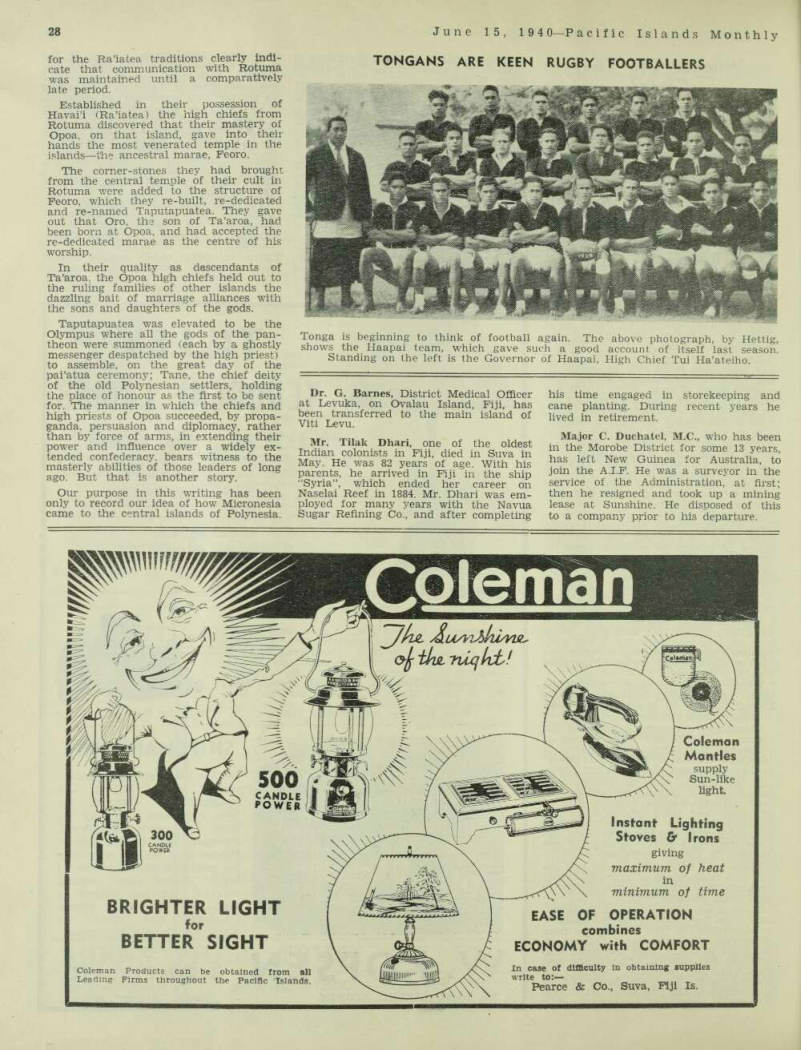
Whence Did They Come?
Theories of the Polynesian Migrations
By “Mahaena”
IT is, no doubt, presumptuous for a mere layman to question high authority on the controversial subject of Polynesian wanderings. But. after all. the interpre tations of myth and leg°nd relating to events of pre-history lead one’s mind along many diverse pathways. One more expedition can, therefore, do no more than cut a very narrow by-path into the jungle of the unknown.
The legends and traditions of Central Polynesia—so far as they have come to our knowledge, from early records and from the lips of venerable scholars who received them by word of mouth from their forebears —contain no indication of ancestral migration by way of the Micronesian islands.
One cannot easily vision a migration of any magnitude being able to sustain it self along so roundabout a course, over a broad waste of ocean, north of the line ('with only barren atolls as places for re freshment) to arrive fortuitously at the volcanic islands far south of the Equator.
It is most probable that the earliest migration was no precipitant flight of a whole people The Malay conquests of the islands of Indonesia were, doubtless, like most conquests of island realms, a matter of forays, then a foothold on the coast, followed by gradual encroachment into surrounding districts.
Foreseeing the inevitable, the Poly nesian leaders sent out exploring ex peditions to the east and, later, led com panies of settlers to establish bases for fresh explorations. The food plants car ried to and established on the newly discovered islands converted them into an extended line of provision stations. It is most likely that these were the mar ginal islands of Melanesia.
Any attempt at conquest of the thickly inhabited islands of Melanesia would have involved long wars; but it was com paratively easy to drive out or extermin ate the aborigines of the small marginal islands.
When, finally, the fertile, uninhabited lands of Western Polynesia became known, the line of migration had been established and provisioned.
Throughout Polynesia, it has been the custom to give to the main centres of settlement the name of the primitive homeland—Savai’i in the West; Havai’i in the centre; and Hawai’i in the North.
It is logical, then, to assume that Savai’i. in the Samoa archipelago—the most westerly—was the original place of settlement and point whence fresh ex peditions set forth to people the other islands. Havai’i (Ra’iatea) in. turn be came the centre of the settlement and diffusion in Central Polvnesifi.
There were continual comings and go ings and fresh waves of migration along the established routes. The Neo-Polynesian wave came centuries later.
There is no evidence that it came dir ectly from the homeland in Indonesia. A probable theory is that it emanated from Micronesia. The migrants to Micronesia may have been the clans and tribes who held the last districts of mountain and plain, in the homeland, against the Malay invaders. They were hardy of body and trained in the practice of arms. This training in arms was exercised in their
own dominions in repelling incursions of Mongoloid seafarers from the adjacent coasts of Asia.
The heroic age among the old Polynesians had long passed when these new invaders came. The Neo-Polynesians do not appear to have been very numerous.
They were a few high chiefs at the head of their retinues of able warriors, and a priestly caste.
During the centuries of their sojourn in Micronesia (probably on the volcanic islands of Ponape and Kusaie) these Polynesian high chiefs had set up a cult of tangaroa and elevated themselves to the august dignity of direct descendants from the creator of sea and land, and father of gods and men.
When the Mongoloid raider’s had established themselves on island after island, and had amalgamated with the indigenous inhabitants (as has usually been the custom of Mongoloids) the proud
Polynesian high chiefs, jealous of the purity of their blood, withdrew to the south, and contemplated the conquest of the populations of their own race, settled m the far-flung archipelago of Polynesia, The land on which they marshalled their forces, and from which they sent out on their expeditions, appears to have been the island of Rotuma, at the north of the Fiji Group. There they set up the sanctum sanctorum of their cult in a marae which was destined to play a major part in the subsequent history of Central Polynesia.
The first impact on Polynesia proper seems to have been the conquest of Tonga and the founding there of the dynasty of priestly Tui-Tonga rulers; sometime in the tenth century, The expedition which reached Central Polynesia most probably came directly from Rotuma, and was not an offshoot of the invasions into Tonga and Samoa;
for the Ra’iatea traditions clearly indi cate that communication with Rotuma was maintained until a comparatively late period.
Established in their possession of Havai’i (Ra’iatea) the high chiefs from Rotuma discovered that their mastery of Opoa, on that island, gave into their hands the most venerated temple in the islands —the ancestral marae, Feoro.
The corner-stones they had brought from the central temple of their cult in Rotuma were added to the structure of Feoro, which they re-built, re-dedicated and re-named Taputapuatea. They gave out that Oro, tha son of Ta’aroa, had been born at Opoa, and had accepted the re-dedicated marae as the centre of his worship.
In their quality as descendants of Ta’aroa, the Opoa high chiefs held out to the ruling families of other islands the dazzling bait of marriage alliances with the sons and daughters of the gods.
Taputapuatea was elevated to be the Olympus where all the gods of the pan theon were summoned (each by a ghostly messenger despatched by the high priest) to assemble, on the great day of the pai’atua ceremony; Tane, the chief deity of the old Polynesian settlers, holding the place of honour as the first to be sent for. The manner in which the chiefs and high priests of Opoa succeeded, by propa ganda. persuasion and diplomacy, rather than by force of arms, in extending their power and influence over a widely ex tended confederacy, bears witness to the masterly abilities of those leaders of long ago. But that is another story.
Our purpose in this writing has been only to record our idea of how Micronesia came to the central islands of Polynesia.
Dr. G. Barnes, District Medical Officer at Levuka, on Ovalau Island, Fiji, has been transferred to the main island of Viti Levu.
Mr. Tilak Dhari, one of the oldest Indian colonists in Fiji, died in Suva in May. He was 82 years of age. With his parents, he arrived in Fiji in the ship “Syria”, which ended her career on Naselai Reef in 1884. Mr. Dhari was em ployed for many years with the Navua Sugar Refining Co., and after completing
his time engaged in storekeeping and cane planting. During recent years he lived in retirement.
Major C. Duchatel, M.C., who has been in the Morobe District for some 13 years, has left New Guinea for Australia, to join the A.I.P. He was a surveyor in the service of the Administration, at first; then he resigned and took up a mining lease at Sunshine. He disposed of this to a company prior to his departure.
Advertisements & other items, p. 29 (2 items)
27
Pacific Islands Month! y—J une 15, 1940
Kerosene Lamps
TILLEY
Tilley Lamps are made in England and are the most efficient of any lamps burning kerosene. There are 18 models, including Table Lamps, Wall Lamps, Hanging Lamps, Floor Standards, etc. All provide a full 300 c.p. steady light without flickering. Not affected by wind or insects, and absolutely free from smoke, smell or fumes.
Illustrated is the popular Table Lamp. Standing 24 in. high, it throws a brilliant light over a large area. It is a beautiful ornament and the handsome autumn toning fluted shade matches the furniture in any room.
Price complete, 83/6.
All purpose lamp and-lantern, 57/6.
Write for catalogue of all models.
SIMPLEX MARINE ENGINES
3 h.p. 2 cycle and 5 h.p. 4 cycle.
Illustrated is the new 5 h.p. 4 cycle, with built-in Reverse Gears. A fine, powerful little unit suitable for boats up to 20 ft. Has force-feed lubrication, Shebler Carburettor, removable English Magneto with impulse starter. No vibration, economical and sturdy. Bore 3f, Stroke 4 in., R.P.M. 1,000. Made in Australia for hard Australian coast conditions.
Price, complete with Muffler, £52/10/-.
Write for Engine Catalogue. 1 mm I
SHIPCHANDLERY
We are the largest manufacturers of Marine Fittings and Equipment in Australia. We have everything you may require for yachts, motor-boats, schooners and trading vessels.
Having most modern workshops for marine manufacture, we no longer depend upon overseas supplies. We are pleased to send you our latest Marine Catalogue. Our prices are attractive. Intelligent service.
W. KOPSEN & CO. PTY. LTD.
380 KENT STREET, SYDNEY. Cables: "Kopsen”, Sydney.
Tongans Are Keen Rugby Footballers
Tonga is beginning to think of football again. The above photograph, by Hettig, shows the Haapai team, which gave such a good account of itself last season.
Standing on the left is the Governor of Haapai, High Chief Tui Ha’ateiho.
Advertisements & other items, p. 30 (2 items)
28
June 15, 194 O—P acific Islands Monthly
ofa thjL ri
r m
s *s; J 5? r m J „-i,‘ 500 E
CANDLE
POWER
4 300 :ANDie
BRIGHTER LIGHT
for
BETTER SIGHT
Coleman Products can be obtained from all Leading Firms throughout the Pacific Islands.
Coleman Mantles supply JAX Sun-like \ light.
Instant Lighting
Stoves & Irons giving maximum of heat in minimum of time
EASE OF OPERATION
combines
ECONOMY with COMFORT
In case of difficulty in obtaining supplies write to:— Pearce & Co., Suva, Fiji Is.
Recent Bishop Museum
Publications
FIJIAN FRONTIER, by Dr. Laura Thompson. Studies of the Pacific, No. 4. Published by the American Council, Institute of Pacific Relations, 1940. Many illustrations. Price, $2.
In a readable and delightful manner, Dr. Thompson describes native life in the Lau, or eastern islands of Fiji. The Lau group forms an outpost between Fiji and Tonga, its culture influenced by both. It is the zone of transition be tween Melanesia on the west, and Poly nesia on the east. The history of these cultural contacts is carefully traced.
Dr. Thompson knows whereof she writes. She was in Fiji for nine months during 1933-34. During that time she lived among the natives on the island of Kambara, visiting five of the neighbour ing islands. Learning the Lauan lan guage, she shared the daily life and culture with the people, and gained an intimate insight into it.
The environment of these “famine isles’’ is discussed from the point of view of those in it. How a Fijian grows up is described in detail, including inti mate practices of birth, childhood, ini tiation into young manhood, and mar riage. Education and contact with mis sionaries; native beliefs and how these are being modified by contact and com petition with a foreign culture; adjust ment to this new cultural standard, and the consequent struggle for existence, all are detailed.
An introduction by B. Malinowski praises the book as “a genuine sample of scientific anthropology.” “The author,” he says, “keeps her eyes open on every thing that exists. She does not vitiate her observation by eliminating one of the most essential elements in her field: the existence and pertinacity of the white man and his camp followers,” He adds that this constructive and sympa thetic yet outspoken criticism of existing conditions ought to be read by adminis trator, anthropologist, and economist alike.
Ethnology Of Easter Island,
by Alfred Metraux, Bishop Museum Bulletin 160, 432 pages, 7 plates, 58 text figures, 1940.
This extensive work covers the geo graphy, traditional history, social orga nisation, and material culture of this much-discussed island, at the south eastern corner of Polynesia. Dr. Metraux was the leader of the Franco-Belgian expedition to Easter Island in 1934-1935, and his conclusions are based upon both his own observations in the field and a careful study of collections in European museums and Hawaii, and all published material.
He says: “The supposed mystery of Easter Island rests on the assumption that the culture of this speck of land was too elaborate to have been produced by the natives who lived on it when it was discovered by Europeans.” He goes on to show, by geologic evidence, that a former more extensive culture could not have been obliterated by cataclysmic dis aster. He rejects the theory of the island being the remnant of a sunken continent or archipelago. The resemblance of the Easter Island culture with that of Melanesia is only superficial, he says, and does not show racial connection.
Relationship with South American Indians is considered fantastic.
Dr. Metraux suggests that Easter
Island was populated by a single wave of Polynesian immigrants, of the same stock as the ancestors of the Marque sas and the Mangarevans, who arrived at an early date. Their culture was conditioned by lack of wood. The giant statues were the specialised expression of their art, made possible by material which lent itself to gross carving.
The Genus Ficus (Horace Ae)
In South-Eastern Polynesia, By
V. S. Summerhayes. B.P. Bishop Museum Occasional Papers, Vol. XV., No. 21, pages 227-228, March 11, 1940.
A botanist at the Royal Botanical Gardens, Kew, identifies the cultivated fig, Ficus carica, and two native spe cies, Ficus prolixa and Ficus tinctoria, from material collected by the Mangare van Expedition, in 1934, in the Tuamotu and Austral Islands, Rapa, Pitcairn, and Mangareva.
Some New Species Of Araucari
Cola Lea From The South
PACIFIC (Coleoptera, Tenebrionidae).
B. P. Bishop Museum, Occasional Papers, Vol. XV., No. 23, pages 239-242, 2 figs.; March 11, 1940.
A British Museum entomologist de scribes four new species of beetles, from native forest plants, in the Society and Austral Islands and Rapa, in a genus previously known only from Norfolk Island, and there under the bark of Araucaria trees. A key is given to sep arate the four species.
Hon. Gerald Hogan, M.L.C., Crown Law Officer at Rabaul, New Guinea, is now in Sydney spending three months’ furlough. The work of the commission inquiring into native labour conditions in New Guinea, of which Mr. Hogan is a member, has been suspended tempor arily, as two of the three members are absent from the Territory.
Mr. T. O’Dea, assistant general mana ger of Guinea Airways Ltd., at Port Moresby, has been away on furlough He is being relieved in Port Moresby by Mr. N. Fader. On Mr. O’Dea’s return to Port Moresby he will take possession of his new house, now being completed, on Toaguba Hill, Ela Beach.
Advertisements & other items, pp. 31-32 (3 items)
29
Pacific Islands Monthl y—J une 15, 1940
/*Tcnax O Ak P|
GET POSITIVE
RELIEF FROM
Tested and proved for over 20 years, genuine Vincent’s A.P.C. is acknowledged by the medical profession and the public as the safest and best to relieve all pains and tropical fevers. The reason why Vincent’s A.P.C. is safer and more effective is because it is prepared on the prescription originated by the medical superintendent of one of Australia’s largest public hospitals, where it was first used. Genuine Vincent’s A.P.C. is prepared on this scientific hospital prescription.
fOWDCIS &
TAIIETS
I/* AND 2/*.
SINGHS 14.
FOR SAFETY’S SAKE SAY “VINCENT’S”.
/ . u w » J & A * GERMS of Diphtheria, Malaria, Dhobie Itch, Tinea or Surfers’ Foot, cannot live under ‘'TENAX” lather.
Tropical Skin Diseases can be cured by its regular use.
only 9 " P er
'f able*
NO VARIATION HAS BEEN
MADE IN ITS COMPOSITION—
judged from the only true angle, that of quality, TENAX has no competitors as a satisfactory germicidal soap, eleven times as rapid in action as carbolic, yet NON-
IRRITANT and NON-POISONOUS. The
Medical Journal of Australia states that TENAX is a germicidal soap that may be recommended with confidence.
/*TCNAX O Ak P|
A PRODUCT OF AUSTRALIAN SOAPS, LTD.
Modern Refrigeration for the South Sea Islands
The
ELECTROLUX
KEROSENE OPERATED
REFRIGERATOR
MARVEL
OF
MODERN
SCIENCE
THE
MIRACLE
OF
ICE
FROM
HEAT
ELECTROLUX offers economical, modern and completely efficient
REFRIGERATION FOR ISLANDS 7 HOMES.
FREEZES CONTINUOUSLY WHILE SMALL LAMP BURNS
Freezing controlled by simply regulating height of flame. Uses only J gallon of kerosene per week.
MOTORLESS ... NO PARTS TO GET OUT OF ORDER.
MODEL L 22 MODEL L3BO MODEL LKSSO Capacity ® 2.2 cubic feet. (as Illustrated) Capacity 4 cubic feet.
Capacity 5.5 cubic feet.
GUARANTEED FOR TWO YEARS.
Write to your Local Distributor for prices and full details.
Obtainable from W. R. Carpenter & Company Ltd.—Sydney, and following New Guinea Branches: Rabaul, Salamaua, Wau, Kavieng, Madang, and Wewak.
Representation in Papua and New Hebrides.
W. R. Carpenter & Coy. (Solomon Is.) Pty. Ltd.—Tulagi, British Solomon Islands.
On Chong & Company Pty. Ltd.—Butaritari, Gilbert and Ellice Islands.
30
June 16, 194 0-P acific Islands Monthly
Guarantees
Those Native Labour Guarantees Plea For Attention to New Guinea Miners' Problem
By “Nosavi”
rE Native Labour Ordinance of the Territory of New Guinea demands that employers should pay to their labourers a proportion of their wages monthly, and that the balance be defer red till the determination of the con tract. The amount payable monthly must not be less than 1/-, nor more than 50 per cent, of the total wages payable.
To ensure that the employer will meet his oDUgations, the Administration de mands U) that the employer should possess realty or tangioie assets, such as a fixed deposit (reieaseable only by the Administration) of sufficient value to cover the wages, or (2) that the amount be paid into an Administration “native deferred pay trust fund”, whence it will be refundable (without interest) at the termination of the con tract any time up to three years hence, or (3) —and the worst of the three alternatives —that the employer provide a guarantee covering the amount of deferred wages, also native labour tax at the rate of 1/- per month for every month in which the tax is not suspended. (It has been suspended from July 1 to June 30 each year for the last five years). Further, it must embrace the possible costs of repatriating the labourer to his village.
A well known insurance company, dealing extensively m tnese guarantees win, lor a premium at tne rate of lu per cent, of tne amount to be covered, issue such a guarantee. The “catch” comes wnen the employer is unable to pay off his labour from his own resources, in such cases, the Administration will pay on and repatriate tne natives, and ciaim on the guarantor who, of course, is nabie and pays up.
The course of events, after such a proceedmg, is lixe unto a stone tossed in a stffi pool. Seemingly, in all cases the Administration will issue a summons agamst the employer, usually under section 57 (7) of the Ordinance, for “failure to pay deferred wages in full upon determination of the contract”.
Notwithstanding the fact that the em ployer is financially unable to meet his obligations, and that the payment of the amount is guaranteed, the Administra tion kicks him while he is down.
The insurance company (as guarantor) then a civil claim, in the Dis trict Court, for the amount which it has been called upon to pay out on behalf of the employer, and gets a judgment against him, with costs.
The employer gets all the kicks, and none of the ha’pence. He pays a high premium for a guarantee, which actually gives him no security. His reputation is sullied by a conviction under the Ordinance, and he has to foot a bill for the full amount, plus costs.
Here is an example of the whole thing:— A native is signed on for two years, at 10/- per month; 5/- payable as cur rent wages, and 5/- deferred. The de ferred wages amount to £6, and tax from July 1 next following the date of signing, on the termination of the con
tract, may be about £1; repatriation may be assessed at £2; a total of £9, for which, if a guarantee is needed, 18/premium is payable.
On termination of contract, the native should receive his £6, and it may cost £l/10 - to repatriate him. Probably, the tax has been suspended for the whole term of the contract. £7/10/- is needed.
The employer cannot pay. Then the above procedure is followed and, in the ensuing prosecution, the employer may be fined 10/- or £l. One employer, who defaulted, was fined £lO per labourer by a magistrate who apparently was doing his bit to help balance the budget! The employer also is out of pocket to the tune of the 18/- premium and the costs as assessed by the court in the civil claim.
It is high time that some steps were taken to protect wholly honest but un fortunate miners suffering from a run of bad luck, or other employers, perhaps temporarily unable to find the ready cash (often a large amount when a big line is concerned) with which to pay off their labourers.
The amendments could well embrace the payment of interest on amounts paid into the trust fund, and freedom from the stigma of a conviction by a court for what in the majority of cases the em ployers have striven their utmost to avoid —viz., default in their obligations to their labourers.
A policy that will involve the person guaranteed in a prosecution and a civil judgment is doubtful value for a 10 per cent, premium charge.
M. Casimir, formerly French Resident Commissioner in the New Hebrides, who returned to France early last year, is now in Africa, in command of a military group at Soudan.
Advertisements & other items, pp. 33-34 (2 items)
31
Pacific Islands Monthl y—J une 15, 1940
Sparkling
refreshment from pure Malt and Hops ★ K 0“,
FOSTER'S
LAGER
Kork-N-Seal
FOR HOME USE
• Hand Applied Airtight Pressure Proof
FOR ALL HOME BOTTLING
—THE LITTLE CAP THAT
will Re-seal 1,000 Times
KORK-N-SEAL (AusO LTD.
106 COMMONWEALTH STREET.
SYDNEY, AUSTRALIA.
- 1 v'#'*
V-ARI-ETI-EJ
Australia’s Choicest Products: Green Peas French Beans Cauliflower a m
qgardcnVa^ c
UFACTukEd ■Y 1
CARDEN VALE
PRODUCTS LIMITED
2-4 BROWN STREET, N-EWTOWN
SYDNEY. AUSTRALIA
Always . . . make sure you have at hand an ample Reserve of these Delicious . .
Garden
Vale Ready-toserve Vegetables
Not So Hard Hit
Pacific Territories and Copra Prices
BECAUSE copra prices being received by South Seas planters are low —the result of the Anglo-French Govern ments permitting Unilever control to be exercised over the market in London —an impression has got abroad that economic conditions in the Pacific territories are very bad.
That, definitely, is not so. There is no doubt that the coconut planters who have placed “all their eggs in one basket” are having a thin time; but, of all the fourteen Pacific territories which lie south of the Equator, only two (Solomon Islands and Gilbert and Ellice Colony) are wholly dependent on copra. All of the others have some alternative indus try, which is enjoying good prices.
Papua, for instance, has rubber and some coffee; New Guinea has the gold industry and a quickly developing cocoa industry; New Caledonia has a prosper ous metal output; the New Hebrides pro duces much cocoa and coffee; Fiji has a huge output of gold and sugar; Tonga, Fiji, Samoa and the Cook Islands, all supply large quantities of bananas and oranges to the New Zealand market; Western Samoa has a highly prosperous cocoa industry; and French Oceania has a number of alternative industries, especially vanilla production.
Ten years ago, when the depression hit the Pacific territories and copra fell calamitously in price, most of the terri
tories were in a bad position—they had no other industry on which to depend for an income. But the position has changed vastly since then. It has become the deliberate policy of most of the ad ministrations to see that all the economic eggs are not in one basket.
"Jimmy" Preston's Lost
Reef
There are experienced miners who believe that, somewhere around the headwaters of the Waria, in Southern Morobe, New Guinea, another goldfield is awaiting dis covery. In that respect, this note from Mr. Edward Auerbach, of the Trobriand Islands, is interesting: SOMETIME prior to 1914, in the Mor obe country, the then well-known New Guinea prospector, Jimmy Preston, was looking for gold, and also collecting birds-of-paradise.
Somewhere near the head of the Waria, he shot a bird, at the head of a ravine, running into the upper Waria.
When he went to retrieve it, he found it on the outcrop of a reef.
Preston took specimens, and sent them to Sydney to be assayed. He sent the specimen through Klink, who was the German R.M. at Morobe.
The assayer’s report came back. Klink opened the letter. Klink told me the assay went 4 oz, to the ton. He opened the letter before he gave it to Jimmy.
He told me what the assays went, four days before Jimmy got it.
Preston sent two more specimens from Samarai to Sydney for assay. They both went 4 oz. to the ton. . He intended to go back after the war, and peg out this reef.
In the meantime, he got cancer and he had to go to Sydney. He was six months at Jenner Private Hospital, under Sir Herbert Maitland. Then he came back to the Trobriands, and he died in 1922, from cancer, at George Auerbach’s place. Just before he died, he gave G. Auerbach a plan, showing where to find the reef, and also the assay reports, from Sydney.
George Auerbach died, and I do not know what became of the documents.
Preston said that he sent the original plan and one lot of assays to his wife, Mrs. J. Preston, c/o Burns, Philp and Co., Port Moresby. I wrote to Mrs. Preston about it, and she said that she never received the documents.
Papua's Finances
COMPARED with the previous year, there were only three marked changes in the finances of Papua in the nine months ended March 31 — receipts from Customs and excise increased £7,230; receipts from Govern ment plantations were £1,107 more; and expenditure in the Department of the Treasurer (no details) increased by the rather large amount of £6,372. Total revenue was £128,329; total expenditure, £122,116; surplus, £6,213.
Mr. S. G. Middleton, A.R.M. at Port Moresby, was transferred recently to Rigo as A.R.M,, relieving Mr. J. R. Horan, who came to Australia on furlough.
Mr. Keith Collins, of Mittagong, N.S.W., left Sydney on May 31 to take up an appointment as wireless operator at Tulagi, Solomon Islands.
Advertisements & other items, p. 34 (1 item)
32
June 15, 194 O—P acific Islands Monthly
Scouting In Papua
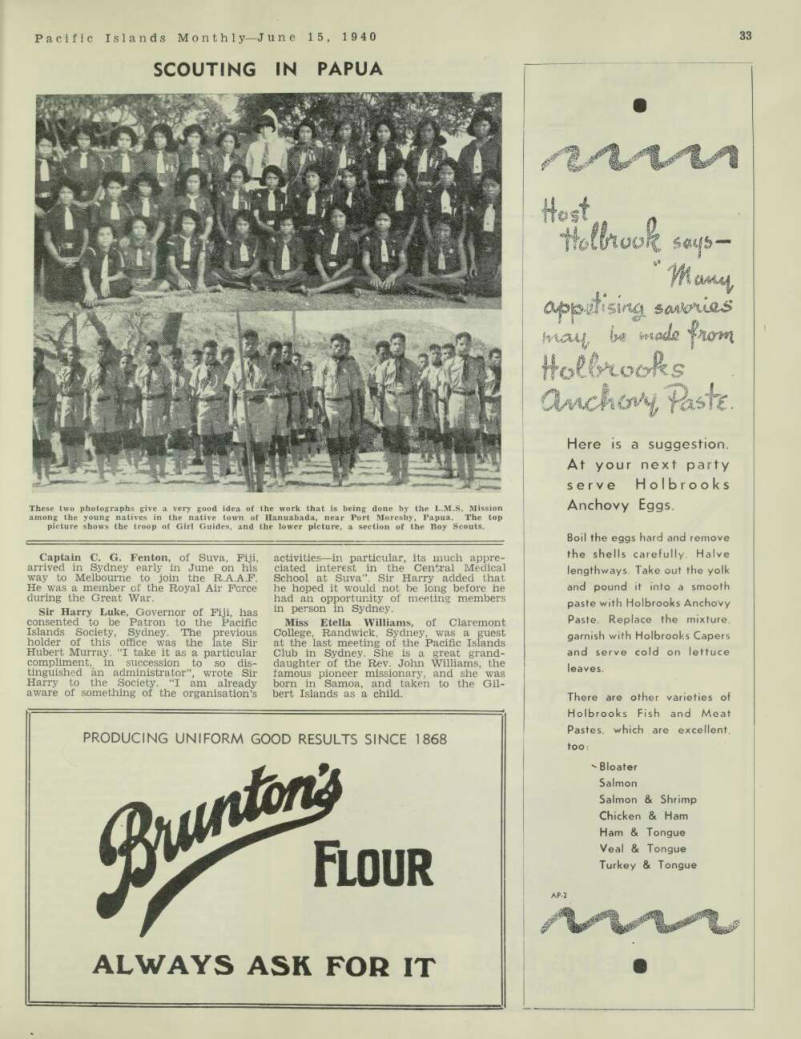
Captain C. G. Fenton, of Suva, Fiji, arrived in Sydney early in June on his way to Melbourne to join the R.A.A.F.
He was a member of the Royal Air Force during the Great War.
Sir Harry Luke, Governor of Fiji, has consented to be Patron to the Pacific Islands Society, Sydney. The previous holder of this office was the late Sir Hubert Murray. “I take it as a particular compliment, in succession to so dis tinguished an administrator”, wrote Sir Harry to the Society. “I am already aware of something of the organisation’s
activities —in particular, its much appre ciated interest in the Central Medical School at Suva”. Sir Harry added that he hoped it would not be long before he had an opportunity of meeting members in person in Sydney.
Miss Etella Williams, of Claremont College, Randwick, Sydney, was a guest at the last meeting of the Pacific Islands Club in Sydney. She is a great grand daughter of the Rev. John Williams, the famous pioneer missionary, and she was born in Samoa, and taken to the Gil bert Islands as a child.
These two photographs give a very good idea of the work that is being done by the L.M.S. Mission among the young natives in the native town of Hanuabada, near Port Moresby, Papua. The top picture shows the troop of Girl Guides, and the lower picture, a section of the Boy Scouts.
Advertisements & other items, p. 35 (2 items)
33
Pacific Islands Monthl y—J line 15, 1940
Mcht^y,%dt.
0
CLp&itftStriQ saWU&S
MtfU J, ljs $5
V I
ffo tycoons
Mcht^y,%dt.
Here Is a suggestion.
At your next party
serve Holbrooks
Anchovy Eggs.
Boil the eggs hard and remove the shells carefully. Halve lengthways. Take out the yolk and pound it into a smooth paste with Holbrooks Anchovy Paste. Replace the mixture, garnish with Holbrooks Capers and serve cold on lettuce leaves.
There are other varieties of Holbrooks Fish and Meat Pastes, which are excellent, too; v Bloater Salmon Salmon & Shrimp Chicken & Ham Ham & Tongue Veal & Tongue Turkey & Tongue
PRODUCING UNIFORM GOOD RESULTS SINCE 1868
ALWAYS ASK FOR IT
Death Of Old Papuan
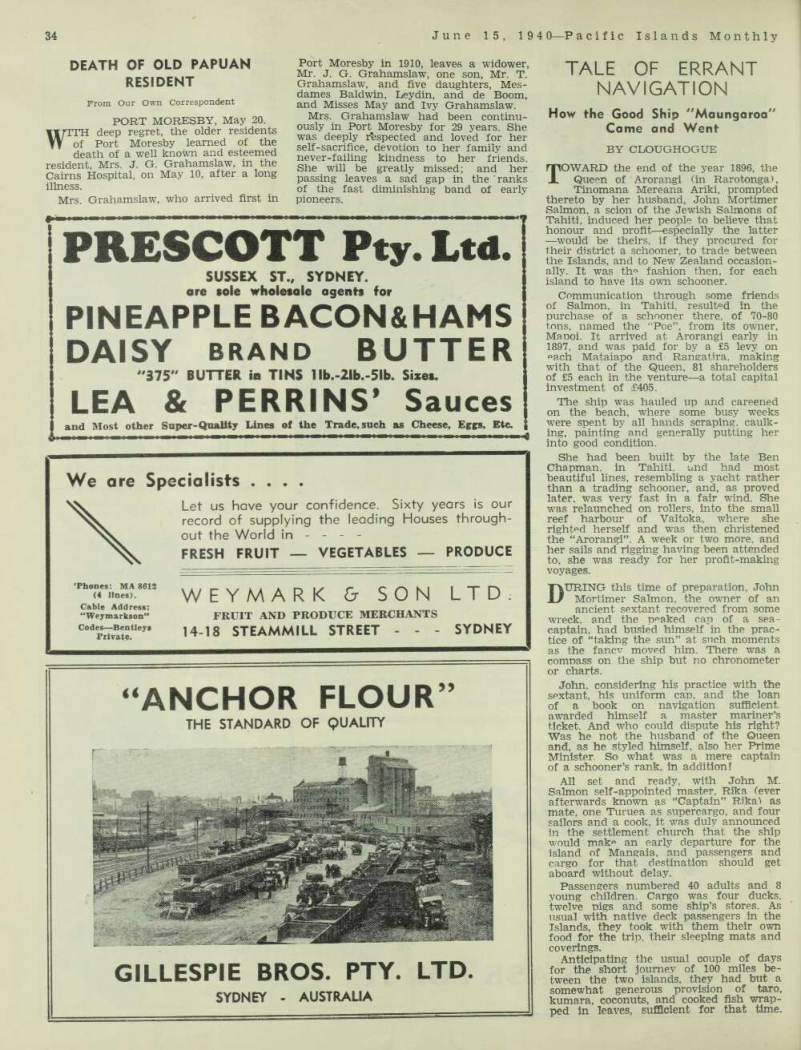
Resident
From our Own correspondent May 20 „ rTTH the oldeV reLents W 1 ™ *55? ** 2 f ,^ M°resby leamea. °Jv death of a well mfl aw St in p resident, Mrs J - G - Cairns Hospital, on May 10, after a long illness.
Mrs. Grahamslaw, who arrived first in
Port Moresby in 1910, leaves a widower, Mr. J. G. Grahamslaw, one son, Mr. T.
Grahamslaw, and five daughters, Mes dames Baldwin, Leydin, and de Boom, and Misses May and Ivy Grahamslaw.
Mrs. Grahamslaw had been continu ously in rt Moresby for 29 years. She was deeply inspected and loved for her self-sacrifice, devotion to her family and never-failing kindness to her friends, She will be greatly missed; and her passing leaves a sad gap in the ranks of the fast diminishing band of early pioneers.
Tale Of Errant
Navigation
How the Good Ship "Maungoroa"
Came and Went
By Cloughogue
TOWARD the end of the year 1896, the Queen of Arorangi (in Rarotonga), Tinomana Mereana Ariki, prompted thereto by her husband, John Mortimer Salmon, a scion of the Jewish Salmons of Tahiti, induced her people to believe that honour and profit—especially the latter —would be theirs, if they procured for their district a schooner, to trade between the Islands, and to New Zealand occasion ally. It was th° fashion then, for each island to have its own schooner.
Communication through some friends of Salmon, in Tahiti, resulted in the purchase of a schooner there, of 70-80 tons, named the “Poe”, from its owner, Manoi. It arrived at Arorangi early in 1897, and was paid for by a £5 levy on Mataiapo and Rangatira, making with that of the Queen, 81 shareholders of £5 each in the venture —a total capital investment of £405.
The ship was hauled up and careened on the beach, where some busy weeks were spent by all hands scraping, caulk ing, painting and generally putting her into good condition.
She had been built by the late Ben Chapman, in Tahiti, and had most beautiful lines, resembling a yacht rather than a trading schooner, and, as proved later, was very fast in a fair wind. She was relaunched on rollers, into the small reef harbour of Vaitoka, where she righted herself and was then christened the “Arorangi”. A week or two more, and her sails and rigging having been attended to, she was ready for her profit-making voyages.
DURING this time of preparation, John Mortimer Salmon, the owner of an ancient sextant recovered from some wreck, and the peaked cap of a sea captain, had busied himself in the prac tice of “taking the sun” at such moments as the fancv moved him. There was a compass on the ship but no chronometer or charts.
John, considering his practice with the sextant, his uniform cap, and the loan of a book on navigation sufficient, awarded himself a master mariner’s ticket. And who could dispute his right?
Was he not the husband of the Queen and, as he styled himself, also her Prime Minister, So what was a mere captain of a schooner’s rank, in addition!
All set and ready, with John M.
Salmon self-appointed master. Rika (ever afterwards known as “Captain” Rikal as mate, one Turuea as supercargo, and four sailors and a cook, it was duly announced in the settlement church that the ship would mak* an early departure for the island of Mangaia, and passengers and cargo for that destination should get aboard without delay.
Passengers numbered 40 adults and 8 young children. Cargo was four ducks, twelve pigs and some ship’s stores. As usual with native deck passengers in the Islands, they took with them their own food for the trip, their sleeping mats and coverings.
Anticipating the usual couple of days for the short journey of 100 miles be tween the two islands, they had but a somewhat generous provision of taro, kumara, coconuts, and cooked fish wrap ped in leaves, sufficient for that time.
There was a plentiful supply of water aboard in casks.
ON Tuesday morning early, sail was set and off their ship went to the ac companiment of excited cheering from the beach crowd of joint owners. Full of pride and self-importance in his posi tion, responsibility and seamanship, the captain steered her N.E., to sail in majesty across the sea-face of Avarua District, that the envy of that people might be stirred. Mangaia lies to the S.E. of Rarotonga.
The expected two days, without sight of land, passed uneventfully. The ship’s discipline was firm. At nightfall, all hands gathered for religious service, including the man at the wheel. The wheel was firmly lashed in place for the night.
The service over, the entire ship’s company were ordered to bed, as on land, at 8 p m. No man of the crew might go on deck after that hour—the captain con sidered a watch at night superfluous—so that there should be no chance of moral laxity with female passengers. The law of the island was strict—loo Chile dollars fine if the woman were married (Section I). The captain’s rule was firm, that no scandal attach to his command.
Three days passed; no sight of Man gaia. Four days gone, still no signs.
Then said the captain, in response to enauiries: “T believe the sextant is not reliable. It does not read the same here as it did in Rarotonga. And I forgot to wind my watch the second night out, I was so busy. But, fear not. we shall get there. There Is one unfailing guide, the sea birds. Where there are birds there is land close by, and to it they fly each nightfall. We shall follow the birds, as Columbus did when he sought America.”
So, from then on, he followed the birds!
DAILY the air grew cooler; and, at the end of five days, the four ducks found final rest, nccnmnanied bv some rice from the ship’s stores. By the pnd of the second week, two of the nigs had followed them; and a further two, some days later.
Thev were two and a half weeks out, and the days had now grown perceptibly very cold to the Islanders. Food for the pigs was exhausted —eight remained, of which six belonged to the Queen. The captain refused absolutely to consider them as a possible future food supply.
The ship’s salt beef and rice were finished, and but a few tubers of taro and kumera remained amongst the passengers. Of the water, more than half was gone. It had been too liberally used through the first few days, when early arrival at Mangaia was anticipated.
The passengers became angry, and hard words passed, but no violence. The pigs were being kept alive by feeding to them the sleeping mats of pandanus leaf.
His mana gone. Captain Salmon was forced to turn the ship round and sail in a reverse direction. The birds had failed him.
Of the eight pigs left, rapidly slimming on the poor diet, two were available for food, but the six belonging to the Queen were not to be thought of, the captain said. He would, of course, be sorry if any one died; but how could he kill the pigs of his Queen ahd wife without her per mission; they were not his nor theirs.
During the week the two were killed and they, with equal small shares of the other food aboard, maintained life. Th? starving people began to mutter of a pos sible reversion to the “long pig” of their forefathers, with a mind on the captain.
But afraid, weak and tired, they lay about in seeming submission to fate, with true Polynesian apathy.
The fourth Sunday passed, and for the next three davs their only diet was the memory of their last meal and a few scanty drinks of sun-baked water. Matters looked hopeless. Two small taro tubers alone were left on the ship.
ON the morning of Friday, three weeks and four days from their departure life was stirred in the drooping figures, by a cry from the mast-head look out, “Tera te enua, tera te enua” (There is the land —there is the land).
The passengers sprang to the side, and eager eyes followed the direction of his pointing arm. There, far ofl ahead, emerg ing from the waters, was a mountain.
Now, like another party, of the name of Richard, the captain was himself again. His voice rang out with the note of a victor: “I told you I could get you to Mangaia. There it is. Now, who says I am not fit to be captain?”
Orders were given in a masterful way —until, fast drawing nearer, it began to dawn on all aboard that the local scen ery seemed familiar. A laugh went up as Maunga Roa and Raemaru mountains
were recognised.
They had arrived back from the south, after sailing to the north, at exactly the place they had left, three weeks and four days previously.
The day was Friday. By the afternoon.
all passengers had been put ashore at the manager, to make a bargain and con- Rutaki, the southern end of the Arorangi elude the sale.
District, while the ship made its way to Avarua, to tie up in .the harbour. There, Captain Salmon led ashore six stagger ing, framework pigs for his Queen and wife; nevermore to have faith in birds Great was the trouble when all had been learned from the miscarried pas sengers. Indignation meetings were held and, with a unanimous voice, John M.
Salmon was reduced in rank, no more to be entitled to the address of “captain”.
Now, what was to be done? No share holder was available and fit to command, and the engagement of one on wages was a thing not to be thought of. It was finally decided to sell the schooner to the Cook Islands Trading Company, and three of the co-operators (John Vairakau, Jack Imene and Willie Isaia) were ap pointed delegates to approach Mr. Sharpe,
npHESE worthies deserve a few words X to themselves. John Vairakau was the half-caste son of an American captain, and a woman of Hawaii. Arriving at early manhood, stirred by that “Viking of the Sunrise” blood inherited from his mother, he, like Ru Enua of Aitutaki, would journey and find himself a new homeland. Arriving at Rarotonga, he married Tapaerua, daughter of Isaia Papehia, a cousin of the Queen, and was invested with the title and lands of “Rangatira Matoi”—which rightfully be longed to an orphan infant son of a grand-daughter (named Matoi) of a pre vious Tinomana Rurutini, being daughter of that missionary Papehia who intro duced the Gospel to the island.
Willie Isaia was his brother-in-law, be ing a son of the same Isaia Papehia, the
local pastor. Willie was always energetic on his own behalf.
Jack Imene, of humble birth, was the Lepidus in the Triumvirate.
John Vairakau assumed duty as trea surer. Of the price received from the C.I.T. Co., which never was known gener ally, not one penny piece of the invest ment of £5 each ever came back to the share holders. John Vairakau soon after wards built himself a very fine house of dressed timber imported, and also im ported some good horses.
It was generally predicted that his death would soon ensue; and, strange to say, it did. The house still stands, a stranger to paint and repair, in a dilapidated condi tion. The title and lands renresent an unsettled dispute.
The C.I.T. Co. took the ship over. A man from Rurutu, Theodore Nagel (no relation to the Atiu Resident a gen ™ Nagel, who ended his own life) was en gaged as captain. Rika remained mate, and W. P. Browne became super-cargo.
Captain Nagel was the son of an Ameri can sea-captain.
The ship, now properly equipped, made a number of Islands trips. Then, as she was falling into bad condition, she was despatched to New Zealand for over haul and repair. She had been renamed the “Maungaroa” some time previously, in place of her former name, and as the “Maungaroa” she holds firm place in local memory.
About £l,OOO was expended in bringing her into first-class condition, and she made the return trip from New Zealand to Rarotonga in an unbroken record time (for a sailing craft) of seven days to sight of harbour. However, she was be calmed outside for two days, but dropped her anchor in Avarua harbour nine days out from Auckland—l,B6o miles.
After trading through the Islands for some time, it was decided to send her on another trip to Auckland.
Some interior impulse impelled Raki, the mate, and W. P. Browne, the super cargo, to resign. One Pakari, of Avarua, became mate, and the super-cargo’s place was taken by a young brother of Captain Nagel. The ship had been working the Islands for about five years when she left on this second trip to New Zealand. On the way she picked up some cargo at Niue, arriving safely at Auckland.
Loaded with return cargo for the Cook Islands, she sailed from Auckland some few days before the end of March, 1902 —to disappear from human ken. Nothing more was ever known of her fate.
The U.S.S. Co. “Hauroto” left some few days after her, and ran into a hurri cane of great violence. The captain of the steamer was of the opinion that if the “Maungaroa” met it, she could not possibly have lived through it. Her fate is recalled in a local chant, which some day may blossom into folklore. It begins: Tinomana Ariki e nga Mataiapo Kimi ia tetai ravenga Tarau ia ra Ngamaru ariki el Kimi i te pa’i tei ngaro Kare i roa atu a Maungaroa e Teia Kua tae mae nei.
Aue! Tura ia o Maungaroa e.
The translation is:— Royal Tinomana and the chiefs, Some plan discover, Hiring the (Atiu ship) Ngamaru Ariki, Go seek the ship that’s lost.
The Maungaroa not long away, This here has arrived.
Sorrow! The seeking of the Maungaroa.
Steamships Trading Co. Ltd., Papua, paid an ordinary and preference in terim, half-yearly dividend of 4 per cent, on May 1.
Advertisements & other items, pp. 36-38 (5 items)
34
June 15, 194 O—P acific Islands Monthly
Prescott Pty. Ltd.
SUSSEX ST., SYDNEY,
ore sole wholesale agents for
PINEAPPLE BACON&HAMS
DAISY brand BUTTER "375" BUTTER in TINS Ilb.-21b.-slb. Sizes.
LEA & PERRINS’ Sauces and Most other Super-Quality Lines of the Trade, such as Cheese, Eggs, Etc.
We ore Specialists
X Let us have your confidence. Sixty years is our record of supplying the leading Houses throughout the World in - - - -
FRESH FRUIT VEGETABLES PRODUCE
'Phones: MA 8612 (4 lines).
Cable Address: "Weymarkson”
Codes—Bentleys Private.
WEYMARK & SON LTD.
FRUIT AND PRODUCE MERCHANTS
14-18 STEAMMILL STREET - - - SYDNEY
“ANCHOR FLOUR
THE STANDARD OF QUALITY
H ■k - •;k, m
GILLESPIE BROS. PTY. LTD.
SYDNEY - AUSTRALIA
35
Pacific Islands Monthl y—J une 15, 1940
CLmoftls
PURE RICE
STARCH
Always ask for . . .
CORAL” BRAND
100% PURE
Noted for its
QUALITY
and
WHITENESS.
Goes Farthest and gives Lasting Finish
WILL NOT
STICK TO
IRON,
Obtainable from Leading Island Stores.
V
1 CORAL BRAND
RICE STARCH
tv s co»i Manufactured by
AUSTRALIAN RICE. LTD.,
Sydney, N.S.W.
OFTEN BUTTERED
NEVER BETTERED
if Crisp, light biscuits which bring out the flavour of cheese and add a new attractiveness to fresh or stewed fruit.
A delicious supplement to ham or paste or other tasty savoury, and still an epicurean delight served simply with fresh butter.
At home on cold nights butter the "Saos," grate a little cheese over them, and then sprinkle with cayenne pepper one minute in a hot oven and serve hot.
CLmoftls
FAMOUS
SAO BISCUITS
A 26 ALWAYS ASK YOUR GROCER FOR ARNOTT'S !
CAPSTANS®
m 55 Capstan Cigarettes, U round airtight 50’s. ' Medium and full strength.
'•via m from
SPECIALLY
PACKED FOR
THE TROPICS
Capstan Navy Cut Tobacco, made the finest Virginia leaf. 8*25-18 8
* m
READ THE
B.P. MAGAZINE
WINTER NUMBER
iiiiiiiiiiiiiiiiniiiniiimiiiiiiM
Now On Sale
Short Stories Pictures Travel Articles - - - - Pages for the Children Stage Latest Fashions Screen A
ONE SHILLING PER COPY.
ON SALE AT ALL NEWSAGENTS AND BOOKSELLERS
36
June 15, 194 O—P acific Islands Monthly
Clouds Over Matupi
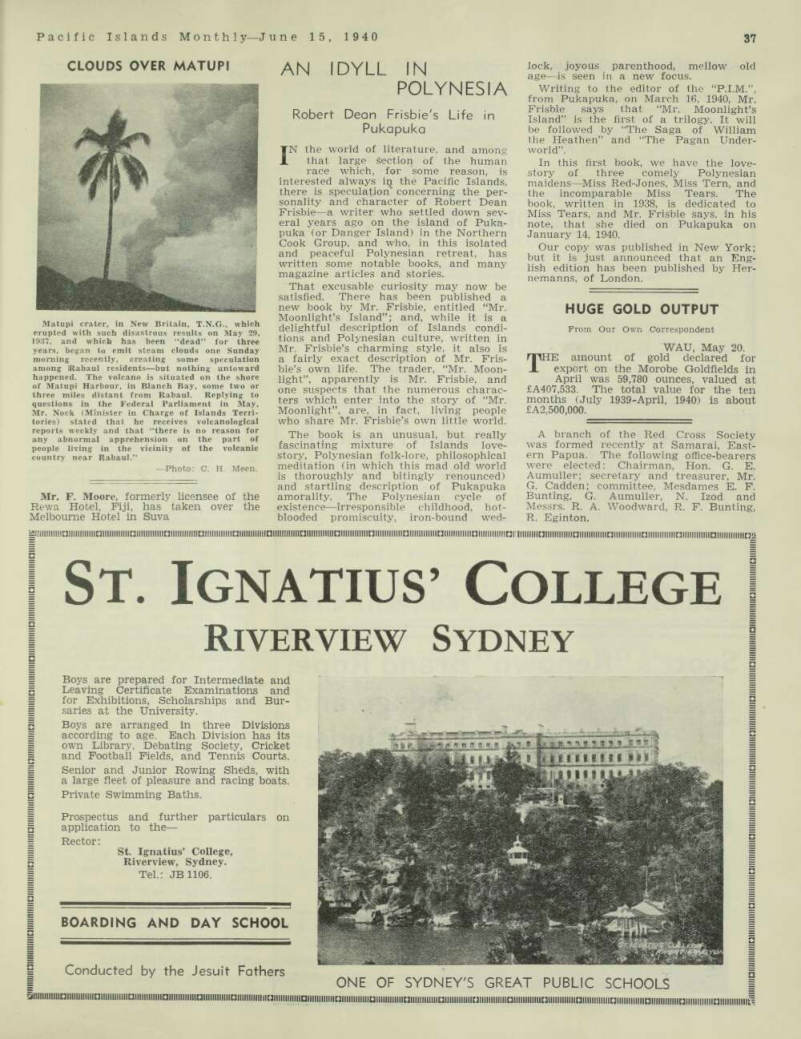
Mr. F. Moore, formerly licensee of the Rewa Hotel, Fiji, has taken over the Melbourne Hotel in Suva
Matupi crater, in New Britain, T.N.G., which erupted with such disastrous results on May 29, 1937, and which has been “dead” for three years, began to emit steam clouds one Sunday morning recently, creating some speculation among Rabaul residents—but nothing untoward happened. The volcano is situated on the shore of Matupi Harbour, in Blanch Bay, some two or three miles distant from Rabaul. Replying to questions in the Federal Parliament in May, Mr. Nock (Minister in Charge of Islands Terri tories) stated that he receives volcanological reports weekly and that “there is no reason for any abnormal apprehension on the part of people living in the vicinity of the volcanic country near Rabaul.” —Photo; C. H. Meen.
Polynesia
An Idyll In
Robert Dean Frisbie's Life in Pukapuka
IN the world of literature, and among that large Section of the human race which, for some reason, is interested always the Pacific Islands, there is speculation concerning the per sonality and character of Robert Dean Frisbie —a writer who settled down sev eral years ago on the island of Puka puka (or Danger Island) in the Northern Cook Group, and who, in this isolated and peaceful Polynesian retreat, has written some notable books, and many magazine articles and stories.
That excusable curiosity may now be satisfied. There has been published a new book by Mr. Frisbie, entitled “Mr.
Moonlight’s Island”; and, while it is a delightful description of Islands condi tions and Polynesian culture, written in Mr. Frisbie’s charming style, it also is a fairly exact description of Mr. Fris bie’s own life. The trader, “Mr. Moon light”, apparently is Mr. Frisbie, and one suspects that the numerous charac ters which enter into the story of “Mr.
Moonlight”, are, in fact, living people who share Mr. Frisbie’s own little world.
The book is an unusual, but really fascinating mixture of Islands love story, Polynesian folk-lore, philosophical meditation (in which this mad old world is thoroughly and bitingly renounced) and startling description of Pukapuka amorality. The Polynesian cycle of existence —irresponsible childhood, hot blooded promiscuity, iron-bound wed
lock, joyous parenthood, mellow old age—is seen in a new focus.
Writing to the editor of the “P.1.M.”, from Pukapuka, on March 16, 1940, Mr.
Frisbie says that “Mr. Moonlight’s Island” is the first of a trilogy. It will be followed by “The Saga of William the Heathen” and “The Pagan Under world”.
In this first book, we have the love story of three comely Polynesian maidens—Miss Red-Jones, Miss Tern, and the incomparable Miss Tears. The book, written in 1938, is dedicated to Miss Tears, and Mr. Frisbie says, in his note, that she died on Pukapuka on January 14, 1940.
Our copy was published in New York; but it is just announced that an Eng lish edition has been published by Her nemanns, of London.
Huge Gold Output
From Our Own Correspondent WAU, May 20. mHE amount of gold declared for A export on the Morobe Goldfields in April was 59,780 ounces, valued at £A407,533. The total value for the ten months (July 1939-April, 1940) is about £A2,500,000.
A branch of the Red Cross Society was formed recently at Samarai, East ern Papua. The following office-bearers were elected: Chairman, Hon. G. E.
Aumuller; secretary and treasurer, Mr.
G. Cadden; committee, Mesdames E. F.
Bunting, G. Aumuller, N. Izod and Messrs. R. A. Woodward, R. F. Bunting, R. Eginton.
Advertisements & other items, p. 39 (2 items)
37
Pacific Islands Monthl y—J une 15, 1940
St. Ignatius’ College
Riyeryiew Sydney
Boys are prepared for Intermediate and Leaving Certificate Examinations and for Exhibitions, Scholarships and Bursaries at the University.
Boys are arranged in three Divisions according to age. Each Division has its own Library, Debating Society, Cricket and Football Fields, and Tennis Courts.
Senior and Junior Rowing Sheds, with a large fleet of pleasure and racing boats.
Private Swimming Baths.
Prospectus and further particulars on application to the — Rector; St. Ignatius’ College, Riverview, Sydney.
Tel.: JB 1106.
BOARDING AND DAY SCHOOL
Conducted by the Jesuit Fathers
u
ONE OF SYDNEY'S GREAT PUBLIC SCHOOLS
Taxes In American Samoa
Apia, May 4.
AN increase in import duties in American Samoa is announced, as from April 1, 1940. The following are the new duty rates: — Cigars and cheroots, per 100, $0.50.
Cigarettes, per 100, $0.20.
Beer, per quart, $0.07.
Wine, per quart, $0.30.
Spirits, per quart, $l.
Flour (wheat), per 100 lbs., $0.50.
Meats, tinned or preserved, $0.02 per lb.
Sugar, per pound, $O.Ol.
Rice, polished, per pound, $O.Ol.
Fish, tinned or preserved, per lb. $0 02.
In addition to any duties collected in accordance with the regulations, there shall be collected a license fee of one per cent, ad valorem on all imports.
The poll-tax for 1940 is reduced from 9 dollars to 6 dollars 75 cents.
One Night At Sea
By “Daika”
I LEFT Samarai for a trip on a local schooner. A friend, a prospector, myself and the skipper and engin eer were the only Europeans on board.
On the second night out, we made a good anchorage at about 4 p.m., and resolved to remain the night. The skip per and engineer decided to catch up on some sleep, lost the night before.
We saw some sharks about the boat, and, acting on a suggestion from the prospector, I procured a lump of ancient bacon, placed two plugs of dynamite in it, with about four feet of fuse, and threw it overboard.
The sharks nosed round, and then a large one came with a flurry of water and grabbed it. We waited tensely for the result.
There was a terrific explosion almost under the boat. The engine-room tele graph rang madly, as the skipper bounded from his stretcher on the bridge, and grabbed at it. The engineer came from his bed so swiftly that he removed the nail of his little toe.
The voracious shark arrived on top of the water in two pieces, about fifty feet apart, which immediately sank again.
I produced a bottle of whisky, where with to quieten the skipper and engineer, and they were less offensive at the end of an hour, and the first bottle. My friend produced another bottle, and the prospector told of a crocodile he blew up. He said he placed several plugs of explosive in the body of a small pig. The crocodile ate it, and lay on the bank in the sun. Suddenly, it swelled up in the middle like a balloon, and a dull explo sion was heard. The croc, meditated for a while, and then opened its mouth, and a large quantity of smoke came out. It kept blowing out smoke for some time, until it resumed normal size, and then it crawled back into the water.
We decided to finish the second bottle before having kai. The skipper told of a horse his grandmother owned, which was taken by crocodiles. Friend told of a dog on the river bank, howl ing, when a croc, came and lashed it with his tail, and knocked it into the water. The skipper’s grandmother’s horse was not taken by a croc.—it got away and died a natural death. It was a very nice horse to ride.
The prospector told of the time when one of his mates was on a spree, and fell off the wharf. His hat floated away on the tide, but he could not see his mate’s body anywhere. Some natives got a dinghy, and chased the floating hat. and lifted it up, and found his mate underneath it, asleep. He went on to nraise the brand of whisky his mate had been drinking.
An argument started between the engineer and the prospector about the truth of the story, and the prospector offered to show the engineer the spot where it had happened. The engineer looked thoughtful.
The skipper said his grandmother’s horse was a grey one, with a black spot on its forehead. He showed the size of the spot, on a stanchion.
The engineer said a man could not float upright in the water. The pros pector said he could.
I told of a friend of mine who fell into a river and was drowned, after drinking steadily for a week. We found the body through the behaviour of the
fish. They would swim up to a certain spot, and then slowly turn over and wriggle around in the water, get a dull look in their eyes, and drift downstream.
We looked at the spot and found my friend’s body. He had been so pickled that he made the fish drunk.
The skipper said his grandmother’s horse got drunk once at a brewery. It lay asleep in the yard, all night, and when it woke in the morning it went to the river and held its head under water until it nearly drowned. I asked him if that was the time the crocodile got it, and he denied that any croco dile ever got near his grandmother’s horse. I started to remind him of his previous remarks, when a loud splash was heard.
The engineer had decided to demon strate his theory of floating. The crew boys rushed round, and hauled him out of the water. He looked very sick. We gave him some whisky, and he went into a coma. Friend and prospector de cided to use artificial respiration, but the engineer gave a loud groan and was suddenly very sick. The boys took him away to bed.
The skipper tried to show us the scar where his grandmother’s horse kicked him, but found it so beyond him that he sat on the deck and went to sleep.
We had another drink and the pros pector went to his cabin and came back with some meat and biscuits. While we were eating he told us of the time he and some others were going to Samarai in a launch.
They had had a merry leave-taking, and all slept until nearly daylight. The
first to awake, awakened the others; and, while they were discussing the size and aches of their respective heads, a rooster crowed. They all hushed; and in a few moments it crowed again.
They rushed on deck and gazed about them. It was very dark, and the boy at the tiller was half-asleep. Suddenly, the rooster crowed again, from dead ahead, and not far away. They grabbed the tiller and turned the boat round, and awakened the other boys on deck, while looking out for the land. One went below and slowed the engine down.
A boy went up to the bow of the launch, and lifted a box, and brought out a rooster, tied by the leg. The rooster crowed once more—and the pros pector and party went back below, for getting to turn the boat round again.
They ran back for an hour before the sunrise showed them their error.
We decided to go to bed, after this.
My friend went first to the cabin. A terrific crash was heard, and the boys presently reported my friend had tried to go to bed on the table set for our kai. I decided to sleep on deck, in a chair.
I have just seen the sun rise over the small island. It crept slowly up on the world from behind the fringing coconuts, outlining each swaying leaf in turn. Birds began calling and flying along the beach. Fish are jumping all round the boat, in their welcome to a new day.
The deck of the boat is an awful mess.
I do not, feel too good. Think I must have eaten too much of the skipper’s grandmother’s horse.
Advertisements & other items, p. 40 (2 items)
38
June 15, 194 O—P acific Islands Monthly
Cordage and
STEAMSHIPS TRADING COMPANY LTD.
PORT MORESBY PAPUA SAMARA I
Chairman and Managing Director; A. S. FITCH.
Shipowners, Wholesale and Retail Merchants and Traders; Shipping, Customs and Insurance Agents; Copra and Rubber Plantation Owners.
MAIL CONTRACTORS TO COMMONWEALTH AND PAPUAN GOVERNMENTS.
AGENCIES: At Port Moresby: Coral Sea Insurance Co.; Phoenix Insurance Co.; Delta Sawmills Ltd.; Acme Bakery Co.; Vacuum Oil Co. Pty. Ltd. At Samarai; Coral Sea Insurance Co.; Delta Sawmills Ltd.; Bankers and Traders’
Insurance Co.; National Mutual Life Insurance Co.; Kularo Shipyards; Mamai Plantations.
BRANCHES; —In Papua: Hanuabada, Sivitoi, Aroma, Koki, Hula, Ela Beach, Duga Duga, Yule Island.
SYDNEY: NELSON & ROBERTSON PTY. LTD., 12 Spring Street; Melbourne. 396 Flinders Lane; London. E. Whiteaway & Co., 7 Chiswell Street. Finsbury, London.
Cable Address: “STEAM.SHIPS.” Code: Bentley’s.
STEAMSHIPS TRADING COMPANY, LIMITED
MERCHANTS, SHIPOWNERS AND PLANTERS
PORT MORESBY AND SAMARA I.
Our organisation provides every facility and efficient service as
MANAGING AGENTS AND VISITING REPRESENTATIVES OF
COCONUT AND RUBBER PLANTATIONS.
Estate supervised in bearing and planting stages.
Comprehensive reports compiled and regular visits made to Estates by our competent Plantation Inspector.
WRITE, CABLE OR CALL FOR PARTICULARS:
STEAMSHIPS TRADING COMPANY LTD.
Scott’s “Renown” Brand Rope,
Cordage and
Binder
Twine
Cable Address: Ropeyard, Sydney.
of Every
Description
MANUFACTURED AT
MASCOT, N.S.W.
By
J, SCOTT
PTY. LTD.
Head Office and Store
IG3 CLARENCE STREET,
SYDNEY,
N.S.W.
This Freedom !
Embarrassing Situation Created by Native Producers in New Guinea
From Our Own Correspondent
Rabaul, May 20.
IF ever a native race was suddenly pre cipitated from the stone-age to the complications of modern life, it was the New Guinea native —especially in and around Rabaul.
Special legislation has enabled them to dispose of their produce direct to exporters, and to receive the same price for their product as the Europeans.
They have added heavy motor lorries to their assets of hot-air kilns and gal vanised-iron homes; and their savings bank accounts have grown to nearly
£Lo,Ooo.
Legislation protects them at every turn—legislation rigidly enforced by Government officials, with one eye on the League of Nations and the other on Canberra.
No wonder, then, that when a witness before the Native Labour Commission (which is gathering data for an exten sive review of native labour regulations) made the remark that the natives of the Mandated Territory were not so well protected as the indigines of Papua, the Commission looked surprised. The cry from the majority of the non-native population in the Territory is that the Administration policy as one of too-great leniency towards the native, which is
having a deteriorating effect upon the growing generation.
The natives in the more-populated centres of the Territory are given their head in almost every respect. Old regulations, which were made for the maintenance of discipline and good order among a primitive people, are falling into disuse. Only recently, the District Court had a busy time, dealing out fines and imprisonment to chiefs and their henchmen for drinking quanti ties of intoxicating liquor purchased from Chinese traders who, owing to the adverse trading conditions brought about by the natives selling their copra direct to the exporters, must find some means of earning a livelihood.
The time has not yet come when the New Guinea native can “have his head” when he mixes in modern civilisation.
He must be kept in his place; and the sooner the Government realises this and introduces—once again—a bit of disci pline among the natives, the better it will be for all concerned.
Dr. George Lynch, M.B. (Camb.), who spent 30 years of distinguished service in Fiji, died recently in England, aged 79.
Appointed District Medical Officer at Ba, Fiji, in 1890, he became Senior Medical Officer in the Colony seven years later and was Resident Medical Superintend ent at Suva Colonial Hospital In 1908, he was made Chief Medical Officer, a member of the Legislative Council, and chairman of the Central Board of Health After his retirement from the Colonial Service, he returned to Suffolk, England, where he practised for a number of years.
Advertisements & other items, pp. 41-42 (2 items)
39
Pacific Islands Monthl y—J une 15, 1940
William Atkins pty tu.
Established 50 years—and carrying one oj the largest stocks of Iron and Steel in Australia.
Head Office 449-451 KENT ST., SYDNEY.
FULL, COMPREHENSIVE & UP-TO-DATE RANGE IN ALL
DEPARTMENTS, INCLUDING THE FOLLOWING LINES:—
STEEL DEPARTMENT
MILD STEEL:
Rounds, Squares, Flats, Half-rounds, Hexagons, Bevel, Shoeing, Tyre, Angles, Tees, Sheets, Plates, Girder Plates, Chequer Plates, Channels, Hoops, Etc.
BRIGHT STEEL:
Rounds, Squares, Hexagons.
Extra Special High Speed Tool Steel, Mining Steel, Blister Steel and Spring Steel, Rounds, Flats £r Squares.
Bar Iron— All sections and sizes.
Iron & Steel Merchants
ENGINEERS' SUPPLIES
COACH & MOTOR HARDWARE.
Cablt Addrcu: WILATKIN, SYDNEY.
Engineers' Supplies: Set Screws, Studs, Metal Thread Screws, Coach Screws. Files, Cotter Pins, Bright and Black Bolts, Rivets, Etc., Hack Saw Blades.
Power Transmission Gear: Including Plummer Blocks, Couplings, Collars, Etc.
Coach and Motor Hardware: Axles, Springs, Wheelstufl, Duck, Paints.
Farriers' Supplies: Horse Nails, Anvils, Vices, Etc.
Motor-Trimmers and Motor Builders' Gr Motor Painters' Requirements
C. A. WILLEY'S
Quick-Drying Coach and Car Paints, Roughstuff, Elastic Gloss, Synflex Enamels, Lacquers.
DUCO Lacquers and DULUX Enamels—FAßßEX Motor Toppings and Leather Cloths, House Cr Decorators' Paints, Varnishes tr Brushware Sole Distributors of CHAMPION'S Decorators Paint Products.
Distributing Agents for BROLITE Lacquers, SYNFLEX Enamels and "POLYGLOSS" Finish.
BURNS PHILP
(SOUTH SEA) CO. LTD.
Inc. in Fiji
Island Traders and Shipowners
Registered Office:
U V A
FIJI
Also Branches at:
\Fiji: Levuka, Lautoka, Labasa, Ba, Sigatoka, Rotuma.
Tonga: Nukualofa, Haapai, Vavau.
Samoa: Apia, Pago Pago (American Samoa). nv Solomons: Makambo, Gizo, Faisi.
New Hebrides: Vila.
Gilberts: Tarawa.
Code Address*.
“Burnsouth”. Norfolk Is. Niue. Wallis Is. Futuna Is.
< ’ cw^vww ~^nnoin Wi ,wi *r\ /
m For Protection and
Appearance
- use
“B A L M” Paint
PROTECTION —is the main job of Paint . . . APPEARANCE is next . . . and, to get the most efficient combination of both . . . use “8.A.L.M.” Paint.
“8.A.L.M.” Paint is a product of scientific research and practical experience ... It has been tested for durability, protective qualities and colour retention, and proved to be the best that can be made.
Measure the value of Paint by years of service, protection and appearance, and NOT by cost per tin. Specify “8.A.L.M.”
Paint.
GRADE PURE
aft i ivt
P iH>A
Red
DISTRIBUTORS: Greenwood & Laws Ltd., Rabaul and Wau; Steamships Trading Co. Ltd., , Port Moresby and Samarai; m ' Millers Ltd.. Suva. Fill.
A Product of British Australian Lead Manufacturers Pty. Ltd.
Polynesia
First Printing Press in Polynesia
IT was March, 1797, when the first printing press was landed from the “Duff” at Matavai, Tahiti, for the use of the Brethren sent out by the L.M.S. Its career was troubled, its fate was hard.
Here are the facts.
One only, of the company of 17, had learned the business, and he was one of the four ordained ministers. It is not known if he had had special training before setting out or if, previous to ordination, he had been a printer. Upon the shoulders of the unfortunate Thomas Lewis, aged 31, fell the burden.
The cases were landed and the Breth ren, in their simplicity, thought to have all soon under way. The language was soon to be mastered, and a Spelling Book distributed, the foundation of Cate chisms, Hymnals and Prayers, previous to the supreme aim, the distribution among the pagans of the Word of God.
But they soon found that the ac quirement of the language was very far from an easy task and that the reports of the captains of calling vessels were far from the truth. The printing press had to remain in its cases in the store room; the months passed by, and pro gress was exceeding slow.
Over a year had passed when they wrote Home, on August 26, 1798: “Our time has principally been engaged in labouring to acquire a knowledge of the language of the country, which we find all Europeans who ever visited Otaheite have utterly mistaken as to spelling, pronunciation, ease in learning and the barrenness of it. We have already joined some thousands of words and we be lieve some thousands yet remain.”
It was heart-breaking work, even to learn to speak it, much more so to re duce it to print. As a matter of fact, it was not until March, 1805 (eieht years’ toil) that they felt capable of deciding upon an alphabet of the language— though Henry Nott had won out as a speaker four years previously. They wrote Home in August, 1801, that he would address the natives for the first time in their own tongue “on the next Lord’s Day”.
But that printing press was handled, though not set up, just before that letter of August, 1798. They determined upon some division of their goods, and we read under date of June 2, 1798. “To-day we divided among us some of the most valuable books . . . the others were care fully packed up in a dry cask”; and here comes in that father of all Polyne sian Presses: “The printing and binding presses, with their anpurtenances and some printing paper, Brother Lewis will keep in his possession, if possible.” They do not state why it might not be pos sible. The man’s tragedy, to come, was not then even in the offing. It seems more likely to be the fear of burglary, for they were heavy sufferers by then, and had to set watch day and night to keep aught for themselves.
And, though the press was as useless to them as to the natives, save as iron, they would make a bid to save it. The very next day we read that they were busy “Pitting up a printer’s shop.”
Then fell the first blow. The printer left—was expelled from the Society— and, before another year was out, they laid his body in a grave not a stone’s throw from where his press stood.
Bereft of what they had so eagerly worked for, the printed word, they kept
bravely on, reducing the language to some printable order. Entry after entry is made, in their Journal, of their strug gle and hard travail.
Those men are full worthy of both record and praise. They had had no special training for such work. Apart from Jefferson, they were but poorly educated; for Lewis was dead, and Cover, with Eyre, had fled. They had all the difficult problems to solve by and for themselves. All through 1805-1806 they met twice a week, and stopped at noth ing to aid them. “We have paid a native for attending our meetings in order to ascertain the proper pronunciation of every word which we have (so far) writ ten down”; and they claimed that there was then a full 5,000 words in the Tahi tian vocabulary.
Then fell the second and final blow for that pioneer press. In December, 1808, Pomare and all the Brethren fled from the island; Matavai was deserted; the chapel and the missionary houses, the storeroom, the blacksmith’s shop, livestock of many kinds, the orange groves and vegetables, and the printing shop—there was not a soul on guard.
Down upon that tongue of land —to-day more generally known as Point Venus — the pagan hordes swept, and thoroughly wrecked the place, carrying off every thing they could lay their hands on, and, in chief, what most of all they coveted and prized, iron.
So was Finis written to the pioneer printing press of Polynesia. It had never functioned, and it was smashed to pieces for its precious metal. Printing had to wait for a brighter day.
MOOREA, lying hard by, claims right fully that it saw the first South Sea printing done. It came about in this way.
Eight full years had passed when, in February, 1817, a fresh contingent of the Brethren arrived from Sydney, among them William Ellis, later the author of “Polynesian Researches”, and for years the Foreign Secretary of the L.M.S. in London. He had had special training before leaving home as to both printing and book-binding and, along with him came a second press, with ample fount, paper and binding for a start. The press was installed at Afare aitu, Moorea, in March, 1817.
Operations commenced on June 10, 1817. We read: “Pomare arrived to wit ness the first composing for the printing press done in his dominions. He was asked if he would like to do the first himself. He answered ‘Yes.’ The com posing stick was then put into his hand and he was directed from whence to take the letters and how to place them until he had composed the alphabet at the beginning of the Taheitean Spelling Book. He appeared much pleased.”
That press was kept hard at work for many months, till a shortage came' of paper and of binding. Sydney supplied paper. Ellis, ever full of resource, called upon the natives of the island for goat, cat and dog skins, and showed them the craft of tanning, the result (“being but indifferent tanners”) not very good, but the binding was certainly strong. So the work went on—spelling books, cate chisms, scripture lessons issued by the thousand.
In 1818, Ellis—a born roamer—decided to follow his friend John Williams, to Raiatea, and with him went the print ing press. In 1819 two more printing presses were sent from Home. Before Pomare’s death in 1821, printing had ceased to be a novelty.—W. W. BOLTON.
Namanula Hill
(From Government House, Rabaul) THE garden with a magic peace was fraught.
Trees lazing in the tropic afternoon, Tall crotons shaded green to warmest red, Hibiscus, bougainvilleas aflame, And orchids pale as moonlight on the sea.
Out of the hearts of trees scarce audibly A sigh escaped; then all the paths grew still, And from the nearby verdant Mother Hill, Which slumbers on the bosom of the sky, I drew companionship, as long gone by The Poet Shepherd to the hillside came And for the strength of generations sought.
Freda Macdonnell.
4/15 Prince Albert Street, Mosman.
Mr. R. Evans, Town Clerk at Suva, Fiji, arrived in Sydney by the May “Monterey”, on sick leave.
The directors of Rabaul Electricity, Ltd., report that the recent issue of 7,913 ordinary shares of £1 each was over-subscribed.
Advertisements & other items, pp. 43-44 (2 items)
41
Pacific Islands Monthl y—J une 15, 1940
Bitumenoid Roofing
Timber, Joinery
ETC.
PREPARED BUILDINGS ready for erection a specialty.
SHIP AND BOAT BUILDING.
TIMBERS specially catered for.
PIBROLITE, PLYWOODS,
GALVANISED IRON.
CONSIGNMENTS shipped
by RETURN STEAMERS
to the Islands.
John W. Eaton
PTY. LTD.
WEST CRESCENT STREET,
NORTH SYDNEY.
Telephones; XB 4051 (6 lines.)
BITUMENOID ROOFING
MADE IN AUSTRALIA.
Bitumenoid Roofings, Dampcourse and Insulating Felts are made from the world’s best raw materials. Warranted to stand the most rigid tests.
BITUMENOID THE BEST
Roofing, 1,2, 3-ply; Flooring, Waterproof Materials: Saturated Felt; Resilient Road Jointing; Natural Asphalt Dampcourse: 2 and 3-ply Dampcourse; 1-2 lb. Lead-core Dampcourse: Roofing Cement; Asphalt Paints; Roofing Compound.
SAMPLES AND PRICE LISTS ON APPLICATION.
MAXWELL PORTER & SON LTD.
ESTABLISHED 1888. BUILDERS’ SUPPLIES.
107 REDFERN ST., REDFERN, SYDNEY, N.S.W. Phone; M 3157. Cables Bitumenoid.
a Obtain a copy before you build It contains designs and plans—in colour—of Homes that can be inexpensively built with
WUNDERLICH DURABESTOS
the indestructible osbestos-cemont building sheeting. Write to
WUNDERLICH LIMITED
G.P.O h Box 474aa, SYDNEY
rOR TROPICAL BUILDINGS, SPECIFY
A MODE PN
HOME
lIP4BI§TGS
AS Bt St OS CL M ENT Bull D NC SHEETS
KANGAROO BRAND
Ropes,
Cordage,
and Twines for every purpose
Backed by
86 years of service.
Manufactured by
M. DONAGHY AND SONS,
Pty. Ltd.,Geelong and Sydney.
Fiji Representatives:
PEARCE AND CO.
LIMITED
P.O. BOX 257, SUVA
Woven Wire for all industry \
COPRA DRYING TRAYS, FLOORS, Etc.
FRUIT DRYING TRAYS, MINING SCREENS.
Heavy Mosquito Gauze in Phosphor Bronze and other Metals Impervious to Salt Sea Air.
WIRE DOOR MATS AND GENERAL WIRE WORKS
E. WRIGHT & CO. LTD.
Office and Works: 148-152 Cleveland Street, Sydney, N.S.W.
Telegraphic Address: “Wrightmake,” Chippendale. f!
Or £ CD
Do You Know that the Famous
YOUNGER
STOVES and
RANGES
made with extended Firebox specially for long Wood fuel, are Self-Setting and, provided sufficient Flue Piping is attached, can be used in almost any position?
The No. 7W “Younger” Ranger can now be supplied fitted with Legs, as per Illustration.
Younger Stoves are Widely Used Ask for quotation for this Range, also illustrated Catalogue Throughout the and Price List for both Single and Double Oven Stoves.
Pacific Islands.
G. FLETCHER & SON 50 Oxford Street, Sydney.
M.V. Lakatoi
Now Running in Papuan Coastal Mail Service
THE Papuan coastal mail contract, which covers all the ports of call from Daru, in the far west, to the Conflicts and Woodlark Island, in the east, has been let for one year to Burns, Philp and Co. Ltd. The service will be carried on with the new and modern motor-vessel “Lakatoi”.
For some years, this service was car ried on by Steamships Trading Co. Ltd., with the old “Papuan Chief”. When the latter went on the reef, a couple of smaller boats were used.
Coastal travellers will be glad to see the “Lakatoi” on the run. She was built and taken to Samarai when Misima mining was booming; but when the Mt.
Sisa (or G.M.0.P.) enterprise collapsed, there was not nearly enough for the “Lakatoi” to do in Eastern Papua, and residents were much afraid that she would be taken to some other territory.
Mr. R. J. Keegan, who has been Dis trict Officer at Gizo, in the British Solo mon Islands for the past two years, arrived in Sydney during May on fur lough. He is accompanied by his wife and small son.
Disappointed
A Lady Who Was Disappointed Some of the Things You Need Not Take to Tahiti
THERE is a lady of Irish-North Ameri can ancestry staying at Papeete.
In her native country, the fogs and mists, the noise and confusion of traffic that* neyer ceases; the hackneyed sub jects which are usually discussed with the originality of a gramophone record; the boredom of going to the same parties with the same people, doing the same things, year after year; the drab monotony of so-called entertainment — had sent her mind to the refuge of dreams of a fair land far away where romance immortal reigns.
One day, she read a book which assured her that such a land lay far out on the sapphire bosom of the broad Pacific, and she was fascinated into undertaking the long voyage.
Now she is here, and romance some how has passed her by, and she is dis appointed. She is threatening to tra duce the fair fame of our peerless island in the newspapers of her native state, when she returns home.
Of course, we are sorry; but it all was inevitable. She brought with her the very things she had travelled so far to escape.
First of all, she brought standardisa tion —that method of mass production by which cosmeticians have created mil lions of expressionless masks that bury deeply feminine charm. At a dinner or evening party a blonde lady, well appointed with what these cosmeticians call glamour, looks like Banquo’s ghost, beside the golden-brown complexions of our Tahitian women, and the warm Spanish brunette of our Euronesians.
Secondly, like so many of her coun try-women, she has carried with her that extraordinary mental quality that looks upon everything which departs from the rigid uniformity of the stand ards of her suburban birthplace, as foreign and heathen, and wicked.
Thirdly, she brought as her principal baggage, a disposition which would be dissatisfied in any environment.
The oceans and land highways are crowded with travellers seeking escape from something—they know not what.
Actually, it is themselves. They have not learned that romance, and happi ness, and contentment, like the King dom of Heaven, are within one’s own mind and spirit.—A.C.R., Tahiti.
Growth Of Fiji Mining
Town
A LARGE social hall, complete with stage, billiards table, library and supper room, has been constructed at the Tavua goldfield, Northern Fiji, for the benefit of the Euronesian em ployees of the minirlg companies now operating there. The hall is in the new village of Vatukoula and it was formally declared open in April by Mr.
E. G. Theodore, managing director of the various mining companies.
Mr. Theodore praised the loyalty of the companies’ employees and congratu lated them on their ability to train for key positions in the service.
Many visitors from towns in Northern Fiji took part in a very pleasant social function.
Old-Time Weapons Of The
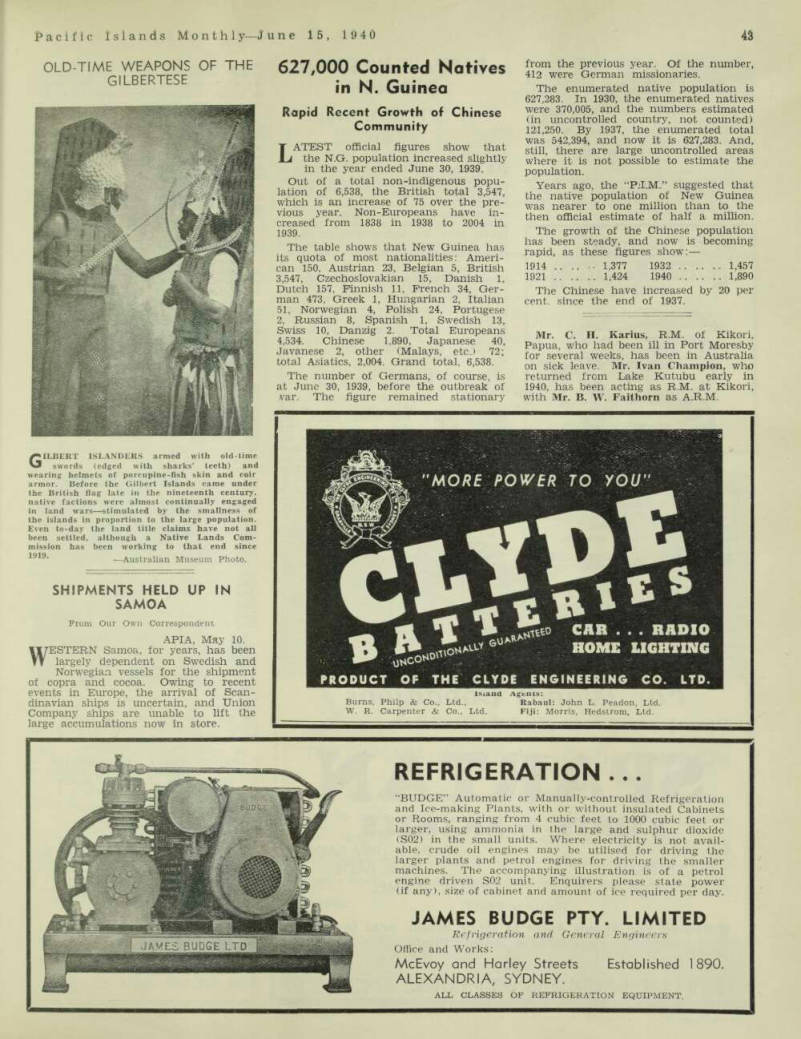
Gilbertese
GILBERT ISLANDERS armed with old-time swords (edged with sharks’ teeth) and wearing helmets of porcupine-fish skin and coir armor. Before the Gilbert Islands came under the British flag late in the nineteenth century, native factions were almost continually engaged in land wars—stimulated by the smallness of the islands in proportion to the large population.
Even to-day the land title claims have not all been settled, although a Native Lands Com mission has been working to that end since —Australian Museum Photo.
Shipments Held Up In
Samoa
From Our Own Correspondent
Apia, May 10.
WESTERN Samoa, for years, has been largely dependent on Swedish and Norwegian vessels for the shipment of copra and cocoa. Owing to recent events in Europe, the arrival of Scan dinavian ships is uncertain, and Union Company ships are unable to lift the large accumulations now in store.
627,000 Counted Motives
in N. Guinea Rapid Recent Growth of Chinese Community
LATEST official figures show that the N.G. population increased slightly in the year ended June 30, 1939.
Out of a total non-indigenous popu lation of 6,538, the British total 3,547, which is an increase of 75 over the pre vious year. Non-Europeans have in creased from 1838 in 1938 to 2004 in 1939.
The table shows that New Guinea has its quota of most nationalities: Ameri can 150, Austrian 23, Belgian 5, British 3,547, Czechoslovakian 15, Danish 1, Dutch 157, Finnish 11, French 34, Ger man 473, Greek 1, Hungarian 2, Italian 51, Norwegian 4, Polish 24, Portugese 2, Russian 8, Spanish 1, Swedish 13, Swiss 10, Danzig 2. Total Europeans 4,534. Chinese 1,890, Japanese 40, Javanese 2, other (Malays, etc.) 72; total Asiatics, 2,004. Grand total. 6,538.
The number of Germans, of course, is at June 30, 1939, before the outbreak of var. The figure remained stationary
from the previous year. Of the number, 412 were German missionaries.
The enumerated native population is 627,283. In 1930, the enumerated natives were 370,005, and the numbers estimated (in uncontrolled country, not counted) 121,250. By 1937, the enumerated total was 542,394, and now it is 627,283. And, still, there are large uncontrolled areas where it is not possible to estimate the population.
Years ago, the “PjI.M.” suggested that the native population of New Guinea was nearer to one million than to the then official estimate of half a million.
The growth of the Chinese population has been steady, and now is becoming rapid, as these figures show: — 1914 .. .. 1,377 1932 1,457 1921 1,424 1940 1,890 The Chinese have increased by 20 per cent, since the end of 1937.
Mr. C. H. Karius, R.M. of Kikori, Papua, who had been ill in Port Moresby for several weeks, has been in Australia on sick leave. Mr. Ivan Champion, who returned from Lake Kutubu early in 1940, has been acting as R.M. at Kikori, with Mr. B. W. Faithorn as A.R.M.
The Director of External Studies of the University of Queensland advises that Mr. S. J. Campbell, of Rabaul, New Guinea, was successful in the subjects for which he sat in the November Uni versity examinations; and that Rev. D.
F. Boorman, of Lau, Fiji, passed in Eng lish 111 at the same examinations, thus completing his course for the B.A. degree, which was conferred “in absentia” on May 6.
Falema’a, a Samoan missionary who spent 17 years in Papua with the L.M.S., returned to Apia, Samoa, recently with his wife and children.
Advertisements & other items, pp. 45-46 (2 items)
43
Pacific Islands Monthl y—J une 15, 1940
Refrigeration
"MORE POWER TO YOU"
. viTttO C I
CAR ■ • ■ RAD MO
HOME LIGHTING
o*co* 0 ' 1 ' 0 ' PRODUCT OF THE CLYDE ENGINEERING CO. LTD.
Island Agents: Burns, Philp & Co., Ltd., Rabaul: John L. Peadon, Ltd.
W. R. Carpenter & Co., Ltd. Fiji: Morris, Hedstrom, Ltd.
UkMu.
JAMES BUDGE
LTD
M (ft) 2
* A V
REFRIGERATION
“BUDGE” Automatic or Manually-controlled Refrigeration and Ice-making Plants, with or without insulated Cabinets or Rooms, ranging from 4 cubic feet to 1000 cubic feet or larger, using ammonia in the large and sulphur dioxide (SO2) in the small units. Where electricity is not available, crude oil engines may be utilised for driving the larger plants and petrol engines for driving the smaller machines. The accompanying illustration is of a petrol engine driven SO2 unit. Enquirers please state power (if any), size of cabinet and amount of ice required per day.
JAMES BUDGE PTY. LIMITED
Refrigeration and General Engineers Office and Works:
McEvoy and Harley Streets Established 1890.
ALEXANDRIA, SYDNEY.
ALL CLASSES OF REFRIGERATION EQUIPMENT.
roleman
STOVE
1— Lights Instantly—No Preheating. 2 Instant Heat Regulation. 3 Safety Shut-off Valve. 4 Nickel-Plated —Rust-Proof. 5 Wind-Proof, Silent, Odorless.
BUILT FOR A MULTITUDE
OF USES.
Sold by all leading Firms in the Pacific Islands.
In case of difficulty in obtaining supplies, write to: Pearce & Co. Suva, Fiji Islands.
For Islands Conditions
use
SPARTAN
PAINTS ENAMELS
PAVING PAINT SASH & TRIM PAINT
QDE ENAMEL ZINC PASTE
CAR POLISH VELOX ENAMEL
TROJAN PAINT
Request your Sydney Agent to obtain details, price lists and color cards of Spartan Paints.
IT WILL PAY YOU
SPARTAN LACQUERS PTY. LTD
74 Commonwealth St.,
SYDNEY.
Papua's Western
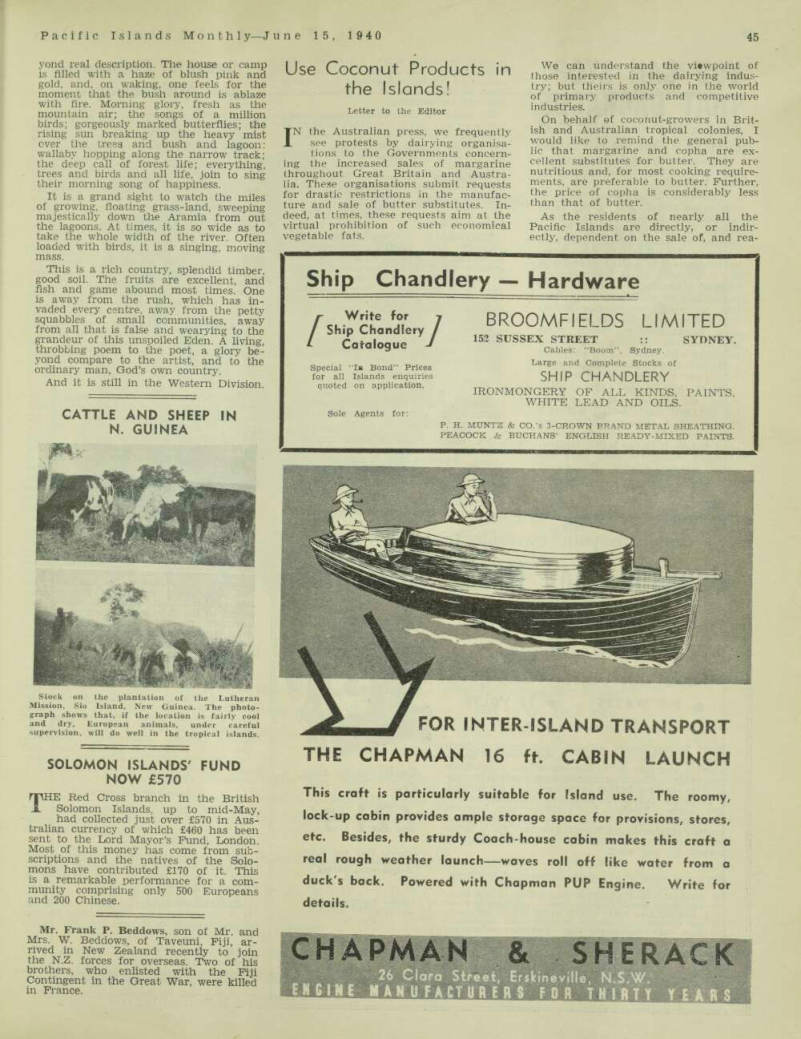
Division
It Is Not All Mud
By W.D.
MUCH has been written about the un loveliness of the Western Division of Papua: Of its malaria, mosquitoes and most of all, its Mud, spelt with a capital M.
And it is all true, the depressing, dirty rivers of the delta, the rushing waters of Spring tides, the turbulent waves of the wide river spaces which must be crossed to get anywhere.
To the uninitiated, the Fly or Bamu speak of tranquil calm; but the wise look well to sails and engine, for one never can tell how these rivers will behave. In an incredible short time the calm changes to roaring hills of white-capped sea, huge logs tearing down to smash any contact ing object, that heaving swell, or again that short, sharp wave, the terror of small craft on these rivers.
Notwithstanding all this, there is much of beauty to be found—if you look for it.
There is pretty little Daru Island, the town of the W.D., with its mango avenues along the main paths, and brightly colored crotons everywhere. The green slopes, on top of which are the Government residences, the rustic foot bridges leading to each building, and the well-arranged and neatly-kept gardens.
The long country road which leads to the other side of the island may not be paved or even, but it passes grand old gums and the farm, and winds on to the fishing village. A delightful walk.
My first impression of Daru was good, as then there were few houses and the whole place was a mass of gold and green and brown crotons, and the slopes were emerald after rain. There is real beauty in Daru.
Then, the wide creeks of the W.D. have a beauty all their own. Especially so at neap tides; green, still waters fringed by stately coconut palms, or maybe even the common Nipa, gently
swinging in the breeze; the graceful picture of canoes gliding along, reflected with the bending palms in the water; tiny fish jumping here and there; the morning sun chasing shadows.
Or is there anything more glorious than a sunset on a palm-edged creek?
Time after time one stands spellbound at the sight. Old gold and mauve, deep scarlet and rose, changed every moment to shades indescribable. Fleecy mountains of smoky-blue clouds enveloping, and again releasing, the dying sun, their silver' linings turned about, long arrows of blue and crimson, seeming to pierce the very tops of the trees.
And all this reflected perfectly in the “winding ribbon of a creek”. It is still W.D.
Even the night has its glory on these creeks —the vivid lightning, the silvery glitter on every leaf after rain, the full moonlight playing on the water and sending mysterious shadows through the trees. And what could be more beautiful than the million lights of tiny flittering fireflies, glowing on every shrub, until the whole place is a fairyland.
Yes, there is more than mud in the W.D.
Someone has written: “There are not many pretty women in the Western Division”. It depends, of course, on the definition of “pretty”. But there are some of the finest-looking and perfectly developed girls and women, here; splen did physique and features, with no cut or stain or tattoo, and no need of any cosmetic. And they are W.D.
Then, surely, the loveliest part of all the division is the enchanting Gogadara country. Those wonderful lagoons become masses of pink and mauve glory, when the water lily flowers. The tall, wild-rice grasses nodding with every passing breeze, whispering secrets all day long.
Brown women bending to their paddles, with grace not found among whites, every movement beautiful to behold. The men, tall and well built, move as one man, speeding their canoes along. A Gogadara canoe race, seldom featured, creates an indelible picture on the memory. Every action speaks of grace and beauty again.
The miles and miles of undulating grass country, trees of white scented blossom, the glories of the hills one can never forget. Well-arranged gardens round the most interesting “long houses”; pretty plots on the hillsides looking to ward the sun; the rich red and black soils. The villages, mostly neat and clean, the gay flowers in old tins on the plat forms, all show the love of beauty in the people.
At sunset, it is glorious, the great golden ball slipping behind each rise; at dawn, as beautiful, and every moment of the day calls for admiration. Sunrise and early morning in the Gogadara is be
yond real description. The house or camp is filled with a haze of blush pink and gold, and, on waking, one feels for the moment that the bush around is ablaze with fire. Morning glory, fresh as the mountain air; the songs of a million birds; gorgeously marked butterflies; the rising sun breaking up the heavy mist ever the trees and bush and lagoon: wallaby hopping along the narrow track; the deep call of forest life; everything, trees and birds and all life, join to sing their morning song of happiness.
It is a grand sight to watch the miles of growing, floating grass-land, sweeping majestically down the Aramia from out the lagoons. At times, it is so wide as to take the whole width of the river. Often loaded with birds, it is a singing, moving mass.
This is a rich country, splendid timber, good soil. The fruits are excellent, and fish and game abound most times. One is away from the rush, which has in vaded every centre, away from the petty squabbles of small communities, away from all that is false and wearying to the grandeur of this unspoiled Eden. A living, throbbing poem to the poet, a glory be yond compare to the artist, and to the ordinary man, God’s own country.
And it is still in the Western Division.
Advertisements & other items, p. 46 (2 items)
44
June 15, 194 O—P acific Islands Monthly
Sailmaker
SYDNEY'S LEADING
and RIGGER
Also Manufacturer of all Canvas and Rope Work.
ISLANDS WORK a
Speciality.
HARRY WEST
Balmain East, Sydney. Tel.: W 1105
Cattle And Sheep In
N. Guinea
Stock on the plantation of the Lutheran Mission, Sio Island, New Guinea. The photo graph shows that, if the location is fairly cool and dry, European animals, under careful supervision, will do well in the tropical islands.
Solomon Islands' Fund
Now £570
THE Red Cross branch in the British Solomon Islands, up to mid-May, had collected just over £570 in Aus tralian currency of which £460 has been sent to the Lord Mayor’s Fund, London.
Most of this money has come from sub scriptions and the natives of the Solo mons have contributed £l7O of it. This is a remarkable performance for a com munity comprising only 500 Europeans and 200 Chinese.
Mr. Frank P. Beddows, son of Mr. and Mrs. W. Beddows, of Taveuni, Fiji, ar rived in New Zealand recently to join the N.Z. forces for overseas. Two of his brothers, who enlisted with the Fiji Contingent in the Great War, were killed in France.
Use Coconut Products in
the Islands!
Letter to the Editor IN the Australian press, we frequently see protests by dairying organisa tions to the Governments concern ing the increased sales of margarine throughout Great Britain and Austra lia. These organisations submit requests for drastic restrictions in the manufac ture and sale of butter substitutes. In deed, at times, these requests aim at the virtual prohibition of such economical vegetable fats.
We can understand the viewpoint of those interested in the dairying indus try; but theirs is only one in the world of primary products and competitive industries.
On behalf of coconut-growers in Brit ish and Australian tropical colonies, I would like to remind the general pub lic that margarine and copha are ex cellent substitutes for butter. They are nutritious and, for most cooking require ments, are preferable to butter. Further, the price of copha is considerably less than that of butter.
As the residents of nearly all the Pacific Islands are directly, or indir ectly, dependent on the sale of, and rea
sonable price for copra, I strongly urge everyone in the Islands to use mar garine or copha wherever practicable, even to the extent of its almost exclu sive use for cooking.
Of course, a prerequisite to the popu larity of any product is that it shall be regularly stocked and made available to the public by the storekeepers. I have not yet seen margarine in New Guinea, and copha is frequently unobtainable. It is hoped that this position is not due to any irremovable obstructions.
I am, etc.,
Victor Pratt.
Rabaul, 8/5/40.
EDITORIAL NOTE; Everyone would applaud Mr. Pratt’s suggestion if increased margarine consumption and a greater demand for coconut oil meant a higher price for copra. But it doesn’t work out that way. Margarine now is in greater demand in Europe than ever before; but copra prices do not move. The profits are being pocketed, in toto, by Unilever Ltd.—a monstrous, parasitical, international growth that is beyond the control of governments.
Mr. G. B. Piper, of the Vacuum Oil Company, Suva, Fiji, recently arrived in Australia to take un a position in the Melbourne office.
Mr. Henry John Mansell, formerly of Fiji, died in Auckland recently, aged 68.
Going to Fiji in 1893, he joined the staff of the Colonial Sugar Refining Co. and spent 40 years in their employ at Ba and Lautoka. Three years ago he retired to live in N.Z.
Advertisements & other items, pp. 47-48 (2 items)
45
Pacific Islands Monthl y—J une 15, 1940
Ship Chandlery Hardware
Write for
Ship Chondlery
Catalogue
BROOMFIELDS LIMITED
152 SUSSEX STREET :: SYDNEY.
Cables: “Boom”, Sydney.
Special “I» Bond” Prices for all Islands enquiries quoted on application.
Sole Agents for: Large and Complete Stocks of
SHIP CHANDLERY
IRONMONGERY OF ALL KINDS, PAINTS,
WHITE LEAD AND OILS.
P. H. MUNTZ & CO.’S 3-CROWN BRAND METAL SHEATHING.
PEACOCK & BUCHANS’ ENGLISH READY-MIXED PAINTS.
FOR INTER-ISLAND TRANSPORT
THE CHAPMAN 16 ft. CABIN LAUNCH
This croft is particularly suitable for Island use. The roomy, lock-up cabin provides ample storage space for provisions, stores, etc. Besides, the sturdy Coach-house cabin makes this craft a real rough weather launch—waves roll off like water from a duck s back. Powered with Chapman PUP Engine. Write for details.
YOU CAN STOP
THAT BACKACHE
But You Must First HELP YOUR KIDNEYS to Flush Out Acid Poisons Recognise backache as a signal that there is something wrong with your kidneys.
Your kidneys contain 15 miles of tiny tubes and filters. Every three minutes all the blood in your body passes through these tubes to be filtered of waste matter and acid poisons. Unless your kidneys remove about 500 grains of dangerous impurities, these tubes become clogged, causing backache, leg pains, loss of pep dnd energy, getting up nights, lumbago, swollen feet and ankles, puffiness under the eyes, headaches, rheumatic pains and dizziness. Frequent or scanty passages with smarting and burning also show there is something wrong with your kidneys or bladder.
Don’t delay and don’t experiment Go to your chemist or store
for DOAN’S BACKACHE KIDNEY
PILLS. Use them faithfully and give your kidneys the help they need before it is too late. Millions of users the world over have had quick, satisfying relief. Do as you'neighbour does take DOAN'S
BACKACHE KIDNEY PILLS
to-day.
Generate your own Electricity with a
Johnson Iron Horse Generator
• Electricity for LIGHTING.
• Power for RADIO.
• Power for Battery Charging.
* 300 WATTS • 12 VOLTS
Lights 12 25-Watt Globes.
Don't be any longer without the boon of to-day’s civilisation—Electric Light, which is now available to everyone with the low-priced dependable generator. Charging operates immediately the electric starting button is pressed, and by turning a knob the output is controlled from nothing to 300 watts. Electric Light (with the Johnson Generator) costs you less than the messy, dangerous, old-fashioned lamps—you can use 3 lights for 3J hours every night at a cost of approximately 1/- per week.
Here are some of the more important features : 300 watts—l 2 volts—lights 12-25 watt globes—electric starting—full range control —special built-in generator powered by a Johnson Iron Horse 4-cycle petrol engine—automatic cut out disconnects when not running—quiet operationminimum vibration—shielded ignition—suction carburettor.
NOCK & KIRBY Ltd.
BOX 4250 Y G.P.0., SYDNEY.
Cosh
Price ex Unit bond Only £2l/5/- Approx. Cost per Point for Material only 15/6.
Weight when packed 100 lb.
Write for illustrated leaflet giving complete details.
Middenway
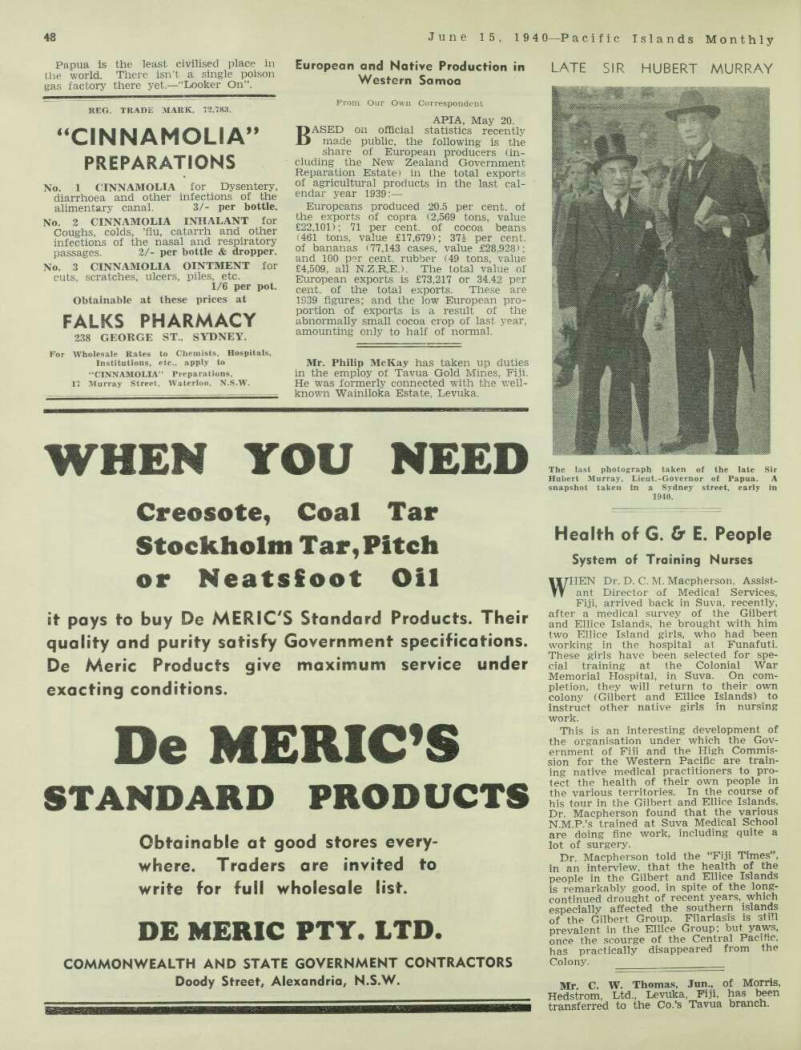
Death of Captain A.
Captain A. Middenway, A Well
known figure in the public service of Fiji and the Solomon Islands for many years, died in Sydney, after a short illness, on May 24. He had retired from the service of the Solomon Islands Administration as recently as 1935; and. since he made his home in Sydney, had identified himself with several organisa tions for community betterment, notably the Boy Scout movement.
An Australian by birth, and a veteran of the last war, Captain Middenway might well be described as having died in harness. Last September, though he was over 60, he at once offered his ser vices, and he was sent to the internment camp. There he served until the camp was moved. He cheerfully accepted non commissioned rank, though he was nom inally adjutant to the camp commandant.
Later, he took up special duties at Vic toria Barracks in " Sydney, where he worked until he collapsed, and was taken into hospital at North Sydney. There it was found that his end would be only a matter of days.
Few people were more unassuming, more anxious to serve unostentatiously, than Captain Middenway. Soon after he came to Sydney he joined the Pacific Islands Club, and was on its Council until his death. He was closely identified with the Air Raid Precautions unit at North Sydney. During the World Jamboree for Boy Scouts, held in Sydney nearly two years ago, he occupied an important post on the administrative side. His motto was “I serve”. And he seryed his country until the last.
It is not generally known that he could have been decorated for his ser vices in the last war. But he declined any such distinction, and asked to be re turned to the Fiiian Government Service instead. On enlisting for the war, he had defied local regulations. This request was granted, and, later, he was trans ferred to the Solomons, where he became secretary to the Protectorate Govern ment, and subsequently served as an ad ministrative officer.
A man of humane sentiments, with a rigid sense of justice, Captain Midden way was perhaps at his best when deal ing with * the natives. Yet he had the same outlook when handling youth. Both resnonded in the same way. His passing will evoke as much regret among the inhabitants of many a native village as among Captain European friends. He is survived by his widow, and Pat, his only son. The latter, by the way, has already made a reputation as a champion swimmer.—E.R.
Dr. M. Rose, formerly Government Medical Officer at Ania, Western Samoa, has taken up a similar appointment at Rarotonga, Cook Islands.
Mr. F. VV. Hennings, Sydney repre sentative for the Fiji Publicity Bureau, paid a short visit to New Zealand at the end of May.
Mr. Andrew Deoki, youngest son of Mr.
N. S. Deoki, of Suva, Fiji, arrived in New Zealand recently to complete his course at the Auckland University.
Mr. Surya Naravan married Miss Bukiam Naikar. daughter of Mr. and Mrs.
Arumugam Naikar, of Samabula, at the Sangam Hall, Fiji, in May. It was the first wedding in the Hall since its open ing in February last year.
Papua is the least civilised place in the world. There isn’t a single poison gas factory there yet.—“ Looker On”.
Advertisements & other items, pp. 48-50 (2 items)
46
June 15, 194 O—P acific Islands Monthly
Amalgamated Wireless (A/Sia) Limited
vsea * * * *> 4 ■■B'i ft* i o a» % vJ* 4 o *J* vO 'Z «v* *** s Ot» *** *#a*s tl* c •10*?
CO No technical knowledge required . . .
Keep in touch with the world expedite business transactions—be prepared to quickly call medical or other services in an emergency.
Install an A.W.A. Teleradio 38.
Compact radiotelephone providing communication facilities for parts beyond the reaches of landlines. Reliable and economical.
Illustrated booklet and quotations gladly supplied on request.
AMALGAMATED WIRELESS (A/SIA) LIMITED
47 YORK STREET, SYDNEY 167 QUEEN STREET, MELBOURNE Branches at: Wellington, Suva, Rabaul, Port Moresby and other island centres.
REG. TRADE MARK, 72,783.
“CINNAMOLIA”
PREPARATIONS
No. 1 CINNAMOLIA for Dysentery, diarrhoea and other infections of the alimentary canal. 3/- per bottle.
No. 2 CINNAMOLIA INHALANT for
Coughs, colds, ’flu, catarrh and other infections of the nasal and respiratory passages. 2/- per bottle & dropper.
No. 3 CINNAMOLIA OINTMENT for
cuts, scratches, ulcers, piles, etc. 1/6 per pot.
Obtainable at these prices at
FALKS PHARMACY
238 GEORGE ST., SYDNEY.
For Wholesale Rates to Chemists, Hospitals, Institutions, etc., apply to “CINNAMOLIA” Preparations, 17 Murray Street, Waterloo. N.S.W.
WHEN YOU NEED
Creosote, Coal Tar Stockholm Tar, Pitch or Neatsfoot Oil it pays to buy De MERIC'S Standard Products. Their quality and purity satisfy Government specifications.
De Meric Products give maximum service under exacting conditions.
De MERIC’S
STANDARD PRODUCTS
Obtainable at good stores everywhere. Traders are invited to write for full wholesale list.
DE MERIC PTY. LTD.
COMMONWEALTH AND STATE GOVERNMENT CONTRACTORS
Doody Street, Alexandria, N.S.W.
European and Native Production in
Western Samoa
From Our Own Correspondent
Apia, May 20.
BASED on official statistics recently made public, the following is the share of European producers (in cluding the New Zealand Government Reparation Estate) in the total exports of agricultural products in the last cal endar year 1939; — Europeans produced 20.5 per cent, of the exports of copra (2,569 tons, value £22,101); 71 per cent, of cocoa beans (461 tons, value £17,679); 37i per cent, of bananas (77,143 cases, value £28,928); and 100 per cent, rubber (49 tons, value £4,509, all N.Z.R,E.). The total value of European exports is £73,217 or 34.42 per cent, of the total exports. These are 1939 figures; and the low European pro portion of exports is a result of the abnormally small cocoa crop of last year, amounting only to half of normal.
Mr. Philip McKay has taken up duties in the employ of Tavua Gold Mines, Fiji.
He was formerly connected with the well known Wainiloka Estate, Levuka.
Advertisements & other items, p. 50 (1 item)
Late Sir Hubert Murray
The last photograph taken of the late Sir Hubert Murray, Lieut.-Governor of Papua. A snapshot taken in a Sydney street, early in 1940.
Health of G. & E. People
System of Training Nurses
WHEN Dr. D. C. M. Macpherson, Assist ant Director of Medical Services, Fiji, arrived back in Suva, recently, after a medical survey of the Gilbert and Ellice Islands, he brought with him two Ellice Island girls, who had been working in the hospital at Funafuti.
These girls have been selected for spe cial training at the Colonial War Memorial Hospital, in Suva. On com pletion, they will return to their own colony (Gilbert and Ellice Islands) to instruct other native girls in nursing work.
This is an interesting development of the organisation under which the Gov ernment of Fiji and the High Commis sion for the Western Pacific are train ing native medical practitioners to pro tect the health of their own people in the various territories. In the course of his tour in the Gilbert and Ellice Islands, Dr. Macpherson found that the various N.M.P.’s trained at Suva Medical School are doing fine work, including quite a lot of surgery.
Dr. Macpherson told the “Fiji Times”, in an interview, that the health of the people in the Gilbert and Ellice Islands is remarkably good, in spite of the long continued drought of recent years, which especially affected the southern islands of the Gilbert Group. Filariasis is still prevalent in the Ellice Group; but yaws, once the scourge of the Central Pacific, has practically disappeared from the Colony.
Mr. C. W. Thomas, Jim., of Morris, Hedstrom, Ltd., Levuka, Fiji, has been transferred to the Co.’s Tavua branch.
Advertisements & other items, p. 50 (1 item)
48
June 15, 194 O—P acific Islands Monthly
Two-Ways Ridicule
Work of Dr. Lambert in the South Seas
rE publication in the “New Yorker” of an article about Dr. Lambert, which has tended to bring into ridi cule the splendid work done by that noted American during 25 years in the South Seas, has induced Mr. J. Nixon Westwood to write to us from San Fran cisco, as follows : — AS a friend and admirer of Dr. Lam bert, I feel very sorry that he should have permitted so many foolish stories to be circulated. I refer particu larly to an article appearing in the “American Mercury” for October, 1938, and called “Fighting Disease in Para dise” by Jerome Beatty. I do not know who Mr. Beatty is, but he is either just a romancer, or else Dr. Lambert gave him a lot of stuff fit for a real “gun tooting” crowd, such as the people of the United States like, and live for.
Some parts of the article in the magazine mentioned are really too ridiculous to be taken seriously, and as I have said, can’t for the life of me be lieve that sober Dr. Lambert even men tioned such things.
This for instance, “a British doctor in Fiji told me (Beatty) only Lambert could have done this job. We British medical men are so overloaded with dignity, we couldn’t have unbent enough to get the confidence of the natives.
Lambert plunged into villages and sold health as vigorously as though he were a peddler with a patent painkiller, cut ting red tape and trampling on conven tion. We would have stopped to think: ‘But what would people say at the club if we go out for six months and live like the natives and talk pidgin English and help them build latrines?’ ”. And so on.
“Another British doctor said, T re member the first time I heard Lambert make a speech. He had called a few Europeans together to talk about latrines and polluted water supply in native quarters in Suva. Most doctors would have made polite suggestions, com mittees would have been appointed and that probably would have ended it.
Lambert got up and said, “This is the blankiest-blank situation I ever saw.
Hundreds are dying. Now you do this and you do that, and do it blanked fast and we’ll get this situation cleaned right up”. We were shocked, breathless—but we got the situation cleaned up.’ ”
There is a lot more, some worse, and
some more so. The sum total is that, althought Dr. Lambert did not go to our tropics until after the Great War, he was able, single-handed, to clean up Samoa, Tonga, Fiji, New Guinea, Niue and our own medical mgn have always given way to him, and up to the date of his arrival every disease known to man was permitted to run wild.
No mention is made of Drs. Fleming Jones, McWilliam, Burke. Strong, Eric Giblin, Leigh Boag, and those men who worked on such places as Lakekamu. In fact, as far as the British medical fra ternity is concerned, these are all just plain self-acknowledged mutts who needed to be exposed by, first, Dr. Lambert, through, two, the clever Jerome Beatty.
This sort of article is nauseating and should not be allowed publicity in a country like the U.S.A. The average man, reading such articles, immediately thinks the B.M.A. just another British brag, and that the medical men are really scared of the ‘bush”. In Beatty’s article, no mention is made of the work done prior to Lambert’s visit, and if, as I have said, Lambert knew Beatty was spinning such
yarns, he should have taken definite steps to stop them.
The last time I met Dr. Lambert was in Fiji about two years ago. I was with Mr. Alport Barker and Dr. Geiger, the C.M.O. of the City of San Francisco. He did mention that the article had caused him some trouble, but he should not have allowed such foolish statements to appear in print. Ridicule is so easily written, but it is not so easily forgotten and the “American Mercury” is a widely read magazine, well-written and fearless —not the place for untrue things detri mental to the British.
I wonder if Dr. Lambert could state that his hardships were ever comparable with those endured by missionaries like Miss Maud Cottingham, or Miss Rowland, or Mrs. Paris.
Brother Plunkett, Director of the Marist Brothers’ School in Apia, for the past three years, recently left Samoa on transfer to Fiji. Brother Raphael, who has spent 16 years in Fiji, will replace him in Samoa.
Advertisements & other items, p. 51 (2 items)
49
Pacific Islands Monthl y—J une 15, 1940
Propellors
Firearm Repairs. “OUR HANDS MAKE GOOD ARMS” Goods sent C.O.D.
SPECIAL HEAVY MODEL SINGLE SHOT ‘“COOEY” RIFLE: With Bead Front Sight, Rear Elevating Sight and also Rear Aperture Sight, also Sling Loops. PRICE 47/6, post extra.
Write for Catalogue—Firearm Catalogue (600 Illustrations).
Fishing Catalogue (400 Illustrations).
QUALITY SECOND-HAND GUNS BOUGHT, SOLD OR EXCHANGED.
BIG GAME FISHING GEAR FOR HIRE.
“COOEY”
Rifle, 24in : “COOEY” RIFLE: Single shot bolt action 22 calibre Rifle, 24in : barrel. Elevating Rear Sight and Blade
Fore Sight. BRITISH EMPIRE PRODUCT.
PRICE 35/-, post extra.
RIFLES
SIL ROHU
143 ELIZABETH STREET (Near Market St.) SYDNEY ’Phone; MA 3540.
PROPELLORS
All Sizes to 54 in. diameter . . . any pitch.
SHAFTS MADE TO ORDER.
Bearing and Stuffing Boxes —Rudders— Tanks for Water and Fuel —Exhaust Pipes and Mufflers.
Copper, Bronze and Aluminium Founders.
D. H. PORTER & CO.
43-45 DRUITT STREET, SYDNEY.
I f
th. BLAXLAND TWIN PUP 5-7 h.p.
FOR SMOOTH VIBRATIONLESS POWER
Combining economy and simplicity of construction with “Pup” reliability, the Blaxland Multi-Cylinder Marine Engine is ideal for small launches.
Possessing many exclusive features, including vertically mounted Magneto, ‘“B.R.” Schebler marine-type Carburettor, high quality, ground, forged steel crankshaft, and of sturdy construction, the Blaxland Twin Pup warrants your early investigation. Write to-day for full particulars to:
BLAXLAND RAE ES:
61-65 SALISBURY RD., CAMPERDOWN
SYDNEY :: N.S.W.
Telegrams: “Blaxrae,” Sydney, ’Phone: L 5071.
Queensland:
MAEINO PRODUCTS PTY. LTD.
Brisbane.
Victoria:
MOTOR SPARES LTD.
Melbourne.
South Australia:
BOAT FITTINGS
Adelaide.
West Australia:
HARRIS, SCARFE & SANDOVERS LTD.
Perth.
Exchange of Territorial
Officers
EXTRACT from Canberra “Hansard”, May 10: “Sir Charles Marr: In view of the fact that the Commonwealth possesses a most excellent service in New Guinea, will the Minister in charge of External Territories say whether the experts in agriculture, medicine and other offices of the ad ministration might be co-ordinated in a territorial service so that the services of these gentlemen might be made avail able to all of the tropical and sub tropical territories of the Common wealth?
“Mr. Nock; There is no provision in the mandates under which Nauru and New Guinea are held for a pooling of resources, but I believe that it would be possible to make some arrangements voluntarily for payment to be made from their resources to enable joint use to be made of the service of officers, as the honourable member suggests. I shall go into the matter.”
And that, of course, will be the end of that.
Mr. E. J. Summei land, of the staff of Messrs. Burns Philp (S.S.) Co., Solomon Islands, who has been spending furlough in Australia, has returned to Gizo, 8.5.1., where he will act as manager of the branch.
Exploring Central New Guinea
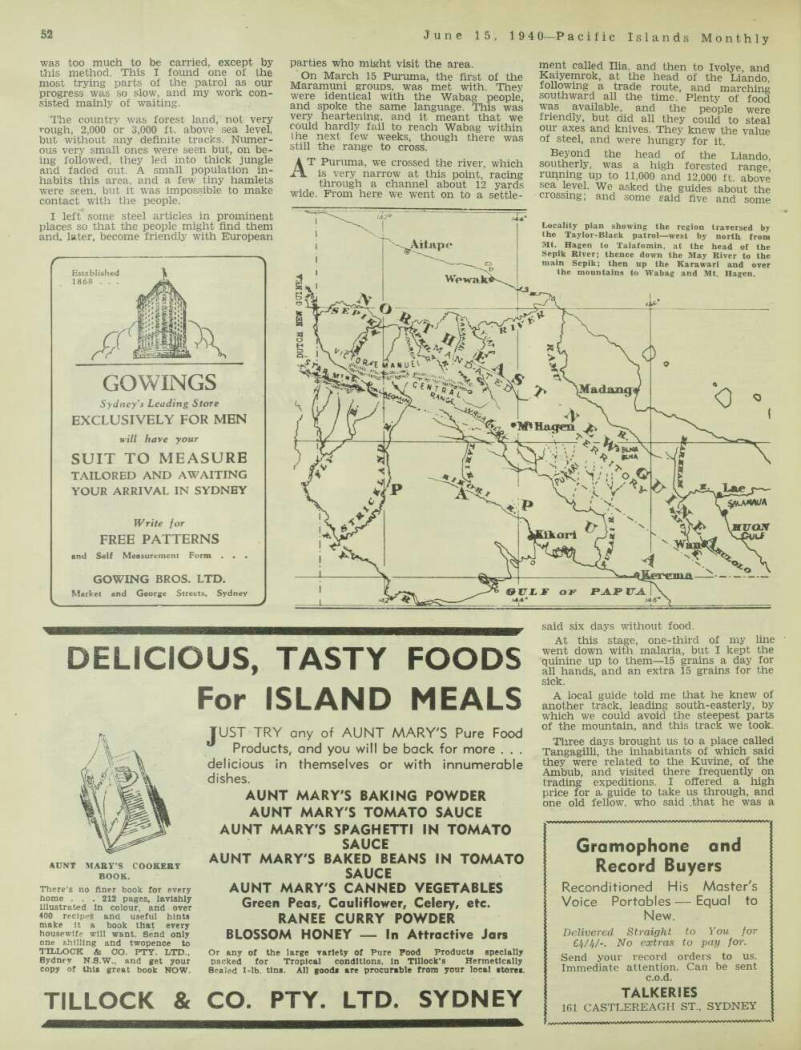
Discoveries and Observations of the Taylor-Black Patrol
Section Iv. Of Official Report
(This is the concluding section of the Preliminary Report on the patrol carried out in Central New Guinea, by Assistant District Officer J. L.
Taylor, Patrol Officer John Black and Medical Assistant C. B. Walsh, in 1938-39. The series was com menced in the March issue.) W r HILST at Kelafomin I decided that it would be better to come down the May River, which flowed for the most part through unexplored country, instead of following the Sepik to its junction with the October, which had been done many years before by Messrs.
Karius and Champion.
Black accompanied me as far as the head of the May.
At Mianmin, in the Thurnwald Range, we were fiercely attacked. Until then, the journey from Wabag had been completely peaceful; but at Mianmin we came among a bush people, forest dwellers, with whom we could not make friendly contact. As Black remarked, drily, “They don’t encourage visitors”.
Early in the morning of December 17,
1938, a clever surprise attack was made upon us, and a fine young man, Kwinjil, of' Mogei Kwivi, received an arrow which penetrated 11 inches and entered the region of the heart. He died almost in stantly, at the door of my tent. Pour others were wounded.
Two more attacks were made, within the next hour, but the police and carriers remained perfectly steady and the attackers were driven off. None was killed, as far as is known, though it is oelieved that one was wounded.
We were very distressed at the loss of Kwinjil, a youngster with a bright smiie and a charming manner, a favourite with everjffiody.
After resting the wounded for a day or two, we pushed on to the head of the May.
Black and I spent Christmas together there, and then he returned to Kelafomin, en route to Wabag, by the mountain trail.
I CONTINUED down the May, passing between the mountains Vierkant and Stolle. As the river flattened out, and the country became swampy, I was faced with the problem of travelling by water with my carriers, who were mostly poor swimmers—some could not swim at all.
Also there was the difficulty of passing native communities who though not hostile to pinnaces or power-driven craft, would regard men on rafts as fair game.
Making friendly contact with the first of the low country people, whom we found to be steel-hungry, we bought a number of canoes and made barges.
Every care was taken, but one barge collapsed and nearly ended in disaster.
Fortunately, no one was lost. The barges were altered in design, and a leg of tight timber placed between the canoes to make the barges unsinkable.
We proceeded by water and by land, both parties keeping pace with each other, outmanoeuvred a party of highly decorated and heavily-armed warriors, and camped lower down, where it was found possible to buy more canoes and improve the barges.
The warriors stood on the high bank of the river, with their arms stacked be hind them, and beckoned the canoe party to come in close, where they might shoot down upon them. But, just as the barges drew level, the land party arrived, to the amazement of the warriors.
The entire party then went forward by water.
The next community met with
attempted to prevent our passage down stream. Terrific excitement prevailed in the village. Heavily-armed men roared defiance, and shouted for action, and some beat the water with canoe paddles, cheering as showers of spray rose and fell with each stroke. But, after some parley, we succeeded in passing without conflict, despite the fact that one more bellicose than the rest wished to make a naval engagement of it, and attack us from canoes.
The Lower May is a fine river, navi gable for small craft, and flows through pleasant, well-populated forest country.
Continuing, we reached the Sepik at 2 p.m. on January 13, 1939, and came on under our own power.
THE people of the Upper River were friendly, though Wogumash was a little difficult. They refused to stand clear, and I had to threaten sterner action to make them do so, and ensure my barges against surprise attack.
The conduct of the police and carriers was exemplary. Ten months out, and not a grumble, even when Kwinjil was killed.
The main problem of the journey was that of supply; but this was overcome by our shell currency, which enabled the purchase of food, and by the preparation of sago flour whenever the palm appeared.
The country between Wabag and the Strickland is well-populated grassland for about 30 miles, but on the lower Lagaip (a tributary of the Strickland, which I originally believed to be the Karawari or South-east River) a southern tributary of the Sepik, the grasslands are displaced by a mass of forest-clad spurs and ridges, table tops and serrated peaks, lying be tween Behrmann’s Central Range and an almost parallel limestone chain which forms the highest part of the great cen tral massif, and the Strickland crossing in longtitude 142 degrees 15 minutes.
Black later proved that the Lagaip was the main headwater of the Strickland River, and not the Karawari, as I originally believed.
ON January 18, about 8 a.m. we reached Yessen, the frontier of European influence, where the people told us that a vessel was coming upstream.
We waited about a quarter of an hour, and were delighted to see “Sirius” come round the bend. It was great to see her, and a relief to all of us to go on board, to shelter from the fierce sun which beat down on us on the barges.
We proceeded immediately downstream,
towards Kopar, at the Sepik mouth, meeting ana receiving hospitality from the Catholic Fathers in charge of the Mission Stations at Merui and Marien berg.
At Angoram, I called on Mr. G. Ellis, Assistant District Officer, who received us kindly, and then continued to the mouth of the Sepik, to rest the police and carriers for a few days and enable me to attend to correspondence before re turning to the interior.
Here I received a report and map from Patrol Officer Downes, who in Sep tember, 1938. went to Wabag, and, to gether with Walsh, made a splendid ex amination of the headwaters of the Taruwa and Sau, tributaries of the Yuat River north of Wabag.
After a few months’ arduous work Downes was unfortunately taken ill and was compelled to leave the area. He was relieved by Patrol Officer Pursehouse who, with Walsh, made another journey, thor oughly examining the upper reaches of the Lagaip, but I did not meet him—he had left Wabag before my return there.
ON January 27, the “Sirius” left Kopar for the head of navigation on the Karawari. The river was high, and the going was slow, and it was the after noon of February 1 before we reached Ambramei, after an exciting and rather terrifying journey up the Karawari with my party (which numbered 70 all told) on board, and 30 canoes in tow. However, we got there without accident and camped in the village.
The “Sirius” departed the following morning. Her master, who handled the “Sirius” skilfully and intrepidly, was anxious to see blue water under her again, after his trying and anxious time in the muddy reaches of the Sepik.
Due probably to being cooped up on board for several days, and to a climate that they were not used to, most of the carriers had colds, so we rested at Ambramei on the rainy days of February 2 and 3.
My aim, now, was to transport by canoe my stores, mostly rice, supplies of which I had brought from Angoram, as far as possible upstream, and then begin carrying across country.
There was a high range of mountains to cross before I could reach Wabag.
Whether that was inhabited or otherwise I knew not, and it was necessary for me to get as much rice as possible to the slopes of that range before crossing.
In addition to this, I feared malaria.
The carriers were receiving 15 grains of quinine a day, as a prophylactic, and up to the present were in good condition.
How they would fare in the higher levels, with their mountain mists and icy winds, was yet to be proven.
Canoes took us above Awim, to the Arafundi, which soon ran into shallows, and put further water transport out of the question.
Relaying of cargo then began. There
was too much to be carried, except by this method. This I found one of the most trying parts of the patrol as our progress was so slow, and my work con sisted mainly of waiting.
The country was forest land, not very rough, 2,000 or 3,000 ft. above sea level, but without any definite tracks. Numer ous very small ones were seen but, on be ing followed, they led into thick jungle and faded out. A small population in habits this area, and a few tiny hamlets were seen, but it was impossible to make contact with the people.
I left* some steel articles in prominent places so that the people might find them and. later, become friendly with European
parties who might visit the area.
On March 15 Puruma, the first of the Maramuni groups, was met with. They were identical with the Wabag people, and spoke the same language. This was very heartening, and it meant that we could hardly fail to reach Wabag within ihe next few weeks, though there was still the range to cross.
AT Puruma, we crossed the river, which is very narrow at this point, racing through a channel about 12 yards wide. From here we went on to a settle
ment called Ilia, and then to Ivolye, and Kaiyemrok, at the head of the Liando, following a trade route, and marching southward all the time. Plenty of food was available, and the people were friendly, but did all they could to steal our axes and knives. They knew the value of steel, and were hungry for it.
Beyond the head of the Liando, southerly, was a high forested range running up to 11,000 and 12,000 ft. above We asked the guides about the crossing; and some said five and some
said six days without food.
At this stage, one-third of my line went down with malaria, but I kept the quinine up to them —15 grains a day for all hands, and an extra 15 grains for the sick.
A local guide told me that he knew of another track, leading south-easterly, by which we could avoid the steepest parts of the mountain, and this track we took.
Three days brought us to a place called Tangagilli, the inhabitants of which said they were related to the Kuvine, of the Ambub, and visited there frequently on trading expeditions. I offered a high price for 8> guide to take us through, and one old fellow, who said .that he was a
Locality plan showing the region traversed by the Taylor-Black patrol—west by north from Mt. Hagen to Talafomin, at the head of the Sepik River; thence down the May River to the main Sepik; then up the Karawari and over the mountains to Wabag and Mt. Hagen.
fugitive from the Ambum region consented to show us the way.
Three days later we crossed the divide at 8,950 ft. above the sea, and ascended to the grass nlateau country, camping at Muriliam, 8,300 ft., in pleasant weather.
That was my 197th camp.
T . . ’fxr x
HE journey to Wabag was now easy going. The friendly people dancing and singing m front of the line. approached us from group to group, and gave us food in abundance.
Wabag was reached on April 1, 1939, and there I found Walsh in good fettle, after his trying experience, waiting to meet me - Black had not yet arrived, but I was not alarmed, as I did not expect him for another fortnight.
Walsh went off to Mt Hagen, the next day, to arrange about stores, as the radio equipment was at this time out of order. I sat down to wait for Black.
On Sunday. April 16, about 8.30 a.m., I heard that Black had camped at Warumanda the night before, and was now in the vicinity of Wabag; and, about 11 a.m., I saw him through the glasses, about Is miles to the west. Half an hour later, he arrived at the camp and reported all well. He had got through without conflict or casualty. I immediately sent the following radio to the Administrator: “Mr. Taylor’s compliments. Black arrived at 11.30 a.m. to-day with himself and party in first-rate condition. He travelled from Kelafomin, through the Heiwandagar people of the Strickland- Sepik watershed. His route was generally more northerly than mine, and his journey from Hoiyevia, which has occupied 10 months and been without casualty,
I consider the greatest achievement of any New Guinea patrol.” (The casualty in the Thurnwald Range occurred while the combined parties were under my immediate control.) Th Administrator his nipa party, and decided to visit us the next S ay / wit h the aeroplane bringing in further supplies. Shortly aft»r 10 o’clock, on April 17 accompanied by Messrs Sheekey Cox and O’Dea (pilot) the Administrator landed and inspected a guard of police drawn up at the landingground to receive him.
It was a fl „e morning and there was a record market about 2,000 friendly people visiting the camp. The carriers and local people gave the Administrator
Mlowinfta’ hi
moved f about g It nlafn to lee that about « was Plain to siee that neonle were now mm friends ™ people were now our real „ * . . ..
Heavy r^i n . °5 cu - r r ed JJJ P l ®, afternoon, and pilot decided that it would be unsafe Administrator s party tnereiore stayed me mgnt.
In the morning, the Administrator inspected the carriers and remarked on their good physique and condition. He instructed me to bring the patrol to as speedy a conclusion as possible, and departed for the coast. fTIHE patrol was now 13 months’ old, JL and I should have been pleased to withdraw straight away. But I had certain obligations to fulfil to natives from Hoiyevia, on the upper Kikori, who had accompanied our parties to gain experience. Black, also, had found gold. and I thought it wise to make a close
examination of the gold-bearing area, so that I could report definitely whether a ne ' v gold-field had been discoveied.
Accordingly, Black and I left Wabag on April 21, leaving Walsh at Wabag.
The arrangement was for him to move
“ctS
trihntavv v«Hpv known as *thp Talp and ther ‘ iwait our return , e awal “ ° UI r f“ T . .
We marched up the Ive Lai, and separ ated at a Pl ace called Kinarta-Aram, Black making for Poredigar, amongst the Hoiyamo people (on the northern slopes of the limestone range immediately be
peKfKuSwvera?^ and l'toHoly!
evia by the shortest possible route.
T find now TTnivcvin nconle who could J p if £?n E^elish understood our
purpos^
the best tracks and that we were assured of a great welcome to their homes. They explained that at first they thought we were spirits and were suspicious—now that they knew we were men they were proud to know us.
Seventeen days after leaving Wabag, on May 8 1939, j arrived at Hoiyevia. The people gave us a great reception, and rice that I had left in the care of two old men was brought forth in good condition. It had been carefully guarded, and one of the men said that he had fought to preserve it, and hoped that we would support him in a war which he about to n ? a ? e gainst his enemies, Thf-t £ could not do, but I paid them well, and were jubilant, and their friends envious.
I stayed a few days and, saying good bye to those whom I had returned home, I set out to cross the range and meet Black on the other side. Hundreds of young men wished to accompany us, but
I could not take them, as we were not returning.
We travelled north and, on the second day, we reached 10,500 ft. We travelled for three days further at that altitude, over a succession of moors and valleys, covered with light brown alpine grass.
On May 21 we marched into Black’s camp. He had examined the area very closely, and ascertained that his gold discovery was of very little value, and had no commercial possibilities.
On May 23 we moved out on the return journey to Wabag, to Ailemande (where Walsh had built a fine camp and achieved marvellous results with the in habitants) and Mt. Hagen, where we arrived on June 19.
At Mt. Hagen the carriers were paid off amid scenes of great rejoicing.
Walsh f!ew to Madang to make arrange ments for our baggage to be ready for snipment to Rabaul, and Black and I
continued to Bena Bena, returning our carriers to their homes as we went.
From Bena Bena we flew to Madang, and travelled by ship to Rabaul, which I reached on July 11 and reported to the Administrator.
The work done by the patrol included the following: Observations of the climatic conditions were recorded.
Collections of plant specimens, fossils and soil were made. These are now being examined by various authorities.
The rivers and streams crossed were tested for gold.
A large amount of ethnological data was obtained and vocabularies of the native languages prepared. Head and stature measurements were taken.
A photographic record of the journey, the country and the people passed through was obtained.
Interpreters have been trained to assist Europeans, and should be of great assistance to Administration Officers when further steps are taken to bring the area under real and effective control. rE practical results obtained by this patrol are as follows: Examination has been made of the area between Mt. Hagen and the Dutch border, from the Papuan boundary to the Sepik River, and the country carefully mapped. Needless to say, there is more to be done. We should have liked to have done more ourselves, but in the time available that was not possible.
Many thousands of new natives were met, and the advent of the new era— that is, the era of European influence— explained to them wherever interpreters were available —and that covered a large area before the patrol concluded.
The native people have learned that the European is a friend, and that to trade with him is to their advantage.
The future of most of this country lies in agriculture and pig-raising, not in minerals—much of it being of limestone formation and gold free, that is, again, excluding the lowlands.
The natural ingress of this interior is from Lae, via Mt. Hagen, and it is from this direction that progress and develop ment should come.
If a road from Lae is not constructed, this area may be opened up from the Sepik River by establishing police posts (a) at Maramuni (upper Yuat) with a landing stage for pinnaces or small craft on the Arafundi (Karawari), (b) in the vicinity of Wabag or Ailemande on the Yuat headwaters, (c) on the lower May River, (d) at Kelafomin, on the Sepik headwaters. .The upland people are unfit for em ployment on the lower levels unless given quinine continually and in ex tremely large doses.
Further examination is required of the forested lowlands, between the Karawari and the May Rivers, on the northern slopes of the central range. This can be better done with the aid of river craft, operating from the Sepik.
(Concluded)
Advertisements & other items, pp. 52-56 (3 items)
50
June 15, 194 O—P acific Islands Monthly
C. Snu
patter saps strength r mm
it back
Rich in juniper and healthful herbs ... ■>
C. SnU
(S?
General
Merchants
and
Agents
REPRESENTING LEADING FIRMS IN THE PACIFIC ISLANDS
379 KENT STREET,
SYDNEY.
* v yf\ * ' Cable Address: “Trocas”, Sydney.
Telephones: MJ 4657 (5 lines).
Islands Produce Sold on Shippers’ Account Buyers of all Islands’ requirements on Commis- Liberal Advances against Consignments. sion Original Invoices Furnished. 25 Years Islands Trade Experience.
Bankers: Bank of New South Wales. Correspondence in English, French & German.
Amplite
Small, light, compact Petrol Electric Generators with everything a car engine has. • For Home Lighting • Battery Charging. • Operates twelve 25- • 12 hours per gallon watt lamps. of petrol.
OUTPUT —12 volts 300 watts (25 amps.) Weight when yacked 97 lbs.
Eflaißi
7 and
STRATTON
AMP-LITE FEATURES
(1) Press Button Starting. (2) Magneto Ignition, etc. (3) Automatic Cut-out. (4) Air-cleaner, Oil-bath type. (5) Petrol Filter. (6) Float Adjustable Carburettor. (7) Vibrationless. mtmmmeuam (8) Heavy Duty, Double Contact, Cut-out.
Features 4 to 8 are exclusive to Amy-lite Model.
T Model 300: F. 0.8. Sydney—Packing Free.
Also available, Model 100, 6 volts, 100 watts, manual starting.
Price £l5.
RIGGS & STRATTO
==~i= 10*0 From Leading Island Merchants, or:
AMPLION (A’SIA) PTY. LTD.
382 Kent Street, Sydney.
Cable Address: ‘Amplion,’ Sydney.
Established
GOWINGS
Sydney's Leading Store
EXCLUSIVELY FOR MEN
will have your
SUIT TO MEASURE
TAILORED AND AWAITING
YOUR ARRIVAL IN SYDNEY
Write for
FREE PATTERNS
and Self Measurement Form . . .
COWING BROS. LTD.
Market and George Streets, Sydney
DELICIOUS, TASTY FOODS
For ISLAND MEALS
AUNT MARY’S COOKEET
BOOK.
There’s no finer book for every home . . . 212 pages, lavishly Illustrated In colour, and over 400 recipes and useful hints make It a book that every housewife will want. Send only one shilling and twopence to
TILLOCK & CO. PTY. LTD.,
Sydney N.S.W., and get your copy of this great book NOW.
JUST TRY any of AUNT MARY'S Pure Food Products, and you will be back for more . . . delicious in themselves or with innumerable dishes.
AUNT MARY'S BAKING POWDER
AUNT MARY'S TOMATO SAUCE
AUNT MARY'S SPAGHETTI IN TOMATO
SAUCE
AUNT MARY'S BAKED BEANS IN TOMATO
SAUCE
AUNT MARY'S CANNED VEGETABLES
Green Peas, Cauliflower, Celery, etc.
RANEE CURRY POWDER
BLOSSOM HONEY In Attractive Jars Or any of the large variety of Pure Food Products specially packed for Tropical conditions, in Tlllock’s Hermetically Sealed 1-lb. tins. All goods are procurable from your local stores.
TILLOCK & CO. PTY. LTD. SYDNEY
Gramophone and
Record Buyers
Reconditioned His Master's Voice Portables Equal to New.
Delivered Straight to You for £4/4/-. No extras to pay for.
Send your record orders to us.
Immediate attention. Can be sent c.o.d.
TALKERIES
161 CASTLEREAGH ST., SYDNEY
-1 ■ ' : ■ '' x & 7" .. 1/ • •
YOU’RE THERE
WITH A
KRIESLER
“THE BEST SET AT ANY PRICE”
London .. . Paris .. . Berlin .. . U.S.A. etc. Perfect long range reception with supreme tonal quality.
Full particulars write: Featured above is Kriesler Model 4K40 —Mantel type, 6 volt, vibrator operated radio in moisture proof walnut veneered cabinet. Full size chassis and speaker— specially built for the tropics.
Price 31 £ Gns.
Kriesler 1.4 volt low consumption battery world range portable Model 4K87.
Price 21 Gns.
KRIESLER (AUSTRALASIA) PTY. LTD., BOX 23 P.O. NEWTOWN, N.S.W.
A. B. DONALD Ltd.
AUCKLAND
ISLAND TRADERS & GENERAL MERCHANTS
P.O. Box 1509. Cables & Telegrams, "Kingdom", Auckland.
ENGLISH
CIGARETTES
of QUALITY
• In case of difficulty In obtaining supplies, write to Box 1861 K., G.P.0., Sydney.
Heavy Crop Of Cook Is.
Oranges
THE New Zealand market was bare of oranges early in May, when a ship ment of 29,000 cases came in from the Cook Islands. Most of this fruit was in excellent order and sold rapidly, but there were bitter complaints from fruit merchants about the contents of some 5,000 cases, which had been loaded in rain, and which had deteriorated very much.
A small official party went around the Cook Islands recently to examine shipping and marketing facilities, and Mr. A.
Turner (supervisor of imported fruit for the Government) said that this season’s orange crop is likely to be a very heavy one.
Will persons with old copies of the “Pacific Islands Monthly” to dispose of please note that the following issues are required by Mr. Paul A. Dorn, C/- Oster loh and Durham. 1247 South La Brea Avenue, Los Angeles, California, U.S.A.: Vol. 9, No. 9 (April, 1939), Volume 2, No. 7 (February, 1932) and 12 (July, 1932).
Mr. Dorn is anxious to obtain these copies, so that he may then have a com plete file of the journal, from its first issue.
Fiji
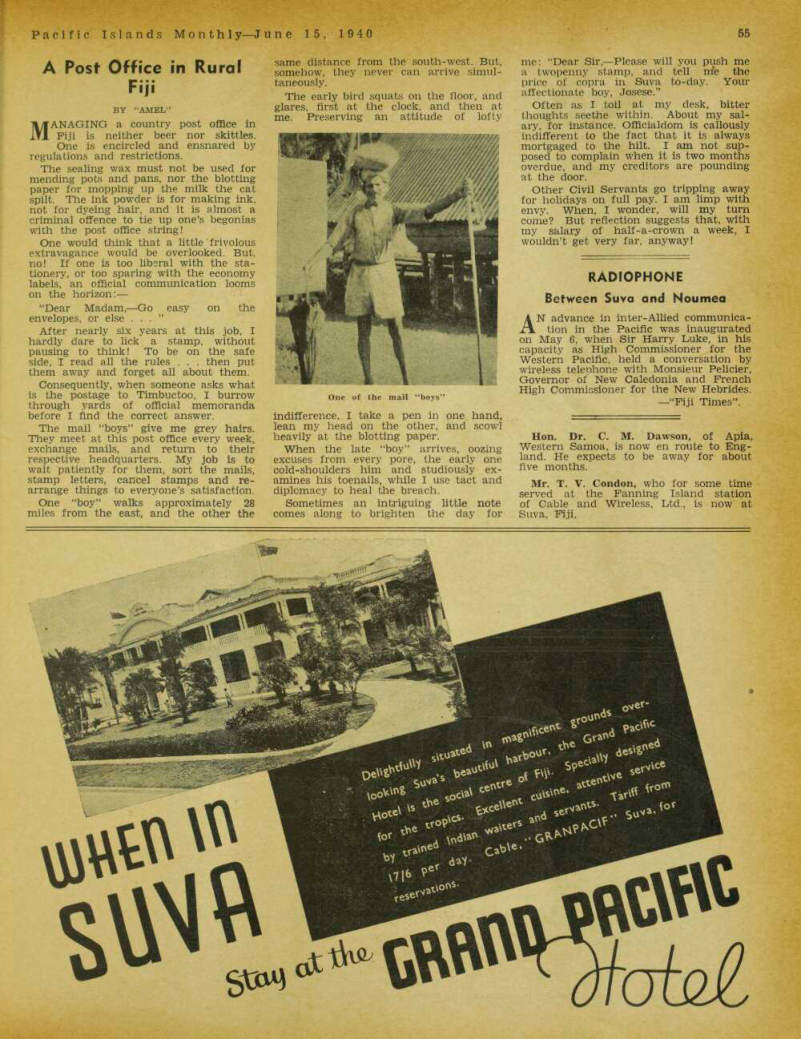
A Posf Office in Rural Fiji
By “Amel”
MANAGING a country post office in Fiji is neither beer nor skittles.
One is encircled and ensnared by regulations and restrictions.
The sealing wax must not be used for mending pots and pans, nor the blotting paper for mopping up the milk the cat spilt. The ink powder is for making ink, not for dyeing hair, and it is almost a criminal offence to tie up one’s begonias with the post office string!
One would think that a little frivolous extravagance would be overlooked. But, no! If one is too liberal with the sta tionery, or too sparing with the economy labels, an official communication looms on the horizon: — “Dear Madam, —Go easy on the envelopes, or else ...”
After nearly six years at this job, I hardly dare to lick a stamp, without pausing to think! To be on the safe side, T read all the rules . . . then put them away and forget all about them.
Consequently, when someone asks what is the postage to Timbuctoo, I burrow through yards of official memoranda before I find the correct answer.
The mail “boys” give me grey hairs.
They meet at this post office every week, exchange mails, and return to their respective headquarters. My job is to wait patiently for them, sort the mails, stamp letters, cancel stamps and re arrange things to everyone’s satisfaction.
One “boy” walks approximately 28 miles from the east, and the other the
same distance from the south-west. But, somehow, they never can arrive simul taneously.
The early bird squats on the floor, and glares, first at the clock, and then at me. Preserving an attitude of lofty
indifference, I take a pen in one hand, lean my head on the other, and scowl heavily at the blotting paper.
When the late “boy” arrives, oozing excuses from every pore, the early one cold-shoulders him and studiously ex amines his toenails, while I use tact and diplomacy to heal the breach.
Sometimes an intriguing little note comes along to brighten the day for
me: “Dear Sir, —Please will you push me a twopenny stamp, and tell rrfe the price of copra in Suva to-day. Your affectionate boy, Josese.”
Often as I toil at my desk, bitter thoughts seethe within. About my sal ary, for instance. Officialdom is callously indifferent to the fact that it is always mortgaged to the hilt. I am not sup posed to complain when it is two months overdue, and my creditors are pounding at the door.
Other Civil Servants go tripping away for holidays on full pay. I am limp with envy. When, I wonder, will my turn come? But reflection suggests that, with my salary of half-a-crown a week, I wouldn’t get very far, anyway!
One of the mail “boys”
Radiophone
Between Suva and Noumea
AN advance in inter-Allied communica tion in the Pacific was inaugurated on May 6, when Sir Harry Luke, in his capacity as High Commissioner for the Western Pacific, held a conversation by wireless teleohone with Monsieur Pelicier, Governor of New Caledonia and French High Commissioner for the New Hebrides. —“Fiji Times”.
Hon. Dr. C. M. Dawson, of Apia, Western Samoa, is now en route to Eng land. He expects to be away for about five months.
Mr. T. V. Condon, who for some time served at the Fanning Island station of Cable and Wireless, Ltd., is now at Suva. Fiji.
Advertisements & other items, p. 57 (2 items)
55
Pacific Islands Monthl y—J une 15, 1940
t*ce" e ° er-va"^'
i» over- &r0 ° i pac>f' c d W *e A io\ rb ° Ur '
bea^''°
• M ... S? eC '* 7 , r v\ce ce nM e °' *'\ a iteo'-'' ,e ,cW' c , t u' 4 ' n tar'" '
t*ce" e ° er-va"^'
»• r e apo 1 „ *att erS v diaO Su'' 1 ' ( ° r C^ b ' e ’
tvw
«BK*
Boys
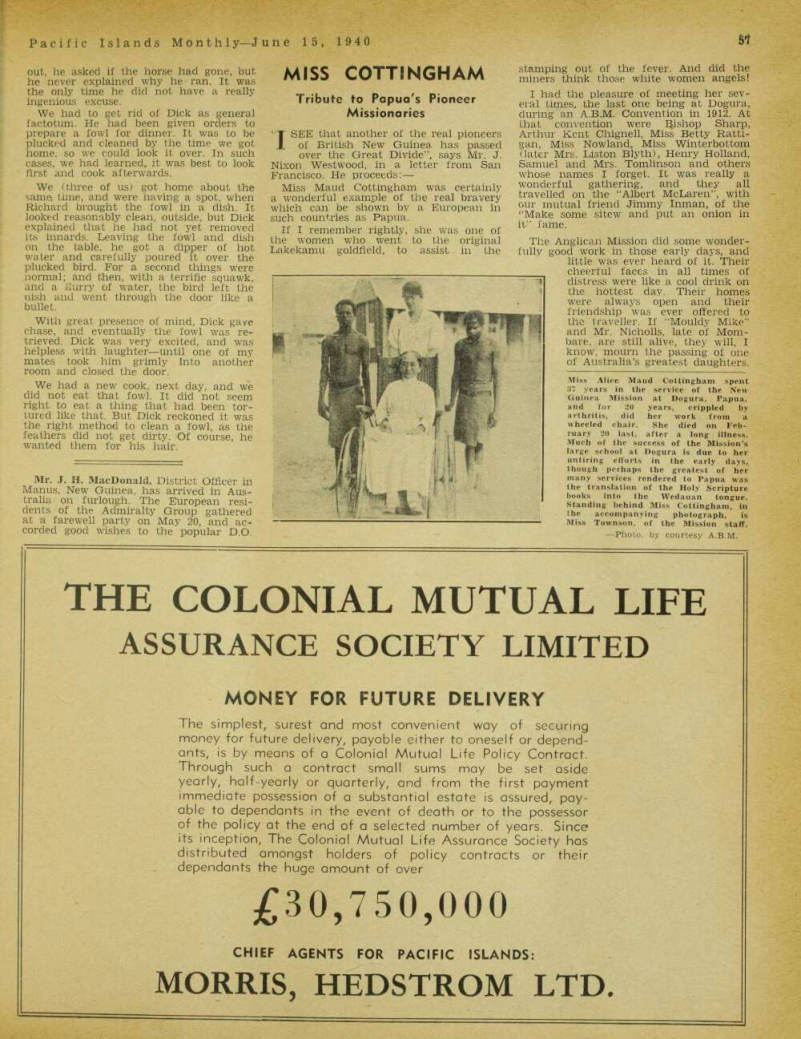
Papuans Will Be
Some Experiences With Cooks
By “Misima”
OMI was as black as ink and had woolly kinky hair. Nothing remarkable about this, as he was a full-blooded Papuan native.
The most remarkable thing about him was his intense stupidity, coupled with an engaging smile. That smile saved him many a time from an exasperated over seer. The whole top of his head seemed to drop backward, and his face split from ear to ear. Even his ears lay back at big jokes—usually his worst mistakes.
When Omi came to work in the “Hole”,
as the mine was called, he was tried on various jobs, and finally finished up trucking. Plenty of brawn and not too much brain was needed for that. He knocked off various bits of skin, until one day the other truckers ran to the overseer and reported that Omi had hurt his hand badly.
The overseer went to investigate and found Omi pushing his truck with one hand and holding the little finger of the other, which had the top joint missing, up in the air.
“How did you do that?”
“Tsuck hit him.”
“Where this piece from on top?”
“Oh. Taubada, he fall down shute.
Bimeby he go Bom-Bom” (stamper bat tery), and Omi grinned a bigger grin than ever, as he scrambled up the ladder
on his way to hospital.
Toby was also a full-blooded Papuan.
His career, until I met him, had not been without its highlights and excite ment, but to look at him none would suspect that he had been the cause of many a man’s headache, and also tummy-ache. He was well built, and had an intelligent face. Normally, that in telligence was dormant; but, when it really worked, its machinations were quite remarkable. He could always find a wrong way to do a thing, and look both clever and happy doing it.
One day, he came to me and confi dentially informed me that he was a cook. As my cook had got himself en tangled in the domestic life of a lad much bigger than himself and was suffer ing a hang-over while waiting for the police, and as Toby looked 0.K., I gave him the job.
However, he remained only six days, during which time he carefully ab stracted four of my best handkerchiefs and two pairs of shorts for himself.
When found out, he emphatically denied it, and blamed the previous boy.
As he also blamed the previous boy for a lot of other things of which I knew nothing, I made enquiries, and discovered that the only mistake he had made was that it had not been the previous boy who was responsible.
The limit of my endurance was reached when he put cochineal in the bread. The first time I saw it, I took ten grains of quinine and two aspirins and a nip of whisky, and went to bed. But the con scientious lad brought me some sand wiches.
He is a good lad in the fields—and will stop there.
SPEAKING of cooks, and of Islands cooks in particular, here is one of my experiences.
He was youthful, full of good humour, anr< we called him Dick. He was fat and soft-looking, and liked butter and sugar, taken neat. We often wondered whether it was better to lock the sugar and butter up, or lock up Dick. We tried the first method with a great reduction in quan tity used, and gradually extended the lock and key to everything eatable.
Dick would have a go at anything. He was a true experimenter. When taxed with having eaten anything, he promptly denied ever having seen it. But the tummy-aches he had at times were ter rible, if his expression meant anything.
Only once did I ever see him at a loss for an excuse. A horse had just been brought to the job, the first one Dick had seen, and it got into the garden, Dick was sent to chase it out. He got within twenty yards of the horse, and waved his hand, and said: “Go on horsey, you go, Taubada talk you go.”
The horse still cropped the herbage, and Dick went closer and said; “Go on, shake it up, close up Taubada wild.”
The horse took no notice and Dick, getting brave, picked up a small stick and carefully struck the horse on the nose.
What happened next was like an ex plosion. It was too quick for the eye to follow. The horse threw up his head, and snorted, about two feet from Dick’s ear.
Dick was off the mark like an Olympic runner. He grabbed his calico with one hand, turned round, his ears lay back, his eyes stuck out, and his elbows worked madly, as he left the vicinity, all in one movement.
I drove the horse out, and we found Dick behind the stove. Before he came
out, he asked if the horse had gone, but he never explained why he ran. It was the only time he did not have a really ingenious excuse.
We had to get rid of Dick as general factotum. He had been given orders to prepare a fowl for dinner. It was to be plucked and cleaned by the time we got home, so we could look it over. In such cases, we had learned, it was best to look first and cook afterwards.
We (three of us) got home about the samei time, and were having a spot, when Richard brought the fowl in a dish. It looked reasonably clean, outside, but Dick explained that he had not yet removed its innards. Leaving the fowl and dish on the table, he got a dipper of hot water and carefully poured it over the plucked bird. For a second things were normal; and then, with a terrific squawk, and a flurry of water, the bird left the aish and went through the door like a bullet.
With great presence of mind, Dick gave chase, and eventually the fowl was re trieved. Dick was very excited, and was helpless with laughter—until one of my mates took him grimly Into another room and closed the door.
We had a new cook, next day, and we did not eat that fowl. It did not seem right to eat a thing that had been tor lured like that. But Dick reckoned it was the right method to clean a fowl, as the feathers did not get dirty. Of course, he wanted them for his hair.
Mr, J. H. MacDonald, District Officer in Manus, New Guinea, has arrived in Aus tralia on furlough. The European resi dents of the Admiralty Group gathered at a farewell party on May 20, and ac corded good wishes to the popular DO.
Advertisements & other items, p. 58 (1 item)
Eoods
W. H. GROVE & Sons Ltd.
AUCKLAND
Island Traders. p.o. box 490.
Telegraphic and Cable Address: “Grove”, Auckland.
Shippers of all classes of New Zealand Products, specially prepared for the Island trade.
Representing English Manufacturers throughout the Cook and Society Islands, Fiji, Tonga, Samoa, Niue, New Caledonia, New Guinea, etc.
In FIJI as—W. H. Grove & Sons (Fiji) Ltd.
c ri I v
E R $
PURE
EOODS
GOLD MEDAL JAMS
CANNED ENGLISH FRUITS
CANNED ENGLISH
VEGETABLES
CUSTARD POWDER
OLD ENGLISH MARMALADE
JELLY CRYSTALS, ETC.
Obtainable from all Leading Grocery Stores Write to Department A., drivers and Sons Ltd., Histon, Cambridge, England, for attractive Recipe Book.
E.? 6.
Miss Cottingham
Tribute to Papua's Pioneer Missionaries
I SEE that another of the real pioneers of British New Guinea has passed over the Great Divide”, says Mr. J.
Nixon Westwood, in a letter from San Francisco. He proceeds:— Miss Maud Cottingham was certainly a wonderful example of the real bravery which can be shown bv a European in such countries as Papua.
If I remember rightly, she was one of the women who went to the original Lakekamu goldfield, to assist in the
stamping out of the fever. And did the miners think those white women angels!
I had the pleasure of meeting her sev eral times, the last one being at Dogura, during an A.B.M. Convention in 1912. At that convention were Bishop Sharp, Arthur Kent Chignell, Miss Betty Ratti gan, Miss Rowland, Miss Winterbottom (later Mrs. Liston Blyth), Henry Holland, Samuel and Mrs. Tomlinson and others whose names I forget. It was really a wonderful gathering, and they all travelled on the “Albert McLaren”, with our mutual friend Jimmy Inman, of the ' Make some sitew and put an onion in it” fame.
The Anglican Mission did some wonder fully good work in those early days, and
little was ever heard of it. Their cheerful faces in all times of distress were like a cool drink on the hottest day. Their homes were always open and their friendship was ever offered to the traveller. If “Mouldy Mike’’ and Mr. Nicholls, late of Mom bare, are still alive, they will, I know, mourn the passing of one of Australia’s greatest daughters.
Miss Alice Maud Cottingham spent 37 years in the service of the New Guinea Mission at Dogura, Papua, and for 20 years, crippled by arthritis, did her work from a wheeled chair. She died on Feb ruary 20 last, after a long illness.
Much of the success of the Mission’s large school at Dogura is due to her untiring efforts in the early days, though perhaps the greatest of her many services rendered to Papua was the translation of the Holy Scripture books into the Wedauan tongue.
Standing behind Miss Cottingham, in the accompanying photograph, is Miss Townson, of the Mission staff.
—Photo, by courtesy A.B.M.
Advertisements & other items, p. 59 (2 items)
57
Pacific Islands Monthl y—J une 15, 1940
The Colonial Mutual Life
ASSURANCE SOCIETY LIMITED
MONEY FOR FUTURE DELIVERY
The simplest, surest and most convenient way of securing money for future delivery, payable either to oneself or dependants, is by means of a Colonial Mutual Life Policy Contract.
Through such a contract small sums may be set aside yearly, half-yearly or quarterly, and from the first payment immediate possession of a substantial estate is assured, payable to dependants in the event of death or to the possessor of the policy at the end of a selected number of years. Since its inception. The Colonial Mutual Life Assurance Society has distributed amongst holders of policy contracts or their dependants the huge amount of over £30,750,000
CHIEF AGENTS FOR PACIFIC ISLANDS:
MORRIS, HEDSTROM LTD.
Wau Red Cross
From Our Own Correspondent WAU, June 1.
IN response to a request from Australia, the Wau branch of the Red Cross started an appeal for funds to supply an ambulance for the A.I.F. A most gen erous response was immediately made and £l4O already has been donated from Wau and District. This does not include Bulwa, where another branch of the Red Cross Society exists.
Miss Kathleen Higgins, of the staff of the Customs Department, Rabaul, New Guinea, was married on June 1 to Mr.
J. W. Bartlett, of the District Service Department, New Guinea. Both of the young people are very popular in Rabaul and they were guests at several functions where the utmost good wishes were ex tended to them.
The Innocent
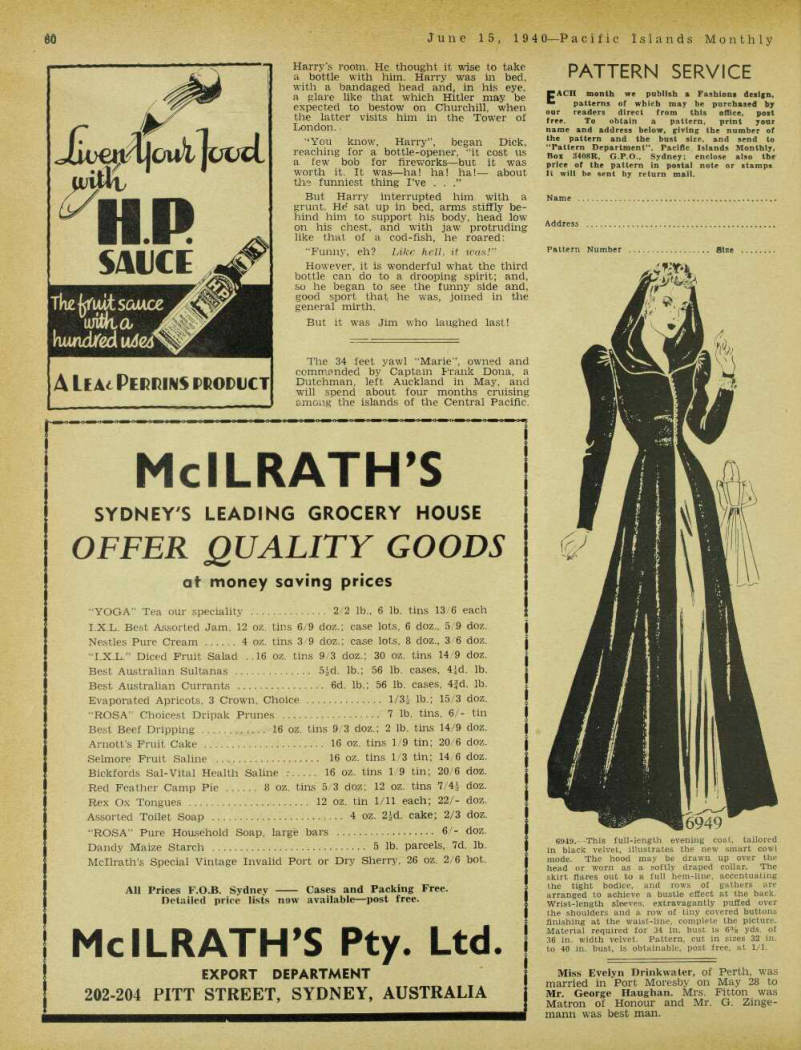
Abroad
An Islands Epic, By T. L. Wynne JIM had just reached man’s estate when he arrived in New Guinea. And he brought with him an abundance of faith in mankind—sufficient, in fact, to move Kosciusko.
He had an enjoyable trip up on the “Montoro”. Also on board were two Old Timers, miners returning from a well earned vacation. Jim would listen to their tales of adventure, fights with cannibals, lonely trails, etc., with both ears—and wish he had a third.
One dav, while the old boat was steadily pushing back the Australian coastline, the two O.T.’s leaned against the rail, waiting impatiently for the 4 o’clock session. Along the promenade deck came
Jim in immaculate flannels, and wearing a smile that any girl would be glad to sit in front of and have a tooth drawn. He joined his heroes immediately.
“What’s the time, Jim?” asked O.T. No. 1.
“Three o’clock”, replied Jim, with a fine twist of the wrist.
“Damn! An hour to wait!”
Then followed a little conventional conversation between No. 1 and Jim. No. 2, in the meantime, had been busy with his thoughts. He turned to No. 1 and re marked: “Do you remember that time, Bill, when we had to fight our way through that howling mob of savages up near Mt. Hagen?”
“Do I remember it!” —in a tone imply ing he would never forget it.
Then came a pause. Jim couldn’t stand that.
“What happened?” he asked, eagerly.
With apparent reluctance, and becom ing modesty, No. 2 told how they fought their way through a ring of wild natives armed with poisoned spears; how their boys deserted them; and how, with am munition gone, and Bill with a broken arm, they eventually got down the slope of a hill to the river where, providentially, they found a native canoe.
“Bill cut the mooring rope”, continued No. 2, “and jumped in. The canoe be gan to drift with the current, leaving me stranded on the bank with that howling mob behind me. Suddenly a huge croco dile appeared. He came from the swamp close to where I stood, and made in stantly for the canoe, after having a swish at me with his tail. He nosed round the canoe, while his tail almost touched the spot where I stood.
“You know, Jim, it’s moments like these you need to think quickly. To me, that old croc, looked like nothing so much as a log bridge leading to that precious canoe and safety. So I took a flying leap, landed on the croc.’s back, and from there into the canoe!
“For two days and nights we drifted in that canoe until, more dead than alive, we reached a mission station.”
IT was a few days after that when, strolling along the deck with a fellow passenger, the latter, as he left Jim to go to his cabin, made a remark that puzzled him for a long time. “Did you think”, he said, “to put a packet of salt in your luggage?”
“Salt?”, thought Jim. “Surely there would be salt in the Islands.”
How Jim learned to use that common commodity, quite apart from meals, is really our story, as now told.
ON a bright May morning, not so long ago, Captain “Sandy” Campbell looked at his watch and found, to his astonishment, that the old-time Pride of the Fleet” had been up to her old tricks again, and had broken her own record of 14 days, Sydney to Sala maua! She came round Parsee Point with her funnel swollen with pride, and beads of perspiration on her furrowed old bows.
Jim had been at the rail since dawn.
And there, on the port bow, was the isthmus of Salamaua, with B.P.’s flag showing prominently from the store—and waving frantically, under its own power, a greeting of congratulation to the old record-breaker.
To the south and west Jim saw the green-clad hills, at the slopes of which nestled the exclusive suburb of Kela, where the rich retire after three or four
years in the Territory. Beyond the hills, he saw the dark towering mountains of the Great Inland where, remembering his tales, he could easily visualise tribes of wild men looking for heads. The mountains, however, showed nothing but fleecy patches of low-lying cloud, hanging to their sides like spots of ermine on a velvet gown.
“El Dorado” thought Jim.
“Hell of a long time, two years”, thought others, returning from leave.
Jim had come to join the staff of one of the commercial concerns here, and was soon installed in the Mess. Two messmates were Dick and Harry. Dick had been an air pilot, in the old pioneering days, and narry had knocked about the world a bit, and had had his ups and downs, too. Both were big men; both loved a practical joke. Opportunities ior entertainment and amusement in the Islands are not of too frequent occur rence. They took to Jim immediately.
IT was about this time that the sensa tional press of Australia, hard up for headlines, were featuring the “Jap.
Scare”, pending the arrival of Larwood.
In the harbour at Salamaua was one of those Japanese “mystery” ships that nose around the coasts of the world, with no other object than to shake honourable hand while keeping honourable eye wide open.
They were given the freedom of the city, and Japanese tongues clicked and Japanese cameras clicked until you couldn’t tell one from the other.
One day, at lunch, Dick addressed Harry in a subdued and serious tone, contrasting strangely with his usual happy and boisterous manner: “D’you know, Harry, I don’t like these Japs prowling round here the way they are. You can laugh if you like, but I’ve an idea they’re up to no good.”
“Well”, replied Harry, just as subdued and glum, “if they start any funny busi ness we’ll give them a run for it.’ 1 “But will we? That’s just it. Who else is there in Salamaua that regards them as anthing but friendly little fellows far from home, to be taken in and cared for?
Whom can we count on?”
Each took a side glance at Jim. Yes, he was registering. They could count on him.
That night, Jim and Dick were enjoy ing an after-dinner smoke in the mess room Harry was out, somewhere.
Suddenly something flashed with a whizzing noise past the window. Dick got up to investigate. He saw sky rockets and starshells going up everywhere. “What the . - But he had hardly uttered the words when a terrific explosion occurred, quite close to the house He darted round the room like a caged lion. “The Japs! The Japs!” he yelled.
Jim, literally carried off his feet in the excitement, followed him and shouted, “What’ll we do?”
“Get hold of something”, yelled Dick.
“Anything! Get up on to the side ver andah and guard that entrance! Let no body pass! Quick!”
Jim leapt to it. A chair was the only thing he could see. He grabbed it and went up to his post, to do or die. This was at the head of a stairway leading to the side verandah.
Explosions were occurring about every five seconds. Half obscured, behind a post, Jim gripped the chair and waited.
He hadn’t long to wait. A dark figure came round a corner, and made straight for the stairway. Another explosion shook the house.
Jim’s knees shook, too. But he had his job to do, and he was going to do it. He thought of his two Old Timers, on board the “Montoro”. What would they have done. Held the fort, or course— against all comers. And so would he. His father hadn’t been a Digger for nothing, and never let it be said . . .
The figure approached the top, head bent for speed. Jim raised the chair— and nearly dropped it as a further ex plosion shook the ground under his feet.
But he took a grip of himself—and the chair—and down it came, with all the force of Jim’s 10 stone behind it.
It brought the invader to his knees with a groan, and he slid back down the stairs on knees and stomach, until he reached the bottom where he lay, as still as the mountain tops.
It was Harry! 117 HEN the story leaked out next day, f? the whole town roared. It spread from the Watut to the Waria, from Morobe to Madang, like a fast-moving shower of refreshing rain. fit appears that the two conspirators, Dick and Harry, had purchased a parcel of fireworks at a Chinese store, including “plenty big fella' cannon”. Boys haa been instructed to let off the sky rockets and star shells at certain times and places, and Harry was to get under the raised floor of the bungalow—no soft job for a 6-ft, 15-stone man—and see to the “artillery”. After lighting his last fuse,
he made a dash to get back to his room unobserved, but—like the girl in the story—he took the wrong turning, quite unaware that such determined opposi tion had been sent to guard that en trance. That was a tactical blunder that was a sore point to Harry, for many days.
On the following evening, Dick visited
Harry's room. He thought it wise to take a bottle with him. Harry was in bed, with a bandaged head and, in his eye. a glare like that which Hitler may be expected to bestow on Churchill, when the latter visits him in the Tower of London.
“You know, Harry”, began Dick, reaching for a bottle-opener, “it cost us a few bob for fireworks —but it was worth it. It was—ha! ha! ha! — about the funniest thing I’ve . . .”
But Harry interrupted him with a grunt. He* sat up in bed, arms stiffly be hind him to support his body, head low on his chest, and with jaw protruding like that of a cod-fish, he roared: “Funny, eh? Like hell, it was!”
However, it is wonderful what the third bottle can do to a drooping spirit; and, so he began to see the funny side and, good sport that he was, joined in the general mirth.
But it was Jim who laughed last!
The 34 feet yawl “Marie”, owned and commended by Captain Frank Dona, a Dutchman, left Auckland in May, and will spend about four months cruising among the islands of the Central Pacific.
Advertisements & other items, pp. 60-62 (2 items)
it#
S 0 Good ev^V health 4t with
MATURED
TO
PERFECTION
imuniimms
UJINES
SMOOTH out your worries of these trying days with a perfect aperitif and a smoothly restful glass of port, each evening.
You’ll thoroughly appreciate YEN- DARRA Extra Dry SHERRY* or
ROYAL RESERVE Sweet SHERRY
and VINTAGE 99 PORT— products of Australia’s leading wine makers for over 60 years.
Write to your nearest agent for supplies:— C. J. CASHMAN & CO.,
DARWIN; J. R. CLAY & CO.,
PAPUA; F. R. FORSYTH, NEW
GUINEA; C. R. YOUNGER,
SOLOMON ISLANDS.
RELIABLE QUALITY. RELIABLE QUALITY. RELIABLE QUALITY. RELIABLE QUALITY.
Reliable Quality
in Exporting for over 60 years. 9
FLOUR
& SHARPS
WISE BROS. 11l
10 MARTIN PLACE, SYDNEY
Cable Address: “PURITY”, Sydney.
J. C. MERHILLEES & CO.
133 PITT STREET. SYDNEY.
ISLANDS BUYING AND SELLING AGENTS
Representatives:—DAßWlN; C. J. CASHMAN & CO. PAPUA: J. R. CLAY & CO. N. GUINEA: F. R. FORSYTH. SOLOMON IS.: C. R. YOUNGER.
lvepAfOuh]vVci
HP
SAUCE
m \ Li At Perrins product
McILRATH’S
SYDNEY'S LEADING GROCERY HOUSE
OFFER QUALITY GOODS
at money saving prices
“YOGA" Tea our speciality 2 2 lb., 6 lb. tins 13 6 each I.X.L. Best Assorted Jam, 12 oz. tins 6/9 doz.; case lots, 6 doz.. 5 9 doz.
Nestles Pure Cream 4 oz. tins 3 9 doz.; case lots, 8 doz., 3 6 doz.
"1.X.L.” Diced Fruit Salad ..16 oz. tins 9 3 doz.; 30 oz. tins 14 9 doz.
Best Australian Sultanas s£d. lb.; 56 lb. cases, lb.
Best Australian Currants 6d. lb.; 56 lb. cases, lb.
Evaporated Apricots, 3 Crown, Choice 1/31 lb.; 15/3 doz.
“ROSA" Choicest Dripak Prunes 7 lb. tins, 6/- tin Best Beef Dripping 16 oz. tins 9 3 doz.; 2 lb. tins 14/9 doz.
Arnott’s Fruit Cake 16 oz. tins 1/9 tin; 20 6 doz.
Selmore Fruit Saline 16 oz. tins 1/3 tin; 14 6 doz.
Bickfords Sal-Vital Health Saline r 16 oz. tins 1/9 tin; 20/6 doz.
Red Feather Camp Pie 8 oz. tins 5 3 doz; 12 oz. tins 7/4 \ doz.
Rex Ox Tongues 12 oz. tin 1/11 each; 22/- doz.
Assorted Toilet Soap 4 oz. 2id. cake; 2/3 doz.
“ROSA” Pure Household Soap, large bars 6/- doz.
Dandy Maize Starch 5 lb. parcels, 7d. lb.
Mcllrath’s Special Vintage Invalid Port or Dry Sherry, 26 oz. 2/6 bot.
All Prices F. 0.8. Sydney Cases and Packing Free.
Detailed price lists now available—post free.
McILRATH’S Pty. Ltd.
EXPORT DEPARTMENT
202-204 PITT STREET, SYDNEY, AUSTRALIA
59
Pacific Islands Monthl y—J une 15, 1940
Pattern Service
EACH month we publish a Fashions design, patterns of which may be purchased by our readers direct from this office, post free. To obtain a pattern, print your name and address below, giving the number of the pattern and the bust size, and send to “Pattern Department”. Pacific Islands Monthly, Box 3408 R, G.P.0., Sydney; enclose also the price of the pattern in postal note or stamps.
It will be sent by return mail.
Name Address Pattern Number 81ze
Miss Evelyn Drinkwater, of Perth, was married in Port Moresby on May 28 to Mr. George Haughan. Mrs. Fitton was Matron of Honour and Mr. G. Zinge mann was best man.
6949. —This full-length evening coat, tailored in black velvet, illustrates the new smart cowl mode. The hood may be drawn up over the head or worn as a softly draped collar. The skirt flares out to a full hem-line, accentuating the tight bodice, and rows of gathers are arranged to achieve a bustle effect at the back.
Wrist-length sleeves, extravagantly puffed over the shoulders and a row of tiny covered buttons finishing at the waist-line, complete the picture.
Material required for 34 in. bust is 6 3 s yds. of 36 in. width velvet. Pattern, cut in sizes 32 in. to 40 in. bust, is obtainable, post free, at 1/1.
A Section For Women
By "Therese"
The Kitchen
Who talks about the kitchen’s narrow scope, Its menial tasks, has never stopped to think What wonder-roads are worn from stove to sink, What loveliness may emanate from soap.
He has forgotten—if he ever knew— Romance in tea, the history of rice, Geography in sugar, salt and spice, The priceless perfume in a simple stew.
And more—that kitchens are the origin Of poesy, of laughter, strength of men, Of women’s grace; that pots and pans and rolling pin Have motivated nations. Say not then A kitchen’s scope is limited, but sing: Its glory transcends power of any king.
Food For The Master
OUR food, like our clothes, needs con stant revision. The way w° served a dish last month becomes dull, if we repeat it too often, so it behoves all women to plank hard for something new to present to the hungry male of the house. His appetite becomes jaded too often, because there is little or no im agination used in making something different with the same old ingredients.
Try the following recipes: Salmon Mould 1 large tin salmon, \ oz. gelatine, 3 tablespoons water, 2 hard-boiled eggs, 2 tablespoons vinegar, salt and pepper, capers and cooked beetroot. Salad.
Dissolve the gelatine in 3 tablespoons of boiling water. White of egg, beetroot, cut into fancy shape, decorate the
All humanity likes to know how the other half lives. That, especially, is true of Islands women.
Contributions to this page are invited. Send along your favourite recipe or household ingenuity. Those published will be paid for.
bottom of the mould. Set the decoration in a little of the gelatine. Remove any skin and bone from the salmon, and add it to the rest of the jelly and the sea soning. Mix well. Leave until it is be ginning to set, then pour into the mould.
Stand in a cool pla’ce. Turn out, when set, and serve with salad and sliced hard boiled egg.
Corn Beef Hash 1 tin corned beef, 1 lb. cold cooked potatoes, \ pt. stock or milk, salt and pepper.
Turn the corned beef into a frying pan. Mash with a fork. Keep the heat low for the first few minutes. Moisten the cooked potatoes with stock, or milk, and season well. Add half the quantity to the beef, and smooth over with a knife.
Cook until the underside is beginning to brown. Turn out on to a hot dish, smooth ing into shape. Serve at once with tin ned vegetables, and the rest of the mashed potatoes.
Banana Custard One cup of stale breadcrumbs, half a pint of milk, 1 egg, grated rind of half a lemon, 2 bananas, 1 oz. sugar.
Butter a pie dish, and line it with breadcrumbs. Arrange thin slices of banana on top, and sprinkle with a little
grated lemon rind. Cover with another layer of crumbs, banana and rind, then top with crumbs and sliced banana. Make custard with the egg, milk and sugar, and pour over the bananas, etc., and sprinkle with a little grated nutmeg and bake for 45 minutes in a moderate oven.
Marmalade Pancakes Mix into a smooth paste one large egg, 2 tablespoons flour and a pinch of salt.
Add by degrees % pt. milk and then beat well for ten minutes. Allow the mixture to stand for 1 hour. When required for use beat again for a minute or two. Pour a little at a time in a frying pan contain ing a little lard, smoking hot, and brown on both sides. Spread with heated mar malade, roll up, sprinkle with castor sugar and put into a fierce oven for a few minutes. Serve immediately.
Household Hints
TO clean baths use a mixture of half kerosene and half vinegar. The smell is not so Unpleasant, \yhile the result is as good as when all kero sene is used.
Meringue will stand up higher if a generous pinch of baking soda is added to the beaten egg whites.
Raisins, dates, currants and figs,
soaked in a little boiling water for five minutes, will blend better with other in gredients in a recipe.
Small cakes need a fairly hot oven at first, and then a cooler one later on, so that they do not brown too much.
Obstinate stains can be removed from the fingers or nails with a mixture of salt and lemon juice. Strain the juice of a lemon into a saucer and stir into it sufficient common salt to make a paste. Rub this over the stain and then wash off with warm water.
Fashions Reflect Events
FASHIONS are a reflecting glass of what is happening in the world. It would seem that we are steadying down to something new—clothes that have the brave beauty of a newly-born spirit.
The tendencv is towards simplicity for all occasions. I was looking at party dresses the other day, and it struck me that they were quite seemly and right.
The long full skirts have grace and dignity, and the long slim ones are not exaggerated in their slenderness.
Day-time clothes are all more or less tailored and, though here and there ultra fashions are to be seen, women in the main bank on the simple styles. This is true also of hats, which show a de finite trend to the tailored type.
This does not mean that clothes are dull. On the contrary. They are gayed up with scarves, contrasting jackets, and bright cummerbunds and flower posies are pinned in the lapels of the tailleur to give it a feminine touch.
Colours do their best to put us in fine spirit. It is difficult to say that one colour prevails, but there is certainly a lot of blue in all shades, a good many dahlia reds and not a little green, light and dark.
Skirts show a tendency to shortness and have a little extra fulness because of it.
Jacket suits are extremely popular— either in one colour, or a combination of check coat and plain skirt, or vice-versa.
Stripes are used in the same way, and have a very slimming effect.
Coats come in varied styles. Very little fur is used, except as a trimming— epaulettes, pieces running up the sleeves or at the cuffs. The tailored coat carries a cravat at the neckline, mostly of velvet, which has a very softening influence. The swagger coat is mostly three-quarters length, and the full length coat is one of three things—fitting, belted or en veloping.
Bags and gloves are particularly at tractive. Bags are of soft leather with a definitely femine look about them.
Gloves are of suede, kid, leather or hogskin, and rather plainer than those of last season.
Hats modify their absurdity somewhat, and become more utilitarian, though still somewhat crazy in the eyes of the male.
Those Vital Ten Minutes
BEDTIME . . . and eight hours’ good sleep before dawn. That was what our grandmothers called our beauty sleep, and considered it necessary for every young girl. They were right, too.
But the tension at which we live now makes it necessary to call upon aids to beauty that will work while we sleep.
Ten minutes of will power, before dart ing into bed, and beauty will be yours.
Face: Two minutes to cleanse the skin with a good cleansing milk. It seeps deep and takes away all blemish-making grime, it bleaches, soothes and leaves the skin cleansed, fresh and healthy. What ever your skin problem, dry skin or greasy, this solves most of it, for both of
them are due partially to imperfect cleansing. Two minutes to put on and wipe off a skin food, leaving only what has been absorbed.
One minute, on alternate nights to slan your face with a two-finger pad of cotton wool soaked in a tonic milk. This is to close the pores, big or little.
Eyes: One minute for each eye, to soothe, refresh and cleanse with a lotion.
Bathe your eyes at least every other night.
One minute for each eye to pat in a little finger tip astringent cream around and about. This is almost magic and you feel puffiness and lines flee. One minute to sweep eyelashes with a tiny brush dipped in castor oil. Watch the lashes lengthen.
Hair; Two minutes . . . three minutes . . . but even one minute is better than none, and this time your finger tips will give the care. Start from the base of the scalp and knead firmly upward to the crown with the thumbs and fingers. It sounds dull, but it will give new life to your hair roots. For pre-shampoo nights a palmful of olive oil. rubbed into the scalp, is better than a week’s sunshine for bringing new lights into the hair.
Hands: One minute to work a smear of nail-perfecting cream under the cuticles. It keeps them supple and self effacing, and the nails strong and healthy.
It is reported from Canberra that negotiations have been in progress be tween the Governments of Great Brit ain, New Zealand and Australia who hold a joint mandate over the prosphate island of Nauru, in regard to the pro posal for manning the phosphate ves sels with white crews instead of with coloured crews as at present.
Advertisements & other items, pp. 63-64 (2 items)
61
Pacific Islands Monthl y—J une 15, 1940
Canterbury
The “Serviceable”
LINEN WATCH BAND
for ladies' and gents' watches
WASHABLE
DURABLE
DRESSY
Assorted colors. A size to fit every watch.
Special shades to suit the Fighting Services.
ASK YOUR LOCAL
STOREKEEPER
Wholesale only from —
M. SUTTON
27 PRINCE ALBERT STREET,
MOSMAN, N.S.W.
Swallow & Ariell’s
WORLD RENOWNED
CANTERBURY
CAKES
Each Cake is Enclosed, by special process, in air-tight tin, and is warranted to keep its condition for a considerable period. txxxxxxxxxxxxxx: Fiji Representatives Pearce & Co. Ltd.
KAMB A L A
CHURCH OF ENGLAND
SCHOOL FOR GIRLS
A Day and Board-
ing School for
Girls.
KINDERGARTEN TO
LEAVING CERTIFICATE
HONORS.
RESIDENT QUALIFIED
SPORTS MISTRESS.
Prospectus on application to the Principal . . .
MISS F. HAWTHORNE, B.A.
KAMBALA SCHOOL
ROSE BAY, SYDNEY
FOUNDED 1887
im i ■A. > m / /> : ‘KAMBALA” Ideally situated in 5 acres of ground . . 5 Tennis Courts
From Papua
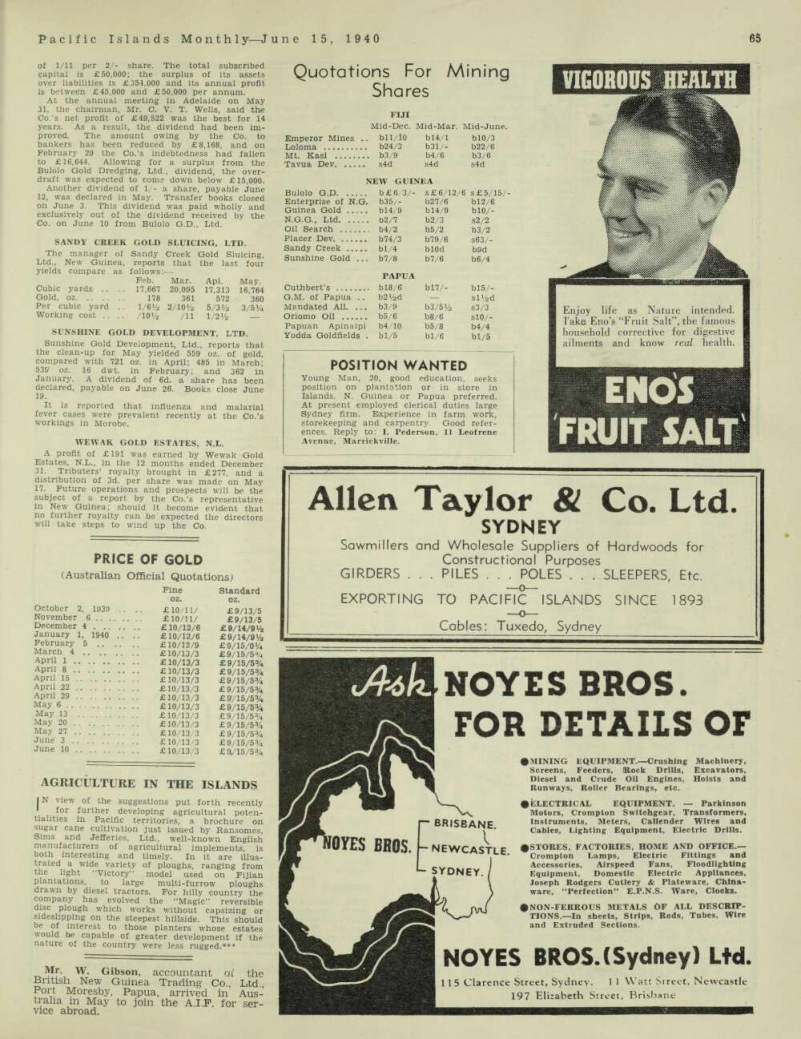
Mining News
From Fiji
Mount Kasi Mines, Ltd.
MOUNT KASI MINES, LTD., in May, reported a net profit of £14,130 (Fijian currency) for 1939, compared with £11,648 in 1938. and £8,046 in 1937. Profit was struck after allow ing for depreciation, £4,146, mine development, £6,342, and taxation, £1,250.
A first dividend of 3d. per share (Australian currency) absorbed £4,379. The balance, £9,751, together with £13,588 brought forward, is transferred to general reserve.
The working cost, excluding depreciation, development, and income tax, amounted to £l/2/11 per ton, compared with £l/1/9V 2 in 1938.
The estimate of total positive and probable ore reserves shows a very slight decrease com pared with the estimate given in the previous year, and the value per ton is slightly reduced.
Positive reserves are shown at 114.000 tons at 5 dwt., and probable reserves at 92,290 at 5.1 dwt.
May production at the mine on Vanua Levu is compared with February, March and April as follows:
At the annual meeting of the Co., held in Sydney on May 23, the chairman, Mr. E. J.
Coote, said that returns from the mine for the year had yielded profits which practically as sured the payment of another dividend in September. He could see no reason why half yearly disbursements should not be regularly maintained. The Co. was deriving benefit from the increase in the sterling price of gold. Since the outbreak of war, however, the price of all stores and spares had increased considerably, and this would reflect on the Co.’s cost of pro duction.
“Development work on the mine is to be carried on as vigorously as possible,” added Mr.
Coote. “The conditions at depth have yet to be determined. This deposit is most puzzling from a geological aspect, but the presence of gold in payable quantities is well established on the present lowest level of the mine, and, al though such little work as has been done below this level to date had not been encouraging, the possibilities of lower enrichments have not been eliminated.”
Loloma (Fiji) Gold Mines, N.L.
A dividend of 1/- and a bonus of 1/- a share has been declared by the directors of Loloma (Fiji) Gold Mines, N.L., payable June 8. The distribution is the highest made by the Co. to date, and absorbed £82,500. Over £453,750 has now been distributed, a total of 11/- per share.
Latest reports received indicate exceptionally good values in the Regent Lode.
Production for May is compared with the three previous months as follows:
Emperor Mines, Ltd.
A recent report from the Emperor mine at Tavua, Fiji, states that the E. Xcut, off shaft No. 12, has been taken to 10 ft., with for mation highly shattered and heavily mineralised.
“This development, in the deepest working of the mine, must be considered of major im portance”, the report stated.
Results for the four weeks ended May 15 compare with previous figures as follows:
♦Concentrates stacked for further treatment estimated to contain 30 oz. fine gold; 42 tons flotation concentrates stacked estimated to con tain 350 oz.
A seventh dividend of 6d. a share was paid on May 31, the distribution absorbing £47,500 and bringing the dividend record to £380,000.
From Papua
Papuan Apinaipi Petroleum Co., Ltd.
IN a report on the possibilities of commercial • oil production from Papuan Apinaipi Petroleum Co., Ltd.’s bore at Oiapu, Mr.
Geoffrey Barrow, geologist, stated that the thick grey series of grey mudstones now being penetrated by the drill provides a flrst-class cap-rock for any oil horizon which may lie beneath.
At the end of May the No. 1 Major bore was down to 1,763 ft. and a return of oil and gas was noted in the ditch. The hole was reamed and drilling continued until early in June it had reached a depth of 2,092 ft. The core, extracted at the bottom, showed gas under high pressure with formation changing.
Mandated Alluvials, N.L.
Mandated Alluvials, N.L., reports that assays of No. 23 and 24 shipments of copper gold
Peb.
Mar.
Apl. *May 24. 20. 17. 15.
Ore treated, tons .. 13,114 12,100 11,971 12,500 Head value, dwt . — 7.03 6.76 6.72 Gold, oz. t fine .. 3,657 3,798 3,663 3,696 Residues, dwt — 0.64 0.59 0.65
1937. 1938. 1939. £ £ £ Net profit 8,046 11,648 14,130 Dividend — — /3 Dividend, amount .. — — 4,379 Development 1,356 3.478 6,342 Depreciation 3,741 4,044 4,146 To reserve — — 23,339 Forward 1,940 13,588 Crude ore, tons . . .. 33,232 38.420 39,434 Head value, dwt, ton 5.41 5.06 4.90 Fine gold, oz 7,496 8,362 8,695
Four weeks ended Feb. 21. Mar. 20. Apl. 17. May 15.
Ore, tons .. 3,040 3,119 3,209 3,198 Gold, fine oz. 663 598 656 633 Value, £ A .. 6,630 5,980 6,560 6,330
Pour weeks ended Feb. 24. Mar. 20. Apl. 17. May 15.
Tons treated . 2.514 2,545 2,260 2,506 Gold, oz.. fine 3,821 3,880 3,008 3,659 Residue, dwt. 1.25 0.&1 2.2 1.15
matte show contents as 434 oz. fine gold, 1,272 oz. silver, and 11 tons of copper, the total value exceeding £5,000. Shipment No. 25 of an ap proximate value of £3,250 has since been re ceived. M?uch of the additional plant required for the development of the Laloki mine has been secured.
Cuthbert’S Misima Goldmine, Ltd.
Directors of Cuthbert’s Misima Goldmine, Ltd., Misima Is., Eastern Papua, have declared a halt-yearly dividend of 1/- per share payable June 24. Books closed June 13.
May production at the mine is compared with March and April in the following table:—
A report issue by the Co. on June 6 stated that total development for April was 553 ft.; 596 tons of ore was won from development, and 2,212 tons from stoping, making a total of 2,808 tons. Average assay: gold, 4 dwts. 20 grs. per ton; silver, 45 dwts. 19 grs. per ton.
From New Guinea
Bulolo Gold Dredging, Ltd.
THE directors of Bulolo Gold Dredging, Ltd., report that April production from the Co.’s dredges in New Guinea compared with the previous two months as follows:
of fine gold.
Progress on the Upper Baiune Power Scheme is proceeding satisfactorily, and the work of facing weak sections of the ditch with cement rubble was completed at the end of May.
Quarters for the race patrolman have been completed and a suspension bridge has been placed across the river near the intake. A start has been made on the construction of the overflow flume, and work on the power house, pipe line, surge tank, sand trap, etc., is pro ceeding satifactorily. Some 20 Europeans and 125 natives are employed in the scheme.
The deviation of the Crooked Creek Road, which was completed recently, is reported to be a great improvement on the old original road through the Creek. The construction of two additional married quarters at Bulolo is pro ceeding and repair work has be>en carried out at the Bulolo Power House.
The Co. now has a staff of 1,824 of whom 328 are Europeans.
Gold And Power, Ltd,
The total of employees at Gold and Power, Ltd.’s workings on the Morobe goldfield now numbers 172, made up of 7 Europeans and 165 natives. The erection of a new dwelling for Europeans is proceeding, and race maintenance has been carried on. Mr. J. W. Hinks, man aging director, returned to Wau recently, after a visit to Sydney.
New Guinea Goldfields, Ltd,
The last report issued by the Mining Trust, Ltd., consulting engineers to N.G.G., Ltd., com pares the production and profit for April with February and March:—
Guinea Gold, N.L.
In the year ended February 29, 1940, Guinea Gold, N.L. (an Adelaide company, holding a large number of shares in Bulolo Gold Dredging, Ltd.), showed a profit of £49,522, compared with £46,807 in the previous year. During the year under notice the company paid a dividend
Mar. Apr. May.
Mill treated tons .. .. 3,132 2,808 3,252 Bullion, oz 3,437 2,788 3*326 Gold, fine, oz 783 634 794 Silver, fine, oz 2,575 2.087 2,445 Estimated value .. .. £6,400 £5,198 £6!s00 Value per ton of ore .. 40/11 37/- 40/-
Feb.
March.
Apr.
Cubic yards .. 1,492,000 1,505,000 1,487,000 Bullion, oz 24,407 23,802 24,083 Gold, fine, oz* . .. 16,841 16,423 16,617 Estimated working profit 1 for April, 8,848 oz.
Feb.
Mar.
Apl.
Edie Creek mill — Ore, tons 3,067 2,870 3,089 Gold, oz., fine . . .. 726 744 773 Silver, oz., fine .. .. 3,403 3,573 3,796 Golden Ridges mill— Tons treated 3,118 2.688 2,666 Gold, oz., fine .. . . 1,623 1.380 1,403 Silver, oz., fine .. 1,833 1,586 1,489 Alluvial — Gold, oz., fine .. 1,611 1,593 1,586 Silver, oz., fine . . 1,161 1,134 1,113 Operating profit— Edie Creek, £ .. 785 212 261 Golden Ridges, £ .. 6,998 4,810 4,788 Alluvial, £ 6,645 7,317 5,733
of 1/11 per 2/- share. The total subscribed capital is £50,000; the surplus of its assets over liabilities is £354,000 and its annual profit is between £45,000 and £50,000 per annum.
At the annual meeting in Adelaide on May 31, the chairman, Mr. C. V. T. Wells, said the Co.’s net profit of £49,522 was the best for 14 years. As a result, the dividend had been im proved. The amount owing by the Co. to bankers has been reduced by £8,168, and on February 29 the Co.’s indebtedness had fallen to £16,644. Allowing for a surplus from the Bulolo Gold Dredging, Ltd., dividend, the over draft was expected to come down below £15,000.
Another dividend of 1, - a share, payable June 12, was declared in May. Transfer books closed on June 3. This dividend was paid wholly and exclusively out of the dividend received by the Co. on June 10 from Bulolo G.D., Ltd.
Sandy Creek Gold Sluicing, Ltd.
The manager of Sandy Creek Gold Sluicing, Ltd., New Guinea, reports that the last four yields compare as follows:
Sunshine Gold Development, Ltd.
Sunshine Gold Development, Ltd., reports that the clean-up for May yielded 559 oz. of gold, compared with 721 oz. in April; 485 in March; 539' oz. 16 dwt. in February; and 362 in January. A dividend of 6d. a share has been declared, payable on June 26. Books close June 19.
It is reported that influenza and malarial fever cases were prevalent recently at the Co.’s workings in Morobe.
Wewak Gold Estates, N.L.
A profit of £l9l was earned by Wewak Gold Estates, N.L., in the 12 months ended December 31. Tributers’ royalty brought in £277. and a distribution of 3d. per share was made on May 17. Future operations and prospects will be the subject of a report by the Co.’s representative in New Guinea; should it become evident that no further royalty can be expected the directors will take steps to wind up the Co.
Feb. Mar. Apl. May.
Cubic yards . . . . 17,667 20,095 17,313 16,764 Gold, oz 178 361 572 360 Per cubic yard .. 1/6 J / 2 2/10V 2 5/3 Vs 3/5 Vi Working cost .. .. /10V 2 /II l/2>/ 2 —
Advertisements & other items, pp. 65-66 (2 items)
63
Pacific Islands Monthl y—J une 15, 1940
QMI AFFECT fl lekmek RADIO
Radios to suit all Conditions A big range of Lekmek radio receivers, built to suit varying reception conditions, is made by skilled engineers, experienced in the construction of receivers and special apparatus for the P.M.G.’s Dept. and y National Broadcasting Stations.
To give you trouble-free tropical and sub-tropical radio reception the component parts of all Lekmek receivers are specially impregnated against destructive moisture. But that’s only one reason for Lekmek's widespread popularity. Lekmek gives outstanding overseas shortwave and Australasian reception, plus hairline tuning that insures reception of any station you may wish to hear— without interference or fading. All these are yours, thanks to the care and skill built into each individually constructed Lekmek receiver, some of which are listed below. Consult your agent, or— C. Sullivan Ltd., 379 Kent Street, Sydney, Exporters Pty. Ltd., 75 Pitt Street, Sydney, or write direct to United Radio Distributors Pty. Ltd. ‘Lachlan” Console—6V. —Dual ‘Lachlan” Console—6V.—Dual ‘Barcoo” Table Model—6V.—Dual ‘Barcoo” Table Model.—6V.—Dual wave—Vibrator—44 Gns. wave—Battery—3B Gns. wave—Vibrator—4o Gns, wave—Battery—34 Gns.
UNITED RADIO DISTRIBUTORS PTY. LTD.
® 234 CLARENCE STREET, SYDNEY. CABLES U.R.D. SYDNEY
Highest Prices Paid For
601 D Garrett & Davidson’s organisation is acknowledged far and wide as the main clearing house for precious metals in the Southern Hemisphere.
They have earned a reputation for accuracy and integrity in all their business dealings, which is proved by the fact that they are privileged to handle more gold from the Islands of the Pacific than any other organisation.
Therefore for your complete and lasting satisfaction, you are advised to transact all your precious metals business through the house of Garrett & Davidson.
GARRETT & DAVIDSON PTY. LTD.
ASSAYERS METALLURGISTS REFINERS
Bank of N.S.W. Buildings,
REGENT AND GEORGE STS., SYDNEY.
The first dose of WOODS’
GREAT PEPPERMINT CURE
eases throat, relieves pain. Get quick, pleasant help from ’Flu
Colds,Coughs.Throatand Chest
complaints with WOODS*
GREAT PEPPERMINT CURE.
1 -iu m
iest 1
1N G S
It u ■ % m$ N X
FOR MINING ENGINEERS
in GOO D WELD
SPIRAL PIPE
Saving No. 1. LOW INITIAL COST.
Goodweld Spiral Welded Steel Pipe has a considerably lower first cost than other descriptions of pipe.
Saving No. 2. LESS FREIGHT TO PAY.
Because Goodweld pipe is light in comparison with other pipes designed to carry similar pressures, very considerable savings in shipping freights and land haulage charges are possible.
Saving No. 3. LONGER LIFE IN SERVICE.
Goodweld Steel Pipe resists corrosion and possesses great strength due to the reinforcing spiral rib providing it with longitudinal stiffness and great resistance to crushing under external load. Longer life means less maintenance and fewer renewals.
IN ADDITION the lighter weight of Goodweld pipe reduces field handling and laying costs besides speeding up the work as Goodweld is exceptionally easy to instal even in close quarters.
Compare with other piping and you will find Goodweld costs less per foot to buy, .to ship and to haul, less to handle and less to maintain.
Four types available covering light and heavy duty service.
Diameters from 5 in. upwards in dead straight 30 ft. lengths.
Joints—supplied with prepared ends ready for field welding; with flanges or with spigots and faucets for jointing with lead or push-in rubber rings. Protective coatings and linings include: Galvanising inside or out or both; concrete lined or ready for lining; Bituminous coated or lined to any specification.
Full particulars of Goodweld pipe for industrial, mining, agricultural and water reticulation purposes gladly supplied.
A. E. GOODWIN PTY. LTD.
RAILWAY PARADE, UDCOMBE, N.S.W.
AND AT PORT KEMBLA
r • ■
Price Of Gold
(Australian October 2, 1939 .
November 6
Official Quotations)
Fine Standard oz. oz. ■ .. £10/11/ £9/13/5 December 4 . .. . £ 10/12/6
£Q/U/Ou.
January 1, 1940 ..
February 5 .. ..
March 4 £10/12/6 9/ 19/9 72 £ 9/14/9 y a £ 9/15/0Vi
Pq/Ic /Km/.
April 1 ** 9/ It)/0,4 rn/ic /e 3/ April 8 **9/ 10/0*74 rn/ie /R3A April 15 April 22 £ 10/13/3 9/ 10/0*74 £9/15/53/4 •P Q / I R /ft 3/.
April 29 May 6 x y/ lo/o *74 £9/15/53/4 PQ/ie /CM/ May 13 May 20 X y/ 10/0*74 £9/15/53/4
R Q/1K /K3A
May 27 X y/ 10/0*74
Pq/1K /K3A
June 3 June 10 ** y/ 10/0*74 £9/15/53/4 £a/15/53/ 4
Agriculture In The Islands
I N view of the suggestions put forth recently for further developing agricultural poten tialitles in Pacific territories, a brochure on sugar cane cultivation just issued by Ransomes, Sims and Jefferies, Ltd., well-known English manufacturers of agricultural implements, is both interesting and timely. In it are illus trated a wide variety of ploughs, ranging from the light “Victory” model used on Fijian plantations, to large multi-furrow ploughs drawn by diesel tractors. For hilly country the company has evolved the “Magic” reversible disc plough which works without capsizing or sideslipping on the steepest hillside. This should be of interest to those planters whose estates would be capable of greater development if the nature of the country were less rugged.*** Mr. W. Gibson, accountant of the
British New Guinea Trading Co., Ltd.,
Port Moresby, Papua, arrived in Aus tralia in May to join the A.I.F. for ser
vice abroad.
Quotations For Mining
Shares
Fiji
Mid-Dec.
Mid-Mar.
Mid-June.
Emperor Mines .. bll/iO bl4/l blO/3 Loloma b24/3 b31/b22/6 Mt. Kasi b3/9 b4/6 b3/6 Tavua Dev s4d s4d s4d
New Guinea
Bulolo G.D b £ 6/3/s£6/12/6 s£5/15/- Enterprise of N.G. b35/b27/6 bl2/6 Guinea Gold bl4/9 bl4/9 blO/- N.G.G., Ltd 02/1 b2/3 s2/2 Oil Search b4/2 b5/2 b3/2 Placer Dev b74/3 b79/6 s63/- Sandy Creek bl/4 blOd b9d Sunshine Gold ... b7/8 b7/6 b6/4 Cuthbert’s
Papua
bl8/6 bl7/bl5/- G.M. of Papua .. b2V 2 d — slV 2 d Mandated All. ... b3/9 b3/5V 2 s3/3 Oriomo Oil b5/6 b8/6 slO/- Papuan Apinaipi b4/10 b5/8 b4/4 Yodda Goldfields . bl/5 bl/6 bl/5
Advertisements & other items, pp. 67-68 (2 items)
65
Pacific Islands Monthl y—J une 15, 1940
Enos
—i Enjoy life as Nature intended.
Take Eno’s “Fruit Salt”, the famous household corrective for digestive ailments and know real health.
FRUIT SALT
POSITION WANTED
Young Man, 20, good education, seeks position on plantation or in store in Islands. N. Guinea or Papua preferred.
At present employed clerical duties large Sydney firm. Experience in farm work, storekeeping and carpentry. Good references. Reply to: I. Pederson, 11 Leofrene Avenue, Marrickville.
Allen Taylor & Co. Ltd
SYDNEY
Sawmillers and Wholesale Suppliers of Hardwoods for Constructional Purposes GIRDERS . . . PILES . . . POLES . . . SLEEPERS, Etc.
EXPORTING TO PACIFIC ISLANDS SINCE 1893
Cobles: Tuxedo, Sydney
'4
P BRISBANE
V
DYES BROS.
NOYES BROS.
FOR DETAILS OF
£ MINING EQUIPMENT. —Crushing Machinery, Screens, Feeders, (Rock Drills, Excavators, Diesel and Crude Oil Engines, Hoists and Runways, Roller Bearings, etc.
• ELECTRICAL EQUIPMENT, Parkinson
Motors, Crompton Switchgear, Transformers, Instruments, Meters, Callender Wires and Cables, Lighting Equipment, Electric Drills.
NEVVCASTI P •STORES, FACTORIES, HOME AND OFFICE.— * rrnmn# r*r» T.amnc Flprfrip Fit imp's: and
- SYDNEY.
Accessories, Airspeed Fans, Floodlighting Equipment, Domestic Electric Appliances, Joseph Rodgers Cutlery & Plateware, Chinaware, “Perfection” E.P.N.S. Ware, Clocks.
• NON-FERROUS METALS OF ALL DESCRIP-
TIONS.—In sheets, Strips, Rods, Tubes, Wire and Extruded Sections.
NOYES BROS.(Sydney) Ltd.
115 Clarence Street, Sydney. 1 1 Watt Street, Newcastle 197 Elizabeth Street, Brisbane
“PRESTO”
THE
TVIAGIC
BOX
The most Amazing Trick- Just out.
“Presto”. —The greatest, most alluring and outstanding little trick ever introduced, 2/9. Post Free.
Money back if it’s not the best yet.
POLICE PATROL MULTI STRAND
RUBBER COVERED AERIAL.
Needs No Separate Lead-in. 50 ft.. 2/6; 100 ft., 5/-.
MAN-O-WAR HEAVY DUTY
INSULATED AERIAL, MULTI
STRAND WIRES.
50 ft., 5/-; 100 ft. 10/-, Electric MODEL MOTORS, work off wet or dry batteries: 5/9, 9/6, 12/6 worth double.
ACCUMULATORS
We sell all Types and Sizes —Fully Guaranteed.
RADIO ACCUMULATORS.
2 Volt. 110 Amp 17/- 20/- 20/6 22/6 36/8 45/6 73/9 84/6 31/9 40/- 44/6 51/- 49/3 65/9
HOME LIGHTING ACCUMULATORS.
2 Volt. 120 Amps 20/9 2 „ 210 35/9 2 „ 200 41/.
GAMES
Dart Boards, 4/6, 8/6, 10/6, 15/-.
Brass Competition Darts, Set of 3 3/11, 4/6, 5/6, Monopoly. 10/6.
Totopoly, 10/6. Bucaneer, 10/6. 2 of the World’s Most Popular Games Chinese Checkers, 3/6, 4/6, 8/6.
Tripoly Card Game, 5/-. De Luxe Model Game, 10/6. Poker Rummy, 1/-. Pot Luck, 1/-. Playing Card Lotto. 1/-. We Stock All Kinds of Indoor Games. Send for Booklet.
Neat Metal Bound Wooden Cigarette Cabinet, 4/9, for building Music Box unit into.
Complete Mechanical Units for Musical Cigarette Boxes, etc., 12/6, 15/-. Plays two Tunes. Music- Boxes, 30/-, 35/-, 45/-. Musical Cigarette Boxes, 35/-.
“LIKE-A-FLASH” DE LUXE
RADIO RECEIVERS FROM
MAKER TO USER
Regardless of Make, Trade-Name or Price, “Like-a-Flash” Radio Sets cannot be bettered. Hundreds of our sets are giving excellent service right throughout the Islands.
“Like-a-Flash” De Luxe Dual Wave 5 Valve Battery Operated Receiver.
This is one of the most powerful models in our battery set series, and the Radio Frequency stage ol amplification gives the set a world range on short wave channels as well as full coverage range 01 Australasian “A” and “B” Class Broadcasters.
The set is also specially designed to give maximum service in humid climates, such as North Queensland and Pacific Island Territories. A vital part very vulnerable to “dampness” in ordinary receivers is the “Intermediate Frequency Section”.
In this set our Engineers have fitted special inductance tuned intermediate frequency transformers, which do not require trimmers.
These units ensure correct alignment for a continuous period. An 8 in. Aero Dial calibrated in stations facilitates tuning. Valves used are;
2—lC4, I—KK2, I—lK6, I—lD4
The speaker is the latest Amplion Permagnetic Model, capable of high fidelity reproduction. Battery equip ment consists of extra heavy capacity units as follows: 1 2 -Volt 100 amp. Accumulator. 3 Ever-Ready Superdyne 45 Volt “B” Batteries. 1 Ever-Ready 4V 2 in. “C” Battery, The outfit is housed in a beautfully veneered floor model Console Cabinet.
PRICE: £22/5/-.
Now available (not less than 10/parcels): Magic Wand, 1/6; Jafd’s Wallet, 1/-; Obedient Ball, 1/6; Rattle Box; Mystic Head Chopper, 2/6; Shy Jack, 2/-; Dribble Glass, 2/-; Ventrillo, 1/-; Magic Corn, 1/-; Nest of Nests, 5/-; Voice Echoer, 1/-; Magic Bottle, 1/-; 3 Bell Trick, 1/-.
Send for 20/-, 30/-, 40/-, 50/-. 60/parcel of TRICKS. JOKES, PUZZLES, etc.
-'now °
fOR
VOUR/
LEVEHSON
book
c&BS
sPi
It High-pitched Tone Oe Luxe Pro. tessionol Buzier. The best made >5/-.
Books just landed, 1/9 ea.
Popular Party Games.
Tea Cup Telling Fortune Card Tricks—•
No.. I. —Sheffield made Throwing Knife in sheath, 6/9.
No. 2.—Remington, U.S.A. .made, Hunting and Sporting Knives in Sheath, 10/6. A Beautiful Article.
DART BOARDS: 8/6, 12/6, 25/-.
30/-. Competition Brass Darts (3 in set): 3/11, 4/6, 5/6.
NOW, direct from the New York World’s Fair, comes the Biggest Novelty Sensation of this or any other year.
NOVELTY TRANSFER
DRINKING GLASSES.
SIX BEAUTIFUL GIRLS.
Lovely Young Ladies—Blondes and Brunettes—in Gloriously Coloured Costumes, One appears on the outside, as well as the inside of each Tumbler. 12/- for set of 6.
Girls with Dual Personalities.
Turn the glass so as you can now see inside; see the pretty Miss appear—and LO! away drops her Costume or Dress and True Beauty is revealed in all its loveliness.
Nothing improper or suggestive.
Just the female form—divine. The most fastidious would not be offended.
BOOKS! BOOKS! BOOKS! The Be-
ginners’ Book of Radio. The Radio Beginners’ Dictionary. 2/- the 2. The Wireless Constructor’s Encyclopaedia. Giant size, 7/6, Newnes “Everyman’s” Wireless Book, 5/6.
The Book of Practical Radio, also The Book of Practical Television, 8/6 each. Foulsham’s Giant “Party and Fun Book”, 1/6. Humorous Stories and Recitations, 8/9. Card and Conjuring Tricks, 3/9. Tea- Cup Fortune Telling, 3/9. 100 Party Games for Old and Young, 1/9.
Popular Magic and Amateur Conjurer, 1/9. 50 Best Party Games, 1/6. Tricks with Cards, 1/6.
No. 1 Morse Code Practice Sets, with Switch Buzzer to Light. Use as you desire. 25/- complete.
No. 2, with Heavier Type Morse Key; 30/-. Pendograph Bug Key. 70/-. Special High Pitched Adjustable Professional Morse Buzzer, 15/-.
Adjustable Bakelite Base Morse Code Buzzers, British Make, 4/9. Larger size, 3/6. Special High - pitched Circular Buzzers i n Bakelite Case, 5/6.
Adjustable All-way Chrome-cased Morse Code Key on Bakelite Base, 12/6. Adjustable Buzzers, 4/9. .M.G.
TYPE
WONDER
m We sell DICE of all kinds. Crown & Anchor sets, 10/6; Poker Dice Sets, 6/6, 7/6, 9/6; Hazard Dice, 1 to 6, 5 for 8/6, 5 for 10/6; Head & Tail Dice, 5 for 8/6, 5 for 10/6; Blanks, % in. & 7 / 8 in, Red, White & Green. 58/6 Prom London, “Cosmocord” De Luxe Crystal Pick-up, with Built-in Vol.
Control, 58/6. Magnetic type Pickups, complete with volume control and tone arm. All British Make, 30/-, 35/-, 38/6, 45/-, and Studio Model, 50/-.
Play, Talk, Sing, Joke through your Radio. Great Fun. Batteryless type.
Microphone for Hand Holding or Hanging, 22/6. Complete with lead fixed in a second. Others, 12/6, 15/-, 17/6, 25/-, 28/6, 32/6. All plus 1/9 for Battery and 1/6 for 20 ft. Cord.
Write for full detailed list.
B.G.E. Table Type Microphone. Highly recommended for Amateur or Professional use. Built-in Transformer and Battery with Volume Control incorporated.
Just plug into pickup terminals af any set. 39/6.
J. LEVENSON RADIO !TT
Kch ,0r GAMES, NOVELTIES AND HOBBIES, Totemand Set, 226 A PITT STREET, SYDNEY “™ n s s and Manufacturers, Importers, and Exporters. Leaflets (llllllinmimimn N.S.W., AUSTRALIA. Illlllllllllinillllllllll Cable address: “Leveradloh”. Goods forwarded V.P.P. or Sight Draft. Satisfaction and Service Guaranteed. We can supply by mail all General Merchandise at a Better Price. Quotations with pleasure. Please add freight and packing. Write for full list of interesting leaflets of Games, Hobbies, Novelties, and Electrical Goods. Write for full list of Radio Meters.
We Can Supply, at a Keen Price, Any Available Article You Require.
Australian Short Wave
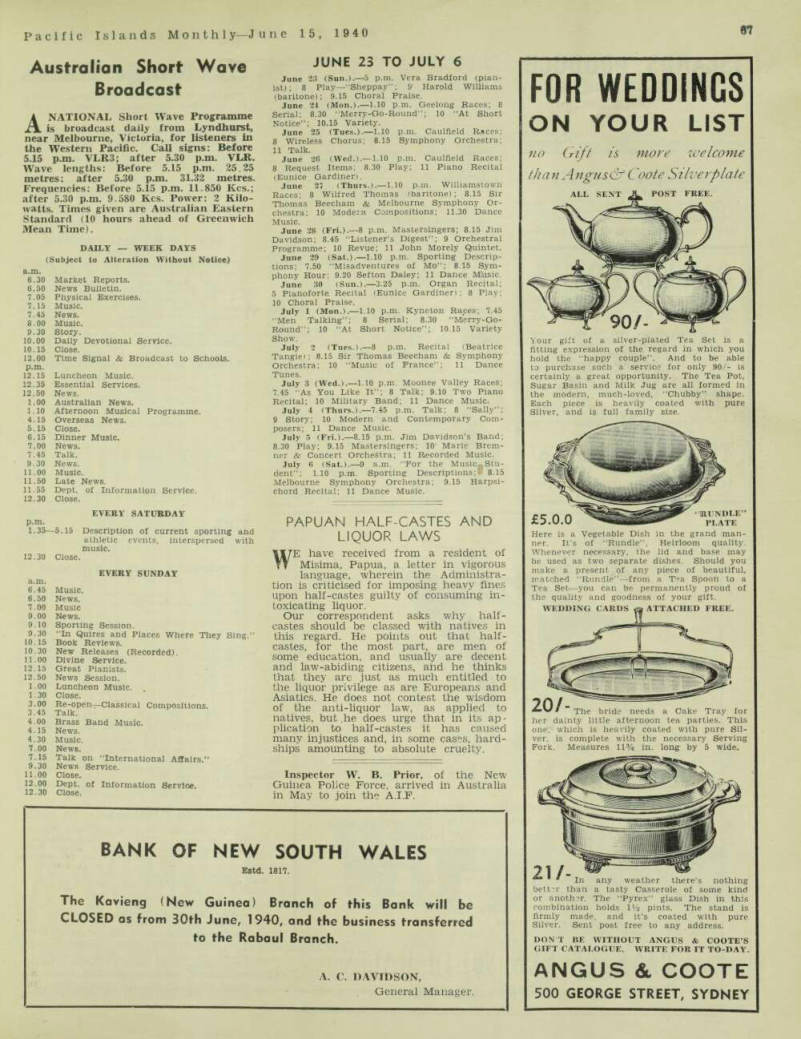
Broadcast
A NATIONAL Short Wave Programme is broadcast daily from Lyndhurst, near Melbourne, Victoria, for listeners in the Western Pacific. Call signs: Before 5.15 p.m. VLR3; after 5.30 p.m. VLR.
Wave lengths: Before 5.15 p.m. 25.25 metres: after 5.30 p.m. 31.32 metres.
Frequencies: Before 5.15 p.m. 11.850 Kcs.; after 5.30 p.m. 9.580 Kcs. Power: 2 Kilo watts. Times given are Australian Eastern Standard (10 hours ahead of Greenwich
Mean Time).
Daily Week Days
(Subject to Alteration Without Notice) a.m. 6.30 Market Reports. 6.50 News Bulletin. 7.05 Physical Exercises. 7.15 Music. 7.45 News. 8.00 Music. 9.30 Story. 10.00 Daily Devotional Service. 10.15 Close. 12.00 Time Signal & Broadcast to Schools, p.m. 12.15 Luncheon Music. 12.35 Essential Services. 12.50 News. 1.00 Australian News. 1.10 Afternoon Musical Programme. 4.15 Overseas News. 5.15 Close. 6.15 Dinner Music. 7.00 News. 7.45 Talk. 9.30 News. 11.00 Music. 11.50 Late News. 11.55 Dept, of Information Service. 12.30 Close.
Every Saturday
p.m. 1.35—5.15 Description of current sporting and athletic events, interspersed with music. 12.30 Close.
Every Sunday
a.m. 6.45 Music. 6.50 News, 7.00 Music 9.00 News. 9.10 Sporting Session. 9.30 “In Quires and Places Where They Sing.” 10.15 Book Reviews. 10.30 New Releases (Recorded). 11.00 Divine Service. 12.15 Great Pianists. 12.50 News Session. 1.00 Luncheon Music. 1.30 Close. 3.00 Re-open—Classical Compositions. 3.45 Talk. 4.00 Brass Band Music. 4.15 News. 4.30 Music. 7.00 News. 7.15 Talk on “International Affairs.” 9.30 News Service. 11.00 Close. 12.00 Dept, of Information Service. 12.30 Close,
June 23 To July 6
June 23 (Sun.). —5 p.m. Vera Bradford (pian ist); 8 Play—“Sheppay”; 9' Harold Williams (baritone); 9.15 Choral Praise.
June 24 (Mon.). —1.10 p.m. Geelong Races; 8 Serial; 8.30 “Merry-Go-Round”; 10 “At Short Notice”; 10.15 Variety.
June 25 (Tues.). —1.10 p.m. Caulfield Races; 8 Wireless Chorus; 8.15 Symphony Orchestra; 11 Talk.
June 26 (Wed.).—l.lo p.m. Caulfield Races; 8 Request Items; 8.30 Play; 11 Piano Recital (Eunice Gardiner).
June 27 (Thurs.). —1.10 p.m. Williamstown Races; 8 Wilfred Thomas (baritone); 8.15 Sir Thomas Beecham & Melbourne Symphony Or chestra; 10 Modern Compositions; 11.30 Dance Music.
June 28 (Fri.). —8 p.m. Mastersingers; 8.15 Jim Davidson: 8.45 “Listener’s Digest”; 9 Orchestral Programme; 10 Revue; 11 John Merely Quintet.
June 29 (Sat.). —1.10 p.m. Sporting Descrip tions; 7.50 “Misadventures of Mo”; 8.15 Sym phony Hour; 9.20 Sefton Daley; 11 Dance Mlusic.
June 30 (Sun.). —3.25 p.m. Organ Recital; 5 Pianoforte Recital (Eunice Gardiner); 8 Play; 10 Choral Praise.
July 1 (Mon.). —1.10 p.m. Kyneton Races; 7.45 “Men Talking”; 8 Serial; 8.30 “Mierry-Go- Round”; 10 “At Short Notice”; 10.15 Variety Show.
July 2 (Tues.). —8 p.m. Recital (Beatrice Tangie); 8.15 Sir Thomas Beecham & Symphony Orchestra: 10 “Music of France”: 11 Dance Tunes.
July 3 (Wed.). —1.10 p.m. Moonee Valley Races; 7.45 “As You Like It”; 8 Talk; 9.10 Two Piano Recital; 10 Military Band; 11 Dance Music.
July 4 (Thurs.). —7.45 p.m. Talk; 8 “Sally”; 9 Story; 10 Modern and Contemporary Com posers; 11 Dance Music.
July 5 (Fri.). —8.15 p.m. Jim Davidson’s Band; 8.30 Play; 9.15 Mastersingers; 10 Marie Brem ner & Concert Orchestra; 11 Recorded Music.
July 6 (Sat.).—9 a.m. “For the dent”; 1.10 p.m. Sporting Descriptions; ‘ 8.15 Melbourne Symphony Orchestra; 9.15 Harpsi chord Recital: 11 Dance Music.
Liquor Laws
Papuan Half-Castes And
WE have received from a resident of Misima, Papua, a letter in vigorous language, wherein the Administra tion is criticised for imposing heavy fines upon half-castes guilty of consuming in toxicating liquor.
Our correspondent asks why half castes should be classed with natives in this regard. He points out that half castes, for the most part, are men of some education, and usually are decent and law-abiding citizens, and he thinks that they are just as much entitled to the liquor privilege as are Europeans and Asiatics. He does not contest the wisdom of the anti-liquor law, as applied to natives, but he does urge that in its ap plication to half-castes it has caused many injustices and, in some cases, hard ships amounting to absolute cruelty.
Inspector W. B. Prior, of the New Guinea Police Force, arrived in Australia in May to join the A.I.F.
Advertisements & other items, p. 69 (2 items)
67
Pacific Islands Monthl y—J une 15, 1940
For Weddings
ON YOUR LIST
no Gift is more welcome
than Angus&Coote Silverplate
ALL SENT
POST FREE.
90/- Your gift of a silver-plated Tea Set is a fitting expression of the regard in which you hold the “happy couple”. And to be able to purchase such a service for only 90/- is certainly a great opportunity. The Tea Pot, Sugar Basin and Milk Jug are all formed in the modern, much-loved, “Chubby” shape.
Each piece is heavily coated with pure Silver, and is full family size. £5.0.0
RUNDLE”
PLATE
Here is a Vegetable Dish in the grand manner. It’s of “Rundle”, Heirloom quality.
Whenever necessary, the lid and base may be used as two separate dishes. Should you make a present of any piece of beautiful, matched “Rundle” —from a Tea Spoon to a Tea Set—you can be permanently proud of the quality and goodness of your gift.
WEDDING CARDS *a ATTACHED FREE.
20/ The bride needs a Cake Tray for her dainty little afternoon tea parties. This one, which is heavily coated with pure Silver, is complete with the necessary Serving Fork. Measures 11% in. long by 5 wide. 21/- * In any weather there’s nothing better than a tasty Casserole of some kind or another. The “Pyrex” glass Dish in this combination holds IVa pints. The stand is firmly made, and it’s coated with pure Silver. Sent post free to any address.
DON'T BE WITHOUT ANGUS & COOTE’S
GIFT CATALOGUE. WRITE FOR IT TO-DAY.
ANGUS & COOTE
500 GEORGE STREET, SYDNEY
BANK OF NEW SOUTH WALES
Estd. 1817.
The Kavieng (New Guinea) Branch of this Bank will be CLOSED as from 30th June, 1940, and the business transferred to the Rabaul Branch.
A. C. DAVIDSON,
General Manager.
Islands Produce
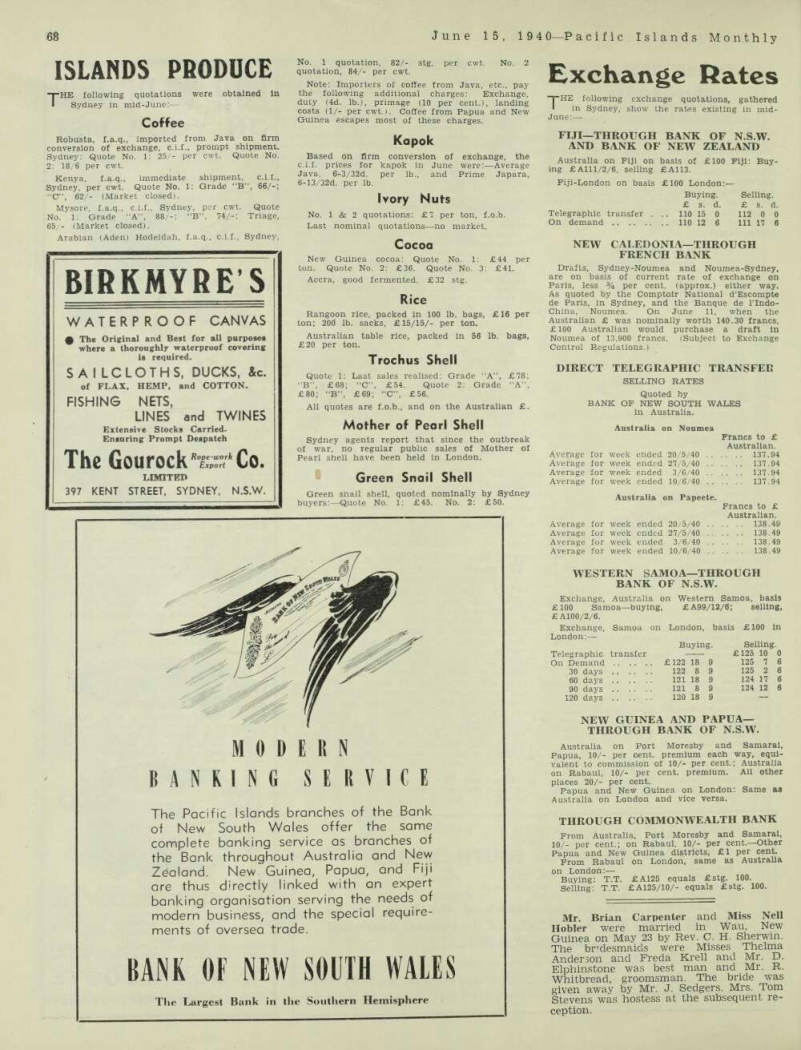
THE following quotations were obtained in Sydney in mid-June:—
Coffee
Robusta, f.a.q., imported from Java on firm conversion of exchange, c.i.f.. prompt shipment.
Sydney: Quote No. 1; 25/- per cwt. Quote No. 2; 18/6 per cw't.
Kenya, f.a.q., immediate shipment, c.i.f., Sydney, per cwt. Quote No. 1: Grade “B”, 66/-; “C”, 62/- (Market closed).
Mysore, f.a.q., c.i.f., Sydney, per cwt. Quote No. 1: Grade “A", 88/-; “B”, 74/-; Triage, 65/ - (Market closed).
Arabian (Aden) Hodeidah, f.a.q., c.i.f., Sydney,
No. 1 quotation, 82/- stg. per cwt. No. 2 quotation, 84/- per cwt.
Note: Importers of coffee from Java, etc., pay the following additional charges: Exchange, duty (4d. lb.), primage (10 per cent.), landing costs (1/- per cwt.). Coffee from Papua and New Guinea escapes most of these charges.
Kapok
Based on firm conversion of exchange, the c.i.f. prices for kapok in June were:—Average Java, 6-3/32d. per lb., and Prime Japara, 6-13/32d. per lb.
Ivory Nuts
No. 1 & 2 quotations: £7 per ton, f.o.b.
Last nominal quotations—no market.
Cocoa
New Guinea cocoa: Quote No. 1: £44 per ton. Quote No. 2: £36. Quote No. 3: £4l.
Accra, good fermented, £32 stg.
Rice
Rangoon rice, packed in 100 lb. bags, £l6 per ton; 20d lb. sacks, £l5/15/- per ton.
Australian table rice, packed in 56 lb. bags, £2O per ton.
Trochus Shell
Quote 1: Last sales realised: Grade "A”, £7B; “B”, £6B; “C”, £54. Quote 2: Grade “A”, £80; “B”, £69; “C”, £56.
All quotes are f.0.b., and on the Australian £.
Mother of Pearl Shell
Sydney agents report that since the outbreak of war, no regular public sales of Mother of Pearl shell have been held in London.
Green Snail Shell
Green snail shell, quoted nominally by Sydney buyers:—Quote No. 1: £45. No. 2: £5O.
Exchange Rates
“T~HE following exchange quotations, gathered I in Sydney, show the rates existing in mid- June:—
Fiji—Through Bank Of N.S.W.
And Bank Of New Zealand
Australia on Fiji on basis of £lOO Fiji; Buy ing £ All 1/2/6, selling £AII3.
Fiji-London on basis £lOO London:—
New Caledonia—Through
French Bank
Drafts, Sydney-Noumea and Noumea-Sydney, are on basis of current rate of exchange on Paris, less % per cent, (approx.) either way.
As quoted by the Comptoir National d’Escompte de Paris, in Sydney, and the Banque de ITndo- China, Noumea. On June 11, when the Australian £ was nominally worth 140.30 francs, £ 100 Australian would purchase a draft in Noumea of 13,900 francs. (Subject to Exchange Control Regulations.)
Direct Telegraphic Transfer
Selling Rates
Quoted by
Bank Op New South Wales
in Australia.
Western Samoa—Through
Bank Of N.S.W.
Exchange, Australia on Western Samoa, basis £lOO Samoa —buying, £A99/12/6; selling,
£ Aloo/2/6.
Exchange, Samoa on London, basis £lOO in London:—
New Guinea And Papua
Through Bank Of N.S.W.
Australia on Port Moresby and Samarai, Papua, 10/- per cent, premium each way, equi valent to commission of 10/- per cent.; Australia on Rabaul, 10/- per cent, premium. All other places 20/- per cent.
Papua and New Guinea on London; Same as Australia on London and vice versa.
Through Commonwealth Bank
From Australia, Port Moresby and Samarai, 10/- per cent.; on Rabaul, 10/- per cent. —Other Papua and New Guinea districts, £1 per cent.
From Rabaul on London, same as Australia on London: — Buying: T.T. £AI2S equals £stg. 100.
Selling: T.T. £AI2S/10/- equals £stg. 100.
Mr. Brian Carpenter and Miss Nell Hobler were married in Wau, New Guinea on May 23 by Rev. C. H. Sherwin.
The bridesmaids were Misses Thelma Anderson and Freda Krell and Mr. D.
Elphinstone was best man and Mr. R.
Whitbread, groomsman. The bride was given away by Mr. J. Sedgers. Mrs. Tom Stevens was hostess at the subsequent re
ception.
Buying.
Selling. £ s. d. £ s. d.
Telegraphic transfer . .. 110 15 0 112 0 0 On demand .. 110 12 6 111 17 6
Average for Australia on Noumea week ended 20/5/40 ..
Francs to £ Australian. .. .. 137.94 Average for week ended 27/5/40 .. .. .. 137.94 Average for week ended 3/6/40 . . .. .. 137.94 Average for week ended 10/6/40 .. .. .. 137.94 Average for Australia on Papeete. week ended 20/5/40 . .
Francs to £ Australian. .. .. 138.49' Average for week ended 27/5/40 .. .. .. 138.49 Average for week ended 3/6/40 . . .. .. 138.49 Average for week ended 10/6/40 . . .. .. 138.49
Buying. Selling.
Telegraphic transfer £125 10 0 On Demand £122 18 9 125 7 6 30 days 122 8 9 125 2 6 60 days 121 18 9 124 17 6 90 days 121 8 9 124 12 6 120 days 120 18 9 —
Advertisements & other items, p. 70 (2 items)
68
June 18, 194 O—P0 —P acific Islands Monthly
Birkmyre’S
WATERPROOF CANVAS
• The Original and Beat for all purposes where a thoroughly waterproof covering is required.
S A I LCLOTHS, DUCKS, &c.
of FLAX, HEMP, and COTTON.
FISHING NETS,
LINES and TWINES
Extensive Stocks Carried.
Ensuring Prompt Despatch
The Gourock Ro £o"‘Co.
LIMITED
397 KENT STREET, SYDNEY, N.S.W.
m • r /
M 0 LI E K N
BANKING SERVICE
The Pacific Islands branches of the Bank of New South Wales offer the same complete banking service as branches of the Bank throughout Australia and New Zealand. New Guinea, Papua, and Fiji are thus directly linked with an expert banking organisation serving the needs of modern business, and the special requirements of oversea trade.
BANK OF NEW SOUTH WALES
The Largest Bank In the Southern Hemisphere
Market Quotations
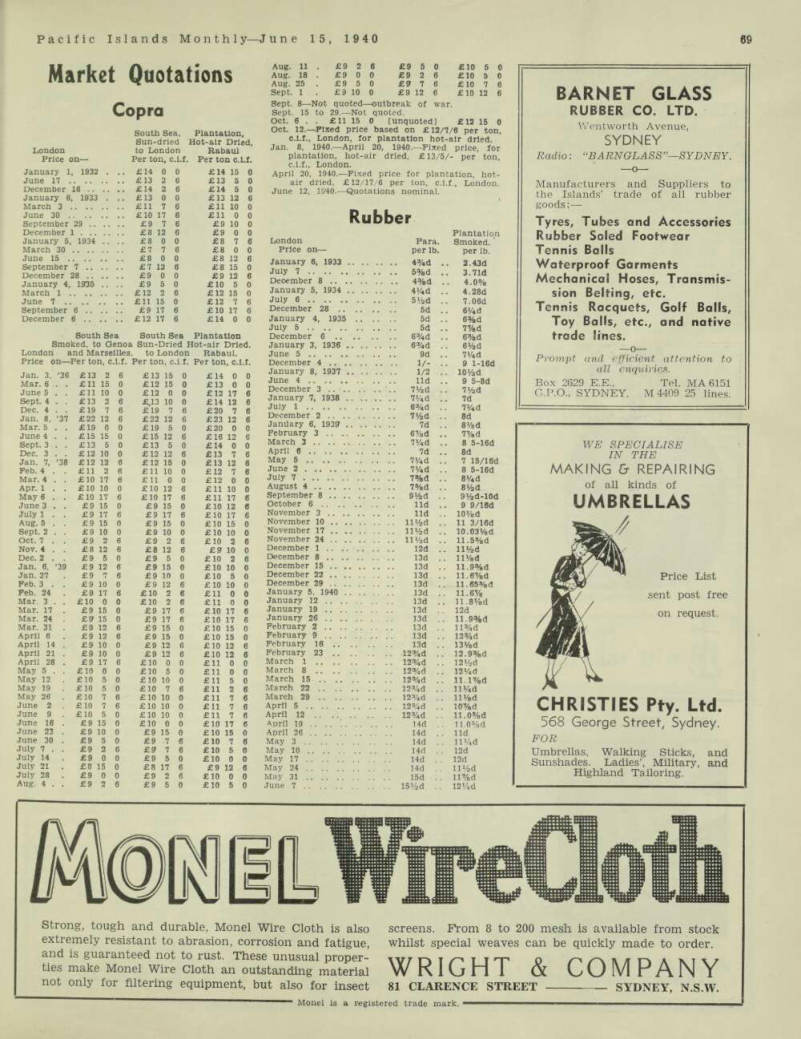
Copra
Aug. 11 . £9 2 6 £9 5 0 £10 5 0 Aug. 18 . £9 0 0 £9 2 6 £10 5 0 Aug. 25 . £9 5 0 £9 7 6 £10 7 6 Sept. 1 £9 10 0 £9 12 6 £10 12 6 Sept. 8—Not quoted—outbreak of war.
Sept. 15 to 29 — -Not quoted.
Oct. 6 . . £11 15 0 [unquoted] £ 12 IS 0 Oct. 12.—Fixed price based on £12/7/6 per ton. c.l.f., London, for plantation hot-air dried.
Jan. 8, 1940.—April 20, 1940.—Fixed price, for plantation, hot-air dried, £ 13/5/- - per ton, c.i.f., London.
April 20. 1940.—Fixed price for plantation, hotair dried, £12/17/ 6 per ton, c.i.f., London.
June 12, 19'40.—Quotations nominal.
London
Rubber
Para.
Plantation Smoked. ‘ Price on— per lb. per lb.
January 6, 1933 . 2.43d July 7 3.71d December 8 .. . 4.0% January 5, 1934 . 4.28d July 6 7.06d December 28 .. 6V 4 d January 4, 1935 . .. 5d .. 6%d July 5 . .. 5d .. 7%d December 6 .. . .. 6%d .. 6%d January 3, 1936 . 6Vad June 5 7V 4 d December 4 .. . 9 l-16d January 8, 1937 . . .. . .. .. 1/2 .. iovad June 4 . .. lid .. 9 5-8d December 3 .. .. . .. 7Mid .. 7Vad January 7, 1938 . . .. 7V 4 d .. 7d July 1 7%d December 2 .. .. . .. 7Mid .. 8d January 6, 1939 . 7d .. 8 Vo d February 3 .. .. . .. 6 7 /ad .. 7%d March 3 . .. 7»/ 4 d .. 8 5-16d April 6 8d May 5 7 15/16d June 2 8 5-16d July 7 sy 4 d August 4 8 Mid September 8 .. . 9Mid-10d October 6 .. .. 9 9/18d November 3 .. .. . .. lid .. 10 Mad November 10 .. . 11 3/16d November 17 ,, . 10.03 Mad November 24 .. . . .. llVad .. 11.5%d December 1 .. ..
UMid December 8 .. .. llVad December 15 .. . 11.9%d December 22 .. . 11.6%d December 29 .. . 11.65%d January 5. 1940 . 13d .. 11.6% January 12 .. .. . .. 13d .. ll.SVad January 19 .. .. .. 13d .. 12d January 26 .. .. 13d .. 11 9%d February 2 ., .. ll%d February 9 .. .. 13d .. 12%d February 16 .. 13d . . 13Ved February 23 .. . . 12%d .. 12.9%d March 1 ., .. 12 V 2 d March 8 .. .. 12V 4 d March 15 .. .. 11. l%d March 22 .. ..
HV 4 d March 29 .. . . llVad April 5 10%d April 12 . . . . . . 12 %d . . 11.0%d April 19 .. . . l l.0%d April 26 14d .. lid May 3 14d . . 11 M»d May 10 14d . . 12d May 17 14d . . 12d May 24 14d . . llVad May 31 15d ll%d June 7 . . ISVad . . 12V 4 d
South Sea.
Plantation, Sun-dried Hot-air Dried, London to London Rabaul Price on— Per ton, c.l.f.
Per ton c.i.f.
January 1 , 1932 . , , £14 0 0 £14 15 0 June 17 . £13 2 6 £13 5 0 December 16 .. £14 2 6 £14 5 0 January 6 , 1933 . .. £13 0 0 £13 12 6 March 3 £11 7 6 £11 10 0 June 30 . £10 17 6 £11 0 0 September 29 .. £9 7 6 £9 10 0 December 1 . £8 12 6 £9 0 0 January 5, , 1934 . , . . £8 0 0 £8 7 6 March 30 £7 7 6 £8 0 0 June 15 . £8 0 0 £8 12 6 September 7 .. . . . . £7 12 6 £8 15 0 December 28 .. £9 0 0 £9 12 6 January 4, 1935 . . . . £9 5 0 £10 5 0 March 1 , . . . , £12 2 6 £12 15 0 June 7 ., £11 15 0 £12 7 6 September 6 . . £9 17 6 £10 17 6 December 6 . . £12 17 6 £14 0 0 South Sea South Sea Plantation Smoked, to Genoa Sun-Dried Hot-air Dried.
London and Marseilles to London Rabaul.
Price on— Per ton, c.l.f.
Per ton, c.i.f.
Per ton, c.i.f.
Jan. 3, '36 £13 2 6 £13 15 0 £14 0 0 Mar. 6 . . £11 15 0 £12 15 0 £13 0 0 June 5 . . £11 10 0 £12 0 0 £12 17 6 Sept. 4 . . £13 2 6 £.13 10 0 £14 12 6 Dec. 4 . . £19 7 6 £19 7 6 £20 7 6 Jan. 8, ’37 £22 12 6 £22 12 6 £23 12 6 Mar. 5 . . £19 0 0 £19 5 0 £20 0 0 June 4 . , £15 15 0 £15 12 6 £16 12 6 Sept. 3 . . £13 5 0 £13 5 0 £14 0 0 Dec. 3 . . £12 10 0 £12 12 6 £13 7 6 Jan. 7, ’38 £12 12 6 £12 15 0 £13 12 6 Peb. 4 . . £11 2 6 £11 10 0 £12 7 6 Mar. 4 . . £10 17 6 £11 0 0 £12 0 0 Apr. 1 . . £10 10 0 £10 12 6 £11 10 0 May 6 . . £10 17 6 £10 17 6 £11 17 6 June 3 . . £9 15 0 £9 15 0 £10 12 6 July 1 . . £9 17 6 £9 17 6 £10 17 6 Aug. 5 . . £9 15 0 £9 15 0 £10 15 0 Sept. 2 . . £9 10 0 £9 10 0 £10 10 0 Oct. 7 . . £9 2 6 £9 2 6 £10 2 6 Nov. 4 . . £8 12 6 £8 12 6 £9 10 0 Dec. 2 . . £9 5 0 £9 5 0 £10 2 6 Jan. 6. ’39 £9 12 6 £9 15 0 £10 10 0 Jan.27 £9 7 6 £9 in 0 £10 5 0 Peb. 3 . . £9 10 0 £9 12 6 £10 10 0 Peb. 24 £9 17 6 £10 2 6 £11 0 0 Mar. 3 . . £10 0 0 £10 2 6 £11 0 0 Mar. 17 . £9 15 0 £9 17 6 £10 17 6 Mar. 24 . £9 15 0 £9 17 6 £10 17 6 Mar. 31 £9 12 6 £9 15 0 £10 15 0 April 6 . £9 12 6 £9 15 0 £10 15 0 April 14 . £9 10 0 £9 12 6 £10 12 6 April 21 . £9 10 0 £9 12 6 £10 12 6 April 28 . £9 17 6 £10 0 0 £11 0 0 May 5 . . £10 0 0 £10 5 0 £11 0 0 May 12 . £10 5 0 £10 10 0 £11 5 0 May 19 £10 5 0 £10 7 6 £11 2 6 May 26 . £10 7 6 £10 10 0 £11 7 6 June 2 £10 7 6 £10 10 0 £11 7 6 June 9 £10 5 0 £10 10 0 £11 7 6 June 16 . £9 15 0 £10 0 0 £10 17 6 June 23 . £9 10 0 £9 15 0 £10 15 0 June 30 . £9 5 0 £9 7 6 £10 7 fl July 7 . . £9 2 6 £9 7 6 £10 5 0 July 14 £9 0 0 £9 5 0 £10 0 0 July 21 . £8 15 0 £8 17 6 £9 12 6 July 28 £9 0 0 £9 2 6 £10 0 0 Aug. 4 . , £9 2 6 £9 5 0 £10 5 0
Advertisements & other items, p. 71 (2 items)
69
Pacific Islands Monthl y—J une 15, 1940
Wright & Company
BARNET GLASS
RUBBER CO. LTD.
Wentworth Avenue,
SYDNEY
Radio : “BARN GLASS”—SYDNEY.
Manufacturers and Suppliers to the Islands’ trade of all rubber goods:— Tyres, Tubes and Accessories Rubber Soled Footwear Tennis Balls Waterproof Garments Mechanical Hoses, Transmission Belting, etc.
Tennis Racquets, Golf Balls, Toy Balls, etc., and native trade Sines. —o — Prompt and efficient attention to all enquiries.
Box 2629 E.E., Tel. MA 6151 G.P.0., SYDNEY. M 4409 25 lines.
WE SPECIALISE
IN THE
MAKING & REPAIRING
CHRISTIES Pty. Ltd.
568 George Street, Sydney.
FOR
Umbrellas, Walking Sticks, and Sunshades. Ladies’, Military, and Highland Tailoring. of all kinds of
UMBRELLAS
Price List sent post free on request.
ipf
A
dffSk
Mh w iq Strong, tough and durable, Monel Wire Cloth is also extremely resistant to abrasion, corrosion and fatigue, and is guaranteed not to rust. These unusual properties make Monel Wire Cloth an outstanding material not only for filtering equipment, but also for insect screens. From 8 to 200 mesh is available from stock whilst special weaves can be quickly made to order.
WRIGHT & COMPANY
81 CLARENCE STREET SYDNEY, N.S.W.
Monel is a registered trade mark.
Accomplished
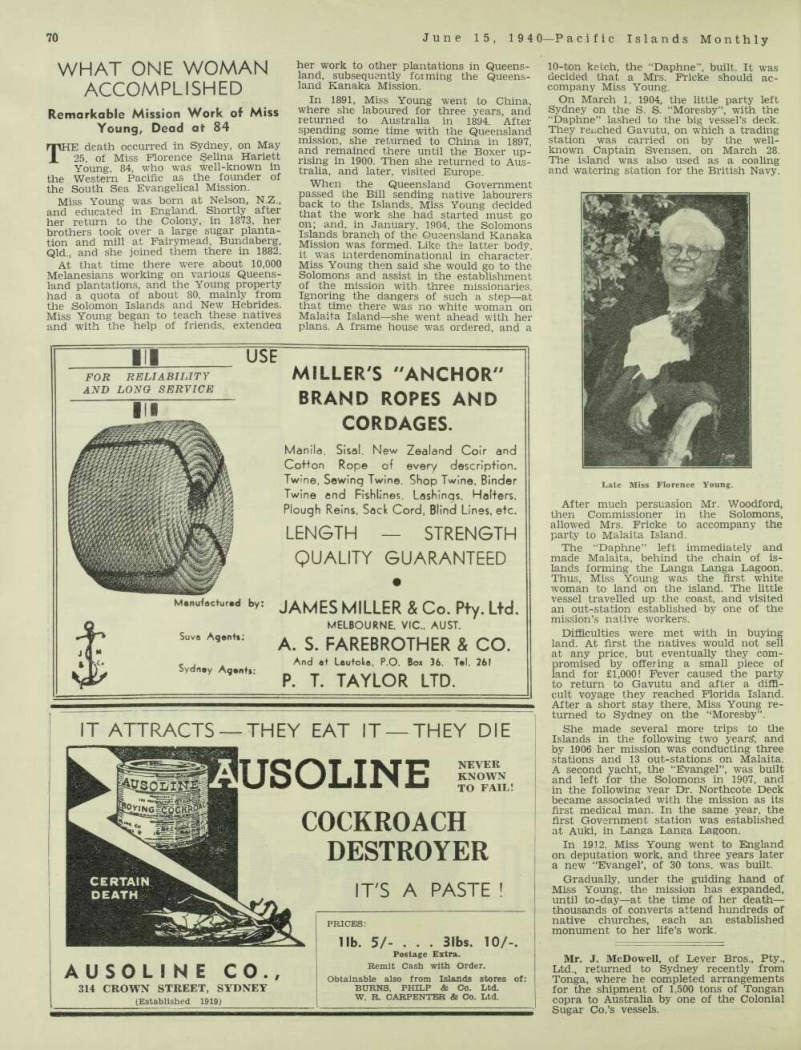
What One Woman
Remarkable Mission Work of Miss Young, Dead at 84
rE death occurred in Sydney, on May 25, of Miss Florence Selina Hariett Young, 84, who was well-known in the Western Pacific as the founder of the South Sea Evangelical Mission.
Miss Young was born at Nelson, N.Z., and educated in England. Shortly after her return to the Colony, in 1873, her brothers took over a large sugar planta tion and mill at Fairymead, Bundaberg, Qld., and she joined them there in 1882.
At that time there were about 10,000 Melanesians working on various Queens land plantations, and the Young property had a quota of about 80, mainly from the Solomon Islands and New Hebrides.
Miss Young began to teach these natives and with the help of friends, extended
her work to other plantations in Queens land, subsequently forming the Queens land Kanaka Mission.
In 1891, Miss Young went to China, where she laboured for three years, and returned to Australia in 1894. After spending some time with the Queensland mission, she returned to China in 1897, and remained there until the Boxer up rising in 1900. Then she returned to Aus tralia, and later, visited Europe.
When the Queensland Government passed the Bill sending native labourers back to the Islands, Miss Young decided that the work she had started must go on; and, in January, 1904, the Solomons Islands branch of the Queensland Kanaka Mission was formed. Like the latter body, it was interdenominational in character.
Miss Young then said she would go to the Solomons and assist in the establishment of the mission with, three missionaries.
Ignoring the dangers of such a step—at that time there was no white woman on Malaita Island—she went ahead with her plans. A frame house was ordered, and a
10-ton ketch, the “Daphne”, built. It was decided that a Mrs. Fricke should ac company Miss Young.
On March 1, 1904, the little party left Sydney on the S. S. “Moresby”, with the “Daphne” lashed to the big vessel’s deck.
They reached Gavutu, on which a trading station was carried on by the well known Captain Svensen, on March 28.
The island was also used as a coaling and watering station for the British Navy.
After much persuasion Mr. Woodford, then Commissioner in the Solomons, allowed Mrs. Fricke to accompany the party to Malaita Island.
The “Daphne” left immediately and made Malaita, behind the chain of is lands forming the Langa Langa Lagoon.
Thus, Miss Young was the first white woman to land on the island. The little vessel travelled up the coast, and visited an out-station established by one of the mission’s native workers.
Difficulties were met with in buying land. At first the natives would not sell at any price, but eventually they com promised by offering a small piece of land for £1,000! Fever caused the party to return to Gavutu and after a diffi cult voyage they reached Florida Island.
After a short stay there, Miss Young re turned to Sydney on the “Moresby”.
She made several more trips to the Islands in the following two year£ and by 1906 her mission was conducting three stations and 13 out-stations on Malaita.
A second yacht, the “Evangel”, was built and left for the Solomons in 1907, and in the following vear Dr. Northcote Deck became associated with the mission as its first medical man. In the same year, the first Government station was established at Auki, in Langa Langa Lagoon.
In 1912, Miss Young went to England on deputation work, and three years later a new “Evangel’, of 30 tons, was built.
Gradually, under the guiding hand of Miss Young, the mission has expanded, until to-day—at the time of her death — thousands of converts attend hundreds of native churches, each an established monument to her life’s work.
Mr. J. McDowell, of Lever Bros., Pty., Ltd., returned to Sydney recently from Tonga, where he completed arrangements for the shipment of 1,500 tons of Tongan copra to Australia by one of the Colonial Sugar Co.’s vessels.
Late Miss Florence Young.
Advertisements & other items, p. 72 (2 items)
70
June 15, 194 O—P acific Islands Monthly
Usoline
11l
USE
FOR RELIABILITY
AND LONG SERVICE
Manufactured by: Suva Agent*; Sydney Agents:
MILLER'S "ANCHOR"
BRAND ROPES AND
CORDAGES.
Manila, Sisal, New Zealand Coir and Cotton Rope of every description.
Twine. Sewing Twine, Shop Twine, Binder Twine end FishUnes, Lashings. Halters.
Plough Reins. Sack Cord, Blind Lines, etc.
LENGTH STRENGTH
QUALITY GUARANTEED
JAMES MILLER & Co. Pty. Ltd.
MELBOURNE, VIC., AUST.
A. S. FAREBROTHER & CO.
And at Lautolca, P.O. Box 36. Tel. 261
P. T. TAYLOR LTD.
IT ATTRACTS
ys LI
OVINGJCQ
TBJ.
-THEY EAT IT —THEY DIE
USOLINE
NEVER
KNOWN
TO FAIL
AUSOLI N E CO.
314 CROWN STREET, SYDNEY
(Established 1919)
COCKROACH
DESTROYER
IT'S A PASTE !
10/-
PRICES:
lib. 5/- . . . Bibs.
Postage Extra, Remit Cash with Order.
Obtainable also from Islands stores of:
BURNS, PHILP & Co. Ltd.
W. R. CARPENTER & Co. Ltd.
Shipping Services In The Pacific
rE shipping timetables which, presented in these pages, have been a feature of the “Pacific Islands Monthly” for nearly 10 years, may not, for obvious reasons, be published while Britain and France are at war. We regret the incon venience to Islands residents; but war-time regulations must be complied with.
Publication of the timetables will be resumed as soon as it is possible and practicable.
Sydney-Papua-New Guinea
The motor-ships “Macdhui” and “Malaita”, owned and operated by Burns, Philp and Co., Ltd., 7 Bridge Street, Sydney, maintain a regular service.
Papua Inter-Island Services
The M.V. “Nusa” (Steamships Trading Co.
Ltd., Port Moresby. Papua) and the M.V.
“Lakatoi” (Burns, Philp and Co.. Ltd.) carry on coastal and inter-island services.
New Guinea Inter-Island
Services
The S.S. “Maiwara” and M.V. “Muliama” (Burns, Philp and Co., Ltd.) and the S.S.
“Coombar”, M.V. “Desikoko”, M.V. “Duranbah”, and S.S. “Mako” (W. R. Carpenter and Co., Ltd., 19 O’Connell Street, Sydney) maintain inter island services in the Mandated Territory.
Hong Kong—New Guinea
The M.V. “Yunnan”, operating for Colyer, Watson (New Guinea) Ltd., of Rabaul, carries on a regular service between Hong Kong and New Guinea. At Hong Kong, the vessel con nects with the Blue Funnel liners running to Europe and the United Kingdom.
Sydney-Papua-N.G.-Hong Kong
The M.V. “Neptuna”, owned and operated by Burns, Philp and Co., carries on a service.
Sydney-T.1.-Darwin-Singapore
The vessels “Marella” and “Merkur”, owned and operated by Burns, Philp and Co., Ltd., carry on a regular service.
Sydney-Port Moresby-Darwin
S.S. “Montoro” and M.V. “Tulagi” run regular services between Sydney and Darwin, via Port Moresby. Burns Philp & Co., Ltd., Agents.
Saigon-Java-South Seas-N.Z.-
Sydney
The Dutch vessels “Maetsuycker” and “Tas man”, owned and operated by the Royal Packet Navigation Co., Ltd., 255 George Street, Sydney, maintain a regular service.
Sydney-Rabaul-Hong Kong
The vessels “Nellore”, “Tanda”, and “Nankin”, owned and operated by the E. and A. Steamship Co., Ltd., 37 Pitt Street, Sydney, carry on a regular service.
Sydney-Papua-8.5.1.-New Guinea
The M.V. “Malaita”, owned and operated by Burns, Philp and Co., Ltd., maintains a regular service.
Solomon Islands Inter-Island
Service
The A.S. “Mamutu” (Burns Philp (South Sea) Co., Ltd.) operates among the Islands of the Group, on a regular schedule.
Sydney-Lord Howe Is.-Norfolk
Is.-New Hebrides-8.5.1.
The S.S. “Morinda”, owned and operated by Burns, Philp and Co., Ltd., carries on a regular service.
New Hebrides Inter-Island
Services
The S.S. “Mirani” (Burns Philp (South Sea) Co., Ltd.) and M.V. “Polynesien” (Messageries Maritimes Co., 36 Grosvenor Street, Sydney) carry on services among the Islands of the Group.
Sydney-Noumea-New' Hebrides
Indochina
The French vessel “Pierre Loti”, owned and operated by Messageries Maritimes Co., main tains a service.
New Caledonia-Au Stralia
The French vessels S.S. “Neo Hebrldais”
(Societe Maritime et Miniere Hagen, Noumea, New Caledonia) and the “Cap Tarifa’’, “Capi taine Illiaquer”, and “Notou” (Societe Le Nickel, Noumea, New Caledonia), carry on services.
New Caledonia Inter-Island
Services
The French vessel M.V. “La Phoque” (Societe des lies Loyalty, Noumea, New Caledonia) main tains connection with the coastal ports of New Caledonia and with the islands of the Loyalty Group.
Gilbert And Ellice Inter-Island
Services
The M.V. “Moamoa” (Burns Philp (South Sea) Co., Ltd.) and M.V. “John Bolton” (W. R.
Carpenter and Co., Ltd.) connect with all islands in the Group.
Sydney-N.Z.-Fiji-Hawaii
The liners “Aorangi” and “Niagara”, owned and operated by the Union Steam Ship Co. of N.Z., Ltd., 247 George Street, Sydney, maintain a service.
S Ydne Y-N.Z.-Fiji-S Amo A-Hawaii
The American liners “Mariposa” and “Mon terey”, owned and operated by the Matson Navi gation Co,, 39 Martin Place, Sydney, maintain a service.
Fiji Inter-Island Services
The M.V. “Matafele” and M.V. “Yanawai” (Burns Philp (South Sea) Co., Ltd.) and the M.V. “Tui Cakau”, M.S. “Adi Rewa”, and M.S.
“Tul Kauvaro” (Morris, Hedstrom, Ltd., Suva, Fiji) carry on services among the islands of the Group.
Central Pacific Services
The M.V. “Matua”, owned and operated by the Union Steam Ship Co. of N.Z., Ltd., main tains a service between New Zealand, Cook Is., Tonga, Samoa, and Fiji. The Co. also runs a cargo service from Sydney to North America, via Fiji and Tahiti.
New Zealand-Samoa-Niue
The M.V. “Maui Pomare”, owned and operated by the New Zealand Government, maintains a service. Apply for details to the Department of External Affairs, Wellington, N.Z.
Australia-Nauru-Ocean Island
Vessels are despatched fairly regularly from Australia and from New Zealand to Nauru and Ocean Island by the British Phosphate Com mission, Phosphate House, 515 Collins Street, Melbourne, 0.1.
Sydney-Noumea-Tahiti
A service between Sydney and Tahiti is main tained by Messageries Maritimes Co., passengers connecting with the M.M. liners “Eridan”, “Saggittaire”, “Ville d’Amiens”, and “Commissaire Ramel” at Noumea (New Caledonia) per the ‘‘Pierre Loti” from Sydney (see Sydney-Noumea- New Hebrides service). The big M.M. liners carry on a service between France and New Caledonia.
French Oceania Inter-Island
Service
The small French vessel “Hiro” maintains a service between Tahiti and the Leeward Group.
Samoa Inter-Island Services
The Apia customs launch and the M.Y. ‘‘Satanella” (E. S. Paul, owner) connect re gularly with the Matson liners “Monterey” and “Mariposa” at Pago Pago (American Samoa).
Europe-Suva-N.Z.-Sydney-N.G.
The M.V. “Rabaul”, M.V. “Salamaua”, and S.S. “Suva”, owned and operated by W. R.
Carpenter and Co., Ltd., carry on services be tween Europe and Australia, via South Sea Islands.
U.S.A.-South Sea Islands
A service between the Pacific coast of America and the main South Sea Islands is maintained by the Pacific Transport Line, using the American motor-ships “Thor I” and “Velox ? ’. Time tables are obtainable from the Australasian agents, Birt & Co., Ltd., 4 Bridge Street, Sydney, or any of their branch offices.
Japan-N.G.-Noumea-N.Z.
The M.V. “Canberra Maru”, M.V. “Sydney Maru”, and M.V. “Tokyo Maru” (Osaka Shosen Kaisha Line, Osaka, Japan) and the S.S.
“Naniwa Maru” and S.S. “Muko Maru” (Yama shita Kisen Kaisha Line, Osaka, Japan) maintain regular services from Japan to New Zealand and Australia, via Pacific Islands ports. Time-table particulars are available on personal application to the Australasian agents, Birt and Co., Ltd., 4 Bridge Street, Sydney, or any of their branch offices and agents.
Sydney-Papua-N.G. Air Service
Regular air mail services between Australia and Papua and New Guinea are maintained by W.R.C. Airlines, Ltd., 19 O’Connell Street, Sydney.
with De Havilland airliners. Time-table details can be obtained from any branch of the firm.
N.G. Goldfields Air Services
Aeroplane services between Salamaua and Lae (the N.G. mainland ports) and Wau and other centres on the Morobe Goldfield are conducted by Guinea Airways, Ltd., Mandated Airlines, Ltd., and other aerial transport companies. The aerial services are the only means of communication.
Wau-Port Moresby Air Service
Aeroplane services between the New Guinea goldfields (Morobe, etc.) and Port Moresby, Papua, are maintained by Guinea Airways, Ltd., of Lae, and Mandated Airlines, Ltd., of Sala maua. Schedule details available on personal application to any branch of the firms, from the pursers of the Burns, Philp mail steamers, or branches of W. R. Carpenter and Co., Ltd.
Advertisements & other items, pp. 73-74 (2 items)
71
Pacific Islands Monthl y—J une 15, 1940
Rid Kidneys Of
Poisons And Acids
Your Kidneys are a marvellous structure.
Within them are 9 million tiny tubes which act as filters for the blood. When poisons and acids attack them you suffer from Burning, Itching Passages, “Getting Up Nights,” Leg Pains, Dizziness, Rheumatism, Lumbago, Nerviness, Circles under Eyes or Swollen Ankles, etc. Ordinary medicines can’t do much good. The cause must be removed.
Cystex rids Kidneys of poisons and acids in 2 hours, therefore a speedy end to kidney troubles. In 24 hours you’ll feel fitter, stronger than for years, in a few days, complete health is restored. Cystex is guaranteed to put you right or money back. Ask your Chemist for Cystex today. The guarantee protects you.
Now in 3 sizes: 1/9, 4/-. 8/-.
Cystex
GUARANTEED for Kidneys Bladder, Rheumatism
R.A.A.F. Seaplane Tender. byHalvorsens
No-" 33"
One of the two Seaplane Tenders just delivered to the Royal Australian Air Force.
These craft are 37' 6" in length, and each is powered by a pair of
Chrysler Royal marine
engines, developing a speed of 25 knots.
We are contractors to: The Army, Navy, Air Force, New Guinea Administration, Condominium Government of New Hebrides, Guinea Airways, etc., etc.
Correspondence Invited.
LARS HALVORSEN SONS PTY. LTD.
NEUTRAL BAY, SYDNEY.
II m ■
At Bine Mountains —Springwood, N.S.W.
Springwood Ladies' College
Est. 1897. Kindergarten to Leaving Certificate. Tennis, Riding, Swimming, Team Games. Unequalled climate. Pure Jersey Milk. Senior and Junior Houses. Openair sleeping. Inclusive fees. Special vacation arrangements for Island pupils.
M. E. DURAND, Principal,
KIDDIES’ COUGHS
Break nasty coughs and colds quickly.
Soothe nose, throat, chest and lungs.
Safe and pleasant to take. Handy-sized bottle. I/-.
COSMOPOLITAN
SAMARA I.
HOTEL
FIRST-CLASS
ACCOMMODATION
For Tourists & Commercials Electric Light, Ballroom Billiards Freezing Works, Cold Store.
Best Brands of Liquors
MODERATE TARIFF.
Fishing Trips and Launch Excursions Arranged.
WHERE TO STAY IN PORT MORESBY
HOTEL MORESBY
x
NEAR THE
WHARF
MODERN
ACCOMMODATION
ONLY THE BEST
BRANDS OP
WINES, SPIRITS
AND BEERS
IN STOCK.
LICENSEE;
Hotel Moresby
Ltd.
The PAPUA
HOTEL
Catering specially for Tourists and Travellers, f
Licensee: Papua Hotel, Ltd.
First-class Accommodation. Parties Arranged.
Situated on high ground overlooking both coasts, Its Spacious Lounges are always Cool and comfortable . . . Cars meet all Steamers.
Published by Pacific Publications Pty., Ltd., Union House, 247 George Street, Sydney. (Telephone: BW 5037). Wholly set up and printed In Australia by the Sydney and Melbourne Publishing Co., Pty., Ltd., 29 Alberta St.. Sydney. (Telephone: MA 7101).
Progress Of Fiji's
Gold Mines
SUVA, June 2.
Developments at the new gold-mine township of Vatukoula (Tavua, Vitf Levu) are steady, and even rapid.
There has been much additional building upon the surface of the ground; while, under the surface, the working of both the Emperor and Loloma mines, and of a new mine, are being constantly ex tended, and the gold output is ever in creasing.
A new bulk store at the Emperor mine has been erected. The Emperor’s new flotation plant is now in operation. The Emperor’s open cut has been deepened to 300 feet, with a deep shaft of 1,000 feet. A drainage tunnel from Matanagata to the Emperor’s open cut is under way.
A considerable number of new bungalows for the European staff have been built.
The new workings of the Dolphin Mine, which is situated about a mile from the Emperor and Loloma mines, are new down about 320 feet and satisfactory re sults are reported.
Mr. V. Neumann, manager of Gizarum plantation, recently married Miss Doris Buck, of Nundah, Queensland, at Awel kon Mission Station, Rooke Island, T.N.G.
Mr. Neumann is a native of Switzerland.
Mr. Max Pemberton, of the New Guinea inter-island motor vessel “Muliama”, was married early in May, in Rabaul, to Miss Inez Sullivan, of Cassilis, aN.S.W, After the ceremony a reception and wedding breakfast were held in the lounge of the New Guinea Club.
Mr. David Lewis died at Wau, New Guinea, on May 6, as the result of a mining accident.
Mrs. Hilda Marshall, wife of Mr. H. (“Tex”) Marshall, died in Bulolo Hospital, Morobe, T.N.G., early in May.
Advertisements & other items, pp. 74-76 (3 items)
72
June 15, 194 O—P acific Islands Monthly
June 15, 194 O—P acific Islands Monthly
Charter Service
I I Guinea Airways Service awaits your arrival at Port Moresby to speed your passage by air to any one of over 50 aerodromes and landing grounds served by the Company throughout New Guinea and Papua.
Guinea Airways" fast modern planes cut days of travelling time to a few hours of flight. As an example, the time of travel by plane to the Goldfields from Port Moresby is only 1 hour 40 minutes as compared with 6to 7 days by surface routes. See more of New Guinea from a better angle and save time and money . . . Travel by Air.
The GUINEA AIRWAY is tU WAY
to defeat Time and Distance Guinea Airways’ fleet offers the choice of a large variety of passenger and freight planes for special charter service to any point in New Guinea and Papua ...
Investigate this special
CHARTER SERVICE
When sailing from Australia book steamer and air passage at the Steamship Office or obtain full particulars from the purser. i a J t THE WORLDS LARGEST FREIGHT CARRYING AIR SERVICE LAE—SALAM A I I A • New Guinea Office: LAE, . Mandated Territory of New Guinea Branch Offices and Agents at WAU-SALAMAU A-
PORT MORESBY and SYDNEY.
FIRST CHOICE...with those
who prefer a bitter beer
If you like a bitter beer—you'll enjoy the rich wholesome flavor of Resch's Waverley Bitter Ale. Best appreciated after a hot, trying day—Waverley Bitter Ale is a real health drink for the tropics. For a refreshing change, make YOUR next order - - - -
WAVERLEY BITTER ALE
IN THE BOTTLE WITH THE GREEN LABEL