Pacific
Islands
Monthly
Vol. X. No. 12.
July 15, 1940
Established 1930
[Registered at the 2/ I^ n ?^S/ 0r transmission by post as a newspaper ]
8“
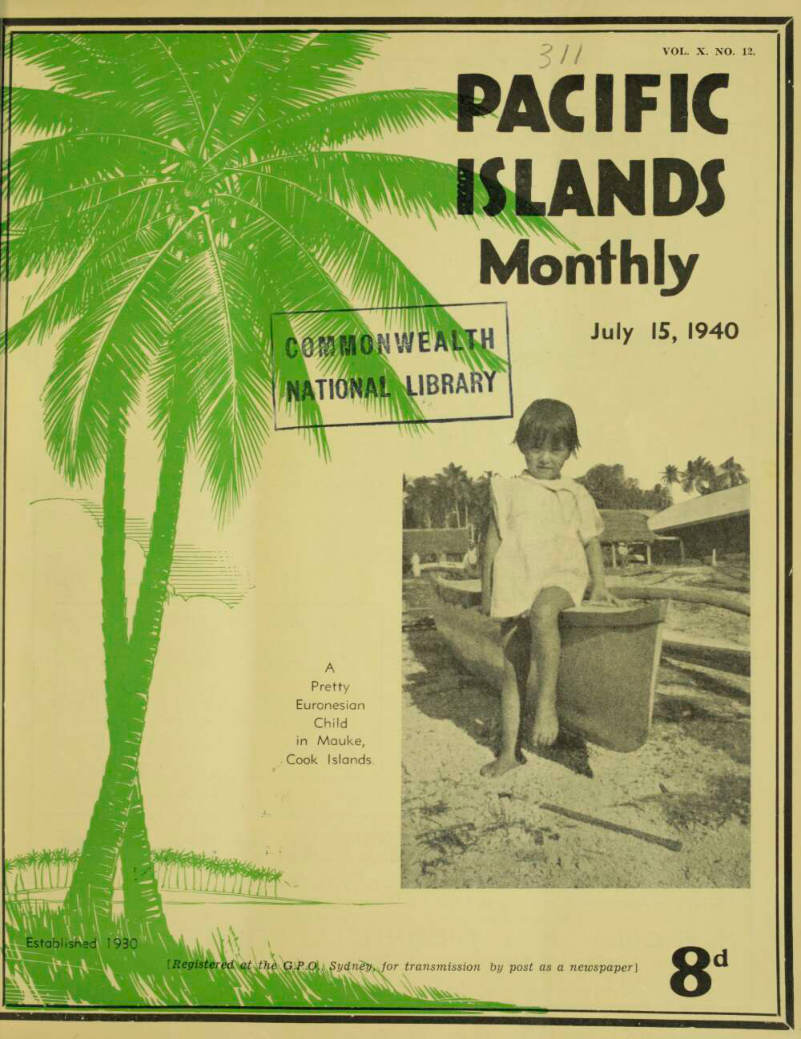
A Pretty Euronesian Child in Mauke, Cook Islands
Advertisements & other items, p. 2 (2 items)
Pacific Islands Monthl y—J u 1 y 15, 1940
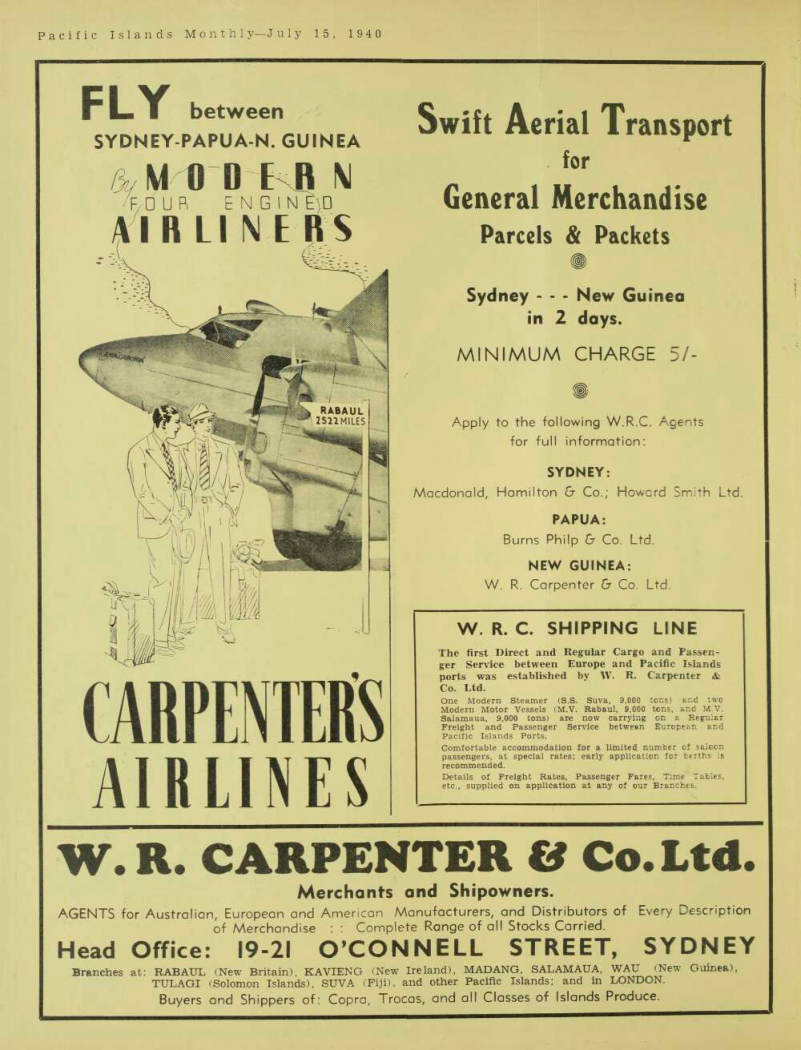
Carpenters
FLY between
SYDNEY-PAPUA-N. GUINEA
MOD E R M
F/DUR E N G I N E)D
Al R LI N E RS
i
RABAUL
2521 MILES
CARPENTERS
AIRLINES
Swift Aerial Transport
for
General Merchandise
Parcels & Packets
Sydney New Guinea in 2 days.
MINIMUM CHARGE 5/-
Apply to the following W.R.C. Agents for full information:
SYDNEY:
Macdonald, Hamilton £r Co.; Howard Smith Ltd.
PAPUA:
Burns Philp & Co. Ltd.
NEW GUINEA:
W. R. Carpenter Gr Co. Ltd.
W. R. C. SHIPPING LINE
The first Direct and Regular Cargo and Passenger Service between Europe and Pacific Islands ports was established by W. R. Carpenter & Co. Ltd.
One Modern Steamer (S.S. Suva, 9,000 tons) and iwo Modern Motor Vessels (M.V. Rabaul, 9,000 tens, and M.V.
Salamaua, 9,000 tons) are now carrying on a Regular Freight and Passenger Service between European and Pacific Islands Ports.
Comfortable accommodation for a limited number of saloon passengers, at special rates; early application for berths is recommended.
Details of Freight Rates, Passenger Fares, Time Tables, etc., supplied on application at any of our Branches.
W. R. CARPENTER & Co. Ltd.
Merchants and Shipowners.
AGENTS for Australian, European and American Manufacturers, and Distributors of Every Description of Merchandise : : Complete Range of all Stocks Carried.
Head Office: 19-21 O’CONNELL STREET, SYDNEY
Branches at: RABAUL (New Britain), KAVIENG (New Ireland), MADANG, SALAMAUA, WAU (New Guinea), TULAGI (Solomon Islands), SUVA (Fiji), and other Pacific Islands; and in LONDON.
Buyers and Shippers of: Copra, Trocas, and all Classes of Islands Produce.
Pacific News-Review
Notes And Comment On
The Progress Of The War
From June 12 To July 11
June 12: The general war situation is described in London as extremely serious.
Italy now is formally at war with the Allies. The whole German front from the end of the Maginot Line, in the east, right across to the Somme River, in the west, is moving steadily southwards. Ad vanced German units are as far south as Rouen, in the west, and Chateau Thierry, near the Marne. Some units are within 20 miles of Paris. Paris has been aband oned. The French armies are reported re treating in good order, but there are some indications of far reaching disor ganisation and loss of morale.
It is still assumed generally that the French will give effect to their declara tion, of some weeks ago, that even if they were driven out of the northern portion of their country and out of Paris, they still would continue the fight in the southern part of France; and if driven from there would fight on from their colonies in North Africa. This atti tude of France, despite military disasters, explains why Turkey and Egypt are pre paring to honour their obligations and assist the Allies in resisting Italy.
June 13: Paris declared an “open city” —which means that it will not be de fended.
June 13: Germans are trying to separ ate the French armies In the centre from the Maginot Line; situation hereabouts is most critical. Part of a British division, with French troops, was surrounded near the mouth of the Somme and captured.
June 13: The British R.A.F., with un dimmed spirit and courage, continue attacks upon enemy bases and communi cation in the Low Countries, in Germany and Northern France. Some British planes have even penetrated to Northern Italy and bombed Turin and Genoa.
June 13: Millions of pounds worth of munitions and equipment and hundreds of aeroplanes are being shipped to the Allies by the United States Government.
June 14: The German armies to-day marched into Paris and occupied the city. There was no street fighting.
June 14: The Premier (M. Reynaud) broadcast an urgent appeal to other democracies for the utmost possible help for France.
June 16: There is growing doubt whether the French will be able to hold the Maginot Line, and whether French morale will stand up to the double shock of losing Paris and the Maginot Line.
June 16: Large Russian armies have occupied Lithuania. This is causing spec ulation concerning Russia’s objects. Ob viously, the greater the German triumph m Western Europe, the greater is the ultimate German danger in the eyes of Russia. It may be accepted as funda mental that, sooner or later, the Russians and the Germans will fight.
June 16; President Roosevelt has given renewed assurances of assistance to France.
June 17; Marshal Petain, who has be come Premier of France, in a radio an nouncement from Bordeaux, said that “France must give up the fight”, and “I entered into negotiations with the enemy last night, as between soldiers, to deter mine whether any agreement could be reached to make an end to hostilities”.
It is disclosed that the Reynaud Gov ernment has been overthrown. M. Rey naud has resigned, and has disappeared In the prevailing obscurity and confusion, it is only clear that Petain is Premier and, associated with him are Weygand
Laval, Badouin and other Frenchmen who are notorious Fascists, and believed to be in active negotiation with the enemy through General Franco, Fascist dictator of Spain.
It is officially announced that Britain and the British Empire are determined at all costs to continue the war against Germany.
June 17: Russian armies are marching into Esthonia and Latvia and occupying those countries, apparently as part of a defensive plan made by Russia. Russia’s intentions are a complete enigma. No one believes that the Soviet will make any move to assist the Allies.
June 17: The British aircraft carrier “Glorious”, 22,500 tons, two destroyers and a tanker of 5,600 tons were sunk by Ger man battle-cruisers which trapped them in the Arctic, near Norway. All, although the position was hopeless, fought to the last, and went down with their guns still firing and their flags flying.
June 18: Hitler and Mussolini conferred at Munich and arranged armistice terms for France.
June 18: Before the Petain Govern ment surrendered, the British Govern ment, on June 16, proposed to France a Franco-British Union, so that France and Britain would fight on together as one nation. “Every citizen of France will en joy immediately citizenship of Britain, and every British subject will become a citizen of France”, was one part of the proposed declaration. The French Govern ment, being now dominated by Fascist anti-British elements, rejected this momentous plan, by 13 votes to 10, and then sought an armistice.
June 18: There is the utmost anxiety in England concerning the future of the French Fleet and Air Force.
Obviously, if the French Fleet goes into British hands and Japan remains neu tral, the only hostile fleet facing Britain will be Italian, and Britain therefore will have domination of the seas. But if the French Fleet falls into enemy hands, French and Italian warships will be able to challenge Britain.
June 19: A raid of practically the whole of England by over 100 German planes is regarded as the first sign of German preparations to invade England. Its chief result has been the speeding up of every possible preparation to resist invasion.
June 20: Mr. Churchill said: “Even if we should be beaten down in Britain, it still will be possible for us to send our fleets across the oceans to the Dominions, whence they will protect the Empire and enable it to continue the war and the blockade of enemy countries until the Nazi regime is broken.”
June 20: There is concern about the future of the French Colonies. A French Government dominated by Nazis will not be permitted by the remaining free coun tries to administer the French Colonies which lie alongside their own territories.
Japan is officially asking Germany and Italy about the future of Indo-China— France’s most important Colony.
The general opinion is that, in view of the disclosed internal weakness of France, and the unlikelihood of her Col onial Empire holding together, Indo- China will pass, sooner or later, to Japan.
June 20: A contingent of Australian troops arrived in England and was given a most enthusiastic welcome. This con tingent, which left Australia early in May, believed they were going to Palestine, but when Italy entered the war and
rendered Red Sea navigation dangerous, the destination was changed to England.
June 21: Giving full play to his spite and his sense of drama, Hitler received the French delegates this afternoon in the* Forest of Compiegne, in the same spot and the same railway carriage where Marshal Foch dictated the armistice terms of 1918; and there he personally handed to the French delegates the terms of the armistice. The railway car riage was dug out of the Hotel des Invalides Museum, by the Germans, for this purpose.
June 21: President Roosevelt has added two notable Republicans, Colonel Knox and Mr. Stimson, as Navy and War Minister respectively, to his Cabinet— this being an indication that American effort is being united for the assistance of Britain.
June 21: There have been numerous border clashes between light forces of Italians and British in Northern Africa, along the borders of Egypt and Libya, Sudan and Abyssinia, and British and Italian Somaliland. The poor perform ances of the Italians give colour to the contempt in which Italian fighting ser vices generally are held.
June 23: The armistice between France and Germany was formally signed at 4.50 p.m., on June 22, in the Forest of Compiegne. The terms will not be pub lished, and will not become effective until after a similar armistice has been signed between France and Italy. Meanwhile, the disorganised French armies are still fighting.
June 23: The terms of the armistice have been somehow obtained and pub lished by Britain. They provide for com plete surrender by France. The north ern part of France will be occupied by the Germans indefinitely. French Gov ernm3nt, of a character to be dictated by Germany, will be permitted to function.
The French army is to be demobilised and disarmed. The French Air Force and French Fleet are to be immobilised and held by the French Government. Mr Churchill says that the terms placed France and the French Empire entirely at the mercy of the German and Italian dictators.
General de Gaulle, who was chief mili tary assistant to Premier Reynaud, set up a French National Committee in London and is appealing to Frenchmen through out the world to organise under his lead ership and contine the war. He is making strong appeal to the French navy and the Governors of French Colonies to refuse the French Armistice.
June 24: Mr. Churchill announces that of the 400,000 British troops who went to France since the war broke out 350,000 have returned safely to England All heavy equipment south of the Somme was saved.
June 24: Air activity continues in tense. Practically every night German air squadrons raid Britain, and as regu larly squadrons of British bombers at tack enemy bases and communications in Germany, Norway, Denmark, Holland, Belgium and Northern France.
It is always claimed that British bombers have done a great deal of harm, while German raiders over England apparently do very little harm. For that reason people are sceptical of the reports. It is officially explained that on account of the long straight roads and railways in Ger
many, it is easy to find the airmen’s ob jectives, whereas there is dense vegetation and winding roads and a good deal of ground mist in England, which is one of the most difficult countries in the world to fly over. In addition, it is clear that the British airmen are more daring and have more initiative than the Ger mans.
June 25: The armistice between Italy and France was signed at 5.15 p.m. on June 24, and hostilities between France and the Axis powers ceased at 11.35 p.m. on June 24.
The British Prime Minister said that many solemn assurances had been given by France that the French Fleet would never be allowed to fall into German hands. It therefore, was with grief and amazement that he learned that the armistice provided that the French Fleet would be collected in specified French ports and disarmed under German and Italian control. It is officially announced that everything possible is being done to secure the French Fleet for the Allies.
General de Gaulle expects that the French Fleet will not surrender. Tne French commanders in Syria and North Africa have announced that they will fight on. Resolutions in similar terms have been announced from most of the French Colonies.
June 26: The relations between Britain and the Petain Government are obscure.
It is obvious that much will depend upon what is done with the French Fleet.
June 27: Rumania to-day acceded to a Soviet ultimatum which demanded the immediate cession to Russia of the pro vinces in Bessarabia and Northern Buka vina. The Russian armies are marching in, and the Rumanians are withdrawing.
The development has aroused the liveli est speculation throughout the world. Is Russia taking moves which are hostile to the Axis Powers?
June 27: The American Fleet has dis appeared from Hawaii and its where abouts is unknown. Well informed people refuse to accept the report that it is be ing transferred to the Atlantic.
June 28: The Republican Party nomin ation Mr. Wendell Wilkie as President is of great importance. Mr. Wilkie, al though all his grandparents were Ger man, is regarded as strongly pro-British, and an advocate of all possible assistance being given to Britain.
June 28: Although French Colonies generally had promised General de Gaulle that they would continue the fight, it is now revealed that the com mander in Syria has announced the ces sation of hostilities there. A Polish brig ade with the French army marched across into Palestine and joined the British.
June 28: Japan demands that Britain shall not permit goods for the Chinese Government to pass over the new motor road in Burma.
June 30: Japan announces a “Monroe Doctrine” relating to East Asia and the South Seas—that region is to be “a co related sphere, with Japan as the central ‘stabilising influence”. In other words, Japan will not permit any other Power to alter the status quo of any territory in that region.
June 30: Air Marshal Balbo, Italy’s most notable airman, and regarded as Mussolini’s chief rival, reported killed in an air action with British planes in Libya. There were no British planes there at the time. It is strongly sug gested, therefore, that the death of Balbo
was deliberately brought about by Italian officials, to get rid of a strong personal ity, whose criticism of Mussolini was em barrassing.
July 1; German troops enthusiastically greeted by Spanish officials on the r ranco-Spanish frontier. This may be the first step towards the alignment of Fascist Spain with the Axis Powers, so that there will be a Nazi-Facist bloc from Northern Scandinavia right down to Gibraltar, and eastward to the Balkans July 1: The return of the American Fleet to Honolulu and the announcement that it will not be withdrawn from the pacific has given relief to British com munities.
July 1; The commander of the French forces in North Africa has obeyed the Petain Government’s order to cease hos tilities.
July 1: It is believed that the Japanese Government, influenced by insistent de mand of Army and Navy officers that this is an oportune time to take control of South East Asia is making plans relating to French Indo-China ana asking the British to alter traffic in Burma. The evacuation of British women and children from Hong Kong began to-day. They are being sent to Manila, thence to Aus tralia. Japanese are in force near the frontier oi the Kowloon Peninsula (which is the mainlana part of the British Colony of Hong Kong).
July 2: The air war increases in in tensity. Practically every night, the Germans raid Britain, but seldom achieve military damage, although they kill many civilians. But the military damage being done by the constant B.A.F, raids on Germany is enormous.
July 2: Britain expects an early attempt by Germany to invade England, via the east coast, or through Ireland, or both, but the whole country is united in making preparations on a scale never before known.
July 2: Rumania has formally repudi ated all connection with Britain and France, and is now seeking the aid of, if not an active alliance with, Germany and Italy, fene is receiving little encour agement, however, as Germany does not wish to become embroiled with Russia.
The whole of Rumania’s oil resources now become available to Germany.
July 2: Britain has withdrawn all her forces and most of the 60,000 civilian population from the Channel Islands, and abandoned them to Germany, because their retention would be a military em barrassment.
July 2: The Petain Government is en tirely under the domination of the Ger mans and Italians, and official France is increasingly anti-British. There is in tense indignation in Britain because the Petain Government liberated 400 German airmen who were prisoners of war, and nearly all of whom were brought down and captured by the RA.F.
July 3: Spain, increasingly under Nazi domination, believed to be making plans to attack Gibraltar.
July 3: British bombers reached Kiel naval base, and severely damaged the battleship “Scharnhorst”, which was be ing repaired after contact with the British off Norway.
July 4: Britain has taken special steps to immobilise or destroy the French Fleet.
Two battleships, two light cruisers and numerous submarines, destroyers and smaller craft in British ports were seized.
A battleship, four cruisers and numerous smaller ships at Alexandria were im mobilised. French Fleet at Oran, in
Algeria, refused to negotiate, so a British battle squadron attacked the French ships and destroyed them all except the new battleship which escaped to sea, although badly damaged by a tor pedo.
The British Prime Minister expressed his bitter regret that it was necessary to take this action, but Britain dare not allow these warships to fail into enemy •hands.
July 4: Blue Star liner “Andora Star”, 15,5 u j tons, torpedoed by Germans on her way to Canada with j.,500 uerman and Italian internees. A frightful panic oc curred among the internees, resulting in about 9uu of them being arownea. untish crew and soldiers guarding the internees behaved admirably ana, weie it not for the mad panic (among the Germans especially) most would nave been saved.
As it was more than half the British crew and guards also were drowned.
July 7: Petain Government resentful of Oran action, and diplomatic relations with Britain probably will cease.
Petain Government, acting under Ger man direction, is cancelling France's constitution and introducing a Consti tution modelled on Fascist-Nazi lines.
This is the final, shameful betrayal of France by the Fascist gang which got control in Bordeaux when Reynaud was displaced.
July 7; Petain Government sent two French naval air squadrons to Gibraltar, and attacked British warships from Oran.
Madrid reports that 8 French planes at tacked Gibraltar, but there were no casualties or no material damage.
July 7; K.A.F. bombers accomplished outstanding feat in laying extensive mine fields along the coasts of Norway, Den mark and Holland, thus immobilising Ger man sea transport.
July 8: As a result of much sporadic fighting in Africa, between British Col onial and Italian forces, at least 74 Italian aeroplanes destroyed, and 30 dam aged. At least 12 Italian submarines de stroyed in north and south of Suez Canal.
July 8: French Embassy in London is being withdrawn. Some expect a formal declaration of war upon Britain by Petain Government, acting under Nazi instructions.
July 9: British warships and seaplanes crippled the most modern and powerful of FFench battleships—‘‘Richelieu’, 35,000 tons, which had taken refuge at Dakar, French West Africa, This means that all French battleships, and large part of the smaller ships are accounted lor. Several cruisers may be in enemy hands. Posi tion is officially described as satisfactory —Britain will retain naval superiority.
July 9: Britain now is described as a great fortress —she is ready to repel with men and arms any attempt at invasion.
July 9: Germany apparently, organising attack on Gibraltar, to get command of the straits and so transfer armies to Africa, to occupy the French Colonies and attack Egypt and the Sudan.
July 9; French Government now estab lished at Vichy. French Chamber of Deputies and the Senate attended by half their members, practically unanimously accepted the new Fascist Constitution.
Those absent included all the Leftist and Democratic groups.
July 10: Italian squadron met British squadron in Mediterranean and fled to port at great speed, hotly pursued by British.
July 11: Russia reported to be demand ing, from Turkey, control of Dardanelles.
Such a move would have vast repercus sions.
Advertisements & other items, p. 3 (1 item)
1
Pacific Islands Monthl y—J uly 15, 1940
Pacific Islands Travellers
Per “Tasman” For Pt. Moresby, Papua;
Messrs. Burnett, Cay, Fletcher, Reynolds.
Mesdames Fitch. Rayner, Cay, Kirby, Reynolds.
Misses Fitch, Grigg.
PER “MALAITA” FROM 8.5.1., PAPUA & N.G.
PORTS: Messrs. Atkins, Baker, Chapman, Cheet ham, Colebrook, Evans, Firth, Gould, Colter, Gray, Holloway, Jay, Kendall, Kidnie, Kneen, McKerlie, Mitchelhill, Robertson, Rolstad, Sal mond, Spencer, Twist, Wellman, Young, Quin tyne, Ureta. Mesdames Atkins, Colebrook, Knight, Mill, Mitchelhill, Thomas, Widdy. Misses Barker, Deck.
Per “Neptuna” From Papuan & N.G.
PORTS: Messrs. Austin, Bell, Bitton, Bushby, Callaghan, Dennis, Gold, Harvey, Hughes, Berry, Jay, Johnson, Moore, Preston, Sargent, Johnson, Cooper, Watkins. Mesdames Dean, Edwards, Harvey, Lyons, Moen. Sutherland, Turner, Walsh, Bedeer, Dowsett, Middenway, Cowley, Purves, Smeeton, Watkins. Miss Lyons.
Per “Morinda” From Lord Howe Is.,
NORFOLK IS., N. HEBRIDES, & 8.5.1.: Messrs.
Haigh, Bladier, Jones, Tucker, Bell, Gilet, Turn bull, Brent, Carter, Fleming, Hook. Johnson, Menzies, Munro, Part, Quintal (2), Rowe, Rob inson, Say, Young, Buffett, Fenton, Payten, Singleton. Turnbull, Father Podevigne. Mes dames Haigh, Fletcher, Gilet, Gratian, James,
Page, Johnson, Price, Say, Young (2), Baxter.
Simonette. Misses Manning, Thorburn, Martin, Austic, Baxter, Brumpton.
Per "Macdhui” For Papua & N.G.
PORTS; Messrs. Anderson, Brown, Booth, Bar nett, Cox, Carlson, Cook (2), Chantrill, Clark, Cawsey, Durcher, Dixon, Darby, Evans, Flower, Gillard, Gibson, Grieve, Goldhill, Goldie, Gan der, Gaul, Haynes, Hartley, Johnson, Kilner, Love, Lambert, Moates, Mason, Moore, Marks, Maloney. Nilsson, Norman, Newman, O’Sulli van, Olley, Orme, Pearson, Pollard, Reid, Simpson, Schroeder, Smith, Slater, Sparks, Sharpe, Tupling, Thwaites, Taylor, Watson, Walsh, Wilson, Warren, Rev. Brady. Mes dames Brugh, Currie, Carlson, Cooledge, Clay, Durcher, Floyd, Grose, Goldhill, Gander, Jou bert, Kilner, Marshall, Moates, McCallum, Miller, Nilsson, Ormonde. Pearson, Quick, Rea son, Simpson, Schroeder, Street, Sounnes, Smith, Sharpe, Thwaites, Walsh. Misses Coul son, Flynn, Muir, McAdam, Musgrave, Mathie son, Symonds, Sefton, Sounnes, Smith.
Per "Macdhui” From Papua & N.G.
PORTS; Messrs. Archer, Bird, Blackman, Bra zier, Cardwell, Coghlan, Cantor, Carey, Car ruthers, Chambers, Clark (2), Corbett, Creary, Devine, Emerson, Farnsworth. Goodall, Horn, Hancock, Hams, Harding, James, Johnston,
Moloney, McLean, McMahon, Mader, McCosker, Mangnall, Money, McKechnie, Nelson, O’Hara, Russell, Stuckey, Schuller, Sparre, Swanson, Stoddart, Smeeton, Scott, Steeples, Stutchbury, Turner, Thomas, Tavener, Tracey, Veal, Whittle, Wright, White, Whelan, Johnson. Mesdames Allen, Archer, Blackman, Brazier, Cardwell, Creary. Dover, Engel, Hanna, Hams, Logan, Monks, Reaby, Stuckey, Sherry, Sullivan, Tho mas, Veal, Ware. Misses Feltham, Sullivan.
Per ‘Mariposa” For Fiji: Messrs. Mc-
Keogh, Johnson (2). Revs. Capell and Stewart.
Mesdames Irvine, Sutherland, Stewart. Misses Lord, Kerkham, Beeson, Graham.
Per “Mariposa” From Fiji: Messrs. Cot
tew (2), Shannon, Smith, Johnson, Nasmyth, Pinkerton, Murray, Leek, Fraser, Fenton, Sir H. Gepp. Mesdames Cott-ew, Snowsill, King, Nasmyth, Collins, Munro.
Per Airliner Prom Papua & N.G.:
Messrs. Stratford, Schmidt, Guild, Allenthorn, Richardson. Miss Cunningham.
PER AIRLINER TO PAPUA & N.G.; Messrs.
Fricker, Monckton, Cadden. Mrs. Frank.
Per Airliner From Papua & N.G.:
Messrs. Lester, Rogers, Duus, Wake, Dolan.
Mrs. Wood.
PER AIRLINER TO PAPUA & N.G.: Messrs.
Davies, Hindman, Rogers, Edgell, Fisher, Wake.
Mrs. Peadon. Miss Garrett.
Per Airliner From Papua & N.G.:
Messrs. Hardaker, Bayllss, Scannell, Gow, Thomas, Hopkins, Einsledel.
Advertisements & other items, p. 5 (2 items)
3
Pacific Islands Monthl y—J uly 15, 1940
south pacific Line
m
ABAUI
un
MAU A
- SAM Aft Al & e
■wWMBr.
- :S!igiliiii
VILA
0 UM E A
SYDNEY
Kt
laai
K. P. M
SOUTH PACIFIC LINE.
Royal Packet Navigation Co. Ltd., Paketvaart House, 255 George Street, Sydney. (N. V. Konlnklljke Paketvaart MaatschappiJ—lncorporated In the Netherlands.) Saigon, Diethelm & Co.; Port Moresby and Samarai, Steamships Trading Co.
Ltd.; Rabaul, Salamaua and Wan, W. E, Carpenter & Co. Ltd.; Port Vila, Gnbbay Freres; Noumea, Carlo Leoni; Auckland, Bussell & Somers Ltd.; Wellington, Johnston A Co. Ltd.
k.p . m
Linking the East with South Pacific
Islands, New Zealand and Australia
The track routes of the K.P.M.-South Pacific Line new motor vessel “Maetsuycker” and the well-known passenger steamer “Tasman” are each as follows ;—“TASMAN”: Saigon, Singapore, Batavia, Samarang, Sourabaya, Port Moresby, Samarai, Port Vila, Noumea, Auckland, Wellington, Sydney, Port Moresby, Sourabaya, Samarang, Batavia, Singapore, Saigon. “MAETSUYCKER”: Saigon, Singapore, Batavia, Samarang, Sourabaya, Port Moresby, Salamaua, Rabaul, Auckland, Wellington, Sydney, Port Moresby, Sourabaya, Samarang, Batavia, Singapore, Saigon.
south pacific Line
Advertisers
Amalgamated Wire less (A/sia) Ltd. 12 Angus & Coote Ltd. 61 Arnott’s Biscuits . 35 Atkins Ltd., W. . 39 “Ausoline’ ... 68 Baker Ltd., W. Jno. 66
B.A.L.M. Ltd. ... 62
Bank of N.S.W. . 66 Barnet Glass Rub ber Co. Ltd. . . 69 Berger’s Paints . . 40 Blaxland Rae Pty.
Ltd 69 Breville Radio Pty.
Ltd 21 Broomfields Ltd. . 42 Brown & Co. Ltd.
G 10 Brunton’s Flour . 68 Burns, Philp & Co.
Ltd 4 B.P. Magazine . . 36
B.P. (S.S.) Co. . 43
Burns Trust Co. Ltd. ... 22 Carlton & United Breweries Ltd. . 25 Carpenter Ltd., W.
R cov. 2 Chapman & Sherack 50 Chivers & Sons Ltd. 67 “Cinnamolia” Pre parations ... 54 Clyde Engineering Co. Ltd 65 Coleman Lamp & Stove Co. . . 20. 26 Colonial Mutual Life Assurance Socty.
Ltd 71 Colonial Sugar Re fining Co. Ltd. . 63 Colonial Wholesale Meat Co. Ltd. . 15 Coral Starch ... 35 Cosmopolitan Hotel 70 “Cystex” ... 62 Dewar’s Whisky . 46 Doan’s Pills ... 67 Donaghy & Sons Ltd 42 Donald Ltd.. A. B. 52
Eaton Ltd., J. W. 41 Electrolux Refrigerators . . 24 Eno’s Fruit Salt . 15 E.T.C. Industries Ltd 55 Eveready Batteries 56 Excelsior Supply Co. Ltd 54 Fletcher & Sons . 42 Ford Sherington Ltd 27 Foster Clark (Aust.) Ltd. . . 59 Garden Vale Pro ducts Ltd. ... 32 Garrett & Davidson 62 Gilbey’s Gin . . .31 Gillespie’s Flour . . 34 Gowing Bros. Ltd. 68 Grand Pacific Hotel 53 Grove & Son, W.
H 52 Guest House For Sale 57 Guinea Airways Ltd cov. 3 Guinness’ Stout . . 28 Holbrook’s Ltd. . . 29 Horlicks Malted Milk 18 Hotel Moresby . . 70 Kambala School . 44 Kodak (A/sia) Ltd. 14 Kolynos Dental Cream 16 Kopsen & Co. Ltd. 23 Kork-N-Seal Ltd. . 32 Kriesler (A/sia) Pty. Ltd. ... 47 Lea & Perrins Sauce 60 Levenson’s Radio . 64 Maxwell Porter Ltd. 41 Mcllrath’s Ltd. . . 60 McWilliams Wines 48 Merrillees & Co..
J. C 48 Miller &. Co. Pty., Ltd 69 Moffat-Virtue Ltd. 19 Nelson & Robertson Pty. Ltd. ... 22 Nestle’s Milk ... 33
Nock & Kirby Ltd. 20 Noyes Bros. Ltd. . 65 Pacific Is. Society 19 Papua Hotel, The . 70 Philips’ Lamps (A/sia) Pty. Ltd. 17 Pike Bros. Ltd. . . 65 Porter & Co., D.
H 50 Prescott Ltd. ... 34 Prouds Ltd. ... 11 Ransomes, Sims & Jeffries Ltd. . . 57 Rohu, Sil . . . .70
Royal Packet Co. . 3 Scott’s Emulsion . 58 Scott Ltd., J. ... 38 Shell Oil Co. . . 51 Shopping Service . 13 Smyth, Pty. Ltd., J.
H 59 Spartan Lacquers Pty. Ltd. ... 43 Springwood Ladies’
College ... 66 Steamships Trading Co. Ltd 38 Sterling Varnish Co. 11
St. Ignatius College 37 Spinet Cigarettes . 31 Sullivan Ltd.. C. . 30 Sutton, M. . . .67 Swallow & Ariell . 58 Talkeries, The . . 27 Taylor & Co., A. . 70 “Tenax” Soap . . 45 Tilley Lamp Co. . 49 Tillock & Co. Ltd. 30 Toohey’s Ltd. . . 13 Tooth & Co. . cov. 4 United Radio Dis tributors Ltd. . 57
Vincent’s A.P.C. . 45 Webster, Russell G 53 West, Harry ... 70 Weymark & Son . 34 Wills Ltd., W. D. & H. 0 36 Wise Bros. Pty.
Ltd 48 Woods Peppermint Cure . . 44, 52, 63 Wright & Co. Ltd., E 41 Wunderlich Ltd. . 41
Contents
Pacific News-Review 1 South Seas Travellers 3 ‘ P.l.M.’s” Tenth Birthday and the Shape of the New World ... 5 Copra Market Faces Crisis 6, 27 Liner “Niagara” Mined 7, 14 What Japan Means by “South Seas” 7 Boom in Rubber 7 French Surrender Causes Chaos in N. Hebrides 7 Makea Title in Cook Islands ... 7 Financial Strength of Pacific “Big Firms” 8 Will Gold Hold Its Value? 8 N. Hebrides Plantation Blown to Pieces 8 Record Gold Output in T.N.G 9 Future of N. Caledonia and French Oceania 9 South Pacific Airmail Inaugurated . . 10 New Industries in Norfolk Is 10 Tropicalities 11 About Islands People 13 Growth of Islands Radio Network .. 16 Salary for Papua’s Administrator .. 17 Atiu As She Is Wedded 18 Samoan Banana Production 20 With a Camera in Central Pacific .. 22 New Japanese Shipping Service ... 23 How Civilisation Changes Native Manners 25 Cook Is. Fruit Troubles 26
Tonga’s Chief Justice 27 Changes in Administration of Papua 28 A Papuan Sinabada’s Diary 30 Verse —To a Lady Seen on a Ship 33 Which Was Cook’s Marae? 34 Tuberculosis in Papua 36 Half-Caste —A Memory of Mauke, C.I. 38 The Salmon Family of Tahiti 39 The Judgment of Moati 40 Late R. W. Gosset, Authority on Cook Islands 43 History of Teva Clan in Tahiti ... 44 Insect Stowaways on Pacific Airliners 46 Jottings From Rabaul 47 France’s Collapse Destroys World’s Balance of Power 48 A Trader’s Tale 52 Tonga’s Trade for 1939 53 When D.O. Bell Was Killed in 8.5.1. 54 Reign of the Combines 56 Is Tahiti’s Peace Legendary? 57 Pioneers of the N.G. Goldfields ... 58 Tribute to Mrs. A. C. Rowland, of Papeete 59 An Islands Girl in War-time London 61 Pacific Mining Reports 63 Short Wave Radio Programmes ... 65 Islands Patriotic Funds Mount .. .. 65 Copra and Rubber Prices 67 Produce and Exchange Rates 68 Count von Luckner —A Nazi Spy . . 70 Index to Volume X 71
Advertisements & other items, p. 6 (1 item)
Burns
GENERAL
MERCHANTS
PHI L P & CO.
Itl
ill
Hill HI 111 ||*™isssss; mi
LTD.
SHIPOWNERS
TOURIST AGENTS
Head Office: 7 Bridge Street, Sydney—Australia Code Address: "Burphll"
BUYERS OF ALL CLASSES OF ISLAND PRODUCE Regular Steamer Services from Australia to New Guinea Papua Solomon Is.—Lord Howe Is.—Norfolk Is.—New Hebrides—Java and Singapore
Pacific Islands Monthly
The Newspaper-Magazine of the South Seas
[Registered at the G.P.0., Sydney, for transmission by post as a newspaper .] Published Once Each Month and Circulated in Australia and New Zealand and in the following Pacific Territories and Islands Groups:
Australian Territory of Papua.
Mandated Territory (Australia) of New Guinea, Bismarck Archipelago and Northern Solomon Islands.
Australian Territory of Norfolk Island.
New Zealand Territory of Cook Islands.
Mandated Territory (New Zealand) of Samoa.
British Colony of FIJI.
British Solomon Islands Protectorate.
British Protectorate of Tongan Islands.
British Crown Colony of Gilbert and Ellice Islands.
Mandated Territory of Nauru.
British and French Condominium of New Hebrides.
French Colony of New Caledonia.
French Colony of Oceania (Tahiti, etc.).
American Territory of Eastern Samoa.
American Territory of Hawaiian Islands.
American Territory of Guam.
Mandated Territory (Japan) of Marshall, Caroline and Mariana Islands.
Owned and Produced by Pacific Publications Pty. Ltd., Union House, 247 George Street, Sydney.
TTTT FPT7OISTP f Managing Director .. BW 5037 TELEPHONE Business and Editorial MA 7101
P.O. Box 3408 R
Registered Address of Telegrams, Radiograms, and Cables; "Pacpub”, Sydney.
Contributions.
Articles, Stories, and Photographs dealing with Pacific Islands subjects are invited and will be paid for on publication at usual rates.
Subscription Rates.
Per Annum, within British Empire, Prepaid, Post Free 8/- Per Annum, elsewhere, prepaid, Post Free . 10/- Slngle Copies Bd.
Editor and Publisher:
R. W. Robson, P.R.G.S.
Assisted by Selwyn Hughes, Advertising Manager: L. W. Bailey.
Advertising Office and Printing-House: 29 Alberta St., Sydney.
Advertising rates furnished on application.
Colours, etc by Arrangement.
Process Blocks made at Advertiser’s expense when required. Screen 100.
Changes of Advertising Copy should reach this Office by Ist of each month, otherwise previous advertisement may be repeated.
IN LONDON, the Pacific Islands Monthly is on sale at the Bookstall, Australia House, The Strand, London.
Agents.
The following are authorised to receive sub scriptions for the Pacific Islands Monthly:— Islands Branches of Burns, Philp & Co., Ltd., and Burns Philp (South Sea) Co., Ltd.
Islands Branches of W. R. Carpenter & Co., Ltd.
Islands Branches of Morris, Hedstrom, Ltd.
G. Thomas & Co., Rabaul, New Guinea.
T. A. Olsson, Wau, New Guinea.
Whitten Bros., Ltd., Samaral, Papua.
Steamships Trading Co., Papua. All Branches.
B.N.G. Trading Co., Ltd., Port Moresby.
J. Muir, Suva, FIJI.
N. C. Mackenzle-Hunt, Walnunu, Bua, FIJI.
Islands Branches and Representatives of W. H.
Grove & Sons, Ltd., Auckland. New Zealand.
Cook Islands Trading Co., Rarotonga, Cook Is.
A. C. Rowland, Papeete, Tahiti.
Representative in London: W. C. HARVEY, Coronation House, 4 Lloyds Avenue, London, E.C.3, from whom may be obtained copies of Pacific Islands Monthly, Pacific Islands Year Book, advertising schedules, etc.
Vol. X. No. 12.
July 15, 1940
Priced 8d - Per c°py rri<-el Prepaid: 8/- p.a.
Advertisements & other items, pp. 7-8 (1 item)
and the
This Journal's Tenth Birthday, and the Shape of the New World
A Review By R. W. Robson
WITH this issue, the “Pacific Islands Monthly” completes ten years of continuous publication. I take this opportunity of thanking those good friends, both subscribers and pur chasers of advertising space, whose loyal and consistent support, over the years, has made possible a decade of useful life.
I can say, in all sincerity, that I believe that the “P.1.M.” has lived and grown because it has tried to give honest service in Pacific Islands affairs. Errors have been made; judgment, occasionally, has been proved wrong; but always, at least, we have tried to be of real use to Islands folk, and provide an organ through which they might express their honest convictions, without fear or favour.
The “P.1.M.” was needed. Pacific Islands residents are scattered widely over thousands of square miles of ocean; and, being without facilities for getting together or taking united action, they were also without the protection which people in more closely-knit communities enjoy in relation to administrative and economic affairs. The “P.1.M.”, at least, has been able to let them know what is going on, to present their case and to voice their comments;
and, on a number of occasions, I per sonally have made representations in Sydney, Melbourne, Canberra, Wel lington, Suva and London, concern ing the Islanders’ difficulties, where they themselves were not able to take action. It is all part of what must be the chief purpose of any worth-while newspaper—the giving of public service.
The direction and editorship of this journal, during ten years, have given me great pleasure, as well as some profit. Everywhere, from Mad ang to Papeete, from Suva and Apia to Port Moresby and Rabaul, I have gained the friendship of men and women whom it is a delight to know —always - hopeful coconut - planters, fever-wracked administrative officials, hard-swearing miners who will un hesitatingly give their lives for a mate, lonely, self-sacrificing mis sionaries who never lose their faith in human nature—an infinite variety of people, caught together in a common bond of loneliness, good fellowship and quenchless optimism.
The Great Depression settled down upon us soon after the “P.1.M.” was launched, and I shall never forget the way in which the Islands com munities, bereft of markets and often kept going only by the goodwill of
the Big Firms, struggled on grimly through the lean years. Then came the pleasant, brief period between 1935 and 1939; and, now, we have the stresses and uncertainties of this Hitler War. Our future lies upon the knees of the high gods. Gold, copra, sugar, rubber—we cannot guess at what will be their value a year hence, or what then will be our own con dition.
But I do know this: that if the people I have met in the Pacific Islands in the last ten years must make a choice between a fat and comfortable existence dominated by Nazi-dom, and fighting on until they have nothing left but their bare fists and unconquerable spirit, their de cision will be quick and unanimous.
I have met the Anglo-Saxon breed in many parts of the world, and, by far, I like best the variety I have met in the Pacific Islands. Perhaps it is because men and women display their quality more, when they are isolated and thrown upon their own re sources.
During these ten years, the “P.1.M.” has been well served by its corres pondents. Two-Mrs. Mollie Lett, of Port Moresby, Papua, and Mr. A. M.
Gurau, of Apia, Western Samoa —have been regular contributors since the first issue, and still are going strong.
One of the remarkable discoveries of my ten years of editorship has been the amount of literary talent there is in the Islands. Is it in the breed, or is it because people have more
time to read and think, before they write? A man and a woman in New Guinea, a girl in the outer Fijis, and a man on a lonely outpost of the Southern Cook Islands—these are four people who, only recently, have contributed articles and stories, of a quality equal to the best, anywhere.
There have been many others. lon Idriess wrote for the “P.1.M.” before he launched his extraordinarily suc cessful cycle of books. So did Errol Flynn, when he was a tobacco-grower and recruiter in New Guinea. Jack Hides, about 1934, was a hesitant and shy contributor: but, before he died, in 1938, he wrote four good books.
Our readers must have noticed the contributions of A. C. Rowland, of Tahiti. Little of that delightful and scholarly prose would have seen the light of print if we had not made contact with Mr. Rowland, an Ameri can gentleman who had retired to Papeete, in an endeavour to forget a mad, squabbling world. * * * AFTER all, the test of a journal is in its circulation, and Islanders may be interested to know that, until Mr. Hitler intervened, there were few countries in the world where there were not “P.1.M.” subscribers. The intense interest in the Islands which is felt by people in remote and dis tant places was another of the dis coveries of my editorship. For years, residents of places like Capri (Medi terranean), North-west Canada, Cash mere (India), Tanganyika, Bermuda, Bolivia, Rio de Janeiro, Lisbon, Mexico, have been regular subscribers—l often wonder why. That “indefinable quality of the Islands”. I suppose.
One of my strangest experiences has been that of keeping tab on Hitler. On September 4, my cir culation clerk and I solemnly with drew, from our subscription cabinet, the cards relating to Germany, Austria, Poland and Czechoslovakia— quite a healthy bunch. In April, we took out the cards labelled “Den mark, Norway and Sweden”. In mid- May, I added to the dismal collection, in a drawer of my desk, the cards for Holland and Belgium. In June, I sorted out the Italian cards; and, only a few days ago, I gathered up and put away the large number re lating to subscribers in France. Now. we do not send a dozen copies to the continent of Europe; a year ago, we were sending well over one hundred.
Similarly, under the withering breath of war, advertisements formerly con trolled from Europe have disappeared. * * * AND there, in that last paragraph, we have a picture of the con ditions under which we complete our first ten years of life, and face the incalculable future. It is a world such as we British have not known for 140 years—a tyrant dominating the whole of Central and Western Europe, supreme on the land, while Great Britain fights alone, supreme on the seas. We lose the vast mar kets of Europe, while we gain many of those from which the European nations are shut out by our fleets.
It is the Napoleonic situation all over
again, with two great differences. In Napoleon’s time, only land or water carried transport. To-day, transport is possible also in the air, and under the water. Hitler, using under-sea boats, is trying to destroy our sea power. We, developing air strength, shall try to destroy Hitler, Beyond that, it is all speculation.
Will Hitler try to invade England, or will he leave us to feverishly ex pect invasion, while he “Nazifies”
France, consolidates his gains, and brings Spain actively into the Nazi bloc?
Seeing that the Petain Government virtually is at war with Britain, will Britain permit the Petain Govern
ment, operating under its German masters, to govern all the French colonies, alongside British territories?
Is time working on our side? Can we, by merely resisting invasion and holding the seas, starve out the new Nazi Empire, or does Hitler now hold enough territory in Europe to per mit self-sufficiency? Can the Ger mans indefinitely keep in subjection the freedom-loving peoples of France, Holland, Belgium, Denmark, Norway, Poland and Czechoslovakia?
What is Russia going to do? Is her hatred of Britain so great that she prefers to await the possible des truction of Britain, before herself undertaking her inevitable task of attacking Nazi-dom?
Where is Japan going—towards the Nazis, or towards “the Anglo-American Democratic Union”? Which does Japan fear most, Russia or America?
Within the answers to those ques tions lie the course of the future, and the shape of the new world which the editor will contemplate when, in 1950, he reviews another de cade of journalistic life.
Mr. Harold Graves, formerly P.A.A. assistant airport manager at Honolulu, Hawaii, is now acting manager for the company at Canton Island. Mr. W. J.
Mullahey has gone from Canton to New Zealand as airport manager at Auckland.
Shortage of Paper
rE “Pacific Islands Monthly”, in common with all other British publications, is now subject to severe rationing of paper; and readers, in conse quence, will notice that the jour nal is being severely condensed and compressed. This will become more marked, as time goes on.
We ask for the forbearance of readers and advertisers. Letter press and advertising space have to be reduced, to economise in paper consumption and assist the national war effort. Under such conditions, publishers cannot expect to make profits—their efforts are concentrated on keeping their journals alive, and rendering pub lic service.
So far as Australian publishers are concerned, there has been no move to increase rates. The general policy is to try to “take it”, and to hope that readers will be patient and generous in these diffi cult times.
Being Sought
Copra Crisis
Means of Carrying On Being Sought
OWING to the lack of ships to take copra away, the position of the copra industry generally in the western Pacific Islands is exceedingly bad. The wreck of the “Admiral Wiley”, booked to lift copra in New Guinea, seems to have been the last tragic blow.
It is reported that Burns, Philp & Co.
Ltd., / in the Solomon Islands, are not able to accept any more copra, their stores being completely full. W, R. Car penter & Co. were still buying copra there, last week, but they expected to close down soon, when their stores were full.
Much the same position obtains in New Guinea and Papua. The big firms, recognising the vital needs of the plant ers generally, will continue to accept copra as long as possible; but both their storage space and ability to buy are not unlimited. All our correspondents—in Port Moresby, in Samarai, in Rabaul, in Madang, and in the Solomon Islands, Fiji, Tonga, and Samoa —report the same general conditions, and the same anxiety among producers.
As we go to press, we are informed that strong representations are being made in Australia to the Commonwealth Government and to the big firms, that they should jointly try to discover some plan which they may operate, for the purpose of keeping the copra industry alive —at least, for the present.
Scientists In Fiji
THE Fahnestock Natural History Ex pedition is expected to reach Suva, from America, in the new schooner yacht, “Director III”, about July 15. It will spend some time in Fiji, and then will go on to New Caledonia, the Solo mon Islands and the Great Barrier Reef of Australia. In each of these places it will collect ornithological and other specimens for the American Museum of Natural History, New York.
May Forego Privileges
To Help Britain—Civil Servants May Forego Privileges
SUVA, June 15.
A REPORT that all civil servants will forego long leave and passages for the duration of the war has been cir culated throughout the Colony in recent weeks. It is stated that the idea was sponsored by a majority of Government employees, who point out that a saving of some £50,000 thus would be effected.
This money could be devoted to defence, and the people would be encouraged in unity in the Empire’s war effort.
Mr. F, A. Murray, manager of the Levuka branch of Morris, Hedstrom, Ltd., is at present on furlough in Australia, accompanied by Mrs. Murray. It is a “busman’s holiday”, however. He has taken charge of the Sydney office of the Arm, thus giving Mr. George Wilson a chance of a long-deferred holiday. Mr. and Mrs. Murray will return to Fiji in August.
Rev. Henry Worrall, who spent 12 years in Fiji as a Methodist missionary, died recently at Kew, Victoria. He arrived in Fiji about 1900 and was stationed first at Levuka and later had charge of the Rewa Circuit.
The "Niagara"
How They Behaved On The "Niagara"
"Inside Glimpses" From a Private Letter
rERE were many Pacific Islands people on the R.M.S. “Niagara”, when she was sunk by a mine off the coast of New Zealand. Here is an account written by one of them, Mr.
Frank Exon, of Suva. Obviously, it was not written for publication—it is con tained in a private letter to the editor — and the liberty of publishing it is taken because of the sidelight thrown upon the behaviour of British people, in a crisis.
It is to be remembered that the vessel was mined at 3.45 a.m., in midwinter.
"■nOTH Auckland papers reported the 13 disaster excellently, and there is little I can add. It was a good show.
“Had you told me, a month ago that the bottom could be blown out of the old ‘Niagara’, at sea, on a winter’s night —with women and children, Chinese and Indians aboard—and that everyone would be saved uninjured—that not a boat would capsize or be launched minus its plug—that not a block would jamb or a fall fail to release —I should have said it couldn’t be done. Yet all that happened.
“I have had to re-align a somewhat cynical perspective. I saw the tenderness of the oft-maligned shellbacks with the women and kiddies —the resource and even seaman-like qualities of the stewards —the coolness and deftness of the pam pered modern miss, and her ability to suffer in that bleak before-dawn period —the grit of the children, despite their chattering teeth and their sea-sickness in the life-boats —the essential niceness of everyone when the bowels of the eld erly women just couldn’t make it—and so on.
“Three times after we mustered, and knew we must abandon ship, did my own wife go below and collect things that would make for the comfort of our nip per (aged nine months)—even to filling a vacuum flask with boiling water and salving his Lactogen, so that he had twq Truby King meals in the life boat, and saw little wrong with his world. It took some doing, to leave the cheerful com pany on the decks and go below, with the knowledge that a bulkhead might go at any moment—yet she seemed to think nothing of it, nor of her coldness and sea-sickness in the boats. Eight hours later, when we reached the comfort of the rescue ships, she still would not rest but set to and washed the infant’s only clothes. And she was typical of all the women.
“But her tenseness, that night, when the reaction set in, was a pitiful thing; and it, too, I believe, was typical of all the women.
“After eight hours, an Air Force tender picked us up. It had a speed, they say, of 35 knots—but more important than that, it had a lavatory. I realised anew one of the major amenities of life!
“Another thing was the genuine sym pathy and help of the Aucklanders—and their well-organised relief measures. I refer to the general public, and not neces sarily to the bureaucrats, nor even the shipping companies.
“It seemed to me that a third degree by the police at 9 p.m., out in the stream, as to where everyone had been at the time of the explosion, and what were their views as to its cause—when we were rocking on our feet with weariness and cold—was a little redundant. Especi ally as Mr. Fraser had announced the
cause as a mine, at 5.15 p.m,! . . . But one could not expect the common sense and efficiency that had prevailed through out the day to continue indefinitely.”
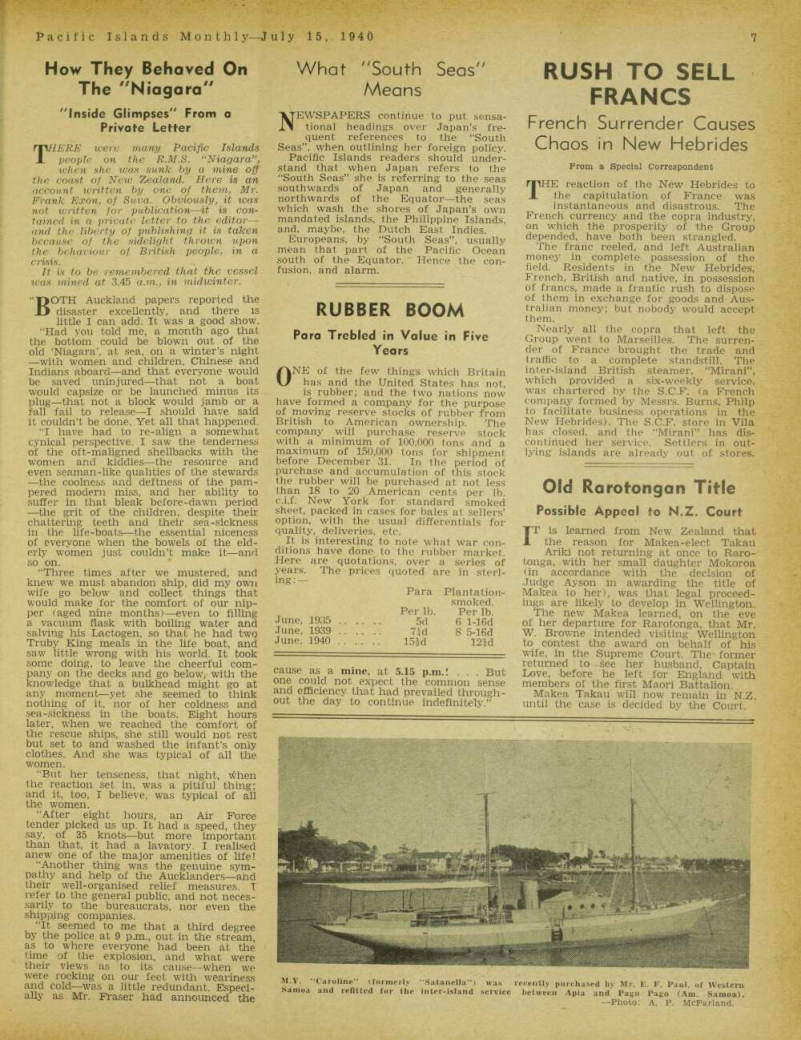
M V “Caroline” (formerly “Satanella”) was recently purchased by Mr. E. F. Paul, of Western Samoa and refitted for the inter-island service between Apia and Pago Pago (Am. Samoa). —Photo; A. P. McFarland.
What "South Seas"
Means
NEWSPAPERS continue to put sensa tional headings over Japan’s fre quent references to the “South Seas”, when outlining her foreign policy.
Pacific Islands readers should under stand that when Japan refers to the “South Seas” she is referring to the seas southwards of Japan and generally northwards of the Equator—the seas which wash the shores of Japan’s own mandated islands, the Philippine Islands, and, maybe, the Dutch East Indies.
Europeans, by “South Seas”, usually mean that part of the Pacific Ocean south of the Equator. Hence the con fusion, and alarm.
Rubber Boom
Para Trebled in Value in Five Years
ONE of the few things which Britain has and the United States has not, is rubber; and the two nations now have formed a company for the purpose of moving reserve stocks of rubber from British to American ownership. The company will purchase reserve stock with a minimum of 100,000 tons and a maximum of 150,000 tons for shipment before December 31. In the period of purchase and accumulation of this stock the rubber will be purchased at not less than 18 to 20 American cents per lb. c.i.f. New York for standard smoked sheet, packed in cases for bales at sellers’ option, with the usual differentials for quality, deliveries, etc.
It is interesting to note what war con ditions have done to the rubber market.
Here are quotations, over a series of years. The prices quoted are in sterl ing:—
Phara Plantationsmoked.
Per lb. Per lb.
June. 1935 5d 6 l-16d June, 1939 7*d 8 5-16d June, 1940 15|d 12|d
Francs
Rush To Sell
French Surrender Causes Chaos in New Hebrides
From a Special Correspondent THE reaction of the New Hebrides to the capitulation of France was instantaneous and disastrous. The French currency and the copra industry, on which the prosperity of the Group depended, have both been strangled.
The franc reeled, and left Australian money in complete possession of the field. Residents in the New Hebrides, French, British and native, in possession of francs, made a frantic rush to dispose of them in exchange for goods and Aus tralian money; but nobody would accept them.
Nearly all the copra that left the Group went to Marseilles. The surren der of France brought the trade and traffic to a complete standstill. The inter-island British steamer, “Mirani”, which provided a six-weekly service, was chartered by the S.C.F. (a French company formed by Messrs, Burns, Philp to facilitate business operations in the New Hebrides). The S.C.F. store in Vila has closed, and the “Mirani” has dis continued her service. Settlers in out lying islands are already out of stores.
Old Rarotongan Title
Possible Appeal fro N.Z. Court
IT is learned from New Zealand that the reason for Makea-elect Takau Ariki not returning at once to Raro tonga, with her small daughter Mokoroa (in accordance with the decision of Judge Ay son in awarding the title of Makea to her), was that legal proceed ings are likely to develop in Wellington.
The new Makea learned, on the eve of her departure for Rarotonga, that Mr.
W. Browne intended visiting Wellington to contest the award on behalf of his wife, in the Supreme Court. The former returned to see her husband, Captain Love, before he left for England with members of the first Maori Battalion.
Makea Takau will now remain in N.Z. until the case is decided by the Court.
Advertisements & other items, p. 9 (1 item)
7
Pacific Islands Monthl y—J uly 15, 1940
Companies
Pacific Trading
Their Financial Strength and Share Values
BECAUSE of the lack of ships to take their copra to the remaining mar kets, coconut growers in the Pacific are having a thin time. This necessarily reacts upon the finances of the big trad ing firms operating in the Pacific.
Their position is made very difficult by the fact that, not only is their turnover reduced, but they also are expected to finance a large proportion of the planters, and try to keep them on their plantations. The call upon their reserves is heavy—but, as demonstrated in 1914- 18, and in the Depression, their financial strength is very great, and they can take the strain.
The stock market reaction to their condition is interesting. Hereunder, are the buyers’ quotations for their ordinary £1 shares, a year ago, and last week:—
In view of everything, the slight fall in Burns Philp and Morris Hedstrom shares is notable.
The fall in the investors’ estimate of the Carpenter share values is due to the fact that much of the Co.’s assets are in New Guinea, and the future of New Guinea seems uncertain. That is silly.
So far as the outcome of the war is con cerned, New Guinea is in the same posi tion as all other British-Pacific territories. Nothing of a fundamental character has been changed in the Car penter structure, to place the shares at a disadvantage, as compared with those of the other Pacific trading companies.
All the companies are likely to have a bad time, for a while, but all three are well prepared for a siege.
July 5, July 5, 1939. 1940.
Burns, Philp & Co. .. . . 51/- 49/- W. R. Carpenter & Co. . . 40/- 28/- Morris, Hedstrom, Ltd. . . 23/3 21/-
Will Gold Hold
Its Value ?
World Production and the War
IN addressing the annual meeting of Guinea Gold, N.L., in Adelaide re cently, the chairman (Mr. C. V. T.
Wells) referred to the comparative value of gold company shares; and, subse quently, the following interesting figures, showing world production of gold, were made available: —
British Empire— Percentage of Total .. 56.7 57.3 57.1 Additional particulars, covering the past ten years, show that the annual production of gold throughout the world has risen steadily and consistently from 20,836,000 oz. fine, in 1930, to 39,150,000 oz. fine, in 1939. The grand aggregate of world production, for the past ten years, stands at the remarkable figure of 293,831,000 oz. fine.
At the close of 1939, the world’s stocks of monetary gold stood at 896,100,000 oz. fine, and of this total the Central Banks and Treasuries contained 763,900,000 oz. fine, which is approximately 85 per cent.
It may be added that this gold posi tion is one of the most important factors in the war situation. A very large pro portion of the world’s known stock of gold is held by the world’s non-Nazi nations, especially the United States and the British Empire. Hitler, dominating practically all Europe except Britain and Russia, may try to replace gold with some other standard of value.
1937. 1938. 1939.
Millions of oz. fine.
British Empire— Union of South Africa . 11.735 12.161 12.822 Canada 4.096 4.725 5.046 Australia 1.381 1.592 1.640 Other Empire Countries . 2.503 2.723 2.862 Total Empire 19.715 21.201 22.370 Foreign—
U.S.S.R
5.000 5.000 5.000
U.S.A
4.112 4.245 4.565 Other Countries 5.936 6.572 7.215 Total World Production 34.763 37.018 39.150
Plantation Blown
To Pieces
Poignant Hurricane Story From New Hebrides
FIVE months ago, Mr. Chris E. Hill, a coconut planter, of Emae, New Hebrides, with Mrs. Hill, was enjoy ing furlough, and undergoing a “medical overhaul” in Sydney, which they had not visited for many years. Then he was called home —his island had been, on February 18, right in the path of one of the worst hurricanes the group had ever experienced—and the rest of the heart-breaking story is told below. It is part of a private letter to the editor, not written for publication; but it is published to show something of what these isolated men and women in the hurricane belts have to face, and their brave, philosophic spirit :— WHEN we departed on furlough I left a man and his wife in charge of the plantation, with a local firm as managing agents. I received advice that the plantation had been badly torn about, and my building and contents, including furniture and store stock, had been swept to sea.
I hurried home by first steamer and found everything in a frightful mess, and my manager missing. He certainly had a bad time during and after the blow. His wife gave birth to a child, a few days after the hurricane had blown everything, including beds, etc., to smithereens. He went to Vila, leaving anything in the way of salvage that could, and should, have been done, to the tender mercies of the native labour.
I could not get home (or what was home) for a month after the blow, so you can imagine what a heart-breaking scene met my eyes. Talk about the agonies and devastation of war, of which I had some experience in the last. There, it is either sudden death, or, if wounded, one at least gets medical attention, and one’s worries are more or less over.
Certainly there were no actual deaths in this litle hell, but one boy was knocked unconscious, and two others are in hospital suffering from wounds inflicted by flying sheets of iron.
I have lost all my buildings, furni ture, stock, etc., and at least three years’ copra production.
(Continued On Next Page)
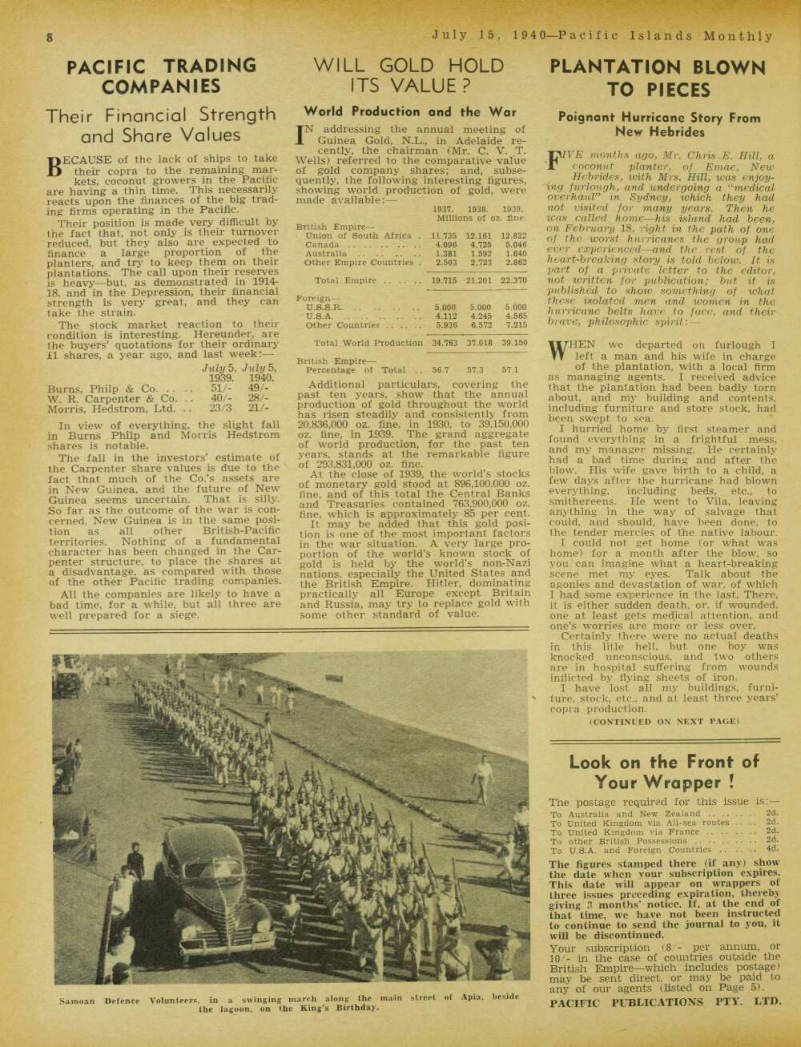
Samoan Defence Volunteers, in a swinging march along the main street of Apia, beside the lagoon, on the King’s Birthday.
(Continued from preceding page)
The ways and methods of the Govern ment are strange. Two officials were sent along to inspect the damage. This visit, of course, included my place, where the damage was done, as any one with half an eye could and can see. The natives, who certainly lost their gar dens, were immediately supplied with a considerable amount of rice. My labour, who were here houseless (and, they tell me, actually hungry—l was not here at the time) received nothing, and I, on my return, received sympathy!
Now, this gift of rice enabled the natives to purchase considerable sup plies of grog. The gift of rice made it unnecessary for them to buy food-stuffs; so, with the money received for their /copra, they had all the more cash to spend on grog—much to the satisfaction of the traders concerned.
As for myself, at the moment, I do not know how I can carry on, and build up again. I am not so young, or ener getic as I was some years ago, when faced with a similar position. I have been “home” a fortnight now, and I can tell you I feel pretty run-down. I have spent the time clearing away debris and rubbish, trying to make a house to keep the rain out.
My launch and truck were badly dam aged. The launches were pulled ashore, but a house fell on one and the other broke away, and banged against a tree stump, staving in some planks, etc. The cement walls and timber of a shed came down on the truck, smashing the body work and generally making a mess of it.
The wireless set was left out in the weather, and I guess I miss that piece of furniture just now as much as any thing. I also had an almost complete set of “P.I.M.s” ranging from very nearly the first issue—all these things have “Gone With the Wind”, a picture we went to see before I left Sydney, as I thought the title appropriate, after hearing the news!
To make matters worse, my tools are lost, stolen, or strayed, and Vila is the only place where I might get some, 50 miles away.
Such is life in N.H. Thank God, my wife, who is far from well, remained in Sydney, and is not here yet, to witness the scenes of devastation and ruin of all we possess. It is heart-breaking, after 20 years of struggle and building up after the 1932 hurricane.
When we left on our trip, for medical overhaul and rest, everything was in great order here, and it looked as though we might reap some little re turn for our years of work and worry.
But fate has decreed otherwise.
Advertisements & other items, p. 10 (1 item)
Look on the Front of
Your Wropper I
The postage required for this issue is;— To Australia and New Zealand 2d.
To United Kingdom via All-sea routes . . .. 2d.
To United Kingdom via France 2d.
To other British Possessions 2d.
To U.S.A. and Foreign Countries 4d.
The figures stamped there (if any) show the date when your subscription expires.
This date will appear on wrappers of three issues preceding expiration, thereby giving ?. months’ notice. If, at the end of that time, we have not been instructed to continue to send the journal to you, it will be discontinued.
Your subscription (8 - per annum, or 10 - in the case of countries outside the
British Empire—which includes postage)
may be sent direct, or may be paid to any of our agents (listed on Page 5).
PACIFIC PUBLICATIONS PTY. LTD.
Nearly £3,000,000
Year's Record Gold Output From New Guinea
From Our Own Correspondent WAU, July 6.
THE financial year closed with still an other record gold output from Morobe.
The figures are not yet complete, as a considerable Quantity of gold produced in June was still undeclared at June 30.
However, the conservatively-estimated value of gold exported for the year is £A2,905,381, and the final figure will be still nearer three million pounds.
Developments
Future Of New Caledonia And French
Oceania
Thousands Anxiously Await International Developments
WHAT is going to happen to France’s colonies in the South Pacific?
The unhappy condition of the French Empire generally is described in an article on page 48; but the present posi tion and probable future of New Cale donia, New Hebrides and French Oceania are of immediate concern to all South Pacific communities.
It is plain, now, that the Nazified Petain Government cannot administer those colonies from Europe, while Britain remains unconquered. So what?
Britain’s enemies will say that this is Britain’s chance to “grab”. The plain truth is that Great Britain does not want the French colonies but force of circum stances may compel one or more of the British nations to take action.
The Noumea report, printed hereunder, shows, plainly enough, the wishes of the New Caledonia people themselves.
A glance at the map shows New Cale donia’s importance to Australia. The great island is part of Australia’s protec tive fringe—New Guinea, New Britain, Solomons, New Hebrides, New Caledonia and Norfolk Islard. For strategic reasons, Australia dare not let New Caledonia or New Hebrides fall into foreign hands.
There are 10,000 Frenchmen in New Caledonia, and 1,000 in New Hebrides— a community large enough to govern it self for the present, under British or Aus tralian protection. If France is to remain Nazi, a British protectorate over New Caledonia might become permanent.
Because of its huge mineral deposits— nickel and chrome, especially—New Cale donia has much economic value. Other nations may be indifferent concerning New Hebrides and Tahiti (French Oceania), but they would covet New Caledonia. The Japanese, for instance, have shown a keen interest in New Cale donian minerals, and have acquired sev eral properties there, and at least one of their trans-Pacific lines of steamers calls regularly at Noumea.
In this journal, many times, we have urged that Australia should get ready to take responsibility for Papua. New Guinea, Solomons, New Hebrides and Norfolk Is land, as one Pacific Administration pro tecting eastern and northern Australia.
Now, the unexpected collapse of France may allow New Caledonia to be added to the plan.
The position, obviously, cannot remain as it is. We may exnect to hear of in teresting developments in relation to these South Pacific territories, before long.
Tahiti and French Oceania, comprising the farthest east of the Pacific Islands, have not the same interest for Australia.
Their value to the British is mostly agri cultural, and romantic—they are, from the point of view of living conditions, by fa Ltbe most attractive of all the islands. ere aie> in French Oceania, about 30,000 Polynesians, 1,000 French, 5,000 Euronesians, and 5,000 Chinese. Most of the French and Euronesians, and half the Chinese, are in Tahiti.
THE General Council of New Caledonia, at an Extraordinary Session on June 25, unanimously decided that Frenchmen should continue the fight against the Axis Powers.
A resolution expressing the determina tion of New Caledonia, “a country French m heart and soul which cannot admit the
surrender of the Bordeaux Government and its result in setting the French against their Allies of yesterday”, was sent to the British Consul at Noumea.
At 5.30 p.m. on June 25, following the usual closing hour of Noumea shops, more than 4,000 persons took part in a re markable demonstration, which showed the attachment of the French population of New Caledonia to the British Empire.
The demonstration, which took place In front of the Town Hall, also testified to the colony’s resolution to continue the fight on the side of the British for the liberation of France.
Led by M. Daly, president of the colony’s ex-servicemen. the crowd marched to the British Consulate, where M. Daly, in an interview with the Consul, expressed the warm sentiments of the population to the British Empire.
The demonstration, which was of a calm and orderly nature, closed with the singing of “The Marseillaise” and “God Save the King”.—“S.M. Herald” report.
New Caledonia Looking
to Australia
By H. E. Friday,
an English journalist,
who arrived in Australia, from Noumea, on July 9.
NEW Caledonia, traders would like an official statement from Australia on the existing position of the Com monwealth in relation to New Caledonia and the New Hebrides.
They would like to know, for example, if New Caledonian currency (Bank of Indo-China francs) are going to be stabilised in relation to the Australian pound, and, if so, at what rate. At the moment, visitors to the Commonwealth from New Caledonia are unable to change their francs at Australian banks.
Now that New Caledonia is cut off from France and must buy practically all her requirements in Australia, she is looking to the Commonwealth as a more important outlet for her minerals, coffee and other produce. A revision, or abolition, of duties on N. Caledonian produce is essential, it seems, so long as the war, necessitating the most com plete co-operation with the Colony, con tinues. This should be part of any working agreement (perhaps a barter arrangement) come to with the Govern ment of New Caledonia, either with or without the implicit consent of the Petain Government.
Australians cannot be told too often that New Caledonia, right on their door step, is a land tremendously rich in cer tain minerals. Up to now the Colony has been scandalously neglected by the Australian press.
What New Caledonians are beginning to ask themselves is whether the Bank of Indo-China monopoly is in the best interests of the country. It would pos sibly stimulate trade relations, as well as tourist traffic, if a branch of an Aus tralian bank was allowed to open and operate in Noumea.
Two Fijian gold mining companies, Emperor and Loloma, have each sub scribed £lO,OOO towards the interest-free loan issued by the Commonwealth Gov ernment.
Advertisements & other items, p. 11 (1 item)
9
Pacific Islands Monthl y—J uly 15, 1940
S. Pacific Airmail
Inaugurated at Last
Pan-American Airways’ New Air
mail service between San Francisco and Auckland, via Honolulu, Canton Island and Noumea, was inaugurated on a fortnightly basis on July 12, when a 44-tons Boeing seaplane, with mails and cargo only, left ’Frisco.
Australian airmails for Britain now go via Batavia, Singapore, Manila, and Pan- American Airways’ North Pacific and Atlantic services. The route will be changed to the South Pacific service, when it has been tested and made weekly, both ways.
Fiji, for some unknown reason, is not included. Yet it is practically on the direct route between Canton Island and Noumea.
Anchorage
New Industries In
Norfolk Is.
Plan For Sheltered Anchorage
UNDER the energetic direction of the present Administrator (Major- General Sir Charles Rosenthal), Norfolk Island has been making steady economic progress.
The passionfruit-canning industry established there by Mr. A. Flack, of Sydney, was not the success anticipated; but the residents, who already were run ning a co-operative dairy factory satis factorily desired to establish also, along side it, a factory for canning passion fruit. This saved the passlonfruit indus try. Messrs. Cottee. of Australia, are tak ing all the canned passionfruit that can be produced.
Bean production, which had tended to languish, has been revived. N.I. beans are famous, and th°re is a good, constant demand for them in Australia. The Ad ministrator has been trying to introduce new strains, to further improve the qual ity.
N.I. bananas sell in Sydney, at a high price, netting 7/- per case to the grower; and N.I. oranges are being sent to New Zealand.
Phormium tenax, a flax plant almost identical with that of New Zealand, grows wild in N.I. There is a keen de mand, now, for this hemp and N.I. farmers are being urged to cultivate the flax. During many years attempts were made to cultivate tung oil in N.I. Now, there are some scores of tung trees there, which have yielded luxuriantly, for the last five years, an oil nut described by the Sydney Technological Museum as among the best ever seen there. For that reason, the possibilities of N.I. tung oil are being carefully examined.
Norfolk Island’s greatest handicap is the lack of a sheltered port—under cer tain weather combinations, the anchor ages are unworkable. The Administrator now is examining an interesting plan— namely, to build a causeway, half a mile long, from near the boat-landing at Kingston, out to Nepean islet. It is con tended that, if that were done, there would be shelter, from all kinds of wea ther, on one side or other of the cause way.
Mr. David Buffett, of Norfolk Island, recently married Miss Ruth Stephenson, of Sydney, at St. Barnabas Chapel, N.I.
Advertisements & other items, p. 12 (2 items)
10
July 15, 194 O—P acific Islands Monthly
®piii
Just Released!
?m
Tk. ULTIMATE
Mantel Model
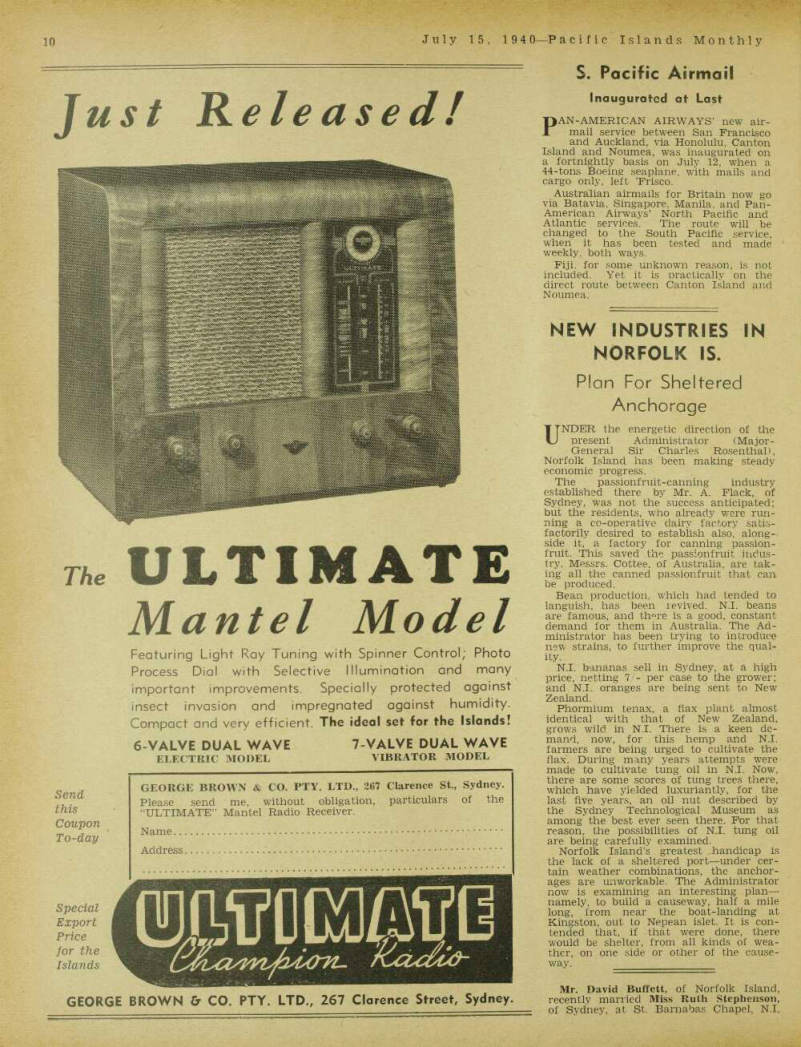
Featuring Light Ray Tuning with Spinner Control; Photo Process Dial with Selective Illumination and many important improvements. Specially protected against insect invasion and impregnated against humidity.
Compact and very efficient. The ideal set for the Islands!
Send this Coupon To-day Special Export Price for the Islands
6-VALVE DUAL WAVE
ELECTRIC MODEL
7-VALVE DUAL WAVE
VIBRATOR MODEL
GEORGE BROWN & CO. PTY. LTD., 267 Clarence St., Sydney.
Please send me, without obligation, particulars of the “ULTIMATE” Mantel Radio Receiver.
Name...
Address.
M
ffl
U *
/<uzdC&-
GEORGE BROWN & CO. PTY. LTD., 267 Clarence Street, Sydney.
Tropicalities
QUAINT note from a lad who has just returned from furlough in Sydney: “I arrived back after a very plea sant trip on the ‘Malaita’ —the journey at times becoming hectic in its alcoholic frivolity.
“However, at the latter end, things were pretty quiet, as most, including myself, had worked our financial means out to the last penny, even taking into consideration the cheap beer ' between Cairns and Port Moresby.
“By the way, there is a pink pub in Cairns now'. When a friend of mine arrived back at the boat and nervously told me h? had returned to the ship sooner than he anticipated on account of seeing a pink hotel, I took him on a visit to the ship’s doctor. Later, several of the huskiest of us escorted him back up the street, all willing to attack the thing if it flew at him. However, what we found was the Courthouse Hotel, done out in pink tiles!” * * • fTVHE new junior clerk was busily sort i ing out correspondence, in a Levuka trading store, when he noticed that the symbols “c.i.f. & e.” occurred quite freauently.
For a long time, he sat quite still looking solemnlv at the letters, and then, suddenly, a great light dawned on him.
Of course, they stood for the firm’s customers—Chinese, Indians, Fijians and Europeans! • * * PEOPLE who travel on ships these days should take a lesson from what happened to the passengers on the ill-fated “Niagara”, sunk by a mine off the coast of Auckland. It appears that only a small proportion of the passengers had insured their luggage against loss by en°my action. Others had insured, in the ordinary way, but not against war-time risks; and, as the ship was considered to have been lost through enemy action, the insurance companies were not liable.
Many people will not insure their luggage against war-time risks because of the very high premiums charged. Actually, the war-time risk in the Pacific, since the outbreak of war, has been small, and not of a character to justify the rates that have been imposed. * * * THE grocery counter in Burns, Philp’s big store in Port Moresby is one of the meeting places for Govern ment officials and other notable people about 830 a.m. Not long ago, thev were all discussing the possible appointee to the vacant Governorship.
The man behind the counter said, brightly: “Why shouldn’t we have a pup pet Government, Tike other countries?”
One of the old hands, leaning on the counter, said: “Gawd struth! Ain’t we had enough of puppy governments al ready!” * * * 11THEN the Federal authorities decided T T that the New Guinea Administration should retain its headquarters at Rabaul, one of the conditions set down was that there should be maintained a first-class vulcanological service, so that early warning could be given of any pending volcanic liveliness. This meant the maintenance of observing stations at about three points around Rabaul, and the use of delicate instruments of an un usual kind.
The instruments were ordered from
Europe, but war made it impossible to fill the orders. This created a serious position. Administrative headquarters could not remain at Rabaul unless a proper observatory system was established.
In this emergency, Mr., W. E. Jackson, engineer in charge at the Public Works Department in Rabaul, and Mr. Fisher, “geologist in charge of volcanoes”, set to work to make the necessary instruments.
The Public Works workshop, under the personal supervision of Mr. Jackson, has produced a series of very delicate, finely adjusted instruments which, it is believed, will serve the purpose of the observatory.
The “Rabaul Times” congratulates the officials concerned on a fine job of work. * * » AND still they come! Mr. G. W. L.
Townsend, DO., in the Mandated Territory of New Guinea, now on furlough in Australia, is proudly showing a photograph of six volunteers from his
district now with the Australian forces — namely, T. Weston, a gold miner: Pat Morrissey, a clerk; J. Grant, a patrol officer; J. Barraclough, a medical assist ant; Bob Giles and G. Cole, cadets. Mr.
Townsend told the “Melbourne Herald” that, to inform them that volunteers were asked for by the Commonwealth, native police went out to search for those who carried the white man’s burden in remote areas of the territory, from Wewak, Aitape, Maprik and Angoram.
They covered 25,000 square miles in the search! * ♦ ♦ EVERYONE knows that, since war dis located industry and transport, we have had to put up with matches that are not like those we once knew.
A correspondent in Papua says that the Australian variety of matches they get there now are very pretty, but they will not strike, and the natives in consequehce have named them “Dika Momo”. A Port Moresby wag put it this way: “The only thing in Australia that does not strike are these matches!”
Advertisements & other items, pp. 13-14 (3 items)
11
Pacific Islands Monthl y —J uly 15, 1940
irWTpn!
FLOWERS FRESH FOR A FORTNIGHT!
THE
magnified in this newly invented flower bowl. It is a delightful ornament that will add a charm to any lounge room or luncheon table—here is your opportunity to give a really original gift.
Price 22 6 Postage 2/6.
Write For Our Illustrated Catalogue.
Prouds Pty. Ltd. KING
.LATEST NOVELTY FROM LONDON,
and SYDNEY’S MOST POPULAR
FLOWER BOWL.
Wonderful effects are produced with any kind of colorful bloom or foliage—
AQUAFLORIUM
Corner of
irWTpn!
1 FINISH
n WATERPROOF |i
U. DRIES IN HALF HOUR
I CREAM I
Dries in half an hour on plaster walls, ceilings, cement, fibro, wood Cr iron.
Also Excellent as an Undercoat for lacquers, paints Cr enamels 14/4 per gallon
HIGHLY DURABLE
Write for a colour Card ...
STERLING VARNISH CO., Alexandria, N.S.W.
v- * *
SflDt o
o o HO t *•'*** P st* xO* C** ijtl* CO No technical knowledge required . . .
Keep in touch with the world expedite business transactions —be prepared to quickly call medical or other services in an emergency.
Install an A.W.A. Teleradio 38.
Compact radiotelephone providing communication facilities for parts beyond the reaches of landlines. Reliable and economical.
Illustrated booklet and quotations gladly supplied on request.
AMALGAMATED WIRELESS (A/SIA) LIMITED
47 YORK STREET, SYDNEY 167 QUEEN STREET, MELBOURNE Branches at: Wellington, Suva, Rabaul, Port Moresby and other island centres.
12
July 15, 194 O—P acific Islands Monthly
About Islands People
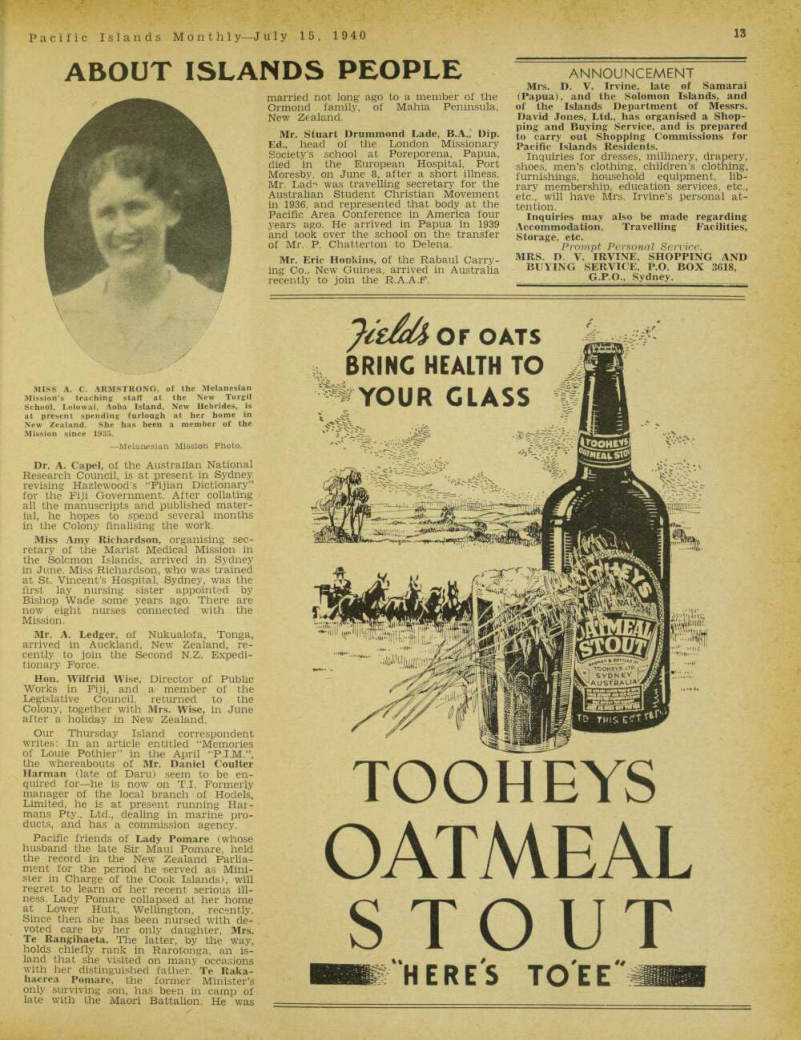

Dr. A. Capel, of the Australian National Research Council, is at present in Sydney revising Hazlewood’s “Fijian Dictionary” for the Fiji Government. After collating all the manuscripts and published mater ial, he hopes to spend several months in the Colony finalising the work.
Miss Amy Richardson, organising sec retary of the Marist Medical Mission in the Solomon Islands, arrived in Sydney in June. Miss Richardson, who was trained at St. Vincent's Hospital, Sydney, was the first lay nursing sister appointed by Bishop Wade some years ago. There are now eight nurses connected with the Mission.
Mr. A. Ledger, of Nukualofa, Tonga, arrived in Auckland, New Zealand, re cently to join the Second N.Z. Expedi tionary Force.
Hon. Wilfrid Wise, Director of Public Works in Fiji, and a member of the Legislative Council, returned to the Colony, together with Mrs. Wise, in June after a holiday in New Zealand.
Our Thursday Island correspondent writes: In an article entitled “Memories of Louie Pothier” in the April “P.1.M.”, the whereabouts of Mr. Daniel Coulter Harman (late of Daru) seem to be en quired for—he is now on T.I. Formerly manager of the local branch of Hodels, Limited, he is at present running Har mans Pty., Ltd., dealing in marine pro ducts, and has a commission agency.
Pacific friends of Lady Pomare (whose husband the late Sir Maui Pomare, held the record in the New Zealand Parlia ment for the period he served as Mini ster in Charge of the Cook Islands), will regret to learn of her recent serious ill ness. Lady Pomare collapsed at her home at Lower Hutt, Wellington, recently.
Since then she has been nursed with de voted care by her only daughter, Mrs.
Te Rangihaeta. The latter, by the way, holds chiefly rank in Rarotonga, an is land that she visited on many occasions with her distinguished father. Te Raka haerea Pomare, the former Minister’s only surviving son, has been in camp of late with the Maori Battalion. He was
married not long ago to a member of the Ormond family, of Mahia Peninsula, New Zealand.
Mr. Stuart Drummond Lade, 8.A., Dip.
Ed., head of the London Missionary Society’s school at Poreporena, Papua, died in the European Hospital, Port Moresby, on June 8, after a short illness.
Mr. Lad° was travelling secretary for the Australian Student Christian Movement in 1936, and represented that body at the Pacific Area Conference in America four years ago. He arrived in Papua in 1939 and took over the school on the transfer of Mr. P. Chatterton to Delena.
Mr. Eric Hopkins, of the Rabaul Carry ing Co., New Guinea, arrived in Australia recently to join the R.A.A.F.
MISS A. C. ARMSTRONG, of the Melanesian Mission’s teaching staff at the New Torgil School, Lolowai, Aoba Island, New Hebrides, is at present spending furlough at her home in New Zealand. She has been a member of the Mission since 1935. -Melaniesian Mission Photo.
Rev. C. M. Churchward has completed his “Rotuman Grammar and Dictionary” and it is expected that the book will be published shortly. The Fiji Administra tion, the Bishop Museum, and the Methodist Missionary Society, are assisting financially with its publication.
Mr. W. J. Wigmore, an old-established planter in Rarotonga, has been elected to the position of European member of the Rarotonga Fruit Advisory Committee, which was left open by the resignation of Mr. J. J. Murray.
Advertisements & other items, pp. 15-16 (2 items)
13
Pacific Islands Monthl y—J uly 15, 1940
Oatmeal
ANNOUNCEMENT
Mrs. D. V. Irvine, late of Samarai (Papua), and the Solomon Islands, and of the Islands Department of Messrs.
David Jones, Ltd., has organised a Shopping and Buying Service, and is prepared to carry out Shopping Commissions for Pacific Islands Residents.
Inquiries for dresses, millinery, drapery, shoes, men’s clothing, children’s clothing, furnishings, household equipment, library membership, education services, etc., etc., will have Mrs. Irvine’s personal attention.
Inquiries may also be made regarding Accommodation, Travelling Facilities, Storage, etc.
Prompt Personal Service.
MRS. D V. IRVINE, SHOPPING AND
BUYING SERVICE, P.O. BOX 3618.
G.P.0., Sydney.
vtuw OF OATS
BRING HEALTH TO
YOUR CLASS
* z*r r y ttAL U m 4 acrr.fo SYpN tv
AUSTRALIA
TOOHEYS
OATMEAL
STOUT
here's to'ee
ytt* And now -
KODACHROME / ,
S O^ AL
.A
for llw
MINIATURE CAMERA
-4 DREAM come true. The viewing ol a Kodachrome Transparency is like looking through a window at reality itself! See for yourself the glorious purity and brilliance ol colour captured by this new film for all 35mm. and Kodak Bantam models. Join the swing to colour photography demonstrations daily.
OF ALL KODAK DEALERS
THROUGHOUT THE ISLANDS
KODAK (A/ASIA) PTY. LTD.
379 George Street, Sydney D A I
FREE
DATA
BOOK
Write or call.
Mention the type of your minia t u r e camera
Why Not A Cement
Industry ?
From Our Own Correspondent
SUVA, June 15.
IT is hard for us here in Fiji to under stand why we should import cement.
We have an abundance of coral, lime, cheap labour, easy water transport, near ness to port—in fact, everything except initiative and capital.
“Niagara” Is
Mined
Pacific Mails and Goods Lost
THE veteran Canadian Australasian liner “Niagara”, 13,415 tons, which had been running between Sydney and Vancouver, across the Pacific, for over 25 years, struck a mine off the coast of Auckland, New Zealand, at about 3.45 a.m. on Wednesday, June 19, and foundered two hours later.
A violent explosion tore a huge hole in her side but, owing to the prompt closing of most of the bulkhead doors, the liner floated for some time after she was abandoned by 136 passengers and 202 members of the crew.
All on board were saved, uninjured, thanks to the fine work of Captain W.
Martin and his officers and crew, and the castaways were all safely back in Auckland within 18 hours of the disas ter.
It was reported, at first, that the ex plosion was an internal one, and there was much talk of treachery; but quick work by naval units disclosed that there w r ere mines in the vicinity—a couple were swept up within a few hours of the sinking of the “Niagara”—and it became clear that the mail ship had been lost owing to raider activity.
All the mails were lost. They included consignments for Fiji, Tahiti, Fanning Island and Hawaii, as well as for the United States. The “Niagara” sailed from Sydney on Thursday, June 13, and carried all mails posted in Australia for those places between (about) May 24 and June 13.
The “Niagara” carried a large mixed cargo, much of it for Fiji.
Passengers, in addition to losing nearly all their personal belongings, suffered great inconvenience. They remained in Auckland, awaiting another vessel to take them on to Pacific and American ports; but a trans-Pacific liner which followed, a week behind the “Niagara”, did not go to Auckland —probably owing to a fear of mines.
Sydney passengers for Suva were:- — Mr. and Mrs. J. M. Allard, R. V. Clark, Miss C. Cade, Mrs. E. Candy, Mr. and Mrs. F. C. Exon and infant, Misses E. and J. Exon, Mrs. M. L. and Master C.
B. McCullagh, Mr. and Mrs. A. G. and Miss E. M. Mac Diarmid, Miss M. R.
Ohlson, Mr. and Mrs. K. R. Sands, Miss H. I. Swinbourne, Mr. A. K. Woodhead, Mr. and Mrs. G. A. Guinery, Miss A. E.
Tucker, Mr. and Mrs. F. A. Williams, Mrs. M. Arnold, Mr. V. Bagawan, H. Lax man, Mrs. A. McKenzie, Mr. Siu Kong Po (joined at Auckland).
Hon. George H. Murray, M.L.C.. Dir ector of Agriculture in New Guinea, re turned to the Territory in June after a brief furlough in Sydney.
Australian newspapers have been giving much space to the adventures of Dr.
Phyllis Kaberry, a young Australian an thropologist, who recently returned to Sydney after living for 13 months in a native village in the foothills of the Torricelli Range, New Guinea. She is re ported to have lived alone in a native sago-thatched bush house, with camp bed, phonograph, and a few other neces sities as her only furniture.
Advertisements & other items, p. 16 (1 item)
14
July 15, 194 O—P acific Islands Monthly
Tomb Of Malietoa Laupepa, King Of Samoa

The remains of the native King of Samoa, Malietoa Laupepa, who died in 1898, were recently exhumed and, with appropriate native ceremony, re-interred at Mulinuu in a new tomb alongside that of his son and successor, Malietoa Tanumafili, whose death occurred last year.
Seated on the curbing of the decorated tombs are: Top Row—Mr. Turnbull (Acting Adminis trator of Western Samoa) and the new head of the Malietoa clan, Malietoa Tanu. Below— Tanu’s younger brother, Joane, and his mother, the widow of Malietoa Tanumafili. —Photo: A. P. McFarland.
Japanese Scientists Explore Dutch
New Guinea
THREE scientists of the Imperial Uni versity, Tokio, Messrs. Kanehira, Tayama and Hatsushima, have re turned from lengthy explorations in the interior of Dutch New Guinea with 10,000 botanical, insect, snake and ani
mal specimens, including a 2 in. kan garoo. ...
Illustrative of the intense Japanese interest in the islands, their adventures and discoveries have been broadcast in Japan in detail. They say they were well treated by the Dutch officials and by friendly cannibals. They found three Japanese farmers employing 1,000 natives.
The scientists consider that New Guinea and Australia were connected in ancient times.
Advertisements & other items, pp. 17-18 (2 items)
15
Pacific Islands Monthl y—J uly 15, 1940
Equal to the World’s Best
RADIANT HEALTH
Bright eyes and a clear skin are outward signs of inner cleanli ness. Take Eno’s “Fruit Salt" and make sure of radiant health.
ENOS
FRUIT SALT
Equal to the World’s Best
Throughout Australia and Overseas there is an ever-increasing demand for Under present conditions it is wise to ensure that you have ample stocks of all our lines.
“COLON lAL”and
“BRONTE”
HIGH-GRADE CANNED MEATS
There is no better quality — none more wholesome.
TRADE MEATS FOR THE ISLANDS
order
“COLONIAL” BRAND
Roast, Corned and Boiled Beef Packed in 6,5, 4,3, 2, 1 lb. and 12 oz. tins.
Also Corned Beef in 12 oz. Taper Tins.
Roast, Corned and Boiled Mutton. 1 lb. and 12 oz. tins.
Choice Dripping
36 lb., 2 lb., 1 lb. tins, and 1 lb. packets.
All our Meats are canned under the supervision of a Meat Inspector of the Commonwealth of Australia. ib.
SAMP
P -x 10 * 1 * 1 w HOUS*U MEAT CO. ro S TO - 5 —Till iii iiwi.iirwMpr-~
DELICIOUS
"BRONTE"
Steak and Kidney Pudding.
Beef Steak Pudding.
Sausages and Tomato.
Sausages and Vegetable.
HOT MEALS
Lamb and Green Peas.
Corned Beef and Boston Beans with Tomato Sauce.
Steak and Tomato.
The Colonial Wholesale Meat Coy. Pty. Ltd.
30 GROSVENOR STREET, SYDNEY
VO YOU KNOW ?
/ f Y r*e**?'*%l,A*** /\ G O
sgS2s^2s»
9 SS eep CLBfiV // ff- N /:
bHSm
m w c m i\ ret™ I,fp^ r T t % ft* e * y
t %^^ ncm^js^SSS^
B*a?*f* rfaC
’wirier ro vo WJ BROAD ANP Round rear* show bravery aa/p
S/fYCER/TV
& LONG- POINTER TEETH- SPACER PAR APART SHOW
VULOAR/TY ANP BASENESS.
)c mß ,Va q>, 2sS®2^^
m*¥%rAY. &,£Urt*
S|Ss»gSß&¥^
Islands Radio
Network
How Dangers of Isolation Have Been Overcome
TEN years ago, when the “P.I.M ” was established, the radio stations in the Pacific Islands could he counted on the fingers. To-day, the Islands are linked in a vast radio network, which is thus described in a recent publication by Amalgamated Wireless ( A/asia ) Ltd.: EARLY in the history of A.W.A., the objective of making Australia the wireless centre of the Southern Pacific was visualised. To-day, an ex tensive wireless service affords direct communication between Australia and Fiji, Papua and New Guinea. About a million words a year are handled by this service, by means of which it is possible to reach the most outlying parts of the islands.
There are many stations at smaller islands centres, and these communicate with the nearest of the above-mentioned centres, which, in turn, communicate with Sydney.
Thus communication can be effected from any of the Pacific Island centres to Sydney for Australia and New Zealand, and for Great Britain, the Continent of Europe, and North and South America, by means of the Australian Beam Wire less Service.
The chief radio station in the Terri tory of New Guinea is at Rabaul, on the island of New Britain. Rabaul is in direct communication with Sydney, as as with stations at Wewak, Madang, Bulolo, Wau, Salamaua, Manus, Kavieng and Kieta (in New Guinea) and Truk (in the Caroline Islands). It also communicates with the Gilbert and Ellice Islands, through the station on Ocean Island, with Tulagi in the Solo mon Islands, with Vanikoro in the Santa Cruz Islands, and with the island of Nauru.
Sydney radio is also in daily com munication by wireless with Suva, Noumea, Port Moresby and Nauru. Suva station collects and distributes wireless traffic to and from almost all the Paci fic Islands provided with radio. Among these are Tutuila and Apia in Samoa, Noumea in New Caledonia, Vila in New Hebrides, Nukualofa in the Friendly Islands, Ocean Island and Wallis Island (Futuna Islands).
The radio station at Willis Island, about 300 miles east of Townsville, is maintained for the sole purpose of sup plying information to the weather bureaus at Sydney, Melbourne and Brisbane. Warnings of tropical disturb ances sent from Willis Island have often been of great value to ships in the areas affected, and to coastal residents.
Settlers, missionaries, explorers, trad ers, prospectors and others in remote parts use A.W.A. teleradio sets to keep in touch with the A.W.A. stations and, through them, with the world. The teleradio is a small portable radio equip ment suitable for either telephony or telegraphy. About 180 of these are in use, and their owners send and receive messages both within the Islands and the outside world through the “mother” stations, in such centres as Port Moresby, Rabaul and Suva.
Advertisements & other items, p. 18 (1 item)
16
July 15, 194 O—P acific Islands Monthly
Salary For Papua's
Head
£1,500 Considered Too Small
I SEE that they are going to pay the Administrator of Papua £1,500 a year,” says a man who formerly was a prominent official in New Guinea.
“Though the cost of living has gone up, and the importance of our Territor ies also, the salary is to be reduced.
Since 1922, the salaries of the Common wealth heads of departments have gone up at least 25 per cent., also other Aus tralian salaries. In my opinion, no man could live with the dignity necessary, and entertain as Administrator, on £1,500 a year. If he had children to edu cate, his position would be an impossible one.
“As you know, the New Guinea Ad ministrator gets £l,BOO, and non-official members have time after time expressed the opinion that the salary is not enough. The cost of living is, if any thing. higher in Papua, In New Guinea, the Chief Judge gets £1,500 a year and recently the puisne Judge’s salary was increased to £1,400. Surely, the position of Administrator of Papua is a more important one.
“Of course, if it is only to be a place to pension off someone, the salary is too much, but if they want a first-class man to maintain the dignity of his position, I think £2,500 a minimum.
“Compare English salaries—there is no Governor of a place like Papua on such a low salary. I think it important to get a good man, about 45 years of ae-e, and. naturally, no man who has proved himself would go for a salary which is at most equal to £1,200 a year in Australia.”
Plantations
Value Of Coconut
Review by Morris Hedstrom Ltd.
AT the annual meeting of Morris Hed strom. Ltd., held at Suva on June 28, tb p chairman. Sir Maynard Hed strom. said that the company in a sound position, and. if it were not for the uncertainties caused by the war, a rea sonably prosperous year could be hoped for.
The main difficulty at present was the ouestion of shipping A neutral ship had been chartered to load conra in June, but British shinning for the United King dom was not available.
From a production point of view, said Sir Maynard, the plantations were satis fy ctorv. but under present market condi tions they did not yield a profitable re turn. The company's investments com prised shares in subsidiary comnanies ann ip first-class Australian comnanies. with a small investment in New Zealand com panies. The income derived from Aus tralian sources was not included in the profit and loss account, but was placed to an Australian investment reserve.
Sir Maynard Hedstrom said that the character of the companv’s assets had changed in recent vears. When the com nanv was formed, the greater part of its assets was in districts largely dependent on the copra industry. During the i«s* ten years, in particular, substantial
amounts had been devoted to writing down the book value of the assets situ ated in those districts. At present the book value of the property held in dis tricts mainly dependent on the sugar and gold industries far exceeded the book value of the assets in districts mainly de pendent on copra. The coconut planta tions cost the company more than £120,000.
The book value has been written down to £49,000 and unless there was an improve ment in conditions further amounts would be written off year by year.
A number of Papuan Government officers recently arrived in Australia to offer themselves for enlistment. They in cluded Messrs. C. Rich (Patrol Officer); C. E, H. Rich (Mines Department); C.
Schrader (Lands Department); A. E.
Way (Government Secretary’s Depart ment); and B. W. Faithorn (A.R.M., Gulf Division).
Chinese Stores In Wau
A CORRESPONDENT of the “Rabaul Times” writes bitterly of the increase in the number of Chinese trading stores in the goldfields town of Wau. The correspondent says that these Chinese stores should be kept in one designated quarter of the town. They are a regular gathering-place for natives and, says the correspondent, “Wau is becoming unpleasant for Euro peans to walk about in, especially at week-ends, owing to the hordes of natives who hang around the stores and commit nuisances all over the place.”
At a recent meeting of shareholders of John L. Peadon, Ltd., Rabaul, New Guinea, it was decided that the Company be wound un voluntarily and that R. H.
Forsyth be appointed liquidator.
Advertisements & other items, pp. 19-20 (2 items)
17
Pacific Islands Monthl y—J uly 15, 1940
cAastza /alia's CJ-lnesi
«> : SI. «a ■ m
(Hadis (Heeeitw r
ALREADY acclaimed throughout Australasia as a short-wave performer without peer or parallel, Philips Radioplayer Model 2262 brings to you news and entertainment from the four corners of the earth —clearly and with volume to spare. Available for either 110-240 volt operation. Model 2262 is only one of the many magnificent tonal performers in the extensive Philips Radioplayer range.
Model 2262 includes such outstanding exclusive features as “New Audioscopic Reproduction” (sound you can almost SEE), ‘“Legi-line” dial with “window” and Escalator tuning systems for greater shortwave tuning ease, low level tone compensation and new static tone control.
Broadcast coverage 540—1620 Kilocycles.
Short-wave coverage, 8 —22 megacycles.
PHILIPS
FILL IN CUT OUT AND POST
Made by The Largest Radio Organisation in the British Empire.
PHILIPS LAMPS (A/asia) PTY. LTD. . . PHILIPS
HOUSE 69-73 CLARENCE STREET SYDNEY,
N.S.W., AUS.
Please forward me all information on Model 2262.
Name Address P.I.M.
Two Letters . . .
Frank Peters bit his nails as he read the letter. His wife sat opposite, watching. . . . She looked worried, depressed.
“Bad news, Frank?”
“Read it yourself. Couldn’t be much worse.”
This is what she read : Dear Frank, — When the Board of Directors decided to give you charge of our Islands Branch, I was absolutely certain that you were the right man for the job. As a matter of fact, Frank, you know as well as I do that it was my influence that finally turned the vote in your favour. Now I have to write and tell you, Frank, that we are dissatisfied with your work. The last few months have been a great disappointment. What’s happened to you? Your sales figures for the months of February and March are far lower than last year’s, and lower than they have been for the past five years for the same two months.
There must be a reason for this, Frank, so write at once and give me a full explanation so that I will have something to tell the Board.
In the meantime, for Pete’s sake get your sales figures up, otherwise nothing I can say will alter the fact—we’ll have to make a change.
Kindest regards to you and Mary,
JOHN.
“He says he wants an explanation.
What are you going to tell him, Frank?”
“What can I tell him? Everything he says is true. Sales are down.
There’s no doubt about it, I’m a flop. How can I put my heart and soul into my work when I always feel like this—tired all the time. I even wake up tired nowadays.”
“Darling, I know you haven’t been yourself for the last couple of months. You haven’t got your old energy. You’d better go down and see Doctor Martin.”
So Frank saw Doctor Martin. After giving him a thorough examination Doctor Martin said : “Frank, the reason why you’re run
down, nervy and tired all the time is very simple. Naturally, this climate takes it out of you. And that’s not all! Tiredness, nerviness —these things are really symptoms of Night-Starvation. You’ve probably never realised it, but while you sleep your body goes on burning up energy. Your heart has to beat 35.000 times and your lungs make 20.000 muscular movements. Naturally, this takes it out of you, and if energy isn’t replaced during sleep you wake tired, and stay tired all day long. You get nervy, run down, and lose your confidence. My advice is, drink a cupful of Horlicks every night before you go to bed.
And so Frank started drinking Horlicks every night before bed.
Three months passed. We meet Frank again. He is opening another letter. When he finishes reading it, he passes it across to Mary. . . .
“Darling, read this\ Isn’t it marvellous?”
This is what Mary read: Dear Frank, — Your latest sales figures were the best thing you could possibly have sent down. There’s no doubt about it, Frank, you can turn on the heat when you have to. All the talk about calling you back to Sydney has been forgotten. As a matter of fact, confidentially, you might find a little something in your stocking at Christmas. Keep up the good work.
Do you find yourself waking tired in the morning, even after a good night’s sleep? Do you get nervy, irritable, over small things that don’t really matter? Is the climate getting you down? Then the chances are that you, too, are suffering from Night-Starvation. Horlicks replaces energy lost during sleep, so that you wake refreshed, clear eyed and alert. Start drinking Horlicks at
JOHN.
night and you’ll soon get back all your old drive and vitality.
Atiu As She Is
Wedded
By “Tukapa Koko”
ON this island (Mangaia, Cook Group; where at present I live and have my beans, faute de mieux, there is a small colony of native folk from the neighbouring, gayer isle of Atiu.
The Ngati-Atiu are of Tahitian ex traction, and less stolid than their Mangaian hosts, so an Atiu wedding on Mangaia was quite a show. The con tracting parties, honest Taokiia and fair Rimaiti, were “popped off” in the style customary on the spicier shore.
Nothing less than veil and gown of fair white silk sufficed for the bride. The rig-out represented a prodigious feat of family effort, aided by a few items from European well-wishers chiefly Mrs.
Oswald Savage, wife of Donald’s manager at the local branch, who is also on Atiuan.
The bringing of the bride to the mis sion was a queer mixture of artistry and quaintness. Her veil and dress ' were beautiful indeed; and she arrived in a sort of sedan-chair, carried on poles by brawny young men, high over the heads of the admiring crowd.
The palanquin was a stout form equipped with shafts, and the bearers were ten in number. The bride was not alone in her aristocratic convevanc' 1 , though the groom had to walk to the slaughter.
The bride sat under a shade of green ery up aloft, with two little twelve year-old bridesmaids on each side of her.
The humour came in when the bearers put down and picked ud the bride. They were totally unaccustomed to this way of doing things—the first Atiu-style wed ding at Mangaia—and in th-ir enthusiasm handled the incoming and outgoing bride rather like the little boys do a certain effigy on the glorious Fifth, up in New Zealand. It was this, perhaps, that led some Rosencrantz or Guilden stern to remark, “Now, we only need a few crackers!”
Be that as it may, the hoisted, shoulder high bride was the Belle of the Day.
Salaries Stolen
From Our Own Correspondent
Nukualofa, June 1.
THE monthly salaries of public servants on the island of Eua, a sum of about £24, was stolen while it was being taken to Eua in a registered mail package by the cutter “Vaigana’, which did not reach its destination until four days after leaving Nukualofa, although the passage takes only a day normally.
Apparently the cutter touched on various villages on the eastern coast of Togatabu before finally making the cross ing to Eua, whose district officer, who is responsible for receiving the money at that end, found the package missing when he opened the mail bag, when the vessel arrived.
The police promptly traced some of the missing Treasury notes to some of the Nukualofa stores, but unfortunately the customer or customers who passed them are still unidentified.
Mr. A. L. Lewis, airport manager for Pan American Airways at Auckland, N.Z., has been transferred to Manila in the Philippine Islands.
Advertisements & other items, p. 20 (1 item)
18
July 15, 194 O—P acific Islands Monthly
Grandstand, Native-Style
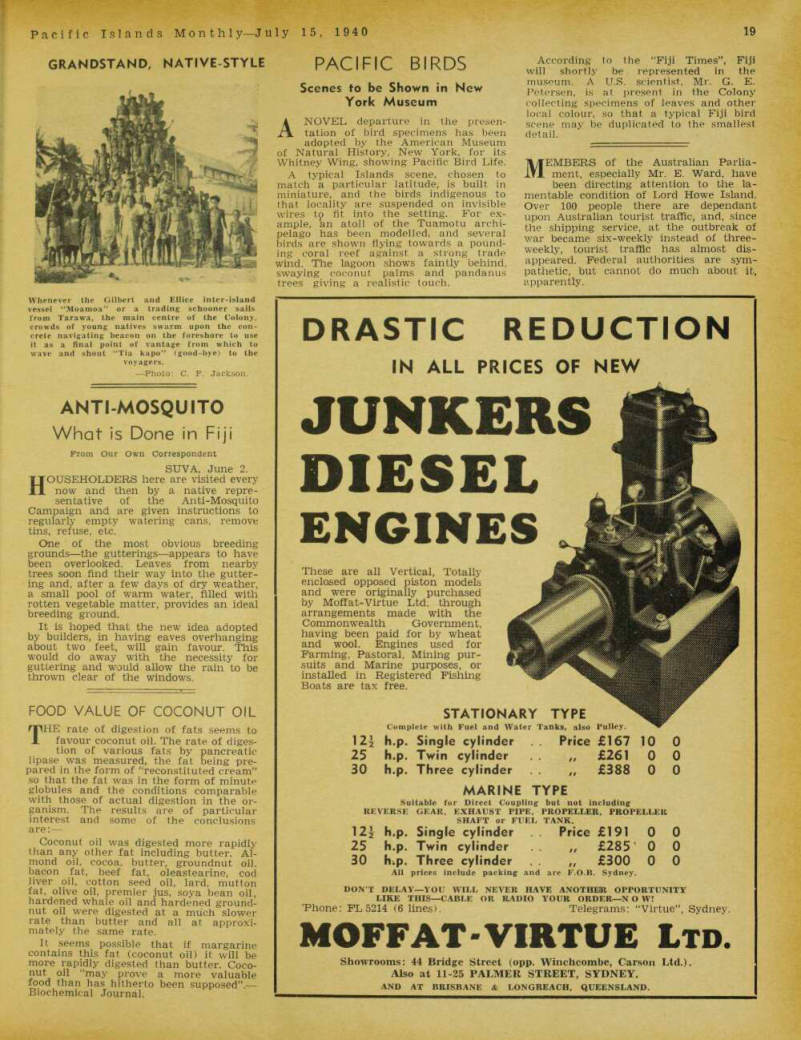
Whenever the Gilbert and Ellice inter-island vessel “Moamoa” or a trading schooner sails from Tarawa, the main centre of the Colony, crowds of young natives swarm upon the con crete navigating beacon on the foreshore to use it as a final point of vantage from which to wave and shout “Tia kapo” (good-bye) to the voyagers. —Photo: C. F. Jackson.
Anti-Mosquito
What is Done in Fiji
From Our Own Correspondent SUVA, June 2.
HOUSEHOLDERS here are visited every now and then by a native repre sentative of the Anti-Mosquito Campaign and are given instructions to regularly empty watering cans, remove tins, refuse, etc.
One of the most obvious breeding grounds—the gutterings—appears to have been overlooked. Leaves from nearby trees soon find their way into the gutter ing and, after a few days of dry weather, a small pool of warm water, filled with rotten vegetable matter, provides an ideal breeding ground.
It is hoped that the new idea adopted by builders, in having eaves overhanging about two feet, will gain favour. This would do away with the necessity for guttering and would allow the rain to be thrown clear of the windows.
Food Value Of Coconut Oil
THE rate of digestion of fats seems to favour coconut oil. The rate of diges tion of various fats by pancreatic lipase was measured, the fat being pre pared in the form of “reconstituted cream” so that the fat was in the form of minute globules and the conditions comparable with those of actual digestion in the or ganism. The results are of particular interest and some of the conclusions are:— Coconut oil was digested more rapidly than any other fat including butter. Al mond oil, cocoa, butter, groundnut oil, bacon fat, beef fat, oleastearine, cod liver oil, cotton seed oil, lard, mutton fat, olive oil, premier jus, soya bean oil, hardened whale oil and hardened ground nut oil were digested at a much slower rate than butter and all at approxi mately the same rate.
It seems possible that if margarine contains this fat (coconut oil) it will be more rapidly digested than butter. Coco nut oil “may prove a more valuable food than has hitherto been supposed”.— Biochemical Journal.
Pacific Birds
Scenes to be Shown in New York Museum
A NOVEL departure in the presen tation of bird specimens has been adopted by the American Museum of Natural History, New York, for its Whitney Wing, showing Pacific Bird Life.
A typical Islands scene, chosen to match a particular latitude, is built in miniature, and the birds indigenous to that locality are suspended on invisible wires to fit into the setting. For ex ample, an atoll of the Tuamotu archi pelago has been modelled, and several birds are shown flying towards a pound ing coral reef against a strong trade wind. The lagoon shows faintly behind, swaying coconut palms and pandanus trees giving a realistic touch.
According to the “Fiji Times”, Fiji will shortly be represented in the museum. A U.S. scientist, Mr. G. E.
Petersen, is at present in the Colony collecting specimens of leaves and other local colour, so that a typical Fiji bird scene may be duplicated to the smallest detail.
MEMBERS of the Australian Parlia ment, especially Mr. E. Ward, have been directing attention to the la mentable condition of Lord Howe Island.
Over 100 people there are dependant upon Australian tourist traffic, and, since the shipping service, at the outbreak of war became six-weekly instead of three weekly, tourist traffic has almost dis appeared. Federal authorities are sym pathetic, but cannot do much about it, apparently.
Miss C. Weston has completed 21 years service with the Methodist Mission in Fiji
Advertisements & other items, pp. 21-22 (2 items)
19
Pacific Islands Monthl y—J uly 15, 1940
Junkers
DRASTIC REDUCTION
IN ALU PRICES OF NEW
DIESEL
ENGINES
These are all Vertical, Totally enclosed opposed piston models and were originally purchased by Moffat-Virtue Ltd. through arrangements made with the Commonwealth Government, having been paid for by wheat and wool. Engines used for Farming, Pastoral, Mining pursuits and Marine purposes, or installed in Registered Fishing Boats are tax free.
STATIONARY TYPE
Complete with Fuel and Water Tanks, also Pulley.
122 h.p. Single cylinder
25 h.p. Twin cylinder
30 h.p. Three cylinder
4*
-■ ,%Si Jf s*
Ifcv i 10 0 0 0 0 0 Price £167 „ £261 „ £3BB
MARINE TYPE
Suitable for Direct Coupling but not including
REVERSE GEAR, EXHAUST PIPE. PROPELLER. PROPELLER
SHAFT or FUEL TANK.
12* h.p. Single cylinder . . Price £l9l 0 0 25 h.p. Twin cylinder . . „ £285 0 0 30 h.p. Three cylinder . . „ £3OO 0 0 All prices include packing and are F. 0.8. Sydney.
DON’T DELAY—YOU WILL NEVER HAVE ANOTHER OPPORTUNITY LIKE THIS—CABLE OR RADIO YOUR ORDER—N OW! ’Phone: PL 5214 (6 lines). Telegrams: “Virtue”, Sydney.
MOFFAT-VIRTUE Ltd.
Showrooms: 44 Bridge Street (opp. Winchcombe, Carson Ltd.).
Also at 11-25 PALMER STREET, SYDNEY.
AND AT BRISBANE & LONGREACH, QUEENSLAND.
Coleman
STOVE
1— Lights Instantly—No Preheating. 2 Instant Heat Regulation. 3 Safety Shut-off Valve. 4 Nickel-Plated —Rust-Proof. 5 Wind-Proof, Silent, Odorless.
BUILT FOR A MULTITUDE
OF USES.
Sold by all leading Firms in the Pacific Islands.
In case of difficulty in obtaining supplies, write to; Pearce & Co. Suva, Fiji Islands.
Generate Your Own Electricity with a
JOHNSON IRON
HORSE GENERATOR
Write for Illustrated Leaflet.
Weight when packed, 100 lb. r
• ELECTRICITY for LIGHTING
• POWER for Radio
• POWER for Battery Charging
Electric Light is now available to everyone with this low-priced dependable generator.
Charging operates immediately the electric starting button is pressed, and by turning a knob the output is controlled from nothing to 300 watts. Electric Light (with the Johnson Generator) costs you less than the messy, dangerous, old-fashioned lamps— you can use 3 lights for hours every night at a cost of approximately 1/6 per week.
Here are some of the more important features: 300 watts —12 Volts—lights 12-25 watt globes—electric starting—full range control—special built-in generator powered by a Johnson Iron Horse 4-cycle petrol engine—automatic cut out disconnects when not running quiet operation minimum vibration shielded CASH PRICE Ex bond, unit only.
Ignition burettor. suction £2l/5/-
NOCK & KIRBY Ltd.
BOX 4250 Y, G.P.0., SYDNEY.
Samoan Banana
Production
Reply to Complaint About Official "Czars"
THE complaint of a correspondent, “Seeker of Justice”, who insisted that he was the victim of “little czars” of the banana industry in West ern Samoa, and who said that the pro duction of bananas in that Territory was equal to twice the demand, was pub lished in the “P.1.M.” in May.
The “Western Samoa Mail” of June 8. declared that our correspondent’s state ments were untrue, and proceeded:— “Seeker of Justice” first sought pub licity through the “Western Samoa Mail”, but as we were conversant with the facts of his complaint, which were that he packed fruit not in accordance with the regulations laid down for fruit for ship ment, and therefore gave himself a lot of trouble packing it, and the Admini stration the trouble of rejecting it.
Here are the facts as given to us by the Inspector of Produce: “The writer has no plantation of his own. Some bananas sent in by his son were rejected by my Inspector. The re jects were tipped out on the floor of the shed in the presence of himself, his son, and other settlers from Aleisa. I showed him the very immature bananas and he said that they were mature and that I should not have rejected them.
“I peeled off the skin of one, and showed him a banana no bigger than my little finger. I mentioned that I was re
sponsible for the quality of fruit arriv ing in New Zealand and I could not accept bananas of that type. He then said that I was not to send any more cases to his son as he would not ship any more.
“I showed the bananas I had rejected to the Acting Administrator and two members of the Aleisa Settlement Board (Messrs. Smyth and Paul). Th-y an 'agreed that the fruit was of inferior quality. I have told all settlers, many times, that I would take all the good quality bananas they had any time. They are given all the cases th°y can fill with good fruit.”
The statement in the complainant’s letter, to the effect that there is keen competition amongst copra and cocoa buyers is wholly incorrect. The price paid by all buyers is an agreed price, governed by the market value. There is nothing to hinder the Aleisa Settlers growing copra and cocoa for export if they wish to.
On one occasion a planter in the Aleisa Settlement made application for no less than one hundred cases, and as the In spector of Produce very much doubted if the plantation could produce more than thirty cases of suitable fruit for shipment, an inspection of the plantation was arranged, when every plant in the plantation was inspected in the presence of the planter and members of the Alesia Board, who agreed to the passing for shipment, or condemning as not fit fpr shipment, as each plant was con sidered. When this inspection was over it was definitely proved that, at the very most, the planter could not ship more than thirty cases, which was the original estimate of the Inspector of Produce.
Had a quota been given out for one hund red cases he would in all probability have had seventy cases rejected.
The following is the average allotment for each month which leaves Samoa, to gether with the value thereof:
Cases. £ Samoans .. 11,400 2,850 Local Born . . . . 3,520 880 Aleisa Settlers .. 1,280 320 Europeans . . .. 470 117 Chinese 140 35 16,810 4,202
Tahiti Grows Its Own Food
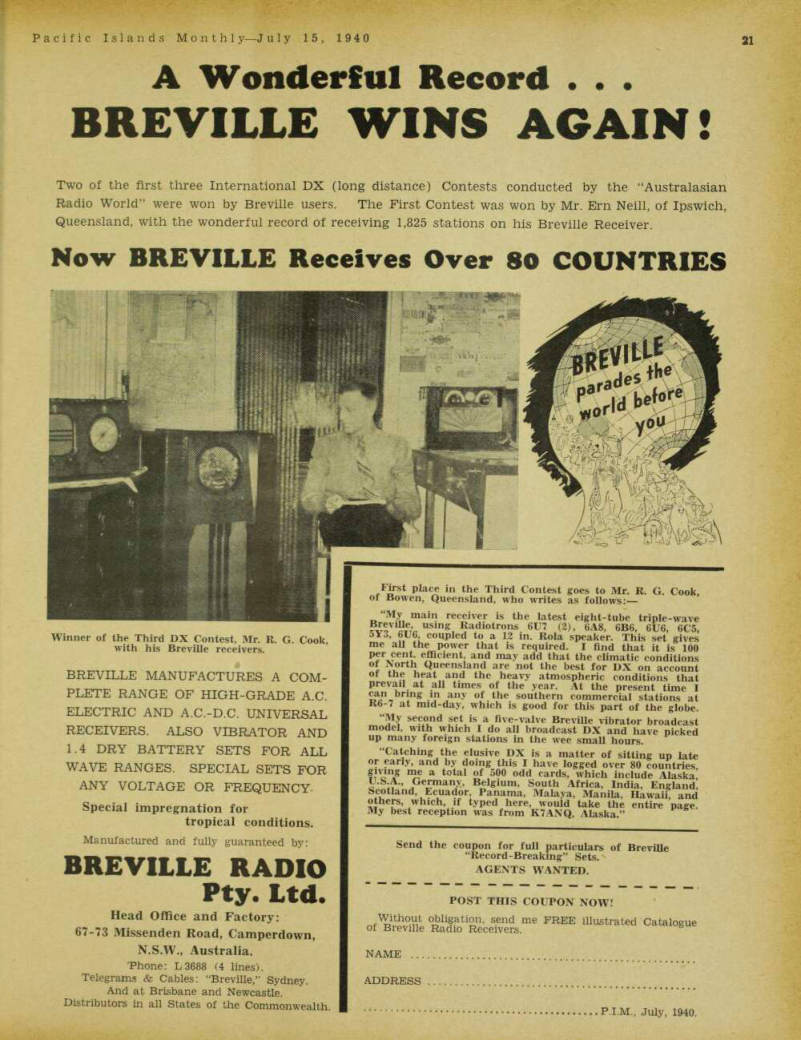
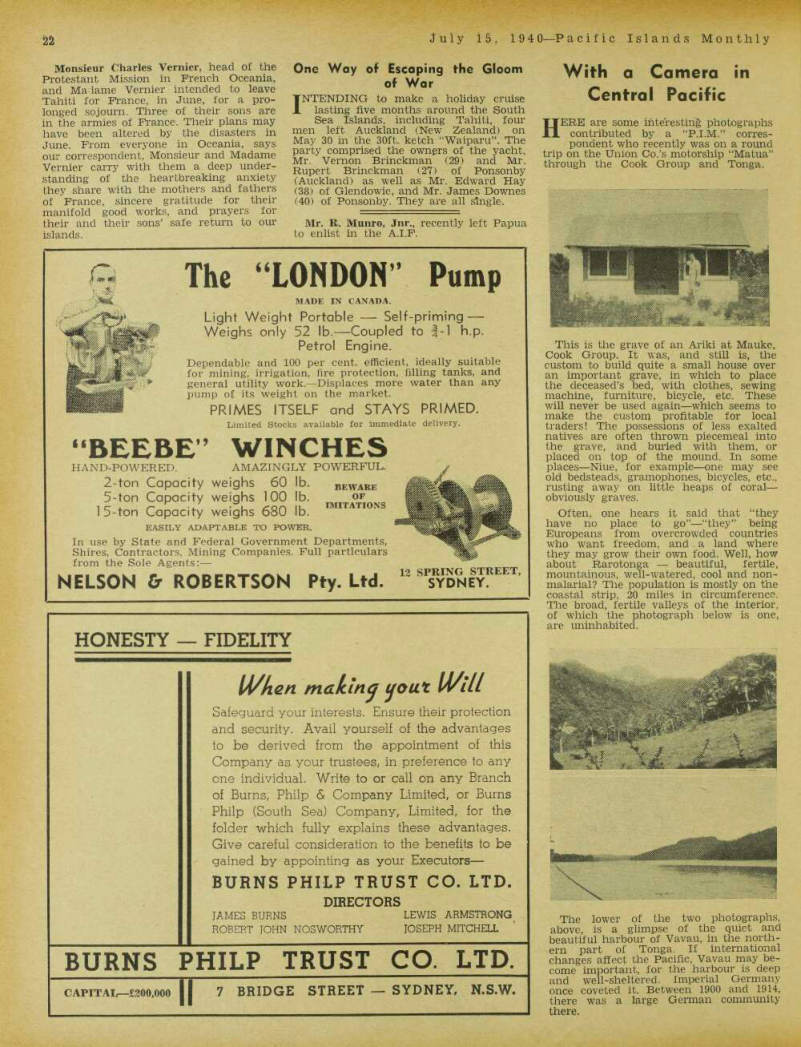
From Our Own Correspondent
Papeete, June 10.
THE wisdom of the Administration in initiating a programme of agricul tural expansion, at the beginning of the war, in order to provide within the colony itself, an ample supply of food for the population, has been justified by sub sequent events.
The schedules of steamers have been so uncertain and the sailings so far apart, that already the islands find them selves facing a shortage of several essentials. As the future of steamer ser vice is contingent, the colony may be more and more dependent on the pro ducts of its own plantations.
Acreage has been allocated for the cultivation of the several food plants necessary for a balanced diet. Admini strators and chiefs of districts are super vising the carrying out of the programme, under direct responsibility to the Gov ernor. His Excellency recently returned from a tour of inspection of plantations in the Leeward Islands and Mcorea.
Messrs. W. M. Marks and R. S. Haynes, directors of Papuan Apinaipi Petroleum Co,. Ltd., recently arrived in the Terri tory, and in June visited their company’s drilling site at Oiapu, near Yule Island.
Monsieur Charles Vernier, head of the Protestant Mission in French Oceania, and Madame Vernier intended to leave Tahiti for Prance, in June, for a pro longed sojourn. Three of their sons are in the armies of France. Their plans may have been altered by the disasters in June. From everyone in Oceania, says our correspondent, Monsieur and Madame Vernier carry with them a deep under standing of the heartbreaking anxiety they share with the mothers and fathers of Prance, sincere gratitude for their manifold good works, and prayers for their and their sons’ safe return to our islands.
Advertisements & other items, pp. 22-24 (2 items)
20
July 15, 194 O—P acific Islands Monthly
Breville Wins Again!
A Wonderful Record . . .
Two of the first three International DX (long distance) Contests conducted by the “Australasian Radio World” were won by Breville users. The First Contest was won by Mr. Ern Neill, of Ipswich, Queensland, with the wonderful record of receiving 1,825 stations on his Breville Receiver.
Now BREVILLE Receives Over 80 COUNTRIES
ii * he
ade«
at
rid
■ Winner of the Third DX Contest, Mr. R. G. Cook, with his Breville receivers.
BREVILLE MANUFACTURES A COM-
PLETE RANGE OF HIGH-GRADE A.C.
ELECTRIC AND A.C.-D.C. UNIVERSAL
RECEIVERS. ALSO VIBRATOR AND
1.4 DRY BATTERY SETS FOR ALL
WAVE RANGES. SPECIAL SETS FOR
ANY VOLTAGE OR FREQUENCY-
Special impregnation for
tropical conditions.
Manufactured and fully guaranteed by:
BREVILLE RADIO
Pty. Ltd
Head Office and Factory: 67-73 Missenden Road, Camperdown, N.S.W., Australia. ’Phone: L 3688 (4 lines).
Telegrams & Cables: “Breville,” Sydney.
And at Brisbane and Newcastle.
Distributors in all States of the Commonwealth.
First place in the Third Contest goes to Mr. R. G. Cook, ot Bowen, Queensland, who writes as follows: “My main receiver is the latest eight-tube triple-wave ?vq Vl S?tc USmff , ! a 4 diotr ®!? s . 6U7 (2) ' 6A8 ’ 6B6 > 6U6 > 6C5, 6U6, coupled to a 12 in. Rola speaker. This set gives me all the power that is required. I find that it is 100 per cent, efficient, and may add that the climatic conditions of North Queensland are not the best for DX on account ot the heat and the heavy atmospheric conditions that prevail at all times of the year. At the present time I can bring m any of the southern commercial stations at R 6-7 at mid-day, which is good for this part of the globe.
“My second set is a five-valve Breville vibrator broadcast model, with which I do all broadcast DX and have picked up many foreign stations in the wee small hours.
“Catching the elusive DX is a matter of sitting up late or early, and by doing this I have logged over 80 countries. a total 500 odd cards » which include Alaska, U.S.A., Germany, Belgium, South Africa, India, England, Scotland, Ecuador, Panama, Malaya, Manila, Hawaii, and which, if typed here, would take the entire page My best reception was from K7ANQ, Alaska.”
Send the coupon for full particulars of Breville “Record-Breaking” Sets.
AGENTS WANTED.
POST THIS COUPON NOW!
Without obligation, send me FREE illustrated Catalogue of Breville Radio Receivers.
NAME
ADDRESS
P.1.M., July, 1940.
t C*
The “LONDON” Pump
MADE IN CANADA.
Light Weight Portable Self-priming
Weighs only 52 lb.—Coupled to f-1 h.p.
Petrol Engine.
Dependable and 100 per cent, efficient, ideally suitable for mining, irrigation, fire protection, filling tanks, and general utility work. —Displaces more water than any pump of its weight on the market,
PRIMES ITSELF and STAYS PRIMED.
Limited Stocks available for immediate delivery.
“BEEBE” WINCHES
HAND-POWERED. AMAZINGLY POWERFUL.
2-ton Capacity weighs 60 lb. 5-ton Capacity weighs 100 lb. 1 5-ton Capacity weighs 680 lb.
BEWARE
OF
IMITATIONS
EASILY ADAPTABLE TO POWER.
In use by State and Federal Government Departments, Shires, Contractors, Mining Companies. Full particulars from the Sole Agents:—
NELSON Cr ROBERTSON Pty. Ltd.
SPRING STREET,
SYDNEY.
HONESTY FIDELITY
When making gout WiU
Safeguard your interests. Ensure their protection and security. Avail yourself of the advantages to be derived from the appointment of this Company as your trustees, in preference to any one individual. Write to or call on any Branch of Burns, Philp & Company Limited, or Burns Philp (South Sea) Company, Limited, for the folder which fully explains these advantages.
Give careful consideration to the benefits to be gained by appointing as your Executors—
BURNS PHILP TRUST CO. LTD.
DIRECTORS
JAMES BURNS LEWIS ARMSTRONG
ROBERT JOHN NOSWORTHY JOSEPH MITCHELL
BURNS PHILP TRUST CO. LTD.
capital—£2oo,ooo II 7 BRIDGE STREET SYDNEY, N.S.W.
One Way of Escaping the Gloom
of War
INTENDING to make a holiday cruise lasting five months around the South Sea Islands, including Tahiti, four men left Auckland (New Zealand) on May 30 in the 30ft. ketch “Waiparu”. The party comprised the owners of the yacht, Mr. Vernon Brinckman (29) and Mr.
Rupert Brinckman (27) of Ponsonby (Auckland) as well as Mr. Edward Hay (38) of Glendowie, and Mr, James Downes (40) of Ponsonby. They are all single.
Mr. R. Munro, Jnr., recently left Papua to enlist in the A.I.P.
Central Pacific
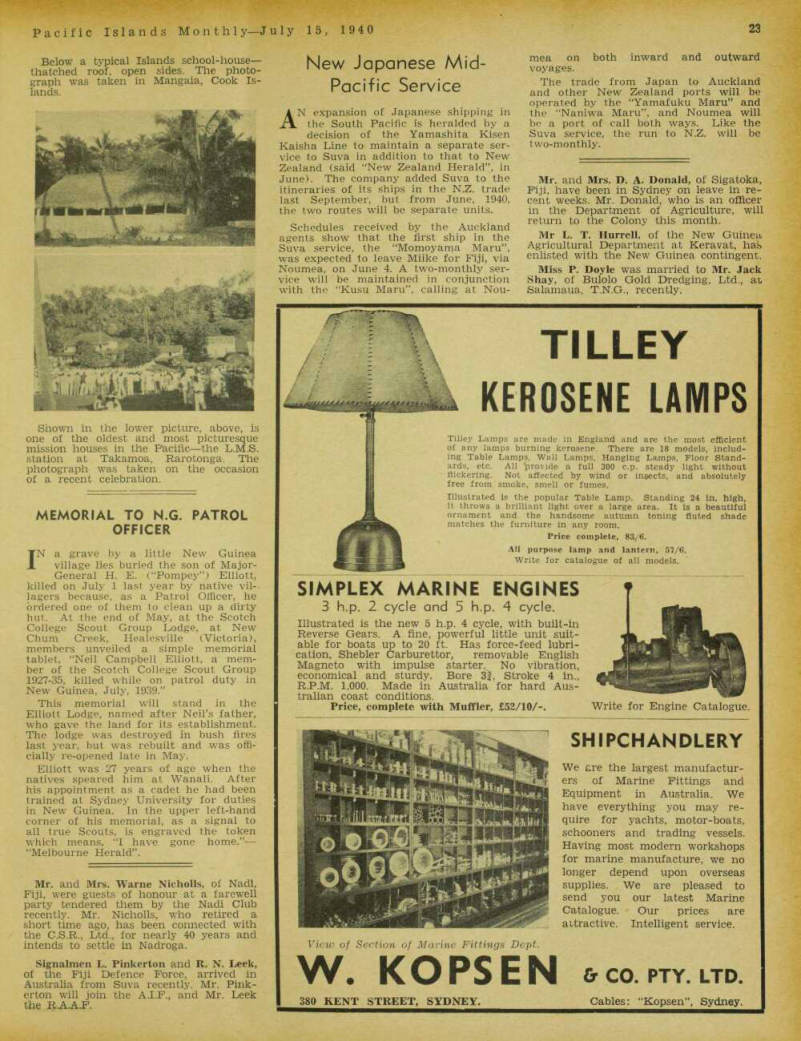
With a Camera in Central Pacific
HERE are some interesting photographs contributed by a “P.1.M.” corres pondent who recently was on a round trip on the Union Co.’s motorship “Matua” through the Cook Group and Tonga.
This is the grave of an Ariki at Mauke, Cook Group. It was, and still is, the custom to build quite a small house over an important grave, in which to place the deceased’s bed, with clothes, sewing machine, furniture, bicycle, etc. These will never be used again—which seems to make the custom profitable for local traders! The possessions of less exalted natives are often thrown piecemeal into the grave, and buried with them, or placed on top of the mound. In some places—Niue, for example—one may see old bedsteads, gramophones, bicycles, etc., rusting away on little heaps of coral— obviously graves.
Often, one hears it said that “they have no place to go”—“they” being Europeans from overcrowded countries who want freedom, and . a land where they may grow their own food. Well, how about Rarotonga beautiful, fertile, mountainous, well-watered, cool and non malarial? The population is mostly on the coastal strip, 20 miles in circumference.
The broad, fertile valleys of the interior, of which the photograph below is one, are uninhabited.
The lower of the two photographs, above, is a glimpse of the quiet and beautiful harbour of Vavau, in the north ern part of Tonga. If international changes affect the Pacific, Vavau may be come important, for the harbour is deep and well-sheltered. Imperial Germany once coveted it. Between 1900 and 1914, there was a large German community there.
Below a typical Islands school-house — thatched roof, open sides. The photo graph was taken in Mangaia, Cook Is lands.
Shown in the lower picture, above, is one of the oldest and most picturesque mission houses in the Pacific—the L.M.S. station at Takamoa, Rarotonga. The photograph was taken on the occasion of a recent celebration.
Memorial To N.G. Patrol
Officer
IN a grave by a little New Guinea village lies buried the son of Major- General H. E. (“Pompey”) Elliott, killed on July 1 last year by native vil lagers because, as a Patrol Officer, he ordered one of them to clean up a dirty hut. At the end of May, at the Scotch College Scout Group Lodge, at New Chum Creek, Healesville (Victoria), members unveiled a simple memorial tablet, ‘‘Neil Campbell Elliott, a mem ber of the Scotch College Scout Group 1927-35, killed while on patrol duty in New Guinea, July, 1939.”
This memorial will stand in the Elliott Lodge, named after Neil’s father, who gave the land for its establishment.
The lodge was destroyed in bush fires last year, but was rebuilt and was offi cially re-opened late in May.
Elliott was 27 years of age when the natives speared him at Wanali. After his appointment as a cadet he had been trained at Sydney University for duties in New Guinea. In the upper left-hand corner of his memorial, as a signal to all true Scouts, is engraved the token which means, “I have gone home.” — ‘‘Melbourne Herald”.
Mr. and Mrs. Warne Nicholls, of Nadi, Fiji, were guests of honour at a farewell party tendered them by the Nadi Club recently. Mr. Nicholls, who retired a short time ago, has been connected with the C.S.R., Ltd., for nearly 40 years and intends to settle in Nadroga.
Signalmen L. Pinkerton and R. N. Leek, of the Fiji Defence Force, arrived in Australia from Suva recently. Mr. Pink erton will join the A.1.F., and Mr. Leek the R.A.A.F.
New Japanese Mid-
Pacific Service
AN expansion of Japanese shipping in the South Pacific is heralded by a decision of the Yamashita Risen Kaisha Line to maintain a separate ser vice to Suva in addition to that to New Zealand (said “New Zealand Herald”, in June). The company added Suva to the itineraries of its ships in the N.Z. trade last September, but from June, 1940, the two routes will be separate units.
Schedules received by the Auckland agents show that the first ship in the Suva service, the “Momoyama Maru”, was expected to leave Miike for Fiji, via Noumea, on June 4. A two-monthly ser vice will be maintained in conjunction with the “Kusu Maru”, calling at Nou
mea on both inward and outward voyages.
The trade from Japan to Auckland and other New Zealand ports will be operated by the “Yamafuku Maru” and the “Naniwa Maru”, and Noumea will be a port of call both ways. Like the Suva service, the run to N.Z. will be two-monthly.
Mr. and Mrs. D. A. Donald, of Sigatoka, Fiji, have been in Sydney on leave in re cent weeks. Mr. Donald, who is an officer in the Department of Agriculture, will return to the Colony this month.
Mr L. T. Hurrell, of the New Guinea Agricultural Department at Keravat, has enlisted with the New Guinea contingent;.
Miss P. Doyle was married to Mr. Jack Shay, of Bulolo Gold Dredging, Ltd., at, Salamaua, T.N.G., recently.
Advertisements & other items, pp. 25-26 (2 items)
23
Pacific Islands Monthl y—J uly 15, 1940
Kerosene Lamps
TILLEY
Tilley Lamps are made in England and are the most efficient of any lamps burning kerosene. There are 18 models, including Table Lamps, Wall Lamps, Hanging Lamps, Floor Standards, etc. All provide a full 300 c.p. steady light without flickering. Not affected by wind or insects, and absolutely free from smoke, smell or fumes.
Illustrated is the popular Table Lamp. Standing 24 in. high, it throws a brilliant light over a large area. It is a beautiful ornament and the handsome autumn toning fluted shade matches the furniture in any room.
Price complete, 83/6.
All purpose lamp and lantern, 57/6.
Write for catalogue of all models.
SIMPLEX MARINE ENGINES
3 h.p. 2 cycle and 5 h.p. 4 cycle.
Illustrated is the new 5 h.p. 4 cycle, with built-in Reverse Gears. A fine, powerful little unit suitable for boats up to 20 ft. Has force-feed lubrication, Shebler Carburettor, removable English Magneto with impulse starter. No vibration, economical and sturdy. Bore 3J, Stroke 4 in., R.P.M. 1,000. Made in Australia for hard Australian coast conditions.
Price, complete with Muffler, £52/10/-.
Write for Engine Catalogue. 3 View of Section of Marine Fittings Dept.
W. KOPSEN
SHIPCHANDLERY
We are the largest manufacturers of Marine Fittings and Equipment in Australia. We have everything you may require for yachts, motor-boats, schooners and trading vessels.
Having most modern workshops for marine manufacture, we no longer depend upon overseas supplies. We are pleased to send you our latest Marine Catalogue, Our prices are attractive. Intelligent service.
& CO. PTY. LTD.
380 KENT STREET, SYDNEY.
Cables: “Kopsen”, Sydney.
Modern Refrigeration for the South Sea Islands
The ELECTROLUX kerosene operated
REFRIGERATOR
MARVEL
OF
MODERN
SCIENCE
THE
MIRACLE
OF
ICE
FROM
HEAT
ELECTROLUX offers economical, modern and completely efficient
REFRIGERATION FOR ISLANDS' HOMES.
FREEZES CONTINUOUSLY WHILE SMALL LAMP BURNS
’‘“Freezing controlled by simply regulating height of flame. Uses only gallon of kerosene per week.
MOTORLESS ... NO PARTS TO GET OUT OF ORDER.
MODEL L 22 MODEL L3BO , MODEL LKSSO Capacity ® 2.2 cubic feet. (as Illustrated) Capacity 4 cubic feet.
Capacity 5.5 cubic feet.
GUARANTEED FOR TWO YEARS.
• Write to your Local Distributor for prices and full details.
Obtainable from W. R. Carpenter & Company Ltd.—Sydney, and following New Guinea Branches: Rabaul, Salamaua, Wau, Kavieng, Madang, and Wewak.
Representation in Papua and New Hebrides.
W. R. Carpenter & Coy. (Solomon Is.) Pty. Ltd. —Tulagi, British Solomon Islands.
On Chong & Company Pty. Ltd. —Butaritari, Gilbert and Ellice Islands.
New Fashions In
N. Guinea
How Civilisation Changes Native Manners
By Gordon Thomas
A FEW years ago the native of Blanche Bay, which includes the district sur rounding Rabaul, the capital of the Territory of New Guinea, would throw you a greeting on the road sounding like a hiccough: “u’uuu”—a peculiar ex clamation coming from deep down in the throat.
Only the older men now retain that salutation; the younger natives, absorb ing the white-man’s ways like blotting naper. have translated “Good morning”, “Good day”, “Good evening” or “Good night” into their own dialect, with the result that one now hears “Bona milana”, “Bona bung”, “Bona ravien” and “Bona marum”.
Dress and adornment are other indica tions of change. Twenty years ago. the native-about-town wore usually a short lavalava —or loincloth —reaching to the knee; sometimes a trifle higher; invari ably he wore a woven armlet of coloured native grasses, under which he tucked his pipe or pepper-stick. Wrapped in the folds of his lavalava about his waist, he would carry such valuables as betel-nut, tobacco and, tied in a corner, a shilling or two. There would be no body covering above the waist.
Now-a-days. the length of the lava lava has reached the ankles with a great majority; the armlet is discarded, and, in place, he invariably carries a small leaf basket with cigarette papers, tobacco, matches and betel-nut, and loose money.
Wherever he goes, whatever he does, the small basket is with him. It is so constructed that his arm may be thrust through the top portion, and it is carried on the upper arm, in the event of his having to use two hands.
On the slightest provocation, the young native of to-day dresses in shirt and tie, often of the finest material — high in price and loud in color. He sports a wristlet watch, often carries an um brella, and a modish belt is worn around his waist. One will even see some with their initials embroidered on the pockets of their silk shirts imported from Hong Kong.
Saturday morning is always a busy day at the local market, where vegetables, flowers, fruit and fowls are sold by native men and women who come from villages as far as twenty miles away. In the not so-long-ago, these natives would walk the distance, carrying their wares in baskets on their heads or backs. To-day, they arrive by motor-lorry or motor-boat, and native lorry-owners collect substan tial amounts in fares.
Motoring has become quite an import ant part of the town-bred natives’ recre ation. Late-model cars can be seen, every week-end, careering along the highways, bound for some distant plan tation where an evening’s gambling has been arranged, and not unknown are whisky and gin-drinking narties or, if those more expensive liquors are unat tainable, good old “pinkie” is introduced; methylated spirits and sarsaparilla.
The white man’s civilisation has brought with it its burdens, and a glance at the list of crimes in the District and Supreme Courts shows what education does for some sophisticated natives Forging of permits to be absent from
premises after the curfew is no uncommon offence; more daring pen-men have gone so far as to write and sign orders on firms for goods to be delivered to f muu nC lvi Ch< no™ S even keen forged, with the name of the servant’s master—and cashed by some unsuspecting storekeeper. Being in possession of and drinking intoxicating liquors has increased remarkably; while gambling has a decided hold upon a number of the young bloods.
There is a repercussion from this entertainment which often has disastrous effects. The players, not having the wherewithal to play, become petty thieves of their employers’ property, or even steal, among themselves, in order to have a “stake” to put in the ring.
Civilisation may have many advantages; education may possess many benefits; but both of them, in the hands of a still very primitive people who are actually only a jump from the stone-age.
have disadvantages and need very care ful watching to prevent their being abused.
At the moment , it is difficult to say whether their use or abuse is more fre cment H ' Major H. S. Robinson, general secret ary of the Melanesian Mission in Sydney, has been appointed to fill the vacancy on .the Council of the Pacific Islands the death of Captain Ar thur Middenway.
Mr. C. L. Schrader has been appointed draftsman and examiner in the Papuan Lands Department replacing Mr. H, Shelton-O’Reilly, who left the Territory recently on nine months’ leave prior to retirin S on superannuation, Messrs. R. M. Chapman, R. H. Strachan and G. A. Crapp, of the Suva branch of the Bank of N.S.W., Fiji, left the Colony recently to enlist in the A.IF
Advertisements & other items, p. 27 (2 items)
25
Pacific Islands Monthl y—J uly 15, 1940
Victoria
v.v p.;.
BITTER
m iM v i m i
Rarotonga Fruit Troubles
From Our Own Correspondent
Rarotonga, June 10.
THE 1940 Cook Islands orange season did not have an auspicious begin ning. The first shipment of the year was made by the “Matua” on April 25, and this late date caused many growers, including scientific growers of early oranges, a loss on their early fruit which was, in accordance with the general crop this year, very plentiful.
Trouble was experienced almost imme diately with complaints against the sorting and grading. The system, as introduced under the Government Fruit Control, is that each grower brings his own fruit, into the packing shed, and, after sorting by local labour, he receives a docket crediting him with the nett number of cases accepted, for which he is paid at the standard rate of 3/9 per case. The complaints, with regard to one village, Arorangi, at least, seem to have been justified, many of the native growers receiving credits of less than 50 per cent, of the gross number of cases picked. The rejected oranges, more over, were not returned to the growers.
On the arrival of the “Matua”, bring ing Mr. L. Turner of the N.Z. Internal Marketing Department and Mr. Woods, Pacific Traffic Manager of the Union S.S. Co., a public meeting was held at which all aspects of the fruit industry were reviewed. These two gentlemen followed the steamer round the other Cook Islands interested in the industry, accompanied by the Director of Agri culture and others, and subsequently left for New Zealand by the same boat.
The new fruit prices were to have been
announced shortly after Mr. Turner’s return to New Zealand.
The shipment of oranges from Raro tonga landed in New Zealand with a high percentage of loss, this being attributed by one side to the poor qual ity of the fruit and by the other to the inefficient handling of the oranges in Rarotonga.
A letter, signed by a member of the Island Council and all the native mem bers of the Fruit Advisory Committee, was sent to the Resident Commissioner, advising that the growers wished to be allowed to sort and grade their own fruit without interference, the alterna tive being refusal to pick.
Growers’ Demands Granted
The Resident Commissioner then issued a public notice, showing that the Government had done its best to meet the growers’ demands, and would grant four out of five of these, including (a) Quick return of rejected fruit; and (b) Placement of growers’ representatives in the packing shed during sorting and grading. The notice also pointed out that the “Matua” only continued to call at Rarotonga in these troublous times under a Government guarantee and that refusal to pick would do nothing but harm. This proposal was ultimately accented and the fruit was picked “under protest”.
An impartial observer would judge that the trouble is due more to mis understanding than to anything else.
The Government department has a very fair case, without doubt, but this has not been adequately explained to the individual native grower, some of whose representatives are ant to act in rather hot-headed fashion. Government control of the Islands fruit industry appears
already to have benefited the small native grower (who might be called, in other lands, a peasant farmer) by the conduct of it on a rational basis, and it is likely still more to benefit him in the future, when preliminary difficulties have been overcome and experimental systems tried and proved.
Subsequent developments indicated that sorting and grading were more evenly and fairly accomplished under the watchful eyes of the growers’ repre sentatives in the packing sheds.
Death of Mr. W. M.
Brander
From Our Own Correspondent
Papeete, June 1.
rE death has occurred of Mr. Wini fred Marama Brander.
Mr. Brander was a member of an old and distinguished family, who have en acted a major role in the social and economic life of French Oceania, since the middle decades of the nineteenth century.
Mr. Winifred Brander was the young est son of the founder of the family. His passing has removed a beloved and re spected member of the rapidly diminish ing circle of old residents. He died on board the schooner “Tere Ora”, while on a voyage through the Tuamotu Islands, and was buried on the island of Takaroa.
He is survived by his brother, Mr.
Arthur Brander. two sisters who reside in Scotland, and a daughter.
Dr. H. Cummine has replaced Dr. J.
Nimmo at Thursday Island.
Advertisements & other items, p. 28 (1 item)
the. niqlvt!
JtuwjJuwzr
/ fes f / A 500 E
CANDLE
POWER
I 300
CANDLE
POWt«
BRIGHTER LIGHT
for
BETTER SIGHT
Coleman Products can be obtained from all Leading Firms throughout the Pacific Islands.
Coleman Mantles .supply Sun-like light.
Instant Lighting Stoves & Irons giving maximum of heat in minimum of time
EASE OF OPERATION
combines
ECONOMY with COMFORT
In case of difficulty in obtaining supplies write to:— Pearce & Co., Suva, Fiji Is.
An Interesting Suggestion
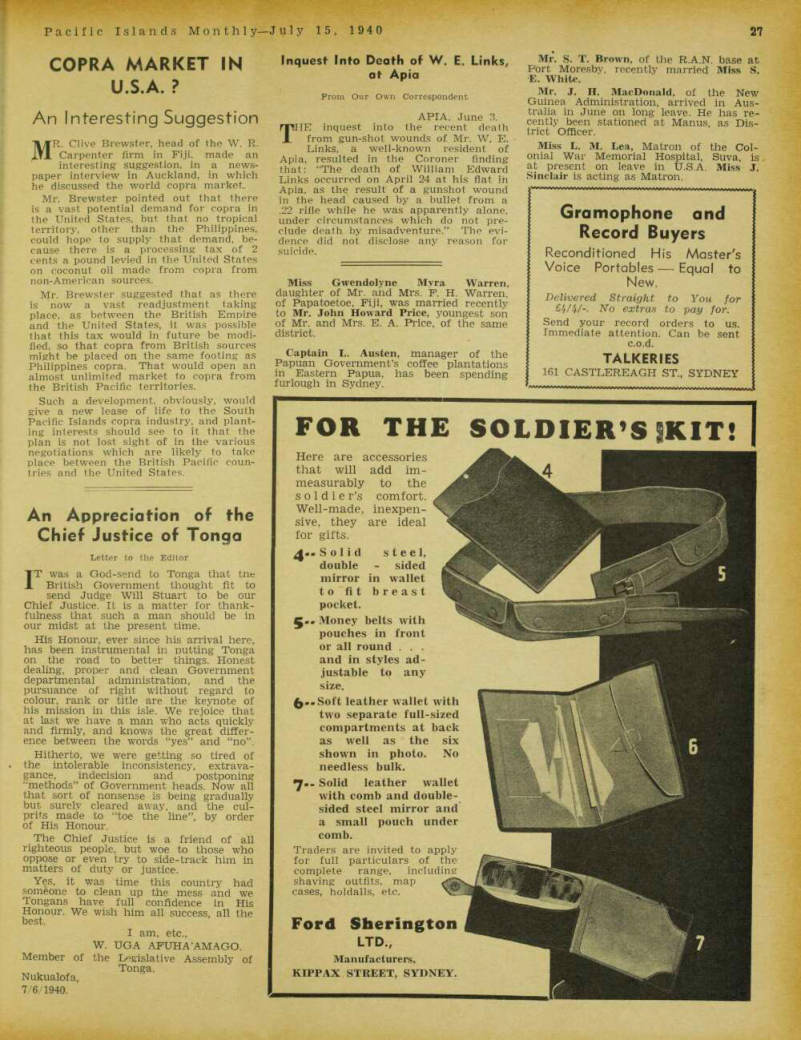
Copra Market In
U.S.A. P
MR. Clive Brewster, head of the W. R.
Carpenter firm in Fiji, made an interesting suggestion, in a news paper interview in Auckland, in which he discussed the world copra market.
Mr. Brewster pointed out that there is a vast potential demand for copra in the United States, but that no tropical territory, other than the Philippines, could hope to supply that demand, be cause there is a processing tax of 2 cents a pound levied in the United States on coconut oil made from copra from non-American sources.
Mr. Brewster suggested that as there is now a vast readjustment taking place, as between the British Empire and the United States, it was possible that this tax would in future be modi fied, so that copra from British sources might be placed on the same footing as Philippines copra. That would open an almost unlimited market to copra from the British Pacific territories.
Such a development, obviously, would give a new lease of life to the South Pacific Islands copra industry, and plant ing interests should see to it that the plan is not lost sight of in the various negotiations which are likely to take place between the British Pacific coun tries and the United States.
Chief Justice of Tonga
An Appreciation of the Chief Justice of Tonga
Letter to the Editor IT was a God-send to Tonga that the British Government thought fit to send Judge Will Stuart to be our Chief Justice. It is a matter for thank fulness that such a man should be in our midst at the present time.
His Honour, ever since his arrival here, has been instrumental in putting Tonga on the road to better things. Honest dealing, proper and clean Government departmental administration, and the pursuance of right without regard to colour, rank or title are the keynote of his mission in this isle. We rejoice that at last we have a man who acts quickly and firmly, and knows the great differ ence between the words “yes” and “no”.
Hitherto, we were getting so tired of the intolerable inconsistency, extrava gance, indecision and postponing “methods” of Government heads. Now all that sort of nonsense is being gradually but surely cleared away, and the cul prits made to “toe the line”, by order of His Honour.
The Chief Justice is a friend of all righteous people, but woe to those who oppose or even try to side-track him in matters of duty or justice.
Yes, it was time this country had someone to clean up the mess and we Tongans have full confidence in His Honour. We wish him all success, all the best.
I am, etc.,
W. Uga Apuha’Amago.
Member of the Legislative Assembly of Tonga.
Nukualofa, 7/6/1940.
at Apia
Inquest Into Death of W. E. Links, at Apia
From Our Own Correspondent APIA, June 3.
THE inquest into the recent death from gun-shot wounds of Mr. W. E.
Links, a well-known resident of Apia, resulted in the Coroner finding that: “The death of William Edward Links occurred on April 24 at his flat in Apia, as the result of a gunshot wound in the head caused by a bullet from a .22 rifle while he was apparently alone, under circumstances which do not pre clude death by misadventure.” The evi dence did not disclose any reason for suicide.
Miss Gwendolyne Myra Warren. daughter of Mr. and Mrs. F. H. Warren, of Papatoetoe, Fiji, was married recently to Mr. John Howard Price, youngest son of Mr. and Mrs. E. A. Price, of the same district.
Captain L. Austen, manager of the Papuan Government’s coffee plantations in Eastern Papua, has been spending furlough in Sydney.
Mr. S. T. Brown, of the R.A.N. base at Port Moresby, recently married Miss S.
E. White.
Mr. J. H. MacDonald, of the New Guinea Administration, arrived in Aus tralia in June on long leave. He has re cently been stationed at Manus, as Dis trict Officer.
Miss L. M. Lea, Matron of the Col onial War Memorial Hospital, Suva, is at present on leave in U.S.A. Miss J.
Sinclair is acting as Matron.
The death occurred suddenly, in Victoria, early in June, of Mrs. Boehm, wife of Mr. E. Boehm, of the Seventh Day Adventist Mission station at Aroma, Papua. Mrs. Boehm, a young woman, left the Territory last October, and later was joined by her husband, on furlough, in Australia , , , Our .?“? Moresby correspondent reports that the following engagements !? avo u+^ eel e „ annoU . nC , e A daughter of Mr. and Mrs. J.J. Lovell, of Manly, Sydney, to Wilham Robert eldest son of Mr. and Mrs. E. J. Frame, of Port Moresby, Papua; Monica Faith, second daughter of Rev. and Mrs. H. Mathews, of Port Moresby, Papua, to John McAdam, second son of Mr. and Mrs. E. J. Frame, of Port Moresby, Papua; Marjory Ruth, eldest daughter of the Rev. and Mrs. H.
Mathew 3, Port Moresby, to Roy (Warrant Officer, R.A.N.) second son of Mr. and Mrs. J. Copley, of Ararat, Victoria.
Advertisements & other items, pp. 29-30 (2 items)
27
Pacific Islands Monthl y—J uly 15, 1940
For The
Gramophone and
Record Buyers
Reconditioned His Master's Voice Portables Equal to New.
Delivered Straight to You for No extras to pay for.
Send your record orders to us.
Immediate attention. Can be sent c.o.d.
TALKERIES
161 CASTLEREAGH ST., SYDNEY
FOR THE
Here are accessories that will add immeasurably to the sol d i e r’s comfort.
Well-made, inexpensive, they are ideal for gifts. 4-- Solid steel, double - sided mirror in wallet to fit breast pocket. £.« Money belts with pouches in front or all round . . . and in styles adjustable to any size. £..Soft leather wallet with two separate full-sized compartments at back as well as the six shown in photo. No needless bulk.
Solid leather wallet with comb and doublesided steel mirror and a small pouch under comb.
Traders are invited to apply for full particulars of the complete range, including shaving outfits, map cases, holdalls, etc.
Ford Sherington
LTD.,
Manufacturers,
KIPPAX STREET, SYDNEY.
GUINNESS
Stout
FOR STRENGTH
as la i His m HB
KSS
I >*-;C
STOCKED BY ALL BRANCHES OF
Brown & Joske Ltd. W. R. Carpenter & Co. Ltd.
Bums Philp & Co. Ltd. Morris Hedstrom Ltd.
Advertisement of Export Bottlers Ltd., London. A. Macfee A Co. Ltd., Wapping, Liverpool England.
Administration Of
Papua
Various Changes Made by New Act
TNTRODUCING the second reading of \ the Papua Bill (altering the desig nation o( the chief offlcer fro ® Madge, Lieut.-Governor to Administrator) in the Commonwealth Parliament at the end of May , the Minister for Pac i flc Territories (]yr r T\r o ck) announced the following changes Tn the Territory’s Ld? ministrative macSnerv m'nistrative machinery.
“The Papuan Public Service formerly contained an office of Administrator, the occupant of which was responsible for the administration of the territory dur ing the inability or absence from the territory of the Lieutenant-Governor. In
1924 it was decided that the senior offi cial member of the Executive Council should carry out such functions under the title of Acting Lieutenant-Governor.
“It is now considered desirable to replace the former provision with one on the lines of that obtaining in New Guinea for the appointment of an Act ing Administrator, namely, that the Governor-General may appoint a person t'o act as Administrator whenever necessary and, in default of any such appointment, the senior official member of the Executive Council present in the territory shall exercise and perform all the powers and functions of the Admini strator; and that the appointment of an Acting Administrator during the absence of the Administrator from the territory shall not affect the exercise or performance by the Administrator him self of any power or function. It is con sidered that provision should also be made for the appointment of a Deputy Administrator in respect of the whole territory in order to facilitate admini stration when the Administrator is still irt the territory, but is carrying out tours of inspection and so is absent from the centre of administration.
“The Papua Act at present provides that the Executive Council shall consist of nine members, one of whom must be a non-official member chosen by and from the five non-official members of the Legislative Council. The remaining eight official members are officers of the territory. The population of Papua at present comprises about 1,600 Europeans and 300,000 natives. It is considered that greater elasticity should be permitted in the number of official members on the Council and, accordingly, instead of the statutory obligation to have an Executive Council of nine members, it is proposed that this number should be a maximum, the actual number of mem bers fluctuating between five and nine as may be necessary to meet the condi tions of the territory. It is proposed that provision be made for the appoint ment of deputies of both the official members and the non-official member of the Executive Council.
“The existing term of the non-official members of the Legislative Council is six years, but it has been decided that this should be reduced to four years.
It has also been thought desirable to provide for the appointment of extraor dinary members of the Legislative Coun cil. Such members would be persons who would be able to tender expert advice on any particular matter with which the Council might be required to deal, but would not be entitled to vote or to be counted in any quorum of the Council.
“It has also been decided to alter the designation of the chief court of the ter ritory from that of the “Central Court” to that of the “Supreme Court”. The court is vested with similar jurisdiction in the Territory as a Supreme Court in the States of the Commonwealth.
“The late Sir Hubert Murray occupied the office of Judge of the Central Court as well as Lieutenant-Governor. There is another judge in the Territory. The salary paid to Sir Hubert Murray was at the rate of £l,BOO per annum. It is proposed that the salary to be assigned to the office of Administrator, who will not be required to perform judicial duties, should be at the rate of £1,500 per annum.”
Mr. L. Logan, Headquarters Officer, Port Moresby, has relinquished his duties in order to take up military work.
Advertisements & other items, p. 30 (1 item)
28
July 15, 194 O—P acific Islands Monthly
Opening Of Rugby Football Season In Suva.
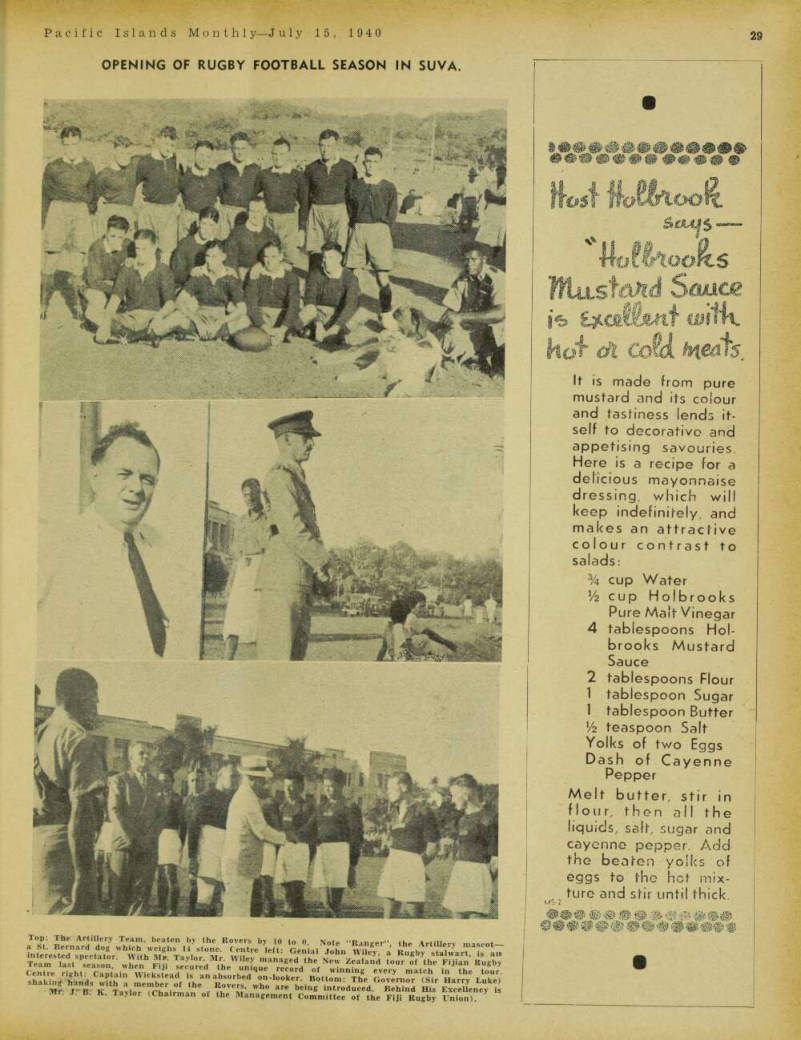
Top: The Artillery Team, beaten by the Rovers by 10 to 0. Note "Ranger", the Artillery mascot a St. Bernard dog which weighs 14 stone. Centre left: Genial John Wiley, a Rugby stalwart, is an intersted spectator. With Mr. Taylor, Mr. Wiley managed the New Zealand tour of the Fijian Rugby Team last season, when Fiji secured the unique record of winning every match in the tour.
Centre right: Captain Wickstead in an absorded on-looker. Bottom: The Governor (Sir Harry Luke) shaking hands with a memver of the Rovers, who are being introduced. Behind His Excellency is Mr. J. B. K. Taylor (Chairman of the Management Committee of the Fiji Rugby Union).
Advertisements & other items, p. 31 (2 items)
29
Pacific Islands Monthl y—J illy 15, 1940
ii
'O5 T ftp
if i It is made from pure mustard and its colour and tastiness lends itself to decorative and appetising savouries.
Here is a recipe for a delicious mayonnaise dressing, which will keep indefinitely, and makes an attractive colour contrast to salads: 3 A cup Water V 2 cup Holbrooks Pure Malt Vinegar 4 tablespoons Holbrooks Mustard Sauce 2 tablespoons Flour 1 tablespoon Sugar 1 tablespoon Butter V 2 teaspoon Salt Yolks of two Eggs Dash of Cayenne Pepper Melt butter, stir in flour, then all the liquids, salt, sugar and cayenne pepper. Add the beaten yolks of eggs to the hot mixture and stir until thick.
MS-2
Sinabada's
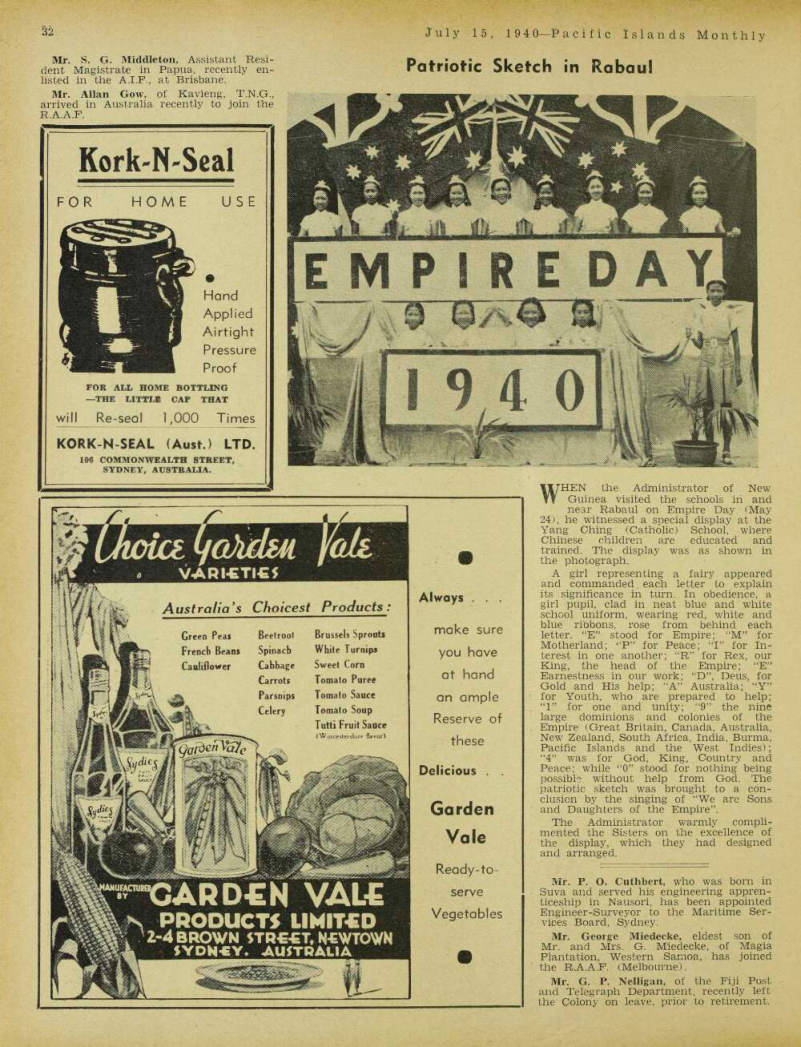
Diary
Sunday:
WE find ourselves on board a very grimy schooner, on final stage of journey to new Papuan home. We perch in stern; remaining deck space swarms with Papuans of every descrip tion. Do not join in deck sports, which in clude snoring on mats, chewing betel nut, expectorating into sea. or just look ing blank. Journey is 30 miles from Samarai, through bright blue sea. Wal low in tropical glamour, pretending not to notice large cockroaches enjoying leather of suitcases, nor the exhaust smoke, which occasionally blots us from view.
Negotiate rather wobbly wharf and two miles of depressed-looking plantation.
New home rears into view, high up on piles—as if bitten by bull-ant. Taubada, baby and self clamber into new domain; find staff lined up to greet us.
First the cook, with his name—Seloi— tattooed on chest to help those of un certain memory; Renie, his “wife”, in a shapeless calico dress and agony of em barrassment; Tobina, wash-boy, his head so stuffed with flowers as to resemble
window-box; Dodie, aged 11, who Seloi declares is his uncle; a small object known as Grain, who will run messages and tend the cum-cums. Staff lives in O.S. dog-kennel at bottom of garden.
Monday:
UNPACKING sets in, Seloi stands on head in packing-case, hands article to Renie, who passes it to Dodie, who allows Grain to remove wrapping. All fall into attitudes of admiration as each dim-dim possession is revealed. Special enthusiasm over sixpenny fly-swatter. Ex plained its use, whereupon each in turn pursues startled Papuan fly up and down kitchen. Only casualty is Grain—swatted ear.
Suddenly, smoke pours through floor.
Dash down to ground level to find Tobina lighting large fire under house for copper, explaining brightly, “Think might’e rain come”.
Catch sight of female in grass skirt, apparently in trance, under frangipanni tree; informed she is Louisa, woman work’im-garden. Question Renie about grass skirt habit, and learn Louisa wears seven of them, thus explaining curious portico effect all round. When top one gets dirty, the idea is to add another to cover it. Apparently, even her best friends won’t tell her when to start a grass fire.
Tuesday:
Extraordinary palisade in garden turns out to be house-belong-cum cum. Think cum-cums bored to sobs with no view, so get Grain to loose them for walk-about. Cum-cums burst out with grateful looks, which go to heart.
Suddenly find behind me a much tattooed gentleman, clad in large leaf, strip of string and 14 leg-bracelets. Fur ther in rear is native woman, skyscraper of bananas on head, leaf basket of pine apples on back, string of tomatoes in one hand. In return for fruit, this dashing greengrocer would like “tabac”. Trans action concluded, he departs, promising to bring yams, oranges, pawpaws, pump kins and sweet potatoes. “Our van will call at door”, apparently. Hope the “van” will get her share of the tobacco, and have the bananas hung up under veran dah.
Later, hear nervous clucking from the garden. Look out to see Grain slinking along behind party of elderly cum-cums, all displaying signs of early hysterics.
Question Soloi, who explains business be long Grain for catch’im eggie—so it be hoves him to keep close watch on his charges while they are gadding about.
Startled from bed, 10 p.m., by horrible flapping noise, shrill shrieks, like ban shees’ annual outing. Hasten forth, to find party of decrepit umbrellas fighting over bananas. Torch turns them into flying foxes, flapping hastily home. Put bananas in kitchen.
Wednesday:
DECIDE that I have material for ex cellent zoo.
Inquire into mysterious noises in ceil ing. “Three puss-cat”, says Seloi. W}iy in ceiling? Apparently puss-cats peculiar that way, and everybody humours them.
Muffled shrieks from Dodie, who dis lodges enormous green frog from side board. Wants to stun it with broom, but prevent him on grounds that dear old frog will stay and catch mosquitoes.
Later, entire staff yells and falls down steps into garden. Find them pursuing herd of large pigs, busy cleaning up garden with snouts like vacuum cleaners.
Many enormous spiders live in house, but all courteous about stepping to one side to let self pass, Ghecko lizards skate about walls; even found one leaving safe with guilty look, and butter on face.
Difficult time getting into bed because of heavy traffic in bats. They swoop through our doorless house like opening scene in thriller; but they do good work among the mosquitoes already queuing up on net.
Rain during night. Appalling noise breaks out, like blunt saw whining on green wood, overlaid with knots, but in lower key, and heavily amplified. Track sound to dining-room table. Dear old
frog is greeting downpour with enthu siasm. Persuade him to sample it.
Thursday:
FIND broken sherry-glass on floor, 6 a.m. Staff protest innocence. Self annoyed, but resigned.
Do some interior decorating. Dodie pulls down old curtains, daintily pat terned in mildew, helps hang new ones.
Show him best way to hammer in nail.
Hit thumb. Dodie laughs with unaffected enjoyment, but self not amused. Noticed D.’s disconcerting sense of humour pre viously, when self tripped over unex pected bump in kitchen floor. Decide can not explain why not funny.
Throw old curtains on floor and say “No want’im’’. Dodie gives excited yelp and gallops them off to kitchen. Five minutes later, am electrified to see en tire staff clad in curtains, with air of those showing advance spring styles.
About to sit down for dinner, when notice dear old frog squatting on chair.
Poke him sharply; ne springs among sherry glasses with air of one who knows them well. No casualties, but dear old frog taken long way into garden and abandoned.
Another nocturnal shower. Dear old frog heard commenting upon it. Treasure hunt with torch finds him inside Taubada’s pith helmet.
Friday:
TCBINA, crowned with orchids and cum-cum’s tail feather, goes mad with packet of starch; my gaze caught by curious independent look of washing, practically standing up alone and closely resembling three-ply.
Finish address on this subject, to find baby playing with lethargic beetle, with air of one about to consume it when ready. Am disposing of beetle over ver andah rail when dear old frog, very friendly, bounds upon my shoulder. Put him in shoe box, tell Dodie to find him new and better home.
Visited by three grass skirts, asking for “smoke paper’’. Grass skirts also keen to see baby, full of admiring murmurs at size and strength. Baby can’t stop laughing. Regular queue of grass skirts later. Realise more smoke paper only Denegeld, so firmly shake head.
Later, still, am telling Taubada of free dom from frogs when deep croaking sets in from under very noses. Dear old frog found perching on ledge under table.
Taubada squelches to nearest swamp and drops frog in. Peaceful night.
Saturday:
IN middle of shower, when look up, and see dear old frog staring down from pipe. Begin to feel must be expected to say “hey presto”, etc., and turn frog back into handsome prince. Personally conduct him to superior coconut tree great distance away.
Two women neighbours drive eight miles to call on me. Seloi says he savvies san’wich too much. Tell him make some tomato, some curried egg and hand Dodie tin of raspberry jam for filling inside sponge cake. Afternoon tea looks nice.
Hand round sandwiches confidently. Later, have one myself, and look abruptly at guests, whose faces bland and polite.
Find Seloi has put curried egg, tomato AND raspberry jam, all together, in all sandwiches. Laugh it off as sort of thing one must be prepared for in tropical housekeeping, but am not delighted. 7 p.m. Dear old frog noticed blessing home from top of Picasso print. Cast him forth. 8 p.m. Dear old frog singing gaily from
top of new curtains. Throw him out. 9 p.m. Dear old frog hopping happily on verandah. Turn him away. 10 p.m. One dear old frog carolling on book-shelf, another dear old frog bellow ing in waste-paper basket. Decide after all, it cannot be same frog all the time, but whole series of frogs. Make C.I.D. search of house and throw three dear old frogs far, far away in garden. Peace reigns. 3 a.m. Dear old frog greets another Papuan dawn.
R.M.
Mr, L. Bintley, A.R.1.8.A., has taken up duties as architect in the Public Works Department of the Fiji Civil Service.
Mr. Malcolm Sheehan, a well-known man on the New Guinea Goldfields for some years past, left recently by air for Australia, where it is understood he an ticipates re-entering the service of the R.A.A.F., of which he was a member dur ing the last war. At the Wau Club, on the eve of his departure, Mr. Sheehan was farewelled by a representative gathering of many old friends.
Dr. R. J. Snodgrass, of the Medical Department of the Fiji Service, has been transferred from Taveuni to Suva. He was replaced by Dr. M. L. McCauley.
Mr. Keith Hedstrom, youngest son of Sir Maynard Hedstrom, of Fiji, recently left the Colony to enlist for army service abroad.
Mr. S. G. Middleton, Assistant Resi dent Magistrate in Papua, recently en listed in the A.IF., at Brisbane.
Mr. Allan Gow, of Kavieng, T.N.G., arrived in Australia recently to join the
R.A.A.F.
Advertisements & other items, pp. 32-34 (3 items)
30
July 15, 194 O—P0 —P acific Islands Monthly
Delicious, Tasty Foods
For ISLAND MEALS
JUST TRY any of AUNT MARY'S Pure Food Products, and you will be back for more . . . delicious in themselves or with innumerable dishes.
AUNT MARY'S BAKING POWDER
AUNT MARY S TOMATO SAUCE
AUNT MARY'S SPAGHETTI IN TOMATO
SAUCE
AUNT MARY'S BAKED BEANS IN TOMATO
SAUCE
AUNT MARY'S CANNED VEGETABLES
Green Peas, Cauliflower, Celery, etc.
RANEE CURRY POWDER
BLOSSOM HONEY In Attractive Jars Or any of the large variety of Pure Pood Products specially packed for Tropical conditions. In Tlllock’s Hermetically Sealed 1-lb. tins. All goods are procurable from your local stores.
AUNT MART’S COOKERY
BOOK.
There’s no liner book for every home . . . 212 pages, lavishly Illustrated In colour, and over 400 recipes and useful hints make It a book that every housewife will want. Send only one shilling and twopence to
TILLOCK & 00. PTY. LTD.,
Sydney N.8.W., and get your copy of this great book NOW.
TILLOCK & CO. PTY. LTD. SYDNEY
Sal
i
General
Merchants
. and
Agents
REPRESENTING LEADING FIRMS IN THE PACIFIC ISLANDS
379 KENT STREET,
SYDNEY.
Cable Address: “Trocas”, Sydney.
Telephones: MJ4657 (5 lines).
Islands Produce Sold on Shippers’ Account Buyers of all Islands’ requirements on Commis- Liberal Advances against Consignments. sion Original Invoices Furnished. 25 Years Islands Trade Experience.
Bankers: Bank of New South Wales. Correspondence in English, French & German.
feather saps strength
puts it back '
Rich in juniper and healthful herbs
ENERATIONS
dfcii§lisj)
(fiflarcttfs
of ©nolitii In case of difficulty in obtaining supplies, write to
BOX 1801 K.. G.P.0., SYDNEY.
the supeb cisiMiirTfs " u * Mpmsi *t/i %<rnbm<
Kork-N-Seal
FOR HOME USE
and pplied irtight 'essure ■oof
FOR ALL HOME BOTTLING
—THE LITTLE CAP THAT
will Re-seal 1,000 Times
KORK-N-SEAL (Aust.) LTD.
106 COMMONWEALTH STREET,
SYDNEY, AUSTRALIA.
,**■ Australia’s Choicest Products Brussels Sprout* While Turnips Sweet Corn Tomato Puree Tomato Sauce Tomato Soup Tutti Fruit Sauce I Woreasiershirr flavor) Beetroot Spinach Cabbage Carrots Parsnips Celery Green Peas French Beans Cauliflower
g a rdcfiVdi
m \ 'zsrA •11 mm Always . . . make sure you have at hand an ample Reserve of these Delicious .
Garden
Vole
Ready-toserve Vegetables
31
Pacific Islands Monthl y—J uly 15, 1940
Patriotic Sketch in Rabaul
WHEN the Administrator of New Guinea visited the schools in and near Rabaul on Empire Day (May 24), he witnessed a special display at the Yang Ching (Catholic) School, where Chinese children are educated and trained. The display was as shown in the photograph.
A girl representing a fairy appeared and commanded each letter to explain its significance in turn. In obedience, a girl pupil, clad in neat blue and white school uniform, wearing red, white and blue ribbons, rose from behind each letter. “E” stood for Empire; “M” for Motherland; <I P” for Peace; “I” for In terest in one another; “R” for Rex, our King, the head of the Empire; “E”
Earnestness in our work; “D”, Deus, for Gold and His help; “A” Australia; “Y” for Youth, who are prepared to help; “1” for one and unity; “9” the nine large dominions and colonies of the Empire (Great Britain, Canada, Australia, New Zealand, South Africa, India, Burma, Pacific Islands and the West Indies); “4” was for God, King, Country and Peace; while “0” stood for nothing being possible without help from God. The patriotic sketch was brought to a con clusion by the singing of “We are Sons and Daughters of the Empire”.
The Administrator warmly compli mented the Sisters on the excellence of the display, which they had designed and arranged.
Mr. P. O. Cuthbert, who was born in Suva and served his engineering appren ticeship in Nausori, has been appointed Engineer-Surveyor to the Maritime Ser vices Board, Sydney.
Mr. George Miedecke, eldest son of Mr. and Mrs. G. Miedecke, of Magia Plantation, Western Samoa, has joined the R.A.A.F. (Melbourne).
Mr. G. P. Nelligan, of the Fiji Post and Telegraph Department, recently left the Colony on leave, prior to retirement.
Advertisements & other items, p. 34 (1 item)
32
July 15, 194 O—P acific Islands Monthly
Ship

To a Lady Seen on a Ship
KEEP quiet, silly woman, in blue evening gown, Your babbling and noise make these deck strollers frown.
Lest, with murder, I add to my crimes, get thee hence!
Vamoose, loud-voiced bint! You’re just “over the fence”.
Begone from this deck, where, with music complete, The young Islands lovers are whispering sweet Little nothings, while strolling or waltzing along; Whilst you jangle and jar, with your voice like a gong.
We hear you complain, to your escort, you wish You could—but you can’t—trust these tropical fish!
And then, in the tones of a militant bull.
You recount how your people have oodles of “pull”.
You vociferously shriek at the wonderful moon, And, within the same sentence, you tell us that soon You’ll be sailing to England, to visit Lord Blair.
Ye Gods! We do pity the folk over there.
You laugh like a fog-horn, you answer “I gueass”.
Good faith! Do we care if your new evening “drass”
Was ruined last night, at the party below, When someone spilled beer on it? Good heavens, no!
Your face, plastered white with the powder you use, And cheeks, two red blots of the rouge you abuse, In spite of the soft light, and romantic hour, Look, truly, as though you immersed them in flour.
You gush and you gabble, on subjects which you Know nothing about, though you might think you do.
You believe you have “it”, you redoubtable ass.
And you shatter our peace like a sledge hammer, glass.
With your long toe-less shoes, and your bare back and arms, Which in your case, will never be thought of as charms.
With fingernails screaming, that, really, you’re dead— Go away! Go to hell! Or, at least, go to bed.
Take your paltry belongings, your rug and your sacque, Take them quickly below, and don’t dare to come back.
Just get—let me put it as clear as the night, Which you have been spoiling—get out of our sight!
J. G. Mci.
Solomon Islands.
Rev. H. S. Hipkin, who arrived in Eng land from the Solomon Islands at the end of last year, is now assisting in a London parish. Some time ago, the Bishop of Melanesia and the English Committee of the organisation decided to appoint a missionary with Melanesian experience to devote his whole time to stimulating interest in England in the work of the Melanesian Mission; but the war interfered with the plan. Rev. Hip kin, who has been with the Mission for eight years, will therefore lecture and preach for the Mission until a permanent appointment has been made.
Meli Bainimarama, a retired Fiji prison warder, was presented with the Imperial Service Medal by the Governor of Fiji recently.
Mr. R. H. Crook, of the Fiji Customs Department, arrived in Australia re cently on several months’ furlough.
Advertisements & other items, p. 35 (2 items)
33
Pacific Islands Monthl y—J uly 15, 1940
Nestle S;Jmiik
For the health oj the family
AL hi
jr—
YOU MUST HAVE
I
MILK
I i
sweeten®
Nothing is so beneficial, indeed essential, to the health of children and grown-ups as an adequate supply of pure milk. But, it is important to guard against contaminated milk, especially in hot climates, and that is why you should always use Nestle’s Sweetened Condensed Milk.
Nestle’s Sweetened Condensed Milk is sealed against all risk of contamination and you can open every Nestle’s tin in the certain knowledge that the contents are absolutely pure and fresh. Nestle’s Sweetened Condensed Milk is the safest milk you can buy.
JS r ® par ed SPECIALLY
|tS T , WARED IN
Vc E 0 AI ?P, ANGLO-SWISS CON - -Hmaustralasia) LTD
NESTLE S;JMIIK
COPYRIGHT 8.228
Feeding 70,000,000 People
HOW the Netherlands East Indies administration deals with its popu lation problems was explained by Mr. J. van Holst Pellekaan, Dutch Trade Commissioner in Sydney, at the June meeting of the Pacific Islands Society.
It is no light task to produce sufficient food each year for 70,000,000 people, or to provide land in the outer islands for the large annual increase in native population. Even a decrease in rice pro duction of from five to ten per cent., the
Commissioner explained, would have dis astrous consequences. The border lino between famine, and sufficient for re quirements, is very fine indeed.
Dr. H. lan Hogbin, moving a vote of thanks, paid high tribute to the Dutch as colonisers. “We have been fortunate in having such good neighbours in the East,” he said, “and we want to keep them as neighbours!”
Major D. Junor, O.C. Signals of the Fiji Defence Force, arrived in Australia recently to join the A.I.F.
Marae ?
Which Was Cook's Marae ?
Some Further Light and Argument
By J. D. Mccomish
THE subject of Mr. A. C. Rowland’s article in the “P.1.M.” of May, is one in which I am keenly interested.
Like Mr. Rowland, I have spent a good deal of time endeavouring to locate “the great moral at Attahooroo”, where, on September 1, 1777, Captain Cook, in the company of Otoo (the King), saw a human sacrifice offered to the god Oro.
I found that “Attahooroo” was not a place, but a large district on the west ern side of the island (Tahiti), which apparently covered the area of the pre sent-day district of Punaauia (and pos sibly part of the district of Paea). Cook’s account (contained in the record of his 3rd voyage, Vol. 2, pp. 31 et seq.) shows that the marae was near the shore.
“The dead body, or sacrifice, was in a small canoe that lay on the beach, and partly in the wash of the sea, facing the morai. Two of the priests, with some of their attendants, were sitting by the canoe, the others at the morai The ceremonies now began. One of the priests seated at the morai, facing those who were upon the beach, now began a long prayer, and, at certain times, sent down young plantain trees, which were laid upon the sacrifice. . . As soon as the prayer was ended, the priests at the morai, with their attendants, went and sat down by those upon the beach . .
The ceremonies continued for some time, but there is no need for me to quote further, the above extracts clearly showing that the site of the marae was close to the shore. I am therefore at a loss to understand Mr. Rowland’s statement that Cook’s account places it at a considerable distance inland.
Acceptance of this statement, together with another quoted by Mr. Rowland from Ellis, apparently diverted him and Mr. Phillips when they were, or so it appears to me, hot on the scent of “Cook’s marae”. (Ellis, in his “Poly nesian Researches”, Vol. 1, page 207, mis quotes Wm. Wilson, first mate of the “Duff”, by showing the latter’s descrip tion of “The great morai at Pappara” as that of the pyramid of “the large temple at Atehuru”. The marae which Wilson described and sketched—see page 207 of the account of the voyage of the “Duff”—was that visited by Cook and Banks in 1769, in the district of Papara.
It exists to-day as a vast, irregular mount of broken coral, etc., and is known as Marae Mahaiatea.) Mr. Rowland quotes Emery as saying (Bishop Museum Bulletin No. 116) that he believed Marae-Taata, a group of three enclosed maraes lying 460 yards from the lagoon, near Papehue, Paea District, to be “Cook’s marae”. The dis tance of Marae-Taata from the shore of the lagoon, in the face of Cook's descrip tion, debars it from consideration as be ing “Cook’s marae”.
Marae Taputaputea, on Punaauia Point (see Emory, page 61), seems to me to fit in better with Cook’s description.
Ellis (Vol. 1, pp. 496 et seq.) says that, after the acceptance of Christianity, the people of Tahiti destroyed everything connected with this marae (which he calls one of the greatest national maraes) excepting “the massy pile of
solid stone-work” which formed one end of <he area which the marae included.
This pile of slone-work remained until 1824, when, in connection with the annual examination of the pupils at the mission school at Burder’s Point (Punaauia Pt.) it was levelled, and the materials used to build a platform 3 ft. high, 194 ft. long, and 175 ft. wide, the whole sur rounded by a stone wall cemented with lime. On this platform, on June 11, 1824, ninety tables were arranged, seats provided, and all the children in the school, about 240, dined together. Inter ference of this nature makes it difficult for investigators to follow the lines of the original construction.
Emory records further interference by the French authorities in 1846. In Bishop Museum Bulletin No. 116, Emory de scribes all the maraes which he was able to trace in the ancient district of Attahooroo. Marae Taputaputea, on Punaauia Point, is the only one which is close to the sea. In this respect, at least, it answers Cook’s description.
With reference to the very fine en graving which illustrates Mr. Rowland’s article: This does not depict “The great marae Taputapuatea at Punaauia (Atehuru)” but the “Great morai of Temarre at Pappara in Otaheite”, sketched by Wm. Wilson in 1797, and shown in the account of the voyage of the “Duff”, facing page 207.
Advertisements & other items, p. 36 (2 items)
34
July 15, 194 O—P acific Islands Monthly
Prescott Pty. Ltd.
SUSSEX ST., SYDNEY,
ore sole wholesole agents for
PINEAPPLE BACON&HAMS
DAISY brand BUTTER "375" BUTTER in TINS 1 lb.-21b.-slb. Sizes.
LEA & PERRINS' Sauces and Most other Super-Quality Lines of the Trade, such as Cheese, Eggs. Etc.
We are Specialists . . . .
X Let us have your confidence. Sixty years is our record of supplying the leading Houses throughout the World in - - - -
FRESH FRUIT VEGETABLES PRODUCE
'Phones: MA 8612 (4 lines).
Cable Address: "Weymarkson”
Codes—Bentleys Private.
WEYMARK & SON LTD.
FRUIT AND PRODUCE MERCHANTS
14-18 STEAMMILL STREET - - - SYDNEY
“ANCHOR FLOUR
THE STANDARD OF QUALITY
m
GILLESPIE BROS. PTY. LTD.
SYDNEY - AUSTRALIA
Learn To Understand
Your Polynesians !
THE need for the full development of a school of Polynesian studies was urged by Professor Sir Thomas Hunter, vice-chancellor of the University of New Zealand, .in an address in Auck land, recently.
“With Australia, we are becoming increasingly responsible for much im portant administrative work in the Pacific,” said Sir Thomas. “Either in co-operation with Australia or by our selves we should provide facilities for training those who are to take respon sible posts in and who are to determine the destinies of the British possessions in these southern seas. Samoa should have taught us that sympathy and good will are not enough. Knowledge and understanding are essential.”
The reference to Australia is difficult to follow. Australia has no jurisdiction over Polynesians—unless a few Nauruans come into that classification.
But there occasionally is need for a better understanding of Polynesians by the young gentlemen whom N.Z. sends to govern Western Samoa, Cook Islands, etc. One sometimes has seen lads graded as ordinary clerks in their own countries, lording it over Polynesian aristocrats who had forgotten more about good manners and noblesse ohliqe than the white official ever had learned.
Lieutenant-Colonel H. E. Woodman, who had been 12 years in New Guinea, latterly as District Officer at Kavieng, has enlisted in the A..1.F and is at pre sent in command of a battalion. Lieut.- Colonel Woodman served with distinc tion in the last war and gained the rank of battalion commander in 1918.
Mr. T. Aitcheson, who died in Suva re cently at the age of 80, was connected with the Colonial Sugar Refining Co., Ltd., practically all his life. He was master of the Co.’s paddle steamer “Rarawai” until it was withdrawn from service, and later he retired on pension.
Aerial Defences
Norfolk Island's Importance to Australia
THE importance of Norfolk Island in the aerial defence of Australia and New Zealand was emphasised by the island’s Administrator (General Sir Charles Rosenthal) when addressing members of the Pacific Islands Society at the Carlton Hotel in Sydney, on June 26.
Sir Charles said that, ever since his assumption of office, he had urged upon the Commonwealth Government the necessity of linking Norfolk Island by air with Australia, New Zealand, the Solomons and the New Hebrides group.
One result of his recent visit to Can berra, he said, was the approval of an aerodrome site on the island.
“People must realise that Norfolk Island is of great strategic importance, as one of the outer defences of this country,” he said, “and in these days, when one does not know what will hap pen within the next twenty-four hours, it is most essential that we should be prepared for any eventuality.”
Advertisements & other items, p. 37 (1 item)
Qmotts
PURE RICE
STARCH
Always ask for
CORAL
BRAND
100% PURE
Noted for its
QUALITY
and
WHITENESS.
Goes Farthest and gives Lasting Finish
WILL NOT
STICK TO
IRON.
Obtainable from Leading Island Stores.
CORAL BRAND
RICE STARCH
.S cot A L '• |A• J* Manufactured by
AUSTRALIAN RICE, LTD.,
Sydney, N.S.W.
THE FAVOURITE
SCHOOL LUNCH
Usually the school lunch is a very scratchy meal, eaten just when the vigorous exercise of the playground has made a strong demand on the endurance of the child. However, with little trouble it can be improved in value and made wonderfully attractive, simply by adding buttered Milk Arrowroot Biscuits. All children love them.
Qmotts
F a m o us
MILK
ARROWROOT
BISCUITS
a ALWAYS ASK YOUR GROCER FOR ARNOTTS !
Pitcairn Is. New Stamps
Eager Collectors Awaiting Issue
STAMP collectors are displaying lively
interest in the forthcoming new issue of Pitcairn Island stamps, being
arranged by the High Commissioner for
the Western Pacific, Suva. The stamps, with their pictorial designs, are:— y 2 d. Cluster of oranges.
Id. View of Pitcairn Island from the sea, with a representation of Fletcher Christian on the stern of ELM*. Armed Vessel “Bounty”.
IVfed. John Adams and his house. 2d. View of H.M. Armed Vessel “Bounty”, with a portrait of Lieutenant Bligh, R.N. 3d. Map showing the relation of Pitcairn Island to other islands in the Pacific Ocean. 6d. A broadside view of H.M. Armed Vessel “Bounty”.
!/-• View of Pitcairn Island from the sea with a portrait of Fletcher Christian. 2/6. View taken on Pitcairn Island, with a representation of Fletcher (Christian on the stern of H.M. Armed Vessel “Bounty”.
The issue probably will be one of philately’s best sellers, and the Commis sion easily may make a profit on it of £25,000 or £30,000.
But how are collectors going to obtain sets? Ships call at Pitcairn irregularly and infrequently. Probably sets will be on sale at the High Commissioner’s office, Mr. J. G. Somerfield, who has been manager at the Levuka branch of the Bank of N.S.W. for some time, left for New Zealand in June, accompanied by Mrs. Somerfield. Mr. S. H. I. Massey has now taken up the nosition of Levuka manager.
T.B. In Papua
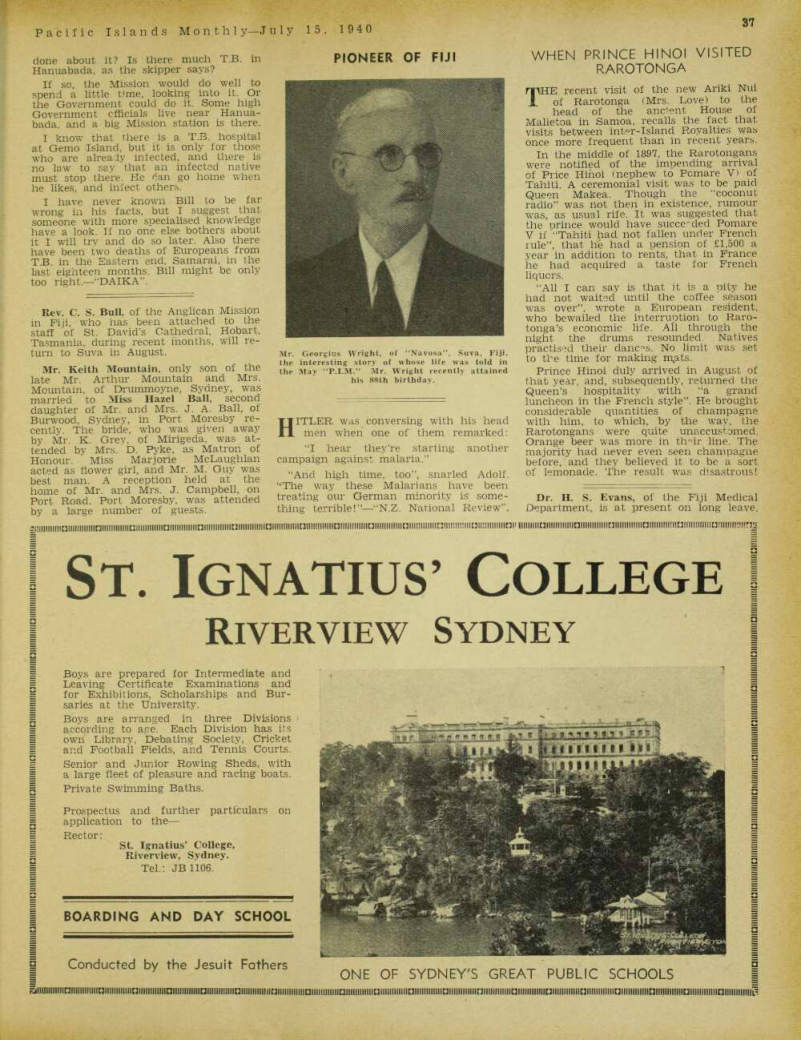
No Precautions in Native Villages
WE had been wandering, most of the day, about the beach and its fringe of coconuts and casuarinas, and were hot and dirty. When we finally came aboard we were tired enough to welcome the cool breeze which had sprung up after dinner and were prepared just to sit back and enjoy it.
There was a big feast—or “Christmas” as the boys called it—ashore, and the lights of many fires twinkled along the beach and cast shimmering reflections on the rippling water. At times, bursts of song and the sound of drums would reach our ears, muted by distance.
The pigs, apparently, had all been killed during the day, or enough for the night’s celebration—although squeals could still be heard at times.
Friend Bill looked thoughtful, as we lay back on deck, with our feet on the rail, smoking. Suddenly, he broke the silence: “I believe that two of those pigs killed over there to-day were infected with T. 8.”
No one showed much interest, and Bill looked a bit surprised and, standing up, went on: “I suppose none of you can realise just what that means. It means that the Papuan native (we know he has T.B. to some extent) is in for a tough time. He prizes his pigs, and almost lives with them. Thev crawl underneath his houses and eat all his refuse, and leave their own there. These pigs are eaten and, at feast times, are transported to
other villages.
“Now, two of those pigs we saw to-day, I will swear, had T.B. and they will be paten, and the germs transplanted to black brother, and some more natives will join the sufferers. They will go home, and spit around the place, and the pigs will come round.
“The thing is like a snowball. The fur ther it goes the bigger it gets. If it is not caught early it will get out of hand.”
The prospector asked how it could be stopped, and suggested keeping the pigs out of the villages. Then he said that, if the pigs out here had T. 8., what about the ones at Hanuabada village, right under the nose of the Government and Mission.
The skipper said that a big percentage of the natives of Hanuabada had T. 8., but that he did not know about the pigs.
T asked Bill how he knew the pigs had T. 8,, and he said: “I have no positive proof, but I am certain in my own mind.
At one time, I was an inspector in the meat industry, and one of the things we looked for was T.B. I had a good look at some of those pigs to-day, and I am positive that if tests were made they would be found to be infected.”
I said: “Yes, but won’t cooking kill the germs?”
“Yes, proper cooking”, said Bill. “Come ashore for a few minutes and have a look-see.”
We clambered into the dinghy and were rowed ashore. Pieces of dead pig were everywhere among the feasters. Some looked 0.K., but they ranged from being well-cooked to being merely singed. But all was going the same way. After half an hour, we went back aboard.
I often have thought over that night.
Did those pigs have T. 8.? Has the possi bility of village pigs being infected been thought of? If so. has anything been
done about it? Is there much T.B. in Hanuabada, as the skipper says?
If so, the Mission would do well to spend a little time, looking into it. Or the Government could do it. Some high Government officials live near Hanua bada, and a big Mission station is there.
I know that there is a T.B. hospital at Gemo Island, but it is only for those who are already infected, and there is no law to sav that an infected native must stop there. He can go home when he likes, and infect others.
I have never known Bill to be far wrong in his facts, but I suggest that someone with more specialised knowledge have a look. If no one else bothers about it I will trv and do so later. Also there have been two deaths of Europeans from T.B. in the Eastern end, Samarai, in the last eighteen months. Bill might be only
too right.-
"Daika”.
Rev. C. S. Bull, of the Anglican Mission in Fiji, who has been attached to the staff of St. David’s Cathedral, Hobart, Tasmania, during recent months, will re turn to Suva in August.
Mr. Keith Mountain, only son of the late Mr. Arthur Mountain and Mrs.
Mountain, of Drummoyne, Sydney, was married to Miss Hazel Ball, second daughter of Mr. and Mrs. J. A. Ball, of Burwood, Sydney, in Port Moresby re cently. The bride, who was given away by Mr. K. Grey, of Mirigeda, was at tended by Mrs. D. Pyke, as Matron of Honour. Miss Marjorie McLaughlan acted as flower girl, and Mr. M. Guy was best man. A reception held at the home of Mr. and Mrs. J. Campbell, on Port Road. Port Moresby, was attended by a large number of guests.
yf ITLER was conversing with his head men w j ien ' one 0 f them remarked: “I hear they re starting another campaign against malaria.” « And Wgh time> too ” snar led Adolf.
TVTaiarianc Vi«vp hpph in ®. tJ9 ? se iviaiarians nave oeen treating our German minority is something terrible!”—“N.Z. National Review”.
Advertisements & other items, pp. 38-39 (3 items)
36
July 15, 19 4 O—P acific Islands Monthly
Capstan
Jpect<t£fy pacAeJfrx f/u> TROPICS
«r: Q r*«T
WIIUMA
fOBACCp
AND
Capstan Navy Cut Tobacco, made from the finest Virginia leaf.
Capstan Cigarettes, round airtight 50's.
Medium and full strength.
P 8824-10-8
READ THE
B.P. MAGAZINE
WINTER NUMBER
iiiiiiiiiiiiiiiiiiiiiiiiiiiiiiiiiiiiiiiiiiiiiim
Now On Sale
Short Stories Pictures Travel Articles - - - - Pages for the Children --- Stage Latest Fashions Screen A
ONE SHILLING PER COPY.
ON SALE AT ALL NEWSAGENTS AND BOOKSELLERS R & r.
Pioneer Of Fiji
Mr. Georgius Wright, of “Navosa”, Suva, Fiji, the interesting story of whose life was told in the May “P.I.M.” Mr. Wright recently attained his 88th birthday.
When Prince Hindi Visited
Rarotonga
THE recent visit of the new Ariki Nui of Rarotonga (Mrs. Love) to the head of the ancient House of Malietoa in Samoa, recalls the fact that visits between int°r-Island Royalties was once more frequent than in recent years.
In the middle of 1897. the Rarotongans were notified of the impending arrival of Price Hihoi (nephew to Pcmare V) of Tahiti. A ceremonial visit was to be paid Queen Makea. Though the “coconut radio” was not then in existence, rumour was, as usual rife. It was suggested that the nrince would have succeeded Pomare V if “Tahiti had not fallen under French rule”, that he had a pension of £1,500 a year in addition to rents, that in France he had acquired a taste for French liquors.
“All I can say is that it is a pity he had not waited until the coffee season was over”, wrote a European resident, who bewailed the interruption to Raro tonga’s economic life. All through the night the drums resounded. Natives practised their danc°s. No limit was set to the time for making rr^ats.
Prince Hinoi duly arrived in August of that year, and, subsequently, returned the Queen’s hospitality with “a grand luncheon in the French style”. He brought considerable quantities of champagne with him, to which, by the way, the Rarotongans were quite unaccustomed.
Orange beer was more in th°ir line. The majority had never even seen champagne before, and they believed it to be a sort of lemonade. The result was disastrous!
Dr. H. S. Evans, of the Fiji Medical Department, is at present on long leave.
Advertisements & other items, p. 39 (2 items)
37
Pacific Islands Monthl y—J uly 15, 1940
St. Ignatius’ College
Riverview Sydney
Boys are prepared for Intermediate and Leaving Certificate Examinations and for Exhibitions, Scholarships and Bursaries at the University.
Boys are arranged in three Divisions > according to age. Each Division has its own Library, Debating Society, Cricket and Football Fields, and Tennis Courts.
Senior and Junior Rowing Sheds, with a large fleet of pleasure and racing boats.
Private Swimming Baths.
Prospectus and further particulars on application to the — Rector: St. Ignatius’ College, Riverview, Sydney.
Tel.: JB 1106.
BOARDING AND DAY SCHOOL
Conducted by the Jesuit Fathers
f i iji r 12 II 1* L.
ONE OF SYDNEY'S GREAT PUBLIC SCHOOLS
Record Of Hurricanes
Prom Our Own Correspondent
Papeete, June 1.
A MOST interesting essay, “Les Cyclones en Oceanic Francaise”, written by Monsieur J. L. Giovan nelli and published in the “Bulletin de la Societe des Etudes Oceaniennes”, in cludes a list of major disturbances in this part of the South Pacific from 1831 to 1940. They number, during that period of
109 years, fifteen hurricanes of more or less intensity.
Comparing, during approximately the same period, the experience of other archipelagoes M. Giovannelli records: — 80 hurricanes in Fiji ((1840-1923). 58 hurricanes in Tonga (1830-1923). , 39 hurricanes in New Hebrides (1830- 1923). 1923) hurricanes in New Caledonia (1830- 34 hurricanes in Samoa (1830-1923).
Half-Caste
(A memory, aroused by the picture of the Euronesian child, taken on Mauke, C. 1., and reproduced on the front cover of this magazine).
ONE day, in May, 1914, after sundry adventures in a smashing sea, on the reef which lay between the anchorage and the boat-harbour, Nixon and I landed upon the rarely-visited island of Mitiaro, not far from Mauke, in the Cook Islands.
It was a lovely place, and the people, clean and unspoiled Polynesians, cluster ing around us excitedly, eagerly offering their simple hospitality, seemed to fit exactly into the framework of palm girt, tropical isle, white coral beach, and blue-green lagoon.
Presently, Nick and I got away from the official doings, and strolled through the little village. It was orderly and fragrant: not a pig in sight, and every fallen palm-frond removed. I discoursed, restlessly, concerning the advantages of life in this quiet and beautiful spot.
Nick seized my arm. “Good God, Robbie—look at that!” he exclaimed.
We were opposite a little house, built somewhat in European fashion. It was buried in tropical greenery. Over the door was a dazzling mass of bougain villea.
Standing in the doorway, outlined against the dark interior, regarding us gravely, was one of the most beautiful girls we ever had seen —slim, fairly tall, perfectly proportioned, olive skin, and large, dark, expressive eyes.
She made a picture there, under the bougainvillea, I shall never forget. We just stood and stared.
She came forward, with perfect com posure, and smiled. “I am Mata,” she said. “You are from the sheep?”
She spoke good English, and her man ner was simple and trusting. She walked with us along the pathway, through the palms, and she held Nick’s hand, and chattered confidingly.
We had called at many islands, and, being regarded as rangatiras of import ance, we had received the flattering attention of many charming Polynesian ladies. Up to now, Nick had displayed merely an academic interest. He held sternly to certain ideals. The quick and flaming friendships of Polynesia did not appeal to him.
But this sweet and simple Mitiaro girl bowled him over, completely. She ques tioned him eagerly about life in his big world outside; and, as eagerly, he sought her story.
It was an oft-told tale. Eighteen years ago, a Portuguese sailor, off a Hong Kong trading-ship, had lived a while in Mitiaro, and temporarily loved the daughter of a chiefly family. Then he had wandered on, and Mata was born.
She had been reared by her mother’s family, and a missionary had taken her to Rarotonga, for a few years, where she had had an education of sorts. She was intelligent, proud of her European blood, eager for European contacts.
“But what are you going to do?” asked Nick, trying unhappily to visualise her future.
“I dunno,” she said. “I no want to stay here. They say I must take my boy—l have waited too long. But I no want these boys—l am papaldngi (a white person).”
Nick stored at the lovely thing, and
horror was upon his young face. We both knew what she meant. It was the old-time custom, in those islands, that girls, between puberty and matrimony, should take a lover, or a succession of lovers. Promiscuity was just as much expected, before marriage, as it was discouraged, after marriage.
Mata was a well-grown and beautiful seventeen. It was astonishing that, so long, she had remained chaste. She told us something of her struggle. Pride, it seemed, had up-borne her—pride in her white blood. But what was to be her fate? There were only a couple of white men there, both married. A ship came only once or twice a year to lonely Mitiaro.
She turned appealingly to Nick—me, she had quite ignored. “You take me with you,” she said. “To Rarotonga, or maybe New Zealand. I can work. I can teach school. I am cook. Oh, I no want to stay here and marry native —I am
papalangi!”
I took one look at Nick, and fled.
The dear old lad was learning, at first hand, something of the tragedy of the half-caste. * * * LATE in the afternoon, we sailed. As I waited at the boat-landing, I saw Nick and Mata coming slowly along the shore, hand in hand, under the gently-nodding trees.
Presently, he joined me and the others, at the landing. His face was grim, and he said nothing. We were surrounded by scores of Polynesian men, women and children. But Mata remained in the background, apart.
As our boats pulled away across the
lagoon, the natives sang their haunt ing songs, and cried farewells. Our party chatted happily together—it had been a pleasant, interesting day.
But Nick silently watched that slim white figure, sitting apart, under the deep-green beach trees. She did not move. I imagined her watching the papalangi go out of her life, with the same grave, sweet look as she had greeted us, in the village street.
Nick spoke bitterly in my ear. “These swine,” said he, indicating our happy, comfortable, chattering party, “think it is fine to have affairs with the Islands girls. Perhaps they do the girls no harm —certainly the girls are willing enough —but look at the results of it. Look at that tragedy back there! I shall never forget that girl, and what our rotten civilisation has done for her.”
That was twenty-five years ago; but I still can see Mata, lovely enough to grace any European assembly anywhere, sitting quietly beside the lagoon, watch ing the white men departing across the seas, and resigning herself at last to the life of a native wife and mother. —R.
Mr. Edwin Berry, of the Berry Engin eering Co., Suva, Fiji, arrived in Auck land recently by the “Mariposa”, on a short holiday.
Mr. T. B. D. Edwards, returned re cently to Suva, Fiji, where he has again taken over the management of the local station of Cable and Wireless, Ltd. Mr.
L. G. Cottew, who has been manager of the station for the past few months left the Colony for Australia on transfer by the June “Mariposa”.
Advertisements & other items, p. 40 (2 items)
38
July 15, 194 O—P acific Islands Monthly
Cordage and
STEAMSHIPS TRADING COMPANY LTD.
PORT MORESBY
PAPUA
SAMARAI
Chairman and Managing Director: A. S. FITCH Shipowners, Wholesale and Retail Merchants and Traders; Shipping Customs and Insurance Agents; Copra and Rubber Plantation Owners.
MAIL CONTRACTORS TO COMMONWEALTH AND PAPUAN GOVERNMENTS AGENCIES:--At Port Moresby: Coral Sea Insurance Co.; Phoenix Insurance Co - Delta Sawmills Ltd.; Acme Bakery Co.; Vacuum Oil Co. Pty. Ltd. At Samarai- Coral Sea insurance Co.; Delta Sawmills Ltd.; Bankers and Traders’
SmaTplanta'iions na ' MU ‘ Ua ' L ‘ fe c °-l Shipyards; -in Papua: Hanuabada, Sivitoi, Aroma. Koki. Hula, Ela Beach, Duga Duga Yule Island. ’
SYDNEY: NELSON & ROBERTSON PTY. LTD.. 12 Spring Street; Melbourne. 396 Flinders Cable C °’ 7 ChISWeU Street ’ Fi " Sbury ’ Fo " do " R .. , Code: Bentley s.
BRANCHES:
STEAMSHIPS TRADING COMPANY, LIMITED
MERCHANTS, SHIPOWNERS AND PLANTERS
PORT MORESBY AND SAMARA I.
Our organisation provides every facility and efficient service as
MANAGING AGENTS AND VISITING REPRESENTATIVES OF
COCONUT AND RUBBER PLANTATIONS.
Estate supervised in bearing and planting stages.
Comprehensive reports compiled and regular visits made to Estates by our competent Plantation Inspector.
WRITE, CABLE OR CALL FOR PARTICULARS-
STEAMSHIPS TRADING COMPANY LTD.
Scott s “Renown” Brand Rope,
Cordage and
Binder
Twine
of Every Description
MANUFACTURED AT
MASCOT, N.S.W.
J. SCOTT
PTY. LTD.
Head Officf and Store:
163 CLARENCE STREET,
SYDNEY,
The Salmon Family of Tahiti
Tahiti
Letter to the Editor PERHAPS “Cloughogue” can enlighten us still more concerning the ante cedents of John Mortimer Salmon, the subject of his article “Tale of Errant Navigation”, in your June issue.
He refers to him as “a scion of the Jewish Salmons of Tahiti”. I have seen this in print before; also, that the Raro tongan Salmon was an American.
The founder of the Salmon family in Tahiti was, of course, Alexander Salmon, an Englishman, who married Arii-taimai, the chieftainess of Papara. There is nothing to show on the Salmon family tree (as published by Teuira Henry, in her “Ancient Tahiti”) of the existence of any J. M. Salmon. Therefore, the latter could not have been a descendant of Alexander Salmon.
This question has often puzzled stu dents of modern Polynesian history, and “Cloughogue” would perform a genuine service if he cleared it up. I am inclined to the view that these men were not re lated, and that the name is merely a coincidence. Contemporary newspaper ac counts refer to J. M. Salmon as an American.
I am, etc.,
Eric Ramsden.
Pacific Islands Society, Sydney, June 18, 1940.
Miss B, L. Hilton retired recently from the District Administration Dept., Fiji.
Miss Jean Cunningham, of Rabaul, arrived in Australia recently to marry Mr. John Cox, also of New Guinea, who is a member of the A.I.F.
Mr. W. A. Miller, who was a Commis sioner of Works in the Colony of Fiji, some years ago, died recently at the age of 70.
Mr. Keith Phillips, formerly well known in Lautoka, Fiji, as an electrician with the C.S.R. Co., is at present serving in England as a member of the R.A.A.F. contingent.
Mr, H, C. Monckton. formerly Adviser in Native Affairs in Fiji, has arrived in Sydney with Mrs. Monckton, and they have taken up residence in Manly. It is expected that one of their sons, who is now at school in New Zealand, will join them before long and attend engineer ing classes at the University of Sydney.
Mr. Christopher Hennings, a member of one of Fiji’s pioneer families, who was for many years in the emplov of the Bank of New Zealand, has taken up residence in Sydney.
Advertisements & other items, pp. 41-42 (2 items)
39
Pacific Islands Monthl y—J uly 15, 1940
William Atkins
Established 50 years—and carrying one of the largest stocks of Iron and Steel in Australia.
Head Office 449-451 KENT ST., SYDNEY.
FULL, COMPREHENSIVE & UP-TO-DATE RANGE IN ALL
DEPARTMENTS, INCLUDING THE FOLLOWING LINES:—
STEEL DEPARTMENT
MILD STEEL:
Rounds, Squares, Flats, Half-rounds, Hexagons, Bevel, Shoeing, Tyre, Angles, Tees, Sheets, Plates, Girder Plates, Chequer Plates, Channels, Hoops, Etc.
BRIGHT STEEL:
Rounds, Squares, Hexagons.
Iron & Steel Merchants
Engineers' Supplies: Set Screws, Studs, Metal Thread Screws, Coach Screws. Files, Cotter Pins, Bright and Black Bolts, Rivets. Etc., Hack Saw Blades.
Power Transmission Gear: Including Plummer Blocks, Couplings, Collars, Etc.
Coach and Motor Hardware: Axles, Springs, Wheelstuff, Duck, Paints.
Farriers' Supplies: Horse Nails, Anvils, Vices, Etc. cnvjiriccKd iurruti
COACH & MOTOR HARDWARE.
TRADE
Cable Address: WILATKLN, SYDNEY.
Extra Special High Speed Tool Steel, Mining Steel, Blister Steel and Spring Steel, Rounds, Flats Gr Squares.
Bar Iron —All sections and sizes.
Motor-Trimmers and Motor Builders' & Motor Painters' Requirements
C. A. WILLEY'S
Quick-Drying Coach and Car Paints, Roughstuff, Elastic Gloss, Synflex Enamels, Lacquers.
DUCO Lacquers and DULUX Enamels—FAßßEX Motor Toppings and Leather Cloths, House & Decorators' Paints, Varnishes fir Brushwore Sole Distributors of CHAMPION'S Decorators Paint Products.
Distributing Agents for BROLITE Lacquers, SYNFLEX Enamels and "POLYGLOSS" Finish.
r mnii I iiiniiirtii \ti i// uib/.m jjiJ 1 miiiiMU
MATONI
Matone shades are washable, fadeless and’are practically permanent.
The peculiar "wet edge" enables the operator to join each finished section perfectly leaving an unmarked expanse of soft, restful colour that does ndt reflect light with a glare.
Ask your Berger agent for the Matone colour card. It gives practical suggestions for interior decoration.
AGENTS THROUGHOUT THE ISLANDS.
Moati
The Judgment Of
"Cloughogue's" Story of Old Rarotonga
IN that not-so-long-ago yesterday, when the Arikis, the high chiefs of Rarotonga, ruled each his own quarter of the island with regal mana, under the fatherly tutelage of L.M.S. missionaries, there dwelt in Ngatangiia (centre of the Takitumu clans) in the bailiwick of Pa Ariki, a sojourner named Silvestre.
This Silvestre, a Portuguese, of the genus beachcomber, had discharged himself, or been voided, from a whale ship some years previously. Whatever the circumstances, the ship had departed without apparent grief at losing him.
He had captured—or been captured by —a native wife, somewhat past the first flush of youthful bloom. She, for pride of having a tane papaa (European hus band) was content to provide him with all those material necessities of life which natives valued, and which were within her means, in return for reason ably sole ownership of such a prize.
They were properly and most efficiently married, for the code of laws the mis sionaries had placed on the Islands left no loophole for marital partnerships unblessed by the Church.
Silvestre’s laxity concerning church attendance was a matter of regret to his native friends, but the European missionaries, assuming him to be a Catholic, were content to overlook it, lest sleeping dogs be awakened.
The islanders were kept on the nar row path of morality, honesty, righteous ness and church attendance (especially the latter) by duly appointed and em powered judges and police. These were selected from the elite of the local pure, or church members.
A chieftain of high native rank, Moati, was the judge for Silvestre’s residential district: and from the deacons supplied the police.
The Europeans on the island at this time were few, and they held together as a body of friends, social class dis tinction forgotten. Silvestre was wel comed and received amongst the whites, for he had a virtue which endeared him to them and to the more church-resis tant among his native neighbours. He was unequalled in his ability to brew bush beer and wine of highest quality— an ability due surely to his race, and fatherland of Portugal.
SOME eight or ten miles distant, at Titikaveka, lived his special friend, Charlie Smith, an American Dutch man, known colloqually as Charlie Boer, from the time of the Boer war.
Charlie, constrained by the united pressure of love, local law and the need of a housekeeper who would “cook and wash him”, was about to take unto himself a native girl as wife. I may add that she proved one of the best bargains Charlie ever made, until he “went west” some years ago.
That the wedding festivities might be worthy of the occasion, in the matter of feasting, and with proper liquid alterna tive to aqua pura and innocuous, green coconut water, Charlie despatched an early invitation to Silvestre, requesting his presence a few days ahead to_ give a hand with the quality and quantity of beer, so necessary and highly esteemed
by Islands guests on such occasions.
Silvestre’s native wife allowed him at this time to live a life of luxurious ease, but much material wealth was beyond her. What clothing Silvestre possessed, when he first landed, had long ceased to be. His wardrobe at the period consisted mainly of a pareu, a dilapidated singlet, and a hand woven hat of ran ara (pandanus leaf), the last a love-gift from his wife.
Jointly, with his wife, Silvestre was owner of the Island-plenty in pigs and fowl; but a horse or vehicle, with which to reach Titikaveka, formed no part of the joint domestic estate, nor of that of any of her many relatives. Therefore, it became imperative, if he were to get there and do honour to the occasion, in transport and appearance, that he should obtain a pair of dungaree trou sers, a new singlet and a buggy with horse and harness.
At the period referred to, the loan of a pair of dungaree trousers, where with to promenade at church-time on Sunday morning, was accepted as a quid pro quo for a week’s labour on a plan tation, by the native work-boys—in addi tion, of course, to their food, also shel ter if required.
In exchange for a couple of fowls, Silvestre wangled the loan of a pair of almost new dungaree trousers, and a new singlet, from a neighbour who occasionally ran to one or two work boys on his land. It was urgently stipulated that the garments were to be returned in perfect condition, unstained and undamaged, before the following Sunday morning.
For the horse and buggy, he made a deal with Ben Cummings, a Euronesian who owned and loaned on hire such rare properties. Silvestre could have them for the required few days, for the sum of two dollars Chile in advance.
Silvestre found a purchaser for some of his live stock, who had two such dollars in cash.
NEXT morning, dressed in his bor rowed plumes, the trousers starched and ironed till they shone, Sil vestre mounted on a box in the buggy and set off for Titikaveka.
Soon, arriving at the Vaikokopu River, he drove in to cross the forde —no bridge existing, then. Half way across, where the water was deep enough to invade the buggy floor, the horse took it on himself to halt, in the cool stream.
Standing high on the box, in the buggy, to save his trouser bottoms from getting wet, Silvestre, with voice and stick, vigorously urged the horse to “carry on”. In vain—the horse “stood fast”.
Suddenly, while jerking the reins with spiteful energy, Silvestre lost his bal ance on the box and toppled overboard.
Alas! for those garments of pride, naught now but wet cloth, with all glory of polish and starch gone. Angered, he reached to the river bottom for a stone, and the one he brought up was some what larger and heavier than it was fitting to throw at a horse.
With a vicious curse, he let fly with it, from where he stood, holding on to the tail end of the vehicle. It struck the animal just behind the ears, and, with a terrified leap or two, the horse made for the other side of the river, to stagger along for a few yards, and fall down.
All Silvestre’s efforts to get it upon its feet failed, for some time. However, at last, cleared of harness and shafts,
it struggled up, on tottery legs.
Time was passing, and if he didn’t hurry he would be too late for mid-day meal at Charlie’s. It was obvious that the horse could not get him there. He was in a quandary, with a useless horse, and the buggy on the wrong side of the stream to drag home.
Close by, lived Henry Nicholas, a European, with a large establishment and several horses, some of which were tethered within view. This gave Sil vestre a thought. He went to the house, explained his predicament, and suc ceeded in borrowing a horse, leaving that of Ben Cummings in its stead, to recover ere his return from Titikaveka.
THE festivities, for Silvestre, lasted almost a week, and on his return home from the direction opposite his departure--he had circled the island —he was met by a waiting member of the police force, who solemnly informed him that Ben Cummings’s horse had died. He was given formal notice to appear before Judge Moati, on next Court day, to answer a claim lodged by Cummings for 50 dollars Chile, being value of said horse.
After making a few inquiries, which but confirmed the bad news, and return
ing the borrowed horse to Henry Nicholas, Silvestre made his way to the home of Judge Moati.
Salutations were exchanged, and the Judge asked: “Well, my son, what can I do for you?”
“Judge,” said Silvestre, “I’m in big trouble, and I would like you to help me.”
“Sorry to hear that. Tell me all about it,” replied the Judge. Without doubt he already had heard particulars from Ben Cummings and others, but it was not good policy to expose such knowledge.
Silvestre duly recounted what had happened, as he wished it to be known, winding up with the remark: “Do you know, Judge, I have a very big, fat, black pig. Well, I’d give that to anybody who could help me out of this trouble.”
“It’s a very serious case, and 'l’m sorry for you,” returned the Judge.
“You’re my friend. But I must go by the law. I’m very sorry for you.”
Silvestre urged his need for sympathy and help. For some time they talked back and forth, but the Judge shed no beam of sympathetic sunshine.
At last, discouraged, Silvestre got up to go. He had reached the doorway, and was speaking his “Noo ra” of fare well, when the Judge, holding up his hand to stop him, remarked: “That must be a very fine pig of yours by what you say. I’d like to see it. Do you think you could tie it up in my
yard to-morrow, so that I could look at it?”
The very early risers, next morning, noticed a large, fat, black pig tied up in the Judge’s yard, and wondered what it had cost him.
In a few days, “Cummings v. Silvestre” came up in the Court. Ben Cummings deposed to all the circumstances, and emphasised the value of the horse.
Silvestre recounted the accident, laying stress on his discomfort, spoilage of clothing, minimising the size of the pebble he threw at the horse, and urging the horse’s worthlessness.
The Judge listened most carefully. He made no remarks and, at the end, pon dered deeply. Then, as if he had found a Solomon-like solution, he called on the plaintiff Cummings before him.
“Cummings,” said he, “what sort of a man are you, and what sort of work is this of yours? You hire to this respec table stranger among us, a horse unfit to do the work for which you knew it was hired. You take from him two good Chile dollars. Through your horse’s fault, his good clothing is spoiled and he might have lost his life or got sick ness in the river, and you have the impudence to waste the time of this Court, listening to your claim for 50 dollars Chile for a useless horse. I fine you eight dollars, to be paid at once, and the defendant leaves the Court blameless. The Court is dismissed.”
In those days, the Judge’s pay was represented by the fines, and the pig was in his yard.
Silvestre was ever after known to the natives as “Ki-rapa” (their nearest pro nunciation of “Git Up!”).
Advertisements & other items, pp. 42-44 (3 items)
40
July 15, 194 O—P acific Islands Monthly
41
Pacific Islands Monthl y —3 uly 15, 1940
Wundebiichi
Timber, Joinery
ETC.
PREPARED BUILDINGS ready for erection a specialty.
SHIP AND BOAT BUILDING.
TIMBERS specially catered for.
PEBROLITE, PLYWOODS.
GALVANISED IRON.
CONSIGNMENTS shipped
by RETURN STEAMERS
to the Islands.
John W. Eaton
PTY. LTD.
WEST CRESCENT STREET,
NORTH SYDNEY.
Telephones; XB 4051 (6 lines.)
BITUMENOID ROOFING
MADE IN AUSTRALIA.
Bitumenoid Roofings, Dampcourse and Insulating Felts are made from the world’s best raw materials. Warranted to stand ‘the most rigid tests.
BITUMENOID THE BEST
Roofing, 1,2, 3-ply; Flooring, Waterproof Materials; Saturated Felt; Resilient Road Jointing; Natural Asphalt Dampcourse; 2 and 3-ply Dampcourse; 1-2 lb. Lead-core Dampcourse: Roofing Cement; Asphalt Paints; Roofing Compound.
SAMPLES AND PRICE LISTS ON APPLICATION.
MAXWELL PORTER & SON LTD.
ESTABLISHED 1888. BUILDERS’ SUPPLIES.
107 REDFERN ST., REDFERN, SYDNEY, N.S.W. Phone: M 3157. Cables Bitumenoid.
Woven Wire for all Industry
COPRA DRYING TRAYS, FLOORS, Etc
FRUIT DRYING TRAYS, MINING SCREENS.
Heavy Mosquito Gauze in Phosphor Bronze and other Metals Impervious to Salt Sea Air.
WIRE DOOR MATS AND GENERAL WIRE WORKS
E. WRIGHT & CO. LTD.
Office anil Works: 148-152 Cleveland Street, Sydney, N.S.W.
Telegraphic Address: “Wrightmake,” Chippendale. f- Or a £
WUNDEBIICHI
NiiiiilHiiiii
fr«h:ss»»:s::: 11
DURATILE
These asbestos cement sheets give waits a tiled appearance at less cost. See examples in our showrooms or write for leaflet.
WUNDERLICH LTD.
Crown & Oeve'and Sts., Red'fern, Sydney
REMEMBER THE NAME
CUPATIIf
• (nreoi
KANGAROO BRAND
Ropes,
Cordage,
and Twines for every purpose
Backed by
86 years of service.
Manufactured by
M. DONAGHY AND SONS,
Pty. Ltd.,Geelong and Sydney.
Fiji Representatives:
PEARCE AND CO.
LIMITED
P.O. BOX 237, SUVA
Ship Chandlery — Hardware
/Write for j
Ship Chandlery /
Cataloaue J
Catalogue
Special “In Bond” Prices for all Islands enquiries quoted on application.
Sole Agents for;
BROOMFIELDS
LIMITED
SYDNEY.
152 SUSSEX STREET ::
Cables; “Boom”, Sydney.
Large and Complete Stocks of
SHIP CHANDLERY
IRONMONGERY OF ALL KINDS, PAINTS,
WHITE LEAD AND OILS.
P. H. MUNTZ & CO.’S 3-CROWN BRAND METAL SHEATHING.
PEACOCK & BUCHANS’ ENGLISH READY-MIXED PAINTS.
If you want "Perfection in Cooking" use a
“Younger”
COOKING STOVE
r These stoves have been on the market in Australia for over Sixty Years, and are still recognised as “The Best”.
They are made with Extended Firebox specially for Long Wood fuel, also special stoves with Cast Iron Oven suitable for Island requirements.
Send for Illustrated Catalogue and Price of Single and Double Oven Stoves.
G. FLETCHER & SON
50 OXFORD STREET, SYDNEY.
Scientists In Tahiti
From Our Own Correspondent
Papeete, May 20.
Notwithstanding war conditions, ethnographic and archaeologic studies are continuing in Oceania.
Monsieur and Madame Van den Broek d’Obrenan, under commission given by the Minister of Colonies last August, are carrying out researches in the islands of this colony.
Attached to the National Museum of Natural History of Paris, Monsieur d’Obrenan is in charge of the department of Oceania. Since their arrival in the colony. M. and Mme. d’Obrenan have graciously placed themselves at the ser vice of the colony and of the Societe d’Etudes Oceaniennes, for the reorganisa tion and classification of the exhibits of the Museum.
In addition, M. d’Obrenan has inaugu rated a course in practical ethnology, which is followed with great interest by members of the local Polynesian Society.
Mr. H. W. Forsyth, formerly of the engineering staff of the Fiji Public Works Department, recently left the Colony to take up a position with the Public Works Department of Hong Kong.
Captain G. B. Nasmyth, well-known Suva Harbourmaster, left Fiji by the June “Mariposa” on leave. He was ac companied by Mrs. Nasmyth and daughter. Captain W. F. D, Hay has taken over the duties of Harbourmaster during Captain Nasmyth’s absence, Mr. R. H. C. Cardew, of Burns, Philp and Co., Ltd., Rabaul, has enlisted in the New Guinea Force.
Advertisements & other items, p. 44 (1 item)
42
July 15, 194 O—P acific Islands Monthly
Late R. W. Gasset
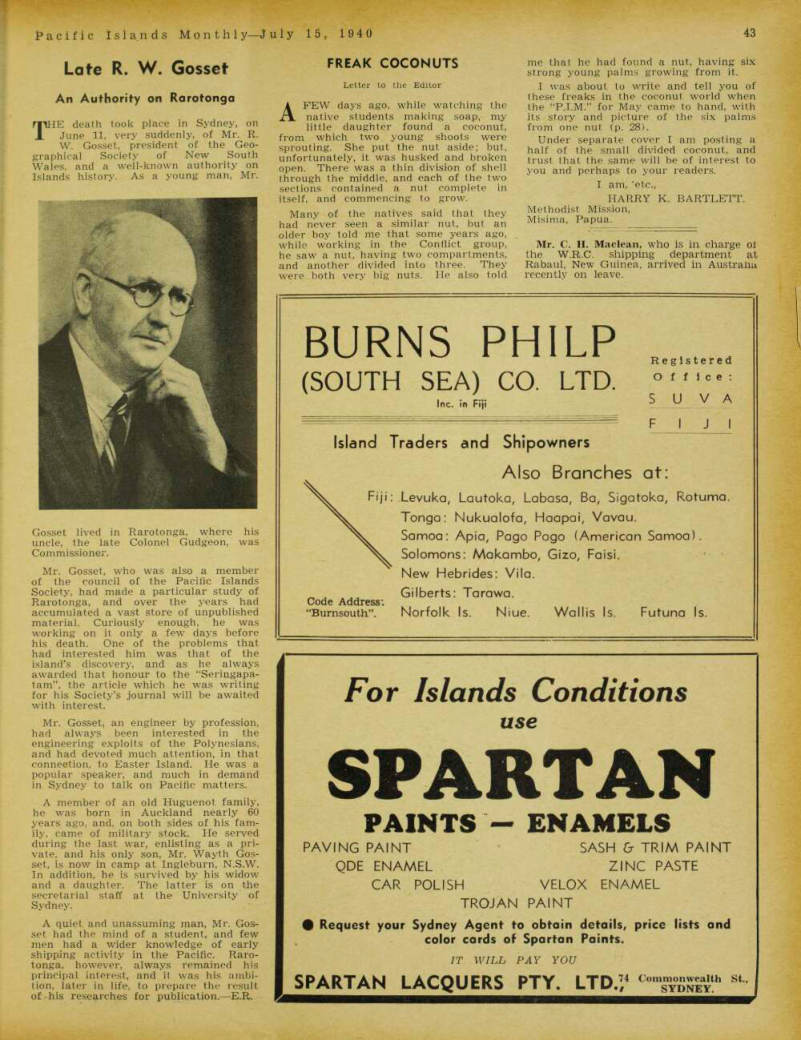
An Authority on Rarotonga
TIE death took place in Sydney, on June 11, very suddenly, of Mr. R.
W. Gosset, president of the Geo graphical Society of New South Wales, and a well-known authority on Islands history. As a young man, Mr.
Mr, Gosset, who was also a member of the council of the Pacific Islands Society, had made a particular study of Rarotonga, and over the years had accumulated a vast store of unpublished material. Curiously enough, he was working on it only a few days before his death. One of the problems that had interested him was that of the island’s discovery, and as he always awarded that honour to the “Seringapa tam”, the article which he was writing for his Society’s journal will be awaited with interest.
Mr. Gosset, an engineer by profession, had always been interested in the engineering exploits of the Polynesians, and had devoted much attention, in that connection, to Easter Island. He was a popular speaker, and much in demand in Sydney to talk on Pacific matters.
A member of an old Huguenot family, he was born in Auckland nearly 60 years ago, and, on both sides of his fam ily, came of military stock. He served during the last war, enlisting as a pri vate, and his only son, Mr. Wayth Gos set, is now in camp at Ingleburn, N.S.W.
In addition, he is survived by his widow and a daughter. The latter is on the secretarial staff at the University of Sydney.
A quiet and unassuming man, Mr. Gos set had the mind of a student, and few men had a wider knowledge of early shipping activity in the Pacific. Raro tonga, however, always remained his principal interest, and it was his ambi tion, later in life, to prepare the result
of his researches for publication.-
E.R.
Cosset lived in Rarotonga, where his uncle, the late Colonel Gudgeon, was Commissioner.
Freak Coconuts
Letter to the Editor A FEW days ago, while watching the native students making soap, my little daughter found a coconut, from which two young shoots were sprouting. She put the nut aside; but, unfortunately, it was husked and broken open. There was a thin division of shell through the middle, and each of the two sections contained a nut complete in itself, and commencing to grow.
Many of the natives said that they had never seen a similar nut, but an older boy told me that some years ago, while working in the Conflict group, he saw a nut, having two compartments, and another divided into three. They were both very big nuts. He also told
me that he had found a nut, having six strong young palms growing from it.
I was about to write and tell you of these freaks in the coconut world when the “P.1.M.” for May came to hand, with its story and picture of the six palms from one nut (p. 28).
Under separate cover I am posting a half of the small divided coconut, and trust that the same will be of interest to you and perhaps to your readers.
I am, 'etc.,
Harry K. Bartlett.
Methodist Mission, Misima, Papua.
Mr. C. H. Maclean, who is in. charge ol the W.R.C. shipping department at Rabaul, New Guinea, arrived in Australia recently on leave.
Advertisements & other items, p. 45 (1 item)
Spartan
BURNS PHILP
(SOUTH SEA) CO. LTD,
Inc. in Fiji Registered Office
SUVA
F I J I
Island Traders and Shipowners
Also Branches at:
Fiji; Levuka, Lautoka, Labasa, Ba, Sigatoka, Rotuma.
Code Address'.
"Burnsouth”. Norfolk Is.
Tonga: Nukualofa, Haapai, Vavau.
Samoa: Apia, Pago Pago (American Samoa).
Solomons: Makambo, Gizo, Faisi.
New Hebrides: Vila.
Gilberts: Tarawa.
Niue. Wallis Is. Futuna Is.
For Islands Conditions
use
SPARTAN
PAINTS - ENAMELS
PAVING PAINT SASH & TRIM PAINT
QDE ENAMEL ZINC PASTE
CAR POLISH VELOX ENAMEL
TROJAN PAINT
Request your Sydney Agent to obtain details, price lists and color cards of Spartan Paints.
IT WILL PAY YOU
SPARTAN LACQUERS PTY. LTD. 7 / Cm SSSSS* st
Fate Of The "Percy
Edwards"
THERE must be many descendants in different parts of the Pacific, includ ing New Zealand, of those Ameri cans who sailed in the late nineties in the brigantine “Percy Edward”. About one hundred of them embarked, in 1896, on this vessel, which had been specially fitted to carry them to some South Seas paradise. Members of the expedition wanted some lonely isle where they could carry out an experiment in civilisation, under ideal conditions. Eventually, they reached Fiji. By that time, they doubted very much whether such an island as the one of which they had dreamed existed!
The expedition was a failure. Some settled in different parts of the Fijian Group, and about fifty went on to New Zealand. But the “Percy Edward” still sailed on, with a few hands. She was partially crippled during a gale, and, later, put into Noumea in distress. There she was condemned and sold. In time the brigantine was re-conditioned in New Caledonia, and entered the labour trade under the French flag. From then on she seems to have disappeared. Per haps some old-timer has knowledge of her subsequent fate. —E.R.
Mr. G. Snow, of Taveuni, Fiji, is now manager of Morris, Hedstrom, Ltd., Savu Savu.
Clan
History Of Teva
Interesting Glimpse of Old Tahiti
READERS of Cook’s “Voyages”, and of the many volumes dealing with Tahitian history that have been written since his day, meet with numerous ref erences to the Teva Clan.
The most authoritive history of this powerful tribal organisation is contained in the scholarly introduction to Volume II of “Quest and Occupation of Tahiti by Emissaries of Spain during the Years 1772-1776”, written by Doctor Bolton Glanvill Corney, the author of that monumental work.
“Much of the family history of their clan, the Teva, has been preserved in native sagas and other forms of oral tradition, and was gathered together into writing by the late Arii Taimai. Time was. she explains, when (some three centuries or so ago) the heads of two families in Tahiti used the right to gird themselves with the maro ura. or sacred cincture of scarlet loriquets’ feathers, which constituted the insignia of most exalted rank and godliness. They were the chief of Vaiari. a small district ad joining the isthmus on its western border, and the chiefess of Punaauia, situated farther along the same coast’ of Tahiti- Nui.
“The titular designation of the Vaiari chief was Terii-Nui-o-Tahiti: that of the lady was Teua-Nui-e-Marua-i-te-ra'i.
But the overlord of Papara, whose dis trict lies between the two above named, possessed alone the right to wear the maro tea, the nap of which was formed of saffron-coloured feathers- and he was officially styled Terii-rere-i-To'oara i
“These august personages were termed arii rahi, or overlords; and, being esteemed to be descended from the gods of the nation, their persons were re garded as sacred, so that subordinate arii and ra’atira (or gentry) stripped them selves to the waist in their presence, in token of respect.
“In the remote past, the arii rahi of Vaiari was, in likewise, Patriarch of the Teva, a large and influential clan occupy ing the south-western part of Tahiti-Nui and all the lesser peninsula called Taiarapu. It seems to have been the only clan- of its quality and magnitude in the island: its prestige had no parallel, and was rivalled only by that of certain chiefly septs of Ra’iatea (the Olympus of Eastern Polynesia), Moorea, and Atehuru —which last included the Punaauia family.
“The patriarchal dignity passed long ago, however, from Terii-Nui to Terii- Rere, his kinsman of Papara; whether by devolution or by usurption is, I think, a matter of doubt. But - thenceforward the right to convoke the Teva chieftains and their clansmen for moot, raid or defence vested in the last-named chief—the wearer of the maro tea, in the Marae To’oara’i.
“The Teva lands extended over eight districts (a typical number in Polynesia), but the clan comprised two stocks only: The inner division, or Teva-i-uta, who occupied the districts west of the isthmus, as far as the borders of Paea; ana the seaward division, or Teva-i-tai, who dominated the south-eastern, or lesser peninsula.
“The principal chieftain of the Teva i-tai, was the lord of Hui and Taiarapu, two districts united under the name Teahupoo (skull haan) and situated at the southernmost part of the peninsula, now called Taiarapu as a whole.
“The hereditary title or style of this
chief was Vehiatua, and, in some re spects at least, he acted as lord-lieuten ant of the peninsula under the suzerainty of the Papara Patriarch; for it was to Vehiatua only that the latter addressed his summons to council of war for all the Teva-i-tai districts, and it was Vehiatua’s office to pass on the call to each of his peers and barons. Thus we know that, as far back as tradition pre serves their history, the Vehiatuas were hereditary chiefs of the most notable rank and influence in Taiarapu.”
In the course of time the dominions of the Vehiatuas were extended to Hatutira (or Tautira, as it is now called) and “Vehiatua’s family became lords in residence of Hatutira, and built their manorial homestead and marae on the breezy and pleasant strip of flat land that juts into the lagoon beside the embouchure of the Vai-te-Tiha, where the Spaniards found them established in 1772-1776.”
Events conspired to add “influence and lustre to the Vehiatuas’ hereditary su premacy over other districts of the lesser peninsula. They did more: for Vehiatua i-Mata’i grew to be not only a power ful ally but a standing menace to the senior stock of his clan, and its overlord, the Patriarch of Papara—who, before this time, had acquired' the sacred, as dis tinguished from the temporal, character from Terii-Nui-o-Tahiti of Vaiario. This menace became extinguished, later on, by a marriage between Vehiatua, of the next generation but one. and a Papara chieftess, Te-eva Piroi. Prom this marri age issued another Vehiatua; and this last one’s son was the ‘thin old man, with a very white head and beard’ who con versed with Banks and Captain Cook on
the 27th of June, 1769.”
A.C.R.
Advertisements & other items, p. 46 (2 items)
44
July 15, 194 O—P acific Islands Monthly
Kamb A L A
WOODS
GREAT Peppermint CURE
Relief comes with very first dose. Tastes good acts fast. Best —for 'Flu Colds and Coughs. Try a I/bottle to-day.
KAMB A L A
CHURCH OF ENGLAND
SCHOOL FOR GIRLS
FOUNDED 1887
A Day and Board-
ing School for
Girls.
KINDERGARTEN TO
LEAVING CERTIFICATE
HONORS.
RESIDENT QUALIFIED
SPORTS MISTRESS.
Prospectus on application to the Principal . . .
MISS F. HAWTHORNE B.A.
KAMBALA SCHOOL
ROSE BAY, SYDNEY
m. n I V' V ■ !
I ‘KAMBALA” Ideally situated in 5 acres of ground 5 Tennis Courts
Honeymoon Island
rE traditional Pacific Islands glamour seems to have reached Nauru, if we may judge by the number of newly weds who recently have arrived, and two island weddings.
Mr. and Mrs. J. H. Barnes were married by the Administrator, and a reception followed in the Recreation Hall of the British Phosphate Commissioners.
The wedding of Mr. and Mrs. Gordon Ferguson took place in a delightful set ting—the porch of the house of Mr. and Mrs. W. V. Bott (B.P.C. manager)—and was conducted by Rev. Clifford L. Welch.
The bride’s brother, Mr. J. Reddon, was for a number of years, on Nauru, in the staff of the 8.P.C., and at the moment is stationed at Ocean Island.
These 1940 brides are fortunate in starting their horned in a new settlement built by the B.P.C. on a commanding position at the top of a hill, overlooking the island. The houses are cosy, and equipped with every modern convenience dear to the heart of a newly-wed.
The engagement was announced re cently of Mr. Harold L. Nicholls, eldest son of Mr. and Mrs. Warne Nicholls, of “Solovi”, Nadi, Fiji, and Miss Joan May Allmann, elder daughter of Mr. and Mrs.
A. E. Allmann, of Sigatoka.
Mr. S. M. Waddingham arrived in Australia from Suva recently on six months’ leave. He is a clerk in the Treasury Department of the Fiji Civil Service.
Dr. N. Critchlow, of the Medical De partment of the Solomon Islands Ad ministration, arrived in Sydney late in June, on furlough.
Mr. and Mrs. George A. Joy, late of British Residency, New Hebrides, have been delayed at Aden on their way to Mukulla, Arabia, where Mr. Joy has been appointed Resident Adviser. At Aden, Mr. and Mrs. Joy will be in contact with the war against Italy,
Rescued Man Returns
Thanks
Letter to the Editor IN your May issue, there appeared, unaer the heading of “Blown to Sea”, the story of my adventures, when I was unfortunate enough to be set adrift, last February.
In this account it was stated that I first landed on East Island. This was not so. It was Nassukwab Island. This correction will clear up some conjecture by the people who know these waters, as to how I was able to get to East Island from where I was, and, also, how I was able to get to the Eigum Group, in a single night.
This mistake was no fault of your cor respondent. At the time I related my story to him, I was under the impression that it was East Island I had landed on.
If you will publish this letter I will take the opportunity to thank collectively all those wonderful people at Sebulagomwa, Salamo and Dobu, for the marvellous kindness and help that I received at their hands. I also would like to express my appreciation to the Papuan Government who sent a flying-boat, at what must have been a great cost, to search for me; and to those members of the R.A.A.F. who conducted the search.
I also would like to thank all those good people who sent letters of sympathy and showed such great kindness to my parents in what was a very trying time for them.
When one realises, as I do now, what a wealth of real sympathy and kindness there still is in this crazy old world, one can look to the future with an easier mind.
I am, etc.,
F. W. J. Low.
Misima, Papua, 16'6/1940.
Advertisements & other items, p. 47 (2 items)
45
Pacific Islands Monthl y—J uly 15, 1940
/>TCNAX germicidalSO^^P
GET POSITIVE
RELIEF FROM
Tested and proved for over 20 years, genuine Vincent’s A.P.C. is acknowledged by the medical profession and the public as the safest and best to relieve all pains and tropical fevers. The reason why Vincent’s A.P.C. is safer and more effective is because it is prepared on the prescription originated by the medical superintendent of one of Australia’s largest public hospitals, where it was first used. Genuine Vincent’s A.P.C. is the only A.P.C. prepared on this scientific hospital prescription. No other A.P.C. is the same as Vincent’s.
fOWOERS >
TABLETS
I/* AND 2/*
SINGLES 2d to
FOR SAFETY’S SAKE—SAY “VINCENT’S”.
NotU
% » l; 5>
f£ft
GERMS of Diphtheria, Malaria, Dhobie Itch, Tinea or Surfers’ Foot, cannot live under “TENAX” lather.
Tropical Skin Diseases can be cured by its regular
only 9 D P er
'fcib
NO VARIATION HAS BEEN
MADE IN ITS COMPOSITION—
judged from the only true angle, that of quality, TENAX has no competitors as a satisfactory germicidal soap, eleven times as rapid in action as carbolic, yet NON-
IRRITANT and NON-POISONOUS. The
Medical Journal of Australia states that TENAX is a germicidal soap that may be recommended with confidence.
/>TCNAX germicidalSO^^P
A PRODUCT OF AUSTRALIAN SOAPS, LTD.
Papuans Claim £4,450 For
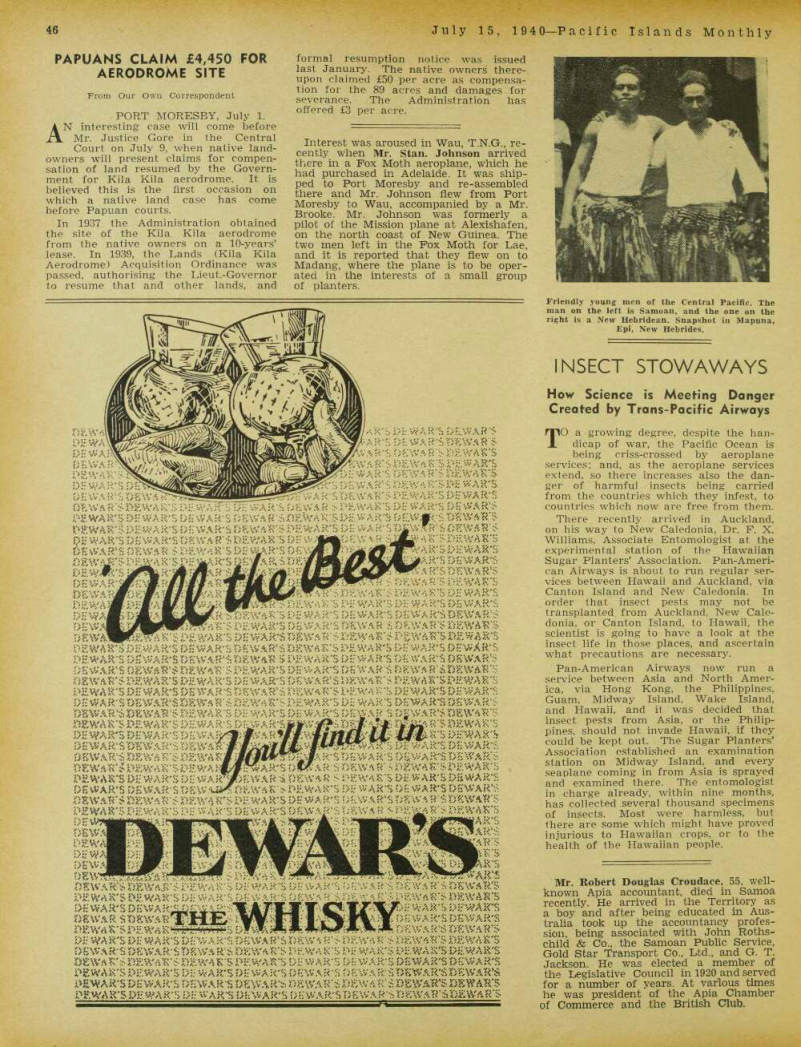
Aerodrome Site
From Our Own Correspondent
Port Moresby, July 1.
AN interesting case will come before Mr. Justice Gore in the Central Court on July 9, when native land owners will present claims for compen sation of land resumed by the Govern ment for Kila Kila aerodrome. It is believed this is the first occasion on which a native land case has come before Papuan courts.
In 1937 the Administration obtained the site of the Kila Kila aerodrome from the native owners on a 10-years’ lease. In 1939, the Lands (Kila Kila Aerodrome) Acquisition Ordinance was passed, authorising the Lieut.-Governor to resume that and other lands, and
formal resumption notice was issued last January. The native owners there upon claimed f5O per acre as compensa . tion for the 89 acres and damages for severance. The Administration has
offered f 3 per acre '
■— ■ Interest was aroused in Wau, T.N.G., re cently when Mr. Stan. Johnson arrived there in a Fox Moth aeroplane, which he had purc hased in Adelaide. It was ship ped to Port Moresby and re-assembled there and Mr j oh nson flew from Port Moresby to Wau, accompanied by a Mr.
Brooke. Mr. Johnson was formerly a pilot of the Mission plane at Alexishafen, on the north coast of New Guinea. The two men left in the Fox Moth for Lae, and it is reported that they flew on to Madang, where the plane is to be oper ated in the interest's of a small group of planters.
Friendly young men of the Central Pacific. The man on the left is Samoan, and the one on the right is a New Hebridean. Snapshot in Mapuna, Epi, New Hebrides.
Insect Stowaways
How Science is Meeting Danger Created by Trans-Pacific Airways
TO a growing degree, despite the han dicap of war, the Pacific Ocean is being criss-crossed by aeroplane services; and, as the aeroplane services extend, so there increases also the dan ger of harmful insects being carried from the countries which they infest, to countries which now are free from them.
There recently arrived in Auckland, on his way to New Caledonia, Dr. F. X.
Williams, Associate Entomologist at the experimental station of the Hawaiian Sugar Planters’ Association. Pan-Ameri can Airways is about to run regular ser vices between Hawaii and Auckland, via Canton Island and New Caledonia. In order that insect pests may not be transplanted from Auckland, New Cale donia, or Canton Island, to Hawaii, the scientist is going to have a look at the insect life in those places, and ascertain what precautions are necessary.
Pan-American Airways now run a service between Asia and North Amer ica, via Hong Kong, the Philippines, Guam, Midway Island, Wake Island, and Hawaii, and it was decided that insect pests from Asia, or the Philip pines, should not invade Hawaii, if they could be kept out. The Sugar Planters’
Association established an examination station on Midway Island, and every seaplane coming in from Asia is sprayed and examined there. The entomologist in charge already, within nine months, has collected several thousand specimens of insects. Most were harmless, but there are some which might have proved injurious to Hawaiian crops, or to the health of the Hawaiian people, Mr. Robert Douglas Croudace, 55, well known Apia accountant, died in Samoa recently. He arrived in the Territory as a boy and after being educated in Aus tralia took up the accountancy profes sion, being associated with John Roths child & Co., the Samoan Public Service, Gold Star Transport Co., Ltd., and G. T.
Jackson. He was elected a member of the Legislative Council in 1920 and served for a number of years. At various times he was president of the Apia Chamber of Commerce and the British Club.
Advertisements & other items, p. 48 (1 item)
Eewar'seewar'sdewar'sdewar'seewar'seewarsr£Wfr'sdewar's
w.
I eewa
E'E.WA
EEW A;
D EWA R
EEWaR
EEW AiESDR
EE WAR’SDEWA?
WA;<
EES EE WAR'S ERWARS
*/AR'S EEWAR'S DRWA RS
A.R'S DSWaR S EEWAR'S
,VA R’ S EEW* R SEE V/AR'S
;>E WAR'S DR WAR’S EEWAR’S
S EEWAR'S EEWAR'S EE WAR'S
S DEWAR'S EE WAR'S EE WAR'S
EE WAR’S EE WAR'S EEWAR'S
DEWARS EE WAR'S EE WAR'S EE WARS DRWA R EEWAR'S EE WAR'S DEWAR'S EEWaREEEWARSEE WAR'S ERW.fcS DEWAR'S
EEWAR'SEEWAR'SDEWAR'SDEWAR'SEEWAR'SEEWARSR£WfR'SDEWAR'S
AW SEE
EE
AR'S
R'S aR R'S
a R S EEWAR'S
AR'S EE WAR'S
'-.R'S DEWAR'S
- A R' S ERE/ A R’S
TT< S EEWaRS EE WAR'S
• EE WAR’S EEWAR'S EE WAR'S
EE WAR'S EE WAR'S EE WAR'S EEWAR'S EWaRS EE WAR'S EE WAR'S EEWAR'S DEWAR'S A R'S EEWAR'S EEWAR'S DEWAR S ER WAR'S EEWAR'S AR'S EEWAR'S EEWAR'S ERW.aR S EEWaRS EEWAR'S EEWAR'S EEWAR'S ERWAR S EEWAR'S DEWAR'S EEWAR'S EEWAR'S EE WAR'S DEWAR S EEWAR'S EEWAR'S EE WAR'S EEWaR S EEWAR'S EE WAR'S ER WAR S EEWAR’S EE WAR'S EEWAR'S EEWaRS EEWAR'S EE WAR'SEEWARSERWAR'SERWAR'S EEWAR'S EEWAR'S EEWAR'S EE WAR S ERWAR ; SV)EWaR SEEWAR'SEEWAR'S EE WAR'S EE WAR/S EE WARS ESEvVaR'S EEWaRS i'E'A'A R'S EE WAR'S EEWAR'S EE WAR S DEWAR'S EEWaR S EEWaR'S EE WAR'SEE WAR'S DEWAR'S DEWAR'S pE WAR'S EE WAR'SERW.aR SDEWAR SEE W, DEWAR'S DEWAR S EEWaRS EE WAR'S DEWJ
EEWAR'S
DRwJk'S
EE WAR
DEW AT
EEWA
EEW.
DEW;
DEWA.’
DEWAR'S. ERWAR S EEWAR S EE -WAR'S EE WAR'S DE\ EEWA R' S EEWA R'S EEWA R' S D
EE WAR'S DE WAR'S EEWA
EEWAR'S DEWAR 1 S ERWA
DEWAR S EEWAR'S EEWA
ERW A R' SEEW A R' SEE W A
EEWAR'S EE WAR'S EE WAR
EE WAR'S EE WARS DEW
A.R ER
WAR'S EEWaR S
R S EEWAR'S
R'S EEWAR'S
AR'S DEWAR'S
AR'SDEWAR'S DEWAR'S DEWAR S
AR'S DIPT; A R S EEWA S' •• EEWAR'S EEWA R'S EW'AR S EEW a S S EEWAR'S EEWAR'S EEWAR'S
f.WAR >EEWAR'S EE WAR'S DE WAR'SDEWAR’S
EEWAR'S EEW'A R'S EEWA R'S EEWA R'S EE W A R'S EEWA R'S EEWA R S EEW ARE EEWAR’S EEWAR'S EE WAR'S EE WAR'S DEWAR'S DEW'A?*'S ERIE'S EEWAR'S
AR'S
i EE
AR'S
DEW';
'A.R S
DE EV R'S
EEW
R'S
EEW,
Air
AVAR'S
DEW?
VA EEWARS EEWaJS'S EEWA R'S EE WAR’S EE WAR'S EEWARS ERWaR' S DEWAR’S
EEWAR'S EEWAR'S EE WAR'S
EE WAR'S
EE WAR SEEW'A
EEWAR'S EEWARS EEWAR'S E
V A :<
EW A R'S EEWAR'S
>E WAR'S EE WAR'S
E E W A R.' S EEWA R'S
ER WAR S EEWAR'S
EEWAR'S EEWAR'S
EE WA R'S EE WAR'S EE W AR'S DEWAR’S EEWA R’ S EEWA R DEWaR SDEWAR'SDEWaR SEEWaR S ERWAR S EE WAR'S EEWAR'S EE WAR'S EEWAR'S EEWAR'S EEWAR S EEWAR'S EE WAR'S EEWAR'S EEWAR'SDEWAR'S EEWAR'S EEWAR'S EE WAR'S EEWAR'S DEWAR'S DEWARSS DEWAR'S DEWAR'S r>EWAB-Sgg.WAR-S»gyAR-Sol,-\VAR-St>gWAR-S»SWA»^B!gWAy&r)gWAR-S
Jottings From Rabaul
From Our Own Correspondent
Rabaul, June 12.
SOMEBODY blamed Leap Year; others the war; others the Bachelors’
Ball; whatever the reason, Hymen has had a busy time lately. Last week saw Joe Bartlett and Miss Higgins mar ried; on Monday of this week, Syd. Ken sett and Marie Sherry followed suit; previously, over in Madang, Gwen Cun ningham and Jack Evans (he of Colyer- Watson Ltd.) had the knot tied by one of the American Lutherans there. So off goes another of Rabaul’s prettiest girls. Her sister, Jean, is to follow suit in a few weeks; but she is travelling South to become Rabaul’s first war bride.
What to Do With Germans As the situation in Europe has grown more intense, so has the local agitation for the general internment of all enemy aliens and their sympathisers grown in intensity. The Rabaul soldiers’ sub branch, ever since its re-organisation, has had that subject as one of its out standing policies, and the New Guinea State branch supported its representa tions. Names were submitted of sym pathisers; and, in some quarters, anyone appearing friendly toward old German residents is looked upon as suspect.
This is carrying the policy a bit far, for many of the real old-time Germans have nothing whatsoever in common with Nazism, nor have they sympathies in that direction. This is particularly so where it refers to many of the old-time Roman Catholic fathers, and makes one realise the truth of the saying that
every Nazi is a German, but every Ger man is not a Nazi.
One of the big dangers in this country is the half-caste element picking up propaganda from German broadcast sta tions and passing it on to the natives.
One such instance of this cropped up at Kokopo, when a half-caste plantation overseer was caught spreading Nazi propaganda, as well as being away from his residence without permission. It turned out that he was one of the Finschhafen Lutheran Mission products, and made no bones about being a Nazi.
He collected six months on one charge and a month on another. All wireless receiving and transmitting sets have been taken from enemy aliens, and aliens are only allowed to have them in their possession on permit from the
police.
Copra Hold-Up
Dire depression seized the planting community recently when circulars from one of the Big Firms intimated that unless shipping space was made avail able no more copra would be bought; also that credits were cut down to the absolute bare necessities. Commercial ruin seemed to stare the country in the face, and the question was: What could be done? The president of the Planters’
Association had died in Melbourne (Bill Grose will be a great loss to the Terri tory in many ways), the vice-president had left to do his bit with the Navy, and the situation seemed desperate.
Then a whisper came that a ship would be made available, and that future char ters would be possible. Meanwhile, the London price had dropped 16/- sterling.
So New Guinea planters are not feeling too bright.
Generous Support of War Funds Despite low copra prices and the bug bear of not having any boats to take away our produce at any moment, New Guinea has done not so badly when called upon. Recently, the Red Cross units in the Territory subscribed £350 in a day for the appeal launched by the Central Council in Melbourne for ambu lances for the British Red Cross. When the war loan was floated, it was not long before over £30,000 had been sub scribed for that, and nearly £1,500 taken up in war-savings certificates. I hear of one man who strolled into an office the other day and wrote a cheque for £lOO as a free gift to the Commonwealth for war purposes, and several chaps, who happen to be holding a few pounds, have put this in the free-of-interest loan.
Death of Widow of Rarotonga's
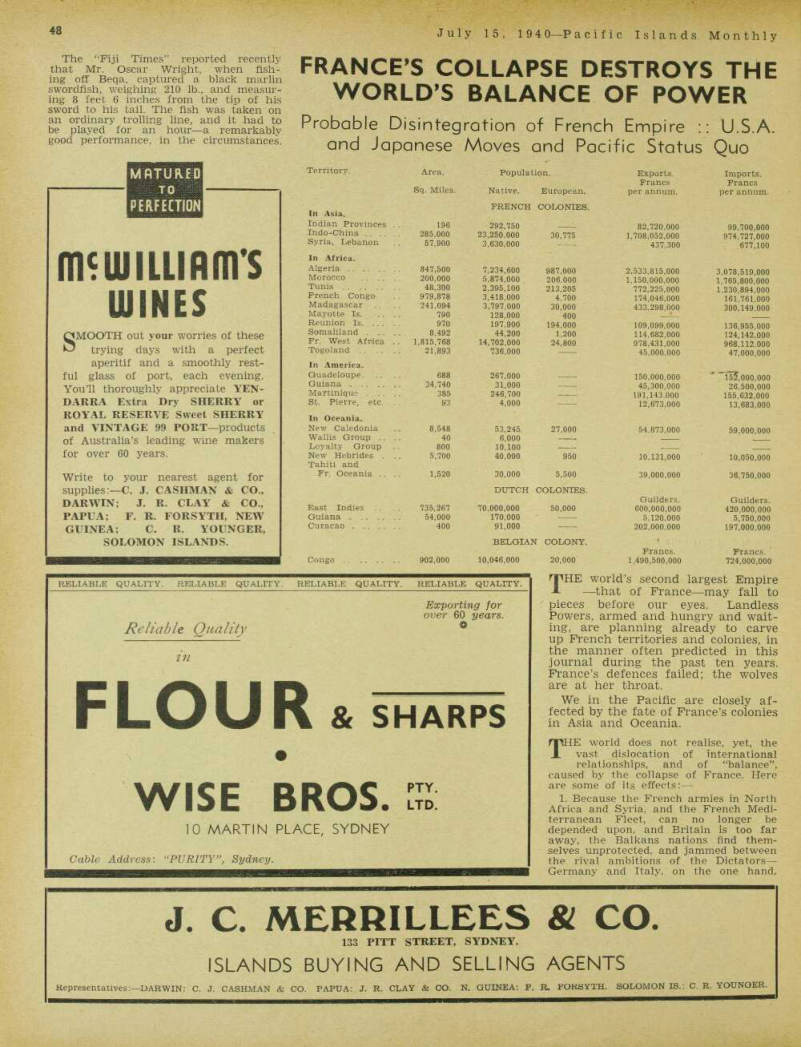
Makea
Rarotonga, June 16.
THE death occurred on June 14 of Makea Vaine, aged 69, wife of the late Ariki Makea Nui Tinirau. The funeral was attended by all sections of the community. • * q Major Clive Brewster, for many years managing director of Brown and Joske, Ltd., Suva, and more recently head of W. R. Carpenter and Co.. Ltd., Suva, arrived in Sydney in July from Fiji and proceeded to Melbourne for the pur pose of joining the R.A.A.F. Major Brew ster served in the Great War and since then continuously has been an active member of the Fiji Defence Forces.
The “Fiji Times’’ reported recently that Mr. Oscar Wright, when fish ing off Beqa, captured a black marlin swordfish, weighing 210 lb., and measur ing 8 feet 6 inches from the tip of his sword to his tail. The fish was taken on an ordinary trolling line, and it had to be played for an hour—a remarkably good performance, in the circumstances.
Advertisements & other items, pp. 49-50 (2 items)
47
Pacific Islands Monthl y—J uly 15, 1940
Kriesler
<v.“ x /r \S I) /b>-
YOU’RE THERE
WITH A
KRIESLER
“THE BEST SET AT ANY PRICE London .. . Paris .. . Berlin .. . U.S.A. etc. Perfect long range reception with supreme tonal quality.
Full particulars write: Featured above is Kriesler Model 4K40 —Mantel type, 6 volt, vibrator operated radio in moisture proof walnut veneered cabinet. Full size chassis and speaker— specially built for the tropics.
Price 31£ Gns.
Kriesler 1.4 volt low consumption battery world range portable Model 4K87.
Price 21 Gns.
KRIESLER (AUSTRALASIA) PTY. LTD., BOX 23 P.O. NEWTOWN, N.S.W.
MATURED
TO
PERFECTION
imuiiumnrs
WINES
SMOOTH out your worries of these trying days with a perfect aperitif and a smoothly restful glass of port, each evening.
You’ll thoroughly appreciate YEN- DARRA Extra Dry SHERRY or
ROYAL RESERVE Sweet SHERRY
and VINTAGE 99 PORT—products of Australia’s leading wine makers for over 60 years.
Write to your nearest agent for supplies:—C. J. CASHMAN & CO.,
DARWIN; J. R. CLAY & CO.,
PAPUA; F. R. FORSYTH, NEW
GUINEA; C. R. YOUNGER,
SOLOMON ISLANDS.
RELIABLE QUALITY. RELIABLE QUALITY, RELIABLE QUALITY. RELIABLE QUALITY.
Reliable Quality
in Exporting for over 60 years. $
FLOUR & SHARPS
wise bros. rs
10 MARTIN PLACE, SYDNEY
Gable Address: “PURITY " Sydney.
J. C. MEHRILLEES & CO.
133 PITT STREET, SYDNEY.
ISLANDS BUYING AND SELLING AGENTS
Representatives:—DAßWlN: C. J. CASHMAN & CO. PAPUA: J. R. CLAY & CO. N. GUINEA: P. R. FORSYTH. SOLOMON IS.: C. R. YOUNGER.
France’S Collapse Destroys The
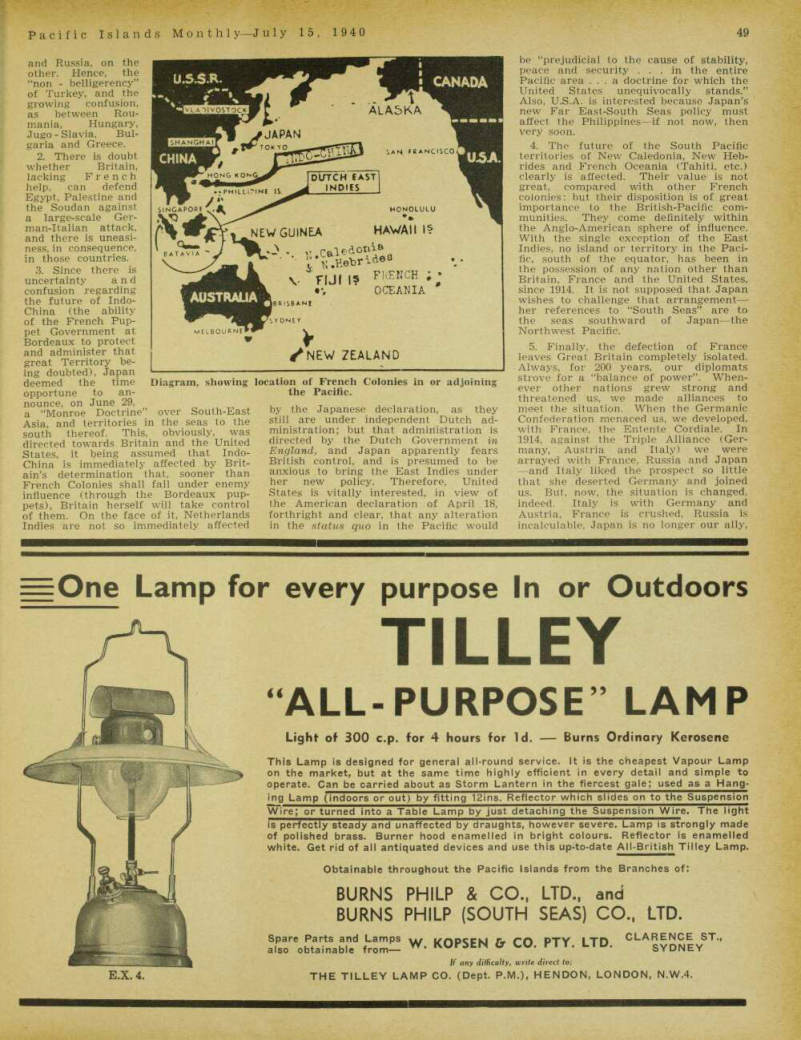
World’S Balance Of Power
Probable Disintegration of French Empire :: U.S.A. and Japanese Moves and Pacific Status Quo
THE world’s second largest Empire —that of France—may fall to pieces before our eyes. Landless Powers, armed and hungry and wait ing, are planning already to carve up French territories and colonies, in the manner often predicted in this journal during the past ten years.
France’s defences failed; the wolves are at her throat.
We in the Pacific are closely af fected by the fate of France’s colonies in Asia and Oceania. mHE world does not realise, yet, the X vast dislocation of international relationships, and of “balance”, caused by the collapse of France. Here are some of its effects: — 1. Because the French armies in North Africa and Syria, and the French Medi terranean Fleet, can no longer be depended upon, and Britain is too far away, the Balkans nations find them selves unprotected, and jammed between the rival ambitions of the Dictators— Germany and Italy, on the one hand,
Territory.
Area.
Population.
Exports.
Imports.
Francs Francs Sq. Miles.
Native.
European. per annum. per annum.
French
Colonies.
In Asia.
Indian Provinces . . 196 292,750 82,720,000 99,700,000 Indo-China 285,000 23,250,000 30,775 1,708,052,000 974,727,000 Syria, Lebanon 57,900 3,630,000 437,300 677,100 In Africa.
Algeria 847,500 7,234.600 987,000 2,533,815,000 3,078,519,000 Morocco 200.000 5,874,000 206,000 1,150,000,000 1,765,800,000 Tunis 48,300 2,395,100 213,205 772,225,000 1,230,894,000 French Congo 979,878 3,418,000 4,700 174,046,000 161.761,000 Madagascar 241,094 3,797,000 30,000 433,298,000 300,149,000 Mayotte Is 790 128,000 400 Reunion Is 970 197,900 194,000 109,099,000 136,955,000 Somaliland 8,492 44,200 1,200 114.682,000 124,142,000 Fr. West Africa . . 1,815,768 14,702,000 24,800 978,431,000 968,112,000 Togoland 21,893 736,000 — 45,000,000 47,000,000 In America.
Guadeloupe 688 267,000 150,000,000 ' — 15?,000,000 Guiana 34.740 31,000 — 45,300,000 26,500,000 Martinique 385 246,700 -—.— 191,143.000 155,632,000 St. Pierre, etc. . . &3 4,000 — 12,673,000 13,683,000 In Oceania.
New Caledonia 8,548 53,245 27,000 54,873,000 59,000,000 Wallis Group .. 40 6,000 — Loyalty Group .. 800 10,100 — New Hebrides . .. 5,700 40,000 950 10,131,000 10,050,000 Tahiti and Fr. Oceania .. 1,520 30,000 5,500 39,000,000 36,750,000
Dutch
Colonies.
Guilders.
Guilders.
East Indies 735,267 70,000,000 50,000 600,000,000 420,000,000 Guiana 54,000 170,000 — 5,120,000 5,750,000 Curacao 400 91,000 — 202,000,000 197,000,000
Belgian Colony.
• f Francs.
Francs.
Congo 902,000 10,046,000 20,000 1,490,500,000 724,000,000
and Russia, on the other. Hence, the “non - belligerency” of Turkey, and the growing confusion, as between Rou mania, Hungary, Jugo - Slavia, Bul garia and Greece. 2. There is doubt whether Britain, lacking French help, can defend Egypt, Palestine and the Soudan against a large-scale Ger man-Italian attack, and there is uneasi ness, in consequence, in those countries. 3. Since there is uncertainty and confusion regarding the future of Indo- China (the ability of the French Pup pet Government at Bordeaux to protect and administer that great Territory be ing doubted), Japan deemed the time opportune to an nounce, on June 29,
a “Monroe Doctrine” over South-East Asia, and territories in the seas to the south thereof. This, obviously, was directed towards Britain and the United States, it being assumed that Indo- China is immediately affected by Brit ain’s determination that, sooner than French Colonies shall fall under enemy influence (through the Bordeaux pup pets), Britain herself will take control of them. On the face of it, Netherlands Indies are not so immediately affected
by the Japanese declaration, as they still are under independent Dutch ad ministration; but that administration is directed by the Dutch Government in England, and Japan apparently fears British control, and is presumed to be anxious to bring the East Indies under her new policy. Therefore, United States is vitally interested, in view of the American declaration of April 18, forthright and clear, that any alteration in the status quo in the Pacific would
be “prejudicial to the cause of stability, peace and security ... in the entire Pacific area ... a doctrine for which the United States unequivocally stands.”
Also, U.S.A. is interested because Japan’s new Far East-South Seas policy must affect the Philippines—if not now, then very soon. 4. The future of the South Pacific territories of New Caledonia, New Heb rides and French Oceania (Tahiti, etc.) clearly is affected. Their value is not great, compared with other French colonies: but their disposition is of great importance to the British-Pacific com munities. They come definitely within the Anglo-American sphere of influence.
With the single exception of the East Indies, no island or territory in the Paci fic, south of the equator, has been in the possession of any nation other than Britain, France and the United States, since 1914. It is not supposed that Japan wishes to challenge that arrangement— her references to “South Seas” are to the seas southward of Japan—the Northwest Pacific. 5. Finally, the defection of France leaves Great Britain completely isolated.
Always, for 200 years, our diplomats strove for a “balance of power”. When ever other nations grew strong and threatened us, we made alliances to meet the situation. When the Germanic Confederation menaced us, we developed, with France, the Entente Cordiale. In 1914, against the Triple Alliance (Ger many, Austria and Italy) we were arrayed with France, Russia and Japan —and Italy liked the prospect so little that she deserted Germany and joined us. But, now, the situation is changed, indeed. Italy is with Germany and Austria, France is crushed, Russia is incalculable, Japan is no longer our ally,
Diagram, showing location of French Colonies in or adjoining the Pacific.
and the United States simply cannot believe that its security actually is challenged.
THE surrender of the French came to the British people as a terrible shock. We could not blame them for falling back, under the frightful blows of the German mechanical Colos sus; but we did expect them to fight on, in Southern France, or in French Northern Africa.
We know, now, that the French armies and the French people were not de feated, and did not surrender, but that they were betrayed by their national leaders. Official France was rotten at
the core. Paris, for 15 years, had reeked of political and commercial corruption.
Any Paris newspaper, and most politi cians, could be bought.
We had known that for many years; but what we did not know was that the rot had extended into the nation’s defence system. The greatest crime of the feeble, futile, fumbling old leaders was their cold-blooded and cynical desertion of Great Britain, in circum stances which placed our Empire at a terrible disadvantage. Nevertheless, our sympathies go out to all the Frenchmen we have known, high-spirited fighters and gallant gentlemen, to whom the
Bordeaux Submission must appear a thing of overwhelming shame. It is a terrible thing to see such men under the heel of Hitlers and Mussolinis.
Little of the French Empire may sur vive. We may as well face facts. Britain will fight on, until her aims are achieved; but the restoration of the France which so cruelly deserted her probably would . demand an effort that cannot be ex pected and could not be justified.
LOOK at the list of French colonies, etc., at the head of this article.
Consider the machinery necessary to permit the administration of those colonies by the so-called Government of France, from Bordeaux.
France, now, is disarmed and occu pied by Germans and Italians. The French masses, and most of the middle classes, we may be certain, are seething with resentment against their betrayers —against the Ministers now functioning at Bordeaux. The Bordeaux Government can carry on only while it is protected by Germany and Italy, and while the French masses are kept in subjection by enemy soldiery. France, to an increasing degree, will be policed by the enemy.
Is it conceivable that, in such circum stances, Great Britain, mistress of the seas, will allow Hitler’s puppet Govern ment, at Bordeaux, to administer colo nies all over the world, which in many cases adjoin British colonies?
It seems more likely that Britain, where practicable, vjyll take the Terri tories under her own protection, to be administered for the duration of the war by the French National Committee established in London. That arrange ment would be similar to what has hap pened in the case of the Dutch, Belgian and Danish colonies.
When Holland and Belgium were over-run, the Dutch and Belgian Govern ments moved to Britain; and, from there, the Dutch officially administered the Dutch territories (previously, when Holland was threatened, they had re moved huge gold reserves from The Hague to New York), and the Belgian officials took charge ot Belgian Congo.
Denmark had surrendered; and Britain thereupon took over her only colony, Iceland, to be held for her until the end of the war.
France, now, is in the same position as Denmark; and Britain, therefore, may be expected to take certain of France’s colonies under her protection, in the same way—subject, however, to the United States “Monroe Doctrine” in the Western Hemisphere (affecting all French colonies in the Americas) and perhaps subject also to Japan’s “Monroe Doctrine of the Far East”.
LATER: It is now July 4. Since the above was written, the position, in rela tion to France, has become worse.
Traitors and Fascists are in control of the Bordeaux Government, and are re acting to the Nazis’ whispered urge, that Britain should not be permitted to “interfere” with the administration of the French colonies. The French people are being held in subjection by German police and German propaganda, France is being “Nazified”, Spain is being lined up with the Nazi-Fascist bloc; and it is not impossible that, very soon, Britain will be officially at war with her late ally, France, as well as with Spain.
That is part of the Dictators’ plan to invade and control Northern Africa, via Morocco.
Dr. Frederick Bowie, of Aberdeen, Scot land, whose name was brought promin ently before the last meeting of the British Medical Association in connection with his discovery of a cure for pneumonia, is a native of the New Hebrides, being the elder son of the late Rev. F. G. and Mrs. Bowie, of Tangoa, Santo.
Advertisements & other items, pp. 50-54 (4 items)
48
July 15. 194 O—P acific Islands Monthly
49
Pacific Islands Monthl y—J uly 15, 1940
Tilley
=One Lamp for every purpose In or Outdoors E.X. 4.
“ALL-PURPOSE" LAMP
Light of 300 c.p. for 4 hours for Id. — Burns Ordinary Kerosene This Lamp is designed for general all-round service. It is the cheapest Vapour Lamp on the market, but at the same time highly efficient in every detail and simple to operate. Can be carried about as Storm Lantern in the fiercest gale; used as a Hanging Lamp (indoors or out) by fitting 12ins. Reflector which slides on to the Suspension Wire; or turned into a Table Lamp by just detaching the Suspension Wire. The light is perfectly steady and unaffected by draughts, however severe. Lamp is strongly made of polished brass. Burner hood enamelled in bright colours. Reflector is enamelled white. Get rid of all antiquated devices and use this up-to-date All-British Tilley Lamp.
Obtainable throughout the Pacific Islands from the Branches of:
BURNS PHILP & CO.. LTD., and
BURNS PHILP (SOUTH SEAS) CO,, LTD.
tSToSZlS? W. KOPSEN CO. PTY. LTD.
CLARENCE ST.,
SYDNEY
If any difficulty, write direct to: THE TILLEY LAMP CO. (Dept. P.M.), HENDON, LONDON, N.W.4.
PROPELLORS
All Sizes to 54 in. diameter . . . any pitch.
SHAFTS MADE TO ORDER.
Bearing and Stuffing Boxes —Rudders — Tanks for Water and Fuel —Exhaust Pipes and Mufflers.
Copper, Bronze and Aluminium Founders.
D. H. PORTER & CO.
43-45 DRUITT STREET, SYDNEY.
■ m .
FOR INTER-ISLAND TRANSPORT
THE CHAPMAN 16 ft. CABIN LAUNCH
Th is craft is particularly suitable for Island use. The roomy, lock-up cabin provides ample storage space for provisions, stores, etc. Besides, the sturdy Coach-house cabin makes this craft a real rough weather launch—waves roll off like water from a duck's back. Powered with Chapman PUP Engine. Write for details.
The
PREDOMINATING
CHOICE is
... THE HIGHEST QUALITY AND MOST
ECONOMICAL PETROL YOU CAN BUY
The whole of the Shell organisation has been brought to bear on producing this unbeatable petrol. No other petrol can give you such a perfectly balanced performance for Starting —Pick-up Power or Mileage.
jfou can 6c sure c/ ZActt
THE SHELL COMPANY (PACIFIC ISLANDS) LTD.
SO 24
For children's coughs and colds
get WOODS'GREAT PEPPER-
MINT CURE. Safe —the best for 45 years. Tastes good and brings relief with the very first
dose. Handy-sized bottle, only
I/-. Also in 2/- and 3/- sizes.
A. B. DONALD Ltd.
AUCKLAND
ISLAND TRADERS & GENERAL MERCHANTS
P.O. Box 1 509. Cables & Telegrams, "Kingdom", Auckland.
W. H. GROVE & Sons Ltd.
AUCKLAND
Island Traders. p.o. box «o.
Telegraphic and Cable Address; “Grove”, Auckland.
Shippers of all classes of New Zealand Products, specially prepared for the Island trade.
Representing English Manufacturers throughout the Cook and Society Islands, Fiji, Tonga, Samoa, Niue, New Caledonia, New Guinea, etc.
In FIJI as —W. H. Grove & Sons (Fiji) Ltd.
51
Pacific Islands Monthl y— J uly 15, 1940
A Trader's Tale
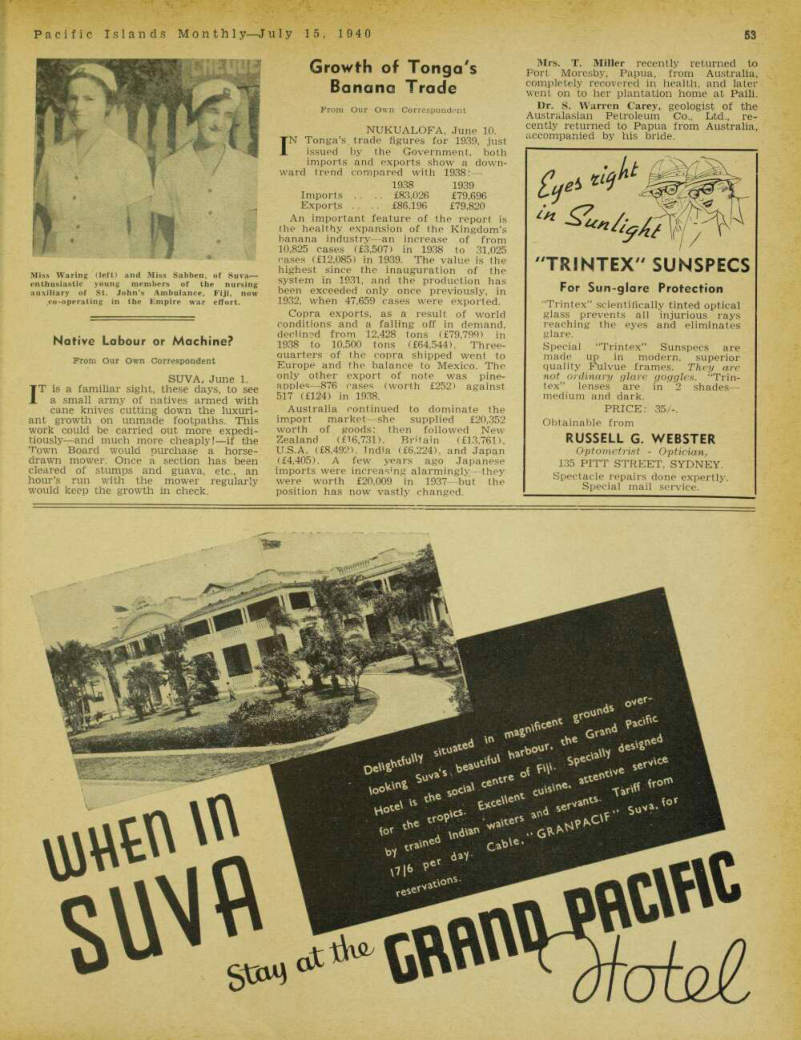
Lamps, Candlenuts, and the Oracle
By “Tukapa Koko”
BEFORE the Islands became so civilised that copra fell to one-third-of-a penny per pound, the humble huts of the darker brethren were illuminated by candle-nuts, after the sun set and the taro-weeder homeward plodded his weary way.
There were great advantages in the use of the “tui-tui” as an illuminant. It was cheap—in fact, it was free; there were no mantles to buy, no generators (surely an invention of the devil!) to replace, no pumps to re-valve, to re-washer. One applied a match to the string of nuts
threaded on a “kikau”-spike, and there one was.
How different to-day! If one has not a petrol-lamp operated by pressure, or that weird compound of the dear old Miller-type lamp with a wick, and the mantle of the gas school of thought—if one has not this, one is actually dead.
It was vastly different in the days when Plancus was consul.
That was the in-between stage, when the deficiencies of the candlenut were tolerantly recognised, and on such occasions as visitors called, the Lamp of Ceremony was lit, without any insult to the nut of economy.
They were in many houses then, those hanging lamps; and they weren’t cheap to buy! Ornamented with lustrous cry stal prisms, they were beautiful un-lit; but, performing their biological function of a guest-night—generally Saturdays— they made a reed-and-thatch shack into a Fairyland, with the golden glow from their circular wicks reflected by facets of crystal that dazzled the eye.
But they were tigers for kerosene!
The stores used to stock these hanging lamps at £5 or more a time. They were mostly imported from the land of the wooden nutmeg; but one or two of them, made of china wondrously be-flowered, came from the country that has given Adolf Hitler to a wondering world, and there was about them a subtle something, a Teutonic nordicism, that made them different.
In the case of the German lamps, there was a drawback; careless handling of the illuminative portion, belike a knock with the bottle from which it was filled, meant disaster. The “ue”, as the natives term the floral font that held the kerosene, would crack, the fuel flow dis mally away. A vainglorious, becrystalled hanging frame, ornamental but useless, was all that was left.
The knowledgeable Yankees must have known of this, for their product had a brass font, and the be-flowered ‘‘ue” was external to it, a mere camouflage as far as the act of filling was concerned. The first cost was the only outlay, not count ing occasional wicks.
We in Mangaia had —and have—one of these last. It is a goodly thing, even now, and the apple of Teremoana’s eye, in spite of the passing of time and the coming of Tilley-Lamps, Primus-Lamps, Coleman-Lamps, and all the rest of the modern equipment. And our old veteran is more than a lamp—it is an Oracle!
By some strange coincidence, the glass of this lamp always casts the shadow of future happenings, by breaking, even if not lit, without warning or cause, when any important event is on the eve of occurring. It came into our possession eleven years ago, being then over thirty years old. And it has prophesied for us the death of chiefs and native kings, the passing of Commissioners—and their return, after the new incumbent was found to be a dud —the sinking of ships (e.g., the “Tahiti”—we lost goods to the value of £6 in her abandoned parcel mail) and, latterly, the present war.
The bill for glass chimneys, at 2/6 each, has been no small item of our household expenditure; but, on the other hand, the fore-knowledge that is fore-arming is worth that sum.
We are waiting nojv for the glass to crack for the passing of Abominable Adolf, and the end of the war. That will be a half-crown’s worth that I won’t be grudge !
Mr. B. McArdel, formerly a member of the “Papuan Courier” staff in Port Moresby has enlisted with the A.I.F.
Miss Waring (left) and Miss Sabben, of Suva— enthusiastic young members of the nursing auxiliary of St. John’s Ambulance, Fiji, now co-operating in the Empire war effort.
Advertisements & other items, p. 54 (1 item)
52
July 15, 194 O—P acific Islands Monthly
Native Labour or Machine?
From Our Own Correspondent SUVAy June 1.
IT is a familiar sight, these days, to see a small army of natives armed with cane knives cutting down the luxuri ant growth on unmade footpaths. This work could be carried out more expedi tiously—and much more cheaply!—if the Town Board would purchase a horse drawn mower. Once a section has been cleared of stumps and guava, etc., an hour’s run with the mower regularly would keep the growth in check.
Growth of Tonga's
Banano Trade
From Our Own Correspondent
Nukualofa, June 10.
IN Tonga’s, trade figures for 1939, just issued by the Government, both imports and exports show a down ward trend compared with 1938: 1938 1939 Imports . . . . £83,026 £79,696 Exports . . . . £86,196 £79,820 An important feature of the report is the healthy expansion of the Kingdom’s banana industry—an increase of from 10,825 cases (£3,507) in 1938 to 31,025 cases (£12,085) in 1939. The value is the highest since the inauguration of the system in 1931, and the production has been exceeded only once previously, in 1932, when 47,659 cases were exported.
Copra exports, as a result of world conditions and a falling off in demand, declined from 12,428 tons (£79,799) in 1938 to 10,500 tons (£64,544). Three quarters of the copra shipped went to Europe and the balance to Mexico. The only other export of note was pine apples—B76 cases (worth £252) against 517 (£124) in 1938.
Australia continued to dominate the import market —she supplied £20,352 worth of goods; then followed New Zealand (£16,731). Britain (£13,761), U.S.A. (£8,492). India (£6,224), and Japan (£4,405). A few years ago Japanese imports were increasing alarmingly—they were worth £20,009 in 1937 —but the position has now vastly changed.
Mrs. T. Miller recently returned to Port Moresby, Papua, from Australia, completely recovered in health, and later went on to her plantation home at Paili.
Dr. S. Warren Carey, geologist of the Australasian Petroleum Co., Ltd., re cently returned to Papua from Australia, accompanied by his bride.
Mr. Harry Buffett, an old and respected resident of Norfolk Island, died recently at the age of 81, following a long illness.
Advertisements & other items, pp. 55-56 (2 items)
53
Pacific Islands Monthl y—J uly 15, 1940
dial
* in
"TRINTEX" SUNSPECS
For Sun-glare Protection “Trintex” scientifically tinted optical glass prevents all injurious rays reaching the eyes and eliminates glare.
Special “Trintex” Sunspecs are made up in modern, superior quality Fulvue frames. They are not ordinary glare goggles. “Trintex” lenses are in 2 shades — medium and dark.
PRICE: 35/-.
Obtainable from
RUSSELL G. WEBSTER
Optometrist - Optician,
135 PITT STREET, SYDNEY.
Spectacle repairs done expertly.
Special mail service. *4
VS0 1 dial
REG. TRADE MARK, 72,783.
“CINNAMOLIA”
PREPARATIONS
No. 1 CINNAMOLIA for Dysentery, diarrhoea and other infections of the alimentary canal. 3/- per bottle.
No. 2 CINNAMOLIA INHALANT for
Coughs, colds, ’flu, catarrh and other infections of the nasal and respiratory passages. 2/- per bottle & dropper.
No. 3 CINNAMOLIA OINTMENT for
cuts, scratches, ulcers, piles, etc. 1/6 per pot.
Obtainable at these prices at
FALKS PHARMACY
238 GEORGE ST., SYDNEY.
For Wholesale Rates to Chemists, Hospitals, Institutions, etc., apply to “CINNAMOLIA” Preparations, 17 Murray Street, Waterloo, N.S.W.
The Most Extensive Manufacturers in the British Empire of
RUBBER STAMPS,
INKS, STENCILS,
Marking Devices,
ACME STAMP PADS
OFFICE & STATIONERY SUPPLIES
We also Manufacture & Supply a Complete Line of
LIMEWASHING AND
SPRAYING MACHINES
for all purposes.
Let us know your requirements and we will quote by return.
WRITE FOR OUR GENERAL CATALOGUE
Li me washing Machine
EXCELSIOR SUPPLY CO. PTY. LTD.
278 host Office Place,
MELBOURNE, VIC.
HEAD OFFICE :
160 BROADWAY,
Formerly known as George St., West, 1
SYDNEY/' N.S.W.
’ 50 Victoria Street,
WELLINGTON, N.Z.
When D.O. Bell Was
Killed
Tragedy of 1927 Re-Told in Book
Thirteen years ago, in October, 1927, Mr. W. R. Bell, a district officer in the Solomons, his assistant, Mr. Lillies, and 13 native police were massacred in the Solomons. The incident, now, is almost forgotten. Jack McLaren, an Australian author, rc-tells it in a book recently pub lished in London, “Gentlemen of Em
pire”:
TAKE the case of District Officer W.
R. Bell, on the island of Malaita, in the Solomons. He was there with his assistant, Mr. K. C. Lillies, a clerk named Marcus, and 12 native policemen. Often he was alone ex cept for his native police. He was at tacked by fever, yaws and other ill nesses, for the island was notoriously unhealthy.
One of his jobs was to collect un authorised firearms from the natives.
Another was to collect the native poll tax.
These things were anathema to Bas iana, a big chief and “devil man”, who
plotted to overthrow the white govern ment’s authority. He sacrificed pigs over a long period to discover when the omens pointed to the right time for a revolt. And then the time came.
Basiana and his people were told to meet Bell at the tax hut to pay in their money and surrender any rifles in their possession. Basiana collected his people together and told them that the hour had struck. He worked them up to a pitch of excitement so that they cried: “We are men of Malaita, war riors and takers of heads. Destroy the white man!”
Next day they appeared at the tax hut. Bell sat in the front of it with his assistants. To minimise any display of force, his native police had been told to stay inside the hut.
Slowly the warriors filed past, put ting down their weapons and paying their taxes. Then came Basiana. He, too, put down his Snider rifle, paid his tax and slipped back into the crowd of 250 Malaitans.
Suddenly the crowd parted. Basiana, holding his reclaimed rifle bv the barrel, leapt through and brought the heavy stock down on District Officer Bell’s head, killing him instantly.
Lillies and Marcus were treated in the same way. The police, trapped in the hut, were slaughtered.
Some time later an Australian war ship was sent to Malaita and an armed party was landed. Basiana’s men were rounded up and brought to trial. Six of them, including Basiana, were exe cuted, and many of the rest were given long terms of imprisonment.
England
Anthropologist Arrested in England
JT was reported from London in July that Captain George Henry Lane Fox Pitt-Rivers, who was private secretary and A.D.C. to the late Lord Forster, Governor-General of Australia, in 1920- 24, had been “detained” under the De fence Regulations.
Captain Pitt-Rivers was known in New Guinea, particularly in the Bismarck Archipelago, where he did field work in anthropology in 1921. He was president of the Australasian Association for the Advancement of Science in 1923, and secretary and treasurer of the Inter national Union for the Scientific Investi gation of Population Problems in 1931.
He is now 50 years old. In 1915, he married a daughter of Lord Forster, and she obtained a divorce in 1929. She said that her husband had encouraged im moral ideas, particularly polygamy. “My husband repudiated the Church and the marriage ceremony entirely”, she said.
“He had curious ideas regarding a chaste life”.
Disciple Of Melanesia
Captain Pitt-Rivers hinted at his mar riage views in a lecture given after his return to England from Australia. “Take a hint from the Melanesian marriage system”, he said. “Our present marriage might be modified by a form of con cubinage. Who knows?” He said that in Melanesia, unmarried girls were free to receive lovers. This served as an ap prenticeship for marriage.
On June 13 a fire in a factory owned by Desikoko, Ltd., in Alexandria, Sydney, destroyed about 450 tons of copra. Desi koko, Ltd., is a subsidiary of W. R. Car penter and Co., Ltd.
Advertisements & other items, pp. 56-58 (3 items)
54
July 15, 194 O—P acific Islands Monthly
55
Pacific Islands Monthl y— J u 1 y 15, 1940
Cool\ Refreshing Breezes
on the Hottest
The E.T.C. Air Circulator completely supersedes all others—for beauty, efficiency and long life. Indispensable for clubs, homes, offices, theatres, and shops, the E.T.C. Air Circulator delivers farreaching volumes of cooled air, lowering the temperature as much as 10 degrees—WlTHOUT DRAUGHT ! Available in 2-blade and 3-blade high stand, low stand or wall models, at fixed or variable
speeds, for A.C. or D.C. operation.
9 Specially-designed Motor and
Air Screw.
9 Heavily Chrome-plated.
9 5 Distinct Speed Variations.
Stand Model shown Adjustable from 4 ft. to 8 ft.
Silent in Action.
Guaranteed for 1 Year.
List Prices from £25/10/- to
£37.
R.P.M. of 30 inch 960 per min.
R.P.M. of 26 inch 1450 per min. 3-blade model, 2-blade Model,
End shaving discomfort
with the SCHICK !
No soap, no blades, no cuts the patented Schick Shearing Head gives close. smooth shaves QUICKLY— -3,000,000 happy users stand behind the Schick as a guarantee of your satisfaction. 9 240-volt models operate direct from mains.
9 DOUBLE SHAVING SPEED
—greater motor power cuts shaving time practically in half.
9 OIL-LESS BEARINGS
Attention needed only once or twice yearly.
9 COOL RUNNING COMPLETELY SAFE-
GUARANTEED FOR TWELVE MONTHS,
built for a life-time. 9 Available in models for operation from 240 and 110 volt mains, A.C./D.C., 110, 32 and 12-volt house-lighting plants, and 6-volt Battery Model.
List Price: Captain Model £5 10 0 De Luxe Colonel £6 6 0 Australian Factory Representatives: /
Solve Your Battery
Charging Problems !
E.T.C. Battery Chargers are made in 9 standard sizes, fitted with ammeter and regulators for varying the charging current from 2 amps, up to a max'mum charging rate of 6 or 15 amps, depending on the type of charger used.
Every unit is constructed to operate on 40 to 50 cycle supply at voltages from 200 to 250 volts A.C.
Battery Chargers or rectifying units other than standard can be constructed to suit requirements at short notice.
ELECTRIC DRY SHAVER
TRADE ENQUIRIES INVITED
for any of the following E.T.C.
Manufactured Lines:— E.T.C. Air Circulators E.T.C. Vacuum Cleaners E.T.C. Battery Chargers E.T.C. Pence Chargers E.T.C. Radio Condensers E.T.C. Yaxley Potentiometers and Switches E.T.C. Industries Ltd. are also
E.T.C_INDUSTRIES_ LTD. MaTufactuTers' Represents
( for the following
E.T.C. INDUSTRIES LTD.,
470-480 Elizabeth Street, Sydney, N.S.W., Australia.
Please send me 16-page catalogue showing complete range of your products.
Name Address KEN-RAD, “The Fine Valves of Radio”
SCHICK Electric Dry Shavers Piezo Astatic Microphones and Pickups Brush Microphones, and Microphone Accessories E.T.C. Gramophone Motors Hearing Aid Equipment
E.T.C. Battery Charger
Type 6
set is a better
set powered with
eVEREADy
TRADE-MARK
radio batteries!
IV m m « i
"tISTEN TO
i
THE OLD SET
NOW MARY!'!
7% SX any radio engineer or serviceman and he'll tell you that for maximum power, long life and better value, there is nothing to equal genuine "factory fresh" Eveready Radio Batteries. In Portables, 1.4 volt and 2 volt Consoles, in dl types of Country Radio Receivers, these 100% Australian-made batteries are fitted as standard equipment, used regularly as replacements. Use thsm in your set for dependability and economy. Obtainable everywhere.
EVEREADY (AUST.) PTY. LTD.
SYDNEY. N.S.W. \'K
fc \ '
Combines
The Reign Of The
New Social-Service Order May Help Copra Industry
SINCERE sympathy will be extended to coconut planters who have been so badly hit by the war that they find it difficult to keep going.
Before the war, they were crippled by the clandestine machinations of Big Business combines which, acknowledging no government control, constituted a real obstacle to the prosperity of Euro pean and native in the South Seas. With dismay and utter helplessness, they watched the profits which belonged to them disappear into the capacious maws of Big Business. They realised that the close of the war might bring normal trade again, but it offered no respite from the operations of the unscrupulous combine.
Like the gleam of a planet in a dark night, there now has appeared a ray of hope and confidence, voiced in a broad cast message by Professor W. K. Han cock, of Birmingham. He stated that the war had brought into play new fac tors which were destined to remodel society and restore equilibrium in the industrial and social order. In the new world, the injustice countenanced and perpetuated by Big Business would no longer be tolerated.
“Mr. Chamberlain’s resignation,” he said, “was symbolic, and marked the end of the Age of the Business Man.”
With confident emphasis, Professor Hancock asserted that mankind was at the dawn of a new epoch, when big busi ness would be the servant of the state and not dominate its politics. Mr.
Chamberlain had to slip down, because he was regarded as a business man, with whom the new forces directing Britain and its war effort could not co-operate.
Wedded to the past, he refused to plan for the future; but his successors would spp the old order pass into the new, using the old as an instrument.
With a daring illustration from the German techniaue. Professor Hancock said that the Nazis started by burning down the Reichstag, and post-war recon struction will open operations by Puttmg an end to the hoarv institutions which challenge social justice.
Among the anachronisms doomed for destruction will be, in all likelihood such organisations as Ltd. Chang ing times demand changing conditions, pnd there is now every indication that, Pftpv tu e war. the business man will not dominate politics as he has done for the lOO vears. The new age is embark ing on an era of a social-service state in which big business undertakings will V,p brought more under social control.
The hip- business man will not disappear, hnt he will assume a new role in society.
In his interesting Professor Hancock opened up a new vista for a distracted world. Of course everything abends upon the issue of the war.
Should the Oght go against the Ames, evervthing will be lost; but, in spite of disappointments, defeats and disasters, Hancock was confident of vic tory. With the establishment of the reign of freedom and social Inlands planters mav hope to be rehabil fated in remunerative, tranquil condi tions. without the overshadowing men ace of the Combines. —M.F.
Advertisements & other items, p. 58 (1 item)
56
July 15, 194 O—P acific Islands Monthly
Take Me, Take My Pig !
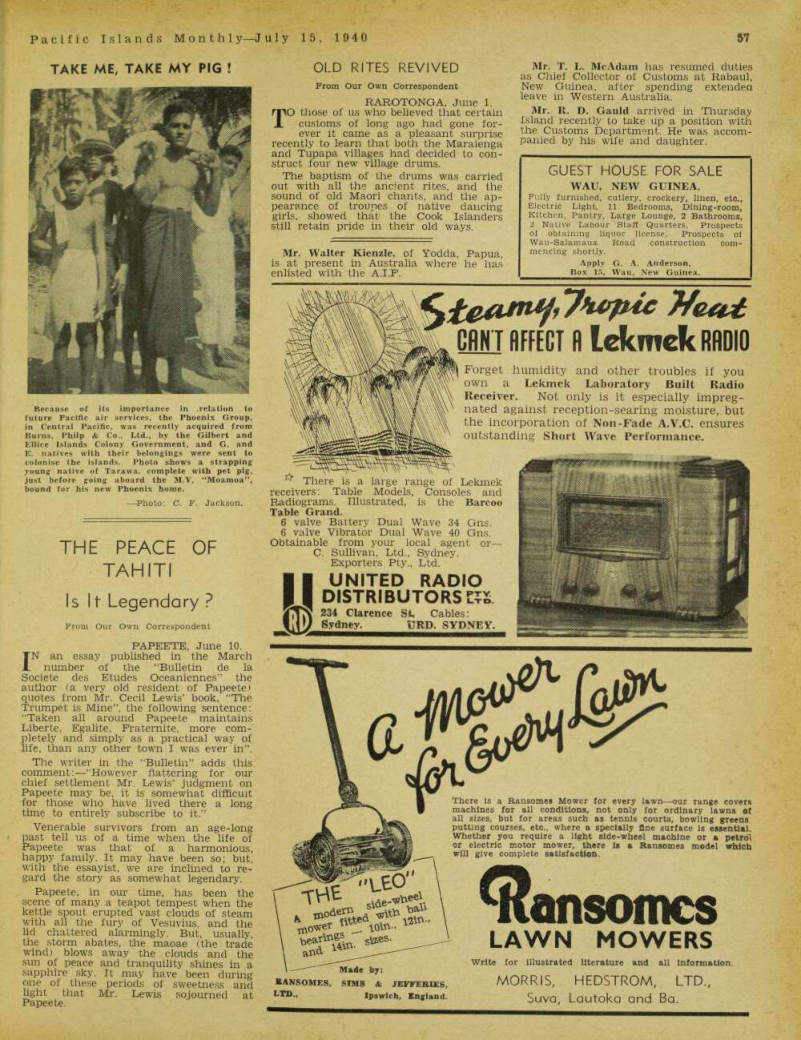
Because of its importance in .relation to future Pacific air services, the Phoenix Group, in Central Pacific, was recently acquired from Burns. Philp & Co., Ltd., by the Gilbert and Ellice Islands Colony Government, and G. and E. natives with their belongings were sent to colonise the islands. Photo shows a strapping young native of Tarawa, complete with pet pig, just before going aboard the M.Y. “Moamoa”, bound for his new Phoenix home. —Photo: C. F. Jackson.
Is It Legendary ?
The Peace Of
Tahiti
From Our Own Correspondent
Papeete, June 10.
IN an essay published in the March number of the “Bulletin de la Societe des Etudes Oceaniennes” the author (a very old resident of Papeete) quotes from Mr. Cecil Lewis’ book, “The Trumpet is Mine”, the following sentence: “Taken all around Papeete maintains Liberte, Egalite, Fraternite, more com pletely and simply as a practical way of life, than any other town I was ever in”.
The writer in the “Bulletin” adds this comment:—“However flattering for our chief settlement Mr. Lewis’ judgment on Papeete may be, it is somewhat difficult for those who have lived there a long time to entirely subscribe to it.”
Venerable survivors from an age-long past tell us of a time when the life of Papeete was that of a harmonious, happy family. It may have been so; but, with the essayist, we are inclined to re gard the story as somewhat legendary.
Papeete, in our time, has been the scene of many a teapot tempest when the kettle spout erupted vast clouds of steam with all the fury of Vesuvius, and the lid chattered alarmingly. But, usually, the storm abates, the maoae (the trade wind) blows away the clouds and the sun of peace and tranquility shines in a sapphire sky. It may have been during one of these periods of sweetness and light that Mr, Lewis sojourned at Papeete.
Old Rites Revived
From Our Own Correspondent
Rarotonga, June 1.
TO those of us who believed that certain customs of long ago had gone for ever it came as a pleasant surprise recently to learn that both the Maraienga and Tupapa villages had decided to con struct four new village drums.
The baptism of the drums was carried out with all the ancient rites, and the sound of old Maori chants, and the ap pearance of troupes of native dancing girls, showed that the Cook Islanders still retain pride in their old ways.
Mr. Walter Kienzle, of Yodda, Papua, is at present in Australia where he has enlisted with the A.I.F.
Mr. T. L. McAdam has resumed duties as Chief Collector of Customs at Rabaul, New Guinea, after spending extended leave in Western Australia.
Mr. R. D, Gauld arrived in Thursday Island recently to take up a position with the Customs Department. He was accom panied by his wife and daughter.
Advertisements & other items, pp. 59-60 (2 items)
57
Pacific Islands Monthl y—J uly 15, 1940
Q?anso
GUEST HOUSE FOR SALE
WAIT, NEW GUINEA.
Fully furnished, cutlery, crockery, linen, etc,, Electric Light, 11 Bedrooms, Dining-room, Kitchen, Pantry, Large Lounge, 2 Bathrooms, 2 Native Labour Staff Quarters. Prospects of obtaining liquor license. Prospects of Wau-Salamaua Road construction commencing shortly.
Apply G. A. Anderson, Box 15, Wau, New Guinea.
CRN T AFFECT fl Lekmek RRDIO
Forget humidity and other troubles if you own a Lekmek Laboratory Built Radio Receiver. Not only is it especially impregnated against reception-searing moisture, but the incorporation of Non-Fade A.V.C. ensures outstanding Short Wave Performance.
There is a large range of Lekmek receivers: Table Models, Consoles and Radiograms. Illustrated, is the Barcoo Table Grand. 6 valve Battery Dual Wave 34 Gns. 6 valve Vibrator Dual Wave 40 Gns.
Obtainable from your local agent or— C. Sullivan, Ltd., Sydney.
Exporters Pty., Ltd.
UNITED RADIO
DISTRIBUTORS ltd,
.. 234 Clarence St. Cables: */ Sydney. URD. SYDNEY. u
\ Th V ma There Is a Ransomes Mower for every lawn—our range covers machines for all conditions, not only for ordinary lawns of all sizes, but for areas such as tennis courts, bowling greens putting courses, etc., where a specially fine surface is essential.
Whether you require a light side-wheel machine or a petrol or electric motor mower, there is a Ransomes model which will give complete satisfaction.
the
leo"
bea f to tSn- sß,eS ' and
Q?anso
ransomes, ltd., Made by:
SIMS & JEFFERIES.
Ipswich, England.
mcs
LAWN MOWERS
Write for illustrated literature and all Information.
HEDSTROM, LTD.,
Suva, Lautoka and Ba.
NOW ,
U the time f
Start NOW to protect
your chest and lungs
and to build up resistance to infection, BE- FORE grave winter ail-
ments develop.
That "chesty" cough, if neglected, may easily lead to bronchitis, 'flu. pneumonia and other serious lung troubles.
It is a sign of dangerous weakness in the whole body, and particularly in chest and lungs.
It is the amazing THOROUGHNESS with which it acts that has made Scott's Emulsion famous as the finest of all body-building and protective tonics. With Scott's, the throat is quickly soothed and that troublesome cough quickly disappears. But, more important still, the general strength fitness and resistance to infection are built up. so that the system is made absolutely SAFE against those infections of the chest and lungs to which it is now dangerously exposed.
SCOTT’S
Emulsion
CHEMISTS 2/Q
STORES 7 *
AND
If / PER
3/ * BOTTLE
4
SHREDDED WHEATMEAL
Delicious golden brown biscuits, rich with nourishing whole wheat grains, ripened to perfection in Natures' sunny kitchens.
There's health in every mouthful of these crisp crunchy biscuits.
MILK ARROWROOT
Children grow up strong, healthy and virile if they have plenty of Swallow & Ariell Milk Arrowroot Biscuits. The kiddies love them, and their nourishment qualities are second to 4 % *■ * n ■p/v, * v. w J * ' - .» m / m i p ’J D C-
«l LK
i a
CLUB CHEESE
These delightful little biscuits are savouries in themselves! Favourites with hostesses everywhere because they're delicious for suppers and afternoon teas.
These popular biscuits, crisped to perfection by Australia's Leading Biscuit Bakers, are specially tropic-packed in airtight tins, thus retaining all their fresh-from-the-oven flavor and crispness. Try them yourself! They're just as good as Swallow & Ariell's other famous products . . . CABIN BISCUITS . . . NAVY and PILOT BREAD . . . PLUM PUDDINGS
. . . CANTERBURY CAKES.
WALLOW; Alt IE ll 11 1
Aus t r a mo u s Biscuit Ba k
PORT MELBOURNE . VICTORIA
N.G. Goldfield
Pioneers
Claim That Preston, and Not Darling, First on Koranga
The following are extracts from a letter to the editor from Mr. Edward Auerbach, an old miner and prospector, now living in the Trobriand Islands. Mr.
Auerbach supplies much valuable infor mation about the pioneers of the New Guinea, goldfield; and it will be noted that he says that the first man on Koranga Creek was Preston, and not Darling—thus apparently correcting vari ous books and articles published, in re lation to the subject.
I FIRST met “Shark-Eye” Park in 1901, on the Kumusi Beach, North east Papua. He was going to the Yodda. He travelled up in my launch, from the beach to Bogi (60 miles up the Kumusi River).
I notice that you call him “Park”. I always knew him to be addressed as “Parks”, not “Park”. I was with him for about eight months, and always called him Parks. The first time I knew that his real name was Park was when I saw his death notice in the “Sydney Morning Herald”.
The name of the yacht of the Ger man Administrator of Madang was “Delphin”; in English, “Dolphin”.
I have written to the Collector of Customs, to try and find out the date we left for the Markham River (New Guinea), and he is looking it up for me.
I think it was in September, 1912. I know that, en route to the Markham, we landed in at Rabaul two days after the Melbourne Cup, as both Matt Crowe and I had backed Duke Foote. When
we landed we met Walter Lucas (B.P. & Co. Islands manager in Sydney) and Whiteman. Matt asked them what had won the Cup. They said, Piastre.
I will look up the dates and give you details .of the Green massacre, at Lamata Police Camp. I will only write to you of what I know. The Green mas sacre occurred a year before I arrived at Lamata in 1897, but I met most of the miners who were on the McLachlan Creek at the time, also Mick McLachlan, and I helped to bury Billy Simpson.
From then on, this is what occurred in my own time: 1. —Finding of Gira and Ikora gold fields. 2. —Gebara gold find. 3. —The Yodda find. 4. —The Cloudy Bay find. 5. at the head of Musa River, and the Waria field.
The McLachlan Creek was the first payable goldfield found on the main land. There is only one of the pros pectors’ names I do not know—he was one of the men on the Gebara field; and I knew him as Jacobs. My brother George was mate with him for six months, and he only knew him as Jacob. Perhaps Jack Grey knew his name—Jack was one of the prospectors of Gebara.
“Shark-Eye” Park and I left Rocke Island for the Markham, via Morobe, in 1912. We prospected around the Mark ham and Ramu districts, and then went up the right hand branch of the Mark ham (I believe it is now called the Watut). We found Billy Dankother’s grave on the bank of the river. This is where J. Preston made his 14 days’ trip, when he came out with 600 ounces of gold.
When we got up into the mountains, we did not meet any local natives, so
we could not find out the names of the places.
Two days after leaving the mission station on the Markham we had all the lighting we wanted, two or three times a day. They used to like daylight and dawn to do their fighting. Those natives were game. If trained, they would make splendid soldiers.
With reference to the article on Park’s death, in the March “P.I.M.”:— Matt Crowe and “Shark-Eye” Park were never with Arthur Darling in German New Guinea. The only time Darling was up there was in 1908. Arthur and his Orakivas went about 40 miles up the Markham. The natives tackled him and left him on the bank of the river, apparently dead. He was soeared, and badly knocked about. He recovered, and got down the river, and was in a bad way when Les Joubert picked him up in his launch. “Buna” Darling died about 1912, on one of the B.P. steamers, off Cairns, on his way over to Aus tralia. The names have been mixed up in the article: instead of A. Darling it should be J. Preston. It was J. Preston and not Darling who got his gold in Koranga Creek, and Preston was the first white man there.
Tribute to Tahitian Lady
Death of Mrs. A. C. Rowland
From a Special Correspondent A LARGE section of the people of Papeete (Tahiti) assembled on April 3, when lovable Teriitauatea Temeriraurii Adams (Mrs. A. C. Row land), grand-daughter of Puhiava, Chief of Opoa, Raiatea (Leeward Islands), was buried. Mrs. Rowland’s mother was descended from the hereditary chiefs of Tumaraa, in Raiatea.
A few words were said over Mrs. Row land’s grave, on behalf of the Tahitian population, present in large numbers.
The short speech was as follows: — “Lovable Tauatea! We cannot lay your body in this grave without saying ‘good-bye’, and how much we miss you.
Our hearts want to speak—to say, again, how much you were loved, and why you were loved. You were good, and kind, and always helped the needy.
“Who in Oceania did not know and love you? You were one of our chief supports—you were always kind to others. Never the poor or the sorrow ful went to you for aid and sympathy, 'in vain.
“The old people were your friends; the young and the children were as your own; and now you are gone, all young and old, the healthy, the sick, and the solitary, mourn your death, because they all miss you. We no longer will see you, no longer meet you, no longer talk to you.”
Then, turning to the bereaved hus band, the speaker added; “You have been a model husband, worthy of such a mate. In all deeds of charity you were together. In this great sorrow, the only consolation wo can offer you is that we weep with you. We can see what your life will be, bereft of such a companion, and to you, facing that lonely future, we wish to say that our memorial to your deceased wife will be a greater kmdness to all, and an even more sympathetic feeling toward you.”
Mrs. M. Hunt, wife of Mr. E. Hunt of the Registrar General’s Department, Fiji died on June 14, aged 59.
That Problem Of Copra
Storage
THE following “Notes on Copra” are from the March issue of the “New Guinea Agricultural Gazette”: — Copra dried to 6 to 7 per cent., if stored in a well-ventilated dry store at an even temperature, will not seriously deteriorate. It is apparent that there is little to gain by drying copra much below 6 per cent, moisture content, al though in the past much more stringent recommendations have been made. —The Tropical Agriculturist, 1937.
As usually shipped in the East, copra is attacked in transit by moulds and in sects, resulting in serious losses and deterioration. Experiment had shown
that it can be dried to such an extent that moulds and insects do not touch it, and that the resultant short weight is amply compensated by the absence of loss. This is not yet fully appreciated, but undoubtedly will be in time. —United Empire, August, 1938.
Advertisements & other items, pp. 61-62 (2 items)
59
Pacific Islands Monthl y-J uly 15, 1940
Foster Clark's
WANTED TO PURCHASE
Used stamps of all Pacific Islands.
Highest prices paid. Regular consignments solicited. Remittances guaranteed by return mail.
J. H. SMYTH PTY. LTD.,
114 Castlereagh St., Sydney, Aust.
T)ONG
Sty
P 4 i <>A o> It* ■' ’'"
for dinner
Just watch those children run when there’s Custard for dinner rich, delicious Foster Clark’s Custard. Kiddies love every satisfying spoonful.
But there’s more than lovely flavour in Foster Clark’s Creamy Custard. It’s four-fifths milk, so full of nourishment. And it can be used in dozens of different ways. Elizabeth Craig’s Recipe Book shows you how.
Write for your FREE copy of Elizabeth Craigs Recipe Book to Foster Clark (Aust .) Ltd., Dept. R. 8., Red fern, N.S.W'. Enclose a penny stamp for postage. 1 Sold by all grocer: —in 3 sixes and a flavours.
VI 738 a
FOSTER CLARK'S
tard
r-T"si
lite/teid
ja i Sp am
ri SAUCE
ll^bu < (U theWcrldcwf
ECONOMICAL. BECAUSE YOU NEED
JUST A FEW DROPS AT A TIME -
McILRATH’S
SYDNEY'S LEADING GROCERS
SELL QUALITY GOODS
For Less
Ideal Unsweetened Milk, 6 oz. or 12 oz 22/- case Sunshine Full Cream Powdered Milk, 12 oz l/2i tin, 14/3 doz.
Yoga Tea, Our Speciality 2/- per lb.; 6 lb. tins 12/6 each Australian I.A. Sugar, 70 lb 16/3 bag Australian I.A. Sugar, 35 lb 8/71 bag; 9/7i tin Local Dutch Cheese, 4 lb. balls 1/4 lb.
Mcllrath’s Crustless Cheese, 8 oz 7id. pkt.; 7/3 doz.
Gartsides Sweet Corn, 10 oz 7id. tin; 7/3 doz.
I.X.L. Crayfish, 8 oz 1/21 tin; 14/- doz.
Ozone Oysters 5 oz. tins, 7/4| doz.; 11 oz. tins, 12/6 doz.
I.X.L. Peaches in Syrup ... 16 oz. tins 7/3 doz.; 30 oz. tins, 10/3 doz.
I.X.L. Pears in Syrup 16 oz. tins 7/41 doz,; 30 oz. tins, 11/3 doz.
Nestles Pure Reduced Cream, 4 oz 4d. tin, 3/9 doz.
Rosa Rich Custard Powder, 16 oz 1/- pkt., 1/3 tin Kream Cornflour, 16 oz 7id. pkt.; 7/3 doz.
I.X.L. Pure Tomato Juice 10 oz. 4/9 doz.; 15 oz. 6/9 doz.
Norco Pork Sausages 8 oz. 6/6 doz.; 16 oz. 10/6 doz, I.X.L. Tomato Sauce 10 oz., Sid. bot.; 8/3 doz.
Potatoes, Onions, Wheat, Bran, Pollard at Lowest Market Rates.
All Prices F. 0.8. Sydney Cases and Packing Free.
Export Price Lists Available —Post Free.
McILRATH’S Pty. Ltd.
EXPORT DEPARTMENT
202-204 PITT STREET, SYDNEY, AUSTRALIA
New Uses For Coconuts

From Our Own Correspondent SUVA, June 15.
WITH copra at such a low price, many planters are wracking their brains for an alternative industry.
Why look further than the coconut it self. Could not the fibre be converted into clothing or even sacking? The lowly shell, instead of being burnt, might be broken into small pieces and incorpor ated in a material like fibrolite sheets.
These could be run through sanding machines when hard, and finally burnished with a cloth wheel. The re sultant wall board would have the beauty of an oak and could be used in practically any type of building.
On June 19, the Port Moresby Aquatic Club entertained over forty members at the annual dinner. Mrs. J. H. Ahern, wife of the president and Commodore, presented trophies won during the sea son. The Club Championship was won by Mr. D. Chalmers, who also took the president’s trophies for the season’s point score. The second Championship went to Mr. J. Lukin, and third to Mr. D.
Willmott.
Pattern Service
EACH month a Fashions design is published, patterns of which may be purchased by readers direct from this office, post free. Print your name and address below, giving the number of the pattern and bust size, and send to “Pattern Department”, Pacific Islands Monthly, Box 3408 R., G.P.0., Sydney; enclose also the price of the pattern in postal note or lt will be sent by return mail.
Name Address Pattern Number Size
The engagement is announced of Mr, E. W. Pearce, of the Methodist Mission, New Britain, to Miss E, E. Brabin, B.A.
F 3182. —This simple tailored frock should in terest those coming South on furlough this winter. Designed for spectator sports, the long slender lines have a definite slimming effect — the gored skirt enhancing the pencil silhouette, so fashionable just now. Tight-fitting wrist length sleeves give that trim look and add to the neat appearance of a style which will not date —essential these days when strict economy must be practised. Material required for 34 in. bust is 3⅝ yds. of 36 in. wide cloth or 2⅜ yds. of 54 in. Pattern, obtainable in bust measure ments from 32 in. to 40 in., is available at 1/1, post free.
Advertisements & other items, p. 62 (1 item)
60
July 15, 194 O—P acific Islands Monthly
"Blitzkrieg"
An Islands Girl
In London
Driving an Ambulance and Awaiting the "Blitzkrieg"
{Copied from a letter written by a Fiji girl to her mother ) DURING the day, London doesn’t se°m much different from peace-time, in spite of gas masks and signs point ing to the nearest air-raid shelter. It is only when the black-out starts that you are fully aware of the war—especially, if you have just run into a lamp post.
You can’t imagine how dark it is in the streets. All you can see are the red pin-points of light marking the islands, or tiny red crosses showing from traffic lights or the rear of vehicles. Otherwise it is as black as the inside of a cow. It takes hours to get anywhere; and when, at last, a bus looms out of the deep cavern of the street, you have to ask the conductor for his number —which is usually not the one you want.
With all the various crises, life, has become rather exciting. Trenches are dug in all the parks, commons and even those lovely little squares tucked away in odd corners of the city. Anti-aircraft guns are narked all over the town, im portant buildings are smothered in sandbags, gas-masks issued, and search lights stabbing the night.
As everybody seemed to volunteer for this or that. I also trundled off one day with the idea of getting something to drive. Which was easier said than done.
First, I looked in at the Women’s Legion, but was so overawed by the spectacle that I made a quick fade-out.
Vast numbers of most efficient-looking women were dashing about, clicking their heels and saluting each other after nearly every second word. And the uni forms—quite the most unbecoming attire the female form could ever get into.
Skirts with the flare in the wrong places, tunics ending painfully right over one’s greatest circumference, and a cap— words fail me! All in the most depress ing shade of khaki and. to put the lid on, you had to pay for it yourself.
Then volunteers were asked for the Women’s Auxiliarv Air Force. I rushed along—to fly is the dream of my life— but the office was already closed. They simply couldn’t cope with all the women wanting to join—not enough machines for the training. Wasn’t it a pity—they had the most snappy uniforms.
SO I tried the Mechanical Transport of the Women’s Legion. This was located in the War Office and. after being asked about 20 times whether I was a British subject. I mutely held up my open passport to further inquirers.
One wanted to know whether I spoke foreign languages and, after admitting a slight acouaintance with French and German I was hauled through offices, passages and staircases until at last somebody—a rather nice man—handed me a form to fill in and sign on the dotted line. Now, dotted lines always rouse my suspicion and, although by that time I felt like a complete black-out. I asked feebly, “Do I get then something to drive?”
“Most certainly not,” said the nice
man. “You will be drafted to the cen sor’s office, translating letters, etc.”
So back I went to the War Office, filled with grim determination to get a lorry, ambulance or fire-engine, if it was the last thing I ever did. After seeing another half-dozen captains and majors, I was finally sent to the Women’s Legion, in Baker Street, and from them to their headquarters in Londonderry House, where at last the right form v/as filled in and signed.
But, if you think that now I had got something to drive, just think again. The next item was an English driving license, though I held one from Fiji. Quite too humiliating, pounding about London in an old Morris with a large red L, when
I had driven for years on the planta tion, over the home-made switchback of a road where, after a few inches of rain had fallen since you left the homestead, half-an-hour ago, you wonder when, where and how you will land at the bottom of the hill, with bus and copra on top of you.
I drove beautifully for my first test, but failed, because I did not stop for a boy on a bicycle to pass by. Conse quently, I was so nervous, for the second, that I made an utter mess of my re versing into a side street. First, I climbed up the kerb, nearly dislocating a lamp post, and next, because you aren’t supposed to touch it at all, fin ished, up four feet away from the kerb.
Yet, this time, they passed me—l still wonder why, SOON, I was dashing all over London on mock air-raids, day or night, with or without gas-masks and pro tective clothing, depending on whether it’s a high explosive, persistent or non persistent gas bomb, picking up “bodies” and whisking them off to the hospital or nearest first-aid post, depending on the severity of their “injuries”.
These ambulances are great fun to drive. You have to double de-clutch up and down, as they have crash gear boxes.
The uniforms, supplied by the London County Council, are not too bad. I just tilt the tin hat at the latest angle and try to forget the black woollen stockings.
The protective clothing, all oilskins and
gum boots, are hideous to look at, but very good. My gum boots'" were size 7, the smallest the L.C.C. had in stock. As I take a 4£, during the first alarm I had to remain firmly rooted to the spot, as they dropped off at every step I tried to take. Not only that, but one hoof cov ered all three pedals in the bus!
Then, overnight, the play became deadly earnest. We assembled at our station, complete with emergency rations for 24 hours. Everything went without a hitch. Everybody was calm, got into protective clothing and stood by for instructions. All the A.R.P. stations re ceive the alarm as soon as enemy machines are sighted; but, unless it is absolutely necessary, the public are not warned now-a-days. When the sirens wailed the first few times, people hurled themselves down into trenches and shel ters, and it took hours after the all clear signal before they got sorted out again.
SINCE then, the, weeks have slipped past, and nothing has happened.
Life consist of 8 hours on and 8 hours off duty, and the strain of being always on tip-toes waiting for signals makes you sleep right through your time off. We have gone out on so many fake raids that we’re positively bored with it, and there seem to be no more ailments we can bandage our “casualties” for. We know every nook and corner of our dis trict and the next, drive about at night with the merest show of a glimmer of light from the headlamps, through autumn fogs, thick and impenetrable snow and frozen sleet, when the old bus skids about so as to make your tin hat stand on end.
The other morning, an alarm called me to the station in the early dawn. It was quite uncanny to see an odd bus or private car pulled up at the side, the streets empty, no lights or people any where. Everything deadly quiet in the half-light of the dawn, almost sinister, like a dead city.
Yet, at night, behind the black-out, life is gayer than ever, night clubs do a roaring trade, and people drop in to see each other more than they used to do.
I think it is due to the fact that they want company at any price.
Personally, I am getting rather tired of this darned war. If it would only start, or finish, or do something—but this state of waiting is really too tedi ous. However, I suppose, one must always remain on the alert, just in case the “Blitzkrieg” should take place.
Advertisements & other items, pp. 63-64 (2 items)
61
Pacific Islands Monthl y—J uly 'l5. 1940
Beautiful Cultured Pearls
J J J J J J J.
J A J J J J.
J J. m.
J J.
J J.
J. -A j. j. j. j. j. j. j j. j} J J J J j J.
J J J 9
t%W/l
Wi
The Perfect Gift —The Lasting Keepsake.
Treat your Mother—your Wife—your Sweetheart—in the grand manner. Select a string of Cultured Pearls, or at least apiece of this lovely pearl jewellery. You will be bestowing a keepsake which will always be valued, because of the dignity and beauty which are part of it.
When women see these Cultured Pearls, touch them, and wear them, they are rapturous about their beauty. They know then why the Queen is so seldom seen without her pearls.
A greater thrill comes with the owning of Cultured Pearls. A woman realises then that, for £25, she possesses a pearl necklet such as once would have cost three-hundred pounds. She knows her Cultured Pearls are the same as the old, costly, real pearls, formed in the oyster, in the same way, and from exactly the same gleaming substance.
Angus 6C Coote illustrate here, a gorgeous necklace of good, Cultured Pearls, nicely graduated, and of exquisite lustre. Complete with pretty clasp, they are only £5.
Other Cultured Pearl Necklets are 42/-, 63/-, 84 -. Those at £lO to £5O, are marvellous pearls, with diamond clasps. Enquiries welcome.
The White Gold, Cultured Pearl ring is 42/-.
The richly-ornamental fancy Bracelet, smart and flexible, with pearls and marcasites, is 65/-.
Parcels sent anywhere. Safe delivery guaranteed.
ANGUS & COOTE pty
Ltd.
500 GEORGE STREET, SYDNEY.
Kidnevs Must
Clean Out Adds
Your body cleans out excess Acids and poisonous wastes in your blood through 9 million tiny delicate Kidney tubes or filters. If Poisons in the Kidneys or Bladder make you suffer from Getting Up Nights, Nervousness, Leg Pains, Circles Under Eyes, Backache, Aching Joints, Acidity, or Burning passages, don’t rely on ordinary medicines. Fight such Poisons and troubles with the doctor’s prescription Cystex. Cystex starts working in three hours, must prove entirely satisfactory and be exactly the medicine you need or money back is guaranteed. Ask your chemist or store for Cystex (Sisstex) today. The Guarantee protects you. Now in 3 sizes 1/9 ; 4/- ; 8/-.
GUARANTEED for Kidneys, Bladder, Rheumatism
SCHAFFER & CO.. BTDNET.
Cystex
& J / DISTRIBUTORS: Greenwood & Laws Ltd., Rabaul and Wau; Steamships Trading Co. Ltd., Port Moresby and Samarai; Millers Ltd.. Suva, Fiji.
For Protection and
Appearance - - use
“B A L M” Paint
PROTECTION —is the main job of Paint . . . APPEARANCE is next . . . and, to get the most efficient combination of both . . . use “8.A.L.M.” Paint.
“8.A.L.M.” Paint is a product of scientific research and practical experience . . . It has been tested for durability, protective qualities and colour retention, and proved to be the best that can be made.
Measure the value of Paint by years of service, protection and appearance, and NOT by cost per tin. Specify “8.A.L.M.”
Paint.
I NTT
graok pure A Product of British Australian Lead Manufacturers Pty. Ltd.
Highest Prices Paid For
GOLD
Garrett & Davidson’s organisation is acknowledged far and wide as the main clearing house for precious metals in the Southern Hemisphere.
They have earned a reputation for accuracy and integrity in all their business dealings, which is proved by the fact that they are privileged to handle more gold from the Islands of the Pacific than any other organisation.
Therefore for your complete and lasting satisfaction, you are advised to transact all your precious metals business through the house of Garrett & Davidson.
GARRETT & DAVIDSON PTY. LTD.
ASSAYERS METALLURGISTS REFINERS
Bank of N.S.W. Buildings,
REGENT AND GEORGE STS., SYDNEY.
Quotations For Mining
Shares
Fiji
Mid-Jan. Mid-May.
Mid-July.
Emperor Mines ..
Loloma b!4/3 b32/IV 2 blS/7 1 /^ b32/6 b9/4 bl9/7V 2 Mt. Kasi . b5/s4/9 b2/3 Tavua Dev s4d s4d s4d
New Guinea
Bulolo G.D b £ 6/3/b £6 s£5 Enterprise of N.G. b35/b27/6 b7/6 Guinea Gold b!4/4 b!4/10 b6/3 N.G.G., Ltd b2/9 b2/7V 2 bl/4 Oil Search b5/b6/ll b2/9 Placer Dev b79/6 bl/2 b77/blld b80/3 Sandy Creek b7V 2 d Sunshine Gold ... b8/2
Papua
b8/3 b4/6 Cuthbert’s bl7/b!7/3 b!2/- G.M. of Papua .. s3d — s3d Mandated All. ... b3/7 b3/2 b2/l Oriomo Oil b7/6 blO/s9/- Papuan Apinaipi b5/9 b5/9 b3/8 Yodda Goldfields . bl/6 bl/10 bl/l
Advertisements & other items, p. 64 (1 item)
62
July 15, 194 O—P acific Islands Monthly
Mining News
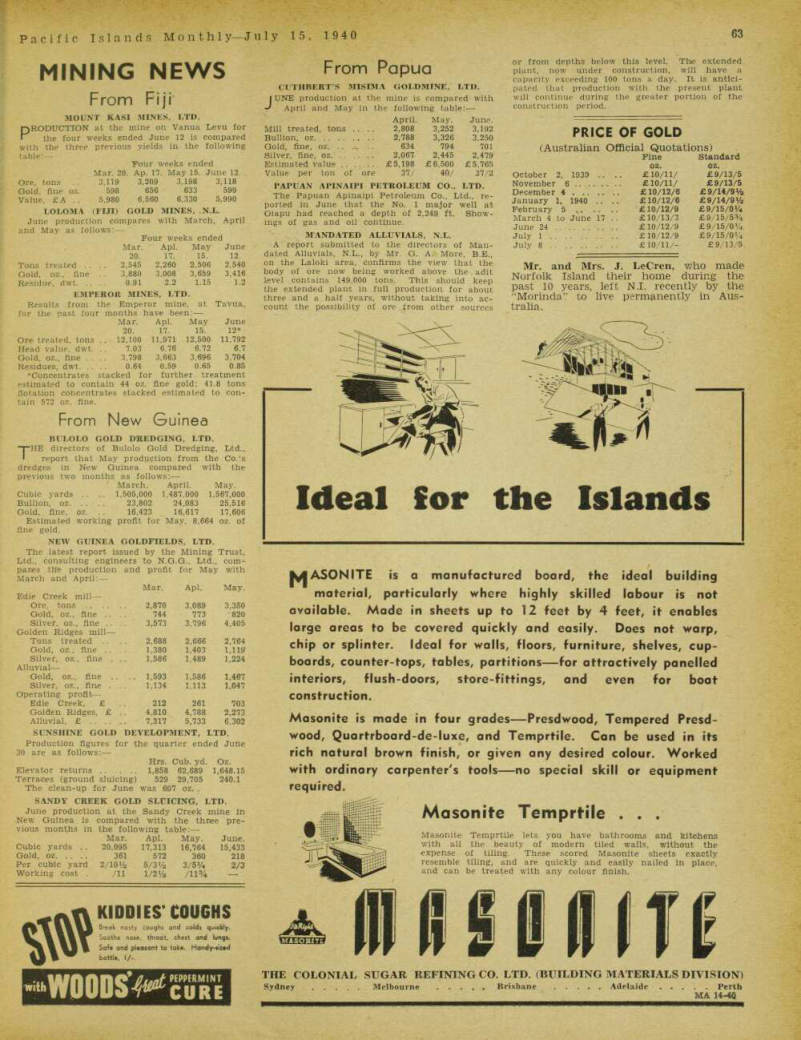
From Fiji
Mount Kasi Mines, Ltd.
PRODUCTION at the mine on Vanua Levu for the four weeks ended June 12 is compared with the three previous yields in the following table: —
Loloma (Fiji) Gold Mines, N.L.
June production compares with March, April and May as follows: —
Emperor Mines, Ltd.
Results from the Emperor mine, at Tavua, for the past four months have been: —-
From New Guinea
Bulolo Gold Dredging, Ltd.
THE directors of Bulolo Gold Dredging, Ltd., report that May production from the Co.’s dredges in New Guinea compared with the previous two months as follows: —
fine gold.
New Guinea Goldfields, Ltd.
The latest report issued by the Mining Trust, Ltd., consulting engineers to N.G.G., Ltd., com pares the production and profit for May with March and April;—
Sunshine Gold Development, Ltd.
Production figures for the quarter ended June 30 are as follows: Hrs. Cub. yd. Oz.
Elevator returns 1,858 62,689 1,648.15 Terraces (ground sluicing) 529 29,705 240.1 The clean-up for June was 607 oz.
Sandy Creek Gold Sluicing, Ltd.
June production at the Sandy Creek mine In New Guinea is compared with the three pre vious months in the following table:—
From Papua
Cuthberts Misima Goldmine. Ltd.
JUNE production at the mine is compared with April and May in the following table:—
Papuan Apinaipi Petroleum Co., Ltd.
The Papuan Apinaipi Petroleum Co., Ltd., re ported in June that the No. 1 major well at Oiapu had reached a depth of 2,249 ft. Show ings of gas and oil continue.
Mandated Alluvials, N.L.
A report submitted to the directors of Man dated Alluvials, N.L., by Mr. G. A. More, BE., on the Laloki area, confirms the view that the body of ore now being worked above the adit level contains 149,000 tons. This should keep the extended plant in full production for about three and a half years, without taking into ac count the possibility of ore from other sources
or from depths below this level. The extended plant, now under construction, will have a capacity exceeding 100 tons a day. It is antici pated that production with the present plant will continue during the greater portion of the construction period.
Four weeks ended Mar. 20. Ap. 17. May 15. June 12.
Ore, tons 3,119 3,209 3,198 3,118 Gold, fine oz. 598 656 633 599 Value. £ A .. 5,980 6,560 6,330 5,990
Four weeks ended Mar. Apl. May June 20. 17. 15. 12.
Tons treated . . . . 2,545 2,260 2.506 2,540 Gold, oz., fine . . 3,880 3,008 3,659 3.416 Residue, dwt 0.91 2.2 1.15 1.2
Mar. Apl. May June 20. 17. 15. 12* Ore treated, tons .. 12.100 11,971 12,500 11,792 Head value, dwt. . . 7.03 6.76 6.72 6.7 Gold, oz„ fine ... 3,798 3.663 3.696 3.704 Residues, dwt 0.64 0.59 0.65 0.85 •Concentrates stacked for further treatment estimated to contain 44 oz. fine gold; 41.8 tons flotation concentrates stacked estimated to contain 572 oz. fine.
March. April. May.
Cubic yards . . . . 1,505,000 1,487,000 1,567,000 Bullion, oz 23,802 24,083 25,516 Gold, fine, oz. . , 16,423 16,617 17,606 Estimated working profit for May, 8,664 oz. of
Mar.
Apl.
May.
Edie Creek mill— Ore, tons 2,870 3,089 3,350 Gold, oz.. fine . . . . 744 773 820 Silver, oz., fine . . . . 3,573 3,796 4,405 Golden Ridges mill— Tons treated 2,688 2,666 2,764 Gold, oz., fine . . . 1,380 1,403 1,119 Silver, oz., fine . .. 1,586 1,489 1,224 Alluvial—• Gold, oz., fine .. . . 1,593 1,586 1,467 Silver, oz., fine . . . 1,134 1,113 1,047 Operating profit— Edie Creek, £ 212 261 703 Golden Ridges, £ .. 4,810 4,788 2,273 Alluvial, £ 7,317 5,733 6,302
Mar.
Apl.
May.
June.
Cubic yards .. 20,095 17,313 16,764 15,433 Gold, oz 361 572 360 218 Per cubic yard 2/ioy 2 5/3 y 2 3/5 y 4 2/3 Working cost . /II 1/2 Va /11% —
April. May. June.
Mill treated, tons .. .. 2,808 3,252 3,192 Bullion, oz 2,788 3,326 3,250 Gold, fine, oz 634 794 701 Silver, fine, oz 2,067 2,445 2,479 Estimated value £5,198 £6,500 £5,765 Value per ton of ore 37/ 40/ 37/2
Price Of Gold
Mr. and Mrs. J. LeCren, who made Norfolk Island their home during the past 10 years, left N.I. recently by the “Morinda” to live permanently in Aus tralia.
(Australian Official Quotations) Fine Standard oz. oz.
October 2, 1939 .. .. £10/11/ £9/13/5 November 6 £10/11/ £9/13/5 December 4 £10/12/6 £9/14/9% January 1, 1940 .. .. £10/12/6 £9/14/9V 2 February 5 £10/12/9 £9/15/0y 4 March 4 to June 17 .. £10/13/3 £9/15/5% June 24 £10/12/9 £9/15/0y 4 July 1 £10/12/9 £9/15/0V4 July 8 £10/11/- £9/13/5
Advertisements & other items, pp. 65-66 (3 items)
63
Pacific Islands Monthl y-J ul y 15, 1940
A Id Us I! Ii In
Ideal Sor the Islands
M ASONITE is a manufactured board, the ideal building material, particularly where highly skilled labour is not available. Made in sheets up to 12 feet by 4 feet, it enables large areas to be covered quickly and easily. Does not warp, chip or splinter. Ideal for walls, floors, furniture, shelves, cupboards, counter-tops, tables, partitions—for attractively panelled interiors, flush-doors, store-fittings, and even for boat construction.
Masonite is made in four grades—Presdwood, Tempered Presdwood, Quartrboard-de-luxe, and Temprtile. Can be used in its rich natural brown finish, or given any desired colour. Worked with ordinary carpenter's tools—no special skill or equipment required. i Masonite Temprtile . . .
Masonite Temprtile lets you have bathrooms and kitchens with all the beauty of modern tiled walls, without the expense of tiling. These scored Masonite sheets exactly resemble tiling, and are quickly and easily nailed in place, and can be treated with any colour finish.
A ID US I! II in
THE COLONIAL SUGAR REFINING CO. LTD. (BUILDING MATERIALS DIVISION) Sydney Melbourne Brisbane Adelaide Perth
MA 14-4 Q
KIDDIES’ COUGHS
Break nasty coughs and colds quickly.
Soothe nose, throat, chest and Kings.
Safe and pleasant to take. Handy*siud bottle. I/-.
cure
“PRESTO”
it
THE
MAGIC
BOX
The most Amazing Trick— Just out. “Presto”.—The greatest, most allur- I ing and outstanding little trick ever introduced, 2/9. Post Free. ! Money back if it’s not the best yet.
T
I POLICE PATROL MULTI STRAND
j RUBBER COVERED AERIAL.
! Needs No Separate Lead-in. j 50 ft., 2/6; 100 ft., 5/-.
MAN-O-WAR HEAVY DUTY
j INSULATED AERIAL, MULTI
STRAND WIRES.
I 50 ft., 5/-; 100 ft. 10/-. ! Electric MODEL MOTORS, work off jwet or dry batteries: 5/9, 9/6, 12/6 — ! worth double.
ACCUMULATORS
We sell all Types and Sizes—Fully Guaranteed.
RADIO ACCUMULATORS.
GAMES
I Dart Boards, 4/6, 8/6, 10/6, 15/-.
Brass Competition Darts, Set of 3, 18/11, 4/6, 5/6!. Monopoly, 10/6.
Totopoly, 10/6. Bucaneer, 10/6. 3 lof the World’s Most Popular Games. ; Chinese Checkers, 2/6, 4/6, 8/6. 1 Tripoly Card Game, 5/-. De Luxe Model Game, 10/6. Poker Rummy, Pot Luck, 1/-. Playing Card Lotto, 1/-. We Stock All Kinds of Indoor Games. Send for Booklet. /i Neat Metal Bound Wooden Cigarette Cabinet, 4/9, for building Music Box unit into.
Complete Mechanical Units for Musical Cigarette Boxes, etc., 12/6, 15/-. Plays two Tunes. Music- Boxes, 30/-, 35/-, 45/-. Musical Cigarette Boxes, 35/-.
“LIKE-A-FLASH” DE LUXE
RADIO RECEIVERS FROM
MAKER TO USER
Regardless of Make, Trade-Name or Price, “Like-a-Flash” Radio Sets cannot be bettered. Hundreds of our sets are giving excellent service right throughout the Islands.
“Like-a-Flash” De Luxe Dual Wave 5 Valve Battery Operated Receiver.
This is one of the most powerful models In our battery set series, and the Radio Frequency stage of amplification gives the set a world range on short wave channels as well as full coverage range of Australasian “A” and “B” Class Broadcasters.
The set is also specially designed to give maximum service in humid climates, such as North Queensland and Pacific Island Territories. A vital part very vulnerable to “dampness” in ordinary receivers is the “Intermediate Frequency Section’’, In this set our Engineers have fitted special inductance tuned intermediate frequency transformers which do not require trimmers.
These units ensure correct alignment for a continuous period. An 8 in. Aero Dial calibrated in stations facilitates tuning. Valves used are;
2—lC4. I—KK2. I—lK6. I—lD4
The speaker is the latest Amplion Permagnetic Model, capable of high fidelity reproduction. Battery equipment consists of extra heavy capa city units as follows: 1 2 Volt 100 amp. Accumulator. 3 Ever-Ready Superdyne 45 Volt “B” Batteries. 1 Ever-Ready 4V 2 in, "C” Battery.
The outfit is housed in a beautfully veneered floor model Console Cabinet.
PRICE: £22/5/-.
Now available (not less than 10/npT'-els); Magic Wand. 1/6 Jafet’s Wallet, 1/-; Obedient Ball. 1/6; Rattle Box; Mystic Head Chopper, 2/6; Shy Jack, 2/-; Dribble Glass, 2/-: Ventrillo. 1/-; Magic Coin, 1/-; Nest of Nests, 5/-; Voice Echoer, 1/-; Magic Bottle, 1/-; 3 Bell Trick, 1/-. 2 Knife Trick, 6/6. Giant Dice Trick. 1 6.
Send for 20/-, 30/-, 40/-, 50/-, 60/parcel of TRICKS, JOKES, PUZZLES, 9 \ I / The Greatest Novelty and Trick Ever Introduced, The “Rattle” Money Box and “Nest of Nests” Trick, 7/6. (the two). You can do it once you have the instructions.
Rush Bd. in Stamps for our “GREAT
WONDER BOOK OP SPECIALTIES”.
Games, Radio, Tricks, Puzzles, etc.
No. 1 Morse Code Practice Sets, with Switch Buzzer to Light. Use as you desire. 25/- complete.
No. 2, with Heavier Type Morse Key; 30/-. Pendograph Bug Key. 70/-. Special High Pitched Adjustable Professional Morse Buzzer, 15/-.
Adjustable Bakelite Base Morse Code Buzzers, British Make, 4/9. Larger size, 3/6. Special High - pitched Circular Buzzers i n Bakelite Case, 5/6.
Adjustable All-way Chrome-cased Morse Code Key on Bakelite 12/6. Adjustable Buzzers, 4/9.
P.M.G.S^£^
r.M.G
PfPE
SOUNDER
194 We sell DICE of all kinds. Crown & Anchor sets, 10/6; Poker Dice Sets, 6/6, 7/6, 9/6; Hazard Dice, 1 to 6, 5 for 8/6, 5 for 10/6; Head & Tail Dice, 5 for 8/6, 5 for 10/6; Blanks, % in. & % in, Red, White & Green. Ask for what you need in Dice or Dice Shakers. 58/6 From London, “Cosmocord” De Luxe Crystal Pick-up, with Built-in Vol.
Control, 58/6. Magnetic type Pickups, complete with volume control and tone arm. All British Make, 30/-, 35/-, 38/6, 45/-, and Studio Model, 50/-.
Play, Talk, Sing, Joke through your Radio. Great Pun. Batteryless type.
Microphone for Hand Holding or Hanging, 22/6. Complete with lead fixed in a second. Others, 12/6, 15/-, 17/6, 25/-, 28/6, 32/6. All plus 1/9 for Battery and 1/6 for 20 ft. Cord.
WHto for full detailed list.
B.G.E. Table Type Microphone. Highly recommended for Amateur or Profeosional use. Built-In Transformer and Battery with Volume Control incorporated.
Just plug Into pickup terminals of any set. 39/6.
No.. I.—Sheffield made Throwing Knife In sheath, 6/9.
No. 2.—Remington, U.S.A. made, Hunting and Sporting Knives in Sheath, 10/6. A Beautiful Article.
BV
DART BOARDS: 8/6, 12/6, 25/-,
30/-. Competition Brass Darts (3 in set): 3/11, 4/6, 5/6.
Australian Naval Design Dress Rings for Gents, 6/6. Royal Australian Air Force Dress Rings for Lady or Gent, 4/6.
Carborundum 4in. Grinding Wheels 10/6. Large Breast Drills 5/11.
HEADPHONES. All 4000 ohms.
Lissen 19/6. S.T.C. or B.T.H. 30/-.
Ericssons 32/6. All British.
THE WIRELESS CONSTRUCTOR’S
ENCYCLOPEDIA, 7/6.
Cloth bound, nearly 400 pages, full of interesting and useful hints. ‘•Wheres” and “Whys” book of Radio.
THE TELEVISION AND SHORT
WAVE HANDBOOK, 5/6.
Cloth bound—up to the moment, simply written explanation and instructions on building Short Wave Sets, etc. A useful dictionary of terms—you should have a copy.
HOUSIE HOUSIE PLAYING CARDS.
In Book form, each card perforated for easy detachment from the sheet, fool and cheat-proof, for player and operator. Obtainable in books of: 25 games for 60 players, 10/6. 25 games for 90 players, 12/6. Sets of Double-sided Wood Numbers, 10/-.
For Home, Carnival, or Party use.
Assorted colors, sheets all with serial numbers.
BOOKS! BOOKS! BOOKS! The Be-
ginners’ Book of Radio. The Radio Beginners’ Dictionary. 2/- the 2. The Wireless Constructor’s Encyclopaedia. Giant size, 7/6. Newnes “Everyman’s” Wireless Boob, 5/6.
The Book of Practical Radio, also The Book of Practical Television, 8/6 each. Foulsham’s Giant “Party and Fun Book”, 1/6. Humorous Stories and Recitations, 3/9. Card and Conjuring Tricks, 3/9. Tea- Cup Fortune Telling, 3/9. 100 Party Games for Old and Young, 1/9.
Popular Magic and Amateur Conjurer, 1/9. 50 Best Party Games, 1/6. Tricks with Cards, 1/6.
nmnißiiminnni
Write for Punch Board Leaflets
innnnnnnnnnn
J.LEVENSON RADIO
Pin-Game,
GAMES, NOVELTIES AND HOBBIES, Totem and
226 A PITT STREET, SYDNEY and
Manufacturers, Importers, and Exporters. Leaflets N.S.W., AUSTRALIA. Illfllllllllinillllllllll Cable address: “Leveradioh”. Goods forwarded V.P.P. or Sight Draft. Satisfaction and Service Guaranteed. We can supply by mail all General Merchandise at a Better Price. Quotations with pleasure. Please add freight and packing. Write (or full list of interesting leaflets of Games, Hobbies, Novelties, and Electrical Goods. Write for full list of Radio Meters.
1 High-pitched Tone De Luxe Professional Buzzer. The best made IS/-
Books just landed, 1/9 ea.
Popular Party Games.
Tea Cup Telling Fortune Card Tricks—
We Can Supply, at a Keen Price, Any Available Article You Require.
64
July 15, 194 O—P acific Islands Monthly
Australian Short Wave
Broadcast
A NATIONAL Short Wave Programme is broadcast daily from Lyndhurst, near Melbourne, Victoria, for listeners in the Western Pacific. Call signs: Before 5.15 p.m. VLR3; after 5.30 p.m. VLR.
Wave lengths; Before 5.15 p.m. 25.32 metres: after 5.30 p.m. 31.32 metres.
Frequencies: Before 5.15 p.m. 11.850 Kcs.; after 5.30 p.m. 9.580 Kcs. Power: 2 Kilo watts. Times given are Australian Eastern Standard (10 hours ahead of Greenwich
Mean Time).
A.M. Daily Week Days
6.30 Market Reports. 6.50 News Bulletin. 7.05 Physical Exercises. 7.15 Music. 7.45 News. 8.00 Music. 9.30 Story. 10.00 Daily Devotional Service. 10.15 Close. 12.00 Time Signal p.m. 12.15 Luncheon Music. 12.35 Essential Services. 12.50 News. 1.00 Australian News. 1.10 Afternoon Musical Programme. 4.15 Overseas News. 5.15 Close. 5.30 Young People’s Session. 6.15 Dinner Music. 7.00 News. 7.45 Talk. 9.30 News. 11.00 Close. 11.55 Dept, of Information Service. 12.15 Talk and News in Dutch. 12.30 Close.
P.M. Every Saturday
1.35—5.15 Description of current sporting and athletic events, interspersed with music. 12.30 Close.
A.M. Every Sunday
6.45 Music. 6.50 News. 7.00 Music 9.00 News. 9.10 Sporting Session. 10.00 Book Reviews. 9.30 New Releases (Recorded). 10.45 Divine Service. 12.15 Great Pianists. 12.55 News Session. 1.00 Luncheon Music. 1.30 Close. 3.00 Re-open—Classical Compositions. 3.45 Talk. 4.15 News. 4.45 Music. 7.00 News. 7.15 Talk on “International Affairs.” 9.30 News Service. 11.00 Close. 12.00 Dept, of Information Service, p.m. 12.03 Talk. 12.15 Talk in Dutch. 12.30 Close.
Aug. 1 (Thurs.) —8 p.m. Orchestral Programme; 8.30 Jim Davidson’s iA.B.C. Dance Band; S' “Mastersingers”; 10 Modern Compositions.
Aug. 2 (Fri.)—B p.m. Brian Lawrence En semble; 8.30 Play; 9.20 Light Piano Recital; 10 Variety.
Aug. 3 (Sat.) —7.45 p.m. Music Hall Memories; 8.15 Sir Thomas Beecham and Sydney Symphony Orchestra: 10 Peter Dawson (Baritone).
Patriotic Funds
Subscriptions Mount in All Islands Centres
Throughout the world British people of every race, creed and colour are rallying to the colours with grim determination, ready to give their lives if necessary so that upon their Empire the sun shall never set.
Backing them, every community is mak ing a fine effort to raise money either for a War Fund or for the Red Cross; and in Islands centres the subscription lists are swelling as each week passes.
PORT MORESBY.—Numerous social functions and donations brought the Red Cross Fund to nearly £550 at the end of June. The Papuan War Fund, recently inaugurated, totalled £3,628 on June 28, including the following donations: — Papua Administration, £2,000; Anglo-Papuan Plantations and B.P. Branches, £2OO each; Hon.
T. Nevitt, Hon. A. Jewell, Mrs. M. H. Jewell, Sagarai Plantation, Dr. G. H. Vernon, B.N.G.
Trading Co., £100; Mr. and Mrs. E. T. Ward, Port Moresby Freezing Co., £5O; Hon. H. W.
Champion, £3O; F. B. Godson, “Papuan Courier”, Moresby Hotels, T. K. Bowes, T. L.
Sefton, Mrs. R. S. Munro, £25; Hon. S. Smith, Hon. A. P. Lyons, Hon. H. L. Murray, G. A.
Stewart, Dr. K. Washington Gray, Mrs. L. E.
Ashton, Public Service Association, £lO/10/-; Mr. and Mrs. A. O. Pollard, Squadron-Leader
Alexander, Mrs. T. L. Sefton, J. T. O’Malley, L. C. Littler, £10; K.P.R.E. Staff, £6; Mrs.
G. A. Stewart, R. M. Stewart, £5/5/-; G. A.
Bayer, P. N. Charpentier, G. Christie, Mr. and Mrs. F. E. Williams, L. J. Weeks, Mrs. M. A.
Dette, Mr. and Mrs. G. G. Smiith, Lieut. -> Commander T. Nixon, Mr, and Mrs. E. B.
Bignold, Dr. M. F. Glaessner, Lieut.-Commander and Mrs. E. A. Feldt, £5; T. Miller, £3; D.
Willmott, 42/-; K. Solien, £2; Armi and family, 24/-; Pouna and wife, 23/-; Mrs. Walsh, L. G.
Stewart, A. Beattie, 21/-; Raru Stima and family, Gabe Rae, Sr. and Jr., Samneli, £1; Miss D. Walsh, “Jock”, 10/6; Native contri butions ranging from 1/- to £l, £l6/3/-; Monthly contributions. G. A. Louden (£ 8/6/81.
E. J. Frame (£5), E. A. James (£4), W. E.
Rosser, W. H. Humphries (£3), Mr. and Mrs.
W. H. Leydin, Mrs. M. Mathews (£l/10/-).
SAMARAI. —A Picture Night (£6), the Bowl ing Club’s Novelty Evening (£55), Hon. G. E.
Aumuller’s card party (£25), and donations (Hon. T. Nevitt, £5; and Bishop Newton, £2) have swelled the Red Cross Fund to nearly £ 100. A novel scheme is also in operation— someone calculated that 66,125 pennies placed side by side would encircle the island, so an “Around Samarai With Pennies” fund is steadily mounting towards the desired goal of £275/10/5.
Progress of the fund is shown on a huge coloured map outside the Post Office.
MISIMA. —In remote Eastern Papua, the Misima War Workers’ Guild has been, en thusiastically raising funds and collected over £5O up to the middle of June. Dozens of knitted garments have been sent South for the troops. When Misima’s first contingent left, the Guild presented each man with two pairs of knitted sox and a tin of cigarettes.
TULAGI. —The Resident Commissioner (Mr. W.
S. Marchant) opened a Bazaar at the Tulagi Club on June 8 and the Solomon Islands Red Cross Society benefited by nearly £l3O as a result of many generous gifts from all parts
of the Protectorate. The Ladies’ Committee, under the guidance of Mrs. Ragnar Hyne (Hon.
Secretary and Treasurer) worked tirelessly to make the function a huge success. Total raised for the Red Cross to mid-June stood at £7BO.
RAROTONGA. —The Island Council has al lotted £2OO to the Red Cross Fund and a number of other donations have been received as proceeds from village dances (one at Tuku vaine raised £35).
SUVA. —Two subscription lists are open in Fiji—one for the Fiji Defence Comforts Fund (£240 late in June) and the other for the British Red Cross Appeal (over £2,250).
APIA.—The Samoa branch of the Red Cross
by the end of June had acknowledged £l7O.
THURSDAY ISLAND. —A monster sports car nival enabled T.I. to send a substantial contri bution to the Australian Comforts Fund.
NUKUALOFA. —English newspapers in June featured the fact that £3OO had been raised for the British Red Cross by natives of Tonga.
RABAUL. —Subscriptions, large and small, continue to stream in for the N.G. Division of the Red Cross and for the Commonwealth War Loan (see “Rabaul Jottings”, p. 47).
WAU.—Patriotic funds were augmented in June by a race meeting sponsored by the Wau Golf Club and a gala Red Cross Ball. During June, £1,105 was raised to purchase an ambul ance for the A.1.F., which will be named “Wau (N.G.) Ambulance”. The list of subscribers in cluded:—Mr. and Mrs. Vertigan, 21/-; Rev. V.
H. Sherwin, 21/-; Mrs. H. R. Hyde, £1; Mrs.
J. C. Nisbet, 21/-; Mandated Airlines, 105/-; R.
A. Laws, 110/-; E. W. Jenyns, 21/-; F. D.
Brown, £10; F. M. Draper, £5; Mrs. A. A.
Bellhouse, 42/-; K. Murray, £3; M. J. Leahy, £5; J. L. Leahy, £5; W. Upton, £1; W. G.
Mitchell, £10; Mrs. R. Barker, £5; J. A.
McCabe, 105/-; Mrs, J. A. McCabe, £1; J. A.
McCabe, Jr., £5; R. G. Morgan, 42/-; Mr. and Mrs. T. N. Frazer, 42/-; Miss B. Frazer, 21/-; N. R. Frazer, 21/-; Mrs. C. Wilton, 21/-; G.
George, £5; Guinea Airways, Ltd., 105/-; W.
W. Cameron, 42/-; C. C. Beckett, 21/-; Mrs. L.
C. Noakes, £1; Mrs. W. Horton, 21/-; W. R.
McConnon, £10; V. A. Florance, 50/-; L. Ull rich, 50/-; W. V. Helton, £2; M. Cameron, £1; C. K. Duffy, 21/-; P. Jensen, £l5; P. G. Sea forth, 21/-; A. E. Fry, £1; P. J. Leahy, 42/-; B. & Co., 105/-; K. A. Macgregor, 105/-; Sun shine G. Dev., 210/-; J. Peddie, £3; F. Isenbert, £5; P. Dart, 21/-; L. Roberts, 21/-; B. Borro dale, 21/-; J. B. McAdam, 21/-; W. V. Warren, 21/-; Koranga G. Sluicing, Ltd., £100; T. W.
Upson, 42/-; Enterprise of N.G., 105/-; S. C.
Clarke, 42/-; Women’s Guild, £5; G. M. Lane, £5; H. Taylour, 42/-; Mesdames Marsh & Frost, £2O; E. B. T. Allision, 42/-; E. B. Ayris, 21/-; G. W. Bellamy, 10/6; G. V. Wild, 42/-; R. W.
Tebb, 42/-; Morobe Bakery, Ltd., £10; Stephens Aviation, Ltd., £10; E. J. Stephens, £5; O.
Moen, 42/-; J. Poland, 50/-; A. J. Byrne, 21/-; Mrs. Kirwan, 21/-; A. J. Wilson, 21/-; J. G.
Brugh, £2; B. Fraser, 42/-; A. J. Peadon, £10; T. McLaren, 84/-; E. H. Lowe, £5; F. J. Smith, £2O; W. J. Cash, £2; Dr. W. E. Giblin, £5; B. Gordon, 42/-; W. J. Currie, £1; F. R.
Havill, 42/-; Mrs. M. J. Read, 21/-; F. Nelson, 105/-; Mrs. P. Crouch, 42/-; Mrs. C. M. Jones, £1; A. E. Pauley, £2; A. J. Connell, £2; Matron & Staff, European Hospital, £llO/3/6; J.
A. McKay, 42/-; Mesdames Gross, McKay, Plumb & Quinn, £22; Mr. & Mrs. J. D. Burke, 21/-; C. W. G. Fox, 21/-; J. A. Crockett, 21/-; Miss Wombwell, £1; L. Simpson, £3; D. C. G.
Phillips, 105/-; Mrs. Bowring, 21/-; L. Lane, 105/-; J. Hosey, 21/-; R. G. 2l/-; L. H. Knightley, 10/6; F. J. Lowe, 30/-; E. G.
Rideout, £5; J. W. McDonald, £5; H. G.
Rollinson, £5; G. R. Jay, £1; H. G. Taylor, £2; P. H. Bell, 21/-; A. Clarkson, 21/-; H.
Hotz, £1; A. Leydin, 42/-; J. Zeablitzsky, £1; R. Paoloni, £1; A. Costa, £1; M. Stefani, £1; W. W. Clarke, £1; G. Costa, £1; A. J. Winter ford, Jr., £1; L. H. Gielis, £1; J. Rigoni, 42/-; F. Philp, £2; T. C. Gibson, 21/-; F. H. Everall, 210/-; A. Winterford, £1; R. L. Boreham, £3; C. Cavalieri, £2; “Cliff side” (R. N. Wilde), £5O; R. Stanbury, £4; F. de Russett, £1; Mrs.
Poland, 42/-; E. R. Michell, £1; W. Donnelly, £2; D. B. Coutts, £5; Estate of A. Schrater, £5; United Women’s League (Edie Creek), £3O; O. Bell, 21/-; W. V. Quinn, 63/-; Greenwood & Laws, Ltd., 105/-; P. J. Mazlin, 63/-; R. C.
Symes, 210/-; N.G.G., Ltd., £25; K. B. Gross, 105/-: F. J. Leydin, 42/-; J. Scott, 10/6; D.
Gray, 10/6; C. H. Maggs, 5/-; D. M. Campbell, 10/6; Mr. & Mrs. W. G. Mitchell, £66/10/-; C.
Moen, £2; Mesdames Burke, Courtney & Lyall, £26; J. Dewar & Sons, Ltd., £25; V. G. Smith, 62/6; F. D. Brown, £3; Miss Krell, 5/-; Associates, Golf Club, £5; Miss Macnamara, 10/6; T. Zoffmann, £3O; Wau Club, Ltd., £2O; Wau Golf Club. £75/13/-; Sandy Creek G.S., Ltd., £26/5/-; Gold & Power, Ltd., £26/5/-; G. Johnson, £1; Australian Labour Party, 42/-.
Advertisements & other items, pp. 67-68 (3 items)
65
Pacific Islands Monthl y—J uly 15, 1940
For Details Of
By Appointment
WHEN VISITING
BRISBANE
Pay us a call and let us take your measurements, colour preferences, size records, etc. These will be of great assistance to us for future reference.
A range of the latest Suitings will be gladly forwarded on request.
Pike Brothers Ltd.
Queen Street
"MORE POWER TO YOU"
it s
m ..wiTtto C
GVi^
CAR . . . RADIO
HOME LIGHTING
o*CO’
PRODUCT OF THE CLYDE ENGINEERING CO. LTD.
Island Agents: Burns, Philp & Co., Ltd., Rabanl: John L. Peadon, Ltd.
W. R. Carpenter & Co., Ltd. Fiji: Morris, Hedstrom, Ltd.
p BRISBANE.
- NEWCASTLE.
OYES BROS.
SYDNEY.
NOYES BROS.
FOR DETAILS OF
• MINING EQUIPMENT.—Crushing Machinery, Screens, Feeders, Bock Drills, Excavators, Diesel and Crude Oil Engines, Hoists and Runways, Roller Bearings, etc.
• ELECTRICAL EQUIPMENT. Parkinson
Motors, Crompton Switchgear, Transformers, Instruments, Meters, Callender Wires and Cables, Lighting Equipment, Electric Drills.
• STORES, FACTORIES, HOME AND OFFICE.—
Crompton Lamps, Electric Fittings and Accessories, Airspeed Fans, Floodlighting Equipment, Domestic Electric Appliances, Joseph Rodgers Cutlery & Plateware, Chinaware, “Perfection” E.P.N.S. Ware, Clocks.
• NON-FERROUS METALS OF ALL DESCRIP-
TIONS.—In sheets, Strips, Rods, Tubes, Wire and Extruded Sections.
NOYES BROS.(Sydney) Ltd.
I 1 5 Clarence Street, Sydney. 1 I Watt Street, Newcastle 197 Elizabeth Street, Brisbane
HAIR CUTTING OUTFIT
n o
CONTAINING
1 BARBER S SCISSOR
1 NO. 1 HAIR CLIPPER
1 NO. 0000 HAIR TRIMMING CLIPPER AND 1 COMB Post Free For Cash.
W. Jno. BAKER
HUNTER STREET,
SYDNEY
g * f
MODERN
BANKING SERVICE
The Pacific Islands branches of the Bank of New South Wales offer the same complete banking service as branches of the Bank throughout Australia and New Zealand. New Guinea, Papua, and Fiji are thus directly linked with an expert banking organisation serving the needs of modern business, and the special requirements of oversea trade.
BANK OF NEW SOUTH WALES
The Largest Bank in the Southern Hemisphere
At Blue Mountains—Springwood, N.B.W.
Springwood Ladies' College
Est. 1897. Kindergarten to Leaving Certificate. Tennis, Riding, Swimming, Team Games. Unequalled climate. Pure Jersey Milk. Senior and Junior Houses. Openair sleeping. Inclusive fees. Special vacation arrangements for Island pupils.
M. E. DURAND, Principal.
66
July 15, 194 O—P acific Islands Monthly
Market Quotations
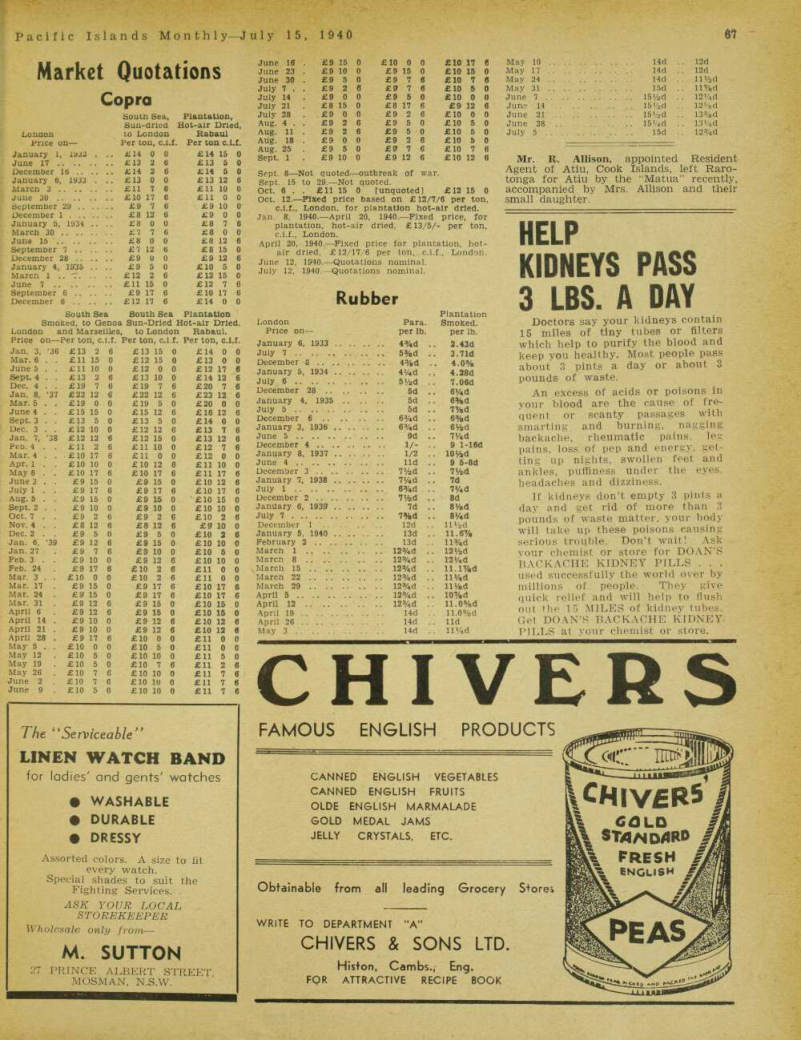
Sept. B—Not quoted—outbreak of war.
Sept. 15 to 29. —Not quoted.
Oct. 6 . . £ll 15 0 [unquoted] £l2 15 0 Oct. 12.—Fixed price based on £l2/7/6 per ton, c.1.f., London, for plantation hot-air dried.
Jan. 8, 1940. —April 20, 1940. —Fixed price, for plantation, hot-air dried, £ 13/5/- per ton, c.i.f., London.
April 20, 1940. —Fixed price for plantation, hot air dried. £l2/17/6 per ton, c.i.f., London.
June 12, 15*40. —Quotations nominal.
July 12, 1940.—Quotations nominal.
Mr, R. Allison, appointed Resident Agent of Atiu, Cook Islands, left Raro tonga for Atiu by the “Matua” recently, accompanied by Mrs. Allison and their small daughter.
Loudon .Price on— January l, 1932
Copra
South Sea, Plantation, Sun-dried Hot-air Dried, to London Rabaul Per ton, c.l.f. Per ton c.LI. £14 0 0 £14 15 0 June 17 . £13 2 6 £13 5 0 December lb .. £14 2 6 £14 5 0 January 6 . 1933 , £13 0 0 £13 12 6 March 3 . . . . £11 7 6 £11 10 0 June 30 . £10 17 6 £11 0 0 September 29 .. £9 7 6 £9 10 0 December 1 . .. £8 12 6 £9 0 0 January 5, , 1934 £8 0 0 £8 7 6 March 30 £7 7 6 £8 0 0 June 15 . £8 0 0 £8 12 6 September 7 ,. £7 12 6 £8 15 0 December 28 . . £9 0 0 £9 12 6 January 4, 1935 £9 5 0 £10 5 0 March 1 , £12 2 6 £12 15 0 June 7 .. £11 15 0 £12 7 6 September 6 .. £9 17 6 £10 17 6 December 6 . . £12 17 6 £14 0 0 South Sea South Sea Plantation Smoked, to Genoa Sun-Dried Hot-air Dried.
London and Marseilles , to London Rabaul.
Price on— Per ton, c.l.f.
Per ton, c.l.f.
Per ton , c.LI.
Jan. 3, ’36 £13 2 6 £13 15 0 £14 0 0 Mar. 6 . . £11 15 0 £12 15 0 £13 0 0 June 5 . . £11 10 0 £12 0 0 £12 17 6 Sept. 4 . . £13 2 6 £13 10 0 £14 12 6 Dec. 4 . . £19 7 6 £19 7 6 £20 7 6 Jan. 8, ’37 £22 12 6 £22 12 6 £23 12 6 Mar. 5 . . £19 0 0 £19 5 0 £20 0 0 June 4 . . £15 15 0 £15 12 6 £16 12 6 Sept. 3 . . £13 5 0 £13 5 0 £14 0 0 Dec. 3 . . £12 10 0 £12 12 6 £13 7 6 Jan. 7, ’38 £12 12 6 £12 15 0 £13 12 6 Feb. 4 . . £11 2 6 £11 10 0 £12 7 6 Mar. 4 . . £10 17 6 £11 0 0 £12 0 0 Apr. 1 , . £10 10 0 £10 12 6 £11 10 0 May 6 . . £10 17 6 £10 17 6 £11 17 6 June 3 . . £9 15 0 £9 15 0 £10 12 6 July 1 . . £9 17 6 £9 17 6 £10 17 6 Aug. 5 . . £9 15 0 £9 15 0 £10 15 0 Sept. 2 . . £9 10 0 £9 10 0 £10 10 0 Oct. 7 . . £9 2 6 £9 2 6 £10 2 6 Nov. 4 . . £8 12 6 £8 12 6 £9 10 0 Dec. 2 . . £9 5 0 £9 5 0 £10 2 6 Jan. 6, ’39 £9 12 6 £9 15 0 £10 10 0 Jan.27 £9 7 6 £9 10 0 £10 5 0 Feb. 3 . . £9 10 0 £9 12 6 £10 10 0 Feb. 24 £9 17 6 £10 2 6 £11 0 0 Mar. 3 . . £10 0 0 £10 2 6 £11 0 0 Mar. 17 . £9 15 0 £9 17 6 £10 17 6 Mar. 24 £9 15 0 £9 17 6 £10 17 6 Mar. 31 £9 12 6 £9 15 0 £10 15 0 April 6 £9 12 6 £9 15 0 £10 15 0 April 14 . £9 10 0 £9 12 6 £10 12 6 April 21 . £9 10 0 £9 12 6 £10 12 6 April 28 . £9 17 6 £10 0 0 £11 0 0 May 5 . . £10 0 0 £10 5 0 £11 0 0 May 12 . £10 5 0 £10 10 0 £11 5 0 May 19 £10 5 0 £10 7 6 £11 2 6 May 26 . £10 7 6 £10 10 0 £11 7 6 June 2 £10 7 6 £10 10 0 £11 7 6 June 9 £10 5 0 £10 10 0 £11 7 6
May 10 14d 12d May 17 14d .. 12d May 24 14d ll'/ad May 31 15d ll’/ad June 7 15'/ad . . 12'/ 4 d June 14 15'/ 2 d .. 12%d June 21 15*/ad . . 13 3 /sd June 28 15'/ 4 d . . 13'/ 4 d July 5 15d 12 3 / 4 d
June 16 . £9 15 0 £10 0 0 £10 17 6 June 23 . £9 10 0 £9 15 0 £10 15 0 June 30 . £9 5 0 £9 7 6 £10 7 6 July 7.. £9 26 £976 £10 50 July 14 £9 0 0 £9 5 0 £10 0 0 July 21 . £8 15 0 £8 17 6 £9 12 6 July 28 £9 0 0 £9 2 6 £ 10 0 0 Aug. 4 . . £9 2 6 £9 5 0 £10 5 0 Aug. 11 . £9 2 6 £9 5 0 £10 5 0 Aug. 18 . £9 0 0 £9 2 6 £10 5 0 Aug. 25 . £9 5 0 £9 7 6 £10 7 6 Sept. 1 . £9 10 0 £9 12 6 £ 10 12 6
Rubber
Plantation London Para.
Smoked.
Price on— per lb. per lb.
January 6, 1933 4%d .. 2.43d July 7 5%d .. 3.71d December 8 .. . 4.0% January 5, 1934 4‘/ 4 d .. 4.28d July 6 7.06d December 28 .. 6%d January 4, 1935 5d .. 6%d July 5 5d .. 7%d December 6 .. 6 3 / 4 d ., 6%d January 3, 1936 6 3 /»d .. 6V a d June 5 9d .. 7>/ 4 d December 4 .. .
V- .. 9 l-16d January 8, 1937 1/2 .. ioy a d June 4 lid .. 9 6-8d December 3 .. . 7%d .. 7%d January 7, 1938 7>/ 4 d .. 7d July 1 6 3 / 4 d .. 7%d December 2 .. . 7%d .. 8d January 6, 1939 7d .. 8Vsd July 7 7%d .. ay 4 d December 1 12d .. ny 2 d January 5, 1940 13d .. 11.6% February 2 .. . 13d .. ll%d March 1 .. ,. 12 3 / 4 d .. 12 y 2 d March 8 .. .. 12%d . . 12y 4 d March 15 .. ,. 12%d .. ll.l%d March 22 .. .. 12%d ..
HV4d March 29 .. .. 12%d .. nysd April 5 12 3 / 4 d .. 10 7 /sd April 12 .. .. 12%d . . 11.0%d April 19 14d . . 11.0%d April 26 14d .. lid May 3 14d llVid
Advertisements & other items, pp. 69-70 (2 items)
67
Pacific Islands Monthl y—j uly 15, 1940
Kidneys Pass
HELP
3 LBS. A DAY
Doctors say your kidneys contain 15 miles of tiny tubes or filters which help to purify the blood and keep you healthy. Most people pass about 3 pints a day or about 3 pounds of waste.
An excess of acids or poisons in your blood are the cause of frequent or scanty passages with smarting and burning, nagging backache, rheumatic pains, leg pains, loss of pep and energy, getting up nights, swollen feet and ankles, pufliness under the eyes, headaches and dizziness.
If kidneys don’t empty 3 pints a day and get rid of more than 3 pounds of waste matter, your body will take up these poisons causing serious trouble. Don’t wait! Ask vour chemist or store for DOAN’S
BACKACHE KIDNEY PILLS . . .
used successfully the world over by millions of people. They give quick relief and will help to flush out the 15 MILES of kidney tubes.
Get DOAN’S BACKACHE KIDNEY
PILLS at your chemist or store.
rŗ ĥ
The “ Serviceable”
LINEN WATCH BAND
for ladies 7 and gents 7 watches
• WASHABLE
• DURABLE
• DRESSY
Assorted colors. A size to lit every watch.
Special shades to suit the Fighting Services.
ASK YOUR LOCAL
STOREKEEPER
Wholesale only from —
M. SUTTON
27 PRINCE ALBERT STREET
MOSMAN, N.S.W,
Established 1868 . . . cr
GO WINGS
Sydney’s Leading Store
EXCLUSIVELY FOR MEN
will have your
SUIT TO MEASURE
TAILORED AND AWAITING
YOUR ARRIVAL IN SYDNEY
Write for
FREE PATTERNS
and Self Measurement Form . . .
COWING BROS. LTD.
Market and George Streets, Sydney
PRODUCING UNIFORM GOOD RESULTS SINCE 1868
ALWAYS ASK FOR IT
IT ATTRACTS —THEY EAT IT —THEY DIE
lUSOLINE
LT
NEVER
KNOWN
TO FAIL!
COCKROACH
DESTROYER
IT'S A PASTE !
AUSOLINE CO.
314 CROWN STREET, SYDNEY
(Established 1919)
l!b. 5/- . . . Bibs.
Postage Extra.
Remit Cash with Order 10/-.
Obtainable also from Islands stores of:
BURNS, PHILP & Co. Ltd.
W. R. CARPENTER & Co. Ltd.
Islands Produce
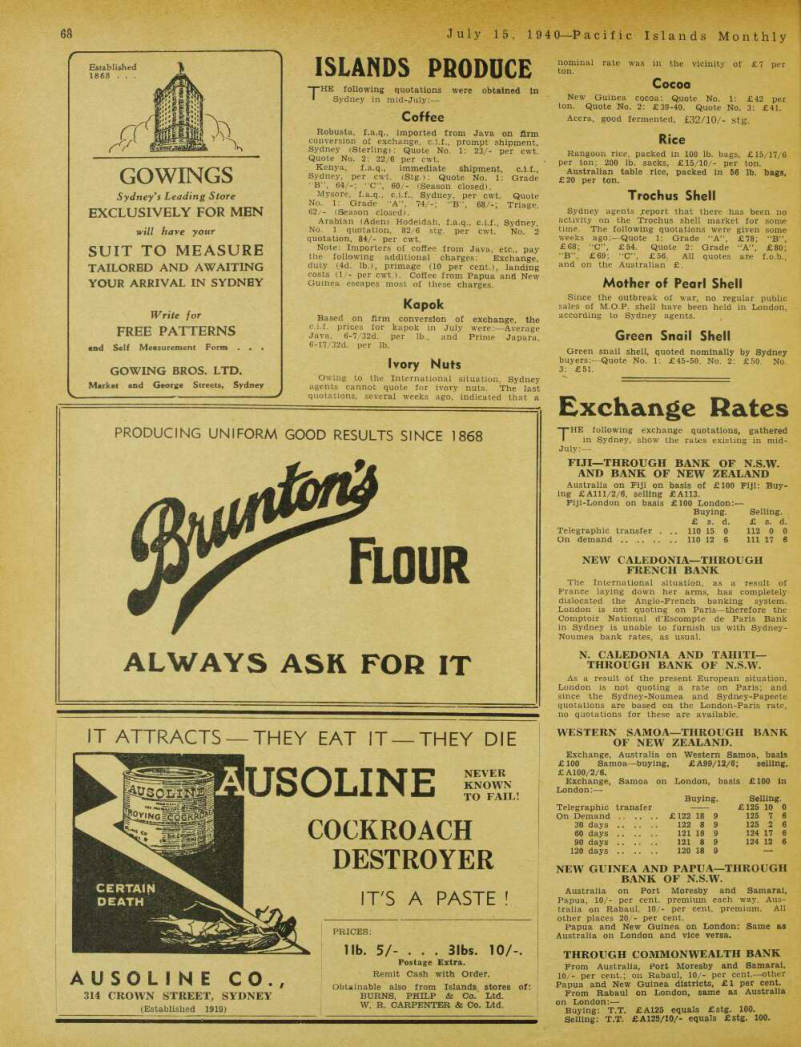
THE following quotations were obtained in Sydney in mid-July:—
Coffee
Robusta, f.a.q., imported from Java on firm conversion of exchange, c.i.f., prompt shipment, Sydney (Sterling): Quote No. 1: 23/- per cwt.
Quote No. 2: 22/6 per cwt.
Kenya, f.a.q., immediate shipment, c.i.f., Sydney, per cwt. (Stg.): Quote No. 1: Grade “B”, 64/-; “C”, 60/- (Season closed).
Mysore, f.a.q., c.i.f., Sydney, per cwt. Quote No. 1: Grade “A”, 74/-; “B”, 68/-; Triage, 62/- (Season closed).
Arabian (Adem Hodeidah, f.a.q., c.i.f., Sydney, No. 1 quotation, 82/6 stg. per cwt. No. 2 quotation, 84/- per cwt.
Note: Importers of coffee from Java, etc., pay the following additional charges: Exchange, duty (4d. lb.), primage (10 per cent.), landing costs (1/- per cwt.). Coffee from Papua and New Guinea escapes most of these charges.
Kapok
Based on firm conversion of exchange, the c.i.f. prices for kapok in July were:—Average Java, 6-7/32d. per lb., and Prime Japara 6-17/32d. per lb.
Ivory Nuts
Owing to the International situation, Sydney agents cannot quote for ivory nuts. The last quotations, several weeks ago, indicated that a
nominal rate was in the vicinity of £7 per ton.
Cocoa
New Guinea cocoa; Quote No. 1: £42 per ton. Quote No. 2: £39-40. Quote No. 3: £4l.
Accra, good fermented, £32/10/- stg.
Rice
Rangoon rice, packed in 100 lb. bags, £l5/17/6 per ton; 200 lb. sacks, £l5/10/- per ton.
Australian table rice, packed in 56 lb. bags, £2O per ton.
Trochus Shell
Sydney agents .report that there has been no activity on the Trochus shell market for some time. The following quotations were given some weeks ago:—Quote 1; Grade “A”, £7B; “B”, £6B; “C”, £54. Quote 2; Grade “A”, £80; “B”, £69; “C”, £56. All quotes are f.0.b., and on the Australian £.
Mother of Pearl Shell
Since the outbreak of war, no regular public sales of M.O.P. shell have been held in London, according to Sydney agents.
Green Snail Shell
Green snail shell, quoted nominally by Sydney buyers:—Quote No. 1: £45-50. No. 2: £5O. No. 3; £5l.
Exchange Rates
“THE following exchange quotations, gathered I in Sydney, show the rates existing in mid- July:—
Fiji—Through Bank Of N.S.W.
And Bank Of New Zealand
Australia on Fiji on basis of £lOO Fiji: Buy ing £Alll/2/6, selling £AII3.
Fiji-London on basis £lOO London: —
New Caledonia—Through
French Bank
The International situation, as a result of Fiance laying down her arms, has completely dislocated the Anglo-French banking system.
London is not quoting on Paris —therefore the Comptoir National d’Escompte de Paris Bank in Sydney is unable to furnish us with Sydney- Noumea bank rates, as usual.
N. Caledonia And Tahiti
Through Bank Of N.S.W.
As a result of the present European situation, London is not quoting a rate on Paris; and since the Sydney-Noumea and Sydney-Papeete quotations are based on the London-Paris rate, no quotations for these are available.
Western Samoa—Through Bank
Of New Zealand.
Exchange, Australia on Western Samoa, basis £lOO Samoa —buying, £A99/12/6; selling,
£ Aloo/2/6.
Exchange, Samoa on London, basis £lOO in London: —
New Guinea And Papua—Through
Bank Of N.S.W.
Australia on Port Moresby and Samaral, Papua, 10/- per cent, premium each way. Aus tralia on Rabaul, 10/- per cent, premium. All other places 20/- per cent.
Papua and New Guinea on London: Same as Australia on London and vice versa.
Through Commonwealth Bank
From Australia, Port Moresby and Samarai, 10/- per cent.; on Rabaul, 10/- per cent. —other Papua and New Guinea districts, £1 per cent.
From Rabaul on London, same as Australia on London: — Buying: T.T. £AI2S equals £stg. 100.
Selling; T.T. £AI2S/10/- equals £stg. 100.
Buying.
Selling. £ s. d. £ s. d.
Telegraphic transfer . .. 110 15 0 112 0 0 On demand .. 110 12 6 111 17 6
Buying. Selling.
Telegraphic transfer —— £125 10 0 On Demand £122 18 9 125 7 6 30 days 122 8 9 125 2 6 60 days 121 18 9 124 17 6 90 days 121 8 9 124 12 6 120 days 120 18 9 —
Advertisements & other items, p. 70 (1 item)
68
July IS, 194 O—P acific Islands Monthly
Shipping Services In The Pacific
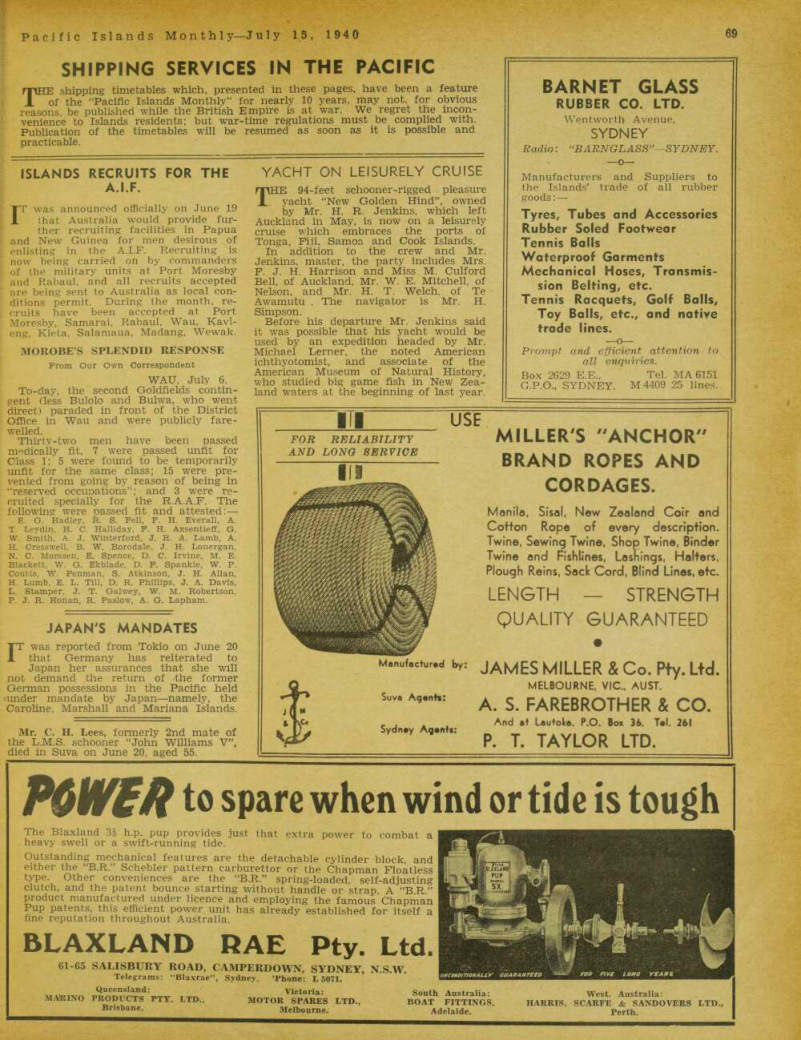
rjiHE shipping timetables which, presented in these pages, have been a feature 1 of the “Pacific Islands Monthly” for nearly 10 years, may not. for obvious reasons, be published while the British Empire is at war. We regret the incon venience to Islands residents; but war-time regulations must be complied with.
Publication of the timetables will be resumed as soon as it is possible and
practicable.
Islands Recruits For The
A.I.F.
IT was announced officially on June 19 that Australia would provide fur ther recruiting facilities in Papua and New Guinea for men desirous of enlisting in the A.I.F. Recruiting is now being carried on by commanders of the military units at Port Moresby and Rabaul, and all recruits accepted are being sent to Australia as local con ditions permit. During the month, re cruits have been accepted at Port Moresby, Samarai, Rabaul, Wau, Kavi eng, Kieta, Salamaua, Madang, Wewak.
Morobe’S Splendid Response
Prom Our Own Correspondent WAU, July 6.
To-day, the second Goldfields contin gent (less Bulolo and Bulwa, who went direct) paraded in front of the District Office in Wau and were publicly fare welled.
Thirty-two men have been passed medically fit, 7 were passed unfit for Class 1; 5 were found to be temporarily unfit for the same class; 15 were pre vented from going by reason of being in “reserved occupations”; and 3 were re cruited specially for the R.A.A.F. The following were passed fit and attested:— E. G. Hadley, R. S. Fell, F. H. Everall, A.
T. Leydin, H. C. Halliday, P. H. Axsentieff, G.
W. Smith, A. J. Winterford, J. R. A. Lamb, A.
H. Cresswell, B. W. Borodale, J. H, Lonergan, N. C. Momsen, E. Spence, D. C. Irvine, M. E.
Blackett, W. G. Ekblade, D. P. Spankie, W. P.
Coutts, W. Penman, S. Atkinson, J. H. Allan, H. Lumb, E. L. Till, D. R. Phillips, J. A. Davis, L. Stamper, J. T. Galwey, W. M. Robertson, P. J. R. Honan, R. Paslow, A, G. Lapham.
Japan's Mandates
IT was reported from Tokio on June 20 that Germany has reiterated to Japan her assurances that she will not demand the return of the former German possessions in the Pacific held under mandate by Japan—namely, the Caroline. Marshall and Mariana Islands.
Mr. C. H. Lees, formerly 2nd mate of the L.M.S, schooner “John Williams V”, died in Suva on June 20, aged 55.
Yacht On Leisurely Cruise
rpHE 94-feet schooner-rigged pleasure X yacht “New Golden Hind”, owned by Mr. H. R. Jenkins, which left Auckland in May, is now on a leisurely cruise which embraces the ports of Tonga, Pi.u, Samoa and Cook Islands.
In addition to the crew and Mr.
Jenkins, master, the party includes Mrs.
F. J. H. Harrison and Miss M. Culford Bell, of Auckland, Mr. W. E. Mitchell, of Nelson, and Mr. H. T. Welch, of Te Awamutu . The navigator is Mr. H.
Simpson.
Before his departure Mr. Jenkins said it was possible that his yacht would be used by an expedition headed by Mr.
Michael Lerner. the noted American ichthyotomist, and associate of the American Museum of Natural History, who studied big game fish in New Zea land waters at the beginning of last year.
Advertisements & other items, pp. 71-72 (1 item)
PQWSft to spare when wind or tide is tough
BARNET GLASS
RUBBER CO. LTD.
Wentworth Avenue,
SYDNEY
Radio: “BARNGLASS”—SYDNEY.
Manufacturers and Suppliers to the Islands’ trade of all rubber goods:— Tyres, Tubes and Accessories Rubber Soled Footwear Tennis Balls Waterproof Garments Mechanical Hoses, Transmission Belting, etc.
Tennis Racquets, Golf Balls, Toy Balls, etc., and native trade lines.
Prompt and efficient attention to all enquiries.
Box 2629 E.E., Tel. MA 6151 G.P.0., SYDNEY. M 4409 25 lines.
11l
USE
FOR RELIABILITY
AND LONG SERVICE
MILLER S "ANCHOR"
BRAND ROPES AND
CORDAGES.
Manila, Sisal, New Zealand Coir and Cotton Rope of every description.
Twine, Sewing Twine, Shop Twine, Binder Twine and Fishlines, Lashings, Halters, Plough Reins, Sack Cord, Blind Lines, etc.
LENGTH STRENGTH
QUALITY GUARANTEED
Manufactured by: JAMES MILLER & Co. Pty. Ltd.
MELBOURNE. VIC. AUST.
Suva Aganta: A $ RAREBROTHER & CO. - , . . And at Lautoka, P.O. Box 36. Tal. 261 Sydnay Aqants:
P. T. TAYLOR LTD.
PQWSft to spare when wind or tide is tough The Blaxland 3 h h.p. pup provides just that extra power to combat a heavy swell or a swift-running tide.
Outstanding mechanical features are the detachable cylinder block, and either the “8.R.” Schebler pattern carburettor or the Chapman Floatless type. Other conveniences are the “8.R.” spring-loaded, self-adjusting clutch, and the patent bounce starting without handle or strap. A “B R ” product manufactured under licence and employing the famous Chapman Pup patents, this efficient power unit has already established for itself a fine reputation throughout Australia.
BLAXLAND RAE Pty. Ltd.
61-65 SALISBURY ROAD, CAMPERDOWN, SYDNEY, N.S.W.
Telegrams: “Blaxrae”, Sydney. ’Phone: L 5071.
Queensland:
MARINO PRODUCTS PTY. LTD.,
Brisbane.
Victoria:
MOTOR SPARES LTD.,
Melbourne.
PUP
South Australia:
BOAT FITTINGS
Adelaide.
West. Australia:
HARRIS, SCARFE & SANDOVERS LTD.,
Perth.
SYDNEY'S LEADING
SAILMAKER
and RIGGER
Also Manufacturer of all Canvas and Rope Work.
ISLANDS WORK a
Speciality.
HARRY WEST
Balmain East, Sydney. Tel.: W 1105
FISHING TACKLE TO TACKLE FISHING
QUALITY LINES
Their Fame is Standing the Strain
Sil Rohu’s “Swordfish” Brand Genuine Cutty Hunk Line, of 50 lea thread standard, recognised for all competitions.
Cord 6 9 12 15 18 Cord ... 24 36 39 54 Dry Test lbs. 14 20 27 34 40 Dry Test lbs. 60 81 88 120 50 yard reels 2/6 3/6 3/6 3/9 4/3 100 yd. reels 9/6 13/6 14/6 18/6 Wet Breaking Strain 15% to 20% higher. The best line it is possible to buy.
New Polaroid Non-Glare Spectacles, 15/-. These Glasses absolutely banish glare and reflection. For Big Game and Deep Sea Fishermen they are the best.
Big game and barrier reef fishing gear for hire. Quality Rod and Reel Repairs.
SIL ROHU
143 ELIZABETH STREET (Near Market St.) SYDNEY ’Phone: MA 3540.
Allen Taylor & Co. Ltd.
SYDNEY
Sawmillers and Wholesale Suppliers of Hardwoods for Constructional Purposes GIRDERS ... PILES .. . POLES . . . SLEEPERS, Etc.
EXPORTING TO PACIFIC 7 " ISLANDS SINCE 1893 Cables: Tuxedo, Sydney
COSMOPOLITAN
SAMARA I.
HOTEL
FIRST-CLASS
ACCOMMODATION
For Tourists & Commercials Electric Light.
Ballroom Billiards Freezing Works, Cold Store.
Best Brands of Liquors
MODERATE TARIFF.
Fishing Trips and Launch Excursions Arranged.
WHERE
HOTEL MORESBY
TO STAY IN PORT MORESBY
X
NEAR THE
WHARF
MODERN
ACCOMMODATION
ONLY THE BEST
BRANDS OP
WINES, SPIRITS
AND BEERS
IN STOCK.
LICENSEE!
Hotel Moresby
Ltd.
The PAPUA
HOTEL
Catering specially for Tourists and Travellers.
Licensee: Papua Hotel, Ltd.
First-class Accommodation. Parties Arranged.
Situated on high ground overlooking both coasts, its Spacious Lounges are always Cool and comfortable . . . Oars meet all Steamers.
Apolosi Banished Again
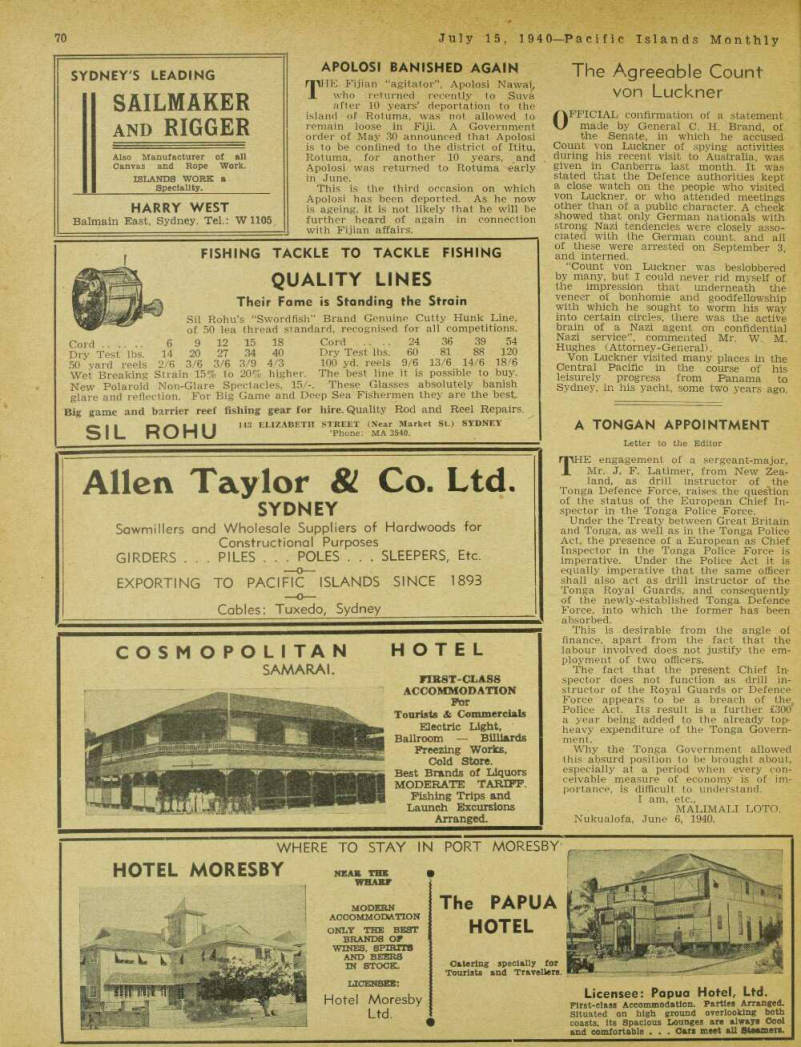
TIE- Fijian “agitator”, Apolosi Nawai, who returned recently to Suva after 10 years’ deportation to the island of Rotuma, was not allowed to remain loose in Fiji. A Government order of May 30 announced that Apolosi is to be confined to the district of Ititu, Rotuma, for another 10 years, and Apolosi was returned to Rotuma early in June.
This is the third occasion on which Apolosi has been deported. As he now is ageing, it is not likely that he will be further heard of again in connection with Fijian affairs.
The Agreeable Count
von Luckner
OFFICIAL confirmation of a statement made by General C. H. Brand, of the Senate, in which he accused Count von Luckner of spying activities during his recent visit to Australia, was given in Canberra last month. It was stated that the Defence authorities kept a close watch on the people who visited von Luckner, or who attended meetings other than of a nublic character. A check showed that only German nationals with strong Nazi tendencies were closely asso ciated with the German count, and all of these were arrested on September 3, and interned.
“Count von Luckner was beslobbered by many, but I could never rid myself of the impression that underneath the veneer of bonhomie and goodfellowship with which he sought to worm his way into certain circles, there was the active brain of a Nazi agent on confidential Nazi service”, commented Mr. W. M.
Hughes (Attorney-General).
Von Luckner visited many places in the Central Pacific in the course of his leisurely progress from Panama to Sydney, in his yacht, some two years ago.
A Tongan Appointment
Letter to the Editor rE engagement of a sergeant-major, Mr. J. F. Latimer, from New Zea land, as drill instructor of the Tonga Defence Force, raises the question of the status of the European Chief In spector in the Tonga Police Force.
Under the Treaty between Great Britain and Tonga, as well as in the Tonga Police Act, the presence of a European as Chief Inspector in the Tonga Police Force is imperative. Under the Police Act it is equally imperative that the same officer shall also act as drill instructor of the Tonga Royal Guards, and consequently of the newly-established Tonga Defence Force, into which the former has been absorbed.
This is desirable from the angle of finance, apart from the fact that the labour involved does not justify the em ployment of two officers.
The fact that the present Chief In spector does not function as drill in structor of the Royal Guards or Defence Force appears to be a breach of the Police Act. Its result is a further £3OO a year being added to the already top heavy expenditure of the Tonga Govern ment.
Why the Tonga Government allowed this absurd position to be brought about, especially at a period when every con ceivable measure of economy is of im portance, is difficult to understand.
I am, etc.,
Malimali Loto.
Nukualofa, June 6, 1940.
Index to Volume X.
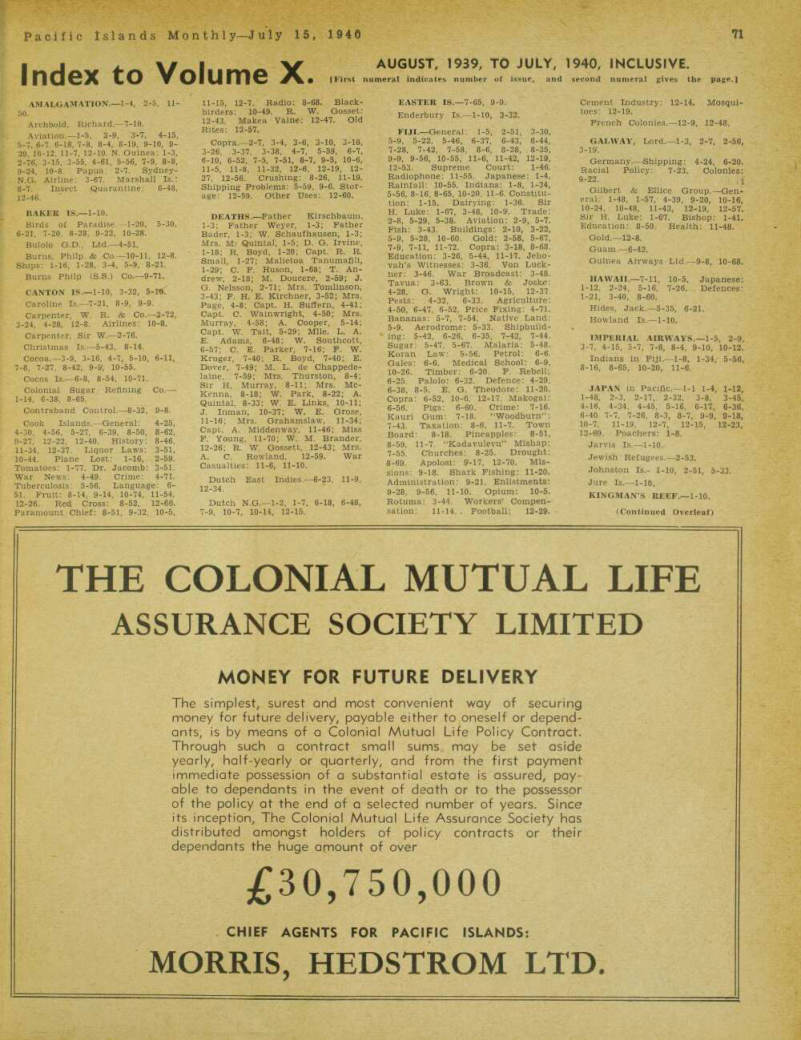
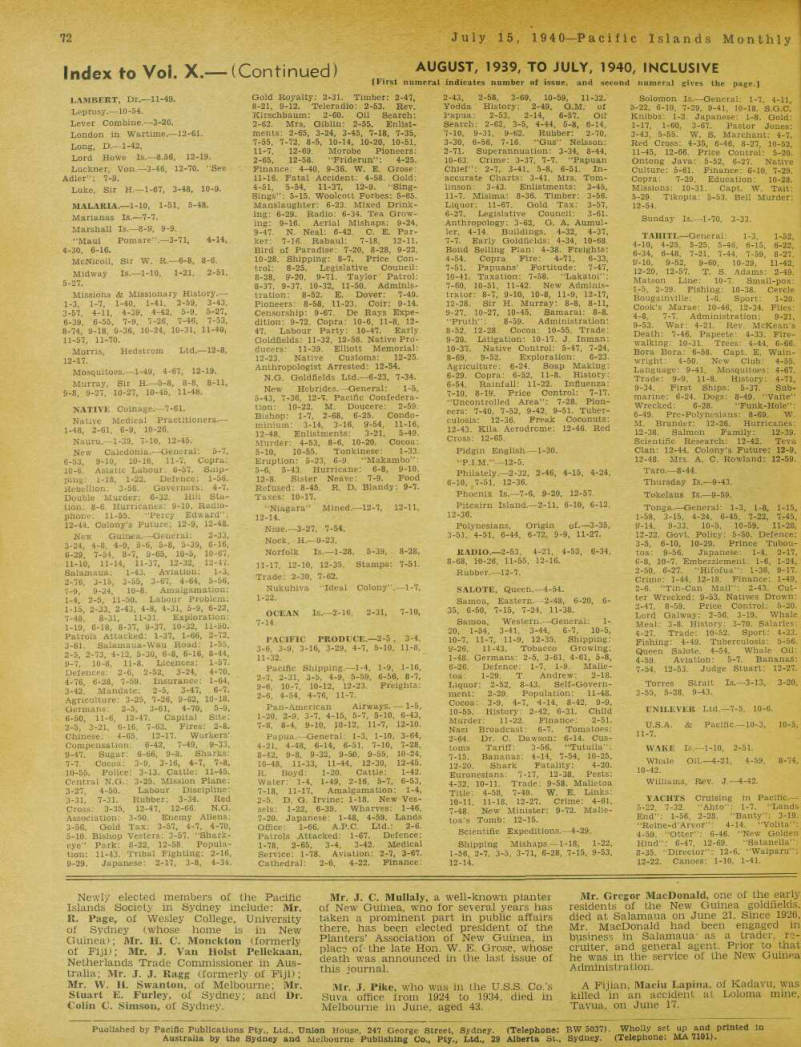
August, 1939, To July, 1940, Inclusive.
[First numeral indicates number of issue, and second numeral gives the page.]
Amalgamation.—I-4, 2-5, 11-
50.
Archbold, Richard. —7-10.
Aviation. —1-5, 2-9, 3-7, 4-15, 5- 6-7, 6-18, 7-8, 8-4, 8-19, 9-10, 9- 29, 10-12, 11-7, 12-10. N. Guinea: 1-3, 2- 3-15, 3-55, 4-61, 5-56, 7-9, 8-8, 9-24, 10-8. Papua: 2-7. Sydney- N.G. Airline: 3-67. Marshall Is.: 8-7. Insect Quarantine: 6-48, 12-46.
Baker Is.—L-10.
Birds of Paradise.—l-20, 5-30, 6- 7-20, 8-28, 9-22, 10-28.
Bulolo G.D., Ltd.—4-51.
Burns, Philp & Co. —10-11, 12-8.
Ships: 1-16, 1-28, 3-4, 5-9, 8-21.
Burns Philp (S.S.) Co.—9-71.
Canton Is.—L-10, 3-32, 5-10.
Caroline Is.—7-21, 8-9, 9-9.
Carpenter, W. R. & Co.—2-72, 3- 4-28, 12-8. Airlines; 10-8.
Carpenter, Sir W. —2-76.
Christmas Is.—s-43, 8-14.
Cocoa.—3-9, 3-16, 4-7, 5-10, 6-11, 7- 7-27, 8-42, 9-9, 10-55.
Cocos Is.—6-8, 8-54, 10-71.
Colonial Sugar Refining Co. — I- 6-38, 8-65.
Contraband Control. —8-32, 9-8.
Cook Islands.—General: 4-25, 4- 4-56, 5-27, 6-39, 8-50, 8-62, 9- 12-22, 12-40. History: 8-46, II- 12-37. Liquor Laws: 3-51, 10- Plane Lost; 1-16, 2-59.
Tomatoes: 1-77. Dr, Jacomb: 3-51.
War News: 4-49. Crime: 4-71.
Tuberculosis: 5-56. Language: 6- 51. Fruit: 8-14, 9-14, 10-74, 11-54, 12-26. Red Cross: 8-52, 12-66.
Paramount Chief: 8-51, 9-32, 10-5,
11- 12-7. Radio: 8-68. Black birders: 10-49. R. W. Gosset: 12- Makea Vaine: 12-47. Old Rites: 12-57.
Copra.—2-7, 3-4, 3-6, 3-10, 3-18, 3-26, 3-37, 3-38, 4-7, 5-59, 6-7, 6-10, 6-52, 7-5, 7-51, 8-7, 9-5, 10-6, 11-5, 11-8, 11-32, 12-6, 12-19, 12- 27, 12-56. Crushing; 8-26, 11-19.
Shipping Problems; 5-59, 9-6. Stor age: 12-59. Other Uses: 12-60.
DEATHS.—Father Kirschbaum, 1-3; Father Weyer, 1-3; Father Bader, 1-3; W. Schaufhausen, 1-3; Mrs. M. Quintal, 1-5; D. G. Irvine, 1-18; R. Boyd, 1-20; Capt. R. R.
Small, 1-27; Malietoa Tanumafili, I- C. F. Huson, 1-68; T. An drew, 2-18; M. Doucere, 2-59; J.
G. Nelsson, 2-71; Mrs. Tomlinson, 3-43; F. H. E. Kirchner, 3-52; Mrs.
Page, 4-8; Capt. H. Suffern, 4-41; Capt. C. Wainwright, 4-50; Mrs.
Murray, 4-58; A. Cooper, 5-14; Capt. W. Tait, 5-29; Mile. L. A.
E. Adams, 6-48; W. Southcott, 6- C. E. Parker, 7-16; F. W.
Kruger, 7-40; R. Boyd, 7-40; E.
Dover, 7-49; M. L. de Chappede laine, 7-59; Mrs. Thurston, 8-4; Sir H. Murray, 8-11; Mrs. Mc- Kenna, 8-18; W. Park, 8-22; A.
Quintal, 8-33; W. E, Links, 10-11; J. Inman, 10-37; W. E. Grose, II- Mrs. Grahamslaw, 11-34; Capt. A. Middenway, 11-46; Miss F. Young, 11-70; W. M. Brander, 12-26; R. W. Gossett, 12-43; Mrs.
A. C. Rowland, 12-59. War Casualties: 11-6, 11-10.
Dutch East Indies. —6-23, 11-9, 12-34.
Dutch N.G.—l-2, 1-7, 6-18, 6-48, 7- 10-7, 10-14, 12-15.
Easter Is.—7-65, 9-9.
Enderbury Is.—l-10, 3-32.
FlJl.—General; 1-5, 2-51, 3-30, 5-9, 5-22, 5-46, 6-37, 6-43, 6-44, 7-28, 7-42, 7-58, 8-6, 8-28, 8-35, 9- 9-56, 10-55, 11-6, 11-42, 12-19, 12-53. Supreme Court: 1-46.
Radiophone: 11-55. Japanese: 1-4, Rainfall: 10-55. Indians: 1-8, 1-34, 5-56, 8-16, 8-65, 10-20, 11-6. Constitu tion: 1-15. Dairying: 1-36. Sir H. Luke: 1-67, 3-48, 10-9. Trade: 2-8, 5-29, 5-38. Aviation: 2-9, 5-7.
Fish; 3-43. Buildings: 2-10, 3-22, 5-9, 5-28, 10-60. Gold: 2-58, 5-67, 7-9, 7-11, 11-72. Copra: 3-18, 8-68.
Education: 3-26, 5-44, 11-17. Jeho vah’s Witnesses; 3-36. Von Luck ner: 3-46. War Broadcast: 3-48.
Tavua: 3-63. Brown & Joske: 4-28. G. Wright: 10-15, 12-37.
Pests: 4-32, 6-33. Agriculture: 4- 6-47, 6-52. Price Fixing: 4-71.
Bananas: 5-7, 7-54. Native Land: 5- Aerodrome; 5-33. Shipbuild ing; 5-42, 6-26, 6-35, 7-42, 7-44.
Sugar: 5-47, 5-67. Malaria: 5-48.
Koran Law: 5-56. Petrol: 6-6.
Gales; 6-6. Medical School: 6-9, 10- Timber: 6-20. F. Rebell'. 6- Palolo: 6-32. Defence; 4-29, 6-38, 8-5. E. G. Theodore: 11-20.
Copra; 6-52, 10-6, 12-17. Makogai: 6- Pigs: 6-60. Crime; 7-16.
Kauri Gum: 7-18. “Woodburn”: 7- Taxation: 8-6, 11-7. Town Board: 8-18. Pineapples: 8-51, 8- 11-7. “Kadavulevu” Mishap: 7- Churches: 8-25. Drought: 8- Apolosi: 9-17, 12-70. Mis sions: 9-18. Shark Fishing: 11-20.
Administration; 9-21. Enlistments: 9- 9-56, 11-10. Opium: 10-5.
Rotuma: 3-44. Workers’ Compen sation: 11-14. . Football: 12-29.
Cement Industry: 12-14. Mosqui toes: 12-19.
French Colonies.—l 2-9, 12-48.
GALWAY, Lord.—l-3, 2-7, 2-56, 3-19.
Germany.—Shipping; 4-24, 6-20.
Racial Policy: 7-23. Colonies: 9- \{ Gilbert & Ellice Group.—Gen eral; 1-48, 1-57, 4-39, 9-20, 10-16, 10- 10-48, 11-43, 12-19, 12-57.
Sir H. Luke: 1-67. Bishop: 1-41.
Education: 8-50. Health; 11-48.
Gold.—l 2-8.
Guam.—6-42, Guinea Airways Ltd.—9-8, 10-68.
HAWAII.—7-11, 10-5. Japanese: 1-12, 2-24, 5-16, 7-26. Defences: 1-21, 3-40, 8-60.
Hides, Jack.—s-35, 6-21.
Howland Is.—l-10.
Imperial Airways.—I-5, 2-9,
3- 4-15, 5-7, 7-8, 8-4, 9-10, 10-12.
Indians in Fiji.—l-8, 1-34, 5-56, 8-16, 8-65, 10-20, 11-6.
JAPAN in Pacific.—l-1 1-4, 1-12, 1-48, 2-3, 2-17, 2-32, 3-8, 3-45, 4- 4-34, 4-45, 5-16, 6-17, 6-36, 6-40 7-7, 7-26, 8-3, 8-7, 9-9, 9-18, 10-7, 11-19, 12-7, 12-15, 12-23, 12-69. Poachers: 1-8.
Jarvis Is.—l-10.
Jewish Refugees.—2-53.
Johnston Is.- 1-10, 2-51, 5-33.
Jure Is.—l-10.
Kingman’S Reef.—I-10.
(Continued Overleaf)
Lambert, Dr.—Ll-49.
Leprosy.—lo-54.
Lever Combine. —3-26.
London in Wartime. —12-61.
Long, D. —1-42, Lord Howe 15.—8.56, 12-19.
Luckner, Von.—3-46, 12-70. “See Adler”: 7-9.
Luke, Sir H.—l-67, 3-48, 10-9.
Malaria.— I-10, 1-51, 5-48.
Marianas Is. —7-7.
Marshall Is.—B-9 1 , 9-9.
“Maui Pomare”.—3-71, 4-14, 4- 6-16.
McNicoll, Sir W. R.—6-8, 8-6.
Midway Is.—l-10, 1-21, 2-51, 5- Missions & Missionary History,— I- 1-7, 1-40, 1-41, 2-59, 3-43, 3-57, 4-11, 4-39, 4-42, 5-9, 5-27, 6- 6-55, 7-9, 7-26, 7-46, 7-53, 8- 9-18, 9-36, 10-24, 10-31, 11-40, II- 11-70.
Morris, Hedstrom Ltd. —12-8, 12-17.
Mosquitoes.—l-49, 4-67, 12-19.
Murray, Sir H. —5-8, 8-8, 8-11, 9- 9-27, 10-27, 10-45, 11-48.
NATIVE Coinage.—7-61.
Native Medical Practitioners. — 1- 2-61, 6-9, 10-26.
Nauru.—l-39, 7-10, 12-45.
New Caledonia. —General; 5-7, 6-53, 9-10, 10-16, 11-7. Copra; 10- Asiatic Labour; 6-57. Snip ping: 1-18, 1-22. Defence; 1-56.
Rebellion; 3-58. Governors; 4-7.
Double Murder; 6-32. Hill Sta tion; 8-6. Hurricanes: 9-10. Radio phone; 11-55. “Percy Edward”: 12-44. Colony’s Future; 12-9, 12-48.
New Guinea. —General; 2-33, 3-24, 4-8, 4-9. 5-6, 5-8, 5-39, 6-16, 6- 7-54, 8-7, 9-65, 10-5, 10-67, 11- 11-14, 11-37, 12-32, 12-47.
Salamaua; 1-43. Aviation; 1-3, 2- 3-15, 3-55, 3-67, 4-64, 5-56, 7- 9-24, 10-8. Amalgamation; 1-4, 2-5, 11-50. Labour Problem; 1-15, 2-33, 2-43, 4-8, 4-31, 5-9, 6-22, 7-48, 8-31, 11-31. Exploration; 1- 6-18, 8-37, 9-37, 10-32, 11-50.
Patrols Attacked; 1-37, 1-66, 2-72, 3- Salamaua-Wau Road: 1-55, 2- 2-73, 4-12, 5-30, 6-8, 6-16, 8-44, 9-7, 10-8, 11-8. Licences: 1-57.
Defences: 2-6, 2-52, 3-24, 4-70, 4- 6-28, 7-59. Insurance; 1-64, 3- Mandate; 2-5, 3-47, 6-7.
Agriculture: 3-25, 7-26, 9-62, 10-18.
Germans: 2-5, 3-61, 4-70, 5-9, 6- 11-6, 12-47. Capital Site; 2- 3-21, 6-16, 7-62. Fires: 2-8.
Chinese; 4-65, 12-17. Workers’
Compensation; 6-42, 7-49, 9-33, 9- Sugar: 6-66, 9-8. Sharks: 7- Cocoa: 3-9, 3-16, 4-7, 7-8, 10- Police: 3-13. Cattle: 11-45.
Central N.G.; 3-25. Mission Plane; 3- 4-50. Labour Discipline: 3-31, 7-31. Rubber; 3-34. Red Cross: 3-35, 12-47, 12-66. N.G.
Association; 3-50. Enemy Aliens; 3-56. Gold Tax: 3-57, 4-7, 4-70, 5- Bishop Vesters: 3-57. “Shark eye” Park; 8-22, 12-58. Popula tion: 11-43. Tribal Fighting: 2-16, 9-29. Japanese: 2-17, 3-8, 4-34.
Gold Royalty: 2-31. Timber: 2-47, 8- 9-12. Teleradio: 2-53. Rev.
Kirschbaum: 2-60. Oil Search: 2-62. Mrs. Giblin: 2-55. Enlist ments; 2-65, 3-24, 3-45, 7-18, 7-35, 7- 7-72, 8-5, 10-14, 10-20, 10-51, 11-7, 12-69. Morobe Pioneers: 2- 12-58. “Friderun”: 4-25.
Finance: 4-40, 9-36. W. E. Grose: 11- Fatal Accident: 4-58. Gold: 4- 5-54, 11-37, 12-9. “Sing- Sings”; 5-15. Woolcott Forbes; 5-65.
Manslaughter: 6-23. Mixed Drink ing: 6-29. Radio: 6-34. Tea Grow ing: 9-16. Aerial Mishaps: 9-24, 9- N. Neal: 6-42. C. E. Par ker: 7-16. Rabaul: 7-18, 12-11.
Bird of Paradise: 7-20, 8-28, 9-22, 10- Shipping: 8-7. Price Con trol: 8-25. Legislative Council; 8- 9-20, 9-71. Taylor Patrol: 8- 9-37, 10-32, 11-50. Adminis tration; 8-52. E. Dover: 7-49.
Pioneers: 8-58, 11-23. Coir; 9-14.
Censorship: 9-67. De Rays Expe dition; 9-72. Copra: 10-6, 11-8, 12- 47. Labour Party: 10-47. Early Goldfields: 11-32, 12-58. Native Pro ducers: 11-39. Elliott Memorial; 12- Native Customs: 12-25.
Anthropologist Arrested: 12-54.
N.G. Goldfields Ltd.—6-23, 7-34.
New Hebrides. —General: 1-5, 5- 7-36, 12-7. Pacific Confedera tion: 10-22. M. Doucere: 2-59.
Bishop: 1-7, 2-68, 6-25. Condo minium: 3-14, 3-16, 9-54, 11-16, 12-48. Enlistments: 3-21, 5-49.
Murder: 4-53, 8-6, 10-20. Cocoa; 5-10, 10-55. Tonkinese: 1-33.
Eruption: 5-23, 6-9. “Makambo”: 5-6, 5-43. Hurricane: 6-8, 9-10, 12-8. Sister Neave: 7-9. Food Refused: 8-45. R. D, Blandy; 9-7.
Taxes: 10-17.
“Niagara” Mined.—l 2-7, 12-11, 12-14.
Niue. —3-27, 7-54.
Nock, H.—9-23, Norfolk Is.—l-28, 5-39, 8-28, 11- 12-10, 12-35. Stamps: 7-51.
Trade: 2-30, 7-62.
Nukuhiva “Ideal Colony”.—l-7, 1-22.
Ocean Is.—2-16, 2-31, 7-10,
7-14.
Pacific Produce.—2-5 , 3-4,
3- 3-9, 3-16, 3-29, 4-7, 5-10, 11-8, 11-32.
Pacific Shipping.—l-4, 1-9, 1-16, 2-7, 2-31, 3-5, 4-9, 5-59, 6-56, 8-7, 9- 10-7, 10-12, 12-23. Freights; 2-6, 4-54, 4-76, 11-7.
Pan-American Airways. 1-5, 1- 2-9, 3-7, 4-15, 5-7, 5-10, 6-43. 7- 8-4, 9-10, 10-12, 11-7, 12-10.
Papua.—-General: 1-3, 1-10, 3-64, 4- 4-48, 6-14, 6-51, 7-10, 7-28, 8- 9-8, 9-32, 9-50, 9-55, 10-24, 10- 11-33, 11-44, 12-30, 12-45.
R. Boyd; 1-20. Cattle; 1-42.
Water: 1-4, 1-49, 2-16, 5-7, 6-53, 7-18, 11-17. Amalgamation: 1-4, 2- D. G. Irvine: 1-18. New Ves sels: 1-22, 6-39. Wharves: 1-46, 7-20. Japanese: 1-48, 4-59. Lands Office: 1-66. A.P.C. £ld.; 2-6.
Patrols Attacked: 1-67. Defence: 1-78, 2-65, 3-4, 3-42. Medical Service; 1-78. Aviation: 2-7, 3-67.
Cathedral: 2-6, 4-22. Finance:
2- 2-58, 3-69, 10-59, 11-32.
Yodda History; 2-49. G.M. of Papua: 2-53, 2-14, 6-57. Oil’
Search: 2-62, 3-5, 4-44, 5-8, 6-14, 7-10, 9-31, 9-62. Rubber: 2-70, 3- 6-56, 7-16. “Gus” Nelsson; 2-71. Superannuation: 3-34, 8-44, 10- Crime: 3-37, 7-7. “Papuan Chief”: 2-7, 3-41, 5-8, 6-51. In accurate Charts: 3-41. Mrs. Tom linson: 3-43. Enlistments: 3-45, 11- Misima: 8-36. Timber: 3-56.
Liquor: 11-67. Gold Tax: 3-57, 6- Legislative Council: 3-61.
Anthropology; 3-62. G. A. Aumul ler, 4-14. Buildings. 4-32, 4-37, 7- Early Goldfields: 4-34, 10-68.
Bond Selling Plan: 4-38. Freights: 4- Copra Fire; 4-71, 6-33, 7-51. Papuans’ Fortitude: 7-47, 10-41. Taxation; 7-58. “Lakatoi”: 7- 10-51, 11-42. New Adminis trator: 8-7, 9-10, 10-8, 11-9, 12-17, 12- Sir H. Murray: 8-8, 8-11, 9- 10-27, 10-45. Samarai: 8-8.
“Pruth”: 8-59. Administration; 8- 12-28. Cocoa; 10-55. Trade: 9- Litigation: 10-17. J. Inman; 10- Native Control: 5-47, 7-24, 8-69, 9-52. Exploration: 6-23.
Agriculture: 6-24. Soap Making: 6-29. Copra: 6-52, 11-8. History: 6- Rainfall: 11-22. Influenza: 7- 8-19'. Price Control: 7-17.
“Uncontrolled Area”: 7-28. Pion eers: 7-40, 7-52, 9-42, 9-51. Tuber culosis: 12-36. Freak: Coconuts; 12-43. Kila Aerodrome: 12-46. Red Cross: 12-65.
Pidgin English.—l-30.
“P.1.M.”—12-5.
Philately.—2-32, 2-46, 4-15, 4-24, 6-10, 7-51, 12-36.
Phoenix Is.—7-6, 9-20, 12-57.
Pitcairn Island. —2-11, 6-10, 6-12, 12-36.
Polynesians, Origin of. —3-35, 3- 4-51, 6-44, 6-72, 9-9, 11-27.
Radio.—2-53, 4-21, 4-52, 6-34,
8- 10-26, 11-55, 12-16.
Rubber. —12-7.
SALOTE, Queen. —4-54.
Samoa, Eastern.—2-48, 6-20, 6- 35, 6-50, 7-15, 7-24, 11-38.
Samoa, Western. —General; 1- 20, 1-54, 3-41, 3-44, 6-7, 10-5, 10- 11-7, 11-9, 12-35. Shipping: 9- 11-43. Tobacco Growing: 1- Germans: 2-5, 3-61, 4-61, 5-8, 6- Defence: 1-7, 1-9. Malie toa: 1-29. T. Andrew: 2-18.
Liquor: 2-52, 8-43. Self-Govern ment: 2-29. Population: 11-48.
Cocoa: 3-9, 4-7, 4-14, 8-42, 9-9, 10- History: 2-42, 6-31. Child Murder: 11-22. Finance; 2-51.
Nazi Broadcast: 6-7. Tomatoes: 2- Dr. C. Dawson; 6-14. Cus toms Tariff: 3-56. “Tutuila”: 7- Bananas: 4-14, 7-54, 10-25, 12-20. Shark Fatality: 4-20.
Euronesians: 7-17, 12-38. Pests; 4- 10-11. Trade; 9-58. Malietoa Title: 4-58, 7-49. W. E. Links; 10-11, 11-18, 12-27. Crime: 4-61, 7-48. New Minister: 9-72. Malie toa’s Tomb: 12-15.
Scientific Expeditions.—4-29.
Shipping Mishaps.—l-18, 1-22, 1-56, 2-7, 3-5, 3-71, 6-28, 7-15, 9-53, 12-14.
Solomon Is.—General: 1-7, 4-11,
5-22, 6-10, 7-29, 9-41, 10-18. S.G.C.
Knibbs: 1-2. Japanese; 1-8. Gold; I- 1-60, 3-67. Pastor Jones: 3- 5-55. W. S. Marchant: 4-7.
Red Cross: 4-35, 6-46, 8-27, 10-52, II- 12-66. Price Control: 5-20.
Ontong Java: 5-52, 6-27. Native Culture: 5-61. Finance: 6-10, 7-29.
Copra: 7-29. Education; 10-28.
Missions: 10-31. Capt. W. Tait: 5- Tikopia: 5-53. Bell Murder; 12-54.
Sunday Is.—l-70, 3-33.
TAHlTl.—General: 1-3, 1-52, 4- 4-25, 5-25, 5-46, 6-15, 6-22, 6- 6-48, 7-21, 7-44, 7-59, 8-27, S'-10, 9-52, 9-60, 10-29, 11-42, 12-20, 12-57. T. S. Adams: 2-49.
Matson Line: 10-7. Small-pox: 1-5, 2-29. Fishing; 10-38. Cercle Bougainville: 1-6. Sport: 1-20.
Cook’s Marae: 10-46, 12-34. Plies; 4-8, 7-7. Administration; 9-21, 9-53. War: 4-21. Rev. McKean’s Death: 7-46. Papeete: 4-33. Fire walking: 10-31. Trees: 4-44, 6-66.
Bora Bora: 6-58. Capt. E. Wain wright: 4-50. New Club: 4-55.
Language: 9-41. Mosquitoes: 4-67.
Trade: 9-9, 11-8. History; 4-71, 9- First Ships: 5-37. Sub marine; 6-24. Dogs: 8-49. “Vaite”
Wrecked: 6-28. “Funk-Hole”; 6-49. Pre-Polynesians: 8-69. W.
M. Brander: 12-26. Hurricanes: 12-38. Salmon Family: 12-39.
Scientific Research: 12-42, Teva Clan: 12-44. Colony’s Future: 12-9, 12-48. Mrs. A. C. Rowland: 12-59.
Taro.—B-44.
Thursday Is. —9-43.
Tokelaus Is.—9-59.
Tonga.—General: 1-3, 1-8, 1-15, 1- 3-15, 4-24, 6-45, 7-22, 7-45, 9’-14, 9-33, 10-5, 10-59, 11-28, 12-22. Govt. Policy: 5-50. Defence: 3- 6-10, 10-29. Prince Tubou toa; 9-56. Japanese: 1-4, 2-17, 6- 10-7. Embezzlement; 1-6, 1-24, 2- 6-27. “Hifofua”: 1-36, 9-17.
Crime; 1-44, 12-18. Finance: 1-49, 2-6. “Tin-Can Mail”: 2-43. Cut ter Wrecked: 9-53. Natives Drown: 2- 8-59. Price Control: 5-20.
Lord Galway: 2-56, 3-19. Whale Meat: 3-8. History: 3-70. Salaries: 4- Trade: 10-52. Sport: 4-33.
Fishing: 4-49. Tuberculosis: 5-56.
Queen Salote. 4-54. Whale Oil: 4- Aviation; 5-7. Bananas: 7- 12-53. Judge Stuart: 12-27.
Torres Strait Is. —3-13, 3-20, 3- 5-28, 9-43.
Unilever Ltd.—7-5, 10-6.
U.S.A. & Pacific.—lo-3, 10-5, 11-
Wake Is.—L-10, 2-51.
Whale 0i1.—4-21, 4-59, 8-74, 10- Williams, Rev. J. —4-42.
YACHTS Cruising in Pacific.— 5- 7-32. “Ahto”: 1-7. “Lands End”: 1-56, 2-28. “Banty”: 3-19.
“Reine-d’Arvor”; 4-14. “Volita”; 4- “Otter”: 6-46. “New Golden Hind”: 6-47, 12-69. “Satanella”: 8- “Director”: 12-6. “Waiparu”: 12- Canoes: 1-10, 1-41.
Newly elected members of the Pacific Islands Society in Sydney include; Mr.
R. Page, of Wesley College, University of Sydney (whose home is in New Guinea); Mr. H. C. Monckton (formerly of Fiji); Mr. J. Van Holst Pellekaan, Netherlands Trade Commissioner in Aus tralia; Mr. J. J. Ragg (formerly of Fiji); Mr. W. H. Swan ton, of Melbourne; Mr.
Stuart E. Furley, of Sydney; and Dr.
Colin C. Simson, of Sydney.
Mr. J. C. Mullaly, a well-known planter of New Guinea, who for several years has taken a prominent part in public affairs there, has been elected president of the Planters’ Association of New Guinea, in place of the late Hon. W. E. Grose, whose death was announced in the last issue of this journal.
Mr. J, Pike, who was in the U.S.S. Co.’s Suva office from 1924 to 1934, died in Melbourne in June, aged 43.
Mr. Gregor MacDonald, one of the early residents of the New Guinea goldfields, died at Salamaua on June 21. Since 1926, Mr. MacDonald had been engaged in business in Salamaua' as a trader, re cruiter, and general agent. Prior to that he was in the service of the New Guinea Administration.
A Fijian, Maciu Lapina, of Kadavu, was killed in an accident at Loloma mine, Tavua, on June 17.
Advertisements & other items, pp. 73-76 (6 items)
71
Pacific Islands Monthl y~ J uly 15, 1940
The Colonial Mutual Life
ASSURANCE SOCIETY LIMITED
MONEY FOR FUTURE DELIVERY
The simplest, surest and most convenient way of securing money for future delivery, payable either to oneself or dependants, is by means of a Colonial Mutual Life Policy Contract.
Through such a contract small sums may be set aside yearly, half-yearly or quarterly, and from the first payment immediate possession of a substantial estate is assured, payable to dependants in the event of death or to the possessor of the policy at the end of a selected number of years. Since its inception, The Colonial Mutual Life Assurance Society has distributed amongst holders of policy contracts or their dependants the huge amount of over £30,750,000
CHIEF AGENTS FOR PACIFIC ISLANDS:
MORRIS, HEDSTROM LTD.
Index to Vol. X. — (Continued)
72
July 15, 1940—Pacific Islands Monthly
AUGUST, 1939, TO JULY, 1940, INCLUSIVE
[First numeral indicates number of issue, and second numeral gives the page.]
Index to Vol. X. — (Continued)
Puolished by Pacific Publications Pty., Ltd., Union House, 247 George Street, Sydney. (Telephone: BW 5037). Wholly set up and printed in Australia by the Sydney and Melbourne Publishing Co., Pty., Ltd., 29 Alberta St.. Sydney. (Telephone; MA7101).
July 15, 194 O—P acific Islands Monthly
I
Vs Guinea Airways Service awaits your arrival at Port Moresby to speed your passage by air to any one of over 50 aerodromes and landing grounds served by the Company throughout New Guinea and Papua.
Guinea Airways' fast modern planes cut days of travelling time to a few hours of flight. As an example, the time of travel by plane to the Goldfields from Port Moresby is only 1 hour 40 minutes as compared with 6to 7 days by surface routes. See more of New Guinea from a better angle and save time and money . . . Travel by Air.
The GUINEA A!AWAY is /he ONLY WAY to defeat Time and Distance Guinea Airways’ fleet offers the choice of a large variety of passenger and freight planes for special charter service to any point in New Guinea and Papua ...
Investigate this special
CHARTER SERVICE
When sailing from Australia book steamer and air passage at the Steamship Office or obtain full particulars from the purser. i a i J THE WORLD'S LARGEST FREIGHT CARRYING AIR SERVICE
LAE-SALAMAU A:
New Guinea Office: LAE, Mandated Territory of New Guinea Branch Offices and Agents at WAU-SALAMAUA-
PORT MORESBY and SYDNEY.
■o\ A .' N -J; •>_> <>'\ *'-N'*‘. as V ’
A AN 0 XV
BOTTUO tr^
TOOTH & CO LIMITED
h&My
WAVERIEY BREWERY
\ E 21/V kK\(i) -A "iimii »t-v
rOOTH L CO.IWITE*
WAVEAUY
K.* o "** A fSxE 21 A sV. ensures a
PERFECT DRINK
atu/t/i€ cio?vn 4ea/
PRESERVES THE FLAVOUR
When ordering lager, first look for the Diamond-shaped Label-that is your guarantee of quality. Then notice the "Spot" Crown Seal, it is designed to retain that quality, and ensure perfect freshness and flavour in any climate.
RESCH S&KLACER