Islands
Pacific
Monthly
Vol. X. No. 10.
May 15, 1940
Established 1930
[Registered at the G.P.&L. Sydney., for transmission post as a newspaper.]
8 d
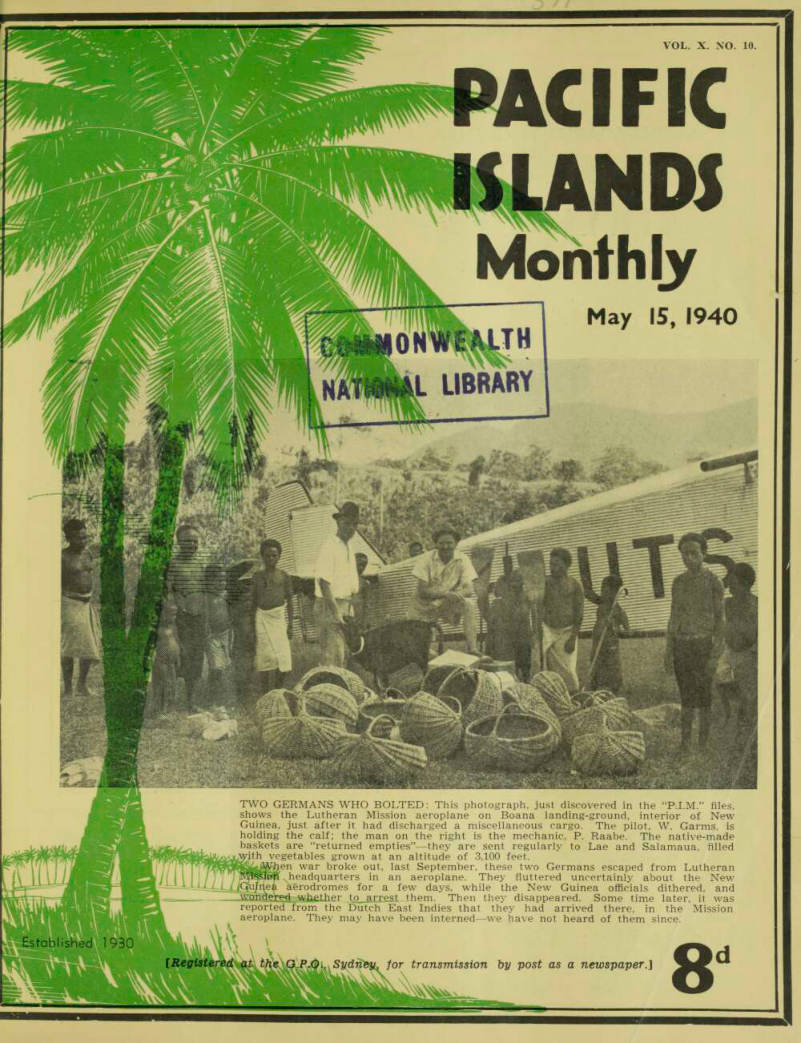
TWO GERMANS WHO BOLTED: This photograph, just discovered in the “P.I.M.” files, shows the Lutheran Mission aeroplane on Boana landing-ground, interior of New Guinea, just after it had discharged a miscellaneous cargo. The pilot, W. Garms, is holding the calf; the man on the right is the mechanic, P. Raabe. The native-made baskets are “returned empties"—they are sent regularly to Lae and Salamaua, filled With vegetables grown at an altitude of 3,100 feet.
When war broke out, last September, these two Germans escaped from Lutheran Mission headquarters in an aeroplane. They fluttered uncertainly about the New Guinea aerodromes for a few days, while the New Guinea officials dithered, and Wondered whether to arrest them. Then they disappeared. Some time later, it was reported from the Dutch East Indies that they had arrived there, in the Mission aeroplane. They may have been interned —we have not heard of them since.
Advertisements & other items, p. 2 (2 items)
Pacific Islands Monthl y—M ay 15, 1940
Carpenters
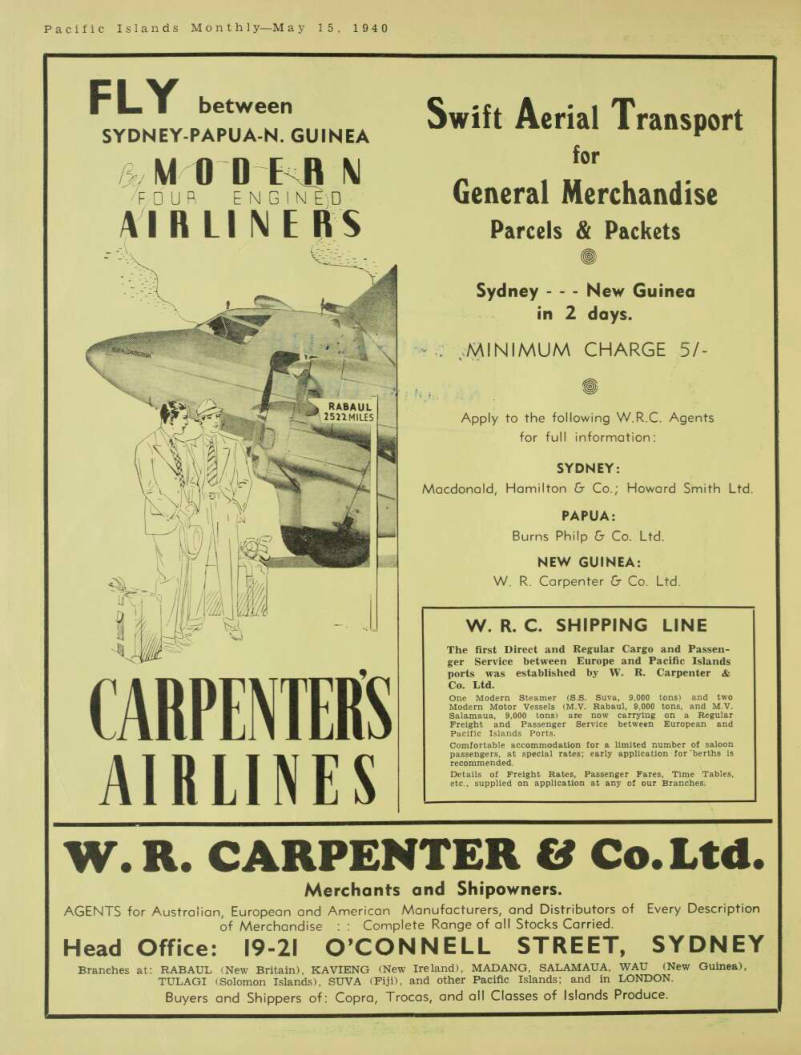
FLY between
SYDNEY-PAPUA-N. GUINEA
MOD E R N
FOUR ENGINE'jD
AIRLINERS
A. \ I
RABAUL
2521 MILES
i , I2|
CARPENTERS
AIRLINES
Swift Aerial Transport
for
General Merchandise
Parcels & Packets
Sydney - - - New Guinea
in 2 days.
•r MINIMUM CHARGE 51-
\ V « S Apply to the following W.R.C. Agents for full information;
SYDNEY:
Macdonald, Hamilton Cr Co.; Howard Smith Ltd.
PAPUA:
Burns Philp Cr Co. Ltd.
NEW GUINEA:
W. R. Carpenter Cr Co. Ltd.
W. R. C. SHIPPING LINE
The first Direct and Regular Cargo and Passenger Service between Europe and Pacific Islands ports was established by W. R. Carpenter & Co. Ltd.
One Modern Steamer (S.S. Suva, 9,000 tons) and two Modern Motor Vessels (M.V. Rabaul, 9,000 tons, and M.V.
Salamaua, 9,000 tons) are now carrying on a Regular Freight and Passenger Service between European and Pacific Islands Ports.
Comfortable accommodation for a limited number of saloon passengers, at special rates; early application for‘berths is recommended.
Details of Freight Rates, Passenger Fares, Time Tables, etc., supplied on application at any of our Branches.
W. R. CARPENTER & Co. Ltd.
Merchants and Shipowners.
AGENTS for Australian, European and American Manufacturers, and Distributors of Every Description of Merchandise : : Complete Range of all Stocks Carried.
Head Office: 19-21 O’CONNELL STREET, SYDNEY
Branches at: RABAUL (New Britain), KAVIENG (New Ireland), MADANG, SALAMAUA, WAU (New Guinea), TULAGI (Solomon Islands), SUVA (Fiji), and other Pacific Islands; and in LONDON.
Buyers and Shippers of: Copra, Trocas, and all Classes of Islands Produce.
Pacific News-Review
Notes And Comment On
The Progress Of The War
From April 15 To May 14
Apl. 15: Officially announced that British forces have landed at several points in Norway.
It is apparent that Germany’s grip on Southern Norway is tightening rapidly.
There have been battles between the small, ill-equipped Norwegian forces and the invaders, with the Norwegians fall ing back slowly towards the Swedish frontier.
Newspaper commentators point out that British landings on such a coastline as Norway’s are hazardous operations and the coming struggle to isolate and over come the various German forces is likely to be long and hard, and reverses must be expected. German forces are wholly isolated at Narvik (extreme north) and Trondheim (middle section) and the Germans are trying to send in reinforce ments and supplies by air.
Apl. 15: British submarine “Spearfish” torpedoed German pocket-battleship “Admiral Scheer” (10,000 tons); result unknown. British submarine “Truant”, torpedoed and sank a German cruiser, be lieved to be the “Karlsruhe” (6,000 tons).
These British successes, and the whole sale sinking of German transport ships, both by mines and torpedoes—the Ad miralty lists 25 Nazi supply and trans port vessels destroyed—show that the Allies now have command of the seas. It must be emphasised, however, that the Allies cannot operate with impunity on land in Norway unless mastery is won in the air. Germany, from her own bases, and from those in captured Denmark, is still flying men and supplies in an un ending stream to reinforce her troops, now “digging in” in Norway, Apl. 15: Italian naval manoeuvres in the Mediterranean, begun several weeks earlier than usual, are causing concern in some quarters, despite Mussolini’s as surance that it is “merely part of Italy’s programme of preparedness”. The Italian press is again adopting an anti-British, hostile tone. The Allies are fully aware, however, that, though Italy is outwardly neutral, she may at any time align herself with the Nazi or Allied cause, according to which way the tide of battle flows.
Apl. 16: R.A.F. planes, from English bases, raided Stavanger aerodrome, in South-west Norway, where Nazi aero planes and seaplanes are quartered, and dropped many high-explosive bombs. They returned without loss.
At the moment, long-range bombers are the only machines suitable for flight from English bases to Norway, and there is little opportunity for the R.A.F. to attack enemy troop-carrying aeroplanes, which are convoyed by fast fighter planes, against which the bombers would have little chance. For the present, British air units are being fruitfully employed in bombing raids on Nazi strongholds in Norwegian towns and ports.
Apl. 16: The shifting of the war scene to Scandinavia has not lessened the tension of neutrals—Belgium, Holland, and the Grand Duchy of Luxemburg con tinue to make far-reaching preparations against invasion.
Apl. 17: Revealed that Allied forces in Norway comprise British, Canadian and French troops, specially equipped for the climate. There was street fighting at Narvik, where the British have gained a solid foothold. Estimates of German troops in Norway vary between 20,000 and 100,000.
The presence of increasing Allied forces
in Norway is testimony of Britain’s power to wage war. Narvik is over 1,000 miles from the English coast, yet within a week a self-contained expeditionary force has landed and is fighting its way Inland.
Hand-in-glove co-operation is evident between the three Services; the Navy opened the way at Narvik, and the R.A.F. gave aerial safeguard to the convoys of troop transports.
Apr. 17: Italian newspapers continue increasingly bitter attacks against Britain and the Allies generally. Most observers in Italy still maintain that these repre sent “bluffing”.
Apr. 17: Extraordinary military mea sures have been taken in Rumania to guard all ports and territorial waters.
The steps include the conservation of supplies of wheat and oil.
It is evident that Rumania still is try ing to hold the balance between the rival demands of Germany and of the Allies. No one trusts the Rumanians— they are the most untrustworthy people in Europe—and the Rumanians for their part are anxious to be on whichever side is likely to win.
Apr. 18: There are almost continuous British air attacks upon the important Norwegian aerodrome at Stavanger.
This is part of the British plan to pre vent the use of these valuable aerodromes by Germans. Obviously, if Germany can use the aerodrome, her numerous air forces can ceaslessly harass the Allied troops which are landing in Norway, especially those which now are advancing from Andalsnes and Namsos with a view to surrounding and capturing Trondheim.
Andalsnes (south) and Namsos (north of Trondheim) are very small ports; in sheltered fiords—but without large wharves, or any flat ground for use by our planes.
Apr. 19: It is believed that Italian mobilisation and aggressiveness are dir ected largely against Yugoslavia. If Italy moved against Yugoslavia France and Britain are not committed by any treaty to go to the assistance of that nation.
But the Allies might be affected through their alliance with Turkey. An attack upon Yugoslavia almost certainly would upset the status quo in the Balkans and that, with equal certainty, would bring in Turkey as a belligerent against Italy. The Allies, in that event, would be bound to help Turkey.
Apr. 19: The British from Namsos have advanced rapidly southwards and already are fighting German forces, thrust out from Trondheim north-eastwards.
Apr. 20: Steps are being taken to ex tend martial law throughout Holland.
Apr. 19: A strike of about 6,500 Canadian seamen has thrown idle 285 vessels on the Great Lakes, at the begin ning of the biggest shipping season known for 25 years. Special wartime mea sures are being taken to get the ships moving again.
This kind of industrial idiocy is in line with the coal strike, which partly has paralysed transport and industry in Aus tralia. These workmen may have serious grievances, but it in inconceivable that they will, of their own volition, commence widespread strikes at a time when the Empire is fighting for its life. There is no doubt that the most cunning types of enemy agents are behind these disturb ances.
Apr. 20; As a result of the disclosure of how the activities of treacherous enemy
agents prepared the way for the seizure of Norway by Germany, every neutral (especially Holland and Belgium) within striking distance of Germany is now combing out all suspected people. This precautionary measure is generally called “The search for Quislings”—Quisling be ing the name of the traitorous Norwegian Nazi who directed the plot which allowed the Germans to seize Oslo without fight ing.
Apr. 21: French troops have arrived in Norway and have joined the British in advances north and south of Trondheim, to cut off the Germans in Trondheim.
British machines are almost continu ously attacking German air bases in Denmark and Norway.
Apr. 21: Best-informed opinion is that Italy will not openly join Germany against the Allies. It is expected, how ever, that the Germans will attack Rumania and that Italy, ostensibly to protect vital Italian interests in the Bal kans, will seize the coast of Yugoslavia and mine the Adriatic.
Apr. 22: Fighting continues in the Narvik and Trondheim areas in Norway.
The Germans are commencing a rapid thrust northwards, from Oslo, to save Trondheim. Frequent sinkings of German transports in the Skagerrak indicate that the Allies are sending in relays of sub marines, to interrupt German sea com munication. Sweden expresses sympathy for Norway, but remains strictly neutral.
Apr. 23: British forces, lightly equipped, hurrying southwards from Namsos, were attacked and driven back by German destroyers, operating from the headwaters of Trondheim fiord. This appears to be a development that the British did not foresee. There also has been sharp fight ing south of Trondheim. The weather is severe, and the Allies who are without aeroplanes, are being subjected to cease less attacks by masses of German machines.
Apr. 24: British budget shows an esti mated record expenditure, mostly on war, of £2,667,000,000, for the year ending March, 1941 —equal to £7,000,000 per day.
The only criticism is that taxation pro posed is not heavy enough—it is insisted that the people are prepared to bear any sacrifices possible, if only they can help in winning the war.
Apr. 24: There is great uneasiness throughout the Balkan nations. Yugo slavia is keeping 500,000 men under arms.
Apr. 28: It is announced that three useful bases for British fighting bomb ing planes have been formed on the frozen surfaces of lakes in Norway and, from there, Allied machines are actively giving battle to planes accompanying the German forces now pushing northwards towards Trondheim. It is also announced that “British guns and aeroplanes are now arriving in Norway with regularity and are helping to remove the Allies’ early disadvantages”.
Apr. 29: A typical news broadcast: “The landings of Allied troops and war mater ials at Norwegian ports continue, and the Allied air arm is now being successfully employed in the fighting. All attempts by German warplanes to stop the trans port of British soldiers to Norway have been repelled.”
Apr. 30: It is indicated, for the first time, that the Allied troops in Norway are being hard-pressed in Norway by the German columns moving up the two valleys from the direction of Oslo.
May 1: As the situation in Norway develops unfavourably to the Allies, the newspapers of Italy express increasing hostility, and a more marked pro-German tone. The general outlook is considered alarming. It is officially announced that British shipping is being diverted from the Mediterranean. Liners for the Far East and Australia going by the Cape of Good Hope. This has caused surprise and apprehension.
May 2: Whole of the British forces have been withdrawn from Andalsnes, south of Trondheim, in Norway, without the loss of one man. This clearly is the result of increasing German pressure from the south.
May 2: After Mussolini had been inter viewed by the American Ambassador the general situation in Rome eased. Italy is not now expected to make any immediate move into the war.
May 2: British air forces are continu ously raiding German air ports in Den mark and Norway.
May 3: The Germans claim that columns advancing rapidly in Norway from Oslo and Bergen towards Trondheim have occupied the ground evacuated by the British, and have taken prisoners 300 Norwegian officers and 3,200 men.
May 3: Officially announced that attacks by German forces, north and south of Trondheim, supported by small tanks and low-flying aircraft, have made withdrawals of the Allied troops neces sary. There is now much alarm and un easiness concerning the situation in Nor way.
May 3: All British and French troops have now been evacuated from the Namsos region north of Trondheim, and the only Allied troops now remaining in Norway are those at Narvik (in the far north), where a force of Germans is still holding out.
May 4: The announcement that the Allies have virtually withdrawn from Nor way, and admitted their defeat there by Germany has caused tremendous shocks in Allied and neutral countries, and especially the United States. This is made worse by the optimism of official reports issued only last week.
May 3: Officially announced that, ow ing to the partial destruction of the Ger man fleet, large British naval forces are available for duty elsewhere, and the Anglo-French battle fleet has resumed duty in the eastern Mediterranean. A powerful fleet of British and French battleships, cruisers, destroyers, etc., has reached Alexandria. While the Allies have lost prestige, through the withdrawal from Norway, they have gained through being now able to use stronger naval forces in the Mediterranean.
May 4: There is a great chorus of criticism of the Chamberlain Government for its handling of the Norwegian cam paign. It is urged that immediately the Germans appeared in Norway, the British should have used their tremendous naval power to smash their way into the Kattegat (and thus cut off their com munications with Norway) and also to seize Trondheim which was held only by light German forces, and which would have provided England and Prance with a splendid base from which to operate air forces and land military and supplies.
Because this was not done, and only little ports with insufficient facilities were avail able, the Allies were forced to fight in most difficult terrain without aeroplanes to assist them, whereas the Germans, using Norwegian aerodromes, were able to employ huge air forces to the maximum.
May 5: Part of the British forces
evacuated from Central Norway have gone to reinforce the Allies in Narvik, where a force of between 3,000 and 4,000 Germans is isolated.
May 5: A very large force of Italian naval, military and air force is reported in the Dodecanese Islands (off the coast of Turkey, covering the entrance to the Dardenelles). It is believed if Italy joins Germany, these forces will be used to counter the British and French armies in Egypt and Palestine.
May 7: Mr. Chamberlain’s Government is meeting increasing criticism in the House of Commons. Mr. Chamberlain virtually is on trial.
May 7: All army and navy leave in Holland has been cancelled. The Dutch Army and Navy are completely mobilised, and the country is virtually on a war footing. Belgium also is described as an armed camp.
These announcements made 48 hours before the Germans actually struck, are most interesting. They indicate not only that Holland had had warning, but also that Mr. Chamberlain and his Govern ment, when they withdrew their troops from Norway, and decided to waste no more time or strength there, knew what was coming.
May 8; The Belgian Cabinet has been unexpectedly called together. Belgian spokesmen insist that, while there is no military agreement, it is generally ad mitted that an invasion of Holland would bring Belgium into the war within 24 hours.
May 9: After two days’ debate on the Norwegian and general war situation, a division was taken in the House of Com mons, in which the Government survived by only 281 to 200. Mr. Chamberlain is expected to resign and a new Government to be formed.
Holland And Belgium Invaded
May 10: At dawn the Germans invaded Holland, Belgium and Luxemburg. Hol land and Belgium immediately appealed for Allied assistance and, within a few hours, the armies of Britain and France, their plans perfected months ago, were moving rapidly to the assistance of the invaded countries.
The advance of the German armies was preceded and accompanied by waves of fighting and bombing planes. An out standing feature of the invasion was the dropping by parachute, from troop carrying aeroplanes, of hundreds and probably thousands of German soldiers, at points far behind the defence lines.
The Germans came from the air in such numbers upon the aerodromes of Rotter dam and The Hague that they were at first able to throw back the Dutch troops, and they actually captured both of these important aerodromes, as well as others.
For many hours on May 10, the situ ation was extremely confused. The Bel gian and Dutch armies were resisting the invader along their eastern frontiers; small isolated parties of parachutists were fighting the Dutch and Belgians at points far behind their lines; and great forces of British and French were hurry ing from the south to stem the German rush. Both Dutch and Belgians fought most valiantly and both Governments showed ingenuity in using their local forces to clean up the parachutists.
The French Air Force attacked German formations behind the German lines and also were heavily engaged with invading German air forces over northern France.
The British Air Force, not having to re sist air attacks at home, was able im
mediately to render most important help to both Belgium and Holland.
May 11 and 12: It is now clear that the carefully planned German lightning stroke to seize vital airports in Holland and Belgium has failed. For a time, Ger mans were strongly established in several airports, but all have now been re captured, and most of the Germans wiped out. Small German forces are still hold ing out in The Hague and in Rotterdam (where they moved from the aerodromes into the cities) —but they are being mopped up.
It is clear also that the German milit ary thrust is roughly in three divisions.
No. 1 is against Northern Holland, where the Germans, meeting little defence, have over-run the whole of Northern Holland right up to the eastern shores of the Zuyder Zee. The second thrust has been made in great force —near the junction of Holland and Belgium. By the night of May 12, the Germans had captured Maastricht and crossed the Albert Canal, and penetrated 12 miles to the westward of those points, thus partly surrounding the great Belgian fortress of Liege. The Belgians have strongly counter-attacked.
It is presumed that the British army is rapidly moving in here, to the assistance of the Belgians. The third German thrust is on a 40-miles front against the Mag inot Line between Forbach and the Vosges Mountains—but this may be a feint.
May 13: The Germans are 20 miles in side the frontier, in the neighbourhood of Maastricht. Counter attacks here have slowed up the German advance.
Intense air activity continues. It is calculated that on May 10, 11 and 12, the Allies destroyed at least 400 German aero planes. Their own losses were heavy, but nothing like that.
The German thrust through Maastricht, westwards along the Albert Canal to wards Antwerp, is most dengerous, as it may separate Holland from Belgium, and the Allies.
It is certain that the Germans during the next few weeks will exert their maxi mum strength in an attempt to burst through to the Channel ports, from which they may make an overwhelming air attack upon England.
May 14: German columns are now half way across Holland. Germany claims that she now 7 holds half of Holland. The Queen of Holland, and the Dutch Govern ment have removed to London.
New British Government
May 10: In order to clear the way for the formation of a National Government, Mr. Chamberlain resigned; Mr. Winston Churchill was selected to be Prime Mini ster; and the Labour Party and Liberals then joined in a National Government under Mr. Churchill. Mr. Churchill’s War Cabinet consists of five —Mr. Churchill, Mr. Chamberlain, Lord Halifax, Mr. Atlee and Mr. Greenwood, the two latter being Labour leaders. Mr. Alexander, another Labour leader, becomes First Lord of the Admiralty; Mr. Anthony Eden is the new Minister for War; and Mr. Duff Cooper also joins the Government. It is worth remembering that the three men who most bitterly fought Mr. Chamber lain because of his agreement with Hitler at Munich were Churchill, Eden and Duff Cooper.
May 12: The announcement of the new Government, and the realisation that Germany at last has made a major move which may quickly decide the war, has caused tremendous relief in Britain and Prance.
PER “TASMAN" TO PAPUA: Messrs. Bozier, Edwards, Gloe, Grant, Gray, Middleton, Mill ward, Paterson, Timperley, Wilmot. Mesdames Gloe, Gray, Hinds, Millward. Misses Gray, Hinds, Vaughan.
PER “MARIPOSA” FROM FIJI: Messrs. Allard, Curphey, Marks, Patel, Robertson, Thompson (2), Yamasaki, Afa Aso, Clarke, Faslin, Dayram, Gulam, Hargoran, Jamal, Leather, Manilal, Motiram, Nagindas, Pilcher. Rev. Roe, Rev.
Brocard. Mesdames Eastment, Fenner, Marks, Suckling. Misses Kerkham. From Pago Pago: Mr. Evans. Mesdames Evans, Walker, Martin.
PER “AORANGI” FROM FIJI: Messrs. Craigie, Hardy, Piper, Buksh, Haling, Naiker, Emery, Kini, Mesdames Curry, Piper, Craigmyle, Knevitt, Anderson, Kini. Miss Carter.
PER AIRLINER FROM N.G. & PAPUA: Messrs.
Hope, Sellen, Herald, Richardson, Karius. Mes dames Sellen, Hayles, Mitchell. - PER AIRLINER TO PAPUA & N.G.: Messrs.
Allen, Bannon, Cameron, Yamazaki, Temple- Watts. Mrs. Temple-Watts.
PER AIRLINER FROM N.G. & PAPUA: Messrs.
Hore-Lacy, Shaw, Irvin, Cook, Bliss, Pentland, Grahamshaw.
PER AIRLINER TO PAPUA & N.G.: Messrs.
De Rusett, Lee, Hanrshan, Broad. Mrs. De Rusett, PER AIRLINER FROM N.G. & PAPUA: Messrs.
Pasalow, Blake, Bedser, Avery, Gibson. Sisters Germain, De La Croix.
PER AIRLINER TO PAPUA & N.G.: Messrs.
Babb, Chapman, Collins, Bartlett. Mesdames Keogh, Fox. Miss Stevens.
PER AIRLINER FROM N.G. & PAPUA: Messrs.
Dunt, Waderhofe, Bayliss, Zoffman. Mesdames Bayliss, Degiovanni. Miss Hamilton.
MR. H. R. CRAIGIE, Government Printer in Fiji, will leave Suva at the end of this month on transfer to Tan ganyika, British East Africa, as Assist ant Superintendent of the Government Printing Office there. Twelve years ago, Mr. Craigie arrived in Suva as foreman
compositor in the Fiji Printing Depart
ment and when Mr. J. J. McHugh re tired four years ago he assumed the post of Government Printer.
Advertisements & other items, pp. 3-4 (2 items)
I
Pacific Islands Monthl y—M ay 15, 1940
Ii
May 15, 194 O—P acific Islands Monthly
Pacific Islands Travellers
Per “Morinda” From N.H., Solomon Is.,
NORFOLK & LORD HOWE IS.: Messrs. Cummins, Hays, Hazlewood, Beatty, Isaacs, Purdy, Ander son. Martin, Brownlees, Keegan, Keer, Black, Blencowe, Buffett, Butt, Dillon, Evans (2), King, Laing, Le Cren, Mitchell, Quintal, Westwood, Hempel, Hicks, Marlin, Morris, Nott, Payten, Pearcy, Roxburgh, Thompson (3), Williams, Woods. Sir Chas. Rosenthal. Rev. Pascoe, Rev.
Lawton. Mesdames Hazlewood, Martin, Keegan, Buffett, Butt, Hutchinson, Laing, Le Cren, Nelson, Pascoe, Quintal, Richardson, Scobie, Scott, Snell, Christian, Lawton, Payten, Thompson (2), West, Williams, Wilson. Misses Blackman, Gordon, Rankine, Buffett (2), Cropper, Lancon.
Per “Macdhui” Prom Papua & N.G.:
Messrs. Abrahams, Brown, Bruce, Bussell, Brown, Bridger, Bosgard, Boswell, Bramley, Chugg, Carson, Crockett, Conlon, Clymo, Chaplin, Cameron, Dickie, Day, Edwards, Freutchmann, Poldi, Gilpin, Gadd, Hare, Hindman, Harrison, Hope, Jackson, Kelsall, Lees, Lewis, Lyon, Murphy, Mansell, McKechnie, Monteith, MjcLeod, O’Sullivan, Peters, Rowse, Stutchbury, Smith (21, Staples, Slee, Thomas, Wallis. Rev. Oakes, Rev. Glover. Mesdames Burke, Brown, Chugg, Carson, Duncan, Edwards, Freutchmann, Gurney, Holdsworth, Hounsel, Kelsall, Lees, Murphy,
Montieth, Murray, McKechnie, McCuskey, Mc- Leod, Oakes, Stutchbury, Savage, Sullivan, Smith, Slee, Thomas. Yeoman. Misses Chugg, Duncan, Devitt, Garrett, Inman, Lashmar, Sullivan, Vale. Sister Ottonia.
Per “Neptuna” From N.G. & Papua:
Messrs. Tupling, Blestowe, Clarkson, Davies, Dowe, Grieve, James, McDonald, Emery, Heading, McWatters, Moffatt, Mulhern (2), Ross, Booth, Gaskin, Hogan, Hosking, Sawkins, Sully, Phillips, Townsend, Sturgeion, Sherman. Mesdames Clark son, Halliday, Lowe, Marshall, Wood, Emery, Ross, Hosking, Sawkins, Sully, Townsend, Sher man. Misses Mathieson, Rundnagel.
Per “Neptuna” For Papua & N.G.:
Messrs. McGlynn, Robertson, Feetum. Mesdames Burnett, McGlynn, Robertson, White, Feetum, Layton.
PER “MALAITA” TO PAPUA, N.G. & 8.5.1.
PORTS: Messrs. Bergeron, Bennett, Burchett, Boal, Campbell, Calderwood, Carpenter, Duffy, Dickson, Everett, Frame, Goodall, Griffiths, Gray, Hosie, Koskey, Leydon, Lockie, Lamond, Mason, Mcßride, Mather, Prero, Stibbard, Speedie, Sharp, Stokes, Warren. Mesdames Baddeley, Crowe, Campbell, Croft, Cannon, Driver, Dickson, Kee
gan, Whitehead, Ware, Wright, Walke. Misses Belot, Ball, Cannon, Deck, Evennett, Fey, Mill, Parsons, Smith, Twyford, Ware, Whitehead.
Sister James.
Per “Macdhui” From Papua & N.G.:
Messrs. Angel, Abberfield, Bailey, Beaumont, Blacklock, Black, Bonney, Bayliss, Burden, Burt, Fraser, Grose, Hurrell, Hill, Kyte, Lambert, Lud wig, Martin, Mason, Mackinnon, Miller, Middle ton, Oliver, O’Reilly, O’Dea, Rich, Parry, Rea burn, Radford, Rose, Spencer, Young, Wise, Waters, Wells. Rev. Rich, Rev. Thompson'.
Father Pring. Mesdames Condon, Ekblade, Harding, Lilley, Miller, Osborne, Parry, Rad ford, Rich (2), Rose, Robinson, Sorrell, Shaw, Thurlow, Waters, Wells, Bonney. Misses Mason, McGrath. Sister Adela.
Per “Malaita” Prom Papuan, N.G. &
8.5.1. PORTS: Messrs. Alley, Lovett, Cheetham, Colley, Dickie, Doyle, Fletcher, Fulton, Groves, Harvey, Howard, Jacket, Leadley, Lewis, MjcKay, Marchant, More, Morris, Muddell, Mutch, Nay lor, O’Brien, Osborne, Prosser, Robinson, Speedie, Try, Wade, Warwick, West. Dr. Crichlow. Father Lebel. Mesdames Doyle, Fletcher, Potu, Groves, Havea, Howard, Knox, Leadley, Lotze, Osborne, Speedie, Thomas. Misses Fairhall, Jenkins, Mc- Connell, Pearce, Read, Richardson, Semple, Whit lock.
(Continued On Page 78)
Advertisements & other items, p. 5 (2 items)
1
Pacific Islands Monthl y —May 15, 1940
South Pacific Line
MAUA
Luc l
SYDNEY
' : . <Pmmn p . m
K. P. M.
SOUTH PACIFIC LINE.
Royal Packet Navigation Co. Ltd., Paketvaart House, 255 George Street, Sydney. (N. V. Koninklljke Paketvaart MaatschapplJ—lncorporated in the Netherlands.) Saigon, Diethelm & Co.; Port Moresby and Samarai, Steamships Trading Co.
Ltd.; Rabaul, Salamaua and Wan, W. R.
Carpenter & Co. Ltd.; Port Vila, Gnbbay Freres; Noumea, Carlo Leonl; Auckland, Russell & Somers Ltd.; WeUlngton, Johnston A Co. Ltd.
Linking the East with South Pacific
Islands, New Zealand and Australia
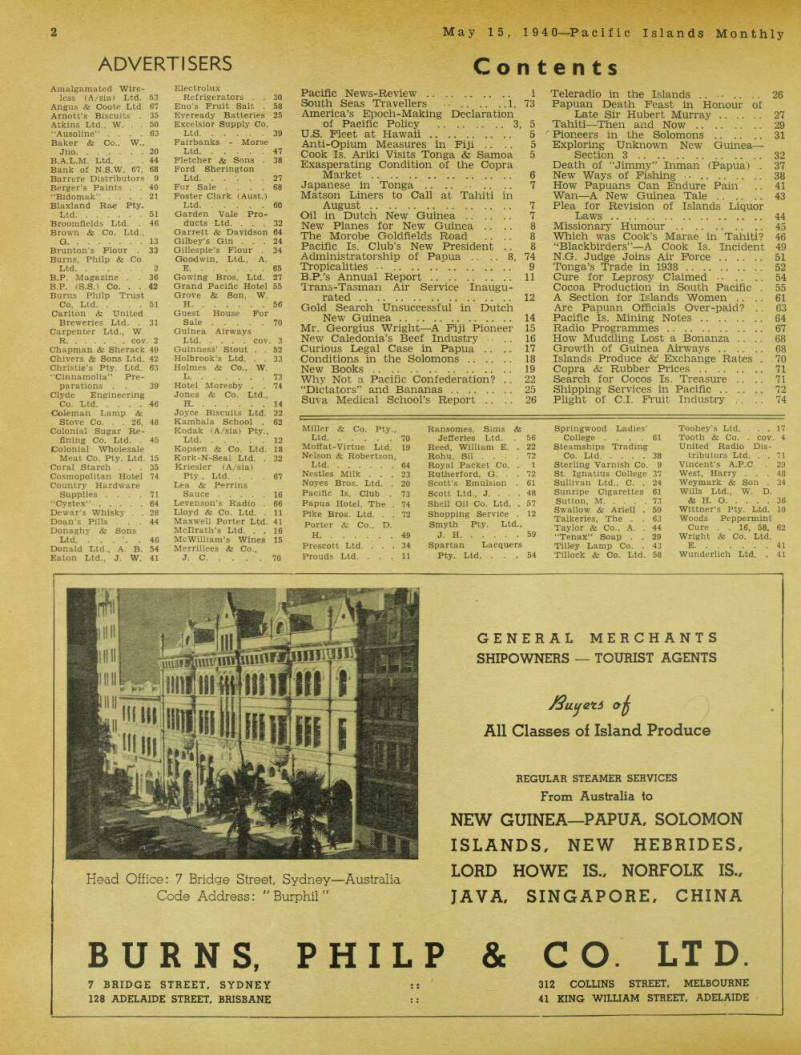
The track routes of the K.P.M.-South Pacific Line new motor vessel “Maetsuycker” and the well-known passenger steamer “Tasman” are each as follows:—“TASMAN”: Saigon, Singapore, Batavia, Samarang, Sourabaya, Port Moresby, Samarai, Port Vila, Noumea, Auckland, Wellington, Sydney, Port Moresby, Sourabaya, Samarang, Batavia, Singapore, Saigon. “MAETSUYCKER”: Saigon, Singapore, Batavia, Samarang, Sourabaya, Port Moresby, Salamaua, Rabaul, Auckland, Wellington, Sydney, Port Moresby, Sourabaya, Samarang, Batavia, Singapore, Saigon.
SOUTH PACIFIC Line
Advertisers
Amalgamated Wire less (A/sia) Ltd. 53 Angus & Coote Ltd. 67 Arnott’s Biscuits . 35 Atkins Ltd., W. . . 50 “Ausoline” ... 63 Baker & Co., W., Jno 20
B.A.L.M. Ltd. ... 44
Bank of N.S.W. 67, 68 Barrere Distributors 9 Berger’s Paints . . 40 “Bidomak” ... 21 Blaxland Rae Pty.
Ltd 51 Broomfields Ltd. . 46 Brown & Co. Ltd., G 13 Brunton’s Flour 33 Burns, Philp & Co.
Ltd 2 B.P. Magazine . . 36
B.P. (S.S.) Co. . . 42
Burns Philp Trust Co. Ltd 51 Carlton & United Breweries Ltd. . 31 Carpenter Ltd., W.
R cov. 2 Chapman & Sherack 49 Chivers & Sons Ltd. 42 Christie’s Pty. Ltd. 63 “Cinnamolia” Pre parations ... 39 Clyde Engineering Co. Ltd 46 Coleman Lamp & Stove Co. . . 26, 48 Colonial Sugar Re fining Co. Ltd. . 45 (Colonial Wholesale Meat Co. Pty. Ltd. 15 Coral Starch ... 35 Cosmopolitan Hotel 74 Country Hardware Supplies ... 71 “Cystex” 64 Dewar’s Whisky . . 28 Doan’s Pills ... 44 Donaghy & Sons Ltd 46 Donald Ltd., A. B. 54 Eaton Ltd., J. W. 41
Electrolux Refrigerators . . 30 Eno’s Fruit Salt . 58 Eveready Batteries 25 Excelsior Supply Co.
Ltd 39 Fairbanks - Morse Ltd 47 Fletcher & Sons . 38 Ford Sherington Ltd. ... 27 For Sale ... 68 Foster Clark (Aust.) Ltd 60 Garden Vale Pro ducts Ltd. ... 32 Garrett & Davidson 64 Gilbey’s Gin ... 24 Gillespie’s Flour 34 Goodwin, Ltd., A.
E 65 Gowing Bros. Ltd. 27 Grand Pacific Hotel 55 Grove & Son, W.
H 56 Guest House For Sale 70 Guinea Airways Ltd cov. 3 Guinness’ Stout . . 52 Holbrook’s Ltd. . . 33 Holmes & Co., W.
L 73 Hotel Moresby . . 74 Jones & Co. Ltd., H 14 Joyce Biscuits Ltd. 22 Kambala School , 62 Kodak (A/sia) Pty., Ltd 12 Kopsen & Co. Ltd. 18 Kork-N-Seal Ltd. . 32 Kriesler (A/sia) Pty., Ltd. ... 67 Lea & Perrins Sauce 16 Levenson’s Radio . 66 Lloyd & Co. Ltd. . 11 Maxwell Porter Ltd. 41 Mcllrath’s Ltd. . . 16 McWilliam’s Wines 15 Merrillees & Co., J. C 70
Miller & Co. Pty., Ltd 70 Moffat-Virtue Ltd. 19 Nelson & Robertson, Ltd 64 Nestles Milk ... 23 Noyes Bros. Ltd. . 20 Pacific Is. Club . 73 Papua Hotel, The . 74 Pike Bros. Ltd. . . 72 Porter & Co., D.
H 49 Prescott Ltd. ... 34 Prouds Ltd. ... 11
Ransomes, Sims & Jefferies Ltd. . 56 Reed, William E. . 22 Rohu, Sil . . . . 72 Royal Packet Co. . 1 Rutherford, G. . . 72 Scott’s Emulsion . 61 Scott Ltd., J. ... 48 Shell Oil Co. Ltd. . 57 Shopping Service . 12 Smyth Pty. Ltd., J. H 59 Spartan Lacquers Pty. Ltd. ... 54
Springwood Ladies’
College ... 61 Steamships Trading Co. Ltd 38 Sterling Varnish Co. 9 St. Ignatius College 37 Sullivan Ltd., C. . 24 Sunripe Cigarettes 61 Sutton, M 73 Swallow & Ariell . 59 Talkeries, The . . 63 Taylor & Co., A. . 44 “Tenax” Soap . . 29 Tilley Lamp Co. . 43 Tillock & Co. Ltd. 58
Toohey’s Ltd. ... 17 Tooth & Co. . cov. 4 United Radio Dis tributors Ltd. . . 71 Vincent’s A.P.C. . 29 West, Harry ... 48 Weymark & Son . 34 Wills Ltd., W. D. & H. 0 36 Wittner’s Pty. Ltd. 10 Woods Peppermint Cure . . 16, 58. 62 Wright & Co. Ltd.
E 41 Wunderlich Ltd, . 41
Contents
Pacific News-Review i South Seas Travellers 1, 73 America’s Epoch-Making Declaration of Pacific Policy 3, 5 U.S. Fleet at Hawaii 5 Anti-Opium Measures in Fiji ... 5 Cook Is. Ariki Visits Tonga & Samoa 5 Exasperating Condition of the Copra Market 6 Japanese in Tonga .. .. .. .. 7 Matson Liners to Call at Tahiti in August 7 Oil in Dutch New Guinea 7 New Planes for New Guinea ... 8 The Morobe Goldfields Road ... 8 Pacific Is. Club’s New President .. 8 Administratorship of Papua .. .. 8, 74 Tropicalities •• 9 B.P.’s Annual Report 11 Trans-Tasman Air Service Inaugu rated 12 Gold Search Unsuccessful in Dutch New Guinea 14 Mr. Georgius Wright—A Fiji Pioneer 15 New Caledonia’s Beef Industry .. 16 Curious Legal Case in Papua .. .. 17 Conditions in the Solomons 18 New Books 19 Why Not a Pacific Confederation? .. 22 “Dictators” and Bananas 25 Suva Medical School’s Report .. .. 26
Teleradio in the Islands ... 26 Papuan Death Feast in Honour of Late Sir Hubert Murray 27 Tahiti—Then and Now 29 Pioneers in the Solomons 31 Exploring Unknown New Guinea — Section 3 32 Death of “Jimmy” Inman (Papua) . 37 New Ways of Pishing ■ 38 How Papuans Can Endure Pain .. 41 Wan—A New Guinea Tale 43 Plea for Revision of Islands Liquor Laws 44 Missionary Humour 45 Which was Cook’s Marae in Tahiti? 46 “Blackbirders”—A Cook Is. Incident 49 N.G. Judge Joins Air Force 51 Tonga’s Trade in 1938 52 Cure for Leprosy Claimed • • .. .. 54 Cocoa Production in South Pacific . 55 A Section for Islands Women .. 61 Are Papuan Officials Over-paid? .. 63 Pacific Is. Mining Notes 64 Radio Programmes 67 How Muddling Lost a Bonanza ... 68 Growth of Guinea Airways 68 Islands Produce &' Exchange Rates . 70 Copra & Rubber Prices 71 Search for Cocos Is. Treasure .. .. 71 Shipping Services in Pacific 72 Plight of C.I. Fruit Industry .. .. 74
Advertisements & other items, p. 6 (2 items)
2
May 15, 194 O—P acific Islands Monthly
Burns, Phil
mm 111 II w k' T U
HI ill
IP n Head Office: 7 Bridge Street, Sydney—Australia Code Address: " Burphil"
BURNS, PHIL
7 BRIDGE STREET. SYDNEY
128 ADELAIDE STREET. BRISBANE
GENERAL MERCHANTS
SHIPOWNERS TOURIST AGENTS
All Classes of Island Produce
REGULAR STEAMER SERVICES
From Australia to
NEW GUINEA—PAPUA, SOLOMON
ISLANDS, NEW HEBRIDES,
LORD HOWE IS., NORFOLK IS..
JAVA, SINGAPORE, CHINA
& CO. LTD.
312 COLLINS STREET. MELBOURNE
41 KING WILLIAM STREET. ADELAIDE
Pacific Islands Monthly
The Newspaper-Magazine of the South Seas [Registered at the G.P.0., Sydney, for transmission by post as a newspaper A
Owned and Produced by Pacific Publications Pty. Ltd., Union House, 247 George Street, Sydney.
( Managing Director .. BW 5037 TELEPHONE £ Business and Editorial MA 7101
P.O. Box 3408 R
Registered Address of Telegrams, Radiograms, and Cables: "Pacpub”, Sydney.
Contributions.
Articles, Stories, and Photographs dealing with Pacific Islands subjects are Invited and will be paid for on publication at usual rates.
Subscription Rates.
Per Annum, within British Empire, Prepaid, Post Free 8/- Per Annum, elsewhere, prepaid, Post Free . 10/- Slngle Copies Bd.
Editor and Publisher:
R. W. Robson, P.R.G.S.
Assisted by Selwyn Hughes.
Advertising Manager: L. W. Bailey.
Advertising Office and Printing-House; 29 Alberta St., Sydney.
Advertising rates furnished on application.
Colours, etc by Arrangement.
Process Blocks made at Advertiser’s expense when required. Screen 100.
Changes of Advertising Copy should reach this Office by Ist of each month, otherwise previous advertisement may be repeated.
IN LONDON, the Pacific Islands Monthly is on sale at the Bookstall. Australia House, The Strand, London.
Agents.
The following are authorised to receive sub scriptions for the Pacific Islands Monthly: Islands Branches of Burns, Philp & Co.. Ltd., and Burns Philp (South Sea) Co., Ltd.
Islands Branches of W. R. Carpenter & Co., Ltd.
Islands Branches of Morris, Hedstrom. Ltd.
G. Thomas «Ss Co., Rabaul. New Guinea.
T. A. Olsson, Wau, New Guinea.
Whitten Bros., Ltd., Samarai, Papua.
Steamships Trading Co.. Papua. All Branches.
B.N.G. Trading Co.. Ltd., Port Moresby.
J. Muir, Suva, FIJI.
N, C. Mackenzle-Hunt, Walnunu, Bua. Fiji.
Islands Branches and Representatives of W. H.
Grove & Sons, Ltd.. Auckland, New Zealand.
Cook Islands Trading Co., Rarotonga, Cook Is.
A. C. Rowland, Papeete, Tahiti.
Representative in London: W. C. HARVEY, Coronation House, 4 Lloyds Avenue, London, E.C.3, from whom may be obtained copies of Pacific Islands Monthly, Pacific Islands Year Book, advertising schedules, etc.
Vol. X. No. 10.
May 15, 1940
Price f Bd ■ Per Copy rnce £ Prepaid: 8/- p.a.
Making Declaration of Pacific Policy
The World Now Waits Upon America :: Her Epoch- Making Declaration of Pacific Policy
rE mask is off. For the first time in centuries, we of the European civilisation” are face to face with realities, bare and raw.
We know now that, despite social evolution, and intellectual culture, and religion, the bestial law of the jungle ■again may rule human affairs to-day, just as it did ten thousand years ago.
The right of individual liberty, of men tal freedom, of private property, which we had come to regard almost as part of the solar system, is being attacked and derided by hundreds of millions of people. Now, only by colossal sacrifices, can we retain the precious things which ■ we had thought were ours by natural right.
Humanity is at the cross-roads. One path leads to an international combina tion which will police the world, and keep in check the rogues and thugs who now menace us. We can gain that path only through the victory of the Allies. The other path, which we must travel if the Totalitarian States subdue us, leads most surely to another Dark Age.
THE “Haves” are being openly challenged by the “Have-nots”.
The robber nations almost are per suaded that the moment they long have awaited is come—that the well endowed democracies are not able to defend their possessions—and per haps before this ink is dry, Italy and Japan will have joined Germany in a supreme effort to loot the rich Em pires of Britain, France, and Holland.
These are most critical days. Italy teeters on the edge of war, eager to take the plunge, yet fearful of the cold blast. If Italy joins Germany, developments will be rapid and world shaking. Turkey then will join the Allies; Russia will display a sharp anti-Fascist bias, encouraging Jugo slavia to resist Italy; Germany prob
ably will invade Holland—and then Japan, seeking every opportunity for expansion in Asia while the European powers are unable to protect their Asiatic territories, will plan the seizure of the Dutch Indies, and possibly Cochin China and Malaya.
WHAT started all this? Two months ago, it looked like a clean-cut struggle between the Allies and Ger many, with Italy and all the others strictly neutral.
Everything changed when Hitler in April made his treacherous, long calculated attack on Denmark and Norway, and the Allies, although they smashed his naval forces to pieces, were unable to dislodge him. The Allies landed small armies in Central Norway; and then, finding the enemy strongly established, and being un able themselves to use tanks and aeroplanes in this most difficult ter rain, they very quickly (and very wisely) withdrew them again. Why dissipate their strength in a useless struggle among the barren Norwegian
This article was written on May 9 the day before Hitler invaded Holland. The world shaking events, between May 9 and 15, altered none of this argument.
mountains, when Allied forces could be effectively employed elsewhere?
True, it meant the desertion of the remaining unconquered Norwegians, the opening to Germany of Western Norway ports as submarine bases and aerodromes (which are 150 miles nearer England than Sylt and Wil helmshaven), and the virtual presen tation of Sweden to Germany. These are the things that impressed the
other still-neutral robber nations. But it meant also that the Allies’strength remained unimpaired—supreme on the sea, equal to Germany’s on land, and fast acquiring an ascendancy in the air.
But Mussolini, sitting on the fence, like a carrion crow, since September is listening with increasing eagerness to the urgings of Germany , (r . Sg . , .
Our enemies are weak and vacil lating,” cries Hitler. “See! they run from us > even in Norway. Nazi Ger man/. strong and bold, takes what she wants and these effete old Empires „ ’ stop US. An d Jw^ OA So Srced tncklmg aown nis cnm, sees tnat Germany 5^55?^.„A u ?5 ria ' Czecho Slovakia, Memel, Poland, Den and Norway. “You would not J°i n us * n September” taunts Hitler.
“ See what y° u have missed! Come on in ’” says Hitler ’ “ and then Ja P an i o j n us and p-reat Fmnireq ™ join us, and three great Empires
™ nwr riri fnT iJn a
basket " nPB IrUlt mto a waitm S °asKet. an y wonder that Mussolini, tortured day and night by his dream ° t f J^ n n “| e * h «“^ his navy to war stations, and sets his enslaved newsnaners to screamim? eil&lctveu liewspapeiS lO SCI earning abuse and derision at Britain and France? Hour by hour, in the early days of May, the Mediterranean ten sion increases T HE f what restrains Mussolini, avid A for war-glory and spoils? The am / factor that kept him quiet in September uncertainty. Then, he was not sure of Germany’s ability to J s P ol ls against the Allies, Now, he is uncertain about the United States.
So, also, is Japan uncertain. Jap anese Irredentists are frantically eager to take advantage of the pre
sent situation, and vastly to extend their Dominions in the Pacific; but that great American fleet in the North-east keeps them at home, cursing, and impotently plucking at their fingers.
That actually has been the position for many months; but it was clarified, in unexpected and extraordinary fashion, on April 18, in a deliberate, calculated statement, by the United States, which is likely to be an im portant factor in this Hitler war, and which seems certain to have a pro found effect upon the future of the Pacific. It came in this way; It is expected that Hitler, as part of his policy of seizing his smaller and weaker neighbours, will invade Holland. In that event (asked pub licists and newspapers in mid-April) what will happen to the Dutch East Indies? Will the Allies, or the United States, take them tinder their pro tection. to be held in trust for Holland?
Immediately, there was a sharp re action in Japan. The Japanese news papers, obviously under official in structions, published “warnings” that any interference in the Dutch East Indies by other Powers would bring about strong action by Japan. The “Japan Times”, which is the sub sidised organ of the Japanese Foreign Office, said, on April 15: “Any change in policy regarding the Far East possessions of European nations must be accomplished only with Japan’s full consent and concurrence. Any attempt to ignore that principle would involve a revision of Japan’s policy of non-involvement in the war”.
Converted into simple words, that is a plain announcement by Japan that Japan will not allow any Euro pean nation to bring about far reaching political changes in its possessions in the Far East. Presum ably, it refers to the North-west Pacific, also—for the East Indies really are in the North-west Pacific.
A CLAIM so impudent and bom bastic could scarcely escape a challenge; and, to the outspoken re lief of all the Pacific nations, the American Secretary of State, Mr.
Cordell Hull, on April 18, in plain and unequivocal language, announced the policy of the United States: “Intervention in the domestic affairs of the Dutch Indies, or any alteration to the status quo by other than peaceful processes, would be prejudicial to the cause of stability, peace, and security, not only in the region of the islands, but in the entire Pacific area.
“This conclusion is based on a doctrine which has universal appli cation, and for which the United States unequivocally stands.”
Mr. Cordell Hull supported his state ment by references to a series of treaties and agreements, affecting America, Britain, France, Japan and Holland, extending over 35 years. It was interpreted, throughout the world, as a clear indication that the United
States will resort to naval and mili tary force, if necessary, in order to maintain the status quo in the Pacific.
Japan, as usual, when confronted with this straightforward intimation of American policy, turned a hurried back somersault. Japan, it was ex plained, wants nothing more than America: namely, a guarantee of the status quo in the Pacific. If the State Department gentlemen in Washington had not been restricted to the language of diplomacy, they would have said. "Oh, yeah!” They know, and we know, that if those great grey warships had not been clustered so thickly around the Stars and Stripes at Hawaii, the Nazis of Japan, like the Nazis of Germany, would have been looting and raping their weaker neighbours, even down to the Tropic of Capricorn. Washing ton is not blind to the significance of that frantic activity in Japanese ship yards, where at least half a dozen battleships, of around 40.000 tons each, are being secretly constructed.
A FORTNIGHT later, America acted again. Just when the anti- British screeching of Italy’s controlled press was mounting to a crisis, the United States Ambassador interviewed Mussolini; and, immediately. Italy issued a reassuring statement, and the clamour died down.
It was only a temporary respite, but it showed with what vigour America is acting, and the direction of her efforts. She will prevent the spread of the war, if she can. If she fails, she must march again, as she did in 1917.
If America enters the war. it will not be because she loves Britain, or because she fears defeat of the Allies, but because she dare not leave Nazi-ism undefeated. Unbroken Nazi ism means, inevitably, not only the end of the British and French Em pires, but the end of a world in which Americans may live and breathe freely, and preserve their individual liberty and democratic institutions.
Imagine a world controlled by goose-stepping, fist-clenching, regi mented Nazis, swaggering, screeching Italians, and merciless, swarming Japanese—all so different in charac ter and appearance, yet all united in their determination to batter civilian populations into cringing subservience to totalitarian ideals and institutions.
There is another, and a purely selfish consideration. Figures indi cate that the United States either must gain greater freedom for inter national trade, or face the stark prob ability of revolution.
In “a hole in the ground” (Fort Knox, Kentucky), America has ac cumulated gold worth $18,000,000,000.
The total gold in U.S.A. to-day re presents more than two-thirds of the world’s recorded supply. It is being used mostly to finance business ex pansion within the United States.
Yet, in March, 1940, in U.S.A., there were no less than 9,000,000 un employed. 6,000.000 of them young
people who had never had a job.
Anyone with even an elementary knowledge of national economics can read that writing on the wall. For America, there is no way out of the impasse, except the victory of the democratic nations, and a tremendous revision of international trade bar riers. Cordell Hull cannot have for gotten the 1933 Economic Conference, and the lessons learned in that dis mal failure.
A COUNTRY like U.S.A., with 130,000,000 people, organised for war, probably could defeat the anti democratic Powers, singly; but could she do it if all the robber nations were united against her? Probably not.
Better to join Britain and France now, make a certainty of the job, and then take a large part in forming an international union that will give all nations some guarantee of peace and freedom. The United States, in 1920, after helping the de mocratic nations to win the war, deserted the League of Nations—and so laid the foundation for the present hellish mess. American opinion, now, surely must realise that, with radio and aviation as important weapons of aggression, the width of the Atlantic no longer gives isolation and protection. America, if she is to sur vive as a free nation, must help to police the world. Her ships must be free to cross both Atlantic and Pacific Oceans, without molestation or risk.
Myopic little newspaper-men, in U.S.A., scream furiously against American involvement in the war; but, if they regard American freedom as a paramount issue, they cannot escape the cold logic of facts. Presi dent Roosevelt and his advisers are under no delusions. If the war does not spread, Britain and France yet may defeat Nazi-ism, with the help only of American factories and money; but, if Italy comes in, American par-, ticipation is inevitable. The alter native is too horrible for contem plation.
MEANWHILE, here in the Pacific, we European communities are given a further respite. If America will not allow Japan to disturb the status quo in the East Indies, she cannot logically disregard any threat against the safety of British and French Territories in the Pacific. Of course, there is little logic or con sistency when one deals with poli ticians, and America has the most variable species of politician on earth.
They are the reflection of American public opinion, upon which a cock eyed, irresponsible, sensation-loving press plays whatever tune it pleases.
But, if we cannot depend upon the logic of politicians, we can at least rely upon the logic of cold facts. Be cause it is necessary to her self preservation (the strongest motive in human affairs), the United States wiU not allow the status quo in the Pacific to be disturbed. We always have believed that; and Mr. Cordell Hull’s statement of April 18 gives point and substance to our argument.
Advertisements & other items, p. 8 (1 item)
4
May 15, 194 O—P acific Islands Monthly
U.S. Fleet At
Hawaii
Grave Statement in Washington
THERE is grave significance in the announcement that the Battle Fleet of the United States will re main for an indefinite period in Hawaiian waters. This was officially announced in Honolulu and in Washington on May 8.
The United States Battle Fleet, nor mally, is based upon American main land ports; and, ordinarily, the Hawaiian fleet detachment consists only of 9 cruisers and 20 destroyers.
The American Battle Fleet assembled in Hawaii several weeks ago, and, since then, has carried out extensive secret manoeuvres west of Hawaii.
The commentators say that the con centration of this tremendous naval strength in Hawaiian waters is definitely part of the foreign policy of President Roosevelt.
U.S. Protection?
Are We Now Under U.S. Protection?
German Viewpoint and Argument
The following Press Association mes sage, from London, dated April 30, was published in Australia on May 1: — mHE correspondent of. the United Press X of America, at Berlin, sends an extract from an editorial in the “Deutsche Allgemeine Zeitung” which appears to suggest a German view that the United States has quietly taken over the “protection” of Australia and Singa pore against an emergency.
The writer in the German paper de clares that an unwritten division of the oceans between Britain and America,
with the Atlantic for Britain and the Pacific for the United States, must have been designed to meet resistance.
“America is acting differently from 20 years ago and is not waiting until the end of the war to carry out her plans,” it adds. “These plans, however, are based on the premise, which is not yet proved, of the invincibility of the Brit ish fleet.”
The extract concludes: “A German victory will work to Japanese advan tage and divert America from her policy of ‘keeping a tight reign on Japan’ after having silently taken over the protection of Australia and Singapore.”
Anti-Opium Measures
fTIHE fact that Suva, during the past JL ten years, has become an important distributing point for opium supplies —which came in directly from the Far East, and by circuitous routes via America and Australia —induced the Fiji authori ties to take vigorous action, and lately there has been a round-up of opium traders.
Fijian police officials have been keeping a close watch upon local Chinese sus pected of handling opium, and succeeded in catching a few of them red-handed.
Following the arrival, recently, of a certain vessel from Singapore, two con stables kept a Chinese named Yee Joe under close watch, and he was seen sell ing opium to other Chinese. Later, they discovered a number of small bottles of opium hidden in an earthen bank at the back of his premises. He was fined £lOO, and sentenced to two months.
This traffic is said to have been at its height a couple of years ago. Certain members of the crew of one of the Union Company’s vessels, running between Van couver and Sydney, came under suspicion as a result of discoveries made by the American police in Honolulu. It was later reported that the Union Co. had co-oper ated with the international police officials in cleaning up an organisation that had attained considerable proportions.
Rabaul's New Swimming Pool
From Our Own Correspondent
Rabaul, May 4.
AFTER discussion with the local branch of the Returned Sailors and Soldiers’ Imperial League of Aus tralia, the committee in charge of the Rabaul swimming pool has been able to arrange for the war-memorial clock to be incorporated in the new swimming pool buildings, which are being erected near the old N.D.L. wharf at the bottom of Namanula Street, and near the Cus toms House.
The clock, which is specially con structed for the tropics, and was im ported from England some time ago, will be a fitting finishing touch to the design
made by Mr. W. L. MacGowan, a repro duction of which appears herewith, Rabaul, from the tiny tots to the adults, has become swim-minded, and the p ocd h as become a most popular ren dezvous during the afternoons,
Ariki of Rarotonga in
Polynesians
Meet
Ariki of Rarotonga in Tonga and Samoa
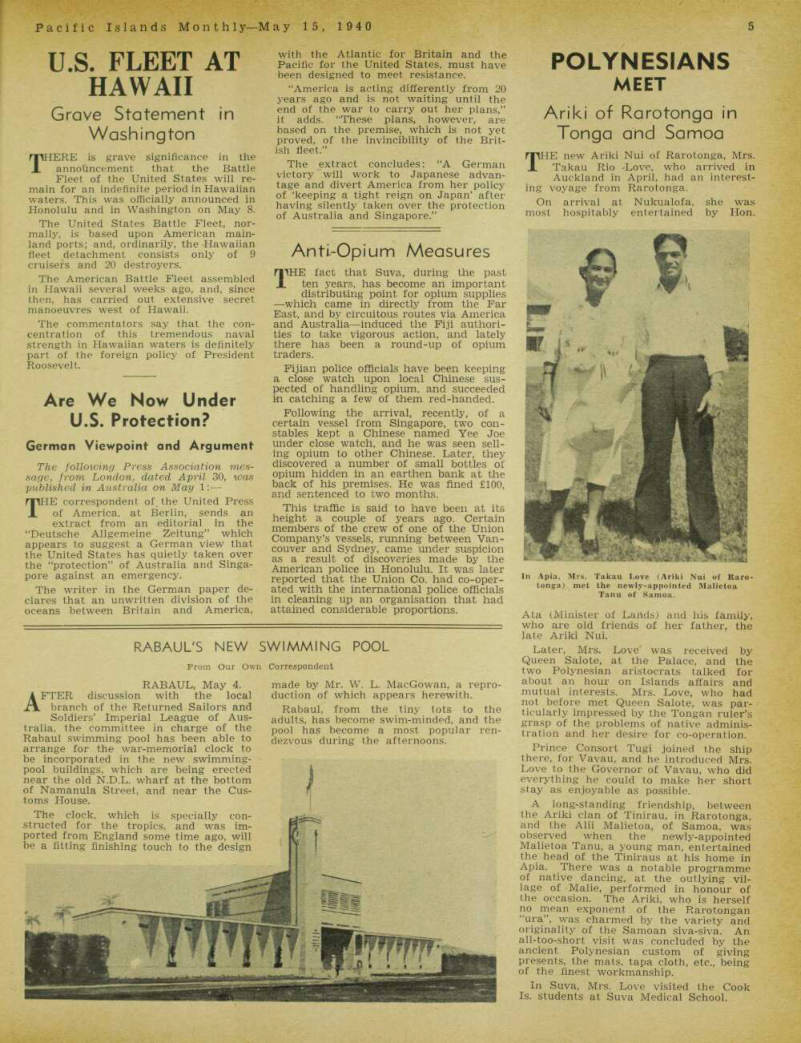
THE new Ariki Nui of Rarotonga, Mrs.
Takau Rio 'Love, who arrived in Auckland in April, had an interest ing voyage from Rarotonga.
On arrival at Nukualofa, she was most hospitably entertained by Hon.
Ala (Minister of Lands) and his family, who are old friends of her father, the late Ariki Nui.
Later, Mrs. Love was received by Queen Salote, at the Palace, and the two Polynesian aristocrats talked for about an hour on Islands affairs and mutual interests. Mrs. Love, who had not before met Queen Salote, was par ticularly impressed by the Tongan ruler’s grasp of the problems of native adminis tration and her desire for co-operation.
Prince Consort Tugi joined the ship there, for Vavau, and he introduced Mrs.
Love to the Governor of Vavau, who did everything he could to make her short stay as enjoyable as possible.
A long-standing friendship, between the Ariki clan of Tinirau, in Rarotonga, and the Alii Malietoa, of Samoa, was observed when the newly-appointed Malietoa Tanu, a young man, entertained the head of the Tiniraus at his home in Apia. There was a notable programme of native dancing, at the outlying vil lage of Malie, performed in honour of the occasion. The Ariki, who is herself no mean exponent of the Rarotongan “ura”, was charmed by the variety and originality of the Samoan siva-siva. An all-too-short visit was concluded by the ancient Polynesian custom of giving presents, the mats, tapa cloth, etc., being of the finest workmanship.
In Suva, Mrs. Love visited the Cook Is. students at Suva Medical School.
In Apia, Mrs. Takau Love (Ariki Nui of Raro tonga) met the newly-appointed Malietoa Tanu of Samoa.
Advertisements & other items, p. 9 (1 item)
5
Pacific Islands Monthl y—M ay 15, 1940
Exasperating Condition Of
The Copra Market
What Government Control and Ineptitude Are Doing to a Great Pacific Industry
DURING the month, the London (fixed) price of copra fell by 7/6 per ton, to £l2/17/6 sterling per ton, and quotations in the various Islands centres declined accordingly.
At several centres, the local price was reduced by 10/- per ton, and planters generally were very bitter about it.
It appears that there is much that needs explaining to the copra-producers —two things, in particular. One is the difference between the London price, and the price received by the planter; and the other is the extent to which the Margarine Trust (in other words, the Unilever Combine) is able to influence the Anglo-French authorities in fixing the London price.
A London price of £l3 per ton, c.i.f.
London, is equal to £l4/12/6 Fijian and £l6/5/- Australian. Yet the Pacific Islands copra producers receive less than half of this amount, as shown by figures published elsewhere. The big trading firms themselves are not enjoy ing rosy conditions; but, in their own interests, they should publish statements showing how freights, insurance and other extraordinary costs bite into that London price, and thus meet the criti cism being increasingly directed against them.
Then there is the London price itself.
It clearly is too low, in relation to most other commodity values. The suspicion is widely held that the Unilever Com bine has been able to keep the price down, so that the Margarine Trust (Unilever) may get the biggest possible profit out of this extraordinary war time boom in margarine.
On top of this, there is the shortage of shipping, for the transport of copra.
Ships are being provided for Australian and New Zealand products, but not in nearly sufficient numbers, for the pro ducts of Australian and New Zealand Pacific territories. Copra is piling up in the sheds, all over the Pacific.
Very strong personal representations have been made to Australian Minis ters, concerning the copra-shipment posi tion, but they seem incapable of doing anything. They say that all shipping organisation now is directed from Lon don. It is inconceivable that London would fail to take notice of firm re quests from Australia and New Zealand, whose war effort is vital to the Empire.
One exasperating feature is that, while the Pacific planters cry vainly for ships, a number of Norwegian and Danish freighters, eager and willing to carry goods to Europe, are lying idly in our ports. Politicians argue and babble —yet one stroke of their pens would direct those idle ships to the growing piles of copra.
The worst hold-up undoubtedly is in London, where the direction of our great Empire’s war effort is in the uncertain, palsied hands of futile old men. Even as this is written, the British Parlia ment is assailing the feeble administra tion of Chamberlain and Co. We can only hope that whatever good comes of it will be reflected in better shipping conditions in the Pacific.
The Grip Of Unilever
A CORRESPONDENT of the “Rabaul Times” is outspoken on the subject of international monopolies: “At the present time we, in the Islands, are struggling in the grip of one of the world’s greatest monopolies—Unilever and the International Margarine Union.
When British shipyards were idle (and trained shipwrights are vital to Britain’s success in any war) the Unilever interests were ordering tens of thousands of tons of shipping in the booming shipyards of Germany.
In view of the wide international rami fications of Unilever (Eliot Janeway, a noted authority, claims that they were responsible for the pre-war armaments loan to Turkey, merely to give them a bargaining point for the release of cer tain of their frozen credits in Nazi Ger many) it would be gratifying to people in the Islands to be assured that Uni lever and its associates are not still try ing to pull some cf their chestnuts out of the Hitler fire.
The whole position regarding the huge vegetable oil monopoly and its activities should at the present time be made the subject of the closest investiga tion. For years, Pacific planters have been turned into serfs, in order to swell the huge profits of internationalised money hogs.”
Where Does £B/5/- Per Ton
Go To?
It was stated by a writer in the “Fiji Times”, in April, that the London price of copra, in March, was about £l3 (sterling) per ton, and yet the Suva buyers were paying only £6/5/- (Fiji) per ton for copra in bags (bags included), ex-local boat slings. In other words, the return, after deducting the cost of bags and freight to Suva, would be approxi mately £4 10 - per ton on the plantation.
Thirteen pounds (sterling) is equal to £l4/10/- (Fijian), and it is not surprising that growers in Fiji are asking what on earth becomes of the £B/5/- per ton, which is the difference between the fixed price in London and the amount paid to the grower ex-ship slings, Suva.
Price In Rabaul
IT is difficult to get firm. quotations for copra anywhere, and copra pro ducers frequently ask for something to indicate the value of their product.
The “Rabaul Times”, on April 19, an nounced that the Rabaul price for hot air copra, in store Rabaul, was as fol lows; —Burns, Philo & Co., £7 13/6 per ton; W. R. Carpenter & Co., £7/14 6 per ton; and Colyer Watson, £7/17/3.
Price Of French Copra
The Noumea radio, in March, announced that the price of copra fixed at the end of November, 1939, for a period of one year for French territories, at 2,260 francs per ton, in France, had been altered by the Government to 2,540 francs, doubtless because of the freight rate of 50%, which affects the production of the archipelago.
The French newspaper in the New Hebrides says that French planters
there are grateful for the Government’s gesture. Planters will be able to aug ment their production, according to the desire of the Mother Country.
At the present rate of exchange, 2,260 francs are equal to £l6 Australian, and 2,540 francs to just under £IBA.
Case Of Average Planter
HERE is a letter written privately to the editor of the “Pacific Islands Monthly” by a planter in the Aus tralian Pacific Islands. It is typical of many communications: “I know that freight has gone up con siderably, but still I cannot reconcile the price which the big firms pay to me with the price that is paid in London.
“It cost me £lB,OOO to bring my place into bearing, and the present price of copra will not pay me. Therefore, the only thing I can do is to let my planta tion go bush.
“I run my plantation as cheaply as any in New Guinea. I recruit my own labour. They cost only about 8/- per boy, including repatriation. I feed my labour cheaply. I buy yams locally at £1 per ton.
Every night, two of my boys go out at 7 p.m. to do line fishing, and they usually return at midnight with from two to three hundredweight of fish. I can buy pigs very cheaply. Yet with all these economies, I cannot make my plantation pay with copra at its present price.
“There is something queer about the prices paid for copra in Eastern Papua.
I know of one plantation that gets £1 per ton above the price ruling in Samarai, and I know of another, 240 miles from Samarai, which gets £2 per ton above the ruling price. What is the explanation?”
Demand For Margarine
IT was reported from London in April that the increase in the butter ration had not resulted in the expected rise in consumption. Britain’s cold stores carry the greatest accumulation of butter in the history of the country; but butter remains at 1/7 per lb., while the ex cellence of the best grade of vitamised margarine, at Bd. per lb., has attracted the attention of the great majority of housewives.
The consumption of margarine appears to have increased enormously, and one can presume safely that there has been a corresponding increase in the demand for coconut oil. But the market remains quite silent on the subject—it is obvious that the Unilever combine, which the Government is permitting to handle the margarine market, is reaping the benefit.
Advertisements & other items, p. 10 (1 item)
Your Wrapper!
Look On The Front of
The figures stamped there (if any) show the date when your subscription expires.
This date will anpear on wrappers of three issues preceding expiration, thereby giving 3 months’ notice. If, at the end of that time, we have not been instructed to continue to send the journal to you, it will be discontinued.
Your subscription (8/- per annum, or 10/- in the case of countries outside the British Empire—which includes postage) may be sent direct, or may be paid to any of our agents (listed on Page 3).
The postage required for this Issue Is:— To Australia and New Zealand 3d.
To United Kingdom via All-sea routes ... 3d, To United Kingdom via Prance 2d.
To other British Possessions 3d.
To U.S.A. and Foreign Countries 44.
PACIFIC PUBLICATIONS PTY. LTD.
Japanese In
Tonga
Alarming Growth of Banno Bros. Ltd.
Nukualofa, April 2.
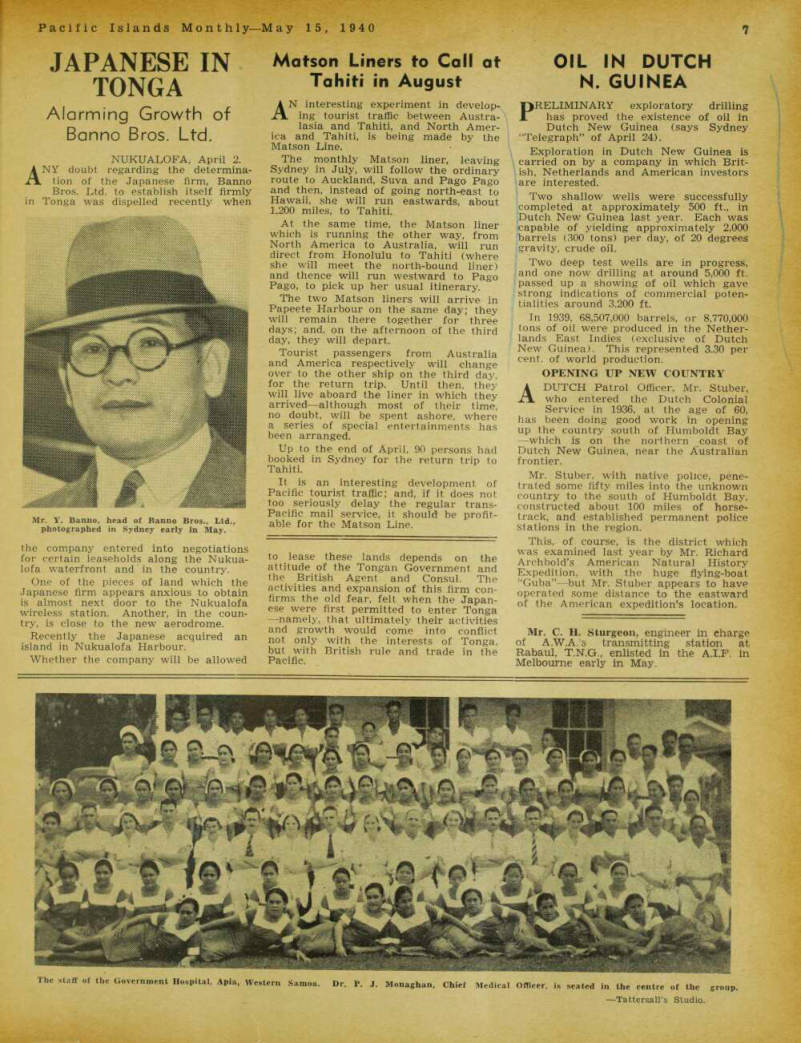
ANY doubt regarding the determina tion of the Japanese firm, Banno Bros. Ltd. to establish itself firmly in Tonga was dispelled recently when
the company entered into negotiations for certain leaseholds along the Nukualofa waterfront and in the country.
One of the pieces of land which the Japanese firm appears anxious to obtain is almost next door to the Nukualofa wireless station. Another, in the country, is close to the new aerodrome.
I—i .1 T .
Recently the Japanese acquired an island in Nukualofa Harbour.
Whether the company will be allowed
to .l ease these lands depends on the attitude of the Tongan Government and Agent and Consul. The p~!i Vlt +u S expansion of this firm con ear> , w ] ien J*P an " ese wei j e Permitted to enter Tonga namely, that ultimately their activities and growth would come into conflict not only with the interests of Tonga, but with British rule and trade in the Pacific.
Mr. Y. Banno, head of Banno Bros., Ltd., photographed in Sydney early in May.
Matson Liners to Call at Tahiti
Tahiti in August
AN interesting experiment in develop ing tourist traffic between Austra lasia and Tahiti, and North Amer ica and Tahiti, is being made by the Matson Line.
The monthly Matson liner, leaving Sydney in July, will follow the ordinary route to Auckland, Suva and Pago Pago and then, instead of going north-east to Hawaii, she will run eastwards, about 1,200 miles, to Tahiti.
At the same time, the Matson liner which is running the other way, from North America to Australia, will run direct from Honolulu to Tahiti (where she will meet the north-bound liner) and thence will run westward to Pago Pago, to pick up her usual itinerary.
The two Matson liners will arrive in Papeete Harbour on the same day; they will remain there together for three days; and, on the afternoon of the third day, they will depart.
Tourist passengers from Australia and America respectively will change over to the other ship on the third day, for the return trip. Until then, they will live aboard the liner in which they arrived—although most of their time, no doubt, will be spent ashore, where a series of special entertainments has been arranged.
Up to the end of April, 90 persons had booked in Sydney for the return trip to Tahiti.
It is an interesting development of Pacific tourist traffic; and, if it does not too seriously delay the regular trans pacific mail service, it should be profit able for the Matson Line.
Oil In Dutch
N. Guinea
PRELIMINARY exploratory drilling has proved the existence of oil in Dutch New Guinea (says Sydney “Telegraph" of April 24).
Exploration in Dutch New Guinea is carried on by a company in which Brit ish, Netherlands and American investors are interested.
Two shallow wells were successfully completed at approximately 500 ft., in Dutch New Guinea last year. Each was capable of yielding approximately 2,000 barrels (300 tons) per day, of 20 degrees gravity, crude oil.
Two deep test wells are in progress, and one now drilling at around 5,000 ft. passed up a showing of oil which gave strong indications of commercial poten tialities around 3,200 ft.
In 1939, 68,507,000 barrels, or 8,770,000 tons of oil were produced in the Nether lands East Indies (exclusive of Dutch New Guinea). This represented 3.30 per cent, of world production.
Opening Up New Country
A DUTCH Patrol Officer, Mr. Stuber, who entered the Dutch Colonial Service in 1936, at the age of 60, has been doing good work in opening up the country south of Humboldt Bay —which is on the northern coast of Dutch New Guinea, near the Australian frontier.
Mr. Stuber. with native police, pene trated some fifty miles into the unknown country to the south of Humboldt Bay, constructed about 100 miles of horse track, and established permanent police stations in the region.
This, of course, is the district which was examined last year by Mr. Richard Archbold’s American Natural History Expedition, with the huge flying-boat “Cuba" —but Mr. Stuber appears to have operated some distance to the eastward of the American expedition’s location.
Mr. C. H. Sturgeon, engineer in charge of A.W.A.’s transmitting station at Rabaul, T.N.G., enlisted in the A.I.F, in Melbourne early in May.
The staff of the Government Hospital, Apia, Western Samoa. Dr. P. J. Monaghan, Chief Medical Officer, is seated in the centre of the group. —Tattersall’s Studio.
N. Guinea
New Planes For
Carpenters Buy Two DHB6 's in Singapore
WHEN, in March last, the Carpenter air mail plane, flying from Sala maua to Rabaul, was unable to find the Rabaul landing-ground, owing to phenomenally heavy rain-squalls, and was compelled to come down in the sea off the coast of New Ireland, the Car penter service between Sydney and Rabaul had to be carried on with only one machine.
The service was inaugurated in May, 1938, with three De Havilland 868 planes; but one was taken over by the Commonwealth Government when war broke out in September, 1939.
As the plane which came down off New Ireland was not smashed, and as it was quickly salvaged, it was hoped that it might be made serviceable again; but expert examination showed that the immersion in sea-water had done so much damage, to both engines and fabrication, that a complete write-off was necessary.
The firm, fortunately, was able to purchase two four-engined 11-passenger D.H. 86 planes in Singapore, which had been operated by Wearne’s Air Services on Malayan routes. Mr. Mant left Syd ney in April, by flying-boat for Singa pore, and he brought one of the planes immediately to Sydney, along the air mail route, and it arrived at Mascot on May 3.
The other plane will be brought from Singapore within a month. This means that the Carpenter service will now be operated as heretofore with three machines —two being actually in use and one in reserve.
The firm was lucky in being able to obtain these two machines, as aero planes are much in demand, these days.
The new purchases are not exactly the same as the three aeroplanes with which the service was opened. They were De Havilland 868 planes; whereas the two which have been bought at Singapore are De Havilland 86. But they are con sidered to be near enough, for all requirements.
"Surveys Still Proceeding"
That N. Guinea
Road
MEMBERS interested in New Guinea —especially Mr. Green and Mr.
Francis —in the Australian Parlia ment during last month, persistently asked what was being done in relation to the Salamaua-Wau road. Ministerial answers were vague; but, finally, near the end of April, the new Minister, Mr.
Nock, said: — “Representatives of the residents of the goldfields area (New Guinea) have been advised of the progress made in the search for a suitable location for a road from Salamaua to Wau and they no doubt realise the difficult nature of the task owing to the heavy and rugged country to be traversed by the road.
“A direct route, known as Route ‘A’, (the Bitoi route) was examined by the Director of Public Works in December last, and location surveys of that route are still proceeding.
New President of Pacific
Islands Club
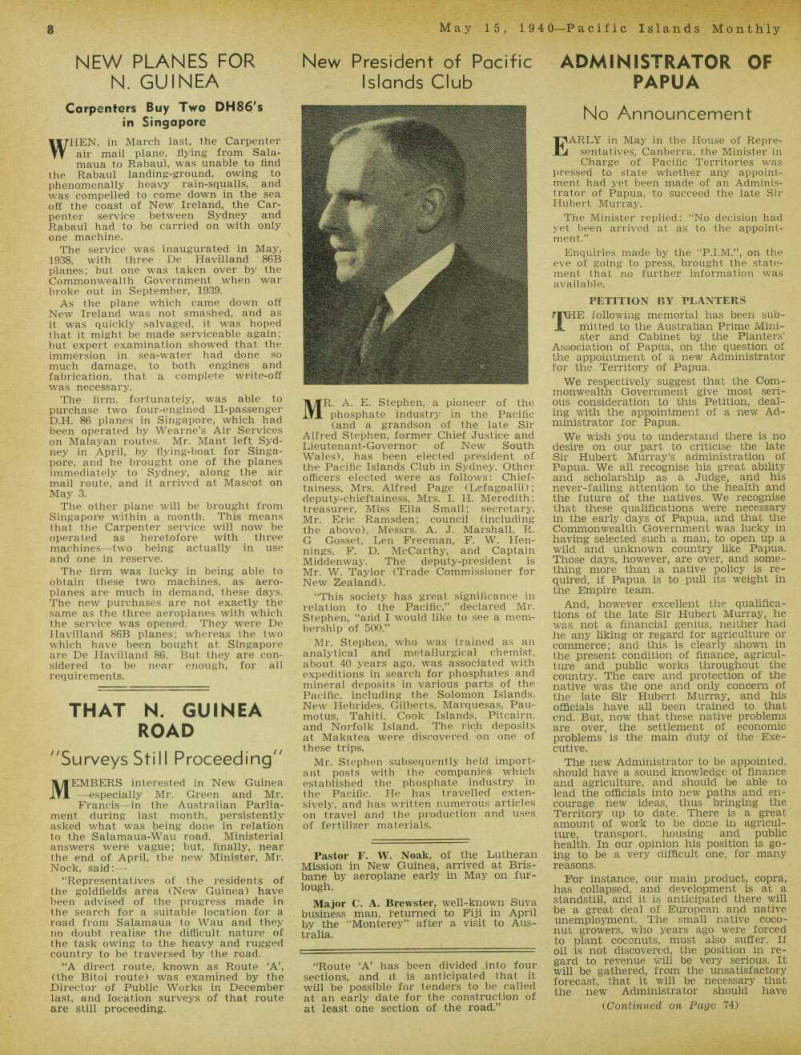
MR. A. E. Stephen, a pioneer of the phosphate industry in the Pacific (and a grandson of the late Sir Alfred Stephen, former Chief Justice and Lieutenant-Governor of New South Wales), has been elected president of the Pacific Islands Club in Sydney. Other officers elected were as follows: Chief tainess, Mrs. Alfred Page (Lefagoalii); deputy-chieftainess, Mrs. I. H. Meredith; treasurer, Miss Ella Small; secretary, Mr. Eric Ramsden; council (including the above), Messrs. A. J. Marshall, R.
G Gosset, Len Freeman, F. W. Hen nings, F. D. McCarthy, and Captain Middenway. The deputy-president is Mr. W. Taylor (Trade Commissioner for New Zealand).
“This society has great significance in relation to the Pacific,” declared Mr.
Stephen, “and I would like to see a mem bership of 500.”
Mr. Stephen, who was trained as an analytical and metallurgical chemist, about 40 years ago, was associated with expeditions in search for phosphates and mineral deposits in various parts of the Pacific, including the Solomon Islands, New Hebrides, Gilberts, Marquesas, Pan motus, Tahiti, Cook Islands, Pitcairn, and Norfolk Island. The rich deposits at Makatea were discovered on one of these trips.
Mr. Stephen subsequently held import ant posts with the companies which established the phosphate industry in the Pacific. He has travelled exten sively, and has written numerous articles on travel and the production and uses of fertilizer materials.
Pastor F. W. Noak, of the Lutheran Mission in New Guinea, arrived at Bris bane by aeroplane early in May on fur lough.
Major C. A. Brewster, well-known Suva business man, returned to Fiji in April by the “Monterey” after a visit to Aus tralia.
“Route ‘A’ has been divided into four sections, and it is anticipated that it will be possible for tenders to be called at an early date for the construction of at least one section of the road.”
No Announcement

Administrator Of
Papua
EARLY in May in the House of Repre sentatives, Canberra, the Minister in Charge of Pacific Territories was pressed to state whether any appoint ment had yet been made of an Adminis trator of Papua, to succeed the late Sir Hubert Murray.
The Minister replied: “No decision had yet been arrived at as to the appoint ment.”
Enquiries made by the “P.1.M.”, on the eve of going to press, brought the state ment that no further information was available.
Petition By Planters
TITHE following memorial has been sub- JL rhitted to the Australian Prime Mini ster and Cabinet by the Planters’
Association of Papua, on the question of the appointment of a new Administrator for the Territory of Papua.
We respectively suggest that the Com monwealth Government give most seri ous consideration to this Petition, deal ing with the appointment of a new Ad ministrator for Papua.
We wish you to understand there is no desire on our part to criticise the late Sir Hubert Murray’s administration of Papua. We all recognise his great ability and scholarship as a Judge, and his never-failing attention to the health and the future of the natives. We recognise that these qualifications were necessary in the early days of Papua, and that the Commonwealth Government was lucky in having selected such a man, to open up a wild and unknown country like Papua.
Those days, however, are over, and some thing more than a native policy is re quired, if Papua is to pull its weight in the Empire team.
And, however excellent the qualifica tions of the late Sir Hubert Murray, he was not a financial genius, neither had he any liking or regard for agriculture or commerce; and this is clearly shown in the present condition of finance, agricul ture and public works throughout the country. The care and protection of the native was the one and only concern of the late Sir Hubert Murray, and his officials have all been trained to that end. But, now that these native problems are over, the settlement of economic problems is the main duty of the Exe cutive.
The new Administrator to be appointed, should have a sound knowledge of finance and agriculture, and should be able to lead the officials into new paths and en courage new ideas, thus bringing the Territory up to date. There is a great amount of work to be done in agricul ture, transport, housing and public health. In our opinion his position is go ing to be a very difficult one, for many reasons.
For instance, our main product, copra, has collapsed, and development is at a standstill, and it is anticipated there will be a great deal of European and native unemployment. The small native coco nut growers, who years ago were forced to plant coconuts, must also suffer. If oil is not discovered, the position in re gard to revenue will be very serious. It will be gathered, from the unsatisfactory forecast, that it will be necessary that the new Administrator should have
(Continued on Page 74)
youth, vigour and vision to combat such conditions.
The Planters’ Association of Papua is not a political institution, but members feel on this occasion that they, represent ing as they do the bulk of the capital invested in the country and the largest employers of European and native labour, should be allowed to express their views, when the selection of an Administrator is under consideration.
A young man with outstanding ability is required, and we very respectfully sug gest that to secure the right man he should be paid at least double the present allowance.
Editorial Note
THE Planters’ Association do not ap pear to have recognised the difficul ties under which Sir Hubert Murray worked; while their faith in the Com monwealth Government is naive and touching. Their appeal is based on the assumption that the Australian Govern ment knows something of conditions in Papua, and is eager for its development and economic progress.
The facts are that, with the exception of two or three permanent officials, Can berra is blankly ignorant of conditions in the Pacific Territories, and quite in different about their fate. That state of affairs broke the heart of the best Pacific Administrator Australia ever had, General Tom Griffiths, and he finally resigned from New Guinea, and retired. In Papua, year after year, Sir Hubert Murray fought on against Australian inertia and in difference. Again and again, being un able to get any claim or decision at Can berra, he acted boldly on his own ac count, and defied the “authorities” to undo what he had done. On a number of occasions, his personal intervention and fierce representations in Canberra
saved Papuan producers from disaster.
The wonder is not that Sir Hubert did so little for agriculture and commerce in Papua, but that he accomplished so much. If proof of this argument is needed, look at the Mandated Territory—measure up, there, the development and commer cial progress that have taken place, under an Administration that has at least £lOO,OOO p.a. of gold-royalty revenue.
Blame for this stagnation may be allotted in many places—but it must come back, ultimately, to Canberra.
The Papuan Planters’ Association may get “a young man of outstanding ability” at “double the present allowance”; but, within five years, he would either be dead of a broken heart, or have battered his head off against the wall of official inertia.
We have heard the Papuan Planters’ argument, many times. We are convinced that it is not new personnel that is needed in the Administrative services, but far-reaching, drastic reform in the system under which the Territorities are governed from Canberra.
Advertisements & other items, p. 12 (1 item)
8
May 15, 194 O—P acific Islands Monthly
Tropicalities
A NOTE from Daru, in Western Papua:— “One month—no option,” decreed the perspiring officer. The disgrace did not hang heavily on the prisoner. To him the distant “town”, with its few stores, boats and whites, was paradise. But a prisoner? Who cares! Plenty of good food, plenty to see and hear, and every thing new, and certainly not hard labour. So he went.
Returning two months later, he came to see me, loud in praise of the Gov ernment gaol, and, above all, “The Sina bada”. His gaol work was to weed and water the official’s garden, and “Sina bada give me f’nour (bread and cake) every day, and some day ginger beer.
Gaol finish, I work two weeks for one man, two weeks for company, then I come home.”
Went for punishment, came back richer by a few calicos and some (probably stolen) wire and iron. And now my gaol friend is making no effort to raise his tax money. It is “tax or gaol”; but who would pay taxes? Only white men and fools. * ♦ ♦ BECAUSE he is Governor of Fiji, Sir Harry Luke is exempt by law from the payment of income tax; but, soon after the outbreak of war, he arranged that, as from January 1, until the termination of hostilities, he would pay income-tax on his salary, as Gov ernor, to the general revenue of Fiii, at the rate fixed for individuals. Sir Harry Luke is also paid as High Commissioner for the Western Pacific, and there is no income-tax in the fortunate territories governed by that Commission. So Sir Harry Luke is paving, also, 7i per cent, of his salary as High Commissioner into Government funds, for the same period.
It was noted recently, in the London “Daily Mirror”, that Sir Arthur Rich ards, now Governor of and formerly Governor of Fiji, is similarly donating a percentage of his salary to wards the cost of the war. * ♦ * mHE old group photograph of the First X Fiji Reinforcements, in the 1914-18 war, which was reproduced on page 28 of the April issue of the “P.1.M.” (and which, it was explained, had been found by the Rev. Harry Bartlett on the wall of the mission house in Misima, apparently ownerless) was recognised, with surprise and delight, by Mrs. Allen Innes, formerly of Salamaua, New Cuinea, and now a resident of Vaucluse, Sydney.
“The photo was presented to me when the first Fijian reinforcements were leaving Fiji.” says Mrs. Innes, in a letter to the editor. “I was then on the nursing staff of the Colonial Hos pital, Suva. Many of the contingent had been patients of the hospital, and all the men were well known to us.
The photo was autographed, and framed very handsomely in yacca, when it was presented to me, and I valued it greatly.”
Mrs. Innes explains that the illness of her son caused her to leave Misima hur riedly in 1924; and subsequently, owing to the transfer of her husband, she was not able to return to Misima and claim the photograph. Certain articles were left with Rev. J. R. Andrews in Misima and, apparently, had been lost sight of
by the owner. Mrs. Allen Innes expresses her grateful thanks to Rev. J. R.
Andrews and Rev. Harry Bartlett for taking care of the photograph, and thus bringing it under her notice. The valuable memento has been sent on to Mrs. Innes. * • * THE Ngapuhi tribe of North Auckland (New Zealand) now possess a canoe that will seat 150 men and is 117 ft. in length. This is claimed to be the largest canoe ever built in Polynesia. It was a gift from King Koroki, of Wai kato, to the Ngapuhi, who were hosts at the recent centennial celebrations at Waitangi, and the canoe will be housed there. The name, Nga-toki-mata-horua, was given to it because one of the canoes of Kupe, the famous voyager from Tahiti in the 10th century, was so called. There is no doubt that it is big ger than any craft ever made by Poly nesian craftsmen at that period. It is problematical whether Tahiti ever had timber to eoual the New Zealand kauri (of which the new canoe is built).
Samoa, however, can lay claim to some large craft. In 1893, a perfect mania for boat-building seized the natives there. The correspondent of an Auckland newspaper reported that the competition to possess the biggest craft went to extraordinary lengths. Boats from 40 to 70 ft. long were compara tively common. One man built one of 100 ft., and another of 110 ft. was fin ished. “A third is now being built no less than 200 ft. in length,” it was stated, “which will pull upwards of 100 oars.” If this craft was ever finished, it would make even the Nga-toki-mata horua look rather small! —E.R. ♦ * * THE annual reports of Sir Hubert Murray, Lieutenant - Governor of Papua, were always noted for their unconventional character amusing, scholarly, gossipy, and informative—and as the years passed they were quoted with increasing relish by newspapers all
over the world, and became famous.
During the past month, several weeks after Sir Hubert had been laid to rest, his last report on the administration of Papua, for the year 1938-9, was presented to the Commonwealth Parliament, and formally published; and; again the newspapers quote from it freely—but this time sadly. “Sir Hubert Murray’s last report on Papua carries on the tra dition’’; “He is dead —but his work for Papua lives” —these are two of the striking newspaper headings with which his last annual compilation is greeted. * ♦ ♦ THE correspondent of an Islands newspaper, describing a wedding reception, waxed lyrical. “To the incessant tune of popping corks, the breakfast proceeded merrily,” he said.
“After the toast of His Majesty the Kink, the toast of ... ” etc., etc.
Now, was that unfortunate “k” put in by a careless printer, or did the gentle man react in proper fashion to the pop ping of corks, and write as he felt? Did you ever try to say, “Gentlemen, the King”, when you were more or less pickled?
Advertisements & other items, pp. 13-15 (4 items)
9
Pacific Islands Monthl y—M ay 15, 1940
STERLING VARNISH CO., Alexandria, N.S.W.
NO SPRINGS
NO CUSHIONS
The latest Invention of Dr. L. Barrere Is the result of 40 years’ practice and improvements, Stupendous success of new method of control.
NO SPRINGS NO PADS.
The NEO-BARRERE acts like the hand when placed flat upon the orifice. You will at once without effort and in all movements hold the intestine in its cavity.
The NEO-BAR/RERE for COMFORT
and SECURITY.
Write To-day for FREE LITERATURE.
BARRERE DISTRIBUTION CO.
(Dept. 44A), 35 Pitt Street, Sydney.
Excl. Distributors of
ETS. DU DR, BARRERE, PARIS.
Est. 1880—230 branches throughout the world
CREAM
Dries in half an hour on plaster walls, ceilings, cement, fibro, wood Cr iron.
Also Excellent as an Undercoat for lacquers, paints Cr enamels 13/10 per gallon
HIGHLY DURABLE
Write for a colour Card ...
STERLING VARNISH CO., Alexandria, N.S.W.
WITTNER'S Ply. Ltd.
Melbourne's
Leading
_____Footwear Firm!
For 28 years sending Footwear by Mail all over Australia and far beyond!
Acknowledged Australia’s most reliable, efficient Mail Order Service. Post free wherever you are. All footwear guaranteed first quality, guaranteed for fair wear and sold with a definite guarantee of Satisfaction or money back. Orders despatched same day as received. Remit all payments in Australian currency by the usual method. Order by number.
Special
Features
make this
the Ideal
Boot for
you men
in the
Islands !
Longest
Wearing
Work
Boot
Yet !
Oh creasy logs A
MACHINERY
m in
ORDER
NUMBER
XX 1045 This boot also available in lighter weight I Box Calf uppers, i with leather lining, ■ at 20/ (order XX 764)—a150 with 8 . inch leg for very 1 rough jobs, at 27/6 I (order XX 1046 Black I —XX 1047 Brown),
Splendid Utility
Shoe for Men -
What a beauty this one is! Knocks every other work boot you’ve known into a cocked hat— offers features you’ve never had in work boots before. Actually it scores over the usual work boot in two ways:—lt will give very much longer wear on account of extra tough, selected materials and exceptionally strong construction —and it ensures under-foot safety from false foothold with those special tyre cord soles that grip with octopus-like tenacity and are composed of actual motor tyre rubber impregnated with cord used in motor tyres. With the extra Vs inch tread these make an unbelievably long wearing sole! The uppers are extratough hide, waxed stitched, backs are double and stiffened, toes are rounded and solidly blocked, tongues are protective half-bellows. A comfortable boot—a tougher and safer boot lor any man for any job. IT’S A GIFT AT ONLY 20/-! Honestly, now don’t you agree?
Try a pair—we’ll gladly refund your money if you’re disappointed. We’re confident you won’t be. All sizes, 5 to 11. Order XX 1045, 20/-. FREIGHT FREE.
A man’s best friend is not always his Mother —more often it’s the Wittner Field Boot!
Wherever he goes in the country—through long wet grass—in prickly growths— by snake-infested swamps— he’s safe and comfortable in these boots. Wet or dry he’ll find them ideal for the
Knee- High hundred and
one jobs he has to tackle. And they’re just right for town wear, too! Thick brown Box Hide uppers, full bellows tongue, 3 - decker soles, and broad comfort shape.
All sizes, 5 to 11, 35/-. Order XX 1301. Post free and guaranteed.
Also ladies’ sizes, 2 to 7, 32/6. Order XX 6906.
STAR FEATURES:—
1. Never-Wear-Out Tyre Cord and Rubber Impregnated Soles—Sewn, Brass-Screwed and Solutioned through Leather Mid-sole, which is also sewn and screwed to inner sole. 2. Heavy, Non-skid, Patterned Tread on Heels and Soles. 3. Best and Toughest Box Hide Uppers, Waxstitched. 4. Double Backs, Solidly-Blocked Toes, Half-Bellows Tongues. 5. Only 20/-, Post Free anywhere.
Field
Boots
POST FREE ANYWHERE
ORDER
XX 103
LADIES’
FIELD BOOTS
32/6 (XX 6906) Made of soft calf, these are not only for evening wear, but for everyday wear.
They’re a boon. The uppers are so soft and yielding, and those elastic sides are such an obvious aid to comfort, as to need no further mention. Solid leather soles and comfortable, low leather heels.
All sizes, 5 to 10. Great value at 13/9.
Post Free. Order XX 103.
GOLF
or
WALKING
Their easy-flexing uppers, sure-grip rubber patterned soles and heels, moulded backs, and broad shape assure soothing comfort, safety and serviceability!
Smooth calfskin uppers, with grained moccasin front and sides. All sizes, 5 to 10, 19/9. Order XX 620, Brown.
WITTNER’S PTY., LTD.
Head Office & Mail Order Dept. , 480-484 Collins St., Melbourne, Aust.
Address orders to
BOX 1281 G.P.O.
Melbourne, Victoria, Australia.
Please remit payment in Australian Currency.
Order by the number.
10
May 15, 194 O—P acific Islands Monthly
Missionary For Tonga
REV. A. E. McKAY, B.A., accompanied by his wile, left Sydney last month to join the Methodist Mission at Vavau, Tonga. —Photo: “Missionary Review.”
Trading Figures
Burns Philp Maintain Trading Figures
ALTHOUGH the last seven months of the year ended March 31 were under war conditions, the annual accounts of Messrs. Burns, Philp & Co.
Ltd., for the 1939-40 period do not indi cate any marked difference in the opera tions, as compared with the previous year.
Both the gross and nett profit showed a definite increase over last year. The directors report that the policy of ex pansion in the merchandise section has resulted in a further substantial increase in sales. This apparently set off any contraction in the shipping business caused by the war. Comparative figures:
Mr. Frank W. Ryan, of Rabaul. New Guinea, married Miss Mavis Hicks, of Adelaide, S.A., at St. George’s Church, Rabaul, last; month.
Year ended March 31. 1938. 1939. 1940. £ £ £ Net profit 240.574 251.144 206,621 Div.. 10 p.C 156,250 181,250 200,000 To reserve 75.000 25,000 25,000 War risk in. fund — 50,000 25,000 Staff retirement . . — 10,000 Carried forward .. 31,459 26.353 26,974 Expenses, etc 707,944 827.158 845,020 Depreciation, etc. . 103,091 130,633 121,042 Bad debts, losses . 36.371 37.292 57.398 Gross profit . . 1 111,950 1,246.228 1,284,081
Liabilities—
Capital paid up .. 1.625.000 1.875,000 2,000,000 Reserve fund . . 1,125,000 1,200,000 1,225,000 Insurance res., etc. 574,502 613.643 697,453 Cash credits . . 39,217 122,552 65,130 Creditors 918.874 880,757 1,032,385 Branch balances .. 805,596 923,365 693,780 Owed to subsids. . . 81,786 65.173 70,495
Assets—
Merchandise, copra. advances 1,389,414 1,185,302 1,125,024 Cash in hand .. 136.978 168,410 180.795 Property, shipping . 1,323,610 1,758,140 1,841,340 Debtors 928,408 893.493 858,451 Owing by subsids. . 98.087 110.817 114.782 Shares. Govt. sec. 751,928 997,367 978,160 Shares in subsids. 730,681 763,005 774.527
Beetles For Samoa
Flown to Sydney From Java
THE K.N.I.L.M. (Royal Netherlands Indies Airways) Lockheed airliner which arrived in Sydney on April 23, brought 10 packages of beetles from Java. They will be transhipped to Samoa to be released to prey on house fly larvae. The insects made their 4,000 miles journey in a cooled compartment of the airliner.
Arrangements have also been made to fly wasps from Africa to Australia for transhipment to the South Seas, where they will be liberated to suppress plagues of rhinoceros beetles, which attack coconut plantations. “S.M.
Herald”.
Mr. Brian Cobcroft, son of Mr. and Mrs.
A. R. Cobcroft, of Vaipoto Plantation, Western Samoa, is now serving with the New Zealand Air Force.
Apia Resident
Tragic Death of Well-known Apia Resident
THE death occurred, late in April, in tragic circumstances, of Mr. W. E.
Links, aged 49, who was well-known in the Central Pacific as a member of the staff of Burns Philp (South Seas) Co. Ltd. Until recently, Mr. Links was merchandise manager at the branch in Apia, Western Samoa.
No details are available. It is re ported, simply, that Mr. Links died as the result of gunshot wounds, and that the police are making investigations.
Mr. J. Craig, who for the past 10 years has been Financial Secretary and Colon ial Treasurer of Fiji, left Suva by the April “Monterey” en route to England, where he will spend leave prior to re tirement. Mr. Craig entered the Exchequer and Audit Department of the Colonial Service in 1909, and has served at Nigeria, British Honduras, Mauritius and Tangan yika.
Advertisements & other items, pp. 15-16 (2 items)
11
Pacific Islands Monthl y—M ay 15, 1940
Soldier
if Choose the Watch that has been proved to withstand ALL
THE ELEMENTS
under the most severe conditions of service.
With its high-grade 15-jewelled movement in an extra strong chrome case with stainless steel back, this is the right watch for a Soldier on active service.
Mail Orders despatched by return, registered and insured at our expense.
PROUDS PTY. LTD.
WATCHMAKERS AND JEWELLERS,
KING AND PITT STREETS, SYDNEY.
SPECIALLY SELECTED
Expertly blended For Flavour Taste and Economy.
Freshness Sealed in every packet.
ASK
FOR
IT cy ■i v> V «.o $ V
LLOYD & CO. Pty. Ltd., Sydney
Famous for Tea & Coffee for 50 Tears.
ANNOUNCEMENT
Mrs. D. V. Irvine, late of Samarai (Papua), and the Solomon Islands, and of the Islands Department of Messrs, David Jones, Ltd-, announces that she has organised a Shopping and Buying Service, and is prepared to carry out Shopping Commissions for Pacific Islands Residents.
All Inquiries or Orders for DRESSES,
MILLINERY, DRAPERY, SHOES.
MEN’S CLOTHING. CHILDREN’S
CLOTHING, FURNISHINGS, HOUSE-
HOLD EQUIPMENT, LIBRARY MEM-
BERSHIP, EDUCATION SERVICES,
etc., etc., will have Mrs. Irvine’s Personal Attention.
Inquiries regarding Hotel Accommodation, Board and Residence, Flats, Travelling Facilities, Storage, etc., can be made on behalf of Residents Proposing to visit Australia, and the Information will be awaiting them on their arrival.
Prompt Personal Service —Lowest Prices Consistent with Quality.
Correspondence Invited.
Mrs. D. V. Irvine, Shopping and
Buying Service, P.O. Box 3618,
G.P.O., Sydney.
KODAK FILM
HAS EXTRA
QUALITY
to put the Snap into Snapshot gives you pictures that live ! ■o'*'*'
TlVt
pA^ z Kodak Super Sensitive Panchromatic Film is fully colour sensitive, gives you the correct black-and-white representation of any scene. So fast that snapshots may be made under the most adverse light conditions.
And it's double - coated to double - guard every picture. on Is British-made to suit Island and Tropic conditions based the newest achievements of modern Kodak Research Laboratories all over the world. The benefit of this world-wide advanced research is yours with every spool of Kodak Film.
OF ALL KODAK DEALERS IN THE ISLANDS
KODAK (Australasia) PTY. LTD.
379 GEORGE ST., SYDNEY 9 WOLFE ST., NEWCASTLE
Insufficient Shipping For Central
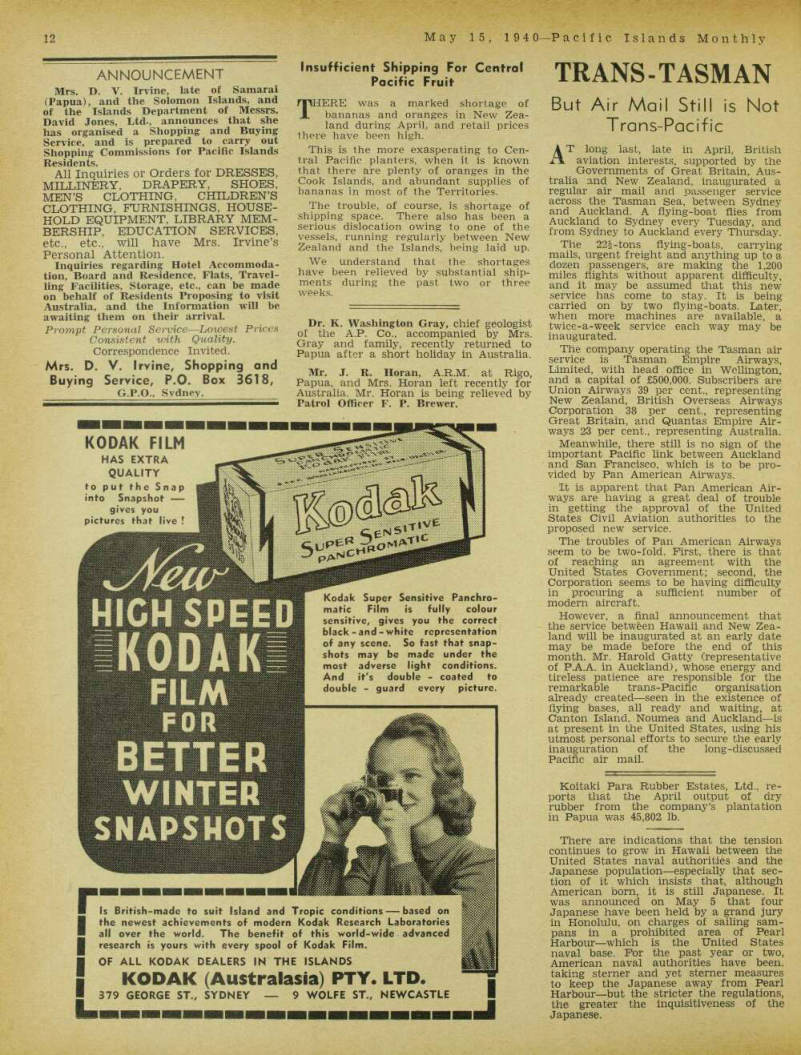
Pacific Fruit
THERE was a marked shortage of bananas and oranges in New Zea land during April, and retail prices there have been high.
This is the more exasperating to Cen tral Pacific planters, when it is known that there are plenty of oranges in the Cook Islands, and abundant supplies of bananas in most of the Territories.
The trouble, of course, is shortage of shipping space. There also has been a serious dislocation owing to one of the vessels, running regularly between New Zealand and the Islands, being laid up.
We understand that the shortages have been relieved by substantial ship ments during the past two or three weeks.
Dr. K. Washington Gray, chief geologist of the A.P. Co., accompanied by Mrs.
Gray and family, recently returned to Papua after a short holiday in Australia.
Mr. J. R. Horan, A.R.M. at Rigo, Papua, and Mrs. Horan left recently for Australia. Mr. Horan is being relieved by Patrol Officer F. P. Brewer.
Trans-Tasman
But Air Mail Still is Not Trans-Pacific
A T long last, late in April, British aviation interests, supported by the Governments of Great Britain, Aus tralia and New Zealand, inaugurated a regular air mail and passenger service across the Tasman Sea, between Sydney and Auckland. A flying-boat flies from Auckland to Sydney every Tuesday, and from Sydney to Auckland every Thursday.
The 221-tons flying-boats, carrying mails, urgent freight and anything up to a dozen passengers, are making the 1,200 miles flights without apparent difficulty, and it may be assumed that this new service has come to stay. It is being carried on by two flying-boats. Later, when more machines are available, a twice-a-week service each way may be inaugurated.
The company operating the Tasman air service is Tasman Empire Airways, Limited, with head office in Wellington, and a capital of £500,000. Subscribers are Union Airways 39 per cent., representing New Zealand, British Overseas Airways Corporation 38 per cent., representing Great Britain, and Quantas Empire Air ways 23 per cent., representing Australia.
Meanwhile, there still is no sign of the important Pacific link between Auckland and San Francisco, which is to be pro vided by Pan American Airways.
It is apparent that Pan American Air ways are having a great deal of trouble in getting the approval of the United States Civil Aviation authorities to the proposed new service.
The troubles of Pan American Airways seem to be two-fold. First, there is that of reaching an agreement with the United States Government; second, the Corporation seems to be having difficulty in procuring a sufficient number of modern aircraft.
However, a final announcement that the service between Hawaii and New Zea land will be inaugurated at an early date may be made before the end of this month. Mr. Harold Gatty (representative of P.A.A. in Auckland), whose energy and tireless patience are responsible for the remarkable trans-Pacific organisation already created—seen in the existence of flying bases, all ready and waiting, at Canton Island, Noumea and Auckland—is at present in the United States, using his utmost personal efforts to secure the early inauguration of the long-discussed Pacific air mail.
Koitaki Para Rubber Estates, Ltd., re ports that the April output of dry rubber from the company’s plantation in Papua was 45,802 lb.
There are indications that the tension continues to grow in Hawaii between the United States naval authorities and the Japanese population—especially that sec tion of it which insists that, although American born, it is still Japanese, It was announced on May 5 that four Japanese have been held by a grand jury in Honolulu, on charges of sailing sam pans in a prohibited area of Pearl Harbour —which is the United States naval base. For the past year or two, American naval authorities have been, taking sterner and yet sterner measures to keep the Japanese away from Pearl Harbour—but the stricter the regulations, the greater the inquisitiveness of the Japanese.
Advertisements & other items, pp. 16-17 (2 items)
12
May 15, 194 O—P acific Islands Monthly
for th
And now
first
An 8 Valve, All
Wave, Portable - Mantel Radio with
Communications Receiver Performance!
Produced in response to insistent requests for a handy-sized first-class high-quality performance Receiver specially adapted to the exacting tropical conditions of the Islands. Ideal for Boat Owners, Builders, Race Enthusiasts, Business Men and all who want last-minute, reliable official news from any part of the world—there's nothing on the market to equal it for range, tone, volume, selectivity and general performance! Don't buy a Radio Set until you've investigated the "ULTIMATE” —it'll stand any test and surpass anything you've ever heard!
Special Features:
Magic Eye Tuning; Six Gang Band Spreading Condenser; Spin Tuning; Logging Hand; Simplified Control; Precision Selectivity; All Main Channel Coverage; Lovely Casing; Detachable Lid; Specially Protected Insect-proof Case, etc., etc.
Both Vibrator Battery and Electric A.C.
Models available.
Also obtainable in Regular Console and Mantel Cabinets.
I M
AVTi
Ti U Wi / GEORGE BROWN & CO. PTY. LTD., 267 Clarence St., Sydney.
Special Export Price
for the Islands
POST COUPON FOR DETAILS
GEORGE BROWN & Co. Pty. Ltd.,
267 Clarence Street, SYDNEY.
Without obligation to me, and post free, please send me details of the “ULTIMATE” Portable-Mantel Radio Set.
Name Address
Mr. John Walstab Enlists
YET another well-known official of the New Guinea Public Service, Mr.
John Walstab, who has been Police Commandant for many years, and who is held in high regard as an administrative officer and a disciplina rian, has arrived in Australia, seeking active service. His offer has been accepted by the military authorities, and he now is Major John Walstab, and is filling the office of Provost-Marshal in connection with the A.I.F.
Mr. George Kingsley Roth,
M.A., arrived in Suva recently to join the Fiji Civil Service as an Administra tive Officer. He formerly was a Govern ment official in Zanzibar Protectorate, East Africa.
Guinea
In Dutch New
Gold Search Unsuccessful
IT is reported by Mr. Leroux, leader of the Royal Netherlands Geo graphical Society, in the January issue of the periodical of that Society, that he got information from three mountain-Papuans that two big lakes, called Mbagime Koma and Zugime Koma, are situated in the unexplored central region of Dutch New Guinea, to the north of the Frederic Henry Range, near the mountain top. Lake Mbagime is drained by the Ngolo River, a branch of the Rouffaer River; Lake Zugime by the Baliem River. It seems that this part of the Central Ranges is
thickly populated.
These mountain tribes told him also that workshops of stone axes and knives are to be found in the lewi and Zangge mountains, between the Ngulum bulu and Carstensz Range. The greenish material for these implements, probably chloromelanite, is found in this region.
Mr. Leroux reports that the widows in the Moni tribe are killed by arrows.
Only the lives of old women and mothers of babies are spared. Most women offer themselves willingly, but some of them resist desperately. Mutilation of fingers with an axe, as a sign of mourning if one of the members of the family dies, is frequent.
Search For Gold
Prospecting for gold was carried on from 1936, until the outbreak of the European war, by the New Guinea Min ing Company, on the south, south-west and north-east coasts of Dutch New Guinea. Gold prospecting was not suc cessful and has been stopped. Exploration was carried out in the eastern part of Dutch New Guinea.
In the Central Ranges, two large, thickly populated upland plains were discovered. One of these plains, called Sibil-anim, is situated to the south-east of the Juliana Range, and is inhabited by a friendly mountain tribe. It will not be difficult to establish an aeroplane base and a police station on this upland plain.
The other important upland plain is situated east of the Juliana Range. An important river was discovered, the Bon magot, an affluent of the Upper-Digul River, which rises not far from the sources of the A River, a branch of the Idenburg River.
Aeroplane Services
Dutch officials urge the necessity to put aeroplanes at the disposal of the Dutch New Guinea Civil Service. A new airline is being planned by K.N.1.L.M., the well-known Dutch airline company, from Makasser to Amboina-Babo (W.
New Guinea) and Manokwari (North New Guinea). Lockheeds will be used from Makasser to Ambon, and smaller Grumman amphibians from Ambon to Babo and Manokwari. Opening up of New Guinea should be much easier with aeroplanes, while food and other sup plies for the police stations might be provided by air.
It is reported that the Netherlands New Guinea Oil Company has now spent some 21 million guilders on the oil search in north, west and south-west districts of Dutch New Guinea.
The Netherlands New Guinea Com pany has finished its soil-survey in the eastern part of north New Guinea. Some 30,000 hectares in the region between the Moaif River and the Sermowai River proved to be suitable for planta tions.
The company is planning to found businesses in jungle products. Some 1,000 hectares will be planted with rubber at the end of 1941, on Ransiki planta tion (N.W, coast of Geelvink Bay).
Miss M. Battersby, who is a worker at the Methodist Mission hospital on New Britain, T.N.G., is in Sydney recovering from a severe attack of pneumonia, Mr. M. O’Connor, accountant at the Suva brandh of B.P. (S.S.) Co., Ltd., has been accepted for the R.A.A.F. He has been in Australia recently on leave.
Advertisements & other items, p. 18 (1 item)
IXL Products
Throughout Australasia and overseas
ARE FAMOUS
FOR THEIR
QUALITY
DELICIOUS CANNED FOODS JAMS SOUPS SAUCES, ETC.
IXL JAMS. —All kinds, 120 z., 240 z. and 51b. tins.
IXL JAMS (in 11b. Jars), —Lemon Shred, Orange Shred, Marmalade, etc.
IXL CANNED FRUlTS.—Peaches, Pears, Apricots, etc., 16oz. and 30oz. tins.
IXL SPECIAL GOLDEN QUEEN PEACHES.
16oz. and 30oz. tins.
IXL SPECIAL FRUITS. Gooseberries, Blackberries, Blackcurrants, Cherries, Grapes, Greengages, Golden Drops, Quinces, etc.
IXL CANNED TOMATOES.—I6oz. and
30oz. tins.
IXL DICED FRUIT SALAD.—I 6 and 30oz. tins.
IXL TOMATO JUICE* —lOoz. and 15oz. tins.
IXL BAKED BEANS (with TOMATO
SAUCE). —40z., lOoz, and 16oz. tins.
IXL SPAGHETTI (in Tomato Sauce with Cheese), —40z., Boz. and 16oz. tins.
IXL SOUPS.—Boz. and 16oz. Cream of Tomato Soup, Boz. and 16oz. Cream of Vegetable Soup. Boz, and 16oz.
Cream of Celery Soup. Boz. and 16oz. Cream of Pea Soup. Boz, and 16oz. Toheroa Soup.
IXL TASMANIAN RICED POTATOES.—
61b. tins.
IXL CURRIED BAKED BEANS, 4 oz. and 10 oz. tins.
IXL CURRIED SPAGHETTI, 4 OZ., 8 OZ. and 16 oz. tins.
IXL PICKLES.—AII kinds, 60z., 14oz. and 18oz, Jars.
IXL TOMATO SAUCE.—4oz., lOoz., and 20oz. bottles.
IXL WORCESTERSHIRE SAUCE (OR
RELISH). —50z., lOoz., and 20oz. bottles.
IXL OLIVES. —6oz. and 13oz. jars.
Obtainable from all Leading Island Storekeepers.
ASK YOUR GROCER FOR
H
CRIMED
GRRPE FRUIT
HEALTHFUL AND DELICIOUS
TRY IT FOR BREAKFAST
YOU WILL LIKE IT
H. JONES & CO. PTY. LTD., HOBART & SYDNEY
Fiji Pioneer
Mr. G. Wright's Part in the Murderous "Ba Campaign"
DURING the first week of last month, on April 6, Mr, Georgius Wright, an old pioneer of Fiji, celebrated his 88th birthday. Despite his years, he is still hale and hearty, and lives in retirement in Suva, with an unbroken period of 68 years’ residence in the Colony to his credit.
Born at Forest Hill, England, Mr.
Wright accompanied his parents to Aus tralia in 1856 and was there associated with various military bodies until his departure for Fiji 15 years later. In 1887 he married Mary Eliza, daughter of Captain Benjamin Hughes, of Water town, New York, U.S.A.
Mr. Wright is one of that fast dwindling band of adventurous men who took part in the stirring early days of Fiji that now belong to history, and a correspondent in Fiji has sent the fol lowing details of Mr. Wright’s career; — On February 7, 1872, the storm-bat tered barque “Meteor” wearily nosed through the reef passage at Levuka, at that time capital of the Fiji Islands, after a 21-days’ voyage from Sydney, and berthed at the little wharf opposite the Supreme Court House. Among the passengers was bluff George Augustus Woods, Premier of the Cakobau Gov ernment, and five young men whom he had engaged in Sydney to act as ser geant-instructors to the old king’s troops.
Two days later, the schooner “Marie Louise” set sail for the mainland, carry ing a punitive expedition to avenge the brutal murder by cannibals of the Burns family at Vunisamaloa, on the upper reaches of the Ba River. The troops comprised some 40 partly-trained native soldiers, a major, lieutenant, two gentlemen volunteers, and Sergeant- Instructor Georgius Wright—the only member of the five recent arrivals chosen to accompany the expedition, and, subsequently, the only European to go right through the murderous “Ba Campaign”, from the storming of the cannibal stronghold, Korowaiwai, to the of Nabutautau. From that time on, until the end of “Sir Arthur Gordon’s Little War”, in 1876, Mr.
Wright was prominently engaged in instructing and commanding the native troops against the savages.
Then followed long service with the British Government, culminating in the post of Governor’s Commissioner of Colo West, a large province of Viti Levu. He retired in 1912.
After a lapse of several years, Mr.
Wright was appointed Curator of the Fiji Museum, but at a later stage gave up all active life to live quietly at his residence, “Navosa”, in Suva.
Mr. Tom Lewis, of the Commonwealth Bank, Rabaul, left New Guinea for Aus tralia via New Zealand early in May.
Mr. and Mrs. D. A. Butler, returned to Suva, Fiji, late in April after spend ing furlough in New Zealand. He is man ager of the Union S.S. Co., Ltd.’s Suva branch.
Mr. J. Baird, treasurer of the Norfolk Island Association, arrived in Sydney re cently from N.I.
Advertisements & other items, pp. 19-20 (2 items)
15
Pacific Islands Monthl y—M ay 15, 1940
Colonial
MATURED
TO
PERFECTION
rmuiiLimms
WINES
SMOOTH out your worries of these trying days with a perfect aperitif and a smoothly restful glass of port, each evening.
You’ll thoroughly appreciate YEN- DARRA Extra Dry SHERRY' or
ROYAL RESERVE Sweet SHERRY
and VINTAGE 99 PORT— products of Australia’s leading wine makers for over 60 years.
Write to your nearest agent for supplies:— C. J. CASHMAN & CO.,
DARWIN; J. R. CLAY & CO.,
PAPUA; F. R. FORSYTH, NEW
GUINEA; C. R. YOUNGER,
SOLOMON ISLANDS.
Equal to the World’s Best
Increasing demand from both inside and outside Australia for COLONIAL and BRONTE brands proves the public's preference for these high-grade canned products.
ORDER
TRADE
MEATS
COLONIAL
Roast, Corned and Boiled Beet
Packed in 6,5, 4,3, 2, 1 lb. and 12 oz. tins; also Corned Beef in 12 oz. taper tins.
Roast, Corned and Boiled Mutton
1 lb. and 1 2 oz. tins.
Under present conditions it is wise to ensure that you have ample stocks of all our lines. 1 lb NETT
, c AHP pie
Sir* m, * ,co ■■■ „
BRONTE" HOT MEALS
Steak and Kidney Pudding.
Beef Steak Pudding.
Sausages and Tomato.
Sausages and Vegetable Lamb and Green Peas.
Corned Beef and Boston Beans with Tomato Sauce.
Steak and Tomato.
The Colonial Wholesale Meat Coy. Pty. Ltd
30 GROSVENOR STREET, SYDNEY
SAUCE
liied bu Chekf iheWcrld eves'
ECONOMICAL. BECAUSE YOU NEED
JUST A FEW DROPS AT A TIME -
McILRATH’S
SELL
QUALITY GOODS for LESS
“Yoga” Tea —Our speciality. Price again reduced 2/2 lb.
Australian 1A Sugar, 70-lb. bag 16/3 bag Arnott’s “Sao” Biscuits. No. 6 tin 10!d. lb.
Mcllrath’s Crustless Cheese, 8-oz 7!d. pkt.; 7/3 doz.
C.F.S. Choicest Butter, 16-oz. nett 1/11 tin; 22/6 doz.
Globex Beef Extract, 4-oz. 1/4 tin; Boz. 2/1 tin “1.X.L.” Tomato Juice 10-oz., 4/9 doz.; 15-oz., 6/9 doz.
“Rosa” Best Western Honey, 2-lb 1/8 tin; 19/9 doz.
Nestle’s Malted Milk 8-oz., 1/5 tin; 16-oz., 2/6 tin Cadbury’s Bourn-Vita 8-oz., 2/3 tin; 16-oz., 4/3 tin Saunder’s Malt Extract 16-oz., 11/3 doz.; 2-lb., 22/- doz.
Whole Peeled Tomatoes 16-oz., 6/9 doz.; 30-oz., 9/6 doz.
“1.X.L.” Tomato Sauce, 10-oz Bd. bot.; 7/10! doz.
“1.X.L.” Baked Beans 4-oz., 3/4! doz.; 10-oz., 5/9 doz.
“Garden Vale” Assorted Vegetables, 16-oz 8/3 doz.
“1.X.L.” Tomato, Pea or Vegetable Soup, 8-oz 5/3 doz.
“Dandy” Maize Starch, 5-lb. parcel ?d. lb- Special Vintage Port or Sherry, 26-oz 3/6 bot.; 41/- doz.
All Prices F. 0.8. Sydney Cases and Packing Free.
Detailed price lists now available —post free.
McILRATH’S Pty. Ltd.
EXPORT DEPARTMENT
202-204 PITT STREET, SYDNEY, AUSTRALIA
New Caledonia's
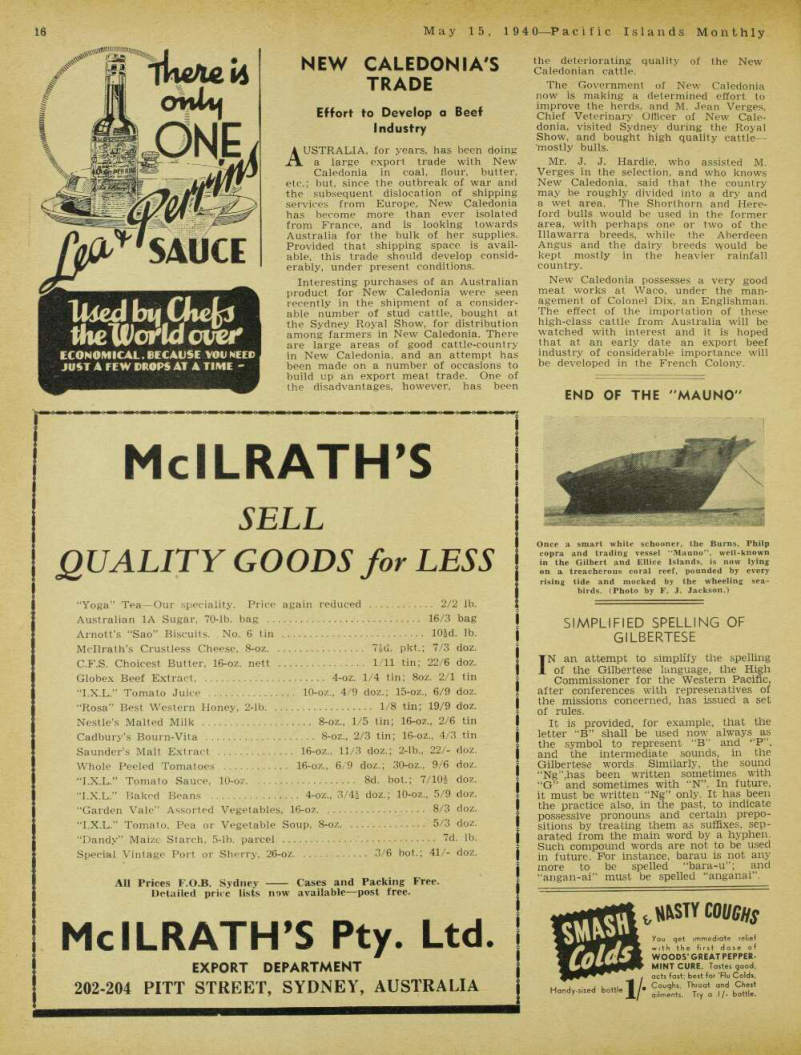
Trade
Effort to Develop a Beef Industry
AUSTRALIA, for years, has been doing a large export trade with New Caledonia in coal, flour, butter, etc.; but, since the outbreak of war and the subsequent dislocation of shipping services from Europe, New Caledonia has become more than ever isolated from France, and is looking towards Australia for the bulk of her supplies.
Provided that shipping space is avail able, this trade should develop consid erably, under present conditions.
Interesting purchases of an Australian product for New Caledonia were seen recently in the shipment of a consider able number of stud cattle, bought at the Sydney Royal Show, for distribution among farmers in New Caledonia. There are large areas of good cattle-country in New Caledonia, and an attempt has been made on a number of occasions to build up an export meat trade. One of the disadvantages, however, has been
the deteriorating quality of the New Caledonian cattle.
The Government of New Caledonia now is making a determined effort to improve the herds, and M. Jean Verges, Chief Veterinary Officer of New Cale donia, visited Sydney during the Royal Show, and bought high quality cattle— ‘mostly bulls.
Mr. J. J. Hardie, who assisted M.
Verges in the selection, and who knows New Caledonia, said that the country may be roughly divided into a dry and a wet area. The Shorthorn and Here ford bulls would be used in the former area, with perhaps one or two of the Illawarra breeds, while the Aberdeen Angus and the dairy breeds would be kept mostly in the heavier rainfall country.
New Caledonia possesses a very good meat works at Waco, under the man agement of Colonel Dix, an Englishman.
The effect of the importation of these high-class cattle from Australia will be watched with interest and it is hoped that at an early date an export beef industry of considerable importance will be developed in the French Colony.
End Of The "Mauno"
Once a smart white schooner, the Burns, Philp copra and trading vessel "Mauno”, well-known in the Gilbert and Ellice Islands, is now lying on a treacherous coral reef, pounded by every rising tide and mocked by the wheeling sea birds. (Photo by F. J. Jackson.)
Gilbertese
Simplified Spelling Of
IN an attempt to simplify the spelling of the Gilbertese language, the High Commissioner for the Western Pacific, after conferences with represenatives of the missions concerned, has issued a set of rules.
It is provided, for example, that the letter "B” shall be used now always as the symbol to represent “B" and “P”, and the intermediate sounds, in the Gilbertese words. Similarly, the sound “Ng”,has been written sometimes with “G” and sometimes with “N”. In future, it must be written “Ng” only. It has been the practice also, in the past, to indicate possessive pronouns and certain prepo sitions by treating them as suffixes, sep arated from the main word by a hyphen.
Such compound words are not to be used in future. For instance, barau is not any more to be spelled “bara-u”; and "angan-ai” must be spelled “anganai”.
Advertisements & other items, p. 20 (2 items)
16
May 15, 194 O—P acific Islands Monthly
Wbty Coughs
Handy-siied bottle
You get immediate relief with the first dose of
WOODS' GREAT PEPPER-
MINT CURE. Tastes good, acts fast; best for 'Flu Colds, Coughs, Throat and Chest ailments. Try a 1/- bottle.
Banana Flour
An Industry for the Islands?
INQUIRIES have been received by the “P.1.M.”, in recent months, regard ing the production of banana flour.
One caller informed us that it was widely used in America in the prepara tion of foodstuffs. He wanted to know the name of any firm in the Pacific Islands which manufactures banana flour.
In this connection, the following para graph appeared in a recent issue of “Milling” (a well-known American trade journal): “A correspondent in forms us that banana meal has been made for years in South America, and it is used both for admixture purposes in bread, and alone, as a banana bread.
The vitamin content of banana flour corresponds approximately to that of whole wheat flour, but is less than that of the fresh fruit; in other respects, the product is an easily digested, starchy food.”
Steps in Litigation
Curious Case in Port Moresby
Prom Our Own Correspondent
Port Moresby, May 5.
THE well-known boat-builder of Napa Napa, Port Moresby, Mr. G. A.
Stewart, has been engaged recently on a series of litigation.
On March 15, a Mr. Thurlow pro ceeded against Mr. Stewart in the Small Debts Court, claiming wrongful dis missal, and he secured judgment for £92.
Subsequently, a notice of appeal was lodged with the Registrar of the Small Debts Court, together with the full amount of the judgment, £92; but, as a result of an error, notice of appeal was not lodged also with Mr. Thurlow’s soli citor, Mr. W. Brian Molloy.
On March 28, claiming that payment had not been made and no appeal had been lodged, Mr. Molloy secured a writ of fieri facias, and on April 4 execution was taken, and the vessel “Veimauri”, owned by Mr. Stewart, was seized.
Proceedings were then taken by Mr.
R. D. Bertie, acting on behalf of Mr.
Stewart, and the following day the ves sel was released and an action initiated in the Central Court.
On April 23, Mr. Stewart proceeded against Mr. Thurlow and Mr. Molloy in the Central Court, claiming that the writ of fieri facias was null and void, that the seizure of the vessel was un lawful, and asking for an injunction restraining the defendants from pro ceeding with execution, and for £2OO damages.
On April 29, Mr. Justice Gore delivered judgment in this claim, giving a verdict for the defendants, and fixing costs at 20 guineas, A stay of execution was granted, pending an appeal to the High Court of Australia.
On May 1, in the Court of Petty Ses sions, Mr. Bertie, on behalf of Mr.
Stewart, applied for stay of execution of the writ, and explained that this was being done so that the monev alreadv deposited in the Small Debts should remain there until the appeal was decided. The Magistrate (Mr. W.
R. Humphries) refused the application, on the ground that his Court had no jurisdiction.
and understanding! To the small ani mal, it is tragedy, bitterness, and despair.
Copra prices were fixed by the Brit ish and French Governments, at practic ally pre-war values, notwithstanding the jump in freight and taxes of all kinds.
The costs of production are very much above pre-war costs. Fortunately for cocoa growers, they are in better state, and can get something of the world’s increased values.
I am, etc.,
One Of The Herd.
New Hebrides. 28/4/1940.
Mr. and Mrs. Hal. Evans, of Madang, New Guinea, received many congratula tions in April on the birth of a daughter —Patricia Anne.
Higher Taxes In New
Hebrides
Letter to the Editor SINCE the outbreak of war, things have gone from bad to worse as far as the settlers in the New Hebrides are concerned, and the small man of the “herd” is being pushed out altogether. A Mr. Blandy and an M.
Sautot pass Joint Regulation No. so and-so, increasing taxes perhaps 50 per cent, and the poor herd have no say in the matter, as to why, or wherefore, or what the increased taxes are for. The small animal of the herd is under slow strangulation—and not very slow, either.
The bigger animal can pass it on, to a certain extent; but the big combines overseas pass it all on, and a bit more,
and grind their millions of profit yearly, and no one to say them nay. Is this democracy, Mr. Editor, or have you another name for it?
Immediately on the outbreak of war, the overseas shipping company put up freights 50 per cent. Government taxes of all kinds jumped. But the poor ani mal of the herd is profiteering, if he tries to pass any of it on.
I do not say that the shipping com panies were not justified in raising their freight rates —they are not the wolves but what are the increased taxes for?
What does the Condominium do for it?
The herd has still to wade through rivers, make its own roads, and pay, pay, pay.
The end of the herd is inevitable, under such a system. Oh for a Casimir, or for a Smith-Rewse —men of sympathy
Advertisements & other items, pp. 21-22 (2 items)
17
Pacific Islands Monthl y—M ay 15, 1940
Oatmeal
vtcat or oats
BRING HEALTH TO
GLASS
2iUJ I Hi i • II
AUSTHAIJ
I
TOOHEYS
OATMEAL
STOUT
here's to'ee
TILLEY
KEROSENE LAMPS
Tilley Lamps are made in England and are the most efficient of any lamps burning kerosene. There are 18 models, including Table Lamps, Hanging Lamps, Floor Standards, etc.
All provide a full 300 c.p. steady light without flickering. Not affected by wind or insects, and absolutely free from smoke, smell or fumes.
Illustrated is the all-purpose lamp. It is a gale-proof storm lantern, or when fitted with reflector as shown, it is an efficient hanging lamp. May also be used on the table, with parchment shade. Write for Catalogue of all models.
Price 57/6 each, complete with reflector.
SIMPLEX MARINE ENGINES
3 h.p. 2 cycle and 5 h.p. 4 cycle.
Illustrated is the new 5 h.p. 4 cycle, with built-in Reverse Gears. A fine, powerful little unit suitable for boats up to 20 ft. Has force-feed lubrication, Shebler Carburettor, removable English Magneto with impulse starter. No vibration, economical and sturdy. Bore 3f, Stroke 4 in., R.P.M. 1,000. Made in Australia for hard Australian coast conditions.
Price, complete with Muffler, £52/10/-.
Write for Engine Catalogue. i
SHIPCHANDLERY
We are the largest manufacturers of Marine Fittings and Equipment in Australia. We have everything you may require for yachts, motor-boats, schooners and trading vessels.
Having most modern workshops for marine manufacture, we no longer depend upon overseas supplies. We are pleased to send you our latest Marine Catalogue. Our prices are attractive. Intelligent service.
W. KOPSEN & CO. PTY. LTD.
380 KENT STREET, SYDNEY. Cables: “Kopsen", Sydney.
New Crop For N.G.?
rE New Guinea Agricultural Depart ment likes experimenting with pos sibly profitable new crops, on its farm on the Central New Guinea high lands (called “a second Kenya”). There fore, it may be interested in this from “Melbourne Herald”: — “Dr. Bartley’s relations at Molo, Kenya Colony, 8,500 feet up, grow pyre thrum daisies to make insecticide, and they get up to £l4O a ton for the flowers, with the United States taking 8,500 tons a year. It takes a lot to kill those gol-durned flies!”
Miss Marcia White, daughter of Mr. and Mrs. J. White, of Suva, Fiji, was married to Mr. Frank M. Gray, formerly of Adelaide, S.A., at the Suva Holy Trin ity Pro-Cathedral on April 20.
Solomons
Conditions In The Solomons Hopes For Shore of The £50,000,000 Grant
From a Special Correspondent
Tulagi, Apl. 15.
LAST “Malaita” saw something of an exodus of Tulagi identities, two at least of whom have left us perman ently—Mr. E. Osborne, senior wireless officer, who has been in the Protectorate service since 1916; and Mr. J. Mutch, overseer in the Department of Works for upward of 25 years. Both of these gentle men will be greatly missed by the older hands, for both have been closely identi fied with Solomons interests and both are highly esteemed.
“Ossie’s” retirement is due to health reasons, the medical authorities be lieving that a cooler clime is necessary for permanent recuperation. Mrs. Osborne —who, prior to her marriage, was a nursing sister on the staff of the Tulagi Hospital—is also highly esteemed locally, having been the founder last year of the local active Red Cross organisation.
Local radio affairs are at present in charge of Mr. Bob. Taylor, who has spent over ten years as assistant to Mr.
Osborne. Bob. Taylor has lately been reading, with personal interest, the re cently published book “The Cruise of the Raider ‘Wolf’ ”, for he was one of the luckless band of seafarers and others who spent many months in captivity, ’tween decks on the “Wolf”, before be ing interned in Germany. He was radio operator on the ill-fated “Matunga” at the time of her capture.
“Jimmy” Mutch, a native of Aberdeen, has been largely responsible for the growth of Tulagi in buildings, wharves, etc. A bachelor, his home was always open to visitors, and his genial Scot tish temperament and obliging official methods made him one of the “bright spots”. In connection with his work, he had visited every district in the Pro tectorate, and was probably better known “outside” than any other Gov ernment officer.
Outgoing on the same “Malaita” was Dr. Critchlow, on furlough. “Critch” is on about the same level as “Jimmy”
Mutch in years of service and personal popularity. He is a pillar of the local Club, and plays a good hand of golf or bridge.
Tulagi was also sorry to lose Mr. and Mrs. W. C. Groves and their three girls.
With a long experience of tropical living behind them, Mr. and Mrs. Groves quickly adapted themselves to local social conditions, and made a host of friends, both at Tulagi and outside. In connection with his native educational survey, Mr. Groves travelled widely over the Protectorate, and everyone who had dealings with him found him approach able and congenial. It is rumored that there is a likelihood of Mr. Groves’s re turning to Tulagi eventually to take up some administrative post.
“Rufe” Naylor, popular member of the B.P. bachelors’ mess, also went out on leave. Rumor has it that he will no longer be eligible for the mess on his re turn. All Tulagi wish him and his bride all the best. 11THAT is Tulagi doing officially in con ff nection with the war? Ask the censor! All that can be said is that
the place is not asleep, as might be thought from the lack of publicity. Of special interest is a series of locally pro duced “Information Pamphlets”, of which No. 4 is just published. These pamphlets, which deal with the war situation from various angles, origin, de velopment, etc., are issued in English to the various Missions and Government officers, for native information—the Mis sions translating them and publishing the vernacular versions. There is no doubt that in the matter, and in matters connected with the war and the natives’ reaction to it, the Missions and Govern ment are in complete harmony and co operation.
An interesting native development here is the commencement, in an unpreten tious way, of the Boy Scout movement.
Mr. Eric Spencer, of the Lands and Works Department, a former Scout master of N.S.W., and an officer trainee of the R.A.A.F., has made a start with a few good-quality English-speaking lads, who are being trained to become troop leaders of the wider Scout organi sation of the future. It is prooosed to extend the scheme, through the Missions, over the Protectorate as a whole.
A new organisation is represented of the recently established Horticultural Society, launched under the patronage of the Resident Commissioner, with Mr.
A. H. (“Spearline’ ) Wilson, Commissioner for Lands and an enthusiastic horticul turist, as president. It is proposed to run periodical exhibitions and competitive shows, with special sections for native entries. rERE is promise of development in the gold mining industry at Guad alcanal, with the introduction by the Davis Syndicate of more advanced
mining methods, a quantity of improved sluicing machinery having arrived re cently.
The local Treasury will certainly wel come any tendency towards increased gold output, with the prospect of a large deficit at the end of the year and dis couraging economic conditions, which caused an unfavourable reaction to the recent increases in Customs tariff. It is hoped that the new Resident Commis sioner, who has travelled widely in the Protectorate since his arrival some months ago, may succeed in sponsoring some new line of agricultural or other economic development.
The various Missions are feeling the pinch owing to reduced revenue due to the war; and are finding it necessary in some cases to curtail their activities.
Hopes are high that the Protectorate will benefit substantially from the new £50,000,000 Colonial development grant to be spent over ten years, as announced recently by the Secretary of State. It is generally understood that most of the money is intended for native develop ment and welfare. The urgent needs in this connection in the Protectorate are for native agricultural development, and a scheme of controlled marketing, leprosy treatment, infant welfare, and a properly adapted system of education.
The survey recently conducted by Mr.
Groves may pave the way for this last, as well as for native development gener ally. In the case of leprosy treatment, the report of the 1937 survey of Dr. Ross- Innes is available for local guidance.
Mr. J. R. Byrne has taken up duties as manager of the Bank of N.S.W., at Wau, T.N.G., relieving Mr. A. S. Shaw, who returned to Australia.
New Books
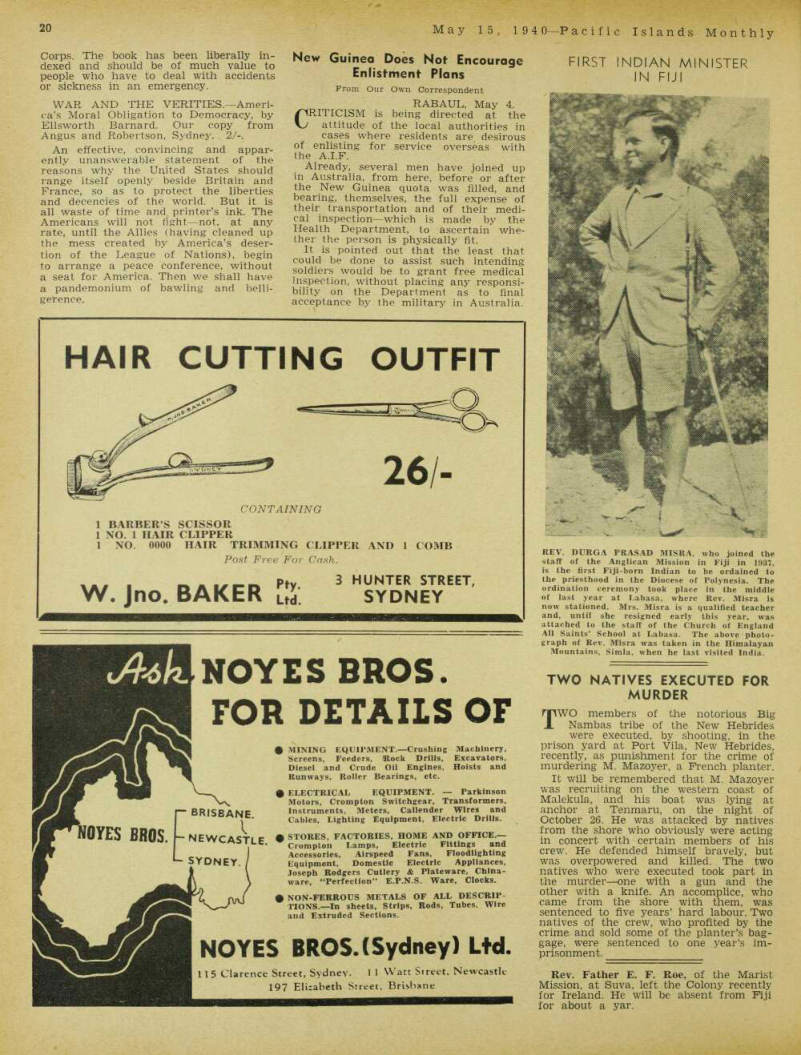
THE TORGUTS, by W. L. River, Angus & Robertson, Sydney, 8/6.
You may never have heard of the migration of the Torguts—yet it was one of the most dramatic and tragic events of modern history. In 1770, driven away by the cruelties of Catherine of Russia, half a million Torguts, with five million animals, left the western bank of the Volga, and started on a 3,000 miles trek eastwards across Asia, This extra ordinary event, with its strange political angles, the remarkable achievements of many individual men and women, and the final, terrible end of the migration, has been very cleverly woven into a long, facinating, historical novel, by Mr. River.
The publishers compare it with Tolstoy’s “War and Peace” arid Margaret Mitchell’s “Gone With the Wind”.
“Atlas Op First Aid”, By David
Farrell. Published by Angus and Robert son, Sydney, 5/-.
This is a compilation that will be of interest to many people in the Pacific who often want medical advice, but are far removed from qualified medical men.
In this “Atlas of First Aid”, Mr. Farrell shows pictorially what other first-aid manuals describe in letter-press. The drawings are simple and accurate, and are liberally annotated, so that the student is given a clear understanding of the structure of the human body. Part 1 of the book shows, in great detail, the anatomy of the human body, and Part 2 shows the practical application of methods employed in first-aid treatment.
The author was assisted in his compila tion by Dr. P. A. Macguire, C.M.G., D. 5.0., of the Australian Army Medical
Corps. The book has been liberally in dexed and should be of much value to people who have to deal with accidents or sickness in an emergency.
War And The Verltles.—Ameri
ca’s Moral Obligation to Democracy, by Ellsworth Barnard. Our copy from Angus and Robertson, Sydney. 2/-.
An effective, convincing and appar ently unanswerable statement of the reasons why the United States should range itself openly beside Britain and France, so as to protect the liberties and decencies of the world. But it is all waste of time and printer’s ink. The Americans will not fight—not, at any rate, until the Allies (having cleaned up the mess created by America’s deser tion of the League of Nations), begin to arrange a peace conference, without a seat for America. Then we shall have a pandemonium of bawling and belli gerence.
Advertisements & other items, pp. 23-24 (1 item)
jTcoffaf-Virtue Xtd.
IT IT I VERE TWICE THE
PRICE IT WOULD STILL
BE GREAT VALUE!
\ 14 Yes, that is true, because there is no other Diesel at anywhere near the price that can compare with the M.V. Diesel. Its fully balanced crankshaft reduces vibration and ensures smooth running at all speeds. All parts are totally enclosed, dust-proof and oil tight. Sweet running is assured . . . Starts from cold.
DIESEL ENGINE
is obtainable in 3V 2 h.p., 5 h.p., 6V2 h.p., 8 h.p., 12 h.p., and 16 h.p. models.
Write to-day, stating your requirements and we shall be only too pleased to give you full information without obligation.
There is a wide range of the well-known M.V. Petrol and Kero Engines suitable for all purposes.
Telegrams:!
“Virtue”
Sydney.
jTcoffaf-Virtue Xtd.
M-25 PALMER STREET SYDNEY. N.S.W.,
ENGINEERS, MANUFACTURERS
AND MACHINERY MERCHANTS
d»r BRISBANE aho LONGREACH, 010.
’Phone; |FL 5214 (6 lines).
HAIR CUTTING OUTFIT
o 261-
CONTAINING
1 BARBER S SCISSOR
1 NO. 1 HAIR CLIPPER
1 NO. 0000 HAIR TRIMMING CLIPPER AND 1 COMB Post Free For Cash.
W. Jno. BAKER [3;
3 HUNTER STREET,
SYDNEY
NOYES BROS.
FOR DETAILS OF
- NEWCASTLE.
i
r BRISBANE
OYES BROS.
■- SYDNEY.
• MINING EQUIPMENT.—Crushing Machinery, Screens, Feeders, (Rock Drills, Excavators, Diesel and Crude Oil Engines. Hoists and Runways, Roller Bearings, etc.
• ELECTRICAL EQUIPMENT. Parkinson
Motors, Crompton Switchgear, Transformers, Instruments, Meters, Callender Wires and Cables, Lighting Equipment, Electric Drills.
A STORES, FACTORIES, HOME AND OFFICE.—
Crompton Lamps, Electric Fittings and Accessories, Airspeed Fans, Floodlighting Equipment. Domestic Electric Appliances, Joseph Rodgers Cutlery & Plateware, Chinaware. “Perfection” E.P.N.S. Ware, Clocks.
• NON-FERROUS METALS OF ALL DESCRIP-
TIONS.—In sheets, Strips, Rods, Tubes, Wire and Extruded Sections.
NOYES BROS.(Sydney) Ltd,
115 Clarence Street, Sydney. 1 1 Watt Street. Newcastle 197 Elizabeth Street, Brisbane
New Guinea Does Not Encourage
Enlistment Flans
From Our Own Correspondent
Rabaul, May 4.
CRITICISM is being directed at the attitude of the local authorities in cases where residents are desirous of enlisting for service overseas with the A.I.F.
Already, several men have joined up in Australia, from here, before or after the New Guinea quota was filled, and bearing, themselves, the full expense of their transportation and of their medi cal inspection—which is made by the Health Department, to ascertain whe ther the person is physically fit.
It is pointed out that the least that could be done to assist such intending soldiers would be to grant free medical inspection, without placing any responsi bility on the Department as to final acceptance by the military in Australia.
First Indian Minister
In Fiji
REV. DURGA PRASAD MISRA, who joined the staff of the Anglican Mission in Fiji in 1937, is the first Fiji-born Indian to be ordained to the priesthood in the Diocese of Polynesia. The ordination ceremony took place in the middle of last year at Labasa, where Rev. Misra is now stationed. Mrs. Misra is a qualified teacher and, until she resigned early this year, was attached to the staff of the Church of England All Saints’ School at Labasa. The above photo graph of Rev. Misra was taken in the Himalayan Mountains, Simla, when he last visited India.
Two Natives Executed For
Murder
TWO members of the notorious Big Nambas tribe of the New Hebrides were executed, by shooting, in the prison yard at Port Vila, New Hebrides, recently, as punishment for the crime of murdering M. Mazoyer, a French planter.
It will be remembered that M. Mazoyer was recruiting on the western coast of Malekula, and his boat was lying at anchor at Tenmaru, on the night of October 26. He was attacked by natives from the shore who obviously were acting in concert with certain members of his crew. He defended himself bravely, but was overpowered and killed. The two natives who were executed took part in the murder —one with a gun and the other with a knife. An accomplice, who came from the shore with them, was sentenced to five years’ hard labour. Two natives of the crew, who profited by the crime and sold some of the planter’s bag gage, were sentenced to one year’s im prisonment.
Rev. Father E. F. Roe, of the Marist Mission, at Suva, left the Colony recently for Ireland. He will be absent from Fiji for about a yar.
MR. A. GASKIN, licensee of the Cos mopolitan Hotel in Rabaul, arrived in Australia from New Guinea in April on a short business visit.
MISS M. WHITE resigned from the Post and Telegraph Department of the Fiji Civil Service in April.
Miss Margaret Stephenson, Of
Christchurch, N.Z., has joined the staff of the Melanesian Mission’s hospital at Fauabu, Solomon Islands.
Mr. John Lancelot D’Espeissis,
who recently joined the New Guinea Administration as forestry officer, re signed in April.
MR. D. McLAUGHLAN, of the Govern ment Stores Department in Papua, arrived in Australia from Port Moresby on leave in April.
Advertisements & other items, pp. 24-26 (3 items)
20
May 15, 194 O—P acific Islands Monthly
21
Pacific Islands Monthl y—M ay 16, 1940
Starved Nerves
CAUSE THESE Complaints
f NERVES
DEPRESSION
SCIENTIFIC CONTROL
Manufactured in the Bidomak Pharmaceutical Laboratories, one of the most up-to-date, hygienic laboratories in the Southern Hemisphere, to which is attached a fully qualified Doctor of Medicine, and under the control of a qualified chemist who was trained in the most modern English Laboratory in the world.
“NOW FIT AND WELL AGAIN”
Mr. J. Coleman, of Queensland, writes: . . I have not had a day’s sickness for nine months. You don’t know how well I feel after 3 years’ suffering. I have not missed one good night’s sleep. I would wake up with a headache and used to be tired before I started work. I must thank BIDOMAK for bringing me back to health.”
The vital nerve power of the human body can be restored. The force that runs the human body is stored in the NERVES.
When any one part is weak or inactive, it means that the nerves that control it lack
power—this power must be restored before
the affected part can perform its proper functions. It does no good to take drugs.
Science has discovered that NERVE STARVATION is the cause and to build nerves back to health, it is necessary to feed them by supplying the vital minerals in which most of our foods are deficient.
POOR APPETITE
HEADACHES
WEAK DIGESTION
< CONSTIPATION
LACK OF ENERGY
FAINTNESS
HEART PAINS
WEAKNESS
LETHARGY
If You are RUN DOWN, NERVY,
or Suffering from TROPICAL LETHARGY
You are a victim of this mineral deficiency. Your nerves are starved for the important elements —ferrum, calcium, potassium, sodium, phosphates, glycerophosphates and sucrose.
BIDOMAK supplies ALL these vital foods in a predissolved, easily assimilable liquid form. When you take BIDOMAK, nerve troubles soon vanish. You feel better and brighter —aches and pains leave you—work is no longer a burden. You cease to feel depressed or run down —the whole system is braced up and strengthened.
By feeding starved nerves, BIDOMAK corrects the ailments which these cause. There is no need for anyone to be depressed and nervy.
BIDOMAK brings back vigour and vitality, it overcomes brain fag and tiredness and completely banishes nerve pains.
BIDOMAK is scientifically compounded and quickly overcomes the after-effects of tropical lethargy and malaria, it brings you back to the pinnacle of good health and spirits quickly and pleasantly.
If you want to feel gloriously fit and well—to be able to enjoy everything you do —then start on a course of BIDOMAK to-day.
AK
AT ALL LEADING ISLAND STORES
25 YEARS OF SERVICE
William E. Reed
(Established 1913)
BROKER & AGENT
Union House, 247 George St., Sydney For all Plantation and Trading Requirements. Enquiries welcome.
to lack
They're golden-brown . . . crisp . . . and they practically melt in your mouth. Joyce Harvest Home biscuits are mellowflavoured . . . just what you will like for morning tea, afternoon tea, supper or picnic lunches. Like all Joyce Gold Medal Biscuits, they are made only with the choicest ingredients. Order from your store. at • • •
tofiaf!
JOYCE
HARVEST HOME
-COLD MEDAL BISCUITS
TRADERS are invited to write for full particulars and price lists to
JOYCE BISCUITS PTY. LTD.
CAMPERDOWN, SYDNEY, N.S.W.
Confederation?

Why Not A South Pacific
Plea For a Co-ordinated Effort in Islands Administration
By M. Frater.
mHE demand for closer collaboration A between France and Britain has been hailed with a significant chorus of approval. The forging of a link of mutual understanding and friendship between the two countries is of great moment, and fraught with far reaching possibilities.
By throwing everything they hold dear into the struggle for the supremacy of right over might, the Allies have brought into intimate relationship all those in every land who speak the same language—the language of democracy.
Before the outbreak of hostilities, there were many who thought that the British had more in common with the Germans, and affirmed that an entente cordiale between Britain and Germany would have been more in harmony with
the nature of things. So obsessed were they with some discordant elements in the British and French modes of thought that they were blind to the bonds which unite the two peoples.
Regarding the English and French modes of life as parallel lines, which would never meet, they failed to recog nise that the French and English, with their inheritance of independence and democratic institutions, had nothing in common with the great majority of goose-stepping Germans, who actually keep the Nazis in power.
It required the present life-and-death struggle to throw down the few remain ing fences that kept the two races apart, and to dispel the illusion that each has a unique psychological character. In this supreme hour of destiny, there is the same estimate of what is a decent way of life, making the French and English as brothers, marching side by side, under one flag and with one battle-song.
This Nazi challenge to individual lib erty has produced one of the most stable alliances in history. Already, it is seen that the peace and security of the world will depend upon collaboration continu ing after the war. Such a union might not only bring together the divergent elements of Europe, but contribute to the great ideal of world federation on a democratic basis.
Conditions in the South Pacific were never more opportune for a Federation, not only of British and French, but of all democratic nations with interests here. A great forward step, in promot ing the peace and progress of the Paci fic territories would be taken, if an Anglo - French - American Condominium were brought within the range of pos sibility. It would be an additional source of stability if Holland, with her vast East Indian Empire, were brought into the same collaboration. A Condominium of these four Powers in the South Paci fic would provide permanent security, and promote the conservation and devel opment of the native races. rE desirability of such a Federation derives its urgency from the pre sence of another Pacific Power that is not democratic, but is a typical totali tarian state Germanic in its ruthlessness.
Japan dreams of a Pacific Empire, and her ambition to bring the islands of the South Seas under her domination has created manifest uneasiness among the European communities in the Pacific.
Though partly exhausted by her war in China, Japan still is a force to be reck oned with, even in the South Pacific.
Much of the territory she covets belpngs to Britain, Australia, France, America and Holland. On the plea that she is economically linked with the regions of the South Seas, she contends that in order to make self-sufficient the “New Order” she is creating in the Far East, it is necessary to exploit the resources of the Pacific Islands.
The current issue of the English magazine, “World Dominion”, contains the significant statement: “Depopulation
of the Southern New Hebrides goes on, and lack of interest in the problem may lead to the Japanese over-running the islands.”
Commenting on the Japanese menace, the Very Rev. T. E. Riddle, Moderator of the New Zealand Presbyterian Church, who was formerly a missionary in the New Hebrides, states: ‘‘The invasion of the New Hebrides by Japan points to a happening that is inevitable, as long as Australia values a political theory more than a political fact. She shuts out the New Hebrides and does not see the danger of Japanese occupation. With Epi, Erromanga and Efate practically depopulated, we have no right to deny them to a virile race that can make use of them. So I am afraid we will have Japanese there for keeps.”
The reason which prompted the Rev.
Mr. Riddle’s statement was the likeli hood of the sale to the Japanese of a British plantation on Epi, the island with which he was formerly associated.
Copra, the staple product of the Islands, had no attraction for the prospective purchasers. Cotton was the induce ment, and their aim was to clear the land for its cultivation.
The New Hebrides is eminently suited for cotton growing, and, once the enter prise is successfully launched, the settle ment of Epi with Japan immigrants would proceed apace. The empty spaces of the large Southern islands, to which “World Dominion” refers, offers also ample scope for the settlement of multi tudes of impoverished Asiatics, who know nothing about an eight-hours day, a standard of living, or birth control. rE special references in the two statements are to the New Hebrides, but they apply with equal empha sis to New Caledonia, Solomon Islands and other Groups with declining popu lations.
The proximity of fertile islands, with vanishing populations, on the eastern flank of the Australian continent, con stitutes a lurking danger zone, fraught with sinister possibilities. With the pro gress of aviation, the Islands have assumed a strategic importance, out of all proportion to their commercial value.
Forming a link in the chain of Pacific Islands which serve as a natural ram part to Australia’s vulnerable north-east coast, they constitute her first line of defence. Nevertheless, in spite of their importance to the Commonwealth, many people will be ready to endorse Rev. Mr.
Riddle’s contention that if the democratic Powers, already in possession, fail to populate the Islands with a virile race of indigenous people, occupation by the Japanese is inevitable. Public opinion will no longer tolerate a dog-in-the manger policy, even by Governments.
IT is now recognised by all interested in the prosperity of the South Seas that the development of the Islands is inseparable from the conservation of the native race, and that the most effectual means of stemming the tide of Japanese aggression would be co-opera tion by the democratic Powers in a scheme for arresting depopulation and transforming the indigenous inhabitants into healthy, prosperous communities.
The greatest factor in the change from depopulation to racial regeneration is an expansion of medical effort. Scientific research has brought a solution within sight by identifying racial degeneration of Pacific Islanders with the introduction of European diseases. The carefully
planned experiments, in curative and preventative medicine, made by the Gov ernments of Fiji, Samoa, Tonga and Cook Islands have enabled medical re search to cope with the scourge and bring down the death rate from 50 per 1,000 to less than 18.
Even although remedial measures are rendered more difficult in the New Hebrides and Solomons by the presence of malaria, there is no doubt that, had these islands had the same generous treatment as other islands in the Pacific basin, they would have responded in the same way and be now recovering from racial degeneration.
Were a Federation of Associated Pow ers in the South Pacific to accept the challenge and introduce into the depopu lated areas the remedial measures that have been tested with such beneficent results in other islands, it would be found that the rehabilitation of the native race had removed the greatest temptation to Japanese aggression, and at the same time preserved the loyalty of the islands towards the sovereign States under whose protection they dwell.
The demand that has grown up re cently for a federation of the democra cies of the world is universal in its appeal, and it is to be hoped that noth ing untoward will interfere with its ful filment. But one of the most obvious and urgent accessories would be a South Pacific Confederation. And, ready to
hand, is an existing foundation on which to build, in the Anglo-French partner ship which the war has brought into existence.
That movement should be developed into what might well become a South Seas Confederation, the central object of which would be the preservation of peace and the well-being of the native races.
Advertisements & other items, pp. 26-27 (3 items)
22
May 15, 194 O—P acific Islands Monthly
23
Pacific Islands Month! y—M ay 15, 1940
Nestle Spmilri
Ships carry nothing more precious to tropical settlements than their regular cargoes of Nestle’s Sweetened Condensed Milk. Neslle’s Sweetened Condensed Milk is the safest milk because it is the purest; because it can never sour or become contaminated while unopened; and because it is fully guaranteed to retain its original freshness and purity under any climatic conditions. To protect your health and the health of your family, use Nestle’s Sweetened Condensed Milk always.
COPYRIGHT 8226
Buildings At Port
Moresby
From Our Own Correspondent
Port Moresby, May 1.
IjllVE new buildings and an office block, for the Commonwealth Department of Works, are being erected in Port Moresby under the direction of Mr. H.
G. Hannam, Commonwealth Works Dir ector. Four buildings are for officers of the Works and Services Branch of the Department of the Interior, and one is for an officer of the Meteorological Branch.
Mr. A. R. Miller, formerly Government Surveyor in the Sepik District, New Guinea, has been appointed Surveyor- General for the Northern Territory. He arrived at Darwin from Sydney by fly ing boat in mid-May to take up his new position.
Rev. and Mrs. W. D. Oakes, of the Methodist Mission, returned to Pinikidu, New Britain, recently after deputation service in Australia.
The Old And The New
Miss E. D. Wallace, 8.A., Dip. Ed., re turned to Samoa recently after leave.
She is stationed at the Methodist Mis sion’s girls’ school at Avoca.
In the middle of last year a new limestone church was erected at Butaritari, Gilbert Islands, for the Sacred Heart Mission. Natives working under the supervision of Rev, Brother C. Antonie (who has been in the Colony for 45 years) took three years to build it. Top: The old wooden church which stood for 36 years.
Below: The imposing new building, 40 ft. wide, 100 ft. long, and 65 ft. from tower top to ground. —Photo: C. Kanzaki.
Advertisements & other items, p. 28 (2 items)
24
May 15, 194 O—P acific Islands Monthly
ilßr
it bac Rich in juniper and healthful herbs 1 L
tl J
ENERATIDNS
fS
General
Merchants
and
Agents
d REPRESENTING LEADING FIRMS IN THE PACIFIC ISLANDS
379 KENT STREET,
SYDNEY.
Cable Address: “Trocas”, Sydney.
Telephones: MJ4657 (5 lines).
Islands Produce Sold on Shippers’ Account Buyers of all Islands’ requirements on Commis- Liberal Advances against Consignments. sion Original Invoices Furnished. 25 Years Islands Trade Experience.
Bankers: Bank of New South Wales. Correspondence in English, French & German.
"Dictators" And
Bananas
Complaint From Western Samoa
Letter to the Editor IT is common knowledge that, when the prices of our principal indus tries in Western Samoa fell to below cost of production, the banana industry came to our rescue and has helped us along considerably.
But there is one fact which the people of Samoa do not realise fully—banana planting does not pay. A poor man, who starts a banana plantation, with the object of making money, will find himself puzzled and humiliated, because the supply is much greater than the demand.
Worse still, the banana industry is in the hands of one “dictator”, and it is well known that dictatorial powers can be harshly exercised.
There are several copra and cocoa buyers in Samoa; hence, there is keen competition among the buyers. More over, cocoa and copra can be held; but bananas cannot be preserved—one is compelled to sell them, or let them rot.
And there is only one banana-buyer.
Every banana-planter in Samoa has to annroach this high authority respect fully, and accept his dictum —an intoler able situation. It is better for planters to quit banana-planting, as the writer of this letter has experienced. Thank God, all people are not built the same: there are yet people who will sacrifice everything for principle and justice.
I am, etc.,
Seeker Of Justice.
Apia, March 19, 1940.
EDITORIAL NOTE:—The Western Samoan Administration, during the past four years, has carried out with success a vigorous policy of settling families <mostly Eurohesians) in group settlements of small plantations. These settlers and their families have worked hard, and have succeeded in producing large quan tities of bananas, in the belief that there was a market for all their produce. It now appears that the production of bananas in Western Samoa is about double the demand, and a good many of the smaller settlements have been ser iously affected.
It is another example of the stupidity of Pacific Islands administrations gener ally. They actively encourage settlement and production, but do not seem to recog nise any responsibility in regard to pro viding a market for the product of the new enterprises. There are millions of acres of good land available in the Pacific Territories, and thousands of men eager to turn those acres to production; but only a co-ordinated and intelligent effort by the various administrations will pro vide the third essential factor—namelv, a reasonably safe and profitable market.
Mr. A. D. Patel, M.A., LL.B., a promin ent Indian lawyer in Fiji, left the Colony in mid-April to spend a holidav in India.
He has been living in Fiji for the past 12 years and during that period has done valuable work in furthering the rights and privileges of the Indians in Fiji.
Mr. T. Tsiang, Chinese Vice-Consul in Suva, Fiji, has been promoted to the post of Consul at Bombay, India.
Advertisements & other items, p. 29 (2 items)
25
Pacific Islands Monthl y—M ay 15, 1940
Eveready
The New 1.4 Veil Valve had
aiSlipi
flupl
mm ‘fMMM I
★ No Accumulator
★ A/o Recharging
★ Fetver "B” Batteries
y R 57 1551 IF you want to enjoy Country radio at its best—buy one of the new 1.4 volt models available this year. Utilising the amazing new 1.4 volt valve and equipped throughout with dependable Eveready Radio Batteries—a combination that is unbeatable for simplicity and economy —it has NO ACCUMULATOR, and thus no recharging problem. In addition it requires only TWO "B Batteries instead of three, so that operating costs are reduced by ONE-
THIRD.
Practically every set manufacturer in Australia is turning to 1.4 volt radio as the answer to the Country listener's demand for a more convenient, more economical type of set.
Ask your dealer to demonstrate next time you are in town.
EVEREADY
TRADE - M Aft K
R A DiO BATTERIES
EVEREADY (AUSTRALIA) PTY. LTD., SYDNEY, N.S.W.
Australia Remains
Aloof
All Other Pacific Territories Support Suva Medical School
FOR some reason that never has been stated, Australia holds aloof from the Suva Medical School. This ad mirable and eminently successful insti tution continues to turn out Native Medical Practitioners, in increasing numbers—already, their work, going on all over the Pacific, is having a percep tible effect upon the vital statistics of the various Territories. The 1939 annual re port of the acting director, Dr. T. Clunie, shows that the following now send selected native students to the School— British: Fiji, Gilbert and Ellice, Solo mons, Tonga, New Hebrides; New Zea land: Cook Islands, Samoa, Niue; Triple Mandate; Nauru; United States: Eastern Samoa. The following students, under going the four years’ course, were in resi dence at the end of 1939: Fijians 14 Fiji-Indians ... 1 Nauruans 2 Rotumans 1 Ellice Islanders ... 1 Gilbertese 3 Solomon Islanders ... 3
Tongans • • 4
Cook Islanders 3 Samoans 6 E. Samoans (U.S.A.) . 2 Total 40 Owing to the generous help given by the Rockefeller Foundation in the estab lishment of the School, it is possible to maintain native students there for about
£45 per year per man—probably the cheapest institution of its kind in the world.
The Fiji Government, for years, has hoped that Australia, being responsible for the health of at least a million natives, in Papua, New Guinea and the Northern Territory, would support the School. But Canberra thinks otherwise — no one knows why—and so the Terri tories of Papua and New Guinea are without Native Medical Practitioners— apart from a few natives, indifferently trained in the native hospitals.
Veterans At Golf
From Our Own Correspondent WAU, April 23.
BY the courtesy of the Wau Golf Club, who hand over their delightful course to returned sailors and soldiers each year on the Saturday pre ceding Anzac Day, the veterans rolled up in force to play their annual match.
A snirit of good-fellowship always attends this fixture, and the veteran golfers display all the patience in the world with those who sling turf. The competition, over twelve holes, match play, was won by Veteran R. A. Laws, who received a pewter mug and a bottle of whisky for his win. A special booby prize was given to Veteran Ayris, for. his magnificent score of no less than 137 for the 12 holes!
Mr. William Cowie, formerly wireless operator on Christmas Island, is now in charge of the radio station on Lord Howe Island.
System
Teleradio In The
Islands
Steady Growth of System
MANY times, in the years between 1930 and 1935, the “P.1.M.” urged that teleradio sets (then produced and perfected by Amalgamated Wireless, Ltd.) would solve one of the most serious problems of Pacific Islands life —namely, lack of quick communication with the large centres of population.
In recent years, teleradio has been gen erally adopted in the Islands; and the following, from the “Rabaul Times” shows what is being done in New Guinea: “During March and April the teleradio network in the Mandated Islands has been developed further through the in stallation of teleradio equipment at four more outposts—the Methodist Mission at Malalia (New Britain); Cape Lambert (New Guinea) Forests, Ltd.; New Britain Timbers (in the Baining Ranges) and T.
Flower, timber merchant, at Henry Reid Bay, New Britain. All these stations communicate by wireless telephony with the A.W.A. mother station at Rabaul, whence radio telegraphy connects the out lying districts with Sydney and the out side world. Rabaul is now the centre for 14 teleradio stations, of which A.W.A. has established about 180 in the Pacific Islands, Australia and other places.”
A son was born on April 29, at the War Memorial Hospital, Sydney, to Mr. and Mrs. Morris McCullagh, of Raki Raki, Fiji.
Advertisements & other items, p. 30 (1 item)
ike. niqki'!
BRIGHTER LIGHT
for
BETTER SIGHT
Coleman Products can be obtained from all Leading Firms throughout the Pacific Islands. e
JiuMjJniAasL
ike. niqki'!
Coleman Mantles supply Sun-like light.
Instant Lighting
Stoves & Irons giving maximum of heat in minimum of time
EASE OF OPERATION
combines
ECONOMY with COMFORT
In case of difficulty in obtaining supplies write to: — .
Pearce & Co., Suva, Fiji Is.
Tribal Death
Feast
Rare Papuan Ceremony in Honour of Late Sir Hubert Murray
From Our Own Correspondent
Port Moresby, Apr. 14.
THE greatest honour that could be con ferred on a white man by the natives of Papua —and the only occasion on which it has occurred in the history of the Territory—took place near Port Moresby on April 8, when the lead ing men of the Motu tribe invited 6,000 natives from neighbouring tribes to pay their last act of homage to the late Sir Hubert Murrav, in a Tribal Death Feast (Masi Ariana). Formerly this ceremony was accorded only to leading men of the native communities.
According to custom, the occasion was preceded by 40 days of mourning in which dancing and feasting were strictly prohibited. Peoole in the villages carried on their daily tasks as usual, but quietly, and with a seriousness that showed that, with the nassing of their beloved Gover nor, they realised their great loss, and that with his going changes must come.
Special invitations were sent by the Village Councillors to the Acting Lieut.- Governor (Hon. H. W. Champion), the Official Secretary (Hon. H. L. Murray), Mr. Justice Gore, Hon. J. T. O’Malley and the Resident Magistrate (Mr. W. R.
Humphries). When the official party arrived, they were received and escorted, in silence, past lines of heaped native foodstuffs to an awning erected for the occasion in a prominent position facing the large assembly. As the party took their seats, muffled drums gave out a subdued rhythm which continued as the principal village spokesman, Ahuia Ove, an old man of over 60 years, came for ward and addressed the gathering, first in the Motu language and, later, in Eng lish.
“Governor Murray died doing his work”, he began, while the soft tapping of drums continued without pause. “He was our Governor for more than 30 years.
During that time we saw his work, and his laws, and his good deeds. When the people were in trouble they went to him and he did not turn them away—he gave them his help and made them happy again. Wherever he went in Papua he spoke friendly words to the people—to men, women and children, and he brought contentment into their lives.
Therefore, he was good.
“But in February this year he died; and we, his people ; think of him and weep.
“He dealt with us always like his own people (Tadia Kakadia). His way towards us was the way of a strong friend. We think of him now, and we shall always think of him, for he guided us well. The ways of his people were not our ways, but he understood us and loved us all.
We, too, loved him greatly, and therefore we make his Ariana in our true New Guinea custom.
“But who is like him in Papua? There is not one man. He and his goodness are lost to us. He came among us—some times he went hunting and fishing with us and learned our ways, sometimes when his work was done he would meet us on the road and greet us coming from the gardens. But we have lost him; and we are sad in our loss.
“He told us, ‘I do not want to leave
you. I have many friends in Papua; so I will not go away from you. I will die among you’. He made good his promise to us, for his body now lies in our ground.”
There was no applause. The soft tap ping of drums continued as Ahuia Ove retired into the background.
The Acting Lieut.-Governor replied briefly, thanking the people for their tribute to the memory of Sir Hubert. He was sure Sir Hubert’s relatives and friends would be deeply grateful when they heard from him what had taken place that day.
Rabura, of Kila Kila village, who had been appointed as Crier, then came for ward and, escorted by two Councillors bearing a bundle of green wands, moved from one heap of food to another. Calling the name of the village for which it was intended in a mournful long-drawn mono tone, he struck each heap with a wand and shattered it, before moving on. When he had completed the round, the native guests came forward and quietly collected the food. The ceremony was at an end.
Before the distribution of food, a sec ond native, Rakatani Keke, made a short, eloquent speech which, like that of Ahuia Ove, expressed the natives’ grief and their great loss in the passing of one who had been their friend for over 30 years.
Advertisements & other items, p. 31 (2 items)
27
Pacific Islands Monthl y—M ay 15, 1940
Attache Cases
Established 1868
GOWINGS
Sydney’s Leading Store
EXCLUSIVELY FOR MEN
will have your
SUIT TO MEASURE
TAILORED AND AWAITING
YOUR ARRIVAL IN SYDNEY
Write for
FREE PATTERNS
and Self Measurement Form . .
COWING BROS. LTD.
Market and George Streets, Sydney
ATTACHE CASES
Beatzall Attache Case No. 88. is a special export line. Made of glossy grained fibre, it has neatly rounded edges, metal bound lid and rolled brown metal body frame.
The corners are reinforced. Two snap locks, with keys. Metal handle.
The Beatzall Attache Case is light and serviceable. It is smart-looking . . . . long-wearing. Made in sizes from 12 to 20 inches, retailing from 4/11 to 10/ 11.
BEATZALL ATTACHE CASES
Traders ore invited to write for full particulars of all
TRAVEL and LEATHER GOODS.
KIPPAX STREET SYDNEY.
Ask for Beatzall 88.
FORD SHERINGTON, LTD
MANUFACTURERS (WHOLESALE ONLY).
Mr. W. C. Groves
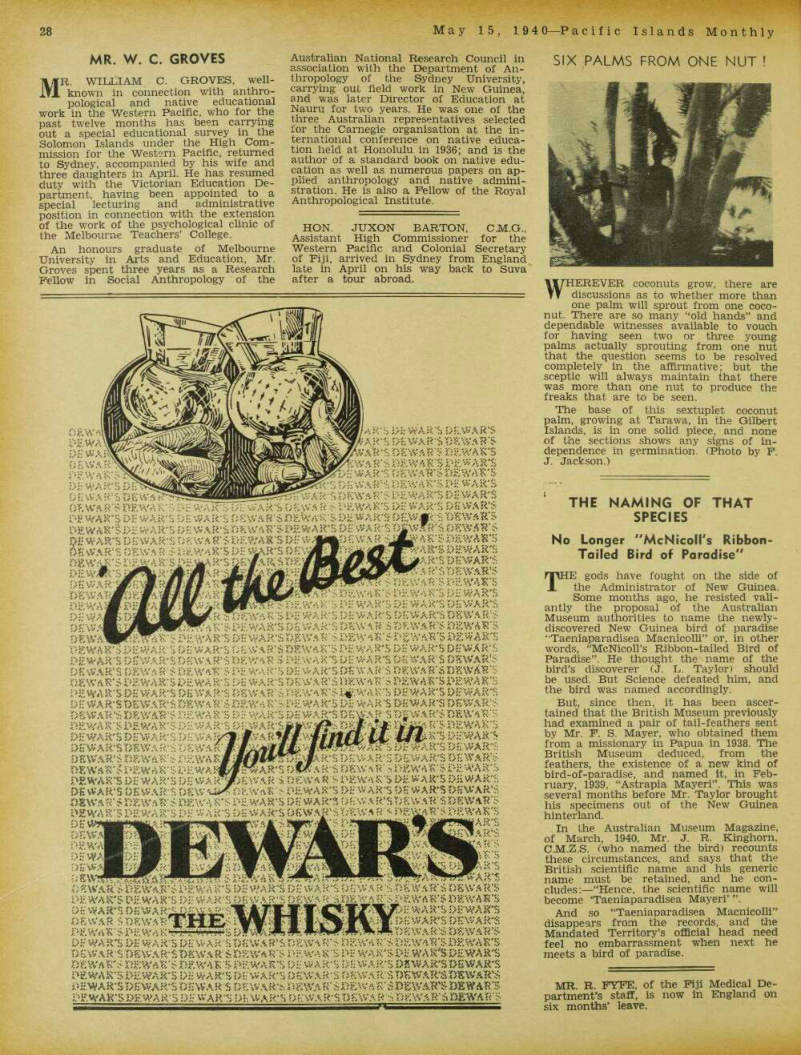
Mr. William C. Groves, Well
known in connection with anthro pological and native educational work in the Western Pacific, who for the past twelve months has been carrying out a special educational survey in the Solomon Islands under the High Com mission for the Western Pacific, returned to Sydney, accompanied by his wife and three daughters in April. He has resumed duty with the Victorian Education De partment, having been appointed to a special lecturing and administrative position in connection with the extension of the work of the psychological clinic of the Melbourne Teachers’ College.
An honours graduate of Melbourne University in Arts and Education, Mr.
Groves spent three years as a Research Fellow in Social Anthropology of the
Australian National Research Council in association with the Department of An thropology of the Sydney University, carrying out field work in New Guinea, and was later Director of Education at Nauru for two years. He was one of the three Australian representatives selected for the Carnegie organisation at the in ternational conference on native educa tion held at Honolulu in 1936; and is the author of a standard book on native edu cation as well as numerous papers on ap plied anthropology and native admini stration. He is also a Fellow of the Royal Anthropological Institute.
Hon. Juxon Barton, C.M.G.,
Assistant High Commissioner for the Western Pacific and Colonial Secretary of Fiji, arrived in Sydney from England late in April on his way back to Suva after a tour abroad.
Six Palms From One Nut !
WHEREVER coconuts grow, there are discussions as to whether more than one palm will sprout from one coco nut. There are so many “old hands” and dependable witnesses available to vouch for having seen two or three young palms actually sprouting from one nut that the question seems to be resolved completely in the affirmative; but the sceptic will always maintain that there was more than one nut to produce the freaks that are to be seen.
The base of this sextuplet coconut palm, growing at Tarawa, in the Gilbert Islands, is in one solid piece, and none of the sections shows any signs of in dependence in germination. (Photo by F, J. Jackson.)
No Longer "McNicoll's Ribbon-
The Naming Of That
Species
No Longer "McNicoll's Ribbon- Toiled Bird of Paradise"
FTIHE gods have fought on the side of J. the Administrator of New Guinea.
Some months ago, he resisted vali antly the proposal of the Australian Museum authorities to name the newly discovered New Guinea bird of paradise “Taeniaparadisea Macnicolli” or, in other words, “McNicoll’s Ribbon-tailed Bird of Paradise”. He thought the name of the bird’s discoverer (J. L. Taylor) should be used. But Science defeated him, and the bird was named accordingly.
But, since then, it has been ascer tained that the British Museum previously had examined a pair of tail-feathers sent by Mr. F. S. Mayer, who obtained them from a missionary in Papua in 1938. The British Museum deduced, from the feathers, the existence of a new kind of bird-of-paradise, and named it, in Feb ruary, 1939, “Astrapia Mayeri”. This was several months before Mr. Taylor brought his specimens out of the New Guinea hinterland.
In the Australian Museum Magazine, of March, 1940, Mr. J. R. Kinghorn, C.M.Z.S. (who named the bird) recounts these circumstances, and says that the British scientific name and his generic name must be retained, and he con cludes:—“Hence, the scientific name will become ‘Taeniaparadisea Mayeri’ ”.
And so “Taeniaparadisea Macnicolli” disappears from the records, and the Mandated Territory’s official head need feel no embarrassment when next he meets a bird of paradise.
MR. R. FYFE, of the Fiji Medical De partment’s staff, is now in England on six months’ leave.
Advertisements & other items, p. 32 (1 item)
SiliiSl
DEW
DEWA
DEW A
DEWAR
w
DE WAR'S D*^
D£ WA ;< 5 S SEW A R oewaß* dewar'* de. walTs de wax DEWAR'S DE WAR'S DE WAR'S DEWA R'S DEWA RS DEWAR'S DEWfR S DEW A R S DEWAR'*DEWAR'S DE WAR S DEWAR'* DEWAR'S DE WA R'SDEWAR’S DEWAR* * DE WAR'S DEWAR'S DEWARS DEWAR'S DE W 'Hill
SiliiSl
S'W =•7,^ . n '*
i&Ji
Is u.
AR'S DE WAR'S DEWAR'S
AR'S DE WAR S DE WAR*
VAR'S DEWAR * DEWAR'S
Ew.aß’ S DEW A R * DE WAR'S
■>E WAR'S DEWAR'S DEWAR'S
<'S DE WAR' S DEWAR'S DE WAR'S
AR'S DEWAR'S DEWAR'S DE WAR'S
DEW A R * DEWAR'S DE WAR'S DE WAR'S
DEWAR'S DEWAR
DEWAR'* D
DEWJk'S A
DEWAR'
DEWAR,
DEWA
DEW A
DEW;
DEWA
DEWaR’
R'S aR AR
S DE
S DEV
AR S DE
>E
DEW
DEW
A R'S DEWAR'S
AR'S DEWAR'S
UDS DEWAR'S
A R'S DEWAR'S
S DEWA R’S DEWAR’S
• DEWAR* DEWAR'S DE WAR'S
> DE WAR'S DE WA R'S DE WAR'S R -TDEWaR’SDE WAR'S DE WAR'S DEWAR'S DEWAR *
DEWAR'S DEWAR'S DEWAR S DEWAR’* DEWAR'S
*DE WAR'S DEWAR'S DEWAR SDEWAR'SDgWAR'S DEWAR'S D EWA R' * DE WA R S D E WAR' S DEWA R‘ S DEW AK' * DE WAR' S DEWA R' S 0E W A R.' S DE WAR'S DE WAR'S DEWA R'S DEWaR * DE WAR'S DE WAR'S DE WAR S DEWAR’* DEWAR’S DEWAR SDEWaE* DEWAR'S DEWAR'SDRWARS DEWAR'S DEWAR'S
DEWaR'* DEWAR'SDEWAR'SDEWAR'SDEWAR'SDEWaE’SDEWAR'SDEWAR'S
DEWAR'S DE WAR'S DE WAR'S DEWaR * DEWaR'* WAR'S DEWAR'S DEWAR'S DE WAR'S DEWAR’S DEWA R * DEWa R'S DEWA R'S DE WAR'S DEWAR'S DEWAR*
WAR'S DEWA
SD
VAR’* DEWaR *
R’S DEWAR'S
R'S DE WAR'S
S DE W AR'S DE WAR'S
ar/sdewar/sdewar/sdewar:* A R S DEWa R - DEWA R'S DE WA R'S E WAR * DEWA R * DEWAR'S DE WAR'S DEWAR'S EW'aR * DEWAR'S DE WAR'S DE WAR'SDEWAR'S
DEWAR* DEWaR* DEWAR'* DEWAR'S DEWAR'S DEWAR'SDEWARSDEWaR*
DE WA R* S DE WA R'S D E W A R'S D E W A R'S DEWA R’ S DEW A R < R ’ * DEWA R'S
DEWAR'S DEWAR’S DEWAR S D;
DEWAR'S DEWAR'S DEWAR'S
DE WAR'S DE WAR'S DEWA;
DE WAR'S DEWA R* S DEWAi
DEWAR’S DEWAR'S DEW
DE'WaR'*DEWAR'SDEWA2
DEWAR'S DE WAR'S DE WAR 7
DE WAR’S DEWAR S DEW
I «v A Jr
DEW
WA DE
DEW
DEW
DEW
DEW
DEV
D E WAR’S DEWAR'S DEWAR’S DE WAR
DEWAR'S DEWAR'S DE WAR'S DEW;
DE WAR'S DEWAR;*D£W4E:vr|
DEWaR S i
D
AR'S
AR’S
:ar’* R’S R'S
•ASWSWABMS
E WAR’S DEWA R’S
EW'AR'S DEWAR'S
E WAR'S DE WAR'S
DE WAR'S DE WAR'S
k DEWAR S DEWAR’S
DEWA R’ S DEWA R S DEWA R'S DE WA R'S DE WAR'S DEWARS DEWAR’S DEWA R’
DEWAR'S DEWAR'S DEWaR S DEWaR* DEWA R'S DE WAR'S DE'WAR'S DEWAR'S DEWaR'* DEWaR * DEWAR S DEWAR'S DE WAR'S DEWAR'S DEWAR'SDEWAR'S DEWAR * DEWAR'S DEWAR'S DEWAR'S DEWARS DEWARS DEWAR'S DEWAR’S DEWAR'SDE VASR/S DEWA RSD EW A R'*R ;E\V/vR’S DEV/a E’S DEWAR'S DE WAR’S DEWAR'S DEWAR'S DE WAR'S DEWAR'S DEWAR'S DEWARS DEWAR’S DEWAR*
Tahiti—Then And
Now
By A. C. Rowland
OUR first impression of Papeete—when we landed there over thirty years ago—was that it resembled some quiet, isolated town in the Deep South of the United States.
It was a village of old buildings and had that venerable patina which is the hallmark of long-established community life, and settled usages and traditions.
The highways, shadowy under the in terlacing branches of stately trees, were flanked by white picket fences. Behind these were veritable jungles of hibiscus, frangipani, exora, glossy-leaf bushes bearing the starlike Hare Tahiti, dwarf palms, yellow jessamine and a wealth of other tropical garden plants, that hid all but the roofs of the landowner’s houses. The fragrance of exotic blos soms scented the lanes and byways by day and by night.
Occasionally, one had to step aside to allow the passing of some vehicle of ancient pattern drawn by an equally venerable horse. But most of the time the pedestrian could stroll leisurely, with nothing to disturb or alarm him.
The inhabitants were Polynesians, and a sprinkling of European officials and merchants. The native men went about clad in the kilt of red or blue cotton cloth called pareu, exhibiting noble torso and sturdy limbs that painters were later to travel half the world to picture on canvas.
The costume of the womenfolk—reach ing to the ground and, often, with a sweeping train —seemed rather odd, at first sight. But when, to-day, we see a stately matron (who has not sur rendered to modem fashion) as she passes by carrying her train with the inimitable swing and grace distinctive of the women of Tahiti in that earlier time, we want to wave our hats and cheer.
THE men wear trousers, now. To those in distant lands who are interested in feminine fashions in our South Sea metropolis we can only say—circumspice.
Papeete has been swept and beautified and garnished during the intervening years, until it is a truly modern city.
Archaic buildings and picturesque old rookeries have given place to up-to-date stream-lined structures.
One no longer strolls along the high ways and byways.
The noble heroes who charged the Russian cannon at Balaclava had no greater need of valour and firmness of spirit than has one who to-day essays an expedition through the narrow lanes of Papeete. The Immortal Six Hun dred had to meet only the round shot hurled from the cannon’s mouth. Daily, in addition to hacking our way through clotted masses of petrol fumes and car bon monoxide (which slowly poisons our blood and destroys our vital tissues) and, what is worse, through solid walls of stench from cooking garlic and onions, we are assailed from all sides by gigan tic missiles more ponderous than the cannon themselves. If we escape the motor car we are menaced by a volley of bicycles.
It is an exciting adventure and prob ably gives us the measure of exercise needed to keep our wits alert and our muscles springy. Certainly it reminds . us daily that there is no escape any
where from twentieth century standardi sation.
Admiral Byrd is even now rounding up the lonely penguins of Antarctica to conformity; the remote isles of the sea have tourist hotels to accommodate air-plane passengers; and the pygmies of the Aruwini forest in darkest Africa dance to the measures of “Alexander’s Ragtime Band.”
Queen Salote Reviews Her
Troops
Prom Our Own Correspondent
Nukualofa, April 2.
THE Tonga Defence Force was re viewed by Queen Salote at Nukua lofa on her birthday, March 13.
After the review, in the morning, which was marked by the splendid bearing and smartness of the troops, the Queen opened a public fete, held on behalf of the Tonga Defence Force Fund, which realised £92/9/10. In the afternoon, before the Queen, the British Agent and Consul, Cabinet Ministers and a large crowd of Europeans and Tongans, units of the force gave exhi bitions in drill and marching.
At night a ball, held at Neilsen’s Pic ture Hall, also in aid of the Defence Force Fund, realised £l4/10/-. This, with the proceeds from the fete and the fol lowing donations: W. Cocker, £100; Crown Prince Tuboutoa, £10; Prince Tugi, £4/13/10; Anglican (Tongan) Ladies’ Guild, £3/5/8; Rev. R. C. G.
Page, £3/3/-; dance, £2; Hon. H. E Nicolson, £l/1/-; Hon. W. H. Stuart, £1; F. Tevi, 10/-; and “Anonymous”, 10/-; brought the total to £233/4/-.
A number of Samoan storekeepers were solemnly paraded before the judge recently and charged under the new war-time price stabilisation regulation with having omitted to exhibit in their stores the price list of the commodities on sale and with selling sugar above the standard price. They were convicted and discharged.
Advertisements & other items, pp. 33-34 (2 items)
Tablet
ALWAYS
FEEL WELL-
Get Quick , Safe
Relief from Pain!
IF you suffer from Headache or some ■ other form of nerve or muscular pain you need the Immediate relief that only Vincent’s A.P.C. gives.
The reason why Vincent’s A.P.C. gives quicker, safer relief Is that It Is a scientifically balanced prescription of three medicinal ingredients which have a 3-way action in relieving pain. The Vincent’s prescription was originated by the Medical Superintendent of Australia’s largest Public Hospital over 20 years ago where It was first used.
« RELIEVES:
& Headache
© Tropical Fevers
O Heat Exhaustion
O Nerve & Muscular Pains
POWOIRS 1
TtlllTS
1/4 AND 2/4.
SINGIII24. •«.
FOR SAFETY’S SAKE SAY "VINCENT'S”.
Sha*
iMottf
m O u m • GERMS of Diphtheria, Malaria, Dhoble Itch, Tinea or Surfers’ Foot, cannot live under "TENAX” lather.
Tropical Skin Diseases can be cured by Its regular use.
only 9 D P er
Tablet
NO VARIATION HAS BEEN MADE
IN ITS COMPOSITION—judged
from the only true angle, that of quality, TENAX has no competitors as a satisfactory germicidal soap, eleven times as rapid in action as carbolic, yet NON-IRRITANT and NON-POISONOUS. The Medical Journal of Australia states that TENAX is a germicidal soap that may be recommended with confidence.
TENAX
GENUINE
GERMICIDAL
SOAP
I A PRODUCT OF AUSTRALIAN SOAPS LTD.
Modern Refrigeration for the South Sea Islands
The
ELECTROLUX
KEROSENE OPERATED
REFRIGERATOR
MARVEL
OF
MODERN
SCIENCE
—3r
THE
MIRACLE
OF
ICE
FROM
HEAT
ELECTROLUX offers economical, modern and completely efficient
REFRIGERATION FOR ISLANDS 7 HOMES.
FREEZES CONTINUOUSLY WHILE SMALL LAMP BURNS
Freezing controlled by simply regulating height of flame. Uses only f gallon of kerosene per week.
MOTORLESS ... NO PARTS TO GET OUT OF ORDER.
MODEL L 22 MODEL L3BO m MODEL LKSSO Capacity • 2.2 cubic feet. (as Illustrated) Capacity 4 cubic feet.
Capacity 5.5 cubic feet.
GUARANTEED FOR TWO YEARS.
• Write to your Local Distributor for prices and full details.
Obtainable from W. R. Carpenter & Company Ltd.—Sydney, and following New Guinea Branches: Rabaul, Salamaua, Wau, Kavleng, Madang, and Wewak.
Representation in Papua and New Hebrides.
W. R. Carpenter & Coy. (Solomon Is.) Pty. Ltd. —Tulagi British Solomon Islands.
On Chong & Company Pty. Ltd. —Butaritari, Gilbert and Ellice Islands.
30
May 15, 194 O—P acific Islands Monthly
Solomons
Pioneers In The
What The Missionaries Accomplished
This interesting letter to the editor is from Rev. C. G. Harper, who has had a lifetime’s prominent associa tion with the work of the Melane sian Mission, and who actually was in the Solomons, himself, 55 years ago.
IN your admirable and interesting journal, the “P.1.M.” of December, 1939, on page 55, I find the remark able statement: “As every schoolboy knows, the Solomons had long been settled by white traders, before any mis sionary set foot in this group.”
I do not gather, from your note, on whose authority this is made. Of course, it is absolutely untrue.
Our missionaries were as far north as New Georgia—though not settled on that island —between 1860 and 1870. when there were no other resident whites at all. I, as a visitor in “Southern Cross III”, was as far north as Isabel, near New Georgia, where I slept ashore in the house of our missionary, the Rev. Alfred Penny, in 1885; and at that time there was one white trader on the island of Ugi—and I believe he was the only white resident in the Solomons except our missionaries.
In fact, I do not think I am over stating the case when I say that it was the fearless, often hazardous, and always self-sacrificing lives and work of our missionaries, in the middle of last cen tury, that opened the way for white traders to find it safe and comparatively easy to become residents in the Solo mons.
I am, etc.,
C. C. Harper.
Tudor House, Fairford, Glos., England. 4/3/1940.
The Mystery Of
Fire-Walking
Prom Our Own Correspondent PAPEETE, April 2. mHOSE who seek to penetrate the J. secret of the fire-walking cere mony practised at Ra’iatea, have tried to find some clue in the invoca tion spoken or chanted before the celebrants enter the fire-pit.
This invocation —full of archaic terms —has been translated into English by Mr. J. Frank Stimson, of the Bishop Museum.
In sending a copy to the writer Mr.
Stimson commented: “The original text, I believe, is as accurate as is possible to get it nowadays. It was written down by Mr. Young, nearly 50 years ago, and was checked over afterwards. Person ally, I am inclined to think that there is strong internal evidence that the ceremony is one of fire-worship. If so, it must be of great antiquity, as the use of many words now obsolete would go to prove.”
The chant begins by an invocation to “Te Nu’u Atua” (“The Conclave of the Gods”) imploring them to “Awake!
Arise! Your feet shall take you to the firepit. The rain-waters and the salt waters shall go also. The daemon of
darkness and the spirit of light, the flaring of the fire, the shadows of the fire, shall go together.”
A later stanza: “O powers of dark ness! O powers of light! Waters of the land! Waves of the deep! Bright, blaz ing of the firepit! Wavering shadows of the firepit! Bear up the footsteps of the people advancing.”
And, finally: “O great goddess Flame Consumer of the Heavens! All is cov ered!”
This “Flame Consumer of the Heav ens” was, undoubtedly, the goddess of volcanoes, Pere (Hawaiian, Pele) “who, and her train of sister goddesses, were of Tahitian origin, as is shown in the genealogy of the gods, in archaic Hawa iian names, and in Tuamotuan folk lore.” (Henry).
The volcanoes of the Society Islands have been inactive for a thousand years or more; but Pere and fire worship were
probably brought by early Polynesians from their ancient East India homeland, where volcanic mountains flame and smoke perpetually.
Naturally, in Polynesia, she estab lished herself on Havai’i-a (Burning Havai’i —in the Hawaiian Islands) “whose volcano, formerly, was always brightly burning.”
Research in mythology, exploration into archaic lore, and critical examina tion of the chants and invocations available have, so far, brought no enlightenment as to the secret of fire walking.
Even scientists have come, beheld, and gone away baffled.
MANOA SERU, a Fijian, who was well known in Suva as messenger for the Bank of New Zealand, died in April after a three months’ illness.
MR. and MRS. H. H. VASKESS re turned to Suva, Fiji, at the end of April, after furlough spent in Sydney. Mr.
Vaskess is secretary of the High Com mission for the Western Pacific.
Advertisements & other items, pp. 35-36 (2 items)
31
Pacific Islands Monthl y—M ay 15, 1940
Kctoria
BITTER
11 i i RiM ? ® *
Kork-N-Scal
FOR HOME USE
Hand Applied Airtight Pressure Proof
FOR ALL HOME BOTTLING
—THE LITTLE CAP THAT
will Re-seal 1,000 Times
KORK-N-SEAL (Aust.) LTD.
106 COMMONWEALTH STREET,
SYDNEY, AUSTRALIA.
Australia's Choicest Products * Green Peas French Bean Cauliflower
CARDEN VALE
•4 BROWN STRCCT, N-EWTOWN
SYDN-EY. AUSTRALIA
Always . . . make sure you have at hand an ample Reserve of these Delicious . .
Garden
Vale
Ready-toserve Vegetables
Exploring Unknown N. Guinea
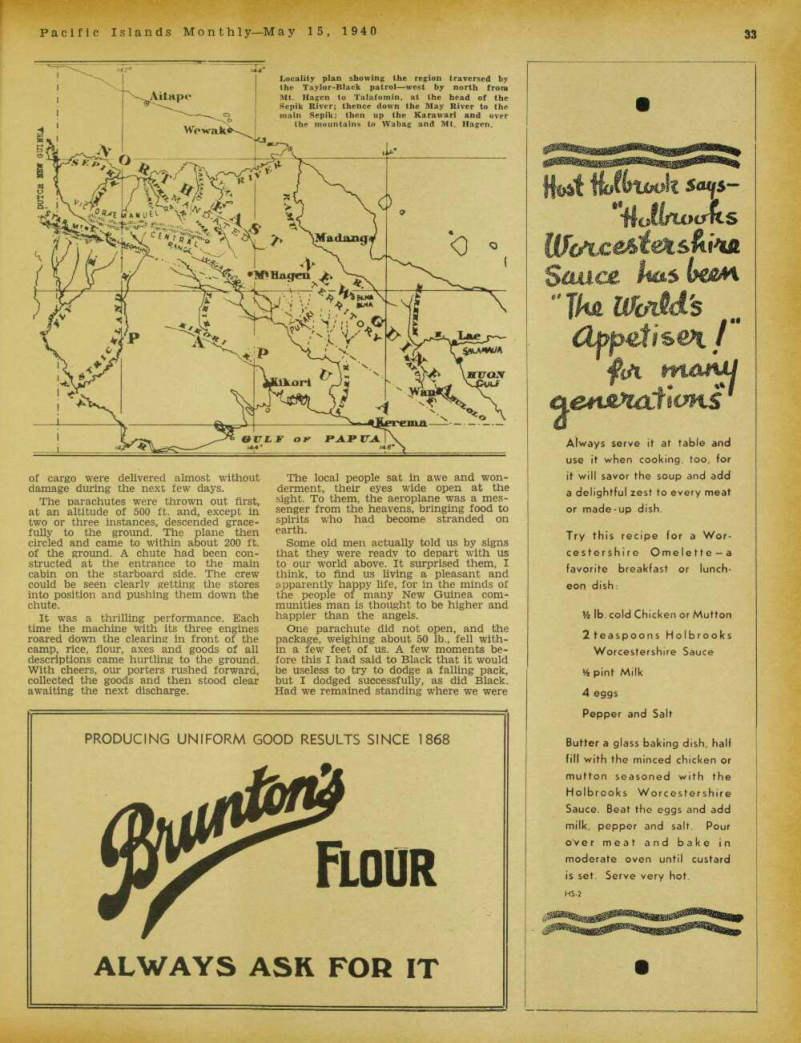
Supplies by Air for the Taylor-Black Patrol— Discoveries and Observations—Police Party Attacked at Wabag
Section 111. Of Official Report
(This is the Third Section of the Preliminary Report on the patrol carried out in Central New Guinea by Assistant District Officer J. L.
Taylor, Patrol Officer John Black and Medical Assistant C. B. Walsh, in 1938-39 .) IMMEDIATELY on arrival at Hoiyevia, steps were taken to prepare a landing ground for aircraft, as I could not undertake the examination of the country towards the Dutch boundary, and the re turn of the main body of the patrol to the Sepik water-shed, without further sup plies of rice and biscuits. A dash could be made to Mt. Hagen, but that would mean dumping our equipment and per haps disaster. It would mean travelling over sparsely-populated areas for long hours, day after day, on short rations, or nothing at all. People who would treat us well while we were strong enough to look after ourselves, might become bitter enemies if they thought we were fugitive.
The site chosen was adjacent to the camp, and was about 450 yards long by 30 to 40 yards wide. The approaches were good and the area adequate, in my
cpinion. The surface required a lot of attention, as it was old garden land, across which ran many of the deep trenches or drains, which are peculiar to these parts.
We told the local inhabitants what we were doing, and why. They appeared in terested though some were fearful, and several assisted in the work. After ten days, the ground was fit to receive aero planes carrying up to 1,000 lb., providing that they were sufficiently powered to take off quickly—preferably a De Havi land 50, with 450 h.n. engines. The ground was superior to those prepared by us in 1933 at Wahgi and Mt. Hagen.
We were in wireless communication with Mr. R. Melrose (Director of District Services) concerning air transport of stores, and he gave us the full benefit of his great organising capacity throughout the patrol.
On May 20 the Administrator spoke to us from the Government vessel “Sirius”, off Avatip, 200 miles or so up the Sepik River, saying that we were to have what stores we required. When I informed the police that the Administrator had spoken and was sending supplies, they replied, “Our father is good. He remembers us.”
Directions were given by radio to Guinea Airways. Ltd., so that we might be easily located from the air.
On May 27 at 9.30 a.m. in perfect weather, a silver and red Stinson mono plane was sighted coming up from the east. It circled around us, and flew leisurely down the ’drome. The Admini strator could be seen clearly, waving to us from the cabin.
The police detachment on parade, with bayonets fixed, waited to salute the Ad ministrator should he land. Our carriers and local natives lined the landing. As the plane passed the carriers cheered with great zest, whilst the local people sat or crouched, silent in amazement.
It was a sight that gladdened our hearts. The weather was perfect, like a spring day in Sydney or the British Isles, and the plane gleamed in the sunshine.
It meant that our anxiety about food sup plies would soon be ended.
We were prepared for the machine to land. Smoke signals to indicate the wind direction were put along the edge of the ground, a white line marked the landing end, and the runway was defined by the soft heart of the mountain palm, laid in straight lines along each side of it.
After circling twice, and flying around the valley, a mailbag was dropped con taining a note from the Administrator, and the plane departed.
We were disappointed that it did not land, but it was wiser, probably, not to do so in the circumstances. There would have been danger in taking off, except in a very highly-powered machine.
On the return of the Administrator to Madang, he had the arrangement to drop stores to us brought to a swift conclu sion, and on Tuesday, May 31, Guinea Airways Ford monoplane arrived and dropped supplies. Benzine was landed by parachute and several thousand pounds
of cargo were delivered almost without damage during the next few days.
The parachutes were thrown out first, at an altitude of 500 ft. and, except in two or three instances, descended gracefully to the ground. The plane then circled and came to within about 200 ft. of the ground. A chute had been constructed at the entrance to the main cabin on the starboard side. The crew could be seen clearly getting the stores into position and pushing them down the chute.
It was a thrilling performance. Each time the machine with its three engines roared down the clearing in front of the camp, rice, flour, axes and goods of all descriptions came hurtling to the ground, With cheers, our porters rushed forward, collected the goods and then stood clear awaiting the next discharge.
The local people sat in awe and won derment, their eyes wide open at the sight. To them, the aeroplane was a mes senger from the heavens, bringing food to spirits who had become stranded on earth.
Some old men actually told us by signs that they were ready to depart with us to our world above. It surprised them, I think, to find us living a pleasant and apparently happy life, for in the minds of the people of many New Guinea corn munities man is thought to be higher and happier than the angels, One parachute did not open, and the package, weighing about 50 lb., fell with in a few feet of us. A few moments be fore this I had said to Black that it would be useless to try to dodge a falling pack, but I dodged successfully, as did Black, Had we remained standing where we were
Locality plan showing the region traversed by the Taylor-Black patrol—west by north from Mt. Hagen to Talafomin, at the head of the Sepik River; thence down the May River to the main Sepik; then up the Karawari and over the mountains to Wabag and Mt. Hagen.
we should certainly have been hit.
Everyone concerned with the despatch of the stores to us—that is. the District Officer, Madang, Guinea Airways, Ltd., and the aeroplane crew—is deserving of the highest praise. That ordinary goods, including bottles and jars, can be dropped without damage is to me a surprising discovery, and means that isolated miners, patrol officers and others may replenish supplies where the preparation of aerodromes is not practicable. It would have saved thousands of pounds in money, and been a godsend to the people of Edie
Creek goldfield before a road was made a few years ago; but apparently no one thought it possible.
IIfHEN the delivery of stores was com \f pleted, the preparation for our de parture was put in hand, Because of the vast area of country to be covered by the patrol and its nature that is. its mountainous character—l de cided to divide the party and made plans for our future ©Derations. This division was necessary to reach a conclusion with in a year and, unless we had more than
one party operating in the field, I could not see when or where the patrol would end. The plans were: 1. Black to proceed along the southern tall of mam range to the Dutch border, n possible. To endeavour to reach a known aerodrome site at Telafomin or Kelafomin, near the headwaters of the Sepik River. (Vide R.G.S. map: Karius Campion expedition, 1926-28, and Ward Williams prospecting party sketch map.) if, after two months’ travelling he believed that he could not reach this position, he was to return to a base which was to be prepared on the Ive-Lai It was essential to the safety of Black’s party, I considered, that a nlane should fly over Kelafomin. on October 14 with stores for Black, unless in the meantime he returned and cancelled the arrange ment, and I informed the Administrator accordingly. 2. The main body of the patrol was to re-cross the range and establish a base and aerodrome on the Ive-Lai. 3. From there I was to nroceed to the Sepik headwaters, along the Sepik fall connect with Black at Kelafomin, if pos sible, and reach the mouth of the October River by November 15, 1938. I requested that a schooner nick un mv narty, which I anticipated would not number more than 40 all told, to convey us to Angoram, for refitting. From there, the party would return to the base camp, via the Yuat River, or one of the" southern tributaries of the Sepik. On Black’s re turn, the patrol would then be concluded The wireless set was to remain with Walsh, at the post to be established on the Ive-Lai.
It would be idle to deny that the haz ards of the patrol were increased by the division of the party into three; but, to me, there was no alternative, if a con clusion was to be reached within a year.
By the fact that the base at Hoiyevia was unsuitable, the patrol had suffered a reverse. It was this that forced the change of plans—a change which, in my opinion, was unavoidable.
Black left Hoiyevia on June 30, 1938, with a party of 70 volunteers.
It was a hazardous undertaking. The only maps available made it appear al most impossible for him to get through, as, after two months’ marching, he would have to cross the Strickland River where it runs through limestone country—which is perhaps the roughest of its kind in the world.
I had read Karius’s description of his journey down the Strickland in 1927, and it sent shivers down my spine. Still, the attempt had to be made, and Black and his men went forward in great spirit.
ON June 17, Walsh and I set out (north wards) with the main body to cross the watershed which rose steeply from behind our camp. We had guides from among the local people, but they led us along a rugged mountain path, over which our heavy wireless equipment could only be taken slowly and with great difficulty. After three days’ travel ling, it became apparent that if we pressed forward, the carriers would suffer acutely, which was the case already, and probably suffer serious casualty. Conse quently, I gave the order to return to Hoiyevia.
Nearly a year later, I crossed this range, travelling hard for six days, at an alti tude, for nearly the whole of that period, of 10,000 ft. I discovered, then, that my earlier decision was the right one.
At Hoiyevia, further supplies of rice were obtained by air, and the main body
of the patrol returned to the valley of the Gai, or Ive-Lai (which is the Yuat headwaters) by the mountain pass through which we had come in April and early May.
At Wabag, on the high terrace above this river, a landing ground for aircraft was prepared. Friendly relations were established with the local people, who ex pressed pleasure at our staying among them.
SOME of the most noticeable features observed on the journey to and from Hoiyevai were: 1. The system of drains, or sunken roads, which may be likened to the elaborate trench systems of Northern France during the war 1914-18, it being possible to travel for miles a few feet below the surface of the ground. These works are primarily for defence purposes, but also protect sweet potato crops from the ravages of village pigs, and produce an effective drainage system. 2. The wearing of elaborate wigs made of human hair. These are made in three shapes—Cossack, resembling the head dress worn by Cossacks and, more re cently, the Trans-Jordan Police Force, Napoleonesque, resembling slightly Napo leon's hat; and the mop, or pudding basin type. Every man aims to have at least one of these wigs made of his own hair, in a lifetime, and pays professional wig-makers for their services. 3. The varietv of orchids. 4. A bird of paradise with long white tails. This has since been described by Mr. J. R. Kinghorn, C.M.Z.S., of the Aus tralian Museum, and he states that it is a new genus and has called it “McNicoll’s Ribbon-tailed Bird of Paradise”, in honour of the N.G. Administrator. 5. The fine type of native dog, with a tail like a fox-brush, was conspicuous. 6. The value of pigs and gold-lip shells.
It is possible that they are the bride price, or principal marriage gift. 7. The custom among the Lagaip River people, of men and women walking about arm-in-arm, as may be seen in European communities. 8. The carrying of large net bags by the men. 9. The disposal of the dead. The dead are placed in coffins on a pedestal about 5 ft. from the ground. 10. The lack of trading among some groups. Some are keen traders. To others, barter and exchange appear to be com pletely foreign; and, later, I discovered that the reason for this was that they thought we were spirits and our shell money not real, but magical. When they realised that we were men, they traded freely and were keen to buy our shells. 11. Pan pipes carried by the men which, when blown into, gently emit a faint sound which, I believe, musical people call a minor key—like the sighing of wind in the trees. 12. The craving for tobacco. The people from childhood are inveterate smokers. 13. The pig exhibitions, in which great numbers of pigs are given by one group to another, in reward for assistance in tribal war. 14. The extraction of salt from salt springs, where vessels suitable for dis tillation (that is, pots) are absent. This is done by burning absorbent wood, which has previously been saturated with the salt liquor. The resultant ash is highly esteemed by people near and far; and, in exchange for stone axes manufactured in the Mt. Hagen area, forms the greatest
mercantile business of the people of Central New Guinea. Beaver, the Papuan officer, noticed axes with heads of the stone similar to that found at Mt. Hagen, in the Sambarigi region, in 1911.
IN August, I communicated with the Administrator by radio, and advised him of the necessity for making some aerial reconnaissance over the country between Wabag and the Sepik head waters, because it was my considered opinion that this was essential for the safety of the patrol, and it would be holding hostages to fortune to undertake it without an examination of the country from the air in the first instance.
The Administrator concurred, and the flights were carried out in a 3-engined Ford —Mr. T. O’Dea. pilot, with myself and the native police as observers. I wanted them to see the country from the air, and they were keen to do so. Un fortunately, they found it difficult to equate to ground conditions what they saw from the air, though they missed little or nothing, and on return they were all of the opinion that the journey could not be done. I was not too sure, myself, but that did not matter, and on August 36, the heavily-laden caravan, each man carrying 50 lb. and an additional ration of 12 lb. of rice, set off.
The inhabitants of Wabag, with whom
we appeared to be on exceedingly friendly terms shook hands, The headman was in tears at our departure. Three days later he attacked my police, who were left behind, killing Gershon, the boy bugler, and wounding several others.
I take full responsibility for this incident, as I am afraid that I should have obtained police reinforcements for Wabag before my departure. But I had been working in this upland area for many years, with a minimum number of police, and had found small police parties to be more efficient.
The party which was attacked, I was informed later, had visited a local group for the purpose of buying pigs. This had always been the custom in the upland areas, and had never before been the cause of any difficulty or unpleasantness, Though the highland people value pigs
greatly, they value gold-lip shell more, and are happy to dispose of their pigs, provided that they are paid in shell money. I had intended to give Gershon special training in musketry, as, being a bugler, he knew little about it, but I had refrained from doing so for fear of the local people ’ anci this was ® In the affray that occurred, two native constables and four carriers were wounded, and eleven natives were killed, an d several wonded. All the wounded re covered.
Mr. Edward Taylor, District Officer of Morobe, flew to the scene and dealt with the matter with his customary tact and skill, and in a few days friendly relations were restored.
The part played by Sergeant Fokinau, the senior non-commissioned officer at Wabag post, is worthy of notice, and I
wish to express mv admiration of his good conduct and bravery. Walsh, in his report on the matter, says: “Sergeant Fokinau, with a couple of carriers, went to the assistance- of the attacked party and, by making a diversion at the rear of the natives, enabled the police and carriers to make their way back. By this action Sergeant Fokinau undoubtedly saved the party, and also the personnel remaining at the camp from total extinc tion.” 11THILE crossing the head of the Logaiyu it (one of the Strickland head-waters) early in October, I nearly met with disaster. There being no bridge, it be came necessary to cross on a rone and pulley, the police and carriers us’ing an improvised chair arrangement after the manner in which a breeches buoy is used in rescuing people from shipwreck, and the stores and equipment were in slings.
The pulley, or traveller, used, was a pair of handcuffs. A strong rope of cane was suspended across the river and it be came necessary to test it. I then travelled over it hand over hand and leg over leg, lying horizontally under the rope.
To my utter dismay, when over mid stream. I discovered that I could not go forward or backward. For a few moments, I hung by my legs, in order to allow my arms to regain their strength, but my oiled top boots soon caused me to lose my grip and I dropped like a stone into the torrent.
I knew that my police would risk their lives to get me out. and that I should not go without a struggle. Being used to turbulent water, fl held my breath, and instinctively made for the opposite side of the stream from which I had come.
I was still under water when my hand struck something. It was Constable Karo, who- had dived, almost on top of me.
When he came to the surface I had reached shallow water, and come up for air.
A narrow escape, and one which made me realise my responsibilities to the others, the police and carriers. If I were lost, it might mean the destruction of the party.
A lake was found in the vicinity of the meridian 142 degrees 30 minutes which may rival Killarney for beauty. Kopiago was its name.
On October 27, the Strickland was reached, and a start made to build a sus pension bridge across the stream, which was nearly 80 yds. wide, and in a deep gorge, the mountains towering above It on each side for several thousands of feet. It is one of the deepest chasms in New Guinea. The water level where we were attempting the crossing was only 1,250 ft. above sea level.
When here, we found tracks, made ap parently by Black’s party, as he had crossed the Strickland, but his bridge had been swept away. We hoped that he had reached Kelafomin, but this was at this stage by no means certain. The position of the crossing was approximately 142 degrees 15 minutes E. longitude.
A fine bridge was built, and the party crossed without accident, and began ascending the steep slopes of the Victor Emmanuel Range. The climb here was the most difficult that I had known, but I was greatly aided by the sharp alpine spikes, which are made for ice work, in my boots. The track was over short grass, which grew on crumbling lime stone shale, which caused one to slip back a little at each step.
I wondered how Black had got on. He told me, later, that his marrow froze as
he climbed this 2,000 ft. mountain side without a handhold. It was every man for himself. If one slipped no one could assist him—he must go to the bottom, unless he could save himself by his own efforts.
I crossed and re-crossed the Victor Emmanuel Range, at 11,500 ft. above sea level, and reached the source of the Sepik, the Ok Takin, at the end of No vember, A few days later I was at Kelafomin, where I met Black. He had done splendid work in this area, and was much liked by the local people, who were of an en tirely different culture from those of eastern New Guinea. These tribes, dis tinctive by the fact that they wear penis gourds or capsules, extend hundreds of miles westerly to the Nassau Mountains and Dutch New Guinea, and inhabit the northern and southern slopes of the main range.
His police and carriers were in excel lent condition, despite the fact that an epidemic of malaria had occurred amongst them after leaving the low levels of the Strickland, Crossing the Victor Emmanuel Range, we were several days without food, and our rice was nearlv soent. but during the last few weeks I had bought several sago palms from natives where we had camped, and we had stayed and prepared sago flour. At our foodless camps, sago was issued, and sago dumplings and pan cakes prepared. These saved the situation, and enabled us to reach the populated valleys near the source of the Sepik. (To he Concluded in June ) Mr. J. Allrich arrived at Wau, New Guinea, from Australia in April to join the staff of Greenwood and Laws, Ltd.
Advertisements & other items, pp. 36-40 (6 items)
32
May 15, 194 O—P acific Islands Monthly
33
Pacific Islands Monthl y—M ay 15, 1940
c^ett&urfloni
Host iWfctOOk
*’UiMf
Sauce has
‘’Jks. Wcrttd
dj>jpetise\ r
fa
c^ett&urfloni
Always serve it at table and use it when cooking, too, for it will savor the soup and add a delightful zest to every meat or made-up dish.
Try this recipe for a Worcestershire Omelette-a favorite breakfast or luncheon dish: Vz lb. cold Chicken or Mutton 2 teaspoons Holbrooks Worcestershire Sauce Vi pint Milk 4 eggs Pepper and Salt Butter a glass baking dish, half fill with the minced chicken or mutton seasoned with the Holbrooks Worcestershire Sauce. Beat the eggs and add milk, pepper and salt. Pour over meat and bake in moderate oven until custard is set. Serve very hot.
HS-2
PRODUCING UNIFORM GOOD RESULTS SINCE 1868
ALWAYS ASK FOR IT
PRESCOTT Pty. Ltd.
SUSSEX ST., SYDNEY,
ore sole wholesale agents for
PINEAPPLE BACON&HAMS
DAISY brand BUTTER "375" BUTTER in TINS Ilb.-21b.-slb. Sizes.
LEA & PERRINS’ Sauces and Most other Super-Quality Lines of the Trade, such as Cheese, Eggn, Etc.
We are Specialists .
X Let us have your confidence. Sixty years is our record of supplying the leading Houses throughout the World in
FRESH FRUIT VEGETABLES PRODUCE
’Phones: MA 8612 (4 lines).
Cable Address: “Weymarkson”
Codes—Bentleys Private.
WEYMARK & SON LTD.
FRUIT AND PRODUCE MERCHANTS
14-18 STEAMMILL STREET. - - SYDNEY
“ANCHOR FLOUR
THE STANDARD OF QUALITY
• : *r * ; - H
GILLESPIE BROS. PTY. LTD
SYDNEY - AUSTRALIA
PURE RICE
STARCH
Always ask for . . .
CORAL BRAND
100% PURE
Noted for Its
QUALITY
and
WHITENESS.
Goes Farthest and gives Lasting Finish
WILL NOT
STICK TO
IRON.
Obtainable from Leading Island Stores.
CORAL BRAND
RICE STARON
S
vSS r—• —
Manufactured by
AUSTRALIAN RICE, LTD.
Sydney, N.B.W.
THEY KEEP YOU FIT
AND KEEP YOU SLIM
The whole grain of rich, sun-ripened wheat, transformed, after careful selection, into a perfect health food, delicious for breakfast, for afternoon tea or supper.
Arnott's Famous Shredded Wheatmeal Biscuits are rich in precious vitamins and proteins, and very easily digested. ... Try them with butter, cheese, jam or honey.
CLmotts
FAMOUS
SHREDDED
WHEATMEAL
BISCUITS
ALWAYS ASK YOUR GROCER FOR ARNOTT'S I
i\r/ r\
/dpeclaUCtf TROPICS
CAPSTAN
C Capstan Cigarettes, round airtight 50's.
Medium and full strength.
Capstan Navy Cut Tobacco, made from the finest Virginia leaf. 8824-10-8
READ THE
B.P. MAGAZINE
AUTUMN NUMBER
iiiiiiiiiiiiiiiiiiiiiiiiiiiiiiiiiiiiiiiiiiiiiiiiiiiiiniiiiiiiiiiiiiiiiiin
Now On Sale
Short Stories Pictures Travel Articles - - - - Pages for the Children --- Stage Latest Fashions Screen A
ONE SHILLING PER COPY.
ON SALE AT ALL NEWSAGENTS AND BOOKSELLERS
34
May 15, 194 O—P acific Islands Monthly
35
Pacific Islands Monthl y — M ay 15, 1940
36
May 15, 194 O—P acific Islands Monthly
Model Labour Party
AFTER attending a meeting of the New Guinea branch of the Austra lian Labour Party held in Wau, a “P.1.M.” representative said that this organisation seemed more like a vigi lance association or a progress society than a labour party—there were no squabbles, and the members were deeply and intelligently intent upon matters affecting the general good and progress.
We now have received the annual report of the Wau Labour Party, and it bears out the original impression.
Here are headings from the report: “Exemption from Gold Royalty—Bulolo Valley Timber Leases —Installation of X-Ray Plant at Hospital—Establishment of Circuit Court in Wau and Sub-dis trict —Immigration Ordinance and Land ing Bonds —Opening Up of Uncontrolled Areas—VLß Wireless Wave-length”.
There is not one word about indus trial awards or political tactics, or any of the hundred things which exasperate good Labour men in Australia.
MR. LES. FARMER, who is in charge of Guinea Airways’ branch at Wau. New Guinea, is in Sydney at present, on fur lough. He will return to Wau in June.
First-Class Warrant Officer
W. O. MONCUR, of the New Guinea Police Force, who has been stationed in Wau for many years, was recently trans ferred to Rabaul on promotion to acting Inspector there. He replaces INSPECTOR W. B. PRIOR, who has relinquished his appointment and left the Territory for military service. Mr. Moncur served with distinction in the last war, attaining the rank of Captain.
Death of "Jimmy"
Inman Varied Career of Papuan Old-Timer
From Our Own Correspondent SAMARAI, April 9.
THE passing of James Inman, who died in Samarai Hospital on March 28, after a long illness, caused widespread regret throughout Papua.
He was 58 years old.
“Jimmy”, as he was known to every body, first came to this territory in the 1890’s with his father, W. A. Inman, who ran the first mail service to New Guinea for Burns, Philp and Co. Ltd.
As a lad he worked for B.P.’s in Cook town, Qld., and later joined their staff in Port Moresby and Samarai.
He left the company to enter the Administration, and served as an A.B. on the original “Merrie England”. During this service he had some exciting ex periences and, at one time, was respon sible for saving the late Sir Hubert Murray’s life when a whaleboat capsized and sank in a river. “Jimmy”, at the time, was on the lookout in the “crow’s nest” of the “Merrie England” and, per ceiving the Governor’s plight, sum moned aid and went to his rescue.
After leaving the Administration, Inman joined the staff of the Anglican Mission and, for a considerable time, was in charge of their vessels “Albert MacLaren” and “Whitkirk”. Later he became a recruiter and at different times owned the ketches “Olive” and “Dove”. In 1914, he took to planting;
but in recent years he had been master of the “Matoma” for Burns, Philp and Co., and also of the “Nusa” for Steamships Trading Co. Ltd.
“Jimmy” Inman was one of the most conscientious men Papua has known, and when there was work to be done he was always on the job. He possessed -,,, , , . a lively sense of humor and could relate a fund of interesting tales of Papua’s early history.
The output from the Morobe Goldfield T.N.G., for March was 42,228 ounces, valued at £A278,000. Thus, with only nm< r months of the current year expired, gold worth £2,000,000 has already been produced. new Roman Catholic convent Jl 9? 1, tc L bui i d o n< ? equip, was officially opened at Port Moresby , p apu3i by the Acting-Lieu ten ant Governor (Hon. H. W. Champion) on April 7.
Advertisements & other items, p. 41 (1 item)
St. Ignatius’ College
Riverview Sydney
Boys are prepared for Intermediate and Leaving Certificate Examinations and for Exhibitions, Scholarships and Bursaries at the University.
Boys are arranged in three Divisions according to age. Each Division has its own Library, Debating Society, Cricket and Football Fields, and Tennis Courts.
Senior and Junior Rowing Sheds, with a large fleet of pleasure and racing boats.
Private Swimming Baths.
Prospectus and further particulars on application to the — Rector: St. Ignatius’ College, Riverview, Sydney.
Tel.: JB 1106.
BOARDING AND DAY SCHOOL
Conducted by the Jesuit Fathers
afcfja 1 SJt •"I
SJL!
ilii.
I!
Hi
ONE OF SYDNEY'S GREAT PUBLIC SCHOOLS
Fishing
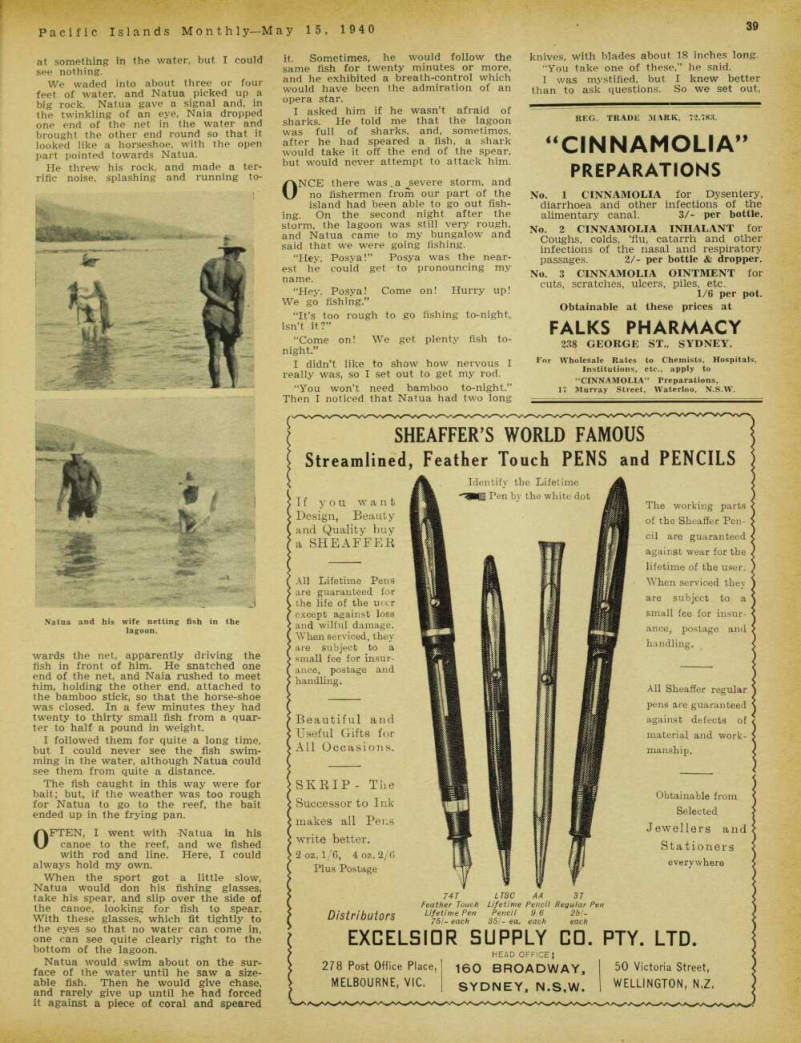
New Ways Of
Happy Hours With Natua, of Tahiti
By W. G. Burchett
NO matter what else the Tahitian may have for his meal, he is sure to have fish; and, at big Tahitian feasts, several courses are provided by fish prepared in various ways.
A favourite dish is poisson cru, or raw fish, prepared with lime-juice, and served with a sauce made from shell fish and coconut cream. Sometimes, it is served in salad form, with finely chopped-up raw cabbage. But, in what ever way it is dished up, it is always delicious, and so light that one can eat enormous quantities without discomfort.
In Tahiti, one eats fish of every con ceivable colour, shape and size—raw, baked, fried, boiled or cooked in the native oven —at least once a day.
I was surprised, one day, by the fish erman who lived next door to me. He had worked much harder than usual and caught a lot of fish. I said to him, jokingly, “Hallo, Natua! You’ve got a lot of fish there. Are all your relatives coming to have dinner with you?”
Natua grinned: “Yes, plenty fish all right. I send ’em to friends at Tautira.”
Tautira was at the other end of the island and I couldn’t understand why he sent fish there, because it is one of the best fishing-grounds in Tahiti.
“Your friends are no-good fishermen, eh!” I asked.
“Ah, plenty storm at Tautira last night. Big storm, no fish. Tahiti man can’t live without fish, so I send plenty down to my friends.”
Natua was a fluent orator in his own language, but, like so many of the older natives, he had learned very little French, and he was very economical, even with the few words he knew. It was just typical of Tahitian generosity that he considered it quite the natural thing to send fish to his friends, on the slightest suspicion that they had none. rE ways of catching the fish are as numerous as the varieties to be caught. The Tahitians spear them, net them, entice them to jump into their canoes at night with a bright light.
They fish for them with rod and line in the dangerous waters of the reef, and the more adventurous spirits go far out beyond the reef to the open Pacific, and trawl for the giant tunny fish.
At certain phases of the moon, the women wade out into the lagoon, and stand for hours at a time, fishing with rod and line, for a certain type of mackerel.
Natua seemed to be able to catch fish with ease, even when other natives were not so lucky. One day he and his wife, Naia, passed my door on the way to the lagoon. He had no rod or spear, but Naia carried a peculiarly-shaped net, about 20 feet long and 4 feet deep.
The bottom was lined with lead and the top with cork floats. One end was attached to a bamboo pole, about five feet long.
I grabbed my camera and followed them, as they went along the sandy beach. Suddenly, Natua stopped and motioned me to be silent. He pointed
at something in the water, but I could see nothing.
We waded into about three or four feet of water, and Natua picked up a big rock. Natua gave a signal and, in the twinkling of an eye, Naia dropped one end of the net in the water and brought the other end round so that it looked like a horseshoe, with the open part pointed towards Natua.
He threw his rock, and made a ter rific noise, splashing and running to-
wards the net, apparently driving the fish in front of him. He snatched one end of the net, and Naia rushed to meet him, holding the other end, attached to the bamboo stick, so that the horse-shoe was closed. In a few minutes they had twenty to thirty small fish from a quar ter to half a pound in weight.
I followed them for quite a long time, but I could never see the fish swim ming in the water, although Natua could see them from quite a distance.
The fish caught in this way were for bait; but, if the weather was too rough for Natua to go to the reef, the bait ended up in the frying pan.
OFTEN, I went with -Natua in his canoe to the reef, and we fished with rod and line. Here, I could always hold my own.
When the sport got a little slow, Natua would don his fishing glasses, take his spear, and slip over the side of the canoe, looking for fish to spear.
With these glasses, which fit tightly to the eyes so that no water can come in, one can see quite clearly right to the bottom of the lagoon, Natua would swim about on the sur face of the water until he saw a size able fish. Then he would give chase, and rarely give up until he had forced it against a piece of coral and speared
it. Sometimes, he would follow the same fish for twenty minutes or more, and he exhibited a breath-control which would have been the admiration of an opera star.
I asked him if he wasn’t afraid of sharks. He told me that the lagoon was full of sharks, and, sometimes, after he had speared a fish, a shark would take it off the end of the spear, but would never attempt to attack him.
ONCE there was,a storm, and no fishermen from our part of the island had been able to go out fish ing. On the second night after the storm, the lagoon was still very rough, and Natua came to my bungalow and said that we were going fishing.
“Hey, Posya!” Posya was the near est he couid get to pronouncing my name.
“Hey, Posya! Come on! Hurry up!
We go fishing.”
“It’s too rough to go fishing to-night, isn’t it?”
“Come on! We get plenty fish to night.”
I didn’t like to show how nervous I really was, so I set out to get my rod.
“You won’t need bamboo to-night.”
Then I noticed that Natua had two long
knives, with blades about 18 inches long.
“You take one of these,” he said.
I was mystified, but I knew better than to ask questions. So we set out,
Natua and his wife netting fish in the lagoon.
armed with two long knives, a strong acetylene lamp, and his son with a kerosene tin. We waded out into the lagoon, and Natua shone the light in front of him on the fairly rough water. Suddenly, he swished downwards with his knife, and almost immediately grabbed at something and threw it on the shore, He swung the light around, and there flapping on the sand, was a glistening, headless, silvery fish. The boy picked it up without a word and put it in the kerosene tin. For an hour and a half,
we waded up and down the beach.
After a while, my eyes got almost as keen as Natua’s, and every now and again I could see hundreds of fish swim ming about on top of the water. I got quite a number with my knife, but I usually cut them in half, whereas Natua neatly decapitated them.
Once the water fairly hissed with what appeared to be green snakes, which wriggled away at incredible speed. Even Natua became excited, and smote right and left with all his force. We both
slashed and struck mightily for a few minutes, and had to enlist the aid of his son to come and pick up the fish as we hit them. When we had finished, Natua told me that we had been very lucky, as these green eels were excellent eating.
Sometimes, Natua would roar out a warning, and I would make a dash for the shore, only to get hit in the middle of the back with a heavy breaker.
It was rather an eerie experience.
Little more than half a mile away, the Pacific Ocean, with heavy roar, was pounding away on the coral reef bor dering the lagoon. The night was pitch black, lightened only by the rays of Natua’s lamp, sweeping the waters like a searchlight. Every now and again an extra big wave would nearly lift us off our feet, to crash on to the shore behind us and rush back down the bank with a frightening, sucking noise.
Natua rarely spoke, except to call out some sharp command in Tahitian to his son with the kerosene tin. I enjoyed the experience, but was glad when Natua decided that we had enough fish, and I was able to go home, satisfied that I had taken part in the strangest fishing experience of my life.
ONE could not wish for a better man, or truer comrade, than Natua.
Everything that he did, and that means everything that was necessary to support his primitive life, he did per fectly.
How many times did I admire his skill, as he fitted an outrigger to his canoe, or as he shaped a canoe paddle. Per haps, most of all, I admired him as I watched him “marrying” the flower of the vanilla plant. With a tiny stick, he opened the female part of the flower and injected the pollen from the sta men, with the same certainty and deli cacy of touch as a famous surgeon might employ in an intricate operation.
Natua exemplified that which was best in the Tahitian. Living far from the town, he divided his time between his vanilla and coffee plantations in the mountains, and the sea. Apart from a few simple tools, such as knives and lamps, he lived quite independent of “civilisation”. Even if Tahiti should become cut off from the rest of the world, life for Natua would go on sub stantially the same, and he would exist as his forefathers had done hundreds of years before.
Advertisements & other items, pp. 42-44 (4 items)
38
May 15, 19 4 O—P acific Islands Monthly
Younger
STEAMSHIPS TRADING COMPANY LTD.
PORT MORESBY PAPUA SAMARAI
Chairman and Managing Director: A. S. PITCH.
Shipowners, Wholesale and Retail Merchants and Traders; Shipping, Customs and Insurance Agents; Copra and Rubber Plantation Owners.
MAIL CONTRACTORS TO COMMONWEALTH AND PAPUAN GOVERNMENTS.
AGENCIES:—At Port Moresby: Coral Sea Insurance Co.; Phoenix Insurance Co.; Delta Sawmills, Ltd.; Acme Bakery Co.; Vacuum Oil Co., Pty., Ltd. At Samarai: Coral Sea Insurance Co.; Delta Sawmills, Ltd.; Bankers and Trader*’
Insurance Co.; National Mutual Life Insurance Co.; Kularo Shipyards; Mamai Plantations.
BRANCHES:—In Papua: Hanuabada, Sivltol, Aroma, Kokl, Hula, Ela Beach, Duga Duga, Yule Island.
SYDNEY: NELSON & ROBERTSON PTY. LTD., 12 Spring St.; Melbourne, 396 Flinders Lane: London, E. Whiteaway & Co., 7 Chlswell Street, Finsbury, London.
Cable Address: “STEAMSHIPS.” Code: Bentley’s.
STEAMSHIPS TRADING COMPANY, LIMITED,
MERCHANTS, SHIPOWNERS AND PLANTERS
PORT MORESBY AND SAMARA I.
Our organisation provides every facility and efficient service as
MANAGING AGENTS AND VISITING REPRESENTATIVES OF
COCONUT AND RUBBER PLANTATIONS
Estates supervised in bearing and planting stages.
Comprehensive reports compiled and regular visits msde to Estates by our competent Plantation Inspector.
WRITE, CABLE OR CALL FOR PARTICULARS:
STEAMSHIPS TRADING COMPANY LTD.
Do You Know that the Famous
YOUNGER
STOVES and
RANGES
made with extended Firebox specially for long Wood fuel, are Self-Setting and, provided sufficient Flue Piping is attached, can be used in almost any position?
The No. 7W "Younger” Ranger can now be supplied fitted with Legs, as per Illustration.
Younger Stoves are Widely Used Ask for quotation for this Range, also illustrated Catalogue Throughout the and Price List for both Single and Double Oven Stoves. Pacific islands.
G. FLETCHER & SON 50 Oxford Street, Sydney.
39
Pacific Islands Monthl y—M ay 15, 1940
“Cinnamolia”
REG. TRADE MARK. 72,788.
PREPARATIONS
No. 1 CINNAMOLIA for Dysentery, diarrhoea and other infections of the alimentary canal. 3/- per bottle.
No. 2 CINNAMOLIA INHALANT for
Coughs, colds, ’flu, catarrh and other infections of the nasal and respiratory passages. 2/- per bottle & dropper.
No. 3 CINNAMOLIA OINTMENT for
cuts, scratches, ulcers, piles, etc. 1/6 per pot.
Obtainable at these prices at
FALKS PHARMACY
238 GEORGE ST., SYDNEY.
For Wholesale Rates to Chemists, Hospitals, Institutions, etc., apply to •CINNAMOLIA” Preparations, 17 Murray Street, Waterloo, N.S.W.
SHEAFFER’S WORLD FAMOUS
Streamlined, Feather Touch PENS and PENCILS
If you want
Design, Beauty
and Quality buy
a SHEAFFER
All Lifetime Pens are guaranteed for the life of the user except against loss and wilful damage.
When serviced, they are subject to a small fee for insurance, postage and handling.
Beautiful and Useful Gifts for All Occasions.
SKRIP - The
Successor to Ink makes all Pens write better. 2 oz. 1/6, 4 oz. 2/G Plus Postage Distributors Identify the Lifetime Pen by the white dot
74T LTSC AA ST
Feather Touch Lifetime Pencil Regular Pen Lifetime Pen Pencil 9i6 2b I - 761- each 351- ea. each each
EXCELSIOR SUPPLY CO. PTY.
The working parts of the Sheaffer Pencil are guaranteed against wear for the lifetime of the user.
When serviced they are subject to a small fee for insurance, postage and handling.
All Sheaffer regular pens are guaranteed against defects of material and workmanship.
Obtainable from Selected Jewellers and Stationers everywhere
LTD.
HEAD OFFICE J
278 Post Office Place, 160 BROADWAY,
MELBOURNE, VIC. SYDNEY, N.S.W.
50 Victoria Street,
WELLINGTON, N.Z.
painting
with
v means *mmmh painting to STAY painted / ftP
Paint
(PREPARED)
d<eeps on Xeepikg on!” i V
AGENTS THROUGHOUT THE ISLANDS
New Guinea Public Service
rjIHE last issue of the “New Guinea JL Gazette” announces the following Public Service promotions, which date from April 8, 1940: L. V. Wild, senior clerk, District Services; L. F.
Corfe, clerk. Department of the Trea sury; J. W. Smith, clerk, Department of the Treasury; C. W. Barnes, senior clerk, Department of District Services; A K. Whiteman, senior clerk, Depart ment of the Customs; H. G. W. Brinston, clerk, Department of the Treasury; W.
R. Smith, senior clerk, Department of District Services; M. R. Jones, senior clerk. Department of District Services; G. E. Walker, senior clerk, Department of the Government Secretary (Central); C. D. Meares, senior clerk, Department of the Government Secretary (Central).
Mr. G. W. L. Townsend, District Officer at Wewak, Northern New Guinea, arrived in Australia on leave late in April. He was accompanied by Mrs. Townsend.
Advertisements & other items, p. 44 (1 item)
40
May 15, 194 O—P acific Islands Monthly
Fortitude
How Papuans Can Endure Pain
WRITING from San Francisco, Mr. J.
Nixon "Westwood is reminiscent: — I notice a Samarai paragraph in the February “P.1.M.”, entitled “Papuan’s Fortitude”; and this recalls the fortitude of a Mawatta woman (or girl—she was about 18), when I was Collector of Customs in Daru, Western Papua.
One day I found on my back veran dah a female who looked as though she had been mauled by a tiger. From head to foot, she was covered with dried blood; her head had a gash about eight inches long; both breasts had been lacerated; her abdomen torn open; her back had two gashes, from shoulder blades to waist.
Fortunately, Dr. Leigh Boag had just arrived, and brought serum for such injuries, and he immediately treated this poor girl. He had to put in 80 stitches, and, although the attack had taken place three days previously, the girl did not show the slightest nervous ness or fear.
She had been bathing in the river and stood up, preparatory to leaving the water. Suddenly, something grabbed her by the neck. She managed to tear herself away, receiving the gashes on her back. Turning, screaming with fear and pain, she discovered that her attacker was a full-grown alligator.
Hearing her screams, her father and other relations rushed into the river, and managed to beat the monster off— but not before the girl had suffered terrible injuries.
The village medicine-man did his best; but, after three days, the father brought the girl into Daru.
Day after day the girl, her father and relations watched Dr. Boag manipulate the various instruments, until finally the stitches were taken out and the girl was ready to return to Mawatta.
The sequel was interesting. Appar ently, when any sickness was overcome, or sores healed, the native who helped to do this was expected to pay the father of the patient something in kind, such as yams, or manioc. As soon as the girl was ready to return, the father came to Dr. Boag and me, and demanded payment for allowing us to cure his daughter!
It took me some time, and at least four interpreters, to make the man understand that, if any payment was to be made, he, as the girl’s father, should pay Dr, Boag all the money he had.
The fortitude shown by that girl amazed us. Although she must have experienced excruciating pain, she did not murmur or give the slightest sign of suffering.
Another case of fortitude comes to mind. It was on the Laka River Estates, up behind Marshall’s Lagoon.
A Mambare boy, Boi Boi by name, cut one of his fingers with a piece of Kurri grass. My standby remedy in those days was Friar’s Balsam, so I put a few drops on. The result was that I found myself faced by an infuriated boy, who threatened to chop my arm off with his weeding knife. Fortunately, the boss boy, Tomu, from Bona Bona, caught him in time. After the pain had left him, Tomu and I lectured him, calling him a “small baby”, and a few other choice words in keeping with the case.
We had a horse-drawn reaper on the
estate and, by some mischance, Boi Boi, a week later, managed to walk into the knife. The contact almost severed his left foot. He was carried to the store, treated, and sent to Port by the lirst available means. He must have suffered great pain, but all he said, as he was leaving for Vilirupa, was: “Taubada, I no baby.”
A Golf Miracle
From Our Own Correspondent WAU, April 23.
IN the four-ball match-play round between North and South, on the Wau course, on Sunday, April 21, Mr. Keith Norris played a stroke which would rarely, if ever, be seen. Playing for North, he holed out with a birdie, from off the green, at a distance of 35 feet, at the 21st hole.
South had approached this, the last hole, dormie one, and had completed the hole in par. It was left to Norris to achieve his remarkable shot, to halve the hole and to equalise the match; and he did it. History does not disclose what his opponents did to him!
Advertisements & other items, p. 45 (1 item)
Wunderlich
Timber, Joinery
ETC.
PREPARED BUILDINGS ready for erection a specialty.
SHIP AND BOAT BUILDING.
TIMBERS specially catered for.
FIBROLITE, PLYWOODS.
GALVANISED IRON.
CONSIGNMENTS shipped
by RETURN STEAMERS
to the Islands.
John W. Eaton
PTY. LTD.
WEST CRESCENT STREET,
NORTH SYDNEY.
Telephones: XB 4051 (6 lines.)
BITUMENOID ROOFING
MADE IN AUSTRALIA.
Bltumenold Roofings, Dampcourse and Insulating Felts are made from the world’s best raw materials. Warranted to stand the most rigid tests.
BITUMENOID THE BEST
Roofing, 1,2, 3-ply; Flooring, Waterproof Materials; Saturated Pelt; Resilient Road Jointing; Natural Asphalt Dampcourse; 2 and 3-ply Dampcourse; 1-2 lb. Lead-core Dampcourse; Roofing Cement; Asphalt Paints; Roofing Compound.
SAMPLES AND PRICE LISTS ON APPLICATION.
MAXWELL PORTER & SON LTD.
ESTABLISHED 1888. BUILDERS’ SUPPLIES.
107 REDFERN ST., REDFERN, SYDNEY, N.S.W. ’Phone: M 3157. Cables Bltumenold.
Woven Wire for all Industry
COPRA DRYING TRAYS, FLOORS, Etc.
FRUIT DRYING TRAYS, MINING SCREENS
Heavy Mosquito Gauze in Phosphor Bronze and other Metals Impervious to Salt Sea Air WIRE DOOR MATS AND GENERAL WIRE WORKS
E. WRIGHT & CO. LTD.
Office and Works: 148-152 Cleveland Street, Sydney, N.S.W.
Telegraphic Address: “Wrlghtmake,” Chippendale.
VVT/lf fl Or £
WUNDERLICH
.in
DUKATILE
These asbestos cement sheets give watts a tiled appearance at less cost. See examples in our showrooms or write for leaflet.
WUNDERLICH LTD.
Crown & Cleveland Sts., Redfern, Sydney
REMEMBER THE NAME
Whale Slaughter
Some Comfort For Copra-Growers
SOME years ago, whale oil was worth around £l5 per ton. Then the commercial chemists of the world got to deodorising and purifying it, so that the unpleasant stuff could be used in margarine and so forth; and then the world price of the commodity moved up quickly to around £2O and £25 a ton and it became an active competitor of coconut oil.
Meanwhile, more and more whaling fleets went to the Antarctic, and more and more whales were killed —it is cal culated, now, that the annual destruc tion of whales is not less than 40,000.
Experts say that at this rate there is no doubt that within a very short time
the Antarctic whales will be extermin ated.
A report published in Sydney, in April, was that whale oil of first-class quality is now worth £4O per ton—which means that the rush of whaling expeditions to the Antarctic will be more frantic than before—and the end of the whales will be hastened.
Since international control seems useless, and the end of the whales in evitable, coconut planters in the Paci fic will pray for the ever-greater success of the whaling fleets. Soon, when there are no more whales, coconuts must be come a little more valuable.
MR. L. COTTEW, Suva manager for Cable and Wireless, Ltd., will shortly re turn to Australia on transfer.
Wan

By Helen Nurton.
WAN was a shining example of what a little black wife should be, and her husband, Kumda, was a shin ing example to the police force.
Each morn, at dawn, he would rise and shine his belts and buckles, and turn out at the sergeant’s whistle, a per fectly-impeccable policeboy. Whilst he was engaged at drill, or in the more important task of hoisting the Union Jack, in the flamboyant garden outside our District Office in New Guinea, Wan would cook his simple breakfast of boiled rice, or yams, over a smoky little fire, before strolling down to my bun galow for the day’s work.
Wan came from Nissan, that island link between the Solomon Islands and New Ireland, where the races of these respective islands met, and mingled.
The Solomon strain was predominant in her, for she had a very black skin, unlike most New Irelanders, and close cropped hair, with tiny clusters of curls around her neck and ears, in which she wore small, brass, heart-shaped ear rings. Her nose was broad, and flat, and almost always bespangled with beads of perspiration.
She reflected an imperturbable calm, and serenity, a happy, contented smile, showing good, white teeth, and she pos sessed a voice with a decided “timbre” in it. Added to these characteristics, she invariably wore a clean starched blouse, with little frills over the shoulders, while her plump little black arms were adorned with mother-of-pearl bangles, so that altogether she was quite an ac quisition to the household.
If Wan was an example in her own sphere of life, and Kumda was an ex ample in his zone of action, their united relations certainly bore an appearance of exemplary harmony, and content, and one felt that this state of affairs had existed since their “walking out days”.
“How much Xmas you married now?”
I asked Wan, one day.
“Six feller,” she drawled. “Me lik-lik feller, and me married along Kumda.”
“You no married before along nother feller?” I asked.
“No got,” she shrilled indignantly. “Me married along Kumda, das all.”
Wan was such an excellent laundress that I gave her no other work. Patiently she would tend the boiling copper, bubbling with iridescent soap foam, rinse the clothes in many tubs of clean, fresh water, and hang them out care fully on the line beneath the swaying palm-trees. The following day would see her ironing in the wide, cool space beneath the bungalow. With a large box-iron filled with glowing coconut shell, she would put a satin sheen on damask and linen, while the frocks of the Missus would be ironed with meticu lous care, carried up above, one by one, and draped gracefully around the bed posts in the bedrooms.
Wan would often hold a conversazione under the bungalow while she was working. Here would foregather quite a number of her friends —Matin, who was a single lady at large; the ser geant’s wife; two or three policeboys’ wives; and sometimes Sitella, the little “calaboose” Mary. Oftimes their cheer ful chatter would be a solace to my lonely ear.
A good-natured rivalry existed between Wan and Matin, and one afternoon, I
overheard the following conversation.
Wan, to Matin: “Gwan, you no got one feller man.”
Matin: “Whee-ee-ee, me can catchim one fellow quick time, suppose me like.”
Wan: “Alright, gwan you catchim.”
Peals of shrill laughter followed this sally, and I saw Matin striding off in a huff.
“Matin,” I called. “Come, me two feller go limlimbur along bush,” and Matin turned back with a happy coun tenance.
“All Mary go finish now,” I said to the policeboys’ wives.
“Yessar,” they replied, in unison, and went off like happy schoolgirls, drag ging with them Sitella, the little “cala boose”, who always joined in their frolics, and leaving Wan ironing placidly, the beads of perspiration still on her little broad nose.
Matin and I strolled through the plantation, and along the banks of the river, collecting fragile ferns, and “Joseph’s tears”, large grey seeds, from long dried grasses, and wandered in a tropical, tangled fairyland, till it was dusk, and time to go home.
Wan, however, had one failing. She was an inveterate little gossip, and a piece of scandal was a delight to her.
Sometimes, in the evening, I would sit on the steps of the verandah, drinking in the beauty of the soft velvety night.
Hearing a faint little melody coming towards me, I knew that it was Wan.
She would intertwine her plump, black fingers, and bring her cupped palms to gether, making a hollow melodious sound. To form variations, she would dart her arms out suddenly, and the result was a haunting little melody.
This melody would come nearer, and nearer, until at last, it would become stationary at my elbow.
“Hullo, Missus,” came in Wan’s quav ery voice.
“Hullo, Wan. You limlimbur, eh?”
“Yes, me feller limlimbur.” A pause, then: “Missus, you bin hearim dis feller talk?”
“Me no hearim.”
“You like hearim?” in an eager voice.
“All right.”
Wan drew a deep breath. She dearly loved to tell a tale. Then would follow a tangled skein of romance in which a friend of hers named Maria had fallen in love with a policeboy, and how the policeboy had not reciprocated her affections. So Maria had consulted a sorcerer, a “familiar spirit”, of rag and bone, matted hair, and old dried teeth, who told her to go alone into the jungle at night, and to collect a certain “pul pul” (flower), make a little posy of it, and place it under the door of her inamorata at night. Then the very first person on whom his gaze would rest in the morning would be the recipient of his ardent affections. Of course, Maria would have to make sure that she was that person.
“And did they live happily ever after wards?” I asked, dreaming of Hans Andersen fairy tales.
“Two feller married now,” said Wan, with a quivering sigh.
Sometimes she would bring a tale which was not so very nice, and although my curiosity may have tempted me to listen. I would turn to her sternly, and say, “Maskee, this feller talk.”
“You no like hearim?” she would reply, her voice raised on a high note of incredulity.
“Me no like hearim.”
Wan would pause in utter amaze ment. Then, again, she would venture: “True, Missus, you no like hearim?” — her voice now rising in a shrill cre scendo, and trailing off in a tearful gasp.
“Me no like hearim.”
There was a long silence, then Wan turned, and padded away softly. Her plump arms darted forth, and the little
Wan, the police-boy’s wife, from a sketch by Helen Norton.
melody would start all over again, grow fainter and fainter till all that was left was the utter stillness of the velvety night.
And, lifting up my eyes, I behold the celestial realm ablaze with points of light. Gone was the dance of daily life; the heat of the day, the dusk, and the swaying palms; Wan, Kumda, the wash tubs, the boiling copper; the haunting little melody, and all the hurly-burly of the household. Deeper, and deeper I behold the nebulae receding—receding.
Now and again a star breaks loose from its moorings, and takes a fiery plunge into the Stygian darkness of the un known. Anon, and another breaks loose, leaving a misty iridescent trail, and a velvet void. Another, and yet another, till, forgetting time, the Heav ens seem just a shower of stars.
Wan is again at my elbow. “Missus, plenty lamp belong God fall down to night,” she says.
MR. PAT. COSTELLO, of Suva, who had been spending a few weeks in Aus tralia, returned to Fiji at the end of April.
MR. K. M. NETTLESHIP, of the staff of the Department of Customs, New Guinea, who has been in Australia on furlough, has enlisted in the A.1.F., and at, present is in camp at Ingleburn,
N.S.W.
MR. F. HAYWARD, formerly of Orange N.S.W., has joined the staff of W. R Carpenter and Co., Ltd., Wau, N.G.
MR. P. J. DOYLE has joined the Mel anesian Mission as school teacher at Pawa, Ugi, Solomon Islands.
Advertisements & other items, pp. 46-48 (2 items)
Chi Vers
FAMOUS ENGLISH PRODUCTS
CANNED ENGLISH VEGETABLES
CANNED ENGLISH FRUITS
OLDE ENGLISH MARMALADE
GOLD MEDAL JAMS
JELLY CRYSTALS. ETC.
Obtainable from all leading Grocery Stores
WRITE TO DEPARTMENT M A"
CHIVERS & SONS LTD.
Histon, Cambs., Eng.
FOR ATTRACTIVE RECIPE BOOK
CHIVERS
COLD
SWMD4RO /
fresh si
ENGLISH
PEAS
BURNS PHILP
(SOUTH SEA) CO. LTD.
Inc. in Fiji
Island Traders and Shipowners
Registered Office:
SUVA
FIJI
Also Branches at:
\Fiji; Levuka, Lautoka, Labasa, 80, Sigatoka, Rotuma.
Tonga: Nukualofa, Haapai, Vavau.
Samoa: Apia, Pago Pago (American Samoa).
Solomons: Makambo, Gizo, Faisi.
New Hebrides: Vila. n . &.. Gilberts: Tarawa.
Code Address: “Burnsouth”. Norfolk Is. Niue. Wallis Is. Futuna Is.
Tilley
Brilliant Lighting—Simple
in use—One
fuel only
TILLEY
KEROSENE VAPOUR LAMPS AND LANTERNS
Give light of 300 candle-power for 6 hours for Id.
A brifliant light, efficient in performance, cheap to run— these are some points which make the Tilley Lamps and Lanterns so outstanding. Their popularity throughout the British Dominions, Colonies and other parts of the world is shown by their rapidly increasing sales. Burn ordinary kerosene under pressure and are preheated by the same oil so that only one fuel is necessary. The Kerosene Lighter draws its oil supply from the container of the Lamp itself and does away with the use of methylated spirit. Designed to withstand rough usage. Absolutely safe. Makes no hissing noise and all indoor models are fitted with a special silencer. British made throughout of the finest material
and workmanship.
Obtainable throughout the Pacific Islands from the Branches of:
BURNS, PHILP & CO. LTD., and
BURNS PHILP (SOUTH SEAS) CO. LTD.
Spare Parts and Lamps U/ l/ADCBkI m I TPk CLARENCE ST., also obtainable from — ” • •vwijClN (7 vU./ L I U #/ SYDNEY.
If any difficulty, write direct to: THE TILLEY LAMP CO. (Dept. P.M.), HENDON, LONDON, N.W.4.
No Wicks
No Chimneys
No Smell
Draught Proof
Insect Proof
British Made
Throughout.
un£S’'
Uft-
T.L. 10.
The Tilley Table Lamp with its clear, white, steady light shows your room to the best advantage, as well as banishing eyestrain when reading or doing needlework.
No smell or glare. Does not flicker when standing in a draught. Made throughout in lacquered brass and fitted with opal shade. Free from danger, and cannot explode.
P.L. 54.
Tilley Storm Lantern Is invaluable for all Indoor or outdoor work; can be hung up, stood down or carried about as required. Will burn steadily anywhere, unaffected by weather, however severe. Wind and rainproof. Strongly made of brass. No parts to rust, corrode or get out of order. You cannot do better than get this All- British Storm Lantern.
DON’T NEGLECT
A Common Case of Piles. It may
Lead to Serious Results.
When people, generally, understand that all such fatal diseases as Fistula, Ulcer of the Rectum, Fissure, etc., almost invariably begin in a simple case of Piles, they will learn the wisdom of taking prompt treatment for the first appearance of this trouble. DOAN’S OINT- MENT is unequalled for every form of Piles—Bleeding, Itching, Protruding, and Blind Piles, and hundreds of lives have been saved by using this cheap but effective remedy right from the start, because at such times a single tin has often effected a cure, while in the old deep-seated, chronic cases, several tins are sometimes necessary.
DOAN’S OINTMENT is healing, antiseptic and soothing. That is why it is equally successful in overcoming Eczema and other skin complaints. But be sure you get
DOAN’S.
Allen Taylor & Co. Ltd
SYDNEY
Sawmillers and Wholesale Suppliers of Hardwoods for Constructional Purposes GIRDERS . . . PILES . . . POLES . . . SLEEPERS, Etc.
EXPORTING TO PACIFIC ISLANDS SINCE 1893
Cables: Tuxedo, Sydney
/ <r
It's CHEAPER to PAINT
than to repair !
DISTRIBUTORS:
Greenwood & Laws, Ltd., Rabaul and Wau.
Steamships Trading Co., Ltd., Port Moresby and Samarai.
Millers, Ltd., Suva, Fiji.
Decay can do no damage if your home is properly protected with good paint.
Use “8.A.L.M.” Paint “8.A.L.M.” Paint gives protection. And it wears down evenly and very slowly, lasting years longer than ordinary paint.
Decide now to save money by painting: and decide to make maximum savings by using - - - - “8.A.L.M.” Paint!
OIADI PVII
Ml.
HUNT
•Mo A Product of British Australian Lead Manufacturers Pty., Ltd.
“Home-Brew”
Plea for Revision of Archaic Liquor Laws
From a Special Correspondent
Rarotonga, April 4.
rnHE punishment in Apia recently of X Europeans and Samoans for manu facturing “home-brew” suggests that the Administration will probably follow in the future the line taken by the neighbouring Administration of the Cook Islands.
Here, in this Group, persons convicted of the manufacture of “home-brew”, which is usually made under the filthiest conditions, in kerosene tins, are fined from £1 upwards, and those found guilty of consuming it, from 10/- to £2, according to the frequency of their convictions. In most cases, these fines are paid off by work on the roads, at the rate of 2/- per day.
The recent remark by Dr. E. Jacomb, a visiting barrister and author, that the first thing he saw when coming ashore at Rarotonga was a drunken native, is no exaggeration. Primitive or near-primitive races have always been partial to heavy drinking, and the Rarotongan is no exception.
It is common knowledge here that heavy drinking is extensively indulged in in flagrant opposition to the law. The attitude of the Administration, however, seems to be that as long as sufficient labour is recruited each week for the upkeep of the roads, its task is done.
The glaring faults of this system, apart from the effects of habitual and exces sive drinking of the tainted brews on the health and morale of the people, are the disrepute of the law of the land and the possibility of favouritism and victimisation.
Sensible and constructive suggestions regarding liquor laws, put forward by thinking Europeans, are:— 1. The making of home-brewed beer from pure ingredients and in clean con tainers and the consumption thereof should be permitted. 2. Drunkenness, disorderliness and the manufacture of intoxicants in any other form should be punished with the utmost severity.
Short-sighted protests from certain quarters would immediately result, but clear thinking and the facing of facts should over-rule these.
The Rarotongans are perhaps excep tional amongst “native” races in view of the high percentage of European blood and the high standard of living to which most of them have in the past been accustomed. An intelligent and lovable race such as they are deserve of our best efforts on their behalf and the reform of this “archaic liquor law would be an admirable step forward.
MAJOR G. H. ALLEN, manager for the Colonial Sugar Refining Co.. Ltd., at Rarawai, Ba, in Fiji, for over 20 years, has been appointed C.S.R. man ager at Lautoka.
Mr. Sydney Scholes. Of Sala
maua, was married on April 6, to MISS PHYLLIS PARTRIDGE, of Western Aus tralia. They went by plane to Port Moresby, for their honeymoon. Mr.
Scholes is popular in Salamaua and, at the wedding reception, he and his bride received the hearty good wishes of the whole community.
Advertisements & other items, p. 48 (1 item)
44
May 15, 194 O—P acific Islands Monthly
Missionary Humour
rE Rev. J. Noble MacKenzie, who has been nominated Moderator-Design ate of the Presbyterian Church of Victoria, has been in the foreign mission service of his church for 45 years, the first twelve months of which were spent in the New Hebrides. He was stationed at Nogugu, on the island of Santo; and, in 1908, he and his wife fell victims to black-water, to which Mrs. MacKenzie succumbed, while Mr. MacKenzie’s health was so undermined that he was obliged to leave the Islands. Though so many years have elapsed since he left the New Hebrides Mr. MacKenzie is still keenly interested in the Islands, and excels as a raconteur of stirring adventures and humour associated with his pioneering days.
Recently, when he was discoursing to an amused company on the grotesque side of Islands life, Mr. MacKenzie described a humorous incident that took place on the island of Nguna, when the missionaries had assembled for the annual meeting of Synod.
The first morning, after landing, the breakfast gong sounded, and the whole company, having taken their seats, waited impatiently for the arrival of their host, the Rev. Peter Milne, the mission ary of the district. To allay uneasiness and pass the time of waiting, the two wags of the Mission, Dr. Robertson, of Erromanga, and Rev. P. J. Paton, of Malekula, seized the opportunity. Going to his bedroom, they found Mr. Milne still dressing, so they caught him in their arms, and carried him to his seat at the breakfast table.
Mr. Milne was renowned for his pawky, Scotch humour, and acknowledging the thoughtfulness of the two missionaries, he said: “I am more honoured than my Master. He rode on one ass, but I had a ride on two”.
The old missionary story, too, about Wilhelm Grube, sometimes called a South Seas buccaneer, bears repetition.
Having run away from Germany on a British ship, which he found at the port of Hamburg, the weird vocabulary of English he picked up on board contained a strange jargon of swear-words, which he continued to use until the end of his days.
While Grube was trading on Paama, his wife, a gently-nurtured New Zealand lady, took seriously ill, and the mission ary conveyed them both to Ambrim Hos pital. The mission doctor took a grave view of Mrs. Grube’s illness, and asked her husband to break the news gently to her that her sickness was mortal and that nothing could be done.
The uncouth sea-rover and the doctor attached a different meaning to the word “gently”.
Approaching the bedside of his wife, he said: “Old woman, the missionary say you’re b —d up!”
MRS. B. SUTHERLAND, of Melbourne, and a party of friends interested in the New Hebrides have made several generous gifts to the Presbyterian Mission—3 pro jectors, with a supply of religious and educational films; an X-ray plant for the Paton Memorial Hospital, Vila; and a Lectern for the Teachers’ Training In stitution, Santo.
MR. B. C. BALLARD, solicitor, of Vila,
And Rev. William Anderson, Of
Santo, returned to the New Hebrides, after furlough, early in May.
Tribute To Tact Of Sir
Hubert Murray
From a Special Correspondent DARU, April 24.
THE news of the death of the Lt.- Governor of Papua, Sir Hubert Murray, was received with much sorrow in Papuan villages, more espe cially by natives who had served with him.
One of our boys, who was in his ser vice in the very early days, shook his old head sadly and, when he recovered his composure said:— “That man, Judge Murray before, he was a proper good man, full up with proper sense, that man. That time I took out Judge Murray boy (either son or nephew). One day suppose that small boy humbug, he no want to go proper
way, he talk answer back to me. Judge Murray he say, ‘You no boss belong my A.C.; you listen A.C. talk; you small boy, no humbug p’liceman boy, you hear?’
“Judge Murray boy he come big boy, he proper good man, he no humbug.
What for he no humbug? Because Judge Murray show him proper sense fashion.”
REV. CONRAD G. ST ALLAN has been appointed missionary at South-West Bay, Malekula, and, with his wife and three children, he left Sydney early in May.
For five years Mr. and Mrs. Stallan were missionaries of the London Missionary Society in Samoa; and, having to leave on account of retrenchment, they were taken over by the New Hebrides Mission.
The wild, turbulent tribes of the Big Nambas district form part of Mr.
Stallan’s future parish.
M. Sautot, French Resident Commis sioner at Vila. New Hebrides, visited New Caledonia at the end of March to confer with M. Pelicier, French High Commis sioner in the Pacific, concerning ques tions affecting the Condominium.
Advertisements & other items, pp. 49-50 (2 items)
45
Pacific Islands Monthl y—M ay 15, 1940
Ideal for the Islands
M ASONITE is a manufactured board, the ideal building material, particularly where highly skilled labour is not available. Made in sheets up to 12 feet by 4 feet, it enables large areas to be covered quickly and easily. Does not warp, chip or splinter. Ideal for walls, floors, furniture, shelves, cupboards, counter-tops, tables, partitions—for attractively panelled interiors, flush-doors, store-fittings, and even for boat construction.
Masonite is made in four grades—Presdwood, Tempered Presdwood, Quartrboard-de-luxe, and Temprtile. Can be used in its rich natural brown finish, or given any desired colour. Worked with ordinary carpenter's tools—no special skill or equipment required.
Masonite Temprtile . . .
Masonite Temprtile lets you have bathrooms and kitchens with all the beauty of modern tiled walls, without the expense of tiling. These scored Masonite sheets exactly resemble tiling, and are quickly and easily nailed in place, and can be treated with any colour finish.
THE COLONIAL SUGAR REFINING CO. LTD. (BUILDING MATERIALS DIVISION) Sydney Melbourne ... Brisbane Adelaide Perth
MA 14-4 Q
KANGAROO BRAND
Ropes,
Cordage,
and Twines Sor every purpose
Backed by
86 years of service.
Manufactured by
M. DONAGHY AND SONS,
Pty. Ltd.,Geelong and Sydney.
Fiji Representatives;
PEARCE AND CO.
LIMITED
P.O. BOX 287, SUVA
Ship Chandlery Hardware
/Write for j
Ship Chandlery /
Catalogue J
Special “In Bond” Prices for all Islands enquiries quoted on application.
BROOMFIELDS LIMITED
152 SUSSEX STREET :: SYDNEY.
Cables "Boom", Sydney.
Large and Complete Stocks of
SHIP CHANDLERY
IRONMONGERY OF ALL KINDS, PAINTS,
WHITE LEAD AND OILS.
Sole Agents for: P. H. MUNTZ & CO.’S 3-CROWN BRAND METAL SHEATHING.
PEACOCK & BUCHANS’ ENGLISH READY-MIXED PAINTS.
i
"MORE POWER TO YOU"
ft®* 1 %
CAR . . . RADIO
B * v)^ c °
HOME LIGHTING
PRODUCT OF THE CLYDE ENGINEERING CO. LTD.
Island Agents: Burns, Phllp & Co., Ltd., Rabaul: John L. Peadon, Ltd.
W. R. Carpenter & Co., Ltd. Fiji; Morris, Hedstrom, Ltd.
Anzac Day At Wau
From Our Own Correspondent WAU, April 26.
IT was fitting that Anzac Day, 1940, should have borne a significance in keeping with the present state of the nation, and that uniformed troops should have been a prominent feature in the march to the cemetery and the service of remembrance. A guard of 24 N.C.O.’s and men, under the command of Lieut. A. J. Clarke, very creditably carried out its duties, which included the difficult funeral exercises. All the personnel of this guard was taken from the younger volunteers, who have not seen service. As many others as could get to parade, marched under the command of Major C. Duchatel, M.C. A detachment numbering 48 ex service men marched under Lt. Col. W.
Davis. At the cemetery, where a very large gathering of the community was present. Major E. B. Ayris delivered an address.
MR. A. RUTLEDGE, who resigned from the position of secretary of W. R. Car penter and Co. (Fiji), Ltd., formerly Brown and Joske, Ltd., with which firm he served for 12 years, returned to Aus tralia from Suva by the April mail-boat.
Prior to his departure from Fiji, he was presented with a tortoiseshell desk set by Mr. Alport Barker (a director of W.
R. Carpenter and Co.) on behalf of Suva business men.
Which Was Cook's
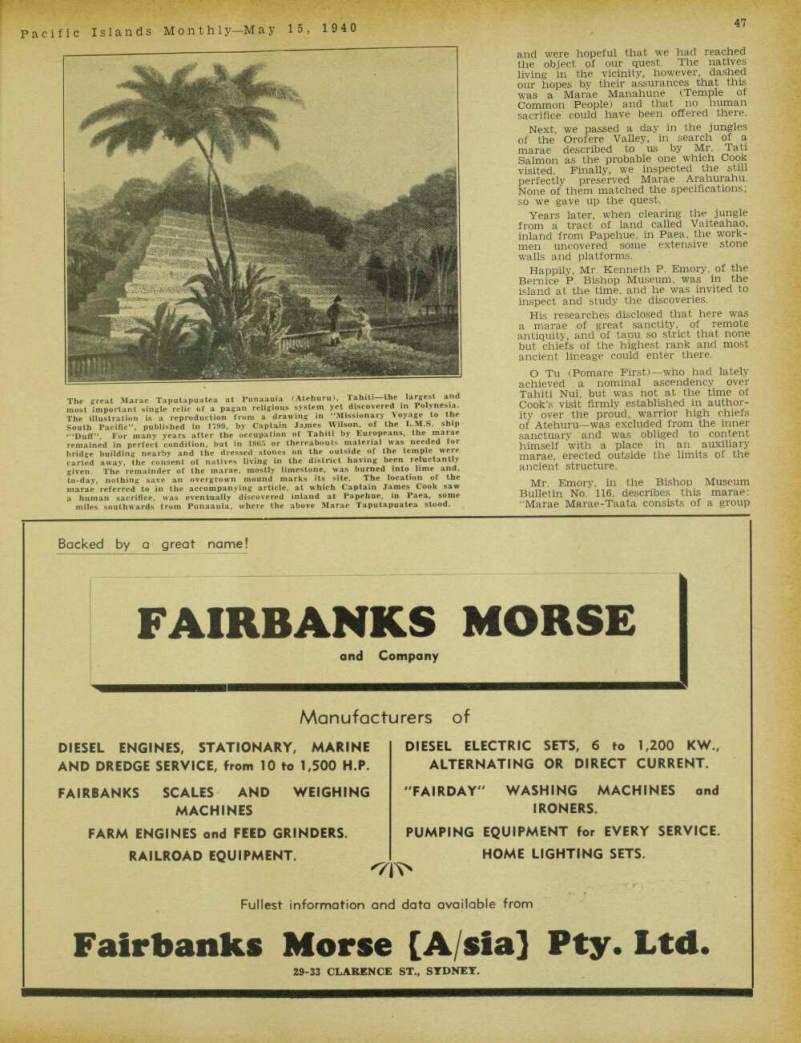
Marae?
Fascinating Search Among Tahitian Ruins
By A. C. Rowland
MANY years ago—before the beginning of the Great War—Mr. J. A. Phil lips and the writer resolved to identify, if we could, the marae at which Captain Cook witnessed the offering of human sacrifice. This marae—so the. records showed —was somewhere in the district of Atehuru (the old name for the ter ritory now known as Punaauia and Paea) extending from the limits of Faaa to the borders of Papara.
The first object of our attention was, naturally, the great Marae Taputaoua tea at Punaauia. This marae, originally named Nuurua, had been reconsecrated a Taputapuatea marae, in comparatively recent times, by the deposit within its structure of a stone from the ancient marae of that name at Opoa, Ra’iatea.
It had, therefore, become a national marae for Tahiti Nui (Great Tahiti).
Reference is made to it in the Spanish padre’s diary—entry August 2, 1775: “In the morning the same Tahuas took up the bodies and carried them away to the district of Etahur (Atehuru) to offer them to their false god as a sacri fice for the health of the arii, in the marae of that district which is dedi cated for the purpose and where all those sacrificed are kept, and nine be sides. According to what the interpre ter, who has been to that marae, tells us, the number of victims these savage and inhuman people sacrifice in this way is large, for the place is full of bones.”
Ellis describes its pyramid: “That which formed one side of the square of the large temple at Atehuru, according to Mr. Wilson, by whom it was visited when in a state of preservation, was 270 feet long. 94 feet wide at the base, and 50 feet high, being at the summit 180 feet long and 6 feet wide. A flight of steps led to the summit; the bottom step was six feet high. The outer stones of the pyramid, composed of coral and basalt, were laid with great care, and hewn or squared with immense labour, especially the tiava, or corner stones.”
All this evidence would appear to settle the question that here, at the great place of human sacrifice at Atehuru, was where Cook witnessed the ghastly rites he records in his diary.
But we were not satisfied. Cook’s account places the site of the marae at a considerable distance inland; whereas the Atehuru Taputapuatea is hard by the seashore, on Punaauia Point.
Furthermore, Cook makes no mention of the massive pyramid So accurate an observer as Cook would certainly have mentioned such a structure had he seen it. In addition, Webber’s drawing of the scene, of which he was an eye-witness, pictures a low stone ahu, or pyramid, not over three feet in height.
For these reasons we were compelled to discard the Punaauia Point marae from consideration. 9 Mr. Sage, whose property adjoined the Punaauia site and who received us with kindly hospitality and assisted us in our search, conducted us to a marae, named Marae Tahiti, situated on terraces about a mile inland, in the Punaruu Valley. We saw there a number of leaning stones and an antique ti’i, carved in red stone,
and were hopeful that we had reached the object of our quest. The natives living in the vicinity, however, dashed our hopes by their assurances that this was a Marae Manahune (Temple of Common People) and that no human sacrifice could have been offered there.
Next, we passed a day in the jungles of the Orofere Valley, in search of a marae described to us by Mr. Tati Salmon as the probable one which Cook visited. Finally, we inspected the still perfectly preserved Marae Arahurahu.
None of them matched the specifications; so we gave up the quest.
Years later, when clearing the jungle from a tract of land called Vaiteahao, inland from Papehue, in Paea, the work men uncovered some extensive stone walls and platforms.
Happily. Mr. Kenneth P. Emory, of the Bernice P. Bishop Museum, was in the island at the time, and he was invited to inspect and study the discoveries.
His researches disclosed that here was a marae of great sanctity, of remote antiquity, and of tapu so strict that none but chiefs of the highest rank and most ancient lineage could enter there.
O Tu (Pomare First) —who had lately achieved a nominal ascendency over Tahiti Nui, but was not at the time of Cook’s visit firmly established in author ity over the proud, warrior high chiefs of Atehuru—was excluded from the inner sanctuary and was obliged to content himself with a place in an auxiliary marae, erected outside the limits of the ancient structure.
Mr. Emory, in the Bishop Museum Bulletin No. 116, describes this marae: "Marae Marae-Taata consists of a group
The great Marae Taputapuatea at Punaauia (Atehuru), Tahiti—the largest and most important single relic of a pagan religious system yet discovered in Polynesia.
The illustration is a reproduction from a drawing in "Missionary Voyage to the South Pacific", published in 1799, by Captain James Wilson, of the L.M.S. ship ‘"Duff". For many years after the occupation of Tahiti by Europeans, the marae remained in perfect condition, but in 1805 or thereabouts material was needed for bridge building nearby and the dressed stones on the outside of the temple were carted away, the consent of natives living in the district having been reluctantly given. The remainder of the marae, mostly limestone, was burned into lime and, to-day, nothing save an overgrown mound marks its site. The location of the marae referred to in the accompanying article, at which Captain James Cook saw a human sacrifice, was eventually discovered inland at Papehue, in Paea, some miles southwards from Punaauia, where the above Marae Taputapuatea stood.
of three enclosed marae, lying side by side and at right angles to the beach, and a detached rectangular platform, seaward of them. The group lies 460 yards from the lagoon.”
Writing of the detached platform, Mr.
Emory continues: “If Marae-Taata is the marae at which Captain Cook witnessed a ceremony of human sacrifice in 1777, which I believe it is, then this platform is the one which figures in Webber’s drawing.”
Advertisements & other items, pp. 50-52 (3 items)
46
May 15, 194 O—P acific Islands Monthly
47
Pacific Islands Monthl y—M ay 15, 1940
Fairbanks Morse
Backed by a great name!
and Company
Manufacturers of
DIESEL ENGINES, STATIONARY, MARINE
AND DREDGE SERVICE, from 10 to 1,500 H.P.
FAIRBANKS SCALES AND WEIGHING
MACHINES
FARM ENGINES and FEED GRINDERS.
RAILROAD EQUIPMENT.
*7 DIESEL ELECTRIC SETS, 6 to 1,200 KW„
ALTERNATING OR DIRECT CURRENT.
"FAIRDAY" WASHING MACHINES and
IRONERS.
PUMPING EQUIPMENT for EVERY SERVICE.
HOME LIGHTING SETS.
V' Fullest information and data available from
Fairbanks Morse [A sia] Pty. Ltd.
29-33 CLARENCE ST., SYDNEY.
Poleman
STDVE
Speed-Master
1— Lights Instantly—No Preheating. 2 Instant Heat Regulation. 3 Safety Shut-off Valve. 4 Nickel-Plated—Rust-Proof. 5 Wind-Proof, Silent, Odorless.
BUILT FOR A MULTITUDE
OF USES.
Sold by all leading Firm* In tb* Pacific Islands.
In case of difficulty In obtaining supplies write to: Pearce & Co. Suva, Fiji Islands.
Scott’s “Renown” Brand Rope,
Cordage and
Binder
Twine
Cable Address; Ropeyard, Sydney. -4 r —i 4 2
of Every
Description
MANUFACTURED AT
MASCOT, N.B.W.
By
J. SCOTT
PTY. LTD.
Head Office and Store:
163 CLARENCE STREET.
SYDNEY,
NJ.W.
Blown to Sea
Misima Lad's Wanderings Among Eastern Papua Islands
Prom Our Own Correspondent SAMARAI, April 5.
ON his arrival at Samarai last month, Frank Low, 23, of Misima Island, who was blown to sea in his 27 ft. launch “Hisiu-bada” and not heard of for 15 days, gave a graphic description of his experiences.
With four Papuans, he left Misima on February 24 to visit Kimuta Island, 14 miles distant, and when returning the following day the engine failed during a heavy squall. Tossed by wild seas throughout an anxious night, Low found himself at dawn off the eastern tip of Misima. He hoisted sails, but after four days of beating backwards and forwards the launch was still far off the island.
Taking advantage of a south-west squall, they beat westward and, finally, five hungry and parched men landed on East Island.
Fortified by native foods, they ob tained a supply of coconuts, sweet potatoes, and water and set off towards Duau Island. Sailing with the aid of a light breeze, they sighted a range of mountains at sunset —only to be swept to sea by another squall. Daylight found them among a nest of reefs be hind Egum Island. Eventually they returned within sight of the mountains, then for five days the “Hisiu-bada” see sawed back and forth at the whim of wind and current. Making a landfall, they learned that they had reached Basima, at the tip of Fergusson Island — not Duau, as expected. Low had hoped to get assistance from a European at Duau.
Leaving the launch in an anchorage some miles down the coast, Low took two boys in the small dinghy and started out for Mr. E. Harrison’s place, at Sebulagomwa. Exhausted after seven hours’ rowing, the trio beached their
boat and walked for several miles until they took up with a party of natives, who canoed them to Numa Numa, from whence they hiked to Sebulagomwa.
Another set-back—Mr. Harrison had gone to Duau!
Next day, Low sent Mr. Harrison’s whaleboat to rescue the two natives and the stranded launch. He himself rowed in a dinghy across to the Methodist Mission Station on Dobu Island, where Rev. and Mrs. J. C. Bundle treated him with every kindness. On learning that an R.A.A.F. flying-boat had spent a fruitless two-days’ search for him and that he had been practically given up for lost, Low despatched a radio mes sage to Misima informing his mother that he was safe and well.
When the “Hisiu-bada” was towed to Salamo Mission Station, Mr. George Har rison repaired the engine, and Low left at daylight on the 12th for Samarai.
Three hours later, down the coast, the launch “conked” again. She was about shipped and sailed back to Salamo, where Mr. Harrison, the following morn ing, located carburettor trouble, caused by a dirty petrol pipe, and soon had the engine chugging again. That afternoon, Low once more set out and this time the Fates were kind enough to let him reach Samarai without further mishap.
Mr. Cowley And The
Tongans
Letter to the Editor SINCE when has vitriolic vituperation earned the right to be deemed a “reply”, “bitter” or sweet, to a rea soned, logical refutation of an untenable proposition?
“Malimali Loto’s” letter, in your Feb ruary issue, easily takes first place as an example of the classic aphorism: “No case—abuse defendant’s counsel”. Mr.
Cowley’s mind, as exemplified by his atti tude towards the Tongan, both intellectu ally and materially, is so well-known to your readers that there is no need to attempt defence. Mr. Cowley certainly does not possess that “type of mind” which will resort to a tirade of personal abuse, and expect readers of the “Pacific Islands Monthly” to accept it as a “reply” to reasoned controversy.
I am, etc.,
A. Cowley.
Nukualofa, Tonga, 4/4/1940.
MISS F. MATHIESON, a member of the N.G. Administration staff at Sala maua, New Guinea, arrived in Aus tralia last month on leave.
Advertisements & other items, p. 52 (1 item)
Sailmaker
SYDNEY'S LEADING
and RIGGER
Also Manufacturer of all Canvas and Rope Work.
ISLANDS WORK a
Speciality.
HARRY WEST
Balmain East, Sydney. Tel.: WllO5
"Blackbirders"
Kidnapping Incident in Cook Islands, 75 Years Ago
By “Cloughogue”
BLACKBIRDING (the kidnapping of unsophisticated Pacific Islanders for slavery under distant skies ) has been so long unknown in the Eastern Pacific that' the very meaning of the word is strange to most of the present generation. Yet one who had personal contact with the slavers, in their last attempt on the islands of the Cook Group, was alive some 10 or 12 years ago, in Manihiki.
His narrative, which follows, discloses the naivete of the native and the trick ery of the villains who traded on it. The incident, so far as can be judged, took place probably about 1855.
This page from the past was taken down verbatim, and translated literally by J. J. Murray, a sometime resident of Manihiki: — IAM 'Eriakima, Mataiapo of the Tube Tahi branch of the royal family of Manihiki and Rakahanga. I am a very old man, older even than Viriamu (Henry Williams, late Resident Agent of the two islands), for I was a big boy when he was born. I helped to nurse him. His father was a white man and mine was a brown man, although we were of the same mother.
I am a Christian and a deacon of the L.M.S. church.
I was not always a good man, having in my early years stolen boats and entered the stores of the white men to steal. For this I was beaten by the captain of a man-of-war. It hurt me very much and I stole no more.
The men-of-war in the old times were not like those of to-day. They had no machines, but used the wind like proper ships.
I have had many women. Some I married, and some I did not. I did not beat them too much, but only for un faithfulness and not having my food ready when I returned from fishing. My present wife is no good, as she talks, talks, talks all the time and spends my money on tobacco and in card games.
I am too old and too tired to get me a new one, so this one will be the last.
You want me to tell you of the ships that carried some of our people away, never to return.
I was about the age and size of Aupini (a well-developed lad, 14-15 years old). I had been away on the Pahuna side of the lagoon, seeking fiki (squid) for Takapu, the father of Here, who was the girl I was courting at the time.
I thought that by softening the heart of Takapu he would give me his daughter.
When I returned to Tauhunu (one of the two villages of Manihiki) there were two ships standing “off and on” the boat passage. It was too late to board them, so my father said to leave it until the morning. The night was without wind.
In the morning one of the ships was ashore on the reef at Tukao Point (N.E. corner of Manihiki). My father and I and other people went off in canoes to help them.
It was a small ship, and very dirty.
The other ship was also very dirty looking.
The captain of the ship on the reef could not speak English or Maori, and only one of the sailors could speak
English. I know this, because my father was one of the few Manihiki people who could speak English, and the talk was done through him.
We worked all day carrying the bal last out of the ship. She had no other cargo but stones. The captain gave us ship’s biscuits for food, and some Chile dollars. There was still no wind. (Eriakima’s description of the method employed in getting the ship off the reef is lengthy and confusing, owing to his ignorance of rigging and tackle, but it would seem that the vessel had been lifted by a swell and deposited, beam on, on the edge of the reef. The captain
had his ballast removed and ran out his bow and bower anchors, well out on the ocean side. He then either used the peak halliards or else rove a line through the topping-lift blocks and canted the ship over to seaward, keep ing the lines taut. The rising tide pulled her off, the boats then towing her out of danger).
It was nearly dark when we finished.
The captain was very pleased with our work. He told us to come back in the morning and he would make a feast for us of salt beef and flour. The sailor who spoke English was his spokesman.
In the night, the wind came and the
sea was rough. Not all of us could go out to her in the morning because of the sea on the reef. I think not more than thirty v of us went. The captain’s spokesman then told us to clean the hold up before he could give us the beef and flour. My father and I did not go down the hold with the other men.
We went to the galley. The cook gave us some coffee and ship biscuits. I saw the sailors making sail on the other Shi p I noticed that we had drawn well off the land under the head sails only.
My father and I then went forward to help our companions, but we found the hatch battened down. I could hear my People knocking on the underside of the hatch. Several sailors seized my father and me and took us into the fo castle. They locked us up in a sail locker. I was very frightened, and cried.
We were locked up all night and had no food.
In the morning, the English-speaking sailor unlocked us and took us to the captain. We were then standing on and off Rakahanga. (Rakahanga and her P again. The oapfain told us, through his spokesman, that he had locked our people up for stealing. I think this was a lie.
The cantain said if mv father would me capiam said n my lamer would call to the Rakahanga people to come aboard he would let our people go. My father pretended to agree, but told me to follow him and jump overboard when he gave me the word. Some Rakahanga people were coming over the reef in canoes. My father and I were taken to the break of the poop to
call to the people to come aboard. My father said to me “jump overboard” and I obeyed. My father tried to jump, but the sailors held him fast. I swam very quickly for the shore. The sailors fired shots at me. One shot hit me on the shoulder. Here is the scar (showing the mark). It did not break a bone but hurt very much. I was frightened that the sharks would smell the blood and eat me.
The Rakahanga people were fright . ened at the * oise p 0 f the guns , nd pulled back to the shore. That is the reason why no Rakahanga people were taken away. The ship was on the offshore tack when I jumped overboard, and this gave me time to swim to the reef. The sea carried me over the reef and I was hurt very much. My leg was broken below the knee, at that place. i crawled up on the beach and was very sick. I do not remember the ship leaving—l was very sick.
T was to]ri offward* ■ that tho chin t d th f u the The? a boat ashore but rfiH
nofknoVwhere the"„e"waf This
Ly’^^ictaes^was^going'
y ill fo? many months I forget how ’ i lorget now Jm > Vhen 1 remembered my father I or : Pf j very much T never saw mv father again ‘ * y ' x • I heard afterwards that the two ships went to Penrhyn, then called Tongareva.
They took many people from Penrhyn.
They sailed inside the passage there and anchored for many days while they repaired the smaller ship.
No one ever returned to Manihiki but one old man was brought back to Pen rhyn. The man-of-war brought him back many years later (circa 1865). I have spoken with him I asked after my father, but the old man was mad and made noises like a pig When he spoke, it was in a strange tongue- and after a while, he made more noises like a pig. He had been beaten very much for he had many marks on his body f heard later that he was dead. I do not remember his name.
TRANSLATOR’S NOTE: It was gath ered from Eriakima that the larger ship was a brigantine, and the smaller a schooner. The sailors were dark men like Maoris, with black beards. In the fo’castle there were many pictures of Mary and the Saints, and some Cruci fixes. There were no cannon aboard, that he saw. The sails were much patched and the ships were very filthy.
They most probably were from Peru, Ships from Peru and Chile, during the nineteenth century, enslaved thousands of Polynesians, and practically de »"» groups.
MR - J - E - WINDRUM has taken up duties ag District Commissioner Labasa, Fiji, replacing MR. R. N. CALD WELL, who has been transferred to Ba.
Mr. P. D. Macdonald, 8.A., Admini
strative Officer in the Gilbert and Ellice Islands Colony, has been appointed Assistant Secretary to the Western Pacific High Commission in Suva. He suc ceeds MR. R. H. GARVEY, M.A., who has gone to the New Hebrides as Assistant Resident Commissioner.
Advertisements & other items, pp. 53-54 (3 items)
49
Pacific Islands Monthl y—M ay 15, 1940
Propellors
All Sizes to 54 in. diameter . . . any pitch.
SHAFTS MADE TO ORDER.
Bearing and Stuffing Boxes —Rudders— Tanks for Water and Fuel —Exhaust Pipes and Mufflers.
Copper, Iron, Bronze and Aluminium Founders.
D. H. PORTER & CO.
43 DRUITT STREET, SYDNEY.
PACIFIC POPULARITY
SINCE 1908
m m r Hf o o A CHAPMAN 3 h.p. “PUP" ENGINE IN A CHAPMAN MODEL “0" 16 ft. CABIN LAUNCH FOR OPEN SEA WORK. SPEED 7 m.p.h. £96 f.o.b. SYDNEY.
WRITE TO
CHAPMAN & SHER A C K
E R S K I N E V I L L E. N. S. W.
Established 50 years—and carrying one of the largest stocks of Iron and Steel in Australia.
William Atkins p«».ttd.
Head Office 449-451 KENT ST., SYDNEY.
Iron & Steel Merchants
ENGINEERS' SUPPLIES
COACH & MOTOR HARDWARE.
FULL, COMPREHENSIVE & UP-TO-DATE RANGE IN ALL
DEPARTMENTS, INCLUDING THE FOLLOWING LINES:—
Cable Address: WILATKIN, SYDNEY.
STEEL DEPARTMENT
MILD STEEL:
Rounds, Squares, Flats, Half-rounds, Hexagons, Bevel, Shoeing, Tyre, Angles, Tees, Sheets, Plates, Girder Plates, Chequer Plates, Channels, Hoops, Etc.
BRIGHT STEEL:
Rounds, Squares, Hexagons.
Extra Special High Speed Tool Steel, Mining Steel, Blister Steel and Spring Steel, Rounds, Flats Cr Squares.
Bar Iron —All sections and sizes.
Engineers' Supplies: Set Screws, Studs, Metal Thread Screws, Coach Screws, Files, Cotter Pins, Bright and Black Bolts, Rivets, Etc., Hack Saw Blades.
Power Transmission Gear: Including Plummer Blocks, Couplings, Collars, Etc.
Coach and Motor Hardware: Axles, Springs, Wheelstuff, Duck, Paints.
Farriers' Supplies: Horse Nails, Anvils, Vices, Etc.
Motor-Trimmers and Motor Builders' & Motor Painters' Requirements
C. A. WILLEY'S
Quick-Drying Coach and Car Paints, Roughstuff, Elastic Gloss, Synflex Enamels, Lacquers.
DUCO Lacquers and DULUX Enamels—FAßßEX Motor Toppings and Leather Cloths, House Cr Decorators' Paints, Varnishes Cr Brushware Sole Distributors of CHAMPION'S Decorators Paint Products.
Distributing Agents for BROLITE Lacquers, SYNFLEX Enamels and "POLYGLOSS" Finish.
50
May 15, 194 O—P acific Islands Monthly
Chief Judge Leaves For
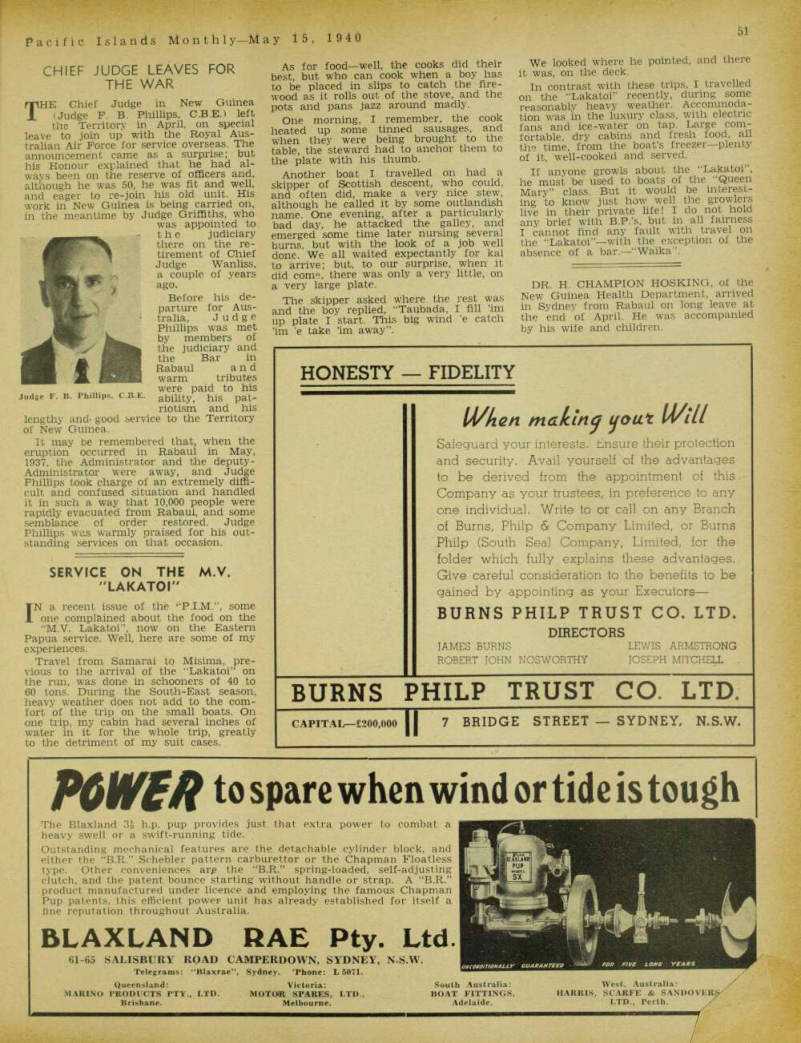
The War
THE Chief Judge in New Guinea (Judge F. B. Phillips, C.8.E.) left the Territory in April, on special leave to join up with the Royal Australian Air Force for service overseas. The announcement came as a surprise; but his Honour explained that he had al ways been on the reserve of officers and, although he was 50, he was fit and well, and eager to re-join his old unit. His work in New Guinea is being carried on, in the meantime by Judge Griffiths, who
was appointed to the judiciary there on the re tirement of Chief Judge Wanliss, a couple of years ago.
Before his de parture for Aus tralia, Judge Phillips was met by members of the judiciary and the Bar in Rabaul and warm tributes were paid to his ability, his pat riotism and his
lengthy and* good service to the Territory of New Guinea.
It may be remembered that, when the eruption occurred in Rabaul in May, 1937, the Administrator and the deputy- Administrator were away, and Judge Phillips took charge of an extremely diffi cult and confused situation and handled it in such a way that 10,000 people were rapidly evacuated from Rabaul, and some semblance of order restored. Judge Phillips was warmly praised for his out standing services on that occasion.
Judge F. B. Phillips, C.B.E.
Service On The M.V.
"Lakatoi"
IN a recent issue of the “P.IJVL”, some one complained about the food on the “M.V. Lakatoi”, now on the Eastern Papua service. Well, here are some of my experiences.
Travel from Samarai to Misima, previous to the arrival of the “Lakatoi” on the run, was done in schooners of 40 to 60 tons. During the South-East season, heavy weather does not add to the comfort of the trip on the small boats. On one trip, my cabin had several inches of water in it for the whole trip, greatly to the detriment of my suit cases.
As for food—well, the cooks did their best, but who can cook when a boy has to be placed in slips to catch the firewood as it rolls out of the stove, and the pots and pans jazz around madly.
One morning, I remember, the cook heated up some tinned sausages, and when they were being brought to the table, the steward had to anchor them to the plate with his thumb.
Another boat I travelled on had a skipper of Scottish descent, who could, and often did, make a very nice stew, although he called it by some outlandish name. One evening, after a particularly bad day, he attacked the galley, and emerged some time later nursing several burns, but with the look of a job well done. We all waited expectantly for kai to arrive: but, to our surprise, when it did come, there was only a very little, on a very large plate.
The skipper asked where the rest was and the boy replied, “Taubada, I fill ’im up plate I start. This big wind 'e catch ’im ’e take ’im away”.
We looked where he pointed, and there it was, on the deck.
In contrast with these trips, I travelled on the “Lakatoi” recently, during some reasonably heavy weather. Accommoda tion was in the luxury class, with electric fans and ice-water on tap. Large com fortable, dry cabins and fresh food, all th» time, from the boat’s freezer—plenty of it, well-cooked and served.
If anyone growls about the “Lakatoi’ , he must be used to boats of the “Queen Mary” class. But it would be interest ing to know just how well the growlers live in their private life! I do not hold any brief with B.P.’s, but in all fairness I cannot find any fault with travel on the "Lakatoi”—with the exception of the absence of a bar. —“Waika”.
Dr. H. Champion Hosking, Of The
New Guinea Health Department, arrived in Sydney from Rabaul on long leave at the end of April. He was accompanied by his wife and children.
Advertisements & other items, p. 55 (2 items)
51
Pacific Islands Monthl y—M ay 15, 1940
PCWCR to spare when wind or tide is tough
HONESTY FIDELITY
When making your Will
Safeguard your interests. Ensure their protection and security. Avail yourself of the advantages to be derived from the appointment of this Company as your trustees, in preference to any one individual. Write to or call on any Branch of Burns, Philp & Company Limited, or Burns Philp (South Sea) Company, Limited, for the folder which fully explains these advantages.
Give careful consideration to the benefits to be gained by appointing as your Executors—
BURNS PHILP TRUST CO. LTD.
DIRECTORS
JAMES BURNS LEWIS ARMSTRONG
ROBERT JOHN NOSWORTHY JOSEPH MITCHELL
BURNS PHILP TRUST CO. LTD.
capital— £2oo,ooo 7 BRIDGE STREET SYDNEY, N.S.W.
PCWCR to spare when wind or tide is tough The Blaxland 31 h.p. pup provides just that extra power to combat a heavy swell or a swift-running tide. Mm Outstanding mechanical features are the detachable cylinder block, and Breither the “8.R.” Schebler pattern carburettor or the Chapman Floatless type. Other conveniences arp the “8.R.” spring-loaded, self-adjusting H| clutch, and the patent bounce starting without handle or strap. A “8.R.” H Pup patents, this efficient power unit has already established for itself a tine reputation throughout Australia.
BLAXLAND RAE Pty. Ltd.
product manufactured under licence and employing the famous Chapman
61-65 SALISBURY ROAD CAMPERDOWN, SYDNEY, N-S.W.
Telegrams: “Blaxrae”, Sydney. ’Phone: L 5071.
Queensland;
MARINO PRODUCTS PTY., LTD.
Brisbane.
Victoria:
MOTtKR SPARES, LTD.,
Melbourne.
South Australia:
BOAT FITTINGS,
Adelaide.
West. Australia;
HARRIS, SCARFE & SANDOVFRS'
LTD., Perth. / ER£/
Donations to B.S.I. Red Cross
Fund
From a Special Correspondent TULAGI, April 2.
THE following additional amounts for the British Solomon Islands Pro tectorate Red Cross Fund were received during March: — H. Short, £2; R. Hyne, £2/2/-; Lever Bros., £lO/10/-; H. Kuper (proceeds of native bowl), £3/12/-; dance, £4/12/-: raffle and auction, £9/7/6; Dr. and Mrs. Hetherington, £10; A.
Cant, £l/1/-; Trainees, S.S.E. Mission, Afio School, £3; European Staff, S.S.E. Mission, Afio, £2; One Pusu, Girls’ School. Wanoni Bay, European Staff and A. V. “Evangel”, £3/11/-; Trainees. One Pusu and Wanoni Bay, £3/10/-; Melanesian Mission, Fiu, 10/-; sale of sav ouries, £l5/3/3; Tulagi Club donations, £7/17/6.
From Gizo.—Native Church Members, Metho dist Mission, £155; Native labour, Kenelo plan tation, £l/14/-; Native labour, Labete planta
tion, 12/10; E. C. Leadly, £l/1/-; Rev. J. F.
Goldie, £2/2/-; A. L. Pascoe, £2/10/-; A. r!
Barratt, £2/10/-; E. R. Tottenhafer, £1; J E Cormack, £2; J. T. Howse, £1; E. L. Martin, £2; A. Gallagher, £2; miscellaneous donations' £4/18/8.
From Faisi.—Mrs. Keegan, 5/-; Mrs. Atkin son, 5/-; Rev. Father Boch, £l/1/-.
MR. V. p. LOHENDAHN, who had been a resident of Fiji for 46 years, died in Suva War Memorial Hospital on April 3, aged 67. Born in Ceylon, he went to Fiji to join the staff of the Government Printing Office in 1894 and served in that department until he retired in 1930. Since then he had been on the staff of the “Fiji Times and Herald” as bookbinder.
Monsieur Leon Leroux, An Old
and respected resident of New Caledonia died recently in Noumea at the age of 67. He was buried at Moindou.
Tonga's Trade In
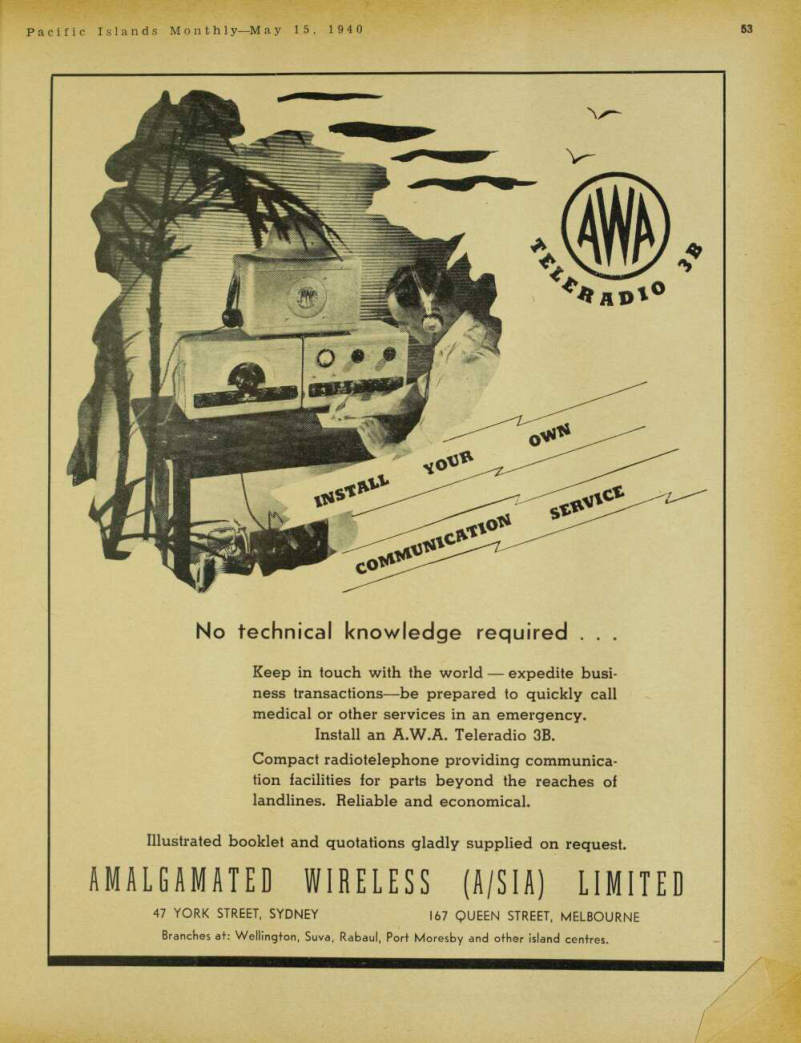
1938 Imports and Exports Down
From Our Own Correspondent
Nukualofa, April 2.
rADE figures for the Kingdom of Tonga for the year 1938 have only just been published and they reveal a marked decrease in both imports and exports, compared with 1937. Imports were valued at £83,026 and exports at £86,196, bringing the total trade for the year to £168,222, which is nearly £133,000 less than the combined total for 1937.
Copra and bananas, the two main exports, both suffered during the year.
Though the production of copra rose about 150 tons —from 12,288 tons to 12,428 tons —the slump in price caused the value to drop from £158,133 to £79,799. Almost the whole of the copra went to the European market, only 260 tons being shipped to Mexico.
New Zealand is the only market for Tonga’s bananas and her quota system, whereby she also receives bananas from other Islands territories, particularly Samoa and the Cook Group, restricts the Kingdom’s exports. In 1938 10,825 cases worth £3,507 were sent to N.Z., compared with 13,715 cases valued at £4,128 shipped the previous year.
The following comparative figures show the copra and banana exports dur ing the past five years:—
During 1938, 27 vessels with a total tonnage of 57,736 tons entered Tongan ports. British tonnage is given as 37,715; Swedish, 18,238; and the remainder as Mexican and Japanese.
Miss Minnie Anderson, A Member
of the pioneer Anderson family who settled in Savu Savu, Fiji, in the early days of the Colony, coming from Nova Scotia, died at the end of March, aged 68. Her sister, Mrs. L. Lawrence, the last surviving member of the family, resides in Melbourne.
Mr. Frederick W. Purves, Of
Samarai, married MISS LILLIAN MAW SON at the Kwato Mission, Eastern Papua, on April 3. Mr. Cecil Abel per formed the ceremony.
Exports
Copra. Bananas.
Tons. Value. Cases.
Value. 1934 .. . . 10,154 £59,941 26,402 £6,906 1935 . . . . 12,039 79,003 29,793 8,352 1936 . . . . 11,899 105,078 25,928 7,373 1937 .. . . 12,288 158,133 13,715 4,125 1938 .. . . 12,428 79,799 10,825 3,507 The comparative table of imports over the past five years and the amount of duty collected reads as follows;-
Imports
Duty Value. Collected. 1934 .. .. £48,526 £8,352 1935 .. . . 68,782 12,281 1936 92,296 14,803 1937 .. .. 137,365 23,867 1938 . . . . 83,026 15,167 Australia retained her position as the chief supplier of goods to Tonga, as revealed in the following table showing the main countries of origin:— 1937 1938 Australia .. £36,678 £19,828 New Zealand 30,311 16,984 United Kingdom .. 21,306 15,555 Japan .. .. .. .. 20,009 7,675 U.S. America .. .. 10,914 7,116
Mr. R. R. Russell. Chief Police Magi strate, at Suva, Fiji, is now in Australia on furlough.
Dr. H. lan Hogbin, past president, and Princess Te Puea Herangi, C.8.E., of New Zealand, were elected vice-presi dents at the annual meeting of the Pacific Islands Club in Sydney.
Miss E. Twyford has returned to Salamo, Papua, where she is a nurse with the Methodist Mission hospital, after leave in Australia.
Mr. F. W. Hennings, a member of a pioneer family from Fiji, who has been treasurer of the Pacific Islands Club in Sydney for the past two years, has re signed that office, and Miss Ella Small, of the Mitchell Library staff, has been appointed. Mr. Hennings left for New Zealand on May 2, and will be absent from Sydney for about three months.
Advertisements & other items, pp. 56-57 (3 items)
52
May 15, 194 O—P acific Islands Monthly
Guinness
Stout
FOR STRENGTH
W* RB&9 * w r;?s>
STOCKED BY ALL BRANCHES OF
Brown & Joske Ltd. W. R. Carpenter & Co. Ltd.
Burns Phllp & Co. Ltd. Morris Hedstrom Ltd.
Advertisement of Export Bottlers Ltd., London. A. Macfee ft Co. Ltd., Wapping, Liverpool, England.
Amalgamated Wireless (Fl/Sia) Limited
V" * ❖ * O SO
IJt**
tA^ CO No technical knowledge required . . .
Keep in touch with the world expedite business transactions —be prepared to quickly call medical or other services in an emergency.
Install an A.W.A. Teleradio 38.
Compact radiotelephone providing communication facilities for parts beyond the reaches of landlines. Reliable and economical.
Illustrated booklet and quotations gladly supplied on request.
AMALGAMATED WIRELESS (fl/SIA) LIMITED
47 YORK STREET, SYDNEY 167 QUEEN STREET, MELBOURNE Branches at: Wellington, Suva, Rabaul, Port Moresby and other Island centres.
Cure For Leprosy
Claimed
AN American, Dr. D. C. Nelson, at the annual meeting of the China Medi cal Association in Kunming in April, stated that research he had made with Drs. D. A. Collier and M. J. Oberdoerffer had achieved almost complete cures for leprosy. Diphtheria toxoid was used.
Most patients, he said, improved in a fortnight; all improved eventually.
Sometimes the outward signs of leprosy disappeared after several months. He emphasised that the treatment required proof through longer use.
Commenting upon this, in Sydney "Sunday Sun” of April 7, H. C. McKay said that it amounted to treatment of one disease by the immunity-provoker of an
other. Diphtheria toxoid is the substance used to immunise children against diph theria. It is what is called an antigen— in simple terms a substance which, when injected, rouses the body’s defences to resist a certain disease. It’s the rule that the antigen for any disease will act against that disease only. Scientists say it’s like a key fitting a lock.
But queer exceptions turn up. For in stance, in Adelaide last year, it was noted that of more than 2,600 children immu nised from diphtheria, very few con tracted infantile paralysis. In Melbourne.
Dr. E. Campbell, of Kew, has been using diphtheria anti-toxin to combat septic poisoning (septicaemia), and claims suc cess, though the germs of the two diseases are quite different. In America two research workers claim that pneu monia can be warded off by an antigen obtained from germs found in the soil.
If the leprosy claim is confirmed, it will prove a boon to sufferers from the disease. Treatment to-day is by salts of the oily acids obtained from an Asiatic shrub named chaulmoogra. Modern pre parations of these are so efficient that 50 per cent, of cures are claimed. The trouble is, they don’t stay cured. Fifty per cent, of the “cured” relanse; this is the experience of most big leper stations Another drawback of chaulmoogra oii salts is pain on injection.
Time alone can confirm the new claims for toxoid. Lenrosy is a slow smouldering infection; like T. 8., it lies latent for years.
Pacific
No Forced Labour In The
Letter to the Editor fTIHOSE who write to you suggesting A the introduction of conscripted labour for the benefit of the natives, and of Islands industries, ignore, or are not aware of, the fact that we are bound by Article 6 of the Anti- Slavery Conventions, which reads; — “Officials of the Administration, even when they have the duty of encouraging the populations under their charge to engage in some form of labour, shall not put constraint upon the said popu lations or upon any individual members thereof to work for private individuals, companies or associations.”
Even with a view to work of a public nature, the Conventions lay down that forced labour may only be called out for great emergencies, such as floods and earthquakes.
The German wireless propagandists are just itching for us to make careless statements about native labour, and lose no time in using them, without scruple.
I am, etc.,
(Rev.) Cecil V. Longden.
Three Park Road, Wigan, Lancs., England. 18/3/1940.
Editorial Note : Apart from sugges tions by occasional correspondents—who seemed to be merely “trailing the tail of their coats”—it never has been seri ously proposed, in the last 25 years, that labour should be conscripted in the Pacific Islands. Any move in that direc tion would not have the slightest pros pect of success.
Mr. A. E. Cornish, of the Fiji District Administration, arrived in Sydney re cently to spend several months’ fur lough.
Advertisements & other items, p. 58 (2 items)
54
May 15, 194 O—P acific Islands Monthly
Spartan
A. B. DONALD Ltd.
AUCKLAND
ISLAND TRADERS & GENERAL MERCHANTS
P.O. Box 1509. Cables £r Telegrams, "Kingdom", Auckland.
For Islands Conditions
use
SPARTAN
PAINTS ENAMELS
PAVING PAINT
QDE ENAMEL
CAR POLISH
SASH & TRIM PAINT
ZINC PASTE
VELOX ENAMEL
TROJAN PAINT
Request your Sydney Agent to obtain details, price lists and color cards of Spartan Paints.
IT WILL PAY YOU
SPARTAN LACQUERS PTY. LTD. 7 / tom^S th st
Fiji Does Honour To
New Zealand
THE first battalion of the Fiji De fence Force has presented to the New Zealand cruiser “H.M.S.
Achilles” a silver tankard, to commem orate the River Plate engagement, in which the cruiser was engaged against the German battleship ‘‘Graf Spee”. The presentation was made in Auckland by Captain V. R. Abrahams, on behalf of the Fiji Defence Force, and Captain W.
E. Parry, commander of the cruiser, sent the warmest thanks of himself and his ship’s company to the Ist Battalion of the Fiji Force and to Major Clive Brew ster, its commanding officer.
Phenomenal Rains Again
In Fiji
FIJI continues to have phenomenal weather. Very heavy rains, last year, caused a great deal of dam age and dislocation of crops. Then there came a period of drought, in which many planters and most agricultural industries suffered severely.
When the drought broke, the rains came again in more than full measure.
During two or three days, early in April, there were extraordinary falls — Taveuni reports no less than 22 inches during one week-end. As a result, great damage has been done to food crops, and in the coconut plantations; and slips and washaways have been reported on the roads on all the districts affected.
There have been heavy floods in the rivers Wainivesi and Waimaro.
South Pacific
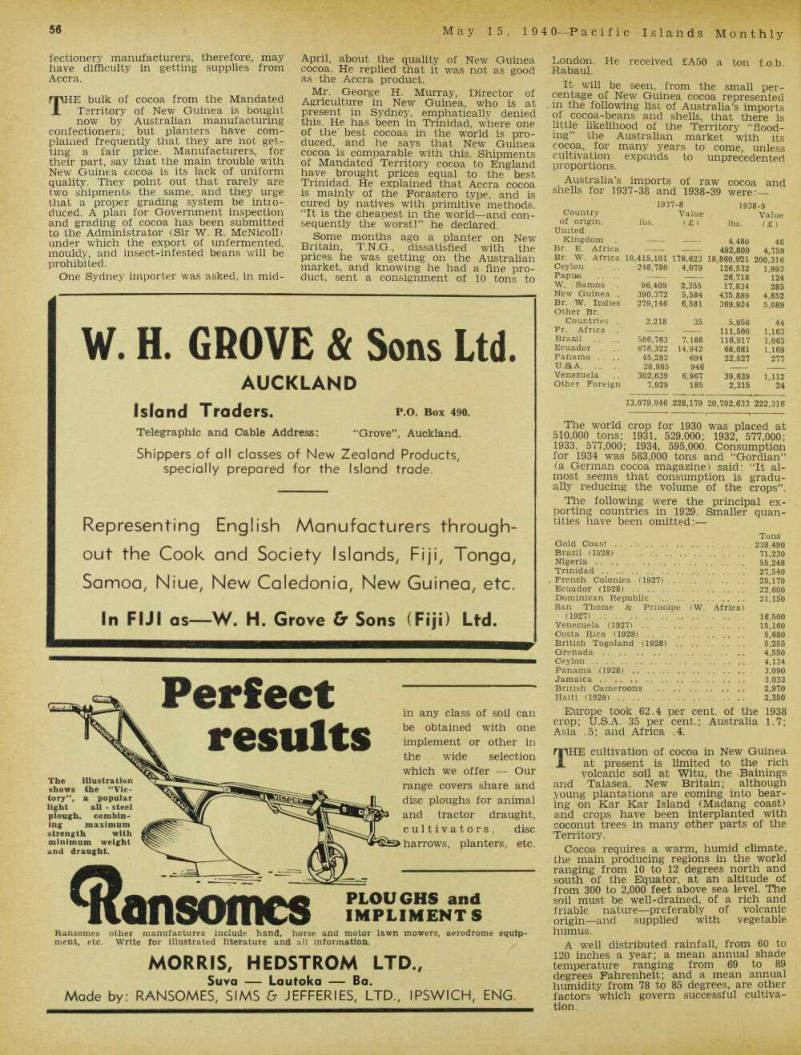

Cocoa Production In The
War Gives New Guinea Industry a Good Start
UNDER war-time conditions, Pacific planters, to an increasing degree are turning towards the cultivation of cocoa, to help balance their budgets. At present, the principal producing terri tories in the South Pacific are Western Samoa, the New Hebrides, and to a lesser extent. New Guinea and Papua.
Samoa has been exporting considerable quantities of a fine quality cocoa for many years—the bulk of it going to Aus tralia and Great Britain. In 1939, the Territory produced only 650 tons, but this abnormal figure was due to unfavourable weather and the 1940 crop is expected to exceed 2,000 tons.
Cultivation in New Hebrides is carried on mainly by French planters and, in 1938, the Condominium exported more than 1,800 tons to France.
New Guinea and Papua are compara tive newcomers to the field—although cocoa-growing was first introduced to New Guinea from Samoa by the Germans.
It languished: but attempts to revive it were made by the Mandated Territory’s Department of Agriculture. While copra was at a profitable level, during post-war years, little attention was paid to cocoa.
More recently, however, planters, faced with a depressed copra market, have turned to cocoa with more interest; and production in New Guinea for 1940 is ex pected to be in the vicinity of 300 tons.
The Australian Government provides a bounty of £l4 per ton on cocoa and cocoa shells, imported into the Commonwealth from New Guinea. Cocoa-shells are used in the manufacture of certain drugs and also are in demand as cattle-fodder.
Cocoa made its appearance in Papua in 1925, when the Papuan Government imported 13 or 14 wardian cases of seed lings from the Mandated Territory, for cultivation on the Kemp-Welch Experi mental plantation. In 1939, Papua ex ported 26,718 lb. of cocoa beans to Aus tralia.
The cocoa produced by the two Terri tories is marketed in Australia; and pros pects waxed bright early in 1937, when New Guinea beans were selling in Sydney at £44 per ton. One shipment to London realised £63 (sterling) per ton. Planters received a set-back in the middle of 1937, when the strike of native growers in Accra, West Africa, which had kept the market on a high level, was settled, and accumulated stocks from this large pro ducer of cocoa were thrown onto the market, forcing the price down, until by June, 1937, New Guinea beans were £25 a ton in Australia. Then there was a gradual recovery, which was sharply ac centuated in 1939 by the outbreak of war.
The world-wide dislocation of shipping has correspondingly dislocated the West African cocoa industry. Australian con
fectionery manufacturers, therefore, may have difficulty in getting supplies from Accra. rjIHE bulk of cocoa from the Mandated JL Territory of New Guinea is bought now by Australian manufacturing confectioners; but planters have com plained frequently that they are not get ting a fair price. Manufacturers, for their part, say that the main trouble with New Guinea cocoa is its lack of uniform quality. They point out that rarely are two shipments the same, and they urge that a proper grading system be intro duced. A plan for Government inspection and grading of cocoa has been submitted to the Administrator (Sir W. R. McNicoll) under which the export of unfermented, mouldy, and insect-infested beans will be
prohibited.
One Sydney importer was asked, in mid-
April, about the quality of New Guinea cocoa. He replied that it was not as good as the Accra product, Mr. George H. Murray, Director of Agriculture in New Guinea, who is at present in Sydney, emphatically denied this. He has been in Trinidad, where one of the' best cocoas in the world is pro duced, and he says that New Guinea cocoa is comparable with this. Shipments of Mandated Territory cocoa to England have brought prices equal to the best Trinidad. He explained that Accra cocoa is mainly of the Forastero type, and is cured by natives with primitive methods.
“It is the cheapest in the world—and con sequently the worst!” he declared.
Some months ago a nlanter on New Britain, T.N.G., dissatisfied with the prices he was getting on the Australian market, and knowing he had a fine pro duct, sent a consignment of 10 tons to
London. He received £ASO a ton f.o.b.
Rabaul.
It will be seen, from the small per centage of New Guinea cocoa represented in the following list of Australia’s imports of cocoa-beans and shells, that there is little likelihood of the Territory “flood ing” the Australian market with its cocoa, for many years to come, unless cultivation expands to unprecedented proportions.
Australia’s imports of raw cocoa and shells for 1937-38 and 1938-39 were;—
The world crop for 1930 was placed at 510,000 tons: 1931, 529,000; 1932, 577,000; 1933, 577,000; 1934, 595,000. Consumption for 1934 was 583,000 tons and “Gordian” (a German cocoa magazine) said: “It al most seems that consumption is gradu ally reducing the volume of the crops”.
The following were the principal ex porting countries in 1929. Smaller quan tities have been omitted:— Tons Gold Coast 238,490 Brazil (1928) 71,230 Nigeria 55,248 Trinidad 27,540 French Colonies (1927) 25,170 Ecuador (1928) 22,600 Dominican Republic 21,150 San Thome & Principe (W. Africa) (1927) 16,500 Venezuela (1927) 15,160 Costa Rica (1928) 5,680 British Togoland (1928) 5,255 Grenada 4,550 Ceylon 4,134 Panama (1928) 3,090 Jamaica 3,032 British Cameroons 2,970 Haiti (1928) 2,350 Europe took 62.4 per cent, of the 1938 crop; U.S.A. 35 per cent.; Australia 1.7; Asia .5; and Africa .4.
THE cultivation of cocoa in New Guinea at present is limited to the rich volcanic soil at Witu, the Bainings and Talasea, New Britain; although young plantations are coming into bear ing on Kar Kar Island (Madang coast) and crops have been interplanted with coconut trees in many other parts of the Territory.
Cocoa requires a warm, humid climate, the main producing regions in the world ranging from 10 to 12 degrees north and south of the Equator, at an altitude of from 300 to 2,000 feet above sea level. The soil must be well-drained, of a rich and friable nature —preferably of volcanic origin—and supplied with vegetable humus.
A well distributed rainfall, from 60 to 120 inches a year; a mean annual shade temperature ranging from 69 to 89 degrees Fahrenheit; and a mean annual humidity from 78 to 85 degrees, are other factors which govern successful cultiva tion.
1937-8 1938-9 Country Value Value of origin. lbs. ( £) lbs. (£) United Kingdom . — 4,480 46 Br. E. Africa — — 492.800 4,759 Br. W. Africa 10.415,101 178,623 is.seo.osi 200,316 Ceylon .. 248,780 4,079 126,532 1,993 Papua . . . . —.— — 26,718 124 W. Samoa 96,409 2,355 17,834 285 New Guinea . 390.372 5,584 435,889 4,852 Br. W. Indies 279,146 6,581 369,924 5,089 Other Br.
Countries . 2,218 35 5,956 44 Fr. Africa — — 111,500 1,163 Brazil 586,763 7,188 116,917 1,063 Ecuador . .. 676,322 14,942 68,681 1,169 Panama . . 45,282 694 22,527 277
U.S.A
28,985 946 Venezuela 302,639 6,967 39,639 1,112 Other Foreign 7,929 185 2,315 24 13,079,946 228,179 20,702,633 222,316
Strong winds are particularly injur ious to cocoa trees. In New Guinea, provision is made against the south-east and north-west trades. To protect trees against excessive wind, and at the same time provide shade which is also essen tial, other crops are usually interplanted with cocoa. A leguminous tree, such as Leucaena glauca, is often recommended, but many planters make use of other economic plants, such as kapok, bananas and even rubber.
In recent years, copra planters in New Guinea with limited land and means have interplanted cocoa with coconut trees. This has been quite successful, but some experts predict that in several years—perhaps 15—the land will have to be fertilised.
Not being a particularly robust tree, cocoa is subject to a large number of pests, but these are well under control, in both New Guinea and Papua.
THERE are three kinds of cocoa— namely, Criollo, Forastero and Cal abacillo. The latter is rarely planted, and may be disregarded. The Criollo bean is large and round, and, when broken, re veals a whitish cross section. Fermented, cured and dried, it is a cinnamon colour; it is not astringent and has a pleasing aroma. Criollo is the more delicately flav oured and higher priced variety, but this former property precludes its extensive cultivation. It is found chiefly in Vene zuela, Ecuador, Nicaragua, and is also grown in Java, Ceylon Samoa and Mada gascar.
Forastero, owing to its superior vitality, stronger growth, greater productiveness, less demand for shade, and better re sistance to disease, is by far the more popular bean, and produces the mass of commercial cocoa. It is small, flat and purple in cross-section, and when cured and dried is dark walnut in colour; it is slightly astringent and has little aroma.
Forastero is grown on the Gold Coast of Africa, where more than half the world’s supply is produced.
A hybrid, or cross, between Criollo and Forastero gives a bean with a heavy yield and a good flavour. This is the type which is being cultivated in New Guinea to-day, and it forms the main crops of Ceylon, Java and the West Indies. It has been found that, in the crossing, Criollo is little affected, while it improves Forastero.
Planters in New Guinea can obtain selected third-generation seedlings from the Department of Agriculture’s demon stration plantation at Keravat, near Rabaul, but, rather than transplant seedlings—which are liable to be damaged
—it is considered safer to plant fresh seeds, about 1 inch below the surface of the soil, They germinate in a few days.
The trees are generally planted, in New Guinea, about 15 feet apart, and grow to a height of between 15 and 25 feet.
Cocoa trees commence to bear about the 4th or sth year, but are at their best in the 10th or 12th year. The life of a tree, in full bearing, is about 40 years.
WHEN the pods have changed to a yellow, or reddish yellow colour, they are collected at frequent intervals, and taken to the fermentor. The pod is split open with a knife, and the beans, about i inch long, are put into ferment ing boxes (usually 15 ft. long, 4 ft. wide and 3 ft. deep; and divided into 3 com partments of 5 ft.).
The object of fermenting is to remove the slimy, whitish pulp which lines the pod and covers the seeds. It has been found, however, that fermenting also develops the flavour of the bean. During fermentation, the beans are turned, at frequent intervals, with a wooden shovel.
Porastero takes from 7 to 8 days to ferment, and Criollo 2 to 3. Good fer mentation is shown in a reduction of the astringent and bitter taste, uniform change of colour, development of aroma, and, later, after drying, a fine “break”.
Bad fermentation, caused through a lack of heat in the mass, is characterised by no uniform change in colour, mildew, a bad colour, when dried there is an ex cessive adherence of mucilage on the bean, it has a cheesy “break”, lack of aroma, and is astringent.
After fermentation, the beans are taken out to dry. Hi Ceylon, they are washed, and, in other countries polished, before the drying process, which is carried out on large wooden platforms, covered by movable, galvanised-ifon roofs. The beans are thinly spread over the surface, in the sun’s rays, and are turned with wooden rakes every few hours, to ensure uniform drying.
In some countries, where excessive rainfall prevents sun drying, artificial methods are used. The beans are placed in a drying room supplied with hot-air pipes.
It may be thought, from this, that cocoa beans could be dried with copra.
On this subject Mr. E. C. D. Green, of the Department of Agriculture in New Guinea, says it is inadvisable, because the cocoa absorbs copra odour; the period of drying copra is generally much faster than cocoa; the beans should not come into contact with metal during any stage of drying (metal is mostly used for copra trays); and the type of copra drier in New Guinea would not permit the constant turning required by cocoa. After drying the beans are bagged and sent as quickly as possible to their destination.
Some time ago, the Council of Inter national Office of Manufacturers of Cacao and Chocolate defined the bean required by the trade. It should be plump and well filled; should crumble when pressed with the fingers; have an open texture; be quite dry; and the inside light mahogany to brown in colour.
ON the question of labour for cocoa pro duction, one expert pointed out that,
while the Trinidad native labourer had a distinct advantage over the majority of New Guinea natives, the latter responds readily to tuition and, under the pre sent indenture system, could be taught various estate operations, such as prun ing and picking; and, after training, could possibly surpass the skill of the West Indian.
Mr. Murray (Director of Agriculture in New Guinea; says the most important factor about picking cocoa is to be able to distinguish when the pod is ripe. He says there is no reason why natives should not be taught to grow cocoa in a small way—but, preferably, under Euro pean supervision.
Advertisements & other items, pp. 59-62 (3 items)
DeW*
gca*)^ 1^ #O- -
W. H. GROVE & Sons Ltd.
AUCKLAND
Island Traders. p.o. b<« 00.
Telegraphic and Cable Address: “Grove”, Auckland.
Shippers of all classes of New Zealand Products, specially prepared for the Island trade.
Representing English Manufacturers throughout the Cook and Society Islands, Fiji, Tonga, Samoa, Niue, New Caledonia, New Guinea, etc.
In FIJI as—W. H. Grove & Sons (Fiji) Ltd.
Perfect
results
The Illustration shows the “Victory”, a popular light all - steel plough, combining maximum strength with minimum weight and draught. in any class of soil can be obtained with one implement or other in the wide selection which we offer Our range covers share and disc ploughs for animal and tractor draught, cultivators, disc harrows, planters, etc.
nsoincs
PLOUGHS and
IMPLIMENTS
Hansomes other manufactures Include hand, horse and motor lawn mowers, aerodrome equipment, etc. Write for illustrated literature and all information.
MORRIS, HEDSTROM LTD.,
Suva Lautoka Ba.
Made by: RANSOMES, SIMS & JEFFERIES, LTD., IPSWICH, ENG.
lamps
For lighting, Pennant gives
clear, unflickering illumination . . . for cooking it provides never-varying heat . . . for refrigerators Pennant is absolutely steady and reliable . . . and for hot water systems it ensures a ready supply of steaming hot water.
Pennant is odourless. Its consistent purity keeps the wicks burning evenly without charring or smoking. Save yourself bother—use Pennant Kerosene.
PENNANWne
M
IS THE RECOMMENDATION
THE SHELL CO. OF AUSTRALIA LTD.
(Incorporated in Great Britain) pK.z9/zt
ns9
THEN FIND YOUR
Continual loss of appetite is soon followed by losing interest in everything.
Tired, easily bored, your life becomes a dull routine. Take a daily dose of Eno’s “Fruit Salt,” the famous household remedy for digestive ailments and disorders of the liver and stomach.
YOUR APPETITE ?
DELICIOUS, TASTY FOODS
For ISLAND MEALS
AUNT MART’S COOKERY
BOOK.
There’s no finer book for every home . . . 212 pages, lavishly illustrated In colour, and over 400 recipes and useful hints make It a book that every housewife will want. Send only one shilling and twopence to
TILLOCK A CO. PTY. LTD.,
Sydney N.8.W., and get your copy of this great book NOW.
JUST TRY any of AUNT MARY'S Pure Food Products, and you will be back for more . . . delicious in themselves or with innumerable dishes.
AUNT MARY'S BAKING POWDER
AUNT MARY'S TOMATO SAUCE
AUNT MARY'S SPAGHETTI IN TOMATO
SAUCE
AUNT MARY'S BAKED BEANS IN TOMATO
SAUCE
AUNT MARY'S CANNED VEGETABLES
Green Peas, Cauliflower, Celery, etc.
RANEE CURRY POWDER
BLOSSOM HONEY In Attractive Jars Or any of the large variety of Pure Food Products specially packed for Tropical conditions, In Tlllock’s Hermetically Sealed 1-lb. tins. All goods are procurable from your local stores.
TILLOCK & CO. PTY. LTD. SYDNEY
m
GOT YOU DOWN?
Get quick, safe, pleasant, and cheap relief from ’Flu Colds, Coughs, Throat and Chest troubles.
Handy-sized bottle, I/-; also 2/ond 3/-. .
- CURE
56
May 15, 19 4 O—P acific Islands Monthly
58
May 15, 194 O—P acific Islands Monthly
A Birthday Celebration In Tonga
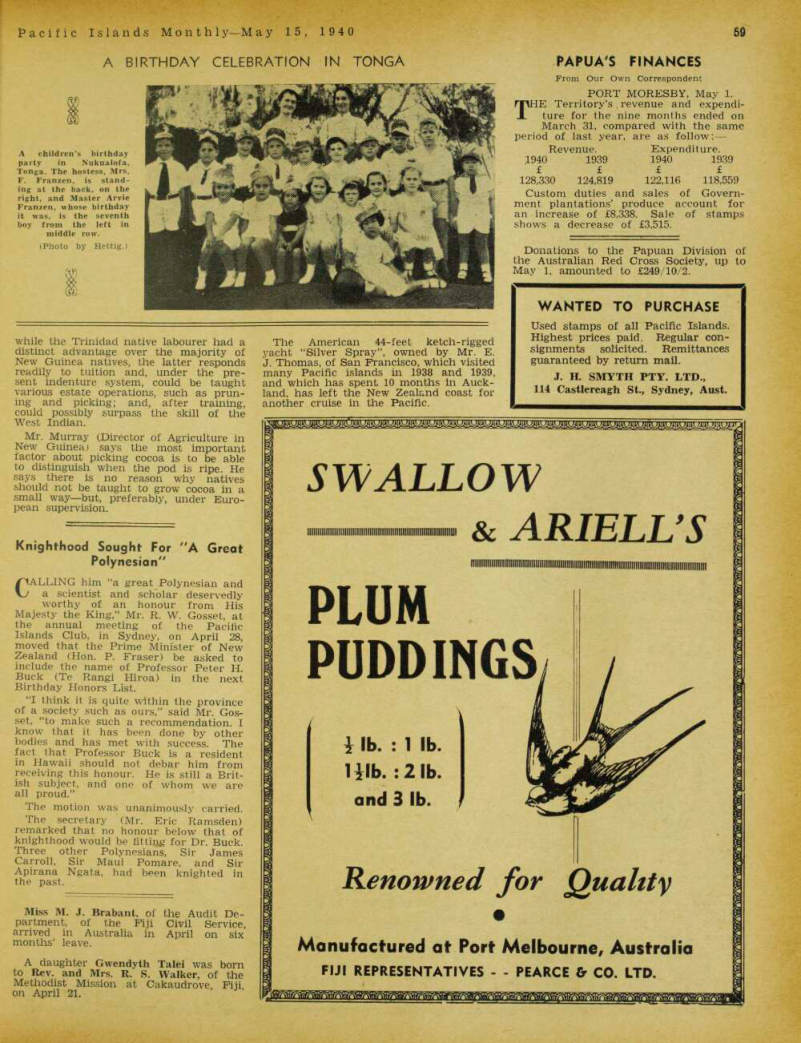
A children’s birthday party in Nukualofa, Tonga. The hostess, Mrs.
F. Franzen, is stand ing at the back, on the right, and Master Arvie Franzen, whose birthday it was, is the seventh boy from the left in middle row. (Photo by Hettig.)
Polynesian"
Knighthood Sought For "A Great Polynesian"
CALLING him “a great Polynesian and a scientist and scholar deservedly worthy of an honour from His Majesty the King,” Mr. R. W. Gosset, at the annual meeting of the Pacific Islands Club, in Sydney, on April 28, moved that the Prime Minister of New Zealand (Hon. P. Fraser) be asked to include the name of Professor Peter H.
Buck (Te Rangi Hiroa) in the next Birthday Honors List.
“I think it is quite within the province of a society such as ours,” said Mr. Gos set, ‘‘to make such a recommendation. I know that it has been done by other bodies and has met with success. The fact that Professor Buck is a resident in Hawaii should not debar him from receiving this honour. He is still a Brit ish subject, and one of whom we are all proud.”
The motion was unanimously carried.
The secretary (Mr. Eric Ramsden) remarked that no honour below that of knighthood would be fitting for Dr. Buck.
Three other Polynesians, Sir James Carroll, Sir Maui Pomare, and Sir Apirana Ngata, had been knighted in the past.
Miss M. J. Brabant, of the Audit De partment, of the Fiji Civil Service, arrived in Australia in April on six months’ leave.
A daughter Gwendyth Talei was born to Rev. and Mrs. R. S. Walker, of the Methodist Mission at Cakaudrove, Fiii on April 21.
The American 44-feet ketch-rigged yacht “Silver Spray’’, owned by Mr. E.
J. Thomas, of San Francisco, which visited many Pacific islands in 1938 and 1939, and which has spent 10 months in Auck land, has left the New Zealand coast for another cruise in the Pacific.
Papua's Finances
From Our Own Correspondent
Port Moresby, May 1.
THE Territory’s revenue and expendi ture for the nine months ended on March 31, compared with the same period of last year, are as follow: — Revenue. Expenditure, 1940 1939 1940 1939 f £ £ f 128,330 124,819 122,116 118,559 Custom duties and sales of Govern ment plantations’ produce account for an increase of £8,338. Sale of stamps shows a decrease of £3,515.
Donations to the Papuan Division of the Australian Red Cross Society, up to May 1, amounted to £249/10/2.
Advertisements & other items, p. 63 (2 items)
59
Pacific Islands Month!y—May 15, 1940
Plum
WANTED TO PURCHASE
Used stamps of all Pacific Islands.
Highest prices paid. Regular consignments solicited. Remittances guaranteed by return mail.
J. H. SMYTH PTY. LTD.,
114 Castlereagh St., Sydney, Aust.
SWALLOW
lIIIIIIIIIIIIIIIIIIIIIIIIIIIIIIIIIIIIIIIIIIIIIIIIIIIIIIIIIIIIIIIIIIIIUI
& ARIELL’S
iiiiiiniiiiniiiiiiiiiiiiniiiiiiiiiiiiiiiiiiiiiiiiiiiiTiiiiiiiiiimiiiiniiiiiiiiuiiiiiiiiiiiiiiiiiiiiiiiiiii
PLUM
PUDDINGS
i lb. : 1 lb.
Ulb. :21b. and 3 lb.
Renowned for Quality
Manufactured at Port Melbourne, Australia FIJI REPRESENTATIVES - - PEARCE & CO. LTD.
A New Suva

FT\HE re-building of Suva continues—al l though somewhat slowed down by the war —and anyone who has not seen the mid-Pacific city for several years would scarcely recognise it now.
The completion of the new Government block gave impetus to new construction, and there has been a good deal of new private building in the business section of the town.
A new building, just completed, is that for Tolo, Ltd., at the corner of Pratt Street and Victoria Parade. It consists of shops on the ground floor and a series of fine modern offices and professional rooms on the first floor. It is a handsome addi tion to the main section of the town.
The Suva Town Board, in its last
annual report, emphasises the difficulty experienced in maintaining effective con trol over building operations. It is stated that “nearly every native owner considers himself a builder and often a plumber, with the result that all types of untrained persons are called builders. In this way, many most undesirable types of buildings have emerged.”
This applies more particularly to the back portions of the town, which are not so prominently in the view of visitors.
The undesirable types of building, foi tunately, have been kept off the main street.
Miss M. Woolnough, of the Methodist Mission in New Guinea, is at present convalescing at her home in Ashfield, Sydney, after a recent illness.
Pattern Service
£ACH month we publish a Fashions design, " patterns of which may be purchased by our readers direct from this office, post free. To obtain a pattern, print your name and address below, giving the number of the pattern and the bust size, and send to "Pattern Department”, Pacific Islands Monthly, Box 3408 R, G.P.0.. Sydney; enclose also the price of the pattern in postal note or stamps It will be sent by return mail.
Name Address Pattern Number size
Miss Ethel Slade, of the A.B.M. school at Dogura, Papua, is at present spending furlough in Victoria.
6935.—A smart style for formal wear which reflects the popular bustle mode in the skirt.
Its full drape at the back is accentuated by a swathed sash, finishing in a tiered bow. A little roll collar fastens at the back with a coloured zipper to match your bag and gloves.
Material required for 34 in. bust is 4½ yards of 36 in. material. Pattern, cut in sizes 32 in. to 40 in. bust measurement, is priced at 1/1, post free.
Advertisements & other items, p. 64 (2 items)
60
May 15, 194 O—P acific Islands Monthly
Crtm^
A*
CON^^
BAY
"aME WE
®C \^o
TODAY ?
A'>"
VW^ j>
OWE
/ a
and
CRtM^
Custap.p Powd^ r V i 737-A Children just can’t imagine anything nicer to eat than fruit and Foster Clark’s delicious Creamy Custard Foster Clark’s Custard has a world-wide reputation for flavour and quality. It’s four-fifths milk, therefore rich in nourishment.
Your family will never tire of Foster Clark’s Custard. It is so delicious —and can be served so many different ways.
Write for your FREE copy of Elizabeth Craig’s Recipe Book to Foster Clark ( Aust .) Ltd., Dept. R. 8., Rcdfern, N.S.W. Enclose a penny stamp for postage.
Sold by ail grocers —in 3 sizes and 4 flavours.
FOSTER CLARK'S
I ✓ w
A Section For Women
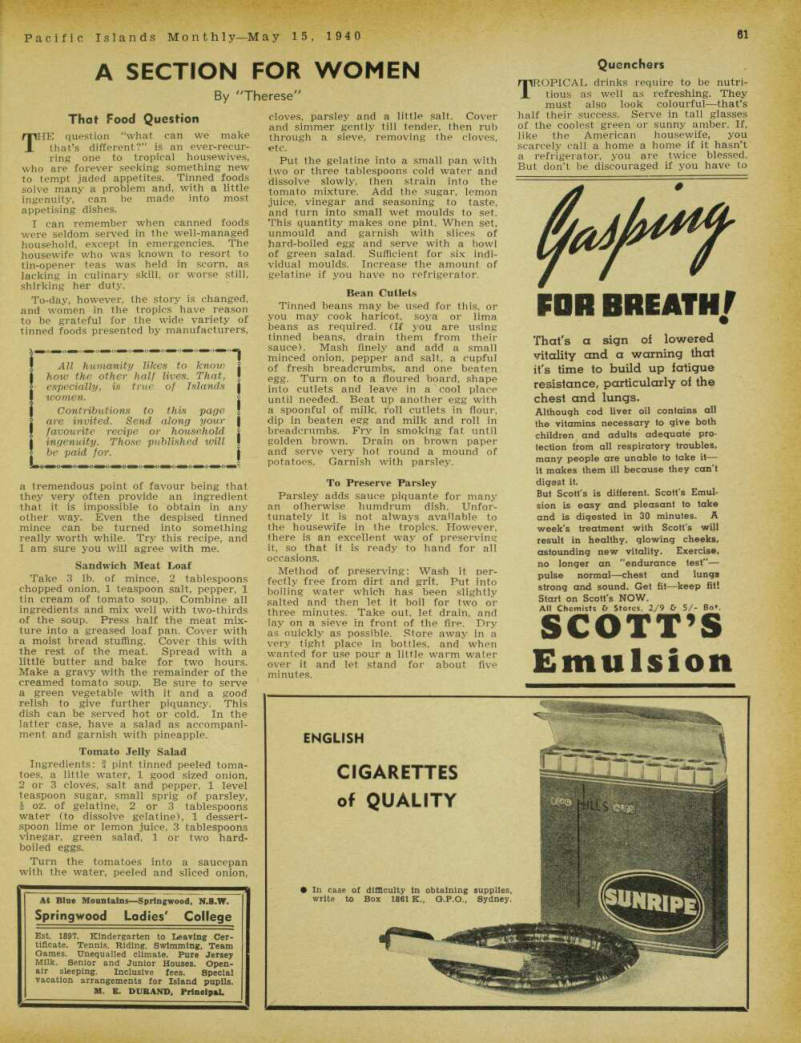
By "Therese"
That Food Question
THE question “what can we make that’s different?” is an ever-recur ring one to tropical housewives, who are forever seeking something new to tempt jaded appetites. Tinned foods solve many a problem and, with a little ingenuity, can be made into most appetising dishes.
I can remember when canned foods were seldom served in the well-managed household, except in emergencies. The housewife who was known to resort to tin-opener teas was held in scorn, as lacking in culinary skill, or worse still, shirking her duty.
To-day, however, the story is changed, and women in the tropics have reason to be grateful for the wide variety of tinned foods presented by manufacturers,
All humanity likes to know how the other half lives. That, especially, is true of Islands women.
Contributions to this page are invited. Send along your favourite recipe or household ingenuity. Those published will be paid for.
a tremendous point of favour being that they very often provide an ingredient that it is impossible to obtain in any other way. Even the despised tinned mince can be turned into something really worth while. Try this recipe, and 1 am sure you will agree with me.
Sandwich Meat Loaf Take 3 lb. of mince, 2 tablespoons chopped onion, 1 teaspoon salt, pepper, 1 tin cream of tomato soup. Combine all ingredients and mix well with two-thirds of the soup. Press half the meat mix ture into a greased loaf pan. Cover with a moist bread stuffing. Cover this with the rest of the meat. Spread with a little butter and bake for two hours.
Make a gravy with the remainder of the creamed tomato soup. Be sure to serve a green vegetable with it and a good relish to give further piquancy. This dish can be served hot or cold. In the latter case, have a salad as accompani ment and garnish with pineapple.
Tomato Jelly Salad Ingredients: i pint tinned peeled toma toes, a little water, 1 good sized onion, 2 or 3 cloves, salt and pepper, 1 level teaspoon sugar, small sprig of parsley, 2 oz. of gelatine, 2 or 3 tablespoons water (to dissolve gelatine), 1 dessert spoon lime or lemon juice, 3 tablespoons vinegar, green salad, 1 or two hard boiled eggs.
Turn the tomatoes into a saucepan with the water, peeled and sliced onion,
cloves, parsley and a little salt. Cover and simmer gently till tender, then rub through a sieve, removing the cloves, etc.
Put the gelatine into a small pan with two or three tablespoons cold water and dissolve slowly, then strain into the tomato mixture. Add the sugar, lemon juice, vinegar and seasoning to taste, and turn into small wet moulds to set.
This quantity makes one pint. When set, unmould and garnish with slices of hard-boiled egg and serve with a bowl of green salad. Sufficient for six indi vidual moulds. Increase the amount of gelatine if you have no refrigerator.
Bean Cutlets Tinned beans may be used for this, or you may cook haricot, soya or lima beans as required. (If you are using tinned beans, drain them from their sauce). Mash finely and add a small minced onion, pepper and salt, a cupful of fresh breadcrumbs, and one beaten egg. Turn on to a floured board, shape into cutlets and leave in a cool place until needed. Beat up another egg with a spoonful of milk, roll cutlets in flour, dip in beaten egg and milk and roll in breadcrumbs. Fry in smoking fat until golden brown. Drain on brown paper and serve very hot round a mound of potatoes. Garnish with parsley.
To Preserve Parsley Parsley adds sauce piquante for many an otherwise humdrum dish. Unfor tunately it is not always available to the housewife in the tropics. However, there is an excellent way of preserving it, so that it is ready to hand for all occasions.
Method of preserving: Wash it per fectly free from dirt and grit. Put into boiling water which has been slightly salted and then let it boil for two or three minutes. Take out, let drain, and lay on a sieve in front of the fire. Dry as auickly as possible. Store away in a very tight place in bottles, and when wanted for use pour a little warm water over it and let stand for about five minutes.
Quenchers
TROPICAL drinks require to be nutri tious as well as refreshing. They must also look colourful —that’s half their success. Serve in tall glasses of the coolest green or sunny amber. If, like the American housewife, you scarcely call a home a home if it hasn’t a refrigerator, you are twice blessed.
But don’t be discouraged if you have to
resort to more primitive methods to cool your drinks. They are delightful, any way. Here are some easily made thirst quenchers which will be greatly appre ciated:- Honey Punch Half a cup of honey, 1 cup of water, juice of 4 oranges, grated rind 1 orange, juice h lemon. Boil water, honey and rind for 3 mins. Strain. When cold add the strained juices. Serve in glasses diluted with water and shaved ice. Add a sprig of mint.
Fruit Cup One quart weak tea, I doz. oranges, 4 lemons, sugar to flavour, and if liked, wine to taste.
Method: Make the tea very weak and allow it to become quite cold; add the strained orange and lemon juice, then add the sugar and whatever wine pre ferred. Let the jug stand in the re frigerator or the coolest spot you can find for one hour before serving. The juice of any fruits can be added, such as tinned peaches, pears or pineapples.
A Cocktail Here is a really stirring cocktail for mere man:— Take a medium-sized tumbler, pour in the juice of half a lemon, add a
small quantity of chipped ice, half a teaspoon of sugar, a wine glass of brandy, a teaspoon of raspberry syrup and a little cayenne pepper. Strain off —and drink with relish.
Household Hints
CANE chairs should be scrubbed clean and then wiped with a cloth wrung out in rice water. This forms a protective film over the cane and gives it a bright and glossy appear ance.
Coffee Stains To remove coffee stains, first soak the garment in methylated spirits for five minutes. Then lay the stained part in a shallow bowl, containing thick, cold, dis solved soap. Wash the material with out cleaning it. It is a good plan to lay it flat on the hand and rub gently till clean. Rinse well and dry in fron< of the fire.
Cold tea leaves bound on a burn relieve it at once.
Rub lamp glasses with salt after cleansing them, and much better light will be had.
After using paint or hat dye, a little brass© will quickly remove stains from the hands.
Never bother to grate breadcrumbs for treacle tarts. A much more delicious flavour is obtained by sprinkling the treacle with finely-grated coconut.
In Step With Fashion !
FASHIONS to-day are lovelier than ever; and, though often it is not practical to adopt advanced styles in the tropics, don’t think that because you are miles from shopping centres that you have been forgotten by the
world of fashion. With the aid of a sewing machine, a length of dress mat erial and a good pattern, you can be as well dressed as your more fortunate sisters, who have a whole range of models from which to choose.
There’s not a style presented that you cannot emulate if you buy a good stan dard fashion book each season and choose from it the patterns that best suit your individuality. Even if you’ve never made a dress before in your life, the patterns are so concise in their instructions that it would be almost an impossibility to fail, and after a little practice you will find yourself turning out frocks well up to professional standard.
For the tropics, the simple styles are best. Shirtmakers always look well with their semi-tailored lines, and the linens, pastel and patterned, that are always so popular, are far and away their best means of expression. There are dozens of lovely designs in cottons and linens from which to choose, and stores in the cities cater so well for the mail-order shopper that they forward on request patterns from almost their entire range, from which you can make your choice; and all of them washing fabrics and many of them crease-resisting.
The secret of success for the dress making amateur is measure, tack, and, as each seam is sewn, PRESS! The latter is most important, and gives a professional air to the finished article.
The new silhouette is young and mock innocent. Put out of your head the thought that you will look like mutton dressed as lamb, for mother and daugh ter can be clad alike, and it would be difficult to say who would be the most attractive —always, of course, if mother is wise enough to eschew the frills and furbelows that essentially belong to
youth, and remember that simplicity is the keynote to chic.
Foundation frocks are ideal garments to have in your wardrobe. In the twinkling of an eye they can become several frocks, all with their own indi viduality, by merely changing the acces sories, or adding bits and pieces that have been ingeniously designed. Have a plain spectator sports frock in what ever colour your fancy pleases. If it is a pastel shade, gay it up with bright colours —a gay scarf, hankie and belt.
Wear it with a bolero, spotted, check, or contrast, and have your accessories to match. Button on a jaunty little short cape and wear a bright bow at the neck line. If the frock is patterned, wear plain accessories with it and see exactly how far you can express your indivi duality.
Many of the styles chosen for winter frocks are ideally suited to hot weather wear because of their tailored lines. The sleeves will be short, of course, and cottons and linens chosen instead of woollens, but they can be adapted to tropical wear with little difficulty, so that you will always be in step with fashion. Even if you can’t wear winter clothes it is wisdom to be aware of what is worn, so that you will at all times be fashion conscious.
Some Fashion Highlights
Fruit, instead of flowers, as a posy for the lapel of your frock or coat.
Tailored white panama, high crowned, dramatically trimmed with one large shiny palm leaf.
Turban - like evening head - dresses caught with a diamante crescent.
Waisted jackets with kick-out pleats at the back and plain fronts.
Lingerie trims in every form (will keep the laundry boy busy).
Stand-away pockets emphasise, even enlarge the hips.
Evening gowns slim and sophisticated.
Evening gowns bouffant and young.
Hats madder than ever with brims shooting upwards, sideways and front wards.
In fact, everything to make you cheer ful, bright and gay.
You're Getting Fat
When your toes start to turn out and you develop a tendency to waddle —try to keep your feet straight ahead when you walk.
When you think your clothes shrink more each time they are cleaned or washed —they cannot shrink as much as that! What about your figure?
When you go on leave, and the sales woman in the chic little shop says, “I don’t think it would fit you, madame — it is a very small size.”
When a small hat makes you look out of proportion, instead of a long straight line.
When people tell you you are “just the right size”—that means that you are probably about ten pounds overweight.
People generally err on the kind side.
When a walk seems a “fag”. When you cannot touch you toes. When you go up the stairs slowly instead of two at a time.
Hon. Gerald Hogan, Crown Law
Officer in New Guinea, arrived in Sydney from Rabaul at the end of April to spend several months’ leave with Mrs.
Hogan.
Advertisements & other items, pp. 65-66 (2 items)
61
Pacific Islands Monthl y—M ay 15, 1940
Fdr Breath/
That's a sign of lowered
vitality and a warning that
it's time to build up fatigue
resistance, particularly of the
chest and lungs.
Although cod liver oil contains all the vitamins necessary to give both children and adults adequate protection from all respiratory troubles, many people are unable to take it — it makes them ill because they can't digest it.
But Scott's is different. Scott's Emulsion is easy and pleasant to take and is digested in 30 minutes. A week's treatment with Scott's will result in healthy, glowing cheeks, astounding new vitality. Exercise, no longer an "endurance test" — pulse normal—chest and lungs strong and sound. Get fit—keep fit!
Start on Scott's NOW.
All Chemists Cr Stores, 2/9 & 5/- Bo*.
SCOTT’S
Emulsion
ENGLISH
CIGARETTES
of QUALITY
• In case of difficulty In obtaining supplies, write to Box 1861 K., G.P.0., Sydney. o
At Blue Mountains—Spiingwood, N.S.W.
Springwood Ladies" College
Est. 1897. Kindergarten to Leaving Certificate. Tennis. Riding. Swimming, Team Games. Unequalled climate. Pure Jersey Milk. Senior and Junior Houses. Openair sleeping. Inclusive fees. Special vacation arrangements for Island pupils.
M. E. DURAND, Principal.
For children’s coughs and colds
get WOODS’GREAT PEPPER-
MINT CURE. Safe —the best for 45 years. Tastes good and brings relief with the very first dose. Handy-sized bottle, only I/-. Also in If- and 3/- sizes.
KAMB A L A
A Day and Board-
ing School for
Girls.
KINDERGARTEN TO
LEAVING CERTIFICATE
HONORS.
RESIDENT QUALIFIED
SPORTS MISTRESS.
Prospectus on application to the Principal . . .
MISS F. HAWTHORNE B.A.
KAMBALA SCHOOL
ROSE BAY, SYDNEY
CHURCH OF ENGLAND
SCHOOL FOR GIRLS
FOUNDED 1887
P W. i * - K m m M: ■ m s ‘KAMBALA” Ideally situated in 5 acres of ground . . 5 Tennis Courts
Over Paid?
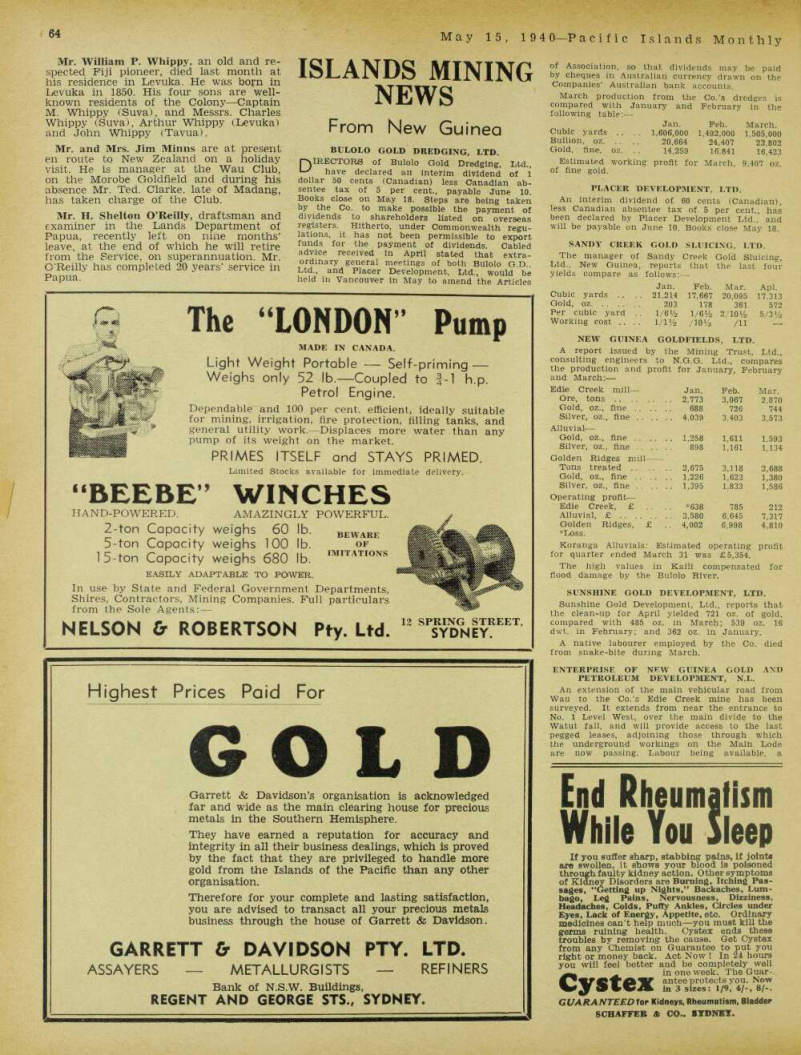
Papuan Officials and Salary Standards
Letter to the Editor MR. G. A. Louden is to be congratu lated upon his illuminating contri bution (“P.1.M.”, 15/3/40) as any one with a knowledge of Papuan condi tions knows well that the future of the Territory must rest upon agriculture, and upon agriculture alone. Anyone whose lawful occasion has led him into the great valley systems of Central New Guinea must be aware of the potentiali ties of the place and the necessity of means of transport.
But when Mr. Louden strays from the path to make remarks upon the pam pering of the Papuan Civil Service, and even to reflect upon the 40 or 50 elderly men who lead the not very exciting existence of pensioners, he is talking about a subject upon which he is pal pably ignorant.
A perusal of the conditions under which civil servants in some of the Crown Colonies serve would prove to Mr. Louden that the Papuan Civil Ser vice is not treated, in the matter of leave and travelling expenses especially, any better than others who give up their lives to a tropical service.
It seems to be the fashion, these days, to criticise civil servants, and such criH cism usually emanates from those with little knowledge of the duties involved.
After all, Mr. Louden, the labourer is worthy of his hire, whether he lives in a comfortable planter’s residence, or spends his days amid the swamps or razor-backs of inland Papua, for the sake of Empire, or risks his life amid the shoals of the Eastern divisions.
Only the other day, our greatest civil servant died in harness, at the age of 78, working to the end!
It would, indeed, be an unworthy thing if such men were asked to accept a monetary reward about equal to that of some of the store employees of Port Moresby.
I am, etc.,
Alexander Rentoul.
The Residency, Misima, 3/4/1940.
Mr. Don. Haig:, Rabaul manager for the Yorkshire Insurance Co., returned to the Mandated Territory in April, after a short holiday in Australia.
Mr. William P. Whippy, an old and re spected Fiji pioneer, died last month at his residence in Levuka. He was born in Levuka in 1850. His four sons are well known residents of the Colony—Captain M. Whippy (Suva), and Messrs. Charles Whippy (Suva), Arthur Whippy (Levuka) and John Whippy (Tavua).
Mr. and Mrs. Jim Minns are at present en route to New Zealand on a holiday visit. He is manager at the Wau Club, on the Morobe Goldfield and during his absence Mr. Ted. Clarke, late of Madang, has taken charge of the Club.
Mr. H. Shelton O’Reilly, draftsman and examiner in the Lands Department of Papua, recently left on nine months’ leave, at the end of which he will retire from the Service, on superannuation. Mr.
O’Reilly has completed 20 years’ service in Papua.
Advertisements & other items, pp. 67-68 (2 items)
63
Pacific Islands Monthl y—M ay 15, 1940
Usoline
Gramophone and
Record Buyers
Reconditioned His Master's Voice Portables—Equal to New.
Delivered Straight to You for £4/4/-- No extras to pay for.
Send your record orders to us.
Immediate attention. Can be sent c.o.d.
TALKERIES
161 CASTLEREAGH ST.. SYDNEY
WE SPECIALISE
IN THE
MAKING & REPAIRING
CHRISTIES Pty. Ltd.
568 George Street, Sydney.
FOR
Umbrellas, Walking Sticks, and Sunshades. Ladies’, Military, and Highland Tailoring. of all kinds of
UMBRELLAS
Price List sent post free on request.
IT ATTRACTS —THEY EAT IT —THEY DIE
I|NGTCQ(
USOLINE
NEVER
KNOWN
TO FAIL!
AUSOLI N E CO.
314 CROWN STREET, SYDNEY
(Established 1919)
COCKROACH
DESTROYER
IT'S A PASTE
PRICES:
lib. 5/- . . . Bibs. 10/-.
Postage Extra.
Remit Cash with Order.
Obtainable also from Islands stores of:
BURNS. PHILP & Co. Ltd.
W. R. CARPENTER & Co. Ltd.
The “LONDON” Pump
MADE IN CANADA.
Light Weight Portable Self-priming
Weighs only 52 lb.—Coupled to f-1 h.p.
Petrol Engine.
Dependable and 100 per cent, efficient, ideally suitable for mining, irrigation, fire protection, filling tanks, and general utility work.—Displaces more water than any pump of its weight on the market.
PRIMES ITSELF and STAYS PRIMED.
Limited Stocks available for immediate delivery. ii
BEEBE” WINCHES
BEWARE
OF
IMITATIONS
HAND-POWERED. AMAZINGLY POWERFUL.
2-ton Capacity weighs 60 lb. 5-ton Capacity weighs 100 lb. 15-ton Capacity weighs 680 lb.
EASILY ADAPTABLE TO POWER,
In use by State and Federal Government Departments, Shires, Contractors, Mining Companies. Full particulars from the Sole Agents:—
NELSON Cr ROBERTSON Pty. Ltd.
12 SPRING STREET.
SYDNEY.
Highest Prices Paid For
GOLD
Garrett & Davidson’s organisation is acknowledged far and wide as the main clearing house for precious metals in the Southern Hemisphere.
They have earned a reputation for accuracy and integrity in all their business dealings, which is proved by the fact that they are privileged to handle more gold from the Islands of the Pacific than any other organisation.
Therefore for your complete and lasting satisfaction, you are advised to transact all your precious metals business through the house of Garrett & Davidson.
GARRETT & DAVIDSON PTY. LTD.
ASSAYERS METALLURGISTS REFINERS
Bank of N.S.W. Buildings,
REGENT AND GEORGE STS., SYDNEY.
Islands Mining
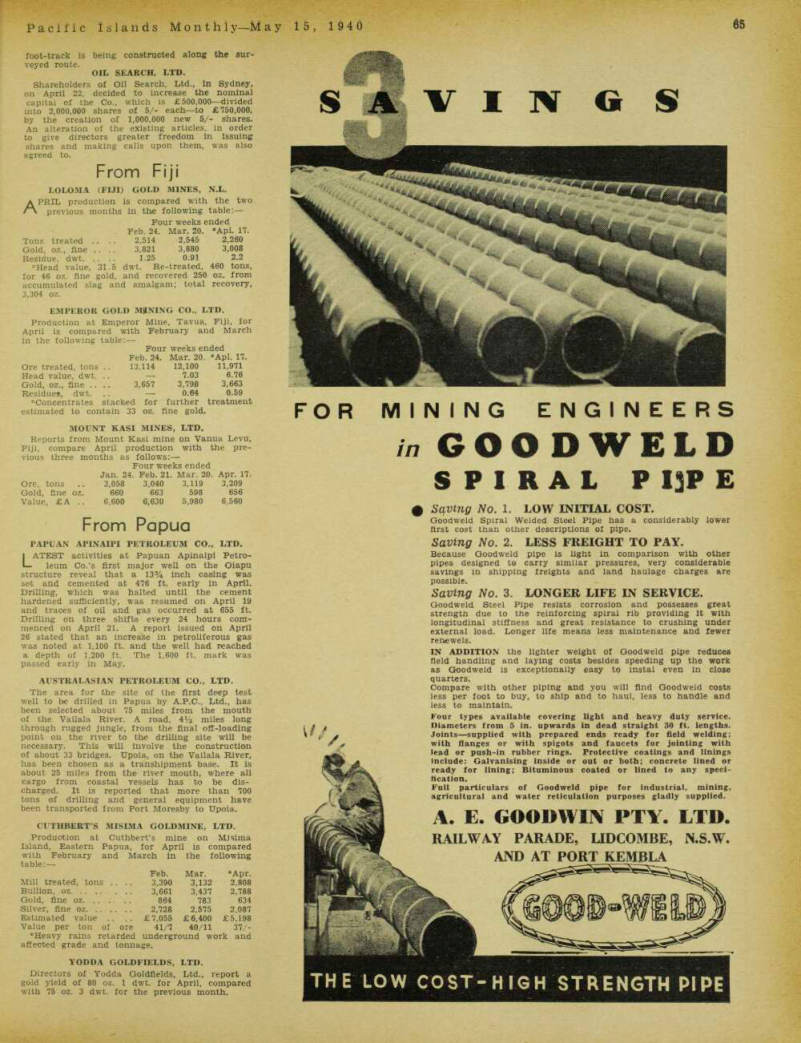
News
From New Guinea
Bulolo Gold Dredging, Ltd,
pvIRECTORS of Bulolo Gold Dredging, Ltd., hav e declared an interim dividend of 1 dollar 50 cents (Canadian) less Canadian ab sentee tax of 5 per cent., payable June 10.
Books close on May 18. Steps are being taken by the Co. to make possible the payment of dividends to shareholders listed on overseas registers. Hitherto, under Commonwealth regu lations, it has not been permissible to export funds for the payment of dividends. Cabled advice received in April stated that extra ordinary general meetings of both Bulolo G.D., Ltd., and Placer Development, Ltd., would be held in Vancouver in May to amend the Articles
of Association, so that dividends may be paid by cheques in Australian currency drawn on the Companies’ Australian bank accounts.
March production from the Co.’s dredges is compared with January and February in the following table:—
Placer Development, Ltd.
An interim dividend of 60 cents (Canadian), less Canadian absentee tax of 5 per cent., has been declared by Placer Development Ltd., and will be payable on June 10, Books close May 18.
Sandy Creek Gold Sluicing, Ltd.
The manager of Sandy Creek Gold Sluicing, Ltd., New Guinea, reports that the last four yields compare as follows:
New Guinea Goldfields, Ltd.
A report issued by the Mining Trust, Ltd., consulting engineers to N.G.G. Ltd., compares the production and profit for January, February and March:—
Koranga Alluvials: Estimated operating profit for quarter ended March 31 was £5,354.
The high values in Kaili compensated for flood damage by the Bulolo River,
Sunshine Gold Development, Ltd.
Sunshine Gold Development, Ltd., reports that the clean-up for April yielded 721 oz. of gold, compared with 485 oz. in March; 539 oz. 16 dwt. in February; and 362 oz. in January.
A native labourer employed by the Co. died from snake-bite during March.
Enterprise Of New Guinea Gold And
Petroleum Development, N.L.
An extension of the main vehicular road from Wau to the Co.’s Edie Creek mine has been surveyed. It extends from near the entrance to No. 1 Level West, over the main divide to the Watut fall, and will provide access to the last pegged leases, adjoining those through which the underground workings on the Main Lode are now passing. Labour being available, a
Jan.
Feb.
March.
Cubic yards 1.606,000 1,492,000 1,505,000 Bullion, oz. 20,664 24,407 23,802 Gold, fine. oz. .. 14,259 16,841 16,423 Estimated working profit for March, 9,407 oz. of fine gold.
Jan. Feb. Mar. Apl.
Cubic yards .. . . 21,214 17,667 20,095 17.313 Gold, oz 203 178 361 572 Per cubic yard .. 1/6V 2 l/6y 2 2/10 y 2 5/3y 2 Working cost .. .. l/iy 2 /loy 2 /II —
Edie Creek mill— Jan.
Feb.
Mar.
Ore, tons 2,773 3,067 2,870 Gold, oz., flue 688 726 744 Silver, oz., fine . 4,039 3,403 3,573 Alluvial— Gold, oz., fine . 1,258 1,611 1,593 Silver, oz., fine 898 1,161 1,134 Golden Ridges mill Tons treated 2,675 3,118 2,688 Gold, oz., fine , 1,226 1,623 1,380 Silver, oz., fine . 1,395 1,833 1,586 Operating profit— Edie Creek, £ *638 785 212 Alluvial, £ , 3.580 6,645 7,317 Golden Ridges, £ 4,002 6,998 4,810 *Loss.
foot-track is being constructed along the sur veyed route.
Oil Search, Ltd.
Shareholders of Oil Search, Ltd., in Sydney, on April 22, decided to increase the nominal capital of the Co., which is £500,000 —divided into 2,000,000 shares of 5/- each —to £750,000, by the creation of 1,000,000 new 5/- shares.
An alteration of the existing articles, in order to give directors greater freedom in issuing shares and making calls upon them, was also agreed to.
From Fiji
Loloma (Fiji) Gold Mines, N.L.
APRIL production is compared with the two previous months in the following table: —
Emperor Gold Mjining Co., Ltd.
Production at Emperor Mine, Tavua, Fiji, for April is compared with February and March in the following table; —
Mount Kasi Mines, Ltd.
Reports from Mount Kasi mine on Vanua Levu, Fiji, compare April production with the pre vious three months as follows: —
From Papua
Papuan Apinaipi Petroleum Co., Ltd.
LATEST activities at Papuan Apinaipi Petro leum Co.’s first major well on the Oiapu structure reveal that a 13% inch casing was set and cemented at 476 ft. early in April.
Drilling, which was halted until the cement hardened sufficiently, was resumed on April 19 and traces of oil and gas occurred at 655 ft.
Drilling on three shifts every 24 hours com menced on April 21. A report issued on April 26 stated that an increase in petroliferous gas was noted at 1,100 ft. and the well had reached a depth of 1,200 ft. The 1,600 ft. mark was passed early in May.
Australasian Petroleum Co., Ltd.
The area for the site of the first deep test well to be drilled in Papua by A.P.C., Ltd., has been selected about 75 miles from the mouth of the Vailala River. A road, 4% miles long through rugged jungle, from the final off-loading point on the river to the drilling site will be necessary. This will involve the construction of about 33 bridges. Upoia, on the Vailala River, has been chosen as a transhipment base. It is about 25 miles from the river mouth, where all cargo from coastal vessels has to be dis charged. It is reported that more than 700 tons of drilling and general equipment have been transported from Port Moresby to Upoia.
Cuthbert’S Misima Goldmine, Ltd.
Production at Cuthbert’s mine on Misima Island, Eastern Papua, for April is compared with February and March in the following table:—
Yodda Goldfields, Ltd.
Directors of Yodda Goldfields, Ltd., report a gold yield of 80 oz. 1 dwt. for April, compared with 75 oz. 3 dwt. for the previous month.
Four weeks ended Feb. 24. Mar. 20. •Apl. 17.
Tons treated . ,. . . 2,514 2,545 2,260 Gold, oz., fine . . .. 3,821 3,880 3,008 Residue, dwt. . . .. 1.25 0.91 2.2 *Head value. 31.5 dwt. Re-treated, 460 tons, for 46 oz. fine gold, and recovered 250 oz. from accumulated slag and amalgam; total recovery, 3,304 oz.
Four weeks ended Feb. 24, . Mar. 20. *Apl. 17.
Ore treated, tons 13,114 12,100 11,971 Head value, dwt. .. — 7.03 6.76 Gold, oz., fine .. 3,657 3,798 3.663 Residues, dwt. ,. — 0.64 0.59 ♦Concentrates stacked for further treatment estimated to contain 33 oz. fine gold.
Pour weeks ended Jan. 24. Feb. 21. Mar. 20. Apr. 17.
Ore, tons .. 3,058 3,040 3,119 3,209 Gold, fine oz. 660 663 598 656 Value. £ A .. 6,600 6,630 5,980 6,560
Feb. Mar. *Apr.
Mill treated, tons .. .. 3,390 3,132 2.808 Bullion, oz 3,661 3,437 2.788 Gold, fine oz 864 783 634 Silver, fine oz 2,728 2,575 2,087 Estimated value .. .. £7.055 £6,400 £5,198 Value per ton of ore 41/7 40/11 37/- ♦Heavy rains retarded underground work and affected grade and tonnage.
Advertisements & other items, pp. 68-70 (2 items)
64
May 15, 194 O—P acific Islands Monthly
End Rheumatism
While You Sleep
If you suffer sharp, stabbing pains, if joints are swollen, it shows your blood is poisoned through faulty kidney action. Other symptoms of Kidney Disorders are Burning, Itching Passages, “Getting up Nights,” Backaches, Lumbago, Leg Pains, Nervousness, Dizziness, Headaches, Golds, Puffy Ankles, Circles under Eyes, Lack of Energy, Appetite, etc. Ordinary medicines can’t help much—you must kill the germs ruining health. Cystex ends these troubles by removing the cause. Get Cystex from any Chemist on Guarantee to put you right or money back. Act Now ! In 24 hours you will feel better and be completely well in one week. The Guarantee protects you. Now in 3 sizes: 1/9, 4/-, 8
Cystex
GUARANTEED lor Kidneys, Rheumatism, Bladder
SCHAFFER & CO.. SYDNEY.
V 1 **'> *4 % % %
FOR MINING ENGINEERS
in
GOO D WELD
SPIRAL P IJP E
Saving No. 1. LOW INITIAL COST.
Goodweld Spiral Welded Steel Pipe has a considerably lower first cost than other descriptions of pipe.
Saving No. 2. LESS FREIGHT TO PAY.
Because Qoodweld pipe is light in comparison with other pipes designed to carry similar pressures, very considerable savings in shipping freights and land haulage charges are possible.
Saving No. 3. LONGER LIFE IN SERVICE.
Goodweld Steel Pipe resists corrosion and possesses great strength due to the reinforcing spiral rib providing it with longitudinal stiffness and great resistance to crushing under external load. Longer life means less maintenance and fewer renewals.
IN ADDITION the lighter weight of Goodweld pipe reduces Held handling and laying costs besides speeding up the work as Goodweld is exceptionally easy to instal even in close quarters.
Compare with other piping and you will find Goodweld costs less per foot to buy, to ship and to haul, less to handle and less to maintain.
Four types available covering light and heavy duty service.
Diameters from 5 in. upwards in dead straight 30 ft. lengths.
Joints—supplied with prepared ends ready for field welding; with flanges or with spigots and faucets for jointing with lead or push-in rubber rings. Protective coatings and linings include: Galvanising inside or out or both; concrete lined or ready for lining: Bituminous coated or lined to any specification.
Full particulars of Goodweld pipe for industrial, mining, agricultural and water reticulation purposes gladly supplied.
A. E. GOODWIN PTY. LTD.
RAILWAY PARADE, LIDCOMBE, N.S.W.
AND AT PORT KEMBLA
A
The World’s Best, neatest and most modern Pocket Knife, opens by finger push 3 positions, shuts one action.
Stainless Blade. Made in Dribble Drinking Glasses for Fun. 2/each —-3 for 5/6. Take them to the party.
ACCUMULATORS
We sell all Types and Sizes—Fully Guaranteed.
RADIO ACCUMULATORS.
2 Volt. 110 Amp 17/- 2O- / , 22/6 , 36/8 45/6 , 63/6 150 73/9 170 „ 84/6
AUTO ACCUMULATORS,
t. 9 Plate 60 Amp. . . 31/9 90 103 116 50 40/- 44/6 51/- 49/3 65/9
HOME LIGHTING ACCUMULATORS.
2 Volt. 120 Amps 20/9 210 35/9 2 „ 200 41/-
GAMES
Dart Boards, 4/6, 8/6, 10/6, 15/-.
Brass Competition Darts, Set of 3, 3/11, 4/6, 5/6. Monopoly, 10/6.
Totopoly, 10/6. Bucaneer, 10/6. 3 of the World’s Most Popular Games.
Chinese Checkers, 3/6, 4/6, 8/6.
Tripoly Card Game, 5/-. De Luxe Model Game, 10/6. Poker Rummy, 1/-. Pot Luck, 1/-. Playing Card Lotto, 1/-. We Stock All Kinds of Indoor Games. Send for Booklet.
Neat Metal Bound Wooden Cigarette Cabinet, 4/9, for building Music Box unit into.
Complete Mechanical Units for Musical Cigarette Boxes, etc., 12/6, 15/-. Plays two Tunes. Music- Boxes. 30/-, 35/-, 45/-. Musical Cigarette Boxes, 35/-.
“LIKE-A-FLASH” DE LUXE
RADIO RECEIVERS FROM
MAKER TO USER
Regardless of Make, Trade-Name or Price, “Like-a-Flash” Radio Sets cannot be bettered. Hundreds of our sets are giving excellent service right throughout the Islands.
“Like-a-Flash” De Luxe Dual Wave 5 Valve Battery Operated Receiver.
This is one of the most powerful models in our battery set series, and the Radio Frequency stage oi amplification gives the set a world range on short wave channels as well as full coverage range of Australasian “A” and “B” Class Broadcasters.
The set is also specially designed to give maximum service in humid climates, such as North Queensland and Pacific Island Territories. A vital part very vulnerable to “dampness” in ordinary receivers is the “Intermediate Frequency Section”.
In this set our Engineers have fitted special inductance tuned intermediate frequency transformers, which do not require trimmers.
These units ensure correct alignment for a continuous period. An 8 in. Aero Dial calibrated in stations facilitates tuning. Valves used are:
2—lC4, I—KK2, I—lK6, I—lD4.
The speaker is the latest Amplion Permagnetic Model, capable of high fidelity reproduction. Battery equipment consists of extra heavy capacity units as follows: — 1 2 Volt 100 amp. Accumulator. 3 Ever-fteady Superdyne 45 Volt “B” Batteries. 1 Ever-Ready 4V 2 in, “C” Battery.
The outfit is housed in a beautfully veneered floor model Console Cabinet.
PRICE: £22/5/-.
“PRESTO”
THE
MAGIC
BOX
The most Amazing Trick — Just out.
“Presto”. —The greatest, most alluring and outstanding little trick ever introduced, 2/9. Post Free.
Money back if it’s not the best yet.
fOB
VOUR/
ifXTHW
EXTRA**'
(SveXsoN
iaH!S
SPEC
High-pitched Tone De Luxe Pro* (essionol Buzzer. The best made • 5/- Books just landed, 1/9 ea.
Popular Party Games.
Tea Cup Telling Fortune Card Tricks—
No.. I.—Sheffield made Throwing Knife in sheath, 6/9.
iiWC
No. 2.—Remington, U.S.A. made, Hunting and Sporting Knives in Sheath, 10/6. A Beautiful Article. !l NOW. direct from the New York World’s Fair, comes the Biggest Novelty Sensation of this or any other year.
NOVELTY TRANSFER.
DRINKING GLASSES.
SIX BEAUTIFUL GIRLS.
Lovely Young Ladies—Blondes and Brunettes—ln Gloriously Coloured Costumes. One appears on the outside, as well as the inside of each Tumbler. 12/- for set of 6.
Girls with Dual Personalities.
Turn the glass so as you can now see inside; see the pretty Miss appear—and LO! away drops her Costume or Dress and True Beauty is revealed in all its loveliness.
Nothing improper or suggestive.
Just the female form—divine. The most fastidious would not be offended.
BOOKS! BOOKS! BOOKS! The Be-
ginners’ Book of Radio. The Radio Beginners’ Dictionary. 2/- the 2. The Wireless Constructor’s Encyclopaedia. Giant size, 7/6. Newnes “Everyman’s” Wireless Book, 5/6.
The Book of Practical Radio, also The Book of Practical Television, 8/6 each. Foulsham’s Giant “Party and Fun Book”, 1/6. Humorous Stories and Recitations, 3/9. Card and Conjuring Tricks, 8/9. Tea- Cup Fortune Telling, 3/9. 100 Party Games for Old and Young, 1/9.
Popular Magic and Amateur Conjurer, 1/9. 50 Best Party Games, 1/6. Tricks with Cards, 1/6.
No. 1 Morse Code Practice Sets, with Switch Buzzer to Light. Use as you desire. 25/- complete.
No. 2, with Heavier Type Morse Key: 30/-. Pendograph Bug Key. 70/-. Special High Pitched Adjustable Professional Morse Buzzer, 15/-.
The Most Modern of all Safety Match Boxes. 2/-.
One match waiting each time.
Bakelite Case.
VYtrnnrrfinarv wan. iokc our one moren at txtraoramary vou rc<4Uirc , t; no opcn , ng bOM , Neat eoch time Bokclile moulded.
Useful. l/ - pos, ~e*
P.M.G.
Type Sounders. 35/-.
Special Bakelite Cased English Adjustable Morse Code Buzzer — 4/9.
Adjustable All-way Morse Key, Long or Short Tap, 12/6. Heavier P.M.G.
Type, 19/6. Learn Morse Book 1/-.
As illustrated Long or Shott Toppers, 12/6 Adjustable all xo*s. Bok&Wo bosc Nickellcd t-ttmgs.
The latest and " best MATCH BOX tor Safety's. Will lost tor 58/6 From London, “Cosmocord” De Luxe Crystal Pick-up, with Built-in Vol.
Control. Magnetic type Pick-ups, complete with volume control and tone arm. All British Make, 30/-, 35/-, 38/6, 45/-, and Studio Model, 50/-.
Play, Talk, Sing, Joke through your Radio. Great Fun. Batteryless type.
Microphone for Hand Holding or Hanging, 22/6. Complete with lead fixed in a second. Others, 12/6, 15/-, 17/6, 25/-, 28/6, 32/6. All plus 1/9 for Battery and 1/6 for 20 ft. Cord.
Write for full detailed list. si B.G.E. Table Type Microphone. Highly recommended for Amateur or Professional use. Built-in Transformer and Battery with Volume Control incorporated.
Just plug into pickup terminals it any set. 89/6.
iiimiiiiiiiiiiiiniii
Write for Punch Board Leaflets
inniniiinmiTmn
LEVENSON S RADIO
GAMES. NOVELTIES AND HOBBIES.
226 PITT STREET, SYDNEY
Manufacturers, Importers, and Exporters.
N.S.W., AUSTRALIA.
iiiiiiiiniiiiiiiniiiiiir
Write for Pin-Game, Totem and Odds and Evens Leaflets
iiiiiiiiiiiiiniiiiiiiiiii
Cable address: “Leveradioh”. Goods forwarded V.P.P. or Sight Draft. Satisfaction and Service Guaranteed. We can supply by mail all General Merchandise at a Better Price. Quotations with pleasure. Please add freight and packing. Write for full list of interesting leaflets of Games, Hobbies, Novelties, and Electrical Goods. Write for full Ust of Radio Meters.
We Can Supply, at a Keen Price, Any Available Article You Require,
Quotations For Mining
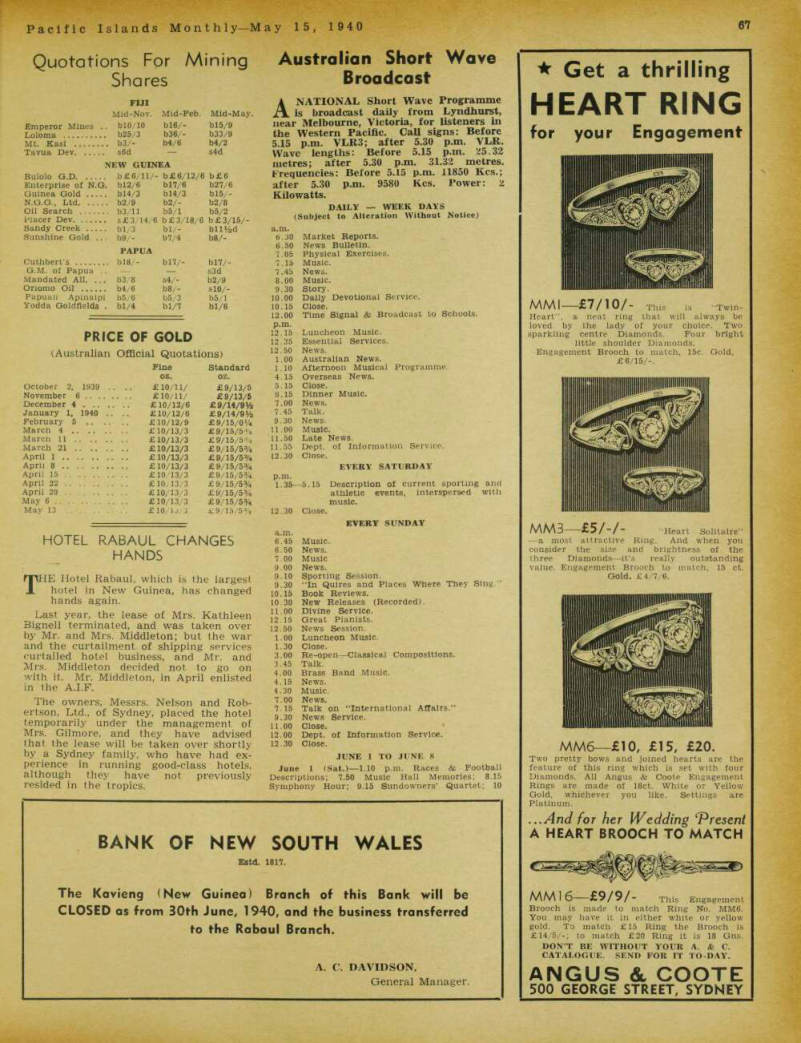
Shares
Fiji
Mid-Nov.
Mid-Feb.
Mid-May.
Emperor Mines .. bl0/10 bl6/bl5/9 Loloma b25/3 b36/b33/9 Mt. Kasl b3/b4/6 b4/2 Tavua Dev s6d — s4d
New Guinea
Bulolo G.D b £ 6/11/b£6/12/6 b£6 Enterprise of N.G. b!2/6 bl7/6 b27/6 Guinea Gold b!4/3 bl4/3 bl5/- N.G.G., Ltd b2/9 b2/b2/8 Oil Search b3/ll b5/l b5/2 Placer Dev s£ 3/14/6 b£ 3/18/6 b£3/15/- Sandy Creek bl/3 bl/bllVfed Sunshine Gold .,. b9/b7/4 b8/- Cuthbert’s
Papua
bl8/bl7/bl7/- G.M. of Papua . . — — s3d Mandated All. .., b3/8 s4/~ b2/9 Onomo Oil b4/6 b8/slO/- Papuan Apinaipi b5/6 b5/3 b5/l Yodda Goldfields . bl/4 bl/7 bl/6
Price Of Gold
(Australian
Official Quotations)
Fine Standard oz. oz.
October 2, 1939 . . .. £10/11/ £9/13/5 November 6 . .. £10/11/ £9/13/6 December 4 . .. £10/12/6 £ 9/14/9 Va January 1, 1940 .. £10/12/6 £ 9/14/9 V a February 5 .. £10/12/9 £ 9/15/0 V* March 4 £10/13/3 £9/15/5% March 11 £ 10/13/3 £9715/5% March 21 £9/15/5% April 1 £ 10/13/3 £9/15/5% April 8 £ 10/13/3 £9/15/5% April 15 £10/13/3 £9/15/5% April 22 £9/15/5% April 29 £10/13/3 £9715/5% May 6 £9/15/5% May 13 £10/1.5/3 £9/15/5%
Hotel Rabaul Changes
Hands
THE Hotel Rabaul, which is the largest hotel in New Guinea, has changed hands again.
Last year, the lease of Mrs. Kathleen Bignell terminated, and was taken over by Mr. and Mrs. Middleton; but the war and the curtailment of shipping services curtailed hotel business, and Mr. and Mrs. Middleton decided not to go on with it. Mr. Middleton, in April enlisted in the A.I.F.
The owners, Messrs. Nelson and Rob ertson, Ltd., of Sydney, placed the hotel temporarily under the management of Mrs. Gilmore, and they have advised that the lease will be taken over shortly by a Sydney family, who have had ex perience in running good-class hotels, although they have not previously resided in the tropics.
Australian Short Wave
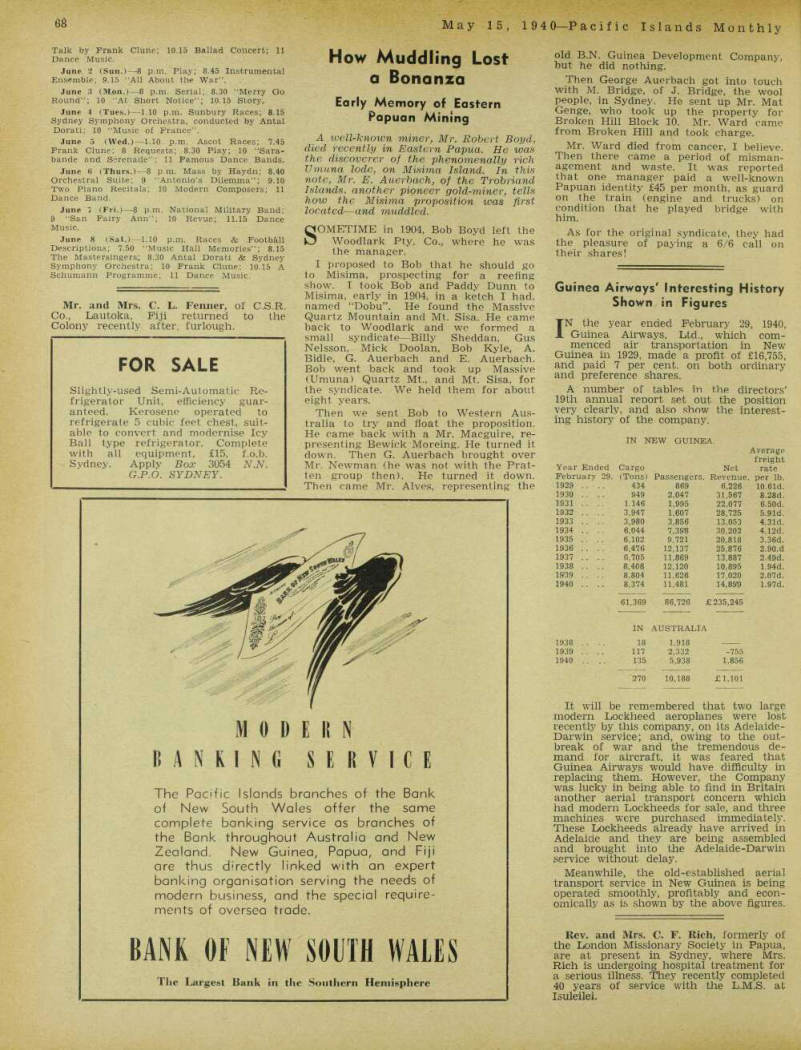
Broadcast
A NATIONAL Short Wave Programme
is broadcast daily from Lyndhurst, near Melbourne, Victoria, for listeners in the Western Pacific. Call signs; Before 5.15 p.m. VLR3; after 5.30 p.m. VLR.
Wave lengths: Before 5.15 p.m. 25.32 metres; after 5.30 p.m. 31.32 metres.
Frequencies: Before 5.15 p.m. 11850 Kcs.; after 5.30 p.m. 9580 Kcs. Power; 2 Kilowatts.
Daily Week Days
(Subject to Alteration Without Notice) a.m. 6.30 Market Reports. 6.50 News Bulletin. 7.05 Physical Exercises. 7.15 Music. 7.45 News. 8.00 Music. 9.30 Story. 10.00 Daily Devotional Service. 10.15 Close. 12.00 Time Signal & Broadcast to Schools, p.m. 12.15 Luncheon Music. 12.35 Essential Services. 12.50 News. 1.00 Australian News. 1.10 Afternoon Musical Programme. 4.15 Overseas News. 5.15 Close. 6.15 Dinner Music. 7.00 News. 7.45 Talk. 9.30 News. 11.00 Music. 11.50 Late News. 11.55 Dept, of Information Service. 12.30 Close.
Every Saturday
p.m. 1.35 —5.15 Description of current sporting and athletic events, interspersed with music. 12.30 Close.
Every Sunday
a.m. 6.45 Music. 6.50 News. 7.00 Music 9.00 News. 9.10 Sporting Session. 9.30 “In Quires and Places Where They Sing.” 10.15 Book Reviews. 10.30 New Releases (Recorded). 11.00 Divine Service. 12.15 Great Pianists. 12.50 News Session. 1.00 Luncheon Music. 1.30 Close. 3.00 Re-open—Classical Compositions. 3.45 Talk. 4.00 Brass Band Music. 4.15 News. 4.30 Music. 7.00 News. 7.15 Talk on “International Affairs." 9.30 News Service. 11.00 Close. 12.00 Dept, of Information Service. 12.30 Close.
June 1 To June X
June 1 (Sat.) —1.10 p.m. Races & Football Descriptions: 7.50 Music Hall Memories; 8.15 Symphony Hour; 9.15 Sundowners’ Quartet; 10
Talk by Frank Clune; 10.15 Ballad Concert; 11 Dance Music.
June 2 (Sun.) —8 p.m. Play; 8.45 Instrumental Ensemble; 9.15 “All About the War’’.
June 3 (M,on.) —8 p.m. Serial; 8.30 “Merry Go Round”; 10 “At Short Notice”; 10.15 Story.
June 4 (Tues.) —1.10 p.m. Sunbury Races; 8.15 Sydney Symphony Orchestra, conducted by Antal Dorati; 10 “Music of Prance”.
June 5 (Wed.) —1.10 p.m. Ascot Races; 7.45 Frank Clune; 8 Requests; 8.30 Play; 10 “Sara bande and Serenade”; 11 Famous Dance Bands.
June 6 (Thurs.) —8 p.m. Mass by Haydn; 8.40 Orchestral Suite; 9 “Antonio’s Dilemma”; 9.10 Two Piano Recitals; 10 Modern Composers; 11 Dance Band.
June 7 (Fri.) —8 p.m. National Military Band; 9 “San Fairy Ann”; 10 Revue; 11.15 Dance Music.
June 8 (Sat.) —1,10 p.m. Races & Football Descriptions; 7.50 “Music Hall Memories”; 8.15 The Mastersingers; 8.30 Antal Dorati & Sydney Symphony Orchestra; 10 Frank Clune; 10.15 A Schumann Programme; 11 Dance Music.
Mr. and Mrs. C. L. Fenner, of C.S.R.
Co., Lautoka, Fiji returned to the
Colony recently after furlough.
Advertisements & other items, p. 71 (1 item)
Heart Ring
★ Get a thrilling
for your Engagement
-' MMI— £7/10/- This is “Twin- Heart”, a neat ring that will always be loved by the lady of your choice. Two sparkling centre Diamonds. Four bright little shoulder Diamonds.
Engagement Brooch to match, 15c. Gold, £6/15/-.
BOM
MM3— £s/-/- “Heart Solitaire”
—a most attractive Ring. And when you consider the size and brightness of the three Diamonds—it’s really outstanding value. Engagement Brooch to match, 15 ct.
Gold. £4/7/6. r m
MM6 —£lo, £l5, £2O.
Two pretty bows and joined hearts are the feature of this ring which is set with four Diamonds. All Angus & Coote Engagement Rings are made of 18ct. White or Yellow Gold, whichever you like. Settings are Platinum.
...And for her Wedding resent
A HEART BROOCH TO MATCH
MMI 6— £9/9/-
This Engagement Brooch is made to match Ring No. MM6.
You may have it in either white or yellow gold. To match £l5 Ring the Brooch is £l4/5/-; to match £2O Ring it is 18 Gns.
DON’T BE WITHOUT YOUR A. & C.
CATALOGUE. SEND FOR IT TO-DAY.
ANGUS & COOTE
500 GEORGE STREET, SYDNEY
BANK OF NEW SOUTH WALES
Estd. 1817.
The Kavieng (New Guinea) Branch of this Bank will be CLOSED as from 30th June, 1940, and the business transferred to the Rabaul Branch.
A. C. DAVIDSON,
General Manager.
a Bonanza
How Muddling Lost a Bonanza Early Memory of Eastern Papuan Mining
A well-known miner, Mr. Robert Boyd, died recently in Eastern Papua. He was the discoverer of the phenomenally rich Umuna lode, on Misima Island. In this note, Mr. E. Auerbach, of the Trobriand Islands, another pioneer gold-miner, tells how the Misima proposition was first located —and muddled.
SOMETIME in 1904, Bob Boyd left the Woodlark Pty. Co., where he was the manager.
I proposed to Bob that he should go to Misima, prospecting for a reefing show. I took Bob and Paddy Dunn to Misima, early in 1904, in a ketch I had, named “Dobu”, He found the Massive Quartz Mountain and Mt. Sisa. He came back to Woodlark and we formed a small syndicate—Billy Sheddan, Gus Nelsson, Mick Doolan, Bob Kyle, A.
Bidle, G. Auerbach and E. Auerbach.
Bob went back and took up Massive (Umuna) Quartz Mt., and Mt. Sisa, for the syndicate. We held them for about eight years.
Then we sent Bob to Western Aus tralia to try and float the proposition.
He came back with a Mr. Macguire, re presenting Bewick Moreing. He turned it down. Then G. Auerbach brought over Mr. Newman (he was not with the Prat ten group then). He turned it down.
Then came Mr. Alves, representing the
old B.N. Guinea Development Company, but he did nothing.
Then George Auerbach got into touch with M. Bridge, of J. Bridge, the wool people, in Sydney. He sent up Mr. Mat Genge, who took up the property for Broken Hill Block 10. Mr. Ward came from Broken Hill and took charge.
Mr. Ward died from cancer, I believe.
Then there came a period of misman agement and waste. It was reported that one manager paid a well-known Papuan identity £45 per month, as guard on the train (engine and trucks) on condition that he played bridge with him.
As for the original syndicate, they had the pleasure of paying a 6/6 call on their shares!
Guinea Airways' Interesting History
Shown in Figures
IN the year ended February 29, 1940, Guinea Airways, Ltd., which com menced air transportation in New Guinea in 1929, made a profit of £16,755, and paid 7 per cent, on both ordinary and preference shares.
A number of tables in the directors’ 19th annual renort set out the position very clearly, and also show the interest ing history of the company.
It will be remembered that two large modern Lockheed aeroplanes were lost recently by this company, on its Adelaide- Darwin service; and, owing to the out break of war and the tremendous de mand for aircraft, it was feared that Guinea Airways would have difficulty in replacing them. However, the Company was lucky in being able to find in Britain another aerial transport concern which had modern Lockheeds for sale, and three machines were purchased immediately.
These Lockheeds already have arrived in Adelaide and they are being assembled and brought into the Adelaide-Darwin service without delay.
Meanwhile, the old-established aerial transport service in New Guinea is being operated smoothly, profitably and econ omically as is shown by the above figures.
Rev. and Mrs. C. F. Rich, formerly of the London Missionary Society in Papua, are at present in Sydney, where Mrs.
Rich is undergoing hospital treatment for a serious illness. They recently completed 40 years of service with the L.M.S. at Isuleilei.
In New Guinea.
Average freight Year Ended Cargo Net rate February 29. (Tons) Passengers.
Revenue, per lb. 1929 . . . . 434 869 6,226 10.61d. 1930 . . . . 949 2,047 31,567 8.28d. 1931 .. .. 1,146 1,995 22,077 6.50d. 1932 . . . . 3,947 1,607 28,725 5.91d. 1933 . . . . 3,980 3,856 13.053 4.31d. 1934 . . ,. 6,044
7, Sb's
30,202 4.12d. 1935 .. .. 6,102 9,721 20,818 3.36d. 1936 . . .. 6,476 12,137 25,876 2.90.d 1937 .. .. 6,705 11,869 13,887 2.49d. 1938 .. .. 8,408 12,120 10,895 1.94d. 19*39 . . 8,804 11,626 17,020 2.07d. 1940 .. 8,374 11,481 14,899 1.97d. 61,369 86,726 £235,245 IN
Australia
1938 . . 18 1,918 1939 . . 117 2,332 -755 1940 . . . . 135 5,938 1,856 270 10,188 £1,101
Advertisements & other items, pp. 72-73 (3 items)
68
May 15, 194 O—P acific Islands Monthly
Bank Of New South Wales
FOR SALE
Slightly-used Semi-Automatic Refrigerator Unit, efficiency guaranteed. Kerosene operated to refrigerate 5 cubic feet chest, suitable to convert and modernise Icy Ball type refrigerator. Complete with all equipment, £l5, f.o.b.
Sydney. Apply Box 3054 N.N.
G.P.O. SYDNEY.
r
MODERN
BANKING SERVICE
The Pacific Islands branches of the Bank of New South Wales offer the same complete banking service as branches of the Bank throughout Australia and New Zealand. New Guinea, Papua, and Fiji are thus directly linked with an expert banking organisation serving the needs of modern business, and the special requirements of oversea trade.
BANK OF NEW SOUTH WALES
The Largest Bank in the Southern Hemisphere
Price 30 Gns.
a / M \ *
I y|l» !
is f-
ill:
f !l HERE are two of the World famous Kriesler Models specially designed for Island Reception and tropic proofed to maintain sensitivity, long life and unvarying performance. No matter what radio you buy you cannot approach Kriesler performance. definitely—“ The Best Set at any Price”
MODEL 4K4C
Mantel type, 6 Volt, 5 Valve, Vibrator operated Radio in moisture proofed walnut veneered cabinet, full size console chassis and speaker giving outstanding shortwave world range reception.
Price 30 Gns.
MODEL 4K87
5 Valve (1.4 volt low consumption) World Range Portable with self contained long life batteries and built-in aerial. 15,000 miles range guaranteed on short waves. Handsome aeroplane cloth brief case— light, compact and hard wearing.
Provision made for external heavy duty batteries.
Price 20 Gns.
For full particulars write : Kriesler Australasia Pty., Ltd., Box 23 P.O. Newtown, N.S.W. 1:1
Islands Produce
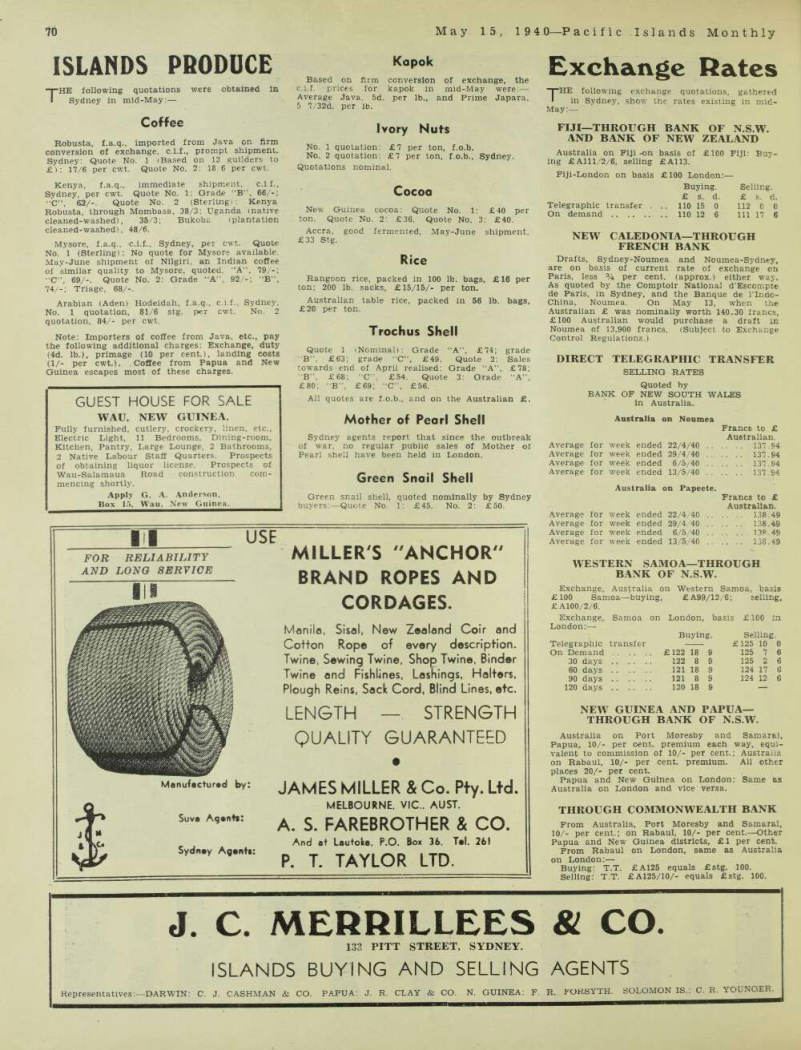
THE following quotations were obtained in Sydney in mid-May:—
Coffee
Robusta, f.a.q., imported from Java on firm conversion of exchange, c.i.f., prompt shipment.
Sydney: Quote No. 1 (Based on 12 guilders to £): 17/6 per cwt. Quote No. 2: 18 6 per cwt.
Kenya, f.a.q., immediate shipment, c.i.f., Sydney, per cwt. Quote No. 1; Grade “B”, 66/-; “C”, 62/-. Quote No. 2 (Sterling!: Kenya Robusta, through Mombasa, 38/3: Uganda (native cleaned-washed), 35/3; Bukoba (plantation cleaned-washed), 48/6.
Mysore, f.a.q., c.i.f., Sydney, per cwt. Quote No. 1 (Sterling): No quote for Mysore available.
May-June shipment of Nilgiri, an Indian coffee of similar quality to Mysore, quoted. “A”. 79/-; ■‘C”, 69/-. Quote No. 2; Grade “A”, 92/-; “B”, 74/-; Triage, 68/-.
Arabian (Aden) Hodeidah, f.a.q., c.i.f., Sydney, No. 1 quotation, 81/6 stg. per cwt. No. 2 quotation, 84/- per cwt.
Note: Importers of coffee from Java, etc., pay the following additional charges: Exchange, duty (4d. lb.), primage (10 per cent.), landing costs (1/- per cwt.). Coffee from Papua and New Guinea escapes most of these charges.
Kapok
Based on firm conversion of exchange, the c.i.f. prices for kapok in mid-May were:— Average Java. sd. per lb., and Prime Japara, 5 7/32d. per lb.
Ivory Nuts
No. 1 quotation: £7 per ton, f.o.b.
No. 2 quotation; £7 per ton, f.0.b., Sydney.
Quotations nominal.
Cocoa
New Guinea cocoa: Quote No. 1: £4O per ton. Quote No. 2: £36. Quote No. 3: £4O.
Accra, good fermented, May-June shipment, £33 Stg.
Rice
Rangoon rice, packed in 100 lb. bags, £l6 per ton; 200 lb. sacks, £l5/15/- per ton.
Australian table rice, packed in 56 lb. bags, £2O per ton.
Trochus Shell
Quote 1 (Nominal): Grade “A”, £74; grade • B”, £63; grade “C”, £49. Quote 2; Sales towards end of April realised: Grade “A”, £7B; B", £6B; £54. Quote 3; Grade “A’ - , £80; -B", £69; “C”, £56.
All quotes are f.0.b., and on the Australian £.
Mother of Pearl Shell
Sydney agents report that since the outbreak of war, no regular public sales of Mother of Pearl shell have been held in London.
Green Snail Shell
Green snail shell, quoted nominally by Sydney buyers:—Quote No. 1; £45. No. 2: £5O.
Exchange Rates
“T“HE following exchange quotations, gathered in Sydney, show the rates existing in mid- May;—
Fiji—Through Bank Of N.S.W.
And Bank Of New Zealand
Australia on Fiji -on basis of £lOO Fiji: Buy ing £Alll/2/6, selling £AII3.
Piji-London on basis £lOO London:—
New Caledonia—Through
French Bank
Drafts, Sydney-Noumea and Noumea-Sydney, are on basis of current rate of exchange on Paris, less % per cent, (approx.) either way.
As quoted by the Comptoir National d’Escompte de Paris, in Sydney, and the Banque de I’lndo- China, Noumea. On May 13, when the Australian £ was nominally worth 140.30 francs, £lOO Australian would purchase a draft in Noumea of 13,900 francs. (Subject to Exchange Control Regulations.)
Direct Telegraphic Transfer
Selling Rates
Quoted by
Bank Of New South Wales
in Australia.
Australia on Noumea
Western Samoa—Through
Bank Of N.S.W.
Exchange, Australia on Western Samoa, basis £lOO Samoa—buying, £A99/12/6; selling,
£ Aloo/2/6.
Exchange, Samoa on London, basis £lOO in London:—
New Guinea And Papua
Through Bank Of N.S.W.
Australia on Port Moresby and Samaral, Papua, 10/- per cent, premium each way, equi valent to commission of 10/- per cent.; Australia on Rabaul, 10/- per cent, premium. All other places 20/- per cent.
Papua and New Guinea on London: Same as Australia on London and vice versa.
Through Commonwealth Bank
From Australia, Port Moresby and Samaral, 10/- per cent.; on Rabaul, 10/- per cent. —Other Papua and New Guinea districts, £1 per cent.
Prom Rabaul on London, same as Australia on London: — Buying: T.T. £AI2S equals £stg. 100.
Selling: T.T. £AI2S/10/- equals £stg. 100.
Buying.
Selling. £ s. d. £ s. d.
Telegraphic transfer . .. 110 15 0 112 0 0 On demand 111 17 6
Average for week ended 22/4/40 . .
Francs to £ Australian. .. .. 137.94 Average for week ended 29/4/40 . . .. .. 137.94 Average for week ended 6/5/40 . . .. .. 137.94 Average for week ended 13/5/40 , . .. .. 137.94 Average for Australia on Papeete. week ended 22/4/40 ..
Francs to £ Australian. .. .. 138.49 Average for week ended 29/4 40 .. .. .. 138.49 Average for week ended 6/5/40 . . .. .. 138.49 Average for week ended 13/5/40 .. .. .. 138.49
Buying. Selling.
Telegraphic transfer £125 10 0 On Demand £122 18 9 125 7 6 30 days 122 8 9 125 2 6 60 days 121 18 9 124 17 6 90 days 121 8 9 124 12 6 120 days 120 18 9 —
Advertisements & other items, p. 74 (2 items)
70
May 15, 194 O—P acific Islands Monthly
J. C. Mehrillees & Co.
GUEST HOUSE FOR SALE
WAU. NEW GUINEA.
Fully furnished, cutlery, crockery, linen, etc., Electric Light, 11 Bedrooms, Dining-room, Kitchen, Pantry, Large Lounge, 2 Bathrooms, 2 Native Labour Staff Quarters. Prospects of obtaining liquor license. Prospects of Wau-Salamaua Road construction commencing shortly.
Apply G. A. Anderson.
Box 15, Wau, New Guinea.
11l
USE
FOR RELIABILITY
AND LONG SERVICE
Manufactured by: Suva Agents: Sydney Agents:
MILLER'S "ANCHOR'
BRAND ROPES AND
CORDAGES.
Zealand Coir and every description.
Manila. Sisal, New Cotton Rope of Twine, Sewing Twine, Shop Twine. Binder Twine and Fishlines, Lashings, Halters, Plough Reins, Sack Cord, Blind Lines, etc.
LENGTH STRENGTH
QUALITY GUARANTEED
JAMES MILLER & Co. Pty. Ltd.
MELBOURNE. VIC.. AUST.
A. S. FAREBROTHER & CO.
And at Lautoka, P.O. Box 36. Tal. 261
P. T. TAYLOR LTD.
J. C. MEHRILLEES & CO.
133 PITT STREET, SYDNEY.
ISLANDS BUYING AND SELLING AGENTS
Representatives —DARWIN; C. J. CASHMAN & CO. PAPUA: J. R. CLAY & CO. N. GUINEA: F. R. FORSYTH. SOLOMON IS.: C. R. YOUNGn-R.
Market Quotations
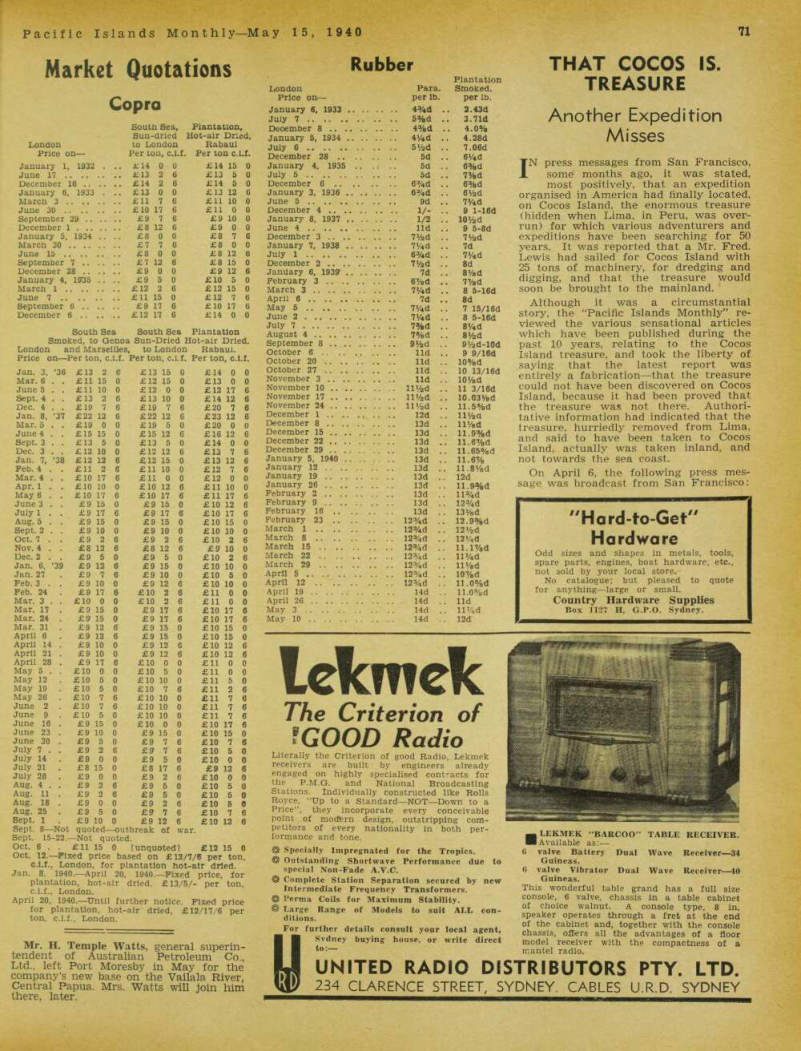
Mr. H. Temple Watts, general superin tendent of Australian Petroleum Co., Ltd., left Port Moresby in May for the company’s new base on the Vailala River, Central Papua. Mrs. Watts will join him there, later.
Rubber
Plantation London Para.
Smoked.
Price on— per lb. per lb.
January 6, 1933 , 4%d .. 2.43d July 7 5%d .. 3.71d December 8 .. . 4%d ., 4.0% January 5, 1934 . 4 l / 4 d .. 4.28d July 6 7.06d December 28 .. 5d .. ey 4 d January 4, 1935 5d .. 6%d July 5 5d .. 7%d December 6 .. 6%d .. 6%d January 3, 1936 . ey 2 d June 5 9d .. 7y 4 d December 4 .. . 9 l-16d January 8, 1937 . 1/2 .. ioy 2 d June 4 lid .. 9 5-8d December 3 .. ,, 7V a d .. 7y 2 d January 7, 1938 . 7y»d .. 7d July 1 7y»d December 2 .. ., 7%d .. 8d January 6, 1939 f . 7d .. sy 8 d February 3 .. .. 6%d .. 7%d March 3 8 5-16d April 6 8d May 5 7»/ 4 d .. 7 15/16d June 2 7%d .. 8 5-16d July 7 sy 4 d August 4 8%d September 8 .. . 9>/ 2 d-10d October 6 . . . . 9 9/16d October 20 .. .. lid .. 10%d October 27 .. .. lid .. 10 13/16d November 3 .. ., ioy 8 d November 10 .. . 11 3/16d November 17 .. . ny 2 d .. 10.03y 8 d November 24 .. . ny 2 d .. 11.5%d December 1 .. .. 12d .. liy 2 d December 8 .. .. ny 8 d December 15 .. . 11.9%d December 22 .. . 11.6%d December 29 .. . 11.65%d January 5, 1940 . 11.6% January 12 .. .. 13d .. 11.8%d January 19 .. .. 13d .. 12d January 26 .. .. 13d .. 11.9%d February 2 .. .. 13d .. ll 3 / 4 d February 9 .. .. 13d .. 12 3 / 4 d February 16 .. 13y 8 d February 23 .. 12 3 / 4 d .. 12.9%d March 1 .. .. 12*/ 2 d March 8 .. .. 12 3 / 4 d .. 12*/ 4 d March 15 .. .. 12%d .. ll.lYad March 22 .. .. 12%d .. ny 4 d March 29 .. .. 12%d .. ny 8 d April 5 12 3 / 4 d .. lOYad April 12 . . .. 12 3 / 4 d .. 11.0%d April 19 14d .. 11.0%d April 26 14d .. lid May 3 14d ny 4 d May 10 14d .. 12d
Copra
South Sea, Plantation, Sun-dried Hot-air Dried, London to London Rabaul Price ( on— Per ton, c.i.f.
Per ton c.l.f.
January 1 . 1932 . £14 0 0 £14 15 0 June 17 . £13 2 6 £13 5 0 December 16 .. , , £14 2 6 £14 5 0 January 6 . 1933 . . . £13 0 0 £13 12 6 March 3 £11 7 6 £11 10 0 June 30 . £10 17 6 £11 0 0 September 29 .. £9 7 6 £9 10 0 December 1 . .. £8 12 6 £9 0 0 January 5, , 1934 £8 0 0 £8 7 6 March 30 £7 7 6 £8 0 0 June 15 . £8 0 0 £8 12 6 September 7 .. £7 12 6 £8 15 0 December 28 .. £9 0 0 £9 12 6 January 4, 1935 . . £9 5 0 £10 5 0 March 1 . £12 2 6 £12 15 0 June 7 .. £11 15 0 £12 7 6 September 6 .. £9 17 6 £10 17 6 December 6 .. £12 17 6 £14 0 0 South Sea South Sea Plantation Smoked, to Genoa Sun-Dried Hot-air Dried.
London and Marseilles, to London Rabaul.
Price on— Per ton, c.i.f.
Per ton, c.i.f.
Per ton, c.l 1.1.
Jan, 3, ’36 £13 2 6 £13 15 0 £14 0 0 Mar. 6 . . £11 15 0 £12 15 0 £13 0 0 June 5 . . £11 10 0 £12 0 0 £12 17 6 Sept. 4 . . £13 2 6 £13 10 0 £14 12 6 Dec. 4 . . £19 7 6 £19 7 6 £20 7 6 Jan, 8, ’37 £22 12 6 £22 12 6 £23 12 6 Mar. 5 . . £19 0 0 £19 5 0 £20 0 0 June 4 , . £15 15 0 £15 12 6 £16 12 6 Sept. 3 . . £13 5 0 £13 5 0 £14 0 0 Dec. 3 . . £12 10 0 £12 12 6 £13 7 6 Jan. 7, ’38 £12 12 6 £12 15 0 £13 12 6 Feb. 4 . . £11 2 6 £11 10 0 £12 7 6 Mar. 4 . . £10 17 6 £11 0 0 £12 0 0 Apr. 1 . . £10 10 0 £10 12 6 £11 10 0 May 6 . . £10 17 6 £10 17 6 £11 17 6 June 3 . . £9 15 0 £9 15 0 £10 12 6 July 1 . . £9 17 6 £9 17 6 £10 17 6 Aug. 5 . , £9 15 0 £9 15 0 £10 15 0 Sept. 2 . . £9 10 0 £9 10 0 £10 10 0 Oct. 7 . . £9 2 6 £9 2 6 £10 2 6 Nov. 4 . . £8 12 6 £8 12 6 £9 10 0 Dec. 2 . . £9 5 0 £9 5 0 £10 2 6 Jan. 6, '39 £9 12 6 £9 15 0 £10 10 0 Jan.27 £9 7 6 £9 10 0 £10 5 0 Feb. 3 . . £9 10 0 £9 12 6 £10 10 0 Feb. 24 £9 17 6 £10 2 6 £11 0 0 Mar. 3 . . £10 0 0 £10 2 6 £11 0 0 Mar, 17 . £9 15 0 £9 17 6 £10 17 6 Mar. 24 . £9 15 0 £9 17 6 £10 17 6 Mar. 31 . £9 12 6 £9 15 0 £10 15 0 April 6 £9 12 6 £9 15 0 £10 15 0 April 14 . £9 10 0 £9 12 6 £10 12 6 April 21 , £9 10 0 £9 12 6 £10 12 6 April 28 . £9 17 6 £10 0 0 £11 0 0 May 5 . . £10 0 0 £10 5 0 £11 0 0 May 12 . £10 5 0 £10 10 0 £11 5 0 May 19 . £10 5 0 £10 7 6 £11 2 6 May 26 . £10 7 6 £10 10 0 £11 7 6 June 2 . £10 7 6 £10 10 0 £11 7 6 June 9 £10 5 0 £10 10 0 £11 7 6 June 16 . £9 15 0 £10 0 0 £10 17 6 June 23 . £9 10 0 £9 15 0 £10 15 0 June 30 . £9 5 0 £9 7 6 £10 7 6 July 7 . . £9 2 6 £9 7 6 £10 5 0 July 14 £9 0 0 £9 5 0 £10 0 0 July 21 , £8 15 0 £8 17 6 £9 12 6 July 28 . £9 0 0 £9 2 6 £10 0 0 Aug. 4 . . £9 2 6 £9 5 0 £10 5 0 Aug. 11 . £9 2 6 £9 5 0 £10 5 0 Aug. 18 . £9 0 0 £9 2 6 £10 5 0 Aug. 25 , £9 5 0 £9 7 6 £10 7 6 Sept. 1 . £9 10 0 £9 12 6 £10 12 6 Sept. 8—Not quoted—outbreak of war.
Sept. 15-22. .—Not quoted.
Oct. 6 . . £11 15 0 [ unquoted 1 £12 15 0 Oct. 12.—Fixed price based on £12/7/6 per ton, G.I.I., London, , for plantation hot-air dried.
Jan. 8, 1940.—April 20. 1940.—Fixed price, for plantation, hot-air dried, £ 13/5/- per ton. c.i.f., London.
April 20, 1940.—Until further notice.
Fixed price for plantation, hot-air dried, £12/17/6 per ton, c.i.f., London.
Another Expedition
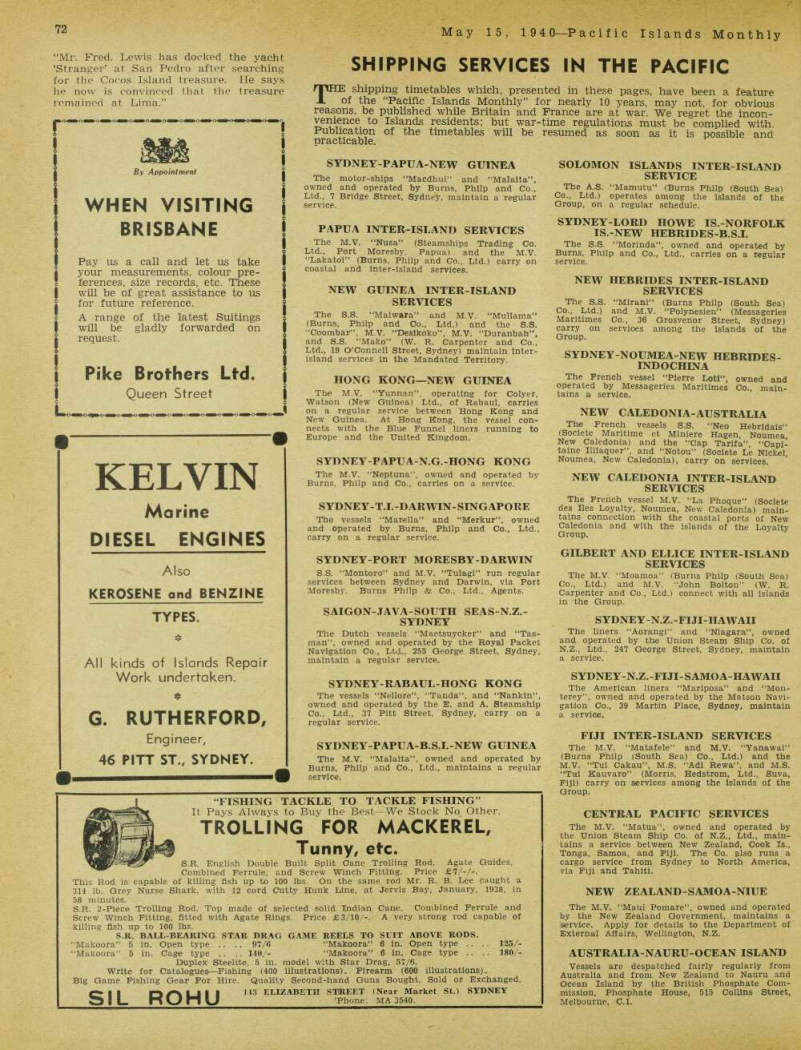
That Cocos Is.
Treasure
Another Expedition Misses
IN press messages from San Francisco, some months ago, it was stated, most positively, that an expedition organised in America had finally located, on Cocos Island, the enormous treasure (hidden when Lima, in Peru, was over run) for which various adventurers and expeditions have been searching for 50 years. It was reported that a Mr. Fred.
Lewis had sailed for Cocos Island with 25 tons of machinery, for dredging and digging, and that the treasure would soon be brought to the mainland.
Although it was a circumstantial story, the “Pacific Islands Monthly” re viewed the various sensational articles which have been published during the past 10 years, relating to the Cocos Island treasure, and took the liberty of saying that the latest report was entirely a fabrication —that the treasure could not have been discovered on Cocos Island, because it had been proved that the treasure was not there. Authori tative information had indicated that the treasure, hurriedly removed from Lima, and said to have been taken to Cocos Island, actually was taken inland, and not towards the sea coast.
On April 6, the following press mes sage was broadcast from San Francisco:
“Mr. Fred. Lewis has docked the yacht ‘Stranger’ at San Pedro after searching for the Cocos Island treasure. He says he now is convinced that the treasure remained at Lima.’’
Advertisements & other items, pp. 75-76 (1 item)
Iclcmck
"Hard-to-Get"
Hardware
Odd sizes and shapes in metals, tools, spare parts, engines, boat hardware, etc., not sold by your local store.
No catalogue; but pleased to quote for anything—large or small.
Country Hardware Supplies Box 1127 H, G.P.O. Sydney.
Iclcmck
The Criterion of
f GOOD Radio
Literally the Criterion of good Radio, Lekmek receivers are built by engineers already engaged on highly specialised contracts for the P.M.G. and National Broadcasting Stations. Individually constructed like Rolls Royce, “Up to a Standard— NOT —Down to a Price”, they incorporate every conceivable point of modfern design, outstripping competitors of every nationality in both performance and tone. 0 Specially Impregnated for the Tropics. 0 Outstanding Shortwave Performance due to special Non-Fade A.V.C. 0 Complete Station Separation secured by new Intermediate Frequency Transformers. 0 Perma Coils for Maximum Stability. 0 Large Range of Models to suit ALL conditions.
For further details consult your local agent, a Sydney buying house, or write direct
■ LEKMEK “BARCOO” TABLE RECEIVER.
Available as:—• 6 valve Battery Dual Wave Receiver—34 Guineas. 6 valve Vibrator Dual Wave Receiver—lo Guineas.
This wonderful table grand has a full size console, 6 valve, chassis in a table cabinet of choice walnut. A console type, 8 in. speaker operates through a fret at the end of the cabinet and, together with the console chassis, offers all the advantages of a floor model receiver with the compactness of a mantel radio.
UNITED RADIO DISTRIBUTORS PTY. LTD.
234 CLARENCE STREET, SYDNEY. CABLES U.R.D. SYDNEY
Mii
By Appointment
WHEN VISITING
BRISBANE
Pay us a call and let us take your measurements, colour preferences, size records, etc. These will be of great assistance to us for future reference.
A range of the latest Suitings will be gladly forwarded on request.
Pike Brothers Ltd.
Queen Street
KELVIN
Marine
DIESEL ENGINES
Also
KEROSENE and BENZINE
TYPES.
All kinds of Islands Repair Work undertaken.
G. RUTHERFORD,
Engineer,
46 PITT ST., SYDNEY.
“FISHING TACKLE TO TACKLE FISHING”
It Pays Always to Buy the Best—We Stock No Other.
TROLLING FOR MACKEREL,
Tunny, etc.
S.R. English Double Built Split Oane Trolling Rod. Agate Guides, Combined Ferrule, and Screw Winch Pitting. Price £7/-/-.
This Rod is capable of killing fish up to 100 lbs. On the same rod Mr. R. B. Lee caught a 314 lb. Grey Nurse Shark, with 12 cord Cutty Hunk Line, at Jervis Bay, January, 1938, in 58 minutes.
S.R. 2-Piece Trolling Rod. Top made of selected solid Indian Cane. Combined Ferrule and Screw Winch Fitting, fitted with Agate Rings. Price £3/10/-. A very strong rod capable of killing fish up to 100 lbs.
S.R. BALL-BEARING STAR DRAG GAME REELS TO SUIT ABOVE RODS.
“Makoora” 5 in. Open type .. .. 97/6 “Makoora” 6 in. Open type .. .. 125/- “Makoora” 5 in. Cage type .. . 140/- “Makoora” 6 in. Cage type .. . . 180/- Duplex Steelite, 5 in. model with Star Drag, 57/6.
Write for Catalogues—Fishing (400 illustrations). Firearm (600 illustrations).
Big Game Pishing Gear For Hire. Quality Second-hand Guns Bought, Sold or Exchanged.
Si a n/MJI I 143 ELIZABETH STREET (Near Market St.) SYDNEY L HUII U ’Phone: MA 3540.
Shipping Services In The Pacific
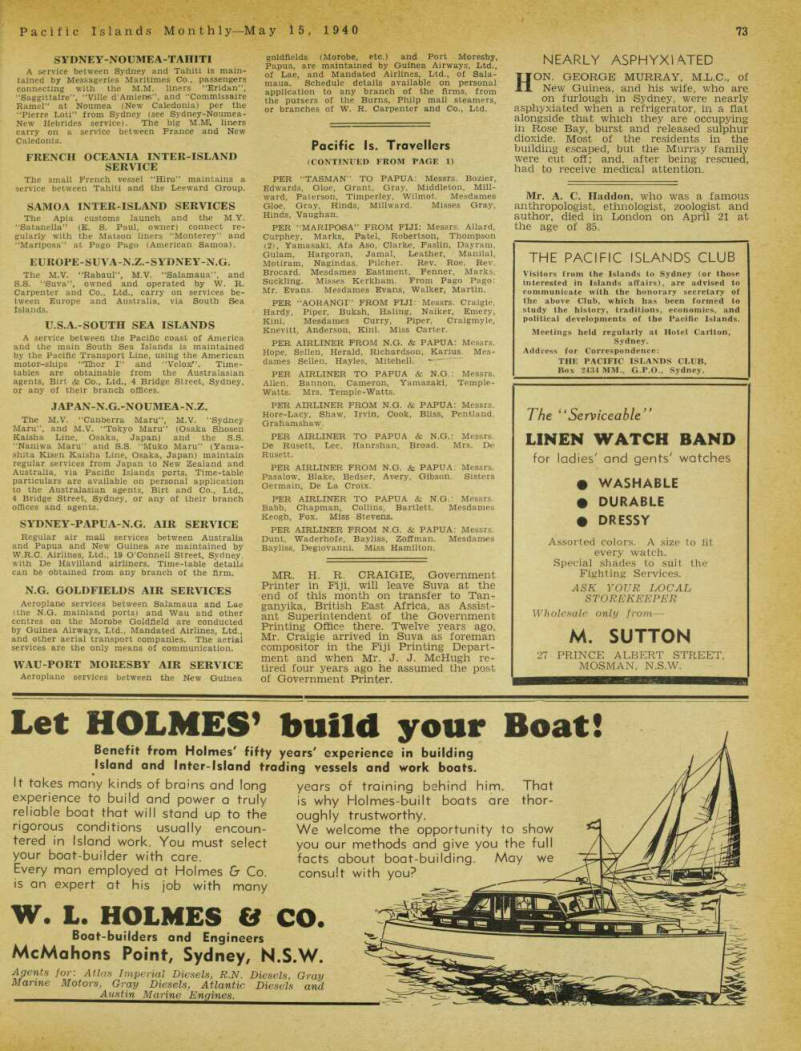
ri\HE shipping timetables which, presented in these pages, have been a feature X of the “Pacific Islands Monthly” for nearly 10 years, may not, for obvious reasons, be published while Britain and France are at war. We regret the incon venience to Islands residents; but war-time regulations must be complied with Publication of the timetables will be resumed as soon as it is possible and practicable.
Sydney-Papua-New Guinea
The motor-ships “Macdhui” and “Malaita”, owned and operated by Burns, Philp and Co., Ltd., 7 Bridge Street, Sydney, maintain a regular service.
Papua Inter-Island Services
The M.V. “Nusa” (Steamships Trading Co.
Ltd., Port Moresby, Papua) and the M.V.
“Lakatoi” (Burns, Philp and Co., Ltd.) carry on coastal and inter-island services.
New Guinea Inter-Island
Services
The S.S. “Maiwara” and M.V. “Muliama” (Burns, Philp and Co., Ltd.) and the S.S.
“Coombar”, M.V. “Deslkoko”, M.V. “Duranbah”, and S.S. “Mako” (W. R. Carpenter and Co., Ltd., 19 O’Connell Street, Sydney) maintain inter island services in the Mandated Territory.
Hong Kong—New Guinea
The M.V. “Yunnan”, operating for Colyer, Watson (New Guinea) Ltd., of Rabaul, carries on a regular service between Hong Kong and New Guinea. At Hong Kong, the vessel con nects with the Blue Funnel liners running to Europe and the United Kingdom.
Sydney-Papua-N.G.-Hong Kong
The M.V. “Neptuna”, owned and operated by Burns, Philp and Co., carries on a service.
Sydney-T.1.-Darwin-Singapore
The vessels “Marella” and “Merkur”, owned and operated by Burns, Philp and Co., Ltd., carry on a regular service.
Sydney-Port Moresby-Darwin
S.S. “Montoro” and M.V. “Tulagi” run regular services between Sydney and Darwin, via Port Moresby. Burns Philp & Co., Ltd., Agents.
Saigon-Java-South Seas-N.Z.-
Sydney
The Dutch vessels “Maetsuycker” and “Tas man”, owned and operated by the Royal Packet Navigation Co., Ltd., 255 George Street, Sydney, maintain a regular service.
Sydney-Rabaul-Hong Kong
The vessels “Nellore”, “Tanda”, and “Nankin”, owned and operated by the E. and A. Steamship Co., Ltd., 37 Pitt Street, Sydney, carry on a regular service.
Sydney-Papua-B.S.L-New Guinea
The M.V. “Malaita”, owned and operated by Burns, Philp and Co., Ltd., maintains a regular service.
Solomon Islands Inter-Island
Service
The A.S. “Mamutu” (Burns Phllp (South Sea) Co., Ltd.) operates among the islands of the Group, on a regular schedule.
Sydney-Lord Howe Is.-Norfolk
Is.-New Hebrides-8.5.1.
The S.S. “Morinda”, owned and operated by Burns, Philp and Co., Ltd., carries on a regular service.
New Hebrides Inter-Island
Services
The S.S. “Mirani” (Burns Philp (South Sea) Co., Ltd.) and M.V. “Polynesian” (Messageries Maritimes Co., 36 Grosvenor Street, Sydney) carry on services among the islands of the Group.
Sydney-Noumea-New’ Hebrides
Indochina
The French vessel “Pierre Loti”, owned and operated by Messageries Maritimes Co., main tains a service.
New Caledonia-Australia
The French vessels S.S. “Neo Hebridais” (Societe Maritime et Miniere Hagen, Noumea New Caledonia) and the “Cap Tarifa”, “Capi taine Illiaquer”, and “Notou” (Societe Le Nickel, Noumea, New Caledonia), carry on services.
New Caledonia Inter-Island
Services
The French vessel M.V. “La Phoque” (Societe des lies Loyalty, Noumea, New Caledonia) main tains connection with the coastal ports of New Caledonia and with the islands of the Loyalty Group.
Gilbert And Ellice Inter-Island
Services
The M.V. “Moamoa” (Burns Philp (South Sea) Co., Ltd.) and M.V. “John Bolton” (W. R.
Carpenter and Co., Ltd.) connect with all islands in the Group.
Sydney-N.Z.-Fiji-Hawaii
The liners “Aorangi” and “Niagara”, owned and operated by the Union Steam Ship Co. of N.Z., Ltd., 247 George Street, Sydney, maintain a service.
Sydney-N.Z.-Fiji-Samoa-Hawaii
The American liners “Mariposa” and “Mon terey”, owned and operated by the Matson Navi gation Co., 39 Martin Place, Sydney, maintain a service.
Fiji Inter-Island Services
The M.V. “Matafele” and M.V. “Yanawai” (Burns Philp (South Sea) Co., Ltd.) and the M.V. “Tui Cakau”, M.S. “Adi Rewa”, and M.S.
“Tui Kauvaro” (Morris, Hedstrom, Ltd., Suva, Fiji) carry on services among the Islands of the Group.
Central Pacific Services
The M.V. “Matua”, owned and operated by the Union Steam Ship Co. of N.Z., Ltd., main tains a service between New Zealand, Cook Is., Tonga, Samoa, and Fiji. The Co. also runs a cargo service from Sydney to North America, via Fiji and Tahiti.
New Zealand-Samoa-Niue
The M.V. “Maui Pomare”, owned and operated by the New Zealand Government, maintains a service. Apply for details to the Department of External Affairs, Wellington, N.Z.
Australia-Nauru-Ocean Island
Vessels are despatched fairly regularly from Australia and from New Zealand to Nauru and Ocean Island by the British Phosphate Com mission, Phosphate House, 515 Collins Street, Melbourne, C.l.
Sydney-Noumea-Tahiti
A service between Sydney and Tahiti is main tained by Messageries Maritimes Co., passengers connecting with the M.M. liners “Eridan”, “Saggittalre”, “Ville d’Amiens”, and “Commlssaire Ramel” at Noumea (New Caledonia) per the “Pierre Loti” from Sydney (see Sydney-Noumea- New Hebrides service). The big M.ML liners carry on a service between France and New Caledonia.
French Oceania Inter-Island
Service
The small French vessel “Hiro” maintains a service between Tahiti and the Leeward Group.
Samoa Inter-Island Services
The Apia customs launch and the M.Y.
“Satanella” (E. S. Paul, owner) connect re gularly with the Matson liners “Monterey” and “Mariposa” at Pago Pago (American Samoa).
Europe-Suva-N.Z.-Sydney-N.G.
The M.V. “Rabaul”, M.V. “Salamaua”, and S.S. “Suva”, owned and operated by W. R.
Carpenter and Co., Ltd., carry on services be tween Europe and Australia, via South Sea Islands.
U.S.A.-South Sea Islands
A service between the Pacific coast of America and the main South Sea Islands is maintained by the Pacific Transport Line, using the American motor-ships “Thor I” and “Veloxi'’. Time tables are obtainable from the Australasian agents, Birt & Co., Ltd., 4 Bridge Street, Sydney, or any of their branch offices.
Japan-N.G.-Noumea-N.Z.,
The M.V. “Canberra Maru”, M.V. “Sydney Maru”, and M.V. “Tokyo Maru” (Osaka Shosen Kaisha Line, Osaka, Japan) and the S.S.
“Naniwa Maru” and S.S. “Muko Maru” (Yama shita Kisen Kaisha Line, Osaka, Japan) maintain regular services from Japan to New Zealand and Australia, via Pacific Islands ports. Time-table particulars are available on personal application to the Australasian agents, Birt and Co., Ltd., 4 Bridge Street, Sydney, or any of their branch offices and agents.
Sydney-Papua-N.G. Air Service
Regular air mail services between Australia and Papua and New Guinea are maintained by W.R.C. Airlines, Ltd., 19 O’Connell Street, Sydney, with De Havilland airliners. Time-table details can be obtained from any branch of the firm.
N.G. Goldfields Air Services
Aeroplane services between Salamaua and Lae (the N.G. mainland ports) and Wau and other centres on the Morobe Goldfield are conducted by Guinea Airways, Ltd., Mandated Airlines, Ltd., and other aerial transport companies. The aerial services are the only means of communication.
Wau-Port Moresby Air Service
Aeroplane services between the New Guinea
goldfields (Morobe, etc.) and Port Moresby, Papua, are maintained by Guinea Airways, Ltd., of Lae, and Mandated Airlines, Ltd., of Sala maua. Schedule details available on personal application to any branch of the firms, from the pursers of the Burns, Philp mail steamers, or branches of W. R. Carpenter and Co., Ltd.
Advertisements & other items, p. 76 (1 item)
72
May 15, 194 O—P acific Islands Monthly
Nearly Asphyxiated
Hon. George Murray, M.L.C., Of
New Guinea, and his wife, who are on furlough in Sydney, were nearly asphyxiated when a refrigerator, in a flat alongside that which they are occupying in Rose Bay, burst and released sulphur dioxide. Most of the residents in the building escaped, but the Murray family were cut off; and, after being rescued, had to receive medical attention.
Mr. A. C. Haddon. who was a famous anthropologist, ethnologist, zoologist and author, died in London on April 21 at the age of 85.
Advertisements & other items, p. 77 (2 items)
73
Pacific Is. Travellers
(CONTINUED FROM PAGE 1)
Pacific Islands Monthl y—M ay 15, 1940
Let HOLMES* build your Boat!
THE PACIFIC ISLANDS CLUB
Visitors from the Islands to Sydney (or those interested in Islands affairs), are advised to communicate with the honorary secretary of the above Club, which has been formed to study the history, traditions, economics, and political developments of the Pacific Islands.
Meetings held regularly at Hotel Carlton, Sydney.
Address for Correspondence:
THE PACIFIC ISLANDS CLUB,
Box 2434 MM., G.P.0., Sydney.
The “Serviceable”
LINEN WATCH BAND
for ladies' and gents' watches
• WASHABLE
• DURABLE
• DRESSY
Assorted colors. A size to fit every watch.
Special shades to suit the Fighting Services.
ASK YOUR LOCAL
STOREKEEPER
Wholesale only from —-
M. SUTTON
27 PRINCE ALBERT STREET,
MOSMAN, N.S.W.
Let HOLMES* build your Boat!
Benefit from Holmes' fifty years' experience in building Island and Inter-Island trading vessels and work boats It takes many kinds of brains and long years of training behind him. experience to build and power a truly reliable boat that will stand up to the rigorous conditions usually encountered in Island work. You must select your boat-builder with care.
Every man employed at Holmes & Co. is an expert at his job with many
W. t. HOLMES & CO.
Boat-builders and Engineers
McMahons Point, Sydney, N.S.W.
Agents for: Atlas Imperial Diesels, R.N. Diesels, Gray Marine Motors, Gray Diesels, Atlantic Diesels and Austin Marine Engines.
That c is why Holmes-built boats are thoroughly trustworthy.
We welcome the opportunity to show you our methods and give you the full facts about boat-building. May we consult with you?
Fruit Industry
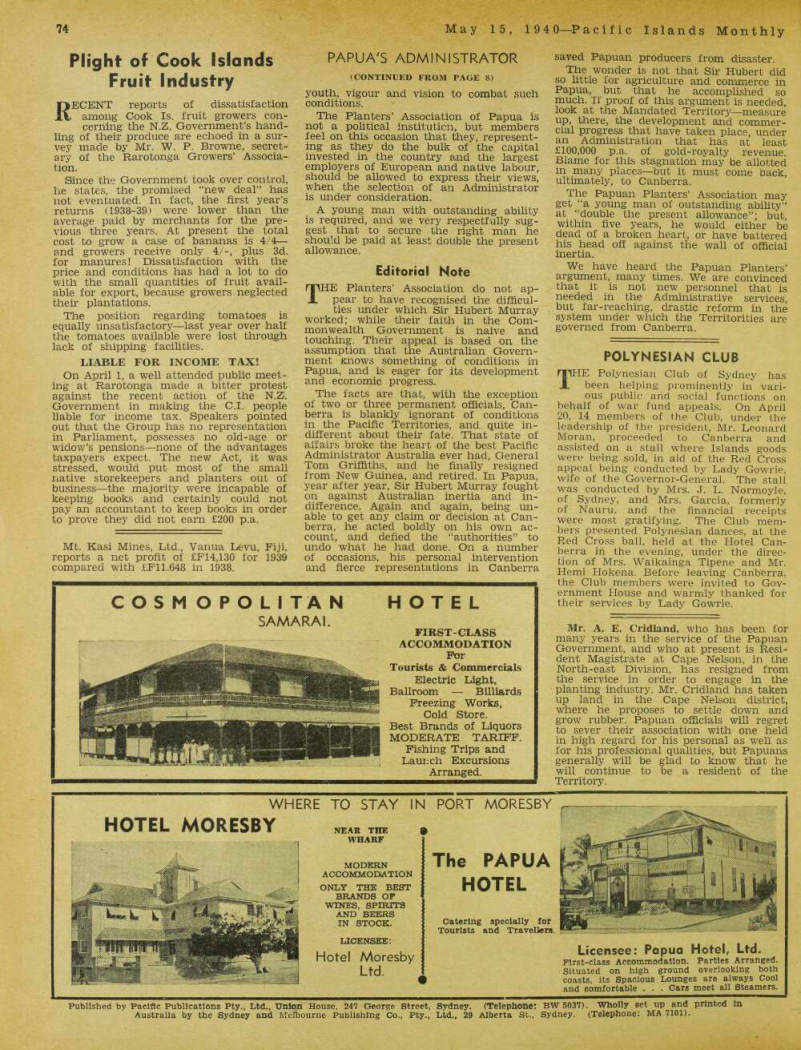
Plight of Cook Islands Fruit Industry
RECENT reports of dissatisfaction among Cook Is. fruit growers con cerning the N.Z. Government’s hand ling of their produce are echoed in a sur vey made by Mr. W. P. Browne, secret ary of the Rarotonga Growers’ Associa tion.
Since the Government took over control, he states, the promised “new deal” has not eventuated. In fact, the first year’s returns (1938-39) were lower than the average paid by merchants for the pre vious three years. At present the total cost to grow a case of bananas is 4/4 — and growers receive only 4/-, plus 3d. for manures! Dissatisfaction with the price and conditions has had a lot to do with the small quantities of fruit avail able for export, because growers neglected
their plantations.
The position regarding tomatoes is equally unsatisfactory—last year over half the tomatoes available were lost through lack of shipping facilities.
Liable For Income Tax!
On April 1, a well attended public meet ing at Rarotonga made a bitter protest against the recent action of the N.Z.
Government in making the C.I. people liable for income tax. Speakers pointed out that the Group has no representation in Parliament, possesses no old-age or widow’s pensions—none of the advantages taxpayers expect. The new Act, it was stressed, would put most of the small native storekeepers and planters out of business —the majority were incapable of keeping books and certainly could not pay an accountant to keep books in order to prove they did not earn £2OO p.a.
Mt. Kasi Mines, Ltd., Vanua Levu, Fiji, reports a net profit of £F14,130 for 1939 compared with £F11.648 in 1938.
Polynesian Club
rE Polynesian Club of Sydney has been helping prominently in vari ous public and social functions on behalf of war fund appeals. On April 20, 14 members of the Club, under the leadership of the president, Mr. Leonard Moran, proceeded to Canberra and assisted on a stall where Islands goods were being sold, in aid of the Red Cross appeal being conducted by Lady Cowrie, wife of the Governor-General. The stall was conducted by Mrs. J. L, Normoyle, of Sydney, and Mrs. Garcia, formerly of Nauru, and the financial receipts were most gratifying. The Club mem bers presented Polynesian dances, at the Red Cross ball, held at the Hotel Can berra in the evening, under the direc tion of Mrs. Waikainga Tipene and Mr.
Hemi Hokena. Before leaving Canberra, the Club members were invited to Gov ernment House and warmly thanked for their services by Lady Gowrie.
Mr. A. E. Cridland, who has been for many years in the service of the Papuan Government, and who at present is Resi dent Magistrate at Cape Nelson, in the North-east Division, has resigned from the service in order to engage in the planting industry. Mr. Cridland has taken up land in the Cape Nelson district, where he proposes to settle down and grow rubber. Papuan officials will regret to sever their association with one held in high regard for his personal as well as for his professional qualities, but Papuans generally will be glad to know that he will continue to be a resident of the Territory.
Advertisements & other items, pp. 78-80 (4 items)
Papua's Administrator
74
May 15, 194 O—P acific Islands Monthly
(CONTINUED FROM PAGE 8)
Published bv Pacific Publications Pty., Ltd., Union House, 247 George Street, Sydney. (Telephone: BW 5037). Wholly set up and printed in Australia by the Sydney and Melbourne Publishing Co., Pty., Ltd., 29 Alberta St.. Sydney. (Telephone: MA 7101).
Hotel Moresby
COS M O P
O L I TA N
SAMARA!.
f
HOTEL
FIRST-CLASS
ACCOMMODATION
For Tourists & Commercials Electric Light, Ballroom Billiards Freezing Works, Cold Store.
Best Brands of Liquors
MODERATE TARIFF.
Fishing Trips and Launch Excursions Arranged.
WHERE TO STAY IN PORT MORESBY
HOTEL MORESBY
v
NEAR THE
WHARF
MODERN
ACCOMMODiATION
ONLY THE BEST
BRANDS OP
WINES, SPIRITS
AND BEERS
IN STOCK.
LICENSEE;
Hotel Moresby
Ltd.
The PAPUA
HOTEL
Catering specially for Tourists and Travellers.
Licensee: Papua Hotel, Ltd.
First-class Accommodation. Parties Arranged.
Situated on high ground overlooking both coasts, its Spacious Lounges are always Cool and comfortable . . . Cars meet all Steamers.
Ike [umile-Ueind int eftU/i...
X X X
Ulinoi not urheeU \>iontehJiA
Prior to 1927 tortuous jungle foot-tracks winding over precipitous mountains were the sole means of communication between the coast and the rich gold deposits in the interior of New Guinea. . . . Transport costs were ruinously high. . Roadways and Railways were impracticable— only one way remained—THE AIR WAY.
Guinea Airways Limited was formed and in March, 1927, pioneered the Wrst successful flight into the interior . . since that time this Company has maintained a regular and reliable service, carrying over 82,000 passengers and transporting over 58,135 tons, including every type of goods and machinery needed by the growing European population.
Guinea Airways services now embrace the whole of New Guinea and Papua and the landing grounds and aerodromes now used total over 50— the foundation of each one marking great strides in the progress of both New Guinea and Guinea Airways Ltd.
GUINEA AIRWAYS
Freight & Passenger
Service
NEW GUINEA
Planes depart from Port Moresby for the goldfields after the arrival of each boat.
Tickets obtainable Purser, or Burns, Philp & Co., Sydney or Brisbane.
AUSTRALIA
ADELAIDE TO DARWIN.
Twice weekly service.
ADELAIDE TO KANGAROO
ISLAND.
Return service daily except Sunday.
ADELAIDE TO PORT LINCOLN.
Return service three times weekly.
ADELAIDE TO WHY ALL A.
Return service daily except Sunday.
Head Office: Austral Chambers, Currie Street, Adelaide.
l&eggli FREIGHT CARRYING A/R SERVICE
LAE-SALAMAU A:
New Guinea Office: LAE, Branch Offices and Agents at WAU-SALAMAUA- Mandated Territory of New Guinea • port Moresby and Sydney.
A Tropical Thirst
demands a Satisfying Drink
IN A COOL
- ACp « a r <UDt
TRALI
' F * n# ONCV FROM THE FINEST
) w. an# BOTTLED BY "2
£ T OOTH & CO., LI MI'S Sydney, austral^ that’s why K.B • is so p
south of * the ’ ’
All through the tropics, wherever there are men who like good beer, you’ll always find K. B. It’s the drink that men appreciate —a drink just made to satisfy a tropical thirst!
V *■ %
TOOTH'S
KB
LAGER.