Pacific
Islands
Monthly
Vol. X. No. 9.
April 16, 1940
[Registered at the G.P.0., Sydney l for transmission by post as a newspaper .J
8"
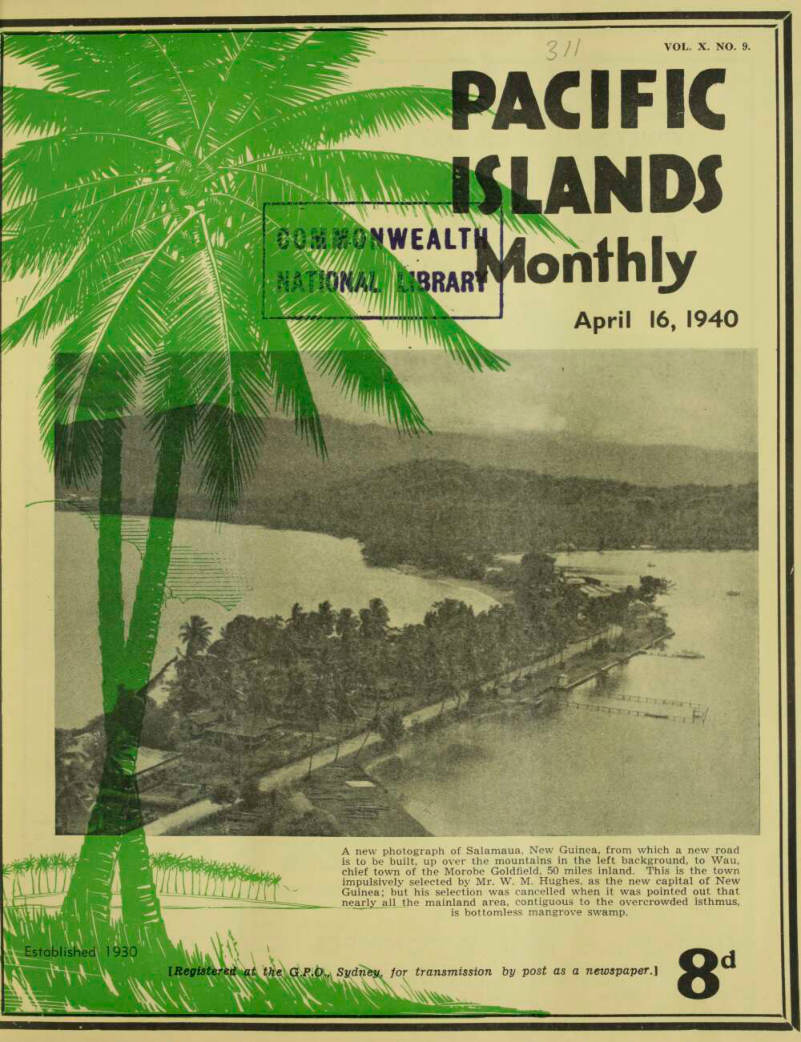
A new photograph of Salamaua, New Guinea, from which a new road is to be built, up over the mountains in the left background, to Wau, chief town of the Morobe Goldfield, 50 miles inland. This is the town impulsively selected by Mr. W. M. Hughes, as the new capital of New Guinea; but his selection was cancelled when it was pointed out that nearly all the mainland area, contiguous to the overcrowded isthmus, is bottomless mangrove swamp.
Advertisements & other items, p. 2 (2 items)
Pacific Islands Mon t h 1 y—A pr i 1 16, 194 0
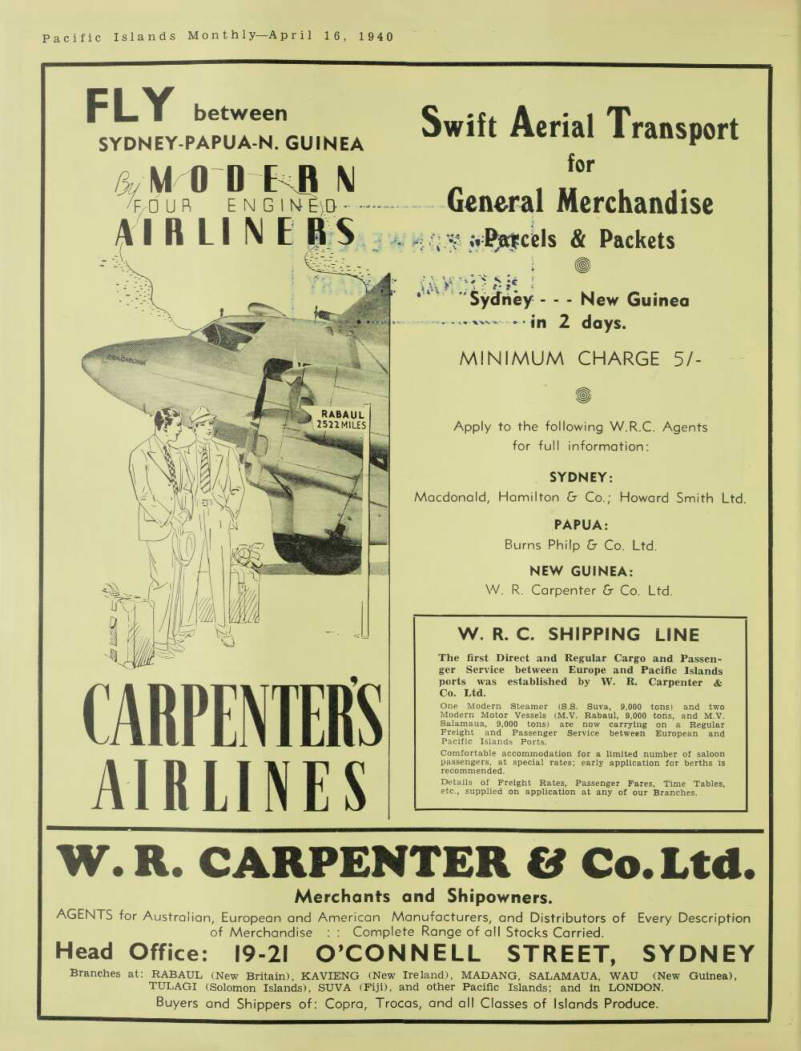
Carpenters
FLY between
SYDNEY-PAPUA-N. GUINEA
M 0 II t H M
/F/OUR ENGINE)!}--
AIRLINERS
•V
RABAUL
2 521 MILES
a***
CARPENTERS
AIRLINES
Swift Aerial Transport
for
General Merchandise
& Packets
vA: y *c \ ‘‘' "Sydney -- - New Guinea —in 2 days.
MINIMUM CHARGE
Apply to the following W.R.C. Agents for full information:
SYDNEY:
Macdonald, Hamilton Gr Co.; Howard Smith Ltd.
PAPUA:
Burns Philp Gr Co. Ltd.
NEW GUINEA:
W. R. Carpenter Gr Co. Ltd.
W. R. C, SHIPPING LINE
The first Direct and Regular Cargo and Passenger Service between Europe and Pacific Islands ports was established by W. R. Carpenter & Co. Ltd.
One Modern Steamer (S.S. Suva, 9,000 tons) and two Modern Motor Vessels (M.V. Rabaul, 9,000 tons, and M.V.
Salamaua, 9,000 tons) are now carrying on a Regular Freight and Passenger Service between European and Pacific Islands Ports.
Comfortable accommodation for a limited number of saloon passengers, at special rates; early application for berths is recommended.
Details of Freight Rates, Passenger Fares, Time Tables, etc., supplied on application at any of our Branches.
W.R. CARPENTER & Co. Ltd.
Merchants and Shipowners.
AGENTS for Australian, European and American Manufacturers, and Distributors of Every Description of Merchandise : : Complete Range of all Stocks Carried.
Head Office: 19-21 O’CONNELL STREET, SYDNEY
Branches at: RABAUL (New Britain). KAVIENG (New Ireland), MADANG, SALAMAUA, WAU (New Guinea), TULAGI (Solomon Islands), SUVA (Fiji), and other Pacific Islands; and in LONDON.
Buyers and Shippers of: Copra, Trocas, and all Classes of Islands Produce.
Pacific News-Review
Notes And Comment On
The Progress Of The War
From March 15 To April 14
Mch. 15: Newspapers, attempting to assess the result of the surrender of Fin land to Russia, make this statement: “The British Government has been of the opin ion that relations between Germany and Russia have developed along lines which justify the view that Russia has effec tively become Germany’s ally”.
Actually, the relations between the two countries remain obscure and puzzling Germany had a good deal to do with the final peace terms, under which the Russo- Finnish war ended, but there are many indications that Russia and Germany are not operating in international affairs in complete harmony.
Mch. 15: The belief that “The extra ordinary wave of appeasement talk in Europe and America, which now has spread to London” may lead to an Easter peace, is growing. There are indications that a very strong under-cover move for an armistice is being made.
Mch. 16: Half a million Finns are now migrating from that portion of the Karel ian Isthmus which has been ceded to Russia under the peace treaty, and Soviet troops are moving in. New homes must be found for these Finns, who refuse de finitely to live under the Soviet regime.
Mch. 17: Mussolini unexpectedly left Rome to-day on a special train, to meet Herr Hitler at a rendezvous, on the top of the Brenner Pass (between Italy ana Germany). This is part of the “under cover peace moves”.
Mch. 18: Hitler and Mussolini talked for 2i hours at their rendezvous on the Brenner Pass. Meanwhile, Mr. Sumner Welles, American envoy at large, waits in Rome, and the sailing of the Italian liner, on which he is to return to America, has been delayed for two days.
Mch. 19: There is much speculation but no announcement concerning the talk be tween Hitler and Mussolini. It is gener ally believed they discussed terms for the eventual restoration of peace.
Mch. 19: Officially disclosed that, in February, Britain and France informed Finland that they were prepared to go to her aid with an expeditionary force of 100,000 men, the first of whom would be gin to arrive early in March; but it was vital to such a plan that a right-of-way for the force should be granted by Nor way and Sweden. Norway and Sweden, although appealed to, flatly refused to let the expeditionary force go through. It is announced that that force was assembled and waiting to move, right up until the surrender of Finland to Russia. Sweden and Norway have stated that, had they given right-of-way to the Allies, they im mediately would have been attacked by Germany, Mch. 20: In the biggest air action of the war, British bombers, attacking in a series of waves, lasting seven hours, ex tensively damaged the German air base at Hornum, on the North Sea island of Sylt, off the coast of Germany. Great damage was done.
Mch. 20: Following what he regarded as a hostile vote in the Chamber of Deputies, M. Daladier, premier of France, handed his resignation to the President.
It is expected that Daladier will be com missioned to form a new cabinet.
The resignation came as a surprise to Britain.
Mch. 20: The explanations given con cerning the delay of the Allies in giving aid to the Finns have not silenced the
mounting volume of criticism, that both the British and French Governments are too slow and unenterprising in the conduct of the war, and that new and more vigorous leadership is needed.
Mch. 21: New French Government formed under Paul Reynaud, described as a soldier, globe-trotter and conser vative business man. ‘Daladier is one of the leading members of his Cabinet.
Comment from Berlin is that the French nation has been dissatisfied with the con duct of the war and that much greater energy is demanded in its prosecution and consequently Reynaud has been intro duced as Premier. Other indications are that this is a correct interpretation. The whole French press expresses regret for the crisis, but insists that it shows that Prance is determined to pursue the most active war policy.
Mch. 25: While enemy attacks on British shipping have diminished, British attacks on German shipping in Scandin avian waters have become more frequent.
Norway has protested to Britain against violations of her neutrality—although the Germans actually have sunk about 50 Norwegian ships, and caused the deaths of over 1,000 Norwegian seamen.
Mch. 26: Now clear that the important under-cover peace drive, developed just before Easter, came to nothing. The atti tude of Britain and France became stiffer and stronger. It is believed that both Governments received convincing evidence of failing morale in Germany, and that they decided to continue the war with greater vigour, rather than enter into discussions now with a wholly untrustworthy Nazi party, which still controls Germany, and still holds all the spoils.
Mch. 26: Not a single Allied ship was sunk by enemy action during the week ended March 24.
Mch. 27: After one of the bitterest election campaigns in the history of Canada, the Liberal Government of Mr.
Mackenzie King was returned to power with an overwhelming majority, thus giving public endorsement to the Govern ment s pro-British war policy.
Mch. 29: The Supreme Allied War Council proclaimed in London that neither Britain nor France will make peace except by mutual agreement, and that they will continue to co-operate after the war. The new French Premier secured a decision that the Allies shall wage the war more energetically.
Mch. 30: A “puppet government” set up by Japan and led by a Chinese, Wang Ching-Wei, to nominally govern that portion of China occupied by Japanese troops came into office to-day.
Japan has announced that if the Powers refuse to recognise it, the “puppet gov ernment” will not pay the interest on the various loans made to the former Chinese Government. Interest on these loans, however, is being paid by the Chinese Government proper, which is established at Chungking, under the Chinese Generalissimo, Chiang Kai- Shek.
Apl. 1; There is much talk of new measures by the Allies to police neutral waters and tighten up the blockade of Germany. These will apply in particular to the waters around Scandinavia.
Apl. 2; Mr. Chamberlain has issued a warning to neutrals that the Allies will prosecute the economic war to the ut most. He compared the Allies’ scrupulous
regard for neutral rights with the way in which Germany has been destroying neutral shipping. But the Allies must now take much sterner measures to prevent raw materials and foodstuffs reaching Germany through neutral channels. As the Germans had shown no respect for international law, the Allies were forced to the position that they, also, in order to make their blockade effective, must disregard certain of the laws which ap plied to neutrals.
Apl. 4: British Cabinet re-arranged so that Mr. Winston Churchill (First Lord of Admiralty) now will preside over an inner committee of fighting service Mini sters which, after consultation with their chiefs of staff, will make recommenda tions to the War Cabinet.
Apl. 4: The organisation in the North West Pacific, under which British war ships will examine merchantmen carrying to Russian ports cargoes which might be intended for transport to Germany, has been referred to by the Japanese Govern ment, which has warned Britain not to institute a blockade of Vladivostok. It said that the Japanese Navy might be compelled to take measures. The British Official Wireless replied immediately that, when it was necessary, Britain would exercise her full belligerent rights.
All this excitement about German sub marines operating from a Siberian port against Pacific shipping is mostly yellow press sensationalism. Anyone who studies the map can see that submarines operat ing from Russian Pacific ports could do little damage to Allied shipping. The largest submarines cannot operate at a greater distance from their base than about 1,500 miles.
Apl. 5: Because Britain is now tighten ing the blockade, to prevent the ship ment of iron ore from the North Nor wegian port of Narvik, to Germany, it is reported that Germany is planning special measures. There are indications that German troops are being concen trated on points on the Baltic coast, perhaps to be thrown against the Scan dinavian countries.
Apl. 5; As part of a more intensive economic war against Germany, the British Government has formed and financed a trading company, to develop trade between Britain and the Balkans nations. The plan is that Britain shall step in and buy the products of those nations wherever necessary to prevent the goods reaching Germany.
Apl. 8; Last night, British and French naval units laid minefields in three areas along the western coast of Norway. Then came a dramatic radio announcement at 5 a.m. that the British and French Gov ernments had resolved to prevent the enemy’s continued use of Norway’s terri torial waters, and therefore had laid the minefields. Norway has protested.
There has been a violent reaction in Germany. Important developments are awaited.
Apl. 8: It was reported this morning from Oslo (capital of Norway) that 50 German warships (which included battle ships, cruisers, destroyers and mine sweepers) and numerous transports were moving northwards towards the Skagger Rak (between Denmark and Norway).
Other reports indicate movements by large numbers of German vessels in the
waters between Norway and Denmark.
It is also reported that numerous British warships are in the vicinity.
Apl. 9: Acting with amazing swiftness, and conforming to a timetable that ob viously had been carefully planned, Ger man forces, during the night of April 8 and the early hours of April 9, occupied the whole of Denmark and the following places in Norway—namely, Oslo (the capital), various towns along the shores of Oslo fiord (which leads up to Oslo) and the chief Norwegian west coast ports of Stavanger, Bergen, Tronheim and (in the far north) Narvik. The Germans effected a complete surprise. Military forces marched across the frontier and occu pied southern Denmark; others were landed in Denmark from ships. Most of the Norwegian places were occupied by forces landed rapidly from ships, of which hundreds were employed. Immedi ately daylight broke, over 100 large pas senger-carrying aeroplanes began to transport troops from Germany to various points in Norway—especially Oslo, Stavanger and Bergen, and places around the Oslo fiord.
The Danes did not resist, and all Den mark was completely occupied when darkness fell to-day. There has been great confusion in Norway, but it is clear that the Norwegians are fighting the Germans at many points.
Berlin announced that this move by Germany was retaliation against the British action in laying minefields off the west coast of Norway. But it was soon clear that Germany’s invasion of Den mark and Norway had long been planned, and actually had been commenced the day before the British minefields haa been laid. The British minefields were laid only on the night of April 7, and it was reported early on April 8 that extra ordinary large formations of German ships were moving along the coast oi Denmark and Norway. These of course were the fleets of transports guarded by warships which were on their way to seize the more distant places in western Norway.
The German High Command an nounced on April 9: “The German army has taken Denmark and Norway under its protection, in order to counteract actions against them, and to prevent possible hostile attack against these countries. Strong forces therefore in vaded them this morning.”
Apl. 10; The Allies have acted with swiftness and decision. Large British and French naval and air forces on April 8 were thrown against the Germans, and their attacks upon German warships and transports are continuing in a series of “dogfights” spread over hundreds of miles of sea. It is difficult to say exactly what the losses are on either side, but is is believed that 1 German battleship and 4 cruisers have been sunk and 2 cruisers damaged off the Norwegian coast; that a considerable number (anything up to a dozen) German transports have been sunk; and that severe losses have been inflicted upon smaller German vessels such as destroyers and minesweepers. The British and French naval losses have been small.
The most important development is that large, powerful British naval forces have thrust their way through the B er , Kak, and right down into the Kattegat, fighting constantly against German naval and air craft, and are hammering at the narrow straits between Denmark and Sweden, which are the en trance to the Baltic. This is the first time the British Navy has been able to *et into the entrance to the Baltic, and
if the Germans lose control there, the position will be very serious for them.
There have been severe losses of air craft on each side.
There was at first great confusion in Norway. The King ana the Government fled from Oslo to a town 40 miles north, and then, moved further inland. The Germans tried to capture the King, but failed. They set up in Oslo a “puppet’ government of Norwegian Nazis and, seizing the Oslo radio, broadcast in structions to Norwegians to submit quietly and accept German protection.
But the Norwegian Ministers quickly got some control of the situation from their
temporary headquarters. They announced
formally that Norway was at war with Germany, and they instructed Nor wegians to fight the Germans wherever possible. The Norwegians, considering that they are not trained in war, rallied in remarkable fashion and fighting is now going on in many places. Meanwhile, the Allies are hurrying to give aid to the Norwegians.
It was widely reported on April 10 that the British Navy had recaptured some of the Norwegian ports, had occupied Oslo fiord, and had given the Germans 12 hours to surrender or get out. But this was only the imaginative rubbish of correspondents of the neutral sensa tional press, who had gathered in Stock holm, nearby. The British Government, In an official announcement, said chat no attempt would be made for the moment to recapture the Norwegian ports.
Obviously, it is of greater importance that the British Navy, if possible, should seize this providential opportunity to secure control of the entrance to the Baltic. If that can be done, the Ger mans in Norway will not only be auto matically cut off, but the way will be open for an Allied attack upon Germany through the Baltic—one thing that Ger many fears.
Meanwhile, the Germans have complete control of Denmark, and they are trans porting about 4,000 men daily by ah to Norway. They have completely cut off all British trade with the three Scan dinavian countries; and food supplies, which previously went from Denmark to Britain, are now going from Denmark to Germany. If Germany can retain her position in Denmark and Norway, she will have scored a most important strategical victory. If the British Navy succeeds in holding the entrance to the Baltic, this German adventure may prove to be the greatest disaster that Hitler yet has experienced.
Apl. 11; Officially announced that the Allies have laid very extensive mine fields around the coasts of Denmark, in the Skagger Rak, and right up into the Kattegat. The effect of this is to cut off all German sea communication between Germany and the Norwegian ports. This may force the Germans to cross from Norway into Sweden; or, alternatively, the Germans may try to send supplies and reinforcements through Sweden in to Norway.
Apl. 11: The greatest alarm is being felt in Sweden, where every possible step has been taken to defend the neutrality of the country. A number of official an nouncements, made in Stockholm, indi cate that the Swedes will defend their neutrality against Germany, in all cir cumstances.
Apl. 13: As the German position in Norway becomes more precarious, there is a growing probability of a new Ger man blow —either a massed air attack
on Britain, an attack on the western front, or the invasion of Holland and Belgium by German troops. There have been alarming German troop move ments near the frontier of Holland, and Holland has assembled forces and taken all measures necessary to repel an invader.
Apl. 13: Meanwhile, there is grave anxiety regarding the attitude of Italy.
Large military forces have been assembled in Italy, and it is reported that the Italian Navy “is not only ready but has steam up”. The suggestion is made that if Germany now throws her whole weight against the Allies, with a view to escaping from the disastrous consequences of her Norwegian adven ture, Italy may seize the opportunity to attack British and French forces and territories in the Mediterranean. There is very great diplomatic activity in all the Baltic countries.
Apl. 14: It is reported from Moscow that the Soviet Government has flatly refused requests by the German Gov ernment to permit two German war ships, the battleship “Scharnhorst” (26,000 tons), and the cruiser “Admiral Hipper” (10,000), which have been cut oft by the British in northern waters, to take sanctuary in Russian Arctic ports.
If this report is correct, it has great significance.
It may be confidently assumed, how ever, that these uncertain neutrals — especially Italy and Russia—will be guided in their immediate future actions entirely by the outcome of the struggle between the Allies and Germany, in the North Sea. If Germany should suc ceed in crippling the Allies, or in forc ing them to use the whole of their strength in that area, it is certain that the Italians and Russians would move to take advantage of the Allies’ embar rassment for their own advantage.
Apl. 14: There is speculation as to what will happen to the Netherlands Indies if Hitler should march his armies into Holland. Some commentators say there would be immediately a rush by Britain, Japan and the United States to estab lish a protectorate over the Dutch East Indies. If such a protectorate is estab lished by either Britain or U.S.A., it will mean, of course, that those Powers intend only to hold the Netherlands Indies until Holland is again free of the invader.
Apl. 14: On Saturday the British battleship “Warspite” and the Second Destroyer Flotilla smashed their way into the Norwegian port of Narvik, which had been seized by the Germans, and sank 7 German destroyers, silenced coastal batteries which had been set up by the Germans, and sent the German garrisons fleeing to the hills. It is be lieved that the British have taken pos session of Narvik. It is unofficially reported that a large Allied expedition ary force is proceeding to Norwegian waters, and a landing by Allied forces in Norway is expected.
Apl. 14: It is officially announced that British minelayers, protected by destroy ers and preceded by minesweepers, somehow made their way through the narrow strait between Denmark and Sweden, into the Baltic Sea, and laid minefields along the whole of the Ger man coast from the Kattegat practically to Lithuania. This field, together with the other fields already laid, means a further interruption of communications between Germany and Norwegian ports.
Advertisements & other items, p. 4 (1 item)
2
April 16, 19 4 O—P aci f i c Islands Monthly
Pacific Islands Travellers
Per "Tanda" From New Guinea: Messrs.
Youlden, Cox, Sweetapple, Fisher, Stevens, Alann, Siggins, Maclean. Mesdames Hamilton, Maclean, Mann. Miss Hagarty.
Per "Niagara" From' Fiji; Messrs.
Brennan, Candler, Harwood, Pinkerton, Walsh, Bostock, Clark, Cornish, Davis, Griffiths, John son. Langdale, M*unn, Williams, Neville. Mes dames Harwood, Brewer, Griffiths, Williams.
Misses Allan, Ohlson.
PER "NIAGARA” FOR, FIJI; Messrs. Evans (2), Fenner, Hinchey, Newman, Rourke, Stokes (2), Thomas, Horsfleld, Vance, Wane, Shelley, Mesdames Evans, Horsfleld, Millard, Newman, Rourke, Stokes, Stevenson, Vance, Young, Shel ley, Misses Carter, Evans, Newman (2), Rourke, Scott, Vance.
Per “Macdhui” From Papua & N.G.:
Messrs. Austin, Brunner, Bell, Bruce, Bryan, Coleman, Crocker, Cruickshanks, Dickinson, Durcher, Donovan, Digby, Etherington, Farmer, Goodson, George, Gladstone, Griffiths, Grose.
James. Jobling, Keith, Kuter, Lyon, Lamond, Laws, Lewis, McKechnie, Morton, Murray, Miller, McGuigan, McEvoy, O’Brien, Osborne, O’Connor, Riggs, Simpson, Shelley, Splatt, Scannel, Slee,
Thorn, Taylor, .Thomas, Tait, Woolcock, Wilson, Wall, Williams, White, Waugh, Wilkinson, Dr.
Glaissner. Mesdames Austin, Brunner, Bell.
Coleman, Clay, Etherington, Farnsworth, Grif fiths, George, Glaissner, Gladstone, Keith, Lamond. Laws, Moates, Murray. McDonald, Neilson, Sims. Slee, Turner, Taylor, Tuckey, Thomas, Wilson, Yeomans. Misses Allan, Hunt, Rowbotham, Rundnagel.
Per “Morinda” For Lord Howe Is.,
NORFOLK IS., N. HEBRIDES & 8.5.1.: Messrs Allan, Black, Binnie, Bushell, Blencowe, Cum mins, Dillon, Doyle, *Gilet, Hill, Hicks, Hazel wood, Hempel, Hays, Isaacs, King, Legge, Mitchell, Martin, Nott, Pascoe, Payten, Single ton, Sewel. Bishop Baddeley. Mesdames Bowker, Hazelwood, James, Johnson, Kirby, Payten, Pascoe. Richardson, Robins, Scobie, Thompson (2), Whale. Misses Bland, Blackman, Bowker, Byford, Cropper, Hutcheon, Wadie.
Per “Morinda" From Lord Howe Is.,
NORFOLK IS., N. HEBRIDES & 8.5.1.: Messrs Clarke, Cotter, Kutzner, Hays, Walton, Beveridge. Carew, Harris, Roe, Baird, Hunter, Jones, Stronge, Tattle, Waters, Campbell, Clarke, Cull, Hall-Bohrsmann, Lawson, Morell, Nicols, Pearson, Roberts, Hopping, Sutton,
Valkenberg. Mesdames Clarke, McLean, Kutz~ ner, Beveridge, Worden, Bigg. Hunter, Johnson.
Moltke, Nobbs, Petford, Tattle, Clarke. Hall- Bohrsmann, Lawson, Morell, Pearson. Spurway, Velkenberg, Whiting. Misses Fletcher, de Preville, Knox, Nicols, Touzeau.
Per “Macdhui” For Papua & N.G.:
Messrs Allen, Avery, Brechin, Bailey, Brennan, Brugh, Burt, Byrne, Bensley, Brewster, Ballan tyne, Berman, Brown, Burridge, Burdon, Chad wick, Chun Din, Cahill, Davidson, Ferguson, Fryer, Forsyth, Glover, Grahamslaw, Groom, Holland, Hislop, Hall, Herron, Hamilton, Har mon, Haywood, Heighway, Halvorsen, Jackson, Jenson, Keith, Lester, Lee, Leary, Monk, Moore.
Marshall. McLennan, Marsh, M'cCallum, Mc- Eacharn, McFadgean, Moline, Mullen, Newman, Renshaw, Robinson, Rieneck, Stephen, Tregellas, Tremain, Thompson, Uebel, West, White, Ward.
Rev. Ure. Mesdames Allen, Brechin, Bailey.
Brennan, Burrow, Cork, Cahill, Davidson, Dainty, Dean, Grahamslaw, Gallaher, Groom.
Halley, Hislop, Houghton, Jackson, Lambden, Leahy, Robbins, Rieneck, Shaw, Schmidt, Tux worth, Ure, Wayne, Williams (2), Wyatt.
Misses Ashby, Cole, Dean, Kekwick, Rodger, White.
Per “Maetsuycker” For Papua: Messrs.
Briggs, Clegg, Godwin, Lea, Macpherson, Stevens, Tracey. Mrs. O. Godwin.
(Continued On Page 72)
PER AIRLINER FOR N.G. & PAPUA: Sir W.
R. McNicoll. Messrs. Harvey, White, Joy, Mowat, Smith.
PER AIRLINER FROM N.G. & PAPUA: Messrs.
Smith, Good, Halliday, Carlson, Bensley. Mes dames Carlson, Panting.
PER AIRLINER TO N.G. & PAPUA: Messrs.
Gordon, Richardson, Austin, Thurston, Furter.
Mrs. Melrose.
PER AIRLINER FROM N.G. & PAPUA: Messrs.
Minns, McKenzie, McDearmaid, Yeoman. Mes dames Minns, Peadon. Miss Speedie.
PER AIRLINER TO N.G. & PAPUA: Messrs.
Melville, Hudson. Mesdames Melville, Munro.
Misses Martin, Thorburn.
Per Airliner From Papua & N.G.;
Messrs. Ashcroft, Hately, Humphrey, Kienzle, Chapman. Mrs. Doe. Miss Uhe.
Mr. Carl R. Vasey arrived in Suva from Sydney with his wife at the end of March to take up the post of prin cipal of the Navuso Agricultural School
for Fijians.
Advertisements & other items, p. 5 (2 items)
3
Pacific Islands Monthl y—A pril 16, 1940
South Pacific Line
N
RAH
MAUA
V r-., ■■■ ' ;s; *o* * *
NEY
SY J K
K. P. M.
SOUTH PACIFIC LINE.
Royal Packet Navigation Co. Ltd., Paketvaart House, 255 George Street, Sydney. (N. V. Koninklljke Paketvaart Maatschappij—lncorporated In the Netherlands.) Saigon, Diethelm St Co.; Port Moresby and Samaral, Steamships Trading Co.
Ltd.; Eabaul, Saiamaua and Wan, W. E Carpenter & Co. Ltd.; Port Vila, Gubbay Freres; Noumea, Carlo Leoni; Auckland, Russell & Somers Ltd.; Wellington, Johnston St Co. Ltd. p . m
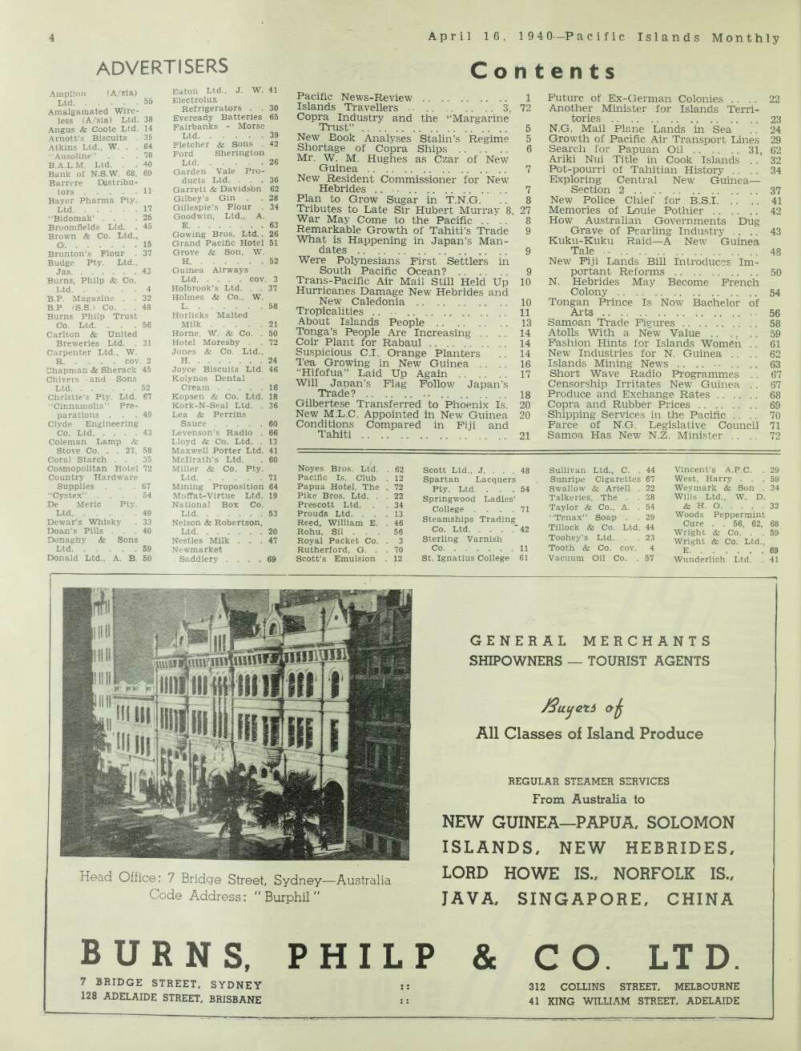
Linking the East with South Pacific
Islands, New Zealand and Australia
The track routes of the K.P.M.-South Pacific Line new motor vessel “Maetsuycker” and the well-known passenger steamer “Tasman” are each as follows;—“TASMAN”: Saigon, Singapore, Batavia, Samarang, Sourabaya, Port Moresby, Samarai, Port Vila, Noumea, Auckland, Wellington, Sydney, Port Moresby, Sourabaya, Samarang, Batavia, Singapore, Saigon. “MAETSUYCKER”: Saigon, Singapore, Batavia, Samarang, Sourabaya, Port Moresby, Saiamaua, Rabaul, Auckland, Wellington, Sydney, Port Moresby, Sourabaya, Samarang, Batavia, Singapore, Saigon.
SOUTH PACIFIC Line
Advertisers
Amplion (A/sia) Ltd 55 Amalgamated Wire less (A/sia) Ltd. 38 Angus & Coote Ltd. 14 Arnott’s Biscuits . 35 Atkins Ltd., W. . .64 “Ausoline” ... 70
B.A.L.M. Ltd. . . 40
Bank of N.S.W. 68, 69 Barrere Distribu tors ... 11 Bayer Pharma Pty.
Ltd 17 “Bidomak’ ... 25 Broomfields Ltd. . 45 Brown & Co. Ltd., G 15 Brunton’s Flour . 37 Budge Pty. Ltd., Jas 43 Burns, Philp & Co.
Ltd 4 B.P. Magazine . . 32 B.P. fS.S.t Co. . . 48 Burns Philp Trust Co. Ltd. ... 56 Carlton & United Breweries Ltd. . 31 Carpenter Ltd., W.
R cov. 2 Chapman & Sherack 45 Chivers and Sons Ltd 52 Christie’s Pty. Ltd. 67 “Cinnamolia” Pre parations ... 49 Clyde Engineering Co. Ltd 43 Coleman Lamp & Stove Co. . . 27, 58 Coral Starch ... 35 Cosmopolitan Hotel 72 Country Hardware Supplies ... 67 “Cystex” ... 54 De Meric Pty.
Ltd 49 Dewar’s Whisky . 33 Doan’s Pills ... 40 Donaghy & Sons Ltd 59 Donald Ltd., A. B. 50
Eaton Ltd., J. W. 41 Electrolux Refrigerators . . 30 Eveready Batteries 65 Fairbanks - Morse Ltd 39 Fletcher & Sons . 42 Ford Sherington Ltd 26 Garden Vale Pro ducts Ltd. ... 36 Garrett & Davidsbn 62 Gilbey’s Gin . . 28 Gillespie’s Flour . 34 Goodwin, Ltd., A.
E 63 Gowing Bros. Ltd.. 26 Grand Pacific Hotel 51 Grove & Son, W.
H 52 Guinea Airways Ltd cov. 3 Holbrook’s Ltd. . . 37 Holmes & Co., W.
L 58 Horlicks Malted Milk 21 Horne. W. & Co. . 50 Hotel Moresby . . 72 Jones & Co. Ltd., H 24 Joyce Biscuits Ltd. 46 Kolynos Dental Cream 16 Kopsen & Co. Ltd. 18 Kork-N-Seal Ltd. . 36 Lea & Perrins Sauce 60 Levenson’s Radio . 66 Lloyd & Co. Ltd. . 13 Maxwell Porter Ltd. 41 Mcllrath’s Ltd. . 60 Miller & Co. Pty.
Ltd 71 Mining Proposition 64 Moffat-Virtue Ltd. 19 National Box Co.
Ltd 53 Nelson & Robertson, Ltd 20 Nestles Milk ... 47 Newmarket Saddlery ... 69
Noyes Bros. Ltci. . 62 Pacific Is. Club . 12 Papua Hotel, The . 72 Pike Bros. Ltd. . . 22 Prescott Ltd. . . 34 Prouds Ltd. ... 13 Reed, William E. . 46 Rohu, Sil . . . 56 Royal Packet Co. . 3 Rutherford, G. . .70 Scott’s Emulsion . 12
Scott Ltd., J. ... 48 Spartan Lacquers Pty. Ltd. ... 54 Springwood Ladies’
College ... 71 Steamships Trading Co. Ltd '42 Sterling Varnish Co 11 St. Ignatius College 61
Sullivan Ltd., C. . 44 Sunripe Cigarettes 67 Swallow & Ariell . 22 Talkeries, The . . 28 Taylor & Co., A. . 54 “Tenax” Soap . . 29 Tillock & Co. Ltd. 44 Toohey’s Ltd. . . 23 Tooth & Co. cov. 4 Vacuum Oil Co. . 57
Vincent’s A.P.C. . 29 West, Harry . . . 59 Weymark & Son . 34 Wills Ltd., W. D. & H. 0 32 Woods Peppermint Cure . . 56, 62, 68 Wright & Co. . . 59 Wright & Co. Ltd., E 69 Wunderlich Ltd. . 41
Contents
Pacific News-Review 1 Islands Travellers 3, 72 Copra Industry and the “Margarine Trust” 5 New Book Analyses Stalin’s Regime 5 Shortage of Copra Ships 6 Mr. W. M. Hughes as Czar of New Guinea 7 New Resident Commissioner for New Hebrides .. 7 Plan to Grow Sugar in T.N.G. .. 8 Tributes to Late Sir Hubert Murray 8, 27 War May Come to the Pacific ... 8 Remarkable Growth of Tahiti’s Trade 9 What is Happening in Japan’s Man dates 9 Were Polynesians First Settlers in South Pacific Ocean? 9 Trans-Pacific Air Mail Still Held Up 10 Hurricanes Damage New Hebrides and New Caledonia 10 Tropicalities .. H About Islands People 13 Tonga’s People Are Increasing ... 14 Coir Plant for Rabaul 14 Suspicious C.I. Orange Planters 14 Tea Growing in New Guinea .. .. 16 “Hifofua” Laid Up Again 17 Will Janan’s Flag Follow Japan's Trade? .. is Gilbertese Transferred to Phoenix Is. 20 New M.L.C. Appointed in New Guinea 20 Conditions Comnared in Fiji and Tahiti .. ..* 21
Future of Ex-German Colonies ... 22 Another Minister for Islands Terri tories 23 N.G. Mail Plane Lands in Sea . . 24 Growth of Pacific Air Transport Lines 29 Search for Papuan Oil .. *.. .. 31, 62 Ariki Nui Title in Cook Islands .. 32 Pot-pourri of Tahitian History ... 34 Exploring Central New Guinea- Section 2 37 New Police Chief for 8.5.1 41 Memories of Louie Pothier 42 How Australian Governments Dug Grave of Pearling Industry ... 43 Kuku-Kuku Raid—A New Guinea Tale • 48 New Fiji Lands Bill Introduces Im portant Reforms 50 N. Hebrides May Become French Colony 54 Tongan Prince Is Now Bachelor of Aits 56 Samoan Trade Figures 58 Atolls With a New Value 59 Fashion Hints for Islands Women .. 61 New Industries for N. Guinea .. .. 62 Islands Mining News .. .. • ■ .. .. 63 Short Wave Radio Programmes .. 67 Censorship Irritates New Guinea .. 87 Produce and Exchange Rates 68 Copra and Rubber Prices 69 Shipping Services in the Pacific ... 70 Farce of N.G. Legislative Council 71 Samoa Has New N.Z. Minister ... 72
Advertisements & other items, p. 6 (2 items)
4
April 16, 194 O—P acific Islands Monthly
Burns, Phil
li mu
UUiS
10 111 in i
in in
Hi s Head Office: 7 Bridge Street, Sydney- Code Address: " Burphil " -Australia
BURNS, PHIL
7 BRIDGE STREET, SYDNEY I
128 ADELAIDE STREET, BRISBANE :
GENERAL MERCHANTS
SHIPOWNERS TOURIST AGENTS
/9uyeU ofi
All Classes of Island Produce
REGULAR STEAMER SERVICES
From Australia to
NEW GUINEA—PAPUA, SOLOMON
ISLANDS, NEW HEBRIDES,
LORD HOWE IS., NORFOLK IS.,
JAVA, SINGAPORE, CHINA
& CO. LTD.
312 COLLINS STREET, MELBOURNE
41 KING WILLIAM STREET, ADELAIDE
Pacific Islands Monthly
The rVewspaper-Magaztne of the South Seas
[Registered at the G.P.0., Sydney , for transmission by post as a newspaper .] Published Once Each Month and Circulated in Australia and New Zealand and in the following Pacific Territories and Islands Groups:
Australian Territory of Papua.
Mandated Territory (Australia) of New Guinea, Bismarck Archipelago and Northern Solomon Islands.
Australian Territory of Norfolk Island.
New Zealand Territory of Cook Islands.
Mandated Territory (New Zealand) of Samoa.
British Colony of Fiji.
British Solomon Islands Protectorate.
British Protectorate ?f Tongan Islands.
British Crown Colony of Gilbert and Ellice Islands.
Mandated Territory of Nauru.
British and French Condominium of New Hebrides.
French Colony of New Caledonia.
French Colony of Oceania (Tahiti, etc.).
American Territory of Eastern Samoa.
American Territory of Hawaiian Islands.
American Territory of Guam.
Mandated Territory (Japan) of Marshall, Caroline and Mariana Islands.
Owned and Produced by Pacific Publications Pty. Ltd., Union House, 247 George Street, Sydney.
( Managing Director .. BW 5037 TEiLiJiir’HUiNi!. Business and Editorial MA 7101
P.O. Box 3408 R
Registered Address of Telegrams, Radiograms, and Cables; “Pacpub”, Sydney.
Contributions.
Articles, Stories, and Photographs dealing with Pacific Islands subjects are invited and will be paid for on publication at usual rates.
Subscription Rates.
Per Annum, within British Empire, Prepaid, Post Free 8/- Per Annum, elsewhere, prepaid, Post Free . 10/- Single Copies Bd.
Editor and Publisher;
R. W. Robson, F.R.G.S.
Assisted by Selwyn Hughes.
Advertising Manager: L. W. Bailey.
Advertising Office and Printing-House; 29 Alberta St., Sydney.
Advertising rates furnished on application.
Colours, etc by Arrangement.
Process Blocks made at Advertiser’s expense when required. Screen 100.
Changes of Advertising Copy should reach this Office by Ist of each month, otherwise previous advertisement may be repeated.
IN LONDON, the Pacific Islands Monthly Is on sale at the Bookstall, Australia House, The Strand, London.
Agents.
The following are authorised to receive sub scriptions for the Pacific Islands Monthly:— Islands Branches of Burns, Philp & Co., Ltd., and Burns Philp (South Sea) Co., Ltd.
Islands Branches of W. R, Carpenter & Co., Ltd.
Islands Branches of Morris, Hedstrom, Ltd.
G. Thomas & Co., Rabaul, New Guinea.
T. A. Olsson, Wau, New Guinea.
Whitten Bros., Ltd., Samaral, Papua.
Steamships Trading Co., Papua. All Branches.
B.N.G. Trading Co., Ltd., Port Moresby.
J. Muir, Suva, Fiji.
N. C. Mackenzie-Hunt, Walnunu, Bua, FIJI.
Islands Branches and Representatives of W. H.
Grove & Sons, Ltd., Auckland, New Zealand.
Cook Islands Trading Co., Rarotonga, Cook Is.
A. C. Rowland, Papeete, Tahiti.
Representative In London: W. C. HARVEY, Coronation House, 4 Lloyds Avenue, London, E.C.3, from whom may be obtained copies of Pacific Islands Monthly, Pacific Islands Year Book, advertising schedules, etc.
Vol. X. No. 9.
April 16, 1940
p r : r o S copy. rnw I Prepaid: 8/- p.a.
Copra Industry and the "Margarine Trust"
ALL copra producers in the Pacific will be interested in the charges made in the House of Commons by Labour members on April 2, when they attacked the food policy of the British Government. They insisted that the price-fixing methods adopted had reduced rationing to a farce, and they indicated, moreover, that wholesale interests dominated the commodities departments of the Food Ministry.
Mr. J. Morgan, a Labour member, in giving facts and figures to support these charges against the Govern ment, made the following statement (according to Australian Associated Press): “The margarine trust mono polise the margarine branch of the Department of Food* and the mar garine trust was endeavouring to keep up the price of butter, while the sales of margarine had doubled”.
There we have direct confirmation of something that had been suspected for several months by Australians in terested in, the copra industry. It has been pointed out, as an extraordinary thing, that while primary producers of all other classes have at least found their products in profitable de mand as a result of the war, the copra price fixed by the Department of Food, under the British Govern ment, leaves copra producers worse off than they were before the war.
In this journal, in recent issues, we expressed the opinion that the Uni lever combine had something to do with it; and, now, we have direct con firmation of our suspicion.
The British Government’s idea of effectively conducting the war and, as it has expressed it, “protecting the masses of people against exploitation”, is to take control of all vital indus tries, and then permit bureaucratic control of those industries by com mittees nominated by the rings and combines which formerly were trying to dominate them. Under pre-war conditions the rings and combines were having a pretty good time; under war conditions, they are given almost absolute power.
And yet the British masses are be ing urged, by blind leaders of the British nation, to come along volun tarily and fight for freedom and de mocracy.
These circumstances only give sub stance to the thought which is being expressed by intelligent people with increasing frequency—namely, that if it is necessary to have this war, in order to break the gangster methods of the Totalitarian State, it is equally necessary that democracy, at an early date, shall also face up to a far more sinister enemy—namely, the power of the international trusts and combines.
The copra industry of the world is
in the grip of one of the most brutal and ruthless of these; but there are scores of others, and neither world peace nor social justice is possible while they keep the industrial masses practically on the breadline, and limit the activities and enterprise of every individual, whether he be trader or manufacturer or agriculturist.
The majority of industries are get ting a raw deal, these days. None is being treated more callously than the copra industry. There is so much that could be done, simply and easily, to help the planters. But we are getting just what we might expect from the teams of babbling politicians who direct our Governments—that is, precisely nothing. They are only straw men, anyway—jerked one way, to-day, by the departmental bureau crats, and another way, to-morrow, by the unseen hands of international trading, transport and money com bines. It is a depressing prospect.
New Book's Pitiless Analysis
of Stalin
THE most puzzling, mysterious force in international affairs to-day is Russia.
Is this Russia actually the creation of Lenin’s genius, or has there been an amazing degeneration in the original Bolshevik plan? Why did Russia betray the Western democracies, join the luna
tic Hitler and attack Finland? Where is Russia going from here?
Complete answers will be found in Boris Souvarine’s new 600-pages book, “Stalin”, just published by Angus and Robertson, Sydney, at 15/-. This critical survey of Bolshevism—a well-documented study of the events of a 40-years’ period —is one of the most important books of the decade. It discloses, in stark and fearful lines, the true character of Sta lin—a tireless intriguer for power; a man of low cultural and intellectual standards, yet intensely jealous of the achievements of Lenin and Trotsky; and a bloody-handed murderer whose ex ploits in individual and wholesale assas sination make Ivan the Terrible appear almost a gentleman. Of the thousands of Bolshevik officials who ruled Russia in 1923, only two now are alive —Stalin, the dictator, and Trotsky, who escaped to Mexico.
Russia, under the brilliant Lenin, meant something; Russia, after 15 years under Stalin, is a grotesque caricature of Communism, a happy hunting-ground for intriguers, gangsters and ruthless bureaucrats, and the despair of every diplomat in the world. Little wonder that Hitler and Stalin gravitated together!
A party of 18 Fijian seamen under Mr. G. V. Langdale, 2nd officer, has gone from Suva to Hong Kong in order to bring back to Fiji the new 1,000 ton ship “Viti”, which has been built in Hong Kong for the Government of Fiji.
The “Sydney Morning Herald” stated on April 9 that the Matson Line intends to proceed with its plans for building two luxurious liners of 35,000 tons each, at a cost of more than fA3,125,000 each, for the trans-Pacific service between San Francisco and Australia.
It is noted, with pleasure, in a list of prizes won in a certain Australian State lottery, that a fifth prize, worth £3OO, went to F. M. Campbell, of Wai mamura, San Cristoval, British Solomon Islands.
Few Ships For
Copra
Urgent Appeals to London
DURING the month, owing to the seizure of all available merchant ships by the British Government, and the consequent restriction of ship ping in the Pacific, copra has been pil ing up in the stores, at all Pacific points of shipment, and big firms, which usually can be depended upon to purchase all copra coming forward, have urgently asked producers to hold supplies back as long as possible.
The action of the British Government in taking control of the three ships of the W. R. Carpenter line—the “Suva” the “Salamaua” and the “Rabaul” —and ordering them to Australia to carry Australian produce to England, has been one of the principal factors in causing embarrassment in the Pacific. These ships have been regularly lifting 20,000 to 30,000 tons of copra a year, and carrying same to European and Ameri can ports.
During the month, the most urgent representations were made to the Com monwealth Government on behalf of planters in the Australian Pacific Terri tories. The newly appointed Minister for Commerce (Mr. Cameron) was in terviewed at different times by, among others, the Administrator of New Guinea (Sir Walter McNicoll), by the head of W. R. Carpenter and Co. (Sir Walter Carpenter), by Hon. W. E.
Grose, M.L.C., on behalf of New Guinea planters, and by the Editor of the “Paci fic Islands Monthly”. The latter pointed out that the producers of copra in the Australian-Pacific Territories were just as much the responsibility of the Aus tralian Government as the producers of butter or wheat or wool in Australia, and were entitled to the same considera tion in regard to the provision of freights.
It was ascertained that the Austra lian Government really has very little power—all the shipping appears to be controlled by the Ministry of Shipping and the Ministry of Fbod in London, who merely transmit orders to their agents in Australia. It is considered likely as a result of the confusion and loss which have ensued, that a consider able measure of freight control will be transferred to the Federal Government.
As a result of strong representations made to London by Canberra, the Car penter freighter “Suva”, which had been earmarked to load Australian pro duce, was instructed to pick up a cargo of copra in New Guinea and other ports, with the result that between 6,000 and 7,000 tons were shifted. This did not give a great deal of relief, however— there still are many similar cargoes at Pacific ports awaiting shipment.
A bad feature of the situation, which developed early in April, was the an nouncement that Mexico, which had been buying a large part of the Paci fic copra available, had got into holts with American interests—it had some thing to do with the price of silver— and the Mexicans had ceased to buy copra. This probably is only a tem porary phase, but it was severely em barrassing in the present circumstances.
Compulsory Pool?
The formation of a compulsory copra pool, controlled by the Government, for the purpose of receiving and marketing copra, so as to ensure a stabilised mar ket to producers, and avoid exploitation by private buyers, was urged by Mr.
J. C. Mullaly, in a speech before the New Guinea Legislative Council on April 2. He declared that, if some thing were not done along these lines, many planters would face bankruptcy.
The Administrator acknowledged that the position, from the point of view of the copra producer was serious—espe cially the present inability to ship copra to world markets. He reviewed the ship ping position and intimated that there was “a possibility that the British Min istry of Food would buy a cargo of copra and allot transport for it.”
Advertisements & other items, p. 8 (1 item)
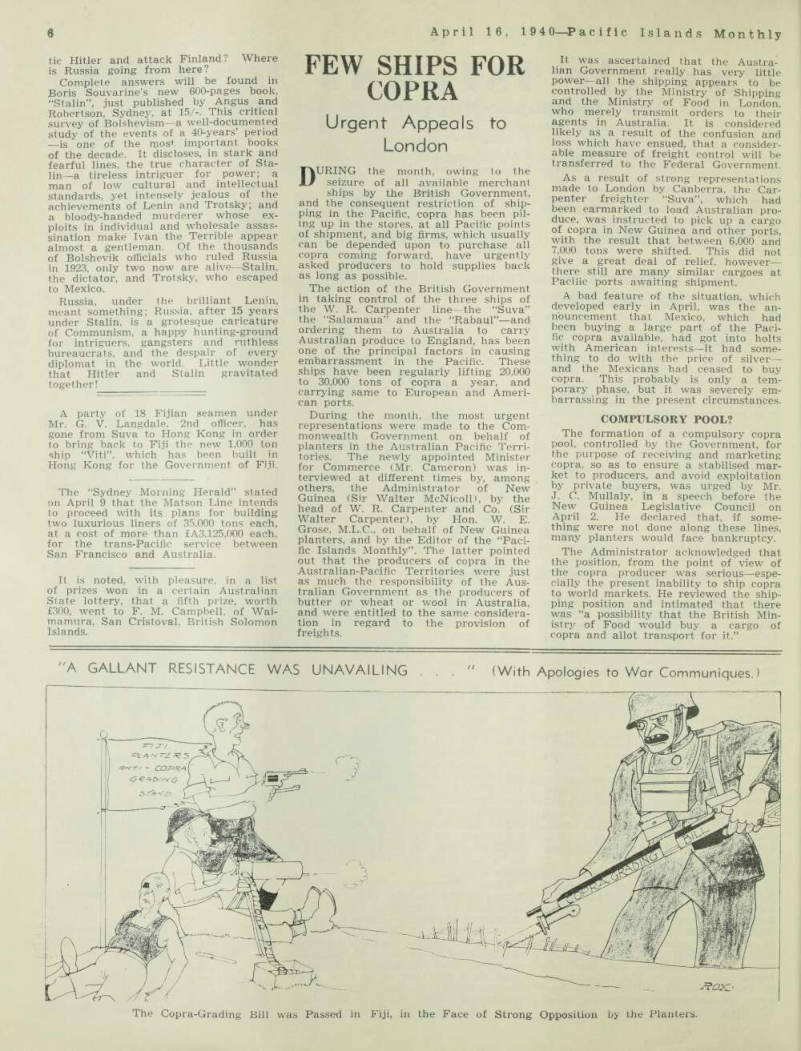
GALLANT RESISTANCE WAS UNAVAILING ... 11 (With Apologies to War Communiques.)
O The Copra-Grading Bill was Passed in Fiji, in the Face of Strong Opposition by the Planters.
To Build The Bitoi Road
Mr. Hughes as Czar of New Guinea
From a Special Correspondent
SALAMAUA, April 4.
I HAVE it on very good authority that steps Will be taken immediately to commence the actual construction of the long-debated road between Sala maua and Wau, following the direct route across the mountains.
This decision has been made by Can berra, and has been influenced by Mr.
Hughes who, although he gave up the Territories portfolio over a year ago, insisted that he should be permitted to “finalise” the New Guinea goldfields road question.
The decision over-rides all common sense.
There is good reason for believing that the direct, or Bitoi Gorge, route was opposed by the Administrator on grounds of policy, and by the Director of Public Works, Mr. Field, for sound engineering reasons. The Administra tor, taking at last the long-sighted view, when he was in Canberra the other day, recommended the building of the road via the Markham Valley and the Warn pit Valley, on the grounds, first, that great engineering and maintenance problems were thereby avoided and, second, that such a road, in any event, should be the first stage in providing an arterial highway for the opening up and development of the great central plateaus of New Guinea.
The instructions which came from Canberra—and they are generally accepted here as the instructions of Mr. Hughes—were definite and peremp tory. The building of the road had to be proceeded with at once, and the Bitoi route had to be followed.
IT may interest your readers to know that the Goldfields demand for the direct route between Salamaua and Wau, which was carried into flam ing prominence by the energetic Mr. H.
T. Allan, has now practically died out.
The majority of the people to whom I have talked are more or less indiffer ent about it; and, when they are pressed, admit that there are good, sound, national reasons for following the longer route, via the Markham and the Wam pit.
The majority of people, who have to pay freight from the coast, do not seem to care much whether the road is built direct, via the Bitoi, or round by the Markham—all they ask is that the road be built, and reasonably soon.
I am a stranger to this country, but I do know something of road engineer ing. I have had a look at the proposed route and have had a talk with a large number of people who are interested in the road project; and I am convinced that if any attempt is made to build the road from Salamaua to Wau, via the Bitoi, the job will take years to com plete—certainly not less than two years and probably three—and the cost of maintenance will be enormous.
But, if I do not know New Guinea, I do know Federal politicians very well, and I know the character and history of Mr. Hughes. This decision of his to build the road via the Bitoi Valley is typical: just as his decision (subse quently repudiated by Cabinet) to build the new capital at Salamaua was typi cal.
He knows nothing about engineering,
and, when it comes to spending public money, he is irresponsible and unprac tical. He was wheedled and flattered into giving his decision in favour of the Bitoi Valley. But, for a time, he could not see any answer to the financial problem—even to him, it was clear that it was not possible to build a road for anything like the amount of money in sight. However, since then, for con stitutional reasons, it has been found necessary to place in a special New Guinea Trust Fund the revenue taken out of New Guinea as special gold tax; and this large sum will be sufficient to provide for the cost of the road, even if it takes three years to build and costs twice the amount estimated. So, now, Mr. Hughes orders: “Full steam ahead!”
Editorial Note : We publish the fore going communication, for what it is worth, but we believe that it about sum marises the position. The Administrator, addressing the Legislative Council in Rabaul on April 2, said, briefly:— “The route decided upon by the Com monwealth Government (Bitoi Gorge) has been divided into four sections, and such progress has been made with the specifications for the first section that it is hoped to be able to invite tenders for this portion of the work within the next two weeks.”
If the circumstances are as stated, we can only say that it is a shocking thing that an impulsive, erratic and un informed man like Mr. Hughes should be allowed to fasten such a “white elephant” upon helpless and inarticulate New Guinea. Why does the Federal Government not check up on him? He was proved wrong in selecting Sala maua; he may be equally wrong in forcing the road-builders to use the Bitoi route.
Rev. €. F. Andrews, who was a leading advocate of the rights of Indians, and who visited the Indian communities in Fiji in 1936, died on April 4 in Calcutta at the age of 69. He was the friend and biographer of Mahatma Ghandl.
Mr. R. D. Blandy
New Resident Commissioner In New Hebrides
MR. R. D. Blandy, who has been Act ing British Resident in the New Hebrides, has been appointed Resi dent Commissioner in place of Mr. G. A.
Joy, who has been transferred to Makulla, Arabia (about 400 miles east of Aden).
Makulla is the home of the Sultan, and Mr. Joy will act as British Adviser.
He is the intermediary between the British Administration at Aden, and the Sultan. It is a promotion which gives great satisfaction to his old friends in the New Hebrides.
Mr. R. H. Garvey, of Fiji, succeeds Mr. Blandy as Assistant Resident Com missioner in the New Hebrides.
Captain R. D. Blandy was born in 1891 and educated at Victoria College, Jer sey. He entered the Indian Police at the age of 20, joined the Indian Army four years later, and saw active service on the North West frontier and in Mesopotamia. In 1919 he rejoined the Indian Police, and was a district super intendent in 1920. In 1928, he was appointed chief of international police at Tangier, and in 1929 he was transferred to the New Hebrides as assistant to the Resident Commissioner.
Mr. Ronald Herbert Garvey, M.A. (Cantab.), F.R.A.1., is 37 years of age, and was educated at Trent College and Emmanuel College, Cambridge. He joined the Fiji and Western Pacific ser vice, as cadet, in 1926; was appointed assistant district officer at Mala in April, 1929, and district officer the fol lowing year. Mr. Garvey was assistant secretary to the Western Pacific High Commission in August, 1932, and Act ing Secretary in 1932-33-34.
Professor Peter Buck, Director of the Bishop Museum at Honolulu, has post poned his projected visit to New Zea land and Tonga, owing partly to war conditions and partly to the death of his friend Mr. Albert Judd, who was chair man of the Museum Board and who pro posed to collect native history specimens in Tonga.
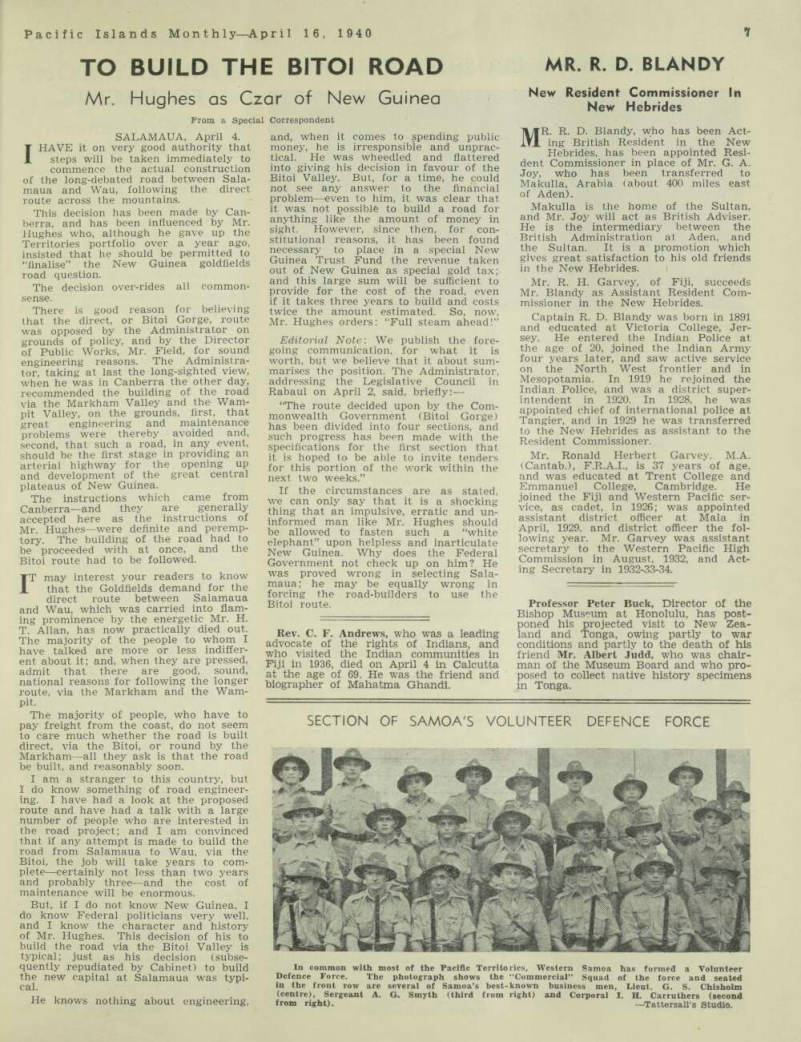
Section Of Samoa's Volunteer Defence Force
In common with most of the Pacific Territories, Western Samoa has formed a Volunteer Defence Force. The photograph shows the “Commercial” Squad of the force and seated in the front row are several of Samoa’s best-known business men, Lieut. G. S. Chisholm (centre), Sergeant A. G. Smyth (third from right) and Corporal I. H. Carruthers (second from right).—Tattersall’s Studio.
Advertisements & other items, p. 10 (1 item)
friHoc to r - sbt: ,^ r^vyiVia ,r
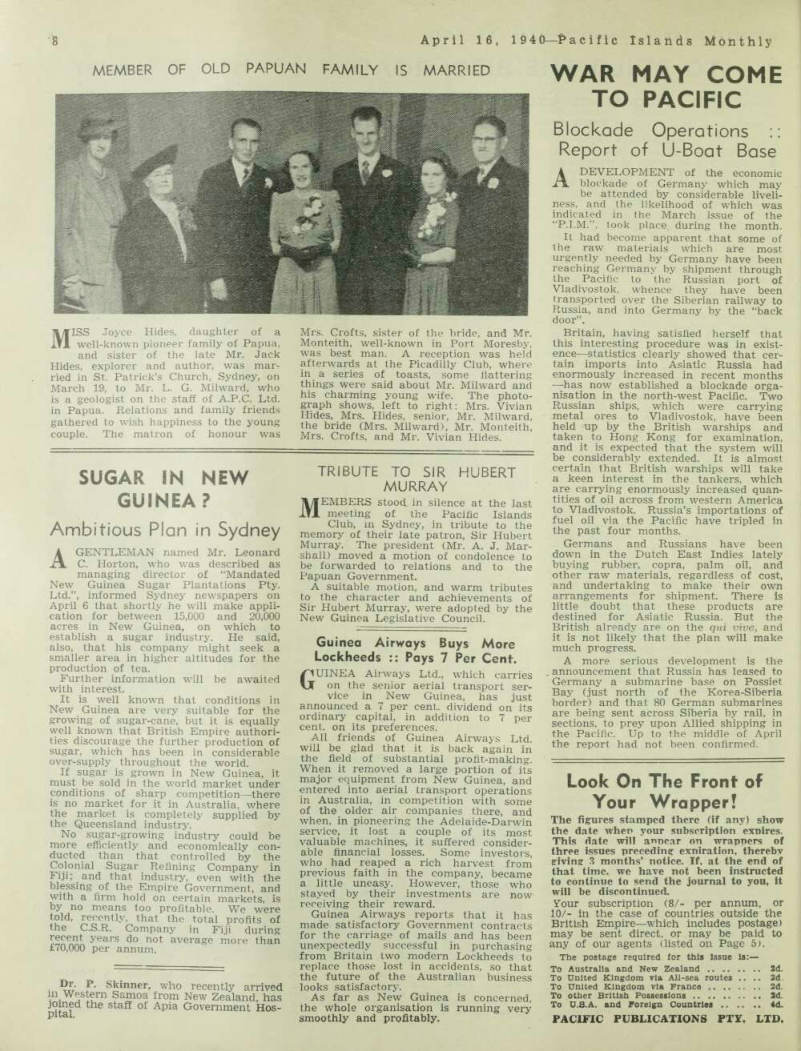
MEMBER OF OLD PAPUAN FAMILY IS MARRIED
MISS Joyce Hides, daughter of a well-known pioneer family of Papua. and sister of the late Mr. Jack Hides, explorer and author, was married in St. Patrick’s Church, Sydney, on March 19, to Mr. L. G. Milward, who is a geologist on the staff of A.P.C. Ltd. in Papua. Relations and family friends “ , , x . , , . .f gathered to wish happiness to the young couple. The matron of honour was
Mrs. Crofts, sister of the bride, and Mr.
Monteith, well-known in Port Moresby, was best man. A reception was held afterwards at the Picadilly Club, where lr , a series of toasts, some flattering wer ? said about Mr. Milward and arming A?, 111 ? 2 Photo friHoc to r - sbt: ,^ r^vyiVia ,r Hides, Mrs. Hides, senior, Mr. Milward, the bride (Mrs Milward) ; Mr , Monteith Mrs. Crofts, and Mr. Vivian Hides.
Sugar In New
Guinea?
Ambitious Plan in Sydney
A GENTLEMAN named Mr. Leonard C. Horton, who was described as managing director of “Mandated New Guinea Sugar Plantations Pty.
Ltd.”, informed Sydney newspapers on April 6 that shortly he will make appli cation for between 15,000 and 20,000 acres in New Guinea, on which to establish a sugar industry. He said, also, that his company might seek a smaller area in higher altitudes for the production of tea.
Further information will be awaited with interest.
It is well known that conditions in New Guinea are very suitable for the growing of sugar-cane, but it is equally well known that British Empire authori ties discourage the further production of sugar, which has been in considerable over-supply throughout the world.
If sugar is grown in New Guinea, it must be sold in the world market under conditions of sharp competition—there is no market for it in Australia, where the market is completely supplied by the Queensland industry.
No sugar-growing industry could be more efficiently and economically con ducted than that controlled by the Colonial Sugar Refining Company in Fiji; and that industry, even with the blessing of the Empire Government, and with a firm hold on certain markets, is by no means too profitable. We were told, recently, that the total profits of the C.S.R. Company in Fiji during do not average more than £70,000 per annum.
Skinner, who recently arrived in Western Samoa from New Zealand, has joined the staff of Apia Government Hos pital.
Tribute To Sir Hubert
Murray
MEMBERS stood, in silence at the last meeting of the Pacific Islands Club, in Sydney, in tribute to the memory of their late patron, Sir Hubert Murray. The president (Mr. A. J. Mar shall) moved a motion of condolence to be forwarded to relations and to the Papuan Government.
A suitable motion, and warm tributes to the character and achievements of Sir Hubert Murray, were adopted by the New Guinea Legislative Council,
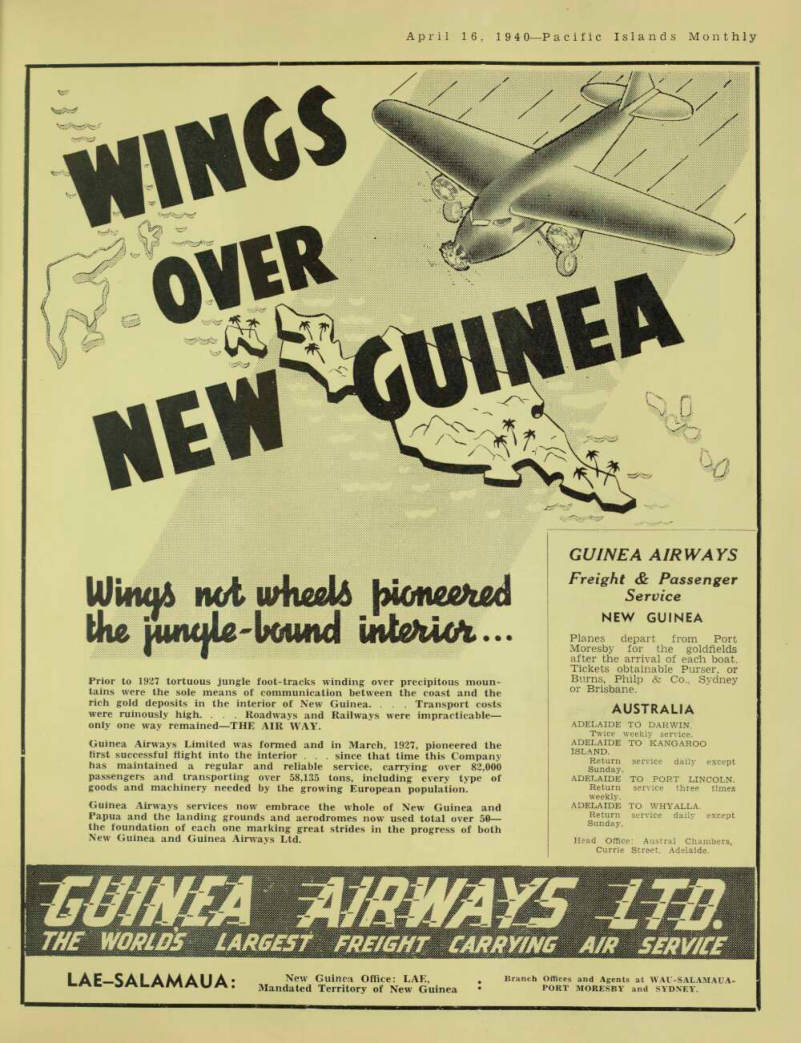
Guinea Airways Buys More
Lockheeds :: Pays 7 Per Cent.
GUINEA Airways Ltd., which carries on the senior aerial transport ser vice in New Guinea, has just announced a 7 per cent, dividend on its ordinary capital, in addition to 7 per cent, on its preferences.
All friends of Guinea Airways Ltd. will be glad that it is back again in the field of substantial profit-making.
When it removed a large portion of its major equipment from New Guinea, and entered into aerial transport operations in Australia, in competition with some of the older air companies there, and when, in pioneering the Adelaide-Darwin service, it lost a couple of its most valuable machines, it suffered consider able financial losses. Some investors, who had reaped a rich harvest from previous faith in the company, became a little uneasy. However, those who stayed by their investments are now receiving their reward.
Guinea Airways reports that it has made satisfactory Government contracts for the carriage of mails and has been unexpectedly successful in purchasing from Britain two modern Lockheeds to replace those lost in accidents, so that the future of the Australian business looks satisfactory.
As far as New Guinea is concerned, the whole organisation is running very smoothly and profitably.
Blockade Operations ::
War May Come
To Pacific
Blockade Operations :: Report of U-Boat Base
A DEVELOPMENT of the economic blockade of Germany which may be attended by considerable liveli ness, and the likelihood of which was indicated in the March issue of the “P.1.M.”, took place, during the month.
It had become apparent that some of the raw materials which are most urgently needed by Germany have been reaching Germany by shipment through the Pacific to the Russian port of Vladivostok, whence they have been transported over the Siberian railway to Russia, and into Germany by the “back door”.
Britain, having satisfied herself that this interesting procedure was in exist ence—statistics clearly showed that cer tain imports into Asiatic Russia had enormously increased in recent months —has now established a blockade orga nisation in the north-west Pacific. Two Russian ships, which were carrying metal ores to Vladivostok, have been held up by the British warships and taken to Hong Kong for examination, and it is expected that the system will be considerably extended. It is almost certain that British warships will take a keen interest in the tankers, which are carrying enormously increased quan tities of oil across from western America to Vladivostok. Russia’s importations of fuel oil via the Pacific have tripled in the past four months.
Germans and Russians have been down in the Dutch East Indies lately buying rubber, copra, palm oil, and other raw materials, regardless of cost, and undertaking to make their own arrangements for shipment. There is little doubt that these products are destined for Asiatic Russia. But the British already are on the qui vive, and it is not likely that the plan will make much progress.
A more serious development is the announcement that Russia has leased to Germany a submarine base on Possiet Bay (just north of the Korea-Siberia border) and that 80 German submarines are being sent across Siberia by rail, in sections, to prey upon Allied shipping in the Pacific. Up to the middle of April the report had not been confirmed.
Advertisements & other items, p. 10 (1 item)
Your Wrapper!
Look On The Front of
The figures stamped there (if any) show the date when your subscription expires.
This date will arniear on wrappers of three issues preceding exniration, thereby giving 3 months’ notice. If. at the end of that time, we have not been instructed to continue to send the journal to you, it will be discontinued.
Four subscription (8/- per annum, or 10/- in the case of countries outside the British Empire—which includes postage) may be sent direct, or may be paid to any of our agents (listed on Page 5).
The postage required for this Issue Is: — To Australia and New Zealand 2d.
To United Kingdom via All-sea routes ... 2d, To United Kingdom via France 2d.
To other British Possessions 2d.
To U.B.A. and Foreign Countries 4d.
PACIFIC PUBLICATIONS PTY. LTD.
Tahiti’s Trade
Remarkable Growth In Recent Years
PAPEETE, March 10.
rE following figures, from official
compilations, show the trade of French Oceania in the calendar years stated: —
Imports
1938 63,241,000 francs 1939 80,482,000 francs
Exports
1938 47,647,000 francs 1939 ' ’ 63,526,000 francs Details of exports are as follow: —
Copra
Tons. Value (francs). 1938 20,684 25,275,000 1939 23,049 26,639,000
Vanilla
Tons. Value (francs). 1938 124 11,914,000 1939 206 23,549,000
Phosphates
Tons. Value (francs). 1938 112,950 7,181,000 1939 160,680 10,286,000
Pearl Shell
1938 365 Tons 1939 179 Tons
Ten Years’ Comparison
Imports (francs). Exports (francs). 1930 .. 45,291,000 37,702.000 1931 .. 26,187,000 24,396,000 1932 24,718,000 21,011,000 1933 19,471,000 14.753,000 1934 20.133,000 16.879,000 1935 24,503,000 25,674.000 1936 36.741,000 38,968,000 1937 53,285,000 • 54,174,000 1938 63,241,000 47.647.000 1939 . 80.482,000 63,526,000
Marshalls And
Carolines
New Industries :: 100,000 Japanese There
A JAPANESE traveller, recently in Sydney, supplied some interesting information about the settlement and development of the Caroline and Marshall Islands—details of which are so carefully withheld by the Govern ment of Japan.
There are now 100,000 Japanese set tled in the three groups (Marshalls, Carolines and Marianas) which comprise the Mandate. The latest figure obtained previously (about 1937) was 60,000.
The Japanese have found gold on some of the islands. It is not rich, nor extensive; but it is good enough to form the basis of a small, flourishing indus try.
The Japanese also have found con siderable deposits of phosphate, which are being increasingly worked; and phosphate to the amount of 500,000 tons per annum is being exported.
The contrast between Japan and Aus tralia, as mandatories, is very marked.
Japan has settled 100,000 people in her territory, and has energetically devel oped new industries there, especially sugar-growing.
In the Mandated Territory of New Guinea, however —which is far bigger and richer than the Marshall and Caro line Group—Australia has settled less
than 5,000 people, and has developed no permanent agricultural enterprise—only the gold-mining industry, which has a limited life.
Pre-Polynesian Inhabitants
A Very Early Immigration From South America Could Explain Easter Island
By A. C. Rowland.
r E mystery of Easter Island may one day be cleared away, if it can be proven that the Polynesians were not the first settlers on the islands of the South Pacific Ocean of the bout* Pacinc ucean Research now being carried on in the Islands is bringing out evidence of pre- Polynesian inhabitants. Whence they came is still undetermined.
Nevertheless, in Central and Eastern Polynesia, are evidences of South American influences which give colour to the theory of emigration into the islands from that quarter.
T . rQ •_ mipctinn that the ances- There is no quest o , Pol v tors of the people we have na y Eas\ an indfa ai ?slands. But in the islands of East and South-East Polynesia there are elements which bear marks of other origins wniioT*, rhnrphill— a deen student of Polynesian dialects, whose two volumes, “Polynesian Wanderings” and “Easter Island”, have been published by the Carnegie Foundation—asserts that in the dialects of Tahiti, of the Tuamotu and Gambier archipelagoes, and of Easter Island, about 30 per cent, of the vocabularies is composed of words of strange ancestry, that bear no relation to words of similar meaning in Polynesian dialects outside this area. c n Frpnch savant
wMhT studying the’ primitive languages
the west coast of South America. remarked on the similarity of many of the words of kindred significance.
The first wave of Polynesian imml- ..ration into the Central and South Eastern archipelagoes adopted a form of sun-worship, by adding to the Pan-
theon of the primeval gods of the Po (or Night World) a god of beauty and of the World of Light—:n a rnely, the Sun God Tane-Ahu-Ura (Tane of the Mantle of Crimson Feathers), who became the chief deity Qf popular worship in the central and South-Eastern islands.
It is a matter of general knowledge that the religion of the inhabitants of the west coast of South America was sun worship.
Now, if the primitive inhabitants of the islands came from South America, inter-marriage between men of the m vadmg race and the aboriginal women would eventually pass on the chief ele ments G f ma ternal religious belief to the descendants of such unions, History and legend inform us that the ancient designation of Easter Island was Te Pito—i.e., the navel of the island world. This is very extraordinary, see ing that Easter Island is the most east erly of the galaxy of South Pacific islands.
But, if Easter Island had been for the South American immigrants what the island of Ra’iatea, in the Society Group, became in later times for the Polynesians—the place of first settle ment, the island motherland whence colonies went forth to establish them selves on other islands—then the term Pito, or centre of the Commonwealth, would be aptly applied no matter what its geographical situation, And, as Ra’iatea became the centre of polity and of religion and of wisdom for the Polynesian race, so Easter Island may have been for that vanished people whose identity modern research is now endeavouring to discover.
Samoa Scores Heavily
With Cocoa
Prom Our Own Correspondent APIA, March 25.
THE weather, although curiously erratic, has been all in favour of the cocoa-planters, who enjoyed a heavy autumn crop and now are agam exnecting a splendid output of cocoa beans.
It is predicted with confidence that this year the production of cocoa-beans wfil beat all previous records and may reach more than 2,000 tons.
The local price for cocoa-beans is £4O to £45 per ton—which puts the planters in clover. Western Samoa, at any rate, is not worrying about the unprofitable price of copra.
The loan or purchase of lantern-slides, dealing with Pacific Islands subjects, is sought by Mr. F. R. Cawley, “Strathnor”, 25 Horsley Avenue, Willoughby, Sydney.
They are required for purposes of a
public lecture.
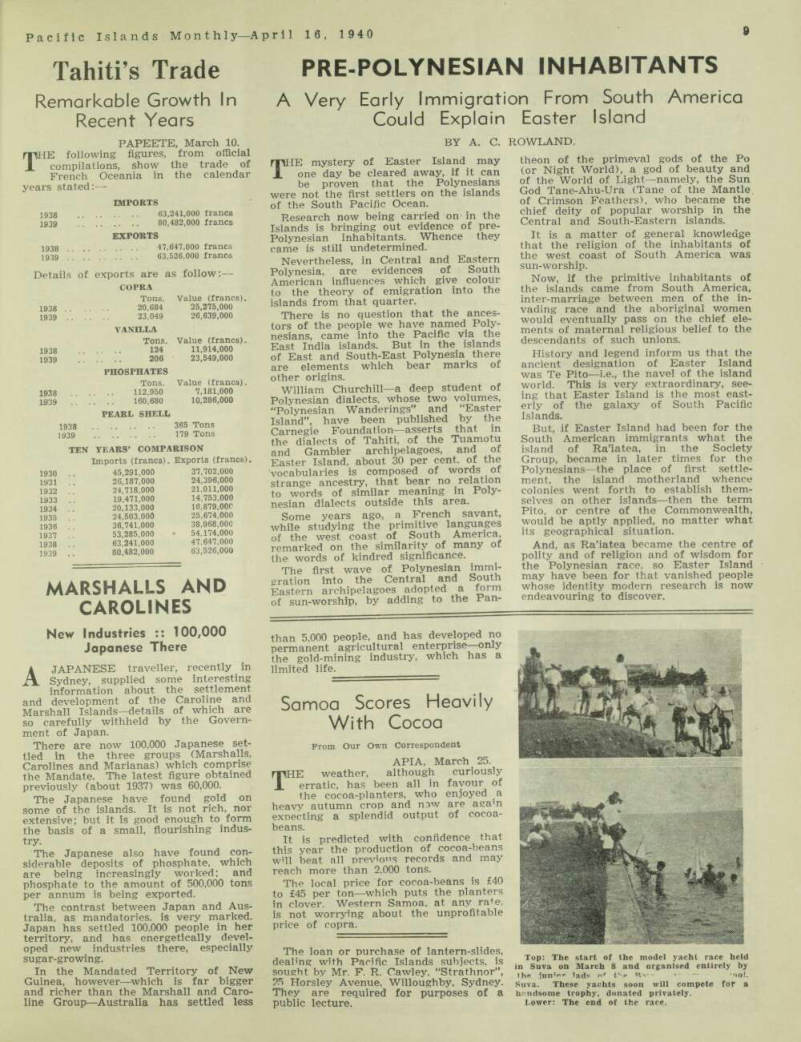
Top: The start of the model yacht race held In Suva on March 8 and organised entirely by the iunior lads of the [?] Suva. These yachts soon will compete for a handsome trophy, donated privately.
Lower: The end of the race.
Trans-Pacific Air Mail
Still at Mercy of Politicians and Bureaucrats
rE attempts to start the trans pacific air mail service are becom ing farcical.
Again and again, during the past two years, it has been announced confi dently that Pan American Airways ser vice from Auckland to San Francisco, and the British service between Sydney and Auckland, would be commenced within a short time. But always there have been postponements—and, appar ently, mostly for reasons connected with international politics.
We were assured, in recent weeks, that both services would be commenced in April. The flying people responsible for the operation of the Sydney-Auckland service did promise that their two huge flying-boats—both waiting and ready— would begin the service in April; and there is no reason, that sensible men can see, why they should not. Then it was announced that the Governments concerned —British. Australian and New Zealand—were still squabbling and that the service, therefore, would not start.
The latest statement is that the ser vice will be inaugurated with a flight from Auckland to Sydney, late in April, and that a number of politicians, who have been attending conferences in New Zealand, will accompany the boat.
Those who have been waiting, vainly, for two years, to see this service inau gurated, promise that they will not go into mourning if the politicians should fall out of the flying-boat half way over the Tasman Sea. rE flying-boat “Awarua”, which is to partner the “Aotearoa” in carry ing on the service between Auck land and Sydney, arrived in Sydney from England on March 28. It weighs 22 tons, its average cruising speed is ?Jaaa 2( S m P h > it; ca n carry a load of 46,000 lbs., it can fly 1,800 miles non stop against head winds, and it has four Bristol Perseus XII engines.
The company which will operate with the Auckland-Sydney service will be called Tasman Empire Airways Ltd., and will consist of representatives of Imperial Airways Ltd., Qantas Empire Airways Ltd., and Union Airways Ltd. — that is, the three principal air com panies of Britain, Australia and New Zealand respectively. The shipping inter ests of the respective countries are strongly represented in the airways interests. The single fare for a flight between Sydney and Auckland has been fixed at £3O.
SO far as Pan American Airways is concerned, the position is as ob scure as ever. Here, again, there are plain indications that the executives of the flying services are trying their utmost to get the service started, but that they are held up in all directions by the plagues of politicians and bureau crats who now are the curse of modern life. There is some slight hope that this service between San Francisco and Auckland will get going in May.
Why A “Floating Hotel” For
Noumea?
npHE surprising announcement was 1 made in New York on March 31 that Pan American Airways has purchased the luxury power yacht “Lyn donia” (819 tons) to serve as a floating hotel at Noumea (New Caledonia) for passengers using the flying boat service between San Francisco and Auckland.
Noumea is a town of considerable size, and has one good hotel, and several in the second grade. Trans-Pacific passen gers certainly will not wish to remain over-night on He de Nou (opposite Nou mea, where the flying-boat base has been prepared), where, it is presumed, the “floating hotel” will be placed. It is more likely that, in the few hours at their command, they will wish to ex plore the old French town of Noumea, which is one of the most beautiful and interesting places in the South Pacific.
Left 500,000 Fr.!
Cruising Liner Welcomed In Tahiti
Prom Our Own Correspondent rrotr * • . PAPEETE, March 10. rpHE tourist ship “Kungsholm” (Swed gf) ca Jl at Papeete on February 29 and left the same day for Ramtea Hiva-Oa, the Galapagos Islands, Panama and New York. ° f fi T s hiti Wore sur P rise( J and delighted to find among the “Kungs ho!m passengers no blonde ladies in shorts and little other clothing, such as "wp® y COme aShore here fr °" “uifl At Ra’iatea the ship’s company were walking y a " exhibition of Bre.
If the “Kungsholm” keeps to her ad vertised schedule, she will make a rec ord run from Tahiti to New York— mghteen days, including calls at Ra’ia tea, Marquesas and Galapagos.
Many Tahiti people, who had been waiting a long time to book steamer tunhTtn 0 thG StatGS ’ took the tunity to voyage on this fast and luxurious vessel. They included Mr.
and Mrs. James Norman Hall, Miss Hall Mr. Charles B. Nordhoff and Mr. J Frank Stimson, of the Bishop Museum.
The “Kungsholm” bought supplies liberally in Papeete, and spent more money there than had been seen for years, from one ship. Mr. O. Nordman, who acted as providore for the vessel, estimated that ship and passengers left 500,000 francs in Tahiti.
The “Kungsholm” will be back in Papeete, on another cruise, in July.
"Administrator"
Future Title in Papua
THE selection of a man to succeed Sir Hubert Murray, in Papua, is now being seriously considered.
We learn, unofficially, that the future position will be “Administrator”, carry ing the title of “His Honour”, as in other Australian territories. Hitherto, the head of Papua has been “Lieutenant- Governor”, with the title of “His Excellency”.
Rev. O. G. Parry has resigned from the London Missionary Society in Papua to take up church work in Australia.
Hurricanes
Severe Damage In N. Hebrides
WITHIN a fortnight, in February, two hurricanes swept across the New Hebrides and caused great dam age.
The centre of the second hurricane passed over Tongoa and Emai, and swept everything before it.
The mission-house and church on Tongoa have been blown down, while scarcely a native house is left standing.
On Emai, the dwelling house and store of Captain C. E. Hill were razed to the ground, while great havoc was wrought on the plantation. Mr. and Mrs.
Hill were absent in Sydney, on a long deferred holiday.
The following report was published in Auckland:— A disastrous hurricane in the New Hebrides, during February, has been reported to the N.Z. Presbyterian Church.
Seven mission churches were destroyed on Nguna, two on Pele, and one each on Maso and Lelefa.
Natives suffered terribly. Many native houses, some whole villages, were wiped out. All orange, lemon, lime and bread fruit trees and a large percentage of coconuts were uprooted.
There will be poor copra crops for years.
Ten days later, a second hurricane arrived, and great havoc was wrought by tremendous seas.
Damage In New Caledonia
THE hurricane, which swept through the New Hebrides in February, seriously affected New Caledonia also. The following details are taken from “Bulletin du Commerce”, Noumea, of February 28:— It is reported from Hienghene that only one room of the post office remained standing. The police station, dispensary, hotel and the church were also dam aged.
At Voh, the damage was so extensive that local planters cannot remember worse. Cocoa and coffee plantations were laid waste. The planters are asking for the speedy formation of a commission for the purpose of assessing the extent of the damage. A similar state of affairs prevails at Temala, where buildings on the property of Mme Girard, were destroyed by falling trees.
Gomen suffered a great deal of dam age and, at one stage, water rose in the yard of Mon. Henri Holly’s pro perty to a depth of two metres.
At Ouaco, the wharf was extensively damaged and the structure was carried away from the pylons. The windmill, which was used for pumping water into the wells, is completely demolished.
Damage is estimated at more than 150,000 francs.
Plantations were ruined in the vicin ity of Capala, and it is apparent that, as a result of this condition of affairs, together with the exceptional drought this summer, the cocoa crop will be negligible.
At Kone, police buildings were dam aged and the verandah of Ballande’s store was destroyed.
Advertisements & other items, p. 12 (1 item)
10
April 16, 194 O—P acific Islands Monthly
Tropicaoties
QUEER fatalities! Natives in West ern Samoa play cricket matches in their villages. High-spirited young members of the fielding team, unable to stay quiet, frequently turn hand-springs between the deliveries of the ball. One young man, recently, in attempting a hand-spring, slipped and fell on his head, and dislocated his neck. He was given urgent medical treatment, but he died. About the same time, a Samoan lad was sent up a coconut tree to obtain drinking nuts. Before climbing the tree, he placed an iron bar upright in the ground, so that he might use it in husking the coconuts. But he lost his hold in the top of the tree, and fell, and was impaled on the iron bar. He died in hospital. * * * IT was in the saloon of the old inter island steamer “Malinoa”, in the days before Democracy ruined the New Hebrides.
Mr. Fitz-Kafoops, the official, had steered the conversation to the subject of “blood”. “Bleud,” said Mr. Fitz-K., “will tell! Take a fellah that can trace his ancestry back a bit: always comes eought on top, what!”
Said Sol Abrahams, old-time recruiter and trader, “How far can you trace your ancestry back, Mr. Fitz-Kafoops?”
“Eough! Abeought fowah or faive hundred yahs,” replied the official, mod estly.
“That all?” said Sol. “Why, my ancestors were big cattle and sheep ranchers along the Jordan over four thousand years ago.”
Mr. Fitz-K. fixed Sol with the haughty official stare, according to section 13, sub-section B (a) and continued; “Fellah with a bit of bleud an’ breedin’ an’ tradition, got something to hang by, what! Fellah like that ”
“Too right,” interrupted Sol. “About the time my ancestors were counting up their steers and heifers for market, yours were hanging from trees by their tails.”
You can’t keep a good man down! * * * THUS a Rabaul subscriber on the de parture of New Guinea’s quota to join the A.I.F.:— “This exodus from the Territory is all very well, but Hitler is not at all popular in sporting bodies, for he is the cause of cricket and baseball teams being depleted. As a result, the Rabaul Baseball Association, which had arranged to compete in the international baseball snorts competition, has had to cancel the arrangements. Likewise, the other evening, when the spinsters held their Lean Year Ball, there was a marked shortage of eligible young men.” * * * ANSWERING the telephone recently, a sinabada (mistress) in Port Moresby was taken aback by an urgent request from an educated mission boy for the immediate medical services of her cook-boy—it seemed the mission boy’s wife was seriously ill in the village.
Inquiries followed, and it was learned that the alleged cook, more sophisticated than experienced, was not only the vil lage quack, but a witch-doctor of con siderable fame, whose fees on the no cure-no-pay system, ranged from £1 to £3—with even £5 for obstinate cases!
Besides curing ordinary complaints such
as leprosy, pleurisy, and T. 8., his spe cial care lay with victims of sorcery, whom he claimed to cure with embro cations of his own concoction. Appar ently, not overlooking the golden oppor tunity that offered itself in a district where most evils are attributed to black magic, he went into partnership with the local sorcerer; and, cursing one another in public ,and dividing the pro fits in secret, they did remarkably well during a short epidemic that swept through the village.
The calls on the telephone during this period became so insistent, and the cooking so bad, that it was felt that it would be a generous gesture to dispense with the cook’s services for the benefit
of mankind.
M.L.
“TF ever you have watched a ‘lamp 1 walk-about’ (hurricane lantern) dying, from want of kerosene, you will appreciate the humour of this inci dent,” writes a New Guinea planter.
“One of our boys, a mission-reared native, stood watching a lunar eclipse.
Finally, as the eclipse became complete, and darkness came down, he burst out: ‘Goddam yer! I tink kerosene belong Jesus ’e finish now!’” * • * rREE gentlemen in succession, who called upon the editor of the “Rabaul Times”, moaned about the war, and so forth. So the editor let go, in this fashion; — “Can’t we take it? Has the old blood of the British bulldog turned to water?
Are we going to drop our bundle because we get a few knocks in the cash regis ter, or have to dodge the bank manager round the corner?
“And yet . . . people still manage to tootle around in their motor cars with benzine at 2/3 a gallon, and a good programme at the local picture-palace always draws a full house; one can still hear the metallic flop of beer-bottle tops, falling on the floors of pubs and
clubs; and the women of Rabaul still maintain their reputation for being the best-dressed in the Pacific, north of Sydney and west of Honolulu.” * * • TO-DAY, in the Pacific, if you want to learn something of a planter’s vocabulary, say “copra bags” to him. Copra bags, of course, swing on the tail of the jute market; and the following “story about jute” has been sent to us by a valued correspondent in New Guinea: — Jute is the product of a seed that is planted and grown in India to keep the producer broke and the buyer crazy.
The fibre varies in colour and length, and the man who can guess nearest the grade of the fibre is called a jute man by the public, a fool by the farmer, and a poor business man by his creditors.
The price of jute is determined in London, and goes up when you have sold and down when you have bought.
A buyer working for a group of mills was sent to London to watch the jute market, and after a few days’ delibera tion, cabled his firm to this effect: “Some think it will go down, and some
think it will go up. Whatever you do will be wrong. Act at once.”
Jute is planted in the spring, mort gaged in the summer, and left in the field in the winter. * ♦ * I AM sick of reading, here and there in different magazines, of the sup posed origin of the expression “0.K.”; I saw it again only recently in a well-known American monthly, and the usual unimaginative theory was given of somebody spelling “All Correct” with an “O” and a “K” I am certain it owes its derivation to the following: Years ago, and for many years, the
island of Haiti (West Indies) used to ship to Great Britain large quantities of cotton, and this cotton was recognised in England as some of the world’s very best. Bales of cotton would be arriving from other parts of the world at the same time. Now, when this cotton came to be examined and graded, the bales of fine cotton from Haiti would be chalk-marked “0.K.”, as it had been shipped from Haiti’s port of Aux Cayes (pronounced, near enough in English, “OKs”). And, subsequently, any other cotton coming up to the standard of that received from Aux Cayes (Haiti) would also be passed and marked as “0.K.”, signifying that it was first-grade cotton. Hence, the origin of the now world-wide expression of “0.K.”, which, after all, is a very similar expression to “A.l,”—which, of course, is derived from Lloyds.—T.C.W.
As It Was
In The
Beginning:
A Tongan couple leav ing Nukualofa in their canoe for Oneata, a small island in the same group. —Photo by Hettig.
Advertisements & other items, pp. 13-14 (2 items)
11
Pacific Islands Monthl y—A pr i 1 16, 1940
STERLING VARNISH CO., Alexondria, N.S.W.
NO SPRINGS
NO CUSHIONS
The latest Invention of Dr. L. Barrere Is the result of 40 years’ practice and improvements. Stupendous success of new method of control.
NO SPRINGS NO PADS.
The NEO-BARREEE acts like the hand when placed flat upon the orifice You will at once without effort and in all movements hold the intestine in its cavity
The NEO-BARIRERE for COMFORT
and SECURITY.
Write To-day for FREE LITERATURE.
BARRERE DISTRIBUTION CO.
(Dept. 44). 35 PITT STREET, SYDNEY.
Excl. Distributors of
ETS. DU DR. BARRERE. PARIS.
Est. 1880 —220 branches throughout the world.
oam,
rsl
•H WATERPROOF lf» r
DRIES IHHAIF HOUR
$
CREAM
Dries in half an hour on plaster walls, ceilings, cement, fibre, wood Cr iron.
Also Excellent as an Undercoat for lacquers, paints fir enamels 13/3 per gallon
HIGHLY DURABLE
Write for a colour Card ...
STERLING VARNISH CO., Alexondria, N.S.W.
THE PACIFIC ISLANDS CLUB
Visitors from the Islands to Sydney (or those interested in Islands affairs), are advised to communicate with the honorary secretary of the above Club, which has been formed to study the history, traditions, economics, and political developments of the Pacific Islands.
Meetings held regularly at Hotel Carlton, Sydney.
Address for Correspondence:
THE PACIFIC ISLANDS CLUB,
Box 2434 MM., G.P.0., Sydney.
V .
COUGHS and
COLDS...
ARE THEY YOUR
HANDICAP?
Have you ever played a round with head aching, limbs a burden, and each breath an effort? If so, you'll know what a handicap to your game a severe cold or cough can be.
Outdoor exercise is the finest means of gaining and keeping health; but for many people, whose every day occupations keep them indoors most of the time, even the mildest of outdoor activity is too strenuous, leaving them fatigued and with resistance lowered—open to the attacks of dangerous winter ailments.
Fatigue-resistance must be built up steadily if the full benefits are to be gained from your outdoor activities.
The Secret of Immunity:
The vitamins "A" and "D" contained in pure Cod Liver Oil are recognised by Health Authorities as Nature's finest safeguards against the attack of most winter ailments. Scott's Emulsion contains Cod Liver Oil in its most easily digested and palatable form. An eminent Research Body has definitely established that. within 30 minutes of taking, every drop of Scott's is strengthening chest and lungs, creating reserves of energy, and building up immunitv to colds and coughs.
SCOTT’S
Emulsion
ALL CHEMISTS AND STORES 2/9 AND 5/- PER BOTTLE
New Guinea Timber
Another Appeal For Aid
FURTHER appeals to the Australian Government for more sympa thetic consideration of the New Guinea timber industry are to be made.
Investigations during the past three or four years have shown that there are large quantities of timber in New Guinea, within transportable distance of the coast, which have a definite and increasing value in Australia. An in creasing number of people, representing various kinds of timber interests, have visited New Guinea in recent years, in search for lumber.
But Australia, although it cannot sup ply its own timber needs, puts a con siderable duty on timber in various shapes and forms, and it stubbornly insists on retaining this duty so far as the Australian Territories of Papua and New Guinea are concerned. It is almost impossible to bring sawn timber into •Australian ports, and there even are very considerable difficulties in the way of the importation of logs in bulk, Mr. Matthew Phillips, who was con nected with the C.S.R. Co. and other Fiji sugar concerns between 1900 and 1923, died recently at Nasinu, Fiji, aged 67,
Advertisements & other items, p. 14 (1 item)
12
April 16, 194 O—P acific Islands Monthly
About Islands People
Rt. Rev. L. S. Kempthorne. Bishop in Polynesia, attended the General Synod of the Church of England at Nelson, New Zealand, in March. He planned to spend part of April in the Cook Islands, to be in Tonga during May, and then visit Western Samoa in June.
Mr. M. A. Condon, assistant geologist of the Australasian Petroleum Co. in Papua, recently returned to Port Moresby, from leave. During his furlough in Australia he was married and his bride accompanied him back to Papua.
Mr. Robert Herbertson died in Queens land on March 1, aged 87. He was one of the last two surviving members of the expedition that went into the ranges at the back of the north coast of New Guinea in 1878 to look for gold and which was decimated by fever. The story was told in the “P.1.M.” some years ago. The only surviving member of the expedition now is Mr. Arthur Peck, of 99 Queen Street, Melbourne. He is 85 years of age and still is in good health.
Mr. Harold Bull, of Burns Philp (S.S.) Co. Ltd., Nukualofa, died recently in Tonga, following a sudden heart attack.
He was well-known in Fiji, having been transferred to Tonga from Levuka only a few months ago.
Nurse Ann Cole left Sydney for Papua in April to act as relief nurse at the Leper and Tuberculosis Hospital. Gemo Island, near Port Moresby, while Sister Fairhall, of the London Missionary Society, proceeds to Australia on short furlough.
Mr. R. Stevens, a member of the Treasury Department’s staff in the N.G.
Administration, arrived in Australia from Rabaul at the end of March, on leave.
Mr. Harold Griffiths, of the Thursday Island Customs Department, has been transferred to Sydney.
Mr. A. Cookson, wireless operator on Ocean Island, has been appointed ad ministrative officer at Hull Island, Phoenix Group, which is now part of the Gilbert and Ellice Islands Colony.
Mr. Pat Costello, one of the best known commercial and mining men in Fiji, arrived in Sydney by the March “Mon terey” on a short business trip.
Sir Harry Luke, K.C.M.G., Governor of Fiji and High Commissioner for the Western Pacific, arrived in Auckland, New Zealand, from Suva on March 15, cn a holiday visit, accompanied by the acting A.D.C., Lieutenant M. L. Ber nacchi. Sir Harry underwent a short period of health treatment at Rotorua, visited the Centennial Exhibition at Wellington, and then returned to Auck land, sailing for Suva on April 1. During His Excellency’s absence from Fiji, Hon.
John Craig, Colonial Treasurer, acted as Officer Administering the Government.
Mr. E. Wilson, manager of Messrs.
Whitten Brothers’ store at Samarai, Papua, is at present in Sydney on fur lough. He is president of the Samarai Chamber of Commerce, and in that cap acity is energetically attending to a num ber of matters in Sydney.
Mr. Peter Wolfcarius, who formerly was a resident of Papua died in St. Vincent’s Hospital, Sydney, in March, after an illness extending over three years.
Mr. Coring Andrews, well-known Islands author, and Mrs, Andrews left Rarotonga by the March “Matua” en route for the United States, on what they hope will prove only a short business trip.
Dr. Robert Fruchtmann, a Polish refugee who has been living in Sydney, will shortly leave for Papua to take up duties at the Methodist Mission’s Hos pital at Salamo.
Mr. B. C. Ballard, British solicitor at Vila, New Hebrides, is spending a short furlough in Melbourne.
Mr. Oscar Newman, the agent of Burns Philp (S.S.) Co., on the island of Ambrym, New Hebrides, is spending a holiday in Norfolk Island with his family.
Father S. Bourke has joined the staff of the Marist Mission in Western Samoa.
MISS P. TALBOT, Sister at the Melanesian Mission Hospital, Fauabu, Malaita, returned to the Solomon Islands by the M.V. “Southern Cross” early in April, after spending furlough in New Zealand since last November.
Advertisements & other items, pp. 15-16 (2 items)
13
Pacific Islands Monthl y—A pril 16, 1940
Soldier
—L / \ Choose the Watch that has been proved withstand ALL
HE ELEMENTS
under the most severe conditions of service.
With its high-grade 15-jewelled movement in an extra strong chrome case with stainless steel back, this is the right watch for a Soldier on active service.
Mail Orders despatched by return, registered and insured at our expense.
PROUDS PTY. LTD.
WATCHMAKERS AND JEWELLERS,
KING AND PITT STREETS, SYDNEY.
ASK
FOR
IT & ,i •o a \° V f/ I
SPECIALLY SELECTED
Expertly blended For Flavour Taste and Economy.
Freshness Sealed in every packet.
LLOYD & CO. Pty. Ltd., Sydney
Famous for Tea & Coffee for 50 Years.
to
GIFT
Angus & Coote pay postage, and never miss return mail.
OF GIFTS
For the happiest day of your life
DIAMOND SET, £5/5/-,
This Wedding Ring is in 9ct. White Gold. It Is set with 7 Diamonds. manner.
In 9ct. Gold, 17/6. ■ ' ' or / Plain
dO/ "ring
COLLAPSIBLE
For Soldiers
Wedding in 18ct Gold. 9ct. Gold from 10/6.
DRINKING MUG
or Outdoor Men
Clean!
Unbreakable!
Convenient!
No need to put up with cracked cups and makeshift drinking vessels.
Keep this unbreakable, silverplated Mug always handy for your own personal use.
Plated
with PURE SILVER.
01 / -Is a very ' low price for this Silverplate Mug which folds to less than half of its open size. The solid leather carrying pouch is included. 75/- Never be Short of Good Knives ' In this neat Leatherette case there is sufficient to see you proudly through any emergency. 6 Table and 6 Dessert Knives are supplied, as well as a good set of Carvers and Bread Knife. All knives have stainless steel blades and grained Zylonite handles.
ANGUS & COOTE
500 GEORGE STREET. SYDNEY
Tonga's People
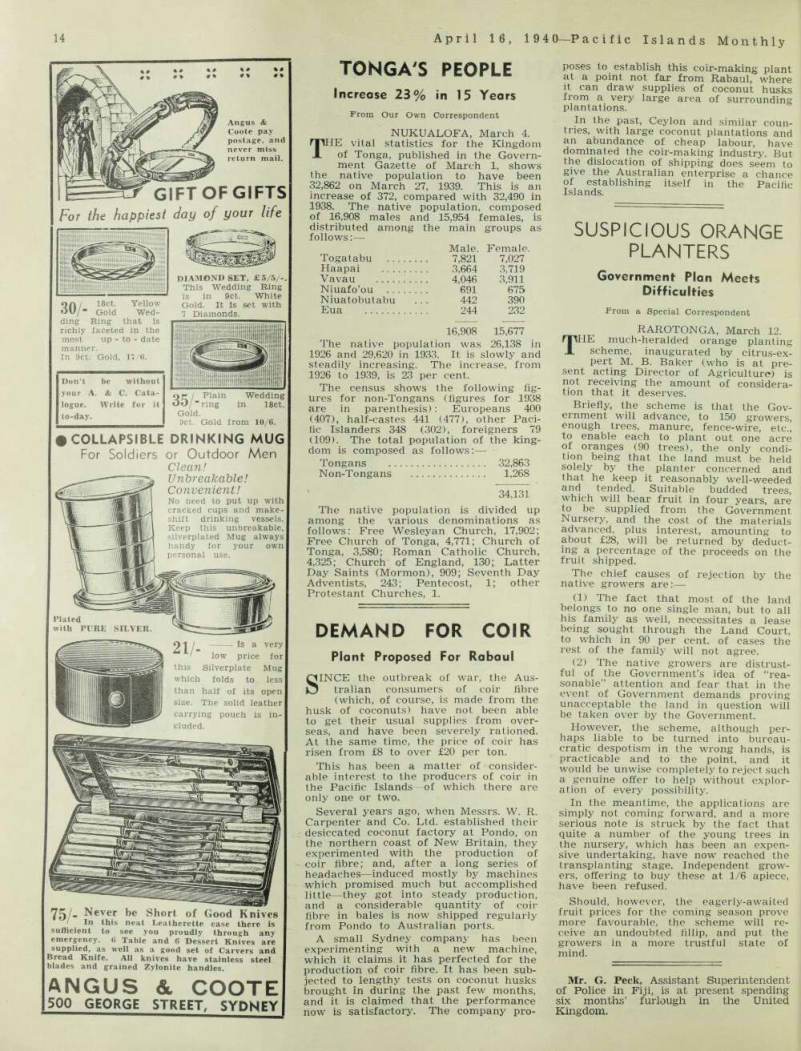
Increase 23% in 15 Years
From Our Own Correspondent
Nukualofa, March 4.
THE vital statistics for the Kingdom of Tonga, published in the Govern ment Gazette of March 1, shows the native population to have been 32,862 on March 27, 1939. This is an increase of 372, compared with 32,490 in 1938. The native population, composed of 16,908 males and 15,954 females, is distributed among the main groups as follows:
The native population was 26,138 in 1926 and 29,620 in 1933. It is slowly and steadily increasing. The increase, from 1926 to 1939, is 23 per cent.
The census shows the following fig ures for non-Tongans (figures for 1938 are in parenthesis); Europeans 400 (407), half-castes 441 (477), other Paci fic Islanders 348 (302), foreigners 79 (109), The total population of the king dom is composed as follows: — Tongans 32,863 Non-Tongans 1,268 ' 34,131 The native population is divided up among the various denominations as follows: Free Wesleyan Church, 17,902; Free Church of Tonga, 4,771; Church of Tonga, 3,580; Roman Catholic Church, 4,325; Church of England, 130; Latter Day Saints (Mormon), 909; Seventh Day Adventists, 243; Pentecost, 1; other Protestant Churches, 1.
Male.
Female.
Togatabu 7,821 7,027 Haapai 3,664 3,719 Vavau 4,046 3,911 Niuafo’ou 691 675 Niuatobutabu 442 390 Eua 244 232 16,908 15,677
Demand For Coir
Plant Proposed For Rabaul
SINCE the outbreak of war, the Aus tralian consumers of coir fibre (which, of course, is made from the husk of coconuts) have not been able to get their usual supplies from over seas, and have been severely rationed.
At the same time, the price of coir has risen from £8 to over £2O per ton.
This has been a matter of consider able interest to the producers of coir in the Pacific Islands —of which there are only one or two.
Several years ago, when Messrs. W. R.
Carpenter and Co. Ltd. established their desiccated coconut factory at Pondo, on the northern coast of New Britain, they experimented with the production of coir fibre; and, after a long series of headaches —induced mostly by machines which promised much but accomplished little—they got into steady production, and a considerable quantity of coir fibre in bales is now shipped regularly from Pondo to Australian ports.
A small Sydney company has been experimenting with a new machine, which it claims it has perfected for the production of coir fibre. It has been sub jected to lengthy tests on coconut husks brought in during the past few months, and it is claimed that the performance now is satisfactory. The company pro
poses to establish this coir-making plant at a point not far from Rabaul, where it can draw supplies of coconut husks from a very large area of surrounding plantations.
In the past, Ceylon and similar coun tries, with large coconut plantations and an abundance of cheap labour, have dominated the coir-making industry. But the dislocation of shipping does seem to give the Australian enterprise a chance of establishing itself in the Pacific Islands.
Suspicious Orange
Planters
Government Plan Meets Difficulties
From a Special Correspondent
Rarotonga, March 12.
mHE much-heralded orange planting JL scheme, inaugurated by citrus-ex pert M. B. Baker (who is at pre sent acting Director of Agriculture) is not receiving the amount of considera tion that it deserves.
Briefly, the scheme is that the Gov ernment will advance, to 150 growers, enough trees, manure, fence-wire, etc., to enable each to plant out one acre of oranges (90 trees), the only condi tion being that the land must be held solely by the planter concerned and that he keep it reasonably well-weeded and tended. Suitable budded trees, which will bear fruit in four years, are to be supplied from the Government Nursery, and the cost of the materials advanced, plus interest, amounting to about £2B, will be returned by deduct ing a percentage of the proceeds on the fruit shipped.
The chief causes of rejection by the native growers are:— (1) The fact that most of the land belongs to no one single man, but to all his family as well, necessitates a lease being sought through the Land Court, to which in 90 per cent, of cases the rest of the family will not agree. (2) The native growers are distrust ful of the Government’s idea of “rea sonable” attention and fear that in the event of Government demands proving unacceptable the land in question will be taken over by the Government.
However, the scheme, although per haps liable to be turned into bureau cratic despotism in the wrong hands, is practicable and to the point, and it would be unwise completely to reject such a genuine offer to help without explor ation of every possibility.
In the meantime, the applications are simply not coming forward, and a more serious note is struck by the fact that quite a number of the young trees in the nursery, which has been an expen sive undertaking, have now reached the transplanting stage. Independent grow ers, offering to buy these at 1/6 apiece, have been refused.
Should, however, the eagerly-awaited fruit prices for the coming season prove more favourable, the scheme will re ceive an undoubted lillip, and put the growers in a more trustful state of mind.
Mr. G. Peck, Assistant Superintendent of Police in Fiji, is at present spending six months’ furlough in the United Kingdom.
Advertisements & other items, pp. 17-18 (1 item)
for th
■Hi I i S
And now
first time
An 8 Valve, All
Wave, Portable - Mantel Radio with
Communications Receiver Performance!
Produced in response to insistent requests for a handy-sized first-class high-quality performance Receiver specially adapted to the exacting tropical conditions of the Islands. Ideal for Boat Owners, Builders, Race Enthusiasts, Business Men and all who want last-minute, reliable official news from any part of the world—there's nothing on the market to equal it for range, tone, volume, selectivity and general performance! Don't buy a Radio Set until you've investigated the "ULTIMATE" —it'll stand any test and surpass anything you've ever heard!
Special Features:
Magic Eye Tuning; Six Gang Band Spreading Condenser; Spin Tuning; Logging Hand; Simplified Control; Precision Selectivity; All Main Channel Coverage; Lovely Casing; Detachable Lid; Specially Protected Insect-proof Case, etc., etc.
Both Vibrator Battery and Electric A.C.
Models available.
OTIMrAVni
u GEORGE BROWN Cr CO. PTY. LTD., 267 Clarence St., Sydney.
Special Export Price
for the Islands
POST COUPON FOR DETAILS
GEORGE BROWN & Co. Pty. Ltd.,
267 Clarence Street, SYDNEY.
Without obligation to me, and post free, please send me details of the “ULTIMATE” Portable-Mantel Radio Set.
Name Address
DO YOU KNOW 7
p\vr. >h^=
v\^ /X K?) NS
jvi
i)v S\
sv>l
S\ V
ACE-LONC- STRIFE HAS
PACED FOR THE POSSESSION OF A SACRED TOOTH-, WHICH /S KEPT AT KANDY, CEYLON. TffE TAMILS CLAIM fT BELONGS TO HANUMAN THE MONKEY OOP, BUT\ BOPDH/STS INSIST /T IS THE UPPER LEFT CAN/NE OF QUDDH-A- « ANCIENT MYTHOLO&Y HAS IT THAT THIS TOOTH SHONE LIKE THE SUNRISE WHEN AN ATTEMPT WAS MATE TO POUND IT ON AN ANVIL. , k \
BUCK IVORY"
OR DENTAL DISEASE, IS THE
IT WORLDS OLDEST g. MOST PREVALENT"
PLA6UE . TO-DAY 90% OF THE WORLDS
POPULATION SUFFERS PROM DENTAL
DECAY. YOU CAN PREVENT TOOTH
DECAY BT KEEPINCr YOUR TEETH
SURCHCALLV CLEAN.
KOLYNOS CLEANS R/OHT
POINN TO THE NAKED ENAMEL,
VOUR TEETH CLEAN) -uH#C/
LOVELINESS,
I'Bacm/AL
Mourn"
KOLYNOS
DENTAL
CREAM,
|'j omJ. 2 «
KILL THE BACTERIA THAT LIVES IN c' K>” YOUR MOUTH rt. YOU WILL HAVE -d,
'BACTERIAL MOUTH" E RENTAL
DECAY. KOLYNOS BURSTS INTO
V A SEETHING FOAM of ANTISEPTIC
BUBBLES THAT PREVENTS <
"BACTERIAL MOUTH "o U
YOUR teeth-
m SVRCHCALLY CLEAN AND
WARKUNO. KOLYNOS (S&L
LASTS TWICE AS LONG-.
AS ORDINARY DENTAL.
CREAM. /2 ON A-
DRY BRUSH IS,
ENOU6H>
V'^VvWlW/WC
h »u l T
Tea Growing
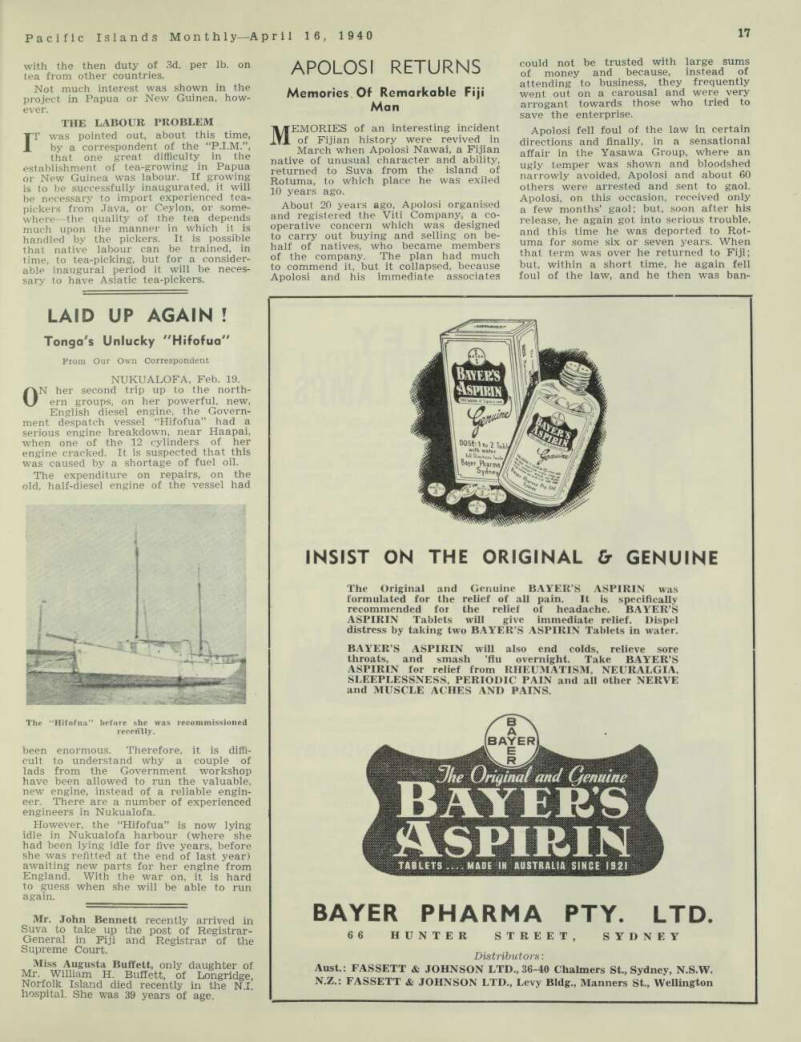
In N. Guinea
War Gives Chance to New Industry
MUCH interest has been taken in the following statement, made in Can berra, which was published in the “Sydney Morning Herald” on March 29: The practicability of producing a con siderable part of Australia’s tea require ments in the Mandated Territory of New Guinea will be investigated soon.
The investigation is to be made in the hope of relieving expenditure of non sterling exchange on the purchase of tea from Java, and, at the same time, eliminating the necessity for rationing Australian supplies.
Preliminary experiments conducted by the Administration have revealed that the tea plant grows well in many parts of the territory, and produces a high grade leaf. The possibility of develop ing an important export industry has been recognised for some time, and it is likely to receive a marked stimulus from the war.
Mr. George Murray’S Early
Interest
FOR many years, when he was in the Papuan service and, later, when he became director of agriculture in New Guinea, Mr. George H. Murray consistently advocated the possibilities of establishment of tea-growing in Papua or New Guinea.
When the great upland plateaus were discovered in central New Guinea in 1932, and examined, Mr. Murray urged that this country would be found suit able for tea-growing; and, subsequently, in a world tour, he studied tea-produc tion in Ceylon and Java.
He stated, when he returned to Aus tralia at the end of 1935 (according to an article in the “P.1.M.”, of January, 1936) that, owing to an international agreement, it was practically impossible to get seed or plants for cultivation in any country. He had tried to get seed or plants in Ceylon, Malaya and Java, but had failed. It is interesting to note, however, that in subsequent years, Mr.
Murray somehow beat the embargo and was able to get a quantity of tea-seed, which he planted and cherished, and there is now a small but flourishing plantation of tea trees on the Depart ment of Agriculture’s experimental plots in the Upper Ramu district of New Guinea.
Another man who showed great inter est in tea-growing was the late Sir Hubert Murray. About 1934, Mr. W.
H. Wright, of Samarai, Papua, who started desiccated coconut enterprises in Papua and New Guinea, was in Aus tralia and, in a newspaper interview, he declared that a large area of country on the mainland of Papua, opposite Samarai, was suitable for tea-planting and that he personally intended to start tea plantations there.
His eagerness and enthusiasm inter ested Sir Hubert Murray and, for two years after that, Sir Hubert hammered away at Canberra, and eventually per suaded Canberra to give official en couragement to the idea. It was announced, early in 1936, that the Com monwealth Government would permit tea to be imported into Australia at a duty of only Id. per lb., as compared
with the then duty of 3d. per lb. on tea from other countries.
Not much interest was shown in the project in Papua or New Guinea, how ever.
The Labour Problem
IT was pointed out, about this time, by a correspondent of the “P.1.M.”, that one great difficulty in the establishment of tea-growing in Papua or New Guinea was labour. If growing is to be successfully inaugurated, it will be necessary to import experienced tea-pickers from Java, or Ceylon, or some where—the quality of the tea depends much upon the manner in which it is handled by the pickers. It is possible that native labour can be trained, in time, to tea-picking, but for a consider able inaugural period it will be neces sary to have Asiatic tea-pickers.
Advertisements & other items, p. 18 (1 item)
16
April 16, 194 O—P acific Islands Monthly
Laid Up Again!
Tonga's Unlucky "Hifofua"
From Our Own Correspondent
Nukualofa, Feb. 19.
ON her second trip up to the north ern groups, on her powerful, new, English diesel engine, the Govern ment despatch vessel “Hifofua” had a serious engine breakdown, near Haapai, when one of the 12 cylinders of her engine cracked. It is suspected that this was caused by a shortage of fuel oil.
The expenditure on repairs, on the old, half-diesel engine of the vessel had
been enormous. Therefore, it is diffi cult to understand why a couple of lads from the Government workshop have been allowed to run the valuable, new engine, instead of a reliable engin eer. There are a number of experienced engineers in Nukualofa.
However, the “Hifofua” is now lying idle in Nukualofa harbour (where she had been lying idle for five years, before she was refitted at the end of last year) awaiting new parts for her engine from England. With the war on, it is hard to guess when she will be able to run again.
Mr. John Bennett recently arrived in Suva to take up the post of Registrar- General in Fiji and Registrar of the Supreme Court.
Miss Augusta Buffett, only daughter of Mr. William H. Buffett, of Longridge, Norfplk Island died recently in the N.I. hospital. She was 39 years of age.
The “Hifofua” before she was recommissioned recently.
Apolosi Returns
Memories Of Remarkable Fiji Man
M EMORIES of an interesting incident of Fijian history were revived in March when Apolosi Nawai, a Fijian native of unusual character and ability, returned to Suva from the island of Rotuma, to which place he was exiled 10 years ago.
About 20 years ago, Apolosi organised and registered the Viti Company, a co operative concern which was designed to carry out buying and selling on be half of natives, who became members of the company. The plan had much to commend it, but it collapsed, because Apolosi and his immediate associates
could not be trusted with large sums of money and because, instead of attending to business, they frequently went out on a carousal and were very arrogant towards those who tried to save the enterprise.
Apolosi fell foul of the law in certain directions and finally, in a sensational affair in the Yasawa Group, where an ugly temper was shown and bloodshed narrowly avoided, Apolosi and about 60 others were arrested and sent to gaol.
Apolosi, on this occasion, received only a few months’ gaol; but, soon after his release, he again got into serious trouble, and this time he was deported to Rot uma for some six or seven years. When that term was over he returned to Fiji; but, within a short time, he again fell foul of the law, and he then was ban
ished to Rotuma Island for 10 years.
As evidence of his extraordinary in fluence among the natives, and their memory of him after all these years, a large crowd of Fijians gathered at the King’s Wharf, in Suva, when the “Mata fele” arrived there on March 13, to greet the returned man. However, it was discovered that he left the “Mata fele” at Levuka, and came on to Suva by a private vehicle, and thus escaped the crowd.
The remarkable story of Apolosi Na wai was published in the “P.1.M.” in March, 1939, and July, 1939.
Mrs, Glover, who conducted the Casino Hotel (non-license) at Apia, Western Samoa, for several years, is now living privately in Apia with her son, Mr.
P. W. Glover. The hotel is under new management.
Advertisements & other items, pp. 19-20 (2 items)
17
Pacific Islands Monthl y—A pril 16, 1940
Bayers
WO UUH J •,
°°SM»o2UI
JPharma// 7
S^ne Y //( 4 V%3^?^.
INSIST ON THE ORIGINAL & GENUINE
The Original and Genuine BAYER’S ASPIRIN was formulated for the relief of all pain. It is specifically recommended for the relief of headache. BAYER’S ASPIRIN Tablets will give immediate relief. Dispel distress by taking two BAYER’S ASPIRIN Tablets in water.
BAYER’S ASPIRIN will also end colds, relieve sore throats, and smash ’flu overnight. Take BAYER’S ASPIRIN for relief from RHEUMATISM, NEURALGIA, SLEEPLESSNESS, PERIODIC PAIN and all other NERVE
and MUSCLE ACHES AND PAINS.
B A
(BAYERI
E
Original and Qenuine
Bayers
Aspirin
TABLETS ... MADE IN AUSTRALIA SINCE 1921
BAYER PHARMA PTY. LTD.
66 HUNTER STREET, SYDNEY
Distributors : Aust.: FASSETT & JOHNSON LTD., 36-40 Chalmers St., Sydney, N.S.W.
N.Z.: FASSETT & JOHNSON LTD., Levy Bldg., Manners St., Wellington
TILLEY
KEROSENE LAMPS
Tilley Lamps are made in England and are the most efficient of any lamps burning kerosene. There are 18 models, including Table Lamps, Hanging Lamps, Floor Standards, etc.
All provide a full 300 c.p. steady light without flickering. Not affected by wind or insects, and absolutely free from smoke, smell or fumes.
Illustrated is the all-purpose lamp. It is a gale-proof storm lantern, or when fitted with reflector as shown, it is an efficient hanging lamp. May also be used on the table, with parchment shade. Write for Catalogue of all models.
Price 57/6 each, complete with reflector.
SIMPLEX MARINE ENGINES
3 h.p. 2 cycle and 5 h.p. 4 cycle.
Illustrated is the new 5 h.p. 4 cycle, with built-in Reverse Gears. A fine, powerful little unit suitable for boats up to 20 ft. Has force-feed lubrication, Shebler Carburettor, removable English Magneto with impulse starter. No vibration, economical and sturdy. Bore 3|, Stroke 4 in..
R.P.M. 1,000. Made in Australia for hard Australian coast conditions.
Price, complete with Muffler, £52/10/-.
Write for Engine Catalogue.
SHIPCHANDLERY
We are the largest manufacturers of Marine Fittings and Equipment in Australia. We have everything you may require for yachts, motor-boats, schooners and trading vessels.
Having most modern workshops for marine manufacture, we no longer depend upon overseas supplies. We are pleased to send you our latest Marine Catalogue. Our prices are attractive. Intelligent service.
W. KOPSEN & CO. PTY. LTD.
380 KENT STREET, SYDNEY.
Cables: “Kopsen”, Sydney.
Will Japan's Flag Follow
Japan's Trade?
The Plea For "Economic Advances"
LEADING Japanese statesmen, re cently, in public statements, have emphasised their claim that, while it is the ambition of Japan to make economic advances in the Pacific Islands, Japan has no ambition for territorial expansion there.
Mr. Miyake, of the Social Mass Party, said that Japan should be permitted to develop the resources of the Netherlands East Indies, the Philippines and other South Seas countries; but Japan was prepared, first of all, to make a non aggression pact with the countries con
cerned, to show that she had no terri torial aims.
A similar statement was made by the Foreign Minister of Japan, Mr. Hachiro Arita.
It is probable that Japan is quite sin cere in giving these assurances. The European nations which hold Pacific ter ritories must recognise Japan’s claim to freedom of economic expansion—they cannot expect indefinitely to coop up 100,000,000 people in the limited terri tories of Japan—and it is probable that this will be done in the future along the lines now indicated by Japan her self —namely, economic penetration, fol lowing the conclusion of non-aggression pacts.
The difficulty about these arrange ments, however, is that time does not stand still. The present generation of men who make these pacts, in all sin cerity, pass away, but the* economic penetration, which they have arranged, remains.
The result may be that a new gen eration of Japanese will see flourishing in, for example, the Dutch East Indies or British New Guinea, industries which have been created by Japanese enter prise, while those countries are still under the control of Holland or Great Britain. Thereupon, the Japanese will demand possession of those countries.
It has happened hundreds of times, and it will happen again. Once admit freely the Japanese merchant and the Japanese industrialist, and it is only a matter of time before we must admit also, as paramount, the flag of Japan.
Nevertheless, the problem of Japan must be solved —otherwise, we shall have a blood-bath in the Pacific —and so, presumably, the risk must be taken.
in Fiji
Educated Wives
Provided
Work of Mission School in Fiji
BECAUSE the Ballantine Memorial School for native girls, conducted by the Methodist Mission, in Fiji, was found to be on ground required by the Government for defence purposes, a satisfactory arrangement was made be tween the Methodist Mission and the Fiji Government under which 40 acres were provided for the school at Tama vua, about 2| miles from Suva, on a fine hill site, overlooking the town and harbour.
Most of the necessary buildings already are erected and transfer of the institution will be complete by July.
An interesting sidelight on the work being done by the Methodist Mission at this school, is supplied by the fact that Fijian men who have been educated— sons of the noble families, for example, and native medical practitioners—have often sought their wives among the ex pupils of this school, who are noted for their good standard of education and attractive deportment. Fijians, although not pure Polynesians, are quite equal to the Polynesians in the manner in which they accept European education and European standards of life, and they naturally seek a mate who also has been educated.
Advertisements & other items, pp. 20-21 (2 items)
18
April 16, 194 O—P acific Islands Monthly
JRoff at -Virtue Xtd.
f
BRILLIANT LIGHTING
and dependable power at a very low cost ... if you use a M.V. Electric Lighting Plant.
M.V. Plants are fully guaranteed. They
are so very compact and a self starter is fitted so that a child can operate them without any possible risk.
ELECTRIC
LIGHTING
PLANTS
Will save you money and eliminate the risk of lire, in fact they have made Electricity the lowest-priced luxury you can buy.
You and your family may now enjoy the comfort and convenience of Perfect Lighting, Electric Irons, Toasters, Fans, Vacuum Cleaners, Electric Refrigeration, Radio, at a cost that is amazingly low.
Our Expert Staff will gladly advise you on any matter concerning Home or Shop Lighting without obligation. All you need do is to;
FILL IN
CUT OUT AND POST
Please send me particulars of: (1) Petrol Engines: (2) Diesel Engines; (3) M.V. Lighting Plants to operate lights, iron, fan.
Name...
Address.
DIESEL
ENGINES
The s w e e test running Diesels ever built. The special Patented Cylinder Head ensures absolutely complete combustion and lower fuel consumption.
M. V. Diesels s' ' start immediately ijfc from cold no preheating, changing of fuel or compression ratio is necessary. All moving parts are totally enclosed against dust and run in an oil bath or oil mist.
PETROL
ENGINES
If they were twice the price they would still be great value.
M.V. Petrol Engines are without doubt the most modem engines of their class and the greatest value for your money. Fully balanced crankshaft reduces vibration to a minimum.
JRoff at -Virtue Xtd.
ENGINEERS, MANUFACTURERS.
AND MACHINERY MERCHANTS
11-25 PALMER STREET. SYDNEY. N.S.W.. « BRISBANE and LONGREACH. Oio. ’Phone: FL 5214 (6 lines).
Population
A Transfer Of
From Gilberts to Phoenix Islands
BECAUSE some of the islands of the Gilbert Group are now over crowded, and because there is no native population in the fertile islands of the Phoenix Group, farther east wards, arrangements have been made by the Administration of the Gilbert and Ellice Islands Colony to transfer native population from the Gilberts to the Phoenix Islands.
Probably, there is a political back ground to this. The Phoenix Islands have come into prominence, in the past few years, because they are on the dir ect line between Fiji and Honolulu and, as is well known, two of the unoccupied islands, Canton and Enderbury, have been taken over by the United States, for the purpose of air bases. Canton now is under the joint administration of the United States and Britain.
The Americans have indicated, in no uncertain fashion, that if islands are unoccupied, and apparently not needed, they may be occupied by the United States for air base purposes.
The unoccupied islands of the Phoenix Group, apart from those mentioned, are Phoenix Island, Birnie Island, Sydney Island, Hull Island, Gardner Island and McKean Island. Phoenix Island con tains about three square miles, and is very fertile, with extensive growths of coconuts, and a fresh-water lake in the centre. Gardner Island is over two miles long, and is very fertile, and car ries several large coconut plantations.
The other islands are smaller, but prac tically all are fertile and habitable.
Burns, Philp interests held a lease
over these islands until 1938, when it was taken over by the Gilbert and Ellice Government; and, since then, the latter has pushed on with its plan of trans ferring population from the Gilberts.
The London Missionary Society announces that it has made arrange ments with the G. and E. Administra tion to send, with the first parties of natives from the Gilberts, trained L.M.S. teachers from Beru (which is an L.M.S. station in the Gilberts). They will supervise church and school activities in the new settlements in the Phoenix Islands.
Papua
Trade Booming In
From Our Own Correspondent
Port Moresby, April 2.
OFFICIAL figures for the half-year ended December 31 show some in teresting movements. Compared with the same period of 1938, the value of foodstuffs, apparel, beer, spirits and tobacco, increased by £22,000.
Exports for the half-year were:—
It will be noted that, in those three items alone, exports increased £32,000 in value.
Mr. R. H. Siggins, head Commonwealth auditor in New Guinea, is at present absent from the Territory on three months’ leave.
1938. 1939.
Copra, Tons 4,474, 5 612 Value £26,889 £38,197 Rubber, Tons 565 639 Value £47,557 £63,906 Des. Coconut, Tons ... 733 862 Value .. .. £22,717 £26,638
Popular Appointment
Captain the Hon. Harold Taylour,
M.L.C.
From Our Own Correspondent 0 . WAU, April 2.
NCE again the Goldfields are repre sented on the Territory of New Guinea Legislative Council. Out of the several recommendations put for ward, Captain Harold Taylour has re ceived the appointment.
The choice is a particularly happy one, and receives the approval of prac tically the whole community.
The new Legislative Councillor has been in the forefront of all progressive public movements on the Goldfields, and is an indefatigable worker in anything that he undertakes. At one time Warden of the Morobe Goldfields (from which position he resigned some five years ago) Captain Taylour is well versed in all phases of mining and the require ments of the industry; he is a member of the Mining and Metallurgy Society; he has the gift of speech; and one of his crowning virtues is, perhaps, that he is entirely free from bias. On the departure of Captain H. T. Allan for Australia, after the commencement of the war, Captain H. Taylour became president of the New Guinea Mining Association, of which he was a vice president. His promotion to the rank of captain in the New Guinea Volunteer Rifles was promulgated a fortnight ago.
Mr. G. R. Richardson, base officer at Wewak, Northern New Guinea, for the Australasian Petroleum Company, re turned to A.P.C.’s headquarters in Port Moresby, Papua, in March.
Advertisements & other items, p. 22 (2 items)
20
April 16, 194 O—P acific Islands Monthly
Nelson And Robertson Pty. Ltd.
" I ""' (ESTABLISHED. 1895.) "" 11 " ' —.. M -
ISLAND MERCHANTS
All classes of merchandise purchased at wholesale prices and original invoices supplied to Island Clients.
COCOA BEANS, RUBBER, TROCAS SHELL and COPRA sold on Commission.
SOLE AGENTS FOR
BEEBE ALL STEEL WINCHES, Portable, Unconditionally Guaranteed. 2, 5 and 15 ton from Stock.
LONDON SELF PRIMING PORTABLE PUMPS, Manufactured in Canada, all sizes from la in. upwards. Specially suitable for prospecting and mining in all its branches.
SKANDIA ENGINES, Full diesel, semi diesel, all powers, marine and stationary.
ARCHIMEDES. Swedish Outboard Engines. Highly recommended.
UPSON BRITISH BOARD, wallboard, strong and light in weight. 6ft. to 12ft. lengths always in stock.
ANKAR INSULATING WALLBOARD, made from pure wood-fibre. The best insulating material on the market.
NELSON and ROBERTSON Pty. Ltd
12 Spring Street, Sydney, Australia
Telegraphic Address: “IVAN SYDNEY.”
Fiji And Tahiti
A Comparison That is Odious!
SOME comparisons, unflattering to Fiji, were made by Mr. J. R. Gray, a former resident of Tahiti, in an article published in the “Fiji Times” recently. Mr. Gray was eight years in the French islands, and has been eight een months running a copra planta tion in the Lau Group, in Fiji.
He says that in his section of the Lau Group there is an annual copra production of 2,700 tons yet the Euro pean community there have neither wireless communication, proper postal service nor reliable shipping facilities.
Mr. Gray, in strong terms, condemns the miseraole little ships which are used in Fiji to carry on communications with the outlying islands. He says that they are mostly overloaded, and the condi tions under which passengers are forced to travel are a disgrace to the Red Ensign. In Tahiti, the outlying islands are served by schooners of 100 tons or more —mostly good, seaworthy and rea sonably comfortable vessels.
Mr. Gray cannot understand why a shipbuilding industry has not been de veloped in Fiji—that is to say, one cap able of giving the Colony plenty of small trading vessels. He thinks that if the Government gave the industry some encouragement, the vessels could be built for about £5,000 each.
Mr, Gray asks why seaplanes are not more used in Fiji. He points out that, In Tahiti, there is a seaplane base and, when the seaplanes are not required for defence purposes, they make periodical visits to the outlying islands, as part of their exercises, and they carry passen gers and mails at a reasonable rate.
Why should that not be done in Fiji?
He unequivocally condemns the lack of roads and wharves in the Lau Group and he concludes: — “At one time there were good roads on this island and a wharf at Loma Loma. To-day, the roads have gone back to jungle and one cannot land dry shod from even a dinghy at the capital town of Lau.
“When the new Government yacht is in commission and officials may travel in comfort, they may find time to visit this group. They will see at Loma Loma a well-kept Government Com pound and a number of minor officials, sleek and well dressed, and, no doubt, very content with life, but I very much doubt if they will hear anything of the dilapidated native villages or realise the appalling state of apathy and slackness into which the Fijian seems to have fallen under our system of Govern ment.”
A CONFIRMED Islands bachelor, on furlough in Sydney, was lecturing about the South Sea Islands.
“Men.” he said, “are so numerically superior to women that every woman there can be sure of at least one hus band.” Addressing the female members of his audience, “Even you might be able to get one.”
An indignant young lady rose and stalked away. As she reached the door, the lecturer said: “Madam, there is no need for hurry; there isn’t a boat till next week!”
Rev. William Burvill, vicar of Thurs day Island for 10 years, has been ap pointed to the parish of Ballma, North ern New South Wales.
Advertisements & other items, pp. 23-24 (1 item)
Drifting Apart
So Mrs. Davis took her mother’s advice and had a long chat with her doctor. Finally she said: — . , And that’s what’s up with me doctor. It’s this awful tiredness . . . hangs over me all the time. I don’t know, I even wake up tired nowadays.” ‘‘Mrs. Davis,” said the doctor, ‘‘l know exactly now you feel. ¥our trouble is Night-Starvation. Have you ever realised that wmie you sicep your bony burns up energy? lour neart beats 35,000 times, lour lungs make muscular movements during your eignt Hours’ sleep. Naturally, n energy is not during sleep, you wake urea and leel run down, lake my auvice, anu start drinking norlicks every mgnt before you go to bed. louii be ngnt as ram in no time.’
Mrs. Davis took her doctor’s advice, and the change that came over her was really marveaous. o ix weeks later she and her husband were out on a 'picnic together. Suadenly, for no reason at all, Dick turned to her and said: — •Darling, you look perfectly lovely to-day—full of life too! It’s marvellous to see you this way!
She said: “ Oh, don’t be silly Dick”, and started to clear up the plates, out she really thought to herself, “Thank goodness! He’s taking notice of me again” . . .
It’s hard for you to keep your personality and your charm when that null, tired feeling dogs you all day.
Do you wake tired in the morning, leel dull—“floppy”—during the day?
Then the chances are that you too are suffering from Night-Starvation.
Remember what the doctor said— “Horlicks guards against Night- Starvation. Horlicks replaces energy lost during sleep”. So drink a cup of Horlicks before bed and you’ll wake in the morning feeling full of vitality and radiant with life. aorlic ixe tunii*'
The Davis’s have been married six years. They have a small boy, Tommy, five years of age. They should be very happy, but they’re not. They’re not exactly unhappy, but that vital spark seems to have gone out of their marriage. They’re beginning to take each other for granted—too much so. One day Mrs. Davis was leaning despondently on the end of the carpet-sweeper looking at her husband, Dick. He was reading the newspaper. His wife stood there looking at him and this is what she thought.
“I’m nothing but a drudge—he never takes any notice of me now. I never dreamed our marriage could turn into this!”
Dick Davis wasn’t really reading his newspaper—he had it in front of his face, but his eyes weren t on the type, he was thinking . . . and this is what he was thinking: “She’s always tired and dull nowadays —not a bit like the girl 1 married. What’s come over her lately?”
Young Tommy, who was playing on tne jioor unnoticed by his mother and father, was thinking to himself: — “They don’t take any notice of me now.”
This sort of thing happened day after day. Mrs. Davis knew inside herself that they were drifting apart.
“Is it my own fault?” she wondered.
At last, she decided to confide in her mother.
“Mum,” she said, “I can’t go on. The way we’re going now I don’t know where we’ll end up. It’s hopeless.
Dick never takes any notice of me now . . . never does any of those little things that mean so much to a woman—you know, Mum.”
Her mother said: “Darling, I understand. But it isn’t hopeless. I’m going to be frank with you ... 1 believe the real trouble lies in that awful tiredness you’re always complaining about. It isn’t natural for you to be tired all the time, darling. Take my advice and see a doctor.”
By Appointment
WHEN VISITING
BRISBANE
Pay us a call and let us take your measurements, colour preferences, size records, etc. These will be of great assistance to us for future reference.
A range of the latest Suitings will be gladly forwarded on request.
Pike Brothers Ltd.
Queen Street
Swallow & Ariel!
LIMITED
PORT MELBOURNE :: AUSTRALIA
MANUFACTURERS
SINCE 1854
OF HIGH QUALITY
BISCUITS
CABIN BISCUITS
NAVY and PILOT BREAD
PACKED EXPRESSLY FOR EXPORT
IN TINS UP TO' 50lbs.
Manufactured at Port Melbourne, Australia FIJI REPRESENTATIVES - - PEARCE & CO. LTD.
That Bird Of
Paradise
Another Nome and Discoverer Claimed
Letter to the Editor I HAVE been much interested to read, recently, in your splendid maga zine, of the naming of a new Bird of Paradise, “Taeniaparadisea macni colli”. I notice that, in your January issue, there is more comment on the bird, and further mention of it as “Mc- Nicoll’s Bird of Paradise”.
In view of the interest apparently cen tred in this striking new species, I thought you would be interested to know that the above-mentioned “for midable name” is what we ornithologists call a synonym, and that the bird has been previously described.
The original description was published in the Bulletin of the British Ornitholo gists’ Club, January, 1939, vol. lix, p. 57, by Mr. C, R. Stonor. He based his de scription on the tail feathers obtained by Mr. Shaw-Mayer, giving two known localities, one Mt. Champion, the other, a point approximately 80 miles west of
Mt. Hagen. The name given by Stonor to the bird was “Astrapia mayeri”, in honour of that well-known bird collector. • Previous description thus must .^ e kird must be known as Mayer’s Ribbon-Tailed Bird of Para dise”.
As one who has had the pleasure of meeting the Administrator of the Man dated Territory, let me hasten to re mind that good sportsman that the sink ing of his name into synonomy is a matter of a routine technicality of Natural Science, and no personal reflec tion upon him. After all, to quote a well-known author, “What’s in a name*”
I am, etc.,
S. Dillon Ripley Ii.
Litchfield, Conn.
U.S.A. 16/2/1940.
Future of the Ex-German
Colonies
IN the last paragraphs of the “News- Review”, published in the “Pacific Islands Monthly” in March, it was indicated that, beneath the surface of events in Europe, a tremendous drive for a peace settlement was taking place.
The newspapers said nothing about it —or very little—but a careful study of events and conditions showed that something of an unusually important character was afoot. However, nothing came of it; and, now, it is clear that the Allies are going on with the war until Hitlerism is broken.
At the end of March, however, some of the leading newspapers frankly re ferred to the tremendously important “under-cover Easter peace drive”, as they called it. They said that at Easter it seemed, for a time, likely that a peace conference would take place; and then something mysterious happened (no one seems to know what) to interrupt the movement, and stiffen the deter mination of the Allies to go on with the war.
It is interesting to note, among the eleven clauses of Hitler’s peace terms, as communicated to the Vatican and published in some of the Australian newspapers on March 19, that one clause (clause 5) read as follows: “Restitution within 20 years of the German colonies, or equal colonial com pensation, or at least protection of Ger man emigration in areas to be deter mined in Africa.”
This bears out the opinion, frequently expressed in this journal, that the Nazi Government does not want the German colonies which were lost in 1914 —this affects New Guinea, Western Samoa, and the Marshall and Caroline Islands —but it does want large colonial areas in Africa, or somewhere, in which it can expand.
Mr. A. S. Cross, formerly general man ager of Guinea Airways, Ltd., in New Guinea, who went across to the Eastern Pacific a couple of years ago and settled down in Tahiti, recently returned to Australia. He is now serving as an officer in the Royal Australian Air Force at Point Cook, Victoria.
Mr. G. S. McDonald, who at one time was in charge of the Methodist Mission’s Technical Training Institution in Papua, recently was appointed Superintendent of State Technical Education in South Aus tralia.
Advertisements & other items, p. 24 (1 item)
22
April 16, 194 O—P acific Islands Monthly
Years!
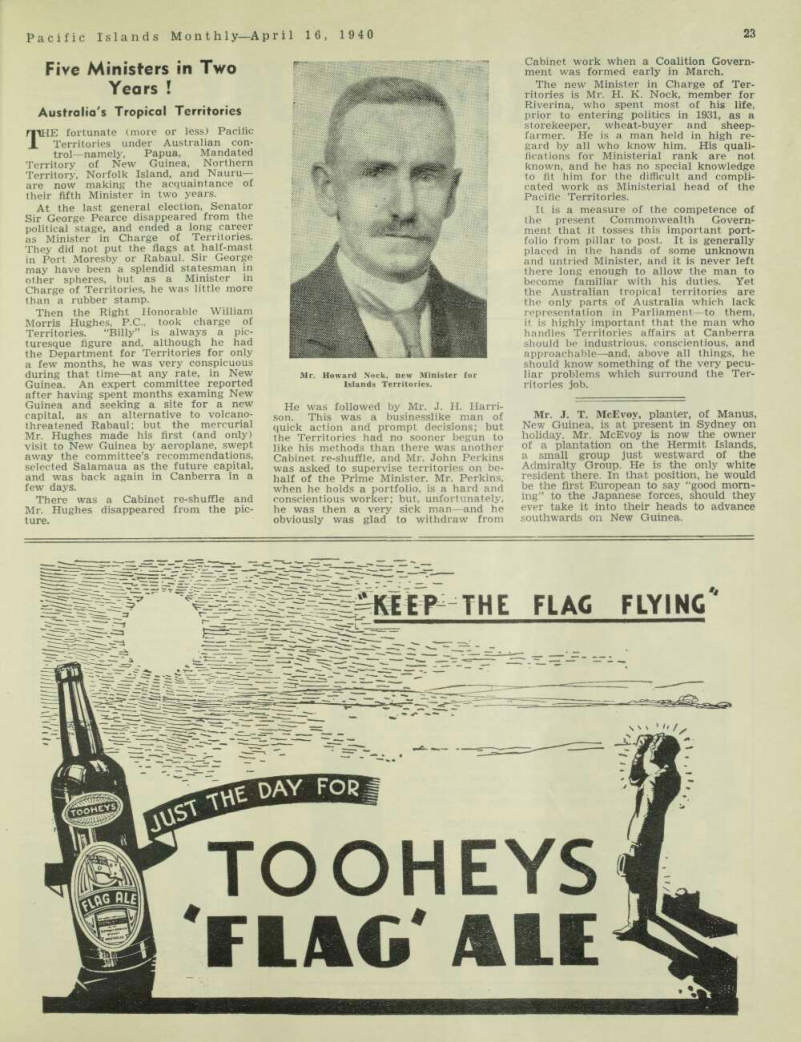
Five Ministers in Two Years!
Australia's Tropical Territories
rE fortunate (more or less) Pacific Territories under Australian con trol—namely, Papua, Mandated Territory of New Guinea, Northern Territory, Norfolk Island, and Nauru— are now making the acquaintance of their fifth Minister in two years.
At the last general election, Senator Sir George Pearce disappeared from the political stage, and ended a long career as Minister in Charge of Territories.
They did not put the flags at half-mast in Port Moresby or Rabaul. Sir George may have been a splendid statesman in other spheres, but as a Minister in Charge of Territories, he was little more than a rubber stamp.
Then the Right Honorable William Morris Hughes, P.C., took charge of Territories. “Billy” is always a pic turesque figure and, although he had the Department for Territories for only a few months, he was very conspicuous during that time —at any rate, in New Guinea. An expert committee reported after having spent months examing New Guinea and seeking a site for a new capital, as an alternative to volcano threatened Rabaul; but the mercurial Mr. Hughes made his first (and only) visit to New Guinea by aeroplane, swept away the committee’s recommendations, selected Salamaua as the future capital, and was back again in Canberra in a few days.
There was a Cabinet re-shuffle and Mr. Hughes disappeared from the pic ture.
He was followed by Mr. J. H. Harri son. This was a businesslike man of quick action and prompt decisions; but the Territories had no sooner begun to like his methods than there was another Cabinet re-shuffle, and Mr. John Perkins was asked to supervise territories on be half of the Prime Minister. Mr. Perkins, when he holds a portfolio, is a hard and conscientious worker; but, unfortunately, he was then a very sick man—and he obviously was glad to withdraw from
Cabinet work when a Coalition Govern ment was formed early in March.
The new Minister in Charge of Ter ritories is Mr. H. K. Nock, member for Riverina, who spent most of his life, prior to entering politics in 1931, as a storekeeper, wheat-buyer and sheep farmer. He is a man held in high re gard by all who know him. His quali fications for Ministerial rank are not known, and he has no special knowledge to fit him for the difficult and compli cated work as Ministerial head of the Pacific Territories.
It is a measure of the competence of the present Commonwealth Govern ment that it tosses this important port folio from pillar to post. It is generally placed in the hands of some unknown and untried Minister, and it is never left there long enough to allow the man to become familiar with his duties. Yet the Australian tropical territories are the only parts of Australia which lack representation in Parliament —to them, it is highly important that the man who handles Territories affairs at Canberra should be industrious, conscientious, and approachable—and, above all things, he should know something of the very pecu liar problems which surround the Ter ritories job.
Mr. J. T. McEvoy, planter, of Manus, New Guinea, is at present in Sydney on holiday. Mr. McEvoy is now the owner of a plantation on the Hermit Islands, a small group just westward of the Admiralty Group. He is the only white resident there. In that position, he would be the first European to say “good morn ing” to the Japanese forces, should they ever take it into their heads to advance southwards on New Guinea.
Mr. Howard Nock, new Minister for Islands Territories.
Mr. J. Lyng, who served in 1914-18 with the Australian Forces in New Guinea, and eventually became district officer at Madang, has written another book en titled, “The Scandinavians in Australia, New Zealand and the Western Pacific”, which has been published by Melbourne University Press, Mr. William Wilson, who was 72 years old, and who had spent practically the whole of his 'life in Fiji, died in Suva on March 19. He was one of the best known “old timers” in Fiji. The early part of his life was spent in Levuka, where he was interested in the timber and sugar industries. About 1905, he moved to Suva where for a time, he was engaged in the timber business and sub sequently he joined the staff of Burns Philp (S.S.) Co., Ltd. He married Miss Thomas, sister of Messrs. C.W. and W.W.
Thomas, of Lautoka, and he has numer ous relations in Fiji.
Advertisements & other items, pp. 25-26 (1 item)
Tooheys
THE FLAG FLYING
\ \ v * h /
FLAG* ALE
M/
AUSTRALIA’S BEST!
PRODUCTS
] First in Quality
DELICIOUS CANNED FOODS JAMS SOUPS SAUCES, ETC.
IXL JAMS.—AII kinds, 120 z., 24oz..and 51b. tins.
IXL JAMS (in 11b. Jars).—Lemon Shred, Orange Shred, Marmalade, etc.
IXL CANNED FRUlTS.—Peaches, Pears and Apricots, etc., 16oz. and 30oz, tins.
IXL SPECIAL FRUITS. —Gooseberries, Blackberries, Blackcurrants, Cherries, Grapes, Greengages, Golden Drops, Quinces, etc.
IXL DESSERT PASSION FRUIT.—4oz., 12oz. and
320 z. tins.
IXL DESSERT PINEAPPLES.—I6oz. and 30oz. tins.
IXL CRUSHED PINEAPPLES.—I6oz. and
30oz. tins.
IXL CHOICE PIECES PINEAPPLES—I6oz.
and 30oz. tins.
IXL FRUIT COCKTAIL.—I6oz. and 30oz. tins.
IXL SPECIAL DICED FRUIT SALAD.—I6oz. and
30oz. tins.
IXL MARASCHINO CHERRIES.—6oz. and 13oz. Jars.
IXL OLIVES.—6oz. and 13oz. Jars.
IXL SOUPS. —Boz. and 16oz. Cream of Tomato Soup.
Boz. and 16oz. Cream of Vegetable Soup.
Boz. and 16oz. Cream of Celery Soup. Boz. and 16oz. Cream of Pea Soup. Boz. and 16oz.
Toheroa Soup.
IXL TOMATO SAUCE.—4oz., lOoz. and 20oz. bottles.
IXL WORCESTERSHIRE SAUCE (OR RELISH).—
50z., lOoz. and 20oz. bottles.
PICKLES.—AII kinds, 60z., 140 z., and 18oz, Jars.
IXL BAKED BEANS (with TOMATO
tv* — 4oz -> 10oz - and 16oz. tins.
IXL CURRIED BAKED BEANS.—Soz., lOoz. and 1( oz. tins.
IXL SPAGHETTI (in Tomato Sauce with Cheese).—4oz., Boz., and 16oz. tins.
IXL CURRIED SPAGHETTI.—4oz., Boz. and 16oz. tins.
Obtainable from all Leading Island
Storekeepers.
IXL
IT’S WORTH A LOT
TO KNOW THE
QUALITY IS
ALWAYS THERE.
H. JONES & CO. PTY. LTD., HOBART & SYDNEY
Landed Cleverly
In The Sea
New Guinea Mail Plane Beset by Bad Weather—Sinks—Is Salvaged
From Our Own Correspondent RABAUL, March 28.
THE W.R.C. airliner “Carinthia”, bound from Sydney to Rabaul, after leaving Salamaua on Saturday morning, March 16, ran into some very thick weather upon approaching Rabaul.
It was, as a matter of fact, the worst north-west storm of this season.
After flying over the town and the Duke of York Islands for about half an hour, and not being able to locate the local aerodrome, Chief Pilot K. G. Jackson
decided to make for Kavieng and land there. When about 20 miles from Kavieng, the petrol was exhausted, and the machine was skilfully “pancaked” beside a reef, in the sea, some 400 yards from the beach, at Sicacul Plantation, which is on the west coast of New Ire land.
Although the machine was nearly submerged when she first hit the water, the five passengers and three of the crew suffered no damage, apart from a wetting. They launched a rubber boat, and a native canoe was quickly on the scene, and all were taken ashore, to gether with their baggage. One passen ger was unlucky in losing some luggage before it could be recovered from the sinking plane. The machine remained half-submerged for some hours, and then went to the bottom, in about 110 feet of water.
The stranded party was very pleased to see Mr. C. E. P. Davis, the manager of Sicacui, and he made them all com fortable for the night. Mr. Davis had a Teleradio set on the plantation, and he lost no time in getting in touch with Rabaul, and advising that everyone was safe.
The passengers were: Matron Thor burn, of the Namanula Hospital staff, returning from leave in Australia; Mrs.
K. Munro, of Kokopo, returning from Australia; Mr. C. R. Field, Director of Public Works, returning from an official visit to Salamaua; Mr. C. Pyne, return ing from leave in Australia; and Mr. W, Ahmat, an Asiatic travelling from Sala maua. The chief pilot was K. G. Jack son, who has been with the company from its inception; the assistant pilot was C. R. Burnard, it being his first trip on the run; and the mechanic was the well-known Peter Adrian.
Smart Salvage Work
When the news reached Rabaul, two vessels left for the scene, and brought back the passengers and crew, and the mail, next day.
Upon hearing of the mishap, Mr. F. V.
Saunders, who owns a couple of schoon ers, set out for the place where the machine was lying on the sea-bed, with a view to salvaging the plane. After working for some time, he was success ful in getting some ropes around the body and managed to drag the plane into shallow water, where he beached her, in Beno Harbour. Then an engineer was located, and he set to work and dismantled everything removable, and is caring for the salvaged machine until a representative of the underwriters arrives.
Messrs. Carpenter now are carrying on the service with one plane. They had three when the service was started in May, 1938; but one was taken over by the Federal Government, at the out break of war.
The salvaged plane was not broken in any way, and it may be made service able again. Some experts think that the immersion in salt water will do irreparable harm, however.
Mr. Francis Charles Beddoes, who was one of the most highly-respected of the dwindling band of Fijian pioneers, died on March 16 at his home in Lautoka, aged 84. He went to Fiji with his father from New Zealand, in 1873, and they settled on Taveuni. Subsequently, Mr.
Beddoes entered the service of the C.S.R.
Co., Ltd., where he remained for over 30 years. He is survived by his wife and a large number of sons, daughters, grand children and great-grandchildren.
Advertisements & other items, pp. 27-28 (2 items)
25
Pacific Islands Mcnthly— April 16, 1940
Do You Sum
these symptoms of
FROM
How to Get Rid of
These Troubles
When you get enough of these minerals you get well in a natural way from the troubles caused by a deficiency of them.
BIDOMAK contains them all in balanced proportions, in the form of phosphates and glycerophosphates.
Bidomak does so much good because of the amazing concentration of vital active mineral principles which BIDOMAK provides, in pre-dissolved, easily assimilable liquid form.
Scientific Control
Manufactured in the Bidomak Pharmaceutical Laboratories, one of the most up-to-date, hygienic laboratories in the Southern Hemisphere, to which is attached a fully-qualified Doctor of Medicine, and under the control of a qualified chemist who was trained in the most modern English Laboratory in the world.
NERVES, Brain Fag, Headaches, Nervous Indiges-
tion, Sleeplessness, Listlessness, Anaemia, Nerve
Pains, Run-down, Depressed Feeling, Tropical
Lethargy, or other similar Nervous Weaknesses.
Do you want to be always well—free from pain—free from that horrible depressed feeling, which is the outcome of a mineral deficiency in our ordinary diet. Doctors confirm that
MINERAL STARVATION causes
most nervous and constitutional disorders. Bidomak provides a method of providing vital minerals to the system—it is a scientific compound of minerals which are lacking in the average modern diet and includes ferrum. calcium, sodium, potassium, phosphates and glycerophosphates, sucrose, as well as other necessary elements. These vital minerals quickly restore vitality and overcome the depressing aftereffects of Malaria and Tropical Lethargy.
If you want to take life with a swinging stride—a sparkling eye— and a glowing feeling of health and fitness—start to-day on a course of
BIDOMAK.
OVERCOME TROPICAL LETHARGY
BIDOMAK actually overcomes the effects of severe tropical conditions and brings you back to the pinnacle of good health and spirits safely and pleasantly. The depressing after-effects of Malaria are banished quickly by taking a course of BIDOMAK—“the Tonic of the Century”.
EXHAUSTED WITH THE LEAST EXERTION.
LIFE NOW WORTH LIVING.
“Since last October I have been thoroughly run down, I had no appetite and got exhausted with the least exertion and didn’t feel like doing anything but just laze about. I was advised to try Bidomak. I am very glad that I took the advice.
“My appetite has returned and I can now do a day’s work without being done up, and altogether life has taken on a brighter tinge. I would advise anyone that has that run-down feeling to try Bidomak.” (Sgd.) H, Stubbs, Brisbane Road. Manly, E.T. Queensland.
AT A L E A D
I N G
ISL A N
STORES
Established 1868 . n rv
GOWINGS
Sydney's Leading Store
EXCLUSIVELY FOR MEN
will have your
SUIT TO MEASURE
TAILORED AND AWAITING
YOUR ARRIVAL IN SYDNEY
Write for
FREE PATTERNS
sad Self Measurement Form . . .
GOWING BROS. LTD.
Market and George Streets, Sydney
SOLID LEATHER
SUIT & ATTACHE CASES
These smart leather cases are made for lifetime service. They ore rigid and strong ... of smoothfinished, high quality hide in all needed sixes.
A leather case by Ford Sherington is the perfect presentation gift. Fitted cases . . men's and women's . are also offered in a wide range of types. Your regular storekeeper can supply you.
Traders are invited to write for full particulars.
FORD SHERINGTON LTD., Manufacturers (Wholesale only), Kippax Street, Sydney.
Apia To Pago
E. S. Paul Starts New Service
From Our Own Correspondent APIA, March 10.
WHEN the vessel, “Tutuila”, carrying on a freight and passenger service between Apia, Western Samoa, and Pago Pago, in American Samoa, was wrecked on January 10, the service be tween the two Samoas became haphaz ard, and the only regular connection has been the Western Samoan Government motor boat “Pilot”, which carries the mails from Apia to Pago Pago to con nect with the Matson liners.
It is now announced, however, that an energetic and enterprising business man of Apia, Mr. E. S. Paul, has bought the British yacht “Satanella” from Lieuten ant-Commander McCausland, R.N., and that, with this vessel, he will carry on a regular service between Apia and Pago Pago.
The “Satanella” was built in 1900, in England, of wood, and is schooner-rig ged. She was originally fitted with a steam engine, but in 1938 a 96 h.p. diesel engine was installed. She is of 35 tons and as she will do 10 to 11 knots, she
should make the trip from Apia to Pago Pago in seven hours.
The “Satanella” left Apia, on her first trip to Pago Pago, on March 8, but had gone only a few miles when she lost her propeller, and another motor boat had to be sent to her assistance.
Mr. Paul now controls a great part of the transport business of Western Samoa. He established the Gold Star Transport Co. Ltd., some years ago, and his motor cars, motor buses and motor trucks may be seen on every road in Upolu. Some time ago he purchased the Tivoli Theatre, in Apia, and, forming Samoa Theatres Ltd., he introduced regular entertainment in the shape of talkie pictures.
A Professor and His
"Rotten" Little Book
Letter to the Editor 1 EXPECT you have come across, often enough, the picturesque fantasies of Islands life, as portrayed in the writings of novelists. However, it seems a disquieting factor when reputable writers of serious literature plunge into unguarded assertions about the inhabi tants of these islands.
Thus, Professor Joad, in his book, “Why War?”, one of the Penguin Spe cials which has had a remarkable sale during the past year, makes this state ment; “The natives of the South Sea Islands did not resist the white man. but the fact that they did not, did not prevent them from being transformed from noble savages into fifth-rate imi tation Europeans, sodden with gin and rotten with syphilis.”
I have been here nearly three years, and my experience of South Sea islanders is limited to parts of Fiji; but, from conversations with old-timers, I have gathered that the “noble savage” of certain historians is rather a myth and, from personal observations, I should not consider the race either rot ten or sodden.
However, if space for correspondence in your excellent journal could be snared, it would be interesting to learn whether readers, with longer and wider experience of these regions, consider that there is any justice in Professor Joad’s comment.
I am, etc..
R. L. Crampton.
Labasa, Fiji. 29/2/1940.
Editorial Note: This was not a state ment by “a reputable writer of serious literature”. Few people, if any, ever have heard of Professor Joad; and his statement about South Sea natives is typical of those rotten little catch-penny books (to use his own expressive adjec tive). This writer personally knows every South Sea territory, from New Guinea right across to Tahiti, and the professor’s description could not be applied, in any degree, to even one of the South Pacific Islands communities, which have made remarkable progress under Anglo-French-American control.
Mr. McGill Brown has succeeded Mr.
Humphrey at the Wau branch of the Bank of N.S.W., New Guinea.
Mr. Frank E. Chase, an Englishman, who settled on Norfolk Island 12 years ago after having been in business In South Africa and New Zealand, died at NX recently. He was 77 years of age.
Eloquent Tributes by
Late Sir Hubert
Murray
Eloquent Tributes by Papuan Judiciary
From Our Own Correspondent
Port Moresby, March 13.
ON March 13, at a special sitting of the Central Court, before a large, representative gathering, Mr. Jus tice Gore, Mr. W. Brian Molloy, and Mr, R. D. Bertie, barristers practising in the Central Court, paid tribute to the great services rendered to the Judiciary of the Territory by the late Sir Hubert Mur ray during the 36 years that he was Judge of the Court, “We wish to pay a tribute, not to Sir Hubert Murray the Lieutenant-Governor, so eminently successful in the sphere of administration (that has been the sub ject of other occasions), but to claim what is peculiarly our province, to ren der a eulogy of Mr. Justice Murray, the Judge, who for so long adorned this Court,” said Mr. Justice Gore.
“Mr. Justice Murray brought to the Bench scholastic perfection, a thorough knowledge of the principles of Common Law, and a reasoning power with which few are blessed. He also brought a great humanity and a consideration for the rights of others, which has been described as one of the great elements of social virtue. His courtesy was un failing, his impartiality scrupulous. He was one of the most courageous men I have ever known and this innate courage was ever displayed in the cause of right and justice.
“Mr. Justice Murray was therefore
equipped to assume the important task of imposing on a primitive people the jurisprudence of a civilised society. He was also the best equipped to hold the scale in the conventional administration of justice in the community of Euro peans. His was a dignity which re quired no support of vestment, no bol ster of ritual, but it was compelling in its simplicity, sprung from a nobleness of mind. He might have retired many years ago to live a life of ease and comfort, richly won. But he was one whom destiny had chosen ‘to scorn delights and live, laborious days’, and it was not for him. And so he passed on, while still serving. That was his wish, expressed.”
Mr. W. Brian Molloy, in endorsing His Honour’s sentiments, stated that though he had not the privilege of knowing the late Mr. Justice Murray as long as His Honour, nor as long as other members of the Bar, he always fbund Mr. Jus tice Murray’s’ courtesy unfailing, his knowledge immense, and his nobleness unbounded. What the practitioners of this Bar had lost was not only a won derful Judge, but a great personal friend.
Mr. R. D. Bertie, in supporting the statements of His Honour and Mr. W.
Brian Molloy, said that the Territory was to be congratulated on having had a most brilliant man on criminal law.
Not a cold lawyer, but something greater, one with keen insight into the hearts of men; and he did not think there was a more merciful Judge on the Bench. A great tradition of English law was that the Judge on the Bench was still counsel for the prisoner—that was a theory, but with Mr. Justice Murray it was a fact. On his own behalf, and on behalf of the shades of many prac titioners of the Court over the years,
he would like to pay tribute to that very great human quality. With Mr, Justice Murray mercy was never strained, and he thought that was the greatest tribute he could pay. Although the Territory and the Court had suffered a great loss, the good Mr. Justice Mur ray had done would carry on, and the traditions he had established would be carried on for all time.
Unusual Accident
From Our Own Correspondent
Rarotonga, March 2.
DURING a recent high wind, a tall old coconut tree was noticed to be in distress and straining heavily at its roots. There was anxiety, as a native-owned home appeared to be threatened.
A son of the owner took a butcher’s knife and climbed the tree to lop off the heavy leaves, and relieve the head of its weight. He had a rough climb, 60 feet up the swaying tree, but arrived at the top. His extra weight, however, corresponded to the proverbial last straw upon the camel’s back, for the tall old monarch toppled over, with all its dig nity-including the boy. The tree missed the house, and the boy. possibly, his death, owing to a friendly breadfruit tree that broke the fall of the coconut.
The lad was fortunate to escape with only a broken leg.
Miss Avis Hakewill, of Billabong, Vic toria, has been accepted for work with the New Guinea Mission in Papua.
Mr. T. Wignall, a surveyor in the Fiji Civil Service, arrived in Sydney in March on long leave.
Advertisements & other items, p. 29 (2 items)
27
Pacific Islands Monthl y—A pr i 1 16, 1940
offilvi ruqlvt!
I 5^
AuuyiikivisL-
/ . !g?
H J V J r« / 500
\ CANDLE I I I
° POWER ;
I 300
CANDLE
POWER
BRIGHTER LIGHT
for
BETTER SIGHT
Coleman Products can be obtained from all Leading Firms throughout the Pacific Islands.
Coleman Mantles supply Sun-like light.
Instant Lighting Stoves tr Irons giving maximum of heat in minimum of time
EASE OF OPERATION
combines
ECONOMY with COMFORT
In case of difficulty in obtaining. supplies write to:— Pearce & Co., Suva, Fiji Is.
First Fiji Reinforcements in the 1914-18 War
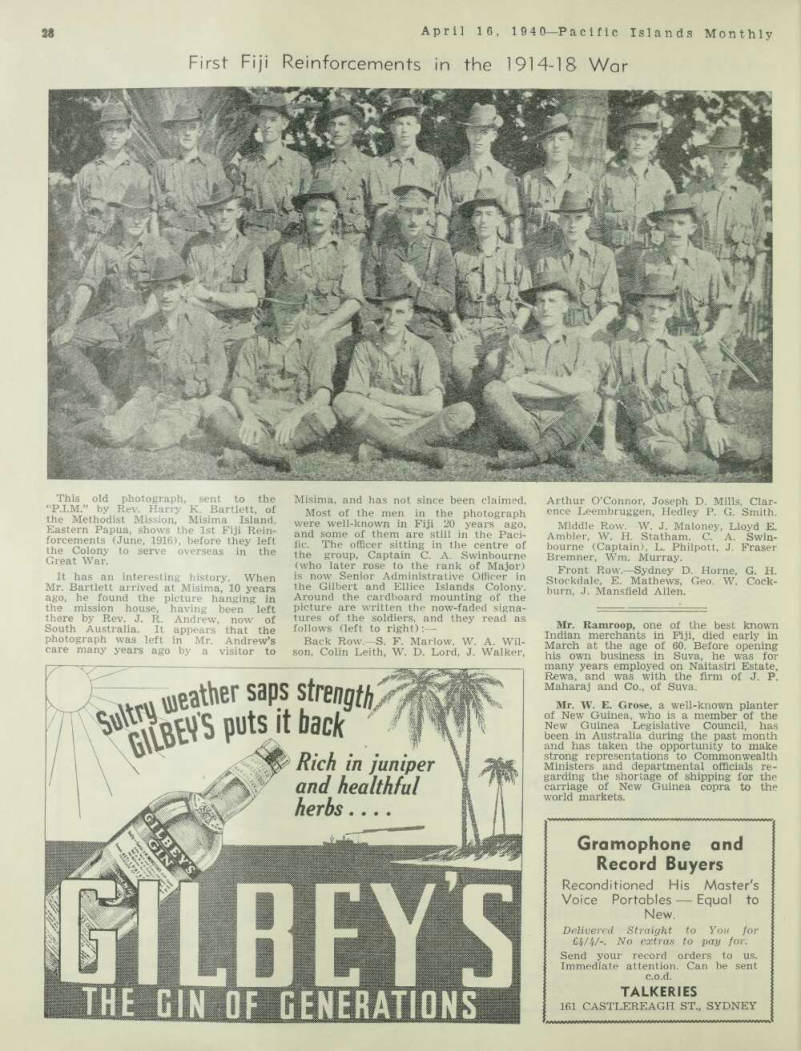
This old photograph, sent to the “P.1.M.” by Rev. Harry K. Bartlett, of the Methodist Mission, Misima Island, Eastern Papua, shows the Ist Fiji Rein forcements (June, 1916), before they left the Colony to serve overseas in the Great War.
It has an interesting history. When Mr. Bartlett arrived at Misima, 10 years ago, he found the picture hanging in the mission house, having been left there by Rev. J. R. Andrew, now of South Australia. It appears that the photograph was left in Mr. Andrew’s care many years ago by a visitor to
Misima, and has not since been claimed.
Most of the men in the photograph were well-known in Fiji 20 years ago, and some of them are still in the Paci fic. The officer sitting in the centre of the group, Captain C, A. Swinbourne (who later rose to the rank of Major) is now Senior Administrative Officer in the Gilbert and Ellice Islands Colony.
Around the cardboard mounting of the picture are written the now-faded signa tures of the soldiers, and they read as follows (left to right):— Back Row. —S. F. Marlow, W. A, Wil son, Colin Leith, W. D. Lord, J. Walker,
Arthur O’Connor, Joseph D. Mills, Clar ence Leembruggen, Hedley P. G. Smith.
Middle Row.—W. J. Maloney, Lloyd E.
Ambler, W. H. Statham, C. A. Swin bourne (Captain), L. Philpott, J. Fraser Bremner, Wm. Murray.
Front Row. —Sydney D. Horne, G. H.
Stockdale, E. Mathews, Geo. W. Cock burn, J. Mansfield Allen.
Mr. Ramroop, one of the best known Indian merchants in Fiji, died early in March at the age of 60. Before opening his own business in Suva, he was for many years employed on Naitasiri Estate, Rewa, and was with the firm of J. P.
Maharaj and Co., of Suva.
Mr. W. E. Grose, a well-known planter of New Guinea, who is a member of the New Guinea Legislative Council, has been in Australia during the past month and has taken the opportunity to make strong representations to Commonwealth Ministers and departmental officials re garding the shortage of shipping for the carriage of New Guinea copra to the world markets.
Advertisements & other items, p. 30 (2 items)
28
April 16, 194 O—P acific Islands Monthly
rafter saps
Rich in jumper and healthful herbs s IH E f CIN Di liN E RATIO N S
Gramophone and
Record Buyers
Reconditioned His Master's Voice Portables Equal to New.
Delivered Straight to You for No extras to pay for.
Send your record orders to us.
Immediate attention. Can be sent c.o.d.
TALKERIES
161 CASTLEREAGH ST., SYDNEY
Planes Over The
Pacific
Steady Growth of New Transport Lines
mHERE are six great oceans in the J. world, but a glance at the map will show that only one —the Paci fic—is destined to be the home of a great aerial transport industry. That is be cause, of all the oceans, the Pacific is the only one which is liberally sprinkled over with islands, great and small, which are suitable for use as aeroplane stations.
Already, the British, Dutch and Aus tralians/ with regular services, have linked up the Netherlands Indies and New Guinea with Australia and the mainland of Asia. The Japanese are thrusting down southwards, and now have established a regular service be tween the islands of Japan and the Mariana, Caroline and Marshall Islands.
Already, Pan American Airways are running a regular service, east and west, across the North Pacific, between North America and the mainland of Asia, via Hawaii and the Philippines.
Soon, there will be another air mail service across the Pacific, from Hawaii, south-westward to New Zealand and Australia, via New Caledonia and Fiji.
During March, squadrons of United States Navy planes made several long distance flights out from Honolulu to the west and south-west. Six large bombers made a mass flight from Hono lulu to Johnston Island, and on their way back they landed at Canton Island, where Pan American Airways have now prepared a seaplane base.
And so it goes on. One looks at the map of the Pacific, and wonders what aviation developments the next 20 years will see. It is certain that regular lines of flying-boats, carrying passengers, mails and urgent cargo between the continents of North America, Asia and Australia, will criss-cross this great ocean in every direction.
The one continent which borders the Pacific, and which is not yet in the avia tion picture, is South America, There is not much traffic between Australia and South America; but there is con siderable trade between Asia —especially Japan—and the Latin republics.
Sooner or later, someone will try to organise a flying service which will run eastward from Fiji to Samoa, thence to the Cook Islands, thence to Tahiti, thence through the eastern portion of French Oceania, and then across 3,000 miles of empty ocean to the coasts of Chile and Peru.
Probably, that last 3,000 miles will pro vide a problem that will not be solved for many a long day. It is an interest ing fact that the one notable area of land, away out in this wilderness of water, is the mysterious Easter Island, repository of a thousand strange images carved of rock, relics of a civilisation of which all records are lost.
It would be, indeed, a strange irony of fate if Easter Island, lonely, barren, weird and grim, should flourish once again as an important station on the South Pacific air mail route between Australia and South America.
Brother H. McCormack, who spent nine years on the staff of the Marist Brothers’ School in Western Samoa, has returned to Auckland, New Zealand.
New Guinea
Minor War In Central
IN January and February, Patrol Offi cer George Greathead, who has charge, subject to the District Offi cer in Madang, of a large “uncontrolled” area eastwards of Mount Hagen, in Central New Guinea, had a merry little war upon his hands.
These rich uplands are inhabited by numerous tribes and, for hundreds of years, fighting has been their main recreation. Since *the region was pene trated and partly mapped by the Leahy brothers and J. L. Taylor, in 1932, the administrative officers have been trying to persuade the natives to be peaceful.
Gradually, their influence is being felt — wars rarely occur now. But, for a year or two, pilots of aeroplanes flying over to the new landing-ground at Mount Hagen used to have a remarkable bird’s eye view of fierce battles proceeding on the kunai ridges and broken valleys of the Bena Bena-Wahgi area.
Two tribes, the Panagas and the Kun dagas, in the Mount Hagen area, got squabbling in January and, by the time Patrol Officer Greathead and his native police arrived, rather bloody fighting had taken place. However, the patrol officer, with the help of the head men, had soon restored order. The casualties were four or five killed and about 30 wounded. A medical assistant, sent in by aeroplane to the camp of the patrol officer, bound up the wounds of 27 men.
The district now is quiet.
Rev. John Poole is at present under going a course of training at the Method ist Mission’s George Brown Training College, N.S.W., prior to going to New Britain, where he will be stationed in the Bainings District.
Rev. Wallace Deane, who spent nine years in Fiji during part of which time he was principal of the Methodist Mis sion’s Training Institution for Native Teachers at Davuilevu, has been ap pointed principal of the Burwood Method ist Ladies’ College, N.S.W.
Advertisements & other items, pp. 31-32 (3 items)
29
Pacific Islands Monthl y—A pr i 1 16, 1940
fable*!
ALWAYS
FEEL WELL-
Get Quick , Safe
Relief from Pain!
IP you suffer from Headache or some • other form of nerve or muscular pain you need the immediate relief that only Vincent’s A.P.C. gives.
The reason why Vincent’s A.P.C. gives quicker, safer relief is that it is a scientifically balanced prescription of three medicinal ingredients which have a 3-way action in relieving pain. The Vincent’s prescription was originated by the Medical Superintendent of Australia’s largest Public Hospital over 20 years ago where it was first used.
o RELIEVES:
$ Headache
& Ttopical Fevers
O Heat Exhaustion
& Nerve & Muscular Pains powoiis t
TAII T %
1/4 AND 1/4.
S'NCUII* •«.
FOR SAFETY’S SAKE SAT “VINCENT’S”.
CU n/, m a V
m Cl 5 4 GERMS of Diphtheria, Malaria, Dboble Itch, Tinea or Surfers’ Foot, cannot live under "TENAX” lather.
Tropical Skin Diseases can be cured by Its regular use.
only 9° P er
fable*!
NO VARIATION HAS BEEN MADE
IN ITS COMPOSITION—judged
from the only true angle, that of quality, TENAX has no competitors as a satisfactory germicidal soap, eleven times as rapid in action as carbolic, yet NON-IRRITANT and NON-POISONOUS. The Medical Journal of Australia states that TENAX is a germicidal soap that may be recommended with confidence.
TE N Xgermicidal SOAP
I A PRODUCT OF AUSTRALIAN SOAPS LTD.
Modern Refrigeration for the South Sea Islands
The ELECTROLUX kerosene operated
REFRIGERATOR
MARVEL
OF
MODERN
SCIENCE
THE
MIRACLE
OF
ICE
FROM
HEAT
ELECTROLUX offers economical, modern and completely efficient
REFRIGERATION FOR ISLANDS' HOMES.
FREEZES CONTINUOUSLY WHILE SMALL LAMP BURNS
Freezing controlled by simply regulating height of flame. Uses only f gallon of kerosene per week.
MOTORLESS ... NO PARTS TO GET OUT OF ORDER.
MODEL L 22 MODEL L3BO m MODEL LKSSO Capacity • (as Illustrated) Capacity 2.2 cubic feet. Capacity 4 cubic feet. 5.5 cubic feet.
GUARANTEED FOR TWO YEARS.
Write to your Local Distributor for prices and full details.
Obtainable from W. R. Carpenter & Company Ltd. —Sydney, and following New Guinea Branches: Rabaul, Salamaua, Wau, Kavieng, Madang, and Wewak.
W. R. Carpenter & Coy. (Solomon Is.) Pty. Ltd. —Tulagi, British Solomon Islands.
On Chong & Company Pty. Ltd.—Butaritari, Gilbert and Ellice Islands.
Representation in Papua and New Hebrides.
30
April 16, 194 O—P acific Islands Monthly
in Fiji
A Vegetable Garden in Fiji
By “Amel”
Cl KEEN vegetables are precious in the f tropics. The main trouble in grow ing them is that the tropical quota of sunshine and rain is not evenly bal anced. There is no happy medium. The garden is either drowning or sizzling.
We thought it would be delightful to have a vegetable garden somewhere near the house. Imagine the thrill of just leaning out of the window, so to speak, and gaily decapitating a cabbage for dinner, or nonchalantly snipping a few lettuce for tea!
But four unsurmountable problems rose up and hit us in the eye: (1) Land crabs. (2) Fowls. (3) Dogs. (4) The War, which, according to the sages, causes the price of copra to go down, and the cost of wire-netting to go up, thus creating an economic disparity highly unfavourable to vegetable gar dens.
However, these setbacks merely whet ted our desire to possess a garden. We went further afield. We sought high and low. We explored hills and dales, and at last, in a sheltered valley where a pleasant brook babbled by, we found what we wanted.
Further minor problems confronted us. A fence was needed to bar maraud ing cattle, and quantities of scrub had to be cleared. We ear-marked two or three days for the work, and set to with enthusiasm.
I rather fancied my scrub-cutting prowess, and was making great head way until I put my foot in a nest of black ants!
My arrival seemed to arouse their worst instincts, and they attacked me in mass formation. With a shriek like a soul in torment, I cast my hat and knife to the winds of Heaven, and made a beeline for the lofty lumber, where I tore off my clothes and viciously slaughtered every black ant in sight!
Howls of mirth drifted through the trees. Dad was a happy spectator.
Emerging with all possible dignity, I tripped over a raspberry vine. Eyeing it—and my convulsed parent—coldly, I started off again.
There were no more interruptions and, in due course, the ground was cleared, dug, manured and ready. In went the cabbage, silver beet, lettuce, tomatoes, kohl-rabi and beans —with a prayer attached to each seedling.
We cherished that garden of ours! In hot weather we carted buckets of water from the stream to spray the thirsty plants, and on days when torrential rain battered them, we wondered dismally if they would ever survive.
We waged a ceaseless, bitter war against caterpillars, which we squashed in hundreds, and we almost developed a squint in looking for slugs, snails and other pests. We erected a barrier of wood ashes around each plant to keep the slugs at bay, but the best antidote for the caterpillars was a hawk-like eye and a ruthless nature!
Growing vegetables is no sinecure, even under the best of circumstancs, and in the tropics, difficulties are trebled.
But the results we achieved were worth the trouble. Back-ache, black ants and all—in the end, our garden was the success we thought it ought to be.
Papuan Oil
The New Comp on the Vailala
From Our Own Correspondent
Port Moresby, Mar. 27.
A LARGE camp, on modern lines, is being constructed by the Australa sian Petroleum Co., Pty., Ltd., on the Vailala River, at a point about 30 miles inland in a direct line from the mouth of the river, on the Papuan Gulf.
There are well-bpilt dwellings of sawn timber, equipped with electric light and refrigeration. The point where the £200,000 worth of drilling machinery is being erected, for a bore which is con fidently expected will at last produce Papuan oil, is inland from the camp, at Paku, a well-known spot, near the Vai lala River, considerably above the drill ing site at Upoia.
The country on and around Vailala River is notoriously unhealthy, but the A.P.C. management and engineers have been vigourously at work clearing and draining the site of the little town and taking precautions against malaria.
It is interesting to note that this dis trict, which has been finally selected for the first important drilling operations, is where oil indications were first seri ously examined in Papua—on the Vailala River, below Paku, in 1911.
Rev. D. F. Boorman, L.Th., Methodist missionary in the Lau Group, Fiji, re cently received advice from the Uni versity of Queensland that he had been awarded the Bachelor of Arts degree.
Mr. Frederick Swann, of Apia, West ern Samoa, has joined a branch of the New Zealand military forces.
Advertisements & other items, p. 33 (1 item)
0 Ster’S
park ling refreshment from pure Malt and Mops r. ▼ y
LAGER
A New Convent School
From Our Own Correspondent
Port Moresby, March 23,
ANEW convent school has been built recently by Steamships Trading Co. under contract. It consists of two floors, built on concrete founda tions, with concrete pillars carrying the upper floor. A 12-ft. verandah extends all round. The lower floor is to be used for the school, while the upper storey will be given up to offices, committee rooms, etc., and a large hall for enter tainments. It is an impressive struc ture, and is in keeping with the modern buildings that are gradually replacing the old land-marks, which are being demolished one by one. Mr. George Lupson was the builder.
Ariki Nui
Long Struggle For Coveted Title in Cook Islands
From a Special Correspondent
„ Rarotonga, Feb. 7.
DECISION given to-day by Chief Judge H. F. Ayson concludes the long-drawn-out struggle for the title of Ariki Nui (Supreme Chief) of the Cook Islands, which has been a point of serious local friction for more than a year. The Court has decided that the ancient title shall pass to the late Ariki’s elder daughter, Mrs. Takau Rio Love, on the condition that she takes up her permanent residence in the Cook Islands; and to this she has agreed.
Following immediately after the death of much-respected Makea Nui Tinirau Anki, Ariki Nui for 17 years, on Janu ary 26, 1939, and the subsequent arrival of Mrs. Love from New Zealand in Feb ruary, three candidates for the title were nominated, these being the two children of the late Makea Tinirau (Mrs.
Love and Mrs. Tau Cowan) and Mrs. w. P. Browne, his first cousin.
The position must be filled according to native custom; but local native cus tom has become so emasculated in these days of the cinema and Japanese sin glets that each faction could apparently put its own construction on certain phases of the ancient law, to suit its own ends. However, the general con sensus of native opinion resulted in the following procedure, which was verified to me by an old chief wise enough, and non-partisan enough, to be fairly trust worthy. (1) The Kopu Ariki, the highest mem bers of the Ariki family (numbering in this case twelve), consider the candi dates. If this inner family council can reach no agreement the task is dele gated to the (2) Mataiapos and Rangatiras (chiefs and nobles) of the Ariki clan. If they, in turn, cannot reach any conclusion, the matter passes into the hands of the (3) Native Land Court, whose Chief Judge, having regard to the fitness of the candidates and the justice of their claims, must give final judgment.
These actions were formally accom plished and Court proceedings, conducted rather peculiarly by some of the parties concerned, resulted in the above deci sion. This seems, from a disinterested European standpoint, very fair, and a welcome finish to an undignified dis pute, which was unworthy of the high traditions of Polynesian society. An appeal, however, has been lodged on behalf of Mrs. Browne.
The title of Ariki Nui still carries much prestige on the island, and bears with it a seat on the Island Council and control of a large amount of land—a control which has not been abused to the extent shown by other Polynesian nobility.
Interesting points of the affair are that not only are all the candidates female, and of pure native stock, but that all have married men of Eurone sian blood; and the problem now will arise as to whether their children, in their turn, will be allowed, in view of the admixture of European blood, a right to the coveted title.
Good-Bye To Husband
CHIEFS, kinsmen and supporters lined the wharf on March 2 to bid “Kia ora ana” to their Ariki-elect, Mrs.
Love, who left for New Zealand by the “Matua”. Having concluded her successful year-long fight for her father’s title, Mrs. Love is proceeding to Wellington to farewell her husband, Captain E. T. W. Love, a member of one of New Zealand’s foremost Maori families, who is to leave with the Maori Battalion for active service abroad.
Before departing, Mrs. Love told me; “I know that my success was unpopu lar in some quarters, but I also know that I have the large majority of Rarotongans behind me, and I mean to do everything I can to justify their confidence. I hope to return, with my eldest daughter, by the May ‘Matua’, to take up my permanent residence at Taputapuatea (the Ariki residence).”
Advertisements & other items, p. 34 (1 item)
Capstan
SPECIAL!./
PACKED FOR
THE TROPICS
Capstan Cigarettes, round airtight 50't.
Medium end full strength.
Capstan Navy Cut Tobacco, made from the finest Virginia leaf. tStt-lf-t
gui
Mystery in N. Guinea
Workers' Compensation Mystery in N. Guinea
Letter to the Editor A PARAGRAPH in the January “P.1.M.” headed: “No Compensation Act in New Guinea”, referred to the case of a man named Hartley, who lost his life in a mine here, as the result of a fall of stone. As to what Mrs. Hartley has been offered in compensation, I have no knowledge—l understand the Public Curator is handling the case.
But I do say definitely, that there is a Compensation Act in this Territory, and my authority for making this statement is Mr. Hogan, head of the Crown Law Department. Mr. Hogan has stated that the Papuan Compensa tion Act has been adopted in New Guinea and is in force in this Territory.
He also has stated there is no need to prove negligence on behalf of the employer as, under the Mining Ordin ance, an accident is sufficient proof of negligence.
These words are not exactly .Mr.
Hogan’s words, but are the substance of what he has stated. The Administra tion is contemplating passing a Work ers’ Compensation Act, in the near future, and the Crown Law Department has sent a copy of the projected Act to interested bodies, for perusal and criticism. It was in a covering letter that I read Mr. Hogan’s remarks. I will accept his word that at least the Paouan Act is in operation in this Ter ritory. Further, if it is not necessary to prove negligence in case of accident in a mine, there must be a good case for civil action.
As the Labor representative here, prior to the formation of a branch of the A.L.P., two years ago, I brought the matter of Workers’ Compensation under the notice of both the Griffiths and the present Administrations. In the begin ning of 1936, I got the then Leader of the N.S.W. section of the Federal Labor Party. Mr. Beasley. M.H.R.. to bring the matter before the Lyons Government, at Canberra. Subsequent!v. I received let ters from both Mr. Beasley and Mr.
Lyons stating that a Workers’ Compen sation Act would be passed in this Ter ritory. Later. I read in the “Rabaul Times” that a committee of three had been appointed, to draft a Workers’
Compensation Act. This Committee accepted the Commonwealth Act. in toto. and I understand it was passed bv the N.G. Council. In the Government Gazette of October 31. 1936. this Act re ceived the assent of Lord Gowrie, Gov ernor-General.
What has happened to that Act? Has there been a bungle somewhere, The Act was made retrospective, coming into operation on July 1. 1936. I was under the impression that once an Act re ceived the assent of the Governor-in- Council, it became law.
On reading the script of the prelected Compensation Act. I find it almost identical with the Commonwealth Workers’ Compensation Act, of 1931- 1933.
A decision was given in a mining case a few years back, by the then Chief Judge of this Territory. Judge Wan bss, in which he stated that this Ter ritory was subject to all Commonwealth laws. If this statement is correct in law, then the Commonwealth Workers’
Compensation Act, 1931-1933, is opera tive here.
I hope that inquiries will be made in the right quarter as to what has hap pened to the Compensation Act passed by the local Council in 1936, and pub lished in the Government Gazette of October 31, 1936.
I am, etc.,
George W. Bellamy.
Edie Creek, T.N.G.
March 8, 1940. ft The U.S. navy has extended photog raphy restrictions to the North Pacific Islands under its administration. No photographs may be taken now on Mid way, Wake, Palmyra, Johnston, French Frigate Shoal, or Kingman Reef. Com panies working on any of the islands must see that cameras owned by em ployees are retained in proper custody.
Gift Of £100
Prom Our Own Correspondent
Nukualofa, March 1.
QUEEN Salote Tubou, recently ac knowledged a gift of £lOO from Mr.
W. Cocker, an old established, well-known merchant and a member of the old and highly-esteemed Cocker family of Nukualofa, towards the de fence of Tonga. The gift will be used for the equipment of the Tonga Defence Force.
Mr. W. Cocker’s father, Mr. Joshua Cocker, was the first British Consul in Tonga (1860-1866).
Mr. A. Collins, who was with Burns Philp (South Sea) Co.’s staff in Fiji for a number of years before he returned to Australia about 1921, died recently at Gundagai, N.S.W.
When Captain L. A. Yancey was in Dutch New Guinea last year, as navi gator of Dr. Richard Archbold’s flying boat “Guba”, he made a number of trips to Port Moresby and Australia, and in all places that he visited he formed warm friendships. There was consider able regret expressed, therefore when it became known in March that he had died suddenly in New York. He was a very famous airman—he crossed the At lantic in a single-engined machine in 1929- then he won a prize of 10,000 dol lars for living from New York to Ber muda, in 1930. in a single-engined Stm
son aeroplane. Later, he flew a Stinson completely around the coast of South America, Katu Asen Latianara, who held the post of Roko Tui Serua in Fiji since 1909, died recently at the age of 63. His first Government oflice was as Buli Komave at Serua in 1898; he became Roko Tui Serua at the beginning of 1909; and retired in 1937, but almost immediately was temporarily re-ap pointed and served faithfully until his death. His eldest son is Ratu Mara, N.M.P. at Serua.
Advertisements & other items, pp. 35-36 (2 items)
33
Pacific Islands Monthl y—A pril 16, 1940
Good
eW \jealth < it With
PRESCOTT Pty. Ltd.
SUSSEX ST., SYDNEY,
are sole wholesale agents for
PINEAPPLE BACON&HAMS
DAISY brand BUTTER "375" BUTTER in TINS llb.-21b.-slb. Sixes.
LEA & PERRINS’ Sauces and Most other Super-Quality Lines of the Trade, such as Cheese, Eggs. Etc.
We ore Specialists .
\ Let us have your confidence. Sixty years is our record of supplying the leading Houses throughout the World in
FRESH FRUIT VEGETABLES PRODUCE
’Phones: MA 8613 (4 lines).
Cable Address: “Weymarkson”
Codes—Bentleys Private.
WEYMARK & SON LTD.
FRUIT AND PRODUCE MERCHANTS
14-18 STEAMMILL STREET - - SYDNEY
it
ANCHOR FLOUR
THE STANDARD OF QUALITY
GILLESPIE BROS. PTY. LTD
SYDNEY - AUSTRALIA
History
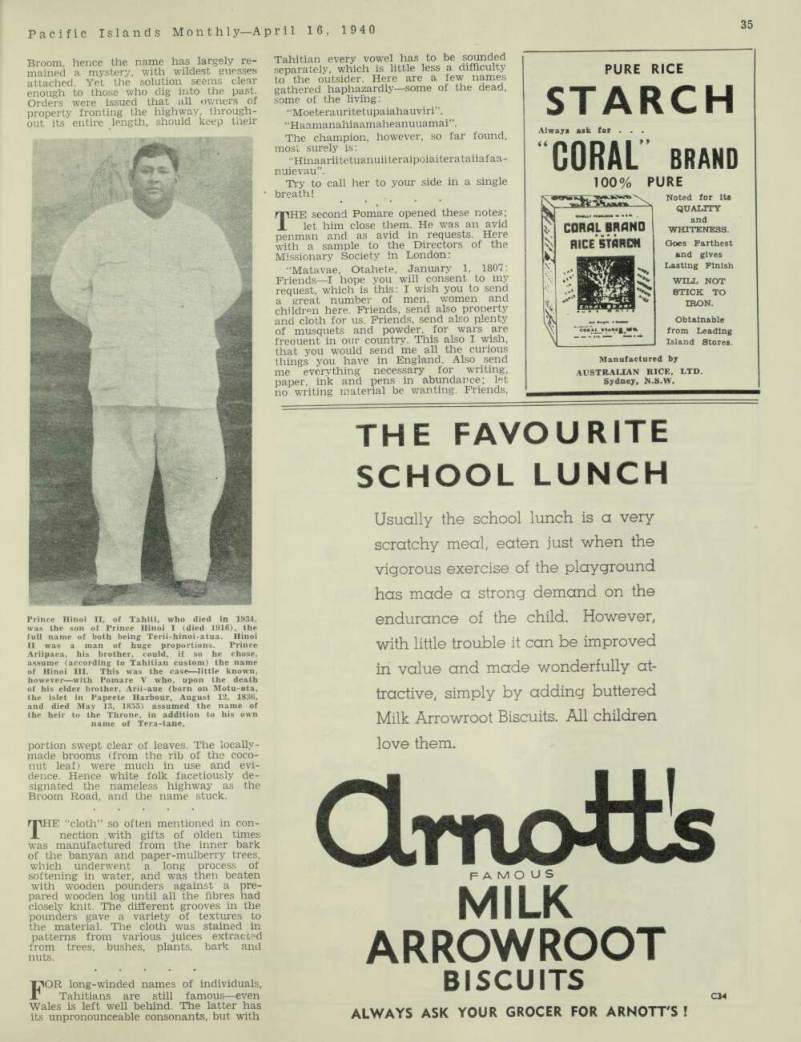
Pot-pourri of Tohiticm History
By W. W. Bolton, M.A.
THE second Pomare, before ever attain ing kingship, had no small opinion of himself, nor allowed his followers to think otherwise. He named his residence the “Clouds of Heaven” (Aorai), his canoe the “Rainbow” (Anuanua), his torch for night the “Lightning” (Uira), his riding on the shoulders of slaves his “Flying” (Mahuta), his drum the “Thunder” (Patiri) and comnleted the list with his title “Otunuiteatua”, which interpreted reads “The great Tu, the god”.
What other high chiefs on Tahiti thought of these grand airs and mighty claims is not recorded.
RATS were indigenous in Tahiti, but not cats. Whence came the cats?
Wallis and Cook were the benefactors.
When the “Duff” arrived in 1797, its cats could not seemingly be spared, for we read in the Journal of the missionaries who came ashore: “Some of the Brethren being troubled with rats last night, we this day applied to the king for some cats”. They were handed over, 4 in num ber. Crook, who was left, alone, in the Marauesas makes an entry in his diarv. dated June 12. 1797. before the “Duff” sailed away: “Went aboard. In the even ing returned on shore with some goods and 2 cats ”. The Captain was open handed this time. We have here—unless Mendana dropped some in 1595 —the pro genitors of Marquesan cats of to-day.
TAHITIANS of the past were a light fingered gentry, from the highest chiefs down. Theft was a natural instinct and habit of the entire island, and they had a special god of theft, named Hiro. to bless them on their enterprise and success. To be caught red-handed, how ever, the penalty was death.
To guard their possessions the pioneer white folk had a hard time. It was well nigh a hopeless struggle. Here is one entry out of many: “December 27, 1798. Otuu, hearing Brother Broomhall had in his possession a large Bible with cuts, demanded to see it. The book was brought. After awhile, ho sent Brother Broomhall to fetch an other picture book. While absent, Otuu dexterously removed the plate that re presented Adam and Eve in Paradise in a state of innocency, and returned the Book without any intimation of what he had done. He unfortunately had been previously informed that the persons in the plate represented the parents from whom Englishmen, Otaheitean and all men did originally come.” There was no return of stolen goods.
ROADS had to wait: trails were good enough through the bush. Jefferson writes in 1798: “The roads are the sea beach, and narrow footpaths inland are seldom wide enough to admit 2 persons to walk abreast.”
It was so till the 1830’s, when Queen Pomare reigned. She delighted in rid ing—not slaves, but horses —and deter mined on connecting the villages round the coast into one continuous run for both horse and vehicle.
In an Australian newspaper dated in March. 1833.. one reads: “Round the island, for a distance of 120 miles, is a raised road, which goes by the name of the Broom Road. It is formed by the natives who are sent there as a punish ment for any offence they might have committed.”
There is no such bush on Tahiti as
Broom, hence the name has largely re mained a mystery, with wildest guesses attached. Yet the solution seems clear enough to those who dig into the past.
Orders were issued that all owners of property fronting the highway, through out its entire length, should keep their
portion swept clear of leaves. The locally made brooms (from the rib of the coco nut leaf) were much in use and evi dence. Hence white folk facetiously de signated the nameless highway as the Broom Road, and the name stuck.
THE “cloth” so often mentioned in con nection with gifts of olden times was manufactured from the inner bark of the banyan and paper-mulberry trees, which underwent a long process of softening in water, and was then beaten with wooden pounders against a pre pared wooden log until all the fibres had closely knit. The different grooves in the pounders gave a variety of textures to the material. The cloth was stained in patterns from various juices extracted from trees, bushes, plants, bark and nuts.
FOR long-winded names of individuals, Tahitians are still famous —even Wales is left well behind. The latter has its unpronounceable consonants, but with
Tahitian every vowel has to be sounded separately, which is little less a difficulty to the outsider. Here are a few names gathered haphazardly—some of the dead, some of the living:
“Moeterauritetupaiahauviri”.
“Haamanahiaamaheanuuamai”.
The champion, however, so far found, most surely is: “Hinaariitetuanuiiteraipoiaiterataliafaa nuievau”.
Try to call her to your side in a single breath!
THE second Pomare opened these notes; let him close them. He was an avid penman and as avid in requests. Here with a sample to the Directors of the Missionary Society in London: “Matavae, Otahete, January 1, 1807: Friends—l hope you will consent to my request, which is this: I wish you to send a great number of men. women and children here. Friends, send also property and cloth for us. Friends, send also plenty of musquets and powder, for wars are freauent in our country. This also I wish, that you would send me all the curious things you have in England. Also send me evervthing necessary for writing, paper, ink and pens in abundance; let no writing material be wanting. Friends,
Prince Hinoi II, of Tahiti, who died in 1934, was the son of Prince Hinoi I (died 1916), the full name of both being Terii-hinoi-atua. Hinoi II was a man of huge proportions. Prince Ariipaea, his brother, could, if so he chose, assume (according to Tahitian custom) the name of Hinoi III. This was the case—little known, however—with Pomare V who, upon the death of his elder brother, Arii-aue (born on Motu-uta, the islet in Papeete Harbour, August 12, 1836, and died May 13, 1855) assumed the name of the heir to the Throne, in addition to his own name of Tera-tane.
I have done and have nothing at all more to ask you for.” He clearly lacked any saving grace of modesty and those religious folk in London must have re ceived Quite a shock over so prodigious an order, including the guns for slaughter.
Advertisements & other items, pp. 36-38 (3 items)
34
April 16, 194 O—P acific Islands Monthly
35
Pacific Islands Monthl y—A pr i 1 16, 1940
Arrowroot
PURE RICE
STARCH
Always ask (or . . . ii
CORAL BRAND
100%
CORAL BRAND
RICE STARCH
' COKAI »UK| s ltaL
PURE
Noted for Its
QUALITY
and
WHITENESS.
does Farthest and gives Lasting Finish
WILL NOT
STICK TO
IRON.
Obtainable from Leading Island Stores.
Manufactured by
AUSTRALIAN RICE, LTD.
Sydney, M.S.W.
THE FAVOURITE
SCHOOL LUNCH
Usually the school lunch is a very scratchy meal, eaten just when the vigorous exercise of the playground has made a strong demand on the endurance of the child. However, with little trouble it can be improved in value and made wonderfully attractive, simply by adding buttered Milk Arrowroot Biscuits. All children love them. f a m o us
MILK
ARROWROOT
BISCUITS
04 ALWAYS ASK YOUR GROCER FOR ARNOTT'S !
Kork-N-Seal
FOR HOME USE
and pplied irtight ressure -oof
FOR ALL HOME BOTTLING
—THE LITTLS CAP THAT
will Re-seal 1,000 Times
KORK-N-SEAL (Aust.) LTD.
106 COMMONWEALTH STREET,
SYDNEY, AUSTRALIA.
Always .
Australia's Choicest Products: make sure you have at hand an ample Reserve of these Green Peaj French Beans Cauliflower Beetroot Spinach Cabbage Carrots Parsnips Celery Brussels Sprouts White Turnips Sweet Corn Tomato Puree Tomato Sauce Tomato Soup Tutti Fruit Sauce (Worcestershire flavor)
gaftehValc
Delicious m
Garden
Vale
Ready-toserve Vegetables
\“CARD€N VALE
N, products limited
i'i 2 ’ 4 BROWN STRC-CT, N-EWTOVN
Mk SYDNEY. AUSTRALIA
New Guinea Finances In
Better Shape
IN the six months ended December 31, 1939, the Administration of New Guinea collected revenue totalling £250,153, while in the same period the expenditure was £244,276.
This means that in the half-year the Government showed a surplus of £6,000, compared with a substantial deficit in the 12 months ended June 30, 1939. The economies upon which the Administrator embarked with determination, in the middle ©f last year, had a good effect.
The accumulated surplus, carried for ward, is now nearly £24,000.
Compared with the same period of 1938, Customs revenue showed an in crease of £7,870, and gold royalty in creased bv £14,857. The gold royalty collected in the six months was no less than £82,425.
There are no serious decreases in the revenue.
On the expenditure side, the only not able increase is £3,117, under the head ing of “New Works.” In practically every other department there have been substantial reductions.
Dr. H. B. Lans-e arrived in Auckland recently from Western Samoa, hav ing relinquished his post there on the staff of the Government Hospital at Apia.
Mr. N. J. Bradley, Administrative Officer in the Fiji Service, is at present spending six months’ leave in the United Kingdom.
Fuata Taito
Polynesian Pastor Among Australian Aborigines
rE speaker at the P.S.A. of Wesley Church, Melbourne, on March 3, was a South Sea Islands native pastor, Fuata Taito, has come to Australia on a novel enterprise from Rotuma, an island 300 miles north of Fiji, with a population of 3,000.
Seeing a notice in his church paper soliciting an Islands pastor to volunteer for work among the aboriginals of Aus tralia, he quickly embraced the oppor tunity; and, with his wife and three children, he passed through Melbourne on his way to Darwin to take up his work.
The employment of native teachers among the different Islands has long been practised, but this is the first time that a South Sea Islander has been engaged for work among the aborigin als. It is a bold and interesting experi ment. and the Mission Board is to be complimented on the choice it has made.
Fuata Taito is a capable speaker, with amazing fluency in English, and his appointment gives a new perspective to work among the aboriginals. He has not discarded his native dress, and will make no attempt to ape the European, but rather will live and work among the aboriginals as a fellow-member of a native race. Among his audience in Wesley Church, he caused great laugh ter by saying that the presence of him self and family in the Svdney Zoo created as great an attraction as the wild animals.
In his address, Fuata Taito related how he was led to take up the work bv reason of a misconception about Christianity prevalent among the abo riginals. While visiting a camp of aboriginals, four years ago, at Geral dine, West Australia, he discovered that they regarded Jesus Christ as the God of the white man, and confused His religion with the social customs of the white race. They thought it strange that he, a South Sea Islander, should worship the white man’s God with such devotion. Fuata Taito’s reaction to their misapprehension of Christianity changed his whole outlook, and he sought an opportunity to reveal the true God to the aboriginals.
The Rotumans, of whom Taito is one, are pure Polynesians; and Polynesian missionaries have done, and are doing, an extraordinary amount of work among the more backward Melanesians, Papuans, etc.
A native girl was swimming around the reef at Menapi (North East Divi sion of Papua) after fish, and when one darted into a hole, she dived down and put her hand in after it. Her hand, for some reason, became fixed in the hole and she was drowned. Her body was found there nine hours later by the men of the village.
The Fahnestock Expedition, sponsored by American Museum of Natural His tory and Columbia University, which is to collect rare birds, geological speci mens and records of primitive music in the region between Fiji and New Guinea, passed through the Panama Canal at the end of February, en route to Suva.
Advertisements & other items, p. 38 (1 item)
36
April 16, 194 O—P acific Islands Monthly
Exploring Central New Guinea
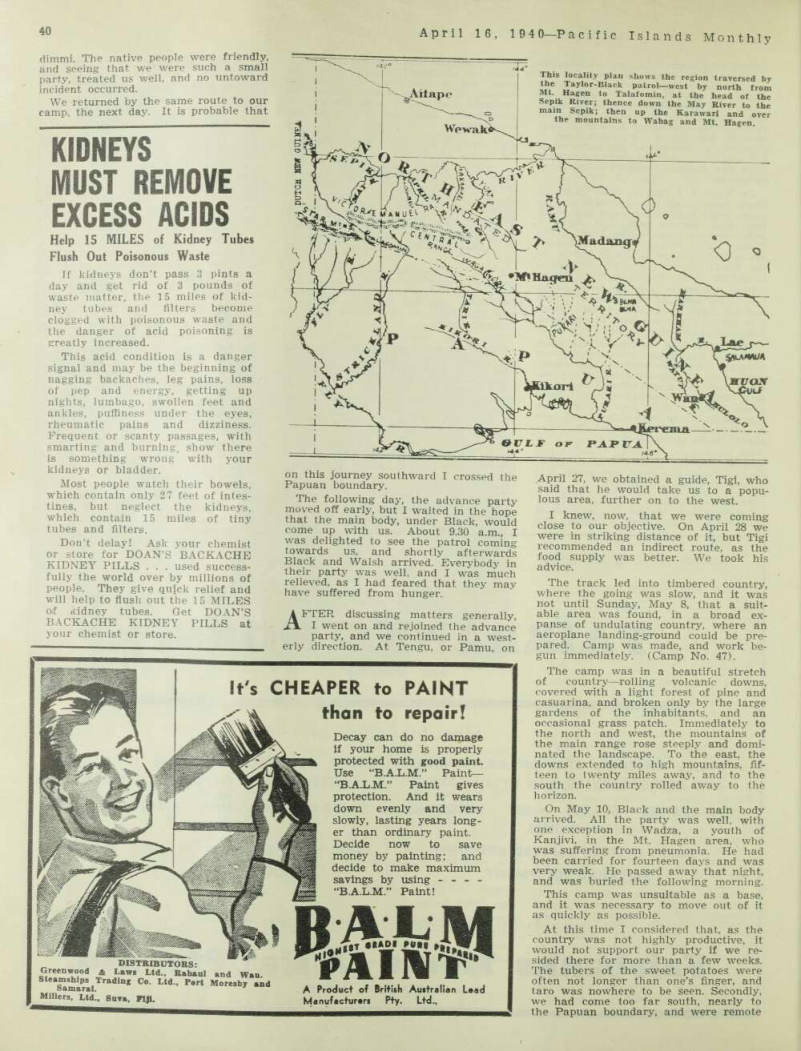
Discoveries and Observations of the Taylor-Black Patrol
Section 11. Of Official Report
<This is the Second Section of the Preliminary Report on the patrol carried out in Central New Guinea by Assistant District Officer J. L.
Taylor, Patrol Officer John Black and Medical Assistant C. B. Walsh, in 1938-39.) rE camp was astir at daybreak on March 9, 1938, and by 8 o’clock everything was in readiness for our departure. The total strength was 250, and when I looked at this tremendous caravan it was not without some mis giving.
In the beginning I had hoped to oper ate with a much smaller line, but with the aid of aircraft. This aid, however, it was not possible to arrange, so I de cided on high numbers. Whether we could get through would depend on the population.
In the Bena Bena-Mt. Hagen area, where there are many people, a party of 300 to 400 people may travel comfort ably, buying food as they go with cow ries (the native currency of the area).
In fact, the white man is welcomed as a rich benefactor, and men, women and children carry heavy loads of food over hill and dale, and in all weathers, to the Europeans’ camp. Would this be possible in the country west of Mt.
Hagen?
Carriers’ loads were made up in packs of 40 lbs. and the following were taken; Shell money 1600 lbs.; rice 1600 lbs.; salt 300 lbs.; brown sugar 160 lbs.; bis cuits 160 lbs.; Europeans’ food 1600 lbs.
Medical supplies took 10 carriers; wireless instruments 20; instruments 4; tentage 11; benzine 10; miscellaneous packs 24 carriers; and 15 were placed in reserve for the relief of the walking sick, and as stretcher-bearers, if neces sary.
The first day’s journey was to Kendi ger, after a strenuous march. The ad-, vance party had prepared things well,! and local headman of Kendiger, Korve, *
received us hospitably, an abundance of food being provided.
From Kendiger the patrol continued in a north-westerly direction for the next few days and travelled through a pass between Mt. Gilyuwer and Mt. Hagen, crossing the watershed of the Nabilyer and the Gai (Lai) Rivers at 9,200 feet (approximately on March 14). We then descended gradually through bush to the Minyampa River, a tributary of the Gai (Lai), at 7,200 ft above sea level.
At this stage Black had taken an advance party ahead in order to pre pare for the crossing of the Gai. A bridge was known to exist, but it was not known whether it was in a good state of repair. The crossing by bridge of any river in the interior of New Guinea with a large line of car riers is a matter which takes time and care. Black did his work well, and the whole party crossed without incident and camped at Yaguma on March 16.
The people met were unarmed (ex cept for stone axes which, incidentally, are a deadly weapon when used by close-quarter fighters, such as these people are) and not unfriendly, though they appeared to be incapable of normal trading. They were interested in us. and all they wished for, as far as could be seen, was to be allowed to stand and stare. Nevertheless, they brought us enough food to exist on, but no more. rE people inhabiting the country west and north-west of Mt. Hagen are known in the Mt. Hagen lan guage as Eng-a. The Eng-a tribe cov ers a large area, the language spoken by its members extending from the lower Karawari River to many miles south of Mt. Hagen. They are some thing akin to the Mt. Hagen people, but have not the same happy disposition.
The patrol then continued in a north westerly direction, following the Gai l (Lai) upstream to Ragimande (143° 30’ lE, 5° 20’ S —approximately), where
camp (No. 11) was made and the party rested for a day.
We were now in the heart of the val ley one of the most beautiful in New Guinea, if not the world. Everywhere were fine, well-laid-out garden plots mostly of sweet potatoes, and groves of casuarina. Well-cut and graded roads traversed the countryside, and small parks, or playgrounds (the “bena” of the Mt. Hagen people or “kama” as they are called here) dotted the land scape, which resembled a huge botanic garden. It may well be called the Gar den Valley of the Lai.
The native people were well disposed towards us, and appeared to regard us as spirits of the dead, returned to earth.
At this stage, our chain of interpretation had broken dowm, but Black managed to get a young man to join the patrol. He soon spoke a litle “pidgin” and was able to assist us.
The native people in the vicinity were
not unfriendly, but appeared dazed. They wore little or no decoration, and were not very interested in iron or shell money. It is probable that the reason for this was that these things are not included in the bride-price, or marriage gifts, of the people. Or it may be that, thinking that we were supernatural, they were afraid that our goods might possess magical properties of an evil nature.
At one place natives, seeing Black making observations from a tree, re garded him with amazement, brought a pig to him and then cleared a space and by signs asked him to make an ascent to the celestial regions. Black declined.
On March 23, the patrol moved on in the same general direction to Tori (R.G.
Society’s map—Doi).
From my diary, at this time: “To-day’s was one of the most beautiful journeys in my experience. Travelling on a cen tral ridge, with a valley on either side, the Gai (or Lai as it is now known)
and the Ambu. The colour and beauty of the interior of New Guinea must be seen to be believed —a garden land.” Of the people; “The natives here appear to be brighter than those farther down the valley, quicker in the uptake, and have more to say. In ten minutes, I had a youth volunteer to go with us; but strange to say, immediately he joined he became speechless and would not communicate with his friends and rela tives, except by signs. He had joined the spirits.”
FROM just beyond Tori a road cross ing a divide was' visible about three days’ march to the westward, and it was decided to make towards it in the hope that it might lead to further grass valleys beyond. We crossed the headwaters of the Ive Lai (Gai) on March 20, and camped near a settlement which bore the high-sounding title of Mare Purare Purorum, redolent of the school room, I thought. (Camp No. 15).
We were carrying two sick at this time. This was to be expected, with a large line of police and carriers, and my rule was that as soon as a member of the party showed signs of serious ill ness or distress he was to be carried.
This, I believe, saves life; it certainly gives the men confidence in their lead ers.
The country ahead was woodland, and the divide we had seen proved to be a false one, which made us wonder what lay beyond. The next day, after pass ing through a strip of timber at 9,150 feet above sea level, we came out on -to a fine grass valley, perhaps fifteen miles long and seven miles wide, running generally south east-north west. It was well populated, and a comparatively large lake, about 2,000 yards across (Iviver—local language) was observed near the middle of the valley. Just beyond the lake was a low watershed, beyond which a river ran to the north west.
We marched through this valley ac companied by hundreds of singing natives, and camped at Yenini Monini Chirunki at 10.55 a.m. on March 26, 1938.
Our method of travel at this time was to rise early, reveille at 4.30 a.m. East ern Australian time (about 4.5 a.m. local time) begin the march at daylight and camp early, before the rains. This en abled the carriers to have their shelters erected in sunshine, the stores and equipment to be kept dry, and food to be bought. The early start and early stop contributed greatly to the good health of nearly all of us.
Constable Bungi was taken seriously ill here, and it was decided to rest for a day or two. This gave us the oppor tunitv of ascending higher points in the vicinity and making good observations of the surrounding country, including the serrated mountain which I had ob served from the summit of Mt. Hagen in 1933, and again from the chartered aeroplane of the Papuan Government in 1936. The local people gave its name as Kaijendong. Since then I have heard it called Kaijenda by natives from areas further to the south.
The patrol continued its march on March 29 in a south westerly direction, passing through a highly-populated settlement called Chiamben Makolen Angolenda. Near here, we crossed another watershed to the valley of the Lagaip, a large stream running north west, probably the headwaters of the Karawari River, which is itself one of the major tributaries of the Sepik River.
We followed this river through grass land and casuarina groves until it
turned north and ran into bush coun try, near its junction with another large stream, the Kera. Here, at a place known as Biviraka (or Bibiraka), on April 1, a temporary base was made, and small parties set out on reconnais sance in an endeavour to find a pass through the ranges. We were now, it appeared, at the end of the grass coun try and high, heavily-timbered moun tains and extremely rugged country lay before us.
On April 2, I took a small party of three police and twelve details, minus cargo, ordinary equipment and food other than four biscuits each, and found a pass south-westerly to the head of the Waga (Ive) River, the westernmost major tributary,* as far as is known, of the Purari River. A high mountain, Leivawaro, was noticed in this vicinity.
Here the people were not so pleasant.
One man, speaking in his own tongue and by signs, said what I am almost sure was: “You came from the heavens.
Get your food from there.’' Two interesting features of the jour ney were the depth of the range—it took us three days to cross the water shed, and we travelled constantly be tween 8,800 feet and 9,400 feet above sea level —and the habitations in alpine grass valleys at 9,000 feet altitude. Val leys similar to those, which I have seen in other parts of the country, have always been uninhabited.
On returning to Biviraka it was found necessary to wait until Constable Bungi, who was suffering from pneumonia, had recovered sufficiently to travel.
At this time, Black made a short pat rol downstream beyond the junction of the Kera and Lagaip. During this
journey, Black found numerous large specimens of white iron (iron pyrites), a small one of which was forwarded to Rabaul. This, was later assayed at Canberra, but found to be gold free.
Considerable quantities of pyrites exist in the area. .. . , . ... , April 11 I set out with the advance party of six police and forty carriers. Black took charge of the main body of the patrol. The advance party being more mobile, its duty was t 0 fi . nd t] e best route, prepare the cam p m; iS plies : Later, the advance party itsen "£f e d nt reconnoitr e the route for the following , .
I had met two friendly natives, Angi and Hereva - at th ® Waga headwaters.
They came from the country further westward, near the mountain Kaijenda, , . ■, ’ fhaf tbpv wmild miide ns f" d th p? r d J e0 nle they would guide us to their people - The Waga headwaters were reached on pr j| but Angi and Hereva failed us Guides were obtained, however, but tbey led us on a track which maintained a southerly instead of a westerly course.
T e this track for several days between high timbered mountains, over nm f t “• alf : tl]dp There could be H-000 feet in aitituae. mere coma ne turning back now, nor could a track leadj w ste rly be found. , .
The country was forcing us southwards . As Sir Hubert Murray once mentioned in the preface to a book on Papuan exploration, you can seldom go where you want to in New Guinea. To go west you may have first to go many mHes north or south.
On April 22, the country improved,
and it appeared possible that a western pass might be discovered. Camp was made at Yamima (or Yammi) and I de cided to wait a day in the hope of mak mg contact with Black. (Camp No. 32).
This camp was distinguished by some fine pine trees in the vicinity.
We were coming into a land of pine and casuar j na again. It was good to see> f or we bad m i sse d the casuarina for some time. It is the national tree of upland New Guinea; but around 9,000 f ee t, the altitude at which we had been travelling, it does not grow. We were nOW 5* 7 ’ 6 t °° feet “ a leVel ’ Tv?’ according to my reckoning, nearing the Territorial boundary ' With some local natives I climbed a peak nearby. Grass valleys could be seen extending south-easterly to the limit of vision. About ten or fifteen m ii es away, in this direction, large fires pnll i d bp The local neonle nointed t them and said “Hamena hamena” 1 mem ana sum, riamena, naniena meaning ‘white man, and indicated that Europeans were living there Thmk mg that it was a Papuan patrol, I set out with two police and five details to pay a courtesy call on the officer in charge.
We , ravelled i ight and quickly, and we re well received by succeeding groups f npnnlp wbo Glided us and oassed us 1 people ’ wno guiaea us ana passea us on to new groups an d new guides who nointeH southwards savin? “Hamena hamena” SoUthwardS> Saymg Hamena
namena .
Just before sunset, we came to where the fires had been, and I realised what j ba d half expected for some time; that there was no European there and that the people meant that white men were somewhere to the south. It was too late to return, and we camped in a little shelter on the bank of the Ive Maka
dimmi. The native people were friendly, and seeing that we were such a small party, treated us well, and no untoward incident occurred.
We returned by the same route to our camp, the next day. It is probable that
on this journey southward I crossed the
Papuan boundary.
The following day, the advance party moved off early, but I waited in the hope that the main body, under Black, would come up with us. About 9.30 a.m., I was delighted to see the patrol coming towards us, and shortly afterwards Black and Walsh arrived. Everybody in their party was well, and I was much relieved, as I had feared that they may have suffered from hunger.
AFTER discussing matters generally, I went on and rejoined the advance party, and we continued in a west erly direction. At Tengu, or Pamu, on
April 27, we obtained a guide, Tigi, who said that he would take us to a popu lous area, further on to the west.
I knew, now, that we were coming close to our objective. On April 28 we were in striking distance of it, but Tigi recommended an indirect route, as the food supply was better. We took his advice.
The track led into timbered country, where the going was slow, and it was not until Sunday, May 8, that a suit able area was found, in a broad ex panse of undulating country, where an aeroplane landing-ground could be pre pared. Camp was made, and work be gun immediately. (Camp No. 47).
The camp was in a beautiful stretch of country—rolling volcanic downs, covered with a light forest of pine and casuarina, and broken only by the large gardens of the inhabitants, and an occasional grass patch. Immediately to the north and west, the mountains of the main range rose steeply and domi nated the landscape. To the east, the downs extended to high mountains, fif teen to twenty miles away, and to the south the country rolled away to the horizon.
On May 10, Black and the main body arrived. All the party was well, with one exception in Wadza, a youth of Kanjivi, in the Mt. Hagen area, who was suffering from pneumonia. He had been carried for fourteen days and was very weak. He passed away that night, and was buried the following morning.
This camp was unsuitable as a base, and it was necessary to move out of it as quickly as possible.
At this time I considered that, as the country was not highly productive, it would not support our party if we re sided there for more than a few weeks.
The tubers of the sweet potatoes were often not longer than one’s finger, and taro was nowhere to be seen. Secondly, we had come too far south, nearly to the Papuan boundary, and were remote
fins locality plan shows the region traversed by the Taylor-Black patrol—west by north from Mt. Hagen to Talafomin, at the head of the Sepik River; thence down the May River to the main Sepik; then up the Karawari and over the mountains to Wabag and Mt. Hagen.
from those areas which it was our aim to examine most carefully.
In its journey from Mt. Hagen, the patrol was characterised by the peaceful manner in which it was received by the native communities, some of which had not seen a white man before. At some places, people were suspicious and fear ful, but there was no hostility. This friendly attitude may have been due to the size of the party.
The people in the vicinity of this post, which was called Hoiyevia, were friendly, and assembled unarmed to the number of 500 to 1,000 daily, but women were never seen, except at a distance.
They imagined, apparently, that we were spirits and that their women would die should they see us. {To be Continued in May )
Advertisements & other items, pp. 39-42 (2 items)
fiowi push,
* Hot&iocAS
lotiwio
iofucSt 15 MiJt®
fiowi push,
tomatoes
hksui &yip~ cuxiksMd
f'Xsrm, 1k fk
is a (juaviy
cmA is J&
outfit kof t Cota.
tn&jxis.
Try a grill this tasty way - 2 tablespoons Holbrooks Plum Jam 2 tablespoons Holbrooks Worcestershire Sauce 2 tablespoons Holbrooks Tomato Sauce • A little Salt, Pepper and Mustard Mix all ingredients together.
Pour over raw steak and allow to soak for half an hour Grill steak as desired. Heat remaining sauce and serve with grill
IS I
PRODUCING UNIFORM GOOD RESULTS SINCE 1868
ALWAYS ASK FOR IT
i
A.W.A. TELERADIO No. 3A
10 WATT RADIOTELEPHONE
This portable radio telephone-telegraphic equipment has been designed to provide communication facilities for points where line telephone or telegraph services are not practicable. The receiver can also be used for the reception of world broadcast entertainment.
The equipment is particularly suitable for use by Government administration out-posts, survey and mining parties, light-houses, forestry observation towers, island plantations, cattle stations, patrol launches or small trading schooners, etc.
Many A.W.A. Teleradio installations have, for some years, provided excellent service in isolated areas in Papua, New Guinea and the South Pacific Islands.
Information and quotations for A.W.A. Teleradio equipment may be obtained from A.W.A. Radio Stations throughout Australia, New Guinea, Papua and the South Pacific Islands or from
AMALGAMATED WIRELESS (A/SI A) LTD.
Backed by a great name!
FAIRBANKS MORSE
and Company
Manufacturers of
DIESEL ENGINES, STATIONARY, MARINE
AND DREDGE SERVICE, from 10 to 1,500 H.P.
FAIRBANKS SCALES AND WEIGHING
MACHINES
FARM ENGINES and FEED GRINDERS.
DIESEL ELECTRIC SETS, 6 to 1,200 KW.,
ALTERNATING OR DIRECT CURRENT.
"FAIRDAY" WASHING MACHINES and
IRONERS.
PUMPING EQUIPMENT for EVERY SERVICE.
RAILROAD EQUIPMENT.
*7
HOME LIGHTING SETS.
Fullest information and data available from
Fairbanks Morse [A/sia] Pty. Ltd.
29-33 CLARENCE ST.. SYDNEY.
KIDNEYS
MUST REMOVE
EXCESS ACIDS
Help 15 MILES of Kidney Tubes Flush Out Poisonous Waste If kidneys don’t pass 3 pints a day and get rid of 3 pounds of waste matter, the 15 miles of kidney tubes and filters become clogged with poisonous waste and the danger of acid poisoning is greatly increased.
This acid condition is a danger signal and may be the beginning of nagging backaches, leg pains, loss of pep and energy, getting up nights, lumbago, swollen feet and ankles, puffiness under the eyes, rheumatic pains and dizziness.
Frequent or scanty passages, with smarting and burning, show there is something wrong with your kidneys or bladder.
Most people watch their bowels, which contain only 27 feet of intestines, but neglect the kidneys, which contain 15 miles of tiny tubes and filters.
Don’t delay! Ask your chemist or store for DOAN’S BACKACHE KIDNEY PILLS . . . used successfully the world over by millions of people. They give quick relief and will help to flush out the 15 MILES of Kidney tubes. Get DOAN’S
BACKACHE KIDNEY PILLS at
your chemist or store.
It's CHEAPER to PAINT
than to repair!
DISTRIBUTORS:
Greenwood * Laws Ltd., Rabanl and Wan.
S sTmirll adl “* C ° Ltd " P ° rt Moresb y * Dd Millers, Ltd., SnTa, FIJI.
Decay can do no damage if your home is properly protected with good paint.
Use “8.A.L.M.” Paint— “B.A.L.M.” Paint gives protection. And it wears down evenly and very slowly, lasting years longer than ordinary paint.
Decide now to save money by painting; and decide to make maximum savings by using - - - - “8.A.L.M.” Paint!
fIAOI POM
tfunrr
Hi A Product of British Australian Lead Manufacturers Pty. Ltd.,
39
Pacific Islands Monthl y—A pril 16, 1940
Pure Tahitian
Flea For Preservation of Language
DURING a period of several decades, the Tahitian language, as spoken on Tahiti and the neighboring Moorea, has steadily deteriorated.
The smooth euphony which, on the tongues of the elder people, delighted the ear, has disappeared, and the meaning of many words has altered or been forgotten.
In earlier times the purity of the language was scrupulously guarded. Any mistake in construction or precision of diction was loudly ridiculed —to the shame and confusion of the speaker.
With the advent of the Chinaman and the establishment of his little shop as the centre of commerce in every district of the islands, the Tahitian language began to change.
The Chinaman is no stylist. His chief care has been to acquire a vocabulary adequate for the purposes of trade. How the words were put together did not con cern him.
The Tahitian, who loves to chaffer over every transaction, had perforce to ac commodate his speech to the compre hension of the Chinaman. Gradually these forms of speech have corrupted the Tahitian language.
There are, however, two influences working to restore the Tahitian tongue to its pristine purity—“Te Vea Maohi”, and the broadcasts of the Tahiti radio.
“Te Vea Maohi” prints and the radio announcer broadcasts classic Tahitian— the one bringing to the eye, the other to the ear of the younger generation the uncorrupted language of their fathers.
A.C.R.
Mr. A. McMillan, Inspector of Schools in Fijji, is at present on six months’ leave, part of which he is spending in Australia.
Mr. and Mrs. Freeman Kennedy arrived in Sydney from Suva, Fiji, by the last “Monterey”, on their honeymoon.
The marriage took place at Holy Trinity Pro-Cathedral, Suva, on March 11, the bride being Miss Lima Garnett, youngest daughter of Mr. Hamlet Garnett, of Tavua. They will return to the Colony in June to make their future home at Nadi.
Mr. B. Sweetapple, manager of Malindi Plantation, Talasea, New Britain, arrived in Australia on furlough at the end of March.
New Police Chief For Solomons
Solomons
MR. J. I. Blaikie, of the Gilbert and Ellice Islands Colony, has been promoted to the position of Super intendent of Police in the British Solo mon Islands Protectorate, and is ex pected to take up duty at Tulagi about July.
Mr. Blaikie first joined the service of the Western Pacific High Commission in 1923, on secondment from the Educa tion Department of Victoria, as head teacher at Ocean Island, after serving a term as Education Officer at Nauru. He was subsequently headmaster of the King George V. School at Bairiki, Gil bert Islands, and Superintendent of Police at Ocean Island. He served with the Australian Flying Corps during the war of 1914-18.
Jack Blaikie is a “good sport”, and has always been popular among both Europeans and natives. His numerous friends in the G. and E. Colony will wish him and Mrs. Blaikie a happy term in the Solomons.
Mr. R. Higginson arrived in Fiji in March to take over temporarily the post of Resident Magistrate in Suva while Mr. T. T. Russell proceeds on leave. Mr.
Higginson has been on the retired list of the Colonial Office Service for some years, but as he previously had had ex perience in Fiji as a Magistrate he offered his services again to the Government.
Mr. William G. Smith, formerly well known in Fiji, died recently at Launces ton, Tasmania, at the age of 75. Arriving at first in Fiji from Melbourne in 1874
with his parents, he remained only a short time then left for Australia; but went back to the Colony six years later as an engineer with the Colonial Sugar Co., Ltd. After another period away from Fiji, he returned in 1901 and served again for several years with the C.S.R.
Co. Later he took over the management of Kanacea coconut estate, and held that posltlon until he retlred some Rev. A. E. McKay, 8.D., 8.A., will shortly leave Sydney for Tonga to join the Methodist Mission staff at Nukualofa.
Advertisements & other items, pp. 43-44 (2 items)
41
Pacific Islands Month! y—A pril 16, 1940
Wunderlich
Timber, Joinery
ETC.
PREPARED BUILDINGS ready for erection a specialty.
SHIP AND BOAT BUILDING.
TIMBERS specially catered for.
FIBROLITE, PLYWOODS.
GALVANISED IRON.
CONSIGNMENTS shipped
by RETURN STEAMERS
to the Islands.
John W. Eaton
PTY. LTD.
WEST CRESCENT STREET,
NORTH SYDNEY.
Telephones: X 84051 (6 lines.)
BITUMENOID ROOFING
MADE IN AUSTRALIA.
Bltumenoid Roofings, Dampcourse and Insulating Felts are made from the world’s best raw materials. Warranted to stand the most rigid tests.
BITUMENOID THE BEST
Roofing, 1,2, 3-ply; Flooring, Waterproof Materials; Saturated Felt; Resilient Road Jointing; Natural Asphalt Dampcourse; 2 and 3-ply Dampcourse; 1-2 lb. Lead-core Dampcourse; Roofing Cement; Asphalt Paints; Roofing Compound.
SAMPLES AND PRICE LISTS ON APPLICATION.
MAXWELL PORTER & SON LTD.
ESTABLISHED 1888. BUILDERS’ SUPPLIES.
107 REDFERN ST., REDFERN, SYDNEY, N.S.W. ’Phone: M 3157. Cables Bltamenold.
JK&X n
aV°TcS3»^
Obtain a copy before you build.
It contains design* and plans—in colour—-of Home* that con be inexpensively built with
WUNDERLICH DURABESTOS
the indestructible asbestos-cement building sheeting. Write to
WUNDERLICH LIMITED
GJ.O., Box 474aa, SYDNEY
FOR TROPICAL BUILDINGS, SPECIFY
BULL
L M C 0 £ ft M
H QMt
WUNDERLICH
I IP/SBESTCS
A S B t V 1
CL MEN! BUII 0 NG SHEETS
STEAMSHIPS TRADING COMPANY LTD.
PORT MORESBY PAPUA SAMARAI
Chairman and Managing Director: A. S. FITCH.
Shipowners, Wholesale and Retail Merchants and Traders; Shipping. Customs and Insurance Agents; Copra and Rubber Plantation Owners.
MAIL CONTRACTORS TO COMMONWEALTH AND PAPUAN GOVERNMENTS.
AGENCIES: —At Port Moresby: Coral Sea Insurance Co.; Phoenix Insurance Co.; Delta Sawmills, Ltd.; Acme Bakery Co.; Vacuum Oil Co., Pty., Ltd, At Samaral: Coral Sea Insurance Co,; Delta Sawmills, Ltd.; Bankers and Traders’
Insurance Co,; National Mutual Life Insurance Co.; Kularo Shipyards; Mamai Plantations, BRANCHES:—In Papua: Hanuabada, Sivitol, Aroma, Koki, Hula, Ela Beach Duga Duga, Yule Island.
SYDNEY: NELSON & ROBERTSON PTY. LTD., 12 Spring St.; Melbourne, 396 Flinders Lane: London. E. Whiteaway & Co., 7 Chiswell Street, Finsbury, London.
Cable Address: “STEAMSHIPS.” Code: Bentley’s.
STEAMSHIPS TRADING COMPANY, LIMITED,
MERCHANTS, SHIPOWNERS AND PLANTERS
PORT MORESBY AND SAMARA I.
Our organisation provides every facility and efficient service as
MANAGING AGENTS AND VISITING REPRESENTATIVES OF
COCONUT AND RUBBER PLANTATIONS
Estates supervised in bearing and planting stages.
Comprehensive reports compiled and regular visits msde to Estates by our competent Plantation Inspector.
WRITE, CABLE OR CALL FOR PARTICULARS:
STEAMSHIPS TRADING COMPANY LTD.
If you want "Perfection in Cooking" use a
“Younger” cooking stove
r These stoves have been on the market in Australia for over Sixty Years, and are still recognised as “The Best”.
They are made with Extended Firebox specially for Long Wood fuel, also special stoves with Cast Iron Oven suitable for Island requirements.
Send for Illustrated Catalogue and Price of Single and Double Oven Stoves.
G. FLETCHER & SON
50 OXFORD STREET, SYDNEY.
Memories of Louie
Pothier
IN reminiscent vein, Mr. J. Nixon Westwood, once a resident of Papua, writes from San Francisco: I note in a recent issue of the that Mrs. M. Lett talks of an old friend of mine Louie Pothier. The question of his being an escaped con vict from New Caledonia was once or twice discussed when I was on Daru Island, but he was never caught nap ping; and even when he and his com patriot, Celestine Diot, got into heated arguments, there was never any trace of the word thrown at him by Diot.
They were a great couple, and I think two of the most comical men in New Guinea. When they lost their tempers they always started swearing in Eng lish, and I felt sometimes that they purposely staged these affairs to see the tears roll down my cheeks.
Louie had a place at the mouth of the Fly, and most of his income was derived from dealing in Paradise birds.
He would fill his schooner with coco nuts, unhusked, and lying nicely packed below would be a few packages of plumes. Sometimes, he would take his cutter to one of the islands, and have the plumes put into the centre of a case of shell. He was, however, a good scout, and I always liked to have him visit me when he passed through Daru, either to Thursday Island or back to his place on the Fly.
The people living near Daru in those days are now history, I suppose, but Jack Summers, John Cowling, Hughie Beach, Diot, Pothier, E. Court Osborne, Wally Maidment, Lanny Luff, et al, cer tainly saw more of life than most folk.
I remember a time when Louie had returned from Thursday Island, and part of his cargo was a 56-gallons cask of good red wine. He cleared it, paid duty, and then called to visit his friend Diot.
In the course of their chat, Diot got Louis to get the cask ashore and, between them, they managed to empty it before morning.
Most of the wine was wasted because, as Louie and Celestine got more and more under the weather, they changed from jugs to dippers; and, finally, when Celestine went to fill a bucket, he turned on the plug tap, and fell down in a heap, and the rest of the good red wine filtered through the floor on to the ground, under the store.
That store was eventually taken over by Papuan Industries Ltd., and Mr. Dan iel Coulter Harman, of Maidstone, Eng land, managed it under Captain Walker.
Mr. Harman was a real Englishman, and did not like paying duty on im ports. If he is still in those parts, he will remember the passages of arms he had with the then Collector of Customs.
He may also remember his pug dog, whose manners were decidedly un- English. It had a bad habit of picking up anything it saw. I put down three 5-gr. sugar-coated quinine tablets and pug took them, “glub glub”. Ten min utes later, “glub glub” was very sorry for himself, and was most careful of his food afterwards.
Anyway, Louie and Celestine were fine characters, and as they were both from the same part of the world, they had a lot in common. One of these days, I will tell you a long story, with the two as principals.
of Pearling Industry
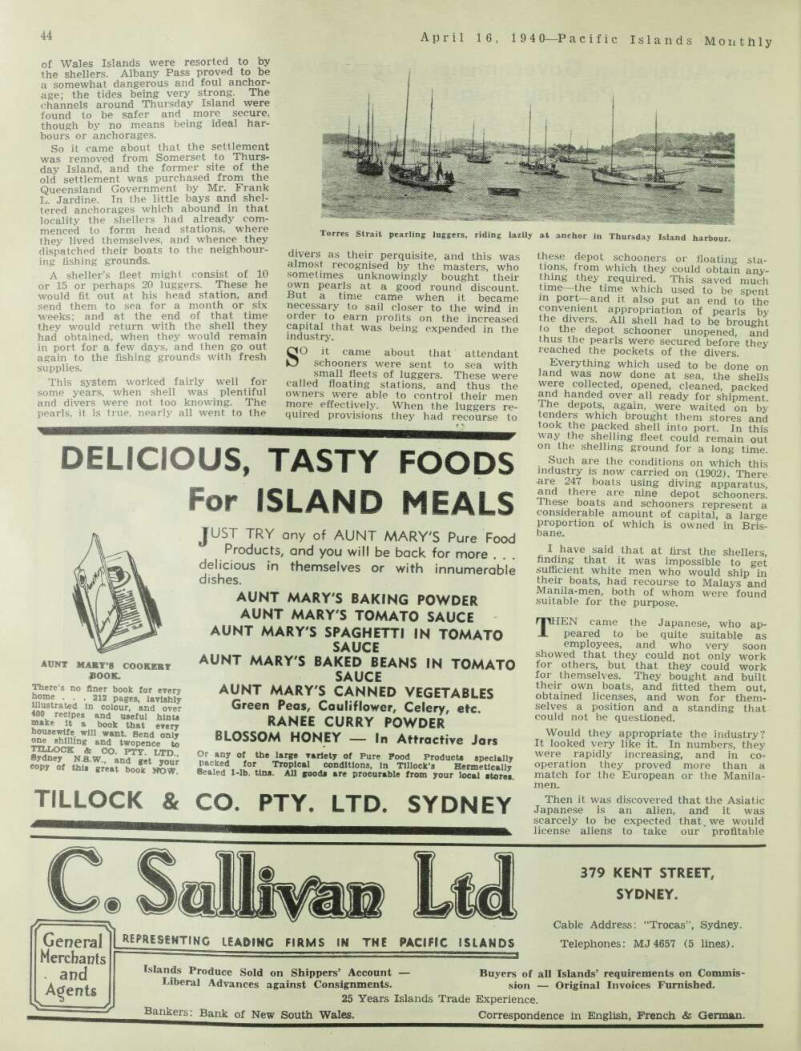
How Australian Governments Dug Grave of Pearling Industry Prophetic Words of Late Frank Jardine, in 1902
THE acute position of the pearling in try of Australia, and the operation of many Japanese pearling boats off the northern and western coasts of Aus tralia, have received occasional promin ence in the press. Therefore, it may be opnortune to publish some views ex pressed in 1902 by the late Frank L.
Jardine, of Somerset, North Queensland.
A comparison may be made between the difficulties experienced in the pearl ing industry in 1902, and those which that industry is undergoing to-day.
The following are extracts from a paper written by Mr. Jardine in March, 1902, and entitled “A Forecast—Torres Strait, Northern and Tropical Australia —Their Present and Future.”
I SHALL sketch briefly the history of the settlement at Thursday Island, as one of the connecting links be tween Asia and Australasia, and the centre of our pearl shell fishery in Tor res Strait (wrote Mr. Jardine, in 1902).
Then I shall have something to add in reference to the present relations of Asia and Australasia, and the recent Commonwealth legislation on alien immigration.
The pearl shell fishery commenced in 1869 at Somerset. Hither came some adventurous mariners, from Sydney, with scratch crews, consisting chiefly of South Sea Islanders. The Warrior, or Wappa, reef, was the first scene of their search, and the method was what we call “swimming diving”—that is, diving without the aid of any apparatus.
The shell was very abundant, and was readily brought to the surface by ex pert swimming natives, in water which did not exceed three or four fathoms.
The few boats which were then engaged in the fishery were not of sufficient capacity, but though the price realised at first did not reach £lOO per ton, it was so easily obtained, at but small outlay, that it paid remarkably well.
Then, when the shell reached the Lon don market, price rose to £250 a ton.
Here, then, was manifestly a new dis covery, which attracted marked atten tion. More boats, and more extended prospecting, resulted. The Ormond reefs
proved most productive, and the shallow and strong tidal channels of the Prince of Wales Islands were exceptionally rich.
Some fortunes were very quickly made by “swimming diving”, and a good many precious pearls found their way to Sydney as the illicit perquisites of the South Sea Islands divers, who gener ally managed to appropriate them.
Indeed, so handsome were the profits realised from the shell itself that the boat-owners began to regard the pos session of the pearls obtained as a secondary consideration altogether. Bed sides, if a diver happened to find a good pearl in the shell which he opened and handled, how was the master to know anything about it?
Many a diver, accordingly, after a successful season in Torres Strait, could afford to spend a high time in Sydney for many weeks. Thus it came about
that a good deal of attention was attracted to this profitable pursuit.
Boats were fitted out with diving apparatus, and white men began to think that it might be worth their while to learn to dive in the diving dress.
Under such conditions as then prevailed there was little or no risk, and with ordinary care diving for pearl shell might be quite as profitable as gold digging.
Meanwhile, more boats made their appearance, but it was not so easy to supply the crews. The local source of supply was exhausted. The shallow waters had been pretty well picked over, and in them the shell was less abundant. The deeper waters must be tried, and for them more men were wanted.
Thus it came about that Malays and Manila-men were recruited. They turned out to be very suitable for the work.
There were no divers among them at the start, as at that time all the divers were white men; but they soon learned to work in the diving dress, and some of them proved excellent divers.
AS time went on it was found that Somerset was not a very suitable centre for the industry. The Prince
of Wales Islands were resorted to by the shellers. Albany Pass proved to be a somewhat dangerous and foul anchor age; the tides being very strong. The channels around Thursday Island were found to be safer and more secure, though by no means being ideal har bours or anchorages.
So it came about that the settlement was removed from Somerset to Thurs day Island, and the former site of the old settlement was purchased from the Queensland Government by Mr. Frank L. Jardine. In the little bays and shel tered anchorages which abound in that locality the shellers had already com menced to form head stations, where they lived themselves, and whence they dispatched their boats to the neighbour ing fishing grounds.
A shelter's fleet might consist of 10 or 15 or perhaps 20 luggers. These he would fit out at his head station, and send them to sea for a month or six weeks; and at the end of that time they would return with the shell they had obtained, when they would remain in port for a few days, and then go out again to the fishing grounds with fresh supplies.
This system worked fairly well for some years, when shell was plentiful and divers were not too knowing. The pearls, it is true, nearly all went to the
divers as their perquisite, and this was almost recognised by the masters, who sometimes unknowingly bought their own pearls at a good round discount.
But a time came when it became necessary to sail closer to the wind in order to earn profits on the increased capital that was being expended in the industry.
SO it came about that attendant schooners were sent to sea with small fleets of luggers. These were called floating stations, and thus the owners were able to control their men more effectively. When the luggers re quired provisions they had recourse to
these depot schooners or floating sta tions, from which they could obtain any thing they required. This saved much time —the time which used to be spent in port—and it also put an end to the convenient appropriation of pearls by the divers. All shell had to be brought to the depot schooner unopened, and thus the pearls were secured before they reached the pockets of the divers.
Everything which used to be done on land was now done at sea, the shells were collected, opened, cleaned, packed ai ? d handed over all ready for shipment, ihe depots, again, were waited on by tenders which brought them stores and took the packed shell into port. In this way the shelling fleet could remain out on the shelling ground for a long time.
Such are the conditions on which this industry is now carried on (1902). There are 247 boats using diving apparatus, and there are nine depot schooners.
These boats and schooners represent a considerable amount of capital, a large proportion of which is owned in Bris bane.
I have said that at first the shelters, finding that it was impossible to get sufficient white men who would ship in their boats, had recourse to Malays and Manila-men, both of whom were found suitable for the purpose.
THEN came the Japanese, who ap peared to be quite suitable as employees, and who very soon showed that they could not only work for others, but that they could work for themselves. They bought and built their own boats, and fitted them out, obtained licenses, and won for them selves a position and a standing that could not be questioned.
Would they appropriate the industry?
It looked very like it. In numbers, they were rapidly increasing, and in co operation they proved more than a match for the European or the Manila men.
Then it was discovered that the Asiatic Japanese is an alien, and it was scarcely to be expected that. we would license aliens to take our profitable
Torres Strait pearling luggers, riding lazily at anchor in Thursday Island harbour.
pearl shell from our territorial waters.
Thus it came about that the licensing of shelling boats, which up to that time had been unlimited, was thence-forth restricted to British subjects.
It was our undoubted right to put this limitation in force and it was abso lutely necessary, for without it there can be no doubt that the industry would very soon have passed into the hands of the Japanese, just as the northern goldfields would have passed into the hands of the Chinese if we had not found the means of preventing it.
It was not only necessary to restrict the issue of licenses to British subjects, but it was also necessary to check what threatened to be a small invasion of Japanese, who were arriving, not only for employment in the pearl shell fish eries, but also on the sugar plantations.
This, fortunately, was easily accom plished by correspondence between the two Governments—for it must be said, to the credit of the Japanese Govern ment, that they have shown themselves to be most reasonable and considerate in their negotiations with us. It was arranged, accordingly, that immigrant Japanese should be furnished with pass ports; and that no passports should be issued except on authority from the Queensland Government, PASSING now to the maritime popu lation of Thursday Island, let us see in what proportion the differ ent nationalities are represented (in 1902): — Europeans 65 Japanese 619 Filipinos 237 Malays 217 S.S. Islanders 279 Pacific Islanders 242 Rotumans 79 Samoans 27 Papuans 27 Aboriginals of Australia .. 171 Miscellaneous 69 Making a total of men shipped and employed in the pearling and beche-de mer industries of 2,632; and these, of course, are nearly all single men.
Here, certainly, Asia has the best of it, and herein, as I believe, Asia will continue to have the best of it. I scarcely see how it can be that the Asiatic should not out-number the European. You might prohibit or place difficulties in the employment of Asiatics or of aliens, but whom could you find to take their place? The white man will not ship for £2 or £3 a month, even if supplied with everything that he can expect to be furnished with at sea.
The occupation is a perfectly healthy one, and the risks to be encountered are infinitesimally small, compared with the rigours and dangers of our fisher-folk in the North seas. But the white men are not to be had who will man the pearling luggers, nor are there white men divers who will work with coloured crews.
I scarcely know why white men are not attracted by the rich rewards of a diver’s calling, but such is undoubtedly the case. The unvarying monotony, dis comfort, and uninteresting life probably form the chief objections to it. Any how, they are not in the field.
Meanwhile, the Asiatic, with his em ployer, the owner of the lugger fleets and depot schooners, is in possession of the field, and it is hardly likely, as it seems to me, that he will be dispossessed.
But a new aspect will also come over the whole question by the passing of the Commonwealth restriction legisla
tion, and under that legislation how can the Asiatic find a footing?
To that the pearl-sheller with his fleets and floating stations, replies: “Nevertheless, we shall live! You may drive us from your territorial waters, but we shall find a field for our industry outside your limits, on the high seas—and we warn you that, if we are driven to this extremity, Thursday Island, as a commercial community, must surely die”—and there is certainly some prospect that recourse may be had to such an expedient.
The Dutch have recently opened a settlement in Dutch New Guinea, not more than 100 miles from our western boundary, where they are holding out
inducements to our pearl-shellers to go.
The shellers say, “Why should we not, if we can get better terms for our Asia tic crews, and exemption from labour restrictions? What is to prevent us from doing so? We can fish just as we have hitherto done, on our old fishing ground, and you cannot touch or inter fere with us so long as we keep out of your territorial waters.”
There is no doub t a good deal in this, and remains to be seen how it will work out. The probability is that the Commonwealth will come to some corn promise, by which the pearl-shell fisher ies, both on the northern and north western shores of Australia, will be re
garded as maritime industries differen tiated in some respects from the ques tion of alien or Asiatic labour, as applied to the mainland. There is, I think, a real difference which will have to be recognised.
IHAVE endeavoured to describe the position as regards the Asiatic alien as applied to Torres Strait.
At Port Darwin and in Western Aus tralia the same principles and same practices hold good.
In the Northern Territory, there are not many Malays or Japanese, though there are a good many Chinese —some 2,567, according to last returns. In Western Australia, their pearl-shelling fleets are recruited from Java and Singapore. There, too, is a limited mari
time enterprise which is not likely to be seriously interfered with by the new legislation.
The Queensland Government has lately, in Torres Strait, made fairly extensive water-reserves in the neigh bourhood of Thursday Island, and instructed their officers not to issue any more new licenses.
Both these provisions have, of course, had the effect of considerably limiting the operations of those engaged in the industry. They have a tendency, also, in the direction of creating a monopoly, as regards the present holders of licenses.
They do not commend themselves to my judgment, and I consider them, if not a mistake, at any rate premature.
HERE is an industry which, during the 33 years it has been in existence, has resulted in the production of shell, beche-de-mer, and tortoise-shell, which has realised, according to my estimate, something like £5,000,000 in the London and Eastern markets. Can nothing better be done for it than to impose all those restrictions, with the intention, as it is said, of saving it from
impending destruction?
The specific cure for the malady, it seems to me, would be to persevere in
the endeavours, already made, to ascer tain the best methods of cultivating the shell amongst the central reefs and breeding-places, where at one time it was so abundant. These nurseries should be closed, and would act as reservoirs from which the spat would, with the tides, be distributed through the greater portion of the strait. This will certainly be accomplished some day, and the sooner the better, even though it costs a large sum of money by way of experiment. The Govern ment, indeed, got as far as the appoint ment of a scientific expert for this pur pose, but there the matter ended —ad futurum tempus relegatum est, like many of our grand schemes.
ACCORDING to my reading of the signs of time, the relationship of Asia and Australia is one of the great questions of the present and the future, for Australia. I am as conscious as other people that the immense area of Northern Australia cannot be peopled by Europeans alone, as the shores of Southern Australia are peopled, yet I am perfectly satisfied that the people of the Southern States of Australia will do their level best to maintain the in tegrity of their present institutions, and the existence of what is called a “White Australia”. It may be pride, it may be prejudice; but I believe it to be a pas sionate conviction with the present in habitants of Australia that the unex plored and uninhabited portions of their country shall be reserved for their own use, even though included in the zone of the tropics. When I say their own use I mean, of course, that they would desire that such territory should be occupied as Australia has hitherto been occupied—by men and women of their own kith and kin—and that the introduction of Eastern races must be subject to such limitations as they please to impose. But, whatever happens, Australia is determined to have her children —White.
Addendum, by C.R.S. (4/3/1940) THE average man in the street, who has heard quite a lot about the invasion of the Japanese pearling boats and sampans which have been operating off the eastern, northern and western coasts of Australia, and which have been termed “poachers”, etc., after reading the above paper written by the late Mr. Jardine, in 1902, can see that the Japanese themselves are not wholly to blame for invading the shores of Australia, as they have been doing in the last five years.
We see that the European pearlers of Torres Strait threatened to do the very thing the Japanese are doing to-day.
Therefore, it may be claimed that the Australian governments of the past are responsible for the invasion of the Jap anese pearling boats and sampans, which have created havoc on the Aus tralian M.O.P. shelling grounds, be cause they did not pass proper legisla tion for the protection of the Australian pearler, when the industry was young.
It is rumoured that, in the pearling season of 1940, the Japanese Govern ment intends to give financial assist ance to the Japanese pearling-boats operating off the Australian coast.
Exactly how this financial aid is to be given has not been disclosed. A decid ing factor was that the Australian Gov ernment now is subsidising the Austra lian pearlers, and the Japanese Govern ment considers it therefore imperative to help and maintain the Japanese South Seas pearling industry.
Advertisements & other items, pp. 45-48 (4 items)
43
Pacific Islands Monthl y—A pr i 1 16, 1940
Refrigeration ...
pW» "MOREPOWER TO YOU"
l« S l({P P 1 - C CA R • • ■ R A DlO ■ ll io^ wv ’ HOME LIGHTING
OHCO* 0^
PRODUCT OF THE CLYDE ENGINEERING CO. LTD.
Island Agents: Burns, Philp & Co., Ltd., Rabaul: John L. Peadon, Ltd.
W. R. Carpenter & Co., Ltd. Fiji: Morris, Hedstrom, Ltd.
9
JAMES BUDGE
LTD
REFRIGERATION ...
“BUDGE" Automatic or Manually-controlled Refrigeration and Ice-making Plants, with or without insulated Cabinets or Rooms, ranging from 4 cubic feet to 1000 cubic feet or larger, using ammonia in the large and sulphur dioxide ($O2) in the small units.
Where electricity is not available, crude oil engines may be utilised for driving the larger plants and petrol engines for driving the smaller machines. The accompanying illustration is of a petrol engine driven $O2 unit. Enquirers please state power available (if any), size of cabinet and amount of ice required per day.
JAMES BUDGE PTY. LIMITED
REFRIGERATION AND GENERAL ENGINEERS
McEvoy and Harley Streets
- ALEXANDRIA SYDNEY
Established 1890
ENGINEERING WORKSHOPS
ALL CLASSES OF MACHINES MADE AND RECONDITIONED
DELICIOUS, TASTY FOODS
For ISLAND MEALS
AUNT MARY’S COOKERY
BOOK.
There’s no finer book for every home . . . 212 pages, lavishly Illustrated In colour, and over 400 recipes and useful hints make it a book that every housewife, will want. Send only one shilling and twopence to
TILLOCK & CO. PTY. LTD.,
Sydney N.S.W., and get your copy of this great book NOW.
JUST TRY any of AUNT MARY'S Pure Food Products, and you will be back for more . delicious in themselves or with innumerable dishes.
AUNT MARY'S BAKING POWDER
AUNT MARY'S TOMATO SAUCE
AUNT MARY'S SPAGHETTI IN TOMATO
SAUCE
AUNT MARY'S BAKED BEANS IN TOMATO
SAUCE
AUNT MARY'S CANNED VEGETABLES
Green Peas, Cauliflower, Celery, etc.
RANEE CURRY POWDER
BLOSSOM HONEY In Attractive Jars Or any of the large variety of Pure Pood Products specially packed for Tropical conditions, In Tlllock’s Hermetically Sealed 1-lb. tins. All goods are procurable from your local stores
TILLOCK & CO. PTY. LTD. SYDNEY
General
Merchants
and
Agents
a Ml representing leading firms in the pacific islands
379 KENT STREET,
SYDNEY.
Cable Address: “Trocas”, Sydney.
Telephones: MJ 4657 (5 lines).
Islands Produce Sold on Shippers’ Account Buyers of all Islands’ requirements on Commis- Liberal Advances against Consignments. sion Original Invoices Furnished. 25 Years Islands Trade Experience, Bankers: Bank of New South Wales. Correspondence in English, French & German.
Ship Chandlery Hardware
BROOMFIELDS LIMITED
152 SUSSEX STREET :: SYDNEY.
Cables "Boom”, Sydney.
Large and Complete Stocks of
SHIP CHANDLERY
IRONMONGERY OF ALL KINDS, PAINTS,
WHITE LEAD AND OILS.
Sole Agents for: P. H. MUNTZ CO.’s 3-CROWN BRAND METAL SHEATING.
PEACOCK &. BUCHANS’ ENGLISH READY-MIXED PAINTS.
/Write for j
Ship Chandlery /
Cataloaue J
Catalogue
Special "In Bond” Prices for all Islands enquiries quoted on application.
PACIFIC POPULARITY
SINCE 1908
atm
m S' s •M|M| 'X-, m m mm A CHAPMAN 3 h.p. “PUP" ENGINE IN A CHAPMAN MODEL “D" 16 ft. CABIN LAUNCH FOR OPEN SEA WORK. SPEED 7 m.p.h. £96 f.o.b. SYDNEY.
WRITE TO
CHAPMAN & SHER A C K
E R S K I N E V I L I E, N, S. W.
25 YEARS OP SERVICE
William E. Reed
(Established 1913)
BROKER & AGENT
Union House. George St., Sydney For all Plantation and Trading Requirements. Enquiries welcome.
MADE WITH
CREAMY FRESH
MILK...
m 'iiA «T'
B?SCV>
C £ * fcvsy «S * « «
Clu/ckm loveMimtt
Choice ingredients make Joyce Milk Arrowroot Biscuits tasty and wholesome. They're crisp . . . but they dissolve easily in the mouth. And, they're readily digestible.
Order from your storekeeper.
Traders are invited to write for full particulars and price list, to;
JOYCE BISCUITS
PTY. LTD.
Camperdown, Sydney, N.S.W.
44
April 16, 19 4 O—P acific Islands Monthly
46
April 16, 194 O—P acific Islands Monthly
Small Plane Crashed In
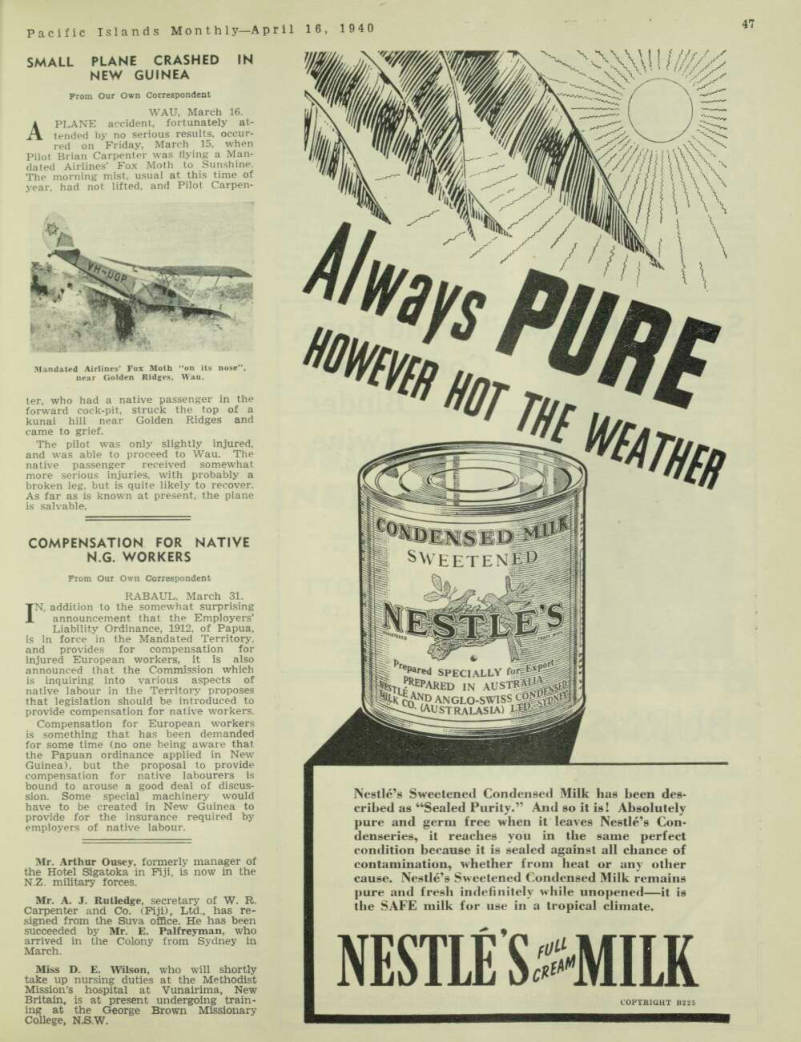
New Guinea
Prom Our Own Correspondent WAU, March 16.
A PLANE accident, fortunately at tended by no serious results, occur red on Friday, March 15, when Pilot Brian Carpenter was flying a Man dated Airlines’ Fox Moth to Sunshine.
The morning mist, usual at this time of year, had not lifted, and Pilot Carpen-
ter, who had a native passenger in the forward cock-pit, struck the top of a kunai hill near Golden Ridges and came to grief.
The pilot was only slightly injured, and was able to proceed to Wau. The native passenger received somewhat more serious injuries, with probably a broken leg, but is quite likely to recover.
As far as is known at present, the plane is salvable.
Mandated Airlines’ Fox Moth “on its nose”, near Golden Ridges, Wau.
Compensation For Native
N.G. Workers
Prom Our Own Correspondent RABAUL, March 31.
IN, addition to the somewhat surprising announcement that the Employers’
Liability Ordinance, 1912, of Papua, is in force in the Mandated Territory, and provides for compensation for injured European workers, it is also announced that the Commission which is inquiring into various aspects of native labour in the Territory proposes that legislation should be introduced to provide compensation for native workers.
Compensation for European workers is something that has been demanded for some time (no one being aware that the Papuan ordinance applied in New Guinea), but the proposal to provide compensation for native labourers is bound to arouse a good deal of discus sion. Some special machinery would have to be created in New Guinea to provide for the insurance required by employers of native labour.
Mr. Arthur Ousey, formerly manager of the Hotel Sigatoka in Fiji, is now in the N.Z. military forces.
Mr. A. J. Rutledge, secretary of W. R.
Carpenter and Co. (Fiji), Ltd., has re signed from the Suva office. He has been succeeded by Mr. E. Palfreyman, who arrived in the Colony from Sydney in March.
Miss D, E. Wilson, who will shortly take up nursing duties at the Methodist Mission’s hospital at Vunairima, New Britain, is at present undergoing train ing at the George Brown Missionary CoUege, N.S.W.
Mr. H. T. Fairbrother. a resident of Tulagi, Solomon Islands, is at present on a visit to New Zealand.
Miss Martha Caporn, second daughter of Mr. and Mrs. W. H. Caporn, merchant, of Noumea, New Caledonia, has announced her engagement to Mr. Arthur W. White, second son of Mr. and Mrs.
White, of Gladesville, Sydney. t M F r di T Tre^ illS Nel ho GXa ee stace m i9 n 2 e 6 r died at tS wau HosStafon March 14.' Mr. Wills had been in Papua and New Guinea for uowards of 20 years, and all who had known him in both Territories felt that a man of business integrity and honest purpose had passed from their midst. Mr. Wills was bom within the sound of Bow Bells, and prior to taking up mining, had been at sea for many years. His burial was attended by many old friends, and was conducted by Rev.
V. H. Sherwin.
Advertisements & other items, pp. 49-50 (1 item)
Nestles.*
NA fl v t SS « B I '\\ i \
I SWEETEN
SS : P
S ! Par ®d SPECIALLY for||*
MK ? REp AKED IN A
anglo-swiss
Kir: AUSTRALASIA) }M
Nestle’s Sweetened Condensed Milk has been described as “Sealed Purity.” And so it is! Absolutely pure and germ free when it leaves Nestle’s Condenseries, it reaches you in the same perfect condition because it is sealed against all chance of contamination, whether from heat or any other cause. Nestle’s Sweetened Condensed Milk remains pure and fresh indefinitely while unopened—it is the SAFE milk for use in a tropical climate.
NESTLES.*
MILK
COPYRIGHT 8225
ScottV'Renown” Brand Rope,
Cable Address; Ropeyard, Sydney. o.
Cordage and
Binder
Twine
of Every
Description
MANUFACTURED AT
MASCOT, NS W.
By
J. SCOTT
PTY. LTD.
Head Office and Store;
163 CLARENCE STREET,
SYDNEY,
N.S.W.
BURNS PHILP
(SOUTH SEA) CO. LTD.
Inc. in Fiji Island Traders and Shipowners Registered Office:
5U V A
FIJI
\\ Also Branches at: Fiji: Levuka, Lautoka, Labasa, Ba, Sigatoka, Rotuma.
Tonga: Nukualofa, Haapai, Vavau.
Samoa: Apia, Pago Pago (American Samoa).
Solomons: Makambo, Gizo, Faisi.
New Hebrides: Vila.
Code Address; Gilberts: Tarawa.
“Burnsouth”. Norfolk Is. Niue. Wallis Is. Futuna Is.
Kuku-Kuku Raid

By Jack O'Neill
rIE hut was small; no more than eighteen feet by ten. The walls were double rows of upright sap lings, lashed with split lawyer cane; the roof, bark stripped from a fallen pine tree. The doorway was narrow— like the walls, designed for defence.
It stood in the middle of a clearing; or rather, the mountain jungle had been ruthlessly cut down, but the stand of stately pines this revealed, though a dan ger to the camp beneath, had been spared. They towered a hundred feet and more above the hut and the nearby boys’ houses, dwarfing them into insig nificance. Here, a section of sloping ter race jutted from the steeper mountain side.
Inside the hut, a white man lay on the bunk, fully dressed, miserable in body, mind filled with the depressing fever fancies which, at such times, take advantage of a weakened will to insinu ate themselves. His smarting eyeballs made reading a too arduous means of escape—even if every book and scrap of paper had not already been read more than once.
There came a warning whisper. The cook boy spoke: “Master!” And, again; “Master!
Kanaka ’e come.”
The white man rolled off the bed and, in three strides, reached the door. At the lower end of the clearing were five stocky, dark-skinned Kuku-kukus. There was something furtive in their attitude as they stood there, close together as if for mutual support. One of them waved a couple of black, withered bananas above his head.
“Obe! Obe!”
The word is a comprehensive term for foodstuffs brought to trade; and, since trading is essentially a peace-time operation, it is recognised as a declara tion of peaceful intentions.
This time, the white man was suspi cious. The very attitude of the group, lacking that confident approach of un conscious innocence, shouted danger.
And those two miserable bananas! In Kuku-kuku country it is safer to be sus picious.
At a gesture from the white man, they advanced hesitantly, and took their stand on a fallen tree-trunk that was the recognised limit of approach to his camp. He stood in the doorway, eyes scrutinising the visitors. Familiar with his strictly enforced rule, they had not brought their bows. His eyes probed beneath the folds of the long, beaten bark capes suspended from the topnot of hair left on their cropped heads, for the tell-tale bulge of the more deadly stone clubs.
Satisfied, at last, that they carried only their light, adze-like native axes, he strode over and sprang up on to the log, crowding the nearest man. He was un armed, but in response to his warning to “watch out good”, the cook boy had taken the place he vacated at the door way. Within reach of his hand was his own shotgun, and his master’s rifle.
The white man was surprised to notice that the man nearest him was visibly trembling, and the others were obvi ously uneasy. Although he was not to know that they had come with the in tention of attacking a camp defended only by the cook boy, and that the trembling was the result of nervous tension, yet his suspicions deepened.
After ascertaining that they had not come to trade, he ordered them off and, still puzzled, returned thankfully to his bunk.
The boy resumed his bread making, twisting and thumping the stiff, rubbery dough.
TWO hours later, pandemonium shat tered the jungle peace. All the horrors of hell were being enacted in the mountain-walled gully upstream —so it seemed. Horrible shrieks, inter spersed with terrified shouting, were bandied back and forth from the crowd ing mountainsides, with startling effect.
Through the tumult, a reiterated cry forced its way, grew in strength. The cook picked it up.
“Fight e’ come up now.”
Before the white man had more than adjusted cartridge belt and snatched the
Winchester, worn bright from constant handling, the first of his terrified boys ran into the clearing, closely followed by the main body.
The kanakas had surrounded them under cover of the jungle, and suddenly had attacked, while they worked.
A count of heads showed one man missing, but they assured him, and a cry from up the creek confirmed it, that one of the armed boys, from number two box, had stayed behind.
With two volunteers, the white man hurried warily up the little stream. Soon they met the missing boy. The raiders had not come down even as far as the number two box;- he had waited there.
They went on, eyes flickering back and forth to the high commanding banks, the jungle on the mountainside, where a movement might betray an ambush.
The sound of their passage was smoth ered by the noisy little stream.
When they neared the last corner of high mud-stone “bottom”, the white man went forward alone, to peer through the crack between two big boulders. His rifle was half raised; there was a hun gry gleam in his eyes.
Nothing but the jungle and the stream. His eyes probed every tangled vantage point; picked out the larger trees for scrutiny; held the whole scene in an all-embracing stare, hoping to catch some fleeting movement. Nothing.
Water still ran unheeded through the abandoned sluice box. They went for ward, still expectant.
From there on, signs of the raid were evident in a trail of spent arrows; stuck in the tree trunks, in the banks, shat tered on the stones. In the bank, where the boss-boy had stood, at the head of the box, and where his shotgun still leaned, one stuck fast, buried a foot in the soil. It had sped between the boys arm and body; he hadn’t stopped for the gun.
One of the boys turned the water out of the box.
The raiders had got a knife or two, a tomahawk. What did it matter? The white man felt weak and tired in all his joints again. He leaned against the bank, while the boys collected the scat tered tools.
“How much kanaka come, Bulwa?”
“Plenty more, master. Bush full up.”
Patiently: “How much eye belong you, look ’im?”
The boy turned, finger pointing here, there, marking them off.
“Three fella.”
“Lulus, you look ’im how much?”
“Master, me look ’im two fella,” point ing, “here. Me run all-same dog.”
His big mouth split into a wide grin.
Old Bulwa cackled.
Advertisements & other items, p. 50 (1 item)
48
April 16, 194 O—P acific Islands Monthly
Goldfields Wedding
WAU, March 25.
ON Saturday, March 16, Miss Inez Beckett, daughter of Mr. C. C.
Beckett, who has been a resident of the Territory for upwards of twenty years, and many years of which have been spent on the Morobe Goldfields, was quietly married to Mr. John Leslie, of Bulolo Gold Dredging Co., at Mr.
Beckett’s residence. Miss Beckett has been a prominent member of the Wau Dramatic Society since its inception in 1935, and the toast of the bride and bridegroom was in the hands of the dramatic director, Major E. B. Ayris.
Extraordinary Way
Dredge Hand Killed in Extraordinary Way
From Our Own Correspondent WAU, April 2.
A MEMBER of the crew of the B.G.D. dredge at Bulwa, Mr. W. McDiar mid, met his death in an extraordin ary manner on March 22.
Coming off duty in the dinghy, he tried to cross over one of the mooring cables of the dredge. Pushing his dinghy beneath it, he put his leg over the cable, intending to step into the. dinghy on the other side of it.
Just as he did so, the dredge moved its position. This caused the mooring cable to tauten, lifting Mr. McDiarmid by his leg and throwing him, head first, into the water. Being in heavy mining attire, and being also unable to swim, he was drowned, in spite of many and valiant efforts by his dredge comrades to save him.
The water is very turgid, around these dredges, and it was a considerable time before his body could be located.
Captain and Mrs. Chris. Hill, of the New Hebrides, at present are spending a furlough in Sydney.
Mr, R. L. Chapman, a veteran New Guinea miner, is at present on a holiday visit to Australia.
Mr. C. L. Fenner, of the Colonial Sugar Refining Co, Ltd, arrived in Sydney recently from Fiji by the “Mariposa”. He was accompanied by Mrs.
Fenner.
Mr. David B. Smith, who spent over 30 years in Fiji in the service of Sturt, Ogilvie and Co. Ltd, and Morris, Hed strom. Ltd, died in Suva in March. He was 58 years of age and is survived by Mrs. Alma Smith and two children.
Mr. W. K. Carrington recently arrived in Port Moresby, Papua, from England to take up the post of drilling superin tendent with the Australasian Petroleum Company.
Rev. M. Frater, who lately retired from mission work in the New Hebrides, is en gaged on a biography of the late Dr.
Thomson Macmillan, of Tanna, New Hebrides.
Advertisements & other items, pp. 51-52 (1 item)
De Meric’S
CINNAMOLIA
The hot weather is now approaching with its dysentery, diarrhoea, and other seasonal infectious diseases of the alimentary canal EVERY tropical home should have on hand a bottle of the above remedy—in case—so as to be ready to attack the germs as soon as the first symptoms of disease appear.
For years scientists and medical men have sought for a safe, powerful germicide to treat infections of the Intestinal tract without harming the tissues.
Here it is! CINNAMOLIA! Guaranteed to contain no poisons or harmful drugs.
Price 3/- per bottle from
FALKS PHARMACY,
238 GEORGE ST., SYDNEY.
Wholesale Rates to Chemists, Hospitals,
etc., from CINNAMOLIA PREPARATIONS,
17 Murray Street, Waterloo, N.B.W.
Tel.: MX 1702.
DISINFECTANTS AND
INSECT DESTROYERS
Here are product's of the quality and strength essential for efficiency under island conditions. You can make a real job of it... at minimum cost. . . with .. .
De MERIC’S
STANDARD PRODUCTS
DISINFECTANTS, ( LIQUID AND
POWDER), LYSOL, NAPTHALENE,
NON-STAINING FLY SPRAY, MOTH
BALLS, ETC.
Obtainable at good stores everywhere. Traders are invited to write for full wholesale list.
DE MERIC PTY. LTD.
COMMONWEALTH AND STATE GOVERNMENT CONTRACTORS
Doody Street, Alexandria, N.S.W.
A. B. DONALD Ltd.
AUCKLAND
ISLAND TRADERS & GENERAL MERCHANTS
P.O. Box 1509. Cables Gr Telegrams, "Kingdom", Auckland.
Your Tropical Rit
When you visit the Pacific Islands, whether on Business or Pleasure, you need Special Equipment—Light Suits of Correct Style, which fit well and launder easily; Tunic Shirts, Silk Shirts, Light Underwear, White Shoes, etc.
WALTER HORNE & CO., LTD., established in 1885, specialise in this Service. Skill'd Tailors make your Suits from First-class material within 24 hours. Complete equipment can be supplied from our Large Stock at Reasonable, Moderate Prices.
WALTER HORNE & CO. LTD.
BUY FROM THE FIRM WHICH UNDERSTANDS YOUR NEEDS AND
DRESSES YOU CORRECTLY.
WALTER HORNE & CO. LTD. carry a Full Range of Drapery of all kinds; also Frocks, Millinery, Foundations and Lingerie, Hosiery, Shoes and Sandals, Ribbons and Laces, Household Drapery.
Ladies' Hairdressing and Manicuring
Men resident in any of the Pacific Territories can be supplied with Suitable Clothes.
Write to us and Describe your Requirements.
Drapers and Men's Wear Specialists.
SUVA, FIJI.
Run Over In Street By
An Aeroplane!
From Our Own Correspondent
Port Moresby, April 2.
AN extraordinary accident occurred recently, when a resident of the town, Mr. Marshall, was knocked down and run over in the street by an aeroplane. His foot was so injured that he had to be sent to hospital for treat ment.
The plane was being pushed across the street by native labourers, between the place which housed it and a ramp, leading to the water’s edge; and, in some manner, it was allowed to swing round on to Mr. Marshall, and injure him.
Fiji Lands
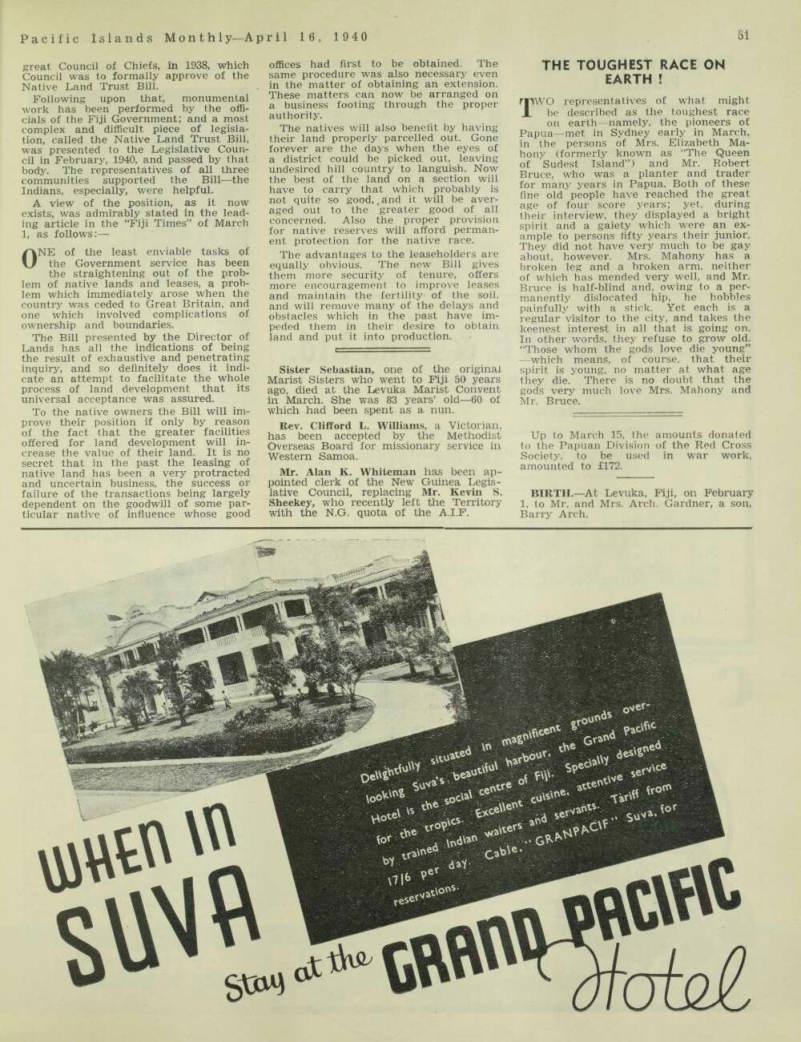
New Bill Introduces Important Reforms
WHEN the Legislative Council of Fiji, on February 29, finally passed the Native Land Trust Bill, there came into operation one of the most important measures ever designed in connection with the administration of that Colony.
It is a matter of history that Britain did not want the Fiji Islands; but, eventually, on the earnest solicitation of the chiefs, she was persuaded to take aver the group; and the chiefs then signed a formal Deed of Cession. By the fourth clause of the Deed of Ces sion all lands not required for the use and maintenance of the natives were handed over to the Crown. It was a gift of tremendous value to the Govern ment. But the British Governors would not accept it, and took action in the subsequent quarter-century which vir tually meant that all unalienated lands were handed back to the natives.
During the past half-century, a diffi cult situation has developed. There is a huge area of unoccupied and fertile land in Fiji—far more than is required by the 100,000 Fijian natives—but the land-titles system which has grown up as a result of handing back the un occupied lands to the natives has created endless difficulty and confusion, aggra vated by the fact that there are now nearly 90,000 Indians settled in Fiji, who mostly are of the agricultural class and who are desperately anxious to secure land.
Governor after governor has tried to secure settlement of this vexed problem of land ownership; but the thing which finally led to a solution appears to have been a speech made by the then Governor, Sir Murchison Fletcher, to the Council of Fijian chiefs in 1930. He warned them of the growing dangers of the position, and urged them to take action along certain lines, putting their trust in the British Crown. As a result of this in 1936 and subsequently, the Council of Chiefs asked the British Crown to take over all lands in Fiji, whether occupied by natives or not, and to dispose of them according to a sys tem which had been evolved in many conferences.
Briefly summarised, the plan was that the ownership of all native lands in Fiji should be vested in a Land Board appointed by the Governor; that a com mission, headed by the famous Fijian administrator, Ratu Sukuna, should examine all lands and decide which lands were necessary for the support of the Fijian people, and such lands to.be reserved absolutely for the Fijian people; and that all other lands, not so required, should be placed at the dis posal of the Land Board, to be leased out to land-seekers generally, and rent als to go for the benefit of the Fijian people.
This plan was set out in a speech by the then Governor of Fiji, Sir Arthur Richards, to the leading chiefs of the Colony, at the end of July, 1938 (re ported in the “P.1.M.”, August, 1938) and it was promised that the plan should be embodied in a Bill.
Sir Arthur Richards then left the Colony, and Sir Harry Luke, his suc cessor, was sent out, at very short notice, in order that he might open the
great Council of Chiefs, in 1938, which Council was to formally approve of the Native Land Trust Bill.
Following upon that, monumental work has been performed by the offi cials of the Fiji Government; and a most complex and difficult piece of legisla tion, called the Native Land Trust Bill, was presented to the Legislative Coun cil in February, 1940, and passed by that body. The representatives of all three communities supported the Bill —the Indians, especially, were helpful.
A view of the position, as it now exists, was admirably stated in the lead ing article in the “Fiji Times” of March 1, as follows: — ONE of the least enviable tasks of the Government service has been the straightening out of the prob lem of native lands and leases, a prob lem which immediately arose when the country was ceded to Great Britain, and one which involved complications of ownership and boundaries.
The Bill presented by the Director of Lands has all the indications of being the result of exhaustive and penetrating inquiry, and so definitely does it indi cate an attempt to facilitate the whole process of land development that its universal acceptance was assured.
To the native owners the Bill will im prove their position if only by reason of the fact that the greater facilities offered for land development will in crease the value of their land. It is no secret that in the past the leasing of native land has been a very protracted and uncertain business, the success or failure of the transactions being largely dependent on the goodwill of some par ticular native of influence whose good
offices had first to be obtained. The same procedure was also necessary even in the matter of obtaining an extension.
These matters can now be arranged on a business footing through the proper authority.
The natives will also benefit by having their land properly parcelled out. Gone forever are the days when the eyes of a district could be picked out, leaving undesired hill country to languish. Now the best of the land on a section will have to carry that which probably is not quite so good,, dnd it will be aver aged out to the greater good of all concerned. Also the proper provision for native reserves will afford perman ent protection for the native race.
The advantages to the leaseholders are equally obvious. The new Bill gives them more security of tenure, offers more encouragement to improve leases and maintain the fertility of the soil, and will remove many of the delays and obstacles which in the past have im peded them in their desire to obtain land and put it into production.
Sister Sebastian, one of the original Marist Sisters who went to Fiji 50 years ago, died at the Levuka Marist Convent in March. She was 83 years’ old —60 of which had been spent as a nun.
Rev. Clifford L. Williams, a Victorian, has been accepted by the Methodist Overseas Board for missionary service in Western Samoa.
Mr. Alan K. Whiteman has been ap pointed clerk of the New Guinea Legis lative Council, replacing Mr. Kevin S.
Sheekey, who recently left the Territory with the N.G. quota of the A.I.F.
Advertisements & other items, p. 52 (1 item)
50
April 16, 194 O—P acific Islands Monthly
The Toughest Race On
Earth!
TWO representatives of what might be described as the toughest race on earth —namely, the pioneers of Papua—met in Sydney early in March, in the persons of Mrs. Elizabeth Ma hony (formerly known as “The Queen of Sudest Island”) and Mr. Robert Bruce, who was a planter and trader for many years in Papua. Both of these fine old people have reached the great age of four score years; yet, during their interview, they displayed a bright spirit and a gaiety which were an ex ample to persons fifty years their junior.
They did not have very much to be gay about, however. Mrs. Mahony has a broken leg and a broken arm, neither of which has mended very well, and Mr.
Bruce is half-blind and, owing to a per manently dislocated hip, he hobbles painfully with a stick. Yet each is a regular visitor to the city, and takes the keenest interest in all that is going on.
In other words, they refuse to grow old.
“Those whom the gods love die young” —which means, of course, that their spirit is young, no matter at what age they die. There is no doubt that the gods very much love Mrs. Mahony and Mr. Bruce.
Up to March 15, the amounts donated to the Papuan Division of the Red Cross Society, to be used in war work, amounted to £172.
BIRTH.—At Levuka, Fiji, on February 1, to Mr. and Mrs. Arch. Gardner, a son, Barry Arch.
Advertisements & other items, p. 53 (1 item)
S'jiM
m
*•3 < i^r
Bp. . out>ds o^ r '
■ n ro^' f ' te< ' 1 . . ?4C '' d s »W» ied , j r b°' jr ' 1 yw des'S 0 *» W .. b , f y*. eC ' we^' te S'*** ce oire o (ro! tx » « X ?suv»- <or tr»w ed C»»>' e ' r d»Yf |b 9 er .ese^^' 0 °
Planters!
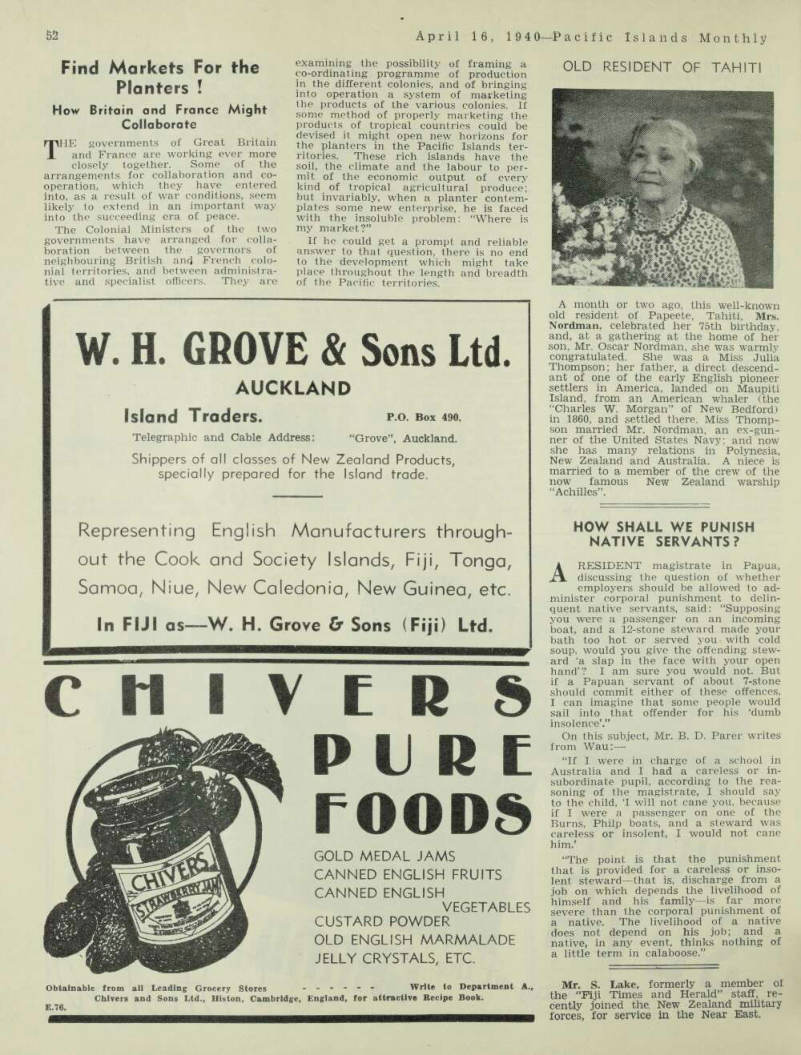
Find Markets For the
How Britain and France Might Collaborate
THE governments of Great Britain and France are working ever more closely together. Some of the arrangements for collaboration and co operation, which they have entered into, as a result of war conditions, seem likely to extend in an important way into the succeeding era of peace.
The Colonial Ministers of the two governments have arranged for colla boration between the governors of neighbouring British and French colo nial territories, and between administra tive and specialist officers. They are
examining the possibility of framing a dinating programme of production in the different colonies, and of bringing into operation a system of marketing the Products of the various colonies. If some method of properly marketing the products of tropical countries could be devised it might open new horizons for the planters in the Pacific Islands ter ritories. These rich islands have the soil, the climate and the labour to per mit of the economic output of every kind of tropical agricultural produce; but invariably, when a planter contem plates some new enterprise, he is faced with the insoluble problem: “Where is my market?” if he could get a prompt and reliable answer to that question, there is no end to the development which might take place throughout the length and breadth of the Pacific territories.
Old Resident Of Tahiti
A month or two ago, this well-known old resident of Papeete, Tahiti, Mrs.
Nordman, celebrated her 75th birthday, and, at a gathering at the home of her son, Mr. Oscar Nordman, she was warmly congratulated. She was a Miss Julia Thompson; her father, a direct descend ant of one of the early English pioneer settlers in America, landed on Maupiti Island, from an American whaler (the “Charles W. Morgan” of New Bedford) in 1860, and settled there. Miss Thomp son married Mr. Nordman, an ex-gun ner of the United States Navy; and now she has many relations in Polynesia, New Zealand and Australia. A niece is married to a member of the crew of the now famous New Zealand warship “Achilles”.
How Shall We Punish
Native Servants?
A RESIDENT magistrate in Papua, discussing the question of whether employers should be allowed to ad minister corporal punishment to delin quent native servants, said: “Supposing you were a passenger on an incoming boat, and a 12-stone steward made your bath too hot or served you with cold soup, would you give the offending stew ard ‘a slap in the face with your open hand’? I am sure you would not. But if a Papuan servant of about 7-stone should commit either of these offences, I can imagine that some people would sail into that offender for his ‘dumb insolence’.”
On this subject, Mr. B, D. Parer writes from Wau: — “If I were in charge of a school in Australia and I had a careless or in subordinate pupil, according to the rea soning of the magistrate, I should say to the child, T will not cane you, because if I were a passenger on one of the Burns, Philp boats, and a steward was careless or insolent, I would not cane him.’
“The point is that the punishment that is provided for a careless or inso lent steward —that is, discharge from a job on which depends the livelihood of himself and his family—is far more severe than the corporal punishment of a native. The livelihood of a native does not depend on his job; and a native, in any event, thinks nothing of a little term in calaboose.”
Mr. S. Lake, formerly a member of the “Fiji Times and Herald” staff, re cently joined the. New Zealand military forces, for service in the Near East.
Advertisements & other items, p. 54 (2 items)
52
April 16, 194 O—P acific Islands Monthly
Foods
W. H. GROVE & Sons Ltd.
AUCKLAND
island Traders. p.o. box 490.
Telegraphic and Cable Address: “Grove”, Auckland.
Shippers of all classes of New Zealand Products, specially prepared for the Island trade.
Representing English Manufacturers throughout the Cook and Society Islands, Fiji, Tonga, Samoa, Niue, New Caledonia, New Guinea, etc.
In FIJI as —W. H. Grove Cr Sons (Fiji) Ltd.
cn i v
E R 8
PURE
FOODS
GOLD MEDAL JAMS
CANNED ENGLISH FRUITS
CANNED ENGLISH
VEGETABLES
CUSTARD POWDER
OLD ENGLISH MARMALADE
JELLY CRYSTALS, ETC.
Obtainable from all Leading Grocery Stores Write to Department A., Chlvers and Sons Ltd., Histon, Cambridge, England, for attractive Recipe Book.
E. 76.
Swam All Night
Passengers From Wrecked Tongan Cutter
Nukualofa, Feb. 20.
WHILE on her way from Haapai to Vavau, with thirteen passengers, including men, women and child ren, and a crew of four, with her cap tain, a Fijian named Elemasi Somo, a small inter-island cutter, the “Toutou noa”, capsized at 5 p.m. on February 6, when about six miles from Vavau.
The vessel was passing oyer a sub merged reef when a wave struck her amidship and turned her on her beam ends, so that her sails came into con tact with the sea. Unable to lift the weight of her water-logged sails and right herself, the vessel capsized.
The three children among the passen gers, with two elderly women, were placed in the vessel’s small rowing-boat, in charge of a member of the crew, while the rest of the passengers and crew swam.
With the help of a piece of board as paddle (since her oars were lost in the accident) the little boat managed to reach the small, uninhabited island of Luahiabo during the night, where they rested before starting out in the morn
ing to the inhabited island of Falevai.
But, finding Falevai difficult to reach, they turned to the island of Ovaka, also inhabited, where they arrived in the afternoon.
In the meanwhile, those who had been swimming, with the exception of a man named Kebu Malafu (who is still missing and is believed lost) managed to land on some of the small, uninhabited, outlying islands of Vavau during the day, after being in the water all night.
Six landed on the island of Maninita. one on Fua’amotu and four on Fonua oneone. These were found and taken to Neiafu by search parties, next day, February 8.
The missing man was last seen at dusk, on the day of the accident, swim ming with the vessel’s rudder, in the direction of Vavau. He was the first to leave the sinking vessel.
Passengers and crew were unanimous that the accident could have been averted. The captain has been charged with manslaughter and is awaiting trial.
The engagement was announced re cently in English newspapers of Miss Carola Peyton-Jones, of Wendover, Bucks., to Mr. Peter Ambrose Luke, elder son of Sir Harry Luke, Governor of Fiji and High Commissioner for the Western Pacific.
France's Care Of Polynesian
People
From Our Own Correspondent PAPEETE, March 18.
THE following notice in the January, 1940 issue of “Te Vea Maohi”, re presents another step by the pre sent Administration of French Oceania in studying and understanding the problems and general welfare of the native people of the Colony:— “By many of our articles, hitherto, we have endeavoured to make ‘Te Vea Maohi’ the real link between the Ad ministration of the Colony and each of you individually—no matter how great the distance which separates us, one from the other.
“Through this journal, the Admini stration gives instruction and informa tion to you and it has also many times requested that you make known your wishes and your opinions to its officers here.
“During his many tours of inspection, when the Governor of the Colony has visited you and your district admini strator, His Excellency has told you that if there is any complaint or request which is right and proper, you should
make it known to the Governor him self.
“Send your letters by post, without postage stamp, addressed to the Gov ernor at Papeete.”
The notice further says that a special secretary, who is learned in the Tahi tian language, has been designated to give attention to all correspondence in that language and to translate it into French, so that His Excellency may give each question immediate consideration.
Advertisements & other items, pp. 55-56 (2 items)
53
Pacific Islands Monthl y—A pril 16, 1940
Now save money on your Cases
We announce with pleasure . . .
A BETTER, STRONGER BOX —THAT COSTS LESS and is Approved by the Commonwealth Export Authorities
IDEAL
FOR THE
ISLANDS TRADE
Made in All Sizes.
This new light-weight, wire-bound box is scientifically designed in every feature—has passed all tests 100%, and is rapidly being adopted by numerous Australian industries.
Because—
It is LIGHTER
STRONGER
COSTS LESS
REDUCES TRANSPORT COSTS
EASILY PUT TOGETHER
OPENED WITHOUT SMASHING
SUITABLE FOR ALL INDUSTRIES
■ Start now to reduce your overhead.
Write to-day for full particulars.
End Rheumatism
While You Sleep
If you suffer sharp, stabbing pains, if joints are swollen, it shows your blood is poisoned through faulty kidney action. Other symptoms of Kidney Disorders are Burning, Itching Passages, “Getting up Nights,” Backaches, Lumbago, Leg Pains, Nervousness, Dizziness, Headaches, Colds, Puffy Ankles, Circles under Eyes, Lack of Energy, Appetite, etc. Ordinary medicines can’t help much —you must kill the germs ruining health. Cystex ends these troubles by removing the cause. Get Cystex from any Chemist on Guarantee to put you right or money back. Act Now ! In 24 hours you will feel better and be completely well . in one week. The Guaryaw antee protects you. Now V J 9 in 3 sizes: 1/9, 4/-, SI- GUARANTEED for Kidneys. Rheumatism, Bladder
SCHAFFER & CO.. STDNET.
Allen Taylor & Co. Ltd.
SYDNEY
Sawmillers and Wholesale Suppliers of Hardwoods for Constructional Purposes GIRDERS . . . PILES . . . POLES . . . SLEEPERS, Etc.
EXPORTING TO PACIFIC ISLANDS SINCE 1893
Cables: Tuxedo, Sydney
For Islands Conditions
use
SPARTAN
PAINTS ENAMELS
PAVING PAINT SASH & TRIM PAINT
QDE ENAMEL ZINC PASTE
CAR POLISH VELOX ENAMEL
TROJAN PAINT
0 Request your Sydney Agent to obtain details, price lists and color cards of Spartan Paints.
IT WILL PAY YOU
SPARTAN LACQUERS PTY. LTD.? 4 st
French Colony
New Hebrides Now May Become
Important Effect of New Anglo-French Relationship
Written for “Pacific Islands Monthly” by M.F.
THE unanimity with which the pro posal for closer collaboration be tween the Allies has been accepted as a desirable principle must be grati fying to those who have long urged federation as the only way to more vigorous prosecution of the war.
Even though, since the outbreak of war, the Allies have been conducting hostilities in closer co-operation than ever was contemplated during the last war, they had gone only half-way to wards the attainment of federalism.
British and French soldiers had been fighting side by side under a common French command; British and French ships had been together, patrolling the seven seas; but only now, after six months of war, have the two Allied Governments gone the whole way and created a real political and economic entity.
A fitting corollary to the proclamation of Allied solidarity is the recent announcement of Mr. Malcolm MacDon ald, Colonial Secretary, that henceforth there is to be permanent liaison between
the British and French Colonial Offices.
The task of Colonial Government is no longer to be one of exclusive national concern and national interests, but one of international collaboration for the benefit of Colonial peoples. Instead of exploitation, native well-being in future has to be the primary consideration: and Colonial Governments are directed to give redoubled attention to “health, education and housing”. In order to ensure unity of purpose and action, con ferences are to be held, at stated inter vals, to facilitate co-operation betweeh the overseas Administrations of the two Powers.
THE first reaction of many people acquainted with the complex situa tion in the New Hebrides was to ask, What effect will such a federa tion have on the Condominium?
It would be a strange denouement if the adoption of federation, between Britain and France, should foreshadow the doom of federation in the New Hebrides, and bring about the dissolu tion of dual control. A “new deal”, of the kind contemplated, besides contri buting to the resolute prosecution of the war in other Colonies, will produce, in the case of the New Hebrides, startling repercussions in the elimination of need less expenditure of money and effort.
From the standpoint of economy and efficiency, it long has been recognised that the Condominium would be super ceded by a Unidominium. On every hand, it is acknowledged that a system of government, which legalised an Ad ministration in duplicate and the Judges of the Joint Court in triplicate, could not remain a permanent institution.
For the advancement of the native race, and the prosperity of the Islands, it was imperative that such an ungainly make shift should be superceded by a pro gressive form of government.
Some degree of extenuation might be made were it shown that Dual Control operated amid a dense population with divergent customs, but the real situa tion is quite different. The Condomi nium exercises jurisdiction over a popu lation of less than 1,000 Europeans, a dwindling population of about 40,000 native aboriginals, and a fluctuating group of Asiatics, composed mostly of indentured labourers from French Indo- China.
The new provisions announced by the Colonial Secretary include health and educational reforms which will prove a tremendous boon in promoting the con servation and development of the native races. But, so far, nothing has been done by the British side of the Adminis tration to foster medical and educa tional progress in the New Hebrides.
These services have been sponsored entirely by the Missions.
The French authorities, on the other hand, with their instinctive realism, have recognised their responsibilities and provided medical and educational facili ties. They, too, in sharp contrast to the apathy displayed by the British Gov ernment, promoted the economic devel opment of the Islands, and were re
warded with the inevitable result that the colonisation and exports of the Group passed almost entirely into their hands.
Should the co-ordination of Allied Colonial efforts result in the breakdown of the Condominium the assumption of undivided sovereignty by the French Administration would be unavoidable.
AT one time, it was believed that, if Britain decided to sever her con nection with the New Hebrides, Australia might assume the partnership with France. But the Commonwealth has never shown the slightest inclina tion to assume the responsibility, and now is definitely opposed to it. It now is generally recognised that the task con fronting Australia in Papua and the Mandated Territories is sufficient to tax all her available resources.
Even those who favoured the reten tion of the New Hebrides by Australia, as a link in the chain of its outer de fences, now realise that the unity of the relationship between France and Britain has changed the situation, and that the Group is safe in the keeping of France.
Due weight also must be attached to the incidence of geography. The New Hebrides forms, with New Caledonia, an integral part of the archipelago—the New Cyclades of Bougainville—and gives France a paramount claim to the islands.
So friendly has been the relationship in the New Hebrides between the French Administration and British resi dents, traders and missionaries, that it is freely acknowledged that the acti vities of Britishers, under French rule, would continue unimpeded. Indeed, in the difficult times through which the islands recently have passed the British trader only succeeded in making ends meet by sharing in the inflated price for copra which the subsidy granted to French colonists made possible.
The only restrictions that are likely to arise would be in the curriculum of the training colleges, connected with the British Missions. Hitherto, English has been the lingua franca. The likeli hood is that, in a French Colony, the condition would be imposed of substitut ing the French language for English.
In the mission schools and churches throughout the Group no such difficulty would arise, because instruction is im parted in the vernacular, and this prac tice would undoubtedly be encouraged by a progressive French Administration.
N.G. Public Service
T HE following Staff transfers in the New Guinea Public Service were announced in March;— Health Dept. R. C. Chugg, Medical Assistant, Madang to Rabaul; W. N. S. Couzens, Medical Assistant, Rabaul to Kieta; F. N. Green, Medical Assistant, Rabaul to Aitape.
District Services Dept.—H. E. Woodman, A.D.0., Namatanal to Rabaul; W. M. Marshall’
Clerk, Salamaua to Rabaul; L. Ml McLaren’, Clerk, Rabaul to Salamaua; J. W. Hodgekiss Patrol Officer, Rabaul to Sepik; C. J. Miller’
Patrol Officer, Rabaul to Kavieng: F. H. Moy Patrol Officer, Rabaul to Sepik; R. J. Pascoe Clerk, Kavieng to Kokopo.
Lands Dept.—L. E. Clout, Cadet Draftsman, Rabaul to Salamaua; C. M. O’Brien, Chainman Morobe to Rabaul.
Public Works Dept.—C. A. Jones, Assistant Engineer, Rabaul to Salamaua.
Police Force.—W. Allen. W. 0., Wewak to Rabaul; L. R. s. Johnson, Warrant Officer, Namatanai to Rabaul; W. S. Harvey, Warrant Officer, Rabaul to Namatanai; I. Hoggard, Warrant Officer, Rabaul to Wau; W. J. Living stone, Warrant Officer, Rabaul to Kavieng.
Castaways Reported After Vain
Air Search
riIOWARDS the end of February, a X European resident of Misima, East ern Papua, while outside the reef, fishing, with some natives, was over taken by a squall and, when the wea ther cleared, the boat and its occupants had completely disappeared. A search around the adjoining shores gave no trace of them.
When the big flying-boat, after the funeral of Sir Hubert Murray, returned from Port Moresby to Samarai with Mr.
Leonard Murray and Mr. George Aumul ler, its services were enlisted in a_ search for the missing European and his com panions. Fuelling at Samarai, the fly ing-boat thoroughly combed the islands
and reefs of the great archipelago, from Samarai right out to Sud Est Island.
The search occupied two days, but there was no trace of the lost boat.
It subsequently was reported in Syd ney that the castaways had been found safely on an island, far to the north west of their group, about 11 days after their disappearance. They were with out food and water when they were blown away to sea, and must have suf fered great privations.
Gold declared at the Warden’s office, Wau, New Guinea, for the eight months from July 1, 1939, represents £A1,630,207.
B.G.D. had one dredge out of commis sion for repairs during February and Koranga devoted much time to extensive blasting, with a water shortage.
The revenue received by the Govern ment of Tonga during the three months ended September 30, 1939, was £15,604, while the total expenditure was £15,825.
The yacht “Inyala”, which was bought recently by Mr. Theo McGill, of Auck land, after lying in Suva Harbour for several years, and which left Suva on December 2, bound for Auckland, turned up in Noumea 17 days later in a bat tered condition, having survived severe storms. She was fitted with new sails and rigging, and cleared for Auckland, and arrived there in the middle of March. She is to be used by Mr. Mc- Gill for cruising on the New Zealand coast.
Advertisements & other items, pp. 57-58 (2 items)
55
Pacific Islands Monthl y—A pril 16, 1940
Amp-Lite
■i » Small, light, compact Petrol Electric Generators with everything a car engine has. • For Home Lighting • Battery Charging. • Operates twelve 25- • 12 hours per gallon watt lamps. of petrol.
OUTPUT—I 2 volts 300 watts (25 amps.) Weight when yacked 97 lbs.
AMP-LITE FEATURES
(1) Press Button Starting. (3) Automatic Cut-out. (5) Petrol Filter. (7) Vibrationless. (2) Magneto Ignition, etc. (4) Air-cleaner, Oil-bath type. (6) Float Adjustable Carburettor. (8) Heavy Duty, Double Contact, Cut-out.
Features 4 to 8 are exclusive to Amy-lit e Model.
1 and
STRATTON
T Model 300 •10*0 Also available. Model 100, 6 volts, 100 watts, manual starting.
STRAITO
lOCS
Price £l5.
From Leading Island Merchants, or:
AMPLION (A’SIA) PTY. LTD.
382 Kent Street, Sydney.
Cable Address: ‘Amplion,’ Sydney.
Help for
you feel better after the first dose. Throat, nose, chest—all benefit promptly. Safe for kiddies—best for you to relieve Coughs and Colds. Handysiied bottle I /-.
Firearms Repairs, “OUR HANDS MAKE GOOD ARMS” Goods Sent C.O.D.
QUALITY
FIREARMS
Savage Poley Choke Single Barrel 12 Gauge Shotgun.
A turn of the fingers, the choke is altered to any degree. Price £5/15/-.
Webley & Scott (England) Semi-Hammerless 12 Gauge Single Barrel Shotgun.
Full Choke. For 2f Cartridges. Price £7/15/-.
CLAY PIGEON TRAPS, BRITISH MAKE
“MINOR” £3/16/- “AUTOMATIC” £2B/17/6
•PLUS” £6/16/6 500 Eley Clay Pigeons 36/9, F. 0.8., Sydney .All Firearms over 50/-, Post Free. Quality used Firearms Bought, Sold, and Exchanged.
WRITE FOR FIREARMS CATALOGUE (600 ILLUSTRATIONS!.
SIL ROHU
Quality Firearms and Fishing Tackle. 143 ELIZABETH STREET, SYDNEY Phone MA 3540 (Near Market Street).
HONESTY FIDELITY
Safeguard your interests. Ensure their protection and security. Avail yourself of the advantages to be derived from the appointment of this Company as your trustees, in preference to any one individual. Write to or call on any Branch of Burns, Philp & Company Limited, or Burns Philp (South Sea) Company, Limited, for the folder which fully explains these advantages.
Give careful consideration to the benefits to be gained by appointing as your Executors—
BURNS PHILP TRUST CO. LTD,
DIRECTORS
JAMES BURNS
ROBERT JOHN NOSWORTHY
LEWIS ARMSTRONG
JOSEPH MITCHELL
BURNS PHILP TRUST CO. LTD.
CAPITAL—£2OO,OOO TT 7 BRIDGE STREET SYDNEY, N.S.W.
Fiji Men For Air Force
THE following have been selected from Fiji, for service in the Royal New Zealand Air Force and the Royal Air Force, provided they reach the necessary medical standard.
Air Crew Section
(Pilots, Observers and Air Gunners) B. I. Bentley R. A. Hewlett K. C. Brabant E. S. Ludolph R. M. Chapman H. C. McClean A. S. Davis R. H. Strachan V. L. B. Donnan A. F. Thompson J. R. Hayes G. M. Wilson.
Ground Staff Section;
H. B. Bossley. D. N. Whitten.
Rev. Brother Paschal, of the Marist Mission at Cawaci, Fiji, was recently transferred to Apia, Western Samoa.
Mrs. Josephine Christian, wife of Mr.
Brightman Christian, of Norfolk Island, died recently at N. 1., following a sudden heart attack.
Mr. J. Ingram left Rarotonga by the “Matua”, in March, to spend a short furlough in New Zealand.
On Hands And
Knees
How Burial Was Conducted in a Hurricane
IN a report of the Anglican Mission activities in Fiji, published in the “Polynesian Church Gazette’’ (March) there is a remarkable story of how a burial was conducted during a hurricane.
On January 21, 1939, during a hurri cane, Rev. H. Mayo Harris was called to officiate at the burial of a native of the hill village of Tecirua, some five miles from Suva. A heavy car had to be hired as the parish car was too light to risk on the heights of the hill road.
Many fallen trees had to be negoti ated, but the car arrived safely at the entrance to the muddy path leading to the cemetery at the top of the hill.
Here, the wind was so strong that it was impossible to stand. The coffin had to be dragged along the ground, and progress was made on hands and knees, in heavy red mud, with the rain fall ing in torrents. The grave was full of water, and three men had to kneel on the coffin to sink it.
The service was read with the mourn ers lying prone on the ground.
Bachelor of Arts

Tonga's Prince is Now Bachelor of Arts Young Scholar and Athlete
From Our Own Correspondent
Nukualofa, March 1.
ADVICE has been received from Syd ney that Crown Prince Tubouto’a has passed the final examination for the B.A. degree at the Sydney Uni versity, where he has been an under graduate for the last three years. The news of the success of the young man, who is only 21 years old, was received with pleasure throughout Tonga.
It is a matter of interest that Prince Tubouto’a is the first Tongan and Poly nesian (from the Islands) to have attended and graduated at a university.
The prince first received his education at the well-known Tubou College (founded by Dr. Moulton in 1866 and named after King George Tubou I), Nukualofa, where he early showed pro mise as a scholar and an athlete. Apart from being the youngest student (he was 14) to pass the college’s qualifying examination, he created a new record for the pole-vault for the annual sports meeting between Tubou College and the Government College.
At the end of 1932 he left for Newing ton College, Sydney, where his father, Prince Consort and Premier of Tonga, Prince Tugi, was educated. He matricu lated with honours in 1936, and entered Sydney University as an arts student in 1937, where he has won both academic and athletic success. He is the present holder of the University record for put ting-the-shot, with a throw of 39 ft. 71 ins.
The prince is now taking a law course at the University, with a view of tak ing an LL.B. He is also ambitious of taking a diploma of education after he has taken his law degree, before pro ceeding to Oxford to study anthropology under Professor Radcliff Brown, who was director of education in Tonga from 1918 to 1919.
Patrol Officer G. M. Rodger, of the Papuan Public Service who has been in New Zealand, has joined up with the New Zealand military forces for overseas service.
Mr. Muhammad Khan, a young Indian in the employ of the Vacuum Oil Co., in Fiji, died in the Suva Colonial War Memorial Hospital on March 15, after a short illness.
Rev. Henry Holland, of the New Guinea Mission, returned to his station in the Sangara district, Papua, early in April, after furlough in Australia.
Mr. John Harold Allen died at Lae, New Guinea, on March 7. He was origin ally an inspector under the Expropria tion Board and had been living for several vears in the Morobe district.
Advertisements & other items, pp. 58-60 (2 items)
56
April 16, 194 O—P0 —P acific Islands Monthly
save petrol too
with
m m 4% - 'S
VACUUM
OUfllllr PRODUCT
Coleman
STOVE
1— Lights Instantly—No Preheating. 2 Instant Heat Regulation. 3 Safety Shut-off Valve. 4 Nickel-Plated —Rust-Proof. 5 Wind-Proof, Silent, Odorless.
BUILT FOR A MULTITUDE
OF USES.
Sold by all leading Flrma In tba Pacific Islands.
In case of difficulty In obtaining supplies write t«: Pearce & Co. Suva, Fiji Islands
Let HOLMES* build your Boat!
Benefit from Holmes' fifty years' experience in building Island and Inter-Island trading vessels and work boats.
It takes many kinds of brains and long experience to build and power a truly reliable boat that will stand up to the rigorous conditions usually encountered in Island work. You must select your boat-builder with care.
Every man employed at Holmes & Co. is an expert at his job with many
W. L. HOLMES & CO.
Boat-builders and Engineers
McMahons Point, Sydney, N.S.W.
Agents for ; Atlas Imperial Diesels , R.N. Diesels, Gray Marine Motors, Gray Diesels, Atlantic Diesels and Austin Marine Engines. 4 3* years of training behind him. That is why Holmes-built boats are thoroughly trustworthy. -j We welcome the opportunity to show you our methods and give you the full facts about boat-building. May we consult with you?
Samoan Trade
N.Z. Becomes Territory's Best Customer
Prom Our Own Correspondent APIA, March 1.
TRADE figures of the Mandated Ter ritory of Western Samoa, for the calendar year, show some decline, compared with 1938, but import values have remained practically stationary.
Year. Imports. Exports. £ £ 1938 196,272 248,605 19'39 194,736 220,409 Of the imports, £148,612 are of Brit ish and £46,124 of foreign origin, which is almost the same proportion as in 1938.
Exports, compared with the previous year are as follow: —
Owing to adverse weather, in January, 1939, there was an abnormally small cocoa crop in 1939, though cocoa pro duction was actually higher (about 800 tons) in 1939, as there was a consider able carry-over of stocks at the end of 1939. Prospects for 1940 are splendid.
The following were the countries of destination of exports from the Terri tory for the years 1938 and 1939: —
The above figures reveal some re markable changes in the destination of our exports. Compared, with 1938, the United Kingdom is no longer Western Samoa’s best customer for copra and cocoa beans, and took only less than half the value in 1939. Samoa’s best
customer is now New Zealand, which takes all our bananas, and some cocoa beans. Australia took more than twice as much cocoa from us in 1939 than in 1938. The United States have increased purchases of copra and cocoa in 1939 by one-third, while Mexico increased copra purchases in 1939 from £4,207 to £25,200.
Imports into the Territory came from the following main countries of origin:—
While imports from New Zealand, Australia, United States, East Indies and Fiji—all countries nearer to Samoa —have increased in value, imports from more remote countries, like United Kingdom, Japan, Canada, Burma, India, Germany and China, have appreciably decreased —probably as a result of the war.
The following officers of the Western Samoa Chamber of Commerce were elected on March 18, for the year 1940- 41: President, I. H. Carruthers; Vice president, R. H. Brown; Secretary, P.
W. Glover, B.Sc., F.R.A.S.; Treasurer, H.
G. Edwards; Auditor, R. G. Bruce; Council, Messrs. A. Andrews, G. S.
Chisholm, S. V. Mackenzie, O. F. Nelson, E. F. Paul and A, G. Smyth.
As the result of representations made to the British Navy by Rear-Admiral Byrd, the American Antarctic explorer, a merchant ship on her way from Eng land to New Zealand was diverted to Pitcairn Island and there picked up and carried to Auckland, Mrs. Bernice Lil lian, who is a descendant of Young, one of the “Bounty” mutineers. It was urgently necessary that Mrs. Lillian should undergo an operation but, owing to wartime conditions, few ships now call at Pitcairn Island and it seemed at first that the problem of her transport was insoluble.
1938. 1939.
Cocoa beans, tons .. .. 1,647 650 Value .. .. £59,699 £25,152 Copra, tons 11.241 12,536 Value £ 103,529 £108,078 Bananas, cases 205,715 199,905 Value £77,143 £74,956 Rubber, tons 49 48 Value £3,293 £4,509 Papain, lb. 1,170 377 Value .. .. £297 £129
Destination. 1938. 1939T. £ £ New Zealand 80,462 84,305 Australia 746 1,681 United Kingdom 85,647 39,569 25,155 33,981 Mexico 4,207 25,200 Holland 5,684 — Unspecified European countries 42,792 30,082
Country. 1938. 1939. £ £ New Zealand 58,815 62,498 Australia 28,141 38,113 United Kingdom . 29,897 24,476 U.S. America 19,480 20,157 Japan 14,647 10,873 Dutch East Indies 6,029 9,986 Canada 16,432 8,444 Fiji 4,628 5,786 Burma 4,811 4,49'2 India 4,524 3,784 Germany 3,894 2,045 China 1,272 1,190
Atolls With a New
Value The Tokelau, or Union Group
AS various specks of islands, some uninhabited, hitherto neglected, are now considered as having value as filling stations for aerial services, or strategic points in time of war, it is worth noting that New Zealand controls three equatorial atolls, consisting of 102 islets,, almost on the track of the sea route from Auckland to Vancouver.
They have a total area of seven square miles, and are known as the Tokelau (or Union) Group, and comprise Faka ofo, of 700 acres, 270 miles from Apia (Samoa); Nukunono, 1372 acres, 42 miles from Fakaofo; and Atafu, 603 acres, 53 miles from Nukunono. There are actually four atolls in the Group; but the fourth, Swain’s Island, belongs to the United States. It is about 170 miles from Apia.
The Tokelau Group, for many years, was included in most maps as in the British zone, but it was practically un governed and rarely seen by officials.
But in 1916 the Tokelauans (who then numbered nearly 1000) decided to cede the group to Great Britain; and, for the nine years, to October 1, 1925, they were governed as part of the Gilbert and Ellice Islands Colony, through the District Officer at Funafuti.
At the request of the British Govern ment, the New Zealand Government took over the control of the Group, from October, 1925, as part of the Administration of Western Samoa.
Local government is wholly in the hands of natives, specially appointed by the Administrator. These comprise a faipule and magistrate (who acts as chief representative of the Government), a mayor of villages, clerk and wireless operator, chief of police, three police men, a native medical practitioner, a wardress, and a nurse. In the first year of New Zealand’s administration, the total salaries of these officials amounted to £B5. For the year 1936-37 the salary list aggregated £276. In that first year, also, the revenue was £ll6O and the ex penditure £7lO. Towards this fine re cord the natives contributed consider ably by way of taxation in the form of copra. The copra tax in the 1936-37 season realised £ll7. This is the only tax the natives have to pay. The Group’s last budget (1936-37) disclosed a credit balance of £124.
Copra is the only exportable product, for only two varieties of banana will grow, owing to lack of humus in the soil, and these do not always produce sufficient fruit for the natives’ own use.
Population Increasing
THE population in 1926 was 1033, ex cluding about 100 who were absent on adjacent islands, and 25 girls at school in Samoa. The last census, in November, 1936, shows that, since, there has been an increase of 170.
Communication between the Group and Apia was provided by means of the Burns, Philp vessel “Makoa”, but she was wrecked in July, 1937; and, since then, there have been only occasional visits from small cutters out of Samoa.
The warship “Achilles” called at Nuku nono in August of last year. However, the New Zealand Government is pro viding a new vessel, in June or July, 1940. A wireless station keeps this remote community in touch with other places.
The Tokelaus are out of the usual track of hurricanes, but when these do diverge to the eastward, Nukunono gets more than its share. The tropic gales, from their lair in the Kuriles, sweep fiercely southward across the Tropic of Cancer, gathering force as they tear through the Marshall, Caroline and Gilbert groups, their easterly slant in creasing till, with hot, tempestuous blasts, they lash to foam the sea around the reef-girdled Tokelaus, and spatter their spent gusts across Samoa and Tonga.
A Mystery Lake
IN the cabin of a “blackbirding” schooner, lying in Levuka Harbour one night, the skipper, who .had just returned from a three-months’ cruise, told of a visit to the Tokelaus.
Listening to the tales of old men on the beach, he heard a story of a lake that had existed in Nukunono many years previously. Tree-fringed and un fathomable, its level never varied throughout the year, though torrential rains fed it constantly. Not more than 50 yards across, and almost a perfect circle, its surface was seldom ruffled by the vagrant winds that crooned through the tree-tops; but, in its centre, tiny waves circled so swiftly that they re sembled tiers of seats round a stadium.
The lake was seldom without its freight of coconuts and branches that had fallen from the overhanging trees.
These might drift for days, or weeks, on the quiet water along the shore of the lake; but, inevitably, they were drawn within the circle of the outspreading ripples, and then their voyaging became more ordered. Slowly at first, but gain ing impetus with their near approach to the central spirals, the forest jetsam circled closer and closer to the vortex.
The end was then near. Three or four revolutions of the maelstrom, and then —they were gone.
Days later, mariners out of sight of land could view the strange spectacle
of tropic products drifting in an un usual setting. None knew the secret locked safely in Nukunono’s bosom.
The tradition has it that unfaithful wives and husbands were cast into this lake. There was no appeal from such
a sentence.-
T.D.G.
Mr. Satya N. Sabharwal, whose ad dress is: c/o Mr. B. R. Sabharwal, Nam oli, Lautoka, Fiji, writes: “I would like to correspond with pen friends in the British Colonies and other countries, who who may be interested in stamp collecting, photography, etc.”
Advertisements & other items, pp. 61-62 (2 items)
59
Pacific Islands Monthl y— *A prll 16, 1940
Cordage,
SYDNEY'S LEADING
SAILMAKER
and RIGGER
Also Manufacturer of all Canvas and Rope Work.
ISLANDS WORK a
Speciality.
HARRY WEST
Balmain East, Sydney. Tel.: WllO5
KANGAROO BRAND
Ropes,
Cordage,
and Twines for every purpose
Backed by
86 years of service.
Manufactured by
M. DONAGHY AND SONS,
Pty. Ltd..Geelong and Sydney.
Fiji Representatives:
PEARCE AND CO.
LIMITED
P.O. BOX 237, SUVA
Illustrating the “Yarromwhich has . .
■ t - 73H
sag
Built by W. L Holmes & Co., Sydney . - Monel Is a registered trade mark.
MONEL propeller shafting
MONEL galley equipment
MONEL rigging rope The ‘‘Yarroma Jnr.”, housed on the Yarroma’s davits is also equipped with a Monel propeller shaft.
H suital >le for propeller shafting rorr® 15 Strong and tough, highly resistant to corrosion and guaranteed not to rust—ideal for galley equipment because it is silvery-white, attractive and easy to keep clean and bright.
Further information on Monel will gladly be forwarded by:
WRIGHT & COMPANY
81 CLARENCE STREET, SYDNEY, N.S.W.
NMO Sll JO SSVI3 V Ml
m _D warns .<* 1N31103
oivMioi land
McILRATH’S
FOR
QUALITY GROCERIES
AT
MONEY-SAVING PRICES
Ideal, Unsweetened Milk, 6-oz. or 12-oz 22/- case Yoga Tea, Our Speciality (price reduced) 2/3 lb.
Mcllrath’s Pure Coffee, 16-oz. Sealed Jars 2/6 each; 28/6 doz.
Best Beef Dripping, 2-lb 1/3 tin; 14/9 doz.
Arnott’s Fruit Cakes, 16-oz. Sealed Tins 1/9 tin; 20/6 doz.
I.X.L. Diced Fruit Salad .. 16-oz., 9/3 doz.; 30-oz., 14/9 doz.
Nestle’s Pure Reduced Cream 4-oz., 3/9 doz.; 8-oz., 7/3 doz.
I.X.L. Fruit Cocktail 16-oz., 9/3 doz.; 30-oz., 14/9 doz.
Best Australian Sultanas s£d. lb.; 5/3 doz.
Best Australian Currants 6d. 5 / 9 doz.
Evaporated Apple Rings Hid. lb.; 11/3 doz.
Sunbright Dessert Prunes 7-lb. tins, 4/6 each Whole Peeled Tomatoes 16-oz., 6/9 doz.; 30-oz., 9/6 doz.
I.X.L. Tomato Sauce, 10-oz Bd. bot.; 7/10 h doz.
Edgell Cauliflower, 16-oz 9d. tin; 8/9 doz.
Capital Floor Wax, 16-oz Hd. tin; 10/6 doz.
Dandy Maize Starch, 5-lb. parcels 7d. lb.
Rosa Pure Household Soap, large 6d. bar; 5/9 doz.
Mcllrath’s Royal Reserve Port or Sherry, 26-oz. 3/6 bot.; 41/- doz.
All Prices F. 0.8. Sydney Cases and Packing Free.
New detailed price lists now available —post free.
McILRATH’S Pty. Ltd.
EXPORT DEPARTMENT
202-204 PITT STREET, SYDNEY, AUSTRALIA
Bishop Of Tahiti

THE Bishop of Tahiti, Monseigneur Paul Maze, recently paid a visit to Hawaii, travelling via Suva and Pago Pago. He was given a cordial welcome in Fiji, American Samoa and Hawaii; and in Honolulu he was re united with his sister, who is now con nected with the Catholic Mission in Hawaii, and whom he had not seen for many years. An old friend, whom the Bishop met again with pleasure, was Purser Mehigan, of the Matson liner “Monterey”. The Bishop travelled with Mr. Mehigan on the old “Mariposa” in 1910.
Bishop Maze, like Bishop Darmand, of Western Samoa, takes a keen interest in the history of the Polynesian race, and is a regular correspondent of the Bishop Museum of Hawaii, to which institution he has supplied a good deal of valuable information.
Mr. and Mrs. Nottage, of Tongoa, New Hebrides, are at present in New Zea land.
Mr. Parshu Ram, headmaster of St.
Andrew’s Indian school in Fiji, is now undergoing a year’s special study in New Zealand.
Pattern Service
EACH month we publish a Fashions design, patterns of which may be purchased by our readers direct from this office, post free. To obtain a pattern, print your name and address below, giving the number of the pattern and the bust size, and send to “Pattern Department”, Pacific Islands Monthly.
Box 3408 R, G.P.0., Sydney: enclose also the price of the pattern in postal note or stamps It will bs sent by return mail.
Name Address Pattern Number Size
6 745. —This style achieves a tailored line which is particularly flattering to the larger figure. The panelled bodice is joined to a plain skirt, cut with a gradual flare from the hips.
Designed with square shoulders and cut into a deep point below the elbow, the sleeve provides an unusual finish to the frock; the pattern also allows for an alternate sleeve fitting closely to the wrist. Material required: 42 in. bust, 4 yds. 36 in. wide and V 4 yd. extra for long sleeves.
Other sizes available: 44 in., 46 in. and 48 in. bust. Price of pattern, post free, 1/1.
6745
Advertisements & other items, p. 62 (1 item)
60
April 16, 194 Q —P acific Islands Monthly
Fashion Hints for Islands Women
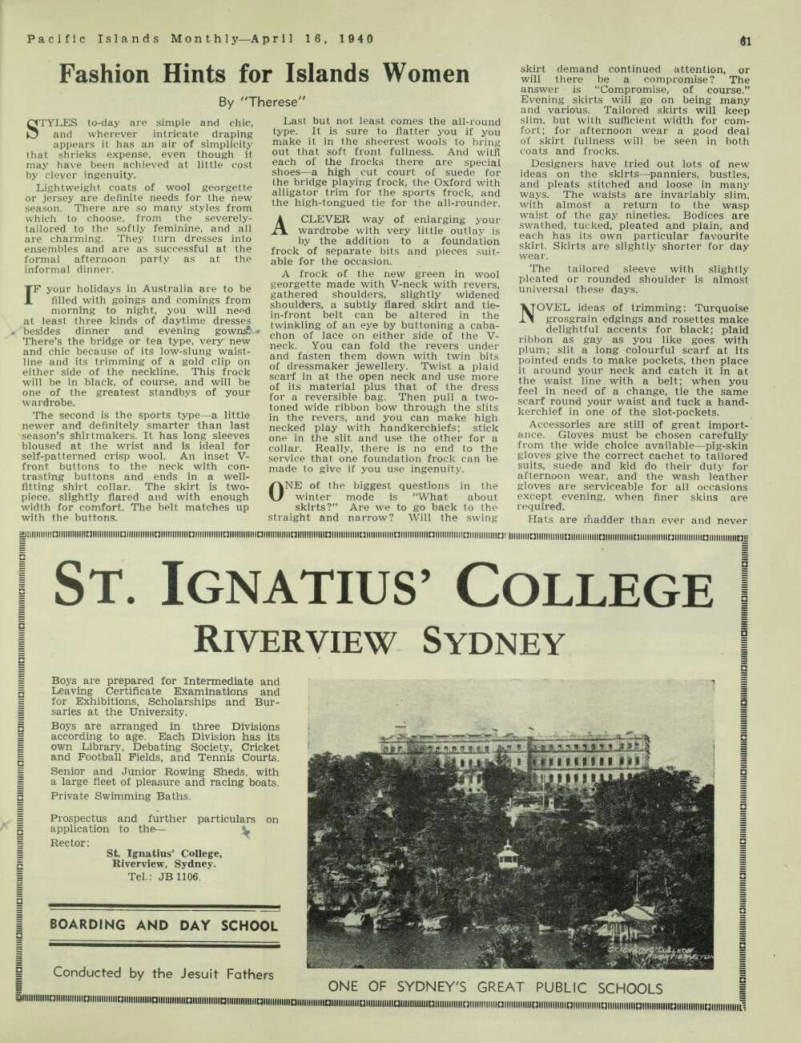
By "Therese"
STYLES to-day are simple and chic, and wherever intricate draping appears it has an air of simplicity that shrieks expense, even though it may have been achieved at little cost by clever ingenuity.
Lightweight coats of wool georgette or jersey are definite needs for the hew season. There are so many styles from which to choose, from the severely tailored to the softly feminine, and all are charming. They turn dresses into ensembles and are as successful at the formal afternoon party as at the informal dinner.
IF your holidays in Australia are to be filled with goings and comings from morning to night, you will need at least three kinds of daytime dresses besides dinner and evening gown£ There’s the bridge or tea type, very new and chic because of its low-slung waist line and its trimming of a gold clip on either side of the neckline. This frock will be in black, of course, and will be one of the greatest standbys of your wardrobe.
The second is the sports type—a little newer and definitely smarter than last season’s shirtmakers. It has long sleeves bloused at the wrist and is ideal for self-patterned crisp wool. An inset V front buttons to the neck with con trasting buttons and ends in a well fitting shirt collar. The skirt is two piece, slightly flared and with enough width for comfort. The belt matches up with the buttons.
Last but not least comes the all-round type. It is sure to flatter you if you make it in the sheerest wools to bring out that soft front fullness. And with each of the frocks there are special shoes —a high cut court of suede for the bridge playing frock, the Oxford with alligator trim for the sports frock, and the high-tongued tie for the all-rounder.
A CLEVER way of enlarging your wardrobe with very little outlay is by the addition to a foundation frock of separate bits and pieces suit able for the occasion.
A frock of the new green in wool georgette made with V-neck with revers, gathered shoulders, slightly widened shoulders, a subtly flared skirt and tie in-front belt can be altered in the twinkling of an eye by buttoning a caba chon of lace on either side of the V neck. You can fold the revers under and fasten them down with twin bits of dressmaker jewellery. Twist a plaid scarf in at the open neck and use more of its material plus that of the dress for a reversible bag. Then pull a two toned wide ribbon bow through the slits in the revers, and you can make high necked play with handkerchiefs; stick one in the slit and use the other for a collar. Really, there is no end to the service that one foundation frock can be made to give if you use ingenuity.
ONE of the biggest questions in the winter mode is “What about skirts?” Are we to go back to the straight and narrow? Will the swing
skirt demand continued attention, or will there be a compromise? The answer is “Compromise, of course.”
Evening skirts will go on being many and various. Tailored skirts will keep slim, but with sufficient width for com fort; for afternoon wear a good deal of skirt fullness will be seen in both coats and frocks.
Designers have tried out lots of new ideas on the skirts —panniers, bustles, and pleats stitched and loose in many ways. The waists are invariably slim, with almost a return to the wasp waist of the gay nineties. Bodices are swathed, tucked, pleated and plain, and each has its own particular favourite skirt. Skirts are slightly shorter for day wear.
The tailored sleeve with slightly pleated or rounded shoulder is almost universal these days.
NOVEL ideas of trimming: Turquoise grosgrain edgings and rosettes make delightful accents for black; plaid ribbon as gay as you like goes with plum; slit a long colourful scarf at its pointed ends to make pockets, then place it around your neck and catch it in at the waist line with a belt; when you feel in need of a change, tie the same scarf round your waist and tuck a hand kerchief in one of the slot-pockets.
Accessories are still of great import ance. Gloves must be chosen carefully from the wide choice available —pig-skin gloves give the correct cachet to tailored suits, suede and kid do their duty for afternoon wear, and the wash leather gloves are serviceable for all occasions except evening, when finer skins are required.
Hats are madder than ever and never
cease to surprise—a tiny piece of felt, a huge cluster of ribbon, a twist and a quirk, and hey presto, a hat is born.
Toques are popular and deservedly so, since their usefulness is never-ending.
Bags in patent, suede, leather and kid all come in the most fascinating shapes, and very often are accompanied by matching belts. Some of the bags sported these days by the B.Y.T.s are almost big enough for week-end kits!
Mr. John Good, who has been overseer on a plantation at Pondo, New Guinea, for some time, arrived in Australia by aeroplane at the end of March, to enlist in the Australian Air Force.
Advertisements & other items, pp. 63-64 (1 item)
St. Ignatius’ College
Riverview Sydney
Boys are prepared for Intermediate and Leaving Certificate Examinations and for Exhibitions, Scholarships and Bursaries at the University.
Boys are arranged in three Divisions according to age. Each Division has its own Library, Debating Society, Cricket and Football Fields, and Tennis Courts.
Senior and Junior Rowing Sheds, with a large fleet of pleasure and racing boats.
Private Swimming Baths.
Prospectus and further particulars on application to the— y Rector: St. Ignatius’ College, Riverview, Sydney.
Tel.: JB 1106.
BOARDING AND DAY SCHOOL
in ill AM
Conducted by the Jesuit Fathers
ONE OF SYDNEY'S GREAT PUBLIC SCHOOLS
NOYES BROS.
FOR DETAILS OF
• MINING EQUIPMENT. —Crushing Machinery, Screens, Feeders, Hock Drills, Excavators, Diesel and Crude Oil Engines, Hoists and Runways, Roller Bearings, etc.
OYES BROS.
NON-FERROUS METALS OF ALL DESCRIP-
TIONS.—In sheets, Strips, Rods, Tubes, Wire and Extruded Sections.
NOYES BROS.(Sydney) Ltd.
115 Clarence Street, Sydney. 1 1 Watt Sireet, Newcastle 197 Elizabeth Street, Brisbane mm
BRISBANE.
ELECTRICAL EQUIPMENT. Parkinson
Motors, Crompton Switchgear, Transformers, Instruments, Meters, Callender Wires and Cables, Lighting Equipment, Electric Drills.
NFWfACTi c • STORES, FACTORIES. HOME AND OFFICE.— INtWCASTLE. • Crom pton Lamps. Electric Fittings and i Accessories, Airspeed Fans, Floodlighting SYDNEY. I Equipment, Domestic Electric Appliances, Joseph Rodgers Cutlery & Plateware, Chlnan) o rf o .(inn" f p N.S. Ware. Clocks.
Highest Prices Paid For
Garrett & Davidson’s organisation is acknowledged far and wide as the main clearing house for precious metals in the Southern Hemisphere.
They have earned a reputation for accuracy and integrity in all their business dealings, which is proved by the fact that they are privileged to handle more gold from the Islands of the Pacific than any other organisation.
Therefore for your complete and lasting satisfaction, you are advised to transact all your precious metals business through the house of Garrett & Davidson.
GARRETT
ASSAYERS
& DAVIDSON PTY.
METALLURGISTS
Bank of N.S.W. Buildings,
REGENT AND GEORGE STS., SYDNEY.
LTD.
REFINERS
New Guinea
New Industries For New Guinea
AUSTRALIA’S new Minister for Ter ritories (Mr. Nock), has thrown himself wfth energy and interest into the problems surrounding the future of Papua and New Guinea. If his activities during April are any indi cation, he may prove to be the Minister for whom the neglected Pacific Terri tories have been looking for 20 years.
He told the Sydney newspapers, on April 4, that the Commonwealth Gov ernment recognised that the future of New Guinea’s gold industry is limited
and that, therefore, it is important to encourage the establishment of new agricultural industries. He referred to the possibility of New Guinea becom ing an important producer of cocoa, coffee, rubber, and tea, in addition to copra; and he suggested, also, that pig raising might have a future in New Guinea, because tropical products were suitable for feeding pigs. He said that information was being gathered for con sideration by the Federal Government.
The future possibilities of New Guinea also were the theme of a maiden speech delivered in the Legislative Council on April 2 by Captain Harold Taylour, who has just been appointed as the repre sentative of the goldfields community.
Mr. Taylour urged that an economic survey of the Territory be made, and also a geological survey, to ascertain if there is any new country suitable for gold prospecting.
Why Oil Is Being Sought
In Papua
A PAMPHLET, issued by the Austra lasian Petroleum Co. Pty. Ltd., which is spending a quarter of a million pounds this year on the search for oil in Papua, gives an interesting and, for purposes of reference, valuable account of the manner in which the search for oil has been carried on. both in Papua and New Guinea, on which nearly £2,000,000 has been spent, up to date.
The pamphlet reads like a romance.
There is a description of how geologists, equipped with scientific instruments, aeroplanes and maps made by aerial photography, have selected a site for the first big deep-drilling test, machin ery for which is now being assembled.
The book gives an interesting and accurate history of the oil production position throughout the world. It is noted, for example, that the world pro duces 283,000,000 metric tons of oil. Of this total, only the following countries contribute one million tons or more:
One sees, in that table, one reason why oil is being so eagerly sought in Panua. Of all those oil countries listed, only three or four of the smaller sup pliers are within the British Empire.
Mr M M. Brodie, manager of the Pacific Biscuit Co, Suva, left Sydney for Fiji early in April.
Country.
Metric tons.
United States 169.907,000 Venezuela 30,948,033 Soviet Union 30,137,174 10,214,911 Dutch Bast Indies Rumania Mexico Iraq Colombia Trinidad Peru British India 8,550,890 6,313,900 6.015.000 3.956.000 3,206,415 2,709.564 2,625,500 1.712.000 1.346,685 1,023,471 Bahrein 1,000.000
Advertisements & other items, p. 64 (2 items)
62
April 16, 194 O—P acific Islands Monthly
Sore
ill m"iii!ljnjn~>
HRO^
• Take wool
SORE
Take WOODS'GREAT
r PEPPERMINT CURE. Rel.eves pain, soothes sore tissues, helps quick
mg. WOODS' GREAT PEPPER- Jl
MINT CURE for 'Flu Colds and/*
Coughs. Hondy-siied bottle only I /-.
News
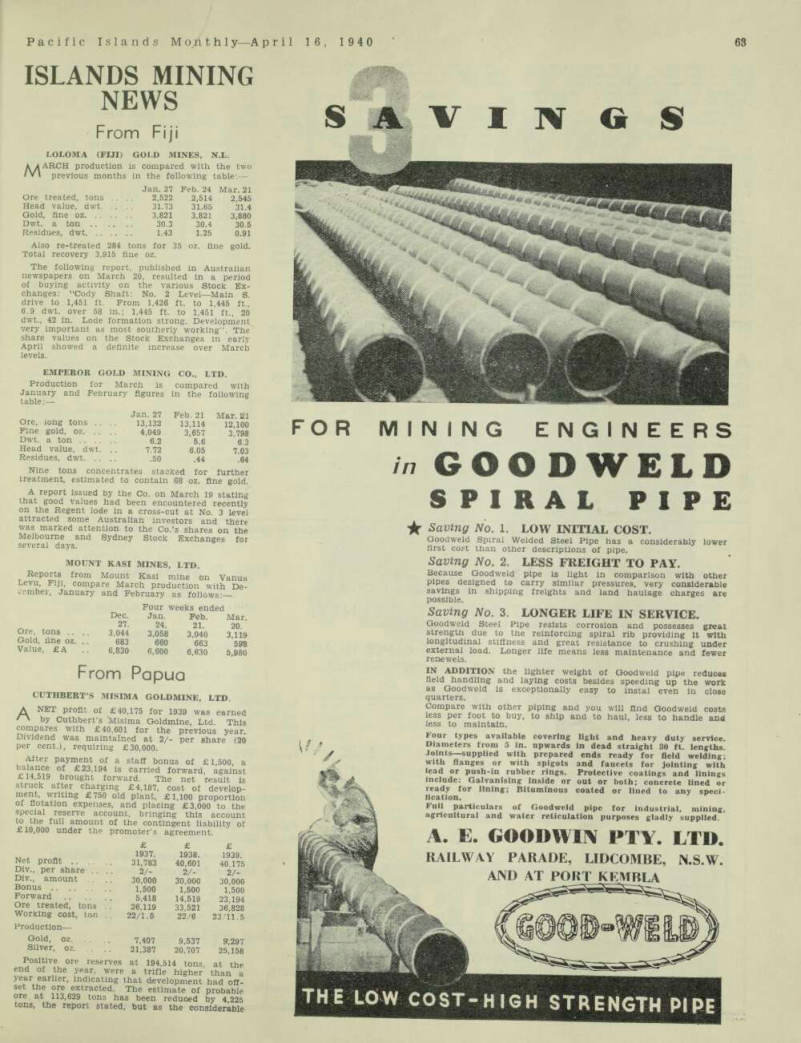
Islands Mining
From Fiji
Loloma (Fiji) Gold Mines, N.L.
MARCH production is compared with the two previous months in the following table:—
Also re-treated 284 tons for 35 oz. fine gold.
Total recovery 3,915 fine oz.
The following report, published in Australian newspapers on March 20, resulted in a period of buying activity on the various Stock Ex changes: “Cody Shaft: No. 2 Level—Main S. drive to 1,451 ft. From 1,426 ft. to 1,445 ft., 6.9 dwt. over 58 in.; 1,445 ft. to 1,451 ft., 20 dwt., 42 in. Lode formation strong. Development very important as most southerly working”. The share values on the Stock Exchanges in early April showed a definite increase over March levels.
Empeeor Gold Mining Co., Ltd.
Production for March is compared with January and February figures In the following table:—
Nine tons concentrates stacked for further treatment, estimated to contain 68 oz. fine gold.
A report issued by the Co. on March 19 stating that good values had been encountered recently on the Regent lode in a cross-cut at No. 3 level attracted some Australian investors and there was marked attention to the Co.’s shares on the Melbourne and Sydney Stock Exchanges for several days.
Mount Kasi Mines, Ltd.
Reports from Mount Kasi mine on Vanua Levu. Fiji, compare March production with De cember, January and February as follows:
From Papua
Cuthbeet’S Misima Goldmine. Ltd.
A NET P r oflt of £40,175 for 1939 was earned by Cuthbert’s Misima Goldmine, Ltd. This compares with £40,601 for the previous year.
Dividend was maintained at 2/- per share (20 per cent.), requiring £30,000.
After payment of a staff bonus of £1,500, a ° f £23,194 is carried forward, against £14,519 brought forward. The net result is struck after charging £4,187, cost of develop ment, writing £750 old plant, £l,lOO proportion of flotation expenses, and placing £3,000 to the special reserve account, bringing this account to the full amount of the contingent liability of £ 10,000 under the promoter’s agreement.
PQSitlye ore reserves at 194,514 tons, at the end of the year, were a trifle higher than a year earlier. Indicating that development had off set the ore extracted. The estimate of probable ore at 113,629 tons has been reduced by 4,225 tons, the report stated, but as the considerable
Jan. 27 Feb. 24 Mar. 21 Ore treated, tons .. 2,522 2,514 2,545 Head value, dwt. .. 31.73 31.65 31.4 Gold, fine oz 3,821 3,821 3,880 Dwt. a ton .. 30.3 30.4 30.5 Residues, dwt 1.43 1.25 0.91
Jan. 27 Feb. 21 Mar. 21 Ore, long tons .. . 13,132 13,114 12.100 Pine gold, oz 4,049 3,657 3 798 Dwt. a ton 6.2 5.6 6 3 Head value, dwt. .. 7.72 6.05 7,03 Residues, dwt .50 .44
Four weeks ended Dec.
Jan.
Peb.
Mar. 27. 24. 21. 20.
Ore, tons .. 3,044 3,058 3,040 3,119 Gold, fine oz. .. 683 660 663 598 Value, £ A 6,830 6,600 6,630 5.980
£ £ £ Net profit 1937. 1938. 1939. 31,783 40,601 40,175 Div., per share . . .. 2/- 2/- 2/- Div., amount . .. 30,000 30,000 30,000 Bonus .. .. 1,500 1,500 1,500 Forward 5,418 14,519 23,194 Ore treated, tons , 26,119 33,521 36,828 Working cost, ton ., Production— 22/1.5 22/6 23/11.5 Gold, oz 7,407 9,537 9,297 Silver, oz 21,387 20,707 25,158
tonnage of ore known to exist above No. 9 level, which at the end of December was 1,386 ft. long, has not been included in either of the ore estimates, the slight reduction in the probable ore is not important.
Cuthbert’s March production is compared with January and February in the following
Papuan Apinaipi Petroleum Co., Ltd.
Papuan Apinaipi Petroleum Co., Ltd., reported in mid-March that the erection of the deep drilling plant at Oiapu had been completed.
Drilling commenced according to programme and the first major well on the structure reached 50 ft. on the first day. Progress was delayed by torrential rains but the drill, oper ating on a day shift only, reached a depth of 200 ft. Arrangements were then being made for continuous drilling on a three-shift basis.
The directors announced on April 8 that the new issue of 150,000 shares of 5/- each had been fully subscribed.
Yodda Goldfields, Ltd.
Yodda Goldfields, Ltd., report that the yield for March was 75 oz. 3 dwt. gold. A new area, comprising 54 acres of river bed at McLaughlin’s Creek, has been taken up and is believed to contain payable values.
Mandated Alluvials, Ltd.
Mandated Alluvials, N.L., reports that Mr.
George A. More has arrived on the field to re port and advise on the plans for the develop ment of the Laloki mine.
All preliminary work to expose a large sec tion of the ore body has been completed, and about 2,000 tons of ore already mined. A further shipment of 38 tons of copper gold matte has been despatched, but complete assays are not yet available. The smelting plant has resumed operations, and a further shipment will be made shortly.
From New Guinea
Bulolo Gold Dredging, Ltd.
WORK on the Upper Baiune power scheme proceeded during March and the frame work and roof of the main power house build ing were completed. The whole structure is expected to be finished this month.
February production is compared with January and December in the following table:— Dec. Jan. *Peb.
Cubic yards .. .. 1,543,000 1,606,000 1,492,000 Bullion, oz 19,996 20,664 24.407 Gold, fine, oz. .. 13,797 14,259 16,841 Estimated working profit for February, 10,266 oz. of fine gold. *No. 3 dredge was closed throughout February for alterations to the gold-saving equipment, which have now been completed.
Sunshine Gold Development, Ltd.
Mr. J. Bannigan and 45 natives recently com
pleted the building of a new road, 400 yards in length, necessitated by the Watut River and a large slip.
The Co. reports a clean-up of 485 oz. of gold for March. Directors have declared an Interim dividend of 6d. per share payable on April 26, books closing on April 19.
New Guinea Goldfields. Ltd.
A report issued by the Mining Trust, Ltd., consulting engineers to N.G.G., Ltd., compares the production and profit for December, January and February:—
tThe increased profit was due to better values at Edie Creek, alluvial in deeper wash treated with new equipment, higher values in Kaili. lowered costs at the Edie mine, and higher tonnage at Golden Ridges.
Sandy Creek Gold Sluicing, Ltd.
The manager of Sandy Creek Gold Sluicing, Ltd., New Guinea, reports that the last four yields compare as follows:
* No. 1 plant operated for half the month only.
table:— Jan.
Feb.
Mar.
Mill treated, tons .. .. 2,928 3,390 3,132 Bullion, oz 3,285 3,661 3,437 Gold, fine oz 751 864 783 Silver, fine oz 2,457 2,728 2,575 Estimated value .. £6,145 £7,055 £6,400 Value per ton of ore .. 41/11 41/7 40/11
Dec.
Jan. tFeb.
Edie Creek mill— Ore, tons 2,381 2,773 3,067 Gold, oz., fine .. .. 789 688 726 Silver, oz., fine .. .. 5,369 4.039 3,403 Alluvial— Gold, oz., fine .. .. 1,341 1.258 1,611 Silver, oz., fine .. .. 950 898 1.161 Golden Ridges mill— Tons treated 2,268 2,675 3,118 Gold, oz., fine .. 1,108 1,226 1,623 Silver, oz., fine 1,235 1,395 1.833 Operating profit— Edie Creek, £ ,. 132 *638 785 Alluvial, £ 4,191 3,580 6,645 Golden Ridges, £ .. 3.123 4,002 6,998 •Loss.
Dec.
Jan. *Feb.
Mar.
Cubic yards .. . . 14,267 21,214 17,667 20.095 Gold, oz 240 203 178 361 Per cubic yard . 2/6V2 1/6 V 2 1/7V, 2/10 V 2 Working cost .. . — i/iy 2 /ioy 2 —
Advertisements & other items, pp. 65-66 (3 items)
63
Pacific Islands y—A pril 16, 1940
In Goodweld
s V s 1 G nr mm - % X
FOR MINING ENGINEERS
SPIRAL PIPE
★ Saving No. 1. LOW INITIAL COST.
Goodweld Spiral Welded Steel Pipe has a considerably lower first cost than other descriptions of pipe.
Saving No. 2. LESS FREIGHT TO PAY.
Because Goodweld pipe is light In comparison with other pipes designed to carry similar pressures, very considerable savings in shipping freights and land haulage charges are possible.
Saving No. 3. LONGER LIFE IN SERVICE.
Goodweld Steel Pipe resists corrosion and possesses great strength due to the reinforcing spiral rib providing it with longitudinal stiffness and great resistance to crushing under external load. Longer life means less maintenance and fewer renewels.
IN ADDITION the lighter weight of Goodweld pipe reduces field handling and laying costs besides speeding up the work as Goodweld is exceptionally easy to instal even in close quarters.
Compare with other piping and you will find Goodweld costs less per foot to buy, to ship and to haul. less to handle and less to maintain. tour types available covering light and heavy duty service.
Diameters from 5 in. upwards in dead straight 30 ft. lengths.
Joints—supplied with prepared ends ready for field welding; with flanges or with spigots and faucets for jointing with lead or push-in rubber rings. Protective coatings and linings include: Galvanising inside or out or both; concrete lined or ready for lining; Bituminous coated or lined to any specification.
Full particulars of Goodweld pipe for industrial, mining, agricultural and water reticulation purposes gladly supplied.
A. E. COO DU I \ PTY. LTD.
RAILWAY PARADE, UDCOMBE, N.S.W.
AJND AT PORT KRIMBLA
THE LOW COST-HIGH STRENGTH PIPE
MEDIUM-GRADE GOLD ORE.
ADVERTISER, who Is an old, experienced miner, resident in Papua, discovered a lode, carrying an enormous quantity of medium grade ore, on an Island in Eastern Papua, in 1927. It was unlikely, then, that it could be profitably worked. Since then, gold has trebled in value, and advertiser believes that this huge ore body could be very profitably worked by a syndicate or company, as a big-scale milling proposition. He will not be associated with any “wild-cat” flotation, but he will supply details to any genuine inquirer. Write in first Instance to “Papuan Miner”, c/o Pacific Islands Monthly, Box 3408 R, G.P.0., Sydney.
Established 50 years—and carrying one of the largest stocks of Iron and Steel in Australia.
Willia
I 9
Atkins Pty. Ltd.
Head Office 449-451 KENT ST., SYDNEY.
FULL, COMPREHENSIVE & UP-TO-DATE RANGE IN ALL
DEPARTMENTS, INCLUDING THE FOLLOWING LINES:—
STEEL DEPARTMENT
MILD STEEL:
Rounds, Squares, Flats, Half-rounds, Hexagons, Bevel, Shoeing, Tyre, Angles, Tees, Sheets, Plates, Girder Plates, Chequer Plates, Channels, Hoops, Etc.
BRIGHT STEEL:
Rounds, Squares, Hexagons.
Extra Special High Speed Tool Steel, Mining Steel, Blister Steel and Spring Steel, Rounds, Flats 6” Squares.
Bar Iron— All sections and sizes.
Iron & Steel Merchants
ENGINEERS' SUPPLIES
COACH & MOTOR HARDWARE.
CsbU Address; WILATKIN, SYDNEY.
Engineers' Supplies: Set Screws, Studs, Metal Thread Screws, Coach Screws, Files, Cotter Pins, Bright and Black Bolts, Rivets, Etc., Hack Saw Blades.
Power Transmission Gear: Including Plummer Blocks, Couplings, Collars, Etc.
Coach and Motor Hardware: Axles, Springs, Wheelstuff, Duck, Paints.
Farriers' Supplies: Horse Nails, Anvils, Vices, Etc.
Motor-Trimmers and Motor Builders' & Motor Pointers' Requirements
C. A. WILLEY'S
Quick-Drying Coach and Car Paints, Roughstuff, Elastic Gloss, Synflex Enamels, Lacquers.
DUCO Lacquers and DULUX Enamels—FAßßEX Motor Toppings and Leather Cloths, House & Decorators' Paints, Varnishes fir Brushware Sole Distributors of CHAMPION'S Decorators Paint Products.
Distributing Agents for BROLITE Lacquers, SYNFLEX Enamels and "POLYGLOSS" Finish.
64
April 16, 194 O—P acific Islands Monthly
Quotations For Mining
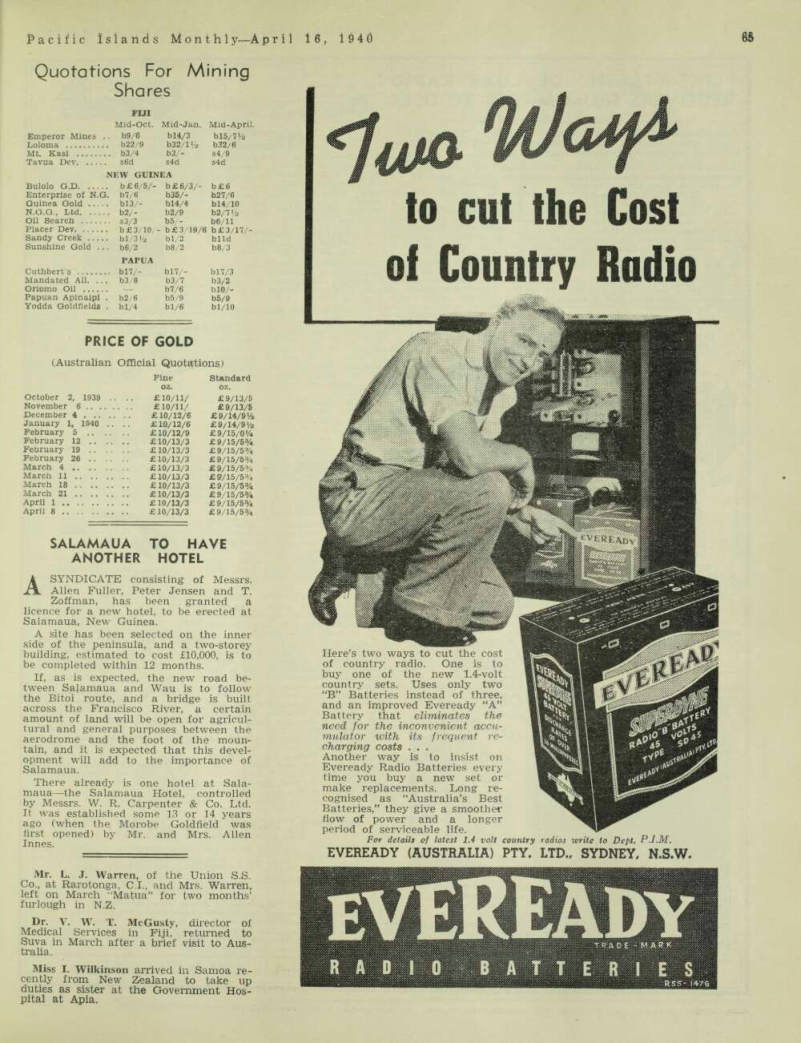
Shares
Fiji
Mid-Oct.
Mid-Jan.
Mid-April.
Emperor Mines .. b9/6 b!4/3 bl5/7Va Loloma b22/9 b32/l J /a b32/6 Mt. Kasl b3/4 b3/s4/9 Tavua Dev s6d s4d s4d
New Guinea
Bulolo G.D b £ 6/5/b £ 6/3/b£6 Enterprise of N.G. b7/6 b35/b27/6 Guinea Gold bl3/b!4/4 bl4/10 N.G.G., Ltd b2/b2/9 b2/7>2 Oil Search s3/3 b5/b6/ll Placer Dev b £ 3/10 b £3 19/6 b£3/17/- Sandy Creek bl/SVa bl/2 bl Id Sunshine Gold ... b6/2 b8/2 b8/3 Cuthberfs
Papua
bl7/bl7/bl7/3 Mandated All. ... b3/8 b3/7 b3/2 Oriomo Oil — b7/6 blO/- Papuan Apinaipi . b2/6 b5/9 b5/9 Yodda Goldfields . bl/4 bl/6 bl/10
Price Of Gold
(Australian Official Quotations) Fine Standard oz. oz.
October 2, 1939 . . .. £10/11/ £9/13/5 November 6 . .. £10/11/ £9/13/6 December 4 . ., . £ 10/12/6 £9/14/9% January 1, 1940 .. £10/12/6 £9/14/9V 3 February 5 .. .. £10/12/9 £9/15/0*/4 February 12 .. .. £10/13/3 £9/15/53/4 February 19 .. .. £10/13/3 £9/15/5 3 /4 February 26 .. £ 10/13/3 £9/15/53/, March 4 £10/13/3 £9/15/5% March 11 £9/15/53/4 March 18 £9/15/53/4 March 21 £10/13/3 £9/15/53/4 April 1 £9/15/5% April 8 £ 10/13/3 £9/15/5%
Salamaua To Have
Another Hotel
A SYNDICATE consisting of Messrs.
Allen Fuller, Peter Jensen and T.
Zoffman, has been granted a licence for a new hotel, to be erected at Salamaua, New Guinea.
A site has been selected on the inner side of the peninsula, and a two-storey building, estimated to cost £lO,OOO, is to be completed within 12 months.
If, as is expected, the new road be tween Salamaua and Wau is to follow the Bitoi route, and a bridge is built across the Francisco River, a certain amount of land will be open for agricul tural and general purposes between the aerodrome and the foot of the moun tain, and it is expected that this devel opment will add to the importance of Salamaua.
There already is one hotel at Sala maua—the Salamaua Hotel, controlled by Messrs. W. R. Carpenter & Co. Ltd.
It was established some 13 or 14 years ago (when the Morobe Goldfield was first opened) by Mr. and Mrs. Allen Innes.
Mr. L. J. Warren, of the Union S.S.
Co., at Rarotonga, C. 1., and Mrs. Warren, left on March “Matua” for two months’ furlough in N.Z.
Dr. V. W. T. McGusty, director of Medical Services in Fiji, returned to Suva in March after a brief visit to Aus tralia.
Miss I. Wilkinson arrived in Samoa re cently from New Zealand to take up duties as sister at the Government Hos pital at Apia.
Advertisements & other items, pp. 67-68 (3 items)
65
Pacific Islands Monthl y—A pril 16, 1940
of Country Rudio
to cut the Cost
<k m y Here’s two ways to cut the cost of country radio. One is to buy one of the new 1.4-volt country sets. Uses only two “B” Batteries instead of three, and an improved Eveready “A”
Battery that eliminates the need for the inconvenient accumulator with its frequent recharging costs . . .
Another way is to insist on Eveready Radio Batteries every time you buy a new set or make replacements. Long recognised as “Australia’s Best Batteries,” they give a smoother flow of power and a longer period of serviceable life.
For details of latest 1.4 volt country radios write to Dept. P.I.M.
EVEREADY (AUSTRALIA) PTY. LTD., SYDNEY, N.S.
W.
T AD E -MA R K
RAD I 0 BAIT E R I E S
"LIKE-A-FLASH" DE LUXE RADIO
RECEIVERS FROM MAKER TO USER
Each Guaranteed for 12 Months Regardless of Make, Trade-Name or Price, “Like-a-Flash”
Radio sets cannot be bettered. Hundreds of our sets are giving excellent service right through out the Islands.
No.. 1. — Sheffield made Throwing Knife in sheath, 6/9.
No. 2.—Remington, U.S.A. made.
Hunting and Sporting Knives in Sheath, 10/6. A Beautiful Article.
NOW, direct from the New York World’s Fair, comes the Biggest Novelty Sensation of this or any other year,
NOVELTY TRANSFER.
DRINKING GLASSES.
SIX BEAUTIFUL GIRLS,
Lovely Young Ladies—Blondes and Brunettes—in Gloriously Coloured Costumes, One appears on the outside, as well as the inside of each Tumbler, Girls with Dual Personalities.
Turn the glass so as you can now see inside; see the pretty Miss appear—and LO! away drops her Costume or Dress and True Beauty is revealed in all its loveliness.
Nothing improper or suggestive.
Just the female form —divine. The most fastidious would not be offended.
Pill the glass and the beauty is magnified. With a slight movement of the glass she at once actually blossoms into life, and will perform for you.
Llke-a-Plash ''Ellminolse” Aerial Kit for short or dual-wave sets. Aerial, Pyrex type Insulators,, transposition blocks and 200 ft. aerial coll, 22/6.
Eliminates unwanted aerial and hideous electrical noises from your dual-wave or short-wave sets.
RADIO SERVICEMAN’S MANUAL
FOR 1939.
Just Out! Australia’s Official Radio Service Manual: 10/6. Write for full list of Radio Publications.
BOOKS! BOOKS! BOOKS! The Be-
ginners’ Book of Radio. The Radio Beginners’ Dictionary. 2/- the 2. The Wireless Constructor’s Encyclopaedia. Giant size, 7/6. Newnes “Everyman’s” Wireless Book, 5/6.
The Book of Practical Radio, also The Book of Practical Television, 8/6 each. Foulsham’s Giant “Party and Fun Book”, 1/6. Humorous Stories and Recitations, S/9. Card and Conjuring Tricks, 3/9. Tea- Cup Fortune Telling, 3/9. 100 Party Games for Old and Young, 1/9.
Popular Magic and Amateur Conjurer, 1/9. 50 Best Party Games, 1/6. Tricks with Cards, 1/6.
(StuS®
OSES®
CSCCKJa)
<SKC3i2)
No. 1 Morse Code Practice Sets, with Switch Buzzer to Light. Use as you desire. 22/6 complete.
No. 2, with Heavier Type Morse Key: 30/-. Pendograph Bug Key. 70/-. Adjustable Key (only), 12/6.
Special High Pitched Adjustable Professional Morse Buzzer, 15/-, Adjustable All-way Morse Key, Long or Short Tap, 12/6. Heavier P.M.G.
Type, 19/6. Learn Morse Book 1/-. -^i 1% P.M.G. Type Sturdy Built* Sounder, 35/-. I Buzzers, 3/9 and 4/9.
P.M.G. Morse Key as illustrated, 19/6.
Rejuv Safety Razor-Blade Sharpener, 7/6 —now —2/-. Add 6d. postage.
Blades last for months with this.
Carborundum flat Type, 2/-. 58 6 i Just arrived from the maker in London, “Cosmocord” De Luxe Crystal Pick-up, with Built-in Vol. Control, 58/6. Write for List of Pickups.
Play, Talk, Sing, Joke through your Radio. Great Fun. Battery less type.
Microphone for Hand Holding or Hanging, 22/6, Complete with lead fixed in a second. Others, 12/6, 15/-, 17/6, 25/-, 28/6, 32/6. All plus 1/9 for Battery and 1/6 for 20 ft. Cord.
Write for full detailed list. £ B.G.E. Table Type Microphone. Highly recommended for Amateur or Professional use. Built-in Transformer and Battery with Volume Control incorporated.
Just plug into pickup terminals of any set. 39/6.
“Like-a-Flash” 5 Valve Battery Operated Receiver for Broadcast Reception on Wave Lengths between 220 and 550 Metres. [This special receiver has a stage of Radio Frequency Amplification. This gives it long range and is capable of excellent reception from most I Australasian stations.
I Valves used are: 2—lC4, I—lC61 —1C6 or
KK2, I—lK6,1 —1K6, I—lD4.
Speaker is an “8” Amplion Permagnetic Unit.
A very neat and attractive floor model cabinet houses all equipment.
Battery consists of triple capacity units, as follows: — 1 2 Volt 100 amp. Accumulator. 3 45 Volt Ever-Ready Superdyne “B” Batteries. 1 4y 2 Volt Ever-Ready “C” Battery.
PRICE; £2O/7/6.
ACCUMULATORS
We sell all Types and Sizes—Fully Guaranteed.
Don’t Buy any Special Accumulator before we quote you if not listed here.
RADIO ACCUMULATORS.
2 Volt. 110 Amp 17/- 2 „ 150 ... 20/- 2 65 20/6 4 90 22/6 6 90 „ 36/3 6 „ 110 45/6 6 „ 130 „ 63/6 6 150 73/9 6 „ 170 „ 84/6
AUTO ACCUMULATORS.
HOME LIGHTING ACCUMULATORS.
2 Volt. 120 Amps 20/9 2 „ 210 35/3 2 200 41/-
GAMES
Dart Boards, 4/6, 8/6, 10/6, 15/-.
Brass Competition Darts, Set of 3, 3/11. 4/6, 5/61. Monopoly. 10/6.
Totopoly, 10/6. Bucaneer, 10/6. 3 of the World’s Most Popular Games.
Chinese Checkers, 3/6, 4/6, 8/6.
Tripoly Card Game, 5/-. De Luxe Model Game, 10/6. Poker Rummy, 1/-. Pot Luck, 1/-. Playing Card Lotto, 1/-. We Stock All Kinds of Indoor Games. Send for Booklet.
Neat Metal Bound Wooden Cigarette Cabinet, 4/9, for building Music Box unit into.
Complete Mechanical Units for Musical Cigarette Boxes, etc., 12/6, 15/-. Plays two Tunes. Music- Boxes. 30/-, 35/-, 45/-. Musical Cigarette Boxes, 85/-.
“Like-a-Flash” De Luxe Dual Wave 5 Valve Battery Operated Receiver.
This is one of the most powerful models in our battery set series, and the Radio Frequency stage oi amplification gives the set a world range on short wave channels as well as full coverage range of Australasian “A” and “B” Class Broadcasters.
The set is also specially designed to give maximum service in humid climates, such as North Queensland and Pacific Island Territories. A vital part very vulnerable to “dampness” in ordinary receivers is the “Intermediate Frequency Section”.
In this set our Engineers have fitted special inductance tuned intermediate frequency transformers, which do not require trimmers.
These units ensure correct alignment for a continuous period. An ”8” Aero Dial calibrated in stations facilitates tuning. Valves used are:
2—lC4, I—KK2, I—lK6, I—lD4
The speaker is the latest Amplion Permagnetic Model, capable of high fidelity reproduction. Battery equipment consists of extra heavy capacity units as follows; 1 2 Volt 100 amp. Accumulator. 3 Ever-Ready Superdyne 45 Volt •B” Batteries. 1 Ever-Ready 4*/2 in. “C” Battery.
The outfit is housed in a beautfully veneered floor model Console Cabinet.
PRICE: £22/5/-.
“PRESTO”
THE
MAGIC
BOX
The most Amazing Trick — Just out.
“Presto”. —The greatest, most alluring and outstanding little trick ever introduced, 2/9. Post Free.
Money back if it’s not the best yet.
now
fOR
VOUR/
■ extra
UVtltfß
W°^Rk
book
SPjii
CATALOGUE. Order your copy now, Bd. Post Free. Send for it to-day.
Limited Number Only.
Levenson’s Wonder Book of Specialities. Radio, Coin-operated Machines, Games, Jokes, Puzzles, Hobbles, crammed full of surprises from Cover to Cover.
iiirmißiiiiiiiiniii
Write for Punch Board Leaflets fiimnnnnnTnnn
LEVENSON'S RADIO !!Tr
Pin-Game,
GAMES, NOVELTIES AND HOBBIES, Totem and
226 PITT STREET, SYDNEY « d e d n s s and Manufacturers, Importers, and Exporters.
N.S.W., AUSTRALIA. 1111111111111(111111111111
Cable address: “Leveradioh”. Goods forwarded V.P.P. or Sight Draft. Satisfaction and Service Guaranteed. We can supply by mail all General Merchandise at a Better Price. Quotations with pleasure. Please add freight and packing. Write for full list of interesting leaflets of Games, Hobbies, Novelties, and Electrical Goods. Write for full list of Radio Meters.
We Can Supply, afr a Keen Price, Any Available Article You Require.
66
April 16, 194 O—P acitic Islands Monthly
Australian Short Wave
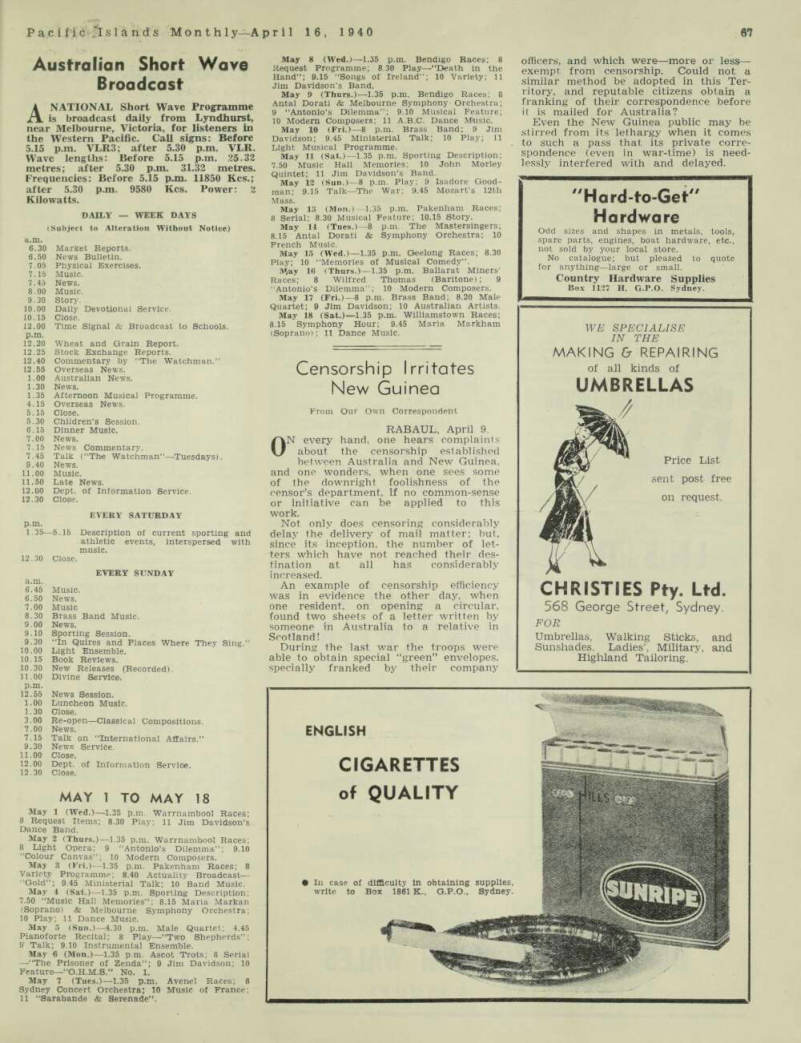
Broadcast
A NATIONAL Short Wave Programme is broadcast daily from Lyndhurst, near Melbourne, Victoria, for listeners in the Western Pacific. Call signs: Before 5.15 p.m. VLR3; after 5.30 p.m. VLR.
Wave lengths: Before 5.15 p.m. 25.32 metres; after 5.30 p.m. 31.32 metres.
Frequencies: Before 5.15 p.m. 11850 Kcs.; after 5.30 p.m. 9580 Kcs. Power: 2 Kilowatts.
Daily Week Days
(Subject to Alteration Without Notice) a.m. 6.30 Market Reports. 6.50 News Bulletin. 7.05 Physical Exercises. 7.15 Music. 7.45 News. 8.00 Music. 9.30 Story. 10.00 Daily Devotional Service. 10.15 Close. 12.00 Time Signal & Broadcast to Schools, p.m. 12.20 Wheat and Grain Report. 12.25 Stock Exchange Reports. 12.40 Commentary by “The Watchman.” 12.55 Overseas News. 1.00 Australian News. 1.30 News. 1.35 Afternoon Musical Programme. 4.15 Overseas News. 5.15 Close. 5.30 Children’s Session. 6.15 Dinner Music. 7.00 News. 7.15 News Commentary. 7.45 Talk (“The Watchman”—Tuesdays). 9.40 News. 11.00 Music. 11.50 Late News. 12.00 Dept, of Information Service. 12.30 Close.
Every Saturday
p.m. 1.35—5.15 Description of current sporting and athletic events, interspersed with music. 12.30 Close.
Every Sunday
a.m. 6.45 Music. 6.50 News. 7.00 Music 8.30 Brass Band Music. 9.00 News. 9.10 Sporting Session. 9.30 “In Quires and Places Where They Sing.” 10.00 Light Ensemble. 10.15 Book Reviews. 10.30 New Releases (Recorded). 11.00 Divine Service, p.m. 12.55 News Session. 1.00 Luncheon Music. 1.30 Close. 3.00 Re-open—Classical Compositions. 7.00 News. 7.15 Talk on “International Affairs.” 9.30 News Service. 11.00 Close. 12.00 Dept, of Information Service. 12.30 Close.
May 1 To May 18
May 1 (Wed.) —1.35 p.m. Warrnamboo! Races; 8 Request Items; 8.30 Play; 11 Jim Davidson’s Dance Band.
May 2 (Thurs.) —1.35 p.m. Warrnambool Races; 8 Light Opera; 9 “Antonio’s Dilemma”: 9.10 “Colour Canvas”; 10 Modern Composers.
May 3 (Fri.) —1.35 p.m. Pakenham Races; 8 Variety Programme; 8.40 Actuality Broadcast— “ Gold”; 9.45 Ministerial Talk; 10 Band Music.
May 4 (Sat.) —1.35 p.m. Sporting Description; 7.50 “Music Hall Memories”; 8.15 Maria Markan • Soprano) & Melbourne Symphony Orchestra; 10 Play; 11 Dance Music.
May 5 (Sun.) —4.30 p.m. Male Quartet; 4.45 Pianoforte Recital; 8 Play—“ Two Shepherds”; &’ Talk; 9.10 Instrumental Ensemble.
May 6 (Mon.) —1.35 p.m. Ascot Trots; 8 Serial —“The Prisoner of Zenda”; 9 Jim Davidson; 10 Feature—“O.H.M.S.” No. 1.
May 7 (Tues.) —1.35 p.m. Avenel Races; 8 Sydney Concert Orchestra; 10 Music of France; 11 “Sarabande & Serenade”.
May 8 (Wed.) —1.35 p.m. Bendigo Races: 8 Request Programme; 8.30 Play—“ Death in the Hand”: 9.15 “Songs of Ireland”; 10 Variety; 11 Jim Davidson’s Band.
May 9 (Thurs.) —1.35 p.m. Bendigo Races; 8 Antal Dorati & Melbourne Symphony Orchestra; 9 “Antonio’s Dilemma”: 9.10 Musical Feature; 10 Modern Composers: 11 A.B.C. Dance Music.
May 10 (Frl.) —8 p.m. Brass Band; 9 Jim Davidson; 9.45 Ministerial Talk; 10 Play; 11 Light Musical Programme.
May 11 (Sat.)—l.3s p.m. Sporting Description; 7.50 Music Hall Memories; 10 John Morley Quintet: 11 Jim Davidson’s Band.
May 12 (Sun.) —8 p.m. Play; 9 Isadore Good man; 9.15 Talk—The War; 9.45 Mozart's 12th Mass.
May 13 (Mon.) 1.35 p.m. Pakenham Races; 8 Serial: 8.30 Musical Feature; 10.15 Story.
May 14 (Tues.) —8 p.m The Mastersingers; 8.15 Antal Dorati & Symphony Orchestra; 10 French Music.
May 15 (Wed.) —1.35 p.m. Geelong Races; 8.30 Play; 10 “Memories of Musical Comedy”.
May 16 (Thurs.) —1.35 p.m. Ballarat Miners’
Races: 8 Wilfred Thomas (Baritone); 9 •Antonio’s Dilemma”; 10 Modern Composers.
May 17 (Frl.)—B p.m. Brass Band; 8.20 Male Quartet; 9 Jim Davidson; 10 Australian Artists.
May 18 (Sat.) —1.35 p.m. Williamstown Races; 8.15 Symphony Hour; 9.45 Maria Markham (Soprano); 11 Dance Music.
Censorship Irritates
New Guinea
From Our Own Correspondent RABAUL, April 9.
ON every hand, one hears complaints about the censorship established between Australia and New Guinea, and one wonders, when one sees some of the downright foolishness of the censor’s department, if no common-sense or initiative can be applied to this work.
Not only does censoring considerably delay the delivery of mail matter; but, since its inception, the number of let ters which have not reached their des tination at all has considerably increased.
An example of censorship efficiency was in evidence the other day, when one resident, on opening a circular, found two sheets of a letter written by someone in Australia to a relative in Scotland!
During the last war the troops were able to obtain special “green” envelopes, specially franked by their company
officers, and which were—more or less — exempt from censorship. Could not a similar method be adopted in this Ter ritory, and reputable citizens obtain a franking of their correspondence before it is mailed for Australia?
Even the New Guinea public may be stirred from its lethargy when it comes to such a pass that its private corre spondence (even in war-time) is need lessly interfered with and delayed.
Advertisements & other items, p. 69 (2 items)
67
Pacific "Islands Monthly—April 16, 1940
Of Quality
"Hard-to-Get"
Hardware
Odd sizes and shapes in metals, tools, spare parts, engines, boat hardware, etc., not sold by your local store.
No catalogue: but pleased to quote for anything—large or small.
Country Hardware Supplies
Box 1127 H. G.P.O. Sydney.
WE SPECIALISE
IN THE
MAKING & REPAIRING
CHRISTIES Pty. Ltd.
568 George Street, Sydney.
FOR
Umbrellas, Walking Sticks, and Sunshades. Ladies’, Military, and Highland Tailoring. of all kinds of
UMBRELLAS
Price List sent post free on request.
ENGLISH
CIGARETTES
of QUALITY
• In case of difficulty In obtaining supplies, write to Box 1861 K., G.P.0., Sydney.
Islands Produce
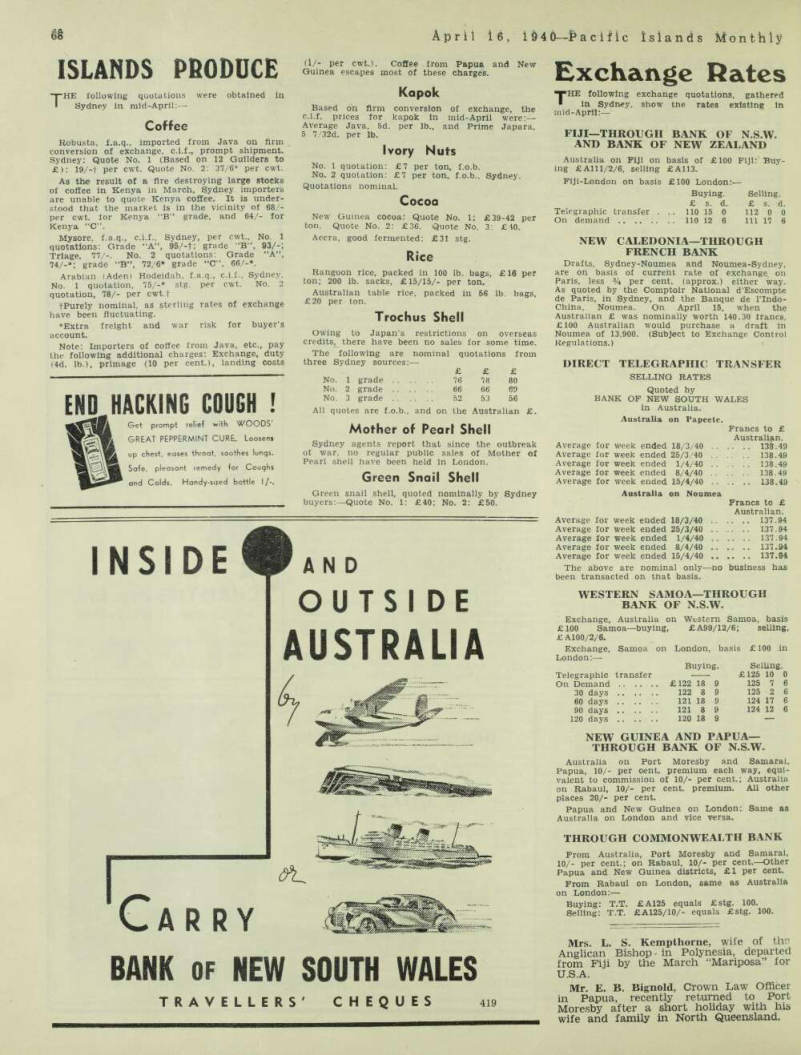
THE following quotations were obtained in Sydney in mid-April:—
Coffee
Robusta, f.a.q., imported from Java on firm conversion of exchange, c.i.f., prompt shipment.
Sydney: Quote No. 1 (Based on 12 Guilders to £): 19/-t per cwt. Quote No. 2: 37/6* per cwt.
As the result of a fire destroying large stocks of coffee in Kenya in March, Sydney importers are unable to quote Kenya coffee. It is under stood that the market is in the vicinity of 68/per cwt. for Kenya “B” grade, and 64/- for Kenya “C”.
Mysore, f.a.q., c.i.f., Sydney, per cwt.. No. 1 quotations: Grade “A”, 95/-t; grade "B”, 93/-; Triage, 77/-. No. 2 quotations: Grade “A”, 74/-*; grade "B”, 72/6* grade “C”, 66/-*.
Arabian (Aden) Hodeidah. f.a.q., c.i.f., Sydney.
No. 1 quotation, 75/-* stg. per cwt. No. 2 quotation, 78/- per cwt.t tPurely nominal, as sterling rates of exchange have been fluctuating. ♦Extra freight and war risk for buyer’s account.
Note: Importers of coffee from Java, etc., pay the following additional charges: Exchange, duty (4d. lb.), primage (10 per cent.), landing costs
(1/- per cwt.). Coffee from Papua and New Guinea escapes most of these charges.
Kapok
Based on firm conversion of exchange, the c.i.f. prices for kapok in mid-April were:— Average Java, sd. per lb., and Prime Japara, 5 7/32d. per lb.
Ivory Nuts
No. 1 quotation: £7 per ton, f.o.b.
No. 2 quotation; £7 per ton, f.0.b., Sydney.
Quotations nominal.
Cocoa
New Guinea cocoa: Quote No. 1: £39-42 per ton. Quote No. 2: £36. Quote No. 3: £4O.
Accra, good fermented: £3l stg.
Rice
Rangoon rice, packed in 100 lb. bags, £l6 per ton; 200 lb. sacks, £l5/15/- per ton.
Australian table rice, packed in 56 lb. bags, £2O per ton.
Trochus Shell
Owing to Japan’s restrictions on overseas there have been no sales for some time.
The following are nominal quotations from three Sydney sources;—■
Mother of Peart Shell
Sydney agents report that since the outbreak of war, no regular public sales of Mother of Pearl shell have been held in London.
Green Snail Shell
Green snail shell, quoted nominally by Sydney buyers:—Quote No. 1: £4O; No. 2: £5O.
£ £ £ No. 1 grade 76 78 80 No. 2 grade 66 66 69 No. 3 grade 52 53 56 All quotes are f.o.b,, and on the Australian £
Exchange Rates
THE following exchange quotations, gathered ■ in Sydney, show the rates existing In mid-April:—
Fiji—Through Bank Of N.S.W.
And Bank Of New Zealand
Australia on Fiji on basis of £lOO Fiji: Buy ing £Alll/2/6, selling £AII3.
Fiji-London on basis £lOO London:—
New Caledonia—Through
French Bank
Drafts, Sydney-Noumea and Noumea-Sydney, are on basis of current rate of exchange, on Paris, less % per cent, (approx.) either way.
As quoted by the Comptolr National d’Escompte de Paris, in Sydney, and the Banque de I’lndo- China, Noumea. On April 15, when the Australian £ was nominally worth 140.30 francs, £lOO Australian would purchase a draft in Noumea of 13,900. (Subject to Exchange Control Regulations.)
Direct Telegraphic Transfer
Selling Rates
Quoted by
Bank Of New South Wales
in Australia.
Australia on Papeete.
The above are nominal only—no business has been transacted on that basis.
Western Samoa—Through
Bank Of N.S.W.
Exchange, Australia on Western Samoa, basis £lOO Samoa—buying, £A99/12/6; selling,
£ Aloo/2/6.
Exchange, Samoa on London, basis £lOO in London:—
New Guinea And Papua
Through Bank Of N.S.W.
Australia on Port Moresby and Samarai, Papua, 10/- per cent. premium each way, equi valent to commission of 10/- per cent.; Australia on Rabaul, 10/- per cent, premium. All other places 20/- per cent.
Papua and New Guinea on London; Same as Australia on London and vice versa.
Through Commonwealth Bank
From Australia, Port Moresby and Samarai, 10/- per cent.; on Rabaul, 10/- per cent. —Other Papua and New Guinea districts, £1 per cent.
From Rabaul on London, same as Australia on London: — Buying: T.T. £AI2S equals £stg. 100.
Selling: T.T. £AI2S/10/- equals £stg. 100.
Mrs. L. S. Kempthorne, wife of tho Anglican Bishop - in Polynesia, departed from Fiji by the March “Mariposa” for
U.S.A.
Mr. E. B. Bignold, Crown Law Officer in Papua, recently returned to Port Moresby after a short holiday with his wife and family in North Queensland.
Buying.
Selling. £ s. d. £ s. d.
Telegraphic transfer . .. 110 15 0 112 0 0 On demand 111 17 6
Average for week ended 18/3/40 ..
Francs to £ Australian. .. .. 138.49 Average for week ended 25/3/40 . . . . . . 138.49 Average for week ended 1/4/40 .. .. .. 138.49 Average for week ended 8/4/40 . . .. .. 138.49 Average for week ended 15/4/40 .. .. .. 138.49 Average for Australia on Noumea week ended 18/3/40 ..
Francs to £ Australian. .. .. 137.94 Average for week ended 25/3/40 .. .. .. 137.94 Average for week ended 1/4/40 .. .. .. 137.94 Average for week ended 8/4/40 .. .. .. 137.94 Average for week ended 15/4/40 ..
Buying. Selling.
Telegraphic transfer £125 10 0 On Demand £122 18 9 125 7 6 30 days 122 8 9 125 2 6 60 days 121 18 9 124 17 6 90 days 121 8 9 124 12 6 120 days 120 18 9 —
Advertisements & other items, p. 70 (2 items)
68
April i 6 , i§4 6—l* acific Islands Monthly
Carry
END HACKING COUGH !
Get prompt relief with WOODS
GREAT PEPPERMINT CURE. Loosen*
up chest, eases throat, soothes lungs.
Safe, pleasant remedy for Coughs and Colds. Handy-saed bottle 1/-. 2?
INSIDE
AND
OUTSIDE
AUSTRALIA
Carry
BANK of NEW SOUTH WALES
TRAVELLERS' CHEQUES 419
Market Quotations
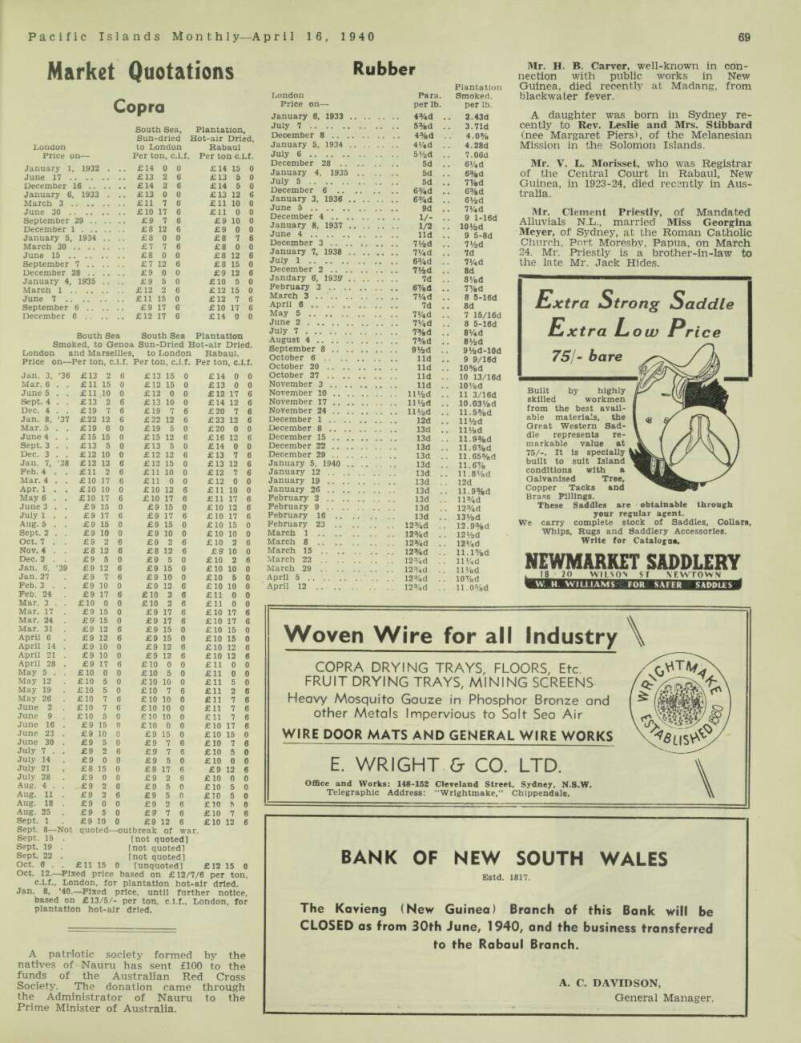
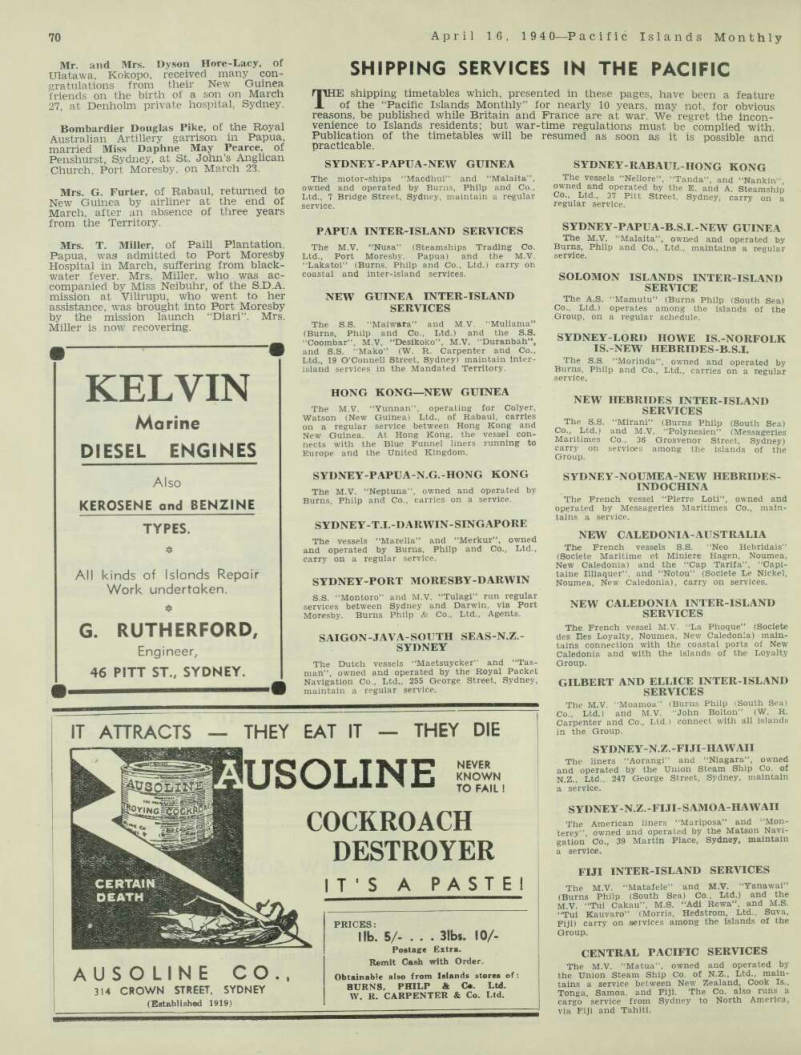
A patriotic society formed by the natives of Nauru has sent £100 to the funds of the Australian Red Cross Society. The donation came through the Administrator of Nauru to the Prime Minister of Australia.
Mr, H. B. Carver, well-known in con nection with public works in New Guinea, died recently at Madang, from blackwater fever.
A daughter was born in Sydney re cently to Rev. Leslie and Mrs. Stibbard (nee Margaret Piers), of the Melanesian Mission in the Solomon Islands.
Mr. V. L. Morisset, who was Registrar of the Central Court in Rabaul, New Guinea, in 1923-24, died recently in Aus tralia.
Mr. Clement Priestly, of Mandated Alluvlals N.L., married Miss Georgina Meyer, of Sydney, at the Roman Catholic Church, Port Moresby. Papua, on March 24. Mr. Priestly is a brother-in-law to the late Mr. Jack Hides.
London
Rubber
Para.
Plantation Smoked.
Price on— per lb. per lb.
January 6, 1933 4%d 2.43d July 7 5%d 3.71d December 8 . . . 4%d 4.0% January 5, 1934 , 4‘/ 4 d 4.28d July 6 5»/ 2 d 7.06d December 28 .. 6*/ 4 d January 4, 1935 5d , 6%d July 5 .. 7%d December 6 .. .. 6%d January 3, 1936 . 6*/ad June 5 .. 7‘/ 4 d December 4 .. . 1/- 9 l-16d January 8, 1937 . 1/2 . . . 10‘/ad June 4 9 5-8d December 3 .. . .. 7Vad January 7, 1938 . 7*/ 4 d , 7d July 1 ■ 7%d December 2 .. . . 8d January 6, 1939 , . 8Vad February 3 .. .. .. 7%d March 3 8 5-16d April 6 ,. 8d May 5 7 15/16d June 2 8 5-16d July 7 . 8‘/ 4 d August 4 . 8‘/ad September 8 .. . 9%d-10d October 6 .. .. 9 9/18d October 20 .. .. . 10%d October 27 .. .. lid . . 10 13/16d November 3 .. . lid . . lOVsd November 10 .. . . 11 3/16d November 17 .. .
UMid . . 10.03%d November 24 . . . . 11.5%d December 1 .. .. . 11‘/ad December 8 .. .. . UVad December 15 .. . . 11.9%d December 22 .. . . 11.6%d December 29 .. . . 11.65%d January 5, 1940 . 13d . . 11.6% January 12 . . .. 13d . . ll.SVad January 19 .. .. 12d January 26 .. .. . 11.9%d February 2 .. .. . 11 %d February 9 .. .. . 12%d February 16 .. . 13%d February 23 .. 12%d . . 12.9%d March 1 .. .. . 12‘/ad March 8 . . .. . 12‘/ 4 d March 15 . ll.l%d March 22 . . . . 12% d . . 11 ‘/ 4 d March 29 . . .. . ll'/sd April 5 . 10%d April 12 .. ,. . 11.0%d
Copra
South Sea, Plantation.
Sun-dried Hot-air Dried, Loudon to London Rabaul Price on— Per ton, c.i.f.
Per ton c.l.f.
January 1 , 1932 . . . £14 0 0 £14 15 0 June 17 . £13 2 6 £13 5 0 December 16 .. .. £14 2 6 £14 5 0 January 6 , 1933 . . . £13 0 0 £13 12 6 March 3 £11 7 6 £11 10 0 June 30 . £10 17 6 £11 0 0 September 29 .. .. £9 7 6 £9 10 0 December 1 £8 12 6 £9 0 0 January 5. , 1934 .. £8 0 0 £8 7 6 March 30 £7 7 6 £8 0 0 June 15 . £8 0 0 £8 12 6 September 7 .. .. £7 12 6 £8 15 0 December 28 .. . . £9 0 0 £9 12 6 January 4, 1935 . . . £9 5 0 £10 5 0 March 1 . £12 2 6 £12 15 0 June 7 £11 15 0 £12 7 6 September 6 .. .. £9 17 6 £10 17 6 December 6 .. .. £12 17 6 £14 0 0 South Sea South Sea Plantation Smoked, to Genoa Sun-Dried Hot-air Dried.
London and Marseilles, to London Rabaul.
Price on— Per ton, c.l.f . Per ton, c.i.f.
Per ton, c.l.f.
Jan. 3, ’36 £13 2 6 £13 15 0 £14 0 0 Mar. 6 . . £11 15 0 £12 15 0 £13 0 0 June 5 . . £11 10 0 £12 0 0 £12 17 6 Sept. 4 . . £13 2 6 £13 10 0 £14 12 6 Dec. 4 . . £19 7 6 £19 7 6 £20 7 6 Jan. 8, ’37 £22 12 6 £22 12 6 £23 12 6 Mar. 5 . . £19 0 0 £19 5 0 £20 0 0 June 4 . . £15 15 0 £15 12 6 £16 12 6 Sept. 3 . . £13 5 0 £13 5 0 £14 0 0 Dec. 3 . . £12 10 0 £12 12 6 £13 7 6 Jan. 7, ’38 £12 12 6 £12 15 0 £13 12 6 Feb. 4 . . £11 2 6 £11 10 0 £12 7 6 Mar. 4 . . £10 17 6 £11 0 0 £12 0 0 Apr. 1 . . £10 10 0 £10 12 6 £11 10 0 May 6 . . £10 17 6 £10 17 6 £11 17 6 June 3 . . £9 15 0 £9 15 0 £10 12 6 July 1 . . £9 17 6 £9 17 6 £10 17 6 Aug. 5 . . £9 15 0 £9 15 0 £10 15 0 Sept. 2 . . £9 10 0 £9 10 0 £10 10 0 Oct. 7 . . £9 2 6 £9 2 6 £10 2 6 Nov. 4 . . £8 12 6 £8 12 6 £9 10 0 Dec. 2 . . £9 5 0 £9 5 0 £10 2 6 Jan. 6. ’39 £9 12 6 £9 15 0 £10 10 0 Jan.27 £9 7 6 £9 10 0 £10 5 0 Feb. 3 . . £9 10 0 £9 12 6 £10 10 0 Feb. 24 £9 17 6 £10 2 6 £11 0 0 Mar. 3 . . £10 0 0 £10 2 6 £11 0 0 Mar. 17 . £9 15 0 £9 17 6 £10 17 6 Mar. 24 £ff 15 0 £9 17 6 £10 17 6 Mar. 31 . £9 12 6 £9 15 0 £10 15 0 April 6 £9 12 6 £9 15 0 £10 15 0 April 14 . £9 10 0 £9 12 6 £10 12 6 April 21 . £9 10 0 £9 12 6 £10 12 6 April 28 . £9 17 6 £10 0 0 £11 0 0 May 5 . . £10 0 0 £10 5 0 £11 0 0 May 12 £10 5 0 £10 10 0 £11 5 0 May 19 £10 5 0 £10 7 6 £11 2 6 May 26 £10 7 6 £10 10 0 £11 7 6 June 2 £10 7 6 £10 10 0 £11 7 6 June 9 £10 5 0 £10 10 0 £11 7 6 June 16 . £9 15 0 £10 0 0 £10 17 6 June 23 . £9 10 0 £9 15 0 £10 15 0 June 30 . £9 5 0 £9 7 6 £10 7 6 July 7 . , £9 2 6 £9 7 6 £10 5 0 July 14 £9 0 0 £9 5 0 £10 0 0 July 21 . £8 15 0 £8 17 6 £9 12 6 July 28 £9 0 0 £9 2 6 £10 0 0 Aug. 4 . . £9 2 6 £9 5 0 £10 5 0 Aug. 11 , £9 2 6 £9 5 0 £10 5 0 Aug. 18 . £9 0 0 £9 2 6 £10 5 0 Aug. 25 . £9 5 0 £9 7 6 £10 7 6 Sept. 1 . £9 10 0 £9 12 6 £10 12 6 Sept. 8—Not quoted—outbreak of war.
Sept. 15 . [not quoted] Sept. 19 . [not quoted] Sept. 22 . [not quoted] Oct. 6 . . £11 15 0 [unquoted] £12 15 0 Oct. 12. —Fixed price based on £ 12/7/6 per ton. c.l.f,, London, for plantation hot-air dried.
Jan. 8. ’40.—Fixed price, until further notice. based on £13/5/ - per ton. c.l.f..
London, for plantation hot-air dried.
Mr. and Mrs. Dyson Hore-Lacy, of Ulatawa, Kokopo, received many con gratulations from their New Guinea friends on the birth of a son on March 27, at Denholm private hospital, Sydney.
Bombardier Douglas Pike, of the Royal Australian Artillery garrison in Papua, married Miss Daphne May Pearce, of Penshurst, Sydney, at St. John’s Anglican Church, Port Moresby, on March 23.
Mrs. G. Furter, of Rabaul, returned to New Guinea by airliner at the end of March, after an absence of three years from the Territory.
Mrs. T. Miller, of Paili Plantation.
Papua, was admitted to Port Moresby Hospital in March, suffering from black water fever. Mrs. Miller, who was ac companied by Miss Neibuhr, of the S.D.A. mission at Vilirupu, who went to her assistance, was brought into Port Moresby by the mission launch “Diari”. Mrs.
Miller is now recovering.
Advertisements & other items, pp. 71-72 (2 items)
69
Pacific Islands Monthl y—A pril 16, 1940
A<A R *V-
Extra Strong Saddle
Extra Loiv Price
751- hare
Built by highly skilled workmen from the best available materials, the Great Western Saddle represents remarkable value at 75/-. It Is specially built to suit Island conditions with a Galvanised Tree, Copper Tacks and Brass Fillings.
These Saddles are obtainable through your regular agent.
We carry complete stock of Saddles, Collars, Whips, Rugs and Saddlery Accessories.
Write for Catalogs*.
NEWMARKET SADDLERY
WILSON ST NEWTOWN
W. H. WILLIAMS FOR SAFER SADDLES
Woven Wire for all Industry
COPRA DRYING TRAYS, FLOORS, Etc.
FRUIT DRYING TRAYS, MINING SCREENS
Heavy Mosquito Gauze in Phosphor Bronze and other Metals Impervious to Salt Sea Air WIRE DOOR MATS AND GENERAL WIRE WORKS
E. WRIGHT & CO. LTD.
Office and Works: 148-152 Cleveland Street, Sydney, N.B.W.
Telegraphic Address; “Wrightmake,” Chippendale.
A<A r *V-
BANK OF NEW SOUTH WALES
Estd. 1817.
The Kavieng (New Guinea) Branch of this Bank will be CLOSED as from 30th June, 1940, and the business transferred to the Rabaul Branch.
A. C. DAVIDSON,
General Manager.
KELVIN
Marine
DIESEL ENGINES
Also
KEROSENE and BENZINE
TYPES.
❖ All kinds of Islands Repair Work undertaken. •I* V
G. RUTHERFORD,
Engineer,
46 PITT ST., SYDNEY.
IT ATTRACTS
miso
m
OVING
NEVER
KNOWN
TO FAIL !
THEY EAT IT THEY DIE
USOLINE
COCKROACH
DESTROYER
IT'S A PASTE
AUSOLINE CO..
314 CROWN STREET, SYDNEY
(Established 1919)
PRICES;
Hb. 5/- . . . 3lbs. 10/- Postage Extra.
Remit Cash with Order.
Obtainable also from Islands stores of
BURNS. PHILP & C*. Ltd.
W. R. CARPENTER & Co. Ltd.
Shipping Services In The Pacific
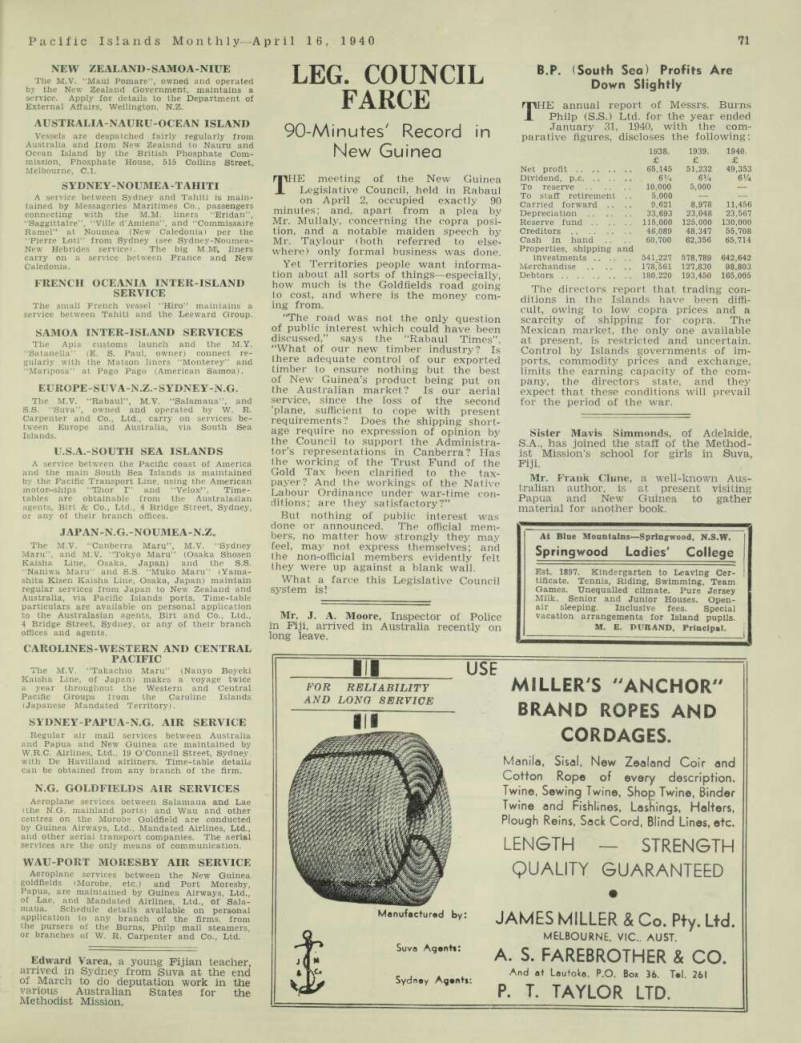
rpHE shipping timetables which, presented in these pages, have been a feature JL of the “Pacific Islands Monthly’’ for nearly 10 years, may not, for obvious reasons, be published while Britain and France are at war. We regret the incon venience to Islands residents; but war-time regulations must be complied with.
Publication of the timetables will be resumed as soon as it is possible and practicable.
Sydney-Papua-New Guinea
The motor-ships “Macdhui” and “Malaita”, owned and operated by Burns, Philp and Co., Ltd., 7 Bridge Street, Sydney, maintain a regular service.
Papua Inter-Island Services
The M.V. “Nusa” (Steamships Trading Co.
Ltd., Port Moresby, Papua) and the M.V.
“Lakatoi” (Burns, Philp and Co., Ltd.) carry on coastal and inter-island services.
New Guinea Inter-Island
Services
The S.S. “Maiwara” and M.V. “Muliama” (Burns, Philp and Co., Ltd.) and the S.S.
“Coombar”, M.V. “Desikoko”, M.V. “Duranbah”, and S.S. “Mako” (W. R. Carpenter and Co., Ltd., 19 O’Connell Street, Sydney) maintain Inter island services in the Mandated Territory.
Hong Kong—New Guinea
The M.V. “Yunnan”, operating for Colyer, Watson (New Guinea) Ltd., of Rabaul, carries on a regular service between Hong Kong and New Guinea. At Hong Kong, the vessel con nects with the Blue Funnel liners running to Europe and the United Kingdom.
Sydney-Papua-N.G.-Hong Kong
The M.V. “Neptuna”, owned and operated by Burns, Philp and Co., carries on a service.
Sydney-T.1.-Darwin-Singapore
The vessels “Marella” and “Merkur”, owned and operated by Burns, Philp and Co., Ltd., carry on a regular service.
Sydney-Port Moresby-Darwin
S.S. “Montoro” and M.V. “Tulagi” run regular services between Sydney and Darwin, via Port Moresby. Burns Philp & Co., Ltd., Agents.
Saigon-Java-South Seas-N.Z
Sydney
The Dutch vessels “Maetsuycker” and “Tas man”, owned and operated by the Royal Packet Navigation Co., Ltd., 255 George Street, Sydney, maintain a regular service.
Sydney-Rabaul-Hong Kong
The vessels “Nellore”, “Tanda”, and “Nankin” owned and operated by the E. and A. Steamship Co., Ltd., 37 Pitt Street, Sydney, carry on a regular service.
Sydney-Papua-8.5.1.-New Guinea
The M.V. “Malaita”, owned and operated by Burns, Philp and Co., Ltd., maintains a regular service.
Solomon Islands Inter-Island
Service
The A.S. “Mamutu” (Burns Philp (South Sea) Co., Ltd.) operates among the islands of the Group, on a regular schedule.
Sydney-Lord Howe Is.-Norfolk
Is.-New Hebrides-8.5.1.
The S.S. “Morinda”, owned and operated by Burns, Philp and Co., Ltd., carries on a regular service.
New Hebrides Inter-Island
Services
The S.S. “Mirani” (Burns Philp (South Sea) Co., Ltd.) and M.V. “Polynesian” (Messageries Maritimes Co., 36 Grosvenor Street, Sydney) carry on services among the islands of the Group.
Sydney-Noumea-New Hebrides
Indochina
The French vessel “Pierre Loti”, owned and operated by Messageries Maritimes Co., main tains a service.
New C Aledonia-Au Str Alia
The French vessels S.S. “Neo Hebridais” (Societe Maritime et Miniere Hagen, Noumea, New Caledonia) and the “Cap Tarifa”, “Capi taine Illiaquer”, and “Notou” (Societe Le Nickel, Noumea, New Caledonia), carry on services.
New Caledonia Inter-Island
Services
The French vessel M.V. “La Phoque” (Societe des Hes Loyalty, Noumea, New Caledonia) main tains connection with the coastal ports of New Caledonia and with the islands of the Loyalty Group.
Gilbert And Ellice Inter-Island
Services
The M.V. “Moamoa” (Burns Philp (South Sea) Co., Ltd.) and M.V. “John Bolton” (W. R.
Carpenter and Co., Ltd.) connect with all islands in the Group.
Sydney-N.Z.-Fiji-Hawaii
The liners “Aorangi” and “Niagara”, owned and operated by the Union Steam Ship Co. of N.Z., Ltd., 247 George Street, Sydney, maintain a service,
Sydney-N.Z.-Fiji-S Amo A-Hawaii
The American liners “Mariposa” and “Mon terey”, owned and operated by the Matson Navi gation Co., 39 Martin Place, Sydney, maintain a service.
Fiji Inter-Island Services
The M.V. “Matafele” and M.V. “Yanawai” (Burns Philp (South Sea) Co., Ltd.) and the M.V. “Tui Cakau”, M.S. “Adi Rewa”, and M.S.
“Tui Kauvaro” (Morris, Hedstrom, Ltd., Suva, Fiji) carry on services among the islands of the Group.
Central Pacific Services
The M.V. “Matua”, owned and operated by the Union Steam Ship Co. of N.Z., Ltd., main tains a service between New Zealand, Cook Is., Tonga, Samoa, and Fiji. The Co. also runs a cargo service from Sydney to North America, via Fiji and Tahiti.
New Zealand-Samoa-Niue
The M.V. ‘'Maui Pomare”, owned and operated by the New Zealand Government, maintains a service. Apply for details to the Department of External Affairs, Wellington, N.Z.
Australia-Nauru-Ocean Island
Vessels are despatched fairly regularly from Australia and from New Zealand to Nauru and Ocean Island by the British Phosphate Com mission, Phosphate House, 515 Collins Street, Melbourne, C.l.
Sydney-Noumea-Tahiti
A service between Sydney and Tahiti is main tained by Messageries Maritimes Co., passengers connecting with the M.M. liners “Eridan”, “Saggittalre”, “Ville d’Amiens”, and “Commissaire Ramel” at Noumea (New Caledonia) per the “Pierre Loti” from Sydney (see Sydney-Noumea- New Hebrides service). The big M.MI liners carry on a service between France and New Caledonia.
French Oceania Inter-Island
Service
The small French vessel “Hiro” maintains a service between Tahiti and the Leeward Group.
Samoa Inter-Island Services
The Apia customs launch and the M.Y.
“Satanella” (E. S. Paul, owner) connect re gularly with the Matson liners “Monterey” and “Mariposa” at Pago Pago (American Samoa).
Europe-Suva-N.Z.-Sydney-N.G.
The M.V. “Rabaul”, M.V. “Salamaua”, and S.S. “Suva”, owned and operated by W. R.
Carpenter and Co., Ltd., carry on services be tween Europe and Australia, via South Sea Islands.
U.S.A.-South Sea Islands
A service between the Pacific coast of America and the main South Sea Islands is maintained by the Pacific Transport Line, using the American moton-iships “Thor I” and “Veloxi”. Time tables are obtainable from the Australasian agents, Birt & Co., Ltd., 4 Bridge Street, Sydney, or any of their branch offices.
Japan-N.G.-Noumea-N.Z.
The M.V. “Canberra Maru”, M.V. “Sydney Maru”, and M.V. “Tokyo Maru” (Osaka Shosen Kaisha Line, Osaka, Japan) and the S.S.
“Naniwa Maru” and S.S. “Muko Maru” (Yama shita Kisen Kaisha Line, Osaka, Japan) maintain regular services from Japan to New Zealand and Australia, via Pacific Islands ports. Time-table particulars are available on personal application to the Australasian agents, Birt and Co., Ltd., 4 Bridge Street, Sydney, or any of their branch offices and agents.
Carolines-Western And Central
Pacific
The M.V. “Takachio Maru” (Nanyo Boyeki Kaisha Line, of Japan) makes a voyage twice a year throughout the Western and Central Pacific Groups from the Caroline Islands (Japanese Mandated Territory).
Sydney-Papua-N.G. Air Service
Regular air mail services between Australia and Papua and New Guinea are maintained by W.R.C. Airlines, Ltd., 19 O’Connell Street, Sydney, with De Havilland airliners. Time-table details can be obtained from any branch of the firm.
N.G. Goldfields Air Services
Aeroplane services between Salamaua and Lae (the N.G. mainland ports) and Wau and other centres on the Morobe Goldfield are conducted by Guinea Airways, Ltd., Mandated Airlines, Ltd., and other aerial transport companies. The aerial services are the only means of communication.
Wau-Port Moresby Air Service
Aeroplane services between the New Guinea goldfields (Morobe, etc.) and Port Moresby, Papua, are maintained by Guinea Airways, Ltd., of Lae, and Mandated Airlines, Ltd., of Sala maua. Schedule details available on personal application to any branch of the firms, from the pursers of the Burns, Philp mail steamers, or branches of W. R. Carpenter and Co., Ltd.
Edward Varea, a young Fijian teacher,
arrived in Sydney from Suva at the end of March to do deputation work in the various Australian States for the
Methodist Mission.
Advertisements & other items, p. 72 (1 item)
70
April 16, 194 O—P acific Islands Monthly
Leg. Council
Farce
90-Minutes' Record in New Guinea
THE meeting of the New Guinea Legislative Council, held in Rabaul on April 2, occupied exactly 90 minutes; and, apart from a plea by Mr. Mullaly, concerning the copra posi tion, and a notable maiden speech by Mr. Taylour (both referred to else where) only formal business was done.
Yet Territories people want informa tion about all sorts of things—especially, how much is the Goldfields road going to cost, and where is the money com ing from.
“The road was not the only question of public interest which could have been discussed,” says the “Rabaul Times”.
“What of our new timber industry? Is there adequate control of our exported timber to ensure nothing but the best of New Guinea’s product being put on the Australian market? Is our aerial service, since the loss of the second ’plane, sufficient to cope with present requirements? Does the shipping short age require no expression of opinion by the Council to support the Administra tor’s representations in Canberra? Has the working of the Trust Fund of the Gold Tax been clarified to the tax payer? And the workings of the Native Labour Ordinance under war-time con ditions; are they satisfactory?”
But nothing of public interest was done or announced. The official mem bers, no matter how strongly they may feel, may not express themselves; and the non-official members evidently felt they were up against a blank wall.
What a farce this Legislative Council system is!
Mr. J. A. Moore, Inspector of Police in Fiji, arrived in Australia recently on long leave.
Down Slightly
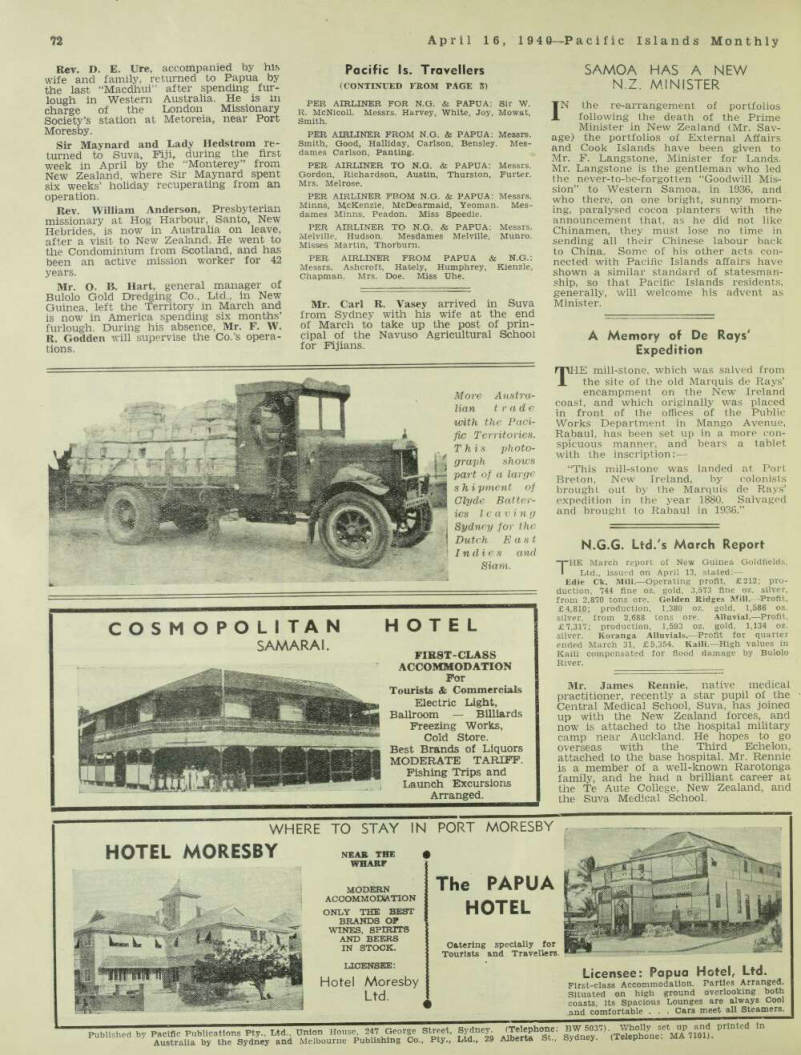
B.P. (South Sea) Profits Are Down Slightly
rE annual report of Messrs. Burns Philp (S.S.) Ltd. for the year ended January 31, 1940, with the com parative figures, discloses the following:
The directors report that trading con ditions in the Islands have been diffi cult, owing to low copra prices and a scarcity of shipping for copra. The Mexican market, the only one available at present, is restricted and uncertain.
Control by Islands governments of im ports, commodity prices and exchange, limits the earning capacity of the com pany, the directors state, and they expect that these conditions will prevail for the period of the war.
Sister Mavis Simmonds, of Adelaide, S.A., has joined the staff of the Method ist Mission’s school for girls in Suva, Fiji.
Mr. Frank Clune, a well-known Aus tralian author, is at present visiting Papua and New Guinea to gather material for another book.
1938. 1939. 1940. £ £ £ Net profit 65,145 51,232 49,353 Dividend, p.c 6»/4 61/4 6V4 To reserve 10,000 5,000 — To staff retirement .. 5,000 — — Carried forward .. 9,621 8,978 11,456 Depreciation 33,693 23,048 23,567 Reserve fund 115,000 125,000 130,000 Creditors 46,089 48,347 55,708 Cash in hand 60,700 62,356 65,714 Properties, shipping and investments 541,227 578,789 642,642 Merchandise 178,561 127,830 98,803 Debtors 180,220 193,450 165,005
Rev. D. E. Ure. accompanied by his wife and family, returned to Papua by the last “Macdhui” after spending fur lough in Western Australia. He is in charge of the London Missionary Society’s station at Metoreia, near Port Moresby.
Sir Maynard and Lady Hedstrom re turned to Suva, Fiji, during the first week in April by the “Monterey” from New Zealand, where Sir Maynard spent six weeks’ holiday recuperating from an
operation.
Rev. William Anderson, Presbyterian missionary at Hog Harbour, Santo, New Hebrides, is now in Australia on leave, after a visit to New Zealand. He went to the Condominium from Scotland, and has been an active mission worker for 42 years.
Mr. O. B. Hart, general manager of Bulolo Gold Dredging Co., Ltd., in New Guinea, left the Territory in March and is now in America spending six months’ furlough. During his absence, Mr. F. W.
R. Godden will supervise the Co.’s opera tions.
Advertisements & other items, pp. 73-74 (1 item)
Quality Guaranteed
At Blue Mountains—Sprlngwood, N.S.W.
Springwood Ladies' College
Est. 1897. Kindergarten to Leaving Certificate. Tennis, Riding, Swimming, Team Games. Unequalled climate. Pure Jersey Milk. Senior and Junior Houses. Openair sleeping. Inclusive fees. Special vacation arrangements for Island pupils.
M. E. DURAND, Principal.
HI
USE
FOR RELIABILITY
AND LONG SERVICE
Manufactured by: Suva Agent*; Sydney Agent*:
MILLER'S "ANCHOR"
BRAND ROPES AND
CORDAGES.
Manila, Sisal, New Zealand Coir and Cotton Rope of every description.
Twine, Sewing Twine, Shop Twine, Binder Twine and Fishlines, Lashings, Halters, Plough Reins, Sack Cord, Blind Lines, etc.
LENGTH STRENGTH
QUALITY GUARANTEED
JAMES MILLER & Co. Pty.Ltd.
MELBOURNE. VIC., AUST.
A. S. FAREBROTHER & CO.
And at Lautolca, P.O. Box 36. Tel. 261
P. T. TAYLOR LTD,
& More Australian trade with the Pacific Territories.
This photograph shows part of a large shipment of Clyde Batteries leaving Sydney for the Dutch East Indies and Siam.
COSMOPOLITAN
SAMARAI.
HOTEL
FIEBT-CLASS
ACCOMMODATION
For Tourists & Commercials Electric Light, Ballroom Billiards Freezing Works, Cold Store.
Best Brands of Liquors
MODERATE TARIFF.
Fishing Trips and Launch Excursions Arranged.
WHERE TO STAY IN PORT MORESBY
HOTEL MORESBY
NEAR THE
WHARF
X ■S
MODERN
ACCOMMODATION
ONLY THE BEST
BRANDS OF
WINES, SPIRITS
AND BEERS
IN STOCK.
LICENSEE;
Hotel Moresby
Ltd.
The PAPUA
HOTEL
Catering specially for Tourists and Travellers.
Licensee: Papua Hotel, Ltd.
First-class Accommodation. Parties Arranged.
Situated on high ground overlooking both coasts, its Spacious Lounges are always Cool and comfortable . . . Cars meet all Steamers.
Samoa Has A New
N.Z. Minister
IN the re-arrangement of portfolios following the death of the Prime Minister in New Zealand (Mr. Sav age) the portfolios of External Affairs and Cook Islands have been given to Mr. F. Langstone, Minister for Lands.
Mr. Langstone is the gentleman who led the never-to-be-forgotten “Goodwill Mis sion” to Western Samoa, in 1936, and who there, on one bright, sunny morn ing, paralysed cocoa planters with the announcement that, as he did not like Chinamen, they must lose no time in sending all their Chinese labour back to China. Some of his other acts con nected with Pacific Islands affairs have shown a similar standard of statesman ship, so that Pacific Islands residents, generally, will v/elcome his advent as Minister.
A Memory of De Rays '
Expedition
mHE mill-stone, which was salved from J_ the site of the old Marquis de Rays’ encampment on the New Ireland coast, and which originally was placed in front of the offices of the Public Works Department in Mango Avenue, Rabaul, has been set up in a more con spicuous manner, and bears a tablet with the inscription:— “This mill-stone was landed at Port Breton, New Ireland, by colonists brought out by the Marquis de Rays’ expedition in the year 1880. Salvaged and brought to Rabaul in 1936.”
N.G.G. Ltd.'s March Report
THE March report of New Guinea Goldfields, Ltd., issued on April 13, stated: — Edie Ck. Mill.—Operating profit, £212; pro duction, 744 fine oz. gold, 3,573 fine oz. silver, from 2,870 tons ore. Golden Ridges Mill. —Profit, £4,810; production, 1,380 oz. gold, 1,586 oz. silver, from 2,688 tons ore. Alluvial.—Profit, £7,317; production, 1,593 oz. gold, 1,134 oz. silver. Koranga Alluvials, —Profit for quarter ended March 31, £5,354. Kaili.—High values in Kaili compensated for flood damage by Bulolo River.
Mr. James Rennie, native medical practitioner, recently a star pupil of the Central Medical School, Suva, has joined up with the New Zealand forces, and now is attached to the hospital military camp near Auckland. He hopes to go overseas with the Third Echelon, attached to the base hospital. Mr. Rennie is a member of a well-known Rarotonga family, and he had a brilliant career at the Te Aute College, New Zealand, and the Suva Medical School.
Advertisements & other items, pp. 74-76 (4 items)
72
April 16, 1940—Pacific Islands Monthly
Pacific Is. Travellers
(CONTINUED FROM PAGE S)
published by ars s^r , (T »r^, l T l t. printed ,n
April 16, 194 O—P acific Islands Monthly
WUwjA noiuA pwmehed
: / X X X ■ V ■ L. 04
tke \mtfe~\mmd Mehitft...
Prior to 1927 tortuous jungle foot-tracks winding over precipitous mountains were the sole means of communication between the coast and the rich gold deposits in the interior of New Guinea. . . . Transport costs were ruinously high. . . . Roadways and Railways were impracticable— only one way remained—THE AIR WAY.
Guinea Airways Limited was formed and in March, 1927, pioneered the first successful flight into the interior . . . since that time this Company has maintained a regular and reliable service, carrying over 82,000 passengers and transporting over 58,135 tons, including every type of goods and machinery needed by the growing European population.
Guinea Airways services now embrace the whole of New Guinea and Papua and the landing grounds and aerodromes now used total over 50— the foundation of each one marking great strides in the progress of both New Guinea and Guinea Airways Ltd.
GUINEA AIRWAYS
Freight & Passenger
Service
NEW GUINEA
Planes depart from Port Moresby for the goldfields after the arrival of each boat.
Tickets obtainable Purser, or Burns, Philp & Co.. Sydney or Brisbane.
AUSTRALIA
ADELAIDE TO DARWIN.
Twice weekly service.
ADELAIDE TO KANGAROO
ISLAND.
Return service daily except Sunday.
ADELAIDE TO PORT LINCOLN.
Return service three times weekly.
ADELAIDE TO WHYALLA.
Return service daily except Sunday.
Head Office: Austral Chambers, Currie Street. Adelaide. J
THE
LAE-SALAMAUA
New Guinea Office: LAE, Mandated Territory of New Guinea Branch Offices and Agents at WAU-SALAMAUA-
PORT MORESBY and SYDNEY.
XvVO
a Kesch’s Lager is protected by the crown seal It refreshes and invigorates you as no other drink can. In Resch’s Lager, you get all the original freshness and flavour, because it is fully protected against climatic conditions by the specially designed “Spot’ 9 Crown Seal.
R.L.12.27.