Pacific
Islands
Monthly
Vol. X. No. 8.
March 15, 1940
Established 1930
[Registered at the Svdri&iL for transmission by post as a newspaper.]
8“
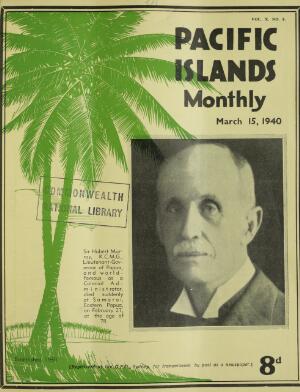
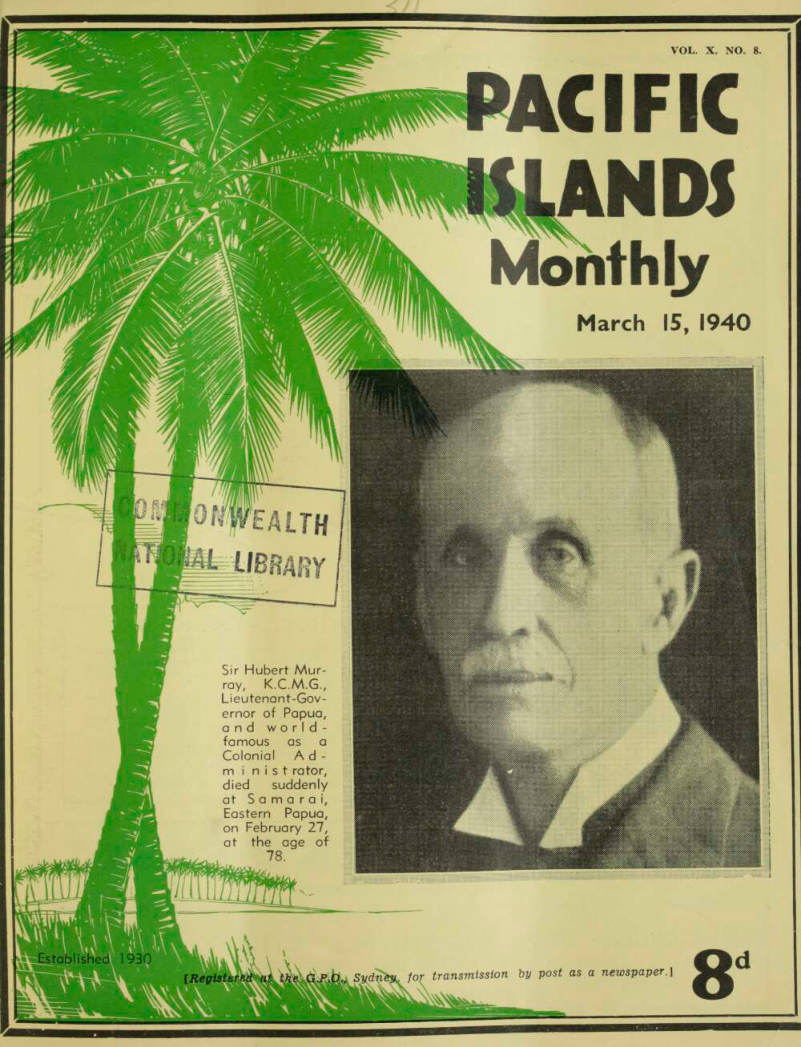
Sir Hubert Mur ray, K.C.M.G., Lieutenant-Gov ernor of Papua, and world famous as a Colonial Ad ministrator, died suddenly at Samarai, Eastern Papua, on February 27, at the age of 78.
Advertisements & other items, p. 2 (2 items)
Pacific Islands Monthl y—M arch 15. 1940
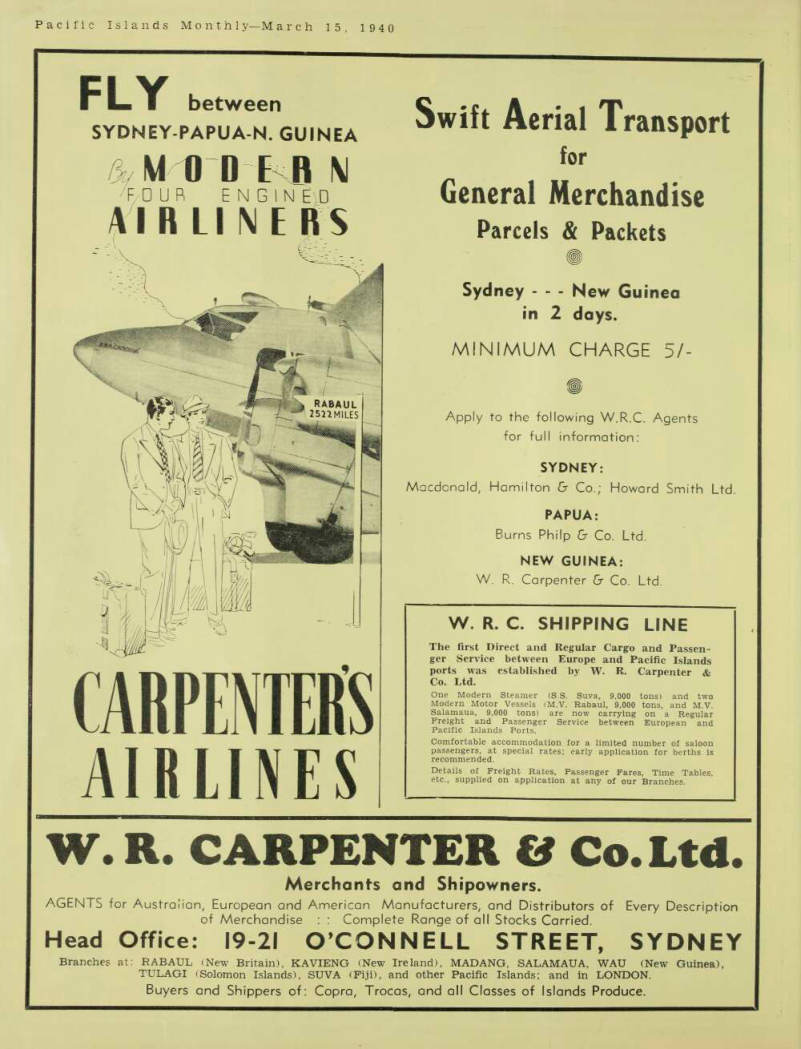
Carpenters
FLY between
SYDNEY-PAPUA-N. GUINEA
MOD E R N
FOUR ENGINED
AIRLINERS
I
RABAUL
2521 MILES
CARPENTERS
AIRLINES
Swift Aerial Transport
for
General Merchandise
Parcels & Packets
Sydney - - - New Guinea
in 2 days.
MINIMUM CHARGE
w Apply to the following W.R.C. Agents for full information:
SYDNEY:
Macdonald, Hamilton & Co.; Howard Smith Ltd.
PAPUA:
Burns Philp Cr Co. Ltd.
NEW GUINEA:
W. R. Carpenter Cr Co. Ltd.
W. R. C. SHIPPING LINE
The first Direct and Regular Cargo and Passenger Service between Europe and Pacific Islands ports was established by W. R. Carpenter & Co. Ltd.
One Modern Steamer (S.S. Suva, 9,000 tons) and two Modern Motor Vessels (M.V. Rabaul, 9,000 tons, and M.V.
Salamaua, 9,000 tons) are now carrying on a Regular Freight and Passenger Service between European and Pacific Islands Ports.
Comfortable accommodation for a limited number of saloon passengers, at special rates; early application for berths is recommended.
Details of Freight Rates, Passenger Fares, Time Tables, etc., supplied on application at any of our Branches.
W.R. CARPENTER & Co. Ltd.
Merchants and Shipowners.
AGENTS for Australian, European and American Manufacturers, and Distributors of Every Description of Merchandise : : Complete Range of all Stocks Carried.
Head Office: 19-21 O’CONNELL STREET, SYDNEY
Branches at: RABAUL (New Britain), KAVIENG (New Ireland), MADANG, SALAMAUA, WAU (New Guinea), TULAGI (Solomon Islands), SUVA (Fiji), and other Pacific Islands; and in LONDON.
Buyers and Shippers of: Copra, Trocas, and all Classes of Islands Produce.
Pacific News-Review
Notes And Comment On
The Progress Of The War
From Feb. 14 To March 13.
Feb. 14: Officially announced that per mission has been given to British sub jects to take part in the Finnish war as volunteers. About 3,000 men and women have already offered their services at the Finnish recruiting office in London.
Russian attacks upon the Finnish line are increasing in strength and fre quency. Swedish army officers take a serious view of the latest reports from the Finnish front.
Feb. 14: It is reported that about 14 German ships, which have been shel tering for months in neutral ports, have sailed and are trying to slip through the Allied naval blockade. It is stated that they are sailing under orders to “get home or scuttle”.
Feb. 15: German business men in Hol land state that high hopes are held in Berlin that the visit to Europe by Mr.
Sumner Welles, President Roosevelt’s personal envoy, may bring about a sub stantial movement towards peace.
There is no doubt that, despite all the Goebbels propaganda and the squeals of defiance which issue nightly from the German radio in half a dozen langu ages, Germany is desperately anxious to develop a peace movement. The pressure of the Allied blockade is being felt more seriously week by week. Germany ex pected that, and made the Russian alli ance so that unlimited stores of raw materials might be available at her back door. But the action of Russia in be coming involved in a serious war with Finland, so that she now requires her own supplies, is causing Germany acute anxiety.
Feb. 15. The famous statesman, Mr.
Anthony Eden, now Secretary of State for the Dominions, received an enthu siastic welcome when he visited the Australian camp in Palestine.
Feb. 15: The action of the Germans in sinking all neutral ships which sub mit to British contraband examination, on the ground that they thereby lost their neutrality, has incensed all the neutral nations. The British navy has just destroyed two more German sub marines, making a total of four during the last five days. One of them, how ever, had sunk the crack Blue Star freighter “Sultan Star”, of 12,300 tons, while another had torpedoed two Brit ish tankers of 10,000 and 8,000 tons re spectively. These are serious losses.
Feb. 16: The Finns have been forced back from a number of front line posi tions. The onslaught by new and stronger Russian troops continues cease lessly. Wave after wave of Russians are being thrown against the Finnish line, regardless of cost.
Feb. 16: It is considered unlikely that Russia will make any moves southwards to create a front against Turkey and thus protect her oil wells against a potential attack so long as she is en gaged in the war against Finland.
Feb. 19: One of the most dramatic incidents of the war has occurred on the coast of Norway. When the Ger man battleship “Graf Spee” was de stroyed, an auxiliary German cruiser, the “Altmark”, 20,000 tons, with over 300 British seamen imprisoned aboard, got away into the Atlantic. The navy kept a keen watch, and it was discov ered that she was trying to sneak down through Norwegian territorial waters into Germany. She was located
by British aircraft and destroyers. The British demanded that the Norwegians should examine her and, if she carried guns or prisoners, she should be in terned. The Norwegians refused—no one knows why. Thereupon the British destroyer “Cossack” in darkness, dashed into a Norwegian fjord, found the “Alt mark”, lay alongside her, and sent a boarding party qf 25 men, with pistols and cutlasses, onto the “Altmark”. The “Altmark”, in manoeuvring, ran ashore.
The British killed seven Germans and chased the rest pellmell overboard—they all got away ashore —released the pri soners, and took them forthwith to a British port. The German radio is still screaming furiously that this was an outrageous violation of international law and neutral rights—but the whole world is acclaiming it.
Feb. 19: Under terrific Russian pres sure, the Finns are slowly retreating at the southern end of their line near the sea coast, and the Russians now are only a few miles from the port and city
of Viborg.
Sweden’s refusal to help Finland has aroused a storm of criticism throughout the world, and there are indications that Swedish public opinion itself is sharply divided upon the question. Many people in Sweden believe that Germany would not attack Sweden if Sweden helped Finland. We must remember that German influence is very strong in Sweden—the country was pro-German in 1914-18.
Feb. 19: Since the beginning of the war Germany has destroyed approxi mately 500,000 tons of British shipping.
But this loss has been substantially re duced by new British ships built, by ships captured from Germany, and by purchases abroad. So that the nett loss in the British mercantile marine, which is approximately 21 million tons, is only 150,000 tons.
Feb. 19: The British destroyer “Dar ing” has been torpedoed and sunk, and 9 officers and 148 men have been lost.
This is the sixth British destroyer lost since the outbreak of war.
Feb. 19: Later reports concerning the rescue of prisoners from the “Altmark” show that the commander of the “Alt mark” was a brutal Nazi, who treated the British very badly. He was a bearded Prussian and the unhappy pri soners—doubtless inspired by a number of Australians among them—called him “Nitty Whiskers”. This gentleman, in stead of being welcomed as a hero in Berlin, as he had fondly hoped, is now trying to get his ship off the Norwegian rocks.
Feb. 20: Diplomats and general staff are closely studying the effect of a pos sible Russian victory in Finland in the spring and are asking whether the Allies could afford to see Finland defeated. It is considered that in that event Scan dinavia would become practically domi nated by Russia and Germany.
Feb. 21: It is reported that the aver age British tonnage sunk weekly during the last six weeks is higher than the weekly average up to December 31. Sink ing of neutral ships approximated 16,000 tons weekly until December 31, but in recent weeks the average has been 27,000 tons.
Feb. 23: Western front reports indi cate a condition of complete stalemate.
The front is more or less ice-bound and the only incidents are occasional dog fights in the air.
Feb. 22: A stir has been caused by reports from several sources that Brit ish and French warships are cruising in the Arctic off the Finnish port of Pet samo, which now is believed to be in Russian occupation. The Soviet navy minister is reported to have gone to Murmansk (a Russian port near Pet samo). The Swedish newspapers say that “The Soviet Arctic Navy is in a state of complete preparedness”.
The real problem of the war situation is now emerging from the obscurity and confusion of inaccurate reports and newspaper speculation. Is it the desire of the Allies that Russia should take up arms against them, or not? In other words, which would most embarrass Ger many—to have Russia at war, thus cut ting off the supplies upon which Ger many had so confidently counted, or to have Russia at peace, and able to sup ply foodstuffs, raw materials, oil, etc., which Germany desperately needs? Con census of opinion is that Germany would prefer to see Russia at peace. Germany has all the armed forces she needs to help her against the Allies. The war to an increasing degree is becoming an economic struggle—Germany wants food stuffs and raw materials, not men.
Feb. 23; Officially announced that R.A.F. planes on Tuesday night bombed German warships in Heligoland Bight.
Feb. 25: Britain and France are buy ing the whole of the aeroplane produc tion of the United States, above Amer ica’s home defence needs. Additional orders just placed in America are worth £300,000,000.
Feb. 25: Four more submarines have been sunk —two in the North Sea, one off the coast of Scotland, and the fourth was rammed by a steamer off the Shet land Islands.
Feb. 26: Mr. Sumner Welles, personal envoy from President Roosevelt to the European Powers, has arrived in Rome and is meeting the Foreign Minister, Count Ciano, and Signor Mussolini. Mr.
Welles goes to Germany shortly.
Feb. 26: The recent insistence by sen sational newspapers that Turkey and Russia were about to clash on their fron tiers had an amusing sequel in the offi cial announcement that Turkey and Russia have withdrawn their troops from the Caucasus border, in order to avoid friction. It is clear that Turkey and Russia are determined not to fight, unless developments of grave import, now quite unforeseen, compel a revision of their present relationship. But Tur key, in every possible way, is honouring her pledges to Britain and France.
Feb. 27: The Finns, under severe pres sure, are retreating to a shorter line, and abandoning the forts on the islands off Bjorko, which have held up the Russian advance on Viborg.
Feb. 27: There seems to be increasing diplomatic activity in belligerent and neutral capitals as a result of the arri val of President Roosevelt’s envoy. Re ported that Hitler has elaborated a new peace plan, which he has conveyed pri vately to two European neutrals.
Feb. 27; Mr. Churchill revealed that
the battleship H.M.S. “Nelson”, 34,000 tons, was damaged by a magnetic mine in September; but she was able to reach port under her own power, and is now repaired.
Feb. 27: Shipping losses for the week were four British and three neutral ves sels totalling 26,600 tons —which is much below the average. Very few of the German ships which have been trying to get home from neutral ports have succeeded. Some have been captured, others were scuttled by their crews, and one was wrecked.
Feb. 28: British volunteers for Finland are being rapidly organised and an advance party has already left. Com mand has been given to Major Kermit Roosevelt, who is a son of the late Pre sident Theodore Roosevelt, a naturalised British subject and an officer in the British Army.
Feb. 29: The Russians are strongly attacking on the southern end of the line, attempting to reach Viborg. Furi ous fighting is proceeding. Much of the city of Viborg is in flames. Certain events in neutral countries indicate that an effort will shortly be made to bring about peace between Russia and Finland.
Mch. 1: It is reported that Hitler has advised Stalin to score the earliest pos sible success on the Finnish front, and then to end the war with the declara tion that Russia’s object in protecting Leningrad from invasion has been achieved.
Mch. 1; Mr. Sumner Welles is in Ber lin to-day, engaged in discussions with Hitler and the German Foreign Minister, von Ribbentrop.
Mch. 1; Lord Tavistock has published terms upon which he declares the Ger man Government is prepared at once to declare an armistice and open peace negotiations. The terms include the re constitution of an independent Slovakia and an independent Poland—the latter to have an outlet to the sea, and the use of the river Vistula. Germany would arrange for a plebiscite in Austria, but free from international interference.
Germany would disarm, provided all powers interested in international dis armament do likewise. Germany would join the League of Nations, provided she had assurances that the League would not be dominated by Britain and France. Colonies are not mentioned, except that Germany says that she re quires assurances of a better supply of raw materials.
Much attention is being given to this statement, and large numbers are ask ing “Why not?” The main difficulty is the inability of the British and French Governments to put any faith in any undertaking given by the present Ger man Government. On the other hand, it is pointed out that the alternative may be a long period of frightful car nage.
The war now, has been going on for six months —yet, although the world’s mightiest armed forces are facing each other, fully equipped for combat, there is no military fighting. The greatest air fleets the world ever has seen are ranged up respectively in Germany, Britain and France, all eager to be up and at it — yet there has been no more than a few skirmishes. The best informed news papers say: “Peace moves are seen as steady undercurrents, but it is generally assumed that the war will go on”.
Mch. 3: R.A.F. bombers for the fifth time in six days flew over Berlin last night and dropped leaflets.
Mch. 3: Britain, in accordance with
her policy of preventing any trade with Germany, in or out, has stopped the shipment of German coal from Rotter dam to Italy. The coal comes down the Rhine in barges, and is loaded into a fleet of Italian colliers, which ply regu larly between Rotterdam and Italy. Italy has protested.
Mch. 4: A German bombing plane flew low over the British India liner “Dom ala”, 8,400 tons, and attacked the de fenceless vessel with bombs and machine guns, and 108 passengers and crew were killed.
Mch. 4: Mr. Sumner Welles has re turned to Paris from Berlin. During his conversations with Goering the lat ter said: “All I have to do is press a button and the largest air armada in history will start for the British Isles, to bring destruction, compared with which air operations against convoys and other craft are but pinpricks.”
He did not describe what British and French machines would be doing, in the meantime, Mch. 6: Nine Italian colliers, which defied the British ban and loaded Ger man coal in Rotterdam for Italy, have been detained by the British. It is ex pected that their cargoes will be con fiscated.
Mch. 7: Both Germany and Sweden are attempting to arrange peace nego tiations, to end the Russo-Finnish war.
Mch. 7: Intense interest was aroused in America by the appearance in New York of the world’s largest ship—the newly-constructed Cunard liner, “Queen Elizabeth”, of 85,000 tons. It appears that immediately her construction was completed in the Clyde, a few days ago, she was sent away secretly to cross the Atlantic, clear of all war hazards. She has been tied up in New York harbour, beside the gigantic liners, “Queen Mary” and “Normandie”, for the duration of the war.
Mch. 7: As a result of the discovery by reporters of a curious metal rail along the side of the “Queen Elizabeth”, it has been disclosed that Britain has practic ally conquered the magnetic mine men ace. The metal rail is part of electrical apparatus designed by British scientists, which explodes the magnetic mines be fore they touch the hull of an iron ship.
The apparatus, up-to-date, has been 100 per cent, efficient. All British ships which enter European waters are being fitted with it.
Mch. 7: R.A.F. machines last night carried out the longest propaganda flight of the war—to Posen (Western Poland) and back.
Mch. 8: While negotiations for peace between Russia and Finland appear to be in progress, there is an increasing clamour from Britain and France that the Allies should intervene on a big scale on behalf of Finland.
Mch. 10: There is still greater diplo matic activity in the European capitals —all, it is believed, directed to the arrangement of peace. Mr. Sumner Welles has arrived in London, and is carrying on conversations with British Ministers. Finnish delegates are con ferring with the Russians in Moscow.
The German Foreign Minister, von Rib bentrop, has made a sudden and almost unexpected visit to Rome, where he is holding conversations with Mussolini and Count Ciano, and is expected to call upon the Pope.
If von Ribbentrop expected to make capital in Rome out of expected Italian irritation over coal cargoes, he was dis
appointed. Britain released the nine Italian colliers and they are on their way home with coal. Italy explained that there had been a misunderstanding of British demands, and that no more Italian colliers would load German coal at Rotterdam for Italy. On that under taking, Britain released the colliers.
Mch. 11: The announcer at the Rome radio, speaking in English, referring to the visit of von Ribbentrop, emphasised that Italy did not intend to change the policy she adopted at the outbreak of the European war.
Reports from other sources indicate that one of the objects of von Ribben trop was to arrange that Germany and Italy will guarantee the peace terms, if it should prove that Finland and Russia can agree upon peace.
Mch. 12: It is disclosed that Britain and France, early in February, offered to send 50,000 men to assist Finland if Finland asked for them. Ships were held in readiness to transport this force to Finland. But it was necessary that Norway and Sweden should allow this force to pass to Finland—otherwise, of course, there was no way of reaching Finland. That permission was not given.
A settlement between Russia and Fin land is hourly expected.
Mch. 11: R.A.F. planes, in night flights, penetrated to Vienna and Prague.
Mch. 12: It is insisted in London that Europe is on the eve of great decisions.
Von Ribbentrop failed in Rome to re capture European diplomatic initiative for the Nazis, and Italy clearly remained cold; but it is believed that, in his talks with Mussolini and the Pope he indi cated Germany’s eagerness to initiate peace discussions.
Mch. 12: The statement of the Brit ish Prime Minister that the Allies were prepared to proceed immediately and jointly to go to the assistance of Fin land, using all the available resources at their disposal, is regarded as the most important declaration of British policy since the outbreak of war; and, further, indicates the wish of the Allies ijhat Finland should continue to fight Russia.
It is argued in London that a Russo- Finnish peace, arranged now, would be, for Britain and France, their severest diplomatic defeat since the war began.
Another view, however, is that this may be the first step in a general European settlement. It is being generally recog nised that the visit of Mr. Sumner Welles to the capitals of the belliger ents was not lightly undertaken, and that out of his activities some tangible good yet may come, Mch. 13: Peace has been signed be tween Russia and Finland. Finland gives up the whole of the Karelian Isth mus to Russia, and Russia also receives an area near Hanko, on which she may erect fortifications to control the Gulf of Finland—although not Hanko itself.
The war is over for Finland. She loses a little territory, but she retains her independence—that is, just so long as the word of Stalin and Hitler can be trusted.
But the country has suffered fearful losses, and must be economically ex hausted.
Meanwhile, what of the general situa tion? Is this a first step in a general settlement? Or does it simply mean that Russia has been made free to give mili tary or economic assistance, or both, to Germany, and that the real war is now about to commence?
Advertisements & other items, pp. 3-4 (2 items)
I
Paciiic Islands Monthl y—M arch 15, 1940
Ii
March 15, 194 O—P acific Islands Monthly
Pacific Islands Travellers
PER AORANGI” FROM FIJI: Messrs. Alison, Baker, Brooks, Cozens, Dun, Exon, Freeman, Gamson, Griffith, Hibberd, King, Lloyd, Leach.
May (2), Rogers, Rutter, Triyett, Twentyman, Wignall, Wood, Clarkson, Honson, Jullian, Marlow, Scott. Mesdames Alison, Adams, Cozens, Exon, Gamson, Hibberd, King, Trivett, Twentyman, Wignall, Wood, Clarkson, Hardy, Jullian, Rae, Smith. Misses Clarkson, Jullian, Marr, McDonald, Cozens, Exon (2), Hibberd, Rice.
Per “Tasman” For Papua: Mr. Leonard.
Mesdames Kodyen and Williams. Miss Birch .
PER “NIAGARA” FOR FIJI: Messrs. Dight.
Hawkins, Hall, Leitke, Merewether, Wilson, Wilkins. Benham, Williams. Mesdames Hawkins, Hall, Roffey, Holborrow. Misses Roffey, Clemesha Powell
Per “Morinda” For Lord Howe, Nor-
Folk, N. Hebrides And 8.5.1.: Messrs.
Baird, Bowker, Buffett (2), Campbell, Clarke, Cotter, Cull, Clarke, Frater, Hopping, Johnson, Kuntzner, Lee, Lawson, Pearson, Pay ten, Pearcey, Prickett, Roberts, Rennie, Sutton. Silversides, Thomson, Valkenberg (2), Wade, Wood, Yeaman. Rev. Wales. Mesdames Baird, Buffett, Clarke (2), Frater, Hawkins, Hutchinson,
T T Xt , „
8,,™ Pe^ S ° n ’ mehols TouzeaJ’ Spurway - Mlsses Buffett (2) ’ Nichols > Touzeau.
Per “Neptuna” From N.G. Ports: Messrs.
Graham, Florance, Anderson, Bannon, Bartlett, Bates, Bott, Collins, Colter, Hall, Hanrahan Jackson, McDonald, Macfarlane, Marshall Pellizzaro sharp, Shutt, Slaviero, Bryen, Kilner McCheane, Woodman. Mesdames Florance’
Anderson ’ Bannon Bartlett Bodger Colter’
Hall, Kirke, MacDonald, ’Marshall,’ Moore’
Robins, Shutt, Tuckey Bryen, Costello Misses Manley ,2). Scope. Lees (2),
’ Tootttxta ,, Xt „ „
Per Neptuna For N.G. Ports: Messrs.
Ireland, Burke Houghton, McEwan, Sayers, Gabriel, McNeil, Fry, Hogan, Trevitt Bayhss, Parker, Leahy, Hodgson, Lewis, Lyall, Fahey, Pelllzzaro, Lugg, Cockran, Stefani, White, Brown, Cosgrove, Connell, Clarke, Rollinson, McClafferty. Doran, Bryant, Lega, Barnes, Savage. Fathers Durkin, Culhane, Murphy, Cadogan. Mesdames McGregor, Coomber, Harrison, Trevitt, Morgan, Godden, Lyall, Williams, Nagy, McEwan, Lee, Panting, Barnes. Misses McEwan, Reeves, Gascoigne, Panting. Sisters Dorothea, Pontieania, Marcella, Matilda, Columba.
Per “Montoro” From Papua: Messrs.
Kerr, Cahil, Gardiner, Murray, Wilson, Poldi, Duggan, Gloe, Edwards, Leydin, Creswell, Middleton, Brown, Suggs, Beitz, Jell, Rimming ton, Temple-Watts. Mesdames Leydin. Rim mington, Temple-Watts. Misses Waldby & Temple-Watts.
Per “Montoro” For Papua: Messrs.
Elliott, Carrington, Simonds, Foote.
PER “MALAITA” FROM N. 1., NEW GUINEA AND 8.5.1.: Messrs. Jackett, Flatten, Fletcher, Espeissis, Reymond, Watson, Campbell, Pickwell, Barrett, Summerland, Mason, Horton, Glen, Johnson, Blackburn, Davis, Ayliffe, Stanley, Hobbs, Cottee, Hill, Martin, Nobbs, Binnie, Davies, Moore, Rees, Sceoch, Thompson, Ward, Wilson. Mesdames Barrett, Mason, Taylor, Glenn, Gaskell, Driver, Hobbs, Try, Hill, Lisle, McCay, McLean, McPherson, Nobbs, Frazer, Rees, Robbins. Lady Rosenthal. Sisters Andrea, Wendelina. Misses Bailey, Cotter, Martin, McPherson, Fenton, Frazer, Hines, Kerr, Robbins.
Per “Malaita” For Papua, N.G. And
8.5.1. PORTS; Messrs. Cooper, Cheetham, Conder, Chapman, Costa-Foatana, Everingham, Gadsby, Green, Hoyles, Jenkins, Klien, Knowles, Linden, More, Mclntyre, Quinn, Stuckey, Stahl, Schroeder, Slaviero, Short, Valpasso, Woodward, Webster, Wilkinson, Waterhouse, Wright,
(Continued On Page 74)
Warden, West, Young. Father McDermott.
Mesdames Aumuller, Bernhardt, Conder, Coe Dock ray, Gabriel, Hicks, Moore, Murphy’ wnS T^° m , as ’ Tayior, Woodward, Wilson, Wilkinson Waterhouse. Misses Naughton & Pearce. Mother Wendelina. ; NEL L ORE '’ FROM N.G.; Messrs.
Halden, Renshaw, Cleveland, Tuckey, Flower £j}“°*e. Me f dames Baker - Gilmore. Masters Gilmore, Maclean.
PER AIRLINER FROM PAPUA & NG • Messrs. Chapman, Leahy, Callaman. Mrs' Grahamslaw. Miss Gross.
PER AIRLINER TO PAPUA & N.G.: Messrs Esson, Kodyen, Host. Dr. Carey. Mrs. Purcell!
PER AIRLINER PROM PAPUA & NG ’
Messrs Rowe, Abbott, Austin, Hindman, Bishop' O Reilly, Richardson. Harris. Mrs. Forsyth.
PER AIRLINER PROM PAPUA & N.G.: Sir Walter McNicoll. Messrs. Benton, Babbington.
Moody MrS ‘ Jentzcil - Misses Johns, PER AIRLINER FOR PAPUA & N.G.: Messrs.
Perry, Johanson, Bissakei?, Mann, O’Connell' i 2) ’ ° lune ’ Kerr ’ Sacllier - Mesdames Schilling, Bowring.
PER AIRLINER PROM PAPUA & N.G.: Messrs.
Stevens, Lorenz, Walker, Burns, Harris, Lane Wolie. Thornley, Bradford. Mesdames Bellamy Ritchie. J ’
EER r AIRLINER FROM N.G.: Colonel Laws.
Mrs. Valentine.
Advertisements & other items, p. 5 (2 items)
1
Pacific Islands Monthl y—M arch 15, 1940
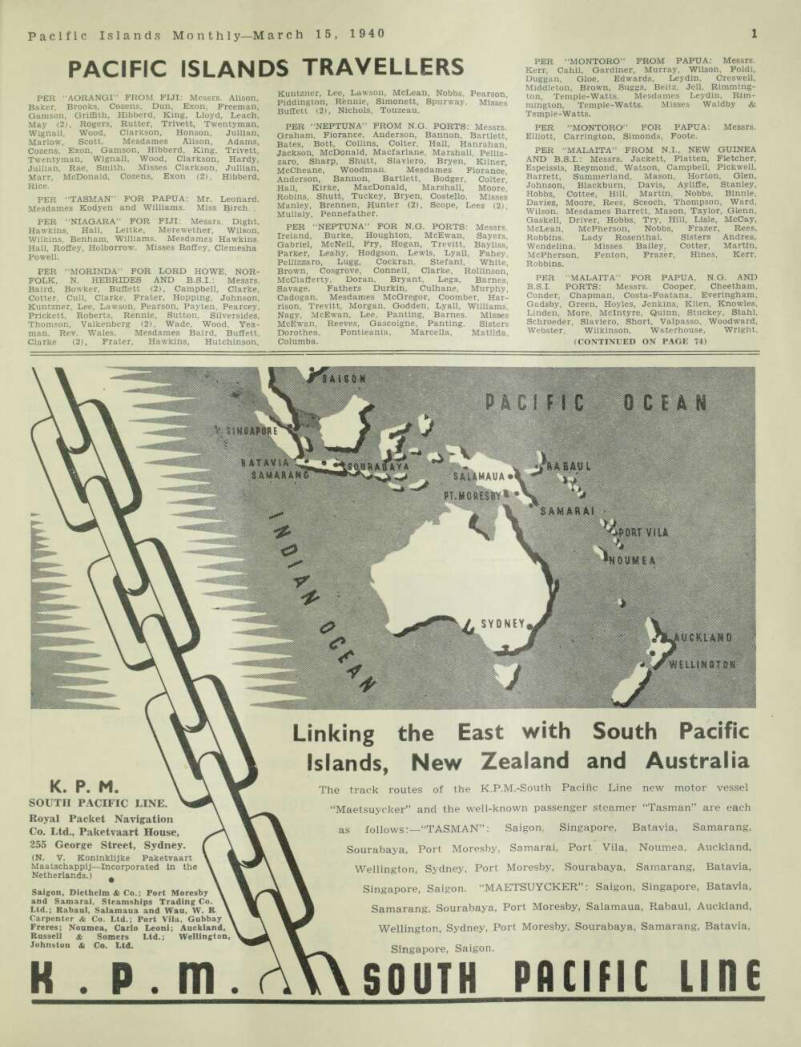
South Pacific Line
Ml
K. P. M.
SOUTH PACIFIC LINE.
Royal Packet Navigation Co. Ltd., Paketvaart House, 255 George Street, Sydney. (N. V. Konlnklijke Paketvaart Maatschappij—lncorporated in the Netherlands.) Saigon, Diethelm & Co.; Port Moresby and Samarai, Steamships Trading Co.
Ltd.; Rabaul, Salamaua and Wau, W. R Carpenter & Co. Ltd.; Port Vila, Gubbay Freres; Noumea, Carlo Leoni; Auckland, Russell & Somers Ltd.; Wellington, Johnston & Co. Ltd.
k.p . m
iMAUA
SYDNEY,
I
Linking the East with South Pacific
islands, New Zealand and Australia
The track routes of the K.P.M.-South Pacific Line new motor vessel “Maetsuycker” and the well-known passenger steamer “Tasman” are each as follows:—“TASMAN”; Saigon, Singapore, Batavia, Samarang, Sourabaya, Port Moresby, Samarai, Port Vila, Noumea, Auckland, Wellington, Sydney, Port Moresby, Sourabaya, Samarang, Batavia, Singapore, Saigon. “MAETSUYCKER”: Saigon, Singapore, Batavia, Samarang, Sourabaya, Port Moresby, Salamaua, Rabaul, Auckland, Wellington, Sydney, Port Moresby, Sourabaya, Samarang, Batavia, Singapore, Saigon.
SOUTH PACIFIC Line
Advertisers
Amalgamated Wire less (A/sia) Ltd. 42 Angus & Coote Ltd. 61 Arnott’s Biscuits . 22 Atkins Ltd., W. . . 41 “Ausoline” ... 64 Baker, W. Jno. . . 58
B.A.L.M. Ltd. ... 46
Bank of N.S.W. 70, 71 Berger’s Paints . . 44 “Bidomak” ... 53 Broomfields Ltd. . . 55 Brown & Co. Ltd., G 17 Brunton’s Flour . . 61 Burns,' Philp & Co.
Ltd 2 B.P. Magazine ... 28
B.P. (S.S.) Co. . . 48
Burns Philp Trust Co. Ltd 58 Buzacott-Wolseley . 59 Carlton & United Breweries Ltd. . . 31 Carpenter Ltd., W.
R cov. 2 Chapman & Sherack 55 Chivers & Sons Ltd 60 “Cinnamolia” Pre parations ... 26 Clyde Engineering Co. Ltd 68 Coleman Lamp & Stove Co. . . 27, 56 Colonial Sugar Re fining Co. ... 49 Coral Starch ... 34 Cosmopolitan Hotel 74 CTossle, Duff & Macintosh Ltd. . 63 Cummins, L. F. . . 62 “Cystex” ... 68 Dewar’s Whisky . . 29 Doan’s Pills ... 54 Donaghy & Sons Ltd 68 Donald Ltd., A. B. 50 Eaton Ltd., J. W. 45 Electrolux Refrigerators ... 30 Eno’s Fruit Salt . . 60 Eveready Batteries . 19
Excelsior Supply Co.
Ltd 26 Fairbanks - Morse Ltd 43 Fletcher & Sons . 32 “Flit” 62 Ford Sherington Ltd. 16 Foster Clark Ltd. . 13 Garden Vale Pro ducts Ltd. . . 38 Garrett & Davidson 63 Gillespie’s Flour . . 35 Goodwin, Ltd., A.
E 65 Gourock Rope Co. . 69 Gowing Bros. Ltd. . 16 Grand Pacific Hotel 51 Grove & Son, W. H. 52 Guinea Airways Ltd cov. 3 Guinness’ Stout . . 40 Halvorsen Sons Pty.
Ltd 73 Holbrook’s Ltd . . 39 Holmes & Co., W.
L 69 Horlicks Malted Milk 24 Horne. W. & Co. . . 50 Hotel Moresby . . 74 Jones & Co. Ltd., H. 14 Joyce Biscuits Ltd. 67 Kodak (A/sia) Ltd. 10 Kolynos Dental Cream 15 Kopsen & Co. Ltd. 47 Kork-N-Seal Ltd. . 38 Lea & Perrins Sauce 20 Levenson’s Radio . 66 Lloyd & Co. Ltd. . 11 Maxwell Porter Ltd. 45 Mcllrath’s Ltd. . . 20 Miller & Co. Pty, Ltd 72 Nelson & Robertson, Ltd 18 Nestles Milk ... 23 Newmarket Saddlery 71 Noyes Bros. Ltd. . 64 Ormonoid Roofing & Asphalts Ltd. . 74 Pacific Is. Club . . 9
Papua Hotel, The . 74 Pike Bros. Ltd. . . 73 Prescott Ltd. ... 35 Prouds Ltd. ... 11 Ransomes Sims & Jefferies Ltd. . . 52 Reed, William B. . 22 Rohu, Sil . . . . 54 Royal Packet Co. . 1 Rutherford, G. ... 72
Scott Ltd., J. ... 46 Smyth Ltd., J. H. . 64 Spartan Lacquers Pty. Ltd 48 Springwood Ladies’
College 70 Steamships Trading Co. Ltd 32 Sterling Varnish Co. 9 St. Ignatius College 36
Sullivan Ltd., C. . 52 Sunripe Cigarettes . 71 Swallow & Ariell . 34 Taylor & Co., A. . 63 “Tenax” Soap ... 25 Tilley Lamp Co. . 33 Tillock & Co. Ltd. . 56 Toohey’s Ltd. ... 21 Tooth & Co. . cov. 4 Vacuum Oil Co. . 57
Vincent’s A.P.C. . . 25 West, Harry ... 72 Weymark & Son . 35 Wills Ltd., W.D. & H.O 28 Wittners’ Ltd. . . 12 Wright & Co. Ltd., E. 45 Wunderlich Ltd. . . 45
Contents
Pao-e Pacific News-Review i Islands Travellers ’ 1 74 Where Stands Japan? .. ’3 Trans-Pacific Airmail Service .. !! 419 New Guinea Soldiers Join A.I.F. .. ’5 Suva’s Defences 5 How Planter Was Murdered in New Hebrides 6 N.G. Administrator in Canberra !! 6 Cool Hill Station for N. Caledonia 6 Higher Taxes for Fiji 6 Anxiety About Pacific Shipping Position 7 Japanese Start Islands Air Service 7 Who Will be Next Lieut.-Governor of Papua? 7 Funeral of Sir Hubert Murray .. 8 Aerial Freighting in New Guinea .. 8 Tropicalities 9 Passing of Sir Hubert Murray .. 11 America Wants Christmas Island .. 14 Suva’s Top-Heavy Town Board .. 18 Papuan Influenza Epidemic Checked 19 Book Reviews 20 Death of “Sharkeye” Park, Man Who Found New Guinea Goldfield 22 Should Copra Be Crushed in Islands? 26 Norfolk Island’s Industries .. .. 28 Native Labour Commission at Work in New Guinea 31
™ , • Page Checking Contraband Shipments in Pacific 32 The Late Fred Kruger, of Samarai 34 Nightmare Voyage in Small Yacht 35 New Bishop Museum Publications 36 Exploration of Unknown New Guinea.—Section 1 37 Samoa’s “Home-Brew” Attacked ’. ’. 43 Suspicious Natives in New Hebrides 45 English Girl Who Married Polyne sian Chief 46 Tahiti’s Dogs 49 Education in the G. & E. Group 50 Pineapple-Canning in Fiji .. ..51,59 Canker in Territories’ Administra tion 52 Cocos Is. Treasure-Seekers .. .. 54 Millionaires for a Day 55 Lord Howe Island’s Twin Peaks .. 56 Early Gold-Seekers in New Guinea 58 Fashion Notes for Island Women 61 Pacific Mining News ... .. 63 Fiji Indians and C.S.R. Co 65 Short Wave Radio Programmes .. 67 Fiji Copra to be Graded 68 French Savant’s Quest . in Pr.
Oceania 69 Exchange Rates and Produce Prices 70 Copra and Rubber Quotations .. 71 Shipping Services in the Pacific .. 72
Advertisements & other items, p. 6 (2 items)
2
March 15, 194 O—P acific Islands Monthly
Burns, Phil
m « nsiiiiii ninif UUlfllH m it in ii!l 111 111 mi HI Head Office: 7 Bridge Street, Sydney—Australia Code Address: " Burphil "
7 BRIDGE STREET, SYDNEY
128 ADELAIDE STREET. BRISBANE
GENERAL MERCHANTS
SHIPOWNERS TOURIST AGENTS
/3uyeli ofi
All Classes of Island Produce
REGULAR STEAMER SERVICES
From Australia to
NEW GUINEA— PAPUA, SOLOMON
ISLANDS. NEW HEBRIDES,
LORD HOWE IS., NORFOLK IS..
JAVA, SINGAPORE. CHINA
& CO. LTD.
312 COLLINS STREET. MELBOURNE
41 KING WILLIAM STREET. ADELAIDE
Pacific Islands Monthly
The Newspaper-Magazine of the South Seas
[Registered at the G.P.0., Sydney, for transmission by post as a newspaper .] Owned and Produced by Pacific Publications Pty. Ltd., Union House/ 247 George Street, Sydney.
( Managing Director .. BW 5037 TELtFHOJNi!, £ Business and Editorial MA 7101
P.O Box 3408 R
Registered Address of Telegrams, Radiograms, and Cables: "Pacpub”, Sydney.
Contributions.
Articles, Stories, and Photographs dealing with Pacific Islands subjects are invited and will be paid for on publication at usual rates.
Subscription Rates.
Per Annum, within British Empire, Prepaid, Post Free 8/- Per Annum, elsewhere, prepaid, Post Free . 10/- Slngle Copies Bd.
Editor and Publisher:
R. W. Robson, F.R.G.S.
Assisted by Selwyn Hughes.
Advertising Manager: L. W. Bailey.
Advertising Office and Printing-House: 29 Alberta St., Sydney.
Advertising rates furnished on application.
Colours, etc by Arrangement.
Process Blocks made at Advertiser’s expense when required. Screen 100.
Changes of Advertising Copy should reach this Office by Ist of each month, otherwise previous advertisement may be repeated.
IN LONDON, the Pacific Islands Monthly is on sale at the Bookstall, Australia House.
The Strand, London.
Agents.
The following are authorised to receive sub scriptions for the Pacific Islands Monthly;— Islands Branches of Burns, Philp & Co., Ltd., and Burns Philp (South Sea) Co., Ltd.
Islands Branches of W. R. Carpenter & Co., Ltd.
Islands Branches of Morris, Hedstrom, Ltd.
G. Thomas & Co., Rabaul, New Guinea.
T. A. Olsson, Wau, New Guinea.
Whitten Bros., Ltd., Samarai, Papua.
Steamships Trading Co., Papua. All Branches.
B.N.G. Trading Co., Ltd., Port Moresby.
J. Muir, Suva, Fiji.
N. C. Mackenzle-Hunt, Wainunu, Bua, FIJI, Islands Branches and Representatives of W. H.
Grove & Sons, Ltd., Auckland, New Zealand.
Cook Islands Trading Co., Rarotonga, Cook Is.
A. C. Rowland, Papeete, Tahiti.
Representative in London: W. C. HARVEY, Coronation* House, 4 Lloyds Avenue, London, E.C.3, from whom may be obtained copies of Pacific Islands Monthly, Pacific Islands Year Book, advertising schedules, etc.
Vol. X. No. 8.
March 15, 1940
Prire* f 8d - Per Copy rnce £ Prepaid: 8/- p.a.
And, To-day, Where Stands Japan?
A YEAR ago, Japan’s expansionists were glorying in the Berlin-Rome- Tokio Axis and, although gravely em barrassed in China, were sharpening an ambitious sword, and gazing south wards. Since then, Britain and France, owners of much of the Pacific territory which Japan covets, have become em broiled in war—the opportunity for which Japan Irredenta had prayed.
But Japan stays quiet. When Ger many, in August, somersaulted towards Moscow, she left Italy cursing and Japan foolishly isolated. The Japanese Army is bogged in China; the United States fleet carries out grim exercises around Hawaii; and Japan is economically em barrassed and without a friend. “Don’t worry about Japan,” say the more super ficial observers. “She is harmless, now.”
But is she?
Japan may be bogged in China; but she occupies some of the richest parts of Eastern China, and with great vigour and skill she is converting those dis tricts into Japanese dependencies. She may be financially embarrassed; but a great Power, economically harassed and, for the moment, without alliances, does not lie down and die. Japan is still with us, the biggest factor in the West ern Pacific. And what is Japan think ing? Read this, for instance; — “The South Seas belong to the Far East, and Japan is entitled to share the wealth of those regions which Europe snatched while Japan was self-isolated.
It is necessary to rectify Japan’s eco nomic portion, and now is the psycholo gical moment, while European powers with interests in the Soiith Seas are pre occupied. To achieve fruition of our continental policy and make the New Order self-sufficient it is absolutely essential to utilise the resources of the South Seas ... It is sometimes proposed that Dutch oil be forcibly seized but
other methods can be tried at first. One method would be to demand that Japan, China and Manchukuo receive prefer ential access. It is unreasonable that natives should be compelled to buy ex pensive European goods when they want Japan's excellent and cheap goods.”
That is the voice of Japan, as ex pressed in “Pacific”, the official organ of the new Institute of the Pacific, a Jap anese society. About the same time, the Tokio “Yomiuri Shimbun”, the third oldest newspaper in Japan, said; "Japan needs the resources of the South Seas and of the Western Pacific countries.
We will prefer to take the Philippines peacefully, by way of economic pene tration . . . . ”
On January 16, “Nippu Jiji”, a Japan ese journal published in Honolulu, quoted K. Yoshimura (a Japanese resi dent there for 40 years) as warmly praising Japanese penetration of the Philippines; and another Japanese, lec turing to Japanese children born in Hawaii, said: — “We Japanese must be proud of our glorious island empire, which is about to assume world supremacy. We are not of a race that will remain satisfied for ever in a subjugated position. Children of immigrants may not be able to be come rulers of that country immediately, but they will in time . . .”
“Immigrants”, of course, means Jap anese settled in the American territory of Hawaii. rESE quotations, examples of Jap anese territorial ambitions, could be multiplied a hundredfold. But they are sufficient to show how the Japanese are thinking. Japan wants the Philip pines, with their rich vegetable and mineral resources, and their room for colonists; and she quite plainly is get ting ready to take over the great ter
ritory, when America withdraws. Japan looks eagerly at the Dutch East Indies: some day, perhaps, Holland will have no powerful friends, and the Japanese may be able to take over the world’s richest tropical colony. And, although it seems sheer foolishness now, Japan hopes some day to control Hawaii —else, why does she so fiercely maintain her grip over 150,000 Japanese in Hawaii, one half of whom officially are Ameri can-born citizens?
The Dutch, for years, have been un easy about the southwards thrust of Japan, and the way in which Japanese interests display an interest in East Indies oil-wells. The Japanese would not be human if they could forget that 60,000,000 people in the East Indies pro vide an enormous market for Japan’s manufactured goods; and that East Indies wealth (European investments there are not less than four billions of florins) would go far towards settling the economic difficulties which threaten to cripple Japan. Japanese covetous ness has been so marked lately—becom ing more outspoken as Holland became embarrassed by the European war—that Holland became seriously alarmed, so that the Japanese Foreign Minister, on February 9, directed the following assur ance to The Hague:— “It is necessary to tighten Japan's economic relations with various coun tries in the South Seas, and at the same time to emphasise our lack of territorial ambitions. We only desire to exploit the natural resources of the South Seas ”
Which means precisely nothing. Japan gave similar assurances regarding Man churia, and China; but there she is now, armed, dominant and defiant, in each place. But nothing will happen to the East Indies or Hawaii while the Euro pean democracies and the United States sre undefeated. Japan, as the gentle
man says, will merely “exploit the natural resources of the South Seas”.
THE position is vastly different in the Philippines. According to present . arrangements, the Philippine Islands become a completely independent re public on July 4, 1946, except that cer tain “mutually beneficial economic ar rangements” between the young nation and the United States may continue until 1961. As 1946 approaches, many people, watching Japan, have urged that postponement of Philippines independ ence is desirable. But, speaking in Manila on February 25, the United States new High Commissioner, F. B.
Sayre, supported the 1946 arrangement, on the ground that “the United States taxpayers are not willing to support the increasing costs of defending the islands”.
It is certain that, as the United States moves out of the Philippines, Japan will move in. Sixteen million Filipinos can not hold back ninety million Japanese.
Already, the vanguard of the Japanese is there. About 25,000 of them have turned the Davao (south-eastern) dis trict of Mindanao (the largest and most southerly island of the territory) into a Little Japan. Quietly and efficiently, they are taking control of various in dustries. They are preparing for a much closer union. Month by month, in an increasing degree, cultural rela tions are being developed. Thousands of Filipino students are being sent on friendly tours of Japan. Newspapers, radio and cinema insist daily that Jap anese and Filipinos are of the same racial stock —that their future lies to gether. Day by day, the move to post pone “Independence Day”, so marked a year ago, grows weaker. There will be no independence for the Philippines—it will be a Japanese Colony within a couple of decades.
AND then, what? Look at the map.
Japan, Formosa, Philippines make an almost continuous land chain, paral leling the coast of Asia, and pointing insistently southwards; and the next logical step forward is the Dutch Indies, or New Guinea. Japan will not halt in the Philippines; she dare not turn to wards Hawaii; already, she holds all the archipelagos of the Marianas, Marshalls and Carolines. Is it not inevitable that, sooner or later, she will be found knock ing at the door of rich, undeveloped New Guinea —at first, as a bowing and smiling commercial penetrator, but, pre sently, with gun and bomb, after the manner illustrated in China in 1937-39?
Agitated old gentlemen urge us to make friends with the Japanese, and try to understand their desperate national problem. They must have mar kets, sources of raw materials and colonies —or perish. That is perfectly true; and it is the responsibility of the Caucasian Powers to help Japan to a solution of her problem. It can be done. But, in the doing of it, we must not forget caution, or drop our defences.
With all history to guide us, and with the rape of Manchukuo and China, Abyssinia and Czecho-Slovakia and Poland as recent demonstrations of how
far we may trust any covetous nation, we should recognise that constant readi ness, and the maintenance of mighty armaments, are the only guarantees of national safety and individual liberty in which we can put our faith.
Sydney-Auckland
Airmail
Difficulties of P.A.A.
From Our Own Correspondent
Honolulu, Feb. 24.
INDICATIONS are that Pan American Airways are anxious to get going with their San Francisco-New Zealand trans-Pacific airmail: but it is clear that the corporation is being seriously em barrassed by the calls which are being made upon it to provide flying-boats for the North Pacific and North Atlantic services, with a consequent difficulty of finding suitable craft for the South Pacific service.
P.A.A. now are running a service be tween New York and Portugal; but another American company, Export Airlines, has entered the field, appar ently with strong Government sym pathy, and there are indications of fur ther opposition from a new Dutch company.
P.A.A. cannot get sufficient equipment, in the present circumstances, to pro ceed with plans for improving both the Atlantic and Pacific services. Some time may elapse before more Boeing Clip pers will be available.
If P.A.A. do get their South Pacific services going, to connect with the new
flying-boat service between Sydney and Auckland, it is difficult to see how it can provide more than a fortnightly service between Auckland and Honolulu.
IT was announced, on March 8, that another British flying-boat, the “Awarua”, shortly will fly to Australia, in order to join the “Aotearoa” in carrying on a regular flying-boat ser vice between Sydney and Auckland.
There appears now to be growing con fidence that this—the first —section of the trans-Pacific airmail will be inau gurated in April. The single, one-way fare is to be £3O.
(See, also, article on page 19.)
Death of Mrs. Jane Thurston
MRS. Jane Thurston died at Sydney on February 20. She lived for many years in Suva. Fiji, having married a brother of the late Sir John Thurston, Governor of Fiji. Her many friends there will remember her as a most amiable and gracious lady. She leaves a sister (Mrs. Garrick, senior, of Suva), a daughter (Mrs. E. L. Leembruggen. of Ocean Island), a son (Mr. H Thurston, of Auckland) and a grandson (Mr.
Harold Thurston Bentley, of the Civil Service, Suva).
Mr. G. A. Joy, British Resident Com missioner in the New Hebrides for many years, has been appointed British Resi dent Adviser at Makalla, Arabia. He will succeed Mr. W. H. Ingrams, who has the reputation of knowing more about the Arabs than any man since the late Colonel Lawrence. Makalla is 300 miles east of Aden, where Mr. Ingrams is now Chief Secretary.
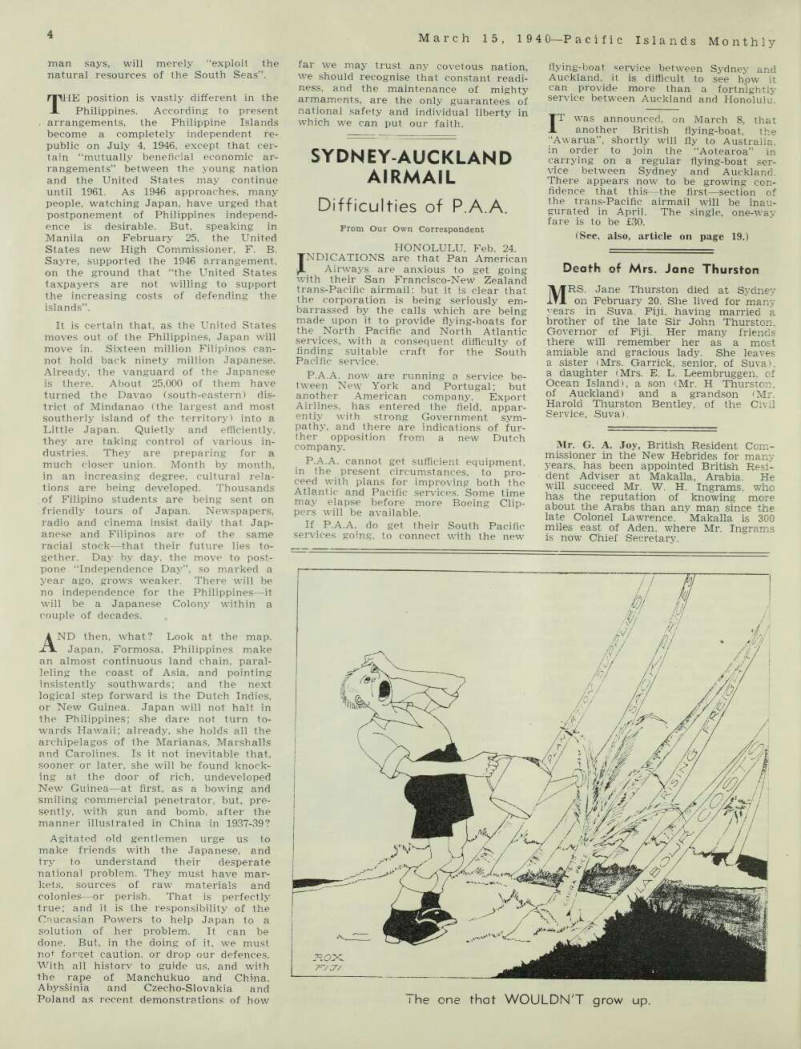
The one that WOULDN'T grow up.
Advertisements & other items, pp. 8-9 (2 items)
4
March 15, 194 O—P acific Islands Monthly
Soldiers From New Guinea
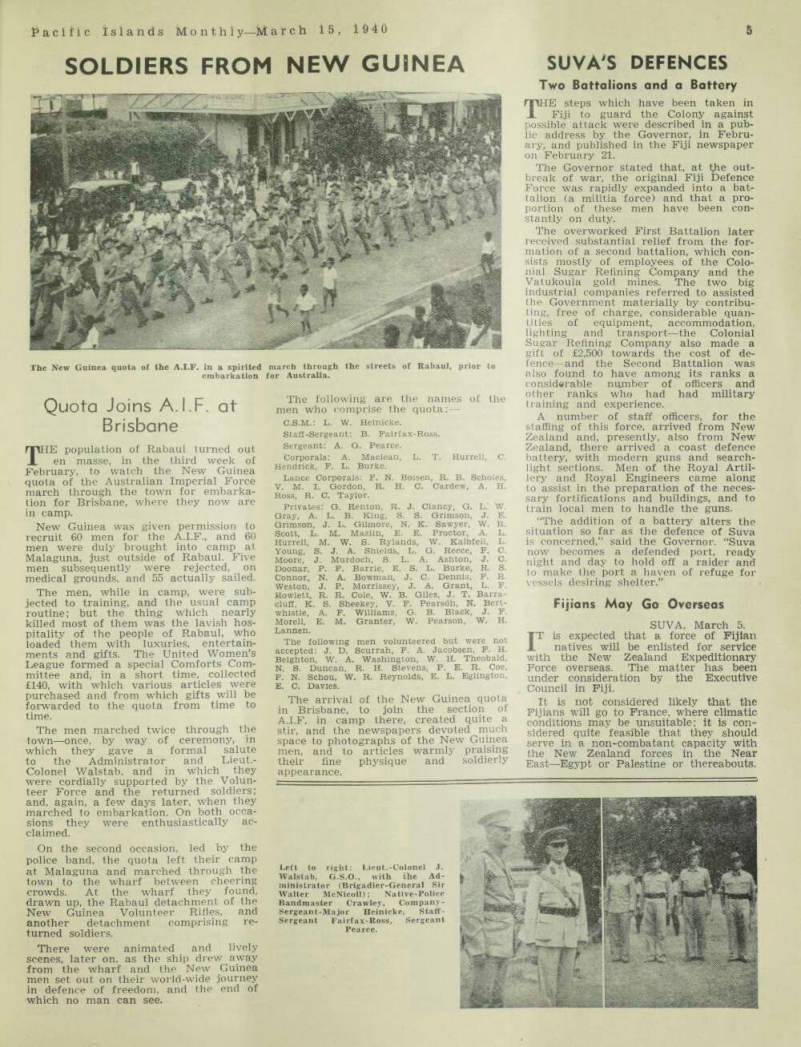
The New Guinea quota of the A.I.F. In a spirited march through the streets of Rabaul, prior to embarkation for Australia.
Quota Joins A.I.F. at Brisbane
Brisbane
rE population of Rabaul turned out en masse, in the third week of February, to watch the New Guinea quota of the Australian Imperial Force march through the town for embarka tion for Brisbane, where they now are in camp.
New Guinea was given permission to recruit 60 men for the A.1.F., and 60 men were duly brought into camp at Malaguna, just outside of Rabaul. Five men subsequently were rejected, on medical grounds, and 55 actually sailed.
The men, while in camp, were sub jected to training, and the usual camp routine; but the thing which nearly killed most of them was the lavish hos pitality of the people of Rabaul, who loaded them with luxuries, entertain ments and gifts. The United Women’s League formed a special Comforts Com mittee and, in a short time, collected £l4O, with which various articles were purchased and from which gifts will be forwarded to the quota from time to time.
The men marched twice through the town —once, by way of ceremony, in which they gave a formal salute to the Administrator and Lieut.- Colonel Walstab. and in which they were cordially supported by the Volun teer Force and the returned soldiers; and, again, a few days later, when they marched to embarkation. On both occa sions they were enthusiastically ac claimed.
On the second occasion, led by the police band, the quota left their camp at Malaguna and marched through the town to the wharf between cheering crowds. At the wharf they found, drawn up, the Rabaul detachment of the New Guinea Volunteer Rifles, and another detachment comprising re turned soldiers.
There were animated and lively scenes, later on, as the ship drew away from the wharf and the New Guinea men set out on their world-wide journey in defence of freedom, and the end of which no man can see.
The following are the names of the men who comprise the quota:— C.S.M.: L. W. Heinicke.
Staff-Sergeant: B. Fairfax-Ross.
Sergeant: A. G. Pearce.
Corporals: A. Maclean, L. T. Hurrell, C.
Hendrick, F. L. Burke.
Lance Corporals: F. N. Boisen, R. B. Scholes, V. M. I. Gordon, R. H. C. Cardew, A. H.
Ross, R. C. Taylor.
Privates: G. Renton, R. J. Clancy, G. L. W.
Gray, A. L. B. King, S. S. Grimson, J. E.
Grimson, J. L. Gilmore, N. K. Sawyer, W. R.
Scott, L. M. Mazlin, E. E. Proctor, A. L.
Hurrell, M. W. S. Rylands, W. Kalbfell, L.
Young, S. J. A. Shields, L. G. Reece, F. C.
Moore, J. Murdoch, S. L. A. Ashton, J. C.
Doonar, P. F, Barrie, E. S. L. Burke, R. S.
Connor, N. A. Bowman, J. C. Dennis, F, R.
Weston, J. P. Morrissey, J. A. Grant, L, F.
Hewlett, R. R. Cole, W. B. Giles, J. T. Barra cluff. K. S. Sheekey, V. F. Pearson, N. Bert whistle, A. F. Williams, G. B. Black, J. F.
Morell, E. M. Granter, W. Pearson, W. H.
Lannen.
The following men volunteered but were not accepted; J. D. Scurrah, F. A. Jacobsen, F. H.
Beighton, W. A. Washington, W. H. Theobald, N. S. Duncan, R. H. Stevens, P. E. R. Coe, F. N. Schou, W. R. Reynolds, E. L. Eglington, E, C, Davies.
The arrival of the New Guinea quota in Brisbane, to join the section of A.I.F. in camp there, created quite a stir, and the newspapers devoted much space to photographs of the New Guinea men, and to articles warmly praising their fine physique and soldierly appearance.
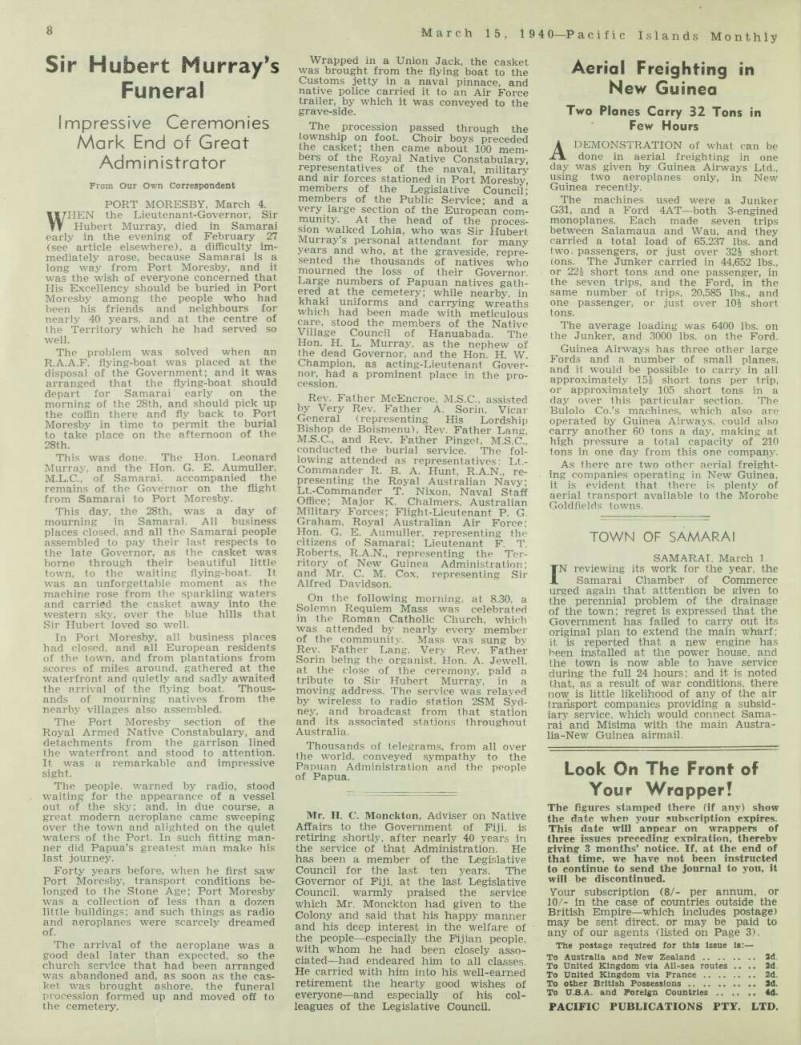
Left to right: Lieut.-Colonel J.
WaIstab, G.S.O., with the Ad ministrator (Brigadier-General Sir Walter McNicoll); Native-Police Bandmaster Crawley, Company- Sergeant-Major Heinicke, Staff- Sergeant Fairfax-Ross, Sergeant Pearce.
Suva's Defences
Two Battalions and a Battery
rE steps which have been taken in Fiji to guard the Colony against possible attack were described in a pub lic address by the Governor, in Febru ary, and published in the Fiji newspaper on February 21.
The Governor stated that, at out break of war, the original Fiji Defence Force was rapidly expanded into a bat talion (a militia force) and that a pro portion of these men have been con stantly on duty.
The overworked First Battalion later received substantial relief from the for mation of a second battalion, which con sists mostly of employees of the Colo nial Sugar Refining Company and the Vatukoula gold mines. The two big industrial companies referred to assisted the Government materially by contribu ting, free of charge, considerable quan tities of equipment, accommodation, lighting and transport—the Colonial Sugar Refining Company also made a gift of £2,500 towards the cost of de fence—and the Second Battalion was also found to have among its ranks a considerable number of officers and other ranks who had had military training and experience.
A number of staff officers, for the staffing of this force, arrived from New Zealand and, presently, also from New Zealand, there arrived a coast defence battery, with modern guns and search light sections. Men of the Royal Artil lery and Royal Engineers came along to assist in the preparation of the neces sary fortifications and buildings, and to train local men to handle the guns.
“The addition of a battery alters the situation so far as the defence of Suva is concerned,” said the Governor. “Suva now becomes a defended port, ready night and day to hold off a raider and to make the port a haven of refuge for vessels desiring shelter.”
Fijians May Go Overseas
SUVA, March 5.
IT is expected that a force of Fijian natives will be enlisted for service with the New Zealand Expeditionary Force overseas. The matter has been under consideration by the Executive Council in Fiji.
It is not considered likely that the Fijians will go to France, where climatic conditions may be unsuitable; it is con sidered quite feasible that they should serve in a non-combatant capacity with the New Zealand forces in the Near East —Egypt or Palestine or thereabouts.
Advertisements & other items, p. 9 (1 item)
5
Pacific Islands Month! y—M arch 15, 194 0
Murdered Planter
Details of Tragedy in New Hebrides
IT was announced in the “P.1.M.” in November, that M. Paul Mazoyer, a French planter, of Aore, New Heb rides, had been murdered by Malekula when recruiting on the Male kula coast.
We are indebted to “Bulletin du Com merce”, Noumea, for the following details.
M. Mazoyer was engaged in an argu ment with a tribal chief, in connection with the recruiting of three native women, whom he had embarked. Five bushmen came on board, one of them armed with a gun. While M. Mazoyer talked with them, his crew left his cut ter in the only boat, being apparently privy to a conspiracy against the planter. Doubtless realising the danger he ran, alone aboard with these five bushmen, M. Mazoyer went down to his cabin to arm himself. He was followed by the natives and was shot in the back. Seizing a hammer, he struck one of his assailants on the head. Stand ing erect, in spite of his wound, he held on with one hand to the door of his cabin; but a sabre cut severed the fin gers of that hand, while a second shot, fired point blank, pierced his armpit and killed him.
Three other shots were then fired at Mazoyer, already lying dead on the floor of his cabin. After that, the vessel was pillaged by the murderers, who—the boat returning at the sound of the shots and the victorious shouts of the natives —finally made off, taking with them the three women.
The body of M, Mazoyer was brought back to Santo on his ship, by the same crew, and he was buried on his planta tion at Aore.
The Administration (represented at Malekula by M. Bourgeaud and Mr.
Adams) offered a reward to the native chief for the capture of the others. A first visit by both officials to the tribe concerned was unsuccessful. But, later, when Mr. Adams, the British represen tative, was returning alone (his French colleague having gone on to Noumea) he captured the five natives, who were sent to Port Vila, where they were formally accused of the murder. Mr.
Adams obtained particulars from wit nesses.
N. Guinea Administrator
In Canberra
rpHE Administrator of the Territory of A New Guinea, Brigadier-General Sir Walter McNicoll, arrived in Sydney by the Carpenter air-mail from Rabaul, early in March, and spent several days at Canberra, discussing Territory affairs with his Ministerial and Departmental chiefs.
The matters discussed included mea sures for the defence of the Territory; the transport position created by the war situation, and the shortage of ship ping; the effect of the shortage of ship ping upon the copra position; the build ing of a road between Salamaua and Wau, and the most suitable route for same; and a wide variety of other mat ters.
During His Honour’s absence, the Gov ernment Secretary, Hon. Harold Page, is acting as Administrator.
Caledonia
Cool Hill Station For New Caledonia
IT is astonishing that in a colony such as New Caledonia, where there are prodigious natural facilities for such an establishment, there is no health resort (says “Bulletin du Commerce”).
Many residents of New Caledonia suf fer from illnesses which are directly due to the severe climatic conditions, and which result in physical and men tal depression. In such cases, the bene ficial effect of a mountain resort with change of air, and rest, is apparent. It is indispensable, also, in the treatment of tuberculosis, in the first stages.
The Municipal Council voted, in 1938, a sum of 10,000 francs, for the investi gation of such a project. The General Council, recently, has voted 10,000 francs for the same purpose. The Ad ministration has nominated a Commis sion, which will inquire into this mat ter. It is hoped that there thus will be provided a sanatorium, probably on the Mountain of Two Sources, situated in the Coulee region, at an altitude of about 4000 feet.
Mr. E. R. Palfreyman has left Sydney for Fiji to take up an appointment as manager of W. R. Carpenter and Co.’s branch at Suva.
Higher Taxes
Fiji Under War-time
Conditions
IN order to provide for higher cost of administration and for special defence expenditure—both made neces sary by the war—the Government of Fiji has increased private income-tax by 25 per cent, to 1/3 in the £, increased company income-tax by 50 per cent., to 1/6 in the f, raised the residential tax from fl to 25/- per annum per indi vidual; and has added 1 per cent, to the Port and Customs Service tax on imports. It is estimated that the higher income taxes will yield £25,000 per annum, and the new tax on imports about £12,000 per annum.
The new taxation was provided for in a series of bills passed by the Legisla tive Council in February.
The Council is almost wholly nomina tive now, and consists of official and non-official members. All non-official members protested very strongly against any increase in the tax burden, in view of the fact that the Government of Fiji, year by year, shows a substantial sur plus. Mr. Alport Barker pointed out that the Colony now has reserves of £137,600 and £141,000, and lately had created another special reserve of £50,000. They had been told, said Mr.
Barker, that these reserves were for emergency—surely it was an emergency which the Colony now was facing, and surely it was reasonable to suggest that extra expenditure of approximately £40,000 per annum could be financed for a while out of reserves totalling £330,000.
The Governor, however, pointed out that Britain was preparing for a long war, and the British people were mak ing colossal sacrifices, while the sacri fice that was now being suggested to the people of Fiji was infinitesimal. It was quite true that the reserves were being held for an emergency, but, from every point of view, it was wise at this stage of the war to conserve all the financial resources of the Colony, and for* the present to provide for the extra expen diture out of taxation. Also, those re serves were invested in Britain, and could not be taken out without embar rassment.
The bills were passed by 16 votes to 14—representing exactly the division be tween official and non-official strength in the Council.
Non-Official Members’ Protest
It was disclosed, a few days later that, on this subject of taxation, unofficial members had transmitted, through the Governor of Fiji, certain urgent repre sentations > to the Secretary of State for the Colonies, and further sittings of the Legislative Council were postponed, pending a reply from London.
The reply came a few days later. It was evident that the representations of the non-official members had received careful examination: but the Colonial Secretary was firm in insisting that Fiji, at once, should meet war expendi ture out of revenue, and protect her reserves.
Mr. Bert Coster, a surveyor, who prac tised in Suva and Sigatoka, Fiji, died recently at the age of 52, following a long illness. He was bom in Suva and at one time was in the service of the Fiji Government. One of his brothers, Mr. Sydney Coster, is manager for the Union Steam Ship Co., at Papeete, Tahiti.
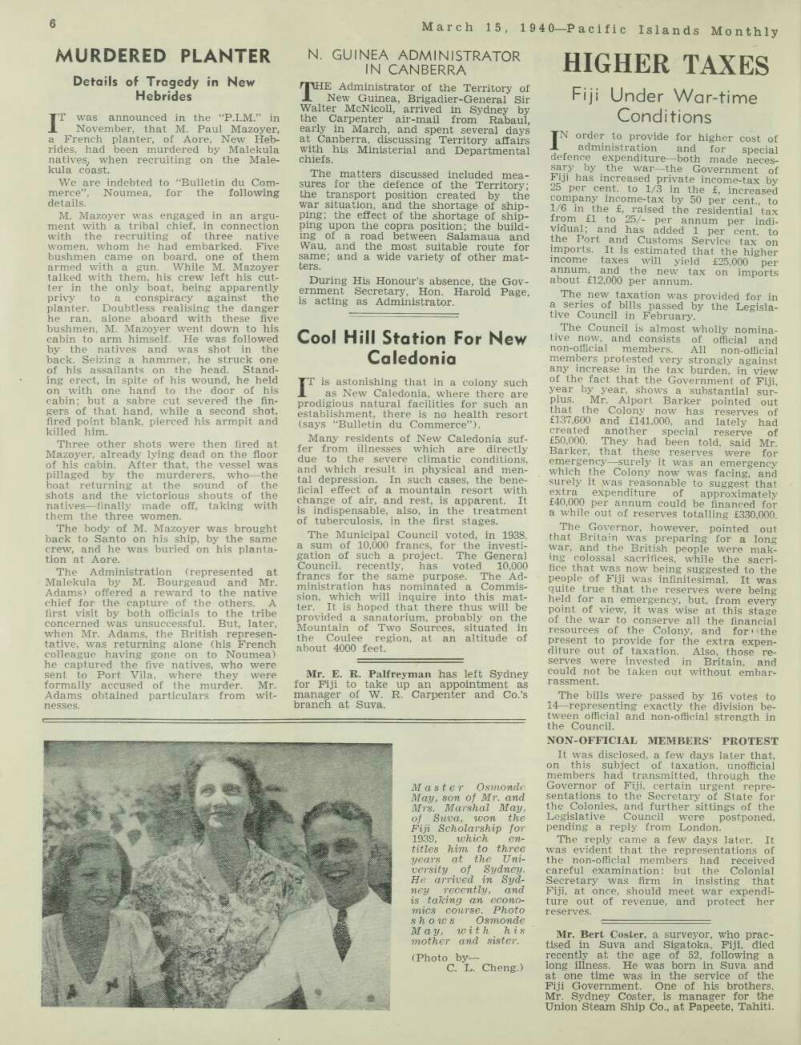
Master Osmonde May, son of Mr. and Mrs. Marshal May, of Suva, won the Fiji Scholarship for 1939, which en titles him to three years at the Uni versity of Sydney.
He arrived in Syd ney recently, and is taking an econo mics course. Photo shows Osmonde May, with his mother and sister. (Photo by— C. L. Cheng.)
Advertisements & other items, p. 10 (1 item)
6
March 15, 194 O—P acific Islands Monthly
Too Few Ships
Accumulations of Copra Cause Anxiety in Pacific Ports
THE position in relation to, copra ship ments in the Pacific during the past month has become acute. Copra is piling up in the Islands stores, not because production has increased—for it has not —but because there has been a sharp diminution in the number of freight-carriers available.
The most serious blow to copra ship pers was the action of the British Gov ernment in taking charge of the Car penter ships.
As is well known, Messrs. W. R. Car penter and Co. Ltd. run three ships— the new “Suva”, the “Salamaua”, and the “Rabaul”. For some years, now, they have been picking up copra at the vari ous Islands ports and carrying it either westwards around Africa to London, or eastwards to American ports.
When war broke out, and much ship ping was diverted, for other purposes, the Carpenter ships remained on the job in the Pacific and kept the copra cargoes moving.
But the Carpenter ships were not on the Australian register. They are regis-
tered in Suva, and, as Fiji is a British Crown Colony, they automatically came under British control when the British Government took command of all mer cantile shipping recently. As a result, the Carpenter ships are now simply part of the huge British mercantile fleet which is being directed from London, and they are not available, as hereto fore, for picking up copra in Pacific ports, according to the orders of Car penter headquarters in Sydney. As a result, very serious inconvenience has been caused, and some people who have seen the copra piling up in the stores have expressed alarm.
The position is not as bad as was feared, however. The shortage of ship ping in the Pacific is not due to a short age of ships so much as to the sudden general re-organisation of British ship ping under London’s central control.
At first, naturally, only the Austra lasian and Pacific cargoes regarded as most urgent, from the point of view of war needs, were picked up by the avail able ships; but, slowly, these more
urgent needs are being overtaken and, probably in a short time, there should be ships to handle the accumulations of copra in the different Pacific ports.
But there is no sign, yet of better copra prices. Copra still is under Anglo- French Government control, and, at the moment, both countries seem to be flooded with whale oil.
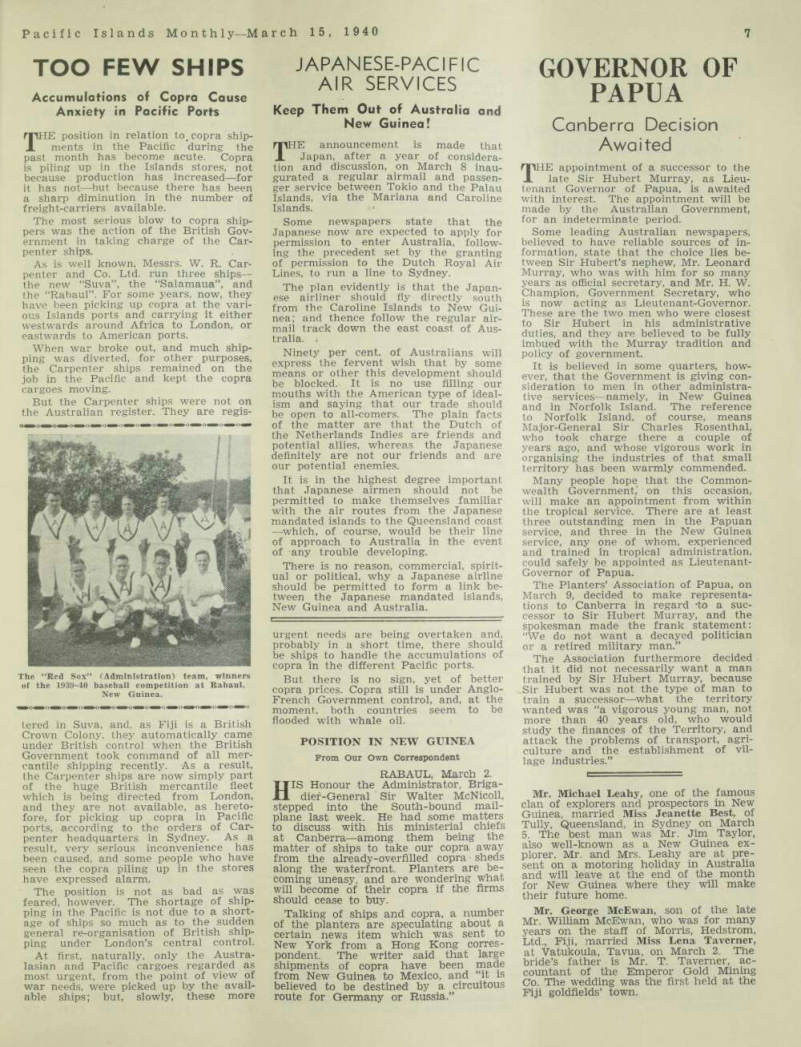
The “Red Sox” (Administration) team, winners of the 1939-40 baseball competition at Rabaul, New Guinea.
Japanese-Pacific
Air Services
Keep Them Out of Australia and New Guinea!
rE announcement is made that Japan, after a year of considera tion and discussion, on March 8 inau gurated a regular airmail and passen ger service between Tokio and the Palau Islands, via the Mariana and Caroline Islands.
Some newspapers state that the Japanese now are expected to apply for permission to enter Australia, follow ing the precedent set by the granting of permission to the Dutch Royal Air Lines, to run a line to Sydney.
The plan evidently is that the Japan ese airliner should fly directly south from the Caroline Islands to New Gui nea; and thence follow the regular air mail track down the east coast of Aus tralia. .
Ninety per cent, of Australians will express the fervent wish that by some means or other this development should be blocked. It is no use filling our mouths with the American type of ideal ism and saying that our trade should be open to all-comers. The plain facts of the matter are that the Dutch of the Netherlands Indies are friends and potential allies, whereas the Japanese definitely are not our friends and are our potential enemies.
It is in the highest degree important that Japanese airmen should not be permitted to make themselves familiar with the air routes from the Japanese mandated islands to the Queensland coast —which, of course, would be their line of approach to Australia in the event of any trouble developing.
There is no reason, commercial, spirit ual or political, why a Japanese airline should be permitted to form a link be tween the Japanese mandated islands, New Guinea and Australia.
Position In New Guinea
Prom Our Own Correspondent RABAUL, March 2.
HIS Honour the Administrator, Briga dier-General Sir Walter McNicqll, stepped into the South-bound mail plane last week. He had some matters to discuss with his ministerial chiefs at Canberra—among them being the matter of ships to take our copra away from the already-overfilled copra sheds along the waterfront. Planters are be coming uneasy, and are wondering what will become of their copra if the firms should cease to buy.
Talking of ships and copra, a number of the planters are speculating about a certain news item which was sent to New York from a Hong Kong corres pondent. The writer said that large shipments of copra have been made from New Guinea to Mexico, and “it is believed to be destined by a circuitous route for Germany or Russia.”
Governor Of
Papua
Canberra Decision Awaited
THE appointment of a successor to the late Sir Hubert Murray, as Lieu tenant Governor of Papua, is awaited with interest. The appointment will be made by the Australian Government, for an indeterminate period.
Some leading Australian newspapers, believed to have reliable sources of in formation, state that the choice lies be tween Sir Hubert’s nephew, Mr. Leonard Murray, who was with him for so many years as official secretary, and Mr. H. W.
Champion, Government Secretary, who is now acting as Lieutenant-Governor.
These are the two men who were closest to Sir Hubert in his administrative duties, and they are believed to be fully imbued with the Murray tradition and policy of government.
It is believed in some quarters, how ever, that the Government is giving con sideration to men in other administra tive services—namely, in New Guinea and in Norfolk Island. The reference to Norfolk Island, of course, means Major-General Sir Charles Rosenthal, who took charge there a couple of years ago, and whose vigorous work in organising the industries of that small territory has been warmly commended.
Many people hope that the Common wealth Government,' on this occasion, will make an appointment from within the tropical service. There are at least three outstanding men in the Papuan service, and three in the New Guinea service, any one of whom, experienced and trained in tropical administration, could safely be appointed as Lieutenant- Governor of Papua.
The Planters’ Association of Papua, on March 9, decided to make representa tions to Canberra in regard *to a suc cessor to Sir Hubert Murray, and the spokesman made the frank statement: “We do not want a decayed politician or a retired military man.”
The Association furthermore decided that it did not necessarily want a man trained by Sir Hubert Murray, because Sir Hubert was not the type of man to train a successor —what the territory wanted was “a vigorous young man, not more than 40 years old, who would study the finances of the Territory, and attack the problems of transport, agri culture and the establishment of vil lage industries.”
Mr. Michael Leahy, one of the famous clan of explorers and prospectors in New Guinea, married Miss Jeanette Best, of Tully, Queensland, in Sydney on March 5. The best man was Mr. Jim Taylor, also well-known as a New Guinea ex plorer. Mr. and Mrs. Leahy are at pre sent on a motoring holiday in Australia and will leave at the end of the month for New Guinea where they will make their future home.
Mr. George McEwan, son of the late Mr. William McEWan, who was for many years on the staff of Morris, Hedstrom, Ltd., Fiji, married Miss Lena Taverner, at Vatukoula, Tavua, on March 2. The bride’s father is Mr. T. Taverner, ac countant of the Emperor Gold Mining Co. The wedding was the first held at the Fiji goldfields’ town.
Advertisements & other items, p. 11 (1 item)
7
Pacific Islands Monthl y—M arch 15, 1940
Sir Hubert Murray’s
Funeral Impressive Ceremonies Mark End of Great Administrator
From Our Own Correspondent
Port Moresby, March 4.
WHEN the Lieutenant-Governor, Sir Hubert Murray, died in Samarai early in the evening of February 27 (see article elsewhere), a difficulty im mediately arose, because Samarai is a long way from Port Moresby, and it was the wish of everyone concerned that His Excellency should be buried in Port Moresby among the people who had been his friends and neighbours for nearly 40 years, and at the centre of the Territory which he had served so well.
The problem was solved when an R.A.A.F. flying-boat was placed at the disposal of the Government; and it was arranged that the flying-boat should depart for Samarai early on the morning of the 28th, and should pick up the coffin there and fly back to Port Moresby in time to permit the burial to take place on the afternoon of the 28th.
This was done. The Hon. Leonard Murray, and the Hon. G. E. Aumuller, M.L.C., of Samarai, accompanied the remains of the Governor on the flight from Samarai to Port Moresby.
This day, the 28th, was a day of mourning in Samarai. All business places closed, and all the Samarai people assembled to pay their last respects to the late Governor, as the casket was borne through their beautiful little town, to the waiting flying-boat. It was an unforgettable moment as the machine rose from the sparkling waters and carried the casket away into the western sky, over the blue hills that Sir Hubert loved so well.
In Port Moresby, all business places had closed, and all European residents of the town, and from plantations from scores of miles around, gathered at the waterfront and quietly and sadly awaited the arrival of the flying boat. Thous ands of mourning natives from the nearby villages also assembled.
The Port Moresby section of the Royal Armed Native Constabulary, and detachments from the garrison lined the waterfront and stood to attention.
It was a remarkable and impressive sight.
The people, warned by radio, stood waiting for the appearance of a vessel out of the sky; and, in due course, a great modern aeroplane came sweeping over the town and alighted on the quiet waters of the Port. In such fitting man ner did Papua’s greatest man make his last journey.
Forty years before, when he first saw Port Moresby, transport conditions be longed to the Stone Age; Port Moresby was a collection of less than a dozen little buildings; and such things as radio and aeroplanes were scarcely dreamed of.
The arrival of the aeroplane was a good deal later than expected, so the church service that had been arranged was abandoned and, as soon as the cas ket was brought ashore, the funeral procession formed up and moved off to the cemetery.
Wrapped in a Union Jack, the casket was brought from the flying boat to the Customs jetty in a naval pinnace, and native police carried it to an Air Force trailer, by which it was conveyed to the grave-side.
The procession passed through the township on foot. Choir boys preceded the casket; then came about 100 mem bers of the Royal Native Constabulary, representatives of the naval, military and air forces stationed in Port Moresby, members of the Legislative Council; members of the Public Service; and a very large section of the European com munity. At the head of the proces sion walked Lohia, who was Sir Hubert Murray’s personal attendant for many years and who, at the graveside, repre sented the thousands of natives who mourned the loss of their Governor.
Large numbers of Papuan natives gath ered at the cemetery; while nearby, in khaki uniforms and carrying wreaths which had been made with meticulous care, stood the members of the Native Village Council of Hanuabada. The Hon. H. L. Murray, as the nephew of the dead Governor, and the Hon. H. W.
Champion, as acting-Lieutenant Gover nor, had a prominent place in the pro cession.
Rev. Father McEncroe, M.S.C., assisted by Very Rev. Father A. Sorin, Vicar General (representing His Lordship Bishop de Boismenu), Rev. Father Lang, M.S.C., and Rev. Father Pinget, M.S.C., conducted the burial service. The fol lowing attended as representatives: Lt.- Commander R. B. A. Hunt, R.A.N., re presenting the Royal Australian Navy; Lt.-Commander T. Nixon, Naval Staff Office; Major K. Chalmers, Australian Military Forces; Flight-Lieutenant P. G.
Graham, Royal Australian Air Force; Hon. G. E. Aumuller, representing the citizens of Samarai; Lieutenant F. T.
Roberts, R.A.N., representing the Ter ritory of New Guinea Administration; and Mr. C. M. Cox, representing Sir Alfred Davidson.
On the following morning, at 8.30, a Solemn Requiem Mass was celebrated in the Roman Catholic Church, which was attended by nearly every member of the community. Mass was sung by Rev. Father Lang, Very Rev. Father Sorin being the organist. Hon. A. Jewell, at the close of the ceremony, paid a tribute to Sir Hubert Murray, in a moving address. The service was relayed by wireless to radio station 2SM Syd ney, and broadcast from that station and its associated stations throughout Australia.
Thousands of telegrams, from all over the world, conveyed sympathy to the Papuan Administration and the people of Papua.
Mr. H. C. Monckton, Adviser on Native Affairs to the Government of Fiji, is retiring shortly, after nearly 40 years in the service of that Administration. He has been a member of the Legislative Council for the last ten years. The Governor of Fiji, at the last Legislative Council, warmly praised the service which Mr. Monckton had given to the Colony and said that his happy manner and his deep interest in the welfare of the people—especially the Fijian people, with whom he had been closely asso ciated—had endeared him to all classes.
He carried with him into his well-earned retirement the hearty good wishes of everyone—and especially of his col leagues of the Legislative Council.
Aerial Freighting in
New Guinea Two Planes Carry 32 Tons in Few Hours
A DEMONSTRATION of what can be done in aerial freighting in one day was given by Guinea Airways Ltd., using two aeroplanes only, in New Guinea recently.
The machines used were a Junker G3l, and a Ford 4AT —both 3-engined monoplanes. Each made seven trips between Salamaua and Wau, and they carried a total load of 65,237 lbs. and two. passengers, or just over 32i short tons. The Junker carried in 44,652 lbs., or 22i short tons and one passenger, in the seven trips, and the Ford, in the same number of trips, 20,585 lbs., and one passenger, or just over 10J short tons.
The average loading was 6400 lbs. on the Junker, and 3000 lbs. on the Ford.
Guinea Airways has three other large Fords and a number of small planes, and it would be possible to carry in all approximately 151 short tons per trip, or approximately 105 short tons in a day over this particular section. The Bulolo Co.’s machines, which also are operated by Guinea Airways, could also carry another 60 tons a day, making at high pressure a total capacity of 210 tons in one day from this one company.
As there are two other aerial freight ing companies operating in New Guinea, it is evident that there is plenty of aerial transport available to the Morobe Goldfields towns.
Town Of Samarai
SAM ARM. March 1.
IN reviewing its work for the year, the Samarai Chamber of Commerce urged again that atttention be given to the perennial problem of the drainage of the town: regret is expressed that the Government has failed to carry out its original plan to extend the main wharf: it is reported that a new engine has been installed at the power house, and the town is now able to have service during the full 24 hours: and it is noted that, as a result of war conditions, there now is little likelihood of any of the air transport companies providing a subsid iary service, which would connect Sama rai and Misima with the main Austra lia-New Guinea airmail.
Advertisements & other items, p. 12 (1 item)
Your Wrapper!
Look On The Front of
The figures stamped there (if any) show the date when your subscription expires.
This date will appear on wrappers of three issues preceding expiration, thereby giving 3 months’ notice. If, at the end of that time, we have not been instructed to continue to send the journal to you, it will be discontinued.
Your subscription (8/- per annum, or 10/- in the case of countries outside the British Empire—which includes postage) may be sent direct, or may be paid to any of our agents (listed on Page 3).
The postage required for this Issue Is:— To Australia and New Zealand 2d.
To United Kingdom via All-sea routes ... 2d To United Kingdom via Prance 2d.
To other British Possessions 2d.
To U.S.A. and Foreign Countries 4d.
PACIFIC PUBLICATIONS PTY. LTD.
Tropiclities
ONCE, when Great Britain and Japan were officially friendly, we had only to express a wish for a copy of the annual report relating to the Caroline and Marshall Islands (held by Japan under mandate) and Tokio most cour teously complied. But, for several years now, we have not been able to obtain any information from Japan in regard to the administration of that Mandated Territory, and we have to depend upon all sorts of more or less unofficial sources for details. But the United States seems to have succeeded where all others have failed. Washington recently kicked up a row, and pointed out that Japan had committed a breach of her undertaking to the League of Nations by failing to issue an annual report relating to the Caroline and Mar shall Islands. It was reported from Tokio, on March 5, that the Japanese Government now has handed to the American Ambassador reports covering the years up to and including 1938. ♦ ♦ * EITHER the magisterial authorities are becoming callous, or the imagina tion of the Papuan labourer is beginning to fail. One native, challenged on the possession of a new rami, said that he found it in the rubbish tin at a board ing-house. Another, charged with stealing a piece of timber, could only plead that he wanted it to build a kit chen for himself. A third, caught with an assortment of nail-bits and knives, could think of nothing more convincing than that another native had given them to him. Then a taxi-driver, in whose quarters two bottles of beer and two tins of cigarettes were discovered by the inquisitive police, explained that the items had been left in his taxi the night before by two passengers, and that he had not had time to pass them in to the management before the police nosed them out. None of these explanations was accepted by the unsympathetic magistrates. Penalties ranged from a £5 fine to a month’s I.H.L. * * * THE “P.1.M.” representative knocked on the door of an office in Castle reagh Street, Sydney.
“Come in!” howled a voice—and, as he opened the door, he heard someone snarl; “Another blank-blank typewriter salesman, I suppose.”
Within, there was a certain amount of confusion. Miscellaneous papers and books were piled on tables; objects of an exotic appearance festooned the walls; tin boxes labelled “films” occu pied spaces under desks and chairs. In the middle of the floor stood a big man, attired in trousers, shirt, and a feroci ous glare. It was obvious that he had been interrupted in the middle of dic tation. At the desk, pencil poised, and likewise appearing impatient, was a pretty stenographer.
Thus did the “P.1.M.” track to his hid den lair District Officer J. L. Taylor, who returned recently from his famous patrol oyer the unexplored and unmap ped region between Mount Hagen and the headwaters of the Sepik River, in Central New Guinea. He now is engaged in the heavy task of compiling a detailed report which will be of value to the many interests represented in the patrol.
It is a colossal task, and Mr. Taylor is tackling it as he tackled his famous ex ploratory enterprises—by going straight at the job and keeping at it until it is
finished. His assistant at the moment is his sister, who acts as stenographer and soothes him when he is beset by inopportune callers. He presently will be joined in Sydney by his partner in the patrol, Patrol Officer John Black, and the two hope to get the magnum opus finished some time in April. They have been energetically pursued by Sydney luncheon t clubs, and other Syd ney people who like to entertain heroes in public—but, so far, they have insisted rather fiercely on privacy and anony mity. “See us after the report is fin ished,” is all that Mr. Taylor will vouchsafe. * * * SAYS the official correspondent with the A.1.F.: “Every country district of New South Wales is represented on this ship. . . The Northern Territory and New Guinea are well represented. In the ranks are prospectors, buffalo shoot ers, miners, planters, etc. Even distant Norfolk Island sent a man—a direct descendant of one of the ‘Bounty’ muti neers. One hundred and fifty years have passed since the historic mutiny, but a Quintal from the ‘Bounty’ is serving with the flag again.” * * * WE learn from the “New Yorker”, of January 6, that Doctor Sylvester Lambert, who left Fiji last year, after 21 vears’ medical work in the South Seas, has settled down in East Setauket, Long Island, U.S.A. The doctor is en gaged in writing his memoirs, and they should be more than a little interesting.
The copy of the “New Yorker” from which we obtain this information was sent to us by some friend in Canada who, judging by the marginal annota tion, does not like some of the state ments in the article in which the fam ous periodical sketches the activities of Doctor Lambert in the South Seas.
However, we must be tolerant with American journalism and not blame Dr.
Lambert. If, by adherence to the truth, an article is likely to be dull, the aver age American writer just puts in a few
startling and exciting bits (such as that the Lamberts’ youngest daughter “amazes her class-mates in East Setau ket with her command of Fiji dialects”) —and there you are. ♦ * ♦ THIS is the sort of note that makes an editor feel good all through.
“I did not renew the subscription for my brother this year, as he is in France, and his future address is very uncer tain. I am sending him my copy, for he, like myself, is a great admirer of your magazine, and we both read every word, even including the advertise ments. —Isobel Field, Serena, Carpin taria, California, U.S.A.”
Mrs. Field is the step-daughter of Robert Louis Stevenson, and she acted as the secretary of that famous man, and was with him when he died in Samoa in 1894. • • • THE announcement made in London, on February 21, that the British Government is providing £50,000,000, to be spent over the next ten years in the development of British colonies, has created a flutter of interest in such British Pacific territories as Fiji, Solo mon Islands, Gilbert and Ellice Islands.
New Hebrides. It is confidently expected that some small nortion of the huge sum will eventually reach those terri tories for expenditure on such items as agriculture, education, health services, housing, etc. The Australian territories of Papua and New Guinea, and the New Zealand territories of Cook Islands and Samoa, cannot be blamed if, in view of this rich gift from the Mother Country
to her small dependencies, they now sit up and look expectantly towards the Dominions which are responsible for their good government and future devel opment. * * ♦ SOMETHING seems to have profoundly disturbed the meteorological ar rangements of this old planet. While, in Europe, the people of the centre and north of the Continent have been suf fering the most severe winter known for one hundred years, Australia, at the other end of the world, has been in the grip of a severe drought. The posi tion in New South Wales, early in March, was becoming desperate. At the same time, Samoa and Fiji say “this is the driest wet-season known for fifty years.” There should have been copious rains there in December, January and February; but, in Samoa, there actu ally was a severe drought, and water ceased to flow in most of the rivers. * * * ISLANDS philatelists, that lynx-eyed tribe of microscope -wielders who minutely examine every square milli metre of each new stamp issued, gave a whoop of joy some time back when they discovered in the current pictorial Fiji series two faulty designs. In the lid. value a canoe is shown apparently sailing along without an occupant; and in the “Map” design for the 2d. and 6d. values the figures, to indicate the 180th degree of meridian, are missing.
However, the “Australian Stamp Jour nal” now reports that the British authorities responsible for printing Colonial stamps have corrected the errors—a figure of a Fijian is shown sitting in the canoe; and the 180° has been placed against the relative meri dian. Fiji’s honour is satisfied, and the soul-stirred philatelists may now sleep soundly o’nights. * ♦ ♦ FOR long years, Lord Howe Island had a monopoly of the Kentia palm seed trade; and the islanders (about 100 descendants of Europeans who set tled there long ago) were economically comfortable. But now other places, like Norfolk Island, are producing Kbntia palms and seed, and Lord Howe island ers face an economic crisis. Nominally, the island is part of New South Wales, and that Government now is trying to plan another industry. The tourist traf fic has great possibilities; but that means ships—and the shipping services, for the moment, have been knocked cock-eyed by the war. * ♦ ♦ “mHE Papuan natives play soccer foot- X ball very well, and at cricket they invariably rout every white team they meet,” said Rev. Father Bryson, Samarai missionary, to a Melbourne newspaper.
Father Bryson added that he is think ing of trying to bring a team of Papuan cricketers to Australia, later on, to try conclusions with some of the Australian experts, who have tied knots, on occa sion, in the tail of the British Lion.
Sister M. Moore, who returned to New Zealand from Fiji in the middle of last year, after serving for two years at the Colonial War Memorial Hospital in Suva, is now a member of the medical unit attached to the N.Z. Expeditionary Force in the Middle East.
Rev. W. Burvill, 8.A., Sub-Dean of the Quetta Memorial Cathedral, Thursday Island, recently arrived in Australia on a visit to his son Hugh, who has joined the Second A.T.F.
Advertisements & other items, pp. 13-14 (2 items)
9
Pacific Islands Monthl y—M arch 15, 1940
Te Xa
THE PACIFIC ISLANDS CLUB
Visitors from the Islands to Sydney (or those Interested In Islands affairs), are advised to communicate with the honorary secretary of the above Club, which has been formed to study the history, traditions, economics, and political developments of the Pacific Islands.
Meetings held regularly at Hotel Carlton, Sydney.
Address for Correspondence:
THE PACIFIC ISLANDS CLUB,
Box 2434 MM., G.P.0., Sydney.
Dries in half an hour on plaster walls, ceilings, cement, fibre, wood & iron.
TE Xa
CREAM
Also Excellent as an Undercoat for lacquers, paints & enamels 13/3 per gallon
HIGHLY DURABLE
Write for a colour Card ...
STERLING VARNISH CO., Alexandria, N.S.W.
Kodak in Australia
YOUR GUARANTEE OF CONTINUITY OF
SUPPLIES !
Thanks to the continued preference customers and dealers alike have always shown for Kodak Film, we have to-day a great photographic works in Australia.
These works played their part in the last Great War, and are doing the same to-day.
Feature Australian-made Sensitised Materials —a guarantee of continuity of supply for photographic dealer and customer alike. ms>
dak
KS Wm s Vy
Kodak in Australia
COMPLETE PHOTOGRAPHIC SERVICE
Kodaks—Miniature Kodaks de luxe, Cine-Kodaks.
Kodak Developing, Panting and Enlarging Service.
Kodak Photographic and Darkroom Equipment of every description, for professional, commercial, educational, X-Ray, medical, scientific and industrial purposes.
Kodak Sensitised Materials—Kodak Verichrome, Super Sensitive and Panatomic Roll Film: Kodak Super-XX, Panatomic-X 36-exp. 35mm. Films; Kodak Plates and Kodak Cut Film in numerous varieties for amateur, professional and press photographers: Kodak Bromide Papers, Velox, Nepera; Kodak Dupli-Tized Ultra-Speed X-Ray Film; Kodak Technical Sensitised Materials (Kodak Process Plates, Kodak Transparency Films; Kodak Chemicals; Mounts, Albums; and all photographic supplies. Cine-Kodak Black and White and Kodachrome Processing. Enquiries invited.
OF ALL KODAK DEALERS THROUGHOUT THE ISLANDS.
KODAK (Australasia) Pty. Ltd.
379 GEORGE STREET, SYDNEY.
9 WOLFE STREET, NEWCASTLE.
Sir Hubert Murray Dies On Duty

Empire Pays Tribute to One of Greatest Colonial Administrators
SIR JOHN HUBERT PLUNKETT MURRAY, K.C.M.G., Lieutenant- Governor of Papua since 1908, and world-famous as an authority on colonial administration, died suddenly in the European hospital, Samarai, Eastern Papua, on February 27, and was buried the following afternoon in Port Moresby. Leading men and newspapers throughout the Empire paid tribute to his fine character, and to his outstanding achievements as the administrator of a primitive, tropical territory.
Sir Hubert Murray, born on De cember 29, 1861, was 78 years old.
Although exceedingly active, and in possession of all his faculties, those who knew him best had noticed that he seemed to be failing in health during the past couple of years. It was known, recently, that he was suffering from pernicious anaemia and the disease was in an advanced stage when, on February 20, he left in the Government yacht “Laura bada” for Samarai, on his way to inspect the Government stations on the north-east coast, and in the Trobriands. He was accompanied by his nephew, Mr. Leonard Murray, who is official secretary and who also acts as captain of the “Laurabada”.
The party reached the Trobriands, and were on their way along the north-east coast, when Sir Hubert be came ill; and Mr. Murray turned the “Laurabada” about and took Sir Hubert to the hospital at Samarai.
The doctor there thought that Sir Hubert would benefit from rest and treatment, and he told Mr. Murray that he could continue the inspection along the north-east coast, and return for the Governor in a few days. But, a few hours later, the doctor made a blood test, and became so alarmed at what he found that he sent a radio message to Mr. Murray to re turn immediately, and he also in formed Mr. H. W. Champion, the Government Secretary, at Port Moresby, that the condition of Sir Hubert was critical.
The following day (Tuesday, Feb ruary 27) the Governor’s condition continued serious, but he himself made light of it, joked with his friends, and told Mr. S. Elliott Smith who is Acting Resident Magistrate at Samarai, that they would do some work together the following morning.
Early in the evening he fell asleep, and at 7.30 p.m. he died in his sleep.
So passed one of the greatest men that Australia has produced.
Family And Education
SIR Hubert Murray was an example of that rare phenomenon —brilliance running consistently through the gene rations of a particular family. His grandfather was a British military offi cer, who settled on 2560 acres °n the shores of Lake George, N.S.W., in lozo.
His father was one of Australia s fam ous statesmen —Sir Terence Murray, who was president of the N.S.W Legis lative Council from 1862 until 1873. His brother is the famous Sir Gilbert Mur ray; and he had a host of blood rela tions, distinguished in all walks of life.
tt . , . .p- He married, first, a daughter of Dr. R.
L. Jenkins, of Nepean Towers, N.S.W., and they had three children—Brigadier T. A. Murray, Professor Patrick Murray, and a daughter who married Captain C. R. Pinney, former Administrator of Norfolk Island, now retired. Sir Hubert Murray married a second time,
in 1930; his widow is in England, where she has resided for some years.
Sir Hubert was educated in Sydney, in Germany and at Oxford; was admitted a barrister of the Inner Temple in 1886; practised law in Sydney, and was com mander of the N.S.W. Irish Rifles, 1898; served in the Boer War; and was ap pointed by the Commonwealth Govern ment (being then slightly over 40 years old) to conduct an inquiry into Papuan affairs. In 1904 he was appointed judi cial officer in Papua, and in 1908, when Captain F. R. Barton retired, he was made Lieut.-Governor. He was judge for less than four years, and Governor and judge for 31 years, yet he still is known in Papua as “Judge Murray”.
The Taming Of Papua
PAPUA, in 1908, was a primitive, un tamed land, inhabited by numer ous, powerful tribes, among whom can nibalism, head-hunting and sorcery were rampant. Most men would have visual
ised the task of “civilising” these people as one for force of arms. But Murray employed different methods. This was not so much because he was humanitarian, as because of his intense scientific curi osity. He was, above all things, a scientist: and, as such, he studied with fascinated interest, the fierce, suspicious, stone-age savages who had been given into his care. Was there any point of contact between the mentality of the European and the Papuan, through which the two peoples could be brought closer together, without bloodshed? So he went among them, far out into un tamed country, unarmed, and seeking their trust; and, as the years passed, little by little, they began to accept his law.
A Melbourne writer, who evidently knew Sir Hubert well, says this of him: “His method of ending head-hunting and cannibalism was original. Having won the esteem of the natives, he let it be known that he did not regard head hunting and cannibalism very highly.
First one tribe gave them up, and then others, seeing the friendship the first tribe won from the Governor, decided that it might be a good scheme to give up the practices themselves.”
One of his “original” ideas was that natives who, officially, were notorious murderers, actually were not bad fel lows. They were merely units in a sys tem under which they had lived for a thousand years; and it might be that those who had killed the largest num ber of men were really the strongest and most resourceful of their tribes.
So he gave much personal attention to the natives whom his patrol officers and police brought in as “murderers”; and, in course of time, he proved his theory. Notorious murderers returned to their tribes as firm friends of the Government, and supporters of the white man’s law and order. From the most savage communities he recruited his Native Constabulary—men so staunch and brave and intelligent that they have become famous, and lately were given the title of “Royal”.
And so, in the course of 30 years, working at first almost alone, but sup ported, as the decades passed, by an ever-increasing band of intensely loyal resident magistrates and patrol officers, Murray tamed Papua. A volume would be needed to describe his methods and his achievements. It is enough to say that, to-day, a stranger may go unmo lested, from one end of Papua to the other, even through areas marked “un controlled”.
Development
IN his preoccupation with the natives —their condition, their attitude to the Government, and the effect of the change-over from stone-age to Euro pean culture—Sir Hubert did not for get the Europeans, and his obligation to encourage development by white coloni sation. In this respect, Papua has been called “backward”. So it is—and it is not surprising in the circumstances.
But that was not the fault of the Governor.
In all the Pacific territories, there never was an Administrator more ready to listen to commercial propositions, and more prompt and courageous in granting concessions, once he was sure that the enterprise would benefit and develop the Territory. Yet there never was a man more inaccessible, in the matter of personal considerations. Not even the most hard-boiled company promoter (and some pretty tough speci mens have visited Papua) would have
dared suggest “a little private arrangement” to the ever-courteous but alwaysremote Sir Hubert Murray.
He was quite unconventional—his heavy black boots and his battered old felt hat were the despair of those who believe that their administrators should be sartorially beautiful—but he was always the Governor. His tall figure and fine personality commanded immediate respect.
Personal Relationships
HE was proud of his public service, and maintained close personal contact with, at least, all his senior men.
He knew their domestic problems, on the out-stations; and he had some very warm favourites among their small children. His men went to him with
their private as well as their official troubles, and always they were helped, Never a man of the service, no matter how humble, passed through Port with out an encouraging word from the Gov ernor, or from Mr. Leonard Murray or Mr - Champion, the two lieutenants upon whom he most depended, The European non-official community held him in the warmest regard. They grumbled and growled over such things as Port’s water supply, and the demands of the Pension Fund. But all were in tensely proud of “the old man”, and rendered him homage whenever he appeared among them.
Sir Hubert saw Papua grow from a European community of about 65, to what is, after all, a flourishing little
(Continued on Page 63.)
tropical colony, with immense poten tialities. It is a pity he did not live another year or two, to witness “the Cinderella of the tropical territories” becoming the British Empire’s richest oilfield.
Loved By The Natives
HIS achievements were many—as lawyer, soldier, author, scientist, administrator —but probably he has gained enduring fame as the man who helped the fine Papuan natives to move over from stone-age barbarism to semi- Europeanisation. The natives loved him.
It is worth recalling that, when the Australian Governor-General (Lord Gowrie) was in Papua in 1938, the Papuan native chiefs presented to Sir Hubert Murray the following address:— “During all these years we have seen your good works, and all the helpful things you have done.
When we have come to speak to you, you have not closed your ears, nor have you frowned upon us, but have received us, and listened to us, and taken action for us. We have seen all the good things you have done, and our happi ness is great because of you. Therefore we all beg of you not to leave us, but stay here as our Governor for years to come. For we know you and how you have led us into the ways of your laws, treating white people and our selves just the same. We know that you love rs well, and we are full of love for you our Governor.”
Sir Hubert was deeply touched by this spontaneous gesture; and it was then that he gave them a promise that he would remain among them until he died.
Sir Maynard and Lady Hedstrom, of Suva, arrived in Auckland on February 6. Sir Maynard underwent a minor operation there on February 14, and made a good recovery, and they are ex pected to return to Fiji this month.
Advertisements & other items, pp. 15-17 (4 items)
11
Pacific Islands Monthl y—M arch 15, 1940
POLAROID Glasses
The best gift for men going overseas
On shipboard, in the desert, or in the trenches, glare causes distressing eyestrain. Polaroid Glasses will be most welcomed by men on Active Service.
Polaroid glass eliminates reflected glare and gives full visibility.
Polaroid lenses in glare glass frame, with case. Initials —stamped on case ICT /
FREE * "
Mail orders—state initials clearly, despatched to any address post free.
PROUDS PTY. LTD.
Jewellers and Optometrists
King & Pitt Streets, Sydney
SPECIALLY SELECTED
Expertly blended For Flavour Taste and Economy.
Freshness Sealed in every packet.
ASK
FOR
IT o V a V & s
LLOYD & CO. Pty. Ltd., Sydney
Famous for Tea & Coffee for 50 Years.
m j * w a ufr
Ply. Ltd
For over 28 years sending Footwear by mail all over Australia and far beyond.
Acknowledged Australia’s most reliable, efficient Mail Order Service. Post Free wherever you are. All footwear guaranteed first quality, guaranteed for fair wear and sold with a definite guarantee of Satisfaction or money back.
Orders despatched same day as received. Remit all payments in Australian currency by the usual method. Order by number.
A WONDERFUL NEW
BOOT THAT HAS
DRAWN PRAISE FROM
EVERYWHERE . . . .
27e
POST FREE
This boot is a replica of a famous American boot, designed to give the maximum leg protection and safety plus wear underfoot. In summer it keeps out the grass seeds and dust, and allows you to walk in perfect comfort through the roughest parts. In winter the higher leg keeps you free from dampness and affords protection in so many ways. Those type cord soles are a true friend to men in all occupations, especially dangerous jobs when a false foothold or a single slip may mean the worst. They grip with octopus-like tenacity, and note: Over half an inch of sole, including that mammoth outer sole, impregnated through with cord used in tyres, to say nothing of the full i-inch tread, altogether making an unbelievably long-wearing surface —and a stout, selected-leather mid-sole, sewn and screwed with BRASS screws to a strong leather inner-sole,
ensures YEARS OF WEAR UNDER ROUGHEST
CONDITIONS! All sizes 5 to 11 in Black or Brown, Order XX 1047 BROWN—XX 1046 BLACK. Post free anywhere.
ALSO —a boot with these same tyre cord soles and same quality uppers but with same height leg as ordinary boots, at 20/- (order XX1045). »U\w
iet\
mw W m To#
Job*
r
cvod- Lonq Weor
'Ml m m
ORDER
XX 1046
BLACK
ORDER
XX 1047
BROWN
SOLO CALF
m A
emes
1 5 9
Famous DR. ARNOLD
Health
Shoe
GOLF or
WALKING
Blk or
Brown
BLACK 22/6
15 9
X5527 SILVER
XX6527 GOLD
The perfect evening shoe. Very good quality calf and comfortable fitting.
Flexible leather soles and high wurt heels.
In all full and half sizes 2 to 7, only 15/9, Post Free. Order, Gold XX 6527.—Silver XX 5527.
NAVY & BROWN 24/6
“Dr. Arnold” Health Shoes “have been sold in thousands to women everywhere for over eight years. They offer special comfort and health features, combined with attractive styling. This court model has elastic gusset behind front for instep ease. Soft glace kid uppers. Full and half sizes, 2 to 8. Order XX 40025 for Black at 22/6—XX 50025 ‘ Navy, 24/6— XX 60025 Brown, 24/6. Ask for catalogue for full range of Dr. Arnold models. Sold in Australia, only by Wittner’s.
Here’s the most popular sport shoe in our winter range. Popular Ghillie Tie style and very easy fitting for almost any foot. Soles of Kromhyd with specially roughened surface for certain foothold. Uppers Black or Brown Calfskin. Order XX 4466 for BLACK — XX 6466 BROWN, 15/9. Post Free from Wittner’s.
Address orders to
BOX 1281 G.P.O.
Melbourne, Victoria, Australia.
WITTNER’S PTY., LTD.
Head Office & Mail Order Dept. , 480-484 Collins St., Melbourne, Aust.
Please remit payment in Australian Currency.
Order by the number.
m
*£* sHOt
MV w
We had
FRUIT and
CREAMY CUSTARD
There are no complaints and no left-overs when you give the family Foster Clark’s rich, delicious, Creamy Custard. No other Custard can compare with Foster Clarks for flavour- and its fine quality is famous all over the world.
It’s delicious and nourishing with any fruit—and it can be used in dozens of delightful dishes. You’ll find the recipes in Elizabeth Craig’s Recipe Book. Foster Clark s Custard is very economical. Why not buy the penny packet—to try.'' Write for your FREE copy of Elizabeth Craig's Recipe Book to Foster Clark ( Aust .) Ltd., Dept. R. 8., Redfern. N.S.W. Enclose a penny stamp for postage.
Sold by all arocers-in 3 sizes and 4 flavours V1736A
FOSTER
JP? *
12
March 15, 194 O—P acific Islands Monthly
13
Pacific Islands Month! y—M arch 15, 1940
Fruit-Growers Want
Higher Prices
From Our Own Correspondent
Rarotonga, Feb. 20.
THE fruit-growers of Rarotonga again are petitioning the New Zealand Government (which takes over all Islands fruit and markets it in New Zealand) to allow them better prices for their produce.
It is understood that the Government has the matter under consideration, and that prices for oranges and bananas for the present year, when announced, will be made effective as from April 1.
Mr. J. Pery-Johnston, of the Patholo gical Laboratory attached to the Fiji Medical Service, recently arrived in New Zealand to spend six months’ vacation leave.
Christmas Island For America?
Interesting Moves Behind The Scenes
By John Williams, Of Honolulu
OFFICIALLY. Washington is denying it to the U.S. news agencies which inquire, but Christmas Island, in mid- Pacific, in the near future, will be occu pied and developed by American navy and army forces.
This move will greatly strengthen the American front, which runs down the Pacific, all the way from Alaska to Samoa.
This fact was learned from high American authorities who. for more'than a year, have been planning the move — and considering the temporary obstacles to it.
Christmas Island lies south of Hawaii and near Britain’s cable outpost on Fanning. Both these islands possess ex cellent water and land areas, suitable for army and navy planes. Fanning’s possibilities were inspected and reported upon, just after the World War. by Admiral Lord Jellicoe; and, later, Brit ish admiralty engineers spent some time there.
Both Britain and America claim rights to Christmas, as they did to Can ton Island (just over the equator to the south-west) which now is being iointlv occupied by them. * Both sides, particularly the amateur experts who fill magazine columns about it, present convincing arguments. Simi lar arguments, of course, made little impression when Canton’s occupation was decided upon.
The two nations shook hands and established a precedent which has dis turbed some American writers.
Britain and America have been carry ing on conversations for a long time about Christmas Island. There is a greater frankness in Washington to-day about suggesting that the island be turned over to America, in part payment of Britain’s World War debt to Amer ica, which to-day stands at some 5 i billion dollars.
This exchange of land for the debt is no new argument, of course, because it was first mentioned 20 years ago, but never was officially recognised. In the case of Christmas, Washington feels that Britain’s occupation of nearby Fanning, which has all of Christmas Island’s pos sibilities, should be sufficient for Britain in that area, and that Britain’s stand there would be better reinforced if America is allowed to develop Christ mas alone, and not jointly, as is the case with Canton Island.
In recent years, American experts have made several visits to Christmas. rERE are countless arguments about what should and should not be done. Britain’s and America’s spheres of influence dovetail not only in the Pacific. Precedents established long ago
The long-range twin-engined type of American army bomber (actual performance secret) which is stationed in Hawaii and which soon will operate from Midway Island and, later on, from Christmas Island, if America takes over the island from Britain. This photo graph was made at Hickam field, the U.S. army’s new base near Honolulu, which is the world's largest military airfield.
in the north Atlantic confuse the scene.
Britain’s development of bases and air fields in the east Canadian and New foundland sectors, which stand between the U.S. and Europe, naturally please the American defence experts, and the presence of British bases and naval forces in the Caribbean-West Indies present another angle.
The U.S.A. is alert about European in fluences spreading across the Atlantic, and of Japanese expansion across the Pacific, two problems which face the British interests in the Americas, too.
Should America and Britain stand alone in their respective defences against these problems?
There is “good neighbour” British Canada, which President Roosevelt has declared that America will not permit to be invaded. Industrial America depends vastly on the mineral resources of Canada.
The more one delves into the problem of Christmas Island, the more these other very important angles crop up. It is a diplomatic headache for both Lon don and Washington.
BUT setting them aside, this is why America wants to develop Christ mas Island: — The closest Japanese threat to the U.S. defence scheme based on the Hawaiian Islands is Jaluit, most easterly base of Japan’s mandated islands, which spread from the Philippines right along north of the equator. (Jaluit, in cidentally, dominates Britain’s Gilbert Islands, and Nauru and Ocean Island).
Jaluit lies 2,375 miles to the south-west of Hawaii. To take the threat sting out of Jaluit, America, in recent years, has been developing navy bases at Midway, Wake and Johnston Islands, which, in a triangular formation, protect the ap proach from Jaluit to Hawaii.
More recently, America has occupied and started development of other islands in the vicinity, notably Baker, Howland, Enderbury and Canton, which lie just east of Britain’s Gilberts.
Any good football team has a strong and, as a backfield for these outer islands of the Hawaii scheme, America intends to develop major bases at Johnston and Palmyra, and, if all goes well, at Christmas. mo put better “teeth” into the bases, X the navy is burying an old hatchet with the U.S. army. The navy always has argued that the ocean is its baili wick exclusively, and that the army, par ticularly aircraft, must remain over land areas such as the Hawaiian Islands and the U.S. mainland.
Periodically, much to the wrath of the admirals, long-range army planes have made spectacular flights to sea and located steamers, etc., just to show the rover boys that the army knows some thing about navigation. And the army went ahead with its development of super long-range bombers, high-speed bombers which pack terrific wallops.
The navy has long-range patrol bomb ers, but they are essentially for patrol duties. They carry the same bombs and guns.
They must be hauled from the water to load bombs, which are carried under the wings. Navy bombers normally alight in the Islands lagoons and, to create adequate facilities for loading them promptly in an emergency war bombing mission, would mean the crea tion of extensive ramp areas ashore.
The navy is getting around this prob
lem by co-operating with army avia tion. At Midway, there is a land field area being developed for the biggest army bombers, which could fly non-stop from Hawaii with ease, and then take on loads of bombs and fuel for raids far out across the ocean, at points which the navy would locate.
The army bombers, in other words, will put the wallops into the navy’s far flung observation line, and the navy’s pursuit and attack planes will protect these bombers on missions.
This joint army-navy development of the Islands bases is the most important recent move made in America’s long range defence plan against Japan.
Army bomber bases are being con structed right around the American mainland coast, all the way from Pan ama to Alaska, and from any one of these points the central Hawaii base, near Honolulu, may be reinforced over night by non-stop flights of bombers.
The latter then would take off from Hawaii to any one of the outlying isle bases, such as Midway, Wake, Canton and Christmas will be.
The army bombers can be speedily loaded with bombs and gas. Production of these bombers is being hurried on, and bigger and longer ranged types are
being developed. It is noteworthy that none of these bombers have been sold to European powers in the current war America is keeping them up her sleeve.
There is nothing theoretical about this new American strategy. Leading American army and navy strategists, specialists in aviation, have seen all the islands and reported upon their possi bilities.
The only hatchet that remains to be buried is between Washington and Lon don. It is in the process of being buried; and that’s why the U.S. State Department is remaining mum about the impending American development of Christmas Island.
Advertisements & other items, pp. 18-20 (4 items)
14
March 15, 194 O—P acific Islands Monthly
Products
FIRST IN QUALITY
DELICIOUS CANNED FOODS JAMS
IXL JAMS. —All kinds, 120 z., 240 z. and 51b. tins.
IXL JAMS (in 11b. Jars).—Lemon Shred, Orange Shred, Marmalade, etc.
IXL CANNED FRUlTS.—Peaches, Pears, Apricots, etc., 16oz. and 30oz. tins.
IXL SPECIAL GOLDEN QUEEN PEACHES.
16oz. and 30oz. tins.
IXL SPECIAL FRUITS. Gooseberries, Blackberries, Blackcurrants, Cherries, Grapes, Greengages, Golden Drops, Quinces, etc,
IXL CANNED TOMATOES.—I6oz. and 30oz.
tins.
IXL CRUSHED PINEAPPLES.—I6oz. and
30oz. tins.
[XL CHOICE PIECES PINEAPPLES—I6oz.
and 30oz. tins.
IXL BAKED BEANS (with TOMATO
SAUCE). —40z., lOoz. and 16oz. tins.
IXL SPAGHETTI (in Tomato Sauce with Cheese). —40z., Boz., and 16oz. tins.
IXL SOUPS —Boz. and 16oz. Cream of Tomato Soup. Boz. and 16oz. Cream of Vegetable Soup. Boz. and 16oz.
Cream of Celery Soup. Boz. and 16oz. Cream of Pea Soup. Boz. and 16oz. Toheroa Soup.
IXL TASMANIAN RICED POTATOES—
61b. tins.
IXL TASMANIAN CRAYFISH.—Boz. tins.
IXL TASMANIAN SCALLOPS.—I6oz. tins.
IXL PICKLES—AII kinds, 60z., 140 z., and 18oz. Jars, IXL TOMATO SAUCE—4oz., lOoz., and 20oz. bottles.
IXL WORCESTERSHIRE SAUCE (OR
RELISH) —50z., lOoz., and 20oz. bottles.
IXL OLIVES.—6oz. and 13oz. Jars.
SOUPS SAUCES, ETC.
H.JONES e-co
AUSTRALIA'S BEST
Obtainable from all Leading Island
Storekeepers.
H. JONES & CO. PTY. LTD., HOBART & SYDNEY
15
Pacific Islands Monthl y—M arch 15, 1940
Do You Know 7
—Jf A CASE WAS
Br REFORTEP TO TAB
'* /MTEREat/omal meo/cal
/ COHERE MCE of /g/S
w WE/CE A CE/LP RAP
THREE ROWC OFTEETE-,
ONE QM TOP OF THE
m Sa put t/z 'pF ts •
KOIYNOS
DENTAL
CREAM
I lw2'.
Established a
GO WINGS
Sydney's Leading Store
EXCLUSIVELY FOR MEN
will have your
SUIT TO MEASURE
TAILORED AND AWAITING
YOUR ARRIVAL IN SYDNEY
Write for
FREE PATTERNS
and Self Measurement Form . . .
COWING BROS. LTD.
Market and George Streets, Sydney
SOLID LEATHER STRAPS*BELTS
And GENERAL LEATHER GOODS
We are manufacturers of a complete range of leather goods. Large stocks are available, ensuring prompt delivery. Write for full particulars.
FORD SHERINGTON Ltd.
Manufacturers (Wholesale Only) Kippax Street, Sydney
Indians' Thanks
Fiji Governor and Education Problems
THERE was an interesting incident in Fiji, in February, when the Gov ernor, Sir Harry Luke, at the invitation of the Indian society named Sanmarga Ikya Sangam, proceeded to Nadi and, in the Sangam school, in the presence of a distinguished company of Europeans and Indians, unveiled a portrait of a previ ous Governor, Sir Arthur Richards.
It appears that Sir Arthur Richards, when he was Governor in Fiji some three years ago, took a keen personal interest in the education of the Indian community and, as a result of what he learned, he decided to give official en couragement and support to the Indian society referred to, which has volun tarily undertaken the education of one fifth of the Indian children in Fiji.
In an address, Swami Rudranandaji said that the Society had been work ing in Fiji for the past 16 years, in an endeavour to restore some status and culture to the Indians in Fiji.
“Through force of circumstances,” said the Swami, “we who lay claim to one of the oldest —if not the oldest—civili sation of the world found ourselves, after a stay of 50 years in Fiji, a com munity who had lost all their culture and tradition. The education of the people was neglected during that era of Fiji’s history and, consequently, what ever material benefits may have been gained by our countrymen in Fiji were offset by the loss of social tradition and cultural background, which is so essen tial to the life of any civilised com munity.”
Then he explained that out of a desire for education and cultural uplift, the Society was born. It got very little encouragement, at first —but Sir Arthur Richards, although only a little while in Fiji, recognised the good work the Society was doing and not only encour aged it in its work, but put through an amendment of the Education Ordinance, which permitted an Indian child to be educated in its mother tongue. The Society was very grateful to Sir Arthur Richards, and had placed a large port rait of him in the Nadi school, and Sir Harry Luke was invited to unveil it.
The Governor expressed his pleasure in being invited to undertake this duty; referred to the great past and fine tra ditions of Indian culture; promised that he would himself assist in every reason able way in advancing the cause of Indian education in Fiji; and undertook to write to Sir Arthur Richards and tell him of this interesting ceremony.
Advertisements & other items, pp. 20-21 (2 items)
16
March 15, 194 O—P acific Islands Monthly
first time
And now
for the
w s
A Portable - Mantel Radio with
Communications Receiver Performance!
Produced in response to insistent requests for a handy-sized first-class high-quality performance Receiver specially adapted to the exacting tropical conditions of the Islands. Ideal for Boat Owners, Builders, Race Enthusiasts, Business Men and all who want last-minute, reliable official news from any part of the world—there's nothing on the market to equal it for range, tone, volume, selectivity and 9 en " eral performance! Don't buy a Radio Set until you've investigated the ULTIMATE —it'll stand any test and surpass anything you've ever heard!
Special Features:
Magic Eye Tuning; Six Gang Band Spreading Condenser; Spin Tuning; Logging Hand; Simplified Control; Precision Selectivity; All Main Channel Coverage; Lovely Casing; Detachable Lid; Specially Protected Insect-proof Case, etc., etc.
Both Vibrator Battery and Electric A.C.
Models available.
TniMrAiTiE
U m GEORGE BROWN & CO. PTY. LTD., 267 Clarence St., Sydney.
Special Export Price
for the Islands
POST COUPON FOR DETAILS
GEORGE BROWN & Co. Pty. Ltd.,
267 Clarence Street, SYDNEY.
Without obligation to me, and post free, please send me details of the “ULTIMATE” Portable-Mantel Radio Set.
Name Address
Top-Heavy Town Board
In Suva
How Indian Demand For Common Roll Has Caused Other Municipal Troubles
THE difficult political situation created in Fiji by the persistent demand of the Indians for a common roll, seems likely to enter upon a further stage, as a result of a petition signed by Suva residents which was presented to the Governor in February.
Up to 1935, Fiji enjoyed a consider able measure of self-government—that is. Europeans were elected to important positions in the general government and in the municipal councils, on a fairly liberal franchise. But, as the Indian population became established, the Indians demanded the same voting rights as Europeans; and as they vastly out-numbered the Europeans, it was apparent that the concession to them of a common roll would practically hand over the government of the Colony to Indian control.
Agitation and argument went on for years; but, finally, a solution was attempted by the then Governor, Sir Murchison Fletcher, in 1934. It was announced by the British Colonial Office that, to settle the apparently endless argument, the elective systems would be withdrawn and a Legislative Council, and town councils for Suva and Levuka, nominated by the Governor, would function, instead.
The new system came into operation at the end of 1935. In the case of Lev uka, the entire town board is nominated entirely at the discretion of the Gov
ernor. In Suva, the board also is entirely nominative, but six of the 13 members comprise two members each from the European, Fijian and Indian communities of Suva. The other seven members are leading officials of the Government service.
The system, in the opinion of many Suva business people, has not worked out satisfactorily. It certainly has put an end to the embarrassing Indian agi tation—little has been heard of the com mon roll for two or three years.
But the Suva Municipal Council, under present conditions, is unwieldy, unpro gressive, and uninterested. A propor tion of the seven official members, who are obliged to act as Town Councillors, frankly regard their municipal obliga tions as a nuisance. Yet the seven offi cial members outnumber, outweigh, and consequently discourage the six men selected from the three communities, who otherwise might provide the elements of a vigorous town council.
It appears, according to an outspoken article in the “Fiji Times”, that the continual alterations in the personnel of the Town Board, due to leave and trans fers among officials, has greatly reduced the efficiency of the body: staffs have increased, and administrative expendi ture has jumped to an alarming extent: yet in the four years that have elapsed since the new system was introduced, the amount of work done by the Town Board is not comparable with the aver age accomplished by the old Municipal Council, with its smaller staff and its keen and representative membership.
As a result of all this, the residents and ratepayers of Suva have petitioned the Governor for a return to the elec tive system, so that the ratepayers may exercise control over the municipality,
in the manner that has proved so satis factory all through the British Empire.
Some change obviously is desirable but it is not likely that the British Colonial Office will return to the elec tive system without serious considera tion of all angles of this thorny prob lem. There are many Indian residents and property-owners in Suva and, as soon as any change along the lines sug gested is introduced, they will demand voting equality with the Europeans. If their request is not granted, their howls of protest will re-echo back in India, to the embarrassment of Whitehall.
But the problem should not be beyond the genius of the Governor, his officials and the leaders of the European com munity in Suva. Surely, it is possible to discover some system which will give all responsible citizens fair representa tion, keep the Indian agitators out of the picture, and get rid of the bad fea tures of the present system.
Death Of Papuan Resident
From Our Own Correspondent
Port Moresby, March 1.
rE death occurred in the European Hospital on February 18 of a well known resident of the Kanosia district, Mrs. J. B. McKenna. She had been ill for a considerable time. She was noted, in her district, for her kindness and hospitality. Her funeral in Port Moresby was attended by Sir Hubert Murray, and probably was the last public function attended by the Lieutenant-Governor before his own death occurred.
Mrs. McKenna is survived by her hus band, and her son, Mr. J. McKenna, and three younger children who have not yet completed their education in Australia.
Advertisements & other items, p. 22 (2 items)
18
March 15, 194 O—P acific Islands Monthly
Nelson And Robertson Pty. Ltd
“ ""““(ESTABLISHED, 1895.) "" 1 -
ISLAND MERCHANTS
AM classes of merchandise purchased at wholesale prices and original
invoices supplied to Island Clients.
COCOA BEANS, RUBBER, TROCAS SHELL and COPRA sold on Commission.
SOLE AGENTS FOR
BEEBE ALL STEEL WINCHES, Portable, Unconditionally Guaranteed. 2, 5 and 15 ton from Stock.
LONDON SELF PRIMING PORTABLE PUMPS, Manufactured in Canada, all sizes from in. upwards. Specially suitable for prospecting and mining in all its branches.
SKANDIA ENGINES, Full diesel, semi diesel, all powers, marine and stationary.
ARCHIMEDES. Swedish Outboard Engines. Highly recommended.
UPSON BRITISH BOARD, wallboard, strong and light in weight. 6ft. to 12ft. lengths always in stock.
ANKAR INSULATING WALLBOARD, made from pure wood-fibre. The best insulating material on the market.
NELSON and ROBERTSON Pty. Ltd.
l2 Spring Street, Sydney, Australia
Telegraphic Address: “IVAN SYDNEY.”
Trans-Pacific
Airmail
May Come Into Operation in April or May
rERE is still no date announced for the inauguration of the trans pacific airmail service; but one or two incidents during the month suggest that it may not be much longer delayed.
It was announced from Canberra, on February 7, that Britain, Australia and New Zealand have now finished squab bling about the terms under which the Sydney-Auckland service is to be inau gurated. and that the flying boat “Ao tearoa” will commence a weekly service early in April.
There are indications that Pan-Ame rican Airways still are being embar rassed by Government interference, shortage of suitable flying-boats, and what not, but there is some probability of a Boeing Clipper being available to commence a fortnightly service from San Francisco to Auckland, via Hono lulu, Canton Island and Noumea (and, possibly, Fiji), in April or May. Mr.
Harold Gatty, P.A.A. representative in New Zealand, left Auckland for San Francisco by mail steamer early in March, evidently with the idea of hurry ing on the arrangements and it was then expected that he would fly back to Auckland about the end of March, on a mail-carrying Clipper.
At the end of February, the California Clipper flew from Honolulu to Canton Island with P.A.A. personnel, and sup plies for the construction crew which has been erecting buildings there. It is announced that an air-conditioned hotel of 24 rooms is “nearly completed” on Canton Island. It was stated several weeks ago that this work had already been completed.
The long-awaited trans-Pacific air mail between Sydney and San Fran cisco, therefore, may come into opera tion in April or May; but Central Paci fic residents still would be well advised to believe it when they see it.
Papuan Epidemic
Checked
Prom Our Own Correspondent
Port Moresby, March 1.
DURING past weeks, a severe form of influenza has swept through the inland districts of the Northern, Cen tral, and Gulf Divisions of Papua, accounting for many deaths among the numerous tribes. Those on the Chirima, St. Joseph and Vailala Rivers especially were affected.
Effective measures were taken by the Administration. The Medical Depart ment sent every available European and native medical assistant to the affected areas, with medical supplies and equip ment, and their reports show that the epidemic has been checked.
The people in the Central Division, up the St. Joseph River, have been greatly assisted by the Fathers and Brothers of the Sacred Heart Mission, whose inland station, at Ononge, lies in the mountainous interior, within easy dis tance of the affected tribes.
Advertisements & other items, pp. 23-24 (1 item)
Country
Here’s why I bought a
V "Like every listener who lives beyond power mains I wanted a set that was economical to run and that took little or no looking after. I found it in 1.4volt radio. Uses only TWO "B" Batteries instead of three, and a new type of "A” Battery that eliminates recharging worries for good!” • • • Ottering "city set" convenience to the outback listener. 1.4-volt Country Radio is a feature of nearly every manufacturer's range for 1940. And included as standard equipment you'll find Eveready Radio Batteries, Unequalled for dependability, long life and value, they are the first choice of set manufacturers and listeners alike.
I 4 EVEREADY (AUSTRALIA) PTY. LTD., SYDNEY. N. S. W.
PURE TOMATO
CONTENT
w
t li
m
IN A CLASS OF ITS OWN
McILRATH’S
OFFER
QUALITY GROCERIES
With SERVICE at BEDROCK PRICES
Arnott’s Fruit Cake 16-oz. sealed tins, 1/9 each; 20/6 doz.
Australian Dutch Cheese 4-lb. balls, 1/4 lb.
“Rex” Luncheon Cheese ... 2-oz. tins 4/9 doz.; 4-oz. tins 8/9 doz.
Schweppes’ Lime Juice Cordial 26-oz„ 1/11 bot.; 22/6 doz.
“Rosa” Rich Custard Powder 16-oz., 1/- pkt.; 1/3 tin Saunder’s Malt Extract 16-oz., 11/3 doz.; 32-oz., 22/- doz.
Bickford’s Sal-Vital 16-oz., 1/9 tin; 20/6 doz.
“IXL” Tomato Juice 10-oz., 4/9 doz.; 15-oz., 6/3 doz.
Evap. Peaches, Choice, New Season’s l/2£ lb.; 14/3 doz.
Evap. Apricots, Choice, New Season’s l/3i lb.; 15/3 doz.
Finest Khadrawi Dates 6d. lb.; 5/9 doz.
“Red Feather” Camp Pie 4-oz., 3/9 doz.; 8-oz. 4/10i doz. 12-oz. 6/3 doz.
“Norco” Pork Sausages 8-oz., 6/6 doz.; 16-oz., 10/6 doz.
“IXL” Spaghetti in Sauce 4-oz., 3/9 doz.; 8-oz., 5/9 doz.
“IXL” Baked Beans 4-oz., 3/4£ doz.; 10-oz., 5/9 doz.
Gartside’s Green Peas • 10-oz., sid. tin; 5/3 doz.
“IXL” Tomato Soup 8-oz., 5/3 doz.; 16-oz., 8/3 doz.
“Yoga” Tea, Our Speciality 2/4 lb.; 6-lb. tins 2/5 lb.
Mcllrath’s Spec. Vintage R.R. Dry Sherry 26-oz„ 3/6 bot.
Special Vintage Port, Sherry and Muscat 40-oz„ 2/9 flagon All Prices F. 0.8. Sydney Cases and Packing Free.
New detailed price lists now available—post free.
McILRATH’S Pty. Ltd.
EXPORT DEPARTMENT
202-204 PITT STREET, SYDNEY, AUSTRALIA
New Books
Record of Archbold Expedition
rE name of Mr. Richard Archbold is likely to be written large upon the history of exploration in New Guinea.
He is a wealthy American who, instead of wasting his riches upon vanities, fin ances and personally leads expeditions which carry out scientific investigations in unknown lands.
In 1933-34, on behalf of the New York Museum of Natural History, Archbold led an expedition into Papua, and col lected specimens at high altitudes in land, reaching the top of Mt. Albert Edward. In 1936-37, he brought another expedition to Papua, and examined the forested and mountainous region (un mapped), between the headwaters of the Fly and the Sepik Rivers; and in 1938-39, with the aid of the great Cos mopolitan flying-boat “Guba”, a third Archbold expedition examined the un known country to the west of the Fly- Sepik region, in Dutch New Guinea, using Hollandia as a base.
This summary of Archbold achieve ments arises out of the receipt from the publishers (Robert M. Mcßride and Co., 116 East Sixteenth Street, New York)
of a handsome book, “NEW GUINEA EXPEDITION’, by Richard Archbold and A. L. Rand. It tells the complete story of Arch bold’s second expedition (1936-37). It is lavishly illustrated, with scores of large photographs of men and places whom Europeans never previously had seen; it is provided with many maps of regions hitherto unmapped; and, apart from its scientific value, the text sup plies a fascinating record of adventure and new discoveries in a little-known tropical country.
In the pages of the book, and in the photographs, we meet some old friends —L. A. Willis, M. J. Healy, R. A. Wood ward, Mrs. Cowling, Ivan Champion, H.
P. Beach, W. Korn, Joe Burke, Ward Williams, etc. Everyone in Western Papua appears to have helped the mil lionaire-scientist and herein he ex presses his thanks.
The book is sold at 31 dollars. * * * KITTY FOYLE, by Christopher Mor ley. Our copy from Angus and Robert son. Sydney. 7/6. This is an Australian reprint of a successful American novel.
Wrapped within the pages of one of the most fascinating stories we have read in years, there is an acute and illuminating analysis of American social conditions, as they are to-day. While we follow the career of Kitty Foyle, from a humble Philadelphia home to a highly-paid executive job in New York, and are introduced to a modern girl’s most intimate personal problems, we actually are being shown how the “White Collar Girl” lives, and fits herself into the complicated economic scheme.
“White Collar Girls” are the young women of the business world, of whom there are now countless millions, who contrive to live lives of independence and daintiness on very small incomes, who often are jammed between insuffi ciency of money and the ceaseless cam paign of questing masculinity, and who never whimper, Kitty learns how to take it; and her observations, racy, humorous and pungent, will certainly make this a best-seller. But how did any man ever learn so much of femi nine psychology to be able to write a book like this?
Space is precious, but there is room for one quotation, to show the quality of “Kitty Foyle”:— “He’s a Catholic, and has some of their scruples about birth control— though, honestly, I can’t see what that has to do with religion. Anyhow, he was telling me about the Cardinal in Chicago who, instead of bawling in the pulpit about contraceptions and abor tions, went ahead and got an inexpen sive maternity hospital started.
“Of course, you’ve got to be legally wedlocked before you can use their de livery room, but the point is, they sell you the whole doings for 50 dollars, and people who couldn’t afford it other wise, can throw a baby there, and like it.
“That’s what I call citizenship. Natur ally, I think a good deal sometimes about making up for the baby I didn’t have. I told Fedor: Td pretty nearly turn Pane myself, to have a good fifty dollar baby. The trouble with wed lock is, there’s not enough wed and too much lock,’ ”
Monsieur Abel Rougy, consulting engin eer to the Societe Le Nickel and an exe cutive of the large New Caledonian firm, Etablissements Ballande, died in Noumea on February 16. He was a retired Com mander of Artillery and a Knight of th- Legion of Honour.
Advertisements & other items, p. 24 (1 item)
20
March 15, 194 O—P acific Islands Monthly
Timber Industry In New Guinea
Transported by road, 30 miles to Rabaul, from the interior of New Britain, these great logs, on the Rabaul waterfront, await shipment to Australia. The lumber industry has developed rapidly in New Guinea in recent years. These logs are the property of the New Britain Timber Company, which operates a sawmill in the Kerawat and Banings district, at the eastern end of New Britain. In this region, the trees mostly sought are Kamarere (Eucalyptus deglupta) which tower sometimes to over 200 feet and yield a hardwood timber much in demand for general building purposes. In addition to the New Britain forests, extensive and valuable stands of conifers, cedars, pines (Araucaria cunninghamii and A. klinkii) grow in and around the Bulolo Valley, on the New Guinea mainland.
B.P. Liner In Cyclone
ONE of the regular Bums, Philp liners met a cyclone recently, when on her way southwards from New Guinea and Papua.
The storm seemed to have its origin in the area between the Solomon Islands and the Queensland coast, and the liner had her first taste of it when she came out by Samarai, onto the south coast of Papua. She was forced to shelter there for a while, and then she had a very unpleasant trip to Port Moresby.
After leaving Port Moresby, south wards, she ran right into the cyclone and was swept by terrific seas and thrown about in a very uncomfortable manner. Finally, the captain sought the lee of two small islands, east of Mackay, and there the liner remained at anchor for 24 hours, while the gale howled and the rainstorms drove around her. Then the skipper decided to move on; but, in a very few minutes, his ship again was plunging in mountainous seas and making very little speed. She fought the gale grimly for several hours, and then the captain—to the outspoken satisfaction of all the sufferers on board —turned about and sheltered again be hind the islands for another day. By this time the storm was abating and, although the sea was very rough, the liner was able to continue her journey.
Rev. H. 4. Favell, of Nukualofa, Tonga, arrived in New Zealand in February to attend the General Synod of the N.Z.
Church of England, at Nelson.
Mr. A. B. Ackland, Produce Inspector in the Fiji Department of Agriculture, was in New Zealand in February spend ing part of his six months’ furlough.
Miss Gwen Blaimires, who for several years was principal of the Methodist Missions College for Girls in Tonga, is the author of a new book, published by A. H. Stockwell and Co., entitled “Little Island Kingdom of the South.” One reviewer says of it: “A fascinating book in which native life, customs, history and legends, delightful scenery and adventures on sea and land are set out with humour and skill, an easy-flowing pen and descriptive powers above the average” s * Mr. and Mrs. R. Chugg, of Madang, arrived in Australia from New Guinea in February on several months’ furlough.
They were accompanied by their daughfer.
Advertisements & other items, pp. 25-26 (2 items)
21
Pacific Islands Monthl y—M arch 15, 194 0
Tooheys
3S* 1 = l»
KEEP THE FLAG FLYING
s \ * h /
TOOHEYS
FLAG' ALE
7m
25 YEARS OF SERVICE
William E. Reed
(Established 1913)
BROKER & AGENT
Union House, 247 George St., Sydney For all Plantation and Trading Requirements. Enquiries welcome.
OFTEN BUTTERED
NEVER BETTERED
RISP, LIGHT BISCUITS which
bring out the flavour of cheese and add a new attractiveness to fresh or stewed fruit.
A delicious supplement to ham or paste or other tasty savoury, and still an epicurean delight, served simply with fresh butter.
The rich excellence of these famous Biscuits is the result of 67 years of specialisation.
They are packed in air-tight tins or packets for picnic convenience.
Clmottls
SAO BISCUITS
ALWAYS ASK YOUR GROCER FOR ARNOTTS !
FAMOUS
A 26
Death Of "Sharkeye"
Park
Extroordinary Man Who Found N. Guinea Goldfield
THE following death-notice appeared in February in the “Sydney Morn ing Herald”:— “Park—February 16, at Vancouver, William, beloved husband of Annie Agnes, formerly of Sydney. (By cable).”
And so passes “Sharkeye” Park, the discoverer of New Guinea’s rich Mor obe goldfield, and probably the most re markable European who ever entered that great and gloomy land.
The early history of Park has not been recorded. He appeared in Papua, in the years immediately preceding the outbreak of the Great War. along with other such famous Australian prospec tors as Matt Crowe, Jim Preston, Arthur Darling, Frank and Jim Pryke. George Arnold, the Kruger Brothers, Bob New combe, Belford, Billy Ivory, Joe O’Brien, Gus Nelsson. Incidentally, the Great Reaper has been very busy among those men recently. Only within the last few
months we have reported the deaths of Frank Pryke, George Arnold, Fred Kruger and Gus Nelsson.
By about 1912, the more notable gold fields of Papua were being worked out and the restless Australian prospectors turned hungry eyes across the boundary line, to what was then German New Guinea—a gloomy, fever-ridden, unex plored region, which was suspected of carrying rich gold. They went overland from the Yodda onto the headwaters of the Waria, and in little boats they crept along the north-east coast from Samarai, up into the Huon Gulf, and thence struck inland—generally through the Waria country. The German ad ministrative officials, whenever they found them, hunted them back to Papua —but. always, they came again.
The Germans also believed that somewhere in the interior, behind Huon Gulf, there was a goldfield, and they organised expeditions to search for it.
But, with the exception of one or two men, the Germans were not competent gold-seekers; and, finally, the German Governor issued a formal invitation to three outstanding Australian prospec tors—“Sharkeye” Park, Matt Crowe, and Arthur Darling—to go into the Morobe country, nominally as bird-of-paradise shooters, and look for gold, giving them an assurance that if gold were discovered their rights would be protected to the utmost. Those three, with several others who were not authorised, fossicked around the headwaters of the Waria slowly following up the tracks of the gold, which apparently were leading them over into the Bulolo Valley.
SOMEWHERE about 1913, Darling, with a dozen trustworthy Orokiva boys went further afield. Defying the increas ing hostility of the natives, he pushed up the Markham River and swung round to the left, up the valley of the Watut.
It is not known how far he actually went, but it is generally believed that he was in the Edie Creek district when he was attacked by overwhelming num bers of natives, his party almost wiped out, and he himself very seriously wounded. With a couple of his faithful boys, he eventually got back to the coast, but he never recovered from severe wounds, and he died a couple of years afterwards. But he gave his old pros pecting friends positive assurances that, up in that terrible and hostile country, there was rich gold.
Then came the war, which virtually put an end to all prospecting enterprises.
BUT “Sharkeye” Park was exempt from military service, and he had developed a new technique in prospect ing in New Guinea. All other prospec tors, when they went inland, marched with a line of carriers, and European supplies. But Park had learned how to cow the wild natives, and live with them, and he travelled absolutely alone.
This is how lon Idriess, in “Gold Dust and Ashes” describes Park:— “A notoriously quiet man, tireless and thoughtful. He listened to others, but always knew his own mind. An invalu able man to his mates, for at a glance from him, truculent natives simply did as he willed ... He was a cold, steely devil, if aroused —the natives knew that if ever, in that cold voice of his, he threatened to kill a man, he would do it . . . Intuition had long since put him in tune with native mentality in Papua.
That intuition was worth more than an army. It saved his life; it fed him; it carried for him; it gave him news; it placed what the natives knew at his service.
“He presently began to take longer and longer trips, entirely alone. He could dispense with white man’s com pany—go where he liked —stay where he liked —live where he liked. He found himself independent of civilisation—un fettered by the need for civilised stores.”
More and more frequently, during the war years, Park would fade away into the jungle, on his solitary prospecting expeditions, and generally he would return with plenty of gold. But, grim and taciturn, he told no one where he had been. In later years, it was dis covered that, little by little, he followed the gold right over into its source, in the mountains around Edie Creek. Some say he was guided by something that Darling told him, and that he re-located Darling’s discovery at the head of the Watut; others believe that he found the gold for himself.
Probably, all are right. Darling con firmed Park's belief that the gold lay richly in the mountains between the headwaters of the Waria and the south ern tributaries of the Markham. But Park, alone, solved the problem of locat ing the goldfield in the face of the im placable hostility of the inland natives.
They could wipe out any ordinary pros pecting party. But Park, living on the country and the natives, and subduing them with the power of his shark-like eye, could go into places closed to all other Europeans.
For years, Park fossicked about in the remote jungles, finding considerable gold, but always feeling his way towards El Dorado. And, eventually (says Idriess) “ ‘Shark-eye’ found it in a bend in the shadow of giant Kaindi moun tain, from whose shoulders the waters of the Koranga, the Watut, the Namie, and of another creek (later to be called the Edie), splashed down through the trees to fall into the Bulolo which . . . hummed and tumbled and roared down the ranges into the Markham.”
ABOUT 1922, Park came down out of the mountains and met Jack Nettle ton, who was carrying on a trading store at Bukuaship, near the mouth of the Markham. Park wanted European help and equipment—he could not work his new find alone. Nettleton joined him. It was the essence of their con tract that the new goldfield be kept secret. That was about 1922.
They worked Koranga Creek together for some time, and won amazing quan tities of gold: and then Sloane (‘‘Lucky Joe Sloane”) landed on the then empty beach at Salamaua, and marched inland, and found them. Right on his heels came Ernie Dover, a thin little Eng lishman who had been in the admini strative service. Park and Nettleton kept Sloane and Dover there, so that they would not go to the beach, and spread the news, and start a rush; but it was no use—the prospectors came, singly at first, and then in droves, and so Edie Creek was born.
All the men who were in there early, made fortunes —all except Ernie Dover.
He always missed—Dover's bad luck be came a by-word. Last August, he came out from the Waria to Wau, from his last unsuccessful prospecting trip. For a few months, he was employed as a hotel barman. He died last December.
Nettleton was first away—he retired to England, in 1924, with a fortune. Park stayed a litle longer, but when the com panies began big-scale operations, he cashed in, and went to Sydney. There, he met Miss Annie Quinn, who for many years had been in charge of the cor respondence room at the head office of
Burns, Philp and Co. Ltd. The long, lean, cold-eyed man, who had literally terrorised the fiercest savages in the New Guinea jungle, and than whom none seemed more remote from romance, was himself tamed —by a woman. Miss Quinn and “Sharkeye” Park were married in Sydney, and made their home in Van couver, where they lived for about four teen years.
Already, “Sharkeye” Park is a legend ary figure, and, as time passes, it is in evitable that strange stories will cluster about his name. But they will have to be strange, indeed, if they come into the category of exaggeration. Not even in the imaginative pages of Ellis or Feni more Cooper could one find more re markable feats of bushcraft and cold courage than those of “Sharkeye” Park —the man who, alone and single handed, defied a nation of painted sav ages, and found one of the world’s great goldfields.
Advertisements & other items, pp. 27-28 (1 item)
Nestle S^-Milr
sweete cl'<
hot
1 xn m for
SP^C^
Prepared 3r
PREP A*® o
»KT\i XNO
gv9 i*M- Nestle’s Sweetened Condensed Milk perfectly solves the problem of providing a safe milk supply for tropical climates. Nestle’s Sweetened Condensed Milk is milk supplied from healthy cows grazing on rich pastures r.nd from the moment it is received at the condensery until it is .finally sealed into its dust-proof, germ-proof containers the most effective precautions are taken to ensure its purity. Whenever you use Milk use Nestle’s Sweetened Condensed Milk —it is absolutely pure and safe.
COPYRIGHT 8227
NESTLE S^-MILR
NEED MARRIAGE
SPOIL A WOMAN'S
BEAUTY ?
Jack and Betty Tyler were a happily married couple. They had two of the loveliest little youngsters you could imagine. Jack had a good position and Betty was the sort of woman who knew how to make friends and keep them. They should have been happy . . . very happy.
But they weren’t, and here’s the reason why. Betty had always sworn to herself before marriage that she would not let marriage ruin her appearance. Of course, it’s easy to make such promises to yourself, but they’re not always so easy to keep. Listen now to Jack.
Betty is powdering her nose. Jack is looking at her in a very critical way. After a while he says: “You’re always messing round with your powder puff. What’s the matter with you lately? If it’s not your powder puff it’s your lipstick.”
Those few words cut Betty to the quick. She didn’t say anything at the time, but that night before she went to bed she sat in front of her big mirror. She looked at herself closely. This is what she thought: ‘He’s noticed . . . I’m losing my looks . . . and no wonder . . . this heat. You’d think I was forty to look at me. I’m always tired, worn out. What IS the matter with me?”
Then she looked at herself very critically in the mirror and this is what she saw. Her eyes were dull, her skin had a strained, pinched look . . . it was pasty too. Her hair was lifeless and there were tiny little lines beginning to show round her eyes, and above her eyebrows.
Something had to be done! She decided to have a chat to her doctor.
She told him everything. And then finished up by saying: ‘I know it’s no use trying to fix myself up with face creams and powder and paint. It’s something more than that, doctor, and it’s beginning to show on my face! Do you think it’s the heat?”
“Well, Mrs. Tyler,” said the doctor, “it’s not just the heat alone. The most important thing you’ve told me is that you wake tired in the mornings. That means a lot. You see, when you wake tired in the morning you naturally become more tired as the day goes on. You feel dull, listless. And that’s really Night-Starvation. Not many people realise it, but even at night you go on using up energy. Your heart beats, your lungs make muscular movements; and it stands to reason, if energy isn’t replaced, you wake tired. And that’s when this hot climate begins to tell on you.
The best thing for you is Horlicks.
Get some Horlicks and drink a cupful every night before you go to bed. You’ll feel right as rain in no time.”
Horlicks made a wonderful difference to Betty. It was marvellous the way her strength and vitality came hack. A couple of months after her visit to the doctor she and Jack were starting off one morning for a picnic. The children were ready, all the sandwiches were cut. Betty had been going like fury all the morning and still looked so fresh and lovely that Jack remarked on it.
“Bet,” he said, “it’s marvellous the difference that’s come over you during the last month. You look really lovely!” * * If you wake up tired . . . get more tired as the day goes on, then the chances are that you’re suffering from Night-Starvation. Remember what the doctor said. A cupful of Horlicks last thing at night before bed guards against Night-Starvation and replaces energy lost during sleep.
You wake up feeling full of life and vitality. orhc Mixes fcoinoit* 1
The "P.I.M." and International
News
COMMENT from Marc. T. Greene, who, as the globe-trotting corres pondent of a group of American news papers, has a wide knowledge of inter national affairs:— “I read with interest your review of the European war and, though I am far from always agreeing with your con clusions, I think you have a remark able grasp of the whole position.
“Do not, however, I warn you, too hastily conclude that ‘the myth of Soviet strength is exploded’. Have you read anything of Vincent Sheean’s lately?
He is an excellent authority, quite liberal and unbiassed, and he puts the posi tion in that regard clearly.
“I noticed your comments on Rou mania, in which you are 100 per cent, correct. It is a country of vacillating, undependable people, of no very high ethical or moral standards, and the comic-opera king is the biggest scamp of them all. They will play with any side that promises them most, just as they did in the other war, and the ridiculous expansion of their country was one of the biggest iniquities of the whole damnable Versailles business.
“And I think you are at least 80 per cent, right in your arguments with the American, whose literary achievements you so much admire. Unfortunately, a good many Americans are so perfer vidly nationalistic that the rest of the world can go hang, for all they care.
That is a wretched attitude and one I have tried to combat for years. In this war, as I have repeatedly pointed out, there is no such thing as neutrality, neither isolation nor non-partisanship, and I should think that was clear enough by now.” The engagement is announced of Miss Matelita Farquhar, daughter of Mr. and Mrs. R. C. Farquhar, of Suva, Fiji, and Mr. Ivan Mitchell, of Dunedin, N.Z.
Mr. Stuart McConnell, of Rabaul, New Guinea, has departed from the Territory.
The law firm of Ollerenshaw and Mac- Gregor has now taken over the legal practice of Mr. Andrew Kelly, formerly conducted by Mr. McConnell.
Mr. J. K, Foldi, Assistant Resident Magistrate in Papua, is at present in Australia on furlough. Mr. Foldi’s usual position at Kikori is being temporarily filled by Mr. Ivan Champion.
Advertisements & other items, p. 28 (1 item)
24
March 15, 194 O—P acific Islands Monthly
New Anglican Churches In Fiji
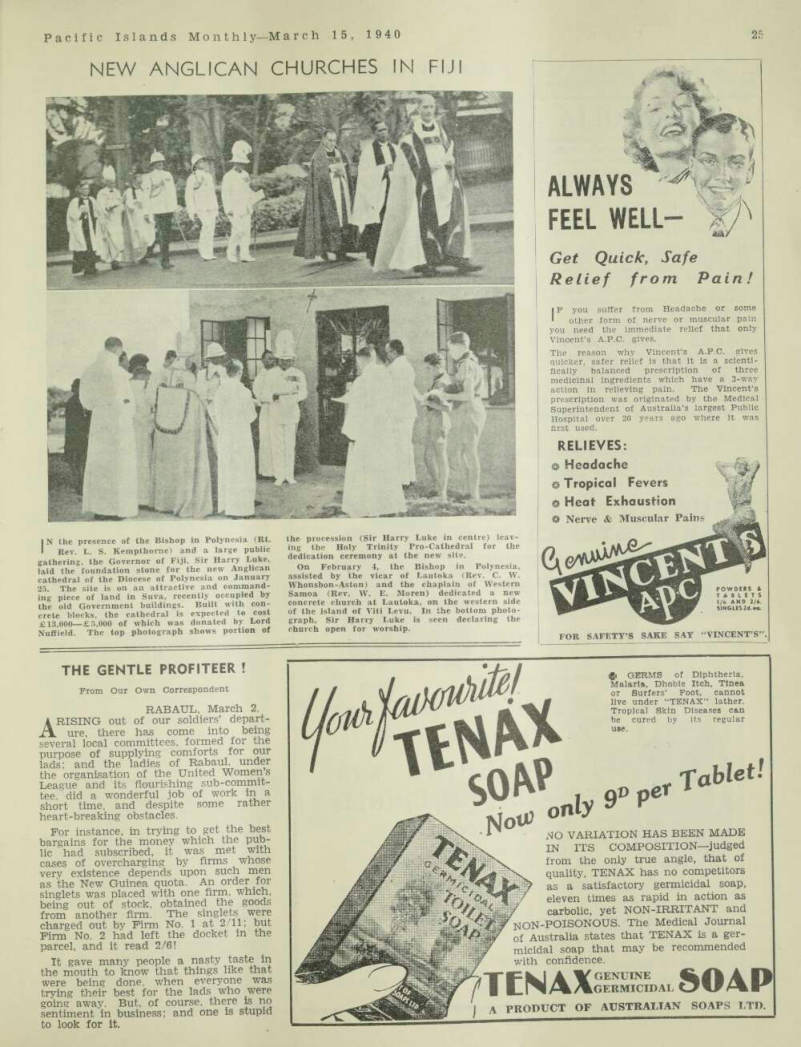
IN the presence of the Bishop in Polynesia (Rt.
Rev. L. S. Kempthorne) and a large public gathering, the Governor of Fiji, Sir Harry Luke, laid the foundation stone for the new Anglican cathedral of the Diocese of Polynesia on January 25. The site is on an attractive and command ing piece of land in Suva, recently occupied by the old Government buildings. Built with con crete blocks, the cathedral is expected to cost £13,000 —£5,000 of which was donated by Lord Nuffield. The top photograph shows portion of
the procession (Sir Harry Luke in centre) leav ing the Holy Trinity Pro-Cathedral for the dedication ceremony at the new site.
On February 4, the Bishop in Polynesia, assisted by the vicar of Lautoka (Rev. C. W.
Whonsbon-Aston) and the chaplain of Western Samoa (Rev. W. E. Moren) dedicated a new concrete church at Lautoka, on the western side of the island of Viti Levu. In the bottom photo graph, Sir Harry Luke is seen declaring the church open for worship.
The Gentle Profiteer!
Prom Our Own Correspondent RABAUL, March 2.
ARISING out of our soldiers’ depart ure. there has come into being several local committees, formed for the purpose of supplying comforts for our lads: and the ladies of Rabaul, under the organisation of the United Women s League and its flourishing sub-commit tee. did a wonderful job of work in a short time, and despite some rather heart-breaking obstacles.
For instance, in trying to get the best bargains for the money which the pub lic had subscribed, it was met with cases of overcharging by firms whose very existence depends upon such men as the New Guinea quota. An order for singlets was placed with one firm, which, being out of stock, obtained the goods from another firm. The singlets were charged out by Firm No. 1 at 2/11; but Firm No. 2 had left the docket in the parcel, and it read 2/6!
It gave many people a nasty taste in the mouth to know that things like that were being done, when everyone was trying their best for the lads who were going away. But, of course, there is no sentiment in business; and one is stupid to look for it.
Mrs. Mary Croudace has taken over the management of the Casino Hotel, the only hotel in Apia, Western Samoa.
Advertisements & other items, pp. 29-30 (1 item)
fabled
ALWAYS
FEEL WELL—
t\
Get Quick, Safe
Relief from Pain!
IP you suffer from Headache or some other form of nerve or muscular pain you need the immediate relief that only Vincent’s A.P.C. gives.
The reason why Vincent’s A.P.C. gives quicker, safer relief is that It Is a scientifically balanced prescription of three medicinal ingredients which have a 3-way action in relieving pain. The Vincent’s prescription was originated by the Medical Superintendent of Australia’s largest Public Hospital over 20 years ago where it was first used.
RELIEVES:
$ Headache
q Tropical Fevers
q Heat Exhaustion
& Nerve & Muscular Pain;
POWDERS 1
TAIIIIS
1/6 AND 2/i.
SINGLES 2d. •«.
FOR SAFETY’S SAKE SAY “VINCENT’S”
/ 40 tS
fjotf
r. » ■M . =0
WJL
'<£m *7 o *5 « /> ■-*3il f GERMS of Diphtheria, Malaria, Dhoble Itch, Tinea or Surfers’ Foot, cannot live under “TENAX” lather.
Tropical Skin Diseases can be cured by its regular use.
niy 9 D per
fabled
NO VARIATION HAS BEEN MADE
IN ITS COMPOSITION—judged
from the only true angle, that of quality, TENAX has no competitors as a satisfactory germicidal soap, eleven times as rapid in action as , carbolic, yet NON-IRRITANT and NON-POISONOUS. The Medical Journal of Australia states that TENAX is a germicidal soap that may be recommended with confidence.
T C N AXgermicidal SOAP
A PRODUCT OF AUSTRALIAN SOAPS LTD.
CINNAMOLIA
The hot weather is now approaching with its dysentery, diarrhoea, and other seasonal infectious diseases of the alimentary canal EVERY tropical home should have on hand a bottle of the above remedy—in case —so as to be ready to attack the germs as soon as the first symptoms of disease appear.
For years scientists and medical men have sought for a safe, powerful germicide to treat infections of the intestinal tract without harming the tissues.
Here it is! CINNAMOLIA! Guaranteed to contain no poisons or harmful drugs.
Price 3/- per bottle from
FALKS PHARMACY,
238 GEORGE ST., SYDNEY.
Wholesale Rates to Chemists, Hospitals,
etc., from CINNAMOLIA PREPARATIONS,
17 Murray Street, Waterloo, N.S.W.
Tel.: MX 1702.
The Most Extensive Manufacturers in the British Empire of
RUBBER STAMPS,
INKS, STENCILS,
Marking Devices,
ACME STAMP PADS
OFFICE & STATIONERY SUPPLIES
We also Manufacture & Supply a Complete Line of
LIMEWASHING AND
SPRAYING MACHINES
for all purposes.
Let us know your requirements and we will quote by return.
WRITE FOR OUR GENERAL CATALOGUE
Limewashing Machine
EXCELSIOR SUPPLY CO. PTY. LTD.
278 Post Office Place,
MELBOURNE, VIC.
HEAD OFFICE :
160 BROADWAY, ! 50 Victoria Street, Formerly known as George St., West. I WELLINGTON NZ
SYDNEY/ N.S.W.
Against System
Crush Copra in Islands Arguments For And Against System
By Vincent C. Davis
COPRA planters in New Guinea and Papua have had their position ex plained in recent articles in the “P.1.M.”
Increased costs in freight, insurance and marketing have all gone against the planter, a burden which has not been fully allowed for by the increase in price of copra to £l3/10/- sterling per ton.
Obviously the best thing for the planters to do, as the “P.1.M.” has stressed, is to combine for their own betterment. Unless co-operation can be achieved, the lot of the planters will remain bad, and there will be little in ducement for them to continue produc tion.
One solution lies in setting up crush ing plants in the Islands, to handle copra on the spot, and to export unrefined coconut oil, instead of dried copra. Big savings in freight and bags would be
made, and a better price obtained for the product: for planters would figure not only in the price of the original copra, but also in the price for the coco nut oil.
Shipping experiments made by Amer ica have evolved a process of shipment which makes transportation of coconut oil relatively simple. The oil is heated before loading and run, in a molten state, into vats on the ship, where it sets. Then, when the ship nears its destination, the vats are heated and the oil run out on berthing, again in a molten state. There is no heavy expen diture on bags, as is the case when dis posing of raw copra.
Costs of crushing copra have been estimated by the United States Tariff Commission at approximately £l/10/per ton.
In American mills, unrefined coconut oil is produced at the rate of 60 per cent, of coconut oil per ton of copra.
Taking the whole copra production of Papua and New Guinea as 90.000 tons a year, this would approximate a return of some 54,000 tons of oil.
Latest information available indicates the following prices for unrefined coco nut oil as being:— Australian Price: £A3I per ton.
London Price: £22/2/6 per ton sterling.
For success, the scheme would depend greatly on the ratio of coconut oil pro duced per ton of copra, and nothing but the most up-to-date crushing plant should be installed. Labour costs in the Islands would be less than in America.
Income would be derived, in addition, from the sale of copra cake, a by-pro duct which would figure importantly in making the proposition feasible.
Similar plants are already working in Philippine Islands, Straits Settlements, Australia and Ceylon. If they are eco nomical there, there is no reason why they should not be economical in the Islands. With plants run on a co-opera tive basis at, say. Port Moresby, Rabaul, Tulagi, Suva, the financial condition of planters would be more stable.
Might the suggestion go out to copra plantation-owners that they should combine, and set up a committee to in vestigate financial aspects, cost of crush ing plants, etc., so that full details might be placed before them. The fate of their industry may depend on the results.
Editorial Note
OUR contributor puts forward an in teresting plan, but is guilty of wishful thinking. Does he suppose that the idea of crushing copra in the Islands has not been carefully examined many times, in past years? The system has advantages—but not so many as to justify a sweeping reorganisation of the industry.
Five tons of first-class copra is now worth £66/10/- sterling, in London. That copra, crushed, would produce three tons of oil, worth £66/7/6, sterling, in Lon don. There is no difference, therefore, in the value of the main product. Crush ing in the Islands would have the fol lowing advantages:— 1. The value of the coconut-cake (not much, after the cost of shipment to market is deducted). 2. Lower cost of freight (three tons instead of five) from the Islands to London. This would be partly offset by the costlier method of shipment. Copra, in bags, is easily handled and can be shipped in anything that floats. Coco
nut oil would have to have special pro vision made for it, in ships and appli ances. ' 3. The saving in bags. But, even then, it would be necessary to provide bags, for carriage from the plantation to the crushing plant.
But the war is creating a freight situation of great difficulty, and it now may be found that, in order to save shipping space, crushing of copra in the Islands is practicable and desirable.
Advertisements & other items, p. 30 (1 item)
26
March 15, 194 O—P acific Islands Monthly
Red Cross Donations in Solomons
THE following are further donations to the British Solomon Islands Red Cross Society:—
Hon. A. T. Lyons, Director of Public Works in Papua, is at present on fur lough and Mr. P. Burns, engineer in the Department, is acting as Director.
His Honour W. S. Marchant, O.B.E. ., £5 5 0 R. MTcKerlie 1 1 0 Chinese Residents, Tulagi 3 11 3 H. Grant 1 1 0 Natives on Auki Station 3 15 6 Paisi District 11 17 6 Members’ Donations .. .. 2 15 0 S. Jones 1 1 0 J. N. Harrison Sale of Savouries, Tulagi Club, 13/1/40, £1/12/-; 20/1/40. £1/16/1; 10 6 27/1/40, £2/5/-; 3/2/40. £3/10/9 .
Card Afternoon and Sale of Sweets, 9 3 10 17/1/40 2 13 3 K. D. Hay 1 1 0 Mr. and Mrs. S. Mill 10 6 D. M. Lazarus Natives of Lord Howe Island (Ontong 5 0 0 Java) Native Constabulary — Corporal Taloi, 3 15 0 Constable Waikau. 5/- each . .
Rev. A. Mason, offertory, parish 10 0 church, Fiu 2 10 0 Members’ Donations 9 3
Captured Tahiti
When "La La" Song Captured Tahiti
IN the dear, dead days of long ago, we had at Papeete a theatre named The Casino.
Our earlier exhibition hall had been a long, low wooden building dubbed “Le Moulin Rouge” where, under the direc tion of a native of Martinique (known as Paretuti) and his wife Alphonsine (who presided over the exchequer), entertain ments of primitive moving pictures, inter spersed with wild “hula” dances by ex perts from the market place, brought de light to enthusiastic audiences.
The more sedate members of the com munity looked upon the performances at Moulin Rouge as not quite respectable.
Nevertheless. the place was always crowded to suffocation, the exchequer (under the economies of Alphonsine) waxed and expanded so that, in the course of time, Paretuti found himself able to bring to fruition more ambitious dreams, and The Casino came into being.
The Casino was conducted to appeal to the beau monde. The films of French manufacture, exquisitely coloured by hand, pictured stories of fairies and naiads, gnomes and kobolds, witches and sorcerers, knights and courtiers, fair ladies and troubadours; in gardens glow ing with the splendour of blossoms, in romantic glens and woodland dells, in ancient castles and in mirages of en chantment.
Occasionally, to please the unregener ate (who had moved in a body from the Moulin Rouge to the rear seats and the gallery of The Casino) the programme was varied by a picture from the States recounting the exciting tale of a blonde heroine, fallen into the hands of nefari
ous villains, bound to the slowly moving cradle of a lumber mill and rescued by the hard riding, handsome hero at the very moment the horrible, hissing circular saw was biting into her fifth rib.
Further variety was made available when barnstorming theatrical companies, vaudeville teams or professors of leger demain chanced to be voyaging on ships calling at Papeete. These were usually glad to pick up an honest penny while their steamer tarried in port.
The patrons of The Casino would go to these exhibitions and applaud politely.
But no one of the visitors made any im pression or left behind any memories —until the advent of Happy Harry.
Happy Harry was a hard-bitten knight of the vaudeville circuits of many coun tries. He possessed verve, a very loud voice, and a repertory of songs of the “whoop-hurray” type.
The major number of these songs, while acceptable, were, because the words were English, incomprehensible to his hearers. His “La La” song was the exception.
Now, during 75 years, the Tahitians had constantly heard the French inter jection, “Oh! La La!” When, therefore.
Happy Harry launched his song, consist ing of “La La, La La, La La La La La”, indefinitely repeated to the swing of a catchy tune, and ending with, “One, two three! Sing together with me! La La, La La La La La”—the audience took up the chorus and made the rafters ring.
From The Casino, the song spread throughout Papeete; extended to the dis tricts. Schooners carried it to the neigh bouring islands and to the most remote atolls. Happy Harry’s name was on every lip. Crowds came from the dis tricts to hear him sing, join in the chorus and applaud. The “La La” song
crowded out every other form of music.
Many of the illustrious have visited our shores —from the glittering studios of Hollywood, from the gay concert halls of Paris. They have been viewed with awe and respect in proportion to the measure of their greatness. But no one has been taken to the hearts of the Tahitian people as was Happy Harry.
When he sailed away he was given the greatest ovation ever accorded a departing visitor. He was covered with flowers and cheered until his ship was well without the pass.
Carried on the wings of his song, Happy Harry had achieved almost im mortality in the hearts of the Tahitian islanders; for, during many subsequent years the “La La” song continued as a prime favourite and the memory of him became a jovial legend.—A.C.R.
Advertisements & other items, p. 31 (1 item)
oftfumUftct 1
/ «a« fes \ Coleman Mantles supply Sun-like light.
A 500 *
CANDLE ! I
POWER I
Instant Lighting Stoves Gr Irons a^ 300 giving maximum of heat
CANDLE
POWER
in. minimum of time
BRIGHTER LIGHT
for
BETTER SIGHT
EASE OF OPERATION
combines
ECONOMY with COMFORT
In case of difficulty in obtaining supplies write to: — Pearce & Co., Suva, Fiji Is.
A New M.L.C. In New Guinea
From Our Own Correspondent RABAUL, March 2.
THERE is speculation in some quarters as to who will succeed Hon. N. P.
H, Neal as Legislative Councillor from the goldfields end of the Territory.
That was the post which Mr. “Blue”
Allan seemed destined to fill; but he now is soldiering somewhere South, and the general opinion is that the mantle will fall upon Mr. Harold Taylour, who has already taken over the reins of many offices held previously by Mr. Allan. Mr.
Taylour appears to be the most suitable man there, and his appointment will not come as a surprise.
Mr. C. G. Kilner, of the Shell Oil Company, arrived in Sydney recently from Rabaul, New Guinea, on furlough.
Loading Copra
A familiar scene in the Pacific Islands— loading copra while the schooner stands off shore. This photograph was taken at Vatoa (Turtle Island), Southern Fiji. Captain James Cook, the famous British navigator, called here in July, 1774, when sailing from Tonga to the New Hebrides during his second voyage in the “Resolution”. The name was suggested by the great number of turtles he saw swimming near the encircling reef. —Photo; “Methodist Missionary Review”.
N.I. Industries
Growth of Passionfruit Canning
IN his report for the year ended June 30, 1939, the Administrator of Nor folk Island, Sir Charles Rosenthal, gives some interesting information about the industries from which the 983 people on Norfolk Island obtain products for export.
There is a co-operative dairy factory and, although a drought during the year reduced the cream supplies by 75 per cent., the factory nevertheless produced over 26,000 lbs. of butter. This co-opera tive dairy company commenced opera tions in November, 1935, and is now firmly established.
The island is capable of producing over ;3,000 cases of citrus fruit each year, for which there is a ready market in New Zealand.
The production and export of Cana dian Wonder beans have been reduced by drought. In normal times, the island exports from 1,000 to 1,500 bushels of these beans.
On the island there are now two can ning plants for handling passion-fruit— a private plant, which last year canned 70 tons of passion-fruit pulp, and a plant recently established by a co-op erative company, which last year can ned 146 tons of pulp. There is said to be plenty of room for the extension of the nassion-fruit plantations, and a very good market in Australia and elsewhere for the pulp.
It is stated, also, that the Norfolk Island growers who have maintained their banana plantations are now ob taining very satisfactory prices for bana nas sent to the Sydney market.
The value of produce exported from Norfolk Island last year was £16,970, which is a much larger sum than has been recorded for many years. The largest total of exports since the de pression years was £11,879 in 1937.
Advertisements & other items, p. 32 (2 items)
28
March 15, 194 O—P acific Islands Monthly
Capstan
juicAedthe. TROPICS
fOQACCo
C4H r"
Capstan Cigarettes. round airtight 50's, tMgg N Medium and full strength.
Capstan Navy Cut Tobacco, made from the finest Virginia leaf. 8824-10-8
READ THE
B.P. MAGAZINE
AUTUMN NUMBER
iiiiiiiiiiiiiiiiiiiiiiiiiiiiiiiiiiiiiiiiiiiiiiiiiiim
Now On Sale
Short Stories Pictures Travel Articles - - - - Pages for the Children Stage Latest Fashions Screen A
ONE SHILLING PER COPY.
ON SALE AT ALL NEWSAGENTS AND BOOKSELLERS
That New Bird Of Paradise
Letter to the Editor rptLERE appears to be some con 1 troversy regarding the “Ribbon Tailed Bird of Paradise”, said to have been seen by the late Mr. Jack Hides, on his Purari patrol.
In the year 1930, Mr. W. Tracy and I saw a bird on Kaindi Moun tain, in New Guinea, that fits in with the description of those seen by Jack Hides, and the Hagen-Sepik patrol.
Tracy and I were standing near the head of a small gully, that runs out below the Midas creek. Hearing a soft, flicking sound, above, I looked up, and saw, flying over us, a dark coloured bird with two long, rippling, white tail-feathers. I quickly drew Tracy’s attention to the bird, and we watched it fly clumsily across the narrow gully and alight on a branch of a nearby tree.
The tail-feathers appeared not of the stiff, spined variety, common among the birds of paradise, but were soft and flexible. This caused them to develop the rippling motion and, I think, give off the soft, flick ing sound when in flight.
Around that part of Kaindi I had often noticed, flitting around our camp, another stranger. This bird was greenish-black in colour, body seven or eight inches in length, with two tail-feathers, about 10 inches long and one inch wide, and each of the feathers was turned slightly outwards at the end. They were of the same dark colouring as the rest of the body, and were flexible enough to cause a slight, rippling motion when in flight. In my opinion, this bird is the female, and the so-called “Ribbon Tail” is the male of the species.
I have lost track of Mr. Tracy for years, but if he is still on deck he should remember the day that we saw the “Ribbon Tail” bird, although at the time we did not realise that we had discovered a bird new to science.
Mr. W. Tracy is a brother of Mr.
Frank Tracy, one-time A.W.A, oper ator at Edie Creek, and both are well-known oldtimers on the Morobe goldfield.
I am,
Bruce Hamilton.
Samarai, Papua. 8/2/1940.
Sister C. B. Little recently resigned from the Fiji Nursing Service.
The Governor-General of Australia, Lord Gowrie, last month, presented the insignia of the Order of the Member of the British Empire to Mrs. E. R. Nelsson.
Mr. John Gus Nelsson, of Samarai. East ern Papua, was awarded the M.B.E. in June. 1939, but died before he could be invested with same. Following the usual practice, the Governor-General handed the insignia to his widow. Mr. Nelsson had lived in Papua for 45 years and had been a storekeeper, a miner, a planter, a ship-owner, and a member of the Legis lative Council.
Boys
A College Education for Islands Boys
FEW people will deny that a college education is a desirable asset for every young man.
Islands residents contemplating sending their children to Australia to be educated could not do better than choose one of the Great Public Schools —and in this connection the first-class record of St. Ignatius’ College (Riverview) merits attention.
Conducted by the Jesuit Fathers, the College is pleasantly situated on the Lane Cove River, an arm of Sydney Harbour. Boys are prepared for all the usual examinations required by the N S.W. Education Department and for entrance to the Sydney University. Pupils are arranged in three divisions, according to age, and each division has its own library, debating society, cricket and football fields, and tennis courts.
The senior and junior rowing sheds house a large fleet of pleasure and racing boat’s and there are private swimming baths. A separate building serves as the College hospital, in charge of a doctor and a trained nurse.
Annually, the College produces a high-class volume, -Our Alma Mater”, recording the activities of pupils, present and past. It is interesting to note in the 1939 edition that Eric Giblin, son of the well-known Dr. W. B. Giblin, of Wau, New Guinea, figured prominently in rowing, football and athletics, and was head prefect and house captain. It is a coincidence that those positions were held in 1938 by Ewald Uechtritz, of New Britain, and in 1937 by Dexter Giblin, of Wau.*** Mr. Kuroki Tokitaro, newly-appointed Japanese Consul in New Caledonia, is expected to arrive at Noumea this month.
Mr. John Dicketts, a retired superin tendent of the Pacific Cable Board, died recently in Auckland, New Zealand, aged 74. At various times, he was manager of the cable stations at Fan ning Island, Norfolk Island, and Suva (Fiji).
Advertisements & other items, pp. 33-34 (1 item)
K|^§3Ls^ : De War's Beaiawsdewar'sbrwar's
m m
iPSF.
I
fcV
DEW
DEW A
DE WA
DE W a
DEWA
DE WA
DEWA.
OKWA ES DEWAR'S DEWAR
:: vV’ARI: DK W A E
Airs DE WAR'S DEWARS
Airs DiiWAirS DEW A R S ;a e*s dkwar s dewar'S VvA E' S DEW A EE DEWAR'S W A R ’A OK WA R' ■:• ;. iE WA R :>
, .. A.E'SDEWAR'S DE WAR'S
.DKWaK'SDEWAR'S DE WAR'S
• DEWAR'S DE WAR'S DE WARES
TAR'S
MRS
MS'S
WAR'S DEWAR'S
•.R'S DEWAR'S
vR SDK WAR'S
DEWAR'S DEWAR'S
. DE'WaK’.- DEWAK'S DE WAR'S
SWaK'E DE WAR'S DE WAR'S DEWARS - o S EE WAR'S DEWAR S DE WAR'S DKWA.R'S
v v.'A'ESDEWAR'SDKWAR SDEWAR'SDEWAR S
DEWAR'S DEW A R' S D E W A R' S D E W A R’ S DEW A R'S f ;;i» /. TV'i"*.V * ''' •> I* X. •''/*'*'£ •> vVA#*. *J> '.✓?*# ' v A#*. .5 *' v ' *•' * '••r* y^w/yfy r ; ; V/A# :>?>;: WAR'S:/?r#A.R ?sOftWA fi &D& r
! SDEWAK'SEEWAR'SEEWAR'S
WAR'S DKWAR SDEWaR'SEEWAR'SDEWAR'SDEWAR'S
A. A. AV ;> • A A A •<; fj j? v</ a r - WA R' S DE: WA R' S DE WAR 'S DE W A R'S D E WA RS DEWAR S DEWAR'S DEWAR" """' " '' ' ' R'S dew:
DR WAR'S OK WAR
DEWY'S DEWAR
DEW/TD.;.
arsde
DEWAR
DKW A?
DEWA
DEW
DEW
DKW .'
AR'Sf
1/ J
//A R'S 0
R'S DEWAR'S
R'S DE WARD
A R'S DEWARS
JK R'S DEW A R' S D E W A R'S DE WAR’S A R S DEWA R' :• DEWA R'S DE WAR'S
DE WAR'S DEWAR'S DEWA
D E W A R' S DKWAR' S DKW A D K WA RS DEWA R'S DEWA R DEWAR'S •> A v..;V.v.; iyr.yu A w }*.};. t>/ v »;..«• ;>”# D \V A.E & DftVv A ft ■'• • '/.'.'A A* •> !/J.' •-> DEWAR'S DE WAR'S DE WAR'S DEWAR :; l :/ »■•»•./ W ar*s dewar's dewaar sdkwar sdkwar •:• DKW AR Ev.W Aft A 'v<;• ••;D-D- ;>•■:; y ? %-v.m fy< -va■>.//..?: ADRWAR'S
DEWA R'S DE WAR'S DE v'
DE
DKW
DEW'AI
DE W
DEW
DKW'aRSDEWaJESdew ... .
DEWAR'S DEWAR'S DE WAR'
DE WAR'S
DKW'AR SDKW'AR f t tiIJC/ ; '' DEWAR'S DEWA Rj »r WAH- E D .-, y M , y . r .
DE WA R'S DE WAR'S DEWARS »•;. J E
K|^§3lS^ : DE WAR'S bEAiAWSDEWAR'SbRWAR'S
>v/ V'A R'S * >;: 'WA R' S wAR'S b E W A R'S DEWA R' S D K'W A.R. S T>K W'AR.'K T>'K\VARES
; KW>S4fewV SDEWAR'SDKWAR’SDKWAR'S
; :bs:; . V < s:;e wae-e de war-sdewae .dawae-sdkwa^
A R'S
AR'S
A.R S
RE
AR’S
S. DKW'aR' S. DKW A R’S
EWaK'SDEWAR'S
E WAR'S DE WAR'S
DE WAR'S DE WAR'S
DKW A RS DKW AES
... . .. .. DEW'aR'SDEWAR'S
E WAR'S DEWAR'S DE. WAR'S
Modern Refrigeration for the South Sea Islands
The ELECTROLUX
KEROSENE OPERATED
REFRIGERATOR
MARVEL
OF
MODERN
SCIENCE
THE
MIRACLE
OF
ICE
FROM
HEAT
ELECTROLUX offers economical, modern and completely efficient
REFRIGERATION FOR ISLANDS' HOMES.
FREEZES CONTINUOUSLY WHILE SMALL LAMP BURNS
Freezing controlled by simply regulating height of flame. Uses only f gallon of kerosene per week.
MOTORLESS ... NO PARTS TO GET OUT OF ORDER.
MODEL L 22 MODEL L3BO MODEL LKSSO Capacity 5.5 cubic feet.
Capacity 2.2 cubic feet. (as Illustrated) Capacity 4 cubic feet.
GUARANTEED FOR TWO YEARS.
Write to your Local Distributor for prices and full details.
Obtainable from W. R. Carpenter & Company Ltd. —Sydney, and following New Guinea Branches: Rabaul, Salamaua, Wau, Kavieng, Madang, and Wewak, W. R. Carpenter & Coy. (Solomon Is.) Pty. Ltd. —Tulagi, British Solomon Islands.
On Chong & Company Pty. Ltd.—Butaritari, Gilbert and Ellice Islands.
Representation in Papua and New Hebrides.
Policy
Native Labour
Commission at Work in New Guinea
A QUESTIONNAIRE, which was ad dressed by the New Guinea Native Labour Commission to the Director of District Services and Native Affairs, covered many matters relating to native labour The reply by the Director sets out the Administration’s views on a number of matters, and is of great inter est as giving an outline of policy.
As the Director of District Services and Native Affairs is Chairman of the Native Labour Commission, Mr. E. Tay lor Assistant Director of District Ser vices and Native Affairs, appeared before the Commission on February 15 to sub mit the Director’s reply to the Commis sion, and to answer questions relating to it.
It was expected that the policy of the Department would be closely examined by the Commission, now that it was stated in writing, and that the cross examination by members of the Com mission would be of interest. But one non-official member was absent and the other members, excepting the Hon. Ger ald Hogan, an official member, asked few questions based on the replies of the Department to this important ques tionnaire. Probably the replies gave the information required and made ques tioning unnecessary, Mr. Hogan asked some pertinent ques tions with regard to the activities of the Department as they affected the native labourer.
The other evidence given during the month differed little from that givep previously. There is little criticism by witnesses of the Native Labour Ordin ance, except as to a few points; and the chief demand of employers is for the recruiting of native labourers by a De partment of the Administration, separ ate from the Department of District Services and Native Affairs. There is little criticism, so far, by employers, of the administration of the Native Labour Ordinance.
The Commission, in February, visited the Madang district.
Happy Tahiti!
And What America May Do
“VTOT many days pass,” writes il Marc. T. Greene, American newspaper reporter, on his way from Tahiti to Europe, “that I don’t long to be back in Tahiti, where I was happier, I think, on this third visit, than ever before. As Nordhoff says, it is still the happiest place on earth —no doubt at all of that —absolutely different from every other in almost every way.
“The only threat, at present, on the horizon, to that state of things, is the rumoured possibility of the big American boats coming there. If that happens—farewell, Tahiti!
“One of the saddest tragedies in the history of the Pacific would be the turning of Tahiti into another Hawaii.”
War Exercises For
U.S.A. Navy
Prom. Our Own Correspondent
Honolulu, Feb. 15.
THE entire Pacific fleet of the United States will hold its annual war games in the vicinity of Hawaii, starting April 1.
More than 130 warships and 500 warplanes will be employed. Major ships will include 10 battleships and 10 heavy cruisers.
The navy, this year, is taking ex traordinary precautions to keep away Japanese snoopers. The last time the war games were held in the Hawaii area, in 1938, a long-range Japanese trawler was found wrecked and abandoned on a reef near
strategic Midway Island, which has been developed into a potent out lying navy base. Japan refused to say what happened to the crew.
Evidently convinced that its pre sence is required hereabouts, the navy has permanently assigned ships of the Hawaiian detachment to Honolulu, meaning that 500 offi cers and 6,000 men will have to transfer their homes from U.S. west coast bases to Hawaii. At the out break of war, it will be recalled, some 30 warships were detached from the Pacific fleet, based on the west coast, and assigned to Hawaii, on a temporary status. The de tachment last week completed local war games which were held in ex traordinary secrecy.
Japanese naval spokesmen, in
view of delicate relations between the two nations, do not express their opinions. They leave that to the inspired Tokyo press. Said the “Asahi” recently:— “If the United States thinks to intimidate Japan by its naval plans it is making a big mistake. If it is trying to restrain Japan, it is wast ing time, because at this stage Japan cannot retreat under any pressure whatsoever . . .”
Advertisements & other items, pp. 35-36 (2 items)
31
Pacific Islands Monthl y—M arch 15, 194 0
CTORift
BITTIfi
raM i
STEAMSHIPS TRADING COMPANY LTD.
PORT MORESBY PAPUA SAMARA I
Chairman and Managing Director: A. S. FITCH.
Shipowners, Wholesale and Retail Merchants and Traders; Shipping, Customs and Insurance Agents; Copra and Rubber Plantation Owners.
MAIL CONTRACTORS TO COMMONWEALTH AND PAPUAN GOVERNMENTS.
AGENCIES;—At Port Moresby: Coral Sea Insurance Co.; Phoenix Insurance Co.; Delta Sawmills, Ltd.; Acme Bakery Co.; Vacuum Oil Co., Pty., Ltd. At Samaral: Coral Sea Insurance Co.; Delta Sawmills, Ltd.; Bankers and Traders’
Insurance Co.; National Mutual Life Insurance Co.; Kularo Shipyards’
Mamai Plantations.
BRANCHES:—In Papua: Hanuabada, Sivitol, Aroma, Koki, Hula, Ela Beach Duga Duga, Yule Island.
SYDNEY: NELSON & ROBERTSON PTY. LTD., 12 Spring St.; Melbourne, 396 Flinders Lane: London, E. Whiteaway & Co., 7 Chiswell Street, Finsbury, London.
Cable Address: “STEAMSHIPS.” Code: Bentley’s
STEAMSHIPS TRADING COMPANY, LIMITED.
MERCHANTS, SHIPOWNERS AND PLANTERS
PORT MORESBY AND SAMARA I,
Our organisation provides every facility and efficient service as
MANAGING AGENTS AND VISITING REPRESENTATIVES OF
COCONUT AND RUBBER PLANTATIONS
Estates supervised in bearing and planting stages.
Comprehensive reports compiled and regular visits m?de to Estates by our competent Plantation Inspector.
WRITE, CABLE OR CALL FOR PARTICULARS:
STEAMSHIPS TRADING COMPANY LTD.
If you wont "Perfection in Cooking" use a
“Younger” cooking stove
r These stoves have been on the market in Australia for over Sixty Years, and are still recognised as ‘‘The Best”.
They are made with Extended Firebox specially for Long Wood fuel, also special stoves with Cast Iron Oven suitable for Island requirements.
Send for Illustrated Catalogue and Price of Single and Double Oven Stoves.
G. FLETCHER & SON
50 OXFORD STREET, SYDNEY.
in Sight
Record N.G. Gold Output in Sight
ANOTHER large output from the Mor obe Goldfield was achieved for the month of January—4s,364 ounces, valued at £A280,143. For the seven months from July 1, 1939, the value of Morobe’s gold stands at £A1,549.197. If this rate is maintained, a year’s record output should again result. So far as value is concerned, only £A452.000 is needed within the next five months to equal last year’s output.
Under-Cover
Dramas
How British Are Checking Contraband Shipments in Pacific
By John Williams
Honolulu, Feb. 7.
AMERICAN official sources disclose that Britain intends to crack down upon the shipment of contraband car goes from North and South American ports across the Pacific to Japan and Siberia, for re-export to Germany.
These shipments have increased mark edly since war broke out.
Details of the contraband service read like some fictional international drama.
At the outbreak of the war, the American Government appealed to American indus tries t(D conserve their ra w material in “the best interests” of national security.
America, for example, imports the bulk of crude rubber and tin supplies from Malaya and the Dutch East Indies.
German and Russian agents, working under cover in the U.S.A., have been discovered behind the re-export of rub-
On February 29 (three weeks after this article was written) it was semi-officially announced that Brit ain and France, with the co-opera tion of the Australian Navy, pro posed to check the flow of contra band to Germany, via the Pacific and Asiatic Russia, by establishing “con trol stations”, probably at Singapore, Hong Kong, Vancouver, Darwin, Suva and Auckland.
ber, tin and copper, often sent into Mexico, where it is picked up in so called neutral ships, taken through the Panama canal, thence across the Paci fic to Vladivostok, where it is dis charged for shipment to Europe.
This discovery caused the secretaries of the U.S. navy and army, on January 19. to issue joint statements, as co chairmen of the U.S. Munitions Board, severely reprimanding the American offenders and threatening Congressional action if the re-exports did not cease.
Official sources said that the re-ex ports had reached “scandalous propor tions”. This caused reporters to dig deeper into the records, and they found similar conditions in the U.S. petroleum export trade, particularly in sales to Russia to aid her air war upon Finland.
The “New York Times” on January 19 said: — “Russia has obtained from America since the outbreak of the war more than 50,000,000 gallons of aviation gasoline, most of it from California ports ... In the opinion of many observers familiar with the situation this American-pro duced fuel is a major source of supply for Russian aerial, tank and motor driven artillery operations against Fin land . . . The export figures reveal how the exports have increased alarmingly...”
The Congressional sub-committee on oil conservation swung into action on the spot in California. It was shown that Japan has been purchasing at the enormous rate of 4,620,000 gallons daily, and that Russia’s purchases since she invaded Finland have made a big up swing. Obviously, Japan and Russia are re-exporting to Germany.
It is interesting to analyse between the lines of the recent outcry in Amer ica about the allied halting and exami nation of American mails to and from Germany.
Britain has presented evidence in Washington which has revealed the vast ramifications of the German network in America. It appears that, prior to the war, Germany, in collaboration with her nationals and agents in North and South America, designed a system for the circumvention of the British block ade, which involved the use of the U.S. mails for the shipment of contraband to Germany.
Germans in the Americas subscribed to a central agency in New York City called Fortra, the staff of which con sists of employees of German steam ship companies in America specially assigned to Fortra by the German Gov ernment.
Head of this organisation, which has offices at 61 Broadway, is T. E. Kesse meier, who, the American files show, used to be resident manager for the Hapag-Lloyd steamship line at Philadel phia. Prior to the war, he visited Ger many and returned to America in Nov ember with the personal blessing of Hitler.
Fortra guarantees that packages placed in its care in America will reach Germany. For some time, the U.S. mails were used for this contraband ser vice; but, now that Britain has halted this’ by removing the goods from the U.S. mails. Fortra has worked out another scheme.
The Germans in the Americas still subscribe, but now the orders are wire lessed by Fortra from New York to Holland for fulfilment in Holland.
Agents in Holland then deliver the par cels to the German border, where they are distributed to recipients in Germany.
Interrogated by American agents, Herr Kessemeier said that the Fortra service involves millions of dollars annually. It is expected, now, that the Allies’ next move will be pressure upon Holland to halt the contraband service. (It was announced in the newspapers of February 22 that this Dutch-German arrangement has reached such propor tions that Holland is being denuded of essential foodstuffs and materials, and that the Government is taking steps to reduce the traffic—Ed. “P.1.M.”).
The packages assembled in Holland, according to Herr Kessemeier, contain mostly food supplies now. When the U.S. mails were used, the parcels con tained technical equipment, American currency, etc.
Britain already has moved about the North Pacific contraband service. So far, incidentally, she has not established contraband control bases in the Paci fic; but, officially, she has notified Washington that such will be the case if the contraband exports are not halted at American ports.
British agents in the Pacific are not idle. They drew first blood, it can now be reported, when British cruisers took the Russian freighter “Selenga” into Hong Kong, on January 13. The “Sel enga” was carrying a cargo of wolfram ore, essential for munitions, which is produced in South China and exported via Canton. The British intercepted cables between German agents, which revealed that the ore was being deliv ered to German dummies in Siam and Manila for re-export to Siberia, for ship ment by railroad to Germany.
Advertisements & other items, p. 36 (1 item)
32
March 15, 194 C—P acific Islands Monthly
Quintal
The Passing Of Archie
MR. Marc. T. Greene, American journalist, on his way from Tahiti to Europe, sends the following note:— I learn with deep regret of the passing of my old friend, Archie Quintal, of Norfolk Island, a great great-great-grandson of Matthew Quintal, of the “Bounty”.
A number of years ago, when both Archie’s father and his uncle, Cor nish Quintal, were alive, I spent some time at their place in a pretty corner of Norfolk.
When I first encountered Archie he was reading the Bible, and I dis covered presently that it was his favorite literature. That sufficiently declares the character of as kindly, hospitable and God-fearing a man as I have ever known.
A large part of the charm of Nor folk Island lies in the nature and manners of the posterity of the former Pitcairners, and of these there was no finer soul than Archie Quintal.
Father Joseph Bender, M.S.C., who had spent 27 years in the service of the Roman Catholic Mission in New Guinea, died in February, aged 52. For many years he was stationed at Tavui-liu, New Britain, and later was superior of the Vunapope Mission for six years. He took charge of the Takabur Mission Station (Kokono) three years ago.
Advertisements & other items, pp. 37-38 (1 item)
~ Tilley
One Lamp for every purpose In or Outdoors
TILLEY
‘ALL-PURPOSE” LAMP
Light of 300 c.p. for 4 hours for Id. Burns Ordinary Kerosene THI.L.-P >• an d" sample b’e carried about as Storm Lantern in the fiercest gale: used as a Hanging Lamp —doors or out! by t.tt.nc 12ms. Heflector wh,ch sl.de. on to the wV into a I able Lamp by just detaching the suspension w.re, The light is perfectly steady and unaffected severe. -.rong^made whKe. ia Qet rfd iseU up-to-date Tilley Lamp.
Obtainable throughout the Pacific Islands from the Branches of:
BURNS PHILP & CO.. LTD., and
BURNS PHILP (SOUTH SEAS) CO., LTD.
„ v , CLARENCE ST.,
Spare Parts and Lamps yy KOPSEN & CO. PTY. LTD. SYDNEY also obtainable from — * If any difficulty, write direct to: THE TILLEY LAMP CO. (Dept. P.M.), HENDON, LONDON, N.W.4.
E.X. 4.
PURE RICE
STARCH
Always ask for . . .
“CORAL’ BRAND
100% PURE
Noted for its
QUALITY
and
WHITENESS.
Goes Farthest and gives Lasting Finish
WILL NOT
STICK TO
IRON.
Obtainable from Leading Island Stores.
CORAL BRAND
RICE STARCH
CO«*L..fSA'.CJI .***
Manufactured by
AUSTRALIAN RICE, LTD.
Sydney, N.S.W.
Swallow & Arie M’s
WORLD RENO V/NED
CANTERBURY
CARES
exxxxxxxxx;
FRUIT
PLAIN
SEED
PLUM
ALMOND
EXXXXXXXXX3
MIERI
Cabs
PRESERVED
GINGER
SULTANA
CHERRY
RIPE
GENOA
Each Cake is Enclosed, by special process, in air-tight tin, and is warranted to keep its condition for a considerable period.
Fiji Representatives Pearce & Co. Ltd.
The Late Fred Kruger
Beneath the spreading, shady trees, On coral shores, at Milne Bay, You can enjoy the soothing breeze, And watch the palm fronds sway.
If the roving days you’ve “given best”, And here at last have ceased to roam, You’ll have a quiet, peaceful rest Down at old Fred Kruger’s home.
That’s where we’ve often longed to go— Where the brown-skinned babies play, And where the swaying palm trees grow, On coral shores, at Milne Bay.
There we’ll have a quiet spell; For once we will forget to roam; In peace and comfort we will dwell Down at old Fred Kruger’s home.
Down where the tidal currents flow And where the flying-fishes play, Where beds of brilliant coral grow Around the shores of Milne Bay.
Our host will make us welcome there: No more we’ll wish to roam— We’ll dream day-long in easy chair, At old Fred Kruger’s home.
We’ll watch the dusky sailors go ’Way out beyond the coral reef, Their ships carved out of Ilimo, Their sails of plaited sago leaf.
We’ll watch them coming home once more, ’Midst spray and wind and foam, To where the soft waves lap the shore Near old Fred Kruger’s home.
(One of the best-loved “old hands’’ of East ern Papua, Mr. Fred Kruger, died in Samarai hospital in December. He was a friend of the late Mr. Frank Pryke; and the latter, some years ago, wrote and published the following verses about him.)
In this group, second from the left, is Mr. Fred. W.
Kruger, well-known miner, of Milne Bay, Eastern Papua, who (as reported last month) died in Samarai Hospital on December 24. In the group, from left to right, are: Mr.
Bert Oberdorf (Milne), Mr.
F. W. Kruger, Mr. Frank Orr (Milne Bay), and Mr. Arthur Dawkins (Woodlark Island). (Photo by E. J. O’Donnell).
American Equatorial
Islands
Prom Our Own Correspondent
Honolulu, Feb. 15.
ON March 4 the U.S. coast-guard cutter, Roger B. Taney, will sail from Honolulu on another periodic cruise (her 18th), to the American occupied equatorial islands.
During her three weeks’ cruise she will call at Jarvis, Baker, How land, Canton and Enderbury islands.
Irl H. Polk, of the Civil Aeronau tics Authority (the Government agency which controls all American commercial aviation) will visit the isles to prepare groundwork for the technical improvement of weather observation and reporting stations on these American listening-posts.
Lt. Cmdr. Frank Kenner, veteran of these cruises, will be in command.
Supplies Still Available
DESPITE war conditions, De Meric Pty. Ltd., of Sydney, report that they are still able to ship wholesale supplies of creosote, coal tar, Stockholm tar, pitch and Neatsfoot oil of the highest grades to Islands clients. Traders are invited to write for full particulars to De Meric Pty. Ltd., Doody Street, Alexandria, N.S.W. Pacific planters and boat-owners still can obtain supplies in any quantity through their regular storekeepers. De Meric products are standardised to meet Commonwealth and State Government specifications.
Dr. David Knox has been acting as Government Medical Officer on Norfolk Island, during the absence in Australia on furlough of Colonel R. F. Baird.
Advertisements & other items, p. 38 (1 item)
34
March 15, 194 O—P acific Islands Monthly
Nightmare Voyage in
Small Yacht Left Tahiti For Panama —Ended in Samoa
Prom Our Own Correspondent
Apia, Feb. 8.
Extraordinary bad luck dogged the voyage of the small British motor-yacht, “Satanella”, 45 tons, owned and sailed by Lieut.-Commander E. M.
McCausland, R.N. (Rtd.), which left Papeete, Tahiti, on November 6, 1939, and headed for Panama, on her return to England.
About 800 miles east of Tahiti, the engine broke down. Over-heating of the engine caused the chronometers to stop, making proper navigation merely guess work. With sails hoisted, the “Satan ella” was set tacking against the ruling south-easterly trade winds —without suc cess. An attempt to land on a small atoll in the Tuamotus failed, as also did the attempt to turn back to Tahiti.
Meantime, food supplies had dwindled and a leak developed in the water-tank —3OO gallons were lost before the dam age was discovered.
Realising that the “Satanella” had drifted far westward of Tahiti, it was resolved to try to make the nearest land, under full sail—any land at all, but preferably Western Samoa. The crew became weakened from lack of water and food, but providentially the “Satanella” ran into a heavy squall, which yielded a hundred gallons of rain water, A sudden drop of the barometer and huge swells caused -mew fears of an approaching hurricane, but it proved a false alarm.
After 70 days out of Tahiti, and a voyage of over 3000 miles by the log, the first land was sighted—Manua Island (American Samoa). Being now close to Apia, Commander McCausland decided to make that port. When at last Upolu came in sight, the “Satan ella” was becalmed for 24 hours. It was the 74th day after leaving Tahiti when the Apia harbour launch “Pilot” went alongside and towed the yacht to her anchorage.
Apart from the owner, there were on board three Americans, Messrs. T. H.
Worthing, A. H. Ezell (a journalist who joined the yacht in the Marquesas), and J. D. Kaufmann (a former pilot at Bal boa, Panama); an English boy, C. M.
Paul (who had been aboard since the vessel left England in September, 1938), and Mr. and Mrs, P. C. Browning (who joined the yacht in Tahiti, after selling their own boat, which they sailed out from England).
Negotiations are proceeding now to keep the “Satanella” in Samoan waters to carry on the service of the inter island vessel “Tutuila”, which recently was wrecked on the coast of American Samoa.
Nurse McMillan, of the London Mis sionary Society’s hospital at Metoreia, Papua, arrived in Sydney in February on four months’ leave. She intends to visit New Zealand.
Captain Lotte, of Noumea, has re turned to France after six years’ service in New Caledonia as head of the De partment of Native Affairs and Immi gration.
"Iron Lungs" in Fiji Hospitals
From Our Own Correspondent
Suva, Feb. 12.
LORD Nuffield, Britain’s foremost philanthropist, recently made funds available to equip every Col ony in the Empire with Both “Iron Lungs”, and five have now been in stalled in Fiji hospitals—at Suva, Lautoka, Labasa, Ba and Levuka.
An Australian invention, this appa
ratus is designed for use in medical cases where artificial respiration is required, and is invaluable for the treatment of paralysis, drowning, electric shock or gas poisoning.
The Colonial War Memorial Hos pital at Suva also recently acquired an inductor for diathermy treat ment, through the generosity of Sir Maynard Hedstrom. This plant is used for short-wave electrical treat ment.
Advertisements & other items, p. 39 (2 items)
35
Pacific Islands Monthl y—M arch 15, 194 0
Prescott Pty. Ltd.
SUSSEX ST., SYDNEY,
are sole wholesale agents for
PINEAPPLE BACON&HAMS
DAISY brand BUTTER "375" BUTTER in TINS 1 lb.-21b.-slb. Sixes.
LEA & PERRINS’ Sauces and Most other Super-Quality Lines of the Trade,such as Cheese, Eggs. Etc.
We ore Specialists .
X Let us have your confidence. Sixty years is our record of supplying the leading Houses throughout the World in
FRESH FRUIT VEGETABLES PRODUCE
’Phones: MA 8612 (4 lines).
Cable Address: “Weymarkson”
Codes—Bentleys Private.
WEYMARK & SON LTD.
FRUIT AND PRODUCE MERCHANTS
14-18 STEAMMILL STREET - - SYDNEY
a
ANCHOR FLOUR
THE STANDARD OF QUALITY
mm,
GILLESPIE BROS. PTY. LTD.
SYDNEY - AUSTRALIA
New Bishop Museum
Publications
THE following are new publications of the Bishop Museum, of Honolulu:— By H Bumngton Baker: “Zomtid Snails from Pacific Islands, part 2.
Hawaiian Genera of Microcystinae.”
Bishop Museum Bulletin 165, pp. 105- 201, 21 plates, Jan. 20. 1940. A mono graphic study of three genera of land shells found distributed from Hawaii to Rapa, including the Marquesas, Tua motu, and Society groups. They are Philonesia, Kaala, and Hiona, the last two new to science. Fifty-six species and eleven sub-species are described as new.
Descriptions and keys are given to 87 species, 2 varieties, and 11 sub-species.
By C. F. C. Beeson: “Scolytidae and Platypodidae of the Mangarevan Exne dition ” Bishop Museum Occasional Papers, Vol 15 No 18 pages 191-203 2
figs January ’lO i94o’ The entomoio
gist of the Forest Research Institute Dehra Dun, India, records one species of Platypodidae and 16 species of Scoly tidae from beetle material collected in south-eastern Polynesia by the Manga revan Expedition. Nine species are de scribed as new to science. It is inter esting that two of these new species are found in India and Malaya, one being distributed from there to Henderson Is.
Bv W. R. Coe: “Notes on the mor phology and sexuality of the terrestrial Nemertean, Geonemertes palaensis.”
Bishop Museum. Occasional Papers, Vol.
“• 1 19 ' 4 'S 2 M1,3 ngs. Jan. 10, 1940. A world authority on ttiGSG unsegmented worms presents detailed aescnptions and comparisons based on
By F - R - Fosberg: “Notes on Micro nesian Rubiaceae.” Bishop Museum, Pa PJJ rs > Vol. 15, Na 20, P a S es itt 1 ? 1 t 194 An authority on the coffee family in the Pacific lists 42 species and 7 varieties from the Palau, Caroline and Mariana Islands, based on specimens in the Bishop Museum and New York Botanical Gardens. He makes various new combinations of names and described 5 new varieties. A kev is given to the species of Ixora in the region. No reason is seen for placing Micronesian species of Pyschottfa in the genus Amaracarpus.
Occasional Papers
Vol. XV., No. 16; pages 175-178, 1 fig., December 22, 1939. By Harold St. John and F - Ra ymond Fosberg. “A new var iety of Ru PPia maritima (Ruppiaceae) from the tropical Pacific.” Variety Paci fica 15 described for this “sea-grass” or “ditch-grass”, with one form found in Hawaii and Niuafoou Island, and one in Philippines.
Vol. XV., No. 17; pages 179-189 5 figs December, 1939. By Kenneth P. Emory: “Additional notes on the archaeology of Fanning Island.” Notes were given con cerning this subject in Emory’s “Archae ology of the Pacific Equatorial Islands”
Bishop Museum Bulletin 123 1934 Another visit to Fanning in April 1934’ makes possible more exact descriptions °f stone ruins and also of four basalt adzes and a shell fish hook. These all suggest that the igand was visited by W at the (Reviewed by E. H. Bryan. Jr.. Curator of Collections, Bishop Museum).
Removing Sickness From Misima
Misima
AVAILABLE statistics show a marked decrease in the incidence of sick ness among the native labourers em ployed on the gold mines in Misima, Eastern Papua.
In 1938 and 1939, there was an alarm ing amount of sickness of all kinds—so much so that the efficiency of mining operations was seriously reduced. Then the Government sent Dr. G. H. Vernon to Misima and he, in his quiet and un ostentatious way, set to work to remove not only the sickness but the actual causes thereof. He made relentless war upon flies and the breeding places of other pests, and during the past twelve months conditions have begun to return to normal. It mav be that there were extraordinary conditions in 1938 and 1939 to cause the sicknesses; or it may be that the doctor is a genius in clean ing out tropical complaints—probably a bit of both. At any rate, Misima is more or less itself again.
Mr. Robert Jones, of the Australian Board of Missions’ lay staff in Papua, arrived in Australia from Samarai in February, with Mrs. Jones. He super vised the building of the Cathedral of St. Peter and St. Paul, which was car ried out by natives, and which recently was consecrated after several years’ work. Mr. Jones will shortly go into residence in St. Francis’ Theological Col lege, Brisbane, to train for the Anglican ministry, after which he intends to re turn to Papua for missionary work.
Advertisements & other items, p. 40 (1 item)
St. Ignatius’ College
Riveryiew Sydney
Boys are prepared for Intermediate and Leaving Certificate Examinations and for Exhibitions, Scholarships and Bursaries at the University.
Boys are arranged in three Divisions according to age. Each Division has its own Library, Debating Society, Cricket and Football Fields, and Tennis Courts.
Senior and Junior Rowing Sheds, with a large fleet of pleasure and racing boats.
Private Swimming Baths.
Prospectus and further particulars on application to the — Rector : St. Ignatius’ College, Riverview, Sydney.
Tel.: JB 1106.
"■-■si,
BOARDING AND DAY SCHOOL
Conducted by the Jesuit Fathers
It! f -f I .» 111 lini ti 3P®
ONE OF SYDNEY'S GREAT PUBLIC SCHOOLS
New Guinea
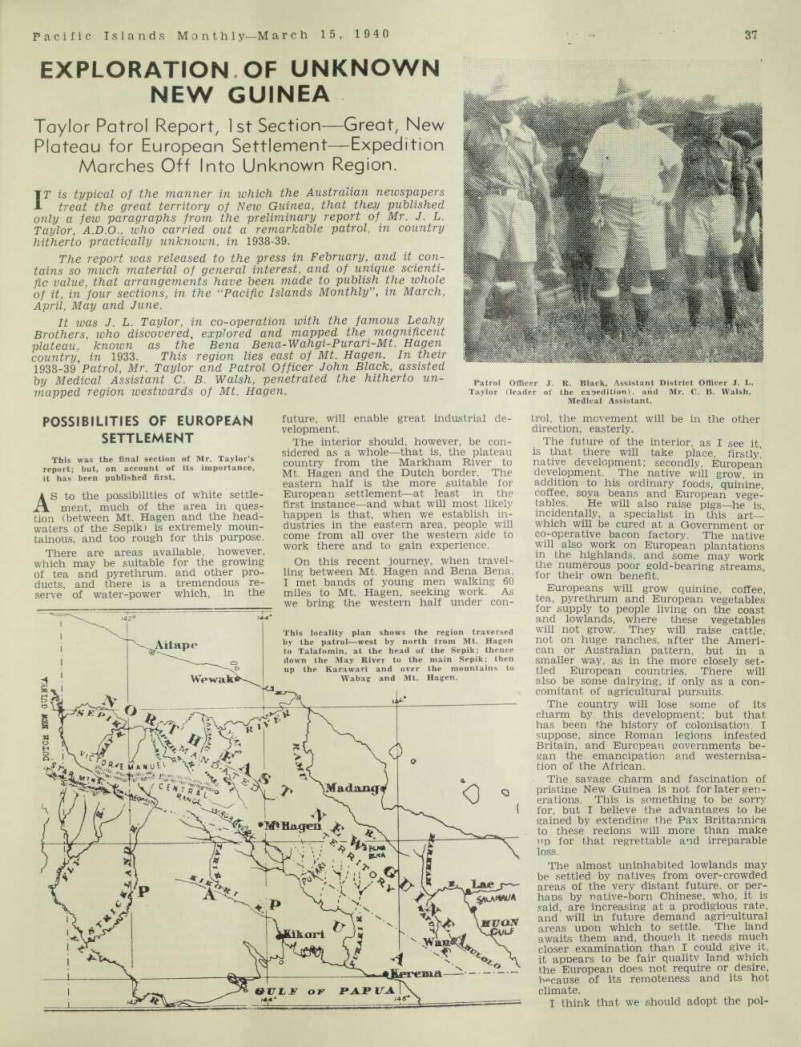
Exploration Of Unknown
Taylor Patrol Report, 1st Section —Great, New Plateau for European Settlement —Expedition Marches Off Into Unknown Region.
IT is typical of the manner in which the Australian newspapers treat the great territory of New Guinea, that they published only a few paragraphs from the preliminary report of Mr. J. L.
Taylor, A.D.0., who carried out a remarkable patrol , in country hitherto practically unknown, in 1938-39.
The report was released to the press in February, and it con tains so much material of general interest, and of unique scienti fic value, that arrangements have been made to publish the whole of it, in four sections, in the “Pacific Islands Monthly”, in March, April, May and June.
It was J. L. Taylor, in co-operation with the famous Leahy Brothers, who discovered , explored and mapped the magnificent plateau, known as the Bena Bena-Wahgi-Purari-Mt. Hagen country , in 1933. This region lies east of Mt. Hagen. In their 1938-39 Patrol, Mr. Taylor and Patrol Officer John Black, assisted by Medical Assistant C. B. Walsh, penetrated the hitherto un mapped region westwards of Mt. Hagen.
Patrol Officer J. R. Black, Assistant District Officer J. L.
Taylor (leader of the expedition), and Mr. C. B. Walsh, Medical Assistant.
Possibilities Of European
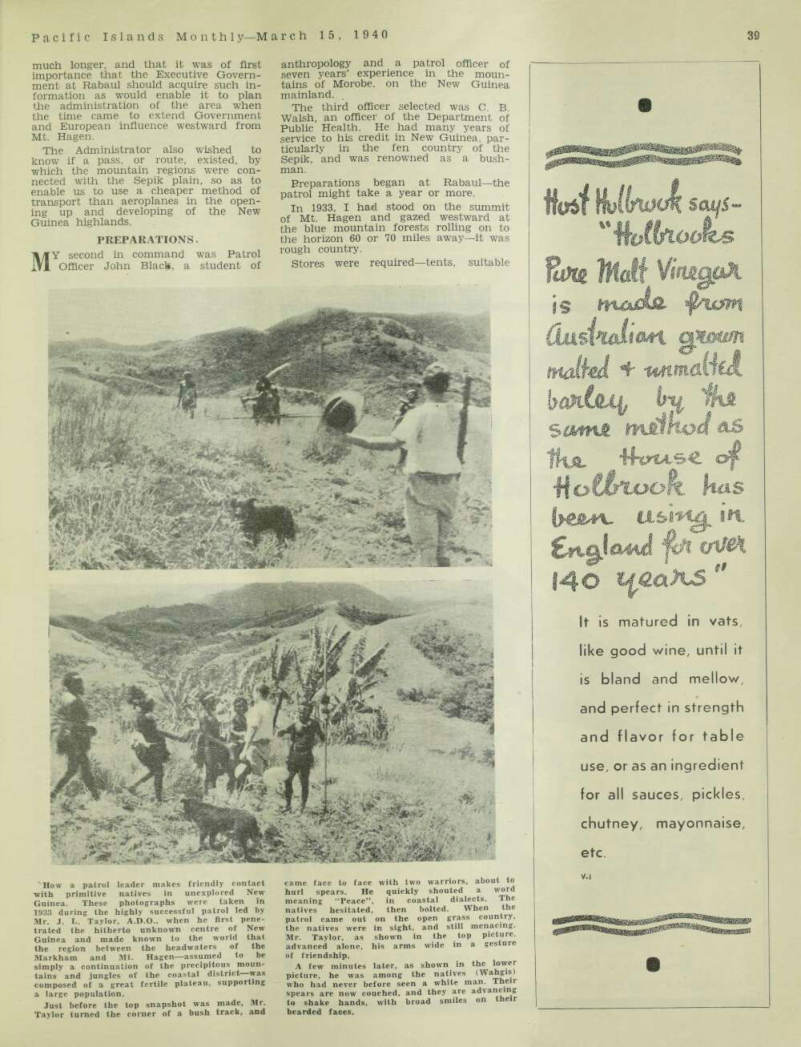
Settlement
This was the final section of Mr. Taylor’s report; but, on account of its importance, it has been published first.
AS to the possibilities of white settle ment, much of the area in ques tion (between Mt. Hagen and the head waters of the Sepik) is extremely moun tainous, and too rough for this purpose.
There are areas available, however, which may be suitable for the growing of tea and pyrethrum, and other pro ducts, and there is a tremendous re serve of water-power which, in the
future, will enable great industrial de velopment.
The interior should, however, be con sidered as a whole —that is, the plateau country from the Markham River to Mt. Hagen and the Dutch border. The eastern half is the more suitable for European settlement—at least in the first instance —and what will most likely happen is that, when we establish in dustries in the eastern area, people will come from all over the western side to work there and to gain experience.
On this recent journey, when travel ling between Mt. Hagen and Bena Bena.
I met bands of young men walking 60 miles to Mt. Hagen, seeking work. As we bring the western half under con-
trol, the movement will be in the other direction, easterly.
The future of the interior, as I see it, is that there will take place, firstly’ native development; secondly, European development. The native will grow, in addition to his ordinary foods, quinine, coffee, soya beans and European vege tables. He will also raise pigs—he is, incidentally, a specialist in this art— which will be cured at a Government or co-operative bacon factory. The native will also work on European plantations in the highlands, and some may work the numerous poor gold-bearing streams, for their own benefit.
Europeans will grow quinine, coffee, tea, pyrethrum and European vegetables for supply to people living on the coast and lowlands, where these vegetables will not grow. They will raise cattle, not on huge ranches, after the Ameri can or Australian pattern, but in a smaller way, as in the more closely set tled European countries. There will also be some dairying, if only as a con comitant of agricultural pursuits.
The country will lose some of its charm by this development: but that has been the history of colonisation, I suppose, since Roman legions infested Britain, and European governments be gan the emancipation and westernisa tion of the African.
The savage charm and fascination of pristine New Guinea is not for later gen erations. This is something to be sorry for, but I believe the advantages to be gained by extending? the Pax Brittannica to these regions will more than make np for that regrettable and irreparable loss.
The almost uninhabited lowlands may be settled by natives from over-crowded areas of the very distant future, or per haps by native-born Chinese, who, it is said, are increasing at a prodigious rate, and will in future demand agricultural areas upon which to settle. The land awaits them and, though it needs much closer examination than I could give it, it apnears to be fair qualitv land which the European does not require or desire, because of its remoteness and its hot climate.
I think that we should adopt the pol-
This locality plan shows the region traversed by the patrol—west by north from Mt. Hagen to Talafomin, at the head of the Sepik; thence down the May River to the main Sepik; then up the Karawari and over the mountains to Wabag and Mt. Hagen.
ISL™ ? f A ? eny ?.’ - and reserve the highlands of New Guinea for Europeans, where climatic conditions are temperate and suitable for the European manner of living. Asiatics
flourish exceedingly in the warm climate of the lowlands and the coast.
The existence of these highland areas makes New Guinea, normally a land of moist tropical conditions, something be tween a second Java and a second New Zealand. That is the opinion of John Black, my colleague and companion, who has had some experience in agricultural matters.
In order that the interests of the native people of the area should be con served, I should like to see, as officers administering the area, men with a bias towards anthropology. So many people regard anthropology as an academic study, and perhaps do not realise how applicable it is to the host of problems which beset administrators in native matters, and I might add European matters in and out of Europe. Unfor tunately, I am not an anthropologist.
It will be seen from this that New Guinea is a much greater country than most of us have believed hitherto. That it has a golden future I have no doubt, and I trust that we may see it in our time.
Report of the Patrol
THE patrol, which covered the period from March 9, 1938, to June 19, 1939, consisted of three European offi cers, two non-commissioned officers of the New Guinea native police. 18 native constables, and 230 carriers. The objects of the patrol were:— (1) The examination of both water sheds of the upland territory, westerly
and north-westerly from Mt. Hagen to the intersection of the Sepik River and the Dutch border. (2) The careful examination of the watershed of the Sepik tributaries which head in the mountains between Mt Hagen and the Dutch border. (3) The establishment of friendly rela tions with the tribes on the watersheds of the Papuan rivers and the Sepik tributaries. (4) Locating a site or sites for a new Government outpost or outposts on the headwaters of the Sepik tributaries ac cessible by water transport, if possible, from which it would be practicable for the Sepik staff to administer native populations and supervise the activities of miners and others when the area south of the Sepik is opened for the entry of European expeditions and par ties prospecting for oil and gold.
Earlier Explorations
rE area to be examined had been penetrated from several directions in the past;— By members of BehTmann’s expedition operating in 1914, who examined the southern tributaries of the Sepik, at their lower levels, and reached the high lands in the vicinity of the Sepik head waters, and the crest of the central range above the head of the April River; By Karius and Champion, who made their memorable journey from the Fly to the Sepik in 1928; By the brothers Leahy, who discov ered the valleys of the Lai and Ambum in 1934; By those intrepid Englishmen, the Fox brothers, who with their small party made a remarkable journey along the Papuan and New Guinea boundary dur ing the same year—they did not go as far as they imagined, but they went a long way; By the Ward Williams mining expe dition, which carried out a search for gold in the region of the Fly and Sepik headwaters in 1937; By William MacGregor, a resident of New Guinea (not the famous Sir Wil liam), who visited the lower Maramuni (Yuat) as far back as 1928 or 1929, and discovered the outlying inhabitants of the great tribe which occupies the plateau region drained by the head ways of the great Papuan river, the Purari.
Hadden, doyen of New Guinea ethno logists, suggested some years ago, just after Karius and Champion’s journey, if I remember, that exploration be car ried out between the 142nd and 144th meridian, in the cause of science. The area in question covers more than 10,000 sq. miles; and, despite the earlier exploration, very little was known and recorded about this interior, the last of unexplored New Guinea under Australian jurisdiction.
In 1937. prospectors for oil and gold were clamouring to be allowed to exam ine the area; and, some years before, the Commonwealth Government had promised the League of Nations to take steps to brine the whole of the Terri tory under political control with all pos sible speed. The Permanent Mandates Commission, only recently, had asked to be assured that no non-official interest would be permitted to onerate in narts of the Territory where that control did not exist in real and effective form.
In the face of this steadily growing interest in the interior, it became appar ent that it could not remain untouched
much longer, and that it was of first importance that the Executive Govern ment at Rabaul should acquire such in formation as would enable it to plan the administration of the area when the time came to extend Government and European influence westward from Mt. Hagen.
The Administrator also wished to know if a pass, or route, existed, by which the mountain regions were con nected with the Sepik plain, so as to enable us to use a cheaper method of transport than aeroplanes in the open ing up and developing of the New Guinea highlands.
Preparations.
MY second in command was Patrol Officer John Black, a student of
anthropology and a patrol officer of seven years’ experience in the moun tains of Morobe. on the New Guinea mainland.
The third officer selected was C B.
Walsh, an officer of the Department of Public Health. He had many years of service to his. credit in New Guinea, par ticularly in the fen country of the Sepik, and was renowned as a bush man.
Preparations began at Rabaul—the patrol might take a year or more.
In 1933, I had stood on the summit of Mt. Hagen and gazed westward at the blue mountain forests rolling on to the horizon 60 or 70 miles away—it was rough country.
Stores were required—tents, suitable
How a patrol leader makes friendly contact with primitive natives in unexplored New Guinea. These photographs were taken in 1933 during the highly successful patrol led by Mr. J. L. Taylor, A.D.O., when he first pene trated the hitherto unknown centre of New Guinea and made known to the world that the region between the headwaters of the Markham and Mt. Hagen—assumed to be simply a continuation of the precipitous moun tains and jungles of the coastal district was composed of a great fertile plateau, supporting a large population.
Just before the top snapshot was made, Mr.
Taylor turned the corner of a bush track, and
came face to face with two warriors, about to hurl spears. He quickly shouted a word meaning “Peace”, in coastal dialects. The natives hesitated, then bolted. When the patrol came out on the open grass country, the natives were in sight, and still menacing.
Mr. Taylor, as shown in the top picture, advanced alone, his arms wide in a gesture of friendship.
A few minutes later, as shown in the lower picture, he was among the natives (Wahgis) who had never before seen a white man. Their spears are now couched, and they are advancing to shake hands, with broad smiles on their bearded faces.
“| and bedding, cooking utensils, portable rations for police and carriers, and ton l ahawk J’. and a vari " wo l h f money f( T tradm e Purposes We had to carry, also, European food supplies, scientific instruments, collectmg gear wireless and photographic equipment and medical supplies.
The tents chosen were 14 x 12 ft., and made of Japara, an Egyptian cotton material about one-third the weight of ordinary duck. A tent fly 16 x 18 ft. accompanied each, but no poles. We relied on cutting our own These tents and flys were obtained from a Brisbane sailmaker and stood up well to the work, though in the hurry I forgot to have them rot-proofed, and the lower part of the walls rotted away quickly.
I used a compactum canvas stretcher from Benjamin Edgington, and my companions hammocks. These ham-
mocks are tubes of heavy canvas about 7 ft. long and 3 ft. in diameter A triangle made from two stout sticks driven well into the ground about 5 ft. apart, and fastened at the anex is set up at the head and foot of the bed.
Two poles are passed through the ham mock, pulled outwards, placed over the triangles, and forced downwards until a level couch is obtaind. The poles are then secured with bush rope This makes a very satisfactory bed, but is not convenient where timber is scarce Boots were a problem, as it is difficult to find a boot that is comfortable, and strong enough to stand up to continu ous patrolling in New Guinea. Alpine spikes are necessary, and knee boots with 16-inch uppers are to be preferred.
Flannel shirts and good blankets are required for the carriers, for in New Guinea, as elsewhere the higher the
colder, and we expected to be working at high altitudes.
Portable rations consisted of rice, bis cuits, marmite, salt, sugar and cocoa.
English knives and Swedish axes were taken for use and for trade.
Nearly every variety of shell which I knew to be valuable in the interior was purchased from the coastal people—the gold-lip and green-snail mother-of pearl from the Admiralty and Thursday Islands: the annulus cowrie from the coral reefs of the New Guinea coast; the tiger cowrie, and the conus, from the Manus lagoons; and the nassa, or tambu shell, from the black beaches and estuaries of New Britain, where it is still much treasured, though now rivalled after 60 years of European influence by English money.
European food supplies were bought locally, the principal items being flour, sugar, tea, coffee, bacon, cheese and dried fruit.
We were well equipped with mapping instruments. A theodolite was lent us by the Secretary for Lands, an aneroid reading to 2,500 ft. by Guinea Airways Ltd., chronometer from the Government vessel “Leander”, a prismatic compass and Zeiss binoculars by Mr. Leahy. I also had cranial calipers, a stature mea suring rod, and prismatic compass.
The Administrator, who is keenly in terested in wireless by which he keeps in close touch with every part of the Territory, equipped us with a radio telephone sending and receiving set from Amalgamated Wireless. It was power-driven by a small petrol engine, and, though heavy,, it carried well, and gave excellent results throughout the patrol.
For photographs we had a splendid set of gear, Graflex 5x4, Rolleiflex, Leica and Cine-Kodak 16 mm. The de velopment of the films was done in the bush, the printing in Sydney.
Mr. Proggatt, of the Agricultural De partment, supplied us with collecting gear for insects and other specimens, and the Public Health Department issued a complete field outfit. Special attention was given to beri-beri pre vention, and a preparation, abidon (a. b and d vitamins), was included. Walsh packed his supplies in portable medical chests of his own design, made of light deal timber, and much superior to those usually supplied to patrols.
On December 31, 1937, the Administra tor sent for me, and I received my in structions. They were simple and ex plicit: To examine the country and establish friendly relations with the in habitants. He spoke kindly, and wished us success. The details were left to me,
Transport
I PROPOSED to fly our stores and equipment to Mt. Hagen and set out from there on foot to a point about 90 miles west north-west, and make a base camp, from where the examination of the country surrounding would be carried out. Then to move on another 40 miles or so. and do the same agairf.
Lastly, a third camp at the Sepik head waters, in the vicinity of Kelafomin (or Telafomin), A new Government Police Post was to be established at Mt. Hagen and this simplified matters a lot. Mt. Hagen was our rendezvous.
I was free to choose what members of the Native Constabulary I wished, and Lieut.-Col. Walstab gave me every assistance. Two non-commissioned ofli
cers, Sergeants Lopangom and Fokinau, had belonged to my detachment at Chimbu, and Constables Bungi. Übom and Serak had worked under me for several years in the high country, Bungi and Übom since 1932. These men were attached to police posts in various parts of the Territory, but were placed at my disposal, and they served throughout the patrol. Without them the patrol would have accomplished much less than it did—might have failed.
The question of carriers was of vital importance. Upon them much would depend, particularly on their spirit. A patrol with discontented carriers might soon end in disaster.
I knew where to get them. I had been working on the Purari plateau for several years, and had confidence in the people there. I proposed to fly to Bena Bena, and march from there to Mt.
Hagen, collecting carriers on the way. I should then have some from various groups, which would be all to the good.
It would produce a healthy spirit of rivalry, which would make for smoother working.
On January 29. the journey from Bena Bena to Mt. Hagen began. It was marked by the great enthusiasm of the people along the route, and hundreds of volunteers to join the party.
I quote from my diary of February 3: “At Chuave about 2,000 people at the station. Visitors greeted me with cheers of welcome, outstretched hands and smiling faces. Every here and there a prominent man and sometimes a little child would kiss my hand. Hundreds asked to be allowed to go with us. Un fortunately, I could only take a few from each. Food in abundance.”
On February 20, 1938, with about 100 selected carriers. I arrived at Mt. Hagen.
Black and Walsh were there and also Edwards (the Patrol Officer who had been appointed to take charge of the new Mt. Hagen Police Post). There was a lot of work to be done checking and re-packing stores, writing to people, final preparation of the personnel, lectures to police, the delegation of duties, in structions to carriers and medical examinations.
Ready To Start
BY March 8, all was ready. An ad vance party of police, guides and interpreters had gone on ahead to pre pare the first three camps at places where the people were known to be friendly to us. Constable Bungi was in charge of them and could be relied upon to do a good job.
My plans were to proceed to the valley of the Gai (I discovered later that the name of this river in the language of the people who live on its banks is Ive Lai —Ive meaning water, or river), a tributary of the Yuat, where there was known to be a high population, and move westerly from there across the main cordillera, and make my first base camp in a populous area in the vicinity of the 143rd meridian.
Two years previously, I had flown with Messrs. Hides and Champion, as a guest of the Papuan authorities, across country to the south, and had observed as closely as was possible, from an aero plane travelling at 100 miles an hour, the headwaters of the western Purari and Kikori, and the southern slopes of the central watershed.
The march to the locality of the pro
posed base camp would be about 90 miles, as the crow flies, but perhaps more than 200 miles across country, intended to march steadily but not h * and maintain an advance ai is where Considered thl small party would be L f C p 0n ? n d d ere £ e from attack h^till k was mv aim Tit is the S
- officlr of Administration
g °ffl cel pe^ le °” nd A “ Imong them peaceably. If we were attacked, we were strong enough to defend our selves. But I always have felt, and always shall feel, a sense of failure when I find it necessary to use force against the warriors of primitive New Guinea.
T had discU ssed every aspect of the work with my companions. They knew every detail of my plan and I impressed upon them that no one could lay down a definite scheme. Try as I might to adhere to plans, New Guinea might decree otherwise. one tter T held a very defin ite view-that was, that we should de- P end on native tracks, and not attempt to cut our way through trackless jungle, it had been my opinion for a long time that ’ though New Guinea is IT V p a rts covered with dense, uninhabited forests (perhaps impenetrable as in South America and other tropical lands, but still extremely dense), it would be possible to travel by native track from Samarai, at the extreme south-eastern end of Papua, to the Birds Head, at the north-western end of Dutch New Guinea. The art of travelling is the art of finding the existing tracks by making
friendly contact with the people and using them as guides.
A chain of interpretation is almost unobtainable. After a few days’ march ing, sometimes after a few hours only, a new language is met with. Guides and interpreters are afraid to proceed fur ther, and one has to fall back on the language of signs. (To be Continued) Mr. A. E. J. Werman arrived in Thurs day Island from Boonah, Queensland, in February, to take charge of the State School, replacing Mr. J. Anderson, who has gone to Townsville. Mr. A. Kelly, of Childers, Queensland, is his new assistant, Mr. Robert Elmes having been transferred to the mainland.
Mr. Kenneth Allsop, of Rabaul, New Guinea, married Miss Millicent Netta Pearce, of Merrylands, N.S.W., at Rabaul Methodist Church on February 17.
Advertisements & other items, pp. 41-45 (6 items)
37
Pacific Islands Mo nth 1 y—M arch 15, 1940
38
March 15, 194 O—P acific Islands Monthly
Kork-N-Scal
FOR
HOME
USE
Hand Applied Airtight Pressure Proof
FOR ALL HOME BOTTLING
—THE LITTLE CAP THAT
will Re-seal 1,000 Times
KORK-N-SEAL (Aust.) LTD.
106 COMMONWEALTH STREET,
SYDNEY, AUSTRALIA.
rw. • Australia’s Choicest Products: Brussels Sprouts While Turnips Sweet Coro Tomato Puree Green Peas Beetroot French Beans Spinach Cauliflower Cabbage Carrots Parsnips Tomato Sauce Celery Tomato Soup Tutti Fruit Sauce (Worcestershire flavor) A II m •Jl ® i a m 2 m Always . . . make sure you have at hand an ample Reserve of these Delicious . .
Garden
Vale
Ready-toserve Vegetables
ftcrtf K s<u/5-
fane tHalt
is ntaJji
(lusinali&n
tuaihJ mm
baKCiUj, %
ttitlritnl AS tkft. ■fkri4.s€ of
jjaCAtaok
in |c& 01M 140 tjaaK *' It is matured in vats, like good wine, until it is bland and mellow, and perfect in strength and flavor for table use, or as an ingredient for all sauces, pickles, chutney, mayonnaise, etc. v.l
GUINNESS
Stout
FOR STRENGTH
m m i Basil •I** in 6
STOCKED BY ALL BRANCHES OF
Brown & Joske Ltd. W. R. Carpenter & Co. Ltd.
Burns Philp & Co. Ltd. Morris Hedstrom Ltd.
Advertisement of Export Bottlers Ltd., London. A. Macfee & Co. Ltd., Wapping, Liverpool, England,
Established 50 years—and carrying one of the largest stocks of Iron and Steel in Australia.
William Atkins Pty. Ltd.
Head Office 449-451 KENT ST., SYDNEY.
FULL, COMPREHENSIVE & UP-TO-DATE RANGE IN ALL
DEPARTMENTS, INCLUDING THE FOLLOWING LINES:—
Iron & Steel Merchants
ENGINEERS' SUPPLIES
COACH & MOTOR HARDWARE,
Cable Address: WILATKIN, SYDNEY.
STEEL DEPARTMENT
MILD STEEL:
Engineers' Supplies:
Set Screws, Studs, Metal Thread Screws, Coach Screws. Files, Cotter Pins, Bright and Black Bolts, Rivets, Etc., Hack Saw Blades.
Rounds, Squares, Flats, Half-rounds, Hexagons, Bevel, Shoeing, Tyre, Angles, Tees, Sheets, Plates, Girder Plates, Chequer Plates, Channels, Hoops, Etc.
BRIGHT STEEL;
Rounds, Squares, Hexagons.
Extra Special High Speed Tool Steel, Mining Steel, Blister Steel and Spring Steel, Rounds, Flats & Squares.
Power Transmission Gear: Including Plummer Blocks, Couplings, Collars, Etc.
Coach and Motor Hardware; Axles, Springs, Wheelstuff, Duck, Paints.
Farriers' Supplies: Horse Nails, Anvils, Vices, Etc.
Motor-Trimmers and Motor Builders' Motor Painters' Requirements
C. A. WILLEY'S
Bar Iron — All sections and sizes.
Quick-Drying Coach and Car Paints, Roughstuff, Elastic Gloss, Synflex Enamels, Lacquers.
DUCO Lacquers and DULUX Enamels— FAßßEX Motor Toppings and Leather Cloths, House Cr Decorators' Paints, Varnishes & Brushware Sole Distributors of CHAMPION'S Decorators Paint Products. , Distributing Agents for BROLITE Lacquers, SYNFLEX Enamels and POLYGLOSS Finish.
39
Pacific Islands Monthl y—M arch 15, 1940
40
March 15, 194 O—P acific Islands Monthly
41
Pacific Islands Monthl y—M arch 15, 19 40
Samoa's Excellent Cocoa
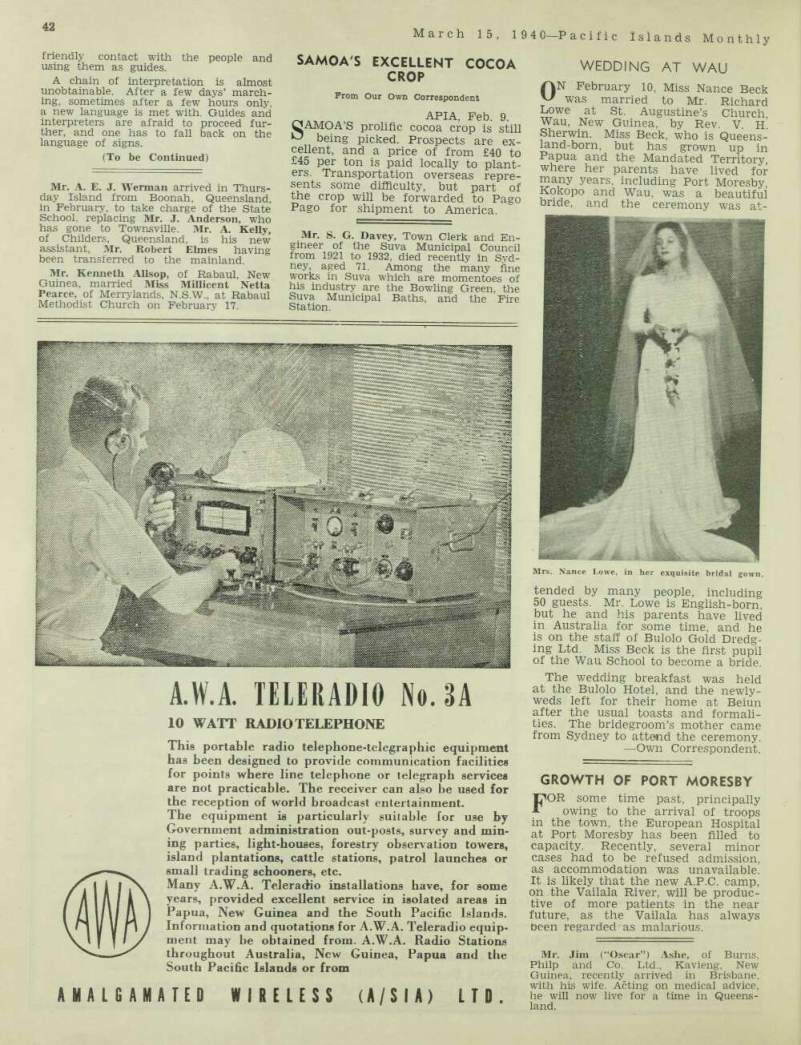
Crop
From Our Own Correspondent
Sapia, Feb. 9.
AMOA’S prolific cocoa crop is still being picked. Prospects are ex cellent, and a price of from £4O to £45 per ton is paid locally to plant ers. Transportation overseas repre sents some difficulty, but part of the crop will be forwarded to Pago Pago for shipment to America.
Mr. S. G. Davey, Town Clerk and En gineer of the Suva Municipal Council from 1921 to 1932, died recently in Syd ney, aged 71. Among the many fine works in Suva which are mementoes of his industry are the Bowling Green, the Suva Municipal Baths, and the Fire Station.
Wedding At Wau
February 10, Miss Nance Beck V/ was married to Mr. Richard Lowe at St. Augustine’s Church Wau, New Guinea, by Rev. V. h!
Sherwin. Miss Beck, who is Queens land-born, but has grown up in Papua and the Mandated Territory, where her parents have lived for many years, including Port Moresby, Kokopo and Wau, was a beautiful bride, and the ceremony was at-
tended by many people, including 50 guests. Mr. Lowe is English-born, but he and his parents have lived in Australia for some time, and he is on the staff of Bulolo Gold Dredg ing Ltd. Miss Beck is the first pupil of the Wau School to become a bride.
The wedding breakfast was held at the Bulolo Hotel, and the newly weds left for their home at Beiun after the usual toasts and formali ties. The bridegroom’s mother came from Sydney to attend the ceremony. —Own Correspondent.
Mrs. Nance Lowe, in her exquisite bridal gown.
Growth Of Port Moresby
FOR some time past, principally owing to the arrival of troops in the town, the European Hospital at Port Moresby has been filled to capacity. Recently, several minor cases had to be refused admission, as accommodation was unavailable.
It is likely that the new A.P.C. camp, on the Vailala River, will be produc tive of more patients in the near future, as the Vailala has always been regarded as malarious.
Mr. Jim (“Oscar”) Ashe, of Burns, Philp and Co. Ltd., Kavieng, New Guinea, recently arrived in Brisbane, with his wife. Acting on medical advice, he will now live for a time in Queens land.
Advertisements & other items, p. 46 (2 items)
42
March 15, 194 O—P acific Islands Monthly
A.W.A. Teleradio N«.3A
m -v w iMI t r\
10 WATT RADIOTELEPHONE
(§> This portable radio telephone-telegraphic equipment has been designed to provide communication facilities for points where line telephone or telegraph services are not practicable. The receiver can also he used for the reception of world broadcast entertainment.
The equipment is particularly suitable for use by Government administration out-posts, survey and mining parties, light-houses, forestry observation towers, island plantations, cattle stations, patrol launches or small trading schooners, etc.
Many A.W.A. Teleradio installations have, for some years, provided excellent service in isolated areas in Papua, New Guinea and the South Pacific Islands.
Information and quotations for A.W.A. Teleradio equipment may he obtained from. A.W.A. Radio Stations throughout Australia, New Guinea, Papua and the South Pacific Islands or from
AMALGAMATED WIRELESS (A/SIA) LTD.
Granny" Government
Samoa’s Home-brew Attacked Another Example of "Old Granny" Government
From Our Own Correspondent
Apia, Feb. 8.
WITH cases of beer, pots and boilers stacked in the courtroom, Apia High Court looked (and smelled!) like a miniature brewery recently, when a dozen European and Samoan offenders were charged with having manufac tured intoxicating liquor, viz., “faamafu” (or “home-brew beer”). They were fined amounts varying from 5/- to £l.
His Honour Chief Judge Harley an nounced that in future offenders would face imprisonment instead of fines, and that the Administration intends to limit the importation of hops, malts and other “home-brew” ingredients. The price of imported beer obtainable by permit at Apia Customs was .recently increased from 1/6 to 1/8 per bottle.
THIS is another example of the injus tices which Western feamoa suffers under the “Old Granny” Government of New Zealand.
There are three communities in Samoa —Europeans (only a few hun dreds) ; Euronesians (several thousands, who live in the same way as Euro peans) ; and the Samoans.
The Samoans are not affected by the liquor question—or only to the extent
that the Administration must prevent Samoans becoming accustomed to the use of European intoxicants.
The Europeans and Euronesians in Samoa are entitled to the use of liquor, in moderation, just as are Europeans elsewhere. But “Old Granny” has de cided that there shall be no liquor in Samoa (believed to be a dictum issued 20 years ago by a New Zealand Minis ter, who was a Prohibition fanatic), except as a medical necessity. This gradually developed into a system whereby each European is “entitled” to so much beer and spirits per week— an order for same, directed to the Cus toms official, being signed by the Gov ernment Medical Officer. The Custom house imports the liquor and retails it.
It has become a highly profitable trade.
When I was in Samoa in 1936, being anxious to return much generous hospi tality, I applied twice at the Custom house for a supply of liquor. I was brusquely told to “go up to the hospital and get an order from the M. 0.” I did not go to the hospital: and, being annoyed by bureaucratic discourtesy and a silly system, I made it my business to procure a supply of liquor, in defi ance of both.
So much for the Europeans. The Euronesians, having less money, had to find a way of supplying their normal liquor needs, without recourse to the rationing system. Hence, “home-brew”.
Good beer is easily made in the home, and Germans usually are expert brew ers. “Home-brew” has been an estab lished institution in Samoa for 20 years.
I visited many Euronesian homes, and I sampled dozens of “home-brews”; and, almost without exception, they were excellent.
Although most people brewed beer only for their own use, it was plain that “home-brew” had become an article of trade. In fact, there were cafes where anyone could buy it. Such a develop ment was inevitable. For many, it was much easier to buy other people’s beer, than to brew their own.
I could not see that the “home-brew” system was abused. On the contrary, it seemed to me a very good solution of the Euronesian problem created by “Old Granny” Government and her absurd liquor-rationing plan. The “home brew” was alcoholic, of course, but not heavily so. I saw no drunkenness in Samoa. Many European, as well as Euronesian, homes had their own “home-brew”.
Some time ago. Samoa residents appealed to New Zealand to revise the liquor laws. Instead of that, in the manner typical of “Old Granny’s” notoriously muddled administration of Samoa, the “home-brew” system is be ing attacked. Instead of dealing with the original evil, “Old Granny” sets off after what is a secondary and a really
harmless thing.-
R.W.R.
Mr. and Mrs. J. Chapman, of Rewa, Fiji, celebrated their golden wedding anniversary last month —they were mar ried in Melbourne on February 6, 1890.
Mr. Chapman, who is 72 years of age, originally went to Fiji in 1868 and has lived at his home on the banks of the Rewa River ever since, except for an occasional visit to Melbourne.
Mr. A. E. S. Howard, District Com missioner in Fiji, has been accepted for military service in England, where he was spending long leave.
Advertisements & other items, pp. 47-48 (3 items)
43
Pacific Islands Monthl y—M arch 15, 1940
Fairbanks Morse
Backed by a great name!
and Company
Manufacturers of
DIESEL ENGINES, STATIONARY, MARINE
AND DREDGE SERVICE, from 10 to 1,500 H.P.
DIESEL ELECTRIC SETS, 6 to 1,200 KW.,
ALTERNATING OR DIRECT CURRENT.
FAIRBANKS SCALES AND WEIGHING
MACHINES
FARM ENGINES and FEED GRINDERS.
"FAIRDAY" WASHING MACHINES and
IRONERS.
PUMPING EQUIPMENT for EVERY SERVICE.
RAILROAD EQUIPMENT.
*7
HOME LIGHTING SETS.
Fullest information and data available from
Fairbanks Morse [A/sla] Pty* Ltd.
29-33 CLARENCE ST., SYDNEY.
"nf f? JS 6 fu .nd
PAPUAN SUPERANNUATION
From Our Own Correspondent
PORT MORESBY. Feb. 14.
TOURING the year 1939, pensions LJ totalling £12,582 were paid out to 41 public servants who are on superannuation. There were 146 contributors to the fund and their total contributions were £3,452. In terest from investments amounts to
£1,379. The balance of the money re
"nf f? JS 6 fu .nd
—a mattei of £7,soo—was provided 27 Administration of Papua.
Two Pensioners died during the u 6a i % and ,. ei ght public servants who ££ , retired on superannuation Jomed the pension list.
Mr Rnc T T r ,—: „ in S NnSl?? 1111 / f ari ™ d the ILA.A.F. orfolk Island to join
Taro
Known in China and Egypt Before Christian Era
Prom Our Own Correspondent
Honolulu, Feb. 6.
TARO, the ancient and modern staple food of most Pacific native peoples was known to the Chinese in 100 B.C , and was in wide use among the Egyp tians at the beginning of the Christian era. , f \ ; Pliny, for example, referred to it in 50 A.D. as an important established food.
These and almost every other fact which you might care to know about taro are included in Bulletin 84. just issued free by the University of Hawaii Agricultural Experiment Station at Honolulu.
Leo D. Whitney, agronomist at the station, wrote the Bulletin after long research, and collaboration with local authorities, including the Bishop Museum.
Eighty-four varieties of taro are de scribed. The Bulletin is timely because of the recent emphasis placed upon the food values of taro by physicians and nutritionists.
Help Small Miners
Plea for the Goldfields Road
From Our Own Correspondent WAU, Feb. 11.
PERSISTENT reports are current in Morobe that an excellent route has been found from Salamaua to the Goldfields, presenting no in superable engineering difficulties and eliminating several costly bridges which would have been necessary on the original “most direct route”.
Residents now hope that tenders will be called in the near future for the construction of this project.
There should be no further misgiv ings as to where the money is to come from, since the new Gold Tax is building up the Trust Fund at the rate of about £20,000 per month. As the Gold Tax is to be devoted to “progressive works and forward movements in the Territory”, pre sumably it can be used to finance the Wau-Salamaua road.
Small miners are finding it diffi cult to carry on, since commodity prices and freight rates are advanc ing gradually rice, a necessary item, rose recently by £3/10/- a ton, on the beach. An assurance that the road from the coast is to be put into construction would give new incen tive to these small miners.
An overseas stamp journal reports that the New Zealand Government contem plates issuing a new set of stamps for Niue Island and that one of the de signs will be a reproduction of the mis sion ship “John Williams II” which was wrecked on Niue in 1867. These stamp issues by impoverished Islands Admini strations are becoming so common that a pirate-ship would be a more suitable subject than a mission-ship.
Advertisements & other items, p. 48 (2 items)
44
March 15, 194 O—P acific islands Monthly
which)
YE S/
but r>.
painf (
m rs
OF COURSE
(PR RE A J(eeps on DCeeping
AGENTS THROUGHOUT THE ISLANDS.
I!JI*
Food Refused

Suspicious Natives in New Hebrides
THE volcanic eruption on the island of Lopevi (in the New Hebrides) and the evacuation of the population to the neighbouring island of Paama, were described in “P.1.M.” in December. Since then, there has been a remarkable sequel.
On their arrival in Paama, the evacu ees were afforded hospitality in the already over-crowded villages around the mission station. When it became evident there was no prospect of an early return, they were offered land for settlement on the east coast, where were only "a few villages with a sparse popu lation, and they were within easy reach of Lopevi. They gladly accepted the offer.
No sooner had the six new volcanic vents subsided than a few enterprising souls crossed the channel in canoes to spy out the land. They were dismayed to find the entire island utterly deso late. They returned convinced that Lopevi was no longer fit for habitation, and resolved to settle down on Paama.
When the Condominium Government was informed of the situation by Mr. F.
H Harvey, of the Epi Broadcasting Sta tion, and Rev. M. Frater, it offered to provide the refugees with food. Under the direction of Dr. Monfort, French medical officer, the French Government yacht “Concorde” was despatched with rice and tinned meats. But the natives refused to accept the hospitality of the Condominium and would not touch the food.
It is difficult to discover a reason for such extraordinary behaviour. Readers of “P 1.M.” will remember that, two years ago, a similarly embarrassing situation arose between the natives of the Group and the British Administration, over the distribution of Coronation Medals. Dur ing his cruise through the Islands, Sir Arthur Richards, then High Commis sioner, presented to native chiefs a decorative medal, as a token of good will on the occasion of the King’s coro nation. The natives not only disap proved, but resented the complimentary gesture. It was a strange thing to hap pen—probably the only case in the world where Coronation Medals had
been so contemptuously spumed.
It was believed that the natives, act ing under the influence of herd psy chology, were carried away by an alarm ist rumour that the Coronation Medals were a prelude to the imposition of a poll-tax. For years, the dread of this levy has been a disturbing undercurrent in native life. Suspicion rested on a few chiefs in the northern islands, with strong isolationist views, and one, the patriarchal chief of Paama, was sum moned before the two Resident Commis sioners at Vila. He was found guilty of spreading false rumours and was sen tenced to a term of imprisonment. His return to Paama intensified, rather than allayed, native susceptibilities, and the agitation about the poll-tax became associated with a new obsession. Nation alism, as it is expressed in so many places in the world to-day, exercises a disturbing influence. In some islands, this pan-Melanesian fantasy hangs oyer the native mind like the intoxicating fumes of a narcotic.
The behaviour of the Lopevi people is the more surprising because, unlike the Paamese, they are a tranquil people and not sticklers for their rights. Lopevi,
too, though one of the most conspicu ous and picturesque, was possibly the poorest island in the New Hebrides. The hungry natives should have revelled in a boat-load of foodstuffs, as a heaven sent gift.
Perhaps their behaviour is best ex plained by this story. “Why don’t they have a drink with me?” asked an Aus tralian visitor in a Scottish village inn “Och,” said his friend, “they think ye want to sell them a lawn-mower or a washing-machine.”
Brigadier-General Sir Herbert Hart, who was Administrator of Western Samoa from 1931 until 1935, and who now is Chief Administrative Officer of the Imperial War Graves Commission, with headquarters in Palestine, visited Australia and New Zealand in February.
Dr. G. A. Irwin, who has been on the staff of the Government Hospital at Apia, Western Samoa, for the past four years, arrived in New Zealand in mid- February.
Mrs. E. M. Zahel, who has been head teacher for 31 years on Badu Island, Torres Strait, returned to her station in February after a holiday in Sydney.
Rev. A. Aufinger, of the Society of the Divine Word. Alexishafen, New Guinea, has been appointed Roman Catholic priest to the parish of Wau, Morobe Dis trict. It is reported that plans are afoot to build a Catholic Church in Wau.
Mrs. A. M. Carolin, an English author ess, who writes under the name of “Mary Atherton”, arrived in Sydney in Febru ary on her way to Tahiti, where she will put the finishing touches to a new novel which she is writing. The book, which will have a South Seas setting, will be called “Delay No Longer”.
Mr. A. K. Grabowsky has joined the staff of A.P.C. Ltd., in Port Moresby.
He is a brother of a former manager of Guinea Airways Ltd.
Advertisements & other items, pp. 49-50 (2 items)
45
Pacific Islands Monthl y—M arch 15, 1940
Bitumenoid Roofing
Timber, Joinery
ETC.
PREPARED BUILDINGS ready for erection a specialty.
SHIP AND BOAT BUILDING.
TIMBERS specially catered for.
FIBROLITE, PLYWOODS.
GALVANISED IRON.
CONSIGNMENTS shipped
by RETURN STEAMERS
to the Islands.
John W. Eaton
PTY. LTD.
WEST CRESCENT STREET,
NORTH SYDNEY.
Telephones: XB 4051 (6 lines.)
BITUMENOID ROOFING
MADE IN AUSTRALIA.
Bitumenoid Roofings, Dampcourse and Insulating Felts are made from the world’s best raw materials. Warranted to stand the most rigid tests.
BITUMENOID THE BEST
Roofing, 1,2, 3-ply; Flooring, Waterproof Materials; Saturated Felt; Resilient Road Jointing: Natural Asphalt Dampcourse; 2 and 3-ply Dampcourse; 1-2 lb. Lead-core Dampcourse; Roofing Cement; Asphalt Paints; Roofing Compound.
SAMPLES AND PRICE LISTS ON APPLICATION.
MAXWELL PORTER & SON LTD.
ESTABLISHED 1888. BUILDERS’ SUPPLIES.
107 REDFERN ST.. REDFERN, SYDNEY, N.S.W. Phone: M 3157. Cables Bitumenoid.
Woven Wire for all Industry
COPRA DRYING TRAYS, FLOORS, Etc.
FRUIT DRYING TRAYS, MINING SCREENS
Heavy Mosquito Gauze in Phosphor Bronze and other Metals Impervious to Salt Sea Air WIRE DOOR MATS AND GENERAL WIRE WORKS
E. WRIGHT & CO. LTD.
Office and Works: 148-152 Cleveland Street, Sydney, N.S.W.
Telegraphic Address: “Wrlghtmake,” Chippendale.
a
DURATILi
These asbestos cement sheets give walls a tiled appearance at less cost. See examples in our showrooms or write for leaflet.
WUNDERLICH LTD.
Crown & Cleveland Sts., Re<dtern, Sydney REMEMBER the name
<r
It's CHEAPER to PAINT
than to repair!
DISTRIBUTORS:
Greenwood & Laws Ltd., Rabaul and Wan.
Steamships Trading Co. Ltd., Port Moresby and Samaral.
Millers, Ltd., Suva, FIJI.
Decay can do no damage If your home is properly protected with good paint.
Use “8.A.L.M.”
“8.A.L.M.” Paint gives protection. And it wears down evenly and very slowly, lasting years longer than ordinary paint.
Decide now to save money by painting; and decide to make maximum savings by using - - - - “8.A.L.M.” Paint! aiAOi Putt
tillin'
'•IP Hi A Product of British Australian Lead Manufacturers Pty. Ltd.,
Scott’s “Renown” Brand Rope,
Cable Address Ropeyard, Sydney.
Cordage and
Binder
Twine
of Every
Description
MANUFACTURED AT
MASCOT, NS W.
By
J. SCOTT
PTY. LTD.
Head Office and Store:
163 CLARENCE STREET.
SYDNEY,
N.B.W.
Strange Sequel to Old-Time Rarotongan Romance;
English Girl Who Married Polynesian
Chief
Strange Sequel to Old-Time Rarotongan Romance; Search for an Heir
By “Cloghogue”
I.
AS this 1940 New Year came to birth.
Rarotonga lost one of its links with “the evening of yesterday”; Puri Matai apo (chieftain of the second grade) passed away, near to the age of 80 years.
He was of the dramatis personae in some old-time, interesting scenes.
Somewhere in the sixties of last cen tury, there sailed and traded through the Eastern Pacific island groups a schooner which had for captain, Emil Piltz, a robust and energetic young German about 5 feet 10 inches in height complied with all Hitler’s requirements for Aryan racial purity. He was a blonde of the truest type, and was known to the natives as Pupuri, meaning “very fair’’. The similarity of his name to that of Mataiapo Puri was accidental.
Captain Piltz soon after his arrival in Rarotonga, married a native woman of some rank, and she bore him three daughters, and died. In need of another mate, he advertised in New Zealand for a wife, and from a matrimonial agency there came to him a young English girl named Mary Porter.
She was good, and good-looking, not yet out of her teens, with a fine head of crisp red hair, but she did not suit Captain Piltz. He was of a hasty and rather bullying disposition. On her re fusal to live with him in trial marriage for a while, they quarrelled and parted.
He refused to maintain her, or marrv less at OnC6 ’ and She would not acce Pt Being without means, Miss Porter brought her case before the Avarua Court of Ankis. The native judge was Tepou o te Rangi, and the then Britt ish Consul Exham. The Court ordered Piltz to pay a fine of 400 Chile dollars (equal to £5O), and to be responsible for the girls maintenance while she was la nd, and for her transport to theTe Z6aland Wh6n Sh 6 desired to return At this period, there was living, in the settlement of Arorangi, a fairly-Well-to 2?n, Eur . opea ? J? f about 40 ’ Mr - Craig Piltz induced him to receive Miss Porter mto his home for residence, as a keeper, until an opportunity arrived for sending her back to New Zealand. In Mr Craigs establishment, Puri, a voung native chieftain, served as cook. g Miss Porter remained with Mr. Craig bv whom she soon came to be regarded as a daughter, and she led a model and Hf fld life. She is still remembered bv those who knew her, with respect and eratitude, as she was ever ready to help with advice or kindly word, and bv women especially, for teaching them to cut out and fashion garments. No scan dal attached to her name, and her assistance was welcomed in the homes of European missionaries and other decent whites, when entertainments were toward.
With her kindlv temperament, and thrown continuously into the company of Puri, it is not to be wondered that mutual regard grew between them, “for vouth with them was in its ardent bloom”. Together they took part in the local native amusements, services and church work, and the buds of love burst into flower.
Eventually, in the early 80’s, they were married, in the Arorangi Church of the L.M.S., by Rev. Isaia Papehia, the native pastor. This event—a matter of consid erable excitement locally, as may be
imagined, for the union of a European woman with a Polynesian man was a novelty. indeed —remains a vivid recol lection with a few, still living, who witnessed it.
From that day, to this, Puri’s name has been coupled, in conversation, with the fact of his marriage to a Vaine Papaa tikai (a real white wife). The married pair made their home on Puri’s land, near Black Rock, where for a con siderable time they lived happily to gether.
When about 18 months had gone by, Mary Porter (now Mrs. Puri) was due soon to give birth to her first baby. The young, lonely stranger, in a strange land, dreaded this event. There was no European doctor available, no midwife, no near-living white woman; so she made up her mind to go to New Zea land for her confinement, intending, she said, to return to Puri with the child when they were fit for the voyage.
She was not altogether happy, about that time, for husband Pun—the novelty gone—with ingrained native laxity in sex matters, had of late found new female attachments. This laxity, the result of centuries of racial customs and promiscuity, the utmost exhortations and strictest laws of the missionaries and Administration alike had been —and have been —unable to eradicate. There was no open domestic break, however, what ever may have passed privately.
Captain Piltz being about to leave the Islands for a period, Puri Vaine (nee Mary Porter) took advantage of the opportunity and the order of the Court, and secured a passage with him to Auckland.
She did not return; nor did Puri learn aught of his wife and their child, for several years. 11.
SOME years after this event, the seed of to-day’s political status of the Cook Islands fell on waiting soil.
In 1888, Mr. Craig had entered into a contract to procure for a native, Ngatae, a sewing machine, for which payment was to be completed, within a definite date after receipt. The machine —a thing for native wonder —duly arrived from civilisation, and he who ordered having broken his contract, Mr. Craig sold the machine to an Aitutaki man who sent it on to his wife in that island.
Some difficulty arose about the return of contributory payments made by Nga tae, and the case came before the Aro rangi district court.
Mr. Craig was, despite the mission ary laws, a non-attender at the local church. The court, to a man, from judge to ushers, were intense churchmen.
The court heard the case, and, not withstanding invoices and accounts, deemed the machine not worth its price and that Ngatae had already paid for it, and ordered Craig to get the machine back and hand it over to Ngatae. The machine had gone on to Aitutaki in its original packing, and none of the court had seen it.
In addition, Craig was fined their favourite fine for Europeans, 400 Chile dollars (£5O sterling) for trying to cheat a poor native.
Craig refused to comply with the sen tence, so he was seized by the judge, Tauei Orometua, a native clergyman, and Pirangi (a Rangatira, and after wards Ariki, or King, of Arorangi) next in authority, and cast into the local gaol, where his feet were kept in stocks.
This local gaol had been built some tune before for one Take, the grandson of that Ariki Rurutini who had been first to accept the Gospel. Take had murdered his wife by striking her with a gun, and had been sentenced to life imprisonment. So as to make sure of him, the stocks were inside the cell. Take did not live long in the gaol. It was a place unfit for the confinement of a European in the tropics.
The local head of police, one Tapai Orometua—another native clergyman who had travelled somewhat, to Samoa and to other places in greater contact with the white man—at last caused sufficient tremor in the minds of the church despots as to get their consent to freeing Mr. Craig at the end of two weeks incarceration.
Mr. Craig, justly incensed at his treatment, especially the confinement in stocks, day and night, without exercise,
drew up his complaint, which was for warded on by first opportunity to the Naval Authority at Fiji. mvior nQn , n r rnp T ion in the p ?h a t paw of the Bntrsh Lion m the Pacific, responsible for Commodore J jj; 6 ’ . W ®J„ stre f ch^ d . ' Hyacinth arrived at Raiotonga, com manded by Captain Alexander, to right wrong and see justice done, on Novem ber 18, 1888. This gentle paw-pat even tuated in British sovereignty, and the Group became part of New Zealand, Early next morning, after the ship’s arrival, an armed party was sent, ere the culprits could disappear, to fetch them i n for trial to a naval court of the ship’s officers held on the beach opposite the c.I.T.C. and hotel, while a boat’s crew lay c i ose by, in the harbour. Fear and excitement, as well as a crowd, were their companions on the way. Both sides had their say in full, and the court
was dismissed, sentence to be notified later by Consul Exham.
Ere noon, Exham arrived at the vil lage on the heels of the returning crowd and gave out the sentence: “Tauei Orometua and Pirangi Rangatira to pay each 100 Chile dollars damages to Craig, and the District of Arorangi to pay to the warship 100 sacks of coffee berries, within 24 hours, from noon that day.”
Hardly had the sentence been read out, when the warship appeared off the village, with its two big guns trained on the houses. The guns were plainly vis ible from the shore, and they, and the events of the morning, spread con sternation and terror.
Immediately, all hands able to pluck berry off bush, rushed away to coffee picking. Those left behind wept; and the members of the court scattered in
land, as far as possible from sight of the ship.
It was beyond possibility to pick, husk and clean the required quantity of coffee berries in the allowed time. In despair, a hurried meeting was called and a volunteer, who could speak English, was called for, to go as envoy to the cap tain.
Puri, not of the guilty ones, and with a fair knowledge of English, gleaned from Craig and from his wife, was selected. The captain received him hos pitably, but gave no definite reply to his request for more time, merely telling him not to go ashore till permission was given.
Shortly after 2 p.m., a boat came along side with two sacks of coffee berries.
These were not of new picking, but were
gleanings from household retentions for domestic use.
The ready compliance and the good coffee pleased the captain, and he then granted the extension of time, but Puri must remain aboard as hostage.
Having been allowed more time, the aronga mana (those in authority) of the settlement went to Chinese trader Ahsin, in the village, and contracted with him to supply from his accumula tion, sufficient money and coffee to pay everything in full, within the time allowed.
The people of the district were work ing as Ahsin’s slaves, virtually, for a long time afterwards, to liquidate that debt. One elderly lady complained bit terly to the writer, recently, that they took her pig and horse as part of the repayment to Ahsin.
The fine paid, as demanded, Puri re turned ashore, after two memorable and happy days on the ship, the proud pos sessor of a huge joint of salt beef and half a sack of biscuits.
Soon after, the Cook Islands became a British Protectorate, with a Resident Agent in lieu of a Consul, and ulti mately was ceded to Great Britain and passed under the control of New Zea land. 111.
AT no great length of time after the visit of the “Hyacinth”, came again Captain Piltz to reside in Rarotonga, bringing from America with him a lady he had married .there. She remained with him until her need was as that of Mrs. Puri, when she returned to U.S.A.
Piltz stayed on after the departure of his wife for some years, till, at last, changing conditions and shrinking pro fits rendered advisable his withdrawal .from the scene. His daughters remained on the island, where they married. One is still alive. He and his later family at first made their home at ’Frisco, later moving to Honolulu, where he died and was buried in 1927.
When Captain Piltz arrived from America, with his wife, he brought word to Puri that a son had been born to his wife, Puri Vaine, in New Zealand. This boy was met with, and spoken to, on several occasions, by Rarotongan resi dents who visited Auckland.
A rumour got around that Mrs. Puri had died: but there were no details made public as to time, place or cause.
Puri, on September 18, 1890, married again. There were no children of this marriage; and now, unless their son, born to the former Mary Porter, still lives, or has progeny, a line of Raro tongan chiefs, of ancient and honour able repute, will come to an end, for Puri was the last survivor of his line in the island.
Never, after he knew his son was born, could Puri engage in conversation with one of his white neighbours with out bringing up with pride the subject of his own white wife and his missing son by her. Ever would he endeavour to learn how he might proceed in a search to find his boy. Denied this life-long desire, he passed away, after a lifetime of labour, in which romance and pub lic service had shared, almost alone, and almost uncared-for by children adopted, whose interest seemingly cen tres in their individual possibilities from the now unclaimed intestate estate.
Should this meet the eyes of descend ants of Puri and his wife, Mary Porter, or of anyone knowing of them, com munication should be made to the Reg
istrar of Land Court, Rarotonga. A title and estate await them.
Mr. Craig, later, after a trip to Scot land (his native land, where he found no living friend) returned to reside in Mangaia, as storekeeper of a branch of A. B. Donald Ltd., and there he died. -The writer, with one or two excep tions, has met and known all these people. But they, and those times and days, have ended; the ancient glories have departed; the mana of the chiefs has gone; the native courts are but a joke of the past; religion, with its offi cers now relegated to a proper place on the public perch, no longer rules the roost; conscienceless commercialism rules our lives; and adventure is no more . . .
Aue, Aue!
Advertisements & other items, pp. 50-52 (3 items)
46
March 15, 194 O—P acific Islands Monthly
47
Pacific Islands Monthl y—M arch 15, 1940
W. Kopsen
For Business or Pleasure
SIMPLEX
LAUNCHES
® ® 0
The Best Investment
Afloat
SMART
STURDY
ECONOMICAL
DEPENDABLE
EXTRA ROOMY
CABIN OR OPEN
MODELS
SIMPLEX LAUNCHES are made in 12ft., 14ft., and 16ft. MODELS, equipped with the popular Simplex Engine in either 3 h.p. 2-cycle, or 5 h.p. 4-cycle. Cabin models fitted with steering wheel.
PRICE: Open models from £62 Cabin models from £96 SIMPLEX MARINE ENGINES—3 h.p. and 5 h.p.
Reverse Gear —Ruggedly Built—Great Reserve Power —Ideal Engine for fishing boats.
PRICES: 3 h.p. from £27/10/- 5 h.p £52/10/- ' i We are the largest m a nufacturers and s up pliers of Marine fittings in A us tralia. 11 lustrated is the bronze fittings section of our store.
We are sure to have what you want.
TILLEY
LAMPS
Tilley English - made Lamps now available in a variety of modern designs. Recently added is a beautiful Floor Standard Lamp, standing 6 ft. 6 in. high, made of polished Coachwood with an attractive parchment and velvet shade of various colours.
Also Oak Stand Table Lamps, Art Pottery Vase Lamp, Bedroom Lamp and Wall Lamps. We shall be pleased to send you the latest Tilley Lamp Catalogue, illustrating all models.
SHIPCHANDLERY
We have recently amalgamated with the well-known firm of Boat Supplies Ltd., and now hive tS Large” Itocks of boat gear in Australia. All Bronze and Brass fittings are made in our own workshops. Everything for the rowboat, yacht, powerboat or trading schooner. . .
Anchors, rowlocks, blocks, shackles, thimbles, wire rope, rigging screws, ports, vents, boat lavatories, searchlights, boat horns, steering gear, rigging fittings, navigation lamps, cabin lamps, yacht stoves, steering wheels, winches, etc. Boatbullders requirements of every description. Copper nails, screws and copper rod. ' Brass washers.
Muntz metal sheathing, felt and oakum. Jeffreys marine glues and seamflex. Marine paints and oils. Comprehensive boat gear catalogue sent on request.
W. KOPSEN
378 KENT STREET, SYDNEY.
& CO. PTY. LTD.
Cables: “Kopsen”, Sydney.
ASK YOUR LOCAL AGENT FOR COLOUR CARDS
IDEAL FOR ISLAND CONDITIONS
ENAMELS
SPARTAN
PAINTS
CAR POLISH QDE ENAMEL TROJAN PAINT
ZINC PASTE SASH & TRIM PAINT
VELOX ENAMEL PAVING PAINT
SPARTAN LACQUERS PTY. LTD., 74 Com s '"L lth st
BURNS PHILP
(SOUTH SEA) CO. LTD.
Inc. in Fiji
Island Traders and Shipowners
Registered Office; V A
FIJI
Also Branches at:
\Fiji: Levuka, Lautoka, Labasa, Ba, Sigatoka, Rotuma.
Tonga: Nukualofa, Haapai, Vavau.
Samoa: Apia, Pago Pago (American Samoa).
Solomons: Makambo, Gizo, Faisi.
New Hebrides: Vila.
Gilberts: Tarawa.
Code Address; “Burnsouth”. Norfolk Is. Niue. Wallis Is. Futuna Is.
Dogs!
r E dogs of Tahiti are more in num ber than the sands of the seashore.
A careful census of the ant communi ties might disclose that they contain the major number of inhabitants; but the dog population would stands high on the roster in second place.
Dogologists (who, by the way, are the only ologists who have not as yet ran sacked this much-enduring bit of ter ritory) would find much to interest them in so fertile a laboratory of canine evolution.
The early Polynesian settlers brought with them dogs that were, probably, a blend of every species on the continent of Asia. On this parent stock has been grafted nearly every type of dog the rest of the world has to offer.
We have a neighbour who is a collec tor of dogs. Within the boundaries of his demesne he has gathered many spe cimens of the wonderful hybrids Nature has evolved on these romantic isles.
During the day they sleep. But the still watches of the night are shattered at irregular intervals by explosions of clamor —ranging from the mournful howls of a college of banshees, through snarls, growls, staccato yelps, barkings, yappings, to the resonant baying of hounds—that begin as though the ground had suddenly been torn open by. a vol canic eruption of dogs. Then, as abruptly as they have begun, they cease.
However, this nucleus of noise always acts as a fulminate, and when the centre has quieted down, one can hear in the distance fresh battalions of dogs industriously rousing up still more dis tant battalions, to pass on the excite ment to the most remote districts.
Often this happens in reverse order, and we can hear the wave drawing nearer and nearer, from some distant source, until our neighbourhood dogs are awakened to sound and fury.
Of course, every time this happens, everyone who is not under an opiate, or ossified by too liberal draughts of the waters of Lethe, is catapulted from the Land of Nod to a world of confusion and noise. Then a listener —who is earnest and anxious to learn —can add to his vocabulary of vituperation some precious jewels gathered from many treasure houses.
Even the Chinese storekeeper at the crossroads arranges his Tzes and Chungs and Tongs in sequences which —although not so comprehensive as the Tamil or so sonorous as deep-sea English—can cause lightnings to flicker and distant thunder to rumble.
Only the dog collector remains undis turbed amid all this Bedlam.
Some Polynesian Merlin has woven about him a wall of enchantment where in he sleeps peacefully, safely protected from the army of wraiths, djinns, demons and cannibal ghosts his exas perated neighbours have called up to haunt his dreams and disturb his slum
bers.
A.C.R.
Rev. Brother Peter, 8.A., arrived in Fiji recently from Auckland, N.Z., to join the staff of .the Marist Brothers’
Secondary School in Suva. He is assist ant to Rev. Brother Lambert, B.A.
Mr. H. H. Vaskess, Secretary of the High Commission for the Western Paci fic, Suva, is at present in Sydney, with Mrs. Vaskess, on three months’ furlough.
Not So "Tough"?
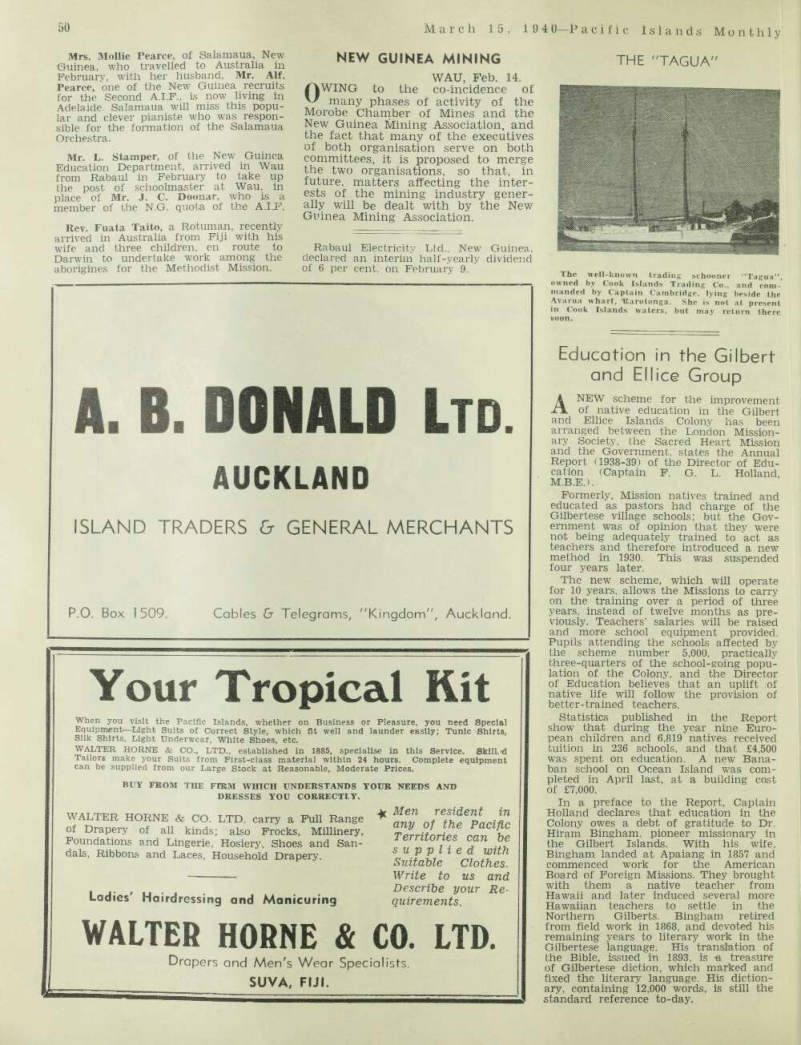
From Our Own Correspondent RABAUL, March 2.
SOME blurbs from Southern papers recently, anent the “distressful” con ditions at Wewak, Northern New Guinea, were rather amusing to old-timers — “shortage of fresh food”, “serious sick ness”, etc.
I wonder what the New Guinea people did before the regularly-running steam ers, aeroplanes and what-you-will. Surely the pioneers of British stock are not weakening. Or is it that every little hardship, or discomfort must now be featured in some blathering Sunday newspaper?
Monsieur Feminand Paimbouc, of Bourail, died recently in New Caledonia.
iMrs. Mollie Pearce, of Salamaua, New Guinea, who travelled to Australia in Februarv, with her husband. Mr. Alf.
Pearce, one of the New Guinea recruits for the Second A.1.F.. is now living in Adelaide. Salamaua will miss this popu lar and clever pianiste who was respon sible for the formation of the Salamaua Orchestra, Mr. L. Stamper, of the New Guinea Education Department, arrived in Wau from Rabaul in February to take up the post of schoolmaster at Wau, in place of Mr. J. C. Doonar, who is a member of the N.G. quota of the A.I.P.
Rev. Fuaia Taito, a Rotuman, recently arrived in Australia from Fiji with his wife and three children, en route to Darwin to undertake work among the aborigines for the Methodist Mission.
Advertisements & other items, p. 53 (2 items)
49
Pacific Islands Monthl y—M arch 15, 194 0
(ISfllllTli
IN factories, homes and offices, you will notice that more and more floors are constructed of Masonite Tempered Presdwood . . . the steel-strong, wear-resisting board manufactured from Australian hardwoods by a unique process. Such floors not only have a perfect modern appearance but a practically unlimited life. They never wear out; never lose their sleek, long-lived beauty of surface. Masonite Tempered Presdwood can be used in its natural colour (a rich brown) finished with non-slip wax, or stained in any desired colour. For flooring. Masonite is sold ready beveled in two sizes . . . 23* x 11| and 47 x 23*. It can readily be applied over existing floors.
Write for full details of Masonite Tempered Presdwood and its three sister boards— Presdwood. Temprtile and Quartrboard De Luxe. [Cane-ite Structural Insulation is now being produced in Australia.]
TEMPERED PRESDWOOD • PRESDWOOD • TEMPRTILE • QUARTRBOARD DE LUXE THE COLONIAL SUGAR REFINING CO. LTD. (Building Materials Division) Sydney - - Melbourne Brisbane Adelaide Perth MA4-40
New Guinea Mining
WAU, Feb. 14.
OWING to the co-incidence of many phases of activity of the Morobe Chamber of Mines and the New Guinea Mining Association, and the fact that many of the executives of both organisation serve on both committees, it is proposed to merge the two organisations, so that, in future, matters affecting the inter ests of the mining industry gener ally will be dealt with by the New Guinea Mining Association.
Rabaul Electricity Ltd.. New Guinea, declared an interim half-yearly dividend of 6 per cent, on February 9.
The "Tagua"
The well-known trading schooner “Tagua”, owned by Cook Islands Trading Co., and com manded by Captain Cambridge, lying beside the Avarua wharf. Rarotonga. She is not at present in Cook Islands waters, but may return there soon.
Education in the Gilbert
and Ellice Group
ANEW scheme for the improvement of native education in the Gilbert and Ellice Islands Colony has been arranged between the London Mission ary Society, the Sacred Heart Mission and the Government, states the Annual Report (1938-39) of the Director of Edu cation (Captain F. G. L. Holland, M.8.E.).
Formerly, Mission natives trained and educated as pastors had charge of the Gilbertese village schools; but the Gov ernment was of opinion that they were not being adequately trained to act as teachers and therefore introduced a new method in 1930. This was suspended four years later.
The new scheme, which will operate for 10 years, allows the Missions to carry on the training over a period of three years, instead of twelve months as pre viously. Teachers’ salaries will be raised and more school equipment provided.
Pupils attending the schools affected by the scheme number 5,000, practically three-quarters of the school-going popu lation of the Colony, and the Director of Education believes that an uplift of native life will follow the provision of better-trained teachers.
Statistics published in the Report show that during the year nine Euro pean children and 6,819 natives received tuition in 236 schools, and that £4,500 was spent on education. A new Bana ban school on Ocean Island was com pleted in April last, at a building cost of £7,000.
In a preface to the Report, Captain Holland declares that education in the Colony owes a debt of gratitude to Dr.
Hiram Bingham, pioneer missionary in the Gilbert Islands. With his wife, Bingham landed at Apaiang in 1857 and commenced work for the American Board of Foreign Missions. They brought with them a native teacher from Hawaii and later induced several more Hawaiian teachers to settle in the Northern Gilberts. Bingham retired from field work in 1868, and devoted his remaining years to literary work in the Gilbertese language. His translation of the Bible, issued in 1893, is -a treasure of Gilbertese diction, which marked and fixed the literary language. His diction ary, containing 12,000 words, is still the standard reference to-day.
Advertisements & other items, p. 54 (1 item)
A. B. Donald Ltd.
AUCKLAND
ISLAND TRADERS & GENERAL MERCHANTS
P.O. Box 1509. Cables & Telegrams, "Kingdom", Auckland.
Your Tropical Kit
When you visit the Pacific Islands, whether on Business or Pleasure, you need Special Equipment—Light Suits of Correct Style, which fit well and launder easily; Tunic Shirts, Silk Shirts, Light Underwear, White Shoes, etc.
WALTER HORNE & CO., LTD., established in 1885, specialise in this Service. Skill,>d Tailors make your Suits from First-class material within 24 hours. Complete equipment can be supplied from our Large Stock at Reasonable, Moderate Prices.
WALTER HORNE & CO. LTD.
BUY FROM THE FIRM WHICH UNDERSTANDS YOUR NEEDS AND
DRESSES YOU CORRECTLY.
WALTER HORNE & CO. LTD. carry a Full Range of Drapery of all kinds; also Frocks, Millinery, Foundations and Lingerie, Hosiery, Shoes and Sandals, Ribbons and Laces, Household Drapery.
Ladies' Hairdressing and Manicuring
+ Men resident in any of the Pacific Territories can be supplied with Suitable Clothes.
Write to us and Describe your Requirements.
Drapers and Men's Wear Specialists.
SUVA, FIJI.
Fiji’s Young
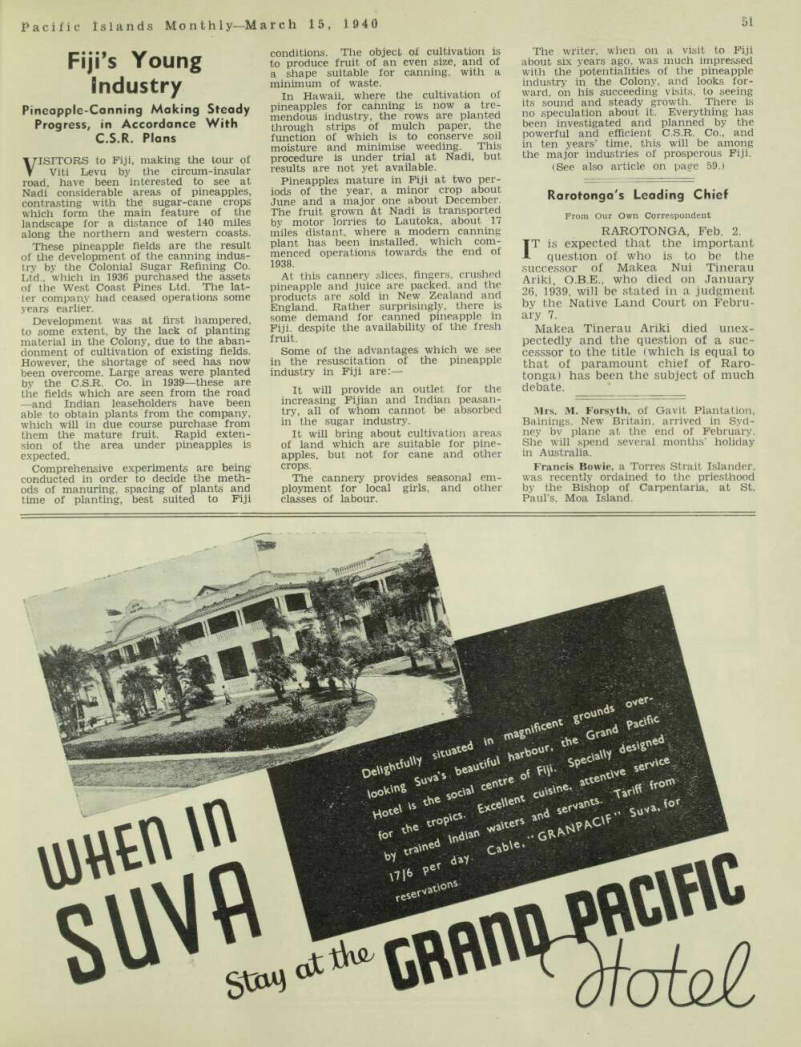
Industry
Pineapple-Canning Making Steady Progress, in Accordance With C.S.R. Plans
VISITORS to Fiji, making the tour of Viti Levu by the circum-insular road, have been interested to see at Nadi considerable areas of pineapples, contrasting with the sugar-cane crops which form the main feature of the landscape for a distance of 140 miles along the northern and western coasts.
These pineapple fields are the result of the development of the canning indus try by the Colonial Sugar Refining Co.
Ltd., which in 1936 purchased the assets of the West Coast Pines Ltd. The lat ter company had ceased operations some years earlier.
Development was at first hampered, to some extent, by the lack of planting material in the Colony, due to the aban donment of cultivation of existing fields.
However, the shortage of seed has now been overcome. Large areas were planted by the C.S.R. Co. in 1939 —these are the fields which are seen from the road —and Indian leaseholders have been able to obtain plants from the company, which will in due course purchase from them the mature fruit. Rapid exten sion of the area under pineapples is expected.
Comprehensive experiments are being conducted in order to decide the meth ods of manuring, spacing of plants and time of planting, best suited to Fiji
conditions. The object of cultivation is to produce fruit of an even size, and of a shape suitable for canning, with a minimum of waste.
In Hawaii, where the cultivation of pineapples for canning is now a tre mendous industry, the rows are planted through strips of mulch paper, the function of which is to conserve soil moisture and minimise weeding. This procedure is under trial at Nadi, but results are not yet available.
Pineapples mature in Fiji at two per iods of the year, a minor crop about June and a major one about December.
The fruit grown At Nadi is transported by motor lorries to Lautoka, about 17 miles distant, where a modern canning plant has been installed, which com menced operations towards the end of 1938.
At this cannery slices, fingers, crushed pineapple and juice are packed, and the products are sold in New Zealand and England. Rather surprisingly, there is some demand for canned pineapple in Fiji, despite the availability of the fresh fruit.
Some of the advantages which we see in the resuscitation of the pineapple industry in Fiji are:— It will provide an outlet for the increasing Fijian and Indian peasan try, all of whom cannot be absorbed in the sugar industry.
It will bring about cultivation areas of land which are suitable for pine apples, but not for cane and other crops.
The cannery provides seasonal em ployment for local girls, and other classes of labour.
The writer, when on a visit to Fiji about six years ago. was much impressed with the potentialities of the pineapple industry in the Colony, and looks for ward, on his succeeding visits, to seeing its sound and steady growth. There is no speculation about it. Everything has been investigated and planned by the powerful and efficient C.S.R. Co., and in ten years’ time, this will be among the major industries of prosperous Fiji.
(See also article on page 59.)
Rarotonga's Leading Chief
From Our Own Correspondent
Rarotonga, Feb. 2.
IT is expected that the important question of who is to be the successor of Makea Nui Tinerau Ariki, 0.8. E., who died on January 26, 1939, will be stated in a judgment by the Native Land Court on Febru ary 7.
Makea Tinerau Ariki died unex pectedly and the question of a suc cesssor to the title (which is equal to that of paramount chief of Raro tonga) has been the subject of much debate.
Mrs. M. Forsyth, of Gavit Plantation, Bainings, New Britain, arrived in Syd ney bv plane at the end of February.
She will spend several months’ holiday in Australia.
Francis Bowie, a Torres Strait Islander, was recently ordained to the priesthood by the Bishop of Carpentaria, at St.
Paul’s, Moa Island.
Advertisements & other items, p. 55 (2 items)
51
Pacific islands Monthl y—M arch 15, 1940
*'** % ni , oVl ,«or
1 rs- *
PAS ° WCT '
, f(C eot 4 fOU " ?aC rf.c a ted ' n oU r. e ies'S' 1 * 4 « ”r«- <•»'“•
s t > <•'**■ “w* *””'
*'** % ni , oVl ,«or
. Xni'® 0 •• GP"^ r a\o e ° £a\>\ e ' .r M b P e
Rarotonga's Donation
Prom Our Own Correspondent
Rarotonga, Feb. 2.
rpHE sum of £250 is being forwarded by JL this mail from the people of Raro tonga as a donation to the New Zea land Red Cross for war purposes. This is Rarotonga’s first contribution in aid of the British Empire in the successful prosecution of the war against Nazi-ism.
Mr. T. Bowden, a New Zealand sur veyor recently arrived in Fiji to prac tise his profession on Vanua Levu. He was in Fiji prior to the Great War, and enlisted with the N.Z. Forces. After the armistice, he took up a post in Uganda, serving for 11 years, before returning to New Zealand to engage in farming.
Administration
Canker in Territories' Administration Pessimistic Review by a Leading Planter
Letter to the Editor MANY planters, suffering under low copra returns (the in-store price, at Port Moresby, Papua, for sundried, is £6/16/9 per ton!) blame the big firms.
But these firms take the risk of ship ping and realisation, just as we take the risk of investment and production.
The complaint is more deep-seated.
It is the combines, who take no risk, and win most of the profit. They bleed not only the producer, but the consumer of margarine and other copra products.
It is the operation of these huge com bines throughout the world that will cause war after the present war is over Planters are beginning to ask why the Government does nothing to protect them from the man-eating copra com bine.
Living in a Colony under the demo cratic Government of Australia, plant ers and miners wonder also what democracy means, as they have no vote or say in the squandering of the reve nue collected from them. The bureau cratic official picks all the plums from revenue for his house, his pension and his very long leave. The planter is lucky if he can get a holiday every three or four years, but the official gets short leave every 21 months, and long leave of six months and twelve months at intervals. Then, when tired of holiday taking, he takes his retirement pension.
Time and again, Papua has been on the verge of bankruptcy. But, with a subsidy of £40,000 to £50,000 per annum from the Commonwealth Government, and speculative oil and mining com panies popping up at times to help reve nue, it has managed, with a little finan cial juggling, to escape.
In the case of New Guinea, the dog ged perseverance of mining engineers, miners and planters, and their discover ies of gold, plus the German plantings of coconuts, helped New Guinea to afflu ence. But this affluence has been dis sipated by the Administration, not in assisting mining and planting, but in trying to achieve the same results as Papua. So far, the price of gold has beaten it.
If oil is not discovered in Papua, the subsidy from the Commonwealth Gov ernment will have to be increased to about £lOO,OOO. Gold will keep New Guinea going for a period, but the life of most mines is about twenty years or less. By that time, the coconut estates, New Guinea’s only other asset, will have died of old age. Nothing has been done to replace this very wasting and un profitable asset. The same conditions apply to Papua—its coconuts and rub ber also will have died of old age. The real asset of the country, the native, is also a wasting asset. He has been so pampered and spoiled that in some parts he has become unworkable. In other parts, he is rapidly dying out. However, this is a very delicate subject, and best left alone.
It has recently been rumored that the Papuan Government is considering a tax on rubber. I would like your readers to refer to the “Pacific Islands Month ly’s” list of rubber prices and note the years when the industry was unprofit able, and every rubber-planter had to borrow to keep going. Planters have not yet made good that deficit. How unfair to tax them just to find funds to meet shortage on the Pension account.
The following is an extract from the “Papuan Courier”:— “The report just published of the Super annuation Fund Board for the year ended on 31st December last shows total pensions paid during 1939 were £12,582 to 11 officers, roughly an average of £307 per head. Contributors numbering 146 paid to the fund £3,452 during the year, while the taxpayer contributed £7,450.”
These Islands will provide rather a nasty blister for Australian taxpayers of the future. The present taxpayers have been subscribing about £40,000 to £50,000 per annum for about 25 years. They should be getting a dividend, but they never will and the capital they have subscribed can be written off, as there is so little to show for it—except about 40 or 50 middle-aged men, sitting back
in Australia on fairly fat pensions.
In Papua, we are supposed to have an Agricultural Department. But it is only a name-plate on the door of the Lands Department and a number in the telephone book.
In New Guinea, their able Director of Agriculture built up a first-class service from nothing, and trained his own men, and gave them the opportunity of gain ing tropical experience in other coun tries, with the idea that one day New Guinea would be able to supply all Aus
tralia’s tropical requirements. Now. for
some reason, his operations have been curtailed, and I consider he and his staff have a real grievance. I am told the curtailment is not for economy, but is due to departmental jealousy.
In the foregoing, I have tried to show that there is an absolute lack of inter est and initiative by officialdom in its job—otherwise, how could they make such a failure of an agricultural para dise? Finally, what are they going to do about it? To sum up:— No improvement can take place until planters, miners and other settlers have some form of representation to check and advise on Government spending and other matters. When all is said, it is these people who supply the revenue.
Agricultural experts must be appointed to Papua and given a free hand to examine the potentialities of the Territory and make recom mendations.
The Agricultural Department of New Guinea must be freed from petty restrictions, so that it may set about the development of tropical products required urgently by the factories of Australia. I allude particularly to the rich valleys in Central New Guinea.
An Agricultural Bank should be formed to assist in developing new crops and expanding the areas of rubber to at least the requirements of Australia.
A thorough investigate of the combines and their subsidiaries controlling copra should be made, especially to ascertain if, with the present low price, the working man is getting the benefit in his purchases of margarine, glycerine, soap, candles, etc.
How much of the £50.000,000 grant to be made for colonisation by the British Government is te be set aside for Papua and New Guinea?
I am, etc,,
G. A. Loudon.
Port Moresby, Papua.
February 15.
Advertisements & other items, pp. 56-58 (2 items)
52
March 15, 194 O—P acific Islands Monthly
W. H. GROVE & Sons Ltd.
AUCKLAND
Island Traders. p.o. box 490.
Telegraphic and Cable Address: “Grove”, Auckland.
Shippers of all classes of New Zealand Products, specially prepared for the island trade.
Representing English Manufacturers throughout the Cook and Society Islands, Fiji, Tonga, Samoa, Niue, New Caledonia, New Guinea, etc.
In FIJI as—W. H. Grove & Sons (Fiji) Ltd.
PLOUGHS for EVERY PLANTER
There is a Ransomes Plough for every planter. For nearly 150 years Ransomes have been leaders in plough design, and to-day they offer a range for animal and tractor draught covering all possible requirements. Whether a light steel plough or a tractor disc plough weighing more than 3 tons is required, there is a Ransomes model which will give complete satisfaction.
THE
CUB
PLOUGH
ansomcs
Write for illustrated catalogues and all information. Ask also for particulars of our lawn mowers, aerodrome equipment, etc
MORRIS, HEDSTROM LTD,
Suva, Lautoka and Ba.
Made by: RANSOMES, SIMS & JEFFERIES LTD., IPSWICH, ENG.
PHOSPHORUS
BRAIN.
GLANDS.
BLOOD.
CALCIUM
HEART.
TEETH.
BLOOD,
BONES,
NERVES.
m
FERRUM
BLOOD
k
SODIUM
BLOOD.
FEELING!
OVERCOME TROPICAL LETHARGY-
Get NEW PEP, VIGOUR & VITALITY!
Do You Suffer from:
Nerves, Listlessness, Langour, Tropical Lethargy, Headaches,
Nervous Dyspepsia, Anaemia, Lack of Confidence, Tight, Screwed-up Feeling in the Brain, Neuralgic, Nerve Pains,
“Depressed Feeling"?
POTASSIUM
MUSCLE,
BLOOD.
The real cause of these troubles is the absence of vital mineral salts from the food, which lead to mineral-starved nerves and all the depressing effects of nervous disorders.
Get a supply of these minerals, which include ferrum, calcium, potassium, sodium, phosphates, glycerophosphates and sucrose, into the system, and nerves and that run-down depressed feeling will vanish.
“BIDOMAK” TASTES FINE
WILL MAKE YOU WELL.
“BIDOMAK” tastes fine, and contains all the necessary minerals in a pre-dissolved, liquid form. After taking it, you again feel fit and well. Your energy is magnified, your brain sharpened to razor edge, you eat, sleep and feel better. You regain self-confidence, and are restored to a health level where you’ll glory in vitality.
SCIENTIFIC CONTROL
Manufactured in the Bidomak Pharmaceutical Laboratories, one of the most up-to-date, hygienic laboratories in the Southern Hemisphere, to which is attached a fully qualified Doctor of Medicine, and under the control of a qualified chemist, who was trained in the most modern English Laboratory in the world.
The Depressing After-Effects
of MALARIA
“BIDOMAK” actually overcomes the effects of severe tropical conditions and brings you back to the pinnacle of good health and spirits safely and pleasantly. The depressing aftereffects of Malaria are banished quickly by taking a course of “BIDOMAK”—“The Tonic of the Century”.
Nervy, Run-down —Now Eats and
Sleeps Well.
“For some time I have suffered with nerves I was very run-down and couldn’t sleep. Since taking BIDOMAK I feel a very different woman —can eat and sleep well. I have my three children on BIDOMAK, too, and can see a wonderful difference in them since using this tonic.” (Signed) Mrs. A. Floyd, Belinga. 7/5/39.
AT ALL LEADIN
ISLAND STORES
STOP GETTING
UP NIGHTS!
Don’t get up night after night because of lack of control over the urine. When your rest is interrupted, you are tired and worn out on arising in the morning—totally unfit for the day’s work. If you get up at night due to frequent, scanty passages with burning and discomfort, your kidneys and bladder need help.
The longer you have suffered from these symptoms of kidney and bladder trouble, the more you owe it to your health to heed the warnings and take immediate steps to correct the cause of sleepless nights and days of misery, discomfort and inconvenience. When the kidneys do not function properly, waste matter and poisonous acids stay in the blood. In addition to causing frequent scanty passages, you may have backache, rheumatism, sciatica, lumbago, leg uains, swollen feet and ankles, dizziness, pufiiness under the eyes and excess uric acid.
Don’t delay! Neglect is dangerous. Take DOAN’S BACKACHE KIDNEY PILLS. They strengthen and regulate the kidneys and bladder, banish pain and aid in ridding the system of harmful wastes and acid poisons. Get DOAN’S BACK-
ACHE KIDNEY PILLS to-day.
"Fishing Tackle to Tackle Fishing"
Line 2/6 3/6 3/6
QUALITY LINES
THEIR FAME IS STANDING THE STRAIN.
Rohu’s "Swordfish” Brand Genuine Cutty Hunk recognised for all Cord Dry Test lbs. 50 yard reels of 50 lea thread standard,
competitions.
15 is Cord 24 36 39 54 34 40 Dry Test lbs. .. 60 81 88 120 3/9 4/3 100 yard reels .. 9/6 13/6 14/6 18/6 20% higher. The best line it is possible to buy. tinn on ‘ Glare Spectacles. 15/-. These Glasses absolutely banish glare and reflection For Big Game and Deep Sea Fishermen they are the best, ig ame and Barrier Reef Fishing Gear for Hire. Quality Rod and Reel Repairs.
Wet Breaking Strain 15%
SIL ROHU
Quality Firearms and Fishing Tackle. 143 ELIZABETH STREET, SYDNEY ’Phone MA 3540 (Near Market Street).
cl
General
Merchants
and
Agents
representing leading firms in the pacific islands
379 KENT STREET,
SYDNEY.
Cable Address: “Trocas”, Sydney.
Telephones: MJ4657 (5 lines).
Islands Produce Sold on Shippers’ Account Buyers of all Islands’ requirements on Commis- Liberal Advances against Consignments. sion Original Invoices Furnished. 25 Years Islands Trade Experience.
Bankers: Bank of New South Wales. Correspondence in English, French & German.
Treasure-Seekers
Cocos Island Again
WHEN it was announced a few weeks ago that an expedition from Cali fornia had recovered the long-sought treasure of Cocos Island, worth £12,000,000, comment was made in this journal that the statement should be received with a large grain of those who knew most about the matter would believe there was a huge buried treasure on Cocos Island only when they saw it.
It was announced from Los Angeles on February 22, that the yacht “Stran ger”, under Captain Fred Lewis, would sail shortly with 25 tons of machinery for dredging and digging on Cocos Island; and it was stated also that Mr. James A. Forbes, organiser of the expedition which claimed to have located the trea sure. would join the “Stranger” at Costa Rica.
It is evident, therefore, that the sen sational press report about the treasure was slightly exaggerated—the expedition only thinks that it knows where the treasure is.
The idea of the treasure persists, how ever. The British yacht, “Windward”, 26 tons, is reported at Costa Rica, seek ing permission to search for pirate trea sure on Cocos Island. She is run by three young Englishmen who fought for the Republicans in the Spanish War— Michael Johnson (skipper), Clive Smith, Frank Davis. Two Australians who were in the crew. Peter Gladwin (Sydney) and Robert Camp (Melbourne) left the yacht in the West Indies and returned to Australia.
Cool Off at Canberra on
April 20 !
RESIDENTS of the Pacific who come to seek cool weather in Australia, and who want an opportunity to view the glorious colourings of the Canberra plantations in autumn, should not miss the opportunity of visiting the Federal Capital during the week-end of April 20, when a series of entertainments has been arranged in aid of war funds.
There will be a garden fair at Govern ment House —one of the most beautiful places in the Territory—a whole series of excursions and entertainments, and a special ball at the Hotel Canberra on the night of April 20, tickets for which are being sold at 7/6. A large Canberra committee, headed by Lady Gowrie. have made plans to ensure that this will be a week-end to be remembered —and it is hoped that the financial benefit to the Australian war fund will be correspond ingly memorable.
Millionaires For a Day
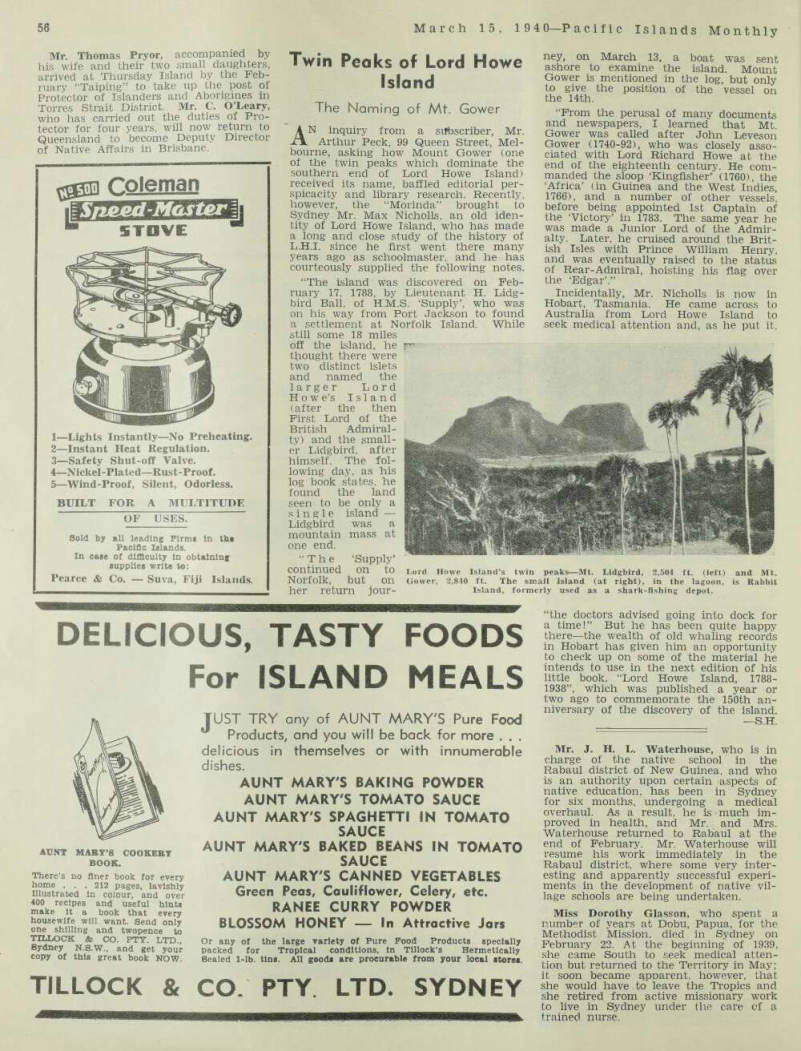
By “Amel”
“T’M curious,” I remarked.
A “You would be,” said Dad.
“About this stuff called Millionaire’s Salad.” I continued. “Where d’you sup pose it comes from?”
“It is obtained from the coconut palm,” explained my parent gently, “and the high-sounding adjective is a relic of the dear departed days when coconuts were worth considerably more than a pain in the neck.”
My imagination was stirred. Salads from coconut palms! I consulted an extra-special recipe book, which advised me to “take the top of one coconut palm.” It sounded easy. But. even on coconut plantations in Fiji, one does not lop off trees at random, just for the pleasure of sampling Millionaire’s Salad.
Four days after reading that recipe, however, a seven-year-old palm met its doom. The excuse was that it overhung a bed of succulent lettuces, and. during heavy rain, its fronds sluiced water onto them at an alarming rate. Conse quently. its death knell was sounded and our Millionaire’s Salad came a little nearer.
The felling of the palm produced a problem. It had a distinct lean towards the lettuces, and we didn’t want them crushed out of existence. But long suffering, ingenious Father scrambled nimbly up the coconut trunk, and fixed a rope so that the tree could be pulled in the desired direction.
“Heave”! he commanded.
With our combined eighteen stone, we heaved. The rope snapped like a carrot, and we hit the ground with a thump.
Mummie arose. There was an unplea sant glint in her eye.
“The rope,” she said, succinctly, “was rotten.”
Dad, lolling negligently against the tree trunk, smiled aloud.
“Well, you wanted your Millionaire’s Salad,” he remarked, unkindly.
And we vowed we would have it, even if we broke every rope in the place!
For the next attempt, a brand-new rope was used, and the tree girdled once again. This time, our united efforts brought success. The fifteen-foot palm bit the dust in the right direction, miss ing a net hibiscus bush by inches, and scattering some fowls that had drifted across the landscape.
We eyed the fallen palm from all angles. The Millionaire’s Salad didn’t exactly spring out to greet us.
“Where is it?” I enquired, interestedly.
Dad fetched his cane knife, and warned us to stand clear. Then he chopped, and sliced, and hacked, and swore, for fully half an hour. Per spiration trickled off the end of his nose. Occasionally we heard him mut ter, “Huh! Millionaire’s Salad!” in a disgusted voice.
One by one, the sasa butts were sev ered. The tenth was somewhat stub born. Dad grasped it with both hands and tugged. It left the tree trunk so suddenly that he turned a beautiful back-flip before coming to rest with his hat askew.
Carefully avoiding our mirthful gaze he resumed operations.
At last, the milk-white heart of the coconut tree was laid bare—tightly packed, tender, pale shoots that, in the course of time, would develop into those
weighty fronds which, with their sibi lant crash, fall continually throughout the plantation. So this, I mused, was Millionaire’s Salad!
“Put on ice for a while,” said the recipe, “until cool and crisp. Then slice finely, add a dash of onion, and serve with mayonrflaise.”
We all agreed it was delicious.
“But,” said Dad, a bit ruefully, “if that’s a sample of what millionaires eat, I’d rather belong to the proletariat. It’s given me indigestion!”
Miss Corralynn' Fyfe, 8.A., of Western Australia, recently arrived in Fiji to act an an honorary teacher for the Metho dist Mission for twelve months.
The engagement is announced of Miss Austral Robson, daughter of Mr. and Mrs. A. R. Robson, of Kempsey, N.S.W., to Dr. S. Warren Carey, of Port Moresby, Papua, who is attached to the A.P. Co. in Papua, as geologist.
Dr. Edward G. Sayers, of Auckland, New Zealand, has been awarded the Cilento Medal for 1940 by the Australian Institute of Anatomy for his medical work among the natives of the Solomon Islands, where he spent seven years. He has practised in Auckland for the past five years and has been a member of the honorary staff of Auckland Hospi tal. In the near future, he will join the N.Z. overseas forces as specialist in tropical diseases.
Mr. Thomas Pryor, accompanied by his wife and their two small daughters, arrived at Thursday Island by the Feb ruary “Taiping” to take up the post of Protector of Islanders and Aborigines in Torres Strait District. Mr. C. O’Leary, who has carried out the duties of Pro tector for four years, will now return to Queensland to become Deputy Director of Native Affairs in Brisbane.
Advertisements & other items, pp. 59-60 (2 items)
55
Pacific Islands Monthl y—M arch 15, 1940
Ship Chandlery Hardware
BROOMFIELDS LIMITED
152 SUSSEX STREET :: SYDNEY.
Cables “Boom", Sydney.
Large and Complete Stock* of
SHIP CHANDLERY
IRONMONGERY OF ALL KINDS, PAINTS,
WHITE LEAD AND OILS.
Sole Agents (or; P. H. MUNTZ <fe CO.’s 3-CROWN BRAND METAL BHEATING.
PEACOCK & BUCHANS’ ENGLISH READY-MIXED PAINTS.
/Write for j
Ship Chandlery /
Catalogue J
Special “In Bond” Prices for all Islands enquiries quoted on application.
9 0 ■ I m *V" • * tilyiHi >
! itea
o a A CHAPMAN 3 h.p. "PUP" ENGINE IN A CHAPMAN MODEL "D” 16 ft. CABIN LAUNCH FOR OPEN SEA WORK. SPEED 1 m.p.h, £96 (.«.!. SYDNEY.
WRITE TO
'CHAPMAN &S HE RA Cll
erskineville, n. s. w.
STOVE
1— Lights Instantly—No Preheating. 2 Instant Heat Regulation. 3 Safety Shut-off Valve. 4 Nickel-Plated—Rust-Proof. 5 Wind-Proof, Silent, Odorless.
BUILT FOR A MULTITUDE
OF USES.
Sold by all leading Firms In the Pacific Islands.
In case of difficulty In obtaining supplies write to: Pearce & Co. Suva, Fiji Islands.
DELICIOUS, TASTY FOODS
For ISLAND MEALS
AUNT MARY’S COOKERY
BOOK.
There’s no finer book for every home . . .212 pages, lavishly Illustrated in colour, and over 400 recipes and useful hints make It a book that every housewife will want. Send only one shilling and twopence to
TILLOCK & CO. PTY. LTD.,
Sydney N.S.W., and get your copy of this great book NOW.
JUST TRY any of AUNT MARY'S Pure Food Products, and you will be back for more . . . delicious in themselves or with innumerable dishes.
AUNT MARY'S BAKING POWDER
AUNT MARY'S TOMATO SAUCE
AUNT MARY'S SPAGHETTI IN TOMATO
SAUCE
AUNT MARY'S BAKED BEANS IN TOMATO
SAUCE
AUNT MARY'S CANNED VEGETABLES
Green Peas, Cauliflower, Celery, etc.
RANEE CURRY POWDER
BLOSSOM HONEY In Attractive Jars Or any of the large variety of Pure Food Products specially packed for Tropical conditions. In Tlllock’s Hermetically Sealed 1-lb. tins. All goods are procurable from your local stores.
TILLOCK & CO. PTY LTD. SYDNEY
Twin Peaks of Lord Howe
island The Naming of Mt. Gower
AN inquiry from a sifbscriber, Mr.
Arthur Peck, 99 Queen Street, Mel bourne, asking how Mount Gower (one of the twin peaks which dominate the southern end of Lord Howe Island) received its name, baffled editorial per spicacity and library research. Recently, however, the “Morinda” brought to Sydney Mr. Max Nicholls, an old iden tity of Lord Howe Island, who has made a long and close study of the history of L.H.I. since he first went there many years ago as schoolmaster, and he has courteously supplied the following notes.
“The island was discovered on Feb ruary 17. 1788, by Lieutenant H. Lidg bird Ball, of HM.S. ‘Supply’, who was on his way from Port Jackson to found a settlement at Norfolk Island. While still some 18 miles
off the island, he thought there were two distinct islets and named the larger Lord Howe’s Island (after the then First Lord of the British Admiral ty) and the small er Lidgbird. after himself. The fol lowing day, as his log book states, he found the land seen to be only a single island Lidgbird was a mountain mass at one end.
“The ‘Supply’ continued on to Norfolk, but on her return jour
ney, on March 13, a boat was sent ashore to examine the island. Mount Gower is mentioned in the log, but only to give the position of the vessel on the 14th.
“From the perusal of many documents and newspapers, I learned that Mt Gower was called after John Leveson Gower (1740-92), who was closely asso ciated with Lord Richard Howe at the end of the eighteenth century. He com manded the sloop ‘Kingfisher’ (1760), the ‘Africa’ (in Guinea and the West Indies, 1766), and a number of other vessels, before being appointed Ist Captain of the ‘Victory’ in 1783. The same year he was made a Junior Lord of the Admir alty. Later, he cruised around the Brit ish Isles with Prince William Henry, and was eventually raised to the status of Rear-Admiral, hoisting his flag over the ‘Edgar’.”
Incidentally, Mr. Nicholls is now in Hobart, Tasmania, He came across to Australia from Lord Howe Island to seek medical attention and, as he put it.
“the doctors advised going into dock for a time!” But he has been quite happy there—the wealth of old whaling records in Hobart has given him an opportunity to check up on some of the material he intends to use in the next edition of his little book, “Lord Howe Island, 1788- 1938”, which was published a year or two ago to commemorate the 150th an niversary of the discovery of the island. —S.H.
Mr. J. H. L. Waterhouse, who is in charge of the native school in the Rabaul district of New Guinea, and who is an authority upon certain aspects of native education, has been in Sydney for six months, undergoing a medical overhaul. As a result, he is much im proved in health, and Mr. and Mrs.
Waterhouse returned to Rabaul at the end of February. Mr. Waterhouse will resume his work immediately in the Rabaul district, where some very inter esting and apparently successful experi ments in the development of native vil lage schools are being undertaken.
Miss Dorothy Glasson, who spent a number of years at Dobu, Papua, for the Methodist Mission, died in Sydney on February 22. At the beginning of 1939, she came South to seek medical atten tion but returned to the Territory in May; it soon became apparent, however, that she would have to leave the Tropics and she retired from active missionary work to live in Sydney under the care of a trained nurse.
Lord Howe Island’s twin peaks—Mt. Lidgbird, 2,504 ft. (left) and Mt.
Gower, 2,840 ft. The small Island (at right), in the lagoon, is Rabbit Island, formerly used as a shark-fishing depot.
Advertisements & other items, pp. 60-61 (2 items)
56
March 15, 194 O—P acific Islands Monthly
A Boon To Island Housewives
<r City conveniences brought to your home . . . ice-cubes for cool drinks—ice-cream for the children tremendous trifles that make life in the Islands so much happier . . . But remember, LAUREL has the flame that freezes best; that gives the steadiest, most consistent heat; that burns to the very last drop without smoke, soot, smell; that will ensure for you the most economical and most satisfactory freezing. Always ask for Laurel as it pays to use the highest quality kerosene in these new refrigerators.
VACUUM OIL COMPANY
PTY. LTD.
(Incorporated in Australia)
THE PERFECT
ALL-PURPOSE
KEROSENE
Polynesian Club
rpHE Polynesian Club of Sydney held X two successful receptions during February. The first was in honour of the centenary of the signing of the Treaty of Waitangi, between the Maoris of N.Z. and representatives of H.M.’s Government in 1840. Miss Dora Mere wether Busby, great niece of James Busby (first British Resident of N.Z., and framer of the treaty) was the prin cipal guest, and was supported by Chief tainess Waikainga Tipene (direct des cendant of Hone Heke) and by Mrs. K.
Nehua Darley (chiefly desendant of Patuone, brother of Tamati Waka Nene). These three Maori chiefs were prominent at the signing of the treaty.
The second evening was a welcome home to Mrs. Wiki Byron, of Rotorua, and Misses Ngahuia Waugh and Gwen
Scord. who have just returned from a holiday in New Zealand. Gifts were accepted for the Club by the President (Mr. Leonard Moran) from the Polyne sian Club of Auckland. Among those present were Mrs. Ellen Mackenzie, who sang Fiji songs to her own guitar accompaniment; Mr. Richard Beck, an English artist who recently came across from Tahiti; Quartier Maitre Chef Andre d’Aragon, well-known in Tahiti and Noumea: and Mrs. Takuora Stur dy, a chieftainess of the Waikato Maori people.
Mrs. Gladys Baker, plantation-owner, of Vitu, New Guinea, arrived in Sydney at the end of February and has offered her services as a war worker in any capacity. She did V.A.D. work in the last war, at the age of 15.
Early Gold-Seekers in N
N. Guinea Interesting Memories of Pre-1914 Days
By Edward Auerbach.
RECENTLY, in articles about the discovery of the Morobe goldfield, there have been references to a Mr. Auerbach, The editor, writing to Mr. Auerbach, a planter in the Tro briand Islands, Eastern Papua, asked him if he were the Morobe pioneer. His interesting reply, published hereunder, shows that there were two Auerbachs on the goldfields in the early days— George, who was at Morobe in 1922-3, and Edward, who was in the Markham district.
NO; I am not George Auerbach—l am Edward. George did not go on that Markham prospecting trip.
Matt Crowe, J. Preston, Parkes and I left Samarai, in my schooner, “Niue”, early in 1912. We called at Morobe.
Herr Klink was the magistrate there then. He advised us to go on to Rabaul.
Matt Crowe and Jimmy Preston stopped in Rabaul and bought stores and outfit for the trip, and later came over to Morobe in the German steamer “Man illa”, where we picked them up, later on.
Parkes and I went recruiting boys for the trip, which was an exciting affair.
While recruiting, we called at an island in the Siassi Group. I went ashore and met a white missionary. He was living in a humpy, built of about nine sheets of iron in the centre of the village. I saw a fine European house on the hill, at Rooke Island. I asked him who owned it. He said it was his. I asked him why he was living in a shake-down in the village. He said that at Higgins Point (Rooke Island), two Germans had started a coconut plantation: and, two days before, the bush natives came down on them, and killed the two Ger mans, and two Chinamen, and looted their stores, etc. So he had taken up his quarters in the village.
I went aboard the boat, and proposed to Parkes that we go around there, and let the natives know that we were Eng lish, and not Germans, and we should get a crowd of recruits.
So we went around. I took six boys of the crew—old Samarai boys, whom I had with me in the early days of the Mambara and the Gira, before Sam McCelland and Matt Crowe found the Yodda. I have two of those boys with me still—the rest are dead.
We went about six miles inland, and met the natives, and recruited 40 boys.
They offered me the rifles and about 2,000 marks that they had looted from the Germans. I told them to take the marks to the missionary.
On this recruiting trip Parkes and I, when anchored in a bay, between Muwo (Mowe) Haven and Cape Merkus (southwest coast of New Britain), went about eight miles inland, recruiting. We tried two creeks which ran into the river that emptied into the bay. We got sev eral dishes that went two grains of gold to the dish.
The natives were bad, and we had to fight our way back to the beach. One boy, named Georgie Wagipa, got speared in the backside, while he was busy with his rifle. I caught sight of the native as he was throwing the spear, and got him, so Georgie was not badly hurt.
From what I can find out, no one has been near there since. I believe a white
patrol officer went in a few years ago, and was killed by the natives. They were Gaure natives.
Later, we were anchored in Montague Bay (south coast of New Britain). The “Dolphin” saw us, and came in. The Administrator, from Madang, was aboard. They asked us what we were doing in German waters. We told them we were recruiting. They asked to see our papers.
Parkes had the Rabaul papers, but forgot where he had left them. So they put a rope aboard and started to tow us to Rabaul.
After being in tow for about half an hour, we found the papers in Parkes’s white coat. I am afraid that, the night before we left Rabaul, Parkes had had too much champagne—and the boys had had to carry him aboard.
We hailed the “Dolphin”, and I went aboard and showed them the papers.
They then towed us back to our anchor age. We “Hocked the Kaiser” in sev eral bottles of champagne. They were artists at “Hocking the Kaiser”. I thought I could hold my own with any man, but those Germans could put me under the table.
When we left the “Dolphin” they sent off a case of lager beer —I suppose to “Hock the Kaiser” again. Parkes and I did not. We “Hocked” Dr. Hahl for treating us so well at Rabaul. All the German officials treated us fine, except ing that Administrator from Madang. * * * HERE is a coincidence. George Auer bach, J. Preston and J. Chesser landed together in Port Moresby in 1896. They were among the first onto the goldfields on the mainland. They chased the penny-weights all over
Papua, and they went pearling. Now, all three of them are buried alongside of one another at Losuia, in the Trobriand Islands—and there is not a sign of gold anywhere in. the Trobriand group.
Advertisements & other items, p. 62 (1 item)
When making Will
BAKER’S JUNO SPECIAL RAZOR
Extra Full Hollow Ground, White Xylonite Handle, sharpened ready for use.
POST FREE FOR CASH WITH ORDER.
W. Jno. BAKER & 3 ST -
HONESTY — FIDELITY
When making Will
Safeguard your interests. Ensure their protection and security. Avail yourself of the advantages to be derived from the appointment of this Company as your trustees, in preference to any one individual. Write to or call on any Branch of Burns, Philp <S Company Limited, or Bums Philp (South Sea) Company, Limited, for the folder which fully explains these advantages.
Give careful consideration to the benefits to be gained by appointing as your Executors—
BURNS PHILP TRUST CO. LTD.
DIRECTORS
JAMES BURNS LEWIS ARMSTRONG
ROBERT JOHN NOSWORTHY JOSEPH MITCHELL
"Pruth" Loses Her Funnel
From Our Own Correspondent
Port Moresby, Feb. 20.
rAT well-known sea mark, the wreck of the vessel “Pruth” (which was lost on Natarah Reef, in 1923, on her voyage to Port Moresby, carrying a cargo of petroleum products) lost her funnel on February 11.
The residents of Port Moresby, accus tomed to the sight of her on their door step for so many years, regret her altered appearance.
The wreck makes a good navigation mark for vessels approaching Port Moresby, and it is wondered whether her altered appearance will affect her visi bility for incoming vessels.
Swamped
Tongans Drowned When Cutter Swamped
SEVERAL Tongans lost their lives when a cutter manned by natives sank on a voyage between Haapai and Vavau, in mid-February, according to advice received in New Zealand.
The vessel, the “Toutou Noa”, is be lieved to have been swamped when struck by a sudden squall or a whirlpool.
The first news of the sinking was brought to Vavau by one of the crew, who swam two miles to land. He was followed later by a dinghy carrying the remaining survivors.
Pineapple Growing in Fiji
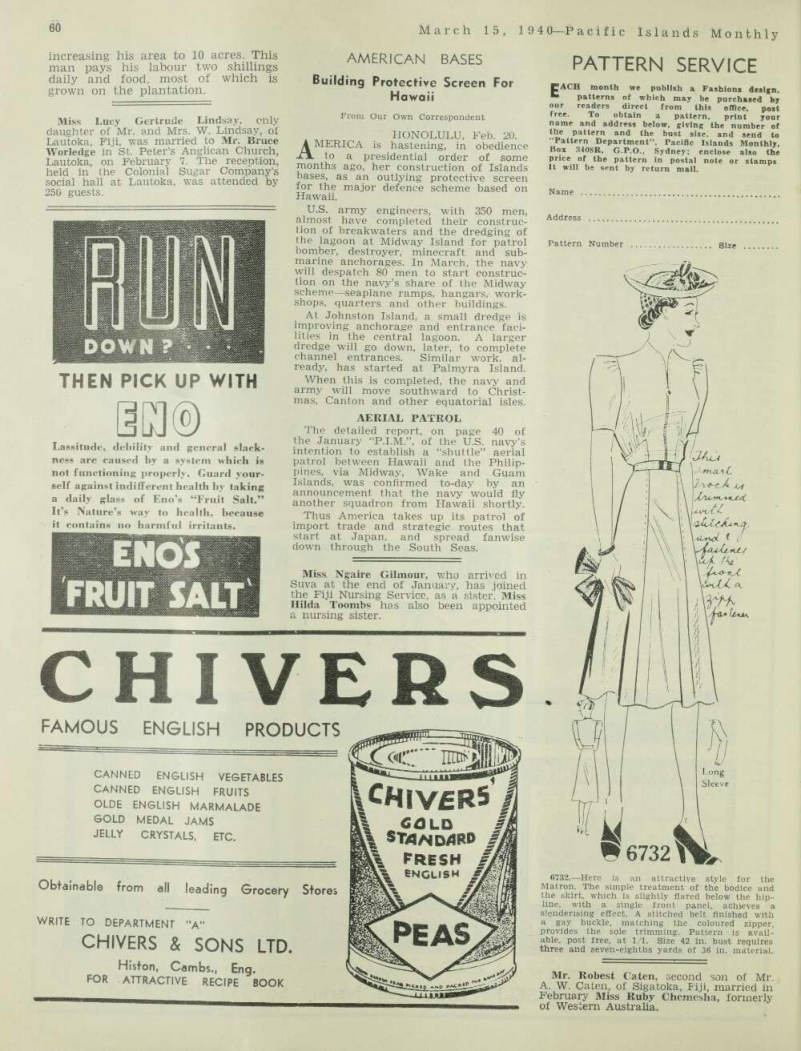
Fiji
From Our Own Correspondent
Suva, Feb. 16.
IN addition to the successful pine apple cannery in Fiji operated since 1938 by the Colonial Sugar Refining Co., there is another can nery on the Wainiloka property of Mr. A. C. McCown, on Ovalau Island, just east of the main island of Viti Levu. The industry there seems to be making steady progress, both in the quality of the canned pines and the area under cultivation. Ship ments are sent to Canada, New Zea land and England.
Mr. McCown recently stated, in an interview with the “Fiji Times” that, while his company produces most of its own pineapples, it is encouraging cultivation by Fijians, local Solomon Islanders and others. Prices for the raw product range from £3/10/to £l/10/- per ton, according to grade, averaging about £2/10/- per ton delivered at the factory. Pro duction varies from 16-24 tons per acre for the first season down to 5-10 tons in the third year, when it is necessary to replant.
One Solomon Islander with five acres, realised a gross return of £125 in the first season. He had one assistant labourer, and three extra men at harvesting. Now he is busy
Increasing his area to 10 acres. This man pays his labour two shillings daily and food, most of which is grown on the plantation.
Miss Lucy Gertrude Lindsay, only daughter of Mr. and Mrs. W. Lindsay, of Lautoka, Fiji, was married to Mr. Bruce Worledge in St. Peter’s Anglican Church, Lautoka, on February 7. The reception, held in the Colonial Sugar Company’s social hall at Lautoka, was attended by 250 guests.
Advertisements & other items, pp. 63-64 (1 item)
Buzacott-Wolseley Ltd., 7-11 Market St., Sydney. N.S.W.
DIESELS For HARD JOBS
Petier Crude Oil Engines
Valveiess. two-strcke Petier patent cold starter. Low fuel consumption. Perfect lubrication. 6 to 21 BJLP. Stationary and portable types. Send lor new catalogue just published.
Centrifugal Pumps! for cheaper power
Single or twostsge. 1-in. lo 6-in.
Direct-coupled vee belt or chain drive.
Buiacoti Engines
SERIES W VERTICAL TYPE
2 to 6 H.P.
Petrol-kerosens driven.
Hopper or tank cooled.
Enclo ed self-oiling.
Neat and compact In appearance S<7.ce‘.h and silent In operation Ask lor newly published illustrated catalogue 7 TOII MAMIT tTMKT IVMIY. X* (ASC\ 7TOII MAMK/ STHitT SYDNEY (|Lj
7TO II toARCKT STRUT SYOMKY.
CUTS LOGS QUICKLY ■ ONE-MAN CLEARING
Buiacoti Oil Engines
T ,*
HORIZONTAL TYPE.
Petrol er petrol-kerosene driven.
Search the world and you cannot find, at anything like the price, any engine to compare with the "Buiacott". Every "Butacotr engine develops more than its official rating, and Is Ixeuble-tree. Vertical and Horiion'el types to suit every requirement oi the man on lb' land
Engine-driven saw for culling logs
up to 7 ft diameter. Easily operated by one man. Propels itself.
Write to-day for descriptive folders.
"New Record"
Drag
Saw
"DIGGER" WINCH
Has enormous power, light
weight, very compact. One
man can operate. Easy to move around. Most powerful winch for its size. Does not dance around the ropes. Write to-day for
descriptive folders.
I I 7TO ft MARKET STSIIT SYDNEY. (|7) ■ tTOH M H.T STSHT IYMSV - r ■ TTOI. M*S«|T .TS..T IVO.IV (g) Full details of these or any other machinery lines FREE on request.
BUZACOTT-WOLSELEY Ltd., 7-11 Market St., SYDNEY. N.S.W.
I
THEM PICK UP WITH
a® Lassitude, debility and general slack* ness are caused by a system which is not functioning properly. Guard yourself against indifferent health by taking a daily glass of Eno’s “Fruit Salt.”
It’s Nature’s w T ay to health, because it contains no harmful irritants.
ENOS
FRUIT SALT
CHI VERS
FAMOUS ENGLISH PRODUCTS
CANNED ENGLISH VEGETABLES
CANNED ENGLISH FRUITS
OLDE ENGLISH MARMALADE
GOLD MEDAL JAMS
JELLY CRYSTALS. ETC.
Obtainable from ail leading Grocery Stores
WRITE TO DEPARTMENT "A"
CHIVERS & SONS LTD.
Histon, Cambs., Eng.
FOR ATTRACTIVE RECIPE BOOK
CHIVERS
s CQ LD &
FRESH
ENGLISH
X
PEAS
American Bases
Building Protective Screen For Hawaii
From Our Own Correspondent
A Honolulu, Feb. 20.
MERICA is hastening, in obedience to a presidential order of some months ago, her construction of Islands bases, as an outlying protective screen for the major defence scheme based on Hawaii.
U.S. army engineers, with 350 men, almost have completed their construc tion of breakwaters and the dredging of the lagoon at Midway Island for patrol bomber, destroyer, minecraft and sub marine anchorages. In March, the navy will despatch 80 men to start construc tion on the navy’s share of the Midway scheme —seaplane ramps, hangars, work shops, quarters and other buildings.
At Johnston Island, a small dredge is improving anchorage and entrance faci lities in the central lagoon. A larger dredge will go down, later, to complete channel entrances. Similar work, al ready, has started at Palmyra Island.
When this is completed, the navy and army will move southward to Christ mas, Canton and other equatorial isles.
Aerial Patrol
The detailed report, on page 40 of the January “P.1.M.”, of the U.S. navy’s intention to establish a “shuttle” aerial patrol between Hawaii and the Philip pines, via Midway, Wake and Guam Islands, was confirmed to-day by an announcement that the navy would fly another squadron from Hawaii shortly.
Thus America takes up its patrol of import trade and strategic routes that start at Japan, and spread fanwise down through the South Seas.
Miss Ngaire Gilmour, who arrived in Suva at the end of January, has joined the Fiji Nursing Service, as a sister. Miss Hilda Toombs has also been appointed a nursing sister.
Pattern Service
EACH month we publish a Fashions design, patterns of which may be purchased by our readers direct from this office. post free. To obtain a pattern, print your name and address below, giving the number of the pattern and the bust size, and send to “Pattern Department”, Pacific Islands Monthly, Box 3408 R, G.P.0., Sydney; enclose also the price of the pattern in postal note or stamps It will be sent by return mail.
Name Address Pattern Number size
Mr. Robest Caten, second son of Mr.
A. W. Caten, of Sigatoka, Fiji, married in February Miss Ruby Chcmesha, formerly of Western Australia.
6732. —Here is an attractive style for the Matron. The simple treatment of the bodice and the skirt, which is slightly flared below the hip line, with a single front panel, achieves a slenderising effect. A stitched belt finished with a gay buckle, matching the coloured zipper, provides the sole trimming. Pattern is avail able, post free, at 1/1, Size 42 in. bust requires three and seven-eighths yards of 36 in. material.
Fashion Hints for Islands Women
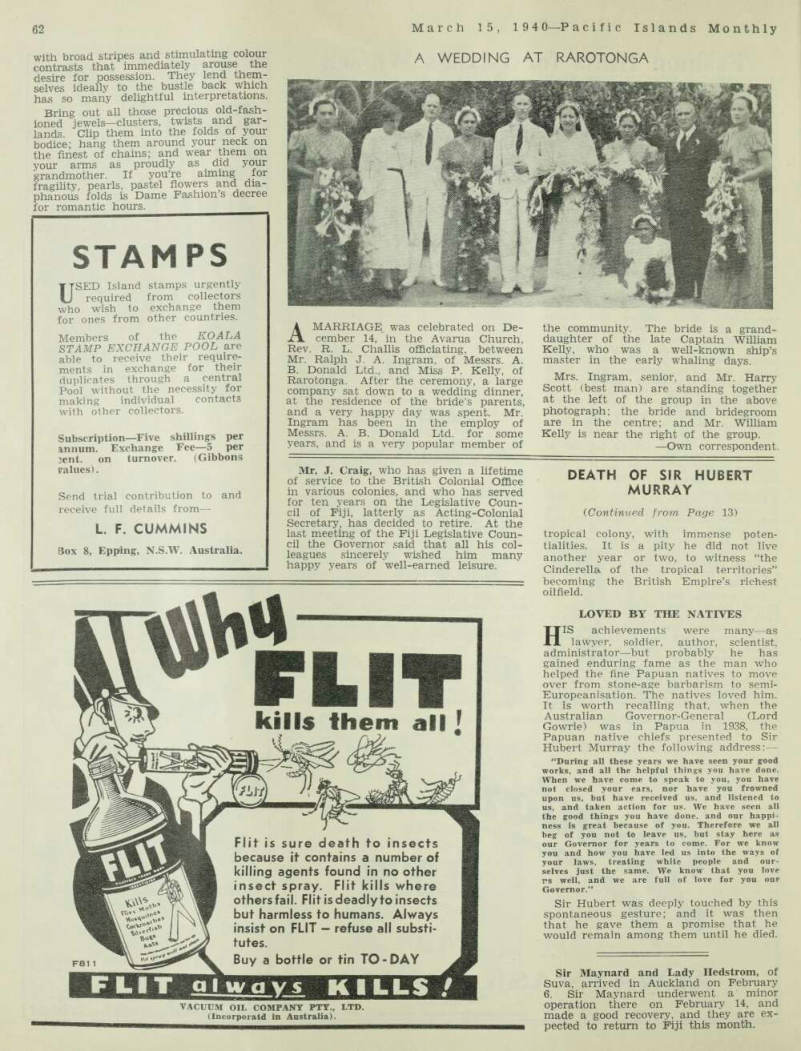
By "Therese"
IN choosing clothes for the tropics, remember always that simplicity is the keynote of chic —clothes of well-cut simple design that give freedom of movement are a far greater success than elaborate affairs, the very intricacy of which seems to add to one’s discomfort as the mercury rises.
Whatever the season, cotton and linen remains supreme. Exotic designs on eav backgrounds have a strong appeal; so also have the pastel linens, with their cool appearance and excellent launder ing propensities. Silk linen, too, is ideal and stands up well under the onslaughts of even the most inexperienced “wash boy”.
Why not try for a change an all-white wardrobe and let your accessories tell a gay story? Shirt dresses and tennis dresses will become beloved possessions, and evening frocks of linen or pique are ideal. Have all your clothes made on tailored lines—not strictly masculine, of course, but softly feminine with slight gathers over a moulded bust-line and amusing pockets in bodice and skirt to hold brilliantly-patterned handkerchiefs.
Wear gay cummerbunds around your waist, and fishnet snoods to hold your straying locks in place.
Skirts and blouses are as popular as ever so if you wish to amplify the dazzling white of a skirt wear a dark blue linen blouse and a wide red belt.
PERHAPS stripes are your one con suming passion. Use them in the same way as linens —a striped top and a plain skirt, a striped skirt and a plain blouse. If you want a spectator sports frock, choose one in gay of those new dresses that hang straight and full from the yoke like a little girl’s until belted in.
For evening wear, seek some wide striped fabric from which to make a skirt, wide and flaring; cut diagonally so that the stripes meet all the way down the front and back; top it with a basque blouse that boasts a low square neck and short sleeves, and button all the way down the front. Wear seashell necklets and bangles (they are easily procured in Australia, or you can collect them from the beach and tint them whatever
colour your fancy dictates), and you will be delighted with the result.
The bolero as always is one of the most useful garments in a woman’s wardrobe. In the twinkling of an eye it turns an informal sports frock into a frock for formal occasions.
One of the most charming bolero out fits seen lately \yas evolved from rem nants—a gay check diagonal length of 2h yards in lovely blues, greens and rose madder and a piece of cool green linen barely a yard in length. A flared skirt and moulded bodice with a square front and shoulder straps instead of sleeves was made from the check silk linen, and this was topped by a chic little bolero of the green linen, made with short sleeves. A wide green cummerbund was fashioned out of the pieces left over from the bolero.
IF you intend visiting Australia on vacation, in this in-between season of balmv days and clear sunshine, you will fin'd many glorious materials to charm you. Colours are clear and bright, and the contrasts strong. “Stop” red, the newest of colours, is allied to black with striking effect. Moss-green and clear yellow make a lovely combination use this for an ensemble, the frock of yellow and the coat of green, and evolve it in silk hopsack. a charming material of loose weave with sufficient weight in it to hang well.
Browns are well to the fore and run the gamut of almost every shade from nigger to golden tan. They are equally desirable when allied with plain or figured materials. The latter, by the way, are of lovely designs—mostly scrolls and geometric, though some have a “batik” look about them that is extremely fascinating.
Purples and plums and vineyards are as as popular as they were last season.
Blues, like the poor, are always with us, but such delightful blues in shades from navy to pastel, that we are delighted to welcome them again.
MATERIALS for evening wear leave one breathless. Velvets with rich pile and richer colours; and lames and taffetas such as we have never seen,
with broad stripes and stimulating colour contrasts that immediately arouse the desire for possession. They lend them selves ideally to the bustle back which has so many delightful interpretations.
Bring out all those precious old-fash ioned jewels—clusters, twists and gar lands. Clip them into the folds of your bodice; hang them around your neck on the finest of chains; and wear them on your arms as proudly as did your grandmother. If you’re aiming for fragility, pearls, pastel flowers and dia phanous folds is Dame Fashion’s decree for romantic hours.
Advertisements & other items, pp. 65-66 (2 items)
61
Pacific Islands. Monthl y—M arch 15, 1940
Flour
i
GIVE
BUNDLE
to the Bride
—she will have it
ALWAYS
A gift of “Rundle” Silverplate is a
worthy Ambassador of your friendship.
For the goodness of “Rundle” is apparent at a glance. Every separate piece, from a Teaspoon to the magnificent “Rundle” Tea and Coffee Service, expresses the single idea of Quality.
Heirloom Quality
QL I li
90 3-piece “Rundle” Condiment Set. The ' “ Salt and Pepper Shakers, which are 31/2 in. high, may be purchased separately for 60 - the pair. The Mustard Pot is 32/6. £6*lo-0 tm\J lw w - Rundle” Entree Dish—to lend a touch of majesty to the table. It measures 10 in. across. The lid may be used separately when occasion demands. *You may have everything to match in “Rundle”, from a Tea Spoon to a Tea Set. Your piece of “Rundle” will be ever so carefully packed, and delivered, post paid, to any address in the Commonwealth Angus & Coote provide distinctive Silver and White Wedding Gift Cards £5/0/0 See the charm of line —the quiet, easy grace of this rich, solid and heavy “Rundle” Teapot. It is beautifully formed and is of 2-pint capacity.
You can be proud of such a gift. £6*lo*o Richl y beautiful “Rundle” Entree Dish which measures 11 in, long by 7 V2. The lid has handles, and so it is usable as an extra dish.
Send for Free Catalogue, showing Full Range of
ANGUS & COOTE
Sole Distributors of “Rundle” Fine Silverplate,
500 GEORGE STREET, SYDNEY
PRODUCING UNIFORM GOOD RESULTS SINCE 1868
Flour
ALWAYS ASK FOR IT
STAMPS
USED Island stamps urgently required from collectors who wish to exchange them for ones from other countries.
Members of the KOALA
STAMP EXCHANGE POOL are
able to receive their requirements in exchange for their duplicates through a central Pool without the necessity for making individual contacts with other collectors.
Subscription—Five shillings per annum. Exchange Fee—s per ;ent. on turnover. (Gibbons ralues).
Send trial contribution to and receive full details from —
L. F. CUMMINS
Box 8, Epping, N.S.W. Australia.
fZZ
JLH.
B »V
kills them all
FBl 1 Flit is sure death to insects because it contains a number of killing agents found in no other insect spray. Flit kills where others fail. Flit is deadly to insects but harmless to humans. Always insist on FLIT - refuse all substitutes.
Buy a bottle or tin TO-DAY
FLIT always KILLS
VACUUM OIL COMPANY PTY., LTD.
(Incorporatd in Australia).
A Wedding At Rarotonga
A MARRIAGE, was celebrated on December 14, in the Avarua Church, Rev. R. L. Challis officiating, between Mr. Ralph J. A. Ingram, of Messrs. A.
B. Donald Ltd., and Miss P. Kelly, of Rarotonga. After the ceremony, a large company sat down to a wedding dinner, at the residence of the bride’s parents, and a very happy day was spent. Mr.
Ingram has been in the employ of Messrs. A. B. Donald Ltd. for some years, and is a very popular member of
the community. The bride is a grand daughter of the late Captain William Kelly, who was a well-known ship’s master in the early whaling days.
Mrs. Ingram, senior, and Mr. Harry Scott (best man) are standing together at the left of the group in the above photograph: the bride and bridegroom are in the centre; and Mr. William Kelly is near the right of the group. —Own correspondent.
Mr. J. Craig, who has given a lifetime of service to the British Colonial Office in various colonies, and who has served for ten years on the Legislative Coun cil of Fiji, latterly as Acting-Colonial Secretary, has decided to retire. At the last meeting of the Fiji Legislative Council the Governor said that all his colleagues sincerely wished him many happy years of well-earned leisure.
Advertisements & other items, p. 66 (1 item)
62
March 15, 194 O—P acific Islands Monthly
DEATH OF SIR HUBERT
MURRAY
(Continued from Page 13)
Islands Mining
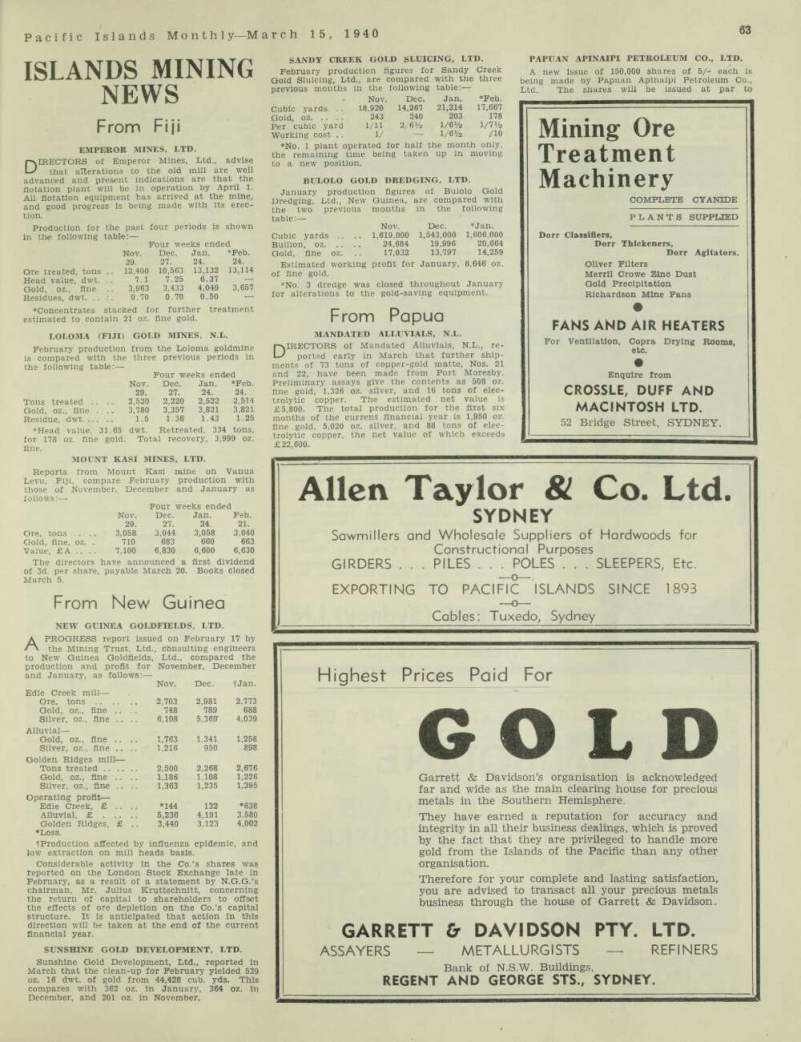
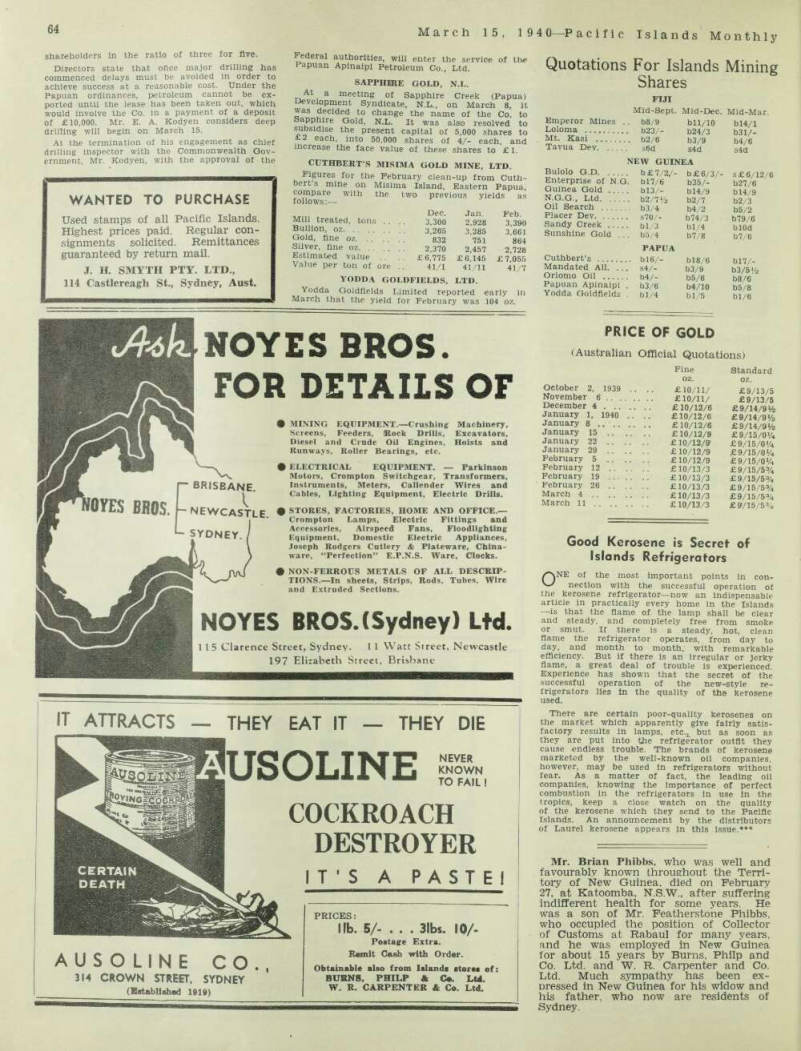
News
From Fiji
Emperor Mines, Ltd.
DIRECTORS of Emperor Mines, Ltd., advise that alterations to the old mill are well advanced and present indications are that the flotation plant will be in operation by April 1.
All flotation equipment has arrived at the mine, and good progress is being made with its erec tion.
Production for the past four periods is shown in the following table: —
•Concentrates stacked for further treatment estimated to contain 21 oz. fine gold.
Loloma (Fiji) Gold Mines, N.L.
February production from the Loloma goldmine is compared with the three previous periods in the following table: —
Mount Kasi Mines, Ltd.
Reports from Mount Kasi mine on Vanua Levu, Fiji, compare February production with those of November, December and January as follows:—
The directors have announced a first dividend of 3d. per share, payable March 20. Books closed March 5.
From New Guinea
New Guinea Goldfields, Ltd.
A PROGRESS report issued on February 17 by the Mining Trust. Ltd., consulting engineers to New Guinea Goldfields, Ltd., compared the production and profit for November, December and January, as follows; —
Considerable activity in the Co.’s shares was reported on the London Stock Exchange late in February, as a result of a statement by N.G.G.’s chairman, Mr. Julius Kruttschnitt, concerning the return of capital to shareholders to offset the effects of ore depletion on the Co.’s capital structure. It is anticipated that action in this direction will be taken at the end of the current financial year.
Sunshine Gold Development, Ltd.
Sunshine Gold Development, Ltd., reported in March that the clean-up for February yielded 539 oz. 16 dwt. of gold from 44,428 cub. yds. This compares with 362 oz. in January, 364 oz. in December, and 201 oz. in November.
Sandy Creek Gold Sluicing, Ltd.
February production figures for Sandy Creek Gold Sluicing, Ltd., are compared with the three previous months in the following table:—
From Papua
Mandated Alluvials, N.L.
DIRECTORS of Mandated Alluvlals, N.L., re ported early in March that further ship ments of 73 tons of copper-gold matte. Nos. 21 and 22, have been made from Port Moresby.
Preliminary assays give the contents as 508 oz. fine gold, 1,326 oz. silver, and 16 tons of elec trolytic copper. The estimated net value is £5,800. The total production for the first six months of the current financial year is 1,950 oz. fine gold, 5,020 oz. silver, and 88 tons of elec trolytic copper, the net value of which exceeds £22,600.
Papuan Apinaipi Petroleum Co., Ltd.
A new issue of 150,000 shares of 5/- each is being made by Papuan Apinaipi Petroleum Co., Ltd. The shares will be issued at par to
Pour weeks ended Nov. Dec. Jan. *Feb. 29. 27. 24. 24.
Ore treated, tons .. 12.400 10,563 13,132 13,114 Head value, dwt. .. 7.1 7.25 6.37 — Gold, oz., fine .. 3,&-63 3,433 4.049 3,657 Residues, dwt. ... 0.70 0.70 0.50 —
Four weeks ended Nov.
Dec.
Jan. •Feb. 29. 27. 24. 24.
Tons treated .. 2,520 2,220 2,522 2,514 Gold, oz., fine . .. 3,780 3,357 3,821 3.821 Residue, dwt. ... .. 1.5 1.36 1.43 1.25 •Head value, 31.65 dwt.
Retreated, 334 tons, for 178 oz. fine gold.
Total recovery, 3,999 oz. fine.
Nov. Dec. Jan. *Feb.
Cubic yards . . 18,920 14,267 21,214 17,667 Gold, OZ 243 240 203 178 Per cubic yard 1/11 2/6V2 l/6Ya 1/7V2 Working cost .. 1/ — l/6*/2 /10 ♦No. 1 plant operated for half the month only, the remaining time being taken up in moving to a new position.
Bulolo Gold Dredging, Ltd.
January production figures of Bulolo Gold Dredging, Ltd., New Guinea, are compared with the two previous months in the following table: — Nov. Dec. *Jan.
Cubic yards . . .. 1,619,000 1,543,000 1,606,000 Bullion, oz 24,684 19,996 20,664 Gold, fine oz. . . 17,032 13,797 14,259 Estimated working profit for January, 8,646 oz. of fine gold. ♦No. 3 dredge was closed throughout January for alterations to the gold-saving equipment.
Four weeks ended Nov.
Dec.
Jan.
Feb. 29. 27. 24. 21.
Ore, tons .. . • 3,058 3,044 3,058 3,040 Gold, fine, oz. . 710 683 660 663 Value, £ A .. .. 7,100 6,830 6,600 6,630
Nov.
Dec. tJan.
Edie Creek mill— Ore, tons 2,703 2,981 2,773 Gold, oz., fine .. . . 748 789 688 Silver, oz.. fine .. .. 6,108 5,369 4,039 Alluvial — Gold, oz., fine .. .. 1,763 1,341 1,258 Silver, oz., fine .. .. 1,216 950 898 Golden Ridges mill— Tons treated 2,500 2,268 2,676 Gold, oz., fine .. 1,186 1,108 1,226 Silver, oz., fine .. 1,363 1,235 1,395 Operating profit— Edie Creek, £ .. •144 132 •638 Alluvial, £ 5,236 4,191 3,580 Golden Ridges, £ .. 3,440 3,123 4,002 •Loss. tProduction affected by influenza epidemic, and low extraction on mill heads basis.
shareholders in the ratio of three for five.
Directors state that ofice major drilling has commenced delays must be avoided in order to achieve success at a reasonable cost. Under the Papuan ordinances, petroleum cannot be ex ported until the lease has been taken out, which would involve the Co. in a payment of a deposit of £lO,OOO. Mr. E. A. Kodyen considers deep drilling will begin on March 15.
At the termination of his engagement as chief drilling inspector with the Commonwealth Gov ernment. Mr. Kodyen, with the approval of the
Federal authorities, will enter the service of the Papuan Apinaipi Petroleum Co., Ltd.
Sapphire Gold, N.L.
At a meeting of Sapphire Creek (Papua) Development Syndicate, N.L., on March 8, it was decided to change the name of the Co. to Sapphire Gold, N.L. It was also resolved to subsidise the present capital of 5,000 shares to £2 each, into 50,000 shares of 4/- each, and increase the face value of these shares to £l.
Cuthbert’S Misima Gold Mine, Ltd.
Figures for the February clean-up from Cuth bert’s mine on Misima Island, Eastern Papua, compare with the two previous yields as follows:
Yodda Goldfields, Ltd.
Yodda Goldfields Limited reported early in March that the yield for February was 104 oz.
Dec.
Jan.
Feb.
Mill treated, tons .. 3,300 2,928 3,390 Bullion, oz. . 3,265 3,285 3,661 Gold, fine oz. .. 832 751 864 Silver, fine oz. . . 2,370 2,457 2,728 Estimated value .. £6.775 £6,145 £7,055 Value per ton of ore 41/1 41/11 41/7
Advertisements & other items, pp. 67-68 (2 items)
63
Pacific Islands Monthl y—M arch 15, 1940
Allen Taylor & Co. Ltd.
Mining Ore
Treatment
Machinery
COMPLETE CYANIDE
PLANTS SUPPLIED
Dorr Classifiers, Dorr Thickeners, Dorr Agitators.
Oliver Filters Merril Crowe Zinc Dust Gold Precipitation Richardson Mine Fans
FANS AND AIR HEATERS
For Ventilation, Copra Drying Rooms, etc. • Enquire from
CROSSLE, DUFF AND
MACINTOSH LTD.
52 Bridge Street, SYDNEY.
Allen Taylor & Co. Ltd.
SYDNEY
Sawmillers and Wholesale Suppliers of Hardwoods for Constructional Purposes GIRDERS . . . PILES . . . POLES . . . SLEEPERS, Etc.
EXPORTING TO PACIFIC ISLANDS SINCE 1893
Cables: Tuxedo, Sydney
Highest Prices Paid For
G L Garrett & Davidson’s organisation is acknowledged far and wide as the main clearing house for precious metals in the Southern Hemisphere.
They have earned a reputation for accuracy and integrity in all their business dealings, which is proved by the fact that they are privileged to handle more gold from the Islands of the Pacific than any other organisation.
Therefore for your complete and lasting satisfaction, you are advised to transact all your precious metals business through the house of Garrett & Davidson.
GARRETT & DAVIDSON PTY. LTD.
ASSAYERS METALLURGISTS REFINERS
Bank of N.S.W. Buildings,
REGENT AND GEORGE STS., SYDNEY.
WANTED TO PURCHASE
Used stamps of all Pacific Islands.
Highest prices paid. Regular consignments solicited. Remittances guaranteed by return mail.
J. H. SMYTH PTY. LTD.,
114 Castlereagh St., Sydney, Aust.
NOYES BROS.
FOR DETAILS OF
BRISBANE.
NEWCASTLE.
SYDNEY. /
• MINING EQUIPMENT.—Crushing Machinery.
Screens, Feeders, (Rock Drills, Excavators, Diesel and Crude Oil Engines, Hoists and Runways, Roller Bearings, etc.
• ELECTRICAL EQUIPMENT. Parkinson
Motors, Crompton Switchgear, Transformers, Instruments, Meters, Callender Wires and Cables, Lighting Equipment, Electric Drills.
• STORES, FACTORIES, HOME AND OFFICE.—
Crompton Lamps, Electric Fittings and Accessories, Airspeed Fans, Floodlighting Equipment. Domestic Electric Appliances.
Joseph Rodgers Cutlery & Plateware, Chinaware, “Perfection” E.P.N.S. Ware, Clocks.
• NON-FERROUS METALS OF ALL DESCRIP-
TIONS.—In sheets, Strips, Rods, Tubes, Wire and Extruded Sections.
NOYES BROS.(Sydney) Ltd.
11 5 Clarence Street, Sydney. 11 Watt Street, Newcastle 197 Elizabeth Street, Brisbane
IT ATTRACTS THEY EAT IT THEY DIE
iUSOLINE
m
NEVER
KNOWN
TO FAIL !
AUSOLINE CO
314 CROWN STREET. SYDNEY
(Established 1919)
COCKROACH
DESTROYER
IT'S A PASTE
PRICES:
lib. 5/- . . . libs. 10/- Postage Extra.
Remit Cash with Order.
Obtainable also from Islands stores of:
BURNS. PHILP & Cm. Ltd.
W. R. CARPENTER & Co, Ltd.
Quotations For Islands Mining
Shares
Fiji
M'id-Sept.
Mid-Dec.
Mid-Mar.
Emperor Mines , b8/9 bll/10 bl4/l Loloma . b23/b24/3 b31/- Mt. Kasi b3/9 b4/6 Tavua Dev s6d s4d s4d Bulolo G.D
New Guinea
. b £7/2/- b£6/3/s£ 6/12/6 Enterprise of N.G. bl7/6 b35/b27/6 Guinea Gold ... . b!3/b!4/9 bl4/9 N.G.G., Ltd .. b2/7 Vz b2/7 b2/3 Oil Search .. b3/4 b4/2 b5/2 Placer Dev . s70/b74/3 b79/6 Sandy Creek . bl/3 bl/4 blOd Sunshine Gold .. . b5/4 b7/8 b7/6 Cuthberfs ...
Papua
bl8/6 bl7/- Mandated All. .. . S4/b3/9 b3/5 V2 Oriomo Oil . b4/b5/6 b8/6 Papuan Apinaipl . b3/6 b4/10 b5/8 Yodda Goldfields bl/4 bl/5 bl/6
Price Op Gold
(Australian Official Quotations) Fine Standard oz. oz.
October 2. 1939 . • .. £10/11/ £9/13/5 November 6 £9/13/5 December 4 . ., £9/14/9 Mi January 1, 1940 .. £10/12/6 £ 9/14/9 >/ 2 January 8 ,. .. £9/14/9% January 15 . . . . £9/15/0»/4 January 22 . . £10/12/ff £ 9/15/0 V* January 29 . . .. £ 9/15/0 y 4 February 5 .. .. £10/12/9 £9/15/0/* February 12 .. .. £9/15/5% February 19 .. .. £10/13/3 £9/15/5% February 26 .. .. £9/15/5% March 4 £ 10/13/3 £9/15/5% March 11 £9/15/5%
islands Refrigerators
Good Kerosene is Secret of islands Refrigerators
ONE of the most Important points in con nection with the successful operation of the kerosene refrigerator—now an indispensable article in practically every home in the Islands —is that the flame of the lamp shall be clear and steady, and completely free from smoke or smut. If there is a steady, hot, clean flame the refrigerator operates, from day to day, and month to month, with remarkable efficiency. But if there is an irregular or jerky flame, a great deal of trouble is experienced.
Experience has shown that the secret of the successful operation of the new-style re frigerators lies in the quality of the kerosene used.
There are certain poor-quality kerosenes on the market which apparently give fairly satis factory results In lamps, etc. t but as soon as they are put into the refrigerator outfit they cause endless trouble. The brands of kerosene marketed by the well-known oil companies, however, may be used in refrigerators without fear. As a matter of fact, the leading oil companies, knowing the importance of perfect combustion in the refrigerators in use in the tropics, keep a close watch on the quality of the kerosene which they send to the Pacific Islands. An announcement by the distributors of Laurel kerosene appears in this Issue.*** Mr. Brian Phibbs, who was well and favourably known throughout the Terri tory of New Guinea, died on February
27, at Katoomba, N.S.W., after suffering
indifferent health for some years. He was a son of Mr. Featherstone Phibbs, who occupied the position of Collector of Customs at Rabaul for many years, and he was employed in New Guinea for about 15 years by Burns, Philp and Co. Ltd. and W. R. Carpenter and Co.
Ltd. Much sympathy has been ex pressed in New Guinea for his widow and his father, who now are residents of
Sydney.
Agreement
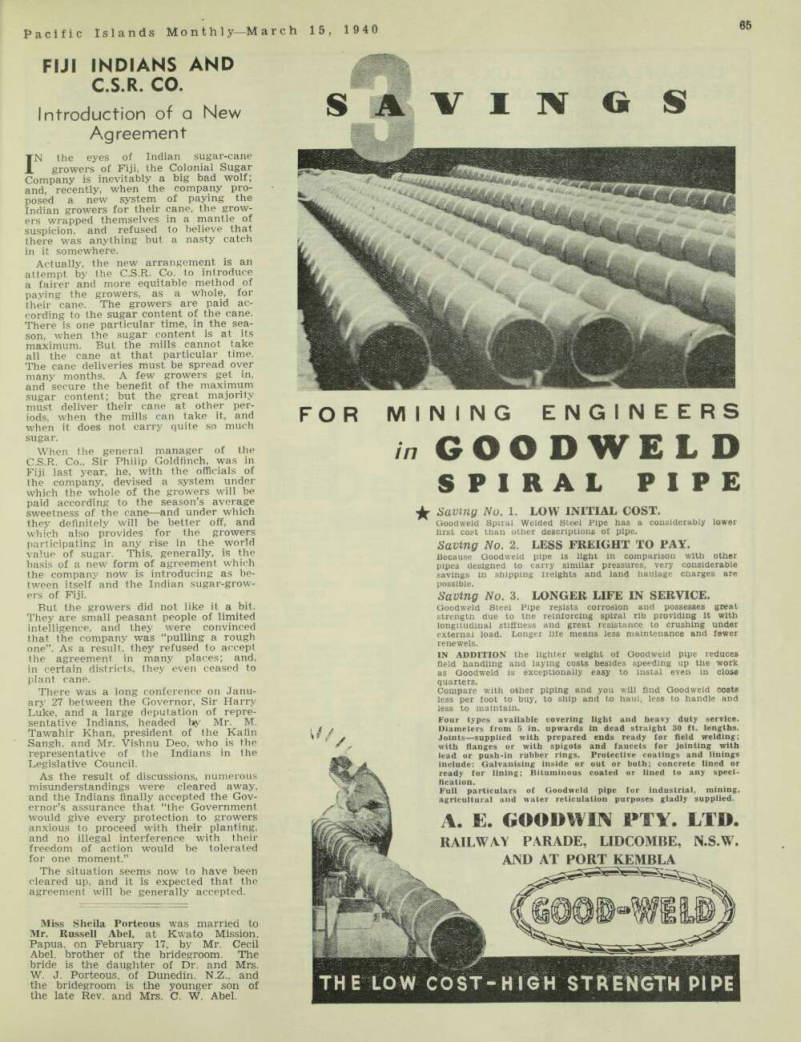
Fiji Indians And
C.S.R. Co.
Introduction of a New Agreement
IN the eyes of Indian sugar-cane growers of Fiji, the Colonial Sugar Company is inevitably a big bad wolf; and, recently, when the company pro posed a new system of paying the Indian growers for their cane, the grow ers wrapped themselves in a mantle of suspicion, and refused to believe that there was anything but a nasty catch in it somewhere.
Actually, the new arrangement is an attempt by the C.S.R. Co. to introduce a fairer and more equitable method of paying the growers, as a whole, for their cane. The growers are paid ac cording to the sugar content of the cane.
There is one particular time, in the sea son, when the sugar content is at its maximum. But the mills cannot take all the cane at that particular time.
The cane deliveries must be spread over many months. A few growers get in, and secure the benefit of the maximum sugar content; but the great majority must deliver their cane at other per iods, when the mills can take it, and when it does not carry quite so much sugar.
When the general manager of the C.S.R. Co., Sir Philip Goldfinch, was in Fiji last year, he, with the officials of the company, devised a system under which the whole of the growers will be paid according to the season’s average sweetness of the cane—and under which they definitely will be better off, and which also provides for the growers participating in any rise in the world value of sugar. This, generally, is the basis of a new form of agreement which the company now is introducing as be tween itself and the Indian sugar-grow ers of Fiji.
Rut the growers did not like it a bit.
They are small peasant people of limited intelligence, and they were convinced that the company was “pulling a rough one”. As a result, they refused to accept the agreement in many places; and, in certain districts, they even ceased to plant cane.
There was a long conference on Janu ary 27 between the Governor, Sir Harry Luke, and a large deputation of repre sentative Indians, headed by Mr. M.
Tawahir Khan, president of the Kalin Sangh, and Mr. Vishnu Deo, who is the representative of the Indians in the Legislative Council.
As the result of discussions, numerous misunderstandings were cleared away, and the Indians finally accepted the Gov ernor’s assurance that “the Government would give every protection to growers anxious to proceed with their planting, and no illegal interference with their freedom of action would be tolerated for one moment.”
The situation seems now to have been cleared up, and it is expected that the agreement will be generally accepted.
Miss Sheila Porteous was married to Mr. Russell Abel, at Kwato Mission.
Papua, on February 17, by Mr. Cecil Abel, brother of the bridegroom. The bride is the daughter of Dr. and Mrs.
W. J. Porteous, of Dunedin. N.Z., and the bridegroom is the younger son of the late Rev. and Mrs. C. W. Abel.
Advertisements & other items, pp. 69-70 (3 items)
Pacific Islands Monthl y—M arch 15, 1940
In Goodweld
SAVIN G S
X X ■ % X - 3J
FOR MINING ENGINEERS
in GOODWELD
SPIRAL PIPE
+ Saving No. 1. LOW INITIAL COST.
Goodweld Spiral Welded Steel Pipe has a considerably lower first cost than other descriptions of pipe.
Saving No. 2. LESS FREIGHT TO PAY.
Because Goodweld pipe is light in comparison with other pipes designed to carry similar pressures, very considerable savings in shipping freights and land haulage charges are possible.
Saving No. 3. LONGER LIFE IN SERVICE.
Goodweld Steel Pipe resists corrosion and possesses great strength due to the reinforcing spiral rib providing It with longitudinal stiffness and great resistance to crushing under external load. Longer life means less maintenance and fewer renewals.
IN ADDITION the lighter weight of Goodweld pipe reduces field handling and laying costs besides speeding up the work as Goodweld is exceptionally easy to instal even in close quarters.
Compare with other piping and you will find Goodweld costs less per foot to buy, to ship and to haul, less to handle and less to maintain.
Four types available covering light and heavy duty service.
Diameters from 5 in. upwards in dead straight 30 ft. lengths.
Joints—supplied with prepared ends ready for field welding; with flanges or with spigots and faucets for jointing with lead or push-in rubber rings. Protective coatings and linings include: Galvanising inside or out or both; concrete lined or ready for lining; Bituminous coated or lined to any specification.
Full particulars of Goodweld pipe for industrial, mining, agricultural and water reticulation purposes gladly supplied.
A. E. GOODWIN PTY. LTD.
RAILWAY PARADE, LIDCOMBE, N.S.W.
AND AT PORT KEMBLA
"LIKE-A-FLASH" DE LUXE RADIO
RECEIVERS FROM MAKER TO USER
Each Guaranteed for 12 Months Regardless of Make, Trade-Name or Price, “Like-a-Fiash”
Radio sets cannot be bettered. Hundreds of our sets are giving excellent service right throughout the Islands.
“Like-a-Flash” De Luxe Dual Wave 5 Valve Battery Operated Receiver.
This is one of the most powerful models in the battery set series, and the Radio Frequency stage of amplification gives the set a world range on short wave channels as well as full coverage range of Australasian “A” and “B” Class Broadcasters.
The set is also specially designed to give maximum service in humid climates, such as North Queensland and Pacific Island Territories. A vital part very vulnerable to “dampness” in ordinary receivers is the “Intermediate Frequency Section”.
In this set our Engineers have fitted special inductance tuned intermediate frequency transformers, which do not require trimmers.!
These units ensure correct align- 1 ment for a continuous period. An “8” Aero Dial calibrated in stations facilitates tuning. Valves used are:
2—lC4, I—KK2, I—lK6, I—lD4
The speaker is the latest Amplion Permagnetic Model, capable of highfidelity reproduction. Battery equipment consists of extra heavy capacity units as follows: — 1 2 Volt 100 amp. Accumulator. 3 Ever-fteady Superdyne 45 Volt “B” Batteries. 1 Ever-Ready 4Vfe in. “C” Battery.
The outfit is housed in a beautfully veneered floor model Console Cabinet.
Llke-a-Flash “Elimlnolse” Aerial Kit for short or dual-wave sets. Aerial, Pyrex type Insulators,, transposition blocks and 200 ft. aerial coll, 22/6.
Eliminates unwanted aerial and hideous electrical noises from your dual-wave or short-wave sets.
RADIO SERVICEMAN’S MANUAL
FOR 1939.
Just Out! Australia’s Official Radio Service Manual: 10/6. Write for full list of Radio Publications.
BOOKS! BOOKS! BOOKS! The Be-
ginners’ Book of Radio. The Radio Beginners’ Dictionary. 2/- the 2. The Wireless Constructor’s Encyclopaedia. Giant size, 7/6. Newnes “Everyman’s” Wireless Book, 5/6.
The Book of Practical Radio, also The Book of Practical Television, 8/6 each. Foulsham’s Giant “Party and Fun Book”, 1/6. Humorous Stories and Recitations, 3/9. Card and Conjuring Tricks, 3/9. Tea- Cup Fortune Telling, 3/9. 100 Party Games for Old and Young, 1/9.
Popular Magic and Amateur Conjurer, 1/9. 50 Best Party Games, 1/6. Tricks with Cards, 1/6.
PRICE: £22/5/-.
No. 1 Morse Code Practice Sets, with Switch Buzzer to Light. Use as you desire. 22/6 complete.
No. 2, with Heavier Type Morse Key: 30/-. Pendograph Bug Key. 70/-. Adjustable Key (only), 12/6.
High Pitched Buzzers, 4/6, 7/6, 15/-.
Adjustable All-way Morse Key, Long or Short Tap, 12/6. Heavier P.M.G.' Type, 19/6. Learn Morse Book 1/-J I 9& P.M.G. Type Sturdy Built Sounder, 35/-. I Buzzers, 3/9 and> 4/9.
P.M.G. Morse Key as illustrated, 19/6.
Rejuv Safety Razor-Blade Sharpener, 7/6 —now —2/-. Add 6d. postage.
Blades last for months with this. 48/6 Just arrived from the maker in London, “Cosmocord” De Luxe Crystal Pick-up, with Built-in Vol. Control, 48/6. Write for List of Pickups.
Play, Talk, Sing, Joke through your Radio. Great Fun. Batteryless typo Microphone for Hand Holding or Hanging, 22/6. Complete with lead, fixed In a second. Others, 12/6, 16/-, 17/6, 25/-, 28/6, 32/6. All plus 1/9 for Battery and 1/6 (or 20 (t. Cord.
Write for full detailed list.
B.G.E. Table Type Microphone. Highly recommended for Amateur or Professional use. Built-in Transformer and Battery with Volume Control incorporated.
Just plug Into pickup terminals of any set. 89/6. ,
“Like-a-Flash” Dual Wave—6 Valve Radio Gramophone Combination, Battery Operated Receiver.
This extremely powerful and selective receiver uses a Radio Frequency Stage of Amplification which ensures short wave reception from most of the overseas broadcasting stations.
Components featured in our 6 valve model makes this set very suitable for Islands conditions.
The output stage is a “B” Class amplifier which not only ensures higher fidelity reproduction, but is very economical on “B” Battery consumption.
Valves used on I—KK2, 2 —lC4, 2 IK6, 1.19.
Large “8” Aero dial calibrated in stations enables both short wave and broadcast stations to be quickly tuned in.
The gramo. units consists of a double spring clockwork motor of high quality, and the pickup is by the well known English British Thomson Houston Company.
Battery equipment comprises triple capacity units as follows: 1 2 Volt —100 amp Accumulator. 3 45 Volt Ever-Ready Superdyne B" Batteries. 1 4V 2 Volt Ever-Ready “C” Battery.
An amplion permagnetlc speaker of push-pull type completes a very modern and efficient combination.
The floor model console combination cabinet houses the equipment, and is beautifully finished in highly
polished veneer.
PRICE: £32/5/-.
Valves and Batteries. Yes! We Guarantee a Better Price. Send along your Order and Mention this Advertisement.
Replacement Parts for Every Make of Radio. Send along your Order or ask for Quote.
CATALOGUE. Order your copy now, Bd. Post Free. Send for it to-day.
Limited Number Only.
Levenson’s Wonder Book of Specialities. Radio, Coin-operated Machines, Games, Jokes, Puzzles, Hobbles, crammed full of surprises from Cover to Cover. •W
vouiy^S
ItXTBA-i
EXTRA!
|FVE^°i
I SPEgAgfi
“Like-a-Flash” 5 Valve Battery Operated Receiver for Broadcast Reception on Wave Lengths between 220 and 550 Metres. (This special receiver has a stage of Radio Frequency Amplification. This ' gives it long range and is capable of excellent reception from most 1 Australasian stations, i Valves used are: 2—lC4, I—lC6 or
KK2, I—lK6, I—lD4.
Speaker is an “8” Amplion Permagnetic Unit. jA very neat and attractive floor 'model cabinet houses all equipment, i Battery consists of triple capacity units, as follows: 1 2 Volt 100 amp. Accumulator. 3 45 Volt Ever-Ready Superdyne “B” Batteries. 1 4V 2 Volt Ever-Ready “C” Battery.
PRICE: £2O/7/6.
ACCUMULATORS
We sell all Types and Sizes —Fully Guaranteed.
Don’t Buy Accumulators before we quote you if not listed here.
RADIO ACCUMULATORS.
2 Volt. 110 Amp 16/6 19/6 20/- 21/9 36/- 45/6 52/6 58/3 67/- 90 110 130 150 „ 170
AUTO ACCUMULATORS.
6 Volt. 9 Plate 60 Amp. 90 103 116 50 60 31/9 40/- 44/6 51/- 49/3 65/9
HOME LIGHTING ACCUMULATORS.
2 Volt. 120 Amps 19/6 2 „ 210 85/3 2 200 40/-
GAMES
I Dart Boards, 4/6, 8/6, 10/6, 15/-.
Brass Competition Darts, Set of 3, 3/11, 4/6, 5/61 Monopoly, 10/6.
Totopoly, 10/6. Bucaneer, 10/6. 3 of the World’s Most Popular Games.
Chinese Checkers, 3/6, 4/6, 8/6.
Tripoly Card Game, 5/-. De Luxe Model Game, 10/6. Poker Rummy, 1/-. Pot Luck, 1/-. Playing Card Lotto, 1/-. We Stock All Kinds of Indoor Games. Send for Booklet.
MAKE YOUR OWN RECORDINGS.
Overhead Cutting Gear and Cutting Head for Home Radio-Gramophone Recording, £4/4/-. Write for full price Records, Needles, etc., etc.
nirmimiimnnin
Write for Punch Board Leaflets
iiiiiMiMnnn
LEVENSON'S RADIO
Pin-Game,
GAMES, NOVELTIES AND HOBBIES, Totem and
226 PITT STREET, SYDNEY g“ n s s and Manufacturers, Importers, and Exporters. Leaflets N.S.W., AUSTRALIA. Illlllllllllinillllllllll Cable address: “Leveradioh”. Goods forwarded V.P.P. or Sight Draft. Satisfaction and Service Guaranteed. We can supply by mail all General Merchandise at a Better Price. Quotations with pleasure. Please add freight and packing. Write for full list of interesting leaflets of Games, Hobbies, Novelties, and Electrical Goods. Write for full list of Radio Meters.
Can Supply, at a Keen Price, Any Available Article You Require.
66
March 15, 194 O—P acific Islands Monthly
Australian Short Wave
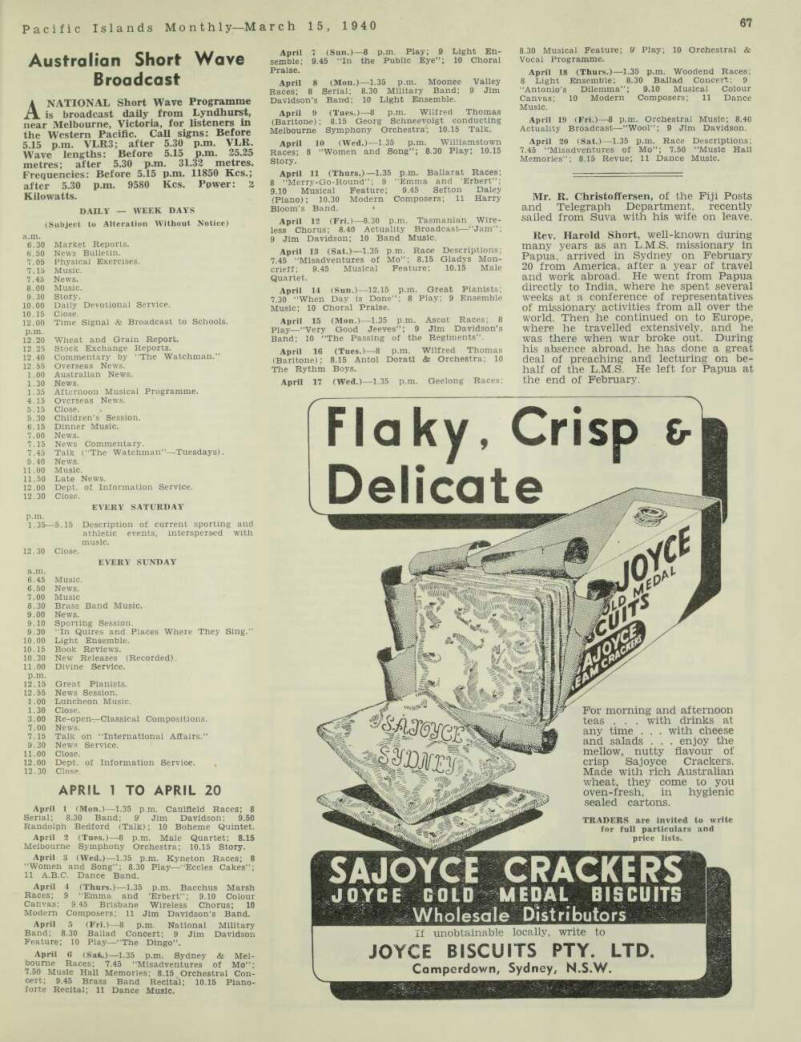
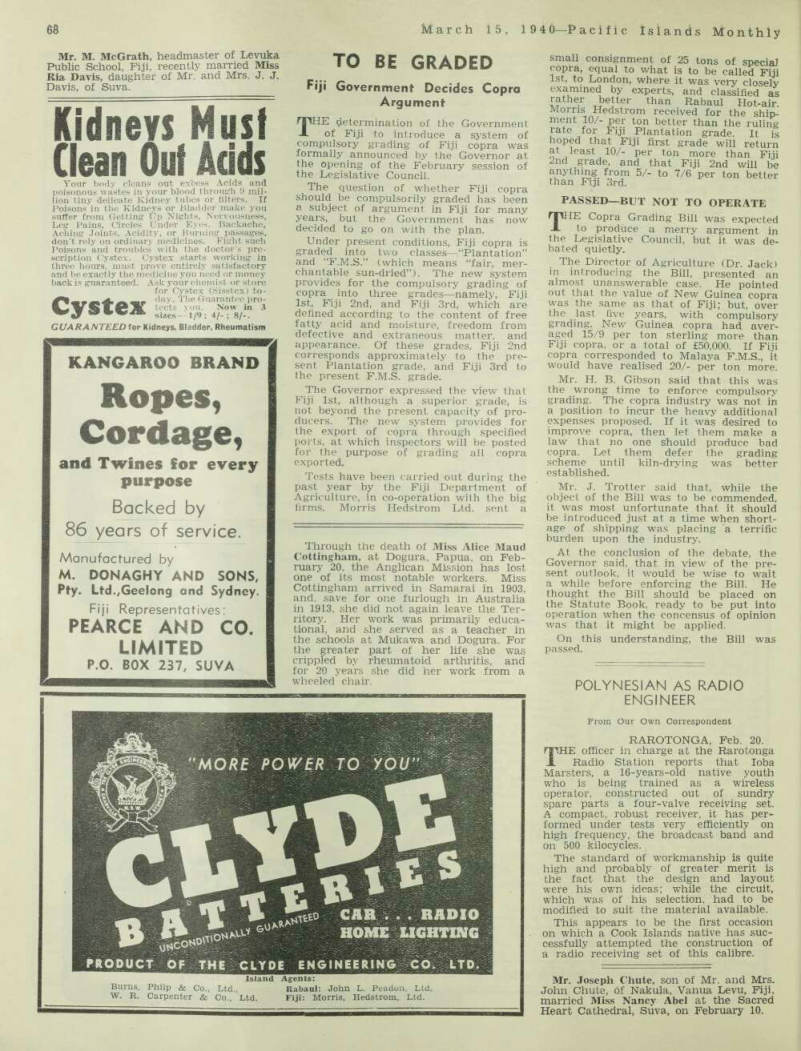
Broadcast
A NATIONAL Short Wave Programme is broadcast daily from Lyndhurst, near Melbourne, Victoria, for listeners in the Western Pacific. Call signs: Before 5.15 p.m. VLR3; after 5.30 p.m. VLR.
Wave lengths: Before 5.15 p.m. 25.25 metres; after 5.30 p.m. 31.32 metres.
Frequencies: Before 5.15 p.m. 11850 Kcs.; after 5.30 p.m. 9580 Kcs. Power: 2 Kilowatts.
Daily Week Days
(Subject to Alteration Without Notice) a.m. 6.30 Market Reports, 6.50 News Bulletin. 7.05 Physical Exercises. 7.15 Music. 7.45 News. 8.00 Music. 9.30 Story. 10.00 Daily Devotional Service. 10.15 Close. 12.00 Time Signal & Broadcast to Schools, p.m. 12.20 Wheat and Grain Report. 12.25 Stock Exchange Reports. 12.40 Commentary by “The Watchman.” 12.55 Overseas News. 1.00 Australian News. 1.30 News. 1.35 Afternoon Musical Programme. 4.15 Overseas News. 5.15 Close. 5.30 Children’s Session. 6.15 Dinner Music. 7.00 News. 7.15 News Commentary. 7.45 Talk (“The Watchman” —Tuesdays). 9.40 News. 11.00 Music. 11.50 Late News. 12.00 Dept, of Information Service. 12.30 Close.
Every Saturday
p.m. 1.35—5.15 Description of current sporting and athletic events, interspersed with music. 12.30 Close.
Every Sunday
a.m. 6.45 Music. 6.50 News. 7.00 Music 8.30 Brass Band Music. 9.00 News. 9.10 Sporting Session. 9.30 “In Quires and Places Where They Sing.” 10.00 Light Ensemble. 10.15 Book Reviews. 10.30 New Releases (Recorded). 11.00 Divine Service, p.m. 12.15 Great Pianists. 12.55 News Session. 1.00 Luncheon Music. 1.30 Close. 3.00 Re-open—Classical Compositions. 7.00 News. 7.15 Talk on “International Affairs.” 9.30 News Service. 11.00 Close. 12.00 Dept, of Information Service. 12.30 Close.
April 1 To April 20
April 1 (Mon.) —1.35 p.m. Caulfield Races; 8 Serial; 8.30 Band; 9' Jim Davidson; 9.50 Randolph Bedford (Talk); 10 Boheme Quintet.
April 2 (Tues.) —8 p.m. Male Quartet; 8.15 Melbourne Symphony Orchestra; 10.15 Story.
April 3 (Wed.) —1.35 p.m. Kyneton Races; 8 “Women and Song”; 8.30 Play—“ Eccles Cakes”; 11 A.B.C. Dance Band.
April 4 (Thurs.) —1.35 p.m. Bacchus Marsh Races; 9 “Emma and ’Erbert”; 9.10 Colour Canvas; 9.45 Brisbane Wireless Chorus; 10 Modern Composers; 11 Jim Davidson’s Band.
April 5 (Fri.) —8 p.m. National Military Band; 8.30 Ballad Concert; 9 Jim Davidson Feature; 10 Play—“ The Dingo”.
April 6 (SaM —1.35 p.m. Sydney & Mel bourne Races; 7.45 “Misadventures of Mo”; 7.50 Music Hall Memories; 8.15 Orchestral Con cert; 9.45 Brass Band Recital; 10.15 Piano forte Recital; 11 Dance Music.
April 7 (Sun.) —8 p.m. Play; 9 Light En semble: 9.45 “In the Public Eye”; 10 Choral Praise.
April 8 (Mon.) —1.35 p.m. Moonee Valley Races; 8 Serial; 8.30 Military Band; 9 Jim Davidson’s Band; 10 Light Ensemble.
April 9 (Tues.)—B p.m. Wilfred Thomas (Baritone); 8.15 Georg Schneevoigt conducting Melbourne Symphony Orchestra; 10.15 Talk.
April 10 (Wed.) —1.35 p.m. Williamstown Races; 8 “Women and Song”; 8.30 Play; 10.15 Story.
April II (Thurs.) —1.35 p.m. Ballarat Races; 8 “Merry-Go-Round”; 9 “Emma and ’Erbert”; 9.10 Musical Feature; 9.45 Sefton Daley (Piano); 10.30 Modern Composers; 11 Harry Bloom’s Band. • April 12 (Fri.) —8.30 p.m. Tasmanian Wire less Chorus: 8.40 Actuality Broadcast—“ Jam”: 9 Jim Davidson; 10 Band Music.
April 13 (Sat.) —1.35 p.m. Race Descriptions; 7.45 “Misadventures of Mo”; 8.15 Gladys Mon crieff; 9.45 Musical Feature: 10.15 Male Quartet.
April 14 (Sun.) —12.15 p.m. Great Pianists; 7.30 “When Day is Done”: 8 Play; 9 Ensemble Music; 10 Choral Praise.
April 15 (M0n.)—1.35 p.m. Ascot Races; 8 Play—“ Very Good Jeeves”; 9 Jim Davidson’s Band; 10 “The Passing of the Regiments”.
April 16 (Tues.)—B p.m. Wilfred Thomas (Baritone): 8.15 Antol Dorati & Orchestra; 10 The Rythm Boys.
April 17 (Wed.)—l.3s p.m. Geelong Races.
8.30 Musical Feature; 9’ Play; 10 Orchestral & Vocal Programme.
April 18 (Thurs.) —1.35 p.m. Woodend Races; 8 Light Ensemble: 8.30 Ballad Concert: 9 “Antonio’s Dilemma’’; 9.10 Musical Colour Canvas: 10 Modern Composers; 11 Dance Music.
April 19 (Fri.) —8 p.m. Orchestral Music; 8.40 Actuality Broadcast —“Wool’’; 9 Jim Davidson.
April 20 (Sat.) —1.35 p.m. Race Descriptions; 7.45 “Misadventures of Mo”; 7.50 “Music Hall Memories’’; 8.15 Revue; 11 Dance Music.
Mr. R. Christoffersen, of the Fiji Posts and Telegraph Department, recently sailed from Suva with his wife on leave.
Rev. Harold Short, well-known during many years as an L.M.S. missionary in Papua, arrived in Sydney on February 20 from America, after a year of travel and work abroad. He went from Papua directly to India, where he spent several weeks at a conference of representatives of missionary activities from all over the world. Then he continued on to Europe, where he travelled extensively, and he was there when war broke out. During his absence abroad, he has done a great deal of preaching and lecturing on be half of the L.M.S. He left for Papua at the end of February.
Mr. M. McGrath, headmaster of Levuka Public School, Fiji, recently married Miss Ria Davis, daughter of Mr. and Mrs. J. J.
Davis, of Suva,
Through the death of Miss Alice Maud Cottingham, at Dogura, Papua, on Feb ruary 20, the Anglican Mission has lost one of its most notable workers. Miss Cottingham arrived in Samarai in 1903. and. save for one furlough in Australia in 1913. she did not again leave the Ter ritory. Her work was primarily educa tional, and she served as a teacher in the schools at Mukawa and Dogura. For the greater part of her life she was crippled by rheumatoid arthritis, and for 20 years she did her work from a wheeled chair.
Advertisements & other items, pp. 71-72 (2 items)
67
Pacific Islands Monthl y—M arch 15, 1940
Flaky, Crisp &
r
Delicate
o f p 9i *■■■ \ ■ I 0 O /) c TRADERS are invited to write for full particulars and price lists. kV.
For morning and afternoon teas . . . with drinks at any time . . . with cheese and salads . . . enjoy the mellow, nutty flavour of crisp Sajoyce Crackers.
Made with rich Australian wheat, they come to you oven-fresh, in hygienic sealed cartons.
JOYCE
COLD MEDAL BISCUITS
Wholesale Distributors
If unobtainable locally, write to
JOYCE BISCUITS PTY. LTD.
Camperdown, Sydney, N.S.W.
Kidneys Must
(lean Out Adds
Your body cleans out excess Acids and poisonous wastes in your blood through 9 million tiny delicate Kidney tubes or filters. If Poisons in the Kidneys or Bladder make you suffer from Getting Up Nights, Nervousness, Leg Pains, Circles Under Eyes, Backache, Aching Joints, Acidity, or Burning passages, don’t rely on ordinary medicines. Fight such Poisons and troubles with the doctor’s prescription Cystex. Cystex starts working in three hours, must prove entirely satisfactory and be exactly the medicine you need or money back is guaranteed. Ask your chemist or store GUARANTEED for Kidneys, Bladder, Rheumatism
Cystex
for Cystex (Sisstex) today. The Guarantee protects you. Now in 3 sizes 1/9 ; 4/- ; 8/-.
KANGAROO BRAND
Ropes,
Cordage,
and Twines for every purpose
Backed by
86 years of service.
Manufactured by
M. DONAGHY AND SONS,
Pty. Ltd..Geelong and Sydney.
Fiji Representatives:
PEARCE AND CO.
LIMITED
P.O. BOX 237, SUVA
MORE POWER
. ' .' ' '■ x. ■ ■
'ER TO YOU"
it* m .fflrtto Ci 00 ***
CAR . . . RADIO
HOME LIGHTING
otfCO**°^ V
PRODUCT OF THE CLYDE E MGI NEE RI NG CO> LTD Island Agents: Burns, Philp & Co., Ltd., Rabaul: John L. Peadon, Ltd.
W. R. Carpenter & Co., Ltd. Fiji: Morris, Hedstrom, Ltd.
To Be Graded
Fiji Government’ Decides Copra Argument
THE determination of the Government of Fiji to introduce a system of compulsory grading of Fiji copra was formally announced by the Governor at the opening of the February session of the Legislative Council.
The question of whether Fiji copra should be compulsorily graded has been a subject of argument in Fiji for many years, but the Government has now decided to go on with the plan.
Under present conditions, Fiji copra is graded into two classes—“ Plantation” and “F.M.S.” (which means “fair, mer chantable sun-dried”). The new system provides for the compulsory grading of copra into three grades—namely, Fiji Ist, Fiji 2nd, and Fiji 3rd, which are defined according to the content of free fatty acid and moisture, freedom from defective and extraneous matter, and appearance. Of these grades, Fiji 2nd corresponds approximately to the pre sent Plantation grade, and Fiji 3rd to the present F.M.S. grade.
The Governor expressed the view that Fiji Ist, although a superior grade, is not beyond the present capacity of pro ducers. The new system provides for the export of copra through specified ports, at which inspectors will be posted for the purpose of grading all copra exported.
Tests have been carried out during the past year by the Fiji Department of Agriculture, in co-operation with the big firms. Morris Hedstrom Ltd. sent a
small consignment of 25 tons of special copra, equal to what is to be called Fiji Ist, to London, where it was very closely examined by experts, and classified as rather better than Rabaul Hot-air.
Morris Hedstrom received for the ship ment 10/- per ton better than the ruling rate for Fiji Plantation grade It is hoped that Fiji first grade will return at least 10/- per ton more than Fiji 2nd grade, and that Fiji 2nd will be anything from 5/- to 7/6 per ton better than Fiji 3rd.
Passed—But Not To Operate
THE Copra Grading Bill was expected to produce a merry argument in the Legislative Council, but it was de bated quietly.
The Director of Agriculture (Dr. Jack) in introducing the Bill, presented an almost unanswerable case. He pointed out that the value of New Guinea copra was the same as that of Fiji; but, over the last five years, with compulsory grading, New Guinea copra had aver aged 15/9 per ton sterling more than Fiji copra, or a total of £50,000. If Fiji copra corresponded to Malaya F.M.S., it would have realised 20/- per ton more.
Mr. H. B. Gibson said that this was the wrong time to enforce compulsory grading. The copra industry was not in a position to incur the heavy additional expenses proposed. If it was desired to improve copra, then let them make a law that no one should produce bad copra. Let them defer the grading scheme until kiln-drying was better established.
Mr. J. Trotter said that, while the object of the Bill was to be commended, it was most unfortunate that it should be introduced just at a time when short age of shipping was placing a terrific burden upon the industry.
At the conclusion of the debate, the Governor said, that in view of the pre sent outlook, it would be wise to wait a while before enforcing the Bill. He thought the Bill should be placed on the Statute Book, ready to be put into operation when the concensus of opinion was that it might be applied.
On this understanding, the Bill was passed.
Polynesian As Radio
Engineer
From Our Own Correspondent
Rarotonga, Feb. 20.
THE officer in charge at the Rarotonga Radio Station reports that loba Marsters, a 16-years-old native youth who is being trained as a wireless operator, constructed out of sundry spare parts a four-valve receiving set.
A compact, robust receiver, it has per formed under tests very efficiently on high frequency, the broadcast band and on 500 kilocycles.
The standard of workmanship is quite high and probably of greater merit is the fact that the design and layout were his own ideas; while the circuit, which was of his selection, had to be modified to suit the material available.
This appears to be the first occasion on which a Cook Islands native has suc cessfully attempted the construction of a radio receiving set of this calibre.
Mr. Joseph Chute, son of Mr. and Mrs.
John Chute, of Nakula, Vanua Levu, Fiji, married Miss Nancy Abel at the Sacred Heart Cathedral, Suva, on February 10.
Pre-Polynesian?
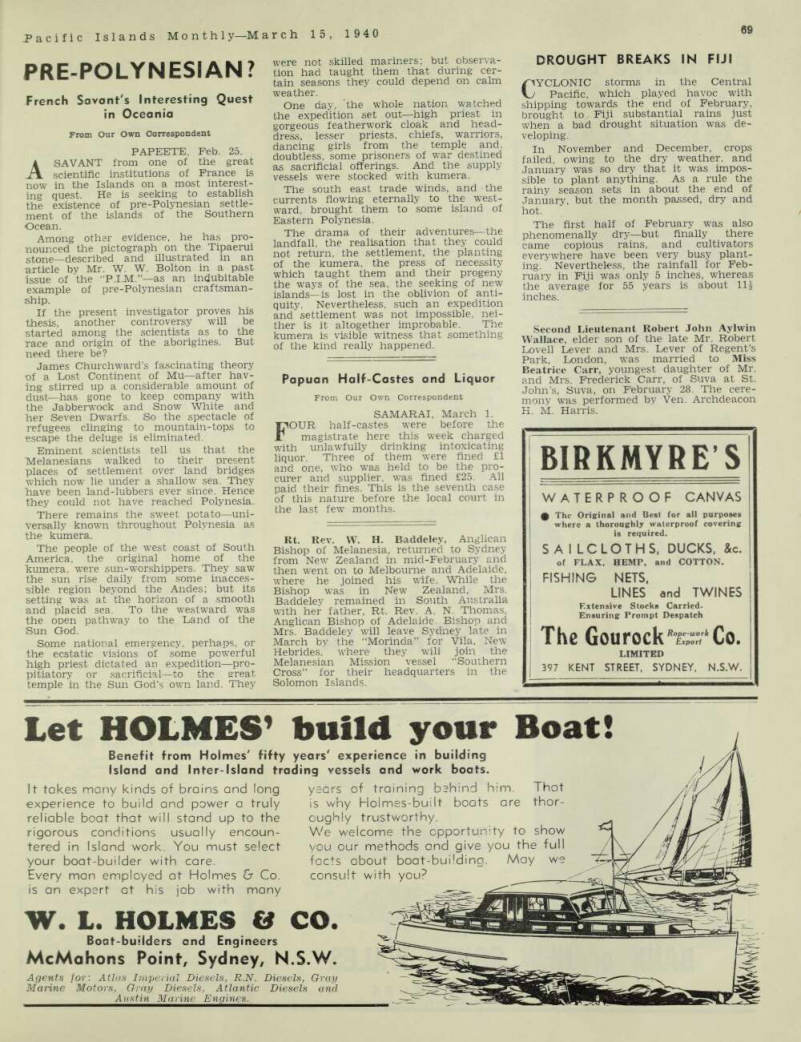
French Savant's Interesting Quest in Oceania
From Our Own Correspondent
Papeete, Feb. 25.
A SAVANT from one of the great scientific institutions of France is now in the Islands on a most interest ing quest. He is seeking to establish the existence of pre-Polynesian settle ment of the islands of the Southern Ocean.
Among other evidence, he has pro nounced the pictograph on the Tipaerui stone—described and illustrated in an article by Mr. W. W. Bolton in a past issue of the ‘P.l.M.”—as an indubitable example of pre-Polynesian craftsman ship.
If the present investigator proves his thesis, another controversy will be started among the scientists as to the race and origin of the aborigines. But need there be?
James Churchward’s fascinating theory of a Lost Continent of Mu—after hav ing stirred up a considerable amount of dust —has gone to keep company with the Jabberwock and Snow White and her Seven Dwarfs, So the spectacle of refugees clinging to mountain-tops to escape the deluge is eliminated.
Eminent scientists tell us that the Melanesians walked to their present places of settlement over land bridges which now lie under a shallow sea. They have been land-lubbers ever since. Hence they could not have reached Polynesia.
There remains the sweet potato—uni versally known throughout Polynesia as the kumera.
The people of the west coast of South America, the original home of the kumera, were sun-worshippers. They saw the sun rise daily from some inacces sible region beyond the Andes; but its setting was at the horizon of a smooth and placid sea. To the westward was the open pathway to the Land of the Sun God.
Some national emergency, perhaps, or the ecstatic visions of some powerful high priest dictated an expedition—pro pitiatory or sacrificial —to the sreat temple in the Sun God’s own land. They
were not skilled mariners; but observa tion had taught them that during cer tain seasons they could depend on calm weather.
One day. the whole nation watched the expedition set out—high priest in gorgeous featherw 7 ork cloak and head dress, lesser priests, chiefs, warriors, dancing girls from the temple and, doubtless, some prisoners of war destined as sacrificial offerings. And the supply vessels were stocked with kumera.
The south east trade winds, and the currents flowing eternally to the west ward, brought them to some island of Eastern Polynesia.
The drama of their adventures—the landfall, the realisation that they could not return, the settlement, the planting of the kumera. the press of necessity which taught them and their progeny the ways of the sea. the seeking of new islands—is lost in the oblivion of anti quity. Nevertheless, such an expedition and settlement was not impossible, nei ther is it altogether improbable. The kumera is visible witness that something of the kind really happened.
Papuan Half-Castes and Liquor
From Our Own Correspondent SAMARAI, March 1.
FOUR half-castes were before the magistrate here this week charged with unlawfully drinking intoxicating liquor. Three of them were fined £1 and one, who was held to be the pro curer and supplier, was fined £25. All paid their fines. This is the seventh case of this nature before the local court in the last few months.
Rt. Rev. W. H. Baddeley, Anglican Bishop of Melanesia, returned to Sydney from New Zealand in mid-February and then went on to Melbourne and Adelaide, where he joined his wife. While the Bishop was in New Zealand, Mrs.
Baddeley remained in South Australia with her father, Rt. Rev. A. N. Thomas, Anglican Bishop of Adelaide. Bishop and Mrs. Baddeley will leave Sydney late in March by the “Morinda” for Vila, New Hebrides, where they will join the Melanesian Mission vessel “Southern Cross” for their headquarters in the Solomon Islands.
Drought Breaks In Fiji
CYCLONIC storms in the Central Pacific, which played havoc with shipping towards the end of February, brought to Fiji substantial rains just when a bad drought situation was de veloping.
In November and December, crops failed, owing to the dry weather, and January was so dry that it was impos sible to plant anything. As a rule the rainy season sets in about the end of January, but the month passed, dry and hot.
The first half of February was also phenomenally dry—but finally there came copious rains, and cultivators everywhere have been very busy plant ing. ' Nevertheless, the rainfall for Feb ruary in Fiji was only 5 inches, whereas the average for 55 years is about Hi inches.
Second Lieutenant Robert John Aylwin Wallace, elder son of the late Mr. Robert Lovell Lever and Mrs. Lever of Regent’s Park. London, was married to Miss Beatrice Carr, youngest daughter of Mr. and Mrs. Frederick Carr, of Suva at St.
John’s, Suva, on February 28. The cere mony was performed by Yen. Archdeacon H. M. Harris.
Advertisements & other items, p. 73 (2 items)
69
Pacific Islands Monthl y—M arch 15, 1940
Birkmyre’S
WATERPROOF CANVAS
£ The Original and Best for all purposes where a thoroughly waterproof covering is required.
S A I LCLOTHS, DUCKS, &c.
of FLAX. HEMP, and COTTON.
FISHING NETS,
LINES and TWINES
F.xtensive Stocks Carried- Ensuring Prompt Despatch
The Gourock Export Co.
LIMITED
397 KENT STREET, SYDNEY, N.S.W.
Let HOLMES’ build your Boat!
Benefit from Holmes 7 fifty years 7 experience in building Island and Inter-Island trading vessels and work boats.
It takes many kinds of brains and long experience to build and power a truly reliable boat that will stand up to the rigorous conditions usually encountered in Island work. You must select your boat-builder with care.
Every man employed at Holmes Cr Co. is an expert at his job with many That thor-
W. 1. HOLMES & CO.
Boat-builders and Engineers
McMahons Point, Sydney, N.S.W.
Agents for: Atlas Imperial Diesels, R.N. Diesels, Gray Marine Motors, Gray Diesels, Atlantic Diesels and Austin Marine Engines. <3 years of training behind him. is why Holmes-built boats are oughly trustworthy.
We welcome the opportunity to show you our methods and give you the full facts about boat-building. May we consult with you?
Exchange Rates
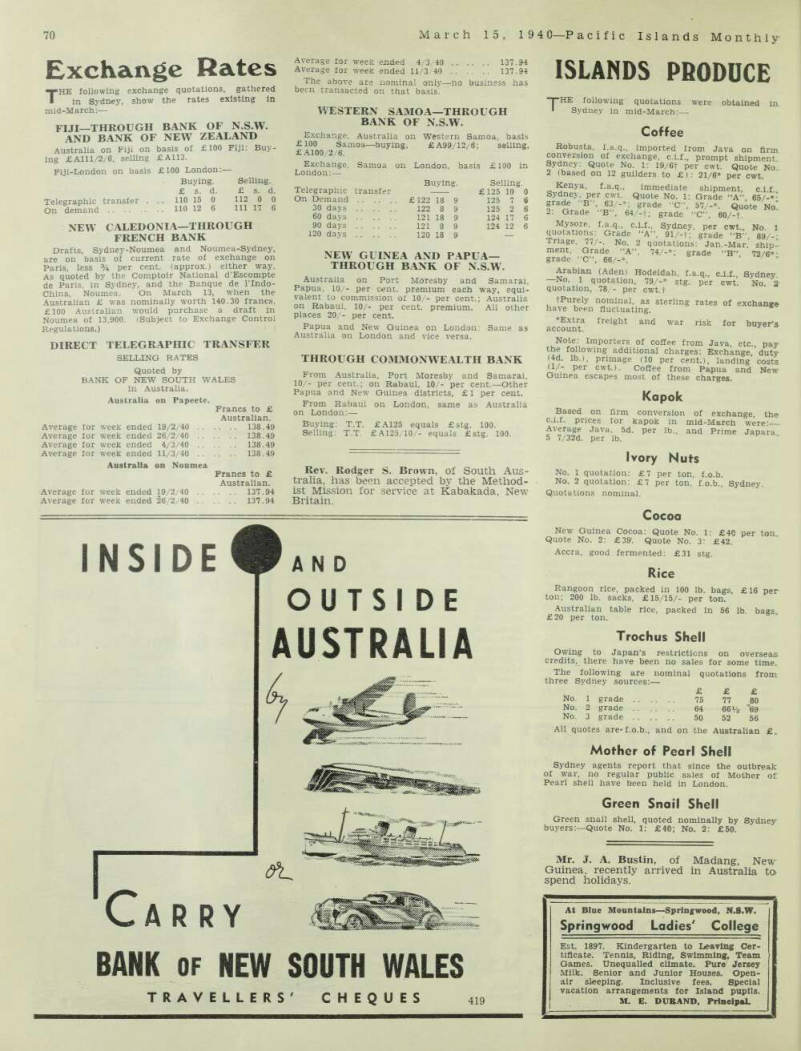
THE following exchange quotations, gathered in Sydney, show the rates existing in mid-March; —
Fiji—Through Bank Of N.S.W.
And Bank Of New Zealand
Australia on Fiji on basis of £lOO Fiji: Buy ing £Alll/2/6, selling £AII3.
Fiji-London on basis £lOO London: —
New Caledonia—Through
French Bank
Drafts, Sydney-Noumea and Noumea-Sydney, are on basis of current rate of exchange on Paris, less % per cent, (approx.) either way.
As quoted by the Comptoir National d’Escompte de Paris, in Sydney, and the Banque de ITndo- China, Noumea. On March 13, when the Australian £ was nominally worth 140.30 francs, £lOO Australian would purchase a draft in Noumea of 13,900. (Subject to Exchange Control Regulations.)
Direct Telegraphic Transfer
Selling Rates
Quoted by
Bank Of New South Wales
in Australia.
Australia on Papeete.
Western Samoa—Through
Bank Of N.S.W.
Exchange, Australia on Western Samoa, basis £lOO Samoa—buying, £A99/12/6; selling,
£ Aloo/2/6.
Exchange, Samoa on London, basis £ 100 in London:—
New Guinea And Papua
Through Bank Of N.S.W.
Australia on Port Moresby and Samarai, Papua, 10/- per cent. premium each way, equi valent to commission of 10/- per cent.; Australia on Rabaul, 10/- per cent, premium. All other places 20/- per cent.
Papua and New Guinea on London: Same as Australia on London and vice versa.
Through Commonwealth Bank
From Australia, Port Moresby and Samarai, 10/- per cent.; on Rabaul, 10/- per cent.—Other Papua and New Guinea districts, £1 per cent.
From Rabaul on London, same as Australia on London:— Buying; T.T. £AI2S equals £stg. 100.
Selling: T.T. £AI2S/10/- equals £stg. 100.
Rev. Rodger S. Brown, of South Aus tralia, has been accepted by the Method ist Mission for service at Kabakada. New Britain.
Buying. Selling. £ s. d. £ s. d.
Telegraphic transfer . .. 110 15 0 112 0 0 On demand 110 12 6 111 17 6
Average lor week ended 19/2/40 . .
Francs to £ Australian. .. .. 138.49 Average lor week ended 26/2/40 . . .. .. 138.49 Average for week ended 4/3/40 . . .. . . 138.49 Average lor week ended 11/3/40 .. .. . . 138.49 Average for Australia week ended on Noumea 19/2/40 . .
Francs to £ Australian. .. . . 137.94 Average for week ended 26/2/40 .. .. .. 137.94
Average for week ended 4 3 40 137.94 Average for week ended 11/3 40 137.94 The above are nominal only—no business has been transacted on that basis.
Buying. Selling.
Telegraphic transfer £125 10 0 On Demand £ 122 18 9 125 7 6 30 days 122 8 9 125 2 6 60 days 121 18 9 124 17 6 90 days 121 8 9 124 12 6 120 days 120 18 9 —
Islands Produce
“T”HE following quotations were obtained in 1 Sydney in mid-March:—
Coffee
Robusta, f.a.q., imported from Java on firm conversion of exchange, c.i.f., prompt shipment.
Sydney: Quote No. 1: 19/6t per cwt. Quote No 2 (based on 12 guilders to £): 21/6* per cwt.
Kenya, f.a.q., immediate shipment, c.i f Sydney, per cwt. Quote No. 1: Grade “A” 65/-* : grade “B”, 63/-*; grade “C”, 51/-*. Quote No! 2. Grade •‘B”, 64/-j; grade “C”, 60/-f.
Mysore, f.a.q., c.i.f., Sydney, per cwt.. No. 1 quotations: Grade “A”, 91/-f; grade “B ”, 89/-- Triage, 77/-. No. 2 quotations: Jan.-Mar.’ ship ment, Grade “A’', 74/-*; grade “B” 72/fi*grade “C”, 66/-*. ’ ’
Arabian (Aden) Hodeidah, f.a.q., c.i f Sydney —No. 1 quotation, 79/-* stg. per cwt! No. 2 quotation, 78/- per cwt.f tPurely nominal, as sterling rates of exchange have been fluctuating. B ♦Extra freight and war risk for buyer’s account.
Note: Importers of coffee from Java, etc., pay the following additional charges: Exchange, duty 4d. lb. I, primage (10 per cent.), landing costs (1/- per cwt.). Coffee from Papua and New Guinea escapes most of these charges.
Kapok
Based on firm conversion of exchange, the c.i.f. prices for kapok in mid-March were- Average Java, sd. per lb., and Prime Japara 5 7/32d. per lb.
Ivory Nuts
No. 1 quotation: £7 per ton, f.o.b.
No. 2 quotation: £7 per ton, f.0.b., Sydney.
Quotations nominal.
Cocoa
New Guinea Cocoa: Quote No. 1: £4O per ton Quote No. 2: £3ff. Quote No. 3: £42.
Accra, good fermented: £3l stg.
Rice
Rangoon rice, packed in 100 lb. bags, £l6 per ton; 200 lb. sacks, £l5/15/- per ton, Australian table rice, packed in 56 lb bags £2O per ton.
Trochus Shell
Owing to Japan’s restrictions on overseas there have been no sales for some time.
The following are nominal quotations from three Sydney sources:—
Mother of Feorl Shell
Sydney agents report that since the outbreak of war, no regular public sales of Mother o£ Pearl shell have been held in London.
Green Snail Shell
Green snail shell, quoted nominally by Sydney buyers:—Quote No. 1: £4O; No. 2: £5O.
Mr. J. A. Bustin, of Madang, New Guinea, recently arrived in Australia to spend holidays.
£ £ £ No. 1 grade 75 77 80 No. 2 grade 64 66 »/ 2 *69 No. 3 grade 50 52 56 All quotes are*f.o.b., and on the Australian £_
Advertisements & other items, p. 74 (3 items)
70
March 15, 194 O—P acific Islands Monthly
Carry
INSIDE
AND
OUTSIDE
AUSTRALIA
Carry
BANK of NEW SOUTH WALES
TRAVELLERS' CHEQUES 419
Springwood Ladies 7 College
At Blue Mountains—Springwood, N.S.W.
Est. 1897. Kindergarten to Leaving Certificate. Tennis, Riding, Swimming, Team Games. Unequalled climate. Pure Jersey Milk. Senior and Junior Houses. Openair sleeping. Inclusive fees. Special vacation arrangements for Island pupils.
M. E. DURAND, Principal.
Market Quotations
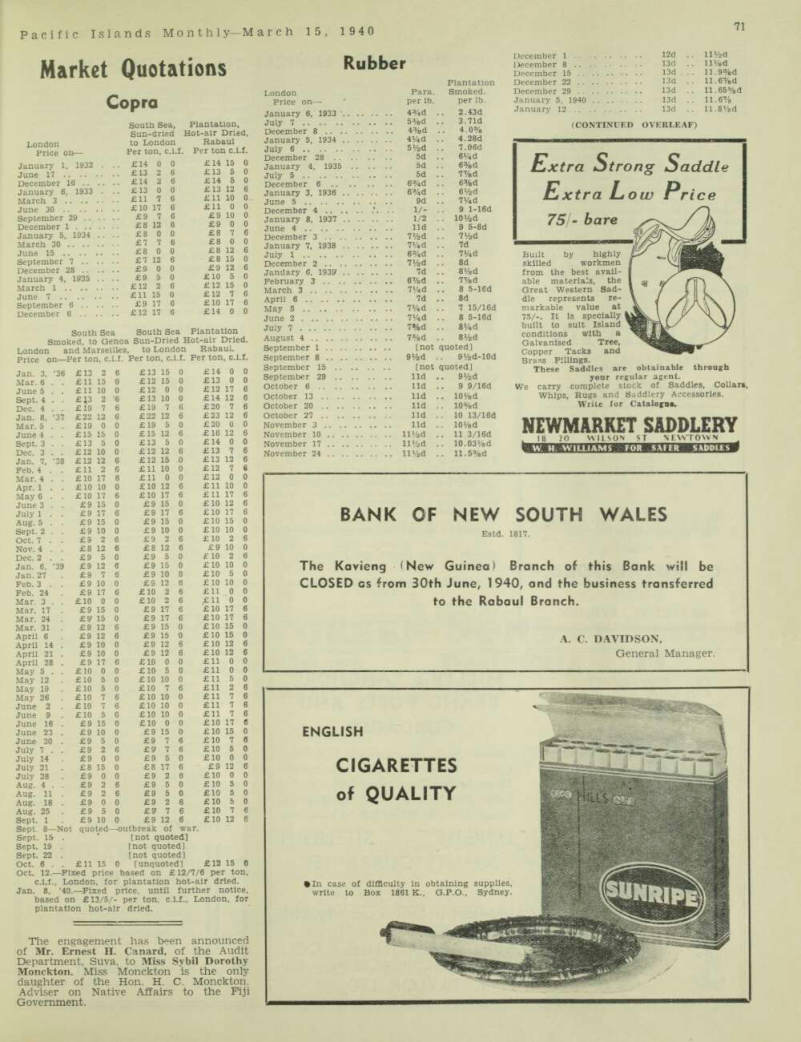
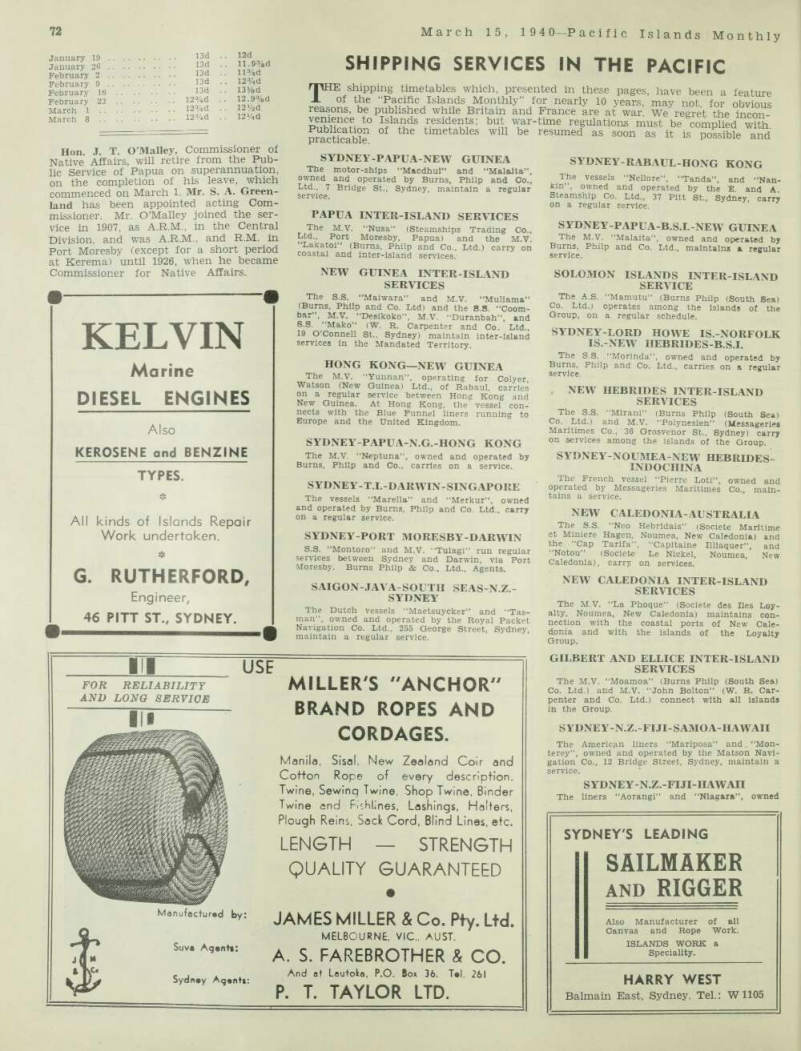
Sept. B—Not quoted—outbreak of war.
Sept. 15 . * [not quoted] Sept. 19 . [not quoted] Sept. 22 . [not quoted] Oct. 6 . . £ll 15 0 [unquoted] £l2 15 0 Oct. 12.—Fixed price based on £l2/7/6 per ton, c.i.f., London, for plantation hot-air dried.
Jan. 8, ’4O. —Fixed price, until further notice, based on £l3/5/- per ton, c.i.f., London, for plantation hot-air dried.
The engagement has been announced of Mr. Ernest H. Canard, of the Audit
Department, Suva, to Miss Sybil Dorothy
Monckton. Miss Monckton is the only daughter of the Hon. H. C. Monckton.
Adviser on Native Affairs to the Fiji Government.
December 1 12d ,.
HVfed December 8 13d ..
UVad December 15 13d . . 11.9%d December 22 13d .. 11.6%d December 29 13d .. 11.65Vad January 5. 1940 13d .. 11.6% January 12 13d .. ll.SVad
(Continued
Overleaf)
Rubber
Plantation London Para.
Smoked.
Price on— per lb. per lb.
January 6, 1933 4%d 2.43d July 7 3.71d December 8 . . 4%d 4.0 5 /b January 5, 1934 4y 4 d 4.28d July 6 sy 2 d 7.06d December 28 5d 6*/ 4 d January 4, 1935 5d 6%d July 5 5d 7 7 /ad December 6 .. 6 3 4d 6%d January 3, 1936 6 3 / 4 d 6Mjd June 5 9d 7y 4 d December 4 .. . .. .. 1/- 9 l-16d January 8, 1937 1/2 ioy 2 d June 4 lid 9 5-8d December 3 .. . ?y 2 d January 7, 1938 7V 4 d 7d July 1 6 3 / 4 d ?y 4 d December 2 .. . 7Vad 8d January 6. 1939 7d ay 8 d February 3 .. . 6 7 /ad 7 7 /ad March 3 7y 4 d . , 8 5-16d April 6 7d 8d May 3 7 15/16d June 2 . . 8 5-16d July 7 7%d 8>/ 4 d August 4 7%d sy 2 d September 1 .. .
September 8 .. . 9%d 9Vfed-10d September 15 .. [not quoted] September 29 .. lid 9y 2 d October 6 . . .. lid 9 9/16d October 13 .. . lid ioy 8 d October 20 .. . lid 10 %d October 27 .. . lid 10 13/16d November 3 .. . lid 10 '/ad November 10 ..
UVad 11 3/16d November 17 .. lV/ 2 d 10.03 Vad November 24 .. ny 2 d 11.5 s /ad
Copra
South Sea, Plantation, Sun-dried Hot-air Dried, London to London Rabaul Price on— Per ton , c.l.f.
Per ton c.l.f.
January 1 1932 £14 i 0 0 £14 15 0 June 17 . £13 : 2 6 £13 5 0 December 16 . . . £14 : 2 6 £14 5 0 January 6 1933 . . £13 1 0 0 £13 12 6 March 3 £11 ’ 7 6 £11 10 0 June 30 £10 17 6 £11 0 0 September 29 .. . £9 ' 7 6 £9 10 0 December 1 . .. • £8 12 6 £9 0 0 January 5, 1934 . £8 1 3 0 £8 7 6 March 30 £7 ' 7 6 £8 0 0 June 15 . £8 ( 3 0 £8 12 6 September 7 .. •• £7 12 6 £8 15 0 December 28 .. . £9 1 3 0 £9 12 6 January 4, 1935 . £9 ! j 0 £10 5 0 March 1 £12 : 2 6 £12 15 0 June 7 . £11 15 0 £12 7 6 September 6 .. . . £9 17 6 £10 17 6 December 6 . . .. £ 12 17 6 £14 0 0 South Sea South Sea Plantation Smoked, to Genoa Sun-Dried Hot-air Dried, London and Marseilles, to London RabauL Price on— Per ton. c.l.f.
Per ton, c.i.f.
Per ton , C.l.f.
Jan. 3, ’36 £13 6 £13 15 0 £14 0 0 Mar. 6 . . £11 15 0 £12 15 0 £13 0 0 June 5 . . £11 10 0 £12 0 0 £12 17 6 Sept. 4 . . £ 13 2 '6 £13 10 0 £14 12 6 Dec. 4 . . £19 6 £19 7 6 £20 7 6 Jan. 8, ’37 £22 12 6 £22 12 6 £23 12 6 Mar. 5 . . £19 0 £19 5 0 £20 0 0 June 4 . . £15 15 0 £15 12 6 £16 12 6 Sept. 3 . . £13 0 £13 5 0 £14 0 0 Dec. 3 . . £12 10 0 £12 12 6 £13 7 6 Jan. 7, ’38 £12 12 6 £12 15 0 £13 12 6 Feb. 4 . . £11 2 6 £11 10 0 £12 7 6 Mar. 4 . . £10 17 6 £11 0 0 £12 0 0 Apr. 1 . . £ 10 10 0 £10 12 6 £11 10 0 May 6 . . £10 17 6 £10 17 6 £11 17 6 June 3 . . £9 15 0 £9 15 0 £10 12 6 July 1 . . £9 17 6 £9 17 6 £10 17 6 Aug. 5 . . £9 15 0 £9 15 0 £10 15 0 Sept. 2 . . £9 10 0 £9 10 0 £10 10 0 Oct. 7 . . £9 ; ! 6 £9 2 6 £10 2 6 Nov. 4 . . £8 12 6 £8 12 6 £9 10 0 Dec. 2 . . £9 £ > 0 £9 5 0 £10 2 6 Jan. 6, ’39 £9 12 6 £9 15 0 £10 10 0 Jan. 27 £9 7 6 £9 10 0 £10 5 0 Feb. 3 . . £9 10 0 £9 12 6 £10 10 0 Feb. 24 £9 17 6 £10 2 6 £11 0 0 Mar. 3 . . £10 ( ) 0 £10 2 6 £11 0 0 Mar. 17 . £9 15 0 £9 17 6 £10 17 6 Mar. 24 £9 15 0 £9 17 6 £10 17 6 Mar. 31 . £9 12 6 £9 15 0 £10 15 0 April 6 £9 12 6 £9 15 0 £10 15 0 April 14 . £9 10 0 £9 12 6 £10 12 6 April 21 . £9 10 0 £9 12 6 £10 12 6 April 28 . £9 17 6 £10 0 0 £11 0 0 May 5 . . £10 0 0 £10 5 0 £11 0 0 May 12 £10 5 0 £10 10 0 £11 5 0 May 19 . £10 £ i 0 £10 7 6 £11 2 6 May 26 £10 r r e £10 10 0 £11 7 6 June 2 £10 1 I 6 £10 10 0 £11 7 6 June 9 . £10 5 0 £10 10 0 £11 7 6 June 16 . £9 15 0 £10 0 0 £10 17 6 June 23 . £9 10 0 £9 15 0 £10 15 0 June 30 . £9 £ > 0 £9 7 6 £10 7 6 July 7 . . £9 2 6 £9 7 6 £10 5 0 July 14 £9 0 0 £9 5 0 £10 0 0 July 21 . £8 15 0 £8 17 6 £9 12 6 July 28 £9 ( ) 0 £9 2 6 £10 0 0 Aug. 4 . . £9 : I 6 £9 5 0 £10 5 0 Aug. 11 . £9 : I 6 £9 5 0 £10 5 0 Aug. 18 . £9 0 0 £9 2 6 £10 5 0 Aug. 25 £9 ; i 0 £9 7 6 £10 7 6 Sept. 1 £9 10 0 £9 12 6 £10 12 6
Hon J. T. O’Malley, Commissioner of Native Affairs, will retire from the Pub lic Service of Papua on superannuation, on the completion of his leave, which commenced on March 1. Mr. S. A. Green land has been appointed acting Com missioner. Mr. O’Malley joined the ser vice in 1907, as A.R.M.. in the Central Division, and was A.R.M., and R.M. in Port Moresby (except for a short period at Kerema) until 1926, when he became Commissioner for Native Affairs.
January 19 January 26 ... 13d ... 13d .. 12d .. 11.9%d February 2 . .. 13d ll 3 / 4 d February 9 ... 13d ,. 12%d February 16 .. . . .. .. 13d 13Vad February 23 .. .. .. .. 12 3 / 4 d 12.9%d March 1 .. .. 12%d . . 12y 2 d March 8 .. .. 12 %d . . 12V 4 d
Advertisements & other items, pp. 75-76 (2 items)
71
Pacific Islands Monthl y—M arch 15, 1940
Extra Strong Saddle
Extra Low Price
751- bare
Built by highly skilled workmen from the best available materials, the Great Western Saddle represents remarkable value at 75/-. It is specially built to suit Island conditions with a Galvanised Tree, Copper Tacks and Brass Fillings.
These Saddles are obtainable through your regular agent.
We carry complete stock of Saddles, Collars, Whips, Rugs and Saddlery Accessories.
Write for Catalogue.
NEWMARKET SADDLERY
18 20 WILSON
NEWTOWN
BANK OF NEW SOUTH WALES
Estd. 1817.
The Kovieng (New Guinea) Branch of this Bank will be CLOSED as from 30th June, 1940, and the business transferred to the Rabaul Branch.
A. C. DAVIDSON,
General Manager.
ENGLISH
CIGARETTES
of QUALITY
•In case of difficulty in obtaining supplies, write to Box 1861 K., G.P.O , Sydney. .
KELVIN
Marine
DIESEL ENGINES
Also
KEROSENE and BENZINE
TYPES.
•u All kinds of Islands Repair Work undertaken.
G. RUTHERFORD,
Engineer,
46 PITT ST., SYDNEY.
HI
USE
FOR RELIABILITY
AND LONG SERVICE
Manufactured by: Suva Agent*: Sydney Agent*:
MILLER'S "ANCHOR'
BRAND ROPES AND
CORDAGES.
Zealand Coir and every description.
Manila, Sisal. New Cotton Rope of Twine, Sewing Twine, Shop Twine. Binder Twine and Fishl-ines. Lashings, Halters.
Plough Reins. Sack Cord, Blind Linas, etc.
LENGTH STRENGTH
QUALITY GUARANTEED
9
JAMES MILLER & Co. Pty. Ltd.
MELBOURNE, VIC.. AUST,
A. S. FAREBROTHER & CO.
And at Lautoka, P.O. Box 36. Tel. 261
P. T. TAYLOR LTD.
Shipping Services In The Pacific
rE shipping timetables which, presented in these pages, have been a feature °f the “Pacific Islands Monthly” for nearly 10 years, may not. for obvious reasons, be published while Britain and France are at war We reeret the inenn vemence to Islands residents: but war-time regulations must be complied with ° f thG tunetables will be resum ed as soon as it is possible and
Sydney-Papua-New Guinea
The motor-ships “Macdhul” and “Malaita”. owned and operated by Burns, Philp and Co., Ltd.. 7 Bridge St., Sydney, maintain a regular service.
Papua Inter-Island Services
The M.V. “Nusa” (Steamships Trading Co., Ltd., Port Moresby, Papua) and the M.V.
“Lakatoi” (Burns, Philp and Co., Ltd.) carry on coastal and inter-island services.
New Guinea Inter-Island
Services
The S.S. “Maiwara” and M.V. “Mullama” (Burns, Philp and Co. Ltd) and the S.S. “Coom bar”, M.V. “Desikoko”, M.V. “Duranbah”, and B.S. “Mako” (W. R. Carpenter and Co. Ltd., 19 O’Connell St.. Sydney) maintain inter-island services in the Mandated Territory.
Hong Kong—New Guinea
The M.V. “Yunnan”, operating for Colyer Watson (New Guinea) Ltd., of Rabaul, carries on a regular service between Hong Kong and New Guinea. At Hong Kong, the vessel con nects with the Blue Funnel liners running to Europe and the United Kingdom.
Sydney-Papua-N.G.-Hong Kong
The M.V. “Neptuna”, owned and operated by Burns, Philp and Co., carries on a service.
Sydney-T.1.-Darwin-Singapore
The vessels “Marella” and “Merkur”, owned and operated by Bums, Philp and Co. Ltd., carry on a regular service.
Sydney-Port Moresby-Darwin
S.S. “Montoro” and M.V. “Tulagi” run regular services between Sydney and Darwin, via Port Moresby. Burns Philp & Co., Ltd., Agents.
Saigon-Java-South Seas-N.Z.-
Sydney
The Dutch vessels “Maetsuycker” and “Tas man”, owned and operated by the Royal Packet Navigation Co. Ltd., 255 George Street, Sydney, maintain a regular service.
Sydney-Rabaul-Hong Kong
The vessels “Nellore”, “Tanda”, and “Nan kin”, owned and operated by the E. and A Steamship Co. Ltd., 37 Pitt St., Sydney, carry on a regular service.
Sydney-Papua-8.5.1.-New Guinea
The M.V. “Malaita”, owned and operated by Burns, Philp and Co. Ltd., maintains a regular service.
Solomon Islands Inter-Island
Service
The A.S. “Mamutu” (Burns Philp (South Sea) Co. Ltd.) operates among the Islands of the Group, on a regular schedule.
Sydney-Lord Howe Is.-Norfolk
Is.-New Hebrides-8.5.1.
The S.S. “Morinda”, owned and operated by Burns, Philp and Co. Ltd., carries on a regular service.
New Hebrides Inter-Island
Services
The S.S. “Mlrani” (Burns Philp (South Sea) Co. Ltd.) and M.V. “Polynesien” (Messagerles Maritimes Co., 36 Grosvenor St., Sydney) carry on services among the islands of the Group.
Sydney-Noumea-New Hebrides
Indochina
The French vessel “Pierre Loti”, owned and operated by Messageries Maritimes Co., main tains a service.
New Caledonia-Australia
The S.S. “Neo Hebridais” (Societe Maritime et Miniere Hagen, Noumea, New Caledonia) and the “Cap Tarifa”, “Capltaine Illlaquer”, and “Notou” (Societe Le Nickel, Noumea, New Caledonia), carry on services.
New Caledonia Inter-Island
Services
The M.V, “La Phoque” (Societe des Hes Loy alty, Noumea, New Caledonia) maintains con nection with the coastal ports of New Cale donia and with the islands of the Loyalty Group.
Gilbert And Ellice Inter-Island
Services
The M.V. “Moamoa” (Burns Philp (South Sea) Co. Ltd.) and M.V. “John Bolton” (W. R. Car penter and Co. Ltd.) connect with all islands in the Group.
Sydney-N.Z.-Fiji-Samoa-Hawaii
The American liners “Mariposa” and “Mon terey”, owned and operated by the Matson Navi gation Co., 12 Bridge Street, Sydney, maintain a service.
Sydney-N.Z.-Fiji-Hawaii
The liners “Aorangi” and “Niagara”, owned
and operated by the Union Steam Ship Co. of N.Z. Ltd., 247 George St., Sydney, maintain a service.
Fiji Inter-Island Services
The M.V. “Matafele” and M.V. “Yanawai” (Burns Philp (South Sea) Co. Ltd.) and the M.V. “Tui Cakau”, M.S. “Adi Rewa”, and M.S.
“Tul Kauvaro” (Morris, Hedstrom Ltd., Suva, Fiji) carry on services among the Islands of the Group.
Central Pacific Services
The M.V. “Matua”, owned and operated by the Union Steam Ship Co. of N.Z., Ltd., main tains a service between New Zealand, Cook Is., Tonga, Samoa, and Fiji. The Co. also runs a cargo service from Sydney to Nth. America, via Fiji and Tahiti.
New Zealand-Samoa-Niue
The M.V, “Maui Pomare”, owned and oper ated by the New Zealand Government, main tains a service. Apply for details to the De partment of External Affairs, Wellington, N.Z.
Australia-Nauru-Ocean Island
Vessels are despatched fairly regularly from Australia and from New Zealand to Nauru and Ocean Island by the British Phosphate Com mission, Henty House, Little Collins St., Mel bourne.
Sydney-Noumea-Tahiti
A service between Sydney and Tahiti is main tained by Messageries Maritimes Co., passengers connecting with the M.M. liners “Eridan”, “Sa glttalre”, “Vllle d’Amlens”, and “Commlssalre Ramel” at Noumea (New Caledonia) per the “Pierre Loti” from Sydney (see Sydney-Noumea- New Hebrides service). The big M.M. liners carry on a service between France and New Caledonia.
French Oceania Inter-Island
Service
The small vessel “Hire” maintains a service between Tahiti and the Leeward Group.
Samoa Inter-Island Services
The Apia customs launch connects regularly with the Matson liners “Monterey” and “Mariposa” at Pago Pago (American Samoa).
Europe-Suva-N.Z.-Sydney-New
Guinea
The M.V. “Rabaul”, M.V. “Salamaua”, and S.S.
“Suva”, owned and operated by W. R. Carpen ter and Co. Ltd., carry on services between Europe and Australia, via South Sea Islands.
U.S.A.-South Sea Islands
A service between the Pacific coast of America and the main South Sea Islands is maintained by the Pacific Transport Line (U.S.A.), using the motor-ships “Thor I” and “Velox”. Time tables are obtainable from the Australasian agents. Blrt & Co., Ltd., 4 Bridge Street, Sydney, or any of their branch offices.
Japan-N.G.Tnoumea-N.Z.
The M.V. “Canberra Maru”, M.V. “Sydney Maru”, and M.V. “Tokyo Maru” (Osaka Shosen Kaisha Line, Osaka, Japan) and the S.S. “Nanl wa Maru” and S.S. “Muko Maru” (Yamashlta Risen Kaisha Line, Osaka, Japan) maintain re gular services from Japan to New Zealand and Australia, via Pacific Islands ports. Timetable particulars are available on personal application to the Australasian agents, Birt and Co. Ltd., 4 Bridge St., Sydney, or any of their branch offices and agents.
Carolines-Western And Central
Pacific
The M.V. “Takachio Maru” (Nanyo Boyeki Kaisha Line, of Japan) makes a voyage twice a year throughout the Western and Central Pacific Groups from the Caroline Islands (Jap anese Mandated Territory).
Sydney-Papua-N.G. Air Service
Regular air mail services between Australia and Papua and New Guinea are maintained by W.R.C. Airlines Ltd., 19 O’Connell St., Sydney, with De Havilland airliners. Timetable details can be obtained from any branch of the firm.
N.G. Goldfields Air Services
Aeroplane services between Salamaua and Lae (the N.G. mainland ports) and Wau and other centres on the Morobe Goldfield are conducted by Guinea Airways Ltd., Mandated Airlines Ltd., and other aerial transport companies. The aerial services are the only means of commu nication.
Wau-Port Moresby Air Service
Aeroplane services between the New Guinea
goldfields (Morobe, etc.) and Port Moresby, Pa pua, are maintained by Guinea Airways Ltd., of Lae, and Mandated Airlines Ltd., of Sala maua. Schedule details available on personal application to any branch of the firms, from the pursers of the Burns, Philp mail steamers, or branches of W. R. Carpenter and Co. Ltd.
Mr. Reginald Watson, owner of Wak aya Island, Fiji, died there on February 8. A New Zealander, he went to Fiji in 1919 and entered into partnership with Mr. A. H. Marlow, as builders and timber merchants, but later returned to N.Z. A few years ago he purchased Wakaya, near Ovalau, and permanently settled down in Fiji. Some time back, at the invitation of the Fiji Govern ment, he made a report on the possi bilities of sword fishing in -the Group, a sport which he keenly followed.
Advertisements & other items, pp. 76-77 (2 items)
Sailmaker
SYDNEY'S LEADING
and RIGGER
Also Manufacturer of all Canvas and Rope Work.
ISLANDS WORK a
Speciality.
HARRY WEST
Balmain East, Sydney. Tel.: W 1105
By Appointment
WHEN VISITING
BRISBANE
Pay us a call and let us take your measurements, colour preferences, size records, etc. These will be of great assistance to us for future reference.
A range of the latest Suitings will be gladly forwarded on request.
Pike Brothers Ltd.
Queen Street
Lars Halvorsen Sons pty. ltd.
Boatbuilders Designers
Marine Engineers
NEUTRAL BAY, SYDNEY.
TO Lars Halvorsen, founder the firm of Lars Halvorsen Sons Pty. Ltd., must be given the credit for the setting of a higher standard of boat-building in Australia.
To-day, boats launched from these now nationally famous yards are to be found giving "high-standard" service in every port or harbour along the Australian coast, and also in the waters of the Pacific Islands and New Zealand.
Expert designing . . . special care in the selection of timbers . . . and highly efficient workmanship, have earned the confidence and continued patronage of many of our commercial firms of repute, as well as that of the numerous individual lovers of a good boat for whom Halvorsens have designed and built.
CONTRACTORS TO
Defence Dept, of the Commonwealth; New Guinea Burns Philp & Co. Ltd.; Marist Mission; Guinea Administration; Royal Australian Air Force; Airways Ltd.; Island Explorations Pty. Ltd.; Harbour Land and Transport Co. Pty. Ltd.; Aust. Board of Missions; etc., etc.
AGENTS FOR
MORRIS Marine Engines. CHRYSLER Marine Engines. SUPERIOR Marine Diesels.
Correspondence Invited.
73
Pacific Islands Monthl y—M arch 15, 1940
Rev. C. F. Rich Retires
From our own correspondent catv/tadat tv/tvVi i SAMARAi, Marcn i.
REV. C. F. Rich, who has given a life time of useful work to the educa tion and training of Papuan natives, has retired from his position as head of the London Mission Society’s station at Fife Bay, Eastern Papua.
Mr Rich first arrived in Papua, from England, in 1900, accompanied by Rev.
W. J. Saville. He was joined in 1901 by Mrs. Rich, and one of their first visits was to Daru, where they met the
famous missionaries, Chalmers and Tomkins, who a few weeks later were murdered in the Delta Division. As the years passed, Mr. and Mrs. Rich devoted themselves with increasing enthusiasm to the teaching of technical education; and, from their mission on Fife Bay, they turned out a large number of trained and clever native artisans. Mr. and Mrs. Rich had hoped to complete 40 years of service together at Fife Bay, but just before the period was com pleted Mrs. Rich became seriously ill, and had to go away. She is slowly re covering, under hospital treatment, in Samarai, however.
Supplies
Britain Buys Huge Whale Oil Supplies
IT is reported by the newspapers with complacency (which the growers will not share) that Britain “has scored a notable victory in the war for oil” by buying up the whole of the available supplies of whale oil in Europe, despite desperate German competition. There has been a record catch of Antarctic whales in the season just ended, return ing probably about 2,500,000 barrels, and the newspapers say that one result of this will be “comparative cheapness and abundance of margarine for British housewives.” If this report is true, it postpones for the present any hope of the Anglo-French Governmental author ity raising the London copra price of £l3/5/- per ton c.i.f.
Mr. Maynard Hedstrom, son of Sir Maynard Hedstrom, of Suva, Fiji, mar ried Miss Moira Dietrich, daughter of Mr. and Mrs. Lance Dietrich, of Levuka. on March 12. The honeymoon will be spent in Australia.
Major Clive Brewster, of Suva, arrived in Sydney via New Zealand early in March and is spending a few weeks in Sydney and Melbourne.
Advertisements & other items, pp. 78-80 (4 items)
Pacific Travellers
74
(CONTINUED FROM PAGE 1)
March 15, 194 O—P acific Islands Monthly
Published by Pacific Publications Pty., Ltd., Union House, 247 George Street, Sydney. (Telephone: BW 50371. Wholly set up and printed in Australia by the Sydney and Melbourne Publishing Co., Pty., Ltd., 29 Alberta St., Sydney. (Telephone: MA 7101).
Ormonoid
BITUMINOUS ROOFING
MADE IN 1,2, 3 AND 5 PLY FROM HIGHEST GRADE RAW PELTS AND BEST QUALITY BITUMENS. FUME, ACID, AND CHEMICAL PROOF, IM- PERVIOUS TO SALT AIR AND WILL NOT AFFECT DRINKING WATER.
IDEALLY SUITED FOR TROPICAL CLIMATES
WEATHERPROOF AND WATERPROOF
SPECIFY AND USE ORMONOID
ROOFING FLOORING DAMPCOURSES
PAINTS COMPOUNDS SARKING FELTS
PLASTICS BUILDING PAPER ASBESTOS FELTS
MADE IN AUSTRALIA
PRICES, SAMPLES & PARTICULARS GIVEN ON REQUEST.
ORMONOID ROOFING & ASPHALTS LTD.
39 MENTMORE AVE., WATERLOO, SYDNEY, AUSTRALIA.
COSMOPOLITAN
SAMARA I.
HOTEL
FIRST-CLASS
ACCOMMODATION
For Tourists & Commercials Electric Light, Ballroom Billiards Freezing Works, Cold Store.
Best Brands of Liquors
MODERATE TARIFF.
Fishing Trips and Launch Excursions Arranged.
WHERE TO STAY IN PORT MORESBY
HOTEL MORESBY
NEAR THE
WHARF
MODERN
ACCOMMODATION
ONLY THE BEST
BRANDS OP
WINES, SPIRITS
AND BEERS
IN STOCK.
LICENSEE:
Hotel Moresby
Ltd.
The PAPUA
HOTEL
Catering specially for Tourists and Travellers.
Licensee: Papua Hotel, Ltd.
First-class Accommodation. Parties Arranged.
Situated on high ground overlooking both coasts, its Spacious Lounges are always Cool and comfortable . . . Cars meet all Steamers.
Ike jumjle-bound intefeicfe...
z X X X z ar m T
Ulitioi not uAumi
Prior to 1927 tortuous jungle foot-tracks winding over precipitous mountains were the sole means of communication between the coast and the rich gold deposits in the interior of New Guinea. . . . Transport costs were ruinously high. . . . Roadways and Railways were impracticable— only one way remained—THE AIR WAY.
Guinea Airways Limited was formed and in March, 1927, pioneered the first successful flight into the interior . since that time this Company has maintained a regular and reliable service, canwing over 82,000 passengers and transporting over 58,135 tons, including every type of goods and machinery needed by the growing European population.
Guinea Airways services now embrace the whole of New Guinea and Papua and the landing grounds and aerodromes now used total over 50— the foundation of each one marking great strides in the progress of both New Guinea and Guinea Airways Ltd.
GUINEA AIRWAYS
Freight & Passenger
Service
NEW GUINEA
Planes depart from Port Moresby for the gbldfields after the arrival of each boat.
Tickets obtainable Purser, or Burns, Philp & Co., Sydney or Brisbane.
AUSTRALIA
ADELAIDE TO DARWIN.
Twice weekly service.
ADELAIDE TO KANGAROO
ISLAND.
Return service daily except Sun.
ADELAIDE TO PORT LINCOLN.
Return service three times weekly.
ADELAIDE TO WHYALLA.
Return service daily except Sun.
Head Office: Austral Chambers, Currie Street, Adelaide.
I § / < J s € I i
THE WORLDS ERELGHTCARRYING AIR
LAE-SALAMAU A:
New Guinea Office: LAE, Mandated Territory of New Guinea Branch Offices and Agents at WAU-SALAMAIA-
PORT MORESBY and SYDNEY.
FIRST CHOICE... with those
who prefer a bitter beer
If you like a bitter beer—you'll enjoy the rich wholesome flavor of Resch's Waverley Bitter Ale. Best appreciated after a hot, trying day—Waverley Bitter Ale is a real health drink for the tropics. For a refreshing change, make YOUR next order - - - .
WAVERLEY BITTER ALE
IN THE BOTTLE WITH THE GREEN LABEL