Pacific
Islands
Monthly
Vol. X. No. 7.
February 15, 1940
[Registered at the transmission oy pose a* a newspaper. \
8
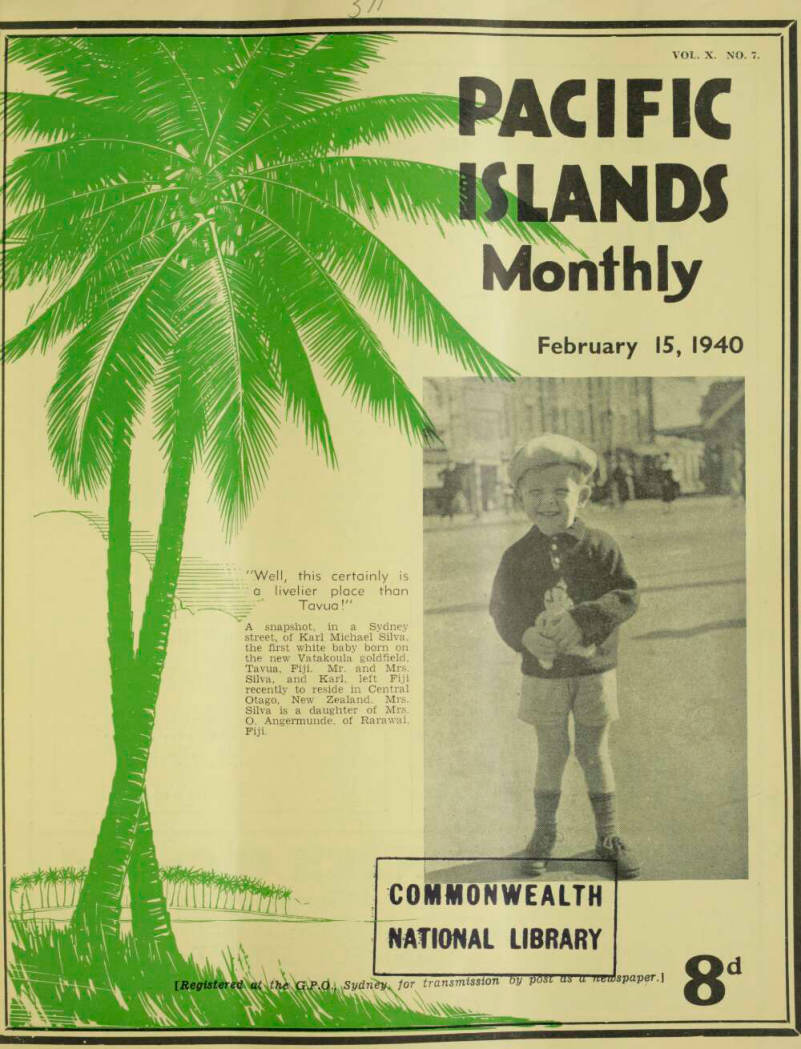
"Well, this certainly is
a livelier place than
Tavua !"
A snapshot, in a Sydney street, of Karl Michael Silva, the first white baby born on the new Vatakoula goldfield.
Tavua, Fiji. Mr. and Mrs.
Silva, and Karl, left Fiji recently to reside in Central Otago, New Zealand. Mrs.
Silva is a daughter of Mrs.
O. Angermunde, of Rarawai, Fiji.
Advertisements & other items, p. 2 (2 items)
Pacific Islands Mont hi y—F ebruary 15, 1940
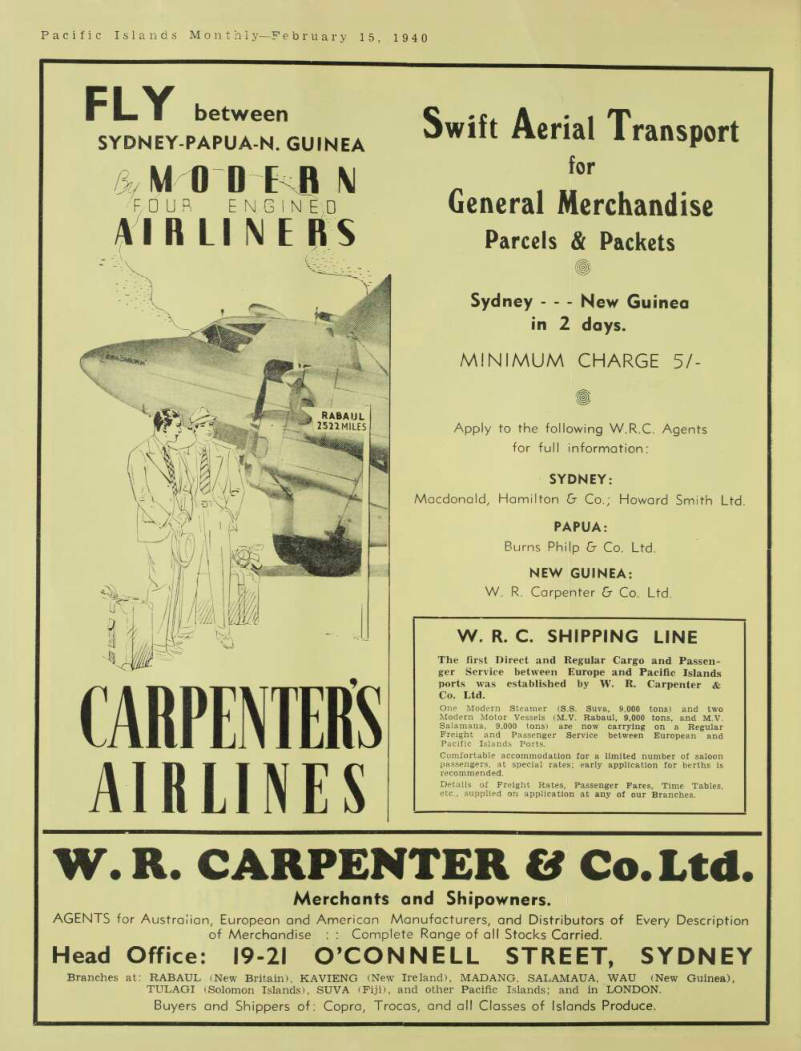
Carpenters
FLY between
SYDNEY-PAPUA-N. GUINEA
MOD E R N
FOUR E N G I N E 0
AI REINERS
\ rabaul
2521 MILES
CARPENTERS
AIRLINES
Swift Aerial Transport
for
General Merchandise
Parcels & Packets
Sydney - - - New Guinea
in 2 days.
MINIMUM CHARGE
s Apply to the following W.R.C. Agents for full information:
SYDNEY:
Macdonald, Hamilton £r Co.; Howard Smith Ltd.
PAPUA:
Burns Philp Cr Co. Ltd.
NEW GUINEA:
W. R. Carpenter Gr Co. Ltd.
W. R. C. SHIPPING LINE
The first Direct and Regular Cargo and Passenger Service between Europe and Pacific Islands ports was established by W. R. Carpenter & Co. Ltd.
One Modern Steamer (S.S. Suva, 9,000 tons) and two Modern Motor Vessels (M.V. Rabaul, 9,000 tons, and M.V.
Salamaua, 9,000 tons) are now carrying on a Regular Freight and Passenger Service between European and Pacific Islands Ports.
Comfortable accommodation for a limited number of saloon passengers, at special rates; early application for berths is recommended.
Details of Freight Rates, Passenger Fares, Time Tables, etc., supplied on application at any of our Branches.
W. R. CARPENTER & Co. Ltd.
Merchants and Shipowners.
AGENTS for Australian, European and American Manufacturers, and Distributors of Every Description of Merchandise : : Complete Range of all Stocks Carried.
Head Office: 19-21 O’CONNELL STREET, SYDNEY
Branches at: RABAUL (New Britain), KAVIENG (New Ireland), MADANG, SALAMAUA, WAU (New Guinea), TULAGI (Solomon Islands), SUVA (Fiji), and other Pacific Islands; and in LONDON.
Buyers and Shippers of: Copra, Trocas, and all Classes of Islands Produce.
Pacific News-Review
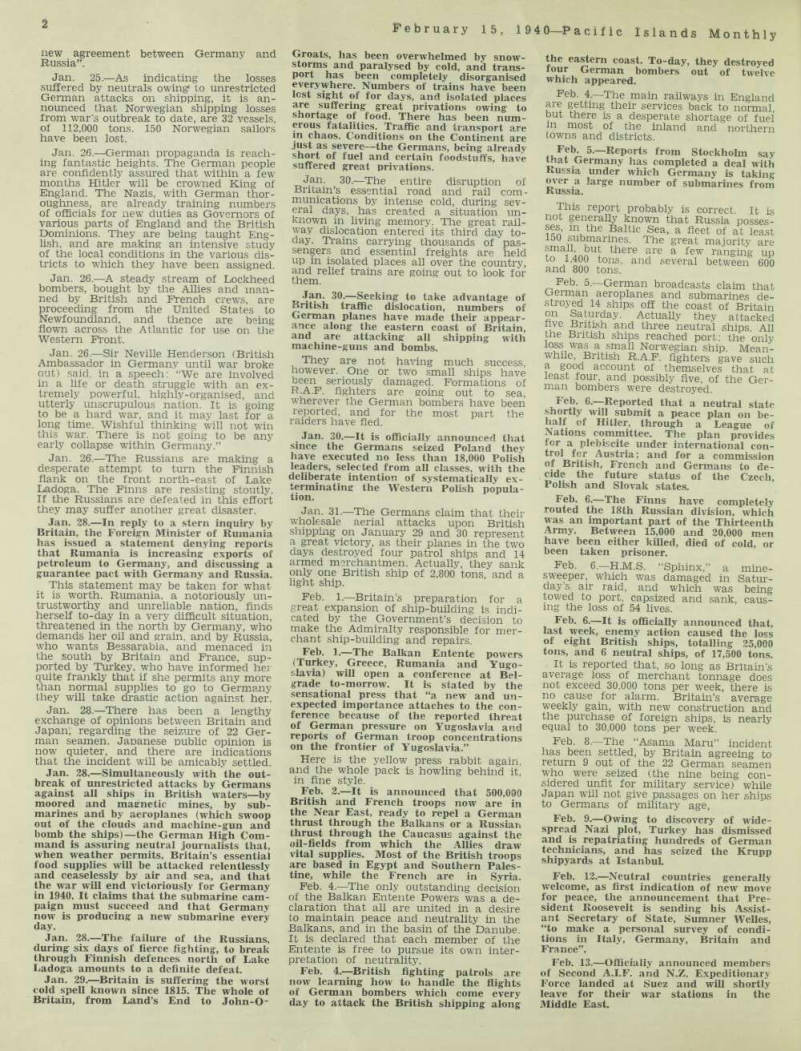
Notes And Comment On
The Progress Of The War
FROM JAN. 15 TO FEB. 13, 1940
Jan. 15.—Holland and Belgium, fearing an invasion, have mobilised practically the whole of their strength. Foreign journalists in Berlin “are convinced that Germany intends to march across the Dutch frontier within 24 hours”. The British War Office has cancelled all leave for all its soldiers in France.
This is about the third time that Dutch and Belgium forces have been lined up to repel an expected invasion by the Ger mans. Such news should not be taken seriously. It is mostly newspaper sen sationalism—one of the most deplorable features of this present war. The Ameri cans are the worst offenders. They work on the principle that there should be a sensation every day, and if nothing hap pens they proceed to create one.
Jan. 15.—1 t is disclosed that 140 Ger man merchant vessels are bottled up in 42 neutral ports, all over the world. The cargoes are valued at £5,000,000, of which Britain owns about half.
Jan. 16. —Three British submarines, “Seahorse”, “Undine” and “Starfish”, which were sent out on an especially hazardous enterprise, have not returned and are presumed to be lost.
It was disclosed, from other sources, that the three British submarines were sent to carry out an attack upon German fortified places at or near Heligoland, but evidently the Germans were prepared for something of the kind, for they succeeded In capturing and destroying all three submarines. It was subsequently an nounced that most of the crews of the submarine had been rescued and were prisoners in Germany.
Jan. 16. —The newspapers now announce that the German threat against Holland and Belgium has failed—that the Ger mans found that the two small neutral countries were ready and therefore changed their plans. Belgium and Holland remain in a state of preparedness.
Jan. 17.—Lord Gort, British Commander in Chief, stated: “If Belgium is attacked and her neutrality, independence, and vital interests are threatened, the Pranco- British guarantee will operate with light ning rapidity This time all will be ready —there will be no more gropings, as in 1914. If the Germans come, they will be well received.”
Jan. 17.—The worst winter known in 100 years is being experienced in Europe, and all the combatant countries are in the grip of frost and snow. One remark able effect is that the Danube, in Hun gary, is frozen over and hundreds of ships (the majority of which apparently have been carrying oil and grain from Rumania to Germany) are frozen up and immobilised.
There is a deeper interest here than the mere fact that German supplies are held up. The Allied peoples are being told a great deal about the economic pressure which is being put upon Ger many, and encouraged to expect some thing of the German economic collapse which occurred in 1914-18. As a matter of fact, the whole position is entirely different. The whole of Germany’s east ern and south-eastern frontiers are open, and to-day Germany is freely re ceiving large quantities of essential sup plies from Italy, Yugoslavia. Hungary, Rumania and Russia. In 1914-18, every one of those frontiers was closed against her.
Jan. 19.—Reported that 45,000 Rus sians are in full retreat from the Salla
(Central Finnish) front. The relentlessly pursuing Finns have inflicted heavy losses, and the Russian rear has been disorganised by the Finnish air force.
French estimate that the Finns have suffered about 20,000 casualties and the Russians 150,000.
It is becoming clearer that Finland has pricked the bubble of Russia’s mili tary reputation. For two decades, West ern nations have been warned of the formidable character of the mighty Red armies and the terrible Russian air force.
But those who knew the modern history of Russia would not believe that Bolshe vik Communists could make good sol diers, where the Czar’s officers failed.
The Russians are formidable in the mass —there are such countless millions of them—but as fighting troops they de finitely are not comparable with the French, Germans or British. If these masses of Russians are placed under German training and German officers, they may assume a formidable character, but that is unlikely. Attempts will be made by Germany to get control of this unlimited human material, but Bolshevik Russia will not “take” it. It is inevit able, sooner or later, that Germany and Russia will fight. The Germans will defeat the Russians and drive them back, wherever they meet them, but they can not conquer Russia—the Slav empire is too big. The Allies need not fear Rus sian troops, but they have every reason to fear the Russian capacity for supply ing Germany with the essential require ments of wartime —especially if the Ger mans are allowed to organise Russian industry and transport system.
Jan. 20.—The Russian air force has commenced a series of widespread, ruth less mass attacks on Finnish towns, re gardless of military objectives. Hundreds of planes are taking part in the raids, and large numbers of homeless people are roaming about distractedly.
Jan. 21.—The British destroyer flotilla leader “Grenville,” 1,485 tons, was sunk in the North Sea by either torpedo or mine. Eight men are killed and 73 missing. The “Grenville” was built m 1936 at a cost of £336,000.
Jan. 22.—1 t is now stated that the centre of apprehension in Europe has shifted from Scandinavia and the Low countries to South-eastern Europe. It is believed that in the Balkans, now, there are renewed fears of joint aggression by Germany and Russia and, secondly, that there is uncertainty regarding Italy s ultimate policy in the Balkans. It is also reported that large numbers ot German troops have entered the Rus sian section of Poland Once more the yellow press rabbit has been let loose, and the whole yelping pack is after it. The yellow journalists worked un a first-class scare in relation to Bel gium and Holland; now the scare is fading and, as they must get headlines somewhere, they are giving their ingeni ous attention to the Balkans.
Jan. 22.—A British cruiser stopped the Japanese liner “Asama Maru (16,900 tons) on the voyage between San Fran cisco and Yokohama, and removed German merchant sailors who were mak ing their way back from the United States to Germany.
This British action is strictly in accord ance with international law. Germany
cannot complain of it. It is only a few weeks since a German warship in the North Sea stopped a Swedish steamer, which had on board some 16 British seamen from a wrecked vessel. The Germans made prisoners of the British, and took them to Germany, on the ground that they were capable of enter ing Britain’s fighting forces.
Jan. 23.—There is terrific uproar in Japan, owing to the action of the British warship in taking the Germans off a Japanese liner. One official declared that the incident “pollutes the soul of the Japanese people.”
Britain is dealing quietly and soberly with the position. The Japanese can either howl themselves into a war con dition, or settle down to reasonableness.
Jan. 23.—Various newspapers report that German troops are pouring into Galicia, chiefly by road, and it is ex pected that Germany will occupy the whole of Southern Poland. Other news papers report, sensationally, that Ger man troops have appeared in force at the Rumanian frontier.
Jan. 23. —Foreign airmen are now assisting the Finns against the Rus sians—especially Italians. Swedes, Nor wegians and Danes. British, Americans and French also are now flying the aero planes with which Finland, to an in creasing degree, is meeting Russian air attacks.
Expert observers arriving in London confirm the reports that the various Russian defeats in Finland have been very severe. The Russians have been out-manoeuvred and out-fought. The Russian soldiers are brave, but Russian leadership and organisation have been lamentable.
Jan. 24.—A British warship stopped another Japanese liner, the “Tatuta Maru,” and enquired for German sea men, but there were none aboard. The incident, according to Tokio reports, has aroused Japanese agitators to a frenzy, and much anti-British feeling is
being expressed.
Jan. 24.—The British destroyer “Ex mouth,” 1,475 tons, complement 175, was sunk by a mine or torpedo in the North Sea. The whole of the crew was lost.
This is the fifth British destroyer sunk since war began.
Jan. 24.—Five thousand Victorian mem bers of the Second A.I.F. marched through Melbourne to-day, and were greeted with tremendous enthusiasm by the largest crowd ever assembled in the city.
Jan. 25.—1 t becomes clear that Ger many, with Russia’s permission has sent troops to occupy and police Southern Po land and Galicia, between Germany proper and the Rumanian frontier, thus providing the Germans with a clear corri dor in which they may organise the trans port of grain, oil, etc., from the Balkans to Germany.
This is a development to be expected.
It is of the utmost importance to Ger many that she should have these channels of supply well organised and efficient be fore the great test comes with the Euro pean spring. But irresponsible neutral newspapers, hungry for sensations, are working up the incident into “Occupation of Polish Galicia by Germany under a
new agreement between Germany and Russia”.
Jan. 25. —As indicating the losses suffered by neutrals owing* to unrestricted German attacks on shipping, it is an nounced that Norwegian shipping losses from war’s outbreak to date, are 32 vessels, of 112,000 tons. 150 Norwegian sailors have been lost.
Jan. 26.—German propaganda is reach ing fantastic heights. The German people are confidently assured that within a few months Hitler will be crowned King of England. The Nazis, with German thor oughness, are already training numbers of officials for new duties as Governors of various parts of England and the British Dominions. They are being taught Eng lish. and are making an intensive study of the local conditions in the various dis tricts to which they have been assigned.
Jan. 26. —A steady stream of Lockheed bombers, bought by the Allies and man ned by British and French crews, are proceeding from the United States to Newfoundland, and thence are being flown across the Atlantic for use on the Western Front.
Jan. 26. —Sir Neville Henderson (British Ambassador in Germany until war broke out) said, in a speech: “We are involved in a life or death struggle with an ex tremely powerful, highly-organised, and utterly unscrupulous nation. It is going to be a hard war, and it may last for a long time. Wishful thinking will not win this war. There is not going to be any early collapse within Germany.”
Jan. 26.—The Russians are making a desperate attempt to turn the Finnish flank on the front north-east of Lake Ladoga. The Finns are resisting stoutly.
If the Russians are defeated in this effort they may suffer another great disaster.
Jan. 28.—1 n reply to a stern inquiry by Britain, the Foreign Minister of Rumania has issued a statement denying reports that Rumania is increasing exports of petroleum to Germany, and discussing a guarantee pact with Germany and Russia.
This statement may be taken for what it is worth. Rumania, a notoriously un trustworthy and unreliable nation, finds herself to-day in a very difficult situation, threatened in the north by Germany, who demands her oil and grain, and by Russia, who wants Bessarabia, and menaced in the south by Britain and France, sup ported by Turkey, who have informed her quite frankly that if she permits any more than normal supplies to go to Germany they will take drastic action against her.
Jan. 28. —There has been a lengthy exchange of opinions between Britain and Japan, regarding the seizure of 22 Ger man seamen. Japanese public opinion is now quieter, and there are indications that the incident will be amicably settled.
Jan. 28.—Simultaneously with the out break of unrestricted attacks by Germans against all ships in British waters—by moored and magnetic mines, by sub marines and by aeroplanes (which swoop out of the clouds and machine-gun and bomb the ships)—the German High Com mand is assuring neutral journalists that, when weather permits, Britain’s essential food supplies will be attacked relentlessly and ceaselessly by air and sea, and that the war will end victoriously for Germany in 1940. It claims that the submarine cam paign must succeed and that Germany now is producing a new submarine every day.
Jan. 28.—The failure of the Russians, during six days of fierce fighting, to break through Finnish defences north of Lake Ladoga amounts to a definite defeat.
Jan. 29.—Britain is suffering the worst cold spell known since 1815. The whole of Britain, from Land’s End to John-O-
Groats, has been overwhelmed by snow storms and paralysed by cold, and trans port has been completely disorganised everywhere. Numbers of trains have been lest sight of for days, and isolated places are suffering great privations owing to shortage of food. There has been num erous fatalities. Traffic and transport are in chaos. Conditions on the Continent are just as severe—the Germans, being already short of fuel and certain foodstuffs, have suffered great privations.
Jan. 30.—The entire disruption of Britain’s essential road and rail com munications by intense cold, during sev eral days, has created a situation un known m living memory. The great rail way dislocation entered its third day to day. Trains carrying thousands of pas sengers and essential freights are held up in isolated places all over the country, and relief trains are going out to look for them.
Jan. 30.—Seeking to take advantage of British traffic dislocation, numbers of German planes have made their appear ance along the eastern coast of Britain, and are attacking all shipping with machine-guns and bombs.
They are not having much success, however. One or two small ships have been seriously damaged. Formations of R'-A-F. fighters are going out to sea, wherever the German bombers have been reported, and for the most part the raiders have fled.
Jan. 30.—1 t is officially announced that since the Germans seized Poland they have executed no less than 18,000 Polish leaders, selected from all classes, with the deliberate intention of systematically ex terminating the Western Polish popula tion.
Jan. 31.—The Germans claim that their wholesale aerial attacks upon British shipping on January 29 and 30 represent a great victory, as their planes in the two days destroyed four patrol ships and 14 armed merchantmen. Actually, they sank only one British ship of 2.800 tons, and a light ship.
Feb. I.—Britain’s preparation for a great expansion of ship-building is indi cated by the Government’s decision to make the Admiralty responsible for mer chant ship-building and repairs.
Feb. I.—The Balkan Entente powers (Turkey, Greece, Rumania and Yugo slavia) will open a conference at Bel grade to-morrow. It is stated bv the sensational press that “a new and un expected importance attaches to the con ference because of the reported threat of German pressure on Yugoslavia and reports of German troop concentrations on the frontier of Yugoslavia.”
Here is the yellow press rabbit again, and the whole pack is howling behind it, in fine style.
Feb. 2. —It is announced that 500,009 British and French troops now are in the Near East, ready to repel a German thrust through the Balkans or a Russian thrust through the Caucasus against the oil-fields from which the Allies draw vital supplies. Most of the British troops are based in Egypt and Southern Pales tine, while the French are in Syria.
Feb. 4.—The only outstanding decision of the Balkan Entente Powers was a de claration that all are united in a desire to maintain peace and neutrality in the Balkans, and in the basin of the Danube.
It is declared that each member of the Entente is free to pursue its own inter pretation of neutrality.
Feb. 4.—British fighting patrols are now learning how' to handle the flights of German bombers which come every day to attack the British shipping along
the eastern coast. To-day, they destroyed tour German bombers out of twelve which appeared.
Feb. 4.—The main railways in England are getting their services back to normal but there is a desperate shortage of fuel in most of the inland and northern towns and districts.
F f b * s *~Reports from Stockholm say that Germany has completed a deal with Russia under which Germany is taking over a large number of submarines from Russia.
This report probably is correct. It is not generally known that Russia posses m,the Sea , a fleet of at least 150 submarines. The great majority are small, but there are a few ranging up to 1,400 tons, and several between 600 and 800 tons, Feb. s.—German broadcasts claim that German aeroplanes and submarines de stroyed 14 ships off the coast of Britain on Saturday. Actually they attacked five British and three neutral ships. All the British ships reached port: the only loss was a small Norwegian ship. Mean while, British R.A.F. fighters gave such a good account of themselves that at least four, and possibly five, of the Ger man bombers were destroyed.
Feb. 6.—Reported that a neutral state shortly will submit a peace plan on be half of Hitler, through a League of Nations committee. The plan provides for a plebiscite under international con- Austria; and for a commission of British, French and Germans to de cide the future status of the Czech, Polish and Slovak states.
Feb. 6.—The Finns have completely routed the 18th Russian division, which was an important part of the Thirteenth Army. Between 15,000 and 20,000 men have been either killed, died of cold, or been taken prisoner.
Feb. 6.—H.M.S. “Sphinx,” a mine sweeper, which was damaged in Satur day’s air raid, and which was being towed to port, capsized and sank, caus ing the loss of 54 lives.
Feb. 6.—lt is officially announced that, last week, enemy action caused the loss of eight British ships, totalling 25,000 tons, and 6 neutral ships, of 17,500 tons.
It is reported that, so long as Britain’s average loss of merchant tonnage does not exceed 30,000 tons per week, there is no cause for alarm. Britain’s average weekly gain, with new construction and the purchase of foreign ships, is nearly equal to 30,000 tons per week.
Feb. B.—The “Asama Maru” incident has been settled, by Britain agreeing to return 9 out of the 22 German seamen who were seized (the nine being con sidered unfit for military service) while Japan will not give passages on her ships to Germans of military age, Feb. 9. —Owing to discovery of wide spread Nazi plot, Turkey has dismissed and is repatriating hundreds of German technicians, and has seized the Krupp shipyards at Istanbul Feb. 12.—Neutral countries generally welcome, as first indication of new move for peace, the announcement that Pre sident Roosevelt is sending his Assist ant Secretary of State, Sumner Welles, “to make a personal survey of condi tions in Italy, Germany, Britain and France”.
Feb. 13.—Officially announced members of Second A.I.F. and N.Z. Expeditionary Force landed at Suez and will shortly leave for then- war stations in the Middle East.
Pacific Islands Travellers
Per “Macdhui” From Papua & N.G.:
Messrs. Alexander, Amourous, Beggs, Beattie, Briggs, Byrnes, Clammer. Carson, Grahamslaw, Garvin, Harvey, Hyde, Hislop, Hosking, Jenkins, Jell, Jensen, Lee, Larking, Love, Lovell, Maden, Morris, Marshall, McLennan, Neilly, Newhall.
Owen, Pyne, Paterson, Sears, Speedie, Taggart, Williams,’ Wheeler. Wallis, Wlander, Woods.
Mesdames Clarke, Lee, Miller, McLennan, Owen, Osborne, Pearce, Spencer, Smith, Williams.
Misses Cox Osborne, Reeves, Slade. pet? “MACDHUI” FOR PAPUA & N G • Messrs
Powen iSnes iJons Brennan
Roberts Amos Whitby Duus Rosser Williams
Kss?’
ham^ 6r 'murrfhy 1 & o n te Uh WS De^bysliire° n ' MoSfs' an BO Wooh3oc^ ra Eilis An palsley’
Wunsch’ AUey
berttmf Imrief' Cn^sf y M^kenzie H °Smith, S Byrne, St a a r £burv C °^
bsUom Perr? Phelps. Jansen,’ Mon-
teith, Mackay, Taylor, Wenz, Middleton, Syme, Boettcher Hiererins. Bryan. Father Winzenhoerlein. Mesdames Robinson, Terry,
_, . . Tv/r,-T,ncr.,o D .
Morgan. Mugtara, Minogue Kayner, Craig, Rutledge. Rentoul, eiiis, Paisley, Bain, Whiteman, Mackenzie, iomkins, Wunsch, Carpenter, Parer, warren Barker Wmterford.
Wallent, Hargraves, Haviland, Costln, Misses Harris, Chester, Mimam (J), Plummer, Woff, McKenney, Conroy (Z), Beer, Smith.
PER “MALAITA FOR 8.5.1., PAPUA & N.G.
PORTS: Messrs. White, Wilson, Wright, Tuxworth, Young, Lucas, Rowlands, Laycock, Grabowsky, Laws, Bent, Froggatt, Campbell, Grimmer, Culnane, Guletz, Brennan, Edwards, Mulrey. Goulton. Whitby Gray, Morley, Laurance, Dart, Brinkley, Thresher, Pantbn, Buck-
bolter * Graftln^M^dames™ %SSS
Alien’ Alexander, Stock, Lonaghan, Pike. John-
SrftS'
Moore, ClarTe. WelsT'SmlS’. Sherman.
Raphael.
Per “Morinda” From 8.5.1., N. Hebrides,
LORD HOWE & NORFOLK IS.: Messrs. Hays.
Walton, Bennett, Macey, Hitchcock Osborne, Switzer, Vanee, Bairstow’, Bollard, Hill, Larney, Martin, Randerson, Allen, Anderson, Beer,
Buffett, Pairlie, Forrest, Hetherlngton, Legge.
Olsson, Quintal (2), Read, Fox, Rogers, Wear wood, Addison, Boxall, Butler (2), McFarland, McLeod, Mason, Moore, Mosman, Myers, Salis bury, Satchell, Wilkins, Woods. Dr. Browne.
Mesdames Hitchcock, Bairstow, Hill, Bland, Fairlie, Fahey, Harvey, Hollway, McGrath, Morgan. Quintal, Read, Westwood. Browne, Crawshaw, Kirby, Littlemore, McFarland, Mason, Myers, Rollison. Misses Holmes, Baxendale, Byford, Pratt, Ridgway, Watkins, White, Camp bell (2), Chapman, Craig, Elford, Heyde, Hollins, King, Littlemore, Mcßae, McLeod, Marlin, Morris, Murton, Payten, Stewart.
Per “Aorangi” For Suva, Fiji: Messrs.
Chalmers, Ray, Choy, Inia, Parneworth, Ludolphe, Maesepp, O’Brien. Dr. V. W. T. McGusty. Mes dames Burgess, Chalmers, Steel. Misses Lyon, Watson, Derrick, Pyfe, Mitchell.
Per “Roggeveen” To_ Pt. Moresby,
PAPUA: Messrs. Smith, Conwell, Grabowsky, Dwyer, Spence.
PER AIRLINER TO PAPUA & N.G.; Messrs.
Smith, Heney, Protert, Hay. Miss Hay.
PER AIRLINER FROM PAPUA & N.G.: Messrs.
Scott, Helander. McGlyn, Robertson, Gerstaed, Gray, Wylie, Smith.
(Continued On Page 72)
™ ''MALAITA” FROM PAPUA, N.G. & 8.5.1.
PORTS: Messrs. Gage, Rappeneker, Cambridge, Mason, Widdup, Quintall, Artlngstall, Everett, Pascoe, Batchelor, Moline, Woodward, Bos, Bosgard, Davidson, Gibson, Hawkes, Jones!
Martin, McArdle, Phillips, Ringers, Saunders, Smith, Vos, Wallin. Rt. Rev. Baddeley. Mes dames Cambridge, Widdup, Baddeley, Beggs Woodward, Davidson, Dockray, Hawkes, Shelton- O Reilly. Misses Inman, McMillan. Sister Melanie.
PER AIRLINER TO N.G. & PAPUA: Messrs.
Richardson, McEwan.
PER AIRLINER FROM PAPUA & N.G.; Messrs.
Ryan, Thomas, Gribbon. Mesdames Pryke. Farr.
Miss Stewart.
PER AIRLINER TO PAPUA & N.G.: Messrs.
Carlson, Barnett, Montgomery, Sutton, Brain, Brandon, Stevens.
PER AIRLINER FROM PAPUA & NG ’
Messrs. Walker, Smith (2), White, Brewster.
Mesdames Walker, Brewster, Ebbage. AIRLINER TO PAPUA & N.Q.: Messrs.
Schihmg, Purcell. Robertson, Weston, Thomas, White, Dun. Miss James.
PEXI AIRLINER FROM PAPUA & N.G.: Messrs.
Napier, Cook, Coudren. Mesdames Watson, Rowe, Coutts. Miss Stewart.
Advertisements & other items, p. 5 (1 item)
South Pacific Hoe
M * K
SYDNEY
AUCK
M®£*AUMAUA
»I.«0«58Y»*\
K. P. M.
SOUTH PACIFIC LINE.
Royal Packet Navigation Co. Ltd., Paketvaart House, 255 George Street, Sydney. (N. V. Koninklijke Paketvaart Maatschappij—lncorporated in the Netherlands.) Saigon, Diethelm & Co.; Port Moresby and Samarai, Steamships Trading Co.
Ltd.; Babaul, Salamaua and Wau, W. R Carpenter & Co. Ltd.; Port Vila, Gubbay Freres; Noumea, Carlo Leoni; Auckland, Russell & Somers Ltd.; Wellington Johnston & Co. Ltd. p . m
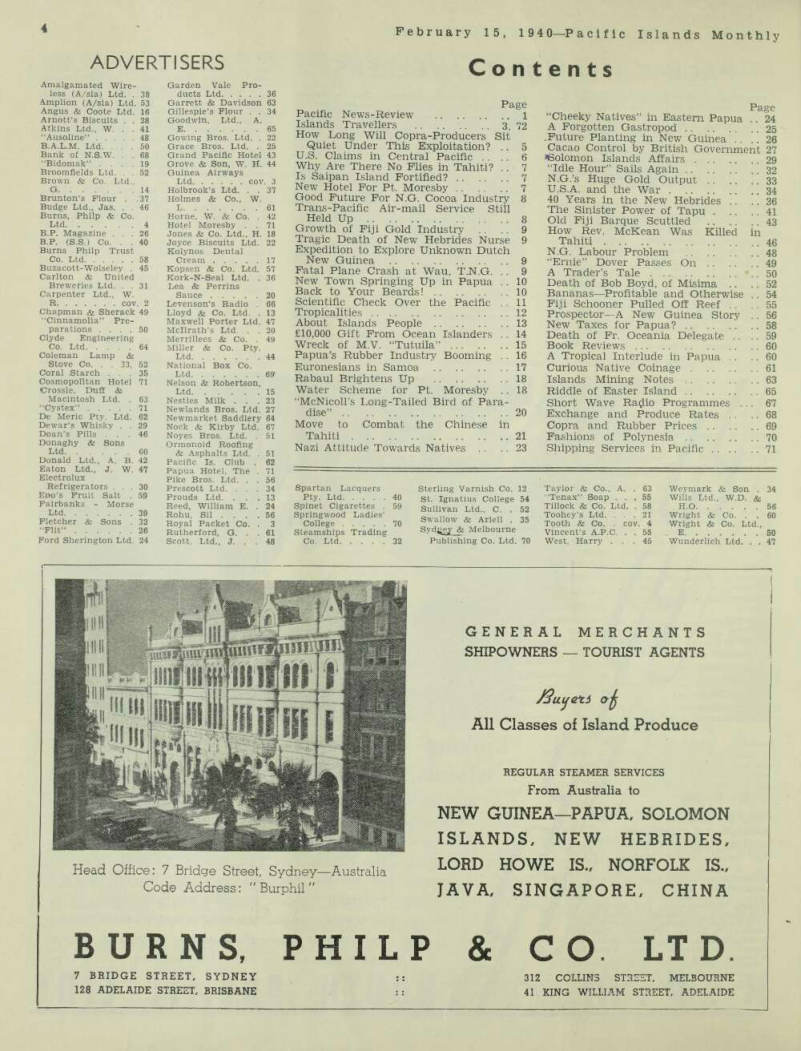
Linking the East with South Pacific
Islands, New Zealand and Australia
The track routes of the K.P.M.-South Pacific Line new motor vessel “Maetsuycker” and the well-known passenger steamer “Tasman” are each as foIIows:— “MAETSUYCKER”: Saigon, Singapore, Batavia, Samarang, Sourabaya, Port Moresby, Port Vila, Noumea, Auckland, Wellington.
Sydney, Port Moresby, Sourabaya, Samarang. Batavia, Singapore, Saigon. “TASMAN”: Saigon, Singapore, Batavia, Samarang, Sourabaya, Port Moresby, Samarai, Salamaua, Rabaul, Auckland, Wellington, Sydney, Port Moresby, Sourabaya, Samarang, Batavia, Singapore, Saigon.
SOUTH PACIFIC HOE
Advertisers
Amalgamated Wire less (A/sia) Ltd. . 38 Amplion (A/sia) Ltd. 53 Angus & Coote Ltd. 16 Arnott’s Biscuits . . 28 Atkins Ltd., W. . . 41 “Ausoline” 48
B.A.L.M. Ltd. ... 50
Bank of N.S.W. . . 68 “Bidomak” ... 19 Broomfields Ltd. . . 52 Brown & Co. Ltd., G 14 Brunton’s Flour . .37 Budge Ltd., Jas. . . 46 Burns, Philp & Co.
Ltd 4 B.P. Magazine ... 26
B.P. (S.S.) Co. . . 40
Burns Philp Trust Co. Ltd 58 Buzacott-Wolseley . 45 Carlton & United Breweries Ltd. . .31 Carpenter Ltd., W.
R cov. 2 Chapman & Sherack 49 “Cinnamolia” Pre parations ... 50 Clyde Engineering Co. Ltd 64 Coleman Lamp & Stove Co. . . 33, 52 Coral Starch ... 35 Cosmopolitan Hotel 71 Crossle, DUS & Macintosh Ltd. . 63 “Cystex” 71 De Meric Pty. Ltd. 62 Dewar’s Whisky . . 29 Doan’s Pills ... 46 Donaghy & Sons Ltd 60 Donald Ltd., A. B. 42 Eaton Ltd., J. W. 47 Electrolux Refrigerators ... 30 Eno’s Fruit Salt . 59 Fairbanks - Morse Ltd 39 Fletcher & Sons . 32 “Flit” 26 Ford Sherington Ltd. 24
Garden Vale Pro ducts Ltd 36 Garrett & Davidson 63 Gillespie’s Flour . . 34 Goodwin, Ltd., A.
E 65 Gowing Bros. Ltd. . 22 Grace Bros. Ltd. . 25 Grand Pacific Hotel 43 Grove & Son, W. H. 44 Guinea Airways Ltd cov. 3 Holbrook’s Ltd. . . 37 Holmes & Co., W.
L 61 Horne, W. & Co. . 42 Hotel Moresby . . 71 Jones & Co. Ltd., H. 18 Joyce Biscuits Ltd. 22 Kolynos Dental Cream 17 Kopsen & Co. Ltd. 57 Kork-N-Seal Ltd. . 36 Lea & Perrins Sauce 20 Levenson’s Radio . 66 Lloyd & Co. Ltd. . 13 Maxwell Porter Ltd. 47 Mcllrath’s Ltd. . . 20 Merrillees & Co. . 49 Miller & Co. Pty.
Ltd 44 National Box Co.
Ltd 69 Nelson & Robertson, Ltd 15 Nestles Milk ... 23 Newlands Bros. Ltd. 27 Newmarket Saddlery 64 Nock & Kirby Ltd. 67 Noyes Bros. Ltd. . 51 Ormonoid Roofing & Asphalts Ltd. . 51 Pacific Is. Club . 62 Papua Hotel, The . 71 Pike Bros. Ltd. . . 56 Prescott Ltd. ... 34 Prouds Ltd. ... 13 Reed, William E. . 24 Rohu, Sil . . . .56 Royal Packet Co. . 3 Rutherford, G. . .61 Scott, Ltd., J. . . 48
Spartan Lacquers Pty. Ltd 40 Spinet Cigarettes . 59 Springwood Ladies’
College 70 Steamships Trading Co. Ltd 32
Sterling Varnish Co. 12 St. Ignatius College 54 Sullivan Ltd., C. . 52 Swallow & Ariell . 35 Sydney & Melbourne Publishing Co. Ltd. 70
Taylor & Co., A. . 63 “Tenax” Soap ... 55 Tillock & Co. Ltd. . 58 Toohey’s Ltd. ... 21 Tooth & Co. . cov. 4 Vincent’s A.P.C. . . 55 West, Harry ... 45
Weymark & Son. . 34 Wills Ltd., W.D. & H.O 56 Wright & Co. . . 60 Wright & Co. Ltd., E 50 Wunderlich Ltd. . . 47
Contents
Page Pacific News-Review 1 Islands Travellers 3. 72 How Long Will Copra-Producers Sit Quiet Under This Exploitation? .. 5 U.S. Claims in Central Pacific .. .. 6 Why Are There No Flies in Tahiti? .. 7 Is Saipan Island Fortified? 7 New Hotel For Pt. Moresby 7 Good Future For N.G. Cocoa Industry 8 Trans-Pacific Air-mail Service Still Held Up 8 Growth of Fiji Gold Industry 9 Tragic Death of New Hebrides Nurse 9 Expedition to Explore Unknown Dutch New Guinea 9 Fatal Plane Crash at Wau, T.N.G. .. 9 New Town Springing Up in Papua .. 10 Back to Your Beards! 10 Scientific Check Over the Pacific .. 11 Tropicalities 12 About Islands People 13 £lO,OOO Gift From Ocean Islanders .. 14 Wreck of M.V. “Tutuila” 15 Papua’s Rubber Industry Booming .. 16 Euronesians in Samoa 17 Rabaul Brightens Up 18 Water Scheme for Pt. Moresby .. 18 “McNicoll’s Long-Tailed Bird of Para dise” 20 Move to Combat the Chinese in Tahiti 21 Nazi Attitude Towards Natives .. .. 23
Page “Cheeky Natives” in Eastern Papua .. 24 A Forgotten Gastropod 25 .Future Planting in New Guinea .. 26 Cacao Control by British Government 27 »6olomon Islands Affairs 29 “Idle Hour” Sails Again 32 N.G.’s Huge Gold Output 33 U.S.A. and the War 34 40 Years in the New Hebrides .. .. 36 The Sinister Power of Tapu 41 Old Fiji Barque Scuttled 43 How Rev. McKean Was Killed in Tahiti 46 N.G. Labour Problem 48 “Ernie” Dover Passes On 49 A Trader’s Tale 50 Death of Bob Boyd, of Misima .. .. 52 Bananas —Profitable and Otherwise .. 54 Fiji Schooner Pulled Off Reef .. .. 55 Prospector—A New Guinea Story .. 56 New Taxes for Papua? 58 Death of Fr. Oceania Delegate .. .. 59 Book Reviews 60 A Tropical Interlude in Papua .. .. 60 Curious Native Coinage 61 Islands Mining Notes 63 Riddle of Easter Island 65 Short Wave Ratfio Programmes ... 67 Exchange and Produce Rates .. .. 68 Copra and Rubber Prices 69 Fashions of Polynesia 70 Shipping Services in Pacific 71
Advertisements & other items, p. 6 (1 item)
Burns, Philp & Co. Ltd.
GENERAL MERCHANTS
SHIPOWNERS TOURIST AGENTS
/9u.yeti
All Classes of Island Produce
REGULAR STEAMER SERVICES
From Australia to
NEW GUINEA—PAPUA, SOLOMON
ISLANDS, NEW HEBRIDES,
LORD HOWE IS., NORFOLK IS.,
JAVA, SINGAPORE, CHINA
BURNS, PHILP & CO. LTD.
*1 iiingiii I 111 I
HI ttt
I
Mtiii
n Head Office: 7 Bridge Street, Sydney—Australia Code Address; " Burphil "
7 BRIDGE STREET, SYDNEY
128 ADELAIDE STREET, BRISBANE
312 COLLINS STREET. MELBOURNE
41 KING WILLIAM STREET, ADELAIDE
Pacific Islands Monthly
The Newspaper-Magazine of the South Seas [Registered at the G.P.0., Sydney, for transmission by post as a newspaper.]
Published Once Each Month and Circulated in Australia and New Zealand and in the following Pacific Territories and Islands Groups:
Australian Territory of Papua.
Mandated Territory (Australia) of New Guinea, Bismarck Archipelago and Northern Solomon Islands.
Australian Territory of Norfolk Island.
New Zealand Territory of Cook Islands.
Mandated Territory (New Zealand) of Samoa.
British Colony of FIJI.
British Solomon Islands Protectorate.
British Protectorate of Tongan Islands.
British Crown Colony of Gilbert and Ellice Islands.
Mandated Territory of Nauru.
British and French Condominium of New Hebrides.
French Colony of New Caledonia.
French Colony of Oceania (Tahiti, etc.).
American Territory of Eastern Samoa.
American Territory of Hawaiian Islands.
American Territory of Guam.
Mandated Territory (Japan) of Marshall, Caroline and Mariana Islands.
Owned and Produced by Pacific Publications Pty. Ltd., Union House, 247 George Street, Sydney.
__r ( Managing Director .. BW 5037 TELEPHONE Business and Editorial MA 7101
P.O. Box 3408 R
Registered Address of Telegrams, Radiograms, and Cables: “Pacpub”, Sydney.
Contributions.
Articles, Stories, and Photographs dealing with Pacific Islands subjects are invited and will be paid for on publication at usual rates.
Subscription Rates.
Per Annum, within British Empire, Prepaid, Post Free 8/- Per Annum, elsewhere, prepaid, Post Free . 10/- Slngle Copies Bd.
Editor and Publisher:
R. W. Robson, F.R.G.S.
Assisted by Selwyn Hughes.
Advertising Manager; L. W. Bailey.
Advertising Office and Printing-House; 29 Alberta St., Sydney.
Advertising rates furnished on application.
Colours, etc by Arrangement.
Process Blocks made at Advertiser’s expense when required. Screen 100.
Changes of Advertising Copy should reach this Office by Ist of each month, otherwise previous advertisement may be repeated.
IN LONDON, the Pacific Islands Monthly Is on sale at the Bookstall, Australia House, The Strand, London.
Agents.
The following are authorised to receive sub scriptions for the Pacific Islands Monthly;— Islands Branches of Burns, Philp & Co., Ltd., and Burns Philp (South Sea) Co., Ltd.
Islands Branches of W. R. Carpenter & Co., Ltd.
Islands Branches of Morris, Hedstrom, Ltd.
G. Thomas & Co., Rabaul, New Guinea.
T. A. Olsson, Wau, New Guinea.
Whitten Bros., Ltd., Samaral, Papua.
Steamships Trading Co., Papua. All Branches.
B.N.G. Trading Co., Ltd., Port Moresby.
J. Muir, Suva, Fiji.
N. C. Mackenzie-Hunt, Wainunu, Bua, FIJI.
Islands Branches and Representatives of W. H.
Grove & Sons, Ltd., Auckland, New Zealand.
Cook Islands Trading Co., Rarotonga, Cook Is.
A. C. Rowland, Papeete, Tahiti.
Representative in London: W. C. HARVEY, Coronation House, 4 Lloyds Avenue, London, E.C.3, from whom may be obtained copies of Pacific Islands Monthly, Pacific Islands Year Book, advertising schedules, etc.
Vol. X. No. 7.
February 15, 1940
p r iro i 8d - Per Copy ’ rnce £ Prepaid: 8/- p.a.
Quiet Under This Exploitation?
How Long Will Copra-Producers Sit Quiet Under This Exploitation?
far-reaching dislocation of the A commerce of Pacific Territories, caused by the war, serves to emphasise the defencelessness of Pacific Islands producers, and to direct attention to the need for a review and a remedy.
The outstanding factor of the situa tion, of course, is the position of the copra market. Before war broke out the high-grade copra price was ap proximately £lO/12/6 per ton, c.i.f., London. To-day, it is fixed by the British and French Governments at £l3/5/- per ton, c.i.f. London. Al though most primary producers throughout the world have received benefit from a rise in their respective commodities to offset higher costs, and leave something over, there has been nothing for the copra producer.
The whole of the rise in the price of his product has been absorbed by higher freight and marketing costs.
There is nothing to cover higher pro duction costs. Freight is higher by £2/7/6 per ton. Bags have doubled in price; rice is 30 per cent, higher; lap laps are 30 per cent, higher in cost— and so on.
In actual fact, the copra producer to-day is worse off than he was just before the war; and, then, he was not enjoying even a bread-and-butter existence. He was obtaining enough
profit from his produce to pay for bread; but there was mighty little butter, and no jam. European men and women do not face the rigours, discomforts and isolation of life in the Pacific territories for so miser able a reward.
The time certainly has come for copra - producers throughout the Pacific Territories to ask themselves seriously whether there is any future in the industry. Unless copra is to return them at least £2 to £3 per ton more profit than it has done in the past two years, copra production in the South Sea Territories will become little more than a sideline for indus trious natives. Coconut planting as an industry for Europeans will dis appear.
IS such a development inevitable?
What is the cause of this pre vailing low price for copra? Is it really due to the fact that that vast industrial world which needs a soft vegetable oil now may be catered for by new commodities, such as cotton seed oil, soya bean oil, whale oil, and various other oils which can be puri fied and by new processes, and which apparently are often in vast over-supply? Or is the present condition of the coconut-oil industry
the result of its being in the grip of one of the world’s largest, greediest, and most ruthless combines —namely, Unilever, Ltd.?
It is impossible to escape the sus picion that the coconut Industry is oeing bled white by the combine. We know that the combine is faultlessly organised, that it is international in character, that it is so powerful that it snaps its fingers at Governments and crushes all opposition, that its profits are colossal. It was only the other day that newspaper readers were informed that the highest paid man in the United States in 1938, according to a Treasury statement, was Mr. F. Countway, president of Lever Bros., whose income in that year was 469,000 dollars (or, in Aus tralian money, £146,562). To oppose this commercial octopus the coconut growers have nothing—only a world wide industry, spread out over scores of tropical countries, with very little association, and not an ounce of co-operation in the whole of it.
THE coconut industry throughout the world markets about 1,500,000 tons of copra per annum. If the pro ducers of only two-thirds of this, or even half of it, could be lined up to face the combine, what a different tale there would be! Unilever, Ltd., then might not be able to make £30,000,000 profit in a year, and the wretched Mr. Countway might have to do with less than £146,000 per
annum. But at least a few thousand European planters, now hanging on gnmiy in unhealthy tropical coun tries, would get something more than a bare living out of their enterprise.
Commentators shake their heads gloomily—they say it would be im possible to organise the producers of this world-wiae industry. Why should it be impossible? It would be found that enough copra producers to con trol two-thirds of the world’s pro duction are under three flags—under the British Colonial flag, under the Dutch flag in the East Indies, and under the American flag in the Philippine Islands. It might even be possible for the Dutch and the British to take action independently of the Philippines, as they have done be fore, to save other great industries.
It is up to the Governments con cerned to try to do something. Every young British man to-day, through out the world, is being invited to take up arms for Democracy. His duty is clear. But if there is a responsibility upon the individual citizen to fight for Democracy, there equally is upon our Governments the responsibility to free our democratic system from the monstrous parasitical growths, in the shape of trusts and combines, that have grown up under its shelter in the past few decades. The life-blood of commerce and industry in our de mocratic countries has been freedom of individual enterprise; but the trusts and combines are slowly and steadily murdering the individual trader and producer. There is no clearer example of this than the Unilever combine and the coconut industry.
Shall we surrender to this merci less commercial monster without a fight? There is one thing that can be done immediately. Coconut planters everywhere should call upon iheir local Administration to make to the British Government, by whatever channel is available or desirable, the most urgent representations regard ing that fixed copra price. That sum of £l3/5/- per ton c.i.f. London may represent a very beautiful picture so far as Unilever is concerned—we may be sure that Unilever had a lot to do with it—but to the copra producers throughout the South Seas it means simply distress, starvation and bank ruptcy.
Sir Harry Luke, in Suva; Sir Walter McNicoll, in Rabaul; Sir Hubert Murray, in Port Moresby—these are three men administering great tropi cal territories where the coconut in dustry is of first importance—surely it is right and proper that all the facts and figures should be placed before them, so that they make re presentations in the proper quarter.
It is no use the copra-producer sitting at home and moaning. He is being unjustly and cruelly exploited, and he is up against a very tough proposition. But that is all the more reason why he should get out and fight—and the best way to start the fight is to howl in chorus until the Governments are forced to take some notiQe of the noise.
Atolls
Reaching Out For
U.S.A. Claims in Central Pacific
IT is reported that the United States Government has commenced an action in the Federal Court to obtain title to Palmyra Island, and any atolls in its vicinity, for use as air bases.
This report is a little surprising.
Palmyra lies southwards of Hawaii, on the route between Hawaii and Fiji, and was for years regarded as the property of Judge Cooper, of Honolulu, and had been leased by him to an American copra company. It was stated, in 1935, that the island was claimed by the United States for air base purposes, and it was apparently formally occupied by U.S.A. in 1936. Since then it has been regarded as American territory. There never has been any suggestion that Britain contested the claim, although Palmyra apparently was formally an nexed for Great Britain by Commander Nichols, of H.M.S. “Cormorant,” on May 28, 1889, in expectation of its use as a station for the Pacific cable. When Pan ning Island was selected, instead. Britain took no further interest in Palmyra.
It is also reported from Honolulu that the United States intends to file suits
for the sovereignty of the following islands of the Central Pacific:— Washington Island, Christmas Island, Malden Island and Starbuck Island: Washington and Christmas Islands are part of the Gilbert and Ellice Colony Administration, and have been adminis tered by Britain and recognised as Brit ish territory for a very long time. Malden and Starbuck are not in the same cate gory—they are isolated, unoccupied islands which never have been regarded as of much economic value and. while nominally British, they have not been under any particular administration.
Vostock, Flint and Caroline Islands: All these are in practically the same category as Malden and Starbuck—they have been nominally British for a very long time, they have been used to some extent for guano production or the growing of coconuts, but they have not been permanently occupied.
Penrhyn, Rakahanga (Reirson’s), Dan ger, Nassau and Suwarrow Islands: All these are part of the Cook Islands Administration: and they have been in the occupation of natives, usually under the direction of official British agents (New Zealanders) for about half a century. Any attempt by the United States to come in at this late date, and claim ownership, will not only be resisted but will be much resented.
Advertisements & other items, p. 8 (1 item)
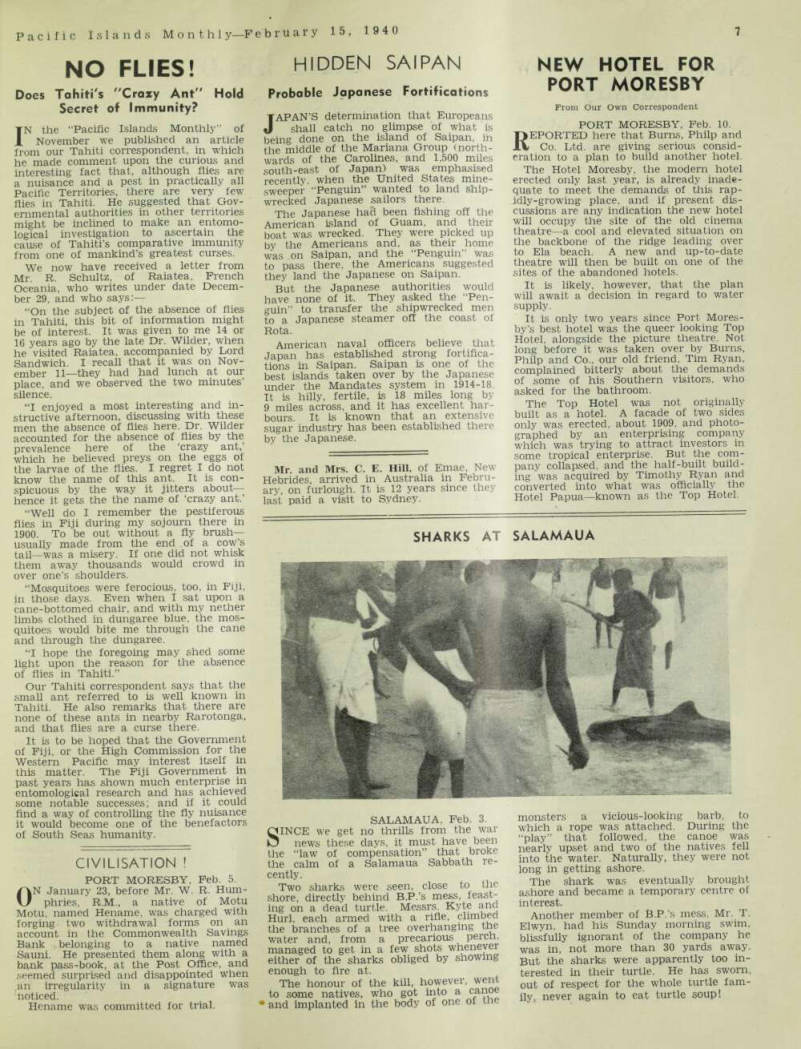
Off Beaten Tracks in the Pacific.—X.
"Henry, is this only a coincidence?"
No Flies!
Does Tahiti's "Crazy Ant" Hold Secret of Immunity?
IN the “Pacific Islands Monthly” of November we published an article from our Tahiti correspondent, in which he made comment upon the curious and interesting fact that, although flies are a nuisance and a pest in practically all Pacific Territories, there are very few flies in Tahiti. He suggested that Gov ernmental authorities in other territories might be inclined to make an entomo logical investigation to ascertain the cause of Tahiti’s comparative immunity from one of mankind’s greatest curses.
We now have received a letter from Mr. R. Schultz, of Raiatea, French Oceania, who writes under date Decem ber 29, and who says:— “On the subject of the absence of flies in Tahiti, this bit of information might be of interest. It was given to me 14 or 16 years ago by the late Dr. Wilder, when he visited Raiatea, accompanied by Lord Sandwich. I recall that it was on Nov ember 11—they had had lunch at our place, and we observed the two minutes’ silence.
“I enjoyed a most interesting and in structive afternoon, discussing with these men the absence of flies here. Dr. Wilder accounted for the absence of flies by the prevalence here of the ‘crazy ant,’ which he believed preys on the eggs of the larvae of the flies. I regret I do not know the name of this ant. It is con spicuous by the way it jitters about — hence it gets the the name of ‘crazy ant.’
“Well do I remember the pestiferous flies in Fiji during my sojourn there in 1900. To be out without a fly brush— usually made from the end of a cow’s tall—was a misery. If one did not whisk them away thousands would crowd in over one’s shoulders.
“Mosquitoes were ferocious, too, in Fiji, in those days. Even when I sat upon a cane-bottomed chair, and with my nether limbs clothed in dungaree blue, the mos quitoes would bite me through the cane and through the dungaree.
“I hope the foregoing may shed some light upon the reason for the absence of flies in Tahiti.”
Our Tahiti correspondent says that the small ant referred to is well known in Tahiti. He also remarks that there are none of these ants in nearby Rarotonga, and that flies are a curse there.
It is to be hoped that the Government of Fiji, or the High Commission for the Western Pacific may interest itself in this matter. The Fiji Government in past years has shown much enterprise in entomological research and has achieved some notable successes; and if it could find a way of controlling the fly nuisance it would become one of the benefactors of South Seas humanity.
Civilisation !
Port Moresby, Feb. 5.
ON January 23, before Mr. W. R. Hum phries, R.M., a native of Motu Motu. named Rename, was charged with forging two withdrawal forms on an account in the Commonwealth Savings Bank belonging to a native named Sauni. He presented them along with a bank pass-book, at the Post Office, and seemed surprised and disappointed when an irregularity in a signature was noticed.
Hename was committed for trial.
Hidden Saipan
Probable Japanese Fortifications
JAPAN’S determination that Europeans shall catch no glimpse of what is being done on the island of Saipan, in the middle of the Mariana Group (north wards of the Carolines, and 1,500 miles south-east of Japan) was emphasised recently, when the United States mine sweeper “Penguin” wanted to land ship wrecked Japanese sailors there.
The Japanese hacl been fishing off the American island of Guam, and their boat was wrecked. They were picked up by the Americans and, as their home was on Saipan, and the “Penguin” was to pass there, the Americans suggested they land the Japanese on Saipan.
But the Japanese authorities would have none of it. They asked the “Pen guin” to transfer the shipwrecked men to a Japanese steamer off the coast of Rota.
American naval officers believe that Japan has established strong fortifica tions in Saipan. Saipan is one of the best islands taken over by the Japanese under the Mandates system in 1914-18.
It is hilly, fertile, is 18 miles long by 9 miles across, and it has excellent har bours. It is known that an extensive sugar industry has been established there by the Japanese.
Mr. and Mrs. C. E. Hill, of Emae, New Hebrides, arrived in Australia in Febru ary. on furlough. It is 12 years since they last paid a visit to Sydney.
Port Moresby
New Hotel For
From Our Own Correspondent
Port Moresby, Feb. 10.
REPORTED here that Burns, Philp and Co. Ltd. are giving serious consid eration to a plan to build another hotel.
The Hotel Moresby, the modern hotel erected only last year, is already inade quate to meet the demands of this rap idly-growing place, and if present dis cussions are any indication the new hotel will occupy the site of the old cinema theatre—a cool and elevated situation on the backbone of the ridge leading over to Ela beach. A new and up-to-date theatre will then be built on one of the sites of the abandoned hotels.
It is likely, however, that the plan will await a decision in regard to water supply.
It is only two years since Port Mores by’s best hotel was the queer looking Top Hotel, alongside the picture theatre. Not long before it was taken over by Burns, Philp and Co., our old friend. Tim Ryan, complained bitterly about the demands of some of his Southern visitors, who asked for the bathroom.
The Top Hotel was not originally built as a hotel. A facade of two sides only was erected, about 1909, and photo graphed by an enterprising company which was trying to attract investors in some tropical enterprise. But the com pany collapsed, and the half-built build ing was acquired by Timothy Ryan and converted into what was officially the Hotel Papua—known as the Top Hotel.
Advertisements & other items, p. 9 (1 item)
t| tl caZ °Jt rsr
SHARKS AT SALAMAUA
SALAMAUA. Feb. 3.
SINCE we get no thrills from the war have been news these days, it must nave oeen
t| tl caZ °Jt rsr
shor"° directly behtad 5 BP.’s ing on a dead turtle. Messrs. Kyte and Hurl each armed with a rifle, climbed the branches of a tree overhanging the water and, from a precarious perch, managed to get in a few shots whenever either of the sharks obliged by showing enough to fire at.
The honour of the kill, however, went to some natives, who got into a canoe and implanted m the body of one or the
monsters a vicious-looking barb, to which a rope was attached. During the “play” that followed, the canoe was 4 Q fbp nativp<; fpll into the wate. Rurally, they were not ashore alldblcam? a temporary centre ol interest. ■ Another member of B.P. s mess, Mi. T.
Elwyn. had his Sunday morning swim, blissfully ignorant of the company he was j n no t more than 30 yards away, Bu £ j. he sharks were apparently too in terested in their turtle. He has sworn, out of reS p e ct for the whole turtle fam never again eat turtle soup! y
Industry
New Guinea’s New Industry Good Future for Cocoa Producers
IT is expected that the New Guinea Administration, supported by the Com monwealth Government, will take advan tage of the present providential opppr tunity to soundly establish the cocoa in dustry in the Mandated Territory.
Originally, New Guinea was exclusively a copra producing country—and, if it had remained so, it would be on the bread-line to-day. Fortunately, the rich gold industry was established, and the large revenues from that source have kept the Territory prosperous and pro gressive.
The New Guinea copra industry, how ever, is feeling the unfavorable conditions created by the war, and the coconut planters are ready to give attention to any alternative which may be suggested.
Several years ago a few enterprising planters began to grow cocoa. They got little encouragement. Australian confec tionery manufacturers did not wish to alter their processes and formulae to allow them to handle a new kind of cocoa bean —they wanted to keep to the well-known Accra product.
Mr. Norman Nelson, of Messrs. Nelson and Robertson, Ltd., Sydney merchants, took a personal interest in the matter and, acting as the agent for New Guinea cocoa planters, fought for years a discouraging and almost single-handed battle to get New Guinea cocoa beans recognised. He was slowly winning out, when the war came; and Australian confectionery manufacturers suddenly found that they could not get their usual Accra supplies, and turned with new interest to the New Guinea cocoa beans.
Quite suddenly. New Guinea beans were in sharp demand, and the price rose from about £26 or £2B per ton to around £3B per ton. Mr, Nelson has in formed the "P.1.M.” that there is now in Australia an eager market for every cocoa bean that can be sent from New Guinea.
He is anxious that the New Guinea cocoa planting industry should be encouraged, and he is actively assisting in discussions between manufacturers in Australia and planters in New Guinea, so that the latter may understand the requirements of the former.
A few years ago, only a few consign ments of cocoa beans came out of New Guinea. To-day, the production is ap proximately 200 tons per annum, and it is growing rapidly. The quality is equal to Trinidad; but, for Australian market ing purposes, it has been taken as being equal to the lo ver grade—namely, Accra.
Warm praise for this development must be given to Mr. George Murray, the long sighted Director of Agriculture in New Guinea. He always has been a believer in cocoa production in New Guinea, and it was he who encouraged one of his most promising young lieutenants, Mr. Green, to go to the British School of Tropical Agriculture in Trinidad, West Indies, and make a special study of cocoa culture, for the benefit of New Guinea planters. Mr.
Green came back, about 1934, an en thusiastic believer in the possibility of cocoa culture in New Guinea; and, since then, he has been tireless in assisting New Guinea planters to a better under standing of the industry.
Now, everything is in favour of its establishment. There is an eager market
in Australia: the price offered is high and profitable; many planters in New Guinea have already experimented with the crop, and understand how to handle it; and the New Guinea Department of Agriculture is in a position to give all kinds of practical assistance.
The New Guinea Administration has available the rich revenues derived from the gold industry which it may use—and should use—for the sound establishment of a good primary industry like cocoa pro duction.
Still Held Up
Trans-Tasman and Trans-Pacific Air Services
THE situation in relation to the inau guration of a trans-Pacific air-mail service is as full of contradictions and mystery as ever.
Pan American Airways stated, several weeks ago, that they were all ready to commence a service between San Fran cisco and Auckland, via Hawaii, Canton Island and Noumea, and that they were waiting only for the word “go” from Washington.
But Washington remains strangely dumb; P.A.A. station staffs stand inactive at Canton Island, Noumea and Auck land; and. up to three days before this issue went to press, there still was no word of when the first P.A.A. plane would open the service.
Meanwhile, Honolulu reports that the position simply is that Pan American Airways have not sufficient Boeing Clip pers to carry on the proposed new ser vice—that the company actually has not got enough Boeing Clippers to carry on the Atlantic and North Pacific Services for which it is responsible. New Boeing Clippers can be built, of course; but the whole of the aeroplane building resources of the United States at present are con centrated on war orders from Europe.
Meanwhile, the lonely “Aotearoa” — Imperial Airways’ boat sent out as the first of three to carry on the service between Sydney and Auckland—is flut tering vainly between Sydney and Auck land, and apparently doing nothing.
The efficient organisation which carries on Imperial Airways at the Australian end, Qantas Ltd., says that it would be quite feasible to commence the Syd ney-Auckland air-mail service with the “Aotearoa” alone, but that what actually is holding up the inauguration of the service is the inability of the three Gov ernments concerned —Britain, New Zea land and Australia —to agree about the terms and conditions under which the service will be carried on.
So, in spite of all official blather and bureaucratic reassurances, the people in the Pacific Territories who are awaiting the commencement of the trans-Pacific air-mail are recommended to believe it when they see it.
The Position of P.A.A.
From Our Own Correspondent
Honolulu. Jan. 10.
HERE are what appear to be the latest facts about the prospects of Pan American Airways starting the proposed air service from Hawaii to Auckland, N.Z.
Developments in the Pacific must wait until the company has its Atlantic pro gramme in better shape.
On the Atlantic, the company now
faces the prospect of stiff competition from a new and powerful American company, called American Export Air lines, a subsidiary of the successful steamship company which for years has operated passenger and freighters be tween the U.S. east coast and the Mediterranean.
When the first six Boeing Clippers were completed a year ago, it was said one would be assigned to the N.Z. run, but to-day two of them are trying to maintain schedules on the North Paci fic and the other four are on the Atlan
tic.
The Nth. Pacific service is beset with serious delays. Since August, 1938, only seven round flights, between California and the Orient, have been made on schedule, although the two new Boeings came into service in February, 1939.
The China Clipper left San Francisco last on December 11, but did not return there, owing to a series of delays, until January 4.
The Philippine Clipper was due to leave there on December 19. It made three attempts to get away, but was forced back each time. At this writing it is still in San Francisco.
The California Clipper left San Fran cisco on December 20 but, so far, has not returned. At this writing it is delayed through engine trouble in Manila, where it has been since December 28.
The Honolulu Clipper has been in San Francisco since December 30.
The position to-day is that there are three Clippers idle in San Francisco and one at Manila. The air-mail is being carried by steamer. The “Monterey,” which arrived here to-day, carried Clip per passengers who have been Clipper delayed in California for two weeks. rE P.A.A. bases to N.Z. may 'oe ready for the service, but obviously, con sidering the above facts, the company lacks a spare Clipper to start the service.
If one is taken for the N.Z. run, it means robbing either the North Pacific or Atlantic services of one. American public opinion, which wants better ser vice for the U.S. taxpayers who pay the huge subsidies, may not stand for it.
“Fiji Will Be Included”
Incidentally, it is known here that if and when the N.Z. service is launched, Fiji will be included as a stop soon.
Several flights will have to be made under Government supervision before passengers will be permitted to travel.
The Government, too, has yet to okay the bases at Canton, Noumea and Auckland.
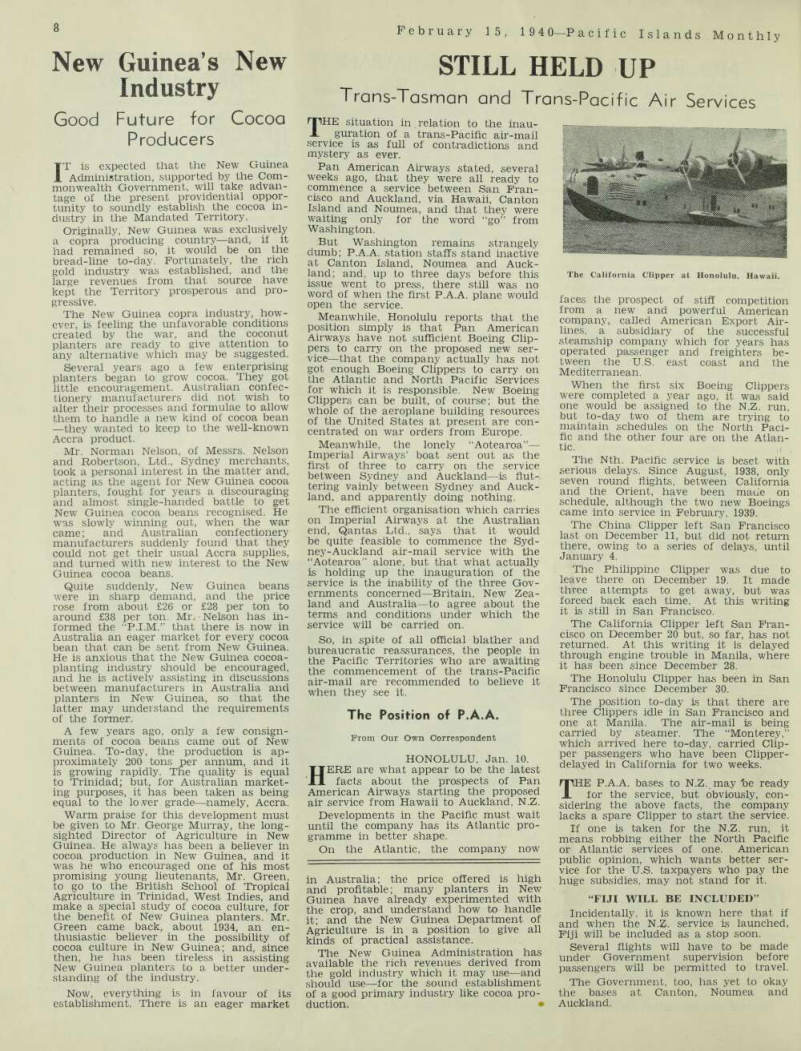
The California Clipper at Honolulu, Hawaii.
Rapid Growth of Fiji's
Gold Industry
THESE figures, showing the gold out put of Fiji, indicate how the gold industry has grown (mainly as a result of the establishment of the Emperor and Loloma mines, at Tavua) Year. Ounces. 1933 2 ’ 079 iq'J4 1,033 1935 : 6.933 1936 17.10 7
Iqq7 21,407
1938 ” 89.354 1939 *llO,OOO ♦Estimated.
The estimated value of the 1939 output is £1 100,000 Australian. At this rate, New Guinea, with an annual production of about £2,000,000, will have to look to its laurels.
There are four large mines operating in Fiji—Emperor, Loloma. Dolphin and Mt Kasi. The first three are on the Tavua field, and Mt. Kasi is on Vanua Levu The Dolphin, which is owned by a private syndicate, is not yet equipped for production, but development work has proved a large tonnage of rich ore.
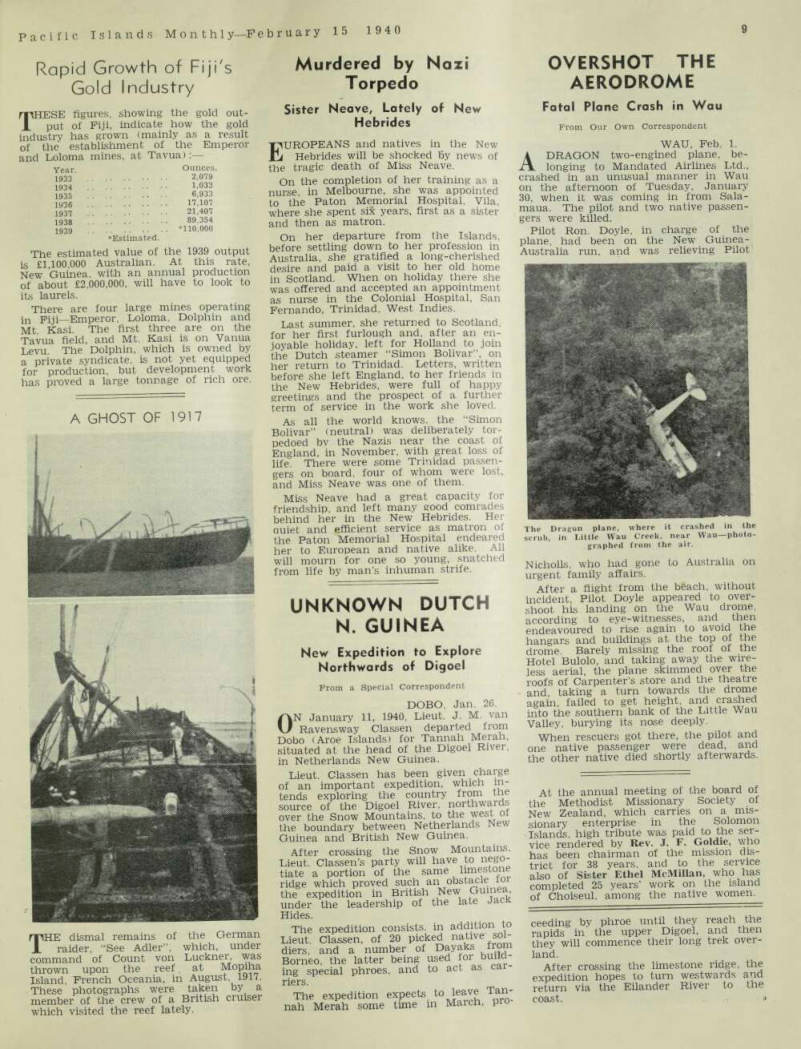
A Ghost Of 1917
THE dismal remains of the German raider, “See Adler”, which, under command of Count von Luckner, was thrown upon the reef at Mopiha Island, French Oceania, in August, 1917.
These photographs were taken by a member of the crew of a British cruiser which visited the reef lately.
Torpedo
Murdered by Nazi Torpedo Sister Neave, Lately of New Hebrides
EUROPEANS and natives in the New Hebrides will be shocked by news of the tragic death of Miss Neave.
On the completion of her training as a nurse, in Melbourne, she was appointed to the Paton Memorial Hospital, Vila, where she spent six years, first as a sister and then as matron.
On her departure from the Islands, before settling down to her profession in Australia, she gratified a long-cherished desire and paid a visit to her old home in Scotland. When on holiday there she was offered and accepted an appointment as nurse in the Colonial Hospital, San Fernando, Trinidad, West Indies.
Last summer, she returned to Scotland, for her first furlough and, after an en joyable holiday, left for Holland to join the Dutch steamer “Simon Bolivar’’, on her return to Trinidad. Letters, written before she left England, to her friends in the New Hebrides, were full of happy greetings and the prospect of a further term of service in the work she loved.
As all the world knows, the “Simon Bolivar” (neutral) was deliberately tor pedoed bv the Nazis near the coast of England, in November, with great loss of life. There were some Trinidad passen gers on board, four of whom were lost, and Miss Neave was one of them.
Miss Neave had a great capacity for friendship, and left many good comrades behind her in the New Hebrides. Her auiet and efficient service as matron ol the Paton Memorial Hospital endeared her to European and native alike. All will mourn for one so young, snatched from life by man’s inhuman strife.
Unknown Dutch
N. Guinea
New Expedition to Explore Northwards of Digoel
Prom a Special Correspondent
Dobo. Jan. 26.
ON January 11, 1940. Lieut. J. M. van Ravensway Classen departed from Dobo (Aroe Islands) for Tannah Merah. situated at the head of the Digoel River, in Netherlands New Guinea.
Lieut. Classen has been given charge of an important expedition, which in tends exploring the country from the source of the Digoel River, northwards over the Snow Mountains, to the west oi the boundary between Netherlands New Guinea and British New Guinea.
After crossing the Snow Mountains, Lieut. Classen’s party will have to nego tiate a portion of the same limestone ridge which proved such an obstacle ioi the expedition in British New under the leadership of the late JacK Hides.
The expedition consists, in addition to Lieut. Classen, of 20 picked na.tlv%sol diers, and a number of Dayaks from Borneo, the latter being used for build ing special phroes, and to act as ca riers.
The expedition expects J ea ye nah Merah some time in March, pro
ceeding by phroe until they reach the rapids in the upper Digoel, and then they will commence their long trek over land.
After crossing the limestone ridge, the expedition hopes to turn westwards and return via the Eilander River to the coast.
Aerodrome
Overshot The
Fatal Plane Crash in Wau
From Our Own Correspondent WAU, Feb. 1.
A DRAGON two-engined plane, be longing to Mandated Airlines Ltd., crashed in an unusual manner in Wau on the afternoon of Tuesday, January 30, when it was coming in from Sala maua. The pilot and two native passen gers were killed.
Pilot Ron. Doyle, in charge of the plane, had been on the New Guinea- Australia run, and was relieving Pilot
Nicholls, who had gone to Australia on urgent family affairs.
After a flight from the beach, without incident, Pilot Doyle appeared to over shoot his landing on the Wau drome, according to eye-witnesses, and then endeavoured to rise again to avoid the hangars and buildings at the top of the drome. Barely missing the roof of the Hotel Bulolo, and taking away the wire less aerial, the plane skimmed over the roofs of Carpenter’s store and the theatre and, taking a turn towards the drome again, failed to get height, and crashed into the southern bank of the Little Wau Valley, burying its nose deeply.
When rescuers got there, the pilot and one native passenger were dead, and the other native died shortly afterwards.
At the annual meeting of the board of the Methodist Missionary Society of New Zealand, which carries on a mis sionary enterprise in the Solomon Islands, high tribute was paid to the ser vice rendered by Rev. J. F. Goldie, who has been chairman of the mission dis trict for 38 years, and to the service also of Sister Ethel McMillan, who has completed 25 years’ work on the island of Choiseul, among the native women.
The Dragon plane, where it crashed in the scrub, in Little Wau Creek, near Wau—photo graphed from the air.
Papuan Romance
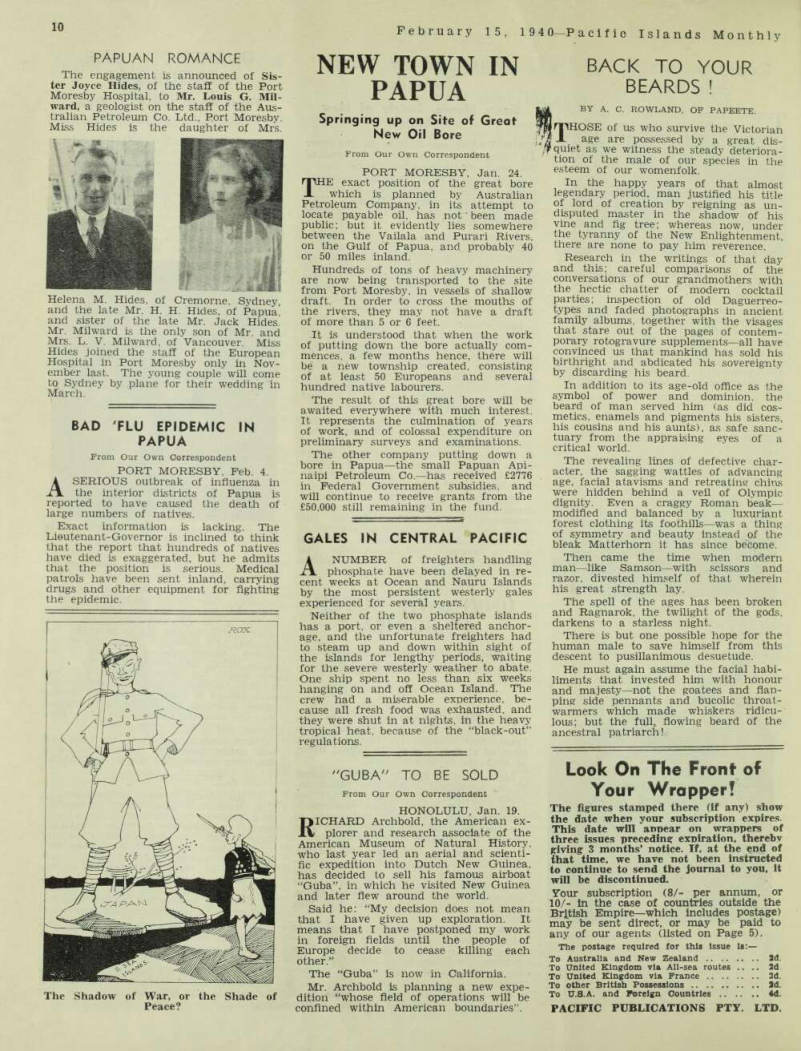
The engagement is announced of Sis ter Joyce Hides, of the staff of the Port Moresby Hospital, to Mr. Louis G. Mil ward, a geologist on the staff of the Aus tralian Petroleum Co. Ltd., Port Moresby.
Miss Hides is the daughter of Mrs.
Helena M. Hides, of Cremorne, Sydney, and the late Mr. H. H. Hides, of Papua and sister of the late Mr. Jack Hides.
Mr. Milward is the only son of Mr. and Mrs. L. V. Milward, of Vancouver. Miss Hides joined the staff of the European Hospital in Port Moresby only in Nov ember last. The young couple will come to Sydney by plane for their wedding in March.
Bad 'Flu Epidemic In
Papua
From Our Own Correspondent
Port Moresby. Feb. 4.
A SERIOUS outbreak of influenza in the interior districts of Papua is reported to have caused the death of large numbers of natives.
Exact information is lacking. The Lieutenant-Governor is inclined to think that the report that hundreds of natives have died is exaggerated, but he admits that the position is serious. Medical patrols have been sent inland, carrying drugs and other equipment for fighting the epidemic.
The Shadow of War, or the Shade of Peace?
Papua
New Town In
Springing up on Site of Great New Oil Bore
From Our Own Correspondent
Port Moresby, Jan. 24.
THE exact position of the great bore which is planned by Australian Petroleum Company, in its attempt to locate payable oil, has not ’ been made public; but it evidently lies somewhere between the Vailala and Purari Rivers, on the Gulf of Papua, and probably 40 or 50 miles inland.
Hundreds of tons of heavy machinery are now being transported to the site from Port Moresby, in vessels of shallow draft. In order to cross the mouths of the rivers, they may not have a draft of more than 5 or 6 feet.
It is understood that when the work of putting down the bore actually com mences, a few months hence, there will be a new township created, consisting of at least 50 Europeans and several hundred native labourers.
The result of this great bore will be awaited everywhere with much interest.
It represents the culmination of years of work, and of colossal expenditure on preliminary surveys and examinations.
The other company putting down a bore in Papua—the small Papuan Api naipi Petroleum Co. —has received £2776 in Federal Government subsidies, and will continue to receive grants from the £50,000 still remaining in the fund.
Gales In Central Pacific
A NUMBER of freighters handling phosphate have been delayed in re cent weeks at Ocean and Nauru Islands by the most persistent westerly gales experienced for several years.
Neither of the two phosphate islands has a port, or even a sheltered anchor age, and the unfortunate freighters had to steam up and down within sight of the islands for lengthy periods, waiting for the severe westerly weather to abate.
One ship spent no less than six weeks hanging on and off Ocean Island. The crew had a miserable experience, be cause all fresh food was exhausted, and they were shut in at nights, in the heavy tropical heat, because of the “black-out” regulations.
"Guba" To Be Sold
From Our Own Correspondent
Honolulu, Jan. 19.
RICHARD Archbold, the American ex plorer and research associate of the American Museum of Natural History, who last year led an aerial and scienti fic expedition into Dutch New Guinea, has decided to sell his famous airboat “Guba”, in which he visited New Guinea and later flew around the world.
Said he: “My decision does not mean that I have given up exploration. It means that I have postponed my work in foreign fields until the people of Europe decide to cease killing each other.”
The “Guba” is now in California.
Mr. Archbold is planning a new expe dition “whose field of operations will be confined within American boundaries”.
Beards !
back to your
By A. C. Rowland, Of Papeete.
jmHOSE of us who survive the Victorian JL age are possessed by a great dis -1 quiet as we witness the steady deteriora tion of the male of our species in the esteem of our womenfolk.
In the happy years of that almost legendary period, man justified his title of lord of creation by reigning as un disputed master in the shadow of his vine and fig tree; whereas now, under the tyranny of the New Enlightenment, there are none to pay him reverence.
Research in the writings of that day and this; careful comparisons of the conversations of our grandmothers with the hectic chatter of modem cocktail parties; inspection of old Daguerreo types and faded photographs in ancient family albums, together with the visages that stare out of the pages of contem porary rotogravure supplements—all have convinced us that mankind has sold his birthright and abdicated his sovereignty by discarding his beard.
In addition to its age-old office as the symbol of power and dominion, the beard of man served him (as did cos metics, enamels and pigments his sisters, his cousins and his aunts), as safe sanc tuary from the appraising eyes of a critical world.
The revealing lines of defective char acter, the sagging wattles of advancing age, facial atavisms and retreatins chins were hidden behind a veil of Olympic dignity. Even a craggy Roman beak modified and balanced by a luxuriant forest clothing its foothills—was a thing of symmetry and beauty instead of the bleak Matterhorn it has since become.
Then came the time when modern man—like Samson—with scissors and razor, divested himself of that wherein his great strength lay.
The spell of the ages has been broken and Ragnarok, the twilight of the gods, darkens to a starless night.
There is but one possible hope for the human male to save himself from this descent to pusillanimous desuetude.
He must again assume the facial habi liments that invested him with honour and majesty—not the goatees and flap ping side pennants and bucolic throat warmers which made whiskers ridicu lous; but the full, flowing beard of the ancestral patriarch!
Advertisements & other items, p. 12 (1 item)
Your Wrapper!
Look On The Front of
The figures stamped there (if any) show the date when your subscription expires.
This date will anpear on wrappers of three issues preceding expiration, thereby giving 3 months’ notice. If, at the end of that time, we have not been instructed to continue to send the journal to you, It will be discontinued, your subscription (8/- per annum, or 10/- in the case of countries outside the British Empire—which includes postage) may be sent direct, or may be paid to any of our agents (listed on Page 5).
The postage required for this Issue Is:— To Australia and New Zealand 3d.
To United Kingdom via All-sea routes ... 2d To United Kingdom via Prance 2d.
To other British Possessions 3d.
To U.S.A. and Porelgn Countries 4d.
PACIFIC PUBLICATIONS PTY, LTD.
Pacific
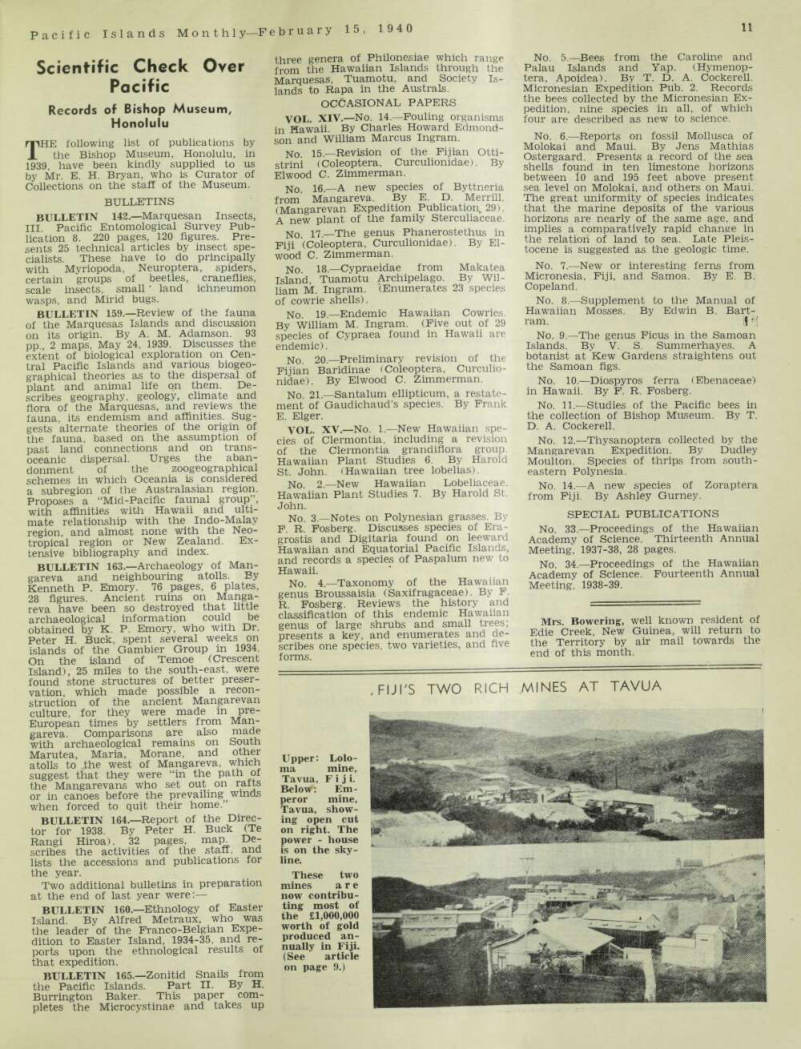
Scientific Check Over Pacific Records of Bishop Museum, Honolulu
THE following list of publications by the Bishop Museum, Honolulu, in 1939, have been kindly supplied to us by Mr. E. H. Bryan, who is Curator of Collections on the staff of the Museum.
Bulletins
BULLETIN 142.—Marquesan Insects, 111. Pacific Entomological Survey Pub lication 8. 220 pages, 120 figures. Pre sents 25 technical articles by insect spe cialists. These have to do principally with Myriopoda, Neuroptera, spiders, certain groups of beetles, craneflies, scale insects, small' land ichneumon wasps, and Mirid bugs.
BULLETIN 159.—Review of the fauna of the Marquesas Islands and discussion on its origin. By A. M. Adamson. 93 pp , 2 maps, May 24, 1939. Discusses the extent of biological exploration on Cen tral Pacific Islands and various biogeo graphical theories as to the dispersal of plant and animal life on them. De scribes geography, geology, climate and flora of the Marquesas, and reviews the fauna, its endemism and affinities. Sug gests alternate theories of the origin of the fauna, based on the assumption of past land connections and on trans oceanic dispersal. Urges the aban donment of the zoogeographical schemes in which Oceania is considered a subregion of the Australasian region.
Proposes a “Mid-Pacific faunal group”, with affinities with Hawaii and ulti mate relationship with the Indo-Malay region, and almost none with the Neo tropical region or New Zealand. Ex tensive bibliography and index.
BULLETIN 163.—Archaeology of Man gareva and neighbouring atolls. By Kenneth P. Emory. 76 pages, 6 plates, 28 figures. Ancient ruins on Manga reva have been so destroyed that little archaeological information could be obtained by K. P. Emory, who with Dr.
Peter H. Buck, spent several weeks on islands of the Gambler Group in 1934.
On the island of Temoe (Crescent Island), 25 miles to the south-east, were found stone structures of better preser vation, which made possible a recon struction of the ancient Mangarevan culture, for they were made in pre- European times by settlers from Man gareva. Comparisons are also made with archaeological remains on South Marutea, Maria, Morane, and other atolls to the west of Mangareva, which suggest that they were “in the path of the Mangarevans who set out on rafts or in canoes before the prevailing winds when forced to quit their home.”
BULLETIN 164.—Report of the Direc tor for 1938. By Peter H. Buck (Te Rangi Hiroa). 32 pages, map. De scribes the activities of the staff, and lists the accessions and publications for the year.
Two additional bulletins in preparation at the end of last year were;— BULLETIN 160.—Ethnology of Easter Island. By Alfred Metraux, who was the leader of the Franco-Belgian Expe dition to Easter Island, 1934-35, and re ports upon the ethnological results of that expedition.
BULLETIN 165.—Zonitid Snails from the Pacific Islands. Part 11. By H.
Burrington Baker. This paper com pletes the Microcystinae and takes up
three genera of Philonesiae which range from the Hawaiian Islands through the Marquesas, Tuamotu, and Society Is lands to Rapa in the Australs.
Occasional Papers
VOL. XIV. —No. 14.—Fouling organisms in Hawaii. By Charles Howard Edmond son and William Marcus Ingram.
No. 15.— Revision of the Fijian Otti strini (Coleoptera, Curculionidae). By Elwood C. Zimmerman.
No 16—A new species of Byttneria from Mangareva. By E. D. Merrill. (Mangarevan Expedition Publication 29).
A new plant of the family Sterculiaceae.
No 17 —The genus Phanerostethus in Fiji (Coleoptera, Curculionidae). By El wood C. Zimmerman.
No is.—Cypraeidae from Makatea Island, Tuamotu Archipelago. By Wil liam M. Ingram. (Enumerates 23 species of cowrie shells).
No. 19—Endemic Hawaiian Cowries, By William M. Ingram. (Five out of 29 species of Cypraea found in Hawaii are endemic).
No. 20. —Preliminary revision of the Fijian Baridinae (Coleoptera, Curculio nidae). By Elwood C. Zimmerman.
No. 21.—Santalum ellipticum, a restate ment of Gaudichaud’s species. By Frank E. Eiger.
VOL. XV.—No. 1. —New Hawaiian spe cies of Clermontia. including a revision of the Clermontia grandiflora group.
Hawaiian Plant Studies 6. By Harold St. John. (Hawaiian tree lobelias).
No. 2.—New Hawaiian Lobeliaceae.
Hawaiian Plant Studies 7. By Harold St.
John.
No. 3 Notes on Polynesian grasses. By F. R. Fosberg. Discusses species of Era grostis and Digitaria found on leeward Hawaiian and Equatorial Pacific Islands, and records a species of Paspalum new to Hawaii.
No. 4. —Taxonomy of the Hawaiian genus Broussaisia (Saxifragaceae). By F.
R. Fosberg. Reviews the history and classification of this endemic Hawaiian genus of large shrubs and small trees; presents a key, and enumerates and de scribes one species, two varieties, and five forms.
No. 5. —Bees from the Caroline and Palau Islands and Yap. (Hymenop tera, Apoidea). By T. D. A. Cockerell.
Micronesian Expedition Pub. 2. Records the bees collected by the Micronesian Ex pedition, nine species in all, of which four are described as new to science.
No. 6. —Reports on fossil Mollusca of Molokai and Maui. By Jens Mathias Ostergaard. Presents a record of the sea shells found in ten limestone horizons between 10 and 195 feet above present sea level on Molokai, and others on Maui.
The great uniformity of species indicates that the marine deposits of the various horizons are nearly of the same age, and implies a comparatively rapid change in the relation of land to sea. Late Pleis tocene is suggested as the geologic time.
No. 7.—New or interesting ferns from Micronesia, Fiji, and Samoa. By E. B.
Copeland.
No. B. —Supplement to the Manual of Hawaiian Mosses. By Edwin B. Bart
ram. if "1
No. 9. —The genus Ficus in the Samoan Islands. By V. S. Summerhayes. A botanist at Kew Gardens straightens out the Samoan figs.
No. 10. —Diospyros ferra (Ebenaceae) in Hawaii. By F. R. Fosberg.
No. 11.—Studies of the Pacific bees in the collection of Bishop Museum. By T.
D. A. Cockerell.
No. 12. —Thysanoptera collected by the Mangarevan Expedition. By Dudley Moulton. Species of thrips from south eastern Polynesia.
No. 14.—A new species of Zoraptera from Fiji. By Ashley Gurney.
Special Publications
No. 33.—Proceedings of the Hawaiian Academy of Science. Thirteenth Annual Meeting, 1937-38, 28 pages.
No. 34. —Proceedings of the Hawaiian Academy of Science. Fourteenth Annual Meeting, 1938-39.
Mrs. Bowering, well known resident of Edie Creek. New Guinea, will return to the Territory by air mail towards the end of this month.
Fiji's Two Rich Mines At Tavua
Upper: Lolo ma mine, Tavua, Fiji.
Below: Em peror mine, Tavu a, show ing open cut on right. The power - house is on the sky line.
These two mines are now contribu ting most of the £1,000,000 worth of gold produced an nually in Fiji. (See article on page 9.)
Advertisements & other items, p. 13 (1 item)
11
Pacific Islands Monthl y—F ebruary 15, 1940
Tropicalities
ANOTHER story by Charles B. Nord hoff and Norman Hall, of Tahiti, has started serial publication in “Satur day Evening Post”—“Out of Gas”. It opens as an affectionate study of the fortunes of a happy-go-lucky, improvi dent, open-hearted Tahitian “clan”, owning to a dour New England great grandfather . . . and Sydney gets honor able mention, in the first instalment, as the origin of a fighting cock which downed the ’Frisco bird on which the entire wealth (borrowed) of the Tuttle clan was staked. The title refers to the perennial state of the clan’s decrepit fishing launch. * * •* GOSSIP in Polynesia is a thread of truth which, as it passes from hand to hand, grows to warp and woof, em broidered and adorned, until it becomes a glittering tapestry of things that are not so.
It has been often said that were the people of the Islands endowed with liter ary skill, their genius of invention would fashion masterpieces of imagination rivalling, if not surpassing, those of the world’s great men of letters.
The Islands world is a vast whispering gallery. Gossip is transmitted from island to island by trading schooners and, in many cases, it would seem, by telepathy. The passenger steamers carry heavy cargoes of gossip, and certain ones have long been notorious as floating schools for scandal.
This almost universal habit of em bellishing and adorning trivial chatter plays havoc with the oral transmission of matters of consequence.
A good rule in the Islands is to be lieve nothing you hear, and only a fraction of what you see—until you have access to authoritative sources.—A.C.R. * * * CONGRATULATIONS to Burns. Philp Recreation Club, Salamaua, on “Blurb” No. 3 —an exceedingly amusing compilation published for the club’s annual dance, on New Year’s Eve. Some where, hiding his light in Salamaua’s small population, there is a born hum ourist, who can be funny in print—we
suspect Mr. T. Elwyn. The parody on Mrs. ’Arris and Mrs. Tggs is really clever.
The belligerently respectable Mrs. ’Arris pays a visit to New Guinea—and thus one is shown the comic aspect of many things so familiar that they go un noticed by regular travellers. “Them shameless black ’ussies at Port Moresby what wears nothing but bits of grass”, for instance; and the way in which the lady lost her “sang frood” when the “toughs” on the Salamaua hotel veran dah played “Slippery Sam”. It is a little publication issued by an isolated com munity for its own amusement: but it has a wider and more definite interest.
It breathes the typical gay spirit and unquenchable humour of Young Austra lia—a thing that stuffy politicians and over-zealous “would-to-godders” usually ignore or under-estimate. * * * SCENE: Aft hatch of English copra steamer.
Dramatis personae: Red-headed Irish mate; Burns. Philp overseer: numerous ferocious-faced saddle-hued, half-naked, violent-haired, Malaitamen. Also native cook. Malaitamen are loading ship.
Overseer: “. . . an’ three is eight, an’ two is ten, an’ five is fifteen.”
Enter mate: “Bedad and begorra, and they’re all Roman Catholics.” 8.P.0. (dubiously): “Mmm. . . . maybe.”
Mate: “Weel, they’re all weerin’ crosses aroond their nicks.” 8.P.0.; “Mmm . . . not all.”
Mate: “Weel, thin —most o’ thim.” 8.P.0.: “Probably won ’em gambling.”
Enter native cook, wearing cross.
Mate: “Hi, you! Are ye a Rawmon Cartholic?” ‘Cook (ununderstandingly): “Wha, name, suh?”
Mate: “D’ye b’long t’ th’ Rawmon Car tholic Church?”
Cook (indignantly): “No more, suh!
Me b’long B.P.’s!” —Mcl.
A JAPANESE trading boat which re cently visited Port Moresby had among a wonderful exhibit of goods manufactured in Japan, and which were displayed in the local Library Institute a cheap chemical with an action similar to peroxide. They suggested to those natives, who were welcomed to the hall that the liquid would turn their hair a nice golden colour. A thriving business resulted with the mixture, at 9d. for a 6 oz. bottle; and, as a consequence, a big percentage of the Papuans in Port Moresby now have clay-coloured hair. Its action in colouring, though much quicker, is the same as that brought about by the treatment of lime and clay, but it re quires less labour and less inconvenience —two things the natives appreciate.
What will be the ultimate result is hard to prophesy; but, should the natives be come bald the Japanese will lose a num ber of customers for their cheap wares.—H. * * * ON his way to Antarctica from the United States in December, Admiral Byrd called at a number of outlying islands of French Oceania, and in one or two cases he was able to inform very isolated European residents that war had broken out again in Europe.
The only white man living now on Rapa is a French viscount, and he dis played great excitement when he learned that France again is fighting Germany.
“I must go over there and join up— I must go,” he cried—forgetting that nearly 25 long years have passed since he was a famous French aviator on the Western Front, * * * rERE is an article in a recent issue of the “Austral Asiatic Bulletin” in which a comparison is made between the achievements in Papuan exploration of the late Mr. Jack Hides and of Mr.
Ivan Champion. It is a comparison that need not have been made, for the sake both of the man who lives and of him who is dead. Except that each proved himself an explorer of ability, strength and courage, any comparison between them —and especially a comparison of their achievements—is unwarranted.
Undoubtedly, Hides worked under tem peramental disadvantages, because he always was eager to jump ahead in mat ters of exploration, and felt always that he was being held back by his superior officers: and as his temperament was such that he did not secure the ready co-operation of his more sober fellow officers, and he somehow was intensely conscious of that fact, he suffered under what might be described as a moral handicap. Ivan Champion, on the other hand, is not one who is accustomed to live in a state of exaltation; he is a steady, methodical, dependable man; he commands the respect and co-operation of his fellow-officers; and he always can be confident of the reasonable backing of headquarters, where his father is the well-known and highly-esteemed Gov ernment Secretary of Papua.
Let the subject be closed. Each is a man whose name will remain always written prominently in the history of Papuan exploration. And, so far as Jack Hides is concerned, it surely now is sufficient only to remember that it was a lad of amazing courage and superb bushcraft who now lies quietly sleeping under the gum-trees in the North Syd ney Cemetery. Few of the chatterboxes who to-day make play with his name will achieve, in three score years and ten, one half of what that young man packed into fifteen years of life in Papua.
Advertisements & other items, p. 14 (1 item)
Write for a colour Card ....
Write for a colour Card ...
STERLING VARNISH CO., Alexandrio, N.S.W.
About Islands People
Mr. J. Clapham, accountant of the Bank of New Zealand, Suva, was fare welled by the members of the Fiji Ban ana Association at McDonald’s Hotel, on Jan. 12. Major Brewster, in making Mr.
Clapham a presentation on behalf of the Association, praised the good services rendered to shippers by Mr. Clapham during his stay in Suva, and congratu lated him on his promotion.
Mr. D. Ashton resigned from the ser vice of Steamships Trading Co. Ltd., Samarai, Papua, at the end of the year to become skipper of the auxiliary ketch “Lady Jean,” a freighting vessel oper ated in Eastern Papua by Messrs. Bunt ing and Evennett. Mr. Ashton came to Samarai last July as a member of the crew of the ill-fated yacht, “Lands End,” which was wrecked near Sud-Est Island.
Mr. W. A. Levett, of the London Mis sionary Society in the Gilbert Islands, has just completed furlough in Austra lia and is now on his way back to Beru.
He passed through New Zealand on the “Niagara” in February, and will connect with the “John Williams” at Suva. Fiji.
Mr. H. A. Gibbon, a well known geo physicist, of New York, is at present in Papua, in connection with the operations of the A.P. Co.
Mr. H. E. Snell, a director and secre tary of Morris, Hedstrom Ltd., Suva, arrived in New Zealand from Fiji by the “Monterey” in mid-January. He was accompanied by Mrs. Snell.
On January 30, at the Church of Our Lady of the Rosary, Port Moresby (Rev.
Father McEncoe officiating), Mr. G. F.
X. Brown was married to Miss Marjorie Thom, of Bondi, Sydney. The bride was given away by Mr. E. E. Washington, and was attended by Mrs. I. Griffiths as matron of honour. Mr. W. Brian Mol loy was best man. Mr. Brown is a well known resident of Port Moresby, and is a member of the staff of the Lands Department.
Sir Maynard Hedstrom, doyen of the Fiji Consular Service, has been honoured by His Majesty Gustaf V., King of Sweden, conferring upon him the In signia of Chevalier of the Order of the North Star, “in recogntion of valuable services rendered in the capacity of hon orary vice-consul of Sweden at Suva, Fiji,” over a period of 26 years. Sir Maynard has also received the Royal Warrant granting permission to receive and wear the insignia, and bearing the signature of His Majesty King George.
Rev. C. L. Welch is at present en route to Nauru, after spending furlough in Australia. He is a member of the Lon don Missionary Society’s staff.
Mrs. Martha Jones, wife of Mr. Jim Jones, of Headstone, Norfolk Island, died recently, aged 23.
Rev. Dr. C. E. Fox, M.A., who has been a Melanesian Mission worker in the Solo mon Islands for nearly 40 years, is at present in New Zealand, having just re turned from furlough in England. He will leave for Tulagi by the “Southern Cross” in April. Dr. Fox is one of the outstanding authorities on Pacific lin guistics in the world and while in Lon don completed a manuscript dealing with the Solomons, which he placed in the hands of a publisher—the war, however, has delayed its publication. Curiously enough. Dr. Fox was in England both at the outbreak of the Great War and at
the commencement of the present con flict. “The change in the behavior of the people on this occasion was most notice able,” he told the N.Z. newspapers on his arrival in the Dominion. “There was no suggestion of jingoism—merely a quiet determination to see things through. The British people are now united as they never were in 1914. There is no sign of decadence in England, and the country is lovelier than ever.”
Mr. Peter Buffett, of Norfolk Island, arrived in New Zealand in January on a visit to his son Mr. Arthur B. Buffett, who is a ground mechanic in the Royal New Zealand Air Force. Mr, Buffett, Jnr., will shortly leave the Dominion for fur ther training in Canada.
Mr. J. F. Surr, of the Melanesian Mission staff at Tulagi, Solomon Islands, is now in New Zealand on leave.
Rev. G. H. Eastman, of the L.M.S. at Beru, G. and E. Islands, is at present on furlough in New Zealand.
This pretty girl, Miss Mar jorie Sexton, leaves her home in Nu kualofa, Tonga, this month, for New castie, England, where she is to be married to Wireless In struetor Harry Arm strong.
Advertisements & other items, pp. 15-16 (2 items)
Polaroid
The best yiftfor men overseas
On shipboard, in the desert, or in the trenches, glare causes distressing eyestrain. Polaroid Glasses will be most welcomed by men on Active Service.
Polaroid glass eliminates reflected glare and gives full visibility.
Polaroid lenses in glare glass frame, with case. Initials —stamped on case
FREE
Mail orders—state initials clearly. Goods despatched to any address post free. 15/- /
PROUDS PTY. LTD.
Jewellers and Optometrists
King & Pitt Streets, Sydney
SE
Special Mantel Set
for the Islands!
—the ULTIMATE
No matter where you live or what the conditions the “ULTIMATE” will get eminently satisfactory results. We guarantee that!
Commander R. E. Byrd used an “ULTIMATE”
Receiver for his Radio work at the South Pole. Radio Experts have proclaimed it the Finest Set on the market. The Australian Adviser to the British Broadcasting Commission uses “ULTIMATE” Receivers exclusively. 798 separate stations were received on a standard “ULTIMATE”. It brings in the programmes, near and far, with a clarity and volume that must be heard to be appreciated.
You’ll never regret having bought an
“ULTIMATE”. Don’t make your decision until you’ve investigated this Wonder Set— there’s only one word to describe it—
PERFECTION!
The special Islands Mantel Set illustrated above is built from the finest quality American Butt Walnut and has full 8 “Rola” Reproducer and 11 in. slide rule dial. It is 28f in. wide, is 13 in. high and Hi in. deep.
SPECIAL NON-RUST FINE WIRE GAUGE BACK ENSURES COMPLETE
PROTECTION FROM INSECT INVASION.
Write to us to-day and let us give you the fullest information about this magnificent Mantel Model. Illustrated literature sent by return of post.
Here s Proof!
Bulolo Gold Dredging, Ltd., Bulolo, NEW GUINEA, 17th May, 1939.
Geo. Brown & Co. Pty., Ltd., 267 Clarence Street,
SYDNEY, N.S.W.
Dear Sirs, — I would like to express my sincere appreciation to your wonderful Ultimate 8 Valve All Wave Radio. It is absolutely the most outstanding against all other Radios that I have ever heard. I have logged to date on the Broadcast Band 126 Stations, which is most remarkable for conditions here in New Guinea. The Short Wave Band also is equally, if not the best, though taking the Ultimate on the whole, it more than justifies its merits.
Please use this letter to acknowledge any advertisement you wish.
Yours sincerely, (Signed) J. C. HUIE.
CUP THIS
COUPON
TO-DAY !
V Log Chart giving positive identification f of more than 400 overseas stations, and
hee
y n/ details of "Ultimate Champion Radio
NAME
P.I.M-
ADDRESS
Trill Mr AVTiIE
U m GEORGE BROWN & CO.. LTD.r 267 Clarence St., Sydney
£10,000 From
BANABANS
Remarkable Tribute to British
THE world learned on January 20 that the Banabans—a native community ot 500, on Ocean Island-had handed the sum of £lO,OOO to the Colonial Office, to be passed on to the King, as a contribu tion to the British War Fund.
It was stated, moreover, that the High Commissioner for the Western Pacific had suggested to the Banabans that £2 000 wouid be regarded as a generous gift, but that the Banabans spoke the equi of “£lO,OOO or nothing”. So the £ WOO was accepted by the Government of Britain, and is to be spent on the pro vision of anti-aircraft guns in England.
Who are the Banabans? They are the original inhabitants of Ocean Island whose old native name is Banaba.
There are some slight ethnological dif ferences between the Banabans and their neighbours; but, generally, the term is used to indicate the original natives of Ocean Island, as distinguished from the natives of the neighbouring Gilbert and Ellice Islands. r,n ( ? C^? n f Islai , has r ich deposits of phosphate, which are worked by the British Phosphate Commission, in asso ciation with its enterprise on Nauru. On Ocean Island there are four communi • 3 00 .- Euro Peans, comprising Administrative staff (Ocean Island is the administrative headquarters of the Gilbert and Ellice Islands Colony) and the European staff of the British Phos phate Commission: some 800 Chinese labourers, who are employed on the phosphate works; a considerable com munity (1000 to 1200) Gilbert and Ellice natives, from other islands, who have been brought to Ocean Island, with then wives and children, to form a labour supply for the phosphate works; and about 500 Banabans, who live apart as a proud community separated from all the others.
The Banabans, as the original owners of the island, receive a royalty from the phosphate industry, just as the Nauruans do in Nauru. This money goes to the Banaban chiefs, for the benefit of the people, and the surplus is held in trust by the Government. As a result, the Banaban community has accumulated large sums of money—although the sums are not comparable with the funds held in trust for the Nauruans, who probably are the richest native people in the world.
At first sight, a gift of £lO,OOO by 500 Banabans is startling—as. in fact, it is; but the explanation is that the Bana bans have a great deal of money which has been slowly accumulated to their credit during the period that Ocean Island has been administered by the British. During all those years a cer tain proportion of the income from the rich phosphate has been scrupulously taken from the industry by the British and put aside for the benefit of the Banabans.
Mr. and Mrs. T. D. Good, of Buka, re turned recently to New Guinea via Syd ney, after a year spent in world travel, which took them through America, Britain and Northern Europe. They were in Norway when war broke out.
Wreck Of M.V.
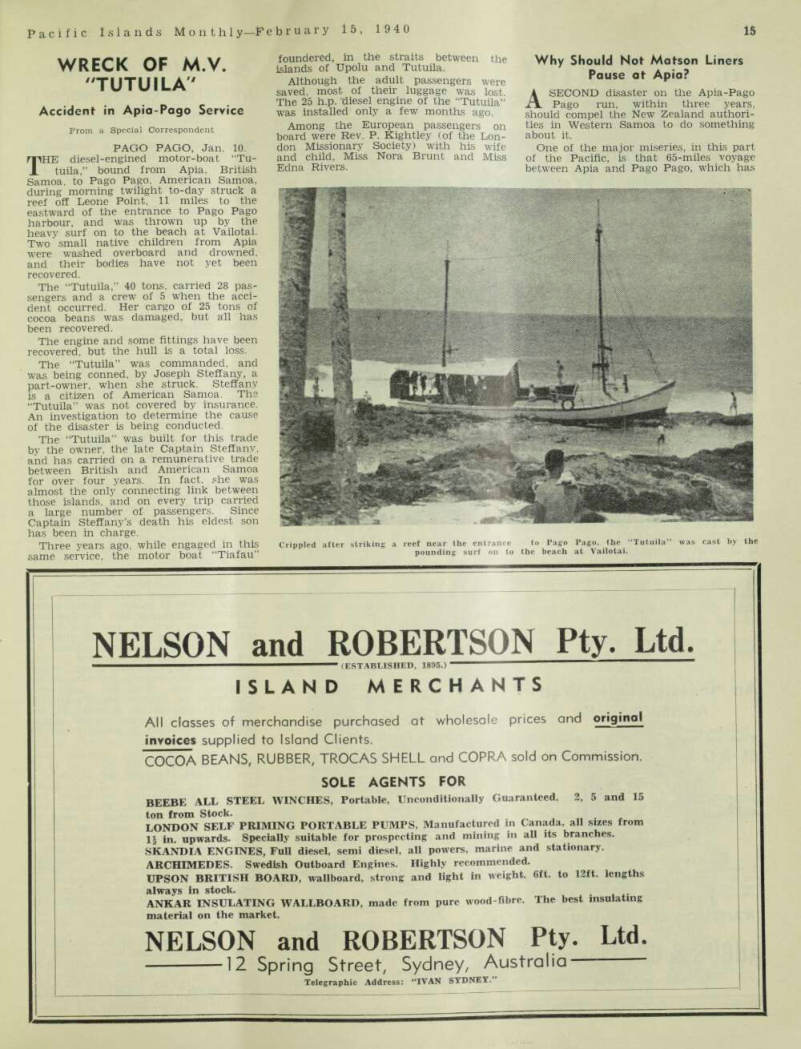
"Tutu I La"
Accident in Apia-Pago Service
From a Special Correspondent
Pago Pago, Jan. 10.
THE diesel-engined motor-boat “Tu tuila,” bound from Apia, British Samoa, to Pago Pago, American Samoa, during morning twilight to-day struck a reef off Leone Point, 11 miles to the eastward of the entrance to Pago Pago harbour, and was thrown up by the heavy surf on to the beach at Vailotai.
Two small native children from Apia were washed overboard and drowmed. and their bodies have not yet been recovered.
The “Tutuila,” 40 tons, carried 28 pas sengers and a crew of 5 when the acci dent occurred. Her cargo of 25 tons of cocoa beans was damaged, but all has been recovered.
The engine and some fittings have been recovered, but the hull is a total loss.
The “Tutuila” was commanded, and was being conned, by Joseph Steffany, a part-owner, when she struck. Steffany is a citizen of American Samoa. The “Tutuila” was not covered by insurance.
An investigation to determine the cause of the disaster is being conducted.
The “Tutuila” was built for this trade by the owner, the late Captain Steffany, and has carried on a remunerative trade between British and American Samoa for over four years. In fact, she was almost the only connecting link between those islands, and on every trip carried a large number of passengers. Since Captain Steffany’s death his eldest son has been in charge.
Three years ago. while engaged in this same service, the motor boat “Tiafau”
foundered, in the straits between the islands of Upolu and Tutuila.
Although the adult passengers were saved, most of their luggage was lost.
The 25 h.p. diesel engine of the “Tutuila” was installed only a few months ago.
Among the European passengers on board were Rev. P. Kightley (of the Lon don Missionary Society) with his wife and child, Miss Nora Brunt and Miss Edna Rivers.
Why Should Not Matson Liners
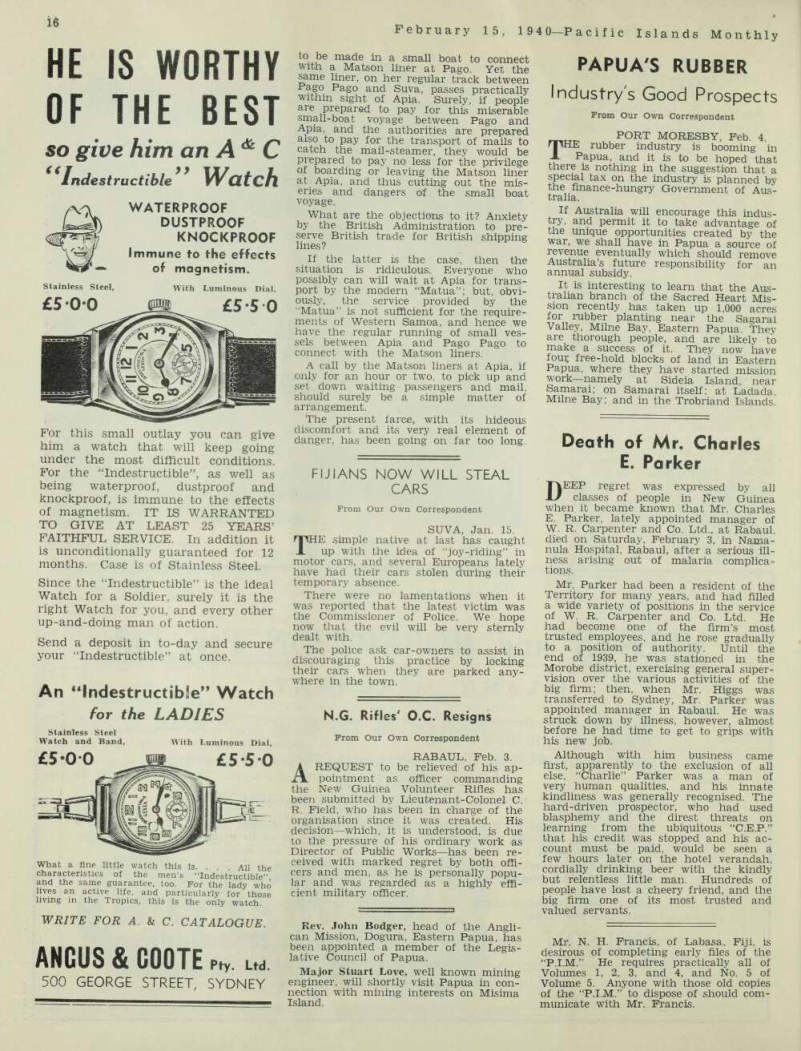
Pause at Apia?
A SECOND disaster on the Apia-Pago Pago run, within three years, should compel the New Zealand authori ties in Western Samoa to do something about it.
One of the major miseries, in this part of the Pacific, is that 65-miles voyage between Apia and Pago Pago, which has
Crippled after striking a reef near the entrance to Pago Pago, the “Tutuila” was cast by the pounding surf on to the beach at Yailotai.
to be made in a small boat to connect with a Matson liner at Pago. Yet the same liner, on her regular track between Pago Pago and Suva, passes practically within sight of Apia. Surely, if people are prepared to pay for this miserable small-boat voyage between Pago and Apia, and the authorities are prepared also to pay for the transport of mails to catch the mail-steamer, they would be prepared to pay no less for the privilege of boarding or leaving the Matson liner at Apia, and thus cutting out the mis eries and dangers of the small boat voyage.
What are the objections to it? Anxiety by the British Administration to pre serve British trade for British shipping lines?
If the latter is the case, then the situation is ridiculous. Everyone who possibly can will wait at Apia for trans port by the modern “Matua”; but. obvi ously, the service provided by the “Matua" is not sufficient for the require ments of Western Samoa, and hence we have the regular running of small ves sels between Apia and Pago Pago to connect with the Matson liners.
A call by the Matson liners at Apia, if only for an hour or two, to pick up and set down waiting- passengers and mail, should surely be a simple matter of arrangement.
The present farce, with its hideous discomfort and its very real element of danger, has been going on far too long.
Advertisements & other items, pp. 17-18 (2 items)
15
Pacific Islands Month! y—F ebruary 15, 1940
Nelson And Robertson Pty. Ltd.
(ESTABLISHED, 1895.> ““
ISLAND MERCHANTS
All classes of merchandise purchased at wholesale prices and original invoices supplied to Island Clients.
COCOA BEANS, RUBBER, TROCAS SHELL and COPRA sold on Commission.
SOLE AGENTS FOR
BEEBE ALL STEEL WINCHES, Portable, Unconditionally Guaranteed. 2, 5 and 15 ton from Stock. .
LONDON SELF PRIMING PORTABLE PUMPS, Manufactured in Canada, all sizes from \t in. upwards. Specially suitable for prospecting and mining in all its branches.
SKANDIA ENGINES, Full diesel, semi diesel, all powers, marine and stationary.
ARCHIMEDES. Swedish Outboard Engines. Highly recommended.
UPSON BRITISH BOARD, wallboard, strong and light in weight. 6ft. to 12ft. lengths always in stock. .
ANKAR INSULATING WALLBOARD, made from pure wood-fibre. The best insulating material on the market.
NELSON and ROBERTSON Pty. Ltd
l2 Spring Street, Sydney, Australia
Telegraphic Address: “IVAN SYDNEY.”
HE IS WORTHY
OF THE BEST
so give him
Indestructible’ Wdfc/l
WATERPROOF
DUSTPROOF
KNOCKPROOF
Immune to the effects
of magnetism.
Stainless Steel £5 00 With Luminous Dial, £5 10 <NJ o For this small outlay you can give him a watch that will keep going under the most difficult conditions.
For the “Indestructible”, as well as being waterproof, dustproof and knockproof, is immune to the effects of magnetism. IT IS WARRANTED
TO GIVE AT LEAST 25 YEARS’
FAITHFUL SERVICE. In addition it is unconditionally guaranteed for 12 months. Case is of Stainless Steel.
Since the “Indestructible” is the ideal Watch for a Soldier, surely it is the right Watch for you, and every other up-and-doing man of action.
Send a deposit in to-day and secure your “Indestructible” at once.
An “Indestructible” Watch
for the LADIES
Stainless Steel Watch and Band, £5-0-0 With Luminous Dial, £5-5-0 What a fine little watch this is. . . . All the characteristics of the men’s “Indestructible” and the same guarantee, too. For the lady who lives an active life, and particularly for those living in the Tropics, this is the only watch.
WRITE FOR A. & C. CATALOGUE.
ANGUS & GOOTE LtJ
500 GEORGE STREET, SYDNEY
Fijians Now Will Steal
Cars
Prom Our Own Correspondent
Suva, Jan. 15.
THE simple native at last has caught up with the idea of “joy-riding” in motor cars, and several Europeans lately have had their cars stolen during their temporary absence.
There were no lamentations when it was reported that the latest victim was the Commissioner of Police. We hope now that the evil will be very sternly dealt with.
The police ask car-owners to assist in discouraging this practice by locking their cars when they are parked anv where in the town.
N.G. Rifles' O.C. Resigns
Prom Our Own Correspondent
Rabaul, Feb. 3.
A REQUEST to be relieved of his ap pointment as officer commanding the New Guinea Volunteer Rifles has been submitted by Lieutenant-Colonel C.
R. Field, who has been in charge of the organisation since it was created. His decision —which, it is understood, is due to the pressure of his ordinary work Director of Public Works—has been re ceived with marked regret by both offi cers and men, as he is personally popu lar and was regarded as a highly effi cient military officer.
Rev. John Bodger, head of the Angli can Mission, Dogura, Eastern Papua, has been appointed a member of the Legis lative Council of Papua.
Major Stuart Love, well known mining engineer, will shortly visit Papua in con nection with mining interests on Misima Island.
Industry's Good Prospects
Papua's Rubber
From Our Own Correspondent
T Port Moresby, Feb. 4.
HE rubber industry is booming in Papua, and it is to be hoped that there is nothing in the suggestion that a special tax on the industry is planned by the finance-hungry Government of Aus tralia.
If Australia will encourage this indus try, and permit it to take advantage of the unique opportunities created by the war, we shall have in Papua a source of revenue eventually which should remove Australia’s future responsibility for an annual subsidy.
It is interesting to learn that the Aus tralian branch of the Sacred Heart Mis sion recently has taken up 1,000 acres for rubber planting near the Sagarai Valley, Milne Bay. Eastern Papua. They are thorough people, and are likely to make a success of it. They now have fou£ free-hold blocks of land in Eastern Papua, where they have started mission work—namely at Sideia Island, near Samarai; on Samarai itself: at Ladada, Milne Bay; and in the Trobriand Islands.
Death of Mr. Charles
E. Parker
DEEP regret was expressed by all classes of people in New Guinea when it became known that Mr. Charles E. Parker, lately appointed manager of W. R. Carpenter and Co. Ltd., at Rabaul. died on Saturday, February 3, in Nama nula Hospital. Rabaul, after a serious ill ness arising out of malaria complica tions.
Mr. Parker had been a resident of the Territory for many years, and had filled a wide variety of positions in the service of W. R. Carpenter and Co. Ltd. He had become one of the firm’s most trusted employees, and he rose gradually to a position of authority. Until the end of 1939, he was stationed in the Morobe district, exercising general super vision over the various activities of the big firm; then, when Mr. Higgs was transferred to Sydney, Mr. Parker was appointed manager in Rabaul. He was struck down by illness, however, almost before he had time to get to grips with his new job.
Although with him business came first, apparently to the exclusion of all else, “Charlie” Parker was a man of very human qualities, and his innate kindliness was generally recognised. The hard-driven prospector, who had used blasphemy and the direst threats on learning from the übiquitous “C.E.P.” that his credit was stopped and his ac count must be paid, would be seen a few hours later on the hotel verandah, cordially drinking beer with the kindly but relentless little man. Hundreds of people have lost a cheery friend, and the big firm one of its most trusted and valued servants.
Mr. N. H. Francis, of Labasa, Fiji, is desirous of completing early files of the “P.1.M.” He requires practically all of Volumes 1,2, 3, and 4, and No. 5 of Volume 5. Anyone with those old copies of the “P.1.M.” to dispose of should com municate with Mr. Francis.
European-Samoans
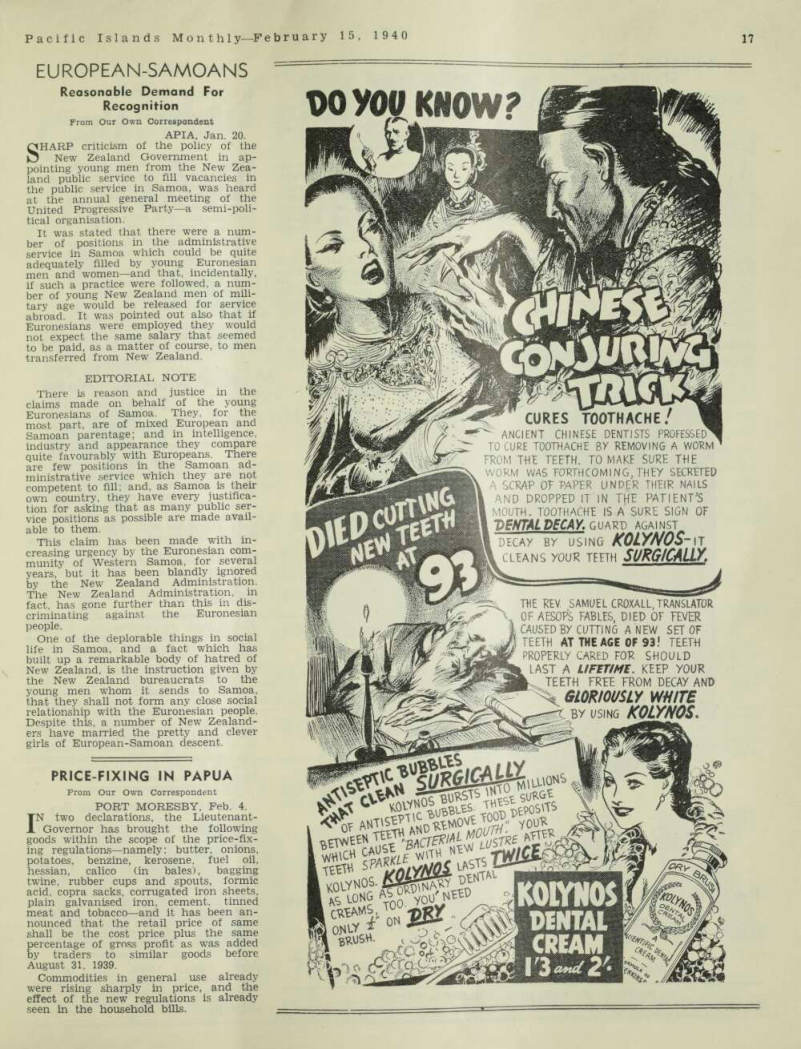
Reasonable Demand For Recognition
From Our Own Correspondent
Apia, Jan. 20.
SHARP criticism of the policy of the New Zealand Government in ap pointing young men from the New Zea land public service to fill vacancies in the public service in Samoa, was heard at the annual general meeting of the United Progressive Party—a semi-poli tical organisation.
It was stated that there were a num ber of positions in the administrative service in Samoa which could be quite adequately filled by young Euronesian men and women—and that, incidentally, if such a practice were followed, a num ber of young New Zealand men of mili tary age would be released for service abroad. It was pointed out also that if Euronesians were employed they would not expect the same salary that seemed to be paid, as a matter of course, to men transferred from New Zealand.
Editorial Note
There is reason and justice in the claims made on behalf of the young Euronesians of Samoa. They, for the most part, are of mixed European and Samoan parentage; and in intelligence, industry and appearance they compare quite favourably with Europeans. There are few positions in the Samoan ad ministrative service which they are not competent to mi; and, as Samoa is their own country, they have every justifica tion for asking that as many public ser vice positions as possible are made avail able to them.
This claim has been made with in creasing urgency by the Euronesian com munity of Western Samoa, for several years, but it has been blandly ignored by the New Zealand Administration.
The New Zealand Administration, in fact, has gone further than this in dis criminating against the Euronesian people.
One of the deplorable things in social life in Samoa, and a fact which has built up a remarkable body of hatred of New Zealand, is the instruction given by the New Zealand bureaucrats to the young men whom it sends to Samoa, that they shall not form any close social relationship with the Euronesian people.
Despite this, a number of New Zealand ers have married the pretty and clever girls of European-Samoan descent.
Price-Fixing In Papua
From Our Own Correspondent
Port Moresby, Feb. 4.
IN two declarations, the Lieutenant- Governor has brought the following goods within the scope of the price-fix ing regulations—namely: butter, onions, potatoes, benzine, kerosene, fuel oil, hessian, calico (in bales), bagging twine, rubber cups and spouts, formic acid, copra sacks, corrugated iron sheets, plain galvanised iron, cement, tinned meat and tobacco—and it has been an nounced that the retail price of same shall be the cost price plus the same percentage of gross profit as was added by traders to similar goods before August 31, 1939.
Commodities in general use already were rising sharply in price, and the effect of the new regulations is already seen in the household bills.
Advertisements & other items, p. 19 (2 items)
17
Pacific Islands Monthl y—F ebruary 15, 1940
w yog KNOW?
i 4 H r-
CURES TOOTHACHE/
ANCIENT CHINESE DENTISTS PROFESSED'
TO CURE TOOTHACHE BY REMOVING A WORM FROM THE TEETH. TO MAKE SURE THE
WORM WAS FORTHCOMING, THEY SECRETED
A SCRAP OF PAPER UNDER THEIR NAILS
AND DROPPED IT IN THE PATIENT'S
MOUTH- TOOTHACHE IS A SURE SIGN OF DENIAL DECAY, guard against
DECAY BY USING KOLYA/OS~ IT
CLEANS YOUR TEETH SURGICALLY.
THE REV. SAMUEL CROXALL, TRANSLATOR
of Aesop's fables, died of fever CAUSED BY CUTTING A NEW SET OF TEETH AT THE AGE OF 93! TEETH
PROPERLY CARED FOR SHOULD
LAST A U FIT I Ml. KEEP YOUR
TEETH FREE FROM DECAY AND
GLORIOUSLY WHITE
: BY USING KOLYNOS.
SUB
Mtl-UON'b
5W S* UitO
SURGE
KOLYNOS
DENTAL
CREAM
13 2^ a m OR> *%k % *
Muddled Medical
Standard
Men With Malaria Rejected in New Guinea
From Our Own Correspondent WAU, Feb. 4.
A MATTER which is causing com ment, and some consternation here, is the medical conditions under which volunteers for the Second A.I.F. are handicapped. Men of splendid physique are volunteering, and are being rejected, principally on account of -having traces of malaria in their systems.
One well remembers contingents from almost every malaria-ridden country in the Empire serving in the last war. Why has this malaria scare taken on such a significant aspect now? Is there not a means known to medical science of vir tually eradicating malaria in men who
are urgently needed in their country’s service and who, apart from this one factor, are physically fit and anxious to serve?
It is very discouraging to men, who are eager to serve, to be rejected for an intermittent bout of fever, when in every other respect they are completely fit.
Women pen friends in the Pacific are sought by Mrs. M. Squires, of 60 Park way, Knightsbridge, South Australia.
Mrs. Squires writes: “I should like women pen friends. I have two sons and I am interested in stamp-collecting, knitting, etc. I should like to hear from people who have stamps for exchange."
Rainfall in Suva in 1939 totalled 147.15 inches, or 26.48 above the annual aver age of 120.67 inches. There were 348 wet days during the year, against an average of 247, due to the abnormally long wet season early in 1939.
Rabaul Lives
Again
Improvement' in Business
Prom Our Own Correspondent Wwrrn i RABAUL, Jan. 24.
HILE developmental activities in the Territory under war conditions are not numerous, business in Rabaul has brightened up considerably, since it be came known that the administrative headquarters will remain here—at least for the duration of the war.
Those who profess to know are confi dent now that the capital will not be removed elsewhere—it is felt that re sponsible officialdom is satisfied that the new seismological observatory will give the community sufficient warning of Inv impending eruption.
There had been comparatively little bunding activity here since the eruption’ and, now, all sorts of new building pro jects are under discussion.
Supply
Port Moresby Water Supply Derails of Financial Plan
Prom Our Own Correspondent
Port Moresby Feb 5
rpHE total estimated cost of the Port ± Moresby water supply, as planned by the Commonwealth Government stands at £48,050, of which the Common wealth will contribute £12,000. The bal ance of £36,850 will be loaned to the Papuan Administration by the Common wealth.
Any additional cost, due to economic conditions arising out of the war, will be met by the Commonwealth to the extent °£ cent - of the estimated cost of £48,050.
The terms of the loan are, interest at 3 4 per cent, per annum, over a period of 40 years. Maintenance charges, and profit or loss, to accrue to the Common wealth and the Papuan Administrations in proportion to the capital contributed by the two authorities.
The Commonwealth will pay only for water supplied to its ships. The defence forces will not pay for water.
The old water supply loan (of which the balance still outstanding is £1996) is to be repaid to the Commonwealth on the present basis. The annual payment for this is £3OO, while that for the new loan will be approximately £lBOO.
Geese Kill Their Golden Egg
From Our Own Correspondent
Suva, Jan. 15.
A PROCLAMATION in the Fiji Gaz ette announces that the export of kauri gum from the Colony will be pro hibited as from April 1.
The reason is that the natives, in order to get the gum, damage the living trees, and this comes into conflict with the very laudable forest conservation policy of the Government.
The Rabaul Hotel, which recently was extensively renovated and recondi tioned, has now been connected to a sep tic tank installation, which gives the establishment the benefit of sewerage.
Advertisements & other items, pp. 20-22 (3 items)
m
A.
ML Delicious IXL Canned Foods—Jams—Soups & Sauces Stand Supreme in public approval 9 Obtainable -from all Leading Island Storekeepers. a JONES & CO. PTY. LTD., HOBART & SYDNEY.
19
Pacific Islands Monthl y—F ebruary 15, 1940
of that
Rid
Get
Run Down
i
CALCIUM
DEPRESSED FEELING!
with New Pep Vigour & Vitality
HEART* TEETH. BLOOP
BONES - NERVES
PHOSPHORUS
BRAIN - C LANDS
BLOOD
;\F E R R U M
' X i BL
POTASSIUM
-[muscle .. BLOOD
SODIUM
(BLOOD
BIDOMAK
contains them a11...in
an easily assimilated
& pre-dissolved liquid form
If you are nervy, run down, ailing, and suffering from the distressing after-effects of tropical lethargy, nine times out of ten the food you eat is not doing you proper good. It simply passes through your system, incompletely digested and poorly assimilated.
The real cause of these troubles is the absence of vital mineral salts from the food, which leads to mineral-starved nerves and all the depressing effects of nervous disorders. Get a supply of these minerals, which include ferrum, calcium, potassium, sodium,
phosphates, glycerophos-
phates and sucrose, into the system, and nerves and that run-down, depressed feeling will vanish.
BIDOMAK" Tastes Fine—"BIDOMAK' You Well Will Make
FEELS YEARS YOUNGER AFTER
TAKING "BIDOMAK"
Dear Sirs:—“Bidomak as a nerve and brain tonic is, really unequalled. 1 have suffered from very bad nerves for years. I have tried almost everything but nothing seemed to do me any good, even doctors failed, until I started taking BIDOMAK. I have taken three bottles and started on my 4th bottle, and since I have been taking this wonderful tonic I feel a different person in every way. 1 feel years younger and more lively and energetic, “thanks to BIDOMAK”. (Signed) Mrs. E. Sharp, Snr., Springhill. N.S.W.
“BIDOMAK” tastes fine, and contains all the necessary minerals in a pre-dissolved, liquid form.
After taking a course of • BIDOMAK” you again feel fit and well. Your energy is magnified, your brain sharpened to razor-edge, you eat, sleep and feel better. You regain selfconfidence, and are restored to a health level where you’ll glory in vitality.
DO YOU SUFFER FROM
THESE DISORDERS?
Nerves, Listlessness, Langour, Headaches, Nervous Dyspepsia, Anaemia, Lack of Confidence, Tight, Screwed-up Feeling in the Brain, Neuralgia, Nerve Pains, “Depressed Feeling”?
A basic cause of these disorders is a deficiency of vital mineral elements in the nerve cells and fluid. This deficiency can be corrected by taking “BIDOMAK”.
Start to-day on a course of
AT
The Tonic of the Century
ALL LEADING ISLAND STORES
V\\\W t 6
PTRRIt«
V/ SAUCE
the'Wcf'ld ever
ECONOMICAL. BECAUSE YOU NEED
JUST A FEW DROPS AT A TIME -
McILRATH’S
LEAD IN LOWER PRICES
for
QUALITY GROCERIES
I.X.L. Best Assorted Jam, 12-oz., 6 doz 36/- case Sunshine Full Cream Pwd. Milk. 12-oz., 3 doz 39/- case Ideal Unsweetened Milk, 6-oz. or 12-oz 22 case Rosa Full Cream Cond. Milk, 14-oz., 4 doz 28 - case Red Feather Camp Pie, 8-oz. 5d., 12-oz. 6id„ 16-oz. 7£d. tin New Season’s 3-Crown Choice Evap. Apricots 1/3J lb.
Best Australian Sultanas s£d. lb. 5 3 doz.
I.X.L. Golden Sweet Corn, 5-oz. s£d., 8-oz. 7id.. 16-oz. 1 1J tin Edgell’s Green Peas, 10-oz. 6d. tin 5/9 doz.
Gartside’s Green Peas, 10-oz. s£d. tin 5/3 doz.
I.X.L. Baked Beans, 4-oz. 3£d., 10-oz. 6£d., 16-oz 9£d. tin Gartside’s Prepared Apple, 10-oz. sid. tin 5/3 doz.
Flybane Liquid Insect Spray, i-gal. tin 5/- each Rosa Pure Household Soap, large, 6d. bar 5/9 doz.
Assorted Toilet Soaps, 4-oz., 21-d. cake 2/3 doz.
Capital Sand Soap. 15-oz„ 2id. cake 2/- doz.
Dandy Maize Starch, 5-lb. parcels 7d. lb.
Special Vintage Royal Reserve Port or Sherry, 26-oz 3/6 bot.
Special Vintage Brown Muscat, 26-oz 2/- bot.
“Yoga” Tea, Choice Ceylon Blend, 6-lb. tins 2/5 lb.
All Prices f.o.b. Sydney Cases and Packing Free.
WRITE FOR OUR NEW EXPORT LIST.
McILRATH’S Pty. Ltd.
EXPORT DEPARTMENT
202-204 PITT STREET, SYDNEY, AUSTRALIA
"McNicoll's Long-Tailed
Bird of Paradise"
From a Special Correspondent
Rabaul, Jan. 20.
AS is usually the case when some new specimens come before the public eye, there is some controversy arising as to whom honour is due for discovering the long, white-tailed Bird of Paradise, which has been classified by the Aus tralian Museum as “Taeniaparadisea macnicolli”. The discoverers are named, according to the “Australian Zoologist” as Messrs. Taylor and Black, of the Mount Hagen-Sepik patrol.
As already stated in the “P.1.M.” (Janu ary issue) a bird of this description was reported by the late Jack Hides (Papuan Service) in May, 1935; by Ivan Champion (Papuan Service) in 1938; and was re ferred to in correspondence between the Natural History Department of Brit ish Museum and Sir Hubert Murray in December, 1938.
New Guinea residents knew nothing of this new specimen from their own terri tory until reports appeared in the South ern press. Reports now state that several cases of rare specimens of bird-life, col lected on the Hagen-Sepik patrol, were
despatched to an Australian Museum, where presumably they will be placed on exhibition.
New Guinea gets nothing but the debit note for the patrol, and that runs into many thousands. Incidentally, some very fine photographic records were obtained on the patrol; but of these, also, we know nothing. Time, possibly, may reveal them in some form or other.
Assuming that the zoologist, Mr. King horn, is aware of all classifications of ornithological specimens, it is safe to say that neither Hides nor the collector.
Shaw Mayer, furnished the data necessary to allow this long-tailed Bird of Paradise to be officially classified. So, actually, there can be no objection to the credit, for supplying this data, going to Taylor and Black. The latter are officers of the service of which Sir Walter McNicoll is the head, and it seems fitting that the name of our scholarly Administrator should be perpetuated in the ornitho logical history of New Guinea.
The Naming of the Bird
Letter to the Editor MY attention has been drawn to a let ter in your January issue entitled “Why McNicoll?”, relating to the naming of a Bird of Paradise. It is one of those attacks, so easy to make, to which the person at whom they are directed has no opportunity of replying.
It is only natural that one should wonder at the naming of the bird “Mc- NicoH’’, when it was discovered by Mr.
Taylor. But may I point out, at the risk of incurring parental displeasure, that my father strenuously opposed the nam ing of the bird after himself, both to the discoverer and the Museum authori ties.
However, it was Mr. Taylor’s bird, and his wishes as to its name were respected.
As you point out in your editorial note, it was a very gracious gesture in recog nition of unflagging interest in a most outstanding patrol.
A leading Sydney ornithologist tells me that the new discovery has created great interest in bird circles throughout the world. The discovery of a new spe cies is a rare occurrence, these days, and the search for new species of Bird of Paradise has been carried out fruit lessly for many years.
It might interest New Guinea readers who are curious about the bird to know that there is a full-page coloured plate in “The Zoologist” (current issue).
I am, etc.,
David R. Mcnicoll.
Rose Bay, Sydney, 22/1/1940.
Samara! Wharf
Sam Arm, Dec. 31.
THE work of extending the Samarai wharf has been interrupted by fin ancial conditions imposed by the war, and an extension of only 4 feet, instead of the contemplated 60 feet, has been completed. Repair work on the original wharf is being carried out; and that, it is presumed, will be the end of the matter.
Mr. A. H. Cresswell returned to N.G. in mid-January from an extensive tour of Europe, U.S.A. and Japan. After visiting his plantation in the Baining District, New Britain, he left for the Mor obe Goldfields.
To Combat The
Chinese
Long-Delayed Move by French in Tahiti
YEAR by year, decade by decade, the Chinese traders and artisans of French Oceania have grown in numbers, and steadily have thrust aside the Euro pean trader and artisan.
Fifteen years ago, British travellers commented upon this, and made China’s economic domination of Polynesia’s most beautiful group a matter of simple cal culation-twenty or thirty years.
But, at long last, the French have awakened and, through their Chamber of Commerce in Tahiti, are trying to limit the operations of the restless and expanding Chinese. We fear it is too late —the Chinese now have a very strong financial grip upon the territory.
The Tahiti Chamber of Commerce has adopted a unanimous motion to place before Chef de la Colonie the following points:— “That foreigners, conforming often to a standard of life vastly inferior to ours, and increasing in numbers and security, are invading to an ever-increasing ex tent every branch of commerce, trade and industry.
“That the complete monopoly of these branches of the economic structure of the country, if not speedily remedied, will have the gravest consequences.
“That in training these foreigners on a footing of absolute equality with our
own nationals, we are protecting the former, who, benefiting by the advan tages already enumerated, have not had to face the hardships and duties which have been the portion of Frenehmen.
“That as France before, in grave cir cumstances, depended upon Frenchmen, it appears reasonable that, in order to prevent their elimination, the Adminis tration should now assist them to the greatest possible extent.”
The following recommendations have been made: — “That, in a general manner, and each time competition exists, foreigners shall not be allowed to tender for public ser vices.
“That, as a result of the resolution taken by the Chamber of Commerce, it will obtain the release of certain licenses granted to foreigners, which will be re established in favour of our nationals.
“That steps be taken to ensure that foreigners do not under cover of trade names, or under cover of the names of their wives, exercise trades reserved for French citizens.”
The Administration of Tahiti (says the “Bulletin du Commerce,” of Noumea) is sufficiently empowered to put a stop to foreign competition, by the application of certain laws, and the Chinese danger will be combatted with the greatest energy.
Mr. G. C. Foulis, who went to Fiji from Australia some years ago to take up cattle breeding at Tavua, Fiji, died on January 14. He was associated with the finders of the Emperor mine and after the establishment of the Tavua goldfield he opened a butchery business there in conjunction with his cattle interests.
Japan Attacks Ceylon's
Papain Industry
CEYLON’S monopoly of the papain in dustry—papain is a vegetable pep sin extracted from the paw paw plant, or from the juice of its unripe fruit— is now threatened by an industry which has been established in her mandated islands by Japan.
The United States consumes about 95 per cent, of the total world output of papain and, until the last couple of years, the whole of this import came from Ceylon. But in the first half of 1939 Japan supplied 10,720 lbs. of papain out of a total importation into U.S.A. of 130,000 lbs.; and this contrasted with 7850 lbs. supplied by Japan in the first half of 1938 out of a total of 22,675 lbs.
It appears that the Japanese, in 1926, established an agricultural experimental station in Ponape, for the study of medi cinal plants, and a small Tokio firm planted 125 acres of paw paw in 1934.
Three years later, in 1937, a plant for drying papain was erected and produc tion began. At the beginning of 1939 the Ponape plant was producing 2 metric tons per month.
The company which has this under taking in hand expects that by 1944 it will be producing 400,000 lbs. of papain per year—an amount roughly equivalent to double the consumption of the United States.
Rev. Leonard Hurst, secretary for the London Missionary Society, returned to Sydney on January 15 from a visit to Papua with Rev. Norman Goodall, L.M.S.
Foreign Secretary.
Advertisements & other items, pp. 23-24 (1 item)
Tooheys
KEEP"THE FLAG FLYING
-- * \ N ' ' >' /
FLAG* ALE
Established 1868 7
GOWINGS
Sydney’s Leading Store
EXCLUSIVELY FOR MEN
will have your
SUIT TO MEASURE
TAILORED AND AWAITING
YOUR ARRIVAL IN SYDNEY
Write for
FREE PATTERNS
and Self Measurement Form . . .
COWING BROS. LTD.
Market and George Streets, Sydney
BISCUITS
PARTIES .
PICNICS
SAVOURIES . . MilklM*
LIGHT MEALS. . BZDEEECIZS
PLAY LUNCH . .
CHILDREN . . .
DESSERT
DRINKS
m
MILK ARROWROOT
NUTTY CRISPS
few
PATSY BUTTERMILK
There’s a tempting variety of Joyce Biscuits for all occasions.
You will find some of your favourite flavours in the selection suggested above. Order a pound.
B I SCUITS
// unobtainable locally, write to
JOYCE BISCUITS PTY. LTD
Camperdown, Sydney, N.S.W.
TRADERS are invited to write for full particulars and price lists.
JOYCE
Expedition To Tonga
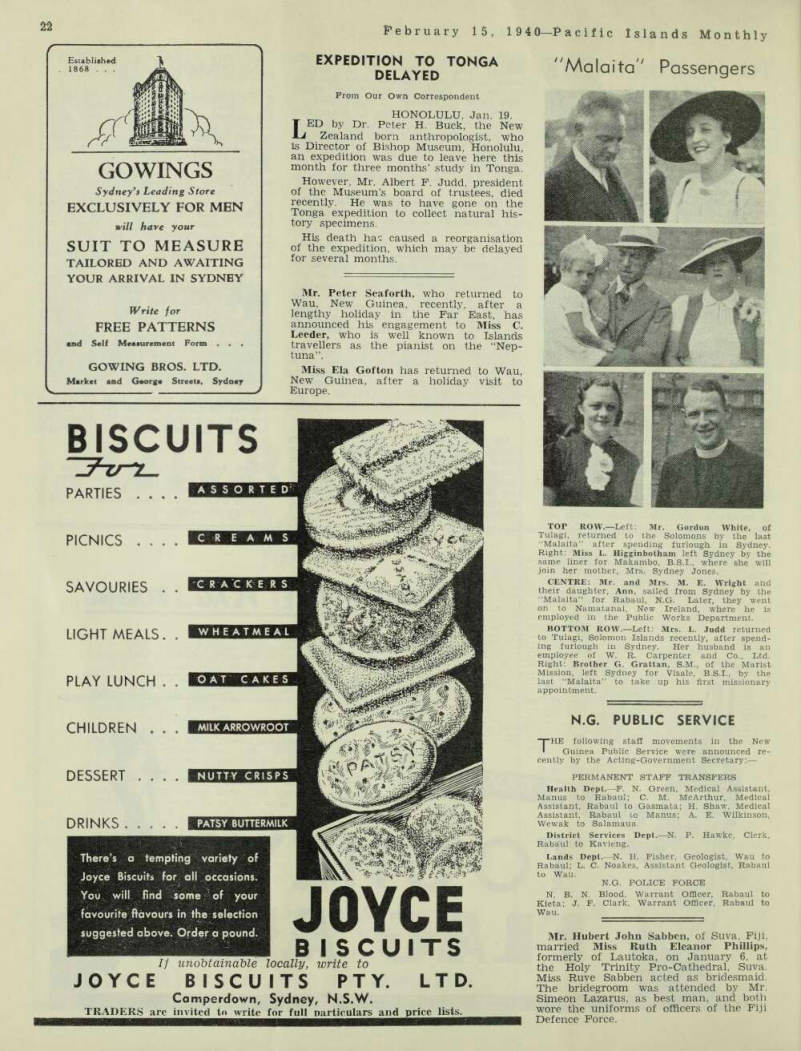
Delayed
Prom Our Own Correspondent
Honolulu. Jan. 19.
T ED by Dr. Peter H. Buck, the New -Li Zealand born anthropologist, who is Director of Bishop Museum, Honolulu, an expedition was due to leave here this month for three months’ study in Tonga.
However, Mr. Albert F. Judd, president of the Museum’s board of trustees, died recently. He was to have gone on the Tonga expedition to collect natural his tory specimens.
His death ha 1 : caused a reorganisation of the expedition, which may be delayed for several months.
Mr. Peter Seaforth, who returned to Wau, New Guinea, recently, after a lengthy holiday in the Far East, has announced his engagement to Miss C.
Leeder, who is well known to Islands travellers as the pianist on the “Nep tuna”.
Miss Ela Gofton has returned to Wau, New Guinea, after a holiday visit to Europe.
"Moalaita" Passengers
TOP ROW.—Left: Mr. Gordon White, of Tulagi, returned to the Solomons by the last “Malaita” after spending furlough in Sydney.
Right; Miss L. Higginbotham left Sydney by the same liner for Makambo, B.S.I., where she will join her mother, Mrs. Sydney Jones.
CENTRE: Mr. and Mrs. M. E. Wright and their daughter, Ann, sailed from Sydney by the “Malaita” for Rabaul, N.G. Later, they went on to Namatanai, New Ireland, where he is employed in the Public Works Department.
BOTTOM ROW.—Left: Mrs. L. Judd returned to Tulagi, Solomon Islands recently, after spend ing furlough in Sydney. Her husband is an employee of W. R. Carpenter and Co., Ltd.
Right; Brother G. Grattan, S.M., of the Marist Mission, left Sydney for Visale, B.S.I., by the last “Malaita” to take up his first missionary appointment.
N.G. Public Service
THE following staff movements in the New Guinea Public Service were announced re cently by the Acting-Government Secretary;—
Permanent Staff Transfers
Health Dept.—F. N. Green, Medical Assistant.
Manus to Rabaul; C. M. McArthur, Medical Assistant, Rabaul to Gasmata; H. Shaw, Medical Assistant, Rabaul to Manus; A. E. Wilkinson, Wewak to Salamaua.
District Services Dept.—N. P. Hawke, Clerk, Rabaul to Kavieng.
Lands Dept.—N. H. Fisher, Geologist, Wau to Rabaul: L. C. Noakes, Assistant Geologist, Rabaul to Wau.
N.G. Police Force
N. B. N. Blood, Warrant Officer, Rabaul to Kieta; J. F. Clark, Warrant Officer, Rabaul to Wau.
Mr. Hubert John Sabben, of Suva, Fiji, married Miss Ruth Eleanor Phillips, formerly of Lautoka, on January 6, at
the Holy Trinity Pro-Cathedral, Suva.
Miss Ruve Sabben acted as bridesmaid.
The bridegroom was attended by Mr.
Simeon Lazarus, as best man, and both wore the uniforms of officers of the Fiji Defence Force,
Natives

Nazi Attitude Towards Natives Claim That Miscegenation Means Racial Collapse
HERE is the racial philosophy of Nazi Germany. It is v, literal translation of extracts from a pamphlet by Dr. Gun ther Hecht:— There can be no doubt whatsoever that certain European people are born rulers.
They have the right, as well as the duty, to make use of their genetic superiority; and if. for the sake of humanitarian, pacifist and religious ideologies, they neglect their obligations, they are bound to perish.
One of the most important ways in which European nations must preserve their superiority and position as rulers is the avoidance of miscegenation. Racial mixing is clearly detrimental to either of the two partners, because the offspring show a tendency toward anti-social be haviour, and a lack of moral principles.
Unfortunately, the chief colonial pow ers of to-day have not always borne these facts to mind. The English, indeed, have attempted to maintain an attitude of “splendid isolation” toward the inferior races; but the French, steeped in the humanitarian liberalism of the 18th cen tury, have committed the sin of miscege nation.
Even the British, however, owing to the corrosive influence of the Jews, now show a weakening of their racial conscience toward miscegenation and racial mixing.
Nevertheless, once the Englishman be comes fully aware of the danger, he strikes, and strikes hard. Thus, in South Africa, a law has been passed prohibiting “relations” between black and white, and the prohibition of marriage itself is now under discussion. The Union of South Africa is to-day clearly evolving a native policy which is based upon the full re cognition of the natural differences be tween black and white, and the superior ity of the position of the latter. In the schools, the universities and the hospitals, there is now complete segregation.
The principles which must guide a National Socialist native policy are threefold. Firstly, it is imperative to recognise and stress the fact that our modern civilisation is almost exclusively the creation of Nordic genius, and of nobody else. From this it follows that the native must be kept in his own home and sphere. Under no circumstances must he be brought to Europe, be it as servant, labourer, or student. “The age old frontier between Europe and Africa lies in the Sahara”. Secondly, the native can never become a citizen of the Ger man Empire; and. thirdly, marriage and intercourse between Europeans and natives, and people of mixed blood, must
be prohibited.
As for educational policy, on the whole it is undesirable to introduce European subject-matter into native schools. Un usually gifted natives might be provided with an understanding of the simple forms of European civilisation, and some might even be taught one or more of the European languages, so that they could be used in the lower ranks of ad ministration. Natives, however, should definitely be barred from the higher schools and universities, on the grounds that they have no creative contribution to make in the academic field, and that the production of native pseudo-scholars will endanger European political security.
The native should be allowed access to
the social life of the white man only insofar as it does not lead to his up-root ing. He must be barred from the thea tres, picture-houses and health resorts of the white population. The religious life of the native must not be interfered with, even when we shake our heads and smile.
The will of the Creator has made the human races profoundly different. Only if we respect these differences will there be peace among the peoples of the world.
Miss Carol May Latter, of Sydney, was married in Rabaul in January to Mr.
Edward Hann, of Ningau Plantation, in the Witu Group. New Guinea, Mr. H. J.
Rawnsley gave the bride away, and Mrs.
J. W. Smith acted as matron-of-honour.
Mr. Fairfax Ross was best man.
Advertisements & other items, pp. 25-26 (1 item)
Nestle S^Milr
For the health the family
N> jr—
YOU MUST HAVE
m % m r-i »
MILK
3 r|t Nothing is so beneficial, in- ; SWEETEN®# deed essential, to the health of children and grown-ups as an adequate supply of pure milk. But, it is important to guard against contaminated milk, especially in hot climates, and that is why you should always use Nestle’s Sweetened Condensed Milk.
Nestle’s Sweetened Condensed Milk is sealed against all risk of contamination and you can open every Nestle’s tin in the certain knowledge that the contents are absolutely pure and fresh. Nestle’s Sweetened Condensed Milk is the safest milk you can buy.
' I-..- Pr ®Pared SPECIALLY
Ist,' REPA RED IN AUSTRAIIMgp
M LE AND ANGLO-SWISS COM M
0 (AUSTRALASIA) LTD-
NESTLE S^MILR
COPYRIGHT 8.228
25 YEARS OF SERVICE
William E. Reed
(Established 1913)
BROKER & AGENT
Union House, 247 George St., Sydney For all Plantation and Trading Requirements. Enquiries welcome.
ATTACHE CASES
mm
From 4/11 to 10/11
Beatzall Attache Case No. 88. is a special export line. Made of glossy grained fibre, it has neatly rounded edges, metal - bound lid and rolled brown metal body frame.
The corners are reinforced. Two snap locks, with keys. Metal handle.
The Beatzall Attache Case is light and serviceable. It is smart-looking . . . . long-wearing. Made in sizes from 12 to 20 inches, retailing from 4/11 to 10/ 11.
Ask for Beatzall 88.
BEATZALL ATTACHE CASES
Traders are invited to write for full particulars of all
TRAVEL and LEATHER GOODS.
FORD SHERINGTON, LTD.
MANUFACTURERS (WHOLESALE ONLY),
KIPPAX STREET SYDNEY.
"Cheeky Natives"
Statement 1 by Resident Magistrate
Letter to the Editor rERE is a tradition in the Papuan Service that a District Officer, no matter how bitterly his administration is attacked, should remain silent. But, in these days, when every hint of malad ministration is eagerly snapped up by the German propogandist, I think it is wise that some reply should be made to such attacks.
In your issue of December, “W” writes bemoaning the fact that Umuna, the location of the mine on which he works at Misima, is not a proclaimed township, and that the native labourers there make the night hideous by beating drums, etc,, much to everyone’s annoyance. Poor ‘W” admits that at Bwagaoia, the seat of Government, five miles away, no such disturbances occur, and this is very satisfactory.
It would seem, therefore, that those in charge at Umuna are not controlling their native labourers properly, if “W” is to be believed. Therefore, “W” should lay his complaint before the manage ment there.
Right through Papua, there are certain settlements, mostly Government head quarters, where certain regulations for the control of natives are brought into force. In a country whose native popu lation varies in character, from head hunters in the west to native clerks in the east, it would be clearly impossible to bring into general force the domestic regulations of the established settle ments. In the case of plantations (and mines) the practice is to leave the con trol of the native staffs to the manage ment. This system, combined with regu lar visits from Government officials and police, has been found to work very satis factorily; but, apparently, at the location where “W” is employed, there is some thing wrong; and, as usual, he turns on the Government, as being responsible.
So far as assaults on native labourers are concerned, it is a strange fact that those whites who have appeared before the local Court on charges of assault can be counted on the fingers of one hand, but they have usually repeated their offences. The balance of the white folk on Misima compare with any similar population in any part of the Empire, and their standard is high. ovP >wS ld appear to me that “W” (why arent these people brave enough to sign ™?^ names?) would be Quite happy g S only he were allowed to bash up a native ip C n?P’> ona i ly r espe . clally for “ dum b inso lence that may be—and if he couid be relieved from the drum-banging which he states is allowed at Umuna S 8 q ” es H° n which I would like to ask W and others of his ilk. I have never yet received a satisfactory reply to it. Supposing he were a passenger on h £ at l and a 12-stone steward made bath too hot, or served him with cold soup, would he give the offend ing steward “a slap in the face with his open hjmd”? I am sure he would not.
But if a Papuan servant of about seven stone should commit either of these offences, I can imagine with what zest the heroic “W” would sail into the offender for his “dumb insolence”. Queer, isn t it.
I am, etc.,
Alexander Rentoul,
Resident Magistrate.
Misima, Papua, 18/1/1940.
Burglary At Pago Pago
From Our Own Correspondent
A Apia, Jan. 11.
REMARKABLE feat was performed by a gang of criminals, presumably natives, and apparently eager for the laurels of Chicago gangsters, who on New Year’s night broke into Burns, Philp’s office at Pago Pago and removed therefrom the heavy safe, which con tained a considerable amount in cash.
The office is in the upper storey of the building, and at least three men were required to lift the safe. Probably a truck was used for the getaway.
Up to January 10 no trace had been found of the safe or the offenders.
Mr. H. Lee Gerrard has been granted a commission as Lieutenant-Engineer and has joined the Royal Navy. He was seven years with the C.S.R. Co. in Fiji, and for three years was on R.M.S. “Aorangi.”
He is the only son of Mr. and Mrs.
H. L. Gerrard, of Fiji.
A Forgotten
Gastropod
Dirty Work by Hawaiian Tourist Bureau Suspected
By A. C. Rowland
IN the mountains of Tahiti, and of the neighbouring islands, is a species of snail called Areho, and by scientists a fearsome Latin title longer by far than the creature itself.
It carries with it its home—a spiral shell closely resembling the periwinkle.
The colours and markings of the shells of one valley differ from those found in ad jacent or more distant valleys. Usually it is found clinging to the underside of the broad leaves of the Fe’i plant.
Obscure and insignificant in its remote mountain home, this modest and retiring gastropod once shook the scientific world to its foundations.
Early in this century, a prowling gas tropodologist discovered that the Areho of Tahiti (contrary to the reputation of the snail family) was positively gallop ing along the broad highway of evolu tion In other words, while the human race— notwithstanding its pomp of brass bands and boast of progress—was ad vancing only a microscopic fraction of a millimeter during a given period of years, the Areho of Tahiti had advanced a kilometer along the road to perfection.
This intelligence brought to Tahiti an eminent professor of zoology from one of the great universities of the Eastern United States.
The professor was one of those delight ful personalities who can impart clear
ness to the most obstruse subject and endow it with interest and charm. Dur ing nearly twenty years he devoted him self to the study of the Tahitian Areho; returning to the islands for long sojourns, at intervals of three or four years. He confirmed the announcement made by the gastropodologist that in the observa tion of the Areho one could actually see nature’s laws of evolution at work, instead of inducing them from the study of fossil trilobites or a yellow tooth found in the gravel beds of Java.
But the human mind—even the colos sal scientific mind —is fickle.
At the end of twenty years, when the professor had been given a banquet of honour by his university, endowed with medals and diplomas by learned societies, and had embodied the results of his re searches in a series of handsome volumes copiously illustrated with expensive plates of many colours, the scientific world be came excited over dinosaur eggs in the Gobi desert, and the Areho of Tahiti faded into the night of things forgotten.
There was a rumour at the time that the Hawaiian Tourist Bureau had a hand in this. This patriotic body is alleged to have informed United States institu tions of learning that Hawaii possesses a perfectly good gastropod, as suitable for study as the Tahitian Areho.
Be that as it may, this prodigy of evo lution is proceeding on our interior mountains unobserved; the Areho is at peace; and the professor’s handsome tomes are gathering dust in university libraries; while science is chasing fresh rainbows which loom over the distant hills.
We often have wondered what form the Areho will finally evolve. The pro fessor never told us.
But when we reflect that the primordial cell bom in the Azoic ooze eventually grew into brontosauri, we hear about, and whales we actually see, it is not too fantastic, perhaps, to believe that in some future age—when our unstable old planet, re-arranging its land masses, shall have brought again to the light of day the lost continent of Mu, and thereby raised the mountains of Tahiti to be snow-capped rivals of Cotopaxi and Kilimanjaro—the humble Areho will have evolved to an ele phant, carrying its own howdah, or a pterodactyl China Clipper domesticated to carry over the oceans the speed mani acs of that time, long after its •mechani cal prototype has been rendered immobile by the reckless waste and final exhaus tion of the world petroleum supplies.
When the ship “Challenger” was taking deep-sea soundings in these waters, appalling depths were found all around Tahiti —even in the channel separating Tahiti and Moorea. Therefore, should the ocean bed be raised to the surface, the mountain massif of Tahiti would overshadow all other Equatorial moun tains.
Mr. J. R. Waddell, of the New Guinea Public Health Department, Namatanai, New Guinea, recently married Miss Gwen Tasker, of Sydney, in the Methodist Church, Rabaul.
Mr. Syd. Scholes, of Salamaua, New Guinea, recently announced his engage ment to Miss Phyliss Partridge, of Kojo nup, Western Australia. They will be married in New Guinea in April.
Rev. B. R. C. Nottage, Presbyterian missionary at Tongoa, New Hebrides, is at present spending long furlough in New Zealand.
Advertisements & other items, p. 27 (1 item)
A GRACE BROS’ catalogue
BRINGS THE BIGGEST STORE IN
AUSTRALIA TO YOUR DOOR
Let us put you on our Mailing List To all addresses on our list we send Free of Charge Six Catalogues a year, including two Sale Books, when prices of all goods, except Proprietary articles, are marked at attractive reductions.
WRITE TO GRACE BROS. FOR EVERYTHING.
Prom our huge selection of merchandise we are practically able to meet your every requirement.
Should you not see exactly what you need in any of our Catalogues write in Just the same. If not in stock we will do our utmost to procure it for you.
When next in Sydney, call and inspect our extensive range of attractive merchandise.
CATALOGUES POST FREE ANYWHERE!
GRACE BROS. Pty. Ltd.
Broadway SYDNEY 'Phone: M 6506 C $Q m f, SI €
Mission Journal Discontinued
After 62 Years
THE American evangelical magazine, “The Missionary Review of the World”, recognised a quarter of a century ago as the leading general and inter denominational missionary journal in the world, ceased publication in December, 1939. It had been issued each month continuously for 62 years.
Founded in January, 1878, the maga zine had but three editors during its long existence —Rev. Royal G. Wilder (form erly a Presbyterian missionary in India), who established it as “The Mission Re view” and was editor until he died in
1887; Dr. Arthur T. Pierson, who en larged the journal, widened its scope, and changed the name to “The Mission ary Review of the World”; and Mr. Dela van L. Pierson, who joined his father as associate editor in 1891 and took com plete charge upon Dr. Pierson’s death in 1911. For 28 years, Mr. Delavan Pier son conducted the magazine with zeal and vigour until, in December, it was compelled to discontinue publication through lack of financial support.
Miss I. Mackenzie arrived in Western Samoa from New Zealand in January to join the nursing staff of the Government Hospital at Apia.
Future Planting in New
Guinea Hon. G. Murray's Emphatic Opinion
SOME time ago, in an article in the “Pacific Islands Monthly”, the chairman of the recent committee on the proposed amalgamation of the territories Mr. F. W. Eggleston, made the surprising statement that New Guinea has no great potential riches and is an exceedingly poor country, and that the amount of good agricultural land is exceedingly limited.
It is interesting to note that when Mr.
George Murray, director of agriculture in New Guinea, went before the Native Labour Commission, in January, to give evidence relating to native labour, one of the members of the Commission dir ected Mr. Murray’s attention to the state ment made by Mr. Eggleston.
Mr. Murray gave Mr. Eggleston a direct contradiction. He said that there is an abundance of agricultural land available in New Guinea and that “this territory is a rich agricultural country”.
Making The Japanese
Behave
American Problems in Hawaii
Prom Our Own Correspondent
Honolulu, Jan. 19.
HERE are the latest developments in connection with American vigilance against the ramifications of the Japanese network in the Hawaiian Islands:— The series of articles describing the Japanese machine in action (which started in the “P.1.M.”, May last) re ported, for example, how the 150,000 Japanese in Hawaii maintain close re lationships with the homeland.
Importantly, they have been making continuous contributions to the Japanese war machine: money, scrap metals, cloth ing, food, motor trucks, and even a warplane.
Most of this stuff was shipped un checked by the U.S. customs, via Japan ese navy vessels. Lately, the Japanese were told by the customs that henceforth all shipments must be exported only in commercial liners and that they must be manifested like all exports.
On December 28 the Japanese liner “Kamakura Maru” left Oahu with 84 boxes which were not manifested. However, an American agent discovered that the 84 boxes contained war contributions from the Japanese in Hawaii. The U.S. cus toms department promptly fined the steamship company £5OO.
Another blow has been delivered at the tightly-knit Japanese network in Hawaii.
Two American-owned radio-stations allow a Japanese group to broadcast pro grammes in Japanese for a total of six hours daily. A feature of these pro grammes is the official Japanese news, gathered bv the Domei agency. Most of it, naturally, is sheer propaganda.
Pressure has been brought to bear on these stations that henceforth official Japanese news will not be broadcast, that American news will be given instead.
Mr. C. G. R. McKay, Secretary for Native Affairs in Western Samoa, arrived in New Zealand in January on leave.
Advertisements & other items, p. 28 (2 items)
26
February 15, 19 4 O~P aci f 1 c Islands Monthly
B.P. Magazine
filthy flies
are sure to die
when you
Flit is sure death to insects because it contains acombination of killing agents found in no other insect spray. Flit kills where others fail. Flit is deadly to insects but harmless to humans. Insist on Flit-refuse substitutes. Buy a bottle to-day.
FLIT always KILLS
r Kills Moth* Hotquitoe* T'Uachej s 'lverfi»h Bugs .
Ants <4
0 m V * % y iifiscv S
READ THE
B.P. MAGAZINE
SUMMER NUMBER
Now On Sale Short Stories Pictures Travel Articles - - - - Pages for the Children --- Stage Latest Fashions --- Screen A
ONE SHILLING PER COPY.
ON SALE AT ALL NEWSAGENTS AND BOOKSELLERS
Cacao Control
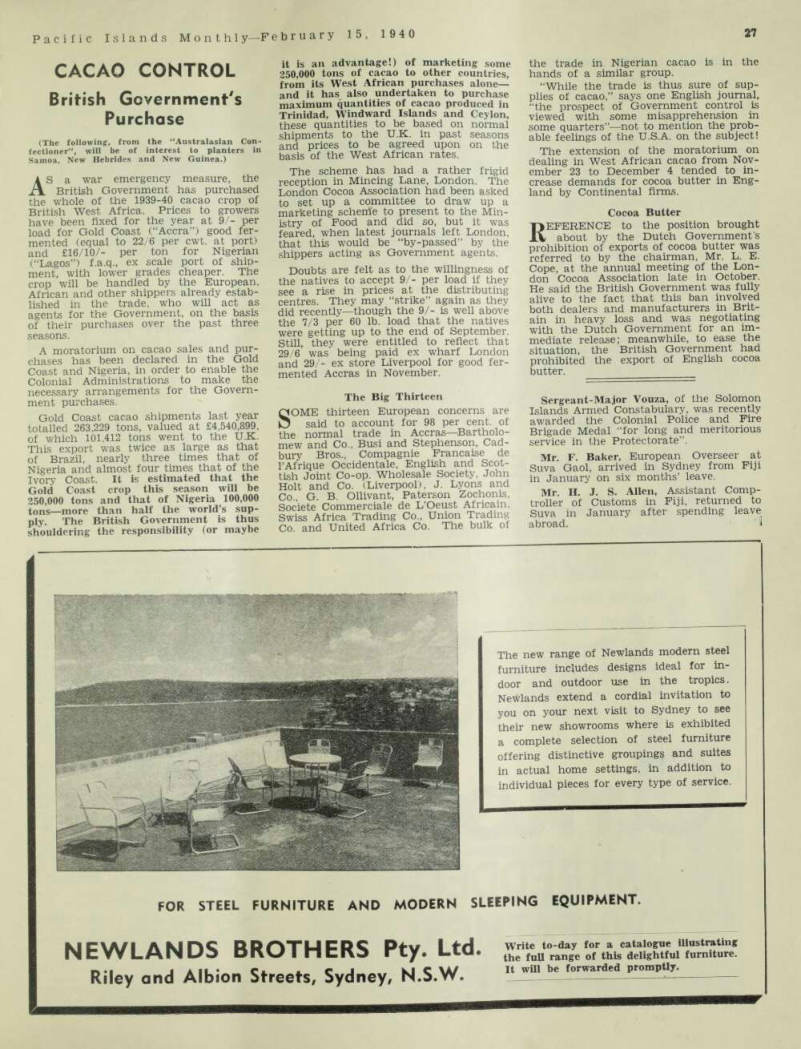
British Government's Purchase
,„. . (The following, from the “Australasian Con fectioner”, will be of interest to planters in Samoa, New Hebrides and New Guinea.) AS a war emergency measure, the British Government has purchased the whole of the 1939-40 cacao crop of British West Africa. Prices to growers have been fixed for the year at 9 - per load for Gold Coast (“Accra”) good fer mented (equal to 22/6 per cwt. at port) “d tie/iO/- V* Xt ment with lower grades cheaper. The rron will be handled by the European, Afr?rnn and other shippers already estab u£ed £ the teade T wTact as agents for the Government, on the basis nf thpir nurchases over the past three seasons 1 PUrChaS6S ° V P A moratorium on cacao sales and pur chases has been declared in the Gold Coast and Nigeria, in order to enable the Colonial Administrations to make the me C n e fpSchaTes gementS G ° Vem ' rv>ocf ncron ohinmpnts last vear , g° ld tom valued at £4 540899 to tiM Thil export was twtee as large al that of Brazil nearly three times that of Nigeria and almost four times that of the Ivory Coast. It is estimated that the Gold" Coast crop this season will be 250,000 tons and that of Nigeria 100.000
‘r-?hT S£
shouldering the responsibility (or maybe
it is an advantage!) of marketing some 250,000 tons of cacao to other countries, from its West African purchases alone— and it has also undertaken to purchase maximum quantities of cacao produced in Trinidad, Windward Islands and Ceylon, these quantities to be based on normal shipments to the U.K. in past seasons and prices to be agreed upon on the basis of the West African rates.
The scheme has had a rather frigid reception in Mincing Lane, London. The London Cocoa Association had been asked to set up a committee to draw up a marketing schenfe to present to the Min istry of Food and did so, but it was feared, when latest journals left London, that this would be “by-passed” by the shippers acting as Government agents.
Doubts are felt as to the willingness of the natives to accept 9/- per load if they see a rise in prices at the distributing centres. They may “strike” again as they did recently—though the 9/- is well above the 7/3 per 60 lb. load that the natives were getting up to the end of September.
Still, they were entitled to reflect that 29/6 was being paid ex wharf London and 29/- ex store Liverpool for good fer mented Accras in November.
The Big Thirteen SOME thirteen European concerns are said to account for 98 per cent, of the normal trade in Accras —Bartholomew and Co.. Busi and Stephenson, Cad bury Bros., Compagnie Francaise de I’Afrique Occidentale, English and Scot tish Joint Co-op. Wholesale Society, John Holt and Co. (Liverpool), J. Lyons and Co., G. B. Ollivant, Paterson Zochonis, Societe Commerciale de L’Oeust Africain.
Swiss Africa Trading Co., Union Trading Co. and United Africa Co. The bulk of
the trade in Nigerian cacao is in the hands of a similar group.
“While the trade is thus sure of sup piies 0 f cacao,” says one English journal, “the prospect of Government control is viewed with some misapprehension in some quarters”—not to mention the prob able feelings of the U.S.A. on the subject! 6 , The extension of the moratorium on dealing in West African cacao from Nov ember 23 to December 4 tended to in crease demands for cocoa butter in Eng land by Continental firms, Cocoa Butter IAPFFRFNrK to the nosition brought bv the Dutch GoverZents
ofexnortf Sf cocoabutt^was
IfcUK Cope, at the annual meeting of the Lon don Cocoa Association late in October He said the British Government was fully alive to the fact that this ban involved both dealers and manufacturers m Bnt ain m heavy loss and was negotiating with the Dutch Government for an im mediate release, meanwhile, to ease the situation, the British Government had prohibited the export of English cocoa butter. = Sergeant-Major Vouza, of the Solomon Islands Armed Constabulary, was recently awarded the Colonial Police and Fire Brigade Medal “for long and meritorious service in the Protectorate ’.
Mr< F B aker, European Overseer at Suva Gaol> arrive d in Sydney from Fiji j January on six months’ leave.
Mr . H . J. S. Allen, Assistant Comp troller of Customs in Fiji, returned to abroad’* 1 Ja ” Uary
Advertisements & other items, p. 29 (2 items)
27
Pacific Islands Monthl y—F ebruary 15, 1940
Newlands Brothers Pty. Ltd.
n
FOR STEEL FURNITURE AND MODERN
The new range of Newlands modern steel furniture includes designs ideal for indoor and outdoor use in the tropics.
Newlands extend a cordial invitation to you on your next visit to Sydney to see their new showrooms where is exhibited a complete selection of steel furniture offering distinctive groupings and suites in actual home settings, in addition to individual pieces for every type of service.
SLEEPING EQUIPMENT.
NEWLANDS BROTHERS Pty. Ltd.
Riley ond Albion Streets, Sydney, N.S.W. “ win be forwarded prompt,y -
Papua's "Uncontrolled
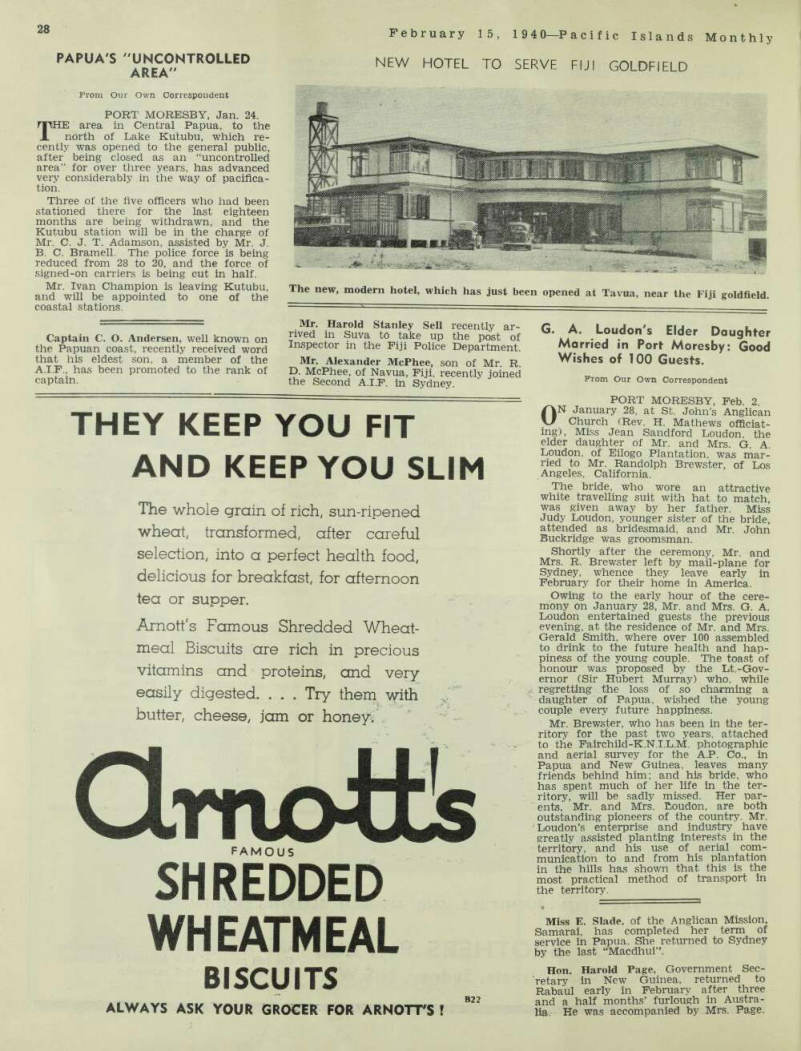
Area"
From Our Own Correspondent
Port Moresby, Jan. 24.
rE area in Central Papua, to the north of Lake Kutubu, which re cently was opened to the general public, after being closed as an “uncontrolled area’’ for over three years, has advanced very considerably in the way of pacifica tion.
Three of the five officers who had been stationed there for the last eighteen months are being withdrawn, and the Kutubu station will be in the charge of Mr. C. J. T. Adamson, assisted by Mr. J.
B. C. Bramell. The police force is being reduced from 28 to 20, and the force of signed-on carriers is being cut in half.
Mr. Ivan Champion is leaving Kutubu, and will be appointed to one of the coastal stations.
Captain C. O. Andersen, well known on the Papuan coast, recently received word that his eldest son, a member of the A.1.F., has been promoted to the rank of captain.
Mr. Harold Stanley Sell recently ar rived in Suva to take up the post of Inspector in the Fiji Police Department.
Mr. Alexander McPhee, son of Mr. R.
D. McPhee, of Navua, Fiji, recently joined the Second A.I.F. in Sydney.
Advertisements & other items, p. 30 (1 item)
New Hotel To Serve Fiji Goldfield
The new, modem hotel, which has just been opened at Tavua, near the Fiji goldfield.
G. A. Loudon's Elder Daughter
Married in Port Moresby: Good Wishes of 100 Guests.
Prom Our Own Correspondent
Port Moresby, Feb. 2.
ON January 28, at St. John’s Anglican Church (Rev. H. Mathews officiat ing), Miss Jean Sandford Loudon the elder daughter of Mr. and Mrs. G. A.
Loudon, of Eilogo Plantation, was mar ried to Mr. Randolph Brewster, of Los Angeles, California.
The bride, who wore an attractive white travelling suit with hat to match, was given away by her father. Miss Judy Loudon, younger sister of the bride, attended as bridesmaid, and Mr. John Buckridge was groomsman.
Shortly after the ceremony, Mr. and Mrs. R. Brewster left by mail-plane for Sydney, whence they leave early in February for their home in America.
Owing to the early hour of the cere mony on January 28, Mr. and Mrs. G. A.
Loudon entertained guests the previous evening, at the residence of Mr. and Mrs.
Gerald Smith, where over 100 assembled to drink to the future health and hap piness of the young couple. The toast of honour was proposed by the Lt.-Gov ernor (Sir Hubert Murray) who. while regretting the loss of so charming a daughter of Papua, wished the young couple every future happiness.
Mr. Brewster, who has been in the ter ritory for the past two years, attached to the Fairchild-K.N.I.L.M. photographic and aerial survey for the A.P. Co., in Papua and New Guinea, leaves many friends behind him; and his bride, who has spent much of her life in the ter ritory, will be sadly missed. Her par ents, Mr. and Mrs. Loudon, are both outstanding pioneers of the country. Mr.
Loudon’s enterprise and industry have greatly assisted planting interests in the territory, and his use of aerial com munication to and from his plantation in the hills has shown that this is the most practical method of transport in the territory. * Miss E. Slade, of the Anglican Mission, Samarai, has completed her term of service in Papua. She returned to Sydney by the last “Macdhui”.
Hon. Harold Page, Government Sec retary in New Guinea, returned to Rabaul early in Februarv after three and a half months’ furlough in Austra lia. He was accompanied by Mrs. Page.
Advertisements & other items, p. 30 (1 item)
Wheatmeal
THEY KEEP YOU FIT
AND KEEP YOU SLIM
The whole grain of rich, sun-ripened wheat, transformed, after careful selection, into a perfect health food, delicious for breakfast, for afternoon tea or supper.
Arnott's Famous Shredded Wheatmeal Biscuits are rich in precious vitamins and proteins, and very easily digested. . . . Try them with butter, cheese, jam or honey.
FAMOUS
SHREDDED
WHEATMEAL
BISCUITS
822 ALWAYS ASK YOUR GROCER FOR ARNOTT'S I
Solomon Islands


Affairs
Important Discussions Affect Finance, Taxation Cr Copra Price
MATTERS of unusual importance were considered at the bi-annual session of the British Solomon Islands Advisory Council which opened at Tulagi on Nov ember 27. and continued until the 30th.
The recently appointed Resident Com missioner, Mr. W. S. Marchant, 0.8. E., presided. Other members present were: Official: Mr. Ragnar Hyne (Chief Magis trate and Legal Adviser); Major G. E. D.
Sandars (Secretary to the Government); Mr. F. E. Johnson, 1.5.0. (Treasurer and Collector of Customs). Non-official: Mr.
D. Mackinnon, M.8.E., Right Rev. W. H.
Baddeley, D. 5.0.. M.C. (Bishop of Mela nesia); Mr. J. C. M. Scott and Mr. C. V.
Widdy .
The agenda was a full one, embracing several new regulations and amendments of various others already promulgated.
Most of these were of a non-contentious character, and were quickly disposed of.
Control Of Coastal Shipping
Such, however, was not the case when a re-draft of a Regulation to Control Coastal Shipping was brought down by the Legal Adviser. This measure was closely and trenchantly debated in com mittee, and recommendations were sub mitted for the deletion or amendment of many of its provisions which were un acceptable to non-official members.
With the underlying principle of pro viding legislation for the safeguard of life and property at sea all were in agree ment, but it was contended that the draft before the Council was to a large extent inapplicable to local shipping and condi tions, and impossible to administer effec tively. It was finally returned for alteration, witji a strong recommendation that so controversial and difficult a Regu lation should be kept in abeyance until after the war, when it can be reviewed in the light of possibly changed political and economic circumstances.
Arising out of the discussion on the Coastal Shipping Regulation, it was unanimously decided, on a motion intro duced by the Treasurer, that a prelimin ary Regulation be promulgated to provide for the number of persons which may be carried on recruiting vessels. The basis of calculation agreed upon was one per son for every half-ton of gross measure ment.
Higher Taxation
The financial estimates for the year 1940-41 were also dealt with exhaustively, and emphatic protests were voiced in respect of certain proposals which were denounced as oppressive, inequitable and unwarranted.
The Treasurer, in presenting the esti mates, stated that the current financial year would close with an estimated defi cit of £11,467, while the debit in the next fiscal year was forecast at £4,115.
To meet predicted deficiencies, he pro posed the following increases in the im port tariff: — Spirits, by 4/-, and beer by 6d., per gallon.
Cigarettes, by 5/- per thousand.
Postage, from lid. to 2d. per oz.
A duty on wireless goods, which have hitherto been free.
These items, estimated to bring in £lO5O per annum, were, in view of pre
sent circumstances, reluctantly agreed to by non-official members.
The latter, however, were unable to extend a similar acquiesence to the proposal to raise general preferential tariff from 12 2 per cent, to 17 2 per cent., and the foreign rates proportionately.
The mcrease of duty on goods from Empire sources would thereby amount to 40 per cent, on current rates.
Burden On Planting Industry
A ,.. , „ , Astonishment was expressed at the apparent lack of understanding of. or the utter indifference to, the parlous state of the one very depressed industry m the Protectorate manifest m such a proposal, despite frequent representations and warnings m Council, which are on record.
A mater of grave concern and dissatisfaction, which has frequently been brought to official notice is that, notwithstanding the incontrovertible fact that copra is produced at a loss on practically all estates, the industry is saddled with
an iniquitous export tax, which at pre sent amounts to 6 9 per ton, and which, as was pointed out, virtually constitutes a tax on capital.
It was further contended that to add to the burden of taxation in the manner contemplated must inevitably swell the already considerable number of derelict plantations with which the British Solo mon Islands Protectorate is bestrewn; and, in addition to these, there are many heavily capitalised estates owned by large Australian companies, which have been leased to individuals at peppercorn rentals in an effort to ensure a modicum of care and maintenance
Financial Counter Proposals
Considered counter-proposals to meet the estimated deficit were submitted in a joint statement, to which each indi vidual non-official member spoke in em phatic support. These were:— (1) That deficits be a charge on sur , plus funds. Accumulated reserves
(£86,246 on March 31, 1939) it was iter ated, were built up in years when revenue exceeded expenditure, and it was rea sonable and customary to draw upon such reserves during periods when ex penditure exceeded revenue. In com mercial organisations tne world over that was normal practice, and only by doing so in recent years were copra producers in the Solomons enabled to maintain comparative solvency. (2) That retrenchment of staff be effected. Notwithstanding clear and un mistakable indications of economic ad versity, the Protectorate administrative staff for several years past has been added to until it has reached numbers never before attained, and is now mark edly overloaded with young men for whom it appears difficult to find useful employment. In existing circumstances, which could have been, and were by the public, foreseen, the constant accretion of unessential personnel points to the ex tent the Administration is out of touch, or indifferent, to practical affairs, and the urgent need to practise economy.
Income Tax Suggested
(3) That, pending the essential and in evitable reorganisation of the public ser vice to relate expenditure more closely to revenue, an income tax be levied on all salaries and wages earned within the Protectorate. On a 5 p.c. basis this tax, it was estimated, would bring in over £4,000 per annum.
It was stressed that, with the exception of the Residential Tax of £1 per capita per annum, the planting industry alone was called upon to contribute a direct tax by being mulcted on the produce ex ported. This is inequitable, and par ticularly unjust in its incidence during periods of depression, when the planter is unable to meet costs of production from the sale of his produce.
As an income tax is nowhere popular, it must be noted as significant that two of the non-official members are the prin cipal executives in the Protectorate of their respective companies—the largest operating in the Solomons—and would therefore bear personally a relatively large proportion of a tax on income. They were concerned in initiating and support ing the proposal solely from a sense of equity and justice, and profound first hand knowledge of the state of the staple industry. It was suggested, in this con nection, that as the local Administration would appear to be lacking in a full rea lisation. or acting in wanton disregard of, the plight of planters and the economic situation generally, the High Commis sioner for the Western Pacific be asked to appoint a Commission to examine and report before the industry is ruined by the extortion of taxes it cannot bear.
Price Of Copra
A request was tabled, and agreed to without debate, that the High Commis sioner be asked to represent to the Brit ish Government, which is controlling the marketing of copra, the need to fix a price which will allow producers a small margin over cost of production. In view of the rising price of all commodities im ported, the rate regarded by non-official members as necessary in the circum stances, was stated as £l5/10/-, London.
The New Guinea Planters’ Association, it was stated, is preferring a similar re quest through the Commonwealth Gov ernment, with, however, certain differ ences in the price suggested owing to marketing costs being less in New Guinea, due to a variety of reasons, among them, considerably lower overseas freight rates, cheaper labour, and much more favour
able tariff rates both for imports and exports as compared with the Solomon Islands.
Empire’S War Effort
In a reference to the war in which the Empire is involved, non-official members presented a joint statement setting forth that as there seemed no way in which the Protectorate could actively partici pate in its prosecution, the people of the Solomons would look upon it as a graci ous and patriotic act if a substantial, voluntary gift from the accumulated re serves was donated to His Majesty’s Gov ernment as a token of gratitude for the freedom they enjoy, and the safety assured them by the sacrifice, gallantry and efficiency of His Majesty’s Naval, Military and Air Forces —services towards the maintenance of which the Protec torate makes no contribution.
Advertisements & other items, pp. 31-33 (1 item)
S^foood
health
v <c it u with * f o>^
Modern Refrigeration for
The ELECTROLUX KEROSENE OPERATED
REFRIGERATOR
MARVEL
OF
MODERN
SCIENCE
THE
MIRACLE
OF
ICE
FROM
HEAT
ELECTROLUX OFFERS ECONOMICAL, MODERN AND COMPLETELY EFFICIENT
REFRIGERATION FOR ISLANDS 7 HOMES.
FREEZES CONTINUOUSLY WHILE SMALL LAMP BURNS
Freezing controlled by simply regulating height of flame. Uses only f gallon of kerosene per week.
MOTORLESS ... NO PARTS TO GET OUT OF ORDER.
MODEL L 22 MODEL L3BO MODEL LKSSO Capacity • (as Illustrated) ® Capacity 2.2 cubic feet. Capacity 4 cubic feet. 5.5 cubic feet.
GUARANTEED FOR TWO YEARS.
• Write to your Local Distributor for prices and full details.
Obtainable from W. R. Carpenter & Company Ltd.—Sydney, and following New Guinea Branches: Rabaul, Salamaua, Wau, Kavieng, Madang, and Wewak.
W. R. Carpenter & Coy. (Solomon Is.) Pty. Ltd. —Tulagi, British Solomon Islands.
On Chong & Company Pty. Ltd.—Butaritari, Gilbert and Ellice Islands.
Representation in Papua and New Hebrides.
par ling refreshment from pure Malt and Hops
FOSTER’S
LAGER
Cane For Delinquent
Labourers
Native Control In New Guinea
A MAN who knew New Guinea and handled native labour before the Australian occupation, and who was acquainted with the Germans’ methods of controlling natives —namely, Mr. Gor don Thomas, editor of the “Rabaul Times” —gave interesting evidence before the Native Labour Commission in Rabaul in January.
Discussing the growing problem of un disciplined and cheeky natives, Mr.
Thomas expressed the opinion that cor poral punishment should be re-introduced in the Territory in the form of canings.
Indentured natives found guilty of minor offences should be punished by canings,
in place of the present system of imprisonment, thus obviating loss of service to the employer. Canmgs would be a greater deterrent and would be a saving of government rations in prisons.
He pointed out that the system was found to be quite satisfactory during the German regime, when permits were even given to reliable European planters to administer canings, under rigid government control. The system maintained discipline amongst the labour, and records showed that recourse to caning was infrequent, owing to the fact that the
natives knew that the employer had power to inflict such punishment .
Mr - Thomas stated that he only advo cated a system of corporal punishment s j? 1 Ijar 1 j ar ,T liat; was me ted out to school all over the world. He stated JT at the present system of taking discip hnary action through the courts was a long and tedious procedure, and owing to this, many breaches of the Ordiflance and flagrant disregard of discipline went unpunished, in order to avoid personal inconvenience.
Advertisements & other items, p. 33 (1 item)
31
Pacific Islands Monthl y — February 15, 1940
Yachtsmen And
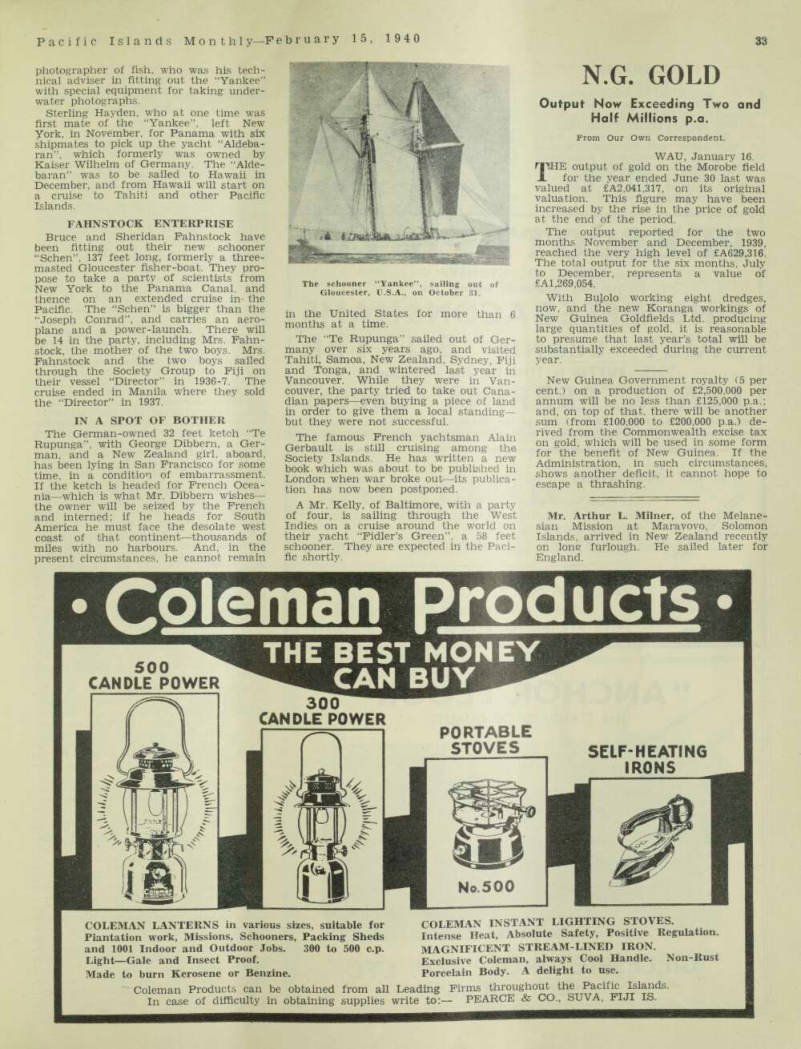
Yachts
The "Idle Hour" Again
INTERESTING news of yachtsmen who are known in the Pacific, or are headed for that yachtsman’s paradise, is contained in a letter from Mr. Dwight Long, the American lad who, a couple of years ago, earned fame by sailing his little boat, the “Idle Hour”, around the world. It will be remembered that after he completed his journey, the “Idle Hour” was caught in the New England hurricane—the worst for 115 years—and was badly smashed up in Long Island Sound.
Mr. Long says that he has been eleven months rebuilding the “Idle Hour”, and she recently sailed from New York to
Bermuda. He intended to rejoin her in Bermuda and go on to the Panama Canal in December, and thence on again into the Pacific.
He had just received word that the “Idle Hour” had successfully ridden out a hurricane in Bermuda, which attained 126 miles per hour. This, he says, is “Idle Hour’s” third hurricane. The first carried away her mainmast, when she was sailing between Pago Pago and New Zealand; the second was the one which smashed her up in Long Island Sound: and the third is the recent experience in Bermuda.
The “Yankee”
Mr. Long says that on October 31 the schooner “Yankee”, 92 feet long and owned by Irving Johnson, sailed from Gloucester, U.S.A., on her third world cruise. Including Mr. Johnson’s family, there were 21 persons aboard.
The “Yankee” passed through Panama Canal on November 26 and headed west for Pitcairn Island, where Captain John son proposes to take under-water col oured moving pictures of the remains of the “Bounty”. He is accompanied by Mr.
William Beeby, a famous under-water
Dwight Long’s famous boat “Idle Hour”, in which he sailed round the world, sailed out of New York recently en route for Bermuda, the West Indies, and Panama Canal. He will be seen in the Pacific again—probably in Tahiti — next winter.
photographer of fish, who was his tech nical adviser in fitting out the “Yankee” with special equipment for taking under water photographs.
Sterling Hayden, who at one time was first mate of the “Yankee”, left New York, in November, for Panama with six shipmates to pick up the yacht “Aldeba ran”, which formerly was owned by Kaiser Wilhelm of Germany. The “Alde baran” was to be sailed to Hawaii in December, and from Hawaii will start on a cruise to Tahiti and other Pacific Islands.
Fahnstock Enterprise
Bruce and Sheridan Fahnstock have been fitting out their new schooner “Schen”, 137 feet long, formerly a three masted Gloucester fisher-boat. They pro pose to take a party of scientists from New York to the Panama Canal, and thence on an extended cruise in the Pacific. The “Schen” is bigger than the “Joseph Conrad”, and carries an aero plane and a power-launch. There will be 14 in the party, including Mrs. Fahn stock, the mother of the two boys. Mrs.
Fahnstock and the two boys sailed through the Society Group to Fiji on their vessel “Director” in 1936-7. The cruise ended in Manila where they sold the “Director” in 1937.
In A Spot Of Bother
The German-owned 32 feet ketch “Te Rupunga”, with George Dibbern, a Ger man, and a New Zealand girl, aboard, has been lying in San Francisco for some time, in a condition of embarrassment.
If the ketch is headed for French Ocea nia—which is what Mr. Dibbern wishes — the owner will be seized by the French and interned; if he heads for South America he must face the desolate west coast of that continent—thousands of miles with no harbours. And, in the present circumstances, he cannot remain
in the United States for more than 6 months at a time.
The “Te Rupunga” sailed out of Ger many over six years ago, and visited Tahiti, Samoa, New Zealand, Sydney, Fiji and Tonga, and wintered last year in Vancouver. While they were in Van couver, the party tried to take out Cana dian papers—even buying a piece of land in order to give them a local standing— but they were not successful.
The famous French yachtsman Alain Gerbault is still cruising among the Society Islands. He has written a new book which was about to be published in London when war broke out—its publica tion has now been postponed.
A Mr. Kelly, of Baltimore, with a party of four, is sailing through the West Indies on a cruise around the world on their yacht “Fidler’s Green”, a 58 feet schooner. They are expected in the Paci fic shortly.
The schooner “Yankee”, sailing out of Gloucester, U.S.A., on October 31.
Advertisements & other items, p. 34 (1 item)
G. Fletcher & Son
STEAMSHIPS TRADING COMPANY LTD.
PORT MORESBY PAPUA SAMARAI
Chairman and Managing Director: A. S. FITCH.
Shipowners, Wholesale and Retail Merchants and Traders; Shipping, Customs and Insurance Agents; Copra and Rubber Plantation Owners.
MAIL CONTRACTORS TO COMMONWEALTH AND PAPUAN GOVERNMENTS.
AGENCIES; —At Port Moresby: Coral Sea Insurance Co.; Phoenix Insurance Co.; Delta Sawmills. Ltd.; Acme Bakery Co.; Vacuum Oil Co., Pty., Ltd. At Samaral; Coral Sea Insurance Co.; Delta Sawmills, Ltd.; Bankers and Traders’
Insurance Co.; National Mutual Life Insurance Co.; Kularo Shipyards; Mamai Plantations.
BRANCHES; —In Papua: Hanuabada, Sivltol, Aroma, Koki, Hula, Ela Beach Duga Duga, Yule Island.
SYDNEY: NELSON & ROBERTSON PTY. LTD., 12 Spring St.; Melbourne, 396 Flinders Lane: London, E. Whiteaway & Co., 1 Chiswell Street, Finsbury, London.
Cable Address: “STEAMSHIPS.” Code; Bentley’s,
STEAMSHIPS TRADING COMPANY, LIMITED.
MERCHANTS, SHIPOWNERS AND PLANTERS
PORT MORESBY AND SAMARA I.
Our organisation provides every facility and efficient service as
MANAGING AGENTS AND VISITING REPRESENTATIVES OF
COCONUT AND RUBBER PLANTATIONS
Estates supervised in bearing and planting stages.
Comprehensive reports compiled and regular visits made to Estates by our competent Plantation Inspector.
WRITE, CABLE OR CALL FOR PARTICULARS;
STEAMSHIPS TRADING COMPANY LTD.
If you want "Perfection in Cooking" use a
“Younger” cooking stove
These stoves have been on the market in Australia for over Sixty Years, and are still recognised as “The Best”.
They are made with Extended Firebox specially for Long Wood fuel, also special stoves with Cast Iron Oven suitable for Island requirements.
Send for Illustrated Catalogue and Price of Single and Double Oven Stoves.
G. FLETCHER & SON
50 OXFORD STREET, SYDNEY.
N.G. Gold
Output Now Exceeding Two and Half Millions p.a.
From Our Own Correspondent.
WAU, January 16.
THE output of gold on the Morobe field for the year ended June 30 last was valued at £A2,041,317, on its original valuation. This figure may have been increased by the rise in the price of gold at the end of the period.
The output reported for the two months November and December, 1939, reached the very high level of £A629,316.
The total output for the six months, July to December, represents a value of £A1,269,054.
With Bulolo working eight dredges, now, and the new Koranga workings of New Guinea Goldfields Ltd. producing large quantities of gold, it is reasonable to presume that last year’s total will be substantially exceeded during the current year.
New Guinea Government royalty (5 per cent.) on a production of £2,500,000 per annum will be no less than £125,000 p.a.; and, on top of that, there will be another sum (from £lOO,OOO to £200,000 p.a.) de rived from the Commonwealth excise tax on gold, which will be used in some form for the benefit of New Guinea. If the Administration, in such circumstances, shows another deficit, it cannot hope to escape a thrashing.
Mr. Arthur L. Milner, of the Melane sian Mission at Maravovo, Solomon Islands, arrived in New Zealand recently on lone furlough. He sailed later for England.
Advertisements & other items, p. 35 (2 items)
33
Pacific Islands Monthl y—F ebruary 15, 1940
eman
500
CANDLE POWER
(1
THE BEST MONEY
CAN BUY
300
CANDLE POWER
PORTABLE
STOVES
SELF* HEATING
IRONS
% i N 0.500 COLEMAN LANTERNS in various sizes, suitable for Plantation work, Missions, Schooners, Packing Sheds and 1001 Indoor and Outdoor Jobs. 300 to 500 c.p.
Light—Gale and Insect Proof.
Made to burn Kerosene or Benzine.
Coleman Products can be obtained from all In case of difficulty in obtaining supplies
COLEMAN INSTANT LIGHTING STOVES.
Intense Heat, Absolute Safety, Positive Regulation.
MAGNIFICENT STREAM-LINED IRON.
Exclusive Coleman, always Cool Handle. Non-Rust Porcelain Body. A delight to use.
Leading Firms throughout the Pacific Islands, write tor — PEARCE & CO., SUVA, FIJI IS.
N.G.G. Shares
IT was announced by the chairman at the annual meeting of shareholders of New Guinea Goldfields Ltd., in Janu ary, that as this company has built up large liquid funds from reserves made for depreciation and ore depletion, and as the life of the company’s enterprises in New Guinea is not likely to be a long one, it has been decided to commence at an early date to return the capital to shareholders. The capital of the com
pany is something over £1,100,000 in 57shares. As the company has been paying 5 per cent, for some time, and seems likely to continue, and it furthermore seems determined, under its present effi cient management, to return the capital value of the shares to shareholders, N.G.G. 57- shares at their present mar ket quotation of around 2/6 represent an interesting proposition for investors.
Mr. R. Morrissey, of N.Z., has joined the Samoan Treasury Department.
U.S.A. And The War
How Allies Are Fighting Americans' Battle
By R. W. Robson
IHAVE an American friend whose erudition and literary artistry l sincerely admire; but with whom I quarrel energetically on the subject of the present and future relationship of our two countries.
I hold the view that if only U.S.A.— the most powerful nation in the world— would line up with the British Common wealth of Nations, according to a simple formula based on democratic freedom the peace of the world and the happi ness of the human race could be ensured.
My American friend’s retorts usually could be summed up in that singularly unpleasant parody, “England expects that every American this day will do his duty”.
I have told him that he is typical of innumerable publicists, who see England simply as an unending vista of Im perialistic Colonel Blimps, who are pre pared to do anything so long as human affairs can be twisted into the shape best calculated to serve the greedy and insatiable demands of the British Em pire. I have never been able to make him —or other Americans of similar thinking—recognise that we people of British stock feel and think about human and international affairs exactly as do the Americans—that we have the same loathing for Imperialistic fire eaters, and for our inhumanly selfish trusts and combines (which are out de liberately for exploitation under the shelter of the national flag) as the Americans have for theirs.
However, as I say, this American news paperman and I squabble away very happily over our differing points of view.
But, recently, he sent me the following “five American reasons for not wishing to join up with England and France in the present war”: and I have been so interested in these reasons, and in mv own John Bullish reaction thereto (his description!) that I have ventured to put this material into the shape of an article for publication—although I admit freely, and with apology, that the subject has nothing to do directly with Pacific Islands affairs.
Here are the five American reasons, together with what I regard as an In telligent British reply:— NO. 1, —The Allies at Versailles cer tainly did not act in the complete interest of democracy, otherwise the Polish Corridor and the division of the Near East would not have been per mitted.
ANSWER:—If the settlement at Ver sailles had been implemented, as was intended by President Wilson, by a League of Nations supported by the United States, the course of history would have been very different. The League of Nations was designed to take the anomalies and imperfections out of the Versailles Treaty, just as soon as developments in Europe made such a course practicable. But when the United States Senate walked out on us, and re fused to join the League of Nations, the latter became the plaything of certain Imperialistic interests, and never func tioned as it should have done. The frightful condition of world affairs to day can be traced back to the Versailles Treaty; but that is not the fault of Britain.
NO. 2. —Americans have never for gotten, and will not forget, that while the French and British were declining to
pay their war debts to America, they were finding the money to finance inter national adventures in various other countries. Americans do not mind losing the money, but hate to be treated so cavalierly.
ANSWER; —This comment about war debts is typical of American thought, and is indicative of one of the great fallacies held by Americans. Britain and France, and the other nations, cannot pay their war debts to the United States because there definitely is no machinery by which such enormous amounts can be transferred to another country, without economic disaster. Debts can be paid in only two ways, in goods (or service) or in gold. The Americans fiercely restrict their imports of goods; and they know— or they ought to know—that if they con tinue to receive gold in this way they will be sunk. The United States already has an accumulation of, I think, about two-thirds of the world’s gold; and most of the United States’ troubles of the past two decades can be traced directly to the immobilisation of this vast accumulation of international credit. For several years the Western European nations paid their war debts to the United States in gold (because U.S.A. would not take goods) and it was that eventual “freezing up” of international credit, in the shape of gold in the United States, that was one of the primary factors in bringing about the great depression of 1930-33. If the nations can find a way to use that credit, instead of immobilising it in stored gold, there is no reason why European nations should not pay their war debts to U.S.A.; but, so far, the thing seems to be beyond the genius of statesmanship.
Britain did not use her diverted war debts money for adventure and arma ments—not at first, nor until she was forced to. For several years, Britain con tinued to disarm, until in 1930-31 she was in a highly-exposed and imperilled condition; and it was only the general re-armament in Europe in 1932-36 —the result of the final breakdown of the League of Nations —which forced Britain to re-arm.
NO. 3.—There is no assurance that, even if the U.S. entered the war, France and Britain might not make an early peace with Germany, and leave Poland massacred and Czecho-Slovakia sunk.
ANSWER:—The British people gener ally wish to see Poland and Czecho slovakia restored. That is one of the things for which they definitely are fighting. They are much more likely to achieve that aim with assistance, rather than without it.
NO. 4.—Americans sincerely fear that another world war would cost us a lot of our own democratic Institutions, such as free speech and a free press.
ANSWER:—The British people, with great reluctance, entered into the pre sent war because the events of 1937-39 convinced them that, if the progress of the totalitarian States was not checked, the democratic institutions of Western Europe would be overwhelmed and des troyed, and we should enter another Dark Age. The Western democracies in fighting for their own freedom, are fight ing also for that of U.S.A.
NO. 5. —Finally, our sympathies are strongly with the Allies, and we are tak ing practical measures to aid them. But we do not propose to drain our own country to dire suffering and weakness — with the memory of what Wilson en dured after the Armistice.
ANSWER:—One cannot blame the Americans. Probably, the self-sacrificing people of Britain and France, and the harassed neutrals, would like to be safe and comfortable in the United States, too. But what Americans do not realise
is that even their mighty nation is not secure against the menace of the totalitarian State—that, if Germany and/or Russia should dominate Europe it would be only a matter of a year or two before the United States would have to fight for its existence. The Allies to day, are fighting the battle for American freedom, as well as for their own.
Advertisements & other items, p. 36 (1 item)
Prescott Pty. Ltd.
SUSSEX ST., SYDNEY,
are sale wholesale agents for
PINEAPPLE BACON&HAMS
DAISY brand BUTTER "375" BUTTER in TINS llb.-21b.-slb. Sizes.
LEA & PERRINS’ Sauces and Most other Super-Quality Lines of the Trade, such as Cheese, Eggs, Etc.
We are Specialists . . . .
X Let us have your confidence. Sixty years is our record of supplying the leading Houses throughout the World in
FRESH FRUIT VEGETABLES PRODUCE
’Phones: MA 8812 (4 lines).
Cable Address: “Weymarkson”
Codes—Bentleys Private.
WEYMARK & SON LTD.
FRUIT AND PRODUCE MERCHANTS
14-18 STEAMMILL STREET - - SYDNEY
“ANCHOR FLOUR
THE STANDARD OF QUALITY
GILLESPIE BROS. PTY. LTD
SYDNEY - AUSTRALIA
New Guinea Men For A.I.F.
IT was announced in the “Rabaul Times”, early in January, that 60 volunteers from New Guinea would be accepted for inclusion in the Australian Imperial Force. When the men have been selected they will be gathered to gether in a camp in Rabaul, prior to transport to Australia, where they will join the A.I.F.
Mr. W. Cockell, Inspector in the Fiji Health Department, left Suva in January on leave. He was accompanied by his wife.
Rev. K. P. Fitzgerald, of Rabaul, New Guinea, passed through New Zealand recently en route to England to spend furlough
Sister P. E. McKenzie, who joined the Melanesian Mission in 1933. and who re cently had been in charge of the Godden Memorial Hospital at Lolowai, New Hebrides, has resigned from the Mission owing to indifferent health.
Advertisements & other items, p. 37 (2 items)
35
Pacific Islands Monthl y—P ebruary 15, 1940
Puddings
PURE RICE
STARCH
Always ask for . , .
CORAL BRAND
100% PURE
Noted for Its
QUALITY
and
WHITENESS.
Goes Farthest and gives Lasting Finish
WILL NOT
STICK TO
IRON.
Obtainable from Leading Island Stores.
Manufactured by
AUSTRALIAN RICE, LTD.
Sydney, N.S.W.
CORAL BRAND
RICE STARCH
CORAL
SWALLOW
& ARIELL’S
lIIIIIIIIIIIIIIIIIIIIIIIIIIIIIIIIIIIIIIIIIIIIIIIIIIIIIIIIIIIIIIIIIIIIUI
iiiiiiiiiiiiiiiiiiiiiniiitiiiiiiiiiitiiiiiira
PLUM
PUDDINGS
i lb. : 1 lb.
Ulb. :21b. and 3 lb.
Renowned for Quality
Manufactured at Port Melbourne, Australia FIJI REPRESENTATIVES - - PEARCE & CO. LTD.
40 Years In The New Hebrides
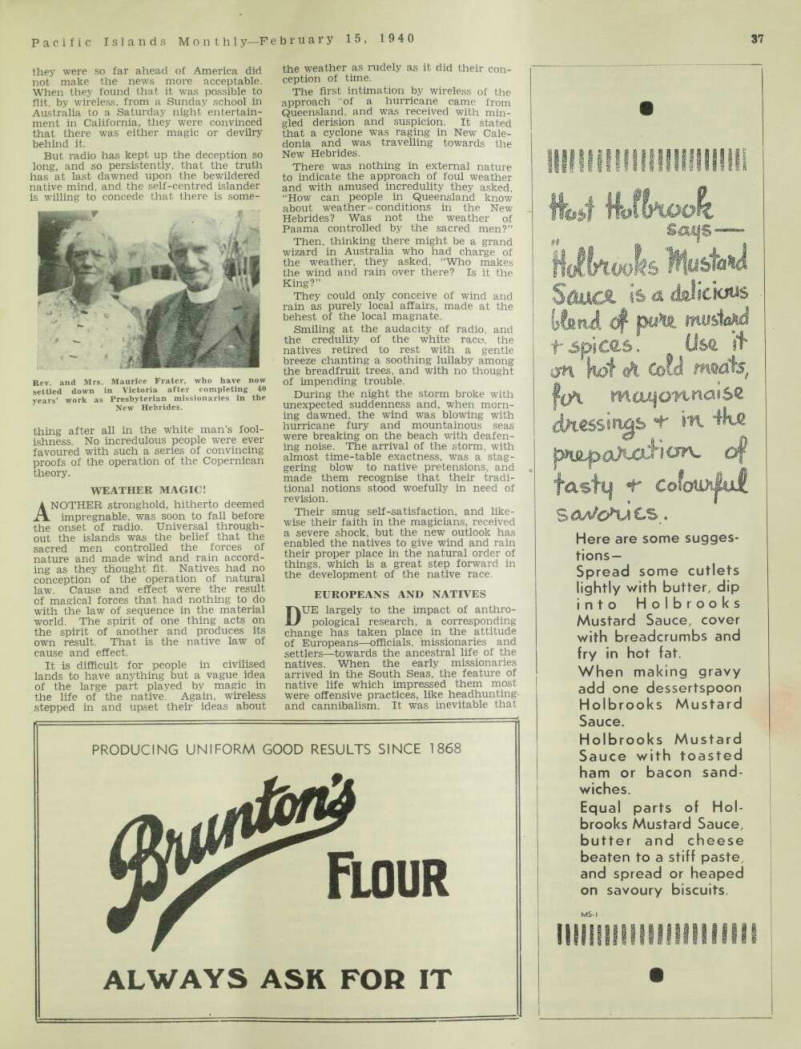
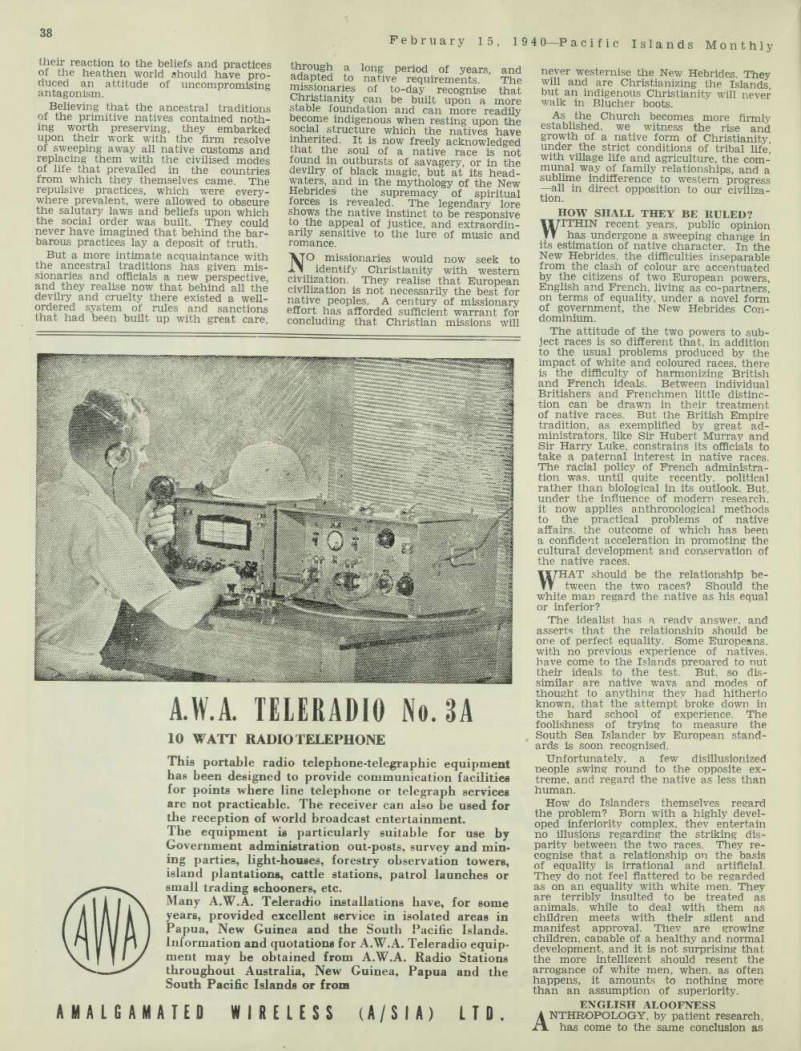
Remarkable Changes Among Natives Australia Affected by Condominium's Strange Political Condition (SPECIALY WRITTEN BY REV. MAURICE FRATER WHO HAS JUT COMPLETED 40 TEARS' SERVICE AS A MISSIONARY IN NEW HEBRIDES)
IT would require a book, rather than an article, to deal adequately with the changes that have taken place in the New Hebrides during the life-time of a missionary who has just retired after 40 years’ residence in the group—years that have been momentous alike in the his tory of the South Seas and the world.
Even since the close of the World War, 25 years ago, residents wonder at the astonishing contrast between the world-wide communications enjoyed by the Islands to-day, compared with the restricted intercourse which marked the years of the Great War.
In 1914, the marvel of radio still lay in the lap of the future, and, outside of Vila, with its cable station, foreign resi dents learned of the outbreak of war from the haphazard reports of passing cutters. Not until the arrival of news papers from Australia, several weeks later, did they know of the hazards and vicissitudes of the early stages. During the long-drawn-out years of the conflict, the only source of information was the two-monthly steamer service from Syd ney, supplemented by an occasional call from the British Resident Commissioner who, in his yacht, made periodical tours
through the Group and circulated the latest bulletins from Vila.
But, in 1940, settlers in the most re mote islands of the Group are as well informed as city-dwellers of world events.
Nearly every settler possess a radio re ceiver, while a few have transmitting sets.
The daily broadcasts from London and Continental capitals are clearly heard • while, from the Vila Radio, issue not only local news, but regular daily bulle tins from all parts of the world. No social innovation has so closely affected the residents, and in the future broad casting is going to exert a unique and incalculable influence in the New Heb rides.
Radio And The Natives
IT can also be truthfully said that no innovation has caused such a fun damental reconstruction of native policy as radio. Missions and commerce have each, in its own way, been exercising a disturbing but salutary influence for over 100 years; but, wherever wireless pene trated, it produced a violent reaction and overthrew long-established beliefs, re placing a hoary insularity by a world wide outlook, and an old self-contained communism by a new individualism.
When wireless was first introduced, and the natives heard voices coming through the air from over the sea, they imagined that the sounds were produced by the same means that they themselves em ployed.
From time immemorial, the natives have had a radio system of their own, and were able to convey wireless mes sages from tribe to tribe. Broadcasting in the New Hebrides was accomplished by means of drums, the messages being relayed over long distances with great rapidity. It was called Drum Talk. By the staccato notes of the drum the news of the death of a chief, and warnings of approaching danger, were broadcast. A code, akin to the dots and dashes of telegraphy, was employed; and, though the various tribes spoke different dia lects, the language barrier did not pre vent them from having intelligent com munication with each other.
The white man’s wireless caused great surprise among the natives, and intro duced a disturbing factor into their lives. It is a trite remark that it would take generations of education to eradi cate the old beliefs of the natives—if, indeed, it were possible to uproot what had become a virtual prepossession. But radio accomplished with almost magical suddenness what the teaching of the schools was only doing by slow degrees.
Accustomed from time immemorial to believe that the sun revolved round their island domain, the natives were arro gant enough to believe that sunrise and sunset in the New Hebrides determined light and darkness evervwhere. It came as a great surprise to learn, from wire less. that the countries and islands with which they were surrounded had all dif ferent times from them and from each other. With cynical incredulity, they heard from San Francisco that the sun rose there nearly a day behind the New Hebrides; and even the knowledge that
they were so far ahead of America did not make the news more acceptable.
When they found that it was possible to flit, by wireless, from a Sunday school in Australia to a Saturday night entertain ment in California, they were convinced that there was either magic or devilry behind it.
But radio has kept up the deception so long, and so persistently, that the truth has at last dawned upon the bewildered native mind, and the self-centred islander is willing to concede that there is some-
thing after all in the white man’s fool ishness. No incredulous people were ever favoured with such a series of convincing proofs of the operation of the Copernican theory.
Weather Magic!
ANOTHER stronghold, hitherto deemed impregnable, was soon to fall before the onset of radio. Universal through out the islands was the belief that the sacred men controlled the forces of nature and made wind and rain accord ing as they thought fit. Natives had no conception of the operation of natural law. Cause and effect were the result of magical forces that had nothing to do with the law of sequence in the material world. The spirit of one thing acts on the spirit of another and produces its own result. That is the native law of cause and effect.
It is difficult for people in civilised lands to have anything but a vague idea of the large part played by magic in the life of the native. Again, wireless stepped in and upset their ideas about
the weather as rudely as it did their con ception of time.
The first intimation by wireless of the approach of a hurricane came from Queensland, and was received with min gled derision and suspicion. It stated that a cyclone was raging in New Cale donia and was travelling towards the New Hebrides.
There was nothing in external nature to indicate the approach of foul weather and with amused incredulity they asked.
“How can people in Queensland know about weather‘conditions in the New Hebrides? Was not the weather of Paama controlled by the sacred men?”
Then, thinking there might be a grand wizard in Australia who had charge of the weather, they asked, “Who makes the wind and rain over there? Is it the King?”
They could only conceive of wind and rain as purely local affairs, made at the behest of the local magnate.
Smiling at the audacity of radio, and the credulity of the white race, the natives retired to rest with a gentle breeze chanting a soothing lullaby among the breadfruit trees, and with no thought of impending trouble.
During the night the storm broke with unexpected suddenness and, when morn ing dawned, the wind was blowing with hurricane fury and mountainous seas were breaking on the beach with deafen ing noise. The arrival of the storm, with almost time-table exactness, was a stag gering blow to native pretensions, and made them recognise that their tradi tional notions stood woefully in need of revision.
Their smug self-satisfaction, and like wise their faith in the magicians, received a severe shock, but the new outlook has enabled the natives to give wind and rain their proper place in the natural order of things, which is a great step forward in the development of the native race
Europeans And Natives
DUE largely to the impact of anthro pological research, a corresponding change has taken place in the attitude of Europeans—officials, missionaries and settlers —towards the ancestral life of the natives. When the early missionaries arrived in the South Seas, the feature of native life which impressed them most were offensive practices, like headhunting and cannibalism. It was inevitable that
Rev. and Mrs. Maurice Prater, who have now settled down in Victoria after completing 40 years’ work as Presbyterian missionaries in the New Hebrides.
their reaction to the beliefs and practices heath £ n f world should have proantagonism ° f uncom P romisi "S f . ... . , . J . i .
Believing that the ancestral traditions of the primitive natives contained nothmg worth preserving, they embarked upon their work with the firm resolve of sweeping away all native customs and replacing them with the civilised modes of life that prevailed in the countries from which they themselves came. The repulsive practices, which were everywhere prevalent, were allowed to obscure the salutary laws and beliefs upon which the social order was built. They could never have imagined that behind the barbarous practices lay a deposit of truth.
But a more intimate acquaintance with haS given is " sionanes and officials a new perspective, all the , cruelt y there existed a wellrU^6S sanctions that had been built up with great care,
through a long period of vears and adapted to native requireLnte The missionaries of to-day recognL flat Christianity can be built upon a more stable foundation and can more readily become indigenous when resting upon the social structure which the natives have inherited. It is now freely acknowledged that the soul of a native race is not found in outbursts of savagery or in the devilry of black magic, but at’ its head waters, and in the mythology of the New Hebrides the supremacy of spiritual forces is revealed. The legendary lore shows the native instinct to be responsive to the appeal of justice, and extraordin arily sensitive to the lure of music and romance. \TO missionaries would now seek to identify Christianity with western civilization. Thev realise that Fnmnean civilization is not necessarily the best for native peoples. A century of missionary effort has afforded sufficient warrant for concluding that Christian missions will
never westernise the New Hebrides. They will and are Christianizing the Islands, but an indigenous Christianity will never walk in Blucher boots.
As the Church becomes more firmly established, we witness the rise and growth of a native form of Christianity, under the strict conditions of tribal life! with village life and agriculture, the com munal way of family relationships, and a sublime indifference to western progress —all in direct opposition to our civiliza tion.
How Shall They Be Ruled?
WITHIN recent years, public opinion has undergone a sweeping change in its estimation of native character. In the New Hebrides, the difficulties inseparable from the clash of colour are accentuated by the citizens of two European powers, English and French, living as co-partners, on terms of equality, under a novel form of government, the New Hebrides Con dominium.
The attitude of the two powers to sub ject races is so different that, in addition to the usual problems produced by the impact of white and coloured races, there is the difficulty of harmonizing British and French ideals. Between individual Britishers and Frenchmen little distinc tion can be drawn in their treatment of native races. But the British Empire tradition, as exemplified by great ad ministrators, like Sir Hubert Murray and Sir Harry Luke, constrains its officials to take a paternal interest in native races.
The racial policy of French administra tion was, until quite recently, political rather than biological in its outlook. But, under the influence of modern research, it now applies anthropological methods to the practical problems of native affairs, the outcome of which has been a confident acceleration in promoting the cultural development and conservation of the native races.
WHAT should be the relationship be tween the two races? Should the white man regard the native as his equal or inferior?
The idealist has a readv answer, and asserts that the relationship should be one of perfect equality. Some Europeans, with no previous experience of natives, have come to the Islands prepared to nut their ideals to the test. But, so dis similar are native wavs and modes of thought to anything they had hitherto known, that the attempt broke down in the hard school of experience. The foolishness of trying to measure the South Sea Islander by European stand ards is soon recognised.
Unfortunately, a few disillusionized people swing round to the opposite ex treme, and regard the native as less than human.
How do Islanders themselves regard the problem? Born with a highly devel oped inferiority complex, thev entertain no illusions regarding the striking dis parity between the two races. They re cognise that a relationship on the basis of equality is irrational and artificial.
They do not feel flattered to be regarded as on an equality with white men. They are terribly insulted to be treated as animals, while to deal with them as children meets with their silent and manifest approval. Thev are growing children, capable of a healthy and normal development, and it is not surprising that the more intelligent should resent the arrogance of white men, when, as often happens, it amounts to nothing more than an assumption of superiority.
English Aloofness
ANTHROPOLOGY, by patient research, has come to the same conclusion as
the Islanders have reached, by native intuition. Science relegates the inhabi tants of the South Seas to a place among the child races of the world.
The brown man is only awakening out of a sleep that has lasted thousands of years. The eyes of the people are dim, and their ears dull of hearing. In spite of their big strong bodies, their mind is that of a child. By showing that the difference between the races is largely one of training, and not of mental structure, anthropology has compelled public opinion to revise its estimate of native character.
Why is it that British rule over native races, which is universally regarded as the most enlightened, has been, on the whole, a failure, if judged from the stand point of winning the affection of subject peoples?
Natives show a greater affinity with Chinese and Japanese. That, by itself, need occasion no surprise, because in thought and action the Eastern races ap proximate more closely to the Islanders, and there is no clash with native preju dices. The French, likewise, adopt a more accommodating attitude. Their repugnance to inter-racial intimacy is much less marked.
Natives cannot fail to be impressed by the contrast between the easy, complai sant view of the French, and the strength of British prejudice. The average Brit isher is born with a superiority complex, sees no need for understanding the native, and does not concern himself about violating cherished notions. Con sequently, there is a disposition on the part of the native to regard him as more arrogant and overbearing. In spite of the harsh usage that frequently accom
pahies the regime of the French their method of approach does not offend native susceptibilities as do the coldness and aloofness of the British attitude.
IN the smoke room of the BP. boats the sentiment is freely expressed that Europeans must maintain their author ity. That may be quite right, provided such authority is not maintained in an unnatural and offensive manner. Cour tesy and authority may go hand in hand.
Friendliness may be combined with insist ence on certain, external forms which meet with mutual approval.
But real authority is only possible if the European commands the respect of the native. There is no question about the superiority of the white man. “Belong white man" is the native formula for expressing their sense of wonder over some achievement which is beyond their comprehension. The Islander does not understand that this superiority in mechanical construction is really an in dication of mental and spiritual attain ment.
But one thing the Islander does com prehend is whether a particular white man is better or worse than himself. He falls back on the most elementary stan dard of judgment—the moral standard If he recognises an inherent superiority of character, then submission becomes easy and natural.
But when he finds indolence, selfish ness and a reluctance to assume the white man’s burden, the native remains unimpressed by the white skin, and in wardly feels that the European is no better than himself. The relations be tween the races become embittered, and it is more difficult for the white man to
hold aloft the torch of truth and be a standard bearer of civilization.
France? Australia? Or Both?
NEEDLESS to relate, there have also been far-reaching changes in the political arena during the past 40 years.
Until the beginning of the century Brit ish influence had been paramount, but the entry of colonists from New Cale donia gave a great fillip to French ag grandisement: and when, in 1906, the New Hebrides Convention was proclaimed, the two nations embarked on the novel experiment of Joint Control on a basis of equality.
But it soon became evident that Britain did not contemplate permanent occupa tion. The main purpose of government amongst an aboriginal people consists in the encouragement of industry and the development of the native race by foster ing health and educational services. But, beyond nominal grants to mission hospi tals, nothing was done to promote the welfare of the native race or encourage British colonisation. The persistent atti tude of Britain to the New Hebrides was one of apathy and neglect.
The Island Group was the Ishmael of British colonial possessions and there is no likelihood that this policy will be amended. As was to be expected, British interests steadily deteriorated, while French influence advanced by leaps and bounds, until France became the pre dominant partner in the Condominium.
The opinion of British residents in the New Hebrides is pretty well divided about the continuance of Dual Control, and a considerable section would favour sole and undivided French control.
Due to the policy of drift and intran
sigeance that has so long marked the Commonwealth’s relations with the Islands, these settlers do not favour a partnership with Australia. On the other hand, the Missions, to whom the inter ests of the native race are paramount, would welcome the entry of the Commonwealth, in joint control with France, as a step designed to promote the industrial and educational development of the native races. Hailing with satisfaction the change that in recent years has come over the policy of Australia towards the islands lying on her border, the Missions recognise that not only is the Commonwealth now exhibiting a salutary interest in the South Sea Islands, but a remarkable aptitude for dealing with the native race The close of the war will doubtless see a further re-adjustment of the political complexity. A recent visitor, com-
petent to express an opinion, writes, “I suppose no place in the world is so badly governed in the interests of the natives as the New Hebrides.”
To Australia the ownership of the New Hebrides is a matter of vital importance, as the Islands lie too near the eastern border to be in foreign hands, no matter how friendly. The proposal has accord ingly been made that Britain should re linquish her interest in favour of Austra lia. Certainly, the present Quixotic part nership between Britain and France has outlived its usefulness and, if Australia, linked as she is commercially with the Islands, were to undertake the joint ad ministration. the Group would enter upon a new era of prosperity. But, if Aus tralia declines the responsibility, there appears to be no alternative but a disso lution of the Condominium and the establishment of French sovereignty.
Advertisements & other items, pp. 38-42 (5 items)
yohdm
Kork-N-Seal
FOR HOME USE
o Hand Applied Airtight Pressure Proof
FOR ALL HOME BOTTLING
—THE LITTLS CAP THAT
will Re-seal 1,000 Times
KORK-N-SEAL (Aush) LTD.
106 COMMONWEALTH STREET,
SYDNEY, AUSTRALIA.
A
yohdm
i*.
V-ARI-ETl€>
Choicest Products: Australia's Brussels Sprouts White Turnips Sweet Corn Tomato Puree Tomato Sauce Tomato Soup Tutti Fruit Sauce Beetroot Spinach Cabbage Carrots Parsnips Celery Green Peas French Beans Cauliilower m v: (Worcestershire flavor) m • »
2-4 BROWN STR€-ET, N-EWTOWN
SYDM-CY. AUSTRALIA
Always . . . make sure you have at hand an ample Reserve of these Delicious . .
Garden
Vale
Ready-toserve Vegetables
37
Pacific Islands Monthl y—P ebruary 15, 1940
HfusW
Ifc*f o
99
SftUC*l is a iklicious
14 ni 4 mus< M
tapices. Use. it
on kof Cold moats,
#o\ mcttjortnaiSe
f in tkc
pmtpaKation. of
fasti) *r Cofouhfa£
saVc^jCs.
Here are some suggestions- Spread some cutlets lightly with butter, dip into Holbrooks Mustard Sauce, cover with breadcrumbs and fry in hot fat.
When making gravy add one dessertspoon Holbrooks Mustard Sauce.
Holbrooks Mustard Sauce with toasted ham or bacon sandwiches.
Equal parts of Holbrooks Mustard Sauce, butter and cheese beaten to a stiff paste, and spread or heaped on savoury biscuits.
MS-1
uWol
SAL |S
HfusW
PRODUCING UNIFORM GOOD RESULTS SINCE 1868
ALWAYS ASK FOR IT
A.W.A. TELERADIO No. 3A
10 WATT RADIOTELEPHONE
This portable radio telephone-telegraphic equipment has been designed to provide communication facilities for points where line telephone or telegraph services are not practicable. The receiver can also be used for the reception of world broadcast entertainment.
The equipment is particularly suitable for use by Government administration out-posts, survey and mining parties, light-houses, forestry observation towers, island plantations, cattle stations, patrol launches or small trading schooners, etc.
Many A.W.A. Teleradio installations have, for some years, provided excellent service in isolated areas in Papua, New Guinea and the South Pacific Islands.
Information and quotations for A.W.A. Teleradio equipment may be obtained from A.W.A. Radio Stations throughout Australia, New Guinea, Papua and the South Pacific Islands or from
AMALGAMATED WIRELESS (A/SIA) LTD.
Backed by a great name!
FAIRBANKS MORSE
and Company
HHHHH
Manufacturers of
DIESEL ENGINES, STATIONARY, MARINE
AND DREDGE SERVICE, from 10 to 1,500 H.P.
FAIRBANKS SCALES AND WEIGHING
MACHINES
FARM ENGINES and FEED GRINDERS.
RAILROAD EQUIPMENT.
DIESEL ELECTRIC SETS, 6 to 1,200 KW„
ALTERNATING OR DIRECT CURRENT.
"FAIRDAY" WASHING MACHINES and
IRONERS.
PUMPING EQUIPMENT for EVERY SERVICE.
HOME LIGHTING SETS.
V* Fullest information and data available from
Fairbanks Morse [A/sia] Pty. Ltd.
29-33 CLARENCE ST., STDNET.
ASK YOUR LOCAL AGENT FOR COLOUR CARDS
IDEAL FOR ISLAND CONDITIONS
ENAMELS
SPARTAN
PIANTS
CAR POLISH QDE ENAMEL TROJAN PAINT
ZINC PASTE SASH & TRIM PAINT
VELOX ENAMEL PAVING PAINT
SPARTAN LACQUERS PTY. LTD., 266 “ ST
BURNS PHILP
(SOUTH SEA) CO. LTD.
Inc. in Fiji
Island Traders and Shipowners
Registered Office: 5 V A
FIJI
Also Branches at:
\Fiji; Levuka, Lautoka, Labasa, Ba, Sigatoka, Rotuma.
Tonga: Nukualofa, Haapai, Vavau.
Samoa; Apia, Pago Pago (American Samoa).
Solomons: Makambo, Gizo, Faisi.
New Hebrides: Vila.
Gilberts: Tarawa. 2ode Address'. ‘Burnsouth”. Norfolk Is. Niue. Wallis Is. Futuna Is.
38
Pebiuary 15, 194 O—P acific Islands Monthly
39
Pacific Islands Monthl y—F ebruary 15, 1940
Unrepresented
Morobe Residents and N. Guinea Council
Prom Our Own Correspondent WAU, Jan. 20.
TN May of 1939, Morobe residents were 1 very surprised and disappointed when the vacant seat on the Legislative Council was allotted to a Methodist mis sionary, instead of a Morobe merchant or miner.
Originally, the Goldfields were repre sented by two members—Messrs. McLen nan and Neal. Mr. McLennan left the Territory some two years ago; and now Mr. Neal has departed, and handed in his resignation from the Legislative Council. It is to be.presumed that this has been accepted by the Administrator.
Thus the Goldfields people to-day find themselves unrepresented on the Legisla tive Council. For two years this influen tial portion of the Territory has had only one representative, which is manifestly unfair. This position was brought to notice in the “Pacific Islands Monthly” of July, 1939. It is the more tragic to know that appointments to the Council come from “Canberra direction”.
Pioneers Of Papua
Prom a Special Correspondent
Port Moresby, Jan. 20.
TWO old pioneers of Papua crossed the Great Divide, in the Samarai Hos pital. at the close of 1939, in the persons of Frederick Wagner Kruger, who died on December 24. and Robert Boyd, two days later.
The late Fred Kruger was born in Bal larat in 1871 and, as a young man, went across to the Klondvke gold rush, but met with little success. He then wan dered over to Papua, and participated in all the early finds in this country—Yodda, Gira, Waria, Lakekamu. Cloudy Bav and Milne Bay rushes. He and the late Frank Pryke were one of the parties which, in 1913, crossed from here on to the Ramu River, in what is now the Mandated Territory.
Fred Kruger was a kindly, generous man, liked by all who met him. His dearest friend was Frank Pryke, a great prospector, and Fred’s partner in many of his ramblings through this country.
The late Robert Boyd. 83 years of age when the call came, arrived in Papua in 1896, from Charters Towers, and was an underground manager of the W.I.P. mines at Woodlark Island. Six years later he went to Misima, prosnecting, and remained there 36 years. His wife died two years ago.
Jack McLaren, who is now a writer of books —Hutchinsons are about to publish “Gentlemen of the Empire”—is said to have been a deep-sea pearl-diver, a san dalwood cutter, a hunter of birds of paradise, and a trader in copra in some of the Pacific Islands.
Captain Joseph Davies, an Englishman who went to Fiji about 40 years ago as an engineer and who later served with the Fiji Shipping Co. as master of several of their trading vessels, died in Suva on January 3. He was 71 years of age. For many years Captain Davies resided at Namuka, but latterly he had lived in Suva in retirement.
Advertisements & other items, p. 42 (1 item)
40
February 15, 194 O~P acific Islands Monthly
Tapu
A Sinister Power Which Lingers in Old Polynesia
By “Mahaena”
rIOSE who dream and write about the South Pacific lands as the Garden of the Gods, the Isles of Felicity—before the white man came to spoil their bliss fulness—forget the Tapu.
The definition of Taboo in an English lexicon gives little idea of the scope and variety of the Polynesian Tapu—from which the word Taboo is derived.
The author, Mark Twain, who once lived in Hawaii, has given, in a few paragraphs, a good idea of the action of Tapu in the life of the people of that group of islands.
“The entire country was under one scepter and his (King Liholiho’s) was that scepter. There was an established church, and he was the head of it. There was a proud and ancient Hereditary Nobility.
“There was still one other asset. This was the Tapu—an agent endowed with a mysterious and stupendous power, an agent not found among the properties of any European monarch.
“Liholiho was headmaster of the Tapu.
The Tapu was the most ingenious and effective of all inventions that has ever been derived for keeping a people’s privileges satisfactorily restricted.
“The rules were quite simple and clear.
It was easy to remember them; and use ful. For the penalty for infringing any rule in the whole list was death.
“It was death for anyone to walk upon Tapu’d ground; or defile a tapu’d thing with his touch, or fail in due servility to a chief; or step upon the king’s shadow.
“The nobles and the king and the priests were always suspending little rags here and there and yonder, to give notice to the people that the decorated spot or thing w T as Tapu, and death lurked near. The struggle for life was difficult and chancy in the islands in those days.
“Thus advantageously was the new king situated.
“Will it be believed that the first thing he did was to destroy his Established Church, root and branch? This Church was a horrid thing. It heavily oppressed the people, it kept them always trembl ing in the gloom of mysterious threaten ings; it slaughtered them in sacrifice before its grotesque idols of wood and stone; it cowed them, it terrorised them, it made them slaves to its priests, and through these priests to the king.”
It was so in the southern islands: but the Tapu did not pass out with the old religion. The paralysing fear of' the Tapu broods over the islands even to the present day.
There is an islet in the harbour of Pora Pora, on which still lies an ancient Tapu; so potent that natives are afraid to set foot on its shores, lest the penal ties for such violation be visited upon them.
Some years ago, the creator of a famous cinema drama decided on Pora Pora as the site where the major por tion of his picture should be photo graphed. The islet he found ideally situ ated for taking the photographs the story required. He was warned by the
natives, and everyone who knew of the Tapu, to keep away from the islet, but paid no heed.
Later, having to make his home on Tahiti, he selected one of the most Tapu spots on that island as the site for his residence. The series of misfortunes which pursued him from that time on, were so remarkable that superstitious people, both native and European, be came convinced they were the conse quences of his having flouted two of the most ancient and powerful Tapu in the islands.
The unsuperstitious viewed them as an extraordinary series of tragic coincid ences, and laughed at the terrors of the Tapu. But it is very worthy of note that European residents carefully avoid tres passing on places that natives regard with fear and awe on account of an ancestral Tapu.
Discretion is the better part of valour „ „ „ „ „ „ „ Hev. Harry V. C. Reynolds, of the Melanesian Mission, Siota, 8.5.1., spent furlough in New Zealand in December an d early January, colonel H w Laws CM G DSO W as exnected to arrive in Wan New Guinea, in January, on a visit to his brother Mr. R. A. Laws.
Captain N. P. H. Neal, formerly of Wau, New Guinea, has been appointed adjutant to Colonel Norrie, at a military camp near Sydney. Captain H. T. Allan, also of Wau, is in charge of a unit at another camp, near Sydney. Both officers expect to get away overseas with the A.I.F. before long.
Advertisements & other items, p. 43 (2 items)
41
Pacific Islands Monthl y—February 15, 1940
William Atkins Pty. Ltd.
Established 50 years—and carrying one oj the largest stocks of Iron and Steel in Australia.
Head Office 449-451 KENT ST., SYDNEY.
FULL, COMPREHENSIVE & UP-TO-DATE RANGE IN ALL
DEPARTMENTS, INCLUDING THE FOLLOWING LINES:—
STEEL DEPARTMENT
MILD STEEL:
Rounds, Squares, Flats, Half-rounds, Hexagons, Bevel, Shoeing, Tyre, Angles, Tees, Sheets, Plates, Girder Plates, Chequer Plates, Channels, Hoops, Etc.
BRIGHT STEEL:
Rounds, Squares, Herogons.
iron & Steel Merchants
ENGINEERS' SUPPLIES
COACH & MOTOR HARDWARE.
Cable Addreaa: WILATKIN, SYDNEY.
Engineers' Supplies: Set Screws, Studs, Metal Thread Screws, Coach Screws, Files, Cotter Pins, Bright and Black Bolts, Rivets, Etc., Hack Saw Blades.
Power Transmission Gear: Including Plummer Blocks, Couplings, Collars, Etc.
Coach and Motor Hardware: Axles, Springs, Wheelstuff, Duck, Paints.
Farriers' Supplies: Horse Nails, Anvils, Vices, Etc.
Extra Special High Speed Tool Steel, Mining Steel, Blister Steel and Spring Steel, Rounds, Flats £r Squares.
Bar Iron— All sections and sizes.
Motor-Trimmers and Motor Builders' fir Motor Painters' Requirements
C. A. WILLEY'S
Quick-Drying Coach and Car Paints, RoughstufT. Elastic Gloss, Synflex Enamels, Lacquers.
DUCO Lacquers and DULUX Enamels—FAßßEX Motor Toppings and Leather Cloths, House & Decorators' Paints, Varnishes Cr Brushware Sole Distributors of CHAMPION'S Decorators Point Products.
Distributing Agents for BROLITE Lacquers, SYNFLEX Enamels and POLYGLOSS Finish.
Cutter For Leper Station
ANEW cutter, named the “Makogai”, for use at the Makogai leper station, was launched in Suva on December 27 by Dr. H. S. Evans (Acting Director of Medical Services).
The “Makogai” is 50 ft, in length over all, stoutly constructed of Fiji kauri, beam 16 ft. 3 ins., depth 6 ft. 8 in., and is ketch-rigged, with a mainmast of 50 ft., and an aftermast of 40 ft. She is sheathed with naval brass.
The Makogai leper station is situated on Makogai Island, about half-way be tween the two main islands of the Fiji Group, and there are over 600 patients of various nationalities being treated there.
New Law Under Fire
Twin Wheels on Fiji Lorries
From Our Own Correspondent N w „ r A SUVA, Jan. 10. -EW motor traffic regulations were gazetted in Fiji recently. They were made by the Governor-in-Council, and are a further example of “government by ordinance”, which has been objected to strongly by the public.
The Motor Traffic Ordinance of 1939 was submitted to the local agency of the Automobile Association, Auckland, for comment and advice, and the Association made a number of suggestions, which were welcomed by the Traffic Depart ment.
Unfortunately, this Ordinance, follow ing a custom which is becoming all too
common in the Colony, contains the fol lowing clause: “The Governor-in-Council may make regulations generally for the purpose of carrying this Ordinance into effect.”
When the regulations were gazetted they contained the following clause: “No motor vehicle or trailer shall have any wheel fitted with twin tyres, or with more than one tyre, or have twin wheels, or more than two wheels in line trans versely in contact with the ground.”
As about 75 per cent, of the lorries in use in Fiji are equipped with twin wheels (particularly lorries belonging to the Government and the Town Board!) the matter was taken up immediately by the Suva Chamber of Commerce. The clause appeared to conflict with another one which provided for vehicles of a certain weight having from four to eight driven wheels in contact with the ground.
Following the protest, the Police De partment claimed that in other Crown Colonies twin wheels had been found to damage the roads, but stated that no objection would be raised by that Depart ment to the deletion of the clause if the Public Works Department did not object.
The Chamber of Commerce then asked for the regulation to be deleted, and it is hoped that this will be done. In the meantime, the Traffic Department is dis regarding this section.
Too many Fiji laws are based on laws in other Crown Colonies, without any regard to the similarity of conditions. It is obviously absurd to draft regulations for Fiji which are modelled on laws applying in West Africa or the Falkland Islands.
The Gold Was There!
Suva, Jan. 10.
AN Indian named Tulsi was charged in the police court, Suva, on De cember 11, with false pretences, in that he sold a pair of bangles to an Indian woman as gold, which the police alleged were composed of base metal.
The bangles were made of copper, with a thin gold coating, apparently applied by electrolysis, and Mr. S. Hasan, who defended, offered to prove in court that the gold in the bangles was worth the sum charged for them. He produced an expert goldsmith, who was prepared to make the test, and the bangles were broken in halves, one part being given to the goldsmith and the other to the Government analyst (Mr. Blackie).
The goldsmith carried out his test in court, and produced gold worth 6/-, and Mr. Blackie took his portion to his laboratory, where he extracted gold worth 6/3.
As the value of gold produced was approximately the sum charged for the goods, the prosecution was abandoned.
Mr. Ernest Fearson Walker, overseer, of Morris, Hedstrom Ltd.’s Ardmore plan tation at Taveuni, Fiji, died early in January, aged 46. He was a member of the firm of Arthur Joske Ltd., which amalgamated with Morris, Hedstrom Ltd. in 1910, and served with the latter until the outbreak of war in 1914 when he enlisted in the First Fiji Contingent. Re turning to Fiji after the Armistice, he rejoined Morris, Hedstrom Ltd.
Sister P. Talbot, of the Melanesian Mission hospital at Fauabu, Solomon Islands, arrived in New Zealand recently by the “Southern Cross” to spend leave at her home in Timaru.
Advertisements & other items, p. 44 (1 item)
A. B. Donald Ltd.
AUCKLAND
ISLAND TRADERS & GENERAL MERCHANTS
P.O. Box 1509. Cables £r Telegrams, "Kingdom", Auckland.
Your Tropical Hit
~P acl, f lc whether on Business or Pleasure, you need Special qnt l T S T UI i S ° f Correct Sfc y le » which fit well and launder easily; Tunic Shirts, Silk Shirts, Light Underwear, White Shoes, etc.
WALTER HORNE & CO., LTD., established in 1885, specialise in this Service. Skilled Tailors make your Suits from First-class material within 24 hours. Complete equipment can be supplied from our Large Stock at Reasonable, Moderate Prices P BUY FROM THE FIRM WHICH UNDERSTANDS YOUR NEEDS AND
DRESSES YOU CORRECTLY.
WALTER HORNE & CO. LTD. carry a Full Range of Drapery of all kinds; also Frocks, Millinery, Foundations and Lingerie, Hosiery, Shoes and Sandals, Ribbons and Laces, Household Drapery.
Ladies' Hairdressing and Manicuring
* Men resident in any of the Pacific Territories can he supplied with Suitable Clothes.
Write to us and Describe your Requirements.
WALTER HORNE & CO. LTD.
Drapers and Men's Wear Specialists.
SUVA, FIJI.
Scuttled
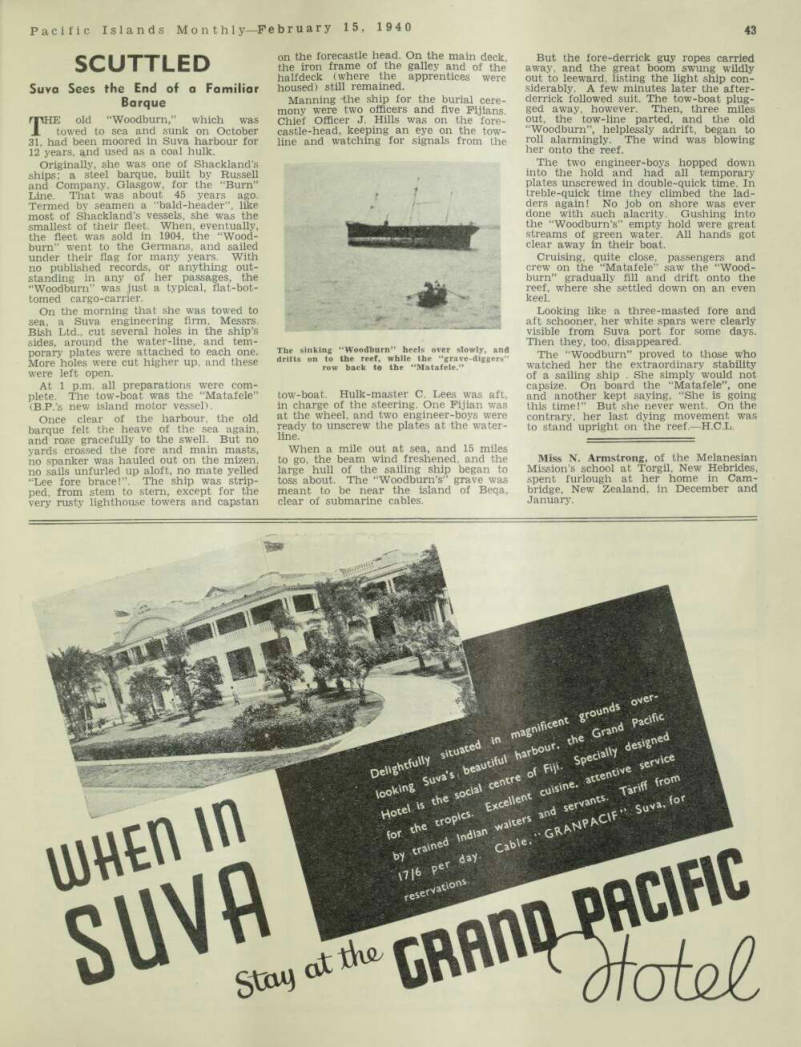
Suva Sees the End of a Familiar Barque
THE old “Woodburn,” which was towed to sea and sunk on October 31, had been moored in Suva harbour for 12 years, and used as a coal hulk.
Originally, she was one of Shackland’s ships; a steel barque, built by Russell and Company, Glasgow, for the “Burn”
Line. That was about 45 years ago.
Termed by seamen a “bald-header”, like most of Shackland’s vessels, she was the smallest of their fleet. When, eventually, the fleet was sold in 1904, the “Wood burn” went to the Germans, and sailed under their flag for many years. With no published records, or anything out standing in any of her passages, the “Woodburn” was just a typical, flat-bot tomed cargo-carrier.
On the morning that she was towed to sea, a Suva engineering firm, Messrs.
Bish Ltd., cut several holes in the ship’s sides, around the water-line, and tem porary plates were attached to each one.
More holes were cut higher up, and these were left open.
At 1 p.m. all preparations were com plete. The tow-boat was the “Matafele” (B.P.’s new island motor vessel).
Once clear of the harbour, the old barque felt the heave of the sea again, and rose gracefully to the swell. But no yards crossed the fore and main masts, no spanker was hauled out on the mizen, no sails unfurled up aloft, no mate yelled “Lee fore brace!”. The ship was strip ped, from stem to stem, except for the very rusty lighthouse towers and capstan
on the forecastle head. On the main deck, the iron frame of the galley and of the half deck (where the apprentices were housed) still remained.
Manning the ship for the burial ceremony were two officers and five Fijians.
Chief Officer J. Hills was on the fore castle-head, keeping an eye on the tow line and watching for signals from the
tow-boat. Hulk-master C. Lees was aft, in charge of the steering. One Fijian was at the wheel, and two engineer-boys were ready to unscrew the plates at the water line.
When a mile out at sea, and 15 miles to go, the beam wind freshened, and the large hull of the sailing ship began to toss about. The “Woodburn’s” grave was meant to be near the island of Beqa, clear of submarine cables.
But the fore-derrick guy ropes carried away, and the great boom swung wildly out to leeward, listing the light ship con siderably. A few minutes later the after derrick followed suit. The tow-boat plug ged away, however. Then, three miles out, the tow-line parted, and the old “Woodburn”, helplessly adrift, began to roll alarmingly. The wind was blowing her onto the reef.
The two engineer-boys hopped down into the hold and had all temporary plates unscrewed in double-quick time. In treble-quick time they climbed the lad ders again! No job on shore was ever done with such alacrity. Gushing into the “Woodburn’s” empty hold were great streams of green water. All hands got clear away in their boat.
Cruising, quite close, passengers and crew on the “Matafele” saw the “Wood burn” gradually fill and drift onto the reef, where she settled down on an even keel.
Looking like a three-masted fore and aft schooner, her white spars were clearly visible from Suva port for some days.
Then they, too, disappeared.
The “Woodburn” proved to those who watched her the extraordinary stability of a sailing ship. She simply would not capsize. On board the “Matafele”, one and another kept saying, “She is going this time!” But she never went. On the contrary, her last dying movement was to stand upright on the reef.—H.C.L.
Miss N. Armstrong, of the Melanesian Mission's school at Torgil, New Hebrides, spent furlough at her home in Cam bridge, New Zealand, in December and January.
The sinking “Woodburn” heels over slowly, and drifts on to the reef, while the “grave-diggers” row back to the “Matafele.”
Advertisements & other items, p. 45 (1 item)
&0
msmsmt- ■' und s o»e r ' r ''"\.'’i« 4 <-r:> S^ vaS ftrv^ rC ° o a tte ° £f (ro^ r>S b cW \ ‘ e " t o»W* -v»r>« " ,\ \s * e t^ e " e d ***' $u v». (or v r;:- , c>- 7l«> P «: ■o*?
New Launch for U.S.S. Co., Fiji
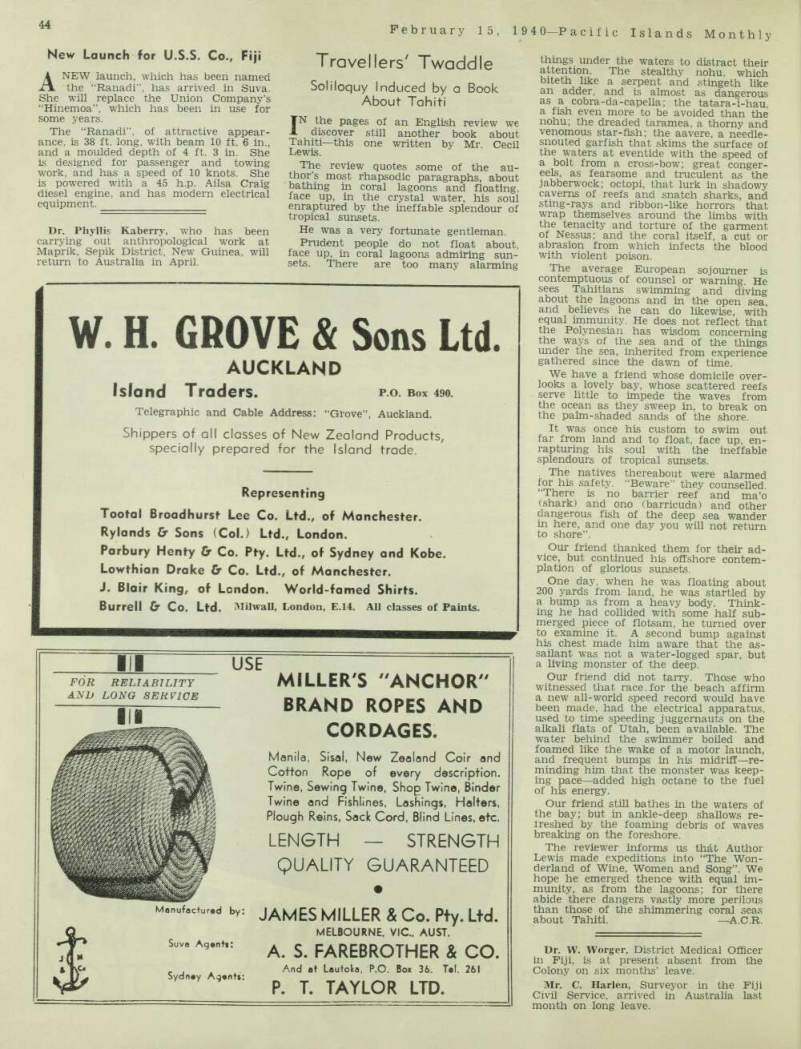
ANEW launch, which has been named the “Ranadi”, has arrived in Suva.
She will replace the Union Company’s “Hinemoa”, which has been in use for some years.
The “Ranadi”, of attractive appear ance, is 38 ft. long, with beam 10 ft. 6 in., and a moulded depth of 4 ft. 3 in. She is designed for passenger and towing work, and has a speed of 10 knots. She is powered with a 45 h.p. Ailsa Craig diesel engine, and has modern electrical equipment.
Dr. Phyllis Kaberry, who has been carrying out anthropological work at Maprik, Sepik District, New Guinea, will return to Australia in April.
Travellers' Twaddle
Soliloquy Induced by a Book About Tahiti
IN the pages of an English review we discover still another book about Tahiti—this one written by Mr. Cecil Lewis.
The review quotes some of the au thor’s most rhapsodic paragraphs, about bathing in coral lagoons and floating, face up, in the crystal water, his soul enraptured by the ineffable splendour of tropical sunsets.
He was a very fortunate gentleman.
Prudent people do not float about, face up, in coral lagoons admiring sun sets. There are too many alarming
things under the waters to distract their attention. The stealthy nohu, which biteth like a serpent and stingeth like an adder, and is almost as dangerous as a cobra-da-capella; the tatara-i-hau, a fish even more to be avoided than the nohu; the dreaded taramea, a thorny and venomous star-fish; the aavere, a needle snouted garfish that skims the surface of the waters at eventide with the speed of a bolt from a cross-bow; great conger eels, as fearsome and truculent as the jabberwock; octopi, that lurk in shadowy caverns of reefs and snatch sharks, and sting-rays and ribbon-like horrors that wrap themselves around the limbs with the tenacity and torture of the garment of Nessus; and the coral itself, a cut or abrasion from which infects the blood with violent poison.
The average European sojourner is contemptuous of counsel or warning. He sees Tahitians swimming and diving about the lagoons and in the open sea, and believes he can do likewise, with equal immunity. He does not reflect that the Polynesian has wisdom concerning the ways of the sea and of the things under the sea, inherited from experience gathered since the dawn of time.
We have a friend whose domicile over looks a lovely bay, whose scattered reefs serve little to impede the waves from the ocean as they sweep in, to break on the palm-shaded sands of the shore.
It was once his custom to swim out far from land and to float, face up, en rapturing his soul with the ineffable splendours of tropical sunsets.
The natives thereabout were alarmed for his safety. “Beware” they counselled.
“There is no barrier reef and ma’o (shark) and ono (barricuda) and other dangerous fish of the deep sea wander in here, and one day you will not return to shore”.
Our friend thanked them for their ad vice, but continued his offshore contem plation of glorious sunsets.
One day, when he was floating about 200 yards from land, he was startled by a bump as from a heavy body. Think ing he had collided with some half sub merged piece of flotsam, he turned over to examine it. A second bump against his chest made him aware that the as sailant was not a water-logged spar, but a living monster of the deep.
Our friend did not tarry. Those who witnessed that race, for the beach affirm a new all-world speed record would have been made, had the electrical apparatus, used to time speeding juggernauts on the alkali flats of Utah, been available. The water behind the swimmer boiled and foamed like the wake of a motor launch, and frequent bumps in his midriff—re minding him that the monster was keep ing pace—added high octane to the fuel of his energy.
Our friend still bathes in the waters of the bay; but in ankle-deep shallows re freshed by the foaming debris of waves breaking on the foreshore.
The reviewer informs us that Author Lewis made expeditions into “The Won derland of Wine, Women and Song”. We hope he emerged thence with equal im munity, as from the lagoons; for there abide there dangers vastly more perilous than those of the shimmering coral seas about Tahiti. —A.C.R.
Dr. W. Worger, District Medical Officer in Fiji, is at present absent from the Colony on six months’ leave.
Mr. C. Harlen, Surveyor in the Fiji Civil Service, arrived in Australia last month on long leave.
Advertisements & other items, p. 46 (1 item)
W. H. GROVE & Sons Ltd.
AUCKLAND
Island Traders. p.o. box 490.
Telegraphic and Cable Address: “Grove”, Auckland.
Shippers of all classes of New Zealand Products, specially prepared for the Island trade.
Representing Tootal Broadhurst Lee Co. Ltd., of Manchester.
Rylands & Sons (Col.) Ltd., London.
Forbury Henty & Co. Pty. Ltd., of Sydney and Kobe.
Lowthian Drake & Co. Ltd., of Manchester.
J. Blair King, of London. World-famed Shirts.
Burrell & Co. Ltd. Milwall, London, E. 14. All classes of Paints.
11l
USE
FOR RELIABILITY
AND LONG SERVICE
Manufactured by: Suva Agent*: Sydney Agent*:
MILLER S "ANCHOR'
BRAND ROPES AND
CORDAGES.
Zealand Coir and every description.
Manila, Sisal, New Cotton Rope of Twine, Sewing Twine. Shop Twine, Binder Twine and Fishlines, Lashings, Halters, Plough Reins, Sack Cord, Blind Lines, etc.
LENGTH STRENGTH
QUALITY GUARANTEED
JAMES MILLER & Co. Pty. Ltd.
MELBOURNE. VIC., AUST.
A. S. FAREBROTHER & CO.
And at Lautoka, P.O. Box 36. Tel. 261
P. T. TAYLOR LTD.
A Biting Reply
Mr. Cowley and "The Tongan Mind"
Letter to the Editor IT is regrettable that, in displaying his biting wit and superior knowledge, and his wrathful indignation against those half-truths which Tennyson tells us “are ever the basest of lies”, Mr. Cowley should have allowed his enthusiasm to run away with him, and to cast asper sions on the “Tongan mind” and the “educated Tongan” in his letter in your November issue.
The tone of the letter, to say the least about it, was most offensive from the Tongan point of view. However, such an outburst would “surely emanate” from Mr. Cowley’s type of mind.
Mr. Cowley could have put his case quite effectively and forcefully without having to be offensive about it. His attitude shows that either he is pre judiced against Tongans, or he is one of those gentlemen who cannot help be ing nasty when they have a point to argue. Happily his kind is rare.
With his vast background of centuries of civilisation and cultural development, it is queer that Mr. Cowley lacks toler ance and restraint which are the true hallmarks of civilised instincts. His “utter failure” to appreciate the fact that the “educated Tongan” has just passed the century mark of civilisation shows that Pope’s aphorism, “a little knowledge is a dangerous thing”, has lost none of its pungency.
However, it is fortunate that Tonga is not afflicted with race prejudice—at least not on the part of Tongans. But such attitude as shown in Mr. Cowley’s letter would surely create antagonism in the “Tongan mind” against Europeans I am, etc.,
Malimali Loto.
Nukualofa, 10/1/40.
Editorial Confession
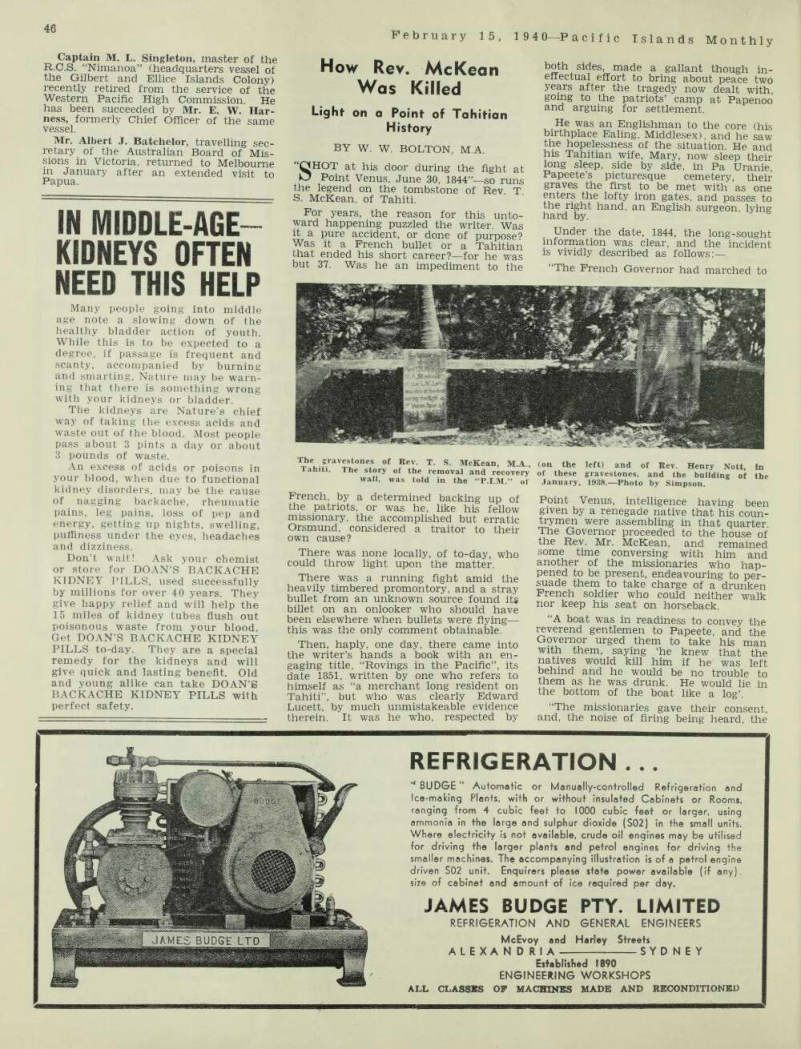
A FEW months ago, when writing about the Russian Government, I made use of a verse—common about 1926 —as follows: Satan, wishing to debase humanity, Crossed Lust with Greed, and Hate with Vanity, Mated their offspring, and thus brought to birth The Bolshie-Communist, the foulest breed on earth.
Some time later, to my astonishment, I received from a resident of Polynesia a letter in which he describes the rhyme as “bawdy”, and violently cancelled his subscription to the “P.1.M.” He indicated, in no uncertain terms, that in his opinion I was a Fascist turncoat and a despic able monster.
I replied softly—l claim, in the face of whatever opposition there may be, that I am of a kind and gentle nature —and I now have a further letter from my friend in Polynesia. He sends with his letter a copy of what he describes as “the skeleton in my cupboard”. To my amazement, I find myself looking at a copy of a pamphlet published by the Communist Party of Great Britain; and the title of the pamphlet, plastered across the front cover is: “What Is The Com munist Party?—by R. W. Robson —One Penny”.
I have travelled a good deal, and especially have I visited with the Robson tribe in Cumberland, England—l believe
that, for centuries, in the Middle Ages, they were notorious cattle-thieves, oper ating on the border between England and Scotland —but the only R. W. Robsons I ever met, apart from the gentleman who glares at me every morning in the shaving mirror, are my father (a resident of Christchurch, N.Z.) ,and a nephew, also a resident of New Zealand.
Therefore, for the benefit of readers who may be somewhat set in their poli tical ideas, I desire to state personally and definitely and categorically that I am not a Communist; that I never have been associated" in any way with the Communist Party of Great Britain; and that I am certainly not the writer of the pamphlet referred to. —R. W. ROBSON.
Mr. C. McCorkindale has replaced Mr.
M. Maginnity at the Apia branch of the Bank of New Zealand, Western Samoa.
Miss June Ewen, of the New Guinea Administration staff, returned to Rabaul in January after a 12 months’ world tour.
Captain M. L. Singleton, master of the R.C.S. “Nimanoa” (headquarters vessel of the Gilbert and Ellice Islands Colony) recently retired from the service of the Western Pacific High Commission. He has been succeeded by Mr. E. W. Har ness, formerly Chief Officer of the same vessel.
Mr. Albert J. Batchelor, travelling sec retary of the Australian Board of Mis sions in Victoria, returned to Melbourne in January after an extended visit to Papua.
Advertisements & other items, pp. 47-48 (2 items)
45
Pacific Islands Monthl y—F ebruary 15, 1940
Buy British
SYDNEY'S LEADING
SAILMAKER
and RIGGER
Also Manufacturer of all Canvas and Rope Work.
ISLANDS WORK a
Speciality.
HARRY WEST
Balmain East, Sydney. Tel.: W 1105
Keep OUR Flag at the Masthead
Sound economics require that we buy where we sell within the Empire.
And where better can we deal than with our Best Customer Britain?
Buy British
Reliable and Economical POWER for all W t I purposes.
Buy PETTER
it's BETTER!
PETTER Diesel Engines and Electric Lighting Plants are built for hard, gruelling work. On account of their simplicity and ease of operation, they can be placed in unskilled hands with the certainty of obtaining good results.
Modern engineering science offers the cheapest and most efficient form of power yet developed—the Diesel Engine.
The Fetter is ahead of them all. Thousands of Fetter Engines are in use all over the world in every kind of power service pumping, irrigating, electric lighting, marine/ etc.
Send for full details of PETTER Engines—from 5 h.p. to 480 h.p.—stationary, marine, or electric lighting. 23 TO
SEVEN IO ELEVEN MARKET STREET. SYDNEYi
IN MIDDLE-AGE—
KIDNEYS OFTEN
NEED THIS HELP
Many people going into middle age note a slowing down of the healthy bladder action of youth.
While this is to be expected to a degree, if passage is frequent and scanty, accompanied by burning and smarting, Nature may be warning that there is something wrong with your kidneys or bladder.
The kidneys are Nature’s chief way of taking the excess acids and waste out of the blood. Most people pass about 3 pints a day or about 3 pounds of waste.
An excess of acids or poisons in your blood, when due to functional kidney disorders, may be the cause of nagging backache, rheumatic pains, leg pains, loss of pep and energy, getting up nights, swelling, puffiness under the eyes, headaches and dizziness.
Don’t wait! Ask your chemist or store for DOAN’S BACKACHE KIDNEY PILLS, used successfully by millions for over 40 years. They give happy relief and will help the 15 miles of kidney tubes flush out poisonous waste from your blood.
Get DOAN’S BACKACHE KIDNEY
PILLS to-day. They are a special remedy for the kidneys and will give quick and lasting benefit. Old and young alike can take DOAN’S
BACKACHE KIDNEY PILLS with
perfect safety.
How Rev. McKean
Was Killed Light on a Point of Tahitian History
By W. W. Bolton, M.A.
SHOT at his door during the fight at Point Venus, June 30, 1844”—50 runs the legend on the tombstone of Rev. T.
S. McKean, of Tahiti.
For years, the reason for this unto ward happening puzzled the writer. Was it a pure accident, or done of purpose 9 Was it a French bullet or a Tahitian that ended his short career?—for he was but 37. Was he an impediment to the
J 2 a determi ned backing up of was h r fellow missionary, the accomplished but erratic a traitor to their own cause.
There was none locally, of to-day, who could throw light upon the matter.
There was a running fight amid the heavily timbered promontory, and a stray bullet from an unknown source found its billet on an onlooker who should have been elsewhere when bullets were flying— this was the only comment obtainable.
Then, haply, one day, there came into the writer’s hands a book with an en gaging title, “Rovings in the Pacific”, its date 1851, written by one who refers to himself as “a merchant long resident on Tahiti”, but who was clearly Edward Lucett, by much unmistakeable evidence therein. It was he who, respected by
both sides, made a gallant though in effectual effort to bring about peace two ye^rs after the tragedy now dealt with, gomg to the patriots’ camp at Papenoo argulng for settlement an Englishman to the core (his birthplace Ealing. Middlesex), and he saw Sf® hopelessness of the situation. He and his Tahitian wife, Mary, now sleep their i? ng al ! e P, ? ide side - in p a Uranie, fce .l Picturesque cemetery, their St w* st - t0 be x met Wlth as one enters the lofty iron gates, and passes to the right hand, an English surgeon, lying hard by.
Tt , X, , A
• F nder ’ .the date, 1844, the long-sought information was clear, and the incident 15 vmdly described as follows: “The French Governor had marched to
Point Venus, intelligence having been given by a renegade native that his coun trymen were assembling in that quarter The Governor proceeded to the house of the Rev. Mr. McKean, and remained some time conversing with him and another of the missionaries who hap suade them *? er "
French ° f a drunk^n nor keen ht wth ei ? er Walk ep hls on horseback, “A boat was in readiness to convey the reverend gentlemen to Papeete, and the Governor urged .them to take his man that the klll I*? 11 . lf hG x was left a £ d he ™ ould be no trouble to S +i? ru ? k ’x e wou i d lie t ll bottom of the boat like a log’.
“The missionaries gave their consent, and, the noise of firing being heard, the
The gravestones of Rev. T. S. Mekean, M.A., (on the left) and of Rev. Henry Nott. In Tahiti. The story of the removal and recovery of these gravestones, and the building of the wall, was told in the P.I.M.” of January, 1938.—Photo by Simpson.
Governor mounted his horse to join his party; but, ere doing so, he rode to the fence and again called out to Mr. Mc- Kean, repeating his instructions respect ing the care of the man. With eager politeness, Mr. McKean hastened to the end of the verandah and raised his hat
in acknowledgment.
“As the Governor rode off. and Mr. Mc- Kean was in the act of re-entering his house, a musket ball struck him in the back of the head, behind the ear. He expired without uttering a syllable. The ball lodged below the socket of the eye.
It is acknowledged that it was fired by a native, although no one grieves more for the unhappy occurence than the natives.”
Lucett goes on to say that McKean’s house was converted into a hospital and barracks for the French soldiers “with the destruction of his stock and appro priation of any convenient articles of property”. He accompanied sailors of the British ketch, the “Basilisk”, which was then in Papeete Harbour, who conveyed the body in their boat across Matavai Bay to bury it “shrouded in its bloody vestments”, alongside Nott, who had died the month before.
There seems no reason to doubt that the sharpshooter took aim at Bruat who, on horseback, would be on a level with Mc- Kean on his verandah, and that the natives placed Bruat and his party as the cause of the tragedy.
This latter point seems evident from an incident, little known even locally, but recorded by the French historian, Caillot as occuring that same day. With the French soldiers eight miles away to the north, the patriots, hovering on the south of Papeete, saw their chance and entered the little town. 11l news ever travels fast.
That afternoon and night, revenge for all and sundry wrongs was had by commit ting to the flames the entire Catholic Mission buildings in its centre. Every thing went up in smoke —altars and vest ments, furniture and clothing, books and Mss. This latter was indeed a loss, for the then ailing Father Caret (he, with Father Laval, being the cause of all the trouble) had compiled dictionaries of both the Marquesan and Tahitian lan guages in his heyday, and his death was evidently not far off. He died in October of that year, aged 42. Those were strenu ous days on Tahiti.
Advertisements & other items, p. 48 (1 item)
Refrigeration ...
. liiSl
>3
JAM
BUDGE
LTD
REFRIGERATION ...
'* BUDGE" Automatic or Manually-controlled Refrigeration and Ice-making Plants, with or without insulated Cabinets or Rooms, ranging from 4 cubic feet to 1000 cubic feet or larger, using ammonia in the large and sulphur dioxide (SO2) in the small units.
Where electricity is not available, crude oil engines may be utilised for driving the larger plants and petrol engines for driving the smaller machines. The accompanying illustration is of a petrol engine driven SO2 unit. Enquirers please state power available (if any), size of cabinet and amount of ice required per day.
JAMES BUDGE PTY. LIMITED
REFRIGERATION AND GENERAL ENGINEERS
McEvoy and Harley Streets ALEXANDRIA S Y D N E Y Established 1890
ENGINEERING WORKSHOPS
ALL CLASSES OP MACHINES MADE AND RECONDITIONED
Papuan's Fortitude
From Our Own Correspondent
Samarai, Jan. 4.
WHEN diving for trochus shell, out on the . barrier reef, near Malagili, a native boy was attacked by a shark. His leg was cut to the bone, above the knee, and it was three days after the accident before he arrived, for treatment, in Samarai. Although suffering intense pain, the boy was still conscious when he reached hospital. The medical officer reported later that, although it would take some time, the patient eventually would recover, without losing the use of his limb.
Mrs. H. B. Lange, wife of Dr. Lange of the Government Hospital at Apia, West ern Samoa, died recently following a sud den collapse. She had suffered for some time from facial paralysis.
Rev. Dr, James Hannan, Director of Catholic Missions in the South Seas, whose headquarters are in Melbourne, recently was involved in a car accident and suffered a broken nose.
The Romance in Your
Cultivator
N 1785 Robert Ransome, a young Iron-founder I Just out of his apprenticeship, started business on his own account in Suffolk, England, and gave special attention to the production of plough-shares which would retain sharpness. His business grew, and he established himself in Ipswich—but still he was dissatisfied with his plough-shares, and continued his experiments.
One day, the container in his foundry burst, and the molten metal spread over the floor.
When it was cold, Mr. Ransome proceeded to break it up, to re-melt it. He noticed that cer tain of the iron, -which had cooled while in contact with iron already cold, was much harder than the rest. Thus, practically by accident, he came upon the secret of chilled steel. In 1805, he took out patents for his famous chilled steel plough-share.
This discovery, plus the general excellence of the agricultural machinery which the firm made, established Ransomes, of Ipswich, as one of the notable makers of agricultural machinery in England. Right from the beginning, it was a firm of great enterprise—it would send displays of agricultural machinery to any accessible gathering of farmers in England, and it would build bridges, or steam engines, or ships, if asked. Over 100 years ago its young men were going over to the continent of Europe and sell ing their products there.
Robert Ransome established a great English industry. His spirit lived, not only in the traditions which he imposed upon his firm, but in the staunchness, vision and enterprise of
those who inherited his blood and name, and succeeded him in control of the business.
The firm became Ransomes, Sims and Jefferies, Ltd., in 1884, and its products nowadays are known in every corner of the civilised world.
Photographs in a book which has just been published, describing the firm’s 150 years, show the firm’s ploughs being pulled by camels in Palestine, by elephants in India, by steam tractors in Canada, and by draught horses in New Zealand. One sees their cultivators in the plantations of Fiji and New Guinea, and their lawn-mowers busy on the lawns of Canberra and Capetown.
The firm already was big when war broke out in 1914. Within two years, 2,000 of its employees had gone to fight and been replaced by women, and the firm was turning out mili tary aeroplanes, lorries, and parts of big guns.
The firm had been supplying agricultural mach inery on a huge scale to Russia. When the Bolsheviks took charge in 1917 and repudiated the country’s liabilities, the firm’s losses were enormous.
But after the war it was re-built. Skilled salesmen penetrated every continent. When war came again in 1939 the business Ransomes, Sims
and Jefferies in South America and South Africa, India and Australia and the Pacific Islands probably was bigger than that of any similar British firm. It will come again. Of such stuff is the heart of England made.
Advertisements & other items, pp. 49-50 (1 item)
» Wunderlich
Timber, Joinery
ETC.
PREPARED BUILDINGS ready for erection a specialty.
SHIP AND BOAT BUILDING.
TIMBERS specially catered for.
PIBROLITE, PLYWOODS,
GALVANISED IRON.
CONSIGNMENTS shipped
by RETURN STEAMERS
to the Islands.
John W. Eaton
PTY. LTD.
WEST CRESCENT STREET,
NORTH SYDNEY.
Telephones: XB 4051 (6 lines.)
BITUMENOID ROOFING
MADE IN AUSTRALIA.
Bitumenold Roofings, Dampcourse and Insulating Felts are made from the world's best raw materials. Warranted to stand the most rigid tests.
BITUMENOID THE BEST
Roofing, 1,2, 3-ply; Flooring, Waterproof Materials; Saturated Pelt; Resilient Road Jointing; Natural Asphalt Dampcourse: 2 and 3-ply Dampcourse; 1-2 lb. Lead-core Dampcourse; Roofing Cement; Asphalt Paints; Roofing Compound.
SAMPLES AND PRICE LISTS ON APPLICATION.
MAXWELL PORTER & SON LTD.
ESTABLISHED 1888. BUILDERS’ SUPPLIES.
107 EEDFERN ST., REDFERN, SYDNEY, N.S.W. 'Phone: M 3157. Cables Bitumenold.
to* 1 Wi
abp°rS^
«^ic*» Obtain a copy before you build.
It contain* designs and plans— in colour—of Homes that can be inexpensively built with
WUNDERLICH DURABESTOS
the indestructible asbestos-cement building sheeting. Write to
WUNDERLICH LIMITED
G.P.0., Box 474 oa, SYDNEY
t-OR TROPICAL BUILDINGS, SPECIFY
» WUNDERLICH
rS lIPAIESTCS
IT ATTRACTS THEY EAT IT THEY DIE
IUSOLINE
550
°VING
T&£
NEVER
KNOWN
TO FAIL !
COCKROACH
DESTROYER
IT'S A PASTE!
AUSOLINE CO.
314 CROWN STREET. SYDNEY
(Established 1919)
PRICES:
Mb. 5/- . . . 3lbs. 10/- Postage Extra.
Remit Cash with Order.
Obtainable also from Islands stores of;
BURNS. PHILP & Co. Ltd.
W. R. CARPENTER & Co. Ltd.
Scott’s “Renown” Brand Rope,
Cordage and
Binder
Twine
Cable Address Ropayard, Sydney. mem
of Every
Description
MANUFACTURED AT
MASCOT, N.S.W.
By
J. SCOTT
PTY. LTD.
Head Office and Store:
163 CLARENCE STREET,
SYDNEY,
N.S.W.
Loose Again
From Our Own Correspondent
Apia, Jan. 15.
A DANGEROUS criminal, the Samoan -Tl. Samuelu, serving a sentence for rape, who has many times previously escaped from custody, has once again made a successful break from Tafaigata prison, and is at present at large.
Some time ago the local newspaper remarked that, like the Canadian Moun ties, the Samoan police “always get their man”. It seems, however, that there is a slight difference in Samoa—they can not hold their man, after they get him.
N.G. Native Labour
Problem Commission at Work on Difficult Task
From Our Own Correspondent
T Tttn Rabaul, Feb. 3.
HE Commission, consisting of two officials and two non-officials, with the Director of District Services as chair man, still is busily engaged in collecting evidence from all sections of the com munity. Answers to the questionnaires are being received from all over the Territory, and the response is said to be good.
There appears to be a majority in favour of the establishment of a govern ment-controlled labour bureau, which will supply all labour and supervise its repatriation.
A bureau, free from the usual offi cial red-tape, is suggested, staffed with officials who will have the prestige of “Government” in the eyes of the natives, but without the severe handicap of being subject to the usual departmental delays.
Corporal Punishment
Although the questionnaire contained no reference to the introduction of cor poral punishment in any form, the mat ter has been brought up by various wit nesses. It is interesting to note that several missionaries of long residence support the suggestion that corporal punishment, similar to that enforced in European schools, should be introduced for the punishment of minor offences, thus obviating the loss of the servants’ time to the employers involved in going to court, and meting out summary pun ishment on similar lines as is given to children at school or in the home.
The Commission recently made a trip to Kavieng, where important evidence was tendered by planters, business people and missionaries.
Editorial Note
rE Government labour bureau plan has many advocates, but it should be approached with the greatest caution.
Already there are too many sugges tions of “forced labour” in connection with New Guinea. If the Government, demanding the 10/- annual head-tax in the primitive villages, is at the same time seeking recruits for its labour bureau, the conclusion certainly will be formed in native minds —and maybe in minds other than native —that the two things are connected —that is, that the Government, failing to collect its head tax, demands as an alternative that the young men shall be indentured for gen eral labour and that their “hand money” (deposit left by recruiter with recruit’s relations as evidence of good faith) shall be used for payment of head-taxes.
The old recruiting method, while it has its critics, at least has this outstand ing thing in its favour —that none can say that recruits, so procured, have “made paper” under official pressure.
This whole matter of enlisting native labour in New Guinea is so beset with difficulties and dangers that it is to be hoped that the Commission, before mak ing its report, will examine very care fully the possibility of using indentured Asiatic labour.
However, it is unlikely that any far reaching changes will be made until the war ends, and the future government of New Guinea is permanently arranged.
Malietoa
Royal Title Awarded in Western Samoa
From Our Own Correspondent
Apia, Feb. 1.
AFTER a lengthy hearing, the Land and Title Court, sitting at Mulinuu, awarded the Malietoa title to Ati, the 26-years-old son of the late High Chief Tanu Malietoa.
The second claimant was Sergeant Fitisemanu, of the Samoan Police, a member of a side branch of the Malietoa family, who is at present in charge of the Samoan exhibit at the N.Z. Cen tennial Exhibition in Wellington.
The new Malietoa (in whose favour the younger brother Joane, at first elected by the Malietoa family, had with drawn his claim) returned to Samoa after the death of his father a few months ago. From 1930 to 1931 and from 1934-1939, he was educated at St. Ste phen’s and at the Wesleyan College, Auckland, and passed the intermediate examination. He is a keen sportsman and distinguished himself as a member of the football and cricket teams and at swimming and athletic sports at his school.
"Ernie" Dover Dead
Pioneer of Morobe Goldfields
From Our Own Correspondent WAU, Feb. 1.
ERNEST Dover, a very well-known identity of the Goldfields, died from Japanese River fever on Sunday, Janu ary 28, at the Wau Hospital.
“Ernie”, born in London, was among the very first pioneers of the Morobe Goldfields, being associated with “Shark- Eye” Park. Nettleton and others, in 1924.
When the rush from the Kulolo to Ka indi occurred in 1926, Ernest Dover was. among the first to reach the new Eldo rado, with Bill Royal.
Knowing Dover’s slight physique, one wonders at his hardihood in those wild days. For a long time he travelled the formidable road, from the coast to Ku lolo, with supplies.
Ernest Dover served during the last war, but one seldom, if ever, heard him speak of his war services. He had not an enemy in the world, was always charitable and courteous, and he is missed by the many who had known him for long years on the Goldfields.
Mr. Dover originally came to New Guinea with the A.N. & M.E.F. and transferred to the Department of Agri culture. He saw service with this de partment in the Kokopo and Kavieng districts, ultimately resigning and join ing up with the Expropriation Board.
Finally, about 1924, he went prospect ing for gold. He always missed for tune “by a whisker”, as he said himself.
At one time he owned the rich Kor anga claim, which he sold to Messrs.
Pryke and Joubert.
Mrs. T. and Miss E. Warburton, well known residents of Ba. Fiji, where Mr.
Warburton is manager of the B.P. (S.S.) branch, are at present on furlough in Sydney. They arrived in Australia several weeks ago, and proceeded to Brisbane where they spent some time before re turning to Sydney by the “Macdhui”, early in February.
Workers' Compensation Law
for N. Guinea
A LAW to provide compensation for workers injured in the course of their employment is to be enacted in New Guinea —following upon long-con tinued agitation for something of the kind.
The measure is to follow generally along the lines of Australian legislation; but some difficulty apparently is being found in defining a “worker”—that is, as between a European worker, an Asiatic worker and a native worker. Until these
little problems are worked out it is im possible to indicate probable rates of insurance. As soon as the compensation law comes into operation in New Guinea, it will become necessary for all employ ers to insure against the usual risks.
Incidentally, it looks as if there is good business waiting here for some bright and enterprising insurance agent.
Mr. R. Speedie, a well-known planter in Eastern Papua, arrived in Sydney by the “Macdhui” recently. He was formerly in the Government Service but resigned some two years ago to take up rubber planting.
Captain I>, McClymont, Harbourmaster at Apia, Western Samoa, arrived in New Zealand by the January “Maui Pomare" on furlough. Captain O. Anderson is act ing Harbormaster and Pilot during his absence.
Advertisements & other items, pp. 51-52 (2 items)
49
Pacific Islands Monthl y—F ebruary 15, 1940
J.G. Merrillees & Go.
Telegrams:
“MERRILLEES”,
Stanton House, Sydney.
J.G. MERRILLEES & GO.
Stanton House
133 PITT ST., SYDNEY.
"Phone: BW 6569.
• G.P.O. BOX
3871 T.
BUYERS OF ALL ISLANDS REQUIREMENTS.
SUPPLIERS OF ALL AUSTRALIAN GOODS.
AGENTS FOR
Peter DoWSOIVs Whisky (The Whisky Without a Headache).
Coate's Plymouth Dry Gin Calder's Milk Stout
Cowrie Sharps, Pyramid Flour
ANNOUNCEMENT:
Inquiries Welcomed.
We wish to notify our clients that we have been appointed Agents for
McWILLIAM'S WINES
PACIFIC POPO I A R II!
SINCE 1908
;# j ’ o o '- • -..-• -1 - - •-'.!.- -.- ' A CHAPMAN 3 h.p. “PUP" ENGINE IN A CHAPMAN MODEL "0" 16 It. CABIN LAUNCH FOR OPEN SEA WORK. SPEED 7 m.p.h. £96 f.o.b. SYDNEY.
WRITE TO
CHAPMAN & SHER A C K
erskineville, n. s. w.
CINNAMOLIA
The hot weather is now approaching with its dysentery, diarrhoea, and other seasonal infectious diseases of the alimentary canal EVERY tropical home should have on hand a bottle of the above remedy—in case—so as to be ready to attack the germs as soon as the first symptoms of disease appear.
For years scientists and medical men have sought for a safe, powerful germicide to treat Infections of the Intestinal tract without harming the tissues.
Here it is! CINNAMOLIA! Guaranteed to contain no poisons or harmful drugs.
Price 3/- per bottle from
FALKS PHARMACY,
238 GEORGE ST., SYDNEY.
Wholesale Rates to Chemists, Hospitals,
etc., from CINNAMOLIA PREPARATIONS.
17 Murray Street, Waterloo. N.S.W. Tel.: MX 1702.
Woven Wire for all Industry
COPRA DRYING TRAYS, FLOORS, Etc.
FRUIT DRYING TRAYS, MINING SCREENS
Heavy Mosquito Gauze in Phosphor Bronze and other Metals Impervious to Salt Sea Air WIRE DOOR MATS AND GENERAL WIRE WORKS
E. WRIGHT & CO. LTD.
Office and Works: 148-152 Cleveland Street. Sydney, N.S.W.
Telegraphic Address: “Wrightmake,” Chippendale.
Or *i *Bl\
/ <r
It's CHEAPER to PAINT
than to repair!
DISTRIBUTORS:
Greenwood & Laws Ltd., Rabanl and Wan.
Steamships Trading Co. Ltd., Port Moresby and Samarai.
Millers, Ltd., Bht», Fiji.
Decay can do no damage if your home is properly protected with good paint.
Use “8.A.L.M.” Paint— “B.A.L.M.” Paint gives protection. And it wears down evenly and very slowly, lasting years longer than ordinary paint.
Decide now to save money by painting; and decide to make maximum savings by using - - - - “8.A.L.M.” Paint!
'pa i m v
A Product of British Australian Load Manufacturers Pty. Ltd.,
A Trader's Tale
By “Borneo’’
IWAS in West Australia in the first flush of the boom. Gold was easily got and for a mate, I had an old Corn ish miner, Jimmy Acton.
I was only 25, and my mate gave me a straight tip, right away, as to hospital ity and the big heart. This was his creed: Never let a man pass your tent without asking him in and giving him a feed—damn the expense!—and if a man is sick, lend a willing hand.
Acton died of fever, in Cue. This hos pitality came back to me, shortly after his death, a thousand fold. What does the Holy Book say: Cast your bread upon the waters, etc.? Well, I found it, all right.
I had just come off Lake Austin, had finished my claim, and was sleeping alongside a well, 40 miles away. In the early morning, I was shaken out of my sleep by a red-headed Irishman (whom I had nursed through a bout of fever 12 months before out at Lawler’s).
“Hello, Jim”, said he. “Come with me”.
We went 100 yards or so away from the well and the company. “What do you think of this?” he said, showing me a great, red handkerchief, full of coarse
quartz gold. There must have been 60 to 100 ounces.
I opened my eyes wide and questioned him where he got the gold. “Mum’s the word. I have struck it rich, a great alluvial patch. You can come with me.
Its three days’ travel from here, and you can peg out the next claim to mine”.
I got, right away, into the nearest township, and stocked up flour and bully beef. We set out on our hike, and I got m next claim but one.
The first run out of my shaker, I got a 2°z. piece. My first day’s work was i lB <??• of Pure, solid gold. That night.
I shifted my pegs backwards—that was the rule with men on the ground—and. in three weeks’ work, this friend of mine put me into the way of making £1,860. That was the actual money I got for this melted gold in the city of Perth, besides paying my way.
I was unable to do more than three weeks’ work, as the find got abroad, and m no time there were 350 to 400 men on the field, and all the available ground was taken up. The money soon ran through my young fingers.
AFTER that, I made another nice lit tle bit of money—partly wages, after prospecting on my own, working in one or two fairly rich mines—one mine, in particular, named “Star of the East”.
She was a dandy reef, 11 ft. wide and, on the hanging wall, a white buck quartz. 2 ft. wide, with a band of gold 4 inches wide running through from the shaft to the fourth and fifth stope.
My work was in one of the stopes.
It was a real, heavy, tiring job. All the men who worked on the gold had to strip naked in the changing house at the end of the day, and walk into an other shed to get their ordinary clothes to go home in.
IHAD had my fill of mining, so after getting well away with my bit of savings, I started work on a farm, think ing that would be the best way of leav ing underground work alone, and so live the open-air life. But working out-doors in three shifts is a real corker, a bit of slavery. No sleep in the day. Too many damned flies and, when Saturday comes to an end, a man is all in.
Anyhow. I did four months on a West Australian farm, milking cows, looking after 17 windmills, 60 pigs, 500‘ fowls and 1,700 sheep, doing also a bit of cooking, and all without a woman mate.
I told the boss: “I’ve had enough, I’m going into Perth”.
Said he: “All right, but don’t leave me. Go and have a fly, then come back”.
I sure went on the fly.
I got to Perth, and not long after I saw an advertisement in the paper:— “Wanted: A married couple for a sta tion”. Here was my chance.
I applied for the job, and got it. I had no woman, but that did not bother me. I made up my mind that the first woman I could get hold of I would take, and we would go as man and wife.
I got the job on a Monday, and the agent told me I would have to go off to the “station” by Thursday morning’s train, leaving at 8 a.m. I said: “All right—l’ll be there”.
He also said I looked a likely looking man, “but how about your wife?” He would like to see her. Was she a good cook and laundry woman? I said: “Top notch, Al”. The only thing was that she
was at the moment working in the city, while I had been away on a farm. But he need not worry about her—we would be off on Thursday.
He sent a wire, and a buggy was to meet the train at 10 o'clock Thursday night, the “station” being 14 miles from the railroad.
ALL was settled. I had the job to go to, but no “wife” to keep me com pany.
Monday, no luck. Tuesday, no luck.
On Wednesday. I met my fate. I was walking along Murray Street, and a woman, passing along, smiled at me. We shook hands, and I asked her to come and have a drink. After a drink we strolled down the street to a restaurant, and had a good meal. The girl, aged about 25, was evidently hungry, and did full justice to the meal.
We went into the park, facing the Swan River, and, after a good talk. I asked her would she like to go with me to a job on a station.
“Well”, said she, “you look a decent sort, and I’ll trust you. I’ll go”.
I told her “50-50”. The wage was £3 a week.
She roomed in North Perth. Getting a spring cart, I loaded her boxes and my own. and off we went and booked ourselves in a big boarding-house in William Street, as Mr. and Mrs. John ston.
We caught the train. No plans for the future—just off to a station to work and save money. We arrived at the small township at 10.30, found the boss wait ing for us, and arrived at the station in the wee hours.
At 5 a.m., there was a knock at the door, and the missus told me where the cows were. We got along fine and suited well our respective jobs. Mine was cow boy; kill two sheep a week; chop wood; and general—no real hard work and plenty of good food. Annie (that was her name) was a real good cook. It was funny at first; not knowing one an other. She would ask me how I liked my chops? I think the missus heard her asking me about my tastes. Anyway, we were married to our job, and that kind of marriage suited us fine.
Everything went along well for awhile, and then Annie found she was to be come a mother. I took her down to a nursing home in Perth. Annie died m the nursing home.
I told her I would marry her, but she said, time and again, “No”. She would wait till she got through her trouble But I think she had a presentiment that this would be her end, and there was no need of any ceremony and swearing to hold together.
That’s nigh 40 years ago. Since then, I wandered far and wide before settling down in the Islands, but I have lived my life alone. No other woman ever shared my life like my chance find in Perth.
Copra Price In Papua
From a Special Correspondent
Samarai, Jan. 2.
rE following figures show the average price received in Samarai for copra over the last three years:—
Hot Air. Smoked. 1937 £14 5 9 £13 2 5 1938 6 17 7 5 15 2 1939 6 17 5 5 13 10
"Stamp Racket"
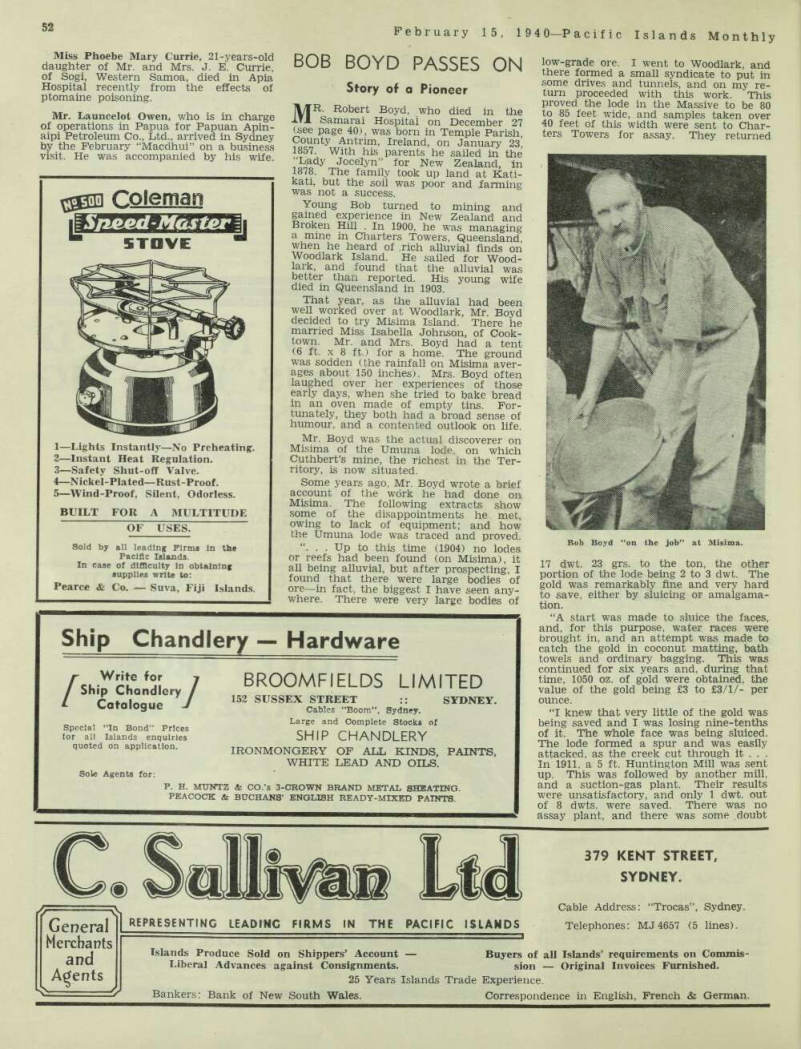
New Issue For Norfolk Is.
EVER since Australia took over Norfolk Island, Norfolk Island has used Australian postage stamps: and there have been no complaints about the effi ciency of Norfolk Island postage under this arrangement.
It is now announced, however, that about April Norfolk Island will have its own postage stamps. Designs for the first issue—showing portions of the island and the adjacent Phillip Island—have been completed and printing is under way.
At first glance, it appears a useless waste of public money. Actually it is a highly profitable proceeding. These
Islands territories usually show a profit of from £lO.OOO to £20,000 in the postage account in the year following the issue of a new lot of stamps—the result, of course, of philatelists all over the world rushing in, with their ears back, to buy up the new issue. It has become a regu lar “racket” among the small admini strations throughout the Pacific —one way of raising revenue when all else seems to have failed. The philatelists seem to like it—so why should anyone else worry!
The engagement was announced in January of Miss Fay Brown, only daugh ter of Mr. and Mrs. L. Brown, of Bulolo, New Guinea, to Mr. Bruno Kroening, eldest son of Dr. and Mrs. B. Kroening, of Toboroi Estate, Kieta, New Guinea.
Miss Phoebe Mary Currie, 21-years-old daughter of Mr. and Mrs. J. E. Currie, of Sogi, Western Samoa, died in Apia Hospital recently from the effects of ptomaine poisoning.
Mr. Launcelot Owen, who is in charge of operations in Papua for Papuan Apin aipi Petroleum Co., Ltd., arrived in Sydney by the February “Macdhui” on a business visit. He was accompanied by his wife.
Advertisements & other items, pp. 53-54 (1 item)
Ormo N O I D
BITUMNIOUS ROOFING
MADE IN 1,2, 3 AND 5 PLY PROM HIGHEST GRADE RAW PELTS AND BEST QUALITY BITUMENS. FUME, ACID, AND CHEMICAL PROOF, IM- PMRVIOUS TO SALT AIR AND WILL NOT AFFECT DRINKING WATER.
IDEALLY SUITED FOR TROPICAL CLIMATES
WEATHERPROOF AND WATERPROOF
SPECIFY AND USE ORMONOID
ROOFING FLOORING DAMPCOURSES
PAINTS COMPOUNDS SARKING FELTS
PLASTICS BUILDING PAPER ASBESTOS FELTS
MADE IN AUSTRALIA
PRICES, SAMPLES & PARTICULARS GIVEN ON REQUEST.
ORMONOID ROOFING & ASPHALTS LTD.
39 MENTMORE AVE, WATERLOO, SYDNEY, AUSTRALIA.
d
OYES BROS
NOYES BROS.
FOR DETAILS OF
• MINING EQUIPMENT. —Crushing Machinery, Screens, Feeders, (Rock Drills, Excavators, Diesel and Crude Oil Engines, Hoists and . Runways, Roller Bearings, etc.
• ELECTRICAL EQUIPMENT. Parkinson
Motors, Crompton Switchgear, Transformers, Instruments, Meters, Callender Wires and Cables, Lighting Equipment, Electric Drills.
“ BRISBANE.
KiCwr-AcV. I- ft STORES, FACTORIES, HOME AND OFFICE NtWCASTLc. Crompton Lamps, Electric Fittings and Accessories, Airspeed Fans, Floodlighting SYDNEY I Equipment, Domestic Electric Appliances, Joseph Rodgers Cutlery & Plateware, Chinaware, “Perfection” E.P.N.S. Ware, Clocks.
NON-FERROUS METALS OF ALL DESCRIP-
TIONS. —In sheets, Strips, Rods, Tubes, Wire and Extruded Sections.
NOYES BROS.(Sydney) Ltd,
115 Clarence Street, Sydney. 1 1 Watt Street, Newcastle 197 Elizabeth Street, Brisbane
fllgiD Coleman
STOVE
1— Lights Instantly—No Preheating. 2 Instant Heat Regulation. 3 Safety Shut-off Valve. 4 Nickel-Plated—Rust-Proof. 5 Wind-Proof, Silent, Odorless.
BUILT FOR A MULTITUDE
OF USES.
Sold by all leading Firm* In the Pacific Islands.
In case of difficulty In obtaining supplies write to: Pearce & Co. Suva, Fiji Islands.
Ship Chandlery Hardware
/Write for j
Ship Chandlery /
Catalogue J
Special “In Bond” Prices lor all Islands enquiries quoted on application.
Sole Agents for:
BROOMFIELDS LIMITED
152 SUSSEX STREET SYDNEY.
Cables "Boom”, Sydney.
Large and Complete Stocks of
SHIP CHANDLERY
IRONMONGERY OF ALL KINDS, PAINTS,
WHITE LEAD AND OILS.
P. H. MUNTZ & CO.’s 3-CROWN BRAND METAL SHEATING.
PEACOCK & BUCHANS’ ENGLISH READY-MIXED PAINTS.
Bob Boyd Passes On
Story of a Pioneer
MR. Robert Boyd, who died in the Samarai Hospital on December 27 (see page 40) was born in Temple Parish, County Antrim, Ireland, on January 23 1857. With his parents he sailed in the Lady Jocelyn” for New Zealand, in 1878. The family took up land at Kati kati, but the soil was poor and farming was not a success.
Young Bob turned to mining and gained experience in New Zealand and Broken Hill . In 1900, he was managing a mine in Charters Towers, Queensland, when he heard of ,rich alluvial finds on Woodlark Island. He sailed for Wood lark, and found that the alluvial was better than reported. His young wife died in Queensland in 1903.
That year, as the alluvial had been well worked over at Woodlark, Mr. Boyd decided to try Misima Island. There he married Miss Isabella Johnson, of Cook town. Mr. and Mrs. Boyd had a tent (6 ft. x 8 ft.) for a home. The ground was sodden (the rainfall on Misima aver ages about 150 inches). Mrs. Boyd often laughed over her experiences of those early days, when she tried to bake bread in an oven made of empty tins. For tunately, they both had a broad sense of humour, and a contented outlook on life.
Mr. Boyd was the actual discoverer on Misima of the Umuna lode, on which Cuthbert’s mine, the richest in the Ter ritory, is now situated.
Some years ago. Mr. Boyd wrote a brief account of the work he had done on Misima. The following extracts show some of the disappointments he met, owing to lack of equipment; and how the Umuna lode was traced and proved.
“. . . Up to this time (1904) no lodes or reefs had been found (on Misima), it all being alluvial, but after prospecting, I found that there were large bodies of ore—in fact, the biggest I have seen any where. There were very large bodies of
low-grade ore. I went to Woodlark, and there formed a small syndicate to put in some drives and tunnels, and on my re turn proceeded with this work. This proved the lode in the Massive to be 80 to 85 feet wide, and samples taken over 40 feet of this width were sent to Char ters Towers for assay. They returned
17 dwt. 23 grs. to the ton, the other portion of the lode being 2to 3 dwt. The gold was remarkably fine and very hard to save, either by sluicing or amalgama tion.
“A start was made to sluice the faces, and, for this purpose, water races were brought in, and an attempt was made to catch the gold in coconut matting, bath towels and ordinary bagging. This was continued for six years and, during that time, 1050 oz. of gold were obtained, the value of the gold being £3 to £3/1/- per ounce.
“I knew that very little of the gold was being saved and I was losing nine-tenths of it. The whole face was being sluiced.
The lode formed a spur and was easily attacked, as the creek cut through it . . .
In 1911, a 5 ft. Huntington Mill was sent up. This was followed by another mill, and a suction-gas plant. Their results were unsatisfactory, and only 1 dwt. out of 8 dwts. were saved. There was no assay plant, and there was some doubt
Bob Boyd “on the job” at Misima.
as to the value of the ore, until later, when an assay plant arrived and the tailings were assayed. Then cyaniding was tried, by one small vat, on ore direct from the mine, without crushing, and in this way 80 to 87 per cent, of the gold was obtained. . .
Later, Mr. and Mrs. Boyd took up an agricultural lease at Tauahik. From here, the surrounding hills were pros pected and what is now known as Quartz Mountain was found. In 1915, the couple had their last holiday together in Aus tralia. Mr. Boyd had been down South only once since then.
“Bella” as Mrs. Boyd was affection ately known, died recently, and “Bob” followed at the close of the year.
So two more of the pioneers have passed on.
“Be straight, and have no regrets, is my idea of life,” said Bob; and those who knew him know that he lived up to
his motto.
H.K.B.
Advertisements & other items, p. 54 (1 item)
CLSJkIm Lid,
General
Merchants
and
Agents
REPRESENTING LEADING FIRMS IN THE PACIFIC ISLANDS
379 KENT STREET,
SYDNEY.
Cable Address: “Trocas”, Sydney.
Telephones: MJ4657 (5 lines).
Islands Produce Sold on Shippers’ Account Buyers of all Islands’ requirements on Commis- Liberal Advances against Consignments. sion Original Invoices Furnished. 25 Years Islands Trade Experience.
Bankers: Bank of New South Wales. Correspondence in English, French & German.
New Bishop Rules in Morobe,
T.N.G.
From Our Own Correspondent WAU, Feb. 4.
THE visit to Wau of the Bishop of New Guinea (Papua) marks another step in the life of the Morobe parish and its administration. The Bishop (Rt. Rev. P.
N. W. Strong, M.A.), who arrived in Wau on January 17, assumed jurisdiction of Morobe. including all the main island of the Mandate from the Dutch border to the Papuan-Territory border, from July 1, 1939.
The actual legal transfer of Morobe to the New Guinea Diocese has to await confirmation by General Synod in 1942.
The working arrangement agreed to by the Queensland Provincial Synod enables the transfer to be effective now, for all practical purposes.
Hitherto, the whole of the Mandated Territory formed part of the Diocese of Melanesia, with headquarters at Tulagi, 8.5.1.. under the ecclesiastical control of the Bishop of Melanesia (Rt. Rev. W. H.
Baddeley, M.A., D. 5.0., M.C.).
The first service at Edie Creek, in the early vigorous days of the Goldfields, was held by Rev. Bishop in 1927, on a log, practically all the miners being present. In 1932, a permanent church was established in Wau. The first Rec tor was Rev. G. Bradley. Rev. V. H.
Sherwin has had charge of the growing parish since 1934. Wau, Edie Creek, Salamaua, Lae, Bulolo and Bulwa, with the outlying districts of Watut, Bitoi, and Sunshine, are included in the parish.
Mr. J. M. Reilly, who has been in charge of the Melanesian Mission’s ves sel “Patteson” in the New Hebrides, is at present spending furlough in Welling ton, New Zealand.
Mr. J. Einsiedel arrived in Papua from Melbourne in January to relieve Mr. L.
Morris as accountant of the Australasian Petroleum Co. at Port Moresby, while the latter is on three months’ leave.
Mr. Kevin S. Sheeky has replaced Mr.
Robert M. Cameron as clerk of the Legis lative Council in New Guinea.
Mr. C. A. M. Adelskold, of the Hotel Wau. New Guinea, arrived in Australia by plane from Morobe in January to spend his first furlough in five years.
During his absence, Mr. B. Bald is in charge at the Goldfields hotel.
Good Shooting In Fiji
rE Colony of Fiji maintains its high reputation in rifle-shooting, in the Inter-Colonial shooting competition in October, 1939, Fiji secured second place.
The Fiji Shooting Club got first place in the Dominions Club Match! This is regarded as a very fine achievement.
The following is from the “Fiji Times” of January 17:— This competition is fired at 25 yards range by six competitors from each club. Each com petitor is allowed ten shots and all scores count possible being 600.‘ In the 193S 1 shoot, four members of the Fiji team (Messrs. W. Wilder, A. G. Sahu Khan, Misses F. Wilder and l!
Wilder) all secured possibles, while Miss E.
Wilder and A. R. Sahu Khan scored 99 and 98 respectively, producing a total of 597. The club, by securing first place in the Empire,
thus wins the Dominion Silver Cup and six silver medals. It is interesting to note that in 1938 a team from the same club, consisting of Messrs. W. Wilder, N. Hiramatsu, A. G. Sahu Khan, H. Wilder, Misses L. Wilder and P.
Wilder, secured third place in the same com petition with a score of 595.
The Burns, Philp liner, “Merkur,” 5,952 tons, when on her way from Darwin to Sydney in very thick weather, with 70 passengers, ran aground on a coral reef off the coast of the Northern Territory.
The passengers were taken back to Darwin: but a couple of days later the “Merkur” was successfully pulled off the reef and returned to Darwin, appar ently unharmed, and picked up her passengers.
Advertisements & other items, p. 55 (2 items)
53
Pacific Islands Mon thly— February 15, 194 0
Amp-Lit
riocs * Strati© m Q ■ J
Price £22/10/-
Output
12 volts 300 watts (25 amps) (1 ) Press Button Starting (2) Magneto Ignition, etc. (3) Automatic Cut-out (4) Air-Cleaner, oil bath type (5) Petrol Filter (6) Float - feed adjustable Carburettor (7) Vibration-less ; * Features 4,5, 6 Gr 7 are positively exclusive to Model 300 (Weight when packed 97 lbs.)
AMP-LIT
HOME POWER
UNITS
By Briggs Cr Stratton Small, light, compact Petrol electric generators with everything a car engine has.
ELECTRICITY”
u
ANYWHERE—
—ANYTIME
& For Home Lighting & Battery Charging & Will operate twelve 25 watt Lamps & 12 hours per gallon of petrol.
IS Mate*** ■ Also, Model 100, 6 volts, 100 watts, manual starting £l5. (Weight when packed 70 lbs.) Briggs & Stratton are the World’s largest manufacturers of single cylinder 4-cycle, air-cooled Petrol Motors.
Stationary and Marine Engines also available up to 5 Horsepower.
TRADE ENQUIRIES INVITED,
EXCLUSIVE AGENTS:
AMPLION (A'SIA) PTY
LIMITED
382 KENT ST., SYDNEY.
Cable Address: “AMPLION,” Sydney
Bananas—Profitable
and Otherwise What New Zealand is Doing in Central Pacific Trade
A SHIP which has for years been as “a pain in the neck” to planters of the Central Pacific staged her usual tricks about mid-January, with the result that 7,000 cases of bananas, out of 9,000 cases which had been loaded at Niue and Western Samoa, were thrown overboard.
The refrigeration had failed and the bananas became over-ripe.
At the same time, there was a banana famine in New Zealand. If those cases had reached New Zealand ports they would have realised at least £1 per case.
The growers do not lose. The Internal Marketing Division —created by the Labour Government in New Zealand for the buying of fruit in the Pacific Islands and its marketing in New Zealand —had bought and paid for the 7.000 cases of bananas f.0.b., Apia. The Department would have made big profits upon the bananas if they had reached the market —as it is, it will make a heavy loss.
There will be no tears shed in the Islands, however —no one has any sym pathy with a Government which per sistently runs an old steamer that breaks down so frequently that it is a menace both to commerce and the passenger trade.
But the N.Z. Government will not do so badly, after all. For some time, now, it has been making substantial profits out of this banana trade. The banana grower in Fiji, Samoa, Tonga and Niue
(according to Mr. J. F. Hutchison, a re tired planter of Vavau, Tonga, who has been visiting Auckland) gets only 5/per case, net, for his bananas, while the New Zealand Government sells the fruit wholesale to retailers at from £1 to £l/2 6 per case, ex wharf. After allow ing 4/- per case, for freight, and 1/6 for the case, it appears that the Govern ment “Division” is doing very nicely indeed.
One would suppose that the least a socialistic government.’ such as that in New Zealand, would do would be either to divide its profits 50-50 with the ban ana-growers; or, on the other hand, see that the New Zealand consumers of bananas were given the benefit of the cheap product. But, as has been proved again and again, a government can be just as greedy as any private firm when it comes to grabbing profits.
Big Profit On 26,000 Cases
Nearly 26,000 cases of bananas from Samoa, Fiji and Tonga, for which New Zealand had paid growers 5/- per case, reached a famine market in New Zea land on January 22, and were imme diately sold at a profit, over all charges, of £lO,OOO. The N.Z. Government gets the whole of this—there is none for the Polynesian grower.
New Zealand’S Reply
On January 29. the New Zealand Minister for Marketing (Mr. Nash) made a sharp reply to Mr. Hutchinson, He flatly contradicted the statement by Mr. Hutchinson that the Tongan grower got only 5 - per case. He said that the New Zealand Government paid 9 - per packed case of bananas to the grower in Tonga: pays freight and other charges
amounting to 4/10i per case; pays com mission. overhead costs, and various charges: so that it is necessary to sell the bananas for per case ex wharf in order to cover all charges. Mr. Nash apparently denied the statement that the New Zealand Government is making substantial profits out of the banana trade.
Baseball In N. Guinea
THE United States continue to conquer the world.
We who stay at home imagine that the game of baseball is something peculiarly American. Actually, it has spread in recent years to Australia, South Africa and New Guinea.
Baseball was taken to Rabaul, in New Guinea, a few years ago, by Mr. R. M.
Youlden, a former player in Victoria, and now the Rabaul Baseball Association has half-a-dozen keen baseball teams, and a season which extends from October to March. Anyone who likes to see the spectacular game keenly played can always find entertainment in Rabaul in the evenings and week-ends, not far from the leading hotel.
It is expected that New Guinea base ball players will take part in an inter national series of games that is being arranged.
Mrs. Feldt, wife of Lieut.-Commander Eric Feldt. R.A.N., recently arrived in Port Moresby to join her husband. Lieut.- Commander Feldt and Mrs. Feldt were formerly well known residents of the Mandated Territory of New Guinea.
Advertisements & other items, p. 56 (2 items)
54
February 15, 19 4 O—P aci f i c Islands Monthly
St. Ignatius’ College
Riveryiew Sydney
Boys are prepared for Intermediate and Leaving Certificate Examinations and for Exhibitions, Scholarships and Bursaries at the University.
Boys are arranged in three Divisions according to age. Each Division has its own Library, Debating Society, Cricket and Football Fields, and Tennis Courts.
Senior and Junior Rowing Sheds, with a large fleet of pleasure and racing boats.
Private Swimming Baths.
Prospectus and further particulars on application to the — Rector: St. Ignatius’ College, Riverview, Sydney.
Tel.; JB 1106. i
BOARDING AND DAY SCHOOL
Conducted by the Jesuit Fathers
•Jm
LJJLIJJ
"JS 111 M
ONE OF SYDNEY'S GREAT PUBLIC SCHOOLS
Native Schooner Pulled Off Reef and Taken to Suva
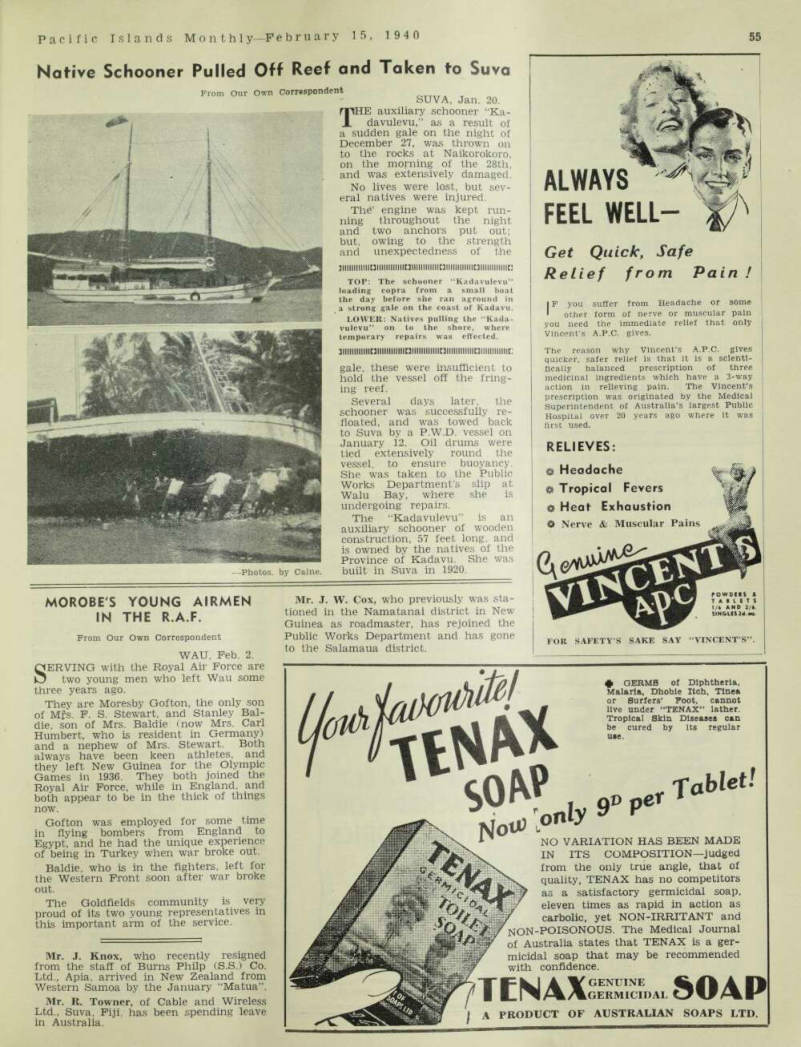
From Our Own Correspondent
Suva, Jan. 20.
THE auxiliary schooner “Ka davulevu,” as a result of a sudden gale on the night of December 27, was thrown on to the rocks at Naikorokoro. on the morning of the 28th, and was extensively damaged.
No lives were lost, but sev eral natives were injured.
The* engine was kept run ning throughout the night and two anchors put out; but, owing to the strength and unexpectedness of the
gale, these were insufficient to hold the vessel off the fring ing reef.
Several days later. the schooner was successfully re floated, and was towed back to Suva by a P.W.D. vessel on January 12. Oil drums were tied extensively round the vessel, to ensure buoyancy.
She was taken to the Public Works Department’s slip at Walu Bay, where she is undergoing repairs.
The “Kadavulevu” is an auxiliary schooner of wooden construction, 57 feet long, and is owned by the natives of the Province of Kadavu. She was built in Suva in 1920.
Photos, by Caine.
TOP: The schooner “Kadavulevu” loading copra from a small boat the day before she ran aground in a strong gale on the coast of Kadavu.
LOWER: Natives pulling the “Kada vulevu” on to the shore, where temporary repairs was effected.
Morobe's Young Airmen
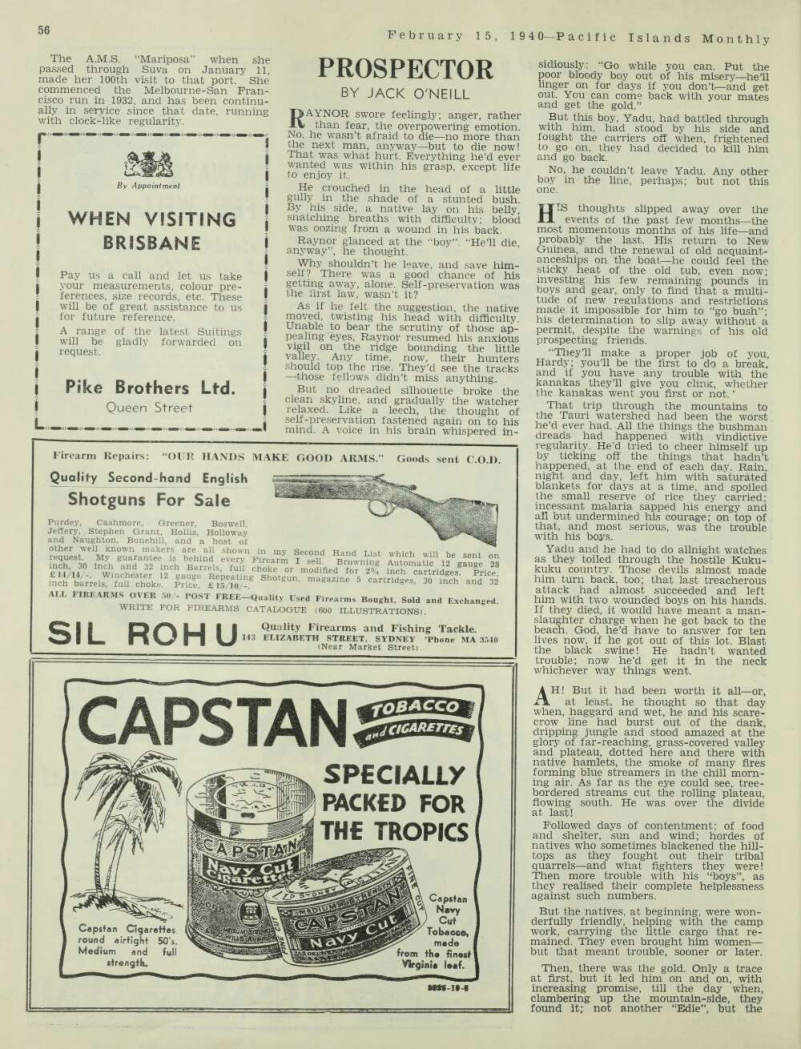
In The R.A.F.
From Our Own Correspondent
Wait. Feb. 2.
SERVING with the Royal Air Force are two young men who left Wau some three years ago.
They are Moresby Gofton, the only son of Mrs. F. S. Stewart, and Stanley Bal die, son of Mrs. Baldie (now Mrs. Carl Humbert, who is resident in Germany) and a nephew of Mrs. Stewart. Both always have been keen athletes, and they left New Guinea for the Olympic Games in 1936. They both joined the Royal Air Force, while in England, and both appear to be in the thick of things now.
Gofton was employed for some time in flying bombers from England to Egypt, and he had the unique experience of being in Turkey when war broke out.
Baldie, who is in the fighters, left for the Western Front soon after war broke out.
The Goldfields community is very proud of its two young representatives in this important arm of the service.
Mr. J. Knox, who recently resigned from the staff of Burns Philp (S.S.) Co.
Ltd., Apia, arrived in New Zealand from Western Samoa by the January “Matua”.
Mr, R. Towner, of Cable and Wireless Ltd., Suva, Fiji, has been spending leave in Australia.
Mr. J. W. Cox, who previously was sta tioned in the Namatanai district in New Guinea as roadmaster, has rejoined the Public Works Department and has gone to the Salamaua district.
The A.M.S. “Mariposa” when she passed through Suva on January 11, made her 100th visit to that port. She commenced the Melbourne-San Fran cisco run in 1932, and has been continu ally in service since that date, running with clock-like regularity.
Advertisements & other items, pp. 57-58 (1 item)
/'TCNAXSSSS’dai, soap
ALWAYS
FEEL WELL-
Get Quick , Safe
Relief from Pain !
IF you suffer from Headache or some I other form of nerve or muscular pain you need the immediate relief that only Vincent’s A.P.C. gives.
The reason why Vincent’s A.P.C. gives quicker, safer relief is that it is a scientifically balanced prescription of three medicinal ingredients which have a 3-way action in relieving pain. The Vincent’s prescription was originated by the Medical Superintendent of Australia’s largest Public Hospital over 20 years ago where it was first used.
RELIEVES:
O Headache
O Tropical Fevers
& Heat Exhaustion
& Nerve & Muscular Pains
POWDIRS
TAIL I T S
l/» AND 2/t.
MNGIUKm
FOR SAFETY’S SAKE SAY “VINCENT’S”.
sow
N° u ’ * O l; 5* /> 4 GERMS of Diphtheria, Malaria, Dhoble Itch, Tinea or Surfers’ Foot, cannot live under “TENAX" lather.
Tropical Skin Diseases can be cured by Its regular
only 9“ P er
fable*
NO VARIATION HAS BEEN MADE
IN ITS COMPOSITION—judged
from the only true angle, that of quality, TENAX has no competitors as a satisfactory germicidal soap, eleven times as rapid in action as carbolic, yet NON-IRRITANT and NON-POISONOUS. The Medical Journal of Australia states that TENAX is a germicidal soap that may be recommended with confidence,
/'TCNAXSSSS’dai, soap
PRODUCT OF AUSTRALIAN SOAPS LTD.
By Appointment
WHEN VISITING
BRISBANE
Pay us a call and let us take your measurements, colour preferences, size records, etc. These will be of great assistance to us for future reference.
A range of the latest Suitings will be gladly forwarded on request.
Pike Brothers Ltd.
Queen Street
Firearm Repairs: “OUR HANDS MAKE GOOD ARMS.” Goods sent C.O.D.
Quality Second-hand English
Shotguns For Sale
Purdey, Cashmore, Greener, Boswell, Jeffery, Stephen Grant, Hollis, Holloway and Naughton, Bonehill, and a host of other well known makers are all shown in mv Sprnnd T .
rs asKSi-i s™JSSs =■££■=?
Inch hazels TutThoke Iricl? S" 8 Shoteun ’ magszlne 5 cartridges. 30 Inch and 32 ALL FIREARMS OVER 50/- POST FREE Quality Used Firearms Bought. Sold and Exchanged.
WRITE FOR FIREARMS CATALOGUE (600 ILLUSTRATIONS).
SIL ROHU
Quality Firearms and Fishing Tackle.
ELIZABETH STREET. SYDNEY Phone MA 3540
(Near Market Street).
CAPSTANS®
Capstan Cigarettes round airtight 50's.
Medium and full strength.
SPECIALLY
PACKED FOR
THE TROPICS
m Capstan Navy Cut Tobacco, made from the finest Virginia leaf.
Prospector
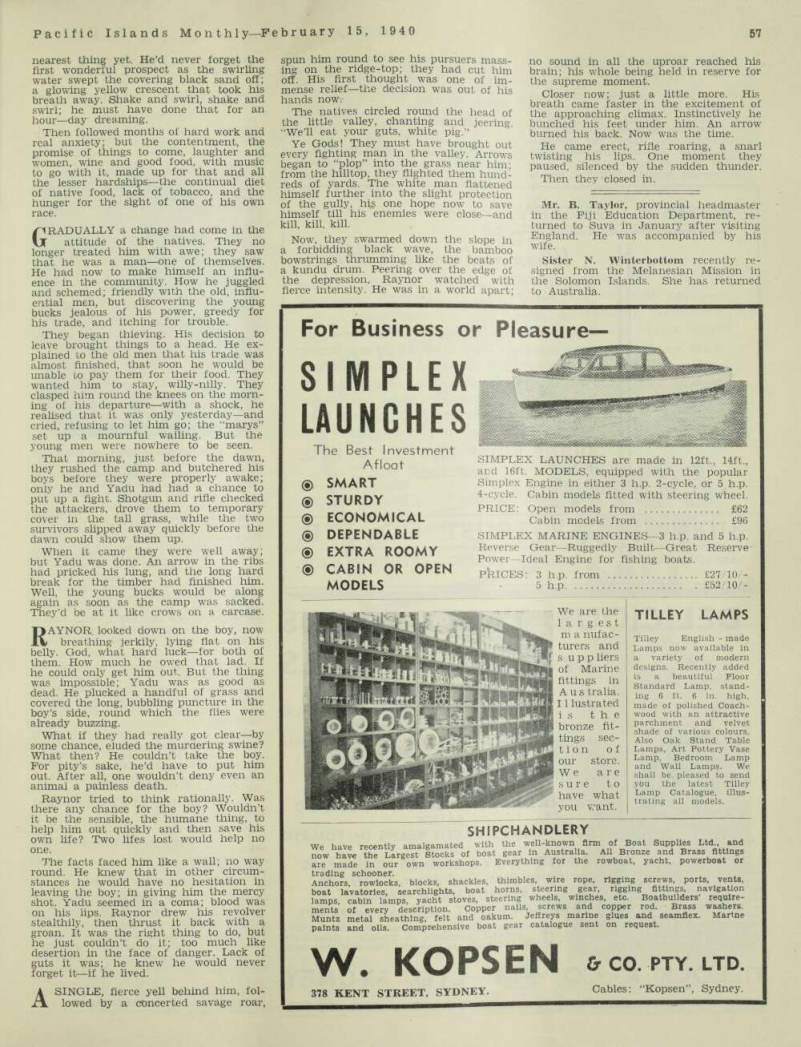
By Jack O'neill
RAYNOR swore feelingly; anger, rather than fear, the overpowering emotion.
No, he wasn’t afraid to die —no more than the next man, anyway—but to die now!
That was what hurt. Everything he’d ever wanted w'as within his grasp, except life to enjoy it.
He crouched in the head of a little gully in the shade of a stunted bush.
By his side, a native lay on his belly, snatching breaths with difficulty; blood was oozing from a wound in his back.
Raynor glanced at the “boy”. “He’ll die, anyway”, he thought.
Why shouldn’t he leave, and save him self? There was a good chance of his getting away, alone. Self-preservation was the first law, wasn’t it?
As if he felt the suggestion, the native moved, twisting his head with difficulty.
Unable to bear the scrutiny of those ap pealing eyes, Raynor resumed his anxious vigil on the ridge bounding the little valley. Any time, now, their hunters should top the rise. They’d see the tracks —those fellows didn’t miss anything.
But no dreaded silhouette broke the clean skyline, and gradually the watcher relaxed. Like a leech, the thought of self-preservation fastened again on to his mind. A voice in his brain whispered in
sidiously: “Go while you can. Put the poor bloody boy out of his misery—he’ll linger on for days if you don’t—and get out. You can come back with your mates and get the gold.”
But this boy, Yadu, had battled through with him, had stood by his side and fought the carriers off when, frightened to go on, thev had decided to kill him and go back.
No, he couldn’t leave Yadu. Any other boy in the line, perhaps; but not this one.
HIS thoughts slipped away over the events of the past few months—the most momentous months of his life—and probably the last. His return to New Guinea, and the renewal of old acquaint anceships on the boat—he could feel the sticky heat of the old tub, even now; investing his few remaining pounds in boys and gear, only to find that a multi tude of new regulations and restrictions made it impossible for him to “go bush”; his determination to slip away without a permit, despite the warnings of his old prospecting friends.
“They’ll make a proper job of you, Hardy; you’ll be the first to do a break, and if you have any trouble with the kanakas they’ll give you clink, whether the kanakas went you first or not. ’
That trip through the mountains to the Tauri watershed had been the worst he’d ever had. All the things the bushman dreads had happened with vindictive regularity. He’d tried to cheer himself up by ticking off the things that hadn’t happened, at the end of each day. Rain, night and day, left him with saturated blankets for days at a time, and spoiled the small reserve of rice they carried; incessant malaria sapped his energy and all but undermined his courage; on top of that, and most serious, was the trouble with his boys.
Yadu and he had to do allnight watches as they toiled through the hostile Kuku kuku country. Those devils almost made him turn back, too; that last treacherous attack had almost succeeded and left him with two wounded boys on his hands.
If they died, it would have meant a man slaughter charge when he got back to the beach. God, he’d have to answer for ten lives now, if he got out of this lot. Blast the black swine! He hadn’t wanted trouble; now he’d get it in the neck whichever way things went.
AH! But it had been worth it all—or, at least, he thought so that day when, haggard and wet, he and his scare crow line had burst out of the dank, dripping jungle and stood amazed at the glory of far-reaching, grass-covered valley and plateau, dotted here and there with native hamlets, the smoke of many fires forming blue streamers in the chill morn ing air. As far as the eye could see, tree bordered streams cut the rolling plateau, flowing south. He was over the divide at last!
Followed days of contentment; of food and shelter, sun and wind; hordes of natives who sometimes blackened the hill tops as they fought out their tribal quarrels—and what fighters they were!
Then more trouble with his “boys”, as they realised their complete helplessness against such numbers.
But the natives, at beginning, were won derfully friendly, helping with the camp work, carrying the little cargo that re mained. They even brought him women— but that meant trouble, sooner or later.
Then, there was the gold. Only a trace at first, but it led him on and on, with increasing promise, till the day when, clambering up the mountain-side, they found it; not another “Edie”, but the
nearest thing yet. He’d never forget the first wonderful prospect as the swirling water swept the covering black sand off; a glowing yellow crescent that took his breath away. Shake and swirl, shake and swirl; he must have done that for an hour—day dreaming.
Then followed months of hard work and real anxiety; but the contentment, the promise of things to come, laughter and women, wine and good food, with music to go with it, made up for that and all the lesser hardships—the continual diet of native food, lack of tobacco, and the hunger for the sight of one of his own race.
GRADUALLY a change had come in the attitude of the natives. They no longer treated him with awe; they saw that he was a man—one of themselves.
He had now to make himself an influ ence in the community. How he juggled and schemed; friendly with the old, influ ential men, but discovering the young bucks jealous of his power, greedy for his trade, and itching for trouble.
They began thieving. His decision to leave brought things to a head. He ex plained to the old men that his trade was almost finished, that soon he would be unable to pay them for their food. They wanted him to stay, willy-nilly. They clasped him round the knees on the morn ing of his departure—with a shock, he realised that it was only yesterday—and cried, refusing to let him go; the “marys” set up a mournful wailing. But the young men were nowhere to be seen.
That morning, just before the dawn, they rushed the camp and butchered his boys before they were properly awake; only he and Yadu had had a chance to put up a fight. Shotgun and rifle checked the attackers, drove them to temporary cover in the tall grass, while the two survivors slipped away quickly before the dawn could show them up.
When it came they were w'ell away; but Yadu was done. An arrow in the ribs had pricked his lung, and the long hard break for the timber had finished him.
Well, the young bucks would be along again as soon as the camp was sacked.
They’d be at it like crows on a carcase.
RAYNOR, looked down on the boy, now breathing jerkily, lying flat on his belly. God, what hard luck —for both of them. How much he owed that lad. If he could only get him out. But the thing was impossible: Yadu was as good as dead. He plucked a handful of grass and covered the long, bubbling puncture in the boy’s side, round which the flies were already buzzing.
What if they had really got clear —by some chance, eluded the murdering swine?
What then? He couldn’t take the bpy.
For pity’s sake, he’d have to put him out. After all, one wouldn’t deny even an animal a painless death.
Raynor tried to think rationally. Was there any chance for the boy? Wouldn’t it be the sensible, the humane thing, to help him out quickly and then save his own life? Two lifes lost would help no one.
The facts faced him like a wall; no way round. He knew that in other circum stances he would have no hesitation in leaving the boy; in giving him the mercy shot. Yadu seemed in a coma; blood was on his lips. Raynor drew his revolver stealthily, then thrust it back with a groan. It was the right thing to do, but he just couldn’t do it; too much like desertion in the face of danger. Lack of guts it was; he knew he would never forget it—if he lived.
A SINGLE, fierce yell behind him, fol lowed by a concerted savage roar,
spun him round to see his pursuers mass ing on the ridge-top; they had cut him off. His first thought was one of im mense relief —the decision was out of his hands now.- The natives circled round the head of the little valley, chanting and jeering.
“We’ll eat your guts, white pig.”
Ye Gods! They must have brought out every fighting man in the valley. Arrows began to “plop” into the grass near him; from the hilltop, they flighted them hund reds of yards. The white man flattened himself further into the slight protection of the gully, his one hope now to save himself till his enemies were close—and kill, kill, kill.
Now, they swarmed down the slope in a forbidding black wave, the bamboo bowstrings thrumming like the beats of a kundu drum. Peering over the edge of the depression, Raynor watched with fierce intensity. He was in a world apart;
no sound in all the uproar reached his brain; his whole being held in reserve for the supreme moment.
Closer now; just a little more. His breath came faster in the excitement of the approaching climax. Instinctively he bunched his feet under him. An arrow burned his back. Now was the time.
He came erect, rifle roaring, a snarl twisting his lips. One moment they paused, silenced by the sudden thunder.
Then they closed in.
Mr. B. Taylor, provincial headmaster in the Fiji Education Department, re turned to Suva in January after visiting England. He was accompanied by his wife.
Sister N. Winterbottom recently re signed from the Melanesian Mission in the Solomon Islands. She has returned to Australia.
Advertisements & other items, p. 59 (2 items)
57
Pacific Islands Mon thly—February 15, 1940
Launches
For Business or Pleasure—
SIMPLEX
The Best Investment
Afloat
(?) SMART
(?) STURDY
(?) ECONOMICAL
(?) DEPENDABLE
® EXTRA ROOMY
® CABIN OR OPEN
MODELS
'■■■ s 9 SIMPLEX LAUNCHES are made in 12ft„ 14ft., and 16ft. MODELS, equipped with the popular Simplex Engine in either 3 h.p. 2-cycle, or 5 h.p. 4-cycle. Cabin models fitted with steering wheel.
PRICE; Open models from £62 Cabin models from £96 SIMPLEX MARINE ENGINES—3 h.p. and 5 h.p.
Reverse Gear—Ruggedly Built—Great Reserve Power—ldeal Engine for fishing boats.
PkICES: 3 h.p. from £27/10/- 5 h.p £52/10/- We are the largest m a nufacturers and s u p p liers of Marine fittings in A us tralia. 11 lustrated is the bronze fittings section of our store.
We are sure to have what you want.
TILLEY LAMPS
Tilley English - made Lamps now available in a variety of modern designs. Recently added is a beautiful Floor Standard Lamp, standing 6 ft. 6 in. high, made of polished Coachwood with an attractive parchment and velvet shade of various colours.
Also Oak Stand Table Lamps, Art Pottery Vase Lamp, Bedroom Lamp and Wall Lamps. We shall be pleased to send you the latest Tilley Lamp Catalogue, illustrating all models.
SHIPCHANDLERY
We have recently amalgamated with the well-known firm of Boat Supplies Ltd., and Iw hive S Largest Stocks of gear and Brass jattlngs are made in our own workshops. ” ”"** *•«««• trading schooner. . .
Anchors, rowlocks, blocks, shackles, thimbles, wire rope, rigging screws, boat lavatories, searchlights, boat horns, steering gear, rigging lamps, cabin lamps, yacht stoves, steering wheels, winches, etc. ments of every description. Copper nails, screws and copper Muntz metal sheathing, felt and oakum. Jeffreys marine glues and seamflex. Marine paints and oils. Comprehensive boat gear catalogue sent on request.
Everything for the rowboat, yacht, powerboat or ports, vents, fittings, navigation Boatbuilders’ requlrerod. Brass washers.
W. KOPSEN &CO. PTY. LTD.
378 KENT STREET, SYDNEY. Cables: “Kopsen”, Sydney.
New Cinema Theatre
In Ba, Fiji
THE Fiji towns continue to grow and prosper.
On January 16. Mr. Hugh Ragg, M.L.C., formally declared open the new cinema theatre at Ba, on the northern part of Viti Levu, which has been built by Mr. Grant.
The picture house is lofty and spaci
9us, with modern ventilation and light ing systems. It has seating accommo dation for about 600, and it can be readily converted into a stadium. The theatre possesses its own cafe, and is centrally situated in the new Govern ment township area.
Mr. D. G. Absolon, of Brisbane. Queens land, has joined the staff of the Rabaul Printing Works in New Guinea.
Tax Papua!
New War-Horror in Contemplation
Letter to the Editor rERE are alarming reports that Can berra officials have expressed an opinion that residents of Papua should be taxed up to the level of those living in Australia, in view of war conditions.
The fact that residents of Papua have escaped numerous taxes imposed in Aus tralia has often been commented upon; and the general, but superficial, view is that Papuan people have an unencum bered existence —a care-free life of ro mantic ease. Actually, Papuan residents have been for many years staggering under a load far heavier and more un wieldy than their envious neighbours in Australia.
Papua is entirely dependent on out side sources for food, clothing and gen eral provisions, and ail imports are sub ject to a 10 per cent, customs tariff. The cost of goods generally is at least 50 per cent, above Australia.
To the 10 per cent, tariff must be added direct taxation, resulting from the Commonwealth Shipping Subsidy; which in the past years has developed merely into a tax-collecting instrument, to pre serve Australian trade and a monopoly at the expense of the Papuan settler.
The subsidy was helpful in the early years, when there was insufficient trade in the country to attract shipping. It fostered Australian trade with low costs and freight, and helped to compensate the shipping company. But it shut out competition and created a monopoly which, becoming strengthened by the Navigation Act 1921/26, has since become so firmly entrenched that the object and need of the subsidy are immaterial and have become lost in a mere custom of conferring it; with the result that, ow ing to lack of competition, prices of foodstuffs, fares and freights, and com modities in general, have reached oppressive levels and which, with the 10 per cent, customs tariff, constitute as heavy a burden as any community should be called upon to carry.
To these instances must be added the natural taxation on life in this country —enervating climate, inferior food, isola tion; the costly education of children; and the heavy expense of furlough in Australia.
It is an old-established democratic principle that there must be no taxa tion without representation. Represen tation would mean an elected Executive Council, and a Papuan representative in the Federal Parliament.
Already, we have all the burdens that we fairly can carry.
I am, etc.,
Papuan For 20 Years.
Port Moresby, 4/2 1940.
Officers of the Polynesian Society of New Zealand elected for 1940 are: Pre sident, Hon. Sir. Apirana Ngata; Coun cil, Messrs. H. R. H. Balneavis, J. M. A.
Hott, J. C. Anderson, L. Moncrieff-Nutt, D. Foster, A. Morris Jones, and Drs. E.
Beaglehole and W. R. B. Oliver; Secre tary, Mr. C. R. H. Taylor; Treasurer, Mr.
A. G. Bagnall; Editor of the Society’s “Journal”, Mr. Johannes C. Andersen.
Advertisements & other items, p. 60 (1 item)
Delicious, Tasty Foods
HONESTY FIDELITY
U/hzn making Witt
Safeguard your interests. Ensure their protection and security. Avail yourself of the advantages to be derived from the appointment of this Company as your trustees, in preference to any one individual. Write to or call on any Branch of Burns, Philp & Company Limited, or Burns Philp (South Sea) Company, Limited, for the folder which fully explains these advantages.
Give careful consideration to the benefits to be gained by appointing as your Executors—
BURNS PHILP TRUST CO. LTD.
DIRECTORS
JAMES BURNS LEWIS ARMSTRONG
ROBERT JOHN NOSWORTHY JOSEPH MITCHELL
BURNS PHILP TRUST CO. LTD.
CAPITAL £lOO.OOO IT 7 BRIDGE STREET SYDNEY, N.S.W.
DELICIOUS, TASTY FOODS
For ISLAND MEALS
JUST TRY any of AUNT MARY'S Pure Food Products, and you will be back for more . . . delicious in themselves or with innumerable dishes.
AUNT MARY'S BAKING POWDER
AUNT MARY'S TOMATO SAUCE
AUNT MARY'S SPAGHETTI IN TOMATO
SAUCE
AUNT MARY'S BAKED BEANS IN TOMATO
SAUCE
AUNT MARY'S CANNED VEGETABLES
Green Peas, Cauliflower, Celery, etc.
RANEE CURRY POWDER
BLOSSOM HONEY In Attractive Jars Or any of the large variety of Pure Food Products specially packed for Tropical conditions, in Tlllock’s Hermetically Sealed 1-lb. tins. All goods are procurable from your local stores.
TILLOCK & CO. PTY LTD. SYDNEY
AUNT MART’S COOKERT
BOOK.
There’s no finer book for every home . . . 212 pages, lavishly Illustrated in colour, and over 400 recipes and useful hints make It a book that every housewife will want. Send only one shilling and twopence to
TILLOCK & CO. PTY. LTD.,
Sydney N.S.W., and get your copy of this great book NOW.
Death Of French Oceania
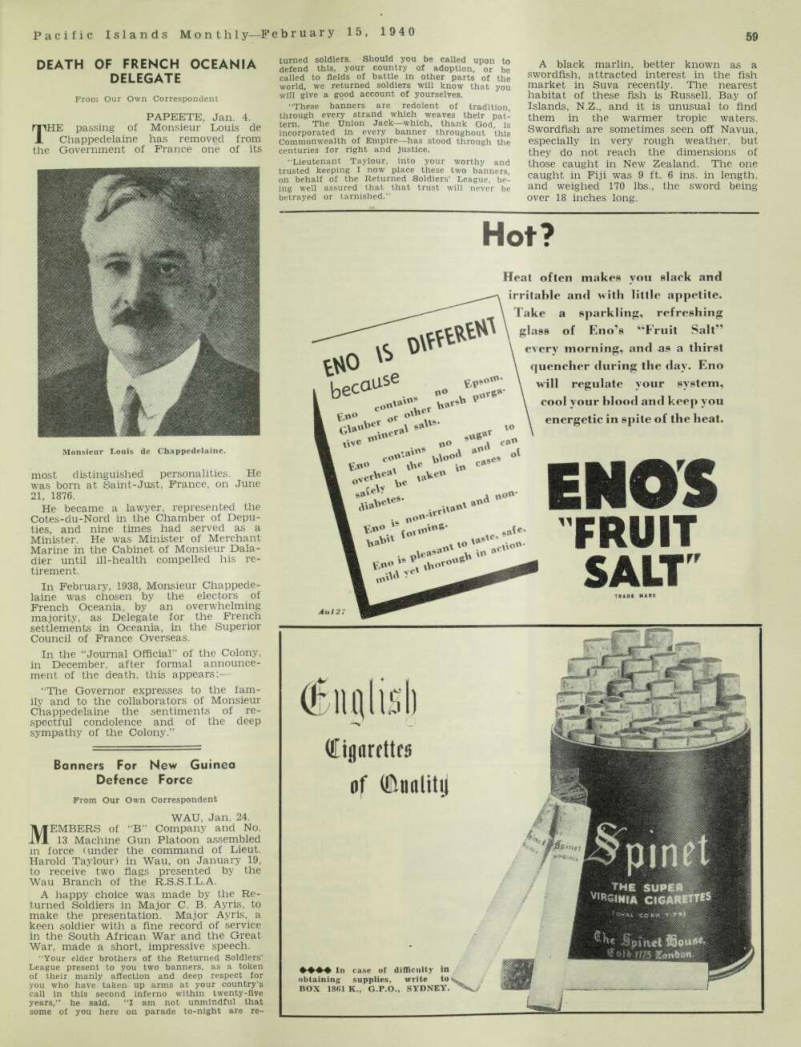
Delegate
From Our Own Correspondent
Papeete, Jan. 4.
THE passing of Monsieur Louis de Chappedelaine has removed from the Government of France one of its
most distinguished personalities. He was born at Saint-Just, France, on June 21, 1876.
He became a lawyer, represented the Cotes-du-Nord in the Chamber of Depu ties, and nine times had served as a Minister. He was Minister of Merchant Marine in the Cabinet of Monsieur Dala dier until ill-health compelled his re tirement.
In February, 1938, Monsieur Chappede laine was chosen by the electors of French Oceania, by an overwhelming majority, as Delegate for the French settlements in Oceania, in the Superior Council of France Overseas.
In the “Journal Official” of the Colony, in December, after formal announce ment of the death, this appears:— “The Governor expresses to the fam ily and to the collaborators of Monsieur Chappedelaine the sentiments of re spectful condolence and of the deep sympathy of the Colony.”
Monsieur Louis de Chappedelaine.
Banners For New Guinea
Defence Force
From Our Own Correspondent WAU, Jan. 24.
MEMBERS of “B” Company and No. 13 Machine Gun Platoon assembled m force (under the command of Lieut.
Harold Taylour) in Wau, on January 19, to receive two flags presented by the Wau Branch of the R.S.S.I.L.A.
A happy choice was made by the Re turned Soldiers in Major C. B. Ayris, to make the presentation. Major Ayris. a keen soldier with a fine record of service in the South African War and the Great War, made a short, impressive speech.
“Your elder brothers of the Returned Soldiers’
League present to you two banners, as a token of their manly affection and deep respect for you who have taken up arms at your country’s call in this second inferno within twenty-five years,” he said. “I am not unmindful that some of you here on parade to-night are re
turned soldiers. Should you be called upon to defend this, your country of adoption, or be called to fields of battle in other parts of the world, we returned soldiers will know that you will give a good account of yourselves.
“These banners are redolent of tradition, through every strand which weaves their pat tern. The Union Jack—which, thank God, is incorporated in every banner throughout this Commonwealth of Empire—-has stood through the centuries for right and justice, “Lieutenant Taylour, into your worthy and trusted keeping I now place these two banners, on behalf of the Returned Soldiers’ League, be ing well assured that that trust will never be betrayed or tarnished.”
A black marlin, better known as a swordfish, attracted interest in the fish market in Suva recently. The nearest habitat of these fish is Russell. Bay of Islands, N.Z., and it is unusual to find them in the warmer tropic waters.
Swordfish are sometimes seen off Navua, especially in very rough weather, but they do not reach the dimensions of those caught in New Zealand. The one caught in Fiji was 9 ft. 6 ins. in length, and weighed 170 lbs., the sword being over 18 inches long.
Advertisements & other items, p. 61 (1 item)
Enos
Hot?
Heat often makes yon slack and S' \s
cius e
ott»
bee
no in* n' a hat cO vVvex o* Us \>e' G\»' 1 c r» nfc aT m' n ca"
U V * no a" in"" o'* V>'°° >*‘ w lUe \,n° Uc" x Wen vc' b® tc\y non a" nv d'» VrtU a on in£ \>o 6 at c lo'O^ \»s' e * h» b ' V non nV »c \ea* a
tUoto"
£no n' 1 irritable and with little appetite.
Take a sparkling, refreshing
ass of Eno’s “Fruit Salt” very morning, and as a thirst
quencher during the day. Eno
will regulate your system, cool your blood and keep you energetic in spile of the heat.
ENOS
■FRUIT
SALT!
ff
(Cigarettes
of (Duality
♦ ♦♦♦ In case of difficulty in obtaining supplies, write
BOX 18(51 K., G.P.0., SYDNEY.
M.V. "Lakatoi," Of Samara!
A RESIDENT of Samarai who remains anonymous, and the vigour of whose sentiments makes up for the paucity of his English, writes at length to complain of the service provided for passengers on the motor vessel “Lakatoi”, which runs between Samarai and the outlying islands. Our correspondent, who has travelled on the boat recently, described at length his unhappy experience. He declares that the food supplied to pas sengers was limited in quantity and poor in quality, and that travellers who know something of the conditions usually pro vide themselves with a food supply before they leave. “The vessel is beautifully fitted up,” says our correspondent, “and the comfort of the passengers has been studied carefully by the builders; but the actual treatment of the passengers once they are aboard the vessel is very bad indeed.”
Mr, R. Vance arrived in Sydney from Malaita, British Solomon Islands, by the last “Morinda” arfd continued on to New Zealand where he will spend furlough. He is a mission worker with the South Sea Evangelical organisation and is stationed at Makwanu on Malaita.
New Books
The Patience Of Maigret, By
Georges Simenon. (Our copy from Angus and Robertson, Ltd., Sydney. 7/6.) Simenon is the Edgar Wallace of France: his crime and mystery stories, light and clever and gripping, have a tre mendous vogue. Not having seen the original, we do not know how much, in this book, Simenon owes to his trans lator; but we can most heartily recom mend the book to the British reading public—it is as good as the best of our “thrillers”, and far better than most. The plots are constructed with cunning, the tales are unfolded skilfully and enter tainingly, and the average reader of thrillers will be delighted with the main character, Inspector Maigret grim, silent, unorthodox, merciful, always smoking his foul pipe, and always getting his man.
Some priceless material relating to the origin of the Polynesians and the early history of Hawaii has been gathered by Edwin H. Bryan, Jnr., Curator of Collec tions at the Bishop Museum in Honolulu, for his book “ANCIENT HAWAIIAN LIFE”, which recently was published by the Advertiser, Publishing Company, of Honolulu (retail price, postage paid, 2 dollars: or in larger quantities for schools, 1 dollar 75 cents).
In a most interesting chapter, entitled ‘Whence the Polynesians?”, Mr. Bryan examines all the evidence available as to the origin and migration of this inter esting people. “One of the strong lines of evidence as to the origin of the Poly nesians is found in their food and other economic plants and their domestic animals”, he says. “The taro, banana, breadfruit, coconut, tapa, mulberry, and many other useful plants originated in the Indo-Malay region. The pig, the dog and the fowl which accompanied the Polynesians on their wanderings had their origin in this same region. Only the sweet potato came from the east, and this is thought to indicate that Polynesians voyaged as far as the coast of South America and returned with a new food.”
He also says this: “From all this and other data, too voluminous to mention here, we might conclude that the Poly nesians originated as a Caucasian-like tribe in South-Eastern Asia. Driven out by wars, economic depression or religious oppression, they migrated into the Malay region. Here they lived for a time, ac quiring Mongoloid blood by intermixture with the inhabitants. About the begin ning of the Christian era they travelled eastward again, probably passing in waves through the Micronesian Islands.”
CROAK! Croak! Croak!
A Tropical Interlude in Port Moresby
By June Lett
Then silence reigned in the lounge as two brown garden frogs hopped frorn behind a black-framed picture (depicting a woodland winter scene in the south of England!) onto the near side of the piano, and blinked at the electric light.
They hopped to the other end of the piano and blinked again. Then one, two, three hops to the door, and three large pops again right across the verandah into the centre of a large cactus in the garden.
Croak! Croak!
Outside, the sky was covered with heavy black clouds, the early afternoon breeze had abated, and the air was dead The day had been very hot, and now, in the evening, humans, birds and animals, exhausted and exasperated, were waiting for something to happen.
Even the owls had ceased to call. Port Moresby became very silent. Motor cars ceased to rattle to and fro along the beach road. All were waiting.
Bang! Bang-bang! Something, at last, had happened. Two heavy clouds had met, and crash followed crash of thunder, and vivid lightning flashed across the sky.
And then came a blinding sheet of pourine rain. Water began to pour down the hillsides in large streams, bringing twigs, pebbles and empty tins with it.
Treasured seedlings were flattened, leaves of delicate plants torn to threads, and fowls and birds crept about, looking like half-drowned rats.
Two hours passed before the first ray of moonlight broke through the cloudy sky. The rain stopped, and the cars resumed their rattle along the beach road. Roosters, shut in their pens, crowed freely, and the same old owl resumed his lugubrious, nightlong call.
The two brown garden frogs jumped out of the cactus onto the verandah, and croaked on their way to the lounge, up onto the piano, blinked again at the piercing light, and jumped back to their home behind the picture frame.
“Croak! Croak!” they said. “That was refreshing.”
The heavy, tropical night shut down again.
A daughter, Anne Barbara, was born to Mr. and Mrs. C. Thurlow, of Napa Napa, Papua, on January 12.
Advertisements & other items, p. 62 (3 items)
February 15, 1940-Paclflc Islands Monthly
Ropes,
KANGAROO BRAND
Cordage,
and Twines for every purpose
Backed by
86 years of service.
Manufactured by
M. DONAGHY AND SONS,
Pty. Ltd.,Geeiong and Sydney.
Fiji Representatives:
PEARCE AND CO.
LIMITED
P.O. BOX 237, SUVA
W® 1)3Id Propeller Shafting
m m&i
Whether for pleasure craft or real
work, specify . . .
W® 1)3Id PROPELLER SHAFTING
World-renowned for long, dependable service, Monel propeller shafts are: (1) exceptionally strong and tough, (2) highly resistant to fresh and salt water corrosion and 100% rustless, (3) extremely rigid, thereby reducing whip and vibration to a minimum.
Ask your boat builder to quote YOU for a Monel Shaft.
WRIGHT & COMPANY
One of three tugs recently built by W. L. Holmes & Co., Sydney, for use at Burrenjuck Dam, N.S.W. Each is fitted with 2 in. diam. Monel shafting.
81 CLARENCE STREET, SYDNEY, N.S.W.
Monel is a Registered Trade Mark
Primitive Currency
Systems
Curious Native Coinage
By John Bacchus
THE natives of Torres Strait and the Pacific Islands, in order to possess a common means of exchange, have de vised many types of coinage or currency, mostly consisting of shells and the like.
But there are other forms which are more curious and unusual.
The most noteworthy of these is vauvau, the feather money of the Santa Cruz Islands, which, among its other ad vantages, is much more attractive to the hand and eye than the often-dirty paper stuff most civilised peoples use to-day.
The tiny feathers are bright red, and are taken from the breast of a rare honey eater, which possesses only a few of them.
They are carefully woven into a fibrous cloth, made from the inner bark of the hibiscus, and this again is backed by a strip of paper bark. As it is made, the strip is rolled up, being added to bit by bit as opportunity serves. Similarly, lengths are cut off as purchases are made.
The making of the feather coinage, like that of the feather cloaks of Hawaii, was the jealously-guarded privilege of a few people. In Hawaii, not only have the makers of the feather cloaks vanished for ever, but also the two varieties of birds which supplied the feathers for dusky arti sans to work into beautifully-coloured articles of apparel. Only two of the cloaks are known to be in existence to-day. Of the Santa Cruz money-makers, there is only one remaining. When he dies his mystery will go with him, and the vauvau will become a thing of the past.
ANOTHER remarkable coinage is fei, the stone coins of Yap, an island in the Caroline Group, now under Jap anese mandate. These numismatic oddi ties are made from limestone, are circu lar in shape, with a hole in the middle, and may a'ttain a diameter of twelve feet and a weight of several hundred pounds.
Smaller one, one to two feet in diameter, are very common, but the larger one are rare.
The coins, actually, were not “minted” on Yap, but were made and shaped on the island of Bebelthuap, in the Palau
Group, which is situated several hundred miles south of Yap, canoes or rafts hav ing been employed to carry them from the island of their origin. Naturally the greater the • size of the stone the higher its value as a medium of exchange or barter. Again, however, to secure the highest value, the limestone must be fine and white and of close grain.
The hole in the centre was made to allow' the insertion of a pole for carrying.
Possession of this coinage marked the importance of a native in the eyes of his fellow-villagers, and one who possessed a great number of. fei had considerable in fluence in the administrative affairs of his tribe.
An extraordinary and interesting fea ture of the fei currency of Yap, and also one which stands as a monument to the honesty of the natives, is that the owner need not actually take possession of the “coin”. When a transaction involves the changing hands of a fei too large to be conveniently moved, the new owner is quite satisfied to accept the mere ac knowledgment of his proprietorship, and the coin will be allowed to remain out side the door of the previous owner’s hut.
During the German control of Yap it was found that the roads and pathways of the island were in a neglected state.
As the natives were very unwilling to work, the Government was at a loss what to do, for a time. Finally, the officials decided on a plan to induce the natives to work. Government representatives painted large black crosses on the largest and most valuable of the fei to indicate that they were now the property of the Government. Reduced to a state of poverty, the natives set to work to repair the roads, and when the work was satis factorily completed, the crosses were re moved from the fei. the coins becoming once more the property of the natives.
Thirty years and more ago traders visited the island of Bebelthuap, in the Palaus, and quarried limestone coins, which they took to Yap and traded for copra and beche-de-mer, being careful, however, not to inflate the currency too much, and thus upset the natives’ cur rency standard.
The natives of Yap also use carefully trimmed, flat pearl shells as a medium of exchange where transactions involve small values only, and in this respect their coinage is similar to that of the in habitants of most other Pacific Islands.
ON Rossel Island, at the eastern end of Papua, there is a currency in use amongst a primitive people whose social organisation is based bn the fundamental principles of Communism. From time im memorial, these Rossel Island natives have used as a medium of exchange tokens which are minted from some sea shell. The generic name for these tokens is darb. but whence they came, how the issue is controlled, and how varying values are distinguished, are things which are not yet known.
A native with twenty dalb is considered a “big” man on Rossel. This explains, perhaps, why some Rossel men possess two, three and even four and five wives, whilst others have none at all. If a native possesses a couple of darb, it ap pears, he can equip himself with a wife— “off the big”, so to speak. But should he possess ten darb he can have the pick of the bunch. A Rossel woman may, however, buy herself out of an unsatisfactory alliance—provided she possesses the neces sary amount of darb. Failing which, she
has the alternative of hoping for widow hood in the near future.
FEW Europeans who have seen a Papuan tola or arm-shell realise the part it plays in native trading, or how far from its place of origin it travels in the pro cess. A few small ones are made on vari ous parts of the coast, but they are in ferior in material and design, and are little sought after. The best specimens are elaborately carved and coloured. The best quality tolas, and the most beauti ful and valuable, come from the D’Entre casteaux Group.
The D’Entrecasteaux natives trade them to the Dahumians for pottery, and this tribe sells them to the Mailukoluans for sago and other such commodities. The
Mailukoluans, in turn, pay with them the Aromans for pigs (which, in many parts or Papua, are used as currency and form the basis of trading values) dogs, canoes and other merchandise. Thence the tolas go to the Hood Bay natives as reimburse ment for birds and plumes. The Hood Bay tribe with them buy sago (“retail ’) from the Motuans and Motu-motuans, and these carry them to the far west and trade them to the Elemaites for sago in bulk.
Thence the tolas begin the return journey as payment for the goods specialised in by the various tribes en route.
It is not so long ago that Papua went on the “fish-hook standard”. The defec tion was due, not to a dearth of fish hooks, but to over-supply. Not so many years ago, the heart of the most intract able Papuan, male or female, could be won by a fish-hook, while a present of half a dozen made a life friend of the recipient, who became an object of re spect and envy in his village. Fish-hooks were valued even above tomahawks. That was in the coastal districts.
In the inland parts, where hooks only occasionally nercolated through in the course of trading, murder has been done for them, and they even displaced the once-supreme tola as a basis for cur
rency for a time. At the zenith of its cur rency career, a fish-hook was worth eleven tolas.
The invasion of prospectors and others, a few y ear s ago, all with huge packages of fish-hooks, caused a financial debacle and the return to the tola standard.
Advertisements & other items, pp. 63-64 (1 item)
■®Ss*--sr
KELVIN
Marine
DIESEL ENGINES
Also
KEROSENE and BENZINE
TYPES.
a* •*» All kinds of Islands Repair Work undertaken. •**
G. RUTHERFORD,
Engineer,
46 PITT ST., SYDNEY.
77, HOIHBB’ “ r
I T r &To| Sorou'wv
to Howes *CO. Holmes . bullt boats £u U Every man im That methods and S ive *
■®Ss*--sr
Motors, Gray P* esets ’
bodt*
During >l= ot' w“•<
::: islands is the Mission work. feet) now ««*£j bu iU for «.»"• °‘ herS A” C n Th.%.P-" C ° ' Tn.« Julius Owen, Th Woo dward, New s H. Howard & Cro ker island Guinea Admimstr Trading Co- Industries, S« u c phosphate Co-
rurss*-
Steamship® *** - GOi "' a °Mrs Scott and »>« V ° LeFeuvre, Mrs.
THE PACIFIC ISLANDS CLUB
Visitors from the Islands to Sydney (or those interested in Islands affairs), are advised to communicate with the honorary secretary of the above Club, which has been formed to study the history, traditions, economics, and political developments of the Pacific Islands.
Meetings held regularly at Hotel Carlton, Sydney.
Address for Correspondence:
THE PACIFIC ISLANDS CLUB,
Box 2434 MM.. G.P.0., Sydney.
WHEN YOU* NEED
Creosote, Coal Tar Stockholm Tar, Pitch or Neatsfoot Oil it pays to buy De MERIC'S Standard Products. Their quality and purity satisfy Government specifications.
De Meric Products give maximum service under exacting conditions.
De MERIC’S
STANDARD PRODUCTS
Obtainable at good stores everywhere. Traders are invited to write for full wholesale list.
DE MERIC PTY. LTD.
COMMONWEALTH AND STATE GOVERNMENT CONTRACTORS
Doody Street, Alexandria, N.S.W.
Killed—And Alive Again
IT was reported, in all the Australian papers on February 5, that Patrol Officer George Greathead had been in jured and Patrol Officer G. C. O’Donnell, had been killed when their party was attacked by natives on the Rai coast, in the Madang district of New Guinea, on February 3. The news apparently was brought from New Guinea to Townsville by the mail plane.
A couple of days later it was officially announced from Canberra that there was no truth in the story and, so far as Rabaul knew, both patrol officers were well and uninjured.
Cost Of A New Capital
IT is not surprising that the Australian authorities were glad to accept the ex cuse created by the war to leave the Ad ministrative headquarters of New Guinea in Rabaul.
The cost of removal of the capital site to Lae was estimated by the Griffiths’
Committee at £248,000, and the Amalga mation Committee estimates that that estimate was ‘more likely to prove to be below the amount required than above it”.
In fact, the committee placed the figure at £280,000, and after going into further figures, added another £90,000 for re movals and so forth.
Norfolk Island's Trade
THE following table shows the Norfolk Island customs returns for the six months ended December 31, 1939 (figures for 1938 given for comparison):—
A son was born to Mr. and Mrs. P, Maguire, of Kavieng, New Guinea, on January 10.
Having made a special health inspec tion of the 40,000 natives who inhabit the Gilbert and Ellice Islands, Dr. V. W.
T. McGusty, Director of Medical Ser vices in Fiji, arrived in Auckland lately.
He informed the newspapers that he found the Gilbert and Ellice people in excellent health. Their chief article of food is fish.
Mrs. Ina Pryke, widow of the late Mr.
Frank Pryke, returned to Sydney in January after spending some weeks, very ill, in the hospital in Wau, New Guinea.
During her sojourn there her daughter, Mrs. Blander, entered the hospital and gave birth to a daughter there, on De cember 31.
Imports From From From New Pacific Australia.
Zealand.
Islands. 1938 .. .. £13,891 £72 1939 .. .. £12,714 — £140 Exports To To To New Pacific Australia.
Zealand.
Islands. 1938 . . £4,824 £452 £152 1939 .. £2,818 £252 £21
Islands Mining
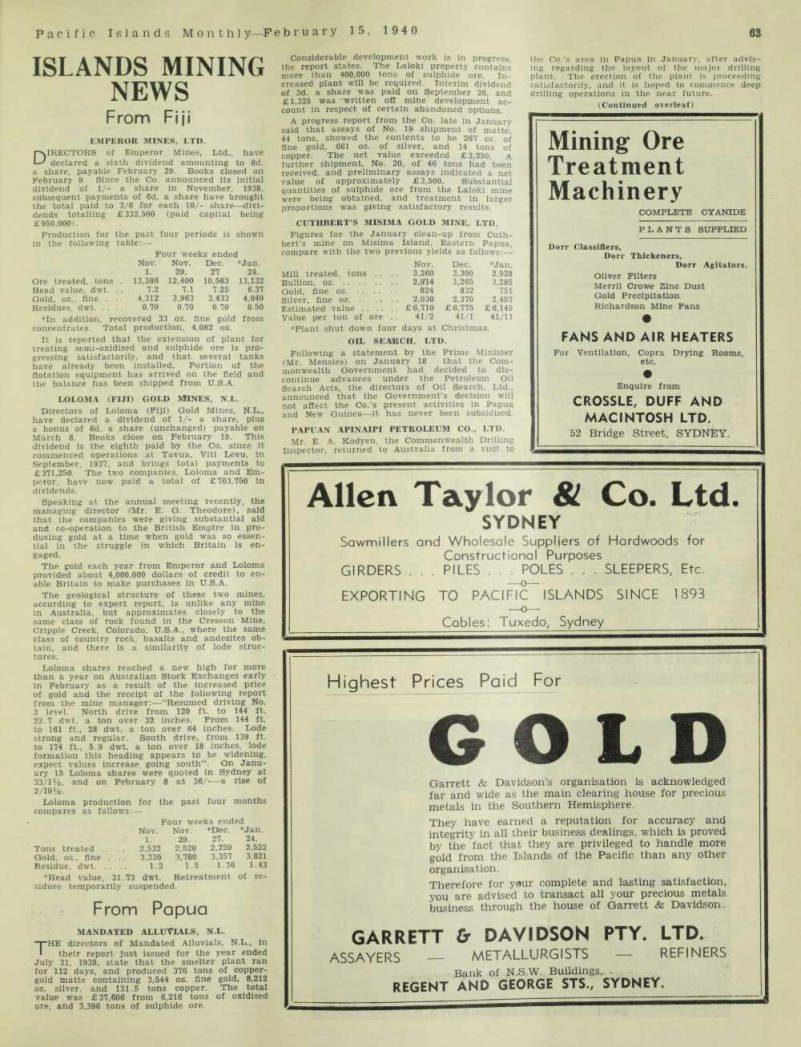
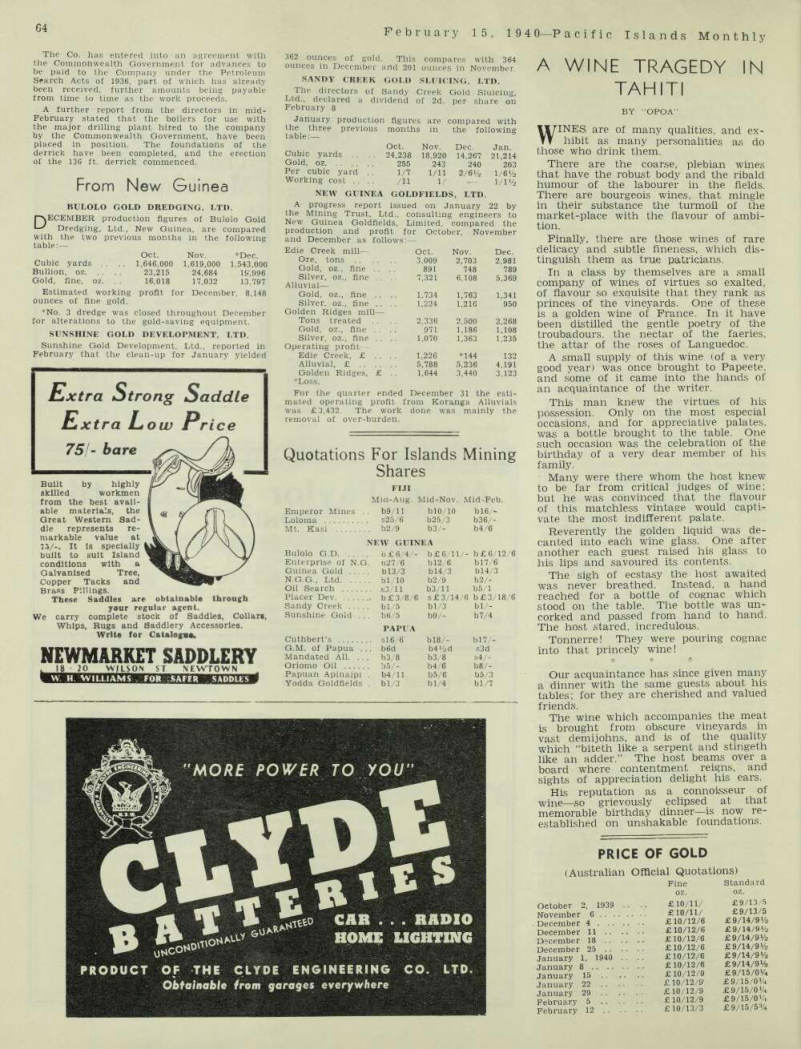
News
From Fiji
Emperor Mines, Ltd.
DIRECTORS of Emperor Mines, Ltd., have declared a sixth dividend amounting to 6d, a share, payable February 29. Books closed on February 9. Since the Co. announced its initial dividend of 1/- a share in November, 1938, subsequent payments of 6d. a share have brought the total paid to 3/6 for each 10/- share—divi dends totalling £332,500 (paid capital being £950,0001.
Production for the past four periods is shown in the following table; —
Loloma (Fiji) Gold Mines, N.L.
Directors of Loloma (Fiji) Gold Mines, N.L., have declared a dividend of 1/- a share, plus a bonus of 6d. a share (unchanged) payable on March 8. Books close on February 19. This dividend is the eighth paid by the Co. since it commenced operations at Tavua, Vitl Levu, in September, 1937, and brings total payments to £371,250. The two companies, Loloma and Em peror, have now paid a total of £703,750 in dividends.
Speaking at the annual meeting recently, the managing director (Mr. E. G. Theodore), said that the companies were giving substantial aid and co-operation to the British Empire In pro ducing gold at a time when gold was so essen tial in the struggle in which Britain is en gaged.
The gold each year from Emperor and Loloma provided about 4,000,000 dollars of credit to en able Britain to make purchases in U.S.A.
The geological structure of these two mines, according to expert report, is unlike any mine in Australia, but approximates closely to the same class of rock found in the Cresson Mine, Cripple Creek, Colorado. U.S.A., where the same class of country rock, basalts and andesites ob tain, and there is a similarity of lode struc tures.
Loloma shares reached a new high for more than a year on Australian Stock Exchanges early in February as a result of the increased price of gold and the receipt of the following report from the mine manager:—“Resumed driving No. 3 level. North drive from 120 ft. to 144 ft. 23.7 dwt. a ton over 32 inches. From 144 ft. to 161 ft., 28 dwt. a ton over 64 inches. Lode strong and regular. South drive, from 139 ft. to 174 ft., 5.9 dwt, a ton over 18 inches, lode formation this heading appears to be widening, expect values increase going south”. On Janu ary 15 Loloma shares were quoted in Sydney at 33/1 Vs, and on February 8 at 36/ —a rise of 2/10 V 2.
Loloma production for the past four months compares as follows:
From Papua
Mandated Allutials, N.L.
THE directors of Mandated Alluvials, N.L., in their report just issued for the year ended July 31, 1939, state that the smelter plant ran for 112 days, and produced 376 tons of copper gold matte containing 3,544 oz. fine gold, 8,212 oz. silver, and 131.5 tons copper. The total value was £37,606 from 6,216 tons of oxidised ore, and 3,396 tons of sulphide ore.
Considerable development work is in progress, the report states. The Laloki property contains more than 400,000 tons of sulphide ore. In creased plant will be required. Interim dividend of 3d. a share was paid on September 26, and £1,325 was written off mine development ac count in respect of certain abandoned options.
A progress report from the Co. late in January said that assays of No. 19 shipment of matte, 44 tons, showed the contents to be 267 oz. of fine gold, 661 oz. of silver, and 14 tons of copper. The net value exceeded £3,250. A further shipment, No. 20, of 46 tons had been received, and preliminary assays indicated a net value of approximately £3,500. Substantial quantities of sulphide ore from the Laloki mine were being obtained, and treatment in larger proportions was giving satisfactory results.
Cuthbert’S Misima Gold Mine, Ltd.
Figures for the January clean-up from Cuth bert’s mine on Misima Island, Eastern Papua, compare with the two previous yields as follows:
Oil Search, Ltd.
Following a statement by the Prime Minister (Mr. Menzies) on January 18 that the Com monwealth Government had decided to dis continue advances under the Petroleum Oil Search Acts, the directors of Oil Search, Ltd., announced that the Government’s decision will not affect the Co.’s present activities in Papua and New Guinea —it has never been subsidised.
Papuan Apinaipi Petroleum Co.. Ltd.
Mr. E. A. Kodyen, the Commonwealth Drilling Inspector, returned to Australia from a visit to
the Co.’s area in Papua in January, after advls mg regarding the layout of the major drilling plant. The erection of the plant is proceeding satisfactorily, and it is hoped to commence deep drilling operations in the near future.
(Continued overleaf)
Four weeks ended Nov.
Nov.
Dec. *Jan. 1. 29. 27 24.
Ore treated, tons . 13.386 12,400 10,563 13,132 Head value, dwt. .. 7.2 7.1 7.25 6.37 Gold, oz.. fine . .. 4,312 3,963 3,433 4,049 Residues, dwt 0.70 0.70 0.70 0.50 ♦In addition, recovered 33 oz. fine gold from concentrates. Total production, 4,082 oz.
It is reported that the extension of plant for treating semi-oxidised and sulphide ore is progressing satisfactorily, and that several tanks have already been installed. Portion of the flotation equipment has arrived on the field and the balance has been i shipped from
U.S.A.
Nov.
Dec. ♦Jan.
Mill treated, tons .. .. 3,260 3,300 2,928 Bullion, oz 2,914 3,265 3,285 Gold, fine oz 824 832 751 Silver, fine oz 2,030 2,370 2,457 Estimated value £6,710 £6,775 £6,145 Value per ton of ore .. 41/2 41/1 41/11 ♦Plant shut down four days at Christmas.
Pour weeks ended Nov.
Nov. *Dec. •Jan. 1. 29. 27. 24.
Tons treated .. 2,532 2,520 2,220 2,522 Gold, oz.. fine . . 3,330 3,780 3,357 3,821 Residue, dwt. .. . 1.2 1.5 1.36 1.43 •Head value, 31.73 dwt.
Retreatment of residues temporarily suspended.
The Co. has entered into an agreement with the Commonwealth Government for advances to be paid to the Company under the Petroleum Search Acts of 1936, part of which has already been received, further amounts being payable from time to time as the work proceeds.
A further report from the directors in mid- February stated that the boilers for use with the major drilling plant hired to the company by the Commonwealth Government, have been placed in position. The foundations of the derrick have been completed, and the erection of the 136 ft. derrick commenced.
From New Guinea
Bulolo Gold Dredging, Ltd.
pyECEMBER production figures of Bulolo Gold Dredging, Ltd., New Guinea, are compared with the two previous months in the following table:—
Sunshine Gold Development, Ltd.
Sunshine Gold Development, Ltd., reported in February that the clean-up for January yielded
362 ounces of gold. This compares with 364 ounces in December and 201 ounces in November.
Sandy Creek Gold Sluicing, Ltd.
The directors of Sandy Creek Gold Sluicing, Ltd., declared a dividend of 2d. per share on February 8 January production figures are compared with the three previous months in the following table:—
New Guinea Goldfields, Ltd.
A progress report issued on January 22 by the Mining Trust, Ltd., consulting engineers to New Guinea Goldfields, Limited, compared the production and profit for October, November and December as follows:
Oct. Nov. *Dec.
Cubic yards . . 1.646.000 1.619,000 1.543.000 Bullion, oz 23,215 24.684 19-.996 Gold, fine, oz. . . 16,018 17,032 13,797 Estimated working profit for December, 8,148 ounces of fine gold. *No. 3 dredge was closed throughout December for alterations to the gold-saving equipment.
Oct.
Nov.
Dec.
Jan.
Cubic yards . . . . 24,238 18,920 14,267 21,214 Gold, oz. . 255 243 240 203 Per cubic yard . 1/7 1/11 2/6% 1/6 Vs Working cost .. . /II 1/ 1/1 %
Edie Creek mill— Oct.
Nov.
Dec.
Ore. tons 3,009 2,703 2,981 Gold, oz., fine . , . . 891 748 789 Silver, oz., fine . . . , 7,321 6,108 5,369 Alluvial— Gold, oz., fine . . . . 1,734 1,763 1,341 Silver, oz., fine .. . . 1,224 1,216 950 Golden Ridges mill— Tons treated .. . . 2,336 2,500 2,268 Gold, oz., fine . . .. 971 1,186 1,108 Silver, oz., fine .. 1,070 1,363 1,235 Operating profit— Edie Creek, £ . . 1,226 *144 132 Alluvial, £ 5,788 5,236 4.191 Golden Ridges, £ 1,644 3.440 3,123 *Loss.
For the quarter ended December 31 the estimated operating profit : from Koranga Alluvials was £3.432. The work done was mainly the removal of over-burden.
Advertisements & other items, pp. 65-66 (2 items)
63
Pacific Islands Monthl y—F ebruary 15, 1940
Gold
Mining Ore
Treatment
Machinery
COMPLETE CYANIDE
PLANTS SUPPLIED
Dorr Classifiers, Dorr Thickeners, Dorr Agitators.
Oliver Filters Merrll Crowe Zinc Dust Gold Precipitation Richardson Mine Fans •
FANS AND AIR HEATERS
For Ventilation, Copra Drying Rooms, etc. • Enquire from
CROSSLE, DUFF AND
MACINTOSH LTD.
52 Bridge Street, SYDNEY.
Allen Taylor & Co. Ltd.
SYDNEY
Sawmillers and Wholesale Suppliers of Hardwoods for Constructional Purposes GIRDERS . . . PILES . POLES . . . SLEEPERS, Etc.
EXPORTING TO PACIFIC ISLANDS SINCE 1893
Cables: Tuxedo, Sydney
Highest Prices Paid For
GOLD
Garrett & Davidson’s organisation is acknowledged far and wide as the main clearing house for precious metals in the Southern Hemisphere.
They have earned a reputation for accuracy and integrity in all their business dealings, which is proved by the fact that they are privileged to handle more gold from the Islands of the Pacific than any other organisation.
Therefore for yaur complete and lasting satisfaction, you are advised to transact all your precious metals business through the house of Garrett & Davidson.
GARRETT b DAVIDSON PTY. LTD.
ASSAYERS METALLURGISTS REFINERS
Bank of N.S.W. Buildings, .
REGENT AND GEORGE STS., SYDNEY.
Extra Strong Saddle
Extra Loiv Price
75! - bare
Built by highly skilled workmen from the best available materials, the Great Western Saddle represents remarkable value at 75/-. It Is specially built to suit Island conditions with a Galvanised Tree, Copper Tacks and Brass Fillings.
These Saddles are obtainable through your regular agent.
We carry complete stock of Saddles, Collars, Whips, Rugs and Saddlery Accessories.
Write for Catalogue.
NEWMARKET SADDLERY
. 18 20 WILSON ST NEWTOWN
W. H. WILLIAMS FOR SAFER SADDLES
«ci*<r
"MORE POWER TO YOU"
i** If m .TTrtto C o^ uY CA IS ■ ■ • ■ R A DlO
- HOME LIGHTING
ohcowo' 1 ' 0 "
PRODUCT OF THE CLYDE ENGINEERING CO. LTD.
Obtainable from garages everywhere
Quotations For Islands Mining
Shares
Fiji
Mid-Aug. Mid-Nov.
Mid-Feb.
Emperor Mines . . b9/ll bl0/10 bl6/~ Loloma s25/6 b25/3 b36/- Mt. Kasi . b2/9 b3/b4/6
New Guinea
Bulolo G.D b£ 6/4/b £ 6 11 - b £ 6/12/6 Enterprise of N.G 027/6 bl2 6 bl7/6 Guinea Gold b!3/3 bl4/3 bl4/3 N.G.G., Ltd . bl/10 b2/9 b2/- Oil Search . S3/11 b3/ll b5/l Placer Dev . b£ 3/8/6 s £ 3/14, 6 b£3/18/6 Sandy Creek bl/5 bl/3 bl/- Sunshine Gold . . . b6/5 b9/b7/4 Cuthbert’s
Papua
. $16/6 bl8/bl7/- G.M. of Papua .. . b6d b4y 2 d s3d Mandated All. . .. b3/8 b3/8 s4/- Oriomo Oil b5/b4/6 b8/- Papuan Apinaipi b4/ll b5/6 b5/3 Yodda Goldfields bl/3 bl/4 bl/7
A Wine Tragedy In
Tahiti
By “Opoa”
WINES are of many qualities, and ex hibit as many personalities as do those who drink them.
There are the coarse, plebian wines that have the robust body and the ribald humour of the labourer in the fields.
There are bourgeois wines, that mingle in their substance the turmoil of the market-place with the flavour of ambi tion.
Finally, there are those wines of rare delicacy and subtle fineness, which dis tinguish them as true patricians.
In a class by themselves are a small company of wines of virtues so exalted, of flavour so exquisite that they rank as princes of the vineyards. One of these is a golden wine of France. In it have been distilled the gentle poetry of the troubadours, the nectar of the faeries, the attar of the roses of Languedoc.
A small supply of this wine (of a very good year) was once brought to Papeete, and some of it came into the hands of an acquaintance of the writer.
This man knew the virtues of his possession. Only on the most especial occasions, and for appreciative palates, was a bottle brought to the table. One such occasion was the celebration of the birthday of a very dear member of his family.
Many were there whom the host knew to be far from critical judges of wine: but he was convinced that the flavour of this matchless vintage would capti vate the most indifferent palate.
Reverently the golden liquid was de canted into each wine glass. One after another each guest raised his glass to his lips and savoured its contents.
The sigh of ecstasy the host awaited was never breathed. Instead, a hand reached for a bottle of cognac which stood on the table. The bottle was un corked and passed from hand to hand.
The host stared, incredulous.
Tonnerre! They were pouring cognac into that princely wine! * £ Our acquaintance has since given many a dinner with the same guests about his tables; for they are cherished and valued friends.
The wine which accompanies the meat is brought from obscure vineyards in vast demijohns, and is of the quality which “biteth like a serpent and stingeth like an adder.” The host beams over a board where contentment reigns, and sights of appreciation delight his ears.
His reputation as a connoisseur of wine—so grievously eclipsed at that memorable birthday dinner —is now re established on unshakable foundations.
Price Of Gold
(Australian Official Quotations) Pine Standard oz. oz.
October 2, 1939 . . .. £10/11/ . .. £10/11/ £9/13/5 £9/13/5 , .. £10/12/6 £ 9/14/9 »/ 2 £10/12/6 £9/14/9‘/ 2 December 18 .. ..
December 25 £10/12/6 £10/12/6 £ 9/14/9 y 2 £ 9/14/9 y 2 January 1, 1940 .
January 8 January 15 .. ..
January 22 . . ..
January 29 .. ..
February 5 .. ..
February 12 .. .. £10/12/6 £10/12/6 £10/12/9 £ 10/12/ff £10/12/9 £10/12/9 £10/13/3 £ 9/14/9 y 2 £ 9/14/9 y 2 £9/15/0y. £9/is/o y. £9/15/0y 4 £ 9/15/0 y» £9/15/5%
Riddle Of The
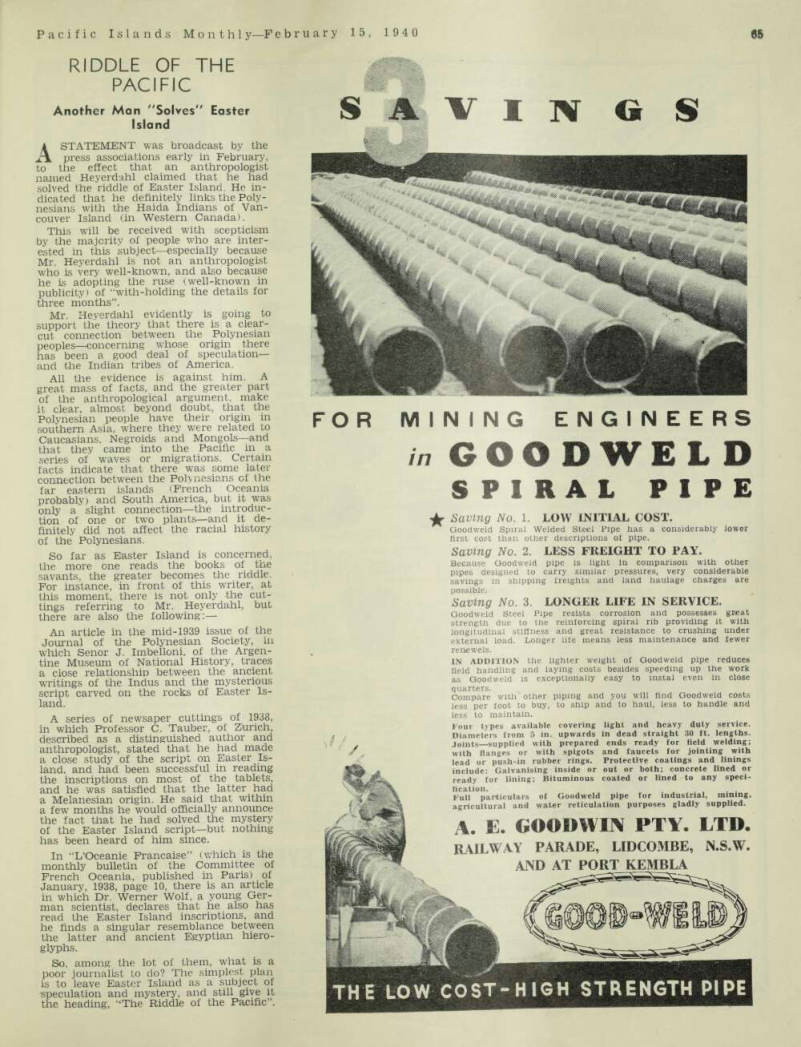
Pacific
Another Mon "Solves" Easter Island
A STATEMENT was broadcast by the press associations early in February, to the effect that an anthropologist named Heyerdahl claimed that he had solved the riddle of Easter Island. He in dicated that he definitely links the Poly nesians with the Haida Indians of Van couver Island (in Western Canada).
This will be received with scepticism by the majority of people who are inter ested in this subject—especially because Mr. Heyerdahl is not an anthropologist who is very well-known, and also because he is adopting the ruse (well-known in publicity) of “with-holding the details for three months”.
Mr. Heyerdahl evidently is going to support the theory that there is a clear cut connection between the Polynesian peoples—concerning whose origin there has been a good deal of speculation— and the Indian tribes of America.
All the evidence is against him. A great mass of facts, and the greater part of the anthropological argument, make it clear, almost beyond doubt, that the Polynesian people have their origin in southern Asia, where they were related to Caucasians. Negroids and Mongols—and that they came into the Pacific in a series of waves or migrations. Certain facts indicate that there was some later connection between the Polynesians of the far eastern islands (French Oceania probably) and South America, but it was only a slight connection —the introduc tion of one or two plants—and it de finitely did not affect the racial history of the Polynesians.
So far as Easter Island is concerned, the more one reads the books of the savants, the greater becomes the riddle.
For instance, in front of this writer, at this moment, there is not only the cut tings referring to Mr. Heyerdahl, but there are also the following;— An article in the mid-1939 issue of the Journal of the Polynesian Society, in which Senor J. Imbelloni. of the Argen tine Museum of National History, traces a close relationship between the ancient writings of the Indus and the mysterious script carved on the rocks of Easter Is land.
A series of newsaper cuttings of 1938, in which Professor C. Tauber, of Zurich, described as a distinguished author and anthropologist, stated that he had made a close study of the script on Easter Is land, and had been successful in reading the inscriptions on most of the tablets, and he was satisfied that the latter had a Melanesian origin. He said that within a few months he would officially announce the fact that he had solved the mystery of the Easter Island script—but nothing has been heard of him since.
In “L’Oceanie Francaise” (which is the monthly bulletin of the Committee of French Oceania, published in Paris) of January, 1938, page 10, there is an article in which Dr. Werner Wolf, a young Ger man scientist, declares that he also has read the Easter Island inscriptions, and he finds a singular resemblance between the latter and ancient Egyptian hiero glyphs.
So, among the lot of them, what is a poor journalist to do? The simplest plan is to leave Easter Island as a subject of speculation and mystery, and still giye it the heading, “The Riddle of the Pacific”.
Advertisements & other items, pp. 67-68 (2 items)
In Goodweld
1 G IV N %
FOR MINING ENGINEERS
SPIRAL PIPE
+ Saving No. 1. LOW INITIAL COST.
Goodweld Spiral Welded Steel Pipe has a considerably lower first cost than other descriptions of pipe.
Saving No. 2. LESS FREIGHT TO FAY.
Because Goodweld pipe is light in comparison with other pipes designed to carry similar pressures, very considerable savings in shipping freights and land haulage charges are possible.
Saving No. 3. LONGER LIFE IN SERVICE.
Goodweld Steel Pipe resists corrosion and possesses great strength due to the reinforcing spiral rib providing it with longitudinal stiffness and great resistance to crushing under external load. Longer life means less maintenance and fewer renewels.
IN ADDITION the lighter weight of Goodweld pipe reduces field handling and laying costs besides speeding up the work as Goodweld is exceptionally easy to instal even in close quarters.
Compare with other piping and you will find Goodweld costs less per foot to buy, to ship and to haul, less to handle and less to maintain.
Four types available covering light and heavy duty service.
Diameters from 5 in. upwards in dead straight 30 ft. lengths.
Joints—supplied with prepared ends ready for field welding; with flanges or with spigots and faucets for jointing with lead or push-in rubber rings. Protective coatings and linings include: Galvanising inside or out or both; concrete lined or ready for lining; Bituminous coated or lined to any specification.
Full particulars of Goodweld pipe for industrial, mining, agricultural and water reticulation purposes gladly supplied.
A. E. GOODWIN PTY. LTD.
RAILWAY PARADE, LIDCOMBE, N.S.W.
AiND AT PORT KEMBLA
\U /
No. .I.—Sheffield made Throwing Knife in Sheath, 6/6. As illustrated.
No. 2.—Remington, U.S.A. made.
Hunting and Sporting Knives in Sheath, 10/6. Others 12/6, 15/-, 17/6. $ Ormond British Made Highest Grade Vernier Dials, 3 inch Brown Bakelite or Metal, 8/6.
“UTILITY” Short Wave Dials World's Best: 12/6.
No. 1 Morse Code Practice Sets, with Switch Buzzer to Light. Use as you desire. 22/6 complete.
No. 2, with Heavier Type Morse Key: 30/-. Pendograph Bug Key. 70/-. Adjustable Key (only), 12/6.
High Pitched Buzzers, 4/6, 7/6, 12/6.
RADIO SERVICEMAN’S MANUAL
FOR 1939,
Just Out! Australia’s Official Radio Service Manual: 10/6. Write for full list of Radio Publications. ■ STAMPS G»ant Size Packets ctatvtpo: of Postage Stamps, 81AiVir15 with Free Gifts.
STAMPS 100 selected different Genuine Stamps. No German, Italian or Japan. 2/9 packet, with 1/3 free gift. 204.—A1l genuine and different selection of stamps, with 3/8 special free stamp offer. 3/9 the packet.
CATALOGUE. Order your copy now, Bd. Post Free. Send for it to-day.
Limited Number Only.
Levenson’s Wonder Book of Specialities. Radio, Coin-operated Machines, Games, Jokes, Puzzles, Hobbies, crammed full of surprises from Cover to Cover.
/^nDu 1
-'now °
fOR
VOUR/
•extra'
EXTRA**"
ia«Nsg|i s
*BBB5
MS
sPii
RADIOS FOR THE
PACIFIC ISLANDS
Levenson’s have the Right Type of Radio for the Pacific Islands. Being Manufacturers, we can Sell at a Better Price. All Sets Fully Guaranteed—At Prices to Suit Your Own Pocket. Particulars without obligation.
ACCUMULATORS
We sell all Types and Sizes—Fully Guaranteed.
Don’t Buy Accumulators before we quote you if not listed here.
RADIO ACCUMULATORS.
2 Volt. 110 Amp 16/6 19/6 20/- 21/9 26/- 45/6 52/6 58/3 67/-
AUTO ACCUMULATORS.
6 Volt. 9 Plate 60 Amp. 31/9 40/- 44/6 51/- 49/3 65/9
HOME LIGHTING ACCUMUL
2 Volt. 120 Amps 2 .. 210 2 200
4TORS.
19/6 35/3 40/- Morse Code High Pitched Tone Buzzer, 4/9. Bakelite Case.
British.
fisT
Sandown Spinning Wheel Race Game with Betting Cloth and Handsome Carrying Cabinet, £5/5/-. Full Directions.
GAMES
Dart Boards, 4/6, 8/6, 10/6, 15/-.
Brass Competition Darts, Set of 3, 3/11, 4/6, 5/6L Monopoly, 10/6.
Totopoly, 10/6. Bucaneer, 10/6. 3 of the World’s Most Popular Games.
Chinese Checkers, 3/6, 4/6, 8/6.
Tripoly Card Game, 5/-. De Luxe Model Game, 10/6. Poker Rummy, I/-. Pot-Lux, 1/-. Playing Card Lotto, 1/-. We Stock All Kinds of Indoor Games. Send for Booklet.
MARE YOUR OWN RECORDINGS.
Overhead Cutting Gear and Cutting Head for Home Radio-Gramophone Recording, £4/4/-. Write for full price Records, Needles, etc., etc.
Valves and Batteries. Yes! We Guarantee a Better Price. Send along your Order and Mention this Advertisement.
Replacement Parts for Every Make of Radio. Send along your Order or ask for Quote.
Army Air Force Winged Brooches or Tie Pins, 2/-. Rising Sun Military Tie Pins, 2/-. Both Enamelled and Gilt.
Llke-a-Flash “Elimlnolse” Aerial Kit for short or dual-wave sets. Aerial, Pyrex type Insulators,, transposition blocks and 200 ft. aerial coll, 22/6.
Eliminates unwanted aerial and hideous electrical noises from your dual-wave or short-wave sets.
Microphone units for experimenting in Mesh-front metal case.
Adjustable All-way Morse Key, Long or Short Tap, 12/6. Heavier P.M.G.
Type, 19/6. Learn Morse Book 1/-. 19 6 P.M.G. Type Sturdy Built Sounder, 35/-.
Buzzers, 3/9 and 4/9.
P.M.G. Morse Key as illustrated, 19/6.
Rejuv Safety Razor-Blade Sharpener, 7/6 —now—2/-. Add 6d. postage.
Blades last for months with this. c: <' w Bulgin British Lightning Arrestor Switch, 5/-.
COWBOY
REVOLVERS.
Just Like the Real Thing, 5/9.
Flash Handles.
BOOKS! BOOKS! BOOKS! The Be-
ginners’ Book of Radio. The Radio Beginners’ Dictionary. 2/- the 2. The Wireless Constructor’s Encyclopaedia. Giant size, 7/6. Newnes “Everyman’s” Wireless Book, 5/6.
The Book of Practical Radio, also The Book of Practical Television, 8/6 each. Foulsham’s Giant “Party and Fun Book”, 1/6. Humorous Stories and Recitations, 3/9. Card and Conjuring Tricks, 3/9. Tea- Cup Fortune Telling, 3/9. 100 Party Games for Old and Young, 1/9.
Popular Magic and Amateur Conjurer, 1/9. 50 Best Party Games, 1/6. Tricks with Cards, 1/6.
Radio and Electrical Meters. Send for full list. Pocket type reads A. and B. Batteries, 3/9, 4/6, 7/6, 9/6.
“PIFCO”. All in One Meter. Tests everything in (Radio,
25/-. A.C.-D.C.
() to 30 milli amps. Valve and Circuit Tester. 6 to 6. 0 to 240 volts.
“EMICOL” Bench Type Meter, 30/-.
Complete with leads, 0 to 30 milli amps., to 60 to 150 volts. Reads obmages. French make. 2 to 3 Extendable Focussing Torch, Nickelled Case, 10/6, with Dimmer.
Day Light Globes and Reserve Globe with Holder in Base of Torch Case.
Fitted Belt or Finger Grip. Worth 21/-. Now 10/6. 1,500 ft. Beam Nickelled Focussing Torch, 6/6. 48/6 Just arrived from the maker in London, “Cosmocord” De Luxe Crystal Pick-up, with Built-in Vol. Control, 48/6. Write for List of Pickups.
Gramophone Pick-up Heads.
Goldring English Pick-up Heads.
Suit and Pit all Gramophone Tone Arms. Type 44/4 Pick-up Head with Built-in Volume Control: 19/6. Type 44/5 Pick-up Head, 21/-. Type 33/3 Pick-up Head, with Volume Control attached: with Highly Polished Nickel Finished; 18/6. Bakelite Cased Pick-up Head: 19/6.
W <* • 0 ow? oo /// Play, Talk, Sing, Joke through your Radio. Great Fun. Batteryless typo Microphone for Hand Holding or Hanging, 22/6. Complete with lead, fixed in a second. Others, 12/6, 15/-, 17/6, 25/-, 28/6, 32/6. All plus 1/9 for Battery and 1/6 for 20 ft. Cord.
Write for full detailed list.
B.G.E. Table Type Microphone. Highly recommended for Amateur or Professional use. Built-in Transformer and Battery with Volume Control incorporated.
Just plug into pickup terminals sf any set. 39/6.
iinmrniimiimiii Write for Punch Board Leaflets (iiiimmnnnnmi
LEVENSON'S RADIO
Pin-Game, GAMES, NOVELTIES AND HOBBIES, To tem and 226 Pin STREET, SYDNEY ° dd n s s and Manufacturers, Importers, and Exporters. Leaflets
N.S.W., AUSTRALIA. 11111111111111111111111111
Cable address: “Leveradioh”. Goods forwarded V.P.P. or Sight Draft. Satisfaction and Service Guaranteed. We can supply by mail all General Merchandise at a Better Price. Quotations with pleasure. Please add freight and packing. Write for full list of interesting leaflets of Games, Hobbies, Novelties, and Electrical Goods. Write for full list of Radio Meters.
66
February 15, 194 O—P acific Islands Monthly
Australian Short Wave
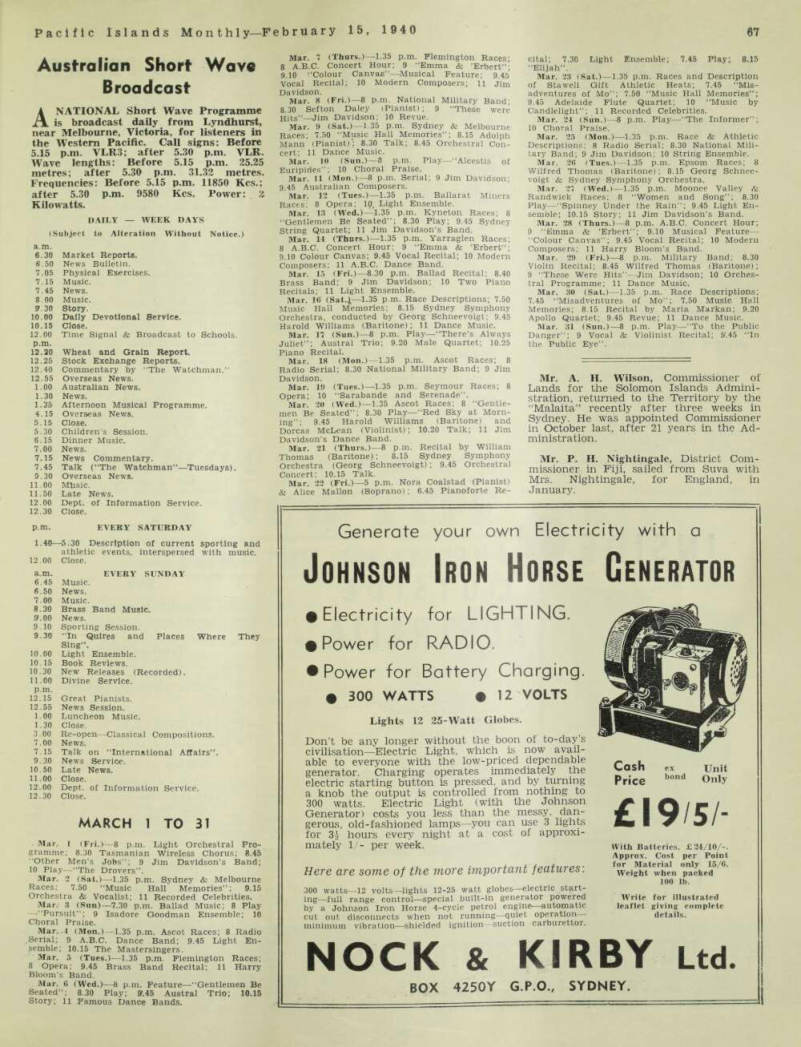
Broadcast
A NATIONAL Short Wave Programme is broadcast daily from Lyndhurst, near Melbourne, Victoria, for listeners in the Western Pacific. Call signs: Before 5.15 p.m. VLR3; after 5.30 p.m. VLR.
Wave lengths: Before 5.15 p.m. 25.25 metres; after 5.30 p.m. 31.32 metres.
Frequencies: Before 5.15 p.m. 11850 Kcs.; after 5.30 p.m. 9580 Kcs. Power: 2 Kilowatts.
Daily Week Days
(Subject to Alteration Without Notice.) a.m. 6.30 Market Reports. 6.50 News Bulletin. 7.05 Physical Exercises. 7.15 Music. 7.45 News. 8.00 Music. 9. 30 Story. 10.00 Dally Devotional Service. 10.15 Close. 12.00 Time Signal & Broadcast to Schools, p.m. 12.20 Wheat and Grain Report. 12.25 Stock Exchange Reports. 12.40 Commentary by “The Watchman.” 12.55 Overseas News. 1.00 Australian News. 1.30 News. 1.35 Afternoon Musical Programme. 4.15 Overseas News. 5.15 Close. 5.30 Children’s Session. 6.15 Dinner Music. 7.00 News. 7.15 News Commentary. 7.45 Talk (“The Watchman”—Tuesdays). 9.30 Overseas News. 11.00 Miisic. 11.50 Late News. 12.00 Dept, of Information Service. 12.30 Close.
P.M. Every Saturday
1.40 —5.30 Description of current sporting and athletic events, interspersed with music. 12.00 Close.
Am. Every Sunday
6,45 Music. 6.50 News. 7.00 Music. 8.30 Brass Band Music. 9.00 News. 9.10 Sporting Session. 9.30 “In Quires and Places Where They Sing”. 10.00 Light Ensemble. 10.15 Book Reviews. 10.30 New Releases (Recorded). 11.00 Divine Service, p.m. 12.15 Great Pianists. 12.55 News Session. 1.00 Luncheon Music, 1.30 Close. 3.00 Re-open—Classical Compositions. 7.00 News. 7.15 Talk on “International Affairs”. 9.30 News Service. 10.50 Late News. 11.00 Close. 12.00 Dept, of Information Service. 12.30 Close.
March 1 To 31
Mar. I (Fri.)—B p.m. Light Orchestral Pro gramme; 8.30 Tasmanian Wireless Chorus; 8.45 “Other Men’s Jobs”; 9 Jim Davidson’s Band; 10 Play—“ The Drovers”.
Mar. 2 (Sat.)—l.3s p.m. Sydney & Melbourne Races; 7.50 “Music Hall Memories”; 9.15 Orchestra & Vocalist; 11 Recorded Celebrities.
Mar. 3 (Sun) —7.30 p.m. Ballad Music; 8 Play —“Pursuit”: 9 Isadore Goodman Ensemble; 10 Choral Praise.
Mar. 4 (Mon.) —1.35 p.m. Ascot Races; 8 Radio Serial: 9 A.B.C. Dance Band; 9.45 Light En semble; 10.15 The Mastersingers.
Mar. 5 (Tues.) —1.35 p.m. Flemington Races; 8 Opera; 9.45 Brass Band Recital; 11 Harry Bloom’s Band.
Mar. 6 (Wed.) —8 p.m. Feature—" Gentlemen Be Seated”; 8.30 Play; 9.45 Austral Trio; 10.15 Story; 11 Famous Dance Bands.
Mar. 7 (Thurs.) —1.35 p.m. Plemington Races; 8 A.B.C. Concert Hour; 9 “Emma & ’Erbert”; 9.10 “Colour Canvas” —Musical Feature; 9,45 Vocal Recital; 10 Modern Composers; 11 Jim Davidson.
Mar. 8 (Fri.) —8 p.m. National Military Band; 8.30 Sefton Daley (Pianist); 9 “These were Hits” —Jim Davidson; 10 Revue.
Mar. 9 (Sat.) —1.35 p.m. Sydney & Melbourne Races; 7.50 “Music Hall Memories”: 8.15 Adolph Mann (Pianist)’; 8.30 Talk; 8.45 Orchestral Con cert; 11 Dance Music.
Mar. 10 (Sun.)—B p.m. Play—“ Alcestis of Euripides”: 10 Choral Praise.
Mar. II (Mon.) —8 p.m. Serial; 9 Jim Davidson; 9.45 Australian Composers.
Mar. 12 (Tues.)—l.3s p.m. Ballarat Miners Races: 8 Opera; 10, Light Ensemble.
Mar. 13 (Wed.) —1.35 p.m. Kyneton Races; 8 “Gentlemen Be Seated”; 8.30 Play; 9.45 Sydney String Quartet; 11 Jim Davidson’s Band.
Mar. 14 (Thurs.) —1.35 p.m. Yarraglen Races; 8 A.B.C. Concert Hour; 9 “Emma & ’Erbert”; 9.10 Colour Canvas; 9.45 Vocal Recital; 10 Modern Composers; 11 A.B.C. Dance Band.
Mar. 15 (Fri.) —8.30 p.m. Ballad Recital; 8.40 Brass Band; 9 Jim Davidson; 10 Two Piano Recitals: 11 Light Ensemble.
Mar. 16 (Sat-1 —1.35 p.m. Race Descriptions; 7.50 Music Hall Memories; 8.15 Sydney Symphony Orchestra, conducted by Georg Schneevoigt; 9.45 Harold Williams (Baritone); 11 Dance Music.
Mar. 17 (Sun.) —8 p.m. Play—“ There’s Always Juliet”; Austral Trio; 9.20 Male Quartet; 10.25 Piano Recital.
Mar. 18 (Mon.) —1.35 p.m. Ascot Races; 8 Radio Serial; 8.30 National Military Band; 9 Jim Davidson.
Mar. 19 (Tues.) —1.35 p.m. Seymour Races; 8 Opera; 10 “Sarabande and Serenade".
Mar. 20 (Wed.) —1.35 Ascot Races; 8 “Gentle men Be Seated”: 8.30 Play—“ Red Sky at Morn ing”; 9.45 Harold Williams (Baritone) and Dorcas McLean (Violinist); 10.20 Talk; 11 Jim Davidson’s Dance Band.
Mar, 21 (Thurs.) —8 p.m. Recital by William Thomas (Baritone); 8.15 Sydney Symphony Orchestra (Georg Schneevoigt); 9.45 Orchestral Concert: 10.15 Talk.
Mar. 22 (Fri.) —5 p.m. Nora Coalstad (Pianist) & Alice Mallon (Soprano); 6.45 Pianoforte Re
cltal; 7.30 Light Ensemble; 7.45 Play; 8.15 “Elijah”.
Mar. 23 (Sat.) —1.35 p.m. Races and Description of Stawell Gift Athletic Heats; 7.45 “Mis adventures of Mo”; 7.50 “Music Hall Memories”; 9.45 Adelaide Flute Quartet; 10 “Music by Candlelight”; 11 Recorded Celebrities.
Mar. 24 (Sun.) —8 p.m. Play—“ The Informer”; 10 Choral Praise.
Mar. 25 (Mon.) —1.35 p.m. Race & Athletic Descriptions; 8 Radio Serial; 8.30 National Mili tary Band; 9 Jim Davidson; 10 String Ensemble.
Mar. 26 (Tues.) —1.35 p.m. Epsom Races; 8 Wilfred Thomas (Baritone); 8.15 Georg Schnee vbigt & Sydney Symphony Orchestra.
Mar. 27 (Wed.) —1.35 p.m. Moonee Valley & Randwick Races; 8 “Women and Song”; 8.30 Play—“Spinney Under the Rain"; 9.45 Light En semble; 10.15 Story; 11 Jim Davidson’s Band.
Mar. 28 (Thurs.) —8 p.m. A.B.C. Concert Hour; 9 “Emma & ’Erbert”; 9.10 Musical Feature — “Colour Canvas”; 9.45 Vocal Recital; 10 Modern Composers; 11 Harry Bloom’s Band.
Mar. 29 (Fri.) —3 p.m. Military Band; 8.30 Violin Recital: 8.45 Wilfred Thomas (Baritone): 9 “These Were Hits”—Jim Davidson; 10 Orches tral Programme; 11 Dance Music.
Mar. 30 (Sat.) —1.35 p.m. Race Descriptions; 7.45 “Misadventures of Mo”; 7.50 Music Hall Memories; 8.15 Recital by Maria Markan; 9.20 Apollo Quartet; 9.45 Revue; 11 Dance Music.
Mar. 31 (Sun.) —8 p.m. Play—“To the Public Danger”: 9 Vocal & Violinist Recital; 9'.45 “In the Public Eye”.
Mr. A. H. Wilson, Commissioner of Lands for the Solomon Islands Admini stration, returned to the Territory by the “Malaita” recently after three weeks in Sydney. He was appointed Commissioner in October last, after 21 years in the Ad ministration.
Mr, P. H. Nightingale, District Com missioner in Fiji, sailed from Suva with Mrs. Nightingale, for England, in
January.
Advertisements & other items, p. 69 (2 items)
67
Pacific Islands Mon thly—February 15, 1940
Johnson Iron Horse Generator
Generate your own Electricity with a
• Electricity for LIGHTING.
• Power for RADIO.
• Power for Battery Charging.
300 WATTS • 12 VOLTS
Lights 12 25-Watt Globes.
Don't be any longer without the boon of to-day’s civilisation —Electric Light, which is now available to everyone with the low-priced dependable generator. Charging operates immediately the electric starting button is pressed, and by turning a knob the output is controlled from nothing to 300 watts. Electric Light (with the Johnson Generator) costs you less than the messy, dangerous, old-fashioned lamps—you can use 3 lights for 3a hours every night at a cost of approximately 1/- per week.
Here are some of the more important features : 300 watts—l 2 volts—lights 12-25 watt globes—electric starting—full range control —special built-in generator powered by a Johnson Iron Horse 4-cycie petrol engine—automatic cut out disconnects when not running—quiet operationminimum vibration —shielded ignition—suction carburettor.
Cash ex Unit Price bond Only £195/ With Batteries, £24/10/-.
Approx. Cost per Point for Material only 15/6.
Weight when packed 100 lb.
Write for illustrated leaflet giving complete details.
NOCK & KIRBY Ltd.
BOX 4250 Y G.P.0., SYDNEY.
Exchange Rates
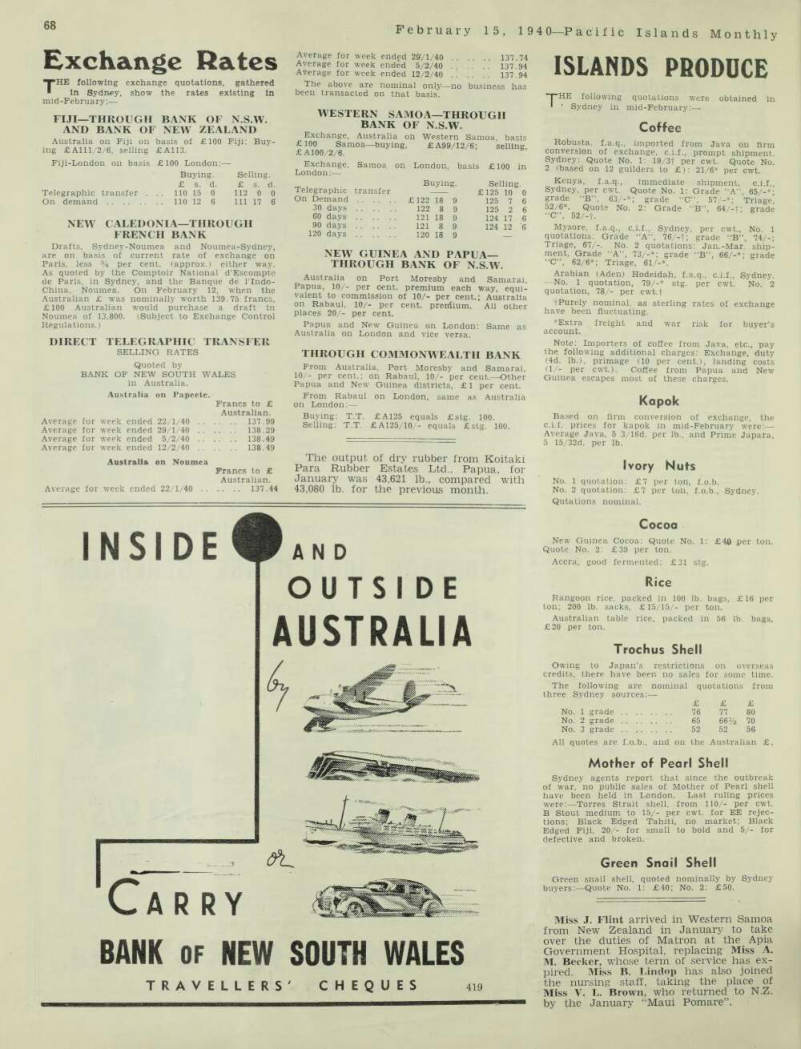
THE following exchange quotations, gathered ■ in Sydney, show the rates existing In mid-February:—
Fiji—Through Bank Of N.S.W.
And Bank Of New Zealand
Australia on Fiji on basis of £lOO Fiji: Buy ing £Alll/2/6, selling £AII3.
Fiji-London on basis £lOO London;—
New Caledonia—Through
French Bank
Drafts, Sydney-Noumea and Noumea-Sydney, are on basis of current rate of exchange on Paris, less % per cent, (approx.) either way.
As quoted by the Comptoir National d’Escompte de Paris, in Sydney, and the Banque de ITndo- China, Noumea. On February 12, when the Australian £ was nominally w T orth 139.75 francs, £ 100 Australian would purchase a draft in Noumea of 13,800. (Subject to Exchange Control Regulations.)
Direct Telegraphic Transfer
Selling Rates
Quoted by
Bank Of New South Wales
in Australia.
Australia on Papeete.
Western Samoa—Through
Bank Of N.S.W.
Exchange, Australia on Western Samoa, basis £lOO Samoa—buying, £A99/12/6; selling,
£ Aloo/2/6.
Exchange. Samoa on London, basis £lOO in London:—
New Guinea And Papua
Through Bank Of N.S.W.
Australia on Port Moresby and Samarai, Papua, 10/- per cent, premium each way, equi valent to commission of 10/- per cent.; Australia on Rabaul, 10/- per cent, prerrfium. All other places 20/- per cent.
Papua and New Guinea on London; Same as Australia on London and vice versa.
Through Commonwealth Bank
From Australia, Port Moresby and Samarai, 10/ - per cent.; on Rabaul, 10/- per cent. —Other Papua and New Guinea districts, £1 per cent.
From Rabaul on London, same as Australia on London:— Buying: T.T. £AI2S equals £stg. 100.
Selling; T.T. £AI2S/10/- equals £stg. 100.
The output of dry rubber from Koitaki Para Rubber Estates Ltd., Papua, for January was 43.621 lb., compared with 43,080 lb. for the previous month.
Buying. Selling. £ s. d. £ s. d.
Telegraphic transfer ... 110 15 0 112 0 0 On demand 110 12 6 111 17 6
Average for week ended 22/1/40 ..
Francs to £ Australian. .. .. 137.99 Average for week ended 29/1/40 . . .. . . 138.29 Average for week ended 5/2/40 . . .. .. 138.49 Average for week ended 12/2/40 . . .. .. 138.49 Average for Australia week ended on Noumea 22/1/40 . .
Francs to £ Australian. .. .. 137.44
Average for week ended 2971/40 . .
Average for week ended 5/2/40 .. .. 137.94 Average for week ended 12/2/40 .. .. 137.94 The above are nominal only—no been transacted on that basis. business has
„ Buying. Selling.
Telegraphic transfer £125 10 0 On Demand £122 18 9 125 7 6 30 days 122 8 9 125 2 6 60 days 121 18 9 124 17 6 90 days 121 8 9 124 12 ‘6 120 days 120 18 9
Islands Produce
”j“HE following quotations were obtained in ' * Sydney in mid-February;—-
Coffee
Robusta, f.a.q., imported from Java on firm conversion of exchange, c.i.f., prompt shipment.
Sydney: Quote No. 1: 19/3f per cwt. Quote No. 2 (based on 12 guilders to £); 21/6* per cwt.
Kenya, f.a.q., immediate shipment, c.i.f., Sydney, per cwt. Quote No. 1; Grade “A”, 65/-*; grade “B”, 63/-*; grade “C”, 57/-*; Triage, 52/6*. Quote No. 2: Grade “B”, 64/-t; grade “C”, 52/-f.
Mysore, f.a.q., c.i.f., Sydney, per cwt., No. 1 quotations: Grade “A”, 76/-f; grade “B”, 74/-; Triage, 67/-. No. 2 quotations: Jan.-Mar. ship ment, Grade "A”, 73/-*; grade “B”, 66/-*; grade “C”, 62/6*; Triage, 61/-*.
Arabian (Aden) Hodeidah, f.a.q., c.i.f., Sydney. —No. 1 quotation, 79/-* stg. per cwt. No. 2 quotation, 78/- per cwt.f tPurely nominal, as sterling rates of exchange have been fluctuating. *Extra freight and war risk for buyer’s account.
Note: Importers of coffee from Java, etc., pay the following additional charges: Exchange, duty (4d. lb.), primage (10 per cent.), landing costs (1/- per cwt.). Coffee from Papua and New Guinea escapes most of these charges.
Kapok
Based on firm conversion of exchange, the c.i.f. prices for kapok in mid-February were:— Average Java, 5 3/16d. per lb., and Prime Japara, 5 15/32d. per lb.
Ivory Nut-s
No. 1 quotation; £7 per ton, f.o.b.
No. 2 quotation; £7 per ton, f.0.b., Sydney.
Qutations nominal.
Cocoa
New Guinea Cocoa; Quote No. 1: £4O per ton.
Quote No. 2: £39 per ton.
Accra, good fermented: £3l stg.
Rice
Rangoon rice, packed in 100 lb. bags, £l6 per ton; 200 lb. sacks, £l5/15/- per ton.
Australian table rice, packed in 56 lb. bags, £2O per ton.
Trochus Shell
Owing to Japan’s restrictions on overseas credits, there have been no sales for some time.
The following are nominal quotations from three Sydney sources:—
Mother of Pearl Shell
Sydney agents report that since the outbreak of war, no public sales of Mother of Pearl shell have been held in London. Last ruling prices were:—Torres Strait shell, from 110/- per cwt.
B Stout medium to 15/- per cwt. for EE rejec tions; Black Edged Tahiti, no market; Black Edged Fiji, 20/- for small to bold and 5/- for defective and broken.
Green Snail Shell
Green snail shell, quoted nominally by Sydney buyers:—Quote No. 1: £4O; No. 2: £5O.
Miss J. Flint arrived in Western Samoa from New Zealand in January to take over the duties of Matron at the Apia Government Hospital, replacing Miss A.
M. Becker, whose term of service has ex pired. Miss B. Lindop has also joined the nursing staff, taking the place of Miss V. L. Brown, who returned to N.Z. by the January “Maui Pomare”.
£ £ £ No. 1 grade 76 77 80 No. 2 grade 65 66y 2 70 No. 3 grade 52 52 56 All quotes are f.o.b., and on the Australian £.
Advertisements & other items, p. 70 (2 items)
68
February 15, 194 O—P acific Islands Monthly
Carry
INSIDE Wand
OUTSIDE
AUSTRALIA
Carry
BANK OF NEW SOUTH WALES
TRAVELLERS' CHEQUES 419
Market Quotations
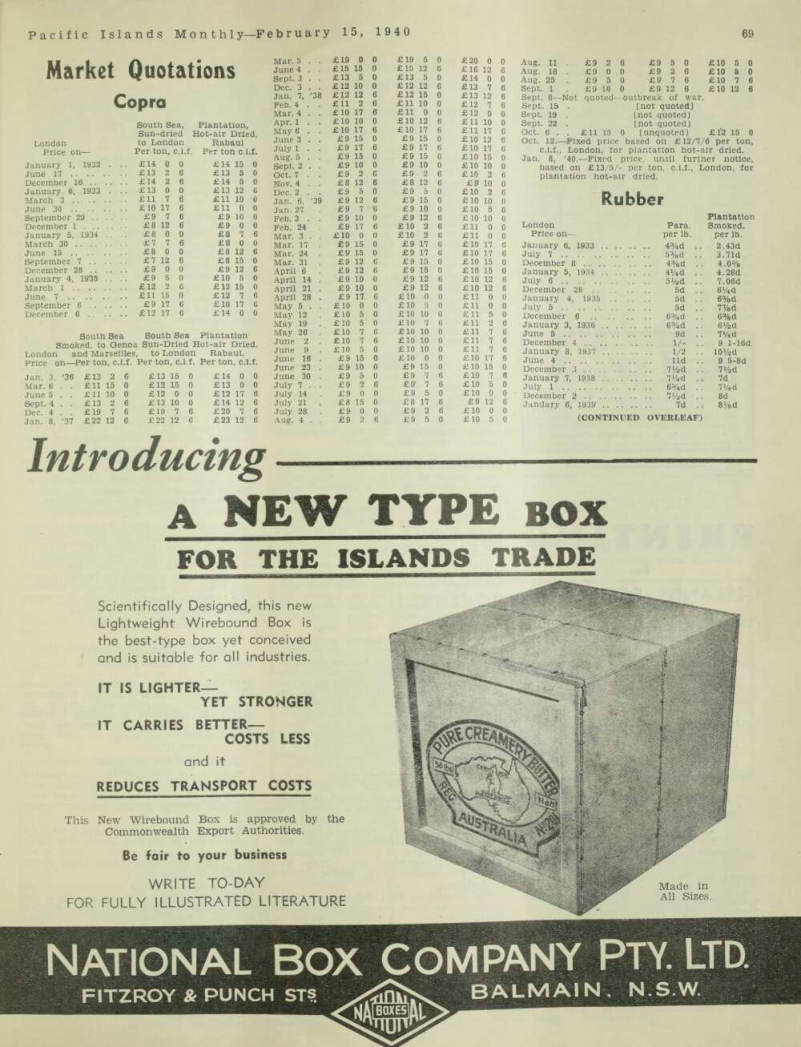
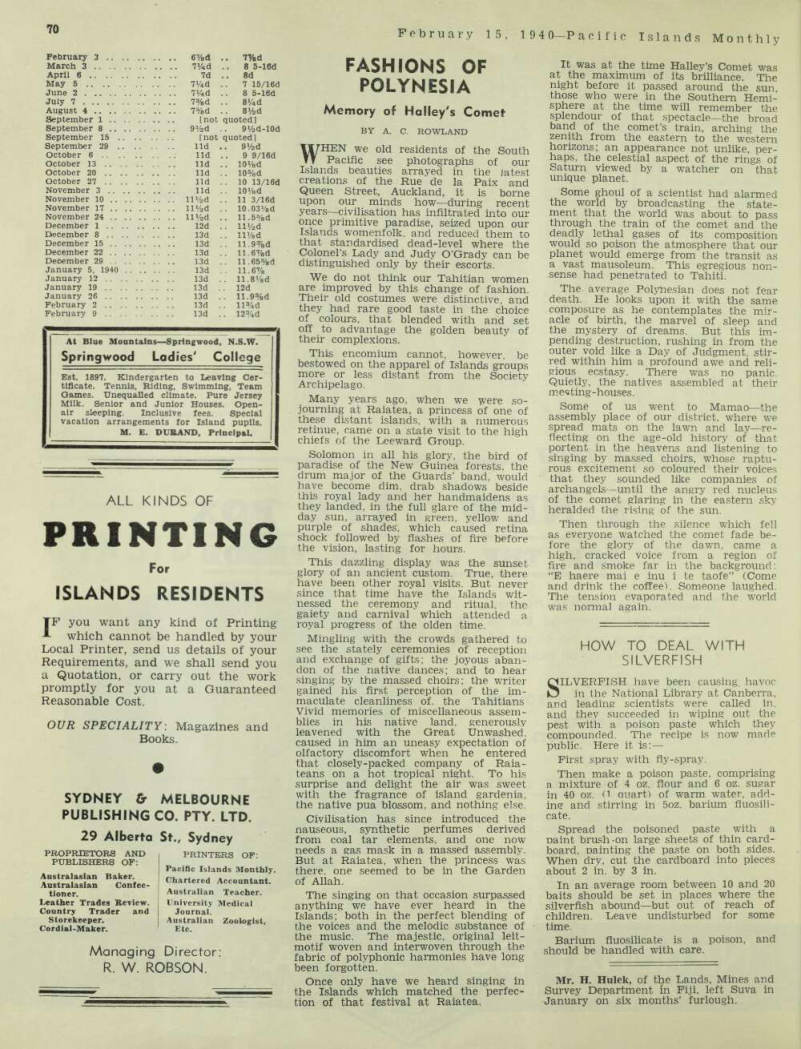
Copra
Mar. 5 . £19 0 0 £19 5 0 £20 0 0 June 4 . £15 15 0 £15 12 6 £16 12 6 Sept. 3 . £13 5 0 £13 5 0 £14 0 0 Dec. 3 . £12 10 0 £12 12 6 £13 7 6 Jan. 7, 38 £12 12 6 £12 15 0 £13 12 6 Feb. 4 . £il 2 6 £11 10 0 £12 7 6 Mar. 4 . £10 17 6 £11 0 0 £12 0 0 Apr. 1 . £10 10 0 £10 12 6 £11 10 0 May 6 . £10 17 6 £10 17 6 £11 17 6 June 3 . £9 15 0 £9 15 0 £10 12 6 July 1 . £9 17 6 £9 17 6 £10 17 6 Aug. 5 . £9 15 0 £9 15 0 £10 15 0 Sept. 2 . £9 10 0 £9 10 0 £10 10 0 Oct. 7 . £9 2 6 £9 2 6 £10 2 6 Nov. 4 . £8 12 6 £8 12 6 £9 10 0 Dec. 2 . £9 5 0 £9 5 0 £10 2 6 Jan. 6. 39 £9 12 6 £9 15 0 £10 10 0 Jan.27 £9 7 6 £9 10 0 £10 5 0 Peb. 3 . £9 10 0 £9 12 6 £10 10 0 Feb. 24 £9 17 6 £10 2 6 £11 0 0 Mar. 3 . £10 0 0 £10 2 6 £11 0 0 Mar. 17 £9 15 0 £9 17 6 £10 17 6 Mar. 24 £9 15 0 £9 17 6 £10 17 6 Mar. 31 £9 12 6 £9 15 0 £10 15 0 April 6 £9 12 6 £9 15 0 £10 15 0 April 14 £9 10 0 £9 12 6 £10 12 6
April 21
£9 10 0 £9 12 6 £10 12 6 April 28 £9 17 6 £10 0 0 £11 0 0 May 5 . £10 0 0 £10 5 0 £11 0 0 May 12 £10 5 0 £10 10 0 £11 5 0 May 19 £10 5 0 £10 7 6 £11 2 6 May 26 £10 7 6 £10 10 0 £11 7 6 June 2 £10 7 6 £10 10 0 £11 7 6 June 9 £10 5 0 £10 10 0 £11 7 6 June 16 £9 15 0 £10 0 0 £10 17 6 June 23 £9 10 0 £9 15 0 £10 15 0 June 30 £9 5 0 £9 7 6 £10 7 6 July 7 . £9 2 6 £9 7 6 £10 5 0 July 14 £9 0 0 £9 5 0 £10 0 0 July 21 £8 15 0 £8 17 6 £9 12 6 July 28 £9 0 0 £9 2 6 £10 0 0 Aug. 4 . £9 2 6 £9 5 0 £10 5 0
Aug. 11 . £9 2 6 £9 5 0 £10 5 0 Aug. 18 . £9 0 0 £9 2 6 £10 6 0 Aug. 25 . £9 5 0 £9 7 6 £10 7 6 Sept. 1 £9 10 0 £9 12 6 £ 10 12 6 Sept. 8—Not quoted- -outbreak of war.
Sept. 15 . [not quoted] Sept. 19 . [not quoted] Sept, 22 .
[not quoted]
£ 12 15 0 Oct. 6 . . £11 15 0 [unquoted] Oct. 12.—Fixed price based on £12/7/6 per ton, c.i.f., London, for plantation hot -air dried.
Jan. 8, ’40.—Fixed price, until further notice, based on £13/5/ - per ton, c.i.f., London, for plantation hot-air dried.
Rubber
Plantation London Para.
Smoked.
Price on— per lb. per lb.
January 6, 1933 .. . 4%d . . 2.43d July 7 .. .. 5%d . 3.71d December 8 4%d , 4.0% January 5, 1934 .. . 4V 4 d . 4.28d July 6 .. .. 5V 2 d . . 7.06d December 28 . . .. ... 5d . . 6V 4 d January 4, 1935 .. ... 5d . 6%d July 5 . 7%d December 6 .. .. 6%d . . 6%d January 3, 1936 .. . 6 a 4d . ey 2 d June 5 ... 9d , . 7y 4 d December 4 1/- 9 l-16d January 8, 1937 .. . 1/2 , .. ioy 2 d June 4 lid 9 5-8d December 3 7V 2 d 7‘/ 2 d January 7, 1938 . . . 7Vid , 7d July 1 .. .. 6 a / 4 d ?y 4 d December 2 7V 2 d 8d January 6, 1939’ .. . 7d 8y a d
(Continued Overleaf)
South Sea, Plantation, Sun-dried Hot-air Dried, London to London Rabaul Price on— Per ton, c.i.f.
Per ton c.i.f.
January 1, 1932 . £14 0 0 £14 15 0 June 17 £13 2 6 £13 5 0 December 16 .. £14 2 6 £14 5 0 January 6, 1933 . £13 0 0 £13 12 6 March 3 .. .. . £11 7 6 £11 10 0 June 30 £10 17 6 £11 0 0 September 29 . . £9 7 6 £9 10 0 December 1 . .. £8 12 6 £9 0 0 January 5, 1934 £8 0 0 £8 7 6 March 30 .. .. £7 7 6 £8 0 0 June 15 £8 0 0 £8 12 6 September 7 .. £7 12 6 £8 15 0 December 28 .. £9 0 0 £9 12 6 January 4, 1935 £9 5 0 £10 5 0 March 1 .. .. . £12 2 6 £12 15 0 June 7 . . £11 15 0 £12 7 6 September 6 .. £9 17 6 £10 17 6 December 6 . . . £12 17 6 £14 0 0 South Sea South Sea Plantation Smoked, to Genoa Sun-Dried Hot-air Dried.
London and Marseilles, to London Rabaul.
Price on—Per ton, c.i.f.
Per ton, , C.i.f.
Per ton, c.i.f.
Jan. 3, ’36 £13 2 6 £13 : 15 0 £14 0 0 Mar. 6 . . £11 15 0 £12 : 15 0 £13 0 0 June 5 . . £11 10 0 £12 0 0 £12 17 6 Sept. 4 . . £13 2 6 £13 : 10 0 £14 12 6 Dec. 4 . . £19 7 6 £19 7 6 £20 7 6 Jan. 8. ’37 £22 12 6 £22 12 6 £23 12 6
February 3 .. .. 6 7 /sd .. 7%d March 3 .. .. 7»/ 4 d 8 5-16d April 6 ... 7d 8d May 5 .. .. 7»/ 4 d 7 15/16d June 2 ... 7*/ 4 d 8 5-16d July 7 .. .. 7%d 8»/ 4 d August 4 . .. sy 2 d September 1 .. .. [not quoted] September 8 , . . . . .. .. 9»/ 2 d 9y 2 d-10d September 15 .. ..
September 29 .. . . ,. .. lid .. 9y 2 d October 6 .. .. lid 9 9/16d October 13 .. .. lid .. ioy 8 d October 20 .. .. lid . . 10 5 /ad October 27 .. .. lid .. 10 13/16d November 3 .. .. lid .. ioy 8 d November 10 .. .. HV 2 d .. 11 3/16d November 17 .. .. liy 2 d .. io.o3y 8 d November 24 .. 11.5 5 / 8 d December 1 .. .. 12d .. ny 2 d December 8 .. .. 13d .. ny 8 d December 15 ... 13d .. 11.9%d December 22 .. .. 13d .. 11.6%d December 29 .. .. 13d .. 11.65 5 / 8 d January 5, 1940 . . .. ... 13d . . 11.6% January 12 .. .. 13d , .. n.sy 8 d January 19 .. .. 13d . . 12d January 26 .. .. 13d . . 11.9%d February 2 .. .. 13d . . ll%d February 9 .. .. 13d . . 12 3 / 4 d
Advertisements & other items, pp. 71-72 (2 items)
69
Pacific Islands Mon thly—February 15, 194 0
Introducing
A NEW TYPE box
FOR THE ISLANDS TRADE
Scientifically Designed, this new Lightweight Wirebound Box is the best-type box yet conceived and is suitable for all industries.
IT IS LIGHTER-
VET STRONGER
IT CARRIES BETTER-
COSTS LESS
and it
REDUCES TRANSPORT COSTS
This New Wirebound Box is approved by the Commonwealth Export Authorities.
Be fair to your business
WRITE TO-DAY
FOR FULLY ILLUSTRATED LITERATURE
CR m Made in All Sizes
National box company pty. l
FITZROY & PUNCH STS BALMAIN. N.S.W.
At Blue Mountains—Springwood, N.S.W.
Springwood Ladies' College
Est. 1897. Kindergarten to Leaving Certificate. Tennis, Riding, Swimming, Team Games. Unequalled climate. Pure Jersey Milk. Senior and Junior Houses. Openair sleeping. Inclusive fees. Special vacation arrangements for Island pupils.
M. E. DURAND, Principal.
ALL KINDS OF
PRINTING
For
ISLANDS RESIDENTS
TF you want any kind of Printing which cannot be handled by your Local Printer, send us details of your Requirements, and we shall send you a Quotation, or carry out the work promptly for you at a Guaranteed Reasonable Cost.
OUR SPECIALITY : Magazines and Books.
SYDNEY tf MELBOURNE
PUBLISHING CO. PTY. LTD.
29 Alberta St., Sydney
PROPRIETORS AND
PUBLISHERS OF:
Australasian Baker.
Australasian Confectioner.
Leather Trades Review.
Country Trader and Storekeeper.
Cordial-Maker.
Managing
PRINTERS OF:
Pacific Islands Monthly.
Chartered Accountant.
Australian Teacher.
University Medical Journal.
Australian Zoologist, 1 Etc.
Director:
R. W. ROBSON.
Fashions Of
Polynesia
Memory of Halley's Comet
By A. C. Rowland
WHEN we old residents of the South Pacific see photographs of our Islands beauties arrayed in the latest creations of the Rue de la Paix and Queen Street, Auckland, it is borne upon our minds how—during recent years—civilisation has infiltrated into our once primitive paradise, seized upon our Islands womenfolk, and reduced them to that standardised dead-level where the Colonel’s Lady and Judy O’Grady can be distinguished only by their escorts.
We do not think our Tahitian women are improved by this change of fashion.
Their old costumes were distinctive, and they had rare good taste in the choice of colours, that blended with and set off to advantage the golden beauty of their complexions.
This encomium cannot, however, be bestowed on the apparel of Islands groups more or less distant from the Society Archipelago.
Many years ago, when we were so journing at Raiatea, a princess of one of these distant islands, with a numerous retinue, came on a state visit to the high chiefs of the Leeward Group.
Solomon in all his glory, the bird of paradise of the New Guinea forests, the drum major of the Guards’ band, would have become dim, drab shadows beside this royal lady and her handmaidens as they landed, in the full glare of the mid day sun, arrayed in green, yellow and purple of shades, which caused retina shock followed by flashes of fire before the vision, lasting for hours.
This dazzling display was the sunset glory of an ancient custom. True, there have been other royal visits. But never since that time have the Islands wit nessed the ceremony and ritual, the gaiety and carnival which attended a royal progress of the olden time.
Mingling with the crowds gathered to see the stately ceremonies of reception and exchange of gifts; the joyous aban don of the native dances; and to hear singing by the massed choirs: the writer gained his first perception of the im maculate cleanliness of. the Tahitians Vivid memories of miscellaneous assem blies in his native land, generously leavened with the Great Unwashed, caused in him an uneasy expectation of olfactory discomfort when he entered that closely-packed company of Raia teans on a hot tropical night. To his surprise and delight the air was sweet with the fragrance of island gardenia, the native pua blossom, and nothing else.
Civilisation has since introduced the nauseous, synthetic perfumes derived from coal tar elements, and one now needs a gas mask in a massed assembly.
But at Raiatea, when the princess was there, one seemed to be in the Garden of Allah.
The singing on that occasion surpassed anything we have ever heard in the Islands; both in the perfect blending of the voices and the melodic substance of the music. The majestic, original leit motif woven and interwoven through the fabric of polyphonic harmonies have long been forgotten.
Once only have we heard singing in the Islands which matched the perfec tion of that festival at Raiatea.
It was at the time Halley’s Comet was at the maximum of its brilliance. The night before it passed around the sun those who were in the Southern Hemi sphere at the time will remember the splendour of that spectacle—the broad band of the comet’s train, arching the zenith from the eastern to the western horizons; an appearance not unlike, per haps, the celestial aspect of the rings of Saturn viewed by a watcher on that unique planet.
Some ghoul of a scientist had alarmed the world by broadcasting the state ment that the world was about to pass through the train of the comet and the deadly lethal gases of its composition would so poison the atmosphere that our planet would emerge from the transit as a vast mausoleum. This egregious non sense had penetrated to Tahiti.
The. average Polynesian does not fear death. He looks upon it with the same composure as he contemplates the mir acle of birth, the marvel of sleep and the mystery of dreams. But this im pending destruction, rushing in from the outer void like a Day of Judgment, stir red within him a profound awe and reli gious ecstasy. There was no panic.
Quietly, the natives assembled at their meeting-houses.
Some of us went to Mamao —the assembly place of our district, where we spread mats on the lawn and lay—re flecting on the age-old history of that portent in the heavens and listening to singing by massed choirs, whose raptu rous excitement so coloured their voices that they sounded like companies of archangels—until the angry red nucleus of the comet glaring in the eastern sky heralded the rising of the sun.
Then through the silence which fell as everyone watched the comet fade be fore the glory of the dawn, came a high, cracked voice from a region of fire and smoke far in the background: “E haere mai e inu i te taofe” (Come and drink the coffee). Someone laughed.
The tension evaporated and the world was normal again.
How To Deal With
Silverfish
SILVERFISH have been causing, havoc in the National Library at Canberra, and leading scientists were called in, and they succeeded in wiping out the pest with a poison paste which they compounded. The recipe is now made public. Here it is:— First spray with fly-spray.
Then make a poison paste, comprising a mixture of 4 oz. flour and 6 oz. sugar in 40 oz. (1 ouart) of warm water, add ing and stirring in soz. barium fluosili cate.
Spread the poisoned paste with a naint brush-on large sheets of thin card board, nainting the paste on both sides.
When dry. cut the cardboard into pieces about 2 in. by 3 in.
In an average room between 10 and 20 baits should be set in places where the silverfish abound —but out of reach of children. Leave undisturbed for some time.
Barium fluosilicate is a poison, and should be handled with care.
Mr. H. Hulek, of the Lands, Mines and Survey Department in Fiji, left Suva in January on six months’ furlough.
Shipping Services In The Pacific
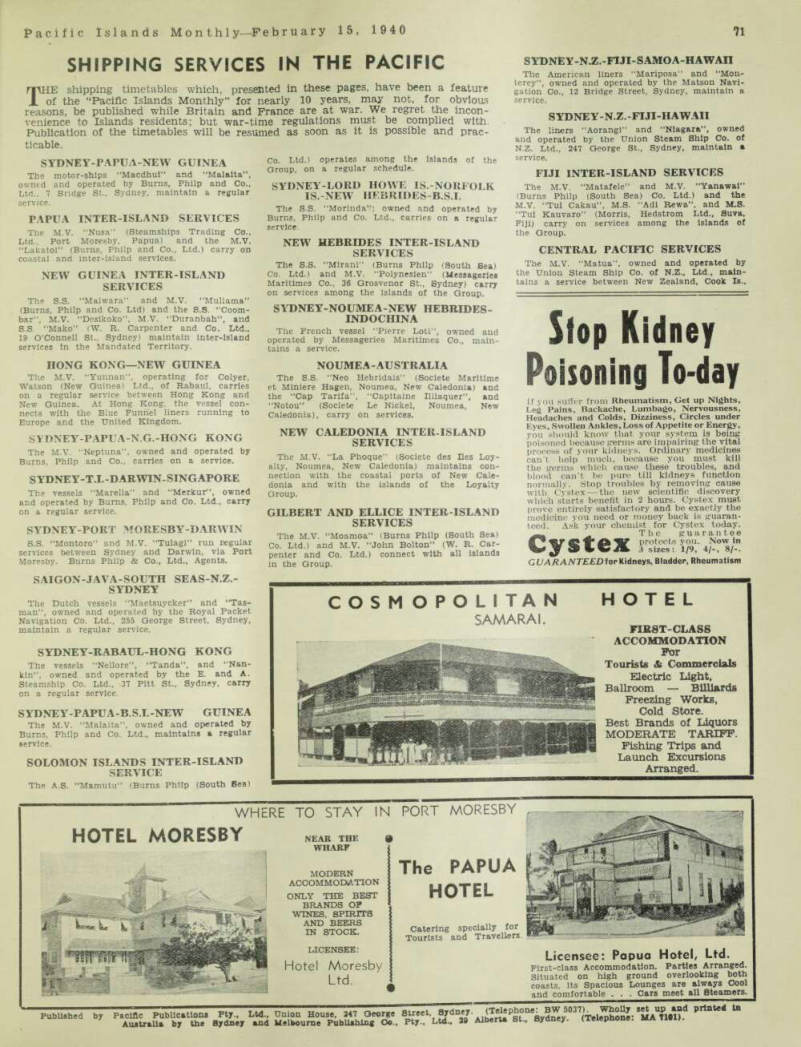
THE shipping timetables which, presented in these pages, have been a feature of the “Pacific Islands Monthly” for nearly 10 years, may not, for obvious reasons, be published while Britain and France are at war. We regret the incon venience to Islands residents; but war-time regulations must be complied with.
Publication of the timetables will be resumed as soon as it is possible and prac ticable.
Sydney-Papua-New Guinea
The motor-ships “Macdhul” and “Malalta”, owned and operated by Burns, Philp and Co., Ltd.. 7 Bridge St., Sydney, maintain a regular service.
Papua Inter-Island Services
The M.V. “Nusa” (Steamships Trading Co., Ltd., Port Moresby, Papua) and the M.V.
“Lakatoi” (Burns, Philp and Co., Ltd.) carry on coastal and inter-island services.
New Guinea Inter-Island
Services
The S.S. "Maiwara” and M.V. “Muliama” (Burns, Philp and Co. Ltd) and the S.S. “Coom bar”, M.V. “Desikoko”, M.V. “Duranbah”, and S.S “Make” (W. R. Carpenter and Co. Ltd., 19 O’Connell St., Sydney) maintain inter-island services in the Mandated Territory,
Hong Kong—New Guinea
The M.V. “Yunnan”, operating for Colyer, Watson (New Guinea) Ltd., of Rabaul, carries on a regular service between Hong Kong and New Guinea. At Hong Kong, the vessel con nects with the Blue Funnel liners running to Europe and the United Kingdom.
Sydney-Papua-N.G.-Hong Kong
The M.V. “Neptuna”, owned and operated by Burns, Philp and Co., carries on a service.
Sydney-T.1.-Darwin-Singapore
The vessels “Marella” and “Merkur”, owned and operated by Burns, Philp and Co. Ltd., carry on a regular service.
Sydney-Port Moresby-Darwtn
S.S. “Montoro” and M.V. “Tulagi” run regular services between Sydney and Darwin, via Port Moresby. Burns Philp & Co., Ltd., Agents.
Saigon-Java-South Seas-N.Z.-
Sydney
The Dutch vessels “Maetsuycker” and “Tas man”, owned and operated by the Royal Packet Navigation Co. Ltd., 255 George Street, Sydney, maintain a regular service.
Sydney-Rabaul-Hong Kong
The vessels “Nellore”, “Tanda”, and “Nan kin”, owned and operated by the E. and A.
Steamship Co. Ltd., 37 Pitt St., Sydney, carry on a regular service.
Sydney-Papua-8.5.1.-New Guinea
The M.V. “Malaita”. owned and operated by Burns, Philp and Co. Ltd., maintains a regular service.
Solomon Islands Inter-Island
Service
The A.S. "Mamutu” (Burns Phllp (South Sea)
Co. Ltd.) operates among the Islands of the Group, on a regular schedule.
Sydney-Lord Howe Is.-Norfolk
Is.-New Hebrides-8.5.1.
The S.S. “Morinda”: owned and operated by Burns, Phllp and Co. Ltd., carries on a regular service.
New Hebrides Inter-Island
Services
The S.S. “Mlrani” (Burns Phllp (South Sea) Co. Ltd.) and M.V. “Polynesian” (Messagerles Maritimes Co., 36 Grosvenor St., Sydney) carry on services among the islands of the Group.
Sydney-Noumea-New Hebrides -
Indochina
The French vessel “Pierre Loti”, owned and operated by Messageries Maritimes Co., main tains a service.
Noumea-Australia
The S.S. “Neo Hebridais” (Societe Maritime et Miniere Hagen, Noumea, New Caledonia) and the “Cap Tarifa”, “Capltaine Illlaquer”, and “Notou” (Societe Le Nickel, Noumea, New Caledonia), carry on services.
New Caledonia Inter-Island
Services
The M.V. “La Phoque” (Societe des Hes Loy alty, Noumea, New Caledonia) maintains con nection with the coastal ports of New Cale donia and with the islands of the Loyalty Group,
Gilbert And Ellice Inter-Island
Services
The M.V. “Moamoa” (Burns Phllp (South Sea) Co. Ltd.) and M.V. “John Bolton” (W. R. Car penter and Co. Ltd.) connect with all islands in the Group.
Sydney-N.Z.-Fiji-Samoa-Hawaii
The American liners “Mariposa” and “Mon terey”, owned and operated by the Matson Navi gation Co., 12 Bridge Street, Sydney, maintain a service.
S Ydne Y-N.Z.-Fi Ji-Hawaii
The liners “Aorangi” and “Niagara”, owned and operated by the Union Steam Ship Co. of N.Z. Ltd., 247 George St., Sydney, maintain a service.
Fiji Inter-Island Services
The M.V. “Matafele” and M.V. “Yanawal” (Burns Philp (South Sea) Co. Ltd.) and the M.V. “Tul Cakau”, M.S. “Adi Rewa”, and M.S.
“Tul Kauvaro” (Morris, Hedstrom Ltd., Suva, Fiji) carry on services among the Islands of the Group.
Central Pacific Services
The M.V. “Matua”, owned and operated by the Union Steam Ship Co. of N.Z., Ltd., main tains a service between New Zealand, Cook Is.,
Tonga, Samoa, and Fiji. The Co. also runs a cargo service from Sydney to Nth. America, via Fiji and Tahiti.
New Zealand - Samoa-Niue
The M.V. “Maui Pomare”, owned and oper ated by the New Zealand Government, main tains a service. Apply for details to the De partment of External Affairs, Wellington, N.Z.
Australia-Nauru-Ocean Island
Vessels are despatched fairly regularly from Australia and from New Zealand to Nauru and Ocean Island by the British Phosphate Com mission, Henty House, Little Collins St., Mel bourne.
Sydney-Noumea-Tahiti
A service between Sydney and Tahiti is main tained by Messageries Maritimes Co., passengers connecting with the M.M. liners “Eridan”, "Sa glttalre”, “Vllle d’Amlens”, and “Commissalre Ramel” at Noumea (New Caledonia) per the “Pierre Loti” from Sydney (see Sydney-Noumea- New Hebrides service). The big M.M. liners carry on a service between France and New Caledonia.
French Oceania Inter-Island
Service
The small vessel “Hiro” maintains a service between Tahiti and the Leeward Group.
Samoan Inter-Island Services
The Apia customs launch connects regularly with the Matson liners “Monterey” and “Mariposa” at Pago Pago (American Samoa).
Europe-Suva-N.Z.-Sydney-New
Guinea
The M.V. “Rabaul”, M.V. “Salamaua”, and S.S.
“Suva”, owned and operated by W. R. Carpen ter and Co. Ltd., carry on services between Europe and Australia, via South Sea Islands.
U.S.A.-South Seas
A service between the Pacific coast of America and the main South Sea Islands is maintained by the Pacific Transport Line (U.S.A.), using the motor-ships “Thor I” and “Velox”. Time tables are obtainable from the Australasian agents, Blrt & Co., Ltd., 4 Bridge Street, Sydney, or any of their branch offices.
Japan-N.G.-Noumea-New Zealand
The M.V. “Canberra Maru”, M.V. “Sydney Maru”, and M.V. “Tokyo Maru” (Osaka Shosen Kaisha Line, Osaka, Japan) and the S.S. “Nani wa Maru” and S.S. “Muko Maru” (Yamashita Risen Kaisha Line, Osaka, Japan) maintain re gular services from Japan to New Zealand and Australia, via Pacific Islands ports. Timetable particulars are available on personal application to the Australasian agents, Birt and Co, Ltd., 4 Bridge St., Sydney, or any of their branch offices and agents.
Carolines-Western And Central
Pacific
The M.V. “Takachio Maru” (Nanyo Boyeki Kaisha Line, of Japan) makes a voyage twice a year throughout the Western and Central • Pacific Groups from the Caroline Islands (Jap anese Mandated Territory).
Sydney-Papua-N.G. Air Service
Regular air mail services between Australia and Papua and New Guinea are maintained by W.R.C. Airlines Ltd., 19 O’Connell St., Sydney, with De Havilland airliners. Timetable details can be obtained from any branch of the firm.
N.G. Goldfields Air Services
Aeroplane services between Salamaua and Lae (the N.G. mainland ports) and Wau and other centres on the Morobe Goldfield are conducted by Guinea Airways Ltd., Mandated Airlines Ltd., and other aerial transport companies. The aerial services are the only means of commu nication.
Wau-Port Moresby Air Service
Aeroplane services between the New Guinea goldfields (Morobe, etc.) and Port Moresby, Pa pua, are maintained by Guinea Airways Ltd., of Lae, and Mandated Airlines Ltd., of Sala maua. Schedule details available on personal application to any branch of the firms, from the pursers of the Burns, Philp mail steamer*, or branches of W. R. Carpenter and Co. Ltd.
Advertisements & other items, p. 73 (2 items)
71
Pacific Islands Monthly—Pebruary 15, 1940
Published b, l “j SriSu™. U p e ibSsLSr’a e , pS^ISC’SiA U ?l»“ d “
Stop Kidney
Poisoning To-day
If you suffer from Rheumatism, Get up Nights, Leg Pains, Backache, Lumbago, Nervousness, Headaches and Colds, Dizziness, Circles under Eyes, Swollen Ankles, Loss of Appetite or Energy, you should know that your system is being poisoned because germs are impairing the vital process of your kidneys. Ordinary medicines can't help much, because you must kill the germs which cause these troubles, and blood can’t be pure till kidneys function normally. Stop troubles by removing cause with Cvstex — the new scientific discovery which starts benefit in 2 hours. Cystex must prove entirely satisfactory and be exactly the medicine you need or money back is guaranteed. Ask your chemist for Cystex today.
The guarantee protects you. Now In 3 sizes; 1/9, 4/-, 8/-. eys, Bladder, Rheumatism
Cystex
GUARANTEED for Kid
COSMOPOLITAN
SAMARAI.
HOTEL
FIRST-CLASS
ACCOMMODATION
For Tourists & Commercials Electric Light, Ballroom Billiards Freezing Works, Cold Store.
Best Brands of Liquors
MODERATE TARIFF.
Fishing Trips and Launch Excursions Arranged.
WHERE TO STAY IN
HOTEL MORESBY
NEAR THE 9
WHARF
A #r;
MODERN
ACCOMMODATION
ONLY THE BEST
BRANDS OP
WINES, SPIRITS
AND BEERS
IN STOCK.
LICENSEE:
Hotel Moresby
Ltd.
PORT MORESBY
The PAPUA
HOTEL
Catering specially for Tourists and Travellers. - ■ I
Licensee: Papua Hotel, Ltd.
First-class Accommodation. Parties Arranged.
Situated on high ground overlooking both coasts, its Spacious Lounges are always Cool and comfortable . . . Cars meet all Steamers.
Horrors Of Pacific Voyages
Letter to the Editor THE author of “Luxury Liners” (in your November issue) has done little to awaken his readers to the real terrors of travel on the Pacific. He has omitted even mention of those twin horrors which darken the days of a Pacific voyage— chilled mutton and the sea-cook who does unmentionable things to this unsavory comestible.
Physically, the Pacific sea-cook re sembles his brethren the world over, spiritually, he is a survivor of the bar baric age. His culinary art has been handed down as an unchanged and un changeable heritage from that remote period. A Pacific voyage is, therefore, an expedition into primordial antiquity, that leaves the explorer shuddering when he emerges.
The voyager becomes veritably ovine in cellular structure by the time his journey is completed.
Need I go into detail? The very sight of “boiled mutton” in a bill-of-fare is for evermore devastating to the appetite of one who has sailed the world’s greatest ocean.
I am, etc.,
Haneanea.
Tahiti, 4/1/1940.
Boats for the Islands
I N the early days of the pioneering and settle • ment of the Pacific Islands, Australia by her natural geographical position came to be looked upon as the supplier of all commodities, goods, etc.—particularly small and large boats for trans port and communication. Of the several firms which built for Islands clients in those days the name of “Holmes” stood pre-eminent; and for the past 50 years the extensive boat-building yards of Holmes and Company, at McMahon’s Point, Sydney, have seen the launching of many craft whose names are familiar throughout the length and breadth of the Pacific.
The firm’s patrons include Messrs. Julius Owen, the Papuan Co., Mouton, S. H. Howard, Rev Woodward, the N.G. Administration, Croker Island Industries, South Sea Trading Co., Pierre Jeandell, Pacific Phosphate Co., Dr. Deck, Capt.
Rondahl, Nat Wells, Steamships Trading r*o., Cogswell, New Guinea Oil Co., i, John E.
Le Peuvre, and many others.
To-day, the Holmes yai is are ccmpi*,;.ely modernised and many of the ’uxur is p ’easure yachts cruising in Australian w .e “Holmes” built. Islands visitors to F. 4 re cordially invited to visit the Holmes yar ,d inspect the boats under construction.***
Not Understood
How niggers oft enrage us: Especially cooks—those stupid blinkin’ coots, Who iron things inside out, and earn their “wageus”
By ruinin’ everything; from hats to boots— Not understood.
Not understood. I yelled: “Hi cookee fetchem This razor-strop for sharp ’im razor Quick!”
He brings, in arf a mo (and I don’t stretch ’em), A blasted rusty file, a half-inch thick.
Not understood.
Not understood. I tried to make him “cotton”
That silk pyjamas must be ironed, well, A little damp, with iron not too hot, an’
He brings a pair in later, scorched t’ hell.
Not understood.
Not understood. I says. “Now ’old yer ’orses,”
When I meets ’im, racin’ in with both 'is mitts, Abalancin’ a tray of cups an’ saucers He grins; an’ trips; an’ whacks the lot t’ bits.
Not understood.
Not understood. By Hec. it’s sumfin’ awful, There’s ne’er a day goes by without its sore.
The langwidge wot I use is most un lawful, When I finds me whisky spilt upon the floor.
Not understood.
Not understood. ’Ell’s bells, I’m fit t’ slam ’im A snifter in the boko, fair an’ square, When ’e comes an’ stings me for ter baccer. Damn ’im!
And like a mug, I forks out then an’ there.
I guess it ain’t no wonder that I’m Not understood.
J. G. Mci.
New Guinea's Recruits
NEW Guinea’s quota of 60 men to join the Australian Army for service overseas has been selected, and already most of the men are in camp near Rabaul, undergoing training.
Rabaul townsfolk are taking a keen interest and pride in their troops: and. already, some of the hard-bitten old soldiers are complaining that the recruits are in danger of being spoiled by “luxu ries and comforts.”
Chain Of Weather Stations
A SCHEME for the establishment of a chain of meteorological stations on islands across the Pacific Ocean was announced in Washington at the end of January.
The work of establishing the stations will be shared by U.S.A. and Britain.
Information gathered at these posts will be used to assist in the navigation of naval and merchant shipping and of aircraft on the new trans-Pacific ser vices.
Advertisements & other items, pp. 74-76 (3 items)
Pacific Travellers
72
February 15, 1940—Pacllic Islands Monthly
(CONTINUED FROM PAGE 3)
February 15. 194 O—P acific Islands Monthly
Civilisation
MOUNTAIN
hub
FASTNESSES
f.
GUINEA AIRWAYS
Freight and Passenger Service
NEW GUINEA
Guinea Airways planes depart from Port Moresby for the Goldfields after the arrival of each boat. Tickets are obtainable from the Purser or Burns, Philp & Co. Ltd., Sydney or Brisbane.
AUSTRALIA
ADELAIDE to DARWIN , Twice Weekly
ADELAIDE to KANGAROO IS-
LAND, daily return service, except Sun.
ADELAIDE to FT. LINCOLN.
3 times weekly, calling at Cowell & Cleve.
ADELAIDE to WHYALLA,
Daily return service (except Sun.).
GUINEA AIRWAYS LINKED
WITH EXPLOITATION OF
NEW GUINEA’S GOLD!
There is no road from the coast to the Morobe Goldfields and the development of this rich area has only been made possible by aerial transport.
The air way has been the only means of transport since 1927. Guinea Airways maintain a fast regular service and have "freighted-in", without difficulty or delay, Crushing Mills, Dredges, Cyaniding Plants, Motor Vehicles, all types of machinery, thousands of passengers and all needs of the large European Community now in this section of the Mandated Territory.
Guinea Airways use 50 Aerodromes and landing grounds in New Guinea and Papua. /
LIMITED
LAE - SALA«V!AUA
Head Office: Austral Chambers, % ?Kcw Guinea Office: Lae, Currie Street, Adelaide, S.A. Man dated Territory of New Guinea U*M
BRANCH OFFICES AND AGENTS AT
7 AH-
SALAMAUA— PORT MORF 3Y AND SYDNEY.
The more
SATISFACTION
you ll find in K. 8.!
.ACE
& 1 '/fe^ 'W" the sun beats down with throatparching fierceness—when the air shimmers with the tropical heat—that's when you'll really appreciate the cooling, enjoyable qualities of K.B. for the hotter the weather, the more real refreshment there is in a cool, satisfying glass of TOOTH'S K.B. LAGER.
VVtf’V; A* 0>