Pacific
Islands
Monthly
Vol. X. No. 6.
January 15, 1940
[Registered at the for transmission by post as a newspaper .]
8“
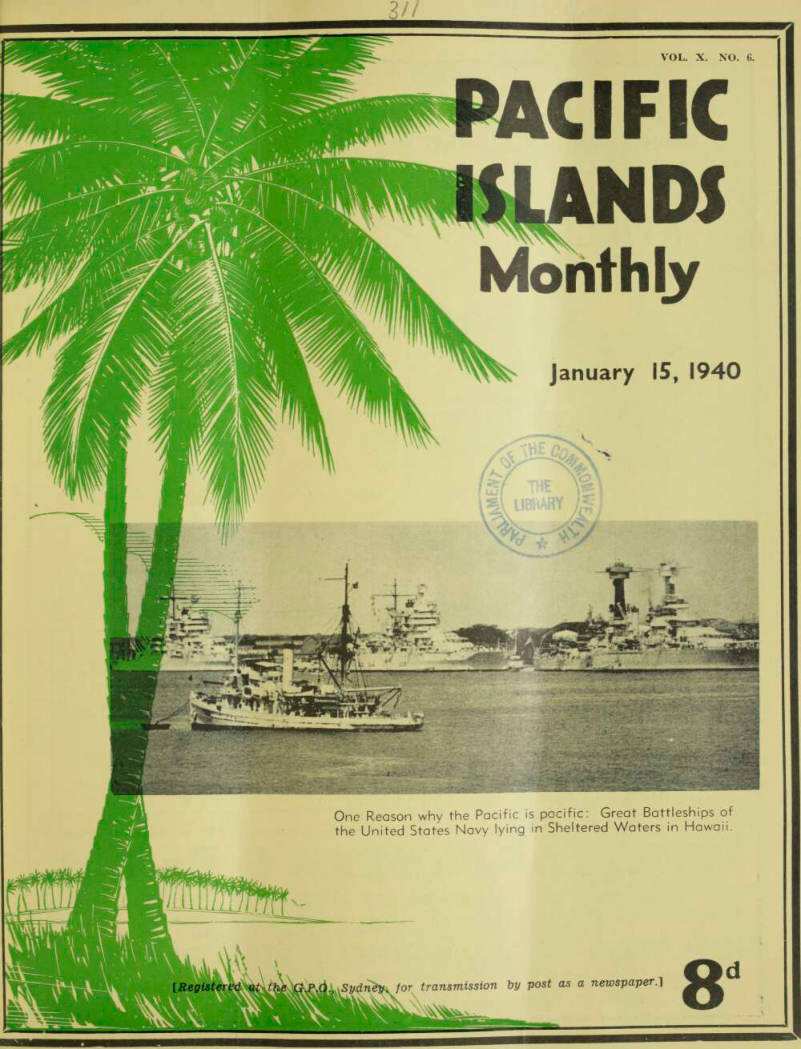
One Reason why the Pacific is pacific: Great Battleships of the United States Navy lying in Sheltered Waters in Hawaii.
Advertisements & other items, p. 2 (2 items)
Pacific Islands Monthl y—J anuary 16, 1940
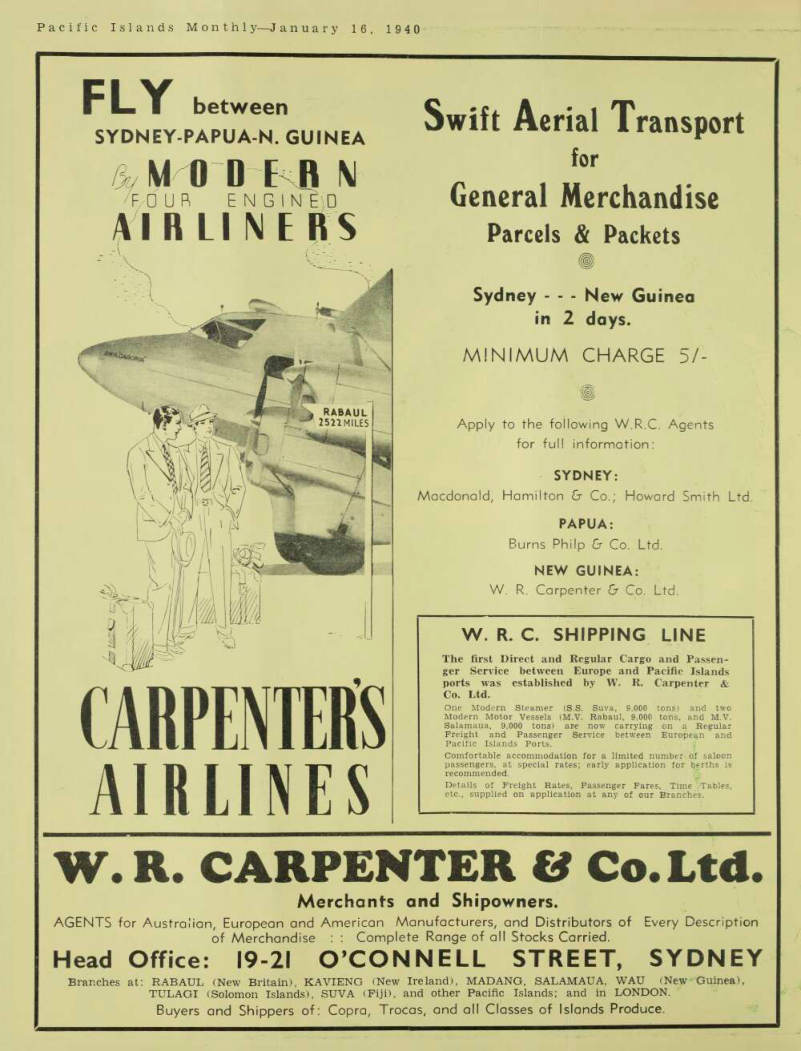
Carpenters
FLY between
SYDNEY-PAPUA-N. GUINEA
M 0 II I R N
FOUR ENGINE'jD
AIRLINERS
H
RABAUL
2521 MILES
L- ...
CARPENTERS
AIRLINES
Swift Aerial Transport
for
General Merchandise
Parcels & Packets
Sydney - - - New Guinea
in 2 days.
MINIMUM CHARGE
S Apply to the following W.R.C. Agents for full information:
SYDNEY:
Macdonald, Hamilton Gr Co.; Howard Smith Ltd.
PAPUA:
Burns Philp Gr Co. Ltd.
NEW GUINEA:
W. R. Carpenter Gr Co. Ltd.
W. R. C. SHIPPING LINE
The first Direct and Regular Cargo and Passenger Service between Europe and Pacific Islands ports was established by W. R. Carpenter & Co. Ltd.
One Modern Steamer (S.S. Suva, 9,000 tons) and two Modern Motor Vessels (M.V. Rabaul, 9,000 tons, and M.V.
Salamaua, 9,000 tons) are now carrying on a Regular Freight and Passenger Service between European and Pacific Islands Ports, Comfortable accommodation for a limited number of saloon passengers, at special rates; early application for berths is recommended.
Details of Freight Rates, Passenger Fares, Time Tables, etc., supplied on application at any of our Branches.
W.R. CARPENTER & Co. Ltd.
Merchants and Shipowners.
AGENTS for Australian, European and American Manufacturers, and Distributors of Every Description of Merchandise : : Complete Range of all Stocks Carried.
Head Office: 19-21 O’CONNELL STREET, SYDNEY
Branches at: RABAUL (New Britain), KAVIENG (New Ireland), MADANG, SALAMAUA. WAU (New Guinea), TULAGI (Solomon Islands), SUVA (Fiji), and other Pacific Islands; and in LONDON.
Buyers and Shippers of: Copra, Trocas, and all Classes of Islands Produce.
Pacific News'review
Notes And Comment On
The Progress Of The War
Dec. 15, 1939— Jan. 14, 1940
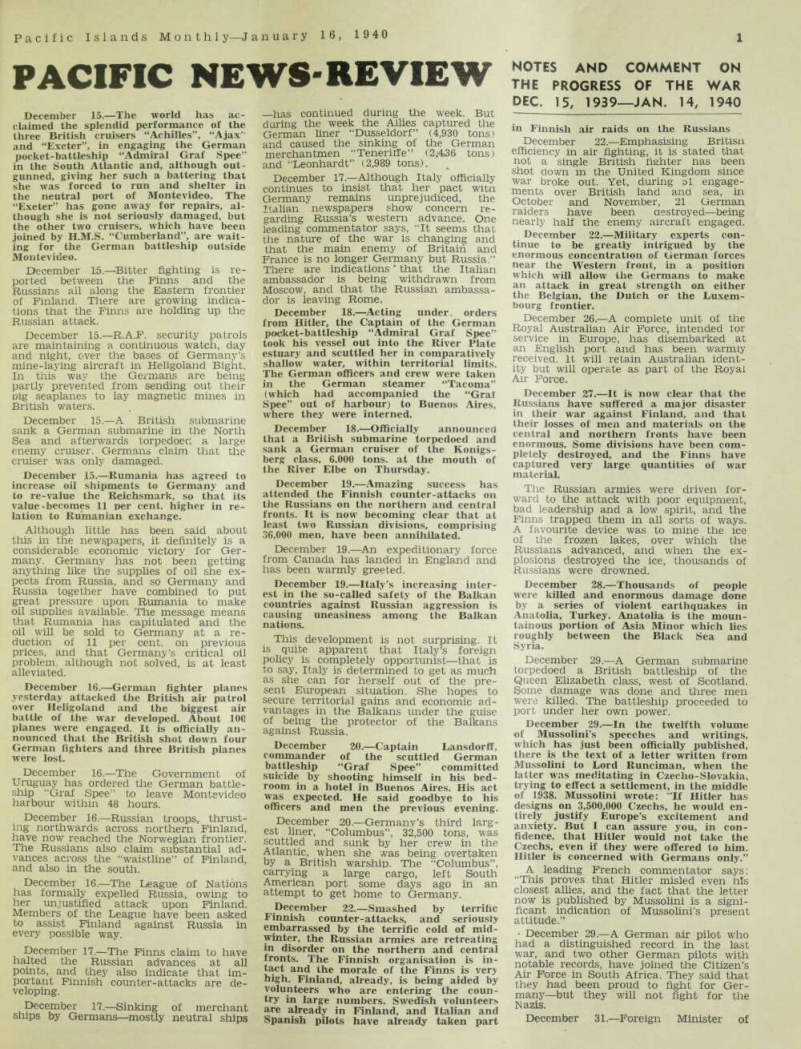
December 15. —The world has ac claimed the splendid performance of the three British cruisers “Achilles”, “Ajax” and “Exeter”, in engaging the German pocket-battleship “Admiral Graf Spec” in the South Atlantic and, although out gunned, giving her such a battering that she was forced to run and shelter in the neutral port of Montevideo. The “Exeter” has gone away for repairs, al though she is not seriously damaged, but the other two cruisers, which have been joined by H.M.S. “Cumberland”, are wait ing for the German battleship outside Montevideo.
December 15.—Bitter fighting is re ported between the Finns and the Russians all along the Eastern frontier of Finland. There are growing indica tions that the Finns are holding up the Russian attack.
December 15. —R.A.F. security patrols are maintaining a continuous watch, day and night, over the bases of Germany’s mine-laying aircraft in Heligoland Bight.
In this way the Germans are being partly prevented from sending out their Dig seaplanes to lay magnetic mines in British waters.
December 15. —A British submarine sank a German submarine in the North Sea and afterwards torpedoed a large enemy cruiser. Germans claim that the cruiser was only damaged, December 15. —Rumania has agreed to increase oil shipments to Germany and to re-value the Reichsmark, so that its value-becomes 11 per cent, higher in re lation to Rumanian exchange.
Although little has been said about this in the newspapers, it definitely is a considerable economic victory for Ger many. Germany has not been getting anything like the supplies of oil she ex pects from Russia, and so Germany and Russia together have combined to put great pressure upon Rumania to make oil supplies available. The message means that Rumania has capitulated and the oil will be sold to Germany at a re duction of 11 per cent, on previous prices, and that Germany’s critical oil problem, although not solved, is at least alleviated.
December 16.—German fighter planes yesterday attacked the British air patrol over Heligoland and the biggest air battle of the war developed. About 100 planes were engaged. It is officially an nounced that the British shot down four German fighters and three British planes were lost.
December 16.—The Government of Uruguay has ordered the German battle ship “Graf Spee” to leave Montevideo harbour within 48 hours.
December 16.—Russian troops, thrust ing northwards across northern Finland, have now reached the Norwegian frontier.
The Russians also claim substantial ad vances across the “waistline” of Finland, and also in the south.
December 16.—The League of Nations has formally expelled Russia, owing to her unjustified attack upon Finland.
Members of the League have been asked to assist Finland against Russia in every possible way.
December 17.—The Finns claim to have halted the Russian advances at all pomts, and they also indicate that im portant Finnish counter-attacks are de
veloping.
December 17.—Sinking of merchant ships by Germans—mostly neutral ships
—has continued during the week. But during the week the Allies captured the German liner “Dusseldorf” (4,930 tons) and caused the sinking of the German merchantmen “Tenerilfe” tons) and “Leonhardt” (2,989 tons).
December 17.—Although Italy officially continues to insist that her pact witn Germany remains unprejudiced, the Italian newspapers show concern re garding Russia’s western advance. One leading commentator says, “It seems that the nature of the war is changing and that the main enemy of Britain and France is no longer Germany but Russia.”
There are indications * that the Italian ambassador is being withdrawn from Moscow, and that the Russian ambassa dor is leaving Rome.
December 18. —Acting under, orders from Hitler, the Captain of the German pocket-battleship “Admiral Graf Spec" took his vessel out into the River Plate estuary and scuttled her in comparatively shallow water, within territorial limits.
The German officers and crew were taken in the German steamer “Tacoma” (which had accompanied the “Gral Spec” out of harbour) to Buenos Aires, where they were interned.
December 18. —Officially announced that a British submarine torpedoed and sank a German cruiser of the Konigs berg class, 6,000 tons, at the mouth of the River Elbe on Thursday.
December 19. —Amazing success has attended the Finnish counter-attacks on the Russians on the northern and central fronts. It is now becoming clear that at least two Russian divisions, comprising 36,000 men, have been annihilated.
December 19. —An expeditionary force from Canada has landed in England and has been warmly greeted.
December 19.—Italy’s increasing inter est in the so-called safety of the Balkan countries against Russian aggression is causing uneasiness among the Balkan nations.
This development is not surprising. It is quite apparent that Italy’s foreign policy is completely opportunist—that is to say, Italy is determined to get as much as she can for herself out of the pre sent European situation. She hopes to secure territorial gains and economic ad vantages in the Balkans under the guise of being the protector of the Balkans against Russia.
December 20. —Captain Lansdorff, commander of the scuttled German battleship “Graf Spec” committed suicide by shooting himself in his bed room in a hotel in Buenos Aires. His act was expected. He said goodbye to his officers and men the previous evening.
December 20. —Germany’s third larg est liner, “Columbus”, 32,500 tons, was scuttled and sunk by her crew in the Atlantic, when she was being overtaken by a British warship. The “Columbus”, carrying a large cargo, left South American port some days ago in an attempt to get home to Germany.
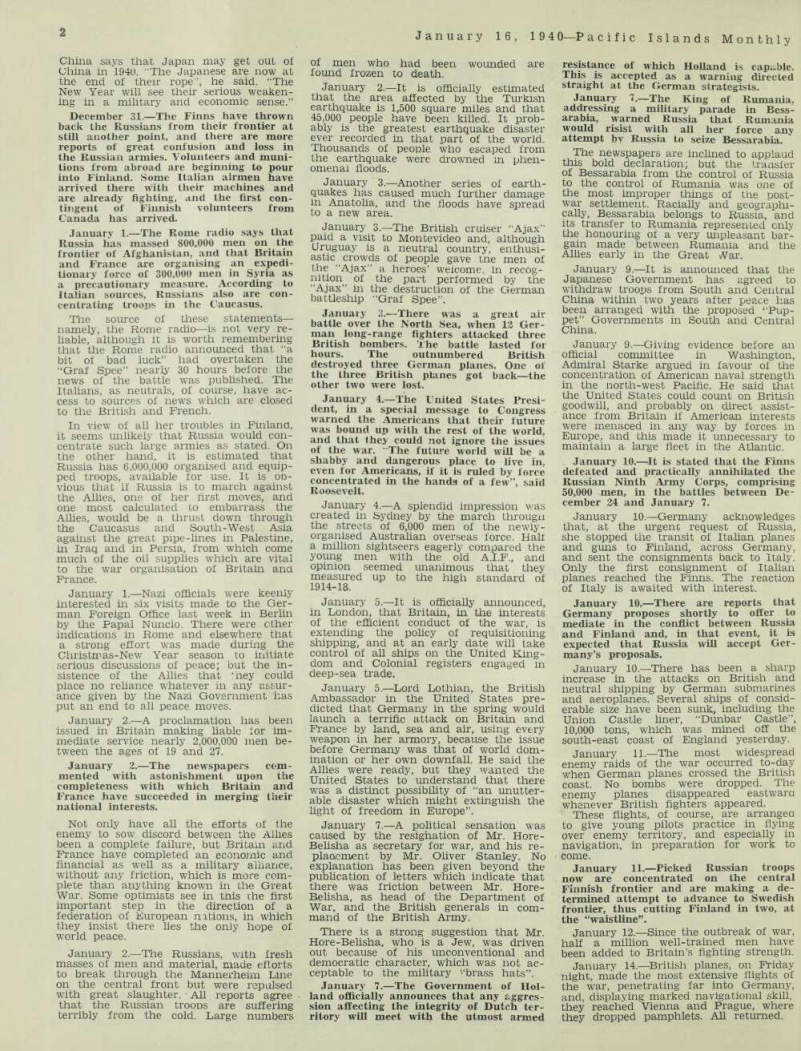
December 22.—Smashed by terrific Finnish counter-attacks, and seriously embarrassed by the terrific cold of mid winter, the Russian armies are retreating in disorder on the northern and central fronts. The Finnish organisation is in tact and the morale of the Finns is very high. Finland, already, is being aided by volunteers who are entering the coun try in large numbers. Swedish volunteers are already in Finland, and Italian and Spanish pilots have already taken part
in Finnish air raids on the Russians December 22. —Emphasising Britisn efficiency in air lighting, it is stated that not a single British lighter has been shot down in the United Kingdom since war broke out. Yet, during ol engage ments over British land and sea, in October and November, 21 German raiders have been destroyed—being nearly half the enemy aircraft engaged.
December 22.—Military experts con tinue to be greatly intrigued by the enormous concentration of German forces near the Western front, in a position which will allow the Germans to make an attack in great strength on either the Belgian, the Dutch or the Luxem bourg frontier.
December 26.—A complete unit of the Royal Australian Air Force, intended for service in Europe, has disembarked at an English port and has been warmly received. It will retain Australian ident ity but will operate as part of the Royal Air Force.
December 27. —It is now clear that the Russians have suffered a major disaster in their war against Finland, and that their losses of men and materials on the central and northern fronts have been enormous. Some divisions have been com pletely destroyed, and the Finns have captured very large quantities of war material.
The Russian armies were driven for ward to the attack with poor equipment, bad leadership and a low spirit, and the Finns trapped them in all sorts of ways.
A favourite device was to mine the ice of the frozen lakes, over which the Russians advanced, and when the ex plosions destroyed the ice, thousands of Russians were drowned.
December 28. —Thousands of people were killed and enormous damage done by a series of violent earthquakes in Anatolia, Turkey. Anatolia is the moun tainous portion of Asia Minor which lies roughly between the Black Sea and Syria.
December 29. —A German submarine torpedoed a British battleship of the Queen Elizabeth class, west of Scotland.
Some damage was done and three men were killed. The battleship proceeded to port under her own power.
December 29. —In the twelfth volume of Mussolini’s speeches and writings, which has just been officially published, there is the text of a letter written from Mussolini to Lord Runciman, when the latter was meditating in Czecho-Slovakia, trying to effect a settlement, in the middle of 1938. Mussolini wrote: “If Hitler has designs on 3,560,000 Czechs, he would en tirely justify Europe’s excitement and anxiety. But I can assure you, in con fidence, that Hitler would not take the Czechs, even if they were offered to him.
Hitler is concerned with Germans only.”
A leading French commentator says: "This proves that Hitler misled even h!s closest allies, and the fact that the letter now is published by Mussolini is a signi ficant indication of Mussolini’s present attitude.” - December 29.—A German air pilot who had a distinguished record in the last war, and two other German pilots with notable records, have joined the Citizen’s Air Force in South Africa. They said that they had been proud to fight for Ger many—but they will not fight for the Nazis.
December 31. —Foreign Minister of
China says that Japan may get out of China in 1940. “The Japanese are now at the end of their rope”, he said. “The New Year will see their serious weaken ing in a military and economic sense.”
December 31. —The Finns have thrown back the Russians from their frontier at still another point, and there are more reports of great confusion and loss in the Russian armies. Volunteers and muni tions from abroad are beginning to pour into Finland. Some Italian airmen have arrived there with their machines and are already fighting, and the first con tingent of Fiimish volunteers from Canada has arrived.
January I.—The Rome radio says that Russia has massed 809.000 men on the frontier of Afghanistan, and that Britain and France are organising an expedi tionary force of 300.000 men in Syria as a precautionary measure. According to Italian sources, Russians also are con centrating troops in the Caucasus.
The source of these statements— namely, the Rome radio —is not very re liable, although it is worth remembering that the Rome radio announced that “a bit of bad luck” had overtaken the “Graf Spee” nearly 30 hours before the news of the battle was published. The Italians, as neutrals, of course, have ac cess to sources of news which are closed to the British and French.
In view of all her troubles in Finland, it seems unlikely that Russia would con centrate such large armies as stated. On the other hand, it is estimated that Russia has 6,000,000 organised and equip ped troops, available for use. It is ob vious that if Russia is to march against the Allies, one of her first moves, and one most calculated to embarrass the Allies, would be a thrust down through the Caucasus and South-West Asia against the great pipe -lines in Palestine, in Iraq and in Persia, from which come much of the oil supplies which are vital to the war organisation of Britain and Prance.
January 1. —Nazi officials were keenly interested in six visits made to the Ger man Foreign Office last week in Berlin by the Papal Nuncio. There were other indications in Rome and elsewhere that a strong effort was made during the Christrras-New Year season to initiate serious discussions of peace; but the in sistence of the Allies that "hey could place no reliance whatever in any assur ance given by the Nazi Government has put an end to all peace moves.
January 2. —A proclamation has been issued in Britain making liable lor im mediate service nearly 2,000,000 men be tween the ages of 19 and 27.
January 3.—The newspapers com mented with astonishment upon the completeness with which Britain and France have succeeded in merging their national interests.
Not only have all the efforts of the enemy to sow discord between the Allies been a complete failure, but Britam and Prance have completed an economic and financial as well as a military alliance, without any friction, which is more com plete than anything known in the Great War. Some optimists see in this the first important step in the direction of a federation of European mtions, in which they insist there lies the only hope of world peace.
January 2.—The Russians, with fresh masses of men and material, made efforts to break through the Mannerhelm Line on the central front but were repulsed with great slaughter. All reports agree that the Russian troops are suffering terribly from the cold. Large numbers
of men who had been wounded are found frozen to death.
January 2.—lt is officially estimated that the area affected by the Turkish earthquake is 1,500 square miles and that 45,000 people have been killed. It prob ably is the greatest earthquake disaster ever recorded in that part of the world.
Thousands of people who escaped from the earthquake were drowned in phen omenal floods.
January 3. —Another series of earth quakes has caused much further damage in Anatolia, and the floods have spread to a new area.
January 3.—The British cruiser “Ajax” paid a visit to Montevideo and, although Uruguay is a neutral country, enthusi astic crowds of people gave the men of the “Ajax” a heroes’ welcome, in recog nition of the part performed by the “Ajax” in the destruction of the German battleship “Graf Spee”.
January 3.—There was a great air battle over the North Sea, when 13 Ger man long-range fighters attacked three British bombers. The battle lasted for hours. The outnumbered British destroyed three German planes. One of the three British planes got back—the other two were lost.
January 4. —The United States Presi dent, in a special message to Congress warned the Americans that their future was bound up with the rest of the world, and that they could not ignore the issues of the war. "The future world will be a shabby and dangerous place to live in, even for Americans, if it is ruled by force concentrated in the hands of a few”, said Roosevelt.
January 4.—A splendid impression was created in Sydney by the march througn the streets of 6,000 men of the newly organised Australian overseas force. Half a million sightseers eagerly compared the young men with the old A.1.F., and opinion seemed unanimous that they measured up to the high standard of 1914-18.
January 5. —It is officially announced, in London, that Britain, in the interests of the efficient conduct of the war, is extending the policy of requisitioning shipping, and at an early date will take control of all ships on the United King dom and Colonial registers engaged in deep-sea trade.
January s.—Lord Lothian, the British Ambassador in the United States pre dicted that Germany in the spring would launch a terrific attack on Britain and France by land, sea and air, using every weapon in her armory, because the issue before Germany was that of world dom ination or her own downfall. He said the Allies were ready, but they wanted the United States to understand that there was a distinct possibility of “an unutter able disaster which might extinguish the light of freedom in Europe”.
January 7. —A political sensation was caused by the resignation of Mr. Hore- Belisha as secretary for war, and his re placement by Mr. Oliver Stanley. No explanation has been given beyond the publication of letters which indicate that there was friction between Mr. Hore- Belisha, as head of the Department of War, and the British generals in com mand of the British Army.
There is a strong suggestion that Mr.
Hore-Belisha, who is a Jew, was driven out because of his unconventional and democratic character, which was not ac ceptable to the military “brass hats”.
January 7.—The Government of Hol land officially announces that any aggres sion affecting the integrity of Dutch ter ritory will meet with the utmost armed
resistance of which Holland is capable.
This is accepted as a warning directed straight at the German strategists.
January 7.—The King of Rumania, addressing a military parade in Bess arabia, warned Russia that Rumania would risist with all her force any attempt by Russia to seize Bessarabia.
The newspapers are inclined to applaud this bold declaration; but the transfer of Bessarabia from the control of Russia to the control of Rumania was one of the most improper things of the uost war settlement. Racially and geographi cally, Bessarabia belongs to Russia, and its transfer to Rumania represented only the honouring of a very unpleasant bar gain made between Rumania and the Allies early in the Great War.
January 9.—lt is announced that the Japanese Government has agreed to withdraw troops from South and Central China within two years after peace has been arranged with the proposed “Pup pet” Governments in South and Central China.
January 9.—Giving evidence before an official committee in Washington, Admiral Starke argued in favour of the concentration of American naval strength in the north-west Pacific. He said that the United States could count on British goodwill, and probably on direct assist ance from Britain if American interests were menaced in any way by forces in Europe, and this made it unnecessary to maintain a large fleet in the Atlantic.
January 10.—It is stated that the Finns defeated and practically annihilated the Russian Ninth Army Corps, comprising 50.000 men, in the battles between De cember 24 and January 7.
January 10. —Germany acknowledges that, at the urgent request of Russia, she stopped the transit of Italian planes and guns to Finland, across Germany, and sent the consignments back to Italy.
Only the first consignment of Italian planes reached the Finns. The reaction of Italy is awaited with interest.
January 10. —There are reports that Germany proposes shortly to offer to mediate in the conflict between Russia and Finland and, in that event, it is expected that Russia will accept Ger many’s proposals.
January 10. —There has been a sharp increase in the attacks on British and neutral shipping by German submarines and aeroplanes. Several ships of consid erable size have been sunk, including the Union Castle liner, “Dunbar Castle”, 10.000 tons, which was mined off the south-east coast of England yesterday.
January 11.—The most widespread enemy raids of the war occurred to-day when German planes crossed the British coast. No bombs were dropped. The enemy planes disappeared eastward whenever British fighters appeared.
These flights, of course, are arranged to give young pilots practice in flying over enemy territory, and especially in navigation, in preparation for work to come.
January 11.—Picked Russian troops now are concentrated on the central Finnish frontier and are making a de termined attempt to advance to Swedish frontier, thus cutting Finland in two, at the “waistline”.
January 12.—Since the outbreak of war, half a million well-trained men have been added to Britain’s fighting strength.
January 14. —British planes, on Friday night, made the most extensive flights of the war, penetrating far into Germany, and, displaying marked navigational skill, they reached Vienna and Prague, where they dropped pamphlets. All returned.
Advertisements & other items, p. 3 (1 item)
1
Pacific Islands Monthl y—J anuary 16, 1940
Pacific Islands Travellers
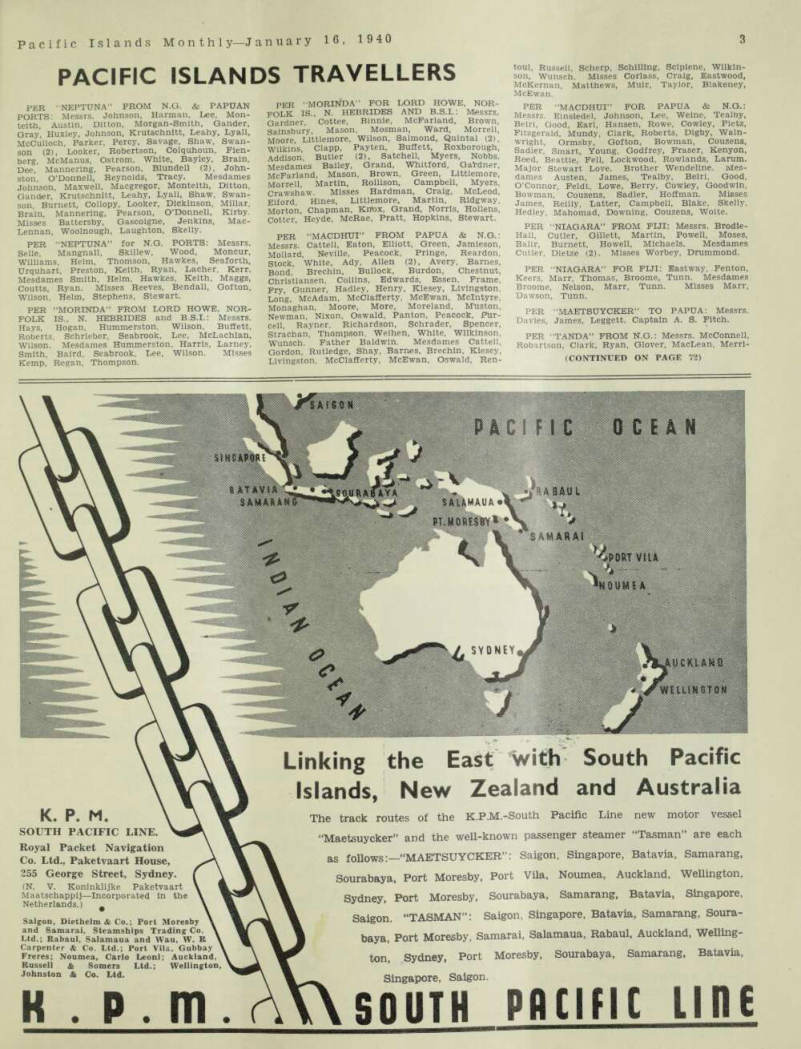
Per “Neptuna” From N.G. & Papuan
PORTS: Messrs. Johnson, Harman, Lee, Mon teith, Austin, Ditton, Morgan-Smith, Gander, Gray, Huxley, Johnson, Krutschnitt, Leahy, Lyall, McCulloch, Parker, Percy, Savage, Shaw, Swan son (2), Looker, Robertson, Colquhoun, Fien berg, McManus, Ostrom, White, Bayley, Brain.
Dee, Mannering, Pearson, Blundell (2), John ston, O’Donnell, Reynolds, Tracy. Mesdames Johnson. Maxwell, Macgregor, Monteith, Ditton, Gander, Krutschnitt, Leahy, Lyall, Shaw, Swan son, Burnett, Collopy, Looker, Dickinson, Millar, Brain, Mannering, Pearson, O’Donnell, Kirby, Misses Battersby, Gascoigne, Jenkins, Mac- Lennan, Wbolnough, Laughton, Skelly.
PER “NEPTUNA” for N.G. PORTS: Messrs.
Selle, Mangnall, Skillew, Wood, Moncur, Williams, Helm, Thomson, Hawkes, Seaforth, Urquhart, Preston, Keith, Ryan, Lacher, Kerr.
Mesdames Smith, Helm, Hawkes, Keith, Maggs, Coutts, Ryan. Misses Reeves, Bendall, Gofton, Wilson, Helm, Stephens, Stewart.
Per “Morinda” From Lord Howe, Nor
FOLK IS., N. HEBRIDES and 8.5.1.: Messrs.
Hays, Hogan, Hummerston, Wilson, Buffett, Roberts, Schrieber, Seabrook, Lee, McLachlan, Wilson. Mesdames Hummerston, Harris, Larney, Smith, Baird, Seabrook, Lee, Wilson. Misses Kemp, Regan, Thompson.
Per For Lord Howe Nor
FOLK IS., N. HEBRIDES and B.S.L. Messrs.
Gardner, Cottee, Binme, McFarland, Brown, Sainsbury Mason ’
Moore, Littlemore, Wilson, Salmond, Quintal (2), Wilkins, Clapp, Payteiv. Buffett, Roxborough.
Addison, Butler (2). Myers Nobbs.
Mesdames Bailey, Grand, wnitrord, Gardner, McFarland, Mason, Brown, Green, Littlemore, Morrell, Martin, Roiuson, oampoeii, Myers, Crawshaw. Misses Hardman, oraig, McLeod, Elford, Hines, Littlemore, Martin Rldgway, Morton, Chapman Krtox, Grand, Norris, Hollens, COtt ' r ’ Heyde ’ Wa
Per “Macdhui” From Papua & N.G.:
Messrs. Cattell, Eaton, Elliott, Green, Jamieson, Mollard, Neville, Peacock, Fringe, Reardon, stock White, Ady, Allen (2), Avery, Barnes, Bond’ Brechin, Bullock, Burdon, Chestnut, Christiansen Collins, Edwards, Essen, Frame, pry Gunner, Hadley, Henry, Kiesey, Livingston, Long, McAdam, McClafferty. McEwan, Mclntyre, Monaghan Moore, More Moreland , Newman, Nixon, Oswald, Panton, Peacock, Pur cell, Rayner, Richardson, Schrader, Spencer, Strachan, Thompson, Weihen, White, Wilkinson, Wunsch. Father Baldwin. Mesdames Cattell, Gordon. Rutledge, Shay, Barnes, Brechin Kiesey, Livingston, McClafferty, McEwan. Oswald, Ren
toul, Russell, Scherp, Schilling, Sclplene, Wilkin son, Wunsch. Misses Corlass, Craig, Eastwood, McKernan, Matthews, Muir, Taylor, Blakeney, McEwan.
Per “Macdhui” For Papua & N.G.:
Messrs. Einsiedel, Johnson, Lee, Welne, Tealby, Beiri, Good, Earl, Hansen, Rowe, Cowley, Pietz, Fitzgerald, Mundy, Clark, Roberts, Digby, Waln wright, Ormsby, Gofton, Bowman, Couzens, Sadler, Smart, Young, Godfrey, Fraser, Kenyon, Reed, Beattie, Pell, Lockwood, Rowlands, Larum.
Major Stewart Love. Brother Wendeline. Mes dames Austen, James, Tealby, Beiri, Good, O’Connor, Peldt, Lowe, Berry, Cowley, Goodwin, Bowman, Couzens, Sadler, Hoffman. Misses James, Reilly, Latter, Campbell, Blake, Skelly, Hedley, Mahomad, Downing, Couzens, Woite.
PER “NIAGARA” FROM FIJI: Messrs. Brodle- Hall, Cutler, Gillett, Martin, Powell, Moses, Balir, Burnett. Howell, Michaels. Mesdames Cutler, Dietze (2). Misses Worbey, Drummond.
PER “NIAGARA” FOR FIJI: Eastway, Fenton, Keers, Marr, Thomas, Broome, Tunn. Mesdames Broome, Nelson, Marr, Tunn. Misses Marr, Dawson, Tunn.
Per “Maetsuycker” To Papua: Messrs.
Davies, James, Leggett. Captain A. S. Fitch.
PER “TANDA” FROM N.G.: Messrs. McConnell, Robartson, Clark, Ryan, Glover, Mac Lean, Merri
(Continued On Page 73)
S SU D m 7 an ’ Nunan > Vasey, Huntley. Mesdames Clark, Paton, Vasey, Huntley.
PER “NELLORE” TO N.G.; Messrs. Farmer, Thompson, Wmdeyer, Roach, Cleveland, Chauncey.
Masters Gilmore, Flatten, Mossman, Roberts, Coote, Saunders, Renton, Pennefather. Mesdames Higgins, Watson, Farmer, Thompson, Renton, McLean, Carpenter, Monks. Misses Mossman, Mullaly, Cunningham (2), McKinnon, Penne lath/er, Kinsoon, Yansoon, Gilmore, Lees (2), Stanfield, Monks.
PER AIRLINER TO N.G. & PAPUA; Messrs.
Dwyer, Forrester, Absolan, Anthony, Brown, Car penter, Schrater, Hosie. Mrs. Anthony.
PER AIRLINER FROM N.G. & PAPUA: Messrs.
Gordon, Allan, Gold, Korn, Host, Luff, Frost, Richardson. Mesdames Allan, Kuter, Marr.
Misses Hodge, Harris.
PER AIRLINER TO PAPUA & N.G.: Mrs, Luff.
Misses Henderson, Loudon, Case, Hude, Tasker.
PER AIRLINER FROM PAPUA & N.G.: Messrs.
Schilling, Dance, Boyan, Kinds, Atkinson, de Russett.
PER AIRLINER TO PAPUA & N.G.; Messrs.
Murcutt, Murray, Goodwin. Sir Hubert Murray.
Misses Cassidy, Greenham.
PER AIRLINER FROM PAPUA & N.G.: Messrs.
Haig, Neal, Hind. Mesdames Morris, Neal Rossie.
Rev. L. Stibbard, of the Melanesian Mission, 8.5.1., is now in Sydney.
Miss Edith M. Devitt, of the New Guinea Mission, arrived in Sydney from Dogura, Papua, in December.
When Dr. Temple Utley died In Suva, some years ago, his yacht “Inyala”, was left lying in Suva for years. In 1939, it was bought by Mr. Theo McGill, and re fitted. Early in December, with two companions, he sailed for Auckland; but the yacht apparently met unfavourable winds, and is now reported in New Cale donia.
Advertisements & other items, p. 5 (2 items)
3
Pacific Islands Monthl y—J anuary 16, 1940
South Pacific Line
HK MA
MALI A
mmMmSsm • > NtY sv K P
K. P. M.
SOUTH PACIFIC LINE.
Royal Packet Navigation Co. Ltd., Paketvaart House, 255 George Street, Sydney. (N. V. Koninklijke Paketvaart Maatschappij—lncorporated in the Netherlands.) Saigon, Diethelm & Co.; Port Moresby and Samarai, Steamships Trading Co.
Ltd.; Rabaul, Salamaua and Wau, W. R Carpenter & Co. Ltd.; Port Vila, Gubbay Freres; Noumea, Carlo Leoni; Auckland, Russell & Somers Ltd.; Wellington, Johnston & Co. Ltd.
Linking the East with South Pacific
Islands, New Zealand and Australia
The track routes of the K.P.M.-South Pacific Line new motor vessel “Maetsuycker” and the well-known passenger steamer “Tasman” are each as foIIows:— “MAETSUYCKER”: Saigon, Singapore, Batavia, Samarang, Sourabaya, Port Moresby, Port Vila, Noumea, Auckland, Wellington, Sydney, Port Moresby, Sourabaya, Samarang, Batavia, Singapore, Saigon. “TASMAN”: Saigon. Singapore, Batavia, Samarang, Sourabaya, Port Moresby, Samarai, Salamaua, Rabaul, Auckland, Wellington, Sydney, Port Moresby, Sourabaya, Samarang, Batavia, Singapore, Saigon.
SOUTH PACIFIC line
Advertisers
Amalgamated Wire less (A/sia) Ltd. . 44 Angus & Coote Ltd. 17 Arnott’s Biscuits . . 35 Atkins Ltd., W, . . 38 “Ausoline” 71 Baker Ltd., W. Jno. 54
B.A.L.M. Ltd. . . 46
Bank of N.S.W. . . 69 Berger’s Paints . . 42 “Bernly” Guest House 28 “Bidomak” ... 19 Broomflelds Ltd. . . 52 Brown & Co. Ltd., G 15 Brunton’s Flour . . 68 Burns, Philp & Co. Ltd 4 B.P. Magazine ... 28
Bp. (S.S.) Co. . . 41
Burns Philp Trust Co. Ltd 17 Buzacott-Wolseley . 53 Carlton & United Breweries Ltd. . . 31 Carpenter Ltd., W. R. . . . cov. 2 Chapman & Sherack 54 Chivers & Sons Ltd. 70 “Cinnamolia” Pre parations ... 51 Coleman Lamp & Stove Co. . . 33, 71 Colonial Sugar Re fining Co. Ltd. . . 55 Coral Starch ... 35 Cosmopolitan Hotel 72 Crossle, Duff & Macintosh Ltd. . 63 “Cystex” 66 Danks & Son Ltd. 51 Dewar’s Whisky . . 29 Doan’s Pills ... 52 Donaghy & Sons Ltd 58 Donald Ltd., A. B. 36 Eaton Ltd., J. W. 43 Electrolux Refrigerators . . 30 Eno’s Fruit Salt . 59 Excelsior Supply Co. Ltd. ... 18
Fairbanks - Morse Ltd 47 Fletcher & Sons . 32 “Flit” 52 Ford Sherington Ltd. 27 Poster Clark Ltd. . 60 Garden Vale Pro ducts Ltd. ... 34 Garrett & Davidson 63 Gillespie’s Flour . . 58 Goodwin Ltd., A. E 65 Gowing Bros. Ltd. . 24 Grace Bros. Ltd. . 26 Grand Pacific Hotel 37 Grove & Son, W. H. 39 Guinea Airways Ltd cov. 3 Guinness’ Stout . . 40 Holbrook’s Ltd. . . 67 Horlicks Malted Milk 16 Horne, W. & Co. . 36 Hotel Moresby . . 72 Jones & Co. Ltd., H. 56 Joyce Biscuits Ltd. 24 Kambala School for Girls 62 Kodak (A/sia) Ltd. 12 Kopsen & Co. Ltd. 20 Kork-N-Seal Ltd. , 34 Lee & Perrins Sauce 57 Lloyd & Co. Ltd. . 13 Lustre Hosiery Ltd. 61 Maxwell Porter Ltd. 43 Mcllrath’s Ltd. . . 57 Merrillees & Co. . 51 Miller & Co. Pty.
Ltd 48 Nelson & Robertson, Ltd 14 Nestles Milk ... 25 Newlands Bros. Ltd. 50 Noyes Bros. Ltd. . 49 Ormonoid Roofing & Asphalts Ltd. . 49 Pacific Is. Club . 18 Papua Hotel, The 72 Pike Bros. Ltd. . . 62 Prescott Ltd. ... 68 Prouds Ltd 13 Public Notice . . 70
Ransomes, Sims & Jefferies Ltd, . . 39 Reed, William E. . 69 Rohu, Sil . . . . 71 Royal Packet Co. . 3 Rutherford, G. . . 64 Scott, Ltd., J, . . 46 Smyth Ltd., J. H. . 27
Spartan Lacquers Pty. Ltd. ... 48 Spinet Cigarettes . 67 Springwood Ladies’
College 61 Steamships Trading Co. Ltd 32 Sterling Varnish Co. 11 St. Ignatius College 22
Sullivan Ltd., C. . 58 Swallow & Ariell . 64 Sydney & Melbourne Publishing Co. Ltd. 72 Taylor & Co., A. . 63 “Tenax” Soap . . 23 Tilley Lamp Co. . 45 Tillock & Co. Ltd. 59 Toohey’s Ltd. . . 21
Tooth & Co. . . cov. 4 Vincent’s A.P.C. . . 23 West, Harry ... 53 Weymark & Son . 68 Wills Ltd., W.D. &z H.O 41 Wright & Co. Ltd., E .43 Wunderlich Ltd. . . 43
Contents
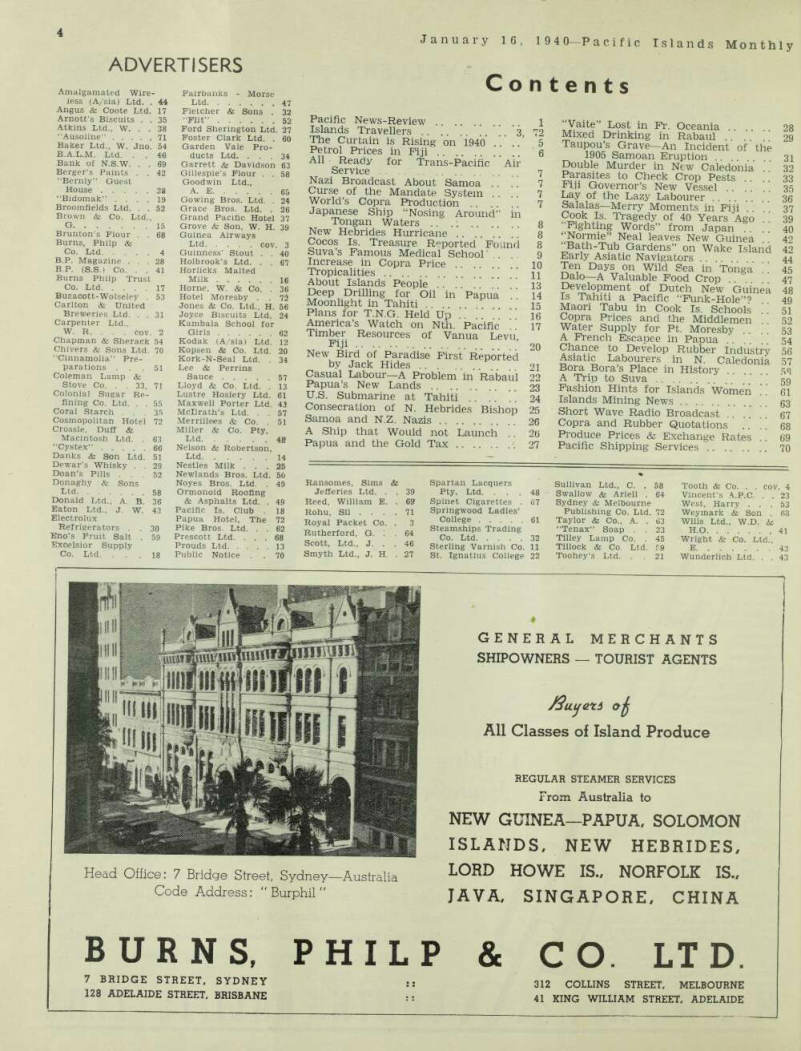
Pacific News-Review l Islands Travellers !. 3, 72 The Curtain is Rising on 1940 .. .. 5 Petrol Prices in Fiji 6 All Ready for Trans-Pacific ’ * Air Service . 7 Nazi Broadcast About Samoa ... 7 Curse of the Mandate System ... 7 World’s Copra Production 7 Japanese Ship “Nosing Around” in Tongan Waters g New Hebrides Hurricane ... 8 Cocos Is. Treasure Reported Found 8 Suva’s Famous Medical School 9 Increase in Copra Price .. 10 Tropicalities * * 4 4 About Islands People .. 43 Deep Drilling for Oil in Papua ’ 14 Moonlight in Tahiti ... " 15 Plans for T.N.G. Held Up .. ] 45 America’s Watch on Nth. Pacific 17 Timber Resources of Vanua Levu Fiji .. 20 New Bird of Paradise First Reported by Jack Hides .. . 21 Casual Labour—A Problem in Rabaiil 22 Papua’s New Lands 23 U.S. Submarine at Tahiti .. .. * 24 Consecration of N. Hebrides Bishop 25 Samoa and N.Z. Nazis 26 A Ship that Would not Launch .. 26 Papua and the Gold Tax 27
“Vaite” Lost in Pr. Oceania 28 Mixed Drinking in Rabaul .. ." '' 29 Taupou’s Grave—An Incident of the 1906 Samoan Eruption ... 31 Double Murder in New Caledonia ’ 32 Parasites to Check Crop Pests . 33 Fiji Governor’s New Vessel 35 Lay of the Lazy Labourer 36 Salalas—Merry Moments in Fiii 37 £topk Is. Tragedy of 40 Years Ago 39 Fighting Words” from Japan .. .. 40 leaves New Guinea . . 42 Bath-Tub Gardens” on Wake Island 42 Early Asiatic Navigators . 44 Ten Days on Wild Sea in Tonga 45 Dalo—A Valuable Food Crop 47 Development of Dutch New Guinea 48 Is Tahiti a Pacific “Funk-Hole”? 49 Maori Tabu in Cook Is. Schools 51 Copra Prices and the Middlemen . 52 Water Supply for Pt. Moresby .. .. 53 A French Escapee in Papua .. 54 Chance to Develop Rubber Industry 56 Asiatic Labourers in N. Caledonia 57 Bora Bora’s Place in History 5^ A Trip to Suva 59 Fashion Hints for Islands Women !’ 61 Islands Mining News 63 Short Wave Radio Broadcast 67 Copra and Rubber Quotations ... 68 Produce Prices & Exchange Rates .. 69 Pacific Shipping Services 70
Advertisements & other items, p. 6 (2 items)
4
January 16, 194 0-P acific Islands Monthly
Burns, Phil
Head Office: 7 Bridge Street, Sydney—Australia Code Address: " Burphil "
7 BRIDGE STREET, SYDNEY
128 ADELAIDE STREET, BRISBANE :
GENERAL MERCHANTS
SHIPOWNERS TOURIST AGENTS
All Classes of Island Produce
REGULAR STEAMER SERVICES
From Australia to
NEW GUINEA—PAPUA, SOLOMON
ISLANDS, NEW HEBRIDES,
LORD HOWE IS., NORFOLK IS.,
JAVA, SINGAPORE. CHINA
& CO. LTD.
312 COLLINS STREET. MELBOURNE
41 KING WILLIAM STREET, ADELAIDE
Pacific Islands Monthly
The Newspaper-Magazine of the South Seas l Registered at the G.P.0., Sydney, for transmission by post as a newspaper. ]
Published Once Each Month and Circulated in Australia and New Zealand and in the following Pacific Territories and Islands Groups:
Australian Territory of Papua.
Mandated Territory (Australia) of New Guinea, Bismarck Archipelago and Northern Solomon Islands. , „ T , .
Australian Territory of Norfolk Island.
New Zealand Territory of Cook Islands.
Mandated Territory (New Zealand) of Samoa.
British Colony of Fiji.
British Solomon Islands Protectorate.
British Protectorate of Tongan Islands.
British Crown Colony of Gilbert and Ellice Islands. * Mandated Territory of Nauru.
British and French Condominium of New Hebrides.
French Colony of New Caledonia.
French Colony of Oceania (Tahiti, etc.).
American Territory of Eastern Samoa.
American Territory of Hawaiian Islands.
American Territory of Guam.
Mandated Territory (Japan) of Marshall, Caroline and Mariana Islands.
Owned and Produced by Pacific Publications Pty. Ltd., Union House, 247 George Street, Sydney.
( Managing Director .. BW 5037 TELEPHONE Business and Editorial MA 7101
P.O. Box 3408 R
Registered Address of Telegrams, Radiograms, and Cables: “Pacpub”, Sydney.
Contributions.
Articles, Stories, and Photographs dealing with Pacific Islands subjects are Invited and will be paid for on publication at usual rates.
Subscription Rates.
Per Annum, within British Empire, Prepaid, Post Free 8/- Per Annum, elsewhere, prepaid. Post Free . 10/- Slngle Copies Bd.
Editor and Publisher:
R. W. Robson, F.R.G.S.
Assisted, by Selwyn Hughes.
Advertising Manager; L. W. Bailey.
Advertising Office and Printing-House; 29 Alberta St., Sydney.
Advertising rates furnished on application.
Colours, etc by Arrangement.
Process Blocks made at Advertiser’s expense when required. Screen 100.
Changes of Advertising Copy should reach this Office by Ist of each month, otherwise previous advertisement may be repeated.
IN LONDON, the Pacific Islands Monthly Is on sale at the Bookstall, Australia House, The Strand, London.
Agents.
The following are authorised to receive sub scriptions for the Pacific Islands Monthly:— Islands Branches of Burns, Philp & Co., Ltd., and Burns Philp (South Sea) Co., Ltd.
Islands Branches of W. R. Carpenter & Co., Ltd.
Islands Branches of Morris, Hedstrom, Ltd.
G. Thomas & Co., Rabaul, New Guinea.
T. A. Olsson, Wau, New Guinea.
Whitten Bros., Ltd., Samaral, Papua, Steamships Trading Co., Papua. All Branches.
B.N.G. Trading Co., Ltd., Port Moresby.
J. Muir, Suva, FIJI.
N. C. Mackenzle-Hunt, Walnunu, Bua, FIJI.
Islands Branches and Representatives of W. H.
Grove & Sons, Ltd., Auckland, New Zealand.
Cook Islands Trading Co., Rarotonga, Cook Is.
A. C. Rowland, Papeete, Tahiti.
Representative in London: W C, HARVEY, Coronation House, 4 Lloyds Avenue, London, E.C.3, from whom may be obtained copies of Pacific Islands Monthly, Pacific Islands Year Book, advertising schedules, etc.
Vol. X. No. 6.
January 16, 1940
p..> 0 ) Bd. Per Copy, rnce Prepaid: 8/- p.a.
The Curtain Is Rising On 1940
A POSITION so extraordinary exists in Europe to-day that only a very ignorant person would confid ently forecast the course or character of the war. The only thing of which we can be certain is that the curtain is about to rise on events which will profoundly affect the condition of the human race and the course of history.
In September, it seemed that the war would be a clean-cut struggle between “rival ideologies”—the Ger man totalitarian system (supported by the Russian totalitarian system, and enjoying the goodwill of the Italian totalitarian system) trying to smash the democratic system of Britain and France.
But there soon entered a new and incalculable factor the marching armies of Soviet Russia. They occupied half of Poland; they seized the little Baltic states; they effectively blocked the Nazi march into the Balkans; and, finally, they attacked Finland.
Hitler was rushed into the German- Russian pact by his Foreign Minister, Ribbentrop (formerly a commercial traveller specialising in champagne!) and there must have been many hours in November and December when Hitler wondered where this amazing alliance was leading him. Finland gave him the answer. The little Finnish David slew the Russian Goliath. Whatever happens now— even if millions of Russians trample over Finland —the bubble reputation
of Moscow’s mighty Red armies is pricked. We—and Germany—know the quality of Russia’s military strength.
To-day, as this is written, the news is that Holland and Belgium stand armed and ready to resist a German attempt to break through the Low Countries upon the Allied left flank; the Scandinavian nations are fever ishly preparing to resist a Russian- German attack; and Italy, still nom inally Germany’s ally, is sending men and munitions to the assistance of Finland, which is fighting Russia, which apparently is also Germany’s ally.
AND, now, which way goes Ger many? Does she now enter a military alliance with Russia, her hereditary foe, and thus automatically bring herself into a position against Finland, Sweden, Norway, Denmark, and probably Holland and Belgium?
Or does she march to the assistance of heroic Finland (always regarded as the protege of Germany) and so put herself on-side with the Scandin avian nations and Italy, and off-side so far as Russia is concerned?
If Germany were to take the latter course, and simultaneously launch a campaign for peace negotiations, through the Pope, through Italy, and through the President of the United States, at the same time offering con cessions regarding Poland and Czecho-
Slovakia, the Allies might find them selves in a difficult and embarrassing position. Important elements in Britain and France ’would staunchly resist such a peace manoeuvre, on the ground that it would be impossible to enter into any peace arrangement with a German Government domin ated by Nazis, who notoriously have no regard for the spoken pledge or the written word.
If, on the other hand, Germany elects- to enter into closer relations with Russia, in which peace between Finland and Russia would be ar ranged, the Scandinavian nations would quieten down, and then we might expect that the full fury of a merciless war would be released in Western Europe in February or March. Germany would keep open her back-door, through Russia, for the receipt of vital supplies, while she would strain every nerve to so severely punish the Allies, on the Western Front, in the summer of 1940 that they would be ready to discuss peace, when winter comes again.
But it is all guesswork.
MEANWHILE, another drama is be ing played out, nearer our home. Japan, at the moment, appears to be completely free from all Euro pean alliances or entanglements, and to be concentrating upon what is to her a vital need—namely, the extri cation of her armies from China, and the arrangement of a peace with China, per medium of Chinese “puppet
governments”, which she would con trol. If she gets her way with China she may develop strength, in the Pacific, a little sooner than some observers anticipate. Japan still is a factor of first-grade importance in international affairs; and this is re cognised by the concentration of enormously powerful American naval forces in the North-West Pacific.
American activity in this region is astonishing. Every month one hears of new bases created for American defence in the Pacific. The latest plans provide for naval bases in the Aleutian Islands (near Alaska), in Guam (in the middle of the Japanese Mandated Islands) and Philippines.
The Americans are really building up a guarantee that American interests shall not be driven out of the Pacific; and, while this policy is followed, we British communities in the South Seas may sleep soundly o’ nights.
Here are some very interesting com ments, written recently in a personal letter to the editor of this journal by Mr. Marc T. Greene, a well-known American journalist. He writes fre quently on international affairs, and with the authority of a man who, before he writes, goes personally and looks the situation over:— “I am sure that your sense of fair play and righteousness—which any un biassed person who reads your magazine must surely agree that you possess in large measure—would hold that the moral consideration must be uppermost in any settlement of the affair in China. That is to say, considering the suffering and the sacrifices the Chinese—mainly the common people—have made, and are making, it is unthinkable that British trade interests (the interests that so plainly dominate the Chamberlain Gov ernment), aided and abetted by the same interests in America, should force upon China a compromise which will and must be equivalent to a defeat, to a loss of everything she is fighting for.
“As things stand now. if the war is let alone by the Western Powers, Jap anese economy is unlikely to be able to stand the strain more than a year longer.
All China has to do is to keep the Jap anese armies fighting in that cpuntry.
She need risk no major engagement, she need pursue no more than a sort of Fabian strategy, such as has won many wars before, notably the American Re volution.
“But I am very much afraid the nim ble Mr. Chamberlain is going to ‘ap pease’ Japan by ‘recognising’ the trait orous Wang Ching Wei puppet govern ment, and if that happens I am afraid I shall be somewhat less of a pro-British American than I have been in the past —in respect of the British Government, anyway, for I know the fair-minded British people are just as keenly sym pathetic to China’s cause as the Ameri cans.
“What must happen is that Japan shall be so crushed as to be relegated to the status of a second-class Power, and it will be exactly as futile to make any compromise which shall leave her any thing else, as it would be disastrous to any hope of European tranquility to compromise with a German Government still headed by Hitler. I wish you would note that statement, for it sums up the whole position. Carthago delenda est!
You cannot leave a bitter potential enemy in all his strength.
But you need not destroy a people, and I have only a friendly feeling for the Japanese masses. They must be helped and can be, in many ways. But first the Japanese Fascist-military cli que must be destroyed. The country must be limited in its naval and mili tary power, 0 r it will keep the whole Pacific area (including you, down there, with your ages-old ‘yellow peril’ bogey) forever uneasy.
“Surely you can see that. No com promise is possible with the kind of peop le who rule Japan now. Do admit that I, with my long study of the Far East, my years of correspondence from there to everything from the ‘Christian Science Monitor’ to the ‘London Spectator’, have some slight knowledge of what I am talking about when I say that!
“The entire political set-up in Japan must be altered and it can only be al tered by virtue of a complete and un compromising military defeat. Then it will be possible to set up the constitu tional government three-fourths of the Japanese people crave, and for which they voted in March, 1937.
“I tell you you simply cannot have a totalitarian, divine-right-of-monarchs kind of regime there and also have an assured tranquility in the Pacific!
“I suppose you listen to people you consider authoritative when you are dis cussing European affairs in your maga zine, and so forth. I wish to the Lord you’d listen a little to me on the Far East!”
Rt. R«v. W. H. Baddeley, Bishop of Melanesia, arrived in Sydney from Tulagi, 8.5i1., by the January “Malaita”.
Mr, A. H. Buckland, of the New Guinea Mission, who is stationed at Divari, Papua, was spending leave early in -Janu ary at Waratah, N.S.W.
Lively Protest in Fiji
Petrol Price
Prom Our Own Correspondent
Suva. Jan. 1.
pETROL was increased 4d. per gallon, L to 2/5, in December, and the Fiji people are protesting strongly. They point out that petrol sells in Australian ports for 2/1, and Australian currency is 121 per cent, under Fijian.
At a Chamber of Commerce meeting, Mr. H. E. Snell (of Morris, Hedstrom, Ltd., agents for Vacuum) moved, arid Mr. John Trotter (of Burns, Philp, Ltd., agents for Shell) seconded, that the Chamber noted and regretted the in crease in price.
But Major C. Brewster led a lively and critical opposition; and, on his motion, an amendment was carried that the two companies be invited to submit data to the Chamber’s vice-presidents, to justify the increase.
In Australia, 7d. per gallon goes in taxation; in Fiji, taxation takes Bd. per gallon.
Gale In Fiji
Prom Our Own Correspondent
Suva, Jan. 1.
11/'INDOWS were blown in, trees up ▼ ? rooted, telegraph lines broken and small shipping considerably knocked about by a gale which struck Suva on the night of December 27, and attained a force of 65 miles per hour. It had its origin, apparently, north-west of Fiji.
Mr. W. Donovan. Clerk in the Fiji Treasury Department, is now on long leave, in Australia.
Bogged In China!
By means of “a new, friendly understanding” with the Western Powers, and by creating Puppet Governments in North and Central China, Japan is trying to “save face” and extricate herself from her disastrous invasion of the ancient Empire.
All Ready!
New Trans-Pacific Air-Mail
WHEN the New Zealand representative of Pan American Airways, Mr.
Harold Gatty, arrived in Auckland on Christmas Eve from Fiji, he said that all arrangements are now complete for the inauguration of a regular air service between San Francisco and Auckland, via Hawaii, Canton Island and Noumea.
Mr. Gatty added, however, that the service could not commence until Pan American Airways had received the final approval of civil aviation authority in Washington.
Samoa Startled
Nazi Broadcast via America
Prom Our Own Correspondent
Apia, Dec. 12.
RESIDENTS of Western Samoa were greatly surprised when they heard on the radio, two weeks ago, that German broadcasting stations had announced to America the existence of serious unrest in Western Samoa, a former German colony.
Nobody in peaceful little Samoa, where Europeans and Samoans alike, since the outbreak of war, have surpassed each other in expressions of loyalty and offers of assistance to New Zealand and the British Empire, had seen the slightest manifestation of any unrest.
This sample of lying Nazi propaganda, however, served the useful purpose of showing the Samoan public how unre liable the German radio broadcasts are.
Side By Side
Vila, Dec. 27.
WITH Britain and France fighting side by side in the war against Hitlerism, the friendly feeling between the two communities in the New Hebrides has been marked. This has manifested it self in the newly-formed “Committee du Secours pour les Mobilises”, an organisa tion to raise funds for comforts for .soldiers in the field, and assisting "soldiers’ dependents who may be in need.
The Committee is composed of repre sentatives of all sections of both nation alities. The French and British Resident Commissioners are honorary presidents.
System
Curse of Mandate System New Guinea Newspaper is Outspoken
IN a striking, outspoken article, the “Rabaul Times”, of January 5, ex presses the fervent hope that the Man date type of government will soon be re moved and the great country of New Guinea given a reasonable chance of progress and development.
The newspaper points out, bitterly, that the Australian Government has never made any attempt to develop the immense tourist attractions of New Guinea which, from the sightseers’ point of view, is one of the most remarkable countries in the world.
The country, also, is cursed by the fact that the majority of men in it are there to take and not to give—that too many of them are counting the days until they can get away on leave, or with what they have managed to acquire.
The newspaper calculates that resi dents of New Guinea spend in Australia annually at least £400,000, from which New Guinea gets no return. Yet, if it had a form of government in which men could have some confidence, in relation to the future, New Guinea could rival Java or Ceylon, as one of the richest of the developed island territories in the world.
The “mandate” sign hanging on the front door of New Guinea is the sign merely of a temporary office, says the newspaper. The place, in an administra tive sense, is little more than a suburb of Canberra.
N.H. Commissioner on Special
Work Abroad
MR. GEORGE A. JOY, the British Resident Commissioner in the New Hebrides, was expected to return to the Condominium in February after his year’s furlough abroad; but word has been received that he has been de tained in England on special work at the British Foreign Office, London.
World’S Copra
Normal Exports Average About 1,400,000 Tons p.a.
A CORRESPONDENT in Papua has asked if it is possible to get details of the world production of copra, shown by countries.
It was estimated that world produc tion of coconuts, copra and of coconut oil in terms of copra, about five years ago, was 3,000,000 tons per annum. More than half is consumed in countries of origin, leaving an exportable surplus of from 1,000,000 to 1,400,000 tons per annum.
H. M. Faure and Co.’s annual report gave the following as official figures of copra and coconut oil exported:—
But the foregoing, while accounting for about 1,100,000 tons per annum, does not take into account the production of East Africa, West Indies, Pacific Islands, and certain parts of Asia.
The figures of average annual copra production in the various Pacific terri tories south of the Equator were pub lished on page 37 of the “P.1.M.” of October, 1939, and they made the sur prising total of 220.000 tons. East Africa and West Indies can be depended upon for another 40,000 tons per annum, at least, so that world production of copra, in a normal year, cannot be much less than 1,400,000 tons.
Production fluctuates greatly, however, according to the condition of the world’s markets.
Mr. Frank Wallace, solicitor, who was a resident oT Vila, New Hebrides, for many years, died in Hobart, Tasmania.
He had been living in Tasmania since his retirement a few years ago.
1933. 1938.
Tons.
Tons.
Philippines . 306,723 342,965 Java .. .; 14,490 3,244 Macassar . 151,072 228,434 Other East Indies . . 320.608 321,689 Straits S . 192,600 166,177 Ceylon . 64,545 75,265
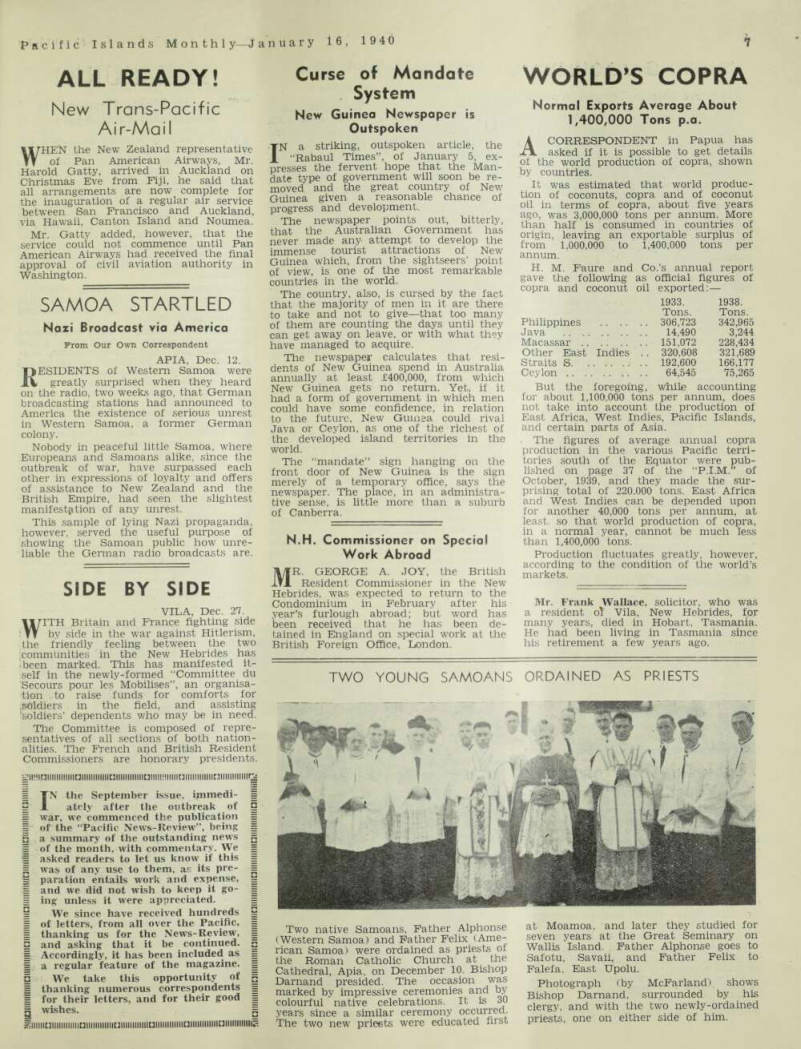
Two Young Samoans Ordained As Priests
Two native Samoans, Father Alphonse (Western Samoa) and Father Felix (Ame rican Samoa) were ordained as priests of the Roman Catholic Church at the Cathedral, Apia, on December 10. Bishop Darnand presided. The occasion was marked by impressive ceremonies and by colourful native celebrations. It is 30 years since a similar ceremony occurred.
The two new priests were educated first
at Moamoa, and later they studied for seven years at the Great Seminary on Wallis Island. Father Alphonse goes to Safotu, Savaii, and Father Felix to Falefa, East Upolu.
Photograph (by McFarland) shows Bishop Darnand, surrounded by his clergy, and with the two newly-ordained priests, one on either side of him.
Advertisements & other items, p. 9 (1 item)
IN the September issue, immedi-
IN the September issue, immediately after the outbreak of war, we commenced the publication of the “Pacific News-Review”, being a summary of the outstanding news of the month, with commentary. We asked readers to let us know if this was of any use to them, as its preparation entails work and expense, and we did not wish to keep it going unless it were appreciated.
We since have received hundreds of letters, from all over the Pacific, thanking us for the News-Review, and asking that it be continued.
Accordingly, it has been included as a regular feature of the magazine.
We take this opportunity of thanking numerous correspondents for their letters, and for their good wishes.
"Nosing Around"
Japanese Ship in Tongan Waters
From Our Own Correspondent
Nukualofa, Dec. 14.
THE small Japanese trade promotion vessel “Takachiko Maru”, which was here last August, paid another visit on November 21. After a stay of four days, in which Japanese goods and films de picting Japanese industries and scenery were exhibited, she left on November 24.
A large number of pamphlets in Eng lish, dealing with the tourist attractions of Japan, Manchukuo and China, pub lished by the Japanese Board of Tourist Industry—in which the present Sino- Japanese war is referred to as the “in cident”—were distributed while the vessel was in port.
The visits of this Japanese vessel have caused the Tongan Customs officials some headaches. For instance, when the pilot went to meet her, on arrival, she refused to take him on board, and coolly made her own way through the intricate pas sages in the reefs into the harbour. This recalls that she also dispensed with the pilot’s service on her last visit, arriving several hours prior to the time previously advised.
Her movements in Tongan waters, on that visit, aroused suspicion. On the day after her departure from Nukualofa she was seen nosing around the high vol canic island of Tofua, in the Haapai Group, by the American yachtsman, Cap tain Frank Dona, in his yacht, “Marie ’.
As soon as she knew that her presence was noticed, she made off in apparent haste; but some days later another vessel saw her again in the same locality.
These mysterious movements bear out the reports that the Japanese are secretly charting various parts of the Pacific.
Administrators' Visit to Canberra
THE Administrator of New Guinea (Sir Walter McNicoll) and the Admini strator of Norfolk Island (Sir Charles Rosenthal) have been requested by the Australian Minister for Territories to visit Australia soon to discuss a number of matters relating to the effect of war conditions upon their territories. The Minister and the Lieutenant-Governor of Papua (Sir Hubert Murray) met in Canberra in December, when Sir Hubert Murray visited Australia in connection with the establishment of a water supply for Port Moresby.
Wau-Salamaua Road
From Our Own Correspondent WAU, Dec. 20.
PON completion of his last walk over the shortest route proposed for the New Guinea Goldfields Road, between Wau and Salamaua, Mr.
Engineer Field (Director of Public Works), reported that there now are no insuperable engineering difficul ties in the way of the building of the road.
It is sincerely to be hoped that, after so many long years of procras tination, the advent of another war is not going to provide the Adminis tration, or Canberra, with a last minute excuse for evading this con struction. The very fact of war makes this road more imperative, militarily, apart from what is econo mically more than over-due to the Goldfields.
New Hebrides
Hurricane
THE only details received of the damage done by the hurricane which struck the northern section of the New Hebrides on the night of December 4 have been brought to Auckland by the Melanesian Mission’s motor vessel “Southern Cross”.
The island of Aoba appears to have been the worst sufferer. It is stated that all the buildings on the island were razed and great damage was done to all the plantations and crops. The native church and the school of the Melanesian Mission were destroyed. The greatest damage was done at the settlement of Lolowai, on Aoba, which is the central station of the southern Melanesian Mission.
Treasure!
Cocos Is. Makes Headlines in Sensational Press Again
DOUBT already is being cast upon the story of the discovery of pirates’ treasure, worth 60,000,000 dollars, on Cocos Island, which was displayed under flaring headlines in the Sydney Sunday newspapers of January 7.
The story was that an archaeological society in California had found the famous Lima treasure. But the thing had all the earmarks of a yellow newspaper canard, and a couple of days later it was announced from San Francisco that the backers of the expedition had no con firmation.
Accounts of various recent efforts to find the treasure on Cocos Island have been published in this journal from time to time since 1933.
The story is that, in 1820, the City of Lima was in danger of being raided; that enormous gold and silver treasure, esti mated at from £8,000,000 to £12,000,000 was placed upon a ship called the “Mary Dier”, commanded by Captain Thompson; that the ship sailed away from the coast of Peru, seeking a refuge; and that Captain Thompson murdered his pas sengers and buried the treasure upon the little island of Cocos, and was un able to go back and recover it.
Ever since then, and especially during the past 20 years, innumerable expedi tions have been organised to seek this treasure. One of the most remarkable was that organised by the English com pany known as Treasure Recovery, Ltd which sent an expedition to Cocos Is land in 1934—which expedition was hunted out by the Government of Costa Rica, which claims that it owns Cocos Island and all the treasure therein. This story was told in detail in the “Pacific Islands Monthly” of May, 1935. Subse quently, this expedition was re-organ-
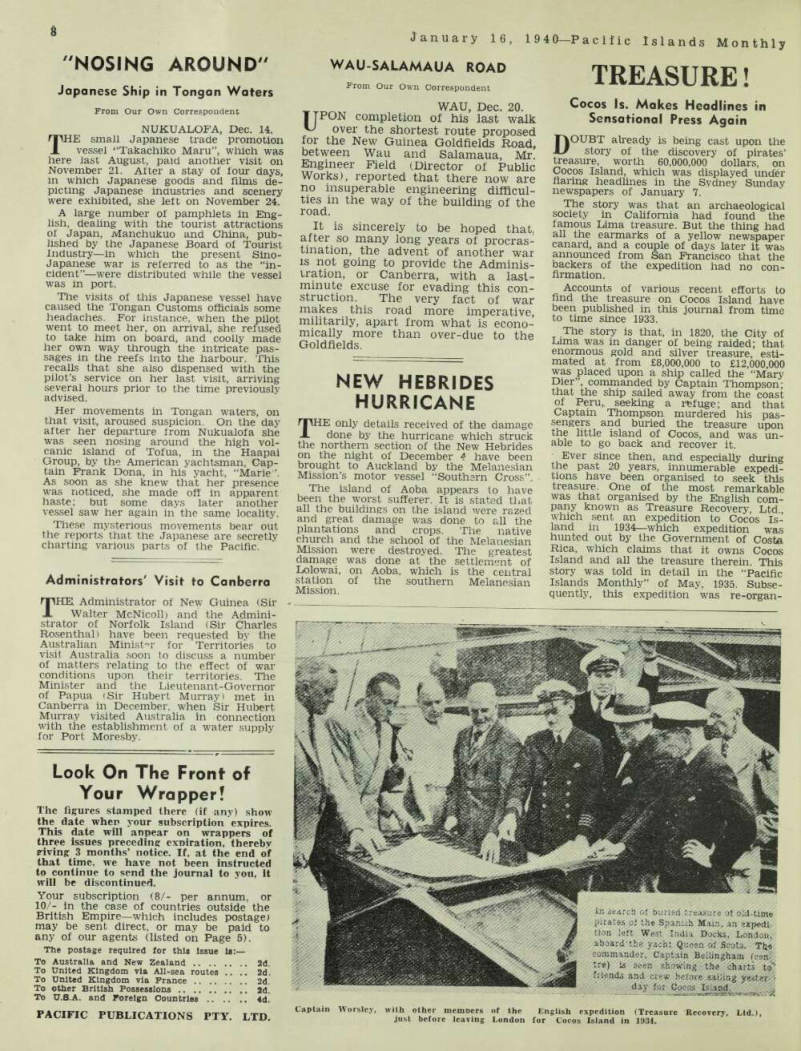
in search of buried treasure of old-time pirates of the Spanish Main, an expedi tion left West India Docks, London, aboard the yacht Queen of Scots. The commander, Captain Bellingham (cen tre) Is seen showing the charts to" friends and crew before sailing yester
day for Cocos Island
Captain Worsley, with other memders of the English expedition (Treasure Recovery, Ltd.), just before leaving London for Cocos Island in 1934.
ised and sent back to Cocos Island where it was operating in 1935 and 1936.
The various expeditions were watched very closely by the Government of Costa Rica, which demanded a portion of any treasure found. It was stated that the English expedition had agreed to give Costa Rica one-third.
The report published on January 7 was released to the newspapers by Mr.
Field, the consul for Costa Rica at Los Angeles, who said that he had been ad vised of the discovery by the curator of the National Museum of Costa Rica.
The expedition of Treasure Recovery, Ltd., was led by Commander Worsley, r.N. Other famous expeditions organised for the same purpose were those led by Admiral Palliser, the Earl of Fitzwilliam, and more recently Sir Malcolm Camp bell.
In the London “Daily Telegraph” of August, 1934, there was a remarkable letter by Admiral B. M. Chambers, who said that he had been in command of warships in South American waters for many years; that he had taken a keen personal interest in this story of the Lima treasure; and that, as a hobby, he had made inquiries in South America and various other places throughout the world, with a view to confirming the story. He described it *as an absolute myth. He could find no confirmation whatever of the story that treasure had been sent away from Lima in the man ner described. There was no record of any ship called the “Mary Dier” or any name resembling that; there was no re cord anywhere of a Captain Thompson having commanded a ship in those waters at about that time; and the little evidence that was available in regard to the threat on Lima about 1820 showed that the treasure of the city was gathered together and taken away Inland, and not towards the sea.
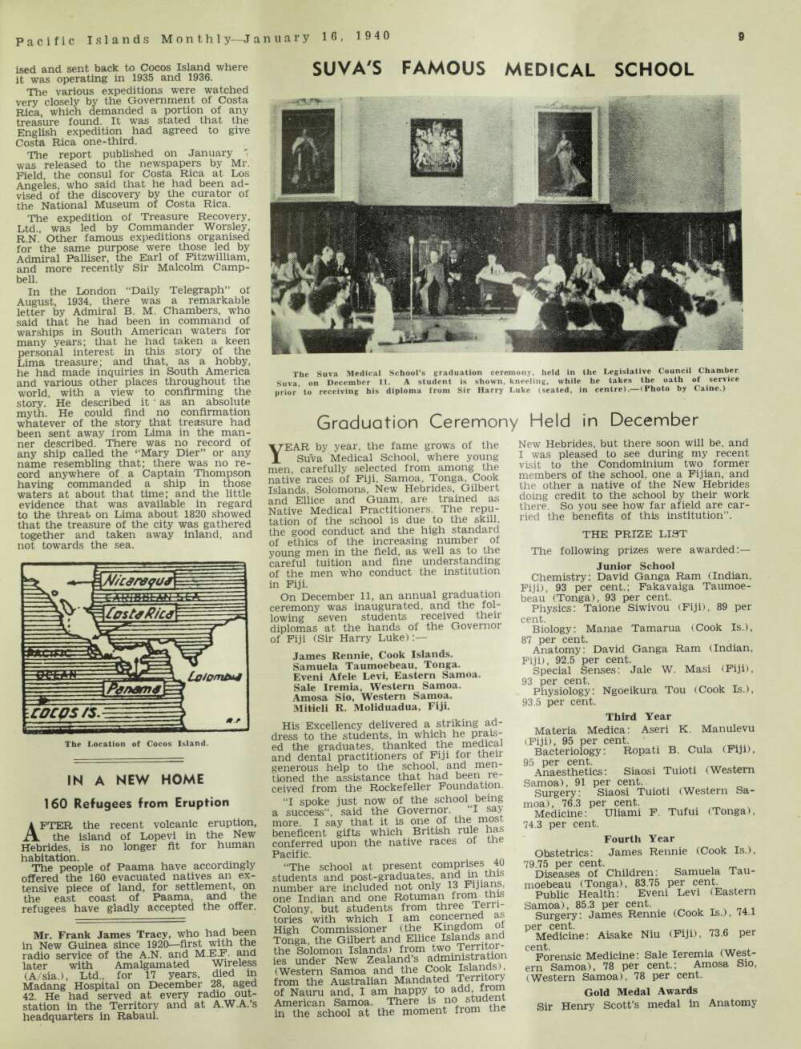
The Location of Cocos Island.
Advertisements & other items, p. 10 (1 item)
Your Wrapper!
Look On The Front of
The figures stamped there (if any) show date when your subscription expires.
This date will anpear on wrappers of three issues preceding exniration, thereby giving 3 months’ notice. If. at the end of that time, we have not been instructed to continue to send the journal to you, it will be discontinued.
Your subscription (8/- per annum, or 10/- in the case of countries outside the British Empire—which includes postage) may be sent direct, or may be paid to any of our agents (listed on Page 5).
The postage required for this Issue is:— To Australia and New Zealand 2d.
To United Kingdom via All-sea routes ... 2d, To United Kingdom via Prance 2d.
To other British Possessions .. 2d.
To U.B.A. and Foreign Countries 4d.
PACIFIC PUBLICATIONS PTY. LTD.
160 Refugees from Eruption
In A New Home
AFTER the recent volcanic eruption, the island of Lopevi in the New Hebrides, is no longer fit for human habitation. .. .
The people of Paama have accordingly offered the 160 evacuated natives an ex tensive piece of land, for settlement, on the east coast of Paama, and the refugees have gladly accepted the offer.
Mr. Frank James Tracy, who had been in New Guinea since 1920 —first with the radio service of the A.N. and M.E.F. and later with Amalgamated Wireless (A/sia.), Ltd., for 17 years, died in Madang Hospital on December 28, aged 42. He had served at every radio out station in the Territory and at A.W.A.’s headquarters in Rabaul.
Suva's Famous Medical School
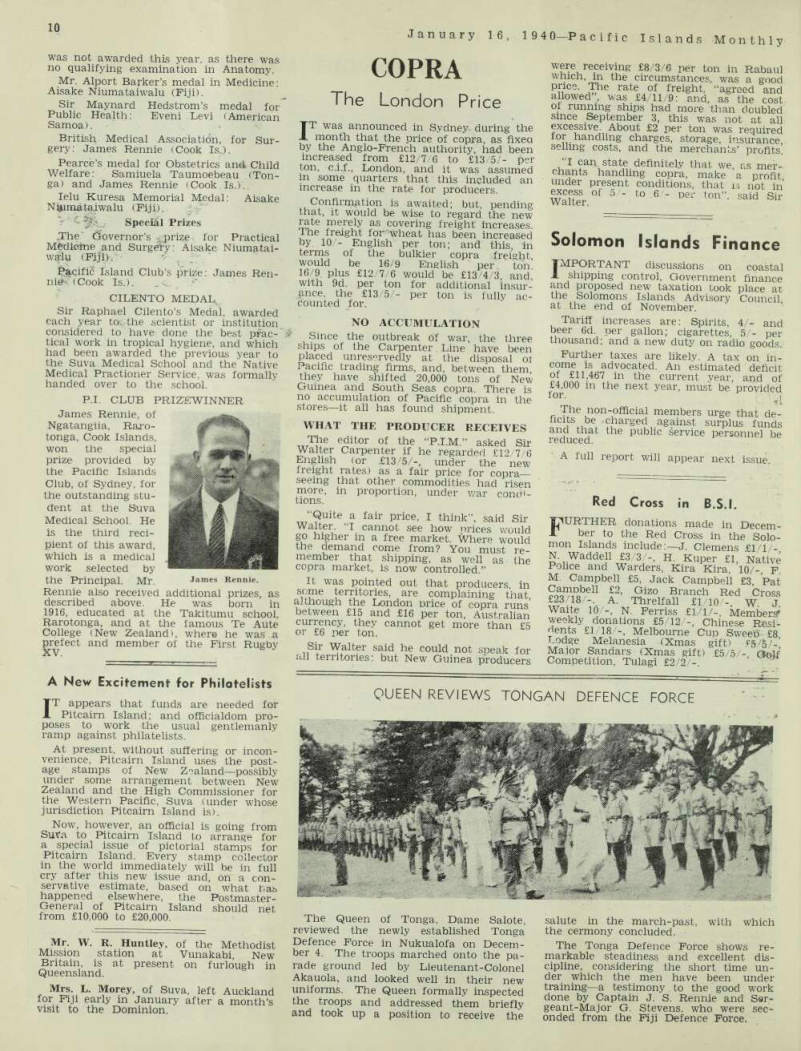
The Suva Medical School’s graduation ceremony, held in the Legislative Council Chamber Suva, on December 11. A student is shown, kneeling, while he takes the oath of service prior to receiving his diploma from Sir Harry Luke (seated, in centre). —(Photo by Caine.)
Graduation Ceremony Held in December
YEAR by year, the fame grows of the Suva Medical School, where young men, carefully selected from among the native races of Fiji. Samoa, Tonga. Cook Islands, Solomons, New Hebrides, Gilbert and Ellice and Guam, are trained as Native Medical Practitioners. The repu tation of the school is due to the skill, the good conduct and the high standard of ethics of the increasing number of young men in the field, as well as to the careful tuition and fine understanding of the men who conduct the institution in Fiji.
On December 11, an annual graduation ceremony was inaugurated, and the fol lowing seven students received their diplomas at the hands of the Governor of Fiji (Sir Harry Luke): — James Rennie, Cook Islands.
Samuela Taumoebeau, Tonga.
Eveni Afele Levi, Eastern Samoa.
Sale Iremia, Western Samoa.
Amosa Sio, Western Samoa.
Mitieli R. Moliduadua, Fiji.
His Excellency delivered a striking ad dress to the students, in which he prais ed the graduates, thanked the medical and dental practitioners of Fiji for their generous help to the school, and men tioned the assistance that had been re ceived from the Rockefeller Foundation.
“I spoke just now of the school being a success”, said the Governor. “I say more. I say that it is one of the most beneficent gifts which British rule has conferred upon the native races of the Pacific “The school at present comprises 40 students and post-graduates, and in this number are included not only 13 Fijians, one Indian and one Rotuman from this Colony, but students from three Tern tories with which I am concerned as High Commissioner (the Kingdom of Tonga, the Gilbert and Ellice Islands and the Solomon Islands) from two. Territor ies under New Zealand’s administration (Western Samoa and the Cook Islands), from the Australian Mandated Territory of Nauru and, I am happy, to add, from American Samoa. There is no student in the school at the moment from tne
New Hebrides, but there soon will be, and I was pleased to see during my recent visit to the Condominium two former members of the school, one a Fijian, and the other a native of the New Hebrides doing credit to the school by their work there. So you see how far afield are car ried the benefits of this institution”.
The Prize List
The following prizes were awarded:— Junior School Chemistry: David Ganga Ram (Indian, Fiji), 93 per cent.; Fakavaiga Taumoe beau (Tonga), 93 per cent.
Physics: Taione Siwivou (Fiji), 89 per cent.
Biology: Manae Tamarua (Cook Is.), 87 per cent.
Anatomy: David Ganga Ram (Indian, Fiji), 92.5 per cent.
Special Senses: Jale W. Masi (Fiji), 93 per cent.
Physiology: Ngoeikura Tou (Cook Is.), 93.5 per cent.
Third Year Materia Medica: Aseri K. Manulevu (Fiji), 95 per cent.
Bacteriology: Ropati B. Cula (Fiji), 95 per cent.
Anaesthetics: Siaosi Tuioti (Western Samoa), 91 per cent.
Surgery: Siaosi Tuioti (Western Sa moa), 76.3 per cent.
Medicine: Uliami F. Tufui (Tonga), 74.3 per cent.
Fourth Year Obstetrics: James Rennie (Cook Is.), 79.75 per cent. , m Diseases of Children: Samuela Tau moebeau (Tonga), 83.75 per cent Public Health: Eveni Levi (Eastern Samoa), 85.3 per cent.
Surgery: James Rennie (Cook Is.), 74.1 Aisake Niu (Fiji), 73.6 per Medicine; Sale leremia (West ern Samoa), 78 per cent.: Amosa Sio, (Western Samoa), 78 per cent.
Gold Medal Awards Sir Henry Scott’s medal in Anatomy
was not awarded this year, as there was no qualifying examination in Anatomy.
Mr. Alport Barker’s medal in Medicine: Aisake Niumataiwalu (Fiji).
Sir Maynard Hedstrom’s medal for Public Health: Eveni Levi (American Samoa).
British Medical Association, for Sur gery: James Rennie (Cook Is.).
Pearce’s medal for Obstetrics and Child Welfare; Samiuela Taumoebeau (Ton ga) and James Rennie (Cook 15.).. lelu Kuresa Memorial Medal: Aisake (Fiji).
V 4iP Special Prizes .The" Governor’s ..prize for Practical Medicine and SurgCTy: Aisake Niumatai w?rlu (Fiji). '• Pacific Island Club’s prize: James Ren nie (Cook Is.).
Cilento Medal,
Sir Raphael Cilento’s Medal, awarded each year fix the scientist or institution considered to have done the best prac tical work in tropical hygiene, and which had been awarded the previous year to the Suva Medical School and the Native Medical Practioner Service, was formally handed over to the school.
P.I. Club Prizewinner
James Rennie, of Ngatangiia, Raro tonga, Cook Islands, won the special prize provided by the Pacific Islands Club, of Sydney, for the outstanding stu dent at the Suva Medical School. He is the third reci pient of this award, which is a medical work selected by the Principal. Mr.
Rennie also received additional prizes, as described above. He was born in 1916, educated at the Takitumu school, Rarotonga, and at the famous Te Aute College (New Zealand), where he was a prefect and member of the First Rugby XV. 5 *
James Rennie.
Advertisements & other items, p. 11 (1 item)
9
Pacific Islands Monthl y- - J anuary 16, 1940
A New Excitement for Philatelists
IT appears that funds are needed for Pitcairn Island; and officialdom pro poses to work the usual gentlemanly ramp against philatelists.
At present, without suffering or incon venience, Pitcairn Island uses the post age stamps of New Zealand—possibly under some arrangement between New Zealand and the High Commissioner for the Western Pacific, Suva (under whose jurisdiction Pitcairn Island is).
Now, however, an official is going from Suta to Pitcairn Island to arrange for a special issue of pictorial stamps for Pitcairn Island. Every stamp collector in the world immediately will be in full cry after this new issue and. on a con servative estimate, based on what has happened elsewhere, the Postmaster- General of Pitcairn Island should net from £lO.OOO to £20,000.
Mr. W. R. Huntley, of the Methodist Mission station at Vunakabi, New Britain, is at present on furlough in Queensland.
Mrs. L. Morey, of Suva, left Auckland f 9 r Fiji early in January after a month’s visit to the Dominion.
Copra
The London Price
IT was announced in Sydney during the month that the price of copra, as fixed by the Anglo-French authority, had been increased from £l2/7 6 to £l3/5/- per ton, c.i.f., London, and it was assumed in some quarters that this included an increase in the rate for producers. * s awa ited; but, pending that, it would be wise to regard the new rate merely as covering freight increases.
The freight for wheat has been increased by 10/- English per ton; and this, in terms of the bulkier copra freight would be 16/9 English per ton’ 16/9 plus £l2/7/6 would be £l3/4/3, and, with 9d. per ton for additional insur ance, the £l3/5/- per ton is fully ac counted for.
No Accumulation
Since the outbreak of war, the three ships of the Carpenter Line have been placed unreservedly at the disposal of Pacific trading firms, and, betwee'n them, they have shifted 20,000 tons of New Guinea and South Seas copra. There is no accumulation of Pacific copra in the stores—it all has found shipment.
What The Producer Receives
e £ itor of the asked Sir Walter Carpenter if he regarded £l2/7 6 English (or £l3/5/-, under the new freight rates) as a fair price for copra seeing that other commodities had risen more, in proportion, under war condi tions.
“Quite a fair price, I think”, said Sir Walter. “I cannot see how nrices would gp higher in a free market. Where would the demand come from? You must re member that shipping, as well as the copra market, is now controlled.”
It was pointed out that producers, in some territories, are complaining that, although the London price of copra runs between £l5 and £l6 per ton, Australian currency, they cannot get more than £5 or £6 per ton.
Sir Walter said he could not speak for all territories: but New Guinea producers
were receiving £B/3/6 per ton in Rabaul which, in the circumstances, was a good price. The rate of freight, “agreed and allowed”, was £4/11/9: and, as the cost of running ships had more than doubled since September 3, this was not at all excessive. About £2 per ton was required for handling charges, storage, insurance, selling costs, and the merchants’ profits.
“I can state definitely that we, as mer chants handling copra, make a profit under present conditions, that is not in Walter ° f 5 " t 0 6 “ per ton ” said Sir
Solomon Islands Finance
IMPORTANT discussions on coastal shipping control, Government finance and proposed new taxation took place ai the Solomons Islands Advisory Council at the end of November, Tariff increases are: Spirits, 4/- and beer 6d. per gallon; cigarettes, 5/- per thousand: and a new duty on radio goods.
Further taxes are likelv. A tax on in come is advocated. An estimated deficit of m,467 in the current year, and of £4,000 in the next year, must be provided tor. yA The non-official members urge that de arged against surplus funds and that the public service personnel be reduced.
A full report will appear next issue.
Red Cross in B.S.I.
FURTHER donations made in Decem ber to the Red Cross in the Solo mon Islands include:—J. Clemens £l/1/- N Waddell £3/3/-, H. Kuper £l, Native Police and Warders, Kira Kira, 10/-, F.
M. Campbell £5, Jack Campbell £3 Pat ?o a^ P o b / ell ! 2 ’ Gizo Br anch Red Cross £23/18 -. A. Threlfall £l/10/-, W J Waite 10/-, N. Ferriss £l/1/-, Members' weekly donations £5/12/-, Chinese Resi dents £l/18/-, Melbourne Cup Sweep £8 Lodge Melanesia (Xmas gift) cg/g/.’
Major Sandars (Xmas gift) £5/5/-, Golf Competition, Tulagi £2/2/-
Queen Reviews Tongan Defence Force
The Queen of Tonga, Dame Salote, reviewed the newly established Tonga Defence Force in Nukualofa on Decem ber 4. The troops marched onto the pa rade ground led by Lieutenant-Colonel Akauola, and looked well in their new uniforms. The Queen formally inspected the troops and addressed them briefly and took up a position to receive the
salute in the march-past, with which the cermony concluded.
The Tonga Defence Force shows re markable steadiness and excellent dis cipline, considering the short time un der which the men have been under training—a testimony to the good work done by Captain J. S. Rennie and Ser geant-Major G. Stevens, who were sec onded from the Fiji Defence Force.
Tropicalities
NOW that, under war conditions, the production of cocoa beans in New Guinea is likely to become a profitable industry, it is worth recalling that a very useful pamphlet was issued m 1934 by the Department of Agriculture, New Guinea. It was “Bulletin No. 2 Leaflet 70—The Possibility of Developing an Economic Cacao Industry in the Man dated Territory of New Guinea, After a Study of the Industry in Trinidad, and a Suggested Policy for that Development”.
The writer was Mr. E. C. D. Green, HD A who spent some time at the Im perial’ College of Tropical Agriculture, Trinidad. Every aspect of the suggested New Guinea industry is dealt with in this 72-page pamphlet. * * * THE crop of native complaints at the Port Moresby Magistrate’s office is often heavy after the Christmas inter regnum.
An alleged house-boy, more sophisti cated than experienced walked into the office on the morning of December 27.
“I want finish”, he announced trucu lently.
The Magistrate sighed wearily and asked him what the trouble was.
“Taubada, you savvy this one Kismis.
Mv boss he give me one white rami one belt b’long Kismis. I no want im this one I want ’im led rami an tin wiss (whistle). This fashion no good. I want finish.”
The Magistrate sighed wearily and and the unhappy native left the office convinced that there is no justice in the world, and that Christmas is an over rated festival. —L. * * * MR. MARC T. GREENE, American world-travelling journalist, arrived in Auckland from Tahiti in December.
“I have offered my services to the New Zealand Government for any sort of war work”, he c ays in a letter to the editor.
“I do not know whether anything will come of that; but I am determined to get to Europe as soon as possible and do something, if only to hand out sand wiches across a Y.M.C.A. counter some where. For I feel that in this great and climactic ideological struggle there is not, and ought not to be any such thing as neutrality. All of us must be on one side or the other; and, if we are, we should—barring such kind of personal responsibility as demands all our en deavours otherwise —take up some sort of work.” * * * WE have received a copy of a five-page statement which apparently has been widely circulated in Fiji, and which is entitled “An answer to the publishers oi the Pacific Islands Monthly”. It is pro duced by the Watch Tower Bible and Tract Society (otherwise, Jehovah’s Wit nesses —otherwise, the disciples of Judge Rutherford) and it commences: “This is a reply to the article published in your October issue concerning what you term ‘A Minor War in Fiji’. We know that you will not have the courage to print this reply in your columns.”
The interesting point, as reflecting upon the methods of the Watch Tower Bible and Tract Society, is that we were, not given the opportunity of printing the re ply in our columns. The first we saw of it is in this copy of the Fiji circular. We would not have printed the circular, but
not through lack of courage—only through lack of space. The statement consists mostly of very long-winded interpreta tions of the Bible and equally wordy re flections concerning the “Fiji Times”, the Roman Catholic Church and the “Pacific Islands Monthly”.
We attacked the Watch Tower Bible and Tract Society because we cannoi imagine how any good can be achieved by admitting so hoi«y -a sect to the al ready over-crowded field of missionary activities in the Pacific Islands. * * * Administrative officials on lonely islands stations develop some queer hobbies; but we nominate that of Mr.
Sydney H. Chance, Resident Magistrate at Kokoda, Papua, as the queerest. He collects waterfalls. He discovered the Beaver Falls, 600 feet, on the Mobi, a tributary of the Kikori, in 1926, and he claims this to be the highest in New Guinea. Pilot Aubrey Koch thinks there is a bigger one “somewhere on the Upper Strickland”, but Mr. Chance won’t even regard it as competitive. Away back in 1920, a party led by District Officer Joe Kenny, and including Police-Master “Ted” Taylor, “Liklik Doctor” Joe Drury and Topographer S. H. Chance, saw a big waterfall inland from Wide Bay. in New Britain: but this is not re garded as competitive, either. If editorial blandishments succeed. Mr. Chance will write an article for this journal about the waterfalls of New Guinea. « * • NAZI impudence and arrogance are well illustrated in a broadcast an nouncement from Berlin on January 1, to the effect that Germany will hold Britain, Prance, Australia, New Zealand and South Africa responsible for any damage done to the former German colonies arising out of the present war.
The Nazis insisted that the mandatory powers have no right to impose war conditions upon the mandated territories —that, under the mandate, they are
obliged to maintain neutrality ; in the territories concerned.
The Goering-Goebbels Gangster Gov ernment does not seem to realise that so long as the Nazis rule Germany there is not the slightest prospect of Germany having any interest in the Mandated Territories. * • WRITING to the editor from England, Mr. Henry Dexter, formerly of Papua, comments with regret upon the recent death of two Samarai men whom he knew and esteemed—lrvine and Small.
“I knew Small well when we were both was sitting on my verandah in Papua, says Mr. Dexter. “Small handed in his checks to Whitten Brothers in order that he might go sailing with Captain Voss, who had made a lot of voyages in single handed craft. That was in 1914. When they (Small, Voss and Eric Bomgreen) got to Brisbane, war had broken out.
Small joined up and the next I heard of him was that he had been blown up in a mine sweeper in the English Chan nel.
“The years passed, and one night I was sitting on my verandah in Papua reading. Suddenly, without any warning, a face appeared at the end of the ver andah—there, looking at me, was Small, whom I had long believed dead.
“When I had recovered—he must at first have thought that I was having a fit —I told him about the report of his death and he plagiarised Mark Twain and said that it was grossly exaggerated.” • • • GUINEA Airways, Ltd., have conducted a large aerial transport service in New Guinea for 13 years, with remark ably few serious accidents, and none due to engine failure. Yet, during the two years they have been running trans continental services in Australia, they have lost two of their best machines (one in December) as the result of engine failure. Commenting upon this, an exe cutive of Guinea Airways supplies an in teresting note: “Our clear record of engine failures in New Guinea, as against our mishaps in Australia, is almost wholly due to the damp atmosphere in New
Guinea, which makes dust and grit practically unknown. This has a tre mendous effect on the costs of spare parts and replacement. For instancy cylinders in New Guinea practically don’t wear at all, whereas in Australia the rate of wear is very high.” • • * THE island world of the South Pacific is a vast whispering gallery.
This is no new thing, for Ro’o (rumour)—“born of the cloud and who feeds upon the cloud as he travels on, grows and travels on”—was one of the principal gods of the ancients.
The other great deities of the pantheon have passed into the twilight of forget fulness; but Ro’o survives, and has added European jewels to the splendour of his diadem.
It is extraordinary the transfigurations and transmutations the simplest bit of news or morsel of gossip will undergo during transit through the Islands. The miracles of invention and marvels oi adornment can be attributed only to some divine intervention. Therefore one must believe that Ro’o still “feeds upon the cloud as he travels on. grows, and tiavels on”. —A.C.R. * * * ON the subject of Pidgin, and the effects being made in Papua to teach the natives to speak English, Mr.
G. Auerbach, of Muwo, Trobriand Is lands, Eastern Papua, sends the fol lowing letter. It was written by a 10years-old native boy in the Catholic Mis sion, Samarai, to his father, who is em ployed by Mr. Auerbach, in the Tro briands. The letter is reproduced ex actly as written, in a round clear hand:— Catholic Mission, Sideia E. Papua, April Bthe, 1989.
Dear Kaka. How are you. I hope you are better and 1 write this little letter to you in Trobriand Island. How is my Mother getting on and my Sister. I hope their are better. In Sideia he dede one Father name Father Tomlinson because no money in Sideia. Please Kaka will you sent one blue rimi for me.
Please Kaka will you sent one bag of Kaibai for me in Sideia. How is Auerback. I hope you are better. Please write a small letter for me in Sideia. This all I say. Good bye and God bless you. I am your son Albert Pipi, Sideia School Boy. * * « A REPORT that the 250 people on Pitcairn Island were seriously short of food, as the result of war-time diver sion of shipping, has been flatly contra dicted, and a silly statement, originating in Australia, that the removal of the population of Pitcairn Island would be necessary has been challenged and de precated by the Pitcairners themselves.
The people of Pitcairn Island are quite able to provide themselves with all the necessaries of life, from their own is land—as they have done for 150 years— but when ships do not call regularly they may run short of such articles as sugar, oil, kerosene, matches. The radio transmitting set on Pitcairn broke down in November, but now has been repaired, and the island again is in touch with the outside world.
Mr. T. B. D. Edwards, manager in Fiji for Cable and Wireless, Ltd., during the past two years, left Suva for Sydney on leave on December 19. On the completion of his furlough, he will be transferred to another station. He has been relieved by Mr. L. Cottew, from Southport (Queens land), who previously served in Fiji from 1911 to 1913 with the Pacific Cable Board,
Advertisements & other items, pp. 13-14 (3 items)
11
Pacific Islands Month! y— J anuary 16, 1940
SSSSffiSS
FLAT OIL
FINISH
Dries in half an hour on plaster walls, ceilings, cement, fibro, wood & iron.
Also Excellent as an Undercoat for lacquers, paints & enamels 13/3 per gallon
HIGHLY DURABLE
Write for a colour Card . . . •
STERLING VARNISH CO., Alexandria, N.S.W.
Ml „ f, 4 m *
You cannot
have too many
Kodak Snapshots
KODAK FILM HAS EXTRA QUALITY to put the Snap Into Snapshot—gives you pictures that LIVE.
DOUBLE-GUARDS EVERY SNAPSHOT. New
Kodak Films (Verichrome, Panatomic and Super-Sensitive Panchromatic) are double - coated to double-guard every precious holiday snapshot.
IS BRITISH MADE to suit Island and Tropical requirements —based on the newest achievements of modern Kodak Research Laboratories all over the world. The benefit of this world-wide advanced research is yours with every spool of Kodak Film.
OF ALL KODAK DEALERS IN THE ISLANDS M 0
KODAK (A/asia) PTY. LTD.
379 George Street, Sydney
HAVE YOU THE LATEST KODAK BOOKLETS?
MARK WHAT YOU REQUIRE:
( ) Kodak Camera Folder. ( ) Cine-Kodak and Kodascope Catalogue. ( ) Kodak Film Booklet.
NAME
ADDRESS
12
January 16, 194 O—P acific Islands Monthly
About Islands People
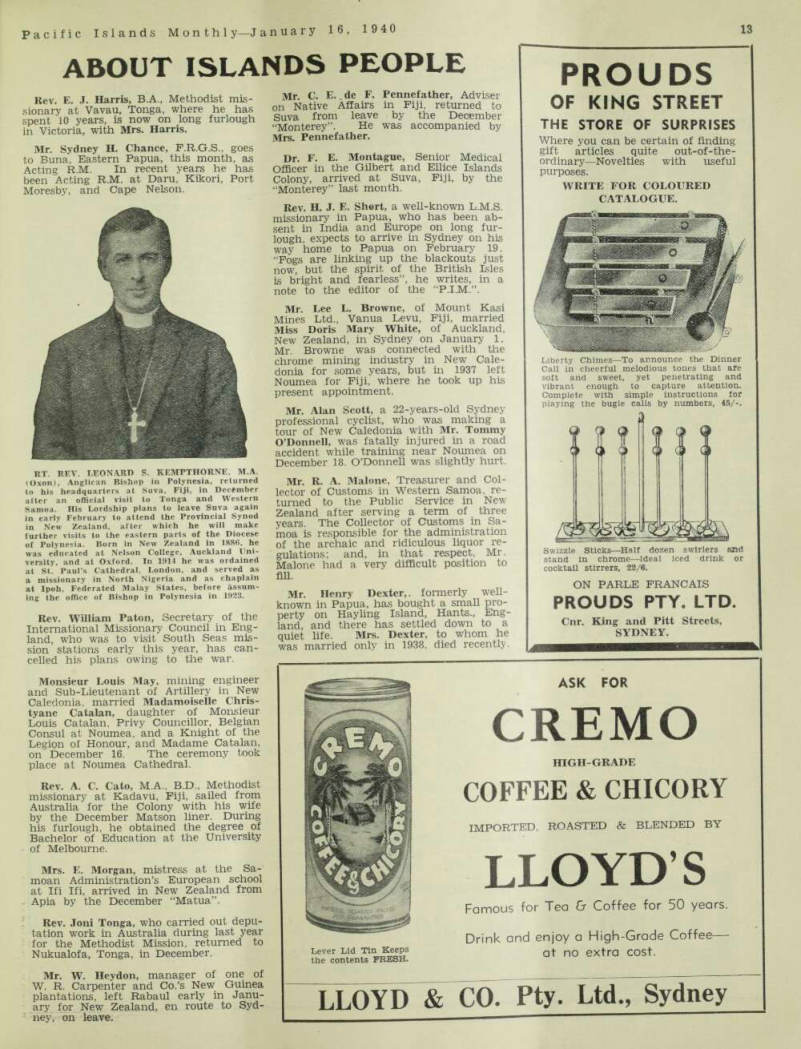
Rev. E. J. Harris, 8.A., Methodist mis sionary at Vavau, Tonga, where he has spent 10 years, is now on long furlough in Victoria, with Mrs. Harris.
Mr. Sydney H. Chance, F.R.G.S., goes to Buna, Eastern Papua, this month, as Acting R.M. In recent years he has been Acting R.M. at Daru, Kikori, Port Moresby, and Cape Nelson.
Rev. William Paton, Secretary of the International Missionary Council in Eng land, who was to visit South Seas mis sion stations early this year, has can celled his plans owing to the war.
Monsieur Louis May, mining engineer and Sub-Lieutenant of Artillery in New Caledonia, married Madamoiselle Chris tyane Catalan, daughter of Monsieur Louis Catalan. Privy Councillor, Belgian Consul at Noumea, and a Knight of the Legion of Honour, and Madame Catalan, on December 16. The ceremony took place at Noumea Cathedral.
Rev. A. C. Cato, M.A., 8.D., Methodist missionary at Kadavu, Fiji, sailed from Australia for the Colony with his wife by the December Matson liner. During his furlough, he obtained the degree of Bachelor of Education at the University of Melbourne.
Mrs. E. Morgan, mistress at the Sa moan Administration’s European school at Ifi Ifi, arrived in New Zealand from Apia by the December “Matua”.
Rev. Joni Tonga, who carried out depu tation work in Australia during last year for the Methodist Mission, returned to Nukualofa, Tonga, in December.
Mr. W. Heydon, manager of one of W. R. Carpenter and Co.’s New Guinea plantations, left Rabaul early in Janu ary for New Zealand, en route to Syd ney, on leave.
Mr. C. E. de F. Pennefather, Adviser on Native Affairs in Fiji, returned to Suva from leave by the December “Monterey”. He was accompanied by Mrs. Pennefather.
Dr. F. E. Montague, Senior Medical Officer in the Gilbert and Ellice Islands Colony, arrived at Suva, Fiji, by the “Monterey” last month.
Rev. H. J. E. Shert, a well-known L.M.S. missionary in Papua, who has been ab sent in India and Europe on long fur lough, expects to arrive in Sydney on his way home to Papua on February 19.
“Fogs are linking up the blackouts just now, but the spirit of the British Isles is bright and fearless”, he writes, in a note to the editor of the ‘‘P.I.M.”.
Mr. Lee L. Browne, of Mount Kasi Mines Ltd., Vanua Levu, Fiji, married Miss Doris Mary White, of Auckland.
New Zealand, in Sydney on January 1.
Mr. Browne was connected with the chrome mining industry in New Cale donia for some years, but in 1937 left Noumea for Fiji, where he took up his
present appointment.
Mr. Alan Scott, a 22-years-old Sydney professional cyclist, who was making a tour of New Caledonia with Mr. Tommy O’Donnell, was fatally injured in a road accident while training near Noumea on December 18. O’Donnell was slightly hurt.
Mr. R. A. Malone, Treasurer and Col lector of Customs in Western Samoa, re turned to the Public Service in New Zealand after serving a term of three years. The Collector of Customs in Sa moa is responsible for the administration of the archaic and ridiculous liquor re gulations; and, in that respect. Mr.
Malone had a very difficult position to fill.
Mr. Henry Dexter,, formerly well known in Papua, has bought a small pro perty on Hayling Island, Hants., Eng land, and there has settled down to a quiet life. Mrs. Dexter, to whom he was married only in 1938. died recently
Rt. Rev. Leonard S. Kempthorne. M.A.
(Oxon). Anglican Bishop in Polynesia, returned to his headquarters at Suva, Fiji, in December alter an official visit to Tonga and Western Samoa. His Lordship plans to leave Suva again in early February to attend the Provincial Synod in New Zealand, after which he will make further visits to the eastern parts of the Diocese of Polynesia. Born in New Zealand in 1886, he was educated at Nelson College, Auckland Uni versity, and at Oxford. In 1914 he was ordained at St. Paul’s Cathedral. London, and served as a missionary in North Nigeria and as chaplain at Ipoh, Federated Malay States, before assum ing the office of Bishop in Polynesia in 1923.
Advertisements & other items, p. 15 (2 items)
13
Pacific Islands Monthl y—J anuary 16, 1940
Lloyd’S
PROUDS
OF KING STREET
THE STORE OF SURPRISES
Where you can be certain of finding gift articles quite out-of-theordinary—Novelties with useful purposes.
WRITE FOR COLOURED
CATALOGUE.
Liberty Chimes —To announce the Dinner Call in cheerful melodious tones that are soft and sweet, yet penetrating and vibrant enough to capture attention.
Complete with simple instructions for playing the bugle calls by numbers, 45/-.
Q Swizzle Sticks—Half dozen swlrlers and stand in chrome —ideal iced drink or cocktail stirrers, 22/6.
ON PARLE FRANCAIS
PROUDS PTY. LTD.
Cnr. King and Pitt Streets,
SYDNEY.
ASK FOR
Lever Lid Tin Keeps the contents FRESH.
CREMO
HIGH-GRADE
COFFEE & CHICORY
IMPORTED. ROASTED & BLENDED BY
LLOYD’S
Famous for Tea & Coffee for 50 years.
Drink and enjoy a High-Grade Coffee — at no extra cost.
LLOYD & CO. Pty. Ltd., Sydney
How Sgt. Bagita Caught
Hitler
From Our Own Correspondent
Wport Moresby, Dec. 18.
AR nerves are not peculiar to Euro peans. A member of the Native Constabulary, Sergeant Bagita, recently became quite mental.
He had been listening to many versions of the war, and to descriptions of Hitler.
One day, he entered the Post Office and asked for his Savings Bank deposit. See ing only 11/6 to nis credit, he asked where was the £12,000 that the King oi England had given him for capturing Hitler. They thought he was joking, but it was soon realised that he meant what he said, and that his mind was de ranged. The sergeant was quite clear in what he said. He explained that one evening he was “walking about” and, go ing near Paga Hill, he saw a hand creep ing out from behind a stone. Then a body appeared, followed by a head.
He looked at the features and said.
“My word, this face belong Hitler. No good Hitler walkabout long Port Moresby”; and he put handcuffs on him, and, jumping into an aeroplane, flew to England, where he demanded to see the King, and handed over Hitler.
Bagita said the King was so pleased with him that he gave him £12,000.
Bagita, however, would not accept the gift, saying: “No Sir, Mis King, Sir. I New Guinea P’liceman belong Port Moresby. No good I get plenty money.
This bad fashion.
“King he laugh little bit,” continued “and he say, ‘Das all humbug talk, Bagita. I give you £12,000. I put him along Bank Port Moresby. You go back Port Moresby and you get him.’ ”
Bagita, on medical examination, was found to be suffering from fever and
nerves, and was put into hospital. Later, on improving, he was sent away for a rest.
Natives in Papua often fail to distin gmsh between dreams and reality.
Bagita s nerves had given away. He is locally famous for his detective work, in Court proceedings, where he has been employed for the past three years.
Compliment To Medico
A REMARKABLE compliment was paid recently to Dr. C. M. Dawson, M.L.C., oi Western Samoa, when there was pre sented to the Administrator a numerously signed petition, asking that the Govern ment take steps to induce Dr. Dawson to remain in Samoa. It was reported that Dr. Dawson, with a quarter century of army medical activity behind him, had decided to don khaki again in this new Hitler War, and was making arrange ments to leave the Territory.
It was pointed out that Dr. Dawson’s work in recent years, among the popula tion of Samoa, had been of almost in calculable benefit, and that the loss to Samoa of a medical practitioner of his unique tropical experience would be far greater than any possible gain to the ex peditionary forces of New Zealand.
We have not neard the result of the petition; but, knowing Dr. Dawson we should not be surprised if the Admini strator is obliged to resort to handcuffs and a leg-rope if he wants to keep his valuable medico away from the of gun powder.
Miss Lilia Lashmar, who is a worker lor the New Guinea Mission at Sangara, Papua, was in Adelaide. South Australia, m December on her first furlough.
Deep Drilling
For Oil
Important Activity in Papua
Prom Our Own Correspondent
T Tttn Port Moresby. Jan. 2.
HE first choice of a drilling location, following intense field activity by Australasian Petroleum Co., Pty., Ltd., is likely to be at a point from 50 to 70 miles inland from the coast of the Gulf of Papua.
An aerial survey and aerial photo graphic survey, undertaken on behalf of the A.P.C. by the Fairchild Survey Cor poration, of U.S.A., and the Dutch East Indies aerial company, K.N.1.L.M., in con junction, have photographed 16,000 sq miles of territory, at a cost of approxi mately £4 TO/- per sq. mile. Maps of a considerable part of the area taken up in Papua have been prepared from the photographs, and work on maps for the balance of the territory in Papua and New Guinea is in hand.
These maps prove invaluable to the field geologists, as do also the conclu sions and findings of the paleontological laboratory established at Port Moresby whereby the age of the various out cropping beds are ascertained.
Five geological parties, as well as seismic and gravity parties, all equipped with aerial maps, are at present con centrating on the most favourable look ing developments, where drilling is likely to commence.
The bulk of the drilling equipment, costing over £200,000, has already been landed in Port Moresby, and is being shipped to the Gulf.
Advertisements & other items, p. 16 (1 item)
Nelson And Robertson Pty. Ltd.
F STABLISHED, 1895. > ""' ■ . *
ISLAND MERCHANTS
Ail classes of merchandise purchased at wholesale prices and original invoices supplied to Island Clients.
COCOA BEANS, RUBBER, TROCAS SHELL and COPRA sold on Commission,
SOLE AGENTS FOR
BEEBE ALL STEEL WINCHES, Portable, Unconditionally Guaranteed. 2 5 and 15 ton from Stock. ’
LONDON SELF PRIMING PORTABLE PUMPS. Manufactured in Canada, all sizes from 1 2 m. upwards. Specially suitable for prospecting and mining in all its branches.
SKANBIA ENGINES, Full diesel, semi diesel, all powers, marine and stationary.
ARCHIMEDES. Swedish Outboard Engines. Highly recommended.
UPSON BRITISH BOARD, wallboard, strong and light in weight. 6ft. to 12ft. lengths always in stock. 6 ANKAR INSULATING WALLBOARD, made from pure wood-fibre. The best insulating material on the market.
NELSON and ROBERTSON Pty. Ltd.
12 Spring Street, Sydney, Australia
Telegraphic Address: “IVAN SYDNEY.”
Moonlight In
Tahiti
From Our Own Correspondent.
Papeete, Dec. 12.
ONE of the very few survivals of an cient Polynesian lore at Tahiti is the calendar of the nights of the moon.
Even this is disregarded, and generally unknown, except among fishermen. To the latter it is most valuable, because it embodies the results of centuries of ob servation in regard to the run of fish.
Each night has a picturesque name— from the first, tireo (the breaking forth) to the thirtieth, motu, ua motu te tau (severed, the period is ended); the tides, prevailing winds, and the habits of the several species of fish being indicated for every night.
The calendars vary somewhat in dif ferent islands and in different parts of the same island. But they all agree in listing the second, third and fourth nights after the full moon as the nights when ghosts are roaming about.
Belief in ghosts is well nigh universal in the Islands, and is not confined to Polynesians. Europeans long resident in Polynesia appear to absorb the prevail ing superstitions. The apparition most frequently reported is that of the famous Tua-tau.
“In a precipitous valley of Puna’auia is an ancestral Marae belonging to the Vai-tua-mata’i-upo’s Tahiti family, and it was dedicated to a deified family hero named Tua-tau. In the same valley is a cave where Tua-tau is said to appear in visible form, sometimes in ancient war rior’s garb and holding a long wooden spear”. (Henry.) The writer suspects that many of the ghosts reported are not disembodied spirits.
It is well attested that the great wiz ard of Ra’iatea, Tupua, had a company of ghosts who appeared and vanished, at his command, on the occasion of certain nocturnal ceremonies; but were very much of this world when the hour of feasting arrived.
More than once, on the prescribed nights of the moon, the writer has gone to dismal and spooky places in quest of reputed ghosts. Always he has been dis appointed. Some flickering shadows— such as incite nervous dogs to bark and howl on moonlight nights—and nothing else.
An earnest desire to make the ac quaintance of the famous Tua-tau has led him to the valley of Puna’auia. In variably Tua-tau has been absent on one of his visits to the subterranean Elysium, beneath the volcano of Kilauea, Hawaii, “where he and the shades of the royal families of the islands are believed by many Tahitians and Hawaiians, to meet and dwell together”. (Henry—“ Ancient Tahiti”.) In ancient times, people who saw things which were not there, were reputed to be uruhia e te aitu—i.e., inspired by some being of the supernatural world.
Civilisation has provided potent exhilar ants which perform the same office.
Wherefore we often wonder if some of our modern see-ers of visions are not uruhia e mania a potu.
Note: Mania a potu is perfectly good Tahitian. Mania-calm as the sea; no wind stirring, serene; unruffled, as ap plied to the mind. A-of. Po-tu —Night established. In medical dictionaries, how ever, Mania a potu signifies delirium tre mens, or the delirium caused by too much rum—a frequent and widespread ailment in these islands.
Advertisements & other items, pp. 17-18 (2 items)
15
Pacific Islands Month! y—J anuary 16, 1940
TdlMfATOi
* m \ « i
READ THIS
Bulolo Gold Dredging, Ltd., Biilolo, NEW GUINEA, 17th May, 1939.
Geo. Brown & Co. Pty., Ltd., 267 Clarence Street,
SYDNEY, N.S.W.
Dear Sirs, — I would like to express my sincere appreciation to your wonderful Ultimate 8 Valve All Wave Radio. It is absolutely the most outstanding against all other Radios that I have ever heard. I have logged to date on the Broadcast Band 126 Stations, which is most remarkable for conditions here in New Guinea. The Short Wave Band also is equally, if not the best, though taking the Ultimate on the whole, it more than justifies Its merits.
Please use this letter to acknowledge any advertisement you wish.
Yours sincerely, (Signed) J. C. HUIE.
Political change—history itself is
moving to-day at express speed. Hear
history in the making—direct —as
clearly as your own local stations, with
"Ultimate" Champion Radio. For 12
years "Ultimate" oversea reception
has set an unapproachable standard.
"Surge" is entirely eliminated, giving
crystal-clear, uninterrupted reception.
No complicated tuning—a child can
operate an "Ultimate".
• FROM OUR ISLANDS DEPT.
‘Ultimate” Chassis in any model are now obtainable in our new Insect proofed MANTEL CABINET.
Send particulars of your requirements.
SPECIAL PRICES TO THE ISLANDS.
f Log Chart giving positive identification f of more than 400 overseas stations, and OX IDviO Uiau IVW —' details of "Ultimate" Champion Radio.
CUP THIS
COUPON
TO-DAY !
y n/
U2JO
NAME .
ADDRESS
TdlMfATOi
U vm GEORGE BROWN & CO.. LTD.. 267 Clorence St.. Sydney
DOES LIFE BEGIN
AT 40?
"I'm nearly forty. Where will I be in ten years from to-day?"
There’s a thought that has crossed the mind of many a middle-aged man. Where will he be when he’s fifty? Success with comfort, or failure and poverty? When he gets to his early forties many a man is brought up with a jolt ... he finds himself fighting something — something intangible, something he can y t understand. Joe Williams was like that. Joe was an overseer for a road construction company. One day he was on the job when a car pulled up and a young chap stepped out. The young chap said: “Mr. Williams, Head Office sent me down to find out what’s holding you up. You’re behind schedule.”
Imagine how Williams felt! A young man teaching HIM, an experienced man, his own job!) It hurt like the devil. That night he had a chat with one of his best friends.
“I don’t know, Bill, I don’t seem to be getting anywhere. At my age, too. It’s all right for these young chaps, full of energy and drive, but when you feel like a wet rag, tired all the time like I do, it’s hard to get ahead. I suppose it’s the climate, and well . . . I’ve got to be honest with myself, my age. I’m getting old. ...”
“Don’t be a fool,” said Bill. “You aren’t old. Forty isn’t old. But I’ll tell you one thing, Joe. You’ve changed a lot in the past few months. You aren’t the same. That tiredness you talk about, for instance, you’re ALWAYS tired. I’d hop into town and have a chat with the doctor next week-end if I were you.”
So the next week-end Joe Williams went into the township and had a chat with the doctor.
“Don’t know why it is, Doc,” he said, “but I’m always tired nowadays.
Even wake up tired. I suppose it’s usual at my age?”
The doctor let him talk for a while, and found out all about his tiredness, his lack of energy and how hard it was to concentrate. Then
he gave him a thorough overhaul and said : “Mr. Williams, you needn’t worry about your age. That’s not your trouble. You’re a young man yet.
You needn’t start worrying about those sort of things for another twenty years. No, from what you’ve told me, your trouble is Night- Starvation. You see, not many people realise it, but even at night we go on using up energy on breathing, heartbeats and other automatic actions. Now, it stands to reason, in your case, if this energy isn’t replaced during sleep, you wake tired, you feel tired all day and not up to your job. The best thing you can do is to get some Horlicks. Keep it up in your camp and have a cupful every night before bed.”
So Joe Williams took the doctor’s advice and started taking his Horlicks every night before bed. He found that after a few weeks he lost that “limp as a wet rag”, dull tired feeling. He found that he woke in the mornings feeling full of pep, ready to put his whole heart and soul into his job. He felt like a two-year-old again, and the job went through right on schedule . . .
How if YOU’RE on the forty line, then say to yourself, “Life CAN start at forty! It depends entirely on myself”. Do you know that statistics actually show that nine out of ten highly paid jobs are held by men over forty? The only thing that can beat you is that dull, tired, run down feeling. So get rid of it.
Don’t let Night-Starvation hold you back. Remember, Horlicks guards against Night-Starvation and brings back your life and vitality. Ask your chemist or storekeeper to-day for a bottle of Horlicks. Start drinking it every night before you go to bed. You can get your Horlicks in all main towns throughout the British Pacific Islands. j HorucKS orh
Guinea
Plans For New
Mostly Held Up By the War
IT was stated in this journal in Sep tember, immediately after the out break of war, that various changes and developments anticipated in New Guinea probably would be killed by war condi tions. We referred particularly to the plan for removing the capital from Rabaul to a non-volcanic site; the scheme for introducing some measure of amalgamation between New Guinea and Papua; and the plan for developing a deep water port at Salamaua, and build ing a road from Salamaua to the Morobe goldfield.
Four months have passed, and it is clear that that forecast was reasonably correct.
Rabaul To Remain Capital
It was stated in the Sydney “Tele graph” on January 3, apparently with me authority of the Minister for Terri tories, that there is little likelihood of the New Guinea administrative establish ment being removed from Rabaul —at least, not before the end of the war.
Nothing more has been heard of the amalgamation plan, and very little has been said about the various develop mental activities that had oeen discussed.
The proposal to build a road from Salamaua to Wau should not be regarded as entirely abandoned, however. The New Guinea Mining Association, with its headquarters m Wau, is Keeping up pressure on Canberra, where it nas the sympathy of Mr. Hughes; and, now that me Commonwealth excise tax on gold produced in New Guinea has been placed in a trust fund for the benefit oi New Guinea, it is possible that this money will be used to complete the financing oi the road project. The construction of the road—which quite definitely was put aside in recent months —may oe undertaken during 1940.
But although the engineers hesitantly agree that there is a practicable route for the road straight over the mountains from Salamaua to Wau, the probability that Wau ultimately will get its road communication with the coast via the Markham Valley should not be disre garded.
"Moui Pomare" Still Out of Luck
THE New Zealand Government motor vessel, “Maui Pomare” which has been off the New Zealand-Samoa run since her engines broke down, between Tonga and New Zealand, several weeks ago, has been in trouble again. Extensive repairs to the engines were carried out in Wellington and the “Maui Pomare” went out into the harbour on December 16, on a test. She had to be towed back to her berth by a tug. She went out again, on a further test, on December 20, and again the engines broke down and the vessel was anchored. A strong tide and high wind began to force her on to the rocks, and she was hurriedly rescued and towed to her berth by a couple of tugs.
Mr. R. Skillen arrived in Rabaul, New Guinea, recently to relieve Mr. Ken Diamond as accountant at the Bank of N.S.W., while the latter is on furlough.
Advertisements & other items, p. 18 (1 item)
16
January 16, 194 O—P acific Islands Monthly
Sharp Check to Inquisitive Sampans
America's Watch On The Northern
Pacific
By John Williams
Honolulu, Dec. 12.
THE silent pressure of America’s new policy against Japanese aggression in the Pacific is steadily increasing. Here are the latest heartening facts: In an unprecedented move, Washing ton has appointed Admiral Claude C.
Bloch, Commander in Chief of the en tire U.S. fleet to be commandant of the 14th Naval District, with headquarters at Pearl Harbour navy base, near Honolulu.
This appoint ment to Hawaii of the highest ranking officer afloat has signi ficance. The United States will not be caught napping in the Pacific.
Admiral Bloch will have at his disposal in Hawaiian waters more than 40 warships of the
U.S. Pacific fleet. , These were rushed from west coast American bases to Hawaii at the out break of the war in Europe. They are known as the Hawaiian detachment. They carry out weeklv local manoeuvres. In cluded among them is the newest air craft carrier, U.S.S. “Enterprise”.
One of their important tasks is keep ing Japanese fishing sampans clear ot the secret sections of the defence organi sation in Hawaii. As an example, prior to the war in Europe, President Roosevelt declared a wide ocean area adjacent to Pearl Harbour to be a secret area. Actu
ally, it is the largest secret area possessed by America.
The entrance channels to Pearl Harbour cut across this area. Naturally the Japanese itch to know all they can about the area. Thus, when the Hawaii detachment steams to sea from Pearl Harbour every week, Japanese sampans lurk nearby, obviously noting the tech nique employed by the fleet.
On December 1, the navy patrol arrested a sampan that was well within the secret zone. On December 8 they seized another.
Trespassers in the prohibited area are subject to a fine of 5,000 dollars, cr five years in prison, or both.
On December 7. the Navy issued a strongly worded public statement that its patience was exhausted, and that hence forth it would crack down even upon the sampans noted hovering far at sea to watch the fall of shells during the fleet’s target practices.
To improve the efficiency of the navy patrol, the Navy has persuaded (in secret) many American-citizen owners of local craft, such as tugs, yachts and power boats, to install “press to talk” radio-telephones, the idea being that when they are cruising along the coasts a central control tower in Pearl Harbour can contact them and request them to check suspicious craft. This, of course, gives the Navy a complete check of local waters while the fleet is at sea. r E U.S. customs department has come down with a vengeance upon visit ing Japanese naval ships in Hawaii waters, and notably the tankers which have for some years been lifting dona tions of scrap metal, clothing, food and
Admiral C. C. Bloch.
money from Hawaii Japanese to the Japanese war machine.
When the Jananese tanker “Shiriya” called at Hilo, second port of Hawaii, on December 2, nobody was permitted aboard until the tanker had been boarded first and cleared by a Customs officer. Further, Customs guards saw that no scrap metal and other donation goods were taken aboard, and they one by one examined every sailor going ashore and every per son visiting the tanker.
This ironclad arrangement has irked the local Japanese. Characteristically thorough, they are attempting to work out some other plan for the circumvention of the American vigilance. As an example, the “Nippu Jiji”, leading Japanese news paper in Hawaii, in an editorial on November 29 said:
... It goes without saying that thf Japanese people who are advancing to establish a new order in East Asia, ex pect to come across numerous difficulties (such as the ban on the tankers) in carrying out their holy war ... It will not be difficult for us to discover some other ways of showing our devotion than the donation of scrap metals, etc., if we exert the same attentiveness and effort shown in collecting the scrap metals, etc.
To do or die is their stubborn, national istic motto.
DEVELOPMENTS in the Western Pacific are snowballing. America is determined that her rights in the Orient must be respected by Japan. Japan is determined that she shah have a free hand with her clumsy “holy war’’. But, for her execution of this policy, Japan depends much upon American goodwill, because America to-day takes the biggest share of Japan’s exports and America now is about the only nation which can sell Japan the war materials and weapons she sorely needs for her fight against China.
American public opinion is being aroused against sales to Japan. A force in developing this opinion is the lately formed American Committee for Non- Participation in Japanese Aggression
Leading members of this body are Henry I. Harriman, former president of the U.S. Chamber of Commerce, and mail fisted Admiral Harry E. Yarnell, recently retired commander of the U.S. Asiatic fleet.
THE U.S. Navy plans another spectacu lar endorsement of the new policy against Japan. Lately it was learned that the Pacific fleet’s annual war games early in 1940 will extend far beyond Hawaii and for the first time will use Philippine waters. The official sources behind this information added that spectacular uses will be made of the Navy’s long-range patrol bombers during the fleet’s far western games.
As these words are being typed, Francis B. Sayre, noted U.S. State Department expert, who now is High Commissioner to the Philippines, is making an inspection tour of the colony of 25,000 Japanese on Mindanao Island, 500 miles south of Manila. He is seeing for himself the ex tent of the Japanese infiltration.
Public opinion in the Philippines against the persistent increase in Japanese influence in the islands is ris ing.
President Manuel Quezon, of the Philip pines, who has been a frequent visitor to Japan, and whose pro-Japanese lean ings have often been questioned by his fellow countrymen and Americans, lost his head on December 8, when he at tended a inter-university oratorical con test at Manila.
One of the student speakers said that Philippine independence should be re examined with a view of retention by the U.S. The fiery President blew up and reiterated with emphasis the statement he has made before: “I prefer a Government run like hell by the Filipinos than a Government run like heaven by the Americans!”
Advertisements & other items, pp. 19-21 (2 items)
17
Pacific Islands Monthl y—J anuary 16, 1940
Gifts
for Soldiers and Friends
"on-the-move"
21/6 PEN & PENCIL WALLET
No. PM 7. —You have a Visible Ink Supply, as the case of this “Blackbird” Pen is transparent. Good “Blackbird” Propelling Pencil. Both have gold-filled clips and mounts. Colours are black, blue or green.
Neat case takes up very little room.
27/6 "MAGIC" CLOTH BRUSH
No. PM K.—Everything needed for gentleman’s toilet, fitted in the pig grained leather back of this cloth brush. Safety Razor, file, scissors, tooth brush, tooth paste, and shaving cream are all included. Brush is ?y 4 inches long. Initials stamped in gold 1/- each letter. Safe delivery guaranteed.
25/- Signets for Remembrance. 27/6
No. PM 9.—Modern stepped shoulders on this gentleman’s 9ct. gold signet ring.
Initials 9d. each.
No, PM 11.—Gentleman’s Heavyweight signet ring of 9ct. gold. 2 initial monogram engraved for 2/6 extra.
British Dressing Cases
From Angus & Coote have a very special selection of these ladies and gentlemen’s fitted dressing-cases. They are all leather, zlppered and fitted with toilet requisites of high quality.
Hardly two alike. Prices 30/-, 35/-, 40/- to 90/-. Initials stamped in gold for 1/- each.
POSTED FREE ANYWHERE —
AND SAFE DELIVERY GUARANTEED.
SPLENDID CATALOGUE now ready for immediate posting. Write for a copy today. You’ll find it very useful.
ANGUS & COOTE pt>. Ltd
500 GEORGE STREET, SYDNEY.
HONESTY FIDELITY
Wlizn making gout Witl
Safeguard your interests. Ensure their protection and security. Avail yourself of the advantages to be derived from the appointment of this Company as your trustees, in preference to any one individual. Write to or call on any Branch of Burns, Philp & Company Limited, or Burns Philp (South Sea) Company, Limited, for the folder which fully explains these advantages.
Give careful consideration to the benefits to be gained by appointing as your Executors —
BURNS PHILP TRUST CO. LTD.
DIRECTORS
JAMES BURNS LEWIS ARMSTRONG
ROBERT JOHN NOSWORTHY JOSEPH MITCHELL
BURNS PHILP TRUST CO. LTD
CAPITAL — £loo,ooo n 7
BRIDGE STREET SYDNEY, N.S.W.
THE PACIFIC ISLANDS CLUB
Visitors from the Islands to Sydney (or those interested In Islands affairs), are advised to communicate with the honorary secretary of the above Club, which has been formed to study the history, traditions, economics, and political developments of the Pacific Islands.
Meetings held regularly at Hotel Carlton, Sydney.
Address for Correspondence:
THE PACIFIC ISLANDS CLUB,
Box 2434 MM., G.P.0., Sydney.
SHEAFFER’S WORLD FAMOUS
Streamlined, Feather Touch PENS and PENCILS
If yon want
Design, Beauty
and Quality buy
a SHEAFFER
All Lifetime Pens are guaranteed for the life of the user except against loss and wilful damage.
When serviced, they are subject to a small fee for insurance, postage and handling.
Beautiful and Useful Gifts for All Occasions.
SKRIP - The
Successor to Ink makes all Pens write better. 2 oz. 1/6, 4 oz. 2/6 Plus Postage Distributors Identify the Lifetime 3P82 Pen by the white dot 74T 3T
LTSC A A
Feather Touch Lifetime Pencil Regular Pen Lifetime Pen Pencil 9,6 2b/~ 76!- each 36/- ea. each each The working parts of the Sheaffer Pencil are guaranteed against wear for the lifetime of the user.
When serviced they are subject to a small fee for insurance, postage and handling.
All Sheaffer regular pens are guaranteed against defects of material and workmanship.
Obtainable from Selected Jewellers and Sta tioners everywhere
EXCELSIOR SUPPLY CO. PTY. LTD
278 Post Office Place,
MELBOURNE, VIC.
HEAD OFFICE J
160 BROADWAY,
SYDNEY, N.S,W.
50 Victoria Street,
WELLINGTON, N.Z.
BRAIN FAC?— DEPRESSED FEELING?
You need
“ JITTERY” nerves, run-down feel- J ing, sleeplessness and depressed feeling are caused by “Mineral Starvation” —a lack of certain vital food minerals in the modern diet. This condition causes many ailments, from a simple lack of “pep” to serious chronic headaches and constitutional disorders.
Bidomak easily, quickly and safely corrects this condition by providing vital minerals which increase the number of red blood corpuscles in the blood - stream, revitalises worn - out tissues. It makes you well and KEEPS you well.
Bidomak is a scientific compound of vital mineral elements: — FERRUM, to build rich, red blood, and so carry extra oxygen to the tissues, thus combating anaemia, and chasing poisons and wastes from the system.
CALCIUM, to build up bone and nerve tissues, as well as general bodily endurance.
SODIUM, to keep digestion keen, counter acidity, clear away depression, and make you feel well.
Start
end
to
“Mineral Starvation '
PHOSPHORUS, to prevent nervous breakdown and fatigue, and to help in creating new nerve, brain and red blood cells.
POTASSIUM, to relieve nerve pains, prevent constipation, build up the grey matter of the brain, and for muscular control.
GLYCEROPHOSPHATES, for nervous disorders.
We have thousands and thousands of testimonials praising Bidomak! Men, women and children, of all ages, have benefited by this miracle of medicine.
If you feel run-down, get a bottle of Bidomak to-day—take it yourself— give it to your family—children love its pleasant taste so much they LIKE taking it.
SCIENTIFIC CONTROL
Manufactured in one of the most up-to-date hygienic Laboratories in the Southern Hemisphere, to which is attached a fully qualified Doctor of Medicine, and under the control of Chemists who. were trained in the most modern and largest English Laboratories in the world.
to-day on a course of
The Tonic of the Century
AT ALL LEADING ISLAND STORES
Java-Dutch New Guinea Air
Service
IT was announced on January 10 that arrangements have been completed under which Royal Netherlands Indies Airways (K.N.1.L.M.) will open a flying boat service between Java and Dutch New Guinea in May next. The company has bought four flying-boats for the pur pose.
The route will be 1,500 miles in length and will include Amboina in the Celebes.
The terminal point of the new service is not mentioned; but, presumably, it will be somewhere at the western end of Dutch New Guinea—probably Merauke.
There is no settlement in the eastern end of Dutch New Guinea, adjoining the Mandated Territory and Papua—it is only partially explored.
Some day, perhaps, there will be a link between this new Dutch service, coming down from the East Indies, and Carpenter Airways, which run up from Australia to the Mandated Territory.
All the unoccupied centre of New Guinea, a gap of hundreds of miles, now lies between the Dutch settlements in Dutch and the Australian settlements in New Guinea.
The cost of the Hagen-Sepik patrol in New Guinea, between March. 1938, and June, 1939, was £11,002, which included an amount of £5,796 for aircraft ser vices. This information was given in the Commonwealth Parliament on December 7 by the Minister for Territories in reply to a question.
Advertisements & other items, pp. 20-21 (2 items)
18
January 16, 194 O—P acific Islands Monthly
19
Pacific Islands Monthl y—J anuary 16, 1940
American Samoa
From Our Own Correspondent
Honolulu, Dec. 2.
JN his annual report to the presi dent, the secretary of the U.S.
Navy this week reported that the native population of American Samoa as on June 30, 1939, totalled 12,562, an increase for the year of 321.
He added that the Navy adminis tration is concentrating upon the social and economic welfare of the natives, keeping it confined as closely as possible to a communal form of society, plus the preservation of the native customs.
More than 100 nurses have gradu ated from the Navy Public Hospital and the 35 public and seven private
schools have maintained an excellent enrolment. The school system, in cidentally, costs 22,780 dollars an nually.
While copra remains the main ex port, the Navy has encouraged interest in native industries, such as the production of floor mats, hats, curios, etc., which find a ready market with tourists. Many of these products, in deed, are shipped to Hawaii for sale in Army and Navy shops. The Samoans derived an income of 47,000 dollars from these products during the year.
Mr. A. McKenzie, Superintendent of Schools in Western Samoa, reached New Zealand from Apia on furlough by the December “Matua”. He was accom panied by his wife.
Fiji Timber
Important Concession on Vanua Levu
IN the search for good timber, which has been going on in the Pacific Islands during the past two or three years, a win seems to have been recorded by Mr. P, J. Turner who, it is announced in the “Fiji Times”, has secured a con cession of 20,000 acres of timber country between Natewa Bay and Buca Bay, in the large, undeveloped and partly un known island of Vanua Levu.
Mr. T. A. Drysdale, who represents important plywood interests in Melbourne, recently visited the area and has brought to Australia some Kauri logs, and a few specimens of Vesi. This is called a trial shipment, but everyone seems satisfied that the Kauri of the newly-discovered timber area will be admirably suited for plywood manufacture.
Mr. Drysdale stated that, at first glance, it appeared that the timber on the low hills at the back of the bay re ferred to was difficult of access; but ac tually. with suitable plant, it was easy to get the timber from its location to the waterfront. He expressed the opin ion that there was at least 2,000,000 ft. available within 300 yards of the water, and very large quantities behind that.
There was a large quantity of Kauri, a large quantity of very big timber in ad dition to the Kauri, and a great deal of secondary timber. The climatic con ditions were favourable to logging, and there were plenty of natural assets in the shape of waterways, and land suit able for a mill.
For ten years, the “Pacific Islands Monthly” and the “Pacific Islands Year Book" have been directing attention to the magnificent timber resources of various Pacific Islands, and the great and valuable timber reserves of Fiji have been especially mentioned. The timber position in Australia and New Zealand has greatly altered during the last two decades, and the men who have had suf ficient vision to get in early and secure Islands timber concessions are almost cer tain to make fortunes.
A War Fugitive
ONE of the German ships which were hunted by the British Navy around the ports of South America was the steamer “Erlangen”, which was in the Tasman Sea, between New Zealand and Australia when war broke out.
The “Erlangen” was short of coal and was making for Port Kembla for fuel, when she was advised by headquarters in Germany to “go for her life”. It was awkward because the ship had only enough coal to keep her steaming for a few hours.
She turned up, at the end of November, in a Chilean port, and it was stated that, as soon as war broken out, she ran north to an uninhabited Pacific Island, where her crew cut and took aboard 400 tons of firewood. It appears that the ship spent a month hidden at this island— but there has been no hint of its location.
It probably was one of the Tongan or Fiji group, as the “Erlangen” did not have enough coal to take her far from the Tasman Sea.
Warrant Officer Foggart, of the New Guinea Police Force, who has been sta tioned recently at Bulwa, arrived in Sydney from Salamaua by airliner in December, on leave.
Advertisements & other items, p. 22 (2 items)
20
January 16, 194 O—P acific Islands Monthly
Simplex Launches
HERE THEY ARE! The finest, most complete, safest and most powerful Motoi Launches, of their size, made in Australia.
Simplex Launches are the accomplished result of several years experiment to find a boat really suitable for All Conditions, and now, in a variety of designs, we offer these boats at a price every pocket can reach.
Made in 12, 14, 16 or 18 ft. sizes, with Simplex 3 HP. 2 cycle or 5 HP. Marine Engines. Solidly built of Kauri and Spotted Gum, with Copper Rivets all through.
Simplex Launches seat 6 comfortably and run for 5 hours on 1 gallon petrol.
Open or Cabin Models in any size. 14 ft. Open Launch, with 3 HP. Engine, £65 Complete.
Let us show you exactly what your boat will cost delivered to your nearest port. Free advice, particulars and Catalogue sent on request. Just tear out this page and place your name and address on the margin.
SIMPLEX MARINE ENGINES
Quality Australian-made units, complete with built-in Reserve Gear. Illustrated is the modern 5 HP. 4 cycle Engine which is suitable for all boats up to 22ft. Exclusive features are:— (1) English Magneto with impulse starter. (2) Force feed lubrication. (3) Positive drive water and oil pumps. (4) S.K.F. Roller Bearings.
This unit drives a 13 in. propeller at 1100 R.P.M. Built for hard work, yet with an economy of 3 hours to 1 gallon petrol. Easy to install, easy to operate and maintain, and an engine with many many years of trouble-free service before it. PRICE; £52/10/-. Ask for Simplex Marine Engine Catalogue.
TILLEY KEROSENE LAMPS
Tilley English-made Lamps now available in a variety of modern designs. Recently added is a beautiful Floor Standard Lamp, standing 6 ft. 6 in. high, made of polished Coachwood with an attractive parchment and velvet shade of various colours. Also Oak Stand Table Lamps, Art Pottery Vase Lamp, Bedroom Lamp and Wall Lamps. We shall be pleased to send you the latest Tilley Lamp Catalogue, illustrating all models.
SHIPCHANDLERY
We have recently amalgamated with the well-known firm of Boat Supplies Ltd., and now have the Largest Stocks of boat gear in Australia. All Bronze and Brass fittings are made in our own workshops. Everything for the rowboat, yacht, powerboat or trading schooner.
Anchors, rowlocks, blocks, shackles, thimbles, wire rope, rigging screws, ports, vents, boat lavatories, searchlights, boat horns, steering gear, rigging fittings, navigation lamps, cabin lamps, yacht stoves, steering wheels, winches, etc. Boatbullders’ requirements of every description. Copper nails, screws and copper rod. Brass washers.
Muntz metal sheathing, felt and oakum. Jeffreys marine glues and seamflex. Marine paints and oils. Comprehensive boat gear catalogue sent on request.
W. KOPSEN & CO. PTY. LTD.
378 KENT STREET, SYDNEY. Cables: “Kopsen”, Sydney.
New Guinea
Captain H. T. Allan Leaves
Kev. rather Lyons, who has been an active member of the Catholic Mission in Port Moresby for the past year, has been appointed Secretary to Bishop Sharmach of Rabaul. He is well known for his organising ability, and during his term in s^s.r.r^n“ p, °"
Captain H. T. Allan paid a hurried visit to Wau, New Guinea, on December 14, on business and family affairs. Together with Mrs. Allan and her sister, Miss Hodges, he returned to Sydney by airliner on December 17. Captain Allan has left his gold-mining enterprise at Nami in the hands of Mr. Tom Prince, while he gives the whole of his time to A.I.F. military duties.
New Bird Of
Paradise
First Reported by Jock Hides
From Our Own Correspondent
Port Moresby, Jan. 2.
IT appears that the beautiful new Bird of Paradise, collected recently by Messrs. J. L. Taylor and J. R. Black on the Hagen-Sepik patrol, and described for science by the Australian Museum, Sydney, was first. discovered by the late Mr Jack Hides, when camping on the slopes of Mt. Champion, on his famous Purari patrol, in 1935.
In Mr. Hides’s official report, under date of May 2, 1935, there appears:— “ . We were encamped on a shoulder of Mt. Champion, with its cloud-wrapped heights. . . . Pairs of an interesting species of Paradise Bird were observed flitting through the moss - covered branches of trees around the camp. The male birds had two, long, ivory-white feathers, as a tail, which made flicking sounds as the birds trailed them through the air. I did not know of this species, so for the information of our natural history, I had one of the police shoot a male bird, and the tail-feathers were carefully packed away”.
In 1938, Mr. F. Shaw Mayer, who had been collecting live birds in Papua for the London Zoo, forwarded two long, white, tail-feathers of an unknown Bird of Paradise to the Natural History De partment of the British Museum, with the information that he had received them from a missionary, who had pro cured them from a native who was wear ing them as a head-dress, 80 miles west of Mt. Hagen.
Mr. Shaw Mayer wrote that he had first read of them, as belonging to a Bird of Paradise, in Mr. Hides’s book, “Papuan Wonderland” (in which he described the Purari patrol) where, on page 106, Mr. Hides mentioned seeing a number of such birds, the male bird having long, white tail-feathers.
Mr. Shaw Mayer had previously met Mr. O’Malley, who had accompanied Mr.
Hides on the patrol, and also the Fox brothers (two miners who had been through country west of Mt. Hagen) and their description of these birds, together with that of Mr. Hides, confirmed his opinion that the birds were a species of Astrapia, rather similar to Princess Step hanie’s Bird of Paradise.
The British Museum, becoming in terested, wrote in December, 1938, to the Lieutenant-Governor of Papua (Sir Hubert Murray), asking that, as they were most anxious to obtain complete specimens of these birds, whether it would be possible to give instructions to patrols to bring back both male and lemale specimens. As a result, Mr. Ivan Champion, in charge of the Lake Kutubu Police Camp, was requested by radio to secure specimens. Mr, Champion pre viously, in a report dated September, 1938, had stated; “We broke camp, at 6.46 a.m. ... we saw a new (to us) bird of paradise. It was flitting about between the trees some two hundred yards from the camp. The body feathers were black or dark blue and it had two very white feathery streamers, or tail feathers, about two feet long. Hides records seeing them at an altitude ot 8.200 ft. on the slopes of Mt. Champion.
Apparently, it did not occur to Mr.
Hides, when collecting the tail-feathers, that the whole skin of the bird was necessary for identification.
The specimen of the bird received by
the Australian Museum, and named “McNicoll’s Ribbon-Tailed Bird of Para dise”, is nine inches long. Its tail, con sisting chiefly of two white plumes, is nearly three feet long.
The discovery has aroused interest in scientific circles throughout the world.
Both British and American collectors had spent thousands of pounds in a search for new species of Birds of Para dise in New Guinea in the past few years, but without result.
Advertisements & other items, p. 23 (2 items)
21
Pacific islands Monthl y—J anuary 16, 1940
Tooheys
KEEP THE FLAG FLYINC
FLAG' ALE
/ 1\
Why “Mcnicoll”?
Letter to the Editor 1 NOTICE from your journal and other publications that a new genus and species of the Bird of Paradise, dis covered in New Guinea by the Taylor- Black expedition, has been named “McNicoll’s Ribbon-Tailed Bird of Para dise”. I should like to know why the name of McNicoll has been attached to this discovery, which has created much scientific interest. What did Sir Walter McNicoll have to do with the discovery of the bird, apart from the fact that he is the Administrator of the Territory? Is it not usual to name new discoveries of this kind after the discoverer? Surely the Administrator of New Guinea has gathered enough glory already without invading the scientific world.
I am, etc.,
Wau-Ite.
T.N.G., 12/12/’39.
Editorial Note: It is usual to give the name of the discoverer to newly discov ered birds, etc., but in this case the name of “McNicoll” was attached to the new bird of paradise at the express wish of the discoverer. Mr. Taylor specially asked
the trustees of the Australian Museum to name the bird after the Administrator — this evidently being Mr. Taylor’s way of recognising the constant interest and practical assistance given by the Adminis trator to a difficult and arduous patrol.
Hung by the Wrist
Tahiti Man's Painful Accident
AN amazing accident, and escape from death, befell Mr. Oscar Nordman, the well known shipping agent and mer chant, of Papeete, Tahiti.
Early in November, Mr. Nordman was standing on a box in one of his re frigerators, inspecting some apparatus, when the box collapsed. As he fell, Mr.
Nordman instinctively threw out his hands.
Near the ceiling were several meat hooks. His left hand swept down upon one of the hooks; it penetrated his wrist; and, in a moment, Mr. Nordman—a big, heavy man—was suspended in mid-air, swinging by his wrist.
By exercising all his strength, he lifted himself by his right hand, and got clear of the meat-hook. Then he collapsed.
Mr. Nordman spent some weeks in bed, in grave danger of blood-poisoning, but he was reported at the end of November to be making a good recovery.
The population of Western Samoa has passed the 60,000 mark. The latest vital statistics to September 30 show the total population of the Territory as 60,223. —“Western Samoan Mail”
Casual Labour
A Problem in Rabaul
BECAUSE certain influences are at work in the Rabaul district, by which indentured natives are encouraged to defy their employers, and an anti- European spirit is being encouraged, native conditions generally are not good, there.
In this journal, several months ago, it was pointed out that far too much “casual” native labour was being en gaged in Rabaul, at high rates of pay, and that this was demoralising the in dentured labour. In December, Mr. R.
L. Clark gave evidence before the Native Labour Commission, and this is what he said on the subject of casual labour: — “I think there are influences in Rabaul district which unfavourably affect re cruiting. Although it does not affect my own particular business, I think it does affect others; also the recruiting of labour for domestic purposes.
“It has a bad influence on local labour to see the large number of boys working as casuals. There must be over 100 at least, in Rabaul. These boys are being paid as much as 10/- per week, and often are working for two or three masters.
Now it is impossible for the average em ployer of labour to expect to obtain reasonable results from an indentured boy at 10/- per month plus rations when he sees the casual labourer being paid 30/or £2 on pay day. That is having a dis astrous effect on local recruiting and on the re-signing of boys from other districts.
Almost every boy, now, when he has finished his time, wants to work ‘moon’.”
Advertisements & other items, p. 24 (1 item)
St. Ignatius’ College
Riverview Sydney
Boys are prepared for Intermediate and Leaving Certificate Examinations and for Exhibitions, Scholarships and Bursaries at the University.
Boys are arranged in three Divisions according to age. Each Division has its own Library, Debating Society, Cricket and Football fields, and Tennis Courts. lit Senior and Junior Rowing Sheds, with a large fleet of pleasure and racing boats.
P ri v a t e Swimming Baths.
Prospectus and further particulars on application to the— Rector: St. Ignatius’
College Riverview Sydney Tel.: JA 1106.
ONE OF SYDNEY'S GREAT PUBLIC SCHOOLS
BOARDING AND DAY SCHOOL
CONDUCTED BY THE JESUIT FATHERS
Papua's New
Lands
Ivan Champion's Work at Lake Kutubu
From Our Own Correspondent
Port Moresby, Dec. 26.
Mr. Ivan Champion, R.M., Who Has
been in charge of the police camp at Lake Kutubu. Papua, since its estab lishment in 1938, is expected to return to the base camp shortly from an ex tended patrol to the upper waters of the Strickland River.
Patrols of the “newly discovered areas” have been conducted during 1939 and it is only a matter of time before the newly-opened district will be officially under control.
Mr. C. W. T. Adamson. A.R.M., who has been assisting Mr. Champion since the establishment of the camp, recently paid a visit to Port Moresby. It is un derstood that Mr. Adamson, on the re turn of Mr. Champion, will take charge at Lake Kutubu, while Mr. Champion will be transferred to a Government sta tion in a more established district.
Since April, 1936, when Mr. Ivan Champion set forth from Daru, accom panied by Mr. Adamson, on the Bamu- Purari expedition (when he first visited Lake Kutubu) vast areas have been op ened up in the interior of the Western Division, and Mr. Champion must be congratulated on his splendid work of peaceful penetration, and on his organ ising ability in bringing the numerous tribes of this large area so quickly un der control.
N.G.G. Pays Another
5 Per Cent.
Prospects of the Company
NEW Guinea Goldfields, Ltd., is doing very nicely under the new manage ment. It has just announced another 5 per cent, dividend (worth much more to all those long-sighted people who bought the 5/- shares at about 2/-); and the directors’ annual report, although con servatively and cautiously phrased, shows that there should be substantial profits from the company’s operations during the next few years.
The profit in the year ended September 30 was £67,230, after providing £16,918 for depreciation. It is noted, also, that no less a sum than £55,000 is charged away, in the profit and loss account, for re demption”, “royalty and realisation’ and “Commonwealth excise”. Little wonder that the balance sheet shows £45,698 held in bullion, and £166,595, cash in bank!
The issued capital, now £1,118,083, is not the burden it was a few years ago.
The company, in the next five years, will get the benefit of that drastic writing down of 75 per cent.
Operations are now going on at Edie Creek (deep mining), Upper Ridges and Golden Ridges (crushing), Kaili, in the Bulolo Gorge (sluicing), Upper Edie Creek (sluicing) and Koranga (sluicing by tributors).
Mrs. Chawner, wife of Dr. Chawner, of the A.P.C., recently returned to Port Moresby after spending a number of months in Europe and America. Mrs.
Chawner was accompanied by her daugh ter, Miss Carogene Chawner, who has been in America.
Holland's Navy In East
Indies
From Our Own Correspondent
Honolulu, Dec. 2.
EN ROUTE from Europe, via the Panama Canal, the Dutch sub marine 0-20 now is in port here for a week’s rest before proceeding to take up station with Holland’s navy patrol of the East Indies.
One of the two largest of Holland’s Navy, the 0-20 is a minelayer, 264 feet long, 1,468 tons displacement, and crew of 38.
She mounts one 3.5 inch gun, two 40-mm. anti-aircraft guns, eight 21inch torpedo tubes and carries 38 mines. She has a surface speed of 20 knots, and nine when submerged.
Holland now has the following war ships in the Indies; Two cruisers, eight destroyers, more than a dozen submarines, seven torpedo motor boats, and 12 minelayers and sweeps.
The submarine is commanded by Lieut.-Commander A. J. Bussemaker.
Punished For Manslaughter
A SENTENCE of twelve months’ im prisonment has been imposed by Judge Griffiths on James Dennis Woods, manager of the Carpenter plantation on Emira Island (north-west of Kavieng in the Mandated Territory of New Guinea), who was convicted in December of man slaughter. He was held responsible for the death of a native labourer who ran away and was severely punished by Woods when he was brought back. Medi cal evidence showed that as a result of the beating the native contracted blood poisoning, from which apparently he died.
Mr. and. Mrs. L. Dudley, of the Church of Christ Mission in the New Hebrides, were in Australia early in January spending part of their furlough with Mrs.
Dudley’s parents at Northam.
Advertisements & other items, pp. 25-26 (2 items)
23
Pacific Islands Month! y—J anuary 16, 1940
Quick, Safe
RELIEF from
* Headache
® Tropical Fevers
* Heat Exhaustion
* Nerve & Muscular Pains
YOU should NOT suffer pain—it is harmful and lowers resistance to dangerous germs. Vincent’s A.P.C. is deep-seated in its action; it stimulates the nerve and muscular system causing a healthful relaxation which removes pain and exhaustion. Because Vincent’s A.P.C. has a definite therepeutic value it assists greatly in fighting off and in the actual treatment of tropical fevers, rheumatism, arthritis and sciatica.
At the first sign of headache or any other nerve pain take Vincent’s A.P.C. powders or tablets —and get positive relief WITHOUT after-effects, because Vincent’* is the balanced prescription formulated by the Medical Superintendent of Australias largest public hospital.
FOR SAFETY’S SAKE. SAT “VINCENT’S”
Vincent’s A.P.C. is the safest and best keep it handy always.
son ?
No^ £ >k 'v /; O •£ & « GERMS of Diphtheria.
Malaria, Dhoble Itch, Tinea or Surfers’ Foot, cannot live under "TENAX” lather.
Tropical Skin Diseases can be cured by Its regular use.
only 9° P er
fable*
NO VARIATION HAS BEEN MADE
IN ITS COMPOSITION—judged
from the only true angle, that of quality, TENAX has no competitors as a satisfactory germicidal soap, eleven times as rapid in action as carbolic, yet NON-IRRITANT and NON-POISONOUS. The Medical Journal of Australia states that TENAX is a germicidal soap that may be recommended with confidence.
T t Nl 50AP|
PRODUCT OF AUSTRALIAN SOAPS LTD.
Established 1868 7
GOWINGS
Sydney’s Leading Store
EXCLUSIVELY FOR MEN
will have your
SUIT TO MEASURE
TAILORED AND AWAITING
YOUR ARRIVAL IN SYDNEY
Write for
FREE PATTERNS
cad Self Measurement Form . . .
COWING BROS. LTD.
Market and George Streets, Sydney
«*W HOLE WEAL
OT ITS TASTIEST
m ■%-
CRISP
“SHORT”
BISCUITS
GROUND
TASTIEST
BUILDERS
MEALS
LUNCHES.
BUT DELICIOUSLY
JOYCE WHOLEMEAL
BRING YOU STONE-
WHEATMEAL IN ITS
FORM. THEY’RE BODY-
. . . IDEAL FOR TROPIC
. . FOR CHILDREN’S
Traders are invited to write to
JOYCE BISCUITS PTY. LTD.,
Camperdown. Sydney, N.S.W. v/ NX V/ SB'
JOYCE
WHOLEMEAL BISCUITS
I I
American Submarine At Papeete
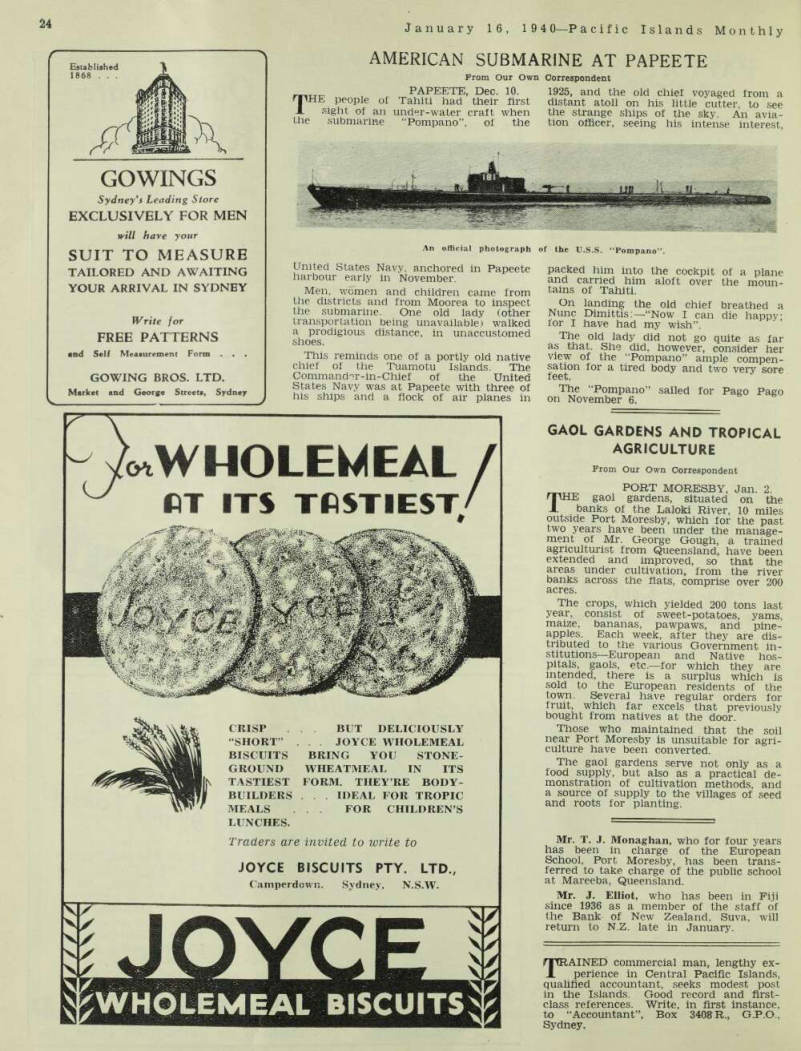
From Our Own Correspondent
Papeete, Dec. 10.
HE people of Tahiti had their first sight of an under-water craft when the submarine “Pompano”, of the
United States Navy, anchored in Papeete harbour early in November.
Men. women and children came from the districts and from Moorea to inspect the submarine. One old lady (other transportation being unavailable) walked a prodigious distance, in unaccustomed shoes.
This reminds one of a portly old native chief of the Tuamotu Islands. The of the United States Navy was at Papeete with three of his ships and a flock of air planes in
1925, and the old chief voyaged from a distant atoll on his little cutter, to see the strange ships of the sky. An avia tion officer, seeing his intense interest,
packed him into the cockpit of a plane and carried him aloft over the moun tains of Tahiti.
On landing the old chief breathed a Nunc Dimittis;—“Now I can die happy lor I have had my wish”.
The old lady did not go quite as far as that. She did, however, consider her view of the “Pompano” ample compen sation for a tired body and two very sore feet.
The “Pompano” sailed for Pago Pago on November 6.
An official photograph of the U.S.S. “Pompano”.
Agriculture
Gaol Gardens And Tropical
From Our Own Correspondent
T„„ Port Moresby, Jan. 2.
HE gaol gardens, situated on the banks of the Laloki River, 10 miles outside Port Moresby, which for the past two years have been under the manage ment of Mr. George Gough, a trained agriculturist from Queensland, have been extended and improved, so that the areas under cultivation, from the river banks across the flats, comprise over 200 acres.
The crops, which yielded 200 tons last year, consist of sweet-potatoes, yams, maize, bananas, pawpaws, and pine apples. Each week, after they are dis tributed to the various Government in stitutions—European and Native hos pitals, gaols, etc.—for which they are intended, there is a surplus which is sold to the European residents of the town. Several have regular orders for fruit, which far excels that previously bought from natives at the door.
Those who maintained that the soil near Port Moresby is unsuitable for agri culture have been converted.
The gaol gardens serve not only as a food supply, but also as a practical de monstration of cultivation methods, and a source of supply to the villages of seed and roots for planting.
Mr. T. J. Monaghan, who for four years has been in charge of the European School, Port Moresby, has been trans ferred to take charge of the public school at Mareeba, Queensland.
Mr. J. Elliot, who has been in Fiji since 1936 as a member of the staff of the Bank of New Zealand. Suva, will return to N.Z. late in January.
Advertisements & other items, p. 26 (1 item)
rAINED commercial man, lengthy ex-
rAINED commercial man, lengthy experience in Central Pacific Islands, qualified accountant, seeks modest post in the Islands. Good record and firstclass references. Write, in first instance, to “Accountant”, Box 3408 R., G.P.O.
Sydney.
Consecration Of
Bishop
Impressive Ceremony in Vila
Prom Our Own Correspondent
Vila, Dec. 14.
rE ceremony of consecrating Monseig neur Jules Halbert to the office of Bishop of Archelais, France, and Vicaire Apostolique of the New Hebrides, took place at the Vila Roman Catholic Church on Sunday morning, December 10. The Consecrating Bishop was Monseigneur Brasson, Bishop of New Caledonia.
By a special order of the Pope, Rev.
Father Juliard and Rev. Father Bathe acted as assistants to the newly-elected bishop, in place of the two assisting bishops demanded by the R.C. Liturgy.
This order was made on account of the isolated position of the New Hebrides.
After the usual formalities, the new bishop was robed by his assisting priests in the vestment of his new office. Then came the impressive ceremony of anointing, performed by the consecrating bishop, wearing his mitre and full epis copal robes.
In accordance with ancient church cus tom the newly anointed bishop, with his assistants, placed an offering of two candles, two tiny barrels of wine and two loaves of bread on the High Altar.
After the Benediction, the new bishop was presented with mitre, gloves and bishop’s staff, and led by the hand by the officiating bishop to his seat at his own faldstool, within the chancel. The chanting of the Te Deum and a reading from the Gospel of St. John brought the lengthy ceremony to a close.
The British and French Resident Com missioners, and most of the residents of Vila, of both nationalities, attended the ceremony. In an address, after the cere bony, Bishop Halbert stated that it was the aim of the church to work for the closer union of England and France, and to use its influence in every way to promote- world peace.
In the afternoon Bishop Halbert con ducted a service at the Mele Church.
The celebration ended with a fireworks display in the Vila church grounds in the evening.
Mr. Fred Rebell
rpHE Brache family, of the Channel X Islands, with Mr. Fred Rebell, as navigator, arrived in Sydney in the middle of December, from Fiji, in an old weatherbeaten yawl, named “Reine d’Arvor”, which had been their home for 21 years. The party had made a leisurely voyage across the Pacific from Panama, and had called at the Marquesas, Tahiti, Samoa and Suva. They were 39 days be tween Suva and Sydney.
The Brache family were at once ad mitted to Australia, where they propose to settle down, but, as Mr. Rebell had left Australia without any papers or pass port whatever, when he took his un orthodox departure from Sydney for Suva in a small boat a few years ago, he was not immediately admitted by the authorities. However, he was allowed to become an Australian again after spend ing several days in Sydney harbour, cooped up in the little boat. His recent book on his small boat voyage from Sydney across the Pacific has received an excellent press, and should be a finan cial success.
Advertisements & other items, p. 27 (2 items)
25
Pacific Islands Monthl y—J anuary 16, 1940
gftMUk
«st»i RoP ' cs
m <■>*
SNN
■5 v>v V* C \N^ Prepared SP«. l&i.Keo. (KUSa Ships carry nothing more precious to tropical settlements than their regular cargoes of Nestle’s Sweetened Condensed Milk. Nestle’s Sweetened Condensed Milk is the safest milk because it is the purest; because it can never sour or become contaminated while unopened; and because it is fully guaranteed to retain its original freshness and purity under any climatic conditions. To protect your health and the health of your family, use Nestle’s Sweetened Condensed Milk always.
COPYRIGHT 8226
NESTLES
f'MILR
Auckland
Nazi Club In
Some Connections With Samoa
WHEN, late in December, seven Germans were arrested in Auck land and sent to an internment camp, there was broken up a Nazi spy organisa tion which had been operating in the South Seas, with Auckland as head quarters, for a considerable time. The discovery of the organisation was the result of patient investigation.
All the arrested men were members of the Auckland German Club, and Kurt Wilhelm Schmidt, manager of the Pacific Potash Company, who was a leading member of the German Club, was also apparently prominent in the secret or ganisation. Most of the others were men well-known in Auckland business life.
Details are given by the Auckland correspondent of the Sydney “Sunday Telegraph” and he says that evidence has been discovered that Count von Luckner worked in close co-operation with this Pacific Nazi organisation when he visited Auckland a couple of years ago and that he supplied the Auckland Club with much information which he had gathered in the Islands, and left there a young radio expert whom he had brought with him from Germany.
The correspondent says; “During the past couple of years there was a notice able influx of young Samoan women, who settled down in Auckland homes notorious for their pro-Nazi activities. The local German Club took them under its wing, entertained them, and gave them a good time generally. Some of those young women from Samoa found jobs in Auck land; others returned to Samoa; but,
steadily, the Nazi Samoan Club in New Zealand grew in numbers, with head quarters in Auckland.”
The suggestion is that there was a good deal of communication between the active Nazis m Auckland and the young Euronesians of Samoa, who are half German and half Samoan.
The indications are that this organisa tion has now been completely broken up.
T°9 5 1U x l 1 significance should not be attached to the Samoan end of tfte organisation. The active Nazis in Samoa, while active enough, were very few in number, and there is very little Nazi sentiment among the Euronesian people.
Whatever there was, probably existed among young Euronesian women who formed attachments with Nazi Germans living in Auckland and elsewhere Gen erally speaking, the Samoan Euronesians are proud of their German blood, but they have never shown any liking for Nazism. 6 Mr. T. R. Pryor, accounts clerk in the office of the Chief Protector of Aborig ines at Brisbane, has been appointed Protector of Islanders at Thursday Is. and chairman of the Island Industries Board for Torres Strait, replacing Mr. C.
O’Leary, who will return to Brisbane Mr* Pryor was at Thursday Island as re cords and correspondence clerk in the Protector’s office from 1934 until the end of 1938. Mr. O’Leary, who first went to Torres Strait in 1922, has been at T.I. since September, 1936, when he was transferred from Brisbane to deal with some misunderstandings with the natives and his experience in Torres Strait na tive affairs did much to remove the local troubles at the time.
Launch
A Ship That Would Not Launch And a Bottle That Wouldn't Break
WHEN the Governor of Fiji (Sir Harry Luke) went to Walu Bay, near Suva in December, to formally launch the new Public Works boat “Degei” (915 feet long, 23 feet beam, 11 feet depth) there was a series of mishaps, “I name thee ‘Degei’ ”, said the Gover nor, and cut a ribbon which allowed a bottle of wine to crash against the new ship’s bow. The bottle crashed, but did not smash.
So the bottle was hauled up, and allowed again to swing against the bow Again it did not break.
Perspiring audibly, the harassed offi cials hoisted the bottle again, and huried it down; and this time it smashed satisfactorily, and the good wine ran to waste.
Then the ship was deemed ready to take the water. The cradle was released His Excellency waited quietly, and the ship moved slowly away.
But only a little way. Just when the new hull was about to enter its element the cradle jammed. Nothing more could be done until next tide. The Governor returned to Suva, with the “Degei” still named, but still unlaunched.
Next day, in the absence of officialdom, and in the most docile manner possible the “Degei” was launched.
Mr. W. Goodsir, managing director of the Fiji Kauri Timber and Land Co.
Ltd., returned to Suva in December after a visit to New Zealand.
Advertisements & other items, p. 28 (2 items)
26
January 16, 194 O—P acific Islands Monthly
A GRACE BROS’ catalogue
BRINGS THE BIGGEST STORE IN
AUSTRALIA TO YOUR DOOR
Let us put you on
lo all addresses on our list we send Free of Charge Six Catalogues a year, including two Sale Books, when prices of all goods, except Proprietary articles, are marked at attractive reductions.
WRITE TO GRACE BROS. FOR EVERYTHING.
From our huge selection of merchandise we are practically able to meet your every requirement.
Should you not see exactly what you need in any of our Catalogues write in Just the same. If not in stock we will do our utmost to procure it for you.
When next in Sydney, call and inspect our extensive range of attractive merchandise.
CATALOGUES POST FREE ANYWHERE!
GRACE BROS. Pty. Ltd.
Broadway SYDNEY 'Phone: M 6506
S 5 S 3 A m
Papua And Gold
Tax
Why Money Should Remain There
From Our Own Correspondent
Port Moresby, Dec. 20.
ISEE that New Guinea is objecting strongly to Australia commandeering the war-tax on gold (50 per cent, of the value in excess of £A9 per oz.).
Their objections should have some force owing to that condition of the Mandate whereby all moneys collected must be devoted exclusively to the ser vice of the territory.
In Papua, objections to the tax are being raised also, for Papua has been put to considerable expense over defence and other matters, especially since the outbreak of war, and urgently needs funds to meet the growing demands of a growing population. Administrative work has increased generally in the last two years not only with defence matters, but with the opening up of the interior, where oil companies are prospecting.
The amount involved in the tax in Papua will be approximately £15,000 per annum The Papuan Administration will not gladly hand over this, its only plum ripe for picking, after all these long years of struggle to make ends meet.
It is true that Australia pays Papua a yearly subsidy; but, if Papua had been allowed a proportion of the quota of the Imperial sugar supply (instead of Its be ing kept for Queensland and Fin), the country would have had a prosperous in dustry to depend upon now, besides gold and rubber, and very likely would have been self-supporting.
Australia always is saying how gener ous she has been to Papua; but when one looks into the matter it is found that she has made few really helpful gestures.
I think it would be a very high-handed action to take this gold tax from Papua.
Refund Of Tax
Bona-fide prospectors in Papua and New Guinea are now entitled to a re fund of the new Commonwealth Gold Tax which they may pay on the first 25 ounces of gold sent in by them in any one year. To get the refund, they should make formal application to the Deputy Federal Commissioner of Taxation, Bris bane.
Population Of Ontong Java
IT was stated in the last issue of the “Pacific Islands Monthly” that the Administration of the British Solomon Islands had declared the small group of Ontong Java a “closed area”, m order that the Polynesian population that has been established there might be protected against the European diseases which have decimated it.
In the last issue of the well-known anthropological journal “Oceania”, Dr. lan Hogbin says that in November, 1928, he published a compilation which showed that the population then of Ontong Java was 693, being 352 males and 341 females.
He says that in July, 1939, Mr. Geoffrey Kuper, N.M.P., after making a medical patrol in Ontong Java, reported that the population figures were males 308, females 280. total 588. This shows that the population has decreased by a little over 100 in eleven years, or a fall of over lb per cent.
another embezzlement
In Tonga
From • Our Own Correspondent
Nukualofa, Dec. 14.
SEMIS I KIOA, a promising young Tongan, who was postmaster and sub-treasurer in the Haapai Group for the past six years, was convicted of falsifica tion of Government accounts, and of abetment of forgery, and was sentenced to two years’ imprisonment, or three months’ imprisonment and £2l fine in November.
It came out in evidence that, in the last six months of 1937. Kioa employed a youth living with him, named Siale Abina, as caretaker of the post-office and wharf, at Haapai, at £3 per month. While Abina was doing the work, Kioa got a young woman named Misiba who also was living with him, to forge Abina’s signature on the voucher paysheets and to draw his wages. At the end of 1937 Abina left Kioa, and he got the girl Misiba to take Abina’s place, with him self doing most of her duties. Thus she was employed from January to October, 1938, and drew wages under Abina’s forged name.
For her part in the affair the girl was
convicted of forgeries, and was bound over for two years.
Kioa is the second young Tongan in the nublic service to have been convicted of dishonest dealing during the year. The other was Uliti Balu, who was involved in the Treasury affair several months back, when about £1.200 was found to be missing from the Government Savings Bank.
On Christmas Eve, at the Hotel Carl ton, Sydney, the chieftainess of the Pacific Islands Club, Mrs. Alfred Page (Lefagoalii) was presented by members of the Council with a breakfast set. Mrs.
I. H. Meredith, deputy chieftainess and a former resident in the Solomon Islands, made the presentation.
Advertisements & other items, p. 29 (2 items)
27
Pacific Islands Monthl y—J anuary 16, 1940
From 4/11 «> 10/11
WANTED TO PURCHASE
Used stamps of all Pacific Islands.
Highest prices paid. Regular consignments solicited. Remittances guaranteed by return mail.
J. H. SMYTH PTY. LTD.,
114 Castlereagh St., Sydney, Aust.
ATTACHE CASES
From 4/11 «> 10/11
Beatzall Attache Case No. 88. is a special export line. Made of glossy grained fibre, it has neatly rounded edges, metal bound lid and rolled brown metal body frame.
The corners are reinforced. Two snap locks, with keys. Metal handle.
The Beatzall Attache Case is light and serviceable. It is smart-looking • ■ long-wearing. Made in sizes from 12 to 20 inches, retailing from 4/11 to 10/ 1 1.
Ask for Beatzall 88.
BEATZALL ATTACHE CASES
Troders are invited to write for full particulars of all
TRAVEL and LEATHER GOODS.
FORD SHERINGTON, LTD.
MANUFACTURERS (WHOLESALE ONLY),
KIPPAX STREET - - - SYDNEY
Volunteers In New Guinea
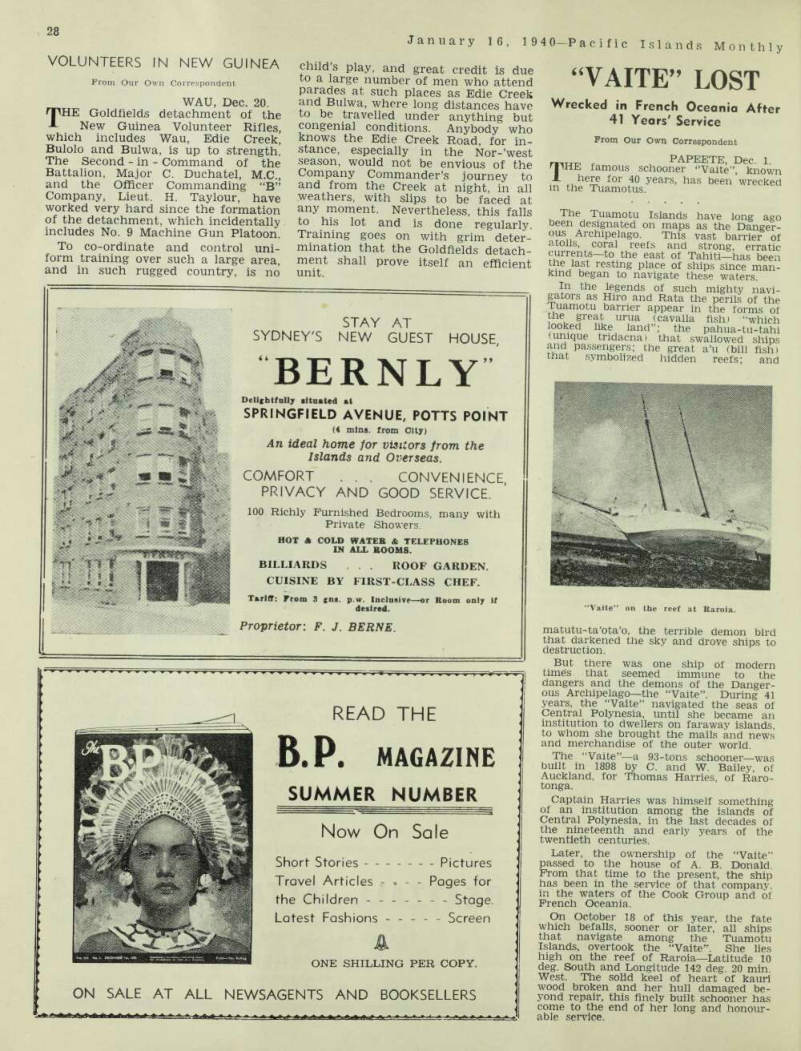
From Our Own Correspondent WAU, Dec. 20. fFHE Goldfields detachment of the New Guinea Volunteer Rifles, which includes Wau, Edie Creek, Bulolo and Bulwa, is up to strength.
The Second -in - Command of the Battalion, Major C. Duchatel, M.C., and the Officer Commanding “B”
Company, Lieut. H. Taylour, have worked very hard since the formation of the detachment, which incidentally includes No. 9 Machine Gun Platoon.
To co-ordinate and control uni form training over such a large area, and in such rugged country, is no
childs play, and great credit is due to a large number of men who attend parades at such places as Edie Creek and Bulwa, where long distances have to be travelled under anything but congenial conditions. Anybody who knows the Edie Creek Road, for in stance, especially in the Nor-’west season, would not be envious of the Company Commander’s journey to and from the Creek at night, in all weathers, with slips to be faced at any moment. Nevertheless, this falls to his lot and is done regularly.
Training goes on with grim deter mination that the Goldfields detach ment shall prove itself an efficient unit.
“Vaite” Lost
Wrecked in French Oceania After 41 Years' Service
Prom Our Own Correspondent
I,™ , Papeete, Dec. 1.
IHE famous schooner “Vaite”, known ' he £ e for 40 years > has been wrecked in the Tuamotus.
The Tuamotu Islands have long ago been designated on maps as the Danger ous Archipelago. This vast barrier of atolls, coral reefs and strong, erratic currents—to the east of Tahiti—has been the last resting place of ships since man kind began to navigate these waters.
In the legends of such mighty navi gators as Hiro and Rata the perils of the luamotu barrier appear in the forms of the great urua (cavalla fish) “which looked like land”; the pahua-tu-tahi (unique tridacna) that swallowed ships and passengers; the great a’u (bill fish) that symbolized hidden reefs; and
matutu-ta’ota’o, the terrible demon bird that darkened the sky and drove ships to destruction.
But there was one ship of modern times that seemed immune to the dangers and the demons of the Danger ous Archipelago—the “Vaite”. During 41 years, the “Vaite” navigated the seas of Central Polynesia, until she became an institution to dwellers on faraway islands to whom she brought the mails and news and merchandise of the outer world.
The “Vaite”—a 93-tons schooner—was built in 1898 by C. and W. Bailey, of Auckland, for Thomas Harries, of Raro tonga.
Captain Harries was himself something of an institution among the islands of Central Polynesia, in the last decades of the nineteenth and early years of the twentieth centuries.
Later, the ownership of the “Vaite” passed to the house of A. B. Donald From that time to the present, the ship has been in the service of that companv. in the waters of the Cook Group and of French Oceania.
On October 18 of this year, the fate which befalls, sooner or later, all ships that navigate among the Tuamotu Islands, overtook the “Vaite”. She lies high on the reef of Raroia—Latitude 10 deg. South and Longitude 142 deg. 20 min West. The solid keel of heart of kauri wood broken and her hull damaged be yond repair, this finely built schooner has come to the end of her long and honour able service.
“Vaite” on the reef at Raroia.
Advertisements & other items, p. 30 (1 item)
B.P. Magazine
MiS
mJ-A- -■ M * mm
STAY AT
SYDNEY'S NEW GUEST HOUSE,
BERNLY
Delightfully situated at
SPRINGFIELD AVENUE, POTTS POINT
(4 mins, from City) An ideal home for visitors from the Islands and Overseas.
COMFORT . . . CONVENIENCE,
PRIVACY AND GOOD SERVICE.
100 Richly Furnished Bedrooms, many with Private Showers.
HOT A COLD WATER & TELEPHONES
IN ALL BOOMS.
BILLIARDS . . . ROOF GARDEN.
CUISINE BY FIRST-CLASS CHEF.
Tariff: From 3 gns. p.w. Inclusive—or Room only if desired.
Proprietor : F. J. BERNE.
* U rrJTi m n i - • m
READ THE
B.P. MAGAZINE
SUMMER NUMBER
Now On Sale
Short Stories Pictures Travel Articles - * - - Pages for the Children --- Stage.
Latest Fashions --- Screen A
ONE SHILLING PER COPY.
ON SALE AT ALL NEWSAGENTS AND BOOKSELLERS
Mixed Dkiinking
Where the Colour Line Must be Drown
From Our Own Correspondent
Rabaul, Dec. 15.
A CASE came before the District Court here yesterday, which serves as a straw indicating the direction of the social wind in this Territory, and should be taken as a warning to the authorities.
An educated native, Georgeous Anno-Kassi, was charged with threatening behaviour towards a European with intent to provoke a breach of the peace.
The evidence for the prosecution showed that the defendant, after striking a European twice, had challenged another European to fight in a public street. A crowd had collected and consisted of half-castes, natives and Europeans; and, as one European witness stated in his evi dence, “it looked like a small riot”.
The incident occurred at a crowded intersection in Rabaul, and outside one of the hotels, where many of the crowd had been drinking.
The population of Rabaul is a mixed one, comprising Chinese, Malays, half castes, many thousand natives from many different districts, as well as a thousand Europeans. As a rule, the various nationalities sort themselves out when it comes to a matter of drinking their beer, whisky-and-soda, or what you will.
In some of the licensed houses, however, there are special parts set aside for the convenience of Asiatics.
This arrangement is satisfactory, pro viding that the colours do not inter mix—that the whites stay in their portion, and the browns stay in theirs.
The coloured customers almost in variably adhere to this rule. Un fortunately, however, from time to time whites of a low type do not give the same regard to the arrangement.
Consequently, upon such a breach, trouble invariably arises, as the drink goes in and the night grows older.
Such incidents tend to affect the whole social structure of the Terri tory. By the acts of a few thought less whites, disrespect is created in the minds of the Asiatics towards those who do not respect the barriers, and this, in time, is liable to spread, and include the whole race. Such fraternising between colours and classes lowers the prestige of the whites, in the eyes of both Asiatics and natives, and prestige in a coun try like this matters very much.
Unless some sterner measures are taken to enforce separate drinking— especially in Rabaul. with its mixed population—there is going to be trouble in the not-too-distant future.
Mr. W. M. Cochrane, formerly a re sident of New Guinea, arrived in Sydney in December from Shanghai, where he spent the last two years. According to him, conditions in China do not now encourage Europeans to remain there.
Coconut Soap
How To Make Good
WHEN I' visited a mission station re cently, I witnessed the making of “coconut soap”. I had not previously seen this particular method of soap making. Until I came to Misima I had not even heard of it, but friends state that it is also made in other parts of Papua.
First, the mission boys gathered ap proximately seventy nuts. Then, after the boys had husked and split them, the girls set about scraping them. After this was completed, the coconut was collected in a large bucket and placed in a double copra sack.
One end of the sack was securely tied to a rafter, in the roof, and to the other end the boys attached \ large stick. The bag. plus its contents, was twisted by two husky students, to squeeze out the milk.
which literally poured out into a bucket, held below by one of the girls.
Then the milk was carefully strained into a glass jar. The next move was to place it in miniature “vats” (kerosene tins cut in halves length ways) along with caustic soda and water. After it was stirred for an hour it became exactly like honey.
It was allowed to remain in the tins for three days and was then carefully cut into bars and stored away.
Seventy nuts make one dozen large bars of excellent washing soap.—E.L.
An American naturalist, Mr. W. H.
Weeks, of 508 Willoughby Avenue, Brook lyn, New York, U.S.A., is making a special study of the shells of land snails, and he asks that any persons in the Pacific Islands who may be interested in the same branch of study, and who may be prepared to send snail shells to him, should get into communication with him.
Advertisements & other items, pp. 31-32 (3 items)
29
Pacific Islands Monthl y—J anuary 16, 1940
Oswarrjjfev Ak'sorwar's
¥ & VS.
ORWa
iW.WA
OSWAR
ORWaR
;>;• Vi/ A;?.
0S WA:<•S OSWA >
OSWA R'S ORWAR’S OSWAR'S OS A;
;:•«WAR'S OS WAR'S OSWAR'S OSWA R
ORWAR'* WAR'S OS WAR'S DEWAR'S ORWA;
0» WAR'S OS WAR'S 0 SWA R •• DRW aRS 0S A OS WAR'S OSWAR S ORWaR'S OS vWSR'S OSWi OR W A£'R ;W : .WA R' S OS. W-- R'S &S #A RS OR SR OS w A R‘»S\mß,
OSWA ?«OE#A
ORWA* 03;# A
OSWA»OaPo
OSW;
okwa:
ORWAR'S 03i;W
WAR'S OS WAR'S OSWAR’S ORWA R S ; WWaR
SM h '
f* SV A.
rwXR". DRW
RSWaKS OSR
WAR'S OSWAR'S
WAR SOSWA R S
WAR'SOSWaR ORWAR'S
-;WA S' S ORWaR S OR WAR'S /V ;■■ v;A R'S OSWA R■ S ORWA R’S : 0 ;; v; A R'S DRW AR' SS'S W A R'S , ,7S WAR'S OSWAR'S OR WAR'S OS WAR'S , OSWA S OR WAR'S OS WAR'S OS WAR'S OR WAR'S OR WAR'S OSA'AfS S OSWAR’S a* a OS W A R' S o£W.a R‘ S OSW A R' S
OSWARRJjfev AK'SORWAR'S
ORtf OR WAR'S
SR'SOS WAR'S
A R’S OSWAR'S
ORWA R'S ORWAK'S
ORWA R'S ORWAK'S OS 'WAR'S
OS WAR'S OSWA R'S OS WAR'S
R'S OS WAR'S OSWAR'S OSWAR’S
UTaß's ORWAR'S OSWAR'S OSWAR s. orwar;s ORWAR'S R ■ OR WA R'S OS' W A R.' S- ; SW A R ;•; RW A R ;i'RWASS OR w A R ;> RWAR'S OS WAR'SOSWAS SORWSR S ORWAR'S OS WAR'S OSWAR'S OSWA R'S 0 S WA R S OS WAR’S OS WAR'S OSWAR'S DEWAR S ORWA ..
OSWAR'SOKWA.R S ORWAR’S OS WAR'S OS WA W;> W Arf ;
ORWAR'SORWAR'SOS.WAR'SO'WVAR^f|^V^^^V|:
OS WAR'S OSWAR'S OSWA
OSWAR/SOSWA/R'SOSWA
0 SW aR’S DEWARS ORWA R
0R W a R'£ ORWAR' S O R W A
OR'WAR'S OS WAR'S OS WAR
OS WAR'S OSWAR'S OSW
OSWAR'S OSWAR S ORW a
OR WAR'S OR WAR
WAR'S OSWA R'S
R'S ORWAR'S
WA R nt'V'LM*- DIRK'S OSWAR'S
A R'S OS WAR'S
A R'S O S W A R' S 0 SWA R'S OS WAR’S & A RW 0«# A. R'S OSW a R •: ORWA S' S ORWA R'S A\v A R S OSWA R '•••■ OR WAR'S ORWAR'S ORWAR'S vS->.v. S • S'S WAR'S OS WAR'S OS WAR'S OSWAR’S • j RS OS WAR'S OSWA R’S OSWA R'S OSW A R'S
ORWAK'S
A R'S
i V A OSWaWSOEWa# S ORWA R'S OS WAR SOS ••’•' A»* ORWAR'S ORWAR'S OS WA R'S OS W A; •:
OS WAR'S OSWAR
OSWAR S OSWAR
ARS OS WAR'S OSWA R’S
R’S ORWAR'S ORWAR'S
OS WAR'S ORWAR'S
OS WAR'S OSWAR'S
;S WAR’S OSWAR’S
v/A R • ;>;V wars o;V v va R'S OSWAR’S OSW aR> ORWaR'S ORWaRS ORWAR'S A'/v SR-AO-R RS WAR'S S>R WAR'S OSWAR'S OSWA R S OSWAR'S OSWA R S ORWaR'S ORWA K
OSWaS'SORWa'S^'SORWAK''SOS:war
”i»u.'A R'S WA R'S OS' WA yR'S OS WAR :>'./« war ;> w <■. w a.R -./fv w ORWAR'S 03/WAR'S OS WAR SOS WAR'S :/
0;i WAR'S OSWAiOS
OSWAR'KOSWAR’S
-A R' S O SWA R’S OSWAR’S DRW A RS
Modern Refrigeration for the South Sea Islands
The ELECTROLUX KEROSENE OPERATED
REFRIGERATOR
MARVEL
OF
MODERN
SCIENCE
m
THE
MIRACLE
OF
ICE
FROM
HEAT
ELECTROLUX offers economical, modern and completely efficient
REFRIGERATION FOR ISLANDS' HOMES.
FREEZES CONTINUOUSLY WHILE SMALL LAMP BURNS
Freezing controlled by simply regulating height of flame. Uses only f gallon of kerosene per week.
MOTORLESS ... NO PARTS TO GET OUT OF ORDER.
MODEL 111 MODEL L3BO MODEL LKSSO
Capacity ® (as illustrated) . Capacity 2.2 cubic feet.
Capacity 4 cubic feet. 5.5 cubic feet.
GUARANTEED FOR TWO YEARS.
Write to your Local Distributor for prices and full details.
Obtainable from W. R. Carpenter & Company Ltd.—Sydney, and following New Guinea Branches: Rabaul, Salamaua, Wau, Kavieng, Madang, and Wewak.
W. R. Carpenter & Coy. (Solomon Is.) Pty. Ltd. —Tulagi, British Solomon Islands.
On Chong & Company Pty. Ltd.—Butaritari, Gilbert and Ellice Islands.
Representation in Papua and New Hebrides.
30
January 16, 194 0-P acific Islands Monthly
Taupou's Grave
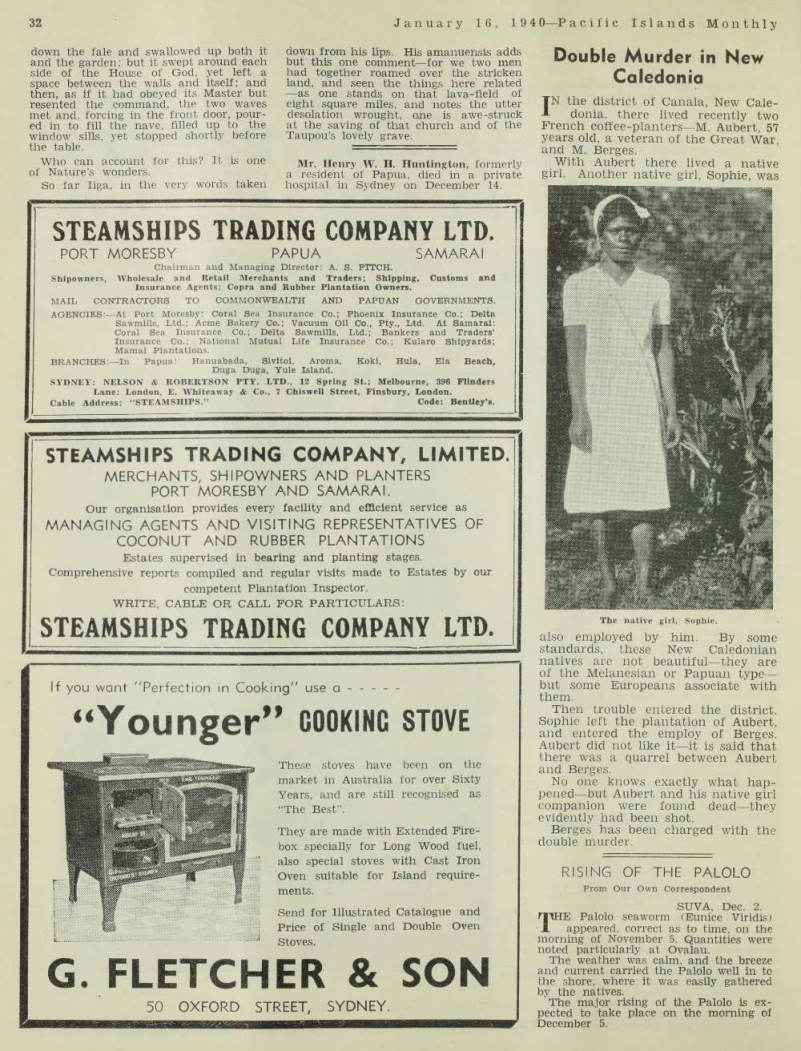
A Strange incident of the Samoan Eruption of 1905
As told by Chief liga to W.W.B.
SHE was the pride of the village of Saleaula, which lies along the northern coast of the island of Savaii.
She was the High Chief’s daughter, and beautiful.
When arrayed in all her finery, she stepped from her fale to lead in feast and gaiety, all men acclaimed her, and the women agreed that she did honour to her sex.
But sickness came, and she drew near to death. All made earnest prayer, day and night, that she might live; but it was not to be.
Then was there great grief in that village, for their Taupou lay dead. The young men mourned for her, whom they loved to serve, and her maids of honour refused to be comforted.
The grave was dug—not close to, but within sight of the church, for the High Chief would have his daughter lie against his fale, that he and his might tend the grave readily, as long as life should last.
Great was the sorrow that day in Sale aula, as the Village Virgin was laid away, and the earth hid from sight that form which all loved so well. They raised a tomb above it—the flat slab of coral rock all plastered over with lime, then, upon that they made what white men call a sarcophagus, as if Tulua lay there, robed in her winding sheet. That was in 1895. * * * rN times the seasons had come round, and all was peace in Saleaula. Yet, all unknown, a great and fearsome thing was close impending. Nature was at war with itself behind the village: up in the mountains and valleys of Savaii. This was no surface war, when fierce winds blow and the mighty sea rolls shore ward in tidal wave. Below and hidden from the sight of men went on that titanic struggle.
How long it had been fighting against itself, no man could tell; but. at last, the muffled roar reached the ears of the village, in tremblings and rumblings, which made all hearts quail. They great ly feared, yet went their daily round.
Then came the blow, so awful, so ap palling, which the villagers still speak of with bated breath.
Two miles back lay a deep ravine, which cut off the mountains beyond from Saleaula—a broad ravine, too, a labour to get down and up. Suddenly, as that memorable afternoon wore on, there was an unearthly noise, and the ravine came up, mountain to the sky. It was no longer a ravine, but a towering hill; and, from its summit, there poured forth flames and smoke, and over its awe some lip poured rivers of molten lava seawards.
And Saleaula lay directly in its path.
Slowly it came, not faster than half a mile a day, but it was relentless. There was ample time to get the people away.
But what of their homes? And which way would it take?
Men drew near and, though the fierce heat hurt them, they stood and watched, fascinated. Eight miles of land it spread across, and took down all that was in its path. The coconut trees fell one by one, sizzled in the flood, then lay still till utterly consumed. Streams of water hissed and fought till they could fight no more, then they too died.
Saleaula was now in real danger.
Slowing, the living, creeping thing came on, and gripped the back of it. The fales fell one by .one, toppling over as if loath to surrender. Graves so precious were wiped out. The taro patches disappeared. Saleaula was doomed.
But, no! The lava turned, and the western half was safe But the eastern?
Where Tulua lay, and the church raised its roof, and where the settlement was thickest—there was seemingly no hope for these.
The molten flood came slowly on, trees and fales falling, creeping towards the Taupou’s grave. Men and women stood afar off. and held their breath, as that hallowed spot was about to be wiped out and buried six feet deep.
Then some Hand Invisible stayed its direct course, some word seemed given forth to Nature in its madness. The flood stayed, as it reached the spot, and
swept around instead—then went for ward, wining all out, till it reached the sea.
There, to-day, lies the Taupou’s grave a m ir ac le of Nature, a thing incredible were it not true, and to be seen by all.
Let explain who can.
The natives, in their simple faith, af firm that God knew her purity and gen tleness, and saved her resting place, so that men might learn what He thinks 0 f such. There it is, and you stand on the black, forbidding lava and look down six feet into the circle; and there, ex actly in the centre, is the grave, a clear space all around where flowers grew and still do grow.
The church nearby also was saved. The lava flowed directly towards its east end, where the table of communion stood, Fifty yards back stood the pastor’s fale, and between home and church was a garden plot. The red-hot flood brought
down the fale and swallowed up both it and the garden; but it swept around each side of the House of God, yet left a space between the walls and itself; and then, as if it had obeyed its Master but resented the command, the two waves met and, forcing in the front door, pour ed in to fill the nave, filled up to the window sills, yet stopped shortly before the table.
Who can account for this? It is one of Nature’s wonders.
So far liga, in the very words taken
down from his lips. His amanuensis adds but this one comment —for we two men had together roamed over the stricken land, and seen the things here related —as one stands on that lava-field of eight square miles, and notes the utter desolation wrought, one is awe-struck at the saving of that church and of the Taupou’s lovely grave.
Mr. Henry W. H. Huntington, formerly a resident of Papua, died in a private hospital in Sydney on December 14.
Advertisements & other items, pp. 33-34 (2 items)
31
Pacific Islands Monthl y—J anuary 16, 1940
Ikctoria
BITTIR
r i Wmm i Ri
STEAMSHIPS TRADING COMPANY LTD.
PORT MORESBY PAPUA SAMARAI
Chairman and Managing Director: A. S. PITCH.
Shipowners, Wholesale and Retail Merchants and Traders; Shipping, Customs and Insurance Agents; Copra and Rubber Plantation Owners.
MAIL CONTRACTORS TO COMMONWEALTH AND PAPUAN GOVERNMENTS.
AGENCIES:—At Port Moresby; Coral Sea Insurance Co.; Phoenix Insurance Co.; Delta Sawmills, Ltd.; Acme Bakery Co.; Vacuum Oil Co., Pty., Ltd. At Samaral: Coral Sea Insurance Co.; Delta Sawmills, Ltd.; Bankers and Traders’
Insurance Co.; National Mutual Life Insurance Co.; Kularo Shipyards: Mamai Plantations.
BRANCHES: —In Papua: Hanuabada, Sivltol, Aroma, Koki, Hula, Ela Beach, Duga Duga, Yule Island.
SYDNEY: NELSON & ROBERTSON PTY. LTD., 12 Spring St.; Melbourne, 396 Flinders Lane: London, E. Whiteaway & Co., 7 Chiswell Street, Finsbury, London.
Cable Address: “STEAMSHIPS.” Code: Bentley’s.
STEAMSHIPS TRADING COMPANY, LIMITED.
MERCHANTS, SHIPOWNERS AND PLANTERS
PORT MORESBY AND SAMARAI.
Our organisation provides every facility and efficient service as
MANAGING AGENTS AND VISITING REPRESENTATIVES OF
COCONUT AND RUBBER PLANTATIONS
Estates supervised in bearing and planting stages.
Comprehensive reports compiled and regular visits made to Estates by our competent Plantation Inspector.
WRITE. CABLE OR CALL FOR PARTICULARS:
STEAMSHIPS TRADING COMPANY LTD.
If you want "Perfection in Cooking" use a
“Younger”
COOKING STOVE
■mt These stoves have been on the market in Australia for over Sixty Years, and are still recognised as “The Best”.
They are made with Extended Firebox specially for Long Wood fuel, also special stoves with Cast Iron Oven suitable for Island requirements.
Send for Illustrated Catalogue and Price of Single and Double Oven Stoves.
G. FLETCHER & SON
50 OXFORD STREET, SYDNEY.
Double Murder in New
Caledonia
IN the district of Canala, New Cale donia, there lived recently two French coffee-planters—M. Aubert, 57 years old, a veteran of the Great War, and M. Berges.
With Aubert there lived a native girl. Another native girl, Sophie, was
also employed by him. By some standards, these New Caledonian natives are not beautiful—they are of the Melanesian or Papuan type— but some Europeans associate with them.
Then trouble entered the district.
Sophie left the plantation of Aubert, and entered the employ of Berges.
Aubert did not like it—it is said that there was a quarrel between Aubert and Berges.
No one knows exactly what hap pened—but Aubert and his native girl companion were found dead—they evidently had been shot.
Berges has been charged with the double murder.
The native girl, Sophie.
Rising Of The Palolo
From Our Own Correspondent
Suva, Dec. 2.
11HE Palolo seaworm (Eunice Viridls) appeared, correct as to time, on the morning of November 5. Quantities were noted particularly at Ovalau.
The weather was calm, and the breeze and current carried the Palolo well in to the shore, where it was easily gathered by the natives.
The major rising of the Palolo is ex pected to take place on the morning of December 5.
Advertisements & other items, p. 34 (1 item)
32
January 16, 194 O—P acific Islands Monthly
Parasites For Pests
War on Rhinoceros Beetle
From Our Own Correspondent
Suva, Dec. 10.
THE Government entomologist, Mr.
H. W. Simmonds, F.R.E.S., 0.8. E., who has been for the past nine months on a scientific expedition in the East, has been successful in his search for a parasite to exterminate the rhinoceros beetle and the house fly.
In Madagascar, he secured a para site to destroy the rhinoceros beetle.
It is a large wasp, and he has estab lished two colonies of them in Western Samoa.
For the house-fly, Mr. Simmonds secured in Java a beetle which preys upon the house-fly in its early stages.
Mr Simmonds carried out extensive research in Java, Malaya, Mauritius and Madagascar, in his efforts to find these parasites, and it is hoped that they will establish themselves in these groups.
The rhinoceros beetle has been a most destructive and costly pest, and has wrought havoc among the copra plantations in Samoa for many years; while the common house-fly, besides being very troublesome in the Tropics, is a source of infection amongst the natives.
It is fortunate for Fiji that the rhinoceros beetle has never found its way into the Colony. With the large number of small and scattered islands in the group, it would be a colossal
task to deal with such a pest. In Samoa, the beetle is confined to the large islands of Upolo and Savaii, where the job of supervising the anti beetle campaign has been a much simpler matter.
Some 17 years ago the beetle was introduced into Keppel Island (Niua tobutabu), of the Tongan group, evidently in the days when the late Captain Allen, of Samoa, was trading there in the “Dawn”. The Tongan Government took prompt steps to deal with the pest, by imposing rigorous restrictions on the export of anything from the island to other islands in the Tongan group, and copra from Keppel Island had to be exported direct overseas and not brought to one of the main Tongan ports for shipment.
At the same time, the Government sent to Keppel Mr. M. Muller (now Superintendent of Agriculture in Tonga), and gave him very consider able authority to deal with the beetle.
Mr. Muller instituted a regular clean up of the island, with constant search parties for the grubs of the beetle, and was so successful in his task that by 1933 the island was found to be absolutely free of the beetle, and was declared clean again.
One noticeable result of the cleaning of the island was the practical dis appearance of house-flies, which had previously been a great pest.
Another island which was unfor tunate enough to get the beetle in troduced (again, apparently, from Samoa), is Wallis Island, a French colony. At one time, this island did
a considerable trade with Levuka, and the late Captain Christian Kaad in stituted a regular six-weekly service from Sydney to Suva, Levuka, Rotuma, Wallis, and Futuna —first by the steamer “South Australia”, which was wrecked at Futuna, and later by the steamer “Providence A”.
The service was continued by Burns, Philp for many years after they bought out Captain Kaad’s in terests, and was terminated only when the introduction of the beetle made trading with Fiji impossible, owing to Government restrictions.
Cause of P. Moresby Copra Fire
Welder Sparks
From Our Own Correspondent
Port Moresby. Dec. 14.
SITTING as Coroner, Mr. W. R.
Humphries, R.M., inquired into the cause of the fire which, on November 10, destroyed the Burns, Philp copra shed and copra at Port Moresby; and found: “That the fire was caused by sparks from an oxy-acetylene torch falling, ac cidentally, on to a stack of copra in the copra store.”
The torch was being used to cut through some of the steel purlins, in order to fit a ventilator to the roof of the shed. Despite precautions, sparks fell on unprotected bags of copra and ignited them.
The Coroner paid warm tribute to the efforts of volunteers, both European and native, who fought the fire at consider able risk to themselves, and many of whom sustained burns in preventing the flames from spreading to adjoining build ings.
Mr. Robert Rudland Bode, only son of Mrs. and the late Mr. R. R. Bode, for merly of Hawaii and now of Suva, Fiji, recently married Miss Jean Macindoe at Holy Trinity Pro-Cathedral, Suva.
Advertisements & other items, pp. 35-36 (2 items)
33
Pacific Islands Monthl y—J anuary 16, 1940
o/ f/te niqhi'!
y ---
soo
I
CANDLE
POWER
300 N 0.500
BRIGHTER LIGHT
for
BETTER SIGHT
Coleman Products can be obtained from all Leading Firms throughout the Pacific Islands.
Instant Lighting
Stoves & Irons giving maximum of heat in minimum of time.
EASE OF OPERATION
combines
ECONOMY with COMFORT
In case of difficulty In obtaining supplies write to: — Pearce & Co., Suva, Fiji Is.
Kork-N-Seal
FOR HOME USE
Hand Applied Airtight Pressure Proof
FOR ALL HOME BOTTLING
—THE LITTLE CAP THAT
will Re-seal 1,000 Times
KORK-N-SEAL (Aust.) LTD.
10C COMMONWEALTH STREET,
SYDNEY, AUSTRALIA.
' f Australia's Choicest Products Green Peas French Beans Cauliflower Beetroot Spinach Cabbage Carrots Parsnips Celery Brussels Sprouts White Turnips Sweet Corn Tomato Puree Tomato Sauce Tomato Soup Tutti Fruit Sauce (Worcestershire Davor) I* m m
VII
Always . . . make sure you have at hand an ample Reserve of these Delicious . .
Garden
Vale
Ready-toserve Vegetables
Hue Fafaru!
The Dreadful Experience of a Sensitive Man in Tahiti
By A. C. Rowland
Eden had its serpent; the Garden of the Hesperides its dragon. The fly m the ointment of Tahiti’s romantic perfection is the hue fafaru.
The hue fafaru is an innocent-looking gourd, in which fish are steeped in sea water for several hours to prepare them for ingestion without the intervention of cookery.
The porous texture of the gourd ab sorbs the essences of these elements, and time and heat from the tropical sun so matures and mellows them that they be stow lavishly their virtues upon subse quent charges. The more these virtues have ripened and expanded, the more they delight the palates of connoisseurs.
Hence, an ageing hue fafaru gathers merit with the passage of time, and eventually becomes priceless. The frag rance of well matured Limberger or mossy Roquefort is as a gentle zephyr compared with the robust authority of a venerable hue fafaru.
Places where hue fafaru abound are un inhabitable except by individuals born there, who have grown up to regard such an atmosphere as normal.
We have an acquaintance, a Euro pean, who hates hue fafaru and all its works with fanatical fury. He is married to a wife possessed of a hue fafaru that
is an heirloom from her remote ancestors Their house faces the east, whence blow the prevailing winds and, being a wo man of great wisdom, she keeps the gourd in a distant outhouse well to the leeward of their main dwelling.
But one unlucky day, when the wife was on a visit with her relatives, the kitchen maid hung the hue fafaru tem porarily on a bush, adjacent to the win dows of the main bedroom and, after the custom of kitchen maids, forgot all about it.
At 12 o’clock, after the midday meal, the master of the house retired for a rest. During his slumbers the east wind died down and there ensued a dead calm.
The fervent rays of the noonday sun beating on that ancient gourd, drew forth all its latent worthiness into the fullest blossom.
The sleeper-after dreaming that he had been kidnapped by bandits and chamed to a pillar in a fish-glue fac tory-awoke to find himself in an ad vanced state of asphyxiation.
The instinct of self-preservation hurled his body automatically into the outer air, to a place where he could recover his breath. His first act, when he had re freshed his strength was to get a pick axe and spade; carry them to a field well to the westward, and there dig a hole measuring 3 ft. east and west and 6 ft perpendicular. Then taking the family rou (a long pole with a forked end, used to gather bread fruit from high branches) he stalked that gourd and. keeping well to windward, hurled it into the hole he had dug, tramping carefully the earth over it so that no evidence should rise to the surface which would enable his wife to locate and retrieve it.
Then, in fear and trembling, he await ed the tempest. It came, and the neigh bourhood shook with its fury. But, by some miracle, the winds and lightnings passed over his head. He was not even suspected. The theft was laid to some envious neighbour who had long coveted that priceless antique.
Slaves of the Gourd have solemnly as sured us that fish prepared in the hue fafaru carry no memories of that abiding place to the table, except a flavour deli cious beyond all description. We have been urged to try this gustatory delight.
But we have refrained.
The Useful Teleradio
LIFE in the islands of New Guinea has changed considerably since the in troduction of Teleradio by Amalgamated Wireless, said Mr. W. M. Middleton, owner of Kulili Plantation, on Kar Kar Island, in the Madang district of New Guinea, when he arrived in Sydney recently.
There are now between 8,000 and 9 000 natives, and 10 whites, on Kar Kar. For merly, the normal means of communi cation with Madang was by launch, the mails from Madang to Australia closing every three weeks. Now, by means of Teleradio, settlers can, at any time, com municate with Madang, and thus with Australia and the outside world. In case of sickness, Teleradio is used as a means of obtaining medical advice from the doc tor at Madang.
Mr. A. V. Murphy, of Burns Philp and Co. Ltd., Faisi, returned to the Solomon Islands by the last “Malaita”, after spending leave in Australia.
Mr. G. B. Gallagher, of the Gilbert and Ellice Islands Colony Service, recently was appointed to act as Officer in Charge of the Phoenix Islands settlement scheme.
Advertisements & other items, p. 36 (1 item)
34
January 16, 194 O—P acific Islands Monthly
Hong Kong
Fiji Governor's
New Ship
"Viti" Launched in Hong Kong
From Our Own Correspondent
Suva, Dec. 10.
THE R.C.S. “Viti” was launched in Hong Kong on November 21, and was formally christened by Lady Northcote, wife of the Governor of Hong Kong.
The R.C.S. “Viti” has been built as a Government despatch-boat for Fiji and the Western Pacific High Com mission.
Earlier Government vessels were the “Clyde”, “Ranadi”, and “Pioneer”.
Since the last vessel was condemned, three years ago, the Colony has managed to get along without a Government steamer—and in some quarters it was felt that it might continue to do so. The “Ranadi” and “Pioneer” were costly toys, and oi little use, as far as the general public was concerned. The building of the new vessel means a capital outlay of some £40,000 and an estimated annual cost of £9,163 for running expenses.
The “Viti” will be the third Hong Kong-built vessel running in Fiji, the others being Burns, Philp’s motor vessels “Yanawai” and “Matafele”.
Editorial Note
The complaints of Fiji taxpayers about the cost of building and running a despatch-boat, for the use of the Governor, are nothing new— they are heard in every Pacific terri tory where the Administrator has a yacht for his own use.
There has been howling in New Guinea, on this subject, during the past year or two. Taxpayers cannot see why the chief official should not travel around like ordinary people.
Chief officials, for their part, com plain of the waste of time and general inconvenience which ordinary travel imposes.
The main trouble is the cost of up keep—especially the fact that a crew has to be kept standing by, idle half its time. In Papua, the Lieut.- Governor gets over part of that cost by using his Official Secretary (Hon.
H. L. Murray), who has the necessary certificate, as master of the “Laura bada”. Servants are taken aboard as required—the only man permanently aboard is the engineer. In New Guinea, the Administrator has acted recently as his own master.
It is a matter for wonder that Administrators of Islands territories do not each maintain a seaplane for this work—it would be much speedier and much cheaper.
Rev. C. L. Welch, of Nauru, who is at present in Australia on furlough, was the guest of honour at the December meeting of the Queensland London Missionary Society’s auxiliary.
Mr, S. V. Bayley, of the New Guinea Health Department, arrived in Sydney in mid-December from Rabaul.
More Teeth For Uncle
Sam Big Guns at Pago Pago
From Our Own Correspondent
Honolulu, Dec. 2.
PUTTING more “teeth” in the new American far-flung Pacific defence scheme, the U.S. Navy shipped three 8-inch coastal guns and mountings to the navy base at Pago Pago, American Samoa, by the liner “Mon terey”, which left Honolulu November 14.
They were placed aboard in Cali fornia. During this year the Navy has built up fuel oil and ammunition supplies at Pago Pago, too.
It will be recalled that America mounted guns at the entrance to Pago Pago harbour, in which the Navy Station is situated, during the World War, and manned them in a 24-hour watch basis.
Two German ships—the “State- Secretary Solf”, 350 tons, and the “Elsass”, 15,000 tons-sought refuge
in Pago Pago during the war and, upon America’s entry in April, 1917, they were seized and taken over by the Navy. It was found then that the German crew had damaged en gine room fittings, etc., in the “Elsass”.
Also, secreted in Pago Pago drains, the Navy found a large sum of Ger man marks hidden by certain Ger mans then resident there. They had been instructed by a German agent who visited Pago Pago in an Ameri can liner.
Pago Pago, long an isolated outpost of the Navy, now is being used more and more by patrols. Several sub marines have visited there this year.
The new submarine “Swordfish” left here on November 26 on a visit.
There will be more activity in the Samoa area when the U.S. Pacific fleet holds its major war games early in 1940.
Mrs. S. Veitch and her three-years-old son Dennis, returned to Wau, New Guinea, recently after a holiday in Syd ney- Mr. Veitch is a member of the staff of Bulolo Gold Dredging Ltd.
Rev, H. S. Hipkin arrived in Sydney by the last “Malaita” from Taroaniara.
Gela, Solomon Islands, where he has been engaged in work for the Melanesian Mis sion. He departed for England in Decem ber by the “Strathallan”.
Mr. W. Clapham, accountant at the Suva branch of the Bank of New Zea land, will return to New Zealand at the end of January, having completed his term of service in Fiji.
Advertisements & other items, pp. 37-38 (1 item)
Qmotts
PURE RICE
STARCH
Always ask for it
CORAL BRAND
100% PURE
£
CORAL BRAND
RICE STARCH
coV*L Noted (or its
QUALITY
and
WHITENESS.
Goes Farthest and gives Lasting Finish
WILL NOT
STICK TO
IRON.
Obtainable from Leading Island Stores.
Manufactured by
AUSTRALIAN RICE, LTD.
Sydney, N.S.W.
OFTEN BUTTERED
NEVER BETTERED
C-i RISP, LIGHT BISCUITS which
bring out the flavour -of cheese and add a new attractiveness to fresh or stewed fruit.
A delicious supplement to ham or paste or other tasty savoury, and still an epicurean delight, served simply with fresh butter.
The rich excellence of these famous Biscuits is the result of 67 years of specialisation.
They are packed in air-tight tins or packets for picnic convenience.
Qmotts
famous
SAO BISCUITS
A 26 ALWAYS ASK YOUR GROCER FOR ARNOTT S ?
A. B. DONALD LTD.
AUCKLAND
ISLAND TRADERS : GENERAL MERCHANTS
PO. Box 1509. Cables and Telegrams: "Kingdom”, Auckland.
" Branches at Rarotonga and throughout the Cook Islands At Papeete and throughout the Society, Marquesas and Paumotu Islands,
trading as "ETABLISSEMENTS DONALD, TAHITI"
At Fiji; Trading as "Dominion Fruit Co.", Suva.
Your Tropical Rit
When you visit the Pacific Islands, whether on Business or Pleasure, you need Special Equipment—Light Suits of Correct Style, which fit well and launder easily; Tunic Shirts, Silk Shirts, Light Underwear, White Shoes, etc.
WALTER HORNE & CO., LTD., established in 1885, specialise in this Service. Skilled Tailors make your Suits from First-class material within 24 hours. Complete equipment can be supplied from our Large Stock at Reasonable, Moderate Prices.
BUY FROM THE FIRM WHICH UNDERSTANDS YOUR NEEDS AND
DRESSES YOU CORRECTLY.
WALTER HORNE & CO. LTD. carry a Full Range of Drapery of all kinds; also Frocks, Millinery, Foundations and Lingerie, Hosiery, Shoes and Sandals, Ribbons and Laces, Household Drapery.
Ladies' Hairdressing and Manicuring
Men resident in any of the Pacific Territories can be supplied with Suitable Clothes.
Write to us and Describe your Requirements.
WALTER HORNE & CO. LTD.
Drapers and Men's Wear Specialists.
SUVA, FIJI.
Labourer
Lay Of The Lazy
(Mr. F. P. Archer, of Buka Passage, New Guinea, who kindly supplies this remarkable example of Pidgin verse, says he thinks it was written by an ex-Civii Servant in Rabaul It was published in the “Rabaul Times’’ about ten years ago.) First Egg You savvy! me boy belong Buka.
Me come make ’im paper before ’Long one fella masta—’e kus kus— E work along one fella store Me laze now ’long this fella somet’ing: Work e big fella, skin ’e too hot: Tune ’e finish, me make ’im new paper' Me make ’im new paper! No Got!
Chorus
(In which Marys and Monkeys may join) Me no more like work ’long masta, Alla-time masta cross ’long me; Me make ’im new paper! What name now!
Ha, Ha, Ha! Ho, Ho, Ho! He. He, He!
Second Egg Me fella me no catch ’im money Two shillin’ that’s all ’long han’- (Four fella ’e stop ’long paper) Now ’e no enough ’long man!
Me fella no lik lik monkey Me no Mary too all-a-same; Sikis shillin’! Ugh, ’e somet’ing not’ing!
Me must run away, me got shame.
Chorus
(Dead silence from Marys and Monkeys) Me no more like work ’long masta, Sikis mark not enough ’long me- Me make ’im new paper! What name now!
Ha, Ha, Ha! Ho, Ho, Ho! He, He, He!
Third Egg Me like kai kai all-a-same masta, ’E good fella kai kai me fink; Me like drink ’im whisky now beer, Two fella ’e good fella drink.
S’pose Kiap ’e talk ’e no tambu, Now s’pose me can drink all-a-same, Time ’e finish me make ’im new paper!
Me make ’im new paper! Now what name!
Chorus
(In which Marys and Monkeys MUST join) Me like make ’im work ’long masta, S’pose drink ’e no tambu long me: Me make ’im new paper! What name now!
Ha, Ha, Ha! Ho, Ho, Ho! He, He, He!
New Japanese Base
Prom Our Own Correspondent
Honolulu. Dec. 12.
ALTHOUGH Japan and Russia have been planning a friendly pact, Japan is making another move against the in vasion of the Japan mainland from the direction of Siberia.
The Japanese navy has started work upon the construction of a new base in Wakasa Bay, 460 miles from Vladivostok, in the direct south-east line of flight to the great Japanese industrial areas about Osaka and Kobe.
The base will have full defence facili ties, docks for construction and repairs, hospitals, arsenals and barracks.
Other Japanese naval bases are located at Yokosuka, Kure Island: Sasebo and Tsushima.
Trials of Military Instructors
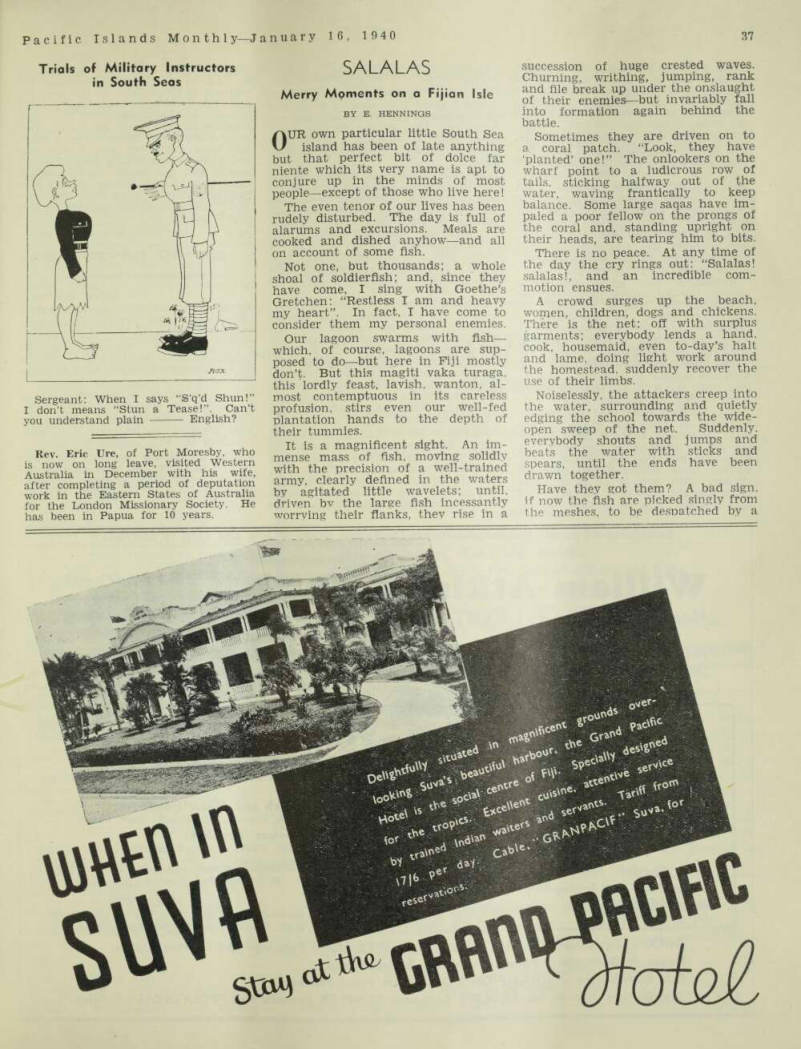
in South Seas
Rev. Eric Ure, of Port Moresby, who is now on long leave, visited Western Australia in December with his wife, after completing a period of deputation work in the Eastern States of Australia for the London Missionary Society. He has been in Papua for 10 years.
Sergeant: When I says “S’q’d Shun!”
I don’t means “Stun a Tease!”. Can’t you understand plain-English?
Salalas
Merry Moments on a Fijian Isle
By E. Hennings
OUR own particular little South Sea island has been of late anything but that perfect bit of dolce far niente which its very name is apt to conjure up in the minds of most people— except of those who live here!
The even tenor of our lives has been rudely disturbed. The day is full of alarums and excursions. Meals are cooked and dished anyhow—and all on account of some fish.
Not one, but thousands; a whole shoal of soldierfish; and, since they have come, I sing with Goethe’s Gretchen: “Restless I am and heavy my heart”. In fact, I have come to consider them my personal enemies.
Our lagoon swarms with fish— which, of course, lagoons are sup posed to do—but here in Fiji mostly don’t. But this magiti vaka turaga, this lordly feast, lavish, wanton, al most contemptuous in its careless profusion, stirs even our well-fed plantation hands to the depth of their tummies.
It is a magnificent sight. An im mense mass of fish, moving solidly with the precision of a well-trained army, clearly defined in the waters by agitated little wavelets; until, driven bv the large fish incessantly worrying their flanks, they rise in a
succession of huge crested waves.
Churning, writhing, jumping, rank and file break up under the onslaught of their enemies—but invariably fall into formation again behind the battle.
Sometimes they are driven on to a coral patch. “Look, they have ‘planted’ one!” The onlookers on the wharf point to a ludicrous row of tails, sticking halfway out of the water, waving frantically to keep balance. Some large saqas have im paled a poor fellow on the prongs of the coral and. standing upright on their heads, are tearing him to bits.
There is no peace. At any time of the day the cry rings out: “Salalas! salalas!, and an incredible com motion ensues.
A crowd surges up the beach, women, children, dogs and chickens.
There is the net: off with surplus garments; everybody lends a hand, cook, housemaid, even to-day’s halt and lame, doing light work around the homestead, suddenly recover the use of their limbs.
Noiselessly, the attackers creep into the water, surrounding and quietly edging the school towards the wide open sweep of the net. Suddenly, everybody shouts and jumps and beats the water with sticks and spears, until the ends have been drawn together.
Have they got them? A bad sign, if now the fish are picked singly from the meshes, to be despatched by a
quick bite in the neck; for a good catch is mostly dragged bodily up in the net to a dry spot. Our biggest one, so far, was 600 in one closing, though we are content with sufficient for a day’s rations.
The single fish weigh up to 3 lb., and are rather coarse and dry; but they are a welcome change for the men, from the usual beef or pork.
WATCHING the manoeuvre from the top of the wharf, it seems such a puny attempt, compared with the size of the school. Only stragglers, or a detached flank, get into the net, for to meet the full force of this compact mass of fish would be posi tively dangerous, I think.
Ridiculous too, when, all going strong, the net closes just after the rearguard has slipped through the last open space. To manipulate a net, 6 feet by 54 feet, with lead weights along the bottom, requires strength, skill and co-operation.
The wrathful women mostly deal with the matter on the spot. Squat ting right down in the shallow water, they volubly discuss the failure.* Once it happened that the salalas behaved in quite an extraordinary way, practically turning right before the net on their—well, not heels, but tails—for no apparent reason. The women came ashore in an ominous silence: with nobody at fault, their next thought was that someone had cast a spell. And so it was. but not
the kind they thought. For a lady of riper age and corresponding pro portions lifted an accusing finger:— “Do I know that spell? Of course!
One of you is with child, and has not told, and the salalas turned away their eyes in shame!” And, true enough, one dropped her head in con fusion.
Another time, the women netted, not the salalas, but a section of the pursuing saqas. Now a 40-50 lb. saqa can’t be held long by a net, so each woman just grabbed a huge fellow, net and all. Clasping them tightly to their bosoms, they sat down in the water with the struggling fish, yell ing desperately: “A man! A man with a spear!” In the end, the worst sufferer was our net.
Downright comic, too, is the exas peration of the crowd on a Sunday morning, when our salalas generally stage a really first-rate performance, and we may not go after them. Such clacking of tongues, such slapping of posteriors, and loud regrets that none is of the “Lotu ai ka vitu” (Seventh Day Adventists), whose Sunday is on Saturday. “Oi au-eee! what a haul they could make!”
Just now, all is quiet on the lagoon front. Our enemies have retired to their winter quarters, a peace reigns once more. According to Fijian fish lore, the salalas disappear during the cool season; and, true enough, except for an occasional disturbance- in the
water, a glimpse of the silvery bodies we have not seen. Perhaps it’s warmer at the bottom of the sea. We are not eager, either, to gambol around in the water, with the wind blowing so cold from the South. Our little war, waged fairly on both sides has been great fun and I think we really owe the salalas a debt of grati tude. The hot season is an anxious time but, thanks to the salalas, one can forget for a while that there are such things as Hitler, hurricanes and copra prices.
Advertisements & other items, p. 39 (2 items)
37
Pacific Islands Monthl y—J anuary 16, 1940
)l
$0-
Gift To Fiji Defence
From Our Own Correspondent
Suva, Dec. 10.
HPHE Governor has received advice A from Sir Philip Goldfinch, General Manager of the Colonial Sugar Refining Co., Ltd., that the Company had decided to contribute £2,500 towards the cost of defence in Fiji.
Later, Mr. H. King-Irving (local manager of the C.S.R. Co., Ltd.), handed His Excellency a cheque for this amount, to be used for equip ment of the Fiji Defence Force.
His Excellency suitably acknow ledged the gift, and later advised the Secretary of State of the Company’s “gratifying and generous gift of £2,500”.
Advertisements & other items, p. 40 (1 item)
William Atkins Pty. Ltd.
Established 60 years—and carrying one of the largest stocks of Iron and Steel in Australia.
Head Office 449-451 KENT ST., SYDNEY.
FULL, COMPREHENSIVE Gr UP-TO-DATE RANGE IN ALL
DEPARTMENTS, INCLUDING THE FOLLOWING LINES:—
STEEL DEPARTMENT-
MILD STEEL:
Rounds, Squares, Flats, Half-rounds, Hexagons, Bevel, Shoeing, Tyre, Angles, Tees, Sheets, Plates, Girder Plates, Chequer Plates, Channels, Hoops, Etc.
BRIGHT STEEL:
Rounds, Squares, Herogons.
Iron & Steel Merchants
ENGINEERS' SUPPLIES
COACH & MOTOR HARDWARE.
Cable Address: WILATKIN, SYDNEY.
Engineers' Supplies: Set Screws, Studs, Metal Thread Screws, Coach Screws, Files, Cotter Pins, Bright and Black Bolts, Rivets, Etc., Hack Saw Blades.
Power Transmission Gear: Including Plummer Blocks, Couplings, Collars, Etc.
Coach and Motor Hardware: Axles, Springs, Wheelstufl, Duck, Paints.
Farriers' Supplies: Horse Nails, Anvils, Vices, Etc.
Extra Special High Speed Tool Steel, Mining Steel, Blister Steel and Spring Steel, Rounds, Flats Gr Squares.
Bar Iron— All sections and sizes.
Motor-Trimmers and Motor Builders' & Motor Painters' Requirements
C. A. WILLEY'S
Quick-Drying Coach and Car Paints, Roughstuff, Elastic Gloss, Synflex Enamels, Lacquers DUCO Lacquers and DULUX Enamels—FAßßEX Motor Toppings and Leather Cloths, House fir Decorators' Paints, Varnishes & Brushware Sole Distributors of CHAMPION'S Decorators Paint Products.
Distributing Agents for BROLITE Lacquers, SYNFLEX Enamels and "POLYGLOSS" Finish.
Fatal Rocket
Cook Is. Tragedy of 40 Years Ago
From Our Own Correspondent
Rarotonga, Dec. 10.
AS far as I know, the first resident doctor to practise at Rarotonga was a Dr. Caldwell, a Seventh Day Adventist, who came accidentally to the Cook Is lands. He was passing on a brig, the “Pitcairn”, belong to the S.D.A., which called at Rarotonga in 1889. A depu tation of Europeans asked Dr. Caldwell and family to remain in Rarotonga; and he settled ashore, built himself a house, and practised for a number of years, re lieving many and generally doing good work.
When Dr. Caldwell left Rarotonga, Dr.
George Craig was appointed Medical Officer by Colonel W. E. Gudgeon, and was later joined by his younger brother, Dr. William Craig. At the outbreak of the Boer War, the two Craigs, popular men, left for service in Africa.
Upon the termination of the war, the Craigs returned to Rarotonga on the S.S. “Ovarau”, arriving off Avarua on February 19, 1900. As soon as the Craigs’ friends ashore heard that the two doc tors were aboard, they decided to give them a warm welcome.
Mr. F. Goodwin, of the trading firm of Gocdwin and De Lisle (later to be come J. Kohn & Co.; and to-day a branch store of The C.I.T. Co., Ltd.) undertook to Are rockets of welcome .from the Avarua wharf. These rockets probably belonged to the ketch “Janet Niccol”, owned by the firm of G. & De L.
So down the wharf went Fred Goodwin with the rockets, followed by a crowd to see the fun—for, although it was day light, they meant to have their fire works display.
Goodwin drilled a hole in the wharf timber to accommodate the rocket stem —a hole that, unfortunately, proved to be too shallow, and inadequate for its purpose. He then fitted and ignited the rocket.
Owing either to vibration on the wharf, or a puff of wind, the rocket suddenly canted round towards the spectators, and went off with terrific force. It struck poor Goodwin full in the face, and those standing near him were splashed with his blood, which gushed from his head.
Mr. E. J. Mathews, then manager of Messrs. A. B. Donald, Ltd., who was standing close to Goodwin, had a very narrow escape.
The brothers Craig were immediately sent for, and came ashore, but the wel come had turned to tragedy—Goodwin died within half an hour of the accident.
Anyone knowing the whereabouts of Mr. or Mrs. E. Riddell, who were residents for many years in Western Samoa, are requested to communicate as soon as possible with Mr. P. W. Glover, executor of the estate of the late T. Andrew, Apia, Samoa. Mr. Glover has asked the “P.1.M.” to try to locate Mrs. Riddell, in connection with a legacy left by Mr.
Andrew.
Mr. J. Stinson recently won the Suva Bowling Club’s Singles Championship.
The Fairs Championship was won Jay Messrs. G. B. Hoddinott and C. W. Aid ney.
Papua
Mission-Built Ketch in Papua
From Our Own Correspondent
Pt. Moresby, Dec. 11.
ON November 25, at the Customs Wharf, Port Moresby, the London Mis sionary Society’s new launch, “Oliver Tomkins” was dedicated to the Mission service, and handed over to Rev. H. L.
Schlenker, for mission work in the Daru and Fly River ‘District. The Lieut.- Governor (Sir Hubert Murray), accom panied by the Official Secretary, took part in the ceremony and in a speech praised the work of the Mission, and especially of the L.M.S. station at Fyfe Bay where, under the direction of Mr.
C Fisher, the “Oliver Tomkins” had re
been completed by Papuan stu ‘ The “Oliver Tomkins” is an auxiliary ketch, 42 ft. long, with a 12-ft. beam. powered With a 30 h.p. Gardiner diesel engine. It is named after Rev.
Oliver Tomkins, a young missionary who arrived from England in 1900 and who, with Rev. James Chalmers, was mur dered by the natives of Goanban Island on April 8, 1901.
A baptismal font was dedicated to the memory of Sister Daisy Lucas at New Town Methodist Church, Tasmania, on December 3. Sister Lucas was a mission ary in Fiji for 13 years, and died on the field last year. She was a native of the Huon, and was in the Tasmanian Edu cation Department before taking up mis sion work.
IN the gloomy swamps of the Purari Delta, in Papua, a detachment of native police was searching for two mur derers.
They made two arrests. But, during a night of heavy rain, the prisoners escaped from the temporary camp of palms-fronds and sticks.
While they were crossing a muddy creek, one of the fugitives was taken by a crocodile. His companion at once re turned to the police camp and sur rendered.
“It’s no good,” he said, disgustedly, as the handcuffs were snapped on his wrists. “We can run away from the police people. But if the crocodiles are gomg to help them, that is the end.”
The belief is now firmly established in their village that if crocodiles are not the permanent allies of the Government, at least their aid can be enlisted at any time, and that it is hopeless to resist their authority.
Advertisements & other items, pp. 41-42 (2 items)
39
Pacific Islands Mont hi y— J anuary 16, 1940
results
W. H. GROVE & Sons Ltd.
AUCKLAND
Island Traders. p.o. b«* 490.
Telegraphic and Cable Address: “Grove”, Auckland.
Shippers of all classes of New Zealand Products, specially prepared for the Island trade.
Representing Tootal Broadhurst Lee Co. Ltd., of Manchester.
Rylands Cr Sons (Col.) Ltd., London.
Parbury Henty Cr Co. Pty. Ltd., of Sydney and Kobe.
Lowthian Drake Cr Co. Ltd., of Manchester.
J. Blair King, of London. World-famed Shirts.
Burrell & Co. Ltd. Milwall, London, E. 14. All classes of Paints.
The illustration shows the “Victory”, a popular light all - steel plough, combining maximum strength with minimum weight and draught.
Perfect
results
in any class of soil can be obtained with one implement or other in the wide selection which we offer Our range covers share and disc ploughs for animal and tractor draught, cultivators, disc harrows, planters, etc.
PLOUGHS and
IMPLIMENTS
Ransomed*ither ma“t”tures Include hand. Md ”°“ r lawn mowers ’ aerodrora<! “»»•>■ ment, etc. Write tor illustrated literature and all information.
MORRIS, HEDSTROM LTD.,
Suva Lautoko Ba.
Made by: RANSOMES, SIMS & JEFFERIES, LTD., IPSWICH, ENG.
GUINNESS
Stout
FOR STRENGTH
SB » m i Sl5! 1". : e '*s 6
STOCKED BY ALL BRANCHES OF
Brown & Joske Ltd. W. R. Carpenter & Co. Ltd.
Burns Philp & Co. Ltd. Morris Hedstrom Ltd.
Advertisement of Export Bottlers Ltd., London. A. Macfee & Co. Ltd., Wapplng, Liverpool, England.
“Fighting Words” From Japan
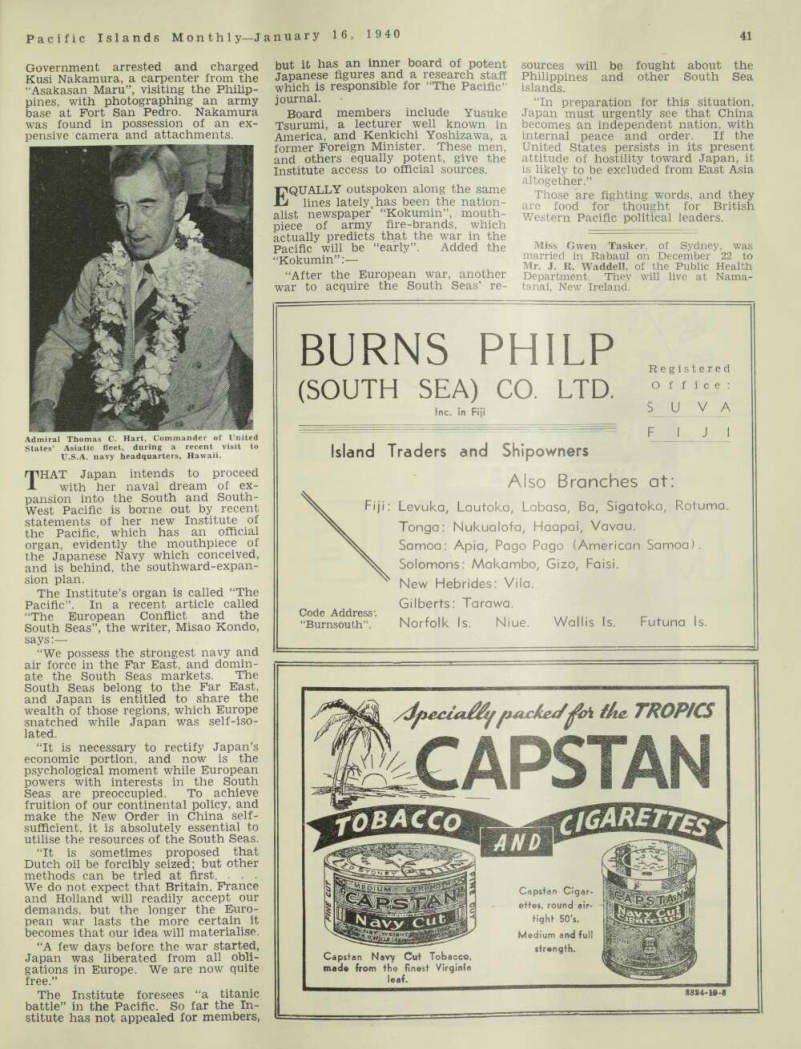
What is Going on in and Around The Philippines
By John Williams, Of Honolulu.
A Honolulu, Dec. 2.
MERICA is not going to make any bones about her defence of the Philippine Islands while the Stars and Stripes fly over them. (Under the terms of the Philippine Independence Act, the U.S. will retire from the isles in 1946.) The recent conference at Manila of U.S. diplomatic chiefs and Admiral Thomas C. Hart, commander of the U.S. Asiatic fleet, who steamed down from his headquarters in Shanghai, has brought to light some potent
facts which must interest British leaders in the Western Pacific.
Admiral Hart visited Davao, in the great island of Mindanao, south of Manila, where in recent years Japan has established a colony of at least 25,000 Japanese “farmers” and “fishermen”. At the outbreak of the war in Europe, America promptly despatched a squadron of long-range patrol bombers to Manila and, since then, they have been conducting an exhaustive patrol of the Davao sec tion.
They have combed outlying bays, usually the rendezvous of furtive Japanese boats, and really performed fine work in landing, taking off and servicing the huge navy bombers in isolated areas where normal dry docking and other facilities do not exist.
These conditions, of course, ap proximate those under which the crews would have to work in war time.
Because even the U.S. Navy base at Cavite, near Manila, lacks ade quate facilities for handling the all metal bombers, the squadron now at Davao soon will be flown back for complete overhaul at their home base at Pearl Harbour, near Honolulu. They will be replaced by another Pearl Harbour squadron. This idea of shuttling back and forth between Hawaii and the Philippines will fully test the equipment and give the crews admirable experience in long range point to point ocean flying.
More importantly, it will give the U.S. Navy that much more excuse to have their bombers in the Western Pacific and keep flying them across the routes between Japan and the Japanese mandated islands.
COINCIDENT with the secret con ferences of U.S. leaders at Manila—and over the protests of the Chinese community, which controls much of the retail trade—the Manila Municipal Board passed a law limit ing to citizens of the Philippines and the United States the right to en rage in any form of business in pub lic markets. Foreigners having exist ing businesses have been given three months to vacate.
This new law. obviously, is aimed at the tremendous encroachment of Jananese interests, which often use Filipino “dummies” to circumvent other restrictions against aliens.
For example, this month the Secre tary of Agriculture. Benio-mo Aauino, reported to President Manuel Quezon that a special investigation bv his department revealed tbot the Jana nese control deep-sea fishing in Philip pine waters.
He said that Japanese own 80 per cent, of the vessels engaged, often in “dummy” names.
On November 27 the Philippine
Government arrested and charged Kusi Nakamura, a carpenter from the “Asakasan Maru”, visiting the Philip pines, with photographing an army base at Fort San Pedro. Nakamura was found in possession of an ex pensive camera and attachments.
THAT Japan intends to proceed with her naval dream of ex pansion into the South and South- West Pacific is borne out by recent statements of her new Institute of the Pacific, which has an official organ, evidently the mouthpiece of the Japanese Navy which conceived, and is behind, the southward-expan sion plan.
The Institute’s organ is called “The Pacific”. In a recent article called “The European Conflict and the South Seas”, the writer, Misao Kondo, says:— “We possess the strongest navy and air force in the Far East, and domin ate the South Seas markets. The South Seas belong to the Far East, and Japan is entitled to share the wealth of those regions, which Europe snatched while Japan was self-iso lated.
“It is necessary to rectify Japan’s economic portion, and now is the psychological moment while European powers with interests in the South Seas are preoccupied. To achieve fruition of our continental policy, and make the New Order in China self sufficient, it is absolutely essential to utilise the resources of the South Seas.
“It is sometimes proposed that Dutch oil be forcibly seized; but other methods can be tried at first. . . .
We do not expect that Britain, France and Holland will readily accept our demands, but the longer the Euro pean war lasts the more certain it becomes that our idea will materialise.
“A few days before the war started, Japan was liberated from all obli gations in Europe. We are now quite free.”
The Institute foresees “a titanic battle” in the Pacific. So far the In stitute has not appealed for members,
but it has an inner board of potent Japanese figures and a research staff which is responsible for “The Pacific” journal.
Board members include Yusuke Tsurumi, a lecturer well known in America, and Kenkichi Yoshlzawa, a former Foreign Minister. These men, and others equally potent, give the Institute access to official sources.
EQUALLY outspoken along the same lines lately, has been the nation alist newspaper “Kokumin”, mouth piece of army fire-brands, which actually predicts that the war in the Pacific will be “early”. Added the “Kokumin”:— “After the European war, another war to acquire the South Seas’ re
sources will be fought about the Philippines and other South Sea islands.
“In preparation for this situation, Japan must urgently see that China becomes an independent nation, with internal peace and order. If the United States persists in its present attitude of hostility toward Japan, it is likely to be excluded from East Asia altogether.”
Those are fighting words, and they are food for thought for British Western Pacific political leaders.
Miss Gwen Tasker, of Sydney, was married in Rabaul on December 22 to Mr. ,T. R. Waddell, of the Public Health Department. They will live at Nama tanai, New Ireland.
Admiral Thomas C. Hart, Commander of United States’ Asiatic fleet, during a recent visit to U.S.A. navy headquarters, Hawaii.
Advertisements & other items, p. 43 (2 items)
41
Pacific Islands Monthl y—J anuary 16, 1940
Caps!
BURNS PHILP
(SOUTH SEA) CO. LTD.
Inc. In Fiji
Island Traders and Shipowners
Registered Office:
SUVA
FIJI
Also Branches at:
\Fiji; Levuka, Lautoka, Labasa, Ba, Sigatoka, Rotuma.
Tonga: Nukualofa, Haapai, Vavau.
Samoa: Apia, Pago Pago (American Samoa).
Solomons: Makambo, Gizo, Faisi.
New Hebrides: Vila.
Gilberts: Tarawa.
Code Address'.
“Burnsouth”. Norfolk Is. Niue. Wallis Is. Futuna Is.
r~N
/dp&ua&Sf llte
CAPS!
£3 W6«#hT.
cigarettes
Capstan Navy Cut Tobacco, made from the finest Virginia leaf.
Capstan Cigarettes, round airtight 50’s.
Medium and full strength.
8824-I QS
No "Workers' Compensation"
in New Guinea
W .
HEN a workman in an Australian State is killed in the course of his employment, his relations usually receive a sum of from £6OO to £750.
About five months ago a man named Lionel Hartley was killed while at work in a mine at Edie Creek, N.G. His widow, a resident of Wau New Guinea, was left practically destitute Representations were made by the Public Curator, on her behalf, to the man’s employer, but the
only compensation offered was £lOO.
" 10 f T e 15 no workers’ compensation law N .^ w Guinea, and the widow found that it would cost her at least £lOO to take le £ al proceedings against the employer, Mr. A. E Green MP hrnnaht under the noUce of ’the » for Territories in the Australian ParlfameSt recently and aeain ejSfP 1 thingbedone B to bring' fWorker’s com pensatlon law into effect in New GnS He said that something had been pro mised by the Administrator over P ?s months ago, but nothing had beeS done 18
"Normie" Neal
Leading New Guinea Figure Leaves "For the Duration"
From Our Own Correspondent WAU, Dec. 30. r)N Saturday, December 23, we saw the departure of Mr. and Mrs.
N. P. H. Neal from the Goldfields, where they have lived for so many years, and where, it is safe to say, they would have made their per manent home had not the present war come along to set aside all their cherished ideas.
In 1926, “Normie” (as he is gener ally called on the Goldfields), walked in from Madang to Edie Creek, in company with three others, and in 1927 he discovered the Day Dawn Mine, in which he was actively interested until the company went into liqui dation some six years ago. Since then, he has been alluvial mining in and around Wau. He built his beau tiful home on the heights across the Little Wau, which bears the name of “Izzydizzy”, and Mrs. Neal and he surrounded it with delightful gardens and well-laid-out grounds.
Norman Neal served with distinc tion in the Great War, with the Sig nal Company of the Ist Divisional Engineers, A.1.F., receiving his com mission, an M.C. and Bar, and M.M.
After the War he continued his mili tary activities with the 55th Battalion, Militia, until his departure from Aus tralia for New Guinea. He has been, for several years, a member of the Legislative Council.
Thus another highly-esteemed old timer fades out of the Goldfields pic ture—at any rate, for the duration of the present war. Mrs. Neal and he will be very much missed by their hosts of friends.
Progress Of Guam
Honolulu, Dec. 2.
THE native population of Guam, administered by the U.S. Navy, now totals 21,199, an increase of 319 on the previous year, according to the Secretary of the Navy in his report for 1939.
Native education and health pro grammes, based on standards of. the mainland United States, continue to make excellent progress. All instruc tion is in English. There is a wide range of industrial training, including carpentry, agriculture, weaving, sew ing and fish-net making.
A tile factory has been opened, which has encouraged the use of tiles for roofing.
Important item about the native schools is that with the exception of the head of the department, all posi tions are filled by natives.
Most excitement in the year was the grounding of the U.S. Navy Transport “Grant” in Apra harbour on May 19. It was refloated.
Advertisements & other items, pp. 44-45 (2 items)
Mato Ml
’'iJYhii iill llli.lll Vl I itfiiit.MiiLii; mici mu
Matone shades are washable, fadeless and* are practically permanent.
The peculiar "wet edge" enables the operator to join each finished section perfectly leaving an unmarked expanse of soft, restful colour that does not reflect light with a glare.
Ask your Berger agent for the Matone colour card. It gives practical suggestions for interior decoration.
AGENTS THROUGHOUT THE ISLANDS.
One Cool Place In The Tropics
The well known bathing-pool at Levnka, Fiji.
"Bath-Tub Gardens"
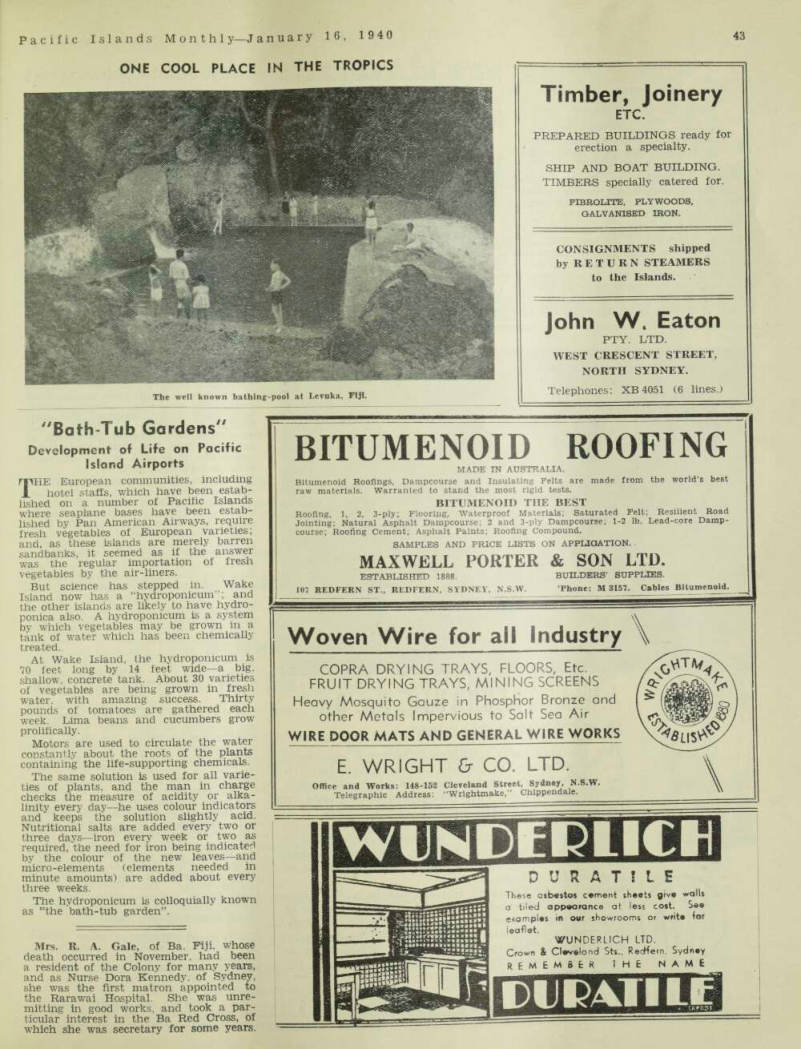
Development of Lite on Pacific Island Airports
THE European communities, including hotel staffs, which have been estab lished on a number of Pacific Islands where seaplane bases have been estab lished by Pan American Airways, require fresh vegetables of European varieties; and, as these islands are merely barren sandbanks, it seemed as if the answer was the regular importation of fresh vegetables by the air-liners.
But science has stepped in. Wake Island now has a “hydroponicum"; and the other islands are likely to have hydro ponica also. A hydroponicum is a system by which vegetables may be grown in a tank of water which has been chemically treated.
At Wake Island, the hydroponicum is 70 feet long by 14 feet wide—a big. shallow, concrete tank. About 30 varieties of vegetables are being grown in fresh water, with amazing success. Thirty pounds of tomatoes are gathered each week. Lima beans and cucumbers grow prolifically.
Motors are used to circulate the water constantly about the roots of the plants containing the life-supporting chemicals.
The same solution is used for all varie ties of plants, and the man in charge checks the measure of acidity or alka linity every day—he uses colour indicators and keeps the solution slightly acid.
Nutritional salts are added every two or three days—iron every week or two as required, the need for iron being indicated by the colour of the new leaves —and micro-elements (elements needed in minute amounts) are added about every three weeks.
The hydroponicum is colloquially known as "the bath-tub garden”.
Mrs. R. A. Gale, of Ba. Fiji, whose death occurred in November, had been a resident of the Colony for many years, and as Nurse Dora Kennedy, of Sydney, she was the first matron appointed to the Rarawai Hospital. She was unre mitting in good works, and took a par ticular interest in the Ba Red Cross, of which she was secretary for some years.
Advertisements & other items, p. 45 (2 items)
43
Pacific Islands Monthl y—J anuary 16, 1940
Erlich
Timber, Joinery
ETC.
PREPARED BUILDINGS ready for erection a specialty.
SHIP AND BOAT BUILDING.
TIMBERS specially catered for.
FIBROLITE, PLYWOODS,
GALVANISED IRON.
CONSIGNMENTS shipped
by RETURN STEAMERS
to the Islands.
John W. Eaton
PTY. LTD.
WEST CRESCENT STREET,
NORTH SYDNEY.
Telephones: XB 4051 (6 lines.)
BITUMENOID ROOFING
MADE IN AUSTRALIA.
Bitumenoid Roofings, Dampcourse and Insulating Felts are made from the world’s best raw materials. Warranted to stand the most rigid tests.
BITUMENOID THE BEST
Roofing, 1,2, 3-ply; Flooring, Waterproof Materials; Saturated Felt: Resilient Road Jointing: Natural Asphalt Dampcourse: 2 and 3-ply Dampcourse; 1-2 lb. Lead-core Dampcourse; Roofing Cement; Asphalt Paints; Roofing Compound.
SAMPLES AND PRICE LISTS ON APPLIOATION.
MAXWELL PORTER & SON LTD.
ESTABLISHED 1888. BUILDERS’ SUPPLIES.
107 REDFERN ST., REDFERN, SYDNEY, N.S.W. ’Phone: M 8157. Cables Bitumenoid.
Woven Wire for all Industry
COPRA DRYING TRAYS, FLOORS, Etc.
FRUIT DRYING TRAYS, MINING SCREENS
Heavy Mosquito Gauze in Phosphor Bronze and other Metals Impervious to Salt Sea Air WIRE DOOR MATS AND GENERAL WIRE WORKS
E. WRIGHT & CO. LTD.
Office and Works: 148-152 Cleveland Street, Sydney, N.S.W.
Telegraphic Address: “Wrightmake,” Chippendale.
nr
ERLICH
DURATKE
These asbestos cement sheets give walls a tiled appearance at less cost. See examples in our showrooms or write for leaflet.
WUNDERLICH LTD.
Crown & Cleveland Sts., Redfern, Sydney remember the name
DIP4TIIE
Attacked By Ogo
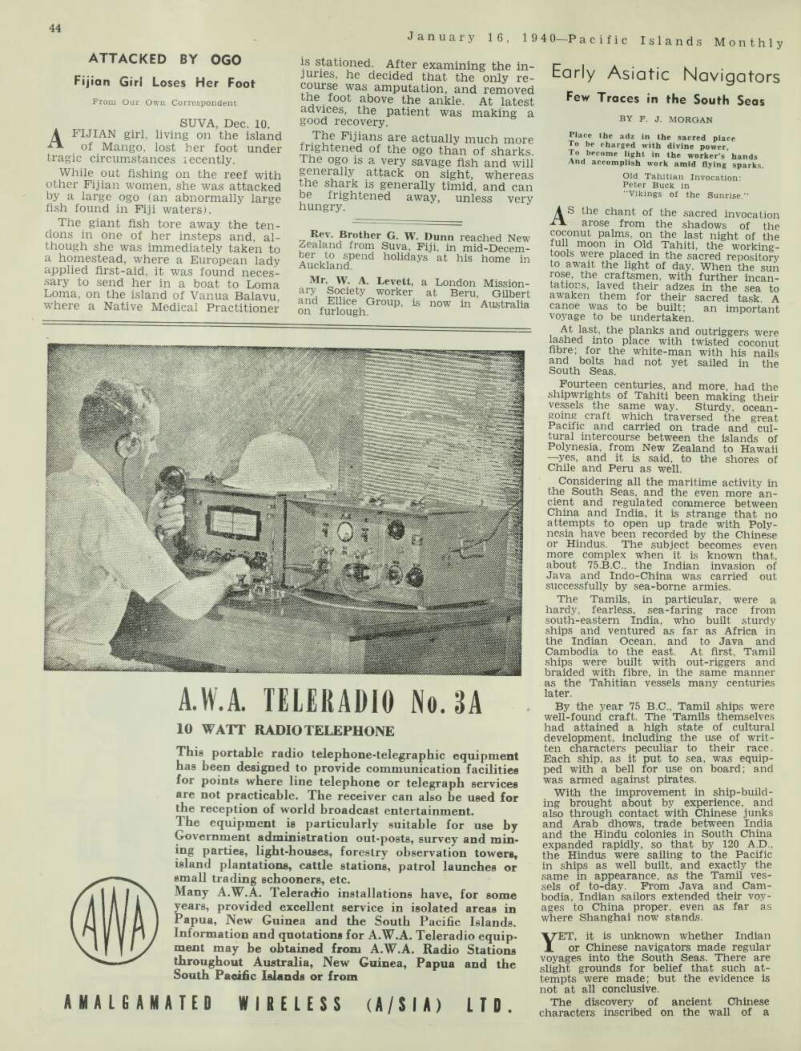
Fijian Girl Loses Her Foot
Prom Our Own Correspondent
Suva, Dec. 10.
A FIJIAN girl, living on the island of Mango, lost her foot under tragic circumstances recently.
While out fishing on the reef with other Fijian women, she was attacked by a large ogo (an abnormally large fish found in Fiji waters).
The giant fish tore away the ten dons in one of her insteps and, al though she was immediately taken to a homestead, where a European lady applied first-aid, it was found neces sary to send her in a boat to Loma Loma, on the island of Vanua Balavu, where a Native Medical Practitioner
is stationed. After examining the in juries, he decided that the only re course was amputation, and removed the foot above the ankle. At latest advices, the patient was making a good recovery.
The Fijians are actually much more frightened of the ogo than of sharks.
The ogo is a very savage fish and will generally attack on sight, whereas the shark is generally timid, and can be frightened away, unless very hungry.
Rev. Brother G. W. Dunn reached New Zealand from Suva, Fiji, in mid-Decem ber to spend holidays at his home in Auckland.
Mr W. A. Levett, a London Mission ary Society worker at Beru, Gilbert and Ellice Group, is now in Australia on furlough.
Early Asiatic Navigators
Few Traces in the South Seas
By F. J. Morgan
Place the adz in the sacred place To be charged with divine power.
To become light in the worker’s hands And accomplish work amid flying sparks.
Old Tahitian Invocation: Peter Buck in “Vikings of the Sunrise.”
AS the chant of the sacred invocation arose from the shadows of the coconut palms, on the last night of the full moon in Old Tahiti, the working tools were placed in the sacred repository to await the light of day. When the sun rose, the craftsmen, with further incan tations, laved their adzes in the sea to awaken them for their sacred task. A canoe was to be built; an important voyage to be undertaken.
At last, the planks and outriggers were lashed into place with twisted coconut fibre; for the white-man with his nails and bolts had not yet sailed in the South Seas.
Fourteen centuries, and more, had the shipwrights of Tahiti been making their vessels the same way. Sturdy, ocean going craft which traversed the great Pacific and carried on trade and cul tural intercourse between the islands of Polynesia, from New Zealand to Hawaii —yes, and it is said, to the shores of Chile and Peru as well.
Considering all the maritime activity in the South Seas, and the even more an cient and regulated commerce between China and India, it is strange that no attempts to open up trade with Poly nesia have been recorded by the Chinese or Hindus. The subject becomes even more complex when it is known that, about 75.8. C.. the Indian invasion of Java and Indo-China was carried out successfully by sea-borne armies.
The Tamils, in particular, were a hardy, fearless, sea-faring race from south-eastern India, who built sturdy ships and ventured as far as Africa in the Indian Ocean, and to Java and Cambodia to the east. At first, Tamil ships were built with out-riggers and braided with fibre, in the same manner as the Tahitian vessels many centuries later.
By the year 75 8.C., Tamil ships were well-found craft. The Tamils themselves had attained a high state of cultural development, including the use of writ ten characters peculiar to their race.
Each ship, as it put to sea, was equip ped with a bell for use on board: and was armed against pirates.
With the improvement in ship-build ing brought about by experience, and also through contact with Chinese junks and Arab dhows, trade between India and the Hindu colonies in South China expanded rapidly, so that by 120 A.D.. the Hindus were sailing to the Pacific in ships as well built, and exactly the same in appearance, as the Tamil ves sels of to-day. From Java and Cam bodia, Indian sailors extended their voy ages to China proper, even as far as where Shanghai now stands.
YET, it is unknown whether Indian or Chinese navigators made regular voyages into the South Seas. There are slight grounds for belief that such at tempts were made; but the evidence is not at all conclusive.
The discovery of ancient Chinese characters inscribed on the wall of a
cave, at sea level, on one of the Yasawa Islands in the Fiji Group, by Mr. A. J.
Vogan in 1934. and recorded in the "Pacific Islands Year Book. 1939”, is a definite link with the past; but whether they were written by a party of ship wrecked cast-a ways, or by the crew of a trading junk, none may tell.
Of great interest, too. is the Tamil Bell, a treasured exhibit in the Dominion Museum at Wellington.
In 1836, a missionary in the Whan garei district, north of Auckland, visited a native village where no European had been previously. His attention was drawn to a curious, bell-shaped cooking pot, in use by the women. Inquiries amongst the tribe elicited the informa tion that it had been found many years before, at the foot of a large tree, which had been uprooted during a storm.
Subsequent investigations proved the object to be the upper part of a Tamil ship’s bell such as is in use at the pre sent day. An inscription in unknown characters was photographed and sent to India for identification. From two separate sources the same translation was received: “Hohoyiden Buks ship’s bell”.
Tamil writers described the characters as very ancient lettering, some of them dif fering greatly from modern Tamil script.
There is nothing to show how the bell reached New Zealand. There have been many theories to account for its presence there. All are conjecture, and must re main so; but, with the evidence of voy ages and migrations by Hindu vessels embracing China and other lands, we may conclude that at least one Indian ship ventured into the vast Pacific wastes, as far south as New Zealand.
Advertisements & other items, p. 46 (1 item)
A.W.A. Teleradio N«.3A
'&M
10 WATT RADIOTELEPHONE
This portable radio telephone-telegraphic equipment has been designed to provide communication facilities for points where line telephone or telegraph services are not practicable. The receiver can also be used for the reception of world broadcast entertainment.
The equipment is particularly suitable for use by Government administration out-posts, survey and mining parties, light-houses, forestry observation towers, island plantations, cattle stations, patrol launches or small trading schooners, etc.
Many A.W.A. Teleradio installations have, for some years, provided excellent service in isolated areas in Papua, New Guinea and the South Pacific Islands.
Information and quotations for A.W.A. Teleradio equipment may be obtained from A.W.A. Radio Stations throughout Australia, New Guinea, Papua and the South Pacific Islands or from
AMALGAMATED WIRELESS (A/SIA) LTD.
Ten Days On Wild

Sea
Tongon Judge Has Unpleasant Experience
From Our Own Correspondent
Nukualofa, Dec. 14.
A MOST unpleasant experience befell the Chief Justice of Tonga, Hon.
W H. Stuart, .when he was travelling from Niuafoou (“Tin Can Island”) to Vavau in the cutter “Fetu’uaho”. He was accompanied by the Vavau medical officer, Dr. J. C. Lopdell; the registrar of the Supreme Court, Jione Taliauli; in spector of police, Manase Toga; and a number of Tongan lawyers and pas sengers.
The cutter was struck by a heavy easterly storm at daybreak on November 16, when about a couple of miles from the entrance to Vavau harbour. She left Niuafoou on November 13.
Great dark clouds, which descended in torrential rain when the wind was freshing up, rendered visibility so poor that Vavau was completely hidden. Then the gale blew with such force that it tore great gashes in the mainsail, which had to be hauled in for repair, while the vessel lay to.
Unfortunately, the supply of twine was exhausted. So the vessel was headed to run before the storm, to Fiji, on her jibs.
By the time she reached the high vol canic island of Late, some enterprising member of the crew managed to im provise fairly strong twine from hibiscus bark fibre. So it was decided to ride the storm out and mend the sail with the improvised twine, and then make for Vavau when the storm had abated.
The vessel was then hove to and a storm anchor was rigged and thrown overboard. But the stout rope used as anchor chain snapped under the heavy strain. A few moments later a huge wave, which was shipped on the stern, carried the compass overboard, and might have swept the steersman into the sea, also, if his loincloth had not been caught in the tiller.
For two days and nights, during which she drifted about 50 miles, the little vessel lay helpless before the fury of the elements. In relating their experiences, both passengers and crew said it was a miracle that the vessel did not break up under the relentless onslaught of the tempestuous wind and sea.
On November 18, when the storm had slightly abated and the sail had been mended, the “Fetu’uaho” fought her way, against a strong head wind and current, in the supposed direction of Vavau —for navigation, since the loss of her com pass, was just guesswork.
They managed to reach the volcanic island of Fonualei (which is about 60 miles to the north of Vavau) late in the afternoon of November 18.
The vessel sheltered there for the night. But, in the absence of any good landing-place on the island, and be cause the crater was active, no landing was made. On the following morning, November 19, she left Fonualei for the low coral island of Toku, several miles to the south, where she arrived in the afternoon.
There, the weary voyagers landed and soon made themselves comfortable by erecting a hut, thatched with coconut leaves, for shelter. But there was anxiety regarding provisions, which had dwindled down to only a quarter-bag of taro when they landed. The situation became seri ous when the wind continued to blow for
the next two days, for their only hope had been to send the “Fetu’uaho” to Vavau for provisions.
Fortunately, on November 22, the weather conditions had somewhat mod erated, and the ‘‘Fetu’uaho”, with her patched sail, left for Vavau that morn ing, with the captain and crew.
However, the poor cutter’s trials were not yet over. Ordinarily, she ought to have made Vavau that afternoon, but at noon the wind freshened and the sail was again torn badly. Somehow, it was mended; and, after battling against wind and sea that afternoon and all that night, she reached Vavau with consider able difficulty on the morning of Novem ber 23—ten days after she left Niuafoou.
Immediately after her arrival, two cutters with provisions were despatched
to bring the passengers to Vavau, from Toku. Arriving at Toku in the after noon, they left in the evening with the passengers, and reached Vavau the fol lowing morning, November 24.
The experience of the “Fetu’uaho” re calls the fate of the cutter “Janet”. With Willie Mann (one of the old Mann family, of Vavau) as skipper, and with six Euro peans and a large number of Tongan passengers on board, the “Janet” com pletely disappeared, while making this same passage from Niuafoou to Vavau, in the same month (November, of 1918).
It was surmised that she had been struck by a storm when within sight of Vavau.
Mr. C. Schrader, of the Lands Depart ment, Port Moresby, left recently for Australia on leave.
Advertisements & other items, pp. 47-48 (1 item)
Tilley
Brilliant Lighting—Simple
in use —One
fuel only
TILLEY
KEROSENE VAPOUR LAMPS AND LANTERNS
Give light of 300 candle-power for 6 hours for Id.
A brilliant light, efficient in performance, cheap to run — these are some points which make the Tilley Lamps and Lanterns so outstanding. Their popularity throughout the British Dominions, Colonies and other parts of the world is shown by their rapidly increasing sales. Burn ordinary kerosene under pressure and are preheated by the same oil so that only one fuel is necessary. The Kerosene Lighter draws its oil supply from the container of the Lamp itself and does away with the use of methylated spirit. Designed to withstand rough usage. Absolutely safe. Makes no hissing noise and all indoor models are fitted with a special silencer. British made throughout of the finest material
and workmanship.
Obtainable throughout the Pacific Islands from the Branches of:
BURNS, PHILP & CO. LTD., and
BURNS PHILP (SOUTH SEAS) CO. LTD.
Spare Parts and Lamps W KOPSEN &CO LTD CLA =vnM C prv ST ” also obtainable from— "• l ' wr 3Cl , ( L 7 VW., I- I U., SYDNEY.
If any difficulty, write direct to: THE TILLEY LAMP CO. (Dept. P.M.), HENDON, LONDON, N.W.4.
No Wicks
No Chimneys
No Smell
Draught Proof
Insect Proof
British Made
Throughout.
T.L. 10.
The Tilley Table Lamp with its clear, white, steady light shows your room to the best advantage, as well as banishing eyestrain when reading or doing needlework.
No smell or glare. Does not flicker when standing in a draught. Made throughout in lacquered brass and fitted with opal shade. Free from danger and cannot explode.
P.L. 54.
Tilley Storm Lantern is invaluable for all Indoor or outdoor work; can be hung up, stood down or carried about as required. Will burn steadily anywhere, unaffected by weather, however severe. Wind and rainproof. Strongly made of brass. No parts to rust, corrode or get out of order. You cannot do better than get this All- British Storm Lantern.
<r *
It's CHEAPER to PAINT
than to repair!
DISTRIBUTORS:
Greenwood & Laws Ltd., Rabaul and Wau.
Steamships Trading Co. Ltd., Port Moresby and Samaral.
Millers, Ltd., Sava, Fiji.
Decay can do no damage If your home is properly protected with good paint.
Use “8.A.L.M.” Paint— “B.A.L.M.” Paint gives protection. And it wears down evenly and very slowly, lasting years longer than ordinary paint.
Decide now to save money by painting; and decide to make maximum savings by using - - - - "8.A.L.M.” Paint!
ORAOE PUR|
'■ip
‘p AI lH T
Hid
A Product of British Australian Load Manufacturers Pty. Ltd.,
Scott’s “Renown” Brand Rope,
Cordage and
Binder
Twine
c * bie Address: s Ropeyard Sydney. as m of Every Description
MANUFACTURED AT
MASCOT, N.B.W.
By
J. SCOTT
PTY. LTD.
Head Office and Store:
163 CLARENCE STREET,
SYDNEY,
Kieta Raises £148 for Red Cross
Red Cross
THE following is from Mr. Drummond
Thomson, of Numa Numa, Bougain
ville, T.N.G., honorary secretary and
treasurer of the Kieta Comforts Fund: On October 27, it was decided by some of your readers in Bougainville and Buka districts to form a Comforts Fund Branch of the New Guinea. Division of the Australian Red Cross Society, to be known as the Kieta Comforts Fund. The object was to guarantee a supply of knitting and sewing materials sufficient always to meet the demands of our many lady members who had decided to make useful articles and comforts suitable for issue to those on active service, or to the hospitals. The first parcel of “com forts” are to-morrow (December 23) be ing sent to the honorary secretary of Rabaul Headquarters Division, and the donations to the fund to date total £l4B/9/-. The list of donors to Decem ber 24 is:— Dr. & Mrs. A. V. G. Price, £5; Mr. & Mrs.
N. J. Tudberry, £l/1/-; Mr. & Mrs. W. R.
Smith, £1; Mr. & Mrs. J. M. Joyes, £l/1/-; Mr. & Mrs. C. R. Doyle, £1; Mr. & Mrs. H. C.
Gridley, £1; Mrs. E. Falkner, £2; Mr. J. I.
Merrylees, £5; Mr. & Mrs. A. L. Walker, £5/5/-; Mrs. Drummond Thomson, £3/3/-; Buka Plan tations, Ltd., £lO/10/-; Mr. Drummond Thomson, £5/5/-; Mr. & Mrs. N. O. Clappison, £1; Mr.
L. S. Colebrooke, £l/1/-; Mr. P. E. Mason, £lO/10/-; Mr. N. C. Sandford, £2/2/-; Mr. F.
C. Urban, £2; Mr. R. Stuart, £3; Mrs. R. M.
Farlow, £2/10/-; Mr. R. M. Farlow, £2/10/-; Bishop Wade, £5; Marist Mission, £5; Mr. E.
J. Dyer. £l/1/-; Mr. M. English, £3; Mr. Muk Lee, £5; Mr. A. R. Long, £5; Mr. R. G. Pick well. £2; Mr. C. R. Tulley, £1; Mr. C. W. M.
Evans, £1; Mr. T. E. Ebery, £1; Dr. & Mrs.
Oliver, £1; Mrs. L. S. Colebrooke, £l/1/-; Mr. & Mrs. A. L. Robinson, £1; Mr. Wong Yu, £5; Tack Long & Co., 10/-; Burns Philp (S.S.) Co., £l/1/-; Mr. A. Scott, £l/1/-; Mr. S. Tame, £l/1/-; Mr. W. A. L. Clarke, £l/1/-; Mr. Chung Ah For, £1; Mr. J. Martin, £1; Mr. H. L.
Downing, £3; Mr. & Mrs. W. Newall, £l/1/-; Mr. Wong Tu, £1; Mrs. C. Cooke, 10/-; Mr. & Mrs. W. M. Knox, £2; Mr. W. G. Walsh, £1; Mr. S. H. C. Short, £2; Pastor & Mrs. Pascoe, £l/1/-; Rev. & Mrs. A. H. Voyce, £l/1/-; Natives of Tiop, Methodist collection, £3/17/-: Mr. & Mrs. W. Brown, £l/1/-; Mrs. J. H. Ellis. £1; Miss M. Ellis, £1; Mr. J. H. Ellis, £3; Miss E. Common, £2; Mr. T. B. Bilton, £2; Mr.
Ching Yung. £5; Mrs. Yung, £1; Mr. & Mrs.
L. Chan, £2/2/-; Miss A. Chan. £l/1/-; Master M. Chan, £l/1/-: Mr. K. Ikeda, £1; Mr.
Ishabishi, £1; total, £l4B/9/-.
Correspondence Club's Ship
Returns
From Our Own Correspondent
Honolulu, Dec. 11.
A YEAR’S cruise through the South Seas was ended this week by the American ketch “Otter” when she arrived, after a stormy voyage from Raiatea, French Oceania, which took 40 days.
The “Otter”, it will be recalled, organ ised the Correspondence Club of World Sailmates. The crew of the “Otter” wrote from every port to subscribers the world over.
The “Otter’s” owner and master, Albert Gallatin Powers, intended to voyage around the world, but the war in Europe upset this plan. So after completing a year’s service to his 300 subscribers, he decided to head for home. He had visited the Marquesas, Tuamotus, Society Group, Cook Islands, and American Samoa.
Hon. W. Wise, Director of Public Works in Fiji, and Mrs. Wise, arrived in New Zealand by the “Mariposa” at the end of December to spend several months’ in touring the Dominion.
Dalo
Valuable Food Crop
IN that exceedingly valuable compilation, “The Agricultural Journal of Fiji”, November issue, there is an interesting article by Mr. B. E. V. Parham on the production of dalo as a food crop in Fiji.
Dalo, says Mr. Parham, has for long been an important domestic root crop throughout the tropics, and in Fiji in re cent years it has become a valuable cash crop, having a ready local sale in the market of the main centres of population.
It is an ideal crop for the small holder in Fiji, where the climate is most favour able for heavy yields, and where pests and diseases do little or no damage. The crop is one of the easiest to cultivate and market.
Dalo tubers have now become the staple diet of a large section of the popu lation of Fiji. They may be eaten after being boiled, baked or roasted. Dalo leaves are an excellent substitute for spinach, and are usually boiled with coconut milk. In the Rewa district, the leaves are used to wrap up shrimps for steaming, and the cooked shrimps are eaten together with the leaves.
Dalo, says Mr. Parham, is an excellent and highly nutritious carbo-hydrate food of fair fat content, and contains good quality proteins.
This is a crop that should be worth investigation by other Pacific Islands Administrations.
Mr. J. Merriman, of the Rabaul Print ing Works Ltd., arrived in Sydney from New Guinea in December.
Ideal Cruise
Fine New Zealand Yacht
A BEAUTIFUL new yacht named “New Golden Hind” has been seen in re cent months in the islands of Fiji, Samoa and Tonga, where she has been making a leisurely cruise with a party of New Zealanders. She is back, now, in New Zealand; but, as in the coming months, she probably will cruise in the New Hebrides and New Caledonia, and maybe in the Solomons and New Guinea, some details of the interesting vessel may
be published.
The “New Golden Hind” represents the substance of a dream come true. She was built in New Zealand during the pasi two years by well-known Auckland busi ness man, Mr. H. R. Jenkin, who long had dreamed of a life on the tropical seas. When he retired, he decided that he would build a ship in which he could travel about with ease and some degree of luxury. He went personally into the forests of North Auckland and selected kauri, and various other timbers, with which a firm of well-known shipbuilders constructed his ideal ship.
The finished product is 94 feet long; she has a beam of 22i feet and a draught of 10 feet; the masts with their stately Bermuda rig are respectively 100 feet and 75 feet above the sea. She has six state rooms, a dining saloon 20 feet long, a writing room and lounge, a large fore castle, a model kitchen and every modern convenience. including refrigerators, radio, electric light, permanent hot water, power-boat tenders, etc. As can be imagined, the ship both above and below is beautifully finished with selected woods. She is propelled, when winds are
not favourable for sailing, by a 66 h.p.
Kelvin diesel engine; while a 9 h.p.
Ruston engine provides power for light ing, refrigeration, pumping, etc.
During the recent cruise the “New Golden Hind’’ carried, in addition to the owner, a selected party of 14 persons, all taking their part in the working of the ship. The company included two well known shipmasters—Captain John Ben ton, who commanded U.S.S. steamers in the Pacific for many years, and Captain F. Wainhouse, who also was an officer of the U.S.S. Company, but for years, until his retirement, held a prominent position under the Auckland Harbour Board.
According to reports from the Pacific they were a very happy company, and made numerous friends in the various Islands ports at which they called.
A New Book
FIRST AID AT A GLANCE, by W. H.
London, just published by Angus & Robertson, Ltd., of Sydney, at 2/-, is a handy little pocket volume which should be very useful to Islands residents. It is not only a useful text-book for students —it also is an invaluable reference book, insomuch that it has been so arranged and indexed as to give maximum assist ance in an emergency—sudden illness or accident. It is so up-to-date that it in cludes a special chapter on war-gases.
Miss K. P. Wills, 8.A., who served for eight years in Fiji as headmistress of the Suva Girls’ Grammar School, died at Napier, New Zealand, in December.
She left Suva in 1932 to live in retire ment at her Christchurch home.
Advertisements & other items, p. 49 (2 items)
47
Pacific Islands Monthl y— J anuary 16, 1940
Fairbanks Morse
Backed by a great name!
and Company
Manufacturers of
DIESEL ENGINES, STATIONARY, MARINE
AND DREDGE SERVICE, from 10 to 1,500 H.P.
FAIRBANKS SCALES AND WEIGHING
MACHINES
DIESEL ELECTRIC SETS, 6 to 1,200 KW„
ALTERNATING OR DIRECT CURRENT.
"FAIRDAY" WASHING MACHINES and
IRONERS.
FARM ENGINES and FEED GRINDERS.
RAILROAD EQUIPMENT.
PUMPING EQUIPMENT for EVERY SERVICE.
<7 S>
HOME LIGHTING SETS.
Fullest information and data available from
Fairbanks Morse [A/sia] Pty. Ltd.
29-33 CLARENCE ST., SYDNEY.
Death of Mile. L. A. E. Adams
From Our Own Correspondent
Papeete, Dec. 10.
rpHE death occurred on October 7, 1939, A at Papeete, of Mademoiselle Louisa Ann Elizabeth Adams, in her 79th year She was the daughter of the late Thomas Stratford Adams, who came from Eng land to Tahiti in 1841.
It is difficult, in cold print, adequately to pay just tribute to a long life of un selfish service and give expression to the gratitude of the many on whom that service has been bestowed. The physi cians of yesterday, while Mile. Adams still had her health and strength, were at ease of mind when she was there to direct the nursing of their patients.
A multitude ' of us—including the
writer—have been brought from the Valley of the Shadow because Miss Nany (as we affectionately named her) was be side us night and day through the critical periods of our illness. The memory of her, and of her loving kind ness, will be a precious possession of all who knew and loved her.
She is survived by a sister, Madame Brunaud, and a brother, Mr. Charles Adams.
On December 7, at the Church of Our Lady of the Rosary, Port Moresby, Rev.
Father McEncroe officiating, Mr. Ernest George Foreshew married Miss Agnes Gilbert (Pat) Russell, of Belmont, N.S.W The bride was given away by Warrant Officer C. H. Derbidge. Mrs. N. B McLaughlin was Matron of Honour.
Bug Quarantine
Station
What Are South British Nations Doing?
From Our Own Correspondent
W Honolulu, Dec 2.
HAT are Australia and New Zealand going to do about par ticipating in a similar idea?
American interests have established an insect quarantine station on Can ton Island, one of the stops on the proposed Pan American Airways route from Hawaii to Auckland, New Zealand.
An experienced entomologist will watch over arriving planes from the south and thoroughly spray them before they take off, northbound. The idea is to keep out destructive in sects from the Hawaii and California agricultural industries.
There is a similar station on Mid way Island, where clippers from the Orient are examined. During the last 10 months, at Midway, more than 1,000 live insects and more than 1,000 dead have been removed from the clippers at Midway.
Many of them were serious pests, the report added.
New Guinea
Development of Dutch New Guinea
THE first annual report of the Dutch Company of New Guinea has been published.
A good deal of research work was done in 1938-9, while exploring parties examined the agricultural conditions in the valleys of the Prafi and Warjori (N New Guinea), the low lands ‘in the neighbourhood of Merauke (south coast of New Guinea), the plain of the Erpo River (on the north coast), and some plains in the Lake Sentani district, near the British and Dutch border.
In Lake Sentani district, some 100,000 acres were proved suitable for agricul tural purposes. The results of explor ation in the other regions were not gratifying.
Plenty of native labour is found in the Lake Sentani district. These plains have not yet been investigated in detail, but it seems that rice growing by Javanese may be possible in the valleys of the Moeaief and Sermowai Rivers. Iron wood is found in considerable quantities in the forests of this district and may be of commercial interest. But a timber busi ness will only be possible if harbour con ditions in Demta Bay are improved.
The commercial possibilities of collect ing jungle products, such as gum dam mar, mangrove bark, wild nutmeg, sago, etc., and dealing in copra were exam ined. The report was not favourable.
The opening up of the Government rubber plantation in the Ransiki Valley, where a good deal of agricultural experi menting work will be done, is going on in a satisfactory way. The recruiting of native labour gives no trouble.
Advertisements & other items, p. 50 (1 item)
Spartan
ASK YOUR LOCAL AGENT FOR COLOUR CARDS
IDEAL FOR ISLAND CONDITIONS
ENAMELS
SPARTAN
PAINTS
CAR POLISH QDE ENAMEL TROJAN PAINT
ZINC PASTE SASH & TRIM PAINT
VELOX ENAMEL PAVING PAINT
SPARTAN LACQUERS PTY. LTD,, 266 EL S ™™ ST .,
I I USE
FOR RELIABILITY
AND LONG SERVICE
I 9 Manufactured by Suva Agent*: Sydney Agent*
MILLER'S "ANCHOR"
BRAND ROPES AND
CORDAGES.
Manila, Sisal, New Zealand Coir and Cotton Rope of every description.
Twine, Sewing Twine, Shop Twine, Binder Twine and Fishlines, Lashings, Halters, Plough Reins, Sack Cord. Blind Lines, etc.
LENGTH STRENGTH
QUALITY GUARANTEED
c
JAMES MILLER & Co. Pty. Ltd.
MELBOURNE, VIC., AUST.
A. S. FAREBROTHER & CO.
And at Lautoka, P.O. Box 36. T#l, 261
P. T. TAYLOR LTD.
Water-Carrier, Modern
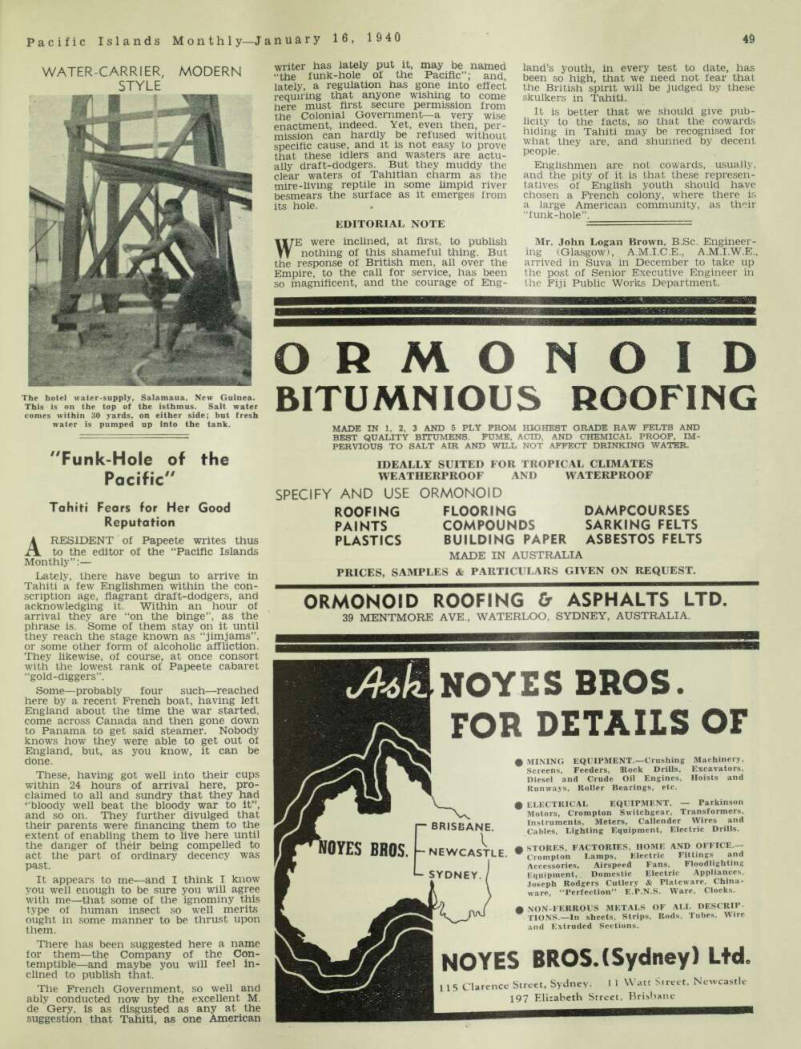
Style
The hotel water-supply, Salamaua, New Guinea.
This is on the top of the isthmus. Salt water comes within 30 yards, on either side; but fresh water is pumped up into the tank.
Pacific"
"Funk-Hole of the Pacific"
Tahiti Fears for Her Good Reputation
A RESIDENT of Papeete writes thus to the editor of the “Pacific Islands Monthly”:— Lately, there have begun to arrive in Tahiti a few Englishmen within the con scription age, flagrant draft-dodgers, and acknowledging it. Within an hour of arrival they are “on the binge”, as the phrase is. Some of them stay on it until they reach the stage known as “jimjams”, or some other form of alcoholic affliction.
They likewise, of course, at once consort with the lowest rank of Papeete cabaret “gold-diggers”.
Some—probably four such—reached here by a recent French boat, having left England about the time the war started, come across Canada and then gone down to Panama to get said steamer. Nobody knows how they were able to get out of England, but, as you know, it can be done.
These, having got well into their cups within 24 hours of arrival here, pro claimed to all and sundry that they had “bloody well beat the bloody war to it”, and so on. They further divulged that their parents were financing them to the extent of enabling them to live here until the danger of their being compelled to act the part of ordinary decency was past.
It appears to me—and I think I know you well enough to be sure you will agree with me—that some of the ignominy this type of human insect so well merits ought in some manner to be thrust upon them.
There has been suggested here a name for them—the Company of the Con temptible—and maybe you will feel in clined to publish that.
The French Government, so well and ably conducted now by the excellent M de Gery, is as disgusted as any at the suggestion that Tahiti, as one American
writer has lately put it, may be named “the funk-hole of the Pacific”; and, lately, a regulation has gone into effect requiring that anyone wishing to come here must first secure permission from the Colonial Government—a very wise enactment, indeed. Yet, even then, per mission can hardly be refused without specific cause, and it is not easy to prove that these idlers and wasters are actu ally draft-dodgers. But they muddy the clear waters of Tahitian charm as the mire-living reptile in some limpid river besmears the surface as it emerges from its hole. *
Editorial Note
WE were inclined, at first, to publish nothing of this shameful thing. But the response of British men, all over the Empire, to the call for service, has been so magnificent, and the courage of Eng
land’s youth, in every test to date, has been so high, that we need not fear that the British spirit will be judged by these skulkers in Tahiti.
It is better that we should give pub licity to the facts, so that the cowards hiding in Tahiti may be recognised for what they are, and shunned by decent people.
Englishmen are not cowards, usually, and the pity of it is that these represen tatives of English youth should have chosen a French colony, where there is a large American community, as their “funk-hole”.
Mr. John Logan Brown, B.Sc. Engineer ing (Glasgow), A.M.1.C.E., A.M.1.W.E., arrived in Suva in December to take up the post of Senior Executive Engineer in the Fiji Public Works Department.
Advertisements & other items, p. 51 (1 item)
Ormo N O I D
BITUMNIOUS ROOFING
MADE IN 1,2, 3 AND 5 PLY PROM HIGHEST GRADE RAW FELTS AND BEST QUALITY BITUMENS. FUME, ACID, AND CHEMICAL PROOF, IM- PERVIOUS TO SALT AIR AND WILL NOT AFFECT DRINKING WATER.
IDEALLY SUITED FOR TROPICAL CLIMATES
WEATHERPROOF AND WATERPROOF
SPECIFY AND USE ORMONOID
ROOFING FLOORING DAMPCOURSES
PAINTS COMPOUNDS SARKING FELTS
PLASTICS BUILDING PAPER ASBESTOS FELTS
MADE IN AUSTRALIA
PRICES, SAMPLES & PARTICULARS GIVEN ON REQUEST.
ORMONOID ROOFING & ASPHALTS LTD.
39 MENTMORE AVE., WATERLOO. SYDNEY, AUSTRALIA.
A
BRISBANE
OYES BROS.
NOYES BROS.
FOR DETAILS OF
MINING EQUIPMENT.— Crushing Machinery, Screens. Feeders, (Rock Drills, Excavators, Diesel and Crude Oil Engines. Hoists and Runways, Roller Bearings, etc.
ELECTRICAL EQUIPMENT. Parkinson
Motors, Crompton Switchgear, Transformers, Instruments, Meters, Callender VVires and Cables, Lighting Equipment, Electric Drills.
STORES, FACTORIES. HOME AND OFFICE.—
Crompton Lamps, Electric Fittings and Accessories, Airspeed Fans, Floodlighting Equipment, Domestic Electric Appliances, Joseph Rodgers Cutlery & Plateware, Chinaware, “Perfection” E.P.N.S. Ware. Clocks.
NON-FERROUS METALS OF ALL DESCRIP-
TIONS.—In sheets. Strips, Rods, Tubes, Wire and Extruded Sections.
NOYES BROS.(Sydney) Ltd.
5 Clarence Street, Sydney. 1 I Watt S.reet, Newcastle 197 Elizabeth Street, Brisbane
NEWCASTLE. •
- SYDNEY.
Propaganda"
"Subversive Nazi Propaganda"
N.G. Missionary's Protest Against Silly Reports
A STRONGLY-worded protest against the manner in which all German missionaries in New Guinea have been charged, in Australian newspapers, with “subversive” and “pro-Nazi” activities, has been made by Rev. J. G. Madigan, Roman Catholic priest in Rabaul. He points out that no fair distinction is be ing made between the mission bodies, and especially between the German Roman Catholic missionaries and German mem bers of other missions. ‘‘The Catholic Mission”, he says, “is spread all over the controlled portions of the Territory. It embraces Vicariates under four Bishops and, being Catholic, its missionaries are drawn from many nations.
“From the beginning of the war (which no one laments more than the Catholic missionary) not one German Catholic missionary has been accused or even sus pected of spreading subversive Nazi propaganda among the natives. The amazing thing is how anyone, with even a superficial acquaintance with Catholic ism and Nazism, could suspect a Catholic missionary of urging the claims of a system which aims at destroying all forms of Christianity in the world. The German missionary enjoys greater liberty and freedom in the Mandated Territory than his co-religionists in Ger many. Then why should any missionary abuse his freedom and advocate the in troduction of what would destroy all Christianity and civilisation in New Guinea?
I am fully aware of allegations of dis toyalty against certain New Guinea mis sionaries. Whether the charges are wholly or partially true I do not assume the province of determining. But, as they «Tfi tlle British flag the accused win, it they so desire, have an oppor tunity of stating their side of the case before a properly constituted Tribunal. ‘My long experience with natives drawn from different and distant parts of the Territory is that the intelligent native is far more concerned in trying to find a solution of the mental problem of why European nations, boasting cen turies of Christian civilisation, are fight ing among themselves, than with any Nazi propaganda.
“As an Australian missionary with 16 years of continued residence in New Guinea 00 hope that those who make accusations against New Guinea mission aries will at least have the decency to clanfy their statements and indicate to whom they refer.”
Mr. James Alexander Jenkins, who joined the staff of the Bank of NS W Suva, Fiji, four months ago, died in hos pital on December 12, following an op eration. He was 22 years of age Mr Jennings was a member of the Suva Battery of the Fiji Defence Force and was buried with full military honours.
Mr. L. Tracey, of Steamships Trading Co. Ltd., of Port Moresby, arrived in Aus tralia in December from Papua to spend three months’ leave.
Mr. L. Lonngrenn, second lieutenant in the Fiji Defence Force, reached Sydney from Suva in December to join the Royal Australian Air Force. He is the first Fiji resident to enlist for service overseas.
Advertisements & other items, p. 52 (2 items)
F, Si S'sks.
SAMOAN MURDERER'S
ORATION
T HE^ E was a remarka ble incident in
f, Si S'SKS.
executed for murdering his hrnthpr in law murdering ms brother-m- Just before he was hung Imoa was response, he mftte a* 0 Ion? statement S lonows.— “I wish to say a few short words of thanks to my beloved people—kings and chiefs and orators. Thanks to God in that the day has now arrived on whlch I am to pay my penalty. This Penalty, I am satisfied in my own mind is quite j ust and > 1 believe, is also just before God Almighty, “I thank the Government of the United States and the representative of the President, his Honour the Governor, and ms Secretary, also the Captain of the JJ avy Yard - Thanks to the Chief Medical Officer and all those working for the good and the welfare of my beloved people. I further thank the Attorney- General the Chief Judge and all associated with him, for their truthful upholding of the law. I also thank the Chaplain of the Government and all you clergymen here for your true affection for me ‘ The Suva Town Board in December invited applications for a debenture loan of £6,ooo—in six debentures of £lOO each bearing interest at 3 i- per cent, per an num. The loan was greatly over-sub scribed—the actual amount offered being £22,100.
Newlands Brothers Pty. Ltd.
ftps The new range of Newlands modern steel furniture includes designs ideal for indoor and outdoor use in the tropics.
Newlands extend a cordial invitation to you on your next visit to Sydney to see their new showrooms where is exhibited a complete selection of steel furniture offering distinctive groupings and suites in actual home settings, in addition to individual pieces for every type of service.
FOR STEEL FURNITURE AND MODERN SLEEPING EQUIPMENT.
NEWLANDS BROTHERS Pty. Ltd.
Riley and Albion Streets, Sydney, N.S.W.
Write to-day for a catalogue illustrating the full range of this delightful furniture.
It will be forwarded promptly.
Maori Tabu!
in Cook Islands Schools
Letter to the Editor IT is not generally known, even by those who know the Islands well, that the language spoken in the Cook Islands is Maori, practically identical with the language spoken by the natives of New Zealand. It is over 600 years since the expedition which colonised New Zealand left the Cook Islands; but the language, through the centuries, has changed sur prisingly little and a New Zealand Maori can converse quite well with the natives of the Cook Islands. A thousand miles further east, in Tahiti and the Society Group, a similar language is spoken; it is like a dialect of Maori.
All students of Polynesia agree that Maori is a beautiful language, both in sound and in structure, and well worthy of preservation. You can imagine my astonishment and disgust, therefore, when on a recent visit to the Cook Islands I discovered that the education authorities there refused to allow Maori to be spoken in the schools. Can you imagine a more ridiculous thing?
It is, of cource, quite right and proper that the Cook Island natives should be taught to speak and write in English—but what is wrong with permitting the Cook Island natives to be bi-lingual, as is the case in so very many other parts of the British Empire?
They will be bi-lingual in any case, in sofar that they must speak their language —but why should they not be taught to read and write in their beautiful Maori tongue, as well as in English.
I am, etc.,
Pro-Polynesian.
Auckland, N.Z., 14/12/’39.
"Papuan Chief"
Inaccurate Reports Regarding Salvage and Insurance
ACCORDING to reports in Sydney newspapers (which formed also the basis of a statement in the “P.1.M.” in December), there has been a good deal of misconception regarding the Steam ship Trading Co.’s steamer “Papuan Chief”.
It was reported in Sydney that, after the crew failed to get the vessel off the reef a second time, she was “abandoned to the under-writers”. It appears that this was not so.
The position is that the vessel origin ally went on a reef in August, about 70 miles from Samarai. The captain and crew, by great efforts, got her off, under her own power: but she leaked badly, and was beached. She was patched up, and headed for Port Moresby; but again the water entered, and she was beached again. A third time, they got her afloat, and she was within 70 miles of Port Moresby when the water gained again, and she then was carefully beached on a smooth bottom, in a well protected position in Eagle Bay.
A contract was then made, through the insurance company, signed by Steam ships Trading Co,. Ltd., on a “no cure, no pay” basis, under which Mr.
Stewart, of Napa Napa boat-slip, under took to bring the vessel to Port Moresby, Mr. Stewart succeeded in bringing the steamer into Port Moresby; and the in surance company then paid the claims of S.T.C., Ltd., under the policies—which,
of course, covered the charges of Mr.
Stewart.
The “Papuan Chief” never, at any time, left the possession of the Company, nor were tenders called for her purchase.
The “Papuan Chief” will be repaired at the S.T. Co. slip, when it is conveni ent. Meantime, the coastal services are being carried on by substantial, but smaller vessels. One is the “Malvin”, 44 tons, powered with a 90 120 h.p. Thorni croft engine.
Port Moresby's New
Population
From Our Own Correspondent
Port Moresby, Dec. 14.
OWING to the growing population of Port Moresby, there has been con cern over the shortage of building sites.
Recently, however, it was ascertained that there are 50 allotments available on the slopes of the hills facing Ela Beach and the harbour. Several blocks have been surveyed on the hill leading to the golf links from Ela Beach. These positions, though offering fine views, have the disadvantage of being on slopes that demand a certain amount of excavation before buildings can be erected. However,
as every block of flat surface has long been taken up, this is unavoidable.
Advertisements & other items, pp. 53-54 (2 items)
51
Pacific Islands Monthl y—J anuary 16, 1940
J.C. Merrillees & Co.
CINNAMOLIA
The hot weather is now approaching with its dysentery, diarrhoea, and other seasonal infectious diseases of the alimentary canal EVERY tropical home should have on hand a bottle of the above remedy—in case —so as to be ready to attack the germs as soon as the first symptoms of disease appear.
For years scientists and medical men have sought for a safe, powerful germicide to treat Infections of the Intestinal tract without harming the tissues.
Here it is! CINNAMOLIA! Guaranteed to contain no poisons or harmful drugs.
Price 3/- per bottle from
FALKS PHARMACY,
238 GEORGE ST., SYDNEY.
Wholesale Rates to Chemists, Hospitals,
etc., from CINNAMOLIA PREPARATIONS,
17 Murray Street, Waterloo, N.S.W.
Tel.: MX 1702.
Telegrams:
‘MERRILLEES”.
Stanton House, Sydney.
J.C. MERRILLEES & CO.
Stanton House
133 PITT ST., SYDNEY.
"Phone: BW 6569.
G.P.O. BOX
3871 T.
BUYERS OF ALL ISLANDS REQUIREMENTS.
SUPPLIERS OF ALL AUSTRALIAN GOODS.
AGENTS FOR Peter Dawson's Whisky (The whisky without a Headache).
Coate's Plymouth Dry Gin Calder's Milk Stout Cowrie Sharps, Pyramid Flour
ANNOUNCEMENT:
Inquiries Welcomed.
We wish to notify our clients that we have been appointed Agents for
McWILLIAM'S WINES
Engineers & Plumbers’ Brass Work; Locksets; Wire Netting; Hardware; “Petromax”
Kerosene Lanterns & Lamps; Pumps, Windmills, Troughing.
WRITE FOR PRICES AND
LINES YOU USE.
TRY DANKS' FOR
BUILDING SUPPLIES
We specialise in: Water, gas and steam pipe and Fittings; Gal. Roofing Iron, Guttering, Downpipe, etc.; Wallboards, Bituminous Roofing, Tilux, Dura tile, Asbestos Sheets; Baths, Basins, Sinks, Heaters; Ranges for wood, coke, coal, kerosene: McClary Electric and Gas Ranges; Electric Light fittings; Refrigerators—lce and Electric; Linoleums for Stores, Hospitals, etc.; White Rose C.I. (Eng.) Hot Water Boilers; “Hush” Silent Flushers; Paints and Brush ware; Wallpapers, etc. ’Phone: M 6505 (18 lines).
Late shopping Friday,
John Danks and Son
PROPRIETARY LIMITED
(Incorporated in Victoria). 324-330 Pitt Street, Sydney.
And at Melbourne.
FLUSH OUT
15 MILES OF
KIDNEY TUBES
Win Back Pep . . . Vigor . . . Vim Medical authorities agree that your kidneys contain to MILES of tiny tubes or Alters which help to purify the blood and keep you healthy.
If you have trouble with too frequent bladder passages with scanty amount causing burning and discomfort, the 15 MILES of kidney tubes need flushing out. This danger signal may be the beginning of nagging backaches, leg pains, loss of pep and energy, getting up nights, lumbago, swollen feet and ankles, puffiness under the eyes, rheumatic pains and dizziness.
If kidneys don’t empty 3 pints a day and get rid of more than 3 pounds of waste matter, your body will take up these poisons causing serious trouble. Don't wait. Ask your chemist for DOAN’S BACKACHE KID- NEY PILLS . . . used successfully the world over by millions of people. They give quick relief and will help to flush out the 15 MILES of kidney tubes. Get DOAN’S BACKACHE KIDNEY PILLS at your chemist.
Ship Chandlery Hardware
/Write for
Ship Chandlery
Catalogue
y Special “In Bond” Prices for all Islands enquiries quoted on application.
BROOMFIELDS LIMITED
152 SUSSEX STREET :: SYDNEY.
Cables “Boom”, Sydney.
Large and Complete Stocks of
SHIP CHANDLERY
IRONMONGERY OF ALL KINDS, PAINTS,
WHITE LEAD AND OILS.
Sole Agents for: P. H. MUNTZ & CO.’S 3-CROWN BRAND METAL SHEATING.
PEACOCK <fe BUCHANS’ ENGLISH READY-MIXED PAINTS.
V
FLIT
always
KILLS
is so deadly to
MOSquiTOE S
KiHs '*•*» Moths Mosquitoes Cockroaches s h Bugs Ants Flit is sure death to all insects because it contains a combination of killing agents found in no other insect spray.
Flit kills where the others fail. Flit is deadly to insects but harmless to humans.
Always insist on FLIT -refuse all substitutes.
Buy a bottle or tin
TO-DAY.
F8l: Vacuum Oil Co. Pty. Ltd. (Incorp. in Aust.), Distributors.
Rice-Growing In Fiji
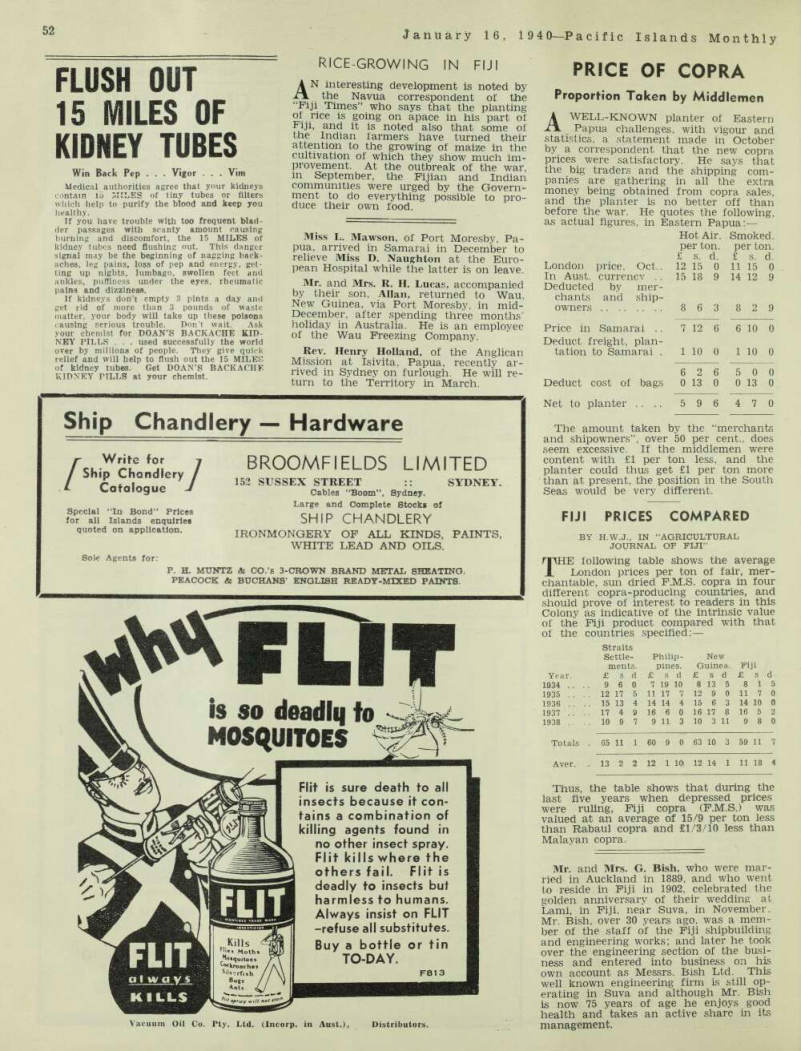
AN interesting development is noted by
the Navua correspondent of the “Fiji Times” who says that the planting of rice is going on apace in his part of Fiji, and it is noted also that some of the Indian farmers have turned their attention to the growing of maize in the cultivation of which they show much im provement. At the outbreak of the war, m September, the Fijian and Indian communities were urged by the Govern ment to do everything possible to pro duce their own food.
Miss L. Mawson, of Port Moresby, Pa pua, arrived in Samarai in December to relieve Miss D. Naughton at the Euro pean Hospital while the latter is on leave.
Mr. and Mrs. R. H. Lucas, accompanied by their son. Allan, returned to Wau.
New Guinea, via Port Moresby, in mid- December. after spending three months' holiday in Australia. He is an employee of the Wau Freezing Company.
Rev. Henry Holland, of the Anglican Mission at Isivita. Papua, recently ar rived in Sydney on furlough. He will re turn to the Territory in March.
Price Of Copra
Proportion Token by Middlemen
A WELL-KNOWN planter of Eastern Papua challenges, with vigour and statistics, a statement made in October by a correspondent that the new copra prices were satisfactory. He says that the big traders and the shipping com panies are gathering in all the extra money being obtained from copra sales, and the planter is no better off than before the war. He quotes the following, as actual figures, in Eastern Papua:—
The amount taken by the “merchants and shipowners”, over 50 per cent., does seem excessive. If the middlemen were content with £1 per ton less, and the planter could thus get £1 per ton more than at present, the position in the South Seas would be very different.
Hot Air.
Smoked. per ton. per ton. £ s. d. £ s. d.
London price. Oct.. 12 15 0 11 15 0 In Aust. currency .. 15 18 9 14 12 9 Deducted bv inerchants and shipowners 8 6 3 8 2 9 Price in Samarai .. 7 12 6 6 10 0 Deduct freight, plantation to Samarai . 1 10 0 1 10 0 6 2 6 5 0 0 Deduct cost of bags 0 13 0 0 13 0 Net to planter .. .. 5 9 6 4 7 0
Fiji Prices Compared
By In “Agricultural
Journal Of Fiji"
THE following table shows the average London prices per ton of fair, mer chantable, sun dried F.M.S. copra in four different copra-producing countries, and should prove of interest to readers in this Colony as indicative of the intrinsic value of the Fiji product compared with that of the countries specified:—
Thus, the table shows that during the last five years when depressed prices were ruling, Fiji copra (P.M.S.) was valued at an average of 15/9 per ton less than Rabaul copra and £l/3/10 less than Malayan copra.
Mr. and Mrs. G. Bish, who were mar ried in Auckland in 1889, and who went to reside in Fiji in 1902, celebrated the golden anniversary of their wedding at Lami, in Fiji, near Suva, in November.
Mr. Bish, over 30 years ago. was a mem ber of the staff of the Fiji shipbuilding and engineering works; and later he took over the engineering section of the busi ness and entered into business on his own account as Messrs. Bish Ltd. This well known engineering firm is still op erating in Suva and although Mr. Bish is now 75 years of age he enjoys good health and takes an active share in its
management.
Year.
Straits Settlements. £ s d Philippines. £ s d New Guinea. £ s d Fiji £ s d 1934 . . . . 9 6 0 7 19 10 8 13 5 8 1 5 1935 . . . . 12 17 5 11 17 7 12 9 0 11 7 0 1936 . . . . 15 13 4 14 14 4 15 6 3 14 10 0 1937 . . 17 4 9 16 6 0 16 17 8 16 5 2 1938 . 10 9 7 9 11 3 10 3 11 9 8 0 Totals . 85 11 1 60 9 0 63 10 3 59 11 7 Aver. . 13 2 2 12 1 10. 12 14 1 11 18 4
Water
Port Moresby to Get Supply at Last
From Our Own Correspondent
Port Moresby, Jan. 2.
NO official statement has been made about the outcome of the visit of the Lieutenant-Governor to Canberra in December but it is confidently reported that the town is now to have a water supply and that at an early date. The work is to be expedited owing to the im portance of protecting the garrison against the possibilities of a drought. The Australian Government will pay half the cost.
The cost will be heavy owing to war conditions pushing up the price of materials. It is estimated that a pipe line of 20 or 30 miles will be needed. It is expected that the water will be brought by gravitation from the Laloki River.
However, the cost must be faced. Port Moresby now has a population of about 800 Europeans —almost equal to that of Rabaul —and conditions here would be desperate indeed if we were faced with a drought like that which came in 1937.
Some quarters suggest that the pro portion of the cost which Papua will bear will be about £50.000.
Polynesian Club
rE Polynesian Club concluded its 1939 season with a Christmas party and kava ceremony, at its rooms in George Street, Sydney. There were over 100 members and guests present. The chief guest, whose name was the first to be called in the official kava ceremony, was Mr. R. W. Robson, editor of the “Pacific Islands Monthly”. Mr. Robson, in a brief address, complimented the Club on its success in creating in Sydney a place that was truly representative of the happiness, vivacity and colourfulness of Polynesian life.
The following representatives of Poly nesian branches were called in the kava ceremony:— Mrs. Lembke, of Coogee and Samoa (addressed as Afioga Talsl).
Miss Christina Hellesoe, of Apia (Afioga So’alo Asi).
Mr. Fred Gosnell, of Rotuma and Suva (Vao Fo’ou).
Mrs. Vika Lamacraft (Tonga); Mr. Selwyn Buffett and Miss Eunice McCoy (Norfolk Island): Mrs. Waikainga Tipene (Ngapuhi people, N.Z.); Miss Olita Hahn (Tonga); Miss Pearl Quintal (Norfolk Is.); Mrs. R. Beckman (Raro tonga) ; Mrs. Fetch (Pitcairn Island); Mr.
Wiremu Takarangi (Wanganui, N.Z.): Mr. Rua Gilman (Gisborne, N.Z.); Miss Rewa Addiss (Suva); Mrs. Rangl Wethered (Waikato, N.Z., a member of the Ngati Poneke Club of Welling ton); Mr. Robert Inglis (of the N.Z. Government Commission Office, Sydney).
The matapule in charge of the kava ceremony was Mr. Richard Hahn, of Tonga, assisted by Mr. John Young, of Norfolk Island.
A programme of dances of Samoa, Tahiti, Hawaii, Ellice Islands, with Maori action songs and poi dances, completed the evening’s entertainment.
The Little Theatre Group plans a vigorous programme of play producing, and the president (Mr. Leonard Moran) invites correspondence from residents of Polynesia interested in the Little Theatre movement and in the legends of Poly nesia. especially those which might be adaptable to a very small stage.
Wau Race Meeting
From Our Own Correspondent WAU, Jan. 4 THREE, hundred people, from all over the Morobe district, had a thoroughly enjoyable day at the Picnic Race Meeting at Wau on January 1. About £l,OOO went through the totalisator and sweepstakes on the eight races.
The meeting was under the auspices of the Wau Golf Club, and there is general agreement that this form of racing is preferable here to the old system of racing under Q.T.C. rules. Some very handsome trophies were donated. It is hoped to hold such meetings four times a year, on the main holidays.
Mrs. C. G. R. McKay, wife of the Sec retary for Native Affairs in Western Samoa, arrived in New Zealand from Apia by the “Matua” in December. She was accompanied by her small son, Peter.
Mr. McKay intended to join them by the following steamer.
Pilot Ditton, of Guinea Airways Ltd., arrived in Australia from Salamaua, T.N.G., by the December “Neptuna”. He was accompanied by his wife.
Japanese Consul for N. Caledonia
THE arrival is expected shortly of Mr.
Kuroki Tokitaro, who has beer ap pointed by the Japanese Government as Japanese Consul in New Caledonia.
Up to the present, there has been no Japanese Consul in the Colony, the Mikado’s subjects being represented merely by a Charge d’ Affaires selected from among Japanese subjects resident in New Caledonia.
Mr. Oscar Olsson, who was secretary of the Norfolk Island Lighterage Co. and a member of the Post Office staff, died recently at Kingston, N. 1.. aged 45. He went to Norfolk Island from Australia about 10 years ago and for a time was engaged in storekeeping and farming, Mr. August Hack, an old and respected resident of Samoa, died recently at the age of 71 years. A native of Germany,
Mr. Hack went to Samoa originally as a wheelwright in the service of the D.H. and P.G.
Mr. J. Francon Williams, dentist in the Medical Department of the Western Samoa Administration, arrived in New Zealand in December on short leave. He joined Mrs. Williams, who left Apia about a month earlier.
Advertisements & other items, pp. 55-56 (2 items)
53
Pacific Islands Monthl y—J anuary 16, 1940
Buy British
SYDNEY'S LEADING
SAILMAKER
and RIGGER
Also Manufacturer of all Canvas and Rope Work.
ISLANDS WORK a
Speciality.
HARRY WEST
Balmain East, Sydney. Tel.: W 1105
Keep OUR Flag at the Masthead
Sound economics require that we buy where we sell within the Empire.
And where better can we deal than with our Best Customer Britain?
Buy British
Reliable and Economical POWER for all K L I ■ fc purposes.
Buy PETTER...
it's BETTER!
PETTER Diesel Engines and Electric Lighting Plants are built for hard, gruelling work. On account of their simplicity and ease of operation, they can be placed in unskilled hands with the certainty of obtaining good results.
Modern engineering science offers the cheapest and most efficient form of power yet developed—the Diesel Engine.
The Fetter isohead of them all. Thousands of Fetter Engines are in use all over the world in every kind of power service pumping, irrigating, electric lighting, marine, etc.
Send for full details of PETTER Engines—from 5 h.p. to 480 h.p.—stationary, marine, or electric lighting. iiizatiio
SEVEN TO ELEVEN MARKET STREET. SYONEY(
BAKER’S JUNO SPECIAL RAZOR
m Extra Full Hollow Ground, White Xylonite Handle, sharpened ready for use.
POST FREE FOR CASH WITH ORDER.
W. Jno. BAKER & 3 H s “£™. ST ’
s
LAUNCHES
/or work or pleasure
Both trim, seaworthy craft, the Chapman Coach-house model and the Chapman Cabin Launch are particularly suitable for island conditions.
The Coach-house model with the closed-in cabin providing ample storage space is an ideal work-boat to meet steamers, carry stores and for inter-island transport. The Cabin model is a popular cruising craft, for fishing and pleasure trips. The cabin is cool and roomy enough to sleep two.
Both craft are powered with a famous Chapman PUP Engine. Write now for details and prices.
CHAPMAN & SHERACK
26 Clara Street, Erskineville, N.S.W.
ENGINE MANUFACTURERS FOR THIRTY YEARS
Did Judge Murray
Know?
Interesting Story of a French Escapee in Papua
By Mollie Lett
THE old penal settlement at New Caledonia, to whence most of France’s confirmed criminals and politi cal prisoners were deported, from 1864 to 1898. has a record common to most settlements of its kind. It was described as a torment—a land torrid and rocky, inhabited by headhunters, where prisoners, irrespective of class or crime, were herded together and forced to labour.
The reports were possibly exaggerated, and certainly the conditions compared favourably with notorious Devil’s Is land (French Guiana); but, even so, many preferred to risk their lives in open boats, in the hope of reaching some un known island in far-off seas, where, how ever savage the inhabitants, they might find a more tolerable existence.
Many were re-captured, and many per ished at sea or in the hands of savage tribes. But, occasionallv. some of the more fortunate survived the hardships of a long voyage and landing near settle ments, avoided recognition, and settled down and established themselves as traders or planters.
IN the early days of occupation, several such men landed on the shores of New Guinea, and in Papua some were well-known to settlers. One in particular was Louis Pothier, a trader at Daru, who arrived from German New Guinea some 40 years ago, and who, on account of his bright and pleasing personality became a popular and successful member of the European community.
Of course,, it was not known generally that Louis Pothier was an escapee from justice, though there were several who had their suspicions. These were con firmed in 1905. when a Frenchman ar rived in the territory, a detective, M.
Rochaix, holding papers for Pothier’s extradition.
But the question arose whether Pothier really was identical with a man named Beal, and this could not be proved; so Pothier remained free, and in Papua. But by only a narrow margin.
Beal, it appears, had escaped from New Caledonia, and had landed in German New Guinea. His description, history and measurements, were almost identical with those of Pothier.
M. Rochaix, hoping to catch Pothier, approached him unexpectedly and, laying his hand on his shoulder, called out in French: “Beal. Beal, I have a letter here from your sister.” (Pothier had a sister in France to whom he wrote).
But Pothier was not so easily caught.
Turning he answered: ‘You are mis taken; my name is Pothier.”
Rochaix had never seen Beal and, therefore, could not be sure of his man.
He applied to the Administrator (Cap tain Barton) for a warrant. But. as allowed by procedure, Pothier appealed to the Court: and. as only one measure ment, the width of the head, was found to apply, the evidence proved insufficient for the Court.
But the detective was not so easily shaken off.
Learning from his papers that Beal had a scar on his left cupital (elbow), Rochaix demanded to examine Pothier.
But, here, Providence came to Pothier’s aid.
Rochaix, though a Frenchman, was not sure of the meaning of “cupital”; and, instead of consulting a dictionary, or someone who knew French, he con sulted the gaoler, a Scottish carpenter, whose knowledge of French and medical terminology was certainly hazier than that of the detective. He told Rochaix that “cupital” meant “wrist”.
So Rochaix again approached his vic tim. “Beal” said he, “you have a scar on your left wrist. Let me see it.”
“Ah, where is it?” cried Pothier, tri umphantly, pulling up his left sleeve.
There was certainly no scar to be seen —though there may have been on his elbow.
So the Court informed Rochaix. and he agreed, that the evidence was insuffi cient to secure Pothier’s extradition Rochaix returned to Sydney and Pothier to Daru.
IT was known that Beal had escaped to German New Guinea, and Louis Pothier made no secret of the fact that he had been there also; but he knew nothing of Beal, and said so many times.
But the Judge to whom Rochaix had applied for his extradition, had a “hunch” that Pothier and Beal were identical. So, for his own satisfaction, he invited Louis Pothier to his house and asked to take his photograph. Pothier became suspicious; but, on being assured that the extradition proceedings were closed, consented, smoked a cigar, had tea, and made himself very agreeable; and shortly afterwards returned to Daru.
The photograph was sent to German New Guinea with an inquiry as to whether anything was known of the original—a man named Pothier.
After a long delay the answer came back. Nothing was known of anyone named Pothier, but the photograph was that of a man called Beal!
POTHIER continued to live at Daru, and his trading prospered; and, when he died, he left considerable pro perty which he bequeathed to his daughter Antoinette, a half-caste. Louis had had her educated at Thursday Is land and in Sydney. He was very attached to the “shild”, as he called her, and great was his disappointment when, on her return, she married into her mother’s tribe, and eventually lived on Kiwai Is land.
Louis Pothier’s family, in France, was known to one Father of the Roman Catholic Mission. They were highly re spected citizens; but Louis had been the “black sheep”.
Pothier was a very patriotic French man and, during the Great War, he never failed to call upon the Governor of the Territory, when the Governor’s vessel arrived at Daru, to drink to the success of the Allied armies. He held the Governor in high regard—for Sir Hubert Murray, in 1905, was the Judge to whom M. Rochaix the detective had applied for his extradition; and Pothier must have sensed that, in spite of the insufficient evidence for his extradition, Judge Murray knew that Pothier and Beal were identical.
Mr. A. L. Lewis, recently appointed airport manager for Pan American Air ways at Auckland arrived in New Zea land by the “Maetsuycker” on December 15, from Noumea, New Caledonia. He has taken the place of Mr. D. Walker, who has been transferred to Honolulu, Hawaii. Mr. Lewis was stationed in Auck land two years ago.
Advertisements & other items, p. 56 (1 item)
54
January 16, 194 0-—P acific Islands Monthly
Lord Irwin On Missions
IT is a common thing to hear the work Of Christian missions dis paraged —generally, by those who have no knowledge of the facts, who prob ably never read a book on missionary work, and never contributed a cent to the support of missions. Those who are most vitally in contact with the work of missionaries are the greatest supporters of them.
Recently Lord Irwin, former Viceroy of India, addressed a gathering in London, and paid a striking tribute to the work of the missionary in that great land. He said, among other things—
“While I was Viceroy I was able to see a good deal of their work, and appreciate not only its moral and social results, but the spirit in which it was conducted. Among outcasts and lepers, among criminal tribes, or aboriginal dwellers in jungle tracts, in crowded cities and remote places in the hills, I have seen men and women slaving devotedly to translate the message of Christ into the prac tical language of Him who went about doing good. In spite of the tragedy of disunity within the Christian ranks, they are doing work of quite in calculable value to India, and their most powerful sermons are in their lives.”
Advertisements & other items, p. 57 (2 items)
55
Pacific Islands Monthl y—J anuary 16, 1940
Cool’and,CCiii^</i^CA
'£S- 15'DECREES
COOIER THAN c
BEFORE WE
(NSUUTLV J
s*. % I -1 ?> K <2
Cool’and,CCiii^</i^CA
Do heat rays "bounce off" your roof Because it is filled with millions of minute air cells, Cane-ite effectively resists heat, cold and noise. With Cane-ite, too, you can DECORATE as you insulate. Smart modern effects can be achieved by painting or stencilling the surface —or by using Cane-ite in either of its two colours, with bevelled edges, the designs being tooled or sanded. White-ant -proofed Cane-ite is made in three thicknesses in boards up to 12 feet long.
Easy to install, inexpensive and amazingly durable. Ask your branch of the Building Materials Division of the Colonial Sugar Refining Company Ltd. for samples and full details.
Its
STRUCTURAL -^ INSULATION
SAVES MORE THAN IT COSTS
THE COLONIAL SUGAR REFINING COMPANY
Sydney . . Melbourne . . Adelaide . ■
OR DO YOU
SW r ELTER IN AN
UN-INSULATED
HOUSE?
MASONITE, “The Wonder Board of 1000 Uses”, is the inexpensive solution to countless building problems. Ask us for full information.
LTD. (Building Materials Division) Brisbane . . Perth OA 34-9
Makogai Lepers Aid
Red Cross
IT is probable that never before in its long history has the British Empire been so completely united as it is in the present war against Nazi Germany. All sorts of little incidents, reported from out-of-the-way places, show how deter mined the British people are that on this occasion they will pay the cost of a guaranteed peace in the future, no matter what the cost will be. Here is an example.
Out in the Central Pacific, on the is land of Makogai, in the Fijian Group, there is a large leper settlement—6l9 lepers from all over Polynesia are col lected there. Recently, a collection was made in New Zealand on their behalf.
The authorities have now been asked, on behalf of a committee representing
the 619 lepers, to allot £lOO from the funds collected in New Zealand to the funds of the Red Cross Society to be used to assist Great Britain in the war. . n “B 10 lepers will be very disappointed if this request is refused”, said the medi cal superintendent. “They are intensely loyal, and are eagerly following the war news over the air and in the newspapers.
They hope that they will be given an opportunity of feeling that they are contributing in a small way to the neces sities of the Empire.”
Mr. F. H. Gander, of the Seventh Day Adventist mission, whose station is at Bena Bena, in Central New Guinea, has been spending furlough in N.S.W. He says that safety razor blades, mirrors, and hair oil are beginning to oust sea shells as the principal currency of the primitive tribes in Central New Guinea
Papua's Chance
Develop the Rubber Industry
THE war has given rubber prices such a boost that those who know Papua well see an opportunity of establishing in that Territory an industry which might make Papua independent of the oil search and the monopoly-ridden copra industry.
Mr. G. A. Loudon, one of the best known planters in Papua, is distributing some effective propaganda in Australian newspapers, urging that the Common wealth Government should now do some thing to establish the Papuan rubber in dustry on a sound, permanent basis. He makes the point that Australia is now proposing to find a huge sum, to sub sidise the establishment of a motor car manufacturing industry, and such an in dustry cannot flourish without oil and rubber. Papua can produce rubber equal to the world’s best, and if it is worth while subsidising so liberally the efforts to discover oil. it is equally worth while to encourage the production of rubber in Papua.
“There is unlimited land in Papua suitable for rubber growing”, says Mr.
Loudon, “and if finance were forthcom ing we could place a large number of young men in the industry. In the opin ion of most planters, Papua is the home of the small planter—planting becomes more of a personal proposition in Papua than in any other tropical country”.
Trans-Pacific Freighting Services
AN American coastal steamer of 3,500 tons, built in 1920, which had been laid up in San Francisco for two years, arrived in Sydney recently as the pioneer of what is believed to be a new American freight service conducted by Pacific S.S.
Lines, of San Francisco, between the Western American coast and Australia, via Pacific Islands ports.
Most of this trans-Pacific freighting in the past has been done by British steamers: but, as much British shipping has been gathered together under the one control for the Empire’s war needs in Atlantic and European waters, it is considered necessary to introduce other shipping to the Pacific to carry out normal trading. It is expected that there will be a cordial understanding between Australian, New Zealand and United States authorities in regard to the or ganisation of new lines of freighters.
Leaders for N.G. Miners
Prom Our Own Correspondent WAU, Jan. 3. rE New Guinea Mining Association, at a special general meeting in Wau on December 30 elected Mr. Harold Taylour to be president, and Messrs.
Norman Dickson and K. A. Macgregor to be vice-presidents for the ensuing year.
These appointments were necessary owing to the resignation of Captain H.
T. Allan (who has joined the Australian Military Forces) and Hon. N. P. H. Neal, M.L.C., who has left the goldfields to take up military duties in Australia.
Mr. Malcolm Whyte, a medical student at Brisbane University, Queensland, ar rived in Apia, Western Samoa, in De cember to spend three months’ holiday with his parents, Rev. H. W. and Mrs.
Whyte, of the London Missionary Society.
Advertisements & other items, p. 58 (1 item)
Products
FIRST IN QUALITY
m
DELICIOUS CANNED FOODS JAMS SOUPS SAUCES, ETC.
IXL
IXL
IXL
IXL
IXL
IXL
IXL
IXL
IXL
IXL
IXL
IXL
IXL
IXL
IXL
IXL
IXL
IXL
JAMS—AII kinds, 120 z., 240 z. and 51b. tins.
JAMS (in 11b. Jars).—Lemon Shred, Orange Shred, Marmalade, etc.
CANNED FRUlTS.—Peaches, Pears, Apricots, etc., 16oz. and 30oz. tins.
SPECIAL GOLDEN QUEEN PEACHES.
16oz. and 30oz. tins.
SPECIAL FRUITS. Gooseberries, Blackberries. Blackcurrants, Cherries, Grapes, Greengages, Golden Drops, Quinces, etc.
CANNED TOMATOES.—I6oz. and 30oz. tins.
CRUSHED PINEAPPLES.—I6oz. and
30oz. tins.
CHOICE PIECES PINEAPPLES—I6oz.
and 30oz. tins.
BAKED BEANS (with TOMATO
SAUCE). —40z., lOoz, and 16oz. tins.
SPAGHETTI (in Tomato Sauce with Cheese). —40z., Boz., and 16oz. tins.
SOUPS—Boz. and 16oz. Cream of Tomato Soup. Boz. and 16oz. Cream of Vegetable Soup. Boz. and 16oz.
Cream of Celery Soup. Boz. and 16oz. Cream of Pea Soup. Boz. and 16oz. Toheroa Soup.
TASMANIAN RICED POTATOES—
61b. tins.
TASMANIAN CRAYFISH.—Boz. tins.
TASMANIAN SCALLOPS.—I6oz. tins.
PICKLES —All kinds, 60z., 140 z., and 18oz. Jars.
TOMATO SAUCE—4oz., lOoz., and 20oz. bottles.
WORCESTERSHIRE SAUCE (OR
RELISH) —50z., lOoz., and 20oz. bottles.
OLIVES. —6oz. and 13oz. Jars.
Obtainable from all Leading Island Storekeepers.
h jones &co
AUSTRAL
AUSTRALIA'S BEST
H. JONES & CO. PTY. LTD., HOBART & SYDNEY
Military Funeral In
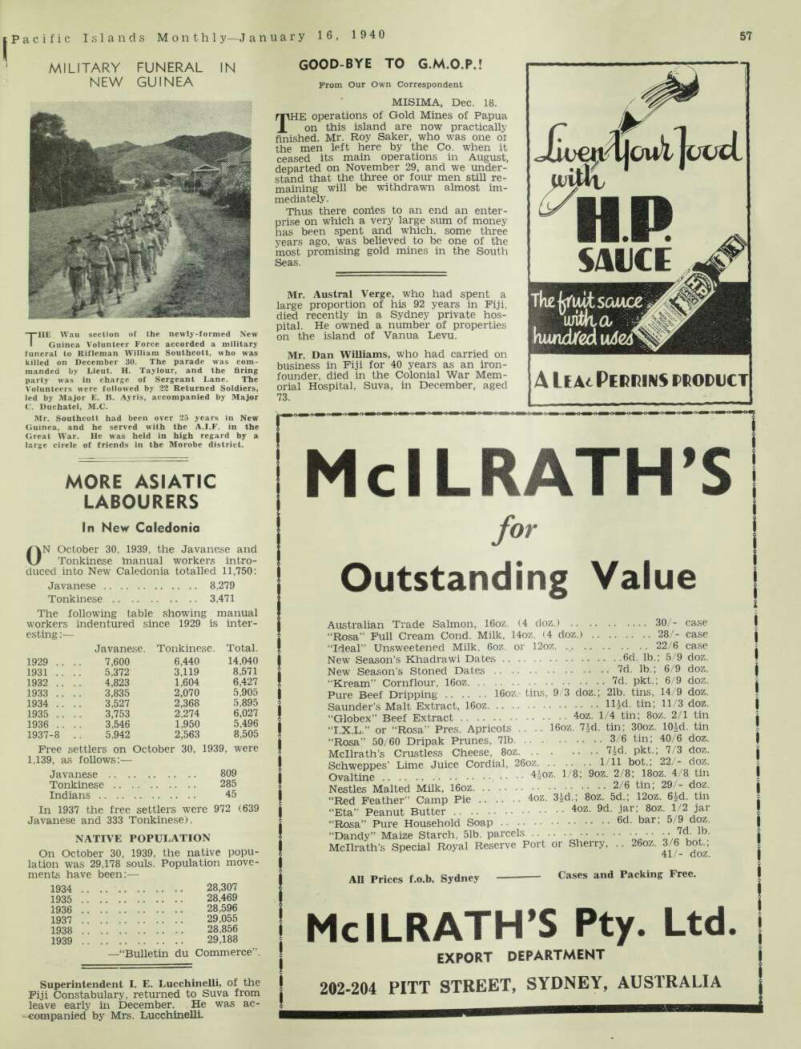
New Guinea
THE Wau section of the newly-formed New Guinea Volunteer Force accorded a military funeral to Rifleman William Southcott, who was killed on December 30. The parade was com manded by Lieut. H. Taylour, and the firing party was in charge of Sergeant Lane. The Volunteers were followed by 22 Returned Soldiers, led by Major E. B. Ayris, accompanied by Major C. Duchatel, M.C.
Mr. Southcott had been over 25 years in New Guinea, and he served with the A.I.F. in the Great War. He was held in high regard by a large circle of friends in the Morobe district.
More Asiatic
Labourers
In New Caledonia
ON October 30, 1939, the Javanese and Tonkinese manual workers intro duced into New Caledonia totalled 11,750: Javanese 8.279 Tonkinese 3,471 The following table showing manual workers indentured since 1929 is inter esting:—
Free settlers on October 30, 1939, were 1,139, as follows: — Javanese 809 Tonkinese .. .. 285 Indians 45 In 1937 the free settlers were 972 (639 Javanese and 333 Tonkinese).
Native Population
On October 30, 1939, the native popu lation was 29,178 souls. Population move ments have been: — 1934 28,307 1935 28,469 1936 28,596 1937 29,055 1938 28.856 1939 29,188 —“Bulletin du Commerce”.
Superintendent I. E. Lucchinelli, of the Fiji Constabulary, returned to Suva from leave early in December. He was ac companied by Mrs. Lucchinelli.
Javanese.
Tonkinese.
Total. 1929 .. .. 7,600 6,440 14,040 1931 .. .. 5.372 3,119 8,571 1932 . . 4,823 1,604 6,427 1933 .. .. 3,835 2,070 5.905 1934 .. .. 3,527 2,368 5.895 1935 .. 3,753 2.274 6,027 1936 .. .. 3,546 1,950 5.496 1937-8 .. 5.942 2,563 8,505
Good-Bye To G.M.O.P.!
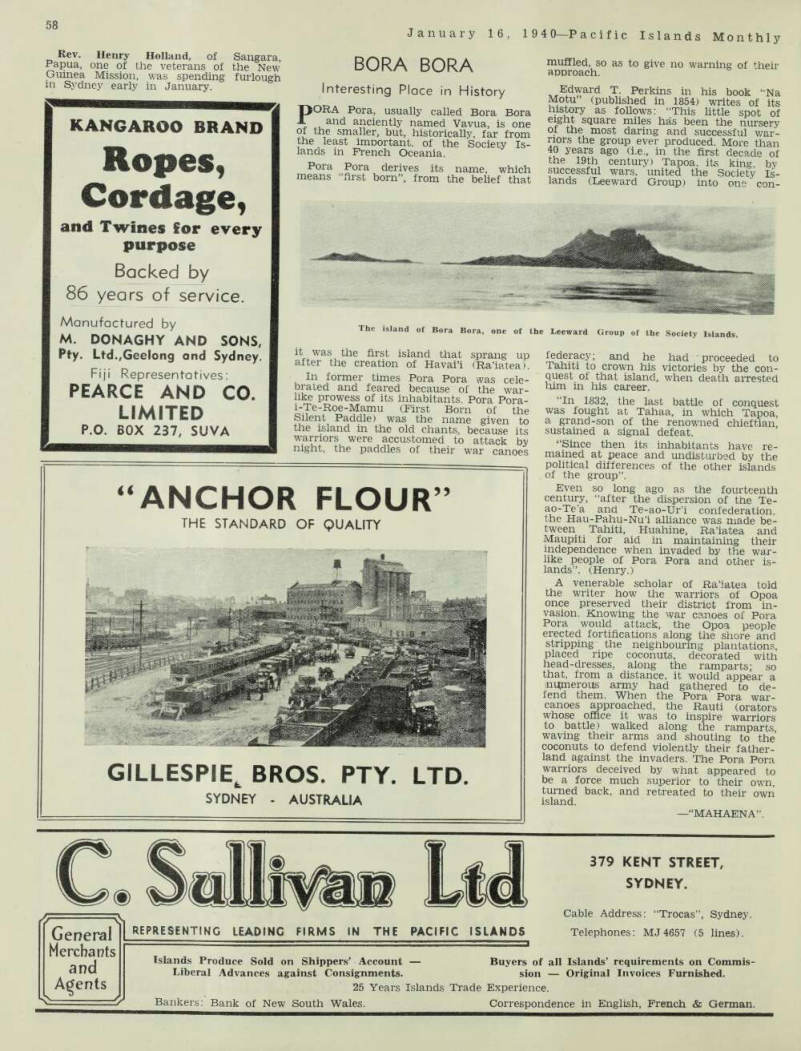
Prom Our Own Correspondent
Misima, Dec. 18.
THE operations of Gold Mines of Papua on this island are now practically finished. Mr. Roy Saker, who was one or the men left here by the Co. when it ceased its main operations in August, departed on November 29, and we under stand that the three or four men still re maining will be withdrawn almost im mediately.
Thus there conies to an end an enter prise on which a very large sum of money has been spent and which, some three years ago, was believed to be one of the most promising gold mines in the South Seas.
Mr. Austral Verge, who had spent a large proportion of his 92 years in Fiji, died recently in a Sydney private hos pital. He owned a number of properties on the island of Vanua Levu.
Mr. Dan Williams, who had carried on business in Fiji for 40 years as an iron founder, died in the Colonial War Mem orial Hospital, Suva, in December, aged 73.
Rev. Henry Holland, of Sangara, Papua, one of the veterans of the New Guinea Mission, was spending furlough in Sydney early in January.
Advertisements & other items, pp. 59-60 (2 items)
57
Pacific Islands Monthl y—J anuary 16, 1940
Mcilrath’S
HP
SAUCE
& Vj Tkejtfuitsouce vMlOb rumd/ed tided \ LEAt Perkins product
McILRATH’S
for
Outstanding Value
Australian Trade Salmon, 16oz. (4 doz.) 30/- case “Rosa” Full Cream Cond. Milk, 14oz. (4 doz.) 28/- case “Ideal” Unsweetened Milk. 6oz. or 12oz 22/6 case New Season’s Khadrawi Dates 6d. lb.; 5/9 doz.
New Seasons Stoned Dates 7d. lb.; 6/9 doz.
“Kream” Cornflour, 16oz 7d. pkt.: 6/9 doz.
Pure Beef Dripping 16oz. tins, 9/3 doz.; 21b. tins, 14/9 doz.
Saunder’s Malt Extract, 16oz tin; 11/3 doz.
“Globex” Beef Extract 4oz. 1/4 tin; Boz. 2/1 tin “1.X.L.” or “Rosa” Pres. Apricots .. .. 16oz. tin; 30oz. 10£d. tin “Rosa” 50/60 Dripak Prunes, 71b 3/6 tin; 40/6 doz.
Mcllrath’s Crustless Cheese, Boz 7id. pkt.; 7/3 doz.
Schweppes' Lime Juice Cordial, 260 z 1/11 bot., 22/- doz.
Ovaltine 4ioz. 1/8; 9oz. 2/8; 18oz. 4/8 tin Nestles Malted Milk, 16oz •• • • 2 /6 29/- doz.
“Red Feather” Camp Pie 4oz. 3 2 d.; Boz. 5d.; 12oz. 6 2 d. tin “Eta” Peanut Butter 4bZ - jar; ; Boz : 1/2 Jar “Rosa” Pure Household Soap 6d - bar ’ 5/ ,r, “Dandy” Maize Starch, 51b. parcels .. .. • • •• 7( J- lb - Mcllrath’s Special Royal Reserve Port or Sherry, .. 260 z. 3/6 bot., All Prices f.o.b. Sydney Cases and Packing Free.
McILRATH’S Pty. Ltd.
EXPORT DEPARTMENT
202-204 PITT STREET, SYDNEY, AUSTRALIA
KANGAROO BRAND
Ropes,
Cordage,
and Twines for every purpose
Backed by
86 years of service.
Manufactured by
M. DONAGHY AND SONS,
Pty. Ltd.,Geelong and Sydney.
Fiji Representatives:
PEARCE AND CO.
LIMITED
P.O. BOX 237, SUVA
“ANCHOR FLOUR”
THE STANDARD OF QUALITY
ft
BROS. PTY. LTD
SYDNEY - AUSTRALIA
s @> u a m
Lid
w General Merchants and
Agents
REPRESENTING LEADING FIRMS IN THE PACIFIC ISLANDS
379 KENT STREET,
SYDNEY.
Cable Address: “Trocas”, Sydney.
Telephones: MJ 4657 (5 lines).
Islands Produce Sold on Shippers’ Account Buyers of all Islands’ requirements on Commis- Liberal Advances against Consignments. sion Original Invoices Furnished. 25 Years Islands Trade Experience.
Bankers: Bank of New South Wales. Correspondence in English, French & German.
Bora Bora
Interesting Place in History
PORA Pora, usually called Bora Bora and anciently named Vavua, is one oi the smaller, but, historically, far from the least important, of the Society Is lands in French Oceania.
Pora Pora derives its name, which means “first born”, from the belief that
!t was the first island that sprang up after the creation of Havai’i (Ra'iatea).
In former times Pora Pora was celebrated and feared because of the warfSJSTS.II* 8 Pora Porasnpnt H Born ° f the fhp^innrf d ?,, «,o „i-i th f, n ? ,n ? ® lven to the island in the old chants, because its
muffled, so as to give no warning of their approach.
Edward T. Perkins in his book “Na Motu” (published in 1854) writes of its history as follows: “This little spot of e tj=ht square miles has been the nursery of the most daring and successful war riors the group ever produced. More than 40 years ago (i.e., in the first decade of the 19th century) Tapoa. its king, bv successful wars, united the Society Is lands (Leeward Group) into one con
federacy; and he had proceeded to Tahiti to crown his victories by the con quest of that island, when death arrested him in his career.
“In 1832, the last battle of conquest was fought at Tahaa, in which Tapoa, a grand-son of the renowned chieftian, sustained a signal defeat.
“Since then its inhabitants have re mained at peace and undisturbed by the political differences of the other islands . of the group”.
Even so long ago as the fourteenth century, “after the dispersion of the Te ao-Te’a and Te-ao-Ur’i confederation, the Hau-Pahu-Nu’i alliance was made be tween Tahiti, Huahine, Ra’iatea and Maupiti for aid in maintaining their independence when invaded by the war like people of Pora Pora and other is lands”. (Henry.) A venerable scholar of Ra’iatea told the writer how the warriors of Opoa once preserved their district from in vasion. Knowing the war canoes of Pora Pora would attack, the Opoa people erected fortifications along the shore and stripping the neighbouring plantations, placed ripe coconuts, decorated with head-dresses, along the ramparts; so that, from a distance, it would appear a numerous army had gathered to de fend them. When the Pora Pora war canoes approached, the Rauti (orators whose office it was to inspire warriors to battle) walked along the ramparts, waving their arms and shouting to the coconuts to defend violently their father land against the invaders. The Pora Pora warriors deceived by what appeared to be a force much superior to their own, turned back, and retreated to their own island.
“Mahaena”.
The island of Bora Bora, one of the Leeward Group of the Society Islands.
A Trip To Suva
By “Amel”
WHEN you live in the backblocks of sunny Fiji, and you suddenly de cide that you want to go to Suva, there is no time for humming and hawing and twiddling of thumbs. You grab the first boat that offers, and pray that the gods will be kind.
We grabbed the “Adi Maca”, which, as Fiji's first “casualty” of the present war, now lies at the bottom of the sea.
She was loading bananas 15 miles along the coast, and was scheduled to leave for Suva the following afternoon.
In frenzied haste, we packed our bags, and walked. A howling “southerly buster” blew us across the beach, through rivers and past villages, until we reached our destination—to find the “Adi Maca” sit ting placidly on top of a reef!
“She dragged her anchor in the wind last night”, explained the skipper, a wiry little Canadian with a humorous nose and vivid blue eyes. “But she’ll be O.K.
She’ll come off at high tide.”
And, sure enough, she did!
“The ‘Adi Maca’ often does that”, re marked a local planter cheerfully. “If there’s a reef to be hit, she hits it.”
“She does, does she?” said I, hollowly.
“How very thrilling. I suppose you know we’re going to Suva on her?”
“Yes—and I pity you!” was the stimu lating reply.
Regaled with harrowing tales of the “Adi Maca’s” previous misdeeds, we set sail for Suva the following evening. There were bananas in the hold, and on the deck, and the banana inspector sat on a pile of cases and gazed moodily at the rising waves.
Just before sunset, we downed a mug of tea, and a few biscuits, and I felt very superior to the banana inspector, who was looking pretty green about the gills!
Ten minutes later, we passed into the open sea, and the full force of the wind was upon us. Blue, white-capped hills foamed around us. and things began to happen.
The foresail was whisked away, never to be seen again. Cases of bananas started to slide. The “Adi Maca” hesi tated, as if taking a breath, then plunged. She stood on her nose, sat on her tail, twisted, rolled and tossed. The skipper came into the cabin to tap the barometer.
“I’d like to get these bananas to Suva, but it’s going to be a dirty night”, he /observed. “Would you like to be put ashore?”
“Not at all”, we averred, stoutly.
“Whither thou goest . .
So we went on, driving through the blackness of the screaming gale. There was not a star in the sky. Far away, low on the horizon, a tiny flash showed in termittently.
“Koro Light ’, said the skipper, briefly, and went to stir his crew to greater efforts.
A conglomeration of sounds filled the night. Sea-water gurgled around the cabin floor. The engine thudded feebly, and sometimes stopped, leaving us feel ing incredibly lonely. The banana inspec tor and I (!) provided a really melodious duet, and didn’t care if the boat sank with all hands.
The bleak dawn revealed scudding clouds and an angry sea. But, later, the sun shone, and even the unhappy land lubbers felt better.
All that day, the boat staggered on, drawing steadily nearer to Suva. At 6 p.m., we were in the calm waters of
Suva Harbour, and the skipper was tak ing time off to congratulate himself, when a sudden jolt, and a harsh, grating sound, made him swear forcibly. The good ship ft Adi Maca” had found an other reef!
After surveying the situation, the skipper returned.
“She’ll be O.K.’, he said, philosophic ally. “She’ll come off at high tide.”
And, sure enough . . . she did.
Mr. Archibald Quintal died recently at the home of his sister, Mrs. Nash Christian, on Norfolk Island.
Mr. James Johnson, of Moamoa, West ern Samoa, arrived in New Zealand re cently with his wife and family to make their permanent home in the Dominion.
He had been in Samoa for 25 years, hav ing originally gone to Apia with the New Zealand Relief Force in 1915.
Advertisements & other items, p. 61 (2 items)
59
Pacific Islands Monthl y—J anuary 16, 1940
Enos
No energy?
\S
a" se
o" A VV o" o' vo'" o" \b et V>° o'* *U« bet G \a" v' oS ftt i" 1 c»" o"
V"
I'"
O'* V>'°° o"
Uc"' V-e" vev be ie' oo"
A" o' A' a
irtW*
o"
Vo& (o' V"' V\» no" o' »c le*®* o£ r"
V"° ib° \A o"
If you feel that you have no
energy for anything, take a
glass of Eno’s “Fruit Salt”
t any time during the day.
Eno cools and purifies the
hlood, tones up the system,
ind restores natural
vigour and energy.
ENOS
"FRUIT
I SALT!
ff
TRADE MARK
DELICIOUS, TASTY FOODS
For ISLAND MEALS
AUNT MARY’S COOKERY
BOOK.
There’s no finer book for every home . . . 212 pages, lavishly illustrated in colour, and over 400 recipes and useful hints make it a book that every housewife will want. Send only one shilling and twopence to
TILLOCK & CO. PTY. LTD.,
Sydney N.S.W., and get your copy of this great book NOW.
JUST TRY any of AUNT MARY'S Pure Food ** Products, and you will be back for more .. .
delicious in themselves or with innumerable
dishes.
AUNT MARY'S BAKING POWDER
AUNT MARY'S TOMATO SAUCE
AUNT MARY'S SPAGHETTI IN TOMATO
SAUCE
AUNT MARY'S BAKED BEANS IN TOMATO
SAUCE
AUNT MARY'S CANNED VEGETABLES
Green Peas, Cauliflower, Celery, etc.
RANEE CURRY POWDER
BLOSSOM HONEY In Attractive Jars Or any packed Sealed of the large variety of Pure Pood Products specially for Tropical conditions, in Tlllock’s Hermetically 1-lb tins. All goods are procurable from your local stores
TILLOCK & CO. PTY LTD. SYDNEY
Raise Pigs Instead of Copra
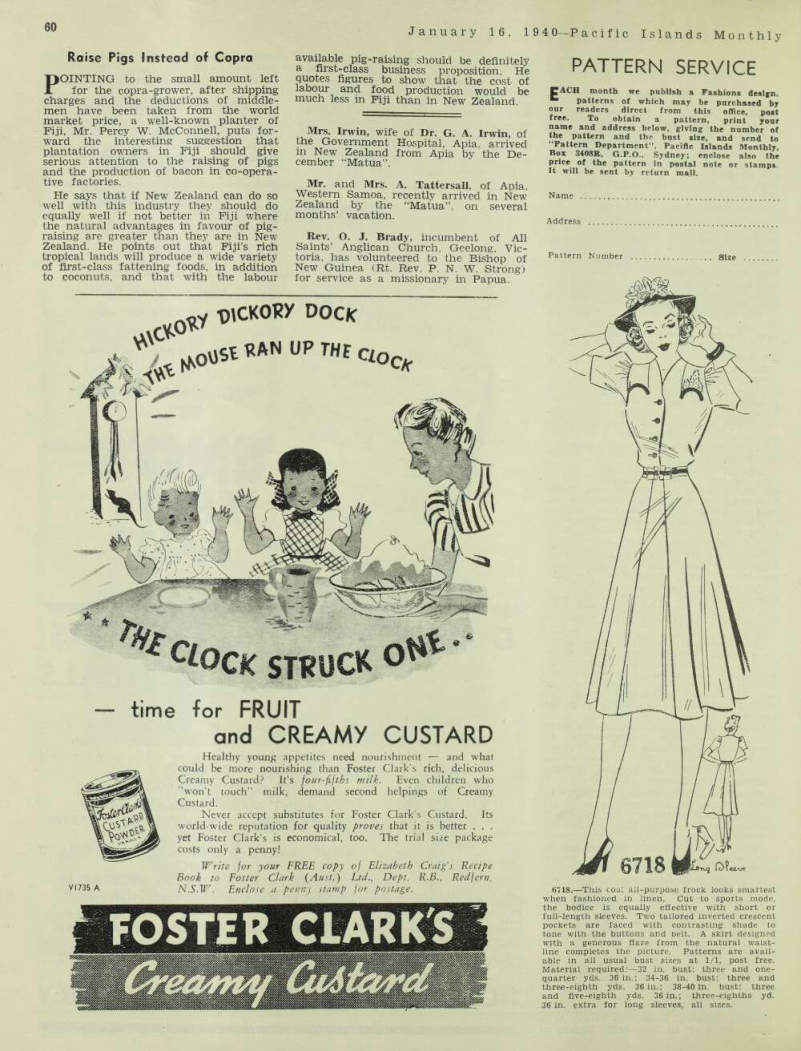
POINTING to the small amount left for the copra-grower, after shipping charges and the deductions of middle men have been taken from the world market price, a well-known planter of Fiji, Mr. Percy W. McConnell, puts for ward the interesting suggestion that plantation owners in Fiji should give serious attention to the raising of pigs and the production of bacon in co-opera tive factories.
He says that if New Zealand can do so well with this industry they should do equally well if not better in Fiji where the natural advantages in favour of pig raising are greater than they are in New Zealand. He points out that Fiji’s rich tropical lands will produce a wide variety of first-class fattening foods, in addition to coconuts, and that with the labour
available pig-raising should be definitely a first-class business proposition. He quotes figures to show that the cost of labour and food production would be much less in Fiji than in New Zealand.
Mrs. Irwin, wife of Dr. G. A. Irwin, of the Government Hospital, Apia, arrived m New Zealand from Apia by the De cember “Matua”.
Mr. and Mrs. A. TattersaU, of Apia, Western Samoa, recently arrived in New Zealand by the “Matua”, on several months’ vacation.
Rev. O. J. Brady, incumbent of All Saints’ Anglican Church, Geelong, Vic toria. has volunteered to the Bishop of New Guinea (Rt. Rev. P. N. W. Strong) for service as a missionary in Papua.
Pattern Service
CACH month we publish a Fashions design. ** patterns of which may be purchased by our readers direct from this office, post free. To obtain a pattern, print your name and address below, giving the number of the pattern and the bust size, and send to "Pattern Department". Pacific Islands Monthly, Box 3408 R, G.P.0., Sydney; enclose also the price of the pattern in postal note or stamps It will be sent by return mail.
Name Address Pattern Number size
6718.—This cool all-purpose frock looks smartest when fashioned in linen. Cut to sports mode, the bodice is equally effective with short or full-length sleeves. Two tailored inverted crescent pockets are faced with contrasting shade to tone with the buttons and belt. A skirt designed with a generous flare from the natural waist line completes the picture. Patterns are avail able in all usual bust sizes at 1/1, post free.
Material required;—32 in. bust: three and one quarter yds. 36 in.; 34-36 in. bust: three and three-eighth yds. 36 in.; 38-40 in. bust: three and five-eighth yds. 36 in.; three-eighths yd. 36 in. extra for long sleeves, all sizes.
Advertisements & other items, p. 62 (1 item)
Ci Ock Struck
X)\CKOl?y DOCK
KAN UP THE
Qq Ca .
V m *
CI OCK STRUCK
- time for FRUIT
and CREAMY CUSTARD
m V 1735 A Healthy young appetites need nourishment and what could be more nourishing than Foster Clark’s rich, delicious Creamy Custard? It’s four-fifths milk. Even children who "won’t touch’’ milk, demand second helpings of Creamy Custard.
Never accept substitutes for Foster Clark’s Custard. Its world-wide reputation for quality proves that it is better . . . yet Foster Clark’s is economical, too. The trial size package costs only a penny!
Write for your FREE copy of Elizabeth Craig’s Recipe Book to Foster Clark ( Aust ,) Ltd., Dept. R. 8., Redfern , N.S.TF. Enclose a penny stamp for postage.
I d
Fashion Hints for Islands Women
By "Therese"
sun-baskers nowadays are I; muffled up to protect their porce lain fragility against torrid rays—an ex cellent idea! Vast shade hats, long sleeves, high necks and clog-soled shoes all do their bit in the “fragility” cam paign. They are auite a naradox when worn with shorts, which by the way are not nearly so abbreviated as previously, being almost knee-length. Shorts vie for popularity with the pleated little-girl skirt and are topped by gay blouses,
stripes predominating.
A red and green striped blouse is worn with green cotton shorts, Pushia, white and blue stripes are in a skirt that is topped by a casual shirt of blue linen.
At night you reverse the order of things and informally wear the gayest stripes you can find with a slim skirt of bright linen or jersey weave.
For afternoon, you may still be demure with a play dress, like a schoolgirl’s, of sunshine yellow, the bodice low and square and flanked with puff sleeves.
Three tucks mark the hem.
WHEN away from the beach there are many charming frocks from which to choose. As skirts and bodices have loosened, waists have closed in—not in the wasp-narrowness of the gay nineties, but hugging you in a broad, close grip from hip-line to bust. On many others you will find the stomacher: a deep pointed band that joins bodice and skirt and looks so delightful on the young and slim. Dresses with stretchable bodices woven with “lastex” yarn are as much part of Fashion’s scheme of things for day as for night. They are the natural outcome of those full skirts, that neces sitate tiny waists.
Let your new coat this season be either a bolero, a loose boxy jacket, or one that fits like a glove—or even a full-length coat that turns your outfit into an en semble. With the new fitted jacket dresses, the coat looks like a dress and has a hint of Spring in it.
Hip-length fitted jackets have flared skirts; and loose boxy jackets demand a slimmer line. A printed pick-up for jaded wardrobes is a real bolero stitched down to the V of the skirt and caught with a narrow velvet ribbon bow. A jacket with a wide waist band gives you a wondrously small waist and the skirt flares neatly from your hips down.
Accessories to go with your summer wardrobe are important. They pep up tired clothes and add further charm to new ones. Gloves come in a variety of designs, the plain gauntlet being the most serviceable either in washing suede or suede fabric. Belts vary in width—some are studded with brass and look like glorified dog-collars, but are really in triguing with plain linen frocks; others are of coloured patent leather or macrame.
Attention-getters anywhere are the many-coloured wooden bead necklets.
They are so gay and look really delight ful with a white or pastel linen frock.
There are bracelets to match, too. When these sets are worn no touch of colour contrast is necessary on the frock.
A feather sprig to flaunt in your hair makes your evening more gay, and if you match it up with a long curling feather fan success is assured. To com plete the period picture, pin a cameo on a wide black velvet ribbon and fasten
it about your throat and if you want to carry the illusion still further, tie another ribbon about your wrist.
A new cocktail bag is rimmed with gold and has a cluster of gold balls in one corner to match the necklet and bracelet. These with the addition of black suede gloves piped wih gold kid lift the plainest gold frock to the heights.
HATS for 1940 are presented in all shapes and sizes—low hats, high hats, hats with cartwheel brims, and hats with no brims at all on which perch crazy bows. Whatever their shape or size, they are all charming when worn with suitable coiffure and at the correct angle. There are two types from which to choose: one for women who can wear hair and hats high: and the other for women who should wear their hats low.
All sorts of straws are fashionable, though the shiny straw is the vogue at the moment. Turbans, too, demand at tention for both day and evening wear, and are made in fish-net, heavy crepe or the flimsiest tulles. White hats are worn with frocks of every colour, being particularly chic with black.
Miss I. Lapthorne, a teacher of the Victorian Education Department, who was seconded for work among the Indians in Fiji, under the supervision of the Methodist Mission, returned to Mel bourne in December on leave.
A monument is being placed at Dun combe Bay, Norfolk Island, on the exact spot where Captain Cook landed on October 10, 1774, when he discovered and named Norfolk Island. The prime mover in carrying out this useful historical work is Captain J. D. McComish, who has ac tively co-operated with the historical societies and Government officials in Australia and New Zealand, in hav ing Captain Cook’s various landing places marked by monuments.
Advertisements & other items, pp. 63-64 (2 items)
61
Pacific Islands Monthl y—J anuary 16, 1940
Under L Ying
At Blue Mountains—Spiingwood, N.S.W.
Springwood Ladies' College
Est. 1897. Kindergarten to Leaving Certificate. Tennis, Riding, Swimming, Team Games. Unequalled climate. Pure Jersey Milk. Senior and Junior Houses. Openair sleeping. Inclusive fees. Special vacation arrangements for Island pupils.
M. E. DUBAND, Principal.
UNDER L YING
S \\ New colours and styles blended into the loveliest creations in lingerie for this season. £0 V6£l LiNgeßie
SEND
now
FOR
YOUR
COPY
of our new big Catalogue just arrived. Everything a man wants —and the prices are right.
Pike Brothers Ltd.,
Queen Street, Brisbane.
KAMB A L A
CHURCH OF ENGLAND
SCHOOL FOR GIRLS
FOUNDED 1887
A Day and Boarding School for Girls.
KINDERGARTEN TO
LEAVING CERTIFICATE
HONORS.
RESIDENT QUALIFIED
SPORTS MISTRESS.
Prospectus on application to the Principal . . .
MISS F. HAWTHORNE. B.A.
KAMBALA SCHOOL
ROSE BAY. SYDNEY
r' ■ • • ‘KAMBALA” Ideally situated in 5 acres of ground ... 5 Tennis Courts
He Practised!
A Minor Tragedy in Tahiti
From Our Own Correspondent
Papeete, Dec. 10.
THE history of the world is full of illustrious examples of the spirit of man striving with relentless energy against obstacles imposed by capricious Nature. Demosthenes, his mouth full of pebbles, battling against an impediment of speech; ■ the youth who bore through snow and ice a banner with his strange device: and countless others of equal determination and valour.
Should history repeat itself (as it sometimes does) the champion of all accordion players will one day emerge from Tahiti to astonish the world. Unless, in the meantime, exasperated and des perate neighbours shall have anticipated achievement by mayhem or dynamite.
The hero of this tale is an American.
The romantic atmosphere of Tahiti has stirred within him dormant impulses which have germinated an urge for ex pression through music. He has chosen as a vehicle the once national instru ment of the South Pacific Islands—the accordion. The particular accordion he has acquired has the effective range of a ‘‘Big Bertha”, and a quality of tone that can puncture boiler iron.
After twenty-four hours, the landlady of his cottage in Papeete, fearing dam age to her property by indignant neigh bours, read the Riot Act to her American tenant.
Shortly afterward, the peace and tran quility of Taaone—hitherto a seemingly impregnable refuge from the turmoil of Papeete—was shattered. The American had, by the power of gold, persuaded a
keeper of cattle at Taaone to aljow him to practise on his premises.
From early morn ’til dewy eve, with two hours respite for rest and refresh ment at mid-day, the noise continues.
The cattle herder, whose network of nerves is as susceptive to external im pressions as the wire system of an underground railway, apparently hears nothing. His cows are equally unmoved.
But a mule on the little farm, whose ear is more sensitive, protests lustily, with much huffing and puffing and wheezing and braying (as is the habit of mules), against this outrage unon the peace and quiet of the settlement.
This thing has been going on for months. One is interested to know what will emerge from such travail; a master to astonish mankind, or the dust and blood of a pogrom?
That marvellous but fickle virtue, human endurance, will decide the issue.
Mrs. E. E. Harris was accepted by the Methodist Mission Board for service in Fiji, at its December meeting.
Mr. Tommy O’Dea, Guinea Airways well-known pilot, at present stationed at Port Moresby, returned on January 5 from a flight to the new Goilala landipg ground, at 3,000 ft. elevation, near the recently-established police camp in the heart of the new country in the Central Division. Mr. O’Dea describes the land ing as the most picturesque he has seen in New Guinea. It is approached through winding gorges, in what is probably the most mountainous country in Papua. The Administration is making use of air transport to the camp, in preference to native carriers, and finding it both cheaper and more convenient.
Islands Mining
News
From New Guinea
Sunshine Gold Development, Ltd.
ANEW pressure pipe line connecting with the Reedy Creek water race, which, in addition to providing water for sluicing the, terrace claims, will carry water across the river to link up with the present workings to sluice shallow ground, had been completed out of current earn ings at a cost of £5,000. said the chairman, Mr. F. W. Torrington, at the annual meeting of Sunshine Gold Development, Ltd., on December 2i,;..
A scheme recommended by the general. man ager last year, including removal of over-burden from about five and a half acres, had been successfully accomplished, but at the expense of gold yield for the time being. The purchase of 40 acres from Bulolo Gold Dredging, Ltd., ad joining the Co.’s main working, had consolidated that section of the Watut River, and as the main pipe line passed within a few feet of the boundary of this area no costly plant extensions to work it would be necessary.
The increase in the gold price since the out break of war had been some benefit, but the gold excise tax deprived the Co. of half the in creased vsflue. Some increase in the cost, of working was expected because of the greater volume of wash to be treated from increased workings.
Clean-up for December yielded 364 oz. of gold.
Placer Development, Ltd.
The recent sale of 6,278 shares in Bulolo Gold Dredging, Ltd., realised 175,171 dollars, thereby reducing Placer Development’s holding to an even 300,000 shares, stated the managing director (Mr. C. A. Banks) at the annual meeting of the Co. in Vancouver in December. The value of this investment in the books was further reduced by transfer of 600,072 dollars from the special and general reserve.
Enterprise Of N.G. Gold And
Petroleum Development, N.L.
Directors of Enterprise of New Guinea Gold and Petroleum Development, N.L., were dis appointed with results from Surprise Creek, said the chairman (Mr. Edward Fay) at the annual meeting recently; but they hoped that better values might be obtained upstream. The ground was difficult to work because of numerous boulders.
It was also stated that at the end of 1939 18 Europeans and about 190 natives were em ployed by the Co.
Bulolo Gold Dredging, Ltd.
War had affected the operations of Bulolo Gold Dredging, Ltd., in many ways, declared Mr. C. A. Banks, managing director of the Co., at the annual meeting of shareholders in Vancouver recently. “On its outbreak”, he said, “the Commonwealth Government passed legis lation necessitating the disposal, in Australia, of the whole of bur gold. The excise duty in creases -as the value Of the Australian pound drops in relation to the United States dollar.
This would become very severe if the Australian exchange .took a sharp decline. The tax bears far more heavily on residents in U.S.A. and CanadqT—where the majority of the Co.’s share holders are—than on shareholders residing in Australia, who would, in terms of Australian currency, receive an increasing amount as the Australian pound drops”.
November production is compared with Sep tember and Oc|ob,er, in the following table: —
Estimated working profit for November, 9,325 ouficesT of fine gold., flowing for the new excise duty. ...
New Guinea Goldfields, Ltd.
After providing £16,918 for depreciation, New Guinea Goldfields, Ltd., earned a profit of £67,230 for the year ended September 30, 1939, compared with £50,486 for the previous year.
With £352,017 brought forward, there is avail able £419,247. Since the closing of the ac-t counts a dividend at an unchanged rate of 5 per cent. (3d. per share) has been announced, and will require £55;904. Cash at bank and on hand amounts to £ 166,596.
Income from mining and milling operations was normal during the year, the report states, but alluvial earnings were substantially less be cause of unavoidable delays in bringing Upper Edie Deep Lead and Koranga deep alluvial to the production stage. It is pointed out that the new Golden Ridges mill recovered 3,950 oz, ot fine gold more than the old mill would have extrasted from the same quantity and grade of ore. Expenditure totalling £85,031 was made with the object of bringing low-grade alluvial areas into production.
Pending the working of these areas, the pre paratory expenses have been charged to the redemption account, and will be recouped by charges against the working accounts when pro duction is commenoed. Until the partial re demption of these recent expenditures has built up cash reserves to approximately what they were at the beginning of the financial year, the directors feel that the dividend policy of the Co. should remain conservative.
Footages driven during the year were as follows: —Edie Creek, 2,229’; Golden Ridges, 2,460.
Total ore production from the Edie and Karuka veins was 37,727 tons, and from Upper Ridges, including Golden Ridges, 29,094 tons. Reserves of assured and probable ore for the Edie aTid Karuka veins at the end of the financial year were estimated at 46,818 tons, further possibilities amounting to about 26,000 tons. Reserves of assured and probable ore for the Upper Ridges mine, including Anderson’s Creek lode, are given at 103,600 tons.
Alluvial production from 270,775 c. yds. was 8,915 oz. of bullion, containing 4,916 oz. of fine gold and 3,744 oz. of silver. Tributers produced 7,839 oz. of fine gold and 5,351 oz. of silver.
Alluvial reserves are estimated at 1,222,000 c. yds. averaging between 4/- and 5/- per c. yd. They are located chiefly on Edie Creek and the Bulolo River. The Koranga or Wau deep alluvial re serves still stand at approximately 9,000,000 c. yds. of V- average’ value.
Production at both Edie Creek and the Ridges is expected to continue at the rate of approx!-* mately 3,000 tons a month. Alluvial production, it is added, will be enhanced by the working of the Upper Edie Cteek deep alluvial deposit, and
Sept.
Oct.
Nov.
Cubic yards ,. 1,589,000 1,646,000 1,619,000 Bullion, oz. 25,851 23,215 24,684 Gold, fine, nz. '.. 17,838 16,018 17,032
area W&U d,6eP alluvials ln the Koranga Creek A report issued by the Mining Trust, Ltd., consutlng engineers to N.G.G., Ltd., compares the production and profit for September, October and November:—
Sandy Creek Gold Sluicing, Ltd.
The manager of Sandy Creek Gold Sluicing, Ltd., New Guinea, reported early in January that the last four yields compared as follows:
From Fiji
Emperor Gold Mining Co.. Ltd.
p\EVELOPED ore reserves of Emperor Mines, Ltd -> were still some five years’ ahead of the mill, said the chairman (Mr. Wallace H.
Smith) at the annual meeting in December. The main Emperor ore body was standing up to the vigorous development programme of the Co., and work on the Regent and Cardigan lodes augured well for the future.
While the profit of £204,288 for 1938-39 was eminently satisfactory, results so far in the current year promised to eclipse that figure.
Plans were well forward to bring into opera tion by next April a new process to enable the Co. to mill semi-oxidised and sulphide ore by flotation. With a steady increase in volume of semi-oxidised and sulphide ore treated, the pre sent rate of profits could easily be maintained and there were prospects of progressive improve ment.
December production of the Emperor mine is compared with the three previous yields in the following table:
•In addition, recovered 1,145 oz. gold from treatment of accumulated concentrates, and an nual clean-up of accumulated slags and amal gum. Total production, 4,578 oz. Mill closed four days, Christmas holidays.
Mount Kasi Mines, Ltd.
Latest yields from the Mount Kasi mine at Vanua Levu. Fiji, are compared in the following table: -
Loloma (Fiji) Gold Mines, N.L.
The directors of Loloma (Fiji) Gold Mines, N.L., expect that the Co. will pay 4/- a year in dividends, and perhaps occasional bonuses, said the chairman (Mr. P. F. Cody) at the annual meeting in December.
If developments in the lower levels of the Co.’s mine in Fiji proved as extensive and favour able as in the present upper levels, the mine will be able to supply the mill with a greater tonnage than at present, he added. The direc tors may consider increasing production when the No. 4 and No. 5 levels have been opened up. The No. 3 level looks very promising and should add considerable quantities of high-grade ore to reserves when developed to its full ex tent.
Production for December is compared with the previous three months in the following table:—
•In addition, recovered 1,189 oz. from annual clean-up of accumulated slags and amalgum, and 490 oz. from devaluation of solution. Total pro duction, 5,036 oz. Mill closed four days at Christmas, but precipitation was carried on, ex cept on Christmas Day.
From Papua
Papuan Apinaipi Petroleum Co., Ltd.
THE general manager of Papuan Aplnalpi Petroleum Co., Ltd. (Mr. Launcelot Owen), reported at the end of December that, approxi mately, 150 tons of the deep drilling plant, hired to the Co. by the Commonwealth Government, had been landed at Olapu. This included the 40 h.p. tractor and trailer, which Is transport ing the plant to the drilling site without any difficulty. The foundations are ready, and the erection of the derrick is being proceeded with.
All the casing required for deep drilling has reached Sydney, freight having been arranged.
It will be shipped to Papua shortly.
A later report, on January 10, stated that the whole of the major drilling plant had been landed at Oiapu, and the Commonwealth Drilling
Edie Creek mill— Sept.
Oct.
Nov.
Ore, tons Gold, oz., fine ..
Silver, oz., fine .. .. 2,360 646 5,364 3,009 891 7,321 2,703 748 6,108 Alluvial— Gold, oz., fine ..
Silver, oz., fine .. .. — 1,734 1,224 1,763 1,216 Golden Ridges mill— Tons treated ..
Gold, oz., fine ..
Silver, oz., fine 2,744 1,367 1,513 2,336 971 1,070 2,500 1,186 1,363 Operating profit— Edie Creek, £ ..
Alluvial, £ Golden Ridges. £ .. •Loss. •178 3,746 5,382 1,226 5,788 1,644 •144 5,236 3,440
Sept.
Oct.
Nov.
Dec.
Cubic yards .. . 26,153 24,238 18,920 14,267 Gold, oz 396 255 243 240 Per cubic yard . 2/3'4 1/7 1/11 2/6 % Working cost .. , . /ioy 2 /II 1/ —
Four weeks ended Oct. Nov. Nov. *Dec. 4. 1. 29. 27.
Ore treated, tons . . 12.655 13,386 12.400 10 563 Head, value, dwt. . 6.8 7.2 7.1 7 25 Gold, oz. fine . . . 3.838 4,312 3,963 3 433 Residues, dwt. . .. 0.67 0.70 0.70 0 70
Pour weeks ended Oct.
Nov.
Nov. Dec.
Ore. 4. 1. 29. 27. tons 3,547 3,520 3,058 3,044 Gold, tine, oz. . 657 707 710 683 Value. £A . . . 6.570 7,070 7.100 6,830
Pour weeks ended Oct.
Nov.
Nov. *Dec. 4. 1. 29. 27.
Tons treated ., . 2,540 2,532 2,520 2,220 Gold, oz., fine 3,277 3,330 3,780 3,357 Residue, dwt. .. 1.0 1.2 1.5 1.38
Inspector (Mr. E. A. Kodyen) was on the site supervising the layout of the plant.
Yodda Goldfields, Ltd.
Yodda Goldfields, Limited, reported early in January that the gold yield for December was 76 ounces 2 dwt.
Cuthbert’S Misima Goldmine, Ltd.
Figures for the December clean-up from Cuth bert’s mine on Misima Island, Eastern Papua, compared with the two previous yields as follows: —
Mandated Alluvials, N.L.
Directors of Mandated Alluvials, N.L., in their report, issued in December, for the year ended July 31, state that the smelter plant ran for 112 days, and produced 376 tons of copper-gold matte containing 3,544 oz. fine gold, 8,212 oz. silver, and 131.5 tons copper. The total value was £37,606 from 6,216 tons of oxidised ore, and 3,396 tons of sulphide ore.
Considerable development work is in progress, the report states. The Laloki property contains more than 400,000 tons of sulphide ore. In creased plant will be required. Interim dividend of 3d. a share was paid on September 26, and £ 1,325 was written off mine development ac count in respect of certain abandoned options.
Oil Search. Ltd.
Oil Search, Ltd., has accepted an offer from its shareholding partners, D’Arcy Exploration Co., Ltd., and Vacuum Oil Co. Pty., Ltd., to re purchase 100,000 shares in Australian Petroleum Co., stated the chairman (Mr. W. A. Freeman) at the annual meeting in Sydney on December 20. The right to purchase must be exercised within five days of the general meeting of Aus tralian Petroleum Co., to be called for the authorising of the next share issue. The price per share to be paid shall be the amount paid up on the shares, plus interest at 5 per cent.
The regional district where the first deep test well in Papua will be located has been selected and active drilling operations are contemplated within the next few months.
Oct. Nov . Dec.
Mill treated, tons .. .. 3.208 3,260 3,300 Bullion, oz 3,018 2,914 3,265 Gold, fine oz 788 824 832 Silver, line oz 2,170 2,030 2,370 Estimated value .. £6,347 £6,710 £6,775 Value per ton of ore .. 39/7 41/2 41/1
Advertisements & other items, pp. 65-66 (3 items)
63
Paci f i c Is 1 a rvd s Monthl y—J anuary 16, 1940
Allen Taylor Co. Ltd.
Mining Ore
Treatment
Machinery
COMPLETE CYANIDE
PLANTS SUPPLIED
Dorr Classifiers, Dorr Thickeners, Dorr Agitators.
Oliver Filters Merril Crowe Zinc Dust Gold Precipitation Richardson Mine Pans
FANS AND AIR HEATERS
For Ventilation, _Copra Drying Rooms, etc. • Enquire from
CROSSLE, DUFF AND
MACINTOSH LTD.
52 Bridge Street, SYDNEY.
Allen Taylor Co. Ltd.
SYDNEY
Sawmillers and Wholesale Suppliers of Hardwoods for Constructional Purposes GIRDERS . . . PILES . POLES . . . SLEEPERS, Etc.
EXPORTING TO PACIFIC ISLANDS SINCE 1893
Cables: Tuxedo, Sydney
Highest Prices Paid For
L D Garrett & Davidson’s organisation is acknowledged far and wide as the main clearing Ijouse for precious metals in the Southern Hemisphere.
They have earned a reputation for accuracy and integrity in all their business dealings, which is proved by the fact that they are privileged to handle- more gold from the Islands of the Pacific than any other organisation.
Therefore for your complete and lasting satisfaction, you are advised to transact all your precious metals business through the house of Garrett & Davidson;. .
GARRETT & DAVIDSON PTY. LTD.
ASSAYERS METALLURGISTS REFINERS
Bank of N.S.W. Buildings,
REGENT AND GEORGE STS., SYDNEY.
KELVIN
Marine
DIESEL ENGINES
Also
KEROSENE and BENZINE
TYPES.
All kinds of Islands Repair Work undertaken.
G. RUTHERFORD,
Engineer,
46 PITT ST., SYDNEY.
Swallow & Ariel!
LIMITED
PORT MELBOURNE :: AUSTRALIA
MANUFACTURERS
SINCE 1854
OP HIGH QUALITY
BISCUITS
CABIN BISCUITS
NAVY and PILOT BREAD
PACKED EXPRESSLY FOR EXPORT
IN TINS UP TO SOlbs.
Manufactured at Port Melbourne, Australia FIJI REPRESENTATIVES - - PEARCE & CO. LTD.
64
January 16, 1 940-Paclflc Islands Monthly
Quotations For Islands Mining
Shares
Fiji
Mid-July.
Mid-Oct.
Mid-Jan.
Emperor Mines .. b8/ll b9 6 bl4/3 Loloma b21 4*2 b22/9 b32/l'/ 2 Mt. Kasi S3/9! b3/4 b5/- Tavua Dev blVad s6d s4d Bulolo G.D
New Guinea
b £ 6/4/- b £ 6/5/ - b £ 6/3/- Enterprise of N.G b25/b7/6 b35/- Guinea Gold ..
S12/10 bl3/b!4/4 N.G.G., Ltd bl/11 b2/b2/9 Oil Search b3/8 s3/3 b5/- Placer Dev b67/6 b70b79/6 Sandy Creek bl/6 bl/3'/ 2 bl/2 Sunshine Gold .. b6/8 b6/2 b8/2 Cuthbert's
Papua
S17/6 b!7/bl7/- G.M. of Papua . b6d s7d s3d Mandated All. ... b2/6 b3/8 b3/7 Oriomo Oil b5/3 — b7/6 Papuan Apinaipi b4/10 b2/6 b5/9 Yodda Goldfields bl/7 bl/4 bl/6
Price Of Gold
(Australian Official Quotations)
Pine Standard oz. oz.
October 2. 1939 .. £10/11/ £9/13/5 November 6 £10/11/ £9/13/5 November 13 ... £10/11/ £9/13/5 November 20 £10/13/- £9/18/3 November 27 £10/13/- £9/15/3 December 4 £10/12/6 £ 9/14/9 V 2 December 11 £ 10/12/6 £9/14/9 Vi December 18 £10/12/6 £9/14/91/2 December 25 £ 10/12/6 £9/14/9V2 January 1 , 1940 .. . £10/12/6 £9/14/9i/a January 8 £ 10/12/6 £9/14/9V 2 January 15 £10/12/9 £9/15/01/4
SSftJ'&S to/ta
BSS£% offer SW
work, but he has tried in vain to get into uniform. He writes: “With conscnption up to 22, one is now too old at 23.” He has again taken up his abode at Jersey (Channel Islands) for the duratioiT of the war, where he is busy on two books—one, a new version of Marcus Aurelius in modern English, and the a travel book, South America and .
Matron Hutcheon and Sisters Reid and Bland have been appointed to the staff ° f toe Paton Hospital, Port Vila, New Hebrides.
At a meeting in Melbourne last month, Rev. Maurice Frater, on behalf of the New Hebrides Presbyterian missionaries, presented a turtle-shell box to Rev. A.
C. Matthew, who, after 15 years, is re tiring from the Foreign Mission isecrec aryship of the Victorian Church. The box is a rare piece of craftsmanship exe cuted by Captain Morison, of Vila.
Advertisements & other items, pp. 67-68 (2 items)
65
Pacific Islands Month L y—J anuary 16, 1940
In Goodweid
Sat -mr
A. w G S *4* : X* N X % fefc.
X
FOR MINING ENGINEERS
in GOODWEID
SPIRAL PIPE
± Saving No. 1. LOW INITIAL COST.
Goodweid Spiral Welded Steel Pipe das a considerably lower first cost than other descriptions of pipe.
Saving No. 2. LESS FREIGHT TO PAY.
Because Goodweid pipe is light in comparison with other pipes designed to carry similar pressures, very considerable savings in shipping freights and land haulage charges are possible.
Saving No. 3. LONGER LIFE IN SERVICE.
Goodweid Steel Pipe resists corrosion and possesses great strength due to the reinforcing spiral rib providing it with longitudinal stiffness and great resistance to crushing under external load. Longer life means less maintenance and fewer renewels.
IN ADDITION the lighter weight of Goodweid pipe reduces held handling and laying costs besides speeding up the work as Goodweid is exceptionally easy to instal even in close quarters.
Compare with other piping and you will find Goodweid costs less per foot to buy, to ship and to haul, less to handle and less to maintain. 1 our types available covering light and heavy duty service.
Diameters from 5 in. upwards in dead straight 30 ft. lengths.
Joints—supplied with prepared ends ready for field welding; with flanges or with spigots and faucets for jointing with lead or push-in rubber rings. Protective coatings and linings include: Galvanising inside or out or both; concrete lined or ready for lining: Bituminous coated or lined to any specification. . .
Full particulars of Goodweid pipe for industrial, mining, agricultural and water reticulation purposes gladly supplied.
A. E. GOODWIN PTY. LTD.
RAILWAY PARADE, LIDCOMBE, N.S.W.
AND AT PORT KEMBLA
>// <Si
Eaten Up with
RHEUMATISM
& Backache
Now Fit as a Fiddle,
Thanks to Cystex
NURSE AT LAST FINDS A MEDICINE
TO END HER CHRONIC RHEUMATISM
Few people have the advantages of a Nurse in being able to call in the best medical advice for her health troubles, so the testimony of Nurse G. G. of Melton Mowbray is especially interesting to sufferers from Rheumatism and other Kidney and Bladder Troubles.
“I don't often try things from advertisements but I ventured to try your Cystex for Rheumatism which I have suffered from for years, and I feel I must tell you how much I have benefited from it after only a small box. I have now ordered from my chemist a large size and he tells me he sells a great deal of it." (Sgd.) Nurse G. G.
6 YEARS’ RHEUMATISM GONE
“I had suffered for about six years with Rheu tnaiism in the legs. I had three injections in one hip which lasted four years and then was just as bad as ever. I took Cystex and the first dose put me right, but I kept on taking them for a month and I am quite free from ailments now." — (Sgd.) G. H. Gibbs, R.M.D. Wakefield, Nelson.
Both these people purchased Cystex on guarantee that if it did them no good they could get money back.
If you suffer from :
RHEUMATISM, SCIATICA, NEURITIS,
LUMBAGO, PAINS IN BACK, NERVOUS-
NESS. DIZZINESS. LEG PAINS, CIRCLES
UNDER EYES, LOSS OF ENERGY and
APPETITE, PUFFY ANKLES. BURNING,
SMARTING PASSAGES, or have to
“GET UP NIGHTS”
the chances are 100 to 1 that your kidneys are at fault, but you wijl soon be well again if vou take the right medicine for these troubles.' Thanks to Cystex, there is now a positive, speedy, guaranteed remedy for all the troubles shown above. An eminent physician has discovered that every one of these ailments is due to kidney trouble, i.e., the faulty elimination by the Kidneys of waste matters, toxic poisons and acids (including the dreaded uric acid) from the system. This famous doctor has given his valuable prescription to the world, now known everywhere as Cystex—and approved by Doctors and Chemists in 73 countries —the medicine that must do you good or cost you nothing.
Cystex Helps Nature
3 Ways
The Cystex treatment is highly scientific, being specially compounded to soothe.
HEADACHE,
CIRCLES
UNDER EYES.'
CYSTEX
nervousness) Vfe
CASerBLOATINC^' I ™'
(ia
[ DRV SKIN
BACKACHE
RHEUMATISM
LUMBAGO
BURNING.]^
Smarting,
itching.
dizziness,
AND LOSS OF
VIGOUR
MOM
ACIDITY,
DISTURBED
DIGESTION.
' nw;
BLADDER
WEAKNESS
SWOLLEN
ANKLES
c^ean raw, sore, sick kidneys and Madder and to remove acids and poisons from your system, safely, quickly and surely, yet contains no harsh, harmful or dangerous drugs.
Cystex works in these 3 ways to end your troubles : (1) Starts killing the germs which are attack mg your Kidneys, Bladder and urinary system in two hours, yet is absolutely harmless to human tissue. (-) Gets rid of health-destroying, deadly poisonous acids with which your system has become saturated. (3) Strengthens and reinvigorates the kidneys, protects you from the ravages of diseaseattack on the delicate filter organism, and stimulates the entire system.
NO BENEFIT—NO PAY
This is the only fair and honest way of selling a medicine. Go to your chemist today for Cystex. If it does not put you right, return the empty package and your money will be refunded in full. Act now ! In 24 hours you will feel better and he completely well in 1 week. The Guarantee protects you. Now in 3 sizes: 1/9, 4/-, 8/.
Sooner or Later Nearly Everyone Needs wwviiui VI iiuui ij jwiig IICCU9
Cystex
This is a
GUARANTEED
Remedy
For the KIDNEYS, BLADDER AND RHEUMATISM
SCHAFFER & CO.. SYDNEY.
"Unforgettable!"
Tahiti Considers The Durian
From Our Own Correspondent
Papeete, Dec. 7.
SOME years ago a horticulturist—who has brought to Tahiti many exotic plants of beauty and usefulness— im ported some strange saplings which he nurtured with tender care.
His Tahitian neighbours—who appar ently sleep in relays or never sleep at all, lest they miss seeing all that goes on— reported that the horticulturist was ac customed to go by night to take the temperature and feel the pulse of the new saplings, and to swathe them against the cold midnight breezes from the mountains. Whether or no this is the exact truth, the saplings grew and flourished, and, in due time, put forth blossoms which ripened into fruit.
The flavour of this fruit—the Durian— is reputed to be of incomparable sweet ness. But, as in the Norse legend of the “Treasure of the World” surrounded by a wall of fire which only the hero who never knew fear could penetrate, the flavour of the Durian is protected by a mighty rampart—an awful, unforgettable odour. So far (in Tahiti) only those Siegfrieds who have breached the fear some defences of certain celebrated fromages, have summoned courage to essay the Durian. Others are content to learn of its virtues from their testi mony.
Many have wondered why the Durian was brought to Tahiti. Perhaps he who has established so many flowering trees, exotic fruits and lovely garden plants, foresaw that one day these would be taken for granted and their cultivation forgotten. Even in its native land, the Durian is never taken for granted. It has personality that forbids forgetfulness.
Like the poet Horace who boasted: “Exegi monumentum aere perennius”, our horticulturist has established for himself an imperishable monument, more endur ing than any memorial of bronze or marble.
Sugar-Growing in N. Guinea?
THE registration in Sydney, in Decem ber, of Mandated New Guinea Sugar Plantations Pty., Ltd., with a Capital of 1,200 shares of £5 each, is rioted. The moving spirit behind the piah f ' appears to be Mr. Leonard C. Horton.
There is nothing of special r interest about the registration, except the curious fact that apparently it is proposed to grow sugar in New Guinea. Most people are under the impression, since the, fll fated Sangara effort in Papua, that Vtlie Commonwealth Government , will t not permit an attempt to establish the sugar industry in Papua or New Guinea, on the ground that the rationalisation of the sugar industry throughout the Empire is already completely provided for, Mr. W. Buddie, of the Education De partment, Western Samoa, made a visit to New Zealand during the Christmas holidays. .
Mr. R. J. Fletcher, author of “Isles of Illusion”, is now a schoolmaster in a country school in Cornwall, England.
Mr. A. Q. McGowan, well-known Suva business man, arrived in New Zealand froffi Fiji early in December on a health recruiting trip.
Australian Short Wave
Broadcast
A NATIONAL Short Wave Programme is broadcast daily from Lyndhurst, near Melbourne, Victoria, for listeners in the Western Pacific. Call signs: Before 5.15 p.m. VLR3; after 5.30 p.m. VLR.
Wave lengths: Before 5.15 p.m. 25.25 metres; after 5.30 p.m. 31.32 metres.
Frequencies: Before 5.15 p.m. 11880 Kcs.; after 5.30 p.m. 9580 Kcs. Power: 2 Kilowatts.
Daily Week Dats
(Subject to Alteration Without Notice.) a.m. 6.30 Market Reports. 6.50 News Bulletin. 7.05 Physical Exercises. (7.15 Music. 7.45 News. ■B.OO Music. 9.30 Story. 10.00 Dally Devotional Service. 10.15 Close. 12.00 Time Signal, p.m. 12.20 Wheat and Grain Report. 12.25 Stock Exchange Reports. 12.40 Commentary by “The Watchman.” 12.55 Overseas News. 1.00 Australian News. 1.30 News. 1.35 Afternoon Musical Programme. 4.15 Overseas News. 5.16 Close. 5.30 Children’s Session. 6.15 Dinner Music. 7.00 News. 7.15 News Commentary. 7.45 Talk (“The Watchman” —Tuesdays). 9.30 Overseas News. 11.15 Music. 11.50 Late News. 12.00 Dept, of Information Service. 12.30 Close.
P.M. Evert Saturday
1.40 —5.30 Description of current sporting and athletic events, interspersed with music. 12.00 Close.
A M. Every Sunday
6.45 Music. 6.50 News. 7.00 Music. 8.30 Brass Band Music. 9.00 News.
9.15 Sporting Session. 930 “In Quires and Places Where They Sing”. 10.00 Light Ensemble. 10.15 Book Reviews. 10.30 New Releases (Recorded). 11.00 Divine Service, p.m. 12.15 Operatic Excerpts. 12.55 News Session. 1.00 Luncheon Music. 1.30 Close.
3.00 Re-open—Talk.
3.15 Musical Programme. 6.45 Talk, 7.00 News. 7.15 Talk on “International Affairs”. 9.30 News Service. 10.30 Readings from the Bible, 10.50 Late News. 11.00. Close.
Feb. 1 (Thurs.)—l.3s p.m. Bendigo Races. 8 A.B.C. Concert Hour; 9 Emma and ’Erbert; 9.10 Colour Canvas —Musical Feature; 9.45 Talk by Frank Clune.
Feb. 2 (Fri.) —8 p.m. Light Orchestra Pro gramme; 8.30 Ballad Recital: 9 Jim Davidson Feature: 10 Variety Programme.
Feb. 3 (Sat.) —1.35 p.m. Race Descriptions: 7.45 “Music Hall Memories”: 8 Musical Programme: 9.15 Recital by Zena Moller (Soprano); 11 8.8. C.
Feature. (No further programmes are available for this issue.) Mr. Albert William Schrater, a native of Illinois, U.S.A., and a miner on the
Morobe Goldfields, T.N.G., since 1926,
died on December 16, at the age of 52.
Mr. Schrater was a well known and re spected member of the Goldfields com munity and had been mining at Edie Creek for many years. The last three years had been devoted to constructing a water race from the Upper Watut to Wau and district. This race is a gigantic
undertaking, but unfortunately death
overtook Mr. Schrater before its com pletion. Mr. Marvin Schrater arrived from U.S.A. to join his uncle on Decem ber 15, but only saw him in hospital on the eve of his death. He intends to carry on his uncle’s undertakings on the Goldfields.
Advertisements & other items, p. 69 (1 item)
(Hiilisl)
IWf sdhoolt
Hoti
iftj ihk&fc
is huuUpum
<Utd ok !
datic’io'us.
It may be used in the preparation of many dainty and pleasing savories Anchovy toast is always a welcome choice for a supper party, or if sandwiches are preferred they are delicious when made with my Anchovy Paste Here is a favourite savory: Ingredients: 3 Bananas I Tablespoon Holbrooks Capers i lb. Cheese 6 fingers of Brown Bread and Butter Holbrooks Anchovy Paste Spread the fingers of brown bread and butter with Holbrooks Anchovy Paste Cut the cheese into thin fingers and place one on each finger of bread. Skin the bananas and cut them in half length ways. Put a banana flat side down on each piece of cheese, and decorate it down the centre with a row of Holbrooks Capers, There are other varieties of Holbrooks Fish and Meat Pastes, too: Bloater, Salmon, Salmon and Shrimp, Chicken and Ham, Veal and Tongue, Turkey and Tongue.
AP-I
(Hiilisl)
(Cijiardtffi of (Dnnlitii ♦♦♦ In case of difficulty i - ' obtaining supplies, write tcsw
BOX 18(>1 K.. G.P.0., SYDNEY.
Market Quotations
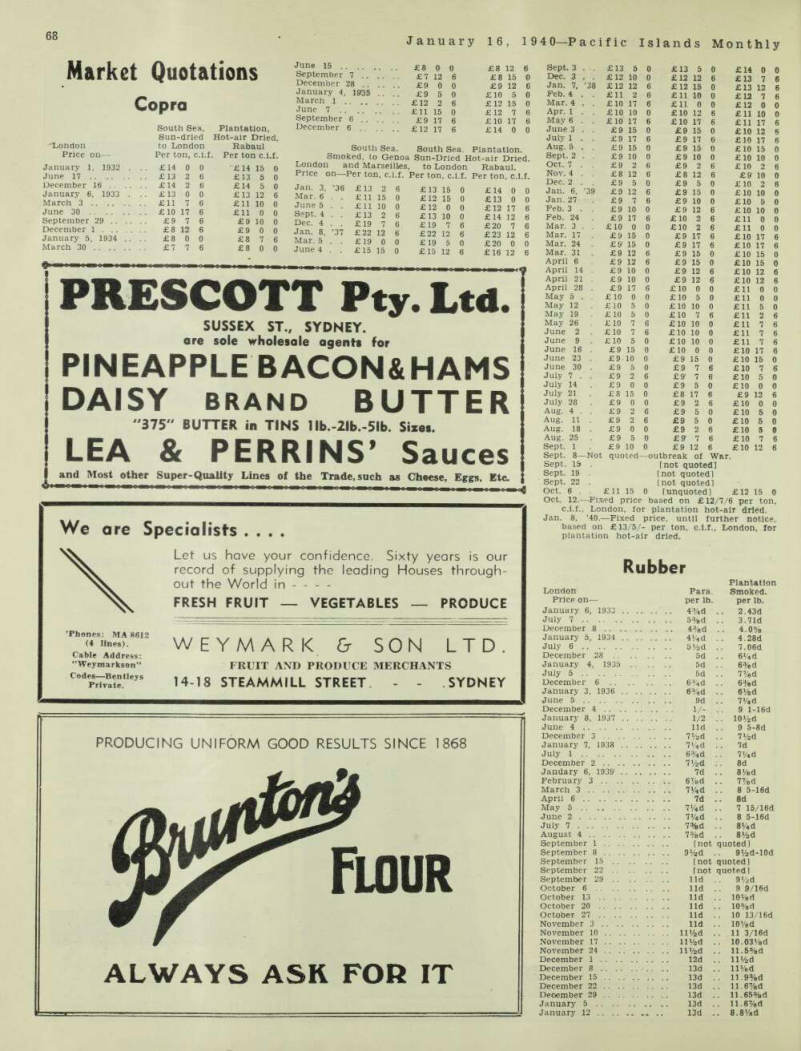
June 15 . £8 0 0 £8 12 6 September 7 £7 12 6 £8 15 0 December 28 £9 0 0 £9 12 6 January 4, 1935 .. .. £9 5 0 £10 5 0 March 1 £12 2 6 £12 15 0 June 7 ., £11 15 0 £12 7 6 September 6 £9 17 6 £10 17 6 December 6 £12 17 6 £14 0 0 South Sea.
South Sea.
Plantation.
Smoked, to Genoa Sun-Dried Hot-air Dried.
London and Marseilles, to London Rabaul.
Price on— Per ton, c.i.f, . Per ton, c.i.f.
Per ton, c.i.f.
Jan. 3, ’36 £13 2 6 £13 15 0 £14 0 0 Mar. 6 . . £11 15 0 £12 15 0 £13 0 0 June 5 . . £11 10 0 £12 0 0 £12 17 6 Sept. 4 . . £13 2 6 £13 10 0 £14 12 6 Dec. 4 . . £19 7 6 £19 7 6 £20 7 6 Jan. 8, '37 £22 12 6 £22 12 6 £23 12 6 Mar. 5 . . £19 0 0 £19 5 0 £20 0 0 June 4 . . £15 15 0 £15 12 6 £16 12 6
Sept. 3 . . £13 5 0 £13 5 0 £14 0 0 Dec. 3 . £12 10 0 £12 12 6 £13 7 6 Jan. 7, 38 £12 12 6 £12 15 0 £13 12 6 Feb. 4 . £11 2 6 £11 10 0 £12 7 6 Mar. 4 . £10 17 6 £11 0 0 £12 0 0 Apr. 1 . £10 10 0 £10 12 6 £11 10 0 May 6 . . £10 17 6 £10 17 6 £11 17 6 June 3 . £9 15 0 £9 15 0 £10 12 6 July 1 . £9 17 6 £9 17 6 £10 17 6 Aug. 5 . £9 15 0 £9 15 0 £10 15 0 Sept. 2 . £9 10 0 £9 10 0 £10 10 0 Oct. 7 . £9 2 6 £9 2 6 £10 2 6 Nov. 4 . £8 12 6 £8 12 6 £9' 10 0 Dec. 2 . £9 5 0 £9 5 0 £10 2 6 Jan. 6, ’39 £9 12 6 £9 15 0 £10 10 0 Jan.27 £9 7 6 £9 10 0 £10 5 0 Feb. 3 . £9 10 0 £9 12 6 £10 10 0 Feb. 24 £9 17 6 £10 2 6 £11 0 0 Mar. 3 . £10 0 0 £10 2 6 £11 0 0 Mar. 17 £9 15 0 £9 17 6 £10 17 6 Mar, 24 £9’ 15 0 £9 17 6 £10 17 6 Mar. 31 £9 12 6 £9 15 0 £10 15 0 April 6 £9 12 6 £9 15 0 £10 15 0 April 14 £9 10 0 £9 12 6 £10 12 6 April 21 £9 10 0 £9 12 6 £10 12 6 April 28 £9 17 6 £10 0 0 £11 0 0 May 5 . £10 0 0 £10 5 0 £11 0 0 May 12 £10 5 0 £10 10 0 £11 5 0 May 19 £10 5 0 £10 7 6 £11 2 6 May 26 £10 7 6 £10 10 0 £11 7 6 June 2 £10 7 6 £10 10 0 £11 7 6 June 9 £10 5 0 £10 10 0 £11 7 6 June 16 £9 15 0 £10 0 0 £10 17 6 June 23 £9 10 0 £9 15 0 £10 15 0 June 30 £9 5 0 £9 7 6 £10 7 6 July 7 . £9 2 6 £9’ 7 6 £10 5 0 July 14 £9 0 0 £9 5 0 £10 0 0 July 21 £8 15 0 £8 17 6 £9 12 6 July 28 £9 0 0 £9 2 6 £10 0 0 Aug. 4 . £9 2 6 £9 5 0 £10 5 0 Aug. 11 £9 2 6 £9 5 0 £10 5 0 Aug. 18 £9 0 0 £9 2 6 £10 5 0 Aug. 25 £9 5 0 £9 7 6 £10 7 6 Sept. 1 £9 10 0 £9 12 6 £10 12 6 Sept. 8— Not quoted- —outbreak of War.
Sept. 15 [not quoted] Sept. 19 [not quoted] Sept. 22 [not quoted] Oct. 6 . £11 15 0 [unquoted] £12 15 0 Oct. 12.- -Fixed price based on £12/7/6 per ton, c.i.f., London. , for plantation hot-air dried.
Jan. 8, ’40.- —Fixed price, until further notice. based ! on £ 13/5/ - per ton, c.i.f., London, for plantation hot-air dried.
London
Rubber
Para.
Plantation Smoked.
Price on— per lb. per lb.
January 6, 1933 4%d .. 2.43d July 7 5%d .. 3.71d December 8 .. . 4%d .. 4.0% January 5, 1934 4>/ 4 d 4.28d July 6 5*/ 2 d 7.06d December 28 5d ey 4 d January 4, 1935 5d 6%d July 5 5d .. 7y 8 d December 6 6%d 6%d January 3, 1936 6%d ey 2 d June 5 9d .. 7y 4 d December 4 . . , V- 9 l-16d January 8, 1937 1/2 .. ioy 2 d June 4 lid 9 5-8d December 3 . . . 7>/ 2 d .. 7y 2 d January 7, 1938 7V 4 d 7d July 1 6%d 7y 4 d December 2 .. . 7V 2 d 8d January 6, 1939' 7d sy 8 d February 3 .. . ey 8 d .. ?y 8 d March 3 7V 4 d 8 5-16d April 6 7d 8d May 5 7y 4 d .. 7 15/16d June 2 ?y 4 d 8 5-16d July 7 7%d 8%d August 4 7%d 8‘/ 2 d September 1 . . . [not quoted] September 8 . . . 9»/ 2 d 9»/ 2 d-10d September 15 September 22 , .
September 29 . . lid 9*/ 2 d October 6 . . . . lid 9 9/16d October 13 .. .. lid .. ioy 8 d October 20 . . .. lid .. 10%d October 27 . . .. lid . . 10 13/16d November 3 .. . lid .. ioy 8 d November 10 . . .
HV 2 d , . . 11 3/16d November 17 .. . llVad . . 10.03y 8 d November 24 .. . ny 2 d , ,. 11.5%d December 1 .. .. 12d , , . llV 2 d December 8 . . . . 13d . . ny 8 d December 15 . . . 13d . . 11.9%d December 22 .. . 13d . . 11.6y 8 d December 29 .. . 13d . . 11 . 65% d January 5 .. .. 13d . . n.ey 8 d January 12 .. .. . 8.8Vsd
Copra
South Sea, Sun-dried
Plantation,
Hot-air Dried. •London to London Rabaul Price on— Per ton, c.i.f, . Per ton c.i.f.
January 1, 1932 . .. £14 0 0 £14 15 0 June 17 . .. £13 2 6 £13 5 0 December 16 . . . . .. £14 2 6 £14 5 0 January 6, 1933 . .. £13 0 0 £13 12 6 March 3 . .. £11 7 6 £11 10 0 June 30 . .. £10 17 6 £11 0 0 September 29 . . . . .. £9 7 6 £9 10 0 December 1 . . . . £8 12 6 £9 0 0 January 5, 1934 . . £8 0 0 £8 7 6 March 30 . . . £7 7 6 £8 0 0
Advertisements & other items, p. 70 (1 item)
Prescott Pty. Ltd.
SUSSEX ST., SYDNEY,
are sole wholesale agents for
PINEAPPLE BACON&HAMS
DAISY brand BUTTER "375“ BUTTER in TINS llb.-21b.-slb. Sizes.
LEA & PERRINS’ Sauces and Most other Super-Quality Lines of the Trade, such as Cheese, Eggs, Etc.
We are Specialists .
\ ’Phones: MA 8612 (4 lines).
Cable Address; “Weymarkson”
Codes—Bentleys Private.
Let us have your confidence. Sixty years is our record of supplying the leading Houses throughout the World in
FRESH FRUIT VEGETABLES PRODUCE
WEYMAR K & SON LTD.
FRUIT AND PRODUCE MERCHANTS
14-18 STEAMMILL STREET - - SYDNEY
PRODUCING UNIFORM GOOD RESULTS SINCE 1868
ALWAYS ASK FOR IT
ISLANDS PRODOCE Exchange Rates
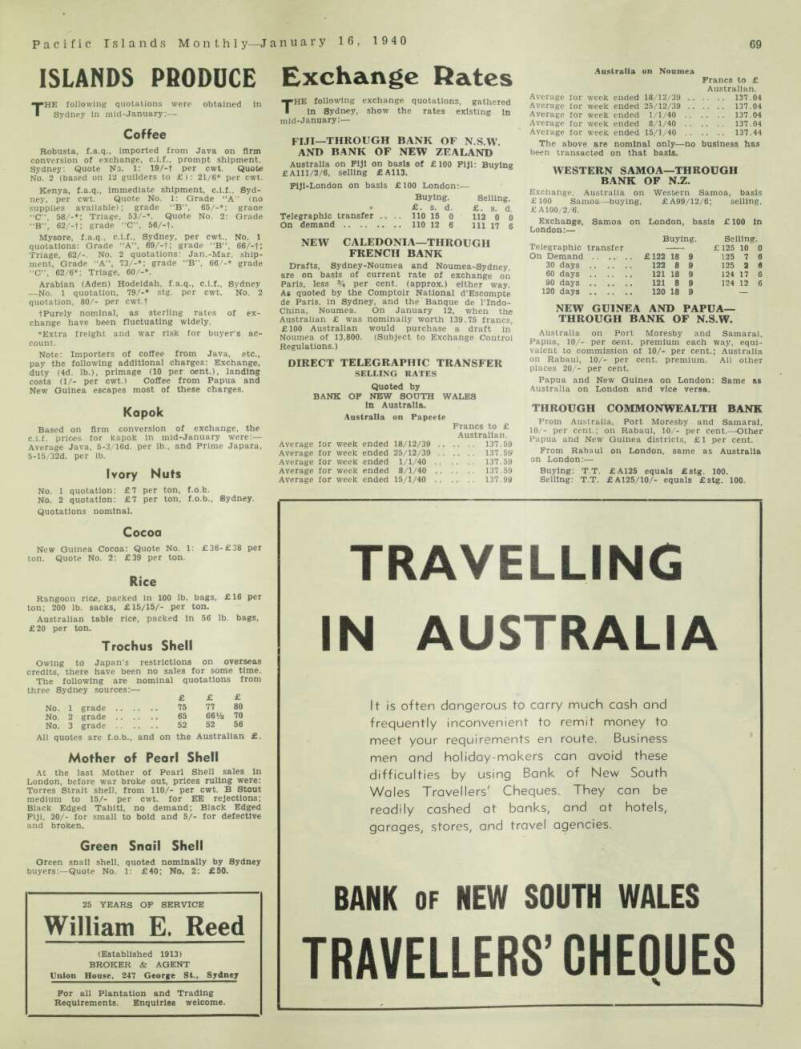
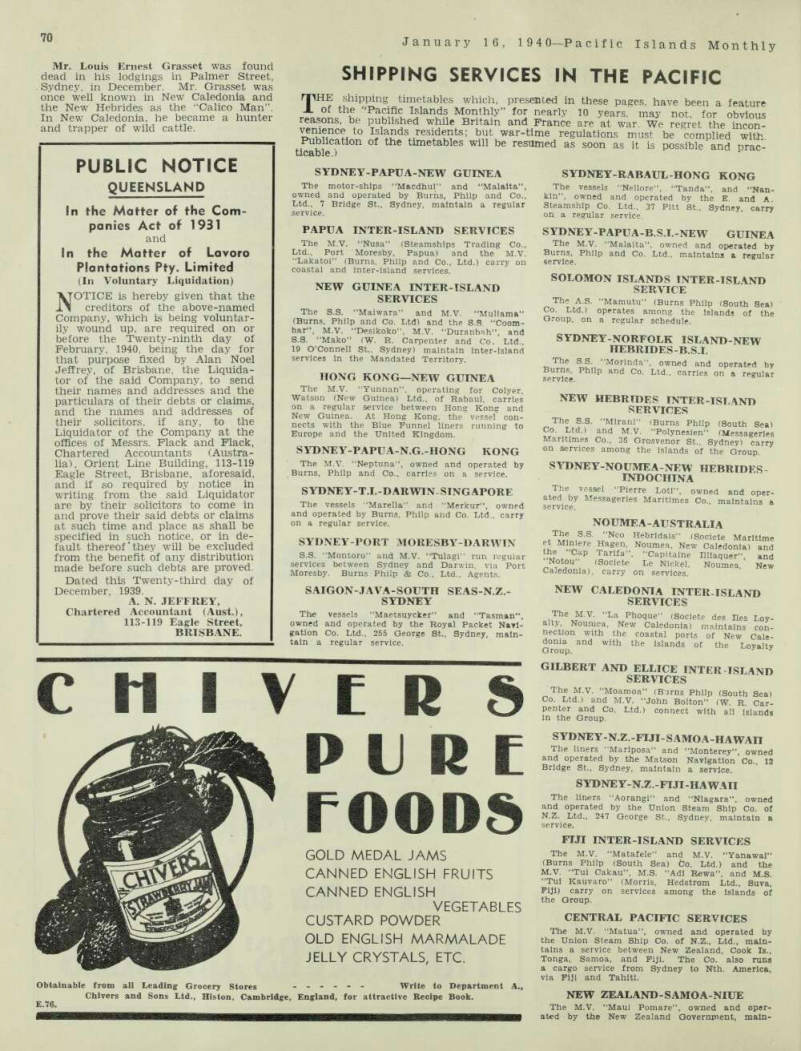
THE following quotations were obtained in Sydney in mid-January:—
Coffee
Robusta, f.a.q., imported from Java on firm conversion of exchange, c.i.f., prompt shipment, Sydney: Quote No. 1: 19/-t per cwt. Quote No. 2 (based on 12 guilders to £): 21/6* per cwt.
Kenya, f.a.q., Immediate shipment, c.i.f., Syd ney, per cwt. Quote No. 1: Grade “A” (no supplies available): grade “B”, 65/-*; graoe “C”, 58/-*; Triage, 53/-*. Quote No. 2: Grade “B”, 62/-t: grade “C”, 56/-t.
Mysore, f.a.q., c.i.f., Sydney, per cwt.. No. 1 quotations: Grade “A”, 69/-t: grade “B”, 66/-f; Triage, 62/-. No. 2 quotations: Jan.-Mar. ship ment, Grade “A”, 73/-*; grade “B”, 66/-* grade “C”, 62/6*; Triage, 60/-*.
Arabian (Aden) Hodeidah, f.a.q., c.i.f., Sydney —No. 1 quotation, 79/-* stg. per cwt. No. 2 quotation, 80/- per cwt.t (Purely nominal, as sterling rates of ex change have been fluctuating widely. •Extra freight and war risk for buyer’s ac count.
Note: Importers of coffee from Java, etc., pay the following additional charges: Exchange, duty (4d. lb.), primage (10 per cent.), landing costs (1/- per cwt.) Coffee from Papua and New Guinea escapes most of these charges.
Kapok
Based on firm conversion of exchange, the c.i.f. prices for kapok in mid-January were:— Average Java. 5-3/16d. per lb., and Prime Japara, 5-15/32d. per lb.
Ivory Nuts
No. 1 quotation: £7 per ton, f.o.b.
No. 2 quotation: £7 per ton, f.0.b., Sydney.
Quotations nominal.
Cocoa
New Guinea Cocoa: Quote No. 1: £36-£3B per ton. Quote No. 2: £39 per ton.
Rice
Rangoon rice, packed in 100 lb. bags, £l6 per ton; 200 lb. sacks, £l5/15/- per ton.
Australian table rice, packed in 56 lb. bags, £2O per ton.
Trochus Shell
Owing to' Japan’s restrictions on overseas credits, there have been no sales for some time.
The following are nominal quotations from three Sydney sources:—
All quotes are f.0.b., and on the Australian £.
Mother of Pearl Shell
At the last Mother of Pearl Shell sales in London, before war broke out, prices ruling were: Torres Strait shell, from 110/- per cwt. B Stout medium to 15/- per cwt. for EE rejections; Black Edged Tahiti, no demand; Black Edged Fiji, 20/- for small to bold and 5/- for defective and broken.
Green Snail Shell
Green snail shell, quoted nominally by Sydney buyers;—Quote No. 1: £4O; No. 2: £5O.
The following exchange quotations, gathered in Sydney, show the rates existing in mid-January:—
Fiji—Through Bank Of N.S.W.
And Bank Of New Zealand
Australia on Fiji on basis of £lOO Fiji: Buying £ Alll/2/6, selling £AII3.
Pljl-London on basis £lOO London;—
New Caledonia—Through
French Bank
Drafts, Sydney-Noumea and Noumea-Sydney, are on basis of current rate of exchange on Paris, less 3 A per cent, (approx.) either way.
As quoted by the Comptoir National d’Escompte de Paris, in Sydney, and the Banque de ITndo- China, Noumea. On January 12, when the Australian £ was nominally worth 139.75 francs, £lOO Australian would purchase a draft in Noumea of 13,800. (Subject to Exchange Control Regulations.)
Direct Telegraphic Transfer
Selling Rates
Quoted by
Bank Op New South Wales
in Australia.
Australia on Papeete
The above are nominal only—no business has been transacted on that basis.
Western Samoa—Through
Bank Of N.Z.
Exchange, Australia on Western Samoa, basis £lOO Samoa—buying, £A99/12/6; selling,
£ Aloo/2/6.
Exchange, Samoa on London, basis £ 100 in London:—
New Guinea And Papua
Through Bank Of N.S.W.
Australia on Port Moresby and Samarai, Papua, 10/- per cent, premium each way, equi valent to commission of 10/- per cent.; Australia on Rabaul, 10/- per cent, premium. All other places 20/- per cent.
Papua and New Guinea on London: Same as Australia on London and vice versa.
Through Commonwealth Bank
Prom Australia, Port Moresby and Samarai, 10 - per cent.; on Rabaul, 10/- per cent.—Other Papua and New Guinea districts, £1 per cent.
From Rabaul on London, same as Australia on London:— Buying: T.T. £AI2S equals £stg. 100.
Selling: T.T. £AI2S/10/- equals £stg. 100.
Buying. Selling. • £. s. d. £. s. d.
Telegraphic transfer ... 110 15 0 112 0 0 On demand 110 12 6 111 17 6
Average lor week ended 18/12/39 .
Francs to £ Australian.
Average for week ended 25/12/39 . 137.59’
Average for week ended 1/1/40 . . .. .. 137.59 Average for week ended 8/1/40 . . .. .. 137.59 Average for week ended 15/1/40 . . .. .. 137.99
Australia on Noumea Average for week ended 18/12/39 ..
Francs to £ Australian. .. .. 137.04 Average for week ended 25/12/39 . . .. .. 137.04 Average lor week ended 1/1/40 . . .. .. 137.04 Average for week ended 8/1/40 . .
Average for week ended 15/1/40 . . .. .. 137.44
Buying. Selling.
Telegraphic transfer £125 10 0 On Demand £122 18 9 125 7 6 30 days 122 8 9 125 2 0 60 days 121 18 9 124 17 6 90 days 121 8 9 124 12 6 120 days 120 18 9 —
£ £ £ NO. 1 grade .. .. 75 77 80 No. 2 grade .. .. 65 66 Vb 70 No. 3 grade .. .. 52 52 56
Mr. Louis Ernest Grasset was found dead in his lodgings in Palmer Street, Sydney, in December. Mr. Grasset was once well known in New Caledonia and the New Hebrides as the “Calico Man’’.
In New Caledonia, he became a hunter and trapper of wild cattle.
Advertisements & other items, pp. 71-72 (2 items)
69
Pacific Islands Monthl y—J anuary 16, 1940
Travellers’ Cheques
TRAVELLING
IN AUSTRALIA
It is often dangerous to carry much cash and frequently inconvenient to remit money to meet your requirements en route. Business men and holiday-makers can avoid these difficulties by using Bank of New South Wales Travellers' Cheques. They can be readily cashed at banks, and at hotels, garages, stores, and travel agencies.
BANK Of NEW SOOTH WALES
TRAVELLERS’ CHEQUES
25 YEARS OP SERVICE
William E. Reed
(Established 1913)
BROKER & AGENT
Union House, 247 George St., Sydney For all Plantation and Trading Requirements. Enquiries welcome.
PUBLIC NOTICE
QUEENSLAND
In the Matter of the Com-
panies Act of 1931
and In the Matter of Lavoro
Plantations Pty. Limited
(In Voluntary Liquidation) NOTICE is hereby given that the creditors of the above-named Company, which is being voluntarily wound up, are required on or before the Twenty-ninth day of February, 1940, being the day for that purpose fixed by Alan Noel Jeffrey, of Brisbane, the Liquidator of the said Company, to send their names and addresses and the particulars of their debts or claims, and the names and addresses of their solicitors, if any, to the Liquidator of the Company at the offices of Messrs. Flack and Flack, Chartered Accountants (Australia), Orient Line Building, 113-119 Eagle Street, Brisbane, aforesaid, and if so required by notice in writing from the said Liquidator are by their solicitors to come in and prove their said debts or claims at such time and place as shall be specified in such notice, or in default thereof'they will be excluded from the benefit of any distribution made before such debts are proved.
Dated this Twenty-third day of December, 1939.
A. N. JEFFREY,
Chartered Accountant (Aust.), 113-119 Eagle Street,
BRISBANE.
C El I V E R S
PURE
foods
GOLD MEDAL JAMS
CANNED ENGLISH FRUITS
CANNED ENGLISH
VEGETABLES
CUSTARD POWDER
OLD ENGLISH MARMALADE
JELLY CRYSTALS, ETC.
Obtainable from all Leading Grocery Stores --- Write to Department A., Chlvers and Sons Ltd., Histon, Cambridge, England, for attractive Recipe Book.
E. 76.
Shipping Services In The Pacific
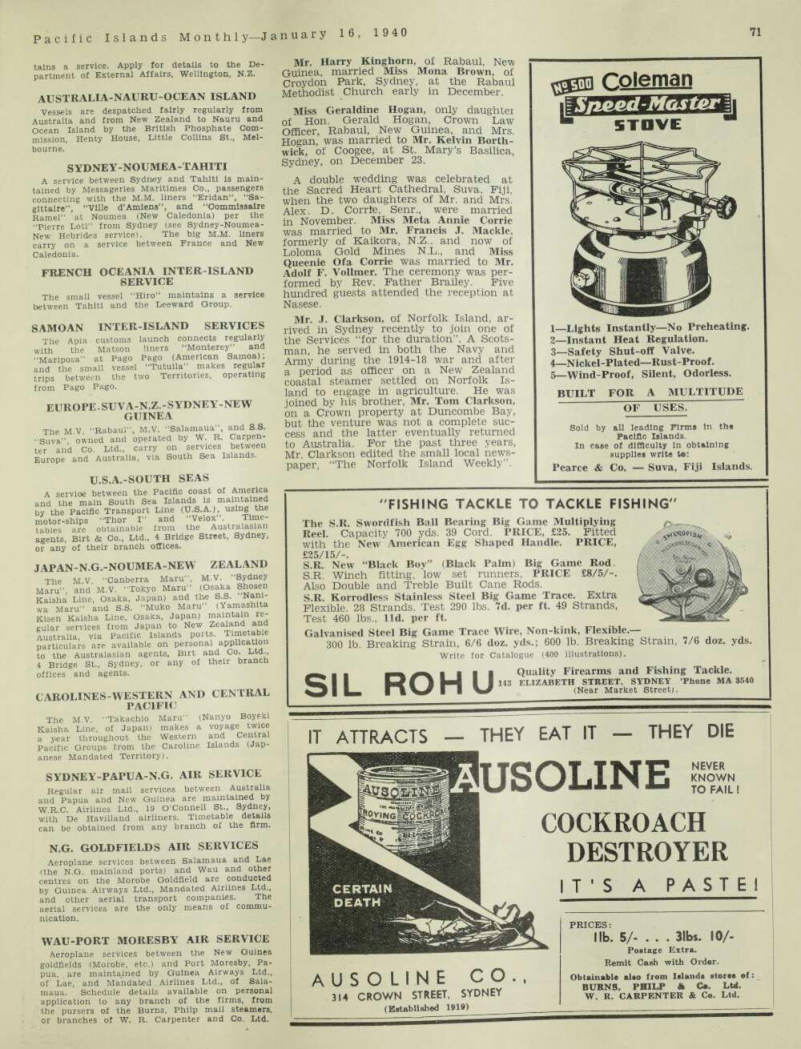
The shipping timetables which, presented in these pages, have been a feature th ® “ Pa P;? c v , I ? lan A s , Monthly” for nearly 10 years, may not, for obvious reasons, be published while Britain and Prance are at war. We regret the incon il 1 ?i? ds r- resl . d t 1 ? ts: but war-time regulations must be complied with.
Publication of the timetables will be resumed as soon as it is possible and prac ticable.)
Sydney-Papua-New Guinea
The motor-ships “Macdhul" and “Malaita”, owned and operated by Burns, Philp and Co., Ltd., 7 Bridge St., Sydney, maintain a regular service,
Papua Inter-Island Services
The M.V. “Nusa” (Steamships Trading Co., Ltd., Port Moresby, Papua) and the M.V.
“Lakatoi” (Burns, Philp and Co., Ltd.) carry on coastal and inter-island services.
New Guinea Inter-Island
Services
The S.S. “Maiwara” and M.V. “Mullama” (Burns, Philp and Co. Ltd) and the S.S. “Coom bar”, M.V. “Desikoko”, M.V. “Duranbah”, and S.S. “Mako” (W. R. Carpenter and Co. Ltd., 19 O’Connell St., Sydney) maintain inter-island services in the Mandated Territory.
Hong Kong—New Guinea
The M.V. “Yunnan”, operating for Colyer, Watson (New Guinea) Ltd., of Rabaul, carries on a regular service between Hong Kong and New Guinea. At Hong Kong, the vessel con nects with the Blue Funnel liners running to Europe and the United Kingdom.
Sydney-Papua-N.G-Hong Kong
The M.V. “Neptuna”, owned and operated by Burns, Phllp and Co., carries on a service.
Sydney-T.1.-Darwin-Singapore
The vessels “Marella” and “Merkur”, owned and operated by Burns, Philp and Co. Ltd., carry on a regular service.
Sydney-Port Moresby-Darwin
S.S. “Montoro” and M.V. “Tulagi” run regular services between Sydney and Darwin, via Port Moresby. Burns Philp & Co., Ltd., Agents.
Saigon-Java-South Seas-N.Z.-
Sydney
The vessels “Maetsuycker” and “Tasman”, owned and operated by the Royal Packet Navi gation Co. Ltd., 255 George St., Sydney, main tain a regular service.
Sydney-Rabaul-Hong Kong
The vessels “Nellore”, “Tanda”, and “Nan kin”, owned and operated by the E. and A.
Steamship Co. Ltd., 37 Pitt St., Sydney, carry on a regular service.
Sydney-Papua-8.5.1.-New Guinea
The M.V. “Malaita”, owned and operated by Burns, Phllp and Co. Ltd., maintains a regular service.
Solomon Islands Inter-Island
Service
The A.S. “Mamutu” (Burns Philp (South Sea) Co. Ltd.) operates among the Islands of the Group, on a regular schedule.
Sydney-Norfolk Island-New
Hebrides-8.5.1.
The S.S. “Morinda”, owned and operated by service and Co - Ltd., carries on a regular
New Hebrides Inter-Island
Services
The S.S. “Mlrani” (Bums Phllp (South Sea) Co. Ltd.) and M.V. “Polynesien” (Messageries Marltimes Co., 36 Grosvenor St., Sydney) carry on services among the islands of the Group.
Sydney-Noumea-New Hebrides
Indochina
The vessel “Pierre Loti”, owned and oper ated by Messageries Maritimes Co., maintains a service.
Noumea-Australia
SS ' „“ Neo Hebrldais ” (S.ociete Maritime et Mlmere Hagen, Noumea, New Caledonia) and the ‘Cap Tarlfa”, “Capitaine Illlaquer”, and Notou” (Societe Le Nickel, Noumea, New Caledonia), carry on services.
New Caledonia Inter-Island
Services
The M.V. “La Phoque” (Societe des lies Loy alty Noumea, New Caledonia) maintains con nection with the coastal ports of New Cale- Group and With the islands of the Loyalty
Gilbert And Ellice Inter Island
Services
The M.V. "Moamoa” (Burns Phllp (South Sea) Co. Ltd.) and M.V. “John Bolton” (W. R. Car penter and Co. Ltd.) connect with all islands in the Group.
Sydney-N.Z.-Fiji- Samoa-Hawaii
The liners “Mariposa” and “Monterey”, owned and operated by the Matson Navigation Co., 12 Bridge St., Sydney, maintain a service.
Sydney-N.Z.-Fi Ji-Hawaii
The liners “Aorangi” and “Niagara”, owned and operated by the Union Steam Ship Co. of N.Z. Ltd., 247 George St., Sydney, maintain a service.
Fiji Inter-Island Services
The M.V. “Matafele” and M.V. “Yanawal” (Burns Philp (South Sea) Co. Ltd.) and the M.V. “Tui Cakau”, M.S. “Adi Rewa”, and M.S.
“Tui Kauvaro” (Morris, Hedstrom Ltd., Suva, Fiji) carry on services among the Islands of the Group.
Central Pacific Services
The M.V. “Matua”, owned and operated by the Union Steam Ship Co. of N.Z., Ltd., main tains a service between New Zealand, Cook Is., Tonga, Samoa, and Fiji, The Co. also runs a cargo service from Sydney to Nth. America, via Fiji and Tahiti.
New Zealand-Samoa-Niue
The M.V. “Maui Pomare”, owned and oper ated by the New Zealand Government, maln
tains a service. Apply for details to the De partment of External Affairs, Wellington, N.Z.
australia-nauru-ocean island
Vessels are despatched fairly regularly from Australia and from New Zealand to Nauru and Ocean Island by the British Phosphate Com mission, Henty House, Little Collins St., Mel bourne.
Sydney-Noumea-Tahiti
A service between Sydney and Tahiti is main tained by Messageries Maritimes Co., passengers connecting with the M.M. liners “Eridan”, “Sa glttaire”, "Ville d’Amiens”, and ‘‘Oommlssalre Kamel” at Noumea (New Caledonia) per the "Pierre Loti” from Sydney (see Sydney-Noumea- New Hebrides service). The big M.M. liners carry on a service between Prance and New Caledonia.
French Oceania Inter-Island
Service
The small vessel “Hiro” maintains a service between Tahiti and the Leeward Group.
Samoan Inter-Island Services
The Apia customs launch connects regularly with the Matson liners "Monterey” and "Mariposa” at Pago Pago (American Samoa); and the small vessel "Tutuila” makes regular trips between the two Territories, operating from Pago Pago.
Europe-Suva-N.Z.-Sydney-New
Guinea
The M.V. "Rabaul”, M.V. "Salamaua”, and S.S.
"Suva”, owned and operated by W. R. Carpen ter and Co. Ltd., carry on services between Europe and Australia, via South Sea Islands.
U.S.A.-South Seas
A service between the Pacific coast of America and the main South Sea Islands is maintained by the Pacific Transport Line (U.S.A.), using the motor-ships "Thor I” and "Velox” Time tables are obtainable from the Australasian agents. Birt & Co., Ltd., 4 Bridge Street, Sydney, or any of their branch offices.
Japan-N.G.-Noumea-New Zealand
The M.V. "Canberra Maru”, M.V. "Sydney Manx”, and M.V. "Tokyo Maru” (Osaka Shosen Kaisha Line, Osaka, Japan) and the S.S. Nam wa Maru” and S.S. "Muko Maru” (Yamashita Risen Kaisha Line, Osaka, Japan) maintain re gular services from Japan to New Zealand and Australia, via Pacific Islands ports. Timetable particulars are available on personal application to the Australasian agents, Birt and Co. Ltd., 4 Bridge St., Sydney, or any of their branch offices and agents.
Carolines-Western And Central
Pacific’
The M.V. "Takachio Maru” (Nanyo Boyeki Kaisha Line, of Japan) makes a voyage twice a year throughout the Western and Central Pacific Groups from the Caroline Islands (Jap anese Mandated Territory).
Sydney-Papua-N.G. Air Service
Regular air mail services between Australia and Papua and New Guinea are maintained by W.R.C. Airlines Ltd., 19 O’Connell St., Sydney, with De Havilland airliners. Timetable details can be obtained from any branch of the firm.
N.G. Goldfields Air Services
Aeroplane services between Salamaua and Lae (the N.G. mainland ports) and Wau and other centres on the Morobe Goldfield are conducted by Guinea Airways Ltd., Mandated Airlines Ltd., and other aerial transport companies. The aerial services are the only means of commu nication.
Wau-Port Moresby Air Service
Aeroplane services between the New Guinea goldfields (Morobe, etc.) and Port Moresby. Pa pua, are maintained by Guinea Airways Ltd., of Lae, and Mandated Airlines Ltd., of Saia maua. Schedule details available on personal application to any branch of the firms, from the pursers of the Burns, Philp mail steamers, or branches of W. R. Carpenter and Co. Ltd.
Mr. Harry Kinghorn, of Rabaul, New Guinea, married Miss Mona Brown, of Croydon Park, Sydney, at the Rabaul Methodist Church early in December.
Miss Geraldine Hogan, only daughtei of Hon. Gerald Hogan, Crown Law Officer, Rabaul, New Guinea, and Mrs.
Hogan, was married to Mr. Kelvin Borth wick, of Coogee, at St. Mary’s Basilica, Sydney, on December 23.
A double wedding was celebrated at the Sacred Heart Cathedral, Suva, Fiji, when the two daughters of Mr. and Mrs.
Alex. D. Corrte, Senr., married in November. Miss Meta Annie Corrie was married to Mr. Francis J. Mackle. formerly of Kaikora, N.Z., and now of Loloma Gold Mines N.L., and Miss Queenie Ofa Corrie was married to Mr.
Adolf F. Vollmer. The ceremony was per formed by Rev. Father Brailey. Five hundred guests attended the reception at Nasese.
Mr. J. Clarkson, of Norfolk Island, ar rived in Sydney recently to join one of the Services “for the duration’’. A Scots man, he served in both the Navy and Army during the 1914-18 war and after a period as officer on a New Zealand coastal steamer settled on Norfolk Is land to engage in agriculture. He was joined by his brother, Mr. Tom Clarkson, on a Crown property at Duncombe Bay, but the venture was not a complete suc cess and the latter eventually returned to Australia. For the past three years, Mr Clarkson edited the smkll local news paper, “The Norfolk Island Weekly”.
Advertisements & other items, pp. 73-74 (2 items)
71
Pacific Islands Monthl y—J anuary 16, 1940
Usoline
CQl eman
STOVE
1— Lights Instantly—No Preheating. 2 Instant Heat Regulation. 3 Safety Shut-off Valve. 4 Nickel-Plated—Rust-Proof. 5 Wind-Proof, Silent, Odorless.
BUILT FOR A MULTITUDE
OF USES.
Sold by all leading Firms In the Pacific Islands.
In case of difficulty In obtaining supplies write to: Pearce & Co. Suva, Fiji Islands.
"FISHING TACKLE TO TACKLE FISHING"
The S.R. Swordfish Ball Bearing Big Game Multiplying Reel. Capacity 700 yds. 39 Cord. PRICE, £25. Fitted with the New American Egg Shaped Handle. PRICE, £25/15/-.
S.R. New “Black Boy” (Black Palm) Big Game Rod.
S.R. Winch fitting, low set runners, PRICE £B/5/-.
Also Double and Treble Built Cane Rods.
S.R. Korrodless Stainless Steel Big Game Trace. Extra Flexible. 28 Strands. Test 290 lbs. 7d. per ft. 49 Strands, Test 460 lbs., lid. per ft. s?. « 3 Galvanised Steel Big Game Trace Wire, Non-kink, Flexible.— 300 lb. Breaking Strain, 6/6 doz. yds.; 600 lb. Breaking Strain, 7/6 doz. yds.
Write for Catalogue (400 illustrations).
SIL
ROHU
Quality Firearms and Fishing Tackle. 143 ELIZABETH STREET. SYDNEY ’Phone MA 8540 (Near Market Street).
IT ATTRACTS
m. oyjnc
THEY EAT IT THEY DIE
USOLINE
NEVER
KNOWN
TO FAIL!
ausoline CO.
314 CROWN STREET, SYDNEY
(Established 1919)
COCKROACH
DESTROYER
IT'S A PASTEI
PRICES:
Mb. 5/- . . . 3lbs. 10/- Postage Extra.
Remit Cash with Order.
Obtainable alto from Islands stores of:
BURNS. PHILP & C#. Ltd.
W. R. CARPENTER & Co. Ltd.
ALL KINDS OF
PRINTING
For
ISLANDS RESIDENTS
TF you want any kind of Printing which cahnot be handled by your Local Printer, send us details of your Requirements, and we shall send you a Quotation, or carry out the work promptly for you at a Guaranteed Reasonable Cost.
OUR SPECIALITY ; Magazines and Books.
SYDNEY Cr MELBOURNE
PUBLISHING CO. PTY. LTD.
29 Alberta
PROPRIETORS AND
PUBLISHERS OF;
Australasian Baker.
Australasian Confectioner.
Leather Trades Review.
Country Trader and Storekeeper.
Cordial-Maker.
St., Sydney
PRINTERS OF:
Pacific Islands Monthly.
Chartered Accountant.
Australian Teacher.
University Medical Journal. Australian Zoologist, 1 Etc.
Managing Director:
R. W. ROBSON.
COSMOPOLITAN
SAMARAI.
HOTEL
FIRST-CLASS
ACCOMMODATION
For Tourists & Commercials Electric Light, Ballroom Billiards Freezing Works, Cold Store.
Best Brands of Liquors
MODERATE TARIFF.
Fishing Trips and Launch Excursions Arranged.
WHERE TO STAY IN PORT MORESBY
HOTEL MORESBY raAE THE ,
WHARF
MODERN
ACCOMMODATION
ONLY THE BEST
BRANDS OP
WINES, SPIRITS
AND BEERS
IN STOCK.
LICENSEE:
Hotel Moresby
Ltd.
The PAPUA
HOTEL
Catering specially for Tourists and Travellers.
Licensee: Papua Hotel, Ltd.
First-class Accommodation. Parties Arranged.
Situated on high ground overlooking both coasts, its Spacious Lounges are always Cool and comfortable . . . Cars meet all Steamers.
Ancient Polynesia's
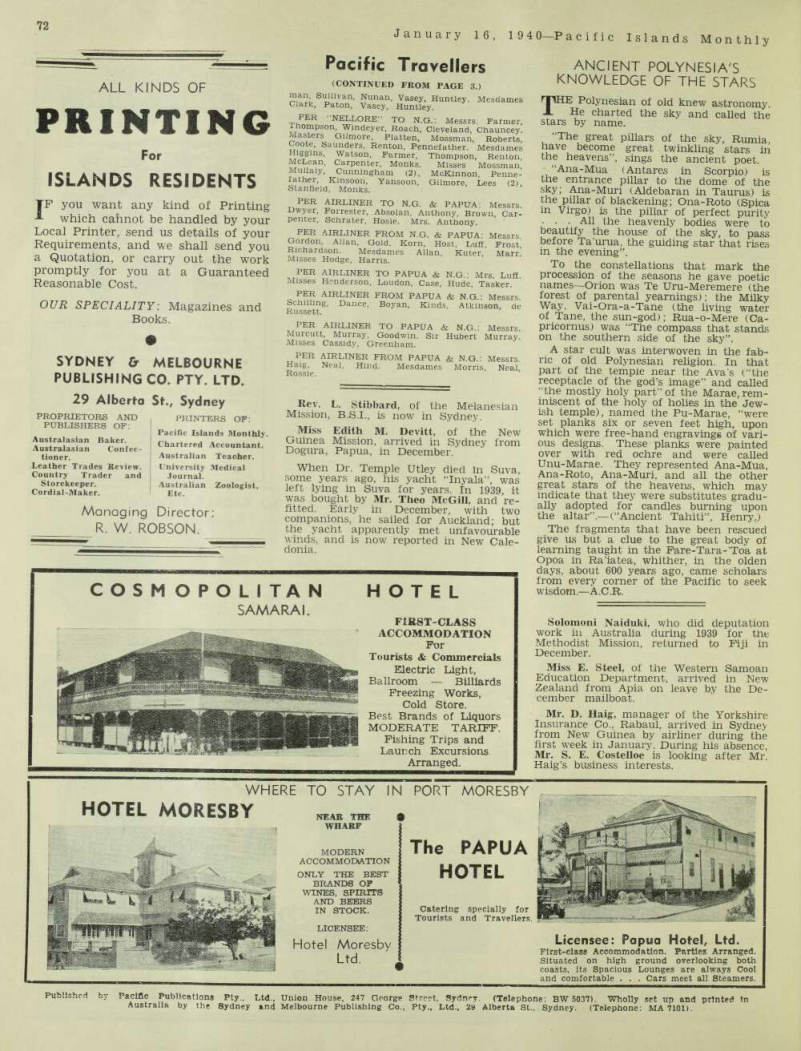
Knowledge Of The Stars
rE Polynesian of old knew astronomy.
He charted the sky and called the stars by name.
“The great pillars of the sky, Rumia, have become great twinkling stars in the heavens”, sings the ancient poet.
“Ana-Mua (Antares in Scorpio) is the entrance pillar to the dome of the sky; Ana-Muri (Aldebaran in Taurus) is the pillar of blackening; Ona-Roto (Spica in Virgo) is the pillar of perfect purity • • • All the heavenly bodies were to beautify the house of the sky, to pass before Ta’urua, the guiding star that rises in the evening”.
To the constellations that mark the procession of the seasons he gave poetic names—Orion was Te Uru-Meremere (the forest of parental yearnings); the Milky Way, Vai-Ora-a-Tane (the living water of Tane, the sun-god); Rua-o-Mere (Ca pricornus) was “The compass that stands on the southern side of the sky”.
A star cult was interwoven in the fab ric of old Polynesian religion. In that part of the temple near the Ava’s (“the receptacle of the god’s image” and called “the mostly holy part” of the Marae, rem iniscent of the holy of holies in the Jew ish temple), named the Pu-Marae, “were set planks six or seven feet high, upon which were free-hand engravings of vari ous designs. These planks were painted over with red ochre and were called Unu-Marae. They represented Ana-Mua, Ana-Roto, Ana-Muri, and all the other great stars of the heavens, which may indicate that they were substitutes gradu ally adopted for candles burning upon the altar”.—(“Ancient Tahiti”, Henry.) The fragments that have been rescued give us but a clue to the great body of learning taught in the Fare-Tara-Toa at Opoa in Ra’iatea, whither, in the olden days, about 600 years ago, came scholars from every corner of the Pacific to seek wisdom. —A.C.R.
Solomoni Naiduki, who did deputation work in Australia during 1939 for the Methodist Mission, returned to Fiji in December.
Miss E. Steel, of the Western Samoan Education Department, arrived in New Zealand from Apia on leave by the De cember mailboat.
Mr. D. Haig, manager of the Yorkshire Insurance Co., Rabaul, arrived in Sydney from New Guinea by airliner during the first week in January. During his absence, Mr. S. E. Costelloe is looking after Mr.
Haig’s business interests.
Advertisements & other items, pp. 74-76 (3 items)
Pacific Travellers
72
January 16, 194 O—P acific Islands Monthly
(CONTINUED FROM PAGE 3.)
Published by Pacific Publications Pty., Ltd., Union House, 247 George Street. Sydney. (Telephone: BW 5037). Wholly set up and printed In Australia by the Sydney and Melbourne Publishing Co.. Pty., Ltd., 29 Alberta St.. Sydney. (Telephone; MA 7101).
January 16, 194 O—P acific Islands Monthly
Civilisation
MOUNTAIN
FASTNESSES
i f.
GUINEA AIRWAYS
Freight and Passenger Service
NEW GUINEA
Guinea Airways planes depart from Port Moresby for the Goldfields after the arrival of each boat. Tickets are obtainable from the Purser or Burns, Philp & Co. Ltd., Sydney or Brisbane.
AUSTRALIA
ADELAIDE to DARWIN, Twice Weekly
ADELAIDE to KANGAROO IS-
LAND, daily return service, except Sun.
ADELAIDE to PT. LINCOLN.
3 times weekly, calling at Cowell & Cleve.
ADELAIDE to WHYALLA,
Daily return service (except Sun.).
GUINEA AIRWAYS LINKED
WITH EXPLOITATION OF
NEW GUINEA’S GOLD!
There is no rood from the coast to the Morobe Goldfields and the development of this rich area has only been made possible by aerial transport.
The air way has been the only means of transport since 1927. Guinea Airways maintain a fast regular service and have "freighted-in", without difficulty or delay. Crushing Mills, Dredges, Cyaniding Plants, Motor Vehicles, all types of machinery, thousands of passengers and all needs of the large European Community now in this section of the Mandated Territory.
Guinea Airways use 50 Aerodromes and landing grounds in New Guinea and Papua. v
LIMITED
LAE-SALAMAUA
Head Office: Austral Chambers, Currie Street, Adelaide, S.A.
New Guinea Office: Lae, Mandated Territory of New Guinea Uln BRANCH OFFICES AND AGENTS AT WAD—SALAMAUA—PORT MORESBY AND SYDNEY.
n N ' /I pew; and'' tomio
TOOTH & CO LIMITED^
I ,J\3f <4 V\ N
WAVER LEY BREWERY y
S'YOVf^
E 21 M - \ .
X^S KJvH-> v>- -J/ ensures a
PERFECT DRINK
am/t/e //pet down Jea/
PRESERVES THE FLAVOUR
When ordering lager, first look for the Diamond-shaped Label-that is your guarantee of quality. Then notice the "Spot" Crown Seal, it is designed to retain that quality, and ensure perfect freshness and flavour in any climate.
RESCHWIMER