Islandd
Pacific
Monthly
Vol. X. No. 5.
December 15, 1939
[Registered at the G.P.0., for transmission by post as a newspaper .]
8 d
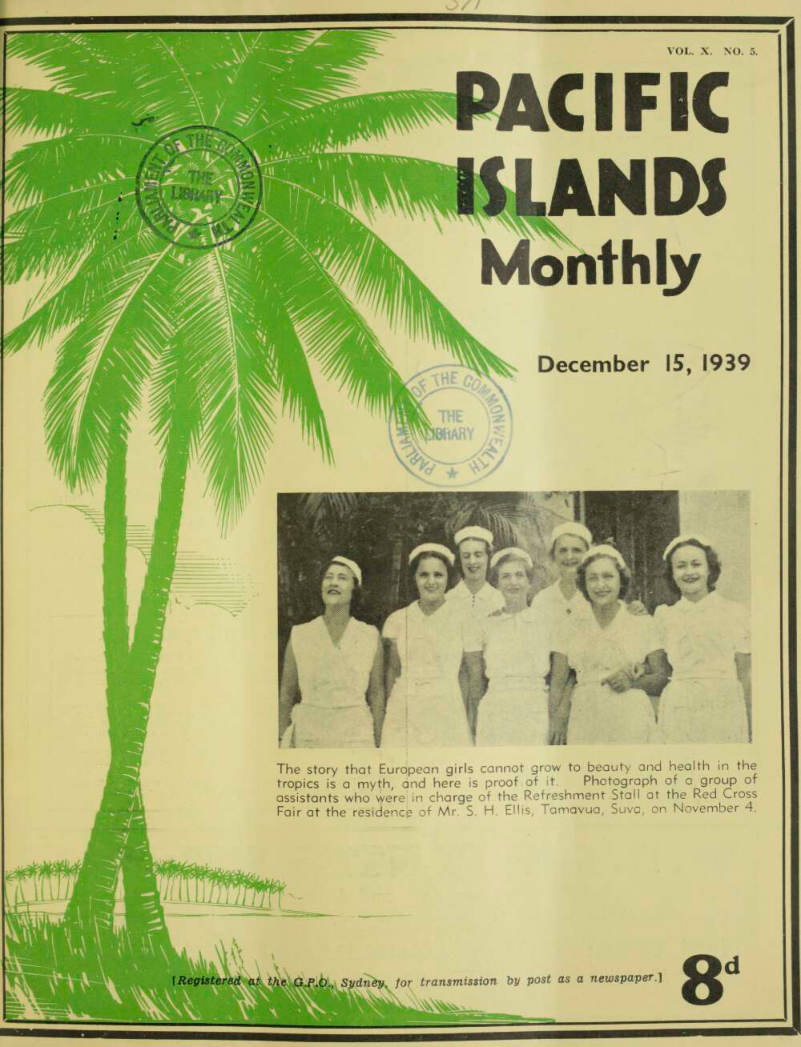
The story that European girls cannot grow to beauty and health in the tropics is a myth, and here is proof of it. Photograph of a group of assistants who were in charge of the Refreshment Stall at the Red Cross Fair at the residence of Mr. S. H. Ellis, Tamavua, Suva, on November 4.
Advertisements & other items, p. 2 (2 items)
Pacific Islands Monthl y—D ecember 15, 1939
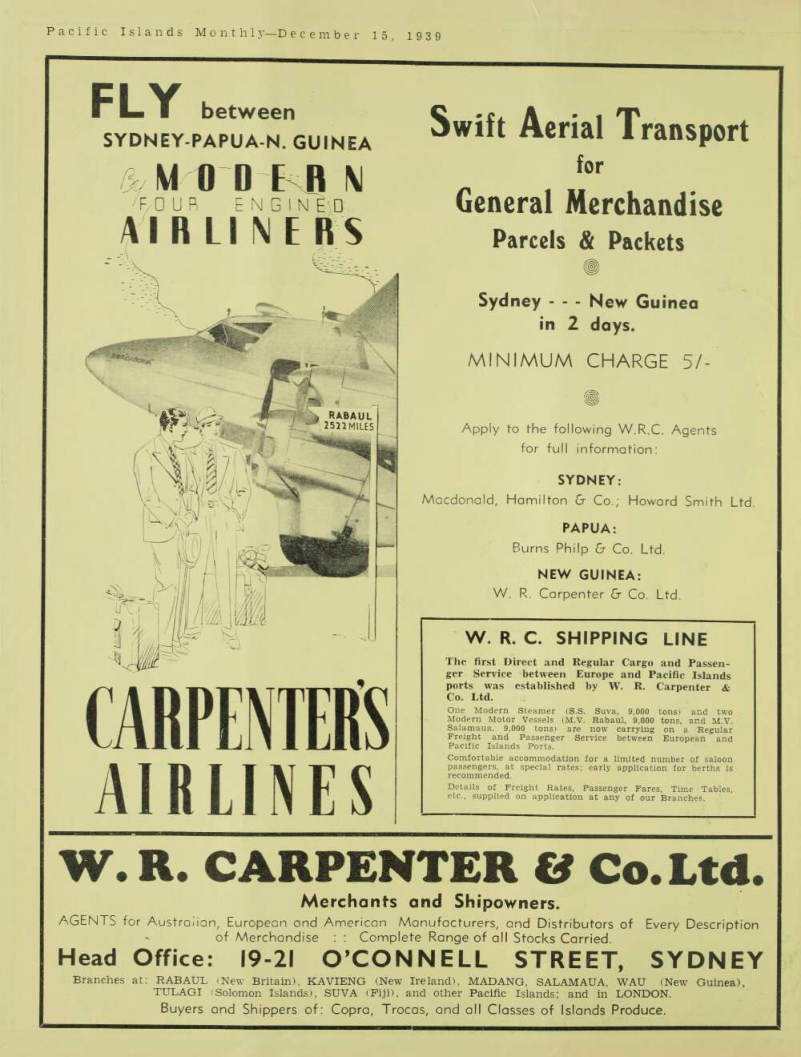
Carpenters
FLY between
SYDNEY-PAPUA-N. GUINEA
A MOD EH N
FOUR ENGINED
AIR LI ME RS
1
RABAUL
2 522 MILES
k S H *1
CARPENTERS
AIRLINES
Swift Aerial Transport
for
General Merchandise
Parcels & Packets
Sydney - - - New Guinea
in 2 days.
MINIMUM CHARGE
S Apply to the following W.R.C. Agents for full information:
SYDNEY:
Macdonald, Hamilton £r Co.; Howard Smith Ltd.
PAPUA:
Burns Philp 6■ Co. Ltd.
NEW GUINEA:
W. R. Carpenter Gr Co. Ltd.
W. R. C. SHIPPING LINE
The first Direct and Regular Cargo and Passenger Service between Europe and Pacific Islands ports was established by W. R. Carpenter & Co. Ltd.
One Modern Steamer (S.S. Suva, 9,000 tons) and two Modern Motor Vessels (M.V. Rabaul, 9,000 tons, and M.V.
Salamaua, 9,000 tons) are now carrying on a Regular Freight and Passenger Service between European and Pacific Islands Ports.
Comfortable accommodation for a limited number of saloon passengers, at special rates; early application for berths is recommended.
Details of Freight Rates, Passenger Pares, Time Tables, etc., supplied on application at any of our Branches.
IB
W. R. CARPENTER & Co. Ltd.
Merchants and Shipowners.
AGENTS for Australian, European and American Manufacturers, and Distributors of of Merchandise ; : Complete Range of all Stocks Carried.
Head Office: 19-21 O’CONNELL STREET,
Every Description
SYDNEY
Branches at: RABAUL <New Britain), KAVIENG (New Ireland), MADANG, SALAMAUA, WAU (New Guinea), TULAGI (Solomon Islands), SUVA (Fiji), and other Pacific Islands; and in LONDON.
Buyers and Shippers of: Copra, Trocas, and all Classes of Islands Produce.
Pacific News-Review
November 16; The dispute between Russia and Finland regarding territorial adjustments continues. Finland still in sists that she will not surrender to the Soviet demands. The Soviet appears to hesitate to put too great pressure on Finland, owing to the danger of an in ternational explosion.
November 20: A flood of reports, most ly of an unreliable character, but im pressive in their volume, indicate rest lessness and discontent in Germany.
Ever since the Munich bomb incident, the secret police have been arresting, all over the Reich, persons suspected of Monarchist sympathies, and there is evid ence that Hitler fears a Monarchist plot.
There is also evidence that a revolu tionary spirit is growing among the Czechs —there have been serious out breaks all over Czecho-Slovakia.
November 20: The sudden destruction of the Dutch passenger steamer “Simon Bolivar”, and of many other ships, most ly neutral, in the English Channel, not far from the mouth of the Thames, by magnetic mines, introduced a new and startling development of the war on the sea. It was discovered that the English Channel had been very extensively mined in a manner which broke all the inter national laws governing maritime opera tions. Germany announced that she had deliberately undertaken this new phase of the war as part of her determination to destroy Britain’s seaborne commerce and to starve Britain.
November 22: Within three days about twenty ships, nearly all neutrals, had been destroyed by mines off the Eng lish coasts, with great loss of life (about 100 of the 230 passengers on the Dutch ship were drowned) but the only German comment upon this crime against neu tral shipping was “it is very sad for the neutrals”. It was soon established that countless, small, magnetic mines, of tre mendous explosive power, had been sown all around the English coasts, by mine carrying sea-planes. This was Hitler’s new “secret weapon”, of which he boast ed a few weeks ago. The new weapon has caused great destruction; but the British Admiralty announces that it is confident it can deal with the new menace.
November 20: The Rome radio an nounced that Italy would resist immedi ately any attempt to introduce Commun ism into the Balkans. This is the most forthright warning to Germany’s new partner (Russia) that has yet been is sued by Italy.
November 21: Innumerable reports re ceived through neutral countries indicate that the Germans are using the great est savagery and ruthlessness in stamp ing out the revolutionary movement in Czecho-Slovakia. The movement is most marked among the Czech students. Many hundreds of students have been arrested and deported and a selected number of their leaders—some say 70 — have been deliberately shot.
November 21: The United States has warned Japan that she views seriously the continued interference by the Japan ese army with United States nationals and trade in China.
November 22: An unofficial announce ment that Russia and Japan have agreed to negotiate a trade treaty has led to much speculation as to whether it may be a prelude to a political agreement— in which event, of course, the relation
ship of Japan with other Powers inter ested in the Pacific will be vitally af fected.
November 22: One of the war’s most important developments is contained in the announcement that Britain has de cided to seize German exports on the high seas as a reprisal for German viola tion of the international rules of sea warfare, by the * indiscriminate sowing of mines.
November 24.—Germany announces that she will meet with unrestricted mine war fare the British decision to seize German exports as a reprisal for indiscriminate mine sowing.
Although the combined effect of mag netic mines and increased U-boat activ ity is seen in a serious revival of shipping lasses, there is no dismay in Allied circles.
The shipping losses are admitted as something that has to be expected and faced. There is complete confidence that the Admiralty will deal with the new magnetic mine menace.
November 24. —The resignation of the Government of Roumania and its re placement by a new Government is an indication of the strained conditions in the Balkans, created by the mysterious position of Germany in relation to the Balkan countries, and the growing threat of a Russian thrust down through the Balkan countries towards Turkey.
Roumania faces a grave crisis. Hun gary is getting ready to put in a claim for Transylvania, which was taken from Hungary and given to Roumania after the Great War; and, similarly, it is expected that Russia, within a short time, will seize Bessarabia which, after the Great War, was taken from Russia—al though predominantly Russian in popula tion —and given to Roumania. Bulgaria is taking advantage of the situation to claim the restoration of the Dobrudja, a small area near the mouth of the Danube, which was given to Roumania in 1919.
November 26. The German liner, “Adolph Woermann,” 8,500 tons, slipped out of a port in Portuguese West Africa on November 18, and tried to make ren dezvous with the German pocket-battle ship “Admiral von Scheer.” It was chased by a British warship, whereupon the Ger man crew scuttled their vessel and took to the boats. Crew and passengers were picked up by the British.
Epic Sea Battle
November 27. The armed merchant cruiser “Rawalpindi,” 16,700 tons, a form er well-known P. & O. mail steamer, was sunk by the German pocket-battleship “Deutschland.” It was one of the most heroic episodes in British naval history.
The “Rawalpindi,” completely over whelmed and out-gunned by the enemy battleship, refused to surrender, and fought to the last, and finally was sunk by gun-fire with all her flags flying. As far as is known, only 17 out of the crew of 300 were saved.
The “Deutschland” is being ceaselessly pursued by Allied naval forces, but she is working in the far north, amid fogs and mist, where there are only a few hours of daylight, and she thus has been able to elude her pursuers.
November 28. Negotiations between Russia and Finland are still going on.
The Finns have offered to withdraw all their troops from the frontier provided
Notes And Comment On
The Progress Of The War
November 16—December 14, 1939
that Russia does the same, in the same proportion, and for the same distance.
November 28.—France, also, as reprisal for the indiscriminate sowing of mines, is seizing German exports in neutral ships on the high seas.
This joint action by Britain and France naturally has brought strong protests from neutrals—ranging from academic arguments, in the case of Holland, to sheer belligerence on the part of Japan.
Germany is doing everything possible to encourage neutrals to resist the Allies’ new economic move.
Russo-German Move Awaited
November 29. —Turkish leaders are con vinced that, within a short time, Russian and German forces will launch a big of fensive in the Balkans and the Near East.
Russia is believed to be seeking control of Central Asia and a foothold on the thres hold of India; while Germany will seek an outlet to the Mediterranean and access to oil, minerals, and foodstuffs.
Intense diplomatic activity is going on in such borderline countries as Hungary, Jugoslavia, and Bulgaria. Italy watches developments very keenly. These nations and this applies particularly to Italy— have no love for either side. They will throw in their lot with whichever coun try they believe will win. Italy hates Rus sia; but she will not, necessarily, fight Russia if Russia is really the partner of Germany, and Germany looks like being eventually able to give to Italy some of the Mediterranean territories she covets — namely, Tunisia, and perhaps a bit of Southern France.
November 30. —The hunt for the Ger man pocket-battleship “Deutschland” in the far North Atlantic is continuing.
Meanwhile, there are indications that the other German pocket-battleship, “Ad miral von Scheer,” is in the Indian or South Atlantic Ocean, and may seriously interfere with Allied shipping. It is be lieved that the German cruiser “Emden” is with the “Deutschland.”
Attack On Finland
November 30. —Russia, to-day, without warning, launched simultaneously land, air and sea attacks on Finland. Soviet troops crossed the Finnish frontier early in the morning. The Finns had had ample warning—tension had been grow ing for weeks. The Finns are excellent soldiers, and have created a first-class de fence organisation, and may hold back the Russians for some time. They, how ever, are vastly outnumbered by the Russians, and must eventually be over whelmed —unless they get substantial aid.
The Soviet declares that it has become necessary “to release the Finnish peoples from the oppression of a reactionary Government.” The Soviet has set up in Moscow a puppet Finnish Government, led by a notorious Communist, and has formally recognised this as the Govern ment of Finland, and is releasing propa ganda urging the Finnish people to rally to the puppet Government. The Finns, however, appear to be completely united behind their own Government in their determination to defend their freedom to the death.
The Scandinavian nations (Sweden, Norway and Denmark) are being urged by their peoples towards active interven tion on the side of the Finns. Intensely
strong public feeling in Italy has been shown in several anti-Russian demonstra tions. Meanwhile, the attitude of Ger many, one of complete passivity—no word, either for or against Russia, has been heard —is variously interpreted. But it is surely clear that if Germany permits Russia to invade Finland formerly a country in which German influence was paramount—it means that there is an understanding in relation to the future between Germany and Russia.
December I.—There has been a great outbreak of popular anger in the United States against Russia, and public leaders are appealing for the severence of all relations.
December 2,—The reaction in Japan has been marked. Japanese newspapers say that Russia’s attack upon Finland shows that no reliance whatever can be placed upon non-aggression pacts with Russia.
December 3. —World-wide sympathy for Finland and indignation and horror against Russia became increasingly evi dent during the week-end; 3,000 uni formed Fascists demonstrated against Russia in Rome. The only country which does not condemn Russia is Bulgaria, where the entire Press supports the Rus sian invasion. Large numbers of Scan dinavians are hurrying to Finland to enlist.
December 4.—Up to date the Finns have succeeded in holding back the Rus sian forces. There are indications that Russia is concentrating troops for a de termined advance, to get possession of Finland at the “waistline”—so that the northern and southern parts of the country will be separated.
December 5. —Finland has appealed to the League of Nations for help. The council of the League will meet in Geneva to consider the appeal on Monday, December 11.
December 4. A strong formation of British bombers carried out a raid on the German sea-base, Heligoland, and at tacked German warships there. They obtained directs hits with heavy bombs and shot down a German fighter. All the British machines returned.
December 5. —Apart from the Finnish situation there has been few outstanding events; but it is clear that the struggle on the sea for economic advantages is becoming more fierce and ruthless. In the week ended December 2, Britain lost six ships (23,000 tons) and neutrals lost six ships (31,000 tons). The shipping losses in November were one third those of September, but there are indications that at the moment, as a result of the combined German attack by magnetic mines, submarines and battleship raid ers, very severe losses of mercantile shipping are being sustained.
December 6.—The Finns are still hold ing the Russians—but it is doubtful whether this resistance can be much pro longed. Sweden, Denmark and Norway are conferring. Preparations are being made for the League of Nations meeting on the 11th. It is expected that Russia will leave the League—in which event it is thought possible that Italy and Spain may return.
December 6. —Japan has promised the United States Government that American interests will be compensated for damage done to them in China, and that every effort will be made in future to avoid damage to American interests.
December 6.—The large steamer, “Doric Star,” 10,000 tons, was sunk by a German raider (presumably the pocket-battleship “Admiral Scheer”) in the South Atlantic,
while carrying a large refrigerated cargo from Australia to Britain.
December 6.—The King is at present visiting the British Army in France.
December 6. —Much speculation aroused because a German twin-engined Heinkel, apparently out of control, crashed on the coast of Norfolk. All the crew were killed. No British fighters were in the vicinity at the time and no anti-aircraft fire was heard. It is persistently suggested that this bomber was brought down by Britain’s secret weapon, of which there have been hints. Tt has been stated, positively and officially, that Britain has some secret weapon, but the character of the thing has not been disclosed.
December 6. —A British warship cap tured a German liner of 8,000 tons in the South Atlantic, despite attempts made by the crew to scuttle her.
December 7.—Swift and heavily-armed British naval patrols, strung out from the Arctic seas right down through the Atlan tic to the fringe of the Southern Polar waters, and as far east as the Indian Ocean, are drawing a dragnet closer around the German commerce-raiders.
Snarl From Russia
December 7.—The Moscow radio has warned Italy and Sweden to keep out of the Russo-Finnish conflict. The Russians say that they will not tolerate, on the part of Italy, such interference in Fin land as occurred in Spain. “We also warn Sweden,” the radio said, “that she has no business to send detachments of so-called volunteers’ to Finland’s aid. This will gravely endanger the relations between Russia and Sweden.”
Deoember 7.—Mr.. Winston Churchill (First Lord of Admiralty) stated that the secret of the German magnetic mine was known to Britain, and counter measures against it were far advanced, long be fore the first magnetic mine appeared in British waters. The British were confi dent that they could overcome this menace. The British were equally confi dent that their method of detecting and destroying submarines would become in creasingly efficient, no matter how many submarines Germany might continue to build.
December B.—The Foreign Ministers for Norway, Sweden and Denmark, who had been in conference, stated jointly that they had agreed to do their utmost “to assist Finland, through the League of Nations, to inaugurate Russo-Finnish peace negotiations,” A radio broadcast, later, from Finland remarked, “It seems impossible for these Scandinavian coun tries to remain passive spectators of the murder of Finland.”
It is clear, however, that all the small neutral nations are afraid to take any steps to assist each other owing to the fear that they may be trampled out of existence by more powerful countries.
December 9.—After a meeting of the Fascist Grand Council in Rome, which was addressed by Mussolini, it was offici ally announced that Italy would maintain her neutrality in regard to all existing international affairs, and that the rela tions between Italy and Germany would remain as established by their pact, and by exchanges which had since occurred.
It is evident that, within the last two or three days, Germany has succeeded in stiffening the attitude of Italy against any kind of intervention in European affairs.
December 10— Reports, which were re peated through the Moscow radio, that Germany was sending anti-aircraft guns
and large quantities of munitions to Fin land, and that 50 Italian bombers had refuelled in Germany on their way to assist Finland, have been denied.
December 11.—Finland’s appeal to the League of Nations for assistance against Russia was considered at a public session of the League Assembly to-day and it was decided to make a final appeal to Russia to agree to an armistice and conference.
It is not expected that the answer, which must be received within 24 hours, will be favourable.
December 11. Very strong feeling against Russia is manifesting itself in Sweden. As part of pro-Finnish agitation it is urged that a coalition Government be formed.
December 12.—Official: Shipping losses during the week ended December 9 were:—British (seven ships, 33,500 tons), neutrals (eight ships, 36,600 tons). It is now clear that five British ships, ranging from 4,000 to 8,000 tons, which are over due, and which were last heard of in the South Atlantic, have fallen victims to the German raiding battleship, Admiral von Scheer,” and are regarded as losses.
December 12.—1 tis officially announced that a section of the British Army now in France has been moved eastwards, and is now occupying a part of the Maginot Line, beside the French, and facing the German forces.
December 12. —The Italian newspapers state that Britain and France are afraid to stand up to the Soviet Government.
They also state that Fascist pilots and crews accompanied the Italian ’planes which flew across Germany to the as sistance of Finland and that Mussolini is willing to give all possible assistance to the Finns against the Russians.
Peace Suggestions
December 12.—Although details are be ing kept out of the Allied news services, where it is insisted that no peace nego tiations can be considered until the Hit ler regime is destroyed, it is now clear that a very real attempt is being made at Geneva, while the League of Nations’ as sembly awaits the reply of Russia, to arrange an armistice between the Allies and Germany in order that there may be a conference between them.
It is stated that Germany now is will ing to consider a new peace plan, in which Poland and Czechoslovakia would be rehabilitated; that Germany is willing to rejoin the League of Nations —especially if Russia is expelled from it; and that Hitler would not be averse to a peace plan which would be based on the alliance of Britain, France and Germany against Russia.
It may be expected that these circum stances and conditions will be seized upon to form the basis of an appeal for a Christmas armistice. On the other hand, there are numerous world com mentators who insist that there is in existence a plan under which Germany and Russia will engage jointly in a drive to the south-east, through the Balkans and through Asia Minor, against the Allies and Turkey, as soon as the Fin land situation is liquidated.
December 14.—Russia has replied sar castically to the League of Nations, virtually telling other nations to mind their own business. Expulsion of Russia from the League is now expected.
December 14. —German pocket battle ship “Admiral Graf Spee” (not “Admiral Scheer’’) caught in South Atlantic by British light cruisers “Achilles”, “Ajax” and “Exeter”; severely battered; ran to neutral port, where now sheltering, with British cruisers waiting outside.
Advertisements & other items, p. 3 (1 item)
1
Pacific Islands Monthl y—D ecember 15, 1939
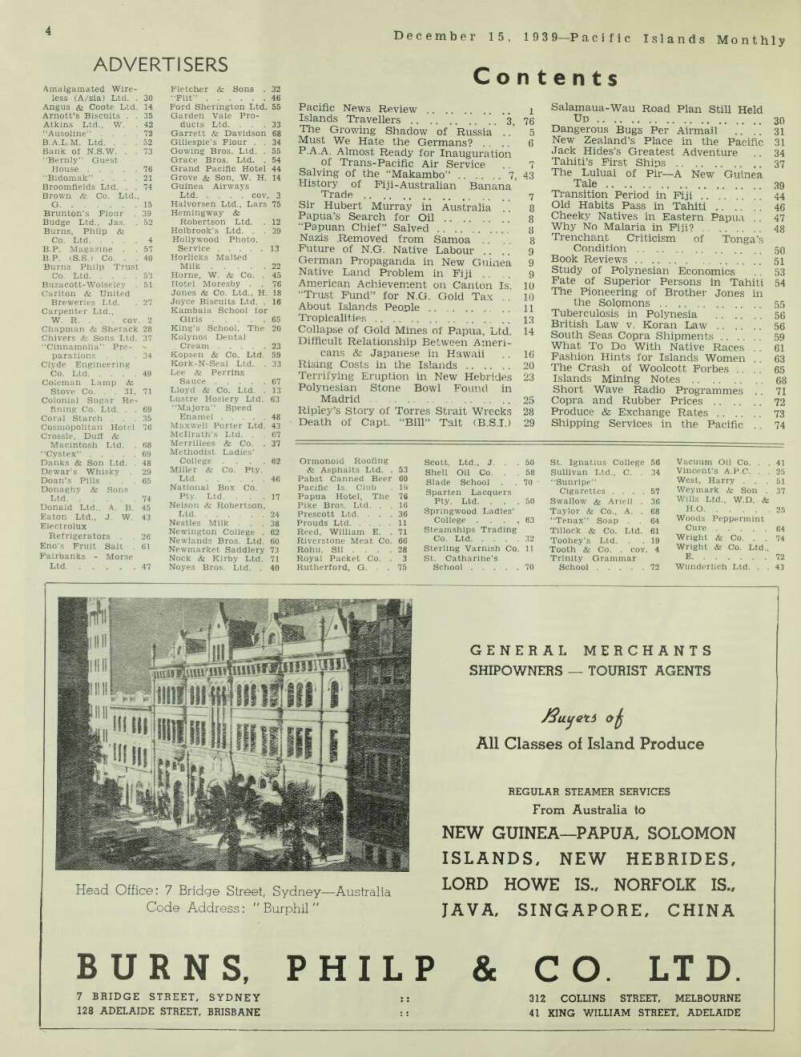
Pacific Islands Travellers
Per “Aorangi” From Fiji: Messrs. Chal
mers, Davis, Bennett, Browne, Field, Fenton, Garrick, Halstead, Ludolph, Mason, Morgan, Petersen (2), Thoms, Blake, George, Hunter.
Mesdames Burgess, Chalmers, Donnan, Kent, Lee, Field, Garrick, Halstead, Thoms, Bailey, Lewis, Schleger, Reedy. Misses Yonge, Mc- Cutcheon, Reynolds.
Per “Tasman” To Papua: Mr. Houston.
Mesdames Barrow, Chawner, Godson, Minns, Wilson. Misses Walby, White.
Per “Nellore” From Rabaul, N.G.:
Messrs. Harris, Madden, Scott, Gibbons, Munro, Nettleship, Roberts, Evan-Evans, Hipkin, Kerr, Brownlee, Simmett, Palmer, Slattery, Evans, Skinner, Robinson, Edwards. Rev, Fitzgerald.
Mesdames Harris, Higgs, Madden, Schmidt, Munro, Roberts, Evans-Evans, Taylor, Simmett, Palmer, Evans, Robinson, Edwards, Renton.
Per “Morinda” Prom Lord Howe Is.,
Norfolk Is.. N. Hebrides And 8.5.1.:
Messrs. Bairstow, Christian, Clarkson, Dudley, Hadley, Hays, Horne, McComish, Masterman, Mapletoft, Thurston, Adam, Allsop. Dalzlell, Hay, Murphy, Nicholls, Payten (3), Ritchie, Rox borough, Sewell. Weihen. Rev. Prater, Rev.
Deasey. Mesdames Altken, Baley, Deasey, Dud ley, Green, Prater, Lake. McComish, Metcalfe,
Martin, Mapletoft, Schrieber, Thurston (2), Abel, Anderson, Allsop, Brown, Day, MacLachlan, Payten. Willis. Misses Christian, Gabbutt, Green, Harris, Horton, Jepson, Nobbs, Charieton, Green, Willis.
Per “Malaita” Prom N.G., Papua &
8.5.1. PORTS: Messrs. Aitchison, Amos, Bal four, Bedford, Bent, Boehm, Brinkley, Buckland, Bullinarla, Chapman, English, Parlow, Fleming, Forbes, Gage, Greer, Haire, Hassler, Horton, Hughes, Inglis, Johnston, Kellett, Kitchen, Love, McParlane, Martin, Merrylees, Milne. Mont gomery, Mulvey, Oliver, Sandford, Scullard, Selmes, Smith, Stephen, Stibbard, Tame, Waite, Wills, Wright (2). Mesdames Abel, Aitchison, Aumuller, Bent, Parlow, Fleming, Grahamslaw, Haire, Johnston, McParlane, Marshall, Minogue, Morton, Mulvey, Mustard, Oliver, Stephen, Stib bard, Wright. Misses Burke, Deck, Devitt, Kekwick, Lett, Thorburn.
PER “MORINDA” FOR N. HEBRIDES & 8.5.1.; Messrs. Middleton, McLeod, Green, Rees, Davies, Johnson, Boxall, Roberts, Teaman. Mesdames Middleton, Fraser, Rees, Davies, Johnson, Hollo way, Christian. Misses Bland, Kemp, Regan, Fraser, Retmock, Payten, King, Pratt.
Per “Macdhui” From N.G. & Papua:
Messrs. Barker, Beer, Blackmore, Bodger,
Boileau, Brennan (2), Bridger, Brown, Calow, Cameron, Carr, Conwell, Cox, Cumningham, Davies, Dickson, Fell, Fitch, Forrester, Gregory, Heape, Henderson, Hewitt, Holland, Huxley, Irvine, Jolly, Bowen, Jones, Kershaw, Lee (2), Leggatt, Lewis, Lucas, McEwan, Mackenzie, Middleton. Miller, Montgomery, Murray, Oakes, Palmer, Pasley, Patmore. Patterson, Piper, Pratt (2), Reilly, Reynolds, Roberts, Rose, Schroder, Scott (2), Shaw, Simpson, Smith, Spence, Strathearn, Taylor, Thomas, Turner, Tynan, Verey, Walton, White, Wolfcarius, Wright, Parker. Mesdames Barker, Beer, Brennan, Burns, Cahill, Champion, Corbe, Con well, Dickson, Fuller, Giles, Gregory, Guest, Herbert, Hilder, Hogan, Lee, McEwan. Mackenzie.
Middleton, Montgomery, Murray, Pasley, Pat terson, Piper, Robinson, Rundle, Schroder, Scares, Simpson. Skinner, Smith, Terry, Turner, Wolfcarius, Williams, Wright. Misses Beer, Booth, Coulson, Glasson, Healy, Lashmar, Stevens.
PER “MACDHUI” FOR PAPUA & N.G.: Messrs.
Hayland, Nagy, Coldham, Beck, Purves, Flower, Eldred, Keenan, Harris (2), Dlckins, Harrison, Gore, Brown, Kissick, Nixon, Frost, O’Connor, Christian, Ross, Lang. Carpenter. Austin, Searle, Ashwell, Prendergast, Paul, Davies, Ritchie, Morris, Chant, Halliday, Reid, Coe, Low, Peakins, Downey, Hiscox, Hemming, Davidson, Crouch, Thorne, Newman, Hotz, Marshall,
(Continued On Page 76.)
On November 11, at the residence of Mr. and Mrs. R. M. Farlow, A.D.0., Buka Passage, New Guinea, Miss Kathleen Howell was married to Mr. Rolf Cam bridge. Mr. Cambridge has been in the Islands for 20 years. He was a clerk for the Malaita company at Bara; then with Corry and Stirling; then he was man ager of Mr. Jack Clift’s place at Aruligo; later he joined the 5.1. D.; and from there he was transferred to C.P.L. as Group Manager, Soraken, where he has been for some years. The bride was given away
by Mr Farlow Mrs Farlnw wnc mntrnn of-honou?; and Mr H W P Newall wa^ best man Mr - and Mrs * James Leahy have left Wau, New Guinea, on an extensive holi tour - This was to have embraced world, but the present war situation will restrict the tour, somewhat. “Jim”
Leahy is one of the four brothers Leahy, whose names are so well known for in trepid pioneering explorations in the early days.
Semple, Winterford, Patterson, Carden, Jacobson, Lewis, Barry, Hui Ping Kwang. Mesdames Moffatt, Altria, Eldred, Schuler, Murray, O’Hara, Mcdearmaid, Ellis, Weidmann, Rundle, Balfour, Veitch, Ritchie, Craig, Cerini, Thompson, Ross, Drewe, Lang, Earl, Bewster, Halliday, O’Neil, Hiscox, Hemming. Misses Taylor, Schuxer, Ollerton, Fraser, Munster, Brearley, Protheroe, McKenna, Brabin, Healey, Brewster, Voysey (2), Laurie, Hansen, Hides.
PER ‘‘MALAITA” FOR 8.5.1., PAPUA & N.G.
PORTS: Messrs. Moore, Temple Watts, Good rich, Brennan, Batchelor, Murphy, Ashbrook, Murnin, James, Hetherington, Lucas, French, Mackenzie, Mapletoft, Whale, Dexter, Pascoe, Richardson, Crow r e, Hewlett, Hosie, Costa, Mal colm. Rev. Fathers Caffiaux, McMahon, Duhamel.
Brothers Joseph, Paul. Gratton. Mesdames de Rusett, Downing, Osborne, Driver, Stewart, Annan, Hetherington, Lucas, French, Mapletoft, Jarrett, Mackenzie, Whale, Wright. Monks, Scott, Dexter, Sturges, Dalrymple, Hay. Misses McConnell, Eldridge, Temple Watts, Scope, Brennan, Ward, Porteous, Corfe, Stewart, Lum ley, Guinan, Stewart, Lyons, Gorkin, Matthews, Chester, Hunter (2). Sister Ludovica. Masters Temple Watts, Ward, Osborne, Eginton, Evenett, Spiller, Wright, Hardy, Clay, Lock, Taylour, Munro, Schafer, Brown, Leigh, Switzer.
PER “AORANGI” FOR FIJI: Messrs. Cater.
Edwards, Holborow, Parker, Swanton, Singh.
Mesdames Probert, Singh. Miss Probert.
PER AIRLINER PROM N.G. & PAPUA: Messrs.
Flannigan, Gray, Thurston, Snook, Patterson.
Mrs. Willis. Miss March.
PER AIRLINER TO PAPUA & N.G.: Messrs.
Stirling, O’Mara, Heron, Barrow. Mesdames Sherringham, Husband.
PER AIRLINER FROM N.G. & PAPUA: Messrs, Granger. Wales, Kane, Warmald, Major Chal mers. Mesdames Proud. Hilder.
PER AIRLINER TO N.G. & PAPUA: Messrs.
Symes, Shields, Luff. Mesdames Luff, Townsend.
Misses Eastwood, Best.
PER AIRLINER FROM PAPUA & N.G.: Messrs.
Silberschmidt, Grabowsky, Keogh, Sterling, Mur cett. Mrs. Karius.
PER AIRLINER TO N.G. & PAPUA: Messrs.
Williams, Kaye. Mesdames Buchanan, Ingol, Burton.
PER AIRLINER FROM N.G. & PAPUA: Messrs.
Murray, Bignold, Hay Les. Tryer, Haggard. Sir Hubert Murray. Mrs. Bensley.
Advertisements & other items, p. 5 (1 item)
South Pacific Line
S&UMAUA
if \ S: 1 *■’ ■p 0 0 s * 4> K •■ :; . ■• : : ; ■ ;■.
PA Cl M t OCEAN
Jhuaaui
*k h* J. •\
ST.KO»ESBY» ’\ “>
\ SAHARA!
\ MrORT VIU
SYDNEY
iNDUHE*
V
AjtmuK;
s*lll
■H
WEI
ppii
K. P. M.
SOUTH PACIFIC LINE.
Royal Packet Navigation Co. Ltd., Paketvaart House, 255 George Street, Sydney. (N. V. Koninklijke Paketvaart Maatschappij—lncorporated In the Netherlands.) Saigon, Diethelm & Co.; Port Moresby and Samarai, Steamships Trading Co.
Ltd.; Rabaul, Salamaua and Wau, W. R.
Carpenter & Co. Ltd.; Port Vila, Gubbay Freres; Noumea, Carlo Leoni; Auckland, Russell Si Somers Ltd.; WelUngton Johnston St Co. Ltd. p . m
Linking the East with South Pacific
Islands, New Zealand and Australia
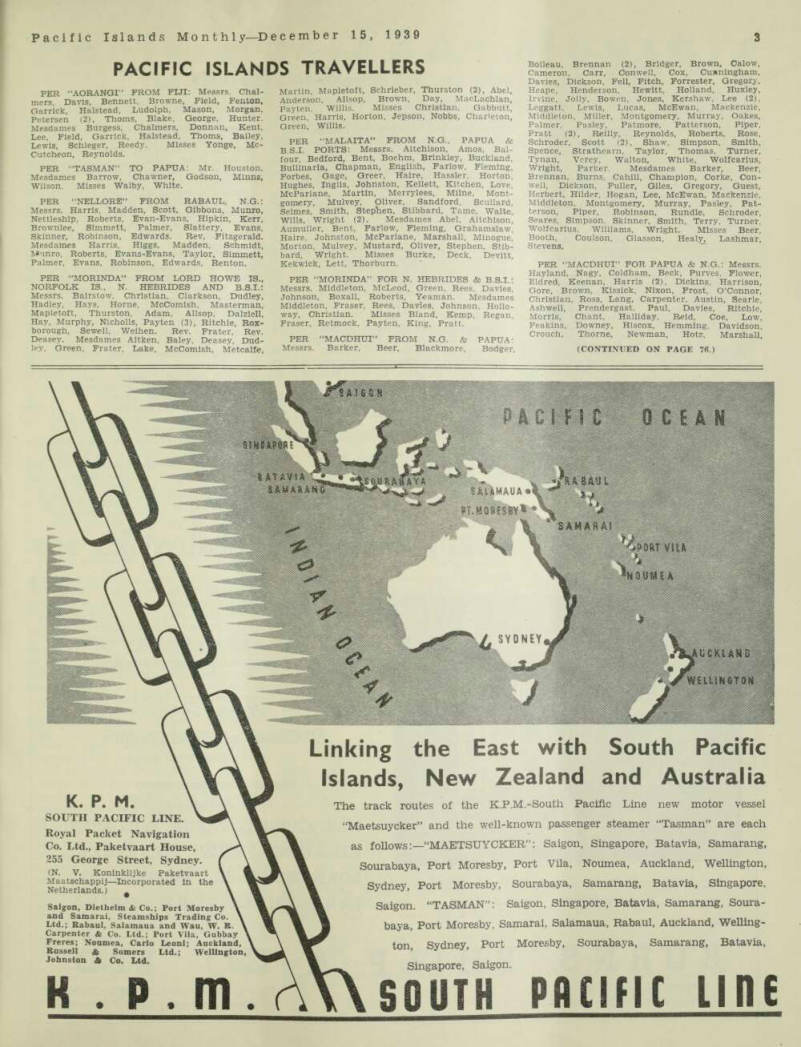
The track routes of the K.P.M.-South Pacific Line new motor vessel “Maetsuycker” and the well-known passenger steamer “Tasman” are each as foIIows:— “MAETSUYCKER”: Saigon, Singapore, Batavia, Samarang, Sourabaya, Port Moresby, Port Vila, Noumea, Auckland, Wellington, Sydney, Port Moresby, Sourabaya, Samarang, Batavia, Singapore, Saigon. “TASMAN”; Saigon, Singapore, Batavia, Samarang, Sourabaya, Port Moresby, Samarai, Salamaua, Rabaul, Auckland, Wellington, Sydney, Port Moresby, Sourabaya, Samarang, Batavia, Singapore, Saigon.
SOUTH PACIFIC Line
Advertisers
Amalgamated Wire less (A/sia) Ltd. . 30 Angus & Coote Ltd. 14 Arnott’s Biscuits . . 35 Atkins Ltd., W. . 42 “Ausoline” ... 72
B.A.L.M. Ltd. ... 52
Bank of N.S.W. . . 73 “Bernly” Guest House 76 “Bidomak” ... 21 Broomfields Ltd. . . 74 Brown & Co. Ltd., G 15 Brunton’s Flour . 39 Budge Ltd., Jas. . 52 Burns, Philp & Co. Ltd 4 B.P. Magazine . . 57
B.P. (S.S.I Co. . . 40
Burns Philp Trust Co. Ltd 53 Buzacott-Wolseley . 51 Carlton & United Breweries Ltd. . 27 Carpenter Ltd., W. R. . . . cov. 2 Chapman & Sherack 28 Chivers & Sons Ltd. 37 “Cinnamolia” Pre- parations ... 34 Clyde Engineering Co. Ltd 49 Coleman Lamp & Stove Co. . . 31. 71 Colonial Sugar Re fining Co. Ltd. . . 69 Coral Starch ... 35 Cosmopolitan Hotel 76 Crossle, Duff & Macintosh Ltd. . 68 “Cystex” 69 Danks & Son Ltd. . 48 Dewar’s Whisky 29 Doan’s Pills ... 65 Donaghy & Sons Ltd 74 Donald Ltd., A. B. 45 Eaton Ltd., J. W. 43 Electrolux Refrigerators . . 26 Eno’s Fruit Salt . 61 Fairbanks - Morse Ltd 47
Fletcher & Sons . 32 “Flit” 46 Ford Sherington Ltd. 55 Garden Vale Pro ducts Ltd. ... 33 Garrett & Davidson 68 Gillespie’s Flour . . 34 Gowing Bros. Ltd. . 55 Grace Bros, Ltd. . 54 Grand Pacific Hotel 44 Grove & Son, W. H. 14 Guinea Airways Ltd cov. 3 Halvorsen Ltd., Lars 75 Hemingway & Robertson Ltd. . 12 Holbrook’s Ltd. . . 39 Hollywood Photo.
Service 13 Horlicks Malted Milk 22 Horne, W. & Co. . 45 Hotel Moresby . . 76 Jones & Co. Ltd., H. 18 Joyce Biscuits Ltd. . 16 Kambala School for Girls 65 King’s School, The 20 Kolynos Dental Cream 23 Kopsen & Co. Ltd. 59 Kork-N-Seal Ltd. . 33 Lee & Perrins Sauce 67 Lloyd & Co. Ltd. . 13 Lustre Hosiery Ltd. 63 “Majora” Speed Enamel 48 Maxwell Porter Ltd. 43 Mcllrath’s Ltd. . . 67 Merrillees & Co. . 37 Methodist Ladies’
College ... 62 Miller & Co. Pty.
Ltd 46 National Box Co.
Pty. Ltd. . . .17 Nelson & Robertson, Ltd 24 Nestles Milk ... 38 Newington College . 62 Newlands Bros. Ltd. 60 Newmarket Saddlery 73 Nock & Kirby Ltd. 71 Noyes Bros. Ltd. . 40
Ormonoid Roofing & Asphalts Ltd. . 53 Pabst Canned Beer 60 Pacific Is. Club . Ift' Papua Hotel, The 76 Pike Bros. Ltd. . . 16 Prescott Ltd. ... 36 Prouds Ltd 11 Reed. William E. . 71 Riverstone Meat Co. 66 Rohu, Sil . . . .28 Royal Packet Co. . 3 Rutherford, G. . . 75
Scott, Ltd., J, . . 50 Shell Oil Co. . , 58 Slade School . . 70 Sparten Lacquers Pty. Ltd. ... 50 Springwood Ladles’
College , 63 Steamships Trading Co. Ltd 32 Sterling Varnish Co. 11 St. Catharine’s School . . . . . 70
St. Ignatius College 56 Sullivan Ltd., C. . 34 “Sunrlpe”
Cigarettes ... 57 Swallow & Ariell . 36 Taylor & Co., A. . 68 “Tenax” Soap . . 64 Tillock & Co. Ltd. 61 Toohey’s Ltd. . . 19 Tooth & Co. . cov. 4 Trinity Grammar School 72
Vacuum Oil Co. . . 41 Vincent’s A.P.C. . . 25 West, Harry ... 51 Weymark & Son . 37 Wills Ltd., W.D. & H.O 25 Woods Peppermint Cure 64 Wright & Co. . . 74 Wright & Co. Ltd., E 72 Wunderlich Ltd. . , 43
Contents
Pacific News Review 1 Islands Travellers .. 3, 76 The Growing Shadow of Russia 5 Must We Hate the Germans? ... 6 P.A.A. Almost Ready for Inauguration of Trans-Pacific Air Service .. 7 Salving of the “Makambo” 7, 43 History of Fiji-Australian Banana Trade 7 Sir Hubert Murray iii Australia .! 8 Papua’s Search for Oil 8 “Papuan Chief” Salved 8 Nazis Removed from Samoa .. 8 Future of N.G. Native Labour ... 9 German Propaganda in New Guinea 9 Native Land Problem in Fiji ... 9 American Achievement on Canton Is. 10 “Trust Fund” for N.G. Gold Tax .. 10 About Islands People 11 Tropicalities .. : . .. 13 Collapse of Gold Mines of Papua, Ltd. 14 Difficult Relationship Between Ameri cans & Japanese in Hawaii 16 Rising Costs in the Islands 20 Terrifying Eruption in New Hebrides 23 Polynesian Stone Bowl Found in Madrid 25 Ripley’s Story of Torres Strait Wrecks 28 Death of Capt. “Bill” Tait (8.5. T.) 29
Salamaua-Wau Road Plan Still Held UP 30 Dangerous Bugs Per Airmail .. .. 31 New Zealand’s Place in the Pacific 31 Jack Hides’s Greatest Adventure .. 34 Tahiti’s First Ships 37 The Luluai of Pir—A New Guinea Tale 39 Transition Period in Fiji * * ‘ 44 Old Habits Pass in Tahiti 46 Cheeky Natives in Eastern Papua .. 47 Why No Malaria in Fiji? 43 Trenchant Criticism of Tonga’s Condition 50 Book Reviews 51 Study of Polynesian Economics .. 53 Fate of Superior Persons in Tahiti 54 The Pioneering of Brother Jones in the Solpmons .. .. .. 55 Tuberculosis in Polynesia 56 British Law v. Koran Law .. .. .. 56 South Seas Copra Shipments 59 What To Do With Native Races .. 61 Fashion Hints for Islands Women .. 63 The Crash of Woolcott Forbes ... 65 Islands Mining Notes 68 Short Wave Radio Programmes .. 71 Copra and Rubber Prices 72 Produce & Exchange Rates 73 Shipping Services in the Pacific .. 74
Advertisements & other items, p. 6 (1 item)
Burns, Phil
111 Hill rain
iiifiir
in Hu
""ill
3 i Head Office: 7 Bridge Street, Sydney—Australia Code Address: " Burphil "
BURNS, PHIL
7 BRIDGE STREET. SYDNEY
128 ADELAIDE STREET. BRISBANE
GENERAL MERCHANTS
SHIPOWNERS TOURIST AGENTS
/2uyati ofi
All Classes of Island Produce
REGULAR STEAMER SERVICES
From Australia to
NEW GUINEA—PAPUA, SOLOMON
ISLANDS. NEW HEBRIDES,
LORD HOWE IS., NORFOLK IS.,
lAVA, SINGAPORE. CHINA
& CO. LTD.
312 COLLINS STREET. MELBOURNE
41 KING WILLIAM STREET. ADELAIDE
Pacific Islands Monthly
The Newspaper-Magazine of the South Seas [Registered at the G.P.0., Sydney, for transmission by post as a newspaper .]
Published Once Each Month and Circulated in Australia and New Zealand and in the following Pacific Territories and Islands Groups;
Territory of Papua.
TVrtton (Australia) of New Guinea, M| nfJmorrir Archinelaeo and Northern Solomon T lands P * Australian ‘ Territory of Norfolk Island. vifurnri Territory of Cook Islands.
Mandated Territory (New Zealand) of Samoa.
British Colony of Fiji.
British Solomon Islands Protectorate.
British Protectorate of Tongan Islands.
British Crown Colony of Gilbert and Ellice Islands.
Mandated Territory pf Nauru.
British and French Condominium of New Hebrides.
French Colony of New Caledonia.
French Colony of Oceania (Tahiti, etc.).
American Territory of Eastern Samoa.
American Territory of Hawaiian Islands.
American Territory of Guam.
Mandated Territory (Japan) of Marshall, Caroline and Mariana Islands.
Owned and Produced by Pacific Publications Pty. Ltd., Union House, 247 George Street, Sydney.
( Managing Director .. BW 5037 TELEPHONE Business and Editorial MA 7101
P.O. Box 3408 R
Registered Address of Telegrams, Radiograms, and Cables: “Pacpub”, Sydney.
Contributions.
Articles, Stories, and Photographs dealing with Pacific Islands subjects are invited and will be paid for on publication at usual rates.
Subscription Rates.
Per Annum, within British Empire, Prepaid, Post Free 8/- Per Annum, elsewhere, prepaid, Post Free . 107- Single Copies Bd.
Editor and Publisher;
R. W. Robson, P.R.G.S.
Assisted by Selwyn Hughes.
Advertising Manager: L. W. Bailey.
Advertising Office and Printing-House: 29 Alberta St., Sydney.
Advertising rates furnished on application.
Colours, etc by Arrangement.
Process Blocks made at Advertiser’s expense when required. Screen 100.
Changes of Advertising Copy should reach this Office by Ist of each month, otherwise previous advertisement may be repeated.
IN LONDON, the Pacific Islands Monthly is on sale at the Bookstall, Australia House, The Strand, London.
Agents.
The following are authorised to receive sub scriptions for the Pacific Islands Monthly:— Islands Branches of Burns, Philp & Co., Ltd., and Burns Philp (South Sea) Co., Ltd.
Islands Branches of W. R. Carpenter & Co., Ltd.
Islands Branches of Morris, Hedstrom, Ltd.
G. Thomas & Co., Rabaul, New Guinea.
T. A. Olsson, Wau, New Guinea.
Whitten Bros., Ltd , Samarai, Papua.
Steamships Trading Co.. Papua. All Branches.
B.N.G. Trading Co., Ltd., Port Moresby.
J. Muir, Suva, Fiji.
N. C. Mackenzle-Hunt, Wainunu, Bua, Fiji.
Islands Branches and Representatives of W. H.
Grove & Sons, Ltd., Auckland, New Zealand.
Cook Islands Trading Co., Rarotonga, Cook Is.
A. C. Rowland, Papeete, Tahiti.
Representative in London: W. C. HARVEY, Coronation House. 4 Lloyds Avenue, London, E. 0.3, from whom may be obtained copies of Pacific Islands Monthly, Pacific Islands Year Book, advertising schedules, etc.
Vol. X. No. 5.
December 15, 1939.
Prirp 1 8d - Per c°Py rrice Prepaid: 8/- p.a.
The Growing Shadow Of Russia
IN this column, two months ago, while most newspapers were dis playing sensational stories about the “western front”, we said that Euro pean civilisation was threatened with a far worse thing than the Hitler War —namely, the westward march of Russia; that Finland was likely to be over-run; that Italy was desperately uneasy over the Russian threat to the Balkans; and that every resource of statesmanship should be used to line up Britain, France, Germany, Italy and Japan, to resist the most sinister force that ever has tried to deprive white men of their liberty and their individual decencies.
Note what has happened since then.
Russia has invaded and is over running Finland; Russian armies are massing near the Balkans, and the threat to Roumania is clear; Italy and Turkey—old potential enemies— are both getting ready to resist the Russian advance by force, if neces sary; and, in Asia, Russia and Japan are discussing a non-aggression pact —the idea evidently being that Stalin should have no Far East complications, if he should decide to attack the British Empire (India, etc.) through Afghanistan, Persia and Asia Minor.
The foreign policy of Soviet Russia is dominated to-day—as for years past—by eagerness to destroy the British and French Empires, always
regarded by the Reds as the back bone of the capitalist system. The Soviet played with the British and French would-be treaty-makers in March-June, 1939, just as it played with Nazi Germany in July-September. when it made the Russo-German Pact and partitioned Poland. This Hitler War is Stalin’s great opportunity—he is hastening to extend his grip over northern and south-eastern Europe, while the Powers yet are too em barrassed to resist him. Where will it end?
The answer lies in Berlin. Germany must either make peace with the Allies and use her mighty armies to drive back the Reds (which she easily can do, and in which probably she would be aided by other countries); or else, sacrificing all her future to her present hates, she must enter a military alliance with Russia against Britain and France.
At the moment, Hitler is trying a middle course—leaving Russia to her own devices, in the hope that she will clash presently with the Allies, and thus give him a chance for a smash ing blow at Britain. But it will not work. Germany Ts fai; more deeply concerned with Russia’s present activities than are the other Powers.
Inevitably, sooner or later, Germany will fight Russia.
The real problem is Germany’s
gangster Government, created and directed by Hitler. While this coterie of crooks and adventurers controls Germany, Britain and France will not negotiate. Having so often been deceived, they dare not again take the word of men who. having sworn they would respect the independence of Austria, Czecho-Slovakia and Poland, seized and looted and dis membered those countries. Let the Nazi gang be removed from Berlin, and responsible government sub stituted, and the Hitler War will be over in a week. Let no one imagine that that would mean the end of war conditions, however. The Western nations certainly would stand to arms while (1) their various outstanding differences, including the “colonial problem”, were settled, and (2) the Russian situation was liquidated. That might be a matter of a year or two.
But the Nazi gang appears to be very firmly seated in Berlin, and the Allies are wise in preparing for a long war. While Hitler rules, there is no other answer.
PACIFIC residents, trying to find an explanation of the fragmentary news which comes to them daily through their radio sets, should study all items that relate to Russia. There lies the key to the immediate future.
The plan of the Allies is to force governmental reform upon Germany through economic pressure. The Nazi gangsters are dug in, and will not go;
and a comparatively bloodless struggle thus might continue for years. But the Russian situation is forcing rapid developments.
Hitler, very soon, must go with or against Russia. The general belief is that he will make a military alliance with Russia—he knows that the Allies will not deal with him, any way—and that Russia and Germany, jointly, will march upon the Balkans countries and Turkey. It will be his final, desperate throw. It will mean a general dog-fight in the Mediter ranean, with much cruel and horrible fighting, and it almost certainly will end disastrously for Germany. . . .
But Hitler is an incalculable vision ary, and none can say what he will do. If he can see the real meaning of the Russian situation, it always is possible that he may say that his work for the rehabilitation of Ger many is finished, and that he may efface himself, and so make way for the formation of a Government that, nominally at least, would be non- Nazi, and able to negotiate with the Allies.
Germans?
Must We Hate
The Lessons of History
Letter to the Editor KEEP your news review going; it is a clear and concise summary and much appreciated.
I cannot say the same of your edi torial for September—l am afraid you are an idealist who does not know his Germans. To call Clemenceau. Lloyd George, Billy Hughes, etc., a lot of mad headed politicians who are responsible for the Hitler monstrosity, which is in turn responsible for this war, is, in my opin ion, far from correct.
If Clemenceau and Co. erred at Ver sailles in 1919, it was because they were too lenient with Germany. The politicians who followed them made a frightful mis take in not seeing that the Versailles Treaty was strictly adhered to.
The Germans of to-day are every bit as arrogant and bombastic as the Ger mans of 1914, and it does not matter one iota to them whether they have a Kaiser Wilhelm or an Adolf Hitler to head them, as long as they have some one at the head who will rattle a sabre.
I wonder what Allied politicians you hold responsible for the war of 19149 If Allied treaty-makers of Versailles are responsible for this war, and not the Germans, then the Germans could no more be held guilty for the 1914 war than the 1939.
I will not go as far as saying that the only good German is a dead Ger man, but I do sincerely hope that when we win this war the whole of our treaty makers will be men of Clemenceau’s type and those who take their places, when they pass on, of the same type, for there is only one way to get peace in Europe, and anywhere else on earth, and that is to strip Germany of army, navy and air force for ever.
It is the duty of all civilised coun tries to see that the German race, which is solely responsible for the horrors of
1914-18, and of this war also, is put and kept in such a position that these things will never happen again.
This is a country of free speech (with reservations) and you have had your say in the September editorial (and be fore). so I would be grateful if you would publish this letter in the ‘‘P.I.M ”, as I am sure that there are many regular "PI.M.” subscribers, who, like myself, hold these views—and disagree with yours.
I am, etc.,
V.
Misima, Papua,
25 10/’39.
EDITORIAL NOTE; We publish the letter, as requested; but we suggest that while British people feel this way about Germans, we shall have wars, and more wars. This writer, in his day, has met as many sabre-rattling, heel-clicking Prussians as his stomach can stand; but also, in many countries, he has met fine types of non-Prussian Germans, whom he learned to esteem and respect. Very many of the best British citizens in North America, Australia, New Zealand and the Pacific Territories are of Ger man pfoneer stock. The greatest tragedy of the twentieth century—and the most dismal reflection upon its statesmanship —is that British and Germans should be fighting each other.
Rev. L. and Mrs. Stibbard, of the Melanesian Mission, Maravovo, 8.5.1., are at present on furlough in Sydney.
New Hotel At Wewak, N.G.
CONSIDERABLE progress and develop
ment in the town and district of Wewak is reported in the “Rabaul Times”.
The newly-made road into the interior is described as a credit to District Of ficer Townsend and Surveyor Miller. A good deal of attention has been given to the laying-out of gardens and the beauti fication of the township generally.
It is reported that arrangements are now well under way for the erection of a new hotel in Wewak by Mr. J. C. William son. Mr. K. Atkinson has been installed as manager, and it is hoped that the building will be completed in January next.
Mr. Julius Kruttschnitt, a director of N. G. G. Ltd., returned to Sydney on December 1, after a visit to the Morobe goldfield.
Miss Olive Foreman, second daughter of Mr. and Mrs. R. C. Foreman, of Suva, Fiji,' was married on November 14, in Holy Trinity Pro-Cathedral, to Lieuten ant Henri de Tourettes, of Lower Hutt, Wellington. The bridegroom is a Second Lieutenant in the Fiji Defence Force.
Miss Bureta Foreman was bridesmaid.
A guard of honour, with crossed swords, was formed outside the church, by Major Brewster and officers of the Ist Battal ion. Another guard of honour was form ed by the men of A Company, who gave the happy pair three rousing cheers.
Advertisements & other items, p. 8 (1 item)
Off Beaten Tracks in the Pacific—IX
"Well, make up your mind! You are either a writer, artist, poet, or anthropologist—you fellows always are!"
P.A.A. Almost
Ready
Start of Trans-Pacific Air-Mail
THE air-ports at Canton Island. Nou mea, and Auckland, are ready; an other successful test-flight by a 40-tons Boeing flying-boat has been carried out; an extensive meteorological service now is working smoothly: and Pan American Airways announced in New York on De cember 7 that they will inaugurate a regular Trans-Pacific airmail service (San Francisco-Los Angeles-Honolulu- Canton Is.-Noumea-Auckland) at an early date.
The Boeing “Honolulu Clipper”, on her test flight, arrived in Auckland on November 24, and left on her return flight to San Francisco on November 25.
P.A.A. now has six Boeing clippers in service (four on the Atlantic and two on the Pacific) and six more are being built.
Auckland-Sydney Link
Meanwhile, the plans of British Im perial Airways remain in abeyance, under war conditions. It has not yet been possible to inaugurate the Sydney- Auckland service, apart altogether from making plans for the Trans-Pacific ser vice.
The 20-ton flying-boat “Aotearoa”, which was to have started the service in October, is still making experimental flights between Sydney and New Zealand, and between Auckland and the Pacific Islands. The big flying-boat, in recent weeks, has visited ports in the Tongan Group.
Captain Burgess, of the Aotearoa, said in Auckland on December 11 that every thing now is ready for the inauguration of the Sydney-Auckland air service, as soon as it is sanctioned by the Govern ments concerned (Britain, Australia and New Zealand), Fiji Not Yet In P.A.A.
Schedule MUCH has appeared in American, Australian and New Zealand news papers about the trans-Pacific airmail and air passenger service, soon to be established by Pan American Airways, but not one word has been said about the probability of Pan American Airways making Fiji a station of call on their route, as was originally suggested.
There is no explanation of this curious silence.
Fiji is the most important British colony south of the equator, and P.A.A. must regard the Fiji business as worth having.
It is possible that the position is con nected with British Imperial Airways’ wish to get landing-rights in Hawaii. Are we to assume that the difficulties that existed between British and American authorities in regard to permitting British Imperial Airways landing rights in Hawaii have not yet been settled? Are the British withholding from the Ameri can company landing-rights in Fiji, until such time as the difficulty in relation to Hawaii has been settled?
Pan American Airways’ regular service between Auckland and San Francisco may be running before the end of the year, and it will be an extraordinary thing if the great seaplanes, making their
way between Noumea and Canton Island should fly practically within sight of Suva and not make a call there.
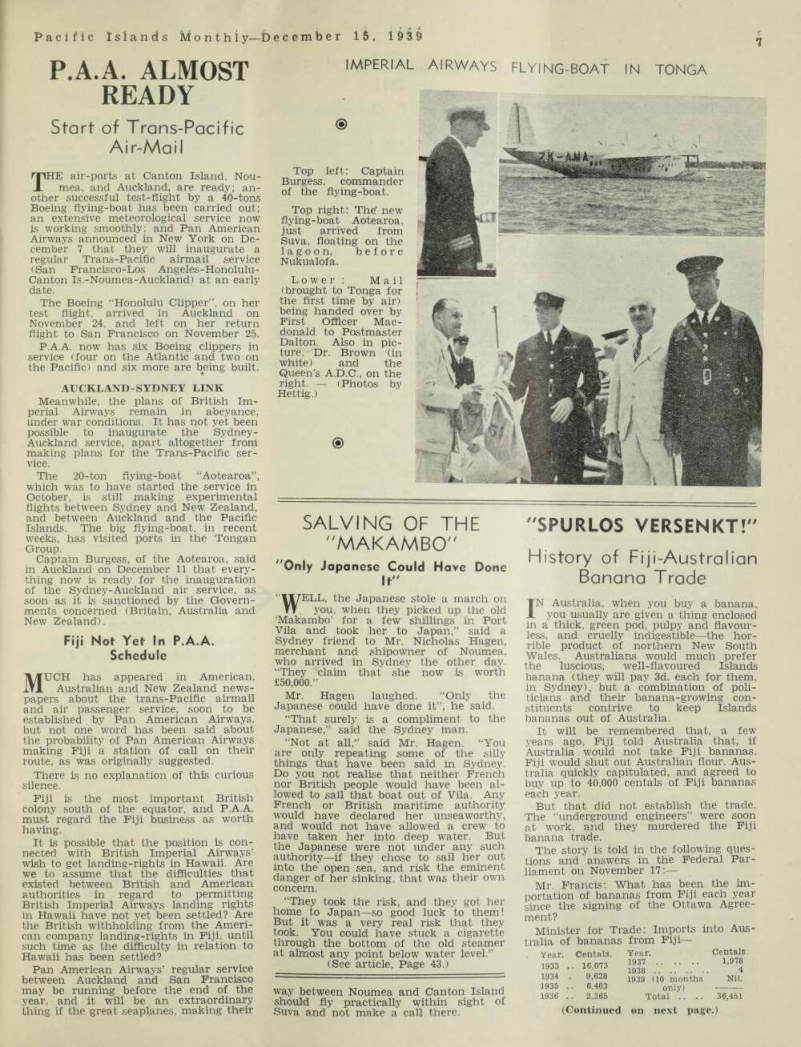
Imperial Airways Flying-Boat In Tonga
Top left: Captain Burgess, commander of the flying-boat.
Top right: The new flying-boat Aotearoa, just arrived from Suva, floating on the lagoon, before Nukualofa.
Lower; Mail (brought to Tonga for the first time by air) being handed over by First Officer Mac donald to Postmaster Dalton. Also in pic ture, Dr. Brown (in white) and the Queen’s A.D.C., on the right. (Photos by Hettig.)
"Makambo"
Salving Of The
"Only Japanese Could Have Done It"
WELL, the Japanese stole a march on you, when they picked up the old ‘Makambo’ for a few shillings in Port Vila and took her to Japan,” said a Sydney friend to Mr. Nicholas Hagen, merchant and shipowner of Noumea, who arrived in Sydney the other day.
“They claim that she now is worth £50,000.”
Mr. Hagen laughed. “Only the Japanese could have done it”, he said.
“That surely is a compliment to the Japanese,” said the Sydney man.
“Not at all,” said Mr. Hagen. “You are only repeating some of the silly things that have been said in Sydney.
Do you not realise that neither French nor British people would have been al lowed to sail that boat out of Vila. Any French or British maritime authority would have declared her unseaworthy, and would not have allowed a crew to have taken her into deep water. But the Japanese were not under any such authority—if they chose to sail her out into the open sea, and risk the eminent danger of her sinking, that was their own concern.
“They took the risk, and they got her home to Japan—so good luck to them!
But it was a very real risk that they took. You could have stuck a cigarette through the bottom of the old steamer at almost any point below water level.” (See article, Page 43.)
History of Fiji-Austrolian
"Spurlos Versenkt!"
History of Fiji-Austrolian Banana Trade
IN Australia, when you buy a banana, you usually are given a thing enclosed in a thick, green pod, pulpy and flavour less, and cruelly indigestible—the hor rible product of northern New South Wales. Australians would much prefer the luscious, well-flavoured Islands banana (they will pay 3d. each for them, in Sydney), but a combination of poli ticians and their banana-growing con stituents contrive to keep Islands bananas out of Australia.
It will be remembered that, a few years ago, Fiji told Australia that, if Australia would not take Fiji bananas, Fiji would shut out Australian flour, Aus tralia quickly capitulated, and agreed to buy up to 40,000 centals of Fiji bananas each year.
But that did not establish the trade.
The “underground engineers” were soon at work, and they murdered the Fiji banana trade.
The story is told in the following ques tions and answers in the Federal Par liament on November 17;— Mr. Francis: What has been the im portation of bananas from Fiji each year since the signing of the Ottawa Agree ment?
Minister for Trade; Imports into Aus tralia of bananas from Fiji-
(Continued on next page.)
Year.
Centals.
Year.
Centals. 1933 . . 16,073 1937 1938 1,978 4 1934 . 9,628 1939 (10 months Nil. 1935 . . 6,403 only) 1936 . . 2,365 Total .. .. 36,451
Mr. Francis; What would have been the total amount of duty paid if the full importation of 40,000 centals had been made each year?
The Minister: Approximately, £37,690.
Mr. Francis: What was the total amount of duty paid each year on bananas imported from Fiji under the Ottawa Agreement?
The Minister: Total amount of duty paid on bananas imported into Australia from Fiji—
Or, to use a German phrase notorious in 1914-18, “Spurlos Versenkt” (sunk without leaving a trace).
There is a profitable market in Aus tralia for 40,000 centals per annum of Fiji bananas, yet nothing is being done about it. Surely there are people in Fiji competent to deal with the selfish, mono polistic Australian interests which try to keep Islands fruit away from the people who want it.
Year. £ Year. £ 1933 .. 2.961 1937 247 1938 1 1934 .. 1,452 1939 (10 months; Nil. 1935 .. 799 — 1936 .. • 296 Total .. . . .. 5,756
Advertisements & other items, p. 9 (1 item)
7
Pacific Islands Month! y— t) ecember 16, 1939
Water Supply For Pt.
Moresby
Sir Hubert Murray in Canberra
IT is understood that the urgent need of a water supply system for Port Moresby, made necessary by the addition of a military garrison and the staffs of oil search companies to the normal popu lation, is the reason for the unexpected visit to Australia of the Lieutenant- Governor of Papua, Sir Hubert Murray.
Sir Hubert Murray arrived in Sydney on December 6, accompanied by Mr. E.
Bignold, Crown Law officer. They sub sequently visited Canberra.
It is expected that Sir Hubert Murray will, owing to the establishment of a garrison at Port Moresby, ask the Federal Government for financial assist ance in providing the very necessary water supply—probably a gravitation supply from the Laloki River, 5 miles away in the mountains —while Mr. Bignold will look into the whole question of the legal machinery available for controlling the prices of commodities.
In Papua, as in other Pacific Terri tories, prices under war conditions show a disposition to jump to untimely heights.
Sir Hubert Murray expects to return to Papua before Christmas.
Your Wrapper!
Look On The Front of Your Wrapper!
The figures stamped there (if any) show the date when your subscription expires.
This date will appear on wrappers of three issues preceding expiration, thereby giving 3 months’ notice. If, at the end of that time, we have not been instructed to continue to send the journal to you, it will be discontinued.
Your subscription (8/- per annum, or 10/- in the case of countries outside the British Empire—which includes postage) may be sent direct, or may be paid to any of our agents (listed on Page 5).
The postage required lor this Issue Is: — To Australia and New Zealand 2d.
To United Kingdom via All-sea routes ... 2d To United Kingdom via Prance 2d.
To other British Possessions 2d.
To U.B.A. and Foreign Countries .. .. .. 4d.
Pacific Publications Pty. Ltd.
Papua's Search For
Oil
Deep Boring To Commence Soon
THE search for oil in Papua continues very active, and optimism is main tained at a high level. Even the shrewdest judges are convinced that, sooner or later, oil in commercial quantities will be pro duced in this Territory.
There really appears no sound justi fication for this optimism—no boring worthy of the name has yet taken place.
Up to date, although hundreds of thou sands of pounds have been spent, it has been all a matter of scientific surveys.
Boring will be under way very shortly, however. No less than 1,500 tons of bor ing machinery have arrived in Port Moresby for the Australasian Petroleum Company, Ltd., and 900 labourers are about to be employed on the construction of a road somewhere in the vicinity of the Vailala River. The plant, valued at £200,000, will bore to a depth of 10,000 ft.
New boring plant is also arriving for the small Apinaipi Co. which, while it has neither the large capital nor territory controlled by the other concerns, is claimed to have most promising struc tures. The Apinaipi boring plant is cap able of going down at least 6,000 feet.
The search for oil in the Mandated Territory has been less active, although parties of geologists have been at work there for the last couple of years. It is noted that the chief geologist and the business manager of A.P.C. went over to Rabaul early in December to interview the Administrator of New Guinea.
"Papuan Chief"
Salved
rpHE well-known Papuan coastal steamer L “Papuan Chief”, which went up on the reef in Eastern Papua at the end of August, and which afterwards was aban doned by her owners (Steamships Trading Co., Ltd.) to the underwriters, as a total loss, Is now floating in Port Moresby harbour, awaiting repairs.
Messrs. Burns, Philp & Co., Ltd., as the representative of the underwriters, Messrs.
Lloyds, Ltd., engaged Mr. G. Stewart, of Napa Napa, to effect whatever salvage was possible; and Mr. Stewart succeedeo in a remarkable way. The “Papuan Chief" was got off the rocks, where her position originally appeared to be hopeless, and was sufficiently patched to permit of her being brought to Port Moresby.
The underwriters then sold the “Papuan Chief” to the highest bidder, who was the vessel’s original owner, Steamships Trading Co., Ltd. The vessel is to be re paired on the latter’s new slip at Port Moresby, when an opportunity offers, and will re-enter the coastal service. In the meantime, the mail and other coastal services are being carried on by the “Nusa”, and by a couple of large pinnaces recently purchased by S.T.C., Ltd.
Death of Native Labourer
A CHARGE of unlawfully killing a native labourer was being heard in Rabaul, last week, against James Dennis Woods, manager of the Carpenter plan tation on Emira Island (north-west of Kavieng).
The Crown case is that the labourer (indentured) ran away, and was absent some time; and that when he returned Woods beat him so severely that his skin was bruised and broken, and blood poisoning set in, from which he died.
Islands Bound
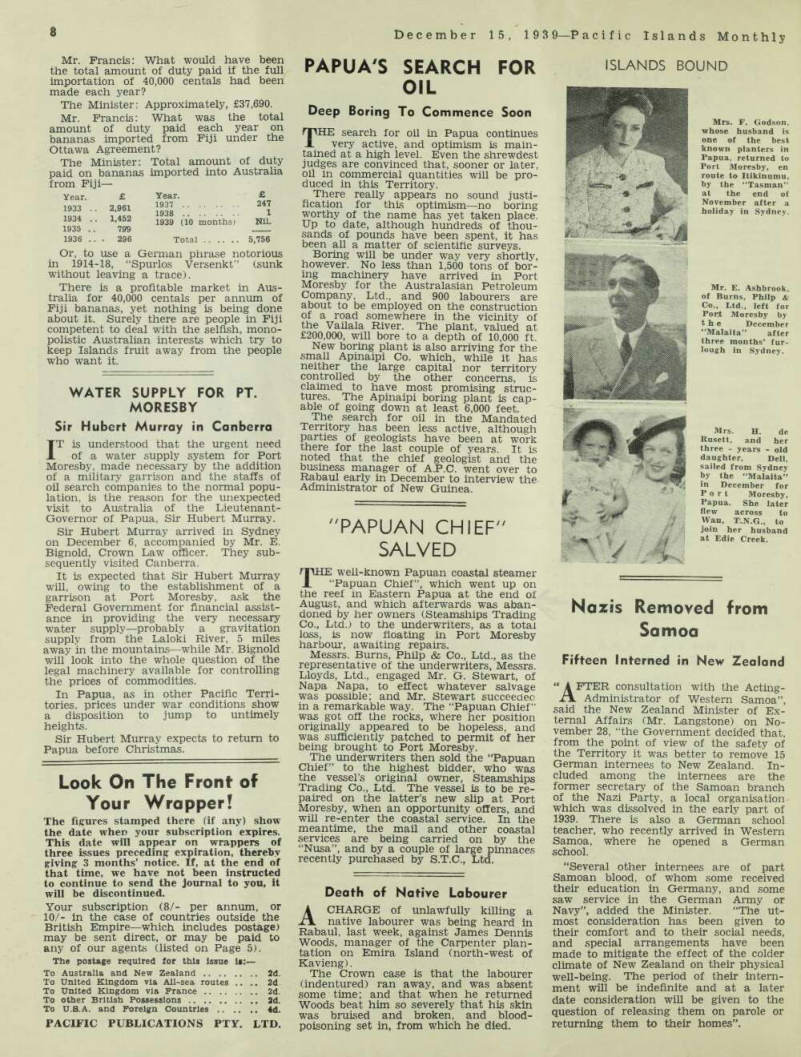
Mrs. F. Godson, whose husband is one of the best known planters in Papua, returned to Port Moresby, en route to Itikinumu, by the “Tasman” at the end of November after a holiday in Sydney.
Mr. E. Ashbrook, of Burns, Philp & Co., Ltd., left for Pont Moresby by the December “Malaita” after three months’ fur lough in Sydney.
Mrs. H. de Rusett, and her three-years-old daughter, Dell, sailed from Sydney by the “Malaita” in December for Port Moresby, Papua. She later flew across to Warn, T.N.G., to join her husband at Edie Creek.
Samoa
Nazis Removed from Samoa Fifteen Interned in New Zealand
“ A FTER consultation with the Acting- Administrator of Western Samoa”, said the New Zealand Minister of Ex ternal Affairs (Mr. Langstone) on No vember 28, “the Government decided that, from the point of view of the safety of the Territory it was better to remove 15 German internees to New Zealand. In cluded among the internees are the former secretary of the Samoan branch of the Nazi Party, a local organisation which was dissolved in the early part of 1939. There is also a German school teacher, who recently arrived in Western Samoa, where he opened a German school.
“Several other internees are of part Samoan blood, of whom some received their education in Germany, and some saw service in the German Army or Navy”, added the Minister. “The ut most consideration has been given to their comfort and to their social needs, and special arrangements have been made to mitigate the effect of the colder climate of New Zealand on their physical well-being. The period of their intern ment will be indefinite and at a later date consideration will be given to the question of releasing them on parole or returning them to their homes”.
Advertisements & other items, p. 10 (1 item)
8
December 15, 193 9—P acific Islands Monthly
Native Labour
Future of N. Guinea Native Labour New Commission at Work
From Our Own Correspondent
Rabaul, Dec. 2.
rE Commission of Inquiry, appointed to inquire into New Guinea native labour conditions, has issued a compre hensive questionnaire for employers and Administration officials.
It will give the average man an idea of the lines of the inquiry so that, when called to give evidence, he will know what is wanted.
Apparently, the Commission means business, and it is hoped that its final recommendations will be acted upon, and the file not be put away and forgotten, as so often is the case.
The questionnaire includes such items as:— “How long, in your experience, does it take to raise a raw recruit to the standard of a skilled labourer?”
“What labour-saving devices have you installed or in use?”
“Is the indenture system the most suited to —(i) the native? (ii) the re quirements of the Territory?”
Views are also asked as to the hours worked by labourers, and the advantages or otherwise of overtime, the closing of areas to recruiting, and whether such action has been taken without justifica tion.
Opinions on professional recruiting are wanted, and whether a government controlled labour bureau is advisable.
Casual labour is also mentioned, and views requested on whether natives should give notice before leaving the em ployment of the employer; should a law be imposed for a minimum rate of wage; and whether verbal agreements should be enforced, either by penal sanction or forfeit?
In all, there are 71 questions. The an swers to them should form a very use ful record of the opinions of people who have had much to do with native la bour in New Guinea.
The Director of District Services (Hon.
R. Melrose) is the chairman, and Hon.
G. G. Hogan (Crown Law Officer) and Dr. H. C. Hosking are also members from the Administration, while Messrs. W.
H. Carpenter and Dyson Hore-Lacy (vice president of the Planters’ Association) are non-official members of the Com mission.
Melanesian Mission Is 90
Years Old
WHILE New Zealand is preparing to celebrate its centennial, the Melane sian Mission has marked an existence only 10 years shorter with a booklet celebrating the 90th anniversary of its foundation.
The extent of the Diocese of Melanesia and the manifold activities of the staff of 59 European priests and workers under the seventh bishop, Rt. Rev. W. H. Bad deley, the 62 Melanesians in Holy Orders, the 650 teachers and the 140 members of the native brotherhood, are described.
In text and illustrations the booklet provides a graphic picture of the work of the diocese, its fleet of mission ships, its schools and training colleges, its hos pitals, leprosarium and churches.
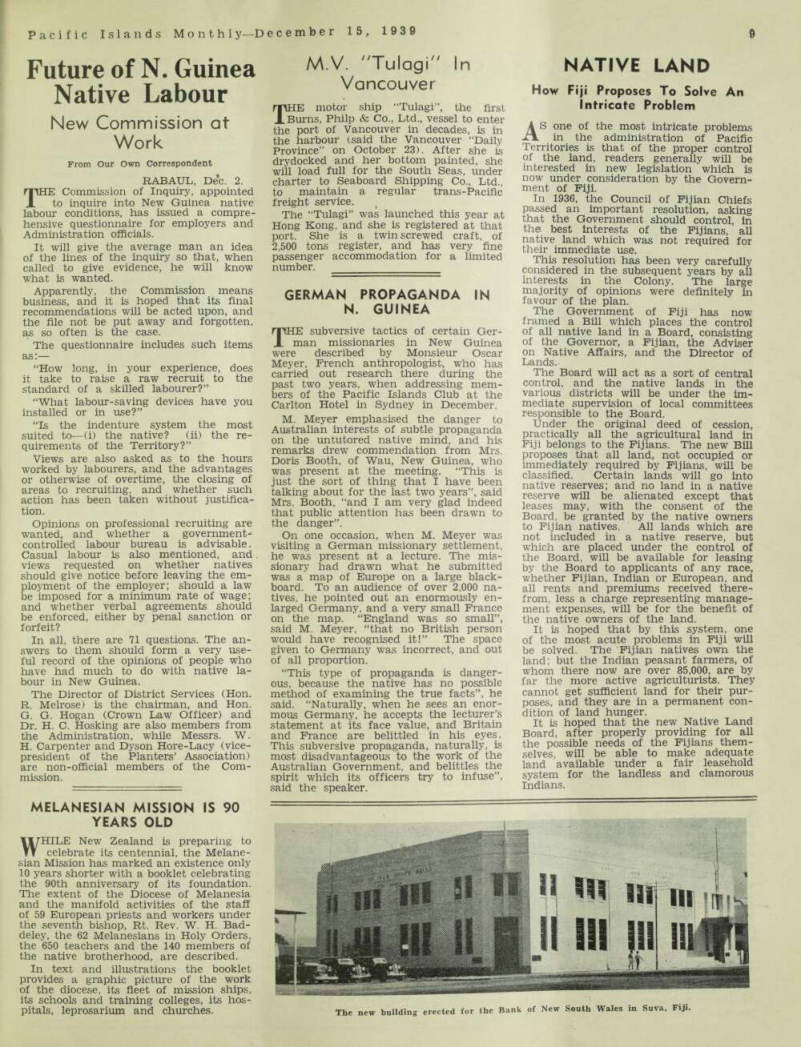
The new building erected for the Bank of New South Wales in Suva, Fiji.
M.V. "Tulagi" In Vancouver
Vancouver
THE motor ship “Tulagi”, the first Burns, Philp & Co., Ltd., vessel to enter the port of Vancouver in decades, is in the harbour (said the Vancouver “Daily Province” on October 23). After she is drydocked and her bottom painted, she will load full for the South Seas, under charter to Seaboard Shipping Co., Ltd., to maintain a regular trans-Pacific freight service.
The “Tulagi” was launched this year at Hong Kong, and she is registered at that port. She is a twin screwed craft, of 2,500 tons register, and has very fine passenger accommodation for a limited number.
German Propaganda In
N. Guinea
r[E subversive tactics of certain Ger man missionaries in New Guinea were described by Monsieur Oscar Meyer, French anthropologist, who has carried out research there during the past two years, when addressing mem bers of the Pacific Islands Club at the Carlton Hotel in Sydney in December.
M. Meyer emphasised the danger to Australian interests of subtle propaganda on the untutored native mind, and his remarks drew commendation from Mrs.
Doris Booth, of Wau, New Guinea, who was present at the meeting. “This is just the sort of thing that I have been talking about for the last two years”, said Mrs. Booth, “and I am very glad indeed that public attention has been drawn to the danger”.
On one occasion, when M. Meyer was visiting a German missionary settlement, he was present at a lecture. The mis sionary had drawn what he submitted was a map of Europe on a large black board. To an audience of over 2,000 na tives, he pointed out an enormously en larged Germany, and a very small France on the map. “England was so small”, said M. Meyer, “that no British person would have recognised it!” The space given to Germany was incorrect, and out of all proportion.
“This type of propaganda is danger ous, because the native has no possible method of examining the true facts”, he said. “Naturally, when he sees an enor mous Germany, he accepts the lecturer’s statement at its face value, and Britain and France are belittled in his eyes.
This subversive propaganda, naturally, is most disadvantageous to the work of the Australian Government, and belittles the spirit which its officers try to infuse”, said the speaker.
Native Land
How Fiji Proposes To Solve An Intricate Problem
AS one of the most intricate problems in the administration of Pacific Territories is that of the proper control of the land, readers generally will be interested in new legislation which is now under consideration by the Govern ment of Fiji.
In 1936, the Council of Fijian Chiefs passed an important resolution, asking that the Government should control, in thet best interests of the Fijians, all native land which was not required for their immediate use.
This resolution has been very carefully considered in the subsequent years by all interests in the Colony. The large majority of opinions were definitely in favour of the plan.
The Government of Fiji has now framed a Bill which places the control of all native land in a Board, consisting of the Governor, a Fijian, the Adviser on Native Affairs, and the Director of Lands.
The Board will act as a sort of central control, and the native lands in the various districts will be under the im mediate supervision of local committees responsible to the Board.
Under the original deed of cession, practically all the agricultural land in Fiji belongs to the Fijians. The new Bill proposes that all land, not occupied or immediately required by Fijians, will be classified. Certain lands will go into native reserves; and no land in a native reserve will be alienated except that leases may, with the consent of the Board, be granted by the native owners to Fijian natives. All lands which are not included in a native reserve, but which are placed under the control of the Board, will be available for leasing by the Board to applicants of any race, whether Fijian, Indian or European, and all rents and premiums received there from, less a charge representing manage ment expenses, will be for the benefit of the native owners of the land.
It is hoped that by this system, one of the most acute problems in Fiji will be solved. The Fijian natives own the land: but the Indian peasant farmers, of whom there now are over 85,000, are by far the more active agriculturists. They cannot get sufficient land for their pur poses, and they are in a permanent con dition of land hunger.
It is hoped that the new Native Land Board, after properly providing for all the possible needs of the Fijians them selves, will be able to make adequate land available under a fair leasehold system for the landless and clamorous Indians.
Advertisements & other items, p. 11 (1 item)
9
Pacific Islands Monthl y—D ecember 15, 1939
Pacific People
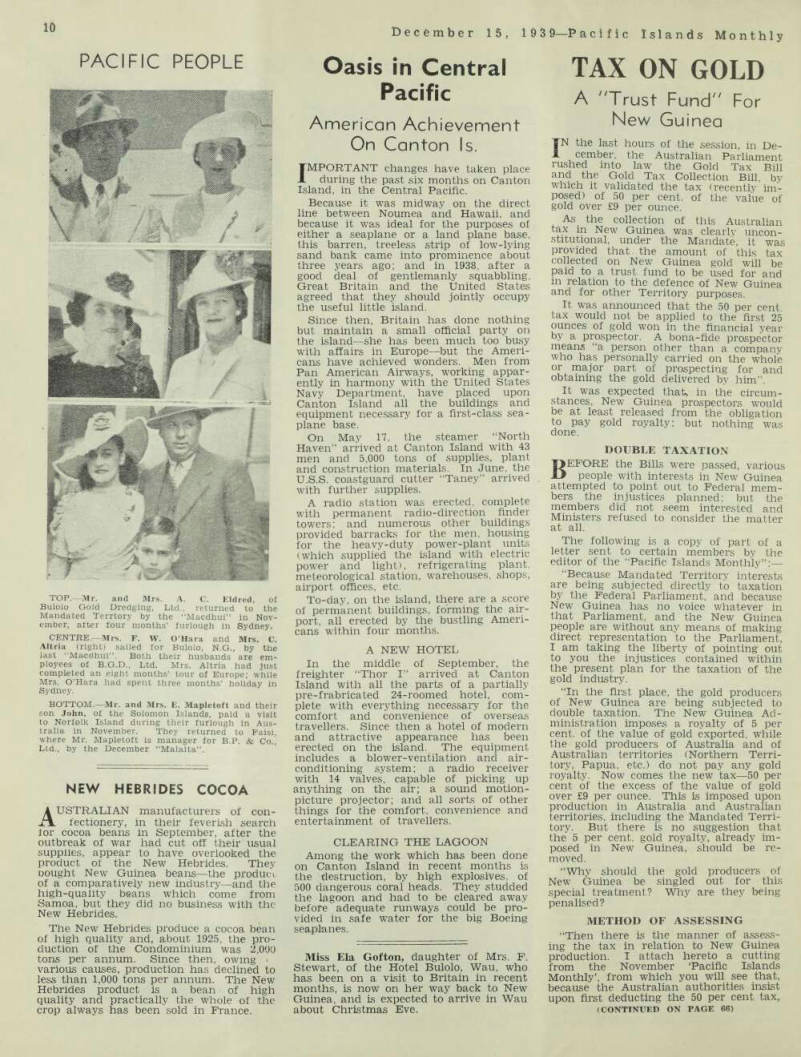
TOP.—M r. and Mrs. A. C. Eldred, of Bulolo Gold Dredging, Ltd., returned to the Mandated Terrtory by the “Macdhui” in Nov ember, after four months’ furlough in Sydney.
CENTRE. —Mrs. F. W. O’Hara and Mrs. C.
Altria (right) sailed for Bulolo, N.G., by the last “Macdhui”. Both their husbands are em ployees of B.G.D., Ltd. Mrs. Altria had just completed an eight months’ tour of Europe; while Mrs. O’Hara had spent three months’ holiday in Sydney.
BOTTOM. —Mr. and Mrs. E. Mapletoft and their son John, of the Solomon Islands, paid a visit to Norfolk Island during their furlough in Aus tralia in November. They returned to Faisi, where Mr. Mapletoft is manager for B.P. & Co., Ltd., by the December “Malaita”.
New Hebrides Cocoa
AUSTRALIAN manufacturers of con fectionery, in their feverish search for cocoa beans in September, after the outbreak of war had cut off their usual supplies, appear to have overlooked tho product of the New Hebrides. They oought New Guinea beans—the producu of a comparatively new industry—and the high-quality beans which come from Samoa, but they did no business with the New Hebrides.
The New Hebrides produce a cocoa bean of high quality and, about 1925, the pro duction of the Condominium was 2,000 tons per annum. Since then, owing ■ various causes, production has declined to less than 1,000 tons per annum. The New Hebrides product is a bean of high quality and practically the whole of the crop always has been sold in France.
Pacific
Oasis in Central Pacific American Achievement On Canton Is.
IMPORTANT changes have taken place during the past six months on Canton Island, in the Central Pacific.
Because it was midway on the direct line between Noumea and Hawaii, and because it was ideal for the purposes of either a seaplane or a land plane base, this barren, treeless strip of low-lying sand bank came into prominence about three years ago; and in 1938, after a good deal of gentlemanly squabbling, Great Britain and the United States agreed that they should jointly occupy the useful little island.
Since then, Britain has done nothing but maintain a small official party on the island —she has been much too busy with affairs in Europe—but the Ameri cans have achieved wonders. Men from Pan American Airways, working appar ently in harmony with the United States Navy Department, have placed upon Canton Island all the buildings and equipment necessary for a first-class sea plane base.
On May 17, the steamer “North Haven” arrived at Canton Island with 43 men and 5,000 tons of supplies, plant and construction materials. In June, the U.S.S. coastguard cutter “Taney” arrived with further supplies.
A radio station was erected, complete with permanent radio-direction finder towers: and numerous other buildings provided barracks for the men, housing for the heavy-duty power-plant units (which supplied the island with electric power and light), refrigerating plant, meteorological station, warehouses, shops, airport offices, etc.
To-day, on the island, there are a score of permanent buildings, forming the air port, all erected by the bustling Ameri cans within four months.
A New Hotel
In the middle of September, the freighter “Thor I” arrived at Canton Island with all the parts of a partially pre-frabricated 24-roomed hotel, com plete with everything necessary for the comfort and convenience of overseas travellers. Since then a hotel of modern and attractive appearance has been erected on the island. The equipment includes a blower-ventilation and air conditioning system; a radio receiver with 14 valves, capable of picking up anything on the air; a sound motion picture projector; and all sorts of other things for the comfort, convenience and entertainment of travellers,
Clearing The Lagoon
Among the work which has been done on Canton Island in recent months is the destruction, by high explosives, of 500 dangerous coral heads. They studded the lagoon and had to be cleared away before adequate runways could be pro vided in safe water for the big Boeing seaplanes.
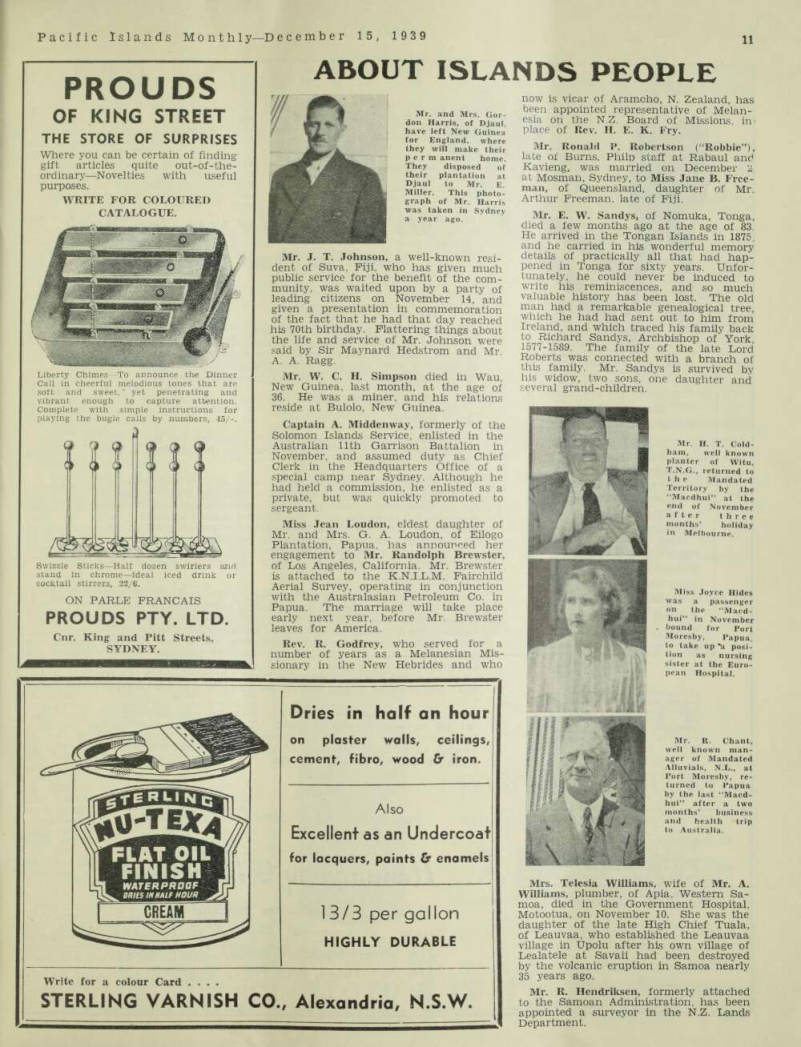
Miss Ela Gofton, daughter of Mrs. F.
Stewart, of the Hotel Bulolo, Wau, who has been on a visit to Britain in recent months, is now on her way back to New Guinea, and is expected to arrive in Wau about Christmas Eve.
Tax On Gold
A "Trust Fund" For New Guinea
IN the last hours of the session, in De cember, the Australian Parliament rushed into law the Gold Tax Bill and the Gold Tax Collection Bill by which it validated the tax (recently im posed) of 50 per cent, of the value of gold over £9 per ounce.
As the collection of this Australian tax in New Guinea was clearly uncon stitutional, under the Mandate, it was provided that the amount of this tax collected on New Guinea gold will be paid to a trust fund to be used for and in relation to the defence of New Guinea and for other Territory purposes.
It was announced that the 50 per cent, tax would not be applied to the first 25 ounces of gold won in the financial year by a prospector. A bona-fide prospector means “a person other than a company who has personally carried on the whole or major part of prospecting for and obtaining the gold delivered by him”.
It was expected that, in the circum stances, New Guinea prospectors would be at least released from the obligation to pay gold royalty: but nothing was done.
Double Taxation
BEFORE the Bills were passed, various people with interests in New Guinea attempted to point out to Federal mem bers the injustices planned: but the members did not seem interested and Ministers refused to consider the matter at all.
The following is a copy of part of a letter sent to certain members by the editor of the ‘‘Pacific Islands Monthly”:— “Because Mandated Territory interests are being subjected directly to taxation by the Federal Parliament, and because New Guinea has no voice whatever in that Parliament, and the New Guinea people are without any means of making direct representation to the Parliament, I am taking the liberty of pointing out to you the injustices contained within the present plan for the taxation of the
gold industry.
“In the first place, the gold producers of New Guinea are being subjected to double taxation. The New Guinea Ad ministration imposes a royalty of 5 per cent, of the value of gold exported, while the gold producers of Australia and of Australian territories (Northern Terri tory, Papua, etc.) do not pay any gold royalty. Now comes the new tax —50 per cent of the excess of the value of gold over £9 per ounce. This is imposed upon production in Australia and Australian territories, including the Mandated Terri tory. But there is no suggestion that the 5 per cent, gold royalty, already im posed in New Guinea, should be re moved.
“Why should the gold producers of New Guinea be singled out for this special treatment? Why are they being penalised?
Method Of Assessing
“Then there is the manner of assess ing the tax in relation to New Guinea production. I attach hereto a cutting from the November ‘Pacific Islands Monthly’, from which you will see that, because the Australian authorities insist upon first deducting the 50 per cent tax,
(Continued On Page 66)
and then deducting the 5 per cent, royalty from the balance, instead of following the reverse process, the gold producer is penalised to the extent of 4/6 per ounce.
Again, is the Government seeking some means of placing a special penalty upon New Guinea gold producers, or is this merely another example of bureaucratic mule-headedness?
“I understand that the Government intends to make a special concession to prospectors—that is to say, men who come within the definition of a prospector will pay no tax at all on their first 25 ounces of gold. Anyone who knows con ditions in New Guinea will describe this as a miserable concession. It represents a matter of possibly £2O per annum. I would respectfully urge that a gift of £2O per year is of little use to the men who have to battle with the terriblv hard and terribly expensive conditions of New Guinea, in order that they may make a profit out of the gold industry.
“It is a fact that in September the small gold-producers in New Guinea were given a concession, insofar that producers of gold worth up to £6OO per annum were absolved from payment of gold royalty altogether, and producers of gold, from £6OO to £1,200 p.a., pay on a sliding scale.
After £1,200 p.a., rebate ceases and the concession is wiped out. But this con cession, actually, is worth little. A New Guinea prospector has to produce a good deal more than £6OO p.a. of gold to be able to live at all, owing to the high cost of everything. Under the new law, these producers will be absolved from the new tax only on their first £250 or £3OO worth of production (25 ounces).
Claim For Consideration
“In any case. why. in the special cir cumstances outlined above, should the Government give a concession to the small men and not to the big companies?
The small men deserve everything they can get; but so also do the big com panies. We have to thank the courage and the enterprise, and the large amount of working capital introduced by the big companies, for the fact that there is to dav in New Guinea a great and profitable sold industry, worth nearly £IOO,OOO to the New Guinea Administration on the cold rovaltv alone. Concerns like Bulolo Gold Dredging certainly are reaping enormous profits from their enterprise in New Guinea: but anvone who knows their history will admit that they de serve every penny of it.
“If the gold interests in New Guinea receive some small concession in the name of justice—perhaps the abolition of the gold royaltv, or even a reversal of the method of calculating the taxes— they will not have had the same reason for complaint. After all, evervone in these days must face the responsibility of a great war. But if the new Bill goes through in its present form, without any concession to the New Guinea gold in terests, then the New Guinea gold miners will be justified in saying now. as thev have said many times before, that the only interest the Australian Parliament has in them is the interest of the master in the helpless milch-cow.
“If you can use your influence and your voice to get some reasonable con cession for the New Guinea miners be fore this Bill becomes law, I can assure you that you will be doing a very just and fair thing.”
About Islands People
Mr. J. T. Johnson, a well-known resi dent of Suva, Fiji, who has given much public service for the benefit of the com munity, was waited upon by a party of leading citizens on November 14, and given a presentation in commemoration of the fact that he had that day reached his 70th birthday. Flattering things about the life and service of Mr. Johnson were said by Sir Maynard Hedstrom and Mr.
A. A. Ragg.
Mr. W. C. H. Simpson died in Wau, New Guinea, last month, at the age of 36. He was a miner, and his relations reside at Bulolo, New Guinea.
Captain A. Middenway, formerly of the Solomon Islands Service, enlisted in the Australian 11th Garrison Battalion in November, and assumed duty as Chief Clerk in the Headquarters Office of a special camp near Sydney. Although he had held a commission, he enlisted as a private, but was quickly promoted to sergeant.
Miss Jean Loudon, eldest daughter of Mr. and Mrs. G. A. Loudon, of Eilogo Plantation, Papua, has announced her engagement to Mr. Randolph Brewster, of Los Angeles, California. Mr. Brewster is attached to the K.N.I.L.M. Fairchild Aerial Survey, operating in conjunction with the Australasian Petroleum Co. in Papua. The marriage will take place early next year, before Mr. Brewster leaves for America.
Rev. R. Godfrey, who served for a number of years as a Melanesian Mis sionary in the New Hebrides and who
now is vicar of Aramoho, N. Zealand, has been appointed representative of Melan esia on the N.Z. Board of Missions, in place of Rev. H. E. K. Fry.
Mr. Ronald P, Robertson (“Robbie”), late of Burns. Philo staff at Rabaul and Kavieng, was married on December 2. at Mosman, Sydney, to Miss Jane B. Free man, of Queensland, daughter of Mr.
Arthur Freeman, late of Fiji.
Mr. E. W. Sandys, of Nomuka, Tonga, died a few months ago at the age of 83, He arrived in the Tongan Islands in 1875, and he carried in his wonderful memory details of practically all that had hap pened in Tonga for sixty years. Unfor tunately, he could never be induced to write his reminiscences, and so much valuable history has been lost. The old man had a remarkable genealogical tree, which he had had sent out to him from Ireland, and which traced his family back to Richard Sandys, Archbishop of York, 1577-1589. The family of the late Lord Roberts was connected with a branch of this family. Mr. Sandys is survived by his widow, two sons, one daughter and several grand-children.
Mrs. Telesia Williams, wife of Mr. A.
Williams, plumber, of Apia, Western Sa moa, died in the Government Hospital, Motootua, on November 10. She was the daughter of the late High Chief Tuala, of Leauvaa, who established the Leauvaa village in Upolu after his own village of Lealatele at Savaii had been destroyed by the volcanic eruption in Samoa nearly 35 years ago.
Mr. R. Hendriksen, formerly attached to the Samoan Administration, has been appointed a surveyor in the N.Z. Lands Department.
Mr. and Mrs. Gor don Harris, of Djaul, have left New Guinea for England, where they will make their perm anent home.
They disposed of their plantation at Djaul to Mr. E.
Miller. This photo graph of Mr. Harris was taken in Sydney a year ago.
Mr. H. T. Cold ham, well known planter of Witu, T.N.G., returned to the Mandated Territory by the “Macdhui” at the end of November after three months’ holiday in Melbourne.
Miss Joyce Hides was a passenger on the “Macd hui” in November bound for Port Moresby, Papua, to take up a posi tion as nursing sister at the Euro pean Hospital.
Mr. R. Chant, well known man ager of Mandated Alluvials, N.L., at Port Moresby, re turned to Papua by the last “Macd hui” after a two months’ business and health trip to Australia.
Advertisements & other items, pp. 13-14 (3 items)
Zm-Texa
PROUDS
OF KING STREET
THE STORE OF SURPRISES
Where you can be certain of finding gift articles quite out-of-theordinary—Novelties with useful purposes.
WRITE FOR COLOURED
CATALOGUE.
Liberty Chimes —To announce the Dinner Call in cheerful melodious tones that are soft and sweet,' yet penetrating and vibrant enough to capture attention.
Complete with simple instructions for playing the bugle calls by numbers, 45/-.
Q r > 9 ; > Swizzle Sticks—Half dozen swirlers and stand in chrome—ideal iced drink or cocktail stirrers, 22/6.
ON PARLE FRANCAIS
PROUDS PTY. LTD.
Cnr. King and Pitt Streets,
SYDNEY.
ZM-TEXa
m m
CREAM
Dries in half an hour on plaster walls, ceilings, cement, fibre, wood & iron.
Also Excellent as an Undercoat for lacquers, paints & enamels 13/3 per gallon
HIGHLY DURABLE
Write for a colour Card ...
STERLING VARNISH CO., Alexondria, N.S.W.
12
December 15, 193 9—P acific Islands Monthly
Hemincjwa\j
R
“9tA turn 9 had a
-but I'm afraid to ask for if “Why, Bill? Why be afraid to ask for your proper value. All you have to do is to point out that you have been training yourself for eighteen months to make yourself more valuable, and you will find no difficulty with any boss —much less your firm—they’re quite reasonable when a man is increasing his qualifications”.
Some H. & R.
Career Training Subjects @ Complete Accountancy Accountancy-Secretaryship Cost Accountancy and Factory Organization Complete Bookkeeping Marketing and Advertising Marketing and Selling General Business Training Effective English Business Handwriting Business Arithmetic Effective Correspondence Psychology, etc. (Irrespective of location—no matter where you live—H. & R. train you just as efficiently and in the same way as if you resided in the capital cities of Australia. Success is guaranteed.) “But I haven’t been doing that, Jack”.
“But I thought “Yes, I was going to take it up when you did, but I’ve put it off— couldn’t just see my way clear to spend the few shillings a week —have been hoping for a rise to pay for it”, “Well, Bill, of course that’s different. After all, you were doing the same work eighteen months ago—why should they pay more money for the same service when you haven’t even got any further knowledge. If I had waited for a rise before I started to make myself worth more, I’d be in the same situation as you—but I had been training only a couple of months when I got a rise that more than paid my monthly training commitment . . . and was ‘put on the mat’ because they had not been told I was training and found out only by accident”.
“However, Decide Now to Get Your Rise. Write to-day to H. & R.
Under their Tuition Method in Accountancy-Secretaryship you will acquire—in the comfort and privacy of your own home—the thorough training, the knowledge that will itself demand higher pay, and you yourself will gain that confidence and poise that is born of ability and success. You will find, too, as I did, that you won’t have to ask for a rise—you will soon see that, as in mine and hundreds of other cases, the rise you automatically get will handsomely pay the small cost of training—and that rise leads to others as you progress”.
Do it Now—Cut out the coupon if you cannot call, and send for our 108 page illustrated handbook, “The Guide to Careers in Business”, which has brought success, higher pay, security and comfort to so many hundreds of people throughout the business world. It can do the same for You.
To Hemingway and Robertson, Please send me FREE copy of the new 108-page illustrated handbook, “The Guide to Careers in Business”, and details of how the H. & R. Personal-Individual Correspondence Tuition Method will train me successfully for the career marked below.
NAME
ADDRESS
CAREER INTERESTED IN
127AA/378.
I I I Department of Accountancy and Commerce
Hemincjwa\j
The Accountancy Specialists
Founders of Commercial Education in Australasia 127 A Barrack House, 16 Barrack Street, Sydney. 127 A Bank House, Bank Place, Melbourne, C.l.
Tropicalities
IN Fiji, as in other places, “party-line” telephones must be endured. You know that the district “stickybeak” prob ably is listening-in, so you arrange your conversations carefully.
One day, two women in a Fiji district were talking on the party line when, quite suddenly, they heard the chimes of a cuckoo clock. Comparing notes after wards, they found that neither of them had a cuckoo clock.
“Aha!” they said, and waited.
A week later, they were at a district tea-party; and, in a quiet moment, their hostess’s cuckoo clock shrilled out the hour.
The other guests still are wondering why the two women laughed so much. —L.A. * * * DURING my recent leave in Australia, I had left a fairly reliable boy in charge of the house and grounds, and the odd jobs such as feeding the fowls, watering the few cattle, weeding the lawns, mending the fences and so forth.
His father, lately lamented, was one of the finest native Christian teachers of my experience, clever, gifted with a sense of real humour, sincere, and generally an all-round good man; and his son has inherited at least some of his father’s brightness, writes a good hand, and has a good grip of things.
I left a couple of stamped and ad dressed envelopes for him to let me know how things were going; and, towards the end of my holiday I was delighted to re ceive his epistle. The star effort was the following: “Every chop (job) is going on well; but only one trouble, the bull duck is eating all the chickens. I don’t know what to do with the bull duck”. —P. * • • rE emphatic absence of Dr. C. M.
Dawson, M.L.C., and Mr. O. P. Nel son, M.L.C., from the official dinner and ball at Government House, Apia, Western Samoa, when the Governor-General of New Zealand was making a formal visit, was reported in this journal. We now are informed that Dr. Dawson somewhat resents the way in which the fact was stated. He attended all other functions in honour of Viscount Galway; but he had already advised the Administrator that, owing to unfair treatment which he considered he had received at the hands of the Administration, he would attend no more Government House functions.
Mr. Nelson, it is understood, takes the same position. • * • A SERIES of minor illnesses —none, of itself serious, but sufficient in the mass to impose a handicap on movement —has kept C. V. T. Wells at home in Ade laide for many months, and he has not made his accustomed periodical visit to New Guinea as chairman of Guinea Air ways Ltd. Mr. Wells reports a much better condition of health now, however, so the Lae-Wau-Salamaua circuit should see him again soon.
New Guinea owes more probably than it realises to this quiet and unobtrusive man. The biggest thing in the Territory to-day Is Bulolo Gold Dredging Ltd.: it keeps hundreds of Europeans employed there, and the N.G. administration would be a poor, anaemic thing if it were not for the gold royalties, customs taxes, licence fees, etc., paid by B.G.D. and its associates. There would have been no B. G. D. if it had not been for the vision
of the late C. J. Levien; and probably Levien could not have launched his great gold-dredging-aerial-transport plan had it not been for the courage and steady faith of Mr. Wells and his friends. That Morobe goldfield, with its eight dredges, its innumerable mines, its half-dozen busy little towns, its dairy farms and plantations, is still one of the wonders of the southern world—there still is ab solutely no connection, except aeroplanes, between that high, rugged valley in Cen tral New Guinea, and the sea-coast.
Nearly 15 years have passed since Levien, Wells and Lapthorne planned this thing, and I have seen it many times in recent years; yet, seeing it once more a few weeks ago, I still marvelled at the vision and the faith which created Morobe in this upended, inhospitable land. Faith, here, did not move the moun tains, perhaps; but it linked the moun tains to the sea in a manner in credible. —R. « • • WHEN Monsieur Oscar Meyer, the French anthropologist, was in New Guinea, he was told an extraordinary story by a native, now more than eighty years old, of how he came in contact with the German scientist, Herr Schneider, at Tami Island, in the Huon Gulf. The visitor was, at first, inclined to disregard the tale, but when engaged on research in the Mitchell Library, in Sydney, he saw the story confirmed by a report, in French, written by Prince Roland Bonaparte. The latter, a wealthy descendant of a brother of Napoleon 1., was a member of the Schneider expedi tion. It appears that the natives, hav ing learned of Schneider’s presence on the island, planned to kill him. That duty was deputed to Monsieur Meyer’s informant, then a young man of about 25. He crept into the camp at night.
In a large cage he found two strange, hairy, man-like creatures, who jumped about and made weird noises. They were ourang-outangs. The native, never hav ing seen monkeys, thought they were some strange type of bushmen, and he
became so interested in them that he stayed by the cage with them until morn ing. Schneider, on discovering him there, kept him a prisoner with the monkeys for a week. The native, later, became his personal servant, and remained with Schneider for three years. * * » AN air pilot known in New Guinea, Captain J. N. Wilson, has been warmly praised for his coolness and courage in handling an Imperial Airways airliner when it was attacked by the Japanese on its regular run between Hong Kong and French Indo-China in November.
Captain Wilson was carrying passengers and mail, and was several miles from Weichow Island, in the Gulf of Tong king, when he was suddenly set upon by three Japanese planes, which attacked him viciously and certainly attempted to shoot him down. Although the airliner was riddled with bullets, and the pas sengers escaped injury only by lying on the floor, Wilson carried on quite coolly and succeeded eventually in bringing his airship down uninjured on an island near Hong Kong. He was then informed by the Japanese that his plane had been flying directly over Weichow Island, which they control and which is a prohibited zone, but this was denied by both Wilson and his passengers. However, the Jap
anese seized the plane, the mails and the passengers and took the lot of them to Canton. All subsequently were re leased. * * * SHOULD soldiers read? Hot controversy rages in Port Moresby over the ques tion of whether reading matter should be provided by the residents for troops quartered in the town. One school of thought hold that residents should sub scribe to provide a suitable library for the use of soldiers, and they recently organised an entertainment to raise funds for the purpose. The opposition boycotted the entertainment and pointed out that a public library already exists and, if soldiers really want to read, they may en joy the privilege on payment of a small subscription, such as is demanded of or dinary residents.
Feeling both for and against has been expressed with a good deal of freedom.
In some quarters, the fear is entertained that, unless some agreement is quickly reached, the much discussed troops will have to come into action and clean up the mess.
Advertisements & other items, p. 15 (2 items)
13
Pacific Islands Monthl y—December 15, 1939
Lloyd’S
PHOTOGRAPHS OF SCREEN
STARS in exchange for cancelled
POSTAGE STAMPS
Send 5/- face value in clean, undamaged postage stamps of the Pacific Islands (no Australian or New Zealand) and receive a beautiful 8 x 10 photograph of your favourite film star. Coloured and autographed portraits, and “movie stills” also for exchange.
What else do you want from Hollywood?
Commissions executed — f used stamps accepted in payment.
Correspondence invited.
HOLLYWOOD PHOTO
SERVICE
6763 Hollywood Blvd., Hollywood, California.
w Lever Lid Tin Keeps the contents FRESH.
ASK FOR
CREMO
• HIGH-GRADE
COFFEE & CHICORY
IMPORTED, ROASTED & BLENDED BY
LLOYD’S
Famous for Tea & Coffee for 50 years.
Drink and enjoy a High-Grade Coffee—at no extra cost.
LLOYD & CO. Pty. Ltd., Sydney
Death Of Mr. Alf. Cooper
THE death occurred on December 9 of Mr. Alfred M. Cooper, who for many years was a popular and highly-esteemed resident of Rabaul.
Mr. Cooper went to New Guinea about 20 years ago and. in partnership with Mr. Adams, established an engineering business in Rabaul. Subseouently, in partnership with Mr. Tex Thomas, he took over the well-known Asalingi Plan tation at the Bainings, in New Britain, where they successfully produced copra and cocoa. About two years ago, Mr.
Cooper began to suffer from ill-health, and he came to Sydney and settled down in the suburb of Pymble, where he died.
He was about 57 years old.
Mr. R. A. Malone, Treasurer in the Sa moan Administration, returned to New Zealand at the end of November after completing his three years’ term of office at Apia. He has been succeeded by Mr.
E. J. McFarland, of the N.Z. Lands and Income Tax Department.
Misima Collapse
End Believed In Sight
From Our Own Correspondent
Sam Arm, Nov. 23.
I AM afraid that the end is in sight at Mount Sisa (Gold Mines of Papua).
Their prospecting operations have been disappointing, and the expectation here is that there is nothing to do now but dispose of the valuable machinery.
There is thought to be a likelihood that Cuthbert’s Company will buy the plant and lease, and work the mill on the spot on ore taken from the Umuna Lode.
Another report is that Quartz Moun tain, a New Zealand company which has been under reconstruction, and which holds valuable leases in the same district in Misima, is likely to buy up the G.M.O.P. plant at a bargain price.
Directors’ Report
Pessimism is the dominating note of the annual report issued by the directors of Gold Mines of Papua Ltd., for the year ended June 30 last.
As is generally known, this Co.’s mine on Misima, Eastern Papua, after being fully equipped with a large and expensive plant ceased operations in August last owing to the unexpected low value of the ore being obtained; and, since then, only prospecting operations have been carried on, in the hope of being able to pick up a new and more valuable lode —possibly a continuation of the well known Umuna lode, on which the Cuth bert mine is so profitably operating.
The directors say that a large ore body has been located with generally similar physical characteristics to those of the Umuna lode, and this body is being in vestigated, but the cross-cut values to date are most disappointing.
Mr. and Mrs. E. K. Thorpe, with their two sons, Kitson and Elton, recently re turned to Thursday Island, after four months’ motor tour in Australia.
Advertisements & other items, pp. 16-17 (3 items)
14
December 15, 193 9—P acific Islands Monthly
W. H. GROVE & Sons Ltd.
★ NO CHANGE IN
PRICES or POLICY
Angus Gr Coote's Diamond Ring
Values are still UNBEATABLE.
jmiiiiiwuHMijii IP f/ V ■*/ A. Si C. Diamonds are set in Pure Platinum on mounts of 18ct. White or Yellow Gold whichever you like. £lO 100 No. MPI. —A Ring to please a Princess, yet offered at an amazingly low price. The rich, centre Diamond is securely held in a millgrained, hexagonal setting. The artistic, handcarved shoulders are set with four more scintillating Diamonds. 18ct. Gold Ring.
Any of these (Rings can be made in Pure Platinum for approximately 50/- extra.
£l2lOO
O m No. MP2. —“Twin-fire” which introduces a refined cut-corner setting, supporting two large and brilliant Diamonds. These are shoulders of novelty and charm. See the pretty underrail, and the two brilliant Diamonds that flash alongside the centre gems. 18ct. Gold Ring.
A. & C. En-
gagement Rings are made in our Factory-onthe - Premises.
That’s why the values are so much better.
£ls*o*o
No. MP3.—This is a beautiful Ring. A number of young ladies who have seen it are thrilled by the fiery brilliance of the centre Diamond.
They were all loud in their praises of these exquisite diamond-studded shoulders. 18ct.
I Gold Ring.
Angus & Coote will despatch your Ring promptly, and guarantee its safe delivery. £2oo' r No. MP4.—lt is hard to imagine anything more lovely than this pure, brilliant Solitaire.
The sculptured shoulders are a marvellous sight.
See how nicely the four side Diamonds are set, 18ct. Gold Ring. Platinum-set for beauty and security.
ANGUS & COOTE Pt y . Ltd
500 GEORGE STREET, SYDNEY.
W. H. GROVE & Sons Ltd.
AUCKLAND
Island Traders. p.o. bo* 490.
Telegraphic and Cable Address: “Grove”, Auckland.
Shippers of oil classes of New Zealand Products, specially prepared for the Island trade.
Representing Tootol Broadhurst Lee Co. Ltd., of Manchester.
Ryfands & Sons (Col.) Ltd., London.
Parbury Henty & Co. Pty. Ltd., of Sydney and Kobe.
Lowthian Drake Cr Co. Ltd., of Manchester.
J. Blair King, of London. World-famed Shirts.
Burrell & Co. Ltd. Milwall, London, E. 14. All classes of Paints.
The New R.S.M.
Sergeant Inoke (very much to himself) : “This Kai Papalangi plurry fool! ’E wear Fiji sulu, ’e call himself Black -Wati.
Think ’imself all the same Fiji Turaga!”
Native Orgies on Morobe Goldfield
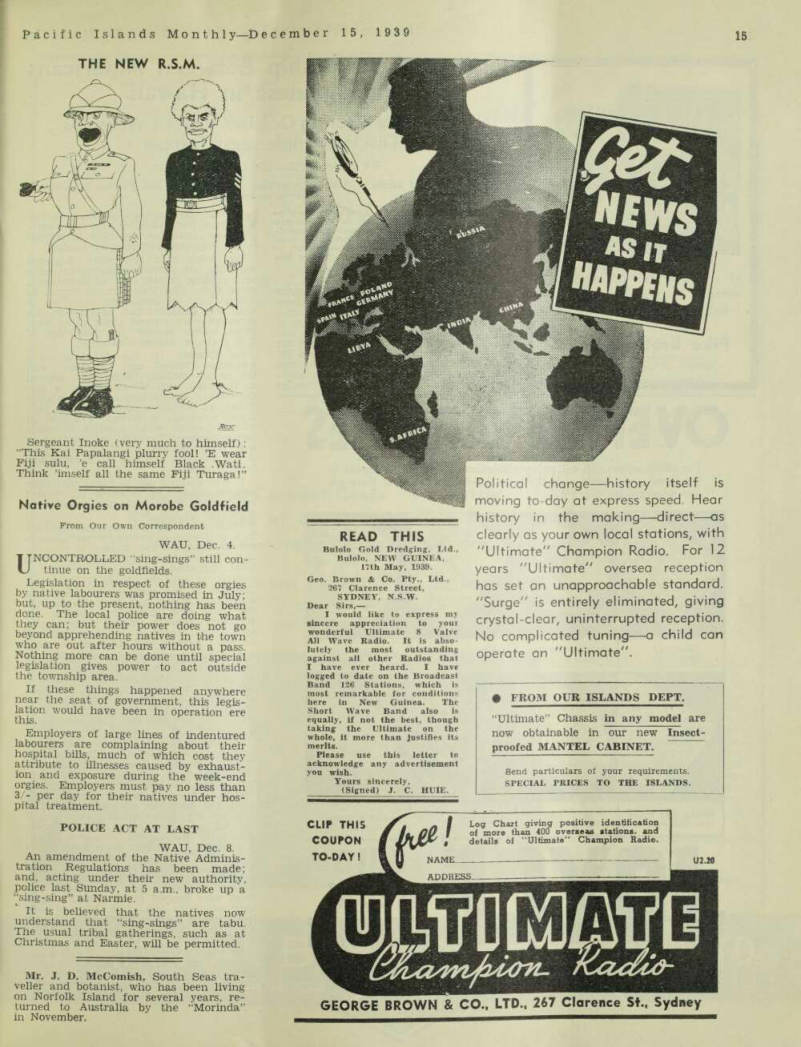
From Our Own Correspondent
WAU, Dec. 4.
UNCONTROLLED “sing-sings” still con tinue on the goldfields.
Legislation in respect of these orgies by native labourers was promised in July; but, up to the present, nothing has been done. The local police are doing what they can; but their power does not go beyond apprehending natives in the town who are out after hours without a pass.
Nothing more can be done until special legislation gives power to act outside the township area.
If these things happened anywhere near the seat of government, this legis lation would have been in operation ere this.
Employers of large lines of indentured labourers are complaining about their hospital bills, much of which cost they attribute to illnesses caused by exhaust ion and exposure during the week-end orgies. Employers must pay no less than 3 - per day for their natives under hos pital treatment.
Police Act At Last
WAU, Dec. 8.
An amendment of the Native Adminis tration Regulations has been made; and, acting under their new authority, police last Sunday, at 5 a.m.. broke up a “sing-sing” at Narmie.
It is believed that the natives now understand that “sing-sings” are tabu.
The usual tribal gatherings, such as at Christmas and Easter, will be permitted.
Mr. J. D. McComish, South Seas tra veller and botanist, who has been living on Norfolk Island for several years, re turned to Australia by the “Morinda” in November.
Advertisements & other items, pp. 17-18 (1 item)
ffllMfAVnE
% . ✓ m. y 4 V i
READ THIS
Bulolo Gold Dredging, Ltd., Bulolo, NEW GUINEA, 17th May, 1939.
Geo. Brown & Co. Pty., Ltd.. 267 Clarence Street,
SYDNEY. N.S.W
Dear Sirs, — I would like to express my sincere appreciation to your wonderful Ultimate 8 Valve All Wave Radio. It is absolutely the most outstanding against all other Radios that I have ever heard. I have logged to date on the Broadcast Band 126 Stations, which is most remarkable for conditions here in New Guinea. The Short Wave Band also is equally, if not the best, though taking the Ultimate on the whole, it more than justifies its merits.
Please use this letter to acknowledge any advertisement you wish.
Yours sincerely, (Signed) J. C. HUIE.
Political change—history itself is
moving to-day at express speed. Hear
history in the making—direct—as
clearly as your own local stations, with
"Ultimate" Champion Radio. For 12
years "Ultimate" oversea reception
has set an unapproachable standard.
"Surge" is entirely eliminated, giving
crystal-clear, uninterrupted reception.
No complicated tuning—a child can
operate an "Ultimate".
• FROM OUR ISLANDS DEPT.
“Ultimate” Chassis in any model are now obtainable in our new Insectproofed MANTEL CABINET.
Send particulars of your requirements.
SPECIAL PRICES TO THE ISLANDS.
f Log Chart giving positive identification V 0 f m ore than 400 overseas stations, and details of "Ultimate" Champion Radio.
CUP THIS
COUPON
TO-DAY !
D n;
NAME
U 2.20
ADDRESS
ffllMfAVnE
u m GEORGE BROWN & CO., LTD., 267 Clarence St.. Sydney
SEND
now
FOR
YOUR
COPY
of our new big Catalogue just arrived. Everything a man wants —and the prices are right.
Pike Brothers Ltd.,
Queen Street, Brisbane.
Difficult Relationship Between Americans
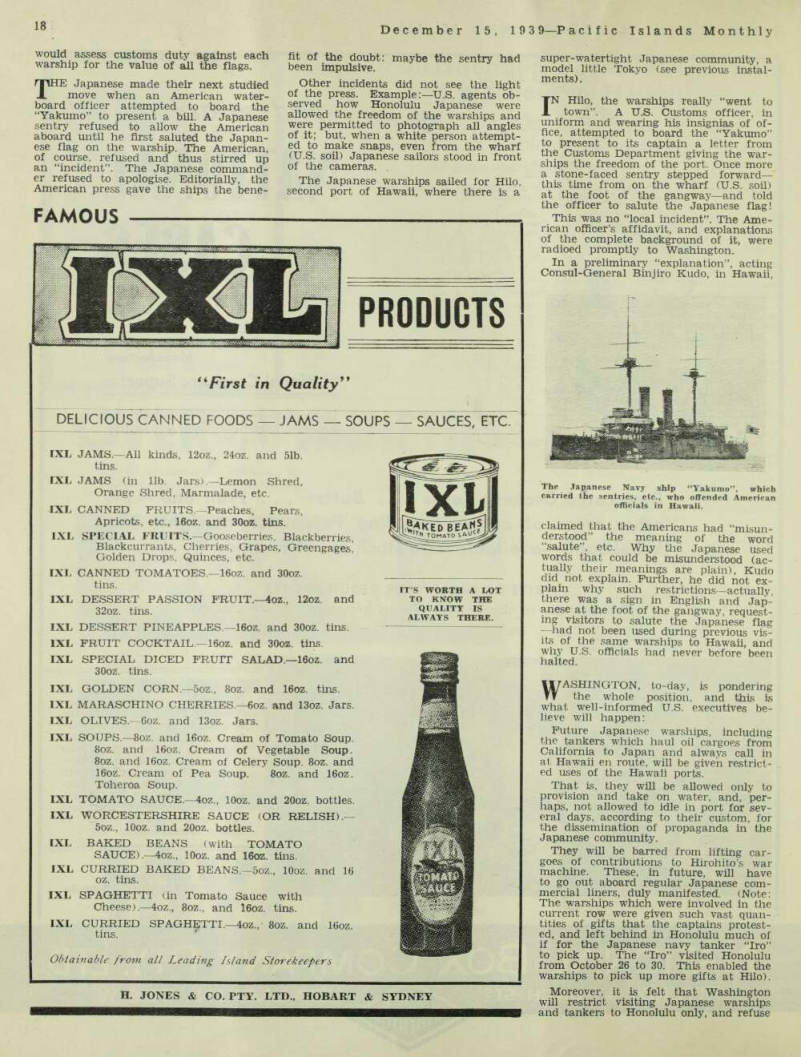
and Japanese in Hawaii "Incidents" During October Visit of Warships Disclose Unpleasant Temper
By John Williams. Of Honolulu
(Being No. 7 of Series of Articles Describing Japan’s Plans and Politico-Economic Network in Pacific)
(There have been such astonishing developments, not wholly unexpected, in the stubborn digging-in of alien and U.S. born Japanese in Hawaii, that this instalment of the series, dealing with Japanese “peaceful penetration” of Ihe c'haracter’) “ Va ' Uable inSiBb ‘ n character.)
Honolulu, Nov. 1.
PREVIOUS instalments of this series have told in detail how the Japanese machine of 150,000 Japanese works in the Hawaiian Islands for the glorification of the Imperial Japanese dream. The last instalment ended by describing how the Japanese had been officially warned by the US. customs service to desist from usmg Japanese warships for lifting donation cargoes of scrap metals, comfort
bags, etc., for Japanese soldiers in the field, rice, flour, clothing and other con tributions from the Japanese in Hawaii to the Japanese war machine in Asia.
For more than two years Japanese warships (see previous instalments) have been making regular calls at Hawaii and doing this. The U.S. customs service in August held an undercover round-up of what was going on and, as a result, the Japanese were warned about using war ships, which receive the courtesies of U.S. ports, as common carriers.
On October 18, the Japanese navy warships, “Iwate” and “Yakumo”, and the naval auxiliary “Shiretoko”, arrived m Honolulu with 350 cadets, for a six days’ stay. Before they arrived, Tajaichi Sakai, an executive secretary of the Jap anese consulate in Hawaii, was told in plain language what America considers as courtesy-of-the-port behaviour, and that such courtesy would be withdrawn if the warships persisted in lifting dona tion cargoes.
It was pointed out to Sakai that such cargoes should be exported on regular commercial ships and duly manifested, according to U.S. laws.
Sakai explained the American attitude to a gathering of potent “inner” Japan ese in Honolulu, but, instead of respect ing the U.S. laws and wishes, this is what happened: First of all, the Japanese consulate objected to the piers on the Honolulu waterfront which had been assigned to the three navy ships, due October 18.
Honolulu harbour officials, under pres sure from organised Japanese business interests, gave in and changed the piers.
As soon as the warships docked, four heavy trucks rolled on to the pier, load ed with groceries and other supplies “shaken” from local Japanese markets, as contributions for use by the war ships. This saves the Japanese navy spending money in this U.S. port, which throws open its gates.
Of course, as usual, there were organ ised inspections of the warships by con ducted classes from the Japanese language schools. (With very few excep tions. all U.S.-born Japanese children attend Japanese language schools daily when the American schools are out. The teachers are alien-born Japanese, and, if not, all have spent some years in Japan, embracing the correct Japanese spirit.) U.S. agents noted that when these child ren boarded the warships, each child was given a Japanese flag which each proudly carried ashore, up through the American streets, back to school. The flags were heaped for distribution upon each warship’s deck—and alongside each heap was a contribution bowl. As each child took a flag, each child dropped in a coin.
Mr. Sakai, the Japanese consulate go between, was once more summoned and, in his presence, the warship officers were informed that if the contributions for the flags continued, the U.S. Government
would assess customs duty against each warship for the value of all the flags. rriHE Japanese made their next studied X move when an American water board officer attempted to board the “Yakumo” to present a bill. A Japanese sentry refused to allow the American aboard until he first saluted the Japan ese flag on the warship. The American, of course, refused and thus stirred up an “incident”. The Japanese command er refused to apologise. Editorially, the American press gave the ships the bene
fit of the doubt: maybe the sentry had been impulsive.
Other incidents did not see the light of the press. Example:—U.S. agents ob served how Honolulu Japanese were allowed the freedom of the warships and were permitted to photograph all angles of it; but, when a white person attempt ed to make snaps, even from the wharf (U.S. soil) Japanese sailors stood in front of the cameras.
The Japanese warships sailed for Hilo, second port of Hawaii, where there is a
super-watertight Japanese community, a model little Tokyo (see previous instal ments).
IN Hilo, the warships really “went to town”. A U.S. Customs officer, in uniform and wearing his insignias of of fice, attempted to board the “Yakumo” to present to its captain a letter from the Customs Department giving the war ships the freedom of the port. Once more a stone-faced sentry stepped forward — this time from on the wharf (U.S. soil) at the foot of the gangway—and told the officer to salute the Japanese flag!
This was no “local incident”. The Ame rican officer’s affidavit, and explanations of the complete background of it, were radioed promptly to Washington.
In a preliminary “explanation”, acting Consul-General Binjiro Kudo, in Hawaii,
claimed that the Americans had “misun derstood” the meaning of the word “salute”, etc. Why the Japanese used words that could be misunderstood (ac tually their meanings are plain), Kudo did not explain. Further, he did not ex plain why such restrictions—actually, there was a sign in English and Jap anese at the foot of the gangway, request ing visitors to salute the Japanese flag —had not been used during previous vis its of the same warships to Hawaii, and why U.S. officials had never before been halted.
WASHINGTON, to-day, is pondering the whole position, and this Is what well-informed U.S. executives be lieve will happen: Future Japanese warships, including the tankers which haul oil cargoes from California to Japan and always call in at Hawaii en route, will be given restrict ed uses of the Hawaii ports.
That is, they will be allowed only to provision and take on water, and, per haps, not allowed to idle in port for sev eral days, according to their custom, for the dissemination of propaganda in the Japanese community.
They will be barred from lifting car goes of contributions to Hirohito's war machine. These, in future, will have to go out aboard regular Japanese com mercial liners, duly manifested. (Note: The warships which were involved in the current row were given such vast quan tities of gifts that the captains protest ed, and left behind in Honolulu much of if for the Japanese navy tanker “Iro” to pick up. The “Iro” visited Honolulu from October 26 to 30. This enabled the warships to pick up more gifts at Hilo).
Moreover, it is felt that Washington will restrict visiting Japanese warships and tankers to Honolulu only, and refuse
The Japanese Navy ship “Yakumo”, which carried the sentries, etc., who offended American officials in Hawaii.
them the use of other Hawaii ports. This will keep the antagonistic Nipponese un der the proper observation by army, navy, coast-guard and Customs intelligence ex perts. rE Japanese in Hawaii have been handled with kid gloves by those American commercial interests —the sugar and pineapple companies and their sub sidiary retail monopolies—which intro duced the Japanese coolie labour to the Islands more than 50 years ago. To-day. the 150,000 Japanese in Hawaii are a fine market for exploitation by these in terests.
However, the freedom which the poli tical pawns of these interests give the Japanese in Hawaii offends the U.S.
Federal officers who, for a change, want proper respect for the laws of the land.
They anticipate that Washington now will give the okay for a crackdown and,
generally tighten enforcement of the laws.
This will be another dent in Hirohito’s ambitions.
WHAT has happened and will happen in Hawaii with the Japanese prob lem must someday be faced by Austra lian and New Zealand Governments re sponsible for the welfare of outlying Paci fic Territories. Hawaii is a fine example of what actually happens when the Jap anese are given access to a gullible country.
Kodo —or the Imperial way of Japan is a passionate, religion with Hirohito’s subjects, even with alien born. With almost fanatical stubbornness they are pressing ahead with their devotion.
It starts from minor items in Hawaii such as Japanese housemaids and wait resses collecting the tin foil from discard ed cigarette packages—to the presenta-
tion of warplanes and trucks from the Japanese community as a whole. The loy alist Japanese in Hawaii, too, contribute so much each month in cash (starting at one shilling each) to the Japanese war plan. They are pledged to it for the duration. (NEXT MONTH: The remarkable story of a Japanese sailor who dared to desert from a Japanese warship in American waters. Why he deserted, and other dra matic details according to his sworn state ments to U.S. officials. His statement gives an insight into the brutality of the Japanese navy machine —behind the scenes.) The Maharajah of Tripura, Sir Vir Vikram Kishore Deo, K.C.5.1., passed through Suva recently, and met several representative Indians. His Highness, who was born in 1908, and succeeded to his title in 1923, was accompanied by his sister, the Yuvarani Saheb, of Baria. They both expressed great interest in the In dians settled in Fiji, and the educational facilities provided for them.
A Japanese sampan off the port of Honolulu, flying the U.S. flag and 8 Japanese flags. This is how Hawaii Japanese welcome their visiting warships.
The Japanese Navy tanker “Iro”, loaded “to the gills’’ with American oil, going astern from wharf in Honolulu. In the background Is a U.S. battle cruiser.
Advertisements & other items, pp. 18-21 (3 items)
16
December 15, 193 9—P acific Islands Monthly
Over 30 Varieties
For all occasions you will enjoy wholesome Joyce Biscuits made of the finest ingredients ... in the most appetising flavours. Here are some favourites: 9!
WHEATMEAL
100% wholemeal m.
COLO
MEDAL
BISCUITS
TRADERS are invited to write to
JOYCE BISCUITS PTY. LTD.,
Camperdown, Sydney, N.S.W., for price lists and full particulars about Joyce Gold Medal Biscuits, Puddings and Cakes.
—and so are
NATIONAL
CASES
■ In Appearance Quality and Manufacture
National Cases are Superior
Large Stocks at present held for immediate delivery in any quantity.
Desiccated Coconut Cases . . . Butter . . . Fruit and
other types of cases—including Patent Lightweight
Wirebound—available from stock or cut to order.
WRITE OR CABLE YOUR REQUIREMENTS
Prompt reply to all enquiries—let us know what YOUR case is.
We will be pleased to hear from you. * 311 SINCE its establishment, 15 years ago, the National Box Company Pty. Ltd., has, by the adoption of modern manufacturing methods and the closest attention to all new developments in box design and construction, maintained steady progress until to-day it is the largest boxmaking business in New South Wales, employing 140 operatives and manufacturing over li million cases annually.
Radio & Cable Address: “NATBOXCO”, Balmain.
I
FAMOUS
r] l 2
PRODUCTS
“First in ”
DELICIOUS CANNED FOODS JAMS SOUPS SAUCES, ETC.
IXL JAMS.—AII kinds, 120 z., 240 z. and 51b. tins.
IXL JAMS (in 11b. Jars).—Lemon Shred, Orange Shred, Marmalade, etc.
IXL CANNED FRUlTS.—Peaches, Pears, Apricots, etc., 16oz. and 30oz. tins.
IXL SPECIAL FRUlTS.—Gooseberries, Blackberries, Blackcurrants, Cherries. Grapes, Greengages!
Golden Drops, Quinces, etc.
IXL
IXL CANNED TOMATOES.—I6oz. and 30oz.
tins.
IXL DESSERT PASSION FRUIT.—4oz., 12oz. and
320 z. tins.
IXL DESSERT PINEAPPLES,—I6oz. and 30oz. tins.
IT’S WORTH A LOT
TO KNOW THE
QUALITY IS
ALWAYS THERE.
IXL FRUIT COCKTAIL—I6oz. and 30oz. tins.
IXL SPECIAL DICED FRUIT SALAD.—I6oz. and
30oz. tins.
IXL GOLDEN CORN. —50z., Boz. and 16oz. tins.
IXL MARASCHINO CHERRIES —6oz. and 13oz. Jars.
IXL OLIVES. —6oz. and 13oz. Jars.
IXL SOUPS.—Boz. and 16oz. Cream of Tomato Soup.
Boz. and 16oz. Cream of Vegetable Soup.
Boz. and 16oz. Cream of Celery Soup. Boz. and 16oz. Cream of Pea Soup. Boz. and 16oz.
Toheroa Soup.
IXL TOMATO SAUCE.—4oz., lOoz. and 20oz. bottles.
IXL WORCESTERSHIRE SAUCE (OR RELISH).—
50z., lOoz. and 20oz. bottles.
IXL BAKED BEANS (with TOMATO
SAUCE).—4oz., lOoz. and 16oz, tins.
IXL CURRIED BAKED BEANS.—Soz., lOoz. and 16 oz. tins, IXL SPAGHETTI (in Tomato Sauce with Cheese).—4oz., Boz., and 16oz. tins.
IXL CURRIED SPAGHETTI.—4oz., Boz. and 16oz. tins.
Obtainable from all Leading Island Storekeepers SM H. JONES & CO. PTY. LTD., HOBART & SYDNEY
THE PACIFIC ISLANDS CLUB
Visitors from the Islands to Sydney (or those Interested In Islands affairs), are advised to communicate with the honorary secretary of the above Club, which has been formed to study the history, traditions, economics, and political developments of the Pacific Islands.
Next monthly meeting at Hotel Carlton, Sydney: February, Address for Correspondence:
THE PACIFIC ISLANDS CLUB,
Box 2434 MM., G.P.0., Sydney.
KEEP THE FLAG FLYING
\ N \ ’ h /
TOOHEYS
FUG'
18
December 15, 193 9—P acific Islands Monthly
Rising Costs
Plight of Pacific Islands Planters
A SOLOMONS ISLANDS planter writes bitterly on the “profiteering" of the merchandising firms, but says that, as he is “small and unprotected", his complaints are not for publication. The following, however, may be published to show how the small men in the lesser groups are treated: — When the war started, we in the Solomons, heard with pleasure of how the Government was going to stop pro fiteering, and we poor “coconut-cockies" thought we would be able to enjoy the small rise in copra returns.
But this mail brings the invoices from
Sydney. Meat is up; rice, tobacco (which is understandable if the rise was only on new supplies from U.S.A.) and bags are up and going up to blazes.
Calicos are up; soap and milk are in creased. Benzine, from Sydney, is still the same price, but local prices are up 2/6 a case. Most of these stocks are pre-war.
Can anyone give us any reason for all these rises, and any comfort for the future? Why should soap go up 1/9 a case, and Nestle’s milk from 17/4 to £1 a case?.
Even our Administration has “put the boot into us”. We have an export duty on copra, adjusted on a sliding scale.
We pay at present a tax on the London price of copra, less £5 for freight, etc.; £5 for freight and charges is now a thing of the past, but still that is all the allowance the Government will make.
Conditions In Tonga
From Our Own Correspondent
Nukualofa. Nov. 10.
AS was feared, when war broke out, the prices of commodities in the kingdom soon soared.
A survey of prices ruling immediately before and after the outbreak of the war reveals that rises ranged from 25 per cent, to 100 per cent., if not more in certain cases. It was evident that some merchants were out to make hay while the sun shone, irrespective of in ternational decencies.
An example of profiteering which, fortunately, was soon nipped in the bud by the Authority for the Control of Food and Supplies, which had the prices fixed at a more reasonable basis was kerosene, which rose from 10/- per tin to 17/6, and from 6d. per bottle to 9d.
Under the new basis, this was reduced to 11/- per tin and 7d. per bottle.
But, despite price control, profiteering is still going on secretly especially among the Indian tailors running small shops. The latter created an unfavour able impression by refusing to make uniforms for the Tonga Defence Force at the prices which the Government offered them for the work.
It is regrettable that reputable mer chants should be involved in profiteer ing, especially after the definite warning issued by the High Commissioner for the Western Pacific, Sir Harry Luke, in his speech broadcast from Suva on the first night of the war.
Prosecution Dismissed
From Our Own Correspondent
Tulagi, Nov. 11.
ON October 20, at the Gizo Court, Solomon Islands, James Kidney, manager of Messrs. Burns Philp (South Seas) Ltd., was charged, on information laid by Ah Kun and Co., with having increased the price of benzine and kero sene by 1/- a case, in contravention of a Government decree prohibiting the raising of prices of any goods imported before September 25.
Mr. Kidney admitted that prices had been increased prior to the receipt of the Government notification on October 13, but subsequent to that date he had reverted to the former rates, except in the case of a sale to Ah Kun and Co.
In that instance, the storeman had in advertently charged the increased price.
Mr. Kidney stated that the error was discovered the same day and rectified be fore the receipt of the summons.
The storeman corroborated the man ager’s evidence, and he was acquitted.
The planters and traders speak with appreciation of the issue of the proclam ation by the Government, prohibiting any increase in the price of goods im ported before September 25, and fixing the profit on goods imported subsequent to that date at a figure not greater than the ratio of profit that was customary on September 1. Although the prosecu tion failed, it is expected to have a good effect.
Mr. J. B. Westerman, of the A.P.C. staff, Port Moresby, attracted some at tention on the evening of November 13, when he won his wager at the Port Moresby baths, that he could swim 150 laps (equal to three miles) in less than two hours. He chose breast-stroke, re lieved with an odd lap of other styles, and, beginning at 8.30, finished with 4| minutes to spare.
Advertisements & other items, pp. 22-24 (3 items)
The King’S School
(PARRAMATTA)
N.S.W.
Boarding School, founded 1831.
School year begins February 7, 1940.
For further particulars apply to H. D. HAKE, M.A. (Cantab.) Headmaster.
21
Pacific Islands Monthl y—D ecember 15, 1939
Brain Fag
A Vital Message to Sufferers from
SCIENTIFIC CONTROL
Manufactured in the Bidomak Pharmaceutical Laboratories, one of the most up-to-date, hygienic laboratories in the Southern Hemisphere, to which is attached a fully qualified Doctor of Medicine, and under the control of qualified chemists who were trained in the most modern English Laboratories in the world.
A REFRESHING
HEALTH DRINK
A delightful health drink can be made by mixing a dose of BIDOMAK with a wineglassful or half a tumbler of ice cold water, or any aerated water.
A few drops of BIDOMAK in a tumbler of ice cold water is a delightful refreshing thirst-quencher.
BRAIN FAG
DEPRESSED FEELING
Lack of Confidence . . . Headaches . . . Nervous Indigestion . . . Sleeplessness . . . Listlessness . . .
Anaemia . . . Nerve pains and other similar nervous
and Constitutional weaknesses.
BIDOMAK provides a method of supplying energy to the cells of the body wherever the natural supply of vitality is insufficient to maintain the normal activity of glands and organs. It provides vital mineral elements. It is a scientific compound of certain vital mineral elements which are lacking in the average modern diet, and which include ferrum, calcium, sodium, potassium, phosphates, glycero-phosphates, sucrose, as well as other necessary elements. These vital minerals quickly restore vitality and overcome the depressing after effects of Malaria and Tropical Lethargy.
THREE YEARS SUFFERING ENDED
Claypans, Via Mannum, South Australia.
For about three years I have been subject to insomnia with resulting general debility.
Nerves and appetite have been practically wrecked.
I am now close to finishing my second bottle of BIDOMAK, and there has already been a very noticable improvement in every way. Sleep, which is refreshing and strengthening, comes easily and naturally, nerves are steadied, I am regaining appetite well, I have eaten and what is more, digested food which before was productive of nausea.
To be brief, an all round improvement has taken place, ana i begin to feel more myself.
Again thanking you for BIDOMAK. (Signed) Mr p A p
OVERCOME TROPICAL LETHARGY AND MALARIA
BIDOMAK actually overcomes the effects of “if" “ml brings you back to the pinnacle of good health and P nnieklv pleasantly. The depressing after effects of Malaria are ba q y by taking a course of BIDOMAK —“The Tonic of the en ry
AT ALL LEADING ISLAND STORES
ISLAND ROMANCE
NEARLY ON THE ROCKS!
Why is it that after a couple of years so many happy young marriages suddenly give signs of going on the rocks? Let’s have a look at the lives of two young people, Dick and Betty. They’re sitting under the shade of a palm on the side of a hill overlooking the sea. After a while Dick turns to Betty and says:—
“Do you realise, darling, it’s only three more weeks before we’re married? Isn’t it marvellous?”
“Dick you . . . you’ll always love me like this, Dick, won’t you?”
“Of course, darling. The marvellous part about us is that we’ll really care for each other more and more as we go on together”.
So they were married and we meet them again two years later. Dick is just about to leave the house to go off to his position at the store.
“Heaven knows, Betty, I’ve tried my best to make our marriage a success!
I’ve gone out of my way to make you happy . . . but I don’t know . . . you just seem to drag round these days . . . you haven’t got any interest in things.
You’re getting dull . . . not a bit like your real self!”
“It’s not my fault, Dick, really I can’t help it”.
And Betty really couldn't help it.
When Dick had gone she slumped down in a deckchair on the verandah.
This is what she thought.
“I can’t go on morning after morning like this ... if Dick only knew how I want to feel full of life and bright again.
Why am I so washed out and depressed?
I don’t know. I’m always like this lately. There must be something I can do”.
The next day Betty met d very old friend of hers. Over a cup of tea they had a heart to heart chat.
Finally Betty said :—
“So you see, Meg, why I’m so unhannv.
Even before I married I was afraid Dick would ston loving me some day. I’ve seen it with other women when they start to lose their looks I never thought it would hannen to me. I’m getting old . . . quickly”.
“I know how you feel, Betty. I’ve seen it happen, too. It’s a funny thing about men. Whenever they’re tired they get nlenty of sympathy from their wives, but whenever a wife becomes tired she hist becomes forgotten and neglected.
If I were you. I’d see a doctor. There must be something you can do”.
So Betty went along and saw her doctor. She told him her trouble
and finished up by saying :
“But, doctor, what I can’t understand is ... I even wake tired nowadays.
No matter how many hours’ sleep I get.
Whv is it?”
“Well, Mrs. Greenfield, I’d say yours was a clear case of Night-Starvation.
You see, even at night you go on using up energy. Your heart has to beat 35,000 times. You didn’t know that, did you?
And your lungs make 20,000 muscular movements during sleep. It stands to reason, if this energy isn’t replaced you wake tired. And that’s when this climate starts to take all the drive out of you. Yes, that’s Night-Starvation. You need Ilorlicks for that. Get some Horlicks. Drink a glassful every night before you go to bed”.
So Betty started taking her Horlicks last thing before she went to bed and a remarkable change came over her. . . . Now let's have another look at Dick and Betty Greenfield.
It's about two months later, and they're back again in that little spot where we first met them on the side of the hill under the palm looking out over the blue Pacific. Dick is lying in that position a man gets into when he's thoroughly happy — comfortable, easy, and quite satisfied with the world. He pulls at his pipe a couple of times and then says quietly: — “I wonder if you’re as happy as I am, Bet? You know, as we came up that hill a moment ago, I felt exactly the same as I did when we were first engaged. Remember? And you look even lovelier”.
“Dick, that’s the nicest thing you’ve ever said to me”.
How CAN a woman possibly be attractive , feel gay and bright when constant tiredness is sapping her vitality? If YOU feel like this. then the chances are that you're suffering from Night-Starvation. While you sleep your body goes on burning up energy on breathing, heartbeats and other automatic actions. If energy isn't replaced during sleep you wake feeling tired. You stay washed out and you start to lose your looks. So remember, a cupful of Horlicks before bed brings back your life and vitality and personal magnetism. Ask vour chemist or storekeeper for a bottle of Horlick's.
You can buv Horlicks in all main towns throughout the British Pacific Islands. *orucks Jorl **IU
Red Cross Fair, Suva
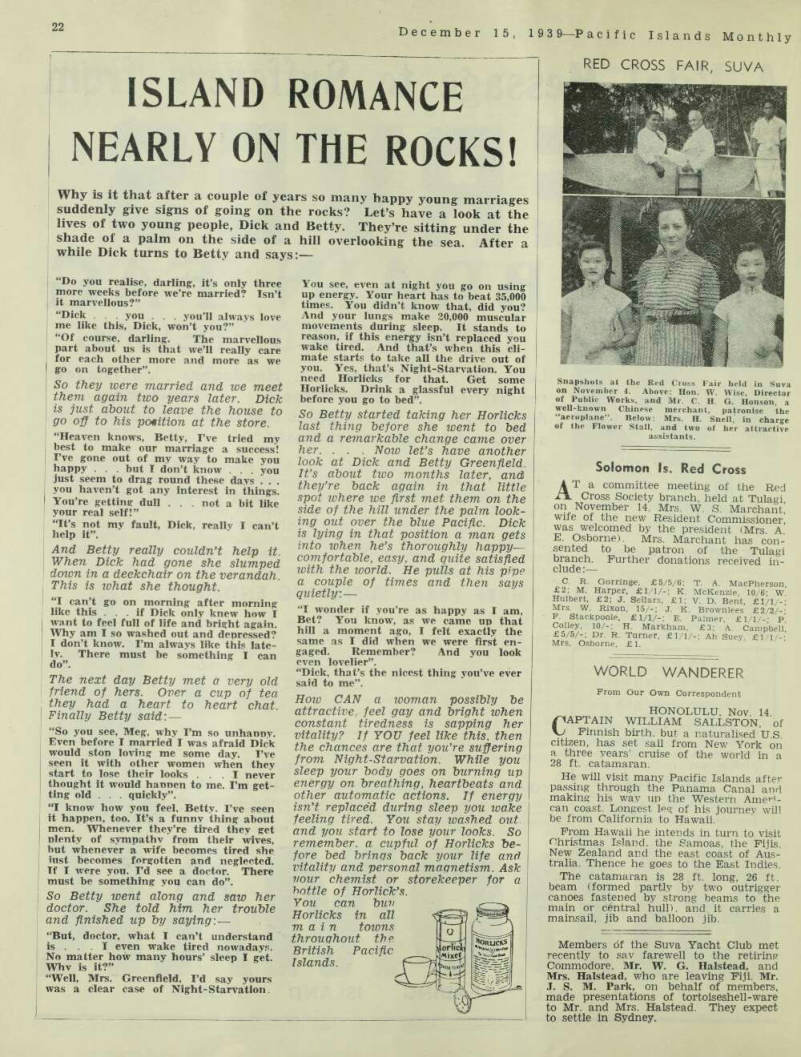
Snapshots at the Red Cross Fair held In Suva on November 4. Above: Hon. W. Wise, Director of Public Works, and Mr. C. H. G. Honson, a well-known Chinese merchant, patronise the “aeroplane”. Below: Mrs. H. Snell, in charge of the Flower Stall, and two of her attractive assistants.
Solomon Is. Red Cross
AT a committee meeting of the Red Cross Society branch, held at Tulagi, on November 14. Mrs. W. S. Marchant, wife of the new Resident Commissioner, was welcomed by the president (Mrs A E. Osborne). Mrs. Marchant has con sented to be patron of the Tulagi branch. Further donations received in clude:— C. R. Gorringe, £5/5/6: T. A. MacPherson £2; M. Harper, £l/1/-; K. McKenzie, 10/6- W Hulbert, £2; J. Sellars, £1; v. D. Bent, £l/l/- : Mrs. W. Rixon, 15/-; J. K. Brownlees £2/2/- : F. Stackpoole, £l/1/-; E. Palmer. £l/1/-- p' Colley, 10/-; H. Markham. £3; A. Campbell, £5/5/-; Dr. R. Turner, £l/1/-; Ah Suey, £l/1/-- Mrs. Osborne, £l.
World Wanderer
Prom Our Own Correspondent
Honolulu, Nov. 14.
Captain William Sallston, Of
Finnish birth, but a naturalised US citizen, has set sail from New York on a three years’ cruise of the world in a 28 ft. catamaran.
He will visit many Pacific Islands after passing through the Panama Canal and making his way up the Western Ameri can coast. Longest leg of his journey will be from California to Hawaii.
From Hawaii he intends in turn to visit Christmas Island, the Samoas, the Pijis, New Zealand and the east coast of Aus tralia. Thence he goes to the East Indies.
The catamaran is 28 ft. long, 26 ft. beam (formed partly by two outrigger canoes fastened by strong beams to the main or central hull), and it carries a mainsail, jib and balloon jib.
Members of the Suva Yacht Club met recently to say farewell to the retiring Commodore, Mr. W. G. Halstead, and Mrs. Halstead, who are leaving Fiji. Mr.
J. S. M. Park, on behalf of members, made presentations of tortoiseshell-ware to Mr. and Mrs. Halstead. They expect to settle in Sydney.
Eruption
Two Days of Terror in New Hebrides
Port Vila, Nov. 11.
RAIDS over the British Isles and war’s alarms in Europe have been eclipsed for the time being in the New Hebrides by volcanic eruptions nearer home.
At 5.15 on the evening of November 1, as European residents were tuning in for the Empire war bulletins from Dav entry, there occurred a convulsive earth tremor which made the island houses plunge and rock like a ship at sea.
On Paama, where it was especially ter rifying, the ’quake was followed by a deafening roar, which made the natives imagine that a mountain dam had burst and a flood of water was rushing down upon the village. Quick as lightning, the houses emptied and the natives came trooping in an excited state to the Mis sion station. Even the cattle were alarmed and careered around in the same excited state.
After a painful suspense, there ap peared over the mountain ridge a dense cloud of volcanic ash, ascending in spiral columns to a wondrous height, and pre senting a unique spectacle, with the rays of the setting sun illuminating the curi ous cerebreform mass.
With a sense almost of relief a multi tude of voices exclaimed, “It’s Lopevi.
The volcano has burst out again”.
After a comparative rest of 42 years, the volcano had come to life again and alarmed the neighbourhood.
VIOLENT tremors continued every few minutes all night long, producing a very disturbing effect. Nobody slept. The natives spent the night in the open air.
At midnight, the excitement was in tensified by the arrival of fugitives from the villages on the east coast of Paama, which face Lopevi and are separated from it only by a narrow channel. They re ported that a volcano had burst out on Lopevi. not in the old crater, 5,000 ft. high, but on a low hill near the village of Tamatu. and that a river of molten lava had over-run the houses and com pletely destroyed "the village compound.
As volumes of ash swept across the channel to Paama, and descended in heavy showers upon the villages, the natives became alarmed and fled across the dividing ridge to seek the shelter of the mission station. But it was impos sible to dodge the ashes and ’quakes any where on Paama. All night long the ashes fell, and the solid earth trembled.
When morning dawned, Paama was completely covered by a dismal and for bidding mantle of black volcanic ash.
So charged was the atmosphere with sulphuric acid that the residents had difficulty in breathing, and could they have obtained gas masks they would have been tempted to copy the practice of the war zones.
The air was heavily loaded with elec tricity, and it transformed the wireless sets into quick-firing machine guns, discharging a never-ending series of ex plosions.
LIVING in constant dread of a renew ed outburst, the Lopevi natives kept two whale boats ready for emergencies, and it was expected that, at the first sign of danger, the boats would be brought into instant service.
But the Paama trader, Mr. Walter Me-
Coy, a kindhearted and daring Norfolk Islander, felt that he had better go and ascertain if the Lopevi people needed assistance. The entire population of 160 is divided up into three villages; and he proceeded direct to Tamatu. where the eruption was reported to have taken place.
Six hours later he returned with a boat load of women and children, many of whom were badly bruised and burn ed.
So sudden and unexpected had the outbreak been that at a moment’s no tice the natives had had to rise and run, leaving everything behind. A river of molten lava, flowing from the newly formed crater, wiped out all the houses
and, on its way to the sea, destroyed one of the whale-boats and boathouse.
Mr. McCoy found the river red hot lava discharging its contents into the sea, producing a seething cauldron and rendering it impossible to approach the beach of Tamatu. He found the village buried in ashes and lava, the only indication that it was once the site of a village being the roof of the weatherboard church appearing above the ruins.
In the flight from the volcano, five natives (two adults and three infants) had been trapped by the fire and kill ed. The others escaped to a sheltered part of the beach, at the north end of the island, and there awaited the
chance of a rescuing boat from Paama.
The babies appear to have been struck and killed by flying stones, as they were borne upon the shoulders of their flee ing mothers.
The native men displayed bravery and consideration: none of them attempted to rush the boats, but gave the women and children the first chance of res cue.
WITH the promise that he would re turn for the men as quickly as he could, Mr. McCoy set off for the Paama mission station with his first load of refugees. As if the volcano were not sufficient to strike terror into the hearts of the people, the launch had to battle through an angry sea, which made the fugitives wonder whether they had es caped the fire only to be enguifed in the waves. They arrived at the mission sta tion as miserable and dejected as they could possibly be. It was very noticeable that none of the refugees carried any baggage. They escaped in what they stood up in.
Twenty-four hours after the first out break a succession of severe earth-tremors was a prelude to further volcanic out bursts and, on returning next day, the rescuers found the whole island enveloped in fire. Six more vents had formed — five near the beach, in the neighbour hood of villages, and one near the sum mit. The natives had succeeded in launching the other whale-boat, in the face of great danger, and joined the rescue parties in conveying the refugees to Paama.
There were still 30 people at the vil lage of Halehos, whom it was impossible to reach on account of high seas and lava flows.
But Mr. Wale, of the Seventh Day Adventist Mission, chanced to arrive on the scene, and readily responded to a
suggestion that he should make another attempt at rescue.
In spite of falling cinders, and big breakers on the shore, Mr. Wale suc ceeded in rescuing the last 33 people of Lopevi and conveying them to the Paama Mission Station.
THE whole population has now been transferred to Paama, and has been billeted out among the villages in the neighbourhood of the mission station. But the refugees have lost everything—gar dens, houses and personal belongings.
The people of Paama have risen to the occasion, and are showing unbounded hospitality to their stricken brethren.
Suffering from wounds and burns, crowds of refugees are attending the mission dis pensary for medical treatment.
Mr. P. A. Harvey, of the Epi Wireless Station, informed the Condominium Government by wireless of the erup tion of the volcano and the hapless plight of the natives; and the Government quickly responded by sending from Vila a liberal and much-appreciated supply of foodstuffs.—M.F.
Explosion Forecast In 1938
IN 1938. Lopevi was described as “a vol canic cone rising sheer out of the sea to a height of 5,000 ft. Though 12 miles in circumference, the island has no harbour or anchorage”.
In the “P.1.M.”, July, 1938, this was published: “There is consternation among the natives of Lopevi because the vol cano, after bursting out intermittently for nearly half a century, has suddenly closed down. The natives, primitive though they are, have sufficient know ledge of mechanics to understand that the closing of a safety valve is as dan gerous in a volcano as in a steam engine.
“Accompanied by a large number of natives, Mr. W. H. Grube climbed to the
summit and found neither crater nor volcano.
“When they descended with the news that the volcano had closed in, the re port struck terror into the hearts of the natives, who inhabit the villages nest ling in sheltered positions at the base of the mountain. The old natives have a grim recollection that the volcano closed down before the last big eruption in 1898. when it exploded with a convul sive outburst, obliterating one of the villages”.
Those fears were completely justified.
Practically the whole population of Samarai assembled on the evening of No vember 3, at the residence of Mr. and Mrs. E. Gribben, to say good-bye to Mr. and Mrs. E. J. O’Donnell. Mr. O’Donnell is leaving Samarai after several years there as officer-in-charge of the radio station. Warm tributes were paid by vari ous speakers to the good qualities of Mr. and Mrs. O’Donnell. Rev. Father Dwyer especially thanked Mr. O’Donnell for his co-operation, on numerous occasions, in arranging radio schedules with doctors, so that sick people in isolated places were able to get immediate expert ad vice. Mr. Woodward, R.M., spoke on be half of the Public Service, and Mr. C.
Skelly for the “old-timers”. A welcome was given to Mr. O’Donnell’s successor at the radio station, Mr. Ploughman.
Major C. R. Field has been promoted to the rank of Lieutenant-Colonel and appointed to the command of the New Guinea Voluntary Rifles; and Major C.
F. A. Duchatel, M.C.; Captain P. J.
Woodhill, and Lieutenants H. Taylor, J.
H. Edwards, M.C.. D.C.M., M.M., J. C. Mul“ laly, 0.8. E.: A. J. Clark and C. G. Kil ner, who also hold commissions on the Reserve of Officers, Australian Military Forces, have been appointed to the unit.
Advertisements & other items, pp. 25-26 (2 items)
niij
KOLYNOS
lasts
not
o
but
lonq
er
its qiven nruj
teeth a sparkle
they never had
v before! /
v
KOLYNOS lasts TWICE
only HALF
There’s no need to squeeze paste right along your brush when you use Kolynos. Just half an inch on a dry brush is all you need — that’s why Kolynos lasts twice as long and saves you money.
Kolynos is a concentrated dental cream, made from the dental prescription of Doctor N. S. Jenkins.
You need only half an inch on your brush —just half as much as ordinary
as long because you use
as much
tooth pastes. But that half inch of Kolynos multiplies itself 25 times inside your mouth. It bursts into a glorious foam that surges into every pit, fissure and crevice, and cleans and purifies in one action.
Have gleaming white teeth, and save money at the same time, with Kolynos. Awarded the Blue Seal of the Institute of Hygiene, London, for last 20 years. -s- - k4
mii.
% INCH ON DRY BRUSH IS ENOUGH Get a tube to-day . At all chemists and stores medium size 1/3; large 2/-
NELSON and ROBERTSON Pty. Ltd.
—— (ESTABLISHED, 1895. "" ™ 1
ISLAND MERCHANTS
All classes of merchandise purchased at wholesale prices and original
invoices supplied to Island Clients.
COCOA BEANS, RUBBER, TROCAS SHELL and COPRA sold on Commission.
SOLE AGENTS FOR
BEEBE ALL STEEL WINCHES, Portable, Unconditionally Guaranteed. 2, 5 and 15 ton from Stock.
LONDON SELF PRIMING PORTABLE PUMPS, Manufactured in Canada, all sizes from 11 in. upwards. Specially suitable for prospecting and mining in all its branches.
SKANDIA ENGINES, Full diesel, semi diesel, all powers, marine and stationary.
ARCHIMEDES. Swedish Outboard Engines. Highly recommended.
UPSON BRITISH BOARD, wallboard, strong and light in weight. 6ft. to 12ft. lengths always in stock.
ANKAR INSULATING WALLBOARD, made from pure wood-fibre. The best insulating material on the market.
NELSON and ROBERTSON Pty Ltd.
l2 Spring Street, Sydney, Australia
Telegraphic Address: “IVAN SYDNEY.”
24
December 15, 193 9—P acific Islands Monthly
Stone Bowl In
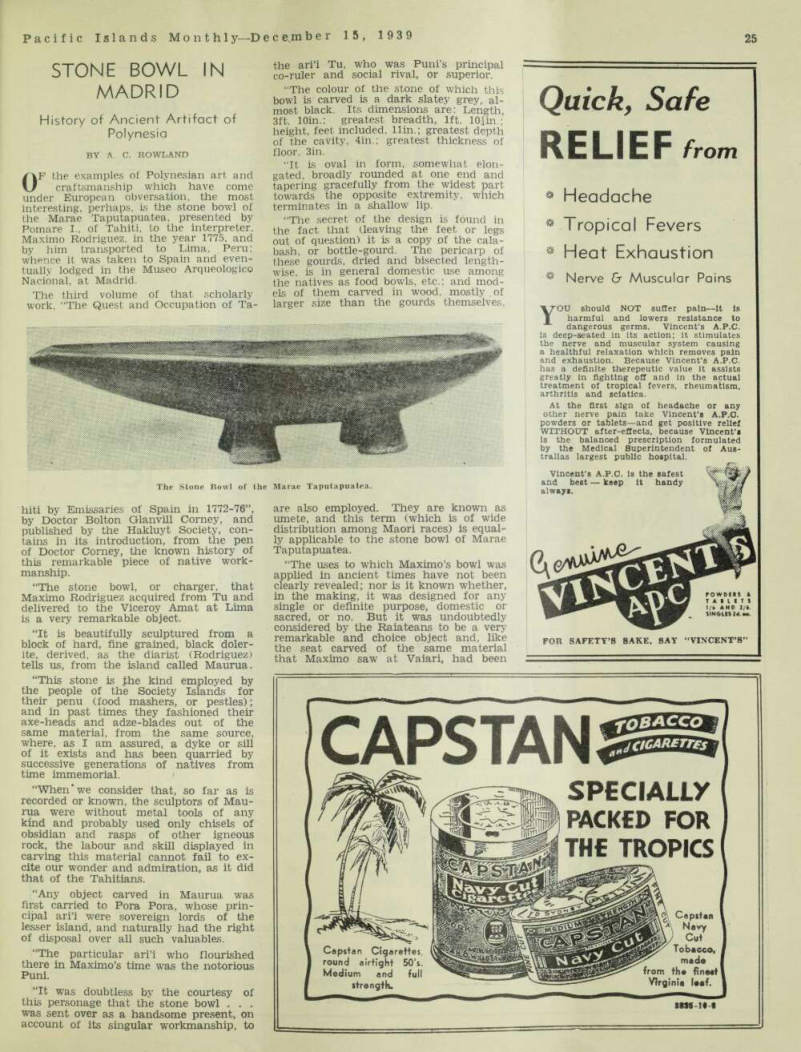

Madrid
History of Ancient Artifact of Polynesia
By A. C. Rowland
OF the examples of Polynesian art and craftsmanship which have come under European obversation. the most interesting, perhaps, is the stone bowl of the Marae Taputapuatea. presented by Pomare 1., of Tahiti, to the interpreter.
Maximo Rodriguez, in the year 1775. and by him transported to Lima, Peru; whence it was taken to Spain and even tually lodged in the Museo Arqueologico Nacional, at Madrid.
The third volume of that scholarly work. “The Quest and Occupation of Ta-
hiti by Emissaries of Spain in 1772-76”, by Doctor Bolton Glanvill Corney, and published by the Hakluyt Society, con tains in its introduction, from the pen of Doctor Corney, the known history of this remarkable piece of native work manship.
“The stone bowl, or charger, that Maximo Rodriguez acquired from Tu and delivered to the Viceroy Amat at Lima is a very remarkable object.
“It is beautifully sculptured from a block of hard, fine grained, black doler ite, derived, as the diarist (Rodriguez) tells us, from the island called Maurua.
“This stone is j;he kind employed by the people of the Society Islands for their penu (food mashers, or pestles); and in past times they fashioned their axe-heads and adze-blades out of the same material, from the same source, where, as I am assured, a dyke or sill of it exists and has been quarried by successive generations of natives from time immemorial.
“When‘we consider that, so far as is recorded or known, the sculptors of Mau rua were without metal tools of any kind and probably used only chisels of obsidian and rasps of other igneous rock, the labour and skill displayed in carving this material cannot fail to ex cite our wonder and admiration, as it did that of the Tahitians.
“Any object carved in Maurua was first carried to Pora Pora, whose prin cipal aril were sovereign lords of the lesser island, and naturally had the right of disposal over all such valuables.
“The particular aril who flourished there in Maximo’s time was the notorious Puni.
“It was doubtless by the courtesy of this personage that the stone bowl . . . was sent over as a handsome present, on account of its singular workmanship, to
the aril Tu, who was Puni’s principal co-ruler and social rival, or superior.
“The colour of the stone of which this bowl is carved is a dark slatey grey, al most black. Its dimensions are: Length, 3ft. 10in.: greatest breadth, Ift. KHin : height, feet included, llin.; greatest depth of the cavity, 4in.; greatest thickness of floor, Sin.
“It is oval in form, somewhat elon gated, broadly rounded at one end and tapering gracefully from the widest part towards the opposite extremity, which terminates in a shallow lip.
“The secret of the design is found in the fact that (leaving the feet or legs out of question) it is a copy of the cala bash. or bottle-gourd. The pericarp of these gourds, dried and bisected length wise. is in general domestic use among the natives as food bowls, etc.; and mod els of them carved in wood, mostly of larger size than the gourds themselves.
are also employed. They are known as umete, and this term (which is of wide distribution among Maori races) is equal ly applicable to the stone bowl of Marae Taputapuatea.
“The uses to which Maximo’s bowl was applied in ancient times have not been clearly revealed; nor is it known whether, in the making, it was designed for any single or definite purpose, domestic or sacred, or no. But it was undoubtedly considered by the Raiateans to be a very remarkable and choice object and, like the seat carved of the same material that Maximo saw at Vaiari, had been
The Stone Bowl of the Marae Taputapualea.
sent across by the chiefs of the island to their royal cousins at Tahiti as a graceful compliment to their rank.
“The late F. Debell Bennett, F.R.C.S., a capable observer who saw a good deal of native life in Tahiti and Ra’iatea in the course of his whaling cruises, chiefly during 1834, noticed that hot stones were put in medicine bowls for heating the water when warm infusions were desir ed. This idea has a bearing upon the opinions of the principal living elders of these islands and Pora Pora, who, on hearing of Maximo’s bowl described, de clared that it was an ‘umete raau mo’a’ —a sacred medicine bowl, in which her bal potions used to be mixed and consecrated in the Marae; a procedure which was deemed to impart special curative efficacy to them.
“It is further possible that it may have served as an ava bowl for strictly cere monial use in the Marae on great occa sions.
“My friend, Mr. J. Lyle Young, whose long experience in the islands and study of their archaeology and folk-lore en title his opinion to particular weight, does not find this view acceptable: and quotes a legend he heard related many years ago, representing that —‘at a Marae in Huahine a large bowl was used to re ceive the viscera of victims who were laid on the altar stone of the Marae’.
“It is well known that the tahu’a in those islands were accustomed to look for augury by inspection of the freshly removed entrails of sacrificed victims, generally pigs. But whether this practice ever extended to the viscera of human victims does not seem to be on record.
“Many other points relating to this singular object are open to discussion, sculptured as it was by a primitive peo ple who, insofar as Europeans have ever been able to discover, possessed no metal tools of their own, and certainly had no knowledge of tempering any iron or bronze instruments that may conceivably have come in their way from some an cient wreck.
“But it must suffice, in this place, to add that the bowl of Marae Taputapuatea remains safely housed in Salon 111. of the ethnological section of the Museo Arqueological Nacional, at Madrid, where, in 1912. I had the good fortune to find and identify it as exhibit No. 2664, though all knowledge of its history and its coun try of origin had been lost for a hundred years or longer”.
Advertisements & other items, pp. 27-28 (2 items)
Capstans
Quick, Safe
RELIEF from
® Headache
® Tropical Fevers
*■ Heat Exhaustion
* Nerve £r Muscular Pains
YOU should NOT suffer pain—lt Is harmful and lowers resistance to dangerous germs. Vincent’s A.P.C.
Is deep-seated in its action; it stimulates the nerve and muscular system causing a healthful relaxation which removes pain and exhaustion. Because Vincent’s A.P.C. has a definite therepeutlc value it assists greatly in fighting off and in the actual treatment of tropical fevers, rheumatism, arthritis and sciatica.
At the first sign of headache or any other nerve pain take Vincent’s A.P.C. powders or tablets—and get positive relief WITHOUT after-effects, because Vincent's is the balanced prescription formulated by the Medical Superintendent of Australlas largest public hospital.
Vincent’s A.P.C. is the safest and best keep it handy always.
FOR SAFETY’S SAKE. SAY ‘‘VINCENT’S’
CAPSTANS
SPECIALLY
PACKED FOR
THE TROPICS
\W m m % Capstan Cigarettes, round airtight 50's.
Medium and full strength.
Capstan Navy Cut Tobacco, made from the finest Virginia leaf.
BM9-I* t
Modern Refrigeration for the South Sea Islands
The ELECTROLUX KEROSENE OPERATED
REFRIGERATOR
MARVEL
OF
MODERN
SCIENCE
THE
MIRACLE
OF
ICE
FROM
HEAT
ELECTROLUX offers economical, modern and completely efficient
REFRIGERATION FOR ISLANDS' HOMES.
FREEZES CONTINUOUSLY WHILE SMALL LAMP BURNS
Freezing controlled by simply regulating height of flame. Uses only f gallon of kerosene per week.
MOTORLESS ... NO PARTS TO GET OUT OF ORDER.
MODEL L 22
Capacity 2.2 cubic feet.
MODEL L3BO
(as Illustrated) Capacity 4 cubic feet.
MODEL LKSSO
Capacity 5.5 cubic feet.
GUARANTEED FOR TWO YEARS.
• Write to your Local Distributor for prices and full details.
Obtainable from W. R. Carpenter & Company Ltd. —Sydney, and following New Guinea Branches: Rabaul, Salamaua, Wau, Kavieng, Madang, and Wewak.
W. R. Carpenter & Coy. (Solomon Is.) Pty. Ltd. —Tulagi, British Solomon Islands.
On Chong & Company Pty. Ltd—Butaritari, Gilbert and Ellice Islands.
Representation in Papua and New Hebrides.
26
December 15, 193 9—P acific Islands Monthly
Japan's Huge Debt
From Our Own Correspondent
Honolulu. Nov. 10.
That there is something more than hot air connected with Japan’s Imperial mission in Asia is revealed in the latest report, which shows that Japan’s national debt now totals more than £1,000,000,000 sterling.
Included in this enormous debt are domestic bonds for financing Japan’s “incident” in China, to the tune of £250,000,000 sterling, plus foreign obliga tions of £75,000,000 sterling.
U.S. holdings total £20,000,000 sterling.
Mr. G. Robinson, a New Zealander, took over the managership of the Metropole Hotel in Suva, Fiji, in No vember.
Mr. A. A. Harvey, of Lassul Planta tion, Bainings District, New Guinea, re cently left Rabaul to spend a holiday in the East.
U.S. Base At Midway
From Our Own Correspondent
Honolulu, Nov. 14.
rS construction of the American navy’s immense 2,000,000 dollar base at Midway Island, new western outpost of the far-flung defence scheme which centres upon the Hawaiian Islands, is half-completed.
Biggest job is the dredging of a deep enough harbour in the lagoon to per mit the entrance of submarines, mine craft, and destroyers and for anchor ages for squadrons of long-range navy bombers. (Within a year there will be two squadrons permanently stationed there for patrol work in the western skies.) The back of the job was broken this month when one of the navy dredges completed a channel into the lagoon which will permit it and another dredge
to continue work right through the on coming rough winter weather. This channel is 120 ft. wide.
Work started at Midway in May, 1938.
The first dredge started in October, 1938.
There are 300 men on the job, under supervision of the U.S. army engineer’s office, which built the Panama Canal.
Death Of Mother Superior
From Our Own Correspondent
Rarotonga, Nov. 20.
THE Mother Superior of the Roman Catholic Convent of St. Joseph died on October 17, after a short illness at the Rarotonga Hospital. The deceased lady was held in very high esteem, and her gentleness, kindness and courtesy will be always remembered by those who had had the pleasure of her acquaint ance.
Advertisements & other items, p. 29 (2 items)
27
Pacific Islands Monthl y—D ecember 15, 1939
parkllng
reAreshment from pure Malt and Hops
FOSTER'S
LAGER
New Hotel At Tavua, Fiji
Prom Our Own Correspondent
Suva, Nov. 20.
ANEW hotel, attractively built on modern lines, and very well equip ped for the comfort of overseas travel lers, has been built at Tavua, on the northern coast of Viti Levu, and was formally opened at a public dinner on November 4. Sir Maynard Hedstrom pre sided and gave an interesting history of the district and of the establishment and expansion of the cane-sugar and gold mining industries.
Visitors to Fiji, making a leisurely pro gress around the main island, and wish
ing to see the new goldmines, will find the new Tavua hotel a very comfort able stopping-place. It is under the man agement of Miss Griffiths, lately of the Ba hotel.
Dr. J. Nimmo, who has been Govern ment medical officer at Thursday Is land for seven years, was in Sydney on holidays in November.
Colonel David Barnett, who has had considerable experience in hotel manage ment in New Zealand, arrived in Fiji recently to take up the position of man ager of McDonald’s Hotel at Suva.
Do Not Believe It!
Ripley's Story of Torres Strait Wrecks
By J. J. Stewart
THAT story of the remarkable series of Torres Strait shipwrecks in the years 1829 and 1830, told by Ripley of “Believe It Or Not” fame in an American nation-wide broadcast and re-told in the October issue of “Pacific Islands Month ly”, would be an extraordinary chain of coincidences, if it were true.
Unfortunately for those of us who love the bizarre and unusual —and most of us do—the story won’t bear close examina tion.
According to Ripley, the brig “Mer maid” was wrecked in Torres Strait in October, 1829. and, three days later, all her crew were picked up by the “Swift sure”, which in turn went ashore. Both crews were rescued by the “Governor Ready”, but the “Governor Ready” went down and everybody took to the boats.
The “Comet” was the next vessel to be drawn into the web of coincidence. She rescued the crews of the “Mermaid”, “Swiftsure” and “Governor Ready”, and was wrecked in turn. The “Jupiter” was close by and came to the rescue. The “Jupiter” had just reached the entrance to the North Australian settlement of Raffles Bay when she ran ashore and the host of seamen aboard her . were taken off by the steampship, “City of Leeds”.
The Ripley version then concludes with a tearful little story of the doctor of the “City of Leeds” going among the ship wrecked mariners asking for a volunteer to come and comfort an elderly woman passenger, who was delirious and calling for her son. A seaman off the “Mer maid” offered his services, to find the woman was his own mother.
Strangely enough, J. H. Heaton’s Dic tionary of Australian Dates, published in 1879, vouches for the main part of Rip ley’s story, from the wreck of the “Mer maid” to that of the “Jupiter”. The “City of Leeds” incident can be treated as a myth from the start. The first steam ship in Australian waters was the “Sophie Jane”, which arrived at Sydney, via the Cape route, in May, 1831, about a year after the “City of Leeds” was supposed to be roaming around Torres Strait.
Now let us take the first part of the story. In 1835, T. B. Wilson, M.D., Sur geon R.N., published “A Narrative of a Voyage Around the World”. Doctor Wil son was- aboard the “Governor Ready” when that ship was wrecked in Torres Strait. As surgeon-superintendent he had joined her in 1828 for a voyage out to Australia with 200 convicts. The “Gover nor Ready” arrived at Sydney in Janu ary, 1829, and proceeded to Hobart. From Hobart she sailed for Batavia. It had been intended to go via Cape Leeuwin, but the vessel could not beat to the west ward against the prevailing winds and, after twenty days of wasted effort, it was decided to sail up the eastern coast of Australia.
On May 18, 1829, the “Governor Ready” went on a reef in Torres Strait, and the crew took to the boats. The near est outpost of civilisation, or so they thought, was at Melville Island. A gale blew them past Melville Island—luckily for them because by then the settlement at that place had been abandoned —and they set a course for Timor. When the shipwrecked sailors picked up the Timor coast, they had completed an epic boat
voyage of 1,300 miles, filled with hard ship and fortitude.
Shortly afterwards the brig “Amity” was sighted. Dr. Wilson boarded her, to travel back to Raffles Bay, while his com panions went on to Coupang, then only a short distance away. It was the end of June when Dr. Wilson arrived at Raffles Bay and he stayed there until the settlement was abandoned on August 28, 1829.
In his book he narrates that, on July 22 while walking along the foreshore, he sighted a sail, which at first he thought to be that of the “Mermaid”, then overdue. However, it proved to be the brig “Resource”, going from Sydney to the Isle of France. Her purpose in calling at Raffles Bay was to land the shipwrecked crews of the “Mermaid” and “Swiftsure”.
According to Ripley, the “Mermaid” was wrecked in October, 1829; but Dr.
Wilson puts the date at June 13. He says her crew took to the whale-boat and, after three days, were picked up by the schooner “Admiral Giffard”, which later put them aboard the “Swiftsure”.
The “Swiftsure” was wrecked on July 5, off Cape Sidmouth, and both crews were rescued by the “Resource”.
Of course, at the time when he wrote his book, Dr. Wilson did not know that 110 years later this series of shipwrecks was to be re-touched and polished by a purveyor of the extraordinary, so he did not bother to any great extent about circumstantial detail. However, he does relate that he met the captain of the “Mermaid” when he came ashore and that, as he escorted him up to the com mandant’s office, the captain told him he was carrying a despatch ordering that the settlement be abandoned forthwith.
For the rest, it has been recorded that the “Jupiter” did go ashore at the en trance to Raffles Bay, but there is no thing to link her up with the other ship wrecks. In Captain Rhodes’s ‘ Pageant of the Pacific” there is mention of the “Comet” arriving at Sydney in May. 1831. after transferring the people of Pitcairn Island to Tahiti.
A pity to punch the holes of historical data into Ripley’s story; it was such a nice one.
Advertisements & other items, p. 30 (2 items)
28
December 15, 193 9—P acific Islands Monthly
/or wot/ ot pleasure
Savage Poley Choke Single Barrel 12 Gauge Shotgun, altered to any degree. PRICE: £5/15/-.
Webley & Scott (England) Semi-Hammerless 12 Gauge Single Barrel Shotgun. Full choke, for 2 3 4 in. Cartridges. PRICE; £7/15/-.
Clay Pigeon Traps. British Make.
“Minor” £3/16/ “Plus” £6/16/6 “Automatic” £2B/17/6 500 Eley Clay Pigeons 36/9 F. 0.8. Sydney. turn of the fingers, the choke Sea Master Big Game Hooks.—lo/0, 5d.; 12/0, Bd.; 13/0, 10d.; 14/0, 1/-; 16/0, 1/3; 18/0, 2/6.
Sil Rohu’s special heavy extra short shank out point, 4 side cutting point. One size only 13/0, straight or reverse bend. PRICE: 1/9.
Write for Catalogue—Firearm Catalogue (600 illustrations). Pishing Catalogue (400 illustrations). Quality Second-hand Guns Bought, Sold or Exchanged. Big Game Fishing Gear for Hire.
SIL ROHU
Quality Firearms and Fishing Tackle. 143 ELIZABETH STREET. SYDNEY Phone MA 3540 (Near Market Street).
■N
LAUNCHES
/or wot/ ot pleasure
Both trim, seaworthy craft, the Chapman Coach-house model and the Chapman Cabin Launch are particularly suitable for island conditions.
The Coach-house model with the closed-in cabin providing ample storage space is an ideal work-boat to meet steamers, carry stores and for inter-island transport. The Cabin model is a popular cruising craft, for fishing and pleasure trips. The cabin is cool and roomy enough to sleep two.
Both craft are powered with a famous Chapman PUP Engine. Write now for details and prices.
CHAPMAN &SHERACK
26 Clara Street, Erskineville, N.S.W.
ENGINE MANUFACTURERS FOR THIRTY YEARS
Fiji's Trade
Prom Our Own Correspondent
Suva. Nov. 4.
r[E trade of the Colony for the nine months ended September 30, 1939, shows: —
Miss Catherine Little recently was appointed to be Sister in the Fiji Nurs ing Service.
iiiiuvva. — 1938. 1939.
Exports .. .
Imports ..
... £1,896,676 1,307,898 £1,957,836 1,247.127 Details of exports are as 1938. follow: — Sugar Copra .. 94,956 tons ( 26.008 „ < 11,945 bunches £995,1161 £221,317) Bananas . . .. ( £50,822) Bananas . . .. 102,004 cases Molasses .. .. — ( £17,2381 Gold Bullion 66,534 ozs. i £515.5271 Trocas Shell . 102 tons 1939. ( £ 5,916) Sugar .. .. 90,839 tons (£1.064.805) Copra .. . . 17,157 tons (£121,460) Bananas .. 2,756 bunches (£17,352) Bananas 36,299 cases Molasses .. .. ( £14,255) Gold Bullion 77.904 ozs. ( £632.755) Trocas Shell 151 tons (£7,010)
Death Of Cart.
"Bill" Tait
Extraordinary Accident in Solomons
NEWS of the death of Captain W. (“Bill”) Tait, one of the best known men in the Solomon Islands, was brought to Sydney by the “Morinda” in mid-November.
Tait, who was skipper of the 36-ton W. R. Carpenter inter-island vessel, “Balus”, was on a freighting trip along the east coast of Guadalcanal. On Octo ber 30, the vessel ran onto a shingle beach, near Aola, and Tait clambered over the side to inspect the position. He was standing on a bank of sand, near the after-end of the boat, when the pro peller commenced to race full astern.
This caused the sand at Tait’s feet to
shift in the swirling water. He endeav oured to get back onto firm sand, but was drawn into the water under the “Balus’s” stern. The suction of the rac ing propeller drew him against the blades, and he suffered shocking injur ies, and died soon afterwards.
The native crew brought his body back to Tulagi, where he was buried.
Mr. E. Mapletoft, manager for Burns Philp (S.S.) Co. Ltd., at Faisi, 8.5.1., and who is at present in Sydney on furlough, said that Captain Tait had been in the Islands for about 10 years. “He was about 36—big and boisterous; a bom humour ist, and well liked by everyone he met.
The news of his death was received with genuine regret by his many friends in the Solomons”, added Mr. Mapletoft.
A daughter was born to Mr. and Mrs.
F. W. Stcrck, of Suva, Fiji, on Novem ber 17.
Advertisements & other items, p. 31 (1 item)
health’
<r^^ itwith
New Bird Of Paradise
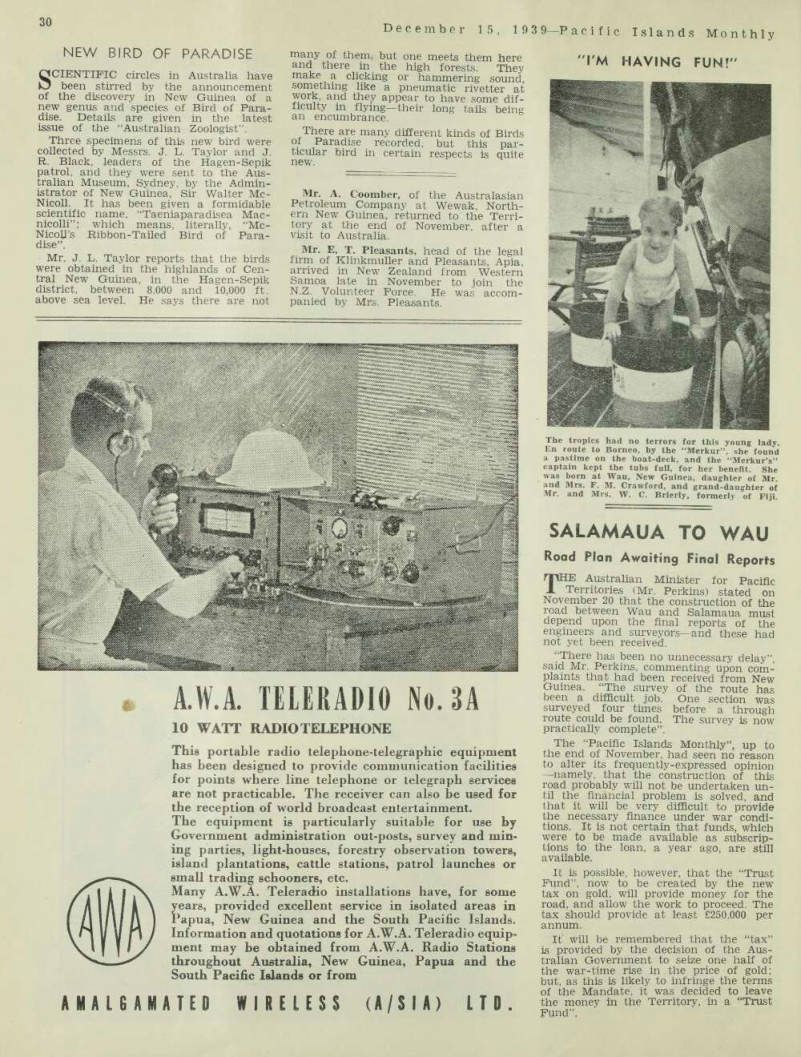
SCIENTIFIC circles in Australia have been stirred by the announcement of the discovery in New Guinea of a new genus and species of Bird of Para dise. Details are given in the latest issue of the “Australian Zoologist”.
Three specimens of this new bird were collected by Messrs. J. L. Taylor and J.
R. Black, leaders of the Hagen-Sepik patrol, and they were sent to the Aus tralian Museum, Sydney, by the Admin istrator of New Guinea, Sir Walter Mc- Nicoll. It has been given a formidable scientific name, “Taeniaparadisea Mac nicolli”; which means, literally, “Mc- NicoU’s Ribbon-Tailed Bird of Para dise”.
Mr. J. L. Taylor reports that the birds were obtained in the highlands of Cen tral New Guinea, in the Hagen-Sepik district, between 8,000 and 10,000 ft. above sea level. He says there are not
many of them, but one meets them here and there in the high forests. They make a clicking or hammering sound, something like a pneumatic rivetter at work and they appear to have some dif ficulty in flying—their long tails being an encumbrance.
There are many different kinds of Birds of Paradise recorded, but this par ticular bird in certain respects is quite new.
Mr. A. Coomber, of the Australasian Petroleum Company at Wewak, North ern New Guinea, returned to the Terri tory at the end of November, after a visit to Australia.
Mr. E. T. Pleasants, head of the legal firm of Klinkmuller and Pleasants, Apia, arrived in New Zealand from Western Samoa late in November to join the N.Z. Volunteer Force. He was accom panied by Mrs. Pleasants.
"I'm Having Fun!"
The tropics had no terrors for this young lady.
En route to Borneo, by the “Merkur”, she found a pastime on the boat-deck, and the “Merkur’s” captain kept the tubs full, for her benefit. She was born at Wau, New Guinea, daughter of Mr. and Mrs. F. M. Crawford, and grand-daughter of Mr. and Mrs. W. C. Brierly, formerly of Fiji.
Salamaua To Wau
Road Plan Awaiting Final Reports
JTIHE Australian Minister for Pacific X Territories (Mr. Perkins) stated on November 20 that the construction of the road between Wau and Salamaua must depend upon the final reports of the engineers and surveyors—and these had not yet been received.
“There has been no unnecessary delay”, said Mr. Perkins, commenting upon com plaints that had been received from New Guinea. “The survey of the route has been a difficult job. One section was surveyed four times before a through route could be found. The survey is now practically complete”.
The “Pacific Islands Monthly”, up to the end of November, had seen no reason to alter its frequently-expressed opinion —namely, that the construction of this road probably will not be undertaken un til the financial problem is solved, and that it will be very difficult to provide the necessary finance under war condi tions. It is not certain that funds, which were to be made available as subscrip tions to the loan, a year ago, are still available.
It is possible, however, that the “Trust Fund”, now to be created by the new tax on gold, will provide money for the road, and allow the work to proceed. The tax should provide at least £250,000 per annum.
It will be remembered that the “tax” is provided by the decision of the Aus tralian Government to seize one half of the war-time rise in the price of gold; but, as this is likely to infringe the terms of the Mandate, it was decided to leave the money in the Territory, in a “Trust Fund”,
Advertisements & other items, p. 32 (1 item)
A.W.A. Leleradio No.3A
1
10 WATT RADIOTELEPHONE
This portable radio telephone-telegraphic equipment has been designed to provide communication facilities for points where line telephone or telegraph services are not practicable. The receiver can also be used for the reception of world broadcast entertainment.
The equipment is particularly suitable for use by Government administration out-posts, survey and mining parties, light-houses, forestry observation towers, island plantations, cattle stations, patrol launches or small trading schooners, etc.
Many A.W.A. Teleradio installations have, for some years, provided excellent service in isolated areas in Papua, New Guinea and the South Pacific Islands.
Information and quotations for A.W.A. Teleradio equipment may be obtained from A.W.A. Radio Stations throughout Australia, New Guinea, Papua and the South Pacific Islands or from
AMALGAMATED WIRELESS (A/SIA) LID.
Dangerous Bugs Per
Airmail How New Services May Spread Disease
IN view of the extension of the airmail service, across the Pacific Ocean, the following review of a letter in “Nature” will be of great interest (says the Fiji “Agricultural Journal”).
Dealing with the proposed alternative air route via Africa to India and Aus tralia, Dr. F. G. S. Whitfield draws at tention to the danger of the arrival in aeroplanes of insects capable of causing malaria and yellow fever. The areas where yellow fever is endemic are much greater, both in Africa and South America, than was realised even a year ago and not only can certain mosquitoes transmit the virus (disease-producing substance or body) by biting, but monkeys can be oral ly infected with this disease by simple feeding. The virus also can live over a fortnight inside the body-cavity of at least one species of cockroach.
The result of over four years’ collection of insects found inside aircraft at Khar toum (more than 2,000 machines exam ined in three years) resulted in 146 spec ies, comprising 3,000 individuals being as sembled, including house-flies and the malarial yellow fever mosquitoes.
The writer’s conclusion is that until the problem of insect control in aircraft has been solved it would seem unwise to start a regular service between Australia and Africa, across the Indian Ocean, on the route surveyed by the flying boat Guba.
Mr. H. G. Rollinson paid a holiday visit to New Zealand in November. He is well-known on the Morobe goldfield. New Guinea, as a mining engineer.
New Zealand’s Place in Pacific
Could She Be "Britain of the South Seas"?
By Angus Ross
DESPITE the outbreak of war, the New Zealand Government and other au thorities proceeded with the Centennial Celebrations, the preparations for which were so far advanced that it would have been difficult to cancel them.
The Centennial Exhibition opened on November 8, ancl the major celebrations are to take place in January and Feb ruary, 1940.
At such a time, it may be of interest to recall that one of the reasons given for the colonisation of New Zealand, 100 years ago, was the country’s geographical situation in the South Pacific, which would enable her to serve as a base for British political and commercial opera tions in the Pacific. Reference to con temporary literature on the subject gives ample proof of this.
Thus, a memorial presented to the Under-Secretary of the Colonial Office, as early as 1828, stressed the value of New Zealand to any European power with ambitions in the South Pacific. The writer stated: * “I confess I feel considerable anxiety into whose hands New Zealand will be placed, as I am satisfied that the pos session of the islands of New Zealand by Great Britain. France, or America, will give that Power the command of the South Pacific, and if in the hands of either of the latter Powers, will soon disturb the peace of our Colonies in New Holland (Australia).”
Various firms interested in whaling and in trading in the South Seas claimed that New Zealand was favourably situ
ated for the establishment of a complete ascendancy by whatever Power cared to intervene there. Several of the witnesses called before the Committee of the House of Lords, in 1838, referred to this fact.
Thus, a certain Mr. Coutts Crawford told the Committee that he considered New Zealand the most valuable Colony in that part of the world, “equal to all the Aus tralian Colonies put together”. He said; “It is full of harbours, and it will have a great commerce and a large maritime population; in fact, in such a way, that it will be the Great Britain of that part of the world, including the vast archi pelago of islands to the north, and will command the trade of that part of the world in future times”.
WRITING in 1839 in his “Four Letters to the Right Hon. Earl Durham", Rev. John Dunmore Lang, the senior minister of the Church of Scotland in N.S.W., declared that colonists sent to New Zealand “would secure for Great Britain and her Colonies, what they are otherwise so likely to be deprived of, the riches and the Empire of the Southern Seas”.
Various writers and politicians of the thirties and ’forties of last century de scribed New Zealand as “the Great Brit ian of the Southern Hemisphere”. For example, Lord Ashburton declared that the islands of New Zealand were likely to become a great seat of wealth and naval powers, “in short, to be in the Southern Ocean what the British Isles were to the northern”.
Variations of this theme sometimes led
to strange extravagances of description. .‘if wnte f ? f JP* I? 1 ' the ln soutLeastern h Hemisptoe“ QUeen ° f the south eastern Hemisphere .
The outstandmg of the boasting claims made for New Zealand’s future in Pacific politics and commerce was that made by Charies Duller a prominent supporter of the New Zealand Company and a man well acquainted with Colonial prospects.
Addressing the House of Commons in 1845, he claimed:—
“Considerations of the greatest mo ment do “deed give great political im
lPaondanour 0 P °wttf thf PaTlflfTs
daily increasln S 111 extent. Our relations with other Powers in that ocean are get ting to be very delicate. France has pos session of the Friendly Islands and the Marquesas. The United States have vir tual possession of the Sandwich Islands, ... A British Colony in New Zealand would be the natural master of this ocean, the irresistible arbiter of all its complicated relations and important in
terests. Its position would command the Pacific; its numerous harbours would supply shelter, its vast forests ma terials, for the greatest navy in the world. You might make it, in truth, the Britain of the Southern Hemisphere: there you might concentrate the trade of the Pacific, and from that new seat of your Dominion you might give laws and manners to a new world, upholding subject races, and imposing your will on the strong”.
Needless to say, these dreams of New Zealand becoming the imperial mistress of the Pacific, in a manner similar to Britain or, in past ages, Rome, have not been realised in the first hundred years of New Zealand’s existence as a British possession. For obvious reasons, this is not surprising. At the same time, it must be remembered that the boundaries of New Zealand to-day differ considerably from those of the Colony which was founded in 1840. If the New Zealand Im perialists, of whom Sir George Grey, Sir Julius Vogel, Sir Robert Stout and Rich ard Seddon were the leaders at different periods, had had their way, New Zealand would have controlled almost all the is lands of the South Pacific. Samoa, Fiji, and Tonga should all have been placed under New Zealand administration, ac cording to these men.
To-day, apart from the small outlying islands near New Zealand—such as the Chathams, the Auckland, Antipodes,, Bounty, Snares and Campbell Islands— New Zealand is responsible for the Ker madecs, annexed in 1887; the Cook Is lands, including such islands to the north as Niue, Penrhyn, and Suwarrow, which came under New Zealand in 1901: the Mandate over Western Samoa; es tablished in 1920; and the administration of the Tokelau or Union Group, which was transferred from Great Britain in 1925.
Weakness Of Australia And N.Z.
EDITORIAL NOTE: New Zealand will have to grow very much, in population and commercial importance, before she can expect to become a power in the Pacific. The only Pacific Territories worth mentioning, which New Zealand governs, are the Cook Islands and West ern Samoa; and her record in Samoa is not inspiring. That is because she is too small to be able to supply efficient Ad ministrators, except by chance. Even Aus tralia is too small, as is shown by the character of Australian appointments to Territory administratorships in the last ten years.
Great Britain, on the other hand, main tains a large Colonial Service, in which some of the finest types of young men are encouraged to seek their life’s career.
Britain, occasionally, has been guilty of sending rejected politicians and super annuated generals to govern her tropical dependencies; but, generally, the jobs are given only to those trained and proved men who have spent their lives in tropi cal administration.
New Zealand cannot do that: she has not got a tropical service at all. Aus tralia has got a fairly large tropical ser vice, now; but, whenever the Canberra nabobs have to appoint an Administrator, they turn their blind eyes to their train ed service, and make a surprising selec tion of their own. For example (and lest we forget!):— 1934: Brigadier-General McNicoll, ex politician and ex-soldier, appointed Ad ministrator of New Guinea. No previous experience of tropical or any other Ter ritorial administration. 1937: Mr. Abbott, ex-politician, ap pointed Administrator of Northern Ter
ritory. No previous experience of tropi cal or any other Territorial administra tion. 1937: Major-General Rosenthal, ex politician and ex-soldier, appointed Ad ministrator of Norfolk Island. No pre vious experience of tropical or any other Territorial administration. 1938: Lieut.-Colonel Chalmers, ex-sol dier, appointed Administrator of Nauru.
No previous experience of tropical or any other Territorial administration.
Neither Australia nor New Zealand can become “Great Britain of the South Sea” while the administration of Pacific Is lands Territories are regarded merely as the plaything of professional politicians.
Advertisements & other items, pp. 33-34 (1 item)
The Best Money
500
CANDLE POWER
CAN BUY
300
CANDLE POWER
PORTABLE
STOVES
SELF-HEATING
IRONS
v- I N 0.500 COLEMAN LANTERNS in various sizes, suitable for Plantation work. Missions, Schooners, Packing Sheds and 1001 Indoor and Outdoor Jobs. 300 to 500 c.p.
Light—Gale and Insect Proof, Made to burn Kerosene or Benzine.
COLEMAN INSTANT LIGHTING STOVES.
Intense Heat, Absolute Safety, Positive Regulation.
MAGNIFICENT STREAM-LINED IRON.
Exclusive Coleman, always Cool Handle. Non-Rust Porcelain Body. A delight to use.
Coleman Products can be obtained from all Leading Firms throughout the Pacific Islands.
In case of difficulty in obtaining supplies write to:— PEARCE & CO., SUVA, FIJI IS.
STEAMSHIPS TRADING COMPANY LTD.
PORT MORESBY PAPUA SAMARA I
Chairman and Managing Director: A. S. FITCH.
Shipowners, Wholesale and Retail Merchants and Traders; Shipping, Customs and Insurance Agents; Copra and Rubber Plantation Owners.
MAIL CONTRACTORS TO COMMONWEALTH AND PAPUAN GOVERNMENTS.
AGENCIES:—At Port Moresby: Coral Sea Insurance Co.; Phoenix Insurance Co.; Delta Sawmills, Ltd.; Acme Bakery Co.; Vacuum Oil Co., Pty., Ltd. At Samaral; Coral Sea Insurance Co.; Delta Sawmills, Ltd.; Bankers and Traders’
Insurance Co.: National Mutual Life Insurance Co.; Kularo Shipyards- Mamai Plantations.
BRANCHES:—In Papua: Hanuabada, Sivitol, Aroma, Koki, Hula, Ela Beach, Duga Duga, Yule Island.
SYDNEY; NELSON & ROBERTSON PTY. LTD., 12 Spring St.; Melbourne, 396 Flinders Lane: London. E. Whiteaway & Co., 7 Chiswell Street. Finsbury, London.
Cable Address: “STEAMSHIPS.” Code: Bentley’s.
STEAMSHIPS TRADING COMPANY, LIMITED.
MERCHANTS, SHIPOWNERS AND PLANTERS
PORT MORESBY AND SAMARAI.
Our organisation provides every facility and efficient service as
MANAGING AGENTS AND VISITING REPRESENTATIVES OF
COCONUT AND RUBBER PLANTATIONS
Estates supervised in bearing and planting stages.
Comprehensive reports compiled and regular visits made to Estates by our competent Plantation Inspector.
WRITE, CABLE OR CALL FOR PARTICULARS;
STEAMSHIPS TRADING COMPANY LTD.
If you want "Perfection in Cooking" use a
“Younger” cooking stove
These stoves have been on the market in Australia for over Sixty Years, and are still recognised as “The Best”.
They are made with Extended Firebox specially for Long Wood fuel, also special stoves with Cast Iron Oven suitable for Island requirements.
Send for Illustrated Catalogue and Price of Single and Double Oven Stoves.
G. FLETCHER & SON
50 OXFORD STREET, SYDNEY.
Errol Flynn As Producer
rE following is about Errol Flynn, now famous film star, and formerly a tobacco planter in Papua and a recruiter and miner in New Guinea:— As star romantic hero at Warners, Flynn is one of the most hardworking of Hollywood’s masculine actors. His boundless energy is not confined to act ing. He is now producing and writing for a film production company of his own.
With Howard Hill, champion archer, he has formed Flynn-Hill Productions Inc., to make a series of outdoor color shorts, with Hill producing and starring.
Warners’ favourite action hero will share in the production and do all the writing.
By choice, no acting for him.
Flynn himself is by way of being a sportsman. Not only is he Hollywood’s most famous sailor outside Popeye—he sails the seas in his own magnificent yacht, the “Sirocco”—but he’s a first-class tennis player as well.
In the doubles at Hollywood’s motion picture tennis tournament recently, he reached the finals with Stanley Briggs, Virginia Bruce’s brother. Sponsors of the tournament considered Flynn’s pulling power so great even in Hollywood that they made a special admission charge of 50 cents for this match.
New Aerodrome In Fiji
Prom Our Own Correspondent
Suva, Nov. 1.
GANGS of men, working by day and night, have levelled off a sand hilly area near Lautoka and converted it into a large aerodrome. The work will be completed about the middle of November. Couch grass has been plant ed all over the surface, and special means are being taken to encourage its growth, so that it will bind the sand into a suit able surface.
At present, there are no commercial aeroplanes in Fiji.
It is expected that Fiji will be in cluded, as a call, in the new trans-Paci fic airmail service, being established between Auckland and San Francisco, and that either the port of Lautoka or the port of Suva will be used by the seaplanes, according to whether the pre vailing weather is south-east or south west.
Rev. Father A. Bryson, of the Sacred Heart Mission, Samarai, Eastern Papua, was in Victoria in November spending furlough.
Captain N. E. Goodwin arrived in New Guinea from Australia recently to join the staff of W. R. Carpenter and Co.
Ltd.
Johnston Island
To be Another American Naval Base Prom Our Own Correspondent
Honolulu, Nov. 10.
AN advance party of 60 men has left here for Johnston Island, 720 miles south-west of Honolulu, to begin work upon the 1,150,000 dollars warplane, mine craft and submarine base which is to be built under the * current expansion pro gramme of the U.S. navy in the Pacific.
The island, which was placed under sec ret navy jurisdiction in 1934. is two bits of land within a coral reef, 8 miles long.
The lagoon is to be dredged extensively to permit the entrance of navy craft and long-range patrol bombers.
The navy bombers have used the pre sent restricted facilities at Johnston for some years.
When completed, within a year, it will become an important “listening outpost” in America’s far-flung Central Pacific defence scheme.
Canton Island, 1,000 miles further on in the same direction, is to be developed next.
Miss M. Bruce, probationer at the Col onial War Memorial Hospital, Suva, Fiji, resigned in November. Two other mem bers of the hospital staff who also re signed recently were Miss O. M. Flemons and Miss K. V. Douglas.
Mr. Leslie Thomas Hurrell, who since his graduation last year from Hawkes bury Agricultural College, N.S.W., had been gaining experience on one of Burns, Philp and Co.’s plantations in New Guinea, recently joined the N.G. De partment of Agriculture as assistant at the Keravat Demonstration Plantation.
Sir Henry Milne Scott, of Suva, has been appointed a director of the Queens land Insurance Co. Ltd. in Fiji.
Mr. A. St. C. Compton, Superintendent of Works in the Gilbert and Ellice Is lands Colony, died recently at Ocean Island.
Advertisements & other items, pp. 35-36 (1 item)
Kork-N-Scal
FOR HOME USE
• Hand Applied Airtight Pressure Proof
FOR ALL HOME BOTTLING
—THE LITTLE CAP THAT
will Re-seal 1,000 Times
KORK-N-SEAL (Aust.) LTD.
Irtfl COMMONWEALTH STREET,
SYDNEY, AUSTRALIA.
make sure you have at hand an ample Reserve of these /■ Always . .
Australia’s Choicest Products Brussels Sprouts White Turnips Sweet Coro Tomato Puree Tomato Sauce Tomato Soup Tulti Fruit Sauce Beetroot Spinach Cabbage Carrots Parsnips Celery Green Peas French Beans Cauliflower -■ /* 4 ■ <■¥"
Delicious \r W • K
Garden
Vale
Ready-toserve Vegetables
CINNAMOLIA
The hot weather is now approaching with its dysentery, diarrhoea, and other seasonal infectious diseases of the alimentary canal EVERY tropical home should have on hand a bottle of the above remedy—in case—so as to be ready to attack the germs as soon as the first symptoms of disease appear.
For years scientists and medical men have sought for a safe, powerful germicide to treat Infections of the Intestinal tract without harming the tissues.
Here it'isL CINNAMOLIA! Guaranteed to contain no poisons or harmful drugs.
Price 3/- per bottle from
FALKS PHARMACY,
238 GEORGE ST„ SYDNEY.
Wholesale Rates to Chemists, Hospitals,
etc., from CINNAMOLIA PREPARATIONS,
17 Murray Street, Waterloo, N.S.W.
Tel.: MX 1702.
Jack Hides's Last And Greatest
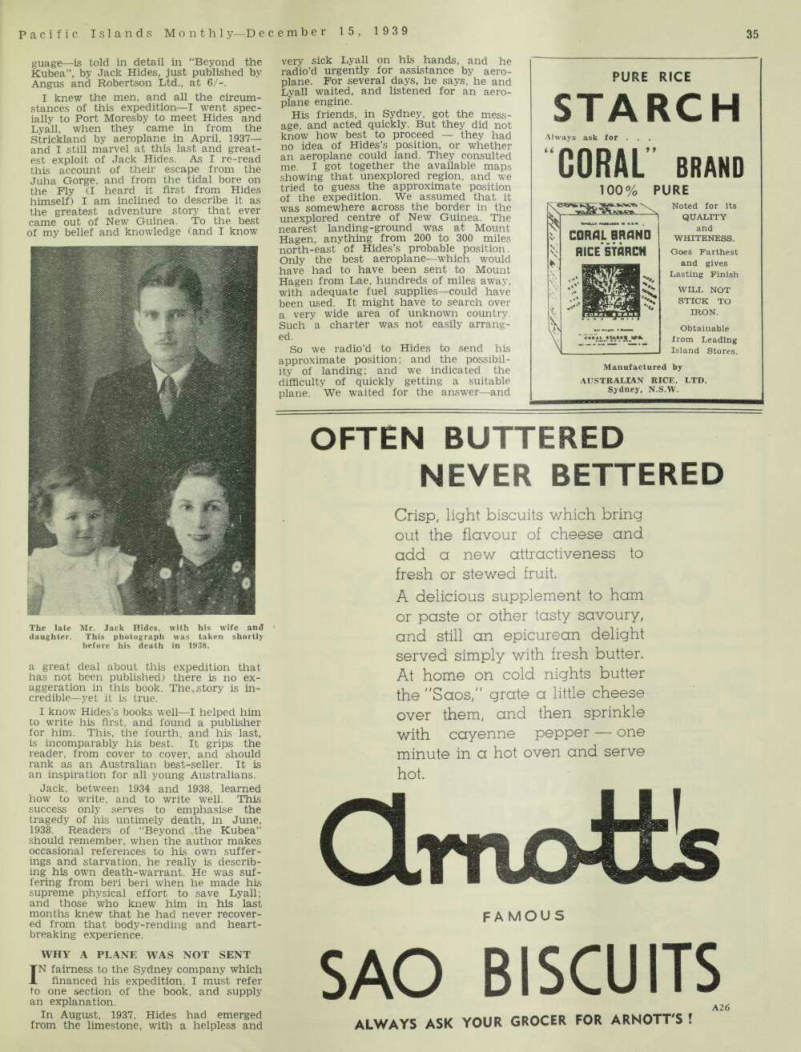
Adventure
Story of How His Expedition Escaped from the Kubea
TWO men well known in New Guinea, Jack Hides and David. Lyall, left Port Moresby in February, 1937, to lead a gold-seeking expedition up the Strick land River, and on into the unknown country beyond.
In March and April, 1937, they report ed a vast dredging area on the Upper Strickland: and. coming into Port Mores by by aeroplane, they secured mining rights over the area. (It subse quently was found to be quite value less). In late May, 1937, they went on up the Strickland by canoe; marched north over the limestone barrier during the “North-west” (rainy season); and in mid-August, when the rain and mist mo mentarily cleared, they found themselves on the edge of a vast precipice, 4,000 ft. high (obviously, the northern wall of the limestone barrier), and looking out over a vast system of upland valleys, well populated. They were now across the “backbone” of New Guinea, and in the Mandated Territory.
But Lyall had become seriously ill, up there on the terrible limestone, and they were carrying him. Hides, somehow, got his forty natives and his helpless com panion down that precipice, into the nearest valley, and then, using his tele
radio set, he urgently asked that an aero plane be sent to their assistance. The teleradio set had received a bad bumping on the limestone and their last valve collapsed before final arrangements were made.
They waited a week: but as there was no sign of an aeroplane, the now desper ate Hides decided to abandon all stores, except barest necessities, and made a dash southwards with Lyall, in an effort to reach Daru, on the Gulf of Papua, 600 miles away.
They could not face the limestone bar rier (the “Kubea”) again—their desper ate plight is shown in the fact that they decided to attempt a passage through the Juha Gorge, an awful, mile-deep chasm cut through the limestone by the Strick land (or Juha) River on its way from the Mandated Territory southwards into Papua. They crawled painfully along the precipitous sides of the gorge, cutting every foot of their way through dense jungle growth. It was slow, but they were getting there—when the whole party sud denly was stricken with a bad form of beri-beri. For some weeks, while cross ing the Kubea northwards, they had been living on polished rice and canned meat, and they paid the penalty. They had ad vanced for five days into the gorge, aver aging two miles per day; but now four men were dead and 22 were very sick — there were only 12 natives, and the two outstanding Papuans, Pakai and Bije, well enough to be of any use.
THERE they were, clinging to the side of the gorge, cut off from even na tive help by scores of miles of impassible country, being rapidly overwhelmed by disease, reduced to the barest minimum of food. Lyall by now paralysed and al most blind, Hides himself sick and weak ening—can anyone imagine a more des perate situation!
It seemed that they were hopelessly trapped—there was no way out. Yet Hides, always at his superb best in a tight cor ner like this, solved the problem and. literally within a few hours, got his party, without any further loss of life, down onto the Strickland, and thence onto the Lower Fly.
They left that fatal spot in the Juha Gorge on September 1; on September 15, after escaping by a miracle from a dis aster on the Lower Fly; Hides carried his companion, who by now was blind and paralysed and quite helpless, into the surgery of Dr. Vernon, at Daru. But it was too late. Lyall died next day. rriHE story of this incredible adventure X —all the more dramatic because of the quiet simplicity of the author’s lan
guage—is told in detail in “Beyond the Kubea”, by Jack Hides, just published by Angus and Robertson Ltd., at 6/-.
I knew the men, and all the circum stances of this expedition—l went spec ially to Port Moresby to meet Hides and Lyall, when they came in from the Strickland by aeroplane in April, 1937 and I still marvel at this last and great est exploit of Jack Hides. As I re-read this account of their escape from the Juha Gorge, and from the tidal bore on the Fly (I heard it first from Hides himself) I am inclined to describe it as the greatest adventure story that ever came out of New Guinea. To the best of my belief and knowledge (and I know
a great deal about this expedition that has not been published) there is no ex aggeration in this book. The.story is in credible —yet it is true.
I know Hides’s books well —I helped him to write his first, and found a publisher for him. This, the fourth, and his last, is incomparably his best. It grips the reader, from cover to cover, and should rank as an Australian best-seller. It is an inspiration for all young Australians.
Jack, between 1934 and 1938, learned how to write, and to write well. This success only serves to emphasise the tragedy of his untimely death, in June, 1938. Readers of ‘‘Beyond the Kubea” should remember, when the author makes occasional references to his own suffer ings and starvation, he really is describ ing his own death-warrant. He was suf fering from beriberi when he made his supreme physical effort to save Lyall; and those who knew him in his last months knew that he had never recover ed from that body-rending and heart breaking experience.
Why A Plane Was Not Sent
IN fairness to the Sydney company which financed his expedition, I must refer to one section of the book, and supply an explanation.
In August, 1937, Hides had emerged from the limestone, with a helpless and
very sick Lyall on his hands, and he radio’d urgently for assistance by aero plane. For several days, he says, he and Lyall waited, and listened for an aero plane engine.
His friends, in Sydney, got the mess age, and acted quickly. But they did not know how best to proceed they had no idea of Hides’s position, or whether an aeroplane could land. They consulted me. I got together the available maps showing that unexplored region, and we tried to guess the approximate position of the expedition. We assumed that it was somewhere across the border in the unexplored centre of New Guinea. The nearest landing-ground was at Mount Hagen, anything from 200 to 300 miles north-east of Hides’s probable position.
Only the best aeroplane—which would have had to have been sent to Mount Hagen from Lae, hundreds of miles away, with adequate fuel supplies—could have been used. It might have to search over a very wide area of unknown country.
Such a charter was not easily arrang ed.
So we radio’d to Hides to send his approximate position: and the possibil ity of landing: and we indicated the difficulty of quickly getting a suitable plane. We waited for the answer—and
The late Mr. Jack Hides, with his wife and daughter. This photograph was taken shortly before his death in 1938.
it never came. There was not another word from the expedition, until Hides and Lyall turned up, in extremis, on the Lower Fly.
We guessed—and, we now know, we were right—that the teleradio had failed.
It was most unfortunate. If that last valve had remained in action only an other 24 hours, we would have had in formation on which we could have acted.
As it was, we were not clear about Lyall’s
condition; and in anv case wp bnd onlv the vaguest idea of their potion* We understood, for instance, that they were short of food; actually, at that time, they had abundant supplies. They lacked onlv fresh food.
Hides sent urgent messages to medical men in New Guinea, “nd to Guinea Air ways, which gave an idea nf hi* but that inflrmatlon was notavailable to his company in Sydney
Hides writes of their last days on the Ply, when all hope seemed gone: “I wondered with bitterness why that plane had not come, why a vessel had not been sent to meet us (on the Fly). I remem bered every word of those last radio mes sages, and I re-read them again and again. Surely someone must know we were in trouble”.
Hides learned, when he returned to Sydney, that his friends knew that he was in trouble, and were very anxious about him, but they could do nothing, because they did not know where to look for him. For that reason, I think that this last section of his book must have been written, from his notes, after he died.—R. W. ROBSON.
Advertisements & other items, pp. 36-38 (3 items)
34
December 15, 193 9—P acific Islands Monthly
“Anchor Flour
THE STANDARD OF QUALITY
55 i ■V
GILLESPIE BROS. PTY. LTD.
SYDNEY - AUSTRALIA
c.s n m m
Lid
General Merchants and
Agents
REPRESENTING LEADING FIRMS IN THE PACIFIC ISLANDS
379 KENT STREET,
SYDNEY.
Cable Address: “Trocas”, Sydney.
Telephones: MJ 4657 (5 lines).
Islands Produce Sold on Shippers’ Account Buyers of all Islands’ requirements on Commis- Libcral Advances against Consignments. sion Original Invoices Furnished. 25 Years Islands Trade Experience.
Bankers: Bank of New South Wales. Correspondence in English, French & German.
PURE RICE
STARCH
Always ask for a
CORAL BRAND
100% PURE
CORAL BRAND
RICE STARCH
co>>l K Noted for Its
QUALITY
and
WHITENESS.
Goes Farthest and gives Lasting Finish
WILL NOT
STICK TO
IRON.
Obtainable from Leading Island Stores.
Manufactured by
AUSTRALIAN RICE. LTD.
Sydney, N.S.W.
OFTEN BUTTERED
NEVER BETTERED
Crisp, light biscuits which bring out the flavour of cheese and add a new attractiveness to fresh or stewed fruit.
A delicious supplement to ham or paste or other tasty savoury, and still an epicurean delight served simply with fresh butter.
At home on cold nights butter the "Saos," grate a little cheese over them, and then sprinkle with cayenne pepper one minute in a hot oven and serve hot.
Qmotts
FAMOUS
SAO BISCUITS
A 26 ALWAYS ASK YOUR GROCER FOR ARNOTTS !
PRESCOTT Pty. Ltd.
SUSSEX ST., SYDNEY,
ore sole wholesale agents for
PINEAPPLE BACON&HAMS
DAISY brand BUTTER "375" BUTTER in TINS llb.-21b.-slb. Sizes.
LEA & PERRINS’ Sauces and Most other Super-Quality Lines of the Trade, such as Cheese, Eggs. Etc.
Swallow & Ariell’s
WORLD RENOWNED
CANTERBURY
CARES
FRUIT
PLAIN
SEED
PLUM
ALMOND
BSSS
PRESERVED
GINGER
SULTANA
CHERRY
RIPE
GENOA
Each Cake is Enclosed, by special process, in air-tight tin, and is warranted to keep its condition tor a considerable period.
Fiji Representatives Pearce & Co. Ltd.
35
Pacific Islands Monthl y—D ecember 15, 1939
Polynesia's Domestic
Animals
Clue to Origin of the Race
IN a book entitled “Ancient Hawaiian Life”, by E. H. Bryan, of Guam, it is stated that the pig, the dog, and the fowl of the Polynesians originated in the Indo-Malay region.
There has been much argument about this; and a writer in the “Guam Re corder” quoted from an ancient Spanish book to suggest that pigs, fowls and other animals were introduced to the Polynesian islands, north of the equa tor, by the Spaniards, nearly 300 years ago.
Mr. Bryan, however, says that all students of Polynesian culture agree that the pigs, dogs, and fowls of the Poly nesians generally must have come from the Indo-Malay region, and that fact supports the theory, now fairly well es tablished, that the Polynesians themselves came in migratory waves from that part of the world, Mr. Bryan refers those who are inter ested in the matter to Bulletin No. 108, published by the Bishop Museum, Hono lulu, Hawaii.
War Forces Co. To Suspend
rpHE company formed recently by Mr.
X H. Bealsby Evans, called “Tropical Products and Fruits Pty. Ltd.”, the pur pose of which was to develop a fruit and vegetable export business between New Guinea and Sydney, encountered all the difficulties and disabilities created by the war—especially in relation to shipping ar rangements—and consequently it decided to suspend operations as from November 1. Mr. Evans put a great deal of very hard work and tireless organisation into this project, and it is to be hoped that he will be able to continue with it after the war-clouds have passed.
Mr. Tom Flower, well-known Rabaul timber exporter, returned to the Man dated Territory by the November “Macdhui” to arrange for the shipment of a large quantity of New Guinea walnut to America. He intends to send samples of New Guinea softwoods to Australia to be tested for possible use in the paper pulp industry.
Mrs. G. H. Murray, wife of the N.G.
Director of Agriculture, sailed from Syd ney for Rabaul, by the last “Macdhui” after several months’ holiday in Austra lia.
Mr. R. Mac Kay, who recently completed his three years’ service as Commonwealth auditor in Papua, arrived in Sydney at the end of November by the “Tasman”.
Tahiti's First Ships
Valuable Historical Compilation
By W. W. Bolton, M.A.
(NOTE. —Here is an invaluable addition to the history of Eastern Polynesia. Mr. W. W. Bolton, M.A., an Englishman, resident at Papeete, Tahiti, has devoted several years to exact historical research; and, from an examination of endless data, he has compiled the following list of the first ships to visit Tahiti. This list, and especially the notes attached thereto, should serve to correct many errors.) THE arrivals of the earliest ships at Tahiti, up to 180 L were as follow: 1767.—H.M.5. “Dolphin": Captain Wal lis. Made a stay of 36 days. Left a pennant flying ashore. (See note.) 1768. —Frigate “Boudense”: de Bougain ville. Stay of nine days. 1769.—H.M.5. “Endeavour”: Cook. Stay of 90 days. 1772 —Frigate “Aguila”: Boenechea. Stay of 30 days. (Tracking the English in Spain’s preserve.) 1773.—H.M.5. “Resolution”: Cook. Stay of 15 days. 1774.—H.M.5. “Resolution”: Cook. Stay of 22 days. 1774—Frigate “Aguila”: Boenechea. Stay of 60 days. (Brought two priests who stayed 350 days.) 1775. —Frigate "Aguila”: Langara. Stay of nine days. (Took the priests back to Peru.) 1777.—H.M.5. “Resolution”: Cook. Stay of 49 days. 1788. —“Lady Penrhyn”, a convict ship on its way home from N.S.W. 1788.—“ Bounty”: Bligh. 1789. —Swedish vessel: Cox, the master.
Left a Union Jack as a gift to Pomare. (See note.) 1791. —“Pandora”: Edwards. Carried off the “Bounty” mutineers who had remain ed on Tahiti. 1791. —H.M..S. “Discovery”: Vancouver. 1792. —“Matilda”: A whaling ship.
Wrecked in the Tuamotus. No loss of life. 1792. —“Providence”: Bligh. 1793. —“Prince William Henry”. Bore off the “Matilda’s” crew. 1793. —“Doedulus”: A store ship. Two Swedes deserted and “went native”; be came useful as interpreters. 1797. —“Duff”: Captain James Wilson, with L.M.S. party. 1798 (March).—“Nautilus”: A whaling ship. Bore off 11 of the L.M.S. band. 1798 (August).—“Sally”: A whaling ship. Explosion of powder secured by na tives killed the High Chief Temarii. 1798 (August).—“Cornwall”: A whaling ship. 1801—“ Royal Admiral”: Captain Wil liam Wilson. A convict ship.
Notes On The Above
All these ships dropped anchor at Ma tavai (now known as Point Venus), ex cept de Bougainville, at Hitiaa, and the Spaniards, at Tautira.
The pennant that Wallis set up ashore, at Mata via, was coolly borne off by Amo and Purea, to be used by their young son Teriirere at his marae in the district of Papara as a symbol of political power over the Teva clan. It had further travels, being borne off in triumph, later on, by their enemy Tutaha, to his marae at Paea. There Cook saw it ornamented with yellow, black and red feathers. Later still, when Pomare mastered Paea, he carried it off to his marae at Pare-Arue, the district where Wallis had planted it.
The Union Jack of Captain Cox gave added lustre to Pomare’s claim to suprem acy and added bitter offence to his re lentless opponents.
Boenechea laying claim to Tahiti for his sovereign raised a wooden cross ashore inscribed: “Christus vincit—Carolus 111., Imperator,T774”. Cook, on his last visit, inscribed on the reverse side of the cross: “Georgius tertius Rex —Anni, 1767—1769. 1773-1774 et 1777”. Carolus, on hearing of this, gave orders for its removal. But that mission never arrived—Spain had her hands full elsewhere.
The “Duff” did not arrive a second time at Tahiti. It started, but was cap tured by a Buonaparte privateer, off Cape
Frio, on February 19, 1799, and was sold at Montevideo. Its end is unknown Those aboard made their way back to England, after considerable difficulty and privation. This historic craft was a ves sel of 267 tons, its length 96i feet, its beam 25 ft. 8 inches. It had two decks, three masts, a square stern and a man head. It cost the L.M.S. £5,000. Leaving Tahiti in 1797, the “Duff” was headed for Canton, where tea was shipped, for which the East India company paid £4,800 on the “Duff’s” return to London, on July
11. 1798. Its flag was “purple, with three doves argent, bearing olive branches in their bills”.
There were 25 souls landed at Matavai from the “Duff”, viz., 17 men, 5 women and 3 children. Of the men, whose ages ran from 20 to 37, there were 4 minis ters, 4 carpenters, a bricklayer, a wheel wright, a gardener, a grazier, a harness maker, a weaver, a tailor, a shoemaker and a linen-draper. The graves of three of these are on Tahiti, and one on Moo rea, beyond Tahiti. Two lie at Parra matta, N.S.W., one at Ryde, N.S.W., one at Port Jackson, N.S.W., and one was lost with his ship at sea. The remaining eight returned to England.
The “Royal Admiral” provided accom modation for only nine—all men. The graves of two of these lie on Tahiti, and one on Moorea.
All the above graves, on the two is lands, are known and marked.
Advertisements & other items, pp. 39-40 (1 item)
Chi Vers
Telegrams:
"MERRILLEES”.
Stanton House, Sydney.
J.G. MERRILLEES & GO.
Stanton House
133 PITT ST., SYDNEY.
'Phone: BW 6569.
G.P.O. BOX
3871 T.
BUYERS OF ALL ISLANDS REQUIREMENTS.
SUPPLIERS OF ALL AUSTRALIAN GOODS.
AGENTS FOR Peter Dawson's Whisky (The whisky without a Headache).
Coate's Plymouth Dry Gin Calder's Milk Stout Cowrie Sharps, Pyramid Flour
ANNOUNCEMENT:
Inquiries Welcomed.
We wish to notify our clients that we have been appointed Agents for
McWILLIAM'S WINES
We are Specialists .
X Let us have your confidence. Sixty years is our record of supplying the leading Houses throughout the World in
FRESH FRUIT VEGETABLES PRODUCE
’Phones: MA 8612 (4 lines).
Cable Address: “Weymarkson”
Codes—Bentleys Private.
WEYMARK & SON LTD.
FRUIT AND PRODUCE MERCHANTS
14-18 STEAMMILL STREET - - SYDNEY
CHI VERS
FAMOUS ENGLISH PRODUCTS
CANNED ENGLISH VEGETABLES
CANNED ENGLISH FRUITS
OLDE ENGLISH MARMALADE
GOLD MEDAL JAMS
JELLY CRYSTALS. ETC.
Obtainable from all leading Grocery Stores
WRITE TO DEPARTMENT "A”
CHIVERS & SONS LTD.
Histon, Cambs., Eng.
FOR ATTRACTIVE RECIPE BOOK
cc.
U COLD
h\ .
I
FRESH
ENGLISH
M, \ /j \
PEAS
,‘CKtp AWO
WM
ffi
1 m t % sweeten ESM Bl LE S r**S i 'Pared SPECIALLY Psti«. Pared in alstraUj' , s |w
ANOLO-SWISS QOS^vpNlj!
i.tdJ'T- Nestle’s Sweetened Condensed Milk has been described as “Sealed Purity.” And so it is! Absolutely pure and germ free when it leaves Nestle’s Condenseries, it reaches you in the same perfect condition because it is sealed against all chance of contamination, whether from heat or any other cause. Nestle's Sweetened Condensed Milk remains pure and fresh indefinitely while unopened—it is the SAFE milk for use in a tropical climate.
NESTLES^MILR
COPYRIGHT B 2 25
Norfolk Island's School
System
THE education of the children of Nor folk Island is well taken care of by Mr. V. Lisle, headmaster, and a compet ent staff. There are two schools on the island the main school, a well-equipped building with accommodation for 150 pupils; and a small district school.
The children of Norfolk Island are bright, intelligent and well-behaved, and according to inspectors’ reports, compare very favourably with the children of the mainland. Subjects ranging from matri culation standard to kindergarten work are taught.
Credit must be given to the good work of previous headmasters—in recent years, Messrs. Culey, Richardson. Nicholls and Heath—in embarking upon a far-sighted education policy.
Instruction in domestic arts is given to the girls by Mrs. Lisle.
The schools are in ideal scenic sur roundings, with a peaceful atmosphere engineered by the happy relationships ex isting between the teachers and pupils. —Contributed.
Fiji Controls Imports
Prom Our Own Correspondent
Suva, Nov. 10.
NEW regulations, framed for the con trol of imports, are set out in the Fiji Gazette of November 3.
Persons desiring to import goods from the United States, Canada, Newfound land, Switzerland, France, Belgium, Sweden, Norway, Denmark, Holland, Ar gentine, Hong Kong, Java, Japan and the Sudan are required to apply for a license: and if the application is granted, the importer must then arrange for the foreign exchange required.
Mrs. Alice Brierly, wife of Mr. W. C.
Brierly, died at Ryde, Sydney, on Novem ber 17. Mr. Brierly Was for 23 years in the service of the C.S.R. Company in Fiji, at Labasa, Nausori and Nadi. They had two daughters—Mrs. H. W. Watt, of Miles, Queensland, and Mrs. F. M.
Crawford, of Miri, Sarawak, Borneo.
Dr. D. W. Hoodless, principal of the Central Medical School, Suva, arrived at Auckland, New Zealand, by the “Tas man” in November on his way back to Fiji after spending furlough in Australia and the East.
Acquaintance
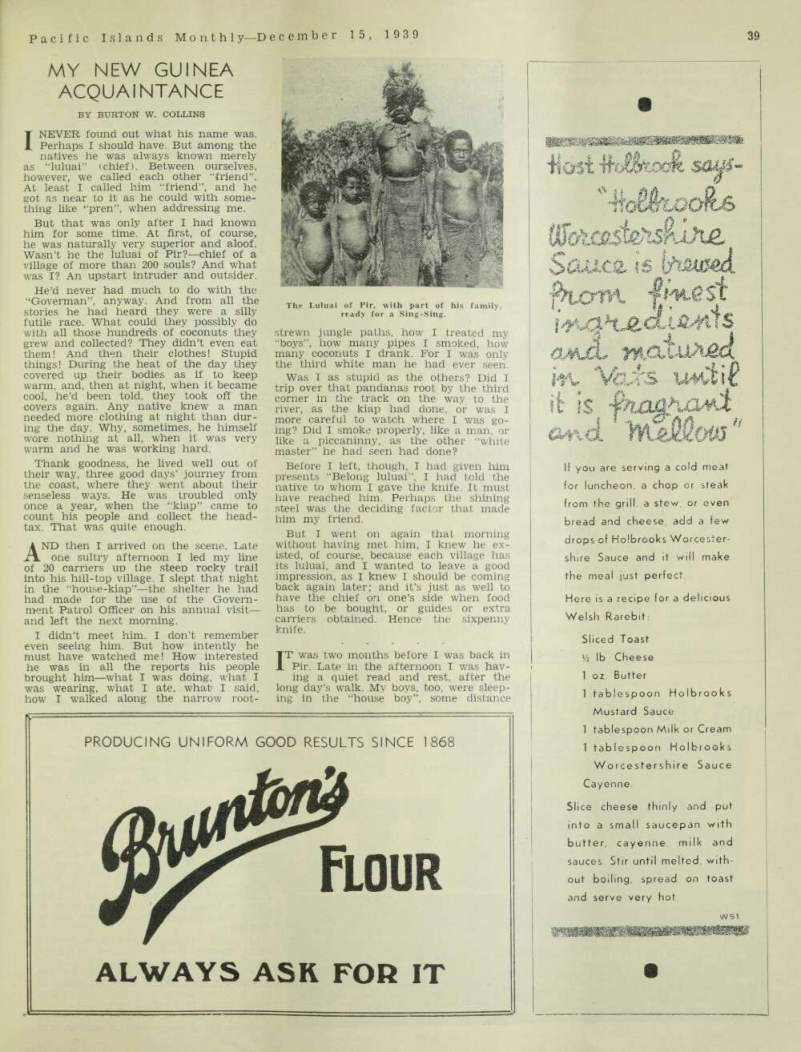
My New Guinea
By Burton W. Collins
I NEVER found out what his name was.
Perhaps I should have. But among the natives he was always known merely as “luluai” (chief). Between ourselves, however, we called each other “friend”.
At least I called him “friend”, and he got as near to it as he could with some thing like “pren”, when addressing me.
But that was only after I had known him for some time. At first, of course, he was naturally very superior and aloof.
Wasn’t he the luluai of Pir? —chief of a village of more than 200 souls? And what was I? An upstart intruder and outsider.
He’d never had much to do with the “Goverman”, anyway. And from all the stories he had heard they were a silly futile race. What could they possibly do with all those hundreds of coconuts they grew and collected? They didn’t even eat them! And then their clothes! Stupid things! During the heat of the day they covered up their bodies as if to keep warm, and, then at night, when it became cool, he’d been told, they took off the covers again. Any native knew a man needed more clothing at night than dur ing the day. Why, sometimes, he himself wore nothing at all, when it was very warm and he was working hard.
Thank goodness, he lived well out of their way, three good days’ journey from the coast, where they went about their senseless ways. He was troubled only once a year, when the “kiap” came to count his people and collect the head tax. That was quite enough.
AND then I arrived on the scene. Late one sultry afternoon I led my line of 20 carriers up the steep rocky trail into his hill-top village. I slept that night in the “house-kiap”—the shelter he had had made for the use of the Govern ment Patrol Officer on his annual visit— and left the next morning.
I didn’t meet him. I don't remember even seeing him. But how intently he must have watched me! How interested he was in all the reports his people brought him—what I was doing, what I was wearing, what I ate, what I said, how I walked along the narrow root-
strewn jungle paths, how I treated my “boys”, how many pipes I smoked, how many coconuts I drank. For I was only the third white man he had ever seen.
Was I as stupid as the others? Did I trip over that pandanas root by the third corner in the track on the way to the river, as the kiap had done, or was I more careful to watch where I was go ing? Did I smoke properly, like a man, or like a piccaninny, as the other ‘‘white master” he had seen had done?
Before I left, though, I had given him presents “Belong luluai’’, I had told the native to whom I gave the knife. It must have reached him. Perhaps the shining steel was the deciding factor that made him my friend.
But I went on again that morning without having met him, I knew he ex isted, of course, because each village has its luluai, and I wanted to leave a good impression, as I knew I should be coming back again later; and it’s just as well to have the chief on one’s side when food has to be bought, or guides or extra carriers obtained. Hence the sixpenny knife.
IT was two months before I was back in Pir. Late in the afternoon I was hav ing a quiet read and rest, after the long day’s walk. My boys, too, were sleep ing in the “house boy”, some distance
The Luluai of Pir, with part of his family, ready for a Sing-Sing.
away. The village was almost deserted, as the natives had not yet returned from their gardens.
Then, gradually, I became aware of a dark, silent figure squatting on the edge of the verandah, at the top of the wooden ladder leading up from the ground. He was watching me, interestedly; following every movement with piercing black eyes, as I turned the pages, sipped the mug of water at my side, filled my pipe.
About 40 years old, I should say—well past the prime of a native’s life —but still robust and healthy, apparently: skin of chest and limbs sleek and shining, well oiled; wearing besides his many orna ments, only the short work-day “mal” of beaten bark-cloth hung from the waist; he might have been any native from any village within a dozen miles.
And yet, no. There was that nhnnt his bearing, his straight back Ld square shoulders, his grim mouth and shrewd tearless eyes, deep-set for a native— something that proclaimed him a person ln authority.
I had realised this even before I noticed the definite proof at his side There, bright red band somewhat frayed' and blue crown fading lav the official chief’s cap, presented to Y him by tl^ Government in recognition of his status.
Above the peak was a brass number—re corded * n Government archives in Rabaul, hundreds of miles away, with his name an( * the name of his village, He was a “number-man”—the first number-man in his village. Recently on his last trip, the Patrol Officer had given two more “hats”—two more “numbers” -but they weren’t as important as his
His subordinate, the Government-ap pointed interpreter and second-in-com mand, had two narrow red bands in stead of his single broad one. And the “doctor-boy”, who had just come back from six months in the town, learning the white man’s magic with “kinine” and “idine”, -had a bright red cross on a white band. But he knew theirs were quite inferior numbers compared with his. And despite his confirmed contempt for the “Goverman”, and white ways in general, he had a sneaking pride in his position, and the honour accorded him by the white man. 11THEN he saw me looking at him, he TT reached for the cap and slowly and solemnly put it on his head, back to front at first, then, noticing something amiss, the right way round. Folding his arms, he waited. Evidently my turn next, I thought.
“Me savvy finish long you”, I said. “You luluai.”
He nodded gravely, the cap nearly fall ing off. “Luluai”, he repeated.
“You like-im what-name something?”
I asked.
No reply. As I had suspected, he had never learned Pidgin. That was all right for the youngsters who wanted to go and work for the white man, and bring back shining silver “marks” for the “takis”.
But why should he bother his head over the language of the white skin? Besides, his “tul-tul”, with the two red bands on his cap—hadn’t he just been appointed partly on account of his command of Pidgin? Let him make all the necessary dealings with the white skins. After all, he (the luluai) always gave the orders— and that was the main thing.
As I waited for his reply he pointed to his upper left arm. Thrust in an armlet of plaited fibre, near the shoulder, was the knife I had given him two months ago. I smiled; and he, too, unbending a little showed two rows of red, betel-nut stained teeth.
Life was stirring again in the village below. He rose, picked up his cap and fire-stick (inseparable companion of all adult natives), and descended the ladder.
I took out a cigarette and tossed it to him as he turned at the foot.
“Belong luluai”, I said.
“Luluai”, he repeated proudly, stopping to light it on the smouldering stick in his hand, took a few appreciative puffs, and walked slowly away.
That was all I saw of him on that visit. But T left another present before I departed next morning—this time a nine penny trade pipe and a twist of dark tobacco.
MY third and last visit was nearly six months later. I stayed three days, working in the neighbourhood.
The chief and I saw a good deal of each other. I taught him the word “friend”, which, on being explained to him by an interpreter, became very popular with him. He used to follow me round most of the day, counting it, I be lieve, a great privilege to be allowed to carry my geological hammer and bag of specimens.
My work, though, must have been a great mystery to him; indeed, to all his people—although it was explained that I was looking for the white water-like fluid that burnt with a yellow flame in my kerosene lamp. Petroleum, of course, would mean nothing to him.
The last night he arranged a dance and feast—a “sing sing”—in my honour, and
out of politeness I had to stay up until the small hours of the morning, watching their monotonous movements round and round the village totem pole.
Then, last of all, as I was leaving the next morning, the chief, with his two subordinate number-men, and the elders of the village, way-laid me. The tul-tul explained that the luluai wished to make me one of his official friends, and initiate me into his inner circle —a very select group, I was given to understand. I was about to receive a high honour, unique among white men, he said.
How was it done, I inquired.
The doctor-boy then produced two of the long leaves of a reed-like plant known in Pidgin as “tangget”.
“Two feller fasim tangget long ’and”, he explained. “Behind two feller talk talk alia same: You friend belong me be long all time Me no can cross long you.
Me no can gammon more long you”.
Which, I discovered before long, meant that we each tied the tangget leaf round the other’s wrist, forming a special knot and, clasping hands, repeated (I in Pidgin, he in his own tongue): “You are my friend for ever. I will never quarrel with you. I will never again tell you a lie or treat you unfairly,”
Then, in deference to English custom, we shook hands.
Finally, came an exchange of presents.
I gave him a box of matches, and he— it must have been a real sacrifice, too — took the finely-carved shell ornament from the septum of his nose and gravely handed it to me.
I turned to go, down the steep side of the ridge.
‘‘Woa. pren!” he said.
“Friend”, I answered.
And as I turned at the corner in the track, before disappearing with my line 9 f carriers into the darkness of the jungle, I saw him raise an arm and wave his red-banded cap.
“Woa, pren!” he shouted.
Advertisements & other items, pp. 41-43 (2 items)
39
Pacific Islands Monthl y—D ecember 15, 1939
fruyw.
'Host
Saaai is (Muted
i -t*vCX \£, cL I Z'Pd &
omJL m<ituAea
i>v "Vfei'S u*Ciif
it* is
and ‘ iKeS&ttJ "
If you are serving a cold meat for luncheon, a chop or steak from the grill, a stew, or even bread and cheese, add a few drops of Holbrooks Worcestershire Sauce and it will make the meal just perfect.
Here is a recipe for a delicious Welsh Rarebit; Sliced Toast V 2 lb Cheese 1 oz Butter 1 tablespoon Holbrooks Mustard Sauce 1 tablespoon Milk or Cream 1 tablespoon Holbrooks Worcestershire Sauce Cayenne Slice cheese thinly and put into a small saucepan with butter, cayenne milk and sauces. Stir until melted, without boiling, spread on toast and serve very hot wsi
PRODUCING UNIFORM GOOD RESULTS SINCE 1868
ALWAYS ASK FOR IT
BURNS PHILP
Registered
(SOUTH SEA) CO. LTD.
Inc. In Fiji SUVA
FIJI
Island Traders and Shipowners \\ Also Branches at: Fiji; Levuka, Lautoka, Labasa, Ba, Sigatoka, Rotuma.
Tonga: Nukualofa, Haapai, Vavau.
Samoa: Apia, Pago Pago (American Samoa).
Solomons: Makambo, Gizo, Faisi.
New Hebrides: Vila.
Gilberts: Tarawa.
Code Address*. •Burnsouth”. Norfolk Is. Niue. Wallis Is. Futuna Is.
POST VOUJ
1 t97tUj ® MINING Crushing Machinery, Screens, Feeders, Rock Drills, Excavators, Diesel and Crude Oil Engines, Hoists and Runways, Roller Bearings, etc. ® ELECTRICAL EQUIPMENT Parkinson Motors, Crompton Switchgear, Transformers, Instruments, Meters, Callender Wires and Cables, Lighting Equipment, Electric Drills. ® STORES, FACTORIES, HOME and OFFICE Electrical Fittings, Crompton Fans, Crompton Lamps, Floodlighting, Household Electrical Appliances, Radio Receivers, and Equipment, Jos. Rodgers Cutlery ,& Plateware, Cut-glass and Perfection E.P.N.S. Ware.
Plume is the outstanding Economy petrol in the Islands to-day. The best way to judge a petrol is by the work you get out of it . . . and you'll get more miles out of Plume than you will get out of any other. That is the reason why we are able to say it is the "best'' petrol sold in the Islands. "Best by Miles"! Use it regularly and prove it in your car.
The Economy Petrol
VACUUM OIL COMPANY PTY. LTD. H''“.rpo. a ted i" Australia)
Fiji Builds Its Own Vessel
From Our Own Correspondent
Suva, Nov. 10.
ANEW vessel is under construction at the Government Boatsheds, at Walu Bay, to replace the old Government ves sel, “Derek”, which had been engaged in duties in the Group for many years, un til she was eventually lost on the island of Komo.
The new vessel, which should be launched early in December, and com missioned in February, will take up the work of visiting lighthouses, and repair ing buoys and beacons, besides transport ing Government cargo to various parts of the Group—including regular visits to the leper station at Makogai.
She will be 93 ft. long, beam 23 ft., depth 10 ft., with a draught of 8 ft. 6 in.
She will be powered by twin Gardner en gines, giving her a speed of 94 knots.
Mr. J, E. Palmer, who has been in Papua for 18 months as geophysicist with Island Explorations Ltd., seeking oil, spent a short holiday in Victoria at the end of November. He sailed from Syd ney for the United States early in December.
International Plan For
Colonies
A PLAN for the administration of Col onies under international supervis ion was suggested at the Liberal Summer School at Cambridge, England, recently, by Mr. Ramsay Muir, when he spoke on the Colonial question.
Mr. Muir urged that the possessors of Colonies should resign their absolute sov ereignty over those Colonies to some in ternational authority, and he suggested conditions on which they should do so.
One condition should be an absolute open trade access for the traders of all nations to all Colonies under such ad ministration. The second condition would be that there must be full and adequate safeguards for the rights of the native population, with definite obligation to train them gradually to take a larger and larger share in the management of their own affairs and train them for ultimate self-government.
Mr. Muir put the question as to which authority should have the control of the Colonies under his plan. He preferred the League of Nations system of control because it enabled every people in the world to feel they had a chance of mak ing their voices heard. The scheme was a far bigger scheme than one to placate Germany.
Mrs, R. Moffatt, well-known resident of Eastern Papua, returned to the Territory by the last “Macdljui” after three months’ holiday in Australia. Her husband owns the ketch “Gitana II”.
Advertisements & other items, p. 44 (2 items)
42
December 15, 193 9—P acific Islands Monthly
William Atkins Pty. Ltd.
Established 50 years—and carrying one of the largest stocks of Iron and Steel in Australia.
Head Office 449-451 KENT ST., SYDNEY.
Iron & Steel Merchants
ENGINEERS' SUPPLIES
COACH & MOTOR HARDWARE.
FULL, COMPREHENSIVE & UP-TO-DATE RANGE IN ALL
DEPARTMENTS, INCLUDING THE FOLLOWING LINES:—
Cable Address: WILATKIN, SYDNEY.
STEEL DEPARTMENT-
MILD STEEL:
Rounds, Squares, Flats, Half-rounds, Hexagons, Bevel, Shoeing, Tyre, Angles, Tees, Sheets, Plates, Girder Plates, Chequer Plates, Channels, Hoops, Etc.
BRIGHT STEEL:
Rounds, Squares, Hexagons.
Engineers" Supplies: Set Screws, Studs, Metal Thread Screws, Coach Screws, Files, Cotter Pins, Bright and Black Bolts, Rivets, Etc., Hack Saw Blades.
Power Transmission Gear: Including Plummer Blocks, Couplings, Collars, Etc.
Coach and Motor Hardware: Axles, Springs, Wheelstuff, Duck, Paints.
Farriers' Supplies: Horse Nails, Anvils, Vices, Etc.
Extra Special High Speed Tool Steel, Mining Steel, Blister Steel and Spring Steel, Rounds, Flats Cx Squares.
Bar Iron—All sections and sizes.
Motor-Trimmers and Motor Builders' fir Motor Pointers' Requirements
C. A. WILLEY'S
Quick-Drying Coach and Car Paints, Roughstuff, Elastic Gloss, Synflex Enamels, Lacquers.
DUCO Lacquers and DULUX Enamels—FAßßEX Motor Toppings and Leather Cloths, House fir Decorators' Points, Varnishes fir Brushwore Sole Distributors of CHAMPION'S Decorators Paint Products.
Distributing Agents for BROLITE Lacquers, SYNFLEX Enamels and "POLYGLOSS" Finish.
Shame Of War
How a Missionary Solved a Problem
(By a Missionary)
THOUGH I had recognised that Britain could take no other course, it was with a deep sense of shame and repug nance that I faced the task of announcing to the natives of Paama (New Heb rides) that the British Commonwealth of nations was at war.
After proclaiming for 40 years, to peo ple whom the world calls savages, that vendetta warfare was a beastly method of settling disputes, and should be replaced by the new and better way of concord and negotiation, I felt it a great humili ation to have to confess that my own country was at war. I wondered what the reaction of the Christian natives would be; and, remembering their ante cedents, I made sure it would be one of disapprobation.
To make the announcement. I obtain ed from the school-house a blackboard and, writing oh one side, “Germany at war with Poland”, I showed it to a big crowd of natives who had assembled at the morning dispensary of Benjamin, the native medical practitioner.
Every one knew about Germany, but Poland was a new name.
When I explained that Poland was a small and weaker nation about to be over run by a powerful and well-armed neigh bour, they expressed their horror and indignation. Benjamin voiced the pre vailing feeling by enquiring, “Will no one go to the help of Poland?”
Now I turned the blackboard to the other side, whereon was written; “France and Britain are helping Poland”.
Sparkling eyes and smiling faces greet ed the announcement, and instantly there was a spontaneous murmur of ap proval and applause.
Instead of suffering humiliation at the action of Britain in declaring war, the native verdict thrilled me with a feeling of pride. These native Christians, the descendants of cannibals, thought it a great thing that the people of Britain and France should fight and die in de fence of justice and fair play. I felt like proposing “Three cheers for the Condo minium”.
U.S.A. And Christmas Is.
From Our Own Correspondent
Honolulu, Nov. 10.
PEARSON AND ALLEN, the authors of the famed Washington “Merry-Go- Round” daily newspaper column in the United States, have re-awakened what has been reported in the “P.1.M.” before —that the U.S.A. is considering the occu pation of Christmas Island, a strategic island now occupied by Britain, near Fanning Island, in the Central Pacific.
Like Canton and other such islands, Christmas would make a fine modern navy base.
Some American observers abhor the idea of Britain and America sharing is lands. like Canton and Enderbury—es pecially now that Britain is a belligerent nation, so far as America is concerned.
This joint-occupation-and-use business raises interesting angles in connection with Washington’s current mood for neu trality.
on Old "Makambo"
Japanese Claim a Win on Old "Makambo"
The following news despatch from Japan was published in the Austra lian newspapers on November 15;— The Okada Salvage Company sailed the former British steamer “Makambo” (1,159 tons), into Osaka yesterday after having dragged her off a reef in the New Heb rides, where she was grounded on Sep tember 20, 1935. ( The vessel was sailed under her own power for 3.600 miles.
The salvage has turned an investment of 15,000 yen (£A1,125) into 700,000 yen (£A52,500).
The “Makambo”, built on the Clyde in 1907, was formerly owned by Burns Philp (South Sea) and was employed for many years in the Islands trade. She sprang a leak at Vila, New Hebrides, four years ago, and was run ashore, afterwards be ing abandoned.
The “Airspeed Air Circulator” is the modern equivalent of the old-style electric fan. It is claimed that one of these units can ventilate any size of room. They are available in a wide range of colours and sizes, and may be used anywhere where there is electric power. Noyes Bros., Ltd.. 115 Clarence Street, Sydney, are distributors.**
Advertisements & other items, p. 45 (2 items)
43
Pacific Islands Monthl y—D ecember 15, 1939
Ite&sr
Timber, joinery
ETC.
PREPARED BUILDINGS ready for erection a specialty.
SHIP AND BOAT BUILDING.
TIMBERS specially catered for.
PIBROLITE, PLYWOODS.
GALVANISED IRON.
CONSIGNMENTS shipped
by RETURN STEAMERS
to the Islands.
John W. Eaton
PTY. LTD.
WEST CRESCENT STREET,
NORTH SYDNEY.
Telephones: XB 4051 (6 lines.)
BITUMENOID ROOFING
MADE IN AUSTRALIA.
Bitumenoid Roofings, Dampcourse and Insulating Pelts are made from the world’s best raw materials. Warranted to stand the most rigid tests.
BITUMENOID THE BEST
Roofing 1,2, 3-ply; Flooring, Waterproof Materials: Saturated Felt; Resilient Road Jointing: Natural Asphalt Dampcourse; 2 and 3-ply Dampcourse; 1-2 lb. Lead-core Dampcourse; Roofing Cement; Asphalt Paints; Roofing Compound.
SAMPLES AND PRICE LISTS ON APPLIOATION.
MAXWELL PORTER & SON LTD.
ESTABLISHED 1888. BUILDERS’ SUPPLIES.
107 REDFERN ST., REDFERN, SYDNEY, N.S.W. Phone: M 3157. Cables Bitumenoid.
Ite&sr
Obtoin a copy before you build.
It contains designs and plan*—in colour—of Homes that can be inexpensively built with
WUNDERLICH DURABESTOS
the indestructible asbestos-cement building sheeting. Write to
WUNDERLICH LIMITED
5.P.0., Box 474 aa, SYDNEY
FOR TROPICAL BUILDINGS, SPECIFY
BUILD
A MODERN
HOME
ASB t SI OS
lUFAEESTCS
.kH CEMENT BUHD'NC SHEETS
Transition Period In Fiji
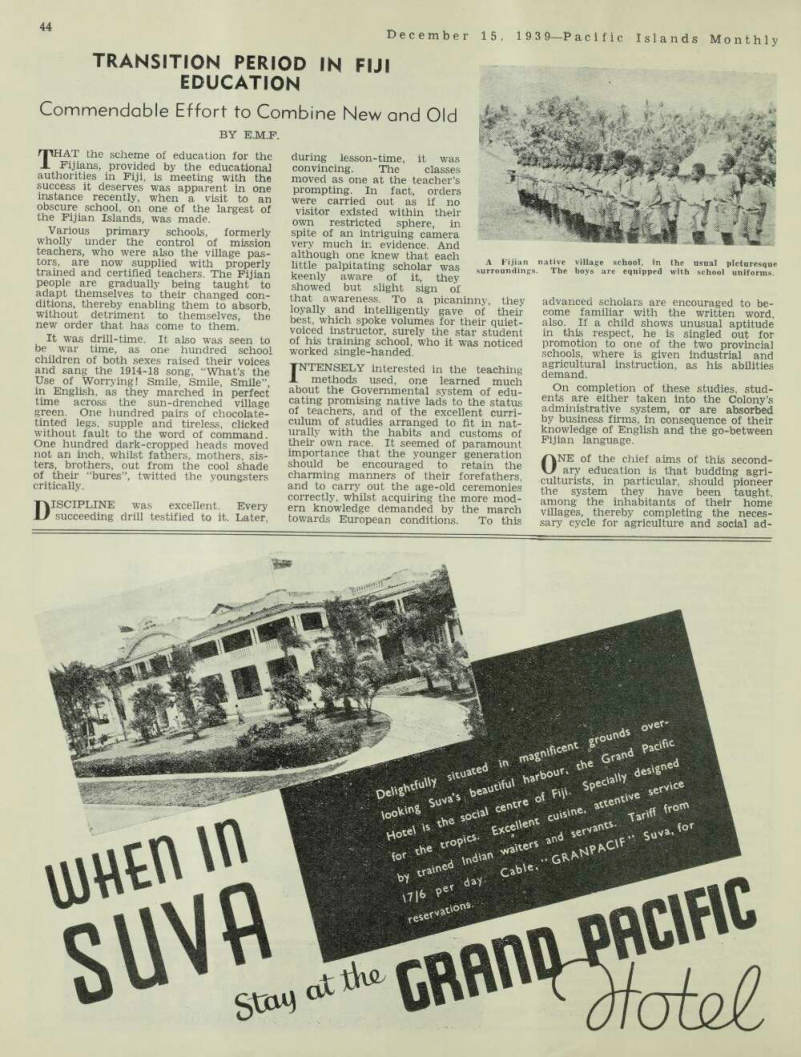
Education
Commendable Effort to Combine New and Old
By E.M.F.
rpHAT the scheme of education for the -■- Fijians, provided by the educational authorities in Fiji, is meeting with the success it deserves was apparent in one instance recently, when a visit to an obscure school, on one of the largest of the Fijian Islands, was made.
Various primary schools, formerly wholly under the control of mission teachers, who were also the village pas tors, are now supplied with properly trained and certified teachers. The Fijian people are gradually being taught to adapt themselves to their changed con ditions, thereby enabling them to absorb, without detriment to themselves, the new order that has come to them.
It was drill-time. It also was seen to be war time, as one hundred school children of both sexes raised their voices and sang the 1914-18 song, “What’s the Use of Worrying! Smile, Smile, Smile”, in English, as they marched in perfect time across the sun-drenched village green. One hundred pairs of chocolate tinted legs, supple and tireless, clicked without fault to the word of command.
One hundred dark-cropped heads moved not an inch, whilst fathers, mothers, sis ters, brothers, out from the cool shade of their “bures”, twitted the youngsters critically.
DISCIPLINE was excellent. Every succeeding drill testified to it. Later,
during lesson-time, it was convincing. The classes moved as one at the teacher’s prompting. In fact, orders were carried out as if no visitor existed within their own restricted sphere, in spite of an intriguing camera very much in evidence. And although one knew that each little palpitating scholar was keenly aware of it, they
showed but slight sign of that awareness. To a picaninny, they loyally and intelligently gave of their best, which spoke volumes for their quiet voiced instructor, surely the star student of his training school, who it was noticed worked single-handed.
INTENSELY interested in the teaching methods used, one learned much about the Governmental system of edu cating promising native lads to the status of teachers, and of the excellent curri culum of studies arranged to fit in nat urally with the habits and customs of their own race. It seemed of paramount importance that the younger generation should be encouraged to retain the charming manners of their forefathers, and to carry out the age-old ceremonies correctly, whilst acquiring the more mod ern knowledge demanded by the march towards European conditions. To this
advanced scholars are encouraged to be come familiar with the written word, also. If a child shows unusual aptitude in this respect, he is singled out for promotion to one of the two provincial schools, where is given industrial and agricultural instruction, as his abilities demand.
On completion of these studies, stud ents are either taken into the Colony’s administrative system, or are absorbed by business firms, in consequence of their knowledge of English and the go-between Fijian language.
ONE of the chief aims of this second ary education is that budding agri culturists, in particular, should pioneer the system they have been taught, among the inhabitants of their home villages, thereby completing the neces sary cycle for agriculture and social ad
A Fijian native village school, in the nsual picturesque surroundings. The boys are equipped with school uniforms.
vancement. In this instance, inspection of the school garden was enlightening.
Here, in neat, well-drained plots, were European vegetables growing, while above and beyond, straggling up the hill-sides, were the less intensively cultured na tive foods in abundance. It would seem that our qualified informant had been assistant agricultural officer, at his training school, to some purpose.
Apart from work, sports and games are indulged in. One became rather reminiscent on seeing “twos and threes” being played in such an alien setting.
But the manlier game of football has great appeal for the boys, each fleet footed aspirant hoping, no doubt, to emulate the prowess of members of that victorious Fijian team which recently competed with their Maori cousins in New Zealand. And Maoris are among the world’s best footballers.
School uniform has been provided and, like any other competitive scheme con ducted amongst the Fijians, has met with great appreciation. For the small sum of 5/-, little Israeli or Jakope is solemnly clothed in khaki skirt and pants, the wherewithal having been ob tained from the sale of the prolific coco-
nut, lest shame be upon the paternal head. As girls must now also be edu cated, there is the rather tiresome busi ness of white-collared pinafores for them. But nothing is taken too seri ously by these laughing happy people, except perhaps their native rites and ceremonies—which is as it should be, if they are to remain an individual race.
The dramatic struggle, so creditably car ried out by the early missionaries, and of later years continued in co-operation with the Fijian Government, has already, it will be seen, resulted in a great work being done. Western civilisation may have brought its vices to these simple people, but it also has brought its vir tues and benefits. They are becoming aware of the opportunities at their dis posal to help maintain their identity in the new world, and it is the task of the Government and others in power to help them to save themselves and their ancient domains.
In urging upon native children in Fiji the value of their being members of the British Empire, it might be well to quote
to them the wise counsel of one of their dignified and ageing chiefs, who said: “Education does not consist of copying European manners in the wrong way, or of impudently imitating European cus toms. Native customs and manners are appreciated and respected by the white chiefs and the white people, and if these are observed, and the good, clean habits of the educated Fijian are cultivated, there can be no doubt but that the Fijians will continue to be considered and loved by everyone”.
Rev. Roy McLelland recently relinquish ed the work of superintendent of Ma poon Presbyterian Mission and. accom panied by his wife and two children, re turned to Victoria, where he has taken up parish work again. Mr. McLelland is well known to missionaries in the New Hebrides field.
Miss Myrtle Irene Johnson, daughter of Mr. and Mrs. Thomas Curtin Johnson, of Blakeney, Norfolk, England, was mar ried in Port Moresby on November 11 to Mr, Kenneth Norman Rimington, of Kew, Victoria. The bride was given away by Mr. G. Whittle, and attended by Mrs.
Stach as matron of honour. Mr. A. G.
Creswell was best man. Guests were en tertained afterwards by Mr. and Mrs.
Howard.
Mr. J. B. Macfarlane, founder of the trading firm of J. B. Macfarlane Ltd., Auckland, N.Z., who had many friends in Fiji as a result of his business con nections with the Colony, died in Auck land on November 6, aged 80. He re cently underwent an operation on his eyes, and his health declined rapidly.
One of Mr. Macfarlane’s daughters is the wife of Mr. C. Nott, chief clerk in the Colonial Secretary’s Department, Suva.
A class at work inside the village church. The children use their mats, upon the floor, as their desks, after the native fashion.
Advertisements & other items, pp. 46-47 (2 items)
1
S»n) rw *** p d s \to» te<i , ar b° ur ' 1 \W d eS '& r ' e ° a - S * I*** ■*Z> *T CO— * ie %« ** is s d serva" ts , va ,(° r - *S- Lr^'° e Cab' 6, r <W 6 9 e ■
A. B. DONALD LTD.
AUCKLAND
ISLAND TRADERS : GENERAL MERCHANTS
P.O. Box 1509. Cables and Telegrams: "Kingdom”, Auckland.
Branches at Rarotonga and throughout the Cook Islands At Papeete and throughout the Society, Marquesas and Paumotu Islands,
trading as "ETABLISSEMENTS DONALD, TAHITI"
At Fiji: Trading as "Dominion Fruit Co.", Suva.
Your Tropical Kit
When you visit the Pacific Islands, whether on Business or Pleasure, you need Special Equipment—Light Suits of Correct Style, which fit well and launder easily: Tunic Shirts, Silk Shirts, Light Underwear, White Shoes, etc.
WALTER HORNE & CO., LTD., established in 1885, specialise in this Service. Skill d Tailors make your Suits from First-class material within 24 hours. Complete equipment can be supplied from our Large Stock at Reasonable, Moderate Prices.
BUY FROM THE FIRM WHICH UNDERSTANDS YOUR NEEDS AND
DRESSES YOU CORRECTLY.
WALTER HORNE & CO. LTD. carry a Full Range of Drapery of all kinds; also Frocks, Millinery, Foundations and Lingerie, Hosiery, Shoes and Sandals, Ribbons and Laces, Household Drapery.
Ladies' Hairdressing and Manicuring
* Men resident in any of the Pacific Territories can be supplied with Suitable Clothes.
Write to us and Describe your Requirements.
WALTER HORNE & CO. LTD.
Drapers and Men's Wear Specialists.
SUVA, FIJI.
45
Pacific Islands Monthl y—D ecember 15, 1939
Fiji's Score In Empire
Shoot
From Our Own Correspondent
Suva, Nov. 2.
THE Governor (Sir Harry Luke, K.C.M.G.). who is patron of the Fiji Small-Bore Rifle Association, has express ed pleasure at the performances of mem bers, who this year put up a score of 1.574, out of a possible 1,600. in the an nual shooting competition between the
various Colonies of the British Empire.
Last year, Bermuda won the Challenge Cup, with a score of 1,570, so there would appear to be good grounds for hoping that this year Fiji, with a score of 1,574, will be highly placed when the final re sults are announced.
Pastor L. Wilkinson, formerly superin tendent for the Seventh Day Adventist Mission in Fiji, has taken up a position as teacher at the S.D.A. Mission Col lege, Newcastle, N.S.W.
Shoes And Ships
And Motor Cars
Old Habits Pass in Tahiti
From Our Own Correspondent
Papeete, Nov. 3.
FROM the time of Taaroa—Father of gods and men, and from whom many of the high chiefs of the islands claim descent—the Polynesians • have trod the earth unshod.
Formed in the image of the gods of Olympus the men, proud of the perfec tion of their bodies, walked like patri cians. The women carried themselves with grace and dignity. And so they con tinued until high-heeled shoes and motor cars came into fashion.
There were, indeed, shoes, when we came to the islands many years ago; but only for wear at church on the Sabbath.
These shoes were fitted with low heels, were of ample proportions and were not designed as instruments of torture.
In any case they were worn only while going to church and during the period of the service. On emerging from the meeting house the men were accustomed to take off their shoes at the church steps, tie them together by their laces and walk home after the manner of their ancestors. The women usually wait ed until they came to the bridge at the Pa—where there is a low parapet—be fore divesting themselves of their foot wear and continuing thence, with great sighs of relief, to their several abodes.
Presently, came a change. We began to remark on the faces of our women folk an expression of agonised tension, of desperate endurance. The smooth graceful gait had given place to a hobble.
The long, flowing draperies of women’s apparel, of those days, concealed from our eyes the cause of this transforma tion.
Imagining all manner of reasons we inquired of a young woman who, when we met her on a highway of Papeete, seemed to have descended to the very nadir of despair and desolation; “What in the world has happened?”
She replied: “My feet hurt”, and, lift ing the hem of her garment, she revealed a pair of high-heeled, narrow, pointed Paris shoes.
That was the beginning of the end.
Fashion had come in, and with her advent departed forever the age-long grace of our Polynesian women.
Then came the internal combustion en gine and the motor car.
Men. whose ancestors since time be gan had battled the sea with sail and paddle, now sit supinely amid the thun ders of exploding petrol, as their craft skims over the waters. Persons who once walked kilometres every day with ease and enjoyment now anchor themselves in motor cars, stagger unwillingly from their vehicles to the interior of shops, and lean languidly on counters while they choose their wares.
Many people of the districts of Tahiti pass, apparently, their waking hours aboard motor trucks which shuttle back and forth daily between Papeete and the most remote settlements.
Packed tightly on benches, their feet resting on a carpet of trussed pigs and curtained from the fervid rays of the tropic sun by fringes of strung fish hung along the sides of the canopy, they are wafted to Papeete in the morning and returned again to their districts in the afternoon.
Reliable witnesses affirm that no Poly nesian of this day and generation, who possesses the means to travel by car or truck, will walk one hundred yards dur ing the period of a month.
Perhaps that inexorable law of Nature, which atrophies those members of a liv ing body long neglected by disuse, will one day exact its penalties from man kind—of this and Other countries—by reducing the nether limbs to flapping ap pendages of cartilaginous tissue.
Advertisements & other items, p. 48 (1 item)
Flit
11
USE
FOR
AND
RELIABILITY
LONG SERVICE
Manufactured by; n Suva Agent*; <3 Sydney entj;
MILLER'S "ANCHOR'
BRAND ROPES AND
CORDAGES.
Zealand Coir and every description.
Manila, Sisal. New Cotton Rope of Twine, Sewing Twine. Shop Twine, Binder Twine and Fishlines, Lashings, Halters, Plough Reins, Sack Cord. Blind Lines, etc.
LENGTH STRENGTH
QUALITY GUARANTEED
JAMES MILLER & Co. Pty. Ltd.
MELBOURNE. VIC., AUST.
A. S. FAREBROTHER & CO.
And at Lautoka. P.O. Box 36. Tel. 261
P. T. TAYLOR LTD.
FLIT
kills them all ]
I PL it to*W°V*v \ '*»”*• L\ ma* FBl 1 Flit is sure death to insects because it contains a number of killing agents found in no other insect spray. Flit kills where others fail. Flit is deadly to insects but harmless to humans. Always insist on FLIT refuse all substitutes.
Buy a bottle or tin TO-DAY
FLIT always KIL LS
VACUUM OIL COMPANY PTY.. LTD.
(Incorporatd in Australia).
Sugar Season In Fiji
From Our Own Correspondent
Suva, Nov. 10.
THE Colonial Sugar Refining Co. Ltd. has completed its crushing, for the 1940 season, at its Nausori Mill, at Rewa, and it is expected that other mills will finish their work about the end of No vember.
There has not been as great a tonnage of cane as in previous years, but in some areas the yield of sugar per ton has been greater than the average, so that the growers should receive a sub stantial bonus over the arranged price.
Nadi district reports that the pine apple crop is in a very flourishing con dition.
The prizes in the Samarai Library sweep on the Melbourne Cup were won as follows .—First. £62/10/-, Mrs. L. Skelly and W. Johnston: second, £25, V. C.
Eglestaff; third, £l2 10/-, Gail Ranie.
The Library Institute also had a “Cal cutta Sweep’’ on the Cup, with the fol lowing result: First, £66/13/-, A. Ramsden; second, £33/6/-, C. Skelly: third, £ll/2/-, A. Ramsden.
Cheeky Natives
A Problem in Eastern Papua
Letter to the Editor IT seems high time that the voice of the Papuan European miner in Misima is given an attentive ear by of ficialdom.
Bwagaoia is the port of Misima Is land, and is situated five miles from the nearest mine—Cuthbert’s Misima Gold Mines Limited. . This mine has been producing for the past 20 years and from all indications, is likely to continue doing so.
There are about 14 Europeans living in Bwagaoia, which has been proclaimed a township. There are about 47 Europeans at Umuna (C.M.G.M.) which has not been proclaimed a township. If Umuna closes down, Bwagaoia automatically loses at least half of its inhabitants.
Why, then, is Bwagaoia a township and Umuna not?
The proclaiming of a place as a town ship doesn’t enhance its value; but ap parently it makes a big difference in re gard to law.
In Bwagaoia, every native has to be in his own dwelling by 9 p.m. In Umuna, he has not.
In Bwagaoia, if the rest of the inhab itants are disturbed by dances and drums, after 9 p.m., they can complain to the Government and have it stopped. In Umuna, the natives can belt drums and kick up a row all night and nothing legal ly can be done.
The natives, needless to say. take full advantage of this, at times annoying the white population to madness. A native
drum to a tired man endeavouring to sleep is an incentive to murder.
If, in Bwagaoia, a native is insolent in any way, or is heard swearing, he may be summoned for it. If it is done at Umuna, there is no redress.
Is it any wonder that there are fre quent cases of white men boxing a na tive’s ears and being charged with as sault in the Court? They are 99 per cent, cases in which the native has just received a slap in the face with the open hand, but the white man is always con victed and fined.
A native “bush lawyer” can use all power to provoke a white man, while keeping within the law himself, until the white man loses his temper and smacks him. Then the native can go and complain to the Government and the white man will be charged with assault and convicted.
There was one case on October 19, where a native actually wrote a challenge to his white boss. When the white man. humiliated before numerous natives,- went and hit the boy responsible, the latter immediately reported the matter to the Government and the white man was con victed and fined for assault. The native had apparently been trained to write by missionaries, and his own bush lawyers had schooled him in the art of provoking a white man.
The Government say that if they al low a white man to lay a finger on a boy, it will lead to brutality. Do they consider’ themselves the only ones who have been civilised to the extent of dis liking brutality? Do they think that re sidents of Papua would stand by and see natives brutally treated? Have the na tives who have besmirched decent citi zens’ names with convictions for assault
been marked in any way resembling brutality?
Papuan citizens, as a whole, set a wonderful example to the native and mostly take a whole-hearted interest in the welfare of the native and the coun try. They are also blessed with a cer tain amount of pride of race. Why, then, should a white man be convicted for smacking an insolent native’s face?
There is such a thing as dumb insol ence. This is not an offence according to Papuan law, although every man in the country, including officials, knows it can be more aggravating than anything else. In army law, it is an offence.
We have long passed the days of slav ery. The native receives respect from us, and we expect respect from him. How ever, when he signs a contract to work he is expected to do his whack. Instead, he has to be watched continuously or he will sleep on the job. That is all con sidered fair and square by the man work ing him. But when one native, who has probably given trouble in previous cases, outdoes his comrades by insulting the overseer, by dumb insolence, nothing can be done. It is the fact that he knows
he has the Government on his side that encourages him to be troublesome.
If one white man insults another, and both are of the good old British type, there is a fight. In most cases, the com batants finish up good friends. If the Government did the same with a native when he had provoked a white man to the extent of hitting him the result would generally be the same. Then why don’t they?
I am, etc., • W.
Misima, Papua, 31/10/1939.
Mrs. Nancy Mack, wife of Mr. D. Mack, of Fiji, died in the Colonial War Mem orial Hospital, Suva, on November 10, after an operation. Born in Dunedin.
N.Z., she qualified for the degree of Bachelor of Arts and went to Fiji in 1928 as an assistant mistress at the Suva Girls’ Grammar School. She resigned two years later to be married; but since had filled several vacancies as relieving mistress. Last June, she was appointed by the Fiji Government to be supervisor of the correspondence classes.
Advertisements & other items, pp. 49-50 (2 items)
47
Pacific Islands Monthl y—D ecember 15, 1939
Fairbanks Morse
Backed by a great name!
and Company
Manufacturers of
DIESEL ENGINES, STATIONARY, MARINE
AND DREDGE SERVICE, from 10 to 1,500 H.P.
FAIRBANKS
SCALES AND WEIGHING
MACHINES
FARM ENGINES and FEED GRINDERS.
RAILROAD EQUIPMENT.
*7 DIESEL ELECTRIC SETS, 6 to 1,200 KW„
ALTERNATING OR DIRECT CURRENT.
and
"FAIRDAY" WASHING MACHINES
IRONERS.
PUMPING EQUIPMENT for EVERY SERVICE.
HOME LIGHTING SETS.
Fullest information and data available from
Fairbanks Morse [A/sia] Pty. Ptd.
29-33 CLARENCE ST., SYDNEY.
Engineers & Plumbers’ Brass Work; Locksets; Wire Netting; Hardware; “Petromax”
Kerosene Lanterns & Lamps; Pumps, Windmills, Troughing.
WRITE FOR PRICES AND
LINES YOU USE.
TRY DANKS' FOR
BUILDING SUPPLIES
We specialise in: Water, gas and steam pipe and Fittings; Gal. Roofing Iron, Guttering, Downpipe, etc.; Wallboards, Bituminous Roofing, Tilux, Duratile, Asbestos Sheets; Baths, Basins, Sinks, Heaters; Ranges for wood, coke, coal, kerosene: McClary Electric and Gas Ranges; Electric Light fittings; Refrigerators—lce and Electric; Linoleums for Stores, Hospitals, etc.; White Rose C.I. (Eng.) Hot Water Boilers; “Hush” Silent Flushers; Paints and Brushware; Wallpapers, etc. ’Phone; M 6505 (18 lines).
Late shopping Friday.
John Danks and Son
PROPRIETARY LIMITED
(Incorporated In Victoria). 324-330 Pitt Street, Sydney.
And at Melbourne.
Why No Malaria
In Fiji?
Scientists State that There is No Anopheles Mosquito
MORE than once, the “P.l.Mhas commented upon the curious fact that there is no malaria in Fiji, or east wards in Polynesia, although there are Anopheles mosquitoes in Fiji, and active malaria next door, in the New Hebrides.
The statement that the Anopheles was present in Fiji and Samoa was made in the “P.1.M.” some years ago, by a cor respondent who apparently spoke with authority. It appears that he was in error.
Writing in the October number of the Fiji “Agricultural Journal”, the Fiji entomologist, Mr. J. A. W. Lever, says positively that the Anopheles does not exist in Fiji, nor in Polynesia generally.
He goes on to say that, so far as Fiji is concerned, R. W. Paine (“Introduc tion to the Mosquitoes of Fiji”, 1935) studied all the fourteen local forms very thoroughly, collected them throughout the Group but does not so much as mention the malarial mosquito in his detailed paper. F. H. Taylor (writing on the subject in 1934 and 1938) similarly does not even refer once to Fiji as a locality for Anopheles.
The claim for Samoa was even more difficult to maintain as P. A. Buxton (“Researches in Polynesia and Me lanesia”) stated as long ago as 1927 that “south and east of the New Hebrides, Anopheles is absent and no malaria oc curs in the Loyalty Group, New Cale donia, Fiji or any part of Polynesia.
One may summarise the matter by say ing that Anopheles punctulatus and ma laria occur eastwards of 170 deg. E. and southwards to 20 deg. S. . . . Outside this area, malaria is found nowhere except in Aneityum (New Hebrides) which is only a fraction of a degree south of 20 deg. S.”
Finally, Buxton’s Samoan collections, made in 1914-5, comprised only half a dozen different species of Aedes and Culex which were described by F. W. Ed wards (“Insects of Samoa”, 1928), who shows that as one proceeds eastwards from New Guinea, the fauna diminishes and “in Fiji Anopheles drops out”, “It would therefore be strange to have it cropping up further east, in Sa moa, when not present in Fiji to the west”, says Mr. Lever.
Miss R. Davis, of the Audit Depart ment, Fiji, is at present on long leave.
Advertisements & other items, p. 50 (1 item)
“Majora” Speed Enamel
COLOUR IN THE HOME -
with
Dries in ONE HOUR - - - - Lustrous finish No objectionable odour --- Brilliant Colours.
Obtainable from All Branches of BURNS, PHILP & CO. LTD.
"Pour La Patrie!"
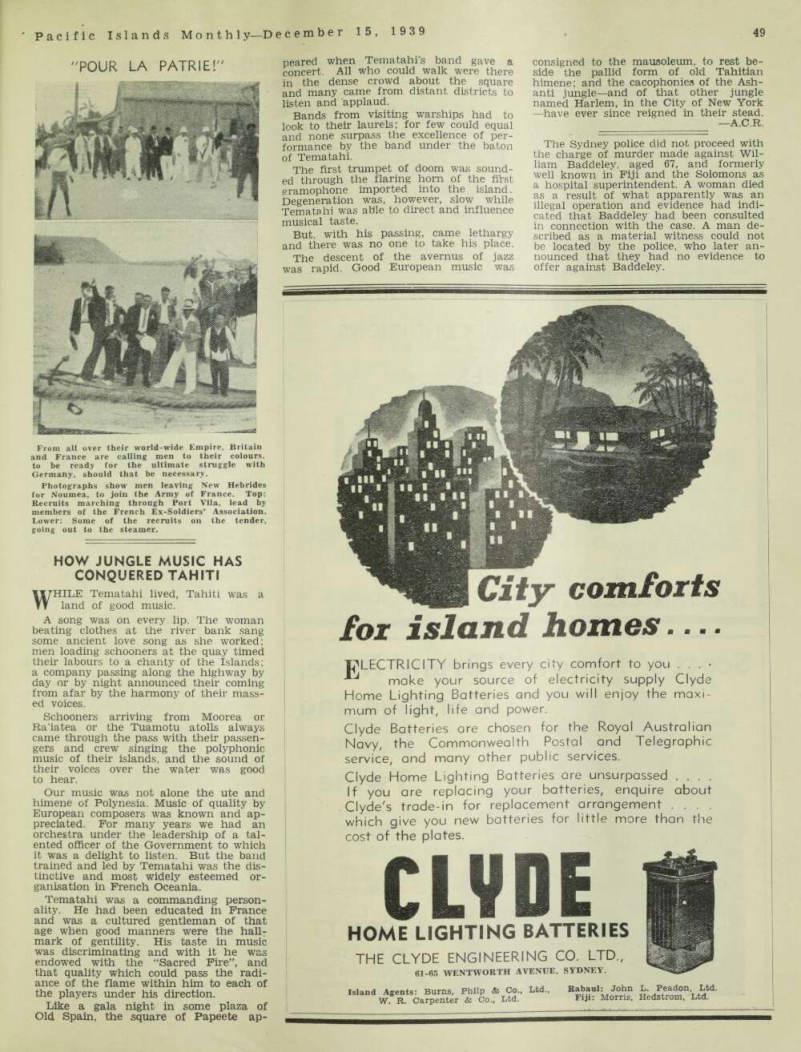
From all over their world-wide Empire, Britain and France are calling men to their colours, to be ready for the ultimate struggle with Germany, should that be necessary.
Photographs show men leaving New Hebrides for Noumea, to join the Army of France. Top: Recruits marching through Port Vila, lead by members of the French Ex-Soldiers* Association.
Lower: Some of the recruits on the tender, going out to the steamer.
Conquered Tahiti
How Jungle Music Has
WHILE Tematahi lived, Tahiti was a land of good music.
A song was on every lip. The woman beating clothes at the river bank sang some ancient love song as she worked; men loading schooners at the quay timed their labours to a chanty of the Islands; a company passing along the highway by day or by night announced their coming from afar by the harmony of their mass ed voices.
Schooners arriving from Moorea or Ra’iatea or the Tuamotu atolls always came through the pass with their passen gers and crew singing the polyphonic music of their islands, and the sound of their voices over the water was good to hear.
Our music was not alone the ute and himene of Polynesia. Music of quality by European composers was known and ap preciated. For many years we had an orchestra under the leadership of a tal ented officer of the Government to which it was a delight to listen. But the band trained and led by Tematahi was the dis tinctive and most widely esteemed or ganisation in French Oceania.
Tematahi was a commanding person ality. He had been educated in France and was a cultured gentleman of that age when good manners were the hall mark of gentility. His taste in music was discriminating and with it he was endowed with the “Sacred Fire”, and that quality which could pass the radi ance of the flame within him to each of the players under his direction.
Like a gala night in some plaza of Old Spain, the square of Papeete ap
peared when Tematahi’s band gave a concert. All who could walk were there in the dense crowd about the square and many came from distant districts to listen and applaud.
Bands from visiting warships had to look to their laurels; for few could equal and none surpass the excellence of per formance by the band under the baton of Tematahi.
The first trumpet of doom was sound ed through the flaring horn of the fiVst gramophone imported into the island.
Degeneration was, however, slow while Tematahi was able to direct and influence musical taste.
But, with his passing, came lethargy and there was no one to take his place.
The descent of the avernus of jazz was rapid. Good European music was
consigned to the mausoleum, to rest be side the pallid form of old Tahitian himene; and the cacophonies of the Ash anti jungle—and of that other jungle named Harlem, in the City of New York —have ever since reigned in their stead.
A.C.R.
The Sydney police did not proceed with the charge of murder made against Wil liam Baddeley, aged 67, and formerly well known in Fiji and the Solomons as a hospital superintendent. A woman died as a result of what apparently was an illegal operation and evidence had indi cated that Baddeley had been consulted in connection with the case. A man de scribed as a material witness could not be located by the police, who later an nounced that they had no evidence to offer against Baddeley.
Sir Brooke Francis, who was at one time Attorney-General in Fiji, arrived in Sydney from England at the end of November. He recently retired after 35 years in the Colonial Service.
Mr. William M. Sutherland, of Suva, collapsed in the street in November and died. He was 71 years of age. Mr. Suth erland, who went to Fiji from New Zea land about 25 years ago, had been living in retirement. Two of his four daughters reside in Suva —Mrs. Inez Bartley and Miss Cynthia Sutherland.
Mr. W. T. Candler, well known Islands travelling representative for a number of Australian commercial firms, returned to Sydney by the “Monterey” at the end of November, after a business visit to Fiji.
Advertisements & other items, pp. 51-52 (2 items)
49
Pacific Islands Monthl y—D ecember 15, 1939
Clvde
comforts
for island homes ...
brings every city comfort to you . . . • moke your source of electricity supply Clyde Home Lighting Batteries and you will enjoy the maximum of light, life and power.
Clyde Batteries are chosen for the Royal Australian Navy, the Commonwealth Postal and Telegraphic service, and many other public services.
Clyde Home Lighting Batteries are unsurpassed . . . .
If you are replacing your batteries, enquire about Clyde's trade-in for replacement arrangement . . . . which give you new batteries for little more than the cost of the plates.
CLVDE
HOME LIGHTING BATTERIES
THE CLYDE ENGINEERING CO. LTD.,
61-65 WENTWORTH AVENUE, SYDNEY.
Island Agents: Burns, Philp <fc Co., Ltd., W. R. Carpenter & Co., Ltd.
Babaul: John L. Peadon, Ltd.
Fiji: Morris, Hedstrom, Ltd.
ASK YOUR LOCAL AGENT FOR COLOUR CARDS
IDEAL FOR ISLAND CONDITIONS
ENAMELS
SPARTAN
PAINTS
CAR POLISH QDE ENAMEL TROJAN PAINT
ZINC PASTE SASH & TRIM PAINT
VELOX ENAMEL PAVING PAINT
SPARTAN LACQUERS PTY. LTD., 366 st ’
Scott’s “Renown” Brand Rope,
Cable Address Ropeyard, Sydney.
Cordage and
Binder
Twine
of Every
Description
MANUFACTURED AT
MASCOT, N.S.W.
By
J. SCOTT
PTY. LTD.
Head Office and Store:
163 CLARENCE STREET.
SYDNEY,
N.S.W.
Trenchant Criticism Of Tonga's
Condition
Are People Being Properly Trained for Peasant-Farmer Life?
By A Resident Of Tonga
YOUR issue of August is a remarkable one. I have been a regular reader of the “Pacific Islands Monthly” since it was a small news-sheet—quite a few years ago now.
To the many references to, and articles on, Tonga and its affairs during that period I have naturally given particular attention, and what may have appeared to the casual reader as severe criticism of the Administration, and those con
nected with it, is amply justified by the case of the high Government officer, re ported in the pages of the August issue.
The policy of the Tongan Government has been an extraordinary one-as it well might have been in view of the disclo sures now made, and perhaps more to come. How can the well-being, and the guidance of a native people, through what must be, at best, a difficult period of transition, be anything but a tragi-comedy when the destiny of those people is in the hands of such a type as that referred to?
The financial policy is alone sufficient to condemn them. In 1919, the f.o.b. value of the Kingdom’s exports totalled £443,- 195, and the value has declined by a zig-zag but downward course to £96,803, in 1938. The expenditure by the Gov ernment, at £55,533 in 1919, has increased by a zig-zag but pronounced upward course to £63,921 in 1938-39, and £65,910 for the current year.
Taking the average copra output at 12,000 tons, the value received by the producer (i.e., the ultimate taxpayer) during 1938 was about £50,000, and dur ing 1939 the average price will work out to something round £48,000, if the stabil ised price holds until the end of the year.
Bananas, say, £3,500 for each year. The Government, therefore, imposes taxation higher than the total value of the people’s income. It not only wants the lot, but more besides!
Is any further comment needed? Un fortunately, yes! The quantity of copra exported has been allowed to decline through lack of any administrative effort to induce the native to cultivate his al lotment and to improve its productive capacity. The only guidance in the Ad ministration is that which leads their steps towards the pay-office at the end of the month. As to any example shown to the natives, your pages are eloquent enough.
THE drift from the land, to a sort of lackadaisical and purposeless exist ence, which is the trend of the younger generation of Tongans can only prove dis astrous unless immediately checked.
The unsuitable secondary education given to these young Tongans, both male and female, the surprising lack of dis cipline both in the schools and in then homes, is bringing about a rapid deterior ation in the moral fibre of the race. The missions are largely responsible for this, but the Government must shoulder the blame for their acquiescence in a disas trous policy, and for their own inertia.
Where the Wesleyan Mission ends and the Government begins is a line of de marcation so fine as to be indistinguish able, and the mutual support given by the one to the other is nowhere so suc cessful as in their campaigns to deprive the native of his last cent. But, in the vital matter of fitting these young people for the life which their natural environ ment provides, and for which solely they are capable (with one or two exceptions) both the Government and its mission appendage (or, perhaps, it should be, the Wesleyan Mission and its Government appendage) have lamentably failed.
They are producing far too large a per centage of undesirable characters of no
use to any community—some are crim inals, some just offensive larrikins, others simply loud and flash, others so swelled-headed as to be merely silly, others again just stupid, most of them lazy—but all of them carrying evidence suggesting that the march of “civilisa tion” is too much for them. They are neither Tongan nor European, and the best thing that could happen, for their peace and happiness, would be a return to that mode of life to which Nature had fitted them before any mission dis turbed them, or a Government exploited them.
Materially, they have made no progress in the last 20 years. With all the wealth they have produced in two decades, they live in the main in the same sloth and squalor that they did before. Where has the money gone? The Government of Tonga, and all the missions combined, have done nothing to improve the real life of the Tongan people.
Your editorial remarks on page 4 of August issue, about the Japanese, are trenchant and admirable. Asiatics are not a good influence on primitive peoples; they certainly are bad competitors in trade.
Here again, the Tongan Government must take its share of the blame. But if current belief here is correct, the ad mission of Japanese was the work, or lack of work —certainly lack of guts— of the then British Agent and Consul who, after permanently and irreparably injuring his countrymen, enjoys at this moment the handsome pension which they provide! A typical example of John Bull, the friend of everybody’s children but his own!
How far British capitalism has helped the Asiatics in Tonga to attain their present strong position, and how far such support of foreign interests and manufac tures. direct and indirect, is detrimental to the true interests of British democ racy, are questions which the British Government might well consider.
for developing a rich and beautiful country. It is a practical and eminently readable book, worth attention—which it will not receive from Australia’s swarm of politicians.
The Fighting Soldier, By Major
W. A. S. Dunlop, lately of the Australian Staff Corps, is a timely little volume, Published by Angus and Robertson Ltd., Sydney, at 2/-. Here are set forth, clearly and simply, all the information sought by the young soldier—and especially the young officer—newly transplanted from civilian to military life. The book con tains a great mass of data, handily ar ranged—but an index would have made it handier, Mr. and Mrs. W. Wyatt, of Port Moresby, Papua, received many congratu lations on November 13, on the birth of a daughter.
Miss L. M. Lovell-Smith, who arrived in Fiji in September, recently was ap pointed Staff Sister in the X-ray Department of the Fiji Nursing Service.
Dr. R. W. Schuch, who resigned from the New Guinea Administration several months ago owing to ill-health, died re cently in a N.S.W. hospital.
Mr. S. Kensett, of the Posts and Tele graph Department in New Guinea, re turned to Rabaul in November after spending leave in Australia.
Mr. R. M. J. Cameron was recently appointed clerk of the New Guinea Legislative Council, replacing Mr. G. E.
Walker.
Miss M. Tracey arrived in New Guinea recently from Sydney to join the ac counts department of W. R. Carpenter and Co. Ltd., Rabaul.
Advertisements & other items, p. 52 (1 item)
50
December 15, 193 9—P acific Islands Monthly
New Books
The Spur Of The Moment.—An
other series of delightful essays by Aus tralia’s most gifted, humorous and charming writer. Professor Walter Mur doch. (Angus and Robertson Ltd., Syd ney, 6/-). There are few masters of English prose in the world who possess this man’s gift of challenging one’s com monsense, and making one think. He starts to write about a can-opener, for example: in a few moments, he is asking you to recognise the epoch-shaking fact that mankind has become the slave of its gadgets—that we are being destroy ed by the machines and the systems we invented to make life worth while. Or he writes an imaginative paragraph about “the beasts in the basement”—and, in two or three pages, we are shown how the causes of present international hor rors may be found in the curious re pressions of the human mind. Every interested observer of human affairs, who wants the viewpoint of a true philoso pher on every-day things which repel or disgust us, will read this book with pleasure,
Shall White Australia Fail?
by Walter S. Bromhead. (Angus and Robertson Ltd., Sydney, 6/-). Mr.
Bromhead has had pioneer experience in Australia and New Zealand; has tra velled widely and thought deeply; and in this book he elaborates a plan for Introducing population to Australia, and
Advertisements & other items, p. 53 (1 item)
Buy British
SYDNEY'S LEADING
SAILMAKER
AND RIGGER
Also Manufacturer of all Canvas and Rope Work.
ISLANDS WORK a
Speciality.
HARRY WEST
Balmain East, Sydney. Tel.: W 1105
Keep OUR Flag at the Masthead
Sound economics require that we buy where we sell within the Empire.
And where better can we deal than with our Best Customer Britain?
Buy British
Reliable and Economical POWER tor all purposes.
Buy PETTER
it's BETTER!
PETTER Diesel Engines and Electric Lighting Plants are built for hard, gruelling work. On account of their simplicity and ease of operation, they can be placed in unskilled hands with the certainty of obtaining good results.
Modern engineering science offers the cheapest and most efficient form of power yet developed—the Diesel Engine.
The Fetter is ahead of them all. Thousands of Fetter Engines are in use all over the world in every kind of power service pumping, irrigating, electric lighting, marine, etc.
Send for full details of PETTER Engines—from 5 h.p. to 480 h.p.—stationary, marine, or electric lighting.
Pi as n n
SEVEN TO
mi™
ELEVEN MARKET
STREET. SYDNEY,
Ontong Java Now A
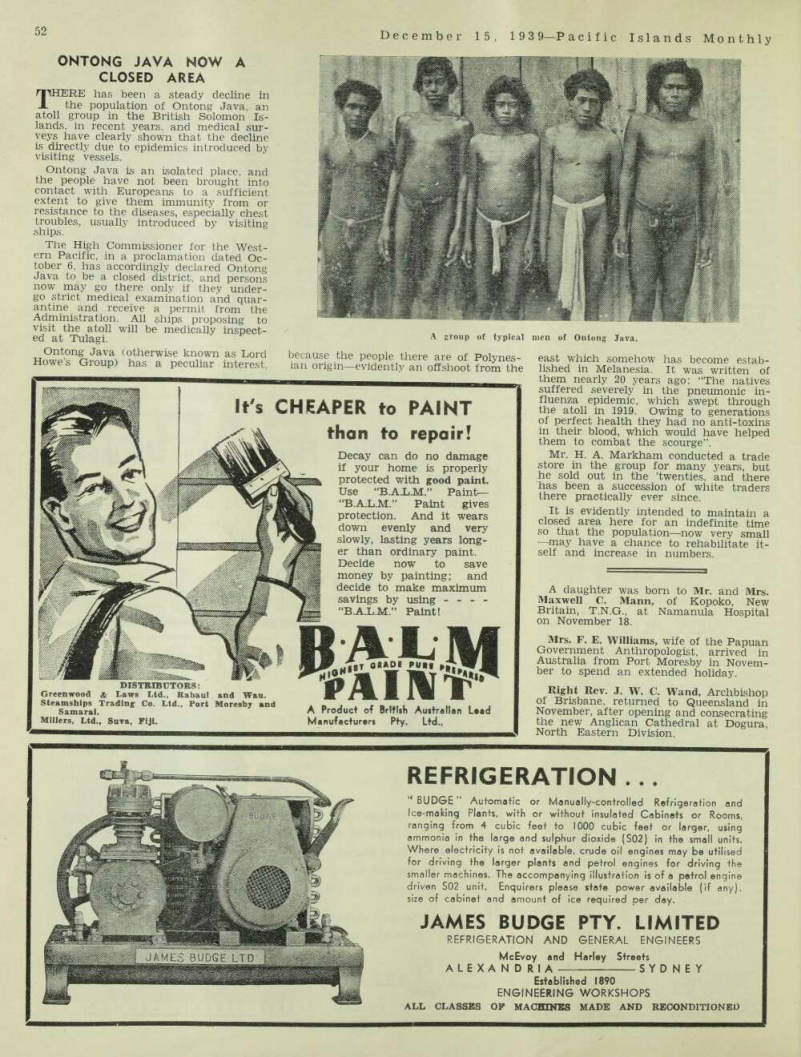
Closed Area
rERE has been a steady decline in the population of Ontong Java, an atoll group in the British Solomon Is lands, in recent years, and medical sur veys have clearly shown that the decline is directly due to epidemics introduced by visiting vessels.
Ontong Java is an isolated place, and the people have not been brought into contact with Europeans to a sufficient extent to give them immunity from or resistance to the diseases, especially chest troubles, usually introduced by visiting ships.
The High Commissioner for the West ern Pacific, in a proclamation dated Oc tober 6. has accordingly declared Ontong Java to be a closed district, and persons now may go there only if they under go strict medical examination and quar antine and receive a permit from the Administration. All ships proposing to visit the atoll will be medically inspect ed at Tulagi.
Ontong Java (otherwise known as Lord Howe's Group) has a peculiar interest,
because the people there are of Polynes ian origin—evidently an offshoot from the
east which somehow has become estab lished in Melanesia. It was written of them nearly 20 years ago: “The natives suffered severely in the pneumonic in fluenza epidemic, which swept through the atoll in 1919. Owing to generations of perfect health they had no anti-toxins in their blood, which would have helped them to combat the scourge”.
Mr. H. A. Markham conducted a trade store in the group for many years, but he sold out in the ’twenties, and there has been a succession of white traders there practically ever since.
It is evidently intended to maintain a closed area here for an indefinite time so that the population—now very small —may have a chance to rehabilitate it self and increase in numbers.
A daughter was born to Mr. and Mrs.
Maxwell C. Mann, of Kopoko, New Britain, T.N.G., at Namanula Hospital on November 18.
Mrs. F. E. Williams, wife of the Papuan Government Anthropologist, arrived in Australia from Port Moresby in Novem ber to spend an extended holiday.
Right Rev. J. W. C. Wand, Archbishop of Brisbane, returned to Queensland in November, after opening and consecrating the new Anglican Cathedral at Dogura, North Eastern Division.
A group of typical men of Ontong Java.
Advertisements & other items, p. 54 (1 item)
kuiutf
<r
It's CHEAPER to PAINT
than to repair!
Decay can do no damage if your home is properly protected with good paint.
Use “8.A.L.M.” Paint— “B.A.L.M.” Paint gives protection. And it wears down evenly and very slowly, lasting years longer than ordinary paint.
Decide now to save money by painting; and decide to make maximum savings by using - - - - “8.A.L.M.” Paint!
DISTRIBUTORS:
Greenwood & Laws Ltd., Rabaul and Wan.
Steamships Trading Co. Ltd., Port Moresby and Samarai.
Millers, Ltd., Suva, FIJI.
GRADE PU«|
kuiutf
5*16 A Product of British Australian Lead Manufacturers Pty. Ltd.,
SL mk m
JAMES BUDGE
LTD
REFRIGERATION ...
'* BUDGE" Automatic or Manually-controlled Refrigeration and Ice-maldng Plants, with or without insulated Cabinets or Rooms, ranging from 4 cubic feet to 1000 cubic feet or larger, using ammonia in the large and sulphur dioxide (SO2) in the small units.
Where electricity is not available, crude oil engines may be utilised for driving the larger plants and petrol engines for driving the smaller machines. The accompanying illustration is of a petrol engine driven SO2 unit. Enquirers please state power available (if any), size of cabinet and amount of ice required per day.
JAMES BUDGE PTY. LIMITED
REFRIGERATION AND GENERAL ENGINEERS
McEvoy and Harley Streets ALEXANDRIA S Y D N E Y Established 1890
ENGINEERING WORKSHOPS
ALL CLASSES OP MACHINES MADE AND RECONDITIONED
No Idyll on South Sea
Island!
Study o of Polynesian Economics
By “Anthropos”
WHEN I was working with him at Syd ney University in 1931, Raymond Firth, M.A., PhD., the boyish-featured young New Zealander, who was Acting Professor of Anthropology at the time, showed me a large steel trunk which oc cupied a corner of his study and said: “That’s my Tikopia stuff. Goodness knows when I'll get the time to write it up”.
The box was chock-full of field-notes gathered by Firth during his year’s so journ among the interesting Polynesian people of the lovely little island of Tiko pia, an outlier of the Solomons Protec torate. He had managed up to that time to do no more than publish, in such journals as “Oceania”, one or two articles on special aspects of Tikopian life, in cluding a description of the unique na tive dart-throwing competitions.
Next year saw Firth installed at Lon don University as assistant to Malinow ski in the Department of Social Anthrop ology, where, presumably, in spite of a very wide field of interests and the many calls upon his time for special lecture purposes, not to mention his marriage, and the secretarial duties of the Royal Anthropological Institute, with its exclu sive fellowship, he managed to sort out the contents of the iron box.
Two years ago saw the first of his proposed Tikopian trilogy launched, and well received, under the compelling title of “We, the Tikopia”. This large tome presented a picture of the Tikopian background and general culture on de tailed lines, such as have rarely been found in enthnographic studies of this type.
Firth’s early study interest was the field of economics. He had published a most detailed thesis, “Primitive Econo mics of the New Zealand Maori”, prior to his trip to Tikopia. This work broke new ground and caused a good deal of academic fluttering in its attitude to wards the conventional theories of pri mitive economic life.
It is not surprising, therefore, to find No. 2 of the Tikopia trilogy dealing with the economic side of the life of the peo ple. Published a few months ago under the title of “Primitive Polynesian Econ omy ”, the work, while embodying some material already published in various scientific periodicals, deals in great de tail with population and food, labour, technical processes and achievements, property, exchange values, and the social relationships involved in the economic organisation of the island: in short, the organisation of the life of a primitive homogenous people living on a small island remote from outside contacts and influences, from the economic viewpoint.
FIRTH himself early hits out at the old idea held by those whose conclusions were based on data apparently more imaginative than real: “The popular idyllic picture of the Golden Age primi tive man sitting beneath his tree and waiting for the fruit to fall before him is seen to find no place in a community where the struggle to wrest a livelihood from the environment is a very definite reality”.
In other words, as I think the average man who has observed primitive people closely in their everyday life would put
it, “Life’s not so simple for these folk as the romantic literature of travel makes out”.
Firth scotches, by implication, the idea that these primitive people are lazy. He scotches, too, the idea that they are com munists. They are, we know, communal ists, forming a unity of co-operating in dividuals, services and talents; but com munists in the sense of common owner ship and equality of property division they certainly are not.
In Tikopia, for instance, a chief draws income from his subjects in the form of food and material objects, they, receiving in return the right of his protection and
the advantages of attachment to his group.
There are recognised rates of exchange —lO locally-made, primitive but most ef fective, fish-hooks for one type of club, for instance. There is a regular system of labour division; there are expert tech niques in the making of nets, building of houses, and fashioning tools —from clam shells, in some cases. And all of these techniques must be acquired by diligent apprenticeship on an organised plan.
There are, however, no distinctive em ployer and employee classes. Each man makes his own contribution to the eco nomic welfare of the whole, getting and
giving, receiving and contributing. A man may be employer or boss (in his special field) to-day; and employee or worker under another boss to-morrow.
There is an element of equality about it all. And behind it all is the urge, the sheer life necessity, of keeping the whole thing going.
As Firth says: “There is no clash of interests between workers as a whole and employers as a whole”; and “there are no strikes of labour in Tikopia’’.
Can it be that, out of that iron box, with its valuable records of Tikopia, has come at last an outline of the ideal sys tem of living and working harmoniously and co-operating together for the com mon good, which surely all mankind to day is seeking?
There's only this difference —that Euro peans are not Tikopians. They’re more “civilised”!
Advertisements & other items, p. 55 (2 items)
53
Pacific Islands Monthl y—December 15, 1939
Ormois O 1 D
BITUMINOUS ROOFING
MADE IN 1, 2. 3 AND 5 PLY PROM HIGHEST GRADE RAW PELTS AND BEST QUALITY BITUMENS. FUME, ACID, AND CHEMICAL PROOF, IM- PERVIOUS TO SALT AIR AND WILL NOT AFFECT DRINKING WATER.
IDEALLY SUITED FOR TROPICAL CLIMATES
WEATHERPROOF AND WATERPROOF
SPECIFY AND USE ORMONOID
ROOFING FLOORING DAMPCOURSES
PAINTS COMPOUNDS SARKING FELTS
PLASTICS BUILDING PAPER ASBESTOS FELTS
MADE IN AUSTRALIA
PRICES, SAMPLES & PARTICULARS GIVEN ON REQUEST.
ORMONOID ROOFING & ASPHALTS LTD.
39 MENTMORE AVE., WATERLOO. SYDNEY, AUSTRALIA.
HONESTY FIDELITY
Safeguard your interests. Ensure their protection and security. Avail yourself of the advantages to be derived from the appointment of- this Company as your trustees, in preference to any one individual. Write to or call on any Branch of Burns, Philp & Company Limited, or Burns Philp (South Sea) Company, Limited, for the folder which fully explains these advantages.
Give careful consideration to the benefits to be gained by appointing as your Executors—
BURNS PHILP TRUST CO. LTD.
DIRECTORS
JAMES BURNS
ROBERT JOHN NOSWORTHY
LEWIS ARMSTRONG
JOSEPH MITCHELL
BURNS PHILP TRUST CO. LTD.
CAPITAL —£loo.ooo TT 7 BRIDGE STREET SYDNEY, N.S.W.
New Guinea Gold
Prom Our Own Correspondent WAU, Nov. 20.
THE surprisingly* small gold output of 22,267 ounces, valued at £A94,517, was declared for October. The reason is that shipping services have been irregular, and some large quantities of gold pro duced in October were not declared until November.
Mr. E. G. Theodore, managing direc tor of Emperor Gold Mining Co. Ltd., reached Melbourne from Fiji in Novem ber to attend the annual meeting of the company.
Superior Persons
In Tahiti
And Their Sad, Ignominious End
CENTRAL Polynesia is a most unpromis ing field for persons with a superior ity complex.
Occasionally, a man or woman afflicted with this malady comes to the Islands.
Old residents who have passed years of delightful good fellowship with Polynes ians never argue the matter with these august arrivals. Experience has taught us that the malady is incurable.
Well-born Polynesians—whose ancest ral line of high chiefs, valiant warriors and heroic explorers was ancient at the time the visitor’s first ancestor (rescued from the oblivion of a parish register by the visitor’s family genealogist! was born —never trouble to pay this type of in dividual the compliment of serious notice.
A general impression merely percolates through the communty that the new comer is a taata-huru-e (a strange, extra ordinary person) and to Polynesian eyes the space he or she occupies becomes a vacuum.
This bears fruit if the visitor (as he or she usually does) rents a villa in the country.
The adventure generally starts pro pitiously—the owner of the villa having put everything in proper order as to sup plies, domestic service and so forth. The initial domestic service is available be cause there prevails a natural curiosity to ascertain the full measure of the visitor’s Huru-e-ness.» But the time soon comes when this curiosity has been fully appeased and
suddenly, mysteriously, the investigators evaporate, and more appear to take their places.
If there is anything more infuriating, more devastating, to a person of superior complex than to be in the position where neither gold nor silver nor the import ance of his person will attract service of any kind, it is reserved for the re searches of some future sadist to dis cover.
Once, long ago, we timidly suggested that conformity with the gracious equal ity of Polynesian life might provide a re lief from trouble; but were rewarded only by a contemptuous intimation that we had gone native. Consequently, we have since contented ourselves with listening to loud harangues, full of bitterness and venom, and watching nature take her appointed course.
The end is invariably the same. The indignant sojourner shakes the dust of the Islands from his feet and betakes himself and his superiority complex to a more congenial land.
Perhaps it is better so, for his (or her) health and happiness. —“Mahaena”.
Mr. lan Maclean, whose dental surgery was destroyed in the recent Carpenter fire at Rabaul. returned to New Guinea in November after a quick visit to Aus tralia to purchase new equipment and supplies. He intends to resume his prac tice in Purter's Building at Rabaul.
Rev. W. G. Thomas, vicar of St.
Nicholas’s, Mordialloc, Victoria, returned to Melbourne in November after a two months’ visit to Nauru and Ocean Is land in the interests of the Australian Board of Missions.
Advertisements & other items, p. 56 (2 items)
54
December 15, 193 9—P acific Islands Monthly
A GRACE BROS’ catalogue
BRINGS THE BIGGEST STORE IN
AUSTRALIA TO YOUR DOOR
Let us put you on our Mailing List To all addresses on our list we send Free of Charge Six Catalogues a year, Including two Sale Books, when prices of all goods, except Proprietary articles, are marked at attractive reductions.
WRITE TO GRACE BROS. FOR EVERYTHING.
Prom our huge selection of merchandise we are practically able to meet your every requirement.
Should you not see exactly what you need in any of our Catalogues write in Just the same. If not in stock we will do our utmost to procure it for you.
When next in Sydney, call and inspect our extensive range of attractive merchandise.
CATALOGUES POST FREE ANYWHERE!
GRACE BROS. Pty. Ltd.
Broadway SYDNEY 'Phone: M 6506 m 50 % * 41
The Pioneering of Brother
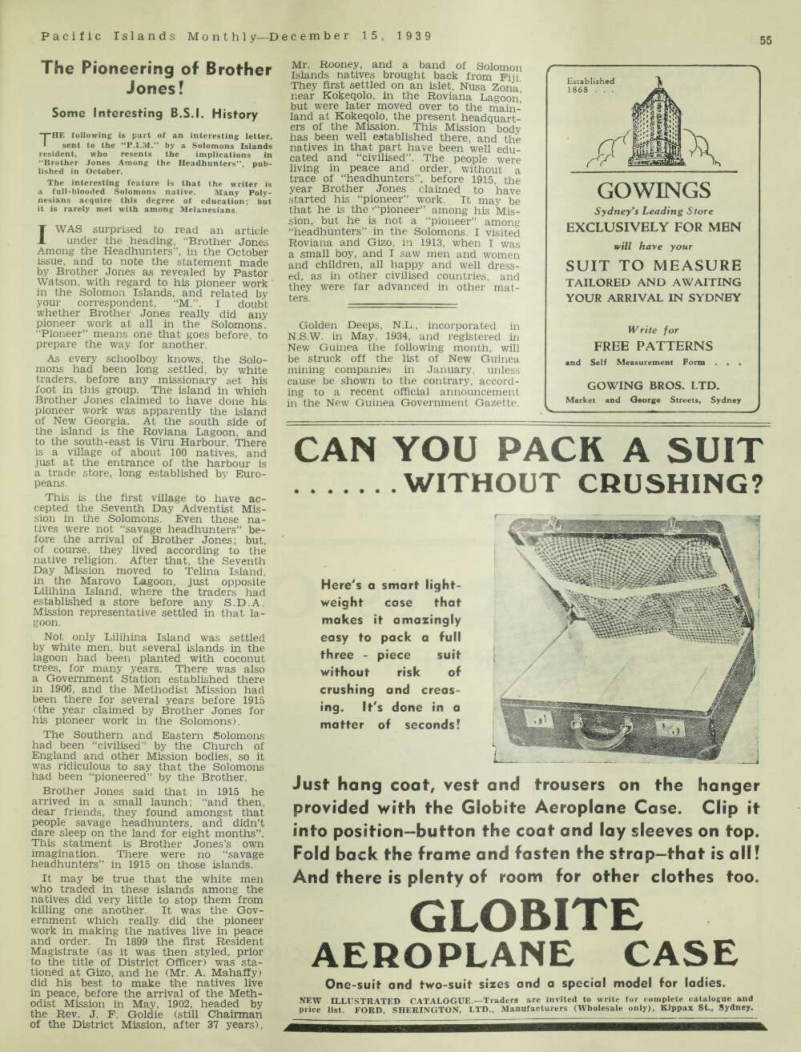
Jones!
Some Interesting 8.5.1. History
THE following is part of an interesting letter, sent to the “P.1.M,” by a Solomons Islands resident, who resents the implications in “Brother Jones Among the Headhunters’’, pub lished in October.
The interesting feature is that the writer is a full-blooded Solomons native. Many Poly nesians acquire this degree of education; but it is rarely met with among Melanesians.
IWAS surprised to read an article under the heading, “Brother Jones Among the Headhunters”, in the October issue, and to note the statement made by Brother Jones as revealed by Pastor Watson, with regard to his pioneer work in the Solomon Islands, and related by your correspondent, “M.”. I doubt whether Brother Jones really did any pioneer work at all in the Solomons.
"Pioneer” means one that goes before, to prepare the way for another.
As every schoolboy knows, the Solo mons had been long settled, by white traders, before any missionary ‘set his foot in this group. The island in which Brother Jones claimed to have done his pioneer work was apparently the island of New Georgia. At the south side of the island is the Roviana Lagoon, and to the south-east is Viru Harbour. There is a village of about 100 natives, and just at the entrance of the harbour is a trade store, long established by Euro peans.
This is the first village to have ac cepted the Seventh Day Adventist Mis sion in the Solomons. Even these na tives were not “savage headhunters” be fore the arrival of Brother Jones; but, of course, they lived according to the native religion. After that, the Seventh Day Mission moved to Telina Island, in the Marovo Lagoon, just opposite Lilihina Island, where the traders had established a store before any S.D.A.
Mission representative settled in that la goon.
Not only Lilihina Island was settled by white men, but several islands in the lagoon had been planted with coconut trees, for many years. There was also a Government Station established there in 1906, and the Methodist Mission had been there for several years before 1915 (the year claimed by Brother Jones for his pioneer work in the Solomons).
The Southern and Eastern Solomons had been “civilised” by the Church of England and other Mission bodies, so it was ridiculous to say that the Solomons had been “pioneered” by the Brother.
Brother Jones said that in 1915 he arrived in a small launch; “and then, dear friends, they found amongst that people savage headhunters, and didn’t dare sleep on the land for eight months”.
This statment is Brother Jones’s own imagination. There were no “savage headhunters” in 1915 on those islands.
It may be true that the white men who traded in these islands among the natives did very little to stop them from killing one another. It was the Gov ernment which really did the pioneer work in making the natives live in peace and order. In 1899 the first Resident Magistrate (as it was then styled, prior to the title of District Officer) was sta tioned at Gizo, and he (Mr. A. Mahaffy) did his best to make the natives live in peace, before the arrival of the Meth odist Mission in May, 1902, headed by the Rev. J. F. Goldie (still Chairman of the District Mission, after 37 years),
Mr. Rooney, and a band of Solomon Islands natives brought back from Fiji They first settled on an islet, Nusa Zona near Kokeqolo, in the Roviana Lagoon but were later moved over to the main land at Kokeqolo, the present headquart ers of the Mission. This Mission body has been well established there, and the natives in that part have been well edu cated and “civilised”. The people were living in peace and order, without a trace of “headhunters”, before 1915, the year Brother Jones claimed to have started his “pioneer” work. It may be that he is the ‘“pioneer” among his Mis sion, but he is not a “pioneer” among “headhunters” in the Solomons. I visited Roviana and Gizo, in 1913, when I was a small boy, and I saw men and women and children, all happy and well dress ed, as in other civilised countries, and they were far advanced in other mat ters.
Golden Deeps, N.L., incorporated in N.S.W. in May, 1934, and registered in New Guinea the following month, will be struck off the list of New Guinea mining companies in January, unless cause be shown to the contrary, accord ing to a recent official announcement in the New Guinea Government Gazette.
Advertisements & other items, p. 57 (2 items)
55
Pacific Islands Month! y—D ecember 15, 1939
Globite
Established 1868 cr
GOWINGS
Sydney’s Leading Store
EXCLUSIVELY FOR MEN
will have your
SUIT TO MEASURE
TAILORED AND AWAITING
YOUR ARRIVAL IN SYDNEY
Write for
FREE PATTERNS
and Self Measurement Form . . .
COWING BROS. LTD.
Market and George Streets, Sydney
CAN YOU PACK A SUIT
WITHOUT CRUSHING?
Here's o smart lightweight cose that makes it amazingly easy to pack a full three - piece suit without risk of crushing and creasing. It's done in a matter of seconds! \ Just hang coat, vest and trousers on the hanger provided with the Globite Aeroplane Case. Clip it into position-button the coat and lay sleeves on top.
Fold bock the frame and fasten the strop-thot is all!
And there is plenty of room for other clothes too.
GLOBITE
AEROPLANE CASE
One-suit and two-suit sizes and a special model for ladies.
NEW ILLUSTRATED CATALOGUE. —Traders are invited to write for complete catalogue and price list. FORD, SHERINGTON, LTD., Manufacturers (Wholesale only), Kippax St., Sydney.
Tuberculosis In
Polynesia
Australian Writer Reports Bad Conditions
AN appeal for improved health services in Tonga and Rarotonga was made by Mrs. E. Marie Irvine, Australian au thoress, when speaking of her recent visit to those islands, at the Pacific Islands Club in Sydney.
Mrs. Irvine said that when Queen Salote recently called for recruits in Tonga, no fewer than 75 per cent, of those offering were found to be suffering from tuberculosis. The disease was rife throughout the islands. “There might be some excuse in Tonga”, continued the speaker, “as that kingdom has only a small budget, but I contend that New Zealand has absolutely fallen down on her job in Rarotonga, where there is not even a sanatorium for the treatment of sufferers”.
While Mrs. Irvine paid a tribute to the excellent work of Dr. E. P. Ellison, medical superintendent at Rarotonga, she said that his efforts were handicapped there because of no sanatorium. “It is absolutely tragic”, she said. “New Zea land can find money for a road there, and for jobs for her own young men, but she cannot afford £5,000 for such an institution”. A campaign should be in stituted, she insisted, to save the lives of young people in both groups, and, if necessary, an appeal should be made to the League of Nations. “If the money cannot be obtained elsewhere, why not appeal to the Rockefeller Foundation?” she added.
Mrs. Irvine said that native patients should not be expected to feed them selves in hospital. The correct foods should be supplied to them.
Mrs. Irvine spoke most warmly of the hospitality she had received in both places, and praised the interest Queen Salote took in the welfare of her people.
“The Queen is a magnificent woman, both mentally and physically”, she de clared, “and I was most impressed by the respect in which she is held by the Tongans”.
A Problem In Fiji
British Law v. Koran Law A Problem In Fiji
BECAUSE certain of the laws relating to inheritance, guardianship, mar riage and divorce, which are part of the laws of the British Colony of Fiji, are not “sanctioned by the Koran”, the Mos lem section of the Indians now resident in Fiji are making a strong appeal to the present Governor for a re-considera tion of their case.
It appears that the Fiji Moslems have appealed in the past to two Governors, Sir Murchison Fletcher and Sir Arthur Richards, asking that, in the matters referred to, they should be governed by their personal laws as set out in the Koran: and they claim that each of the two Governors named gave them an as surance that their wishes would be respected. They state, however, that the present Governor, Sir Harry Luke, has refused to deal further with the matter, and they understand that the present British laws applying to them must stand.
This is typical of the troubles which beset the Governor of a three-community Colony.
The Europeans and Fijians are quite content to live under British colonial law, which is broad enough and liberal enough to provide for almost anything.
But the Indians, while demanding all the freedom and political privileges of British colonial life, ask, in addition, for special treatment on account of then religion. That is, they are asking for something that is not even given to European religions. The attitude of the Government, apparently, is that the Mos lems should place themselves in the same position as the Roman Catholics for ex ample—they should adapt their commu nity laws to the broad general laws under which they live, and not expect the broad general laws to be adapted to the special needs of their community.
N.G. Aerial Transport
Glasson and Parer Carry On
MR. Ray Parer left Wau, in November, to bring another aeroplane from Australia for the Glasson-Parer Syn dicate.
It will be remembered that Mr. Parer, on behalf of the Syndicate, began freight ing, between Wau and Salamaua, in August last, with a couple of planes brought from Australia. Within a few weeks, two of their planes crashed in the jungle, in bad weather, between Wau and Salamaua, and were completely lost.
Mr. R. N. Wayne, Interpreter at the Supreme Court, Rabaul, returned to New Guinea in mid-November after spending leave in Australia.
Advertisements & other items, p. 58 (2 items)
56
December 15, 193 9—P acific Islands Monthly
St. Ignatius’ College
Riyerview Sydney
Boys are prepared for Intermediate and Leaving Certificate Examinations and for Exhibitions, Scholarships and Bursaries at the University.
Boys are arranged in three Divisions according to age. Each Division has its own Library, Debating Society, Cricket and Football fields, and Tennis Courts.
Senior and Junior Rowing Sheds, with a large fleet of pleasure and racing boats.
P ri v a t e Swimming Baths.
Prospectus and further particulars on application to the — Rector: St. Ignatius’
College Riverview Sydney Tel.: JA 1106.
ONE OF SYDNEY'S GREAT PUBLIC SCHOOLS
BOARDING AND DAY SCHOOL
CONDUCTED BY THE JESUIT FATHERS
Islands Travellers
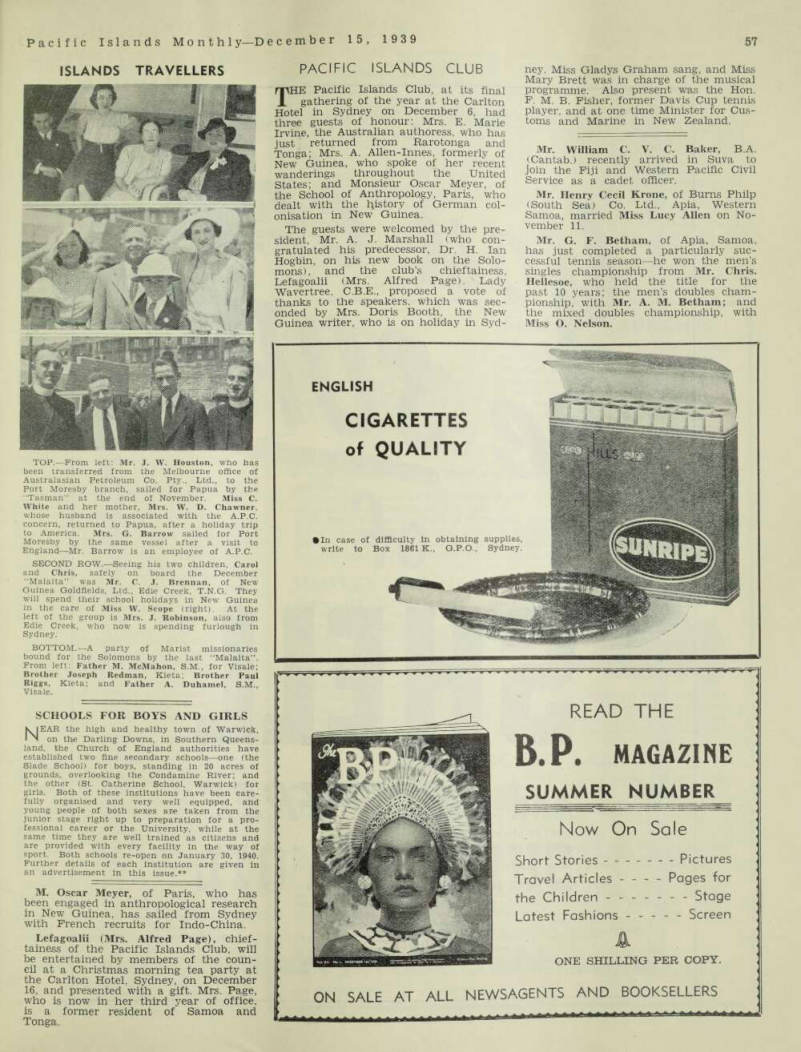
TOP.—From left: Mr. J. W. Houston, who has been transferred from the Melbourne office of Australasian Petroleum Co. Pty., Ltd., to the Port Moresby branch, sailed for Papua by the “Tasman” at the end of November. Miss C.
White and her mother, Mrs. W. D. Chawner, whose husband is associated with the A.P.C. concern, returned to Papua, after a holiday trip to America. Mrs. G. Barrow sailed for Port Moresby by the same vessel after a visit to England—Mr. Barrow is an employee of A.P.C.
SECOND ROW. —Seeing his two children, Carol and Chris, safely on board the December “Malaita” was Mr. C. J. Brennan, of New Guinea Goldfields, Ltd., Edie Creek, T.N.G. They will spend their school holidays in New Guinea in the care of Miss W. Scope (right). At the left of the group is Mrs. J. Robinson, also from Edie Creek, who now is spending furlough in Sydney.
BOTTOM.—A party of Marist missionaries bound for the Solomons by the last “Malaita”.
From left: Father M. McMahon, S.M., for Visale; Brother Joseph Redman, Kieta; Brother Paul Riggs, Kieta; and Father A. Duhamel, S.M., Visale.
Tonga.
Schools For Boys And Girls
NEAR the high and healthy town of Warwick, on the Darling Downs, in Southern Queens land, the Church of England authorities have established two fine secondary schools—one (the Slade School) for boys, standing in 20 acres of grounds, overlooking the Condamine River; and the other (St. Catherine School, Warwick) for girls. Both of these institutions have been care fully organised and very well equipped, and young people of both sexes are taken from the junior stage right up to preparation for a pro fessional career or the University, while at the same time they are well trained as citizens and are provided with every facility in the way of sport. Both schools re-open on January 30, 1940.
Further details of each institution are given in an advertisement in this issue.** M. Oscar Meyer, of Paris, who has been engaged in anthropological research in New Guinea, has sailed from Sydney with French recruits for Indo-China.
Lefagoalii (Mrs. Alfred Page), chief tainess of the Pacific Islands Club, will be entertained by members of the coun cil at a Christmas morning tea party at the Carlton Hotel, Sydney, on December 16, and presented with a gift. Mrs. Page, who is now in her third year of office, is a former resident of Samoa and
Tonga.
Pacific Islands Club
THE Pacific Islands Club, at its final gathering of the year at the Carlton Hotel in Sydney on December 6, had three guests of honour: Mrs. E. Marie Irvine, the Australian authoress, who has just returned from Rarotonga and Tonga: Mrs. A. Allen-Innes, formerly of New Guinea, who spoke of her recent wanderings throughout the United States; and Monsieur Oscar Meyer, of the School of Anthropology, Paris, who dealt with the history of German col onisation in New Guinea.
The guests were welcomed by the pre sident, Mr. A. J. Marshall (who con gratulated his predecessor, Dr. H. lan Hogbin, on his new book on the Solo mons), and the club’s chieftainess, Lefagoalii (Mrs. Alfred Page). Lady Wavertree, C.8.E., proposed a vote of thanks to the speakers, which was sec onded by Mrs. Doris Booth, the New Guinea writer, who is on holiday in Syd
ney. Miss Gladys Graham sang, and Miss Mary Brett was in charge of the musical programme. Also present was the Hon.
F. M. B. Fisher, former Davis Cup tennis player, and at one time Minister for Cus toms and Marine in New Zealand.
Mr. William C. V. C. Baker, B.A. (Cantab.) recently arrived in Suva to join the Fiji and Western Pacific Civil Service as a cadet officer.
Mr. Henry Cecil Krone, of Burns Philp (South Sea) Co. Ltd., Apia, Western Samoa, married Miss Lucy Allen on No vember 11.
Mr. G. F. Betham, of Apia, Samoa, has just completed a particularly suc cessful tennis season —he won the men’s singles championship from Mr. Chris.
Hellesoe, who held the title for the past 10 years; the men’s doubles cham pionship, with Mr. A. M. Betham; and the mixed doubles championship, with Miss O. Nelson.
Advertisements & other items, pp. 59-60 (3 items)
57
Pacific Islands Monthl y—D ecember 15, 1939
B.P. Magazine
ENGLISH
CIGARETTES
of QUALITY
®ln case of difficulty In obtaining write to Box 1861 K.. G.P.0., supplies, Sydney.
* s. a > m <■ **
READ THE
B.P. MAGAZINE
SUMMER NUMBER
Now On Sale
Short Stories Pictures Travel Articles Pages for the Children --- Stage Latest Fashions Screen A
ONE SHILLING PER COPY.
ON SALE AT ALL NEWSAGENTS AND BOOKSELLERS
y fsy*a: ..M IS II
■I ■' V .V
«8f m M Mk ■V- 1 ' ■B m M Wf i»£ 'M ss? *»s ■f.r-i W: m U > v :s Mi :;p |l: S$ VYr- ..^...,., r ,... fc ,-. wmmm * ‘/ * ** • * .*' '—. p‘ >{ x I ‘ * >.s
and DRAG-FREE
SHELL MOTOR OIL
THE SHELL COMPANY OF AUSTRALIA LIMITED (Incorporated in Great Britain) arifi mi m mm i £s fi?;f «£•**> f® 1 tiCF m W SV4 Sm m w fevU p ip VAv'.tv &$» p jV v » frsf P |®f f'“i't it Pr- M :** * i a
JJWS.’
fisS
,$r Jti' #v If •fis ,i£p/,-3 te MiV rtjiSiSv S'' *- '.vp. 05.39 4
December 15, 19 3 9—P aci f i c Islands Monthly
Shipments Of
Copra
Serious Difficulties in Central Pacific
THE following statement about the copra market was issued in Suva, Fiji, on November 16, with the approval of Messrs. Burns Philp (S.S.) Co. Ltd. and Messrs. Morris Hedstrom Ltd.: During September, 1939, the local copra market remained unchanged be cause no prices were quoted from Lon don and it was understood that the Brit ish Government intended to exercise control over the selling of copra in the United Kingdom.
On September 29, advice was received that Burns, Philp and Co. Ltd. and Dalgety and Co. Ltd. had been appoint ed by the Copra Association to protect the interests of all South Sea shippers, and it was hoped shortly to get a price ruling from the Ministry of Food.
On September 30, advice was received that the Ministry had fixed the price of South Seas Copra as follows; F.M.S. £l2 per ton; plantation £l2/15/- per ton.
On that basis the buying prices in Suva and Levuka were fixed at: F.M.S. £7/2/6 per ton; plantation £7/7/6 per ton.
On October 13, advices were received from London that buying prices had been reduced by 7/6 per ton and the local market was, therefore, fixed at: F.M.S. £6/15/-; plantation £7.
On the same date, Burns, Philp and Co. Ltd., Sydney, cabled to their London office as follows: “Copra industry unable carry additional war costs affecting es sential supplies, freights and generally higher cost production. Many small trad ers and planters insolvent or abandoned properties. Lost all hope. Also natives discouraged from production. On behalf of producers we ask you protest to Min istry reduction 7/6 per ton buying prices’. They also arranged with Dal gety and Co. Ltd. to cable to their prin cipals in London in a similar manner.
On October 16. Burns, Philp and Co.
Ltd., Sydney, received the following cable from their London office: “Yours 13th Dalgety ourselves protested Ministry who state no intention their part force prices down. Reduction 7/6 occasioned by nor mal offerings Straits at reduced price.
Our opinion reduction only temporary’’.
Mr. R. W. Robson, managing director of Pacific Publications Ltd., Sydney, and editor of “Pacific Islands Monthly”, took an active interest in the matter and con sulted the companies in Sydney princip ally interested in the copra business. He then telegraphed to the Department of Commerce in Canberra urging in strong terms “that if the South Seas planters were to carry the higher war costs and be saved from bankruptcy, the Austra lian High Commissioner should be asked to make representations to the British Government that the price of copra should be fixed at a higher rather than lower level”.
Almost a month has elapsed since these representations were made and so far no information has been received as to restoration of the original price.
Meanwhile, shippers realised that in creases in rates of freight were likely to have a more serious effect on prices than a reduction of 7/6 per ton in the London buying price of copra.
On September 22, the Swedish steamer “Tolken” arrived under charter to Morris, Hedstrom Ltd. and Burns
Philp (S.SJ Co. Ltd. She finished loading copra m Suva on September 27, in Levuka on September 29, and in Savu Savu on October 2; by that time she had loaded 2,500 tons. On October 4 advices
ownerfofthe “W'WreS ad®
“ ? o e^l\rcLSe?? k reS-
disagree Consult'wiunsS* IT
cognise difficult circumstances and prepared consider modest adjustment when probable legal position known”.
On October 20, a cable was received from London stating that counsel in London were of the opinion that the owners were not entitled to demand extra freight for carrying the copra to Liverpool and Hull but that they were entitled to refuse to go to ports within
the war zone. The cable went on to say that the owners demanded addi tional freight of 27/6 per ton —or, al ternatively, the proved extra cost in volved by war conditions.
Charterers were advised that as a re
“tT accept "g^SSSIoSS
-rdeS h a™^
charge ata oort wkhin the war zone and g CO uld hi P the Exercise of their dk
dk^the 6 ™ at'
Port and claim their full freight. Finally, the charterers agreed to pay an extra 20 - per ton on something over 5,000 tons of cargo.
Whilst this discussion was going on charterers received from Australia ad vices indicating that Australian copra
shippers had been compelled to agree to increases in freight on a somewhat simi lar basis to that enforced by the owners of the “Tolken”.
On October 19, charterers wrote to the Acting Colonial Secretary, Fiji, placed the facts before him and explain ed that if another vessel were chartered to load for the United Kingdom at the increased rate of freight local buyers
would be compelled to reduce their buy ing price of copra. The 20/- increased freight rate is in English currency and is equivalent to about 22/4 Fiji cur rency. A reduction of this amount would bring the buying price in Suva and Le vuka down to about £5/12/6 per ton for
F.M.S.
On October 27, Sir Maynard Hedstrom and Hon. John Trotter had an interview with the Governor, at which were also present the Acting Colonial Secretary and the Director of Agriculture. The Governor gave Sir Maynard Hedstrom and Mr. Trotter a sympathetic hearing and the same day despatched a cable to the Secretary of State for the Colonies.
Under the arrangement whereby the British Government agreed to purchase the surplus sugar crop from Australian growers the price was fixed at a higher rate than that ruling prior to the war.
One clause in the agreement provided that the British Government would bear the cost of any increase in freight above the rate ruling at the time the contract was signed. Sir Maynard Hedstrom and Mr. Trotter suggested to His Excellency that if the British Ministry of Food would not agree to an increase in the buying price of copra in London it might agree to bear the cost of any increase in rates of freight above those ruling prior to the outbreak of war.
The two companies have recently chartered the “Admiral Wiley”, for January February loading. She is ex pected to carry about 3,000 tons of copra and will, therefore, do something to re lieve accumulations. The Mexican mar ket is somewhat uncertain and, prior to the war, its consumption of copra was very limited. Owing to the war, condi tions may have changed but local buy ers at present have no certain know ledge as to what quantity that market can now absorb.
Prospects in the local market are somewhat obscure, but the two com panies are hopeful that in the near future they will secure another vessel to load, either for the United Kingdom or Mexico.
This statement is published to make it clear to producers that local buyers are making every effort to assure con tinuity of shipment from the three groups—Fiji, Tonga and Samoa.
Advertisements & other items, pp. 61-62 (1 item)
W. Kopsen I£R Co. Pty. Ltd.
SIMPLEX LAUNCHES
HERE THEY ARE! The finest, most complete, safest and most powerful Motoi Launches, of their size, made in Australia.
Simplex Launches are the accomplished result of several years experiment to find a boat really suitable for All Conditions. and now, in a variety of designs, we offer these boats at a price every pocket can reach.
Made in 12, 14, 16 or 18 ft. sizes, with Simplex 3 H P. 2 cycle or 5 HP. Marine Engines. Solidly built of Kauri and Spotted Gum, with Copper Rivets all through.
Simplex Launches seat 6 comfortably and run for 5 hours on 1 gallon petrol.
Open or Cabin Models in any size. 14 ft. Open Launch, with 3 HP. Engine, £65 Complete.
Let us show you exactly what your boat will cost delivered to your nearest port. Free advice, particulars and Catalogue sent on request. Just tear out this page and place your name and address on the margin.
SIMPLEX MARINE ENGINES
Quality Australian-made units, complete with built-in Reserve Gear. Illustrated is the modern 5 HP. 4 cycle Engine which is suitable for all boats up to 22ft. Exclusive features are:— (1) English Magneto with impulse starter. (2) Force feed lubrication. (3) Positive drive water and oil pumps (4) S.K.F. Roller Bearings.
This unit drives a 13 in. propeller at 1100 R.P.M. Built for hard work, yet with an economy of 3 hours to 1 gallon petrol. Easy to install, easy to operate and maintain, and an engine with many many years of trouble-free service before it. PRICE: £52/10/-. Ask for Simplex Marine Engine Catalogue.
TILLEY KEROSENE LAMPS
Tilley English-made Lamps now available in a variety of modern designs. Recently added is a beautiful Floor Standard Lamp, standing 6 ft. 6 in. high, made of polished Coachwood with an attractive parchment and velvet shade of various colours. Also Oak Stand Table Lamps, Art Pottery Vase Lamp. Bedroom Lamp and Wall Lamps. We shall be pleased to send you the latest Tilley Lamp Catalogue, illustrating all models.
SHIPCHANDLERY
We have recently amalgamated with the well-known firm of Boat Supplies Ltd., and now have the Largest Stocks of boat gear in Australia. All Bronze and Brass fittings are made in our own workshops. Everything for the rowboat, yacht, powerboat or trading schooner.
Anchors, rowlocks, blocks, shackles, thimbles, wire rope, rigging screws, ports, vents, boat lavatories, searchlights, boat horns, steering gear, rigging fittings, navigation lamps, cabin lamps, yacht stoves, steering wheels, winches, etc. Boatbullders’ requirements of every description. Copper nails, screws and copper rod. Brass washers.
Muntz metal sheathing, felt and oakum. Jeffreys marine glues and seamflex. Marine paints and oils. Comprehensive boat gear catalogue sent on request.
W. KOPSEN i£r CO. PTY. LTD.
378 KENT STREET, SYDNEY. Cables: “Kopsen”, Sydney.
No Light can steal its Flavor. r%4l
E RIBBON
blue In case of difficulty in obtaining supplies, write to Box 1861 K., G.P.0., Sydney.
Quinine
Japanese To Produce
From Our Own Correspondent
Honolulu, Nov. 14.
BY degrees, Holland’s virtual monopoly of world quinine production is being threatened. Experiments are well ad vanced in Australian New Guinea: and, now, Japanese interests have secured a concession from the Ecuadorian Govern ment (South America) for the planting of 20,000 cinchona trees (from the bark of which quinine is made).
The trees will be planted in 500 acres of unoccupied Government land. Stock is being imported direct from Japan.
A concession stipulation says that the Japanese must establish a laboratory and other facilities for the production in Ecuador of the quinine and other chemi cal by-products.
Wau (New Guinea) has joined in the Empire-wide Red Cross movement, and a local branch is in full swing, with Dr.
N. McKenna, lecturer; Mr. R. A. Laws, supervisor; Mrs. D. Wetherall, secretary; and Mrs. F. S. Stewart and Major E. B.
Ayris, committee. ,
Advertisements & other items, p. 62 (1 item)
Newlands Brothers Pty. Ltd.
The new range of Newlands modern steel furniture includes designs ideal for indoor and outdoor use in the tropics.
Newlands extend a cordial invitation to you on your next visit to Sydney to see their new showrooms where is exhibited a complete selection of steel furniture offering distinctive groupings and suites in actual home settings, in addition to individual pieces for every type of service.
FOR STEEL FURNITURE AND MODERN SLEEPING EQUIPMENT.
NEWLANDS BROTHERS Pty. Ltd.
Riley and Albion Streets, Sydney, N.S.W.
Write to-day for a catalogue illustrating the full range of this delightful furniture.
It will be forwarded promptly.
Native Races
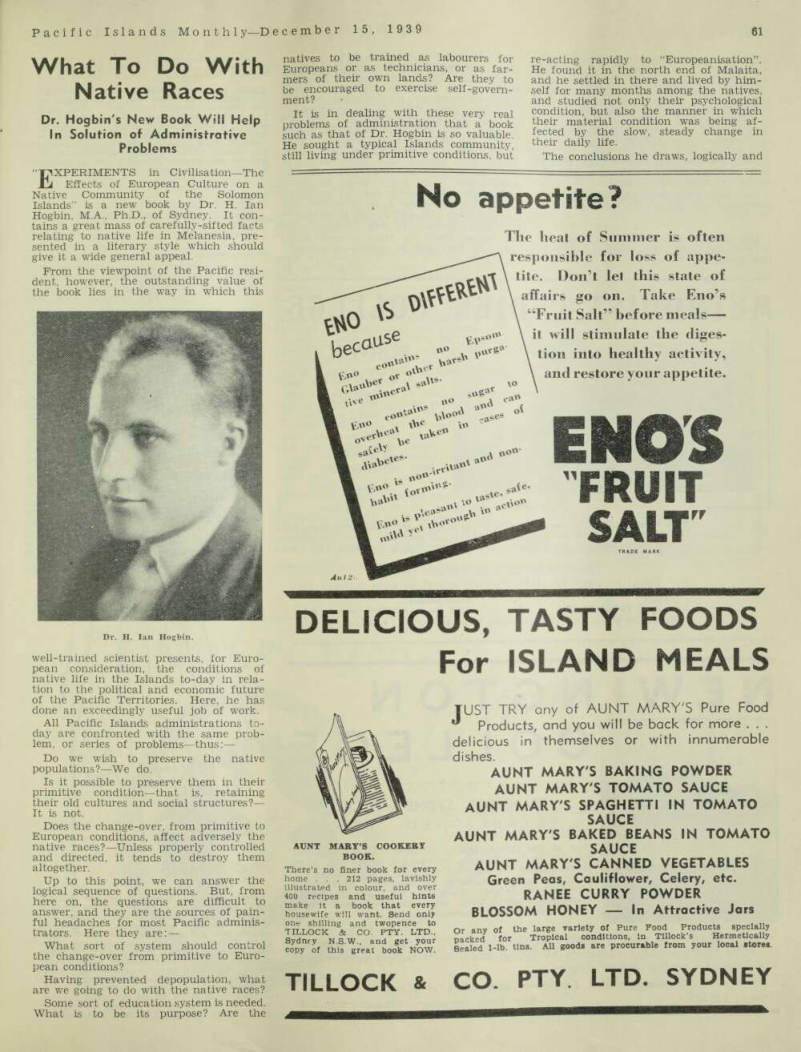
What To Do With
Dr. Hogbin's New Book Will Help In Solution of Administrative Problems
Experiments in civilisation—The Effects of European Culture on a Native Community of the Solomon Islands” is a new book by Dr. H. lan Hogbin. M.A., Ph.D., of Sydney. It con tains a great mass of carefully-sifted facts relating to native life in Melanesia, pre sented in a literary style which should give it a wide general appeal.
From the viewpoint of the Pacific resi dent, however, the outstanding value of the book lies in the way in which this
well-trained scientist presents, for Euro pean consideration, the conditions of native life in the Islands to-day in rela tion to the political and economic future of the Pacific Territories. Here, he has done an exceedingly useful job of work.
All Pacific Islands administrations to day are confronted with the same prob lem, or series of problems—thus:— Do we wish to preserve the native populations?—We do.
Is it possible to preserve them in their primitive condition —that is, retaining their old cultures and social structures?— It is not.
Does the change-over, from primitive to European conditions, affect adversely the native races? —Unless properly controlled and directed, it tends to destroy them altogether.
Up to this point, we can answer the logical sequence of questions. But, from here on, the questions are difficult to answer, and they are the sources of pain ful headaches for most Pacific adminis trators. Here they are: What sort of system should control the change-over from primitive to Euro pean conditions?
Having prevented depopulation, what are we going to do with the native races?
Some sort of education system is needed.
What is to be its purpose? Are the
natives to be trained as labourers for Europeans or as technicians, or as farmers of their own lands? Are they to be encouraged to exercise self-govemment? • It is in dealing with these very real problems of administration that a book such as that of Dr. Hogbin is so valuable.
He sought a typical Islands community, still living under primitive conditions, but
re-acting rapidly to “Europeanisation”.
He found it in the north end of Malaita, and he settled in there and lived by him self for many months among the natives, and studied not only their psychological condition, but also the manner in which their material condition was being af fected by the slow, steady change in their daily life.
The conclusions he draws, logically and
Dr. H. lan Hogbin.
inevitably, are of interest to anyone who may speculate concerning the future of the Pacific races, and unquestionably they are of value to Pacific adminis trators. The book, of course, has its scientific interest also —Dr. Hogbin is an anthropologist of distinction, and learned the work of observation, deduction and connotation under famous masters. That but adds to the practical value of his book—a knowledge of anthropology is now part of the standard equipment of most Pacific administrative officials.
Our copy from the publishers—George Routledge and Sons, Ltd., London. Price 15/- Stg.
Mr. W. V. C. Compton recently arrived in England from New Guinea to join the Royal Air Force.
Rt. Rev. W. H. Baddeley, Bishop of Melanesia, visited New Britain in No vember and, after a short stay in Rabaul. inspected the Mission’s outstations. He Jater returned in the Mission vessel, Southern Cross VII.”, to his headquart e. Solomon Islands. Bishop Baddeley will arrive in Australia from Tulagi by the January “Malaita”. ac companied by Mrs. Baddeley and their infant son. Martin, and after a short visit to Sydney will proceed to South Australia to spend a few weeks in Ade laide. He will leave Sydney at the end of January for New Zealand to attend the Mission’s General Synod in Nelson.
Rev. Baddeley was in New Zealand last September, when the Mission vessel was taken to Auckland to undergo a special survey.
Advertisements & other items, pp. 63-64 (2 items)
61
Pacific Islands Monthl y—D ecember 15, 1939
Enos
No appetite?
\s
au^ e
ia*> ur va'"
Va»* lW v ov W‘ v C> u e* a uS ar iaa'* 1 i-a"
VA© U' a'' \"v\' c lA« Vic»' V.e" \C' b« t\o'' V>e' e a»> \A V l\'» xtt** 1\0"
A'" lAi' feVe*, Va'' Va» \ao" a‘ a** iVaoV° V>° va >AA'
The heat of Summer is often
responsible for loss of appe-
tite. Don’t let this state of
Fairs go on. Take Eno’s
Fruit Salt” before meals—
t will stimulate the dige
tion into healthy activity,
and restore your appetite
ENOS
■FRUIT
salt!
IT ff
TRADE MARK
DELICIOUS, TASTY FOODS
For ISLAND MEALS
AUNT MARY’S COOKERY
BOOK.
There’s no finer book for every home . . . 212 pages, lavishly illustrated in colour, and over 400 recipes and useful hints make it a book that every housewife will want. Send only one shilling and twopence to
TILLOCK & CO. PTY. LTD.,
Sydney N.S.W., and get your copy of this great book NOW.
TUST TRY any of AUNT MARY'S Pure Food Products, and you will be back for more . . . delicious in themselves or with innumerable dishes.
AUNT MARY'S BAKING POWDER
AUNT MARY'S TOMATO SAUCE
AUNT MARY'S SPAGHETTI IN TOMATO
SAUCE
AUNT MARY'S BAKED BEANS IN TOMATO
SAUCE
AUNT MARY'S CANNED VEGETABLES
Green Peas, Cauliflower, Celery, etc.
RANEE CURRY POWDER
BLOSSOM HONEY In Attractive Jars Or any of the large variety of Pure Food Products specially nacked for Tropical conditions, in Tlllock’s Hermetically Sealed 1-lb tins. All goods are procurable from your local stores.
TILLOCK & CO. PTY LTD. SYDNEY
METHODIST LADIES’ COLLEGE
BURWOOD,
SYDNEY,
(N.S.W.)
A School of
Distinction.
FOUNDED 1886.
BOARDING AND DAY,
This School Offers:—(l) A progressive education from Kindergarten to University. <b) Home-Like conditions for Boarders. (c) Complete commercial course. (d> Cultural year without Public Examinations for Senior Girls.
Every Home Care for Oversea Girls.
New Term; February 6th. 1940. Personal interviews after January 31st.
Principal:
REV. H C. FOREMAN, M.A
MODERATE FEES—PROSPECTUS FROM
Headmistress:
MISS M. H. SUTTON. M.8.E.. B.A,
THE PRINCIPAL. Telephone: UJ 4166.
NEWINGTON
COLLEGE
STANMORE, SYDNEY, N.S.W.
ESTABLISHED 1863
One of the Great Public Schools of N.S.W For Parents in the Islands, Newington offers the ideal Home School for Boys of all Ages. It is ideal for situation and possesses unexampled recreational facilities in its own grounds. Its domestic equipment is complete and takes care of boys from Preparatory School to University.
Wyvern House the most modern Preparatory School in Australia (opened in 1938) offers home comforts to young boys, with fullest opportunity for entrance to the senior classes.
Headmaster: P. R. Le Couteur, M.A. (Melb. et Oxon.) ’Phone; LM 5355, New Term commences February 6th, 1940.
Pattern Service
EACH month we publish a Fashions design. patterns of which may be purchased by our readers direct from this office. post free. To obtain a pattern, print your name and address below, giving the number of the pattern and the bust size, and send to ‘Pattern Department”, Pacific Islands Monthly, Box 3408 R, G.P.0., Sydney; enclose also the price of the pattern in postal note or stamps It will be sent by return mail.
Name Address Pattern Number size
6698.—The present vogue for the new washable elastic, gathering thread is seen in this youthful style for formal afternoon wear. Shirring is cleverly designed to produce the extended shoulder line and contributes in no small degree to the flattering treatment of the bodice. The frock is finished with a skirt which flares widely from the hips. If your material be a summer silk the full length sleeve is smarter; if a wash ing material, use the three-quarter length sleeve finishing below the elbow. The pattern is available in 32, 34, 36, 38 and 40 in. bust measure ments, at 1/1, post free. Material required for 36 in. bust is four yards of 36 in. material.
Fashion Hints for Islands Women
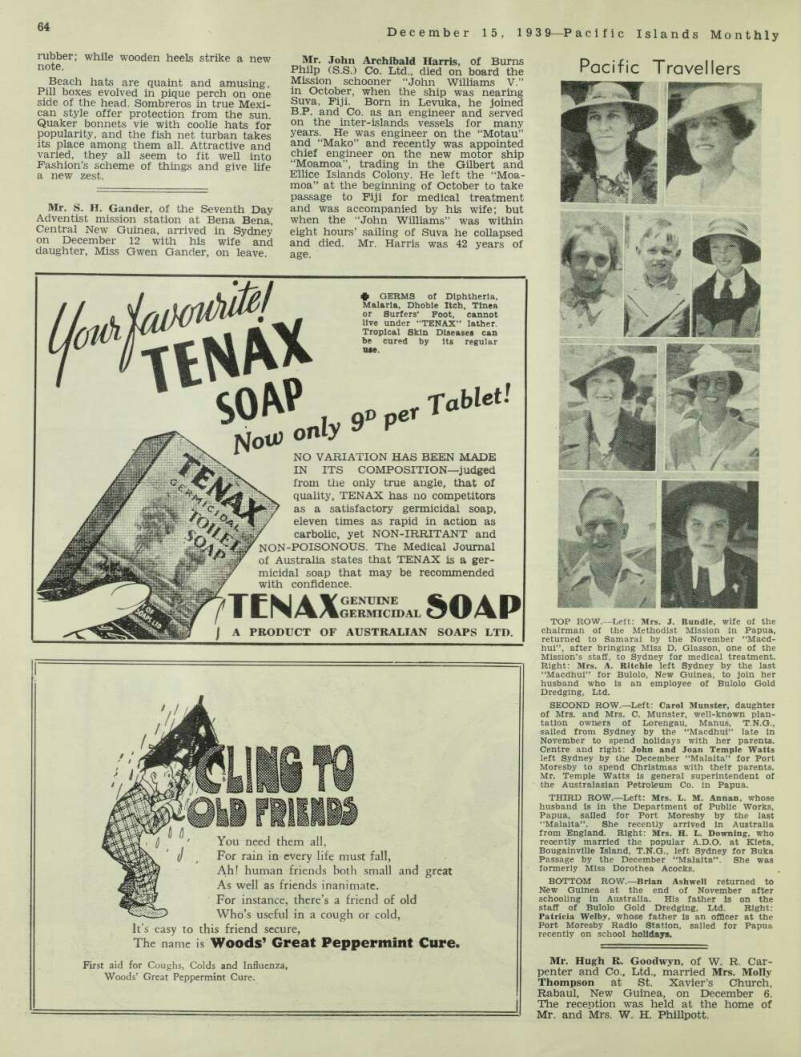
By "Therese"
CONTRASTS running through Fashion’s sports, formal and beach set-ups are apt to make one dizzy with their brilliance. Two things remain clear, how ever, cottons are trumps; and colour and line are important—on them rest the success or failure of your whole ward robe.
Formal afternoon frocks are beauti fully cut on simple lines with here and there a feminine touch, and their very simplicity ensures success. Colours run the whole gamut of pastel shades both for day and evening. Navy is worn with white accessories or with that lovely corn colour that is particularly in demand this season and which not only looks but feels cool.
Frocks are mostly still zipped up with plastic lightning fasteners, though enor mous leather hooks frequently are being worn down a simple hand knit dress.
Trimmings these days are usually part of the dress. Buttons are endlessly amusing and in some instances are the high spots of simple dark clothes. De tail is decorative button may be as telling as the dress which it adorns.
Gloves, bags and hats often give lovely colour contrast. Like other details they always “make” an outfit and the scope for colour contrast is infinite.
SPORTS frocks, whether spectator or active, play an important part in Fashion’s scheme of things. If you play tennis, you have the choice of a simple white or pastel frock with a femininely tailored air, or you may choose a one piece suit of shorts, made with kick pleats and a backless bodice. For mo
ments off the court don a pique knee length jacket; the same jacket gives further service over playsuits for the beach. Plaid cottons also are charming for these.
For swimming this year, there is the choice of either two roles—the slim sophisticate or the demure Victorian. A brief swim suit of white satin lastex is eye-arresting, but* should your choice fall upon the Victorian mode, it is no less attractive.
Beach coats must of necessity find a place in your wardrobe. They are charm ing and original in design, mostly made on tailored lines. Some have light hoods attached to protect the wearer from a too ardent sun. The coats are of vary ing length, but for a good all-rounder choose one that reaches almost to the ground; and multi-coloured cottons pat terned in bold design are the happiest medium. If you favour coats of shorter length, however, what about a knee length jacket of gaily-striped cotton, lined with towelling?
For house lounging or informal even ings at home nothing is more delight ful than the house coat. You can please yourself what type it will be, but here again gaily-patterned prints are ideal, and when the skirts swirl wide these gowns are for all the world like an in formal evening frock, and indeed are sometimes worn as such, FOR that formal evening occasion when something special is called for, a chiffon gown with softly moulded bodice and graceful flowing skirt scattered with clusters of silver beads is really lovely; add a tiny bolero outlined with the beads
and the whole ensemble Is breath-taking.
Swiss organzas, light filmy fabrics, make fairy-like dance frocks that simply breathe glamour for the ingenue. Bouf fant skirts and tight fitting bodices are the lines called for by this filmy fabric.
Accessories for evening are most at tractive—at the moment, ostrich feather fans are flirted with all the aplomb of the gay nineties. Dyed in brilliant col ours, they present a glorious contrast to evening gowns, in equally gay colours.
Theatre compacts hold everything and these are available in all shapes and sizes, covered in rich fabrics or glitter ing lames.
Not only are evening accessories full of attraction but those for the beach also. Correctly chosen, they will give just the right touch to your seaside clothes. Enormous bags in fabric are lined with oiled silk on which the sea water can have no deleterious effect.
They are gay and decorative and have sections for those hundred and one things that are needed for the modern woman’s complexion.
The craze for peasant handkerchiefs seems to have given place to fish net turbans, which are charming for all oc casions—even for evening wear. Sandals for beach wear are varied in style and come in crochet fish net, canvas and em broidered linen. Soles are of cork or
rubber; while wooden heels strike a new note.
Beach hats are quaint and amusing.
Pill boxes evolved in pique perch on one side of the head. Sombreros in true Mexi can style offer protection from the sun.
Quaker bonnets vie with coolie hats for popularity, and the fish net turban takes its place among them all. Attractive and varied, they all seem to fit well into Fashion’s scheme of things and give life a new zest.
Mr. S. H. Gander, of the Seventh Day Adventist mission station at Bena Bena, Central New Guinea, arrived in Sydney on December 12 with his wife and daughter, Miss Gwen Gander, on leave.
Mr. John Archibald Harris, of Burns Philp (S.S.) Co. Ltd., died on board the Mission schooner “John Williams V.” in October, when the ship was nearing Suva, Fiji. Born in Levuka, he joined B.P. and Co. as an engineer and served on the inter-islands vessels for many years. He was engineer on the “Motau” and “Mako” and recently was appointed chief engineer on the new motor ship “Moamoa”, trading in the Gilbert and Ellice Islands Colony. He left the “Moa moa” at the beginning of October to take passage to Fiji for medical treatment and was accompanied by his wife; but when the “John Williams” was within eight hours’ sailing of Suva he collapsed and died. Mr. Harris was 42 years of age.
Advertisements & other items, pp. 65-66 (1 item)
Under L Ying
At Blue Mountains—Springwood, N.S.W.
Springwood Ladies' College
Est. 1897. Kindergarten to Leaving Certificate. Tennis, Riding, Swimming, Team Games. Unequalled climate. Pure Jersey Milk. Senior and Junior Houses. Openair sleeping. Inclusive fees. Special vacation arrangements for Island pupils.
M. E. DU BAND, Principal.
UNDER L YING
£ V New colours and styles blended into the loveliest creations in lingerie for this season. £0 ve£ie% LiNg
/ X&t*
Notu
-v *; & /> / * GERMS of Diphtheria, Malaria, Dhoble Itch, Tinea or Surfers’ Foot, cannot live under “TENAX” lather.
Tropical Skin Diseases can be cured by Its regular
only 9” P er
■foblet
NO VARIATION HAS BEEN MADE
IN ITS COMPOSITION—judged
from the only true angle, that of quality, TENAX has no competitors as a satisfactory germicidal soap, eleven times as rapid in action as carbolic, yet NON-IRRITANT and NON-POISONOUS. The Medical Journal of Australia states that TENAX is a germicidal soap that may be recommended with confidence.
TENAX
GENUINE
GERMICIDAL
SOAP
I A PRODUCT OF AUSTRALIAN SOAPS LTD.
LIUS T 9
m man
You need them all, For rain in every life must fall, Ah! human friends both small and great As well as friends inanimate.
For instance, there’s a friend of old Who’s useful in a cough or cold, It’s easy to this friend secure, The name is Woods’ Great Peppermint Cure« First aid for Coughs, Colds and Influenza, Woods’ Great Peppermint Cure.
Pacific Travellers
Mr. Hugh R. Goodwyn, of W. R. Car penter and Co., Ltd., married Mrs. Molly Thompson at St. Xavier’s Church, Rabaul, New Guinea, on December 6.
The reception was held at the home of Mr. and Mrs. W. H. Phillpott.
TOP ROW.—Left: Mrs. J. Bundle, wife of the chairman of the Methodist Mission in Papua, returned to Samarai by the November “Macd hui”, after bringing Miss D. Glasson, one of the Mission’s staff, to Sydney for medical treatment.
Right: Mrs. A. Ritchie left Sydney by the last “Macdhui” for Bulolo, New Guinea, to join her husband who is an employee of Bulolo Gold Dredging, Ltd.
SECOND ROW.—Left: Carol Munster, daughter of Mrs. and Mrs. C. Munster, well-known plan tation owners of Lorengau, Manus, T.N.G., sailed from Sydney by the “Macdhui” late in November to spend holidays with her parents.
Centre and right: John and Joan Temple Watts left Sydney by the December “Malaita” for Port Moresby to spend Christmas with their parents.
Mr. Temple Watts is general superintendent of the Australasian Petroleum Co. in Papua.
THIRD ROW. —Left: Mrs. L. M. Annan, whose husband Is in the Department of Public Works, Papua, sailed for Port Moresby by the last “Malaita”. She recently arrived in Australia from England. Right: Mrs. H. L. Downing, who recently married the popular A.D.O. at Kleta, Bougainville Island, T.N.G., left Sydney for Buka Passage by the December “Malaita”. She was formerly Miss Dorothea Acocks.
BOTTOM ROW. —Brian Ashwell returned to New Guinea at the end of November after schooling in Australia, His father Is on the staff of Bulolo Gold Dredging, Ltd. Right: Patricia Welby, whose father is an officer at the Port Moresby Radio Station, sailed for Papua recently on school holidays.
Advertisements & other items, p. 66 (1 item)
64
December 15, 193 9—P aclfic Islands Monthly
Woolcott Forbes
The Crash of Woolcott Forbes Repercusssion In Wau, New Guinea
A MEETING in Wau, New Guinea, with a gentleman named Reuben Levitus, about two years ago, had an unhappy sequel for a New Guinea miner, Robert Charles Symes, who is well-known in Wau, where he has resided for about ten years. Mr. Symes, by hard work and good management of various contracts, had succeeded in accumulating a small fortune, and he came to Sydney in August, 1938, for a holiday.
In Sydney, Mr. Symes resumed his acquaintanceship with Mr. Reuben Levitus, and the latter suggested that Mr. Symes might invest some of his money in businesses in which his brother, Albert Levitus, was interested.
One day Mr. Symes was called upon at his flat in Kings Cross, Sydney, by Reuben and Albert Levitus, and taken in a car to the superlatively luxurious home of John Woolcott Forbes, in Gordon. Mr.
Symes was introduced to Mr. Forbes by Mr. Albert Levitus, with the remark that Mr. Symes would give consideration to a plan of lending Mr. Forbes £B,OOO on second mortgage on his home. Mr. Symes, conducted by Mr. Forbes, duly inspected the home.
Mr. Symes did not bite too readily, however. A week later, he was called upon by Reuben and taken to the offices of the Scottish Loan and Finance Com pany, where they met Albert Levitus; and from there the two brothers took him to the office of the chairman of the com pany, Mr. Bruce Walker, M.L.A. Mr.
Walker asked Mr. Symes for a loan of £5,000, offering various shares and pro perty as security. Eventually Mr. Symes gave Mr. Walker the loan of £4,000, on a second mortgage.
In October, Mr. Woolcott Forbes took Mr. Symes to lunch, and asked him to put £4,000 or £5,000 into Scottish Loan preference shares, and he suggested that Mr. Symes should receive a directorship in Scottish Loan and in that capacity should represent the company in New Guinea. Symes, very fortunately for him, said he would not bring any more money into Australia for investment, but that, if Walker released the second mort gage he (Symes) would put the money into Scottish Loan. Eventually, Walker released the second mortgage, and Mr.
Symes duly invested £3,950 in Scottish Loan preferences at 8 per cent, (to re turn him £316 p.a.), and he was also given a directorship in Scottish Loan, on condition that he represented the com pany in New Guinea, for which his fees were to be £3OO per annum.
Mr. Symes returned to New Guinea.
He subsequently received two cheques for his fees as director —the fees, however, had been cut from £3OO to £2OO per an num. When, in March, 1939, he re ceived the balance-sheet of Scottish Loan, and noticed that his name was not in cluded among the directors, he became a little uneasy: and within a very few weeks his worst fears were confirmed.
Mr. John Woolcott Forbes had fled from Sydney—he is now a fugitive from Justice hiding in Europe—and his group of companies are in a sad condition.
Scottish Loan and Finance is in liqui dation, and appears to have few assets— it is unlikely that Mr. Symes will recover his unfortunate investment of £3,950.
The associates of Forbes in Scottish Loan, including Albert Levitus and Bruce Walker, M.L.A., are now in the Police
Court in Sydney facing a charge of con spiracy and the above story was told to the Court by Mr. Symes, who came from New Guinea to give evidence. Mr. Symes said that Mr. Bruce Walker did not ad vise him to put his money into Scottish Loan when he released him from the second mortgage—that advice was given to him by Albert Levitus and Forbes. * * * Forbes was a spectacular, ostentatious person, who appeared in Australia many years ago with a foreign-sounding name, and an extraordinary capacity as a “go getter” salesman: He made money as a
Backache
Happy Relief
From Painful
Caused by Tired Kidneys
Many of those gnawing, nagging, painful backaches people blame on colds or strains are often caused by tired kidneys—and can be relieved when treated in the right way.
The kidneys are one of Nature's chief ways of taking acids and wastes out of the blood. \ healthy person should pass about 3 pints a day and so get rid of more than 3 pounds of waste matter.
If the 15 miles of lidney tubes and filters don’t work well, this poisonous waste stays in the body. It may start nagging backaches, leg pains, loss of pep and energy, getting up nights lumbago, swollen feet and ankles, puffin ess under the eyes, rheumatic pains and dizziness Don’t let it lay you up.
Ask your chemist for DOAN’S BACKACHE KIDNEY PILLS . . . used successfully the world over by millions of people. They give quick relief and will help to flush out the 15 miles of kidney tubes. So be sure you get
Doan's Backache Kidney Pills.
salesman, and then he became a notable figure on Sydney race-courses, where he brought off coup after coup, and became notorious as “the Bull-fighter”. Next, he crashed into Sydney business, mostly as promoter of and trader in companies which specialised in money-lending— Scottish Loan was one such. He was of fensively ostentatious —he gave his wife a birthday party at Hotel Australia, which was reported to cost £l,OOO, and he built a magnificent home at Gordon, which cost over £40,000; and he wallowed in the publicity which the flapper press
gave these things. Because of his ap parent flair for making money, he was able to get on to the boards of his com panies people with well known names.
When he left for Europe, one hop ahead of the police—-he actually was overtaken and arrested in Bombay, but escaped— these people were left to carry his finan cial babies. He changed his name by deed poll to Woolcott Forbes several years ago: it is said that he selected the names from two streets, well known in Kings Cross, Sydney.
Advertisements & other items, pp. 67-68 (2 items)
KA TV/f "RAT A church of England
J\ IVI D A L A SCHOOL FOR GIRLS
. FOUNDED 1887
A Day and Boarding School for Girls. •
KINDERGARTEN TO
LEAVING CERTIFICATE
HONORS.
RESIDENT QUALIFIED
SPORTS MISTRESS.
Prospectus on application to the Principal . . .
MISS F. HAWTHORNE. BA.
KAMBALA SCHOOL
ROSE BAY. SYDNEY
l “KAMBALA” Ideally situated in 5 acres of ground ... 5 Tennis Courts
. s ?,.JihispW<w
5 &'***£&
vz&S#** ,_
>gs evert 0
'gk'
THJJBCT^a
" ?£W&s£j]K®k
W jMm&M
ImperidiS’P o '
FLAVOUR - SEALED
CANNED MEATS *
* “OX & PALM” OR
IMPERIAL ASSORTED HOT “Riverstone”
Sheep Tongues . . . . 12 or. Jut CA I C Lamb Tongues ..12 oz. mCAUj Native Trade Meats.
Ox Tongues 24 oz. steak & Kidney Pudding. Corned, Boiled and/ Ox Tongues 2 lb. Sausages & Tomato. or Roast Beef—l 2 OZ., Camp Pi e 12 oz. Lamb & Green Peas. Ifi ny 24 n? 2 Ih Mango & Pa Paw Steak & Tomato. 7* lb ’’
Chutney 15 oz. Beef Steak Pudding, 3 > 4 lb., 5 lb. and Cheddar Cheese . . .. 8 oz. Chops & Tomato. 6 lb.
Mild and Tasty. Sausages, Spaghetti & "FITZROY" Tomat ° Luncheon Beef .16 oz. I Pi H // (in oblong can). tt tjiriCLU Pork Sausages . . .. 16 oz. Corned, Boiled and/or Beef Sausages . . 16 oz. Roast Mutton . , .12 oz.
Products of;
RIVERSTONE MEAT Co. Pty. Ltd. -
1 BENT STREET. SYDNEY.
Cables: “IMPERIAL”. f .
Fiji Representatives:
Cookedln the Con -Ready to Serine"^^^Ui
66
THAT GOLD TAX
(Continued from Page 10.)
December 15, 1 939-Pacific Islands Monthly
Returning to the Islands
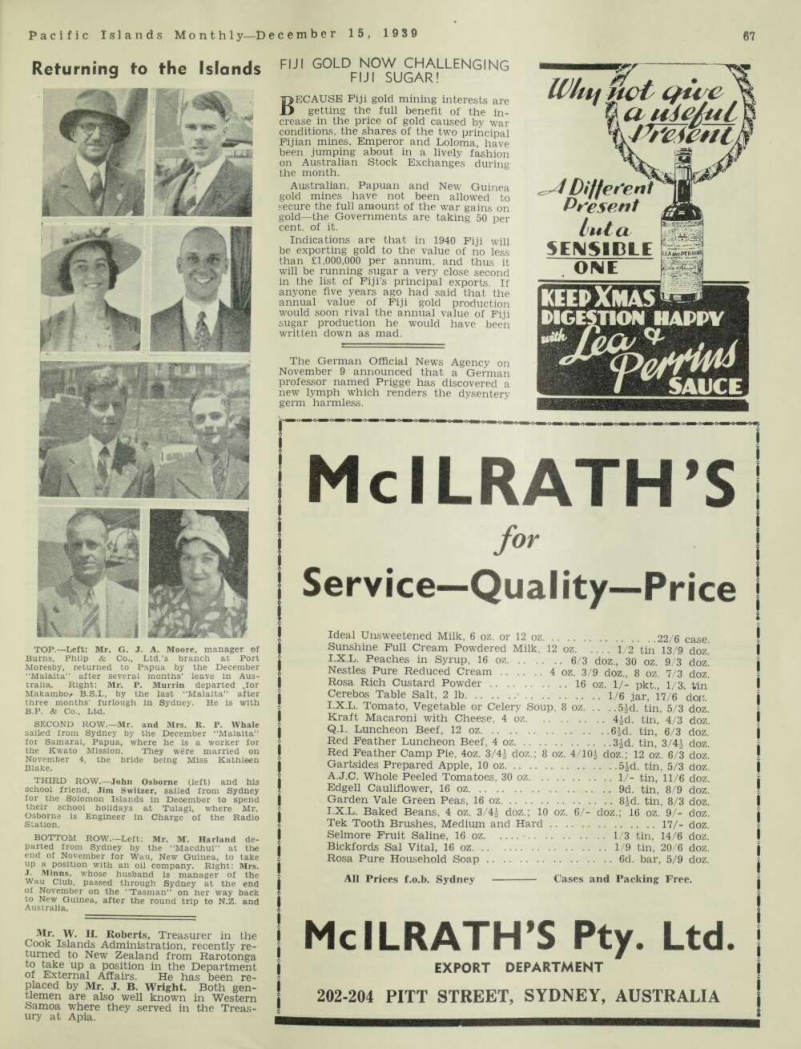
Mr. W. H. Roberts, Treasurer In the Cook Islands Administration, recently re turned to New Zealand from Rarotonga to take up a position in the Department of External Affairs. He has been re placed by Mr. J. B. Wright. Both gen tlemen are also well known in Western Samoa where they served in the Treas ury at Apia.
TOP.—Left: Mr. G. J. A. Moore, manager of Burns, Philp & Co., Ltd.’s branch at Port Moresby, returned to Papua by the December “Malaita” after several months’ leave in Aus tralia. Right: Mr. P. Murrin departed .for Makambo, B.S.I., by the last “Malaita” after three months’ furlough in Sydney. He is with B.P. & Co., Ltd.
SECOND ROW.—Mr. and Mrs. R. P. Whale sailed from Sydney by the December “Malaita” for Samarai, Papua, where he is a worker for the Kwato Mission. They were married on November 4, the bride being Miss Kathleen Blake.
THIRD ROW. —John Osborne (left) and his school friend, Jim Switzer, sailed from Sydney for the Solomon Islands in December to spend their school holidays at Tulagi, where Mr.
Osborne is Engineer in Charge of the Radio Station.
BOTTOM ROW.—Left; Mr. M. Harland de parted from Sydney by the “Macdhui” at the end of November for Wau, New Guinea, to take up a position with an oil company. Right: Mrs.
J. Minns, whose husband is manager of the Wau Club, passed through Sydney at the end of November on the “Tasman” on her way back to New Guinea, after the round trip to N.Z. and Australia.
Fiji Gold Now Challenging
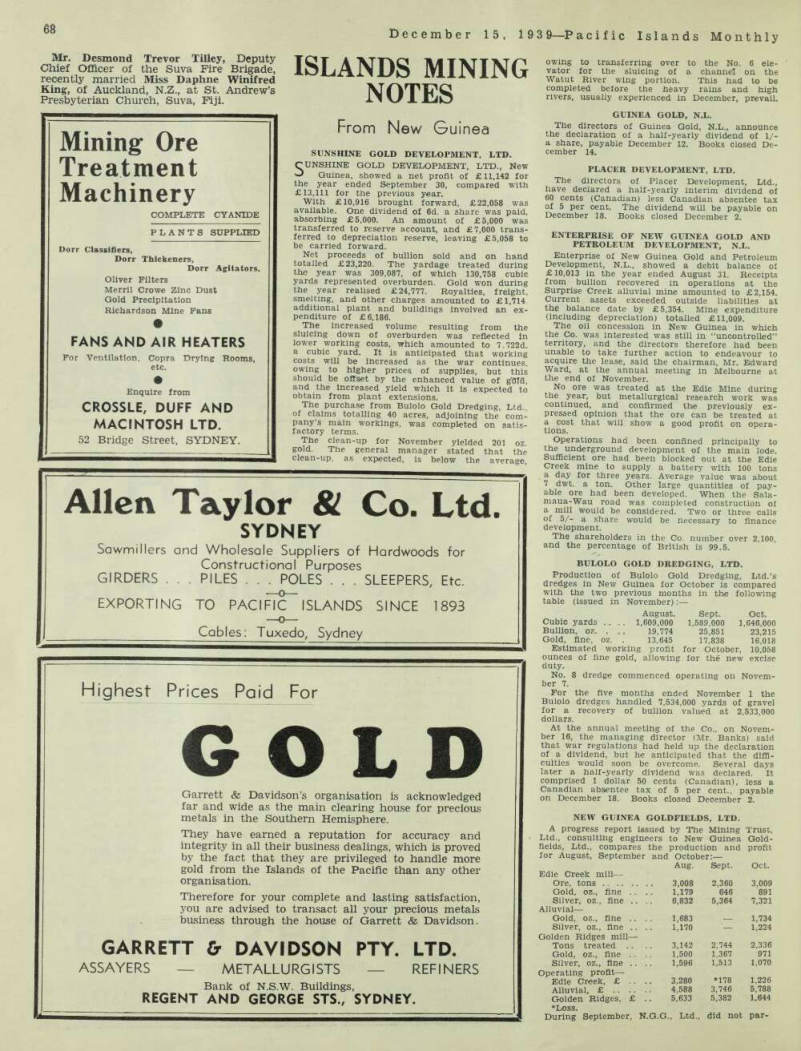
Fiji Sugar!
BECAUSE Fiji gold mining interests are getting the full benefit of the in crease in the price of gold caused bv war conditions, the shares of the two principal Fijian mines, Emperor and Loloma, have been jumping about in a lively fashion on Australian Stock Exchanges during the month.
Australian, Papuan and New Guinea gold mines have not been allowed to secure the full amount of the war gains on gold—the Governments are taking 50 per cent, of it.
Indications are that in 1940 Fiji will be exporting gold to the value of no less than £1,000,000 per annum, and thus it will be running sugar a very close second in the list of Fiji’s principal exports. If anyone five years ago had said that the annual value of Fiji gold production would soon rival the annual value of Fiji sugar production he would have been written down as mad.
The German Official News Agency on November 9 announced that a German professor named Prigge has discovered a new lymph which renders the dysentery germ harmless.
Mr. Desmond Trevor Tilley, Deputy Chief Officer of the Suva Fire Brigade, recently married Miss Daphne Winifred King, of Auckland, N.Z., at St. Andrew’s Presbyterian Church, Suva, Fiji.
Advertisements & other items, pp. 69-70 (1 item)
Mcilrath’S
Wltif not cf ti c ' a uic/tij Pt'eunt Di!fef"enl Present tut
SENSIBLE
ONE
LtAwpPfRR *P
McILRATH’S
for
Service—Quality—Price
Ideal Unsweetened Milk, 6 oz. or 12 oz 22/6 case.
Sunshine Full Cream Powdered Milk, 12 oz 1/2 tin 13/9 doz I.X.L. Peaches in Syrup, 16 oz 6/3 doz., 30 oz. 9/3 doz!
Nestles Pure Reduced Cream 4 oz. 3/9 doz., 8 oz. 7/3 doz.
Rosa Rich Custard Powder 16 oz. 1/- pkt., 1/3 V tin Cerebos Table Salt, 2 lb 1/6 jar, 17/6 don.
I.X.L. Tomato, Vegetable or Celery Soup. 8 oz 51d. tin, 5/3 doz.
Kraft Macaroni with Cheese, 4 oz 41d. tin, 4/3 doz.
Q.l. Luncheon Beef, 12 oz 6id. tin, 6/3 doz.
Red Feather Luncheon Beef, 4 oz 31d. tin, 3/41 doz.
Red Feather Camp Pie, 4oz. 3/41 doz.; 8 oz. 4/101 doz.; 12 oz. 6/3 doz.
Gartsides Prepared Apple, 10 oz s£d. tin, 5/3 doz.
A.J.C. Whole Peeled Tomatoes, 30 oz 1/- tin, 11/6 doz.
Edgell Cauliflower, 16 oz 9d. tin, 8/9 doz.
Garden Vale Green Peas, 16 oz 81d. tin, 8/3 doz.
I.X.L. Baked Beans. 4 oz. 3/41 doz.; 10 oz. 6/- doz.; 16 oz. 9/- doz.
Tek Tooth Brushes, Medium and Hard 17/- doz.
Selmore Fruit Saline, 16 oz 1/3 tin, 14/6 doz.
Bickfords Sal Vital, 16 oz 1/9 tin, 20/6 doz.
Rosa Pure Household Soap 6d. bar, 5/9 doz.
All Prices f.o.b. Sydney Cases and Packing Free.
McILRATH’S Pty. Ltd.
EXPORT DEPARTMENT
202-204 PITT STREET, SYDNEY, AUSTRALIA
Mining Ore
Treatment
Machinery
COMPLETE CYANIDE
PLANTS SUPPLIED
Dorr Classifiers, Dorr Thickeners, Dorr Agitators.
Oliver Filters Merril Crowe Zinc Dust Gold Precipitation Richardson Mine Fans
FANS AND AIR HEATERS
For Ventilation, Copra Drying Rooms, etc. • Enquire from
CROSSLE, DUFF AND
MACINTOSH LTD.
52 Bridge Street, SYDNEY.
Islands Mining
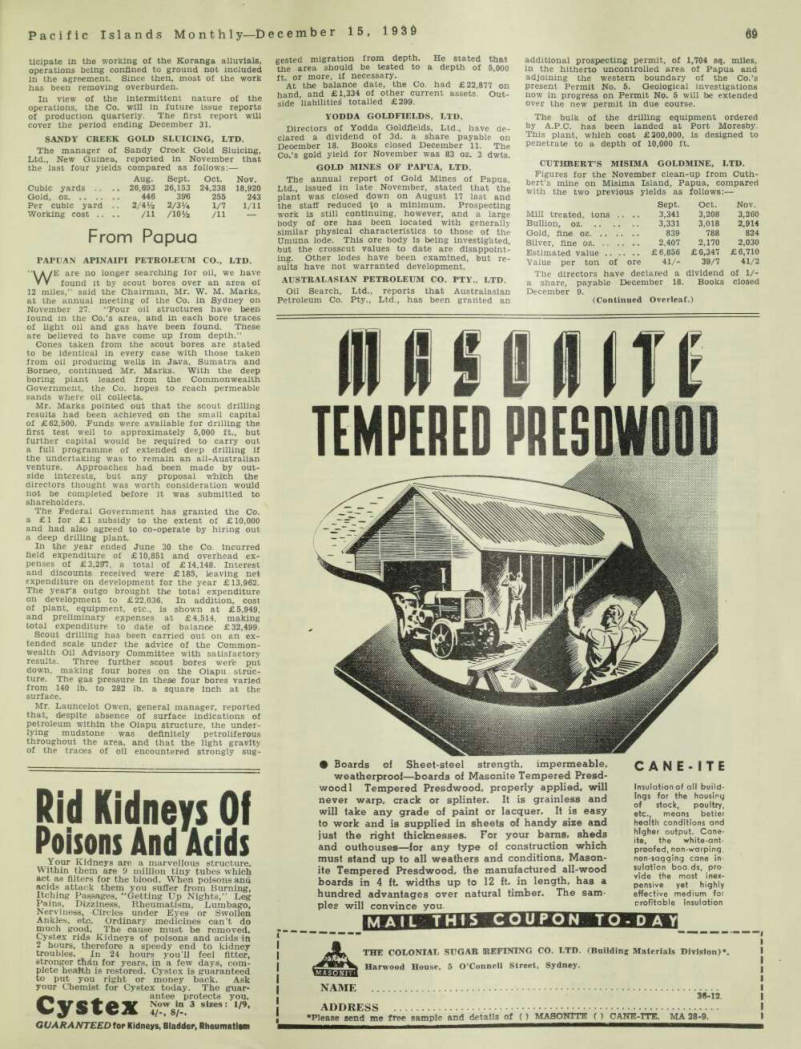
Notes
From New Guinea
Sunshine Gold Development, Ltd.
Sunshine gold development, ltd., New Guinea, showed a net profit of £11,142 for the year ended September 30, compared with £13,111 for the previous year.
With £10,916 brought forward, £22,058 was available. One dividend of 6d. a share was paid, absorbing £5,000. An amount of £5,000 was transferred to reserve account, and £7,000 trans ferred to depreciation reserve, leaving £5,058 to be carried forward.
Net proceeds of bullion sold and on hand totalled £23,220. The yardage treated during the year was 309,087, of which 130,758 cubic yards represented overburden. Gold won during the year realised £24,777. Royalties, freight, smelting, and other charges amounted to £1,714 additional plant and buildings involved an ex penditure of £6,186.
The increased volume resulting from the sluicing down of overburden was reflected in lower working costs, which amounted to 7.722 d. a cubic yard. It is anticipated that working costs will be increased as the war continues, owing to higher prices of supplies, but this should be offset by the enhanced value of gTJId, and the increased yield which it is expected to obtain from plant extensions.
The purchase from Bulolo Gold Dredging, Ltd., of claims totalling 40 acres, adjoining the com pany’s main workings, was completed on satis factory terms.
The clean-up for November yielded 201 oz. gold. The general manager stated that the clean-up, as expected, is below the average,
owing to transferring over to the No. 6 ele vator for the sluicing of a channel on the Watut River wing portion. This had to be completed before the heavy rains and high rivers, usually experienced in December, prevail.
Guinea Gold, N.L.
The directors of Guinea Gold, N.L., announce the declaration of a half-yearly dividend of 1/a share, payable December 12. Books closed De cember 14.
Placer Development, Ltd.
The directors of Placer Development, Ltd., have declared a half-yearly interim dividend of 60 cents (Canadian) less Canadian absentee tax of 5 per cent. The dividend will be payable on December 18. Books closed December 2.
Enterprise Of New Guinea Gold And
Petroleum Development, N.L.
Enterprise of New Guinea Gold and Petroleum Development, N.L., showed a debit balance of £10,013 in the year ended August 31. Receipts from bullion recovered in operations at the Surprise Creek alluvial mine amounted to £2,154.
Current assets exceeded outside liabilities at the balance date by £5,354. Mine expenditure (including depreciation) totalled £11,009.
The oil concession in New Guinea in which the Co. was interested was still in “uncontrolled” territory, and the directors therefore had been unable to take further action to endeavour to acquire the lease, said the chairman, Mr. Edward Ward, at the annual meeting in Melbourne at the end of November.
No ore was treated at the Edie Mine during the year, but metallurgical research work was continued, and confirmed the previously ex pressed opinion that the ore can be treated at a cost that will show a good profit on opera tions.
Operations had been confined principally to the underground development of the main lode.
Sufficient ore had been blocked out at the Edie Creek mine to supply a battery with 100 tons a day for three years. Average value was about 7 dwt. a ton. Other large quantities of pay able ore had been developed. When the Sala maua-Wau road was completed construction of a mill would be considered. Two or three calls of 5/- a share would be necessary to finance development.
The shareholders in the Co. number over 2,100 and the percentage of British is 99.5.
Bulolo Gold Dredging, Ltd.
Production of Bulolo Gold Dredging, Ltd.’s dredges in New Guinea for October is compared with the two previous months in the following table (issued in November): —
ounces of fine gold, allowing for the new excise duty.
No. 8 dredge commenced operating on Novem ber 7.
For the five months ended November 1 the Bulolo dredges handled 7,534,000 yards of gravel for a recovery of bullion valued at 2,533,000 dollars.
At the annual meeting of the Co., on Novem ber 16, the managing director (Mr. Banks) said that war regulations had held up the declaration of a dividend, but he anticipated that the diffi culties would soon be overcome. Several days later a half-yearly dividend was declared. It comprised 1 dollar 50 cents (Canadian), less a Canadian absentee tax of 5 per cent., payable on December 18. Books closed December 2.
New Guinea Goldfields, Ltd.
A progress report issued by The Mining Trust, Ltd., consulting engineers to New Guinea Gold fields, Ltd., compares the production and profit for August, September and October:—
August.
Sept.
Oct.
Cubic yards .. .. 1,609,000 1,589,000 1,646,000 Bullion, oz. . .. 19,774 25,851 23,215 Gold, fine, oz. . 13,645 17,838 16,018 Estimated working profit for October, 10,058
Aug.
Sept.
Oct.
Edie Creek mill— Ore, tons 3,008 2,360 3,009 Gold, oz., fine .. .. 1,179 646 891 Silver, oz., fine .. .. 6,832 5,364 7,321 Alluvial— Gold, oz., fine .. .. 1,683 1,734 Silver, oz., fine .. .. 1,170 "— 1,224 Golden Ridges mill— Tons treated 3,142 2,744 2,336 Gold, oz., fine .. 1,500 1,367 971 Silver, oz., fine .. 1,596 1,513 1,070 Operating profit— Edie Creek, £ .. 3,280 •178 1,226 Alluvial, £ 4,588 3,746 5,788 Golden Ridges, £ .. 5,633 5,382 1,644 ♦Loss.
During September, N.G.G., Ltd., did not par-
ticipate in the working of the Koranga alluvlals, operations being confined to ground not included in the agreement. Since then, most of the work has been removing overburden.
In view of the intermittent nature of the operations, the Co. will in future issue reports of production quarterly. The first report will cover the period ending December 31.
Sandy Creek Gold Sluicing, Ltd.
The manager of Sandy Creek Gold Sluicing, Ltd., New Guinea, reported in November that the last four yields compared as follows:
Aug. Sept. Oct. Nov.
Cubic yards .. .. 26,693 26,153 24,238 18,920 Gold, oz 446 39>6 255 243 Per cubic yard .. 2/4 y 2 2/3y 4 1/7 1/11 Working cost ... /II /10Vi /II —
Advertisements & other items, p. 70 (2 items)
68
December 15, 193 9—P acific Islands Monthly
Gold
Allen Taylor & Co. Ltd
SYDNEY
Sawmillers and Wholesale Suppliers of Hardwoods for Constructional Purposes GIRDERS ... PILES . POLES . . . SLEEPERS, Etc.
EXPORTING TO PACIFIC ISLANDS SINCE 1893
Cables: Tuxedo, Sydney
Highest Prices Paid For
GOLD
Garrett & Davidson’s organisation is acknowledged far and wide as the main clearing house for precious metals in the Southern Hemisphere.
They have earned a reputation for accuracy and integrity in all their business dealings, which is proved by the fact that they are privileged to handle more gold from the Islands of the Pacific than any other organisation.
Therefore for your complete and lasting satisfaction, you are advised to transact all your precious metals business through the house of Garrett & Davidson.
GARRETT & DAVIDSON PTY. LTD.
ASSAYERS METALLURGISTS REFINERS
Bank of N.S.W. Buildings,
REGENT AND GEORGE STS., SYDNEY.
From Papua
Papuan Apinaipi Petroleum Co., Ltd.
WE are no longer searching for oil, we have found it by scout bores over an area oi 12 miles,” said the Chairman, Mr. W. M. Marks, at the annual meeting of the Co. in Sydney on November 27. ‘‘Four oil structures have been found in the Co.’s area, and in each bore traces of light oil and gas have been found. These are believed to have come up from depth.”
Cones taken from the scout bores are stated to be identical in every case with those taken from oil producing wells in Java, Sumatra and Borneo, continued Mr. Marks. With the deep boring plant leased from the Commonwealth Government, the Co. hopes to reach permeable sands where oil collects.
Mr. Marks pointed out that the scout drilling results had been achieved on the small capital of £62,500. Funds were available for drilling the first test well to approximately 5,000 ft., but further capital would be required to carry out a full programme of extended deep drilling if the undertaking was to remain an all-Australian venture. Approaches had been made by out side interests, but any proposal which the directors thought was worth consideration would not be completed before it was submitted to shareholders.
The Federal Government has granted the Co. a £1 for £1 subsidy to the extent of £lO,OOO and had also agreed to co-operate by hiring out a deep drilling plant.
In the year ended June 30 the Co. Incurred field expenditure of £10,851 and overhead ex penses of £3,297, a total of £14,148. Interest and discounts received were £ 185, Leaving net expenditure on development for the year £13,962.
The year’s outgo brought the total expenditure on development to £22,036. In addition, cost of plant, equipment, etc., is shown at £5,949, and preliminary expenses at £4,514, making total expenditure to date of balance £32,499.
Scout drilling has been carried out on an ex tended scale under the advice of the Common wealth Oil Advisory Committee with satisfactory results. Three further scout bores were put down, making four pores on the Oiapu struc ture. The gas pressure in these four bores varied from 140 lb. to 282 lb. a square inch at the surface.
Mr. Launcelot Owen, general manager, reported that, despite absence of surface indications of petroleum within the Oiapu structure, the under lying mudstone was definitely petroliferous throughout the area, and that the light gravity of the traces of oil encountered strongly sug
gested migration from depth. He stated that the area should be tested to a depth of 5,000 ft. or more, if necessary.
At the balance date, the Co. had £22,877 on hand, and £1,334 of other current assets. Out side liabilities totalled £299.
Yodda Goldfields, Ltd.
Directors of Yodda Goldfields, Ltd., have de clared a dividend of 3d. a share payable on December 18. Books closed December 11. The Co.’s gold yield for November was 83 oz. 3 dwts.
Gold Mines Of Papua, Ltd.
The annual report of Gold Mines of Papua, Ltd., issued in late November, stated that the plant was closed down on August 17 last and the staff reduced to a minimum. Prospecting work is still continuing, however, and a large body of ore has been located with generally similar physical characteristics to those of the Umuna lode. This ore body is being investigated, but the crosscut values to date are disappoint ing. Other lodes have been examined, but re sults have not warranted development.
Australasian Petroleum Co. Pty., Ltd.
Oil Search, Ltd., reports that Australasian Petroleum Co. Pty., Ltd., has been granted an
additional prospecting permit, of 1,704 sq. miles, in the hitherto uncontrolled area of Papua and adjoining the western boundary of the Co.’s present Permit No. 5. Geological investigations now in progress on Permit No. 5 will be extended over the new permit in due course.
The bulk of the drilling equipment ordered by A.P.C. has been landed at Port Moresby.
This plant, which cost £200,000, is designed to penetrate to a depth of 10,000 ft.
Cuthbert’S Misima Goldmine, Ltd.
Figures for the November clean-up from Cuth bert’s mine on Misima Island, Papua, compared with the two previous yields as follows:
(Continued Overleaf.)
Sept.
Oct.
Nov.
Mill treated, tons .. 3,341 3,208 3,260 Bullion, oz 3,331 3,018 2,914 Gold, fine oz 839 788 824 Silver, fine oz 2,407 2,170 2,030 Estimated value .. .. .. £6,856 £6,347 £6,710 Value per ton of ore 41/- 39/7 41/2 The directors have declared a dividend of 1/a share, payable December 18.
Books closed December 9.
Advertisements & other items, p. 71 (1 item)
I Kite
I
TEMPERED PRESDWOOD
a 4^ • Boards of Sheet-steel strength, impermeable. weatherproof—boards of Masonite Tempered Presdwoodl Tempered Presdwood, properly applied, will never warp, crack or splinter. It is grainless and will take any grade of paint or lacquer. It is easy to work and is supplied in sheets of handy size and just the right thicknesses. For your bams, sheds and outhouses—for any type of construction which must stand up to all weathers and conditions. Masonite Tempered Presdwood. the manufactured all-wood boards in 4 ft. widths up to 12 ft. in length, has a hundred advantages over natural timber. The samples will convince you.
CANE- ITE
Insulation of all buildings for the housing of stock, poultry, etc., means better health conditions and higher output. Caneite, the white-antproofed, non-warping non-sagging cane insulation boa.ds, pro vide the most inexpensive yet highly effective medium for profitable insulation
mail this coupon tq.day
JL THE COLONIAL SUGAR {REFINING CO. LTD. (Building Materials Division)* gdCIM'W Harwood House, 5 O’Connell Street, Sydney.
NAME
38-12.
ADDRESS
•Please send me free sample and details of () MASONITE ( ) CANE-ITE. MA 28-9.
Rid Kidneys Of
Poisons And Acids
Your Kidneys are a marvellous structure.
Within them are 9 million tiny tubes which act as filters for the blood. When poisons and acids attack them you suffer from Burning, Itching Passages, “Getting Up Nights,” Leg Pains, Dizziness, Rheumatism, Lumbago, Nerviness. Circles under Eyes or Swollen Ankles, etc. Ordinary medicines can’t do much good. The cause must be removed.
Cystex rids Kidneys of poisons and acids in 2 hours, therefore a speedy end to kidney troublesi In 24 hours you’ll feel fitter, stronger thdn for years, in a few days, complete health is restored. Cystex is guaranteed to put you right or money back. Ask your Chemist for Cystex today. The guarantee protects you.
Now in 3 sizes: 1/9, 4/-, 8/-.
Cystex
GUARANTEED lor Kidneys, Bladder, Rheumatism
From Fiji
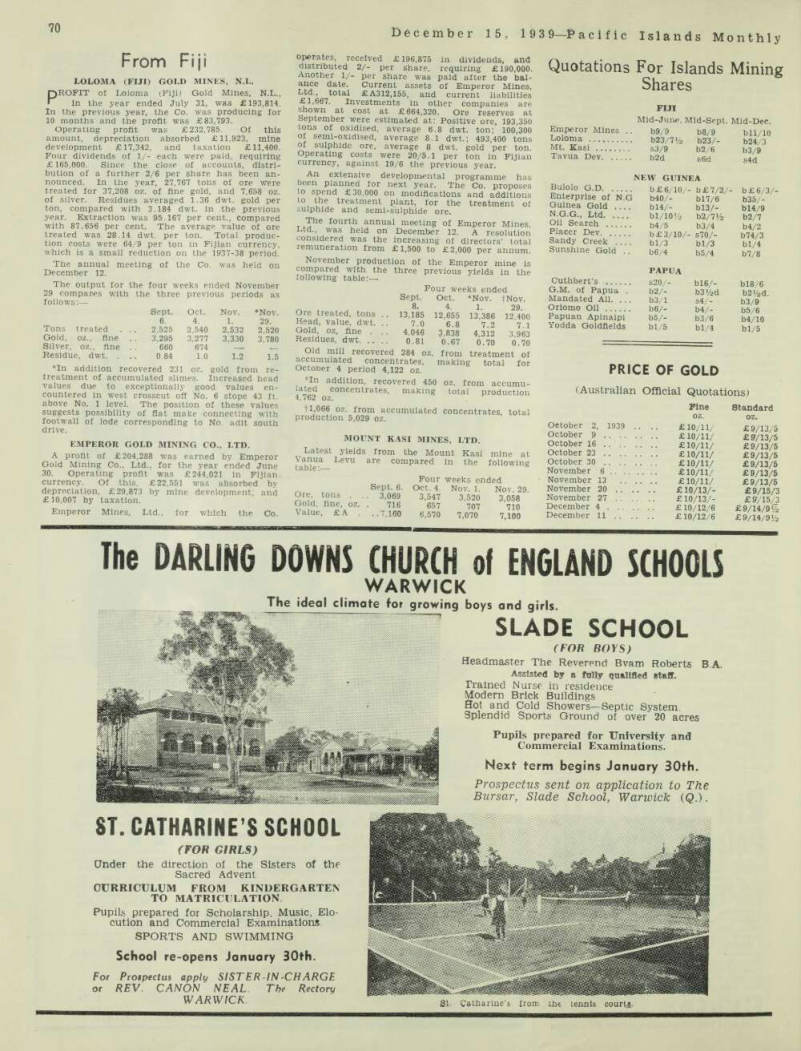
Loloma (Fiji) Gold Mines, N.L.
PROFIT of Loloma (Fiji) Gold Mines, N.L., in the year ended July 31, was £193,814.
In the previous year, the Co. was producing for 10 months and the profit was £83,793.
Operating profit was £232,785. Of this amount, depreciation absorbed £11,923, mine development £17,342, and taxation £11,400.
Four dividends of 1/- each were paid, requiring £ 165,000. Since the close of accounts, distri bution of a further 2/6 per share has been an nounced. In the year, 27,767 tons of ore were treated for 37,208 oz. of fine gold, and 7,658 oz. of silver. Residues averaged 1.36 dwt. gold per ton, compared with 3.184 dwt. in the previous year. Extraction was 95.167 per cent., compared with 87.656 per cent. The average value of ore treated was 28.14 dwt. per ton. Total produc tion costs were 64/9 per ton in Fijian currency, which is a small reduction on the 19'37-38 period.
The annual meeting of the Co. was held on December 12.
The output for the four weeks ended November 29 compares with the three previous periods as follows:
*ln addition recovered 231 oz. gold from re treatment of accumulated slimes. Increased head values due to exceptionally good values en countered in west crosscut off No. 6 stope 43 ft. above No, 1 level. The position of these values suggests possibility of flat make connecting with footwall of lode corresponding to No. adit south drive.
Emperor Gold Mining Co., Ltd.
A profit of £204,288 was earned by Emperor Gold Mining Co., Ltd., for the year ended June 30. Operating profit was £244.021 in Fijian currency. Of this. £22,551 was absorbed bv depreciation, £29.873 by mine development, and £10,007 by taxation.
Emperor Mines, Ltd., for which the Co.
operates, received £ 196,875 in dividends, and distributed 2/- per share, requiring £190,000.
Another 1/- per share was paid after the bal ance date. Current assets of Emperor Mines, Ltd., total £ A 312,155, and current liabilities £1,667. Investments in other companies are shown at cost at £664,320. Ore reserves at September were estimated at: Positive ore, 193,350 tons of oxidised, average 6.8 dwt. ton; 100,300 of semi-oxidised, average 8.1 dwt.; 493,400 tons of sulphide ore, average 8 dwt. gold per ton.
Operating costs were 20/5.1 per ton in Fijian currency, against 19/6 the previous year.
An extensive developmental programme has been planned for next year. The Co. proposes to spend £30,000 on modifications and additions to the treatment plant, for the treatment of sulphide and semi-sulphide ore.
T t T he fourth annual meeting of Emperor Mines, Ltd., was held on December 12. A resolution considered was the increasing of directors’ total remuneration from £1,500 to £2,000 per annum.
November production of the Emperor mine is compared with the three previous yields in the following table:—
Old mill recovered 284 oz. from treatment of accumulated concentrates, making total for October 4 period 4,122 oz. *ln addition, recovered 450 oz. from accumu lated concentrates, making total production 4,762 OZ.
T 1,066 oz. from accumulated concentrates, total production 5,029 oz.
Mount Kasi Mines, Ltd.
Latest yields from the Mount Kasi mine at Vanua Levu are compared in the following table:—
Sept.
Oct.
Nov. *Nov. 6. 4. 1. 29.
Tons treated . .. 2.525 2.540 2,532 2.520 Gold, oz., fine 3.295 3,277 3,330 3.780 Silver, oz.. fine . 660 674 Residue, dwt. . ., 0.84 1.0 1.2 1.5
Four weeks ended Sept. Oct. *Nov. tNov. 8. 4. 1. 29 Ore treated, tons .. 13.185 12,655 13.386 12,400 H*?ad, value, dwt. .. 7.0 6.8 72 71 Gold oz, fine . .. 4.046 3.838 4,312 3.963 Residues, dwt 0.81 0.67 0.70 0 70
Pour weeks ended Sept. 6. Oct. 4. Nov. 1. Nov. 29.
Ore. tons . .. 3.069 3,547 3,520 3 058 Gold, fine, oz. . 716 657 707 ’710 Value, £ A . .,7.160 6,570 7,070 7,100
Quotations For Islands Mining
Shares
Fiji
Mid-June. Mid-Sept. Mid-Dec.
Emperor Mines .. b9/9 b8/9 bll/10 Loloma b23/7>/ 2 b23/b24/3 Mt. Kasi s3/9 b2/6 b3/9 Tavua Dev b2d s6d s4d Bulolo G.D
New Guinea
b £ 6/10/- b £7/2/ - b £ 6/3/- Enterprise of N.G b40/bl7/6 b35/- Guinea Gold bl4/bl3/bl4/9 M.G.G., Ltd bi/ioy 2 b2/7»/ 2 b2/7 Oil Search b4/5 b3/4 b4/2 Placer Dev. . b£3/10/s70/b74/3 Sandy Creek bl/3 bl/3 bl/4 Sunshine Gold .. b6/4 b5/4 b7/8 Cuthbert’s
Papua
S20/bl6/bl8/6 G.M. of Papua . b2/b3 >/ 2 d b2V 2 d.
Mandated All. ... b3/l s4/b3/0 Oriomo Oil b6/b4/b5/6 Papuan Apinaipi b5/b3/6 b4/10 Yodda Goldfields bl/5 bl/4 bl/5
Price Of Gold
(Australian Official Quotations) Pine Standard oz. oz.
October 2, 1939 . • .. £10/11/ £9/13/5 October 9 £9/13/5 October 16 £9/13/5 October 23 £9/13/5 October 30 £9/13/6 November 6 . .. £10/11/ £9/13/5 November 13 .. . £9/13/5 November 20 .. ., £10/13/- £9/15/3 November 27 .. .. £9/15/3 December 4 £ 10/12/6 £9/14/9V 2 December 11 .. .. £ 10/12/6 £9/14/9‘/ 2
Advertisements & other items, p. 72 (1 item)
The Darling Downs Church Of England Schools
WARWICK
The 'deal climate for growing boys and girls.
SLADE SCHOOL
(FOR BOYS)
Headmaster The Reverend Bvam Roberts B.A, Assisted by a fully qualified staff.
Trained Nurse in residence Modern Brick Buildings Hot and Cold Showers—Septic System.
Splendid Sports Ground of over 20 acres Pupils prepared for University and Commercial Examinations.
Next term begins January 30th.
Prospectus sent on application to The Bursar, Slade School, Warwick (Q.).
ST. CATHARINE'S SCHOOL
(FOR GIRLS)
Under the direction of the Sisters of the Sacred Advent
CURRICULUM FROM KINDERGARTEN
TO MATRICULATION
Pupils prepared for Scholarship, Music, Elocution and Commercial Examinations
SPORTS AND SWIMMING
School re-opens January 30th.
For Prospectus apply SISTER-IN-CHARGE or REV. CANON NEAL. The Rectory
WARWICK.
St. Catharine's from the tennis courts.
Australian Short Wave
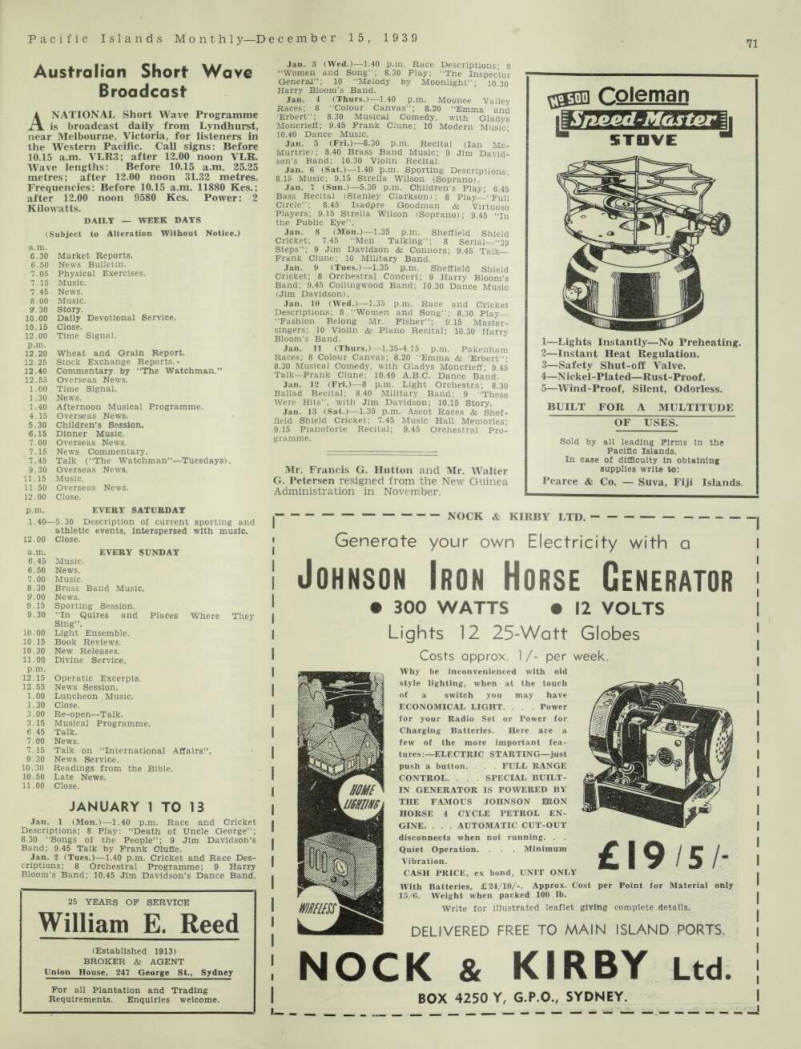
Broadcast
A NATIONAL Short Wave Programme is broadcast daily from Lyndhurst, near Melbourne, Victoria, for listeners in the Western Pacific. Call signs: Before 10.15 a.m. VLR3; after 12.00 noon VLR.
Wave lengths: Before 10.15 a.m. 25.25 metres; after 12.00 noon 31.32 metres.
Frequencies: Before 10.15 a.m. 11880 Kcs.; after 12.00 noon 9580 Kcs. Power: 2 Kilowatts.
Daily Week Days
(Subject to Alteration Without Notice.) a.m. 6.30 Market Reports. 6.50 News Bulletin. 7.05 Physical Exercises. 7.15 Music. 7.45 News. 8.00 Music. 9. 30 Story. 10.00 Dally Devotional Service. 10.15 Close. 12.00 Time Signal, p.m. 12.20 Wheat and Grain Report. 12.25 Stock Exchange Reports.- 12.40 Commentary by “The Watchman.” 12.55 Overseas News. 1.00 Time Signal. 1.30 News. 1.40 Afternoon Musical Programme. 4.15 Overseas News. 5.30 Children’s Session. 6.15 Dinner Music. 7.00 Overseas News. 7.15 News Commentary. 7.45 Talk (“The Watchman”—Tuesdays). 9.30 Overseas News. 11.15 Music. 11.50 Overseas News. 12.00 Close.
P.M. Every Saturday
1.40 —5.30 Description of current sporting and athletic events, interspersed with music. 12.00 Close.
Am. Every Sunday
6.45 Music. 6.50 News. 7.00 Music. 8.30 Brass Band Music. 9.00 News. 9.15 Sporting Session. 9.30 “In Quires and Places Where They Sing”. 10.00 Light Ensemble. 10.15 Book Reviews. 10.30 New Releases. 11.00 Divine Service, p.m. 12.15 Operatic Excerpts. 12.55 News Session. 1.00 Luncheon Music. 1.30 Close. 3.00 Re-open—Talk, 3.15 Musical Programme. 6.45 Talk. 7.00 News. 7.15 Talk on “International Affairs”. 9.30 News Service. 10.30 Readings from the Bible. 10.50 Late News. 11.00 Close.
January 1 To 13
Jan. 1 (Mon.) —1.40 p.m. Race and Cricket Descriptions; 8 Play: “Death of Uncle George”; 8.30 “Songs of the People”; 9 Jim Davidson’s Band; 9.45 Talk by Frank Cluffe.
Jan, 2 (Tues.) —1.40 p.m. Cricket and Race Des criptions; 8 Orchestral Programme; 9 Harry Bloom’s Band; 10.45 Jim Davidson’s Dance Band.
Jan. 3 (Wed.) —1.40 p.m. Race Descriptions - 8 “Women and Song'; 8.30 Play; “The Inspector General”; 10 “Melody by Moonlight”; 10.30 Harry Bloom’s Band.
Jan. 4 (Thurs.) —1.40 p.m. Moonee Valley Races; 8 “Colour Canvas”; 8.20 “Emma and ’Erbert”; 8.30 Musical Comedy, with Gladys Moncrieff; 9.45 Frank Clune; 10 Modern Music -10.40 Dance Music.
Jan. 5 (Frl.) —8.30 p.m. Recital (lan Mc- Murtrie); 8.40 Brass Band Music; 9 Jim David son’s Band; 10.30 Violin Recital.
Jan. 6 (Sat.) —1.40 p.m. Sporting Descriptions; 8.15 Music; 9.15 Strella Wilson (Soprano).
Jan. 7 (Sun.) —5.30 p.m. Children’s Play; 6.45 Bass Recital (Stanley Clarkson); 8 Play “Pull Circle”; 8.45 Isadpre Goodman & Virtuoso Players; 9.15 Strella Wilson (Soprano); 9.45 “in the Public Eye”.
Jan. 8 (Mon.) —-1.35 p.m. Sheffield Shield Cricket: 7.45 “Men Talking”; 8 Serial “39 Steps”; 9 Jim Davidson & Connors; 9.45 Talk- Frank Clune; 10 Military Band.
Jan. 9 (Tues.) —1.35 p.m. Sheffield Shield Cricket; 8 Orchestral Concert; 9 Harry Bloom’s Band; 9.45 Collingwood Band; 10.30 Dance Music (Jim Davidson).
Jan. 10 (W’ed.) —1.35 p.m. Race and Cricket Descriptions; 8 “Women and Song”; 8.30 Play— “ Fashion Belong Mr. Fisher”; 9’. 15 Master singers; 10 Violin & Piano Recital; 10.30 Harry Bloom’s Band.
Jan. 11 (Thurs.) —1.35-4.15 p.m. Pakenham Races; 8 Colour Canvas; 8.20 “Emma & ’Erbert”; 8.30 Musical Comedy, with Gladys Moncrieff; 9.45 Talk—Frank Clune; 10.40 A.B.C. Dance Band.
Jan. 12 (Fri.) —8 p.m. Light Orchestra; 8.30 Ballad Recital; 8.40 Military Band; 9 “These Were Hits”, with Jim Davidson; 10.15 Story.
Jan. 13 (Sat.) —1.35 p.m. Ascot Races & Shef field Shield Cricket; 7.45 Music Hall Memories; 9.15 Pianoforte Recital; 9.45 Orchestral Pro gramme.
Mr. Francis G. Hutton and Mr, Walter G. Petersen resigned from the New Guinea Administration in November.
Advertisements & other items, p. 73 (2 items)
71
Pacific Islands Monthl y—D ecember 15, 1939
Johnson Iron Horse Generator
roleman
STOVE
1— Lights Instantly—No Preheating. 2 Instant Heat Regulation. 3 Safety Shut-off Valve. 4 N ickel-Plated—Rust-Proof. 5 Wind-Proof, Silent, Odorless.
BUILT FOR A MULTITUDE
OF USES.
Sold by all leading Firms In the Pacific Islands.
In case o i difficulty In obtaining supplies write to: Pearce & Co. Suva, Fiji Islands.
NOCK & KIRBY LTD.
Generate your own Electricity with a
Johnson Iron Horse Generator
800 WATTS
12 VOLTS
Lights 12 25-Watt Globes
n
utms
mm
Costs approx. 1/- per week.
Why be inconvenienced with old style lighting, when at the touch of a switch you may have
ECONOMICAL LIGHT. . , Power
for your Radio Set or Power for Charging Batteries. Here are a few of the more important features:—ELECTßlC STARTING—just push a button. . . FULL RANGE
CONTROL. . . SPECIAL BUILT-
IN GENERATOR IS POWERED BY
THE FAMOUS JOHNSON IRON
HORSE 4 CYCLE PETROL EN-
GINE. . . . AUTOMATIC CUT-OUT
disconnects when not running. . .
Quiet Operation. . . . Minimum Vibration.
CASH PRICE, ex bond, UNIT ONLY
With Batteries, £24/10/-. Approx. Cost per Point for Material only 15/6. Weight when packed 100 lb.
Write for illustrated leaflet giving complete details. & £l9/5/
DELIVERED FREE TO MAIN ISLAND PORTS.
NOCK & KIRBY Ltd.
BOX 4250 Y, G.P.0., SYDNEY.
25 YEARS OP SERVICE
William E. Reed
(Established 1913)
BROKER & AGENT
Union House, 247 George St., Sydney For all Plantation and Trading Requirements. Enquiries welcome.
Market Quotations
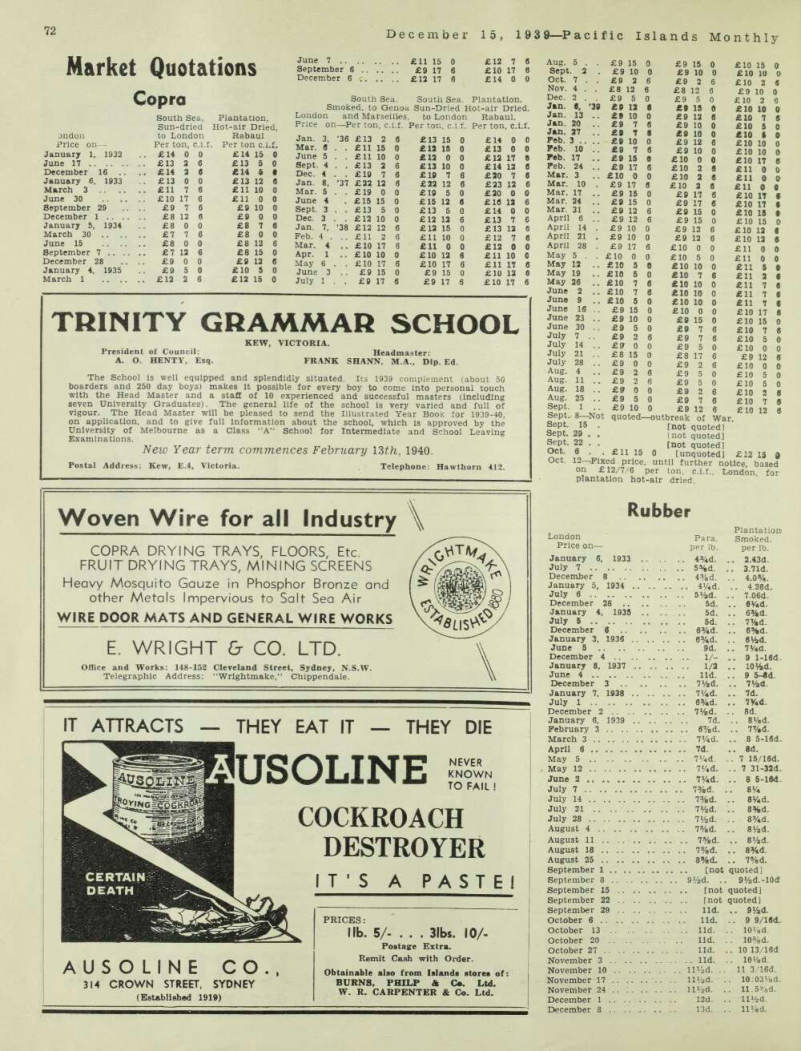
June 7 £11 15 0 £12 7 6 September 6 . . £9 17 6 £10 17 6 December 6 .. £12 17 6 £14 0 0 South Sea.
South Sea.
Plantation.
Smoked, to Genoa Sun-Dried Hot-air Dried.
London and Marseilles, to London Rabaul, Price on- —Per ton, c.i.f.
Per ton. c.i.f.
Per ton, c.i.f.
Jan. 3, 1 36 £13 2 6 £13 15 0 £14 0 0 Mar. 8 . . £11 15 0 £12 16 0 £13 0 0 June 5 . . £11 10 0 £12 0 0 £12 17 0 Sept. 4 . . £13 2 6 £13 10 0 £14 12 6 Dec. 4 . . £19 7 6 £19 7 6 £20 7 6 Jan. 8. 37 £22 12 6 £22 12 6 £23 12 6 Mar. 5 . . £19 0 0 £19 5 0 £20 0 0 June 4 . £15 15 0 £15 12 6 £16 12 6 Sept. 3 . . £13 5 0 £13 5 0 £14 0 0 Dec. 3 . . £12 10 0 £12 12 6 £13 7 6 Jan. 7, ' 38 £12 12 6 £12 15 0 £13 12 6 Feb. 4 . .. £11 2 6 £11 10 0 £12 7 6 Mar. 4 .. £10 17 6 £11 0 0 £12 0 0 Apr. 1 .. £10 10 0 £10 12 6 £11 10 0 May 6 . . £10 17 6 £10 17 6 £11 17 6 June 3 . . £9 15 0 £9 15 0 £10 12 6 July 1 . . £9 17 6 £9 17 6 £10 17 6
Aug. 5 . £9 15 0 £9 15 0 £10 15 0 sept. 2 £9 10 0 £9 10 0 £10 10 O Oct. 7 . . £9 2 6 £9 2 6 £10 2 s Nov. 4 . £8 12 6 £8 12 6 £9 10 0 Dec. 2 . £9 5 0 £9 5 0 £10 2 6 Jan. «, ’39 £9 12 6 £9 15 0 £10 10 0 Jan. 13 £9 10 0 £9 12 6 £10 7 5 Jan. 20 .. £9 7 6 £9 10 0 £10 5 0 Jan. 27 . . £9 7 S £9 10 0 £10 5 0 Feb. 3 .. .. £9 10 0 £9 12 6 £10 10 0 Feb. 10 . . £9 7 6 £9 10 0 £10 10 0 Peb. 17 .. £9 15 9 £10 0 0 £10 17 6 Peb. 24 . . £9 17 6 £10 2 6 £11 0 o Mar. 3 .. £10 0 0 £10 2 6 £11 0 0 Mar. 10 . £9 17 6 £10 2 6 £11 0 o Mar, 17 .. £9 15 0 £9 17 6 £10 17 f Mar. 24 . . £9 15 0 £9 17 6 £10 17 f Mar. 31 .. £9 12 6 £9 IS 0 £10 IB • April 6 £9 12 6 £9 15 0 £10 15 O’
April 14 . £9 10 0 £9 12 6 £10 12 « April 21 . £9 10 0 £9 12 6 £10 12 6 April 28 £9 17 6 £10 0 0 £11 0 0 May 5 . . £10 0 0 £10 5 0 £11 0 0 May 12 .. £10 5 0 £10 10 0 £11 5 $ May 19 .. £10 5 0 £10 7 6 £11 2 c May 26 .. £10 7 6 £10 10 0 £11 7 6 June 2 .. £10 7 6 £10 10 0 £11 7 6 June 9 .. £10 6 0 £10 10 0 £11 7 8 June 16 . . £9 15 0 £10 0 0 £10 17 8 June 23 .. £9 10 0 £9 15 0 £10 15 0 June 30 . . £9 5 0 £9 7 6 £10 7 8 July 7 £9 2 6 £9 7 6 £10 5 o July 14 . . £9 0 0 £9 5 0 £10 0 o July 21 . . £8 15 0 £8 17 6 £9 12 6 July 28 .. £9 0 0 £9 2 6 £10 0 0 Aug. 4 .. £9 2 6 £9 5 0 £10 5 o Aug. 11 .. £9 2 6 £9 5 0 £10 5 o Aug. 18 . . £9 0 0 £9 2 6 £10 2 8 Aug. 25 .. £9 5 0 £9 7 5 £10 7 8 Sept. 1 . . £9 10 0 £9 12 6 £ in 12 6 Sept. 8—Not quoted—outbreak of War.
Sept. 15 . [not quoted!
Sept. 29 , > . [not quoted] Sept. 22 . . [not quoted] Oct. 6 . . £11 15 0 [unquoted] £12 IS a Oct. 12— -Fixed price, until further notice. 1 based on £ 12/7/6 per ton, c.i.f., London fnr plantation hot-air dried.
Copra
South Sea, Sun-dried Plantation, Hot-air Dried, andon to London Rabaul Price on— Per ton. c.i.f, Per ton c.i.f.
January 1, 1932 . . £14 0 0 £14 15 0 June 17 . .. £13 2 6 £13 5 0 December 16 £14 2 6 £14 6 • January 6, 1933 £13 0 0 £13 12 6 March 3 .. £11 7 6 £11 10 0 June 30 . . .. £10 17 6 £11 0 0 September 29 , . . £9 7 6 £9 10 0 December 1 .. . . .. £8 12 6 £9 0 0 January 5, 1934 £8 0 0 £8 7 6 March 30 .. .. £7 7 6 £8 0 0 June 15 £8 0 0 £8 12 6 September 7 .. . . .. £7 12 6 £8 15 0 December 28 £9 0 0 £9 12 6 January 4, 1935 £9 5 0 £10 5 0 March 1 .. ,. £12 2 6 £12 15 0
Rubber
London Plantation Para.
Smoked.
Price on— per lb. per lb.
January 6, 1933 .. .. 2.43d.
July 7 .. 3.71d.
December 8 . . 4.0%.
January 5, 1934 .. . 4%d. .. 4.28d.
July 6 .. 7.06d.
December 28 .. .. .. 5d. .. 6V 4 d.
January 4. 1935 .. .. 5d. .. 6%d.
July 5 . .. 7%d.
December 6 . . .. .. 6%d. .. 6%d.
January 3, 1936 . . . 63/ 4 d. .. 6%d.
June 5 .. .. 9d. .. 7V 4 d.
December 4 .. 9 l-16d January 8, 1937 .. 1/2 .. 10%d.
June 4 .. 9 5-8d.
December 3 .. .. 7*/ad. .. 7Vad.
January 7, 1938 .. . 7»/ 4 d. .. 7d.
July 1 .. .. 6%d. .. 7%d.
December 2 7%d. . . 8d.
January 6, 1939 .. . 7d. .. 8%d.
February 3 6%d. .. 7%d.
March 3 7%d. .. 8 5-16d, April 6 7d. .. 8d.
May 5 .. .. 7V 4 d. . . 7 15/16d.
May 12 .. 7 31-32d June 2 7*/ 4 d. .. 8 5-l«d July 7 .. 8% July 14 7%d. .. 8%d.
July 21 .. .. 7»/ 2 d. .. 8%d.
July 28 7»/ 2 d. .. 8%d.
August 4 7%d. .. 8%d.
August 11 7%d. .. sy 2 d.
August 18 7 5 / 8 d. .. 8%d.
August 25 .. 7%d.
September 1 September 8 .. .. 9y 2 d. .. 9y 2 d.-10d September 15 September 22 [not quoted] September 29 lid. .. 9y a d.
October 6 lid. .. 9 9/18d.
October 13 lid. .. lOVsd.
October 20 .. .. lid. .. 10%d.
October 27 lid. .. 10 13/16d November 3 lid. .. ioy 8 d.
November 10 .. .. ny 2 d. .. 11 3/16d.
November 17 .. .. ny 2 d. . . 10;03y 8 d.
November 24 .. .. HV 2 d. . . 11.5% d.
December 1 .. .. 12d. . . ll%d.
December 8 .. .. 13d. . . liy 8 d.
Advertisements & other items, p. 74 (2 items)
72
December 15, 193 9—P acific Islands Monthly
Usoline
TRINITY GRAMMAR SCHOOL
KEW, VICTORIA.
President of Council: Headmaster: A. O. HENTY, Esq. FRANK SHANN, M.A., Dip. Ed.
The School is well equipped and splendidly situated. Its 1939 complement (about 50 boarders and 250 day boys) makes It possible for every boy to come into personal touch with the Head Master and a staff of 10 experienced and successful masters (including seven University Graduates). The general life of the school is very varied and full of vigour. The Head Master will be pleased to send the Illustrated Year Book for 1939-40, on application, and to give full Information about the school, which is approved by the University of Melbourne as a Class “A” School for Intermediate and School Leaving Examinations.
New Year term commences February 13 th, 1940.
Postal Address: Kew, E. 4, Victoria. Telephone: Hawthorn 412.
Woven Wire for all Industry \
COPRA DRYING TRAYS, FLOORS, Etc.
FRUIT DRYING TRAYS, MINING SCREENS
Heavy Mosquito Gauze in Phosphor Bronze and other Metals Impervious to Salt Sea Air WIRE DOOR MATS AND GENERAL WIRE WORKS 7! 3r £ 9 sv^
E. WRIGHT & CO. LTD.
Office and Works: 148-152 Cleveland Street, Sydney, N.S.W.
Telegraphic Address: “Wrlghtmake,” Chippendale. \
IT ATTRACTS THEY EAT IT THEY DIE
USOLINE
°VING
NEVER
KNOWN
TO FAIL !
AUSO LINE CO
314 CROWN STREET. SYDNEY
(Established 1919)
COCKROACH
DESTROYER
IT'S A PASTE
PRICES:
lib. 5/- . . . 3lbs. 10/- Postage Extra.
Remit Cash with Order.
Obtainable also from Islands stores of :
BURNS. PHILP & C*. Ltd.
W. R. CARPENTER & Co. Ltd.
Islands Produce
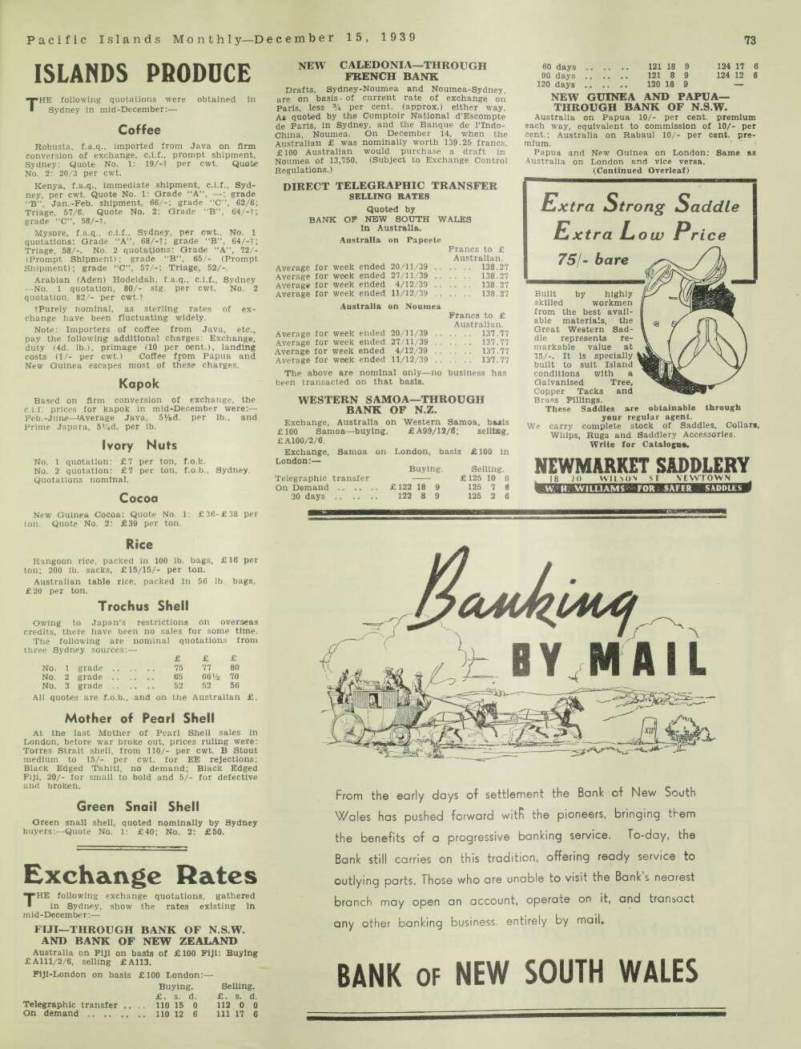
THE following quotations were obtained in Sydney in mid-December: —
Coffee
Robusta, f.a.q., imported from Java on firm conversion of exchange, c.i.f., prompt shipment, Sydney; Quote No. 1: 19/-t per cwt. Quote No. 2: 20/3 per cwt.
Kenya, f.a.q., immediate shipment, c.i.f., Syd ney, per cwt. Quote No. 1: Grade “A”, —; grade •B”, Jan.-Feb. shipment, 66/-; grade “C”, 62/6; Triage, 57/6. Quote No. 2: Grade “B”, 64/-t; grade “C”, 58/-t.
Mysore, f.a.q., c.i.f., Sydney, per cwt.. No. 1 quotations: Grade “A”, 68/-t: grade “B”, 64/-t; Triage, 58/-. No. 2 quotations: Grade “A’ - , 72/- (Prompt Shipment); grade “B”, 65/- (Prompt Shipment); grade “C”, 57/-; Triage, 52/-.
Arabian (Aden) Hodeidah, f.a.q., c.i.f., Sydney -No. 1 quotation, 80/- stg. per cwt. No. 2 quotation, 82/- per cwt.t tPurely nominal, as sterling rates of ex change have been fluctuating widely.
Note: Importers of coffee from Java, etc., pay the following additional charges: Exchange, duty (4d. lb.), primage (10 per cent.), landing costs (1/- per cwt.) Coffee from Papua and New Guinea escapes most of these charges.
Kapok
Based on firm conversion of exchange, the c.i.f. prices for kapok in mid-December were;— Feb.-June—'Average Java, sVad. per lb., and Prime Japara, s‘/id. per lb.
Ivory Nuts
No. 1 quotation: £7 per ton. f.o.b.
No. 2 quotation; £7 per ton, f.0.b., Sydney.
Quotations nominal.
Cocoa
New Guinea Cocoa: Quote No. 1: £36-£3B per ton. Quote No. 2; £39 per ton.
Rice
Rangoon rice, packed in 100 lb. bags, £l6 per ton; 200 lb. sacks, £l5/15/- per ton, Australian table rice, packed in 56 lb. bags, £2O per ton.
Trochus Shell
Owing to Japan’s restrictions on overseas credits, there have been no sales for some time.
The following are nominal quotations from three Sydney sources:—
Mother of Pearl Shell
At the last Mother of Pearl Shell sales in London, before war broke out, prices ruling were; Torres Strait shell, from 110/- per cwt. B Stout medium to 15/- per cwt. for EE rejections; Black Edged Tahiti, no demand; Black Edged Fiji, 20/- for small to bold and 5/- for defective and broken.
Green Snail Shell
Green snail shell, quoted nominally by Sydney buyers:—Quote No. 1: £4O; No. 2: £5O.
£ £ £ No. 1 grade 75 77 80 NO. 2 grade 65 66 Vi 70 No. 3 grade 52 52 56 All quotes are f.o.b., and on the Australian £.
Exchange Rates
THE following exchange quotations, gathered in Sydney, show the rates existing in mid-December:—
Fiji—Through Bank Of N.S.W.
And Bank Of New Zealand
Australia on Fiji on basis of £lOO FIJI: Buying £ Alll/2/6, selling £AII3.
Pljl-London on basis £lOO London; — Buying. Selling.
New Caledonia—Through
French Bank
Drafts, Sydney-Noumea and Noumea-Sydney, are on basis -of current rate of exchange on Paris, less % per cent, (approx.) either way.
As quoted by the Comptoir National d’Escompte de Paris, in Sydney, and the Banque de ITndo- China, Noumea. On December 14, when the Australian £ was nominally worth 139.25 francs, £lOO Australian would purchase a draft in Noumea of 13,750. (Subject to Exchange Control
Regulations.)
direct telegraphic transfer
Selling Rates
Quoted by
Bank Op New South Wales
in Australia.
Australia on Papeete Francs to £ Australian.
The above are nominal only—no business has been transacted on that basis.
Western Samoa—Through
Bank Of N.Z.
Exchange, Australia on Western Samoa, basis £lOO Samoa—buying. £A99/12/6; selling,
£ Aloo/2/6.
Exchange, Samoa on London, basis £lOO in London:—
New Guinea And Papua
Through Bank Of N.S.W.
Australia on Papua 10/- per cent, premium each way, equivalent to commission of 10/- per cent.; Australia on Rabaul 10/- per cent, pre mium. ' ’ i Papua and New Guinea on London: Same as Australia on London and vice versa. (Continued Overleaf)
Average for week ended 20/11/39 .. .. .. 138.27 Average for week ended 27/11/39 .. .. . . 138.27 Average for week ended 4/12/39 .. .. .. 138.27 Average for week ended 11/12/39 .. .. .. 138.27 Australia on Noumea Francs to £ Australian.
Average for week ended 20/11/39 .. .. .. 137.77 Average for week ended 27/11/39 . . .. .. 137.77 Average for week ended 4/12/39 . . .. .. 137.77 Average for week ended 11/12/39 . . .. .. 137.77
Buying.
Selling.
Telegraphic transfer — £125 10 0 On Demand £122 18 9 125 7 8 30 days 122 8 9 125 2 6
60 days .. .. 18 9 124 17 6 90 days .. .. 121 8 9 124 12 6 120 days .. .. 18 9 —
£. s. d. £. s. d.
Telegraphic transfer ... 110 15 0 112 0 0 On demand 110 12 6 111 17 6
Advertisements & other items, p. 75 (1 item)
Tby Mail
Extra Strong Saddle
Extra Low Price
75/- bare
Built by highly skilled workmen from the best available materials, the Great Western Saddle represents remarkable value at 75/-. It is specially built to suit Island conditions with a Galvanised Tree, Copper Tacks and Brass Fillings.
These Saddles are obtainable through your regular agent.
We carry complete stock of Saddles, Collars, Whips, Rugs and Saddlery Accessories.
Write for Catalogue.
NEWMARKET SADDLERY
, 18 20 WILSQ\ SI NEWTOWN
W, H WILLIAMS FOR SAFER SADDLES
tBY MAIL
34»-— a A.
JM From the early days of settlement the Bank of New South Wales has pushed forward witß the pioneers, bringing them the benefits of a progressive banking service. To-day, the Bank still carries on this tradition, offering ready service to outlying parts. Those who are unable to visit the Bank's nearest branch may open an account, operate on it, and transact any other banking business, entirely by mail.
BANK OF NEW SOUTH WALES
Through Commonwealth Bank
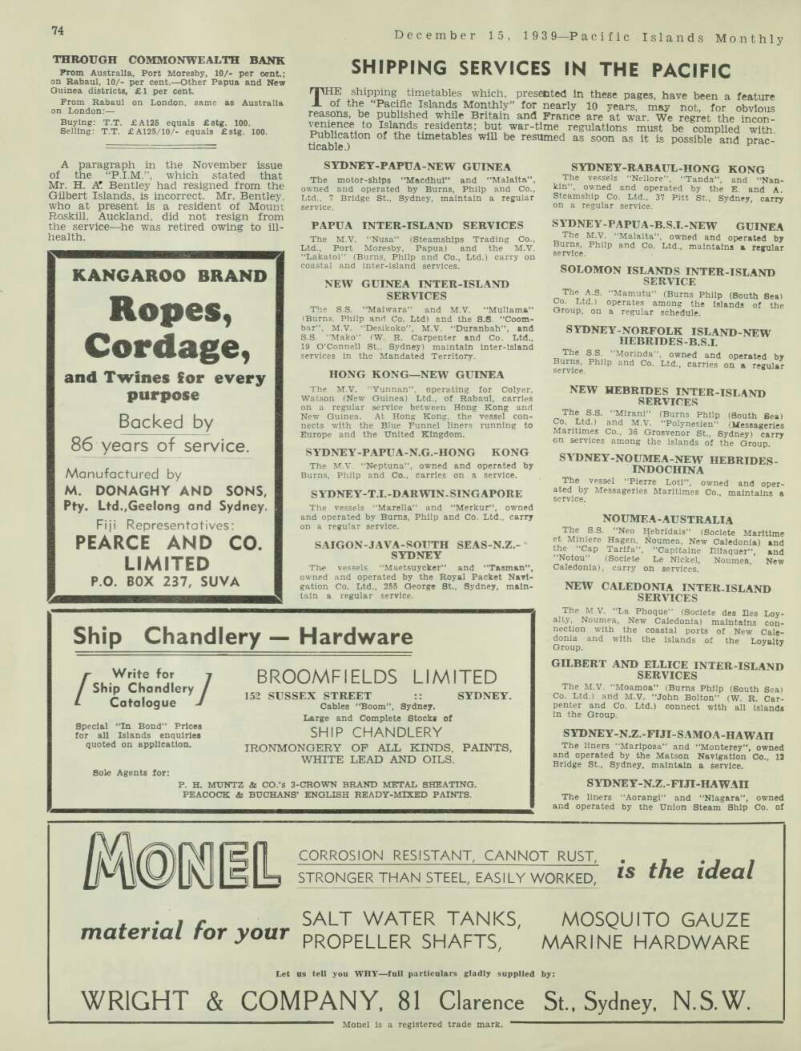
Prom Australia, Port Moresby, 10/- per cent.; on Rabaul, 10/- per cent.—Other Papua and New Guinea districts, £1 per cent.
From Rabaul on London, same as Australia on London:— Buying; T.T, £AI2S equals £stg. 100.
Selling: T.T. £AI2S/10/- equals £stg. 100.
A paragraph in the November issue of the “P.1.M.”, which stated that Mr. H. A*! Bentley had resigned from the Gilbert Islands, is incorrect. Mr. Bentley, who at present is a resident of Mount Roskill, Auckland, did not resign from the service—he was retired owing to ill health.
Shipping Services In The Pacific
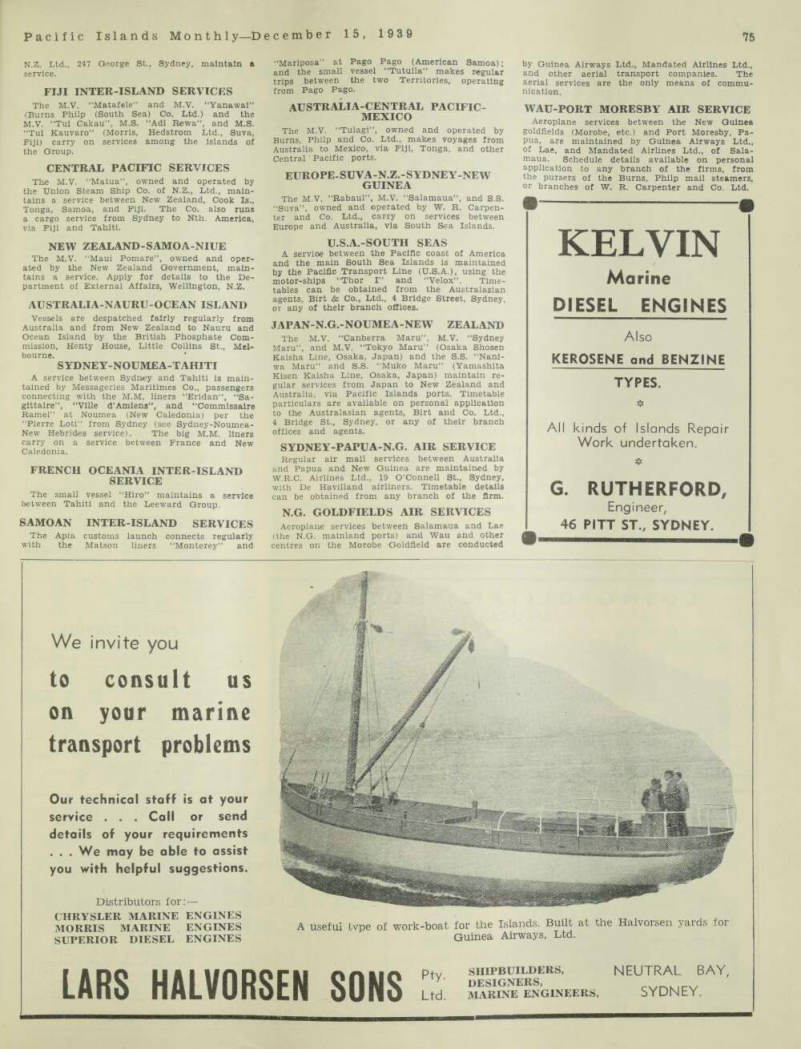
rpHE shipping timetables which, presented in these pages, have been a feature rfc. e 2L th s« ,l ?S?l I S lail s ! i fO 5 nearl y ™ years, may not. for obvious reasons, be published while Britain and Prance are at war. We regret the incon- SSSSS. t 0 glands residents; but war-time regulations must be complied with.
Publication of the timetables win be resumed as soon as it is possible and prac ticable.)
Sydney-Papua-New Guinea
The motor-ships "Macdhul" and “Malaita”, owned and operated by Burns, Philp and Co., Ltd.. 7 Bridge St., Sydney, maintain a regular service.
Papua Inter-Island Services
The M.V. “Nusa” (Steamships Trading Co., Ltd., Port Moresby, Papua) and the M.V.
“Lakatoi” (Burns, Philp and Co., Ltd.) carry on coastal and inter-island services.
New Guinea Inter-Island
Services
The S.S. “Maiwara” and M.V. “Muliama” (Burns. Philp and Co. Ltd) and the S.S. “Coom bar”, M.V. “Desikoko”, M.V. “Duranbah”, and S.S. “Mako” (W. R. Carpenter and Co. Ltd., 19 O’Connell St.. Sydney) maintain inter-island services in the Mandated Territory.
Hong Kong—New Guinea
The M.V. “Yunnan”, operating for Colyer, Watson (New Guinea) Ltd., of Rabaul, carries on a regular service between Hong Kong and New Guinea. At Hong Kong, the vessel con nects with the Blue Funnel liners running to Europe and the United Kingdom.
Sydney-Papua-N.G.-Hong Kong
The M.V “Neptuna”, owned and operated by Burns, Philp and Co., carries on a service.
Sydney-T.1.-Darwin-Singapore
The vessels “Marella” and “Merkur”, owned and operated by Bums, Philp and Co. Ltd., carry on a regular service.
Saigon-Java-South Seas-N.Z.-
Sydney
The vessels “Maetsuycker” and “Tasman”, owned and operated by the Royal Packet Navi gation Co. Ltd., 255 George St., Sydney, main tain a regular service.
Sydney-Rabaul-Hong Kong
The vessels “Nellore”. “Tanda”, and “Nan kin”, owned and operated by the E and A Steamship Co. Ltd., 37 Pitt St., Sydney, carry on a regular service.
Sydney-Papua-8.5.1.-New Guinea
The M.V. “Malaita”, owned and operated by Burns, Philp and Co. Ltd., maintains a regular service.
Solomon Islands Inter-Island
Service
The AS. “Mamutu” (Burns Philp (South Seal co. Ltd.) operates among the Islands of the Group, on a regular schedule.
Sydney-Norfolk Island-New
Hebrides-B.S.L
The S.S “Morinda”, owned and operated by Burns, Philp and Co. Ltd., carries on a regular service. 8
New Hebrides Inter-Island
Services
The S.S. “Mlrani” (Burns Philp (South Sea) Co. Ltd.) and M.V. “Polynesian” (Messageries Maritimes Co., 36 Grosvenor St., Sydney) carry on services among the islands of the Group.
Sydney-Noumea-New Hebrides
Indochina
The vessel “Pierre Loti”, owned and oper ated by Messageries Maritimes Co., maintains a service.
Noumea-Australia
The S.S. “Neo Hebrldais” (Soclete Maritime et Miniere Hagen, Noumea, New Caledonia) and the “Cap Tarlfa”, “Capitaine Illlaquer”, and “Notou” (Societe Le Nickel, Noumea, New Caledonia), carry on services.
New Caledonia Inter.Island
Services
The M.V. “La Phoque” (Societe des Hes Loy alty, Noumea, New Caledonia) maintains con nection with the coastal ports of New Cale donia and with the islands of the Loyalty Group.
Gilbert And Ellice Inter-Island
Services
The M.V. "Moamoa” (Burns Philp (South Sea) Co. Ltd.) and M.V. “John Bolton” (W. R. Car penter and Co. Ltd.) connect with all Islands in the Group.
Sydney-N.Z.-Ftji-Samoa-Hawaii
The liners “Mariposa” and “Monterey”, owned and operated by the Matson Navigation Co., 12 Bridge St., Sydney, maintain a service.
Sydney-N.Z.-Fiji-Hawaii
The liners “Aorangi” and “Niagara”, owned and operated by the Union Steam Ship Co. of
N.Z. Ltd., 247 George St., Sydney, maintain a service.
Fiji Inter-Island Services
The M.V. “Matafele” and M.V. “Yanawal” (Burns Philp (South Sea) Co. Ltd.) and the M.V. “Tui Cakau”, M.S. “Adi Rewa”, and M.S.
“Tui Kauvaro” (Morris, Hedstrom Ltd., Suva, Fiji) carry on services among the Islands of the Group.
Central Pacific Services
The M.V. “Matua”, owned and operated by the Union Steam Ship Co. of N.Z., Ltd., main tains a service between New Zealand, Cook Is., Tonga, Samoa, and Fiji. The Co. also runs a cargo service from Sydney to Nth. America, via Fiji and Tahiti.
New Zealand-Samoa-Niue
The M.V. “Maui Pomare”, owned and oper ated by the New Zealand Government, main tains a service. Apply for details to the De partment of External Affairs, Wellington, N.Z.
Australia-Nauru-Ocean Island
Vessels are despatched fairly regularly from Australia and from New Zealand to Nauru and Ocean Island by the British Phosphate Com mission, Henty House, Little Collins St., Mel bourne.
Sydney-Noumea-Tahiti
A service between Sydney and Tahiti is main tained by Messageries Maritimes Co., passengers connecting with the M.M. liners “Eridan”, “Sa glttaire”, “Vllle d’Amlens”, and “Commlssalre Ramel” at Noumea (New Caledonia) per the “Pierre Loti” from Sydney (see Sydney-Noumea- New Hebrides service). The big M.M. liners carry on a service between France and New Caledonia.
French Oceania Inter-Island
Service
The small vessel “Hiro” maintains a service between Tahiti and the Leeward Group.
Samoan Inter-Island Services
The Apia customs launch connects regularly with the Matson liners “Monterey” and
“Mariposa” at Pago Pago (American Samoa); and the small vessel “Tutulla” makes regular trips between the two Territories, operating from Pago Pago.
Australia-Central Pacific
Mexico
The M.V. “Tulagi”, owned and operated by Burns, Philp and Co, Ltd., makes voyages from Australia to Mexico, via Fiji, Tonga, and other Central Pacific ports.
Europe-Suva-N.Z.-Sydney-New
Guinea
The M.V. “Rabaul”, M.V. “Salamaua”, and S.S.
“Suva”, owned and operated by W. R. Carpen ter and Co. Ltd., carry on services between Europe and Australia, via South Sea Islands.
U.S.A.-South Seas
A service between the Pacific coast of America and the main South Sea Islands is maintained by the Pacific Transport Line (U.S.A.), using the motor-ships “Thor I” and “Velox”. Time tables can be obtained from the Australasian agents, Birt & Co., Ltd., 4 Bridge Street, Sydney, or any of their branch offices.
Japan-N.G.-Noumea-New Zealand
The M.V. “Canberra Maru”, M.V. “Sydney Maru”, and M.V. “Tokyo Maru” (Osaka Shosen Kaisha Line, Osaka, Japan) and the S.S. “Nani wa Maru” and S.S. “Muko Maru” (Yamashlta Risen Kaisha Line, Osaka, Japan) maintain re gular services from Japan to New Zealand and Australia, via Pacific Islands ports. Timetable particulars are available on personal application to the Australasian agents, Birt and Co. Ltd., 4 Bridge St., Sydney, or any of their branch offices and agents.
Sydney-Papua-N.G. Air Service
Regular air mail services between Australia and Papua and New Guinea are maintained by W.R.C. Airlines Ltd., 19 O’Connell St., Sydney, with De Havilland airliners. Timetable details can be obtained from any branch of the firm.
N.G. Goldfields Air Services
Aeroplane services between Salamaua and Lae (the N.G. mainland ports) and Wau and other centres on the Morobe Goldfield are conducted
by Guinea Airways Ltd., Mandated Airlines Ltd., and other aerial transport companies. The aerial services are the only means of commu nication.
Wau-Port Moresby Air Service
Aeroplane services between the New Guinea goldfields (Morobe, etc.) and Port Moresby, Pa pua, are maintained by Guinea Airways Ltd., of Lae, and Mandated Airlines Ltd., of Sala maua. Schedule details available on personal application to any branch of the firms, from the pursers of the Burns, Philp mail steamers, or branches of W. R. Carpenter and Co. Ltd.
Advertisements & other items, pp. 76-77 (3 items)
74
December 15, 193 9—P acific Islands Monthly
Ropes,
KANGAROO BRAND
Cordage,
and Twines Sor every purpose
Backed by
86 years of service.
Manufactured by
M. DONAGHY AND SONS,
Pty. Ltd.,Geelong and Sydney.
Fiji Representatives:
PEARCE AND CO.
LIMITED
P.O. BOX 237, SUVA
Ship Chandlery Hardware
BROOMFIELDS LIMITED
152 SUSSEX STREET SYDNEY.
Cables “Boom”, Sydney.
Large and Complete Stocks of
SHIP CHANDLERY
IRONMONGERY OF ALL KINDS, PAINTS,
WHITE LEAD AND OILS.
Sole Agents for: P. H. MUNTZ & CO.’S 3-CROWN BRAND METAL SHEATING.
PEACOCK & BUCHANS’ ENGLISH READY-MIXED PAINTS.
/Write for j
Ship Chandlery /
Catalogue J
Special “In Bond” Prices for all Islands enquiries quoted on application.
c IL
CORROSION RESISTANT, CANNOT RUST,
STRONGER THAN STEEL, EASILY WORKED,
is the ideal
. . f SALT WATER TANKS, MOSQUITO GAUZE material ror your PRO peller SHAFTS, MARINE HARDWARE Let ns tell you WHY —full particulars gladly supplied by: WRIGHT & COMPANY. 81 Clarence St„ Sydney. N.S.W. ■ • Monel is a registered trade mark
KELVIN
Marine
DIESEL ENGINES
Also
KEROSENE and BENZINE
TYPES.
* All kinds of Islands Repair Work undertaken.
G. RUTHERFORD,
Engineer,
46 PITT ST., SYDNEY.
We invite you
to consult us
on your marine
transport problems
Our technical staff is at your service . . . Call or send details of your requirements . . . We may be able to assist
you with helpful suggestions.
Distributors for:—
CHRYSLER MARINE ENGINES
MORRIS MARINE ENGINES
SUPERIOR DIESEL ENGINES
Ip . ■ n m ■ A useful tvpe of work-boat for the Islands. Built at the Halvorsen yards for Guinea Airways, Ltd.
LARS HALVORSEN SONS
Pty.
Ltd.
SHIPBUILDERS,
DESIGNERS,
MARINE ENGINEERS,
NEUTRAL BAY,
SYDNEY.
N.G. Public Service
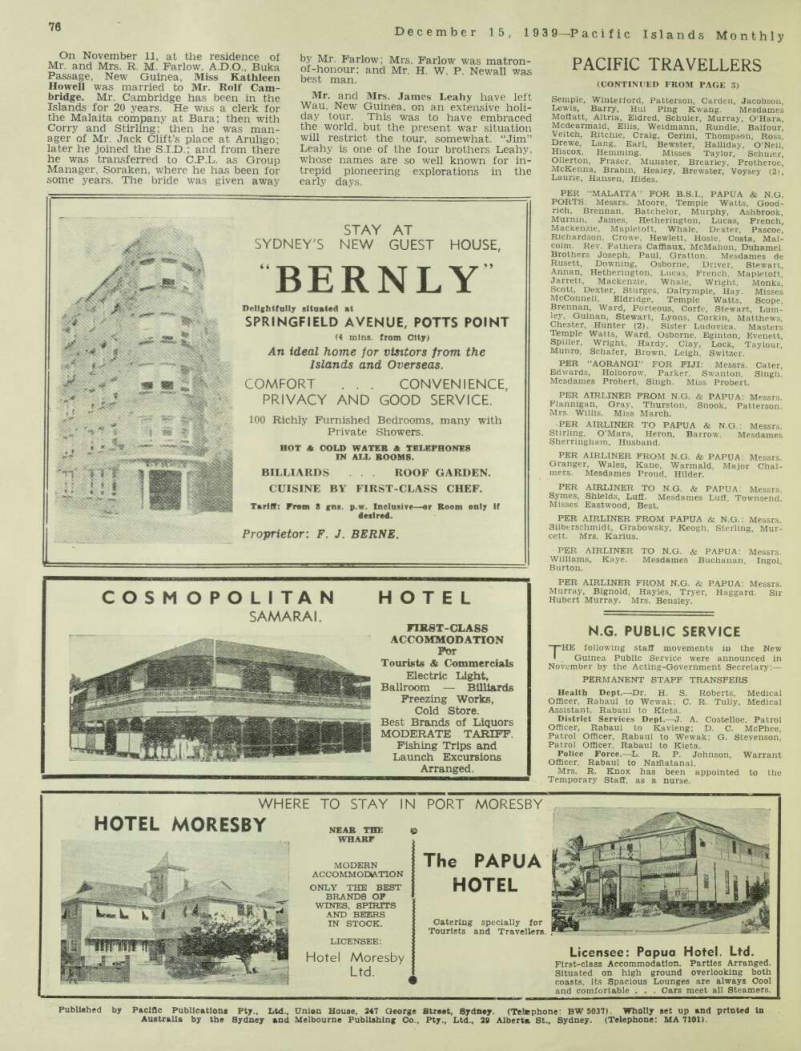
THE following staff movements in the New Guinea Public Service were announced in November by the Acting-Government Secretary:—
Permanent Staff Transfers
Health Dept.—Dr. H. S. Roberts, Medical Officer, Rabaul to Wewak; C. R. Tully, Medical Assistant, Rabaul to Kieta.
District Services Dept.—J. A. Costelloe, Patrol Officer, Rabaul to Kavieng; D. C. McPhee, Patrol Officer, Rabaul to Wewak; G. Stevenson, Patrol Officer, Rabaul to Kieta.
Police Force. —L. R. P. Johnson, Warrant Officer, Rabaul to Naffiatanai.
Mrs. R. Knox has been appointed to the Temporary Staff, as a nurse.
Advertisements & other items, pp. 78-80 (4 items)
Pacific Travellers
(CONTINUED FROM PAGE 3)
Published by Pacific Publications Pty., Ltd., Union House, 247 George Street, Sydney. (Telephone: BW 5037). Wholly set up and printed In Australia by the Sydney and Melbourne Publishing Co., Pty., Ltd., 29 Alberta St„ Sydney. (Telephone: MA 7101).
Bernly
r* •* if 'f m * ' * 9 % ' , %.
*w 'tt*# . i
M ill 1
'A* * * I f
STAY AT
SYDNEY'S NEW GUEST HOUSE,
BERNLY
Delightfully situated at
SPRINGFIELD AVENUE, POTTS POINT
(4 mins, from City) An ideal home for visitors from the Islands and Overseas.
COMFORT . . . CONVENIENCE,
PRIVACY AND GOOD SERVICE.
100 Richly Furnished Bedrooms, many with Private Showers.
HOT A GOLD WATER A TELEPHONES
IN ALL BOOMS.
BILLIARDS . ROOF GARDEN.
CUISINE BY FIRST-CLASS CHEF.
Tariff: Prom 8 gns. p.w. Inclusive—or Boom only If desired.
Proprietor : F. J. BERNE.
COSMOPOLITAN
SAMARAI.
HOTEL
FIRST-CLASS
ACCOMMODATION
For Tourists & Commercials Electric Light, Ballroom Billiards Freezing Works, Cold Store.
Best Brands of Liquors
MODERATE TARIFF.
Fishing Trips and Launch Excursions Arranged.
WHERE TO STAY IN
HOTEL MORESBY
NEAR THE ©
WHARF
MODERN
ACCOMMODATION
ONLY THE BEST
BRANDS OP
WINES, SPIRITS
AND BEERS
IN STOCK.
LICENSEE:
Hotel Moresby
Ltd.
PORT MORESBY
The PAPUA
HOTEL
Catering specially for Tourists and Travellers.
Licensee: Papua Hotel. Ltd.
First-class Accommodation. Parties Arranged.
Situated on high ground overlooking both coasts, its Spacious Lounges are always Cool and comfortable . . . Cars meet all Steamers.
FROM COAST TO MOUNTAINS...
LAE
rv > ai •"N: £s~- L ~V 't R WV,
WAU <M
Aa
GUINEA AIRWAYS, LIMITED
was established in 1927; and has grown as the figures show.
Building a New Civilization
...BY AIR!
=3^ The development of the Territory has been amazingly rapid—thanks to air transport.
GUINEA AIRWAYS LIMITED has transported every type of goods needed by the large and ever-growing European community.
GUINEA AIRWAYS operates regular air services in New Guinea and Papua, using over fifty aerodromes and landing grounds in the two Territories.
GUINEA AIRWAYS planes depart from Port Moresby for the Goldfield on the arrival of each boat. Tickets obtainable from Purser.
Fly with GUINEA AIRWAYS—the pioneer Company—in New Guinea and in Australia.
AUSTRALIAN SERVICES
ADELAIDE-DARWIN —Twice Weekly.
ADELAIDE-KANGAROO IS., Daily Return Service.
ADELAIDE-PT. LINCOLN, 3 Times Weekly.
ADELAIDE-WHYALLA, 3 Times Weekly.
LIMITED
LAE-SALAMAUA
Head Office: Austral Chambers, New Guinea Office; Lae, Currie Street, Adelaide, S.A. Mandated Territory of New Guinea BRANCH OFFICES AND AGENTS AT WAU—SALAMAUA—PORT MORESBY AND SYDNEY. m
USM
9 Z3Y
FIRST CHOICE...with those
who prefer a bitter beer
If you like a bitter beer—you'll enjoy the rich wholesome flavor of Resch's Waverley Bitter Ale. Best appreciated after a hot, trying day—Waverley Bitter Ale is a real health drink for the tropics. For a refreshing change, make YOUR next order - - - -
WAVERLEY BITTER ALE
IN THE BOTTLE WITH THE GREEN LABEL