Pacific
Islands
Monthly
Vol. X. No. 4.
November 15, 1939
[Registered at the G,P,0 y \Sydn&y* fo% transmission by post as a newspaper .]
8
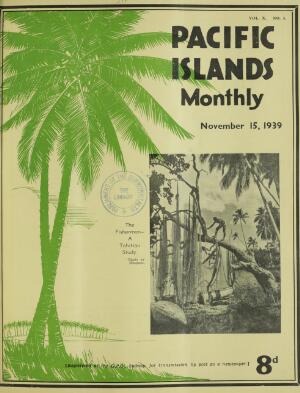
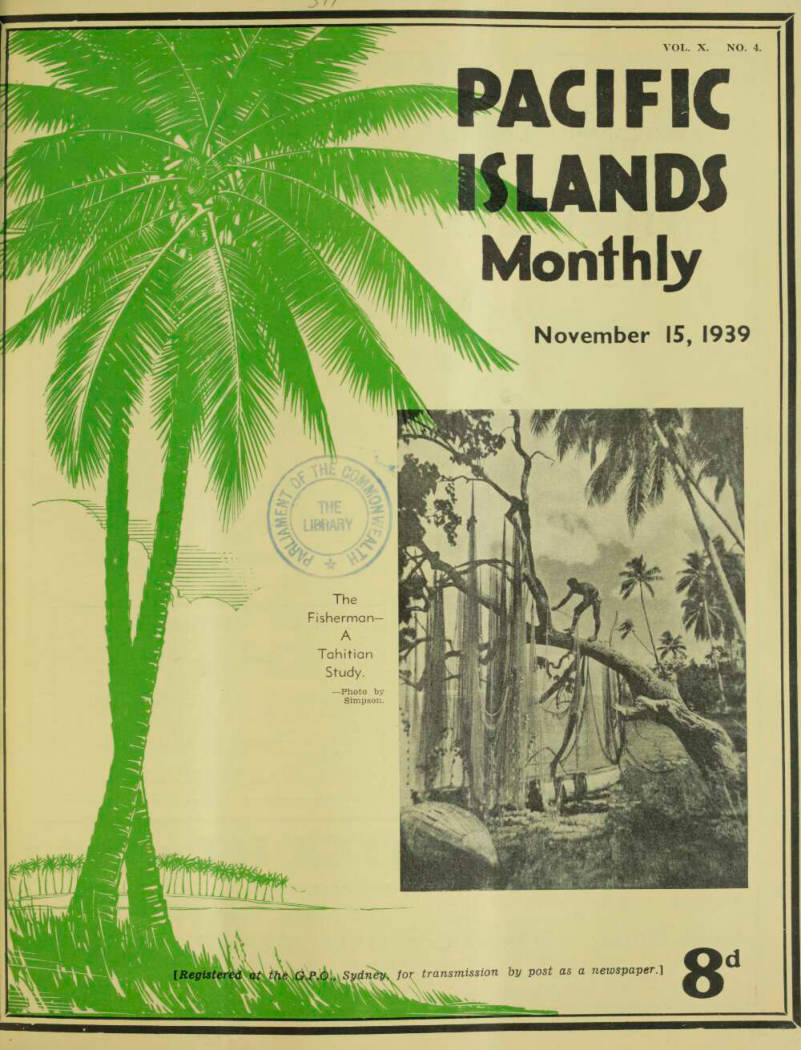
The Fisherman— A Tahitian Study. —Photo by Simpson.
Advertisements & other items, p. 2 (2 items)
Pacific Islands Monthl y—N ovember 15, 1939
(Ali Renters
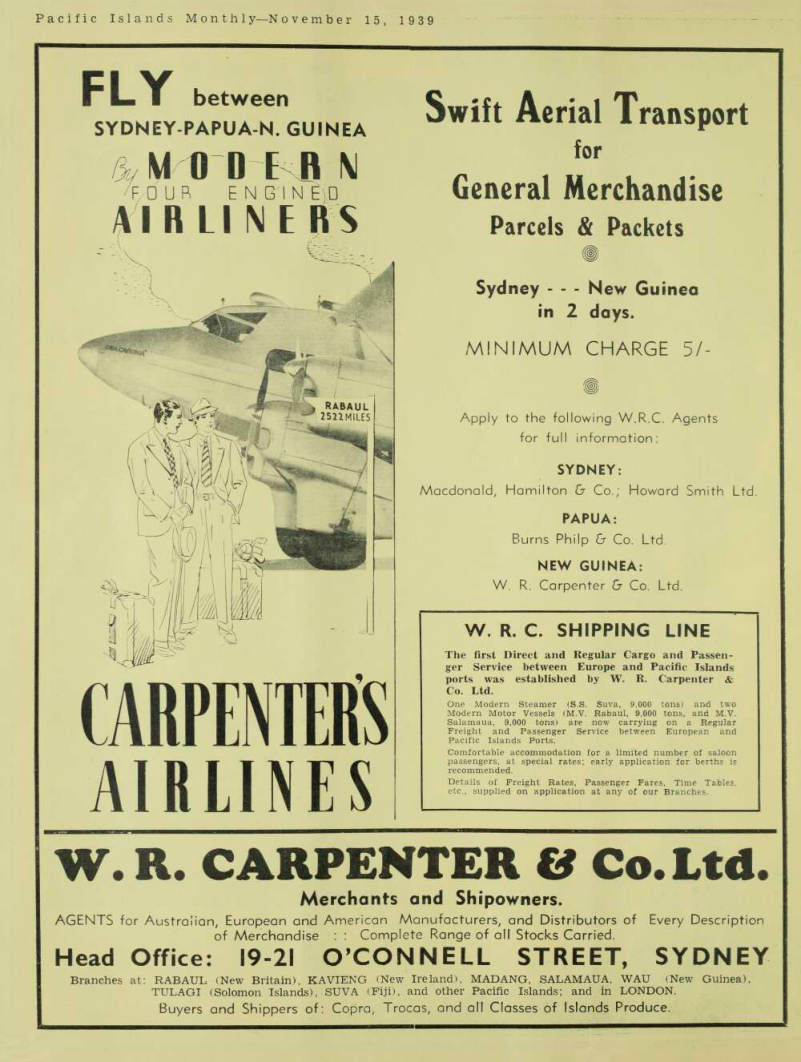
FLY between
SYDNEY-PAPUA-N. GUINEA
MOO E R M
FOUR E N GIN E)D
AIRLINERS
RABAUL
2521 MILES
(Ali RENTERS
AIRLINES
Swift Aerial Transport
for
General Merchandise
Parcels & Packets
Sydney - - - New Guinea
in 2 days.
MINIMUM CHARGE 51-
S Apply to the following W.R.C. Agents for full information;
SYDNEY:
Macdonald, Hamilton Gr Co.; Howard Smith Ltd.
PAPUA:
Burns Philp £r Co. Ltd.
NEW GUINEA:
W. R. Carpenter &• Co. Ltd.
W. R. C. SHIPPING LINE
The first Direct and Regular Cargo and Passenger Service between Europe and Pacific Islands ports was established by W. R. Carpenter & Co. Ltd.
One Modern Steamer (S.S. Suva, 9,000 tons) and two Modern Motor Vessels (M.V. Rabaul, 9,000 tons, and M.V.
Salamaua, 9,000 tons) are now carrying on a Regular Freight and Passenger Service between European and Pacific Islands Ports.
Comfortable accommodation for a limited number of saloon passengers, at special rates; early application for berths is recommended.
Details of Freight Rates, Passenger Fares, Time Tables, etc., supplied on application at any of our Branches.
W. R. CARPENTER & Co. Ltd.
Merchants and Shipowners.
AGENTS for Australian, European and American Manufacturers, and Distributors of Every Description of Merchandise : Complete Range of all Stocks Carried.
Head Office: 19-21 O’CONNELL STREET, SYDNEY
Branches at: RABAUL (New Britain), KAVIENG (New Ireland), MADANG, SALAMAUA, WAU (New Guinea), TULAGI (Solomon Islands), SUVA (Fiji), and other Pacific Islands; and in LONDON.
Buyers and Shippers of: Copra, Trocas, and all Classes of Islands Produce.
Pacific News-Review
Notes And Comment On
The Progress Of The War
October 15—November 13, 1939
October 15. —A German submarine en tered British naval base at Scapa Flow, torpedoed and sank British battleship “Royal Oak” (29,150 tons), with a loss of 786 lives, and escaped.
British Admiralty said afterwards that this was a singularly courageous ana skilful exploit. It appeared that the sub marine had hung around the entrance to Scapa Flow for days, and studied the dis position of the protecting minefields. It got out as successfully as it got in, and returned to Germany. British naval authorities held strict, far-reaching in quiry into carelessness which manifestly had made the disaster possible.
October 17.—Concensus of European opinion is that Hitler has “sold out to Russia”. In order to secure Russian Pact, Hitler abandoned his plans for colonial expansion eastwards. Russia now has seized half of Poland, has resumed con trol over Esthonia, Latvia and Lithuania, and is demanding concessions from Fin land —all part of her plan to displace Germany as the dominant power in the Baltic. Germany can only look on help lessly.
October 20.—Arrangements have been completed under which Japan will buy 300,000 bales of Australian wool.
German Air Raids
October 17-18. —German air squadrons have carried out series of raids over British air bases—especially Firth of Forth (Edinburgh) and Scapa Flow. The raiders were shot at by numerous anti aircraft defences, and engaged by British fighter squadrons. No British ship was seriously damaged (although the cruiser “Hampshire” and the training ship “Royal Duke” were slightly damaged, and 15 men were killed and several injured) and no British ’plane was lost. At least one quarter (12 to 16 ’planes) of the German ’planes participating in the raids were destroyed.
This series of raids, seen in retrospect, demonstrated the remarkable efficiency of the British defences, and the apparent fighting superiority of the British air forces. Nevertheless, the loss of 25 per cent, of an attacking air force always is antici pated, and these losses are not likely to discourage the enemy. He is more likely to be discouraged by the poor results of his raids.
October 18-19.—Kings of Sweden, Nor way and Denmark and President of Fin land met at Stockholm, to confer on posi tion created by Russian threat to Finland.
No announcement made: but generally believed that the Scandinavian nations will support Finland against Russia, if necessary.
October 18. —Britain’s purchase of Aus tralian wool clip for duration of war, and one clip thereafter, at 10|d. sterling per lb. (13.4 d. Australian) promises to stabi lise Australian industries and may bring about a boom in Australia.
Turkey Stands With Allies
October 19.—Turkish Foreign Minister is on his way back to Turkey, the talks in Moscow having broken down because of the excessive Soviet demands. Relations between the two countries remain friendly.
October 20.—Turkey has agreed to sign immediately pacts of mutual assistance with Britain and France. Automatic
mutual assistance in the eastern Mediter ranean, diplomatic consultation on Balkan questions and Turkish assistance if the Western Powers have to implement their guarantees to Greece and Roumania are provided for.
October 20. —Behind the bald statement that two army corps of the B.E.F. are in position in France, says “Sydney Morning Herald”, is the story of the biggest move ment of motorised troops ever carried out by an army.
October 20.—United States Ambassador to Japan, Mr. Grew, bluntly told an audience in Tokyo that Americans re sented some actions of the Japanese forces in China, and that there must be a change before the relations of Japan and the United States could be improved.
October 22. —Twelve German aircraft attacked a convoy in the North Sea, but were driven off by fighters and anti-air craft fire. Four German ’planes were destroyed. The British aircraft suffered no casualties or damage.
October 23. —Germany officially an nounces that attacks on all ships carrying contraband in all seas will be expanded and strengthened in order to imperil the British convoy system. It is asserted that German operations outside territorial waters have inflicted much higher losses of contraband and ships than the British admit.
October 24. —Hitler has held lengthy conferences with Nazi leaders in Berlin, and is reported to have decided to pro ceed with siege warfare (using air, naval and economic weapons) and to refrain from an offensive on the Western front.
Russian Pressure On Finland
October 24.—Russian pressure on Fin land continues. Russia demands various territory, including a place for a naval base to cover the Gulf of Finland. Fin land will not agree, as such a grant of territory would destroy the security of the capital, Helsinki.
October 25. —One of the most import ant developments in the re-grouping of European powers is indicated by Italy’s efforts to lead a Balkans bloc.
It is apparent that this bloc is being formed because, following Russia’s ad vance into Poland, and right onto the northern frontier of Roumania, there is danger of Russian influence permeating the Balkans. In other words, Italy is abandoning the Rome-Berlin Axis in order to organise a barrier against the advance of Germany’s new friend, Russia.
October 27. —Russia has informed Britain that the British contraband con trol violates the principles of international law, gravely impairs the interests of neut rals, and destroys international trade.
Russia refuses to recognise the validity of the British Notes, notifying the uni lateral institution of British control of neutral merchantmen.
October 28. —America has demanded that Russia forthwith release the freighter “City of Flint”, which was seized in the Atlantic, while en route to England, by the German battleship “Deutschland”, and taken by a German prize crew to a Russian port.
U.S.A. Decision
November 3.—Amendment of Neutral ity Act, pending the sale of ammunitions to the belligerents, which was passed by
United States Senate on October 26 by 63 to 30, was passed by Representatives to-day by 243 to 172.
This is one of the war’s most import ant developments up to date. It makes a limitless reservoir of arms available to Britain and France—and to Germany, too, but Germany, owing to the blockade, cannot get possession of them.
October 31. —Paris radio reports mut inies among troops in the Austrian cities of Vienna, Graz, and Klagenfurt. Ger mans are reported to have quelled the mutinies by shooting every tenth man.
November I.—Speech by Russian Foreign Minister, Molotov, which German press had forecast would mark turning point in the war, proved to be merely a long diatribe in which Britain was de clared the aggressor, and Germany as a nation striving for peace. No promises of help were given to Germany, where there was manifest disappointment with the speech.
November I.—Numerous changes in Italian Government are notable mostly for the displacement of Ministers known to be pro-German.
November 3.—Holland has proclaimed a state of siege in certain municipalities along the Dutch-German frontiers, in cluding the zones that may be flooded for defence. It is reported that a quantity of water has already been released into areas that would be immediately flooded if the country was attacked.
November 3.—German ambassadors in Moscow and Rome have been suddenly recalled and it is suggested that Hitler is casting about for a way of inducing Russia to support the Nazi cause with more than words and of breaking down Italy’s hostility to Bolshevism.
November 5. —Finnish Premier, in a broadcast, stated that Finland was pre pared to defend herself in all circum stances against Russia. Rome Radio re ports that 80,000 Soviet troops have been moved to the Karelian frontier of Fin land.
November s.—When a German prize crew, taking the captured American ship “City of Flint” from a Russian to a Ger man port, put into a Norwegian port, the Norwegian navy seized and released the vessel and interned the Germans. Ger many is protesting to Norway. Norway contends that the Germans violated Nor wegian neutrality by stopping at Hauge sund without permission, and with no valid reason.
Those who know anything of the tor tuous workings of the Nazi mind probably will believe that the “City of Flint” was taken into the Norwegian port deliber ately. TTie Nazis hoped that the Nor wegians would seize and release her.
What, otherwise, could they have done when the “City of Flint” arrived in a Ger man port, as a German prize, and the United States peremptorily demanded her release? The Nazis could see the awkward situation that was developing, so they saved their face quite cleverly by getting rid of the vessel into Norwegian hands.
November 7.—Another week has passed without any indications of the imminence of any large-scale operations on the Western Front.
November 7, —Germany’s irritation at the passage through the United States
Congress of the amending Neutrality Bill has given rise to insulting Press attacks on Mrs. Roosevelt, the wife of the Presi dent.
Allies’ Air Superiority
November 7.—The French routed the Germans in the most spectacular aerial “dog-fight” of the war. Nine French fighters attacked 27 German fighters and brought down nine of them, all the French planes returning safely.
There is no doubt now that the British and French airmen are superior to the Germans in spirit and skill, and are better equipped; but, that is not casting any reflections upon the Germans. Ger man airmen, in the last war and in this, have proved themselves clever and ex ceedingly brave; but all the information available to date shows that there has been produced in Britain and France, a class of young airman who is superb— high spirited, courageous, cool and clever.
They have been assisted in gaining an ascendancy in the air because of the definitely superior quality of the mach ines which they fly. For years, prior to this war, commentators speculated upon the relative quality of the British, French and German machines, and it was gen erally supposed—Mr. Lindbergh, of the United States, was one authority who spoke—that Germany’s aeroplanes were better than those produced by the Allies.
Well, the ultimate test of the stew lies in the eating of it. The events of the first 10 weeks of the war show not only that the young airmen of Britain and France are better than anything in the world, but so also are the aeroplanes which they control with such success.
November 7.—British shipping losses in September were 3.7 ships (155,636 tons) and in October 19 ships (83,159 tons). So far, there have been no losses in November.
Although it is clear that British ship ping losses have been reduced to a point that the British shipping industry can bear, it is not to be supposed that the German submarine campaign against British shipping has failed. There still are active in the Atlantic large numbers of German submarines and as a result of their operations, the feeding of Britain and the maintenance of British overseas trade is carried on under difficulties— which means considerable expense.
Britain can keep on building ships as fast as Germany destroys them. Germany can keep on building submarines nearly as fast as the Allies destroy them. There fore, the combatants can carry on this kind of war for a very long time. The British convoy system, however, seems to have provided Germany with a problem which she cannot solve.
November B.—United States ships will resume trading with Britain and France if permitted to transfer to a foreign registry. The United States Lines applied for permission to transfer eight vessels to the Panama registry. This procedure has stirred up a sharp division of public opinion in U.S.A.
November 8. —The King of the Belgians and the Queen of the Netherlands have offered to mediate in the war, and have sent joint telegrams to Britain, France and Germany.
Bomb For Hitler
November 9.—On Wednesday evening, November 8, eleven minutes after Hitler had unexpectedly left the famous Beer Hall, in Munich, 1o catch a train for Berlin, a bomb exploded in the Beer Hall, and 9 persons were killed and about 30 injured. Apparently, the bomb was in
tended for Hitler. The time of his speech had been advanced half an hour, be cause of pressure of business, and he spoke for only 50 minutes, instead of 90.
A wave of fury against the perpetrators swept through Nazi Germany, and the Nazi propaganda machine worked full time in ascribing the attempted assassina tion to British Secret Service agents.
November 9. —Neutral newspapers—in which it is noted that Russian newspapers are prominent—believe that the attempted assassination of Hitler was a Nazi propa ganda plot, carefully designed and timed to influence neutrals and to rally the German public behind Hitler. They lay emphasis on a number of very curious features, which give the occurrence a strong resemblance to the notorious
Reichstag fire.
Although civilised people do not ap prove of the method of assassination, re grets have been expressed everywhere that the bomb did not succeed in remov ing Hitler from this tortured world. Ap parently, it is believed generally that the death of Hitler would mean the immedi ate end of the war. As a matter of fact, it probably would. There is little doubt that if Germany were under the leader ship of Geering, for instance, Germany would immediately enter into negotiations with the Allies for: (1) Tiie establish ment of a system which would give some sort of guarantee to Germany’s national pledges; (2) The restoration of a measure of independence to the Czechs and Poles.
November 9. —While Britain and France are closely examining the Belgian-Dutch peace proposal, little hope is held out for success. “Events have shown that the stiff-necked men, to whom Germany has handed the guidance of her destinies, will be satisfied with nothing less than the forcible attainment of their desires”, commented the British Prime Minister.
“Upon them must lie responsibility for the consequences. Force is the only answer to those speaking the language of force.”
November 9. —American newspapers disclose that the German re-organisa tion of the population in the eastern portions of the existing Reich involves the greatest re-shuffle of population in modern history. A small Poland will be re-constituted under German control. The bulk of what was formerly western Poland will be annexed to Germany, and German populations which have been almost forcibly removed from the Baltic States, the Italian Tyrol and from other places will be settled there. Warsaw will not be re-built —the new capital of the recon stituted Poland will be Cracow. Ukrain ians and White Russians in German Poland are being exchanged for Germans from Russian areas. All the Jews in the eastern portion of the new Reich are be ing gathered together and settled in a special province of the reconstituted Poland.
November 9.—German aeroplanes to day flew over France and dropped large quantities of pamphlets appealing to the French to break away from Britain and make peace.
November 10. —The possibility of Hol land being involved in the war is caus ing Japan to display a lively interest in the future of the Dutch East Indies.
This is an outstanding example of the vicious kind of irresponsible newspaper comment which is one of the worst fea tures of the war —and which, owing to its confusing effect on public opinion, may possibly defeat the ultimate aims of the Allies. The screeching yellow press, dur
ing practically all the first half of Novem ber, insisted that Holland was in daily danger of invasion, and at one periou the newspapers actually had the Dutch and Germans fighting on the frontier.
Actually, all that has happened is that the Dutch have very wisely taken far reaching precautions to defend their neut rality, including the possibility of open ing the dykes and flooding their low-lying country; but, beyond large concentrations of German forces in Western Germany— which may quite conceivably be directed against the Western Front —there is noth ing to indicate that the Germans intend to invade Holland. The East Indies angle is mere newspaper “kite-flying”. Even if Holland were directly involved in the war, it may be taken as certain that the demo cratic nations—and especially Britain and the United States—would see that the Colonial Empire of Holland in the Pacific was not interfered with. Japan desires— and probably will attain, ultimately— special commercial concessions in the East Indies; but the seizure of the East Indies by Japan, which has been so persistently suggested lately by the hysterical news papers, will take place only with the con sent of Britain, France and the United States.
“All Quiet On Western Front”
November 12.—There still is a complete absence of all moves of military import ance on the Western Front. Indications are that the three armies—French, British and German —expect to spend the winter months immobilised in their forti fied lines, and they are proceeding to make themselves as comfortable as pos sible. The only notable development has been a marked increase in German aerial activity over Northern France. German air forces have made reconnaissance flights in all directions.
It has been apparent, since September, that the winter campaign on the Western Front would simply be one of “stand to arms”. It will, in a psychological sense, be a very difficult period, in which the intense boredom of the troops in their billets will be sharply reflected in public opinion in France, Britain and Germany.
It may be expected that the authorities in Britain and France will take extra ordinary measures to keep the huge, idle armies interested and cheerful. A break down of national morale might easily come from bored and discontented armies.
One thing that may break the monotony will be full-dress rehearsals of attacks.
Already there are indications that the Germans are giving their troops practice in frontal attacks on fortified lines, in which infantry co-operate closely with tanks and masses of aeroplanes. This is likely to be the technique of the really serious advances next spring—if the war lasts that long. It is likely that there will be many of these full-dress rehearsals on both sides in the winter—and that the sensation-mongering newspapers will present these incidents as “great battles on the Western Front”. Those who know the Western Front know that there can be no great movements of armies there, likely to affect the course of ihe war, un til winter is gone and the terrain has be come dry enough to permit the passage of mechanised armies.
November 13. —It appears that an im passe has been reached between Russia and Finland. Russia demands territory that the Finns will not give up. Negotia tions have been broken off—for the mo ment, at any rate—and politicians and newspapers on both sides are hurling de fiance at each other.
Advertisements & other items, p. 3 (1 item)
1
Pacific Islands Monthl y—N ovember 15, 1939
Pacific Islands Travellers
Per “Maetsuycker” To Pt. Moresby,
PAPUA: Messrs. Erskine, Grace, Harris, Krutt schnitt, McCulloch. Mesdames Alexander, Gross, Kruttschnltt. Miss Gross.
Per “Tanda” For Rabaul, N.G.: Messrs.
Jones, Evans, Webb, Dunkley, Bignell, Carpen ter, Hay, Goodwin, McColl. Mrs. Jones. Misses Tracey, Smith.
Per “Nankin” Prom Rabaul, N.G.: Messrs.
Scoble, Millar, Baumont, Sherwin, Cooper, Kirby, Cruise, Jones, Page, Holmes, Farmer, Britten, Dean, Markaanen. Captain Park.
Masters Jones (2). Mesdames Scobie, Kirby, Brodie, Jackson, Holmes. Farmer. Page, Siggins.
Misses Chan, Beamish, Brownlee. Page, Siggins.
PER “MACDHUI” TO PAPUA & N.G.: Messrs.
Barker, Cliff, Coleman, Cook, Edwards, Gains ford, Hannan, Heyward, Jell (2), Kelway, Lamacraft, Oxley, Pike, Reilly, Rich, Saunders, Sparre, Taylor, West, Hewitt, Plowman, Ray ner. Smith (2). Talty, Wright, Barracluff, Ben nie, Bridge, Broad, Burch, Clarke, Downing, Heinicke, Hutchinson, Lannen, McKee. Nesbitt, Seale, Shaw. Trebilcock, Washington, White, Wyatt, Dennis, Henderson, Horne, Macdermald,
Simmonds, Sutherland, Brewster, Griffith, Davies, Waltop. Brother Fackler. Rev. Needham.
Mesdames Coleman, Hannan, Sefton, Plowman, Brewster, Eilertz, Seale, Shaw, Stehr, Morton, Vial, Barker. Misses Campbell (2), Sefton. Hay man, Stehr (3)> Sommerville. Sisters Mary Flavia and Mary Rosa.
Per “Niagara” From Suva, Fiji; Messrs.
Brodie-Hall, Cutler, Gillett, Martin, Powell, Moses, Blair, Burnett, Howell, Michaels, Wheeler. Mesdames Cutler, Dietze (2). Misses Worbey, Drummond. ft
Per “Niagara” For Suva, Fiji: Messrs.
Bower, Cater, Drysdale, Gilbert, Guy, Hodge, Ibbotson, March, Robinson (2), Gide, Kaltabu!
Mesdames Hodge, March, Robinson. Misses Moyle, Hodge, Robinson, Fong.
PER “MALAITA” FROM N.G. & 8.5.1. PORTS: Messrs. Bilston, Bennett, Dickie, Donald, Finkle, Gage, Griffiths, Haslam, Hinton. Jamieson!
Joyes, Larnach, Laycock, Mackay, May, Neilly!
Oldridge, Probert, Salmond, Spring, Sutton, Thresher, White. Bishop Vesters. Fathers Scan lon and Caffiaux. Mesdames Bilston, Campbell, Finkle, Griffiths, Haslam, Hicks, Jamieson, Judd.
Misses Calder, Clarke, Cohen, Crew, Perris Hackett, Morow, Waite.
Per “Malaita” For Papua, N.G. &
SOLOMON IS. PORTS: Messrs. Stanley, Bry ant, Schlecht, Davis, Burnside, Kendall, Long, Castle, Marchant, Wager, Readon, Mcßryde, Gow, Neilly, Rowley, Greer, Helm, Payne, Klolz, Holloway, Wilson, Wiseman, Keegan. Brother Penkelman. Father Bock. Mesdames Hyne, Mar chant, Metcalf, Sims, Helton, Ellis, Hitchcock, Paton, Payne. Misses Davis, Cleaver. Sisters Kevin and Francis.
Per “Morinda” For Lord Howe Is.,
NORFOLK IS., N. HEBRIDES & 8.5.1.: Messrs.
Adam, Forster, Horne, Love, Lucas, Murphy, Mapletoft, McLean, Nicol, Quintal (2), Russell, Skeoch, Vormister, Weight, Robinson. Rev. Dav ison. Mesdames Brown, Christian, Davison, Kirby, Morgan, Mapletoft, McLean, Russell, Snell, Thurston, Vormister, Whisker. Misses Charlton, Christian, Jepsen, Shiel, Thorburn.
Per “Morinda” From N. Hebrides:
Messrs. Prater, Hogan, Lyons, Neil (2), Woll.
Mesdames Carter, Prater, Fray, Jones, Neil, Woll.
Misses Oldham, Russell.
Per Airliner From N.G. & Papua:
Messrs. McDonald, Eldred, Bamback, Fulton, Anthony, Strain. Mrs. Anthony.
(Continued On Page 76.)
(Continued From Page 3.)
Per Airliner For Papua And N.G.:
Messrs. Quinton, Hoppen, Arnold, Bell, Ormsby Smith. Rev. N. Goodall. Mrs. Patcher. Miss Patcher,
Per Airliner From N.G. & Papua:
Messrs. Roberts, Braun. Meek. Mrs. Meek.
Misses Mackey, Burston.
Per Airliner To Papua & N.G.:
Messrs. Horton, Whittle, Sherington, McDon ald Richardson. Mrs. McKerlie. Misses Lewis, Bakewell.
Per Airliner Prom Papua & N.G.:
Messrs. Lane, Tribolet, Sedgers, Perriman. Mrs.
Sedgers.
PER AIRLINER TO N.G. & PAPUA: Messrs.
Brodie, Muller, Maynard, Gray, Butcher, Parnell.
Per Airliner From N.G. & Papua;
Messrs. Zabattaro, Higgs, Gallagher, Saunders.
Mesdames Townsend and Bashford.
PER AIRLINER TO N.G. & PAPUA: Messrs.
Till, Blackman, Bell, Forgan-Smith, Broadbent.
Mrs. Pyke.
PER ATRLINER FROM N.G. & PAPUA: Messrs.
Kelly, Edmonds, Davidson, Richardson, Boett cher. Mrs. Boettcher. Miss James.
Advertisements & other items, p. 5 (1 item)
South Pacific Lire
MAUAoI
SAM
K. P. M.
SOUTH PACIFIC LINE.
Royal Packet Navigation Co. Ltd., Paketvaart House, 255 George Street, Sydney. (N. V. Koninklijke Paketvaart Maatschapplj—lncorporated in the Netherlands.) Saigon, Diethelm & Co.; Port Moresby and Samarai, Steamships Trading Co.
Ltd.; Rabaul, Salamaua and Wau, W. R Carpenter & Co. Ltd.; Port Vila, Gubbay Freres; Noumea, Carlo Leoni; Auckland, Russell & Somers Ltd.; Wellington, Johnston & Co. Ltd.
k.p . m
SYDNEY,
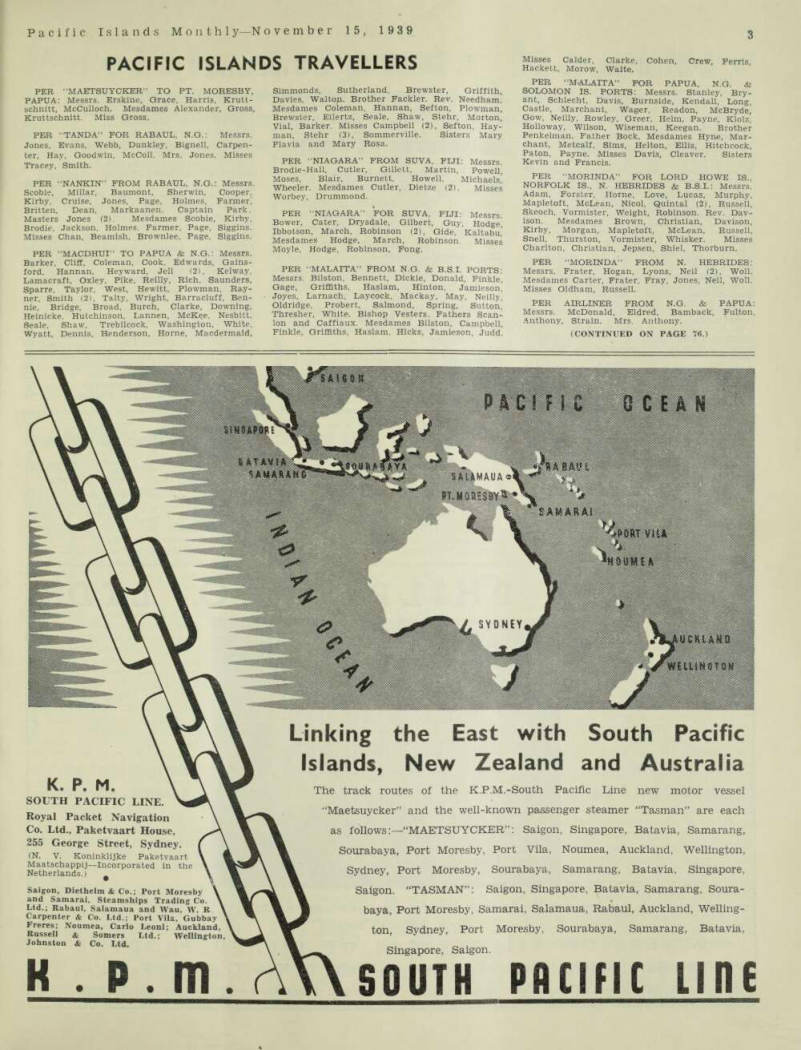
Linking the East with South Pacific
Islands, New Zealand and Australia
The track routes of the K.P.M.-South Pacific Line new motor vessel “Maetsuycker” and the well-known passenger steamer “Tasman” are each as follows: —“MAETSUYCKER”: Saigon, Singapore, Batavia, Samarang, Sourabaya, Port Moresby, Port Vila, Noumea, Auckland, Wellington, Sydney, Port Moresby, Sourabaya, Samarang, Batavia, Singapore, Saigon. “TASMAN”: Saigon, Singapore, Batavia, Samarang, Sourabaya, Port Moresby, Samarai, Salamaua, Rabaul, Auckland, Wellington, Sydney, Port Moresby, Sourabaya, Samarang, Batavia, Singapore, Saigon.
SOUTH PACIFIC LIRE
Advertisers
Amalgamated Wire less (A/sia) Ltd. . 48 Angus & Coote Ltd 65 Arnott’s Biscuits . 34 Atkins Ltd., W. . 43 “Ausoline” ... 74 Baker, Ltd W. Jno. 19
B.A.L.M. Ltd. . . 44
Bank of N.S.W. . 73 Berger’s Paints . 40 “Bernly” Guest House ... 72 “Bidomak” ... 23 Broomfields Ltd. . 52 Brown & Co. Ltd., G 15 Brunton’s Flour . . 39 Burns, Philp & Co. Ltd 4 B.P. Magazine . . 59'
B.P. (S.S.) Co. . . 45
Burns Philp Trust Co. Ltd. ... 49 Buzacott-Wolseley . 53 Carlton & United Breweries Ltd. . 27 Carpenter Ltd., W. R. . . . cov. 2 Chapman & Sherack 24 Chivers & Sons Ltd 37 “Cinnamolia” Pre parations ... 64 Coleman Lamp & Stove Co. . 28, 70 Colonial Sugar Re fining Co. Ltd. . 55 Coral Starch . . 37 Cosmopolitan Hotel 76 Crossle, Duff & Macintosh Ltd. . 66 “Cystex” ... 72 Danks & Son Ltd. . 54 Dewar’s Whisky . 32 Doan’s Pills ... 52 Donaghy & Sons Ltd 74 Donald Ltd. A. B. 56 Eaton Ltd., J. W. 41 Electrolux Refrigerators . . 26 Eno’s Fruit Salt . 33 Excelsior Supply Co. Ltd 28
Fairbanks - Morse Ltd 75 Fletcher & Sons . 50 “Flit” 70 Ford Sherington Ltd 22 Poster Clark Ltd. . 69 Garden Vale Pro ducts Ltd. ... 33 Garrett & Davidson 66 Gillespie’s Flour . 35 Gourock Rope Co. 66 Gowing Bros. Ltd. . 75 Grace Bros. Ltd. . 47 Grand Pacific Hotel 57 Grove & Son, W. H. 58 Guest House Wanted ... 21 Guinea Airways Ltd cov. 3 Guinness’ Stout . 42 Holbrook’s Ltd. . . 39 Hollywood Photo.
Service ... 11 Horlicks Malted Milk 29 Horne. W. & Co. . 56 Hotel Moresby . . 76 In Memoriam (Late David Lyall) 13 Jones & Co. Ltd. H. 81 Kambala School for Girls 64 King’s School, The 14 Kodak (A/sla) Pty.
Ltd 12 Kolynos Dental Cream ... 61 Kopsen & Co. Ltd. 16 Kork-N-Seal Ltd. . 35 Koyong Boarding School 69 Lapstone Hotel . . 62 Levenson’s Radio . 68 Lloyd & Co. Ltd. . 13 Lustre Hosiery, Ltd 63 “Majora” Speed Enamel ... 54 Matrimonial ... 61 Maxwell Porter Ltd 41 McHrath’s Ltd. . . 19 MerrilLees & Co. . 65
Miller & Co. Pty.
Ltd 52 National Box Co.
Pty. Ltd 17 Nelson & Robertson, Ltd 30 Nestles Milk ... 38 Newlands Bros Ltd 51 Newmarket Saddlery 73 Noyes Bros. Ltd. . 44 Ormonoid Roofing & Asphalts Ltd. . 67 Pabst Canned Beer 71 Pacific Is. Club . 69 Papua Hotel, The 76
Pike Bros. Ltd. . 22 Position Wanted . 55 Prescott Ltd. . . 36 Prouds Ltd. ... 13 Public Notice ... 57 Ransomes, Sims & Jefferies Ltd. . . 58 Reed, William E. . 34 Riverstone Meat Co. 20 Rohu, Sll ... 24 Royal Packet Co. . 3 Rutherford, G. . . 67 Scott Ltd., J. . . 45 Smyth Pty. Ltd. . 46
Sparten Lacquers Pty. Ltd. ... 49 Springwood, L. Col 63 Stamps Wanted . 70 Steamships Trading Co. Ltd 50 Sterling Varnish Co 11 St. Ignatius College 60 “Sunripe”
Cigarettes ... 59 Sullivan Ltd., C. . 35 Swallow & Ariell . 36 Sydney & Melbourne Publishing Co Ltd 76
Taylor & Co., A. . 67 “Tenax” Soap . . 62 Tlllock & Co Ltd 71 Toohey’s Ltd. . . 21 Tooth & Co. . cov. 4 Vincent’s A.P.C. . 31 Warburton, Frank!
Ltd 25 West, Harry ... 74 Weymark & Son . 37 Wills Ltd., W.D. & H.O 31 Wright & Co. Ltd.
E. ... 41 Wunderlich Ltd. . 41
Contents
Pacific News Review 1 Islands Travellers ;. .. 3, 76 International Affairs : Three Ugly Pictures 5 New 8.5.1. Resident Commissioner 7 New Caledonia Has Five Governors in Five Montjis 7 Copra Prices Expected to Hold ... 7 Gold Tax May Be Ultra Vires ... 7 No Flies in Tahiti! 8 Future of Native Labour in T.N.G. 8 War Dislocates Shipping Services .. 9 Prom Notes Made in New Guinea .. 9 Tropicalities n N.G. Road Plan Affected by War .. 12 About Islands People 13 Pacific Air Service Expected Soon .. 15 Japan’s Pacific Plans in Relation to the European War 16 U.S.A. Amends Neutrality Act .. .. 21 Dedication of New Papuan Cathedral 22 German Raider in the Pacific? ... 24 “Yunnan” Replaces German Vessel “Priderun” 25 Salaries of Tongan Officials 27 Tongan Prince Addresses P.I. Club .. 28 Scientific Expedition for the Pacific 29 I Come “Angery”—The Sufferings of an Islands Trader 30
Native Conditions in New Guinea .. 31 Fighting Pests with Parasites .. .. 32 Papua’s Early Goldfield 34 Islands Luxury Liners 36 Another Bond-Selling Plan for Papua 38 New Guinea’s Finances 40 The “Romantic South Seas” 41 John Williams—Missionary Autocrat of Raiatea 42 Japan’s Invasion of the Philippines 45 Wealth in Fiji’s Soil 50 Rise and Fall of Polynesia .. .. .. 51 Bulolo Co.’s Profit Over a Million .. 51 Planter Murdered in New Hebrides 53 Illuminated Address for Queen Salote 54 Bite of the Social Bee—A Sidelight in Polynesia 55 Shot-Gun Matrimony Another Trader’s Tale se How U.S.A. Feels Towards the War 58 Japanese Trade Envoys in Papua .. 59 German Opinion in Samoa 61 Islands Display at N.Z. Exhibition .. 62 Another N.G. Plane Lost 64 Pacific Mining News 66 Short Wave Radio Programmes ... 69 Copra and Rubber Quotations .. .. 72 Islands Produce and Exchange ... 73 Shipping Services in the Pacific ... 74
Advertisements & other items, p. 6 (1 item)
Burns, Philp & Co. Ltd.
GENERAL
MERCHANTS
I! II
1111. jin'* II
iiii
in
III!
ill lIS
fit
Mill
ri
SHIPOWNERS
TOURIST AGENTS
Head Office: 7 Bridge Street, Sydney—Australia Code Address; "Burphil"
BUYERS OF ALL CLASSES OF ISLAND PRODUCE Regular Steamer Services from Australia to New Guinea Papua Solomon Is.—Lord Howe Is.—Norfolk Is. —New Hebrides —Java and Singapore
Pacific Islands Monthly
The Newspaper-Magazine of the South Seas [Registered at the G.P.0.. Sydney, for transmission by post as a newspaper .]
Owned and Produced by Pacific Publications Pty. Ltd., Union House, 247 George Street, Sydney.
Tier FPHnNv f Managing Director .. BW 5037 TBiLrjr’tiOi'iiii , Business and Editorial MA 7101
P.O Box 3408 R
Registered Address of Telegrams, Radiograms, and Cables: “Pacpub”, Sydney.
Contributions.
Articles, Stories, and Photographs dealing with Pacific Islands subjects are invited and will be paid for on publication at usual rates.
Subscription Rates.
Per Annum, within British Empire, Prepaid, Post Free 8/- Per Annum, elsewhere, prepaid, Post Free . 107- Single Copies Bd.
Editor and Publisher:
R. W. Robson, P.R.G.S.
Assisted by Selwyn Hughes.
Advertising Manager: L. W. Bailey.
Advertising Office and Printing-House: 29 Alberta St., Sydney.
Advertising rates furnished on application.
Colours, etc by Arrangement.
Process Blocks made at Advertiser’s expense when required. Screen 100.
Changes of Advertising Copy should reach this Office by Ist of each month, otherwise previous advertisement may be repeated, IN LONDON, the Pacific Islands Monthly is on sale at the Bookstall, Australia House, The Strand, London.
Agents.
The following are authorised to receive sub scriptions for the Pacific Islands Monthly:— Islands Branches of Burns, Phllp & Co., Ltd., and Burns Philp (South Sea) Co., Ltd.
Islands Branches of W. R. Carpenter & Co., Ltd.
Islands Branches of Morris, Hedstrom, Ltd.
G. Thomas & Co., Rabaul, New Guinea.
T. A. Olsson, Wau, New Guinea.
Whitten Bros., Ltd., Samarai, Papua.
Steamships Trading Co., Papua. All Branches.
B.N.G. Trading Co., Ltd., Port Moresby.
J. Muir, Suva, Fiji.
N. C. Mackenzie-Hunt, Wainunu, Bua, Fiji.
Islands Branches and Representatives of W. H.
Grove & Sons, Ltd., Auckland, New Zealand.
Cook Islands Trading Co., Rarotonga, Cook Is.
A. C. Rowland, Papeete, Tahiti.
Representative in London: W. C. HARVEY, Coronation House, 4 Lloyds Avenue, London, E.C.3, from whom may be obtained copies of Pacific Islands Monthly, Pacific Islands Year Book, advertising schedules, etc.
Vol. X. No. 4.
November 15, 1939.
j 8d- Per c°py rnce £ Prepaid; 8/- p.a.
International Affairs: Three Ugly Pictures
TRANSPORT, trade, development, administration—all the normal activities of the Pacific territories await the outcome of events in Europe. Anxiously, we watch the progress of the Hitler War: but the unreal and fantastic character of the thing, and the unprecedented com plexity of international affairs gener ally, give the future an appearance baffling to the ordinary man.
Britain and France will not make peace with Germany until Germany renounces Hitlerism (which means unreliableness, treachery and aggres siveness in international relationships) and until a measure of independence is restored to the Poles and Czechs.
The Allies are not attacking Germany —merely standing to arms along Germany’s western front, while they put upon Germany’s economic struc ture a stranglehold that grows stronger every week. That policy may, or may not, succeed.
Germany (population 90,000,000, in cluding Czechs and Poles) has im mense armies and air-fleets facing the Allies in the west; a doughty people apparently united behind Hitler; and—across the frontiers of Scandinavia, Russia, the Balkans and Italy—much of the world to be drawn upon for food supplies and raw material.
On these broad facts, it looks like stalemate. Either side could do in calculable damage to the other; but, if each remains staunch, neither can defeat the other.
It is a fact, however, that the developments of September and October have placed increasing ad vantages with the democracies. Ger many sacrificed her two potential
Allies (Italy and Japan) to make a pact with Russia; and now her re lations with Russia are increasingly cold. Russia has seized control of Latvia, Estonia and Lithuania, and is menacing Finland, while Germany— regarded as the natural protector of the Baltic States—stands impotent and foolish. Russia is trying to ex tend her influence over the Balkans, but has been virtually defied by Turkey (the ally of Britain and France); and, as Italy is equally in terested in keeping Bolshevism out of the Balkans, Italy is inclined to ally herself with Turkey, and daily is mov ing further away from the “Rome- Berlin Axis”.
Obeying the clear wish of 70 per cent, of the American people, the United States Congress swept away sufficient of the two-years-old Neu trality Act to permit the Allies to buy in America all the munitions they require. The Americans do not wish to enter another European war, but there is no doubt where their sym pathies lie. * * * EACH week shows Nazi Germany more isolated and more friend less. In the field of diplomacy, she has made some erratic, disconnected and apparently silly moves. It is clear that, in Germany’s international relationships, Hitler acts by himself and takes no advice —and Hitler, who never has been outside of Germany (except one brief visit to Rome) knows nothing of the psychology of other nations. One gets the im pression that, with the now enor mously powerful Allies waiting grimly in the west, and the sinister black shadow of a cruel, cynical and over whelming Russia creeping ever nearer
in the east, the nerve of the mono maniac is breaking. The more sensa tional newspapers, always wishful thinkers, already picture him running around shrieking, and wringing his hands.
In the meantime, what will he do next? Realising that they are deal ing with a man who has no regard for treaties or promises or frontiers, the small neutral nations—Holland, Belgium and Switzerland—are at full war strength, ready to repel the wild beast if he should invade their terri tories in a spring at Britain or France.
These are wise precautions. The possibility is there; but the prob abilities are all against it. The Ger man army chiefs will not allow their Fuhrer to sacrifice their mighty mili tary machine—their one guarantee of security in a future time, when the monomaniac and his Nazi “govern ment” shall have been swept away, and it will be necessary for the Ger mans to right-about-turn and face the eastern frontier. If Hitler were to over-run Holland, or those other neutral democracies, he would stir up against Germany the active hostility of the entire world, so that Germany inevitably would be defeated, and Western civilisation might crumble.
So far as the Hitler War is con cerned, we may expect a further period of merely stand-to-arms. The Allies will await the final collapse of the Hitler nerve and the breaking of Nazi-dom; while the Nazi gangsters, for their part, will do everything that devilish ingenuity can devise to undermine the morale of the Allies, and separate France from Britain. * * * MEANWHILE, according to hysteri cal journalists, Russia remains “completely a mystery”. She double crossed Britain and France, between
March and August; she appears to have double-crossed Germany be tween August and November. With cold and calculated purpose, she will double-cross any other nation which enters into relations with her, so long as thereby she can weaken any unit of “the capitalistic world”.
Britain and France have gone back again to Moscow, to do a little diplo matic wooing there, and maybe tighten their economic stranglehold on Germany. It is a useless waste of time. Russia’s one dominating policy is to break down the Western European property-owning system, and spread Communism: and she will have no scruples in deceiving first one side, and then another, in this Hitler War, in the hope that she can weaken them all and open the way for the outward march of the Red Armies of Bolshevism. Nothing that the Western world holds dear—the sanctity of treaties, the honouring of obligations, respect of religion, cleanliness and decency in individual conduct— matters in the sight of the Bolshevik, if only his peculiar dogma can be advanced.
Long after Hitler has gone to oc cupy his memorial niche among the freaks of history, and Germany has taken her natural alignment with Western nations, the growing menace of Russia will make us value more highly our democratic institutions, and will force us to go everlastingly armed. * * * THERE is yet another factor which threatens the orderliness of our world. We who live in the Pacific must regard the present condition of Japan as a greater menace to our security than either Nazi Germany or Russia. Japan, at the moment, seems a problem insoluble; yet the future of Japan is as much our responsibility as it is that of the harassed Govern ment in Tokio.
Japan, under a century of Occi dental tuition, has become Western ised and industrialised. To-day, be cause of that, she must expand, or perish. She must have territory for her surplus people, new sources of raw material for her factories, sure markets for her manufactures. She was a late-comer in nineteenth cen tury colonisation; so that, to-day, wherever she turns, she finds already the flag of another nation. Malaya, Cochin China, East Indies, East Africa, Philippines, New Guinea, Hawaii—any one of these great, rich territories would have met her im mediate needs, and left her to make plough-shares rather than bayonets.
As it is, her choice is a cruel one; and we, as reasoning human beings, must recognise her dilemma.
Japan, at this moment, is at a part ing of the ways. Her army is bogged in China, and her economic condition is precarious. During the two years in which her militarists directed her Government, she was committed to the policy of driving Britain out of China while Britain’s hands were tied
in Europe; and, although her Govern ment is changed, and political af fairs there now are completely in a state of flux, the campaign goes on.
Britain will not abandon her enor mous interests in China without a fight; and, if Britain fights to main tain the status quo in China or the Pacific, the United States probably will join. her. In that event, nothing could save Japan from a major dis aster.
But what good would be achieved in the Pacific if the Japanese Empire were destroyed? None. The Euro pean communities in Asia and Aus tralasia might write their own death warrant.
Let the lesson of Versailles be ap plied in the Pacific and in Eastern Asia. If the Allies, in 1920-1930, had assisted in re-building the Teutonic nations in Germany and Austria, there
would have been no Hitler War to day—and no sinister shadow creep ing across Europe from the east. If the European nations, including U.S.A., in 1940-1950, will assist Japan in solving her most urgent national problems, they may prevent, in the Pacific, something far worse than the Hitler War. There is yet time for the nations to deal with this situation; but the sands are running out. The alternative is a thing too horrible to contemplate—a period of ceaseless armament and tension, and an In evitable, ruthless war of extermination between Europeans and Asiatics. * * * Thus, international affairs to-day present three separate and uncon nected pictures of extreme ugliness— the Hitler War; Russia’s determina tion to “Bolshevise” the world; and the desperate situation of Japan.
Advertisements & other items, p. 8 (1 item)
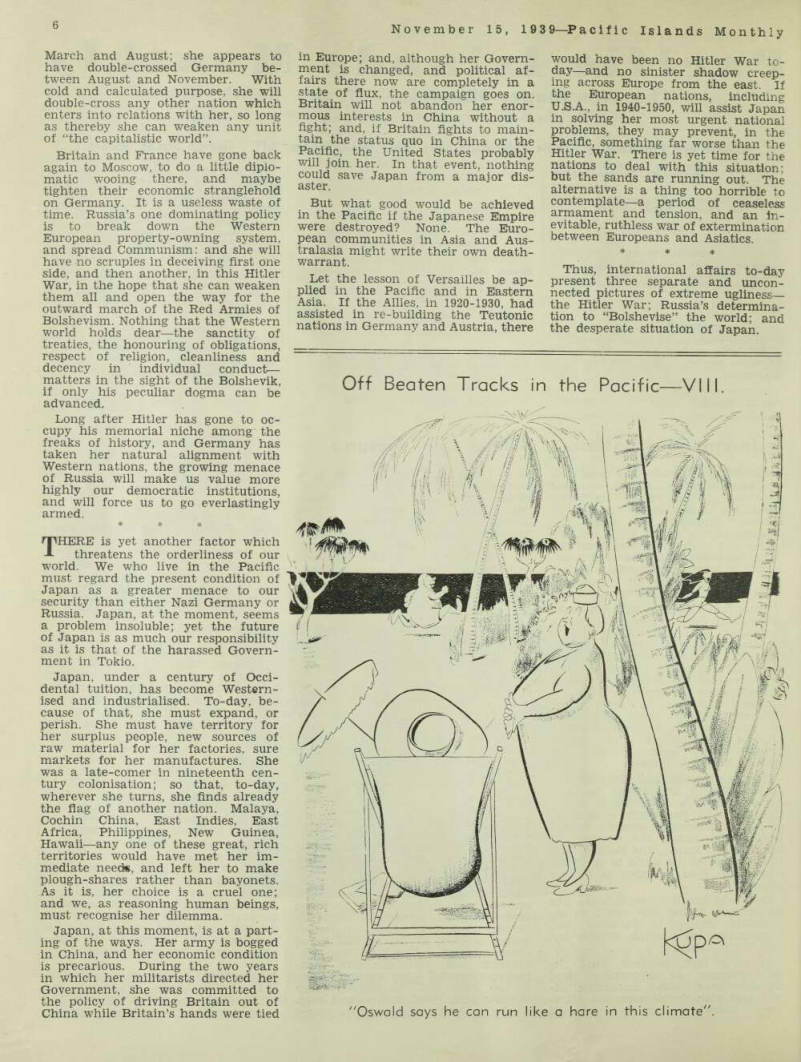
Off Beaten Tracks in the Pacific —VIII.
"Oswald says he can run like a hare in this climate".
New Resident Commissioner
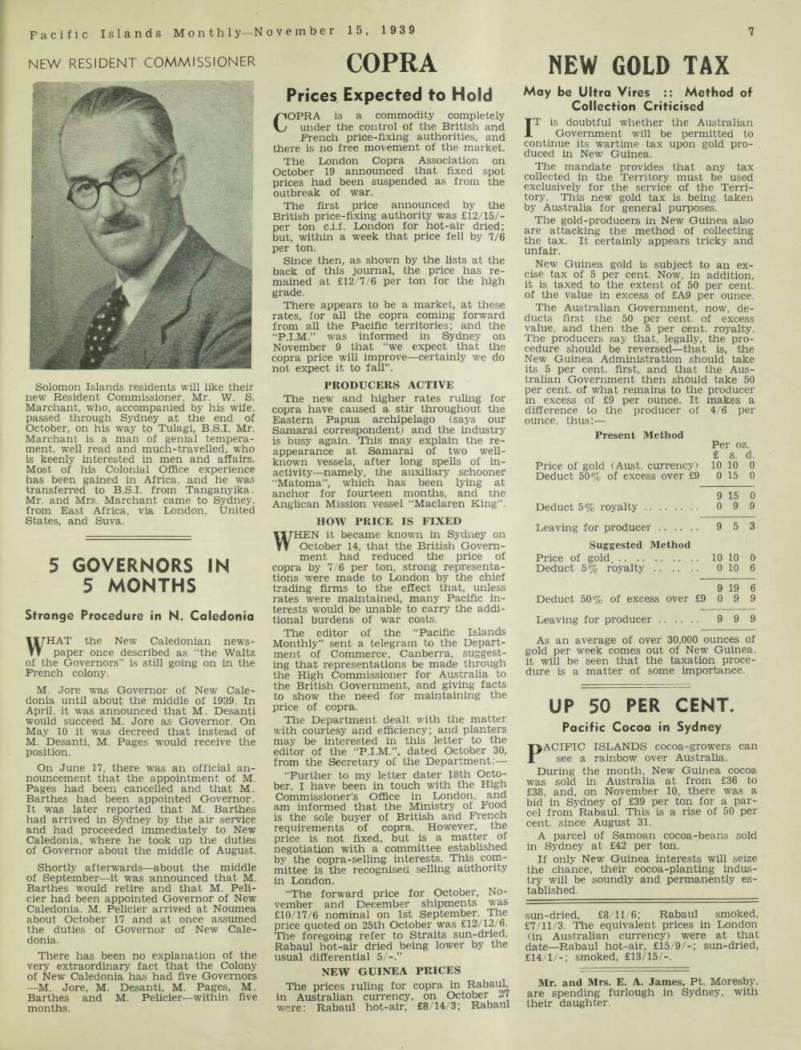
Solomon Islands residents will like their new Resident Commissioner, Mr. W. S.
Marchant, who, accompanied by his wife, passed through Sydney at the end of October, on his way to Tulagi, 8.5.1. Mr.
Marchant is a man of genial tempera ment, well read and much-travelled, who is keenly interested in men and affairs.
Most of his Colonial Office experience has been gained in Africa, and he was transferred to 8.5.1. from Tanganyika.
Mr. and Mrs. Marchant came to Sydney, from East Africa, via London, United States, and Suva.
5 Governors In
5 Months
Strange Procedure in N. Caledonia
WHAT the New Caledonian news paper once described as “the Waltz of the Governors” is still going on in the French colony.
M. Jore was Governor of New Cale donia until about the middle of 1939. In April, it was announced that M. Desanti would succeed M. Jore as Governor. On May 10 it was decreed that instead of M. Desanti, M. Pages would receive the position.
On June 17, there was an official an nouncement that the appointment of M.
Pages had been cancelled and that M.
Barthes had been appointed Governor.
It was later reported that M. Barthes had arrived in Sydney by the air service and had proceeded immediately to New Caledonia, where he took up the duties of Governor about the middle of August.
Shortly afterwards —about the middle of September—it was announced that M.
Barthes would retire and that M. Peli cier had been appointed Governor of New Caledonia. M. Pelicier arrived at Noumea about October 17 and at once assumed the duties of Governor of New Cale donia.
There has been no explanation of the very extraordinary fact that the Colony of New Caledonia has had five Governors —M. Jore, M. Desanti, M. Pages, M.
Barthes and M. Pelicier—within five months.
Copra
Prices Expected to Hold
COPRA is a commodity completely under the control of the British and French price-fixing authorities, and there is no free movement of the market.
The London Copra Association on October 19 announced that fixed spot prices had been suspended as from the outbreak of war.
The first price announced by the British price-fixing authority was £l2/15/per ton c.i.f. London for hot-air dried; but, within a week that price fell by 7/6 per ton.
Since then, as shown by the lists at the back of this journal, the price has re mained at £l2/7/6 per ton for the high grade.
There appears to be a market, at these rates, for all the copra coming forward from all the Pacific territories; and the “P.1.M.” was informed in Sydney on November 9 that “we expect that the copra price will improve—certainly we do not expect it to fall”.
Producers Active
The new and higher rates ruling for copra have caused a stir throughout the Eastern Papua archipelago (says our Samarai correspondent) and the industry is busy again. This may explain the re appearance at Samarai of two well known vessels, after long spells of in activity—namely, the auxiliary schooner “Matoma”, which has been lying at anchor for fourteen months, and the Anglican Mission vessel “Maclaren King”.
How Price Is Fixed
WHEN it became known in Sydney on October 14, that the British Govern ment had reduced the price of copra by 7/6 per ton, strong representa tions were made to London by the chief trading firms to the effect that, unless rates were maintained, many Pacific in terests would be unable to carry the addi tional burdens of war costs.
The editor of the “Pacific Islands Monthly” sent a telegram to the Depart ment of Commerce, Canberra, suggest ing that representations be made through the High Commissioner for Australia to the British Government, and giving facts to show the need for maintaining the price of copra.
The Department dealt with the matter with courtesy and efficiency; and planters may be interested in this letter to the editor of the “P.1.M.”, dated October 30, from the Secretary of the Department:— “Further to my letter dater 18th Octo ber, I have been in touch with the High Commissioner’s Office in London, and am informed that the Ministry of Food is the sole buyer of British and French requirements of copra. However, the price is not fixed, but is a matter of negotiation with a committee established by the copra-selling interests. This com mittee is the recognised selling authority in London.
“The forward price for October, No vember and December shipments was £lO/17/6 nominal on Ist September. The price quoted on 25th October was £l2/12/6.
The foregoing refer to Straits sun-dried.
Rabaul hot-air dried being lower by the usual differential 5/-.”
New Guinea Prices
The prices ruling for copra in Rabaul, in Australian currency, on October 27 were: Rabaul hot-air, £B/14/3; Rabaul
sun-dried, £B/11/6; Rabaul smoked, £7/11/3. The equivalent prices in London (in Australian currency) were at that date —Rabaul hot-air, £l5/9/-; sun-dried, £l4/1/-; smoked, £l3/15/-.
Mr. and Mrs. E. A. James, Pt. Moresby, are spending furlough in Sydney, with their daughter.
New Gold Tax
May be Ultra Vires :: Method of Collection Criticised
IT is doubtful whether the Australian Government will be permitted to continue its wartime tax upon gold pro duced in New Guinea.
The mandate provides that any tax collected in the Territory must be used exclusively for the service of the Terri tory. This new gold tax is being taken by Australia for general purposes.
The gold-producers in New Guinea also are attacking the method of collecting the tax. It certainly appears tricky and unfair.
New Guinea gold is subject to an ex cise tax of 5 per cent. Now, in addition, it is taxed to the extent of 50 per cent, of the value in excess of £A9 per ounce.
The Australian Government, now, de ducts first the 50 per cent, of excess value, and then the 5 per cent, royalty.
The producers say that, legally, the pro cedure should be reversed —that is, the New Guinea Administration should take its 5 per cent, first, and that the Aus tralian Government then should take 50 per cent, of what remains to the producer in excess of £9 per ounce. It makes a difference to the producer of 4/6 per ounce, thus: —
As an average of over 30,000 ounces of gold per week comes out of New Guinea, it will be seen that the taxation proce dure is a matter of some importance.
Present Method Per oz. £ S. d.
Price of gold (Aust. currency) 10 10 0 Deduct 50% of excess over £9 0 15 0 9 15 0 Deduct 5% royalty 0 9 9 Leaving for producer 9 5 3 Suggested Method Price of gold 10 10 0 Deduct 5% royalty 0 10 6 9 19 6 Deduct 50% of excess over £9 0 9 9 Leaving for producer 9 9 9
Up 50 Per Cent.
Pacific Cocoa in Sydney
PACIFIC ISLANDS cocoa-growers can see a rainbow over Australia.
During the month, New Guinea cocoa was sold in Australia at from £36 to £3B, and, on November 10, there was a bid in Sydney of £39 per ton for a par cel from Rabaul. This is a rise of 50 per cent, since August 31.
A parcel of Samoan cocoa-beans sold in Sydney at £42 per ton.
If only New Guinea interests will seize the chance, their cocoa-planting indus try will be soundly and permanently es tablished.
No Flies In
Tahiti
Entomological Mystery Worthy of Investigation
From Our Own Correspondent
Papeete, Oct. 19.
VISITORS from countries where the Musca Domestica is a tribulation to housewives and a problem to health authorities, remark on the almost total absence of this pest at Papeete. That there exists at Tahiti some enemy which destroys the house fly is attested by the following circumstances.
Some years ago, a steamer in distress came into Papeete harbour. She was loaded with wheat, which had taken fire and was smouldering. The holds were flooded and the fire extinguished. The damp wheat was unloaded and piled up on shore at Fare Ute.
From this decaying mass of grain came a plague of house flies such as the island had never known. Later, the wheat was taken to a nearby sugar plantation and used as fertiliser. The atmosphere over and adjacent to the plantation was cloudy with myriads of house flies.
This continued for, perhaps, a month and, as suddenly as they had appeared, the legions of house flies vanished.
The market places of most tropical countries (and those of temperate climes as well) are the happy hunting-grounds of un-numbered millions of house flies— especially when fish is there for sale.
At the Papeete market a house fly is a curiosity.
No one has ever taken the trouble to learn why.
EDITORIAL NOTE: This curious ana interesting fact should be of value to entomologists. Is Tahiti, by any chance, the home of a parasite which, introduced to other countries, would control or wipe out one of humanity’s greatest curses?
The thing certainly should be worthy of investigation.
Mrs. Mabel Dexter, wife of Mr. Henry Dexter, formerly of Milne Bay, Eastern Papua, died in England on September 3. after a long illness. She was formerly Mrs.
Martin Staples, and she married Mr.
Dexter in England a little over a year ago.
Death In Tonga Of Mrs. R. C. G. Page
ON September 22, the re mains of the late Mrs.
Page, wife of Rev. R. C.
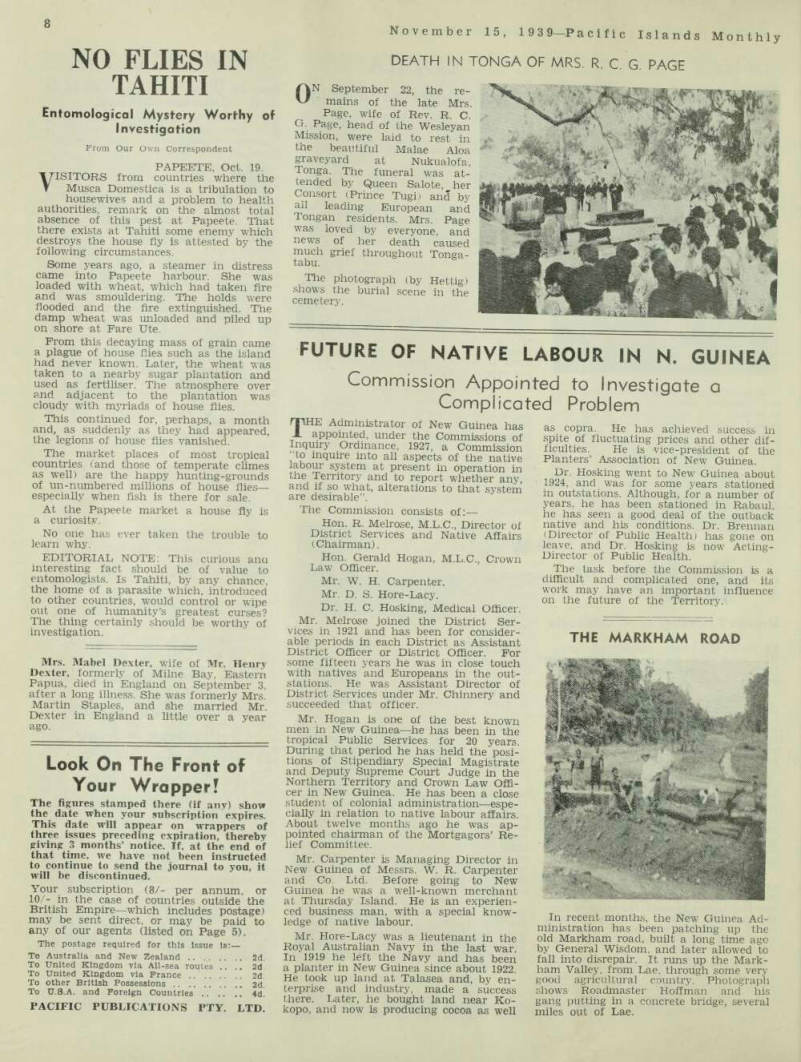
G. Page, head of the Wesleyan Mission, were laid to rest in the beautiful Malae Aloa graveyard at Nukualofa, Tonga. The funeral was at tended by Queen Salote, her Consort (Prince Tugi) and by all leading European and Tongan residents. Mrs. Page was loved by everyone, and news of her death caused much grief throughout Tonga tabu.
The photograph (by Hettig) shows the burial scene in the cemetery.
Complicated Problem
FUTURE OF NATIVE LABOUR IN N. GUINEA Commission Appointed to Investigate a Complicated Problem
The Administrator of New Guinea has appointed, under the Commissions of Inquiry Ordinance, 1927, a Commission to inquire into all aspects of the native labour system at present in operation in the Territory and to report whether any, and if so what, alterations to that system are desirable”.
The Commission consists of:— Hon. R. Melrose, M.L.C., Director of District Services and Native Affairs (Chairman).
Hon. Gerald Hogan, M.L.C., Crown Law Officer.
Mr. W. H. Carpenter.
Mr. D. S. Hore-Lacy.
Dr. H. C. Hosking, Medical Officer.
Mr. Melrose joined the District Ser vices in 1921 and has been for consider able periods in each District as Assistant District Officer or District Officer. For some fifteen years he was in close touch with natives and Europeans in the out stations. He was Assistant Director of District Services under Mr. Chinnery and succeeded that officer.
Mr. Hogan is one of the best known men in New Guinea—he has been in the tropical Public Services for 20 years.
During that period he has held the posi tions of Stipendiary Special Magistrate and Deputy Supreme Court Judge in the Northern Territory and Crown Law Offi cer in New Guinea. He has been a close student of colonial administration—espe cially in relation to native labour affairs.
About twelve months ago he was ap pointed chairman of the Mortgagors’ Re lief Committee.
Mr. Carpenter is Managing Director in New Guinea of Messrs. W. R. Carpenter and Co. Ltd. Before going to New Guinea he was a well-known merchant at Thursday Island. He is an experien ced business man, with a special know ledge of native labour.
Mr. Hore-Lacy was a lieutenant in the Royal Australian Navy in the last war.
In 1919 he left the Navy and has been a planter in New Guinea since about 1922.
He took up land at Talasea and, by en terprise and industry, made a success there. Later, he bought land near Ko kopo, and now is producing cocoa as well
as copra. He has achieved success in spite of fluctuating prices and other dif ficulties. He is vice-president of the Planters’ Association of New Guinea.
Dr - Hoskin g went to New Guinea about 1924, and was for some years stationed in outstations. Although, for a number of years, he has been stationed in Rabaul, he has seen a good deal of the outback native and his conditions. Dr. Brennan (Director of Public Health) has gone on leave, and Dr. Hosking is now Acting- Director of Public Health.
The task before the Commission is a difficult and complicated one, and its work may have an important influence on the future of the Territory.
The Markham Road
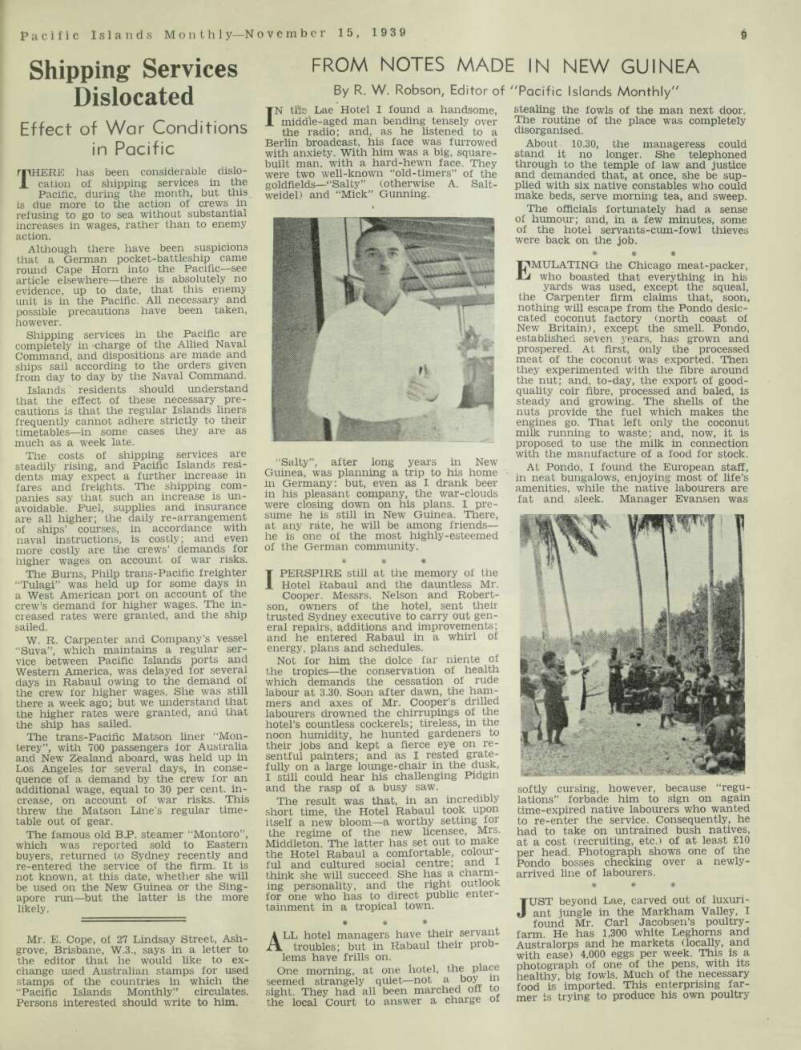
In recent months, the New Guinea Ad ministration has been patching up the old Markham road, built a long time ago by General Wisdom, and later allowed to fall into disrepair. It runs up the Mark ham Valley, from Lae, through some very good agricultural country. Photograph shows Roadmaster Hoffman and his gang putting in a concrete bridge, several miles out of Lae.
Advertisements & other items, p. 10 (2 items)
8
November 15, 1 939-Pacilic Islands Monthly
Your Wrapper!
Look On The Front of
The figures stamped there (if any) show the date when your subscription expires.
This date will appear on wrappers of three issues preceding expiration, thereby giving 3 months’ notice. If, at the end of that time, we have not been instructed to continue to send the journal to you, it will be discontinued.
Your subscription (8/- per annum, or 10/- in the case of countries outside the British Empire—which includes postage) may be sent direct, or may be paid to any of our agents (listed on Page 5).
The postage required for this Issue Ist To Australia and New Zealand 2d.
To United Kingdom via All-sea routes ... 2d To United Kingdom via France 2d To other British Possessions 2di To U.S.A. and Foreign Countries 4d.
PACIFIC PUBLICATIONS PTY. LTD.
Shipping Services
Dislocated Effect of War Conditions in Pacific
11HERE has been considerable dislo . cation of shipping services in the Pacific, during the month, but this is due more to the action of crews in refusing to go to sea without substantial increases in wages, rather than to enemy action.
Although there have been suspicions that a German pocket-battleship came round Cape Horn into the Pacific —see article elsewhere —there is absolutely no evidence, up to date, that this enemy unit is in the Pacific. All necessary and possible precautions have been taken, however.
Shipping services in the Pacific are completely in charge of the Allied Naval Command, and dispositions are made and ships sail according to the orders given from day to day by the Naval Command.
Islands residents should understand that the effect of these necessary pre cautions is that the regular Islands liners frequently cannot adhere strictly to their timetables—in some cases they are as much as a week late.
The costs of shipping services are steadily rising, and Pacific Islands resi dents may expect a further increase in fares and freights. The shipping com panies say that such an increase is un avoidable. Fuel, supplies and insurance are all higher; the daily re-arrangement of ships’ courses, in accordance with naval instructions, is costly; and even more costly are the crews’ demands for higher wages on account of war risks.
The Burns, Philp trans-Pacific freighter “Tulagi” was held up for some days in a West American port on account of the crew’s demand for higher wages. The in creased rates were granted, and the ship sailed.
W. R. Carpenter and Company’s vessel "Suva”, which maintains a regular ser vice between Pacific Islands ports and Western America, was delayed for several days in Rabaul owing to the demand of the crew for higher wages. She was still there a week ago; but we understand that the higher rates were granted, and that the ship has sailed.
The trans-Pacific Matson liner "Mon terey”, with 700 passengers for Australia and New Zealand aboard, was held up in Los Angeles for several days, in conse quence of a demand by the crew for an additional wage, equal to 30 per cent, in crease, on account of war risks. This threw the Matson Line’s regular time table out of gear.
The famous old B.P. steamer "Montoro”, which was reported sold to Eastern buyers, returned to Sydney recently and re-entered the service of the firm. It is not known, at this date, whether she will be used on the New Guinea or the Sing apore run—but the latter is the more likely.
Mr. E. Cope, of 27 Lindsay Street, Ash grove, Brisbane, W. 3., says in a letter to the editor that he would like to ex change used Australian stamps for used stamps of the countries in which the "Pacific Islands Monthly” circulates.
Persons interested should write to him.
From Notes Made In New Guinea
By R. W. Robson, Editor of "Pacific Islands Monthly"
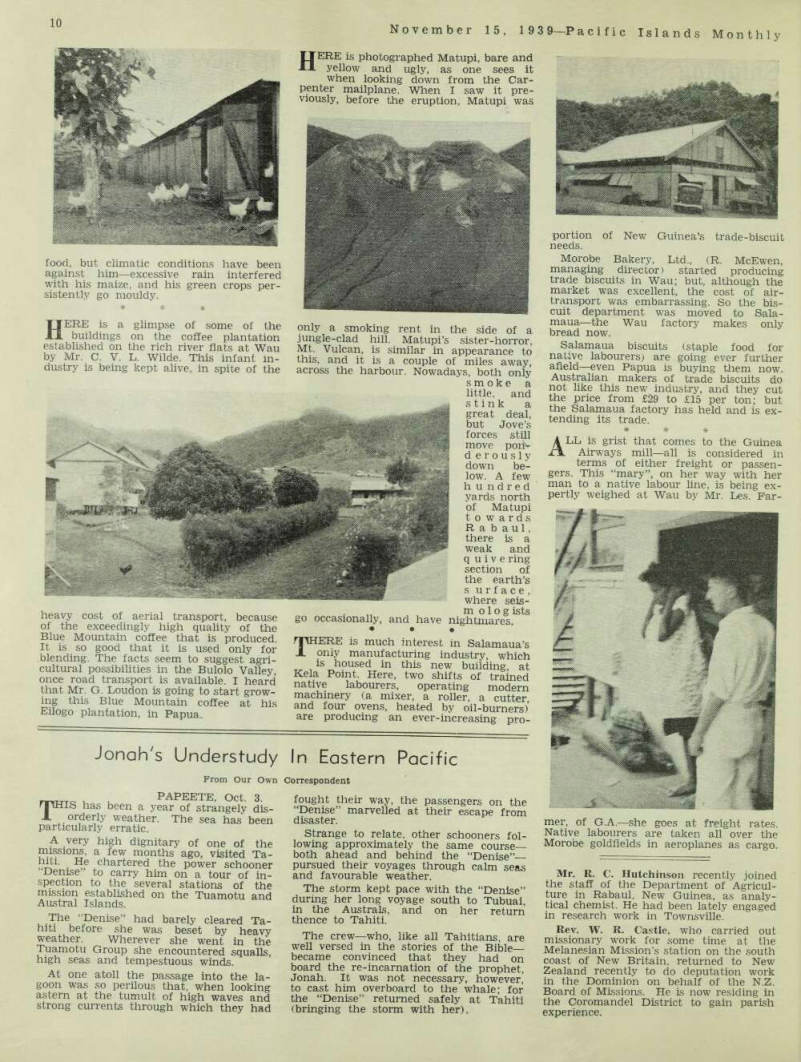
IN the Lae Hotel I found a handsome, middle-aged man bending tensely over the radio; and, as he listened to a Berlin broadcast, his face was furrowed with anxiety. With him was a big, square built man, with a hard-hewn face. They were two well-known “old-timers” of the goldfields—“Salty” (otherwise A, Salt weidel) and “Mick” Gunning.
I PERSPIRE still at the memory of the Hotel Rabaul and the dauntless Mr.
Cooper. Messrs. Nelson and Robert son, owners of the hotel, sent their trusted Sydney executive to carry out gen eral repairs, additions and improvements; and he entered Rabaul in a whirl of energy, plans and schedules.
Not for him the dolce far niente of the tropics—the conservation of health which demands the cessation of rude labour at 3.30. Soon after dawn, the ham mers and axes of Mr. Cooper’s drilled labourers drowned the chirrupings 9f the hotel’s countless cockerels; tireless, in the noon humidity, he hunted gardeners to their jobs and kept a fierce eye on re sentful painters; and as I rested grate fully on a large lounge-chair in the dusk, I still could hear his challenging Pidgin and the rasp of a busy saw.
The result was that, in an incredibly short time, the Hotel Rabaul took upon itself a new bloom —a worthy setting for the regime of the new licensee, Mrs.
Middleton. The latter has set out to make the Hotel Rabaul a comfortable, colour ful and cultured social centre; and I think she will succeed. She has a charm ing personality, and the right outlook for one who has to direct public enter tainment in a tropical town. * * * ALL hotel managers have their servant troubles; but in Rabaul their prob lems have frills on.
One morning, at one hotel, the place seemed strangely quiet—not a boy m sight. They had all been marched off to the local Court to answer a charge oi
stealing the fowls of the man next door.
The routine of the place was completely disorganised.
About 10.30, the manageress could stand it no longer. She telephoned through to the temple of law and justice and demanded that, at once, she be sup plied with six native constables who could make beds, serve morning tea, and sweep.
The officials fortunately had a sense of humour; and, in a few minutes, some of the hotel servants-cum-fowl thieves were back on the job. * * ♦ EMULATING the Chicago meat-packer, who boasted that everything in his yards was used, except the squeal, the Carpenter firm claims that, soon, nothing will escape from the Pondo desic cated coconut factory (north coast of New Britain), except the smell. Pondo, established seven years, has grown and prospered. At first, only the processed meat of the coconut was exported. Then they experimented with the fibre around the nut; and, to-day, the export of good quality coir fibre, processed and baled, is steady and growing. The shells of the nuts provide the fuel which makes the engines go. That left only the coconut milk running to waste; and, now, it is proposed to use the milk in connection with the manufacture of a food for stock.
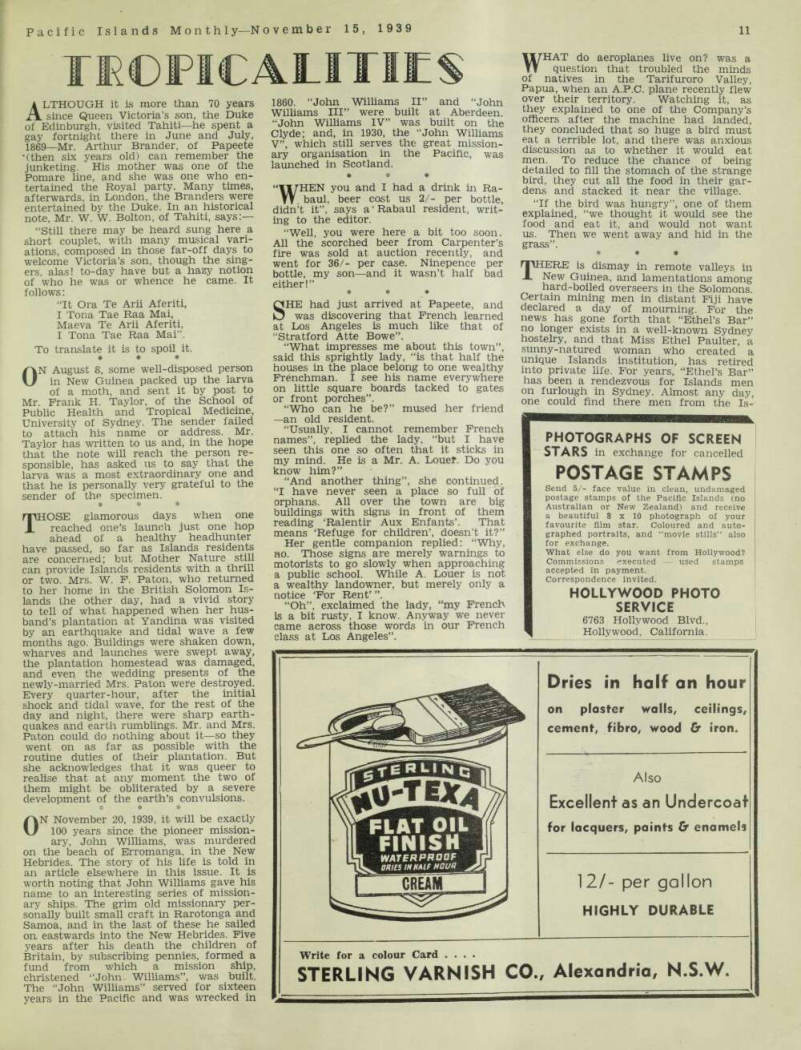
At Pondo, I found the European staff, in neat bungalows, enjoying most of life’s amenities, while the native labourers are fat and sleek. Manager Evansen was
softly cursing, however, because “regu lations” forbade him to sign on again time-expired native labourers who wanted to re-enter the service. Consequently, he had to take on untrained bush natives, at a cost (recruiting, etc.) of at least £lO per head. Photograph shows one of the Pondo bosses checking over a newly arrived line of labourers. * * * JUST beyond Lae, carved out of luxuri ant jungle in the Markham Valley, I found Mr. Carl Jacobsen’s poultry farm. He has 1,300 white Leghorns and Australorps and he markets (locally, and with ease) 4,000 eggs per week. This is a photograph of one of the pens, with its healthy, big fowls. Much of the necessary food is imported. This enterprising far mer is trying to produce his own poultry
"Salty”, after long years in New Guinea, was planning a trip to his home in Germany: but, even as I drank beer in his pleasant company, the war-clouds were closing down on his plans. I pre sume he is still in New Guinea. There, at any rate, he will be among friends — he is one of the most highly-esteemed of the German community.
food, but climatic conditions have been against him—excessive rain interfered with his maize, and his green crops per sistently go mouldy. * * * HERE is a glimpse of some of the buildings on the coffee plantation established on the rich river flats at Wau by Mr. C. V. L. Wilde. This infant in dustry is being kept alive, in spite of the
heavy cost of aerial transport, because of the exceedingly high quality of the Blue Mountain coffee that is produced.
It is so good that it is used only for blending. The facts seem to suggest agri cultural possibilities in the Bulolo Valley, once road transport is available. I heard that Mr. G. Loudon is going to start grow ing this Blue Mountain coffee at his Eilogo plantation, in Papua.
HERE is photographed Matupi, bare and yellow and ugly, as one sees it when looking down from the Car penter mailplane. When I saw it pre viously, before the eruption, Matupi was
9 n ly a smoking rent in the side of a jungle-clad hill. Matupi’s sister-horror, Mt. Vulcan, is similar in appearance to this, and it is a couple of miles away, across the harbour. Nowadays, both only
smoke a little, and stink a great deal, but Jove’s forces still move pon dero u s 1 y down be low. A few hundred yards north of Matupi towards Rabaul, there is a weak and q u i v e ring section of the earth’s s u r f a c e , where seis
m o 1 o g ists go occasionally, and have nightmares. • • • rERE is much interest in Salamaua’s only manufacturing industry, which is housed in this new building, at Kela Point. Here, two shifts of trained native labourers, operating modern machinery (a mixer, a roller, a cutter, and four ovens, heated by oil-burners) are producing an ever-increasing pro-
Jonah s Understudy In Eastern Pacific
From Our Own Correspondent
R Papeete, Oct. 3.
IS has been a year of strangely dis orderly weather. The sea has been particularly erratic.
A very high dignitary of one of the missions, a few months ago, visited Ta chartered the power schooner Denise to carry him on a tour of in spection to the several stations of the mission established on the Tuamotu and Austral Islands.
The “Denise” had barely cleared Ta hiti before she was beset by heavy weather. Wherever she went in the Tuamotu Group she encountered squalls, high seas and tempestuous winds.
At one atoll the passage into the la goon was so perilous that, when looking astern at the tumult of high waves and strong currents through which they had
fought their way, the passengers on the “Denise” marvelled at their escape from disaster.
Strange to relate, other schooners fol lowing approximately the same course— both ahead and behind the “Denise”— pursued their voyages through calm seas and favourable weather.
The storm kept pace with the “Denise” during her long voyage south to Tubuai, in the Australs, and on her return thence to Tahiti.
The crew—who, like all Tahitians, are well versed in the stories of the Bible— became convinced that they had on board the re-incarnation of the prophet, Jonah. It was not necessary, however, to cast him overboard to the whale; for the “Denise” returned safely at Tahiti (bringing the storm with her).
portion of New Guinea’s trade-biscuit needs.
Morobe Bakery, Ltd., (R. McEwen, managing director) started producing trade biscuits in Wau; but, although the market was excellent, the cost of air transport was embarrassing. So the bis cuit department was moved to Sala maua—the Wau factory makes only bread now.
Salamaua biscuits (staple food for native labourers) are going ever further afield—even Papua is buying them now.
Australian makers of trade biscuits do not like this new industry, and they cut the price from £29 to £l5 per ton; but the Salamaua factory has held and is ex tending its trade. * « * ALL is grist that comes to the Guinea Airways mill—all is considered in terms of either freight or passen gers. This “mary”, on her way with her man to a native labour line, is being ex pertly weighed at Wau by Mr. Les. Far-
mer, of G.A. —she goes at freight rates.
Native labourers are taken all over the Morobe goldfields in aeroplanes as cargo.
Mr. R. C. Hutchinson recently joined the staff of the Department of Agricul ture in Rabaul, New Guinea, as analy tical chemist. He had been lately engaged in research work in Townsville.
Rev. W. R. Castle, who carried out missionary work for some time at the Melanesian Mission’s station on the south coast of New Britain, returned to New Zealand recently to do deputation work in the Dominion on behalf of the N.Z.
Board of Missions. He is now residing in the Coromandel District to gain parish experience.
Tropicalities

ALTHOUGH it is more than 70 years since Queen Victoria’s son, the Duke of Edinburgh, visited Tahiti—he spent a gay fortnight there in June and July, 1869—Mr. Arthur Brander, of Papeete •(then six years old) can remember the junketing. His mother was one of the Pomare line, and she was one who en tertained the Royal party. Many times, afterwards, in London, the Branders were entertained by the Duke. In an historical note, Mr. W. W. Bolton, of Tahiti, says:— “Still there may be heard sung here a short couplet, with many musical vari ations, composed in those far-off days to welcome Victoria’s son, though the sing ers, alas! to-day have but a hazy notion of who he was or whence he came. It follows: “It Ora Te Arii Aferiti, I Tona Tae Raa Mai, Maeva Te Arii Aferiti, I Tona Tae Raa Mai”.
To translate it is to spoil it. * * ♦ ON August 8, some well-disposed person in New Guinea packed up the larva of a moth, and sent it by post to Mr. Frank H. Taylor, of the School of Public Health and Tropical Medicine, University of Sydney. The sender failed to attach his name or address. Mr.
Taylor has written to us and, in the hope that the note will reach the person re sponsible, has asked us to say that the larva was a most extraordinary one and that he is personally very grateful to the sender of the specimen. * * * rOSE glamorous days when one reached one’s launch just one hop ahead of a healthy headhunter have passed, so far as Islands residents are concerned; but Mother Nature still can provide Islands residents with a thrill or two. Mrs. W. F. Paton, who returned to her home in the British Solomon Is lands the other day, had a vivid story to tell of what happened when her hus band’s plantation at Yandina was visited by an earthquake and tidal wave a few months ago. Buildings were shaken down, wharves and launches were swept away, the plantation homestead was damaged, and even the wedding presents of the newly-married Mrs. Paton were destroyed.
Every quarter-hour, after the initial shock and tidal wave, for the rest of the day and night, there were sharp earth quakes and earth rumblings. Mr. and Mrs.
Paton could do nothing about it—so they went on as far as possible with the routine duties of their plantation. But she acknowledges that it was queer to realise that at any moment the two of them might be obliterated by a severe development of the earth’s convulsions. * * * ON November 20, 1939, it will be exactly 100 years since the pioneer mission ary, John Williams, was murdered on the beach of Erromanga, in the New Hebrides. The story of his life is told in an article elsewhere in this issue. It is worth noting that John Williams gave his name to an interesting series of mission ary ships. The grim old missionary per sonally built small craft in Rarotonga and Samoa, and in the last of these he sailed on eastwards into the New Hebrides. Five years after his death the children of Britain, by subscribing pennies, formed a fund from which a mission ship, christened “John Williams”, was built.
The “John Williams” served for sixteen years in the Pacific and was wrecked in
1860. “John Williams II” and “John Williams III” were built at Aberdeen.
“John Williams IV” was built on the Clyde; and, in 1930, the “John Williams V”, which still serves the great mission ary organisation in the Pacific, was launched in Scotland.
“I¥7HEN you and I had a drink in Ra ff, haul, beer cost us 2/- per bottle, didn’t it”, says a * Rabaul resident, writ ing to the editor.
“Well, you were here a bit too soon.
All the scorched beer from Carpenter’s fire was sold at auction recently, and went for 36/- per case. Ninepence per bottle, my son —and it wasn’t half bad either!” ♦ * ♦ SHE had just arrived at Papeete, and was discovering that French learned at Los Angeles is much like that of “Stratford Atte Bowe”.
“What impresses me about this town”, said this sprightly lady, “is that half the houses in the place belong to one wealthy Frenchman. I see his name everywhere on little square boards tacked to gates or front porches”.
“Who can he be?” mused her friend —an old resident.
“Usually, I cannot remember French names”, replied the lady, “but I have seen this one so often that it sticks in my mind. He is a Mr. A. Louer. Do you know him?”
“And another thing”, she continued.
“I have never seen a place so full of orphans. All over the town are big buildings with signs in front of them reading ‘Ralentir Aux Enfants’. That means ‘Refuge for children’, doesn’t it?”
Her gentle companion replied: “Why, no. Those signs are merely warnings to motorists to go slowly when approaching a public school. While A. Louer is not a wealthy landowner, but merely only a notice ‘For Rent’ ”.
“Oh”, exclaimed the lady, “my French is a bit rusty, I know. Anyway we never came across those words in our French class at Los Angeles”.
WHAT do aeroplanes live on? was a question that troubled the minds of natives in the Tarifuroro Valley, Papua, when an A.P.C. plane recently flew over their territory. Watching it, as they explained to one of the Company’s officers after the machine had landed, they concluded that so huge a bird must eat a terrible lot, and there was anxious discussion as to whether it would eat men. To reduce the chance of being detailed to fill the stomach of the strange bird, they cut all the food in their gar dens and stacked it near the village.
“If the bird was hungry”, one of them explained, “we thought it would see the food and eat it, and would not want us. Then we went away and hid in the grass”. * * ♦ r.ERE is dismay in remote valleys in New Guinea, and lamentations among hard-boiled overseers in the Solomons.
Certain mining men in distant Fiji have declared a day of mourning. For the news has gone forth that “Ethel’s Bar” no longer exists in a well-known Sydney hostelry, and that Miss Ethel Paulter, a sunny-natured woman who created a unique Islands institution, has retired into private life. For years, “Ethel’s Bar” has been a rendezvous for Islands men on furlough in Sydney. Almost any day, one could find there men from the Is
lands—almost always divided into groups according to Territories. One went there to inquire after one’s friends and ac quaintances, or to get the latest news of home—“ Ethel” always could be depended upon for the latest and most reliable in formation. One entrusted her with mes sages for one’s friends, or left with her a few £5 notes, to provide against that inevitable sad day when one must face the homeward trail, stoney-broke. And one confided one’s secret ambitions and joys and sorrows to “Ethel”—it was said of her that, if she ever talked, she would wreck all the Governments and half the homes in five Territories. To Islands men, Sydney, without “Ethel’s Bar”, will be merely a place like Melbourne.
Advertisements & other items, pp. 13-14 (1 item)
Finish
PHOTOGRAPHS OF SCREEN
STARS in exchange for cancelled
POSTAGE STAMPS
Send 5/- face value in clean, undamaged postage stamps of the Pacific Islands (no Australian or New Zealand) and receive a beautiful 8 x 10 photograph of your favourite film star. Coloured and autographed portraits, and “movie stills” also for exchange.
What else do you want from Hollywood?
Commissions executed used stamps accepted in payment.
Correspondence invited.
HOLLYWOOD PHOTO
SERVICE
6763 Hollywood Blvd., Hollywood, California.
Dries in half an hour on plaster walls, ceilings, cement, fibre, wood & iron.
FLAT OIL
FINISH
WATERPROOF
arms IN HALF HOUR
Also Excellent as an Undercoat for lacquers, paints & enamels 12/- per gallon
HIGHLY DURABLE
Write for a colour Card ...
STERLING VARNISH CO., Alexandria, N.S.W.
k m 5? m
dak
Ko HE fl
KODAK SENIORS
GO CANDID
WITH A
MINIATURE
KODAK
From £5/2/6 a magnificent series of Kodak Seniors and Kodak Specials, featuring body release for shutter, action-front opening and thumb - pressure closing, optical eye-level view-finders, aluminium case etc.
ZJ booklets
FREE.
range includes the Retina I. Kodaks from £lO/10/- and Retina 11., with automatic coupled focussing, £27/10/-, See also the precision-made 36-exp. 35mm. Kodaks 35. Prices from £5/10/-. 4Qmm. Bantam Kodaks are specially designed to place modern miniature photography within the reach of ail. They feature automatic film centring and spacing. Prices from £ 4/19/6, Of all Kodak Dealers throughout
XMAS SUGGESTS KODAK
HOME MOVIES.
Nothing adds gaiety to the season’s festivities like Kodak Home Movies. They capture the colour and action of any scene, ready to spring to life again whenever you Prices from £ll/19/6. the Islands and wish.
KODAK (A/asia)
379 GEORGE STREET, SYDNEY.
PTY. LTD.
And at Newcastle.
Plan Affected By War
New Guinea Road
IT is probable that when the Federal Parliament meets again on the 15th some statement will be made relating to the plan to build a road between Salamaua and Wau, in New Guinea; but, as far as can be ascertained at present’ the project is moribund.
The work of the survey parties has been proceeding and it is understood that they have been instructed to lay down a final practicable route for the road. But one report says that there is a growing feeling in New Guinea that, if there is to be a road at all, it will take the longer route up the Markham Valley—with a branch road leading up into the Bulolo Valley.
The engineers are proceeding with the final survey of the short route between Salamaua and Wau, however.
But the real factor in relation to the future of the road plan is finance. It is stated that estimates in relation to the cost of the road have been upset by higher costs caused by the war; and that, in any event, the big companies trading in New Guinea, which were expected to finance the road by way of loan, are now anxious to conserve their fluid funds.
Furthermore, there is a considerable gap between the total amounts which had been promised by the big firms and the total cost of the road. It was anticipated that this difference would be made up by the New Guinea Administration or the Federal Government probably from trust funds—but the outbreak of war has made a revision of all finances essential.
Captain H. T. Allan and his friends in the New Guinea Association are still fighting hard in Australia for the preser vation of their plans, and considerable pressure has been brought to bear in Canberra; but the chances are rather against them.
The controversy over the taxation of gold has a bearing. If the new Federal tax upon gold produced in New Guinea is not constitutional, and the Federal Gov ernment cannot get any benefit from the considerably increased value of gold pro duced in New Guinea, it is possible that the Federal Government will say that the gold-mining community in New Guinea now can bear the whole cost of transport out of the increased price of gold.
Mr. E. Perkins, a New York mining engineer who has been on a business visit to New Caledonia, reached New Zealand from Noumea by the “Maetsuycker” in mid-October. He left several days later for the United States,
About Islands People
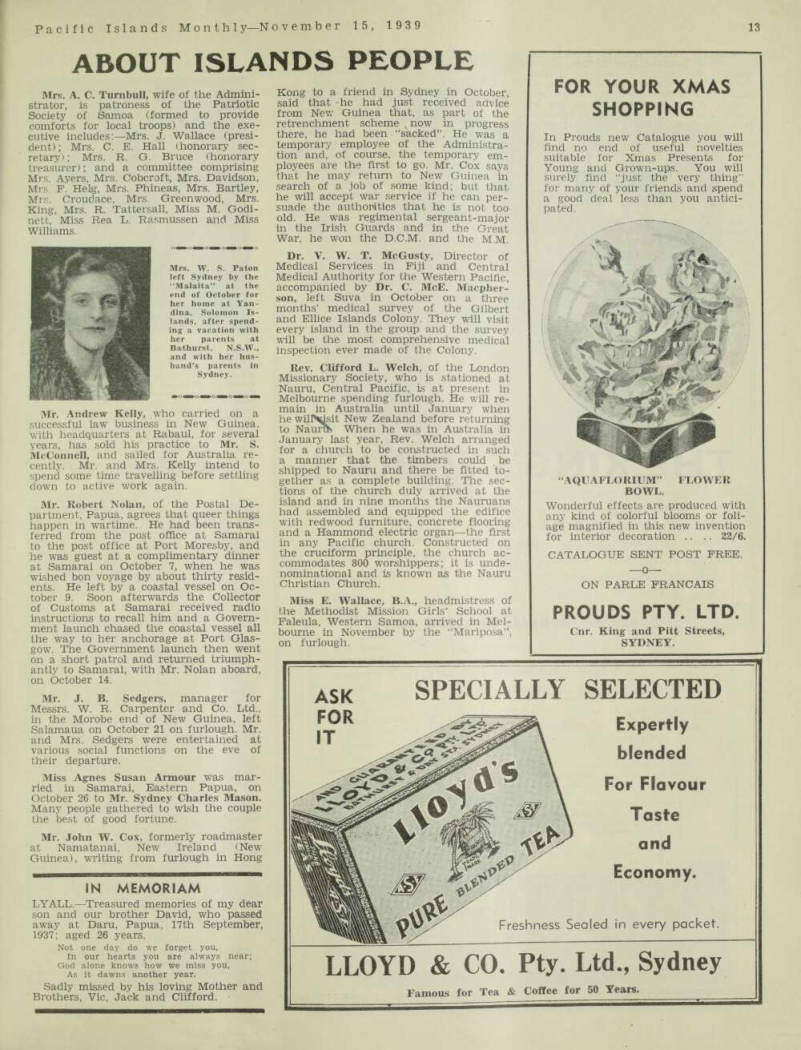
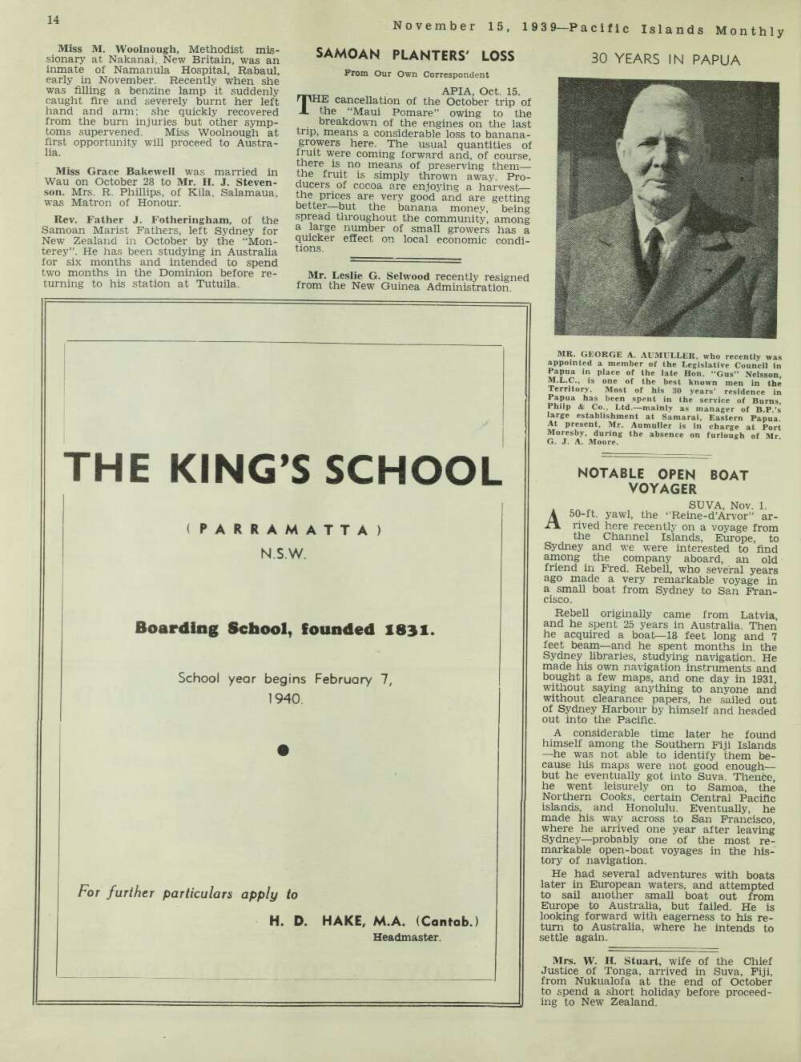
Mrs. A. C. Turnbull, wife of the Admini strator, is patroness of the Patriotic Society of Samoa (formed to provide comforts for local troops) and the exe cutive includes: —Mrs. J. Wallace (presi dent); Mrs. C. E. Hall (honorary sec retary) ; Mrs. R. G. Bruce (honorary treasurer); and a committee comprising Mrs. Ayers, Mrs. Cobcroft, Mrs. Davidson, Mrs F. Helg, Mrs. Phineas, Mrs. Bartley, Mrs. Croudace, Mrs Greenwood, Mrs.
King, Mrs. R. Tattersall, Miss M. Godi nett, Miss Rea L. Rasmussen and Miss Williams.
Mr, Andrew Kelly, who carried on a successful law business in New Guinea, with headquarters at Rabaul, for several years, has sold his practice to Mr. S.
McConnell, and sailed for Australia re cently. Mr. and Mrs. Kelly intend to spend some time travelling before settling down to active work again.
Mr. Robert Nolan, of the Postal De partment, Papua, agrees that queer things happen in wartime. He had been trans ferred from the post office at Samarai to the post office at Port Moresby, and he was guest at a complimentary dinner at Samarai on October 7, when he was wished bon voyage by about thirty resid ents. He left by a coastal vessel on Oc tober 9. Soon afterwards the Collector of Customs at Samarai received radio instructions to recall him and a Govern ment launch chased the coastal vessel all the way to her anchorage at Port Glas gow. The Government launch then went on a short patrol and returned triumph antly to Samarai, with Mr. Nolan aboard, on October 14.
Mr. J. B. Sedgers, manager for Messrs. W. R. Carpenter and Co. Ltd., in the Morobe end of New Guinea, left Salamaua on October 21 on furlough. Mr. and Mrs. Sedgers were entertained at various social functions on the eve of their departure.
Miss Agnes Susan Armour was mar ried in Samarai, Eastern Papua, on October 26 to Mr. Sydney Charles Mason.
Many people gathered to wish the couple the best of good fortune.
Mr. John W. Cox, formerly roadmaster at Namatanai, New Ireland (New Guinea), writing from furlough in Hong
Kong to a friend in Sydney in October, said that -he had just received advice from New Guinea that, as part of the retrenchment scheme . now in progress there, he had been “sacked”. He was a temporary employee of the Administra tion and, of course, the temporary em ployees are the first to go. Mr. Cox says that he may return to New Guinea in search of a job of some kind; but that he will accept war service if he can per suade the authorities that he is not too old. He was regimental sergeant-major in the Irish Guards and in the Great War, he won the D.C.M. and the M.M.
Dr. V. W. T. McGusty, Director of Medical Services in Fiji and Central Medical Authority for the Western Pacific, accompanied by Dr. C. McE. Macpher son, left Suva in October on a three months’ medical survey of the Gilbert and Ellice Islands Colony. They will visit every island in the group and the survey will be the most comprehensive medical inspection ever made of the Colony.
Rev. Clifford L. Welch, of the London Missionary Society, who is stationed at Nauru, Central Pacific, is at present in Melbourne spending furlough. He will re main in Australia until January when he willSdsit New Zealand before returning to NaurcK When he was in Australia in January last year, Rev. Welch arranged for a church to be constructed in such a manner that the timbers could be shipped to Nauru and there be fitted to gether as a complete building. The sec tions of the church duly arrived at the island and in nine months the Nauruans had assembled and equipped the edifice with redwood furniture, concrete flooring and a Hammond electric organ—the first in any Pacific church. Constructed on the cruciform principle, the church ac commodates 800 worshippers; it is unde nominational and is known as the Nauru Christian Church.
Miss E. Wallace, 8.A., headmistress of the Methodist Mission Girls’ School at Faleula, Western Samoa, arrived in Mel bourne in November by the “Mariposa”, on furlough.
Mrs. W. S. Paton left Sydney by the “Malaita” at the end of October for her home at Yan dina, Solomon Is lands, after spend ing a vacation with her parents at Bathurst, N.S.W., and with her hus band’s parents in Sydney.
Miss M. Woolnough, Methodist mis sionary at Nakanai,.New Britain, was an inmate of Namanula Hospital, Rabaul, early in November. Recently when she was filling a benzine lamp it suddenly caught fire and severely burnt her left hand and arm; she quickly recovered from the burn injuries but other symp toms supervened. Miss Woolnough at first opportunity will proceed to Austra lia.
Miss Grace Bakewell was married in Wau on October 28 to Mr. H. J. Steven son. Mrs. R. Phillips, of Kila. Salamaua, was Matron of Honour.
Rev. Father J. Fotheringham, of the Samoan Marist Fathers, left Sydney for New Zealand in October by the “Mon terey”. He has been studying in Australia for six months and intended to spend two months in the Dominion before re turning to his station at Tutuila.
Advertisements & other items, pp. 15-16 (2 items)
13
Pacific Islands Mon t h 1 y— No vem b e r 15, 193 9
LLOYD & CO. Pty. Ltd., Sydney
FOR YOUR XMAS
SHOPPING
In Prouds new Catalogue you will find no end of useful novelties suitable for Xmas Presents for Young and Grown-ups. You will surely find “just the very thing" for many of your friends and spend a good deal less than you anticipated.
“AQUAFLORIUM” FLOWER
BOWL.
Wonderful effects are produced with any kind of colorful blooms or foliage magnified in this new invention for interior decoration .. .. 22/6.
CATALOGUE SENT POST FREE.
ON PARLE FRANCAIS
PROUDS PTY. LTD.
Cnr. King and Pitt Streets,
SYDNEY.
SPECIALLY SELECTED
Expertly blended For Flavour Taste and Economy.
Freshness Sealed in every packet.
LLOYD & CO. Pty. Ltd., Sydney
Famous for Tea & Coffee for 50 Years.
ASK
FOR
IT a c* a.
V v & & V
IN MEMORIAM
LYALL. —Treasured memories of my dear son and our brother David, who passed away at Daru, Papua, 17th September, 1937; aged 26 years.
Not one day do we forget you, In our hearts you are always near; God alone knows how we miss you, As it dawns another year.
Sadly missed by his loving Mother and Brothers, Vic, Jack and Clifford.
THE KING’S SCHOOL
(PARRAMATTA)
NSW.
Boarding School, founded 1831.
School year begins February 7, 1940.
For further particulars apply to H. D. HAKE, M.A. (Cantab.) Headmaster.
Samoan Planters' Loss
Prom Our Own Correspondent T tt „ APIA, Oct. 15.
HE cancellation of the October trip of the “Maui Pomare” owing to the breakdown of the engines on the last trip, means a considerable loss to banana growers here. The usual quantities of fruit were coming forward and, of course, there is no means of preserving them— the fruit is simply thrown away. Pro ducers of cocoa are enjoying a harvest— the prices are very good and are getting better—but the banana money, being spread throughout the community, among a large number of small growers has a quicker effect on local economic condi tions.
Mr. Leslie G. Selwood recently resigned from the New Guinea Administration.
30 Years In Papua
MR. GEORGE A. AUMULLER, who recently was appointed a member of the Legislative Council in Papua in place of the late Hon. “Gus” Nelsson, M.L.C., is one of the best known men in the Territory. Most of his 30 years’ residence in Papua has been spent in the service of Burns, Philp & Co., Ltd.—mainly as manager of B.P.’s large establishment at Samarai, Eastern Papua.
At present, Mr. Aumuller is in charge at Port Moresby, during the absence on furlough of Mr.
G. J. A. Moore.
Voyager
Notable Open Boat
Suva, Nov. 1.
50-ft. yawl, the “Reine-d’Arvor” ar rived here recently on a voyage from the Channel Islands, Europe, to Sydney and we were interested to find among the company aboard, an old friend in Fred. Rebell, who several years ago made a very remarkable voyage in a small boat from Sydney to San Fran cisco, Rebell originally came from Latvia, and he spent 25 years in Australia. Then he acquired a feet long and 7 feet beam—and he spent months in the Sydney libraries, studying navigation. He made his own navigation instruments and bought a few maps, and one day in 1931, without saying anything to anyone and without clearance papers, he sailed out of Sydney Harbour by himself and headed out into the Pacific.
A considerable time later he found himself among the Southern Fiji Islands —he was not able to identify them be cause his maps were not good enough— but he eventually got into Suva. Thence, he went leisurely on to Samoa, the Northern Cooks, certain Central Pacific islands, and Honolulu. Eventually, he made his way across to San Francisco, where he arrived one year after leaving Sydney—probably one of the most re markable open-boat voyages in the his tory of navigation.
He had several adventures with boats later in European waters, and attempted to sail another small boat out from Europe to Australia, but failed. He is looking forward with eagerness to his re turn to Australia, where he intends to settle again.
Mrs. W. H. Stuart, wife of the Chief Justice of Tonga, arrived in Suva, Fiji, from Nukualofa at the end of October to spend a short holiday before proceed ing to New Zealand.
Pacific Air
Service
American and British Plans
THERE has been considerable activity during the month, connected with plans to inaugurate a trans-Pacific air-mail service between New Zealand and San Francisco, but no date had yet been given for the inauguration of a regular service.
The long-standing difficulties between Pan American Airways and the United States Government appear to have been smoothed away, and it was announced on October 26 that Pan American Airways will receive from the United States Gov ernment an increase of about 67 i per cent, in the mail subsidy for its North Pacific service—and it is presumed that this will apply, also, to its Central and South Pacific service. It gets a further concession in that it now is allowed to retain, in addi tion to the subsidy, all moneys that may be paid to it for mail transportation by the Australian and New Zealand Govern ments.
Preparations have been afoot, in many places, in the belief that Pan American Airways will inaugurate at least a fort nightly service between San Francisco and Auckland, via Canton Island and Noumea (and, possibly, Suva) before the end of November; but no official an nouncement has been made.
P.A.A. Service By End Of Year
The commencement of the American service is confidently expected before the end of the year, however.
Pan American Airways are expected to use Boeing flying-boats—weighing 40 tons, the largest flying-boats in the world —on the South Pacific air-mail.
Meanwhile, the British company (Im perial Airways) have given no indication of their further plans, which have been completely dislocated by the war. They had three new flying-boats, each of 22 tons, practically ready to start the Sydney- Auckland service—with a probable exten sion to Fiji, Honolulu and the American coast—about October; but the outbreak of war meant that two of the three fly ing boats had to be diverted to other purposes. One flying-boat, the “Aotearoa”, had arrived in Australia before the war broke out, and it made a pioneer flight between Sydney and Auckland on August 28.
Since then, the “Aotearoa” has made a number of pioneer flights between Sydney and Auckland, Auckland and Suva, and between Auckland and Tonga; and it has been unofficially reported that Imperial Airways will inaugurate shortly a fort nightly service with the “Aotearoa” be tween Sydney and Auckland. There is no confirmation of this, however.
The Pan American Airways trans pacific service may be expected at any time; but it seems unlikely that Imperial Airways will attempt anything ambitious —beyond the inauguration, perhaps, of the service between Sydney and Auckland —until the European war situation has been cleared up.
Philatelists’ Excitement
Frisco, Oct. 16.
UPWARDS of 70,000 first-flight covers are piled in orderly stacks at the Ferry Street Post Office, in San Fran cisco, awaiting the first mail flight by
Pan American Airways to New Zealand via Honolulu, Canton Island and New Caledonia. Allowing for covers which have been sent to the postmaster at Honolulu, to be held for this flight, it is estimated that the total number of covers now de posited for the flight is approaching the 100,000 mark.
Pan American’s Philatelic Section for the past three weeks has been keeping 10 clerks busy, sorting covers and prepar ing them for carriage to the foreign post offices for mailing.
Although the Post Office originally ad vised philatelists to dispatch their covers to reach the San Francisco postmaster or Pan American Airways by September 30, the date for the flight has not yet been set and covers received up to the day prior to the flight will be handled.
Advertisements & other items, pp. 17-18 (2 items)
15
Pacific Islands Month! y—N ovember 15, 1939
Avhe
& PA ■ 4 X i
OVERSEAS
HEV/S
broadcasts
Page 70 o issue of tlvc »» for a Lion of News ions «"° st y tuned. >ration.
Political change—history itself is moving to-day at express speed. Hear history in the making—direct—as clearly as your own local stations, with "Ultimate" Champion Radio. For 12 years "Ultimate" oversea reception has set an unapproachable standard.
"Surge" is entirely eliminated, giving
crystal-clear, uninterrupted reception.
No complicated tuning—a child can operate an "Ultimate".
• FROM OUR ISLANDS DEPT.
“Ultimate” Chassis in any model are now obtainable in our new Insectproofed MANTEL CABINET.
Send particulars of your requirements.
SPECIAL PRICES TO THE ISLANDS.
CLIP THIS
COUPON
TO-DAY!
Log Chart giving positive identification of more than 400 overseas stations, and details of "Ultimate” Champion Radio.
U 2.20 y n /
NAME .
ADDRESS
AVhE
M I
ffl
U ft / GEORGE BROWN & CO.. LTD.. 267 Clarence St.. Sydney
Engines. Solidly built of Kauri through.
SIMPLEX LAUNCHES
HERE THEY ARE! The finest, most complete, safest and most powerful Motoi Launches, of their size, made in Australia.
Simplex Launches are the accomplished result of several years experiment to find a boat really suitable for All Conditions, and now, in a variety of designs, we offer these boats at a price every pocket can reach.
Made in 12, 14, 16 or 18 ft. sizes, with Simplex 3 H P. 2 cycle or 5 HP. Marine and Spotted Gum, with Copper Rivets all Simplex Launches seat 6 comfortably and run for 5 hours on 1 gallon petrol.
Open or Cabin Models in any size. 14 ft. Open Launch, with 3 HP. Engine, £65 Complete.
Let us show you exactly what your boat will cost delivered to your nearest port. Free advice, particulars and Catalogue sent on request. Just tear out this page and place your name and address on the margin.
SIMPLEX MARINE ENGINES
Quality Australian-made units, complete with built-in Reserve Gear. Illustrated is the modern 5 H.P. 4 cycle Engine which is suitable for all boats up to 22ft. Exclusive features are:— (1) English Magneto with impulse starter. (2) Force feed lubrication. (3) Positive drive water and oil pumps. (4) S.K.F. Roller Bearings.
This unit drives a 13 in. propeller at 1100 R.P.M. Built for hard work, yet with an economy of 3 hours to 1 gallon petrol. Easy to install, easy to operate and maintain, and an engine with many many years of trouble-free service before it. PRICE: £52/10/-. Ask for Simplex Marine Engine Catalogue.
TILLEY KEROSENE LAMPS
Tilley English-made Lamps now available in a variety of modern designs. Recently added is a beautiful Floor Standard Lamp, standing 6 ft. 6 in. high, made of polished Coachwood with an attractive parchment and velvet shade of various colours. Also Oak Stand Table Lamps, Art Pottery Vase Lamp, Bedroom Lamp and Wall Lamps. We shall be pleased to send you the latest Tilley Lamp Catalogue, illustrating all models.
SHIPCHANDLERY
We have recently amalgamated with the well-known firm of Boat Supplies Ltd., and now have the Largest Stocks of boat gear In Australia. All Bronze and Brass fittings are made in our own workshops. Everything for the rowboat, yacht, powerboat or trading schooner.
Anchors, rowlocks, blocks, shackles, thimbles, wire rope, rigging screws, ports, vents, boat lavatories, searchlights, boat horns, steering gear, rigging fittings, navigation lamps, cabin lamps, yacht stoves, steering wheels, winches, etc. Boatbullders' requirements of every description. Copper nails, screws and copper rod. Brass washers.
Muntz metal sheathing, felt and oakum. Jeffreys marine glues and seamflex. Marine paints and oils. Comprehensive boat gear catalogue sent on request.
W. KOPSEN & CO. PTY. LTD.
378 KENT STREET, SYDNEY. Cables: “Kopsen”, Sydney.
European War
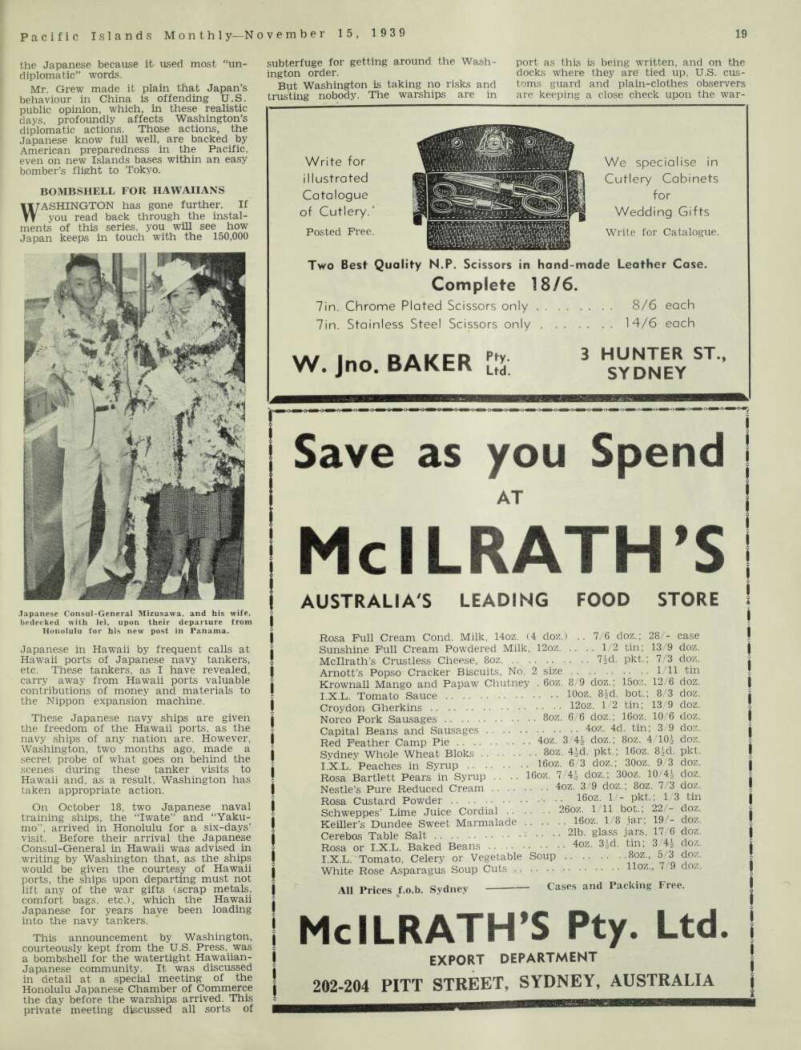
Japan’s Pacific Plans In Relation to the European War To Seek Friendly Relations With U.S.A. While Awaiting "Decay" of British Empire
By John Williams, Of Honolulu
(Being No. 6 of Series of Articles Describing Japan’s Plans and Politico-Economic Network in Pacific).
Honolulu, Oct. 19.
NOW that there is a war raging in Europe, besides the undeclared one in Asia, Australians had better “get down to tin-tacks” about the intentions of Japan in East Asia generally and in the Western Pacific in general.
The whole picture of Japanese aggres
sion and expansion concerns Australia because, without a firm foothold in China and points to the south-west, Japan can not very well make steady advance into those islands, such as the Philippines and the Indies, that lie as a bulwark between Japan proper and Australia.
In the past instalments of this series I have attempted, from the voluminous evidence at hand, to convey some idea of the vast Japanese penetration network that is slowly and surely moving into almost every community around the Pacific. One does not have to be anti- Japanese to see the facts.
The Japanese are convinced they have a good cause, and for good Japanese rea-
THUS Professor Roberts, overseas news 1 commentator, in “Sydney Morning Herald” on November 4:— The conflicting and hazy reports which have come from Tokyo show that an intense political struggle is being waged, not over participation in the European war. but over the policy to be adopted in China, and thus, inferentially, towards Western Powers in the Orient} The one section favours defiance of the West; the other, especially concerned with the fundamental export trade, maintains that Japan’s very existence under wartime conditions presupposes good relationships with the Allies and the United States.
The Japanese are coming out into the open with their proposal to initiate a “Central Chinese Government” under the puppet renegade, Wang Ching-wei. This would not only provide a means of “liquidating the China episode”; it would also give Japan a buffer by means of which she could “save her face” and yet compromise with the Western Powers on such matters as the currency dispute in China. But speculation is premature.
Japan is merely testing the reactions of foreign Powers to the idea of a puppet State; how that State would be used depends entirely on the outcome of the nebulous struggles in the Japanese poli tical arena.
Pending such an outcome, the Far East remains in a state of uneasy flux. Hos tilities in China are practically at a deadlock; and the Japanese are extremely concerned with the attitude of Russia.
sons. They sneer, for example, at the British Empire type of Empire because it lacks the Kodo (or Imperial way) upon which Japan’s Empire ambitions are based.
AFTER waging war upon China for more than two years, Japan has entered upon the next stage of her ag gressions. So far as she is concerned, Japan has conquered the Chinese. Japan possesses every Chinese port, and controls the great rivers which are the trade arteries of the vast undeveloped coun try. Japan, at the same time, is receiv ing help from British and American capitalists. American interests are sell ing out important mining concessions, and British interests are selling their entire outputs of coal, etc., to Japan.
After all, these capitalists are in China for only one reason—to exploit the nat ural resources and make profits. Now
that these interests are surrounded by Japanese guns, they are doing the only thing left to do, and trading with Japan.
Otherwise, Japan would take over.
This is a slow process, and a secret process, because the vested interests keep their deals from the public; but, never theless, the deals are taking place. The Japanese <1 could quote from dozens of Japanese resources) now are confident that this second phase of their conquest of China is well assured.
They do not expect to accomplish it in a hurry. It may take 10, 20 or even 100 years. The Japanese prophets hesi tate to set a definite time limit—but all are confident of ultimate victory.
Japan And Germany
THE war in Europe has given Japan added confidence because she is cer tain that, when it comes to a pinch, her
Berlin and Rome axis friends will stick to her.
Indeed, the Shanghai “Mainichi”, a Japanese paper, said after the European war had been raging for a month: — Japan must aid Germany in defeat ing Britain, if Germany cannot do it alone. When the Japanese Government ann ®H l ? ced its neutrality in the European conflict, this meant that Tokyo consid -Ifd;erventionn tion in Europe as secondary.
But the term ‘non-intervention’ was used to signify that if it became necessary to intervene in Europe to settle the Sino- Japanese conflict, then Japan will plunge into the European war to pursue her aim in East Asia”.
That is putting it in plain black-and white. The paper added that Japan looks upon the British Empire as her Public Enemy No. 1. because Britain, more than any other nation, has attempted to block Japan’s expansion into China
THE general Japanese opinion, fur ther, is agreed that the Empire is S™ff ast declin |- Here is an opinion recently expressed by Kiyoshi Kawakami a leading Japanese journalist, who, nor mally, is stationed in Washington to re port upon the American scene for a network of Nippon newspapers. Writing m a series of syndicated articles which appeared in the Tokyo “Mainichi” and me Osaka “Mainichi Shimbun”, this ob server said:— . . No matter how we look at it, Eng ™ + ? as . b f gu ? t 0 decline - Rather than of rnaking an enemy of the united States, and without playing the role of destroyer of the British Empire let us leave that to other countries (Ger many etc.). This is clear to anyone look ing at the present European situation I must repeat, therefore, to our hot-blood speed^ atriot ” C m6n: ‘ More haste ’ less
New Naval Bases
rpo accomplish her purpose in Asia, and X to prepare herself for her ultimate war against Britain in the Western Paci fic, Japan is carefully and methodically expanding on two fronts: military and economic.
On the military front, the army has its hands full in China, but the navy is having its turn on the Imperial stage now. The navy is developing important bases, new stepping stones, new spring boards for Japan’s next thrust south ward.
Look at these new bases on your map On the island of Formosa, which lies across the track between Hong Kong and Japan, the navy already has estab lished an important base of men, mater ials and supplies.
To the west from Formosa, in Mei chow Bay, in South Fukien province of the China mainland. Japan has es tablished another base, to support the Formosa base. Meichow Bay has been declared “secret”, and foreign shipping has been ordered to keep out of it.
To the south of Hong Kong lies Hainan Island, which Japan seized a year ago, and on Hainan the navy is well advanced with another base which commands the southern approaches to Hong Kong, Britain’s last outpost in China.
On these three important bases sur rounding Hong Kong, Japan’s war ma chine is poised to spring, whenever the tension in Europe catches Britain off guard. That is how Japan fights.
If Japan gets away with this design, then, indeed, will Australia have to look to her outlying defence scheme, based upon Darwin, Torres Strait and New Guinea.
Attitude Of U.S.A.
WASHINGTON has the Orient honey combed with under-cover secret-ser vice workers and, for some time, these experts have been reporting what Japan is up to. As a result, as soon as Ger many invaded defenceless Poland and set Europe aflame, Washington made bold moves, but logical moves for her Pacific security.
Additional naval forces—an aircraft ship, a squadron of the latest long-range patrol bombers, and six of the latest long-range submarines—were assigned to the Western Pacific. Ostensibly, they will work in what Washington calls a “neu trality patrol”. But, at the same time, Washington sent U.S. Ambassador Grew back to Tokyo, and his first public state ment in Tokyo, made this week, startled
the Japanese because it used most “un diplomatic” words.
Mr. Grew made it plain that Japan’s behaviour in China is offending U.S. public opinion, which, in these realistic days, profoundly affects Washington’s diplomatic actions. Those actions, the Japanese know full well, are backed by American preparedness in the Pacific, even on new Islands bases within an easy bomber’s flight to Tokyo.
Bombshell For Hawaiians
WASHINGTON has gone further. If you read back through the instal ments of this series, you will see how Japan keeps in touch with the 150,000
Japanese in Hawaii by frequent calls at Hawaii ports of Japanese navy tankers, etc. These tankers, as I have revealed, carry away from Hawaii ports valuable contributions of money and materials to the Nippon expansion machine.
These Japanese navy ships are given the freedom of the Hawaii ports, as the navy ships of any nation are. However, Washington, two months ago, made a secret probe of what goes on behind the scenes during these tanker visits to Hawaii and, as a result, Washington has taken appropriate action.
On October 18, two Japanese naval training ships, the “Iwate” and “Yaku mo”, arrived in Honolulu for a six-days’ visit. Before their arrival the Japanese Consul-General in Hawaii was advised in writing by Washington that, as the ships would be given the courtesy of Hawaii ports, the ships upon departing must not lift any of the war gifts (scrap metals, comfort bags, etc.), which the Hawaii Japanese for years have been loading into the navy tankers.
This announcement by Washington, courteously kept from the U.S. Press, was a bombshell for the watertight Hawaiian- Japanese community. It was discussed in detail at a special meeting of the Honolulu Japanese Chamber of Commerce the day before the warships arrived. This private meeting discussed all sorts of
subterfuge for getting around the Wash ington order.
But Washington is taking no risks and trusting nobody. The warships are in
port as this is being written, and on the docks where they are tied up, U.S. cus toms guard and plain-clothes observers are keeping a close check upon the war-
Japanese Consul-General Mizusawa, and his wife, bedecked with lei, upon their departure from Honolulu for his new post in Panama.
Sh -rnfio i + . . , .
This latest action of Washington s is typical of America s intention to act with a firm hand, if that is the only international technique which Tokyo under-
“Beautiful Friendship”
J Aoaivt . .
APAN. of course, is almost overanxious to make a “beautiful friendship” with America, because it is upon American goodwill that the other front— the economic—of Japans expansion depends. The U.S. is a top customer of
Japan, and it is by selling abroad that Japan gets funds for her overseas pur chases of vital materials for her war ma chine. japan, too, hopes that America will not carry to finality her announced inten tlon -P* ab rogating her treaty with Jap an> but, instead, will write a new and a better treaty. The Japanese are that optimistic. But U.S. public opinion will have something to say about it.
With her armed machine, as we have seen above, poised to spring on the next move southward, Japan has donned silk
gloves on the economic front and, behind a flow of her goods in all directions across the Pacific, she is making steady advances, too.
Goods —and guns!
And Now—Panama
WE have seen in prior instalments of this series how Japan has built up a super-economic machine in Hawaii. It is regarded by experienced observers as a major stepping-stone in her invasion of the Americas.
Japan’s latest advance into the Ame ricas has been the appointment of a consular representative (for the first time) in the State of Panama, vital Central American outpost. This will give Japanese warships and nationals just another excuse to become more familiar with the Panama Canal area.
Much to the joy of the Japanese in Hawaii, Consul-General Mizusawa, who has served faithfully in Hawaii, was appointed first diplomatic representative to Panama. He left Hawaii in Septem ber.
Before he left, he was feted by the Japanese Chamber of Commerce. Said he, in reply to enthusiastic congratula tions : “I have served at various places, but in no place have I seen where Japanese merchants have collectively made such progress as in Hawaii. Since, as you all know, the disposition of the Americans is to place emphasis on economic foun dations and appear to negotiate on equal footing based on economic power, I be lieve that the enrichment of economic power is rather important. Your effici ent manner of progress is being seriously viewed and respected, even in Japan. . .”. (In the next instalment, details of how this new Japanese economic machine works will be given. They will be based upon direct quotations from Japanese documents and newspapers).
Advertisements & other items, pp. 18-22 (4 items)
16
November 15, 1939—Paclflc Islands Monthly
National
Vr-
—and so are
CASES
In Appearance Quality and Manufacture
National Cases are Superior
Large Stocks at present held for immediate delivery in any quantity.
Desiccated Coconut Cases . . . Butter . . . Fruit and other types of cases —including Patent Lightweight Wirebound —available from stock or cut to order.
WRITE OR CABLE YOUR REQUIREMENTS
Prompt reply to all enquiries—let us know what YOUR case is.
We will he pleased to hear from you. is SINCE its establishment, 15 years ago, the National Box Company Pty. Ltd., has, by the adoption of modern manufacturing methods and the closest attention to all new developments in box design and construction, maintained steady progress until to-day it is the largest boxmaking business in New South Wales, employing 140 operatives and manufacturing over 1£ million cases annually.
Radio & Cable Address: “NATBOXCO”, Balmain.
National box company pty. l
FITZROY & PUNCH STS BALMAIN. N.S.W
m ¥ *i v m m m m Delicious IXL Canned Foods-—Jams—Soups f£ Sauces Stand Supreme In public approval Obtainable from all Leading Island Storekeepers.
IL JONES & CO. PTY. LTD., HOBART & SYDNEY.
Write for illustrated Catalogue of Cutlery/ Posted Free. m We specialise in Cutlery Cabinets for Wedding Gifts Write for Catalogue.
Two Best Quality N.P. Scissors in hand-made Leather Case.
Complete 18/6.
Tin. Chrome Plated Scissors only 8/6 each Tin. Stainless Steel Scissors only 14/6 each
W. Jno. BAKER GS;
3 HUNTER ST.,
SYDNEY
Save as you Spend
AT
McILRATH’S
AUSTRALIA'S LEADING FOOD STORE
Rosa Full Cream Cond. Milk, 14oz. (4 doz.) .. 7/6 doz.; 28/- case Sunshine Full Cream Powdered Milk, 12oz 12 tin; 13/9 doz.
Mcllrath’s Crustless Cheese, Boz 7id. pkt.; 7/3 doz.
Arnott’s Popso Cracker Biscuits, No. 2 size 1 'll tin Krownall Mango and Papaw Chutney . 6oz. 8 7 9 doz.; 15oz. 12/6 doz.
I.X.L. Tomato Sauce 10oz. Bid. hot.; 8/3 doz.
Croydon Gherkins 12oz. 1/2 tin; 13 9 doz.
Norco Pork Sausages Boz. 6/6 doz.; 16oz. 10/6 doz.
Capital Beans and Sausages 4oz - 4d. tin; 3 9 doz.
Red Feather Camp Pie 4oz. 3 4 2 doz.; Boz. 4 102 doz.
Sydney Whole Wheat Bloks Boz. 4Ad. pkt.; 16oz. Bid. pkt.
I.X.L. Peaches in Syrup 16oz. 6 3 doz.; 30oz. 9 3 doz.
Rosa Bartlett Pears in Syrup .. .. 16oz. 7/4i doz.; 30oz. 10/4i doz.
Nestle’s Pure Reduced Cream 4oz. 3/9 doz.; Boz. 7/3 doz.
Rosa Custard Powder 160 , z - J ' P kt ;. * 3 , tln Schweppes’ Lime Juice Cordial 260 z. 1 11 hot.; 22/- doz.
Keiller’s Dundee Sweet Marmalade 16oz. 1/8 jar; 19 - doz.
Cerebos Table Salt 21b. glass jars, 17/6 doz.
Rosa or I.X.L. Baked Beans 4oz - 3 2 d. tin, 3^4 2 doz.
I.X.L. Tomato, Celery or Vegetable Soup 8oz„ 5/3 doz.
White Rose Asparagus Soup Cuts , .. • • . lloz - 7 9 doz - All Prices f.o.b. Sydney Cases and Packing Free.
McILRATH’S Pty. Ltd.
EXPORT DEPARTMENT
202-204 PITT STREET, SYDNEY, AUSTRALIA
w mLi
I
MEALS
At a Moments Notice
j Sheep Tongues . 12oz.
Lamb Tongues . . 12oz.
Ox Tongues . . . 240 z.
Ox Tongues . . . 21b.
Camp Pie ... 12oz.
Mango Cr PaPaw Chutney ... 15oz.
Cheddar Cheese . Boz.
Mild and Tasty. /#
FITZROY'
Luncheon Beef . . 16oz. (in oblong can) Pork Sausages . . 16oz.
Beef Sausages . . 16oz.
ASSORTED HOT
MEALS
Steak £r Kidney Pudding.
Sausages Gr Tomato.
Lamb Gr Green Peas.
Steak Gr Tomato.
Beef Steak Pudding.
Chops Gr Tomato.
Sausages, Spaghetti Gr Tomato.
"OX & PALM" OR
"RIVERSTONE"
Native Trade Meats.
Corned, Boiled and/or Roast Beef—l2oz., 16 oz., 240 z., 21b., 31b., 41b., 51b., and 61b. kii
"WESTFIELD'
Corned, Boiled and/or Roast Mutton 12oz.
All lines can be obtained from leading
18
November 15, 1 939-l>aciflc Islands Monthly
19
Pacific Islands Monthl y—N ovember 15, 1939
Samoan Killed By Shark
From Our Own Correspondent
A Apia, Oct. 27.
SAMOAN fisherman, named Isaako, was recently, when fishing on the rocky coast of Savaii, near his home village of Samalaeulu, attacked by a seven-foot shark and badly mangled.
At his shouts for help his father dived in to help him, and chased the shark away. Isaako was then brought ashore, when it was found that he had sustained deep wounds in his left calf and thigh Before help could be obtained from the village, Isaako had succumbed to his in juries.
Mr. K. W. Bilston, Patrol Officer in Buin, Bougainville Island, New Guinea arrived in Australia in October on fur lough. He was accompanied by his wife and their daughter Margaret.
Mr. R. Eginton, of Cuthbert’s Misima Goldmine Ltd., Eastern Papua, recently left Misima Island with his wife and their two children to make their future home at Samarai.
M. Oscar Meyer, a young Frenchman of scientific training, who has resided in Tahiti and New Guinea, and has col lected for French museums in different parts of the world (for the last two years in New Guinea), arrived in Sydney in October. M. Meyer’s plans are inde finite, but he probably will return to France within a few weeks.
Neutrality & "Belligerence"
U.S.A. Amends a Difficult Act
ALTHOUGH it was apparent, from the beginning, that the legislation amending the Neutrality Act of the United States would in itself have to be amended, so as to allow U.S.A. to supply arms to belligerents and to permit American shipping lines to run without restriction to “belligerent” ports in the Pacific, they still were squabbling about it in Washington in the latter part of October—as is the way of democracies the world over.
The Senate finally decided by a very large majority that the arms embargo should be lifted and that American ves sels should be permitted to carry non military cargoes to all belligerent ports in the Atlantic southwards of New Orleans, and to all Pacific ports.
There was not the same certainty of a majority in the House of Representatives, where the “isolationists” had been very active; but the Bill was passed by the House, on November 3, by 243 to 172; and the President signed the measure the fol lowing day.
Gay And Lively
From Our Own Correspondent
Pt. Moresby, Nov. 8.
PORT MORESBY with its steadily growing community of oil company employees and members of the military, naval and air forces, has become a gay and lively town compared with the some what dismal little backwater of 10 or 20 years ago. No less than over 200 en thusiastic spectators assembled to wit ness the swimming carnival in the local baths on October 27, It is reported that the Japanese whal ing fleet for the Antarctic this season will comprise six factory ships, 47 chaser ships, several store ships, and a large re frigerated vessel capable of taking 7,000 tons of whale meat. Whale meat is a popular food in Japan. Planters should note that the price of whale oil this season is expected to reach £2l per ton, compared with about £l5 per ton last season. If whale oil rises 40 per cent, in value, coconut oil should not be far behind.
The Australian National Research Council has published in one volume Rev.
Churchward’s “Rotuman Legends”, which have appeared from time to time in “Oceania”. Professor A. P. Elkin, head of the Department of Anthropology, Sydney University, writes an appreciative fore word. The legends are of great value to the student of anthropology and to the linguist.
War News On Remote
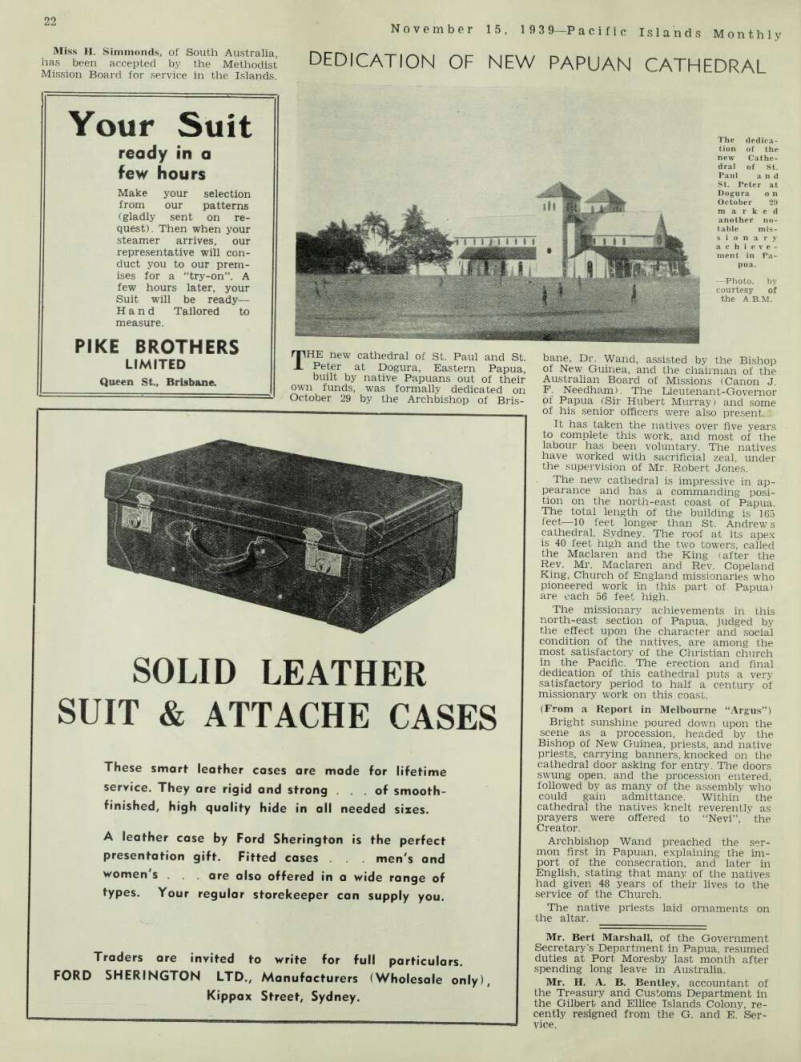
Islands
Prom Our Own Correspondent.
Papeete. Oct. 20.
mHOSE who were in the Islands years ago, can appreciate the astonishing advance in world communication since that time.
There was no wireless apparatus on Tahiti in 1914. We learned of the be ginning of the Great War from a cryptic message picked up by a steamer, equipped with wireless, whicl? happened to be in the harbour. We knew nothing of the anxious first weeks of the war until we read of them in newspapers from abroad, long after the event.
In 1939, nearly every island of French Oceania possesses one or more radio re
ceiving sets. Daily, the broadcasts of news from London and Paris are heard clearly. Each morning, the Department of Post and Telegraph issues a printed bulletin of news from all parts of the world. Twice weekly a digest of news, in the Tahitian language, is broadcast by the Tahiti radio station. An accurate summary of the news is printed in “Te Vea Maoh”.
Inhabitants of the most remote islands of the South Sea are now as well in formed as are the dwellers in the metro politan areas of continental lands.
Mr. David Browne, the genial and popu lar Resident Agent of the island of Atiu (Cook Group), arrived in Rarotonga by the “Tiare Taporo” in October. He is noted for his success in handling either oranges or natives.
Miss H. Simmonds, of South Australia, has been accepted by the Methodist Mission Board for service in the Islands.
Advertisements & other items, pp. 23-24 (3 items)
21
Pacific Islands Mon th ly— November 15, 1939
~I'fli
\ A V\ \ > \\ \ M ll toi'l ', 1 Vy\. « c / E
to o
fV^ tot*
Your Suit
ready in a
few hours
Make your selection from our patterns (gladly sent on request). Then when your steamer arrives, our representative will conduct you to our premises for a “try-on”. A few hours later, your Suit will be ready— Hand Tailored to measure.
PIKE BROTHERS
LIMITED
Queen St., Brisbane.
SOLID LEATHER
SUIT & ATTACHE CASES
These smart leather cases are made for lifetime service. They are rigid and strong ... of smoothfinished, high quality hide in all needed sizes.
A leather case by Ford Sherington is the perfect presentation gift. Fitted cases . , . men's and women s . . . are also offered in a wide range of types. Your regular storekeeper can supply you.
Traders are invited to write for full particulars.
FORD SHERINGTON LTD., Manufacturers (Wholesale only), Kippax Street, Sydney.
Guest House Wanted
Will purchase Guest House or small Hotel in good location Pacific Islands.
Send full particulars, price, to — “F.C.8.”, C/o. “Pacific Islands Monthly”, Box 3408 R, G.P.0., Sydney.
Dedication Of New Papuan Cathedral
THE new cathedral of St. Paul and St.
Peter at Dogura, Eastern Papua, built by native Papuans out of their own funds, was formally dedicated on October 29 by the Archbishop of Bris
bane, Dr. Wand, assisted by the Bishop of New Guinea, and the chairman of the Australian Board of Missions (Canon J F. Needham). The Lieutenant-Governor of Papua (Sir Hubert Murray) and some of his senior officers were also present.
It has taken the natives over five years to complete this work, and most of the labour has been voluntary. The natives have worked with sacrificial zeal, under the supervision of Mr. Robert Jones.
The new cathedral is impressive in ap pearance and has a commanding posi tion on the north-east coast of Papua.
The total length of the building is 165 feet—lo feet longer than St. Andrews cathedral, Sydney. The roof at its apex is 40 feet high and the two towers, called the Maclaren and the King (after the Rev. Mr. Maclaren and Rev. Copeland King, Church of England missionaries who pioneered work in this part of Papua) are each 56 feet high.
The missionary achievements in this north-east section of Papua, judged by the effect upon the character and social condition of the natives, are among the most satisfactory of the Christian church in the Pacific. The erection and final dedication of this cathedral puts a very satisfactory period to half a century of missionary work on this coast. (From a Report in Melbourne “Argus”) Bright sunshine poured down upon the scene as a procession, headed by the Bishop of New Guinea, priests, and native priests, carrying banners, knocked on the cathedral door asking for entry. The doors swung open, and the procession entered, followed by as many of the assembly who could gain admittance. Within the cathedral the natives knelt reverently as prayers were offered to “Nevi”, the Creator.
Archbishop Wand preached the ser mon first in Papuan, explaining the im port of the consecration, and later in English, stating that many of the natives had given 48 years of their lives to the service of the Church.
The native priests laid ornaments on the altar.
Mr. Bert Marshall, of the Government Secretary's Department in Papua, resumed duties at Port Moresby last month after spending long leave in Australia.
Mr. H. A. B. Bentley, accountant of the Treasury and Customs Department in the Gilbert and Ellice Islands Colony, re cently resigned from the G. and E. Ser vice.
The dedica tion of the new Cathe dral of St.
Paul and St. Peter at Dogura on October 29 marked another no table mis sionary achieve ment in Pa pua. —Photo, by courtesy of the A.B.M.
Advertisements & other items, pp. 24-25 (2 items)
22
November 15, 1 939—Paciflc Islands Monthly
n-fas
A Vital Message to Sufferers from
i
AFTER MALARIA
TAKE BIDOMAK
Bidomak re-charges and re-vitalises the whole system with life-giving oxygen. It improves the activity of every gland and organ in the body, and is essential for full recovery from the after effects of Malaria.
SCIENTIFIC CONTROL
Manufactured in the Bidomak Pharmaceutical Laboratories —one of the most up-to-date, hygienic Laboratories in the Southern Hemisphere, to which is attached a fully qualified Doctor of Medicine, and under the control of qualified chemists who were trained in the most modem and largest English Laboratories in the world. *1
n-fas
ipressed P ee
Nine out of ten people suffer from Mineral Starvation, even on three square meals a day vital minerals are often lacking in the modern diet, causing nerves, listlessness and many other constitutional disorders. Men, women and children of all ages suffer from this diet deficiency.
BIDOMAK restores vital minerals and rapidly reinvigorates the system, building up perfect strength and vitality.
BIDOMAK is an easily assimilable liquid food supplement containing in concentrated form those important Mineral elements, ferrum, sodium, calcium and phosphorus which are needed for the proper nourishment of the nerve cells —BIDOMAK makes you feel better and look better. End Mineral Starvation —start on a course of BIDOMAK
to-day.
Wonderful Improvement—Thanks to Bidomak “I am writing this testimonial to you because I am so delighted with the result I have obtained from taking Bidomak.
“For some time I have suffered from nerves.
The least little bit of excitement and I suffer from fatigue. I’ve tried all different other drugs. My husband recommended Bidomak.
The first bottle I found wonderful relief.
“My daughter takes it, and she feels a different girl altogether. She had no appetite. I said to her: ‘You are a different girl altogether’.
It has made a wonderful improvement in her”. (Sgd.) Mrs. C. Wellington, Carstairs, via Home Hill, Queensland. m AT
ALL
“ The Tonic of the Century
LEADING ISLAND
STORES
Letters Will be Received on Day
Before They Are Posted!
MANY philatelists are seizing the oppor tunity provided by the inauguration of the Auckland-San Francisco air mail to acquire a curiosity in covers—one which, according to the postmarks will be posted one day and received at its des tination the day previously, says “New Zealand Herald”.
Letters addressed to Canton Island and posted at Noumea will be postmarked at Noumea on the day of departure and on arrival at Canton the date will be stamped on the back. During the flight, however, the covers will pass over the
international date line, thereby gaining a day, so that they will be “mailed to morrow and received to-day”.
Archbishop and Mrs. Wand, on their way to Dogura, in Eastern Papua (where the Archbishop consecrated the new cathedral) were welcomed by the resi dents of Port Moresby at the Institute Hall, on their arrival from Brisbane.
Members of St. John’s Ladies Guild en tertained a large gathering at afternoon tea for the occasion. Sir Hubert Murray (Lieut.-Governor), on behalf of the Terri tory extended a welcome to the Arch
bishop.
Advertisements & other items, p. 26 (1 item)
Tongan Twins
A charming “snapshot” of two pretty young Tongan twins—Pauline and Caroline Pepa, of Nukualofa. —Photo: Hettig.
Pacific?
Raider In
Where is German Pocket- Battleship?
A VARIETY of signs especially the unexpected and unexplained depar ture of German freighters and tankers from various African and South Ameri can ports—suggested to the British Ad miralty at the end of October that the German pocket-battleship “Admiral von Scheer” had left the South Atlantic. It was suspected that she had rounded Cape Horn and probably was prowling some where in the Pacific with a view to at tacking British and French merchant shipping.
So far as is known, all the evidence that the German battleship is in the Pacific is circumstantial; but, neverthe less, due precautions are being taken.
If the “Admiral von Scheer” is loose in the Pacific, she will take some round ing-up, as only a first-class British or French battleship could deal with her.
It would appear that there was a flurry of naval operations in the North Sea about the end of September—British and German squadrons being more or less in contact —and under the cover of the prevailing mist and fogs two Ger man pocket-battleships, the “Admiral von Scheer” and the “Deutschland”, slipped away north along the Norwegian coast and thus escaped into the Atlantic.
The British naval view of the German raiders at the end of October was that “they were doing very little harm to British shipping, considering the length of time they had been at large”.
Advertisements & other items, p. 26 (1 item)
/or work or pleasure
GUNS
Savage 23 Model, Sporting Magazine Rifles. 22 Cal. R.F.
Model £6/2/6. 25/20 and 32/20 Models. £9/15/-. 22 Cal.
Hornet Model, £lO/17/6.
No. ISA Wild Fowl and Long Range Model, 12-Gauge Hammerless Shotgun by Bonehill, 30 in. and 32 in. Barrels. Both Pull Choke, for 3 in. Cartridges Weight 7% lb to Blb Price, £24.
Browning Over & Under, 12-Gauge Hammerless Gun. Price, £22/10/-. Ventilated Rib Model.
Price, £24, Used quality Firearms Bought, Sold and Exchanged.
Write for Firearm Catalogue. 600 illustrations.
Also write for Second-hand Hammerless Shotgun List.
SIL
ROHU
Quality Firearms and Fishing Tackle. 143 ELIZABETH STREET. SYDNEY Phone MA 3540 (Near Market Street).
LAUNCHES
/or work or pleasure
Both trim, seaworthy craft, the Chapman Coach-house model and the Chapman Cabin Launch are particularly suitable for island conditions.
The Coach-house model with the closed-in cabin providing ample storage space is an ideal work-boat to meet steamers, carry stores and for inter-island transport. The Cabin model is a popular cruising craft, for fishing and pleasure trips. The cabin is cool and roomy enough to sleep two.
Both craft are powered with a famous Chapman PUP Engine. Write now for details and prices.
CHAPMAN & SHERACK
26 Clara Street, Erskineville, N.S.W.
ENGINE MANUFACTURERS FOR THIRTY YEARS
All Quiet At 10 P.M.

A Merciful Law in Tahiti
AT Papeete, and on all Tahiti as well, there is a sort of curfew regulation which requires, at 10 p.m., all unseemly noises shall cease.
The palaces of pleasure along the waterfront, radio machines in private houses, and sounds of revelry by night are extinguished promptly at the ap pointed hour, and silence and peace de scend upon the island until the rumble of market waggons and the chime whistles of motor trucks bringing passengers and provisions from the districts, herald the new day.
Our island has not always been so
happily protected.
In the days when the accordion was the national instrument of music, it was the custom of a band of natives to plant themselves on some spot and sing ribald ute until far into the night. The singers would sometimes pause; but the wielder of the accordion would never by any chance interrupt the endless repetition of the monotonous ute melody. The dwellers in neighbouring houses passed the night in wide-eyed blasphemy.
However, nothing was ever done about it, because the average person on Tahiti is endowed with tolerance and surpassing patience. Besides, the ute singers never chose the same place on two successive nights.
But when the gramophone arrived and was installed in every household, some thing had to be done, if anyone in the island was to get any sleep. After hours of “Springtime in the Rockies” from the neighbour on the left, “The Merry Widow
Waltz” from the house on the right, and an exasperating Tahitian tune called “Papio” from the dwelling across the roadway—all blaring in simultaneous dis cord—it was necessary that the suffering listener should have some certain hope of respite. And so this merciful regu lation was put into force.
Since then the only sounds after the evening 10 o’clock are the roar of the surf as it crashes eternally on the far away barrier reef; the faint barking of watch-dogs that marks the passage of some wayfarer along a distant highway: and the murmtir in the palm groves of the cool night breeze from the moun tains. The ugly noises of civilisation have ceased. —A.C.R.
Missionary's Illness
From Our Own Correspondent
Rarotonga, Oct. 14.
r[E Mother Superior of the Catholic Mission here, is dangerously ill in the Government Hospital. Little hope for her recovery is held. European and native residents of Rarotonga hold this kind and great-hearted lady in highest regard.
Solomon Islands Rubber Plantations Ltd. reports for the year ended July 31 a loss of £7O, compared with a profit of £1,200 the previous year. Revenue drop ped from £3,863 to £2,345. The Co. has a paid capital of £74,500 in £7,000 A pre ference, £7,500 preference, and £60,000 ordinary. Dividend on the A preference shares is paid to July 31, 1938. To July, 1939, there are arrears of 18/9 a share on the preference shares.
Motor Vessel "Yunnan"
To Replace The
"Friderun"
IT was announced in October by Colyer, Watson fNew Guinea) Ltd. that arrangements had been made by them for the motor vessel “Yunnan” (2,812 tons gross and built at Grenock in 1934) to be put on the Hong Kong-New Guinea run in place of the s.s. “Friderun” (now interned).
The “Yunnan” is a larger vessel than the N.D.L. steamer and can carry more cargo. It also has more passenger ac commodation. being fitted with seven two-berth cabins and two single-berth cabins.
The “Yunnan” is one of the China Navigation Co.’s fleet, and at Hong Kong will connect with the Blue Funnel liners trading to Europe and the United Kingdom.
The “Rabaul Times” of October 20 said that the “Yunnan” had already sailed from Hong Kong on her first trip to New Guinea. She travels by way of Saigon, Sandakan, Madang, Salamaua, Rabaul, thence to the Solomon Islands, and on the return trip calls at Lorengau, Sandakan and Hong Kong. The service is expected to be about a seven-weekly one.
Mr. Victor Blanch, planter of Djaul Island, New Guinea, died recently in Kavieng Hospital. Before settling down on his property at Djaul, he served for a considerable time on Burns, Philp and Co.’s inter-island steamer “Maiwara”.
Advertisements & other items, pp. 27-28 (2 items)
25
Pacific Islands Monthl y—N ovember 15, 1930
Delco-Light
This XMAS - Give Your Home the Comfort of
Many hardships are difficult to remedy—but bad lighting isn’t. So why be without the comfort and economy of electricity when for a small outlay, you can purchase a Delco-Light plant which will bring to you the convenience and brightness of the modern city.
Model 2812 generates 200 watts at 12 volts and will light eight 25 watt lamps direct from the generator—or five for 10 hours from the 105 A.H. battery, when fully charged. It will run for 16 hours on one gallon of petrol.
For complete information please write to Desk P.I. Sizes range from 200 to 6,000 watts.
PRICES' OF PLANTS—IN BOND, SYDNEY.
2812 (12 volt)—£23/15/-, with 83 A.H. battery (car type) 2812 (12 volt) —£26/15/-, with 105 A.H. battery (individual cells). 286 (6 volt) —£24/ 5/-, with 105 A.H. battery (individual cells).
Distributors: &
WARBURTON FRANKI LTD.
MELBOURNE
307-15 KENT STREET, SYDNEY.
BRISBANE
Modern Refrigeration for the South Sea Islands
The ELECTROLUX kerosene operated
REFRIGERATOR
MARVEL
OF
MODERN
SCIENCE
THE
MIRACLE
OF
ICE
FROM
HEAT
ELECTROLUX offers economical, modern and completely efficient
REFRIGERATION FOR ISLANDS' HOMES.
FREEZES CONTINUOUSLY WHILE SMALL LAMP BURNS
Freezing controlled by simply regulating height of flame. Uses only f gallon of kerosene per week.
MOTORLESS ... NO PARTS TO GET OUT OF ORDER.
MODEL L 22 MODEL L3BO MODEL LKSSO Capacity * ® 2.2 cubic feet. • O (as Illustrated) • Capacity 4 cubic feet.
GUARANTEED FOR TWO YEARS.
Write to your Local Distributor for prices and full details.
Capacity 5.5 cubic feet.
Obtainable from W. R. Carpenter & Company Ltd. —Sydney, and following New Guinea Branches: Rabaul, Salamaua, Wau, Kavieng, Madang, But and Wewak.
W. R. Carpenter & Coy. (Solomon Is.) Pty. Ltd. —Tulagi, British Solomon Islands.
On Chong & Company Pty. Ltd.—Butaritari, Gilbert and Ellice Islands.
Representation in Papua and New Hebrides.
Tongan Officials'
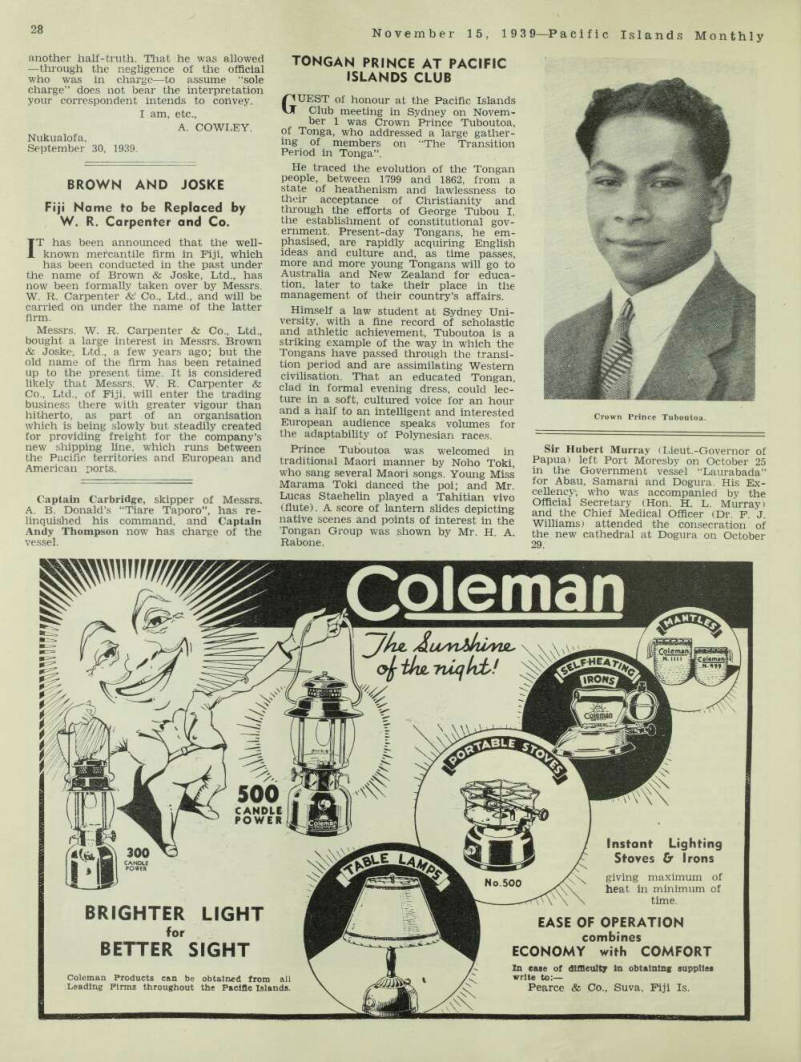
Salaries
Comparison With Peasant Earnings
Letter to the Editor. 1 HEARTILY agree with your Tongan correspondent, in your issue of August, that the question of salaries to native civil servants, and for that matter Europeans as well, “should be brought under serious review”.
As, however, your correspondent’s special pleading concerns only Tongans, this very brief but I trust “serious” con sideration of an important subject must be confined to the limit set by your writer.
The naive suggestion that, if the native officials were better paid, peculation would cease surely emanates from a Tongan mind, and betrays only a surface know ledge of past Tongan history. The ethical import of the suggestion that any class of men, Tongans or Europeans, civil ser vants or day labourers, should be paid over and above an agreed salary, in order to induce them to observe the Sixth Com mandment, must be left to their religious instructors to deal with. I wish merely to direct attention to the economic as pect viewed from the present financial position.
It cannot possibly be accepted that “study of the numerous cases of pecula tion of public funds by Tongans gives rise to the conclusion that in almost every case the primary cause has been the smallness of their salaries”. Who has so concluded?
Measured by Tongan standards where, as your correspondent states, labour can be hired from £1 to £2 per month, the Tongan Civil servant, from the beginner at £5O to the highest grade at £175 per annum, is at once elevated to an in equality unjust in principles and inex pedient in practice. Your correspondent’s admission that even the humble labourer’s £1 per month “cannot be defrayed from copra” owing to “the present low price” renders the question of how he proposes to provide the additions to existing salaries quite pertinent, for the present price of copra (the country’s sole source of income—bananas are negligible) has now become stabilised. “A little know ledge is a dangerous thing.” Your corres pondent’s reference to “vast changes in the economic and social life of the edu cated (sic) Tongan”, and his utter failure to discern whither these changes are tending, shows that Pope’s aphorism has lost none of its pungency.
WITH regard to the alleged high cost of living; 25 years ago, copra, upon which salaries were then based, was at least double the value to-day. The cost of living was, at the least, 20 per cent, higher than at present. Living, therefore, is much cheaper to-day, or, conversely, the standard is much higher than 25 years ago.
I quote a few items in proof. Good quality beef, fresh or corned, is in daily supply at 6d. per lb., and even less. The best of bread is 3d. per loaf. Fresh milk is a fraction over 2d. per pint. Fish is plentiful and reasonably priced. Fresh eggs, during the laying season, are plenti ful at 1/- per dozen. Fresh vegetables, peas, beans, cabbage, tomatoes, carrots, beetroot, etc., are procurable almost the whole year at prices lower than obtain able in Dominion or Australian cities.
Native vegetables, yams, kumalas, taro,
bananas and many others, are far cheaper than the above.
Our civil servant is free of rent, rates or taxes on his dwelling, and his tax-abi (32/- per annum) will yield firewood for the cost of splitting and carting, as well as abundance of food-stuffs —in spite of our poor, under-paid, Tongan official hav ing only one full day each week in which to cultivate.
As to clothing, this entails no great ex pense. The native clerk, clad in a clean vala, shirt and coat, presents quite a smart appearance, at little outlay.
So much for your correspondent’s “diffi culty to struggle along on his small in come”. How about his brother Tongan, struggling along on his bit of land, whose income will not reach £lO for his year’s work? Nowhere in the civilised world is there such frightful inequality as be tween the Tongan bureaucrat and those
who bear the cost, with copra a little over £3 per ton.
FINALLY, although the “mills of god” have been slow to movq, they are now closing upon the Haapai official, who is referred to by your correspondent as holding “a £3OO per year post on a first class clerk’s salary of £175”. Excuse an other quotation from an English poet; your correspondent’s statement is one of those half-truths which Tennyson tells us “is ever the basest of lies”. When Haapai was a Port of Entry, a European official had charge; when it ceased to be a Port of Entry, it became of only sec ondary importance; the European was retired, and the position filled by a Tongan. Measured by the lessened respon sibility, the Tongan was the better-paid official.
The reference to Uliti Balu as being “in sole charge” of important positions is
another half-truth. That he was allowed —through the negligence of the official who was in charge—to assume “sole charge” does not bear the interpretation your correspondent intends to convey.
I am, etc.,
A. Cowley.
Nukualofa, September 30, 1939.
Advertisements & other items, p. 29 (2 items)
27
Pacific Islands Monthl y—N ovember 15, 1939
Vidoioi
i m i p| i ii u ixiia
Fiji Name to be Replaced by
Brown And Joske
Fiji Name to be Replaced by W. R. Carpenter and Co.
IT has been announced that the well known mercantile firm in Fiji, which has been conducted in the past under the name of Brown & Joske, Ltd., has now been formally taken over by Messrs.
W. R. Carpenter &' Co., Ltd., and will be carried on under the name of the latter firm.
Messrs. W. R. Carpenter & Co., Ltd., bought a large interest in Messrs. Brown & Joske, Ltd., a few years ago; but the old name of the firm has been retained up to the present time. It is considered likely that Messrs. W. R. Carpenter & Co., Ltd., of Fiji, will enter the trading business there with greater vigour than hitherto, as part of an organisation which is being slowly but steadily created for providing freight for the company’s new shipping line, which runs between the Pacific territories and European and American ports.
Captain Carbridge, skipper of Messrs.
A. B. Donald’s “Tiare Taporo”, has re linquished his command, and Captain Andy Thompson now has charge of the vessel.
official Secretary § (Ho^™!!^!? d Murrav^
Tongan Prince At Pacific
Islands Club
GUEST of honour at the Pacific Islands Club meeting in Sydney on Novem ber 1 was Crown Prince Tuboutoa, of Tonga, who addressed a large gather ing of members on “The Transition Period in Tonga”.
He traced the evolution of the Tongan people, between 1799 and 1862, from a state of heathenism and lawlessness to their acceptance of Christianity and through the efforts of George Tubou I. the establishment of constitutional gov ernment. Present-day Tongans, he em phasised, are rapidly acquiring English ideas and culture and, as time passes, more and more young Tongans will go to Australia and New Zealand for educa tion, later to take their place in the management of their country’s affairs.
Himself a law student at Sydney Uni versity, with a fine record of scholastic and athletic achievement, Tuboutoa is a striking example of the way in which the Tongans have passed through the transi tion period and are assimilating Western civilisation. That an educated Tongan, clad in formal evening dress, could lec ture in a soft, cultured voice for an hour and a half to an intelligent and interested European audience speaks volumes for the adaptability of Polynesian races.
Prince Tuboutoa was welcomed in traditional Maori manner by Noho Toki, who sang several Maori songs. Young Miss Marama Toki danced the poi; and Mr.
Lucas Staehelin played a Tahitian vivo (flute). A score of lantern slides depicting native scenes and points of interest in the Tongan Group was shown by Mr. H. A.
Rabone.
Sir Hubert Murray (Lieut.-Governor of Papua) left Port Moresby on October 25 in tbe Government vessel “Laurabada” {o F, Abau ’ Samarai and Dogura. His Ex
official Secretary § (Ho^™!!^!? d Murrav^
andth e ChLfMedi^Officer(mFJ Williams) attended the consecration of the new cathedral at Dogura on October 29.
Crown Prince Tuboutoa.
Advertisements & other items, p. 30 (1 item)
(^ihzruqlvt!
ema
/>4e AuwJ>kuyiJL
CoJ ?r> ColsmA S <*99 w 500
CANDLE
PO
Instant Lighting
Stoves tf Irons 300 L&.
CANDLE
POWER
giving maximum of heat in minimum of time.
No 500
BRIGHTER LIGHT
for
BETTER SIGHT
EASE OF OPERATION
combines
ECONOMY with COMFORT
In ease of difficulty In obtaining supplies write to;— Pearce & Co., Suva, Fiji Is.
Coleman Products can be obtained from all Leading Firms throughout the Pacific Islands.
Scientific Expeditions
One Cancelled —One to Proceed
OWING to the outbreak of war, a scientific expedition, which would have been one of the most import ant and interesting ever sent into the Pacific, has been cancelled.
The expedition was organised by the National Geographic Society of America, in co-operation with the University of Virginia and the United States Govern ment. It was to have sailed from San Francisco in September in a specially equipped turbine vessel, and it would have set up temporary observing stations on about 20 islands in the Central and Southern Pacific, and would have carried out a variety of investigations over an area of about four and a half million square miles. One of its principal objects was to explore the great depths of ocean with Sonic sounding machines, and to investigate the deepest ocean with an in genious apparatus invented at the Car negie Institute in Washington. With this, cores of solid mud or other material can be extracted from the ocean bottom at depths below 5,000 fathoms. Investiga tions were also to be made into terres trial magnetic differences and it was planned to do other work in geophysics, geology and marine biology.
It is hoped that when peace returns the project will be reviewed and the ex pedition will take place.
Rare Birds And Specimens
Another American expedition—this one sponsored by the American Museum of Natural History and the University of Columbia—will continue with its plans and the expedition will sail from America for the Central Pacific in a three-masted schooner named “Director II.” early in December. The expedition plans to col lect rare birds and geological specimens and record primitive music among all the islands, from Fiji in the east right across to New Guinea in the west. The schooner will carry a light aeroplane for survey work and to assist in maintaining com munications.
Members of the expedition will include Mrs. Bruce Fahnestock, a stockbroker’s widow, aged 55, and her two sons, all of whom have previously been with scien tific expeditions in the Pacific.
Letters To German Firms
Bring Fines
THE managers of two Indian firms in Lautoka, who evidently failed to familiarise themselves with the Defence Regulations dealing with communications with firms in enemy territory, were prose puted in the Magistrate’s Court at the end of October, and each fined £3 by the Resi dent Magistrate, for submitting communi cations to firms in Germany.
The cases were brought as a warning and both defendants pleaded guilty says the “Fiji Times”.
The letters, which were ordinary busi ness communications, were intercepted by the censors.
A graceful two-masted ketch named “Torres Herald II”, which had been built in Brisbane for service in the Diocese of Carpentaria, left Brisbane on October 17 for Thursday Island, where she will be used in connection with the work of the Australian Board of Missions among the islands of Torres Strait.
Advertisements & other items, p. 31 (2 items)
29
Pacific Islands Monthl y—N ovember 15, 1939
Island Store Manager
MAKES GOOD RECOVERY
COURAGE IS A GRAND THING. BUT SOMETIMES COURAGE ALONE ISN’T ENOUGH. TAKE THE CASE OF ARTHUR WEBSTER FOR INSTANCE. ONE EVENING HE WAS WALKING DOWN THE STREET WITH HIS FRIEND,
BILL THOMPSON, WHEN BILL SAID:
“Things pretty good at the store, Arthur?”
“Y-yes. We’re doing all right.”
But the store wasn’t doing as well as it should have been. Arthur Webster was really worried. That night he had a heart to heart chat with his wife.
“Arthur darling, you worry too much —things’ll be all right soon.”
“I wish I didn’t feel so tired all the time! I seem to wake up tired lately. I suppose I’ll just have to pull myself together and do a real job for the next couple of months.”
Arthur Webster tried hard but just couldn’t make the grade. The final sales figures showed he was well down. One evening when he was slumped in a chair looking thoroughly despondent his wife came over to him.
“Darling, there’s something really wrong with you. I know what you’re going through . . . but I’m sure there’s something behind this day after day tiredness of yours. Why don’t you see a doctor?”
So Arthur Webster took his wife’s advice and saw his doctor. After giving him a thorough examination his doctor said :— “Mr. Webster, your whole trouble is Night-Starvation. You see, all night long your heart and lungs
are using up energy. Your heart has to beat 35,000 times and your lungs make 20,000 muscular movements during your eight hours’ sleep.
So you can see for yourself if energy isn’t replaced during sleep you wake tired, feel run down and get behind in your work. You need Horlick’s. Start drinking Horlick’s every night before you go to bed.”
Arthur Webster started drinking Horlick’s every night before bed.
Soon he lost that heavy, tired feeling and found that he could put twice as much drive into his work.
His sales figures bucked up and for the first time since he had been on the Island the Head Office sat up and took some notice of him.
Do you feel tired all day? Wake tired? Find it hard to concentrate on your work? Feel dull and nervy? Then the chances are that you, too, are suffering from Night-Starvation. Remember, Horlick’s guards against Night-Starvation, keeps you wonderfully fit. Ask your chemist or storekeeper to-day for a bottle of Horlick’s. You can buy Horlick’s in all main towns throughout the British Pacific Islands. u Trucks aorlic roil,*'
I Come "Angery"
The Sufferings of an Islands Trader
By E. Gold, Mangaia, Cook Islands
AT this date, the vitamins and proteins of my continued existence are at the mercy of the ninth of a series of brown female servitors, aged variously from seventeen to twenty-six.
Brief life was here the portion of some of them.
Mere, for instance (native for Mary— but, I fear, lacking in the snowy purity associated with the name). Mere was a relation of the native king, and ranked perhaps as a Lance-Duchess. As a feature of the landscape she wasn’t bad—some thing on the Mae West pattern—but she crashed over a matter of Meum et Tuum. (Even in the Cook Islands there’s a line of demarkation, faint though it may be!) The Beefy Nordic and I were having our Saturday night spree of music gramophone, guitar-strumming and gen eral hilarity, plus tea-drinking. Duchess Mere was sent to get bread at the bakery of one Kake (pronounced Cock-Eh, not Cake!—but have it your way!) She went, and returned with staff-of-life aforesaid.
Also, concealed on her person, she had 15/- of Kake’s till-money, filched while he was gettmg the bread.
Strumming joyously, the Beefy Nordic and I were interrupted by a panting and agitated Kake, new-arrived from a re count of his petty cash.
Mere was sent for. Mere was third degreed. Mere, weeping, confessed. The money was returned to Kake, and Mere to her exalted family. I was a Lance- Duchess short. r[E next incumbent, one Roi, was a lady of original ideas. Her method of
extinguishing a Primus was to blow it out. To Roi, baking powder and caustic soda were as one. Caught one day “boil ing” an empty kettle on a roaring stove at full pressure, she, be-sworn, sat down by the waters of Mangaia and wept. Roi’s resignation followed.
I next acquired Maina. She was a pert damsel who flattered herself as a linguist, refusing to speak anything but English Maina fell violently from grace, ap pearing as the co-re in a native divorce.
But she expected it to make no difference to her job—what was a divorce or so among friends?
“You finish!” said I.
“Oh, no”, said Maina. “I no like!”
“You no spoke!” said I. “I come angery!
Nemmine you no like —you went!”—and that, so to speak, was that.
THE succeeding incumbent, one Tara, did fairly well, but lasted only six months before matrimony set in. I went to her wedding as best man (which I cer tainly was). All in all, it cost me about 30/-.
At present, I have Tutana as Queen of the kitchen.
Her name (Susanna in English) is, I hope, a promise of chaste constantcy. The Beefy Nordic says the cakes she bakes are “not bad”. This, from him, means in Hollywood-ese, Hyper-Super-Colossal.
But I am uncheerful. I hear that a party, representing parties of the sec ond part, held conference last night with Tutana’s father, view matrimony, and I wait in apprehension.
Mr. L. N. Tribolet, auditor for Burns, Philp and Co. Ltd., returned to Austra lia in mid-October after a business visit to Papua.
M.V. "Maui Pomare" Has
“Bucketing About"
M.V. "Maui Pomare" Has Miserable Trip
FEW Pacific travellers will envy the 13 passengers who were on board the N.Z. Government motor-ship “Maui Pomare”, when she left Apia on Septem ber 7, on an 8 days’ run to Lyttelton.
The engines of this motor-ship always have been temperamental—and the en gineers began to have trouble soon after the vessel left Apia. There were alter nate periods of creeping along on one or two engines, and of drifting, while the engineers tried to repair the machinery; but, finally, the captain was forced to anchor his ship in the lee of one of the Kermadec Islands, about 600 miles north east of Auckland. At this stage, the lu bricating oil gave out and the captain radio’d for assistance.
Meanwhile provisions—especially fresh food —ran very low, and parties were organised to fish vigorously, so that there might be some variety of diet.
After some days the little lighthouse steamer “Matai” arrived with supplies and lubricating oil, and went on again; but, even then, the engineers could not make the engines go and the “Matai” had to be recalled by radio, and she finally towed the helpless “Maui Pomare” down to Wellington.
A trip which normally takes 8 days occupied actually 20 days. ■ The Auckland ketch-rigged yacht, “Seaward”, owned and navigated by Mr.
D. Wellington, returned to New Zealand in mid-October after a four and a half months’ Islands cruise. Ports visited included Noumea, the Loyalty Group, and Lord Howe Island.
Advertisements & other items, p. 32 (1 item)
Nelson And Robertson Pty. Ltd.
■" (ESTABLISHED, 1895. """ 111 ""
ISLAND MERCHANTS
All classes of merchandise purchased at wholesale prices and original
invoices supplied to Island Clients.
COCOA BEANS, RUBBER, TROCAS SHELL and COPRA sold on Commission.
SOLE AGENTS FOR
BEEBE ALL STEEL WINCHES, Portable, Unconditionally Guaranteed. 2, 5 and 15 ton from Stock.
LONDON SELF PRIMING PORTABLE PUMPS, Manufactured in Canada, all sizes from 1* in. upwards. Specially suitable for prospecting and mining in all its branches.
SKANDIA ENGINES, Full diesel, semi diesel, all powers, marine and stationary.
ARCHIMEDES. Swedish Outboard Engines. Highly recommended.
UPSON BRITISH BOARD, wallboard, strong and light in weight. 6ft. to 12ft. lengths always in stock.
ANKAR INSULATING WALLBOARD, made from pure wood-fibre. The best insulating material on the market.
NELSON and ROBERTSON Pty Ltd.
l2 Spring Street, Sydney, Australia
Telegraphic Address: “IVAN SYDNEY.”
Comment By An Experienced Observer
Native Conditions In New Guinea
By F. W. Eggleston, who was Chairman of the Recent Committee of Inquiry on Amalgamation
I HAVE been asked to comment on the article of the Editor, in the Septem ber number, about the Mandated Terri tory.
With a good many of the details of this article I agree, but I do not think the main contentions of the article are proved by the facts quoted in support of them.
It is easy to allege a lack of economic or agricultural policy if you do not take into account the economic inhibitions.
It does not do to assume that New Guinea has great potential riches. It is an exceedingly poor country, and the amount of good agricultural land is ex ceedingly limited. This fact, coupled with the low price of copra and the poor mar ket for other crops, explains a great deal of stagnation.
It is easy, also, to criticise the lack of education policy by assuming, con trary to the facts, that other countries are doing more.
The statement as to the condition of the natives either says too much or too little. I am at a loss to know whether the writer thinks that the Native La bour Ordinance is broken in practice, and the natives are badly treated; whether he thinks that the natives are under paid; or that the proportion of recruit ed labour is too high in relation to the total population: or that the period of enlistment is too long. His statement may cover a score of different matters for complaint.
The rates of pay in New Guinea and the period of enlistment are deliberate ly provided for in the Native Labour Ordinance and are therefore matters of policy which have been canvassed. The pay is considerably less than in Papua and in the British Colonies in the Paci fic, but I have made full investigations in other colonial systems, and it is not be low the rates paid for unskilled labour in several cases, and it will certainly go up as the supply diminishes.
Apart from other considerations which I shall mention later, I think the native labourer benefits from his period of ser vice. Employers say that the labour is not cheap, even at this price. In Papua, where the pay is higher, the copra in dustry has been stagnant for nearly 20 years, rE proportion of recruitment to the population is undoubtedly too high, and the Administration is getting into a serious difficulty in this aspect. Some years ago, the Mandates Commission was informed that recruitment was stopped whenever the proportion of females of child-bearing age exceeded that of adult males by over 5 per cent. This propor tion is now largely exceeded, and the records show that closing of areas for recruiting always results in increased population.
The chief difficulty is that the mining industry expects a short life, and is not averse to a policy which means rapid depopulation and a drying up of the supply. The period of indenture in New Guinea is three years, as against one year or eighteen months in Papua, and this lengthy period accentuates the toll im posed by the high recruitment on the labour supply.
SO far as the treatment of the natives is concerned, I do not believe there
is much ill-treatment. I have no doubt that on lonely plantations there is a certain amount of cuffing and kicking, but I saw evidence that the native is quick to resent this. Is it suggested that native complaints are ignored or ill treatment condoled? On these points I cannot pretend to speak with any de finite first-hand knowledge, but I should say that there is nothing in the nature of enslavement or consistent ill-treat ment. I never saw a native looking sull en or discontented.
I have always regarded missionaries as the unofficial protectors of the natives, and I made enquiries of practically every missionary I spoke to in New Guinea, and I never heard any complaint of Gov ernment policy or of ill-treatment. In deed, there was generally positive appro val of the way in which they were treated. Only on one or two occasions, so far as I have been able to ascertain, have missionaries complained to the Mandates Commission. The one I re member was as to a particular phase of the system, and not as to general ill treatment.
I FOUND, indeed, that the missionaries in Papua were averse to amalga mation because they did not want to have any change in what they called the Murray system. But I asked them if they knew anything in the New Guinea system which they were afraid of being introduced, and they were unable to give any details. Tiie missionaries had evid ently not heard of any ill-treatment or scandals.
One thing which may be said to dis count the evidence of the missionaries in New Guinea is the fact that practic ally all the German missions are deeply involved in economic activities for which a labour supply is needed. I have not the slightest doubt that this fact affects their view on labour matters; and, in deed, I found some of them saying that the Government system was not strict
enough, and advocating compulsory la-
Kjkj Ui ,
taSly iV a e Sf' ter managed in Paom bS p ,™ rr r managed in Papua. But m Papua the missions were willing to educate the natives in English, and up to a definite standard, and subject to inspection; in return, they get a small capitation grant.
In New Guinea, the missions were not willing to adopt this system. They do a certain amount of education, but mainly for the purpose of training mission helpers. There is, however, quite a false idea as to the amount of native education in other parts of the world.
I was shocked at the small amount paid by the Administration in New Guinea, but on checking up a large number of other Administrations I found that New Guinea was on a par with a good many others. The fact is that the problem of native education is unsolved. The best educational authorities cannot give
a confident pronouncement on the sub ject.
My sympathy for an Administrator who has to put up with the eccentricities of Ministerial control from Canberra is pro found.
Mr. W. Horton, manager at Madang for Burns, Philp and Co., Ltd., New Guinea, has been transferred to the Wau branch.
With the exception of a short spell at Manus, Mr. Horton has been in charge at Madang since 1926, and has now been relieved by Mr. J. A. Buston. B.P.’s store at Madang recently has been renovated and remodelled.
Nursing Sister Christine Woods ar rived in England recently to spend fur lough at her home, which she has not visited for 14 years. Miss Woods is a member of the Melanesian Mission staff, stationed at Kerepei Hospital, Ugi Is land, in the Solomons,
Advertisements & other items, pp. 33-34 (2 items)
31
Pacific Islands Mon thly— November 15, 193 9
Capstan
Quick, Safe
RELIEF
« Headache
® Tropical Fevers
» Heat Exhaustion
* Nerve & Muscular Pains
YOU should NOT suffer pain—lt Is harmful and lowers resistance to dangerous germs. Vincent’s A.P.C.
Is deep-seated in its action; it stimulates the nerve and muscular system causing a healthful relaxation which removes pain and exhaustion. Because Vincent’s A.P.C. has a definite therepeutlc value it assists greatly in fighting oft and in the actual treatment of tropical fevers, rheumatism, arthritis and sciatica.
At the first sign of headache or any other nerve pain take Vincent’s A.P.C. powders or tablets—and get positive relief WITHOUT after-effects, because Vincent’s is the balanced prescription formulated by the Medical Superintendent of Aus- 'tralias largest public hospital. * Vincent’s A.P.C. Is the safest f and best keen it handv
FOR SAFETY’S SAKE. SAY “VINCENT’S”
and best keep It handy always.
POWMII I
mins
I/* AND 2/4.
MNGUU2 m
/dpecta&tjpncAe*/fh& TROPICS
CAPSTAN
fICARETfpZ
fOBACCp
<r: »UM m
AND
Capstan Navy Cut Tobacco, made from the finest Virginia leaf.
Capstan Cigarettes, round airtight 50’s.
Medium and full strength. 8824-10-8
o*.v
ORWA
OS WA;
OSW'A
O£W A
OS WA
OfivVA
OSWA
s m w & OS
ORA
A;
a;< OS WAR'S OSWAR'S
A R'S OS WARS OSWA R ft
A. R'S OKWAR ft ORWAK’S
A R'S ORWAFS ORWAR'S
OSWaR S OKWaR'S ORWAF'S
DSWXR’S OR WAR'S- OS WAR’S
ORWAR'ift OR WAR'S OSWAR'S
OR WAR'S OS WAR'S OK WAR'S
OSWAR'S OS WAR'S OSWAR'S OKWaRSORWARSOR WAR'S ORW,ff> ft OR WARS
aS SORWAR ft
ORWAR'ftOS WAR'S OSWAR'S ORWaRVORWARS OS WAR’
>S WAR'S OSWAR'S OKWa ff ft ORWAR S OS W. ?K WAR'S ORWaK ft ORWaR S OS
OKWA-W
ORwJk'
OSWAR
O S W A S.
ORW
OSW
OSW/
DEW;
OS
SR^OR
ARS OR WAR'S
ARSORWAK'S
AR'SOS'WAR
A R'S ORWAR'ft
OR War S ORWA K'S
ft OR WAR'S OR WAR'S OS WAR'S ORWA R'S OS WAR'S OS WAR'S OSWAR'S RWaRS OS WAR'S OS WAR'S OSWAR'S OKWaR S
'aRSORWAR'S OSWAR'S ORWAKS ORWAR'ft orwars
AR'ft OR WAR'S OS'WAR'S O£WAR S ORWaR S ORWAR'S OR WAR'S
'RWAR'S ORWAR'SOSWAR'SOKWAR'SORWAR'SS^RWAR'S OS WAR'S DfJWXR S
OR WAR'S OS'WAR'S OKW ARS ORVVaR S OR WAR'S OS WAR'S OS WARS OK WAR OKWAR I SORWA?e SDRWARftOS. WAR'S OS WAR'SOSWARSORWAR ftOKWAK:; OR WAR'S OR WAR'SOS. WAR'S OS WAR'S OR'WAR ft ORWaR S ORWAK'SORWAR'S OR WAR'S OS WAR'S OR WAR S OKWA'R'S ORWaR'S i'S.W'A R 'S OSWAR'S OSWAR'S OS WAR'S ORVv'aR 1 S ORWA R A ORWaR'S OSWAR'S OS WAR'S OS WAR'S OR'W'AR OKWATRft OKWARS ORWAR'S OS WAR'S OS WAR'S OR WAR S OKWAWS ORWaR S
ORy/AR SORW'AR'SORWAR SOfOAAR Si-JRW'AR
OR WAR'S OS WAR'S OSWAR
OS WAR'S OR WAR'ft ORW
ok wars /OS: WAR'S orwak O E W.A R' ft ORW AR*S OR WA
OR‘WAR'S OS WAR'S OS WA
OS WAR'S OK WAR S ORW
DEWAR* ft ORW A R' S OR WA ?••
OR WAR'S ORW
OSWWWWL^
ORW
ORR
OS OS
OKW .
OR WAR'ft
OR WA R'S OR WAR'S OS WAR
OS WAR'S OS WAR
OK WAR ft OKWaT?
ORWaRSORWAR
SR
AR'S
Isl/^VOSOSWAST
;> Oft WAR'S OS WAR ;
'S OSWAR'S OSWAR'S OS WAR'S
■A R ft OR Wa ?< ft OR WA R‘ SORWA R' S >KWAR ft ORW AR ft ORWAR'S OS. WAR'S OS WAR'S ORWAK ft OS.WAR'S OS WAR'S OS WAR'SOSWAR'S ■ORWAK’S OS WAR'S OSWAR'S ORW A R S ORAVaTRS OS W A R'S OS WAj< ft ORW A R ORWAR'S
fAR'S
ARS
OS Al< OS sv AT< AS
ATS
A ft RA
R WAV-
OS
WAR’S
ARSOKWAR'ft
SWA ORWAR'S ORWAR'S
:7sS WAR'S OSCAR'S
OSWAR'S OS WAR'S
OKWARRORO/AR’ft
OS WA R'S OS WA R'S OS W A R'S OS WAR'S OKW A fT ft ORWa S' :ft ORWaR'S OS: WAR'S OK WA R S OK WAR' S OK WA R ft ORWaK'S ORWA R'S OSWAR'S SW.WAR'SOS WAR'S ORWa S'ft ORWa S' V ORWARS ORWA R'S OS W A R'S 0S WA R'S OS AVAR'S OSWAR'S ORWA R'S OR WAR'S OS WAR'S OSWAR'S OSWAR'S OS WAR ft OSWAR'S OS W ARV
OSWAR'S OSvVAR'SOSVVAR SOSWAR'ft ViSWASVftORVVAS ;• OEVv'AR'.SOKVrAR':-'
ORWAR'ft OS WAR'S OS WAR'S OSWAR'S OSWAR SOSWAR ft DR WATS ft OK WARS
Parasites
Fighting Pests with Parasites Entomologist's Interesting Work in Fiji and Samoa
ON a joint mission on behalf of the Governments of Fiji and Samoa, Mr.
H. W. Simmonds (formerly Govern merit Entomologist in the Colony of Fiii) passed through Sydney in October on his way to Samoa, after instituting certain researches that will have important scientific results for both territories. hetapT l^ 16 ? by Mrs ' Simmonds,' who h T lm ln securing collections, he J a va, Malaya, Mauritius and Madagascar. His object, primarily, was to obtain a parasite that would attack the fhsTSf™, 8 , b f et , le Samoa, and another that would deal with the house-fly prob lem in Fiji. J Simmonds secured a predatory beetle which lives in the land of places where the Fijian house-fly breeds and feeds, and which is said to con sume numerous house fly maggots m twenty-four hours. Already some of them have been sent to Fiji? and Led successiully there to combat the fly nui sance. Others have been sent to the Solomon Islands to deal with the buffalo fly. Results are not yet known in Samoa, but, as elsewhere, it is hoped the beetle will be a success.
In regard to the rhinoceros beetle in Samoa, Mr. Simmonds has already sent there a colony of a certain parasite wasp obtained in Madagascar, and he took a second colony back with him, which was secured in Madagascar and Mauritius, ihe result of this experiment will be awaited with interest throughout the Pacific. ■ Simmonds has been in the service of the Fijian Government since 1920 Prior to that he lived in New Zealand, South Africa, and elsewhere. His investi gations have led him to all parts of the Pacific. He retired from the post of Gov ernment Entomologist some years ago and he describes this last trip as “a post retirement mission”.
New Premises for Bank of N.S.W.
at Port Moresby
Prom Our Own Correspondent
R Pt. Moresby. Oct. 23.
E Bank of New South Wales will erect new premises early in 1940 on land purchased in 1938 from Messrs.
Clarke and Whiting, in the most prom inent position in Port Moresby two allotments adjoining the Post Office.
The Bank commenced operations in Port Moresby in May, 1910. The new build ing will consist of two storeys, with the lower devoted to the different depart ments of the general office, which in cludes separate offices for the manager and auditor, a tourist lounge, and a de partment for natives, with its own spec ial entrance.
Accommodation for the manager, on the second storey, will contain bedrooms and dressing rooms and a spacious lounge, giving a beautiful view over the harbour and surrounding hills. The din ing room and kitchen quarters are to be on the lower floor.
Mr. W. B. Frederick, the manager of the Port Moresby branch since 1937, dur ing whose time the property was ac quired, will leave Port Moresby early in November for Australia.
Basket Ball Is Popular In Tonga
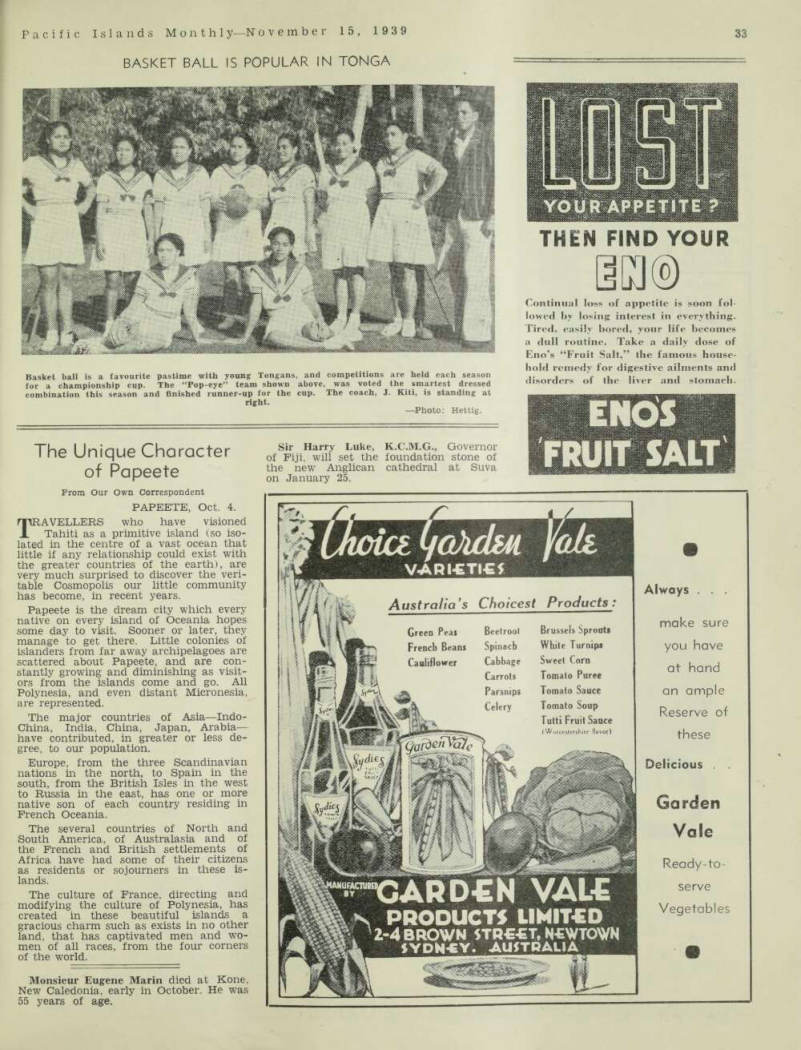
Basket ball is a favourite pastime with young Tongans, and competitions are held each season for a championship cup. The “Pop-eye” team shown above, was voted the smartest dressed combination this season and finished runner-up for the cup. The coach, J. Kiti, is standing at right. —Photo: Hettig.
of Papeete
The Unique Character of Papeete
Prom Our Own Correspondent
Papeete, Oct. 4.
rAVELLERS who have visioned Tahiti as a primitive island (so iso lated in the centre of a vast ocean that little if any relationship could exist with the greater countries of the earth), are very much surprised to discover the veri table Cosmopolis our little community has become, in recent years.
Papeete is the dream city which every native on every island of Oceania hopes some day to visit. Sooner or later, they manage to get there. Little colonies of islanders from far away archipelagoes are scattered about Papeete, and are con stantly growing and diminishing as visit ors from the islands come and go. All Polynesia, and even distant Micronesia, are represented.
The major countries of Asia—lndo china, India, China, Japan, Arabia — have contributed, in greater or less de gree, to our population.
Europe, from the three Scandinavian nations in the north, to Spain in the south, from the British Isles in the west to Russia in the east, has one or more native son of each country residing in French Oceania.
The several countries of North and South America, of Australasia and of the French and British settlements of Africa have had some of their citizens as residents or sojourners in these is lands.
The culture of France, directing and modifying the culture of Polynesia, has created in these beautiful islands a gracious charm such as exists in no other land, that has captivated men and wo men of all races, from the four corners of the world.
Monsieur Eugene Marin died at Kone, New Caledonia, early in October. He was 55 years of age.
Sir Harry Luke, K.C.M.G., Governor of Fiji, will set the foundation stone of the new Anglican cathedral at Suva on January 25.
Advertisements & other items, p. 35 (2 items)
33
Pacific Islands Monthl y—N ovember 15, 1939
Garden Vale
rsi
THEN FIND YOUR
m Continual loss of appetite is soon followed by losing interest in everything.
Tired, easily bored, your life becomes a dull routine. Take a daily dose of Eno’s “Fruit Salt,” the famous household remedy for digestive ailments and disorders of the liver and stomach.
f Choicest Products Australia s Brussels Sprout* While Turnips Sweel Corn Tomato Puree Tomato Sauce Tomato Soup Tutti Fruit Sauce (Worcestershire flavor) Beetroot Green Pea* French Beans Cauliflower Spinach Cabhag Carrot?
Parsnips
ST*S
A Celery m ✓ -HANUFACIUfire IY - \
GARDEN VALE
PRODUCTS UNITED
2-4 BROWN STRC-ET, HCWTOWN
SYDM-CY. AUSTRALIA
Always . . . make sure you have at hand an ample Reserve of these Delicious
Garden
Vale
Ready-toserve Vegetables
Japanese Ships In Pacific
NOW that the Pacific tension has eased, Japanese shipping is moving more freely about the Pacific.
“Several small Japanese schooners have been here lately from the Caro lines”, says a Rabaul correspondent.
“They have Caroline native crews and Japanese officers. Just recently, a big 10.000 tons Japanese vessel came into Rabaul, stayed a few hours, and left— with mail for the South”.
Dr. R. W. Schuch has resigned from the New Guinea Administration.
Mrs. P. K. Lewis, licensee of the hotel at Madang, New Guinea, died suddenly at the end of September.
Papua's Early
Goldfield
Discovery of Sudest and Misima
Compiled by Mollie Lett, from the Old Diary of a Long-Dead Miner EARLY in 1888, a pearler named White returned to Cooktown, Queensland, with an account of an auriferous reef he had discovered while working the Louis iade Archipelago (Eastern Papua). He formed a prospecting party and, upon receiving the cutter “Juanita” from the Administrator of British New Guinea (Hon. John Douglas) who was in Cook town at the time, he set sail with his party, on May 27, for Samarai, and for Joannet Island (150 miles south-east of Samarai).
Samarai and its surroundings were as lovely then as they are to-day, but the town did not exist—only one or two trading stores, of native material, stood along the foreshore. But here the party procured water and wood, and continued their journey.
Joannet turned out to be a fairyland of tropical loveliness, but false in its pro
raise of gold. The reef was barren; but, nevertheless, the trip was not destined to total failure. In fact, it was this voy age of the “Juanita” into these little known islands that laid the foundations of the Papuan gold-mining indus try, and opened up a new source of sup ply to the world.
Sudest, a narrow island with a high central range, lay only seven miles away, and Mt. Rattlesnake, its highest point, was plainly visible to the party; and, de termined to find gold, they sailed across.
Prospecting the creeks and small rivers, they were rewarded with only 150 ozs. (in those days worth £550). An unsatis factory yield for two months' work, but enough to convince them (ancj others, on their return) that Sudest was worthy of consideration.
Their success caused a little excite ment; but, as there were few in Cook town who could finance any undertaking, the “rush” dwindled.
Eventually 20 men formed a party.
These, chartering the “Griffin”, com manded by “German Harry” (otherwise, Captain Christensen) set forth early in September, 1888, after loading up with stores and provisions.
The voyage of the “Griffin” was less picturesque and pleasant than that of the “Juanita”, for calms and baffling winds prolonged the journey into weeks, and the exasperated miners became rebellious.
However, with cards and over-proof rum, even the captain and his mate found the time not exactly unpleasant.
But, as the monotonous weeks rolled by, “German Harry”, not too sure of his posi tion, became anxious. He was relieved at last to sight land, and to find that he recognised it. “They once tried to kill me there”, he called out jubilantly, to the weary men, “so I ought to remem ber it”. The “Griffin” was put on her course again, and in three days reached Samarai, Four days later they made Sudest, and dropped anchor under “Griffin Point”, and the miners, unloading their stores, went into camp and soon found payable gold. Before long, news of their good fortune reached Australia. In a few months the first Papuan goldfield was established, with 500 miners working the gullies and creeks below the range.
Early in October, 1889, Dr. MacGregor (afterwards Sir William) who had recent ly been appointed governor to the newly established possession, arrived in H.M.S.
“Swinger” to establish law and order, and there was a good deal of excitement as the man-of-war came into sight. It was expected that there would be a certain amount of ceremony over the proceedings, but Sir William arrived in miner’s garb —heavy boots, blue shirt, and dungarees.
Several miners, taken by surprise, mis took him for a “new chum”, much to their later embarrassment.
Sir William found the miners leisurely at work fossicking the creeks, and as there was a tendency to run over the ground and waste it, he appointed a war den, J. B. Cameron, and brought the mining laws of Queensland into force.
As it appeared certain that the more restless of the men would soon be seek ing new grounds, he arranged to convey a party to the neighbouring islands— not only to ascertain their prospects, but to prepare the natives for an invasion.
Doubtful colours were found both at Rossel and Joannet Island, and the D’En trecasteaux Group offered little encour agement; but at St. Aignan (Misima), the prospectors found rough colours, and shortly afterwards several returned there
and opened up a field on which there were eventually 400 men.
By this time the climate, the work, the bad food, and, above all, ignorance of the nature and treatment of malaria, were showing their effects; and num bers of miners were dying in the camps, and on the cutters between Sudest and Cooktown. On one voyage of the "Mer cury” as many as seven were buried at sea, before reaching Australia.
Still, with each fresh discovery, more miners arrived, and the numbers in creased until over 700 were working the beds of creeks on Sudest and St. Aignan.
But, as the claims gradually worked out, their attention was drawn to the main land. In 1893, a mining party, bent on making new discoveries, crossed over in the “Mystery” from Cooktown; and their prospects behind Bartle Bay, and later on the Mambare River, further north, attracted attention. From then, on, both Sudest and Misima were gradually deserted —only a handful of men remain ing to clean up the creeks and gullies near the deserted camps.
Advertisements & other items, p. 36 (1 item)
Clmottls
25 YEARS OF SERVICE
William E. Reed
(Established 1913)
BROKER & AGENT
Union House. 247 George St., Sydney For all Plantation and Trading Requirements. Enquiries welcome.
THEY KEEP YOU FIT
AND KEEP YOU SLIM
The whole grain of rich, sun-ripened wheat, transformed, after careful selection, into a perfect health food, delicious for breakfast, for afternoon tea or supper.
Arnott's Famous Shredded Wheatmeal Biscuits are rich in precious vitamins and proteins, and very easily digested. ... Try them with butter, cheese, jam or honey.
Clmottls
FAMOUS
SHREDDED
WHEATMEAL
BISCUITS
«, 822 ALWAYS ASK YOUR GROCER FOR ARNOTT'S !
Solomons
Donations To Red Cross In
A BRANCH of the Australian Red Cross Society, formed by the ladies of Tulagi and district, British Solomon Islands, has been generously supported by subscriptions.
A very successful Bizarre Bazaar was held at the Tulagi Club to augment the funds. The ladies were complimented on the excellent and daintily-served supper, for which 1/- was charged. It was a "Nothing over 6d.” night for all com petitions and side-shows, but Mr. J. B.
Hicks handled the rush for small change very effectively. The sum of £22/10 / - was obtained. The Committee warmly thanked all who helped, and also the Committee of the Tulagi Club for the use of the premises and assistance of the staff. The stall-holders were:—Mrs. A. E. Osborne, Mrs. J. C. M. Scott. Mrs. W. Driver, Miss M. Cleaver. Miss M. Kennedy, Dr. N.
Crichlow, Mr. J. Beveridge, Mr. C. V.
Widdy.
The Committee wish to acknowledge the following donations: — F. E. Johnson, £2/2/-; R. Hyne, £2/2/-; A.
E. Osborne, £l/1/-: A. H. Wilson, £l/1/-: J.
A. Johnstone, £5; E. Sandars, £2/2/- Mem bers’ Donations, 13/6; Collection, Tulagi Church, £2/17/3; Bums Philp (S.S.) Co., Ltd., £10; R. Taylor, £l/1/-; J. C. M. Scott, £2/2/-; A.
W. Glenn, £l/1/-; W. H. Driver, £l/1/-; B. A.
Chapman, £l/1/-; F. G. Everett, £2/2/-; R.
G. Chapman. £l/1/-; A. R. Evans, £l/1/-; G.
Gaskell, £l/1/-; F. Naylor, £l/1/-; J. S. Elder, £l/1/-; W. R. Carpenter & Co., Ltd., £10; R.
J. Lotze, £2/2/-; A. Judd, £1; J. E. Prince. £1; J L. Bergelin, £1; T. H. Elkington, £1; D.
Trench, £l/1/-; F. Stock, 10/-; V. Shearwin, 10/6; Major Blake, £l/1/-; Miss P. Hackett,
£l/1/-; G. Train, £l/1/-; S. Masterman. £2/2/-; J. Beveridge, £2/2/-; Miss M. Cleaver £5/9/-; Mrs. Taylor, £l/1/-; A. Mutch, £1; J. Bernhardt, 10/6; G. White, £2/2/-; R. Horton, £l/1/-; Mrs. J. C. M. Scott, 6/-; C. V. Widdy £l/1/-; W. G. Hobbs, £l/1/-; Dr. Weschler, £l/1/-; A. E. Voyce, 10/6; M. Neilly, 10/6; H.
Dunn, 10/6; R. Laycock, £2; P. Kneen, £l/1/-; Bishop and Mrs. W. Baddeley, £10; W. Groves, £1; V. Hodgess, £2/2/-; Miss M. Kennedy, £1 H. Stronge, £1; J. Gaskell, £l/1/-; J. Weston’ £l/1/-; Ah Seng, 10/6; Capt. J. W. Rawson, £2/2/-; C. N. F. Bengough, £2/2/-.
Donations by members of Native Armed Constabulary; Native Warders; and mem bers of the S.S.E. Mission: * Senior S. M. Sipolo, 5/-; Q.M.S. Heman loi, 5/-; A/c Gaoler Tua, 10/-; Sgt. Falisi, 5/-; L/c Sanafanoa, 5/-; L/c Pirinao, 5/-; Gaoi Clerk Kwanairara, 5/-; Constables: Ete, 2/10; Horokou, 1/-; Waneoroa, 2/-; Fafunua, 1/-;’
Itea, 3/-; Chukl, 2/-; Waleni, 2/-; Sisili, 1/-; Sisikafo, 1/-; Kiruwai, 2/-; Mflsale, 1/-; Suru fanalamo, 3/-; Konai, 2/-; Jaku, 2/-; Pasi, 2/-; Mahe, 1/-; Manui, 1/-; Mevesa, 2/-; Tagathagoa’ 2/-; Toifai, 4/-; Aike, 1/-; Salana, 1/8; Bate’e, 1/-; Drummer Mania, 1/-; Drummer Rakui, 2/-; Constables: Tariasi, 3/-: Teabo, 2/-; Javani, 1/-; Baitaethara, 2/-; Umu, 1/-; Gito, 1/-; Lenga, 1/-; Oilomea, 1/-; Siolomaja, 1/-; Leketo, 1/-; Hoihaeori, 1/-; Warderess Elizabeth Wawae, 2/-; S.S.E. Mission: Unity Faronodo, 2/-; Warder Gabriel, 2/-; S.S.E. Mission; Rachel loi, 1/-; Amagele, 2/-; Tuai, 5/-; Obed Ongofia, 1/-; Warder Irokafa, 1/-; S.S.E. Mission: Jared Riri’, 4/-; Rauimae, 1/-; Warders: Irosi, 1/-; Odosia! 1/-; Waiau, 1/-; Pwaiborai, 1/-; total, £6/4/6.
Mr. E. G. Theodore, managing director of Emperor Gold Mining Co., Ltd., and Loloma (Fiji) Gold Mines N.L., arrived in Australia from Fiji in October.
A son was born to Rev. and Mrs. C. T.
J. Luxton, of Buka Passage, Bougain ville, New' Guinea, in September.
Mr. H. L. Freshwater, who has been a member of the lay staff of the Melane sian Mission since 1928, has resigned.
During recent years he has been stationed at the Mission’s Hospital at Fauabu on Malaita Island, in the Solomons.
Nurse Hester Clark, who served for nearly 30 years among the Indians in Fiji for the Methodist Mission, has re tired owing to health reasons. She now has settled down with her sister, Miss Edith Clark, at Manly. N.S.W.
Miss Jean Rogers, a member of the Overseas Department of the Methodist Mission in Sydney for 16 years, has re signed. Miss Rogers was responsible for producing the Mission’s bright, illustra ted monthly Islands magazine, “The Missionary Review’”.
Georges Champion, a Noumean boxer, who recently arrived in Australia from New Caledonia, won his first fight in Victoria on points against Ron Negus on October 25.
Advertisements & other items, pp. 37-38 (2 items)
35
Pacific Islands Monthl y—N ovember 15, 1939
Kork-N-Scal
FOR HOME USE
o Hand
Applied
Airtight Pressure Proof
FOR ALL HOME BOTTLING
—THE LITTLE CAP THAT
will Re-seal 1,000 Times
KORK-N-SEAL (Aust.) LTD.
too COMMONWEALTH STREET,
SYDNEY, AUSTRALIA.
a
ANCHOR FLOUR”
THE STANDARD OF QUALITY
0
GILLESPIE BROS. PTY. LTD.
SYDNEY - AUSTRALIA
C.S u 188 a
LiJ
General Merchants and
Agents
REPRESENTING LEADING FIRMS IN THE PACIFIC ISLANDS
379 KENT STREET,
SYDNEY.
Cable Address: “Trocas”, Sydney, Telephones: MJ 4657 (5 lines).
Islands Produce Sold on Shippers’ Account Buyers of all Islands’ requirements on Commis- Liberal Advances against Consignments. sion Original Invoices Furnished. 22 Years Islands Trade Experience Bankers: Bank of New South Wales. Correspondence in English, French & German.
PRESCOTT Pty. Ltd.
SUSSEX ST., SYDNEY,
are sole wholesale agents for
PINEAPPLE BACON&HAMS
DAISY brand BUTTER "375" BUTTER in TINS llb.-21b.-slb. Sizes.
LEA & PERRINS’ Sauces and Most other Super-Quality Lines of the Trade, such as Cheese, Eggs. Etc.
SWALLOW
IlillilllllllllllllllllllllllllllllllllllllllllllllllllllllllllllllllUl
& ARIELUS
iiiiiiiiiiiniiiiiiiiiiiiiiiiiiiitiiiiiiiiiiH
PLUM
PUDDINGS
i lb. : 1 lb.
Ulb. :21b. and B lb.
Renowned for Quality
Manufactured at Port Melbourne, Australia FIJI REPRESENTATIVES - - PEARCE & CO. LTD.
Luxury Liners
A Pacific Islands Nightmare
OF course, I know that shipping com 'panies have their worries; and I’m not the type to complain unduly; but when they advertise their ships as “luxury” ships—well, that is when I be gin to sneer.
I admit that they do a little for the comfort of passengers, and that sort of thing. One company even announced that they intended to improve their services (a long time ago). If they want any help, I can think of a few improvements, my self.
Port-holes that would open and shut would be one of them. Yes, I know it sounds startling, but travellers would soon get used to it.
Why not have two Captains to every ship? When the people in the adjacent cabin complained to one of them, be cause your friends kept them awake all night with a bottle party—“and when James and Muriel were so frightfully sick, too, Captain”—then you could go and complain to the other one.
“Say, look here, Captain”, you would say, “I don’t know what this service is coming to; but, really, if people must have these confounded noisy sicknesses, they might at least have some consider ation for others who are trying to have a quiet little bottle party.”
Then he could go and tell them off, just as the other told you off, and every one would be quits, with no favouritism.
Another thing. I would sack all those sailors who never seem to have anything to do, between 1 a.m. and 3 a.m., but go around folding up deck-chairs. No matter what corner you creep into, there always is one of them snooping about. You can’t go to her cabin, because her mother is a light sleeper, and yours is out of it, because your cabin-mate is a misogynist; and the darned ship is lit up like noon time all over, except the top deck. And when you sneak up there, you find those blasted chair-folders!
And how about manning some of these Islands vessels with ladies? All right, smart Aleck, you know what I mean. We have business women, and women cricketers, footballers, politicians, lawyers and what nots. But has ANY shipping company ever done anything about giving us a crew of women sailors? Not they!
Think of the happiness of the poor plantation overseers, when they found that the feminine passenger-list was made up of grandmas and marrieds (as it always is) and they could visit the crew’s quarters.
“How about coming ashore for an hour or two, klddo?” you would say to a snappy young deck-hand.
“Sorray, Bo—can’t possibly make it”, would be her reply. “You see, I’m on ballet duty at seven, on the after hatch.
But if you stick around about eightlsh, I’ll meet you somewhere and teach you to splice.”
Well—it might not exactly be luxury, but you must admit it would not be hard ship, even if you didn’t really want to learn splicing.
There is another thing those shipping companies should wake up to—those musicians. They seem to think that a musician’s job is to supply music. That is not what I should call luxury, in these days of radio and gramophones. In my ideal ship there would be hundreds of musicians—real musicians. They would
come out on warm tropical nights dressed in a misty white veil, strumming softly on guitars and ukeleles. Decks would be il luminated by the moon and stars only; and around those decks they would wander, looking for lonely passengers. As soon as they saw one, a few would sit at his feet, crooning sweet songs, whilst one of them plucked grapes from her bunch and, with graceful swaying move ments, would deftly introduce them be tween his smiling teeth. Others would prop him up with cushions of softest silk, and the sweetest of them would kneel beside him and listen to the story of his mis-spent life. The other musicians, be ing perfectly trained, would disappear at a gesture. Oh, boy! That is what I’d call luxury!
I could think of a lot of improvements, if I were encouraged—little things, like boot-stewards who would really polish your boots, and buzzers that would really buzz, and a bar that wouldn’t be always shut when your tongue was clinging to the roof of your mouth. And —how about it, you Islands people?—a ship might pull in for a night, sometime, with dancing deck where the floor was half a cut ahead of a coral reef and the M.C. had taken the trouble to buy a couple of new re cords down South. Would you call that luxury!
Just imagine that the Captain came along and said: “Well, my friends, I know you see each other only at steamer time, and your steamer comes only every so often, and as I don’t have to get into before daylight, I’ve decided to put off sailing till one or two o’clock in the morn ing. which will allow me plenty of time.
So go ahead, friends —have a dance, and enjoy yourselves, and the bar won’t shut till you leave,”
It would be terrible! His hospital would be full of mental cases —loons who just stared vacantly in front of them and mumbled “Yah Gah” when spoken to — as is the custom of all unfortunate people who have their minds unbalanced by great shocks. Probably, even tough old planters would collapse and copra pro duction would suffer.
Yes, those luxury ships could be too
luxurious.-
J. G. Mci.
New Building in Port Moresby
From Our Own Correspondent
Pt. Moresby, Oct. 16.
STEAMSHIPS Trading Co. Ltd. recently have completed a new bulk store on the foreshore of Port Moresby, 64ft. x 62ft. It has been sublet as a storage depot for the Australian Petroleum Co.
Ltd. The company have also completed the erection of a new residence for staff purposes, facing Port Road. The build ing is of modern design, suitable for tropical conditions.
Besides these undertakings, the com pany is installing a new 40ft. crane, capable of lifting 10 tons over a span of 24ft., at their slip at Paga Point, which will be used for the handling of heavy cargo and machinery to be imported by the oil companies operating in Papua.
A contract has also been undertaken for the erection of a two-storey building for a school for the Roman Catholic Mission, to stand at the rear of the Port Moresby Convent.
Rev. C. V. Longden, who joined the Melanesian Mission in 1936 and carried out pioneering work at Moewe Harbour, New Britain, is at present doing deputa tion work for the Mission in England.
Polynesian Club
IN October the Polynesian Club, Sydney, gave a welcome to Messrs. Bruno Reymond '(who was in Sydney for a brief trip from New Guinea), Ward Whaitiri (of the Ngati Poneke Club, Wellington, N.Z.), and Les Penny (of Vavau, Tonga).
Led by Ward Whaitiri and with guitar music by Les Penny, the club members demonstrated various Polynesian dances, including the action song “Ko wai tenei”, eulogising Sir Apirana Ngata, the Maori Parliamentarian. In honour of the Ton gan guest, the ladies performed the “ma’ulu’ulu” and “sa sa”.
Among the many guests were: Madame Andriesse and Mr. Jim Andriesse (Java), Misses Ivy Buffett and Olive Quintal (Norfolk Island), Miss C. Hellesoe (Apia, Samoa), Mr. Rua Gilman (Gisborne.
N.Z.), Miss H. Maher (a charming Maori girl, from Rotorua), Mr. and Mrs. Keith Strachan (Butaritari, Gilbert Islands), Mr. Colin Moore (a young Maori journal ist, from Auckland), Miss Ida Everett (Norfolk Island), Mrs. Lamacraft (Nu kualofa, Tonga). Mrs. Katerina Nehua Darley (Kaikohe, N.Z.).
The Polynesian Club Little Theatre Group will shortly present several plays founded on old legends. These will in clude the “Whaikorero of Tinirau and the Whale”, “Kava of the Dead” (a story
of the Milu legend of Niue), and “Bitter Taro” (a Maui tale from Mangaia).
Advertisements & other items, pp. 39-40 (2 items)
37
Pacific Islands Monthl y — N ovember 15, 1939
Eoodb
PURE RICE
STARCH
Always ask for . .
CORAL
99
BRAND
100% PURE
Noted for its
QUALITY
and
WHITENESS.
Goes Farthest and gives Lasting Finish
WILL NOT
STICK TO
IRON.
Obtainable from Leading Island Stores.
CORAL BRAND
RICE STARCH
AJ. ITAIC «
Manufactured by
AUSTRALIAN RICE, LTD.
Sydney, N.S.W.
We are Specialists . . . .
X ’Phones: MA 8612 (4 lines).
Cable Address: “Weymarkson”
Codes—Bentleys Private.
Let us have your confidence. Sixty years is our record of supplying the leading Houses through-
out the World in
FRESH FRUIT VEGETABLES PRODUCE
WEYMARK & SON LTD.
FRUIT AND PRODUCE MERCHANTS
14-18 STEAMMILL STREET - - SYDNEY
C II I V
wi E R 8
PURE
EOODB
GOLD MEDAL JAMS
CANNED ENGLISH FRUITS
CANNED ENGLISH
VEGETABLES
CUSTARD POWDER
OLD ENGLISH MARMALADE
JELLY CRYSTALS, ETC.
Obtainable from all Leading Grocery Stores Write to Department A. drivers and Sons Ltd., Histon, Cambridge, England, for attractive Recipe Book.
E. 76.
BECAUSE IT IS
SEALED AGAINST
DUST AND GERMS i
A 2°a 16 69 '-v, wc ST
BRAND
'm erf s Yd Ney The hottest weather cannot affect the purity or flavour of Nestle's Milk. While unopened it will keep sweet and fresh despite the severest climatic conditions. Order a supply to-day.
Copyright 8212
NESTLE’Scream
BEST, THEREFORE CHEAPES
™ LL MILR
Another Bond-Selling

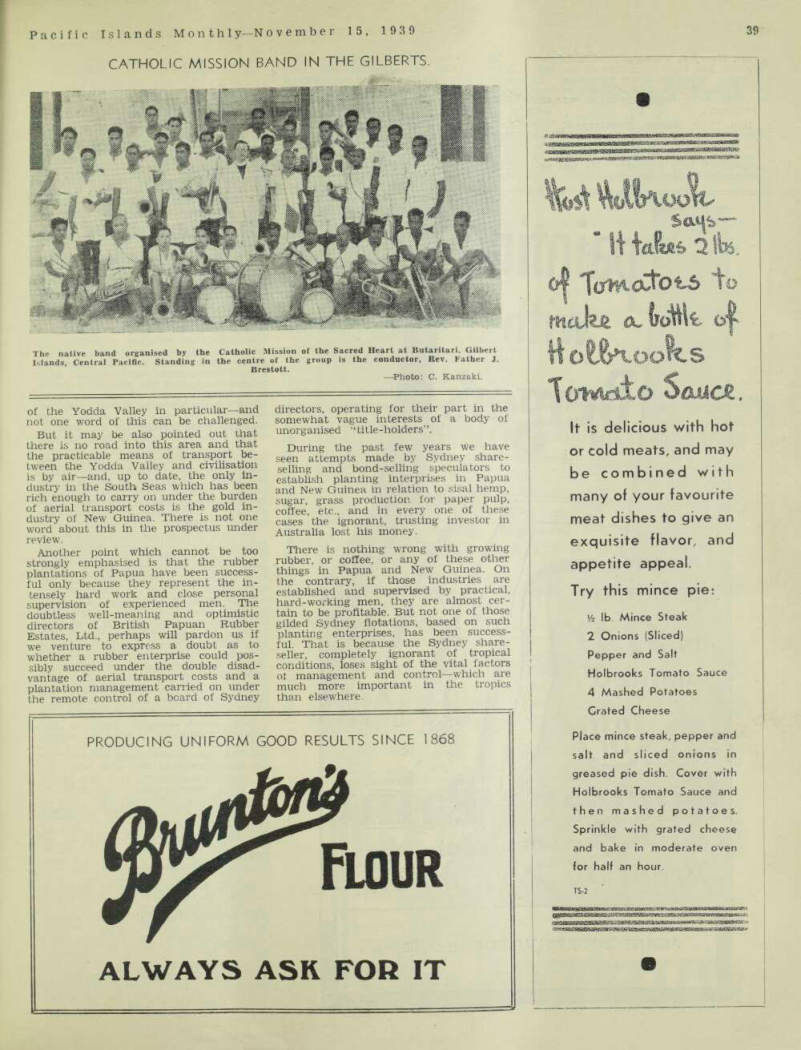
Plan This Time Based on Papuan Rubber
RESIDENTS of Papua and especially those connected with the rubber industry, will be interested in the prospectus issued by a newly-registered company—namely, British Papuan Rub ber Estates, Limited, which proposes to establish a rubber plantation in the Yodda district, where a 99 years’ lease over 5,200 acres was secured in 1938 by Mr. Alfred Kingsley.
The plan is based upon an old ac quaintance of Papuan industries— namely, bond selling. The “Pacific Islands Monthly”, after a careful examination, is bound to say that the prospectus has about it most of the features which rendered the other Islands bond-selling plans undesirable as investments.
It appears that the 5,200 acres were taken over by Mr. Kingsley, in 1938, on a 99 years’ lease from the Crown; that Mr. Kingsley has already raised seedling rubber trees and planted them out in 500 acres; that seed beds are now sown for raising plants for a second area of 1,000 acres; that Mr. Kingsley has given an option over his leasehold interest in the 5,200 acres of land for £5OO, and has agreed to clear the land and plant and maintain rubber trees thereon on conditions that are not disclosed; that Frederick James Lett, company director, of Pitt Street, Sydney, has obtained this option and has made these agreements with Mr. Kingsley: and that, in consid eration of Mr. Lett passing over these options, etc., to the newly-registered British Papuan Rubber Estates, Ltd., Mr. Lett is to receive 3,000 fully paid £1 shares in the said company—which is now offering 5,000 £1 shares to the public for sale. The total nominal capital of the company is 15,000 £1 shares. Seven thousand shares are to be held for future issue. This means that the public is being invited to buy 5,000 shares while Mr. Lett is to receive 3,000 fully paid shares for his services to the com pany up to date.
The company, however, is not actually to be the owner of the rubber plantation.
It is proposed to divide the 5,000 acres into half-acre allotments; and these allotments are to be sold to the general public for cash, or on terms, for £3O each. Each holder of a certificate of title” is to be paid 5 per cent, per annum on the value of the amount subscribed, “until the trees on his half-acre are tapped and he is able to receive the pro ceeds of same”. It appears that £lO from each £3O subscribed is to be put aside into a special fund, and is to be handed over to the company when it has carried out its “obligations” to the title-holder.
So far as can be seen from the prospectus, the company’s obligations end when the rubber trees on the planted half-acre begin to produce rubber. There is no guarantee that the rubber will be profit ably sold. The company is to have com plete charge of all planting operations and of the management of the enter prise, and there is nothing in the pros pectus to show that there is any check over this expenditure on behalf of the people who are providing the money for the enterprise—namely, the purchasers of half-acres at £3O each.
There is a great deal of “blurb” about the success of the rubber industry in Papua in general and about the fertility
of the Yodda Valley in particular—and not one word of this can be challenged.
But it may be also pointed out that there is no road into this area and that the practicable means of transport be tween the Yodda Valley and civilisation is by air—and, up to date, the only in dustry in the South Seas which has been rich enough to carry on under the burden of aerial transport costs is the gold in dustry of New Guinea. There is not one word about this in the prospectus under review.
Another point which cannot be too strongly emphasised is that the rubber plantations of Papua have been success ful only because they represent the in tensely hard work and close personal supervision of experienced men. The doubtless well-meaning and optimistic directors of British Papuan Rubber Estates, Ltd., perhaps will pardon us if we venture to express a doubt as to whether a rubber enterprise could pos sibly succeed under the double disad vantage of aerial transport costs and a plantation management carried on under the remote control of a beard of Sydney
directors, operating for their part in the somewhat vague interests of a body of unorganised ‘title-holders .
During the past few years we have seen attempts made by Sydney share selling and bond-selling speculators to establish planting interprises in Papua and New Guinea in relation to sisal hemp, sugar grass production for paper pulp, co ffee etc., and in every one of these cases the ignorant, trusting investor in Australia lost his money, There is nothing wrong with growing rubber, or coffee, or any of these other things in Papua and New Guinea. On the contrary, if those industries are established and supervised by practical, hard-working men, they are almost cer tain to be profitable. But not one of those gilded Sydney flotations, based on such planting enterprises, has been success ful. That is because the Sydney share seller, completely ignorant of tropical conditions, loses sight of the vital factors of management and control—which are much more important in the tropics than elsewhere.
Mr. Kenry S. Nobbs, a Norfolk Island-
janela°n MsS
ad" Mn ?M nd Smy h\s teten aS ov e e r Sl tS; i t^son, 91 Hon. E. P. Holmes, Secretary of the Department of Lands, Surveys, Mines Australia from Rabaul, New Guinea, in ?o^efX U £Zl. He WaS aC -
Mr. “Tommy” O’Dea arrived in Port Moresby from Wau, T.N.G., in mid-Octo er, to take charge of Guinea Airways’ operations in Papua, relieving Mr. N.
Fader.
Brother W. Siemers, of the American Lutheran Mission, Madang, returned to New Guinea early in November after spending furlough in the United States of America. He has been in the Man dated Territory as a missionary-builder for 17 years.
Catholic Mission Band In The Gilberts.
The native band organised by the Catholic Mission of the Sacred Heart at Butaritari, Gilbert Islands, Central Pacific. Standing in the centre of the group is the conductor, Rev. Father J.
Brestott. —Photo; C. Kanzaki.
Advertisements & other items, pp. 41-42 (2 items)
39
Pacific Islands Month! y—N ovember 15, 1939
frdHW ojj^
If \aftM.s lb.
H dWKoo^cs
It is delicious with hot or cold meats, and may be combined with many of your favourite meat dishes to give an
exquisite flavor, and
appetite appeal.
Try this mince pie:
Vfe lb Mince Steak 2 Onions (Sliced) Pepper and Salt Holbrooks Tomato Sauce 4 Mashed Potatoes Crated Cheese Place mince steak, pepper and salt and sliced onions in greased pie dish. Cover with Holbrooks Tomato Sauce and then mashed potatoes.
Sprinkle with grated cheese and bake in moderate oven for half an hour.
TS-2
o| Totn oTot4> To
frdHW ojj^
To'hrtrfto Sauce .
PRODUCING UNIFORM GOOD RESULTS SINCE 1868
ALWAYS ASR FOR IT
paintm
with
mu > means wiife painting I)
to stay]
painted / r #l\ .N
rsPaint
#< (PREPA R*Fp)
OKc eps on JCeepihg oiij/
AGENTS THROUGHOUT THE ISLANDS
Loss, £41,743
New Guinea Finances in 1938-39
HOW these Islands Administrations do hate to publish a clear statement of public accounts!
It was reported in the “Rabaul Times”, after the Legislative Council meeting in September, that the Administration had completed the financial year (ended June 30) with “a surplus of £17,947”. We rub bed the editorial nose in perplexity. We had calculated that the Territory, in 1938-39, was run at a substantial loss.
In mid-October we received the official “Gazette”, and there are the 1938-39 figures in detail. It is apparent, at once, that the Administration did not show a surplus on the year’s operations. In stead, it started the year with an ac cumulated surplus of £59,691, and, by June 30, the surplus had shrunk to £l7 947 —which meant that the Territory, * in 1938-39, was run at a loss of £41,743, Which is what everyone expected.
With the figures arranged as they are in the “Gazette”, we have to make some careful calculations to ascertain what actually happened last year. It is found, however, that revenue was £460,836 (down £65,000 compared with 1937-38), and ex penditure was £502,579 (down £l6 000 compared with 1937-38—but that year in cluded volcanic eruption damage, £40,010).
An analysis of revenue shows that cus toms taxes decreased by £32,433, and postal receipts by £20,076 (they had a special issue of stamps in 1937-38, and a fortune was made out of philatelists). But revenue from all other sources actually in creased. Revenue from mining rose from £116,942 to £124,378.
On the expenditure side, details are hidden under the names of departments.
We can see only that the expenditure of every department except Justice, Lands New Works and Native Welfare rose con siderably—a total rise of £33,965. * r ?.«f ) *'* ler worc * s ’ although revenue was healthy (the postal revenue does not signify anything, and the fall in Customs receipts was partly offset by the rises in gold and other revenues totalling £11,602), there was an increase in ordinary expen diture of £30,289, and a net loss in Ad ministrative operations of £41,743.
This is a bad record, in view of the fact that the gold royalty alone must be in the neighborhood of £lOO,OOO per annum.
Some people imagine that the N.G.
Administration now is short of money but Rabaul may carry on for a long time yet. The figures, as on June 30, show that the Government on that date held: Superannuation Fund .. £149,790 Other Trust Funds .. 133,234 There is enough, there, to keep the wheels turning, on loans, for many long days. But no concern can be run in definitely at a loss. The figures for the period ending December 31 will be in teresting.
Mr. C. W. Cox arrived in Papua in October to take over the managership of the Bank of New South Wales in Port Moresby from Mr. W. B. Frederick, who has been transferred to Australia.
Captain P. B. Park, of W. R. Carpen ter and Co.’s inter-island steamer “Dur anbah”, reached Sydney from New Guinea at the end of October. He has been called up for war service. During the Great War, Captain Park took part in the Battle of Jutland.
Seas"
The "Romantic South Seas"
By Amel
Even in these enlightened times, peo ple cherish the delusion that life in the South Sea Islands is just one long, sweet song. Romantically-minded writers, exaggerated films and publicity blurb picture the “Islands” as a handful of small atolls, inhabited by lions, tigers, elephants, hippopotami, cannibalistic na tives and perhaps an Indian or two.
They clothe the atolls with “tropical vegetation”—meaning nothing less than a perennial abundance of bananas, pine apples, granadillas, yams, taro, paw-paw, mandarines, breadfruit, tapioca and or anges—jumbled together in glorious pro fusion, waiting to be picked. They trans form tropical beaches into sun-kissed stretches of golden sand, strewn with he-men of the Tarzan type and lovely ladies clad in little beyond a smile and a ukulele.
They place coconut planters under two headings. They are either exalted beings with vast resources, luxurious homes and a dozen servants; or they are unshaven bounders who live with native women in mud huts, and occasionally cut a coconut for a living.
These are all figments of vivid, mis guided imaginations.
ACTUALLY, the “Islands” are more im posing than mere atolls. Some are nearly 100 miles long, with a wealth of undulating hill-country, fertile plains, large, navigable rivers, and a backbone of high, craggy mountains.
There is certainly no lack of vegeta tion—but it is usually the sort that no body wants! The “Islands” are not over flowing with the luscious things you read about. If you want them, you must buy them—or grow them.
In my island, except for several thou sand wild pigs and a mongoose or two. there are no ferocious animals. And you cannot—as so many people imagine— whistle a monkey, and say: “Hey. Pongo!
Shin up that tree and chuck me a ripe banana!” ’Tisn’t possible.
Tropical beaches are seldom golden.
They are brown, and very often—whis per it— muddy! He-men are practically non-existent; while the only “glamour girl” you are likely to see would probably be a decrepit old native fisherwoman. with a smelly basket on her back, and about as much sex-appeal as a whale!
AND now we come to the planters.
Whilst a few are indeed loafers, taking but scant interest in themselves or their plantations, the majority are entirely different. They are neither un shaven bounders nor bloated capitalists.
They are just ordinary, hard-working men. lined and careworn, maybe, with the struggle of making ends meet. In spite of their tropical environment, their lives are not unlike that of the farmer in temperate climes. For, in addition to producing copra, they plough, fence, dig drains and —prosaically enough—milk cows!
Where does all this “Romantic South Seas” stuff come from?
The truth is that the South Sea Is lands are no more romantic than any other part of the world. They have, however, an indefinable fascination a fascination that does not depend solely on coconut palms, sunshine and silvery moonlight. It goes deeper than that.
To know and appreciate it properly,
you must live at least five years in the Islands. At the end of that time, you will have shed all the illusions you once cherished. But you will love the life so much that you’ll decide they weren’t im portant, anyway!
Death Of Captain H. Suffern
THE many friends of Captain H. Suffern will hear with regret of his death on September 27, at the age of 68.
Captain Suffern was well known in the Pacific —he‘was engaged in the ship ping trade, carrying phosphates from Nauru and Ocean Island, for 15 years. In 1930, he was appointed harbour and deep sea mooring-master at the phosphate is land of Makatea (French Oceania), where he remained until compelled by ill-health to return to his home near Melbourne, last November.
Mrs. F. M. Crawford, formerly well known in Fiji as Miss Joan Brierly, re cently joined her husband in Sarawak, British North-west Borneo, where he is employed by the S.O.L. oil concern. Pre viously Mr. Crawford was connected with Papua Oil Developments Limited, in the Territory of Papua.
Mrs. L. Brodie, who has carried on a bakery business in Rabaul. New Guinea, for some years, arrived in Australia at the end of October. Her bakery premises were destroyed in the fire at Carpenter and Co. Ltd.’s store in August last.
Sister Holroyd-Harris, formerly of Wau, New Guinea, is now stationed at Madang Hospital. A medical clinic and new sisters’ quarters were recently op ened at Madang and new residences for the Medical Officer and the Medical As sistant are almost completed.
Francis Durante, aged 24, and Peter Maillie, aged 17, Torres Strait Islanders, attached to the Roman Catholic Mission on Hammond Island, have been awarded Certificates of Merit by the Royal Hu mane Society for rescuing two European women when a dinghy sank in rough seas a few months ago.
Advertisements & other items, pp. 43-44 (1 item)
Du Pat I Ie
Timber, Joinery
ETC.
PREPARED BUILDINGS ready for erection a specialty.
SHIP AND BOAT BUILDING.
TIMBERS specially catered for.
FIBROLITE, PLYWOODS,
GALVANISED IRON.
CONSIGNMENTS shipped
by RETURN STEAMERS
to the Islands.
John W. Eaton
PTY. LTD.
WEST CRESCENT STREET,
NORTH SYDNEY.
Telephones; XB 4051 (6 lines.)
BITUMENOID ROOFING
MADE IN AUSTRALIA,
Bitumenoid Roofings, Dampcourse and Insulating Pelts are made from the world’s best raw materials. Warranted to stand the most rigid tests.
BITUMENOID THE BEST
Roofing, 1,2, 3-ply; Flooring, Waterproof Materials; Saturated Felt; Resilient Road Jointing: Natural Asphalt Dampcourse; 2 and 3-ply Dampcourse; 1-2 lb. Lead-core Dampcourse; Roofing Cement; Asphalt Paints; Roofing Compound.
SAMPLES AND PRICE LISTS ON APPLIOATION.
MAXWELL PORTER & SON LTD.
ESTABLISHED 1888. BUILDERS’ SUPPLIES.
107 REDFERN ST., REDFERN, SYDNEY, N.S.W. ’Phone: M 3157. Cables Bitumenoid.
Woven Wire for all Industry
COPRA DRYING TRAYS, FLOORS, Etc.
FRUIT DRYING TRAYS, MINING SCREENS
Heavy Mosquito Gauze in Phosphor Bronze and other Metals Impervious to Salt Sea Air WIRE DOOR MATS AND GENERAL WIRE WORKS
E. WRIGHT & CO. LTD.
Office and Works: 148-152 Cleveland Street, Sydney, N.S.W.
Telegraphic Address: “Wrightmake,” Chippendale.
VVUf
f: £ $
nr
DURATILE
These asbestos cement sheets give walls a tiled appearance at less cost. See examples in our showrooms or write for leaflet.
WUNDERLICH LTD.
Crown & Cleveland Sts., Redfern, Sydney
REMEMBER THE NAME
DU PAT I IE
GUINNESS
Stout
FOR STRENGTH
MM MU I i*S*
STOCKED BY ALL BRANCHES OF
Brown & Joske Ltd. W. R. Carpenter & Co. Ltd.
Burns Philp & Co. Ltd. Morris Hedstrom Ltd.
Advertisement of Export Bottlers Ltd., London. A, Macfee * Co. Ltd., Wapping, Liverpool, England.
Missionary Autocrat Of Raiatea
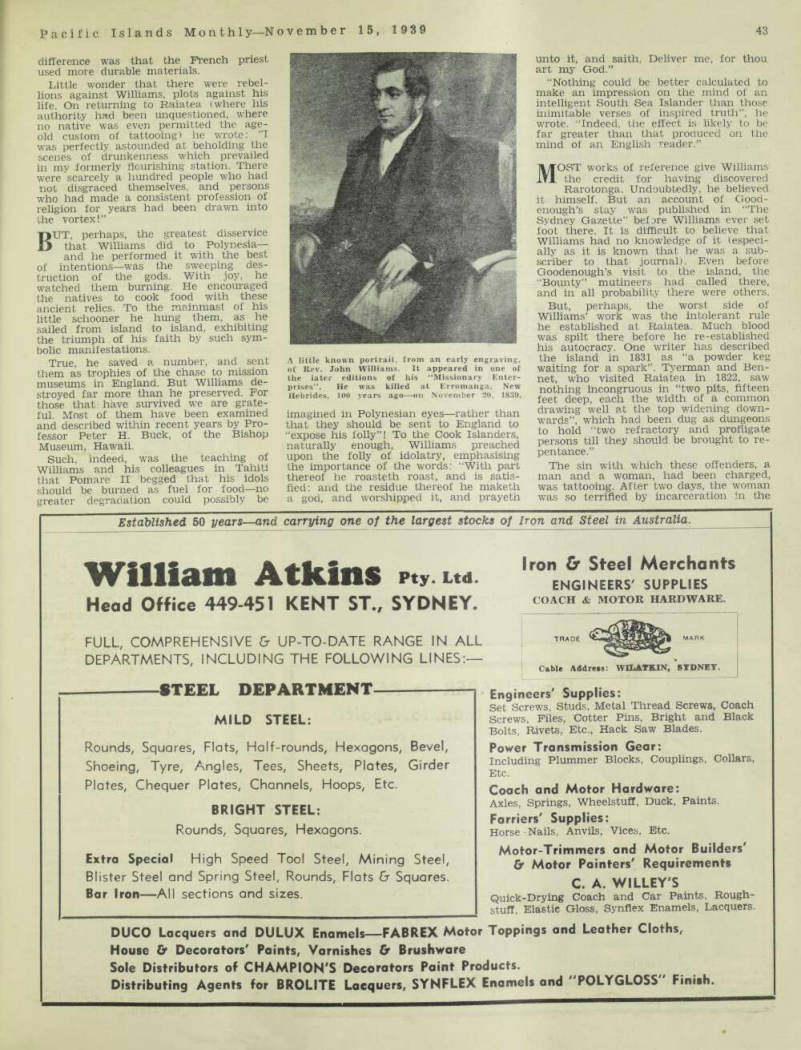
Centenary of the Death of John Williams
By Eric Ramsden
r[E centenary of the death of Rev.
John Williams, prophet of religion and ambassador of trade in the Pacific, falls this month. On November 20, 1839, Williams was killed at Erro manga, in the New Hebrides. His skull, and a few bones, were recovered by H.M.S. “Favourite”, and later buried, with military honours, in Samoa, “He was ultimately to wear a martyr’s crown”, an ironical American authority has written concerning the converted ironmonger, “but not before he had car ried the gospel of industry, trade, and Jehovah to thousands of islanders and
had thoroughly identified business and religion in Polynesia.”
Following the death of Rev. Samuel Marsden (with whom he was on exceed ingly friendly terms) Williams was un doubtedly the most dominating mis sionary figure in what w r as essentially a missionary age. But, as the years have passed, and while one cannot deny his ability, his extraordinary driving force, and his great gifts, Williams’ aura has dimmed somewhat. It is time that we had him in correct perspective, making every allowance, of course, for his en vironment and the time in which he lived. All men of such fanatical faith have their limitations.
WILLIAMS was the first great propa gandist for missions in the South Seas. His “Missionary Enterprises” will always be a Pacific classic. Though important, it does not possess the value, to-day, of Ellis’ “Polynesian Researches”.
Though these men shared a common faith, Williams saw the field ripe with corn, ready for the reaping; he wanted to convert islands overnight, and on many occasions he did so. We know now, of course, that he merely scratched the surface. The Polynesians were more in terested in his trade goods than in a new brand of religion. Williams saw little or any good in the religious cul ture of the Polynesians.
Ellis, on the other hand, was a man of wider intellectual interests. He recorded what he saw of the old life that so rapidly was passing. While he, too, re joiced in the destruction of the ancient gods, and other material representations of the dying culture, he was by no means so sweeping in his denunciation.
Williams’ book sold in thousands. It was read with avidity by a mission conscious British public, which was pre pared to pour its gold into mission coffers. Edition after edition was printed.
Williams personified romance in the South Seas—the great missionary leader carrying all before him. And, if it so happened that he introduced British goods to many a remote atoll, and there by obtained a return for that same British interest, it detracted not at that time from his evangelical fervour.
To-day, we realise that missionaries have their place in the scheme of things —that, inevitably, they have been the buffer between primitive peoples and vested commercial interests. We know, too, that generally speaking they are trained and skilful men imbued by the highest ideals.
YK7~IT.iTJAMS was a pioneer. The urge to ?? convert was insufficient for his great energies; his desire was to set the indolent Polynesians working.
The former ironmonger’s assistant, now T the uncrowned King of Raiatea, of Raro tonga, whose influence extended even to Samoa, ancj whose ambition was limit less, wanted to impose the yoke of com mercial Birmingham upon his subjects.
Again and again he exhorted them to provide more arrowroot, more bamboos of coconut oil. He had schemes for sugar mills and coffee plantations. Williams’ reports are full of such references. He was also a builder. Bigger, and still more commodious chapels had to be built. In his way he was as great, in that connec tion, as Laval at Mangareva, The only
difference was that the French priest used more durable materials.
Little wonder that there were rebel lions against Williams, plots against his life. On returning to Raiatea (where his authority had been unquestioned, where no native was even permitted the age old custom of tattooing) he wrote: ”1 was perfectly astounded at beholding the scenes of drunkenness which prevailed in mv formerly flourishing station. There were scarcely a hundred people who had not disgraced themselves, and persons who had made a consistent profession of religion for years had been drawn into the vortex!”
BUT, perhaps, the greatest disservice that Williams did to Polynesia— and he performed it with the best of intentions—was the sweeping des truction of the gods. With joy, he watched them burning. He encouraged the natives to cook food with these ancient relics. To the mainmast of his little schooner he hung them, as he sailed from island to island, exhibiting the triumph of his faith by such sym bolic manifestations.
True, he saved a number, and sent them as trophies of the chase to mission museums in England. But Williams de stroyed far more than he preserved. For those that have survived we are grate ful. Most of them have been examined and described within recent years by Pro fessor Peter H. Buck, of the Bishop Museum, Hawaii.
Such, indeed, was the teaching of Williams and his colleagues in Tahiti that Pomare II begged that his idols should be burned as fuel for food—no greater degradation could possibly be
imagined in Polynesian eyes—rather than that they should be sent to England to “expose his folly”! To the Cook Islanders, naturally enough, Williams preached upon the folly of idolatry, emphasising the importance of the words; “With part thereof he roasteth roast, and is satis fied: and the residue thereof he maketh a god, and worshipped it, and prayeth
unto it, and saith, Deliver me, for thou art my God.”
“Nothing could be better calculated to make an impression on the mind of an intelligent South Sea Islander than those inimitable verses of inspired truth”, he wrote. “Indeed, the effect is likely to be far greater than that produced on the mind of an English reader.”
MOST works of reference give Williams the credit for having discovered Rarotonga. Undoubtedly, he believed it himself. But an account of Good enough’s stay was published in “The Sydney Gazette” before Williams ever set foot there. It is difficult to believe that Williams had no knowledge of it (especi ally as it is known that he was a sub scriber to that journal). Even before Goodenough’s visit to the island, the “Bounty” mutineers had called there, and in all probability there were others.
But, perhaps, the worst side of Williams’ work was the intolerant rule he established at Raiatea. Much blood was spilt there before he re-established his autocracy. One writer has described the island in 1831 as “a powder keg waiting for a spark”. Tyerman and Ben net, who visited Raiatea in 1822, saw nothing incongruous in “two pits, fifteen feet deep, each the width of a common drawing well at the top widening down wards”, which had been dug as dungeons to hold “two refractory and profligate persons till they should be brought to re pentance.”
The sin with which these offenders, a man and a woman, had been charged, was tattooing. After two days, the woman was so terrified by incarceration in the
A little known portrait, from an early engraving, of Rev. John Williams. It appeared in one of the later editions of his “Missionary Enter prises”. He was killed at Erromanga, New Hebrides, 100 years ago—on November 20, 1839.
pit that, with the assistance of friends, she escaped. But the man who had per formed the operation was kept there on breadfruit and water until “he mani fested satisfactory signs of contrition.”
To other iniquitous tattooers was meted out the punishment of hard labour on public works.
When such methods failed Williams had another idea: it was decided to scarify the tattooing to “make foul blotches where elegant devices had been pricked ip”.
Without doubt, Williams was inspired by the best of motives, animated by the highest ideals. He wanted the new order established, the people clothed and in their right minds, the men in trousers, and the women in hideous Mother Hub bards and equally unattractive poke bonnets. In a measure he succeeded. The
iSSS* 0 ?. missionary, in the main, had the be hnid him. But at what a cost: wnat a price the Polynesians had to pay! elimination of the old native standards would have come if Williams had never seen the Pacific. In the more frequented islands, disintegration had already set in. Williams merely helped that process along in many a more re mote community, impelled change by his assertive personality, and then imposed the yoke of missionary autocracy. That reaction would follow was inevitable. . Neither must it be forgotten that the intolerance of Williams, and his Calvin istic colleagues, in opposing the introduc tion of other religions, is responsible for the fact that to-day Tahiti is French.
The deportation by Pomare IV of the two French priests in 1836 gave France justi fication for intervention there.
Advertisements & other items, pp. 44-46 (3 items)
42
November 15, 193 9—P acific Islands Monthly
43
Pacific Islands Mon thly—November 15, 193 9
William Atkins
Established 50 years—and carrying one of the largest stocks of Iron and Steel in Australia.
Head Office 449-451 KENT ST., SYDNEY.
FULL, COMPREHENSIVE & UP-TO-DATE RANGE IN ALL
DEPARTMENTS, INCLUDING THE FOLLOWING LINES:—
STEEL DEPARTMENT
MILD STEEL:
Rounds, Squares, Flats, Half-rounds, Hexagons, Bevel, Shoeing, Tyre, Angles, Tees, Sheets, Plates, Girder Plates, Chequer Plates, Channels, Hoops, Etc.
BRIGHT STEEL:
Rounds, Squares, Hexagons.
Extra Special High Speed Tool Steel, Mining Steel, Blister Steel and Spring Steel, Rounds, Flats Cr Squares.
Bar Iron— All sections and sizes.
Iron & Steel Merchants
ENGINEERS' SUPPLIES
COACH & MOTOR HARDWARE.
Cable Address; WILATKIN, SYDNEY.
Engineers' Supplies: Set Screws, Studs, Metal Thread Screws, Coach Screws, Files, Cotter Pins, Bright and Black Bolts, Rivets, Etc., Hack Saw Blades.
Power Transmission Gear: Including Plummer Blocks, Couplings, Collars, Etc.
Coach and Motor Hardware: Axles, Springs, Wheelstuff, Duck, Paints.
Farriers' Supplies: Horse Nails, Anvils, Vices, Etc.
Motor-Trimmers and Motor Builders' Cr Motor Painters' Requirements
C. A. WILLEY'S
Quick-Drying Coach and Car Paints, Roughstuff. Elastic Gloss, Synflex Enamels, Lacquers.
DUCO Lacquers and DULUX Enamels—FAßßEX Motor Toppings and Leather Cloths, House & Decorators' Paints, Varnishes & Brushware Sole Distributors of CHAMPION'S Decorators Paint Products.
Distributing Agents for BROLITE Lacquers, SYNFLEX Enamels and POLYGLOSS Finish.
j(Wo Km^-
• MINING Crushing Machinery Screens. Feeders, Rock Drills, Excavators. Diesel and Crude Oil Engines, Hoists and Runways, Roller Bearings, etc. • ELECTRICALIQUIPMENT Parkinson Motors. Crompton Switchgear, Transformers, Instruments. Meters. Callender Wires and Cables, Lighting Equipment, Electric Drills • STORES FACTORIES HOME and OFFICE Electrical Fittings, Crompton Fans, Crompton Lamps Floodlighting, Household Electrical Appliance, Radio Receivers and Equipment, Jos. Rodgers Cutlery Cr Plateware, Cut-glass and Perfection E.P.N.S. Ware.
/ it m %
It's CHEAPER to PAINT
then to repair!
Decay can do no damage if your home is properly protected with good paint.
Use “8.A.L.M.” Paints- “B.A.L.M.” Paint gives protection. And it wears down evenly and very slowly, lasting years longer than ordinary paint.
Decide now to save money by painting; and decide to make maximum savings by using - - - - “8.A.L.M.” Paint!
DISTRIBUTORS:
Greenwood & Laws Ltd., Rabaul and Wan.
Steamships Trading Co. Ltd., Port Moresby and Samarai.
Millers, Ltd., Suva, Fiji.
W u T B r anoe pubs
ip AIIV ir'
A Product of British Australian Load Manufacturers Pty. Ltd.,
Equipment
£200,000 In New
Going to Papua for Oil Search
THE report of Oil Search Ltd., issued on October 17, was as follows: Australasian Petroleum Co. Pty. Ltd. is engaged in active preparations for the drilling campaign, which is shortly to commence in Papua.
A quantity of drilling equipment, amounting to about 1,100 tons, has been shipped from the U.S.A., and is expected to arrive in Port Moresby in November.
In addition, about 100 tons of equipment will arrive from the United Kingdom.
The company has bought a special shallow-draught coastal vessel to convey the drilling plant to the site. To enable the company to handle heavy lifts, cranes have recently been purchased in Sydney, with a capacity up to 10 tons.
The final cost of the drilling equip ment delivered to site will be approxi mately £200,000 (Australian).
Although the outbreak of war may cause some dislocation regarding over seas shipments the drilling programme will be pushed ahead with all speed.
Papeete's Trees
A Howl—And a Transformation
Prom Our Own Correspondent
Papeete, Oct. 10.
TREE lovers at Papeete have been, for years, torn and lacerated in spirit over what seemed to be the wanton de struction of shade-trees bordering the highways of the city. They have held lodges of sorrow and conclaves of in dignation about the prone and dismem bered trunks of many a stately tree, and have raised their hands in pontifical anathema and uttered dark prophecies of an uninhabitable blazing furnace, re sembling Djibouti, on the Somali Coast.
The authorities to whom these protests have been addressed have been very patient. They explained that the arbori culturists of early times planted without discrimination—mango trees, that in the fruiting season bombarded passers-by with falling missiles and cluttered the road ways; trees whose woody heart became soft and pithy at maturity and easily succumbed to dry rot; trees that sent down no tap-root, and, with age, became top heavy and a menace to surrounding property.
They led the protestants to the public gardens where they exhibited long rows of vast tubs and hogs heads in which were growing saplings of exotic species that would be suitable and lasting sub stitutes for the lamented trees.
But the tree-lovers refused to be com forted. Accustomed to the deliberate course of Nature in the temperate zones, they could vision the maturity of these spindling saplings only in the time of their grand-children.
Time, however, which heals many things, has healed the scars which so grievously tormented the tree-lovers. The saplings, planted in the fecund, volcanic soil, have in an amazingly short period, grown to tall, symmetrical trees, and Papeete is again destined to become a garden city, to match the charming new Papeete which is growing rapidly to the eastward of the old town.
Japan’s Invasion of Philippines
What is Happening in "Independent Commonwealth" Created by U.S.A.
THE Commonwealth of the Philippines came into being in 1935, under an arrange ment by which the United States will gradu ally give to the Filipinos their complete independence. Prior to 1935, they were gov erned by U.S.A., through a Governor-General.
From 1935 until 1946, they are a “Common wealth”—or practically a republic, under the protection of U.S.A. In J 946, they become an independent republic. Manuel Quezon, in 1935, was elected president, for six years.
In the past two years, in face of Japan’s aggressive spirit, leaders in the Philippines have become increasingly uneasy about their con dition, in relation to Japan, and it has been suggested that the independence planned for 1946 should be indefinitely postponed. A pro posal in that direction, made in the Philippines legislature in October was overwhelmingly defeated, however.
The following are extracts from an article by Edgar Snow, which was published in the October number of “Asia” (a New York journal).
JAPANESE from childhood are taught —in lessons illustrated by maps coloring the Philippines as part of the future empire—that Asia’s richest archi pelago by right belongs to the Emperor.
They are taught, also, that not America but Japan is bringing freedom to the Filipino, and that only America thwarts the completion of the liberation.
And what a lot there is to be liberated!
Scarcely scratched, the huge Philippine iron reserves would furnish at least twice as much of the metal as Japan can hope to get in all China. The world’s largest chrome deposits are in these islands that indifferent America is about to cast adrift in a Pacific infested with hungry sharks.
Here are far greater forests of splendid timber than in any equal area in East Asia, and the Philippine Commonwealth owns 97 per cent, of it. Luzon Island alone is producing gold worth 30,000,000 dollars every year. Oil, nickel, rubber, copra, tobacco, hemp, wonderful fruit and rice and sugar lands—what booty to lure piratical eyes along the Japanese main!
In the Philippine Paradise there is more cultivable land than in Japan proper, and two-thirds of it is still untouched. Ex perts estimate that its 114,000 square miles could comfortably accommodate no less than 30,000,000 Japanese—in addi tion to twice its present native popula tion of 15,000,000.
Japan abhors this vacuum. She has al ready sent about 30,000 Japanese to the islands. (Manila alone holds 12,594.) Over 95 per cent, of them have entered since America raised its flag in the Phili ppines, and most of them since the Jones Bill first announced that the flag was soon coming down. Already Japan’s sub jects in the Philippines outnumber Americans by four to one. At the present rate of increase there will be over 50,000 Japanese to look after Nippon’s interests in 1946, when America stages a full dress retreat.
Japan’s propagandists and spies now inhabit every major Philippine Island, and every city. Her fishing vessels encom pass the coast line of over 11,000 miles.
Her Philippine trade is second only to America’s, and despite her preoccupation in China she moved more ships to and from the islands in 1937 than America did. On Mindanao alone Japan has settled about 15,000 Emperor-worshippers, who already control most of the province of Davao.
1N the Philippine Legislature Japan’s in fluence has been sufficient to quash bills inimical to the privileges her im migrants now enjoy. Behind-the-scenes pressure resulted in the suppression of a Philippine boycott of Japanese goods, while movements to eliminate Chinese merchants are officially encouraged. There is evidence that Japanese for years fin anced certain anti-American “independ ence at any cost” elements, and some Filipino politicians appear to be under ob ligations to Japan.
“And why not?” ask the new arrivals, “We’re all Malays, all of the same blood, aren’t we? Why shouldn’t we lead them?”
Like most Orientals, Filipinos began to take serious notice of their island neigh bours after 1905, when Japan brought vicarious pride and colour consciousness to many an eastern people by defeating Czarist Russia. Philippine independence agitators took heart, and those who did not point to America as model pointed to Japan. Subsequently Japan welcomed Filipino students and radicals to her shores, and thereby converted some into Pan-Asia enthusiasts.
Even to-day, despite Japan’s perfor mances in Manchuria, Korea, China and Mongolia, many Filipinos still vaguely fancy that Japan is leading the emanci
baXl°nflu h en c rof°Th P r whl^ gainSt the oaneiul influence of the whites.
Japanese propaganda organs—in English, Spanish and Tagalog—echo pro- Japanese ideas every day throughout the islands. So do frequent “cultural” and trade missions that visit the Philippines in a manner similar to previous cxpeditions to China.
A triumph of Nipponese diplomacy was the sudden visit to Japan a year or so ago of President Quezon who was given a flattering ovation in Tokyo. On his return he called upon Philippine youth to emulate the principles of “bushido”—a proposal which, in the face of Japan’s bombing forays in China, met with such a storm of criticism that he did not repeat it.
There is, of course, every diplomatic
leason why President Quezon should cul tivate Japan’s friendship rather than her enmity, for the Philippines face a pre carious future in which he carries a heavy responsibility. This undoubtedly, together with the American Department of State’s reluctance to force the issue, explains why the President and other nationalists in the machine which he so adroitly manipu lates, have avoided challenging Japan’s rapid colonisation of Mindanao, the is land jewel of the Philippines.
SHORTLY after the inauguration of the Commonwealth and the new National Assembly, Secretary of Commerce Rodriquez actually ordered the cancellation of 120 sub-leases illegally secured by Japanese nationals from Bagobo tribesmen in Davao. Japanese simply ignored the order, and openly challenged the authority of the new Gov ernment to evict them from the land.
In response to aroused public opinion, President Quezon himself made a trip to Davao, promising to settle the matter speedily, and “once and for all”.
At the height of popular agitation, the Japanese Foreign Minister (then Hirota) was reported to have authorised his Davao Consul to warn Quezon of “grave conse quences” if any “indiscreet solution” were sought to the problem, which possesses
much of the political dynamite contained in Japan’s former “special position” in Manchuria.
This Japanese advice, if given, seems to have been heeded. Upon his return to Manila, Quezon astonished the public by reporting that no Davao question existed —since when he has maintained official silence. The Government’s order against illegal Japanese sub-leases has never been rescinded; neither has it been enforced.
A dangerous precedent has thereby been established.
Nearly a hundred Japanese corporations are operating plantations in Davao, the largest being held by Furukawa, Ohta and the giant Mitsui trust of Japan. Of Davao’s abaca production the Japanese own 70 per cent. Davao abaca, together with Borneo holdings, enables the Japan ese to monopolise much of the world mar kets for hemp. Well over half of all hemp, lumber, copra and fish exported from Davao goes through Japanese, who con trol 95 per cent, of Davao’s exports to America.
Legally and illegally, Japanese dominate much of the fishing along the Philippine coasts, but in and around Davao it is nearly a Japanese monopoly. Completely unfortified Davao Gulf, which is three times the size of Manila Bay, is a fine natural haroour and may some day make a splendid naval base. To-day the Ris ing Sun flies there oftener than any other flag, for Japanese merchantmen do the bulk of the carrying, usually berthing at privately-owned Japanese wharves.
Davao’s best customer is Uncle Sam, but it buys only 2 per cent, of its imports from America while it takes over 80 per cent from the fatherland—Japan. This is not surprising, since the bulk of Davao’s retail trade is controlled by Nipponese.
They know that every bolt of Japan-made cloth imported helps to provide foreign exchange, to build battleships, to seize more markets, to provide more exchange, ad infinitum.
Japanese chain stores are spreading throughout Mindanao with amazing speed. Davao banks, factories, ware houses, transport, utilities, schools, even one-quarter of the roads, are Japanese owned. Seventy thousand natives are said to be dependent on Japanese enterprises for their food.
Perhaps it is not surprising that the Davao Japanese Chamber of Commerce —which boasts 6,000 members and controls a payroll of several millions annually— can shape politics of the island to suit a pattern of its own.
THE Japanese got their foothold here from 1905 onward, before there was a Philippine Commonwealth. Although in 1919 the Philippine Legislature finally passed a law making it illegal for aliens to lease or buy public lands or estates in Mindanao, thousands of Japanese had already flocked to Davao. A technique of land-grab had been perfected which en abled Japanese to flout efforts to exclude them.
A Filipino forest ranger named Vincente Ceballos appears to have been the real culprit. Entrusted with the guardianship of an enormous area, he made a fortune by selling out Davao to the army of Japanese immigrants and corporations.
Conniving with them in intrigue, brib ery, forgery and fraud, he fleeced the simple Bagobo tribesmen, aboriginal natives of Davao, securing land titles and leases for the Japanese at a fraction of their value. He condemned vast tracts of standing timber in tribal hunting grounds, and turned it open to invasion. Compla
centlv falsifying his reports, he stood by while Japanese cut or burned tens of thousands of acres and claimed the land: 100 000 000 dollars was the Government Forestry Bureau’s estimate of the loss in timber when the pract.ce was Anally For Ceballos was investigated at last.
Charged with bribery and wholesale forgery, he was brought to Manila, but “escaped” before trial to an unknown destination—reportedly Japan. No attempt was made however to recover the land which he had alienated.
The value of Japanese land in Davao cannot accurately be estimated; one Japanese Agure placing it at the equlvalent of about 150,000,000 yen is beheved to be very low.
Although since 1919 it has been illegal for foreigners to lease public lands in the Philippines, thousands of acres are nevertheless still being acquired each year. The commonest method of acqmsilion to-day is by Japanese marriage to Bagobo women. Being natives, Bagobos can acquire free homesteads. They can also buy preferred land, and promptly transfer it to their immigrant husbands. who frequently have, or later acquire, Japanese wives as well.
Children of such marriages also have Filinino citizenship and can hold land in 5J32 n ifnTteht I But although the off- Se are nominally Mlipino in other resiects they remain Japanese. They
wiSSSn at 7 Japanese shrines speak
Japlnese, oLerve P Japanese customs. P live Tonfinptip bouses eat Japanese food Japanese schools. Some go for higher education to Japan, and some do their term of service in the Japanese army or navy. But they return to Davao toroid land as Filipinos.
MANY Philippine-born Japanese, who have Philippine-citizenship, still re port regularly to the Japanese Con sulate. For all practical purposes they enjoy dual citizenship, much as do “nat uralised” Japanese in Manchuria and China. This provides a convenience for Japanese banks and corporations finding it necessary to circumvent provisions in the 1935 Constitution, which requires that, in all new land and industrial en terprises formed in the islands, 60 per cent, of the stock must be controlled by Filipinos. Philippine-born Japanese and Japanese mestizps having Philippine citizenship gladly co-operate in provid ing a Filipino front for new Nipponese companies, aided by Filipino law firms, which specialise in the practice.
A device widely employed in Davao, where Japanese and other aliens are to day forbidden to buy new lands, is typi cally Japanese in its ingenuity.
The Japanese sublease Bagobo tracts of timber and abaca, but by special ar rangement with the tribesmen they figure officially only as labourers, whereas it is actually the Bagobos who labour on their “own” land for Japanese masters. Tip ped off in advance of any investigation, the Japanese closely drill their wild men in set replies, so that the inquirers nearly always fail to uncover the facts.
The report of one recent mission, for example, revealed that in several in stances the investigators arrived at al legedly native-owned plantations just in time to see Japanese “labourers” mov ing from the owner’s home into the labourers’ huts.
Poor tribesmen of Davao naturally look upon the Japanese as all-powerful, and their participation in such schemes, for which they are generously rewarded, is easily forgivable. Less defensible is
somewhat similar activity by a few offi cials and politicians elsewhere in the is lands, who are fully conscious of their treachery.
The most notorious case of this nature at present is the illegal sublease to Jap anese of a vast timber tract in strategic Dingelan Bay, in East Luzon. This huge slice of coastline, a government land grant to Filipino interests, now being exploited entirely by Japanese engineers, could ac commodate Japanese landing forces suf ficient to launch a major attack on Manila, the only point in the islands be lieved impregnable—from the sea!
A SMALL-SCALE war over fishing rights near Busuanga, an island about 180 miles south-west of Manila Bay, un covered a situation more or less typical of conditions in many Philippine atolls and islets.
Here, about 500 Japanese have estab lished a fishing base, and practically monopolise waters which, by law, they have no right to enter, except in service of native operators. Many of them dy namite their catch —an illegal but wide spread Japanese practice which has de stroyed some of the best Philippine fish ing preserves.
Some Philippine water police, stopping a Japanese vessel to search for dynamite, found it not only well supplied with ex plosives but. as often occurs, operating without a license. When they ordered the vessel to put in to shore for inves tigation the “insulted” Japanese attempt ed to throw them into the sea. Out numbered, the Filipinos managed to reach land, but there some 250 Japan ese mobilised and attacked the small na tive police force in a battle resulting in a number of casualties. One Japanese
was killed. Some of the natives were tied to trees and severely beaten.
Finding it necessary to intervene, the American-commanded Constabulary or dered the arrest of over 100 Japanese, although the Japanese authorities, who were anxious to hush up the affair, made a great effort to have the search droo ped.
When the Japanese fishermen are equipped with fishing licenses at all, they hold them in Filipino names—by arrange ment, it is alleged, with Philippine poli ticians. An American admiral assures me that naval patrols have frequently informed the Commonwealth Government of this, without visible effect.
JAPANESE settlers are land-owners in other islands than Mindanao. Fili pinos have recently become alarmed over the growth of a Japanese colony in the
Kalinga-Layal Valley, among the Igorots. near the Baguio goldfields.
In addition to the Japanese rubber estates established in Mindanao, there are Japanese holdings on other islands in sugar, fruit, truck-farming and to-
Dcicco.
In anticipation of Philippine inde pendence, and complete customs auton omy which may bring prohibitive tariffs on American goods, Japanese are taking an interest in light industries. Japanese corporations and branches of the great Japanese banks, in Manila, are looking for Filipino partners with vision—political as well as economic. When the huge Jap anese-owned (nominally Philippine-Jap anese) Balintawak Brewery opened in Manila with a three-day celebration of free food and drinks, its list of guests read like an official reception.
Advertisements & other items, pp. 47-50 (3 items)
45
Pacific Islands Monthl y—N ovember 15, 1939
Burns Philp
(SOUTH SEA) CO. LTD.
Inc. in Fiji
Island Traders and Shipowners
Registered Office:
SUVA
FIJI
Also Branches at:
\Fiji: Levuka, Lautoka, Labasa, Ba, Sigatoka, Rotuma.
Tonga: Nukualofa, Haapai, Vavau.
Samoa: Apia, Pago Pago (American Samoa).
Solomons: Makambo, Gizo, Faisi.
' New Hebrides: Vila.
Gilberts: Tarawa.
Code Address'.
“Burnsouth” Norfolk Is. Niue. Wallis Is. Futuna Is.
ScottV'Renown”Brand Rope,
Cordage and
Binder
Twine
Cable Address: Ropeyard, Sydney. w m ■ *
of Every
Description
MANUFACTURED AT
MASCOT, N.S.W.
J. SCOTT
PTY. LTD.
Head Office and Store:
163 CLARENCE STREET,
SYDNEY,
N.S.W.
WANTED TO PURCHASE
Used stamps of all Pacific Islands.
Highest prices paid. Regular consignments solicited. Remittances guaranteed by return mail.
J. H. SMYTH PTY. LTD.,
114 Castlereagh St., Sydney, Aust.
The Most Extensive Manufacturers in the British Empire of
RUBBER STAMPS.
INKS, STENCILS,
Marking Devices,
ACME STAMP PADS
OFFICE g STATIONERY SUPPLIES
mm H We also Manufacture & Supply a Complete Line of
LIMEWASHING AND
SPRAYING MACHINES
for all purposes.
Let us know your requirements and we will quote by return.
WRITE FOR OUR GENERAL CATALOGUE
Limew ashing Machine
EXCELSIOR SUPPLY CO. PTY. LTD.
278 Post Office Place,
MELBOURNE, VIC.
HEAD OFFICE :
160 BROADWAY, 5Q Victoria Street, Formerly known as George St., West, ! WELLINGTON NZ
SYDNEY, N.S.W.
A GRACE BROS’ catalogue
BRINGS THE BIGGEST STORE IN
AUSTRALIA TO YOUR DOOR
Let us put you on our Mailing List To all addresses on our list we send Free of Charge Six Catalogues a year, including two Sale Books, when prices of all goods, except Proprietary articles, are marked at attractive reductions.
WRITE TO GRACE BROS. FOR EVERYTHING.
Prom our huge selection of merchandise we are practically able to meet your every requirement.
Should you not see exactly what you need in any of our Catalogues write in Just the same. If not in stock we will do our utmost to procure it for you.
When next in Sydney, call and inspect our extensive range of attractive merchandise.
CATALOGUES POST FREE ANYWHERE!
GRACE BROS. Pty. Ltd.
Broadway SYDNEY 'Phono: M 6506
22 % &
» m m < x.
A.W.A. TELEKADIO N«.3A
10 WATT RADIOTELEPHONE
This portable radio telephone-telegraphic equipment has been designed to provide communication facilities for points where line telephone or telegraph services are not practicable. The receiver can also be used for the reception of world broadcast entertainment.
The equipment is particularly suitable for use by Government administration out-posts, survey and mining parties, light-houses, forestry observation towers, island plantations, cattle stations, patrol launches or small trading schooners, etc.
Many A.W.A. Teleradio installations have, for some years, provided excellent service in isolated areas in Papua, New Guinea and the South Pacific Islands.
Information and quotations for A.W.A. Teleradio equipment may be obtained from A.W.A. Radio Stations throughout Australia, New Guinea, Papua and the South Pacific Islands or from
AMALGAMATED WIRELESS (A/SIA) LTD.
47 YORK ST., SYDNEY; 167 QUEEN ST., MELBOURNE
47
Pacific Islands Mon thly—November 15, 193 9
Memories Of Papua
EXTRACTS from a letter received from Mr. Henry Dexter, England—form erly of Milne Bay, Papua: “Whom do you think I ran against the other day? No other than Jack McLaren!
We had both been broadcasting, hence the meeting. I last heard of his being in the neighbourhood of Cape York.
“I think the ears of some of the old timers must have been pretty hot about that time. McLaren was frightfully out of date as regards Papuan affairs. He sup posed that there was a second pub at Port Moresby; was McCrann still there?
What had become of Captain Griffin, Mr.
Brammell, Algernon Storrey, and a host of others. Answers to the many questions ran into some hours of explanation.
“The long yarn brought home to me how soon one forgets tragedy. One of those about whom he questioned me had shot himself in a Japanese hotel in Singa pore. Another fell off his verandah, and broke his neck; another met with his death in precisely the same way.
“Still another —Dick Roche —disappeared in Dutch New Guinea. I last heard of Dick when I was running up the coast of Java in 1925; he was then going strong.
AS I have ample spare time I’ve been reading every available book dealing with the Pacific. But how often books published as factual contain the most utter rubbish.
“I would like though to meet the lady who wrote this: T found my dream island.
It is Abau. Only one European couple live on it, the Resident Magistrate and his wife, Mr. and Mrs. Flint. The palm fringed island is surrounded by peacock waters, and through these to a well-kept jetty the launch carried the visitors. From the glistening white beach, up a white pebbled path that corkscrewed to the top of the hill the party made its way. And there on the top they found a hostess and a home more like Rose Bay than the tropics. In the evening a surprise awaited the party. They were bidden to a dinner on the silver sands. A cable had been carried from the launch, and to the beach electric lights had been run. So there, with the booming of the Pacific for an orchestra, with hibiscus gleaming pink and red in a low bowl, and waited on by Papuan boys, the little group of Sydney ites ate an unforgettable meal.’
“That brought back memories of a happy time on Abau. A number of pris oners had to be usefully employed— grading paths, plainting nuts, bananas, maize; building a wharf. I too enjoyed my time on Abau.”
Hon H. H. Page, who has been Govern ment Secretary in New Guinea since 1923, arrived in Australia, with Mrs. Page, from Rabaul at the end of October, on furlough.
Dr. lan Hogbin, who is a well-known Australian anthropologist, is the author of a new book which was published by Rutledges, in London, on October 15. It is entitled “Experiments in Civilisation”, and it examines in a new and interesting way the effects of the impact of European civilisation upon primitive people, as dis closed by his researches in recent years in the Solomon Islands. This is Dr. Hog bin’s second book—his first was entitled “Law and Order in Polynesia 1 ”.
Advertisements & other items, p. 51 (1 item)
Big-Game Fishing in Tonga
Prince Tugi, Premier of Tonga, who is a keen big-game fisherman, caught this 14½ feet shark (350 Ib.) near Nukualofa recently. —Photo. by Hettig.
Pacific Outpost
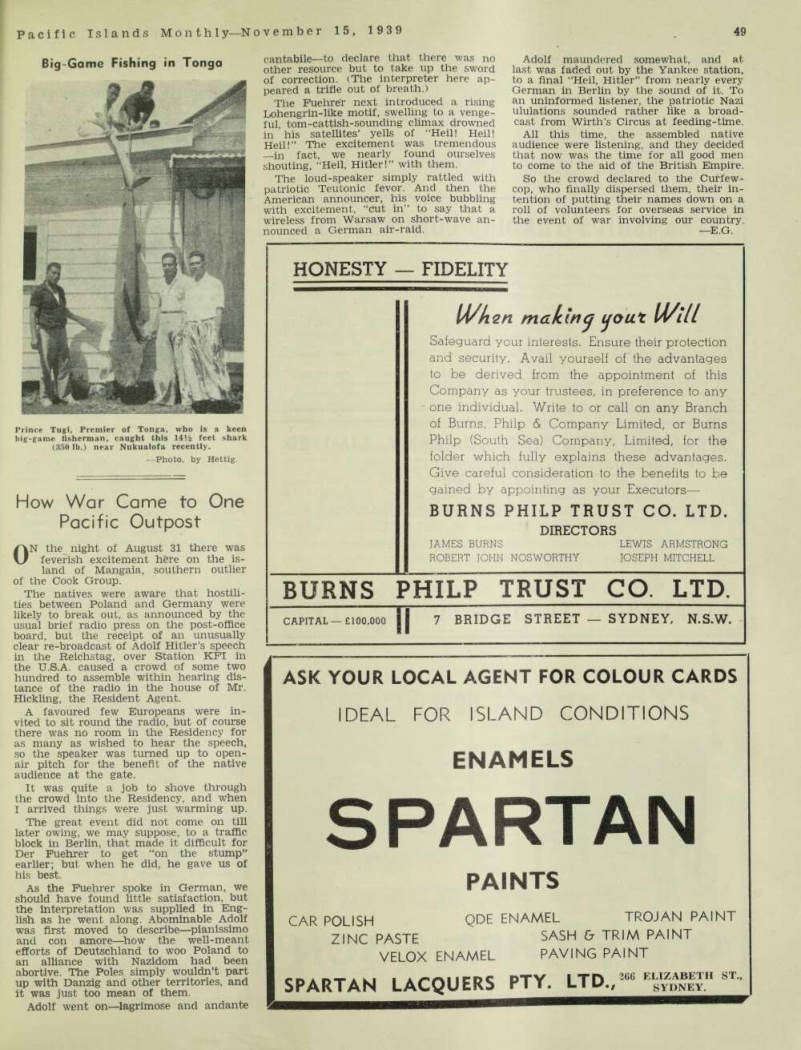
How War Came to One Pacific Outpost
ON the night of August 31 there was feverish excitement here on the is land of Mangaia, southern outlier of the Cook Group.
The natives were aware that hostili ties between Poland and Germany were likely to break out, as announced by the usual brief radio press on the post-office board, but the receipt of an unusually clear re-broadcast of Adolf Hitler’s speech in the Reichstag, over Station KFI in the U.S.A. caused a crowd of some two hundred to assemble within hearing dis tance of the radio in the house of Mr.
Hickling, the Resident Agent.
A favoured few Europeans were in vited to sit round the radio, but of course there was no room in the Residency for as many as wished to hear the speech, so the speaker was turned up to open air pitch for the benefit of the native audience at the gate.
It was quite a job to shove through the crowd into the Residency, and when I arrived things were just warming up.
The great event did not come on till later owing, we may suppose, to a traffic block in Berlin, that made it difficult for Der Fuehrer to get “on the stump” earlier; but when he did, he gave us of his best.
As the Fuehrer spoke in German, we should have found little satisfaction, but the interpretation was supplied in Eng lish as he went along. Abominable Adolf was first moved to describe —pianissimo and con amore—how the well-meant efforts of Deutschland to woo Poland to an alliance with Nazidom had been abortive. The Poles simply wouldn’t part up with Danzig and other territories, and it was just too mean of them.
Adolf went on—lagrimose and andante
cantabile—to declare that there was no other resource but to take up the sword of correction. (The interpreter here ap peared a trifle out of breath.) The Fuehrer next introduced a rising Lohengrin-like motif, swelling to a venge ful, tom-cattish-sounding climax drowned in his satellites’ yells of “Heil! Heil!
Heil!” The excitement was tremendous —in fact, we nearly found ourselves shouting, “Heil, Hitler!” with them.
The loud-speaker simply rattled with patriotic Teutonic fevor. And then the American announcer, his voice bubbling with excitement, “Cut in” to say that a wireless from Warsaw on short-wave an nounced a German air-raid.
Adolf maundered somewhat, and at last was faded out by the Yankee station, to a final “Hell, Hitler” from nearly every German in Berlin by the sound of it. To an uninformed listener, the patriotic Nazi ululations sounded rather like a broad cast from Wirth’s Circus at feeding-time.
All this time, the assembled native audience were listening, and they decided that now was the time for all good men to come to the aid of the British Empire.
So the crowd declared to the Cuffew cop, who finally dispersed them, their in tention of putting their names down on a roll of volunteers for overseas service in the event of war involving our country.
E.G.
Advertisements & other items, p. 51 (2 items)
49
Pacific Islands Month!y—November 15, 1939
Spartan
HONESTY FIDELITY
IVkznmaking gout
Safeguard your interests. Ensure their protection and security. Avail yourself of the advantages to be derived from the appointment of this Company as your trustees, in preference to any one individual. Write to or call on any Branch of Burns, Philp & Company Limited, or Burns Philp (South Sea) Company, Limited, for the folder which fully explains these advantages.
Give careful consideration to the benefits to be gained by appointing as your Executors—
BURNS PHILP TRUST CO. LTD.
DIRECTORS
JAMES BURNS LEWIS ARMSTRONG
ROBERT JOHN NOSWORTHY JOSEPH MITCHELL
BURNS PHILP TRUST CO. LTD.
CAPITAL £lOO,OOO 7 BRIDGE STREET SYDNEY, N.S.W.
ASK YOUR LOCAL AGENT FOR COLOUR CARDS
IDEAL FOR ISLAND CONDITIONS
ENAMELS
SPARTAN
PAINTS
CAR POLISH QDE ENAMEL TROJAN PAINT
ZINC PASTE SASH & TRIM PAINT
VELOX ENAMEL PAVING PAINT
SPARTAN LACQUERS PTY. LTD., 866 ™ E E ™ ST
Wainwright
Death Of Captain
Prom Our Own Correspondent
Papeete, Sept. 10.
CAPTAIN C. WAINWRIGHT died at his residence at Fariipiti, Papeete, Tahiti, on August 15.
Captain Wainwright, an old public school man and a retired officer of the British Army, had been a greatly respect
ed member of the British Colony at Ta hiti during the past 11 years.
The funeral service was conducted by H.B.M. Consul, according to the rites of the Church of England, in the presence 9 f those who held Captain Wainwright in esteem and affection —a numerous company.
Mr. Peter Savage, churchwarden at St.
Paul’s, Moa Island. Torres Strait, died recently.
Wealth In Fiji's Soil
Good Work of Agricultural Department
THE comprehensive character and high quality of exhibits at the annual agri cultural show held in Suva on Octo ber, caused one competent observer to write enthusiastically of the good work that is being done by the Fiji Depart ment of Agriculture, and of the progress being made in settling the native Fijians on their own land, as peasant farmers.
It is pointed out that experiments and education are steadily expanding the crops which are being produced on the soil in Fiji. It is noted particularly that vegetables usually seen only in temper ate climates—such as cabbages, cauli flowers, etc.—are now being produced in certain parts of Viti Levu. Much good work also is being done in the introduc tion of new and suitable grasses—an im portant activity, in view of the steady expansion and growing importance of the pastoral industry in Fiji.
Mr. R. B. Howard, in a letter to the Fiji newspaper, declares that these de velopments are of great importance be cause in Fiji—as in most countries—the real and permanent wealth of the people is in the first foot or two of the soil upon which they live.
That Runaway German
Plane
IT was stated in the “Pacific Islands Monthly” in October that the aero plane which escaped from New Guinea early in September with two German mechanics aboard, and which made its way to Merauke, in Dutch New Guinea, was an aeroplane from the establishment of the German Catholic Mission in New Guinea.
This was an error, based on an in correct report from New Guinea. We have been officially advised that the aeroplane was part of the establishment of the Lutheran Mission in New Guinea, with its headquarters at Finschhafen.
It will be remembered that on a num ber of occasions before the war there were reports of Nazi sympathies and Nazi activities on the part of the Lutheran Mission in New Guinea; and about 18 of the German missionaries from the Luth eran Mission at Finschhafen and else where were brought to Australia in Octo ber and interned. There never has been a suggestion of Nazi offensiveness on the part of the German Catholic missionaries in New Guinea, however.
A net profit of £17,994 was made by Steamships Trading Co., Ltd., of Papua, in the financial year ended June 30, 1939. An interim dividend at the rate of 10 per cent, per annum was paid last April, and now the directors recommend 6 per cent. —making 8 per cent, for the year and leaving £4,356 to be carried for ward. Last year, 10 per cent, was paid on both the preferences and ordinaries.
This conservation of the liquid resources of the company is being followed, owing to the international situation. This active and successful Islands trading company is managed by a board of three—namely, Captain A. S. Fitch (chairman and man aging director), Mr. E. V. Crisp and Mr.
L. Tracey. The registered office is at Port Moresby.
Advertisements & other items, p. 52 (1 item)
G. Fletcher & Son
STEAMSHIPS TRADING COMPANY LTD.
PORT MORESBY PAPUA SAMARA I
Chairman and Managing Director: A. S. FITCH.
Shipowners, Wholesale and Retail Merchants and Traders; Shipping, Customs and Insurance Agents; Copra and Rubber Plantation Owners.
MAIL CONTRACTORS TO COMMONWEALTH AND PAPUAN GOVERNMENTS.
AGENCIES:—At Port Moresby: Coral Sea Insurance Co.; Phoenix Insurance Co.; Delta Sawmills, Ltd.; Acme Bakery Co.; Vacuum Oil Co., Pty., Ltd. At Samarai; Coral Sea Insurance Co.; Delta Sawmills, Ltd.; Bankers and Traders’
Insurance Co.; National Mutual Life Insurance Co.; Kularo Shipyards - Mamal Plantations.
BRANCHES:—In Papua: Hanuabada, Sivitoi, Aroma, Koki, Hula, Ela Beach Duga Duga, Yule Island.
SYDNEY: NELSON & ROBERTSON PTY. LTD., 12 Spring St.; Melbourne, 396 Flinders Lane: London, E. Whiteaway & Co., 7 Chiswell Street, Finsbury. London.
Cable Address: “STEAMSHIPS.” Code: Bentley’s.
STEAMSHIPS TRADING COMPANY, LIMITED.
MERCHANTS, SHIPOWNERS AND PLANTERS
PORT MORESBY AND SAMARAI.
Our organisation provides every facility and efficient service as
MANAGING AGENTS AND VISITING REPRESENTATIVES OF
COCONUT AND RUBBER PLANTATIONS
Estates supervised in bearing and planting stages.
Comprehensive reports compiled and regular visits made to Estates by our competent Plantation Inspector.
WRITE, CABLE OR CALL FOR PARTICULARS:
STEAMSHIPS TRADING COMPANY LTD.
If you want "Perfection in Cooking" use a
“Younger” cooking stove
r These stoves have been on the market in Australia for over Sixty Years, and are still recognised as “The Best”.
They are made with Extended Firebox specially for Long Wood fuel, also special stoves with Cast Iron Oven suitable for Island requirements.
Send for Illustrated Catalogue and Price of Single and Double Oven Stoves.
G. FLETCHER & SON
50 OXFORD STREET, SYDNEY,
Real Bonanza!
New Guinea Co.'s Profit Last Year Over a Million
r:E remarkable success of Bulolo Gold Dredging, Ltd.—the senior gold min ing company in New Guinea—is well illustrated by the following figures, which show in Canadian dollars the profits fpr the year ended May 31, in 1938 and in 1939: 1938 3,453,463 dollars 1939 3,874,085 dollars The profit in 1939 was equal, in Aus tralian currency to the remarkable total of £1,106,881. This is only slightly less than the total amount of the company’s subscribed capital.
It would appear that, as each year passes, the company’s rate of profit rises.
It has indeed found a Bonanza in the Bulolo River flats, whose richness origin ally was seen by the late Cecil J. Levien, The profit quoted is given before pro vision is made for amortisation. It is cal culated that the life of the field may run anything from 12 to 20 years. The dredgeable gravel reserves on May 31 were calculated at 182,000,000 cubic yards, plus 20,000,000 cubic yards which will have to be handled as a hydraulic proposition.
The company now has eight dredges working. The construction of No. 7 dredge was completed early in July, and it is now operating satisfactorily; while No. 8 dredge, near the junction of the Bulolo and Watut Rivers, was expected to com mence operations early this month.
Mr. Harold Gatty, N.Z. representative of Pan American Airways, left by the last “Monterey” for U.S.A.
Rise And Fall Of Polynesia
Vast Confederation Which Died About 1350 A.D.
WHEN, in 1928, the Bishop Museum of Honolulu published the vast mass of material about ancient Polynesia gathered by the early missionary, J. M.
Orsmond, and edited by Miss Teuira Henry, in a bulletin entitled “Ancient Tahiti”, there was revealed a priceless treasure of history, tradition and polity, hitherto dimly glpnpsed in fragments rescued from the failing memories of aged men on many scattered islands.
The early voyagers knew little, and cared less, concerning the history and culture of the island people.
After the manner of reception com mittees and civic clubs of our modern world, who conduct visitors to cocktail parties, night clubs and exhibitions of bubble dancing at the local World’s Fair, rather than to the scholarly twilight of University halls —so the Polynesians of old displayed to their guests the gay orgies of the Arioi, instead of inducting them into the solemn arcana of the Fare-tara-’toa (the house of all wisdom).
Islands culture was, in fact, already in a state of deterioration at the period of European discovery: for the Polynesian world had been torn asunder by tribal wars and the mounting ambition of Is lands chiefs.
There was, however, a period, covering several centuries, when the far-flung ar chipelagoes of Polynesia were united in a confederation, the centre of which was the ancient temple and house of wis dom in the royal district of Opoa. on Havai’i —now known as the island of Ra’iatea.
To quote from “Ancient Tahiti”:— “Havai'i was of undisputed prestige among the islands in ancient times. For merly, as shown in pure archaic records by the ancient bards, Havai’i exercised a political and moral sway as the empor ium of all the Maori tribes of Polynesia.
Dividing Havai’i into two equal parts by a meridian, all the islands on its eastern side were named Te-Ao-Uri (Dark Land), those on the west Te-Ao-Tea (Light Land).
The ambassador who united and con solidated the islands of these two worlds into a close confederation was Te Fatu, a high chief who came from the distant island of Rotuma, at an early period, to Pora Pora, bearing a corner stone from the royal marae of his native island.
“And so” (records “Ancient Tahiti”), “they (Te Fatu and his son Maro-Te- Tini) continued their course, creating friendly feelings with the kindred peoples of Te-Ao-Uri and Te-Ao-Tea, of which are recorded Huahine, Tahiti and depend encies, Mai’ao, and the Australs —then named Te-Ao-Uri-o-Te-Fa’a Tauaroha (Dark Land of the Friendly Alliance); and Rotuma, Tahaa, and Pora Pora, with smaller adjacent islands, and downwards to Rarotonga, extending finally to Te- Ao-Tea-Roa, or New Zealand; which were named Te-Ao-Tea-o-Te-Fa’a Taua roha (Light Land of the Friendly Alli ance) .
“All these island kingdoms formed a convention for their priests, scholars and warriors, to meet periodically at Opoa for great religious observances and inter-
Ifwas SSSS%&J% numbering
iunar month" month®
£K?Sa Ch fh g e fw 0881011 ’ nd , out from the horizon they came in double file, each representmg a separate kingdom. To the north were those of Te-Ao-Tea, to the south those <pf Te-Ao-Uri, approaching side by side with the sound of drums and blasts °f trumpets’.
The ceremonies of landing, the presencation of gifts and the solemn procession inland to the marae of Taputapuatea, are described in minute detail in the text.
“While the mystic rites were being performed that day by the priests at the marae at Opoa, no fire was kindled and no food was eaten.
“The presiding high priest and other high priests entered the inner sanctuary There was performed the most sacred of all their sacardotal rites, the Pal Atua (assembly of the gods), when it would have meant death for any of the laity to have approached or looked on”.
After continuing from a remote time, the confederation was broken up and scattered sometime in the middle of the 14th century, or about 1350 A.D.
"After the dispersion of Te-Ao-Uri and Te-Ao-Tea only Ralatea and Tahiti continued to exchange the Taputapuatea
rites meeting alternately at Opoa.
Raiatea and at Tautira, Tahiti.
“ An alliance was made between the little kingdoms of Tahiti, Huahine.
Ra iatea and Maupiti, called the Hau- Pahu-Nui (Government of the Great Drum), and it remained in full force un til French rule was permanently estab lished in Tahiti in 1847”.
The Name “Hawaii"
“rpHE name Hawaii, with its equiva- X lent forms, is known throughout Polynesia. Hawaii is the name of the largest island in the Hawaiian group, and it is pronounced like the Tahitian Havail. This island is known as Tahitian folklore as ‘HavaiT-a’ (Burning Havail), from its volcano, which was formerly al ways brightly burning. The island of Fakarava in the Tuamotus was once call ed Havaiki.
“The Samoans have their Savail; the Marquesans and New Zealand Maoris Havaiki; the Rarotongans, Avaiki. ‘Havail (Raiatea) was of undisputed prestige among the islands in ancient times and is still the proudest island in all the Society group.
“These names were shortened into Uri (Dark), for East Havail, and Tea (Light), for West Havail; and in the course of time they were blended to gether, and Uri-e-Tea (Dark and Light) became a new name for the whole is land”.
This was the name of the island given to Cook by the natives when he visited Raiatea in the “Endeavour”, and was recorded by him as “Uliateah”.
“The sea of the Society group divided by the meridian just described, was call ed Moana-a-Marama (sea of the moon) on the eastern side of Raiatea, and Moana-Urifa (sea of rank odour) on the western side. The Pacific Ocean they call Te Moana-Nui-O-Tva”.—A.C.R.
Advertisements & other items, pp. 53-54 (1 item)
Newlands Brothers Pty. Ltd.
m n \ m The new range of Newlands modern steel furniture includes designs ideal for indoor and outdoor use in the tropics.
Newlands extend a cordial invitation to you on your next visit to Sydney to see their new showrooms where is exhibited a complete selection of steel furniture offering distinctive groupings and suites in actual home settings, in addition to individual pieces for every type of service.
FOR STEEL FURNITURE AND MODERN SLEEPING EQUIPMENT.
NEWLANDS BROTHERS Pty. Ltd.
Riley and Albion Streets, Sydney, N.S.W.
Write to-day for a catalogue illustrating the full range of this delightful furniture.
It will be forwarded promptly.
ECZEMA
CENSITIVE PEOPLE feel eczema acutely. The continued irritation, the unsightly eruptions and the uncertainty where the trouble will next spread makes them feel almost ashamed.
Eczema is not due to dirt, but to the fact that certain skins react badly to various forms of irritation (internal or external) and poor general health increases the liability.
Since there is a great tendency for eczema to spread and to become chronic, early local treatment is imperative, and the best salve for this purpose is DOAN'S Ointment. It penetrates to the true skin where the inflammation lies, is antiseptic and healing and quickly allays the irritation.
DOAN’S Ointment is also good for other itching skin complaints and for the relief of piles. Buy a tin to-day, but, be sure you get DOAN’S.
Ship Chandlery Hardware
/Write for j
Ship Chandlery /
Catalogue J
Catalogue
Special “In Bond’’ Prices for all Islands enquiries quoted on application.
Sole Agents for:
BROOMFIELDS LIMITED
152 SUSSEX STREET :: SYDNEY.
Cables “Boom”, Sydney.
Large and Complete Stocks of
SHIP CHANDLERY
IRONMONGERY OF ALL KINDS, PAINTS,
WHITE LEAD AND OILS.
P. H. MUNTZ & CO.'s 3-CROWN BRAND METAL SHEATTNG.
PEACOCK & BUCHANS’ ENGLISH READY-MIXED PAINTS.
T » IT
USE
FOR RELIABILITY
AND LONG SERVICE
Manufactured by: Suva Agents: Sydney Agents:
MILLER'S "ANCHOR"
BRAND ROPES AND
CORDAGES.
Manila, Sisal, New Zealand Coir and Cotton Rope of every description.
Twine, Sewing Twine, Shop Twine, Binder Twine and Fishlines, Lashings, Halters, Plough Reins, Sack Cord, Blind Lines, etc,
LENGTH STRENGTH
QUALITY GUARANTEED
JAMES MILLER & Co. Pty. Ltd.
MELBOURNE, VIC., AUST.
A. S. FAREBROTHER & CO.
And at Lautoka, P.O. Bo* 36. Tel. 261
P. T. TAYLOR LTD.
The Value Of Teleradio
‘7T\HE teleradio is proying of inestimable X value to us in the Northern Terri tory”, said Mr. T. A. Holt, owner of Roper Valley Station, recently.
“In the past, with a six-weekly mail service, twelve weeks elapsed between the writing of a letter and receipt of a reply; now the interval is only hours.
Formerly, we used to start a mob of cattle towards the coast for sale, head ing either for the Queensland border or Alice Springs. Our drover, in all prob ability, would meet a buyer on the road.
He would wire us the price offered, but the wire was quite likely to remain at the Post Office for weeks. Now it goes to Darwin and thence through to us by radio, on our teleradio set.”
One of Mr. Holt’s men was badly in jured. He called up Darwin at 7.15 a.m.; and, at 10 o’clock, Dr. Fenton arrived by ’plane. This was a vivid contrast to an occasion in pre-teleradio days, when Mr.
Holt took an injured aboriginal to hos pital, spending 15 hours by car in cover ing 90 miles, over an almost non-existent road. Once, when both the flying doctor’s planes were out of action, they kept a sick piccaninny alive for five days and saved his life, by following the instructions of the chief medical officer at Darwin, as conveyed several times daily by tele radio.
Rev. W. K. Deasey, chaplain at Nor folk Island, has been appointed to Cab ramatta, N.S.W. His place wifi be filled by Rev. H. H. Davison, formerly curate at Port Kembla, N.S.W.
Advertisements & other items, p. 54 (1 item)
52
November 15. 19 3 9—P aci f i c Islands Monthly
Wedding In Papua
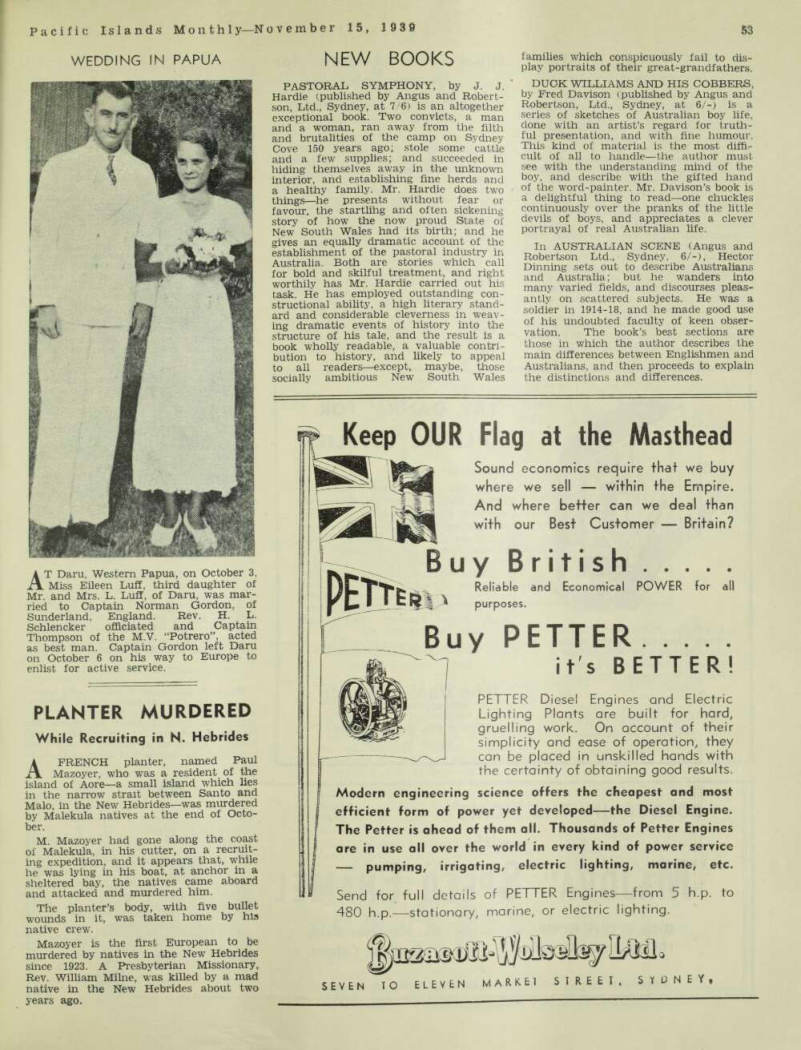
AT Daru, Western Papua, on October 3, Miss Eileen Luff, third daughter of Mr. and Mrs. L. Luff, of Daru, was mar ried to Captain Norman Gordon, of Sunderland, England. Rev. H. L.
Schlencker officiated and Captain Thompson of the M.V. “Potrero”, acted as best man. Captain Gordon left Daru on October 6 on his way to Europe to enlist for active service.
Planter Murdered
While Recruiting in N. Hebrides
A FRENCH planter, named Paul Mazoyer, who was a resident of the island of Aore—a small island which lies in the narrow strait between Santo and Malo, in the New Hebrides—was murdered by Malekula natives at the end of Octo ber.
M. Mazoyer had gone along the coast of Malekula, in his cutter, on a recruit ing expedition, and it appears that, while he was lying in his boat, at anchor in a sheltered bay, the natives came aboard and attacked and murdered him.
The planter’s body, with five bullet wounds in it, was taken home by his native crew.
Mazoyer is the first European to be murdered by natives in the New Hebrides since 1923. A Presbyterian Missionary, Rev. William Milne, was killed by a mad native in the New Hebrides about two years ago.
New Books
Pastoral Symphony, By J. J.
Hardie (published by Angus and Robert son, Ltd., Sydney, at 7/6) is an altogether exceptional book. Two convicts, a man and a woman, ran away from the filth and brutalities of the camp on Sydney Cove 150 years ago; stole some cattle and a few supplies; and succeeded in hiding themselves away in the unknown interior, and establishing fine herds and a healthy family. Mr. Hardie does two things—he presents without fear or favour, the startlihg and often sickening story of how the now proud State of New South Wales had its birth; and he gives an equally dramatic account of the establishment of the pastoral industry in Australia. Both are stories which call for bold and skilful treatment, and right worthily has Mr. Hardie carried out his task. He has employed outstanding con structional ability, a high literary stand ard and considerable cleverness in weav ing dramatic events of history into the structure of his tale, and the result is a book wholly readable, a valuable contri bution to history, and likely to appeal to all readers —except, maybe, those socially ambitious New South Wales
families which conspicuously fail to dis play portraits of their great-grandfathers.
Duok Williams And His Cobbers,
by Fred Davison (published by Angus and Robertson, Ltd., Sydney, at 6/-) is a series of sketches of Australian boy life, done with an artist’s regard for truth ful presentation, and with fine humour.
This kind of material is the most diffi cult of all to handle—the author must see with the understanding mind of the boy, and describe with the gifted hand of the word-painter. Mr. Davison’s book is a delightful thing to read —one chuckles continuously over the pranks of the little devils of boys, and appreciates a clever portrayal of real Australian life.
In AUSTRALIAN SCENE (Angus and Robertson Ltd., Sydney, 6/-), Hector Dinning sets out to describe Australians and Australia: but he wanders into many varied fields, and discourses pleas antly on scattered subjects. He was a soldier in 1914-18, and he made good use of his undoubted faculty of keen obser vation. The book’s best sections are those in which the author describes the main differences between Englishmen and Australians, and then proceeds to explain the distinctions and differences.
Advertisements & other items, p. 55 (2 items)
53
Pacific Islands Mon thly—No vember 15, 1939
Buy Petter
<jf Keep OUR Flag at the Masthead Sound economics require that we buy where we sell within the Empire.
And where better can we deal than with our Best Customer Britain?
uy British
Reliable and Economical POWER for all purposes.
Buy PETTER
it's BETTER!
PETTER Diesel Engines and Electric Lighting Plants are built for hard, gruelling work. On account of their simplicity and ease of operation, they can be placed in unskilled hands with the certainty of obtaining good results.
Modern engineering science offers the cheapest and most efficient form of power yet developed—the Diesel Engine.
The Fetter is ahead of them all. Thousands of Fetter Engines are in use all over the world in every kind of power service pumping, irrigating, electric lighting, marine, etc.
Send for full details of PETTER Engines—from 5 h.p. to 480 h.p.—stationary, marine, or electric lighting. &
SEVEN TO ELEVEN MARKET STREET, SYDNEY*
New Club In Tahiti
Prom Our Own Correspondent
Papeete, Sept. 10.
WHILE H.M.S. “Leander” was at Ta hiti (July 28 to August 20), the British Consul, Mr. Edmunds, gave a handsome luncheon at the PavoLs Club; with His Excellency the Governor of French Oceania, the officers of the “Leander”, and representative members of the British Colony, as his guests.
Le Pavois is a new association inaug urated last July. It is a select club in stituted to provide its members with the means to enjoy athletics in exclusive surroundings. The site is provided with a modern club-house, a concrete bathing pool and a tennis court under a vast pandanus-leaf roof: so that the game can be played at any hour of the day with out danger of sunstroke. The member ship dues are high—as club dues go in this part of the world.
The club premises are situated on the seashore, in the new section of Papeete, adjacent to the Blue Lagoon Hotel.
Queen Salote
Illuminated Address for Queen Salote Link With Old Tongan History
From a Special Correspondent
Nukualofa, Oct. 2.
SOME months ago, the Civil Servants of Tonga appointed a Committee, comprising Mr. J. R. Land (Super intendent of Telegraphs). J. Taliauli (Registrar of the Supreme Court) ana J. Hapa (Interpreter in the Police Dept.), to prepare an Illuminated Address for presentation to Queen Salote on October 11 next, the 21st anniversary of her cor onation, as a mark of their respect and loyalty.
One interesting feature of the Address, which will be signed by all Government officials and employees, is its covering— an ilustration of the Koka tree (bischof fia javanica), embossed in gold on a red leather cover, gold and red being the dominant colours of the Tongan Royal Standard. Also printed on the cover is the phrase “Sitakafalu ki he Koka”— literally, “To turn the back to the Koka
tree . This phrase has historical signifi cance tor the present royal line—the Tui Kanokubolu, who took their title from the sacred soil of Kanokubolu in Hihifo, Tongatabu.
According to tradition, when Gata (the first Tui Kanokubolu—about 1610— and son of the Tui Ha’atakalaua, Mougatoga, and Tohu’ia, a chief woman of Samoa, daughter of the chief of Safaata in Upolu) was invested with the title at the Kava Ceremony at Bagai, the sacred Mala’e (Sacrificial Ground) of the Tm Kanokubolu, he sat with his back against a Koka tree, which stood on the Mala’e. Since then it had been the custom strictly observed at every subsequent in vestiture of the title, for the person in vested to sit with his or her back against the Koka tree at Bagai (“Sitakafalu ki he Koka”) during the Kava Ceremony. Thus is the origin of the phrase which Tongan poets and orators use when they sing of the wisdom and might of the Tui Kano kubolu dynasty.
Moreover, the rise of the Tui Kano kubolu to power could be traced from the wording of the phrase. Like numerous other words in the Tongan language, ‘ sitakafalu” (“to turn the back”) was applicable only to the Tui Toga, Sacred King of all Tonga; “situ’a” is its equiva lent used by chiefs and commoners.
Originally, the phrase was “Situ’a ki he Koka , but when the Tui Kanokubolu assumed power as the supreme ruler of all Tonga, he also acquired the singular privilege of having special words used when ,pP? k , en of - Consequently, the chiefly “sitakafalu” took the place of the common “situ’a” in the phrase.
As a matter of history, it is interest ing to know that the Royal Throne of Tonga contains pieces of the original Koka tree at Bagai.
Freights Up 10 Per Cent.
Prom Our Own Correspondent
Pt. Moresby, Oct. 20.
AS from the Bth inst., the rates of freight on sea-borne goods, both coastwise in the Territory’s waters and between Papua and Australia, have been fixed by the Commonwealth Prices Commissioner, at a maximum of 10 per cent, above the rates ruling on August 31.
Mr. S. A. Lonergan, a well-known mem ber of the New Guinea Public Service, was appointed Acting Government Sec retary as from October 12, when Mr.
Harold Page went on leave. Mr. L. C.
Roberts has been appointed Acting Sec retary of the Lands and Forests Depart ment.
Advertisements & other items, p. 56 (1 item)
Majora” Speed Enamel
3 Engineers & Plumbers’ Brass Work: Locksets; Wire Netting; Hardware; “Petromax”
Kerosene Lanterns & Lamps; Pumps, Windmills, Troughing.
WRITE FOR PRICES AND
LINES YOU USE.
TRY DANKS' FOR
BUILDING SUPPLIES
We specialise in: Water, gas and steam pipe and Fittings; Gal. Roofing Iron, Guttering, Downpipe, etc.; Wallboards, Bituminous Roofing, Tilux, Duratile, Asbestos Sheets; Baths. Basins, Sinks, Heaters; Ranges for wood, coke, coal, kerosene; McClary Electric and Gas Ranges; Electric Light fittings; Refrigerators—lce and Electric; Linoleums for Stores, Hospitals, etc.; White Rose C.I. (Eng.) Hot Water Boilers; “Hush” Silent Flushers; Paints and Brushware; Wallpapers, etc. ’Phone: M 6505 (18 lines).
Late shopping Friday.
John Domks and Son
PROPRIETARY LIMITED
(Incorporated in Victoria). 324-330 Pitt Street, Sydney.
And at Melbourne.
COLOUR IN THE HOME
with
Majora” Speed Enamel
Dries in ONE HOUR ... - Lustrous finish No objectionable odour --- Brilliant Colours.
Obtainable from All Branches of BURNS, PHILP & CO. LTD.
Bite Of The Social
Bee
A Sidelight in Polynesia
(Contributed) WHILE the Anopheles Gambiae and the Aedes Aegypti have been kept from invading the islands of Polynesia, another insect (whose bite, although not so fatal as that of the two mosquitoes named is nevertheless productive of much mental and bodily distress) has been introduced.
Its scientific name is as forbidding as its character; but in common parlance it is known as the Social Bee.
That lay readers, in hitherto uninfected islands or in islands where the invasion has not become epidemic, may recognise the symptoms and guard the health of then- communities, it may be well to cite a clinical case.
Mrs. A., a joyous young bride, comes with her husband to the Islands. The exotic atmosphere, the quaint native cus toms, the Aloha Oe music, the gracious hospitality of her Polynesian neighbours, the moonlight on the lagoon, fascinate her. The natural simplicity of the life about her gives promise of a tranquil ex istence.
After a season, Mrs. X.—a pure Nordic who has resided for several years in the island —drops in for a chat. She is very charming. There is, however, a certain undercurrent in her conversation which gives the impression that there are ser pents in the Garden of Eden. She de parts, leaving a faint twilight shadow on Mrs. A.’s mind.
Later Mrs. Y. (also pure Nordic) calls.
Very tactfully, she gives a clue to the identity of the serpents. Mrs. X. is, she confides, affronted and outraged because the most eligible young European on the island has passed by her pure Nordic but not very glamorous daughter, and has married a handsome Euronesian girl.
Mrs. Y. gently but clearly indicates that the wheat is being winnowed from the chaff, and Mrs. A. is invited to afternoon tea for initiation into the Guild of Win nowers.
If Mrs. A. goes, the Social Bee will be there to bite her. She goes and is bitten, and her peace and tranquility of mind depart forever.
The fever stages are accompanied by much cerebral hyperemia. Husbands, in spite of stormy curtain lectures, will in sist on meeting at the club and going on fishing expeditions with men the Guild has branded as lepers. And, what is worse, the lepers themselves appear ab solutely unaware that they are lepers and are joyously contented and happy.
During this stage, Mrs. A.’s view of her surroundings becomes radically trans formed. The exotic atmosphere becomes toxic; the quaint customs reprehensible departures from established usage; the Alohoa Oe music exasperating cacophony; and the moonlight on the waters of the lagoon assumes the cold glitter of chro mium plate.
Sweetness and light are soured and dimmed by periodic internecine wars within the Guild itself. Even crusaders are human. These are the times when husbands are compelled to hold clandes tine meetings in Pubs in order to keep the flag of good-fellowship nailed at the masthead and themselves from dying of boredom.
Mrs. A. eventually drifts into a state of extreme nostalgia.
The fogs of London, the jazz bands
and cocktail parties of Los Angeles, the noisy activities of Castlereagh Street’ as sume the glamorous aspect of surpassing perfection in her fevered dreams. Unless she can go, she is lost; and the Social Bee has claimed another victim.
Mr. E. W. G. Dent, a solicitor in the legal office of Hon. H. B. Gibson, of Labasa, Fiji, arrived in New Zealand in October to join the Dominion military forces.
Mr. B. R. C. pottage, who has been engaged in mission work for the Pres byterian Church at Tongoa, New Heb rides, for nearly eight years, arrived in Auckland, N.Z.. by the “Maetsuycker” on October 13. Mr. Nottage will spend ex tended furlough in the Dominion.
After many delays, the work of broad ening the wharf l at Samarai. Eastern Papua, by 10 ft., and lengthening it by 60 ft., is under way, and should be com pleted early in the New Year.
Advertisements & other items, p. 57 (2 items)
55
Pacific Islands Monthl y—N ovember 15, 1939
y&u Cwt ’tmcL&nnif</iZzO&
POSITION WANTED
Experienced Plantation Manager, Ex-Service Man, now debarred further service through age, desires to relieve Owner-Manager wishing to enlist. Can fit in any Island activity. Any Group. Mutual Arrangement. Open indefinitely for replies.
Answers to; “Oceania”, C/o.
“P.1.M.” Office, Box 3408 R, G.P.0., Sydney.
YES-/5 9 DECREES
COOIER THAfVcz
BEFORE WE
/NS UIATEV )
*2
S&OJ
V \ 6* \
y&u Cwt ’tmcL&nnif</iZzO&
Do heat rays "bounce off" your roof Because it is filled with millions of minute air cells, Cane-ite effectively resists heat, cold and noise. With Cane-ite, too, you can DECORATE as you insulate. Smart modern effects can be achieved by painting or stencilling the surface —or by using Cane-ite in either of its two colours, with bevelled edges, the designs being tooled or sanded. White-ant-proofed Cane-ite is made in three thicknesses in boards up to 12 feet long.
Easy to install, inexpensive and amazingly durable. Ask your branch of the Building Materials Division of the Colonial Sugar Refining Company Ltd. for samples and full details.
OR DO YOU
SWELTER IN AN
UNINSULATED
HOUSE?
C A
$S$ iE
STRUCTURAL INSULATION
SAVES MORE THAN IT COSTS
MASONITE. “The Wonder Board of 1000 Uses”, Is the inexpensive solution to countless building problems. Ask us for full information. i THE COLONIAL SUGAR REFINING COMPANY LTD. (Building Materials Division) Sydney . . Melbourne . . Adelaide . . Brisbane . . Perth CA 34-9
"Area Ra!"
A UNIVERSAL and, at times, exasperating custom among Tahitians is the amiable habit of saying what they believe their listener wishes to hear. Even when a Tahitian is a messenger bearing evil tidings, he considers it necessary to modify the afflicting intelligence with a thick sugar coating of cheerful news.
The native manager of a distant plantation coming to report to its owner that a bevy of pigs have uprooted his taro patch, or a band of plunderers carried away by night a thoviand coconuts, or a drove of horses eaten off the bark of the young breadfruit trees, will invariably preface his tale with a bulletin of propitious information—the abounding health of the cattle, the adequacy of the rain-
fall, the high quality of the copra in the warehouse.
The experienced proprietor will listen patiently, but with inward apprehension, for the sound of the word “Tirara” or “Area ra”. If the happy report ends without the pronunciation of one or the other of these words, all is well. Their usage, in this connection, is idiomatic and cannot be literally translated. But, ap pearing at the end of good tidings, they are harbingers of evil and serve as her alds of the wrath to come.
Old residents always expect the worst, so are not inconvenienced by this kindly habit. It is, however, rather devastating to newcomers; for it often raises hopes which suffer a more grievous laceration
by the longer fall.-
A.C.R.
Shot-Gun Matrimony!
Another Trader’s Tale, by Edwin Gold, Mangaia, Cook Is.
I HAD business at the Resident Agent’s Office. Not important; just a matter of Quid Pro Quo. Or, better, two •‘quid”, ex Savings Bank, pro bono publico—in this instance, my chronically hard-up self. ’Erbert ’Enrv was in his usual state of office-hours servitude, exacerbated by pink forms and “please explains” (relative to the Fruit Board’s deficit of 4ad. during the Big Noise regime) but he found time to be affable. Disbursing, he chatted; and then was suddenly smitten with seeming lunacy. He leaped hastily to his feet.
“Rau” roared ’Erbert ’Enry, The native office-boy sprang to attention. “Sir?”
“Bring me mv coat, collar and tie.”
I smirked modestly. Of course, T was in a sense an old and valued customer, but ’Erbert ’Enry usually adopted this sartorial salute only for exalted persons such as Governor-Generals. To me. it was an accolade. Only Heaven remained!
Disillusionment was rapid. H.H.H., en tangled Laocoon-like in a neck-tie re sembling a sawed-off rainbow, explained in gasps that as Registrar he was to per form a native wedding. My financial de mand had reminded him that the nuptial hour was nigh.
It was an unusual thing. One seldom hears in Polynesia of a non-MiSsion knot being tied, though Resident Agents have power to officiate on request. And thereby hung this wild, weird tale: NIA was a coy, much-vanquished vil lage damsel; Kiri a gay. Bacchan alian buck. Morganatic ties had long ex isted between the pair, but nothing cramping or in any way worth the 7/-, hard-to-raise marriage fee, required for legal union.
Their arrangements had been admir able. Each party did as they pleased.
But Nia found her charms fading, as time went on, and her youngest sister became a formidable Richmond in the field. Nia decided to become respectable— in the well-worn phrase, to be made “an honest woman”. Wise in her generation, she chose to promulgate her decision in orange-time, when Kiri indubitably had 7/ and more!
Kiri, caught in Cupid’s toils, surren dered to respectability. In any case, Nia could by now advance cogent reasons in favour thereof that even Kiri, artist though he was with the honeyed words that beguile the fair, could not explain away—unless by advocating vanishing cream!
On the eve of the nuptial day, Kiri met an old flame during his evening stroll. It was near the curfew hour of nine. He was prevailed on to spend a little time with her —till dawn, in fact.
And thus a basely suspicious native policeman found him. In the Cook Is lands, cohabiting is against the rules and punishable. Result: Courting on Tuesday; Caught on Wednesday; Court on Thursday; Banns on Friday; Married on Saturday (to Nia, as ar ranged).
“Hark to the sweet, sweet, wedding bells; what a tale of rapture their lovely music tells!”
And Kiri, Benedict Malgre Lui, is now at work with other sinners, a convict on the road gang, expiating the sin of co habitation.
Advertisements & other items, p. 58 (2 items)
56
November 15, 193 9—P acific Islands Monthly
Your Tropical Rit
A. B. DONALD LTD.
AUCKLAND
ISLAND TRADERS : GENERAL MERCHANTS
P.O. Box 1509. Cables and Telegrams: “Kingdom”, Auckland.
Branches at Rarotonga and throughout the Cook Islands At Papeete and throughout the Society, Marquesas and Paumotu Islands,
trading as "ETABLISSEMENTS DONALD, TAHITI"
At Fiji; Trading as "Dominion Fruit Co.", Suva.
Your Tropical Rit
When you visit the Pacific Islands, whether on Business or Pleasure, you need Special Equipment—Light Suits of Correct Style, which fit well and launder easily; Tunic Shirts, Silk Shirts, Light Underwear, White Shoes, etc.
WALTER HORNE & CO., LTD., established in 1885, specialise in this Service. Skilled Tailors make your Suits from First-class material within 24 hours. Complete equipment can be supplied from our Large Stock at Reasonable, Moderate Prices.
BUY FROM THE FIRM WHICH UNDERSTANDS TOUR NEEDS AND
DRESSES YOU CORRECTLY.
WALTER HORNE & CO. LTD. carry a Full Range of Drapery of all kinds; also Frocks, Millinery, Foundations and Lingerie, Hosiery, Shoes and Sandals, Ribbons and Laces, Household Drapery.
Lad ies' Hairdressing and Manicuring Men resident in any of the Pacific Territories can be supplied with Suitable Clothes.
Write to us and Describe your Requirements.
WALTER HORNE & CO. LTD.
Drapers and Men's Wear Specialists.
SUVA, FIJI.
Unappreciated
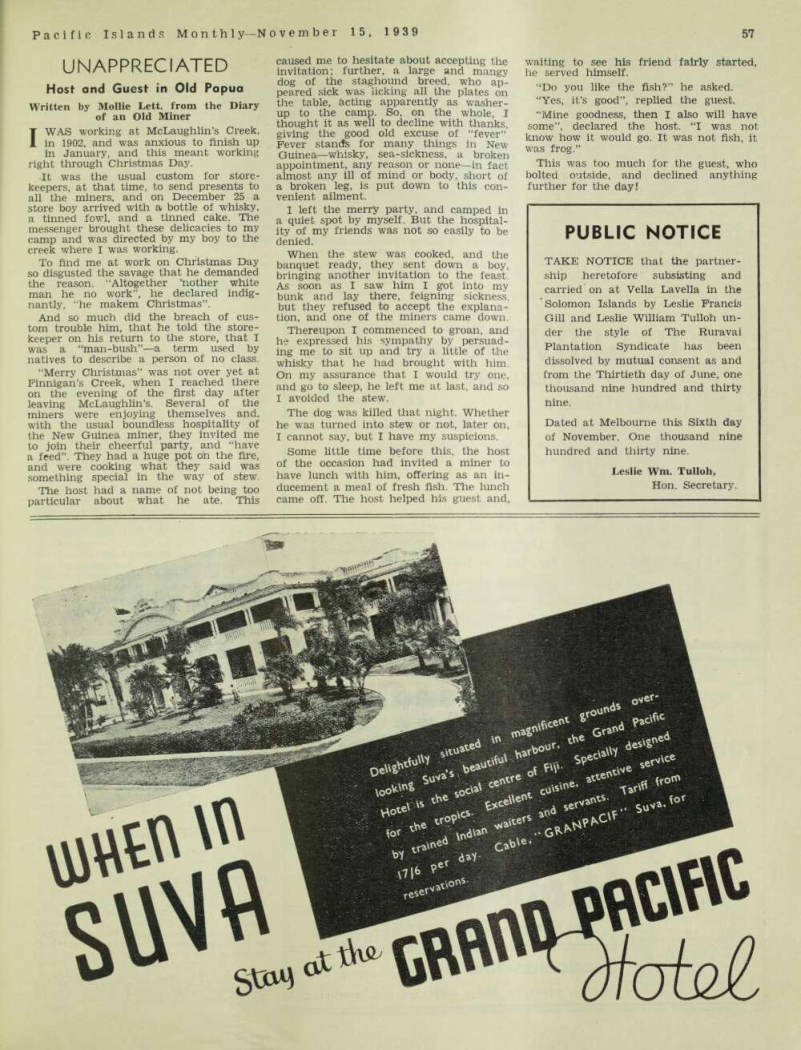
Host and Guest in Old Papua Written by Mollie Lett. from the Diary of an Old Miner
I WAS working at McLaughlin’s Creek, in 1902, and was anxious to finish up in January, and this meant working right through Christmas Day.
It was the usual custom for store keepers, at that time, to send presents to all the miners, and on December 25 a store boy arrived with a bottle of whisky, a tinned fowl, and a tinned cake. The messenger brought these delicacies to my camp and was directed by my boy to the creek where I was working.
To find me at work on Christmas Day so disgusted the savage that he demanded the reason. “Altogether ’nother white man he no work”, he declared indig nantly, “he makem Christmas”.
And so much did the breach of cus tom trouble him, that he told the store keeper on his return to the store, that I was a “man-bush”—a term used by natives to describe a person of no class.
“Merry Christmas” was not over yet at Finnigan’s Creek, when I reached there on the evening of the first day after leaving McLaughlin’s. Several of the miners were enjoying themselves and. with the usual boundless hospitality of the New Guinea miner, they invited me to join their cheerful party, and “have a feed”. They had a huge pot oh the fire, and were cooking what they said was something special in the way of stew.
The host had a name of not being too particular about what he ate. This
caused me to hesitate about accepting the invitation; further, a large and mangy dog of the staghound breed, who ap peared sick was licking all the plates on the table, acting apparently as washer up to the camp. So, on the whole, I thought it as well to decline with thanks, giving the good old excuse of “fever”
Fever stands for many things in New Guinea—whisky, sea-sickness, a broken appointment, any reason or none—in fact almost any ill of mind or body, short of a broken leg, is put down to this con venient ailment.
I left the merry party, and camped in a quiet spot by myself. But the hospital ity of my friends was not so easily to be denied.
When the stew was cooked, and the banquet ready, they sent down a boy, bringing another invitation to the feast As soon as I saw him I got into my bunk and lay there, feigning sickness, but they refused to accept the explana tion, and one of the miners came down.
Thereupon I commenced to groan, and he expressed his sympathy by persuad ing me to sit up and try a little of the whisky that he had brought with him.
On my assurance that I would try one, and go to sleep, he left me at last, and so I avoided the stew.
The dog was killed that night. Whether he was turned into stew or not, later on, I cannot say, but I have my suspicions.
Some little time before this, the host of the occasion had invited a miner to have lunch with him, offering as an in ducement a meal of fresh fish. The lunch came off. The host helped his guest and,
waiting to see his friend fairly started, he served himself.
“Do you like the fish?” he asked.
“Yes, it’s good”, replied the guest.
' Mine goodness, then I also will have some”, declared the host. “I was not know how it would go. It was not fish, it was frog.”
This was too much for the guest, who bolted outside, and declined anything further for the day!
Advertisements & other items, p. 59 (2 items)
57
Pacific Islands Monthl y—N ovember 15, 1939
- rr- *rZ**
PUBLIC NOTICE
TAKE NOTICE that the partnership heretofore subsisting and carried on at Vella Lavella in the Solomon Islands by Leslie Francis Gill and Leslie William Tulloh under the style of The Ruravai Plantation Syndicate has been dissolved by mutual consent as and from the Thirtieth day of June, one thousand nine hundred and thirty nine.
Dated at Melbourne this Sixth day of November, One thousand nine hundred and thirty nine.
Leslie Wm. Tulloh, Hon. Secretary.
Stcu) » l v^a
WU AS o>,Cr ' rQ vi^ 6 A ?a c^' c u<i Gr^ d j A\* r tb e ° , o c\9Lo ed \rU^ e ° .,VW eS ® * '* 0 , f* SU t c uW" ei * t *# »** t%c e\'e" 1 . s so va.' or
- rr- *rZ**
ua'° ed Ca b ' e ’ er 6 * l |b P e ; .er^° nV
Killed In Bulolo Gorge
Car Accident in New Guinea
A WELL-KNOWN and popular resident of the goldfields district of New Guinea, Mrs. Keith Murray, was killed, and her husband and another man very seriously injured, in a car accident in the Bulolo Gorge about daylight on Sunday, October 8.
They had been at a dance in Wau and were returning home through the Bulolo Gorge in a car owned by the Morobe Motor and Engineering Co. The car left the road at one of the many dangerous bends in the gorge, where there is a drop of about 300 feet into deep water. The car fell onto a ledge, about 100 feet down, and then bounced off into the river.
Some hours elapsed before help was obtained and, by that time, Mrs. Murray had completely disappeared. It is pre sumed that she was seriously injured, and probably killed, and that her body was carried away in the deep water. Her husband and Mr. Syd. Cook were seriously injured and Mr. M. Hawke was slightly injured. The driver of the car*Mr. Price was also severely hurt. All the injured were taken to Wau hospital.
A search for Mrs. Murray’s body was continued for some days, and it was found on the following Thursday, some distance further down the river.
Mr. A. J. Carew defeated Mr. R. C.
Forster in the final of the Fiji Golf Club’s Championship in October, by 3 and 2, over 36 holes.
How U.S.A. Feels Towards
the War
A WELL-KNOWN resident of Poly nesia, who was in America when the war broke out, wrote thus to the editor of the “P.1.M.” from San Fran cisco:— “New York City is full of Jews and Germans. It was barely possible to move within three blocks of the overhead run ning news bulletins, at the corner of 42nd Street and Broadway.
“England is certainly the hero in U.S.A.
We went a long way in all kinds of cities, and amongst all classes of people. There is a definite hatred and fear of Hitler and his policy—not just a dislike, but a hate. With all their American hot-air, there is a feeling that only England can take the initiative, and that only England dare.
“They now see the wisdom of Chamber lain’s policy last September—especially is this so in Canada. It gave the Allies a grand rehearsal and the opportunity to overhaul their war resources. It showed their weaknesses; but, principally, it spurred on the establishment of new re sources and equipment.
“The principal American squeal is ‘Keep us out of the war—let them do their own fighting. If war comes to America we will fight, but we will send no soldiers overseas. Stick to the Munro doctrine’. (Munro doctrine: Putting off the evil day.) “The wise ones know that it is in evitable that America will be drawn into the war. They know that in some unfore seen manner it is bound to happen—and they are going ahead furiously with their war arrangements.
“We found at Butte, Montana, that 15 copper mines, which had been closed, were newly opened. Lead-smelters that have been closed for years, have opened.
“The day before Germany entered Poland, the 7th U.S.A. Mechanised Cavalry Brigade rode up Fifth Avenue.
There were 650 wheeled units, large and small tanks, batteries of French 75 and mortars, armoured cars, motor-cycle squads, gas cars, ambulances, baggage and supply train—2o miles of it, and travell ing at 30 m.p.h. There were 2 planes overhead with radio transmitters. Each vehicle has a radio receiver. The Com mander just talks in his car. The planes keep him advised of all movements.
“Everything looked new. They just bowled along. You can imagine how 20 miles of this form of traffic at midday in New York disturbed the normal traffic.
It was definitely a war propaganda stunt.
There was no confusion and no break downs. It looked grand to me.”
A New Malietoa
From Our Own Correspondent
Apia, Oct. 28.
fTIHE succession to the title and estate A of the late High Chief Malietoa, after a three days’ fono at Mulinu’u, was de cided in favour of Aiki, second son of the late High Chief. Aiki is only a youth, fresh from school in Auckland, but has shown aptitude for the position and duties of the High Chief.
Rt. Rev. Dr. Maze, Roman Catholic Bishop of Tahiti, paid a visit to Fiji in October.
Advertisements & other items, p. 60 (1 item)
W. H. GROVE & Sons Ltd.
AUCKLAND
Islands Traders. p.o. box 490.
Telegraphic and Cable Address: “Grove”, Auckland.
Shippers of all classes of New Zealand Products, specially prepared for the Island trade.
Representing Tootal Broadhurst Lee Co. Ltd., of Manchester.
Rylands & Sons (Col.) Ltd., London.
Parbury Henty Cr Co. Pty. Ltd., of Sydney and Kobe.
Lowthian Drake & Co. Ltd., of Manchester.
J. Blair King, of London. World-famed Shirts.
Burrell & Co. Ltd. Milwall, London, E. 14. All classes of Paints.
For all conditions
and all crops
The illustration shows the BTSL, a light steel cultivator which can be adapted for a large variety of operations.
Whether for animal or tractor draught, for light work or for the severest conditions, there are Ransomes’ ploughs and implements which will meet your requirements.
Ransomes have been making ploughs for nearly 150 years, and to-day they offer an unsurpassed range of implements for all conditions and all crops. conditions and all crops.
Ransomes other manufactures include hand, horse and motor lawn mowers, aerodrome equipment, etc. Write for illustrated literature and all information.
PLOUGHS and IMPLEMENTS
MORRIS, HEDSTROM, LTD. Suva, Lautoka, and Ba.
Made by: RANSOMES, SIMS & JEFFERIES, LTD., IPSWICH, ENG.
Refining Whale Oil In Tonga
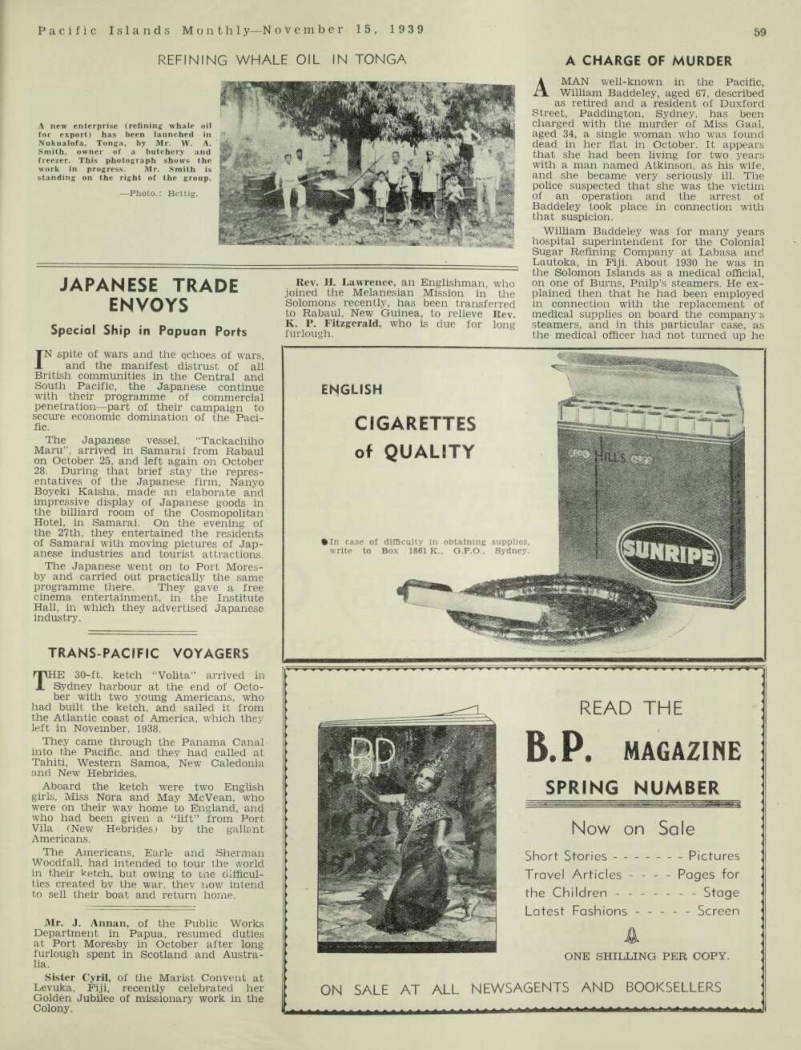
A new enterprise (refining whale oil for export) has been launched in Nukualofa, Tonga, by Mr. W. A.
Smith, owner of a butchery and freezer. This photograph shows the work in progress. Mr, Smith is standing on the right of the group.
—Photo.: Hettig.
Japanese Trade
Envoys
Special Ship in Papuan Ports
IN spite of wars and the qchoes of wars, and the manifest distrust of all British communities in the Central and South Pacific, the Japanese continue with their programme of commercial penetration—part of their campaign to secure economic domination of the Paci fic.
The Japanese vessel, “Tackachiho Mam”. arrived in Samarai from Rabaul on October 25, and left again on October 28. During that brief stay the repres entatives of the Japanese firm, Nanyo Boyeki Kaisha, made an elaborate and impressive display of Japanese goods in the billiard room of the Cosmopolitan Hotel, in Samarai. On the evening of the 27th, they entertained the residents of Samarai with moving pictures of Jap anese industries and tourist attractions.
The Japanese went on to Port Mores by and carried out practically the same programme there. They gave a free cinema entertainment, in the Institute Hall, in which they advertised Japanese industry.
Transpacific Voyagers
THE 30-ft. ketch “Volita” arrived in Sydney harbour at the end of Octo ber with two young Americans, who had built the ketch, and sailed it from the Atlantic coast of America, which they left in November. 1938.
They came through the Panama Canal into the Pacific, and they had called at Tahiti, Western Samoa, New Caledonia and New Hebrides.
Aboard the ketch were two English girls, Miss Nora and May McVean, who were on their way home to England, and who had been given a “lift” from Port Vila (New Hebrides) by the gallant Americans.
The Americans, Earle and Sherman Wocdfall, had intended to tour the world in their ketch, but owing to the difficul ties created by the war. they now intend to sell their boat and return home.
Mr. J. Annan, of the Public Works Department in Papua, resumed duties at Port Moresby in October after long furlough spent in Scotland and Austra lia.
Sister Cyril, of the Marist Convent at Levuka, Fiji, recently celebrated her Golden Jubilee of missionary work in the Colony.
Rev. H. Lawrence, an Englishman, who joined the Melanesian Mission in the Solomons recently, has been transferred to Rabaul, New Guinea, to relieve Rev.
K. P. Fitzgerald, who is due for long furlough.
A Charge Of Murder
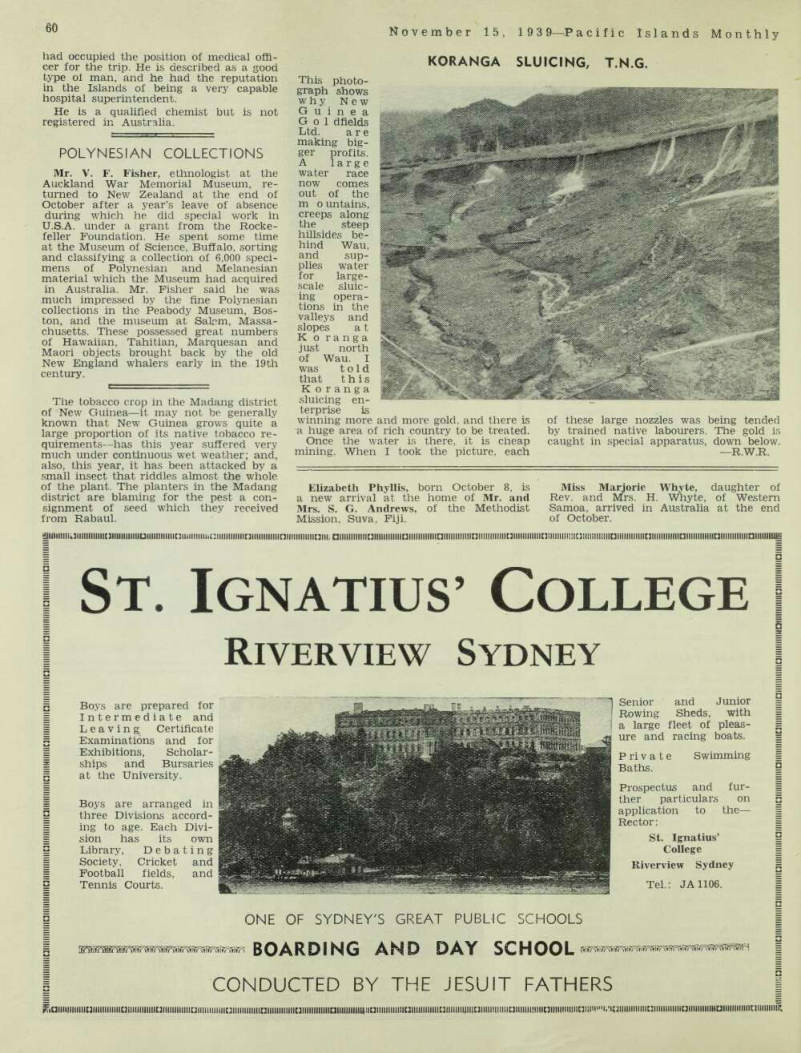
A MAN well-known in the Pacific, William Baddeley, aged 67, described as retired and a resident of Duxford Street, Paddington, Sydney, has been charged with the murder of Miss Gaai, aged 34, a single woman who was found dead in her flat in October. It appears that she had been living for two years with a man named Atkinson, as his wife, and she became very seriously ill. The police suspected that she was the victim of an operation and the arrest of Baddeley took place in connection with that suspicion.
William Baddeley was for many years hospital superintendent for the Colonial Sugar Refining Company at Labasa and Lautoka, in Fiji. About 1930 he was in the Solomon Islands as a medical official, on one of Burns, Philp’s steamers. He ex plained then that he had been employed in connection with the replacement of medical supplies on board the company s steamers, and in this particular case, as the medical officer had not turned up he
had occupied the position of medical offi cer for the trip. He is described as a good type of man, and he had the reputation in the Islands of being a very capable hospital superintendent.
He is a qualified chemist taut is not registered in Australia.
Advertisements & other items, p. 61 (1 item)
B.P. Magazine
ENGLISH
CIGARETTES
of QUALITY
iln case of difficulty in obtaining supplies, write to Box 1861 K., G.P.0., Sydney. :% m
READ THE
B.P. MAGAZINE
SPRING NUMBER
Now on Sole
Short Stories - - Pictures Travel Articles - - - - Pages for the Children --- Stage Latest Fashions --- Screen
ONE SHILLING PER COPY.
ON SALE AT ALL NEWSAGENTS AND BOOKSELLERS
Polynesian Collections
Mr. V. F. Fisher, ethnologist at the Auckland War Memorial Museum, re turned to New Zealand at the end of October after a year’s leave of absence during which he did special work in U.S.A. under a grant from the Rocke feller Foundation. He spent some time at the Museum of Science, Buffalo, sorting and classifying a collection of 6,000 speci mens of Polynesian and Melanesian material which the Museum had acquired in Australia. Mr. Fisher said he was much impressed by the fine Polynesian collections in the Peabody Museum, Bos ton, and the museum at Salom, Massa chusetts. These possessed great numbers of Hawaiian, Tahitian, Marquesan and Maori objects brought back by the old New England whalers early in the 19th century.
The tobacco crop in the Madang district of New Guinea —it may not be generally known that New Guinea grows quite a large proportion of its native tobacco re quirements—has this year suffered very much under continuous wet weather; and, also, this year, it has been attacked by a small insect that riddles almost the whole of the plant. The planters in the Madang district are blaming for the pest a con signment of seed which they received from Rabaul.
Koranga Sluicing, T.N.G.
This photo graph shows why New Guinea G o 1 dfields Ltd. are making big ger profits.
A large water race now comes out of the m ountains, creeps along the steep hillsides be hind Wau, and sup plies water for large scale sluic ing opera tions in the valleys and slopes a t K o ranga just north of Wau. I was told that this Kora n g a sluicing en terprise is
winning more and more gold, and there is a huge area of rich country to be treated.
Once the water is there, it is cheap mining. When I took the picture, each
of these large nozzles was being tended by trained native labourers. The gold is caught in special apparatus, down below.
R.W.R.
Elizabeth Phyllis, born October 8. is a new arrival at the home of Mr. and Mrs. S. G. Andrews, of the Methodist Mission. Suva, Fiji.
Miss Marjorie Whyte, daughter of Rev. and Mrs. H. Whyte, of Western Samoa, arrived in Australia at the end of October.
Advertisements & other items, p. 62 (2 items)
60
November 15, 193 9—P acific Islands Monthly
St. Ignatius’ College
Riverview Sydney
Boys are prepared for Intermediate and Leaving Certificate Examinations and for Exhibitions, Scholarships and Bursaries at the University.
Boys are arranged in three Divisions according to age. Each Division has its own Library, Debating Society, Cricket and Football fields, and Tennis Courts. mwm ZZS ■ -'!rsiPrf Senior and Junior Rowing Sheds, with a large fleet of pleasure and racing boats.
P ri v a t e Swimming Baths.
Prospectus and further particulars on application to the — Rector: St. Ignatius’
College Riverview Sydney Tel.: JA 1106.
ONE OF SYDNEY'S GREAT PUBUC SCHOOLS
™ BOARDING AND DAY SCHOOL
CONDUCTED BY THE JESUIT FATHERS
W. Samoa
German Opinion In
From a Special Correspondent
Apia, Oct. 20.
I WONDER whether it has occurred to anyone that the present is an oppor tune time for Britain and New Zea land to declare the Mandate over Western Samoa at an end, and to formally annex Western Samoa to the British Empire.
I can assure you that the move would be heartily supported by practically the whole of the natives, and it may interest you to know that about 90 per cent, of the Germans, and practically the whole of the half-German population, would be in favour of the move.
The Germans in Samoa generally show no disposition to apologise for their Ger man blood; but I should say that most of them are wholly and sincerely anti- Nazi, and hope fervently for an over throw of the Nazi power, and closer re lations between the British and the Ger mans in the future.
Samoa Under War
Conditions
From Our Own Correspondent
Apia. Oct. 27.
OAMOA under war conditions shows >5 very little change from normal life.
The uniforms of the Samoan Defence Force are more frequently seen and, the community feels the gradual increase in commodity and imported food prices— especially sugar, rice and tobacco, on which increased duties have been levied.
A complete control of benzine and kero sene consumption, of foodstuffs and food prices, and particularly of wheaten flour, has been established. Mr. D. R. Eden, general manager of the New Zealand Re paration Estates, has been appointed Food Controller, Oil Fuel Controller and Wheat Flour Controller, for the purposes of the emergency regulation now in force.
The European ladies of Apia have formed a Red Cross Society and a patriotic society—the latter (of which Mrs. Wallace is president) for the pur pose of providing comforts for the per manent members of the Local Defence Force.
All except 14. out of the 41 Germans who originally were detained have been released on parole, and are following their usual occupations.
The local price of copra is 4/6 per 100 lb., and large quantities are being de livered by the natives. A splendid cocoa crop is being picked and, with the re ported considerable rise in price, cocoa planters should benefit greatly.
A small schooner, 48 ft. long, 13 ft. beam, and with a 42 h.p. engine as auxiliary, has just been completed at the boatbuilding yards of the Kwato Mission, Samarai, Eastern Papua. The vessel was designed by Mr. Arthur Swin field, while he was technical instructor at the mission, and has been completed by native workmen trained by Mr, Swin field.
Sheeba Options N.L., a mining com pany formed in Sydney in 1934 with a capital of £l,OOO and registered in New Guinea early in 1935 to operate in the Morobe district, was struck off the regis ter of N.G. companies in October at its own request.
Murder In Samoa
From Our Own Correspondent
Apia, Oct. 23.
ON the afternoon of Saturday, October 21, a Niue Islander named Foupa, who was employed as labour fore man by the Apia Stevedoring Company, was mysteriously murdered while work ing on his taro plantation, just off the Siumu Road, south of Vailima, near Apia.
The death was caused by severe knife injuries on the neck. The murdered man was working by .himself on his taro patch.
No motive for the murder is known.
The Apia police have the matter in hand. This is the first murder which has occurred in the Territory for many years.
A son was born to Mr. and Mrs. R. S.
Ridgley, of Nasinu, Fiji, on October 18.
Mr. Ridgley is a master at the Fiji Boys’
Grammar School.
Miss Alice Pigott, Melanesian Mission worker in New Britain, has returned to Australia after serving for a year at Kumbun. Her withdrawal from the mis sion field is the result of restricted sup port caused by the war.
Advertisements & other items, pp. 63-64 (2 items)
61
Pacific Islands Monthl y—N ovember 15, 1930
/Marvellous N
WIDOW, Australian, 57, fair complexion, wishes to correspond with tall, active man, 60 to 65. Would like to return to tropics, view to matrimony. Snaps exchanged. Write: — Mrs. A. Dee, G.P.O., Brisbane.
II I I
/ IT ' S X
/MARVELLOUS N
THE WAY KOLYNOS
LASTS AND LASTS..
AND LOOK AT MY
TEETH NOW-
REALLV
< SPARKLING Jmi
KOLYNOS lasts TWICE as long because you use
only HALF as much
When you’re doing THIS to your present tube KOLYNOS will still look like THIS !/■ OLYNOS is a concentrated den tal cream, made from the dental prescription of Doctor N. S. Jenkins.
You need only half an inch on your brush —just half as much as ordinary tooth pastes. But that half inch of Kolynos multiplies itself 25 times inside your mouth. It bursts into a glorious foam that surges into every pit, fissure and crevice, and cleans and purifies in one action.
Have gleaming white teeth, and save money at the same time, with Kolynos. Awarded the Blue Seal of the Institute of Hygiene, London, for last 20 years. Get a tube to-day. At all chemists and stores medium size 1/3; large 2/-. fC3 r«' - ■ -■ > n-
\ INCH ON VRV
BRUSH is Enough
MOUNTAIN
ml HOLIDAYS
VI / » c m & v< &
In a cosmopolitan atmosphere
The smartest pleasure seekers the world over gather at Lapstone, aptly termed an Australian National Asset.
Here is everything you can demand of man or nature PRIVATE SWIM-
MING POOL; PRIVATE GOLF
COURSE: BRILLIANT BALLROOM;
BILLIARD ROOM; LIBRARY;
TENNIS COURTS; together with a feature no other Hotel can offer— “ The Million Acre” Panoramic View.
From £4/4/- weekly, inclusive From 15/- daily.
LAPSTONE HOTEL
BLUE MOUNTAINS, N.S.W., AUSTRALIA
(MANAGER; H. J. PARKER)
Clly Booking Office: 12a MARTIN PLACE ’Phone: BW 1553 Telegrams & Cables: “Lapstone” Clenbrook
UNDER DISTINGUISHED MANAGEMENT
fsjol^
h ■I m m A f « GERMS of Diphtheria, Malaria, Dhoble Itch, Tinea or Surfers’ Foot, cannot live under “TENAX” lather.
Tropical Skin Diseases can be cured by its regular use.
only 9° P er
Tablet
NO VARIATION HAS BEEN MADE
IN ITS COMPOSITION—judged
from the only true angle, that of quality, TENAX has no competitors as a satisfactory germicidal soap, eleven times as rapid in action as carbolic, yet NON-IRRITANT and NON-POISONOUS. The Medical Journal of Australia states that TENAX is a germicidal soap that may be recommended with confidence.
TENAX
GENUINE
GERMICIDAL
SOAP
A PRODUCT OF AUSTRALIAN SOAPS LTD.
Islands Display at N.Z.
Exhibition
THE Islands Territories of the Central and South Pacific are well repres ented at the New Zealand Centennial Exhibition, which opened in Wellington on November 8, and which will continue until April next.
This should have been a notable event m the history of the South Seas— marking, as it does, the acquisition by Great Britain of the large and fertile Dominion of New Zealand—and pre parations had been made accordingly by the New Zealand Government; but war conditions have placed restrictions on overseas travel, and the exhibition now probably will be little more than a local affair.
However, there are notable displays made by the Governments of Fiji, of Western Samoa, of Cook Islands, and of Tonga.
Early in October, 50 cases of exhibits arrived in Wellington from Fiji, in the care of the supervisor of the display, Mr. D. A. Donald, of the Fiji Depart ment of Agriculture. They included curios, native mats and cloths, photo graphs and mining samples. The display shows most of the aspects of the life of the Colony, and of the industries established there. They are in a large enclosure built in the form of a Fiji meeting-house, with open sides.
As Western Samoa is a Territory in New Zealand’s care, it is natural that the Samoan display is large and im pressive. It is laid out in a fale (or house), in charge of a party of four Samoans (Sergeant Fitisemanu, two Samoan car penters and a kava girl, Leleaga Seu manutafa). The party brought from Sa moa material for the fale, mats, a kava bowl and a case of kava roots, for pre paration of the ceremonial beverage. The fale is a beautiful example of native workmanship, for which the chief car penter, Fao Taito, has been given much praise.
Pattern Service
PACK month we publish a Fashions design, “ patterns of which may be purchased by our readers direct from this office, post free. To obtain a pattern, print your name and address below, giving the number of the pattern and the bust size, and send to “Pattern Department”. Pacific Islands Monthly, Box 3408 R, G.P.0., Sydney; enclose also the price of the pattern in postal note or stamps.
It will be sent by return mail.
Name Address Pattern Number size
6728. —This quaint bolero frock is distinguished by one of the newest jackets, with matching skirt effect. With its cowled bodice your frock becomes an attractive two-purpose ensemble when worn with short or long sleeved bolero in contrasting shade. The pattern is available in sizes 32, 34, 36, 38, 40, and 48 in. bust, at 1/1, post free.
Miss Jessie Irene Best, twin daughter of Mr. and Mrs. C. E. Best, of Lautoka, Fiji, was married to Mr. Charles Vincent
Wardrop, formerly of Kalgoorlie, Western
Australia, in October.
Fashion Hints for Islands Women
By Therese
‘TJIHE times are out of joint”, as Shake- J. speare would have said, and we need every bit of brightness in our lives that we can find. With marvellous psy chology, designers have chosen the right moment to present their little bits of absurdity, and there is ahead a summer full of colour and charm. All sorts of designs are splashed boldly on plain grounds in silks, cottons, linens and near silks and, as most things have marvellous washing propensities these days, more than half the worry of a sum mer wardrobe is over.
It is easy to choose clothes that will take you smartly through the summer.
The choice of materials is so wide and the variations in theme of frocks for every hour of the day so delightful, that there is no room left for dullness and mon otony.
There is a definitely feminine trend this season. Frills and flounces are part of fashion’s caprice, and are really de lightful, with the new cottons. A snow white frill, peeping from beneath the hem of a frock, or a frill of brilliant con trasting colour is all part of the “Return to Femininity” campaign. Women take on a more fragile air, and once more be come creatures of frills and laces, as in grandmama’s day, EVEN casual everyday frocks are de cidedly feminine. There are soft bows at the neck of brief dresses for summer lazing. Skirts of plain linen are fastened to tiny boleros with large buttons, and the accompanying blouses of crisp fresh gingham are tied with large bows at the neckline. White linen is worn with a red and white check
biouse, blue with blue and white, or you may let your fancy run riot and choose any colour combination your fancy dic tates, and that fits in with your ward robe plan.
Wear a white straw hat, white washing gloves (wash leather or fabric), and white or two-tone shoes and you will walk abroad assured of success.
For spectator spbrts frocks, uncrushable linens and cottons are the best all round bet. These, too, have their feminine fripperies. Crisp jabots are buttoned on the front of the blouse, or quaint little epaulettes of sheer materials and lace are added. The dernier cri for sports dresses is the spool silhouette—broad pad ded shoulders, narrow waists and skirts that flare umbrella fashion from the hips.
This is gained with excellent effect in a white pique button-through frock that is definitely Dutch in design. Capacious pockets are a welcome feature, and the slimness of the waist is emphasised by a wide belt of spotted fabric. A globe trotter bag to match is thrown over the shoulder in true sporting style, and the turban which completes the outfit matches up with bag and belt.
SEASIDE fashions are more glamorous than ever this season—a very gay season. When the modern girl goes to the sea these days she leaves her town clothes behind her. Though the shorts she dons may be a little daring, and her swim suits reminiscent of the naughty nineties, she loses none of her femininity.
Really smart women are choosing beach clothes with an eye to over-coming figure deficiencies. Big hips are hidden by wide ballooning dresses and shorts; bust
lines are helped by draped sun tops; and only the very slim wear trousers, which are usually in pastel linen or hop sack and part of well-cut suits. These slacks are very popular overseas, and are worn with loose-fitting French coats to contrast.
One of the most intriguing beach fashions this year is the “puddle suit”, a sun overall with half mast slacks attached to a sun top. These are heaven sent for those women with doubtful above the-leg lines to whom shorts are tabu.
Darling of the spectator season is the gypsy jacket in lovely colour combina tions, such as rich purple, with swathed basque in pillar box red. Worn over a skirt of pillar box red it will turn the head of every male in sight. A dashing Polynesian print of red and white, in heavy cotton hopsack, goes to the mak ing of a sleek-fitting, side-fastening, swirl-skirted success frock, with gener ously padded shoulders and wasp waist which again displays the spool silhouette.
A lightning slip of the zip, and from it there emerges an eye-catching white satin lastex swim suit, slim and wickedly brief.
THE famous fish-net fashion is the direct result of the Polynesian influ ence and it is presented in a new and exciting way in a model that has set all the smart over-seas resorts agape. A well
fitting jacket of fish-net, in some gay colour, boasts extended shoulders and wrist-length sleeves, and when removed shows, in all its charm, an impeccably tailored sunback frock, in crease-resist ant fabric of contrasting shade. A fish net turban and fish-net sandals, with block wooden heels, add just the touch required for perfection.
There are also many attractive and useful beach accessories, including enor mous bags in fabric on which the sea has no deleterious effect. They are gay and effective, and have room for those hun dred and one things that are needed for the modern woman’s complexion.
There are beach coats, charming and original in design, mostly tailored and of varying lengths. Some have hoods at tached to protect the head from a too ardent sun, or to hide straggling curls after bathing. There are also short, swagger beach-coats of towelling, and these are topped by Japanese and Mexi can straw hats or demure sunbonnets.
THE craze for peasant handkerchiefs is on the wane. They have been super seded by fish-net turbans which look really charming for any sports occasions.
The contrasts running through the whole beach and sports set up are apt to make one rather dizzy with their brilliance. Three things remain clear, however, cottons are trumps and colour and line are important. On them rests the responsibility for the success of your summer wardrobe.
News was received in Sydney by radio in mid-November of the death of Colleen Ferris, daughter of Pastor David and Mrs.
Ferris, of the S.D.A. Mission on Malaita, 8.5.1. Colleen was aged three years.
Mr. Geoffrey A. Warner, of Port Moresby, Papua, married Miss Lilian Joyce Lewis, of Colac, Vic., at St. John’s Church of England, Port Moresby, on October 21.
Mr. W. H. Robinson, of the Customs Department, Samarai, Papua, has been transferred to Port Moresby. Mr. E. H.
Dettman. of Port Moresby, has taken his place.
Mr. and Mrs. A. Hiscox and their three children have completed furlough in Aus tralia, and will return shortly to Rabaul, New Guinea, where he is headmaster of the S.D.A. Mission training school at Put Put.
Advertisements & other items, pp. 65-66 (2 items)
63
Pacific Islands Monthl y—N ovember 15, 1939
Under L Ying
At Blue Mountains—Springwood, N.S.W.
Springwood Ladies 1 College
Est. 1897. Kindergarten to Leaving Certificate, Tennis, Riding, Swimming, Team Games. Unequalled climate. Pure Jersey Milk. Senior and Junior Houses. Openair sleeping. Inclusive fees. Special vacation arrangements for Island pupils.
M. E. DURAND, Principal.
UNDER L YING
4 V New colours and styles blended into the loveliest creations in lingerie for this season. £ o ve£ie%
LINQE
CINNAMOLIA
The hot weather is now approaching with its dysentery, diarrhoea, and other seasonal infectious diseases of the alimentary canal EVERY tropical home should have on hand a bottle of the above remedy—in case—so as to be ready to attack the germs as soon as the first symptoms of disease appear.
For years scientists and medical men have sought for a safe, powerful germicide to treat Infections of the intestinal tract without harming the tissues.
Here it is! CINNAMOLIA! Guaranteed to contain no poisons or harmful drugs.
Price 3/- per bottle from
FALKS PHARMACY,
238 GEORGE ST., SYDNEY.
Wholesale Rates to Chemists, Hospitals,
etc., from CINNAMOLIA PREPARATIONS,
17 Murray Street, Waterloo, N.S.W.
Tel.: MX 1702.
KAMB A L A
CHURCH OF ENGLAND
SCHOOL FOR GIRLS
FOUNDED 1887
A Day and Board-
ing School for
Girls.
KINDERGARTEN TO
LEAVING CERTIFICATE
HONORS.
RESIDENT QUALIFIED
SPORTS MISTRESS.
Prospectus on application to the Principal . . .
MISS F. HAWTHORNE, B.A.
KAMBALA SCHOOL
ROSE BAY. SYDNEY
. ' - El r m m Wa i » tip i ‘KAMBALA” Ideally situated in 5 acres of ground ... 5 Tennis Courts
Another Plane
Lost
New Guinea Air Accident
A SMALL Fox Moth plane, owned by the Glasson and Parer Syndicate and piloted by William Porgan Smith, left Salamaua for Wau at 3 p.m. on Mon day, November 6, and was seen to dis appear into dense clouds over the Black Cat Ranges, in the direction of Wau. It did not report into Wau drome that even ing and, during the two following days, November 7 and 8. search planes were out in all directions.
On November 8, Mr. Sutcliffe, from a Carpenter mailplane, saw the missing Moth down in the Bitoi Valley, and ground parties set out for it. They found Mr. Smith, uninjured. His plane crashed into a tree-top. He climbed down the tree, and started to walk to Salamaua.
The Boeing plane, recently imported to the Mandated Territory by the Glas son and Parer Syndicate, crashed in the Black Cat Ranges over a month ago and Pilot Hugh Bond was found near the plane after three days of search. He is still in hospital, in Wau, recovering from his injuries.
An accident occurred on October 22 near Port Moresby, Papua, when a motor truck driven by Master Foley, accom panied by two young friends (Robert Mustard and Kenneth Sinclair) got out of control on the main road near Koki, and ran over the embankment by the sea front, where the three boys were thrown out on to the rocky surface. All were taken to hospital. Foley had a broken elbow and Sinclair a lacerated scalp.
Young Chinese In New Guinea
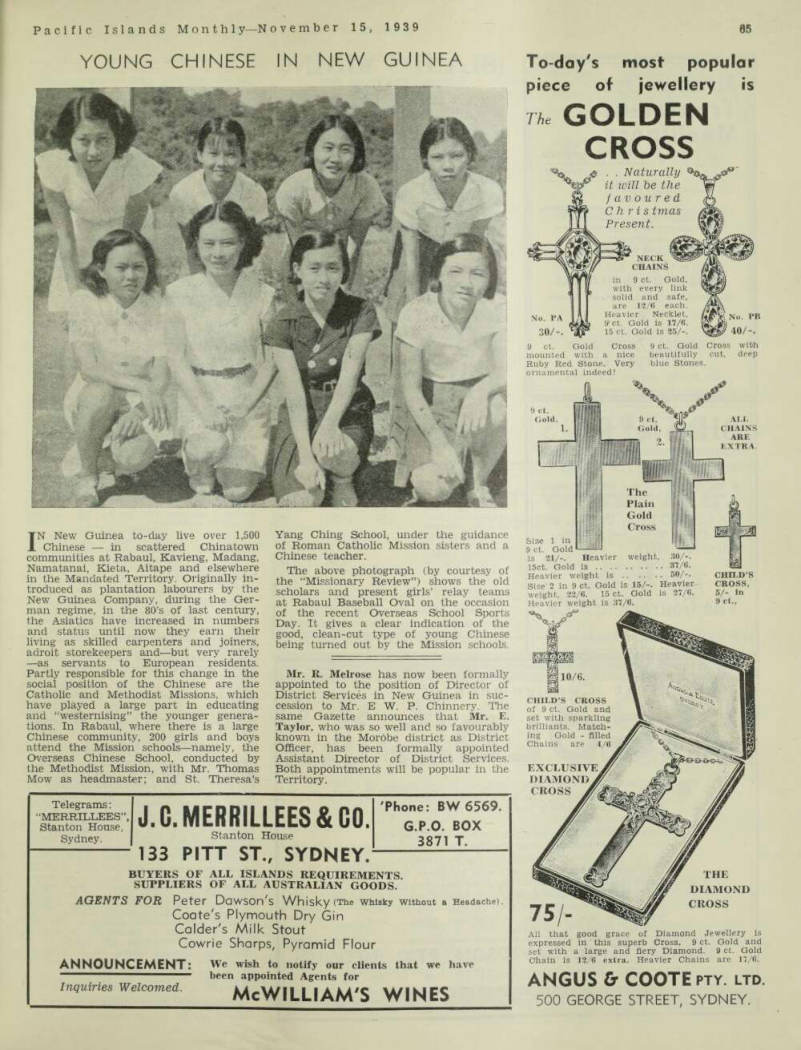
IN New Guinea to-day live over 1,500 Chinese —in scattered Chinatown communities at Rabaul, Kavieng, Madang, Namatanai, Kieta, Aitape and elsewhere in the Mandated Territory. Originally in troduced as plantation labourers by the New Guinea Company, during the Ger man regime, in the 80’s of last century, the Asiatics have increased in numbers and status until now they earn their living as skilled carpenters and joiners, adroit storekeepers and —but very rarely —as servants to European residents.
Partly responsible for this change in the social position of the Chinese are the Catholic and Methodist Missions, which have played a large part in educating and “westernising” the younger genera tions. In Rabaul, where there is a large Chinese community, 200 girls and boys attend the Mission schools—namely, the Overseas Chinese School, conducted by the Methodist Mission, with Mr. Thomas Mow as headmaster; and St. Theresa’s
Yang Ching School, under the guidance of Roman Catholic Mission sisters and a Chinese teacher.
The above photograph (by courtesy of the “Missionary Review”) shows the old scholars and present girls’ relay teams at Rabaul Baseball Oval on the occasion of the recent Overseas School Sports Day. It gives a clear indication of the good, clean-cut type of young Chinese being turned out by the Mission schools.
Mr, R. Melrose has now been formally appointed to the position of Director of District Services in New Guinea in suc cession to Mr. E W. P. Chinnery. The same Gazette announces that Mr. E.
Taylor, who was so well and so favourably known in the Morbbe district as District Officer, has been formally appointed Assistant Director of District Services.
Both appointments will be popular in the Territory.
Advertisements & other items, pp. 67-68 (2 items)
65
Pacific Islands Monthl y—N ovember 15, 1939
The Golden
To-doy's most popular
piece of jewellery is
.// 'd
CROSS
. . Naturally
it ivill he the
favoured
Chris tmas Present. in 9 ct. Gold, with every link solid and safe, are 12/6 each.
Heavier Necklet, ffct. Gold is 17/6. 15 ct. Gold is 25/-, R M l*H 9 ct. Gold Cross mounted with a nice Ruby Red Stone. Very ornamental indeed! 9 ct. Gold Cross with beautifully cut, deep blue Stones. 9 ct.
Gold, Gold \LI
CHAINS
\KI
EXTRA.
The Plain Gold Cross Size 1 in 9 ct. Gold is 21/-. Heavier weight, 30/-. 15ct. Gold is 37/6.
Heavier weight is 50/-.
Size 2 in 9 ct. Gold is 15/-. Heavier weight, 22/6. 15 ct. Gold is 27/6.
Heavier weight is 37/6.
CHILD’S
CROSS
5/- In 9 ct., 110/6
EXCLUSIVE
DIAMOND i
(ROSS //
75 -
THE
DIAMOND
CROSS
All that good grace of Diamond Jewellery is expressed in this superb Cross. 9 ct. Gold and set with a large and fiery Diamond. 9 ct. Gold Chain is 12/6 extra. Heavier Chains are 17/6.
ANGUS & COOTE pty. ltd.
500 GEORGE STREET, SYDNEY.
Telegrams:
“MERRILLEES”,
Stanton House, Sydney.
J.C. MERRILLEES & CO.
Stanton House
133 PITT ST., SYDNEY.
'Phone: BW 6569.
G.P.O. BOX
3871 T.
BUYERS OF ALL ISLANDS REQUIREMENTS.
SUPPLIERS OF ALL AUSTRALIAN GOODS.
AGENTS FOR Peter Dawson's Whisky (The whisky without a Headache).
Coate's Plymouth Dry Gin
Calder's Milk Stout Cowrie Sharps, Pyramid Flour
ANNOUNCEMENT;
Inquiries Welcomed.
We wish to notify our clients that we have been appointed Agents for
McWILLIAM'S WINES
Mining Ore
Treatment
Machinery
COMPLETE CYANIDE
PLANTS SUPPLIED
Dorr Classifiers, Dorr Thickeners, Dorr Agitators.
Oliver Filters Merril Crowe Zinc Dust Gold Precipitation Richardson Mine Pans
FANS AND AIR HEATERS
For Ventilation, Copra Drying Rooms, etc. • Enquire from
CROSSLE, DUFF AND
MACINTOSH LTD.
52 Bridge Street, SYDNEY.
BIRKMYRE’S
WATERPROOF CANVAS
% The Original and Best for all purposes where a thoroughly waterproof covering is required.
S A I LCLOTHS. DUCKS, &c.
of FLAX, HEMP, and COTTON.
FISHING NETS,
LINES and TWINES
Extensive Stocks Carried.
Ensuring Prompt Despatch
The Gourock*°sr‘Co.
LIMITED
397 KENT STREET. SYDNEY, N.S.W.
Your Next Consignment of
GOLD
m If you place your gold business in the hands of Garrett & Davidson you are assured of accuracy of assay, efficient service, and prompt payment at highest ruling rates.
Garrett & Davidson are acknowledged by the foremost gold organisations of the Southern Hemisphere as the main clearing house for precious metals.
This enviable reputation was won by sheer force of merit based on integrity of business methods, modern plant, skilled metallurgists, and meticulous attention to even the smallest consignment. So for better service and complete satisfaction, consign your gold to Garrett & Davidson.
GARRETT & DAVIDSON PTY. LTD.
ASSAYERS METALLURGISTS REFINERS
REGENT & GEORGE STREETS, SYDNEY.
Islands Mining
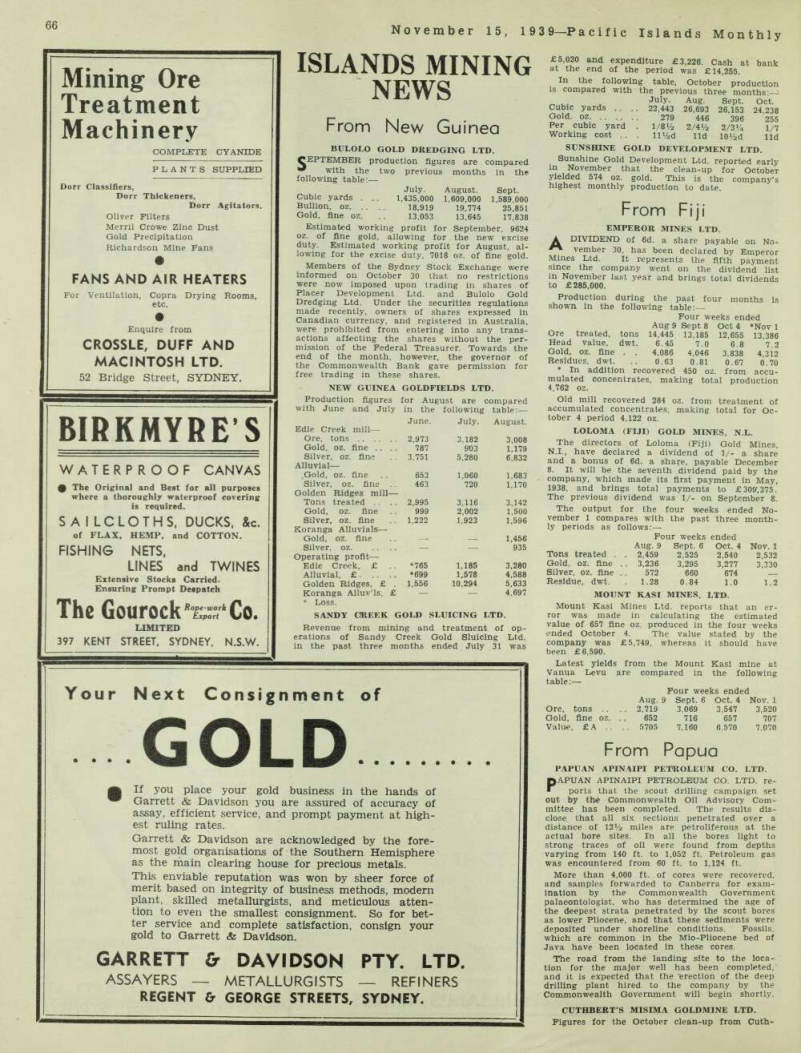
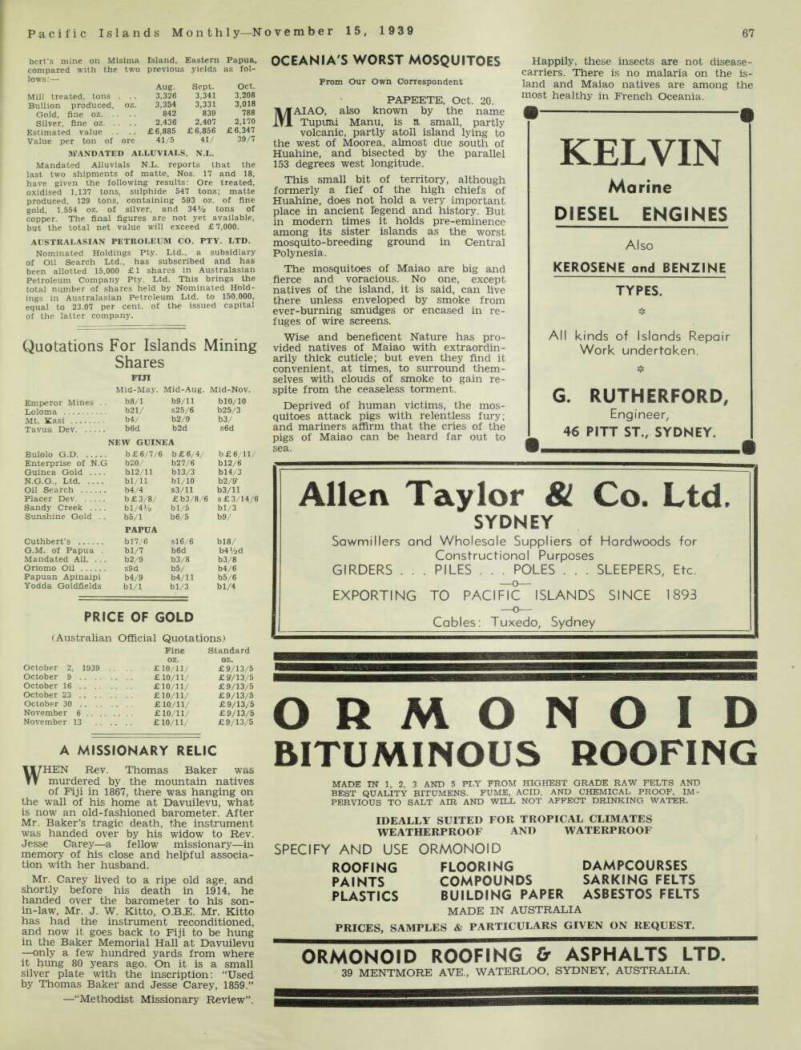
News
From New Guinea
Bulolo Gold Dredging Ltd.
CEPTEMBER production figures are compared ** with the two previous months in the following table:—
Estimated working profit for September. 9624 oz. of fine gold, allowing for the new excise duty. Estimated working profit for August, al lowing for the excise duty, 7018 oz. of fine gold.
Members of the Sydney Stock Exchange were informed on October 30 that no restrictions were now imposed upon trading in shares of Placer Development Ltd. and Bulolo Gold Dredging Ltd. Under the securities regulations made recently, owners of shares expressed in Canadian currency, and registered in Australia, were prohibited from entering into any trans actions affecting the shares without the per mission of the Federal Treasurer. Towards the end of the month, however, the governor of the Commonwealth Bank gave permission for free trading in these shares.
New Guinea Goldfields Ltd.
Production figures for August are compared with June and July in the following table:—
Sandy Greek Gold Sluicing Ltd.
Revenue from mining and treatment of op erations of Sandy Creek Gold Sluicing Ltd. in the past three months ended July 31 was
£5,020 and expenditure £3,226. Cash at bank at the end of the period was £14,255.
In the following table, October production is compared with the previous three months:—
Sunshine Gold Development Ltd.
Sunshine Gold Development Ltd. reported early in November that the clean-up for October yielded 574 oz. gold. This is the company’s highest monthly production to date.
From Fiji
Emperor Mines Ltd.
A DIVIDEND of 6d. a share payable on No vember 30, has been declared by Emperor Mines Ltd. It represents the fifth payment since the company went on the dividend list in November last year and brings total dividends to £285,000.
Production during the past four months Is shown in the following table:—
* In addition recovered 450 oz. from accu mulated concentrates, making total production 4,762 oz.
Old mill recovered 284 oz. from treatment of accumulated concentrates, making total for Oc tober 4 period 4,122 oz.
Loloma (Fiji) Gold Mines, N.L.
The directors of Loloma (Fiji) Gold Mines, N. 1., have declared a dividend of 1/- a share and a bonus of 6d. a share, payable December 8. It will be the seventh dividend paid by the company, which made its first payment in May, 1938, and brings total payments to £309’,375.
The previous dividend was 1/- on September 8.
The output for the four weeks ended No vember 1 compares with the past three month ly periods as follows:
Mount Kasi Mines, Ltd.
Mount Kasi Mines Ltd. reports that an er ror was made in calculating the estimated value of 657 fine oz. produced in the four weeks ended October 4. The value stated by the company was £5,749, whereas it should have been £6,590.
Latest yields from the Mount Kasi mine at Vanua Levu are compared in the following table:—
From Papua
Papuan Apinaipi Petroleum Co. Ltd.
Papuan Apinaipi Petroleum Co. Ltd. Re
ports that the scout drilling campaign set out by the Commonwealth Oil Advisory Com mittee has been completed. The results dis close that all six sections penetrated over a distance of 12V 2 miles are petroliferous at the actual bore sites. In all the bores light to strong traces of oil were found from depths varying from 140 ft. to 1,052 ft. Petroleum gas was encountered from 60 ft. to 1,124 ft.
More than 4,000 ft. of cores were recovered, and samples forwarded to Canberra for exam ination by the Commonwealth Government palaeontologist, who has determined the age of the deepest strata penetrated by the scout bores as lower Pliocene, and that these sediments were deposited under shoreline conditions. Fossils, which are common in the Mio-Pliocene bed of Java have been located in these cores.
The road from the landing site to the loca tion for the major well has been completed, and it is expected that the 'erection of the deep drilling plant hired to the company by the Commonwealth Government will begin shortly.
Cuthbert’S Misima Goldmine Ltd.
Figures for the October clean-up from Cuth
July.
August.
Sept.
Cubic yards . .. 1,435,000 1,609,000 1,589,000 Bullion, oz. .. 18,919 19,774 25,851 Gold, fine oz. 13,053 13,645 17,838
June.
July.
August.
Edie Creek mill— Ore, tons 2.973 3,182 3,008 Gold, oz. fine .. .. 787 903 1,179 Silver, oz. fin? 3.751 5,280 6.832 Alluvial— Gold, oz. fine 653 1,060 1,683 Silver, oz. fine 463 720 1.170 Golden Ridges mill— Tons treated . . .. 2,995 3,116 3,142 Gold, oz. fine 999 2,002 1,500 Silver, oz. fine 1,222 1,923 1,596 Koranga Alluvials— Gold, oz. fine — — 1,456 Silver, oz — — 935 Operating profit— Edie Creek, £ *765 1,185 3,280 Alluvial, £ •699 1,578 4,588 Golden Ridges, £ . 1,556 10,294 5,633 Koranga Alluv’ls, £ — — 4,697 * Loss.
„ July. Aug. Sept. Oct.
Cubic yards .. .. 22.443 26,693 26,153 24,238 GoW- 02 279 446 396 255 Per cubic yard . l/8y 2 2/4»/ 2 2/3V 4 1/7 Working cost .. . liy 2 d lid loy 2 d lid
Four weeks ended Aug 9 Sept 8 Oct 4 *Nov 1 Ore treated, tons 14,445 13,185 12,655 13,386 Head value, dwt. 6.45 7.0 6.8 7.2 Gold, oz. fine 4,086 4.046 3,838 4,312 Residues, dwt. 0.63 0.81 0.67 0.70
Four weeks ended Aug. 9 Sept. 6 Oct. 4 Nov. 1 Tons treated . . 2,459 2,525 2,540 2,532 Gold, oz. fine . . 3,236 3,295 3,277 3,330 Silver, oz. fine . 572 660 674 Residue, dwt. 1.28 0.84 1.0 1.2
Pour weeks ended Aug, 9 Sept. 6 Oct. 4 Nov. 1 Ore. tons . . . . 2,719 3,069 3,547 3,520 Gold, fine oz. . . 652 716 657 707 Value. £ A .. .. 5705 7,160 6.570 7,070
bert’s mine on Misima Island, Eastern Papua, compared with the two previous yields as fol lows:
Mandated Alluvials, N.L.
Mandated Alluvials N.L. reports that the last two shipments of matte, Nos. 17 and 18, have given the following results: Ore treated, oxidised 1,137 tons, sulphide 547 tons; matte produced, 129 tons, containing 593 oz. of fine gold, 1,554 oz. of silver, and 34y 2 tons of copper. The final figures are not yet available, but the total net value will exceed £7,000.
Australasian Petroleum Co. Pty. Ltd.
Nominated Holdings Pty. Ltd., a subsidiary of Oil Search Ltd., has subscribed and has been allotted 15,000 £1 shares in Australasian Petroleum Company Pty. Ltd. This brings the total number of shares held by Nominated Hold ings in Australasian Petroleum Ltd. to 150,000, equal to 23.07 per cent, of the issued capital of the latter company.
Aug. Sept. Oct.
Mill treated, tons . .. 3,326 3,341 3,208 Bullion produced, oz. 3,354 3,331 3,018 Gold, fine oz 842 839 788 Silver, fine oz 2,436 2,407 2,170 Estimated value .. .. £6.885 £6.856 £6,347 Value per ton of ore 41/5 41/ 39/7
Quotations For Islands Mining
Shares
Fiji
Mid-May.
Mid-Aug.
Mid-Nov.
Emperor Mines . . b8/l b9/ll bl0/10 Loloma b21/ S25/6 b25/3 Mt. Kasi b4/ b2/9 b3/ Tavua Dev b6d b2d s6d Bulolo G.D
New Guinea
b£ 6/7/6 b £ 6/4,, b £ 6,11/ Enterprise of N.G b20/ b27/6 bl2/6 Guinea Gold bl2/ll bl3/3 bl4/3 N.G.G., Ltd bl/11 bl/10 b2/ST Oil Search b4/4 S3/11 b3/ll Placer Dev b £ 3/8/ £ b3/8/6 s£ 3/14/6 Sandy Creek b1/4Vi bl/5 bl/3 Sunshine Gold .. b5/l b6/5 b9/ Cuthbert’s
Papua
bl7/6 S16/6 bl8/ G.M. of Papua . bl/7 b6d b4Vad Mandated All. ... b2/9 b3/8 b3/8 Oriomo Oil s9d b5/ b4/6 Papuan Apinaipi b4/9 b4/ll b5/6 Yodda Goldfields bl/1 bl/3 bl/4
Price Of Gold
(Australian
Official Quotations)
Fine Standard oz. oz.
October 2, 1939 . . £10/11/ £9/13/5 October 9 . .. £10/11/ £9713/5 October 16 . . . £10/11/ £9/13/5 October 23 . .. £10/11/ £9/13/5 October 30 . .. £10/11/ £9/13/5 November 6 . .. £10/11/ £9/13/5 November 13 ... . .. £10/11/ £9/13/5
A Missionary Relic
WHEN Rev. Thomas Baker was murdered by the mountain natives of Fiji in 1867, there was hanging on the wall of his home at Davuilevu, what is now an old-fashioned barometer. After Mr. Baker’s tragic death, the instrument was handed over by his widow to Rev.
Jesse Carey—a fellow missionary—in memory of his close and helpful associa tion with her husband.
Mr. Carey lived to a ripe old age, and shortly before his death in 1914, he handed over the barometer to his son in-law, Mr. J. W. Kitto, 0.8. E. Mr. Kitto has had the instrument reconditioned, and now it goes back to Fiji to be hung in the Baker Memorial Hall at Davuilevu —only a few hundred yards from where it hung 80 years ago. On it is a small silver plate with the inscription; “Used by Thomas Baker and Jesse Carey, 1859.” —“Methodist Missionary Review”,
Oceania's Worst Mosquitoes
From Our Own Correspondent
Papeete, Oct. 20.
MAIAO, also known by the name Tupuai Manu, is a small, partly volcanic, partly atoll island lying to the west of Moorea, almost due south of Huahine, and bisected by the parallel 153 degrees west longitude.
This small bit of territory, although formerly a fief of the high chiefs of Huahine, does not hold a very important place in ancient legend and history. But in modern times it holds pre-eminence among its sister islands as the worst mosquito-breeding ground in Central Polynesia.
The mosquitoes of Maiao are big and fierce and voracious. No one, except natives of the island, it is said, can live there unless enveloped by smoke from ever-burning smudges or encased in re fuges of wire screens.
Wise and beneficent Nature has pro vided natives of Maiao with extraordin arily thick cuticle; but even they find it convenient, at times, to surround them selves with clouds of smoke to gain re spite from the ceaseless torment.
Deprived of human victims, the mos quitoes attack pigs with relentless fury; and mariners affirm that the cries of the pigs of Maiao can be heard far out to sea.
Happily, these insects are not disease carriers. There is no malaria on the is land and Maiao natives are among the most healthy in French Oceania.
Advertisements & other items, pp. 69-70 (2 items)
67
Pacific Islands Monthl y— N ovember 15, 1939
Ormo N O I D
KELVIN
Marine
DIESEL ENGINES
Also
KEROSENE and BENZINE
TYPES.
All kinds of Islands Repair Work undertaken.
G. RUTHERFORD,
Engineer,
46 PITT ST., SYDNEY.
Allen Taylor Co. Ltd.
SYDNEY
Sawmillers and Wholesale Suppliers of Hardwoods for Constructional Purposes GIRDERS . . . PILES . . . POLES . . . SLEEPERS, Etc.
EXPORTING TO PACIFIC ISLANDS SINCE 1893
Cables: Tuxedo, Sydney
ORMO N O I D
BITUMINOUS ROOFING
MADE IN 1,2, 3 AND 5 PLY FROM HIGHEST GRADE RAW FELTS AND BEST QUALITY BITUMENS. FUME, ACID, AND CHEMICAL PROOF, IM- PERVIOUS TO SALT AIR AND WILL NOT AFFECT DRINKING WATER.
IDEALLY SUITED FOR TROPICAL CLIMATES
WEATHERPROOF AND WATERPROOF
SPECIFY AND USE ORMONOID
ROOFING FLOORING DAMPCOURSES
PAINTS COMPOUNDS SARKING FELTS
PLASTICS BUILDING PAPER ASBESTOS FELTS
MADE IN AUSTRALIA
PRICES, SAMPLES & PARTICULARS GIVEN ON REQUEST.
ORMONOID ROOFING & ASPHALTS LTD.
39 MENTMORE AVE., WATERLOO, SYDNEY, AUSTRALIA.
[just In—Another Shipment. 5-Cell 1,500 ft. Focussing Torches, 6/6, 2 to 3 Extendable Cell Torch, Focus sing and Dimming. The greatest torch made. Price, 10/6. Batteryless Haua Pressure Electric Torches 25/-.
Books on Radio: White for full lists of Newnes Giant Book of Radio.
The Constructors Encyclopedia, 8/6.
Television and Short Wave Handbook, 5/9. Bulgin Radio Manual, 1/9.
COMBINATION RADIO GBAMO-
PLAYER IN HANDSOME POLISHED
CABINET. Hook to set and plug into 240 volt Electric Supply, £9/10/-. Others with no Cabinet, 90/-, 95/-, 105/-. Comprising 240 A.C. Gramophone with Pick-up mounted.
Send 20/- for Well worth Parcel of Jokes. Easy to follow. Entertaining Tricks and Novelties. Good clean Fun for Friends and Family.
Valves and Radio Batteries, Dry and Wet. We guarantee a keener price Please let us know your requirements. Quotes without obligation, Or better still—leave your order to us and mention this offer.
DRY SHAVERS.—24O volt Electric Dry Shaver, half price and less.
“Packard”, U.S.A., 50/-, or “Vico”
Austria, £5/5/-. Now 39/6.
Rejuv Safety Razor-Blade Sharpener, 7/6—now—2/-. Add 6d. postage.
Blades last for months—simple to use. Direct from New York World’s Fair. ®3K)S)
C3CSKS3)
Llke-a-Flash “Elimlnoise” Aerial Kit for short or dual-wave sets. Aerial, Pyrex type Insulators,, transposition blocks and 200 ft. aerial coll, 22/6.
Eliminates unwanted aerial and hideous electrical noises from your dual-wave or short-wave sets. a Microphone units for experimenting in Mesh-front metal case, as Illustrated, 7/6.
Roulette Wheels with Betting Cloth 22/6. Sandown Spinning Race Wheels 65/6, 63/-, £5/5/-, £7/17/6, £l7/10/- Complete in case with betting cloths.
Heavy Duty Electric Model Motors to work off wet or dry batteries or trans formers, 6 to 12 volts, 63/-. Smaller models, 12/6, 15/-.
No. .I.—Sheffield made Throwing Knife In Sheath, 5/-. As Illustrated.
MU No. 2.—Remington, U.S.A. made, Hunting and Sporting Knives In Sheath. 10/6.
Ormond British Made Highest Grade Vernier Dials, 3 Inch Brown Bakellte or Metal, 8/6.
“UTILITY” Short Wave Dials World's Best: 12/6.
No. 1 Morse Code Practice Sets, with Switch Buzzer to Light. Use as you desire. 22/6 complete.
No. 2, with Heavier Typo Morse Key; 30/-. Pendograph Bug Key 70/-. Adjustable Key (only), 12/6.
High Pitched Buzzers, 4/6. sassaEj Adjustable All-way Morse Key, Long or Short Tap, 12/6. Heavier P.M.G.
Type, 19/6. Learn Morse Book 1/-.
S M so; it* Build Little Jim’s Mate, a modern two-valve battery set. Easyway charts 6d.—free with kits. Parts 31/5, batteries 11/-, phones 15/6.
Built complete, £4.
fOR
VOUR/
ifxtra/
EXT RMt^
iE vensoV*
ALI!^
sp “Llke-a-Flash” De Luxe Dual Wave 5 Valve Battery Operated Receiver.
This is one of the most powerful \ models in the battery set series, and the Radio Frequency stage of amplification gives the set a world range on short wave channels as' well as full coverage range of Australasian A” and “B” Class Broadcasters.
The set is also specially designed to give maximum service in humid climates, such as North Queensland and Pacific Island Territories.
A vital part very vulnerable to “dampness” in ordinary receivers is the “Intermediate Frequency Section”. In this set our Engineers have fitted special Inductance tuned intermediate frequency transformers, which do not require trimmers. These units ensure correct alignment for a continuous period.
An “8” Aero Dial calibrated In stations facilitates tuning. Valves used are: 2—lC4, I—KK2, I—lK6. I—lD4.
The speaker is the latest Ampllon Permagnetic Model, capable of high fidelity reproduction. Battery equipment consists of extra heavy capac ity units as follows: 1 2 Volt 100 amp. Accumulator. 3 Ever -Ready Superdyne 45 Volt “B” Batteries. 1 Ever-Ready 4>/2ln. “C” Battery.
The outfit is housed in a beautifully veneered floor model Console Cabinet.
PRICE: £22/5/-.
48/6 Just arrived from the maker in London, “Cosmocord” De Luxe Crystal Pick-up, with Built-in Vol. Control. 48/6. Write for List of Pick ups.
Gramophone Pick-up Heads.
Goldring English Pick-up Heads.
Suit and Fit all Gramophone Tone Arms. Type 44/4 Pick-up Head with Built-in Volume Control: 39/6. Type 44/5 Pick-up Head, 21/-. Type 33/3 Pick-up Head, with Volume Control attached: with Highly Polished Nickel Finished; 18/6. Bakelite Cased Pick-up Head: 19/6.
Handsome Radio Cabinet. Latest sloping front design. Overall dimension, 28 in. x 33 In. Genuine £4/4/- value, now 39/6. Freight and packing extra. 4000 ohm. Reliable Headphones, 10/- 12/6. Ericson’s British Lightweight Professional Headphones, 32/6. ‘Presto”. The simplest yet greatest little trick ever introduced, 2/6.
Sample Portable Gramophones, 35/and 45/-. Collapsible Frame Aerials.
Swivel Base Cost, £9/9/-. Now 30/-.
Brand New. Needs a little simple adjustment.
CATALOGUE. Order your copy now, Bd. Post Free. Send for it to-day.
Limited Number Only, Levenson’s Wonder Book of Specialities. Radio, Coin-operated Machines, Games, Jokes, Puzzles, Hobbies, crammed full of surprises from Cover to Cover.
Coin In Slot Match and Cigarette Selling Machine, 32/6 and 37/6.
Cigarette Machines, Match Machines, 37/6. Cigarette Machines for 6d. operation. Match Machine Id. Op.
Solid Wearing. Fool Proof. Everlasting Money Makers. \//A & Oo //( Play, Talk, Sing, Joke through your Radio. Great Fun. Batteryless typo Microphone for Hand Holding or Hanging, 22/6. Complete with lead, fixed in a second. Others, 12/6, 15/-, 17/6, 25/-, 28/6, 32/6. All plus 1/9 for Battery and 1/6 for 20 ft. Cord.
Write for full detailed list.
B.G.E. Table Type Microphone. Highly recommended for Amateur or Profeo sional use. Built-in Transformer and Battery with Volume Control incorporated.
Just plug into pickup terminals of any set. 39/6.
RADIO SERVICEMAN’S MANUAL
FOR 1939.
Just Out! Australia’s Official Radio Service Manual: 10/6 stiff cover; 7/0 limp cover. v: STAMPS.—Giant Packets from London, 500 assorted Stamps, 2/6 with 1/6 Free Packet, 100 Specially Selected Stamps, 2/9, with 1/3 Free Packet. 204 Assorted Stamps from all parts of the world, 3/9, with 3/8 Free Packet.
Just Arrived. Splendid. Easy to do Tricks. The Siberian Chain Trick, 2/6. The Shy Lock Trick, 2/-. The Nut and Bolt Trick, 2/-. The Three Bell Trick, 1/-. The Giant Cigar Novelty, 1/-. The Mysterious Bottle 2/6. 10/- the lot.
Cowboy Revolvers (just like the real thing), 7/6 each. Dart Boards, 8/6, 10/6, 25/-, 30/-. Brass Competition Darts, 3/6, 4/6. Set of 3. Crown and Anchor Sets, 10/6.
LEVENSON'S RADIO
Punch f ° r GAMES, NOVELTIES AND HOBBIES,
Leaflets 226 P,TT STREET, SYDNEY
Manufacturers, Importers, and Exporters.
Illllllimriimmni N.s.w., AUSTRALIA.
miiiiniiiiiinniiiiiir
Write for Pin-Game, Totem and Odds and Evens Leaflets
niiiiiiiiiiiniiiiiiinii
Cable address: “Leveradioh”. Goods forwarded V.P.P. or Sight Draft. Satisfaction and Service Guaranteed. We can supply by mail all General Merchandise at a Better Price. Quotations with pleasure. Please add freight and packing. Write for full list of interesting leaflets of Games. Hobbies, Novelties, and Electrical Goods. Write for full list of Radio Meters.
Broadcast
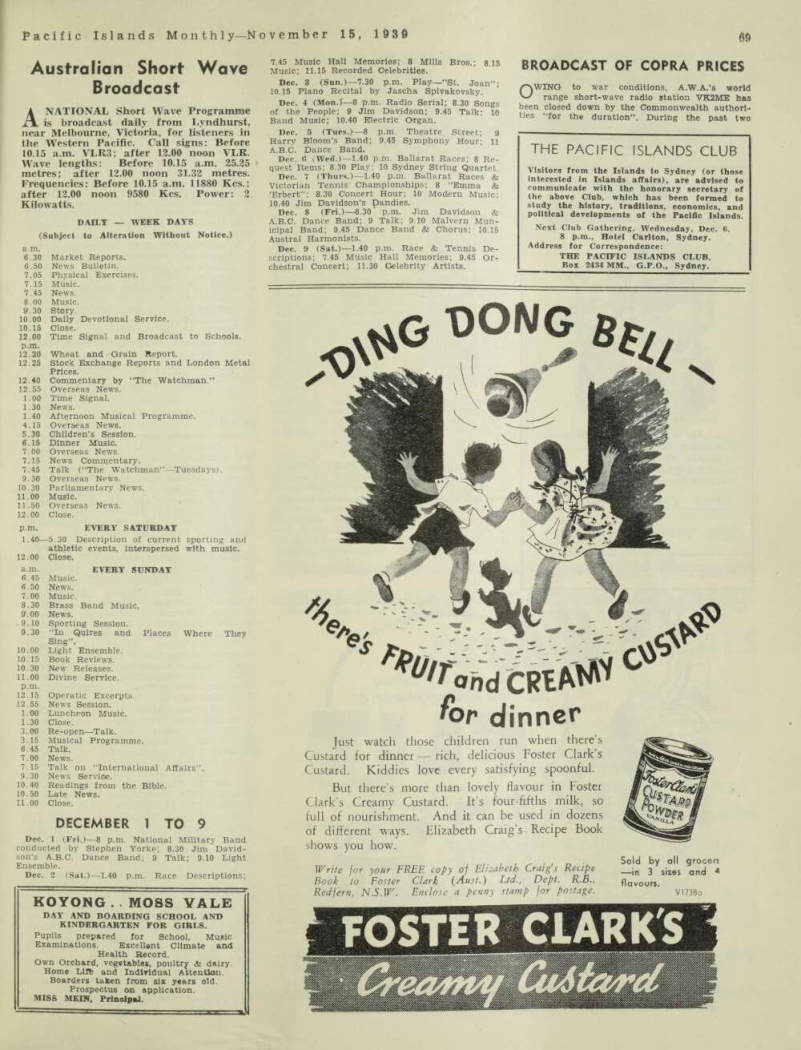
Australian Short Wave Broadcast
A NATIONAL Short Wave Programme is broadcast daily from Lyndhurst, near Melbourne, Victoria, for listeners in the Western Pacific. Call signs: Before 10.15 a.m. VLR3; after 12.00 noon VLR.
Wave lengths: Before 10.15 a.m. 25.25 metres; after 12.00 noon 31.32 metres.
Frequencies: Before 10.15 a.m. 11880 Kcs.; after 12.00 noon 9580 Kcs. Power: 2 Kilowatts.
Daily Week Dats
(Subject to Alteration Without Notice.) a.m. 6.30 Market Reports. 6.50 News Bulletin. 7.05 Physical Exercises. 7.15 Music. 7.45 News. 8.00 Music. 9.30 Story. 10.00 Daily Devotional Service. 10.15 Close. 12.00 Time Signal and Broadcast to Schools, p.m, 12.20 Wheat and Grain Report. 12.25 Stock Exchange Reports and London Metal Prices. 12.40 Commentary by "The Watchman.” 12.55 Overseas News. 1.00 Time Signal. 1.30 News. 1.40 Afternoon Musical Programme. 4,15 Overseas News. 5.30 Children’s Session. 6.15 Dinner Music. 7.00 Overseas News. 7.15 News Commentary. 7.45 Talk ("The Watchman” —Tuesdays). 9.30 Overseas News. 10.30 Parliamentary News. 11.00 Music. 11.50 Overseas News. 12.00 Close.
P.M. Every Saturday
1.40 —5.30 Description of current sporting and athletic events, interspersed with music. 12.00 Close.
A.M. Every Sunday
6.45 Music. 6.50 News. 7.00 Music. 8.30 Brass Band Music. 9.00 News. 9,10 Sporting Session. 9.30 "In Quires and Places Where They Sing”. 10.00 Light Ensemble. 10.15 Book Reviews. 10.30 New Releases. 11.00 Divine Service, p.m. 12.15 Operatic Excerpts. 12.55 News Session. 1.00 Luncheon Music. 1.30 Close. 3.00 Re-open—Talk. 3.15 Musical Programme. 6.45 Talk. 7.00 News. 7.15 Talk on "International Affairs”. 9.30 News Service. 10.40 Readings from the Bible. 10.50 Late News. 11.00 Close.
December I To 9
Dec. 1 (Fri.) —8 p.m. National Military Band conducted by Stephen Yorke; 8.30 Jim David son’s A.B.C. Dance Band; 9 Talk; 9.10 Light Ensemble.
Dec. 2 (Sat.) —1.40 p.m. Race Descriptions;
7.45 Music Hall Memories; 8 Mills Bros.; 8.15 Music; 11.15 Recorded Celebrities.
Dec. 3 (Sun.)—7.3o p.m. Play—" St. Joan"; 10.15 Piano Recital by Jascha Spivakovsky.
Dec. 4 (Mon.)' —8 p.m. Radio Serial; 8.30 Songs of the People; 9 Jim Davidson; 9.45 Talk; 10 Band Music; 10.40 Electric Organ.
Dec. 5 (Tues.) —8 p.m. Theatre Street; 9 Harry Bloom’s Band; 9.45 Symphony Hour; 11 A.B.C. Dance Band.
Dec. 0 (Wed.)—l.4o p.m. Ballarat Races; 8 Re quest Items; 8.30 Play; 10 Sydney String Quartet.
Dec. 7 (Thurs.)—l.4o p.m. Ballarat Races & Victorian Tennis Championships; 8 ‘‘Emma & ’Erbert”; 8.30 Concert Hour; 10 Modern Music; 10.40 Jim Davidson’s pandies.
Dec. 8 (Fri.) —8.30 p.m. Jim Davidson & A.B.C. Dance Band; 9 Talk; 9.10 Malvern Mun icipal Band: 9.45 Dance Band & Chorus; 10.15 Austral Harmonists.
Dec. 9 (Sat.) —1.40 p.m. Race & Tennis De scriptions: 7.45 Music Hall Memories; 9.45 Or chestral Concert; 11.30 Celebrity Artists.
Broadcast Of Copra Prices
OWING to war conditions, A.W.A.’s world range short-wave radio station VK2ME has been closed down by the Commonwealth authori ties "for the duration”. During the past two
or three years South Seas produce prices (in cluding copra) had been regularly broadcast each week on Sunday at 9 p.m. and on Monday at 1.45 a.m. (Sydney time).
Advertisements & other items, pp. 71-72 (2 items)
T)Ong
THE PACIFIC ISLANDS CLUB
Visitors from the Islands to Sydney (or those interested in Islands affairs), are advised to communicate with the honorary secretary of the above Club, which has been formed to study the history, traditions, economics, and political developments of the Pacific Islands.
Next Club Gathering, Wednesday, Dec. 6. 8 p.m., Hotel Carlton, Sydney.
Address for Correspondence:
THE PACIFIC ISLANDS CLUB,
Box 2484 MM., G.P.0., Sydney.
T)ONG
4S e s
for dinner
Just watch those children run when there s Custard for dinner rich, delicious Foster Clark’s Custard. Kiddies love every satisfying spoonful.
But there’s more than lovely flavour in Foster Clark’s Creamy Custard. It’s four-fifths milk, so full of nourishment. And it can be used in dozens of different ways. Elizabeth Craig’s Recipe Book shows you how.
Write for your FREE copy of Elizabeth Craig’s Recipe Book to Foster Clark (Aust .) Ltd., Dept. R. 8., Red fern, N.S.W. Enclose a penny stamp for postage.
Sold by all grocer: —in 3 siies and 4 flavours.
V1738a ■ a*
STAMPS.
Wanted to buy used Pacific Island Postage Stamps. Any quantity. Best prices.
Cutcliffe, 26 Nicholson Street, East Balmain, SYDNEY.
Coleman
STOVE
1— Lights Instantly—No Preheating. 2 Instant Heat Regulation. 3 Safety Shut-off Valve. 4 Nickel-Plated—Rust-Proof. 5 Wind-Proof, Silent, Odorless.
BUILT FOR A MULTITUDE
OF USES.
Sold by all leading Firms In the Pacific Islands.
In case of difficulty In obtaining supplies write to; Pearce & Co. Suva, Fiji Islands.
no other
insect spray
has the killinq-power of
FLIT
Flit is sure death to insects because it contains a number of killing agents found in no other insect spray. FI it kills where othersfail. Flit is deadly toinsects but harmless to humans. Buy FLIT - refuse substitutes. Take a bottle or tin home to-day. n FBl 2 ..Kills ']'*» Moth* “o«q u ,(oe» s 'lverfi»h Bug* Ants r ’pray will not
FLIT always KILLS
Koyong . . Moss Yale
DAY AND BOARDING SCHOOL AND
KINDERGARTEN FOR GIRLS.
Pupils prepared for School, Music Examinations. Excellent Climate and Health Record.
Own Orchard, vegetables, poultry & dairy.
Home Lift and Individual Attention.
Boarders taken from six years old.
Prospectus on application.
MISS MEIN, Principal.
Broadcasts
Overseas Short Wave
following list represents a selection of the most easily tuned short wave sessions broadcast in English from both British and foreign countries. Times are Eastern Standard; but both frequencies and times are subject to alteration. The list has been courteously sup plied by George Brown and Co. Pty. Ltd., Syd ney (distributors of “Ultimate” Radios):—
Two experts from the School of Public Health and Tropical Medicine, University of Sydney, left in October to investigate an outbreak of skin disease of an unusual kind among the Chinese labourers in Nauru. Many Chinese are employed under indenture in the phosphate indus try on Nauru, and it is supposed that the skin disease—which causes much sickness and debility, but is seldom fatal—is caused by action of phosphate dust upon the skin.
East.
Stand. Call Time. Sign.
Location.
Wave Length. 2.00 a.m.—GSF.
London 19.82 3.30 a.m.—GSD.
London 25.53 5.00 a.m.—GSD.
London 25.53 7.20 a.m.—YUC.
Belgrade 31.56 7.45 a.m.—GSD.
London 25.53 7.45 a.m.—GSC.
London 31.32
9.00 A.M.—Wixal.
Boston 35.45 10.30 a.m.—GSB.
London 31.55 1.00 p.m.—TP A 4 Paris 25.6 2.00 p.m.—GSD.
London 25.53 4.15 p.m.—GSD.
London 25.53 6.00 p.m.-RNE.
Moscow 25.0 7.00 p.m.—GSB.
London 31.55 7.55 p.m.—JVW3.
Tokio 25.6 9.00 p.m.—F.I.C.
Saigon 49.05 9.00 p.m.—TPB3.
Paris 16.80 9.15 p.m.—XGX.
Yun Nan 25.2 9.30 p.m.—GSV.
London 16.84 9.30 p.m.—GSG.
London 16.86 10.00 p.m.—ZHP.
Singapore 30.96 10.30 p.m.—KGE1.
San Francisco 31.48 11.00 p.m.—WGEO.
New York 19.56 11.15 p.m.—GSV.
London 16.84 11.15 p.m.—GSG.
London 16.86
Demands
Prosecution of N. Guinea Demands Big Companies Asked for Financial Support
A MEETING, held in Sydney in mid- October, was attended by representa tives of firms with interests in New Guinea, and it was asked to consider a proposal by Captain H. T. Allan (repre senting various New Guinea organisa tions) “that financial assistance be given by firms operating in New Guinea to en able the work of New Guinea Associa tion to be carried on”.
It was explained to the meeting that the aims of New Guinea Association were to present to the Government and press all matters which affect New Guinea as a whole, and to ensure that such repre sentations are promptly attended to. It was stated that the following matters had been submitted to and were under con sideration by the Government:— The adequate defence of New Guinea.
The safeguarding of all stores, wharves, aerodromes, hangars, workshops, power houses, etc.
The internment of German nationals now in New Guinea.
The revision of the gold tax recently passed.
Other objects now being considered in New Guinea, it was reported, included the question of native labour; and im proved communication and transport be tween Australia and New Guinea.
It was pointed out that the Associa tion was spending £5O per month on office salaries, publicity, etc., in New Guinea, and that in the past twelve months an amount of £1,200 had been spent.
It was stated that the following twelve Associations were represented at the meet ing in Rabaul, when it was decided to form the New Guinea Association: Planters and Traders’ Association; Rabaul Business Men’s Association; Rabaul Citizens’ Association; Returned Soldiers’ Association; New Guinea Mining Association; Madang Citizens and Pro gress Association; Miners and Citizens’
Progress Association of the Sepik District; Lae Citizens’ Association; AI.P., Wau Branch; Namatanai Independents; Kavieng Amalgamated Associations; W.
R. Carpenter, Ltd.
Those present at the meeting in Sydney included Mr. Kruttschnitt and Mr. T.
McCulloch (New Guinea Goldfields, Ltd.); Mr. Torrington (Sunshine Gold Mining, Ltd.); Mr. L. V. Water house (Bulolo Gold Dredging, Ltd.); Mr. Wallis (W. R. Carpenter & Co., Ltd.); and Mr. H. G. Hyde (Sandy Creek Gold Mining, Ltd.), in addition to Captain H.
T. Allan and Mr. Fulton.
Most of those present commended any public movement within the Territory which would assist development and strengthen defences, and the activity of Captain Allan was praised.
The meeting reached no decision. Some of those present urged that caution be exercised in dealing with Canberra, so as to avoid giving the impression that the Federal Government is being ap proached over the head of the Adminis trator.
On November 14, Captain Allan was busy with military duties. His associates in the New Guinea organisation expect ed that interesting announcements about New Guinea affairs would be made when the Federal Parliament met, about No vember 16.
Copra Fire
Loss In Port Moresby
A WATERFRONT store and over 200 tons of copra, owned by Messrs.
Burns Philp and Co. Ltd., were destroy ed by a fire which commenced late on Friday afternoon, November 10.
All efforts to stop the fire were use less. Native police, European helpers, and a military truck unit which pumped sea water onto the fire, worked throughout the night to save the adjoining build ings—especially the B.P. machine-shop and part of the establishment of Steam ships Trading Co. Ltd. At first, when there was great danger of the fire spreading, good work was done by a hastily organised bucket brigade.
Anaa Islanders
History May Explain Lack of Cordiality
WHEN Te Rangi Hiroa went to the is land of Anaa, in the Tuamotus, he records in his book (“Vikings of the Sunrise”) that, “The people, while not exactly morose, showed none of the cordiality so characteristic of the Poly
nesian people. , , .
“I found out afterwards that their lack of vocal expression was regarded by the rest of the Tuamotu as being peculiar to Anaa. , . , “One of the crew said ‘The torea bird makes a noise in the mornings and even ings when anybody goes near it’.
“ ‘What about it?V I asked. ‘Weir, he replied, ‘there are no torea on Anaa’.”
In going through Doctor B. G. Corney’s copious notes, the writer has come upon the following bits of history concerning this island.
At the time it was seen by the Spanish voyagers and by Cook, “Anaa was the most populous and the most productive, as weli as politically the chief, island of the Tuamotu archipelago.
“It is probably identical with La Sagi taria, of Quiros, and was next seen by Lieut. Cook in H.M.S. ‘Endeavor’, on the 9th April, 1769, who named it ‘Chain’ Is land.
“From what we now know, as matters of history and tradition, the Anaa people were sea-rovers, and frequently raided the smaller islands of the Tuamotu group, be ing strong enough and feared enough to obtain what they wished for by force, rather than by barter or peaceable com merce.
“Their pre-eminence arose mainly, no doubt, from the greater productiveness of their atoll, owing to its size and the nature of the soil on it. Hence they were better fed than most, their struggle for life was comparatively easy, they became pros perous, wealthy, ambitious, autocratic and warlike. They had also the best supply of timber, built longer and more sea worthy canoes than their neighbours and ventured farther afield, not only to Tahiti (which they once designed to con quer and did actually invade, but con sented after a parley, not to molest) but even to the windward atolls of Hao, Vairaatea and Nukutavake. Possessing, with these advantages, a teeming popu lation, leavened perhaps by a measure of inborn truculence above their neighbours, it is not surprising that the islanders of Anaa, as a community, should have gained an ascendancy over most other natives of the Tuamotu archipelago (ex cepting those of Fa’arava and Ra’iroa).”
A.C.R.
A Prowler Of The Night
A NOTE from Rarotonga:— Women visiting the Cook Islands should - provide themselves with a water pistol. Firearms are not permitted here otherwise we would advise them to come armed to the teeth. Still, the sight of a stout water pistol may be suffi cient to strike terror to the breast of the gentle savage who is at present causing alarm among the European community of one island. When, on one of his noc turnal prowls, he enters a lady’s bedroom in the dead of night he probably will not distinguish a water pistol from the dangerous variety, and if it is filled with ammonia the weapon should prove effective in putting a stop to his career— provided the lady is a straight shot and gets him fairly in the eye.
The guests at a hotel in the Cook Is lands are fast qualifying for entrance to a mental institution, owing to the visitations of a prowling native whose intentions can only be guessed at. On each occasion, however, the woman con cerned has wakened in the nick of time and emitted a series of ear-splitting shrieks. The prowler vanishes as silently as he appeared, leaving no clue to his identity.
He has been seen plainly—he has not always waited for lights to be put out before boldlv entering a room—but probably he knows that it is a very diffi cult matter for a European woman— especially a stranger—to recognise him in a crowd, as among a population of sev eral thousand natives there probably are hundreds who look exactly alike.
In each case, the woman concerned has been a nervous wreck for a time, especially as there is the fear of a re currence while the lunatic remains at large. So far, however, none of his
victims has received a second visit.
M.
Fixed Prices In Fiji
PROMPT action was taken by the Fiji Government to prevent “pro fiteering”, when economic conditions were dislocated by war on September 3.
Prices generally wer? fixed at the rates ruling before September 1; and, as stocks are exhausted, and new ship ments come in at higher rates, appli cation must be made to the Government for permission to raise prices.
Advertisements & other items, pp. 73-74 (2 items)
71
Pacific Islands Monthl y — November 15, 1939
Delicious, Tasty Foods
No Light can steal its Flavor. m i
&UJE RIBBON
N 8 23^ In case of difficulty in obtaining supplies, write to Box 1861 K., G.P.0., Sydney.
DELICIOUS, TASTY FOODS
For ISLAND MEALS
AUNT MART'S COOKERY
BOOK.
There’s no finer book for every home ... 212 pages, lavishly Illustrated In colour, and over 400 recipes and useful hints make It a book that every housewife will want. Send only one shilling and twopence to
TILLOCK & CO. PTY. LTD.,
Sydney N.S.W., and get your copy of this great book NOW.
JUST TRY any of AUNT MARY'S Pure Food ** Products, and you will be back for more .. . delicious in themselves or with innumerable dishes.
AUNT MARY'S BAKING POWDER
AUNT MARY'S TOMATO SAUCE
AUNT MARY'S SPAGHETTI IN TOMATO
SAUCE
AUNT MARY'S BAKED BEANS IN TOMATO
SAUCE
AUNT MARY'S CANNED VEGETABLES
Green Peas, Cauliflower, Celery, etc.
RANEE CURRY POWDER
BLOSSOM HONEY In Attractive Jars Or any of the large variety of Pure Pood Products specially packed for Tropical conditions. In Tlllock’s Hermetically Sealed 1-lb. tins. All goods are procurable from your local stores.
TILLOCK & CO. PTY LTD. SYDNEY
Stop Kidney
Poisoning To-day
If you suffer from Rheumatism, Sciatica, Neuritis, Lumbago, Pains in Back, Nervousness, Dizziness, Circles under Eyes, Leg Pains, Poor Appetite and Energy, Puffy Ankles, Burning, Smarting Passages, or have frequently to Get Up Nights, etc., you should know that your system Is being poisoned because germs, aoids and wastes are impairing the vital functioning process of your kidneys. Take care ! Ordinary medicines can’t help much and you must stop these troubles by removing the cause witn Cystex which starts benefit in 2 hours and is offered on generous terms—No Benefit—No Pay. Cystex—the doctor’s prescription—ls approved by doctors and chemists in 7 3 countries, and over 90,000 people have written to say how pleased they are to have found the right medicine for their troubles.
One-time Sufferers Praise This Medicine Mr. R. T., Townsville, Queensland, recently wrote : “Myjoints were all stiff, I had leg pains, my hack used to ache day and night. My bladder was weak. I had headaches and no appetite.
The first dose of Cystex helped me and before I finished three boxes my health and strength came back."
Mrs. M. L. Z., Thompson Estate, Brisbane : “/ have been taking Cystex for Kidney and Bladder trouble and it has made a different woman of me.
I am feeling splendid, can do all my work, run about and walk miles although I am 63 years of age. Cystex does all you claim for it."
Cystex Helps Nature 3 Ways
Gets rid of health-destroying, deadly poisonous aoids. Kills the germs which are infecting kidneys, bladder and urinary system. Helps nature to strengthen and reinvigorate kidneys and protects against further attack.
Guaranteed to Put You Right
®r Money Back
Get Cystex from your chemist today. Give it a thorough test.
Cystex is guaranteed to make you feel younger, stronger, better in every way, in 24 hours and to be completely well in 1 week or your money back if you return the empty package. Act now ! Now in 3 sizes—l/9, 4/-, 8/-.
VS t IIC
Remedy ££
for Your Kidneys, Bladder, Rheumatism
- 4 i'J • ' 5? -S®- ' 4 -1. . ‘j it • s ■ t
STAY AT
SYDNEY'S NEW GUEST HOUSE,
BERNLY
Delightfully situated at
SPRINGFIELD AVENUE, POTTS POINT
(4 mins, from City) An ideal home for visitors from the Islands and Overseas.
COMFORT . . . CONVENIENCE,
PRIVACY AND GOOD SERVICE
100 Richly Furnished Bedrooms, many with Private Showers.
HOT & COLD WATER & TELEPHONES
IN ALL ROOMS.
BILLIARDS . . . ROOF GARDEN.
CUISINE BY FIRST-CLASS CHEF.
Tariff: From 3 gns. p.w. Inclusive—or Room only If desired.
Proprietor : F. J. BERNE.
Market Quotations
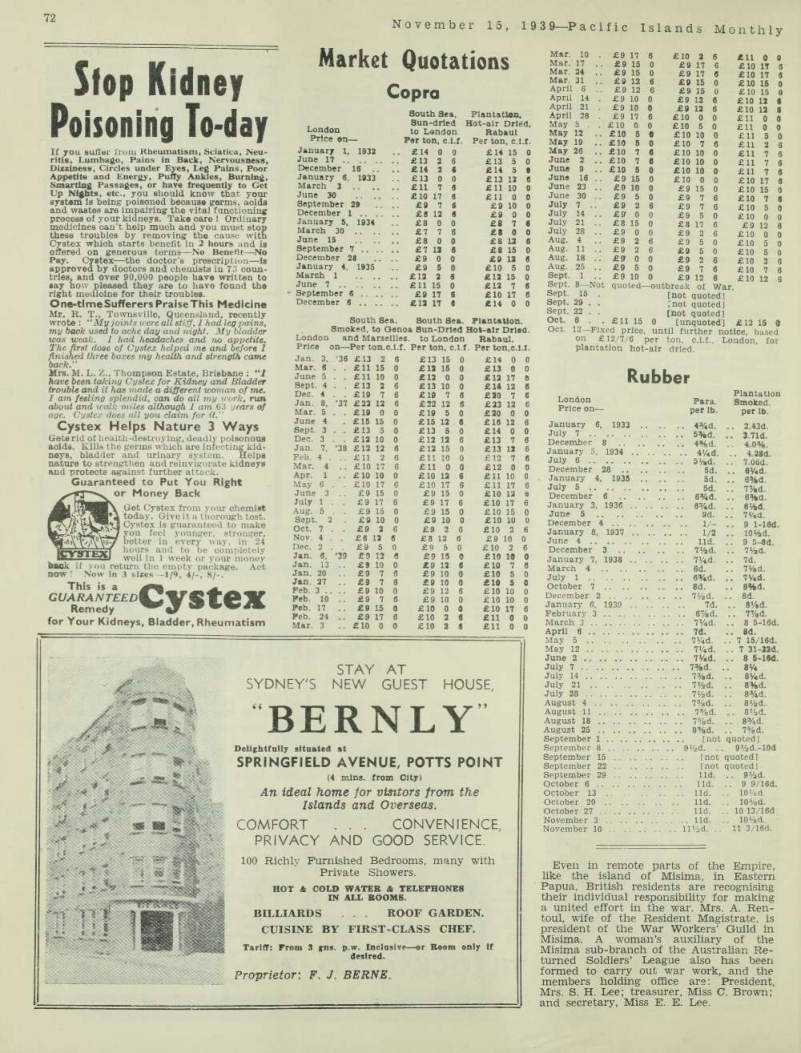
Even in remote parts of the Empire, like the island of Misima, in Eastern Papua, British residents are recognising their individual responsibility for making a united effort in the war. Mrs. A. Ren toul, wife of the Resident Magistrate, is president of the War Workers’ Guild in Misima. A woman’s auxiliary of the Misima sub-branch of the Australian Re turned Soldiers’ League also has been formed to carry out war work, and the members holding office are: President, Mrs. S. H. Lee; treasurer, Miss C. Brown; and secretary, Miss E. E. Lee.
Copra
South Sea, Plantation.
Bun-dried Hot-air Dried.
London to London Rabaul Price on — Per ton, c.l.f.
Per ton, c.l.f.
January 1 1932 £14 0 0 £14 15 0 June 17 . £13 2 6 £13 5 0 December 16 £14 2 4 £14 5 • January 6 1033 £13 0 0 £13 12 6 March 3 £11 7 6 £11 10 0 June 30 £10 17 6 £11 0 0 September 29 . . £9 7 6 £9 10 0 December 1 .. £8 12 6 £9 0 0 January 5, 1934 £8 0 0 £8 7 6 March 30 £7 7 6 £8 0 0 June 15 . . £8 0 0 £8 12 6 September 7 .. £7 12 6 £8 15 0 December 28 £9 0 0 £0 12 6 January 4, 1935 £0 5 0 £10 5 0 March 1 £12 2 8 £12 15 0 June 7 .. £11 15 0 £12 7 6 September 6 . . £9 17 6 £10 17 6 December 5 .. £12 17 « £14 0 0 South Sea.
South Sea.
Plantation.
Smoked, to Genoa Sun-Dried Hot-air Dried.
London and Marseilles, to London Rabaul.
Price on— -Per ton.c.l.f.
Per ton, c.l.f. Per ton,c.l.l.
Jan. 3, ’36 £13 2 6 £13 15 0 £14 0 0 Mar. 6 . . £11 15 0 £12 16 0 £13 0 0 June 5 . . £11 10 0 £12 0 0 £12 17 6 Sept. 4 . , £13 2 6 £13 10 0 £14 12 6 Dec. 4 . . £19 7 6 £19 7 6 £20 7 6 Jan. 8, ’37 £22 12 6 £22 12 6 £23 12 6 Mar. 5 . . £10 0 0 £19 5 0 £20 0 0 June 4 £15 15 0 £15 12 6 £16 12 6 Sept. 3 . . £13 5 0 £13 5 0 £14 0 0 Dec. 3 . . £12 10 0 £12 12 6 £13 7 6 Jan. 7, ’38 £12 12 6 £12 15 0 £13 12 6 Feb. 4 . . , £11 2 6 £11 10 0 £12 7 6 Mar. 4 £10 17 6 £11 0 0 £12 0 0 Apr. 1 £10 10 0 £10 12 6 £11 10 0 May 6 . . £10 17 6 £10 17 6 £11 17 6 June 3 .. £9 15 0 £9 15 0 £10 12 6 July 1 . . £9 17 6 £9 17 6 £10 17 6 Aug. 5 . . £9 15 0 £9 15 0 £10 15 0 Sept. 2 . £9 10 0 £9 10 0 £10 10 0 Oct. 7 . . £9 2 6 £9 2 6 £10 2 6 Nov. 4 . . £8 12 6 £8 12 6 £9 10 0 Dec. 2 . . £0 5 0 £9 5 0 £10 2 6 Jan. 8, ’39 £9 12 6 £9 15 0 £10 10 0 Jan. 13 .. £9 10 0 £9 12 6 £10 7 6 Jan. 20 £9 7 6 £9 10 0 £10 5 0 Jan. 27 £9 7 6 £9 10 0 £10 5 0 Feb. 3 .. .. £9 10 0 £9 12 6 £10 10 0 Feb. 10 .. £9 7 6 £9 10 0 £10 10 0 Feb. 17 £9 15 0 £10 0 0 £10 17 6 Feb. 24 .. £9 17 6 £10 2 6 £11 0 0 Mar. 3 .. £10 0 0 £10 2 6 £11 0 0
Mar. 10 . £9 17 6 £10 2 6 £11 0 0 Mar. 17 .. £9 15 0 £9 17 6 £10 IT 6 Mar. 24 £9 15 0 £9 17 6 £10 17 6 Mar. 31 £9 12 6 £9 15 0 £ 10 15 0 April 6 £9 12 6 £9 15 0 £10 15 0 April 14 . £9 10 0 £9 12 6 £ 10 12 • April 21 . £9 10 0 £9 12 6 £10 12 S April 28 £9 17 6 £10 0 0 £11 0 0 May 5 . . £10 0 0 £10 5 0 £11 0 0 May 12 £10 5 e £10 10 0 £11 5 0 May 19 .. £10 5 0 £10 7 6 £11 2 6 May 26 .. £10 7 6 £10 10 0 £117 5 June 2 £10 7 6 £10 10 0 £ 11 7 6 June 9 .. £10 5 0 £10 10 0 £11 7 6 June 16 .. £9 15 0 £10 0 0 £10 17 6 June 23 .. £9 10 0 £9 15 0 £10 15 0 June 30 £9 5 0 £9 7 6 £10 7 6 July 7 £9 2 6 £9 7 6 £10 5 0 July 14 .. £9 0 0 £9 5 0 £ 10 0 0 July 21 .. £8 15 0 £8 17 6 £9 12 6 July 28 .. £9 0 0 £9 2 6 £10 0 0 Aug. 4 .. £9 2 6 £9 5 0 £10 5 0 Aug. 11 ., £9 2 6 £9 5 0 £10 5 0 Aug. 18 . . £9 0 0 £9 2 6 £10 2 6 Aug. 25 .. £9 5 0 £9 7 6 £10 7 6 Sept. 1 .. £9 10 0 £9 12 6 £10 12 R Sept. 8 —Not quoted- -outbreak of War.
Sept. 15 . [not quoted] Sept. 29 . . [not quoted] Sept. 22 . . [not quoted] Oct. 6 . . £11 15 0 [unquoted] £12 15 0 oct. 12—Fixed price, until further notice, based on £ 12/7/6 per ton, c.i.f., London, for plantation hot-air dried.
Rubber
Plantation London Para.
Smoked.
Price on— per lb. per lb.
January 6, 1933 . .. 2.43d.
July 7 .. .. 3.71d.
December 8 , , .. 4%d. . . 4.0%.
January 5, 1934 .. .. 4%d. .. 4.28d.
July 6 .. .. 7.Odd.
December 28 .. . .. 5d. .. 0V 4 d.
January 4, 1935 . . . . 5d. .. 6%d.
July 5 .. .. 7%d.
December 6 . . , . . 6%d. .. 6%d.
January 3, 1936 .. 6%d.
June 5 9d. .. 7V 4 d.
December 4 1 .. .. 9 l-10d.
January 8, 1937 .. .. 1/2 .. lOVid.
June 4 .. .. 9 5-8d.
December 3 .. .. 7y a d. .. 7V a d.
January 7, 1938 . .. ma. .. 7d.
March 4 .. 6d. .. 7Ved.
July 1 .. . .. ey 4 d. .. 7V 4 d.
October 7 , . .. 8d. .. 8%d.
December 2 . .. 7»/ 2 d. .. 8d.
January 6. 1939 ... 7d. .. 8Vad.
February 3 .. .. ey 8 d. .. 7%d.
March 3 .. . . . 7%d. .. 8 5-16d.
April 6 ., . . . . . ... 7d. .. 8d.
May 5 .. .. 7V 4 d. . . 7 15/16d.
May 12 .. . .. 7%d. .. 7 31-32d June 2 .. . .. 8 5-lSd.
July 7 .. . 8% July 14 .. . . .. 7 3 /ad. .. sy 4 d.
July 21 .. .. 7%d. , .. 8%d.
July 28 . . , . .. 7V 2 d. , 8%d.
August 4 . . . .. 7 5 /ad. , .. sy 2 d.
August 11 . . .. 7%d. .. 8V 2 d.
August 18 . . .. 7 s /sd. .. 8%d.
August 25 . .. 7%d.
September 1 September 8 .. 9*/ 2 d. .. gy 2 d.-iod September 15 ..
September 22 . .
September 29 .. . .. lid. ,. 9y 2 d.
October 6 . . .. lid. , . . 9 9/16d.
October 13 . .. lid. . . 10V 8 d.
October 20 lid. . . 10 5 /sd.
October 27 . lid. . . 10 13/16d November 3 .. .. lid. . . lOVsd.
November 10 .. HV 2 d. .. 11 3/16d.
Islands Produce
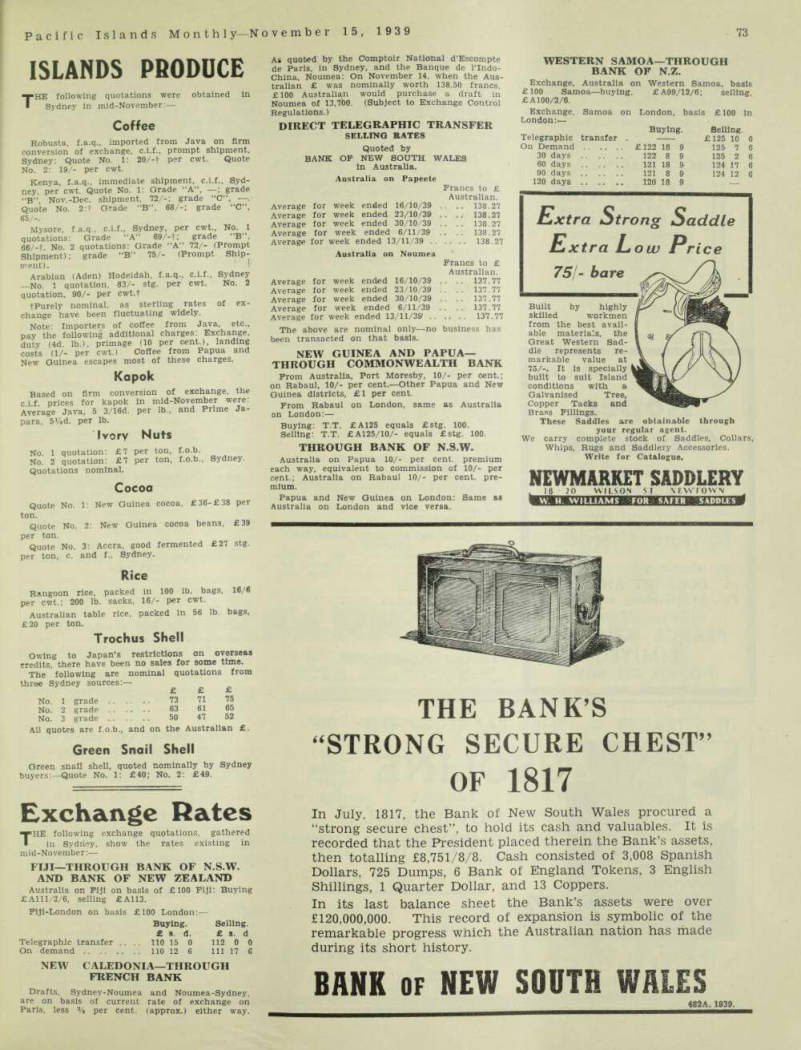
THE following quotations were obtained in Sydney in mid-November: —
Coffee
Robusta, f.a.q., imported from Java on firm conversion of exchange, c.i.f., prompt shipment, Sydney: Quote No. 1: 20/-t P-er cwt. Quote No. 2: 19/- per cwt.
Kenya, f.a.q., immediate shipment, c.i.f., Syd ney, per cwt. Quote No. 1: Grade “A”, —; grade “B” Nov.-Dec. shipment, 72/-; grade “C”, —.
Quote No. 2:t Grade “B”, 68/-; grade “C”, 65/-.
Mysore, f.a.q., c.i.f., Sydney, per cwt., No. 1 quotations; Grade “A" 69/-t: grade “B”, 66/-t. No. 2 quotations: Grade “A” 72/- (Prompt Shipment); grade “B” 75/- (Prompt Ship ment).
Arabian (Aden) Hodeidah, f.a.q., c.i.f., Sydney —No. 1 quotation, 83/- stg. per cwt. No. 2 quotation, 90/- per cwt.t tPurely nominal, as sterling rates of ex change have been fluctuating widely.
Note: Importers of coffee from Java, etc., pay the following additional charges: Exchange, duty (4d. lb.), primage (10 per cent.), landing costs (1/- per cwt.) Coffee from Papua and New Guinea escapes most of these charges.
Kapok
Based on firm conversion of exchange, the cif prices for kapok in mid-November were: Average Java, 5 3/16d. per lb., and Prime Ja para, 5V4d. per lb.
Ivory Nuts
No. 1 quotation; £7 per ton, f.o.b.
No. 2 quotation; £7 per ton, f.0.b., Sydney.
Quotations nominal.
Cocoa
Quote No. 1; New Guinea cocoa, £36-£3B per ton.
Quote No. 2: New Guinea cocoa beans, £39 per ton.
Quote No. 3; Accra, good fermented £27 stg. per ton, c. and f., Sydney.
Rice
Rangoon rice, packed in 100 lb. bags, 16/6 per cwt.; 200 lb. sacks, 16/- per cwt.
Australian table rice, packed in 56 lb. bags, £2O per ton.
Trochus Shell
Owing to Japan’s restrictions on overseas credits, there have been no sales for some time.
The following are nominal quotations from three Sydney sources:—
Green Snail Shell
Green snail shell, quoted nominally by Sydney buyers;—Quote No. 1: £4O; No. 2; £49.
iree oyauey souitcs £ £ £ No. 1 grade . . .. 73 71 75 No. 2 grade .. . . .. 63 61 65 No. 3 grade .. ... 50 47 52 All quotes are f.o.b. , and on the Australian £
Exchange Rates
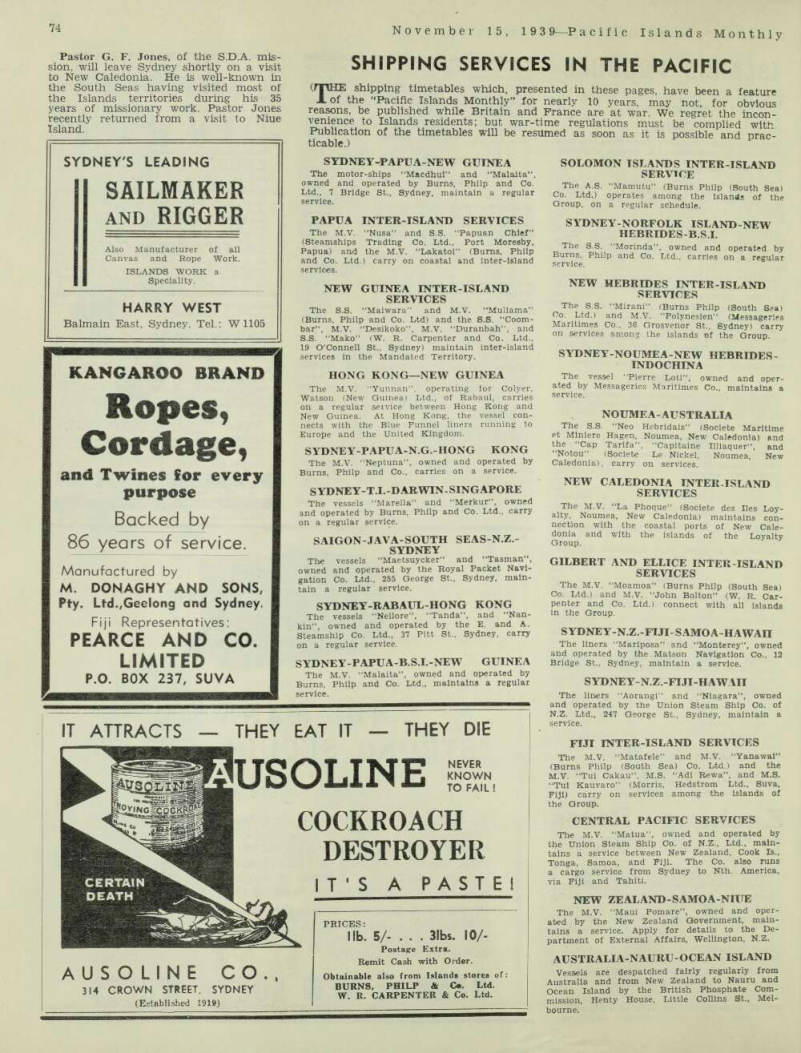
THE following exchange quotations, gathered in Sydney, show the rates existing in mid-November: —
Fiji—Through Bank Of N.S.W.
And Bank Of New Zealand
Australia on Fiji on basis of £lOO Fiji: Buying £Alll/2/6, selling £AII3.
PIJi-London on basis £lOO London:—
New Caledonia—Through
French Bank
Drafts, Sydney-Noumea and Noumea-Sydney. are on basis of current rate of exchange on Paris, less % per cent, (approx.) either way.
As quoted by the Comptoir National d’Escompte de Paris, in Sydney, and the Banque de 1’Indo- China, Noumea: On November 14, when the Aus tralian £ was nominally worth 138.50 francs, £ 100 Australian would purchase a draft in Noumea of 13,700. (Subject to Exchange Control Regulations.)
Direct Telegraphic Transfer
Selling Rates
Quoted by
Bank Of New South Wales
in Australia.
New Guinea And Papua
Through Commonwealth Bank
Prom Australia, Port Moresby, 10/- per cent.; on Rabaul, 10/- per cent.—Other Papua and New Guinea districts. £1 per cent.
From Rabaul on London, same as Australia on London: — Buying; T.T. £AI2S equals £stg. 100.
Selling: T.T. £AI2S/10/- equals £stg. 100.
Through Bank Of N.S.W.
Australia on Papua 10/- per cent, premium each way, equivalent to commission of 10/- per cent.; Australia on Rabaul 10/- per cent, pre mium.
Papua and New Guinea on London: Same as Australia on London and vice versa.
Western Samoa—Through
Bank Of N.Z.
Exchange, Australia on Western Samoa, basis £100 Samoa—buying. £A99/12/6; selling, £ A100/2/6.
Exchange, Samoa on London, basis £100 in London:—
Average for Australia on Papeete week ended 16/10/39 Francs to £ Australian. .. .. 138.27 Average for week ended 23/10/39 .. .. 138.27 Average for week ended 30/10/39 .. .. 138.27 Average for week ended 6/11/39 .. .. 138.27 Average for week ended 13/11/39 . . .. .. 138.27 Average for Australia on Noumea week ended 16/10/39 Francs to £ Australian. .. .. 137.77 Average for week ended 23/10/39 . . .. 137.77 Average for week ended 30/10/39 .. .. 137.77 Average for week ended 6/11/39 .. .. 137.77 Average for week ended 13/11/39 . . .. .. 137.77 The above are nominal only—no business has been transacted on that basis.
Buying. Selling.
Telegraphic transfer . £125 10 0 On Demand £122 18 9 125 7 6 30 days 122 8 9 125 2 6 60 days 121 18 9 124 17 6 90 days 121 8 9 124 12 6 120 days 120 18 9
Buying. Selling. £ a. d. £ a. d Telegraphic transfer .. . 110 15 0 112 0 0 On demand 110 12 6 111 17 6
Pastor G. F. Jones, of the S.D.A. mis sion, will leave Sydney shortly on a visit to New Caledonia. He is well-known in the South Seas having visited most of the Islands territories during his 35 years of missionary work. Pastor Jones recently returned from a visit to Niue Island.
Advertisements & other items, pp. 75-76 (2 items)
73
Pacific Islands Mon t h 1 y—N ovem b e r 15, 193 9
Bank Of New South Wales
Extra Strong Saddle
Extra Low Price
75! - bare
Built by highly skilled workmen from the best available materials, the Great Western Saddle represents remarkable value at 75/-. It Is specially 1 built to suit Island conditions with a Galvanised Tree, Copper Tacks and Brass Fillings.
These Saddles are obtainable through your regular agent.
We carry complete stock of Saddles, Collars, Whips, Rugs and Saddlery Accessories.
Write for Catalogue.
NEWMARKET SADDLERY
18 20 WILSON SI NEWTOWN
W. H. WILLIAMS FOR SAFER SADDLES
THE BANK’S
“STRONG SECURE CHEST”
OF 1817 In July, 1817, the Bank of New South Wales procured a “strong secure chest”, to hold its cash and valuables. It is recorded that the President placed therein the Bank’s assets, then totalling £8,751/8/8. Cash consisted of 3,008 Spanish Dollars, 725 Dumps, 6 Bank of England Tokens, 3 English Shillings, 1 Quarter Dollar, and 13 Coppers.
In its last balance sheet the Bank’s assets were over £120,000,000. This record of expansion is symbolic of the remarkable progress which the Australian nation has made during its short history.
BANK OF NEW SOUTH WALES
482 A. 1939.
SYDNEY'S LEADING
SAILMAKER
AND RIGGER
Also Manufacturer of all Canvas and Rope Work.
ISLANDS WORK a
Speciality,
HARRY WEST
Balmain East, Sydney. Tel.: W 1105
KANGAROO BRAND
Ropes,
Cordage,
and Twines for every purpose
Backed by
86 years of service.
Manufactured by
M. DONAGHY AND SONS,
Pty. Ltd.,Geelong and Sydney.
Fiji Representatives:
PEARCE AND CO.
LIMITED
P.O. BOX 237, SUVA
IT ATTRACTS THEY EAT IT THEY DIE LX aio riNGsCC
USOLINE
NEVER
KNOWN
TO FAIL !
COCKROACH
DESTROYER
IT’S A PASTE!
AUSOLINE CO.
314 CROWN STREET, SYDNEY
(Established 1919)
PRICES:
Mb. 5/- . . . 3lbs. 10/- Postage Extra.
Remit Cash with Order.
Obtainable also from Islands stores of:
BURNS, PHILP & Co. Ltd.
W. R. CARPENTER & Co. Ltd.
Shipping Services In The Pacific
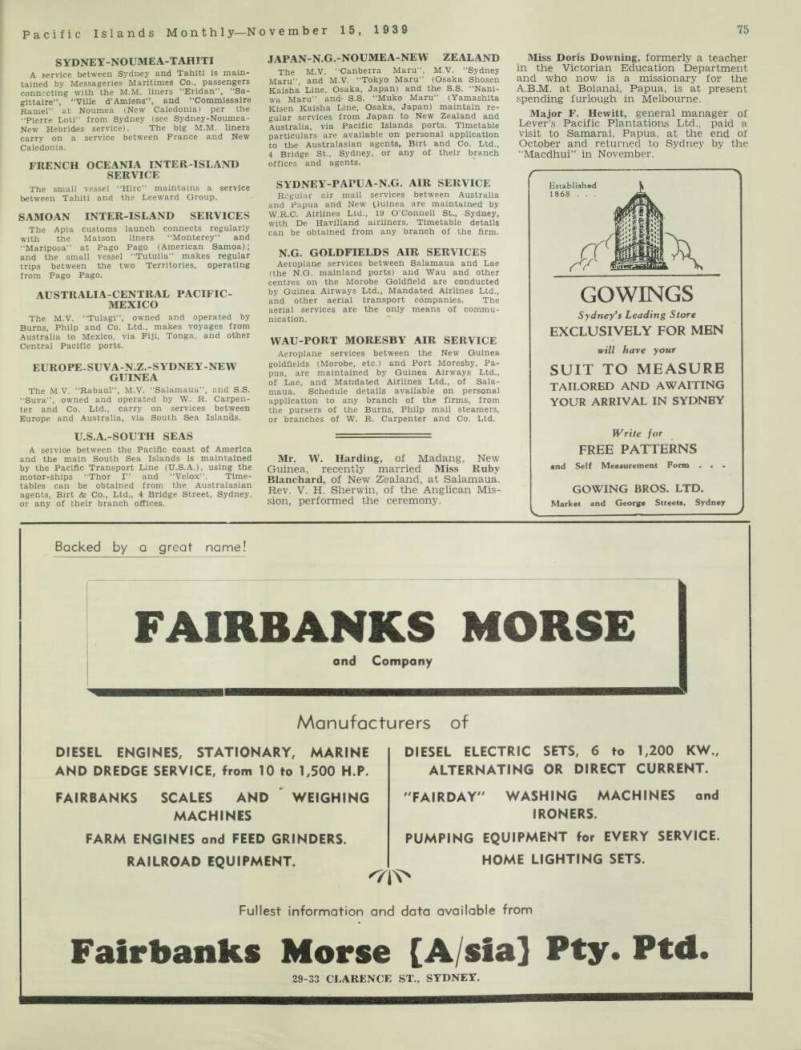
(nnHE shipping timetables which, presented in these pages, have been a feature Xof the ‘‘Pacific Islands Monthly” for nearly 10 years, may not, for obvious reasons, be published while Britain and France are at war. We regret the incon venience to Islands residents; but war-time regulations must be complied wit* Publication of the timetables will be resumed as soon as it is possible and prac ticable.)
Sydney -Papua-New Guinea
The motor-ships “Macdhul” and “Malaita”, owned and operated by Burns, Philp and Co.
Ltd., 7 Bridge St., Sydney, maintain a regular service.
Papua Inter-Island Services
The M.V. “Nusa” and S.S. “Papuan Chief” (Steamships Trading Co. Ltd., Port Moresby, Papua) and the M.V. “Lakatoi” (Bums, Philp and Co. Ltd.) carry on coastal and inter-island services.
New Guinea Inter-Island
Services
The S.S. “Maiwara” and M.V. “Muliama” (Burns, Philp and Co. Ltd) and the S.S. “Coom bar”, M.V. “Desikoko”, M.V. “Duranbah”, and S.S. “Mako” (W. R. Carpenter and Co. Ltd., 19 O’Connell St., Sydney) maintain inter-island services in the Mandated Territory,
Hong Kong—New Guinea
The M.V. “Yunnan”, operating for Colyer, Watson (New Guinea) Ltd., of Rabaul, carries on a regular service between Hong Kong and New Guinea. At Hong Kong, the vessel con nects with the Blue Funnel liners running to Europe and the United Kingdom.
Sydney-Papua-N.G.-Hong Kong
The M.V. “Neptuna”, owned and operated by Burns, Philp and Co., carries on a service.
Sydney-T.L-Darwin-Singapore
The vessels “Marella” and “Merkur”, owned and operated by Burns, Philp and Co. Ltd., carry on a regular service.
Saigon-Java-South Seas-N.Z.-
Sydney
The vessels “Maetsuycker” and “Tasman", owned and operated by the Royal Packet Navi gation Co. Ltd., 255 George St., Sydney, main tain a regular service.
Sydney-Rabaul-Hong Kong
The vessels “Nellore”, “Tanda”, and “Nan kin” owned and operated by the E. and A.
Steamship Co. Ltd., 37 Pitt St., Sydney, carry on a regular service.
Sydney-Papu A-8.5.1.-New Guinea
The M.V. “Malaita”, owned and operated by Burns. Philp and Co. Ltd., maintains a regular service.
Solomon Islands Inter-Island
Service
The A.S. “Mamutu” (Burns Philp (South Sea) Co. Ltd,) operates among the Islands of the Group, on a regular schedule.
Sydney-Norfolk Island-New
Hebrides-8.5.1.
The S.S. “Morinda”, owned and operated by Burns. Philp and Co. Ltd., carries on a regular service.
New Hebrides Inter-Island
Services
The S.S. “Mirani” (Burns Philp (South Sea) G°. Ltd.) and M.V. “Polynesien” (Messageries Maritimes Co.. 36 Grosvenor St., Sydney) carry on services among the islands of the Group.
Sydney-Noumea-New Hebrides
Indochina
The vessel “Pierre Loti”, owned and oper ated by Messageries Maritimes Co., maintains a service.
Noumea-Australia
The S.S. “Neo Hebridais” (Soclete Maritime et Miniere Hagen, Noumea, New Caledonia) and the “Cap Tarlfa”, “Capitaine Illiaquer”, and “Notou” (Sociefce Le Nickel, Noumea, New Caledonia), carry on services.
New Caledonia Inter.Island
Services
The M.V. “La Phoque” (Societe des lies Loy alty, Noumea, New Caledonia) maintains con nection with the coastal ports of New Cale donia and with the islands of the Loyalty Group.
Gilbert And Ellice Inter Island
Services
The M.V. “Moamoa” (Burns Philp (South Sea) Co. Ltd.) and M.V. “John Bolton” (W. R. Car penter and Co. Ltd.) connect with all islands in the Group.
Sydney-N.Z-Fiji-Samoa-Hawaii
The liners “Mariposa” and “Monterey”, owned and operated by the Matson Navigation Co., 12 Bridge St., Sydney, maintain a service.
Sydney-N.Z.-Fiji-Haw All
The liners “Aorangi” and “Niagara”, owned and operated by the Union Steam Ship Co. of N.Z. Ltd., 247 George St., Sydney, maintain a service.
Fiji Inter-Island Services
The M.V. “Matafele” and M.V. “Yanawal” (Burns Philp (South Sea) Co. Ltd.) and the M.V. “Tui Cakau”, M.S. “Adi Rewa”, and M.S.
“Tui Kauvaro” (Morris, Hedstrom Ltd., Suva, Fiji) carry on services among the Islands of the Group.
Central Pacific Services
The M.V. “Matua”, owned and operated by the Union Steam Ship Co. of N.Z., Ltd., main tains a service between New Zealand, Cook Is., Tonga, Samoa, and Fiji. The Co. also runs a cargo service from Sydney to Nth. America, via Fiji and Tahiti.
New Zealand-Samoa-Niue
The M.V. “Maui Pomare”, owned and oper ated by the New Zealand Government, main tains a service. Apply for details to the De partment of External Affairs, Wellington, N.Z.
Australia-Nauru-Ocean Island
Vessels are despatched fairly regularly from Australia and from New Zealand to Nauru and Ocean Island by the British Phosphate Com mission, Henty House, Little Collins St., Mel bourne.
Sydney-Noumea-Tahiti
A service between Sydney and Tahiti is main tained by Messageries Maritimes Co., passengers connecting with the M.M. liners “Eridan”, “Sa gittaire”, “Ville d’Amiens”, and ‘‘Commissaire Ramel” at Noumea (New Caledonia) per the “Pierre Loti” from Sydney (see Sydney-Noumea- New Hebrides service). The big M.M. liners carry on a service between France and New Caledonia.
French Oceania Inter-Island
Service
The small vessel “Hire” maintains a service between Tahiti and the Leeward Group.
Samoan Inter-Island Services
The Apia customs launch connects regularly with the Matson liners “Monterey” and “Mariposa” at Pago Pago (American Samoa); and the small vessel “Tutuila” makes regular trips between the two Territories, operating from Pago Pago.
Australia-Central Pacific
Mexico
The M.V. “Tulagi”, owned and operated by Burns, Philp and Co. Ltd., makes voyages from Australia to Mexico, via Fiji, Tonga, and other Central Pacific ports.
Europe.Suva-N.Z.-Sydney-New
Guinea
The M.V. “Rabaul”, M.V. “Salamaua”, and S.S.
“Suva”, owned and operated by W. R. Carpen ter and Co. Ltd., carry on services between Europe and Australia, via South Sea Islands.
U.S.A.-South Seas
A service between the Pacific coast of America and the main South Sea Islands is maintained by the Pacific Transport Line (U.S.A.), using the motor-ships “Thor I” and “Velox”. Time tables can be obtained from the Australasian agents, Birt & Co., Ltd., 4 Bridge Street, Sydney, or any of their branch offices.
Japan-N.G. -Noumea-New Zealand
The M.V. “Canberra Maru”, M.V. “Sydney Maru’’, and M.V. “Tokyo Maru” (Osaka Shosen Kaisha Line, Osaka, Japan) and the S.S. “Nani wa Maru” and- S.S. “Muko Maru” (Yamashita Kisen Kaisha Line, Osaka, Japan) maintain re gular services from Japan to New Zealand and Australia, via Pacific Islands ports. Timetable particulars are available on personal application to the Australasian agents,. Birt and Co. Ltd., 4 Bridge St.. Sydney, or any of their branch offices and agents.
Sydney-Papua-N.G. Air Service
Regular air mail services between Australia and Papua and New guinea are maintained by W.R.C. Airlines Ltd., 19 O’Connell St., Sydney, with De Havilland airliners. Timetable details can be obtained from any branch of the firm.
N.G. Goldfields Air Services
Aeroplane services between Salamaua and Lae (the N.G. mainland ports) and Wau and other centres on the Morobe Goldfield are conducted by Guinea Airways Ltd., Mandated Airlines Ltd., and other aerial transport companies. The aerial services are the only means of commu nication.
Wau-Port Moresby Air Service
Aeroplane services between the New Guinea goldfields (Morobe, etc.) and Port Moresby, Pa pua, are maintained by Guinea Airways Ltd., of Lae, and Mandated Airlines Ltd., of Sala maua. Schedule details available on personal application to any branch of the firms, from the pursers of the Burns, Philp mail steamers, or branches of W. R. Carpenter and Co. Ltd.
Mr. W. Harding, of Madang, New
Guinea, recently married Miss Ruby
Blanchard, of New Zealand, at Salamaua.
Rev. V. H. Sherwin, of the Anglican Mis
sion, performed the ceremony.
Miss Doris Downing, formerly a teacher in the Victorian Education Department and who now is a missionary for the A.B.M. at Boianai, Papua, is at present spending furlough in Melbourne.
Major F. Hewitt, general manager of Lever’s Pacific Plantations Ltd., paid a visit to Samarai, Papua, at the end of October and returned to Sydney by the “Macdhui” in November.
Advertisements & other items, pp. 77-78 (1 item)
Fairbanks Morse
x_
GOWINGS
Sydney's Leading Store
EXCLUSIVELY FOR MEN
will have your
SUIT TO MEASURE
TAILORED AND AWAITING
YOUR ARRIVAL IN SYDNEY
Established 1868 . . . cr Write for
FREE PATTERNS
and Self Measurement Form . .
COWING BROS. LTD.
Market and George Streets, Sydney
Backed by a great name!
FAIRBANKS MORSE
and Company
Manufacturers of
DIESEL ENGINES, STATIONARY, MARINE
AND DREDGE SERVICE, from 10 to 1,500 H.P.
DIESEL ELECTRIC SETS, 6 to 1,200 KW.,
ALTERNATING OR DIRECT CURRENT.
FAIRBANKS SCALES AND WEIGHING
MACHINES
FARM ENGINES and FEED GRINDERS.
RAILROAD EQUIPMENT.
*7
"FAIRDAY" WASHING MACHINES and
IRONERS.
PUMPING EQUIPMENT for EVERY SERVICE.
HOME LIGHTING SETS.
,v* Fullest information and data available from
Fairbanks Morse [A/sia] Pty. Ptd.
29-33 CLARENCE ST., SYDNEY.
ALL KINDS OF
PRINTING
ISLANDS RESIDENTS
TF you want any kind of Printing which cannot be handled by your Local Printer, send us details of your Requirements, and we shall send you a Quotation, or carry out the work promptly for you at a Guaranteed Reasonable Cost.
OUR SPECIALITY : Magazines and
SYDNEY & MELBOURNE
PUBLISHING CO. PTY. LTD.
29 Alberta St., Sydney
For Books. 0
PROPRIETORS AND
PUBLISHERS OF:
PRINTERS OF:
Pacific Islands Monthly.
Chartered Accountant.
Australian Teacher.
University Medical Australasian Baker.
Australasian Confectioner.
Leather Trades Review.
Country Trader and Journal.
Australian Zoologist, Storekeeper.
Cordial-Maker.
Etc.
Managing Director:
R. W. ROBSON.
COSMOPOLITAN
SAMARA I.
riflCl
HOTEL
FIRST-CLASS
ACCOMMODATION
For Tourists & Commercials Electric Light, Ballroom Billiards Freezing Works, Cold Store.
Best Brands of Liquors
MODERATE TARIFF.
Fishing Trips and Launch Excursions Arranged.
WHERE TO STAY IN PORT MORESBY
HOTEL MORESBY
jjjpsS
K .
NEAR THE
WHARF
MODERN
ACCOMMODATION
ONLY THE BEST
BRANDS OF
WINES, SPIRITS
AND BEERS
IN STOCK.
LICENSEE;
Hotel Moresby
Ltd.
The PAPUA
HOTEL
Catering specially for Tourists and Travellers.
Licensee: Papua Hotel, Ltd.
First-class Accommodation. Parties Arranged.
Situated on high ground overlooking both coasts, its Spacious Lounges are always Cool
islands Fares and Freights
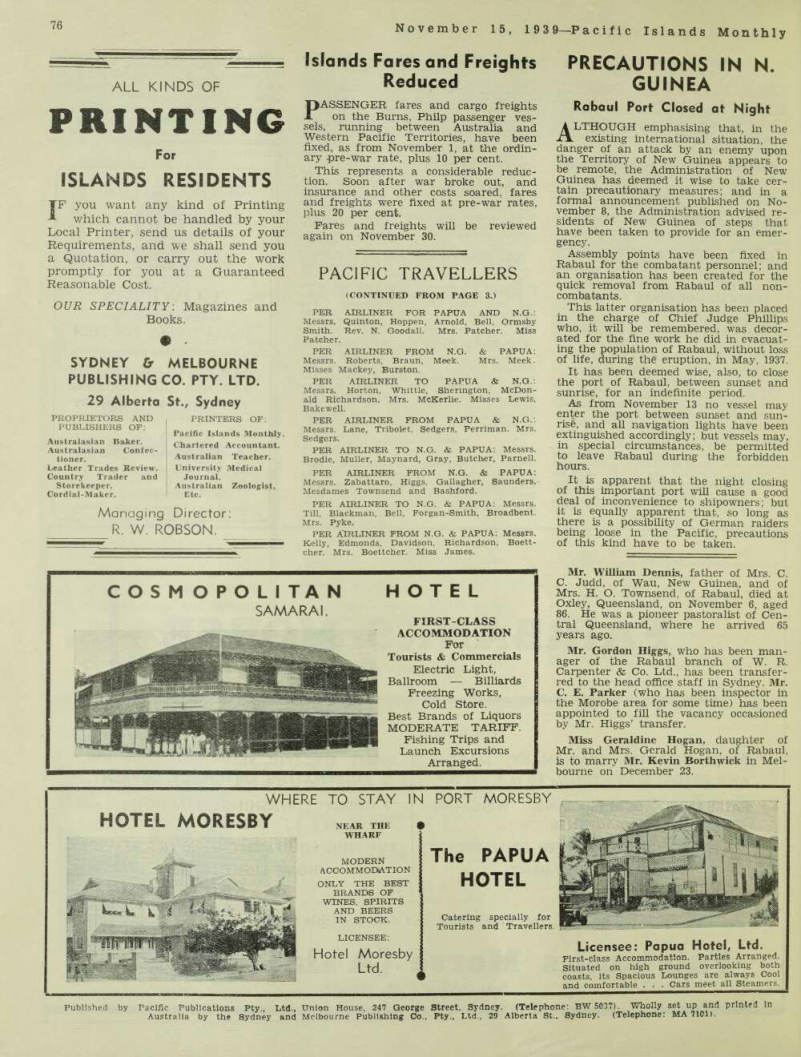
Reduced
PASSENGER fares and cargo freights on the Burns, Philp passenger ves sels, running between Australia and Western Pacific Territories, have been fixed, as from November 1, at the ordin ary pre-war rate, plus 10 per cent.
This represents a considerable reduc tion, Soon after war broke out, and insurance and other costs soared, fares and freights were fixed at pre-war rates, plus 20 per cent.
Fares and freights will be reviewed again on November 30.
Precautions In N.
Guinea
Rabaul Port Closed at Night
ALTHOUGH emphasising that, in the existing international situation, the danger of an attack by an enemy upon the Territory of New Guinea appears to be remote, the Administration of New Guinea has deemed it wise to take cer tain precautionary measures; and in a formal announcement published on No vember 8, the Administration advised re sidents of New Guinea of steps that have been taken to provide for an emer gency.
Assembly points have been fixed in Rabaul for the combatant personnel; and an organisation has been created for the quick removal from Rabaul of all non combatants.
This latter organisation has been placed in the charge of Chief Judge Phillips who, it will be remembered, was decor ated for the fine work he did in evacuat ing the population of Rabaul, without loss of life, during the eruption, in May, 1937.
It has been deemed wise, also, to close the port of Rabaul, between sunset and sunrise, for an indefinite period.
As from November 13 no vessel may enter the port between sunset and sun rise, and all navigation lights have been extinguished accordingly; but vessels may, in special circumstances, be permitted to leave Rabaul during the forbidden hours.
It is apparent that the night closing of this important port will cause a good deal of inconvenience to shipowners; but it is equally apparent that, so long as there is a possibility of German raiders being loose in the Pacific, precautions of this kind have to be taken.
Mr. William Dennis, father of Mrs. C.
C. Judd, of Wau, New Guinea, and of Mrs. H. O. Townsend, of Rabaul, died at Oxley, Queensland, on November 6, aged 86. He was a pioneer pastoralist of Cen tral Queensland, where he arrived 65 years ago.
Mr. Gordon Higgs, who has been man ager of the Rabaul branch of W. R.
Carpenter & Co. Ltd., has been transfer red to the head office staff in Sydney. Mr.
C. E. Parker (who has been inspector in the Morobe area for some time) has been appointed to fill the vacancy occasioned by Mr. Higgs’ transfer.
Miss Geraldine Hogan, daughter of Mr. and Mrs. Gerald Hogan, of Rabaul. is to marry Mr. Kevin Borthwick in Mel bourne on December 23.
Advertisements & other items, pp. 78-80 (4 items)
Pacific Travellers
76
November 15, 1 939—Pacific Islands Monthly
Published by Pacific Publications Pty., Ltd., Union House, 247 George Street, Sydney. (Telephone: BW 5037). Wholly set up and printed In Australia by the Sydney and Melbourne Publishing Co., Pty., Ltd.. 29 Alberta St., Sydney. (Telephone: MA 7101).
November 15, 193 9—P acific Islands Monthly
into
MOUNTAIN
FASTNESSES
r
GUINEA AIRWAYS
Freight and Passenger Service
NEW GUINEA
Guinea Airways planes depart from Port Moresby for the Goldfields after the arrival of each boat. Tickets are obtainable from the Purser or Burns. Philp & Co. Ltd., Sydney or Brisbane.
AUSTRALIA
ADELAIDE to DARWI N /TwiceWeekly
ADELAIDE to KANGAROO IS-
LAND, daily return service. 3
ADELAIDE to FT. LINCOLN.
3 times weekly, calling at Cowell & Cleve.
ADELAIDE to WHYALLA,
Three Times Weekly.
GUINEA AIRWAYS LINKED
WITH EXPLOITATION OF
NEW GUINEA’S GOLD!
There is no rood from the coast to the Morobe Goldfields and the development of this rich area has only been made possible by aerial transport.
The air way has been the only means of transport since 1927. Guinea Airways maintain a fast regular service and have "freighted-in". without difficulty or delay. Crushing Mills, Dredges, Cyaniding Plants, Motor Vehicles, all types of machinery, thousands of passengers and all needs of the large European Community now in this section of the Mandated Territory.
Guinea Airways use 50 Aerodromes and landing grounds in New Guinea and Papua.
LIMITED
LAE - SALAMAUA
Head Office: Austral Chambers, Currie Street, Adelaide, S.A.
New Guinea Office: Lae, Mandated Territory of New Guinea BRANCH OFFICES AND AGENTS AT WAU—SALAMAUA—PORT MORESBY AND SYDNEY.
A Tropical Thirst
demands a Satisfying Drink
IN A COOC
PL A,
t<uob A •UMtt
MALt^S
oNlrv prom the finest an# bottled by
‘•‘OOTH
Ml CO
SYD
EY ST
that’s why K*B* is so popular
south of
All through the tropics, wherever there are men who like good beer, you II always find K. B. It’s the drink that men appreciate —a drink just made to
satisfy a tropical thirst!
% J
TOOTH'S
KB
LAGEIL