Pacific

Islands
Monthly
Vol. X. No. 3.
October 14, 1989
[Registered at the transmission by post as a newspaper.]
8 d
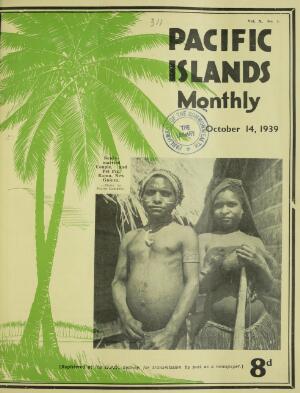
Newly married Couple, and Pet Pig, Ramu, New Guinea.
Photo, by Pastor Campbell.
Advertisements & other items, p. 2 (2 items)
Pacific Islands Monthl y—O ctober 14, 1939
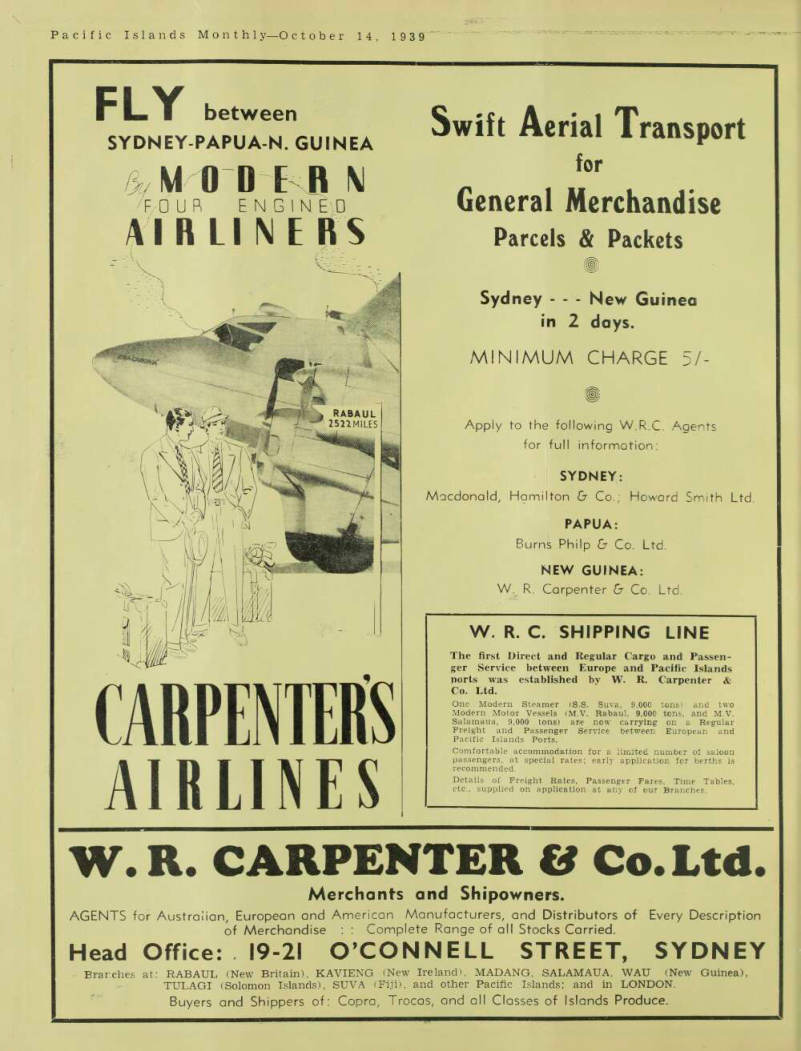
Carpenters
FLY between
SYDNEY-PAPUA-N. GUINEA
MOD E B M
/FOUR ENGIN E)D
AI REINERS
1 x \ as* .
RABAUL
2521 MILES
CARPENTERS
AIRLINES
Swift Aerial Transport
for
General Merchandise
Parcels & Packets
m
Sydney - - - New Guinea
in 2 days.
MINIMUM CHARGE
m Apply to the following W.R.C. Agents for full information;
SYDNEY:
Macdonald, Hamilton £r Co.; Howard Smith Ltd.
PAPUA:
Burns Philp £r Co. Ltd.
NEW GUINEA:
W. R. Carpenter & Co. Ltd.
W. R. C. SHIPPING LINE
The first Direct and Regular Cargo and Passenger Service between Europe and Pacific Islands ports was established by W. R. Carpenter & Co. Ltd.
One Modern Steamer (S.S. Suva. 9,000 tons) and two Modern Motor Vessels (M.V. Rabaul. 9,000 tons, and M.V.
Salamaua, 9.000 tons) are now carrying on a Regular Freight and Passenger Service between European and Pacific Islands Ports.
Comfortable accommodation for a limited number of saloon passengers, at special rates; early application for berths is recommended.
Details of Freight Rates, Passenger Fares. Time Tables, etc., supplied on application at any of our Branches.
W. R. CARPENTER & Co. Ltd.
Merchants and Shipowners.
AGENTS for Australian, European and American Manufacturers, and Distributors of Every Description of Merchandise : : Complete Range of all Stocks Carried.
Head Office: 19-2! O’CONNELL STREET, SYDNEY
Erarches at: RABAUL (New Britain), KAVIENG (New Ireland), MADANG, SALAMAUA. WAU (New Guinea), TULAGI (Solomon Islands), SUVA (Fiji), and other Pacific Islands; and in LONDON.
Buyers and Shippers of; Copra, Trocas, and all Classes of Islands Produce.
Pacific Islands Travellers
PER TASMAN" TO PAPUA: Messrs. Altria, Annan, Burns, Cram, Dix, Hamilton, Hendrick, Henry, Howell-, Kennedy, Kerr, Marshall, McColl, McWatters. Moore, Mulhearn, Ritchie, Robins.
Ryan, Scott, Swanson. Toogood. Wooden. Cap tain Richardson. Mesdames Dix, Godson, Howell, Hunt, Rbins.
Per "Aorangi" From Suva. Fiji: Messrs.
Barnes, Bailey. Lord, Lincolne, McCutchan, Sheedy, Corrie, Hook, Lane, Pascoe, Perry, Windsor. Balding. Hill, Smoothey. Mesdames Fenner, Mason. Parkes. Pickering, Sheedy, Hop kinson, Lane, Perry. Misses Mason, Lane, Perry.
Sir Henry Scott.
Per "Aorangi" For Suva. Fiji: Messrs.
Griffiths. Kerkham. Pope, Baker. Davis, Evetts, T.vlee, Garrett. Leembruggen, Roffey, Sharman.
Mesdames Gale, Kerkham. Evetts, Tylee. Misses Hughes, Evetts, McKindlay.
Per "Tanda" From Rabaul, N.G.: Messrs.
Walton, Beck, Lord, Staley, Ker, Duncan. Mes dames Monks. Staley, Hay (2). Misses McGahan Walker, Monks, Hay (2).
PER "MACDHUI” FOR PAPUA & N.G.: Messrs.
Angelo, Ashbrook, Beazley, Brodie, Bundy Burke, Chant, Christian, Davies, Davis, Dutton,’
Eeles, George Grant, Grey, Hubble, Hunt, Ince, Jillitt, Kerr, Lockwood, Meyer, Ormsby, Owen, Primrose, Robinson, Smith (2), Solderman, Sutton.
Swinburne. Symes, Tabart, Tinnion, Wilson.
Serg. Clarke. Mesdames Bayley, Beazley, Boehm.
Bundy, Burke. Burrow. Collins. Davies, Doyle. En ser, George. Hannemann, Inselmann, Lee. Mackey, Poland, Sutton. Walkc, Weston, Whitten. Misses Brodie (2). Campbell, Hayes. Kirby, Mackey, Smith, Twyford. Sister Damien.
PER “MALAITA” FOR 8.g.1. & N.G. PORTS: Messrs. Artingstall. Birrell, Gould, Hay. Haze winkel, Kroening, Lawson, McGregor. O'Brien, Spencer, Rev. Father Stuyvenberg. Mesdames Craig, McGregor. Misses Clarke, Cohen, Thomp son. Sisters Andrea, Brigette, Ignace, Irene, Wendelina.
Per “Morinda” For Lord Howe. Nor
FOLK IS., & NEW HEBRIDES: Messrs. Bates.
Beer, Berwick, Crossman, Cristofani, Dewy (2), Ewington, Eagles, Evans, Flynn, Finn, Frost, Gough, Gibson, Garnsey, Hammer, Harrison, Joseph, Laing. Lyons, Laing, Lynch, Mullins.
Moses, McCoy, O’Brien. Potts. Pinch, Quain, Ross, Steele, Sheidow, Saggers, Thane, Wamsley, Withers. Mesdames Berwick, Carter, Couston, Dewy, Fenton, Gough, Hammer, Harston, Harri
son, Laing, Purdy, Potts, Palmer, Ross. Misses Burt, Davis, Davis, Deed, Freeborne, Glisson, Moses, Rankin, Watkins.
Per "Bulolo” From Papua & N.G.;
Messrs. Bridges, Bradley, Boyce, Barrett, Baker, Craig, Chauncy, Cooper, Colclough, Dixon, Dwyer, Devine, Doody, Donaldson, Earl, Eaton, Fleming, Flatt, Gray, Green. Horton. Homing, Hewson, Harle, Hutton, Isaacs. Ireland. Kennedy.
Law. Long. Lester. Lucas, Laurence, Millard, Mobbs, Moody, Mclntyre, Macgregor, Miller, Nor man. O'Farrell, Primrose, Penfold, Phelps. Pit man. Rodd, Ryan, Reid. Rawnsley, Sextey. Shirt cliffe, Smith, Tudor, Trevitt, Thompson, Tyson, Thornley. Vandenbergh, Windeyer, Wright, Arnall.
Capt. Williams. Mesdames Arthur. Arblaster.
Austin. Budd, Bridges, Coleman, Cook. Cruise, Dobinson, Earl, Fitch, Fleming, Paul, Fox, Gray, Hinds, Homing, Isaacs, Johnston, Kennedy, Ker, Keogh, Hore-Lacy, Lucas, Lees, Millard, Mobbs.
Moody, Morgan, McDhui, Primrose, Penfold. Pit man. Rodd. Reynolds, Rawnsley, Sandow, Scott, Shaw. Trevitt, Thomas, Tudor, Vandenbergh, Waltho. Lady Shirtcliffe. Misses Arthur, Aiken, Arnold. Bridges, Barrett, Coleman, Cooper, Car michael, Cunningham (2), Dobinson, DaVis, Downing, Eastwood, Fitch, Hardie, Jenklnson, Mustard, Nettleton, Primrose, Reynolds, Somer ville, Sterling, Sutherland, Sherry, Taylor, Whelan, Wilson, Walters.
(Continued On Page 76.)
Jper “Neptuna" From Papua & N.G.:
Messrs. Ailwood, Allan, Black, Feetum, Fraser Hotz, Harrison. Keith. McMullen, Moy, Smith’
Weine, Williams. Brothers Facklen and Hof bauer. Mesdames Buston, Erskine. Feetum, Fraser, Harrison, Jenner, Jones, Keith, Kelly!
Kilner, McMullen. Proctor, Sherwin, Uechtritz.’
Williams. Misses Cheeseman, Proctor. Rand Reeves. Sisters Marcella and Matilda.
PER AIRLINER TO N.G. & PAPUA: Messrs.
Zoffman, Bond, Parkes, Jensen. Col. Walstab.
Mrs. Mitchell.
PER AIRLINER FROM N.G. & PAPUA: Messrs, Shea, Pincombe, Skilly. Mesdames Evans, Schu back. Bliss. Miss Mullins.
PER AIRLINER TO N.G. & PAPUA: Messrs.
AHica. Milward, Smith, Davidson, Bayliss. Dr, Gunther.
PER AIRLINER FROM N.G. & PAPUA: Messrs.
Rowlands, Simpson. Hodder, Phillips. Mesdames Judd, Thompson, Simpson.
PER AIRLINER TO N.G. & PAPUA: Messrs.
Moore, Sedgers, Pratt. McD. Richardson.
PER AIRLINER FROM N.G. & PAPUA: Messrs.
O’Dwyer, Berry, Paul, Allan, Captain Zimmer.
Mesdames Greenham, Godsen.
PER AIRLINER TO N.G. & PAPUA: Messrs.
Gross, Phillips. Mrs. Corfe.
PER AIRLINER FROM N.G. & PAPUA; Messrs.
Dobell Brown, Judd. Mesdames Adelskold, Mor gan, Luff. Miss Steeples.
PER AIRLINER TO N.G. & PAPUA. Messrs.
Good, Feldt. Mesdames Bunney, Cox.
PER AIRLINER PROM N.G. & PAPUA: Messrs.
Hay, Evans, Napier, Macdonald Richardson. Mes dames Maguire, Thurston, Hamilton.
PER AIRLINER TO N.G. & PAPUA: Messrs.
Scott, Macdonald. Captain William. Mrs. Proud.
PER AIRLINER FROM N.G. & PAPUA: Messrs Scharer, Miller, Foldie. Mesdames Taylor Fraser, Maeger, Foldie.
PER AIRLINER TO N.G. & PAPUA: Messrs.
Lakey, Hope, Clout, Carpenter, Grant. Mrs Lakey.
PER AIRLINER TO PAPUA & N.G.; Messrs.
Weddell, Duck, Messel, Roberts, Cerini, Wood ford.
Advertisements & other items, p. 3 (1 item)
Pacific
THE
KPM
SOUTH
PACIFIC
LINE
ii 'v
? R&BAOl
mmisv *1
NOU M l
V *
*# P 0 • T VILA
ITTi k d *ll L!h c t : s /
Links the East with the South
Pacific Islands, New Zealand & Australia
KPM
SOUTH PACIFIC LINE
Royal Packet Navigation Co.
Ltd.. Paketvaart House. *155 George Street, Sydney. (N. V. Konlnklijke Paketvaart MaatschappiJ—lncorporated In the Netherlands).
The track routes of the K.P.M.-South Pacific Line new motor vessel "Maetsuycker" and the well-known passenger steamer "Tasman" are each as follows: "MAET- SUYCKER": Saigon, Singapore, Batavia, Samarang, Sourabayo, Port Moresby, Samarai, Salamaua, Rabaul, Auckland, Wellington, Sydney, Port Moresby, Sourabaya, Samarang, Batavia, Singapore, Saigon. "TASMAN": Saigon, Singapore, Batavia, Samarang, Sourabaya, Port Moresby, Port Vila, Noumea, Auckland, Wellington, Sydney, Port Moresby, Sourabaya, Samarang, Batavia, Singapore, Saigon.
Saigon, Diethelm & Co.: Port Moresby and Samarai, Steamships Trading Co. Ltd.; Rabaul, Salamaua and Wau: W. R.
Carpenter & Co. Ltd.: Port Vila, Gubbay Preres: Noumea, Carlo Leoni: Auckland, Russell & Somers Ltd.; Wellington, Johnston & Co. Ltd.
Advertisers
Page.
Amalgamated Wire less (A/sia) Ltd. . 26 Amplion (A/sia) Ltd. 22 Angus & Coote Ltd. 15 Arnott’s Biscuits . 32 Atkins Ltd., W. . .43 “Ausoline” ... 72
B.A.L.M. Ltd. ... 42
Bank of N.S.W. . . 71 “Bernly” Guest House 24 “Bidomak” ... 17 Broomfields Ltd. . . 75 Brown & Co. Ltd., G 19 Brunton’s Flour . . 35 Budge Ltd., Jas. . . 44 Burns, Philp & Co. Ltd 2 B.P. Magazine . 48
B.P. (S.S.) Co. . . 33
Burns Philp Trust Co. Ltd 58 Buzacott-Wolseley . 63 Carlton & United Breweries, Ltd. . 29 Carpenter Ltd,, W. R cov. 2 Chapman & Sherack 60 Chivers & Sons Ltd. 37 ‘‘Cinna'molia” Pre parations ... 65 Clyde Engineering Co 60 Coleman Lamp & Stove Co. . . 27, 58 Colonial Sugar Re fining Co. Ltd. . 51 Coral Starch ... 38 Cosmopolitan Hotel 76 Crossle. Duff & Macintosh Ltd. . . 67 “Cystex" 62 Danks & Son Ltd. . 50 Dewar’s Whisky . . 57 Doan’s Pills ... 66 Donaghy & Sons Ltd 36 Donald Ltd., A. B. 46 Eaton Ltd., J. W. . 45 Electrolux Refrigerators . . 28
Page.
Eno’s Fruit Salt . 24 Fairbank - Morse Ltd -. . 73 Fletcher & Sons . . 40 Ford Sherington Ltd 13 “Flit” 70 Fryer, A. C. . . .75 Garden Vale Pro ducts Ltd. ... 38 Garrett & Davidon 66 Gillespie’s Flour . 36 Gowing Bros. Ltd. . 13 Grace Bros. Ltd. . 54 Grand Pacific Hotel 47 Grove & Son, W. H. 15 Guest House Wanted 61 Guinea Airways, Ltd cov. 3 Halvorsen, Sons Pty. Ltd., L. . . 75 Hardy’s Indigestion Remedy ... 14 Hemingway & Robertson ... 12 Holbrook’s Ltd. . . 35 Horne, W. & Co. . 46 Hotel Moresby . . 76 Jones & Co. Ltd., H. 56 Kambala School for Girls 10 King’s School, The . 55 Kolynos Dental Cream 30 Kopsen & Co. Ltd. 16 Kork-N-Seal Ltd. . 37 Koyong Boarding School ... 75 Lapstone Hotel . . 52 Levenson’s Radio . 68 Lloyd & Co. Ltd. . 11 Lustre Hosiery, Ltd 53 “Majora” Speed Enamel 50 Maxwell Porter Ltd. 45 Mcllrath’s Ltd. . . 64 “Meridan” School . 76 Merrillees & Co. . . 66 Miller & Co. Pty.
Ltd 72 Morris, Hedstrom Ltd 48
Nelson & Robertson, Ltd. . . . . . .71 Nestles Milk ... 39 Newlands Bros. Ltd. ?5 Newmarket Saddlery 70 Nock & Kirby Ltd. 65 Noyes Bros. Ltd. . 42 Ormonoid Roofing & Asphalts Ltd. . 67 Pabst Canned Beer 60 Pacific Is. Club . . 9 Papua Hotel, The . 76 Pike Bros. Ltd. . . 14
Prescott Ltd. ... 34 Prouds Ltd 11 Reed, William E. . 32 Rivertstone Meat Co. 20 Rohu, Sil . . . .70 Royal Packet Co. . 1 Rutherford, G. . .74 Scott Ltd., J. ... 75 Shell Oil Co. . . . 23 Slade’s Radio ... 69 Southport Schools . 59 Springwood, L. Col. 53
Steamships Trading Co. Ltd 40 Sterling Varnish Co. 9 St. Ignatius College 18 “Sunripe” Cigarettes 65 Sullivan Ltd., C. . 36 Swallow & Ariell . 34 Taylor & Co., A. . 44 “Tenax” Soap . . 52 Tilley Lamp Co. . 41 Tillock & Co. Ltd. . 33 Toohey’s Ltd. ... 21 Tooth & Co. . cov. 4
Vacuum Oil Co. . . 49 Vincent’s A.P.C. . . 31 West, Harry ... 71 Weymark & Son . 37 Wills Ltd., W.D. & H.O 31 Wood’s Peppermint Cure 30 Wright & Co. Ltd.
E 44 Wright & Co. ... 74 Wunderlich Ltd. . . 45
Contents
Pacific Islands Travellers 1, 76 The Hitler War—And a Greater Danger ... 3 Defence Photos Offered to Japanese 4 Pacific Shipping Re-arranged .. .. 5 Matson Line and U.S. Neutrality Act 5 “Morinda’s” Mishap 5 War-Time Precautions by Islands Ships 5 Copra Prices Higher 6 Plans for Immediate ’Frisco-Sydney Airmail by P.A.A 7 Tongans Catch Whales for Food .. 8 Tropicalities 9 Review of the Copra Industry ... 10 Three Ways Pull in N. Hebrides . . 14 Aeroplane Lost in New Guinea ... 15 Plight of New Hebrides Officials .. 16 Copra Grading in Fiji 18 A Ripley Story of Torres Strait ... 20 Rabaul’s Future 21 Change in Suva’s Appearance . . .. 22 White Settlement Possibilities in Central New Guinea 25 Levers £12,000,000 Profit 26 German Mission Plane Escapes from New Guinea 27 N.G. Cocoa Assisted by War 29 111-Treatment of N.G. Natives .. .. 31 Who Owns Little Central Pacific Islands? 32
A Trader’s Tale 33 Rubber Exported from New Britain 34 Church of the British Navigators .. 35 “Jehovah’s Witnesses” in Fiji .. .. 36 Need for International Copra Organi sation 38 America’s Maginot Line in Pacific .. 40 Brother Jones Among 8.5.1. Head hunters 43 Future of the Philippines 45 How Von Luckner Was Taken in Fiji 46 Will N.G. Mandate Last Much Longer? 47 How War Came to Central Pacific .. 48 N.G. Association Formed 50 Fashion Hints for Islands Women .. 53 I Go A-Fishing—A Memory of New Ireland 54 Who is an “Enemy Alien”? 57 New Caledonia’s Rebellion in the ’7o’s 58 Danes in the South Seas 60 Treatment of Pacific Germans .. .. 61 New Book by Papuan Anthropologist 62 Trials of Housekeeping in the Tropics 64 Pacific Mining Notes 66 Islands Short Wave Broadcast ... 69 The Capture of Fort Nukualofa ... 70 Islands Produce and Exchange Rates 72 Copra and Rubber Prices 73 Shipping Services in the Pacific .. 74
Advertisements & other items, p. 4 (2 items)
2
October 14, 193 9—P acific Islands Monthly
Burns, Philp & Co. Ltd
GENERAL
MERCHANTS
m.
III!!
m ml
lit
u
III!
mm
ill!
i
SHIPOWNERS
TOURIST AGENTS
Head Office: 7 Bridge Street, Sydney—Australia Code Address: "Burphil"
BUYERS OF ALL CLASSES OF ISLAND PRODUCE Regular Steamer Services from Australia to New Guinea Papua Solomon Is.—Lord Howe Is.—Norfolk Is.—New Hebrides —Java and Singapore
Pacific Islands Monthly
The Newspaper-Magazine of the South Seas
[Registered at the G.P.0., Sydney, for transmission by post as a newspaper.'] Published Once Each Month and Circulated in Australia and New Zealand and in the following Pacific Territories and Islands Groups;
Australian Territory of Papua.
Mandated Territory (Australia) of New Guinea, Bismarck Archipelago and Northern Solomon Islands.
Australian Territory of Norfolk Island.
New Zealand Territory of Cook Islands.
Mandated Territory (New Zealand) of Samoa.
British Colony of Fiji.
British Solomon Islands Protectorate.
British Protectorate of Tongan Islands.
British Crown Colony of Gilbert and Ellice Islands.
Mandated Territory of ‘Nauru.
British and French Condominium of New Hebrides.
French Colony of New Caledonia.
French Colony of Oceania (Tahiti, etc.).
American Territory of Eastern Samoa.
American Territory of Hawaiian Islands.
American Territory of Guam.
Mandated Territory (Japan) of Marshall, Caroline and Mariana Islands.
Owned ond Produced by Pacific Publications Pty. Ltd., Union House, 247 George Street, Sydney.
tft RPimmi f Managing Director .. BW 5037 I Business and Editorial MA 7101
P O Box 3408 R
Registered Address of Telegrams, Radiograms, and Cables; “Pacpub”, Sydney.
Contributions.
Articles, Stories, and Photographs dealing with Pacific Islands subjects are invited and will be paid for on publication at usual rates.
Subscription Rates.
Per Annum, within British Empire, Prepaid, Post Free 8/- Per Annum, elsewhere, prepaid. Post Free . 10/- Single Copies Bd.
Editor and Publisher:
R. W. Robson, F.R.O.S.
Assisted by Selwyn Hughes.
Advertising Manager: L. W. Bailey.
Advertising Office and Printing-House: 29 Alberta St., Sydney.
Advertising rates furnished on application.
Colours, etc by Arrangement.
Process Blocks made at Advertiser’s expense when required. Screen 90.
Changes of Advertising Copy should reach this Office by Ist of each month, otherwise previous advertisement may be repeated.
IN LONDON, the Pacific Islands Monthly Is on sale at the Bookstall. Australia House, The Strand, London.
Agents.
The following are authorised to receive sub scriptions for the Pacific Islands Monthly:— Islands Branches of Bums, Phllp & Co., Ltd., and Burns Phllp (South Sea) Co.. Ltd.
Islands Branches of W. R. Carpenter & Co., Ltd.
Islands Branches of Morris, Hedstrom, Ltd.
G. Thomas & Co., Rabaul, New Guinea.
T. A. Olsson, Wau, New Guinea.
Whitten Bros., Ltd., Samaral, Papua.
Steamships Trading Co., Papua. All Branches.
B.N.G. Trading Co., Ltd., Port Moresby.
J. Muir, Suva, FIJI.
N. C. Mackenzie-Hunt, Wainunu, Bua, FIJI.
Islands Branches and Representatives of W. H.
Grove & Sons, Ltd!, Auckland, New Zealand.
Cook Islands Trading Co., Rarotonga, Cook Is.
A. C. Rowland, Papeete, Tahiti.
Representative in London: W. C. HARVEY, Coronation House, 4 Lloyds Avenue, London, E.C.3, from whom may be obtained copies of Pacific Islands Monthly, Pacific Islands Year Book, advertising schedules, etc.
Vol. X. NO. 3
October 14, 1939
Priro Bd ' Per Copy rr Prepaid: 8/- p.a.
The Hitler War—And A Greater Danger
WITH a deliberation doubtless calculated to impress both enemy and neutral opinion, the Allies are preparing for a long war; and they are building up new forces which probably will give them, on land and in the air, the superiority they now enjoy on the sea. Hitler’s peace overtures—which never were anything more than the unrepentant thief’s attempt to get away with the booty— have been rejected. The Allies have announced that they will fight on until “Hitlerism” is destroyed. Hitler is thought now to be preparing a terrific blow against the Allies—“to bring them to their senses”.
But this commentator, despite it all, offers the view that the “Hitler War” will not last much longer. True, Britain and France took up arms to destroy “Hitlerism”—in other words, to put an end to all this goosestepping, and musket-rattling, and maniacal raving, which have kept the world in a state of dither for several years. In the circumstances as they existed on September 3, it was sound strategy to plan a 3-years’ war—the Nazi regime will not be easily broken.
But circumstances have changed greatly since September 3. A danger greater than Hitlerism threatens Western civilisation. If only a formula can be found which will allow the Allies to draw the poison-fangs out of Nazi-ism, and limit the mischief-making propensities of its tub-
thumping leaders—and, surely, that can be accomplished by statesman ship!—there is no reason why British, French, Germans, Italians and Jap anese should not stand in line together to stop the westwards and eastwards march of Russia. In fact, something like that must happen, soon, if Western Europe is not to be engulfed in a wave of Communism, bloodshed and ruthlessness indescrib able. The things which separate the five great Powers now are vastly less in character and volume than the frightful danger which now unites them.
WHEN the Nazis, bungling amateurs in diplomacy, tried to outwit the British and French by entering into the Russo-German Pact, many people declared that Hitler had des troyed himself. Events of the past month show that that was an under statement: Hitler may have destroyed Germany. It is impossible to mis interpret recent developments.
When Germany entered the Pact, she expected to have the goodwill of Russia in carving up Poland, while the material resources of Russia were to be made available to her in the event of Britain and France going to war and attempting a blockade. That, she argued, was more valuable than the maintenance of the Axis with Italy and Japan.
And, now, what has happened? Italy
and Japan are alienated, and, every day, are drawing nearer to Britain and France. Germany has conquered the Poles; but Russia has marched in and seized half of Poland. While the Germans stand, immobile, impotent and friendless, on the Warsaw line, the Russians are taking control of Estonia, Latvia and Lithuania and are threatening Finland. They hold south-east Poland, right across to the Hungarian frontier, so that it is now impossible for the Germans to march on towards the Balkans and the Black Sea. Germany brought Russia into the picture, as part of a Puckish plan for annoying the Allies; and now Russia has taken charge of the situa tion. Already, Russia is releasing her Bolshevik poison among the German masses, so that the security of Ger many now is menaced by Russia in a manner never imagined by Hitler in his worst “Mein Kampf” nightmare.
The general war situation is set out in the attached news-review. Our readers will see that it has developed precisely as we forecast it, in Sep tember. Poland is wiped out; the Allies are standing to arms on the Western front, while their control of the sea allows them to put economic pressure on Germany; and the Nazi leaders are carrying out intensive propaganda in favour of a peace con ference. Normally, we could expect, next, a very powerful attack by Ger many upon the Allies. But there has entered into the situation, in the form of Soviet Russia, an element far more sinister, and disturbing, and
dangerous than even the Nazi regime.
The Bolsheviks, powerfully equipped, with many millions of men, are ad vancing upon Central Europe—all along the 2,000-miles line, from Finland, in the far north, right down through the Baltic region and Poland, to the Roumanian-Bessarabian fron tier —and upon Iran and Afghanistan.
The Western nations, deeply pre occupied with their task of smashing Hitlerism and again making the world safe for democracy, do not yet see clearly what is happening. But Italy sees it, and is desperately uneasy, and already there are signs that a shudder of fear is running through the ranks of middle-class Germany. They must realise that the monomaniac Hitler, playing at being Frederick the Great and Napoleon, has released a Frank enstein monster that already is reach ing out to devour Germany.
This is no place to discuss the horror that is represented by Soviet “Government”. Sufficient to say that, to Western peoples, it is a horror in conceivable a thing that could develop only in the dirt and ignor ance of illiterate Russia.
Satan, wishing to debase humanity, Crossed Lust with Greed, and Hate with Vanity, Mated their offspring and thus brought to birth The Bolshie-Communist, the foulest breed on earth.
As they entered Poland, in Septem ber, the Russians removed the criminals from the gaols; gave to the lowest classes positions of authority; threw the merchants and the land owners into the gaols, or murdered them; and divided their lands and goods among the peasants. Train loads of Polish officials, merchants, landowners, military officials, etc., have been sent away into Siberia.
Even as this is written, the cable grams say that the Soviet commissars are taking charge of Estonia, Latvia and Lithuania, and their armies are knocking at the frontiers of Finland.
The deliberate, cold-blooded purpose of the Soviet, frequently announced, is to destroy the Empires of Britain and France; and how better could they do it than by the “Bolshevisation” of Germany?
OF course, there still is the possi bility that Germany and Russia propose to co-operate in the destruc tion of the Allies. Many commen tators believe that such a plan actually exists. If it could be put into operation, the Hitler War would take on a new and more terrible aspect. We should have to meet the Russians on three or four Asiatic fronts, while our forces were engaged in the major struggle against Ger many. Against that, we could set the certainty that Japan, and perhaps Italy, would join the Allies.
But an alliance between Germany and Russia, for the purpose of a great war, is unnatural and inconceivable.
It may be planned by Hitler and Stalin, and it might even begin to function; but it never would be ac
cepted by the mass of the German people.
Much will depend upon diplomatic exchanges in Europe during the com ing month.
Photos, of P. Moresby
Offered to the Japanese
THE following Australian Associated Press message was published on Sep tember 29: It is reported from Batavia (Dutch East Indies) that a press photographer has been imprisoned, on remand, charged with attempting to sell photographs of Australian defence works at Port Moresby to the Japanese Consul-General.
There have been no further details.
Mr. A. M. Braisby (Chief of Police in Samoa) and Mrs. Braisby returned to Apia at the end of September, after a visit to the United States and Canada.
Then—And Now
A WELL-KNOWN Sydney firm dug into its books the other day, and pro duced the following records of sales ac tually made in September, 1919 (just after the Great War) and compared them with prices in August, 1939 (just be fore the start of the Hitler War).
The same records show that, in April, 1920, copra was £42 and trocas £lOB TO per ton.
Our Samoan correspondent, writing at the end of September, says that, owing to an ample rainfall, the cocoa crop this year will be a very good one. The copra output for this year may be a record, and very large quantities of copra are stored in Apia, awaiting shipment.
September, August, 1919. 1939.
Copra, per ton .. £36 10 0 £10 12 6 Cocoa, per ton .. 90 0 0 30 0 0 Trocas, per ton .. 84 0 0 80 0 0 Ivory nuts, ton . 18 0 0 7 0 0
Advertisements & other items, p. 6 (2 items)
Off Beaten Tracks in the Pacific —VII.
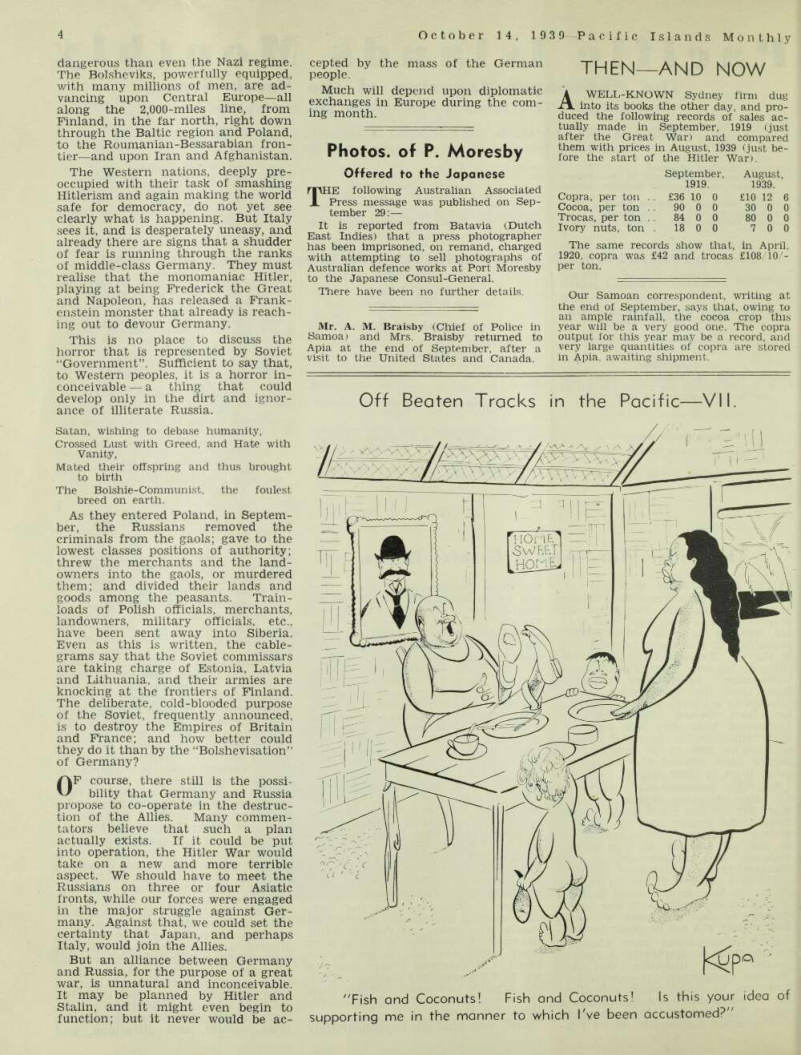
"Fish and Coconuts! Fish and Coconuts! Is this your idea of supporting me in the manner to which I've been accustomed?"
4
October 14, 193 9—P acific Islands Monthly
Hedstrom In N. America
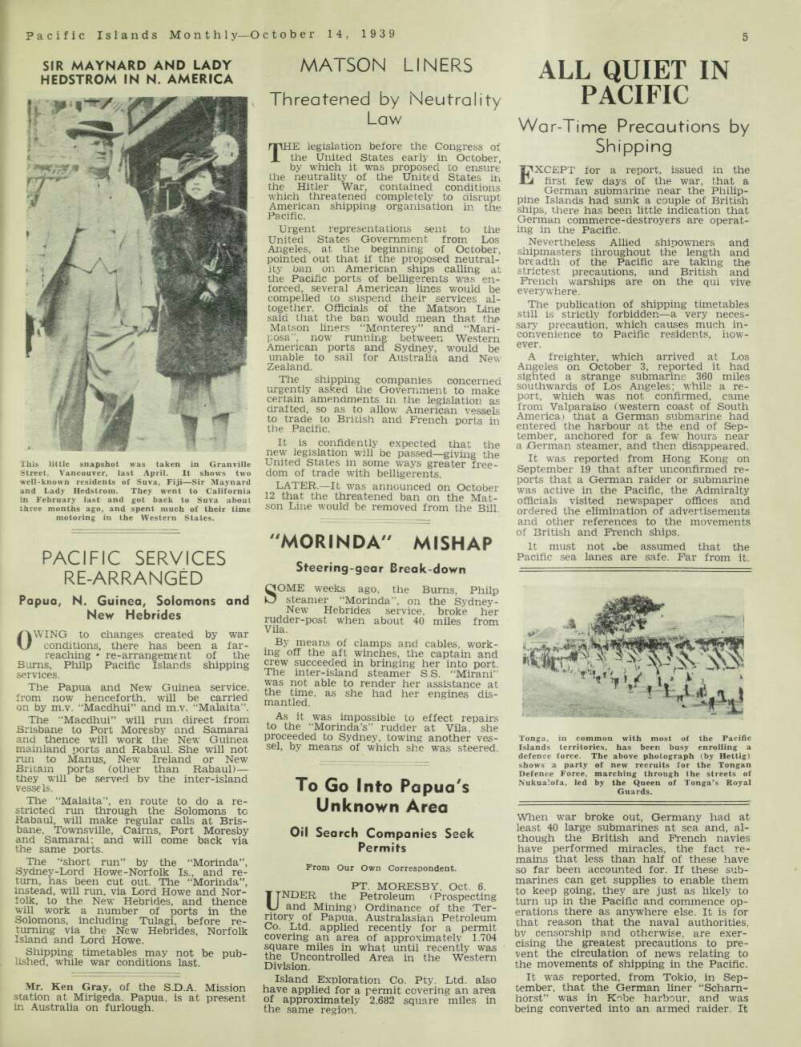
Sir Maynard And Lady
This little snapshot was taken in Granville Street, Vancouver, last April. It shows two well-known residents of Suva, Fiji—Sir Maynard and Lady Hedstrom. They went to California in February last and got back to Suva about three months ago, and spent much of their time motoring in the Western States.
Pacific Services
Re-Arranged
Papua, N. Guinea, Solomons and New Hebrides
OWING to changes created by war conditions, there has been a far reaching • re-arrangement of the Bums, Philp Pacific Islands shipping services.
The Papua and New Guinea service, from now henceforth, will be carried on by m.v. “Macdhui” and m.v. “Malaita”.
The “Macdhui” will run direct from Brisbane to Port Moresby and Samarai and thence will work the New Guinea mainland ports and Rabaul. She will not run to Manus, New Ireland or New Britain ports (other than Rabaul) — they will be served bv the inter-island vessels.
The “Malaita”, en route to do a re stricted run through the Solomons to Rabaul, will make regular calls at Bris bane, Townsville, Cairns, Port Moresby and Samarai: and will come back via the same ports.
The ‘‘short run” by the “Morinda”, Sydney-Lord Howe-Norfolk Is., and re turn, has been cut out. The "Morinda”, instead, will run, via Lord Howe and Nor folk, to the New Hebrides, and thence will work a number of norts in the Solomons, including Tulagi, before re turning via the New Hebrides, Norfolk Island and Lord Howe.
Shipping timetables may not be pub lished, while war conditions last.
Mr. Ken Gray, of the S.D.A. Mission station at Mirigeda. Papua, is at present in Australia on furlough.
Threatened by Neutrality
Matson Liners
Threatened by Neutrality Law
THE legislation before the Congress of the United States early in October, by which it was proposed to ensure the neutrality of the United States in the Hitler War, contained conditions which threatened completely to disrupt American shipping organisation in the Pacific.
Urgent representations sent to the United States Government from Los Angeles, at the beginning of October, pointed out that if the proposed neutral ity ban on American ships calling at the Pacific ports of belligerents was en forced, several American lines would be compelled to suspend their services al together. Officials of the Matson Line said that the ban would mean that the Matson liners “Monterey” and “Mari posa", now running between Western American ports and Sydney, would be unable to sail for Australia and New Zealand.
The shipping companies concerned urgently asked the Government to make certain amendments in the legislation as drafted, so as to allow American vessels to trade to British and French ports in the Pacific.
It is confidently expected that the new legislation will be passed—giving the United States in some ways greater free dom of trade with belligerents.
LATER. —It was announced on October 12 that the threatened ban on the Mat son Line would be removed from the Bill
"Morinda" Mishap
Steering-gear Break-down
SOME weeks ago, the Burns, Philp steamer “Morinda”, on the Sydney- New Hebrides service, broke her rudder-post when about 40 miles from Vila.
By means of clamps and cables, work ing off the aft winches, the captain and crew succeeded in bringing her into port.
The inter-island steamer S.S. “Mirani” was not able to render her assistance at the time, as she had her engines dis mantled.
As it was impossible to effect repairs to the “Morinda’s” rudder at Vila, she proceeded to Sydney, towing another ves sel, by means of which she was steered.
Unknown Area
To Go Into Papua's Unknown Area Oil Search Companies Seek Permits
From Our Own Correspondent.
Pt. Moresby. Oct. 6.
UNDER the Petroleum (Prospecting and Mining) Ordinance of the Ter ritory of Papua. Australasian Petroleum Co. Ltd. applied recently for a permit covering an area of approximately 1.704 square miles in what until recently was the Uncontrolled Area in the Western Division.
Island Exploration Co. Pty. Ltd. also have applied for a permit covering an area of approximately 2,682 square miles in the same region.
When war broke out, Germany had at least 40 large submarines at sea and, al though the British and French navies have performed miracles, the fact re mains that less than half of these have so far been accounted for. If these sub marines can get supplies to enable them to keep going, they are just as likely to turn up in the Pacific and commence op erations there as anywhere else. It is for that reason that the naval authorities, by censorship and otherwise, are exer cising the greatest precautions to pre vent the circulation of news relating to the movements of shipping in the Pacific.
It was reported, from Tokio, in Sep tember, that the German liner “Scham horst” was in Kobe harbour, and was being converted into an armed raider. It
was also stated that Britain had told Japan that the arming of German ships in Japanese ports was an infringement of the Japanese neutrality Nothing has been heard of the matter since.
British and French sea-borne commerce is proceeding as usual in the Pacific, ex cept for the inconvenience imposed by strict wartime precautions; but those who remember the circumstances of the last war will realise that the danger of a raider getting loose in the Pacific, and doing a lot of damage before it is finally rounded up, will remain as long as a condition of war exists.
Precautions At Fanning Island
IMMEDIATELY after the outbreak of the Great War, in 1914, a German warship completely demolished the cable station at Fanning Island, thus interrupting cable communication be tween North America and Australia. Al though short-wave radio now has greatly reduced the importance of maintaining cable communication, the lesson of 1914 was not forgotten, and immediately war broke out, on September 3, steps were taken to protect Fanning Island.
An American steamer went to Fanning Island from Honolulu with defence sup plies. She carried cement, barbed wire iron stakes, and lumber, as well as a staff of men to take charge of the defences
Pacific
All Quiet In
War-Time Precautions by Shipping
EXCEPT for a report, issued in the first few days of the war, that a German submarine near the Philip pine Islands had sunk a couple of British ships, there has been little indication that German commerce-destroyers are operat ing in the Pacific.
Nevertheless Allied shipowners and shipmasters throughout the length and breadth of the Pacific are taking the strictest precautions, and British and French warships are on the qui vive everywhere.
The publication of shipping timetables still is strictly forbidden —a very neces sary precaution, which causes much in convenience to Pacific residents, how ever.
A freighter, which arrived at Los Angeles on October 3, reported it had sighted a strange submarine 360 miles southwards of Los Angeles; while a re port, which was not confirmed, came from Valparaiso (western coast of South America; that a German submarine had entered the harbour at the end of Sep tember, anchored for a few hours near a German steamer, and then disappeared.
It was reported from Hong Kong on September 19 that after unconfirmed re ports that a German raider or submarine was active in the Pacific, the Admiralty officials visited newspaper offices and ordered the elimination of advertisements and other references to the movements of British and French ships.
It must not .be assumed that the Pacific sea lanes are safe. Far from it.
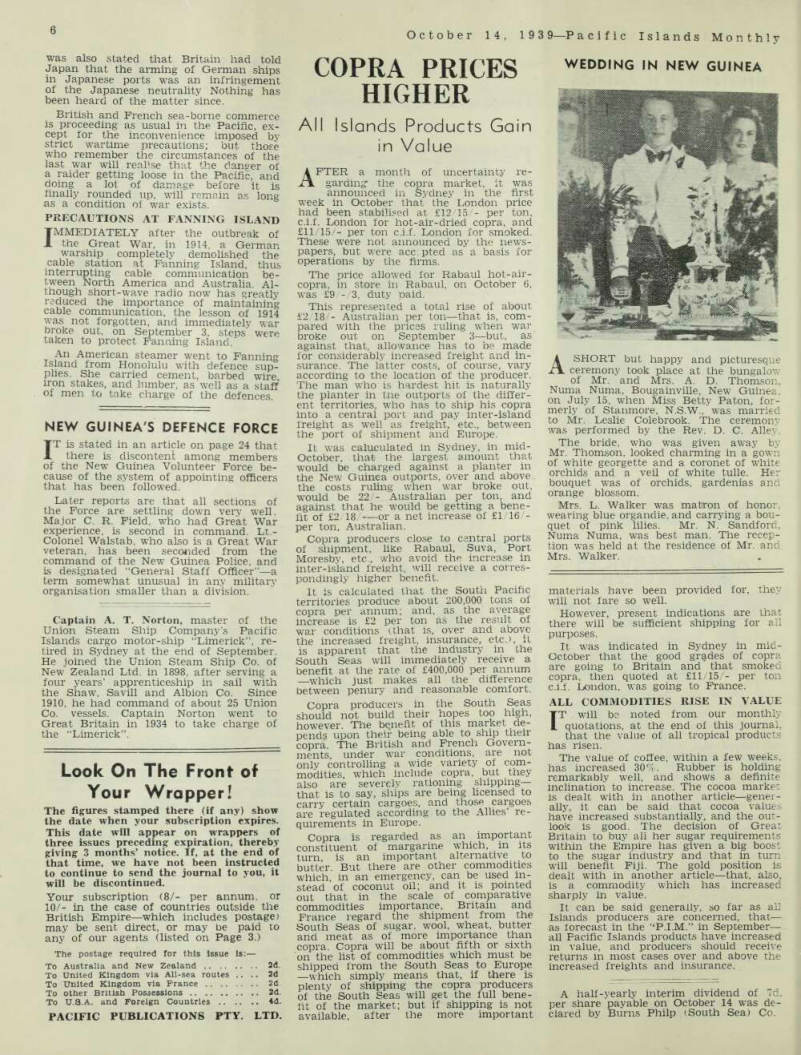
Tonga, in common with most of the Pacific Islands territories, has been busy enrolling a defence force. The above photograph (by Hettig) shows a party of new recruits for the Tongan Defence Force, marching through the streets of Nukualofa, led by the Queen of Tonga’s Royal Guards.
Advertisements & other items, p. 7 (1 item)
5
Pacific Islands Monthl y—O ctober 14, 1939
New Guinea's Defence Force
IT is stated in an article on page 24 that there is discontent among members of the New Guinea Volunteer Force be cause of the system of appointing officers that has been followed.
Later reports are that all sections of the Force are settling down very well.
Major C. R. Field, who had Great War experience, is second in command. Lt.- Colonel Walstab, who also is a Great War veteran, has been seconded from the command of the New Guinea Police, and is designated “General Staff Officer” —a term somewhat unusual in any military organisation smaller than a division.
Captain A. T. Norton, master of the Union Steam Ship Company's Pacific Islands cargo motor-ship “Limerick”, re tired in Sydney at the end of September.
He joined the Union Steam Ship Co. of New Zealand Ltd. in 1898, after serving a four years’ apprenticeship in sail with the Shaw, Savill and Albion Co. Since 1910, he had command of about 25 Union Co. vessels. Captain Norton went to Great Britain in 1934 to take charge of the “Limerick”.
Copra Prices
Higher
All Islands Products Gain in Value
AFTER a month of uncertainty re garding' the copra market, it was announced in Sydney in the first week in October that the London price had been stabilised at £l2/15/- per ton, c.i.f. London for hot-air-dried copra, and £ll 15/- per ton c.i.f. London for smoked.
These were not announced by the news papers, but were acc.pted as a basis for operations by the firms.
The price allowed for Rabaul hot-air copra, in store in Rabaul, on October 6, was £9 -/3, duty paid.
This represented a total rise of about £2 18/- Australian per ton—that is, com pared with the prices ruling when war broke out on September 3—but, as against that, allowance has to be made for considerably increased freight and in surance. The latter costs, of course, vary according to the location of the producer.
The man who is hardest hit is naturally the planter in the outports of the differ ent territories, who has to ship his copra into a central port and pay inter-island freight as well as freight, etc., between the port of shipment and Europe.
It was caluculated in Sydney, in mid- October, that the largest amount that would be charged against a planter in the New Guinea outports, over and above the costs ruling when war broke out, would be 22/- Australian per ton, and against that he would be getting a bene fit of £2 18 —or a net increase of £1 16 per ton, Australian.
Copra producers close to central ports of shipment, like Rabaul, Suva, Port Moresby, etc., who avoid the increase in inter-island freight, will receive a corres pondingly higher benefit.
It is calculated that the South Pacific territories produce about 200,000 tons of copra per annum; and, as the average increase is £2 per ton as the result of war conditions (that is. over and above the increased freight, insurance, etc.), it is apparent that the industry in the South Seas will immediately receive a benefit at the rate of £400,000 per annum —which just makes all the difference between penury and reasonable comfort.
Copra producers in the South Seas should not build their hopes too high, however. The benefit of this market de pends unon their being able to ship their copra. The British and French Govern ments, under war conditions, are not only controlling a wide variety of com modities, which include copra, but they also are severely rationing shipping— that is to say, ships are being licensed to carry certain cargoes, and those cargoes are regulated according to the Allies’ re quirements in Europe.
Copra is regarded as an important constituent of margarine which, in its turn, is an important alternative to butter. But there are other commodities which, in an emergency, can be used in stead of coconut oil; and it is pointed out that in the scale of comparative commodities importance, Britain and France regard the shipment from the South Seas of sugar, wool, wheat, butter and meat as of more importance than copra. Copra will be about fifth or sixth on the list of commodities which must be shipped from the South Seas to Europe —which simply means that, if there is plenty of shipping the copra producers of the South Seas will get the full bene fit of the market; but if shipping is not available, after the more important
materials have been provided for, they will not fare so well.
However, present indications are that there will be sufficient shipping for all purposes.
It was indicated in Sydney in mid- October that the good grades of copra are going to Britain and that smoked copra, then quoted at £ll/15/- per ton c.i.f. London, was going to France.
All Commodities Rise In Value
IT will be noted from our monthly quotations, at the end of this journal, that the value of all tropical products has risen.
The value of coffee, within a few weeks, has increased 30%. Rubber is holding remarkably well, and shows a definite inclination to increase. The cocoa market is dealt with in another article —generally, it can be said that cocoa values have increased substantially, and the out look is good. The decision of Great Britain to buy all her sugar requirements within the Empire has given a big boost to the sugar industry and that in turn will benefit Fiji. The gold position is dealt with in another article—that, also, is a commodity which has increased sharply in value.
It can be said generally, so far as all Islands producers are concerned, that— as forecast in the “P.1.M.” in September— all Pacific Islands products have increased in value, and producers should receive returns in most cases over and above the increased freights and insurance.
A half-yearly interim dividend of 7d. per share payable on October 14 was de clared by Burns Philp (South Sea) Co.
Wedding In New Guinea
A SHORT but happy and picturesque ceremony took place at the bungalow of Mr. and Mrs. A. D. Thomson, Numa Numa, Bougainville, New Guinea, on July 15, when Miss Betty Paton, for merly of Stanmore, N.S.W., was married to Mr. Leslie Colebrook. The ceremony was performed by the Rev. D. C. Alley.
The bride, who was given away by Mr. Thomson, looked charming in a gown of white georgette and a coronet of white orchids and a veil of white tulle. Her bouquet was of orchids, gardenias and orange blossom.
Mrs. L. Walker was matron of honor, wearing blue organdie, and carrying a bou quet of pink lilies. Mr. N. Sandford, Numa Numa, was best man. The recep tion was held at the residence of Mr. and Mrs. Walker.
Advertisements & other items, p. 8 (1 item)
Your Wrapper!
Look On The Front of
The figures stamped there (if any) show the date when your subscription expires.
This date will appear on wrappers of three issues preceding expiration, thereby giving 3 months’ notice. If, at the end of that time, we have not been instructed to continue to send the journal to you, it will be discontinued.
Your subscription (8/- per annum, or 10/- in the case of countries outside the British Empire—which includes postage) may be sent direct, or may be paid to any of our agents (listed on Page 3.) The postage required for this Issue Is;— To Australia and New Zealand 2d.
To United Kingdom via All-sea routes ... 2d To United Kingdom via France 2d.
To other British Possessions 2d.
To U.S.A. and Foreign Countries 4d.
PACIFIC PUBLICATIONS PTY. LTD.
’Frisco-Sydney Airmail
Plan For Immediate
Pan American Airways Offer To Run New Boeing Flying-Boats :: British Service Held Up By War
IT IS probable that the new trans-Pacific airmail, connecting North America with New Zealand and Australia, will be inaugurated by Pan American Airways in November or December, using the route Honolulu-Canton Island -Fiji-Noumea-Auckland. It is probable that the terminal point in California will be San Francisco, and the terminal point in Australia will be Sydney.
This development is directly the result of war conditions.
UNTIL the outbreak of war, it seemed certain that Pan American Airways and Imperial Airways—American and British respectively—would almost simul taneously inaugurate trans-Pacific ser vices and would either share the traffic between them, or would carry on com petitive lines.
Pan American Airways were first in the field, by many years. About 1935, the Company made an agreement with the New Zealand Government, under which they were given landing rights in Auck land; and they proceeded to organise a route from Honolulu via Kingman Reef and Pago Pago, with an important base in Auckland. Pioneer flights were made at the end of 1937, but ended in disas ter when the “Samoa Clipper” was de stroyed in an explosion at Pago Pago.
The route was deemed unsatisfactory, and P.A.A. then explored the possibili ties of an alternative route—namely, from Honolulu to Canton Island, then to Nou mea (New Caledonia), and then to Auck land. Finally, this route was accepted and organisation work has been proceed ing during the past year. Important flying boat base facilities have been provided at Noumea, and at Canton Island, and a hotel is being built at the latter place.
IN the meantime, Imperial Airways have been proceeding steadily with their plans. Having successfully established the England-Australia service, they pro ceeded to build three large flying-boats
for the new link between Sydney and Auckland: and, in August last, the new flying-boat “Aotearoa”, 22 tons, arrived in Sydney.
The “Aotearoa” made a pioneer flight from Sydney to Auckland on August 28, and the Pan American Airway’s new Boeing, “Californian Clipper”, made a pioneer flight from San Francisco to Canton Island, Noumea, and Auckland.
The two fine new flying-boats therefore met in Auckland on August 30 —a notable occasion.
Up to that point, there was uncer tainty about the plans of the two avi ation companies. It was apparent that Pan American Airways were not happy about the terminal at Auckland, because this meant that they were shut out from the valuable Australian traffic. It was equally apparent that Imperial Airways were having difficulty in regard to the American end of their trans-Pacific ser vice—it is still not clear that British machines will have the right to call re gularly at Honolulu, although it is believ ed that that was a condition of permis sion being given to the American ma chines to land in Auckland.
HOWEVER, on September 3, came the war; and that, apparently, put an end. for some considerable time, to the British plans for a trans-Pacific service.
The “Aotearoa” made a survey flight from Auckland to Suva and returned to Auckland, and thence back to Sydney. The
two sister ships of the “Aotearoa”, it was announced, are to be used for war ser vice, somewhere.
Meanwhile, there is a definite need for a trans-Pacific airmail between Australia and New Zealand and the North Ameri can continent. It was announced from Washington, on October 5, that repres entatives of the United States Post Of fice and Pan American Airways had urg ed the Civil Aeronautical Authority to permit a passenger and airmail service from California to Australia via Hono lulu. Canton Island, Noumea, and Auck land.
This caused a flutter of lively interest in aviation circles in Australia—first, be cause it shows that at last Pan Ameri can Airways are working in harmony with the American Post Office; second, because it indicates that America, probably with British goodwill, is planning to go ahead with the new trans-Pacific airmail; and, thirdly, because plans apparently have been made towards the extension of the American service to Australia.
Although it was not stated in the offi cial announcement, it is clearly under stood that, if the American service is commenced, it will provide for a call at Fiji—that is, between Canton Island and Noumea.
It was stated in the “New Zealand Herald” on September 15 that the Pan American Airway’s administration build ing at the Auckland airbase is to be doubled in size and that plans definitely have been made for a regular call at Fiji —but the P.A.A. have not yet decided where the landing place at Fiji is to be. Suva has weather disadvantages. It is suggested that Suva must be used dur ing one season, and Lautoka when the trade-wind is in the opposite direction.
The “Sydney Morning Herald”, on Oc tober 9, said that Pan American Airways is expected to inaugurate a South Pacific air service on a regular schedule in No vember. The newspaper added that the United States Government had not yet secured landing rights in Australia.
The “Melbourne Herald”, on October 6, said that Australia would not be likely to reject a Pan American Airways appli cation for landing rights that had the
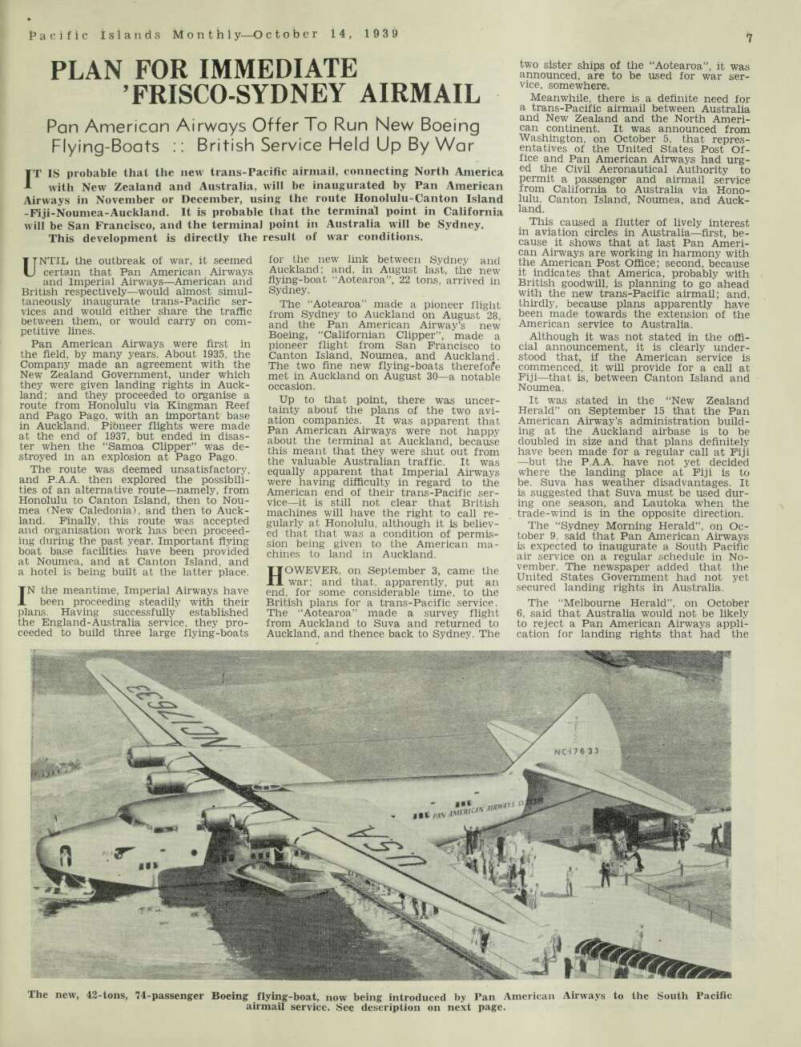
The new, 42-tons, 74-passenger Boeing flying-boat, now being introduced by Pan American Airways to the South Pacific airmail service. See description on next page.
wholehearted support of the United States Government. This newspaper added that the American service could not start un til the hotel on Canton Island has been built and properly equipped—Canton will be a regular overnight stopping place.
The Route
Distances between points are;— San Francisco-Los Angeles 411 miles Los Angeles-Honolulu .. .. 2,570 Honolulu-Canton Island .. 1,915 „ Canton Island-Suva 1,250 „ Suva-Noumea 730 „ Noumea-Auckland 1,124 „ Auckland-Sydney 1,200 „
The Machines
Pan American Airways South Pacific service will be carried on by three flying boats —“California Clipper”, “Honolulu Clipper”, and “American Clipper”. They are members of a fleet of six huge fly ing-boats constructed for Pan American Airways by the Boeing Aircraft Com pany for scheduled operation on the Pacific and the Atlantic Oceans. The “Yankee Clipper”, “Atlantic Clipper” and “Dixie Clipper” are being operated on the two routes over the Atlantic.
These are the largest aircraft, either military or commercial, in the world.
They are all-metal, double-deck, four engined (1,500 h.p. each) monoplane fly ing-boats, equipped with auxiliary “sea wdngs” (technically called hydro-stabi lizers, for lateral stability on the sur face or in heavy seas>. Their gross weight (fully loaded) is 82,500 lb.; their overall
length is 109 feet; their wingspan is 152 feet; and their fuel capacity is 4,200 gallons. .Their highest speed is 190 m.p.h. and their cruising speed (at long range cruising) 150 m.p.h. Their range is 4,275 miles, and their ceiling 21,000 feet.
The maximum capacity of each flying boat is: Passengers (sitting only) 74; Pas sengers accommodated over night 40; cargo 5,000 lb.
All four engines are accessible for servicing, adjustment or repair in flight.
Engine stations are maintained in the big nacelles, behind each motor, and con nected by telephone to the flight deck.
There are two decks. On the flight deck are the offices, etc., of the operating staff. On the main deck are:—Five main passenger cabins, each with accom modation for 10 day-time, 6 night-time passengers; dining lounge, with dining accommodation to serve 15 passengers at a time; one 4-passenger compartment aft.; at the stern, a private “bridal suite”, completely furnished apartment; separate men’s and women’s dressing rooms and lavatories; galley, with ice box and steam table, for preparation of food for 85 people.
There is a complete internal telephone system among flight deck posts, engine stations in wing, and steward’s galley.
Mr, I. L. Howell, of the S.D.A. Mission returned to Papua recently after fur lough in Australia.
Advertisements & other items, p. 9 (1 item)
7
Pacific Islands Monthl y—O ctober 14, 1939
"From Tokio"
Japanese Captain's Chart
Letter to the Editor I HAVE read your interesting articles, from time to time, about Japanese fishing boats, etc., in the Pacific and I would like to advise you that some months ago a Japanese schooner, regis tered in Rabaul, called at my plantation, and the owner came ashore to buy some goods.
In the course of conversation, I asked him how he knew all the passages and reefs, because the waters around my place were unsurveyed, and I had never heard of a chart that showed them.
He politely informed me that he had an Admiralty chart, showing all reefs, passages and anchorages of these “un charted” waters.
In reply to my next question as to where he got the chart, he said: “From Tokio”.
I am, etc.,
New Guinea Planter.
20/9/’39.
Mr. R. Crompton, who is head of the well-known legal firm of Suva, Fiji, ar rived in Sydney early in October, and spent some busy days in Sydney and Melbourne. He expects to be back in Suva at the end of the month.
How Expert Tongons Catch Whales for Food
SEVERAL whales have been caught in Tonga re cently by the Cook Brothers, of Nukualofa.
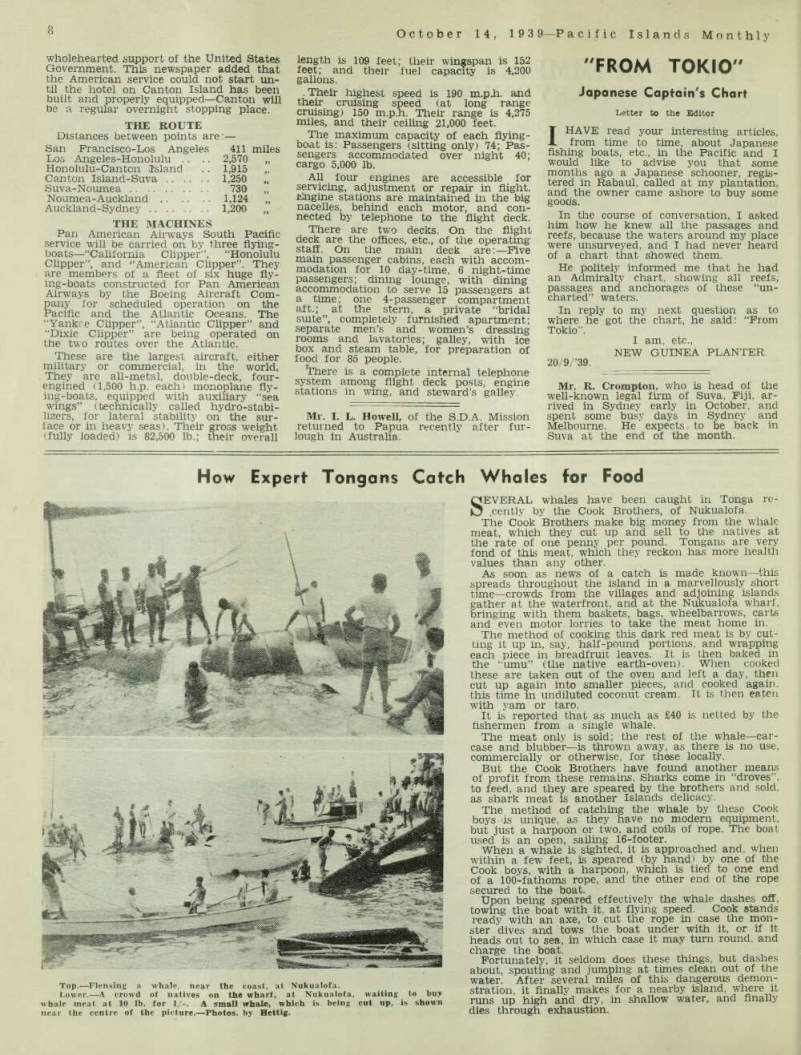
The Cook Brothers make big money from the whale meat, which they cut up and sell to the natives at the rate of one penny per pound. Tongans are very fond of this meat, which they reckon has more health values than any other.
As soon as news of a catch is made known —this spreads throughout the island in a marvellously short time —crowds from the villages and adjoining islands gather at the waterfront, and at the Nukualofa wharf, bringing with them baskets, bags, wheelbarrows, carts and even motor lorries to take the meat home in.
The method of cooking this dark red meat is by cut ting it up in, say, half-pound portions, and wrapping each piece in breadfruit leaves. It is then baked in the “umu” (the native earth-oven). When cooked these are taken out of the oven and left a day, then cut up again into smaller pieces, and cooked again, this time in undiluted coconut cream. It is then eaten with yam or taro.
It is reported that as much as £4O is netted by the fishermen from a single whale.
The meat only is sold; the rest of the whale —carcase and blubber —is thrown away, as there is no use, commercially or otherwise, for these locally.
But the Cook Brothers have found another means of profit from these remains. Sharks come in “droves”, to feed, and they are speared by the brothers and sold, as shark meat is another Islands delicacy.
The method of catching the whale by these Cook boys is unique, as they have no modern equipment, but just a harpoon or two, and coils of rope. The boat used is an open, sailing 16-footer.
When a whale is sighted, it is approached and. when within a few feet, is speared (by hand) by one of the Cook boys, with a harpoon, which is tied to one end of a 100-fathoms rope, and the other end of the rope secured to the boat.
Upon being speared effectively the whale dashes off. towing the boat with it, at flying speed. Cook stands ready with an axe, to cut the rope in case the mon ster dives and tows the boat under with it, or if It heads out to sea, in which case it may turn round, and charge the boat. . , J , Fortunately, it seldom does these things, but dashes about, spouting and jumping at times clean out of the water. After several miles of this dangerous demon stration, it finally makes for a nearby island, where it runs up high and dry, in shallow water, and finally dies through exhaustion.
Top.—Flensing a whale, near the coast, at Nukualofa.
Lower.—A crowd of natives on the wharf, at Nukualofa, waiting to buy whale meat at 10 lb. for 1/-. A small whale, which is being cut up, is shown near the centre of the picture.—Photos, by Hettig.
Advertisements & other items, p. 10 (1 item)
8
October 14, 193 9—P acific Islands Monthly
Tropicalitls
IT is reported In New Zealand that the name of Professor Peter H. Buck will be prominently featured in the New Year’s Honours List. The Director of the Bernice P. Bishop Museum, who is known to his Maori people as Te Rangi Hiroa. will be a visitor to New Zealand for the centenary celebrations. Later, accompanied by Mrs. Buck, he will visit Tonga. For some years he has been anxious to study material artifacts in the Friendly Islands. New Zealanders have always regretted his departure for Hawaii, which has been his home for some years, but undoubtedly his work has gained in value as a result of the experience he has had throughout Poly nesia while engaged in the Bishop Mu seum’s service. Dr. Buck recently re turned to Honolulu, after occupying the chair of anthropology at Yale Univer sity. While on the mainland he deliv ered the Terry Lectures, an honour ac corded only to a scientist of world-wide reputation. fTVHE Papuan Native Medical Assistant X has for many years proved himself an intelligent and observant addi tion to the Medical Department, both on medical patrols and on duty in the Native Hospitals were he acts as general wardsman. It is not often, though, that he carries his observations to the length of scientific determination, as did one assistant recently. Entering particulars of a newly-admitted patient, while the European in charge was absent, he diagnosed the disease himself—and cor rectly! On examination the case proved to be one of chicken pox, and the some what astonished European Medical As sistant in making the entry found that he had been anticipated, for under the heading devoted to diagnosis there ap peared in well-defined letters a note that the patient had been admitted suffering from what the native assistant described as “Schlicken fox”! * * * COCOA planters in Western Samoa should read, with attention, an article in this issue describing the new importance recently attained by the cocoa-growing industry in New Guinea.
It seems likely that war conditions will soundly establish the New Guinea cocoa industry, and that Australian manufac turers will change their formulae and processes to allow them to use regularly the product of New Guinea. The cocoa grower in Western Samoa, although he produces some of the world’s finest cocoa, is up against a number of heart-breaking problems. He gets little assistance or en couragement from the N.Z. Government; he is faced with a serious labour problem; and he is a long way from a big market.
If he were to transfer his operations to New Guinea he would learn that both the Australian and New Guinea Govern ments are sympathetic and helpful; he would find himself with an unlimited supply of cheap native labour—although he would have to train it himself; he would be quite close to the Australian market, which consumes very large quan tities of cocoa beans; and, in addition, he would receive the Australian Common wealth bounty on every pound of cocoa beans he produced. The biggest handi cap the New Guinea cocoa industry has been under, in recent years, has been lack of experience, resulting in a poor quality product. If a few of those suc cessful cocoa planters from Western Samoa settled in New Guinea they prob
ably would be able to give material as sistance in raising the general quality of the New Guinea product. But there is one disadvantage; New Guinea is mal arial, while Samoa is without fever. * * • IN the “Papuan Villager”, the Adminis tration’s little monthly magazine printed in English for the benefit of educated Papuans, recently was told a neat story of how a Government Magis trate settled a native case with a wis dom akin to Solomon’s.
Two women of Hanuabada village, near Pt. Moresby, quarrelled about the owner ship of a rooster. One said, “It’s mine”; and the other said, “No, it isn’t; it is mine”. The rooster was tied up and brought to the court-room; but there was so much argument that nobody could say to which woman it really belonged.
Then the Magistrate (Mr. Wurth) said, “Take the bird to Hanuabada this even ing at about half-past five, the feeding time for roosters. Put it down on the ground at a place between the two houses.
Then untie its bonds”.
This was done. And, as soon as the bird was free, it jumped up and ran to the house where it always got its food. * * • r[E natives of Rossel Island, the Ul tima Thule of the Louisiade Archi pelago, are still influenced to a great extent by the old-established hierarchy of chiefs and sorcerers. These enjoy far greater privileges than the ordinary is landers, and jealously guard against any signs of wealth or social climbing among the ordinary herd.
Some years ago, death was the price paid by an enterprising commoner who dared to presume, after making contact with civilisation.
He left the island, engaged for three years in a labour contract, and, while on the mainland, he learned from a white carpenter how to build houses far better than any of the miserable hovels allotted to his kind on Rossel.
On returning to his home, his first
care was to build his family a house on improved lines. With apprehension and disgust, the chiefs and their followers watched the house grow in size and beauty-far bigger and better than any on the island. As it neared completion their feelings overcame them. “Who are you”, they cried indignantly, “that you need so fine a house? Do you think that you are a chief or a whiteman?” fellow drained the presumptuous * * * SOME 35 years ago. when malaria was very prevalent in San Antonio.
Texas, U.S.A., Dr. Charles A. R.
Campbell conceived the idea of subsidising armies of bats to rid the city of its mos quito-borne disease. City officials thought it ridiculous, but the doctor established a bat refuge at his own expense near one of the city’s worst marshes, and soon mosquitoes were reduced to such an ex tent that people could frequent the place in comfort. The amazed city fathers en acted an ordinance imposing fines of 5 to 300 dollars on persons convicted of killing bats, and put up more bat houses.
In consequence, San Antonio has long had a clean bill of health so far as malaria is concerned. * » » A GERMAN, lately become naturalised and now resident in Port Moresby, described to a well-known Papuan coastal skipper his experiences in Rome when he was arrested three times in one day while en route to Germany, a couple of years ago.
Some time later, the German was a passenger on the coastal boat and at one
of the ports a local Italian trader came aboard. During the evening, when the three of them were together, the skipper, without mentioning names, said, “Rome must be a good place to keep out of. I know of a case where a man while pass ing through there was arrested three times in one day!”
“My word,” said the Italian, “dose policemens knows der work, they are best detectives in de world and always know de scoundrel when dey sees one!”—H. * * * 11WO or three retired Islands residents are doing their share in the Hitler War by acting as Wardens in Sydney, in connection with the National Emergency Service. It is part of their duty to call upon suburban householders.
This is the unhappy story of Mr. J.
Sim, lately of the Solomon Islands, who patiently w r as making a door-to-door call.
As he opened the side gate, the lady of the house came belligerently out of her fuel-shed. “Yes?” she snapped.
“I represent the National Emergency Service”, said Mr. Sim, and smiled pleas ingly.
“Well, I've been getting me groceries from Smith and Brown for four years, and I’m quite satisfied with them”, re plied the lady.
“Oh, you don’t quite understand”, said Mr. Sim. “I’m not selling groceries. I want to explain to you how ”
“You needn’t explain nothing”, shout ed the lady. “You can’t sell me noth ing, and I don’t want none of your blarney”.
She went inside and slammed the door, leaving Mr. Sim floundering in a sea of negatives.
Mr. B. P. Nicholson. Customs Officer in Fiji, arrived in Australia recently to spend long leave.
Advertisements & other items, pp. 11-14 (2 items)
9
Pacific Islands Monthl y—O ctober 14, 1939
Finish
THE PACIFIC ISLANDS CLUB
Visitors from the Islands to Sydney (or those interested In Islands afTairsr, are advised to communicate with the honorary secretary of the above Club, which has been formed to study the history, traditions, economics, and political developments of the Pacific Islands.
Next Club Gathering, Wednesday, Nov. 1. 8 p.m.. Hotel Carlton, Sydney.
H.R.H. the Crown Prince of Tonga will speak on “The Transition Period in Tonga”.
Address for Correspondence:
THE PACIFIC ISLANDS CLUB.
Box 2484 MM.. G.P.0., Sydney.
Dries in half an hour on plaster walls, ceilings, cement, fibro, wood tr iron.
FLAT OIL
FINISH
WATERPROOF
DRIES IN HALF HOUR
Also Excellent as an Undercoat for lacquers, paints & enamels 12/- per gallon
HIGHLY DURABLE
Write for a colour Card ...
STERLING VARNISH CO., Alexandria, N.S.W.
KAMB A L A
CHURCH OF ENGLAND
SCHOOL FOR GIRLS
FOUNDED 1887
A Day and Board-
ing School for
Girls.
KINDERGARTEN TO
LEAVING CERTIFICATE
HONORS.
RESIDENT QUALIFIED
SPORTS MISTRESS.
o Prospectus on application to the Principal . . .
MISS F. HAWTHORNE B.A.
KAMBALA SCHOOL
ROSE BAY. SYDNEY
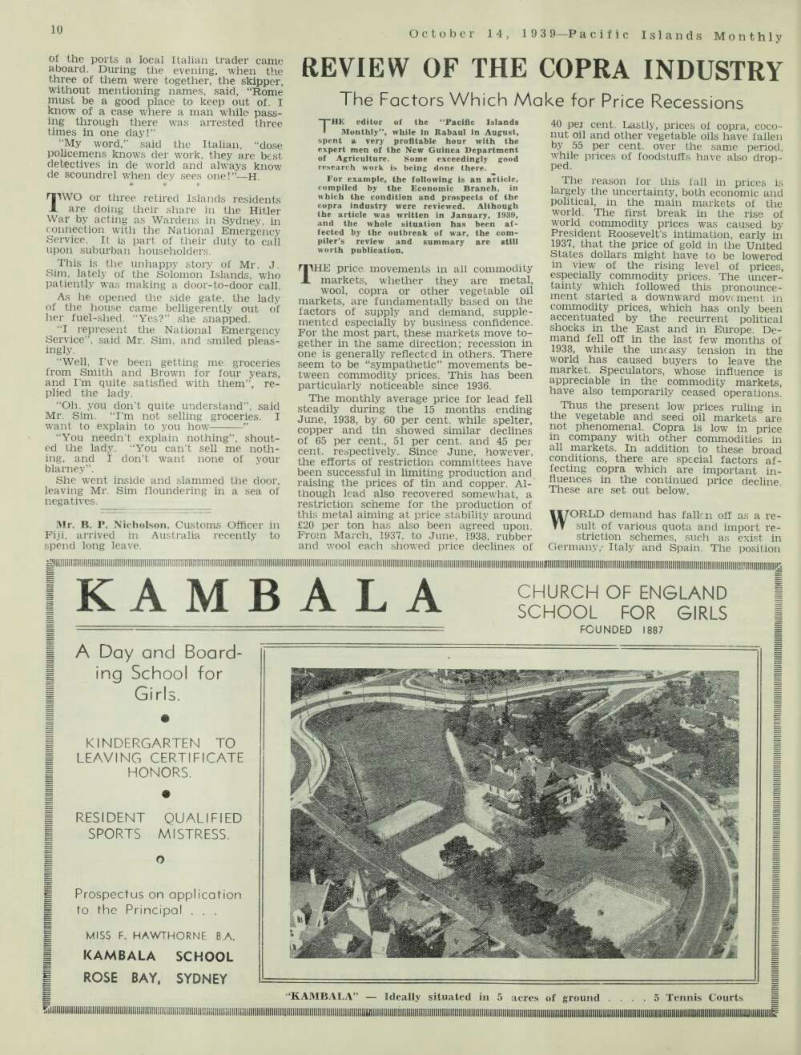
“KAMBALA” Ideally situated in 5 acres of ground ... 5 Tennis Courts m mm m 1 m m m w K ■- 1 I >•> m m 11 ■■ ■ i
FOR YOUR XMAS
SHOPPING
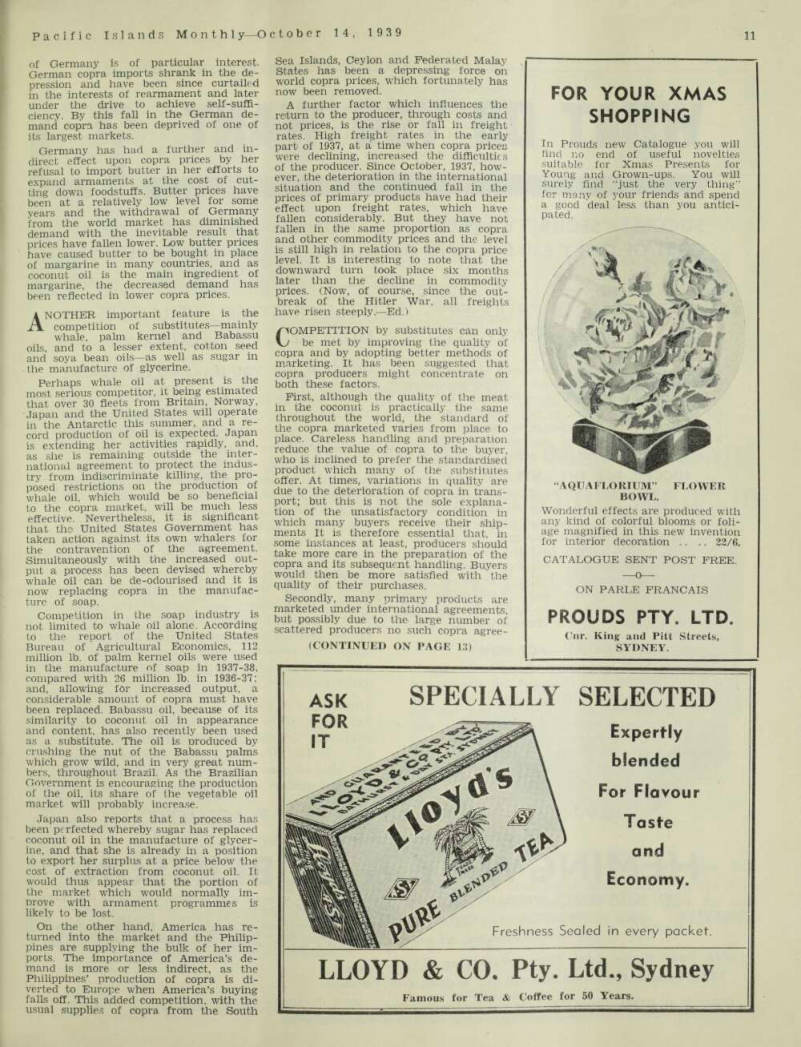
In Prouds new Catalogue you will find no end of useful novelties suitable for Xmas Presents for Young and Grown-ups. You will surely find “just the very thing’’ for many of your friends and spend a good deal less than you anticipated. ‘'A X c 7 * 4
AQIIAFLORIUM”
BOWL.
LOWER
Wonderful effects are produced with any kind of colorful blooms or foliage magnified in this new invention for interior decoration .. .. 22/6,
CATALOGUE SENT POST FREE.
ON PARLE FRANCAIS
PROUDS PTY. LTD.
Cnr. King and Pitt Streets,
SYDNEY.
SPECIALLY SELECTED
Expertly blended For Flavour Taste and Economy.
Freshness Sealed in every packet.
ASK
FOR
IT v o a V m & V
LLOYD & CO. Pty. Ltd., Sydney
Famous for Tea & Coffee for 50 Years.
WHAT DO YOU WANT
SUCCESS-SECURITY-PRESTIGE - MONEY - FRIENDS - AT A COST OF ONLY £3O-£4O, AND OBTAINED WITHIN FIVE YEARS?
TEN YEARS OF DRUDGERY - A LITTLE PRESTIGE - STILL LESS MONEY, HEAVY COSTS OF HUNDREDS OF POUNDS?
Now is the time you must moke your choice.
On YOU depends your future . . . You can be in a good position in a few short months—be well on the road to success in two years 7 time—in five you can be an executive, perhaps, with money, power—all that you want in life—or you can still be struggling along.
SUCCESS FOR THE AVERAGE MAN
Train for Business with H. £r R. —Success lies in that field, particularly for those of average ability. Ninety-nine average people gain—in the realms of Business—success far greater than that which the one brilliant man achieves in any other profession. All that another profession has to recommend it can be found in a Business career. There are opportunities for success of more than 100 in the Business world to 1 in another. Which chance will you give yourself?
DON'T DELAY—ACT NOW!
Do you want to be leaping ahead to Success in a business career? Then cut out the coupon and send for this 128-page handbook, "The Guide to Careers in Business 77 , and see for yourself the opportunities that exist. In it, too, you will see the names of some of the most successful men in Australia, who, if you ask them, would say as we do—train with H. Gr R. and ensure your future.
UNDER H. & R. YOU MAKE NO EXPERIMENT For forty-three years now H. £r R. have trained men and women for success in Business. Irrall the large organizations throughout Australia you will find the men in the high positions are H. &R. trained. In all the Business world you will find that the men who are most successful are those who have trained for success with H. & R. There is only one reason why this is so.
The H. & R. Personal-Individual Tuition Method of career training originated and operated only by H. & R., is under the skilled guidance of expert educationalists. It 7 s always up-to-date.
From all over the world are gathered weekly the successful plans and ideas of the world's most successful men. Here in Australia, skilled and trained men examine, collate, and adapt this knowledge to Australian conditions, and explain in simple language the facts which make for success.
Throughout Australia in every capital city is a full-time staff of experts, helping and advising students. Collaborating with the business leaders as it does, the House of H. £r R. is qualified and able to ensure success for those who come to it for guidance and tuition.
GUI DANCE TRAIN ING PLACEMENT
Department of Accountancy and Commerce
HEMINGWAY
THE ACCOUNTANCY SPECIALISTS
POUNDERS OF COMMERCIAL EDUCATION
IN AUSTRALIA.
127 A Bank House, Bank Place, Melbourne, C.l. 127 A Barrack House, 16 Barrack St., Sydney.
Offices in all Capital Cities, Newcastle and Launceston,
& ROBERTSON
To Hemingway and Robertson, i Please send me FREE copy of the new, 128-page Illustrated handbook—“ The Guide to Careers in Business’’—and details of how the H. & R. Personal-Individual Tuition Method will train me successfully for the career marked below.
1 NAME AGE
1 ADDRESS
CAREER INTERESTED IN 127AA./401.
Review Of The Copra Industry
The Factors Which Make for Price Recessions
THK editor of the "Pacific Islands ■ Monthly”, while in Rabaul In August, spent a very profitable hour with the expert men of the New Guinea Department of Agriculture. Some exceedingly good research work is being done there.
For example, the following is an article, compiled by the Economic Branch, in which the condition and prospects of the copra industry were reviewed. Although the article was written in January, 1939, and the whole situation has been af fected by the outbreak of war, the com piler’s review and summary are still worth publication.
THE price movements in all commodity markets, whether they are metal, wool, copra or other vegetable oil markets, are fundamentally based on the factors of supply and demand, supple mented especially by business confidence.
For the most part, these markets move to gether in the same direction; recession in one is generally reflected in others. There seem to be “sympathetic” movements be tween commodity prices. This has been particularly noticeable since 1936.
The monthly average price for lead fell steadily during the 15 months ending June, 1938, by 60 per cent, while spelter, copper and tin showed similar declines of 65 per cent., 51 per cent, and 45 per cent, respectively. Since June, however, the efforts of restriction committees have been successful in limiting production and raising the prices of tin and copper. Al though lead also recovered somewhat, a restriction scheme for the production of this metal aiming at price stability around £2O per ton has also been agreed upon.
From March, 1937, to June, 1938, rubber and wool each showed price declines of
40 per cent. Lastly, prices of copra, coco nut oil and other vegetable oils have fallen by 55 per cent, over the same period, while prices of foodstuffs have also drop ped.
The reason for this fall in prices is largely the uncertainty, both economic and political, in the main markets of the world. The first break in the rise of world commodity prices was caused by President Roosevelt’s intimation, early in 1937, that the price of gold in the United States dollars might have to be lowered in view of the rising level of prices, especially commodity prices. The uncer tainty which followed this pronounce ment started a downward movement in commodity prices, which has only been accentuated by the recurrent political shocks in the East and in Europe. De mand fell off in the last few months of 1938, while the uneasy tension in the world has caused buyers to leave the market. Speculators, whose influence is appreciable in the commodity markets, have also temporarily ceased operations.
Thus the present low prices ruling in the vegetable and seed oil markets are not phenomenal. Copra is low in price in company with other commodities in all markets. In addition to these broad conditions, there are special factors af fecting copra which are important in fluences in the continued price decline These are set out below.
WORLD demand has fallen off as a re sult of various quota and import re striction schemes, such as exist in Germany, Italy and Spain. The position
of Germany is of particular interest.
German copra imports shrank in the de pression and have been since curtailed in the interests of rearmament and later under the drive to achieve self-suffi ciency. By this fall in the German de mand copra has been deprived of one of its largest markets.
Germany has had a further and in direct effect upon copra prices by her refusal to import butter in her efforts to expand armaments at the cost of cut ting down foodstuffs. Butter prices have been at a relatively low level for some years and the withdrawal of Germany from the world market has diminished demand with the inevitable result that prices have fallen lower. Low butter prices have caused butter to be bought in place of margarine in many countries, and as coconut oil is the main ingredient of margarine, the decreased demand has been reflected in lower copra prices.
ANOTHER important feature is the competition of substitutes—mainly whale, palm kernel and Babassu oils, and to a lesser extent, cotton seed and soya bean oils —as well as sugar in the manufacture of glycerine.
Perhaps whale oil at present is the most serious competitor, it being estimated that over 30 fleets from Britain, Norway, Japan and the United States will operate in the Antarctic this summer, and a re cord production of oil is expected. Japan is extending her activities rapidly, and, as she is remaining outside the inter national agreement to protect the indus try from indiscriminate killing, the pro posed restrictions on the production of whale oil. which would be so beneficial to the copra market, will be much less effective. Nevertheless, it is significant that the United States Government has taken action against its own whalers for the contravention of the agreement.
Simultaneously with the increased out put a process has been devised whereby whale oil can be de-odourised and it is now replacing copra in the manufac ture of soap.
Competition in the soap industry is not limited to whale oil alone. According to the report of the United States Bureau of Agricultural Economics, 112 million lb. of palm kernel oils were used in the manufacture of soap in 1937-38, compared with 26 million lb. in 1936-37; and, allowing for increased output, a considerable amount of copra must have been replaced. Babassu oil, because of its similarity to coconut oil in appearance and content, has also recently been used as a substitute. The oil is produced by crushing the nut of the Babassu palms which grow wild, and in very great num bers, throughout Brazil. As the Brazilian Government is encouraging the production of the oil, its share of the vegetable oil market will probably increase.
Japan also reports that a process has been perfected whereby sugar has replaced coconut oil in the manufacture of glycer ine, and that she is already in a position to export her surplus at a price below the cost of extraction from coconut oil. It would thus appear that the portion of the market which would normally im prove with armament programmes is likely to be lost.
On the other hand, America has re turned into the market and the Philip pines are supplying the bulk of her im ports. The importance of America’s de mand is more or less indirect, as the Philippines’ production of copra is di verted to Europe when America’s buying falls off. This added competition, with the usual supplies of copra from the South
Sea Islands, Ceylon and Federated Malay States has been a depressing force on world copra prices, which fortunately has now been removed.
A further factor which influences the return to the producer, through costs and not prices, is the rise or fall in freight rates. High freight rates in the early part of 1937, at a time when copra prices were declining, increased the difficulties of the producer. Since October, 1937, how ever, the deterioration in the international situation and the continued fall in the prices of primary products have had their effect upon freight rates, which have fallen considerably. But they have not fallen in the same proportion as copra and other commodity prices and the level is still high in relation to the copra price level. It is interesting to note that the downward turn took place six months later than the decline in commodity prices. (Now, of course, since the out break of the Hitler War, all freights have risen steeply.—Ed.) COMPETITION by substitutes can only be met by improving the quality of copra and by adopting better methods of marketing. It has been suggested that copra producers might concentrate on both these factors.
First, although the quality of the meat in the coconut is practically the same throughout the world, the standard of the copra marketed varies from place to place. Careless handling and preparation reduce the value of copra to the buyer, who is inclined to prefer the standardised product which many of the substitutes offer. At times, variations in quality are due to the deterioration of copra in trans port; but this is not the sole explana tion of the unsatisfactory condition in which many buyers receive their ship ments It is therefore essential that, in some instances at least, producers should take more care in the preparation of the copra and its subsequent handling. Buyers would then be more satisfied with the quality of their purchases.
Secondly, many primary products are marketed under international agreements, but possibly due to the large number of scattered producers no such copra agree
(Continued On Page 13)
ment exists. Nevertheless as the Malayan Agricultural Journal points out, buyers and sellers could arrive at some agree ment setting out particular grades of copra, and the purchaser would be as sured of the quality of the shipment he was about to receive, while at the same time the growers would be encouraged to improve their product. This has been done to a minor extent, but, when com pared with the elaborate arrangement in the cocoa industry, much still remains to be done.
LONDON is the main vegetable oil and oil-seed market of the world, and all influences are taken into account in Lon don and reflected in the movements of prices, which are very sensitive to world events.
Therefore, as long as conditions in Europe remain unsettled, there will be forces tending to prevent any appreciable increase in the price of copra, coconut oil and other vegetable oils.
Producers are also faced with the com petition of substitutes and, unless the in dustry is organised along the lines of other primary products, planters will not be in a position to take advantage of the increased demand should the market im prove.
Advertisements & other items, pp. 12-13 (2 items)
10
October 14, 193 9—P acific Islands Monthly
11
Pacific Islands Monthl y—O ctober 14, 1939
New Guinea S Native Police Force
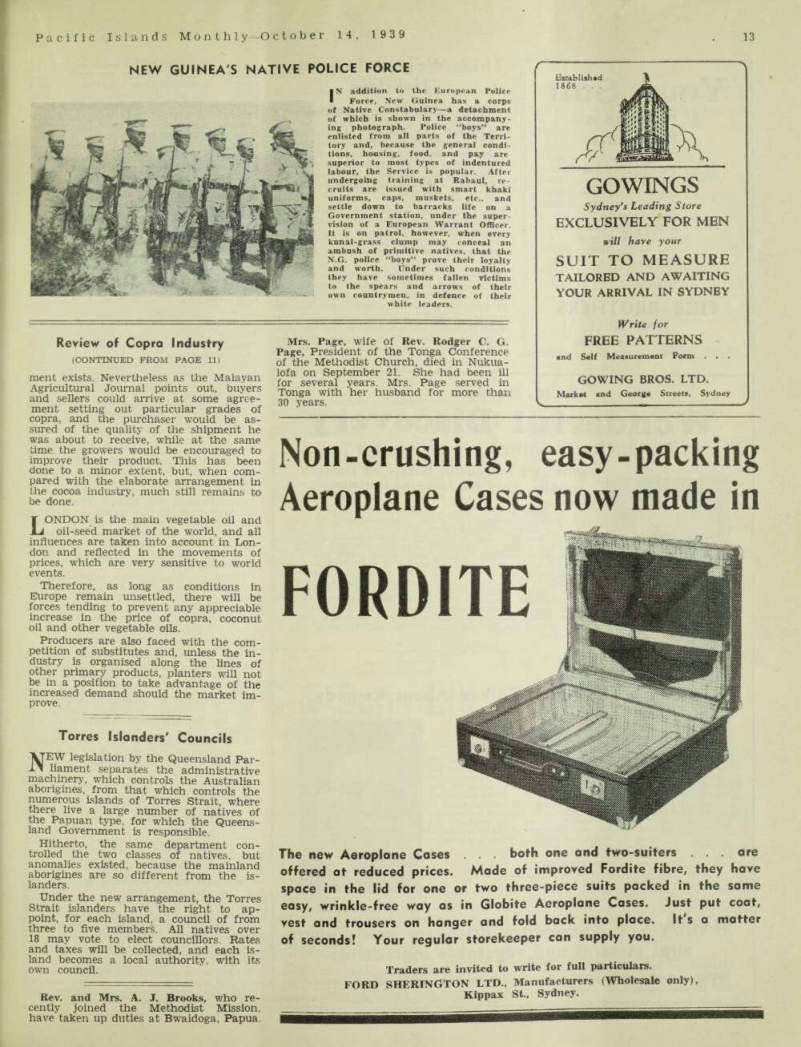
IN addition to the European Police Force, New Guinea has a corps of Native Constabulary—a detachment of which is shown in the accompany ing photograph. Police “boys” are enlisted from all parts of the Terri tory and, because the general condi tions, housing, food, and pay are superior to most types of indentured labour, the Service is popular. After undergoing training at Rabaul, re cruits are issued with smart khaki uniforms, caps, muskets, etc., and settle down to barracks life on a Government station, under the super vision of a European Warrant Officer.
It is on patrol, however, when every kunai-grass clump may conceal an ambush of primitive natives, that the N.G. police “boys” prove their loyalty and worth. Under such conditions they have sometimes fallen victims to the spears and arrows of their own countrymen, in defence of their white leaders.
Torres Islanders' Councils
NEW legislation by the Queensland Par liament separates the administrative machinery, which controls the Australian aborigines, from that which controls the numerous islands of Torres Strait, where there live a large number of natives of the Papuan type, for which the Queens land Government is responsible.
Hitherto, the same department con trolled the two classes of natives, but anomalies existed, because the mainland aborigines are so different from the is landers.
Under the new arrangement, the Torres Strait islanders have the right to ap point, for each island, a council of from three to five members. All natives over 18 may vote to elect councillors. Rates and taxes will be collected, and each is land becomes a local authority, with its own council.
Rev. and Mrs. A. J. Brooks, who re cently joined the Methodist Mission, have taken up duties at Bwaidoga, Papua.
Mrs. Page, wife of Rev. Rodger C. G.
Page, President of the Tonga Conference of the Methodist Church, died in Nukua lofa on September 21. She had been ill for several years. Mrs. Page served in Tonga with her husband for more than 30 years.
Advertisements & other items, pp. 15-16 (2 items)
Review of Copra Industry
13
(CONTINUED PROM PAGE 11)
Pacific Islands Monthl y—O ctober 14, 1939
Fordite
Established 1868 . . . cr
GOWINGS
Sydney*s Leading Store
EXCLUSIVELY FOR MEN
will have your
SUIT TO MEASURE
TAILORED AND AWAITING
YOUR ARRIVAL IN SYDNEY
Write for
FREE PATTERNS
and Self Measurement Form
COWING BROS. LTD.
Market and George Streets, Sydney
Non-crushing, easy-packing
Aeroplane Cases now made in
FORDITE
S’ m The new Aeroplone Coses both one and two-suiters . are offered at reduced prices. Made of improved Fordite fibre, they have space in the lid for one or two three-piece suits pocked in the same easy, wrinkle-free way as in Globite Aeroplane Cases. Just put coat, vest and trousers on hanger and fold back into place. It s a matter of seconds! Your regular storekeeper con supply you.
Traders are invited to write for full particulars.
FORD SHERINGTON LTD., Manufacturers (Wholesale only), Kippax St., Sydney.
Your Suit
ready in a
few hours
Make your selection from our patterns (gladly sent on request). Then when your steamer arrives, our representative will conduct you to our premises for a “try-on”. A few hours later, your Suit will be ready— Hand Tailored to measure.
PIKE BROTHERS
LIMITED
Queen St., Brisbane.
R. M. Hardy’s
Wonderful Discovery
The greatest health tonic of the age.
Mr. R. Langworthy.
HARDY'S will banish forever all stomach
troubles. Read the following testimonials:
The Manager, R. M. Hardy <fe Co., Hardy’s Chambers, 5 Hunter Street, Sydney.
Dear Sir, —About twelve months ago, suffering severe gastric trouble, I consulted my doctor and was informed that I had an ulcer on the stomach. I immediately began taking medical treatment, which included a long period of rigid dieting. In spite of this treatment the trouble still persisted, and I began to despair of being cured. About three months ago a friend told me of your remedy and I decided to give it a trial.
After taking two large tins of your Indigestion and Ulcerated Stomach Remedy I found myself quite free from all signs of stomach trouble and can now eat anything I wish with perfect safety. I need not say how pleased I am with the results of your remedy.
Yours truly,
R. LANGWORTHY.
17 Faithfull Street, Richmond, Sydney, N.S.W.
HARDY'S The Much Talked About Remedy.
R. M. Hardy, Esq., Hardy’s Chambers, Sydney, N.S.W.
Dear Sir, —I have suffered with an ulcerated stomach for the last eight months—l have tried all kinds of remedies but have not had any relief. A friend of mine recommended Hardy’s Indigestion and Ulcerated Stomach Remedy, and since using same I have been able to eat substantial meals instead of soft foods, etc. I can recommend your powders to sufferers of Indigestion and Ulcerated Stomach, Thanking my friend for his recommendation to use your powders, and also thanking you as the manufacturer of these wonderful powders. I remain an ardent supporter of Hardy’s Powders.
Yours faithfully,
FRED. JOHNSTON,
42 Manildra Street, Earlwood, Sydney, N.S.W.
Mr. Fred. Johnston.
HARDY'S is a scientific discovery containing
vital mineral and vegetable ingredients.
Strengthen your nerves, blot out that depressed feeling and brain fag, by taking a course of HARDY’S. soz. tin 2/6, lOoz. tin 3/9—from all Chemists and Stores throughout Australia, New Zealand and the Pacific Islands.
Hebrides
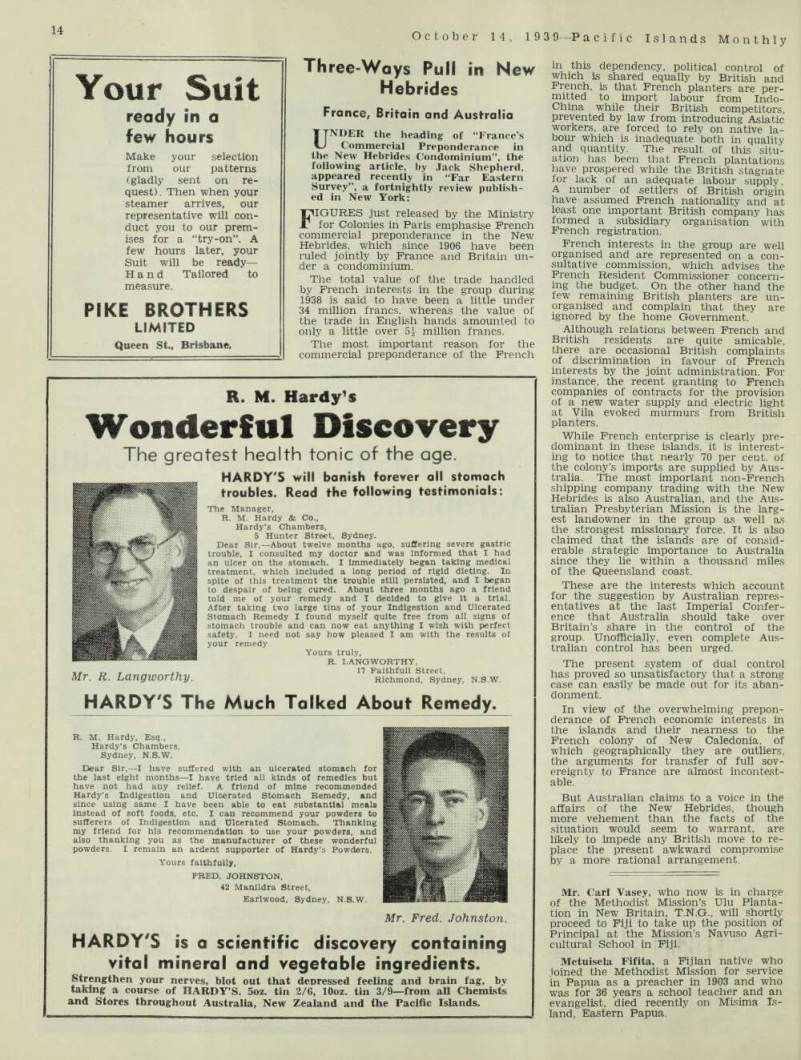
Three-Ways Pull in New Hebrides
France, Britain and Australia
UNDER the heading of “France’s Commercial Preponderance in the New Hebrides Condominium”, the following article, by Jack Shepherd, appeared recently in “Far Eastern Survey”, a fortnightly review publish ed in New York: FIGURES just released by the Ministry for Colonies in Paris emphasise French commercial preponderance in the New Hebrides, which since 1906 have been ruled jointly by France and Britain un der a condominium.
The total value of the trade handled by French interests in the group during 1938 is said to have been a little under 34 million francs, whereas the value of the trade in English hands amounted to only a little over 5i million francs.
The most important reason for the commercial preponderance of the French
in this dependency, political control of which is shared equally by British and French, is that French planters are per mitted to import labour from Indo china while their British competitors, prevented by law from introducing Asiatic workers, are forced to rely on native la bour which is inadequate both in quality and quantity. The result of this situ ation has been that French plantations have prospered while the British stagnate for lack of an adequate labour supply.
A number of settlers of British origin have assumed French nationality and at least one important British company has formed a subsidiary organisation with French registration.
French interests in the group are well organised and are represented on a con sultative commission, which advises the French Resident Commissioner concern ing the budget. On the other hand the few remaining British planters are un organised and complain that they are ignored by the home Government.
Although relations between French and British residents are quite amicable, there are occasional British complaints of discrimination in favour of French interests by the joint administration. For instance, the recent granting to French companies of contracts for the provision of a new water supply and electric light at Vila evoked murmurs from British planters.
While French enterprise is clearly pre dominant in these islands, it is interest ing to notice that nearly 70 per cent, of the colony’s imports are supplied by Aus tralia. The most important non-French shipping company trading with the New Hebrides is also Australian, and the Aus tralian Presbyterian Mission is the larg est landowner in the group as well as the strongest missionary force. It is also claimed that the islands are of consid erable strategic importance to Australia since they lie within a thousand miles of the Queensland coast.
These are the interests which account for the suggestion by Australian repres entatives at the last Imperial Confer ence that Australia should take over Britain’s share in the control of the group. Unofficially, even complete Aus tralian control has been urged.
The present system of dual control has proved so unsatisfactory that a strong case can easily be made out for its aban donment.
In view of the overwhelming prepon derance of French economic interests in the islands and their nearness to the French colony of New Caledonia, of which geographically they are outliers, the arguments for transfer of full sov ereignty to Prance are almost incontest able.
But Australian claims to a voice in the affairs of the New Hebrides, though more vehement than the facts of the situation would seem to warrant, are likely to impede any British move to re place the present awkward compromise by a more rational arrangement.
Mr. Carl Vasey, who now is in charge of the Methodist Mission’s Ulu Planta tion in New Britain, T.N.G., will shortly proceed to Fiji to take up the position of Principal at the Mission’s Navuso Agri cultural School in Fiji.
Metuisela Fifita, a Fijian native who joined the Methodist Mission for service in Papua as a preacher in 1903 and who was for 36 years a school teacher and an evangelist, died recently on Misima Is land, Eastern Papua.
Advertisements & other items, p. 16 (1 item)
October 14, 193 9—P acific Islands Monthly
The Favourite
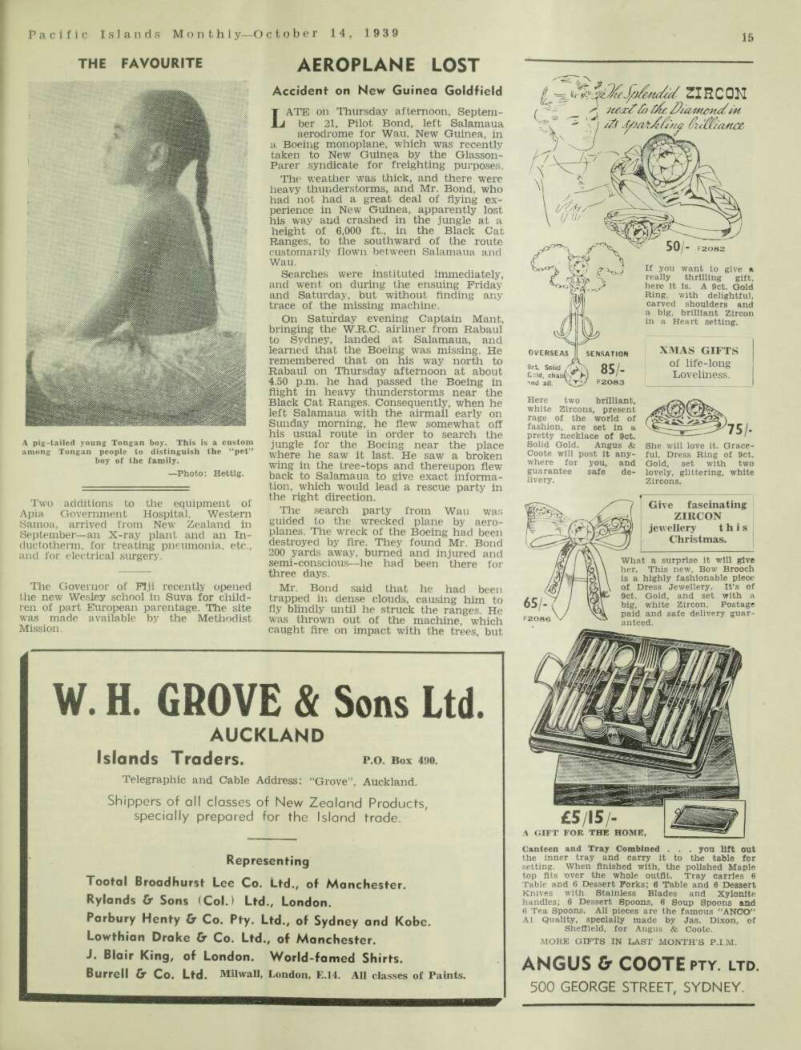
Two additions to the equipment of Apia Government Hospital, Western Samoa, arrived from New Zealand in September—an X-ray plant and an In ductotherm, for treating pneumonia, etc., and for electrical surgery.
The Governor of Fiji recently opened the new Wesley school in Suva for child ren of part European parentage. The site was made available by the Methodist Mission.
A pig-tailed young Tongan boy. This is a custom among Tongan people to distinguish the “pet” boy of the family.
Photo: Hettig.
Aeroplane Lost
Accident- on New Guinea Goldfield
LATE on Thursday afternoon, Septem ber 21. Pilot Bond, left Salamaua aerodrome for Wau, New Guinea, in a Boeing monoplane, which was recently taken to New Guinea by the Glasson- Parer syndicate for freighting purposes.
The weather was thick, and there were heavy thunderstorms, and Mr. Bond, who had not had a great deal of flying ex perience in New Guinea, apparently lost his way and crashed in the jungle at a height of 6,000 ft., in the Black Cat Ranges, to the southward of the route customarily flown between Salamaua and Wau.
Searches were instituted immediately, and went on during the ensuing Friday and Saturday, but without finding any trace of the missing machine.
On Saturday evening Captain Mant, bringing the W.R.C. airliner from Rabaul to Sydney, landed at Salamaua, and learned that the Boeing was missing. He remembered that on his way north to Rabaul on Thursday afternoon at about 4.50 p.m. he had passed the Boeing in flight in heavy thunderstorms near the Black Cat Ranges. Consequently, when he left Salamaua with the airmail early on Sunday morning, he flew somewhat off his usual route in order to search the jungle for the Boeing near the place where he saw it last. He saw a broken wing in the tree-tops and thereupon flew back to Salamaua to give exact informa tion, which would lead a rescue party in the right direction.
The search party from Wau was guided to the wrecked plane by aero planes. The wreck of the Boeing had been destroyed by fire. They found Mr. Bond 200 yards away, burned and injured and semi-conscious—he had been there for three days.
Mr. Bond said that he had been trapped in dense clouds, causing him to fly blindly until he struck the ranges. He was thrown out of the machine, which caught fire on impact with the trees, but
he was unable to avoid bums by flames which were fed from the machine’s cargo of benzine.
Flying conditions have been hazardous lately between Salamaua and Wau as dense storm clouds, rising to 15,000 feet, quickly form over the mountains. These ranges, southward of the Black Cat mines, have caused most of the air accidents in this region.
Near where Mr. Bond was found, Colin Ferguson lost his life a few years ago in similar conditions; Joss Crisp pancaked his machine on the treetops; and the re mains of a Handley Page machine, which crashed on a hillside eight years ago, are lying in the vicinity.
Mr. Peter Seaforth. of Wau, who has a mining “show” on the Bulolo River, reached Sydney from New Guinea by the October “Neptuna”.
Advertisements & other items, pp. 17-18 (2 items)
15
Pacific Islands Monthl y—O ctober 14, 1939
W. H. GROVE & Sons Ltd.
Y/ ZIHCOH
"V , ye^
-> 7tazf to t/b It/zomonzttn
/tf J/JabA&ttjt tftcflfaaftcc
K 50 - F 2082 /~X Ci& )
OVERSEAS Jl SENSATION
9rV Solid {[l' : \ j
C -!d. chs!i(s*>} ’ ■>nd all. M.T2/ F 2083 If you want to give a really thrilling gift, here It Is. A 9ct. Gold Ring, with delightful, carved shoulders and a big. brilliant Zircon in a Heart setting.
XMAS GIFTS
of life-long
Loveliness.
Here two brilliant, white Zircons, present rage of the world of fashion, are set In a pretty necklace of 9ct.
Solid Gold, Angus & She will love it. Grace- Coote will post it any- ful. Dress Ring of 9ct. where for you, and Gold, set with two r V guarantee safe livery. delovely, glittering, white Zircons.
Give fascinating
ZIRCON
jewellery this
Christmas.
F 2086 What a surprise it will give her. This new, Bow Brooch is a highly fashionable piece of Dress Jewellery. It’s of 9ct. Gold, and set with a big, white Zircon. Postage paid and safe delivery guaranteed.
I - £5/15
A GIFT FOR THE HOME,
Canteen and Tray Combined . . . you lift out the inner tray and carry it to the table for setting. When finished with, the polished Maple top fits over the whole outfit. Tray carries 6 Table and 6 Dessert Porks; 6 Table and 6 Dessert Knives with Stainless Blades and Xylonite handles; 6 Dessert Spoons, 6 Soup Spoons and H Tea Spoons. All pieces are the famous “ANCO”
A 1 Quality, specially made by Jas, Dixon, of Sheffield, for Angus & Coote.
MORE GIFTS IN LAST MONTH S P.I.M.
ANGUS & COOTE pty. ltd
500 GEORGE STREET, SYDNEY.
W. H. GROVE & Sons Ltd.
AUCKLAND
Islands Traders. p.o. b«* 490.
Telegraphic and Cable Address: “Grove”, Auckland.
Shippers of all classes of New Zealand Products, specially prepared for the Island trade.
Representing
Tootal Broadhurst Lee Co. Ltd., of Manchester.
Rylands & Sons (Col.) Ltd., London.
Porbury Henty & Co. Pty. Ltd., of Sydney and Kobe.
Lowthian Drake tj Co. Ltd., of Manchester.
J. Blair King, of London. World-famed Shirts.
Burrell & Co. Ltd. Milwall, London, E. 14. All classes of Paints.
TILLEY KEROSENE LAMPS
300 C.P. Brilliant steady light under all conditions. Only Tilley Lamps can give you troublefree lighting using Kerosene. British made and of first quality throughout.
Tilley Lamps are made at London, England, from British Empire materials.
Eleven models to choose from including the All-purpose Lamp as illustrated at 55/-. Wall, vase, table and floor
standard lamps available .
Tilley Kerosene Irons also available shortly. These wonderful units have Heat Control and will efficiently iron the lightest or heaviest materials.
Write for general Tilley catalogue.
SIMPLEX MARINE ENGINES
Fine new Australian-made 2 cycle Motors of 3 h.p.
Suitable for all boats up to 16 ft. Exclusive features are:— 1. Impulse starter magneto (British). 2. Simplex patented foolproof carburettor. 3. Meehanite castings throughout. 4. Simplex patented leakproof water pump.
SIMPLEX ENGINES have larger bore and stroke than any other 3 h.p. motor. They run without vibration, and will idle down to the lowest revolution.
Price complete: 3 h.p., with all equipment, £27/10/-.
Write for Simplex Catalogue illustrating all models, including Reverse Gear model.
PENTA MARINE ENGINES
The world’s finest quality Marine Engines. Ten models available from 3 to 100 h.p. and running on petrol, kerosene or diesel oil. Model K 22 twin cylinder, as Illustrated, is a full 10 b.h.p. Engine suitable for all boats up to 30 ft.
Price (export) £95. Other models are Single, 5 h.p., Four, 18 h.p., Six, 75 h.p. Also Penta Hesselman Diesel Oil Engines 30/70 h.p., and Penta’s famous Outboard Engines.
WRITE FOR PENTA CATALOGUE.
SHIPCHANDLERY
We have recently amalgamated with the well-known firm of Boat Supplies Ltd., and now have the Largest Stocks of boat gear in Australia. All Bronze and Brass fittings are made in our own workshops. Everything for the rowboat, yacht, powerboat or trading schooner.
Anchors, rowlocks, blocks, shackles, thimbles, wire rope, rigging screws, ports, vents, boat lavatories, searchlights, boat horns, steering gear, rigging fittings, navigation lamps, cabin lamps, yacht stoves, steering wheels, winches, etc. Boatbullders' requirements of every description. Copper nails, screws and copper rod. Brass washers.
Muntz metal sheathing, felt and oakum. Jeffreys marine glues and seamflex. Marine paints and oils. Comprehensive boat gear catalogue sent on request.
W. KOPSEN & CO. PTY. LTD.
378 KENT STREET, SYDNEY. Cables: “Kopsen”, Sydney.
Village"
"Four Years in One Village"
Plight of New Hebrides Officials
WITH increased cost of living, and in creased taxation, the British officers of the New Hebrides Condominium Service are still being paid only 124 francs to the £ sterling, while the exchange rate is 176. Their compatriots in the Brit ish New Hebrides Colonial Service are paid, fully, in sterling.
Now that freights have gone up and there is the possibility of further increase in cost of foodstuffs from Australia, plus the possibility of a further slide of the franc, due to the war, they fear that they are going to be in for a very thin time.
In June of this year they laid their case before the High Commissioner, Sir
Harry Luke, when he visited Vila. They then were promised that something would be done about it. So far nothing has happened, and they are feeling more than a little unhappy.
At the best of times, the salaries and general conditions of Condominium offi cials have been very much below those of the officers of the British Colonial Ser vice. Those on the lower salaries have invariably been forced to stick it for four years, or longer, without leave, on ac count of their financial circumstances.
Four years on one little island, with no escape, is something of an ordeal. Also, as the community is such a small one, they have to mix socially with their bet ter-paid compatriots in the Colonial Ser vice. They feel, too, that there is a tendency on the part of the Colonial Office to lump them with the French, while they do not enjoy the privileges of French citizenship.
There never have been any British schools in the New Hebrides. It probably is the only place in the British Empire where people in like condition have no educational facilities provided. This lat ter is a matter that has fallen very heav ily on Condominium servants who have children, as they have to send them to Australia to school.
Added to this, the Condominium ser vant has no appeal anywhere. He has none of the democratic institutions for which we are fighting to come to his aid.
The whole period of his service, except ing when on leave, and his life, both public and private, is under the control of his Resident Commissioner, and liable to censure from that gentleman.
Growing Wiser!
New Guinea Cocoa-Planters Are Growing Wiser!
NOT being satisfied that the price paid by Sydney buyers represented the true value of some New Guinea cocoa beans, Mr. Hore-Lacy (a well-known New Guinea planter) sent two trial shipments of Garua beans to other markets; half a ton to London, and half a ton to San Francisco (says the “Rabaul Times” of September 29).
Advice has just been received to the effect that the London consignment was valued at £35 stg. per ton (in August).
This is equivalent to almost £A44. and is slightly above average Trinidad.
All that Sydney buyers have been pay ing is £A2S for N.G. beans, when Accra was £l9 stg., equivalent to nearly £A2B c.i.f. & e. Sydney. So that Sydney has been paying less than Accra prices when London values the same bean at more than Trinidad.
This proves the point that New Guinea cocoa producers have for many years been fighting for; i.e., that the bounty paid by a benevolent government t 9 en courage the cocoa industry has simply been diverted to benefit the big manu facturing firms.
San Francisco quoted £A3S when sterl ing was at par: this will now be higher, since sterling has depreciated.
Mr. G. Napier, of the butchery depart ment of W. R. Carpenter and Co.’s Rabaul establishment, arrived in Towns ville from New Guinea by air at the end of September.
Rev. 11. L. Hurst, secretary for the London Missionary Society in Australia, and Rev. Norman Goodall, London sec retary for the Mission, left Sydney re cently for Port Moresby, Papua, by plane. They will make a tour of inspec tion of the Mission stations in the Ter ritory.
Advertisements & other items, pp. 18-19 (3 items)
16
October 14, 193 9—P acific Islands Monthly
17
Pacific Islands Monthl y-O ctober 14, 1939
Nerves
Overcome TROPICAL LETHARGY
BRAIN FAG and that
DEPRESSED FEELING
Lack of Confidence . . . Headaches . . . Nervous Indigestion . . . Sleeplessness .. . Listlessness .. . Anaemia . . .
Nerve pains and other similar nervous and Constitutional weaknesses. i s
After MALARIA
Take BIDO M A K
BIDOMAK re-charges and re-vitalises the whole system with life-giving oxygen, it improves the activity of every gland and organ in the body and is essential for full recovery from the after-effects of Malaria.
BIDOMAK provides a method of supplying energy to the cells of the body wherever the natural supply of vitality is insufficient to maintain the normal activity of glands and organs. It provides vital mineral elements. It is a scientific compound of certain vital mineral elements which are lacking in the average modern diet, and which include ferrum, calcium, sodium, potassium, phosphates, glycero-phosphates, and sucrose, as well as other necessary elements. These vital minerals quickly restore vitality, overcome nerves, brain-fag and depressed feeling. It is safe and pleasant to take, and contains no alcohol, opiates or narcotics, it’s perfectly safe for even young children who like to take it because of the pleasant flavor.
SCIENTIFIC CONTROL
Manufactured in the Bidomak Pharmaceutical Laboratories—one of the most up-to-date, hygienic Laboratories in the Southern Hemisphere, to which is attached a fully qualified Doctor of Medicine, and under the control of qualified chemists who were trained in the most modern and largest English Laboratories in the world.
WAS NERVOUS WRECK
“For years I have been in ill health. Unable to walk about, had no appetite, couldn’t sleep, and my nerves were in a terrible state. I had not been outside the gate for years and began to think I would be an invalid. One day, reading about Bidomak, I decided to get a bottle and give it a trial. After taking this marvellous tonic I soon began to feel much better. My appetite improved and I had more restful nights. After four months it made a marvellous difference to me. My nerves became steady, pain disappeared, and I was able to walk about freely. It is the most wonderful tonic I know”. (Sgd.) Miss E. Williams, 24 Princess Street, Canterbury. 29/6/’39.
AT ALL LEADING ISLAND STORES
Copra Grading In Fiji
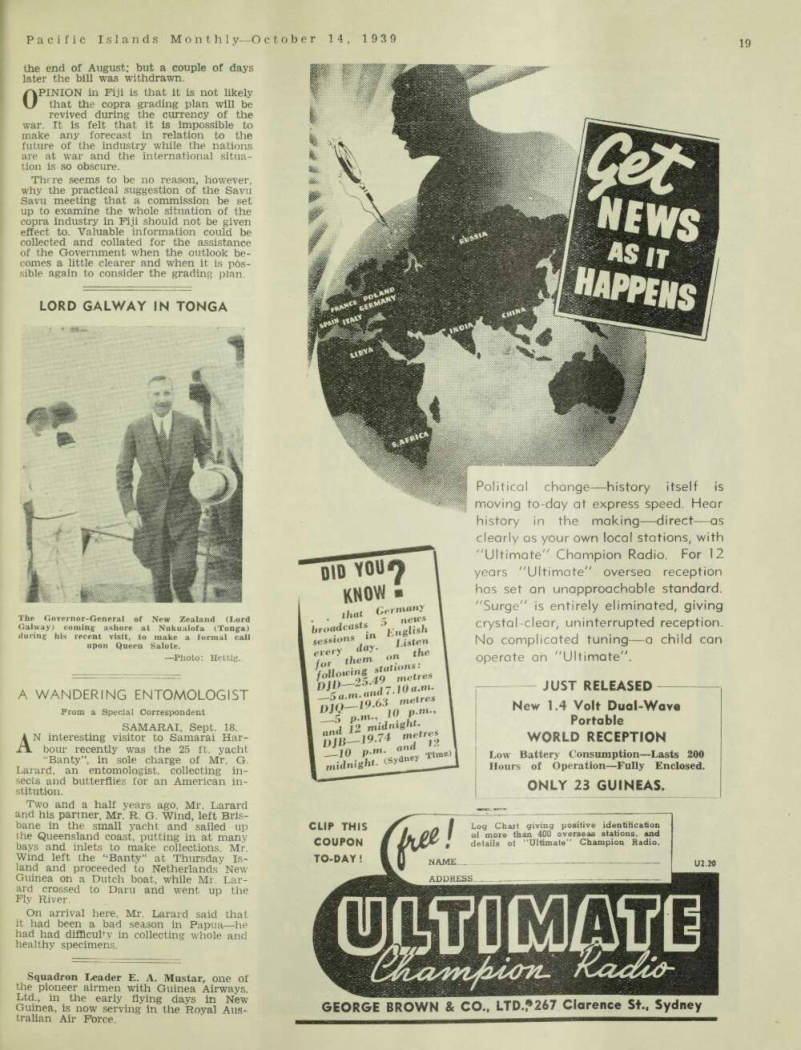
Plan Opposed and Withdrawn When War Breaks Out
COMMUNICATIONS from practically every territory in the Pacific show that the liveliest interest is now be ing taken in the future of the copra in dustry. Growers everywhere are sick and tired of being told that the low prices they receive for their product are the result of international unrest; while at the same time colossal profits are an nounced by the Unilever combine which virtually controls the copra markets of the world.
There is an eagerness all over the Pacific for some kind of co-operative action which will allow the growers to get a better price for copra. Unfortun ately, the problem is a bigger one than is visualised by the growers in the Pacific.
Copra comes in enormous quantities from practically every territory in the tropical belt throughout the world and the total production from the Pacific is only a small percentage of the whole production.
To achieve anything, there must be world wide action rather than regional action.
However, a start has to be made some where and it is interesting therefore to examine an agitation that has been go ing on in Fiji.
SOME time ago, the Government of Fiji accepted the apparently very sound argument of some of the leading merchants of Fiji in favour of a copra grading scheme. The general plan seemed to be similar to that now in op eration in New Guinea—namely, no copra could be exported until it had been
examined by officials of the Administra tion, and copra which did not reach a certain standard would not be passed for export. The effect of this is that New Guinea copra (what is called Rabaul grade) is worth at least £1 more per ton than most other South Seas copra.
But somewhat to the surprise of many observers there developed in Fiji a large body of active opposition to the plan. The arguments against it were very well pre sented at a special meeting of the Vanua levu Progress Association held a few weeks ago in Savu Savu. This meeting passed a strongly worded resolution ask ing the Government to appoint a com mission to investigate the whole position in relation to the copra industry before any form of compulsory grading was in troduced. The planters acknowledged that they all recognised the necessity for im proving to the fullest possible extent the prevailing low grade of copra exported, but they pointed out that this could only be achieved by the universal installation of efficient drying machinery. They said that under present financial conditions planters could not possibly finance the installation of such machinery—and they urged that, if grading were to be made compulsory, the obligation rested upon the Government to finance planters in the installation of drying machinery on the easiest possible terms.
Speakers pointed out that the grading plan was very vague. They asked where it was proposed to grade the copra in Suva or at specially selected buying
depots. They wanted to know if skilled officials were available to undertake the grading of copra. They asked if the Gov ernment were satisfied that the growers really would receive a substantial bene fit from the grading of Fiji copra.
VARIOUS planters in the columns of the “Fiji Times” discussed the whole copra position in Fiji from several angles. One man pointed out that there is a large sum of money standing to the credit of the planters in Fiji in connec tion with the Indian Repatriation Fund and he suggested that this money be in vested by the Government in an oil crushing mill and possibly a soap fac tory. He argued that if the combine could make millions of pounds of clear profit out of handling a vegetable oil and oil products, surely a comprehensive scheme embracing the whole of the copra production of Fiji would prove more profitable to growers than the pre sent haphazard system of exporting copra, which was completely at the mercy of the combine.
There may be many arguments against the suggestion that the Government of Fiji should undertake an industry of this character; but it can be pointed out in support of the newspaper correspondent that the copra producers of Ceylon have by experiment and experience, proved that it is much more profitable to crush the copra in Ceylon and export the coco nut oil and the cake to special markets, than it is simply to ship the copra in bags to an unfriendly market in Europe.
It was evident that all the agitation against the copra grading plan impressed the Governor. A bill to improve the qual ity of copra produced in the Colony was on the business paper of the Legislative Council which commenced its sittings at
the end of August: but a couple of days later the bill was withdrawn.
OPINION in Fiji is that it is not likely that the copra grading plan will be revived during the currency of the war. It is felt that it is impossible to make any forecast in relation to the future of the industry while the nations are at war and the international situa tion is so obscure.
There seems to be no reason, however, why the practical suggestion of the Savu Savu meeting that a commission be set up to examine the whole situation of the copra industry in Fiji should not be given effect to. Valuable information could be collected and collated for the assistance of the Government when the outlook be comes a little clearer and when it is pos sible again to consider the grading plan.
Advertisements & other items, pp. 20-21 (3 items)
18
October 14, 193 9—P acific Islands Monthly
St. Ignatius’ College
Riverview Sydney
Boys are prepared for Intermediate and Leaving Certificate Examinations and for Exhibitions, Scholarships and Bursaries at the University.
Boys are arranged in three Divisions according to age. Each Division has its own Library, Debating Society. Cricket and Football fields, and Tennis Courts. -‘r Senior and Junior Rowing Sheds, with a large fleet of pleasure and racing boats.
P ri v a t e Swimming Baths.
Prospectus and further particulars on application to the— Rector: St. Ignatius' College Riverview Sydney Tel.: JA 1106.
ONE OF SYDNEY'S GREAT PUBLIC SCHOOLS
BOARDING AND DAY SCHOOL
CONDUCTED BY THE JESUIT FATHERS
Lord Galway In Tonga
The Governor-General of New Zealand (Lord Galway) coming ashore at Nukualofa (Tonga) during his recent visit, to make a formal call upon Queen Salote.
Photo: Hettig.
A Wandering Entomologist
Prom a Special Correspondent
Samarai, Sept. 18.
AN interesting visitor to Samarai Har bour recently was the 25 ft. yacht “Banty”, in sole charge of Mr. G.
Larard, an entomologist, collecting in sects and butterflies for an American in stitution.
Two and a half years ago, Mr. Larard and his partner, Mr. R. G. Wind, left Bris bane in the small yacht and sailed up the Queensland coast, putting in at many bays and inlets to make collections. Mr.
Wind left the “Banty” at Thursday Is land and proceeded to Netherlands New Guinea on a Dutch boat, while Mr. Lar ard crossed to Daru and went up the Fly River.
On arrival here, Mr. Larard said that it had been a bad season in Papua—he had had difficulty in collecting whole and healthy specimens.
Squadron Leader E. A. Mustar, one of the pioneer airmen with Guinea Airways, Ltd., in the early flying days in New Guinea, is now serving in the Royal Aus tralian Air Force.
A “talkie” film of Western Samoa, “Is lands of Romance”, was screened at the meeting of the Pacific Islands Club held in Sydney on October 4. Mr. W. Taylor, N.Z. Trade Commissioner, gave an inter esting address on “The Significance of the N.Z. Centenary”. A collection of 30 lantern slides dealing with the natives of 8.5.1.. New Hebrides and New Guinea was shown bv Major H. S. Robinson, gen eral secretary of the Melanesian Mission in Sydney, and was explained by Dr. H. lan Hogbin (who acted as president in the absence of Mr. A. J. Marshall).
Mr. Arthur John Murray, accountant with Bums Philp (S.S.) Co. Ltd., Apia, Western Samoa, married Miss Alma Raphael, formerly a member of the teach ing staff at Ifi Ifi Government School, on September 14. Rev. W. E. Moren officiated at the ceremony, and the re ception was held at the Apia Social Union, Vaimea.
Miss Doris Corkin, of Samarai, Papua, who is a pupil at St. Anne's School, Townsville. Qld., gained a 71 per cent, pass in the recent Australian Music Examina tions.
Advertisements & other items, pp. 21-22 (2 items)
19
Pacific Islands Monthl y-O ctober 14, 1939
AVfi
is m 4 'Si i
■ rt tzz
,ad Z in day listeH V r ,hem on
«U9 a, r^
( JV A ,n p.m., —5 p . i,
Btif.
Political change—history itself is moving to-day at express speed. Hear history in the making—direct—as clearly as your own local stations, with "Ultimate" Champion Radio. For 12 years "Ultimate" oversea reception has set an unapproachable standard.
"Surge" is entirely eliminated, giving crystal-clear, uninterrupted reception.
No complicated tuning—a child can operate an "Ultimate".
JUST RELEASED
New 1.4 Volt Dual-Wove Portable
WORLD RECEPTION
Low Battery Consumption—Lasts 200 Hours of Operation—Fully Enclosed.
ONLY 23 GUINEAS.
CLIP THIS
COUPON
TO-DAY!
Log Chart giving positive identification of more than 400 overseais stations, and details of "Ultimate" Champion Radio. iK
y up
NAME .
J 2.20
ADDRESS
M
AVfi
E Ji I U r / GEORGE BROWN & CO.. LTD.*267 Clarence St.. Sydney
TROPIC MEALS
At a Moments Notice
IMPERIAL
f Sheep Tongues 12oz.
Lamb Tongues . . 12oz.
Ox Tongues . . . 240 z.
Ox Tongues . . . 21b.
Camp Pie ... 12oz.
Mango Gr PaPaw Chutney . .
Cheddar Cheese Mild and Tasty.
"FITZROY"
Luncheon Beef . . 16oz. (in oblong can) Pork Sausages . . 16oz.
Beef Sausages . . 16oz.
ASSORTED HOT
MEALS
Steak Gr Kidney Pudding.
Sausages Gr Tomato.
Lamb Gr Green Peas.
Steak Gr Tomato.
Beef Steak Pudding.
Chops Gr Tomato.
Sausages, Spaghetti Gr Tomato.
"OX & PALM" OR
"RIVERSTONE"
Native Trade Meats.
Corned, Boiled and/or Roast Beef—l2oz., 16 oz., 240 z., 21b., Bib., 41b., 51b., and 61b.
"WESTFIELD"
Corned, Boiled and/or Roast Mutton 1 2oz.
All lines can be obtained from leading Island Stores. jppijp ...
Products of „ . . .. , .
Riverstone Meat Lo. Fly. Ltd.
5-7 O'Connell Street, Sydney Cobles: “IM Fiji Representatives:
PEARCE & CO., LTD
Believe It Or Not!
A Real Ripley Story of Torres Strait
TORRES STRAIT, at the beginning of last century, was the scene of a re markable succession of shipping mis haps. according to Robert Ripley, of “Believe It Or Not” fame, in a recent broadcast in U.S.A.
Reference which we have made to the “Australian Dictionary of Dates” confirms the following part of Ripley’s story.
A colonial cutter, the “Mermaid", en route from Sydney to Raffles Bay, was wrecked in Torres Strait in October, 1829.
The crew scrambled ashore on a rocky islet and were rescued, three days later by the “Swiftsure”, a Tasmanian vessel; but disaster overtook her and she, too, went ashore. In April, 1830, the comple ments of both ships were picked up by another Tasmanian vessel, the “Gover nor Ready”.
Misfortune dogged the voyage of the “Governor Ready”, and on May 18 she herself went down, the crew and rescued sailors taking to the boats. A third Tas manian ship, the “Comet”, chanced to come in sight, and the shipwrecked men were taken aboard. Shortly afterwards she, too, was lost. This time, the “Jupit er” was close by and saved all hands.
As the “Jupiter” approached Raffles Bay, and the sailors’ troubles seemed at last over, she was wrecked at the en trance.
Here official verification ceases; but Ripley went on a further extraordinary climax.
The personnel of the various wreck ed ships, he said, were picked up by the passenger vessel, “City of Leeds”.
Next morning, the doctor of the “City of Leeds” inquired of the shipwrecked men if any among them was a York shireman —an old Yorkshire woman on board was dying, and calling for her son.
Peter Richardson, a seaman from the first wrecked ship, the “Mermaid”, step ped forward. The doctor asked him to pretend to be the son. in order to com fort the woman. Richardson did so— and found that the sick lady actually was his own mother!
Ripley added that Mrs. Richardson was so cheered by the reunion that she recovered and lived for another 18 years!
Have You Any Old Copies of
"P.I.M."?
CAN any reader assist Mr. Paul A.
Dorn, of 6763 Hollywood Boulevard, Hollywood, California. U.S.A.. who writes:— “Right now I am trying to complete my file of the in order to hand it over to the Los Angeles Public Lib rary. where it will be bound and will do more good than at present. I still lack four numbers. Vol 1., No. 9 (April. 1931): Vol. 11.. No. 7 (February, 1932): Vol. 11..
No. 12 (July, 1932); and Vol. VI., No. 6 (January. 1936). Can you tell me where complete files may be found?”
If you have any of those issues, please write to Mr. Dorn.
Mr, Guv Cadden, manager of Steam ships Trading Co. Ltd., who was married in Sydney on August 30. returned to Papua in September with his bride.
Rev. H. S. and Mrs. Perkins, who owing to ill-health retired from missionary work in Western Samoa after 11 years’ service, recently arrived in England, journeying by way of New Zealand.
Advertisements & other items, p. 22 (1 item)
20
October 14, 193 9—P acific Islands Monthly
Rabaul's Future
May Remain N.G. Capital Risk of Future Eruptions
THE suggestion has been made, several times, in this journal, that the recommendation of the expert vulcanologists (that Rabaul should be abandoned as the Administrative headquarters of New Guinea) should be reviewed. It is interesting, there fore, to note that the members of the Amalgamation Committee, in the valuable report made recently to the Federal Government, made the fol lowing statements: — PERHAPS we should say that, but for the vulcanological aspect, we con sider Rabaul a more suitable location for the capital than any other site viewed by us.
The following are extracts from evid ence furnished to the Committee by Mr.
N. H. Fisher, Government Geplogist to the Territory, who accompanied Drs.
Stehn and Woolnough during their vul canological investigations at Rabaul dur ing 1937, and who had just returned from a course of instruction under Dr. Stehn, and a tour of inspection of the volcanic areas in the Dutch East Indies:— “In the two years which have elapsed since the eruption it has been determin ed that it was a phase in the definite periodic release of forces and not the initiation of a new stage in the life of the volcanoes. Therefore, there would be a long period of quiescence before an eruption of a similar nature occurred.
“He was of the personal opinion that there was no danger to life in Rabaul, and this opinion was based on scientific grounds. There was, however, a definite probability of another eruption in not less than 40 years, which would cause approximately the same damage to Ra baul as the last, if occurring during the South-East season, but much less if dur ing the North-West, but there would then be the possibility of giving the po pulation about three days’ warning by means of the observatory. Mr. Fisher thought that Dr. Stehn would probably agree with this opinion.
“The science of vulcanology was suffi ciently advanced to enable close range predictions to be made. Such predictions were an established fact with most vol canoes on which permanent observation posts were established. Long range pre dictions of the exact date of future eruptions were not possible in the case of volcanoes of the Rabaul type, but a general forecast of their behaviour was possible.
“Mr. Fisher considered that Dr. Stehn’s opinion, as expressed in the Vulcanolo gical Report, was that the Government should consider the removal of the ad ministrative headquarters from Rabaul or of permitting them to remain there pro vided provision was made for adequate warning to be given. He considered that this report has to be read over carefully to obtain Dr. Stehn’s opinion.
“Mr. Fisher personally thought that Tavui was safe from any possible vol canic disturbances at Rabaul.
“The next eruption of Vulcan may pos sibly be in an easterly direction, and it is just possible that future eruptions may eventually block the entrance to the harbour.
“Regarding Vulcan, Dr. Stehn is of the opinion that the centre is more or less localised with a possible north-easterly extension.
“Evidence indicates that Tabalanakaia is not likely to erupt again”.
It was suggested to us that perhaps the Commonwealth Government would
invite Dr. Stehn to re-visit the area and make further report in the light of data that may have become available since the 1937 eruptions. We merely record this suggestion.
Observatory Buildings
A contract has been let at £1,120, for the erection of the necessary buildings for a vulcanological observatory in Rabaul.
It is intended that watch shall be kept upon the volcanoes from three widely separated points, north, west and east of Rabaul. These points are connected by telephone, and it. is considered that the kind of observation to be established will give three days’ warning of an eruption.
Mr. William John Paine, who lived for some years in Western Samoa before he finally settled down in New Zealand, about 30 years ago, died recently in Palmerston North Hospital, N.Z.
First "Call-Up"
French Soldiers Leave N. Hebrides
THE first batch of French conscripts were called up in the New Hebrides immediately war was declared, and they departed a few days later. No more men will be called up in the New Heb rides until adequate arrangements have been made to ensure that plantations, etc., will be properly worked and control led during the war.
Mr. Clifford Ahrens, B.Sc. Agr., who has been engaged in work for the Methodist Mission at the Navuso Agri cultural School, Fiji, returned to Austra lia recently. He has suffered from ill health some some time.
Mr. Cameron has been appointed sec retary of the Government Hospital, Apia, Samoa.
Rabaul Electricity, Ltd., reports net profit of £2,576 for the year to June 30 last, compared with £2,250 for 1937-38.
Interim dividend of 6 per cent, was sup plemented by final payment of 5 per cent., the total of 11 per cent, for the year requiring £2,429. In the previous year, the total distribution was 9?. per cent.
The 52 ft. auxiliary ketch “Nuginco”, built in Sydney for the British New Guinea Development Co., Ltd., Papua, ar rived in Port Moresby recently after a voyage of 11% days, during which she averaged 7i knots under adverse weather conditions. Powered with a 66 h.p. Kelvin diesel engine, she has a beam of 16 ft., and her loaded draught is 5 ft. 6 ins.
Her cargo capacity is 350 bags of copra, and there is accommodation for a small number of passengers.
Advertisements & other items, pp. 23-24 (2 items)
21
Pacific Islands Monthl y—O ctober 14, 1939
Oatmeal
II I \W\ 'o/*
IJS
ofozr*'' tkraslflks
TOOHEYS
OATMEAL
STOUT
lOCS & STRATTO
o/rMO
AMP-LIT
HOME POWER
UNITS
By Briggs & Stratton Small, light, compact Petrol electric generators with everything a car engine has.
“ELECTRICITY”
ANYWHERE—
—ANYTIME
® For Home Lighting ® Battery Charging * Will operate twelve 25 watt Lamps ® 12 hours per gallon of petrol.
Price £22/10/-
Output 12 volts 300 watts (25 amps) (1 ) Press Button Starting (2) Magneto Ignition, etc. (3) Automatic Cut-out (4) Air-Cleaner, oil bath type (5) Petrol Filter (6) Float - feed adjustable Carburettor (7) Vibration-less Features 4,5, 6 & 7 are positively exclusive to Model 300 (Weight when packed 97 lbs.) Also, Model 100, 6 volts, 100 watts, manual starting £l5. (Weight when packed 70 lbs.) Briggs & Stratton are the World’s largest manufacturers of single cylinder 4-cycle, air-cooled Petrol Motors.
Stationary and Marine Engines also available up to 5 Horsepower.
TRADE ENQUIRIES INVITED.
EXCLUSIVE AGENTS:
AMPLION (A'SIA) PTY. LIMITED
ii
382 KENT ST., SYDNEY.
Cable Address; “AMPLION,* Sydney.
Suva
New City Of
Rapid Change in Appearance and Character
fpHE character of Suva, chief town of X Fiji, is changing rapidly. For a long time it was not a very impressive collection of buildings—comparable maybe with a North Queensland town. Its at tractiveness was given to it rather by its topographical features and its pleasant tropical situation, and by its cosmopoli tanism, rather than by the beauty of its buildings.
But there has been a great deal of building in recent years.
The Union Steam Ship Company start ed it by building the Grand Pacific Hotel among the palm trees overlooking the lagoon at the eastern end of the town, and then, of course, there had to be an attractive boulevard to connect the town with the hotel. This improved the whole appearance of the waterfront. At the other or western end of the town the place was improved by the erection of creditable buildings by the big firms— especially Burns Philp (S.S.) Co., Ltd., and Morris, Hedstrom, Ltd.
Then came the biggest development of all. The Government at a cost of about £200,000 erected a magnificent block of offices in the eastern side of the town, in what had been formerly a slum district, and this dominating pile not only pleased the eye but changed the character of the place so that instead of being a small tropical town it really now has something of the character of a city.
Thus stimulated, building in Suva has gone on apace.
Messrs. A. J. Swann and Co., pharma ceutical chemists, in August, moved from their old shop into new and commodious premises at the corner of Victoria Parade and Pratt Street. The new shoo is de scribed as being exceptionally roomy and well lit and carries all modem appoint ments.
It is expected that at the end of October the contractors will have com pleted a new building for the Bank of N.S.W.—a fine new place built on modern lines which is a credit not only to the bank but also to the young tropical city.
Suva, the chief town of what is prob ably the richest British Crown Colony, an important shipping centre at the crossroads of the Southern Pacific, and now to be an airport on the trans pacific airlines, is assured of a great future.
Cost Of New Government Block
Some of the more careful business men are complaining rather bitterly because of the high cost of the new Government block—namely £190,000 odd. They point out that the original estimate was in the vicinity of £3o,ooo—this ,of course, being before the Great War. Little by little the estimate was advanced until when the actual building was commenced it was somewhere in the vicinity of £150,000 Before it was all over, the cost as stated, was nearly £200,000. During the 20 years or more while this plan was under con sideration the costs of building and materials advanced enormously. Further more, when the contractors began to dig the foundations of the building they found that they were on shifty ground which involved costs far greater than any thing anticipated. Finally, it is very rarely that the cost of an enterprise of this description is kept within the official figures.
The old councillors of the Fijian Gov ernment may have good cause for grumbling—but at least they can claim that in their time the Government of Fiji erected a building which is a credit to the Colony and which probably will repay them many times over in the in creased value of all properties in Suva.
The Australian Labour Party, by action in the Commonwealth Parliament, is trying to persuade the Australian Govern ment to put pressure on the Phosphate Commission, to induce the latter to em ploy only Australians, instead of natives, on the ships which run between Aus tralian ports and Nauru,
Advertisements & other items, pp. 24-25 (3 items)
22
October 14, 193 9—P acific Islands Monthly
23
Pacific Islands Monthl y—O ctober 14, 1939
1L Drhc-Free Oil
Pc >*- >-J3l M Kr SS? re/.
S 9 sa c D % £ & R * T m
ivv
a S* o\v ioIOK o re. e *A. re & These are the big bad bears you see, Wear, Tear, Drag — one, two three, Waging war on piston and ring, Gobbling up oil like anything, Laughing at ordinary oil you’ve tried, Leaving pistons hot and dried.
'We’ll help!” the Drag-Free Drops all yell, 'We’ll clean out the big bad bears we SHELL !”
V X? & I in re re & re u Murder! help!” the bad bears shout, As by Drag-Free Shell they’re all cleaned out.
What a relief!” the pistons purr You’re oil right now,” the Drops assure.
“ We’ll do the same for any car,”
Sing the Drag-Free Drops, " We’re SHELL, we arel”
CHANGE NOW TO
1L DRhC-FREE Oil
SHELL motor oil
The Shell Company of Australia Limited (Incorporated in Great Britain) L0.39/22C
No Rebuilding Yet
Loss of Carpenter's Roboul Store
A FORMAL enquiry into the fire which destroyed the large retail store of W. R. Carpenter & Co., Ltd., in Rabaul, late in August, was held in Sep tember. About a dozen witnesses were examined, but the coroner said there was no evidence whatever to indicate the prob able cause of the fire.
The business of the big firm, which was badly disorganised by the fire, has been
largely re-established; but it seems that the firm will not continue with retail distribution in Rabaul in the manner followed hitherto. No steps have been taken to erect a new building. It is not expected that anything will be done un til the international situation —which must affect the future of New Guinea— becomes a little clearer; and until some thing more definite is known about the site of the new capital.
Mr. I). R. c. Harvie. Fiji Customs officer, is spending long leave in Aus tralia.
Defence Troubles In
N. Guinea
“Diggers” Demand Enrolment
AS a result of strong representations made to the Federal Government at Canberra, about a score of Germans have been removed from the Mandated Territory of New Guinea to Australia, for internment.
We are advised that there is discon tent in New Guinea owing to the manner in which the Defence Force there has been organised. An age limit was imposed, with the result that practically the whole of the old soldiers in New Guinea—of whom there are many, and the great majority of them in exceedingly good physical condition—were not permitted to enter the newly-organised Volunteer Rifles. It was proposed, moreover, to organise the Rifles on strictly Admini stration lines —that is to say, experienced soldiers, some of whom had had com missions in the last war, were expected to accept as their commanding officers the gentlemen who happened to hold leading positions in the Administration service. This resulted in strong repre sentations being made to Canberra. (See later report on page 6.)
New Guinea Volunteer Rifles
Some hundreds of men have now been enrolled in the New Guinea Volunteer Rifles, the formation of which was authorised at the beginning of the war and which is under the control and dir ection of Lieut.-Colonel Walstab.
Having completed the necessary en rolments in Rabaul, Lieut.-Colonel Wal stab left for the Morobe towns, and was engaged in the following week in enrol ing men for the force in Wau, Salamaua, Lae and Bulolo.
New Guinea's Doughtiest Fighter
"Blue" Allan For The War
New Guinea's Doughtiest Fighter in Australian Forces
AS soon as war broke out, Mr. H. T. (“Bluey”) Allan handed over his valuable gold-mine near Wau, New Guinea, to a trusted associate, and flew to Sydney on the mail-plane. He was in the last war (his military designation is Captain H. T. Allan, M.C.) and he had no intention of being out of this one. He is still a young and active man.
The Nabobs at Victoria Barracks, Sydney, were cautious. They find these eager young veterans of 1914-18, who want to hop in without loss of time, a bit of a handful.
While they were making up their minds, “Bluey” Allan went on up to Canberra, and had a war, on his own ac count, with certain sections of officialdom there on the question of the delay in building the Salamaua-Wau road.
Mr. Allan has fought—sometimes meekly and sometimes very savagely—for this road for about two years, and has received many promises from politicians.
But the road still is only a thing of blue prints; and the indications now are that, owing to war conditions, it will not be built very soon.
Mr. Allan returned to Sydney and, along with many other experienced mili tary officers, placed himself at the dis posal of those who are organising an other A.I.F. New Guinea will miss him, her doughtiest fighter in public affairs, and will wish him a safe return.
Advertisements & other items, p. 26 (2 items)
24
October 14. 193 9—P acific Islands Monthly
Enos
Hot?
w \S
feHO
aus e
o'*' VP e
bee
o' 5 * Vta' s c o \Vte* n*’ or U» Vicr G'» u e<» tt**" it"" ca" it' i"» a" ia'" o» cO"
V"° c»» c * iVtf Vtca' W<*" \>* {c\r ,a i"'" ueies a" t \ta o' r"'* n"" ittfc C*"° (o'*"
VtaV"' \o o' \ca \\9iVto'"
V>° it"
Heat often makes yon slack and irritable and with little appetite,
ke a sparkling, refreshing
ass of Elio's fcl, Friiit Salt” very morning, and as a thirst
quencher during the day. Eno
will regulate your system, cool your blood and keep you energetic in spite of the heat.
ENOS
■FRUIT
salt!
11 7f
TRADE MARK
Anil?
ip t. a * ✓ - «• * • ■» ' j-* • ’ > • * ' 7®' . W" 1 I ft • ,• S I *-n' ii I ( > i » « w
STAY AT
SYDNEY'S NEW GUEST HOUSE,
BERNLY
Delightfully situated lit
SPRINGFIELD AVENUE, POTTS POINT
(4 mins, from City) An ideal home for visitors from the Islands and Overseas .
COMFORT ... CONVENIENCE,
PRIVACY AND GOOD SERVICE.
100 Richly Furnished Bedrooms, many with Private Showers.
HOT A COLD WATER A TELEPHONES
IN ALL BOOMS.
BILLIARDS . . . ROOF GARDEN.
CUISINE BY FIRST-CLASS CHEF.
Tariff: From 8 gns. p.w. Inclusive—or Room only If desired.
Proprietor : F. J. BERNE.
Temperate
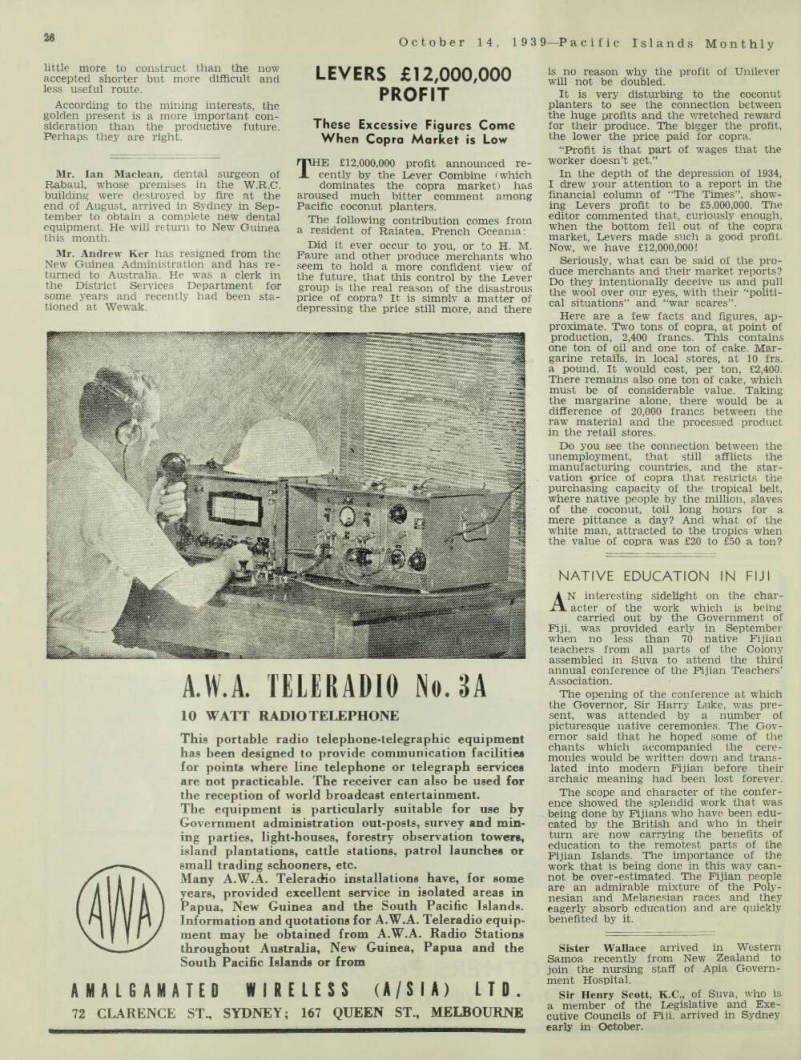
Zone
White Settlement Possibilities in Central New Guinea
By P.B.
rtERE has been considerable discus sion concerning the possibilities of large scale white settlement on the high plateau lands of Central New Guinea. During a recent visit to Rabaul I found interesting facts concerning the above areas in the official files of the
Department of Agriculture.
The plateau areas under discussion are presumably the Bulolo uplands, the plateau at the head of the Purari River, embracing the Mt. Hagen. Chimbu and Bena Bena districts, and the high coun try in the Upper Ramu River area.
Of these areas, the Bulolo uplands, it is authoritatively stated, are unsuitable for agricultural development for many years, owing to the mining activities.
The Upper Purari areas have given us little useful agricultural information to date, and apparently it will be some time before they will be opened up for private development.
The T.N.G. Department of Agriculture has for several years maintained an agri cultural observation post at Aiyura, Ramu, about nine miles from the Upper Ramu post.
Aiyura is typical of a great deal of the surrounding country and is at an ele vation of 5,875 feet above sea level. Crop production experiments and daily meteor ological records have enabled the De partment to compile a series of definite
figures on the subject. A large selection of crops has been tried out, and in many cases excellent results have been forth coming.
In one case, 500 lb. of potatoes were gleaned in 21 months from the planting of 40 lb. of tubers. A still better example of the soil's productivity is seen from the production of 1,112 lb. of potatoes from 75 lb. of seed. The area planted in this case was one-tenth of an acre.
The meteorological data for this area is of interest. The rainfall is moderate and evenly distributed, the humidity is fair, and the temperature range truly temperate. The following figures for Aiyura have been set out in table form for ease of comparison and are compared with corresponding figures for the Bulolo area:—
The above comparisons are enlighten ing. Aiyura, and presumably much of the surrounding country, has a climate which can be described as nothing less than temperate and with its evenly distributed and moderate rainfall should be suitable for many crops hitherto grown only in
the higher latitudes. Bulolo compares favourably with Aiyura, except for its slightly higher temperatures.
If these figures, pertaining as they do to two widely separated points on the tablelands, are in any way indicative of the general conditions throughout the whole area, there is certainly an ex tremely fertile and useful future for the pioneers who may develop these parts, when they come to be exploited.
In passing, it is of interest to note that the reaches of the Markham Valley hold enormous tracts of extremely fer tile land, especially so on the higher shelf levels. It is a great pity that the proposed Salamaua-Wau road is not tak ing the Markham Valley route, as was once suggested. Although a road has al ready been built, several miles up the
Markham Valley, from Lae, the large amounts of new land capable of develop ment, which would have been made available by the introduction of a new through road, would have greatly in creased the assets of the Territory, Appar ently the Markham route would have cost
Date of observation Aiyura (Ramu).
Bulolo. 1938.
Height above sea level 2200 ft.
Average maximum temperature 87.5°F.
Average minimum temperature 67.5°F.
Extreme maximum temperature 95.2°F. <Jan.) Extreme minimum temperature 57.9°F. (Aug.) Monthly mean 77.4°F. (Apr.) Mean humidity (9 a.m.) 78.2% Extreme humidity Minimum humidity 86% (Feb.) Rainfall, monthly average 4.45 in.
Rainfall, extreme average 8.65 in. (Jan.) Greatest fall in 24 hours 2.48 in. (Nov.) Greatest monthly fall since 1933 .. . 26.39 in. (Jan., 1934) 11.45 in. (Mar., 1931) Least monthly fall since 1933 0.85 in. (June. 1931) Average for 1938 53.48 in.
Annual average since 1933 55.62 in.
Monthly wet days, average 12.2 Cloud average 6.2
little more to construct than the now accepted shorter but more difficult and less useful route.
According to the mining interests, the golden present is a more important con sideration than the productive future.
Perhaps they are right.
Mr. lan Maclean, dental surgeon of Rabaul, whose premises in the W.R.C. building were destroyed by fire at the end of August, arrived in Sydney in Sep tember to obtain a complete new dental equipment. He will return to New Guinea this month.
Mr. Andrew Ker has resigned from the New Guinea Administration and has re turned to Australia. He was a clerk in the District Services Department for some years and recently had been sta tioned at Wewak.
Advertisements & other items, pp. 27-28 (2 items)
25
Pacific Islands Monthl y—O ctober 14, 1939
Newlands Brothers Pty. Ltd.
The new range of Newlands modern steel furniture includes designs ideal for indoor and outdoor use in the tropics.
Newlands extend a cordial invitation to you on your next visit to Sydney to see their new showrooms where is exhibited a complete selection of steel furniture offering distinctive groupings and suites in actual home settings, in addition to individual pieces for every type of service.
FOR STEEL FURNITURE AND MODERN SLEEPING EQUIPMENT.
NEWLANDS BROTHERS Pty. Ltd.
Riley and Albion Streets, Sydney, N.S.W.
Write to-day for a catalogue illustrating the full range of this delightful furniture.
It will be forwarded promptly.
i &■ i
A.W.A. lELERADIO No. 3A
10 WATT RADIOTELEPHONE
This portable radio telephone-telegraphic equipment has been designed to provide communication facilities for points where line telephone or telegraph services are not practicable. The receiver can also be used for the reception of world broadcast entertainment.
The equipment is particularly suitable for use by Government administration out-posts, survey and mining parties, light-houses, forestry observation towers, island plantations, cattle stations, patrol launches or small trading schooners, etc.
Many A.W.A. Teleradio installations have, for some years, provided excellent service in isolated areas in Papua, New Guinea and the South Pacific Islands.
Information and quotations for A.W.A. Teleradio equipment may be obtained from A.W.A. Radio Stations throughout Australia, New Guinea, Papua and the South Pacific Islands or from
AMALGAMATED WIRELESS (A/SIA) LTD.
72 CLARENCE ST„ SYDNEY; 167 QUEEN ST., MELBOURNE
Levers £12,000,000
Profit
These Excessive Figures Come When Copra Market is Low
THE £12,000,000 profit announced re cently by the Lever Combine (which dominates the copra market) has aroused much bitter comment among Pacific coconut planters.
The following contribution comes from a resident of Raiatea, French Oceania: Did it ever occur to you, or to H. M.
Faure and other produce merchants who seem to hold a more confident view of the future, that this control by the Lever group is the real reason of the disastrous price of copra? It is simplv a matter of depressing the price still more, and there
is no reason why the profit of Unilever will not be doubled.
It is very disturbing to the coconut planters to see the connection between the huge profits and the wretched reward for their produce. The bigger the profit, the lower the price paid for copra.
“Profit is that part of wages that the worker doesn’t get.”
In the depth of the depression of 1934, I drew your attention to a report in the financial column of “The Times”, show ing Levers profit to be £5,000,000. The editor commented that, curiously enough, when the bottom fell out of the copra market, Levers made such a good profit.
Now, we have £12,000,000!
Seriously, what can be said of the pro duce merchants and their market reports?
Do they intentionally deceive us and pull the wool over our eyes, with their “politi cal situations” and “war scares”.
Here are a few facts and figures, ap proximate. Two tons of copra, at point of production, 2,400 francs. This contains one ton of oil and one ton of cake. Mar garine retails, in local stores, at 10 frs. a pound. It would cost, per ton, £2,400.
There remains also one ton of cake, which must be of considerable value. Taking the margarine alone, there would be a difference of 20,000 francs between the raw material and the processed product in the retail stores.
Do you see the connection between the unemployment, that still afflicts the manufacturing countries, and the star vation fDrice of copra that restricts the purchasing capacity of the tropical belt, where native people by the million, slaves of the coconut, toil long hours for a mere pittance a day? And what of the white man, attracted to the tropics when the value of copra was £2O to £5O a ton?
Native Education In Fiji
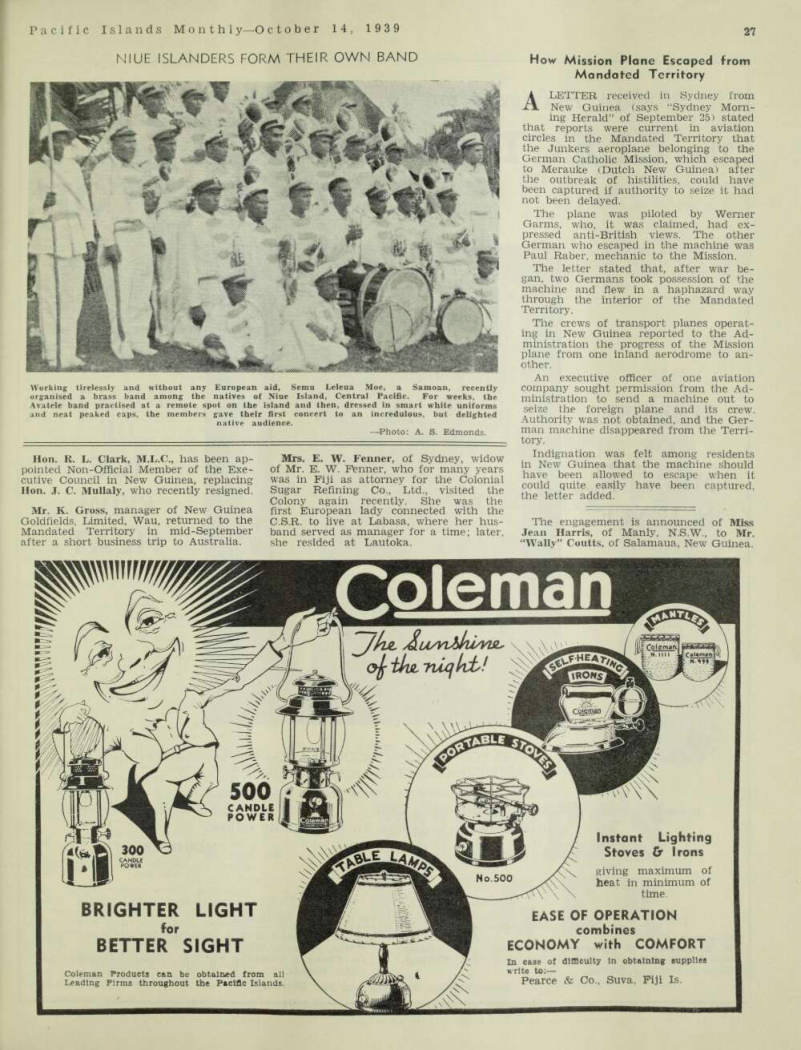
AN interesting sidelight on the char acter of the work which is being carried out by the Government of Fiji, was provided early in September when no less than 70 native Fijian teachers from all parts of the Colony assembled in Suva to attend the third annual conference of the Fijian Teachers’
Association.
The opening of the conference at which the Governor. Sir Harry Luke, was pre sent, was attended by a number of picturesque native ceremonies. The Gov ernor said that he hoped some of the chants which accompanied the cere monies would be written down and trans lated into modern Fijian before their archaic meaning had been lost forever.
The scope and character of the confer ence showed the splendid work that was being done by Fijians who have been edu cated by the British and who in their turn are now carrying the benefits of education to the remotest parts of the Fijian Islands. The importance of the work that is being done in this way can not be over-estimated. The Fijian people are an admirable mixture of the Poly nesian and Melanesian races and they eagerly absorb education and are quickly benefited by it.
Sister Wallace arrived in Western Samoa recently from New Zealand to join the nursing staff of Apia Govern ment Hospital.
Sir Henry Scott, K.C., of Suva, who is a member of the Legislative and Exe cutive Councils of Fiji, arrived in Sydney early in October.
Hon. R. L. Clark, M.L.C., has been ap pointed Non-Official Member of the Exe cutive Council in New Guinea, replacing Hon. J. C. Mullaly, who recently resigned.
Mr. K. Gross, manager of New Guinea Goldfields, Limited, Wau, returned to the Mandated Territory in mid-September after a short business trip to Australia.
Mrs. E. W. Fenner, of Sydney, widow of Mr. E. W. Fenner, who for many years was in Fiji as attorney for the Colonial Sugar Refining Co., Ltd., visited the Colony again recently. She was the first European lady connected with the C.S.R. to live at Labasa, where her hus band served as manager for a time; later, she resided at Lautoka.
Advertisements & other items, p. 28 (1 item)
26
October 14, 193 9—P acific Islands Monthly
Niue Islanders Form Their Own Band
Working tirelessly and without any European aid, Semu Leleua Moe, a Samoan, recently organised a brass band among the natives of Niue Island, Central Pacific. For weeks, the Avatele band practised at a remote spot on the island and then, dressed in smart white uniforms and neat peaked caps, the members gave their first concert to an incredulous, but delighted native audience.
Photo: A. S. Edmonds.
Mandated Territory
How Mission Plane Escaped from Mandated Territory
A LETTER received in Sydney from New Guinea (says “Sydney Morn ing Herald” of September 25) stated that reports were current in aviation circles in the Mandated Territory that the Junkers aeroplane belonging to the German Catholic Mission, which escaped to Merauke (Dutch New Guinea) after the outbreak of histilities, could have been captured if authority to seize it had not been delayed.
The plane was piloted by Werner Garms, who, it was claimed, had ex pressed anti-British views. The other German who escaped in the machine was Paul Raber, mechanic to the Mission.
The letter stated that, after war be gan, two Germans took possession of the machine and flew in a haphazard way through the interior of the Mandated Territory.
The crews of transport planes operat ing in New Guinea reported to the Ad ministration the progress of the Mission plane from one inland aerodrome to an other.
An executive officer of one aviation company sought permission from the Ad ministration to send a machine out to seize the foreign plane and its crew.
Authority was not obtained, and the Ger man machine disappeared from the Terri tory.
Indignation was felt among residents in New Guinea that the machine should have been allowed to escape when it could quite easily have been captured, the letter added.
The engagement is announced of Miss Jean Harris, of Manly, N.S.W., to Mr.
“Wally” Coutts, of Salamaua, New Guinea.
Advertisements & other items, pp. 29-30 (3 items)
27
Pacific Islands Monthl y—O ctober 14, 1939
ihz riiqlvt!
u ss -Ct
AuMjJnjyyuL
Icma /V ✓; CoKmi
ELFHgA 7vS
*3
IRONS
' £ r 'j 500 i]
CANDLE
PO kn Instant Lighting Stoves Cr Irons 2L 300 t£v
CANDLE
POWER
y giving maximum of heat in minimum of \ time. 500
BRIGHTER LIGHT
for
BETTER SIGHT
EASE OF OPERATION
combines
ECONOMY with COMFORT
In case of difficulty In obtaining supplies write to;— Pearce & Co., Suva, Fiji Is.
Coleman Products can be obtained from all Leading Firms throughout the Pacific Islands.
Modern Refrigeration for the South Sea Islands
The ELECTROLUX
KEROSENE OPERATED
REFRIGERATOR
MARVEL
QF
MODERN
SCIENCE
THE
MIRACLE
OF
ICE
FROM
HEAT
ELECTROLUX offers economical, modern and completely efficient
REFRIGERATION FOR ISLANDS' HOMES.
FREEZES CONTINUOUSLY WHILE SMALL LAMP BURNS
Freezing controlled by simply regulating height of flame. Uses only f gallon of kerosene per week.
MOTORLESS ... NO PARTS TO GET OUT OF ORDER.
MODEL L 22 MODEL L3BO MODEL LKSSO Capacity * (as illustrated) Capacity 2.2 cubic feet. Capacity 4 cubic feet. 5.5 cubic feet.
GUARANTEED FOR TWO YEARS.
9 Write to your Local Distributor for prices and full details.
Obtainable from W. R. Carpenter & Company Ltd.—Sydney, and following New Guinea Branches: Rabaul, Salamaua, Wau, Kavieng, Madang, But and Wewak.
W. R. Carpenter & Coy. (Solomon Is.) Pty. Ltd. —Tulagi, British Solomon Islands.
On Chong & Company Pty. Ltd. —Butaritari, Gilbert and Ellice Islands.
Representation in Papua and New Hebrides.
28
October 14, 193 9—P acific Islands Monthly
N.G. Cocoa
Planters Assisted by War
IT is possible that the Hitler war will establish the cocoa industry in New Guinea.
For some years, planters in New Guinea have been growing cocoa-beans; but. owing to lack of experience and crude methods of fermentation and packing, they have been fighting an uphill battle.
The confectionery manufacturers in Australia use very large quantities of cocoa-beans, but all their formulae, machinery and processes are adapted to the beans which come mostly from West Africa and the West Indies. Because the use of New Guinea cocoa-beans meant considerable changes in formulae and processes, the Australian manufacturers were not eager to make an experiment— so. in order to give them some induce ment, the price had to be kept low.
Nevertheless, the New Guinea copoa beans. slowlv but surelv have beer, enter ing the Australian market.
In this connection it is worth recalling that the Editor of the “Pacific Islands Monthly”, some years ago. wrote individu ally to the principal confectionery manu facturers in Australia, and begged them to give the New Guinea cocoa-bean industry a chance: and it is gratefully acknowledged that some of the big firms —especially Messrs. H. Small & Co.. Ltd., Hoadleys, Ltd., Cadbury-Fry-Pascall. Ltd., and Stedman Henderson, Ltd—did take special steps to make room for the pro duct of New Guinea, and thus gave en couragement and assistance to the New Guinea growers.
Since then, the production of the New Guinea growers has grown to about 250 tons per annum, and the quality of the beans has definitely improved.
The whole position changed as soon as war broke out. Australian manufacturers were not able to receive from overseas their customary supolies of cocoa-beans and cocoa-butter, and they began anxiously to seek substitute supplies. The New Guinea beans are handled in Sydney by only two or three agents; and those agents, remembering the treatment they had received at the hands of the differ ent manufacturers, made it their busi ness to offer their all-too-limited sup plies first to the firms which had helped the New Guinea cocoa industry.
Prices, which had been in the vicinity of £26 or £27 per ton. just before the out break of war, had increased to £35 per ton by the middle of September and were going higher. New Guinea growers receive also a Commonwealth bounty.
All this means that Australian manu facturers are adapting their formulae and processes •to the New Guinea product ; and, if the war continues for any time, and the manufacturers become accust omed to the use of the New Guinea pro duct. it seems certain that the New Guinea industry will be soundly estab lished.
New Guinea growers should remember, however, that for many years Germany has been the largest buyer of West African cocoa-beans and that, therefore, all that huge production must seek other markets. Therefore, although the price may be high in Sydney for a while, ow ing to the difficulty in obtaining ship ments from Europe to Australia, It may not remain high.
Australian manufacturers regard the
Samoan cocoa-bean as very good indeed, But its high quality already has given it a guarantee of a high price on the other side of the world —so high that very few Samoan beans find their way to Australia.
Mr. Ken Lewis returned to Samarai, Eastern Papua, in September after spend ing furlough in China and Japan. He has now taken up duties again at Samarai Power House.
Rev. W. G. Thomas, vicar of Mordialloc, Victoria, will shortly visit Nauru and Ocean Island, Central Pacific, as chap lain under the auspices of the Australian Board of Missions.
Mrs. Winifred Jenner, formerly a resi dent of Rabaul, and more recently of Wau, left the Mandated Territory in September, and expects now to make her permanent home in Australia.
Smallpox Scare In Tahiti
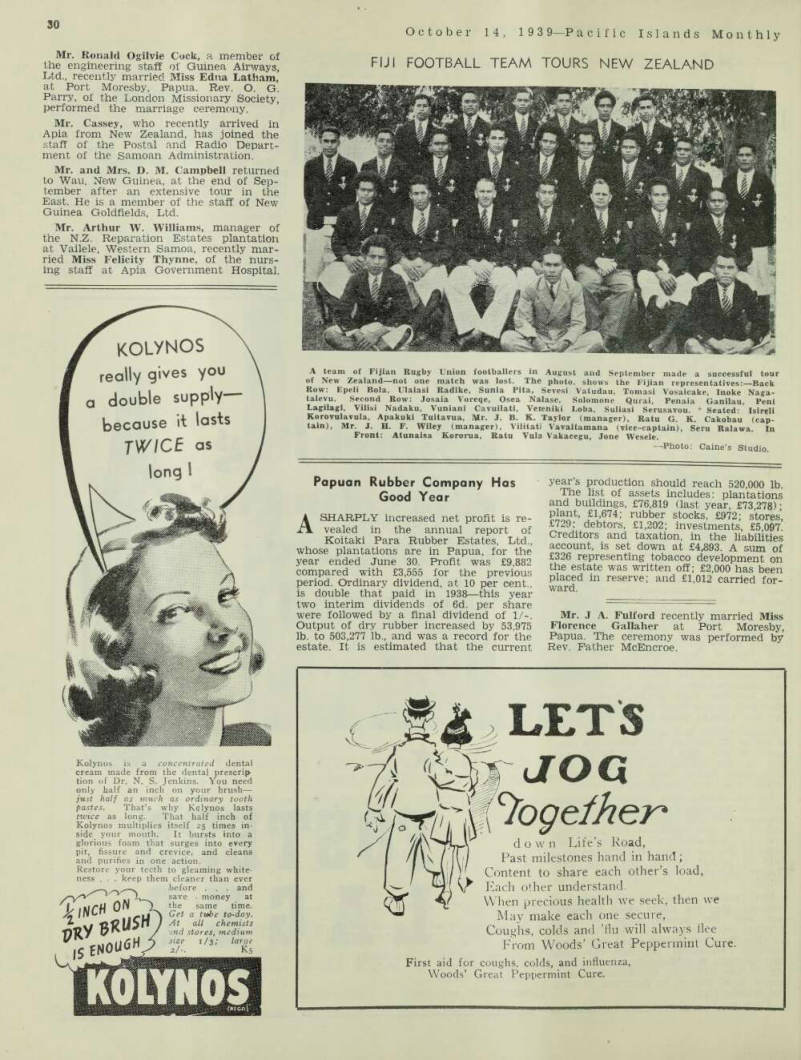
From Our Own Correspondent
Papeete, Sept. 1.
I HAVE not sent you anything about the smallpox scare because everyone here would like the whole thing for gotten. It was a pardonable case of wrong diagnosis.
But quarantine was amply justified.
Smallpox is difficult to diagnose in the early stages and even the best physicians can err. In such a thing as smallpox, it is better to err on the side of over caution.
The 34 ft. yawl “Marie” (Captain Prank Dona) returned to New Zealand in mid-September after a three months cruise among the islands of Fiji, Tonga and the Kermadecs.
Mr. Ronald Ogllvie Cock, a member of the engineering staff of Guinea Airways, Ltd., recently married Miss Edna Latham, at Port Moresby, Papua. Rev. O. G.
Parry, of the London Missionary Society, performed the marriage ceremony.
Mr. Cassey, who recently arrived in Apia from New Zealand, has joined the staff of the Postal and Radio Depart ment of the Samoan Administration^ Mr. and Mrs. D. M. Campbell returned to Wau, New Guinea, at the end of Sep tember after an extensive tour in the East. He is a member of the staff of New Guinea Goldfields. Ltd.
Mr. Arthur W. Williams, manager of the N.Z. Reparation Estates plantation at Vailele, Western Samoa, recently mar ried Miss Felicity Thynne, of the nurs ing staff at Apia Government Hospital.
Advertisements & other items, pp. 31-32 (2 items)
29
Pacific Islands Mont hi y—O ctober 14, 1939
Sparkling
refreshment from pure Malt and Hops ★ uvi
FOSTER’S
LAGER
KOLVNOS
really gives you
a double supply—
because it lasts
TWICE as
long 1
A Kolynos is a concentrated dental cream made from the dental prescription of Dr. N. S. Jenkins. You need only half an inch on your brush— just half as much as ordinary tooth pastes. That’s why Kolynos lasts twice as long. That half inch of Kolynos multiplies itself 2 5 times inside your mouth. It bursts into a glorious foam that surges into every pit, fissure and crevice, and cleans and purifies in one action.
Restore your teeth to gleaming whiteness . . . keep them cleaner than ever before . . . and save money at the same time.
Get a tube to-day.
At all chemists und stores, medium size 1/3; large 2/-. K S
, |5 ENOUGH
KOLYNOS
Fiji Football Team Tours New Zealand
A team of Fijian Rugby Union footballers in August and September made a successful tour of New Zealand—not one match was lost. The photo, shows the Fijian representatives;—Back Row: Epeli Bola, Ulaiasi Radike, Sunia Pita, Sevesi Vatudau. Tomasi Vosaicake, Inoke Naga talevu. Second Row: Josaia Voreqe, Osea Nalase, Solomone Qurai, Penaia Ganilau, Peni Lagilagi, Vilisi Nadaku, Vuniani Cavuilati, Veieniki Loba, Suliasi Serusavou. Seated: Isireli Korovulavula, Apakuki Tuitavua, Mr. J. B. K. Taylor (manager), Ratu G. K. Cakobau (cap tain), Mr. J. H. F. Wiley (manager), Vilitati Vavaitamana (vice-captain), Seru Ralawa. In Front: Atunaisa Kororua, Ratu Vula Vakacegu, Jone Wesele.
Photo: Caine’s Studio.
Papuan Rubber Company Has
Good Year
A SHARPLY increased net profit is re vealed in the annual report of Koitaki Para Rubber Estates, Ltd., whose plantations are in Papua, for the year ended June 30. Profit was £9,882 compared with £3,555 for the previous period. Ordinary dividend, at 10 per cent., is double that paid in 1938—this year two interim dividends of 6d. per share were followed by a final dividend of 1/-.
Output of dry rubber increased by 53,975 lb. to 503,277 lb., and was a record for the estate. It is estimated that the current
year’s production should reach 520,000 lb.
The list of assets includes: plantations and buildings, £76,819 (last year, £73,278): plant, £1,674; rubber stocks, £972; stores, £729: debtors, £1,202: investments, £5,097 Creditors and taxation, in the liabilities account, is set down at £4,893. A sum of £326 representing tobacco development on the estate was written off; £2,000 has been placed in reserve; and £1,012 carried for ward.
Mr. J A. Fulford recently married Miss Florence Gallaher at Port Moresby, Papua. The ceremony was performed by Rev. Father McEncroe.
Advertisements & other items, p. 32 (2 items)
30
October 14, 193 9—P acific Islands Monthly
together
L LET S
JOG
down Life’s Road, Past milestones hand in hand; Content to share each other’s load, Each other understand.
When precious health we seek, then we May make each one secure, Coughs, colds and ’flu will always flee From Woods’ Great Peppermint Cure.
First aid for coughs, colds, and influenza, Woods’ Great Peppermint Cure. * I f
Ill-Treatment Of
Natives
Cases Cited by Resident of New Guinea
Letter to the Editor IAM a constant reader of your “Pacific Islands Monthly" and I noticed one article in your issue of July that I would like to reply to. It is the one concerning the native that was tried at Wau recently. He was found guilty of stealing and was acquitted.
I have done a great deal of travelling in this territory. My business takes me to all parts. I am now going to relate some cases of innocent natives who have been gaoled and ill-treated during the past three months. These are just a few cases that I know of. There are, most likely, hundreds more.
The first case was in Madang. A car penter boy, working for two brothers, carrying on the business of building and contracting, was arrested on suspicion.
At that time, a woman staying at the Madang Hotel lost a pair of short pants and naturally, it was thought that they were stolen by a native. This carpenter boy was arrested and gaoled, until such time that some evidence could be found against him. There was not one scrap of evidence against him and he was acquitted, after being in the calaboose for a week.
He returned to his employer in a very bruised and injured condition. He was in too bad a way to work. The employer was not too pleased about the matter, and took the native over to the district office to make a complaint.
The Government officials, at the dis trict office, pleaded with the employer not to take the native to the doctor, as there would most likely be trouble for some body. Instead, the Acting Magistrate made out an order for the native to be deported to his village as soon as could be arranged. The employer lost a good carpenter boy that he had trained him self, and the native was severely injured and deported for something' that he knew nothing about.
The second case was also in Madang.
An aged native, working for a Govern ment roadmaster on the aerodrome, was arrested and accused of stealing rice. He was in the habit of saving a little rice every week, out of his issue. At this par ticular time he had saved up about half a bag full and gave it away to a “one talk”. He was seen giving it away and was accused of stealing Government rice.
A check was made on all the stores, and there was no rice missing.
There was no evidence against the native, and yet he was sentenced to three months in gaol, for giving away some of his own rice. He was aged and, while in gaol, he was ill-treated so that he is now in the Madang native hospital in a very bad way. It is doubtful whether he will live.
The third case was in Salamaua. A house boy was accused of stealing a foun tain pen. The pen just happened to be missing and, of course, somebody black had to be accused, more or less as a mat ter of form. This particular native was sentenced to three weeks in gaol. He only did two weeks, and the pen that was supposed to have been stolen was found.
Of course, the native was released, when it was definitely found that he knew noth ing about the matter.
The fourth case was in Wau. A raw native was given a hiding by a white man.
It appears that he gave this native some orders and, as he was not able to speak “pidgin”, naturally the native could not understand and. of course, did not obey orders. He was given a hiding and he went to the district office and made court against the white man. He was examined by the doctor and was found to be very much bruised and cut about the head.
Anyhow, when the trial was on, the white man managed to spin a good tale, with the result that the native was sentenced to two weeks in gaol. He served his two weeks, and was released four weeks ago.
Since then he has been in the Wau hos pital, suffering from internal injuries that he received while in gaol.
The fifth case was also in Wau. Re cently the native sing-sings were banned.
It used to be the custom for natives to hold a sing-sing outside the town area every second Saturday. It was suspected that there was sodomy going on, and these sing-sings were banned. I might mention that the ridiculous administra tion forces the New Guinea natives to live under labour conditions where sodomy is inevitable and then has the pleasure of giving any native that it catches three months in gaol.
Anyhow, this one particular night the natives held a sing-sing outside the town area. While it was in progress, the police boys raided it and arrested all present. 1 know of three natives that were present They had permission in writing to attend this sing-sing and yet they were sent enced to two weeks in gaol for attending.
Those three natives were released two weeks ago. One of them spent a week in hospital with an abscess on the palm of the hand, caused through handling a shovel while in gaol. Another one of them is still going to the hospital as an out patient, suffering from wounds received in gaol.
These are just a few cases that have happened in the past three months. Over a period of years, I could relate hundreds.
It is true that natives get out of hand at times. That is caused chiefly through new-comers—women, especially. They
have no idea of how to handle natives, but think they do, and that in my opinion is the cause of the trouble.
Natives are an asset here and, in my opinion, they should be treated decently.
I do not mean that they should be allowed to do as they like, etc. They should be kept in order and made to do their job of work. If they do not, then is the time that they should be punished.
If they are caught stealing, they should be punished.
This is just a brief story of a few cases of innocent natives being gaoled and ill treated. In the July “Pacific Islands Monthly” there is the story of the native who was found guilty of stealing and was acquitted. I ask all readers if they really consider that there is any justice in New Guinea. I consider that there is no such thing.
I am etc..
New Guineaite.
Wan 20/8/1939. -- Mrs. Stephen H, Davies, wife of the Bishop of Carpentaria, arrived in Sydney from Thursday Island by airliner early in September to visit her mother who was seriously ill.
Advertisements & other items, p. 33 (2 items)
31
Pacific Islands Monthl y—O ctober 14, 1939
Capstans
Quick, Safe
RELIEF from
® Headache
• Tropical Fevers
0 Heat Exhaustion
® Nerve & Muscular Pains
YOU should NOT suffer pain—It Is harmful and lowers resistance to dangerous germs. Vincent’s A.P.C. is deep-seated in its action; it stimulates the nerve and muscular system causing a healthful relaxation which removes pain and exhaustion. Because Vincent’s A.P.C. has a definite therepeutic value it assists greatly in fighting off and in the actual treatment of tropical fevers, rheumatism, arthritis and sciatica.
At the first sign of headache or any other nerve pain take Vincent's A.P.C. powders or tablets—and get positive relief WITHOUT after-effects, because Vincent’s Is the balanced prescription formulated by the Medical Superintendent of Australias largest public hospital.
Vincent’s A.P.C. Is the safest
FOR SAFETY’S SAKE, SAY “VINCENT’S”
and best keep It always. handy
POWDERS ft
TAII I T S
I/* AND 2/4,
SINGLES 2d. »o.
CAPSTANS
SPECIALLY
PACKED FOR
WV
THt TROPICS
m arct® Capstan m\' A Navy mJ c u+ Tobacco, made from the finest Virginia leaf. \J A Capstan Cigarettes, round airtight 50 s.
Medium and full strengtk. m 8885-19-8
Who Owns Little
Islands?
Anglo-American Inquiries in Central Pacific
IT is reported in America that, at the request of the British Government, the United States Government is pre paring information concerning early voyages of American whalers, naval men, travellers and explorers, in connection with claims to ownership of a large num ber of islands in the Pacific, now under the British flag.
A discussion has been going on be tween the two Governments for more than a year, concerning these claims. It has been brought to a head by the de cision of both Governments to postpone for 50 years consideration of the claims involving Canton Island (where the Union Jack and Stars and Stripes fly side by side) and Enderbury Island.
In his address of welcome to the King, on the occasion of His Majesty’s visit to White House, President Roosevelt pointed to Canton and Enderbury as proof of
Anglo-American friendship and an ex ample to the rest of the world.
With this example before it, the State Department would now like to see the question of sovereignty over other small islands in the Pacific settled. Unnoticed for generations, they have increased en ormously in importance in recent years, because of their possible use as civil aero plane bases on the route between North America and Australia and New Zealand.
The Department’s Geographer (Dr.
Whittemore Boggs) is preparing data for submission to the British Government.
The problem is complicated by the fact that, in some cases, an island, which bears one name on the map, may actually be two or three islands. These islands are located principally in the Phoenix Group (which includes Canton and Enderbury), near the Equator, and the Ellice Group, not far distant. Other groups likely to be mentioned are the Gilbert and Fiji Archi pelagoes.
When the British Government learned of the intention of the United States to settle Canton Island, where a modern township is now being erected by American builders, it sent through the Government of New Zealand, a party of five to hoist the Union Jack. A few weeks later, an American party from Honolulu, was landed by an American coastguard vessel. The master of the latter reported that, on leaving Canton, the last he saw of the rival groups was a pleasant little poker party, in the shade of the British hut, with the newcomers being regaled with refreshing draughts of New Zealand beer.
THE construction ship ‘‘North Haven”, which landed at Canton 75 men, to gether with tugboat, barges, heavy machinery, parts for a complete hotel, air station, houses and tanks, has now left on another similar mission.
Under the command of a veteran mar iner, who went to sea at the age of 17 on a British sailing vessel, 40 years ago, the “North Haven” headed for the Bering Sea, to establish a settlement on the extreme western tip of the Alaska Peninsula, where an important naval air base is to be established. The “North Haven” has carried personnel and build ing materials for similar settlements at Midway, Wake and Guam Islands, in the Pacific, for the airways that have for three years been spanning the Pacific, from California to Hong Kong.
More Teleradio
FANNING Island and Washington is land, situated in the centre of the Pacific Ocean, are only 84 miles apart, but until three months ago they were beyond means of communication with each other except by occasional boat.
Fanning Island Plantations, Ltd., now has installed a teleradio on each island, providing means of continuous contact by speech or telegraphy. The teleradio is a small, portable wireless telephone de signed and made in Australia by Amal gamated Wireless.
Advertisements & other items, p. 34 (2 items)
32
October 14, 193 9—P acific Islands Monthly
CLmotts
OFTEN BUTTERED
NEVER BETTERED
CRISP, LIGHT BISCUITS which
bring out the flavour of cheese and add a new attractiveness to fresh or stewed fruit.
A delicious supplement to hara or paste or other tasty savoury, and still an epicurean delight, served simply with fresh butter.
The rich excellence of these famous Biscuits is the result of 67 years of specialisation.
They are packed in air-tight tins or packets for picnic convenience.
CLmotts
FAMOUS
SAO BISCUITS
A2< ALWAYS ASK YOUR GROCER FOR ARNOTT'S !
25 YEARS OF SERVICE
William E. Reed
(Established 1913)
BROKER & AGENT
Union House. 247 George St., Sydney For all Plantation and Trading Requirements. Enquiries welcome.
A Trader's Tale
As told to "Tukopo Koko"
I ONCE knew a branch-store manager in the Lower Cooks, who was his firm’s pride and joy.
He was a jolly, boozy, little man—red, rotund and fifty-ish.
He also was a War Veteran. In 1900 to 1902 he served in the Boer War. From 1914 to 1918 he served in the Bore War, of which he had a deep and sleep-in ducing fund of reminiscence. One listened to his interminable adventures without hearing, responding “Yes” or “No” during pauses, or was silent as he drank copious draughts of beer. Between wars this Bacch analian hero had been in the Cook Is lands for 30 years.
Steered judiciously off wars, he could tell many a merry tale of schooner trips and trade. Chaucer would have been charmed, and Pepys provided with Cytherean soliloquy enough to fill twenty diaries. He would beam and belch; chuckle and choke; winking, refill his glass, or call cholerically for “another
bottle p.d.q.!”.
“But I had a Slashing Girl at Pen rhyn”, said Silenus. “She was a Bewt. Her name was Ra-Ono. She had (censored) and her (censored) and she (censored).”
I registered polite envy.
“When they (the firm) appointed me supercargo on the ‘Lime Flower’, I had to leave Penrhyn and Ra-Ono. Oh, it was a wrench!
“We went round the Group for years.
There were so many other girls that I forgot all about Ra-Ono. So it would have been the same, even if I’d married ner.”
I agreed. Man is but weak.
“One trip, when the ‘Flower’ was loaded with people going round the Group, we ran into a howling storm between Aitu taki and Atiu. We lost a sail, and the wind grew worse. Things looked bad. The Family (native passengers) began to pray. Apparently, the Lord wasn’t having any. The harder they prayed the louder the wind howled.
“They got a better idea. The girls took off their bracelets and rings, ‘Apinga Akaturi’, and gave them all to the cap tain to heave over the side. He took away the gifts of guilt. The sea soon after calmed, and the wind died down.
“Then the skipper produced the Ac cursed Things. He’d only hidden the gifts in his bunk. The girls joyfully put back on arms and fingers the brass of Baby lon, and the guilty gold-plate. The rest of the voyage the weather was just simply as if we’d got it to order.”
He poured another glass piously, blew off the “suds” with pontifical dignity, hiccupped.
“And, later, I went Fiji way. You know Makongai, up there, where they put lepers from all the Pacific Islands. I went ashore there to have a look round.”
“Wasn’t that rather risky?” I asked.
“Oh, no. Quite safe so long as you have no sore or scratch where infection might enter. It was awful. Natives, brown, black; yellow folk; men, women and kids. All dying on their feet, rotting away. Hand less, toeless, lipless, noseless. Oh Lord, it was a show.”
He paused, took a grave drink; re garded the glass with shocked pity.
“And then I saw some from our own Cook Group. I talked to them about their
home islands. The poor (censored) were as pleased as Punch—just like a holiday to them.
“And then I saw a woman coming up.
Oh, Christ! She was terrible. No breasts, no hands; no toes on her bare feet, as she clumped along. Just rotting away in places.
“Strangely, her face was untouched as yet, and she had been a Bewt. She came up to me. I legged it to the wharf. I was young then, and back on board I blubbed Ra-Ono!”
New Use For Sunday Is.
A YACHTSMAN who called in August,, 1939, at Sunday Island (in the Ker madec Group, between New Zealand and Tonga) said that there was consid erable activity on Sunday Island, there being six New Zealanders there engaged in the erection of a meteorological sta tion in connection with the proposed Tasman air service. There are only two other settlers left on the island now—Mr.
Alfred Bacon, who has been there for a number of years, and Mr. B. Robinson.
kell of the L.M.S. ship “John Williams I”, which was wrecked in 1864 off the reefs of Pukapuka in the Cook Islands, is now at Livingstone House, London. The passengers of the “John Williams I” were all rescued, but the ship herself was pounded to pieces on the jagged coral rocks, her bell ringing a knell every time she struck. She went down m deep water, only a few spars
drifting to shore. Somehow the heaw bell was washed on to the coral, and, cracked and battered as it was, the Is-, landers used it for many years as a church bell. Some years ago it was taken to Samoa, and now—appropriately in the years of the “John Williams” centenary —it has gone home to rest, a memorial to the great nioneer of the South Seas —‘‘Australian Christian World”
Advertisements & other items, pp. 35-36 (2 items)
33
Pacific Islands Monthl y—O ctober 14, 1939
Burns Philp
(SOUTH SEA) CO. LTD.
Inc. In Fiji
Island Traders and Shipowners
Registered Office:
S_ V A
FIJI
Also Branches at;
\Fiji; Levuka, Lautoka, Labasa, Ba, Sigatoka, Rotuma.
Tonga: Nukualofa, Haapai, Vavau.
Samoa: Apia, Pago Pago (American Samoa).
Solomons: Makambo, Gizo, Faisi.
New Hebrides: Vila.
Gilberts: Tarawa.
Code Address: “Burnsouth”. Norfolk Is. Niue. Wallis Is. Futuna Is.
DELICIOUS, TASTY FOODS
For ISLAND MEALS
AUNT MART’S COOKERY
BOOK.
There’s no finer book for every home ... 212 pages, lavishly Illustrated In colour, and ovet 400 recipes and useful hints make It a book that every housewife will want. Send only one shilling and twopence to
TILLOCK & CO. PTY. LTD.,
Sydney N.S.W., and get your copy of this great book NOW.
JUST TRY any of AUNT MARY'S Pure Food J Products, and you will be back for more .. . delicious in themselves or with innumerable dishes.
AUNT MARY'S BAKING POWDER
AUNT MARY'S TOMATO SAUCE
AUNT MARY'S SPAGHETTI IN TOMATO
SAUCE
AUNT MARY'S BAKED BEANS IN TOMATO
SAUCE
AUNT MARY'S CANNED VEGETABLES
Green Peas, Cauliflower, Celery, etc.
RANEE CURRY POWDER
BLOSSOM HONEY in Attractive Jars Or any of the large variety of Pure Pood Products specially packed for Tropical conditions, In Tlllock’s Hermetically Sealed 1-lb. tins. All goods are procurable from your local stores.
TILLOCK & CO. PTY LTD. SYDNEY
PRESCOTT Pty. Ltd.
SUSSEX ST., SYDNEY,
are sole wholesale agents for
PINEAPPLE BACON&HAMS
DAISY BRAND BUTTER
"375" BUTTER in TINS llb.-21b.-slb. Sixes.
LEA & PERRINS’ Sauces and Most other Super-Quality Lines of the Trade, such as Cheese, Eggs, Etc.
Swallow & Ariell’s
WORLD RENOWNED
CANTERBURY
CXXXXXXXXXXXXXXXXXXXXXXXXXXXXXXXXXXXXXXXXXXXXX}
Each Cake is Enclosed, by special process, in air-tight tin, and is warranted to keep its condition tor a considerable period. cxxxxxxxxxxxxxxxxxxxxxxxxxxxxxxxxxxxxxxxxxxxxxx: Fiji Representatives Pearce & Co. Ltd.
Discovery of 30-Years Old
Rubber From New
Guinea
Discovery of 30-Years Old Plantation
WHEN I was in Rabaul, in August, at a social function, I was one of several interested people to whom Lady McNicoll (wife of the Administrator) handed a sheet of air-dried rubber, as evidence of the start of a new industry in the Territory.
The rubber came from the Baining plantation of a Mr. Maclean; and from Lady McNicoll and others I learned that there is quite a romance at the back of it. Mr. Maclean took over what was os tensibly a coconut plantation; and it was not until a long time afterwards, when he was clearing the jungle at the back of his coconut palms, that he uncovered a considerable plantation of good rubber trees, planted by the original German owner. Investigating further, he found that the trees were in good order and that he could produce a considerable quantity of rubber.
Some time later, I noticed the follow ing letter to the editor, signed by J. Mac lean, Old Massawa Plantation, Baining, T.N.G., in the “Rabaul Times”: “It may interest some of your readers to know that the first shipment of Para rubber from New Britain will be made from Old Massawa Plantation by the s.s. ‘Nellore’ leaving Rabaul on August 16.
“It will consist of a trial half ton lot of air-dried sheet, but a smoke-house will be constructed shortly, and it is ex pected to turn out smoked sheet of standard quality equal to that produced in Malaya or Java.
“There is a stand of Hevea rubber on this plantation up to thirty years old, which is now being tapped for the first time, and as soon as the trees get into full flow, big yields per tree are expected.
Some already show signs of producing equal to Clonal trees, and these will be carefully checked, with a view to seed selection for later planting.”
R.W.R.
Papuan Superannuation
From Our Own Correspondent
Port Moresby, Oct. 1.
THE position of the Papuan Public Service Superannuation Fund on December 31, 1938, was as follows: Pensions paid to ex-officers, 1938 £12,000 Officers’ contributions, 1938 .. .. £3,413 Interest on investments £1,445 Subsidy from Papuan Government from Revenue £7,193 Thirty-nine officers received superan nuation allowances, and 138 contributed to the fund during the year, 6 additional officers retired; and, owing to death, the number of those drawing pensions was reduced by 4. The Board’s investments total £38 5 390.
Sister M. R. Addis, who has been a member of the nursing staff of the Col onial War Memorial Hospital, Suva, Fiji, for eight years, resigned in September to be married.
Mr. and Mrs. J. K. McCarthy, of Kokopo, New Guinea, were in Melbourne In September spending leave. Mr.
McCarthy has been a member of the N.G. District Services staff since 1927.
Advertisements & other items, p. 36 (1 item)
34
October 14, 193 9—P acific Islands Monthly
The Church Of The British Navigators
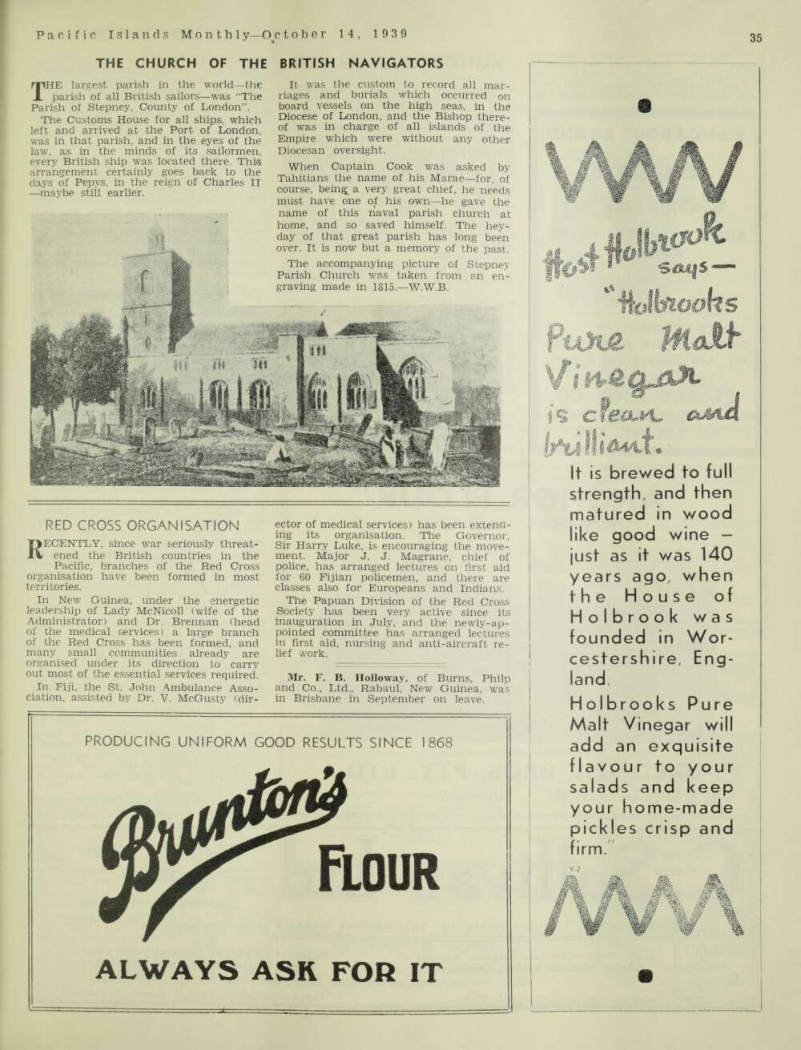
THE largest parish in the world—the parish of all British sailors —was “The Parish of Stepney, County of London”.
The Customs House for all ships, which left and arrived at the Port of London, was in that parish, and in the eyes of the law, as in the minds of its sailormen, every British ship was located there. This arrangement certainly goes back to the days of Pepys, in the reign of Charles II —maybe still earlier.
It was the custom to record all mar riages and burials which occurred on board vessels on the high seas, in the Diocese of London, and the Bishop there of was in charge of all islands of the Empire which were without any other Diocesan oversight.
When Captain Cook was asked by Tahitians the name of his Marae—for, of course, being_ a very great chief, he needs must have one of his own—he gave the name of this naval parish church at home, and so saved himself. The hey day of that great parish has long been over. It is now but a memory of the past.
The accompanying picture of Stepney Parish Church was taken from an en
graving made in 1815.
W.W.B.
Red Cross Organisation
RECENTLY, since war seriously threat ened the British countries in the Pacific, branches of the Red Cross organisation have been formed in most territories.
In New Guinea, under the energetic leadership of Lady McNicoll (wife of the Administrator) and Dr. Brennan (head of the medical services) a large branch of the Red Cross has been formed, and many small communities already are organised under its direction to carry out most of the essential services required.
In Fiji, the St. John Ambulance Asso ciation, assisted by Dr. V. McGusty (dir
ector of medical services) has been extend ing its organisation. The Governor, Sir Harry Luke, is encouraging the move ment. Major J. J. Magrane, chief of police, has arranged lectures on first aid for 60 Fijian policemen, and there are classes also for Europeans and Indians.
The Papuan Division of the Red Cross Society has been very active since its inauguration in July, and the newly-ap pointed committee has arranged lectures in first aid, nursing and anti-aircraft re lief work.
Mr. F. B. Holloway, of Burns, Philp and Co,, Ltd., Rabaul, New Guinea, was in Brisbane in September on leave.
Rev. R. W. Lane, who has been a Seventh Day Adventist missionary in Fiji for 20 years, arrived in Sydney from Suva late in September on a health trip.
Advertisements & other items, pp. 37-38 (2 items)
35
Pacific Islands Monthl y— tober 14, 1939
m.
SausS It is brewed to full strength, and then matured in wood like good wine just as it was 140 years ago, when the House of Holbrook was founded in Worcestershire, England.
Holbrooks Pure Malt Vinegar will add an exquisite flavour to your salads and keep your home-made pickles crisp and firm.
PRODUCING UNIFORM GOOD RESULTS SINCE 1868
ALWAYS ASK FOR IT
KANGAROO BRAND
Ropes,
Cordage,
and Twines for every purpose
Backed by
86 years of service.
Manufactured by
M. DONAGHY AND SONS,
Pty. Ltd.,Geelong and Sydney.
Fiji Representatives:
PEARCE AND CO.
LIMITED
P.O. BOX 237, SUVA
Minor War In Fiji
"Jehovah's Witnesses" and the Government
PEOPLE of an older generation have heard of Bible-banging sects and tub-thumping sects. Their modern equiv alent is the amplifier sect. This very noisy American organisation of prosely tisers, who call themselves “Jehovah’s Witnesses”, or the Watch Tower Bible and Tract Society, led by a Judge Rutherford, advertises their brand of religion by sending vans through city streets equipped with loud-speakers, from which there issues a most dreadful vol ume of sound.
It is an idea of Christianity that is loathed by normal, well-balanced people; and, if the sect has one effect more than any other, it is that it brings religion into disrepute.
This sect is now extending its activities into certain of the Pacific territories. A representative of the “P.1.M.”, recently in Papua, discovered that a young gentle man there was doing his best to per suade the woolly-headed Papuans to be come “Jehovah’s Witnesses”.
A friend in Fiji has sent us an inter esting collection of literature from that colony.
It appears that Judge Rutherford’s apostles have been busy in Suva, evi
dently with the idea of establishing “Jehovah's Witnesses” among the Fijians and the Indians. It is indicated that, when the Governor of Fiji (Sir Harry Luke) discovered the kind of invasion with which his fair land was threatened, he, or his officials, took steps to prevent the importation of the Watch Tower Society’s literature.
The Suva representative of the Society made a frightful row about it—as has been already stated, they are very noisy people—and in April he instituted police court proceedings against the Comptroller of Customs. The case, of course, was dis missed. Then “Jehovah’s Witnesses” issued circulars fiercely attacking the “Fiji Times” because the “Fiji Times”, in their opinion, did not adequately report their case against the Comptroller of Customs.
THIS was followed up by cablegrams to King George VI. One is signed by “H. Gill, Watch Tower Society, Suva”, and the other by “A. Macgillivray, Watch Tower Bible and Tract Society”.
The cablegrams attacked the Roman Catholic Church in Fiji—although what on earth the Roman Catholics in Fiji had to do with the matter was difficult to see —and furiously demanded the recall of the Governor. The text of the cablegrams was printed in a circular which was widely distributed in Fiji.
Another circular is an “open letter” to the Governor, the Government Secretary, and all members of the Legislative Assembly of the colony of Fiji. This runs over four pages and is signed by “Harold E. Gill”, and dated May 1. 1939. and it protests in the liveliest fashion against the refusal of the Government to permit the importation of something "called “Bible Helps”. Mr. Gill, at great length, argues that the Roman Catholics are re sponsible for the Government’s attitude towards his “Watch Tower” activities, and he proceeds to attack Roman Catholicism generally. He even goes back to 1914-18, and the long-forgotten war between Archbishop Mannix and “Billy” Hughes.
THEN there is a circular in flaring red.
“Plot to Control Government De partments from Rome—Pope De mands Civil Service be 100 per cent.
Catholic —Dastardly Anti-British In trigue Exposed” are some of the headings, in the choicest style of the American yellow press.
In another circular, the Suva “Watch Tower” makes an attack on Police In spector Tucker and Hon. A. A. Ragg.
“The Strange Case of Inspector Tucker — Robbery by Police?—Who Gives Bishop Nicolas Instructions?—ls it the Vatican City?” howls the Rutherford propagan dist.
It is to be hoped that the Governor of Fiji has made a collection of these leaf
lets. They are very amusing; but, also, they represent complete justification for the Government’s attempt to keep this noisy and unpleasant organisation out of Fiji.
Already, there are too many sects in the Pacific Islands. How can primitive peoples be expected to understand the rivalries and differences of the various churches? But, at least, those who already are established uphold European prestige and justify their presence there by their good work in educating the natives and giving them medical as well as moral help.
The introduction of “Jehovah’s Wit nesses” could not confer any material benefit upon the natives; and, judging by their record elsewhere, they probably would cause disturbance and discord.
Advertisements & other items, p. 38 (2 items)
36
October 14, 193 9—P acific Islands Monthly
WfflH
a
ANCHOR FLOUR
THE STANDARD OF QUALITY
GILLESPIE BROS. PTY. LTD
SYDNEY - AUSTRALIA
I C.S
WfflH
II
General
Merchants
and
Agents
REPRESENTING LEADING FIRMS IN THE PACIFIC ISLANDS
379 KENT STREET,
SYDNEY.
Cable Address: “Trocas”, Sydney.
Telephones: MJ 4657 (5 lines).
Buyers of all Islands’ requirements on Commission Original Invoices Furnished.
Islands Produce Sold on Shippers’ Account Liberal Advances against Consignments. 22 Years Islands Trade Experience Bankers: Bank ot New South Wales. Correspondence in English. French & German.
Copra Production
IT was stated, recently, that the pro duction of copra in the South Pacific was about 200,000 tons annually. Our readers may be interested in the follow ing figures, showing the annual output of the different territories. They are taken from the last edition of the “Pacific Islands Yearbook”.
Territory.
Tons.
New Guinea .. .. 76,409 Papua .. . . 13,600 Solomon Islands . . . . 25,074 New Hebrides . . . . 10,424 New Caledonia . . . . 10,000 Gilbert & Ellice Is . . . . 5.368 30,001 r Tonga 12,287 Samoa, Western 13.340 Cook Islands 1,628 Tahiti .. . . 22,520 Total . . .. 220.651
Acquitted of Charge of Wilful
Murder
From Our Own Correspondent
Port Moresby, Sept. 26.
IN the Court of Petty Sessions, Port Moresby, on September 21, before Mr.
W. R. Humphries, R.M., the hearing was resumed, on adjournment from Kairuku, of the charge of the wilful murder of Ernest Jones, made against Margaret Sinclair, a widow, of Palms Plantation, Hisiu. Mr. E. B. Bignold appeared for the police, and Mr. R. D. Bertie for the de fendant.
Evidence submitted by W. H. H.
Thompson, A.R.M. at Kairuku, was that he visited the plantation on September 15 and found the body of Ernest Jones lying on a bed, in a pool of blood, with a large wound in the throat. There was a knife lying under the body, which ap parently had been taken from a nearby drawer, containing woman’s clothing. He found a woman’s clothing, bloodstained, in the bathroom of the house. Later he arrested Mrs. Sinclair on a charge of murder.
The witness said that the murdered man had been living with Mrs. Sinclair.
He usually occupied the same dwelling and worked on the plantation.
Evidence was given by Dr. T. W. Jen kins, Mr. P. D. Ross (Obu Plantation), Mr. L. Clunn (trader, of Aroa), and a native, Kapa Matai (employed as cook on the plantation). The latter said that the man and woman had been drink ing gin together on the night of Septem ber 14.
The statements showed that defendant,
in conversation on the morning of Sep tember 15, said that the whole thing was a mystery to her—that she knew nothing until she woke up, in the night, and saw the deceased’s condition; and that, fear ing he had had a haemorrhage, she tele phoned for assistance. She said that the man had previously spoken of doing away with himself.
Mr. Bertie, for the defence, submitted that there was no prima facie case and no evidence whatever that the deceased was murdered or that the defendant was guilty of it. He asked that the case be dismissed and the defendant discharged.
Mr. Bignold was satisfied with Mr.
Bertie’s submission and that no jury could convict on the evidence submitted by the police.
The Magistrate dismissed the case and the defendant was discharged from cus tody.
M. Charles van den Brock d’Obrenan. who is in charge of the Oceania Museum in France, left Marseilles recently by the “Eridan” to spend eight months in Tahiti and the Marquesas Group to carry out research work in ethnology and folk-lore.
He was in the Pacific on board the yacht “Korrigane” in 1935, collecting native curios.
Captain Algar Ronald Ward Robert son, R.A.R.0., arrived in Fiji recently to take up the posts of Accountant-General and Deputy Treasurer, Commissioner of Inland Revenue, Commissioner of Stamp Dhties and Government Storekeeper.
Advertisements & other items, pp. 39-40 (2 items)
37
Pacific Islands Monthl y—O ctober 14, 1939
Chi Vers
Kork-N-Seal
FOR HOME USE
• Hand Applied
Airtight
Pressure Proof
FOR ALL HOME BOTTLING
—THE LITTLE CAP THAT
will Re-seal 1,000 Times
KORK-N-SEAL (Aust.) LTD.
I0(> COMMONWEALTH STREET.
SYDNEY, AUSTRALIA.
We are Specialists ...
Let us have your confidence. Sixty years is our record of supplying the leading Houses throughout the World in - - - -
FRESH FRUIT VEGETABLES PRODUCE
WEYMARK & SON LTD.
FRUIT AND PRODUCE MERCHANTS
14-18 STEAMMILL STREET - - SYDNEY
CHI VERS
X ’Phones: MA (4 lines).
Cable Address: “Weymarkson"
Codes —Bentleys Private.
FAMOUS ENGLISH PRODUCTS
CANNED ENGLISH VEGETABLES
CANNED ENGLISH FRUITS
OLDE ENGLISH MARMALADE
GOLD MEDAL JAMS
JELLY CRYSTALS. ETC.
Obtainable from all leading Grocery Stores
WRITE TO DEPARTMENT "A"
CHIVERS & SONS LTD.
Histon, Cambs., Eng.
FOR ATTRACTIVE RECIPE BOOK
i CO LD /i
STfIAID/W® /
\ FRESH /
ENGLISH gmgi
PEAS
PURE RICE
STARCH
Always ask for . . .
CORAL BRAND
100% PURE
Noted for its
QUALITY
and
WHITENESS.
Goes Farthest and gives Lasting Finish
WILL NOT
STICK TO
IRON.
Obtainable from Leading Island Stores. a *
CORAL BRAND
RICE STARCH
'co»*i i uic| lta.
Manufactured by
AUSTRALIAN RICE. LTD.
Sydney, N.S.W.
16 Australia's Choicest Products Green Pea* Cauliflower Celery Tomato Soup Tutti Fruit Sauce (Worcestershire flavor) m • a Always . make sure you have at hand an ample Reserve of these Delicious . .
Garden
Vole
Ready-toserve Vegetables
Copra Producers Are “Blind”
Need for International Organisation to Indicate Price Trends and Future of Industry
IMiE copra industry is “running blind”.
Most of the world’s other inter national industries of primary pro duction now are under some kind of central check, so that the thousands of people, whose future is wholly depend ant on each industry, can hazard a guess at their prospects.
But, in copra production, there is no official interchange of data, and no attempt to regulate output. Planting and production go on blindly. One cannot avoid some speculation in planting trees which do not come into bearing for 8-12 years; but the actual cutting of copra, and its carriage to market, should not be the complete gamble that they are under present-day conditions.
Some form of international check over the industry is needed, as is the case with rubber, sugar, tin, etc. Many people appear to have been thinking along those lines lately; but now, unhappily, the out break of war has rendered difficult the consideration of any concrete plan. The matter should have attention now, how ever. Any rise in copra prices must be carefully examined. It is important to know whether it is a temporary result of war or post-war development, or whether prices are likely to settle on a higher level.
We have been kindly permitted to pub lish extracts from a memorandum, on this subject, written in July, 1939, by Mr.
R. E. P. Dwyer, the economist botanist attached to the Department of Agricul ture, New Guinea. Every planter and trader in the Pacific Territories will be interested in Mr. Dwyer’s suggestions The memorandum is in the hands of the Ad ministrator of New Guinea; and if the latter, assisted by his Department of Agriculture, could give a lead in this matter he would earn the gratitude not only of New Guinea planters, but of copra-producers throughout the Pacific.
IN his memorandum, Mr. Dwyer describes how closely the prosperity of the Territory is linked with copra production and copra prices, and how important it is that an effort be made to assess the prospects of the industry.
Mr. Dwyer, addressing the Director of Agriculture, suggests that the Admini strator approach the Australian Depart ment of Commerce, and ask it to insti tute inquiries to ascertain:— The approximate world areas under cultivation for coconuts and approximate areas in bearing.
Whether any abnormally large areas are due to come into bearing. Is it pos sible to establish any peak period or year when this is likely to occur?
Are there any factors operating which will limit future plantings?
It is believed likely that there are more than 600,000 hectares planted which are not yet in bearing. Is this a true esti mate and is it significant as to the future of the industry?
Total copra production—world figures.
Copra exports, with countries of origin. (If possible, other coconut products such as desiccated coconut, should be added to this in terms of copra.) Copra imports—as to separate countries.
Coconut oils—as to separate countries.
Other oil seeds—as to senarate coun tries.
Other vegetable oils—imports as to various countries.
Animal fats—imports as to various countries.
Whale oil—imports as to various coun tries.
Consumption of copra cake and meals in relation to other vegetable oil cakes and meals.
Tariff restrictions, also legislation op erating, and their trends. How is this linked up with the nolicy of internal self-sufficiency and protection of local industries by various countries?
Whether variations in prices of copra and coconut oil are constant; their trends; and whether prices are liable to stabilise at lower or higher levels in , the future?
Relationship of coconut oil to other fats and oils used in margarine, soap production and other important indus tries, and whether the proportion used is tending to reduce, remain stable or in crease?
Are the uses for coconut products likely to expand; or, conversely, are the demands for certain by-products such as glycerine, diminishing?
Are the low prices of coconut oil in con formity with other world primary pro ducts; or, owing to other factors operat ing, such as the uses of substitutes, is this a declining industry, in any case?
“mHIS subject is of sufficient import i ance to be approached internationally, as all of the South Seas and Colon ial possessions are affected, as well as foreign copra-producing countries”, says Mr. Dwyer.
“Undoubtedly, the Governments in America, the Netherlands East Indies, Ceylon, Malaya and the Philippines have already made enquiries along these lines and might be asked for any data they could provide on the subject.
“Information is also required as to any action that is being taken by the Ad ministrations and Governments of other countries, in view of the present condi tions of the copra industry, owing to the depressed state of the world’s markets.
“It is suggested that it would be help ful to co-operate with the private firms here, who could get more information from their sources of marketing, and from various brokers’ organisations, than it is possible to do otherwise.
“A confidential report by the Colonial Office in 1935 for the Fijian Government, on their copra market, was a valuable guide to their development over the pasL four years.
“The Economic Departments of the Bank of New South Wales and the Com monwealth Bank also examine the pros pects of this industry, from time to time, and submit reports to their managers. It is likely that these organisations could assist our enquiry.
“General expressions of opinion will be valuable, but as much data as possible should be obtained from various sources to aid us in drawing our own conclusions.
In addition to the immediate value of such data, there is the question of whether further planting of coconuts should be encouraged or discouraged.
“The supplementary report of the New Guinea Mortgagors’ Relief Committee has undoubtedly pointed out most of the salient facts covering the present position of the industry here, and it is not neces sary to expand on this subject. It should be pointed out, however, that, although the present London prices are somewhat higher than in 1934, the effective prices here are very little higher. This is due mainly to the higher freights and, also, the financial position of the plantations is not so strong, as, for example, it is difficult to get advances and the retro gressions of the older areas are coming to be the cause of higher costs of pro duction on such areas.
“If it is determined that the world prospects are not good, then the Depart ment of Commerce might be asked to investigate the marketing possibilities in Australia for vegetable oils from the Commonwealth Territories.
“It is noteworthy, for example, that Levers are in a position to allow their plantations £l5 per ton for copra which would not stand freightage to the foreign markets. Apparently, this copra has not time to depreciate, but can be used by them in their own mills.
“Then there is the question of whether Australia is using a large proportion of other vegetable oils from outside coun tries and whether this is capable of be ing replaced by copra, and whether they can expand their uses for feed cake in the drier areas.
“From the New Guinea point of view,
remem K bere £ that ™ ost of the properties were bought on a basis of SL Pnce. whll e from 19J1 until the end of 1938 (inclusive), has been £l3 per ton lor Rabaul hot air copra. At the present time, the prices are £9 12/6 London, and £6/4/- Rabaul, for this grade of copra.
If such a trend were to continue, the market value of these individual properties would decrease in accordance with ;"f Ql marke , t val .Uf of the product, and our sound.” SSetS WIU b 6 corres P ondln gly less 4k. A
Mrs. C. R. Maitland-Pattison, widow of Dr. C. R. Maitland-Pattison, late of Fiji and the British Solomon Islands, passed through Sydney on September 16 on her return to Kangaroo Island. South Australia, after a holiday spent in New Zealand.
Miss Wanda Neibuhr, of the S.D A Mission school for girls at Vilirupu Papua paid a short visit to Australia at the end of August, in company with her mother She returned to the Territory in Septem -001.
Advertisements & other items, pp. 40-42 (3 items)
38
October 14, 193 9—P acific Islands Monthly
39
Pacific Islands Mont hi y—O ctober 14, 1939
Nestles
Safe Milk!
Make certain that your children are protected against the dangers of tropical heat by always keeping a supply of Nestle’s Milk. Hermetically sealed from possible danger Nestle’s Milk is pure and safe and will keep indefinitely while unopened.
FULL CREAM
MILK
BES T, •T H EREF O R E CHEAPEST Copyright 8211 /I
SWEETENED CONajgp
VHLM
a
STEAMSHIPS TRADING COMPANY LTD.
PORT MORESBY
PAPUA
SAMARAI
Chairman and Managing Director: A. S. PITCH.
Shipowners, Wholesale and Retail Merchants and Traders; Shipping, Customs and Insurance Agents; Copra and (Rubber Plantation Owners.
MAIL CONTRACTORS TO COMMONWEALTH AND PAPUAN GOVERNMENTS AGENCIES:- At Port Moresby: Coral Sea Insurance Co.; Phoenix Insurance Co.; Delta Sawmills. Ltd., Acme Bakery Co.; Vacuum Oil Co., Pty., Ltd At Samarai- S „ ea Insurance c °’’ Delta Sawmills, Ltd.; Bankers and Traders l MamaT piantatlonT °" “ UtUal L " e Insurance C ° ■ Shipyards: BRANCHES In Papua: Hanuabada. Sivitoi, Aroma, Koki, Hula Ela Beach Duga Duga, Yule Island.
SYDNEY: NELSON & ROBERTSON PTY. LTD., 12 Spring St.; Melbourne. 396 Flinders I.ane. London, E. Whiteaway & Co., 7 Chiswell Street, Finsbury. London Cable Address: “STEAMSHIPS.” Code; Bentley’s.
STEAMSHIPS TRADING COMPANY, LIMITED.
MERCHANTS, SHIPOWNERS AND PLANTERS
PORT MORESBY AND SAMARA I.
Our organisation provides every facility and efficient service as
MANAGING AGENTS AND VISITING REPRESENTATIVES OF
COCONUT AND RUBBER PLANTATIONS
Estates supervised in bearing and planting stages.
Comprehensive reports compiled and regular visits made to Estates by our competent Plantation Inspector.
WRITE, CABLE OR CALL FOR PARTICULARS:
STEAMSHIPS TRADING COMPANY LTD.
Over Thirty Years Ago
The first Younger Stove was exported to the Pacific Islands. Ruggedly strong in construction, highly efficient and economical in fuel, has made them the most popular stove in the South Seas.
The illustration shows a Younger Single Oven Stove. Special stoves, with cast iron ovens for Islands requirements made to order.
Write us for quotations for special sizes and catalogue of double and single oven stoves. •
G. Fletcher & Son
50 OXFORD STREET, SYDNEY
America's Maginot Line
in Pacific A Mighty Defence Organisation That Keeps Japan at Home
ALTHOUGH Japan had been left iso lated by the German-Russian rapprochement, and the threat against the peace of the Pacific was con sequently less, the United States, at the end of September, was continuing de fence preparations along the long mid- Pacific line, from Alaska and the Aleu tian Islands, in the far north, to Pago Pago, in the South Pacific.
The line is formed by innumerable is land bases for warships and aircraft. Par behind it, and at a central point, is Hawaii, with the great Pearl Harbour base; and. behind that, is the east coast of North America, with many fortified harbours.
This Maginot Line in the Pacific, with its vast network of naval and air defences is intended to keep out any unfriendly force which might approach America.
There is only one Power which would approach America across the Pacific— namely, Japan.
America, at the end of September, moved a large section of her fleet from the American coast to Hawaii.
Two of the U.S.A. navy’s finest sub marines, “Cachalot” and “Cuttlefish”, left Honolulu early in September to visit American Pacific stations as far south as Pago Pago.
What Will America Do?
Frequently, in the Pacific, one hears the question, “What will America do?”
All the indications are very clear. The Americans show no inclination to enter the war on the Allies’ side. They will alter the Neutrality Act, so that they can sell goods to the Allies on “a cash and carry basis”—that is to say, they will not even give them credit—and they will grow fat and rich on the trade created by the war orders of Britain and France.
But, otherwise they prefer to keep out of it.
While the young men of Great Britain and France are fighting in defence of democratic liberties and the decencies of civilisation, the Americans probably will tell the world that they are the bulwark of the world’s freedom. However, who can blame them? If Britain were wise, she would remove all of Britain that could be moved from her present situ ation to Australia, and there be free and reasonably safe, 10,000 miles away from lunatic dictators and racial volcanoes.
However, if the fleets of American war ships and aeroplanes, picnicking and play acting up and down the north-western Pacific, can induce the Japanese to stay at home, they will perform a real ser vice for the Allies.
Notice was given in the New Guinea Gazette recently that Far East Alluvials, Limited, incorporated in Britain in 1936, and registered in New Guinea as a foreign company in April, is to be struck off the register. And so ends an enterprise that was liberally and confidently subscribed to by British investors, and that should have been of the greatest benefit in the development of the Territory—but which, through waste and muddling, collapsed before it could achieve anything. It is to be hoped that the unfortunate British shareholders will learn the “inside story” of this company.
Advertisements & other items, p. 42 (1 item)
40
October 14, 193 9—P acific Islands Monthly
Sport In Western Samoa
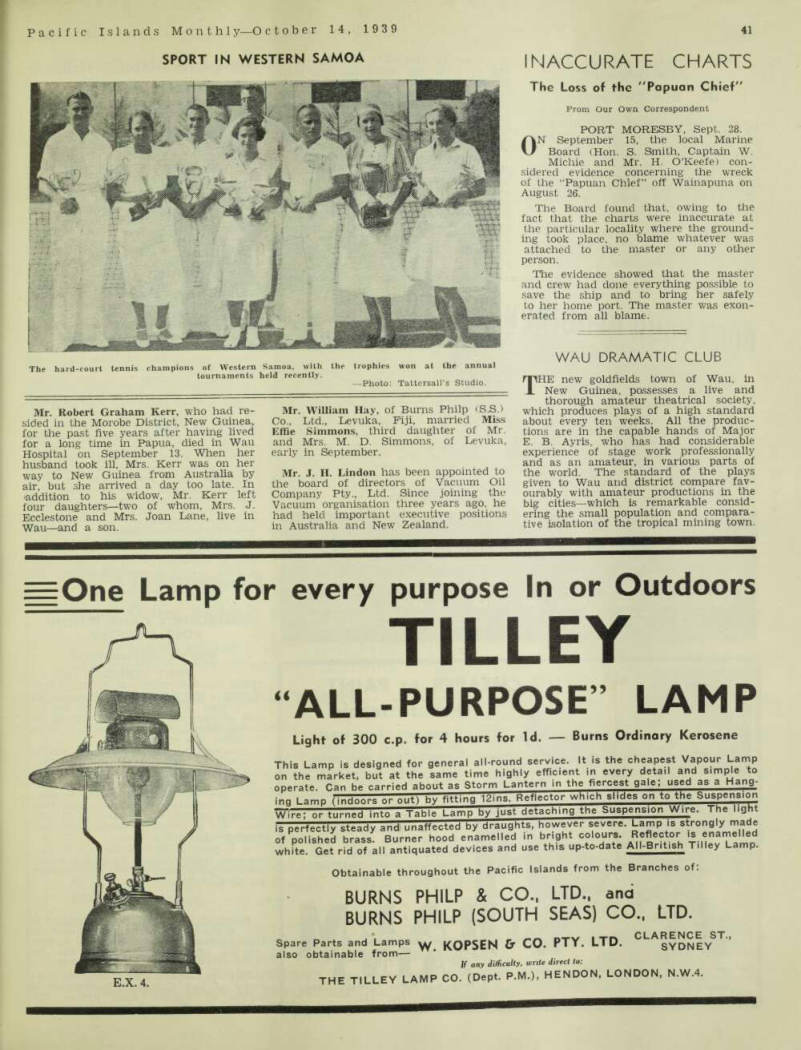
Mr. Robert Graham Kerr, who had re sided in the Morobe District, New Guinea, for the past five years after having lived for a long time in Papua, died in Wau Hospital on September 13. When her husband took ill, Mrs. Kerr was on her way to New Guinea from Australia by air, but she arrived a day too late. In ■addition to his wddow, Mr. Kerr left four daughters—two of whom, Mrs. J.
Ecclestone and Mrs. Joan Lane, live in Wau—and a son.
Mr. William Hay, of Burns Philp (S.S.) Co., Ltd., Levuka, Fiji, married Miss Effie Simmons, third daughter of Mr. and Mrs. M. D. Simmons, of Levuka, early in September.
Mr. J. H. Lindon has been appointed to the board of directors of Vacuum Oil Company Pty., Ltd. Since joining the Vacuum organisation three years ago, he had held important executive positions in Australia and New Zealand.
The hard-court tennis champions of Western Samoa, with the trophies won at the annual tournaments held recently.
Photo: Tattersall’s Studio.
Inaccurate Charts
The Loss of the "Papuan Chief"
Prom Our Own Correspondent
Port Moresby, Sept. 28.
ON September 15, the local Marine Board (Hon. S. Smith, Captain W.
Michie and Mr. H. O’Keefe) con sidered evidence concerning the wreck of the “Papuan Chief” off Wainapuna on August 26, The Board found that, owing to the fact that the charts were inaccurate at the particular locality where the ground ing took place, no blame whatever was attached to the master or any other person.
The evidence showed that the master and crew had done everything possible to save the ship and to bring her safely to her home port. The master was exon erated from all blame.
Wau Dramatic Club
THE new goldfields town of Wau, in New Guinea, possesses a live and thorough amateur theatrical society, which produces plays of a high standard about every ten weeks. All the produc tions are in the capable hands of Major E. B. Ayris, who has had considerable experience of stage work professionally and as an amateur, in various parts of the world. The standard of the plays given to Wau and district compare fav ourably with amateur productions in the big cities —which is remarkable consid ering the small population and compara tive isolation of the tropical mining town.
Advertisements & other items, p. 43 (2 items)
41
Pacific Islands Monthl y — O ctober 14, 1939
Tilley
One Lamp for every purpose In or Outdoors
‘■ALL-PURPOSE” LAMP
Light of 300 c.p. for 4 hours for Id. Burns Ordinary Kerosene This Lamp is designed for general all-round service. It is the cheapest Vapour Lamp on the market, but at the same time highly efficient ,n every detfi and s.mple to operate. Can be carried about as Storm Lantern in the fiercest gale; used as a Hanging Lamp (indoors or out) by fitting 12ins. Reflector which slides on to the Suspension Wire: or turned into a Table Lamp by just detaching the Suspension Wire. The light is perfectly steady and unaffected by draughts, however severe. Lamp is strongly made of oolished brass. Burner hood enamelled in bright colours. Reflector is enamelled white. Get rid of all antiquated devices and use this up-to-date All-British Tilley Lamp.
Obtainable throughout the Pacific Islands from the Branches of;
BURNS PHILP & CO., LTD., and
BURNS PHILP (SOUTH SEAS) CO., LTD.
. Tr , CLARENCE ST.,
Spare Parts and Lamps yy KOPSEN & CO. PTY. LTD. SYDNEY also obtainable from — V E.X. 4.
SYDNEY
If any difficulty, write direct to: THF TILLEY LAMP CO. (Dept. P.M.), HENDON, LONDON, N.W.4.
clerk -
Why No insurance for N,G, Field Officers?
From Our Own Correspondent WAU, Oct. 2.
SOME years ago, Mr. E. W. P. Chinnery, then Director of District Services, endeavoured to force upon the powers-that-be the necessity for provid ing some sort of insurance for dependents of New Guinea field officers, in the event of death. Wau is still wondering whether this is one of the “shelved” matters, or whether something is being done about it.
In the N.G. Service, a clerk and a field cadet start on the same scale of salary.
The office worker receives annual in creases in his salary after the first year
of service. On the other hand the cadet has to prove his metal for two years before getting a rise; yet during his cadetship and subsequent years, the field officer, living mostly under isolated condi tions, is obviously exposed to very much more hardship and danger than the
clerk -
Tf Q „ n~iH°*rvf er 16S thr °? gh a mish ap in ir 6 nel r tn ere is no official provision in nature of msurance for his depend ents - Sometimes the Administration is generous enough to provide assistance; but, more often than not, this is inade- P ua te—one mother received the princely sum of £lo° for the loss of her son, upon whom she depended as her sole sup port.
Murmuring Reef
(This was written recently by a young, educated native of Tonga— now a resident of Nukualofa.) DAY and night the reef murmurs.
Sometimes it is an exquisite whisp ering, hardly audible; sometimes it is a deep diapason, resonant and virile; but it is ceaseless.
To my familiar ears, the Innumerable murmurings of the reef form movements of a grand symphony, with life as its theme. Often have I listened to this sym phony, on lazy summer noons, with a light breeze caressing the lagoon, when it is a fantasy of merry sounds, exuber ant and carefree; on languorous, moonlit nights, with the moonlight like the ghostly white mist that haunts the mountain sides, when it is a wistful melody, thoughtful and melancholy; and on dark, stormy nights, with the wind moaning through the palm leaves, when it is a stirring finale, inspiring and majestic.
These movements interpret life in its bizzare reality.
A multitude of disconnected thoughts drift through my mind—pictures created by the strange beauty of this music of the reef; thoughts of the indecipherable purposes of existence, the shortness of life and its unreasonableness, the in stability of human institutions—of fame, power and wealth, the futile squabbles of nations, the petty differences in dogmas and creeds which lead man astray from Christlike simplicity, the rise and fall of empires, of good and evil, the Birth Con trol, the materialistic predilection of Western Civilisation, the sufferings caused by misunderstandings, of war and peace—these and a thousand other thoughts take form, intermingle, then dis solve to leave me in an uncertain state of confusion. And, day and night, the reef murmurs.
Emergency Camp Behind
Port Moresby
From Our Own Correspondent
Port Moresby, Oct. 1.
THE Administration has informed resi dents that, in the event of emergency arising in Port Moresby as the re sult of war, non-combatants will be re moved inland. An encampment is being prepared at a selected place.
Transport to the encampment will be supplied by the Government, but little else can be provided beyond shelter.
Should a preliminary warning be pos sible, non-combatants intending to make for the encampment should collect beds, bedding, tables, chairs, cooking utensils, etc., also a week’s provisions, and hold them ready for transport.
It is pointed out that there is at pre sent no urgent danger. These are merely part of the general precautions necessary in time of war.
Pastor E. TM. Abbott, Superintendent of the Seventh Day Adventist Mission in New Guinea, returned to Rabaul in Sep tember, after having attended the An nual S.D.A. Council at Wahroonga.
Madame Barthes, wife of the new Gov ernor of New Caledonia, is expected to arrive in Noumea from France this month, to join her husband.
Advertisements & other items, p. 44 (2 items)
42
October 14, 103 9—P aclfic Islands Monthly
I l\l Tr"
POST YOUR
£3j^ G^v '”*'*"t'’
• MINING Ci-usbihg Machinery. Screens. Feeders, Rock Drills, Excavators. Diesel and Crude Oil Engines, Hoists and Runways, Roller Bearings, etc. • ELECTRICAL EQUIPMENT Parkinson Motors, Crompton Switchgear. Transformers, Instruments, Meters, Calender Wires and Cables, Lighting Equipment, Electric Drills • STORES, FACTORIES, HOME and OFFICE E i«.ncoi Finings, Oomp.on Fans, Crompton Lamps, Floodlighting, Household Electrical Appliances, Radio Receivers and Equipment, Jos. Rodgers Cutlery & Plateware, Cut-glass and Perfection E.P.N.S. Ware.
«r m \
It's CHEAPER to PAINT
than to repair!
Decay can do no damage if your home is properlyprotected with good paint.
Use “8.A.L.M.” Paint— “B.A.L.M.” Paint gives protection. And it wears down evenly and very slowly, lasting years longer than ordinary paint.
Decide now to save money by painting; and decide to make maximum savings by using - - - - “8.A.L.M.” Paint!
DISTRIBUTORS:
Greenwood & Laws Ltd., Rabaui and Wan.
Steamships Trading Co. Ltd., Port Moresby and Samaral.
Millers, Ltd,, Suva, Fiji, W Jsar *«■« pit'”
I l\l Tr"
A Product of British Australian Load Manufacturers Pty. Ltd.,
Headhunters
Brother Jones Among the Headhunters
Letter to the Editor I WAS much interested, to see in your issue of September, that Pastor Cap tain G. F. Jones, of the S.D.A., had done pioneer work in the British Solo mon Islands, and had been a missionary in New Guinea, Solomon Islands and Dutch New Guinea for 45 years.
Probably some of your readers who know the Solomons will be interested in the following outline of the gentleman’s pioneer work in the British Solomon Is lands, which was given by Pastor Watson (chairman of the Australian Union of Seventh Day Advent) in a speech at San Francisco on April 4, 1918, and reported in General Conference Bulletin, Vol. 8, No. 6.
After mentioning that Pastor Jones and his wife arrived in a small launch in 1915, Pastor Watson continued: “The cabin of that launch was only about 5 ft. high, and when they walked in it they had to stoop. And then, dear friends, they found amongst that people savage head-hunters, and didn’t dare sleep on land for eight months.”
He continued: “Then they settled on an island called Gizo. There is a British Resident on the island and some sort of civilisation there; but in much of this group there is absolutely no civilisation.
“Soon Brother Jones started out on a missionary cruise. The first night, after dark, as he was anchored, he heard paddles of canoes coming toward him
and knew they were head-hunters. He did not know but that that would be his last night on earth. The natives crowded over the side of the boat, swarmed over the deck and took possession of the ship.
“But, my friends, Brother Jones is a praying man, and a man of faith. He is only a little man, but, in speaking to me about it, he said T know I am a small man, but I am big enough to take the Solomon Islands for Christ’, and he prayed that night with his boat in pos session of savage head-hunters, and in stead of losing his head he got a crew to pilot him all round the islands.”
Pastor Watson added that “when Brother Jones went to these islands he found the people carrying human flesh to markets in baskets, to exchange for other articles of food.”
Sydney, 23/9/1939.
I am, etc.,
M.
A resident of Apia, Western Samoa, Mr.
F. Rud Gebaner, has asked us to explain the circumstances connected with the re cent departure for Germany of Dr.
Kuebler. Dr. Kuebler visited Samoa in a private capacity; left for Pago on June 29, to catch the Matson liner, but had to return, when the mail-launch broke down, and spend another month in Apia; and finally got to Pago, and caught the liner to U.S.A., through the courtesy of H.M.S. “Achilles”. Some critical com ment had been made concerning Dr.
Kuebler’s “extended stay in the Terri tory”; but Mr. Gebaner points out in dignantly that the doctor’s stay was in voluntary—he was not responsible for the breakdown of the mail-launch.
Investigation
Fiji's Fish
Expert Makes An Investigation
A FISHERIES expert, Mr. J. Hornell, who arrived in Suva in August, un der instructions from the Fiji Gov ernment. has carried out an official in vestigation of fishing conditions in the Crown Colony of Fiji—both from the com mercial and sporting point of view.
It is stated by older residents that, compared with conditions as they were, say 30 or 40 years ago, the quantity of fish available around the coasts of the principal islands of Fiji is much less —and one explanation offered is that the fish have been destroyed by the recent grow ing practice of netting very large quan tities of comparatively small fish.
The fish supply in Fiji is not only ex tremely important as an article of food, but it is important also as a tourist at traction. Any Pacific Islands group which can guarantee good deep sea fishing is certain of attracting tourists.
Death Of Pioneer
Missionary
THE death occurred at Samarai, Papua, on September 17, of Mrs. Elizabeth Tomlinson, 79, pioneer missionary of the New Guinea mission, after 48 years’ service. She went to Papua with her hus band under the Australian Board of Mis sions in 1891. Her husband, the late Canon Tomlinson, died in Papua, in 1937.
Advertisements & other items, p. 45 (2 items)
43
Pacific Islands Monthl y—O ctober 14, 1939
William Atkins
Established 50 years — and carrying one of the largest stocks of Iron and Steel in Australia.
Head Office 449-451 KENT ST., SYDNEY.
FULL, COMPREHENSIVE & UP-TO-DATE RANGE IN ALL
DEPARTMENTS, INCLUDING THE FOLLOWING LINES:—
STEEL DEPARTMENT
MILD STEEL;
Rounds, Squares, Flats, Half-rounds, Hexagons, Bevel, Shoeing, Tyre, Angles, Tees, Sheets, Plates, Girder Plates, Chequer Plates, Channels, Hoops, Etc.
BRIGHT STEEL;
Rounds, Squares, Hexagons.
Iron & Steel Merchants
ENGINEERS' SUPPLIES
COACH & MOTOR HARDWARE.
Engineers' Supplies: Set Screws, Studs, Metal Thread Screws, Coach Screws, Files, Cotter Pins, Bright and Black Bolts. Rivets, Etc., Hack Saw Blades.
Power Transmission Gear: Including Plummer Blocks, Couplings, Collars, Etc.
Coach and Motor Hardware; Axles, Springs, Wheelstuff, Duck, Paints.
Farriers' Supplies; Horse Nails, Anvils, Vices, Etc.
Cable Address: WILATKIN, SYDNEY.
Extra Special High Speed Tool Steel, Mining Steel, Blister Steel and Spring Steel, Rounds, Flats Gr Squares.
Bar Iron— All sections and sizes.
Motor-Trimmers and Motor Builders' & Motor Painters' Requirements
C. A. WILLEY'S
Quick-Drying Coach and Car Paints, Roughstuff, Elastic Gloss, Synflex Enamels, Lacquers.
DUCO Lacquers and DULUX Enamels—FAßßEX Motor Toppings and Leather Cloths, House & Decorators' Paints, Varnishes Cr Brushware Sole Distributors of CHAMPION'S Decorators Paint Products.
Distributing Agents for BROLITE Lacquers, SYNFLEX Enamels and POLYGLOSS Finish.
Home Lighting Set
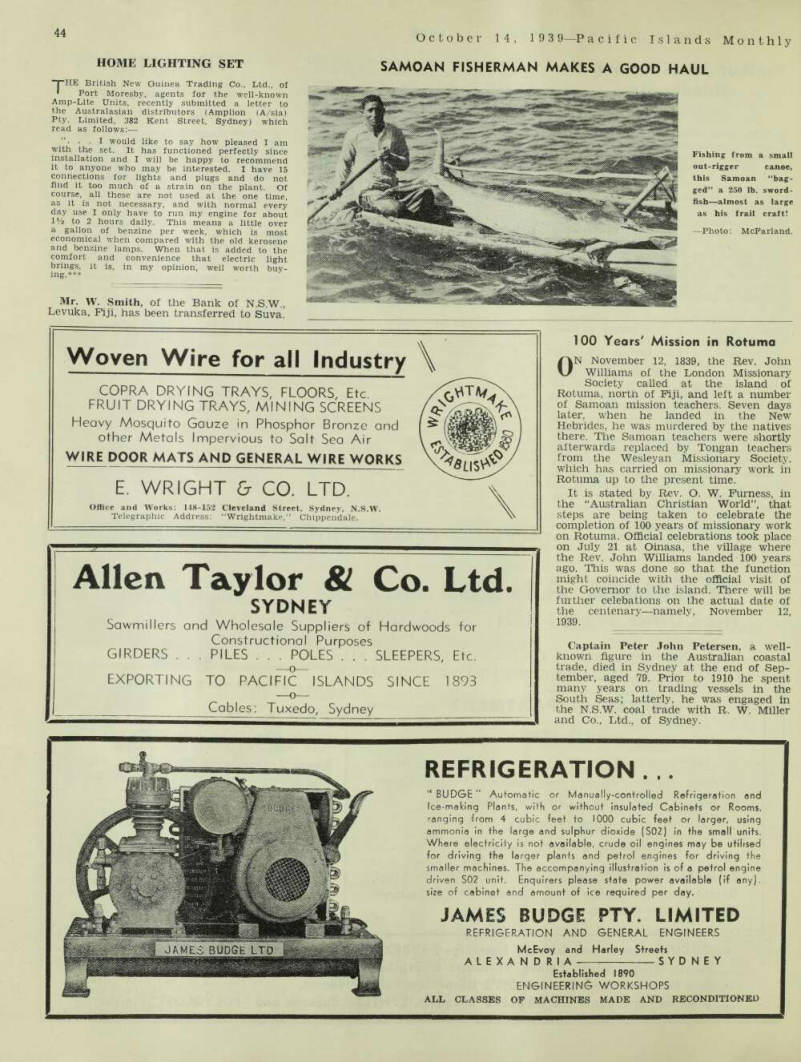
“TTHE British New Guinea Trading Co., Ltd., of ' Port Moresby, agents for the well-known Amp-Lite Units, recently submitted a letter to the Australasian distributors (Amplion (A/sia) Pty. Limited, 382 Kent Street, Sydney) which read as follows: “. . .1 would like to say how pleased I am with the set. It has functioned perfectly since installation and I will be happy to recommend it to anyone who may be interested. I have 15 connections for lights and plugs and do not find it too much of a strain on the plant. Of course, all these are not used at the one time, as it is not necessary, and with normal every day use I only have to run my engine for about IVz to 2 hours daily. This means a little over a gallon of benzine per week, which is most economical when compared with the old kerosene and benzine lamps. When that is added to the comfort and convenience that electric light brings, it is, in my opinion, well worth buy ing.*** Mr. W. Smith, of the Bank of N.S.W., Levuka, Fiji, has been transferred to Suva.
Advertisements & other items, p. 46 (1 item)
Samoan Fisherman Makes A Good Haul
Fishing from a small out-rigger canoe, this Samoan “bag ged” a 250 lb. sword fish—almost as large as his frail craft!
Photo: McFarland.
100 Years ' Mission in Rotuma
ON November 12, 1839, the Rev. John Williams of the London Missionary Society called at the island of Rotuma, north of Fiji, and left a number of Samoan mission teachers. Seven days later, when he landed in the New Hebrides, he was murdered by the natives there. The Samoan teachers were shortly afterwards replaced by Tongan teachers from the Wesleyan Missionary Society, which has carried on missionary work in Rotuma up to the present time.
It is stated by Rev. O. W. Furness, in the “Australian Christian World”, that steps are being taken to celebrate the completion of 100 years of missionary work on Rotuma. Official celebrations took place on July 21 at Oinasa, the village where the Rev. John Williams landed 100 years ago. This was done so that the function might coincide with the official visit of the Governor to the island. There will be further celebations on the actual date of the centenary—namely, November 12, 1939.
Captain Peter John Petersen, a well known figure in the Australian coastal trade, died in Sydney at the end of Sep tember, aged 79. Prior to 1910 he spent many years on trading vessels in the South Seas; latterly, he was engaged in the N.S.W. coal trade with R. W. Miller and Co., Ltd., of Sydney.
Advertisements & other items, p. 46 (3 items)
44
October 14, 193 9—P acific Islands Monthly
Allen Taylor & Co. Ltd.
Woven Wire for all Industry
COPRA DRYING TRAYS, FLOORS Etc
FRUIT DRYING TRAYS, MINING SCREENS
Heavy Mosquito Gauze in Phosphor Bronze and other Metals Impervious to Salt Sea Air WIRE DOOR MATS AND GENERAL WIRE WORKS
E. WRIGHT & CO. LTD.
Office and Works: 148-152 Cleveland Street, Sydney, N.S.W.
Telegraphic Address: “Wrightmake,” Chippendale.
O* TA^
f- Or £ so
Allen Taylor & Co. Ltd.
SYDNEY
Sawmillers and Wholesale Suppliers of Hardwoods for Constructional Purposes GIRDERS . . . PILES . . . POLES . . . SLEEPERS, Etc.
EXPORTING TO PACIFIC ISLANDS SINCE 1893
Cables: Tuxedo, Sydney
Refrigeration...
V-
JAMES BUDGE
LTD
REFRIGERATION...
“ BUDGE " Automatic or Manually-controlled Refrigeration and Ice-making Plants, with or without insulated Cabinets or Rooms, ranging from 4 cubic feet to 1000 cubic feet or larger, using ammonia in the large and sulphur dioxide (SO2) in the small units.
Where electricity is not available, crude oil engines may be utilised for driving the larger plants and petrol engines for driving the smaller machines. The accompanying illustration is of a petrol engine driven SO2 unit. Enquirers please state power available (if any), size of cabinet and amount of ice required per day.
JAMES BUDGE PTY. LIMITED
REFRIGERATION AND GENERAL ENGINEERS
McEvoy and Harley Streets
ALEXANDRIA SYDNEY
Established 1890
ENGINEERING WORKSHOPS
ALL CLASSES OF MACHINES MADE AND RECONDITIONED
Philippines
Future Of The
Not Afroid of Big, Bod Japanese Wolf
THE Philippines National Assembly,
after a bitter debate lasting three days, decided on September 29, by 53 votes to 7, to press on towards complete independence in 1946, as scheduled by United States policy and the Tydings- McDuffie Act of 1934, and not to seek a re-examination of the matter.
The question was raised when Jose Romero, a leading Filipino and one close to President Quezon, proposed that the 1946 independence plan be postponed, in view of adverse world conditions.
This vote suggests that the Philippines are “not afraid of the big, bad wolf” — which, of course, is Japan.
The United States took possession oi Philippines from Spain at the conclusion of the Spanish American war, in 1598.
The Americans immediately began to educate the Filipinos (people of Malay- Mongol stock), who then were at least 98 per cent, illiterate, and to prepare them for self-government. In 1916, the United States Congress passed an Act under which the Filipinos were promised self-government and independence: and in 1934 the Tydings-McDuffie Act pro vided that the Filipinos should have self government forthwith; that they should have almost complete independence in 1946, and full complete independence in 1960.
But, in 1936-7-8-9, the new colour and aggressiveness of Japan’s policy, expan sionist and southwards-thrusting, alarmed many people associated with President Quezon and his new Government: and it was frequently reported that, in the cir cumstances, the Filipinos probably would wish to remain under American protec tion.
The idea of going into reverse has not been very favourably received in America.
The Philippines, away over there near Asia, would not be easy to defend; and, in any case, the powerful American sec tions interested in domestic production of sugar, vegetable oils and tobacco (all of which are abundantly produced in the Philippines and sent to America) would be very glad to see the arrival of 1946 and the shutting-down on free trade be tween the two countries.
The Japanese are very active in the group—which has 114,000 square miles and 15,000,000 inhabitants. There are over 20,000 Japanese in Mindanao (the largest and most southerly island) and the Japanese generally, are deeply in terested in both primary and secondary industries. Whether they exercise politi cal control or not. it is certain that as the Americans withdraw, the Japanese in a commercial sense, will take com mand of the country.
A decree has been issued granting a full pardon to defaulting French citizens in Australia, Papua, New Guinea, Solo mon Islands, Fiji and Gilbert and Ellice Islands conditional on defaulters report ing for military duty to the French Con sular authorities before October 25. De faulters are those who have failed to comply with military service regula tions or those who have deserted from the army, navy, air force, or mercan tile marine.
Eager For War Service
AS soon as war was declared, there was a remarkable rallying to the colours by young Australians in Papua, New Guinea, and the adjacent groups. The type of young man who goes out to the Pacific Islands is apparently the type who volunteers for national service in an emergency.
Six young goldminers from New Guinea arrived in Australia on September 19 eager to enlist—they had left New Guinea as soon as war began. One, a gold miner, had paid off 100 native labourers so as to get away promptly. They were disap pointed with the position in Australia— while tens of thousands of young men are eager to offer their services, there is little chance of their getting away soon in an expeditionary force to fight in the real war.
Len Bayliss, a 17-years-old young man from New Guinea, has been making a name for himself in Sydney aviation circles. In the recent championships of the N.S.W. Royal Aero Club, which en tailed aerobatics, formation flying, forced landing, landing to a mark and low flying, he finished third, although he had been flying for only eight months.
Rev. C. S. Bull, who recently returned to Australia after serving with the Ang lican Mission in the Diocese of Polynesia (Fiji), has taken up duties as a minor canon of St. David’s Cathedral, Hobart, Tasmania.
Mrs, Ella L. Freeman, of Rewa, Fiji, died on board the liner “Mariposa” on September 1, when on her way to New Zealand to undergo medical treatment.
Mrs. Freeman’s family is well-known in Fiji—her husband was the late Mr. Os bert Freeman, of Drekenikelo, on the Rewa River, and she herself was the daughter of the late Mr. H. Tucker, of Rewa, and of Mrs. Tucker, of Suva. Mrs.
Freeman left a daughter (Mrs. A. S. Mar tin. of Suva) and four sons— Llewelyn (Tavua), Arthur (Tailevu), Richard (Rewa) and Henry (Sigatoka).
Advertisements & other items, pp. 47-48 (1 item)
Bitumenoid Roofing
Timber, Joinery
ETC.
PREPARED BUILDINGS ready for erection a specialty.
SHIP AND BOAT BUILDING.
TIMBERS specially catered for.
FIBROLITE, PLYWOODS,
GALVANISED IRON.
CONSIGNMENTS shipped
by RETURN STEAMERS
to the Islands.
John W. Eaton
PTY. LTD.
WEST CRESCENT STREET,
NORTH SYDNEY.
Telephones: XB 4051 (6 lines.)
BITUMENOID ROOFING
MADE IN AUSTRALIA.
Bitumenold Roofings, Dampcourse and Insulating Felts are made from the world’s best raw materials. Warranted to stand the most rigid tests.
BITUMENOID THE BEST
Roofing, 1,2, 3-ply; Flooring, Waterproof Materials; Saturated Felt; Resilient Road Jointing: Natural Asphalt Dampcourse: 2 and 3-ply Dampcourse: 1-2 lb. Lead-core Dampcourse; Roofing Cement; Asphalt Paints: Roofing Compound.
SAMPLES AND PRICE LISTS ON APPLICATION,
MAXWELL PORTER & SON LTD.
ESTABLISHED 1888. BUILDERS’ SUPPLIES.
107 REDFERN ST., REDFERN, SYDNEY, N.S.W. Phone: M 3157. Cables Bitumenoid.
i)V^ %\C Obtain a copy before you build.
It contains designs and plans—in colour —of Homes that can be inexpensively built with
WUNDERLICH DURABESTOS,
the indestructible asbestos-cement building sheeting. Write to
WUNDERLICH LIMITED
G.P.0., Box 474 aa, SYDNEY
FOR TROPICAL BUILDINGS, SPECIFY
I
A. B. DONALD LTD.
AUCKLAND
ISLAND TRADERS ; GENERAL MERCHANTS
P.O. Box 1509. Cables and Telegrams: “Kingdom”, Auckland.
Branches ot Rarotonga and throughout the Cook Islands At Papeete and throughout the Society, Marquesas and Paumotu Islands,
trading as "ETABLISSEMENTS DONALD, TAHITI"
At Fiji; Trading as "Dominion Fruit Co.", Suva.
Your Tropical Kit
When you visit the Pacific Islands, whether on Business or Pleasure, you need Special Equipment Light Suits of Correct Style, which fit well and launder easily; Tunic Shirts, Silk Shirts, Light Underwear, White Shoes, etc.
WALTER HORNE & CO., LTD., established in 1885, specialise in this Service. Skilled Tailors make your Suits from First-class material within 24 hours. Complete equipment can be supplied from our Large Stock at Reasonable, Moderate Prices.
WALTER HORNE & CO. LTD.
BUY FROM THE FIRM WHICH UNDERSTANDS YOUR NEEDS AND
DRESSES YOU CORRECTLY.
WALTER HORNE & CO. LTD. carry a Full Range of Drapery of all kinds; also Frocks, Millinery, Foundations and Lingerie, Hosiery, Shoes and Sandals, Ribbons and Laces, Household Drapery.
Lad ics' Hairdressing and Manicuring Men resident in any of the Pacific Territories can be supplied with Suitable Clothes.
Write to us and Describe your Requirements.
Drapers and Men's Wear Specialists.
SUVA, FIJI.
Thousand-To-One
Chance
When Von Luckner Was Taken in Fiji
NOW that Britain and Germany again are at war, there are many people who believe that the friendly and jovial Count Felix von Luckner (hero of the German raider “See Adler” in 1916- 17) was really on espionage duty when he cruised in the Eastern and Central Pacific last year. It is a matter of opinion. Certainly, the Count and Countess travelled far and made many new friends in the Pacific in 1937-38.
This may be an opportune time to tell
a new story of the capture of von Luckner in Fiji in 1917. It will be remembered that the “See Adler” was wrecked on an island eastward of Tahiti; that the crew got safely ashore, with some supplies; and that von Luckner, with a dozen men, made a remarkable voyage in a motor launch from the Tuamotus right across to Wakaya, a small island in the Fiji group. There, everyone accepted their story that they were shipwrecked Scan dinavians—everyone, except Captain R.
Macpherson, a shrewd Euronesian. He had his suspicions so he quietly slipped away in his cutter, and crossed to Suva.
An unimpressive little freighter, the “Amra” was pressed into service by the Fiji Government, and she took an un armed police-party to Wakaya.
The story of how the Germans thought the “Amra’s” cattle-pens were concealed guns and surrendered, has been told many times; but the story of how the “Amra’s” visit was arranged was recently told for the first time by Mr. K. Lawry, of Bris bane, who was radio operator at Suva in 1917.
“Captain Macpherson, from Wakaya, sailed to Suva with the news of the land ing of several suspected Germans”, said Mr. Lawry. “He reported to the Colonial Secretary. The secretary ’phoned me, said that there were no ships at Suva that could be sent to investigate, and asked me if I could get word to the ‘Amra’, which was due at Levuka at midnight.
“Unfortunately, the captain had not arrived until 7.30 p.m. The cable between Suva and Levuka closed at 6 p.m., and would not open until 9 a.m., and the ‘Amra’ had no wireless.
“There was just a thousand-to-one chance. The ‘Atua’, a passenger ship equipped with wireless, was lying at the wharf at Levuka The secretary asked me to go outside the war-time regulations, which forbade wireless calls after 6 p.m., and to try to raise the ‘Atua’, although it was probable that there would be no operator on duty. , “I began calling at 8 p.m., and called about every ten minutes. No answer. I thought I would make a call at 12.30 in the morning, the last one. I made it . . . and at last a call came back at me.
“As I learnt later, the wireless operator had been on shore to a dance. He had re turned soon after midnight to show two friends how the wireless worked. By chance he had put the earphones on, and caught my call.
“I told him to hang on a few minutes.
Then I ’phoned the Colonial Secretary.
He prepared a telegram in Fijian, which ! sent via the ‘Atua’s’ wireless operator to the postmaster at Levuka, asking him to open up the cable. The cable was nec essary so that the instructions could not be picked up by von Luckner.
“Orders for the stopping of the ‘Amra’ were given. Her passengers were put ashore, and with two police officers she went to Wakaya, and von Luckner was arrested.”
Captain P. H. Day, now one of the best known master mariners on the Australian coast had command of the A.U.S.N.
“Amra”, which was then employed in the Fiji inter-island service. He took aboard a sub-inspector and five of the Fiji native police.
Captain Day decided that if there was anything in the armed launch story, audicity was the only thing to carry the “Amra’s” party through. When the steamer arrived off Wakaya, the sub-in spector of police, according to a pre
arranged plan, put off in one of the “Amra’s” boats. Reaching the island he called on Count von Luckner to sur render, which the Germans did. The motor launch was then searched, and was found to be armed with a machine gun and 5,000 rounds of ammunition, six Mauser pistols, six rifles, and a bag of bombs.
Count von Luckner afterwards told Captain Day that he knew McPherson had got away to give the alarm, and he thought the “Amra” would have had an armed party of at least 30 men.
Mr. Lawry said that von Luckner played a joke on Suva when he arived there under arrest. “You’ve got me”, he said, “but you haven’t got the other two boats.”
Suva was rather scared. Veterans were sent to guard the wireless station in case of an attack by the other two “raiders”.
The “Amra” was fortified with sandbags, and a machine gun company was placed on board. Then von Luckner explained that he had only been “leg-pulling”.
Swimming in the Laloki River, Papua, recently, a native employed by the Gov ernment Stores Department was seized by a crocodile. Displaying extraordinary pluck and quickness of mind, another Papuan jumped on the reptile's back and, by pressing in the crocodile’s eyes with his fingers and wrenching open the jaws, forced it to release its victim. The res cued native was taken to hospital where a number of stitches were inserted in his badly torn thigh.
How Long Will N.G.
Mandate Last?
System in Which War Was Never Provided For
IN some quarters, it is considered pos sible that, at any moment. Australia will denounce the Mandate under which she holds New Guinea, and form ally annex that Territory.
In the Australian Parliament, early in September, Mr. Blain asked: “As the League of Nations is not now able to hold an effective meeting, is it not de sirable in the interests of defence that Australia should take over the Mandated Territory of New Guinea?”
The Prime Minister gave a non-com mittal reply.
It is obvious that those who framed the Mandates plan for controlling ex- German territories through the League of Nations never contemplated anything so strange as* another war. There liter ally is nothing in the machinery of Man dated Territories administration to pro vide for war conditions.
Obviously, since the Empire is at war, the Territories held by the Empire coun tries under mandate —New Guinea and Western Samoa, in the Pacific—must also be in a state of war; but, when the time came, it was found that there was no effective way' of putting them into a con dition of war.
In the case of New Guinea, this was done, somewhat clumsily, by proclaiming, in New Guinea, through the official
gazette, certain measures which had been officially proclaimed in Australia. When some people expressed doubt about this procedure, it was pointed out that Article 2 of the Mandate says:— “The mandatory shall have full power of administration and legislation over the territory subject to the present man date as an integral portion of the Com monwealth of Australia, and may apply the laws of the Commonwealth of Aus tralia to the Territory, subject to such local modifications as circumstances may require.”
This is held to give sufficient power to Australia to apply war conditions to the Territory.
One effect of this interpretation is seen in the treatment of Germans. At first, the Administrator ordered them simply to report regularly. But, later, the known Nazis among them (about a score) were taken into custody and sent to Aus tralia for internment.
THIS constitutional position is not likely to be disturbed while the war lasts. Australia cannot annex New Guinea without consultation with Britain; and Britain is much too busy just now in Europe to be bothered about the Pacific Islands Mandates.
But possibility of war with Japan would alter the outlook. The Mandate forbids the military training of natives, or the establishment of fortifications, or military or naval bases, in any shape or form. Those things would become vitally necessary if Japan moved against the Allies —and, in that event, the removal of the Mandate, and annexation by Aus tralia, might be decided upon.
known in New Guinea as Custodian of Expropriated Property in connection with the last war, was appointed in Septem her, by the Australian Government, to be
So"" the Huier
coupte of years assocSecP with General Tom the Federal
Cormnlllee °which' selreled"a new
for New Guinea Monsieur Dartnell, Judge of the High Court of Appeal in New Caledonia, has returned to France.
Mr. Henry .1. Topal. a former resident of New Guinea, where he served for a time in the Medica Service, arrived in the Mandated Territory from Sydney in September to open an agency business in Rabaul for a number of Australian firms.
Advertisements & other items, p. 49 (1 item)
yrn ttV
& mm lie <i w the g ; ** 5 *’ *. we se^e * S t 4 oc«' *** t **- ** ** ** I#** t*ce"** d .. S oV». <or -r:- <•>** tri'° ed O b ' e ’ ,e * d " e^' 0< * s**s
How War Came To Central Pacific

Sir Harry Luke Speaks to Distant Islands by Radio
WHEN Britain goes to war, one of her greatest problems is to give prompt information and instructions to all her far-flung dominions, colonies and de pendencies. Radio has simplified that problem.
Some of the older residents in the Central Pacific, early in September, drew a contrast between the conditions of 1914, and those of 1939.
In 1914, isolated British communities did not know, for many weeks, that war had broken out. In 1939, people on even the remote atolls in the Solomons, the Gilbert and Ellice group, and the North ern Cooks, not only knew on September
3 that war had come, but many of them actually, on short-wave radio, heard the Prime Minister, in London, make the dread announcement, at 11 am.
One of the most interesting, as well as most impressive, incidents, was an address delivered by Sir Harry Luke (Governor of Fiji and High Commis-
sioner for the Western Pacific), through the Suva radio station, on September 4.
Sir Harry spoke, first, to the people in Fiji, and described the necessary war precautions that were being taken. He remarked on the large number of men of all three races—European, Indian and Fijian—who had offered their services, and he praised the way in which com pulsory military training had been ac cepted.
His address was then repeated, first in Hindi and then in Fijian. r[EN, conscious that his broadcast speech on this momentous occasion, was being listened to by persons with radio receivers in some of the more dis tant groups of islands —over which, as High Commissioner for the Western Pacific, he exercises jurisdiction—Sir Harry Luke spoke as follows: “To the peoples of the Gilbert and Ellice Islands Colony, the British Solomon Islands Protectorate, the New Hebrides, and the Kingdom of Tonga, many of whom it has been my privilege to meet personally during recent months, I am glad to be able to give an assurance that their safety and interests are being closely watched. I am in constant touch with the three Resident Commissioners and with the Agent and Consul, Tonga.
“In all these Territories the necessary legislation to implement defence measures is being enacted as rapidly as circum stances permit, and steps have already been taken to ensure reserve supplies of essential commodities and to safeguard vital lines of communication.
“It must be a matter of satisfaction to
Sir Harry Luke. K. B., C.M.O.
us all to know that we have within the Pacific our trusted Allies the French, and the full measure of co-operation which they have so readily afforded us in the New Hebrides is most gratifying.
“To Her Majesty Queen Salote of Tonga and her subjects, who have assured His Majesty’s Government of their full support and have offered to place the resources of the Kingdom at the dis posal of Great Britain, I have already been charged to convey an expression of the sincere gratitude and appreciation of the Secretary of State for the Colonies.
To that appreciation and gratitude I should like to add an expression of my own.”
Compulsory Military Training
ACTING under the Defence Force Or dinance, 1923, the Governor of Fiji, in August, introduced a system of compulsory military training. It applies to all male Europeans between the ages of 18 and 25. in the districts of Suva.
Lautoka, Ba and Nausori. Enrolment, or ganisation and training have proceeded briskly and satisfactorily.
The age limit for compulsory training was raised from 22 to 25 by special legis
lative action, immediately after the out break of war.
At the Legislative Council meeting on September 5, the Governor was asked to receive expressions of loyalty from Ratu J. L. V. Sukuna (on behalf of the Fijians) and Messrs. S. Hasan, Chattur Singh, Vishnu Deo, Tularam and K. B. Singh (on behalf of the Indian community).
All declared that their young men will ingly would take ud arms for Britain, if that were permitted.
Dr. A. W. Hogg, who for five months relieved Dr. P. J. Monaghan at Apia Hospital, Samoa, returned to New Zea land in September, accompanied by his wife and daughter. They had planned to leave Samoa in August, but a few days before their vessel sailed for N.Z.. Dr.
Hogg slipped on a banana skin outside B.P.’s store in Apia and fractured his thigh. He spent several weeks in hos pital.
Mr. W. Evans, of Colyer. Watson and Co., Ltd., Rabaul, New Guinea, paid a short visit to Sydney by air at the end of September.
Advertisements & other items, pp. 50-52 (2 items)
48
October 14, 193 9—P acific Islands Monthly
B.P. Magazine
'xxixxzxzxxxxxxxxxxxxrxxxxxxxxixixxxxxxxxxxxxxxxxxxixxzxxT: MS IX N Sll ' 3 S n O H NOXI VO : 3DIJJO A3NQAS ao d xyodxa d3aana o aai± avaAaooo 'T oaiiwn ANVdwoo aoiow aaod 0311 wn Al,dOdd ANVdWOD 110 WOODVA S3AISOIdX3 — Oil Aid (D!SD|DJ4sny) iggQN
031IWI1 SSIdISnONI IVOIW3HD !Vld3dWl
031IWI1 AaSNdOH O NOlSfld
ANVdWOO NOIIVOIAVN NOSIVW
Oil Aid (O!|DJ4sn V ) IH9VSAI NHOT s,oaoii
1, :iO) S4ua6y J.
VOWVS QNV VDNOI 'ITU mOHOnOUHI S3HDN V» 8 '!!!d 'DAng - - S3IJJO paJ34S|B3y
•an woaxsaaH smaow
vxxxxxxxxxxxxxxxxxxxxxxxixxxxxxxxxxxxxxxxxxxxxxxxxxxxxxxxx
p I
READ THE
B.P. MAGAZINE
SPRING NUMBER
Now on Sole Short Stories Pictures Travel Articles - - - - Pages for the Children --- Stage Latest Fashions --- Screen A
ONE SHILLING PER COPY.
ON SALE AT ALL NEWSAGENTS AND BOOKSELLERS
MOST PLANES DEPENDON|
MOBILOIL
n . • ..
and most motor cars depend on
Mobiloil, too . . .
You do not want more proof of reliability than that the finest passenger planes use this famous oil. It gives absolute protection at all speeds and temperatures. More cars on the roads today use Mobiloil than any other oil, a sure sign that it is dependable.
VACUUM OIL COMPANY PIY. LTD,
Agents
MOBILOIL ... THE WORLDS QUALITY OIL
M9lO
Engineers & Plumbers’ Brass Work; Locksets; Wire Netting; Hardware; “Petromax”
Kerosene Lanterns & Lamps; Pumps, Windmills, Troughing.
WRITE FOR PRICES AND
LINES YOU USE.
TRY DANKS' FOR
BUILDING SUPPLIES
We specialise in: Water, gas and steam pipe and Fittings; Gal. Roofing Iron, Guttering, Downpipe, etc.; Wallboards, Bituminous Roofing, Tilux, Duratile, Asbestos Sheets; Baths, Basins, Sinks, Heaters: Ranges for wood, coke, coal, kerosene; McClary Electric and Gas Ranges; Electric Light fittings; Refrigerators—lce and Electric; Linoleums for Stores, Hospitals, etc.; White Rose C.I. (Eng.) Hot Water Boilers; “Hush” Silent Flushers; Paints and Brushware; Wallpapers, etc. ’Phone: M 6505 ( 18 lines).
Late shopping Friday.
John Danks and Son
PROPRIETARY LIMITED
(Incorporated in Victoria). 324-330 Pitt Street, Sydney.
And at Melbourne.
dghk
Voiceless New
Guinea
Formation of Citizens' Central Body
EARLY in September, a meeting was held in Rabaul of delegates repre senting the principal public asso ciations in the Territory. Amongst those present were Messrs. H. T. Allan (Morobe Mining Assoc.), H. Taylour (Morobe Chamber of Mines), E. Fulton (Wewak Progress Assoc.), B. Spence (A.L.P., Wau), N. P. H. Neal (R.S. & 5.1.L.A.), D. Hore- Lacy (Citizens’ Assoc.), W. E. Grose (Planters’ Assoc.), R. L. Clark (R:S. & 5.1.L.A.), and letters of support were re ceived from the Namatanai Independents, Buka and Bougainville Planters’ Group and the Madang Progress Assoc. Repre sentatives of commercial interests were also present. Mr. H. T. Allan was elected chairman.
The meeting was the result, chiefly, of the activity and organising energy of Mr. Allan; and its purpose was to bring all groups of residents together in one organisation, so as to deal more effec tively with public affairs.
It was emphasised that, apart from the Legislative Council —which is dominated by the official nominated members —the residents of New Guinea have no voice whatever in their Government. It is felt that, as the Australian Government does not permit any important move in New Guinea without its permission the New Guinea residents should demand a re presentative in the Commonwealth Parliament.
It was decided to form a central body, to be known as the New Guinea Asso ciation, to work in close co-operation with the various organisations in the Territory.
It is likely, now, owing to the outbreak of war, and the departure of Mr. Allan southwards to seek war service, that the New Guinea Association will remain in active for the present.
Planters Ask For Relief
The New Guinea Planters’ Association held a special meeting on September 22 to discuss the rise of prices in all com modities.
It asked the authorities to introduce
immediately anti-profiteering legislation;
to control inter-island transport charges; and to approach the Custodian of Ex propriated Properties with a view to amending the instalment scale for pay ment on plantations, owing to the in creased costs of production and the low price of copra.
Miss Byrne has completed her term of nursing service with Apia Government Hospital, Samoa.
Advertisements & other items, p. 52 (1 item)
50
October 14, 193 9—P acific Islands Monthly
Dr Jacomb In The South
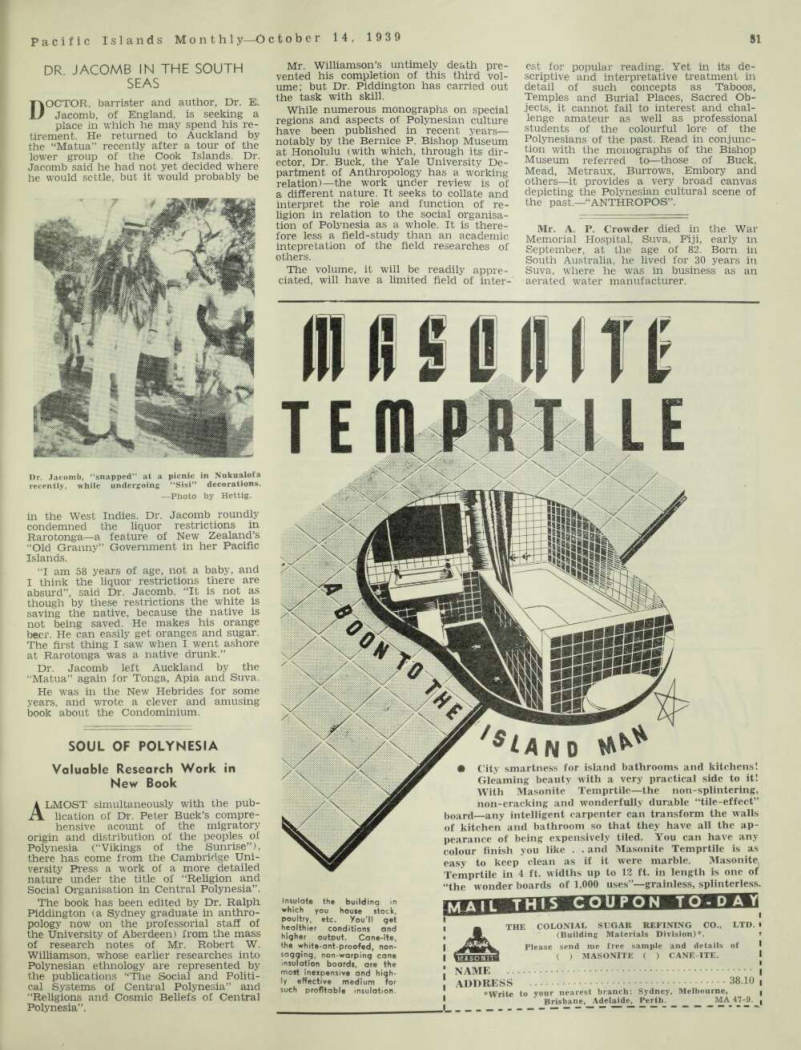
Seas
DOCTOR, barrister and author, Dr. E.
Jacomb, of England, is seeking a place in which he may spend his re tirement. He returned to Auckland by the “Matua” recently after a tour of the lower group of the Cook Islands. Dr.
Jacomb said he had not yet decided where he would settle, but it would probably be
in the West Indies. Dr. Jacomb roundly condemned the liquor restrictions in Rarotonga—a feature of New Zealand’s “Old Granny” Government in her Pacific Islands.
“I am 58 years of age, not a baby, and I think the liquor restrictions there are absurd”, said Dr. Jacomb. “It is not as though by these restrictions the white is saving the native, because the native is not being saved. He makes his orange beer. He can easily get oranges and sugar.
The first thing I saw when I went ashore at Rarotonga was a native drunk.”
Dr. Jacomb left Auckland by the “Matua” again for Tonga, Apia and Suva.
He was in the New Hebrides for some years, and wrote a clever and amusing book about the Condominium.
Dr. Jacomb, “snapped” at a picnic in Nukualofa recently, while undergoing “Sisi” decorations.
Photo by Hettig.
Soul Of Polynesia
Valuable Research Work in New Book
ALMOST simultaneously with the pub lication of Dr. Peter Buck’s compre hensive acount of the migratory origin and distribution of the peoples of Polynesia (“Vikings of the Sunrise”), there has come from the Cambridge Uni versity Press a work of a more detailed nature under the title of “Religion and Social Organisation in Central Polynesia”.
The book has been edited by Dr. Ralph Piddington (a Sydney graduate in anthro pology now on the professorial staff of the University of Aberdeen) from the mass of research notes of Mr. Robert W.
Williamson, whose earlier researches into Polynesian ethnology are represented by the publications “The Social and Politi cal Systems of Central Polynesia” and “Religions and Cosmic Beliefs of Central Polynesia”.
Mr. Williamson’s untimely death pre vented his completion of this third vol ume: but Dr. Piddington has carried out the task with skill.
While numerous monographs on special regions and aspects of Polynesian culture have been published in recent years— notably by the Bernice P. Bishop Museum at Honolulu (with which, through its dir ector, Dr. Buck, the Yale University De partment of Anthropology has a working relation) —the work under review is of a different nature. It seeks to collate and interpret the role and function of re ligion in relation to the social organisa tion of Polynesia as a whole. It is there fore less a field-study than an academic intepretation of the field researches of others.
The volume, it will be readily appre ciated, will have a limited field of inter
est for popular reading. Yet in its de scriptive and interpretative treatment in detail of such concepts as Taboos, Temples and Burial Places, Sacred Ob jects, it cannot fail to interest and chal lenge amateur as well as professional students of the colourful lore of the Polynesians of the past. Read in conjunc tion with the monographs of the Bishop Museum referred to —those of Buck, Mead, Metraux, Burrows, Embory and others—it provides a very broad canvas depicting the Polynesian cultural scene of the past.—“ANTHROPOS”.
Mr. A. P. Crowder died in the War Memorial Hospital, Suva, Fiji, early in September, at the age of 82. Born in South Australia, he lived for 30 years in Suva, where he was in business as an aerated water manufacturer.
Mrs. Louisa Kronfeld, widow of Mr.
Gustav Kronfeld. who was manager lor some years of the German firm D.H. & P.G. in Tonga and who later founded an Islands trading business in New Zealand, died recently in Auckland, aged 74,
Advertisements & other items, pp. 53-54 (2 items)
51
Pacific Islands Monthl y—O ctober 14, 1939
ns mint
l!i Eli u i
SSsiißSi
SiSiiSlSsi
iSSSiSgi
sz «>
&iSiS£
o
SliiSsilil
*> o i >
SiSr
* a [V
SSS
NO • City smartness for island bathrooms and kitchens!
Gleaming beauty with a very practical side to it!
With Masonite Temprtilc—the non-splintering, non-cracking and wonderfully durable “tile-effect” board —any intelligent carpenter can transform the walls of kitchen and bathroom so that they have all the appearance of being expensively tiled. You can have any colour finish you like . . and Masonite Temprtile is as easy to keep clean as if it were marble. Masonite, Temprtile in 4 ft. widths up to 12 ft. in length is one of “the w onder boards of 1,000 uses”—grainless, splinterless.
Insulate the building m which you house stock, poultry, etc. You'll get healthier conditions and higher output. Cane-ite, the white-ant-proofed, nonsagging, non-warping cane insulation boards, are the most inexpensive and highly effective medium for such profitable insulation. i^>
THE
COLONIAL SUGAR REFINING CO., LI
(Building Materials Division)*.
Please send me free sample and details of
( ) MASONITE ( ) CANE-ITE.
NAME
ADDRESS 38.10
♦Write to your nearest branch; Sydney, Melbourne, Brisbane, Adelaide, Perth. MA 47-9.
HOLIDAY
m : M 6
IN THE CRISP
MOUNTAIN AIR . . .
Situated in a Haven of Beauty and only an hour’s drive from Sydney is the world-renowned Lapstone Hotel . . . Australia’s gayest rendezvous of tourists, visitors and holidav makers.
H< •re is service and cuisine that compares with the world's best—with private Crystal Pool, Coif. Tennis, and a brilliant Ballroom, together with a unique feature . . . “The Million-acre Panoramic View.”
LAPSTONE HOTEL
BLUE MOUNTAINS, N.S.W.,
AUSTRALIA
Phone Clenhrook 82, 85 Rates from 17/6 per day or £5/5/per week A* hrn in Sydney inquire at Lapstone Office, 12a MARTIN PLACE, Government Tourist Bureau, or through any Tourist Agency.
Telegrams <S Cables: “Lapstone,*’ Glenhrook.
HERBERT J. PARKER Resident Manager
* m m jSgsjj T‘^ a •X, 4 GERMS of Diphtheria, Malaria, Dhoble Itch, Tinea or Surfers’ Foot, cannot live under "TENAX” lather.
Tropical Skin Diseases can be cured by Its regular use.
9° P ef
Table*
NO VARIATION HAS BEEN MADE
IN ITS COMPOSITION—judged
from the only true angle, that of quality, TENAX has no competitors as a satisfactory germicidal soap, eleven times as rapid in action as carbolic, yet NON-IRRITANT and NON-POISONOUS. The Medical Journal of Australia states that TENAX is a germicidal soap that may be recommended with confidence.
TCNAXgermicidal soapl
I A PRODUCT OF AUSTRALIAN SOAPS LTD.
Kirchner
Death of Mr. F. H. E.
ALL those acquainted with the kindly and courteous Franz Hermann Edward Kirchner, who had been a resi dent of New Guinea since 1905, and who was a naturalised British subject, will regret to learn that he died in St. Vin cent’s Hospital, Sydney, on September 16, following a stroke. He was 70 years old.
Mr. Kirchner travelled to Sydney at the end of August, and he was distressed by the outbreak of war between Britain and Germany. He had had a varied and adventurous life, and many misfortunes had come upon him as a result of war.
He went to South Africa from Germany when a young man, and had success fully established himself in business in Johannesburg when the outbreak of the Boer War destroyed practically all that he had. He was then, for some time, in India; and, later, he established a busi ness in Kalgoorlie, in Western Australia, but this also was not a success.
After a short period in Sydney he went to N.G. in 1905, and eventually be came prominently associated with the well-known Forsayth organisation. He was director in Kavieng of Messrs. For sayth, Kirchner &' Co., which prospered exceedingly under his untiring manage ment. But again war destroyed all that he had built, and in 1914 he came to Sydney, where he was engaged in business for some years. He went back to New Guinea at the end of the Great War, and engaged modestly in business on his own account, and as the manager of various companies, especially gold-mining con cerns. Two years ago he was appointed Translator in the Land Titles Depart ment, in Rabaul, and he was held in high esteem by all who knew him there. His wife and son had predeceased him and, apparently, he was quite alone in the world.
Pattern Service
pACH month we publish a Fashions design, patterns of which may be purchased by our readers direct from this office, post free. To obtain a pattern, print your name and address below, giving the number of the pattern and the bust size, and send to “Pattern Department”. Pacific Islands Monthly, Box 3408 R, G.P.0., Sydney; enclose also the price of the pattern in postal note or stamps.
It will be sent by return mall.
Name Address Pattern Number gi ze
6724.—The severely tailored lines of this charming afternoon frock lend a slimming effect to the larger figure. The draped neck-line is a novel feature: while the Victorian puffed sleeves, which can be either three-quarter or full length, are attractively fashioned in lace for contrast.
The pattern—in sizes 36, 38, 40, 42, 44, 46 and 48 in. bust—costs 1/1, post free.
Lady Lc Hunte, widow of Sir George K.
Le Hunte, who was Administrator of Papua from 1899 to 1903, died recently in Sussex, England, at the age of 84. Sir George also held several important posi tions in Fiji—he accompanied the then new Governor, Sir Arthur Gordon, out to the Colony in 1875.
6724
Fashion Hints for Islands Women
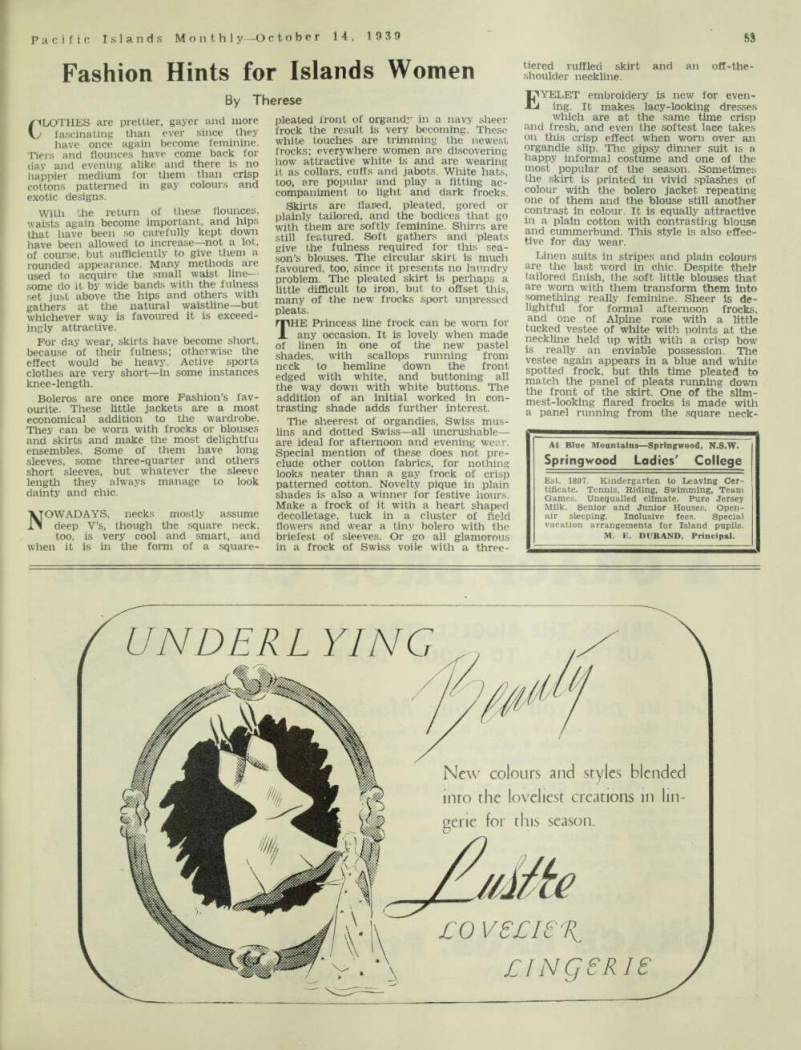
By Therese
CLOTHES are prettier, gayer and more fascinating than ever since they have once again become feminine.
Tiers and flounces have come back for day and evening alike and there is no happier medium for them than crisp cottons patterned in gay colours and exotic designs.
With the return of these flounces, waists again become important, and hips that have been so carefully kept down have been allowed to increase—not a lot, of course, but sufficiently to give them a rounded appearance. Many methods are used to acquire the small waist line — some do it by wide bands with the fulness set just above the hips and others with gathers at the natural waistline—but whichever way is favoured it is exceed ingly attractive.
For day wear, skirts have become short, because of their fulness; otherwise the effect would be heavy. Active sports clothes are very short —in some instances knee-length.
Boleros are once more Fashion’s fav ourite. These little jackets are a most economical addition to the wardrobe.
They can be worn with frocks or blouses and skirts and make the most delightful ensembles. Some of them have long sleeves, some three-quarter and others short sleeves, but whatever the sleeve length they always manage to look dainty and chic.
NOWADAYS, necks mostly assume deep V’s, though the square neck, too, is very cool and smart, and when it is in the form of a square
pleated front of organdy in a navy sheer frock the result is very becoming. These white touches are trimming the newest frocks; everywhere women are discovering how attractive white is and are wearing it as collars, cuffs and jabots. White hats, too, ore popular and play a fitting ac companiment to light and dark frocks.
Skirts are flared, pleated, gored or plainly tailored, and the bodices that go with them are softly feminine. Shirrs are still featured. Soft gathers and pleats give the fulness required for this sea son’s blouses. The circular skirt is much favoured, too, since it presents no laundry problem. The pleated skirt is perhaps a little difficult to iron, but to offset this, many of the new frocks sport unpressed pleats.
THE Princess line frock can be worn for any occasion. It is lovely when made of linen in one of the new pastel shades, with scallops running from neck to hemline down the front edged with white, and buttoning all the way down with white buttons. The addition of an initial worked in con trasting shade adds further interest.
The sheerest of organdies, Swiss mus lins and dotted Swiss—all uncrushable— are ideal for afternoon and evening wear.
Special mention of these does not pre clude other cotton fabrics, for nothing looks neater than a gay frock of crisp patterned cotton. Novelty pique in plain shades is also a winner for festive hours.
Make a frock of it with a heart shaped decolletage, tuck in a cluster of field flowers and wear a tiny bolero with the briefest of sleeves. Or go all glamorous in a frock of Swiss voile with a three
tiered ruffled skirt and an off-the shoulder neckline.
IpYELET embroidery is new for even ■i ing. It makes lacy-looking dresses which are at the same time crisp and fresh, and even the softest lace takes on this crisp effect when worn over an organdie slip. The gipsy dinner suit is a happy informal costume and one of the most popular of the season. Sometimes the skirt is printed in vivid splashes of colour with the bolero jacket repeating one of them and the blouse still another contrast in colour. It is equally attractive in a plain cotton with contrasting blouse and cummerbund. This style is also effec tive for day wear.
Linen suits in stripes and plain colours are the last word in chic. Despite their tailored finish, the soft little blouses that are worn with them transform them into something really feminine. Sheer is de lightful for formal afternoon frocks, and one of Alpine rose with a little tucked vestee of white with points at the neckline held up with with a crisp bow is really an enviable possession. The vestee again appears in a blue and white spotted frock, but this time pleated to match the panel of pleats running down the front of the skirt. One of the slim mest-looking flared frocks is made with a panel running from the square neck
line to the hem. Little ruchings of pleats outline the neck and sleeves and the hem of the skirt.
Shirt-maker frocks come in infinite variety and are trimmed with feminine fripperies without losing that air of practicability. A smartly tailored frock of check gingham has a front outlined with rick-rack braid, wide revers and short sleeves braid trimmed. The skirt is six gored.
A SUNSHINE yellow frock of linen de serves a word of praise. Its square neck is outlined with a narrow organdie frill and a kick pleat is placed in the flared skirt.
With the back-to-femininity trend, history repeats itself in all the trimmings beloved of the 1890’s. Crochet lace is in let in blouses; insertion bands trim the bodice of a voile frock; gloves take on embroidery, as hand work again comes into its own; and so on, ad infinitum.
Clothes for the beach are more intrigu ing than ever. Shorts are topped with gay blouses and coats; culottes are made in plain and patterned materials; beach coats are voluminous, with the skirts falling to the feet from a tight-fitting bodice. Swim suits come in silk, satin and cotton and are even more attractive than those of last year.
Miss Rona Riley, a teacher at the Gov ernment European School, Ifi Ifi. Western Samoa, arrived in New Zealand in mid- September.
Mr. C. E. de F. Pennefather, District Commissioner in Fji, arrived in Sydney recently from Suva with his wife to spend long leave.
Advertisements & other items, pp. 55-56 (2 items)
53
Pacific Islands Monthl y—O ctober 14, 1939
Ying
At Blue Mountains—Springwood, N.S.W.
Springwood Ladies' College
Est. 1897. Kindergarten to Leaving Certificate. Tennis, Riding, Swimming, Team Games. Unequalled climate. Pure Jersey Milk. Senior and Junior Houses. Openair sleeping. Inclusive fees. Special vacation arrangements for Island pupils.
M. E. DURAND, Principal.
YING
& New colours and styles blended into the loveliest creations in lingerie for this season. £0 V££l£% LiNg
A GRACE BROS’ CATALOGUE
BRINGS THE BIGGEST STORE IN
AUSTRALIA TO YOUR DOOR
Let us put you on
To all addresses on our list we send Free of Charge Six Catalogues a year, including two Sale Books, when prices of all goods, except Proprietary articles, are marked at attractive reductions.
WRITE TO GRACE BROS. FOR EVERYTHING.
From our huge selection of merchandise we are practically able to meet your every requirement.
Should you not see exactly what you need in any of our Catalogues write in just the same. If not in stock we will do our utmost to procure it for you.
When next in Sydney, call and inspect our extensive range of attractive merchandise.
CATALOGUES POST FREE ANYWHERE?
GRACE BROS. Pty. Ltd.
Broadway SYDNEY 'Phone: M 6506
Cp 50 74/ < * ii
I Go A-Fishing
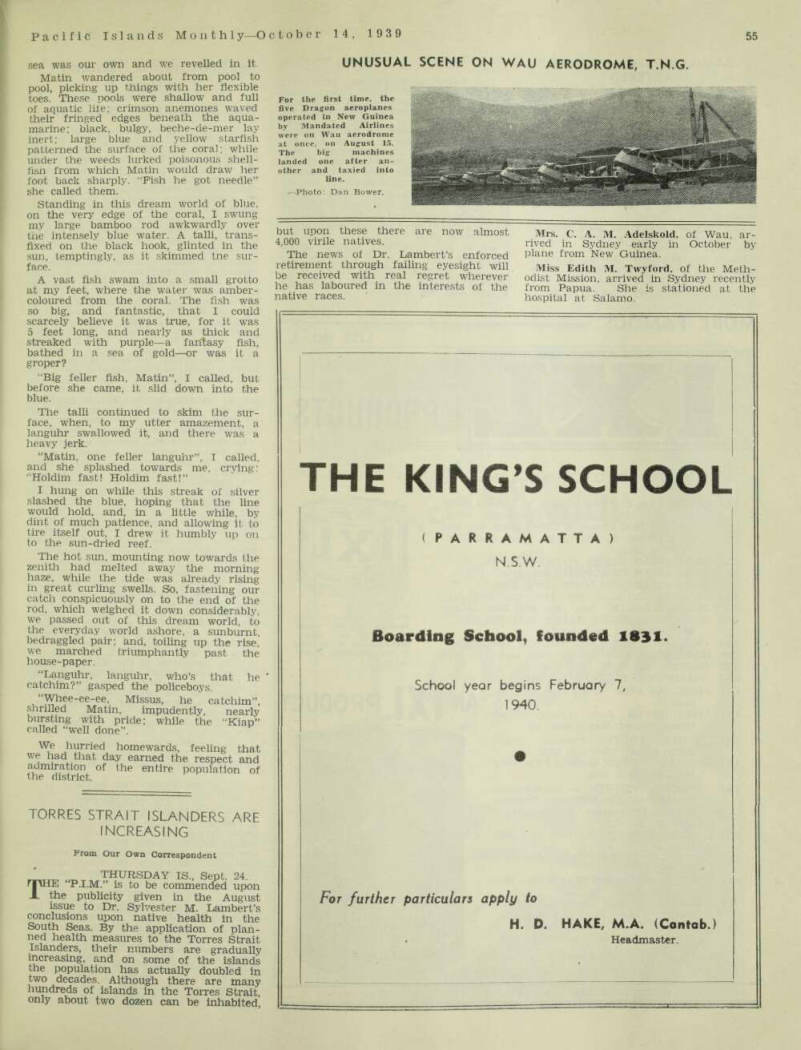
By HELEN NURTON —A Memory of Namatanai, New Ireland.
“pOME, Matin”, I said, one brilliant vy morning. “Let’s go fishing.”
“Gwan (go on) two feller go”, replied Matin, with an imperious wave of her arm.
To any native but Matin, I would have spun out a long-drawn sentence such as this: “Me like go catchim fish along soda water (the sea). Suppose you like, you come allesame ” but Matin seemed to have that sixth sense—or shall we call it first sense? —which enabled her to understand all I said, whether in Pidgin, the King’s English, or Australian slang.
She forthwith disappeared to the rear of the bungalow, and reappeared shortly, with a namboo (a long bamboo fishing rod) replete with line and strong black hook; and, armed with a few sticks of tobacco, we set forth, marching defiantly past the “house paper” (office) where the masters were busy.
The police boys tittered at Matin, who tossed her head pertly; the “Kiap” grin ned sardonically, while the master, busy with a native court, lifted his head, and called satirically: “Ho, what are you go ing to catch?”
“Catchim languhr”, retorted Matin.
At this sally the police boys roared with laughter, for the languhr was a large sporting fish, and it was considered, from a native point of view, quite beyond the province of a mere woman even to think of such a feat.
We slipped down past the house of the cus-cus (clerk), beneath big plane trees,
with leaves as large as fans, through the deep shade of the mango avenue—Matin padding softly behind me —and so into the blaze of the sunlit, shingly beach, curved like a sickle, with its two ends linked together by the reef, except for the deep blue passage through which small ships could pass.
The reef was high, and dry now, for the tide was well out.
In the opalescent shallows of the lagoon, some slim, little brown lads, clad in a string of beads, were spearing talli (small fish like sardines) and threading them on twine, I bought a silver chain of them for a stick of tobacco, and we paddled out along the reef as far as the passage.
Here we were in another world—a world of soft azure blue above, and sap phire below, radiating sparkles of silver light. The reef at our feet lay in great convolutions of multi-coloured coral, trending deeper and deeper into the purple depth. Here were enormous cauliflowers of creamy gold; tender spires of lavender blue; fancy blooms of deep rose, mingled with sage-green foliage, and purple shadows. Here and there were deep grottos, into which the water surged in translucent volume, glinting sapphire, emerald and jade and from which it emptied, gurgling, exposing the fairy forms for a moment to the re morseless rays of the tropical sun.
The air was soft, salt and balmy; the haze of the sea was on everything; we were at sea; and the salt breeze swept by us from the broad bosom of the Pacific, across the lagoon and ruffled the proud, feathery heads of the tall, old, Kanaka palms, fringing the shore. The land was not for us that morning; the
sea was our own and we revelled in it Matin wandered about from pool to pool, picking up things with her flexible toes. These pools were shallow and full of aquatic life; crimson anemones waved their fringed edges beneath the aqua marine: black, bulgy, beche-de-mer lay inert; large blue and yellow starfish patterned the surface of the coral; while under the weeds lurked poisonous shell fisn from which Matin would draw her foot back sharply. "Fish he got needle” she called them.
Standing in this dream world of blue, on the very edge of the coral, I swung my large bamboo rod awkwardly over the intensely blue water. A talli, trans fixed on the black hook, glinted in the sun, temptingly, as it skimmed tne sur face.
A vast fish swam into a small grotto at my feet, where the water was amber coloured from the coral. The fish was so big, and fantastic, that I could scarcely believe it was true, for it was 5 feet long, and nearly as thick and streaked with purple—a fantasy fish, bathed in a sea of gold—or was it a groper?
"Big feller fish, Matin”, I called, but before she came, it slid down into the blue.
The talli continued to skim the sur face, when, to my utter amazement, a languhr swallowed it, and there was a heavy jerk.
“Matin, one feller languhr”, I called, and she splashed towards me, crying: "Holdim fast! Holdim fast!”
I hung on while this streak of silver slashed the blue, hoping that the line would hold, and, in a little while, by dint of much patience, and allowing it to tire itself out, I drew it humbly up on to the sun-dried reef.
The hot sun, mounting now towards the zenith had melted away the morning haze, while the tide was already rising in great curling swells. So, fastening our catch conspicuously on to the end of the rod, which weighed it down considerably, we passed out of this dream world, to the everyday world ashore, a sunburnt, bedraggled pair; and, toiling up the rise, we marched triumphantly past the
house-paper.
“Languhr, languhr, who’s that he catchim?” gasped the policeboys.
“Whee-ee-ee, Missus, he catchim”, shrilled Matin, impudently, nearly bursting with pride; while the "Kiap” called “well done”.
We hurried homewards, feeling that we had that day earned the respect and admiration of the entire population of the district.
Advertisements & other items, p. 56 (1 item)
54
October 14, 193 9—P acific Islands Monthly
Increasing
Torres Strait Islanders Are
Prom Our Own Correspondent
Thursday Is., Sept. 24.
fTVHE “P.1.M.” is to be commended upon A the publicity given in the August issue to Dr. Sylvester M. Lambert’s conclusions upon native health in the South Seas. By the application of plan ned health measures to the Torres Strait Islanders, their numbers are gradually increasing, and on some of the islands the population has actually doubled in two decades. Although there are many hundreds of islands in the Torres Strait only about two dozen can be inhabited
but upon these there are now almost 4,000 virile natives.
The news of Dr. Lambert’s enforced retirement through failing eyesight will be received with real regret wherever he has laboured in the interests of the native races.
Mrs. C. A. M. Adelskold, of Wau. ar rived in Sydney early in October by plane from New Guinea.
Miss Edith M. Twyford, of the Meth odist Mission, arrived in Sydney recently from Papua. She is stationed at the hospital at Salamo.
Unusual Scene On Wau Aerodrome, T,N.G.
For the first time, the five Dragon aeroplanes operated in New Guinea by Mandated Airlines were on Wau aerodrome at once, on August 15.
The big machines landed one after an other and taxied into line.
Photo: Dan Bower.
Advertisements & other items, p. 57 (2 items)
55
Pacific Islands Monthl y—O ctober 14, 1939
The King’S School
(PARRAMATTA)
NSW.
Boarding School, founded 1831.
School year begins February 7, 1940.
For further particulars apply to
H. 0, HAKE, M.A. (Cantab.) Headmaster.
Samoa Customs Tariff
Altered
riE following alterations in the Sa moan Customs tariff came into operation on August 20 (according to the “Samoa Mail”).
Tobacco (exclusive of cigars and cig arettes) has been increased from 4/6 to 5 6 per lb.
Matches, which formerly came under the usual duty for all goods, i.e., invoice value, are now dutiable at 2/- per gross boxes. This may or may not mean an increase.
The duty on sugar has been increas ed to id. per lb. The previous duty on this item was about id. per lb.
Diesel and Dieseline fuel oils are now dutiable at 3d. per gallon instead of be ing subject to invoice price.
Exemptions formerly existing for coolie
rice and Chinese tobacco have been can celled.
The following are a few exemptions appearing in the new order: —Fresh eggs; seeds for horticultural or agricul tural purposes; cinematograph films and lantern slides for public exhibition; printing blocks supplied by advertisers for use in newspapers; printed advertis ing matter, trade catalogues and price lists, cut samples mounted in books or on folders or cards and colour cards.
Mr. A. Levett, who has been engaged in mission work for the London Mission ary Society at Beru, in the Gilbert Is lands, arrived in Australia recently on short furlough.
Mr. F. Hay, who is a member of the engineering staff of W. R. Carpenter and Co., Ltd., Rabaul, reached Sydney by the October steamer from New Guinea, on a short business visit.
Who is an "Enemy
Alien"?
Term Defined by N. Guinea Judge
From Our Own Correspondent RABAUL, October 6 THE “trading with the enemy” clause contained in the Defence Regula tions were defined by the Chief Judge (Mr. Justice Phillips) on September 28, when His Honour granted a storekeeper’s liquor license to Mr. G. Furter, a Ger man national carrying on business in Ra baul as a general merchant, and who is registered under the aliens restriction regulations.
Judge Phillips, after a comprehensive review of the Ordinances and Regula tions, as well as the points of common law, said that subjects of the hostile country who, after the outbreak of war, were residing, or carrying on business or were found in British territory, were “alien enemies”, except insofar as they had the license, express or implied, of the Crown to remain, reside, trade or come into British territory. He said that when a person had registered under aliens restriction regulations, that registration amounts “at least to a license to that person to remain” in British territory, and even “amounts to a command that he shall not depart from such territory without speacial leave for the purpose”.
In short, said His Honour, enemy sub jects who are permitted, expressly or im pliedly, by the Crown, to remain here, whether under restrictions such as cur few restrictions or not, and whether in terned or not, are considered at common law to be here under the protection of the King, and, as a consequence of be ing under the protection of the King, they must not abuse the King’s protec tion and must obey the law of the land.
Thus, like the King’s own liege sub jects, they are equally forbidden to trade with the enemy.
In conclusion. His Honour said that it was clear that Mr. Furter was a Ger man subject who had registered under the Defence National Security (Aliens Control) Regulations, and who, therefore, was now in this Territory by what amounted to the license of the executive authority, and was in this Territory un der the protection of the King. In short, he was not a person with whom trading is forbidden to British subjects. “There is. therefore, no reason, in my opinion, why his application for renewal of his storekeeper’s license should not be granted, and the same is hereby grant ed”.
Timber Resources Of Papua
From Our Own Correspondent
Pt. Moresby, Oct. 6.
IT is understood, in view of the pros pective shortage of timber in Aus tralia during the period of war, that in vestigations are being made to ascertain the possible supplies that might be made available from Papua, to replace timbers formerlv imported from Canada and the
U.S.A.
Dr. A. S. Prater, superintendent of the Presbyterian Mission’s Paton Memorial Hospital at Vila. New Hebrides, arrived in Sydney in October with his wife. They will spend three months’ furlough in Victoria. Dr. Prater is the son of Rev.
Maurice Prater, who is a missionary for the Presbyterian Church at Paama, New Hebrides, where he has already spent some 40 years and still is in active ser vice.
Advertisements & other items, p. 58 (2 items)
56
October 14, 193 9—P acific Islands Monthly
Products
MORE FAMOUS
LIST NO. 2.
L
PRODUCTS
XI
tomato s6?>g
Produced under the most modern hygienic conditions by the largest organisation of its bind in the Southern Hemisphere.
AN ■XL PRODUCT
DELICIOUS CANNED FOODS JAMS SOUPS SAUCES, ETC.
IXL SOUPS.—Boz. and 16oz. Cream of Tomato Soup.
Boz. and 16oz. Cream of Vegetable Soup.
Boz. and 16oz. Cream of Celery Soup. Boz. and 16oz. Cream of Pea Soup. Boz. and 16oz.
Toheroa Soup.
IXL TASMANIAN RICED POTATOES.—6Ib. tins.
IXL TASMANIAN CRAYFISH.—Boz. tins.
IXL TASMANIAN SCALLOPS.—I6oz. tins.
IXL PICKLES.—AII kinds, 60z., 140 z., and 18oz. Jars.
IXL TOMATO SAUCE.—4oz., lOoz. and 20oz. bottles.
IXL WORCESTERSHIRE SAUCE (OR RELISH).—
50z., lOoz. and 20oz. bottles.
IXL GOLDEN CORN.—5oz., Boz. and 16oz. tins.
IXL MARASCHINO CHERRIES.—6oz. and 13oz. Jars.
IXL OLIVES. —6oz. and 13oz. Jars.
IXL SOLIDPACK PIE APPLES.—24oz. tins, 61b. tins IXL JAMS. —All kinds, 120 z., 240 z. and 51b. tins.
IXL JAMS (in 11b. Jars). —Lemon Shred, Orange Shred, Marmalade, etc.
IXL CANNED FRUlTS.—Peaches, Pears, Apricots, etc., 16oz. and 30oz. tins.
IXL SPECIAL GOLDEN QUEEN PEACHES.
16oz. and 30oz. tins.
IXL SPECIAL FRUITS. Gooseberries.
Blackberries, Blackcurrants, Cherries, Grapes, Greengages, Golden Drops, Quinces, etc.
IXL CANNED TOMATOES.—I6oz. and 30oz.
tins.
IXL CRUSHED PINEAPPLES.—I6oz. and
30oz. tins.
IXL CHOICE PIECES PINEAPPLES—I6oz.
and 30oz. tins.
IXL BAKED BEANS (with TOMATO
SAUCE). —40z., lOoz. and 16oz. tins.
IXL SPAGHETTI (in Tomato Sauce with Cheese). —40z., Boz., and 16oz. tins.
Obtainable from all Leading Island
Storekeepers.
H. JONES & CO. PTY. LTD., HOBART & SYDNEY.
War Tax On Gold
Application to Papua and Mew Guinea
IN an effort to meet Australia’s colos sal war expenditure, a new tax on gold production, applicable to New Guinea and Papua, was announced by the As sistant Federal Treasurer on September 15. He said that the tax would be three quarters of the amount by which the price exceeded £9 Aust. per fine ounce.
The Gold Tax Bill was pushed through the House of Representatives and came before the Senate on September 20, where it met unexpected opposition. Westralian Senators spiritedly criticised the meas ure, declaring that a tax on gold com panies’ profits would have been much more equitable. Senator Foil pointed out that the price of gold had risen sharply as a result of war conditions and that the Government was merely seeking to obtain a share of the unearned incre ment.
A compromise was eventually made, whereby the tax will be only one-half of the amount in excess of £9, instead of three-quarters.
Regulations were also gazetted, placing the onus of payment on the producer, who is obliged to deliver the gold to the Commonwealth Bank, or its agent, where the duty will be deducted from the price paid.
The tax, no doubt, will be criticised in New Guinea and Papua, owing to the heavier costs of operating imposed by the war; but nevertheless the price now received for gold, after the impost has been paid, is still higher than the rates ruling when the outbreak of war caused the price to reach a new record high.
New Guinea mining companies already pay a 5 per cent, royalty to the N.G.
Administration; although this is not im posed in Papua. Until recently, all pros pectors and small “shows” were com pelled to pay the 5 per cent. tax. but relief measures for miners operating in a small way Have been promised by the Australian Government.
Removing Gold From New Guinea
A EUROPEAN goldminer, A. C. Eldred. who was arrested in Sydney in Sep tember, and sent to Rabaul under es cort, to meet a charge of removing gold from the Territory of New Guinea with out giving the necessary notice to the Customs authorities, pleaded guilty in the Supreme Court and was fined £lOO, early in October.
It appears that Eldred left Salamaua in January, 1935, and took with him 145 ounces of gold, without giving any no tice to the Customs authorities, and with out paying royalty.
Eldred said he brought the gold away from the Territory 4i years ago, with the intention of storing it against a “rainy day”. He had been 15 years in the Ter ritory, and had known many ups and downs. He had decided not to convert the gold into currency, but to keep it— otherwise he probably would have spent the money. He knew very little about the procedure attending the export of gold from N. Guinea, and was not aware that, when he tried to convert it into currency in Australia, there was an im mediate check-up between the currency authorities in Australia and the tax-col lecting authorities in New Guinea to see that the gold royalty had been paid.
Bishops Of Four
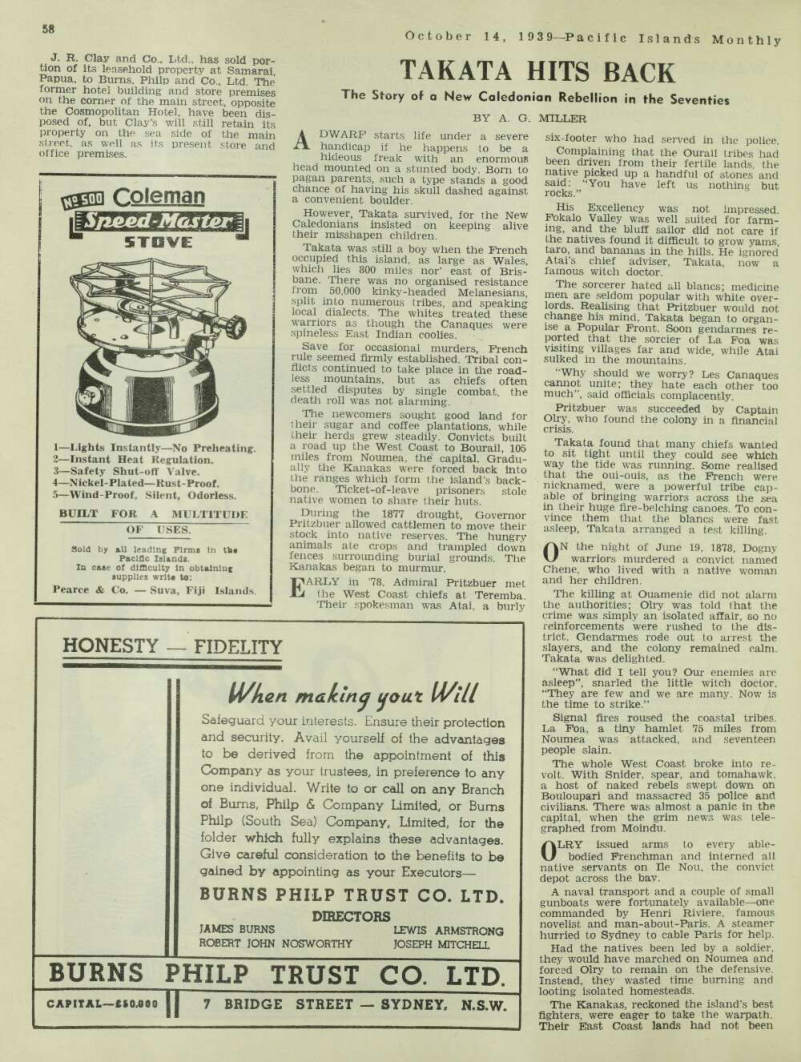
Nations
At Farewell Function in Rabaul
From Our Own Correspondent
Rabaul, Oct. 6.
THE universality of the Roman Catholic Church was emphasised yesterday at a farewell function, given by the mem bers of the Church in Rabaul to Bishop Vesters, 0.8. E., who, owing to ill-health, is retiring from .the work in N. Guinea.
In responding to the toast of his health Bishop Vesters drew attention to the fact that on Tuesday last, during the consecration ceremony of his successor, Bishop Scharmach, there had been four Bishops present, each one from a differ ent country. Bishop Scharmach was a Pole: Bishop Wade, of Bougainville, was an American; Bishop Lorks, from Aitape, was a German: and he. himself was a Hollander.
During the Vunapope Mission’s activi
ties in New Guinea, in the past fifty seven years, there had been two conse crations; that of Bishop Vesters in 1923, and of Bishop Scharmach on Tuesday last, when Bishop Vesters acted as Consecrating-bishop. Bishop Coupee had founded the mission in 1882.
Bishop Vesters, who is 63 years of age, has been in indifferent health for some years now, and—as he said in his reply —was making way for a younger and stronger man to carry on the work. He leaves for Australia this week. Bishop Vesters was decorated with the Order of the British Empire for the splendid work he performed during the volcanic erup tion in 1937.
Dr. Raymond Firth who, for a time, was Professor of Anthropology at the University of Sydney (and later has been a lecturer at the University of London) is now engaged in field research in Ma laya. Dr. Firth is well-known for his book on Tikopia (8.5.1.). Mrs. Firth ac companied him to Singapore.
J. R. Clay and Co.. Ltd., has sold por tion of its leasehold property at Samarai, Papua, to Burns. Philp and Co.. Ltd. The former hotel building and store premises on the corner of the main street, opposite the Cosmopolitan Hotel, have been dis posed of. but Clay’s will still retain its property on the sea side of the main street, as well as its present store and office premises.
Advertisements & other items, pp. 59-60 (2 items)
57
Pacific Islands Monthl y—O ctober 14, 1939
Good
health’ with
roleman
STOVE
1— lights Instantly—No Preheating;. 2 Instant Heat Regulation. 3 Safety Shut-off Valve. 4 Nickel-Plated—Rust-Proof. 5 Wind-Proof, Silent, Odorless.
BUILT FOR A MULTITUDE
OF USES.
Sold by all leading Firm* In tta* Pacific Islands.
In case of difficulty In obtaining supplies writ* to: Pearce & Co. Suva, Fiji Islands.
HONESTY FIDELITY
IVhen gout IVlll
Safeguard your interests. Ensure their protection and security. Avail yourself of the advantages to be derived from the appointment of this Company as your trustees, in preference to any one individual. Write to or call on any Branch of Bums, Philp <S Company Limited, or Bums Philp (South Sea) Company, Limited, for the folder which fully explains these advantages.
Give careful consideration to the benefits to be gained by appointing as your Executors—
BURNS PHILP TRUST CO. LTD.
DIRECTORS
I JAMES BURNS LEWIS ARMSTRONG
ROBERT JOHN NOSWORTHY JOSEPH MITCHELL
BURNS PHILP TRUST CO. LTD.
capital—£lo.eoo 7 BRIDGE STREET SYDNEY. N.S.W.
Takata Hits Back
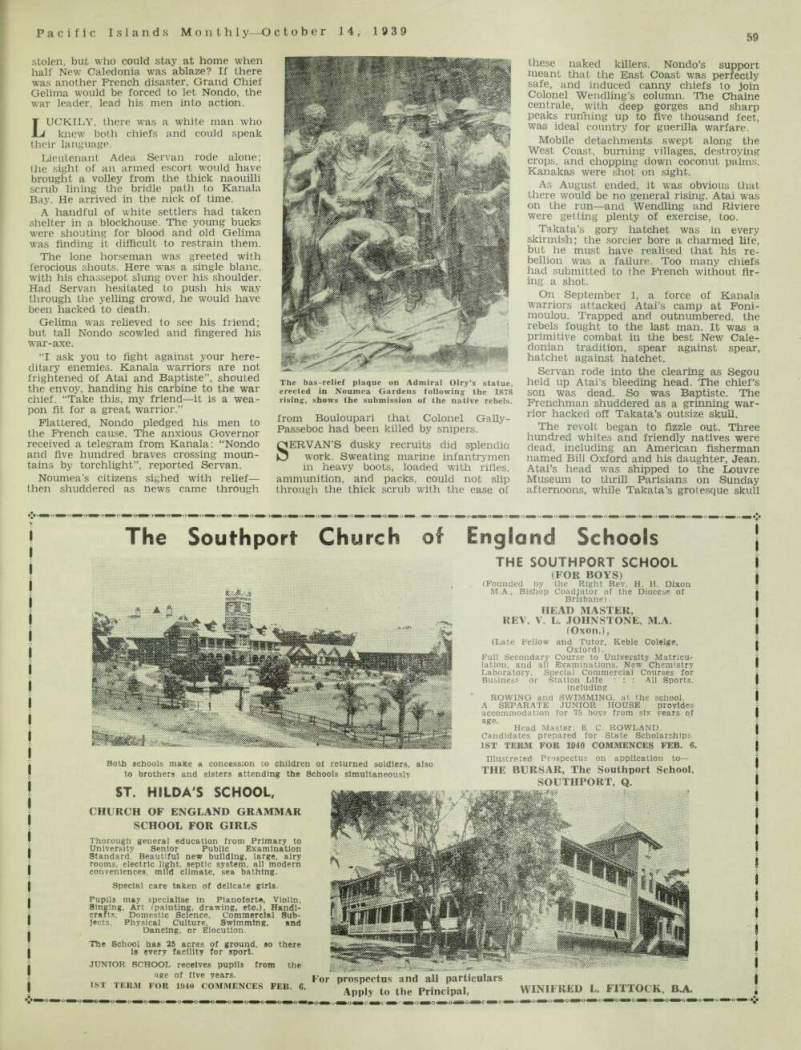
The Story of a New Caledonian Rebellion in the Seventies
By A. G. Miller
A DWARF starts life under a severe handicap if he happens to be a hideous freak with an enormous head mounted on a stunted body. Bom to pagan parents, such a type stands a good chance of having his skull dashed against a convenient boulder.
However, Takata survived, for the New Caledonians insisted on keeping alive their misshapen children.
Takata was still a boy when the French occupied this island, as large as Wales, which lies 800 miles nor’ east of Bris bane, There was no organised resistance from 50,000 kinky-headed Melanesians, split into numerous tribes, and speaking local dialects. The whites treated these warriors as though the Canaques were spineless East Indian coolies.
Save for occasional murders, French rule seemed firmly established. Tribal con flicts continued to take place in the road less mountains, but as chiefs often settled disputes by single combat, the death roll was not alarming.
The newcomers sought good land for 1 heir sugar and coffee plantations, while their herds grew steadily. Convicts built a road up the West Coast to Bourail, 105 miles from Noumea, the capital. Gradu ally the Kanakas were forced back into the ranges which form the island’s back bone. Ticket-of-leave prisoners stole native women to share their huts.
During the 1877 drought, Governor Pritzbuer allowed cattlemen to move their stock into native reserves. The hungry animals ate crops and trampled down fences surrounding burial grounds. The Kanakas began to murmur.
EARLY in ’7B. Admiral Pritzbuer met the West Coast chiefs at Teremba.
Their spokesman was Atai. a burly
six-footer who had served in the police.
Complaining that the Ourail tribes had been driven from their fertile lands the native picked up a handful of stones and said: “You have left us nothing but rocks.”
His Excellency was not impressed.
Fokalo Valley was well suited for farm ing, and the bluff sailor did not care if the natives found it difficult to grow yams taro, and bananas in the hills. He ignored Atai’s chief adviser, Takata, now a famous witch doctor.
The sorcerer hated all blancs; medicine men are seldom popular with white over lords. Realising that Pritzbuer would not change his mind, Takata began to organ ise a Popular Front. Soon gendarmes re ported that the sorcier of La Foa was visiting villages far and wide, while Atai sulked in the mountains.
“Why should we worry? Les Canaques cannot unite; they hate each other too much”, said officials complacently.
Pritzbuer was succeeded by Captain Olry, who found the colony in a financial crisis.
Takata found that many chiefs wanted to sit tight until they could see which way the tide was running. Some realised that the oui-ouis, as the French were nicknamed, were a powerful tribe cap able of bringing warriors across the sea in their huge fire-belching canoes. To con vince them that the blancs were fast asleep, Takata arranged a test killing.
ON the night of June 19, 1878, Dogny warriors murdered a convict named Chene, who lived with a native woman and her children.
The killing at Ouamenie did not alarm the authorities; Olry was told that the crime was simply an isolated affair, so no reinforcements were rushed to the dis trict. Gendarmes rode out to arrest the slayers, and the colony remained calm.
Takata was delighted.
“What did I tell you? Our enemies are asleep”, snarled the little witch doctor.
“They are few and we are many. Now is the time to strike.”
Signal fires roused the coastal tribes.
La Foa, a tiny hamlet 75 miles from Noumea was attacked, and seventeen people slain.
The whole West Coast broke into re volt. With Snider, spear, and tomahawk, a host of naked rebels swept down on Bouloupari and massacred 35 police and civilians. There was almost a panic in the capital, when the grim news was tele graphed from Moindu.
OLRY issued arms to every able bodied Frenchman and interned all native servants on He Nou, the convict depot across the bay.
A naval transport and a couple of small gunboats were fortunately available—one commanded by Henri Riviere, famous novelist and man-about-Paris. A steamer hurried to Sydney to cable Paris for help.
Had the natives been led by a soldier, they would have marched on Noumea and forced Olry to remain on the defensive.
Instead, they wasted time burning and looting isolated homesteads.
The Kanakas, reckoned the island’s best fighters, were eager to take the warpath.
Their East Coast lands had not been
stolen, but who could stay at home when half New Caledonia was ablaze? If there was another French disaster. Grand Chief Gelima would be forced to let Nondo, the war leader, lead his men into action.
LUCKILY, there was a white man who knew both chiefs and could speak their language.
Lieutenant Adea Servan rode alone; the sight of an armed escort would have brought a volley from the thick naouilli scrub lining the bridle path to Kanala Bay. He arrived in the nick of time.
A handful of white settlers had taken shelter in a blockhouse. The young bucks were shouting for blood and old Gelima was finding it difficult to restrain them.
The lone horseman was greeted with ferocious shouts. Here was a single blanc, with his chassepot slung over his shoulder.
Had Servan hesitated to push his way through the yelling crowd, he would have been hacked to death.
Gelima was relieved to see his friend; but tall Nondo scowled and fingered his war-axe.
“I ask you to fight against your here ditary enemies. Kanala warriors are not frightened of Atai and Baptiste”, shouted the envoy, handing his carbine to the war chief. “Take this, my friend —it is a wea pon fit for a great warrior.”
Flattered, Nondo pledged his men to the French cause. The anxious Governor received a telegram from Kanala: “Nondo and five hundred braves crossing moun tains by torchlight”, reported Servan.
Noumea’s citizens sighed with relief— then shuddered as news came through
from Bouloupari that Colonel Gaily- Passeboc had been killed by snipers.
SERVAN’S dusky recruits did splendia work. Sweating marine infantrymen in heavy boots, loaded with rifles, ammunition, and packs, could not slip through the thick scrub with the ease of
these naked killers. Nondo’s support meant that the East Coast was perfectly safe, and induced canny chiefs to join Colonel Wendling’s column. The Chaine centrale, with deep gorges and sharp peaks running up to five thousand feet, was ideal country for guerilla warfare.
Mobile detachments swept along the West Coast, burning villages, destroying crops, and chopping down coconut palms.
Kanakas were shot on sight.
As August ended, it was obvious that there would be no general rising. Atai was on the run—and Wendling and Riviere were getting plenty of exercise, too.
Takata’s gory hatchet was in every skirmish; the sorcier bore a charmed life, but he must have realised that his re bellion was a failure. Too many chiefs had submitted to the French without fir ing a shot.
On September 1, a force of Kanala warriors attacked Atai’s camp at Foni moulou. Trapped and outnumbered, the rebels fought to the last man. It was a primitive combat in the best New Cale donian tradition, spear against spear, hatchet against hatchet.
Servan rode into the clearing as Segou held up Atai’s bleeding head. The chief’s son was dead. So was Baptiste. The Frenchman shuddered as a grinning war rior hacked off Takata’s outsize skull.
The revolt began to fizzle out. Three hundred whites and friendly natives were dead, including an American fisherman named Bill Oxford and his daughter, Jean.
Atai’s head was shipped to the Louvre Museum to thrill Parisians on Sunday afternoons, while Takata’s grotesque skull
The bas-relief plaque on Admiral dry’s statue, erected in Noumea Gardens following the 1878 rising, shows the submission of the native rebels.
adorned a stake in Noumea. One night this grim trophy vanished. It may have been souvenired by a soldier, but any witchdoctor would have given his right hand for such a priceless relic.
OLRY handed out medals to Nondo and his allies, who also secured the pick of their dead foemen’s wives.
Henri Riviere wrote a book on this strange campaign, then went to Tonkin.
When the Black Flags—river pirates—be seiged Hanoi, he led a sortie from the citadel. He was wounded, taken prisoner, and impaled alive on a stake, together with thirty of his men. France avenged this deed, and Indo-China became a French colony.
Grateful New Caledonians erected a statue to Olry. Kanala warriors served in the Great War; others helped to quell a minor rising in 1917.
Time plays queer jokes. Men whose fathers fought under the Black Flags now toil in nickel mines not far from La Foa and Kanala.
The Kanakas sit in the shade and watch their women working in the fields. Their lands are native reserves, secure from speculators and planters; the tribesmen are warriors and not indentured labourers.
Takata’s rising was a failure, but in the long run les Canaques have benefited, be cause a thousand rebels followed Atai and his ferocious dwarf to death.
Advertisements & other items, pp. 61-62 (2 items)
59
Pacific Islands Monthl y—O ctober 14, 1939
The Southport Church of England Schools
It m ,
THE SOUTHPORT SCHOOL
(FOR BOYS)
(Founded by the Right Rev. H. H. Dixon M.A., Bishop Coadjutor of the Diocese of Brisbane).
HEAD MASTER,
REV. V. L. JOHNSTONE, M.A.
(Oxon.),
(Late Fellow and Tutor, Keble Colelge, Oxford).
Full Secondary Course to University Matriculation, and all Examinations. New Chemistry Laboratory. Special Commercial Courses for Business or Station Life : : : All Sports, including ROWING and SWIMMING, at the school.
A SEPARATE JUNIOR HOUSE provides
accommodation for 75 boys from six years of age.
Head Master; E C. ROWLAND.
Candidates prepared for State Scholarships IST TERM FOR 1940 COMMENCES FEB. 6.
Both schools make a concession to children ol returned soldiers, also to brothers and sisters attending the Schools simultaneously
ST. HILDAS SCHOOL,
Illustrated Prospectus on application to—
THE BURSAR, The Southport School,
SOUTHPORT, Q.
CHURCH OF ENGLAND GRAMMAR
SCHOOL FOR GIRLS
Thorough general education from Primary to University Senior Public Examination Standard. Beautiful new building, large, airy rooms, electric light, septic system, all modern conveniences, mild climate, sea bathing.
Special care taken of delicate girls.
Pupils may specialise in Pianoforte, Violin, Singing, Art (painting, drawing, etc.), Handicrafts. Domestic Science, Commercial Subjects, Physical Culture, Swimming, and Dancing, or Elocution.
The School has 25 acres of ground, so there is every facility for sport. the W&& mm JUNIOR SCHOOL receives pupils from t „ aee of flve vears ' For prospectus and all particulars IST TERM FOR 1940 COMMENCES FEB. C.
Apply to the Principal,
WINIFRED L. FITTOCK, B.A,
No Light can steal its Flavor.
£Mje RIBBON
In case of difficulty in obtaining supplies, write to Box 1861 K., G.P.0., Sydney.
CHAPMAN
LAUNCHES
/or work or pleasure
Both trim, seaworthy craft, the Chapman Coach-house model and the Chapman Cabin Launch are particularly suitable for island conditions.
The Coach-house model with the closed-in cabin providing ample storage space is an ideal work-boat to meet steamers, carry stores and for inter-island transport. The Cabin model is a popular cruising craft, for fishing and pleasure trips. The cabin is cool and roomy enough to sleep two.
Both craft are powered with a famous Chapman PUP Engine. Write now for details and prices.
CHAPMAN & SHERACK
26 Clara Street, Ersluneville, N.S.W.
ENGINE WANUFACTURERS FOR I HIRIY YEARS
Danes In The South
Seas
Inquiry from Copenhagen
Letter to the Editor FROM the writings of famous author Robert Louis Stevenson, I have learned that when he made a voyage from the Marquesas Islands to Faka rava atoll, Eastern Pacific, on board the “Casco” in 1888-89, he engaged a Danish mate as pilot. In two books by the well known French author and yachtsman, Alain Gerbault (“Sur La Route de Re tour” and “L’Evangile du Soleil”), men tion is made of that Dane living on the island of Makemo (Perfection), in the Tuamotu Group. I am anxious to find out the personal history of this Danish sailor, but both Stevenson and Gerbault omit to give his name.
Seeking information, I wrote to R.L.S.’s stepson, Mr. Lloyd Osbourne, whose address is Nice, France, and he replied that “Mr. Stevenson engaged a man named von der Goltz to guide the ‘Casco’ from Marquesas to Tahiti. He was a fine-looking old fellow of 60 or so”.
The name von der Goltz is well-known in Danish army history—in connection with the Thirty Years’ War and with the period from 1789 to 1818; but both mem bers of the family who came to Den mark returned to their native countries, Poland and Germany, without leaving an cestors in Denmark. The name is still famous in Germany and belongs to a noble family.
If von der Goltz was 60 when R. L. S. engaged him in the Marquesas, then he must have lived to a ripe old age, for Gerbault says he met the same man when he visited Makemo around 1924.
Another Dane, whom I am trying to trace, is a South Seas trader named Or toft (or Orntoft), better known in the Pacific as “Leonard”. In 1899 the Ger man firm, Hernsheims, seeking to estab lish a station at Matty (New Guinea) en gaged Ortoft, who had had considerable experience in the Solomons and in New Ireland. I understand that he picked up the native language, took three wives, and eventually succeeded in making himself chief of the Matty natives.
Can any reader of the “P.1.M.” verify the above details concerning the Danes mentioned or give me any further history and information concerning them?
I am, etc.,
Bent R. Nielsen.
28, 1. Oester Voldgade, Copenhagen. K., Denmark. 30/7/1939.
EDITORIAL NOTE.—Mr. Nielsen is a Danish journalist who has undertaken the task of tracing Danes who have wan dered about the Pacific and other parts, and led adventurous lives, during the past century. As a result of an article in the “Pacific Islands Monthly”, he was able to publish recently in the Denmark news paper “Vordingborg Venstreblad” an ac count of the life of “Deliverance Harry” (Henrik Enevoldsen, born at Langebaek.
Denmark), who lived for 45 years on lonely Deliverance Island, in Torres Strait. Islands residents who possess knowledge of the history of Danish trad ers or sailors who roved among the Paci fic Islands during the last 50 years or so would be doing an appreciated favour if they communicated with Mr. Nielsen at his address, shown above.
Miss M. J. Mune, of the Fiji Post and Telegraph Department, is spending leave in Australia.
Treatment Of
Germans
in New Guinea and Samoa
IN the September issue of this journal and in early-printed sections of the present issue, it is indicated that the New Guinea Administration had taken few steps in relation to German subjects in that Territory, beyond compiling a register of them and placing upon them an obligation to report at frequent in tervals.
It is now indicated, however, that dur ing the past three or four weeks the Administration has made a very careful investigation of the Germans living in the Territory, and action has been taken accordingly. During the month, 27 Ger mans have been sent to Australia under escort —16 from the Lutheran Mission at Finschhafen, 2 from the Lutheran Mis sion at Madang, and 9 from the town of Rabaul, and one or two outstations.
It is interesting to note that none of the Germans from the Roman Catholic Mission stations have been sent away for internment —only the Lutherans. It had been reported on occasions during the last couple of years that a number of younger men, coming from Germany to the Lutheran Missions in New Guinea, appeared to be deeply tainted with Nazi ideas, and that their attitude toward the British at times had been aggres sive, if not offensive.
The New Guinea Administration also has made certain adjustments in regard to the employment of aliens —two or three aliens, mostly females, had been employed in minor positions in Rabaul — and it is possible that two or three more Germans may be sent to Australia for internment, later.
Mr. Furter and Mr. Paatsch two well-known and respected German mer chants in Rabaul—have been permitted to carry on in their respective businesses.
In Camp In Samoa
Prom Our Own Correspondent APIA, Sept. 23.
A NUMBER of Germans, resident in Western Samoa, were placed in an internment camp near Apia, on the out break of war. Within three weeks, near ly half of them had been released on parole. The remainder are living very pleasantly and comfortably in a place that is more like a seaside holiday resort than a war-prisoners’ camp.
Death Penalty for Murderers of Patrol Officer
Patrol Officer
TWO natives of the Aitape area of New Guinea, who had been found guilty of the murder of Patrol Officer Elliott at Wanali, in the Aitape hinterland, on July 1, came before Judge Griffiths in the Supreme Court in Rabaul, at the end of September, and were sentenced to death.
The judge said that much of the evi dence in regard to the murder of the patrol-officer was confused, but it was clear that the two accused crept upon the official while he was in a rest-house defending himself from an attack by the villagers, and that they fatally speared him from behind.
Mr. G. A. Bayer, manager of the new Hotel Moresby, Port Moresby, who recent ly underwent an appendicitis operation, is still in hospital, but is making satis factory progress.
Hon. George Aumuller, M.L.C.
Prom Our Own Correspondent
Pt. Moresby, Oct. 6.
r:E vacancy on the Legislative Coun cil of Papua, caused by the death of Mr. “Gus” Nelsson, has been filled by the appointment of Mr. George E.
Aumuller, as from September 21.
Hon. George Aumuller has resided in the Territory of Papua for the past 30 years—and during that whole period he has been in the service of Burns. Philp and Co. Ltd. He is best known as the manager of the ‘ Company’s branch at Samarai. At present, he is in Port Mores by, acting as manager there during the absence of Mr, G. J. A. Moore, on leave in Australia.
The appointment of Mr. Aumuller has given general pleasure and satisfaction in Papua. There is no couple in Papua
held in higher regard than Mr. and Mrs. Aumuller; and the natural kind ness and courtesy of Mr. Aumuller, com bined with his shrewd judgment and long experience of Territory conditions, fit him admirably to be a member of the Council.
The Anglican New Guinea Mission’s recently-built Cathedral of St. Peter and St. Paul, at Dogura, Eastern Papua, will be consecrated on October 29. It contains a memorial window for Rev. Samuel Tomlinson, one of the pioneers of the Mission, who is buried in the cathedral. A window of St. George forms the memorial of Rev. G. E. Down ton, for some years a missionary in Papua, and later secretary of the Aus tralian Board of Missions in Victoria. A hand-made sanctuary lamp, of copper,
has been placed in the cathedral in mem ory of Miss Nellie Hullett, who went to the Mission from Adelaide and was there 17 years. A coloured window of St. Laur ence, made in Melbourne, will be placed in the cathedral as the gift of the Heralds of the King, the children’s or ganisation of the A.B.M. in Australia.
Rev. Clifford L. Welch, of the London Missionary Society. Nauru, Central Paci fic, arrived in Melbourne recently.
Advertisements & other items, pp. 63-64 (2 items)
61
Pacific Islands Monthl y—O ctober 14, 1939
For Island Homes
Guest House Wanted
Will purchase Guest House or small Hotel in good location Pacific Islands.
Send full particulars, price, to — C/o. “Pacific Islands Monthly”, Box 3408 R, G.P.0., Sydney.
FOR ISLAND HOMES
You can have all the convenience of electric light and power, by installing a home lighting plant equipped with Clyde storage batteries. Clyde Plates are specially designed for slow discharge over long periods. At the snap of a switch, the unfailing power of Clyde Batteries will illuminate your home, operate your wireless, fans, refrigerators and other electrical appliances.
Clyde Home Lighting Batteries are fully guaranteed .
HOME JJGHTING BATTERIES
Sales & Service Division, 61-65 Wentworth Ave., Sydney.
Island Agents: Burns, Philp & Co. Ltd. W. R. Carpenter & Co., Ltd, Rabaul: John L. Peadon Ltd. , Fiji: Morris Hedstrom Ltd.
Eaten Up with
RHEUMATISM
& Backache
Now Fit as a Fiddle,
Thanks to Cystex
NURSE AT LAST FINDS A MEDICINE
TO END HER CHRONIC RHEUMATISM
Few people have the advantages of a Nurse in being able to call in the best medical advice for her health troubles, so the testimony of Nurse G, G. of Melton Mowbray is especially interesting to sufferers from Rheumatism and other Kidney and Bladder Troubles.
“I don't often try things from advertisements hxd I ventured to try your Cystex for Rheumatism which I have suffered from for years, and 1 feel 1 must tell you how much I have benefited from it after only a small box. / have now ordered from my chemist a large size and he fells me he sells a great deal of it."
Nurse G. G.
6 YEARS’ RHEUMATISM GONE
”1 had suffered for about six years with Rheumatism in the leys. I had three injections in one hip which lasted four years and then was just as bad as ever. 1 took Cystex and the first dose put me right, but I Kept on taking them for a month and I am quite free from ailments now."- (Sgd.) G. H. Gibbs, R.M.D. Wakefield, Nelson.
Both these people purchased Cystex on guarantee that if it did them no good they could get money back.
If you suffer from ;
RHEUMATISM, SCIATICA, NEURITIS,
LUMBAGO, PAINS IN BACK, NERVOUS-
NESS, DIZZINESS, LEG PAINS, CIRCLES
UNDER EYES, LOSS OF ENERGY and
APPETITE, PLTFY ANKLES, BURNING.
SMARTING PASSAGES, or have to
“GET UP NIGHTS”
headache
CIRCLES
UNDER EYES
NERVOUSNESS.
GAS 6-BLOATING.
DIZZINESS.
AND LOSS OF
I VIGOUR
[ DRY SKIN
m
BACKACHE
RHEUMATISM
A* 0 LUMBAGO
ACIDITY.
DISTURBED
DIGESTION.
: u i
BURNING.p:
SMARTINCjc
ITCHING, h
BLADDER
WEAKNESS
GETTING
NIGHTS
LEG PAINSM-r
~-i V >i. vn I
SWOLLEN
ANKLES
tone and clean raw, sore, sick kidneys and bladder and to remove acids and poisons from your system, safely, quickly aud surely, vet contains no harsh, harmful or dangerous drugs.
Cystex works in these 3 ways to end your troubles ; the chauces arc 100 to 1 that your kidneys are at fault, but you will soon be well again if vou take the right medicine for these troubles.' Thanks to Cystex, there is now a positive, speedy, guaranteed remedy for all the troubles shown above. An eminent physician has discovered that every one of these ailments is due to kidney trouble, i.e., the faulty elimination by the Kidneys of waste matters, toxic poisons and acids (including the dreaded uric acid) from the system. This famous doctor has given ids valuable prescription to the world, now known everywhere as Cystex—and approved by Doctors and Chemists in 73 countries—the medicine that must do you good or cost you nothing.
Cystex Helps Nature
5 Ways
The Cystex treatment is highly scientific, being specially compounded to soothe.
CYSTEX
(1) Starts killing the germs which are attacking your Kidneys, Bladder and urinary system in two hours, yet is absolutely harmless to human tissue. (-) Gets rid of health-destroying, deadly poisonous acids with which your system has become saturated. (3) Strengthens and reinvigorates the kidneys, protects you from the ravages of diseaseattack ou the delicate filter organism, and stimulates the entire system.
NO BENEFIT—NO PAY
This is the only fair and honest way of selling a medicine. Go to your chemist today for Cystex. If it does not put you right, return the empty package and your money will be refunded in full. Act now ! In 24 hours you will feel hotter and he completely well in 1 week. The Guarantee protects you. Now in 3 sizes: 1/9, 4/-, 8/.
This is a
GUARANTEED
Remedy
Sooner or Later Nearly Everyone Needs
Cystex
For the KIDNEYS, BLADDER AND RHEUMATISM
SCHAFFER 4 CO.. STONET.
"Papuan Masquerade"
Significance of Orokolo Ceremonies
MR. F. E. WILLIAMS, M.A., B.Sc., Dip.
Anth., the indefatigable Govern ment Anthropologist of Papua, author of half a dozen large tomes on Papuan culture, as well as numerous offi cial reports on the practical application of anthropological principles to native administration and development, has re cently completed, for publication by the Oxford University Press, a work which should be of absorbing interest in its field.
Under the engaging title of “Papuan Masquerade”, the work deals with the elaborate and protracted series or cycles of ceremonies known as Heveke, of the Orokolo Bay people of Papua. The name, Heveke, is that given to the elaborate masks and head-dresses prepared and worn by the Elema natives of the Gulf Division.
Starting in 1922, Mr. Williams has had these ceremonies under intermittent ob servation for the past 15 years—surely an anthropological field-work marathon. It took him some time to appreciate what he now refers to as “the sheer dimensions of an undertaking of vmich a primitive Papuan people were capable”. Coming to that realisation, he went back to the Gulf a number of times to fill in the gaps in his understanding of the Heveke implica tions.
Without wishing to detract from the interest of the book itself when it is available, one may gather from an article by Mr. Williams in the May issue of “Mankind” (journal of the Anthropologi cal Societies of Australia) something of the social background, the legendary origin, and the artistic setting of the various phases of a Heveke cycle, which may last from 10 to 25 years. One of the ceremonies in the cycle represents, for instance, the arrival of a sea-monster on the beach (“the part of the monster is played by a horde of men who gather secretly on the beach . . . armed with drums, shell trumpets, rattles and wea pons”) to which a number of youths are presented to be initiated. The fearsome monster leaps upon the youths with “the most indescribable concert of noises”, after which the monster “sweeps along the beach towards the village, turns in, and comes to a halt before tne eravo” (meet ing house).
Then follow ceremony after ceremony, phase after picturesque phase of the cycle. It is evident from the note of eager enthusiasm that characterises Williams’ treatment of the subject, in the article referred to. that he has himself become caught up in the spirit of the thing— his admiration for it is explicit in the concluding paragraph:— “The Heveke cycle, in its extent and complexity and the degree of effort and organisation which it implies, is a thing which I personally view with consider able admiration; and the more I have learned about it. the greater my admira tion has become. It will be a sad thing if the rising generation of Orokolons have lost the spirit which their fathers had, and are unable to face this great under taking again.”
Surely this is a challenge not to the natives aIone!—“ANTHROPOS”.
Mr. R. E. Hendrik sen, of the Lands and Survey Department, Apia, arrived in New Zealand from Western Samoa by the September “Maui Pomare”.
Successful Sports Meeting Held At Tavua Goldfield, Fiji
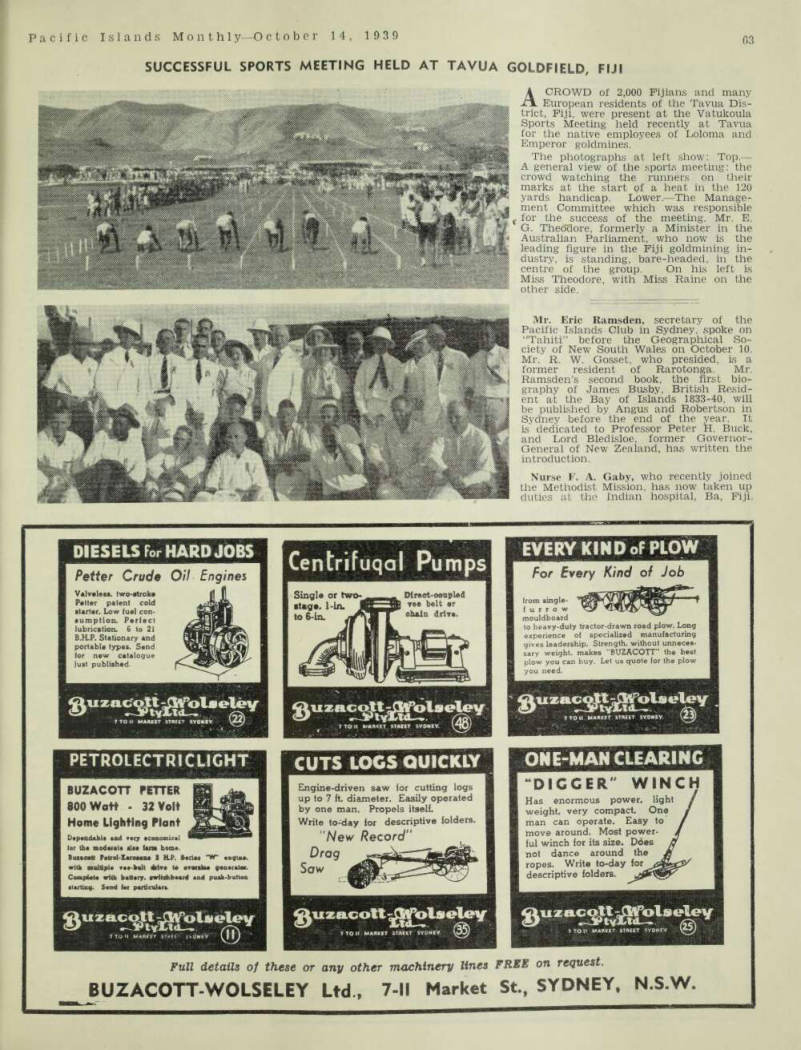
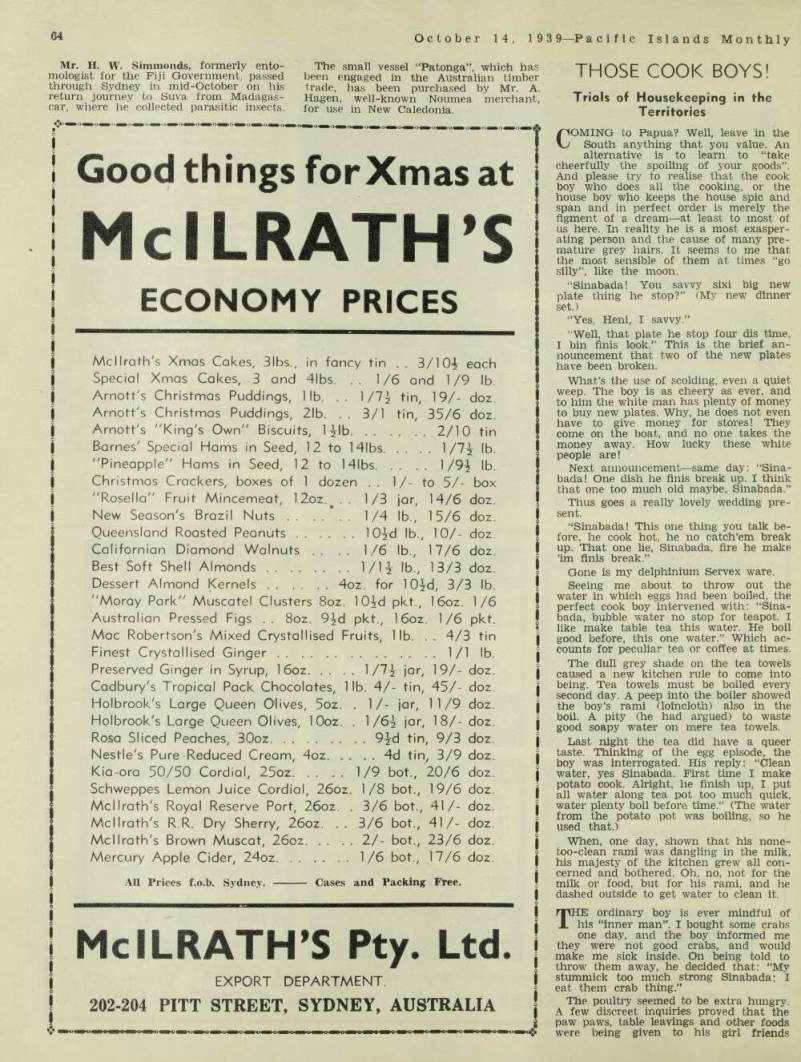
A CROWD of 2,000 Fijians and many European residents of the Tavua Dis trict, Fiji, were present at the Vatukoula Sports Meeting held recently at Tavua for the native employees of Loloma and Emperor goldmines.
The photographs at left show: Top.— A general view of the sports meeting; the crowd watching the runners on their marks at the start of a heat in the 120 yards handicap. Lower.—The Manage ment Committee which was responsible for the success of the meeting. Mr. E.
G. TheoUore, formerly a Minister in the Australian Parliament, who now is the leading figure in the Fiji goldmining in dustry, is standing, bare-headed, in the centre of the group. On his left is Miss Theodore, with Miss Raine on the other side.
Mr. Eric Ramsden, secretary of the Pacific Islands Club in Sydney, spoke on “’Tahiti” before the Geographical So ciety of New South Wales on October 10.
Mr. R. W. Gosset, who presided, is a former resident of Rarotonga. Mr.
Ramsden’s second book, the first bio graphy of James Busby, British Resid ent at the Bay of Islands 1833-40, will be published by Angus and Robertson in Sydney before the end of the year. It is dedicated to Professor Peter H. Buck, and Lord Bledisloe, former Governor- General of New Zealand, has written the introduction.
Nurse F. A. Gaby, who recently joined the Methodist Mission, has now taken up duties at the Indian hospital, Ba, Fiji.
Mr. H. W. Simmonds, formerly entomologist for the Fiji Government, passed through Sydney in mid-October on his return journey to Suva from Madagascar, where he collected parasitic insects.
The small vessel “Patonga”, which has been engaged in the Australian timber trade, has been purchased by Mr. A.
Hagen, well-known Noumea merchant, for use in New Caledonia
Advertisements & other items, pp. 65-66 (2 items)
63
Pacific Islands Monthl y—O ctobcr 14, 1939
“Ceniniuqal rumps
DIESELS For HARD JOBS B r h - f in I EVERY KIND of PLOW
Petter Crude Oil Engines
Valveless. Iwo-strok# Poller patent cold ■tarter. Low fuel consumption. Perfect lubrication. 6 to 21 B.H.P. Stationary and portable types. Send for new catalogue just published
7TO II MARKET STREET SYDNEY.
For Every Kind of Job
Single or two* ■tag*, 1-in. J to 6-in. jw^ Direct-coupled yee belt or chain drive.
I™ 1 : mouldboard to heavy-duty tractor-drawn road plow. Long experience of specialized manufacturing gives leadership. Strength, without unnecessary weight, makes "BUZACOTT" the best plow you can buy. Let us quote for the plow you need.
J m PETROLECTRICLIGHT CUTS LOGS QUICKLY ONE-MAN CLEARING
BUZACOTT PETTER
800 WoH . 32 Volt Home Lighting Plant Dependable aad very economical tor the moderate tlia tans hors*.
BusaceU Petral-Karoeena I H.P. Serial engine, with muittpla vaabslt drive U everstae generator Corapiete with battery, swilehboard and push button atarUng. Send lor particulars Engine-driven saw for cutting logs up to 7 ft. diameter. Easily operated by one man. Propels itself.
Write to-day for descriptive folders
"New Record"
Drag
Saw
"DIGGER" WINCH
Has enormous power, light weight, very compact. One man can operate. Easy to move around. Most powerful winch for its size. D6es not dance around the ropes. Write to-day for descriptive folders. 7TO M MARKET jraff ii ONEY
7 TO II MARKET STREET SYDNEY.
Full details of these or any other machinery lines FREE on request.
BUZACOTT-WOLSELEY Ltd , 7-11 Market St., SYDNEY. N.S.W.
Good things for Xmas at
McILRATH’S
ECONOMY PRICES
Mcllrath's Xmas Cakes, 3lbs., in fancy tin . . 3/ICH each Special Xmas Cakes, 3 and 4lbs. .. 1/6 and 1/9 lb.
Arnott's Christmas Puddings, lib. .. tin, 19/- doz.
Arnott's Christmas Puddings, 21b. . . 3/1 tin, 35/6 doz.
Arnott's "King's Own" Biscuits, 1-Jib 2/10 tin Barnes' Special Hams in Seed, 12 to 14lbs 1 /7i lb.
"Pineapple" Hams in Seed, 12 to 14lbs 1 /9i lb.
Christmas Crackers, boxes of 1 dozen . . 1/- to 5/- box "Rosella" Fruit Mincemeat, 12oz. .. 1/3 jar, 14/6 doz.
New Season's Brazil Nuts 1/4 lb., 15/6 doz.
Queensland Roasted Peanuts 1 OJd lb., 10/- doz.
Californian Diamond Walnuts .. .. 1/6 lb., 17/6 doz.
Best Soft Shell Almonds 1/li lb., 13/3 doz.
Dessert Almond Kernels 4oz. for 1 3/3 lb.
"Moray Park" Muscatel Clusters Boz. 1 Oid pkt., 16oz. 1/6 Australian Pressed Figs . . Boz. pkt., 16oz. 1/6 pkt.
Mac Robertson's Mixed Crystallised Fruits, lib. . . 4/3 tin Finest Crystallised Ginger 1/1 lb.
Preserved Ginger in Syrup, 16oz jar, 19/- doz.
Cadbury's Tropical Pack Chocolates, lib. 4/- tin, 45/- doz.
Holbrook's Large Queen Olives, soz. . 1/- jar, 11/9 doz.
Holbrook's Large Queen Olives, lOoz. . jar, 18/- doz.
Rosa Sliced Peaches, 30oz tin, 9/3 doz.
Nestle's Pure Reduced Cream, 4oz 4d tin, 3/9 doz.
Kia-ora 50/50 Cordial, 250 z 1/9 bot., 20/6 doz.
Schweppes Lemon Juice Cordial, 260 z. 1/8 bot., 19/6 doz.
Mcllrath's Royal Reserve Port, 260 z. . 3/6 bot., 41/- doz.
Mcllrath's R.R. Dry Sherry, 260 z. .. 3/6 bot., 41/- doz.
Mcllrath's Brown Muscat, 260 z 2/- bot., 23/6 doz.
Mercury Apple Cider, 240 z 1/6 bot., 17/6 doz.
All Prices f.o.b. Sydney. Cases and Packing Free.
McILRATH’S Pty. Ltd.
EXPORT DEPARTMENT.
202-204 PITT STREET, SYDNEY, AUSTRALIA
Those Cook Boys!
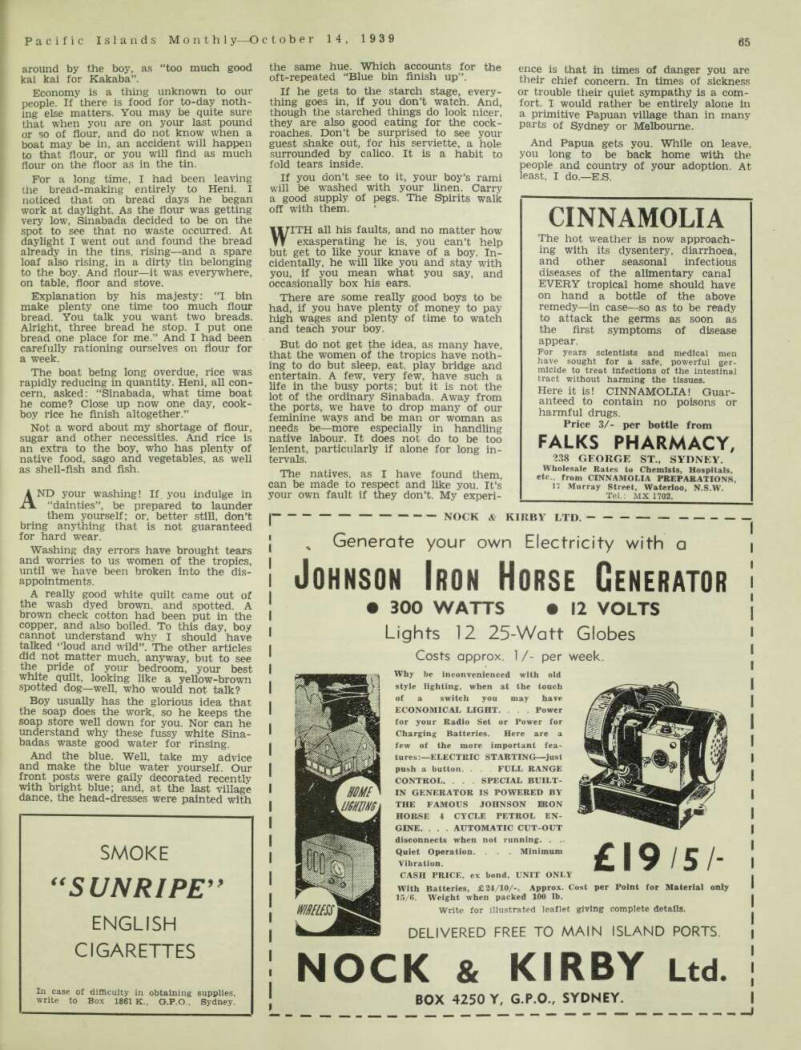
Trials of Housekeeping in the Territories
COMING to Papua? Well, leave in the South anything that you value. An alternative is to learn to “take cheerfully the spoiling of your goods”.
And please try to realise that the cook boy who does all the cooking, or the house boy who keeps the house spic and span and in perfect order is merely the figment of a dream —at least to most of us here. In reality he is a most exasper ating person and the cause of many pre mature grey hairs. It seems to me that the most sensible of them at times “go silly”, like the moon.
“Sinabada! You savvy sixi big new plate thing he stop?” (My new dinner set.) “Yes, Heni, I savvy.” ■Well, that plate he stop four dis time, I bin finis look.” This is the brief an nouncement that two of the new plates have been broken.
What’s the use of scolding, even a quiet weep. The boy is as cheery as ever, and to him the white man has plenty of money to buy new plates. Why, he does not even have to give money for stores! They come on the boat, and no one takes the money away. How lucky these white people are!
Next announcement —same day; “Sina bada! One dish he finis break up. I think that one too much old maybe, Sinabada.”
Thus goes a really lovely wedding pre sent.
“Sinabada! This one thing you talk be fore, he cook hot, he no catch’em break up. That one lie, Sinabada, fire he make ’im finis break.”
Gone is my delphinium Servex ware.
Seeing me about to throw out the water in which eggs had been boiled, the perfect cook boy intervened with: “Sina bada, bubble water no stop for teapot. I like make table tea this water. He boil good before, this one water.” Which ac counts for peculiar tea or coffee at times.
The dull grey shade on the tea towels caused a new kitchen rule to come into being. Tea towels must be boiled every second day. A peep into the boiler showed the boy’s rami (loincloth) also in the boil. A pity (he had argued) to waste good soapy water on mere tea towels.
Last night the tea did have a queer taste. Thinking of the egg episode, the boy was interrogated. His reply: “Clean water, yes Sinabada. First time I make potato cook. Alright, he finish up, I put all water along tea pot too much quick, water plenty boil before time.“ (The water from the potato pot was boiling, so he used that.) When, one day, shown that his none too-clean rami was dangling in the milk, his majesty of the kitchen grew all con cerned and bothered. Oh, no, not for the milk or food, but for his rami, and he dashed outside to get water to clean it. r[E ordinary boy is ever mindful of his “inner man”. I bought some crabs one day, and the boy informed me they were not good crabs, and would make me sick inside. On being told to throw them away, he decided that: “My stummick too much strong Sinabada; I eat them crab thing.”
The poultry seemed to be extra hungry.
A few discreet inquiries proved that the paw paws, table leavings and other foods were being given to his girl friends
around by the boy, as “too much good kai kai for Kakaba”.
Economy is a thing unknown to our people. If there is food for to-day noth ing else matters. You may be quite sure that when you are on your last pound or so of flour, and do not know when a boat may be in, an accident will happen to that flour, or you will find as much flour on the floor as in the tin.
For a long time, I had been leaving the bread-making entirely to Heni. I noticed that on bread days he began work at daylight. As the flour was getting very low, Sinabada decided to be on the spot to see that no waste occurred. At daylight I went out and found the bread already in the tins, rising—and a spare loaf also rising, in a dirty tin belonging to the boy. And flour —it was everywhere, on table, floor and stove.
Explanation by his majesty: “I bin make plenty one time too much flour bread. You talk you want two breads.
Alright, three bread he stop. I put one bread one place for me.” And I had been carefully rationing ourselves on flour for a week.
The boat being long overdue, rice was rapidly reducing in quantity. Heni, all con cern, asked: “Sinabada, what time boat he come? Close up now one day, cook boy rice he finish altogether.”
Not a word about my shortage of flour, sugar and other necessities. And rice is an extra to the boy, who has plenty of native food, sago and vegetables, as well as shell-fish and fish.
AND your washing! If you indulge in “dainties”, be prepared to launder them yourself; or, better still, don’t bring anything that is not guaranteed for hard wear.
Washing day errors have brought tears and worries to us women of the tropics, until we have been broken into the dis appointments.
A really good white quilt came out of the wash dyed brown, and spotted. A brown check cotton had been put in the copper, and also boiled. To this day, boy cannot understand why I should have talked “loud and wild”. The other articles did not matter much, anyway, but to see the pride of your bedroom, your best white quilt, looking like a yellow-brown spotted dog—well, who would not talk?
Boy usually has the glorious idea that the soap does the work, so he keeps the soap store well down for you. Nor can he understand why these fussy white Sina badas waste good water for rinsing.
And the blue. Well, take my advice and make the blue water yourself. Our front posts were gaily decorated recently with bright blue; and, at the last village dance, the head-dresses were painted with
the same hue. Which accounts for the oft-repeated “Blue bin finish up”.
If he gets to the starch stage, every thing goes in, if you don’t watch. And, though the starched things do look nicer, they are also good eating for the cock roaches. Don’t be surprised to see your guest shake out, for his serviette, a hole surrounded by calico. It is a habit to fold tears inside.
If you don’t see to it, your boy’s rami will be washed with your linen. Carry a good supply of pegs. The Spirits walk off with them.
WITH all his faults, and no matter how exasperating he is, you can’t help but get to like your knave of a boy. In cidentally, he will like you and stay with you, if you mean what you say, and occasionally box his ears.
There are some really good boys to be had, if you have plenty of money to pay high wages and plenty of time to watch and teach your boy.
But do not get the idea, as many have, that the women of the tropics have noth ing to do but sleep, eat, play bridge and entertain. A few, very few, have such a life in the busy ports; but it is not the lot of the ordinary Sinabada. Away from the ports, we have to drop many of our feminine ways and be man or woman as needs be —more especially in handling native labour. It does not do to be too lenient, particularly if alone for long in tervals.
The natives, as I have found them, can be made to respect and like you. It’s your own fault if they don’t. My experi
ence is that in times of danger you are their chief concern. In times of sickness or trouble their quiet sympathy is a com fort. I would rather be entirely alone in a primitive Papuan village than in many parts of Sydney or Melbourne.
And Papua gets you. While on leave, you long to be back home with the people and country of your adoption. At least, I do.—E.S.
Advertisements & other items, pp. 66-67 (3 items)
64
October 14, 193 9—P aciflc Islands Monthly
65
Pacific Islands Monthl y—O ctober 14, 1939
Johnson Iron Horse Generator
CINNAMOLIA
The hot weather is now approaching with its dysentery, diarrhoea, and other seasonal infectious diseases of the alimentary canal EVERY tropical home should have on hand a bottle of the above remedy—in case—so as to be ready to attack the germs as soon as the first symptoms of disease appear.
For years scientists and medical men have sought for a safe, powerful germicide to treat Infections of the intestinal tract without harming the tissues.
Here it is! CINNAMOLIA! Guaranteed to contain no poisons or harmful drugs.
Price 3/- per bottle from
FALKS PHARMACY,
238 GEORGE ST., SYDNEY.
Wholesale Rates to Chemists. Hospitals,
etc . from CINNAMOLIA PREPARATIONS,
IT Murray Street, Waterloo, N.S.W.
Tel.: MX 1702.
NOCK & KIRBY LTD.
, Generate your own Electricity with a
Johnson Iron Horse Generator
• 300 WATTS • 12 VOLTS
Lights 12 25-Watt Globes
Costs approx. 1/- per week.
Why be inconvenienced with old style lighting, when at the touch of a switch you may have
ECONOMICAL LIGHT. Power
for your Radio Set or Power for Charging Batteries. Here are a few of the more important features:—ELECTßlC STARTING—just push a button. . . . FULL RANGE
CONTROL. . . SPECIAL BUILT-
IN GENERATOR IS POWERED BY
THE FAMOUS JOHNSON IRON
HORSE 4 CYCLE PETROL EN-
GINE. . . . AUTOMATIC CUT-OUT
disconnects when not running. . ..
Quiet Operation. . . . Minimum Vibration.
CASH PRICE, ex bond, UNIT ONLY
With Batteries, £24/10/-. Approx. Cost per Point for Material only 15/6. Weight when packed 100 lb.
Write for illustrated leaflet giving complete details.
U6Hm
mm % £l9/5/
DELIVERED FREE TO MAIN ISLAND PORTS.
NOCK & KIRBY Ltd.
BOX 4250 Y, G.P.0., SYDNEY.
SMOKE
“S UNRIPE”
ENGLISH
CIGARETTES
In case of difficulty in obtaining supplies, write to Box 1861 K., G.P.O , Sydney.
Cause Of
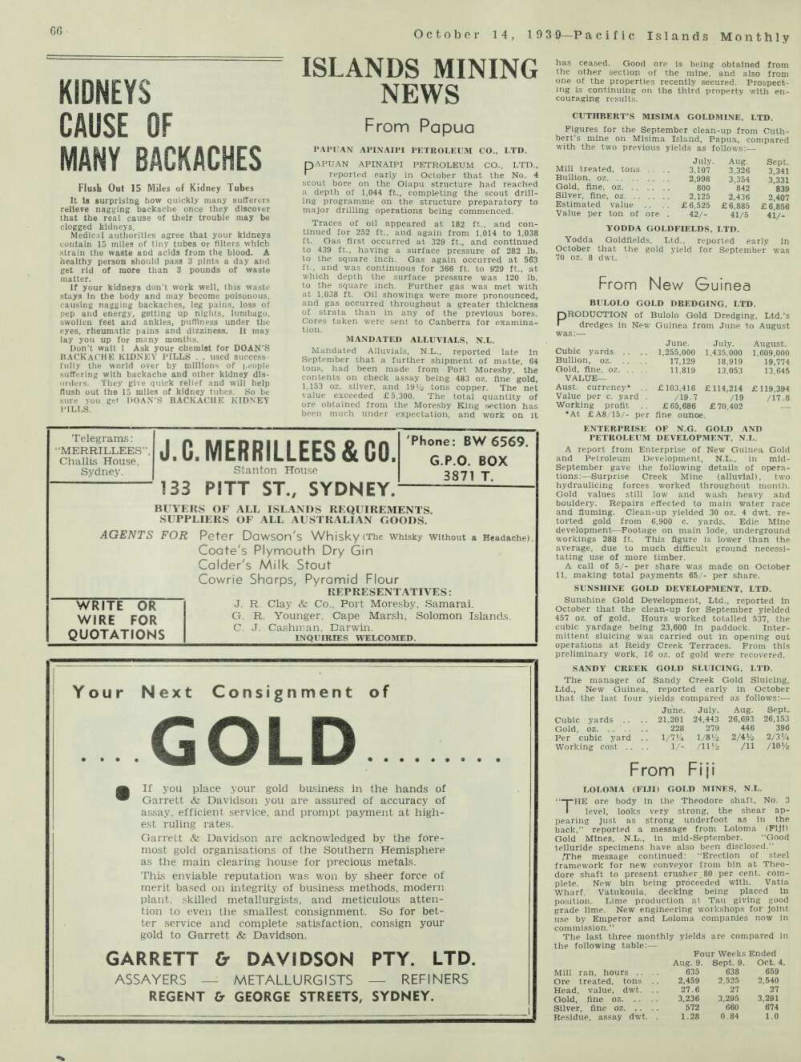
Kidneys
Many Backaches
Flush Out 15 Miles of Kidney Tubes It la surprising how quickly many sufferers relieve nagging backache once they discover that the real cause of their trouble may be clogged kidneys.
Medical authorities agree that your kidneys contain 15 miles of tiny tubes or filters which strain the waste and acids from the blood. A healthy person should pass 3 pints a day and get rid of more than 3 pounds of waste matter.
If your kidneys don’t work well, this waste stays in the body and may become poisonous, causing nagging backaches, leg pains, loss of pep and energy, getting up nights, lumbago, swollen feet and ankles, puffiness under the eyes, rheumatic pains and dizziness. It may lay you up for many months.
Don’t wait 1 Ask your chemist for DOAN’S BACKACHE KIDNEY PILLS . . used success fully the world over by millions of people suffering with backache and other kidney dis orders. They give quick relief and will help flush out the 15 miles of kidney tubes. So be sure you get DOAN’S BACKACHE KIDNEY
Pills.
Islands Mining
News
From Papua
Papuan Apinaipi Petroleum Co., Ltd.
Papuan Apinaipi Petroleum Co., Ltd.,
' reported early in October that the No. 4 scout bore on the Oiapu structure had reached a depth of 1,044 ft., completing the scout drill ing programme on the structure preparatory to major drilling operations being commenced.
Traces of oil appeared at 182 ft., and con tinued for 252 ft., and again from 1.014 to 1,038 ft. Gas first occurred at 329 ft., and continued to 439 ft., having a surface pressure of 282 lb. to the square inch. Gas again occurred at 563 ft., and was continuous for 366 ft. to 929 ft., at which depth the surface pressure was 120 lb. to the square inch. Further gas was met with at 1,038 ft. Oil showings were more pronounced, and gas occurred throughout a greater thickness of strata than in any of the previous bores.
Cores taken were sent to Canberra for examina tion.
Mandated Alluvials. N.L.
Mandated Alluvials, N.L., reported late in September that a further shipment of matte, 64 tons, had been made from Port Moresby, the contents on check assay being 483 oz. fine gold, 1,153 oz. silver, and 19 »/ 2 tons copper. The net value exceeded £5,300. The total quantity of ore obtained from the Moresby King section has been much under expectation, and work on it
has ceased. Good ore is being obtained from the other section of the mine, and also from one of the properties recently secured. Prospect ing is continuing on the third property with en couraging results.
Cuthbert’S Misima Goldmine, Ltd.
Figures for the September clean-up from Cuth bert’s mine on Misima Island, Papua, compared with the two previous yields as follows;
Yodda Goldfields, Ltd.
Yodda Goldfields, Ltd., reported early in October that the gold yield for September was 70 oz. 8 dwt.
From New Guinea
Bulolo Gold Dredging, Ltd.
PRODUCTION of Bulolo Gold Dredging, Ltd.’s L dredges in New Guinea from June to August was:—•
Enterprise Of N.G. Gold And
Petroleum Development. N.L.
A report from Enterprise of New Guinea Gold and Petroleum Development, N.L., in mid- September gave the following details of opera tions:—Surprise Creek Mine (alluvial), two hydraulicing forces worked throughout month.
Gold values still low and wash heavy and bouldery. Repairs effected to main water race and fluming. Clean-up yielded 30 oz. 4 dwt. re torted gold from 6,900 c. yards. Edie Mine development—Footage on main lode, underground workings 288 ft. This figure is lower than the average, due to much difficult ground necessi tating use of more timber.
A call of 5/- per share was made on October 11, making total payments 65/- per share.
Sunshine Gold Development, Ltd.
Sunshine Gold Development, Ltd., reported In October that the clean-up for September yielded 457 oz. of gold. Hours worked totalled 537, the cubic yardage being 23,600 in paddock. Inter mittent sluicing was carried out in opening out operations at Reidy Creek Terraces. From this preliminary work, 16 oz. of gold were recovered.
Sandy Creek Gold Sluicing, Ltd.
The manager of Sandy Creek Gold Sluicing, Ltd., New Guinea, reported early in October that the last four yields compared as follows:
From Fiji
Loloma (Fiji) Gold Mines, N.L.
“-J-HE ore body in the Theodore shaft, No. 3 I level, looks very strong, the shear ap pearing just as strong underfoot as in the back,” reported a message from Loloma (Fiji) Gold Mines, N.L., in mid-September. “Good tellurlde specimens have also been disclosed.” /The message continued; “Erection of steel framework for new conveyor from bin at Theo dore shaft to present crusher 80 per cent, com plete. New bln being proceeded with. Vatia Wharf. Vatukoula, decking being placed in position. Lime production at Tau giving good grade lime. New engineering workshops for Joint use by Emperor and Loloma companies now in commission.”
The last three monthly yields are compared in the following table: —
July.
Aug.
Sept.
Mill treated, tons . . .. 3,107 3,326 3,341 Bullion, oz 2,998 3,354 3,331 Gold, fine, oz 800 842 839 Silver, fine, oz 2,125 2,436 2,407 Estimated value £6,525 £6.885 £6,856 Value per ton of ore . 42/- 41/5 41/-
June.
July.
August.
Cubic yards .. 1,255,000 1,435,000 1,609,000 Bullion, oz 17,129 18,919 19,774 Gold, fine, oz 11,819 13,053 13,645
Value—
Aust. currency* £103,416 £114,214 £119,394 Value per c. yard . /19.7 /19 /17.8 Working profit £65,686 £70,402 •At £ A8/15/- per fine ounce.
June. July. Aug. Sept.
Cubic yards . . .. 21,201 24,443 26,693 26,153 Gold, oz 228 279 446 396 Per cubic yard .. l/TV-t 1/8 V2 2/4V2 2/3Vi Working cost .. .. 1/- /HV2 /II /IOV2
Four Weeks Ended Aug. 9.
Sept. 9.
Oct. 4.
Mill ran, hours .. 635 638 659 Ore treated, tons .. 2,459 2,525 2,540 Head, value, dwt. .. 27.6 27 27 Gold, fine oz 3,236 3,295 3,291 Silver, fine oz 572 660 674 Residue, assay dwt. . 1.28 0.84 1.0
From the Solomons
Solomon Gold Mines, N.L.
"THE liquidator of Solomon Gold Mines, N.L., ' advised early in October that a first and final return of capital of 20/10 a share had been declared. This amount was payable at the registered office of the company, Cook, Tomlins, and Mirams, 360 Collins Street, Melbourne.
Solomon’S Mines Pty., Ltd.
Solomon’s Mines Pty., Ltd., was registered in Sydney recently with a capital of £20,000 in £ 1 shares. The objects of the company are “to carry on the business of mining in the Solomon Islands, etc.” Subscribers were: Frances T.
Herlihy and Dorothy Jackson (1 share each).
Emperor Gold Mining Co. Ltd.
Returns from the Emperor mine for the past four monthly periods are compared in the following table: — Four week ended July Aug. Sept.
Oct. 12. 9. 8. 4.
Ore treated, tons . 13,971 14,445 13,185 12,655 Head value, dwt. ., 6.5 6.45 7.0 6.8 Gold, oz„ fine 4,103.5 4,086 4,046 4,122 Residues, dwt 0 46 0.63 0.81 0.67
Mount Kasi Mines, Ltd.
Latest yields from the Mount Kasi mine at Vanua Lcvu ax - e compared in the following table:— Four weeks ended July 12. Aug. 9. Sept. 6. ■ Oct. 4.
Ore, tons . . 2,662 2,719 3,069 3,547 Gold, fine, oz. . 622 652 716 657 Value, £ A . . 5,422 5,705 7,160 5,749
Advertisements & other items, p. 68 (1 item)
Gold
Telegrams:
•MERRILLEES”,
Challis House, Sydney.
J. C. MERRILLEES & GO.
Stanton House
133 PITT ST., SYDNEY.
'Phone: BW 6569.
G.P.O. BOX
3871 T.
BUYERS OF ALL ISLANDS REQUIREMENTS.
SUPPLIERS OF ALL AUSTRALIAN GOODS.
AGENTS FOR
WRITE OR
WIRE FOR
QUOTATIONS
Peter Dawson's Whisky (The Whisky Without a Headache).
Coate's Plymouth Dry Gin
Calder's Milk Stout
Cowrie Sharps, Pyramid Flour
REPRESENTATIVES:
J. R. Clay & Co.. Port Moresby, Samarai.
G. R. Younger, Cape Marsh, Solomon Islands.
C. J. Cashman, Darwin.
INQUIRIES WELCOMED.
Your Next Consignment of
GOLD
flb If you place your gold business in the hands of Garrett & Davidson you are assured of accuracy of assay, efficient service, and prompt payment at highest ruling rates.
Garrett & Davidson are acknowledged by the foremost gold organisations of the Southern Hemisphere as the main clearing house for precious metals.
This enviable reputation was won by sheer force of merit based on integrity of business methods, modern plant, skilled metallurgists, and meticulous attention to even the smallest consignment. So for better service and complete satisfaction, consign your gold to Garrett & Davidson.
GARRETT & DAVIDSON PTY. LTD.
ASSAYERS METALLURGISTS REFINERS
REGENT & GEORGE STREETS, SYDNEY.
Quotations For Islands Mining
Shares
Crovvn Prince Tuboutoa, of Tonga, will be the guest of honour at the November meeting of the Pacific Islands Club in Sydney. The prince, who is a student at the Law School, University of Syd ney, will speak on the transition period in his own islands. Owing to impending examinations early next year, it is un likely that the prince will visit Tonga during next term holidays. Hitherto, it has been his custom to spend Christmas with the Royal Family in Nukualofa.
Possibly, he will join his brother, Prince John Gnu, in New Zealand. The latter has spent the past year there, study ing with a tutor.
Mr. George Farwell, a former resident of Tahiti, who has been a member of the council of the Anthropological So ciety of New South Wales, did not seek re-election at the annual meeting in Oc tober.
Rev. C. F. Gribbie, M.A., L.R.S.M., ac companied by Mrs. Gribbie and their two children, arrived in Nukualofa, Tonga, from Australia in September to take up an appointment for the Methodist Church as Principal of the Tubou Col lege.
Fiji
Mid-Mar.
Mid-May.
Mid-Oct.
Emperor Mines . b8/8 b8/l b9/6 Loloma b21/3 b2L b22 9 Mt. Kasl b4/4 b4/b3/4 Tavua Dev b5d s6d s6d.
Bulolo G.D
New Guinea
b£7 b£ 6/7/6 b £ 6/6/- Enterprise of N.G b30/b20/b7/6 Guinea Gold bl4/b!2/ll b!3/- N.G.G., Ltd b2/4 bl/11 b2/- Oil Search b6/b4/4 s3/3 Placer Dev b72/6 b£3/8/b £ 3/10/ Sandy Creek bl/6 bl/4V 2 bl/SVa Sunshine Gold .. b7/3 b5/l b6/2 Cuthbert’s
Papua
s!6/b!7/6 b!7/- G.M. of Papua . b2/bl/7 s7d Mandated All. ... b2/b2/9 b3/8 Oriomo Oil b9/9 59/- Papuan Apinaipi b6/6 b4/9 b2/6 Yodda Goldfields b7d bl/1 bl/4
N.G. Air Service
Curtailed
Federal Government Refuses to Subsidise Second Plane
BECAUSE of the failure of the Federal Government to subsidise the second weekly airmail service between Sydney and New Guinea maintained by W. R.
Carpenter Airlines, the company on Sep tember 30 reduced the service to one plane a week, each way.
The air service from Sydney to Ra baul, via Port Moresby and Salamaua, was expanded from once weekly to twice a week about six months ago, in response to a growing demand from Territories re sidents. Before that, accommodation was usually booked out several months ahead.
Speculators, in some instances, made a business of buying seats and then selling them for double the cost.
In the Australian Parliament at the end of September, Senator Cooper (Qld.) asked whether representations had been made by Carpenter and Co. for a sub sidy. Senator Mcßride (representing Sen ator Foil) replied that the Government already subsidised one service a week and did not propose to subsidise a second. He added that the company stated that it was suffering substantial loss on the un subsidised service and that the recent increased price of petrol had added to the burden.
“Lost £4Oo A Month”
Interviewed in Sydney, Sir Walter Carpenter told the newspapers that the second weekly service was losing over £4OO a month. “If the Postal Department only paid us the usual airmail rate on the monthly average of 1,000 lb. of mail, we could cany on”, he said. “Not only are we denied payment for the mail, but we have to pay transport costs to carry it from the aerodromes to post offices. The Customs Department even charges over time to check out our aircraft. We do not want to make a profit on the second service; all we ask for is reasonable treatment”.
Aviation experts in Sydney, not “con
trolled” by the airline combines—which have strenuously opposed the Carpenter service since its inauguration—declared that the twice-a-week service was valu able in defence because it ensured a fre quent. regular reconnaissance of the long coastline from Sydney to Cooktown, and also across the Coral Sea from Cooktown to Port Moresby.
Mr. E. A. James, editor of the “Papuan Courier”, accompanied by Mrs. James, left Papua recently for a short holiday in Australia. In Mr. James’s absence, Mr.
B. McArdie is in charge of the “Papuan Courier”.
Mr. “Bob” Gurney, formerly a well known pilot of Guinea Airways, and more recently a captain of one of the Empire Airways flying-boats, is now a member of the defence organisation at Port Moresby.
Advertisements & other items, pp. 69-70 (3 items)
67
Pacific Islands Monthl y—O ctober 14, 1939
Ormo N O I D
Mining Ore
Treatment
Machinery
COMPLETE CYANIDE
PLANTS SUPPLIED
Dorr Classifiers, Dorr Thickeners, Dorr Agitators, Oliver Filters Merril Crowe Zinc Dust Gold Precipitation Richardson Mine Fans
FANS AND AIR HEATERS
For Ventilation, Copra Drying Rooms, etc. • Enquire from
CROSSLE, DUFF AND
MACINTOSH LTD.
52 Bridge Street, SYDNEY.
ORMO N O I D
BITUMINOUS ROOFING
MADE IN 1, 2. 3 AND 5 PLY FROM HIGHEST GRADE RAW PELTS AND BEST QUALITY BITUMENS. FUME, ACID, AND CHEMICAL PROOF, IM- PERVIOUS TO SALT AIR AND WILL NOT AFFECT DRINKING WATER.
IDEALLY SUITED FOR TROPICAL CLIMATES
WEATHERPROOF AND WATERPROOF
SPECIFY AND USE ORMONOID
ROOFING FLOORING DAMPCOURSES
PAINTS COMPOUNDS SARKING FELTS
PLASTICS BUILDING PAPER ASBESTOS FELTS
MADE IN AUSTRALIA
PRICES, SAMPLES & PARTICULARS GIVEN ON REQUEST.
ORMONOID ROOFING b ASPHALTS LTD.
39 MENTMORE AYE., WATERLOO, SYDNEY, AUSTRALIA.
The Man on the Plying Trapeze or the Slide for Life, 3/9.
Whilst the man on the wife slides with his revolving parasol his lady partner balances on the trapeze below.
Prom the ’Frisco 1939 Exposition where it proved to be one of the best selling novelties. <4 DRY SHAVERS.—24O volt Electric Dry Shaver, half price and less, “Packard”, U.S.A., 50/-, or “Vico”, Austria, £5/5/-. Now 39/6.
Rejuv Safety Razor-Blade Sharpener, 7/6 —now —2/-. Add 6d. postage Blades last for months—simple to use. Direct from New York World’s Fair.
Roulette Wheels with Betting Cloth, 22/6. Sandown Spinning Race Wheels, 55/6, 63/-, £5/5/-, £7/17/6, £l7/10/-.
Complete in case with betting cloths.
Heavy Duty Electric Model Motors to work off wet or dry batteries or transformers, 6 to 12 volts, 63/-. Smaller models, 12/6, 15/-.
No. .I.—Sheffield made Throwing Knife in Sheath, 5/-. As illustrated.
No. 2. —Remington, U.B.A. made, Hunting and Sporting Knives in I Sheath, 10/6.
Ormond British Made Highest Grade Vernier Dials, 3 inch Brown Bakslite or Metal, 8/6.
“UTILITY” Short Wave Dials World’s Best: 12/6.
No. 1 Morse Code Practice Sets, with Switch Buzzer to Light, Use as you desire. 22/6 complete. No. 2, with Heavier Type Morse I Key; 30/-. Pendograph Bug Key. 70/-. Adjustable Key (only), 12/6. j High Pitched Buzzers, 4/6.
COMBINATION RADIO GRAMO-
PLAYER IN HANDSOME POLISHED
I CABINET. Hook to set and ping into 240 volt Electric Supply, £9/10/-. Others with no Cabinet, 190/-, 95/-, 105/-. Comprising 240 A.C. Gramophone with Fick-up j mounted.
©KUS®
QCCSSU)
Like-a-Flash “Elimlnoise” Aerial Kit for short or dual-wave sets. Aerial, Pyrex type Insulators,, transposition blocks and 200 ft. aerial coll, 22/6.
Eliminates unwanted aerial and hideous electrical noises from your dual-wave or short-wave sets.
Microphone units for experimenting in Mesh-front metal case, as illustrated, 7/6.
Adjustable All-way Morse Key, Long or Short Tap, 12 6. Heavier P.M.G.
Type. 19/6. Learn Morse Book 1/-. 9 Build Little Jim. the splendid set from Wireless and Hobbles. Easyway Charts and Instructions, 6d.
All Parts 32/-, Valves 13/6, Batteries 11/-. Phones 10/6 and 12/6. The set ready built—complete, £3/16/6.
CATALOGUE.
Now being compiled, ready late in November. Order your copy now, Bd. Post Free. Send for it to-day.
Limited Number Only.
Levenson’s Wonder Book of Specialities. Radio, Coin-operated Machines, Games, Jokes, Puzzles, Hobbies, crammed full of surprises from Cover to Cover.
“Like-a-Flash” De luxe Dual Wave 5 Valve Battery Operated Receiver.
This is one of the most powerful models in the battery set series, and the Radio Frequency stage of amplification gives the set a world range on short wave channels as well as full coverage range of Australasian ‘A” and “B” Class Broadcasters.
The set is also specially designed to give maximum service in humid climates, such as North Queensland and Pacific Island Territories.
A vital part very vulnerable to “dampness” in ordinary receivers is the “Intermediate Frequency Section”. In this set our Engineers have fitted special Inductance tuned intermediate frequency transformers, which do not require trimmers. These units ensure correct alignment for a continuous period.
An “8” Aero Dial calibrated in stations facilitates tuning. Valves used are: 2—lC4, I—KK2, I—lK6, I—lD4.
The speaker is the latest Ampllon Permagnetlc Model, capable of high fidelity reproduction. Battery equipment consists of extra heavy capacity units as follows; 1 2 Volt 100 amp. Accumulator. 3 Ever -Ready Superdyne 45 Volt “B” Batteries 1 Ever-Ready4 4,2 in. / 2 in. “C” Battery.
The outfit is housed in a beautifully veneered floor model Console Cabinet.
Handsome Radio Cabinet. Latest sloping front design. Overall dimension,, 28 in. x 33 in. Genuine £4/4/- value, now 39/6. Freight and packing extra. 4000 ohm. Reliable Headphones, 10/-, 12/6. Ericson’s British Lightweight Professional Headphones, 32/6.
PRICE: £22/5/-.
“Presto”. The simplest yet greatest little trick ever introduced, 2/6.
Just arrived from the maker in London, “Cosmocord” De Luxe Crystal Pick-up, with Built-in Vol. Control, 48/6. Write for List of Pickups.
Gramophone Pick-up Heads.
Goldring English Pick-up Heads.
Suit and Fit all Gramophone Tone Arms. Type 44/4 Pick-up Head with Built-in Volume Control: lf)/6. Type 44/5 Pick-up Head, with Volume Control attached: 21/-. Type 33/3 Pick-up Head, with Highly Polished Nickel Finish: 18/C. Bakelite Cased Pick-up Head: 19/6. \//A eo oo Play. Talk. Sing, Joke through your Radio. Great Fun. Batteryless typo Microphone for Hand Holding or Hanging. 22/6. Complete with lead, 1 fixed in a second. Others, 12/6, 15/-, 17/6, 25/-. 28/6. 32/6. All plus 1/Q for Battery and 1/6 for 20 ft. Cord.
Write for full detailed list. m B.G.E. Table Type Microphone. Highly recommended for Amateur or Professional use. Built-in Transformer and.
Battery with Volume!
Control incorporated. 1 Just plug into pickup terminals of any set. 39/6.
RADIO SERVICEMAN’S MANUAL
FOR 1939.
Just Out! Australia’s Official Radio Service Manual, Vol. 2, 1939: 10/6.
STAMPS.—Giant Packets from London, 500 assorted Stamps, 2/6 with 1/6 Free Packet. 100 Specially Selected Stamps, 2/9, with 1/3 Free Packet. 204 Assorted Stamps from all parts of the world, 3/9, with 3/8 Free Packet.
Bull Board Quoit-like Throwing Game, 16/9.
Write for full list of games for Home, Club, Guest House, Hotel, etc. /
iiiiniiiiiiiniiiniii
Write for Punch Board Leaflets
(miinmnmMii
LEVENSON S RADIO
GAMES, NOVELTIES AND HOBBIES,
226 PITT STREET. SYDNEY
Manufacturers, Importers, and Exporters.
N.S.W., AUSTRALIA.
'iiiniiiiiiiiiiiiiiinnr Write for Pin-Game, Totem and Odds and Evens Leaflets
iiiiiiiiiiiiiniiimiiiii
Cable address: “Leveradioh”. Goods forwarded V.P.P. or Sight Draft. Satisfaction and Service Guaranteed. We can supply by mall all General Merchandise at a Better Price. Quotations with pleasure. Please add freight and packing. Write for full list of interesting leaflets of Games, Hobbies, Novelties, and Electrical Goods. Write for full list of Radio Meters.
68
October 14, 193 9—P acific Islands Monthly
Australian Short Wave
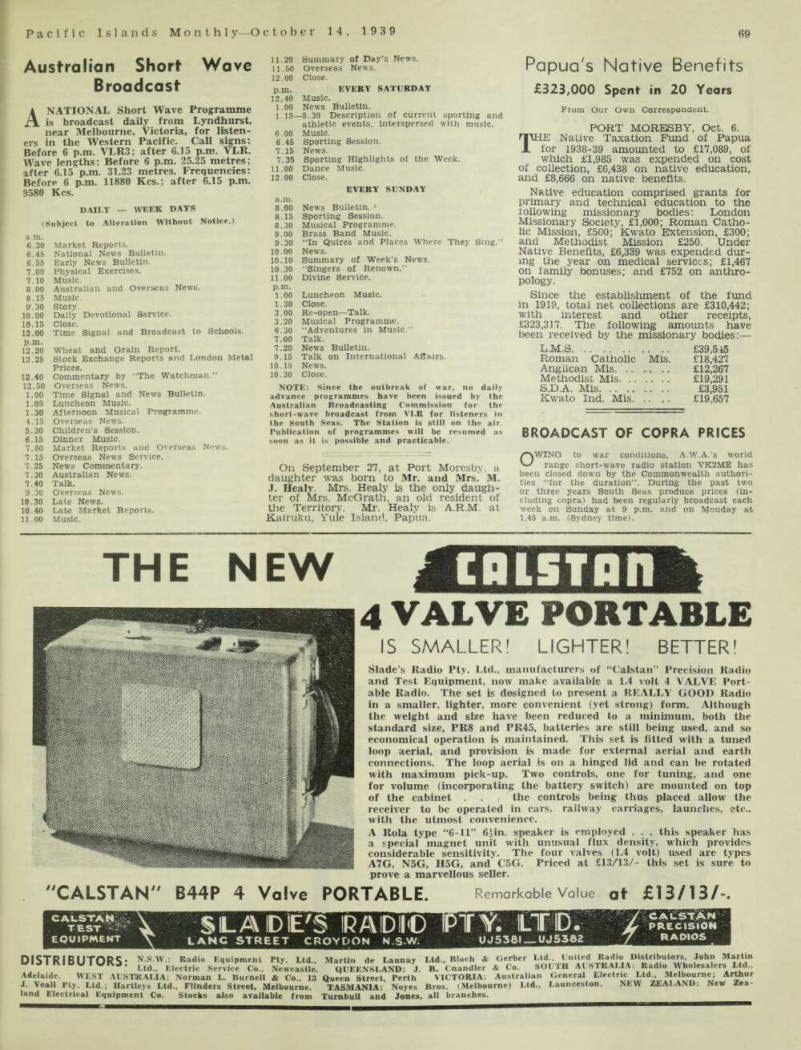
Broadcast
A NATIONAL Short Wave Programme is broadcast daily from Lyndhurst, near Melbourne, Victoria, for listen ers in the Western Pacific. Call signs; Before 6 p.m. VLR3; after 6.15 p.m, VLR.
Wave lengths: Before 6 p.m. 25.25 metres; after 6.15 p.m. 31.23 metres. Frequencies: Before 6 p.m. 11880 Kcs.; after 6.15 p.m. 9580 Kcs.
Daily Week Dats
(Subject to Alteration Without Notice.) a.m. 6.30 Market Reports. 6.45 National News Bulletin. 6.55 Early News Bulletin. 7.00 Physical Exercises. 7.10 Music. 8.00 Australian and Overseas News. 8.15 Music. 9.30 Story. 10.00 Daily Devotional Service. 10.15 Close. 12.00 Time Signal and Broadcast to Schools, p.m. 12.20 Wheat and Grain Report. 12.25 Stock Exchange Reports and London Metal Prices. 12.40 Commentary by “The Watchman.” 12.50 Overseas News. 1.00 Time Signal and News Bulletin. 1.05 Luncheon Music. 1.30 Afternoon Musical Programme. 4.15 Overseas News. 5.30 Children’s Session. 6.15 Dinner Music. 7.00 Market Reports and Overseas News. 7.15 Overseas News Service. 7.25 News Commentary. 7.30 Australian News. 7.40 Talk. 9.30 Overseas News. 10.30 Late News. 10.40 Late Market Reports. 11.00 Music.
11.20 Summary of Day’s News. 11.50 Overseas News. 12.00 Close.
P.M. Every Saturday
12.40 Music. 1.00 News Bulletin. 1.15—5.30 Description of current sporting and athletic events, interspersed with music. 6.00 Music. 6.45 Sporting Session. 7.15 News. 7.35 Sporting Highlights of the Week. 11.00 Dance Music. 12.00 Close.
Every Sunday
а. 8.00 News Bulletin. ‘ 8.15 Sporting Session. 8.30 Musical Programme. 9.00 Brass Band Music. 9.30 “In Quires and Places Where They Sing.” 10.00 News. 10.10 Summary of Week’s News. 10.30 “Singers of Renown.” 11.00 Divine Service, p.m. 1.00 Luncheon Music. 1.30 Close. 3.00 Re-open—Talk. 3.20 Musical Programme. б. “Adventures in Music.” 7.00 Talk. 7.20 News Bulletin. 9.15 Talk on International Affairs. 10.15 News. 10.30 Close.
NOTE: Since the outbreak of war, no daily advance programmes have been issued by the Australian Broadcasting Commission for the short-wave broadcast from VLR for listeners in the South Seas. The Station is still on the air.
Publication of programmes will be resumed as soon as it is possible and practicable.
On September 27, at Port Moresby, a daughter was born to Mr. and Mrs. M.
J. Healy. Mrs. Healy is the only daugh ter of Mrs. McGrath, an old resident of the Territory. Mr. Healy is A.R.M. at
Kairuku, Yule Island, Papua.
Papua's Native Benefits
£323,000 Spent in 20 Years
From Our Own Correspondent.
Port Moresby, Oct. 6.
rE Native Taxation Fund of Papua for 1938-39 amounted to £17,089, of which £1,985 was expended on cost of collection. £6,438 on native education, and £8.666 on native benefits.
Native education comprised grants for primary and technical education to the i olio wing missionary bodies: London Missionary Society, £1,000; Roman Catho lic Mission, £500; Kwato Extension, £300; and Methodist Mission £250. Under Native Benefits, £6,339 was expended dur ing the year on medical services; £1,467 on family bonuses; and £752 on anthro pology.
Since the establishment of the fund in 1919, total net collections are £310,442; with interest and other receipts, £323,317. The following amounts have been received by the missionary bodies; —
L.M.S £39,515
Roman Catholic Mis. £18,427 Anglican Mis £12,267 Methodist Mis £19,291 S.D.A. Mis £3,951 Kwato Ind. Mis £19,657
Broadcast Of Copra Prices
OWING to war conditions, A.W.A.’s world range short-wave radio station VK2ME has been closed down by the Commonwealth authori ties “for the duration”. During the past two or three years South Seas produce prices (in cluding copra) had been regularly broadcast each week on Sunday at 9 p.m. and on Monday at 1.45 a.m. (Sydney time).
Advertisements & other items, p. 71 (2 items)
69
Pacific Islands Monthl y—O ctober 14, 1939
The New
9 I
4 VALVE PORTABLE
IS SMALLER! LIGHTER! BETTER!
Slade’s Radio Pty. Ltd., manufacturers of “Calstan” Precision Radio and Test Equipment, now make available a 1.4 volt 4 VALVE Portable Radio. The set is designed to present a REALLY GOOD Radio in a smaller, lighter, more convenient (yet strong) form. Although the weight and size have been reduced to a minimum, both the standard size, PRB and PR4S, batteries are still being used, and so economical operation is maintained. This set is fitted with a tuned loop aerial, and provision is made for external aerial and earth connections. The loop aerial is on a hinged lid and can be rotated with maximum pick-up. Two controls, one for tuning, and one for volume (incorporating the battery switch) are mounted on top of the cabinet the controls being thus placed allow the receiver to be operated in cars, railway carriages, launches, etc., with the utmost convenience.
A Rola type “6-11” speaker is employed . . this speaker has a special magnet unit with unusual flux density, tvhich provides considerable sensitivity. The four valves (1.4 volt) used are types A7G, NSG, HSG, and CSG. Priced at £l3/13/- this set is sure to prove a marvellous seller.
CALSTAN" 844 P 4 Valve PORTABLE.
Remarkable Value of £l3/13/-.
CALSTAN
TEST '■-*
EQUIPMENT
SLA IDE'S IRA DIO IPTV. LTD.
LANG STREET CROYDON N SW.
U J 5381 UJ5382
CALSTAN
PRECISION
RADIOS
DISTRIBUTORS* N - s - w - : Radio Equipment Pty. Ltd., Martin de Launay Ltd., Bloch & Gerber Ltd.. Unitedl Radio Distributors. John Martin * Ltd., Electric Service Co., Newcastle. QUEENSLAND: J. B. Cnandler & Co. SOI 1H AUSTRALIA: Radio Wholesalers Ltd.
Adelaide. WEST AUSTIRALIA: Norman L. Burnell & Co., 13 Queen Street, Perth VICTORIA; Australian General Electric Ltd., Melbourne; Arthur J. Veall Pty. Ltd.; Hartleys Ltd., Flinders Street, Melbourne. TASMANIA: Noyes Bros. (Melbourne) Ltd., Launceston. NEW ZEALAND; New Zealand Electrical Equipment Co. Stocks also available from Turnbull and Jones, all branches.
Fort Nukualofa
How it Was Taken by Stolen Guns
By J. J. Stewart
IN the chronicles of the South Seas there are many instances where the white man has taken part in native wars, using his modern weapons to help one native chief defeat another.
At the opening of the nineteenth cen tury, the commander of an American frigate landed an armed force, complete with cannon, on one of the Marquesas Is lands to assist a coastal chief in his war with a mountain tribe. “Bully” Hayes once sold the services of his armed crew to the king of Lessop Island, in the Carolines, and they were used to exterminate the inhabitants of a neighbouring island.
Then there is the amusing tale of the old salt, a deserter from the British Navy, who taught the use of firearms to one of the tribes of Pleasant Island and, by threatening the six other tribes of the island with his armed retainers, brought peace to a region where it had long been a stranger.
All these stories, and they are many, have it in common that the white man
was a free agent and did what he did ©f his own volition. In a different category is the story of the survivors of the brig “Port-au-Prince”. They were conscripted into the army of a black Napoleon, with death as the only alternative.
IT was in 1805 that the London privateer, “Port-au-Prince”, was cut off by the natives of Lifuka, in the Friendly Group, where she had called for fuel and water. The “Port-au-Prince” was on her way to Sydney from a successful cruise along the coast of South America, where she had taken several prizes. Caught off their guard by the wily natives all those aboard were massacred.
At the time of the assault a petty officer, William Mariner, and some of the crew, were ashore. In the time the brig had been at Lifuka. Mariner had won the friendship of chief Finau, and he and his companions were spared.
Now, for a long time Finau had been at variance with the natives of Tongatabu, the main island of the group. Hitherto, only one thing had prevented him from venting his grievances—fear of the fort at Nukualofa, the capital of Tongatabu.
As the work of primitive people, this fort was a mighty affair. It covered about five acres of land, a little way back from the beach, and was circular in shape.
There were two walls, an inner and an outer, each about nine feet in height and built of wickerwork, supported from the inside by upright posts of from six to nine inches in diameter and a foot and a half distant from one another.
There were a number of entrances, all of which could be effectively barred. Over these entrances and at other places along the walls were projecting platforms, with a breastwork at front and sides and con venient openings, through which spears and arrows could be aimed. Outside each of the fences was a ditch twelve feet deep which meant that the defenders stood twenty-one feet over the heads of who ever made the assault.
This was the tough nut Finau had to crack. Perhaps his plans were already made when he' took the “Port-au-Prince”, because it was only a week or two later that he sent for Mariner and told him what was expected of him and the other Englishmen.
WITH 4,000 warriors and sixteen Eng lishmen, Finau set sail for Tonga tabu in a number of war canoes. With them went the cannonades of the “Port au-Prince”, and plenty of ammunition. On arrival at Nukualofa the natives sallied forth from the fort to oppose the landing.
Eight of the Englishmen had muskets with them. These now opened fire, and drove the defenders back from the beach.
While the 4,000 warriors were landing, the cannonades and their carriages were slung on poles and brought ashore. They were set up on the beach and, at prac tically blank range, opened fire on the fort. Seated in a chair taken from the “Port-au-Prince”. Finau watched the pro ceedings with keen interest.
For over an hour the bombardment was kept up but, owing to the walls of the fort being constructed of such yielding material, it seemed that little damage had been done; the shot went through the wickerwork as if it had been paper, leav ing only a small hole to denote where it had made an entry.
FINAU sent for Mariner and expressed strong disappointment.
Mariner told him the damage was greater than was evident. The defence
had grown weak, very few spears and arrows were now coming from the walls.
However, Finau was far from satisfied. He decided to make a general assault and set fire to the fort walls.
In the first rush the outside wall was captured with ease. Rushing to the second wall, the Lifukaians plied their fire sticks.
Manv of the natives inside tried to escape from the rear of the fort and were promptly knocked on the head by a troop of warriors placed there just for that purpose.
After a short scuffle, the Lifukaians broke through the inner wall. A dreadful slaughter now took place. They slew all they met, men, women and children. The bloodthirsty shrieks of the killers mingled with the heart-rending screams and moans of the women and children, and the groans of the wounded.
In and out of the houses they raced, searching for fresh victims, peering with wolfish eyes through the pall of smoke from the burning walls, lest some mig:ht escape their vengeance. Some of the vic tims, with a sullen resignation, offered no resistance, but waited for the hand that, Fate-like, despatched them. Others fought with desperate fury. Those already lying wounded on the ground were struck with spears and clubbed to death by young boys who had been brought along by the expedition in order that they might be trained in the arts and horrors of war and who now seemed delighted by this opportunity to express their savagery.
The Englishmen saw all this madness dimly through the smoke and turned away, sick at heart.
WHEN Finau entered the fort and saw several large canoes, brought here in the first place for safe keeping, shat tered to pieces by round shot and dis membered bodies lying everywhere he ex pressed his astonishment at the deadly effect of the gun fire.
The defending chiefs, as this great mis chief went on, sat in consultation upon one of the canoes. They had just decided to make a sortie and capture the guns when a shot hit the canoe upon which they sat, smashing it to pieces. Those of them who were uninjured lost their nerve and rushed to hide in the inner houses of the fort and, because of their bad ex ample, many of the garrison deserted.
In this manner was the Fort of Nukua lofa, which had successfully resisted every assault for over eleven years, taken and destroyed in an hour or two. It was sev eral \ears later that William Mariner and his companions escaped and returned to civilisation.
Advertisements & other items, p. 72 (2 items)
70
October 14, 193 9 —P acific Islands Monthly
Flit
Extra Strong Saddle
Extra Low Price
75 7- hare
Built by highly skilled workmen from the best available materials, the Great Western Saddle represents remarkable value at 75/-. It is specially built to suit Island conditions with a Galvanised Tree, Copper Tacks and Brass Fillings.
These Saddles are obtainable through your regular agent.
We carry complete stock of Saddles, Collars, Whips, Rugs and Saddlery Accessories.
Write for Catalogue.
NEWMARKET SADDLERY
NEWTOWN
"FISHING TACKLE TO TACKLE FISHING"
New Model Norwegian 12 Gauge Harpoon Shoulder Gun, overall length, 39 in. Price, £l4/10/-.
Harpoons, 29/6. Brass Case Blank Cartridges, 6/6 per dozen. Single Ball Cartridges, 7/6 per 25. Flexible Steel Trace, 7/6. 100 yards Special Hemp Line, 14/-. A wonderful outfit for Sharks, Porpoises, Dugong, Crocodiles, Turtles, etc.
New Polaroid Non-Glare Spectacles, 15/- and 21/-. These Glasses absolutely banish glare, and reflection. Wonderful for the Eyes. For Big Game and Deep Sea Fishermen, they are the best yet produced.
Write for latest Catalogue. 400 illustrations. Big Game and Barrier Reef Fishing Gear for Hire.
HARPOONIGUN
SIL ROHU
Quality Firearms and Fishing Tackle. 143 ELIZABETH STREET. SYDNEY Phone MA 5540 (Near Market Street).
FLIT
kills them all
£ tocW«* % * FBl 1 nit »p"!
Flit is sure death to insects because it contains a number of killing agents found in no other insect spray. Flit kills where others fail. Flit is deadly to insects but harmless to humans. Always insist on FLIT refuse all substitutes.
Buy a bottle or tin TO-DAY
"Maui Pomare" Breaks Down
RECENTLY, when the New Zealand Government motor-ship “Maui Po mare’’ was on her way from Samoa to New Zealand, with a load of fruit, she experienced serious engine trouble, and had to be assisted to port by the NZ lighthouse steamer “Matai”. The “Maui Pomare” had tb undergo repairs in New Zealand and her usual timetable, be tween New Zealand and Samoa, was dislocated, causing inconvenience and loss to Samoan fruitgrowers.
The usual silly rumours circulated in New Zealand, to the effect that the “Maui Pomare” had been damaged by •enemy agency, and it was necessary for the Government to announce that the mishap was not in any way due to mali cious interference with the ship’s mach inery, and that there had been no injury to the crew or to the ship.
Mr. M. Moncur, First-Class Warrant Officer in the N.G. Service, who is sta tioned at Wau, reached Sydney early in October from Singapore where he has been spending leave. He will visit Vic toria early in November to see the run ning of the Melbourne Cup and will then return to the Territory.
The funeral of Miss Gladys Viti Monck ton, daughter of the late Mr. Hugh Monckton (Fiji), took place at Northern Suburbs Cemetery in Sydney on October 9. Miss Monckton. who was staying at Point Clair, was killed by a train on October 6 while she was crossing the rail way line near Gosford. The train was travelling at about 50 miles an hour and she was killed instantly.
Miss H, White, a New Zealander, is a new Methodist worker in Fiji: she has taken up teaching duties at the Wesley School.
Mr. Eric Weine, well-known dentist in Morobe District, New Guinea, arrived in Sydney by the October “Neptuna”.
Advertisements & other items, p. 73 (2 items)
71
Pacific Islands Monthl y—O ctober 14, 1939
From 181 7
SYDNEY'S LEADING
SAILMAKER
AND RIGGER
Also Manufacturer of all Canvas and Rope Work.
ISLANDS WORK a
Speciality.
HARRY WEST
Balmain East, Sydney. Tel.: W 1105
u Unconditionally Guaranteed.
Particulars from—
BEEBE ALL-STEEL
WINCHES
Hand Operated; Easily Adaptable
to Power 2 Ton capacity weighs 00 lbs. 5 „ „ „ 110 lbs. 15 „ „ 000 lbs.
Delivery Ex Stock. 0 Used by Leading Mining Companies and Prospectors.
NELSON & ROBERTSON Pty. Ltd.,
12 Spring St.
SYDNEY.
FROM 181 7
TO 1939 U_i ' I In 1817, when the Bank of New South Wales was founded, a "strong, secure chest" was procured to hold its cash and valuables. This chest has long since been replaced by the modern strong room, which to-day is symbolic of the strength of the institution.
For over a hundred years the Bank has played an important part in developing and stabilising the Australian national economy by giving its clients the greatest possible security.
BANK of NEW SOUTH WALES
Islands Produce
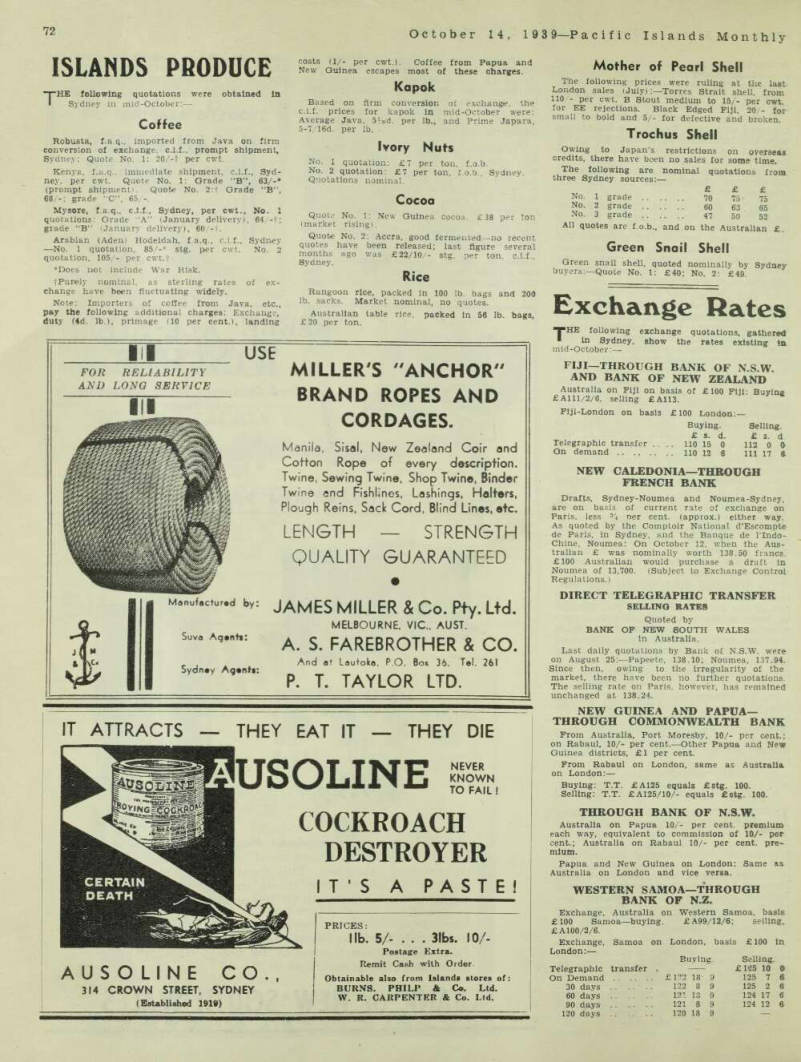
THE following quotations were obtained In Sydnej' in mid-October: —
Coffee
Robusta, f.a.q.. imported from Java on firm conversion of exchange, c.i.f.. prompt shipment, Sydney: Quote No. 1: 20/-t per cwt.
Kenya, f.a.q., immediate shipment, c.i.f., Syd ney, per cwt. Quote No. 1: Grade “B”, 63/-* (prompt shipment). Quote No. 2:t Grade “B”, 68/-; grade “C”, 65/-.
Mysore, f.a.q., c.i.f., Sydney, per cwt., No. 1 quotations: Grade “A” (January delivery), 64/-t; grade “B” (January delivery), 60/-t.
Arabian (Aden) Hodeidah, f.a.q.. c.i.f., Sydney —No. 1 quotation, 85/-® stg. per cwt. No. 2 quotation, 105/- per cwt.t »Does not include War Risk. tPurely nominal, as sterling rates of ex change have been fluctuating widely.
Note: Importers of coffee from Java, etc., pay the following additional charges; Exchange, duty (4d. lb.), primage (10 per cent.), landing
costs (1/- per cwt.). Coffee from Papua and New Guinea escapes most of these charges.
Kapok
Based on firm conversion of exchange, the c.i.f. prices for kapok in mid-October were; Average Java, SHsd. per lb., and Prime Japara, 5-7/16d. per lb.
Ivory Nuts
No. 1 quotation: £7 per ton, f.o.b.
No. 2 quotation: £7 per ton, f.0.b., Sydney.
Quotations nominal.
Cocoa
Quote No. 1: New Guinea cocoa. £3B per ton (market rising).
Quote No. 2: Accra, good fermented—no recent quotes have been released; last figure several months ago was £22/10/- stg. oer ton, c.i.f.
Sydney.
Rice
Rangoon rice, packed in 100 lb. bags and 200 lb. sacks. Market nominal, no quotes.
Australian table rice, packed in 56 lb. bags, £2O per ton.
Mother of Pearl Shell
The following prices were ruling at the last- London sales (July) :—Torres Strait shell, from 110 - per cwt. B Stout medium to 15/- per cwt. for EE rejections. Black Edged Fiji, 20 - for small to bold and 5/- for defective and broken.
Trochus Shell
Owing to Japan’s restrictions on overseas credits, there have been no sales for some time.
The following are nominal quotations from three Sydney sources;—
Green Snail Shell
Green snail shell, quoted nominally by Sydney buyers:—Quote No. 1: £4O; No. 2: £49.
No. 1 grade .. £ £ £ .. .. 70 75 75 No. 2 grade .. 63 65 No. 3 grade .. .. .. 47 50 52 All quotes are f.o.b., and on the Australian £.
Exchange Rates
THE following exchange quotations, gathered ■ in Sydney, show the rates existing «n mid-October;—■
Fiji—Through Bank Of N.S.W.
And Bank Of New Zealand
Australia on Fiji on basis of £lOO Fiji: Buying £Alll/2/6, selling £AII3.
New Caledonia—Through
French Bank
Drafts, Sydney-Noumea and Noumea-Sydney, are on basis of current rate of exchange on Paris, less per cent, (approx.) either way.
As quoted by the Comptoir National d’Escompte de Paris, in Sydney, and the Banque de ITndo- Chine, Noumea: On October 12, when the Aus tralian £ was nominally worth 138.50 francs. £ 100 Australian would purchase a draft in Noumea of 13,700. (Subject to Exchange Control Regulations.)
Direct Telegraphic Transfer
Selling Rates
Quoted by
Bank Op New South Wales
in Australia.
Last daily quotations by Bank of N.S.W. were on August 25:—Papeete, 138.10; Noumea, 137.94.
Since then, owing to the irregularity of the market, there have been no further quotations.
The selling rate on Paris, however, has remained unchanged at 138.24.
New Guinea And Papua
Through Commonwealth Bank
From Australia, Port Moresby, 10/- per cent,; on Rabaul, 10/- per cent.—Other Papua and New Guinea districts, £1 per cent.
From Rabaul on London, same as Australia on London: — Buying: T.T. £AI2S equals £stg. 100.
Selling: T.T. £AI2S/10/- equals £stg. 100.
Through Bank Of N.S.W.
Australia on Papua 10/- per cent, premium each way, equivalent to commission of 10/- per cent.; Australia on Rabaul 10/- per cent, pre mium.
Papua and New Guinea on London: Same as Australia on London and vice versa.
Western Samoa—Through
Bank Of N.Z.
Exchange, Australia on Western Samoa, basis £lOO Samoa—buying. £A99/12/6; selling,
£ Aloo/2/6.
Exchange, Samoa on London, basis £ 100 in London:—
Fljl-London on basis £100 London; Buying.
Selling. £ s. d. £ s. d Telegraphic transfer .. .. 110 15 0 112 0 0 On demand . . 110 12 6 111 17 ft
Buying. Selling.
Telegraphic transfer . £125 10 0 On Demand £ 122 18 9 125 7 6 30 days 122 8 9 125 2 6 60 days 12 1 18 9 124 17 6 90 days 121 8 9 124 12 6 120 days 120 18 9
Advertisements & other items, p. 74 (2 items)
72
October 14, 193 9—P acific Islands Monthly
Usoline
11l
USE
FOR
AND
RELIABILITY
LONG SERVICE
Manufactured by: Suva Agents: Sydney Agents:
MILLER'S "ANCHOR"
BRAND ROPES AND
CORDAGES.
Manila, Sisal, New Zealand Coir and Cotton Rope of every description.
Twine. Sewing Twine. Shop Twine, Binder Twine and Fishlines. Lashings, Halters, Plough Reins. Sack Cord, Blind Lines, etc.
LENGTH STRENGTH
QUALITY GUARANTEED
JAMES MILLER & Co. Pty. Ltd.
MELBOURNE, VIC. AUST.
A. S. FAREBROTHER & CO.
And at Lautoka. P.O. Box 36. Tel. 261
P. T. TAYLOR LTD.
IT ATTRACTS THEY EAT IT
THEY DIE
OYINC
USOLINE
NEVER
KNOWN
TO FAIL !
c o.
A U S O LI N E
314 CROWN STREET, SYDNEY
(Established 1919)
COCKROACH
DESTROYER
IT'S A PASTE
PRICES:
Mb. 5/- . . . 3lbs. 10/- Postage Extra.
Remit Cash with Order.
Obtainable also from Islands stores of:
BURNS. PHILI* & Co. Ltd.
W. R. CARPENTER & Co. Ltd.
Market Quotations
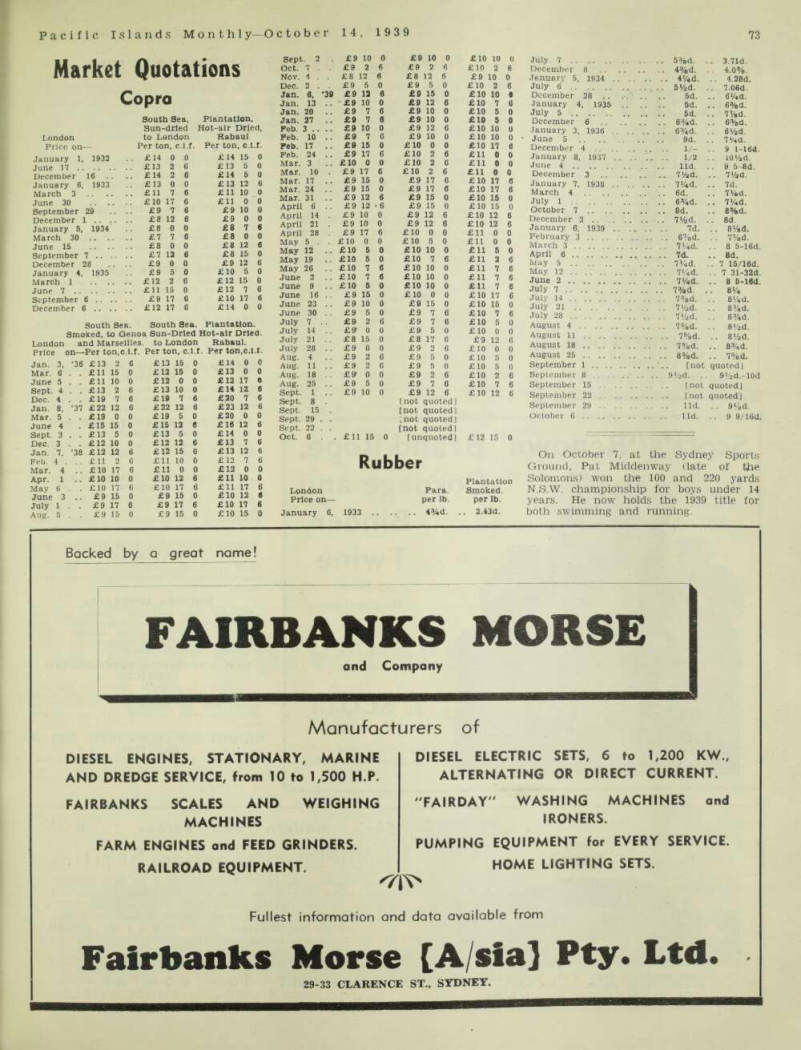
Copra
On October 7, at the Sydney Sports Ground, Pat Midden way (late of the Solomons) won the 100 and 220 yards N.S.W. championship for boys under 14 years. He now holds the 1939 title for both swimming and running.
South Sea, Plantation, Sun-dried Hot-air Dried, London to London Rabaul Price on— Per ton.
C.i.f.
Per ton, c.l.f.
January 1, 1932 £14 0 0 £14 15 0 June 17 .. .. £13 2 6 £13 5 0 December 16 £14 2 6 £14 5 0 January 6, 1933 £13 0 0 £13 12 6 March 3 £11 7 6 £11 10 0 June 30 £10 17 6 £11 0 0 September 29 £9 7 6 £9 10 0 December 1 .. £8 12 6 £9 0 0 January 5, 1934 £8 0 0 £8 7 6 March 30 .. £7 7 6 £8 0 0 June 15 £8 0 0 £8 12 6 September 7 .. £7 12 6 £8 15 0 December 28 , £9 0 0 £9 12 6 January 4, 1935 £9 5 0 £10 5 0 March 1 .. . £12 2 6 £12 15 0 June 7 .. .. £11 15 0 £12 7 6 September 6 .. £9 17 6 £10 17 6 December 6 .. £12 17 6 £14 0 0 South Sea.
South Sea.
Plantation.
Smoked, to Genoa Sun-Dried Hot-air Dried.
London and Marseilles to London Rabaul.
Price on—Per ton.c.l.f.
Per ton, c.l.f. Per ton.c.l.f.
Jan. 3, ’36 £13 2 6 £13 15 0 £14 0 0 Mar. 6 . . £11 15 0 £12 15 0 £13 0 0 June 5 . . £11 10 0 £12 0 0 £12 17 0 Sept. 4 . , £13 2 6 £13 10 0 £14 12 6 Dec. 4 . . £19 7 6 £19 7 6 £20 7 6 Jan. 8, ’37 £22 12 6 £22 12 6 £23 12 6 Mar. 5 . . £ 19 0 0 £19 5 0 £20 0 0 June 4 . £15 15 0 £15 12 6 £16 12 6 Sept. 3 . . £13 5 0 £13 5 0 £14 0 0 Dec. 3 . . £12 10 0 £12 12 6 £13 7 6 Jan. 7. ’38 £12 12 6 £12 15 0 £13 12 6 Feb. 4 . .. £11 2 6 £11 10 0 £12 7 6 Mar. 4 .. £10 17 6 £11 0 0 £12 0 0 Apr. 1 .. £10 10 0 £10 12 6 £11 10 0 May 6 . . £10 17 6 £10 17 6 £11 17 6 June 3 .. £9 15 0 £9 15 0 £10 12 8 July 1 . . £9 17 6 £9 17 6 £10 17 6 Aug. 5 . . £9 15 0 £9 15 0 £10 15 0
July 7 .. .. 5%d. .. 3.71d.
December H .. .. 4%d. 4.0%.
January 5, 1934 . . . 4%d. . . 4.28d.
July 6 . . 7.06d.
December 28 .. .. .. 5d. .. 6'/ 4 d.
January 4. 1935 .. .. .. 5d. .. 6%d.
July 5 .. 7 7 /sd.
December 6 .. .. 6%d. .. 6%d.
January 3, 1936 .. . 6%d. . . 6‘/ad.
June 5 .. .. 9d. .. 7V 4 d.
December 4 1/- .. 9 l-16d.
January 8, 1937 ., 1/2 lO'/ad.
June 4 . .. 9 5-8d.
December 3 .. .. 7 ‘/ad. .. 7*/ad.
January 7. 1938 .. . 7'/ 4 d. .. 7d.
March 4 . . .. 6d. .. 7Ved.
July 1 .. 7»/ 4 d.
October 7 .. .. 8d. .. 8%d.
December 2 7%d. . . 8d January 6, 1939 .. . 7d. .. 8'/ad.
February 3 6 7 /ad. . . 7’/ 8 d.
March 3 7'/ 4 d. .. 8 5-16d.
April 6 7d. .. 8d.
May 5 .. .. 7'/ 4 d. . . 7 15/16d.
May 12 . . 7 31-32d.
June 2 .. 8 B-16U July 7 8*/ 4 July 14 7%d. 8'/ 4 d.
July 21 7'/ad. 8%d.
July 28 8 3 / 4 d.
August 4 August 11 7%d. .. 8'/ad.
August 18 .. 8%d.
August 25 8%d. .. 7%d.
September 1 quoted] September 8 ... 9'/ad. .. 9*/ 2 d.-10d September 15 . . .. quoted] September 22 . . .. f not quoted] September 29 .. .. lid. .. 9'/ad.
October 6 lid. .. 9 9/16d.
Sept. 2 £9 10 0 £9 10 0 £10 10 0 Oct. 7 . £9 2 6 £9 2 6 £10 2 6 Nov. 4 . £8 12 6 £8 12 6 £9 10 0 Dec. 2 . £9 5 0 £9 5 0 £10 2 6 Jan. 6, 39 £9 12 e £9 15 0 £10 10 • Jan. 13 . . £9 10 0 £9 12 6 £10 7 6 Jan. 20 £9 7 6 £9 10 0 £10 5 0 Jan. 27 £9 7 6 £9 10 0 £10 5 0 Feb. 3 .. £9 10 0 £9 12 6 £10 10 0 Peb. 10 £9 7 6 £9 10 0 £10 10 0 Feb. 17 £9 15 0 £10 0 0 £10 17 6 Feb. 24 . . £9 17 6 £10 2 6 £11 0 0 Mar. 3 £10 0 0 £10 2 6 £11 0 0 Mar. 10 £9 17 6 £10 2 6 £11 0 0 Mar. 17 £9 15 0 £9 17 6 £10 17 6 Mar. 24 £9 15 0 £9 17 6 £10 17 6 Mar. 31 £9 12 6 £9 15 0 £10 15 0 April 6 £9 12 6 £9 15 0 £10 15 0 April 14 £9 10 0 £9 12 6 £10 12 6 April 21 £9 10 0 £9 12 6 £10 12 6 April 28 £9 17 6 £10 0 0 £11 0 0 May 5 . . £10 0 0 £10 5 0 £11 0 0 May 12 £10 5 0 £10 10 0 £11 5 0 May 19 £10 5 0 £10 7 6 £11 2 6 May 26 £10 7 6 £10 10 0 £11 7 6 June 2 £10 7 6 £10 10 0 £11 7 6 June 9 £10 5 0 £10 10 0 £11 7 6 June 16 £9 15 0 £10 0 0 £10 17 6 June 23 . , £9 10 0 £9 15 0 £10 16 0 June 30 £9 5 0 £9 7 6 £10 7 6 July 7 . £9 2 6 £9 7 6 £10 5 0
July
14 £9 0 0 £9 5 0 £10 0 0 July 21 £8 15 0 £8 17 6 £9 12 6 July 28 £9 0 0 £9 2 6 £10 0 0 Aug. 4 £9 2 6 £9 5 0 £10 5 0 Aug. 11 £9 2 6 £9 5 0 £10 5 0 Aug. 18 £9 0 0 £9 2 6 £10 2 6 Aug. 25 . . £9 5 0 £9 7 6 £10 7 6 Sept. 1 £9 10 0 £9 12 6 £10 12 6 Sept. 8 [not quoted!
Sept. 15 [not quoted| Sept. 29 . . ;not quoted!
Sept. 22 . [not quoted!
Oct. 6 . £11 15 0 [unquoted! £12 15 0
Rubber
Plantation London Para.
Smoked.
Price on— per lb. per lb.
January 6, 1933 . . .. 4%d. . . 2.43d.
Advertisements & other items, pp. 75-76 (2 items)
73
Pacific Islands Monthl y—O ctober 14, 1939
Fairbanks Morse
Backed by a great name!
and Company
Manufacturers of
DIESEL ENGINES, STATIONARY, MARINE
AND DREDGE SERVICE, from 10 to 1,500 H.P.
FAIRBANKS SCALES AND WEIGHING
MACHINES
FARM ENGINES and FEED GRINDERS.
RAILROAD EQUIPMENT.
DIESEL ELECTRIC SETS, 6 to 1,200 KW„
ALTERNATING OR DIRECT CURRENT.
"FAIRDAY" WASHING MACHINES and
IRONERS.
PUMPING EQUIPMENT for EVERY SERVICE.
HOME LIGHTING SETS.
Fullest information and data available from
Fairbanks Morse [A/sia] Pty. Ltd.
29-33 CLARENCE ST., SYDNEY.
KELVIN
Marine
DIESEL ENGINES
Also
KEROSENE and BENZINE
TYPES.
All kinds of Islands Repair Work undertaken.
G. RUTHERFORD,
Engineer,
46 PITT ST., SYDNEY.
ScottV'Renown”Brand Rope,
Cordage and
Binder
Twine
Cable Address; Ropeyard, Sydney.
of Every
Description
MANUFACTURED AT
MASCOT, N.S.W.
By
J, SCOTT
PTY. LTD.
Head Office and Store:
163 CLARENCE STREET.
SYDNEY,
N.S.W.
She's modern and safe . . . with
Propeller Shafting
Monel propeller shafts are world-renowned for long, dependable service. Monel, in addition to being permanently immune to rust, stoutly resists both fresh and salt water corrosion. Thus a Monel shaft forever retains its exceptional strength and toughness. It also retains a hard, smooth surface . . . does not pit and cause damage to packing in glands.
Let us tell you more about Monel propeller shafting.
The "Silver Cloud”, a 65-ft. luxury cruiser fitted with twin Monel propeller shafts, 1% In. diameter, built by Lars Halvorsen Sons Pty. Ltd., Sydney, for Mr. J. A. S. Bruce.
WRIGHT & COMPANY
81 CLARENCE STREET SYDNEY, N.S.W.
Monel is a registered trade mark
Shipping Services In The Pacific
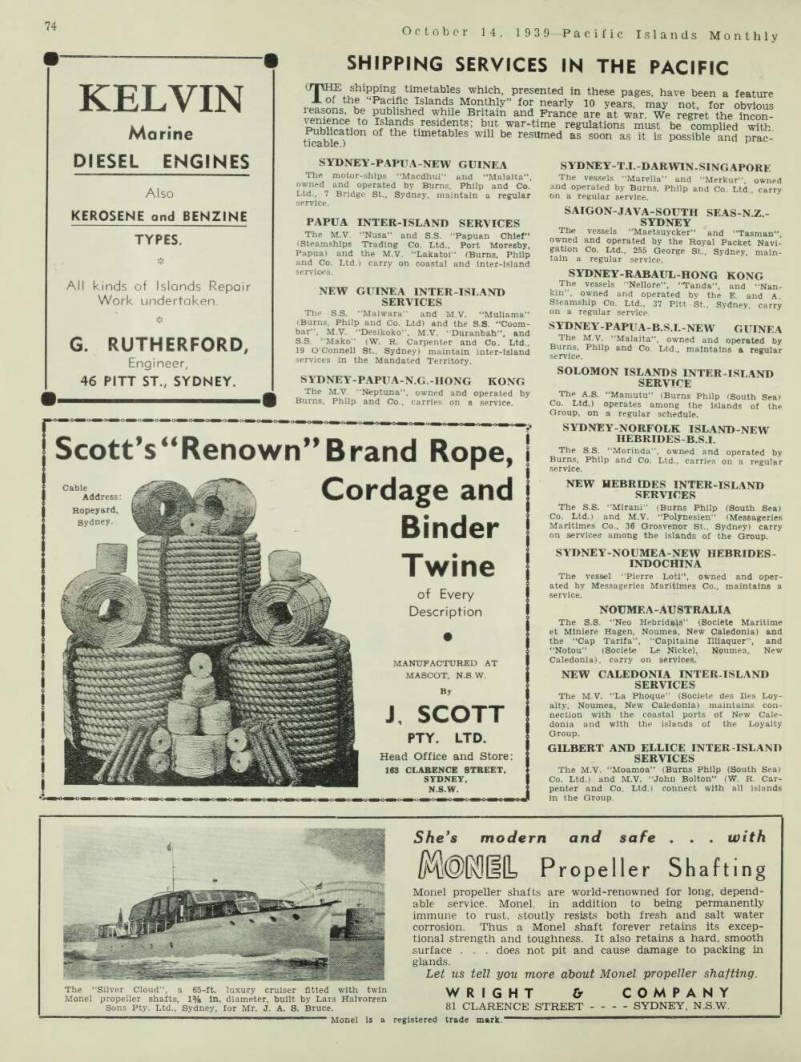
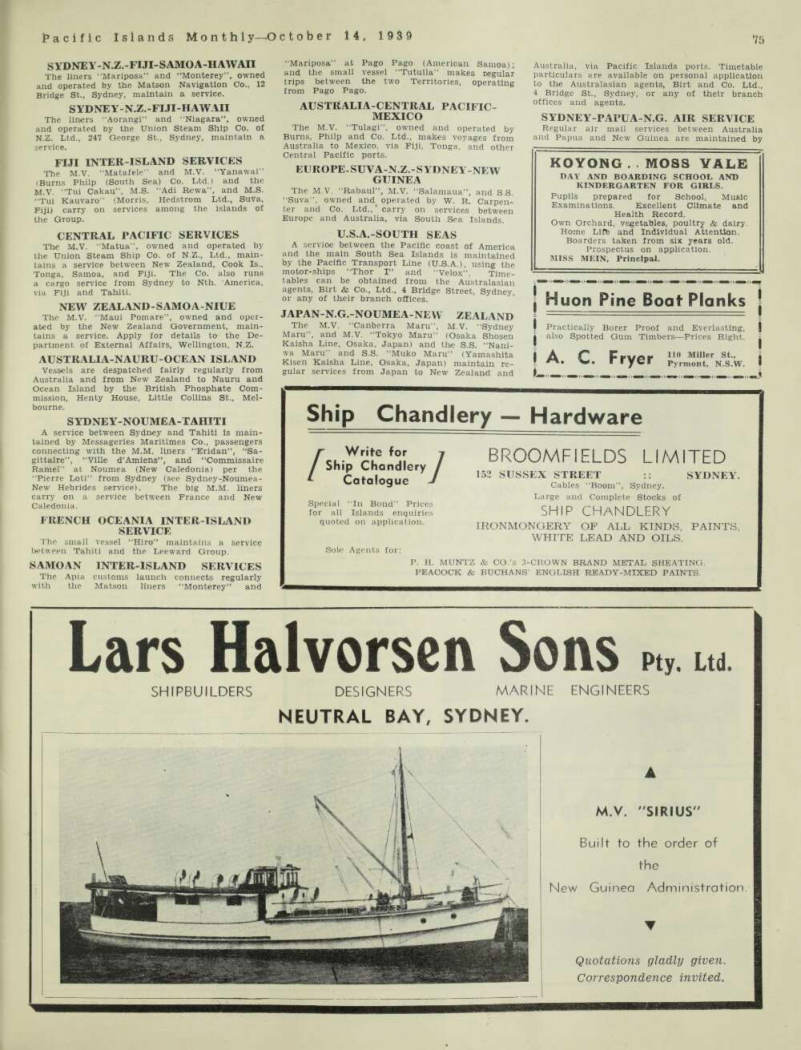
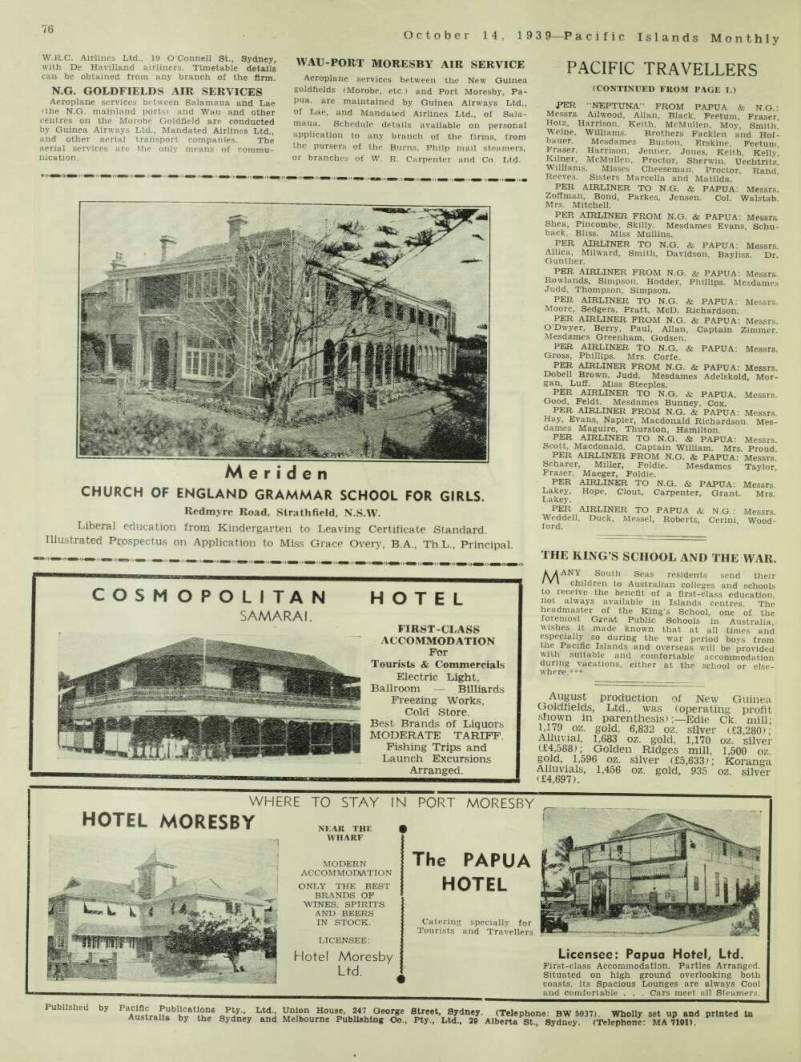
( T^ Sh “ timetables which, presented in these pages, have been a feature Xof the ‘Pacific Islands Monthly” for nearly 10 years, may not for obvious reasons, be published while Britain and France are at war. We regret the incon- ZtohSroiHrm nf l ?H dS f re H d vu tS; war " time regulations must be complied with.
Publication of the timetables will be resumed as soon as it is possible and prac ticable.) *
Sydney-Papua-New Guinea
The motor-ships “Macdhui” and “Malaita”, owned and operated by Burns, Philp and Co.
Ltd., 7 Bridge St., Sydney, maintain a regular service.
Papua Inter-Island Services
The M.V. “Nusa” and S.S. “Papuan Chief” (Steamships Trading Co. Ltd., Port Moresby, Papua) and the M.V. “Lakatoi” (Burns, Philp and Co. Ltd.) carry on coastal and inter-island services.
New Guinea Inter-Island
Services
The S.S. “Maiwara" and M.V. “Muliama” (Burns, Philp and Co. Ltd) and the S.S. “Coom bar”, M.V. “Desikoko”, M.V. ‘ Duranbah”, and S.S “Mako” (W. R. Carpenter and Co. Ltd., 19 O’Connell St., Sydney) maintain inter-island services in the Mandated Territory.
Sydney-Papua-N.G.-Hong Kong
The M.V. “Neptuna”, owned and operated by Burns, Philp and Co., carries on a service.
Sydneyt.L-Darwin-Singapore
The vessels “Marella” and “Merkur”, owned and operated by Burns, Philp and Co. Ltd., carry on a regular service.
Saigon-Java-South Seas-N.Z.-
Sydney
The vessels “Maetsuycker” and ‘■Tasman”, owned and operated by the Royal Packet Navi gation Co. Ltd., 255 George St., Sydney, main tain a regular service.
Sydney-Rabaul-Hong Kong
The vessels “Nellore”, “Tanda”, and “Nan kin”. owned and operated by the E. and A.
Steamship Co. Ltd., 37 Pitt St., Sydney, carry on a regular service.
Sydney-Papua-8.5.1.-New Guinea
The M.V. “Malaita”, owned and operated by Burns, Philp and Co. Ltd., maintains a regular service.
Solomon Islands Inter-Island
Service
The A.S. “Mamutu” (Burns Philp (South Sea) Co. Ltd.) operates among the islands of the Group, on a regular schedule.
Sydney-Norfolk Island-New
Hebrides-8.5.1.
The S.S. “Morinda”, owned and operated by Burns, Philp and Co. Ltd., carries on a regular service.
New Hebrides Inter-Island
Services
The S.S. “Mirani” (Burns Philp (South Sea) Co. Ltd.) and M.V. “Polynesian” (Messageries Maritimes Co., 36 Grosvenor St., Sydney) carry on services among the islands of the Group.
Sydney-Noumea-New Hebrides
Indochina
The vessel “Pierre Loti”, owned and oper ated by Messageries Maritimes Co., maintains a service.
Noumea-Australia
The S.S. “Neo Hebrides” (Societe Maritime et Mlniere Hagen, Noumea, New Caledonia) and the “Cap Tarifa”, “Capitaine Illiaquer”, and “Notou” (Societe Le Nickel, Noumea, New Caledonia), carry on services.
New Caledonia Inter-Island
Services
The M.V. “La Phoque” (Societe des lies Loy alty, Noumea, New Caledonia) maintains con nection with the coastal ports of New Cale donia and with the islands of the Loyalty Group.
Gilbert And Ellice Inter-Island
Services
The M.V. “Moamoa” (Burns Philp (South Sea) Co. Ltd.) and M.V. “John Bolton” (W. R. Car penter and Co. Ltd.) connect with all islands in the Group.
Sydney-N.Z.-Fiji-Samoa-Hawaii
The liners “Mariposa” and “Monterey”, owned and operated by the Matson Navigation Co., 12 Bridge St., Sydney, maintain a service.
Sydney-N.Z.-Fi Ji-H Awaii
The liners “Aorangi” and “Niagara”, owned and operated by the Union Steam Ship Co. of N.Z. Ltd., 247 George St., Sydney, maintain a service.
Fiji Inter-Island Services
The M.V. “Matafele” and M.V. “Yanawai” (Burns Philp (South Sea) Co. Ltd.) and the M.V. “Tui Cakau”, M.S. “Adi Rewa”, and M.S.
“Tui Kauvaro” (Morris, Hedstrom Ltd., Suva, Fiji) carry on services among the islands of the Group.
Central Pacific Services
The M.V. “Matua”, owned and operated by the Union Steam Ship Co. of N.Z., Ltd., main tains a service between New Zealand, Cook Is., Tonga, Samoa, and Fiji. The Co. also runs a cargo service from Sydney to Nth. America, via Fiji and Tahiti.
New Zealand-Samoa-Niue
The M.V. “Maui Pomare”, owned and oper ated by the New Zealand Government, main tains a service. Apply for details to the De partment of External Affairs, Wellington, N.Z.
Australia-Nauru-Ocean Island
Vessels are despatched fairly regularly from Australia and from New Zealand to Nauru and Ocean Island by the British Phosphate Com mission, Henty House, Little Collins St., Mel bourne.
Sydney-Noumea-Tahiti
A service between Sydney and Tahiti is main tained by Messageries Maritimes Co., passengers connecting with the M.M. liners “Eridan”, “Sa gittaire”, “Ville d’Amiens”, and “Commissaire Ramel” at Noumea (New Caledonia) per the "Pierre Loti” from Sydney (see Sydney-Noumea- New Hebrides service). The big M.M. liners carry on a service between France and New Caledonia.
French Oceania Inter-Island
Service
The small vessel “Hiro” maintains a service between Tahiti and the Leeward Group.
Samoan Inter-Island Services
The Apia customs launch connects regularly with the Matson liners “Monterey” and
“Mariposa” at Pago Pago (American Samoa); and the small vessel “Tutuila” makes regular trips between the two Territories, operating from Pago Pago.
Australia-Central Pacific
Mexico
The M.V. “Tulagi”, owned and operated by Burns, Philp and Co. Ltd., makes voyages from Australia to Mexico, via Fiji, Tonga, and other Central Pacific ports.
Europe. Suva-N.Z.-Sydney-New
Guinea
The M.V. “Rabaul”, M.V. “Salamaua”, and S.S.
“Suva”, owned and operated by W. R. Carpen ter and Co. Ltd., ‘ carry on services between Europe and Australia, via South Sea Islands.
U.S.A.-South Seas
A service between the Pacific coast of America and the main South Sea Islands is maintained by the Pacific Transport Line (U.S.A.), using the motor-ships “Thor I” and “Velox”. Time tables can be obtained from the Australasian agents, Birt & Co., Ltd., 4 Bridge Street, Sydney, or any of their branch offices.
Japan-N.G.-Noumea-Nevv Zealand
The M.V. “Canberra Manx”, M.V. “Sydney Manx”, and M.V. “Tokyo Manx” (Osaka Shosen Kaisha Line. Osaka. Japan) and the S.S. “Nani wa Manx” and S.S. “Muko Maru” (Yamashita Risen Kaisha Line, Osaka, Japan) maintain re gular services from Japan to New Zealand and
Australia, via Pacific Islands ports. Timetable particulars are available on personal application to the Australasian agents, Birt and Co. Ltd., 4 Bridge St., Sydney, or any of their branch offices and agents.
Sydney-Papua-N.G. Air Service
Regular air mail services between Australia and Papua and New Guinea are maintained by
W.R.C. Airlines Ltd., 19 O’Connell St., Sydney, with De Havilland airliners. Timetable details can be obtained from any branch of the firm.
N.G. Goldfields Air Services
Aeroplane services between Salamaua and Lae (the N.G. mainland ports! and Wau and other centres on the Morobe Goldfield are conducted by Guinea Airways Ltd., Mandated Airlines Ltd., and other aerial transport companies. The aerial services are the only means of commu nication.
Wau-Port Moresby Air Service
Aeroplane services between the New Guinea goldfields (Morobe, etc.) and Port Moresby, Pa pua. are maintained by Guinea Airways Ltd., of Lae, and Mandated Airlines Ltd., of Sala maua. Schedule details available on personal application to any branch of the firms, from the pursers of the Burns. Philp mail steamers, or branches of W. R. Carpenter and Co. Ltd.
Advertisements & other items, pp. 76-78 (3 items)
74
October 14, 193 9—P acific Islands Monthly
75
jPacific Islands Monthl y—O ctober 14, 19 S 9
Lars Halvorscn Sons m.
KOYONG . MOSS YALE
DAY AND BOARDING SCHOOL AND
KINDERGARTEN FOR GIRLS.
Pupils prepared for School, Music Examinations. Excellent Climate and Health Record.
Own Orchard, vegetables, poultry & dairy.
Home Liffe and Individual Attention.
Boarders taken from six years old.
Prospectus on application.
MISS MEIN, Principal.
Huon Pine Boat Planks
Practically Borer Proof and Everlasting, also Spotted Gum Timbers—Prices Right.
A C 110 MUler st - *"■'• rrytr Pyrmont, N.S.W.
Ship Chandlery - Hardware
Write for
/TTrire ror 7
Ship Chandlery /
Catalogue J
Special “In Bond” Prices for all Islands enquiries quoted on application.
Sole Agents for:
BROOMFIELDS LIMITED
152 SUSSEX STREET :: SYDNEY.
Cables “Boom”, Sydney.
Large and Complete Stocks of
SHIP CHANDLERY
IRONMONGERY OF ALL KINDS, PAINTS,
WHITE LEAD AND OILS.
P. H. MUNTZ & CO.’S 3-CROWN BRAND METAL SHEATING.
PEACOCK & BUCHANS’ ENGLISH READY-MIXED PAINTS
Lars Halvorscn Sons m.
SHIPBUILDERS DESIGNERS MARINE ENGINEERS
NEUTRAL BAY, SYDNEY.
M.V. "SIRIUS"
Built to the order of the New Guinea Administration Quotations gladly given.
Correspondence invited.
Meriden
CHURCH OF ENGLAND GRAMMAR SCHOOL FOR GIRLS.
Redmyre Road, Strath field, N.S.W.
Liberal education from Kindergarten to Leaving Certificate Standard.
Illustrated Prospectus on Application to Miss Grace Overy, 8.A., Th.L., Principal.
COSMOPOLITAN
SAMARA I.
1
HOTEL
FIRST-CLASS
ACCOMMODATION
For Tourists & Commercials Electric Light, Ballroom Billiards Freezing Works, Cold Store.
Best Brands of Liquors
MODERATE TARIFF.
Fishing Trips and Launch Excursions Arranged.
WHERE TO STAY IN PORT MORESBY
HOTEL MORESBY
i* v t hi?, w- ,
NEAR THE •
WHARF
MODERN
ACCOMMODATION
ONLY THE BEST
BRANDS OF
WINES, SPIRITS
AND BEERS
IN STOCK.
LICENSEE:
The PAPUA
HOTEL
Catering specially for Tourists and Travellers.
Hotel
Moresby
Ltd.
Licensee: Papua Hotel, Ltd.
First-class Accommodation. Parties Arranged.
Situated on high ground overlooking both coasts, its Spacious Lounges are always Cool and comfortable . . . Cars meet all Steamers.
The King’S School And The War.
KA ANY South Seas residents send their " * children to Australian colleges and schools to receive the benefit of a first-class education, not always available in Islands centres. The headmaster of the King’s School, one of the foremost Great Public Schools in Australia wishes it made known that at all times and especially so during the war period boys from the Pacific Islands and overseas will be provided with suitable and comfortable accommodation during vacations, either at the school or else where.*** August production of New Guinea
Goldfields, Ltd., was (operating profit
shown in parenthesis)Edie Ck. mill; 1,179 oz. gold, 6,832 oz. silver (£3,280); Alluvial, 1,683 oz. gold, 1,170 oz. silver
(£4,588); Golden Ridges mill, 1,500 oz.
gold, 1,596 oz. silver (£5,633); Koranga
Alluvials, 1,456 oz. gold, 935 oz. silver (£4,697).
Advertisements & other items, pp. 78-80 (3 items)
Pacific Travellers
76
(CONTINUED FROM PAGE 1.)
October 14. 193 9—P acific Islands Monthly
Published by Pacific Pty., Ltd., Union House, 247 George Street, Sydney. (Telephone: BW 5037). Wholly set up and printed In Australia by the Sydney and Melbourne Publishing Co., Pty., Ltd., 29 Alberta St., Sydney. (Telephone: MA 7101).
...By Air!
FROM COAST TO MOUNTAINS. ..
LAE
/1A -V "t vWA -V’V a mM
GUINEA AIRWAYS, LIMITED
was established in 1927; and has grown as the figures show.
To-day it is the largest freight-carrying service in the world.
Year Tonnage Passen- Ended Trans- gers Feb. 28. ported Carried 1929 434 869 1930 ... 949 2,047 1931 1,146 1.995 1932 3,947 1,607 1933 3,980 3,856 1934 6,044 7,398 1935 6,102 9,721 1936 6,476 12,137 1937 6,705 11,869 1938 ... 8.408 12.120 1939 ... 8,939 15,876 Totals .. 53,130 79,495
Building a New Civilization
...BY AIR!
The development of the Territory has been amazingly rapid—thanks to air transport.
GUINEA AIRWAYS LIMITED has transported every type of goods needed by the large and ever-growing European community.
GUINEA AIRWAYS operates regular air services in New Guinea and Papua, using over fifty aerodromes and landing grounds in the two Territories.
GUINEA AIRWAYS planes depart from Port Moresby for the Goldfield on the arrival of each boat. Tickets obtainable from Purser.
Fly with GUINEA AIRWAYS—the pioneer Company—in New Guinea and in Australia.
AUSTRALIAN SERVICES
ADELAIDE-DARWIN —Twice Weekly.
ADELAIDE-KANGAROO IS., Daily Return Service.
ADELAIDE-PT. LINCOLN, 3 Times Weekly.
ADELAIDE-WHYALLA, 3 Times Weekly.
H U*H
L/M/ T £ a
LAE- SALAMAUA
Head Office; Austral Chambers, New Guinea Office: Lae, Currie Street, Adelaide, S.A. Mandated Territory of New Guinea BRANCH OFFICES AND AGENTS AT WAU—SALAMAUA— PORT MORESBY AND SYDNEY. i— — A
A 31 a at V- Si i Hesclis Lager is protected hy the seal It refreshes and invigorates you as no other drink can. In Resch’s Lager, you get all the original freshness and flavour, because it is fully protected against climatic conditions hy the specially designer! “Spot” Crown Seal.
BESCHWIMR
R.L. 12.27.