Islandi
Pacific
Monthly
Vol. IX. No. 7.
February 15, 1939
t ßegistered at the G.P.0., Sydney, for transmission by post as a newspaper .] .v \ \ \ N \ >s v
8 a
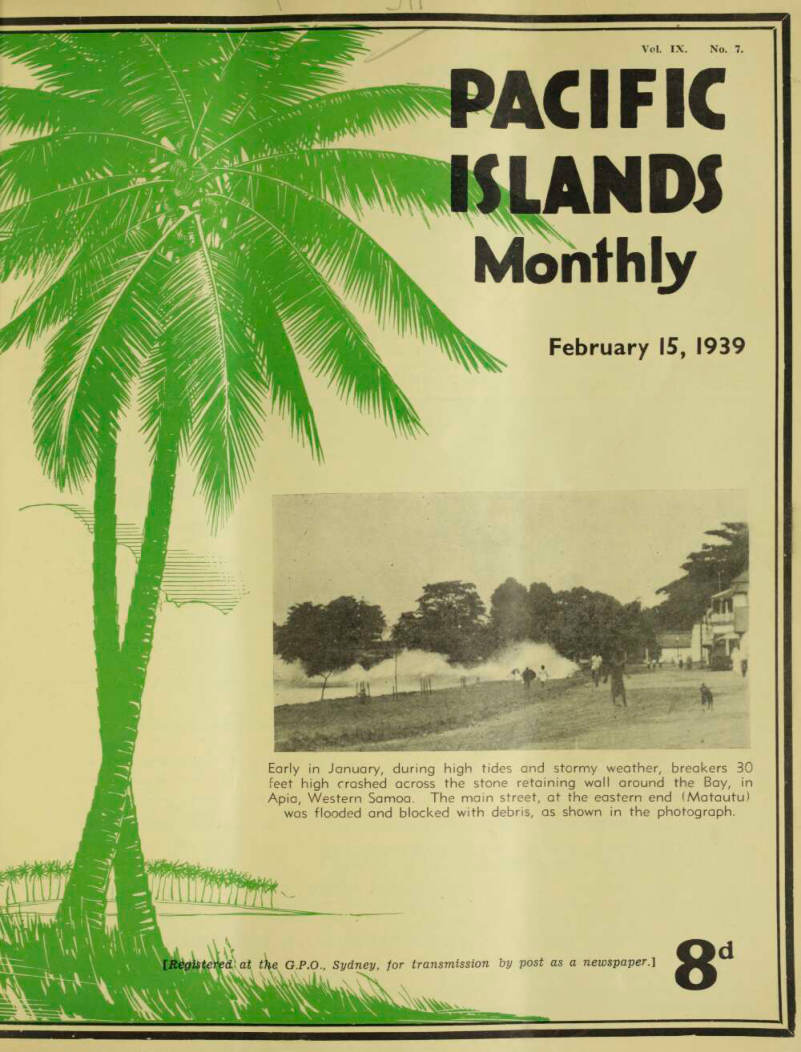
Early in January, during high tides and stormy weather, breakers 30 feet high crashed across the stone retaining wall around the Bay, in Apia, Western Samoa. The main street, at the eastern end (Matautu) was flooded and blocked with debris, as shown in the photograph.
Advertisements & other items, p. 2 (2 items)
Pacific Islands Monthl y—F ebruary 15, 1939
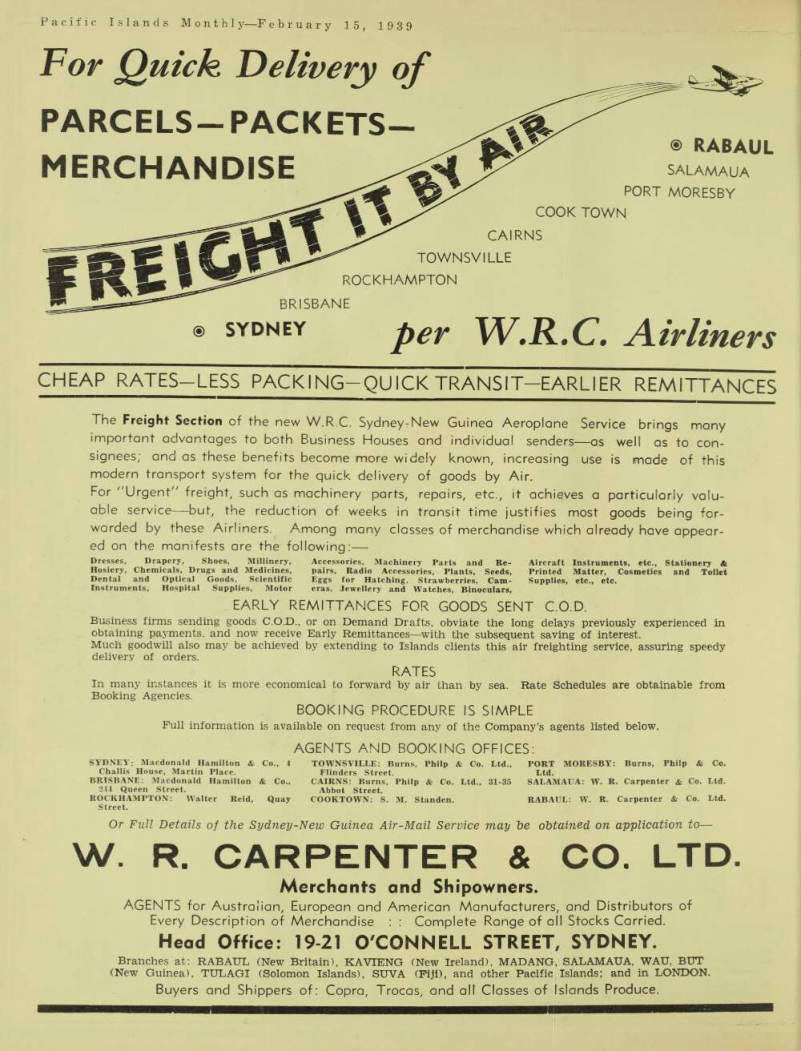
For Quick Delivery of
PARCELS-PACKETS-
MERCHANDISE
® RABAUL.
SALAMAUA
PORT MORESBY
COOK TOWN
CAIRNS
TOWNSVILLE
ROCKHAMPTON
BRISBANE
® SYDNEY
per W.R.C. Airliners
CHEAP RATES-LESS PACKING-QUICK TRANSIT-EARLIER REMITTANCES
The Freight Section of the new W.R.C. Sydney-New Guinea Aeroplane Service brings many important advantages to both Business Houses and individual senders—as well as to consignees; and as these benefits become more widely known, increasing use is made of this modern transport system for the quick delivery of goods by Air.
For "'Urgent" freight, such as machinery parts, repairs, etc., it achieves a particularly valuable service—but, the reduction of weeks in transit time justifies most goods being forwarded by these Airliners. Among many classes of merchandise which already have appeared on the manifests are the following:— Dresses, Drapery, Shoes, Millinery, Accessories, Machinery Parts and Re- Aircraft Instruments, etc.. Stationery & Hosiery, Chemicals, Drugs and Medicines, pairs, Radio Accessories, Plants, Seeds, Printed Matter, Cosmetics and Toilet Dental and Optical Goods, Scientific Eggs for Hatching, Strawberries, Cam- Supplies, etc., etc.
Instruments, Hospital Supplies, Motor eras, Jewellery and Watches, Binoculars,
EARLY REMITTANCES FOR GOODS SENT C.O.D.
Business firms sending goods C.0.D., or on Demand Drafts, obviate the long delays previously experienced in obtaining payments, and now receive Early Remittances—with the subsequent saving of interest.
Much goodwill also may be achieved by extending to Islands clients this air freighting service, assuring speedy delivery of orders.
RATES
In many instances it is more economical to forward by air than by sea. Rate Schedules are obtainable from Booking Agencies.
BOOKING PROCEDURE IS SIMPLE
Full information is available on request from any of the Company’s agents listed below.
AGENTS AND BOOKING OFFICES:
SYDNEY: Macdonald Hamilton & Co., 4 TOWNSVILLE: Burns, Philp & Co. Ltd., PORT MORESBY: Burns, Philp & Co.
Challis House, Martin Place. Flinders Street. Ltd.
BRISBANE: Macdonald Hamilton & Co., CAIRNS: Burns, Philp & Co. Ltd., 31-35 SALAMAUA: W. R. Carpenter & Co. Ltd. 244 Queen Street. Abbot Street.
ROCKHAMPTON: Walter Reid, Quay COOKTOWN: S. M. Standen, RABAUL: W. R. Carpenter & Co. Ltd.
Street.
Or Full Details of the Sydney-New Guinea Air-Mail Service may be obtained on application to —
W. R. CARPENTER & CO. LTD.
Merchants and Shipowners.
AGENTS for Australian, European and American Manufacturers, and Distributors of Every Description of Merchandise : : Complete Range of all Stocks Carried.
Head Office: 19-21 O'CONNELL STREET, SYDNEY.
Branches at: RABAUL (New Britain), KAVTENG (New Ireland), MADANG, SALAMAUA, WAU, BUT (New Guinea), TULAGI (Solomon Islands), SUVA (Fiji), and other Pacific Islands; and in LONDON.
Buyers and Shippers of: Copra, Trocas, and all Classes of Islands Produce.
Pacific Islands Travellers
PER "NIAGARA” FROM FIJI ON JAN. 14: Bowen (2), Carver (2). Connie (2), Day (2), Farquhar, Godden, Pinkerton, Saxby, Stocks (2), White (2), Wignall, Cowie (2), Johnson, Kerr, Miller, Nicholl, Nicholson, Ottley (2), Wreford, Griffen. Williams. Mesdames Bowen (2), Connie, Day, Fenner, Godden, Hardaker, Pinkerton, Rutter, Saxby, Seymour, Snowsill, Southey, Stocks, White, Cowie, Nicholls, Nicholson, Snod grass. Misses Bowen, Farquhar, Fenner, Har daker, Rourke (2), White, Wignall, Johnson, Nicholson.
Per Airliner “Carmania” For N.G. On
JAN. 17; Messrs. Blackley, Ferguson, Watts, Gray, Munroe.
PER “MACDHUI” TO PAPUA & N.G. ON JAN. 18: Messrs. Austen, Archibald,’ Anderson, Buckland, Barnes, Carr, Cahill, Deland, Reas man. Frame, Foley, Fox, Humphries, O’Malley, Lockhart, Lloyd, Mason, Morel, Munro, Naughton, Neville, Neilson, Percival, Patten, Parker, Ross, Stewart, Thompson, Vicary, Wells, Webb. Mes dames Buckland, Cahill, Dunstan, Dockray, Eck hoff. Frame. Fuller, Harbord, Kloosterboer, Perry, Ross, Ryan, Elliott Smith, Veitch, Vicary. Misses Blakeney, Puller, Kirby, Maley, Percival, Rudd, Slee, Ayten.
PER "NEPTUNA" FOR N.G. PORTS ON JAN. 13 Messrs. Barham, Currie, Fraser, Garms,
Green, Hindmarsh, Hippseley. Jackson, Lappin, Lucas, Mitchell, McEwan, Murcutt, Swan, Watch.
Mesdames Barham, Currie, Green, Lucas, Mc- Ewan, Murcutt, Nisbett. Misses Beckley, Gannon, Harris, Murray.
PER “NANKIN” FROM N.G. ON JAN. 19; Messrs. Sansom, Nosworthy, Temple, Hoadley, Park, Thompson, Haviland, Hill, Chum Din, Swan, Saunders. Mesdames Bunny, Wild, Havi land, Kelly. Misses Doyle, Kinson, Yansoon.
PER “NIAGARA" FOR FIJI ON JAN. 19; Messrs. Abel, Burke, Casey, Craigie, Chaffey, Caldwell, Clarke, Fogarty, Fisher, Fleming, Gillies, Foulis, Grainger, Harricks, Rollston!
Prior, Smythe, Sanders, Scott, Walker, Davison, Gray, Jordon-Rozwadowski, Leembruggen, Wes ton. Mesdames Jordon-Rozwadowski, Leem bruggen, Burke, Casey, Harricks, Gillies, Grainger.
Fleming, Symthe, Scott. Hembrough, Gambling.
Davison, Martin. Misses Abel, Caldwell, Hem brough.
Per Airliner “Carinthia" From N.G. On
JAN. 20: Messrs. Watts, Gray, Craven, Arnold.
Loomers, Perkins.
Per “Maetsuycker" From Western
PACIFIC IS. ON JAN. 22: Messrs. Kent. Nock, Bussche, McEwen, Nolan, Weinfeld, Stoffers, Katz, Pink. Miss Brigg.
Per Airliner “Caronia” For N.G. On
JAN. 24: Messrs. Benham, Condon, Hinks, Dalkin, Coleman, Marshall. Mrs. Tuckey. Miss Reid.
Per “Maetsuycker” To Papua On Jan.
24; Messrs. Campbell, Rodger, Thompson.
Per “Morinda" From Lord Howe Is.,
NORFOLK IS., AND N. HEBRIDES ON JAN. 27: Messrs. Aston, Cool, Turner, Fleming, Rose, Coates, Bell, Flower, Hill, Harvey, Hyder, Reuben, Rosenthal, Winchester, Baxter, Blundell, Creer, Crommelin, Creebie-Brown, Fenton, Grey, Hudspeth, Hyslop, Johnson, Kelynack, Lloyd, Mason, Meares, Morgan, Selfl, Smythe, Stevens, Thompson, Turner, Wilson. Mesdames Bell, McCann, Nobbs, Blundell, Creer, Crosbie-Brown, Fenton, Hudspetch, Hyslop, Johnson, Morgan, Thompson. Misses Larney (2), Lording, Adams, Bailey, Bataille, Christian (3), Deasey, (2), Drew, Galloway, Hogarth, Jocteur, Johnston, Levick, Lewis, Martin, Maudesley (2), McCann, Quintal, Read, Sheather, Strom, Witchorn, De Mestre, Langhorn (2), Phillips, Proctor, Ramsay, Still.
Per Airliner “Carmania” From N.G. On
JAN. 27: Messrs. Evenson, Heron, Bedford, Asquith, Osbourne, Ethel, Kingsley. Mrs. Bergin.
PER ' MORINDA” TO LORD HOWE ISLAND & NORFOLK IS. ON JAN. 28: Messrs. Lisle, Sanders, Williamson, Jones, Curlewis, Spike, Taylor, Valkenburg, Gollan (2), Jones, Laing, Pearcey, Laing, Morris (2), Hicks (2), Fowles, Bradshaw, Ryan, May, Roxburgh, Shipway (2).
(Continued On Page 76.)
Mesdames; McCoy, Jones (2), Curlewis, Laing, Nelson, Kane, Fowles, Bradshaw, Wickstead, Matthews, McKell, Stuart, Shipway. Misses; Singleton (2), Robinson, Everett, Knox, Steward, Mulvihill, Taylor, Shipway, Higgs, Johnson.
PER AIRLINER ‘ ‘CARINTHIA” FOR N.G. ON JAN. 31: Messrs. Cromie, Consterdine, Korn, Garing. Rowlands, Unbank, Christie, Wilde. Mrs.
Collopy.
PER "BULOLO” FROM N.G. & PAPUA ON JAN. 31: Messrs Buchanan, Ball, Barnes, Cahill, Clay, Crisp, Cull, Cording, Christie, Chambers, Cram, Darwin, de Groen, Dwyer, Daulton, Evans, Graham, Gollan, Good, Garvin, Giblin, Henry, Hutchinson, Head, Horton, Joy cey, Kruttschnitt, Kerr, Lee, Mayger, Mears, McCulloch, McGilvery, Mallett, O’Connor, Plummer, Pratt, Rand, Robertson, Stewart, Stephen. Simpson. Wurst, Wallace, Thompson, Taylor, Rev. Lane. Mesdames Ashton, Ailwood, Bates, Coote, ■ Croft, Cooper. Chadderton, Cham bers, Drosten, Evans, Godson, Good, Gross, Hides, Higgins. Kruttschnitt. Loader, Lane, Lee, Mar shall, Maxwell, Murray, McGilvery, Nagy, Plummer, Stuart, Russell, Streeter, Stewart, Stephen, Trammell, Wallace, Wild, Weatherall.
Misses Anderson, Boag, Cobb, Colebrook, Cole man, Cardew, Crook, Cooper, Clancy, Chandler, Camell, Carmichael, Davies, Everett, Fanning, Gorrie, Hutchison, Hyde. Johnson, Kothe, Lever ing, Lee, Milling, Mcßae, Pearce, Pope, Ritchie, Roe. Streeter, Swords, Sutton, Simons, Spicer, Temby, Wells.
Per Airliner ‘ ‘Carinthia’' From N.G.
ON FEBRUARY 2; Messrs. Wilde, Marshall, Herron, Garing, Caddow, Strathearn, Higgins (2), Gordon. Mesdames Collopy, De Boon. Misses Sedgers (2), Corfe, Matthews.
Per Airliner ”Carmania” For N.G. On
FEB. 7: Messrs. McKenzie, Travis, Mamie, Earl, Willis.
Per “Morinda” From Norfolk And
LORD HOWE IS. ON FEB. 8; Messrs. Lawson, Ryan, Clarke, Bigg, Buffett (3), Cottee, Lake, Robinson, Stopp, Baker, Coyle, Chisholm, de Mestre, Duckworth. Fenwick, Fowles, Gollan (2), Hicks, Howell, Kirby, Stanger-Leathes, Lowey, Mason, Richmond, Salter, Sainsbury, Sanders, Shipway, Spike. Sturgess, Taylor, Thompson, Towers, Chapman. Monteith. Mesdames McCoy, Bataille, Cottee, Griffith, Morgan, Rosenthal, Clay, Coyle, Fowles, Kirby, Mason, McKell, Payten, Shipway, Sinclair, Smith, Stuart, Woolley.
Misses Knox, Anderson, Bataille, Hogarth, Mar tin. Palmer, Blackburn (2), Bruce, Clay, Cun ningham, Fenton, Higgs, Hines, Jenkins, Johnson, Johnston, Lipscombe, Marlin, Martin, McKillop, Leneghan, Mulvihill, Pender, Teece, Thompson.
e v b^ olo ” papua and N °- on , 8 - Messrs. Healy, Hitchcock, Bradford Cruickshanks, Bunting, Woods, Considine, Ross Hart, Bennett, Olsson, O’Dea, Young, Read Tnfw na S’ KK Mozzell > Brocq, Moor, Cox, Neal!
Toiler, Babbage, Smith, Thurlow, Smith (3) Pa 6 uhnl’ Twr Ma^ tin ’ Gardiner. Norton-Russell’
Paulmi, MacGregor, Devaney, Mitchell. Fryer Mainwaring, Grail, Cook (2), Harvey i„7i Fl ojance, Rogerson, Agshellahear, Sefton , K , nox > Swanson, Wilton. Monogham!
Trebelcock, Shutt, Doherty, Moon, Ashwell Munro, Davis, Maxwell, Monck, Hurrell, Pislak Hayles, Boileau, Thomsett, Skelly, O’Farrell McAuiney, Vagg, Wood (2), Legs, Morgan Lindsay, Smith, Cardwell, Prosper, Semnle’
Spence, Davis, MacDonald, Crawford, Hodgson’
W Hea J& sherwin - Mason, Melres, Woods, Ross, Champion, Shackleton, Hughes Tr k v e int nd Qv, Carpenter ’ Cromie - Schelling, Brocq’
LiviSl’<?tnn haW ’rr l !' ra ?’ d ’ Chester - Tofler. Mitchell! w Q t« gSt • J! hurlow ' Minogue, Clark, Lees, Batze, Christie, Paulini, Earl, MacGregor Devaney, Mitchell, Mainwaring, Grail, Rogerson, Beggs, Swanson, Wilton, Garrad’ wS’ Dohert y> Perichon, Hayles, Vagg’
S o l < h (2) ’ Cardwell - Misses Cooper, Boag’
Snence Sufi 118 ’ T Hoble £ Marril, Burns, Gilbert, Sharpe! ’ Lynn ’ Craig ’ Li PP in gwell, Vercoe!
PER “MALATTA” FROM 8.5.1. & NG ON FEB. 10: Messrs. Barber, Boydell, Bignell. Clark Cornwall, Crump (2), Darlington, Harrlcks’
Haselden, Johnstone, Mead, Russell, Scott’
Shields, Smith (2), Wilson. Rev. Cocks. Mes dames Colley, Crump, Duncan, Elgas. Harrison Ormsby Ryan, Svensen, Scott (2). Misses Baker’
Cohen, Ellis, McCluggage, Moore, Morrin. Paton Sanders, Tatham. ’
PER “AORANGI” FROM FIJI ON FEB. 10 Messrs. Abel, Allman, Baker, Colahan, Cradick Crawford, Fleming, Freeman (2), Fisher, van Gelderen, Humphries, Kerkham, Keyte King Lynch, McCullagh, Potts, Pratt. Rogers, Southey!
Scott, Stevenson (2), Twentyman, Walker Borrowdale, Cohen, Coffey, Costello (2), Free burn, Garnett, Johnson, Ross, Speers, Voskess Waring, James, Schroetter, Watson, Williams’
Mesdames Abel, Crawford, Fleming, Humphries’
Keyte, King Lynch, McCullagh, Potts, Pratt!
Rogers, Robley, Scott, Southey, Stevenson Tre wenack, Borrowdale, Corbett, Thompson, Spence Se ak h A fi° n ’ s Peer P eers ’ Schroetter, Williams.
Pnff Allman - Cradick, King, Lynch (3), Potts (2), Rogers, Stevenson (2), Browne Borrowdale, Coffey (2), Speers, Waring, Whippy!
PER “NANKIN” FOR N.G. ON FEB. 11: Messrs. Donnir, Dix, Pickering, Tee, Karius Mesdames Dix, Karius, Mlrfleld, Nagel. Miss Bennett.
PER AIRLINER FROM N.G. ON FEB. 12; Messrs. McDonald, Schoip, Madders, Garing. Mrs Speedie.
Very Rev. Father G. Lahaye, a pioneer Marist missionary in Fiji, died in Levuka Hospital after a shiprt illness in the mid dle of January. He was 87 years of age, and had served in the Colony for 62 years.
Mr. and Mrs. H. Geoff. Nicholls, of Lautoka, Fiji, received many congratula tions on February 8 on the birth of a son.
Mr. H. A, Major, of the Suva branch of the Bank of N.S.W., left Fiji in mid- January on transfer to Australia.
Advertisements & other items, p. 3 (2 items)
1
Pacific Islands Monthl y—F ebruary 15, 1939
South
THE
KP.M
PACIFIC
LINE
B IT A V I A
SAMARftNG
SOUR A 8 A Y ft
PORT MOAESBi
4»
Links the East with the South
Pacific Islands, New Zealand & Australia
KP.M.
SOUTH PACIFIC LINE
Royal Packet Navigation Co.
Ltd., Paketvaart House, 255 George Street, Sydney. (N. V. Koninklijke Paketvaart MaatschappiJ—lncorporated in the Netherlands).
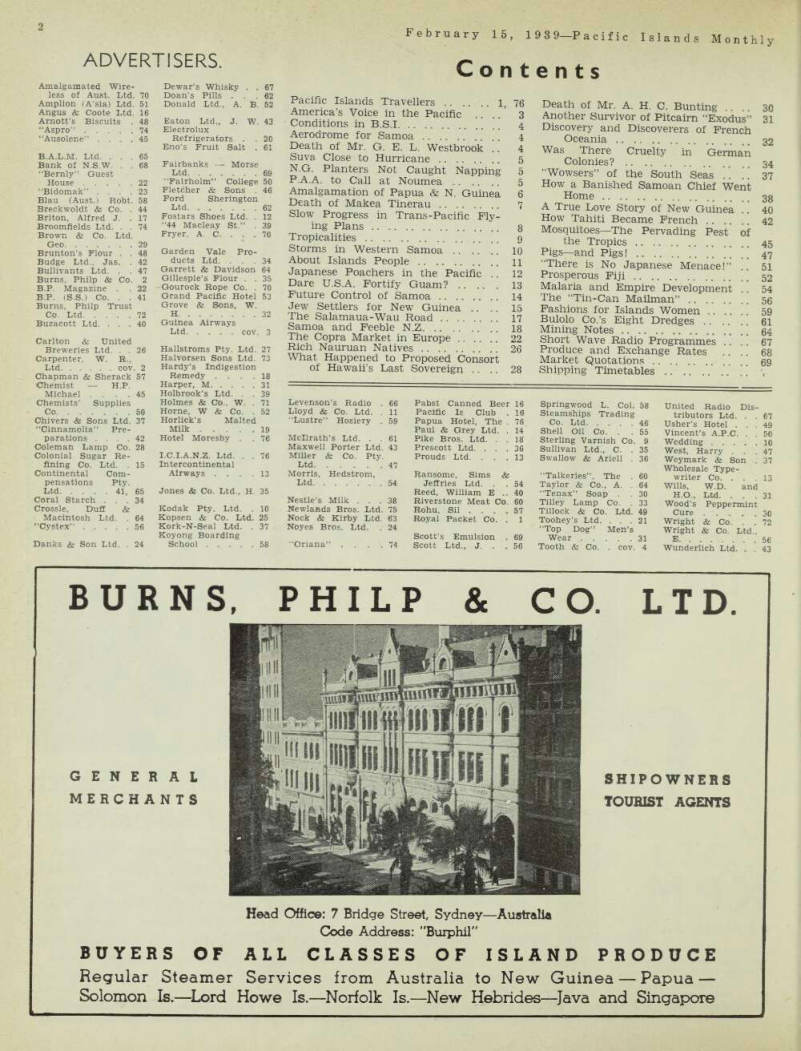
The track routes of the K.P.M.-South Pacific Line new motor vessel "Maetsuycker" and the well-known passenger steamer "Tasman" are each as follows: "MAET- SUYCKER": Saigon, Singapore, Batavia, Samarang, Sourabaya, Port Moresby, Samarai, Salamaua, Rabaul, Auckland, Wellington, Sydney, Port Moresby, Sourabaya, Samarang, Batavia, Singapore, Saigon. "TASMAN": Saigon, Singapore, Batavia, Samarang, Sourabaya, Port Moresby, Port Vila, Noumea, Auckland, Wellington, Sydney, Port Moresby, Sourabaya, Samarang, Batavia, Singapore, Saigon.
Saigon, Dlethelm & Co.: Port Moresby and Samarai, Steamships Trading Co, Ltd.: Rabaul and Salamaua. W. R.
Carpenter & Co. Ltd.: Port Vila. Gubbay Freres: Noumea, Carlo Leoni: Auckland. Russell & Somers Ltd.; Wellington, Johnston & Co. Ltd.
Advertisers.
Amalgamated Wire less of Aust. Ltd. 70 Amplion fA’sia) Ltd. 51 Angus & Coote Ltd. 16 Arnott’s Biscuits . 48 “Aspro” 74 “Ausolene” ... 45
B.A.L.M. Ltd. ... 65
Bank of N.S.W. . . 68 “Bernly” Guest House 22 “Bidomak” . .23 Blau (Aust.) Robt. 58 Breckwoldt & Co. .44 Briton, Alfred J. . 17 Broomfields Ltd. . . 74 Brown & Co. Ltd.
Geo 29 Brunton’s Flour . . 48 Budge Ltd.. Jas. . 42 Bullivants Ltd. . . 47 Burns. Philp & Co. 2 B.P. Magazine . . 22
B.P. (S.S.) Co. . . 41
Burns, Philp Trust Co. Ltd 72 Buzacott Ltd. ... 40 Carlton & United Breweries Ltd. . . 26 Carpenter, W. R., Ltd cov. 2 Chapman & Sherack 57 >Chemist H.P.
Michael ... 45 Chemists’ Supplies Co 50 Chivers & Sons Ltd. 37 “Cinnamolia” Pre parations ... 42 Coleman Lamp Co. 28 Colonial Sugar Re fining Co. Ltd. . 15 Continental Com pensations Pty.
Ltd 41, 65 Coral Starch ... 34 Crossle, Duff & Macintosh Ltd. . 64 “Cystex” 56 Danks & Son Ltd. . 24
Dewar’s Whisky . . 67 Doan’s Pills ... 62 Donald Ltd., A. B. 52 Eaton Ltd., J. W. 43 Electrolux Refrigerators . . 20 Eno’s Fruit Salt . 61 Fairbanks Morse Ltd 69 “Fairholm” College 50 Fletcher & Sons . 46 Ford Sherington Ltd 62 Fostars Shoes Ltd. . 12 “44 Macleay St.” . 39 Fryer, A. C. . . .70 Garden Vale Pro ducts Ltd. ... 34 Garrett & Davidson 64 Gillespie’s Flour . . 35 Gourock Rope Co. . 70 Grand Pacific Hotel 53 Grove & Sons, W.
H 32 Guinea Airways Ltd cov. 3 Hallstroms Pty. Ltd. 27 Halvorsen Sons Ltd. 73 Hardy’s Indigestion Remedy ... 18 Harper, M 31 Holbrook’s Ltd. . . 39 Holmes & Co., W. . 71 Horne, W & Co. . 52 Horlick’s Malted Milk 19 Hotel Moresby . 76
1.C.1.A.N.Z. Ltd. . . 76
Intercontinental Airways ... 13 Jones & Co. Ltd., H. 35 Kodak Pty. Ltd. . 10 Kopsen & Co. Ltd. 25 Kork-N-Seal Ltd. . 37 Koyong Boarding School 58
Levenson’s Radio . 66 Lloyd & Co. Ltd. . 11 “Lustre” Hosiery . 59 Mcllrath’s Ltd. . . 61 Maxwell Porter Ltd. 43 Miller & Co. Pty.
Ltd 47 Morris, Hedstrom, Ltd 54 Nestle’s Milk ... 38 Newlands Bros. Ltd. 75 Nock & Kirby Ltd. 63 Noyes Bros. Ltd. . 24 “Oriana” ... 74
Pabst Canned Beer 16 Pacific Is Club . 16 Papua Hotel, The . 76 Paul & Grey Ltd. . 14 Pike Bros. Ltd. . . Iff Prescott Ltd. ... 36 Prouds Ltd. ... 13 Ransome, Sims & Jeffries Ltd. . . 54 Reed, William E ..40 Riverstone Meat Co. 60 Rohu, Sil . . . .57 Royal Packet Co. . 1 Scott’s Emulsion . 69 Scott Ltd., J. . .56
Springwood L. Col. 58 Steamships Trading Co. Ltd 46 Shell Oil Co. . . 55 Sterling Varnish Co. 9 Sullivan Ltd., C. . 35 Swallow & Ariell . 36 “Talkeries”, The . 60 Taylor & Co., A. . 64 “Tenax” Soap . . 30 Tilley Lamp Co. . 33 Tillock & Co. Ltd. 49 Toohey’s Ltd. ... 21 “Top Dog’’ Men’s Wear 31 Tooth & Co. . cov. 4
United Radio Dis tributors Ltd. . . 67 Usher’s Hotel ... 49 Vincent’s A.P.C. . . 50 Wedding io West, Harry ... 47 Weymark & Son . 37 Wholesale Type writer Co. ... 13 Wills, W.D. and H. 0., Ltd. ... 31 Wood’s Peppermint Cure 30 Wright & Co. . . 72 Wright & Co. Ltd..
E 56 Wunderlich Ltd. . . 43
Contents
Pacific Islands Travellers 1, 76 America's Voice in the Pacific 3 Conditions in 8.5.1 4 Aerodrome for Samoa ' ” 4 Death of Mr. G. E. L. Westbrook .. 4 Suva Close to Hurricane 5 N.G. Planters Not Caught Napping 5 P.A.A. to Call at Noumea 5 Amalgamation of Papua &N. Guinea 6 Death of Makea Tinerau 7 Slow Progress in Trans-Pacific Ply ing Plans g Tropicalities 9 Storms in Western Samoa 10 About Islands People n Japanese Poachers in the Pacific .. 12 Dare U.S.A. Fortify Guam? 13 Future Control of Samoa 14 Jew Settlers for New Guinea .. .. 15 The Salamaua-Wau Road 17 Samoa and Feeble N.Z is The Copra Market in Europe 22 Rich Nauruan Natives 26 What Happened to Proposed Consort of Hawaii's Last Sovereign ... 28
Death of Mr. A. H. C. Bunting ... 30 Another Survivor of Pitcairn “Exodus” 31 Discovery and Discoverers of French Oceania 32 Was There Cruelty in German Colonies? 34 “Wowsers” of the South Seas .’. 37 How a Banished Samoan Chief Went Home 38 A True Love Story of New Guinea .. 40 How Tahiti Became French 42 Mosquitoes—The Pervading Pest of the Tropics 45
Pigs—and Pigs! * 47
“There is No Japanese Menace!” 51 Prosperous Fiji 52 Malaria and Empire Development .. 54 The “Tin-Can Mailman” 56 Fashions for Islands Women 59 Bulolo Co.’s Eight Dredges 61 Mining Notes 64 Short Wave Radio Programmes .. .! 67 Produce and Exchange Rates ... 68 Market Quotations 69
Shipping Timetables * (
Advertisements & other items, p. 4 (1 item)
Burns, Philp & Co. Ltd.
GENERAL
MERCHANTS
Iflii 111 unit in ii
Iff!
II!
Hi in 111 t|
SHIPOWNERS
TOURIST AGENTS
Head Office: 7 Bridge Street, Sydney—Australia Code Address; "Burphil"
BUYERS OF ALL CLASSES OF ISLAND PRODUCE Regular Steamer Services from Australia to New Guinea Papua Solomon Is.—Lord Howe Is. —Norfolk Is.—New Hebrides —Java and Singapore
Pacific Islands Monthly
The Newspaper-Magazine of the Sonth Seas
[Registered at the G.P.0., Sydney, for transmission by post as a newspaper. ] Published Once Each Month and Circulated in Australia and New Zealand and in the following Pacific Territories and Islands Groups:
Crown Colony of Fiji.
Australian Territory of Papua.
Mandated Territory (Australia) of New Guinea, Bismarck Archipelago and Northern Solomon Islands.
Mandated Territory (Japan) of Marshall, Caroline and Marianna Islands.
French Territory of New Caledonia.
British and French Condominium of New Hebrides.
American Territory of Eastern Samoa.
American Territory of Guam.
Mandated Territory of Nauru.
British Crown Colony of Gilbert and Ellice Islands.
Mandated Territory (New Zealand) of Samoa.
British Solomon Islands Protectorate.
British Protectorate of Tongan Islands.
New Zealand Territory of Cook Islands.
Australian Territory of Norfolk Island.
French Colony of Oceania (Tahiti, cte.) * American Territory of Hawaiian Islands.
Owned and Produced by Pacific Publications Pty. Ltd., Union House, 247 George Street, Sydney.
T I Managing Director 8W5037 TELEPHONE j BuoineB s and Editorial MA7IOI
P.O. Box 3408 R
Registered Address of Telegrams, Radiograms, and Cables: “Pacpub”, Sydney.
Contributions
Articles, Stories, and Photographs dealing with Pacific Islands subjects are invited and will be paid for on publication at usual rates.
Subscription Rates
Per Annum, within British Empire, Prepaid, Post Free 8/- Per Annum, elsewhere, prepaid, Post Free 10/- Single Copies Bd.
Editor and Publisher:
R. W. Robson, F.R.G.S.
Assisted by Selwyn Hughes.
Advertising Manager: L. W. Bailey.
Advertising Office and Printing-House: 29 Alberta St., Sydney.
Advertising rates furnished on application.
Colours, etc by Arrangement Process Blocks made at Advertiser’s expense when required. Screen, 100.
Changes of Advertising Copy should reach this Office by 3rd of each month, otherwise previous advertisement may be repeated.
IN LONDON, the “Pacific Islands Monthly” is on sale at the Bookstall. Australia House, The Strand, London.
Agents
The following are authorised to receive sub scriptions for the Pacific Islands Monthly;- Islands Branches of Burns, Philp & Co. Ltd., and Burns Philp (South Sea) Co. Ltd.
Islands Branches of W. R. Carpenter & Co. Ltd.
All Branches of Morris, Hedstrom Ltd.
G. Thomas & Co., Rabaul, New Guinea.
T. A. Olsson, Wau, New Guinea.
Whitten Bros. Ltd., Samarai. Papua.
Steamships Trading Co., Papua. All Branches.
P. Costello, Suva, Fiji.
J. Muir, Suva, Fiji.
N. C. Mackenzie-Hunt, Wainunu, Bua, Fiji.
All Branches and Representatives of W. H. Grove & Sons Ltd., Auckland, New Zealand.
Cook Islands Trading Co., Rarotonga, Cook Is.
A. C. Rowland, Papeete, Tahiti.
Representative in London: W. C. HARVEY, Coronation Building 4 Lloyds Avenue, London, E.C.2. from whom may be obtained copies of Pacific Islands Monthly. Pacific Islands Year Book, advertising schedules, etc.
Vol. IX. No. 7.
Sydney, February 15, 1939.
( Bd ‘ Per Copy rnce ( Prepaid: 8/- p.a.
America’s Voice In The Pacific
DURING the month, the President of the United States warned the Fascist nations that the world’s greatest republic cannot be indifferent to any policy of aggression directed against the world’s democracies. The head of the Republican Party, ex- President Hoover, stated bluntly that, if London and Paris were bombed, the United States would have to move in their defence.
This gave check to the dictators, and to the Japanese. The latter, con fident that they had the steady back ing of Germany and Italy, were almost jaunty in their defiance of Britain and France, in Asia and the North-west Pacific, and the situation was drifting towards war. But the sudden, un expected, definite stand taken by the American leaders has caused an al most startling halt in the movement of international affairs; and the prospects of European peace are better, at the moment, than for a long time. Some permanent good may come out of it.
But, so far as the Pacific is con cerned, two things must be remem bered. It is impossible, in the nature of things, that there can be a peace ful settlement in the North-west Pacific. There will be peace only so long as the European nations remain strong enough to hold Japan within her present Empire. The other point
—and this is very important—is that those Presidential utterances in favour of democratic nations, and the re commendation of a Committee that Guam be fortified, cannot become an expression of United States foreign policy until accepted and ratified by the Senate of the United States. That may mean long weeks of argument, intrigue and underground engineering.
If Guam, away over among the Japanese mandated islands (see map in this issue) is to be fortified, it means that American foreign policy, in relation to Asia and the North-west Pacific, is going into reverse. The Tydings-McDuffie Act, passed in March, 1934, provided for the with drawal of the United States from the Philippines, by stages, to be complete by 1946, when the Philippines would have complete independence. Ameri can public opinion overwhelmingly agreed with the opinion that American interests should not extend westward of the Central Pacific line represented by the Aleutian-Hawaiian-Samoan islands—a line necessary to protect the Panama Canal. Although it has become clear, in the past two years, that if the Americans walk out of the Philippines, the Japanese will walk in, a decision by the United States to retain control of the Territory has not been expected, simply because U.S.A. has no vital interests to defend in the
Philippines or Asia. Facts of a por tentious character, not hitherto re vealed, will have to be placed before the American people before the policy represented by the Tydings-McDuffie Act will be abandoned.
The United States President, with his finger on the pulse of foreign af fairs, knows a great deal that he can not reveal to the ignorant masses, which sway blindly, from day to day, in accordance with the screeching of an ill-informed, propagandist press.
The President" knows that if he sup ports the democracies and preserves their institutions, he is keeping the world open and free for all Americans; whereas if the Anglo-French Empires are destroyed, and the world is brought into subjection to the Totali tarian States, the Americans will have to fight hard for their liberty, under conditions presaging their defeat. But American masses never will believe that—until it is too late.
So the relief gained from American intervention probably may be brief.
The Senate almost'certainly will tell the President to st?” at home and mind his own business, and, if the dictators are not sincere in their present plea for peace, the pres sure of the dictators upon the demo cracies will be resumed. Every respite is valuable, however. Britain is grow ing stronger, every week* and the time now cannot be far distant when the Franco-British alliance will be so strong as to put an uncertain wobble into the Berlin-Rome-Tokio axis.
Solomons
Conditions In The
May Be New Commissioner
IT is reported that there will be con siderable changes in the personnel of the Solomon Islands Administra tion at an early date.
The Resident Commissioner, Mr. F. N.
Ashley, who has had charge of the ter ritory for several years, goes on long
leave in April, and it is understood that he will then retire. It is not known who his successor will be.
A number of other well-known offi cials are reported to be also contemplat ing retirement within the next couple of years. The names mentioned include those of Mr. Johnson (Treasurer), Mr.
Knibbs and Mr. Mutch. It is expected that the new Treasurer will be Mr.
Sanders.
The Solomon Islands Protectorate, owing to its isolated position, its ma larious character, and the constant bar rage of criticism that is provided by discontented planters and traders, is not a station that is eagerly sought after by officials of the British Colonial Ser vice.
It is not that the planters and traders in the British Solomon Islands are more difficult than planters and traders else where. The real trouble is the fact that in the Solomon Islands, owing to the curious situation of the group, there has been no new settlement or development for many years, and consequently there are very few opportunities for individual enterprise by Europeans. Britain does absolutely nothing for the Solomon Is lands, except to send a corps of officials there to administer the place: Australia, which has all the Solomon Islands trade, ignores the territory officially.
The Europeans, in consequence, pro test bitterly against the paralysis of development that has prevailed during the past two or three decades; and their feelings are not improved when they see a small but increasing group of ener getic Chinese gradually capturing the whole of the small trade of the Islands.
As one old-timer in the Solomons, writ ing to the editor recently, expressed it: “When I look at the low price of copra
and shell, and see all these Chinese traders and Chinese ships about, and compare conditions with what they were, I feel that I could go away somewhere and weep. As an old-time district offi cer said: ‘We have put the best part of our lives into the Solomons, and simply helped to make the group into a home for Asiatics’ ”.
Mr. F. N. Ashley, C.M.G.
Aerodrome in
Samoa May Have Military Significance
Prom Our Own Correspondent
T„„ , Apia, Jan. 20.
HE Public Works Department now is preparing a landing ground for aero planes, on land that is part of N.Z.
Reparation Estates at Vailele, east of Apia.
There is quiet water, in the lagoon, in the shelter of the reef, in the vicinity, for the use of seaplanes.
It is not known whether this is to be a commercial or military airport—prob ably both. It is assumed that it is being
got ready, ostensibly, for the inaugura tion of British trans-Pacific airmail ser vices.
It is believed that the visit of Earl Beatty was something more than a plea sant tour and social call—that it was connected with a survey of possible aeroplane bases.
Copra Market
Commencing in this issue, a special article, reviewing the copra market as seen in London, by a special cor respondent, will appear regularly in the “Pacific Islands Monthly”. It is published on page 22 of this issue.
Earthquake
N. Solomons and Morobe Coast Are Shaken
THERE was a very severe earthquake, in the earthquake belt between New Guinea and the Solomon Islands, on January 31.
Faisi, in the Northern Solomons, got a violent shaking and a tidal wave. Some damage was done to wharves and old buildings, but nothing serious has been reported. Residents in most of the Solomon Islands were a little startled by the tremors: and natives, in a num ber of places, fled howling into the bush.
The Morobe coast of New Guinea, di rectly opposite the Northern Solomons, was shaken in an alarming way. and some minor damage was reported in Salamaua. Residents of the latter place prepared themselves for the usual tidal wave: but, on this occasion, the sea re mained quiet.
Captain G. E. Warner and Mrs. War ner left Auckland on their return to Rarotonga by the “Matua’’ on February 1, after spending two months in New Zealand.
Westbrook
Death of G. E. L.
ALL the adventure and romance which imaginative writers like to associate with life in the Pacific Islands had really been experienced by Mr. George Egerton Leigh Westbrook, who died in Apia, Western Samoa, on January 31 aged 78.
Mr. Westbrooke arrived in Polynesia when a young man; and for years, as sailor, trader, planter, and recruiter he wandered up and down the Eastern Paci nc, from Tahiti and Samoa to the Mar shall and Caroline Islands. About 45 years ago, he settled in Western Sa moa, and from that centre he saw great changes take place in the Pacific Is lands. From the late seventies onward, he met everyone worth meeting in the Central Pacific; he was a keen and in terested observer of men and events; he became involved in
many public move ments (especially the Nationalist Movement in Sa moa, where he was, for a time, in seri ous conflict with the New Zealand authorities); and few men could dis cuss Pacific af fairs as interest ingly as he. He wrote well and copiously, and his articles and stor ies were published all over the world.
He provided pic turesque material for a book, “Gods Who Die’’, publish ed in America early in 1936. He had learned much wisdom in his later years, and his advice, though
not always sought, was always valuable.
His passing is a loss to Samoa.
Mr. Westbrook (left), with Mr. P. Hoeflich, an old German resident of Samoa.
Lieut.-Governor Of Papua
From Our Own Correspondent.
Pt. Moresby, Feb. 6.
THE Lieut.-Governor of Papua, Sir Hubert Murray, will leave Port Moresby on his usual three months of vacation on February 14 by the “Macd hui”, for Sydney.
Sir Hubert will visit Melbourne and Canberra, and will discuss with the new Minister for Territories (Mr. Harrison) the many problems involved in the pro ject of amalgamation.
Dr. C. M. Dawson, M.L.C., of Samoa, who has been spending a holiday in New Zealand, left Auckland on his return to Apia, by the “Matua” on February 1.
Mr. and Mrs. F. Cook sailed from Syd ney for Salamaua, New Guinea, by the “Bulolo” on February 8, after several weeks’ holiday in Sydney. He is con nected with “Cliffside” gold mine, at Wau. T.N.G.
M. Pay an, a school teacher at La Foa, New Caledonia, left the Colony by the “Commissaire Ramel” on February 11 for Marseilles, France.
This Is The Life!
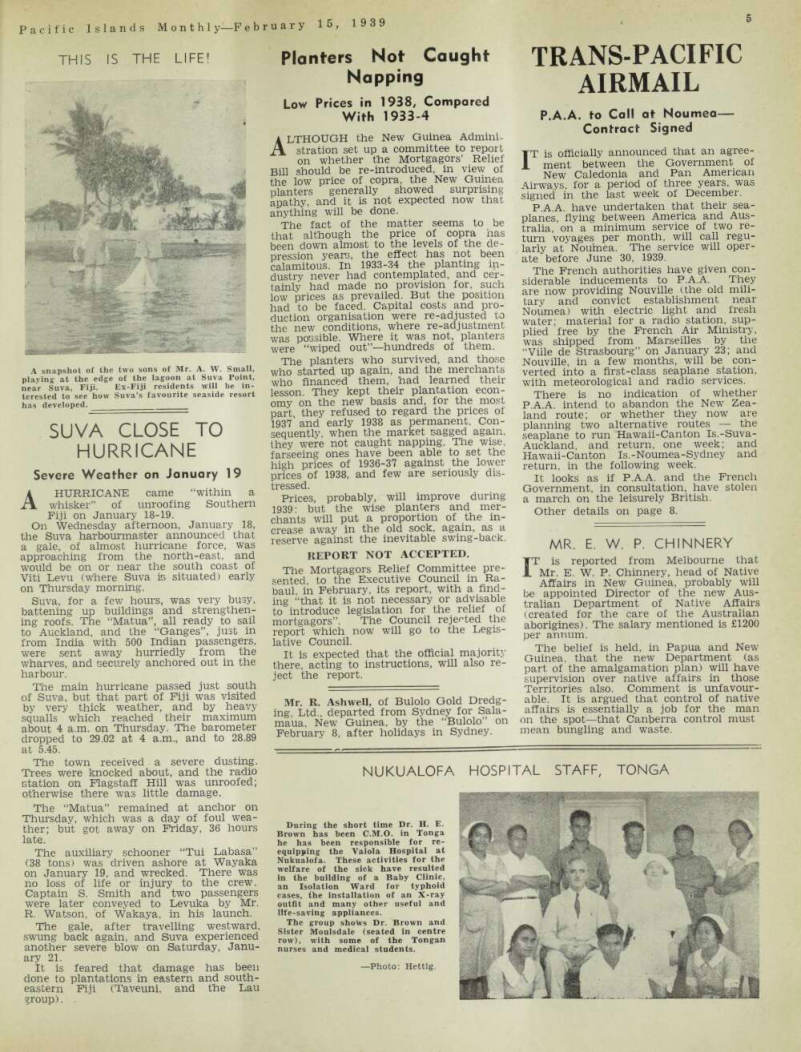
A snapshot of the two sons of Mr. A. W. Small, playing at the edge of the lagoon at Suva Point, near Suva, Fiji. Ex-Fiji residents will be in terested to see how Suva’s favourite seaside resort has developed.
Hurricane
Suva Close To
Severe Weather on January 19
A HURRICANE came “within a whisker” of unroofing Southern Fiji on January 18-19.
On Wednesday afternoon, January 18, the Suva harbourmaster announced that a gale, of almost hurricane force, was approaching from the north-east, and would be on or near the south coast of Viti Levu (where Suva is situated) early on Thursday morning.
Suva, for a few hours, was very busy, battening up buildings and strengthen ing roofs. The “Matua”, all ready to sail to Auckland, and the “Ganges”, just in from India with 500 Indian passengers, were sent away hurriedly from the wharves, and securely anchored out in the harbour.
The main hurricane passed just south of Suva, but that part of Fiji was visited by very thick weather, and by heavy squalls which reached their maximum about 4 a.m. on Thursday. The barometer dropped to 29.02 at 4 a.m., and to 28.89 at 5.45.
The town received a severe dusting.
Trees were knocked about, and the radio station on Flagstaff Hill was unroofed; otherwise there was little damage.
The “Matua” remained at anchor on Thursday, which was a day of foul wea ther; but got away on Friday, 36 hours late.
The auxiliary schooner “Tui Labasa” (38 tons) was driven ashore at Wayaka on January 19, and wrecked. There was no loss of life or injury to the crew.
Captain S. Smith and two passengers were later conveyed to Levuka by Mr.
R. Watson, of Wakaya, in his launch.
The gale, after travelling westward, swung back again, and Suva experienced another severe blow on Saturday, Janu ary 21.
It is feared that damage has been done to plantations in eastern and south eastern Fiji (Taveuni, and the Lau group).
Napping
Planters Not Caught Napping Low Prices in 1938, Compared With 1933-4
ALTHOUGH the New Guinea Admini stration set up a committee to report on whether the Mortgagors’ Relief Bill should be re-introduced, in view of the low price of copra, the New Guinea planters generally showed surprising apathy, and it is not expected now that anything will be done.
The fact of the matter seems to be that although the price of copra has been down almost to the levels of the de pression years, the effect has not been calamitous. In 1933-34 the planting in dustry never had contemplated, and cer tainly had made no provision for. such low prices as prevailed. But the position had to be faced. Capital costs and pro duction organisation were re-adjusted to the new conditions, where re-adjustment was possible. Where it was not, planters were “wiped out”—hundreds of them.
The planters who survived, and those who started up again, and the merchants who financed them, had learned their lesson. They kept their plantation econ omy on the new basis and, for the most part, they refused to regard the prices of 1937 and early 1938 as permanent. Con sequently. when the market sagged again, they were not caught napping. The wise, farseeing ones have been able to set the high prices of 1936-37 against the lower prices of 1938, and few are seriously dis tressed.
Prices, probably, will improve during 1939: but the wise planters and mer chants will put a proportion of the in crease away in the old sock, again, as a reserve against the inevitable swing-back. report not accepted.
The Mortgagors Relief Committee pre sented, to the Executive Council in Ra baul, in February, its report, with a find ing “that it is not necessary or advisable to introduce legislation for the relief of mortgagors”. The Council rejected the report which now will go to the Legis lative Council.
It is expected that the official majority there, acting to instructions, will also re ject the report.
Mr. R. AshweU, of Bulolo Gold Dredg ing, Ltd., departed from Sydney for Sala maua, New Guinea, by the “Bulolo” on February 8, after holidays in Sydney.
Trans-Pacific
Airmail
P.A.A. to Call at Noumea — Contract Signed
IT is officially announced that an agree ment between the Government of New Caledonia and Pan American Airways, for a period of three years, was signed in the last week of December.
P.A.A. have undertaken that their sea planes, flying between America and Aus tralia, on a minimum service of two re turn voyages per month, will call regu larly at Noumea. The service will oper ate before June 30, 1939.
The French authorities have given con siderable inducements to P.A.A. They are now providing Nouville (the old mili tary and convict establishment near Noumea) with electric light and fresh water; material for a radio station, sup plied free by the French Air Ministry, was shipped from Marseilles by the “Viile de Strasbourg” on January 23; and Nouville, in a few months, will be con verted into a first-class seaplane station, with meteorological and radio services.
There is no indication of whether P.A.A. intend to abandon the New Zea land route; or whether they now are planning two alternative routes the seaplane to run Hawaii-Canton Is.-Suva- Auckland, and return, one week; and Hawaii-Canton Is.-Noumea-Sydney and return, in the following week.
It looks as if P.A.A. and the French Government, in consultation, have stolen a march on the leisurely British.
Other details on page 8.
Mr. E. W. P. Chinnery
IT is reported from Melbourne that Mr. E. W. P. Chinnery, head of Native Affairs in New Guinea, probably will be appointed Director of the new Aus tralian Department of Native Affairs (created for the care of the Australian aborigines). The salary mentioned is £l2OO per annum.
The belief is held, in Papua and New Guinea, that the new Department (as part of the amalgamation plan) will have supervision over native affairs in those Territories also. Comment is unfavour able. It is argued that control of native affairs is essentially a job for the man on the spot—that Canberra control must mean bungling and waste.
Nukualofa Hospital Staff, Tonga
During the short time Dr. H. E.
Brown has been C.M.O. in Tonga he has been responsible for re equipping the Vaiola Hospital at Nukualofa. These activities for the welfare of the sick have resulted in the building of a Baby Clinic, an Isolation Ward for typhoid cases, the installation of an X-ray outfit and many other useful and life-saving appliances.
The group shows Dr. Brown and Sister Moulsdale (seated in centre row), with some of the Tongan nurses and medical students. -Photo: Hettig.
Advertisements & other items, p. 7 (1 item)
5
Pacific Islands Monthl y—F ebruary 15, 1939
Northward Bound By The
"Bulolo"
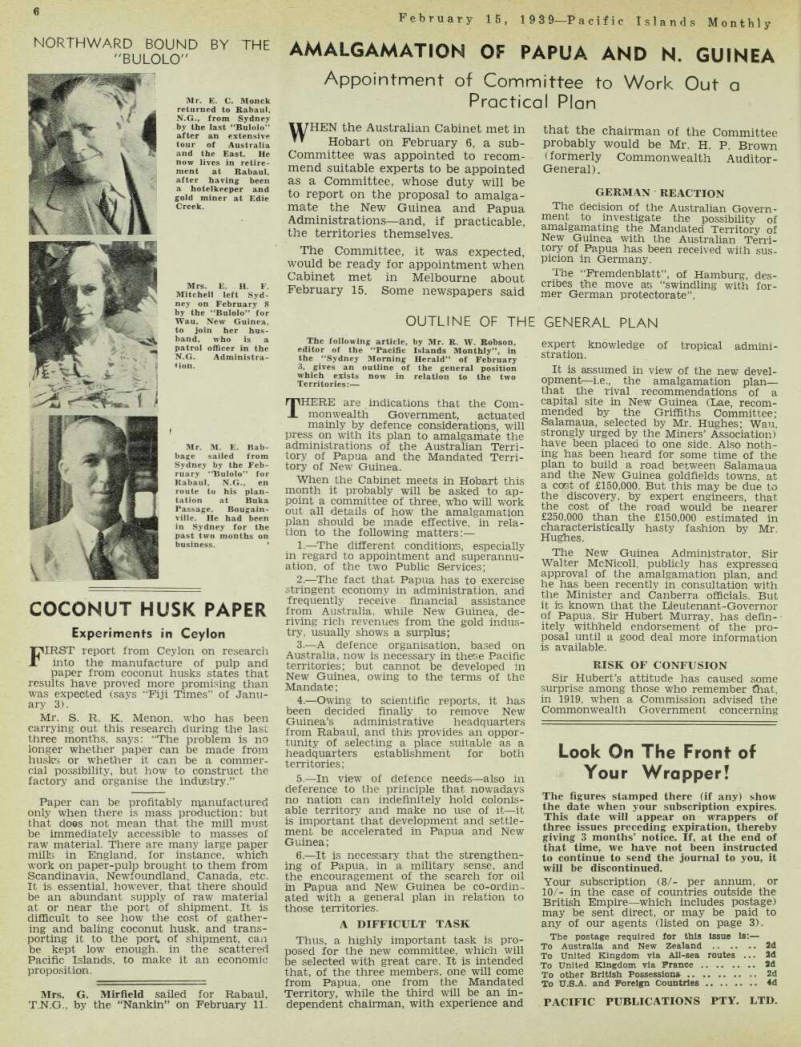
Mr. E. C. Monck returned to Rabaul, N.G., from Sydney by the last “Bulolo" after an extensive tour of Australia and the East. He now lives in retire ment at Rabaul, after having been a hotelkeeper and gold miner at Edie Creek.
Mrs. E. H. F.
Mitchell left Syd ney on February 8 by the “Bulolo" for Wau, New Guinea, to join her hus band, who is a patrol officer in the N.G. Administra tion.
Mr. M. E. Bab bage sailed from Sydney by the Feb ruary “Bulolo” for Rabaul, N.G., en route to his plan tation at Buka Passage, Bougain ville. He had been in Sydney for the past two months on business.
Coconut Husk Paper
Experiments in Ceylon
FIRST report from Ceylon on research into the manufacture of pulp and paper from coconut husks states that results have proved more promising than was expected (says “Fiji Times” of Janu ary 3).
Mr. S. R. K. Menon. who has been carrying out this research during the last three months, says: “The problem is no longer whether paper can be made from husks or whether it can be a commer cial possibility, but how to construct the factory and organise the industry.”
Paper can be profitably manufactured only when there is mass production: but that does not mean that the mill must be immediately accessible to masses of raw material. There are many large paper mills in England, for instance, which work on paper-pulp brought to them from Scandinavia, Newfoundland, Canada, etc.
It is essential, however, that there should be an abundant supply of raw material at or near the port of shipment. It is difficult to see how the cost of gather ing and baling coconut husk, and trans porting it to the port of shipment, can be kept low enough, in the scattered Pacific Islands, to make it an economic proposition.
Mrs. G. Mirfield sailed for Rabaul, T.N.G., by the “Nankin” on February 11.
Practical Plan
Amalgamation Of Papua And N. Guinea
Appointment of Committee to Work Out a Practical Plan
VjyHEN the Australian Cabinet met in Hobart on February 6, a sub committee was appointed to recom mend suitable experts to be appointed as a Committee, whose duty will be to report on the proposal to amalga mate the New Guinea and Papua Administrations—and, if practicable, the territories themselves.
The Committee, it was expected, would be ready for appointment when Cabinet met in Melbourne about February 15. Some newspapers said
that the chairman of the Committee probably would be Mr. H. P. Brown (formerly Commonwealth Auditor- General),
German Reaction
The decision of the Australian Govern ment to investigate the possibility of amalgamating the Mandated Territory of New Guinea with the Australian Terri tory of Papua has been received with sus picion in Germany.
The “Premdenblatt”, of Hamburg, des cribes the move as “swindling with for mer German protectorate”.
Outline Of The General Plan
The following article, by Mr. R. W. Robson, editor of the “Pacific Islands Monthly”, in the “Sydney Morning Herald” of February 3, gives an outline of the general position which exists now in relation to the two Territories:— THERE are indications that the Com monwealth Government, actuated mainly by defence considerations, will press on with its plan to amalgamate the administrations of the Australian Terri tory of Papua and the Mandated Terri tory of New Guinea.
When the Cabinet meets in Hobart this month it probably will be asked to ap point a committee of three, who will work out all details of how the amalgamation plan should be made effective, in rela tion to the following matters:— I.—The different conditions, especially in regard to appointment and superannu ation, of the two Public Services; 2.—The fact that Papua has to exercise stringent economy in administration, and frequently receive financial assistance from Australia, while New Guinea, de riving rich revenues from the gold indus try, usually shows a surplus; 3. —A defence organisation, based on Australia, now is necessary in these Pacific territories; but cannot be developed in New Guinea, owing to the terms of the Mandate; 4.—Owing to scientific reports, it has been decided finally to remove New Guinea’s administrative headquarters from Rabaul, and this provides an oppor tunity of selecting a place suitable as a headquarters establishment for both territories; s.—ln view of defence needs—also in deference to the principle that nowadays no nation can indefinitely hold colonis able territory and make no use of it—it is important that development and settle ment be accelerated in Papua and New Guinea; 6. —It is necessary that the strengthen ing of Papua, in a military sense, and the encouragement of the search for oil in Papua and New Guinea be co-ordin ated with a general plan in relation to those territories.
A Difficult Task
Thus, a highly important task is pro posed for the new committee, which will be selected with great care. It is intended that, of the three members, one will come from Papua, one from the Mandated Territory, while the third will be an in dependent chairman, with experience and
expert knowledge of tropical admini stration.
It is assumed in view of the new devel opment—i.e., the amalgamation plan— that the rival recommendations of a capital site in New Guinea (Lae, recom mended by the Griffiths Committee; Salamaua, selected by Mr. Hughes; Wan, strongly urged by the Miners’ Association) have been placed to one side. Also noth ing has been heard for some time of the plan to build a road between Salamaua and the New Guinea goldfields towns, at a cost of £150,000. But this may be due to the discovery, by expert engineers, that the cost of the road would be nearer £250,000 than the £150,000 estimated in characteristically hasty fashion by Mr.
Hughes.
The New Guinea Administrator, Sir Walter McNicoll, publicly has expressed approval of the amalgamation plan, and he has been recently in consultation with the Minister and Canberra officials. But it is known that the Lieutenant-Governor of Papua, Sir Hubert Murray, has defin itely withheld endorsement of the pro posal until a good deal more information is available.
Risk Of Confusion
Sir Hubert’s attitude has caused some surprise among those who remember that, in 1919, when a Commission advised the Commonwealth Government concerning
the kind of government to be introduced in New Guinea, it was Sir Hubert Murray who put in a minority report, in favour of one administrative organisation for the two Territories.
Sir Hubert will be in Australia shortly, and is completely capable of explaining and defending his present position. Prob ably, however, it will be found that this wise and experienced administrator is not opposed to amalgamation, but is sus picious of the plan because, if there is not complete understanding in regard to two or three vital matters, amalgama tion may lead to serious confusion and loss. It is likely that at least three as pects of the proposal are causing him con cern —namely, the differences (as com pared with Papua) in the New Guinea service, built up since 1919; the eagerness of the big industrial enterprises in the Mandated Territory, where native labour is increasingly scarce, to recruit labour in Papua; and the imperative need, in any re-arrangement to guard the Papuan native policy, to which Sir Hubert has de voted 30 years of his life, and which is the most creditable thing in Australia’s record of Pacific administration.
Interests Of Natives
It should be explained, perhaps, that the greatest problem in these well-popu lated territories is that of easing the im pact upon the social and cultural organi sation of a stone-age people, of the in evitable penetration of European civilisa tion. Where this impact is uncontrolled, primitive races lose their spirit and viril ity, and perish, as has been proved in a dozen nearby island groups. But in Papua, under patient and skilled admini stration, the change-over from stone to steel, from fighting and famine to peace and plenty, has been and is being carried out in such a way that tribal organisa tions and vital statistics have been scar cely disturbed. Sir Hubert Murray is be lieved to be of the opinion that, prior to amalgamation, residents of both terri tories should be consulted; and that, in any event, there should be a preparatory, or halfway, stage.
Advertisements & other items, p. 8 (1 item)
Your Wropper!
Look On The Front of
The figures stamped there (if any) show the date when your subscription expires.
This date will appear on wrappers of three issues preceding expiration, thereby giving 3 months’ notice. If, at the end of that time, we have not been instructed to continue to send the journal to you, it will be discontinued.
Your subscription (8/- per annum, or 10/- in the case of countries outside the British Empire—which includes postage) may be sent direct, or may be paid to any of our agents (listed on page 3).
The postage required for this issue Is:— To Australia and New Zealand 2d To United Kingdom via All-sea routes ... 2d To United Kingdom via Prance 2d To other British Possessions 2d To U.S.A. and Foreign Countries 4d
PACIFIC PUBLICATIONS PTY. LTD.
Papua's Reaction To
Merger Plan
A MAN, usually well-informed, who re cently visited Port Moresby, writes; Amalgamation with the Territory of New Guinea seems to be approaching.
Members of a committee of five have been nominated in Port Moresby and it looks as though the matter is decided.
The only real feeling there is adverse to it. The scheme has a lot of professing supporters, but they are those who always welcome a change of any kind, and none of them have the least idea of what kind of changes they expect. Burns, Philp are said to dislike it and fear it. Steamships Trading Co., look sideways at it. Civil servants hate it. The “Papuan Courier” supports it enthusiastically but probably does not know what it means.
The dangers to Papua seem to be land laws, labour laws, customs tariff, and gold royalties; and, of course, there are a num ber of rather vague directions in which the change may be hurtful.
But at least it appears now that full en quiries will be made and the situation ex amined thoroughly.
Amalgamation?
Whence Came the Idea of Amalgamation?
QUITE a number of people are claim ing that they are the authors of the plan to amalgamate New Guinea and Papua. The “Sydney Bulletin” says;
“Five years ago, ‘The Bulletin’ began to advocate the administrative linking of New Guinea and Papua”.
Maybe, some reference to records is de sirable. The editor of the “Pacific Is lands Monthly”, after a visit to Papua and New Guinea, wrote this: “Taking the broad view, there is a good deal to be said for the amalgama tion of these Territories. Why not one big Territory, governed by Australia, and including New Guinea, Papua, and the whole of the Solomon Islands? . . .
One big administrative organisation would stimulate the developmental impulse now stirring in New Guinea, and solve the administrative problems represented by top-heavy Papua, and the languishing Solomons”.
That was published on page 4 of the “P.1.M.” of August, 1932. It was not the outcome of any editorial inspiration; but was the direct result of talks which the editor had with thoughtful men in Pa pua and New Guinea, where amalgama tion had been, for years, a subject of discussion. Ever since then, year after year, the “P.1.M.” has urged that, at least for administrative purposes, there should be closer union between Papua and the Mandated Territory.
Death Ofmakea
Tinerau
Rarotongan Paramount Chief
THE death occurred on January 28 of the Makea Ariki (paramount chief) of Rarotonga, Nui Tinerau, 0.8. E., at
the early age of 65. He had been Makea since 1921.
Nui Tinerau was a man of striking ap pearance and unusual ability and all his life, he gave the New Zealand Admini stration loyal and helpful co-operation.
He was a member of the Island Council, and chairman of directors of the Raro tongan Fruit Company. He was held in high regard by everyone.
The above photograph of Tinerau was taken last year, when he visited Western Samoa, and was the guest of Malietoa and other leading chiefs of that Terri tory.
Collapsing
Old Wreck Is
Memories of When U.S.A. and Germany Nearly Fought, 50 Years Ago
Ever since the night of March 15, 1889, when a disastrous hurricane swept across Apia Harbour, Western Samoa, there has lain on the reef, right in front of Apia town, the huge hull of a German warship—a most conspicuous object.
Many attempts have been made to re move this wreck; but it hais resisted gun powder, dynamite and the revages of time. Until January, 1939, almost ex actly 50 years after the hurricane, it seemed that the hull of the German war ship was indestructible.
But, in the storms which occurred in the first week of January, the ancient hull received a terrific battering and, al though it is still there, it is reported that it is much reduced in size and has taken on a different appearance. The sea has made several new holes in it, and it thought likely now that it may soon dis appear into the deep water beside the reef.
It is all that remains, now, to remind the present generation of that curious in cident of 1889 when Germany and the United States were on the point of going to war over their conflicting interests in Samoa and when there had assembled in Apia Bay no less than seven warships— one British, three American and three German.
The hurricane came up with frightful suddenness and the three American and three German warshins were thrown on to the reef, and a large number of their seamen were drowned. The British war ship, “Calliope” clawed her way out of Apia Bay, in the teeth of the hurricane, and was saved.
It was then that there occurred that famous incident of history, when the men of the American warship “Trenton”, fast drifting to their doom on the raging reef, lined the rail and cheered lustily as their comrades on the British ship fought their way, inch by inch, out to the open sea. It was a sportsmanlike gesture on the part of the American bluejackets which the British Navy has never forgotten.
The destruction of the six warships effectively ended the warlike snarling of the two nations concerned, and the dis pute was quickly settled.
New B.P.C. Office On Nauru
Prom Our Own Correspondent
Nauru, Jan. 14.
BUILDING operations are in full swing at the B.P.C. settlement. The new two-storey head office building of reinforced concrete is nearing comple tion. and a number of small two-room residences for married couples are going ahead on the ridge above the coastal belt.
There is need now for a new and well equipned club-house and recreation room for the bachelors —the present building being inadequate and unsatisfactory. It is probable, however, that nothing will be done in this connection until after the building of a second huge cantilever for loading phosphate, which is being planned, has been completed.
Advertisements & other items, p. 9 (1 item)
7
Pacific Islands Monthl y—F ebruary 15, 1939
of Boeings
Slow Progress In Trans Pacific
Flying Plans
Southern Service Apparently Awaits Delivery of Boeings
THE position in relation to the proposed Pan American Airways service be tween Hawaii and New Zealand is still indefinite.
Not a thing has been done, in the shape of flying, since the “Samoan Clipper” was lost in December, 1937. P.A.A. maintain a staff and a base at Auckland; and Mr.
Harold Gatty, P.A.A. manager there, re peatedly tells the press that “it won’t be long now”.
Reports from other sources, however, insist that the P.A.A. Auckland service is indefinitely postponed.
It is evident that something is being done by P.A.A. in Noumea, in preparing a station for big planes. That suggests that the new route may not be Hawaii to Auckland, but Hawaii-Canton-Noumea- Australia. (Latest development on page 5).
Meanwhile, Australia is engaged in some very delicate negotiations. The Dutch want permission to run another regular airmail service between Batavia and Aus tralia. The latter is quite agreeable: but fears that, if this goes on, it will be diffi cult to refuse landing-rights to the Jap anese, who are pushing their airlines southward.
French lines run out to Saigon (Co chin China). They also may seek landing
rights in Australia. If they are refused, France may not give landing-rights in New Caledonia to Australian lines, when they are ready to start flying directly across the Pacific to Canada, instead of via New Zealand.
The well-informed aviation correspon dent of “Sydney Morning Herald” on January 24, said: “Pan American Airways will not re commence its trans-Pacific service be tween San Francisco and Auckland (N.Z.) until its new Boeing clippers have com menced regular services between New York and France and San Francisco and Manila (Philippine Islands), according to the latest advices from the United States.
“Officials of the company say that six of the new flying-boats have been ordered, and that four wil be required for the Atlantic and North Pacific services. Two Boeing flying-boats are ready, and a third will shortly be completed.
“It would now appear that Pan Ameri can Airways’ service to New Zealand will not commence before Imperial Airways, Ltd. extends the Empire route across the Tasman to Auckland. There is also a chance that Pan American Airways may decide to come direct to Australia by way
of the Phoenix Group and New Caledonia, leaving the Auckland-Suva-Honolulu line to Imperial Airways, Ltd.”
Preparing For The Boeings
From Our Own Correspondent
Honolulu, Jan. 9.
IjLANS for the resumption of the ± Hawaii to Auckland, via Canton Is land, American air service are being held in abeyance, Pan American Airways announced to the U.S. press on December 29.
The company added that the first of the much-publicised new Boeing clippers de finitely will be used to rejuvenate the American North Pacific service from California to the Orient via Hawaii.
Since the loss of the “Samoan” and “Hawaii” Clippers in 1938 this service has become spasmodic.
Pan American spokesmen said that Pacific Division employees have completed a special course of training in handling the Boeing. They attended the Boeing factory and the Wright factory, where the Clipper engines were made. To-day these men, Messrs. Phil Berst and Byrnes Eng lish, are training the base crews at Hono lulu, Midway, Wake, Guam, Manila and Hong Kong.
More than a year ago spare parts for the Boeing were placed at these bases.
Since then, however, unforeseen technical difficulties were met in the testing of the Boeing. Hence the long delay of placing the Clipper into service.
Mr. R. O. Bulwinkel, Pan American manager at Seattle, where the Boeings
are being built, said that the date of the first flight to Honolulu will depend en tirely upon final Government supervised tests. It is hoped to make it on February 19, the date of the opening of the Golden Gate International Exposition at San Francisco.
Accommodation for only 35 passengers will be provided between San Francisco and Honolulu. There is little likelihood of the Boeing being filled. The Martin Clippers, currently in the service, never haye lifted a full load of passengers.
Regardless of progress in aviation com fort, travellers, when it comes to crossing wide expanses of ocean, prefer (at least on the Pacific) to take things easy in the luxury liners which are a feature of North Pacific travel. The steamers main tain their schedules, winter and summer.
Pan American announced that it hoped fares will be reduced at least 20 per cent, when the first Boeing goes Into the service. The company, however, would not say whether the reduction would apply on the short San Francisco-Honolulu run (the busiest section) or simply in the long haul right across to Hong Kong, which is scarcely patronised by passen gers.
The U.S. Government to date has given no decision in regard to the company’s application for an almost all-round 400 per cent, increase in the subsidy paid to the Pacific Division.
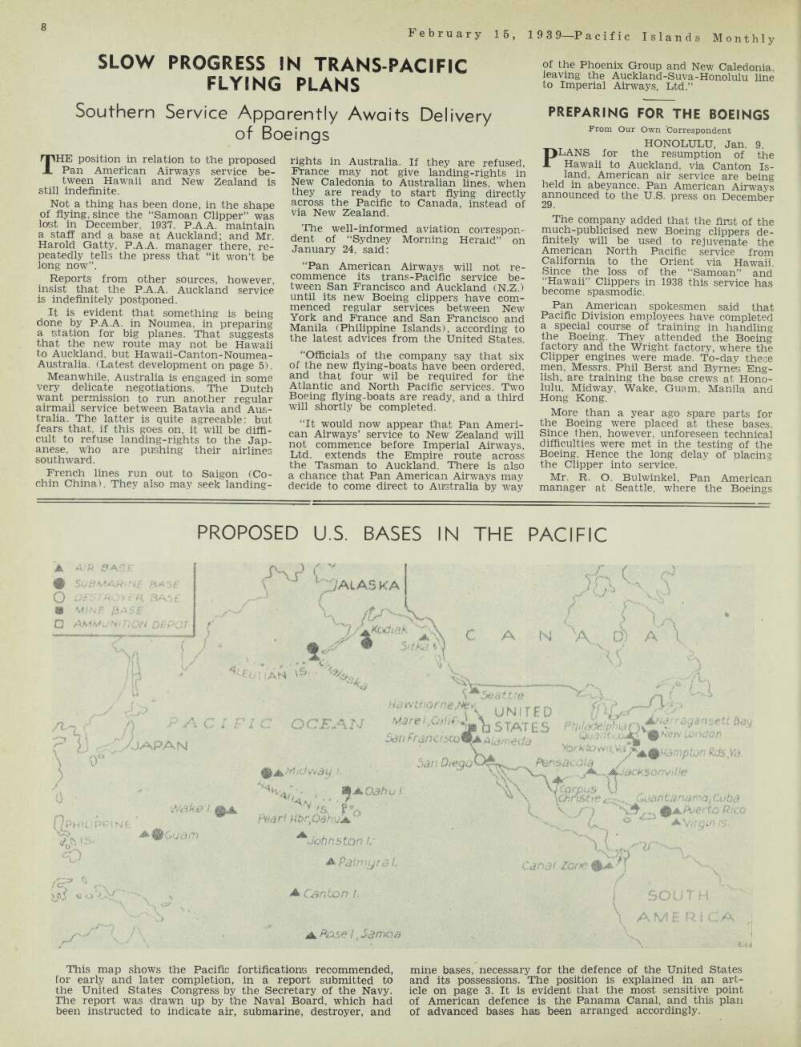
Proposed U.S. Bases In The Pacific
This map shows the Pacific fortifications recommended, for early and later completion, in a report submitted to the United States Congress by the Secretary of the Navy.
The report was drawn up by the Naval Board, which had been instructed to indicate air, submarine, destroyer, and
mine bases, necessary for the defence of the United States and its possessions. The position is explained in an art icle on page 3. It is evident that the most sensitive point of American defence is the Panama Canal, and this plan of advanced bases has been arranged accordingly.
British to Moke Test Flights Across
Central Pacific
A STATEMENT issued in January by the Society of British Aircraft Con structors, Ltd. contained the follow ing:— “Modified Short Empire flying-boats, strengthened to carry heavier loads than the standard craft now in service, have been allocated to the trans-Tasman mails and passenger run. Seaplane services on from Australia to New Zealand will be in augurated during the next few months.
“Later this year the flying-boats will be used to investigate Britain’s projected route in the Pacific.
“Test flights will be undertaken between New Zealand and islands and atolls in the Pacific which, during the next four or five years, may become important stations on the ‘All Red’ air route from England to New Zealand, across the Pacific to Canada, and thence across the Dominion and the North Atlantic back to England. Empire airliners will encircle the world.”
Progress Of Sydney-Rabaul
Airmail
THERE is a mounting volume of com plaints from Papua and New Guinea about the inability of the Sydney- Rabaul airmail to carry all the passen gers offering. The Federal authorities are giving attention to a request that the service be duplicated.
The new aerodrome at Lakunai, Ra baul, will not be used by the big airmail machines before Anril. A small machine from Mandated Airlines has been using the aerodrome, lately, however.
Mr. and Mrs. L. C.‘ Smith and their son John, returned to Wau, by the “Bulolo” early in February, after two months’ holiday in Melbourne. He has been in New Guinea for 15 years and is employed by New Guinea Goldfields Ltd., on the Morobe Goldfield.
Tropicalities
SURELY no more striking commentary on the changing character of the Western Pacific islands than an Incident in Rabaul on February 3. That evening, the Rabaul Police Band (playing brass instruments) gave an open-air concert in aid of the Victorian Bush Fire Relief Fund, and raised, a substantial sum of money. Practically the whole of rhe performers were New Guinea natives —now Native Constables. In many cases their parents, and in some cases the men themselves, before they came under European influence, were primitive inhabitants of.the far-back jungle Now noted n for smartness and intelligence, but they also can play European musical in- " * nd a give “their & effoSf
ritc,tr EurODean3
to held distressed eu opea . * A POST-CARD from Denmark, with a December date: "
“mviic: ic inct to tell vou that the ltetes di (4 0 500 Of copies? 0 wL b °Sold he o l rt ni en d the* into Tvs That lives me a happy New Year. I wish you the same!
Hakon Mielche”.
All the people who met the “Monsunen” expedition in the Central Pacific Islands will offer congratulations to Mr. Mielche. * * * trirklinff southwards havp EPORTS, trickling soutnwarns, nav. it that the New Year Eve dance of the Port Moresby Aquatic Club was an exceedingly joyful occasion. Long before ™pi' rhiimen and maidens, young men and chil dren, frolicked together. Recluses were forced into the open, and budding wallfnrSeTortexTr^ d elry Od TLa a r n d d s mfd-‘ nteht^the appeared in ftp form Of Whistles rattles trumpets f Q Ti m tbp f mhnntw naranhernaha of nersistent Childhood ' And af the fatefnl hoiir struck several hundreds of wellthroats V the volume
of joyous souSd
Healths were drunk and drunk again, Cliques were shattered, and long estab lished inhibitions dispelled. And the strains of “Auld Lang Syne rang out, sung in half a dozen keys simultaneous ly, and to any old words that suited the mood of the singers.
Such exaltation could not die with the hour. When an obdurate official insist ed on a closure at something like 4 a.m., private parties carried on the good work until the sun was fretting over the breakfast table. * * * E rry MEFFERD and Ray Kauffman,
tof yachf' “Hurricane” 5
J? Returned to America ami they tJ U.S. newspapers. Here is one of the stories told to the ever-credulous re porters, which will amuse residents of the South Seas: — At Tongareva, for a 6d. bar of soap, they bartered for £4 worth of native pearls. They found that
upon'fo 'inch ba"
Sundry soap, and blue-grained at that. * QEVERAL scores of athletic young (and youngish) men spent many strenuous and happy hours at Wau, New Guinea, on January’ 15, because there hangs upon the wall of the Wau Club a strangely-made object of nickel and w j re it consists of the inverted bowl of a kerosene lamp, with twisted wire legs and o ther attachments. It was made in 1933 by the i ngen i o us Mr. Mullins, engineer for Guinea Airways, named the “Butibum nnd nut no for comnetition be hl P ' f hp crl ?ketos of Wau audTe lt ™v not he wortT a Kill’s ransom ■ but
“dfleW
it is a tr °P h y neatly coveted. Wau has bad most of the success 50 far: but Lae came eagerly to the contest on January 15-and missed by the small margin of seven runs. At one staee, Lae had only 44 to make, with 4 wickets in hand: but in the last exciting half hour Wau’s
doughty bowler, Lowney (he finished with
6 for 38!) slew the Airways champions, and Lae bit the dust. The Laemen said afterwards that they were not defeated by science, but by the hospitality under which Wau’s tables groaned. * * *
THE following communication is to hand,
from the island of Nauru, where the younger generation has been taught to read and writs English:— Dear Sirs, — Please attach the following sentences to the “Monthly Pacific Islanders”, as mention here under:—
What Happen On Nauru.
During the King’s birthday celebration. Three Ellice boys who were taken to Nauru to work in Police Force.
They stole five bottles of beer from the Govern ment residency.
It was reported to his honour the Administrator by one of a Chinaman who work there as house boy.
This case was reported to the “Director Of Police” and nothing happen to be guilty or not.
This was on the 4th of May, 1938.
Sirs, how can I stop this yellow poison?
I am, yours, etc.,
Nauruan.
Editorial perspicacity has failed. Maybe some reader can make something of it.
Advertisements & other items, pp. 11-12 (2 items)
9
Pacific Islands Monthl y—F ebruary 15, 1939
Finish
FLAT OIL
WATERPROOF
DRIES IN HAIP HOUR
w
CREAM
Write for a Colour Card . . .
STERLING VARNISH CO.
Dries In half an hour on plaster walls, ceilings, cement, fibre, wood and iron.
Also Excellent as an Undercoat for lacquers, paints and enamels. 1 I /- per gallon
HIGHLY DURABLE
Alexandria, N.S.W,
You cannot
have too many
Kodak Snapshots
KODAK FILM HAS EXTRA QUALITY to put the Snap into Snapshot—gives you pictures that LIVE.
DOUBLE-GUARDS EVERY SNAPSHOT. New
Kodak Films (Verichrome, Panatomic and Super-Sensitive Panchromatic) are double - coated to double-guard every precious holiday snapshot.
IS BRITISH MADE to suit Island and Tropical requirements —based on the newest achievements of modern Kodak Research Laboratories all over the world. The benefit of this world-wide advanced research is yours with every spool of Kodak Film.
OF ALL KODAK DEALERS IN THE ISLANDS
KODAK (A/asia) PTY. LTD.
379 George Street, Sydney , - - . fi-r? ■ - ve mcHß° Me F»l- M
Have you the latest Kodak Catalogues?
MARK THE CATALOGUE YOU REQUIRE; —
( ) KODAK AMATEUR CATALOGUE.
( ) CINE-KODAK AND KODASCOPE CATALOGUE.
( ) KODAK ACCESSORIES CATALOGUE.
NAME '
ADDRESS
Storms In Samoa
Much Damage to Public Works
From Our Own Correspondent
Apia, Jan. 24.
VERY disturbed and cyclonic weather, during the first half of January, caused high seas, torrential rains and fierce gales in Eastern and Western Samoa. The rainfall at Apia on Janu ary 15 was 12.15 in., and on January 16, it was 15.95 in.—an all-time record.
At Pago Pago, 36in. of rain fell in three days.
Great damage has been done on the Island of Upolu, but Savai’i has escaped fairly lightly. Cattle, pigs and fowls have been drowned; bridges and roads destroyed; and plantations severely dam aged. The cocoa crop is almost ruined.
Every stream on Upolu was in violent flood; the Vaisigano River developed such turbulence that it broke up the Apia water supply pipe -line (which was soon repaired, however) and put the hydro-electric station out of commission.
Two Samoan youths 'were drowned.
Numerous bridges were destroyed. In Apia, the concrete Vaea bridge was com pletely smashed, and the Vaisigano bridge severely damaged.
Mr. E. V. Crisp, manager of Steam shins Trading Co. Ltd., Papua, was mar ried on February 13 to Miss Hall, at St.
Stephen’s Church, Woollahra. Sydney.
They are to sail for Pt. Moresby by the “Tasman” on the 25th.
Mr. Gopi Mahara.i, son of Pandit Baij Nath, of Labasa, Fiji. died at the Col onial War Memorial Hospital, Suva, early in January after a short illness.
Advertisements & other items, p. 12 (1 item)
Marriage
ROBERTS-BIGNELL.—On January 5, 1939, at the Methodist Church, Rabaul, New Guinea, by the Rev. Pearson, Jean Lindsay, youngest daughter of Mr. and Mrs. Bignell, of Fulakora, British Solomon Islands, and granddaughter of Major James Irving, of Barwhinnock, Scotland, to Dudley L. Roberts, eldest son of Mr. and Mrs.
L. Roberts, of Queensland.
About Islands People
Miss K. Deck, who for the past 32 years has been engaged in mission work in the Solomon Islands for the S.S.E. Mission, is at present on furlough in Sydney, She will return to the Mission’s head station at One Pusu, Malaita, in April or May.
Inspector E. Steeples, of the N.G.
Police Force, at Wau, is at present on leave. Warrant Officer P. D. Moncur is relieving him.
Mr. George Arnold, one of the best known “old timers” of the New Guinea goldfields, was brought to Sydney in January for urgent medical treatment.
He was conveyed from Madang by a Douglas machine, now being used in an aerial survey of possible oil country; con nected with the Carpenter Airways machine at Salamaua; was met in Towns ville by Dr. W. Calov, of Sydney; and was taken at once to a private hospital in Sydney. Hundreds of friends of “Little George” will hope for his speedy recov ery.
M. Labaxe, of the Police Department of the Colony of New Caledonia, left Noumea by the “Commissaire Hamel” on February 11.
Miss J. McCluggage, of the Central Administration, Rabaul, New Guinea, ar rived in Sydney by the “Malaita” on February 11 on leave. She will later pro ceed to New Zealand.
M. Griscelli, a school teacher at Voh school, New Caledonia, left Noumea for Europe by the “Commissaire Hamel” early in February on leave.
Captain W. Noak, aged 90, was knock ed down by a car on Thursday Is., on January 23, and later died in hospital.
The accident was the first of its kind on the island.
M. Dumoulin, head of the Department of Justice of New Caledonia, left Nou mea for France by the “Commissaire Hamel” on February 11 on leave.
Mr. R. N. Sanders, B.V.Sc., left Sydney for Suva, Fiji, by the “Niagara” in mid- January to take up the position of vet erinary officer to the Fijian Government.
Since graduating from Sydney University in 1936, Mr. Sanders has been technical research assistant to Dr. R. M. C. Gunn, lecturer in Veterinary Surgery and An atomy at the University of Sydney. His work in Fiji will be mainly in animal improvement, research work on patho logical lines, animal husbandry, and the control of what little disease is preva lent there, M. Kervistin left Noumea, New Cale donia, on February 11 for Marseilles, France, where he will spend furlough. He is well known in the Colony as head of the Department of Education.
Mr. O. B. Hart, who was acting man ager of Bulolo Gold Dredging, Ltd., dur ing the recent absence abroad of Mr.
Joubert, returned to New Guinea by the “Bulolo” in February, after six weeks in Sydney. Mr. Hart, in future, will be as sistant manager of Bulolo Gold Dredg ing, Ltd., in New Guinea, in addition to continuing his position as construction engineer.
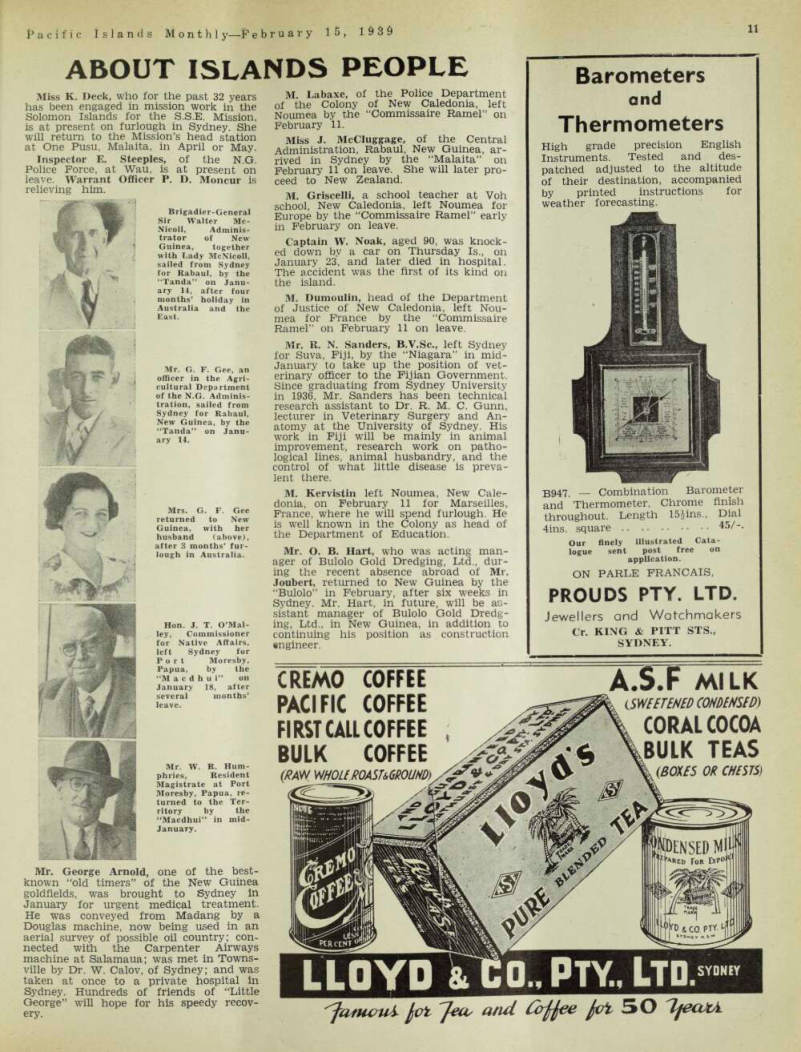
Brigadier-General Sir Walter Mc- Nicoll, Adminis trator of New Guinea, together with Lady McNicoll, sailed from Sydney for Rabaul, by the “Tanda” on Janu ary 14, after four months’ holiday in Australia and the East.
Mr. G. F. Gee, an officer in the Agri cultural Department of the N.G. Adminis tration, sailed from Sydney for Rabaul, New Guinea, by the “Tanda” on Janu ary 14.
Mrs. G. F. Gee returned to New Guinea, with her husband (above), after 3 months’ fur lough in Australia.
Hon. J. T. O’Mal ley, Commissioner for Native Affairs, left Sydney for Port Moresby, Papua, by the "Macdhui” on January 18, after several months’ leave.
Mr. W. R. Hum phries, Resident Magistrate at Port Moresby, Papua, re turned to the Ter ritory by the “Macdhui” in mid- January.
Advertisements & other items, pp. 13-14 (2 items)
11
Pacific Islands Monthl y—F ebruary 15, 19 3 9
Pty. Ltd.
Barometers
and
Thermometers
High grade precision English Instruments. Tested and despatched adjusted to the altitude of their destination, accompanied by printed instructions for weather forecasting. 3947 Combination Barometer and Thermometer, Chrome finish throughout. Length 15£ins., Dial 4ins. square 45/-.
Our finely illustrated Catalogue sent post free on application.
ON PARLE FRANCAIS,
PROUDS PTY. LTD.
Jewellers and Watchmakers
Cr. KING & PITT STS.,
SYDNEY.
CREMO COFFEE
PACIFIC COFFEE
FIRST CALL COFFEE
BULK COFFEE
(Raw moifROASMDOum
A.S.F MILK
c SWEETENED
CORAL COCOA
BULK TEAS
(BOXCS OR
4- <9 & o .i o 9* V V S’
Sensed m v» LxF"
''Red £ For $ ■I
PTY
“ T 0 n £
PTY. LTD.
SYDNEY
fet few and Coffee fei, 50 feeevzA
I Its., / r r *« sis?
FEET
>1 •■ /• //
TFiE WOHIO MOVES
**g Forward on its 0
MORE FOR YOUR MONEY
is always the result when your shoes come from FOSTARS. This is why:
Fostars prices are lower.
Fostars are both Manufacturers and Retailors —there is no middleman's rake-off included in the price of their shoes.
Fostars prices are prices that even junior wage earners can afford to pay. People with fixed incomes can be equally as smart as those with no budget problems.
FOSTARS qualify is guaranteed.
When you buy Fostars shoes you are dealing direct with Manufacturers who make sure their quality is right. .
FOSTARS styling is faultless.
Fashion’s latest features from all over the World provide at least double the variety of shoes for your selection. logue your Shoe Store
Fostars Catalogue faith-
fully depicts every shoe . . buying from it is simplicity itself.
EXTRA SERVICE:
FOSTARS Catalogue provides;
1. AN “AUTHENTIC” FREE
PATTERN SERVICE: A wide
variety of up-to-the-minute Frocks is beautifully portrayed. 2. FREE GIFTS: Dozens of useful gifts are available to their Clients.
3. SPECIAL FAMILY DIS-
COUNT: FOSTARS 30/-
Pamily offer means an
additional discount of over
10 per cent.
Tear out and mail this Coupon and FOSTARS will forward to you, post free, their AUTUMN- WINTER J 039 Shoe Catalogue just published.
Please forward to Address 'Please state whether Mr., Miss, or Mrs.) FOSTARS SHOES. PTY., LTD., Export Dept.,BOX 3959 V. G.P.0., SYDNEY.
Storekeepers, Traders, Etc., are invited to write for special terms.
REMEMBER! Fostars Shoe Factories, the largest in Australia, are your guarantee of faithful service.
Japanese Poachers
In Pacific
Destruction of Important Industry
ALTHOUGH the commercial, as well as the military energy of Japan, appears to be wholly engaged in China, the fact remains that the large numbers of Japanese vessels, which come down among the Southern and Western Paci fic Islands, to obtain shell, show no sign of diminution.
The Japanese have cleaned out the shell and ruined the old-established shell industry in the waters immediately north of Australia, and now they are extending their activities in the islands further east, especially the New Hebrides, the Solomons, New Caledonia and there abouts.
One well-known trader, writing from Vanikoro on January 5, says: “Many Japanese vessels are visiting this group (Southern Solomons) in search of shell.
Among them are large ships of from 20 to 35 tons. Some have radio aboard. All these ships are very fast little vessels— about 10 or 11 knots”.
It is announced elsewhere that a Jap anese vessel which was captured in the New Hebrides managed to escape on a technicality and sailed from Port Vila on December 25.
The real harm is not done so much by poaching—although that is irritating enough. The thing that the Europeans all through the Islands complain about is the manner in which these Japanese poachers invade territorial waters and scrape the baby-shell off the rocks, and so destroy the possibility of any further growth. This is the action of semi-sav ages; and it is beyond any doubt that, if drastic action is not taken by the British and French, to put an end to such activities, the shell industry of the South Western Pacific, which has been worth many millions of pounds during the past few decades, will be entirely destroyed.
Motor Traffic on Nauru
Prom Our Own Correspondent
Nauru, Jan. 4.
THE number of cars on Nauru, includ ing a dozen or more owned by na tives, has greatly increased lately.
Captain Preece has returned with the latest in Ford limousines; Ted Cameron, Stan Marquis, Rev. Welch, Jock Will dridge and Bill Thompson have added to the list with modern English models.
Among the natives, Chief Gaumabwe maintains a new £4OO Ford coupe, and Head Chief Detudamo the latest Eng lish Vauxhall sedan.
Partly on account of the increased car traffic and partly due to the prolonged drought, the local roads are in pretty bad order. In the absence of a European works officer, it seems that the regular maintenance of roads is no particular Administration officer’s business—a situ ation which no doubt soon will be recti fied under the regime of Colonel Chalm ers, who appears to be a man of practi cal mind.
Mr. and Mrs. D. C. McKean, formerly well-known in Fiji, are at present living in Sydney. He has been transferred by the Colonial Sugar Refining Co., to the Sydney office, after 29 years in the Colony, his last post being accountant at the Labasa branch.
Advertisements & other items, p. 14 (1 item)
12
February 15, 193 9—P acific Islands Monthly
Dare U.S.A. Fortify
Guam ?
Nations Suspicious of Japan's
Plans AUTHORITY to prepare Guam as a stronger air and naval base vs be ing sought by the executive in the Con gress of the United States; and the plan is the subject of fierce argument among defence experts.
“What is required if fortifications are really proposed there,” said one, “is that they should be on a permanent basis, otherwise the United States will merely have an outpost which invited easy at tack by Japan in case of war.”
Some of the other experts regard Guam as a “mad imperialistic proposal”.
One official report filed said it would be a foolhardy military and diplomatic blunder. It lies too deep in prospective enemy territory and too close to innum erable enemy bases in the Carolines and Marshall Islands, and its creation would certainly be provocative.
On the other hand (said the Washing ton correspondent of Sydney “Sun” on 'February 4) if major fortifications are planned on the basis of a final cost ex ceeding £20,000,000 (sterling), something that Japan could not capture, these criti cal naval men admit they would be over ruled by the development of a first-class change in the whole situation of Pacific defence. (The real issue is discussed in an article on page 3.) It was officially announced in Tokyo on January 12 that Japan viewed “in the gravest light” the report that U.S.A. would fortify Guam.
Improvements —Not Fortifi
Cations
It was stated late in January that President Roosevelt personally approves the suggestion to spend £1,250,000 on “improvements” at Guam in the next four vears. But he says that the proposed
works— dredging the harbour, building a breakwater, hangars and barracks—do not necessarily constitute the “fortifica tions” feared by Japan.
Japanese Base Near Australia
Commenting on Japan’s inauguration of an air service from Tokyo to Pelew Islands, westward of Guam and only 1,500 miles from Darwin, the London journal “The Aeroplane” says:— “Thus there is a Japanese air base within bombing range of Australia and handy to New Guinea, where there is only a small white population unable to put on even a show of defence.
“Air attacks on Queensland, from New Guinea, would be easy.”
Japan’S Plans In Mandated
Islands
A news despatch from Tokyo on Janu ary 30 said: The Navy Minister’s recent declaration in the Diet that the Navy is ready to maintain Japan’s supremacy in the Western Pacific and enforce a new order in the Far East against all-comers, is be lieved to be connected with the man dated islands. Well-informed quarters consider that the position is gravely inter related with Australian naval, air and defence.
German Air Base In Pacific
Claimed
GERMANY is building a Pacific air base in the Caroline Islands, ac cording to an extraordinary state ment made in the United States Congress on February 1 by Mr. Melvin Maas.
He made his statement to the Naval Affairs Committee of the House of Rep resentatives. He declared that he had private and authoritative information that Japan, which holds the League man date over the islands, had given Ger many permission to establish a base.
The Caroline Islands are in north-west Pacific near Guam.
Mrs. Martha Thomas, of Levuka, Fiji, died in January, aged 50.
Advertisements & other items, p. 15 (2 items)
13
Pacific Islands Monthl y-F ebruary 15, 1939
Special Island Price
LONDON
AUSTRALIA
DAYS
OF
WITHIN
Two Services Weekly
in Each Direction
London is now but 8 days’ travel from Sydney or Brisbane by Intercontinental Airways’ speedy service via the East, India, Egypt and the Continent.
The through fare to London from Sydney or Brisbane, £lBO Australian currency, includes all hotel accommodation, meals and tips en route and proves itself in actual figures an inexpensive mode of travel, clipping many weeks off the journey to England.
* DEPARTING
SYDNEY
AND BRISBANE
EVERY
THURSDAY
AND SUNDAY.
FREIGHT ACCEPTED FOR LONDON AND
INTERMEDIATE DESTINATIONS OUTSIDE
AUSTRALIA.
INTERCONTINENTAL
AIRWAYS
(Combined Netherlands Indies’ and Dutch Lines).
K.N.I.L.M.—K.L.M.
Managing Agents for Australia and New Zealand.
K.P.M. LINE
Royal Packet Navigation Co., Ltd. (N. V. Koninklijke Paketvaart Maatechappij— Incorporated in the Netherlands).
PAKETVAART HOUSE, 255 GEORGE ST.,
SYDNEY. BW 2384.
Saigon: Diethelm & Co.; Port Moresby and Samarai: Steamships Trading Co. Ltd.; Rabaul and Salamaua: W. R. Carpenter & Co. Ltd.; Port Vila: Gubbay Freres; Noumea: Carlo Leoni; Auckland: Russell & Somers Ltd.; Wellington: Johnston & Co. Ltd.
SPECIAL ISLAND PRICE
of £9/9/0
BABY EMPIRE PORTABLE
14 Days Free Trial
CHECK THESE EIGHT EMPIRE
FEATURES.
SEND NO MONEY—BUT WRITE NOW!
1. The smallest, lightest and most compact Typewriter in the world. 2. Gives up to 5 and 6 clear carbon copies. 3. Made in England. 4. Made of world’s finest British steel. 5. Bright parts chromium plated. 6. Specially finished to withstand tropical conditions. 7. Installed in every Empire Flying Boat. 8. Installed in Commonwealth Bank.
Wholesale Typewriter Co., Lombard Chambers, Pitt Street, Sydney.
Dear Sirs, — Please forward me on 14 days free trial a Baby Empire Portable Typewriter. At the end of this period I agree to forward my cheque for £9/9/- plus exchange, or return the typewriter in good condition. Please use Block Letters.
Name Address Business Reference Pl2/38.
Future Control Of
Samoa
Is a Change-Over Contemplated?
THERE is a strongly-held belief in Fiji and WesteTn Samoa that New Zealand proposes, at an early date, to aban don the Mandate she now holds for the Government of Western Samoa, and that the latter Territory will come under the control of the High Commissioner for the Western Pacific, The latter already con trols Fiji, Solomons, Gilbert and Ellice and Tonga; and machinery for the ad ministration of Samoa could be simply and easily provided.
Points in favour of the change include: New Zealand has not a very happy le cord in Samoa, which is of little econo mic or strategical value to her.
The Samoan Administration ct present is an embarrassment to the New Zealand Government, which now is deeply en gaged with its own domestic problems.
If a British plan of Central Pacific de fence is to be developed, it can be hand led much more effectively by the British Colonial Office, controlling Western Samoa, than by New Zealand controlling Samoa, and the British authority controlling the adjoining territories.
Unlike the Cook Islands (also controlled by New Zealand) the trade of Western Samoa is largely in the hands of non- New Zealand firms.
There is a much stronger community of interest between Fiji and Samoa than between New Zealand and Samoa.
Since the present New Zealand Govern ment took charge of Western Samoa, it has tried conscientiously—though fumb lingly—to secure political peace and social
progress in the Territory; and Ministers have been bitterly disappointed with the petty reactions and apparently Insatiable demands of the nationalistic elements, whom they tried to assist.
It is apparent that, under the present regime, there will not be any economic progress or development in Western Samoa. But it is argued that, under a sympathetic British Colonial Office ad ministration, directed from Suva, enter prise and initiative by both the European and Samoan communities will be given more encouragement and assistance than at present.
It should be remembered, however, that Samoa would have been in a very bad way economically, two or three times in recent years, had it not been for the banana trade. New Zealand has bought regularly, huge quantities of Samoan bananas, and even has maintained a ship in which to carry them. Fiji could not do that.
Those who advocate a change should make sure, first of all, that the banana trade with N.Z. will not be disturbed, or that something will take its place.
Banana Trade Organisation
In a statement in January, Mr, Lang stone, who is the N.Z. Minister in charge of the Cook Islands, said the Govern ment had a responsibility to organise the banana trade for the benefit of the con sumer in New Zealand on the one hand, and for the producers in the Cook Islands and Samoa on the other. To see that justice was done to all, the Government had to co-ordinate the trade from Fiji, Tonga, Samoa, Niue and the Cook Is lands so that there would be an ample supply of bananas for New Zealand. It had also controlled the price in New Zea land so as to give the producers a good price in the Islands.
Sailed Schooner From Sick
Bunk
TAKEN seriously ill between Samarai and Goodenough Island recently, Mr.
Edwin Mears, master of the Papuan Administration’s 36-ton auxiliary schoon er “Elevala”, had from his bunk to di rect the navigation of the ship 60 miles to Goodenough, where Dr. E. Ford, who is making a medical inspection, treated him. The native crew then successfully sailed the little schooner back to Sa marai.
Still suffering from the effects of his illness, Mr. Mears arrived in Sydney by the “Bulolo” on January 29, and was taken by ambulance to Sydney Hospital where he underwent an operation. His condition in mid-February was reported to be “quite satisfactory”. Mr. Mears has served in the craft of the Papuan Administration for 30 years.
British Transpacific
Liners
SHIPBUILDING costs have been re duced lately. 3,nd the London corres pondent of the “New Zealand Herald” says that, as a result, the plan to build two new British liners for the trans pacific trade (under subsidy from Britain, Australia, Canada, New Zealand and Fiji) has been revived.
The Dominion Governments are said to have been communicated with. The ships proposed are of 25,000 tons, with a speed of 21 knots.
Mr. C. Taylor, of Stephens Aviation Co.’s mechanical staff, arrived in Syd ney from New Guinea by the “Bulolo” at the end of January.
Advertisements & other items, p. 16 (1 item)
1939 Important New Year Announcement
a i We present for approval a new 26-ft. Australian built Chris Craft, family Cruiser, as a standard model for 1939.
Experience, the greatest teacher of all, has guided us in producing this new Cruiser built under Chris Craft license, with all the Chris Craft inherent characteristics which guarantees its construction, fast, sturdy, suitable for all waters and all needs, this exceptionally fine boat brings the joys of cruising within the reach of all at a surprisingly low price. Cabin lines are low and rakish, a 7ft. Sin. beam ensures smooth, level riding and affords extra cabin room. The interior is beautiful beyond belief with berths for four people, galley, icechest, toilet, lots of storage lockers, and controls in the cabin affording the helmsman a clear unobstructed view.
It is a real thrill to be aboard a ship like this. Power is furnished by options of 60, 95, 118, 135, two 60 H.P. direct drive Chris Craft Engines, speeds from 13 to 25 m.p.h.
Trade in your Old Boat. One-third Deposit—Balance up to two years.
Branches:
PAUL & GRAY, LIMITED.
(Sole Agents in Australia.)
82 SUSSEX STREET,
LONDON, ADELAIDE, SYDNEY. MELBOURNE, NEWCASTLE, BRISBANE
Agents for Mandated Territory: Rondahl & Co., Rabaul.
Let your next Boat or Engine he Chris Craft. 105 Models to choose from.
Jew Settlers For
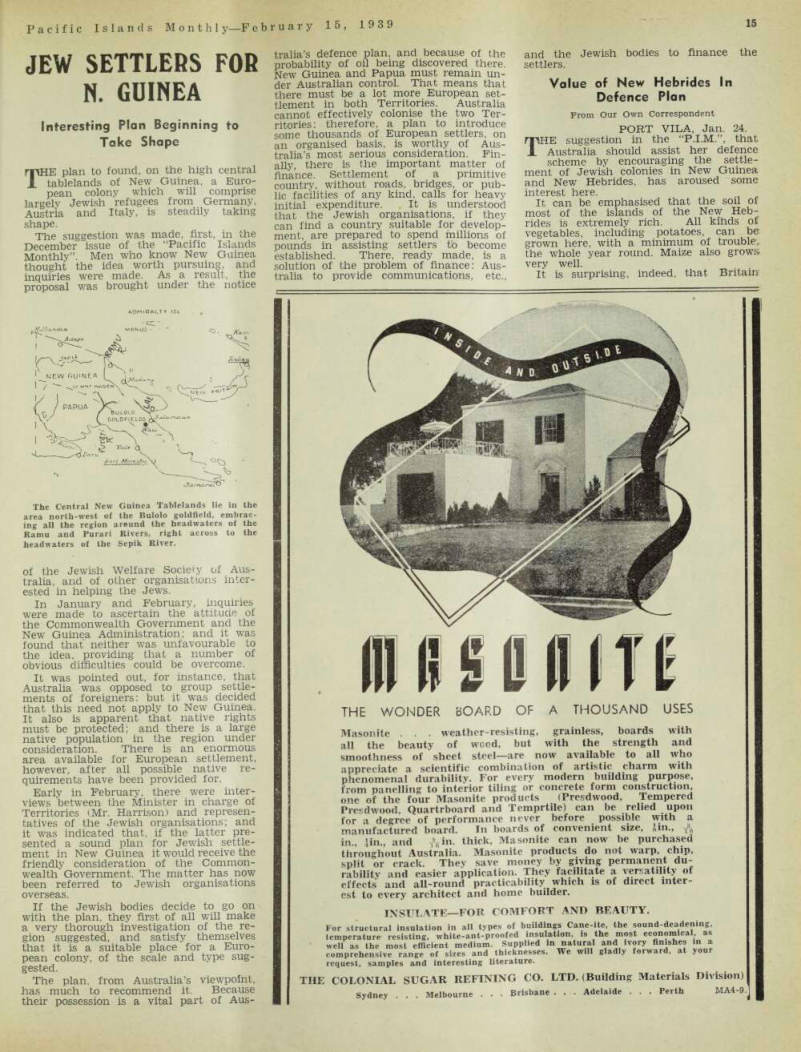
N. Guinea
Interesting Plan Beginning to
Take Shape
r;E plan to found, on the high central tablelands of New Guinea, a Euro pean colony which will comprise largely Jewish refugees from Germany, Austria and Italy, is steadily taking shape.
The suggestion was made, first, in the December issue of the “Pacific Islands Monthly” Men who know New Guinea thought the idea worth pursuing, and inquiries were made. As a result, the proposal was brought under the notice
of the Jewish Welfare Society of Aus tralia, and of other organisations inter ested in helping the Jews.
In January and February, inquiries were made to ascertain the attitude of the Commonwealth Government and the New Guinea Administration; and it was found that neither was unfavourable to the idea, providing that a number of obvious difficulties could be overcome.
It was pointed out, for instance, that Australia was opposed to group settle ments of foreigners: but it was decided that this need not apply to New Guinea.
It also is apparent that native rights must be protected; and there is a large native population in the region under consideration. There is an enormous area available for European settlement, however, after all possible native re quirements have been provided for.
Early in February, there were inter views between the Minister in charge of Territories (Mr, Harrison) and represen tatives of the Jewish organisations; and it was indicated that, if the latter pre sented a sound plan for Jewish settle ment in New Guinea it would receive the friendly consideration of the Common wealth Government. The matter has now been referred to Jewish organisations overseas.
If the Jewish bodies decide to go on with the plan, they first of all will make a very thorough investigation of the re gion suggested, and satisfy themselves that it is a suitable place for a Euro pean colony, of the scale and type sug gested.
The plan, from Australia’s viewpoint, has much to recommend it. Because their possession is a vital part of Aus
tralia’s defence plan, and because of the probability of oil being discovered there.
New Guinea and Papua must remain un der Australian control. That means that there must be a lot more European set tlement in both Territories. Australia cannot effectively colonise the two Ter ritories: therefore, a plan to introduce some thousands of . European settlers, on an organised basis, is worthy of Aus tralia’s most serious consideration. Fin ally, there is the important matter of finance. Settlement of a primitive country, without roads, bridges, or pub lic facilities of any kind, calls for heavy initial expenditure. It is understood that the Jewish organisations, if they can find a country suitable for develop ment, are prepared to spend millions of pounds in assisting settlers to become established. There, ready made, is a solution of the problem of finance: Aus tralia to provide communications, etc.,
and the Jewish bodies to finance the settlers.
Value of New Hebrides In
Defence Plan
From Our Own Correspondent
Port Vila, Jan. 24.
THE suggestion in the “P.I.M.”, that Australia should assist her defence scheme by encouraging the settle ment of Jewish colonies in New Guinea and New Hebrides, has aroused some interest here.
It can be emphasised that the soil of most of the islands of the New Heb rides is extremely rich. All kihds of vegetables, including potatoes, can be grown here, with a minimum of trouble,, the whole year round. Maize also grows; very well.
It is surprising, indeed, that Britain
The Central New Guinea Tablelands lie in the area north-west of the Bulolo goldfield, embrac ing all the region around the headwaters of the Ramu and Purari Rivers, right across to the headwaters of the Sepik River.
and Australia have not shown more in terest in the development of these rich and beautiful islands. There are many landless sons of Australian farmers who would be glad to exploit the opportuni ties here, did they but know of them.
From the point of view of the defence
of Australia, the New Hebrides group has many fine, land-locked harbours, and —of great importance in these days —some fine lagoons, that would make perfect seaplane bases. The Erakor La goon, near Vila, would be unsurpassed for the latter purpose. It is a fine strip of water, running 5 miles inland, and varies in width from 200 yards to half a mile.
Mr. W. Swindells, who was a resident in the goldfields section of New Guinea for some time, is now on the staff of Bremang Gold Dredging Cos., Insu, Gold Coast Colony, British West Africa.
M. Wanthiez, teacher at La Perouse College, New Caledonia, sailed from Noumea for Marseilles, France, by the “Commissaire Ramel” on February 11.
Advertisements & other items, pp. 17-18 (2 items)
15
Pacific Islands Monthl y—F ebruary 15, 1939
115 Shite
THE WONDER BOARD OF A THOUSAND USES Masonite . . . weather-resisting, grainless, boards with all the beauty of wood, but with the strength and smoothness of sheet steel—are now available to all who appreciate a scientific combination of artistic charm with phenomenal durability. For every modern building purpose, from panelling to interior tiling or concrete form construction, one of the four Masonite products (Presdwood, Tempered Presdwood, Quartrboard and Temprtile) can be relied upon for a degree of performance never before possible with a manufactured board. In boards of convenient size, sin., in., \in., and T ®- o in. thick, Masonite can now be purchased throughout Australia. Masonite products do not warp, chip, split or crack. They save money by giving permanent durability and easier application. They facilitate a versatility of effects and all-round practicability which is of direct interest to every architect and home builder.
INSULATE —FOR COMFORT AND BEAUTY.
For structural insulation in all types of buildings Cane-ite, the sound-deadening, temperature resisting, white-ant-proofed insulation, is the most economical, as well as the most efficient medium. Supplied in natural and ivory finishes in a comprehensive range of sizes and thicknesses. We will gladly forward, at your request, samples and interesting literature.
THE COLONIAL SUGAR REFINING CO. LTD. (Building Materials Division) . Brisbane . . . Adelaide . . . Perth MA4-9.
Sydney Melbourne
THE PACIFIC ISLANDS CLUB
Visitors from the Islands to Sydney (or those interested in Islands affairs), are advised to communicate with the honorary secretary of the above Club, which has been formed to study the history, traditions, economics, and political developments of the Pacific Islands.
Next Club Gathering, Wednesday, February 22, 8 p.m., Hotel Carlton, Sydney.
THE PACIFIC ISLANDS CLUB,
C/o Pacific Publications Pty. Ltd., Union House, George St., Sydney.
V M TOUGH
r ■Sr
Tough!!
KNOCKS DON’T HURT ME.
WATER DOESN’T HARM ME.
ELECTRIC SHOCKS MEAN NOTHING
TO ME EITHER.
Vm The
Indestructible
Lever
ANGUS & COOTE
know how tough I am. This firm warrants me to render 25 years’ good timekeeping service, and gives me any attention I may need, free, for the first 12 months of my life with you. . . . My case is of chrome —smartly modelled—with a back of stainless steel. My works are the new, improved, Indestructible mechanism which does a good job in the tropics. . . . I’m complete with a cool, chrome, wrist band. Altogether I’m the best watch for service under conditions which are hard on ordinary watches. And at the same time, I’m so modern and smart in every way, that I’m a GENTLEMAN’S watch.
ONLY
85/- Complete with Chrome Band.
Complete with Chrome Band. w CN "7r™ m &> 85/- 95/- —■ With Case Entirely of Stainless Steel. 95/- ANGUS & COOTE ”5. Tv^TeV I ''
Salamaua-Wau
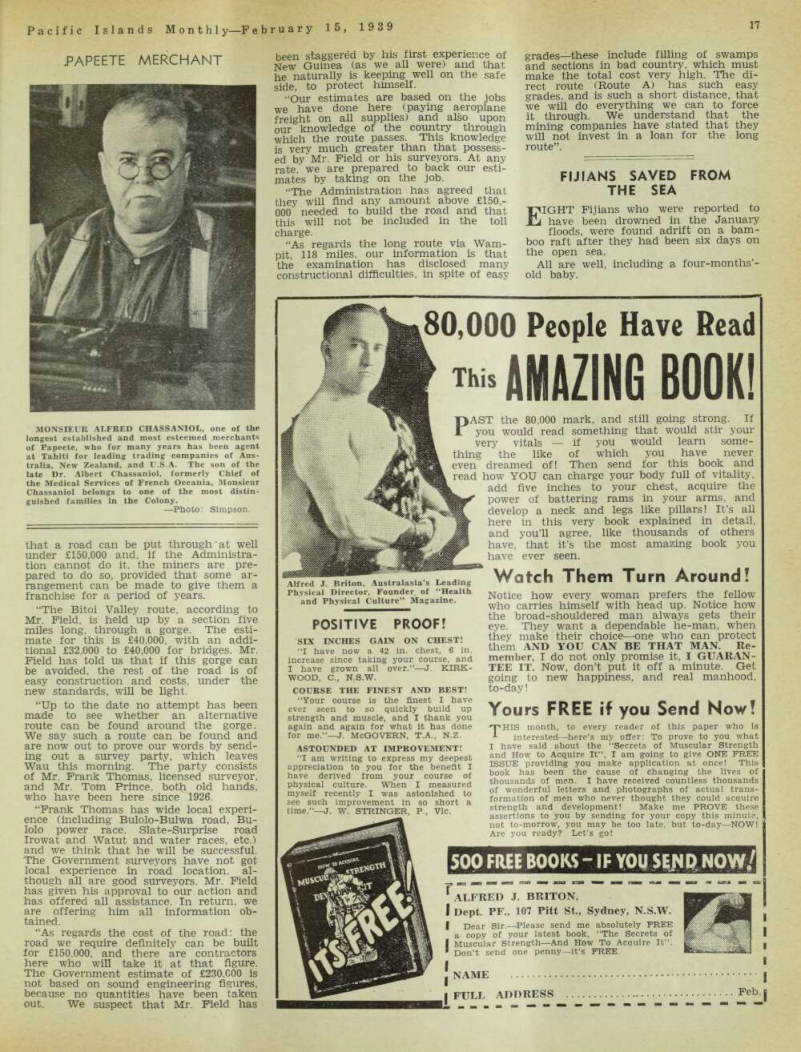
Road
Arguments About Cost-An Apparent Stalemate
MANY months have passed since the then Minister for Territories (Mr.
Hughes) declared that a road would be built between the New Guinea gold fields towns and the port of Salamaua: but nothing yet has been done.
Mr. Hughes said the work could be carried out for £150,000, and planned ac cordingly. Mr. Field, head of the Pub lic Works Department in New Guinea, walked over the suggested route, and said the cost of the road would be at least £230,000.
That was stalemate.
The New Guinea Mining Association, sponsor of the short, direct route from Wau to Salamaua, still insisted that the road could be built for £150,000. Can berra, much embarrassed (its chronic condition where Mr. Hughes is concern ed!) could do no more than point to its engineer’s report.
Finally, the Mining Association sent out its own surveyors to estimate the cost of the Middle Bitoi road: and an agreement between this party and the Government engineers is now awaited.
The latest report is that Mr. Field still is in the Wau-Salamaua district, examining possible routes for a road, and trying to devise a means of bringing construction costs within the financial limits imposed by the original plan.
It now is possible that the whole plan will await investigation by the new Amalgamation Commission.
A Difference Of Opinion
Meanwhile, a special correspondent, writing at Wau on January 20, has sup plied us with the following summary of the position, from the Wau Mining As sociation point of view, as on that date: “The present position about the road is that we do not agree that the road will cost anything like £230,000. This estimate is for a Main Roads standard, and includes many steel bridges. Through our representation on this point the Public Works Department have now adopted the Queensland standard for mining and developmental roads.
“To explain the position, I would point out that Surveyor Bergin only ran a location survey through the Middle Bitoi, and that when he came to a diffi cult part he just went through, with out going back and running alternative location lines to see whether bridges could be avoided or easier construction costs obtained. This is no reflection unon Mr. Bergin, as he only had a lim ited time and was restricted to one grade.
“We know, from our own experience,
that a road can be put through at well under £150,000 and, if the Administra tion cannot do it. the miners are pre pared to do so, provided that some ar rangement can be made to give them a franchise for a period of years.
“The Bitoi Valley route, according to Mr. Field, is held up by a section five miles long, through a gorge. The esti mate for this is £40,000, with an addi tional £32,000 to £40,000 for bridges. Mr.
Field has told us that if this gorge can be avoided, the rest of the road is of easy construction and costs, under the new standards, will be light.
“Up to the date no attempt has been made to see whether an alternative route can be found around the gorge.
We say such a route can be found and are now out to prove our words by send ing out a survey party, which leaves Wau this morning. The party consists of Mr. Frank Thomas, licensed surveyor, and Mr. Tom Prince, both old hands, who have been here since 1926.
“Frank Thomas has wide local experi ence (including Bulolo-Bulwa road, Bu lolo power race. Slate-Surprise road Irowat and Watut and water races, etc.) and we think that he will be successful.
The Government surveyors have not got local experience in road location, al though all are good surveyors. Mr. Field has given his approval to our action and has offered all assistance. In return, we are offering him all information ob tained.
“As regards the cost of the road: the road we require definitely can be built for £150,000, and there are contractors here who will take it at that figure.
The Government estimate of £230,000 is not based on sound engineering figures, because no quantities have been taken out. We suspect that Mr. Field has
been staggered by his first experience of New Guinea (as we all were) and that he naturally is keeping well on the safe side, to protect himself.
“Our estimates are based on the jobs we have done here (paying aeroplane freight on all supplies) and also upon our knowledge of the country through which the route passes. This knowledge is very much greater than that possess ed by Mr. Field or his surveyors. At any rate, we are prepared to back our esti mates by taking on the job.
“The Administration has agreed that they will find any amount above £150,- 000 needed to build the road and that this will not be included in the toll charge.
“As regards the long route via Wam pit, 118 miles, our information is that the examination has disclosed many constructional difficulties, in spite of easy
grades—these include filling of swamps and sections in bad country, which must make the total cost very high. The di rect route (Route A) has such easy grades, and is such a short distance, that we will do everything we can to force it through. We understand that the mining companies have stated that they will not invest in a loan for the long route”.
Advertisements & other items, p. 18 (1 item)
Pabst Canned Beer
Brewed in one of the world's largest and most modern breweries, PABST comes to you in genuine
"KEGLINED" NON-REFILLABLE CANS
TWO TYPES* I EXPORT BEER—A Light Lager Beer. 1 PABST OLD TANKARD ALE—An English Type stronger and heavier than Export.
Packed in Cartons containing 24 x 12 oz, cans and sold throughout the Pacific; but in case of any difficulty In obtaining supplies, write to:
BOX 1861 K, G.P.0., SYDNEY.
"NO LIGHT CAN STEAL ITS FLAVOUR"
Papeete Merchant
Monsieur Alfred Chassaniol, One Of The
longest established and most esteemed merchants of Papeete, who for many years has been agent at Tahiti for leading trading companies of Aus tralia, New Zealand, and U.S.A. The son of the late Dr. Albert Chassaniol, formerly Chief of the Medical Services of French Oceania, Monsieur Chassaniol belongs to one of the most distin guished families in the Colony.
Photo: Simpson.
Fijians Saved From
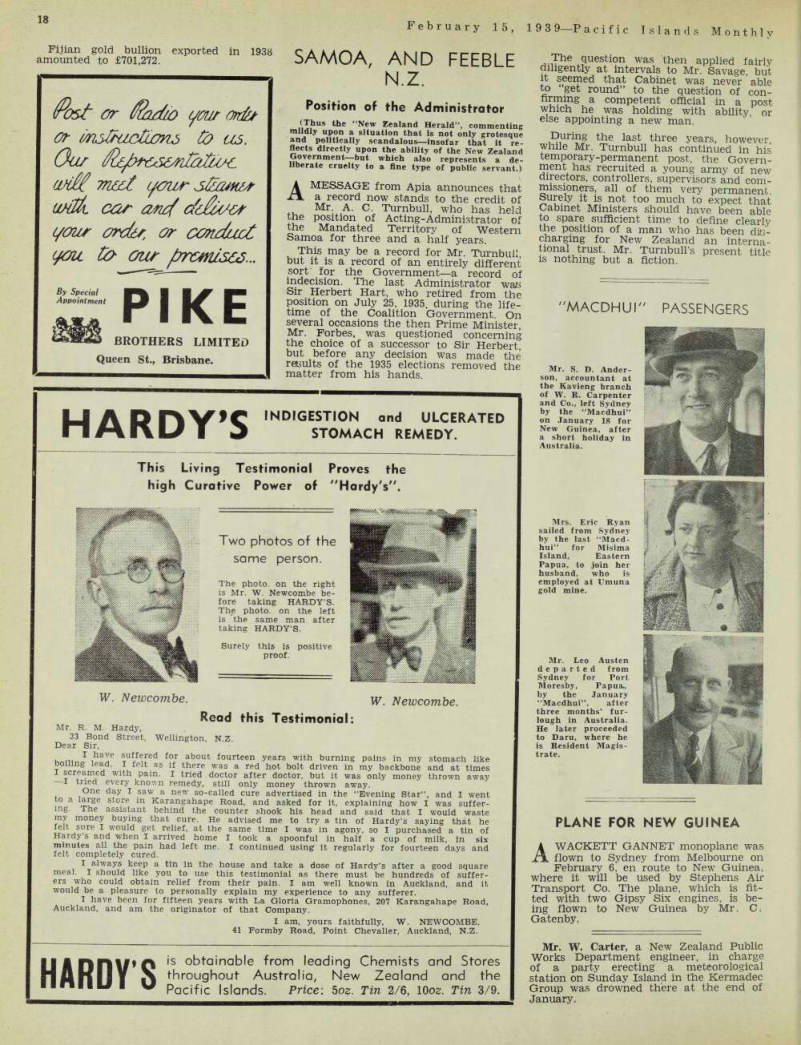
Advertisements & other items, pp. 19-20 (2 items)
17
Pacific Islands Monthl y —F ebruary 15, 1939
Amazing Book!
80,000 People Have Read
PAST the 80,000 mark, and still going strong. If you would read something that would stir your very vitals if you would learn something the like of which you have never even dreamed of! Then send for this book and read how YOU can charge your body full of vitality, add five inches to your chest, acquire the power of battering rams in your arms, and develop a neck and legs like pillars! It’s all here in this very book explained in detail, and you’ll agree, like thousands of others have, that it’s the most amazing book you have ever seen.
Alfred J. Briton, Australasia’s Leading Physical Director, Founder, of “Health and Physical Culture” Magazine.
Watch Them Turn Around!
POSITIVE PROOF!
SIX INCHES GAIN ON CHEST!
“I have now a 42 in. chest, 6 in. increase since taking your course, and I have grown all over.”—J. KIRK-
WOOD, C., N.S.W.
COURSE THE FINEST AND BEST!
“Your course is the finest I have ever seen to so quickly build up strength and muscle, and I thank you again and again for what it has done for me.”—J. McGOVERN, T.A., N.Z.
Notice how every woman prefers the fellow who carries himself with head up. Notice how
the broad-shouldered man always gets their
eye. They want a dependable he-man, when they make their choice —one who can protect them AND YOU CAN BE THAT MAN. Remember, I do not only promise it, I GUARAN- TEE IT. Now, don’t put it off a minute. Get going to new happiness, and real manhood,
to-day!
Yours FREE if you Send Now!
ASTOUNDED AT IMPROVEMENT!
“I am writing to express my deepest appreciation to you for the benefit I have derived from your course of physical culture. When I measured myself recently I was astonished to see such improvement in so short a time.”—J. W. STRINGER, P., Vic.
'T' HIS month, to every reader of this paper who is interested—here’s my offer: To prove to you what I have said about the “Secrets of Muscular Strength and How to Acquire It”, I am going to give ONE FREE ISSUE providing you make application at once! This book has been the cause of changing the lives of thousands of men. I have received countless thousands of wonderful letters and photographs of actual transformation of men who never thought they could acquire strength and development! Make me PROVE these assertions to you by sending for your copy this minute, not to-morrow, you may be too late, but to-day—NOW!
Are you ready? Let’s go! 500 FREE BOOKS - IF YOU SEND NOW/
ALFRED J. BRITON,
I Dept. PF., 107 Pitt St., Sydney, N.S.W.
I Dear Sir. —Please send me absolutely FREE a copy of your latest book, “The Secrets of Muscular Strength—And How To Acquire It”.
Don’t send one penny—it’s FREE.
NAME
FULL
ADDRESS Feb
Post or sad/o or mstmc&ons to as.
Cku uhs mist yo untit car ansf a's&asr your order, or conduct you. to our By Special Appointment
PIKE
BROTHERS LIMITED
Queen St., Brisbane.
y A D rXV’C INDIGESTION and ULCERATED 1 r-\ |\ L J I 3 STOMACH REMEDY.
This Living Testimonial Proves the
high Curative Power of "Hardy's".
W. Newcomhe.
Two photos of the
same person.
The photo, on the right is Mr. W. Newcomhe before taking HARDY’S.
The photo, on the left is "the same man after taking HARDY’S.
Surely this is positive proof.
W. Newcomhe.
Read this Testimonial:
Mr. R. M. Hardy, 33 Bond Street, Wellington, N.Z.
Dear Sir. . ... 1 , ha^ e ® u^ fa f ed f ? r about fourteen years with burning pains in my stomach like boiling lead. I felt as if there was a red hot bolt driven in my backbone and at times i screamed with pain. I tried doctor after doctor, but it was only money thrown away I tried every known remedy, still only money thrown away.
One day I saw a new so-called cure advertised in the “Evening Star”, and I went to a large store in Karangahape Road, and asked for it, explaining how I was suffering. The assistant behind the counter shook his head and said that I would waste my money buying that cure. He advised me to try a tin of Hardy’s saying that he felt sure I would get relief, at the same time I was in agony, so I purchased a tin of Hardy’s and when I arrived home I took a spoonful in half a cup of milk, in six minutes all the pain had left me. I continued using it regularly for fourteen days and felt completely cured.
I always keep a tin in the house and take a dose of Hardy’s after a good square meal. I should like you to use this testimonial as there must be hundreds of sufferers who could obtain relief from their pain. I am well known in Auckland, and it would be a pleasure to personally explain my experience to any sufferer.
I have been for fifteen years with La Gloria Gramophones, 207 Karangahape Road, Auckland, and am the originator of that Company.
I am, yours faithfully, W. NEWCOMBE, 41 Formby Road, Point Chevalier, Auckland, N.Z.
HARDYS
is obtainable from leading Chemists and Stores
throughout Australia, New Zealand and the
Pacific Islands. Price : s oz. Tin 2/6, 1002. Tin 3/9.
Samoa, And Feeble
N.Z.
Position of the Administrator
(Thus the “New Zealand Herald”, commenting mildly upon a situation that is not only grotesque and politically scandalous—insofar that it re flects directly upon the ability of the New Zealand Government—but which also represents a de liberate cruelty to a fine type of public servant.) A MESSAGE from Apia announces that a record now stands to the credit of Mr - A. C. Turnbull, who has held the position of Acting-Administrator of the Mandated Territory of Western Samoa for three and a half years.
This may be a record for Mr. Turnbull but it is a record of an entirely different sort' for the Government—a record of indecision. The last Administrator wa/s Sir Herbert Hart, who retired from the position on July 25, 1935, during the life time of the Coalition Government. On several occasions the then Prime Minister, Mr. Forbes, was questioned concerning the choice of a successor to Sir Herbert, but before any decision was made the results of the 1935 elections removed the matter from his hands.
The question was then applied fairly diligently at intervals to Mr. Savage, but it seemed that Cabinet was never able to get round” to the question of con firming a competent official in a post which he was holding with ability, or else appointing a new man.
During the last three years, however, while Mr. Turnbull has continued in his temporary-permanent post, the Govern ment has recruited a young army of new directors, controllers, supervisors and com missioners, all of them very permanent Surely it is not too much to expect that Cabinet Ministers should have been able to spare sufficient time to define clearly the position of a man who has been dis charging for New Zealand an interna tional trust. Mr. Turnbull’s present title is nothing but a fiction.
"Macdhui" Passengers
Mr. S. D. Ander son, accountant at the Kavieng branch of W. R. Carpenter and Co., left Sydney by the “Macdhui” on January 18 for New Guinea, after a short holiday in Australia.
Mrs. Eric Ryan sailed from Sydney by the last “Macd hui” for Misima Island, Eastern Papua, to join her husband, who is employed at Umuna gold mine.
Mr. Leo Austen departed from Sydney for Port Moresby, Papua, by the January “Macdhui”, after three months’ fur lough in Australia.
He later proceeded to Daru, where he is Resident Magis trate.
Plane For New Guinea
A WACKETT GANNET monoplane was flown to Sydney from Melbourne on February 6, en route to New Guinea, where it will be used by Stephens Air Transport Co. The plane, which is fit ted with two Gipsy Six engines, is be ing flown to New Guinea by Mr. C.
Gatenby.
Mr. W. Carter, a New Zealand Public Works Department engineer, in charge of a party erecting a meteorological station on Sunday Island in the Kermadec Group was drowned there at the end of January.
Advertisements & other items, p. 20 (1 item)
18
February 15, 193 9—P acific Islands Monthly
Canton Is.
Preparation As Station On South Pacific Air Service
From Our Own Correspondent
Honolulu, Jan. 4.
ACCORDING to Mr. John Boyle, an expert with the Pacific division of Pan American Airways, his company has done nothing on Canton Island ex cept stake out a proposed site for an operations base. He said, too, that much work must be done at Canton, including the blasting away of coral heads in the lagoon, before the island can be used by commercial airboats.
Mr. Boyle returned last week from. a special survey of Canton Island.
A resume of reports appearing in the U.S. national press indicates that Pan American will concentrate on improving the North Pacific service (which is be ing operated with only two clippers and is much behind schedule), and upon launching a North Atlantic service to meet the promise of competition from another American company, and Brit ish, French and German interests.
Approved
Dutch And British
Fortification of Ft. Moresby Approved
MR. VAN DEN BUSSCHE, who recently retired from the position of vice president of the Council of the Netherlands Indies, said in Sydney that Holland welcomed the decision to for tify Port Moresby, which would forge another strong link in the chain of de fences of British and Dutch interests in the Far East.
“The Colonial Civil Service of Holland is drawn from University men, who must all have taken a special five-years’ course”, he said. “They must learn both the Malay and Javanese languages, economics, law, and ethnology. It is a little different from your colonial ser vice in New Guinea. We have to deal with native peoples much higher up the scale, with a culture of their own which we have to learn. But it might be a good thing for your country to have specially trained young men from whom they could choose their future adminis trators”.
Education Of Nauruans
IT was stated, in the December issue, that Mr. H. E. Hurst, of Geelong, had undertaken the education and technical training of twelve young Nauruans at his own expense. These are the twelve attractive lads who were pre sented to the Minister for the Territor ies (Mr. Harrison) at the Commonwealth offices in Sydney early in January. Mr.
Hurst writes that the statement that all this work is done at his personal ex pense, is likely to cause some heartburn ing. He says that while he personally bears a certain amount of petty costs, all the major expense is willingly borne by the Nauruan Administration. Those who are interested in this remarkable ex periment in the education of the Poly nesian people should note the correction.
Mr. E. Mainwaring recently married Mrs. Ostrom, formerly of Kavieng, at Salamaua, T.N.G. He is an officer in the New Guinea Administration.
Advertisements & other items, pp. 21-22 (2 items)
19
Pacific Islands Monthl y —F ebruary 15, 1939
Tree
PLANTER HELPS CUSTOMS OFFICER
rv
r X r,*tP*
t h isce)
“TZ/TfH*
H /HE DOWN./ FEEL
t l LIKE A WET RAC!
mm EVEN WAKE UP ,
m
t/rev
; «a» 'M
SOUNDS
Y LIKE 'NIGHT
STARVATION /’I HAD
IT UNTIL ONE OF
THE SHIP'S DOCTORS
CAVE ME HOP LICKS.
\ couldn't FEEL /
iIS. BETTER NOW/yA
mk E m.
V TIRED before you start the day s work or play . . . unable to concentrate ... “feel like a wet rag” .. . are these your symptoms too? Then probably you are suffering from "Night Starvation”.
Doctors say your body uses up energy even while you sleep.
Failure to replace this energy means “Night Starvation”.
If you wake tired, start taking Horlicks regularly at bedtime.
Horlicks stores your body with the necessary vitality to face the most exacting climate.
Horlicks makes a delightful beverage mixed with iced milk or cold water in the Horlicks mixer. Horlicks contains milk, so where milk is scarce, you can use water only just add rather more Horlicks, that’s all.
Ask your chemist or storekeeper to-day for a bottle of Horlicks. (14J ozs. size costs 3/- in all main towns throughout the British Pacific Islands).
Tree
with I»ur °" d add,ei! ' will receive a you Ho r licks Glass.
Mix e r
-FREE.
HORLICKS
guards against
NIGHT STARVATION
Modern Refrigeration for the South Sea Islands
The
ELECTROLUX
KEROSENE OPERATED
REFRIGERATOR
MARVEL
OF
MODERN
SCIENCE
T * - I me mm '
THE
MIRACLE
OF
ICE
FROM
HEAT
THE ELECTROLUX OFFERS economical, modern and completely efficient refrigeration for
ISLANDS 1 HOMES.
FREEZES CONTINUOUSLY WHILE SMALL LAMP BURNS
Freezing controlled by simply regulating height of flame. Uses only gallon of kerosene per week.
MOTORLESS ... NO PARTS TO GET OUT OF ORDER.
MODEL L 22 MODEL L3B MODEL LKSS Capacity • (as illustrated) ® Capacity 2.2 cubic feet. Capacity 4 cubic feet. 5.5 cubic feet.
GUARANTEED FOR TWO YEARS
Obtainable from . . ® Write to your Local Distributor for prices and full details.
W. R. Carpenter & Company Ltd.—Sydney and following New Guinea Branches : Rabaul, Salamaua, Wau, Kavieng, Madang, But and Wewak.
Representation in Papua and New Hebrides.
W. R. Carpenter & Coy. (Solomon Is.) Pty. Ltd.—Tulagi, British Solomon Islands.
On Chong & Company Pty. Ltd.—Butaritari, Gilbert & Ellice Islands
The Granadilla
a prolific grower and bearer on the main island of Tonga. A correspondent writes: “We should like to know whether there are any commercial possibilities in this de liciously-flavoured fruit”. (Photo by Hettig.)
Japanese Boat
Escapes
Technical Point In New Hebrides
From Our Own Correspondent
Port Vila, Jan. 14.
YASKISUKU KANAYA, the captain of the Japanese vessel “Taian Maru”, who was charged before the Court of First Instance at Vila, New Hebrides, with having entered a closed port with out permission, and with not being in pos session of a health clearance from his last port of call, was sentenced to a fine of 2480 francs, and his vessel to be seized, on the first count, and to a fine of 250 francs on the second count.
He exercised his right to demand the French legal system, however, and ap pealed accordingly to the Joint (Anglo- French) Court. Thus, he escaped the major penalty, on a technicality.
The appeal was heard before Don Man uel Bosch Barrett, the Spanish presi dent of the Joint Court, and the resident French and British Judges. The appel lant was defended by French counsel; and the procedure followed was French, Appellant was acquitted on the first charge, because it was shown that the original summons to the Court of First Instance had been served by a police officer, instead of by a customs officer, as laid down by Condominium Joint Regulations.
The fine of 250 francs, for non-posses sion of a Bill of Health was upheld, as this was considered as an offence against public welfare.
When the New Hebrides police first boarded the “Taian Maru”, at Rentapoa, near Teouma, at the south-west of Efate Island, the captain stated that he carried no papers and that his vessel was owned by a firm in the Philippine Islands.
The “Taian Maru” left Port Vila on December 25.
The escape of the Japanese on a tech nicality, is to be regretted. There are several unauthorised Japanese craft prowling about, engaged mostly in poach ing, and they are difficult to catch. The capture of the “Taian Maru” was the re sult of smart police work.
Party on Middle Sepik
Exploration In New
Guinea
A REPORT in the January “P.1.M.”, that the New Guinea exploratory patrol under Mr. J. L. Taylor, would return directly from the Upper Sepik in the Administration motor boat “Sirius”, was not quite correct.
The “Sirius” proceeded, early in Janu ary, with stores, directly to the Sepik River, and met Mr. Taylor and his party at Yessan, above Ambunti; Mr.
Taylor took over his stores, and then left for Wabag, via Karawari.
The patrol left the controlled area in March, 1938, and marched westward, to
investigate the unknown and unexplored region between Mount Hagen, the Dutch border and the Upper Sepik River. Good worx has been done. The party has been divided two or three times, with a view to examining wider areas, part being un der Mr J. R. Black (a patrol officer) and part under Mr. C. B. Walsh (medi cal assistant), both of whom are assist ing Mr Taylor. Contact has been made with tribes hitherto unknown.
Mr. “Snowy” Blackley returned to Wau, New Guinea, by aeroplane in mid-Janu ary, and has resumed duties with New Guinea Goldfields, Ltd., at Edie Creek.
Miss June Ewen, of the NG. Admini stration, left Rabaul for Hong Kong by the January “Neptuna” on the first stage of an extensive tour abroad.
Advertisements & other items, p. 23 (2 items)
21
Pacific Islands Monthl y—F ebruary 15, 1939
Of Health/
AT THE MASTHEAD
S ■ I Tom m
Mr. D. Mackinnon, M.B.E,
From Our Own Correspondent.
Tulagi, Jan. 23.
A PLEASANT and impressive ceremony took place at Tulagi, 8.5.1., soon after the arrival of M.V. “Malaita” from Australia, on January 17.
Before a large assembly of residents, and officers and passengers from the “Malaita”, His Honour the Resident Commissioner (Mr. P. N. Ashley, CM.G.) after inspecting a guard of native troops, invested Mr. Donald Mackinnon with the M.B.E.
His Honour referred to the valuable service rendered by Mr. Mackinnon as a non-official member of the Advisory Council, and offered congratulations on the honour conferred by His Majesty.
The Copra Market In Europe
By Our Special Correspondent
London, Jan. 25.
MARKET conditions in London con tinue normal and quotations are, on the whole, fairly stable. At the time of writing, the C.I.F. price of F.M.S.
Straits copra for January/February ship ment fluctuates between £lO/15/ and £lO/12/6.
I asked Messrs. H. M. F. Faure and Company, of London, what, in their view, was the future for copra. Quite naturally, they regard the question as impossible of a definite answer. The world at present is so full of uncertain factors—notably, import quotas in cer tain countries, exchange restrictions, etc.,
and, arising out of these factors, a tend ency to switch from one oil-bearing seed to another. The technique of oil seed f ru f h ing has advanced to such an ex tent that it becomes increasingly prac ticable to switch in this way.
However, whilst the outlook is rather obscure, the London market does not look for any great fluctuation. The con sumption of copra has remained reason ably constant, total world exports from the principal countries being around a million tons a year.
London is still the main copra mar keu of the world, and there has been no general change in marketing. The pur chases of copra, even for big countries like Germany, France, and Central Eu rope, are still largely made in London France buys her copra here, with the exception of shipments emanating from her own colonies. These are mainly handled through Marseilles.
Copra from the Philippine Islands is likewise sold on the London market, but ?nly the surplus is marketed there and Marseilles, as the United States takes the bulk of the shipments. At the pre sent time, moderate quantities of Philip pine copra are offering on the London market.
Though not really an important fac tor, still it is interesting to note a lit tle lower tendency in the freight mar ket. This means a saving of a few shillings per ton.
GIVEN no international trouble, the London copra market looks forward to normal conditions. In France, the quota factor has not influenced the market much,, as French colonial ship ments are not of sufficient importance to influence prices to any serious ex tent. The Straits Settlement are the most important shippers as far as the United Kingdom is concerned, and the quantity available from that source is sufficient for normal requirements. The main market for Pacific Islands copra is still the U.K., Denmark and France, the latter the most important, because most South Seas copra is low-grade cop ra and is largely used in France for soap manufacture.
Copra from Ceylon continues to go chiefly to India, though there is still a moderate trade done with Europe-Great Britain, France, Germany and Scandin avia.
The Dominions do not, as yet, figure largely in the market as buyers and, un til their population increases substan tially, it is not likely that they will.
The Canadian business is usually done direct with the country of origin, and is regarded in London as unimportant.
The American business affects the Lon don market only in so far as it con cerns the offerings of Filipino copra to countries other than the United States.
REVERTING to competitive factors, the two most important nowadays are whale oil and soyabeans. Whal ing is now in progress, and it is too early to give readers any idea of this season’s catch. It will interest suppliers to know, however, that the figures avail able of the catch of certain fleets indi cate that the total will be less than last season, when the world’s whale oil catch was perhaps the record total of 500,000 tons.
Soyabeans: This business has been dis turbed by the situation in the Far East, and normal trading has largely broken
down. On the other hand, large quan tities of soyabeans are being sold by Japan to Germany on a barter basis.
Just recently, Germany has again en tered the market, and, as the time of writing, she is a buyer at £7/15/-, with sellers asking £7/17/6. About 40,000 to 50,000 tons were sold the Germany dur ing the past month.
Messrs. H. M. F, Faure, in their Janu ary report, state: “The increase in the copra imports dropped from 38.000 tons at the end of September to 26,000 tons at the end of November. On the other hand, the deficit in the palm kernel im ports increased from 11,000 tons at the end of September to 17,000 tons at the end of eleven months. It will be no ticed that at the end of November the
rise in the copra imports is largely off set by the drop In palm kernel tai ports” P
America S Cotton-Seed Oil
TT was reported from Washington on 1 January 19 that, this year, the Uni ted States has a record carry-over of cotton, totalling altogether 14 million bales. It is such an enormous surplus that President Roosevelt is planning an international cotton congress to develop plans for the disposal of the accumu lation.
This enormous cotton crop is likelv to affect the price of copra. It is well known that when the United States has a large production of lard or cotton-seed oil the importation of copra from the
Philippine Islands decreases and a cor responding surplus of Philippine Islands copra goes to the European market. It therefore, would appear that a good deal of Filipino copra is already on its way to Western Europe.
Advertisements & other items, pp. 24-26 (4 items)
22
February 15, 193 9—P acific Islands Monthly
B.P. Magazine
■ |;i *» ■ » «
STAY AT
SYDNEY'S NEW GUEST HOUSE,
BERNLY
Delightfully situated at
SPRINGFIELD AVENUE, POTTS POINT
(4 mins, from City) An ideal home for visitors from the Islands and Overseas.
COMFORT . . . CONVENIENCE,
PRIVACY AND GOOD SERVICE.
100 Richly Furnished Bedrooms, many with Private Showers.
HOT & COLD WATER & TELEPHONES
IN ALL ROOMS.
BILLIARDS . . . ROOF GARDEN.
CUISINE BY FIRST-CLASS CHEF.
Tariff: From 3 gns. p.w. Inclusive—or Room only if desired.
Proprietor : F. J. BERNE.
READ THE
B.P. MAGAZINE
SUMMER NUMBER
Now On Sale
Short Stories Pictures Travel Articles Pages for the Children Stage Latest Fashions Screen
ONE SHILLING PER COPY
ON SALE AT ALL NEWSAGENTS AND BOOKSELLERS
23
Pacific Islands Monthl y—F ebruary 15, 1939
Rves?
BRAIN FAG? DEPRESSED FEELING?
You need B —
‘ JITTERY” nerves, run-down feeling, sleeplessness and depressed feeling are caused by “Mineral Starvation”—a lack of certain vital food minerals in the modern diet. This condition causes many ailments, from a simple lack of “pep” to serious chronic headaches and constitutional disorders.
Bidomak easily, quickly and safely corrects this condition by providing vital minerals which increase the number of red blood corpuscles in the blood-stream, revitalise worn-out tissues. It makes you well and keeps you well.
Bidomak is a scientific compound of vital mineral elements: FERRUM, to build rich, red blood, and so carry extra oxygen to the tissues, thus combating anaemia, and chasing poisons and wastes from the system.
CALCIUM, to build up bone and nerve tissues, as well as general bodily endurance.
Start to-day
to \ on a
end “ Mineral Starvation
SODIUM, to keep digestion keen, counter acidity, clear away depression, and make you feel good.
PHOSPHORUS, to prevent nervous breakdown and fatigue, and to help in creating new nerve, brain and red blood cells.
POTASSIUM, to relieve nerve pains, prevent constipation, build up the grey matter of the brain, and for muscular control.
GLYCEROPHOSPHATES, for nervous disorders.
These vital Minerals are in the most assimilable liquid form in BIDOMAK. They overcome the effects of severe tropical conditions and clear away the depressing after effects of Malaria. BIDOMAK overcomes tropical lethargy and depressed feeling, so stop feeling run-down and weary, buy your first bottle to-day.
course
of
BIDOMAK
The Tonic of
the Century"
SCIENTIFIC CONTROL
Attached to the Labora-
tories of the Douglas Drug
Company are three fully
qualified chemists and a
doctor of Medicine who
graduated at the Universi-
ties of Edinburgh and
Glasgow.
Bidomak is a product of the Douglas Drug Co., Sydney, Adelaide, Melbourne, Brisbane and Perth. Sole Wholesale Agents for Tasmania; L. Fairthorne & Son, Pty., Ltd. £ Mk
A Refreshing
Health Drink
A delightful health drink can be made by mixing a dose of Bidomak with a wine glassful or half a tumbler of ice-cold water, or any aerated water.
A few drops of Bidomak in a tumbler of ice-cold water is a delightfully refreshing thirstquencher.
Sole New Zealand Distributors: Q-Tol- Fluenzol Laboratories, P.O. Box 1018,
WELLINGTON, N.Z.
E A A
TIME AND MONEY
For Electrical and Radio Equipment you cannot do better than place your inquiries with Noyes Bros.
Crompton Coiled Coil and Single Coil Lamps . . . Kriesler AH electric and Battery-operated Radio . . . Ferranti Meters and Transformers . . . Simpson Electric Turntables . . .
Household Electric Appliances . . . Rodgers Cutlery . . .
Perfection Silverware . . . Electrical Fittings . . . Crompton Fans for home, office, store and factory . . . Callender Wires, Cables and Flexibles for indoor and outdoor installations . . . Seyon Floodlighting Equipment for tennis courts, etc.
NOYES BROS. (Wh») LTD.
115 CLARENCE ST., SYDNEY
11 WATT ST., NEWCASTLE. 197 ELIZABETH ST., BRISBANE
“Petromax”
Rapid Kerosene Hurricane Lanterns and Table Lamps, burn Kerosene.
Light on Kerosene in 30
DANKS’ ISLAND
SPECIALTIES
Write for particulars of lines in which you are interested. and Plumbers Cooking Ranges for Wood, Coal, Gas, Oil, Electricity.
Refrigerators, Ice or Electric.
Builders’ Hardware, Gal.
Iron, Bituminous Roll Roofing, Sheet Lead. seconds. Latest models.
IN BOND PRICES FOR PETROMAX LAMPS AND LANTERNS. 200 C.P.Lanterns, £2/16/6. 300 C.P. Rapid Lanterns, £3/5/-.
Ordinary preheating type using petrol for starting:—2oo C.P.
Lanterns, £2,6/6. 300 C.P. Lanterns, £2/16/-. 200 C.P. Rapid Table Lamps, £3/7/6. 300 C.P. Rapid Table Lamps, £3/16/6.
PHONE; M 6505 IS LINES—LATE SHOPPING FRIDAY 830 p M . , a a - ij, -p in-- Catalogue of “Modern Jn/uWa M Jk/Ma CpaW Home’’ Fittings now available
• 324-330 PITT STREET.
Sanitary-ware, Baths, Basins, Bath Heaters, Wallboard, Asbestos Building Sheets.
“Billabone” Pumps For ' Mining and Irrigation, Windmills, Water Piping, Brass Cocks.
PITT
SYDNEY.
PROPRIETARY LIMITED. (INCORPORATED IN VICTORIA*
And at Melbourne.
Hush “Silent” Flushers for Pedestal Pans.
“NOX” Electric Lamps.
Turned Down?
New Guinea Plan To Use Planes Convertible to Bombers
Contributed THE Australian Minister for Aviation (Mr. Thorby) could not see his way to help the Parer brothers in their proposal to use in New Guinea convert ible bombing planes for commercial flv ing.
Kevin Parer, who has a private flying service between Wewak and Butheim, and his brother Ray, one-time hero of Australian aviation, now flying chiefly to and from his mine, approached Mr.
W. M. Hughes with a project to sub stitute a convertible bombing plane for a commercial plane they proposed to pur chase for their private enterprises, if the Government would supplv the differ ence in price.
It was believed by Kevin Parer that his example would be followed by other pilots and private flyers in New Guinea, who thus would form a readily available defence unit in time of need, at a mini mum of cost to the Government.
Mr. Hughes favoured the suggestion and put it before Mr. Thorby. Mr. Thorby found that insufficient funds were avail able for this outlay. Although he agreed that there were advantages in such a type of defence, it would be impossible to subsidise one or two flyers to this ex tent “unless the same favour could be extended to all”.
It is interesting to note on which side Mr. Thorby considers the favour!
Editorial Note. —The reply is typical of Mr. Thorby. This gentleman, by his arro gance, and his apparent inability to visu alise Australia’s real problems, and to see any viewpoint other than his own, has made himself the most disliked politician who ever held a Federal portfolio. New Guinea airmen should not be discouraged.
Mr. Thorby will not last much longer, and probably his place will be taken by some one who will appreciate the value of having, in New Guinea, a fleet of com mercial planes quickly convertible to bombers in time of national need.
Nauru's Drought Breaks—
Too Late
Prom Our Own Correspondent
Nauru. Jan. 4.
AFTER nearly two years of drought, heavy rains and westerly conditions set in in the first week of January.
The rains are too late, however, to save much of the vegetation along the coastal strip, hundreds of coconut palms having died and been cut down. Nothing short of continuous heavy soaking rain for some weeks will satisfy the situation and give the island a new start.
Mr. T. O Dea, well-known Guinea Air ways pilot, who has spent a couple of months’ furlough in Australia, left Sydney for Salamaua by the “Bulolo” on February 8.
Advertisements & other items, p. 26 (1 item)
24
February 15, 193 9 P acific Islands Monthly
C.I. Resident Commissioner
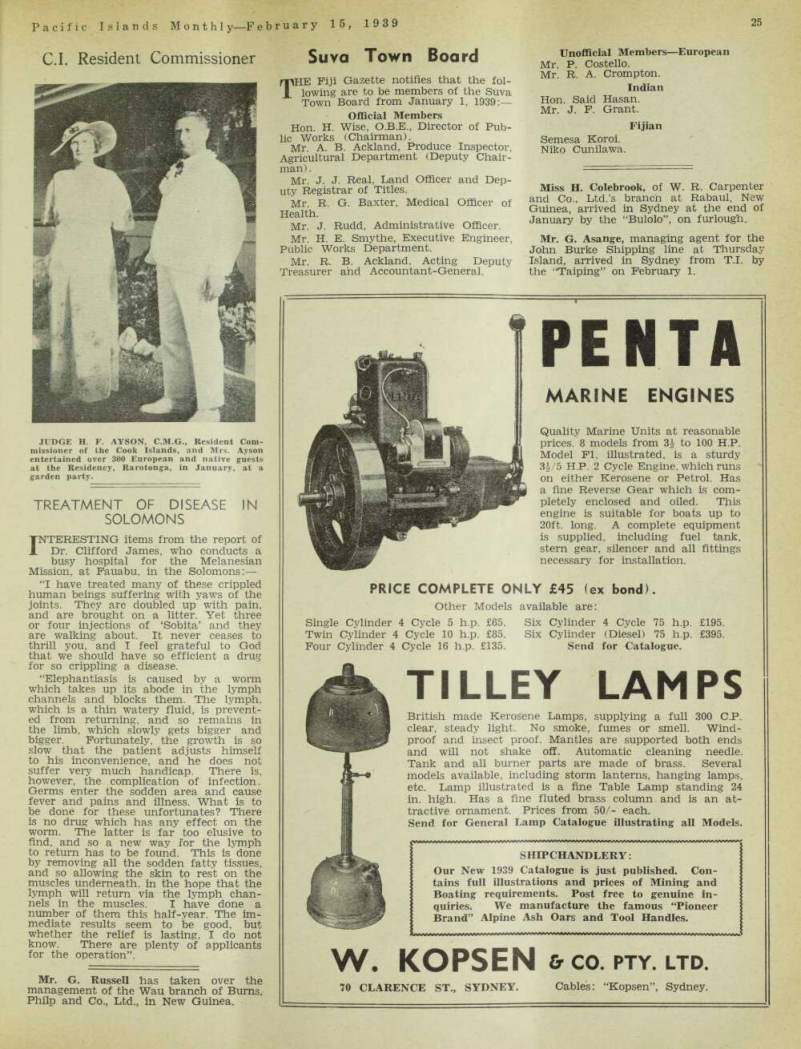
JUDGE H. F. AYSON, C.M.G., Resident Com missioner of the Cook Islands, and Mrs. Ayson entertained over 300 European and native guests at the Residency, Rarotonga, in January, at a garden party.
Treatment Of Disease In
Solomons
INTERESTING items from the report of Dr. Clifford James, who conducts a busy hospital for the Melanesian Mission, at Fauabu, in the Solomons: — “I have treated many of these crippled human beings suffering with yaws of the joints. They are doubled up with pain, and are brought on a litter. Yet three or four injections of ‘Sobita’ and they are walking about. It never ceases to thrill you, and I feel grateful to God that we should have so efficient a drug for so crippling a disease.
“Elephantiasis is caused by a worm which takes up its abode in the lymph channels and blocks them. The lymph, which is a thin watery fluid, is prevent ed from returning, and so remains in the limb, which slowly gets bigger and bigger. Fortunately, the growth is so slow that the patient adjusts himself to his inconvenience, and he does not suffer very much handicap. There is, however, the complication of infection.
Germs enter the sodden area and cause fever and pains and illness. What is to be done for these unfortunates? There is no drug which has any effect on the worm. The latter is far too elusive to find, and so a new way for the lymph to return has to be found. This is done by removing all the sodden fatty tissues, and so allowing the skin to rest on the muscles underneath, in the hope that the lymph will return via the lymph chan nels in the muscles. I have done a number of them this half-year. The im mediate results seem to be good, but whether the relief is lasting, I do not know. There are plenty of applicants for the operation”.
Mr. G. Russell has taken over the management of the Wau branch of Bums, Philp and Co., Ltd., in New Guinea.
Suva Town Board
rIE Fiji Gazette notifies that the fol lowing are to be members of the Suva Town Board from January 1, 1939; Official Members Hon. H. Wise, 0.8. E., Director of Pub lic Works (Chairman).
Mr. A. B. Ackland, Produce Inspector, Agricultural Department (Deputy Chair man).
Mr. J. J. Real, Land Officer and Dep uty Registrar of Titles.
Mr. R. G. Baxter, Medical Officer of Health.
Mr. J. Rudd, Administrative Officer.
Mr. H. E. Smythe, Executive Engineer, Public Works Department.
Mr. R. B. Ackland, Acting Deputy Treasurer and Accountant-General.
Unofficial Members —European Mr, P. Costello.
Mr. R. A. Crompton.
Indian Hon. Said Hasan.
Mr. J. F. Grant.
Fijian Semesa Koroi.
Niko Cunilawa.
Miss H. Colebrook, of W. R. Carpenter and Co., Ltd.’s branch at Rabaul, New Guinea, arrived in Sydney at the end of January by the “Bulolo”, on furlough.
Mr. G. Asange, managing agent for the John Burke Shipping line at Thursday Island, arrived in Sydney from T.I. by the “Taiping” on February 1.
Advertisements & other items, p. 27 (2 items)
25
Pacific Islands Monthl y —F ebruary 15, 1939
Renta
a
MARINE ENGINES
Quality Marine Units at reasonable prices. 8 models from 3£ to 100 HP.
Model FI. illustrated, is a sturdy 3i/5 HP. 2 Cycle Engine, which runs on either Kerosene or Petrol. Has a fine Reverse Gear which is completely enclosed and oiled. This engine is suitable for boats up to 20ft. long. A complete equipment is supplied, including fuel tank, stern gear, silencer and all fittings necessary for installation.
PRICE COMPLETE ONLY £45 (ex bond).
Other Models available are: Single Cylinder 4 Cycle 5 h.p. £65. Six Cylinder 4 Cycle 75 h.p. £195.
Twin Cylinder 4 Cycle 10 h.p. £B5. Six Cylinder (Diesel) 75 h.p. £395.
Four Cylinder 4 Cycle 16 h.p. £135, Send for Catalogue.
TILLEY LAMPS
British made Kerosene Lamps, supplying a full 300 CP. clear, steady light. No smoke, fumes or smell. Windproof and insect proof. Mantles are supported both ends and will not shake off. Automatic cleaning needle.
Tank and all burner parts are made of brass. Several models available, including storm lanterns, hanging lamps, etc. Lamp illustrated is a fine Table Lamp standing 24 in. high. Has a fine fluted brass column and is an attractive ornament. Prices from 50/- each.
Send for General Lamp Catalogue illustrating all Models.
SHIPCHANDLERY:
Our New 1939 Catalogue is just published. Contains full illustrations and prices of Mining and Boating requirements. Post free to genuine inquiries. We manufacture the famous “Pioneer Brand” Alpine Ash Oars and Tool Handles.
W. KOPSEN & CO. PTY. LTD.
70 CLARENCE ST., SYDNEY. Cables: “Kopsen”, Sydney.
Trade Biscuits Made
In Wau
A BAKERY which was established at Wau, in New Guinea, in 1936. for the production of bread, for the Eu ropean population, and of trade biscuits, for the native labourers, reports a suc cessful year s operations.
The biscuit business, especially, has flourished—which is not to be wondered at, considering that there are about 8,000 indentured native labourers on the gold fields, and that rice and trade biscuits are their staple foods.
The baking Co., however, are urgently appealing for the construction of a road from the goldfield towns to the coast.
They point out that they pay no less than £lO,OOO per annum in freight on flour brought in the aeroplanes from the coast to the goldfield—and that this rep
resents 40 per cent, of their turnover.
Their air freight bill in December was £960.
The manager of the bakery was in Sydney in January, purchasing machin ery and equipment with a view to open ing another bakery at Salamaua, for the production of bread and trade biscuits.
Paul Ah Lok, one of the oldest and highly-respected Chinese residents of New Guinea, died on January 25 after a short illness. Prominent in every move ment for the welfare of Chinese in the Mandated Territory, Paul Ah Lok went to New Guinea in April. 1890, as an em ployee of the late Ah Tam. Some time later he took up land in New Ireland, where he was one of the first Chinese planters. He was a trusted friend of Dr.
Hahl, during the German regime.
Rich Nauruan
Natives
Xmas Box of £13,000
From a Special Correspondent r NAURU, Jan. 14.
E natives of Nauru are said to be the richest in the world.
While this may or may not be cor rect, it is believed that a sum of £13,000 was paid out by the Administration in the names of individual natives, early this month (January).
The money is not given directly to the individuals, but in most cases is placed in the Savings Bank accounts of those concerned, and none of it beyond a regu lar monthly sustenance allowance may be used except with the formal approval of the Administration. This acts as an effective check on foolish spending by the natives.
The story behind the payment of this large amount, which was retrospective, is an interesting one: About a year ago, during the visit of the Phosphate Commissioners to the is land, the general manager (Mr. Harold Gaze) announced the intention of the Commission to exercise its right under the terms of the agreement covering phosphate payments, to reduce the per ton royalty to native landowners from 4fd. to about one-third that amount (Ud.) for the next five-year period. As an alternative, the 4|d. per ton arrange ment to be continued, if the natives would consent to extend the general agreement for a further period of 30 years (the present agreement being due to expire in a few years’ time).
In other words, said the B.P.C. through the Administration: We propose to re duce your royalty payments by two thirds, unless you give us a 30-years’ extension of our present phosphate min ing rights. To this alternative the na tives, in spite of argument and cajolery, refused to agree. So the old agreement was adhered to, and the reduction in royalties commenced to operate.
And now, after some months, without having secured the extension of the agreement desired, it apnears that the B.P.C. have reverted to the former roy alty basis, and have paid up retrosnec tively for the past months. The effect of this magnanimous gesture on the part of the B.P.C. (who could probably have forced the hands of the natives if thev had desired), is an increase of goodwill towards the B.P.C. on the part of the natives—who cannot, however, quite comprehend the strange workings of the European business mind.
An immediate result of the receipt of this large sum of money into the native bank accounts, was a great increase in native nurchases at the local stores dur ing the New Year season. The Nauru Co-operative Store was packed out for days before Christmas.
Mr. J. Gollan, Chief Secretary of N.S.W.. accompanied by Mr. R. H. Hicks, a mem ber of the Lord Howe Island Control Board, left Sydnev by the “Morinda” on January 28 for Lord Howe, where they will investigate complaints by tourists re garding accommodation.
Mr. S. Mill, commander of the South Sea Evangelical Mission vessel “Evangel”, arrived in Sydney recently on six months’ furlough. Mr. K. Griffiths is in command of the vessel during his absence.
Advertisements & other items, p. 28 (1 item)
Sparkling
refreshment from pure Malt and Hops ★ m
FOSTER'S
LAGER
Mining On Lakekamu, Papua
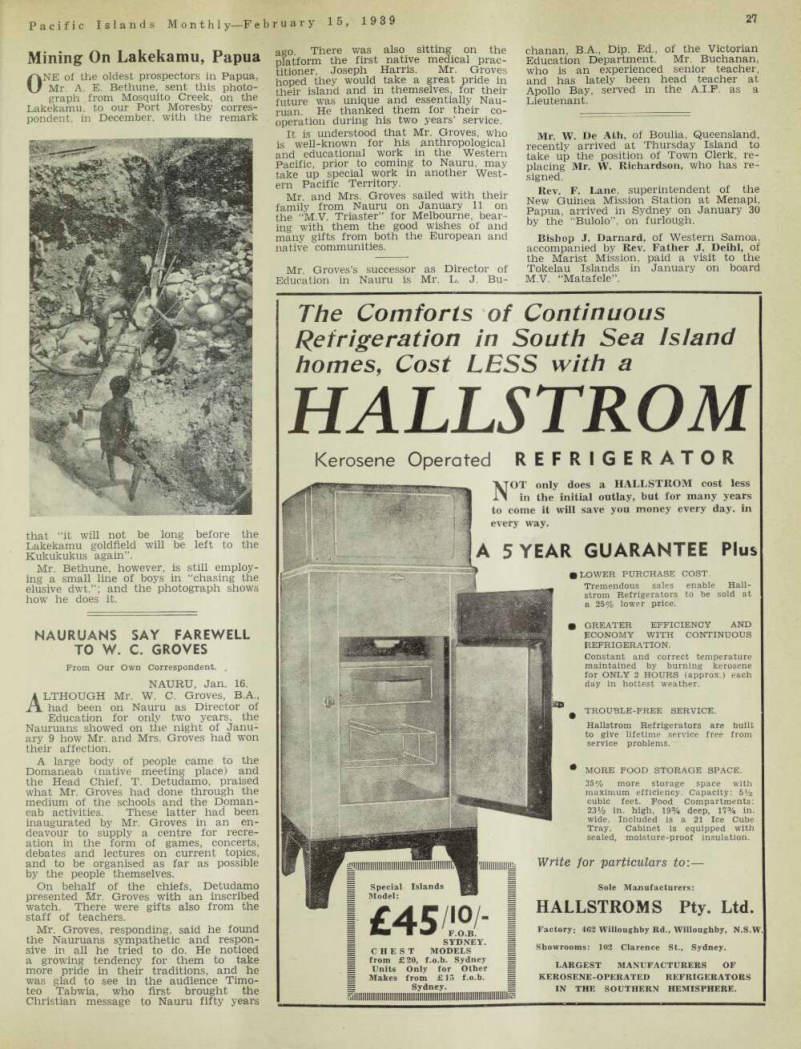
ONE of the oldest prospectors in Papua, Mr. A. E. Bethune, sent this photo graph from Mosquito Creek, on the Lakekamu, to our Port Moresby corres pondent, in December, with the remark
that “it will not be long before the Lakekamu goldfield will be left to the Kukukukus again”.
Mr. Bethune, however, is still employ ing a small line of boys in “chasing the elusive dwt”; and the photograph shows how he does it.
Advertisements & other items, p. 29 (3 items)
r^ P^HS*SSSLS ai ii tt, SS;
NAURUANS SAY FAREWELL
TO W. C. GROVES
From Our Own Correspondent. ,
NAURU, Jan. 16.
ALTHOUGH Mr. W. C. Groves, 8.A., had been on Nauru as Director of Education for only two years, the Nauruans showed on the night of Janu ary 9 how Mr. and Mrs. Groves had won their affection.
A large body of people came to the Domaneab (native meeting place) and the Head Chief, T. Detudamo, praised what Mr. Groves had done through the medium of the schools and the Dpman eab activities. These latter had been inaugurated by Mr. Groves in an en deavour to supply a centre for recre ation in the form of games, concerts, debates and lectures on current topics, and to be organised as far as possible by the people themselves.
On behalf of the chiefs, Detudamo presented Mr. Groves with an inscribed watch. There were gifts also from the staff of teachers.
Mr. Groves, responding, said he found the Nauruans sympathetic and respon sive in all he tried to do. He noticed a growing tendency for them to take more pride in their traditions, and he was glad to see in the audience Timo teo Tabwia, who first brought the Christian message to Nauru fifty years
ago There was also sitting on the platform the first native medical practitioner, Joseph Harris. Mr. Groves hoped they would take a great pride in their island and in themselves, for their future was unique and essentially Nauruan. He thanked them for their co operation during his two years’ service.
It is understood that Mr. Groves, who is well-known for his anthropological and educational work in the Western Pacific, prior to coming to Nauru, may take up special work in another West-
r^ P^HS*SSSLS ai ii tt, SS;
“II.V Triaste™ for" Melbourne, bea™
ing with them the good wishes of and many gifts from both the European and native communities.
Mr. Groves’s successor as Director of Education in Nauru is Mr, L. J. Bu-
chanan, 8.A., Dip. Ed., of the Victorian Education Department. Mr. Buchanan, who is an experienced senior teacher, and has lately been head teacher at Apollo Bay, served in the A.I.F. as a Lieutenant, Mr. W. De Ath, of Boulia, Queensland, recently arrived at Thursday Island to t a k e up the position of Town Clerk, re placing Mr. W. Richardson, who has re signed M JanUary 3 ° by tfte Bmol ° ’ on mriou ° n - Bishop J. Barnard, of Western Samoa, accompanied by Rev. Father J. Deihl, of the Marist Mission, paid a visit to the Tokelau Islands in January on board M.V. “Matafele”.
27
Pacific Islands Monthl y —F ebruary 15, 1939
Hallstrom
The Comforts of Continuous
Refrigeration in South Sea Island
homes, Cost LESS with a
HALLSTROM
Kerosene Operated REFRIGERATOR
' 5 ■:W & ■■ '■' -■ . .'■■■ ■ . ■ t
ll s " -ii
.f
iiiiiiiiiiiiiiiiiiiiiiiiilliiiiiiiiiiiKiiiiiin
n mmm EE Special Islands = Model: £45/10/. •• ■** F. 0.8.
F. 0.8.
= SYDNEY.
= CHEST MODELS
= from £2O, f.o.b. Sydney = Units Only for Other Makes from £l5 f.o.b. = Sydney. =
'jllllllllllllllllllllllllllllllllllllllllllllllllllllllllllllllllfllllilll^
NOT only does a HALLSTROM cost less in the initial outlay, but for many years to come it will save you money every day, in every way.
A 5 YEAR GUARANTEE Plus
LOWER PURCHASE COST
Tremendous sales enable Hallstrom Refrigerators to be sold at a 25% lower price.
GREATER EFFICIENCY AND
ECONOMY WITH CONTINUOUS
REFRIGERATION.
Constant and correct temperature maintained by burning kerosene for ONLY 2 HOURS (approx.) each day in hottest weather.
TROUBLE-FREE SERVICE.
Hallstrom Refrigerators are built to give lifetime service free from service problems.
MORE FOOD STORAGE SPACE.
35% more storage space with maximum efficiency. Capacity: 5Va cubic feet. Food Compartments; 23% in. high, 19% deep, 17% in. wide. Included is a 21 Ice Cube Tray. Cabinet is equipped with sealed, moisture-proof insulation.
Write for particulars to: —
Sole Manufacturers:
HALLSTROM S Pty. Ltd.
Factory: 462 Willoughby Rd., Willoughby, N.S.W Showrooms: 102 Clarence St., Sydney.
LARGEST MANUFACTURERS OF
KEROSENE-OPERATED REFRIGERATORS
IN THE SOUTHERN HEMISPHERE.
Left In Mid-Air!
Remarkable Story of What Happened to Proposed Consort of Hawaii's Last Sovereign
By A. C. Rowland
FOR centuries, until the breaking-up of the confederation of the Polynes ian Island world, 600 years ago, the great double canoes of the period voy aged at frequent intervals between the northern islands—now called Hawaii— and those of the south, of which Ra’iatea was the centre.
The ties between the archipelagoes be came close and intimate.
Priests and warlocks and their aco lytes came from the north to study the ancient wisdom, and the arcana of their craft, at the council-house in the sacred precincts of Opoa, on Ra’iatea.
Warriors and chiefs of the royal clan voyaged from the south to settle in the northern islands and become the found ers of dynasties of high chiefs.
The chronicles of all these things were embodied in genealogies and oral tradi tions, and epic poetry chanted at great ceremonies. And so the antiscians of Hawaii and the Society Islands preserv ed the memory of each other through the centuries which followed the “sin of Avarua”, and the disposal of the confed eration, until communication was re established in recent times.
IT was not strange, then, that when, in the last years of the nineteenth century, the Queen of Hawaii sought a husband, her thoughts should have turned to the islands of the south.
Years before, a young man of Tahiti who said he was a prince of that coun try, had visited Honolulu. The Queen remembered him. Here was a chance
to re-unite the ancient royal families.
She wrote him a letter.
The man who received the letter was a very different person from the hand some young prince the Queen remem bered. Years of good living and oceans of good cheer had so expanded his equator that he had to lean far over to see the tips of his toes. In addition, that mysterious disease of the tropics— elephantiasis—had laid hold on him and destroyed the grace of his nether limbs.
Moreover, he was not really a prince.
The tolerant insouciance which allows distant relatives of islands royalty to assume the titles of prince and prin cess, if it suits their fancy, had never troubled him by a too critical examina tion of his genealogy.
These disabilities did not, however, cast a shadow to blemish the knightly eloquence, worthy of Sir Launcelot Du Lake, that graced his answering letter.
MORE letters passed, and at length the Queen —as reigning queens must do—invited him to become her royal consort.
The prince saw before him a broad highway of riches and glory. He must, however, find means to enter his future kingdom with becoming state. He went to his friend, Van Wyck.
Van Wyck was a thrifty Dutchman who, by years of work and self-denial, had accumulated a modest fortune. The prince showed him the Queen’s letters, and the lock of her hair she enclosed in her last epistle.
“I am about to become King of Ha waii” he said. “If you will finance me I will make you my Royal Chan cellor. Your honorarium will be ten thousand a year”.
Van Wyck agreed. The prince de parted for San Francisco.
In this, as in many another royal ro mance, the course of true love did not at all run smoothly.
Her Majesty’s ministers, informed of what was going on, and full of dis pleasure over the knowledge, took quick action A message was despatched to me Hawaiian Commissioner at San Francisco that the prince must be pre vented from embarking for Honolulu, at any cost, until further instructions; a messenger was sent with all speed to i. a.niti.
The messenger—a charming Hawaiian gentleman who played expertly the gui tar—sang the mele of his native islands and exhibited a flattering interest in iahitian lore and genealogies and be came a great favourite at Papeete. As souvenirs of a delightful visit he col lected photographs. Among them was a recent photograph in which was a speaking likeness of the prince stand ing in the front row of a group of merry wedding guests.
THE messenger’s report and the group photograph adorned with an inky arrow pointing to the prince, arriv ed in due time at the royal palace in Honolulu. The Queen was aghast. She summoned her rhihisters.
“We must use every means under heaven to get possession of those let ters and the lock of Your Majesty’s hair”, they advised.
“Keep him away from Honolulu, even at the cost of half of my kingdom” commanded the Queen.
Other messengers were despatched to San Francisco.
Meanwhile, at San Francisco, the prince was riding the heights, and leap ing from peak to peak like an inebri ated Valkyr. His tailors were fashioning, at his command, uniforms glittering with gold lace, and costly robes of con vention in generous abundance. His apartments \vere the royal suite of the city’s swankiest hotel. The splendour of his dinners became the talk of the town.
If doubts assailed him when the ex pected summons to Honolulu was so long delayed, he put them to flight with magnums of the sparkling vintages of France. The royal consort of Hawaii must maintain his prestige and the hon our of his future realm.
When months had passed, and the distracted Van Wyck had no more to give, the prince did not lower his ban ners until his debts far overshadowed the heights of his glory.
The crafty messengers from Hawaii had awaited this hour.
When the prince found himself the centre of a whirling vortex of storming creditors, the royal emissaries appeared.
They delivered their ultimatum; if he would surrender the letters, the lock of hair, and agree never to set foot on Hawaii for evermore, they would rescue him from legal proceedings and land him safely at Tahiti.
The prince returned to Tahiti.
Whether or no the fall of the Hawaiian monarchy, which came to pass soon afterward, offered him any consolation, he never disclosed.
Advertisements & other items, p. 30 (1 item)
Coleman
0 Oj^n/u<l«U (©»<»«»** i I
“SUPPLY THE LIGHT FOR EVERY
OUTDOOR NEED AT NIGHT”.
Coleman
HI-POWER
LANTERNS
300
CANDLE POWER
SUN-LIKE
PURE WHITE
BRILLIANCE
Known for their Sun-like, pure white brilliance. Not affected by wind, rain or storm.
Low cost of operation—l 2-15 hours on one quart of fuel.
Compact—only Hi inches high, and 3i lbs. in weight.
Equipped with genuine “Pyrex” bulge-type heat and rain resisting globe, with 30% more lightingsurface. Uses Coleman “Hi-Power”
Mantle No. 999.
No. 242-B.—INSTANT lighting for Petrol.
No. 247. —For Kerosene (preheating).
Take it down the Mine Shaft—Out on the Plantation—On
the Verandah—-In the Home.
DISTRIBUTORS IN THE PACIFIC ISLANDS:
All Branches of Burns, Philp & Co. Ltd.; W. R. Carpenter & Co. Ltd.; Morris, Hedstrom Ltd.; Whitten Bros. Ltd.; Steamships Trading Co. Ltd., and many other firms throughout the Islands.
Pt. Moresby's New Hotel
From Our Own Correspondent
Pt. Moresby, Feb. 1.
THE new hotel, built at a cost of some £17,000 by Burns, Philp and Co. Ltd., was opened for business Oh Monday, January 23.
The building is well-furnished and convenient, and should be a great im provement on the more primitive struc tures that have done duty as hotels in the past; and present indications are that the rather higher prices charged will not result in any curtailment of business.
The only criticism that some acidula ted residents make is that the cooking is of the same old native hit-or-miss variety, and that the same brand of native waiters rush the evening meal, so that they may be free to attend the eight o’clock meeting of their gambling school.
Doubtless these small matters will be corrected in time, when Port Moresby will be able to boast of hotel accommo dation at least as good as any in the Western Pacific.
Commander A. S. Rosenthal returned to Sydney by the “Morinda” on January 17 from Norfolk Island, where he had been on a short visit to his father. Sir Charles Rosenthal, Administrator of N.I.
Mr. George Ellis, Assistant District Officer in the New Guinea Administra tion, has returned to Wewak, after an extensive tour of America and Europe.
Mr. W. T. Hyder arrived in Sydney on January 17 by the “Morinda” from Nor folk Island, where he carried out a dental inspection of the N.I. school children.
Advertisements & other items, p. 31 (2 items)
29
Pacific Islands Monthl y—F ebruary 15, 39 3 9
Ultimate
sv*°
ovP
H°°
•O ov -
rtt
“ULTIMATE” FACTS:
(a) A Standard 6V. A.C.
“Ultimate” holds the world’s record for the greatest number of verified stations received 798 on the Broadcast Band. (b) An “Ultimate” Battery Set has created a record in logging 531 verified stations. (c) An “Ultimate” in New Zealand holds Nine Champion of Champions Awards. (d) “Ultimate” was used by Commander R. E.
Byrd in his expedition to the South Pole.
Ultimate Radio engineers have constructed a set specially designed to withstand the high relative humidity prevailing in the tropics, ensuring the utmost Reliability under such conditions. You may therefore enjoy to the full the performance which has made - - -
“ULTIMATE” RADIO
FAMOUS.
Send for copies of
unsolicited letters on “Ultimate’s” Power , Reliability and Tone. i a
s/iAg&y
REAL RADIO
ULTIMATE
Read this Unsolicited Testimonial:
Oua-Ton, Boulouparl.
NEW CALEDONIA.
“The ULTIMATE set is now installed and from the first turn-on has excelled itself. I had two of the best Island wireless men, both tremendously interested, to help me instal the set and they were amazed at the results; we seem to have got almost every country and heard with great clarity, England, Italy, Germany, France, Japan, etc. Both the experts have gone back to Noumea with a lasting impression of ULTIMATES and said that at Noumea they had heard no such results from any other machine.” (Signed) H. L. WANT.
BE FAIR TO YOURSELF. WRITE FOR DETAILS.
SOLE AUSTRALIAN CONCESSIONAIRES
PTY. LTD.
ELECTRICAL AND INDUSTRIAL ENGINEERS
267 CLARENCE STREET, SYDNEY
Cable, Radio & Telegrams: “BROWNLOCK”, SYDNEY.
WRITE FOR SPECIAL TRADE PRICES.
"Mysteries"
Going To Fiji To Solve
From Our Own Correspondent
Honolulu, Jan. 14.
R. Charles Kellogg, Noted
American naturalist and “bird man”, has announced from his ranch at Morgan Hill, California, that in March he will leave on an expedition to the Fiji Islands for the purpose of attempt ing to solve what he calls two curious mysteries.
The first of these is the method used by the native firewalkers, which enables them to walk through a pit of glowing stones with naught but their bare feet and without suffering any ill effects. ’
The second is the art that lies behind the construction of lalis, or long hollow
logs, through which the natives are able to send messages up to a distance of 180 miles.
Mr. Kellogg first saw the firewalking during his first visit to the islands in 1925, and, also, he secured some of the falls, which intrigued him. To-day he is able to transmit messages on them that are heard 14 miles away. . Mr. Kellogg intends to go so deeply into the two “mysteries” that he is tak ing with him Mr. and Mrs. Walter Bur leigh, of Hollywood, who will make movie records of Mr. Kellogg and the natives at work.
The L.M.S. vessel “John Williams V ” was undergoing engine repairs at Suva Fiji, early in February. She will shortly sail for the Gilbert Islands.
Bunting
Death Of Mr. A. H. C
Leading Resident of Papua
Mr. Arthur H. C. Bunting, For
merly a member of the Legislative Council of Papua, planter and head 01 a firm of general merchants in Sa marai, Eastern Papua, died at Wah roonga Sydney, on January 15, after a l£ ng J lness - Hi s funeral took place at the Northern Suburbs Crematorium on January 16. He is survived by his widow a son and two daughters.
To record the deaths of long-estab lished residents in Papua has lately be come almost a matter of routine (writes our Port Moresby correspondent). But many years have elapsed since the pass ing of an old-timer caused such genu me and widespread regret as did that of Mr. Arthur Bunting.
To say that he had innumerable friends and no enemies is no facile com pliment, but the rigid truth; and the number of underdogs who have had cause to bless him for timely and generous help is very great.
Jim, the Big Firm (Burns, Philp and Co.) have lost a staunch and valu able supporter. He was connected with the firm from boyhood, and was em ployed in the Cooktown branch as early as 1892. J Three years later, he was sent to act as a clerk in the newly re-organised branch at Samarai, where he remained for seven or eight years, before start ing a business of his own, still keeping in the closest touch with the firm.
He was immediately successful as a trader; and his straightforward dealings with Burns, Philp made for him a repu tation which ensured the firm’s support in his first big financial deal, which laid the foundation of all his later suc cesses.
Arthur Bunting was made a member of the Legislative Council more than fifteen years ago, and used all his in fluence to improve the living and work ing conditions at the eastern end of the Territory. He retired from the Council after he became seriously ill, some three years ago.
N.G. Public Service
"THE following staff transfers and appointments in the New Guinea Public Service were announced by the Acting Government Secretary in January:—
Transfers.
Health Dept.—l. Clark, Medical Assistant, Rabaul to Kokopo.
District Services Dept.—M. S. Edwards, Patrol Officer, Madang to Rabaul; J. J. Murphy, Patrol Officer, Rabaul to Gasmata; J. R. Rigby, Assistant District Officer, Rabaul to Gasmata.
Agriculture Dept.—G. Stanley, Inspector and Instructor, Kavieng to Rabaul.
Temporary Engagements.
Health Dept.—Mrs. A. Anthony, Nurse. Miss J. C. McGahan, Nurse.
Public Works Dept.—P. A, Collier, Roadmaster, F. L. E. Dolton, Carpenter.
Customs Dept.—E. M. Howitt. Schooner En gineer.
Pastor Jupeli, Vice-Principal of the
London Missionary Society training col
lege at Rongorongo, Bern, Gilbert Is
lands, passed through Sydney by the
“Strathaird” on January 19 on his re turn journey to the G. and E. Group after attending the World Missionary Conference in Madras, India. He has been engaged in missionary activities for the L.M.S. for 37 years.
Advertisements & other items, p. 32 (2 items)
30
February 15, 193 9—P acific Islands Monthly
Tenax
LINS T 9
ourain»
You need them all, For rain in every life must fall, Ah! human friends both small and great As well as friends inanimate.
For instance, there’s a friend of old Who’s useful in a cough or cold, It’s easy to this friend secure, The name is Woods’ Great Peppermint Cure.
First aid for Coughs, Colds and Influenza, Woods’ Great Peppermint Cure.
Genuinely
Germicidal Containing Ti-Trol
PREVENTION
is better than
cure.
Disease germs such as those of Diphtheria, Malaria, Dhobie Itch, Tinea, or Surfer’s Foot cannot live under the lather of TE N A X. Besides which T E N A X, used constantly, will cure Tropical Skin Diseases.
TEN AX contains “Ti-Trol.” 11 times quicker than carbolic as a germicide,
but NON-POISONOUS and NON-IRRITANT.
“The Medical Journal of Australia” says: “T E N A X is a satisfactory germicidal soap which may be recommended with confidence.”
TENAX
TOILET SOAP
A PRODUCT OF AUSTRALIAN SOAPS LIMITED
Pitcairn "Exodus"
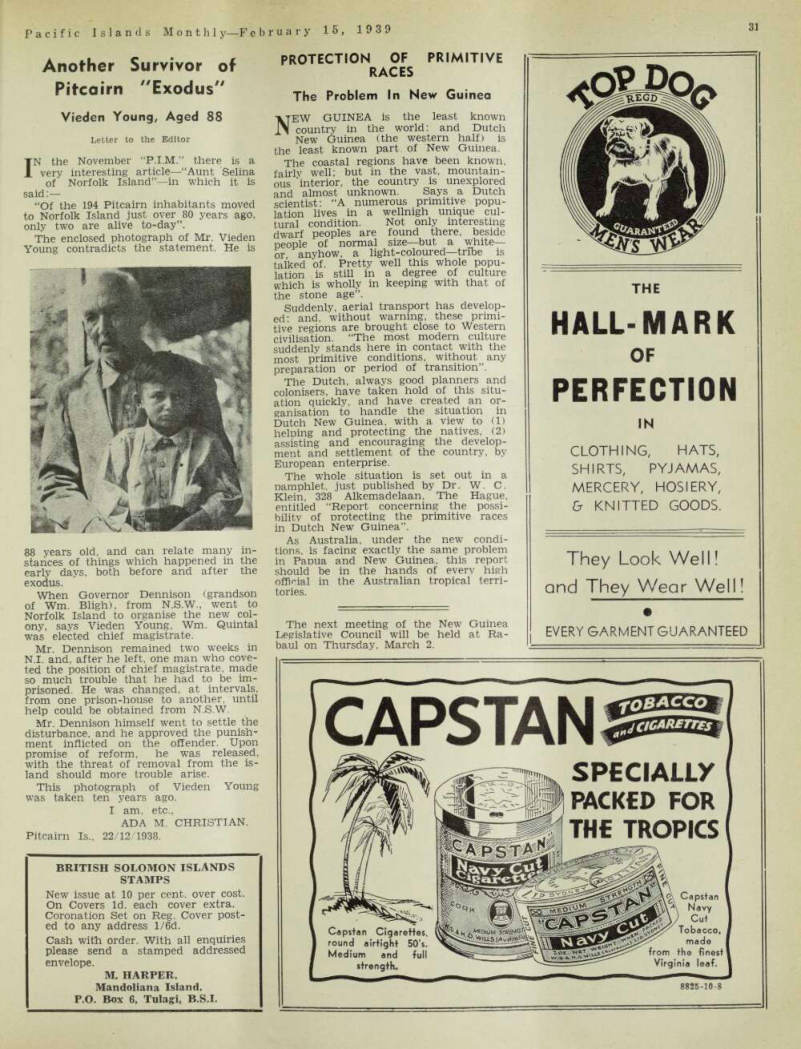
Another Survivor of Pitcairn "Exodus"
Vieden Young, Aged 88
Letter to the Editor IN the November “P.1.M.” there is a very interesting article —“Aunt Selina of Norfolk Island”—in which it is said: — “Of the 194 Pitcairn inhabitants moved to Norfolk Island just over 80 years ago, only two are alive to-day”.
The enclosed photograph of Mr. Vieden Young contradicts the statement. He is
88 years old, and can relate many in stances of things which happened in the early days, both before and after the exodus.
When Governor Dennison (grandson of Wm. Bligh), from N.S.W., went to Norfolk Island to organise the new col ony, says Vieden Young, Wm. Quintal was elected chief magistrate.
Mr. Dennison remained two weeks in N.I. and. after he left, one man who cove ted the position of chief magistrate, made so much trouble that he had to be im prisoned. He was changed, at intervals, from one prison-house to another, until help could be obtained from N.S.W.
Mr. Dennison himself went to settle the disturbance, and he approved the punish ment inflicted on the offender. Upon promise of reform, he was released, with the threat of removal from the is land should more trouble arise.
This photograph of Vieden Young was taken ten years ago.
I am, etc.,
Ada M. Christian.
Pitcairn Is., 22/12/1938.
protection of primitive
Races
The Problem In New Guinea
NEW GUINEA is the least known country in the world: and Dutch New Guinea (the western half) is the least known part of New Guinea.
The coastal regions have been known, fairly well; but in the vast, mountain ous "interior, the country is unexplored and almost unknown. Says a Dutch scientist: “A numerous primitive popu lation lives in a wellnigh unique cul tural condition. Not only interesting dwarf peoples are f9und there, beside people of normal size—but a white — or anyhow, a light-coloured—tribe is talked of. Pretty well this whole popu lation is still in a degree of culture which is wholly in keeping with that of the stone age”.
Suddenly, aerial transport has develop ed: and, without warning, these primi tive regions are brought close to Western civilisation. “The most modern culture suddenly stands here in contact with the most primitive conditions, without any preparation or period of transition”.
The Dutch, always good planners and colonisers, have taken hold of this situ ation quickly, and have created an or ganisation to handle the situation in Dutch New Guinea, with a view to (1) helping and protecting the natives, (2) assisting and encouraging the develop ment and settlement of the country, by European enterprise.
The whole situation is set out in a namphlet. just published by Dr. W. C.
Klein, 328 Alkemadelaan, The Hague, entitled “Report concerning the possi bility of protecting the primitive races in Dutch New Guinea”.
As Australia, under the new condi tions, is facing exactly the same problem in Panua and New Guinea, this report should be in the hands of every high official in the Australian tropical terri tories.
The next meeting of the New Guinea Legislative Council will be held at Ra baul on Thursday. March 2.
Advertisements & other items, pp. 33-34 (3 items)
31
Pacific Islands Monthl y—F ebruary 15, 1939
Capstans
D Q
RE CD
% 1 V 4
THE
HALL-MARK
OF
PERFECTION
IN
CLOTHING, HATS,
SHIRTS, PYJAMAS,
MERCERY, HOSIERY,
& KNITTED GOODS.
They Look Well! and They Wear Well!
EVERY GARMENT GUARANTEED
CAPSTANS
'M Capstan Cigarettes, round airtight 50's.
Medium and full strength.
SPECIALLY
PACKED FOR
THE TROPICS
stb&jg; Capstan Navy Cut Tobacco, made the finest 1 Virginia leaf. 8825-10-S from
W. H, GROVE & Sons Ltd.
Islands Traders po. box 490 AUCKLAND Telegraphic and Cable Address: “Grove,” Auckland.
Shippers of all classes of New Zealand Products, specially prepared for the Island trade.
Representing Rvlands & Sons (Col.) Ltd., of London and Manchester (Including the famous “Dacca” Mills Products.) Parbury Henty & Co. Pty. Ltd., of Sydney and Kobe.
“AGFA” Photographic Corporation, of Berlin.
J. Blair King, of London. World-famed Shirts.
Burrell & Co. Ltd., Millwall, London, E. 14. Oil, White Lead and all classes of Paints, including “FERROCENE” their special Tropical Paint . . . PREVENTS CORROSION . . . made in RED, GREY, and GREEN.
Q IPo m
JJtemm
tiry.
/ xm.
Photograph with Agfa Isochrom - this is a film for all types of exposures. It enables you to get the best out of your photographs. Good definition, reproduction of the finest details, brilliant gradation, and high sensitivity. Orthochromatic with wide exposure latitude.
British Solomon Islands
STAMPS
New issue at 10 per cent, over cost.
On Covers Id. each cover extra.
Coronation Set on Reg. Cover posted to any address l/6d.
Cash with order. With all enquiries please send a stamped addressed envelope.
M. HARPER.
Mandoliana Island.
P.O. Box 6, Tulagi, 8.5.1.
Discovery & Discoverers
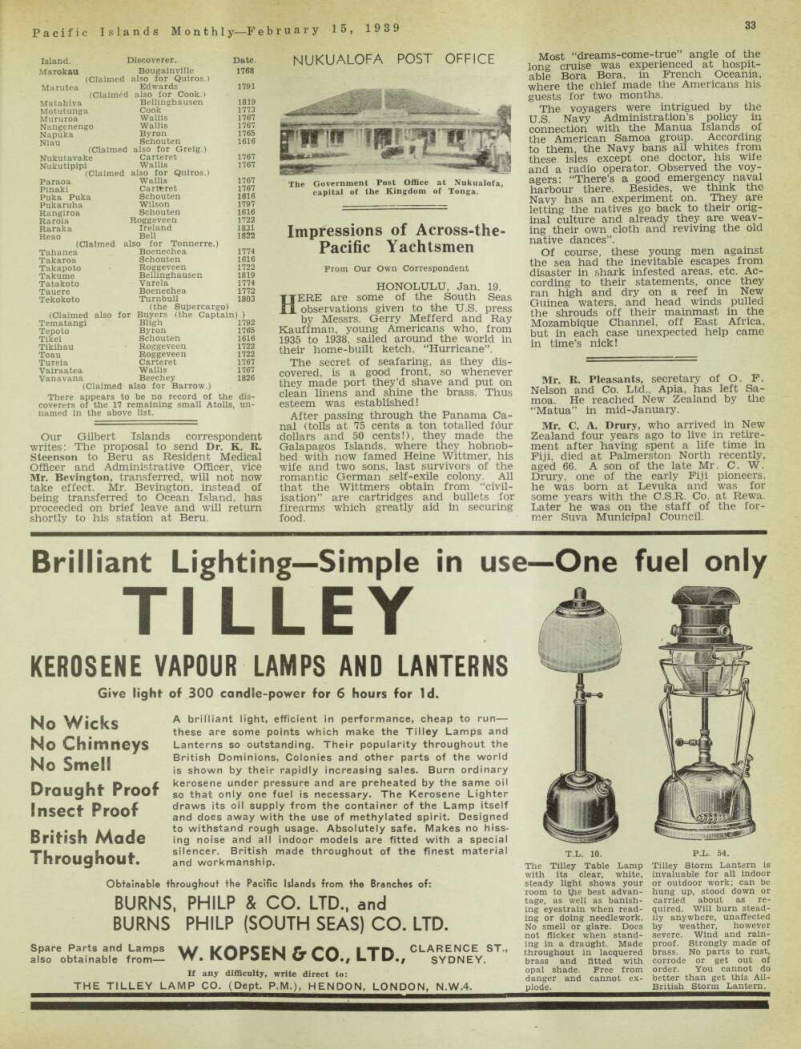
of French Oceania
THE following remarkable list— which is of unique value—has been compiled from the records of the various navigators concerned, and from those of other voyagers, by Mr.
W. W. Bolton, M.A., an English his torian resident in Tahiti. Mr. Bolton, in courteously giving us permission to publish this list, says: “Documented corrections would be welcomed”.
The total number of Islands in French Oceania is 105.
Island. Discoverer.
Date.
The Georgian Group.
(As recorded at The Admiralty, London, 1768.) Tahiti Wallis 1767 Moorea Wallis 1767 Maiao Wallis 1767 Makatea Roggevsen 1722 (Now grouped with the Atolls.) Mehetia Wallis 1767 (Claimed also for Carteret.) Tetiaroa Wallis 1767 (Claimed also for Cook.)
The Marquesan Group.
(So named by Mendana.) South Group: Patuhiva Mendana 1595 Hivaoa Mendana 1595 Tahuata Mendana 1595 North Group: Nukuhiva Ingraham 1791 Nahuka Ingraham 1791 Uapu Ingraham 1791 (The North Group claimed also for Marchand and Chanal.)
The Mangareva Or Gambier Group.
(So named by Wilson.) Akamaru Wilson 1797 Aukena Wilson 1797 Rikitea Wilson 1797 Taravai Wilson 1797 Crescent Wilson 1797 (Native name Timoe.)
The Tupuai Or Austral Group.
(So named by the French authorities, 1881.) Raivaivai Gayangos 1775 Rapa Vancouver 1791 Rimatara Henry 1811 Rurutu Cook 1769 Tupuai Cook 1777
The Leeward Or Society Group.
(So named by Cook.) Raiatea Cook 1769 Huahine Cook 1769 Maupiti Cook 1769 Tupai Cook 1769 Tahaa Cook 1769 Scilly Wallis 1767 (Native name Manual.) Pora Pora Cook 1769 (There is no letter “B” in Tahitian.) Bellinghausen Kotzebue 1824 (Native name Motu O ne.) Mopelia Wallis 1767
The Atolls Or .Tuamotu Group.
(So named by the French authorities, 1851; ' formerly known as the Poumotus.) Aha Schouten 1616 Ahunui Beechey 1826 (Claimed also for Martin.) Akiaki Bougainville 1768 Amanu Quiros 1606 (Claimed also for Varela, 1774.) Anaa Quiros 1606 Anuanuaro Wallis 1767 (Claimed also for Quiros.) Anuanurunga Wallis 1767 (Claimed also for Quiros.) Apataki Roggeveen 1722 Arutua Roggeveen 1722 Paaite Bellinghausen 1819 Fakahina Kotzebue 1824 Pakarava Schouten 1616 Fangataufa Beechey 1826 Fangatau Beechey 1826 (Claimed also for Cockburn.) Hao Bougainville 1768 (Claimed also for Quiros.) Haraiki Boenechea 1772 Hereheretue Wallis 1767 Hikueru Boenechea 1774 Kauehi Humphrey 1822 Kaukura Cook 1774 Makemo Cook 1773 Manihi Schouten 1616 Manuhangi Wallis 1767 Maria Bougainville 1768 (Native name Vahitahi.)
There appears to be no record of the dis coverers of the 17 remaining small Atolls, un named in the above list.
Our Gilbert Islands correspondent writes: The proposal to send Dr. K. R.
Steenson to Beru as Resident Medical Officer and Administrative Officer, vice Mr. Bevington, transferred, will not now take effect. Mr. Bevington, instead of being transferred to Ocean Island, has proceeded on brief leave and will return shortly to his station at Beru.
Island.
Discoverer.
Date.
Marokau Bougainville 1768 (Claimed also for Quiros.) Marutea Edwards 1791 (Claimed also for Cook.) Matahiva Bellinghausen 1819 Motutunga Cook 1773 Mururoa Wallis 1767 Nangenengo Wallis 1767 Napuka Byron 1765 Niau Schouten 1616 (Claimed also for Greig.) 1767 Nukutavake Carteret Nukutipipi Wallis 1767 (Claimed also for Quiros.) Paraoa Wallis 1767 Pinaki Carteret 1767 Puka Puka Schouten 1616 Pukaruha Wilson 1797 Rangiroa Schouten 1616 Raroia Roggeveen 1722 Raraka Ireland 1831 Reao Bell 1822 (Claimed also for Tonnerre.) Tahanea Boenechea 1774 Takaroa Schouten 1616 Takapoto Roggeveen 1722 Takume Bellinghausen 1819 Tatakoto Varela 1774 Tauere Boenechea 1772 Tekokoto Turnbull (the Supercargo) 1803 (Claimed also for Buyers (the Captain).) Tematangi Bligh 1792 Tepoto Byron 1765 Tikei Schouten 1616 Tlkihau Roggeveen 1722 Toau Roggeveen 1722 Tureia Carteret 1767 Vairaatea Wallis 1767 Vanavana Beechey 1826 (Claimed also for Barrow.)
Advertisements & other items, pp. 34-35 (2 items)
32
February 15, 193 9—P acific Islands Monthly
Nukualofa Post Office
The Government Post Office at Nukualofa, capital of the Kingdom of Tonga.
Impressions of Across-the-
Pacific Yachtsmen
From Our Own Correspondent
Honolulu, Jan. 19.
HERE are some of the South Seas observations given to the U.S. press by Messrs. Gerry Mefferd and Ray Kauffman, young Americans who, from 1935 to 1938, sailed around the world in their home-built ketch, “Hurricane”.
The secret of seafaring, as they dis covered, is a good front, so whenever they made port they’d shave and put on clean linens and shine the brass. Thus esteem was established!
After passing through the Panama Ca nal (tolls at *75 cents a ton totalled four dollars and 50 cents!), they made the Galapagos Islands, where they hobnob bed with now famed Heine Wittmer, his wife and two sons, last survivors of the romantic German self-exile colony. All that the Wittmers obtain from “civil isation” are cartridges and bullets for firearms which greatly aid in securing food.
Most “dreams-come-true” angle of the long cruise was experienced at hospit able Bora Bora, in French Oceania, where the chief made the Americans his guests for two months.
The voyagers were intrigued by the U.S. Navy Administration’s policy in connection with the Manua Islands of the American Samoa group. According to them, the Navy bans ail whites from these isles except one doctor, his wife and a radio operator. Observed the voy agers; “There’s a good emergency naval harbour there. Besides, we think the Navy has an experiment on. They are letting the natives go back to their orig inal culture and already they are weav ing their own cloth and reviving the old native dances”.
Of course, these young men against the sea had the inevitable escapes from disaster in shark infested areas, etc. Ac cording to their statements, once they ran high and dry on a reef in New Guinea waters, and head winds pulled the shrouds off their mainmast in the Mozambique Channel, off East Africa, but in each case unexpected help came in time’s nick!
Mr. R. Pleasants, secretary of O. F.
Nelson and Co. Ltd., Apia, has left Sa moa. He reached New Zealand by the “Matua” in mid-January.
Mr. C. A. Drury, who arrived in New Zealand four years ago to live in retire ment after having spent a life time in Fiji, died at Palmerston North recently, aged 66. A son of the late Mr. C. W.
Drury, one of the early Fiji pioneers, he was born at Levuka and was for some years with the C.S.R. Co. at Rewa.
Later he was on the staff of the for mer Suva Municipal Council.
Mr. and Mrs. J. Kruttschnitt arrived in Sydney by the January “Bulolo” after an inspection visit to the working of New Guinea Goldfields Ltd. on the Mo robe goldfield. He is chairman of direc tors of N.G.G. Ltd.
Advertisements & other items, pp. 35-36 (2 items)
33
Pacific Islands Monthl y—F ebruary 15, 1939
Tl Lley
Brilliant Lighting—Simple in use—One fuel only
KEROSENE VAPOUR LAMPS AND LANTERNS
Give light of 300 candle-power for 6 hours for Id.
No Wicks
No Chimneys
No Smel!
Draught Proof
Insect Proof
British Made
Throughout.
A brilliant light, efficient in performance, cheap to run— these are some points which make the Tilley Lamps and Lanterns so outstanding. Their popularity throughout the British Dominions, Colonies and other parts of the world is shown by their rapidly increasing sales. Burn ordinary kerosene under pressure and are preheated by the same oil so that only one fuel is necessary. The Kerosene Lighter draws its oil supply from the container of the Lamp itself and does away with the use of methylated spirit. Designed to withstand rough usage. Absolutely safe. Makes no hissing noise and all indoor models are fitted with a special silencer. British made throughout of the finest material
and workmanship.
Obtainable throughout the Pacific Islands from the Branches of:
BURNS. PHILP & CO. LTD., and
BURNS PHILP (SOUTH SEAS) CO. LTD.
Spare Parts and Lamps yj KOPSEN & CO., LTD., CLARENCE ST " also obtainable from — • , ' VI v l. i is., SYDNEY.
If any difficulty, write direct to: THE TILLEY LAMP CO. (Dept. P.M.), HENDON, LONDON, N.W.4.
T.L. 10.
The Tilley Table Lamp with its clear, white, steady light shows your room to tyie best advantage, as well as banishing eyestrain when reading or doing needlework.
No smell or glare. Does not flicker when standing in a draught. Made throughout in lacquered brass and fitted with opal shade. Free from danger and cannot explode.
P.L. 54.
Tilley Storm Lantern is invaluable for all indoor or outdoor work; can be hung up, stood down or carried about as required. Will burn steadily anywhere, unaffected by weather, however severe. Wind and rainproof. Strongly made of brass. No parts to rust, corrode or get out of order. You cannot do better than get this All- British Storm Lantern.
PURE RICE
STARCH
Always ask for . . .
CORAL BRAND
100%
PURE
CORAL BRAND
RICE STARCH
co«»t«x* ,c s . ur& "
Noted for its
QUALITY
and
WHITENESS.
Goes Farthest and gives Lasting Finish
WILL NOT
STICK TO
IRON.
Obtainable from Leading Island Stores.
Manufactured by
AUSTRALIAN RICE, LTD.
Sydney, N.S.W.
Australia’s Choicest Products: Brussels Sprouts White Turnips Sweet Corn Tomato Puree Tomato Sauce Tomato Soup Tutti Fruit Sauce (Worcestershire flavor) Green Peas French Beans Cauliflower Beetroot Spinach Cabbage Carrots Parsnips Celery
garden
mi manufacturer
* BY I
VALE
N PRODUCTS UNITED
2-4 BROWN STR-E-CT, N-EWTOWN
SYDN-EY. -AUSTRALIA
Always . . . make sure you have at hand an ample Reserve of these Delicious . .
Garden
Vale
Ready-toserve Vegetables
Was There Cruelty in German Colonies ?
BY GORDON THOMAS (EDITOR, “THE RABAUL TIMES’’).
SO-CALLED patriotic fervour is in clined to make the world cock-eyed; and your “valued correspondent”, in the October “P.1.M.”, who quotes from the Foreign Office hand-book, compiled at that particular time when the boot was being put in on Germany—with what was thought at the time every justifi cation—lays himself open to criticism on the point of cruelty by the Germans in their pre-War colonies.
Personally, I have never perused the hand-book in question. Post-war pro paganda left me cold. I had served with the A.I.F. in France and had some idea of what war meant in the front line and it was my experience that those people who banged the propaganda drum the loudest were furthest from the scene of action, and felt that they were “doing their bit” by lauching a campaign of hate.
Of the pre-War situation in Africa I know nothing from personal experience; but I do claim to speak with some au thority on conditions prevailing in New Guinea from the time of my arrival there in 1911 and onwards, and I can honestly say that the treatment meted out by the Germans in charge of native labour on a plantation was neither more brutal nor harsh than that shown by the Britishers either in New Guinea or the British Solomon Islands.
The German draws a very definite col our line in regard to native labourers;
he laid down and insisted upon the ob servance of strict discipline. He was not over-awed by a Government guided by a policy of “We are the saviours of the black races whom we have liberated from the heel of the oppressor”, which was the idea disseminated by many of the post-War British- drum-banging propa gandists.
There is a vast difference between dis cipline and brutality. The German de manded the former, and any breach of it made the offender liable to punish ment. The usual punishment in those days was a caning, half a dozen, a dozen or twenty-five strokes with a cane across the buttocks according to the seriousness of the offence. It was over in a few minutes, the native went back to his work and the matter ended. On isolated plantations where the visits of Govern ment officials were few and far between the plantation manager was granted a permit to administer canings from ten to fifteen strokes. These permits were termed Diziplinar Erlubnis and a regis ter was kept of every punishment in flicted. When the visiting official came to a plantation the labourers were “lined” and one of the routine ques tions addressed to the labourers was in respect to the use of the cane and “Has any ‘boy’ been caned?” was the ques tion. On a labourer stepping forward, the register was consulted and if no record had been made and the “boys” as sertion proved correct then the planta tion manager was “for it”. His permit would probably be cancelled as well as a fine being inflicted. Investigations were also made by the visiting official of cases recorded. Did the “boy” deny the justice of the punishment? How many strokes had he received, and for what offence?
At one period, I was possessed of such a permit and during the course of two years had only two occasions on which it was necessary to use it whilst run ning a “line” of 300 labourers. The great benefit of the disciplinary permit was the fact that the “master” had this per mission from the Government and was entitled to use it in cases of insubordin ation, petty crimes and other offences against “good order and plantation dis cipline”. No reasonably-minded man was going to abuse such a privileged safeguard of his discipline, knowing full well that unjust use meant the cancel lation of the permit.
Compare the situation on a plantation to what occurred later when caning per mits were abolished when the change of Administration came in. Corporal pun ishment of any kind inflicted by an over seer or manager was a crime. <f Masters” who had justly meted out punishment on an isolated estate were brought be fore the district official and fined. This new “fashion” soon became known by the labourers who realised they were im mune from corporal punishment at the hands of their “master”, who in turn was not prepared to make a Court case out of small breaches of discipline, which would necessitate travelling per haps many miles, or else waiting the ar rival of an official two or three months after the offence had been committed.
There was, naturally, instances when the caning permission was abused. In those days—as there are nowadays—there were men temperamentally unsuited to be in charge of labourers on isolated plantations: nervy, ill-healthed individ uals who thought the only way in which to obtain work from the “line” was by
brute force and fear, but I doubt very much if this type was more prevalent in the German time than it is now. At any rate it was seldom that one saw a white man strike a native with his closed fist and that has been no uncommon in cident since 1921. Of one thing it is certain: the present plantation man, or man in charge of native labour, is held in far less respect by the native than his German predecessor.
It was admittedly the policy of the German Government to give as little publicity as possible to the misdemean ours of white men in a black country.
Usually the offender was given an op portunity of clearing out of the country before legal action was taken; if this was ignored and the Court passed sen tence of imprisonment, then the term was usually served by the convicted man on an outstation —as Government plan tation-overseer or assistant roadmaster.
This policy was for the purpose of main taining prestige and preventing natives from witnessing the degradation of the “superior race”.
The following extract, taken from “In Wild New Britain”, compiled from the diary of Rev. Benjamin Danks, a well-known pioneer Methodist mission ary, is of interest. Writing of the per iod June, 1886, he says: “To them (the natives) everything but the commissariat sank into insignific ance. Truly, . they were big children.
The accoutrements and the organisation counted for little: and the fact that only houses were burnt, and some plan tations destroyed, by the expedition, seemed to them a small result for such a large effort.
“Just about this time we read so much in the public press about the Germans being hard and pitiless in their military affairs —‘men of blood and iron’—that we feared much for the people. I did not find them so. On the contrary they were anxious to avoid bloodshed as far as possible, and took every precaution to save the people from the consequences of their own savage folly. In this we, as interpreters, seconded their efforts to the utmost of our ability, and our ef forts were very warmly appreciated”.
My expressions of opinion refer solely to the actions of the German official and settlers with whom I came in contact during 1911 and onwards. It would be contrary to my sense of justice—whom soever may be accused —to allow the im pression to be circulated that the treat ment of the natives by the Germans was as brutal and ferocious as some people would have us believe, or that their sys tem of native control—under the con ditions existing then —should have been different.
Mrs. Andrew Kelly, well-known resid ent of Rabaul. N.G.. arrived in Sydney recently by the “Nellore” on her wav to America, where she will spend some time travelling around before returning to the Mandated Territory.
administration of u.s.
Central Pacific Islands
From Our Own Correspondent
Honolulu, Jan. 9.
A LTHOUGH employees on the job have recommended that at least Baker Island be abandoned by its present four colonists (American youths from Honolulu), the U.S. Division of Territories and Insular Possessions has budgeted 43,000 dollars for the adminis tration of the • so-called U.S. Line Is lands during the 1940 fiscal year.
The islands are: Jarvis, Baker, How land, Canton and Enderbury, all of them “annexed” in recent years by U.S.A. Although the U.S. navy and army closely observe all activities in connection with the occupation, the isles ostensibly (to salve the watchful Jap anese) are run by the Division of Ter ritories and Insular Possessions, which is innocuous sounding.
Mr. H. Temple Watts arrived in Port Moresby by the “Bulolo” on January 6 to assume executive charge of the op erations of the Australasian Petroleum Co. Mr. Temple Watts is not a stranger to Papua, for he was there in 1928-9 as local manager for the Anglo-Persian Oil Co., which was then working as agent for the Commonwealth in the search for oil. Since that time he has risen high in the executive of the Com pany, and his position in Papua is an important one.
Key A. H. Wood, now of Concord, N.S W., after spending nearly 14 years £j°nga as principal of the Tubou College, will take up duties as headmaster of the Methodist Ladies’ College. Hawthorn Victoria in Mav next ° ’ victoria, in may next.
Major J. P. Magrane, Superintendent of Police in Maritius, has been appointed Deputy Commissioner of Police in • 1J1 tvt 18 ex P ected t 0 take U P duties in March.
Mr. Geof. Hatton, of Rabaul, New Guinea, married Miss Helen Sweet at St George’s Church of England, Rabaul, in mid-January.
Mr. W. Nosworthy returned to Queens land by the “Nankin” at the end of January after a visit to New Guinea to inspect his timber interests at Put Put.
Mr. A. Moorhouse, of the Customs De partment, Samoa, reached New Zealand in January to spend short leave.
Advertisements & other items, pp. 37-38 (2 items)
35
Pacific Islands Mon t h 1 y—F ebru a r y 15, 1939
Anchor Flour
H. JONES & CO.
C
AUSTRALIA'S BEST
H. JONES & CO. LTD.,
Darlington, Sydney. Hobart, Tas.
ANCHOR FLOUR
THE STANDARD OF QUALITY
mm m 9 i • si a
GILLESPIE BROS. PTY. LTD.
SYDNEY - AUSTRALIA
Telephones: MJ 4657 C 4 lines) and M 2585. m L Cable Address: “Trocas”, Sydney.
Furnished. 22 Years Islands
379 KENT STREET, SYDNEY.
OUYERS of all Islands 7 requirements on Commission— Original Invoices
Trade Experience.
P LANDS Produce Sold on Shippers 7 Account Liberal Advances against Consignments. . . «•-_ .. . CORRESPONDENCE IN ENGLISH, FRENCH AND GERMAN.
Bankers; Bank of New South Wales.
PRESCOTT L T J? Iy S dKb S y Q7*<s sole wholesale abertis fbi'-
PINEAPPLE BACON £ HANS
DAISY BRAND BUTTER
“875 BUTTER in TINS lib.-2ib.-sib. Sizes LEA & PERRINS* Sauces and Most other Super-Quality Lines of the Trade
SWALLOW
llllllllllllflllillllllllllllllllHlllllllllllllllllllllllllllHllllllll
& ARIELL’S
lllllllllllllillllllllllllllllllljllllllllllllllllllfllllllllllllllllllllllllllllllllllllHlfllllllllllllllllllll
PLUM
PUDDINGS
i lb. : 1 lb. 1 i lb. :21b. and 3 lb.
Renowned for Quality
Manufactured at Port Melbourne, Australia FIJI REPRESENTATIVES - - PEARCE & CO. LTD.
Old Y. New
Clash Between Samoan Tribal Code and Government Law
From Our Own Correspondent A, T . , .. APIA, Jan. 16.
N interesting case in which the old Samoan tribal code had clashed with the law of the realm was heard in the Apia High Court (Chief Judge Har ley) on January 11.
The case, in which chiefs of the East Coast village of Saluafata were charged with theft, originated one November evening last year, when a young Salua fata lass (daughter of a high chief’s fam ily) and her secret lover, Uvale (son of an orator) met at the empty village school-house and spent a few hours to gether. The girl, Tulutu. asked Uvale to elope with her so that later they could marry; but the boy was adamant. When parting, Tulutu, in angry mood, threat ened that she would take revenge.
Next morning she reported to her father that Uvale, the son of an in ferior family, had raped her the previ ous night. Indignant, her father threatened the boy’s stepfather, Mapu; and finally reported the matter to the village chiefs’ council. Without further investigation, the council acted on the unsupported evidence of Tulutu and de cided on severe punishment. All the plantation produce, taro, and taamus (pigs) were to be taken from Mapu’s family; his coconut trees and banana trees were to be cut down; and the whole family of 20 adults and children were to be expelled from Saluafata.
This order of the Ali’i and Faipule of the village was duly carried out. All the property of the unfortunate Mapu was taken and distributed amongst the people of the village, and he and his family were driven away.
Mapu. however, was not satisfied. He went to the police and, as a result of their investigations. 19 Saluafata chiefs and a young man of the same village were charged with the theft of Mapu’s property, which they had converted to their own use.
In Court they pleaded not guilty, con tending that according to ancient Sa moan custom death was meted out to anyone interfering with a girl of high rank and that they had substituted ex propriation and banishment for the death penalty.
The Chief Judge pointed out that Gov ernment law came before Samoan law. and cited from the Bible instances show ing the development from tribal law to Government law. The charge against the accused was proved and they were guilty, he said, but in view of their ob vious ignorance he would not take a serious view of the offence, though in any further case of this kind more se vere punishment would be dealt out. He suggested that the villa ere should assist Mapu. who was reinstalled by the police, to bring his plantation in order He then convicted the chiefs and ordered them to come up for sentence within six months.
Mr. G. Marston, Postmaster of West ern Samoa, acting as Deputy Commis sioner, paid a visit to the outlying Toke lau Group in January by the “Malafele”.
Michael Burvill, son of Rev. W. Burvill, 8.A., and Mrs. Burvill. of Thursday Is land. has won a scholarship at the Uni versity of Queensland. He will take the Arts course, commencing in March.
South Seas
"Wowsers" Of The
Contributed THE social system of the South Seas —particularly in such centres as Suva, Apia and Papeete—may be classed roughly into three divisions the official, the missionary, and the Brotherhood of the Bottle.
The official, of course, is an exclusive and limited circle which admits outsid ers only on state occasions.
The barriers about the missionary co terie are less impregnable, and there are passwords which will open the doors to earnest seekers for admission. There prevail, however, inflexible standards and, it is reputed, some very sniffy noses point over the teatables at social assemblages of the membership.
The Brotherhood of the Bottle, on the contrary, is eclectic. It imposes no stan dards of vocation or avocation, as re quirements for membership.
Nevertheless, the snorting contempt for Philistines outside the bond of their fellowship, far out-measures any mani festation of snobbery which might come from members of more exclusive coter ies. This displeasure is perhaps, akin to the fury which is reputed to shake the spirit of a woman scorned; for all those who remain outside the Brother hood, do so of their own free will and accord.
As, in ancient times, all men outside the confederation of Grecian cities were Barbarians, so all without the circle of the Brotherhood of the Bottle are Wow sers.
Now a Wowser —in the parlance south of the Line —is a person who, wrapped in a cloak of real or simulated piety turns a forbidding countenance on all effervescence of the human spirit, and casts over such frivolous pastimes a murky cloud of stern reprobation.
The Brotherhood do not, however, limit their use of the word to those who conform to its true definition.
Many really good fellows who are aware that rum, a tropical climate and white men do not compound happily, and are not desirous of making the ac quaintance of pink elephants, rosy ser pents and crimson centipedes are placed under the classification of Wowsers, in the lexicon of the Brother hood.
Winebibbers, and those who wait un til the sun is over the yard-arm, before broaching the bottle, are classed as part- Aryan. and granted places within the vestibule.
The true belted Knights of the In ner Temple and Keepers of the Palla dium of the Order, are the one bottle and two bottle men: quaffers of Glen livet, Highland Dew and the fiery rum of the Islands.
It is extraordinary, how many men take the Accolade. Perhaps it is the climate; or, perhaps, it is disillusion.
The lotus eating paradise of which they dreamed, and came so far to find, has proven to be but a mirage.
The genie of the Bottle mav, indeed, have wafted them to the country of their desire, and in sweet communion they seek to tarry there.
Mr. Michael Lynch, a pioneer of the Dreketi district, Fiji, died recently at Labasa. Old residents of the Colony will remember Mr. Lynch as sergeant in the former Fiji Police Force.
Philippines Bug Eradicates
Taro Pest
From Our Own Correspondent.
Honolulu, Jan. 10.
IF your taro patches are suffering from the destructive leaf hopper, drop a line to Mr. D. T. Fullaway, entomo logist and chief plant inspector with the Board of Agriculture, Honolulu, Hawaii.
After long and patient research, he decided upon the introduction of the Philippines egg-sucking bug and a ship ment of them was turned loose among great taro patches near Honolulu. The bugs swiftly exterminated the hoppers.
Until then, distracted taro farmers imag ined their industry was doomed, for most of the fields were kept in pro duction only by the use of oil sprays, the cost of which was too high for pro
fitable production.
Mr. Fullaway now is working on the possibilities of introducing Japanese fire flies to destroy certain types of pest snails. One of the snails is the inter mediate host of the liver fluke.
Colonel R. W. Tate, C.M.G., C.8.E., who was the first civil Administrator of Western Samoa, from 1919 to 1923, died recently in New Zealand.
Advertisements & other items, pp. 39-40 (2 items)
37
Pacific Islands Monthl y —P ebruary 15, 1939
C Ii I V
Kork-N-Scal
FOR HOME USE
• Hand
Applied
Airtight
Pressure Proof
FOR ALL HOME BOTTLING
—THE LITTLE CAP THAT
will Re-seol 1,000 Times
KORK-N-SEAL (Aust.) LTD.
SYDNEY, AUSTRALIA,
106 COMMONWEALTH STREET,
We are Specialist's . . .
X ’Phones: MA 3G12 (4 lines).
Cable Address: “Weymarkson”
Codes —Bentleys Private Let us have your confidence. Sixty years is our record of supplying the leading Houses throughout the World in ... .
FRESH FRUIT VEGETABLES PRODUCE
WEYMARK & SON LTD.
FRUIT AND PRODUCE MERCHANTS
!4-18 STEAMMILL STREET - - SYDNEY
C II I V
m.
Obtainable from ail Leading Grocery Stores Chivers and Sons Ltd., Histon, Cambridge, E. 76
E R S
PURE
EOODS
GOLD MEDAL JAMS
CANNED ENGLISH FRUITS
CANNED ENGLISH VEGETABLES
CUSTARD POWDER
OLD ENGLISH MARMALADE
JELLY CRYSTALS, ETC.
Write to Department A* England, for attractive Recipe Boole.
Safe Milk!
Make certain that your children are protected against the dangers of tropical heat by always keeping a supply of Nestle’s Milk. Hermetically sealed from every possible danger Nestle’s Milk is pure and safe and will keep indefinitely while unopened. inie ■ ■ Condensed M|||l
SYDNEY^
NESTLES
FULL CREAM
MILK
BEST, THEREFORE CHEAPEST
Copyright 8211
How a Banished Samoan
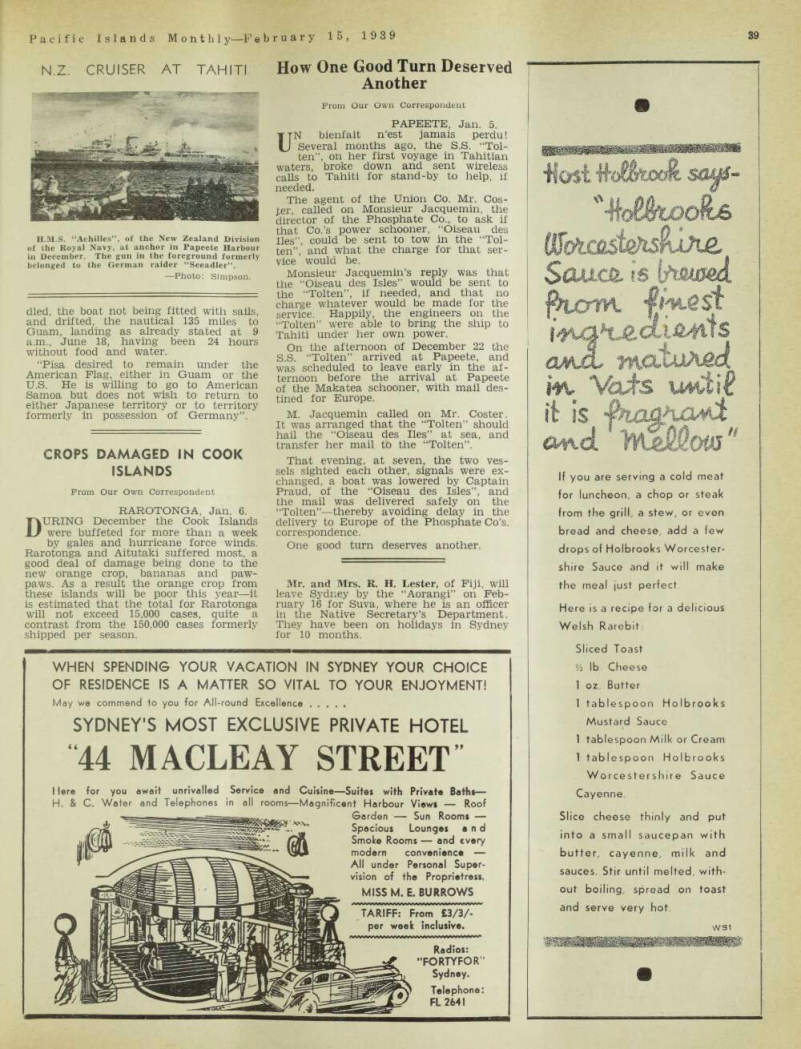
Chief Went Home
LJEBE is a little sidelight on Samoan n history, published in the “Guam Recorder” in December, 1918. It may be remembered, by some, that there was much native unrest in Samoa, about 1908-9, and finally the Germans banished a number of the ringleaders. They were sent to the Mariana Islands; and, in 1914, after the Japanese had taken the Caroline and Marshall Islands, and the British held Samoa, they were sent back home.
IINGA PISA, once a chieftain in his native island of Savaii, German Sa moa, and who took refuge in Guam in 1915, after paddling 135 miles from the Island of Saipan, is to return to his native haunts in the near future. No doubt, many have wondered who the tall, muscular, blonde native was who has been patiently setting up type for some time in the Print Shop, and probably very few pictured him as a native chief tain of Samoa.
The following tells the story of his exile from Savaii and his arrival in Guam: “At 11.30 a.m., June 18, 1915, there landed on Ritidyan Point, this island, a native Somoan Chief, linga Pisa, who claims to be a political refugee and seeks the right of asylum under the American Flag.
“Through a German interpreter he made the following statement: “He is 24 years of age, and was born at Amoa on the island of Savaii, Ger man Samoa. In 1895, he succeeded on the death of his father to the chieftain ship of his tribe.
“In 1909 in consequence of an upris ing among the natives, he with nhic other chiefs were deported to the is land of Saipan, Marianas, where he has remained ever since.
“Subsequent to the Japanese occupa tion of Saipan in October, 1914, some of the remaining exiled chiefs, of whom there were six, petitioned the Japanese Government to send them back to their native land, now occupied by Great Britain.
“Pisa protested at this step, as he considered it unwise to return at this time to Samoa without the consent of the German Government, and advised his fellow exiles to await the result of the present European war. He was, however, over-ruled and a short time ago all the party were notified by the Japanese Government to prepare them selves for immediate embarkment, as a ship to carry them to Samoa was ex pected daily.
“Pisa then determined to make his escape to American soil, being further confirmed in his decision by the action of the other chiefs in disinterring the remains of four of their number who had died during the exile, which step had been requested by their relatives at home. Pisa himself protested against this action, which he believed was like ly to spread contagion in Samoa, but he was unsuccessful in preventing it.
Incidentally he brought upon himself the weighty disapproval of his fellows, which will be almost sure to bring him into disfavour at home.
“Having then decided to make his es cape, Pisa, watching his opportunity, at 7 a.m., on June 15, 1915, secretly left Saipan alone in a native proa about 18 ft. in length which he had purchased, provisioned with only a small quantity of taro root and two bottles of water.
“With this slender equipment he pad
died, the boat not being fitted with sails, and drifted, the nautical 135 miles to Guam, landing as already stated at 9 a.m., June 18, having been 24 hours without food and water.
“Pisa desired to remain under the American Flag, either in Guam or the U.S. He is willing to go to American Samoa but does not wish to return to either Japanese territory or to territory formerly in possession of Germany”.
N.Z. Cruiser At Tahiti
H.M.S. “Achilles”, of the New Zealand Division of the Royal Navy, at anchor in Papeete Harbour in December. The gun in the foreground formerly belonged to the German raider “Seeadler”.
Photo: Simpson.
Crops Damaged In Cook
Islands
Prom Our Own Correspondent
Rarotonga, Jan. 6.
DURING December the Cook Islands were buffeted for more than a week by gales and hurricane force winds.
Rarotonga and Aitutaki suffered most, a good deal of damage being done to the new orange crop, bananas and paw paws. As a result the orange crop from these islands will be poor this year—it is estimated that the total for Rarotonga will not exceed 15,000 cases, quite a contrast from the 150,000 cases formerly shipped per season.
Another
How One Good Turn Deserved Another
From Our Own Correspondent
Papeete, Jan. 5.
UN bienfait n’est jamais perdu!
Several months ago, the S.S. "Tol ten”, on her first voyage in Tahitian waters, broke down and sent wireless calls to Tahiti for stand-by to help, if needed.
The agent of the Union Co. Mr. Cos ter, called on Monsieur Jacquemin, the director of the Phosphate Co., to ask if that Co.’s power schooner, “Oiseau des lies”, could be sent to tow in the “Tol ten”, and what the charge for that ser vice would be.
Monsieur Jacquemin’s reply was that the “Oiseau des Isles” would be sent to the “Tolten”, if needed, and that no charge whatever would be made for the service. Happily, the engineers on the "Tolten” were able to bring the ship to Tahiti under her own power.
On the afternoon of December 22 the S.S. “Tolten” arrived at Papeete, and was scheduled to leave early in the af ternoon before the arrival at Papeete of the Makatea schooner, with mail des tined for Europe.
M. Jacquemin called on Mr. Coster.
It was arranged that the “Tolten” should hail the “Oiseau des lies” at sea, and transfer her mail to the “Tolten”.
That evening, at seven, the two ves sels sighted each other, signals were ex changed, a boat was lowered by Captain Fraud, of the “Oiseau des Isles”, and the mail was delivered safely on the “Tolten” —thereby avoiding delay in the delivery to Europe of the Phosphate Co’s, correspondence.
One good turn deserves another.
Mr. and Mrs. R. H. Lester, of Fiji, will leave Sydney by the “Aorangi” on Feb ruary 16 for Suva, where he is an officer in the Native Secretary’s Department.
They have been on holidays in Sydney for 10 months.
Advertisements & other items, p. 41 (2 items)
39
Pacific Islands Mont hi y —F ebruary 15, 1939
fiixrtH. fWst
•Host #oB6fcooft says-
(ffoteesia isrdng,
Sauat. is
fiixrtH. fWst
11. cLl&tfA s
awJL matured
hv \€its u*Ctif
it is
and ' TVUjKoOJ "
If you are serving a cold meat for luncheon, a chop or steak from the grill, a stew, or even bread and cheese, add a few drops of Holbrooks Worcestershire Sauce and it will make the meal just perfect.
Here is a recipe for a delicious Welsh Rarebit; Sliced Toast Vi lb Cheese 1 oz Butter 1 tablespoon Holbrooks Mustard Sauce 1 tablespoon Milk or Cream 1 tablespoon Holbrooks Worcestershire Sauce Cayenne.
Slice cheese thinly and put into a small saucepan with butter, cayenne, milk and sauces. Stir until melted, without boiling, spread on toast and serve very hot. wsi
WHEN SPENDING YOUR VACATION IN SYDNEY YOUR CHOICE OF RESIDENCE IS A MATTER SO VITAL TO YOUR ENJOYMENT!
May we commend to you for All-round Excellence
SYDNEY'S MOST EXCLUSIVE PRIVATE HOTEL
44 MACLEAY STREET
Here for you await unrivalled Service and Cuisine—Suites with Private Baths— H. & C. Water and Telephones in all rooms—Magnificent Harbour Views Roof Garden Sun Rooms Spacious Lounges and Smoke Rooms and every modern convenience All under Personal Supervision of the Proprietress,
MISSM. E. BURROWS
2*
TARIFF: From £3/3/-
per week inclusive.
Radios:
••FORTYFOR’'
Sydney.
Telephone: FL 2641
"Tiare Taporo" In A Storm
From Our Own Correspondent.
Rarotonga, Jan. 6.
SOME anxiety was felt recently for the safety of the “Tiare Taporo” with a large number of passengers when, after leaving Mangaia to proceed to Mauke (100 miles away), she was not heard of for four and a half days. There is no radio on board.
She had encountered the storm that swept Rarotonga and from all accounts the passengers considered that they were lucky in getting back alive. On more than one occasion, they were afraid that the “Tiare” might founder, but good seamanship on the part of Captain Cam bridge and his crew brought the' old ship safely home.
Mr. W. J. Clapham, of the Suva branch of the Bank of New Zealand, was spending furlough in the Dominion at the end of January.
Mr. Arthur Barnes, of Burns, Philp and Co. Ltd., Port Moresby, Papua, married Miss Lorna Cook, of Perth, W.A., at the L.M.S. Mission Station in Pt. Moresby on January 7.
A True Love Story Of New Guinea
By P. Deutscher, Lutheran Missionary, of Finschhafen, T.N.G.
KANIK was a Papuan girl, belonging to the village of Quabu, near Si alum, on the southern coast of the Mandated Territory of New Guinea mainland.
At the time she was born, the various villages were still constantly at war with one another. No girl dared go alone to the spring to fetch water; there was the ever-present danger of her being kid napped by men from neighbouring vil lages. One of these foes would be sure to compel her to become his wife and then, eventually, her children would be the enemies of the village she originally belonged to.
So no risks were taken during the time when Kanik was still small.
But times changed, and changed rap idly. Kanik turned out to be a bright, intelligent girl; lame, alas, but her energy compensated her for that. She attended a mission school, and learned to read and write in her mother tongue.
She was always cheerful and happy.
As with all New Guinea girls, the question of marriage early in life be came one of concern. She did not want just any boy, and most decidedly not one who could neither read or write.
At school, she had been noticed by Laka, a boy from a neighbouring vil lage. Kanik had also noticed his smart ness, but up till now had given no sign of her feelings.
One day, however, a drastic declar ation of love was made to her. As she Was carrying an armful of wood, a peb
ble was thrown at her. It was meant to hit her. She knew this only too well, especially when she turned and no ticed Laka strolling to his work as though he were not aware of the fact that the pebble had reached the girl’s heart.
Laka’s deed had been seen by others, and he dared not stay at school any longer. He signed on as an indentured labourer on a schooner, and became a cook boy, and thus sailed the seas. Just occasionally the schooner called at Si alum. Now and again he managed to send Kanik a letter.
Various young men sought out Kanik’s uncles and asked for the hand in mar riage of this lame, but clever girl. Ac cording to the New Guinea custom of old, it is the girl’s uncles who have to provide her with a husband. They tried to nnd out whether Kanik would com ply with their wishes, and marry a man of their choosing, taking care not to let her know too much.
But she knew what was being pro posed for her and she would not con sent to being married according to the old custom, and against her inclinations.
Horrified, she ran back to school, and waited and waited, working secretly to gain her aim. As long as she was at the mission school, she knew she would be safe and her uncles would keep quiet and not force her to marry a man she could not love. She had also found out that never would her uncles consent to her marrying a man who, according to the old custom, belonged to their enem ies.
She paid occasional visits to her vil lage, but these were pleasant neither to her or her kinsfolk. Eventually, she bowed her head and said no more, but her intentions were more than ever to battle on and win. Laka was informed of this.
At night, Laka's brothers sat by the fire and talked things over. They decided to help their little brother. They would fight for him, according to civilised methods.
Word was sent to Quabu village. They would tell the kiap (Government patrol officer) about it when on his rounds.
In those days, to tell the kiap and ask him to interfere in matrimonial matters was such an unheard of thing that Ka nik’s uncles kept on peacefully smoking their leaf tobacco. They would not be scared by such a threat. No one could seriously think of asking the kiap to intervene in such a matter; it was en tirely their own affair.
Even if Kanik’s brothers did ask the kiap, the Quabu people would unanim ously reply in the negative, when he put the question to them.
Eventually, the kiap arrived and com menced his duties at Quabu. As the vil large people lined up, they saw Laka’s brothers turn up also. The former were not afraid. They firmly believed the kiap would put the matter of Kanik’s proposed marriage before them and they would say “No”, even should Laka’s brothers do the unexpected and absurd thing.
The latter did, however, boldly ask the kiap for his ruling, telling him that Laka wanted Kanik of Quabu for his wife. Kanik was asked to appear, and not her uncles, to the latter’s constern ation. She was asked: “Do you like Laka?” She plucked up all her courage and unflinchingly, in front of all her peo ple, bowed her head in assent. That was the finish.
Triumphantly, Laka’s brothers escort ed the girl to her new home, leaving her uncles speechless, for the time, with rage. A fortnight she lived with her future husband’s relatives.
ONCE again the schooner paid a brief visit to Sialum. Laka, on paying a visit to his village, found her with his relatives. It was a glorious day for them. He had to go to Madang once more, and he promised to bring her frocks, lava-lavas and empty bottles on his return. If possible, it made the happy girl still happier. She waved to him as the schooner glided out of the harbour.
Then she turned and went with her prospective sister-in-law to plant sweet potatoes and vegetable marrow. Both women were busy: when, suddenly, Kanik let out a yell—just one scream.
Such a scream was well-known to her girl friends, who knew her pronounced fear of snakes, and had often teased her about it.
But, this time there was cause for alarm. Quickly, a few sticks were gathered. an improvised stretcher made, Kanik laid on it, and carried home. However, before the village was reached she had passed away.
Since then, the kian has not been asked to arrange marriages.
Nurse H. Clark, a Methodist Mission ary, who has served in Fiji among the Indian people for 27 years, arrived in New Zealand by the January “Niagara” to spend some time in Auckland, ow ing to ill-health.
Advertisements & other items, p. 42 (2 items)
William E. Reed
25 YEARS OP SERVICE
(Established 1913)
BROKER & AGENT
Union House. 247 George St., Sydney For all Plantation and Trading Requirements. Enquiries welcome.
Centrifuqal Pumps
For Every Kind of Job
i Single or two- Btage. 1-in. ( to 6-in. jifl ft I 1 D 'J> m m
DIESELS For HARD JOBS
Fetter Crude Oil Engines
Valveless, two-stroke Fetter patent cold starter. Low fuel consumption. Perfect lubrication. 6 to 21 B.H.P. Stationary and portable types. Send for new catalogue just published.
PETROLECTRICLIGHT
BUZACOTT FETTER
800 Watt - 32 Volt Home Lighting Plant Dependable and very economical tor the moderate size farm home.
Buzacott Petrol-Kerosene 2 H.P. Series "W" engine, with multiple vee-belt drive to oversize generator.
Complete with battery, switchboard and push-button starting. Send lor particulars
Genuine cott CHAIN
Supplied in any height, mesh, and gauge of wire: rolls of 50 or 100 ft- Ask your storekeeper for latest prices.
a'M i.ijmi
CER WINC
Has enormous power, light weight, very compact. One man can operate. Easy to move around. Most powerful winch for its size. Does not dance around the ropes. Write to-day for descriptive folders. 7TO II MARKET STREET SYDNEY. (II) H I 7TO II MARKET STREET SYDNEY Full details of these or any other machinery lines FREE on request.
BUZACOTT-WOLSELEY Ltd., 7-11 Market St., SYDNEY, N.S.W.
How Canton Island Was
Named
IN a letter published in the “Guam Recorder” in December, Comman der Paul J. Searles, U.S. Navy, then at Boston Navy Yard, made available the following interesting information re garding the naming of Canton Island and the trip from there to Guam by the survivors of a wrecked schooner: “Canton Island, which came into pro minence last year when a Navy-National Geographic Astronomical Expedition based there, was named for the sailing ship ‘Canton’, out of New Bedford, Mass., which was wrecked on the island in March, 1854. The crew of 31 men row ed in open boats north westward for 49 days, finally reaching Guam.
“I hope to get a chance soon to go
to New Bedford, and will see if there is any record of the wreck, etc., in the Whaling Museum. Will also try the Es sex Institute, Salem”.
Mr. G, A. Carswell, a teacher on the staff of the public school at Levuka, arrived in New Zealand from Fiji by the January “Niagara”, after serving for three years in the Colony.
Dr. O’Connor is the new Quarantine Officer at Thursday Island, replacing Dr. Redshaw, who has been transferred to Fremantle. Western Australia.
Rev. Leslie Stibbard, priest-in-charge of the Melanesian Mission’s Central School at Maravovo, 8.5.1., recently married Miss Margaret Piers, also of the M.M.
Bishop Baddeley solemnised the marri age.
During the annual B.P.C, ball, on Nauru Island, the engagement was an nounced of Mr. Lyn Norwood, secretary of the B.P.C. clerical staff at Nauru, to Miss Betty Horton, Sister at the Admin istration Hospital. The popular couple were showered with congratulations.
Advertisements & other items, pp. 43-44 (2 items)
41
Pacific Islands Mont hi y—F ebruary 15, 1939
Burns Philp
AUSTRALIAN
BULLDOG BATTERIES
These Batteries DO NOT LOSE CHARGE WHEN NOT IN USE . . . 0 Plates DO NOT BUCKLE and Term-
inals DO NOT CORRODE
A Radio type are UNCONDITIONAL-
LY GUARANTEED FOR THREE
YEARS.
You will SAVE MONEY by Using BULLDOG BATTERIES Write to ... • , ,
Continental Compensations Pty. Ltd.,
423 COLLINS ST., MELBOURNE, VIC.
We also Supply—
DIESEL ENGINES OF ALL TYPES.
A BATTERY M
FOR
EVERY
PURPOSE
BURNS PHILP
(SOUTH SEA) CO. LTD,
Inc. in Fiji
Island Traders and Shipowners
Also Branches at;
Registered Office:
SUVA
FIJI
Code Address: "Burn sou th.' v Fiji; Levuka. Lautoka, Labasa, Ba. Sigatoka, Rotuma.
Tonga: Nukualofa. Haapai. Vavau.
Samoa: Apia. Pago Pago (American Samoa).
Solomons: Makambo, Gizo, Faisi.
New Hebrides: Vila.
Gilberts: Tarawa.
Norfolk Is. Niue. Wallis Is. Futuna Is.
“CINNAMOLIA”
PREPARATIONS.
DYSENTERY! —One of the worst scourges of the tropics—makes its annual appearance fairly regularly every fly season and exacts a heavy toll of human life, besides causing a lot of misery and suffering, as well as the economic loss of time and labour, through infected persons being laid up for days, weeks and sometimes months, before being able to return to their normal occupation.
Every household and institution in the tropics should always keep on hand a stock of “Cinnamolia”, which is undoubtedly the best remedy so far discovered, for the treatment and cure of this dreaded disease.
A dose administered immediately the first symptoms are observed will often check it in a day or two. If not, the treatment should be continued daily until all symptoms have disappeared and the patient’s condition is normal again, This is not a “quack” medicine— but a scientifically prepared remedy, which destroys the germs that cause the disease, aids nature to remove the debris, and soothes the irritated and damaged surfaces of the intestinal tract.
It was used with great success for 5 years or more in tropical hospitals, before being prepared and offered for sale to the general public. It can now be obtained at 3/- per bottle at
FALKS PHARMACY
238 GEORGE ST., SYDNEY.
Also Cinnamolia Inhalant for coughs, colds, flu, catarrh, etc., at 2/- per bottle with dropper.
Cinnamolia Ointment for cuts, scratches, abrasions, ulcers, piles, etc., at 1/6 per jar.
For Wholesale Rates to Chemists, Hospitals and other Institutions, apply to “Cinnamolia”
Preparations, 17 Murray St., Waterloo, N.S.W.
How Tahiti Became
French
Influence of Chief Tati
HERE is an interesting fragment of history, showing how Tahiti became a French possession. Nearly all British books of re ference present Queen Pomare as harassed and finaUy overwhelmed by French intriguers.
ActuaUy, the Queen was but a catspaw in the struggle between two religious groups.
The Protestant missionaries—prejudiced, grim and utterly intolerant—got control of the court, and used their power to keep out the Roman Catholics. Their regime was such that France, then officiaUy Roman Catholic, was compelled to intervene. It is the same story—Hawaii, Rarotonga, Tonga—wherever the Protestant missionaries have interfered in politics and sought to control Pacific Islands Administrations ... It lately has been a subject of comment that the Methodist Church, in Tonga to-day, is exercising too much influence in the functions of govern ment.
By Our Tahiti Correspondent.
AT a ceremonial assembly, under the presidency of the Governor of French Oceania, on the re-convening of the Tribunals of the Colony after the mid year recess, Monsieur Cambazard (Judge of the Tribunal) delivered an oration in memory of a great chief and lawgiver of the Tahitian nation—Tauraatuai patea.
The latter was high chief of Papara and overlord of the pow erful Teva clan, inhabiting the southern coast of Tahiti Nui and the leeward districts of Taiarapu. His insignia as high chief of Papara was the Maro-Tea (girdle of yellow feathers); second only in rank and honour to the Maro-Ura (red feather girdle), the sacred insignia of highest royalty. To history he is known by his shorter name of Tati.
Tati was born in 1770. During the years when Tu (Pomare First)—al ready master of the northern districts —was waging war to extend his author ity over all Tahiti, Tati was compelled to seek sanctuary in Ra’iatea. Not withstanding these wars, and his exile, Tati gave his allegiance to Tu’s son, Pomare Second, and joined with the high chiefs of Ra’iatea, who aided Po mare in re-establishing his authority on Tahiti after his defeat, and flight to Moorea, in the year 1808.
The battle of November 12, 1815, at Punaauia —in which the worshippers of Oro, under the leadership of Opuhara
(Tati’s younger brother) were over whelmed—finally broke the power of Pomare’s enemies, established him as paramount ruler of Tahiti, and de stroyed the last vestiges of the ancient religion. Tati was reinstated as high chief of Papara.
In 1818, when Pomare 11. wrote the first book of laws for the kingdom, Tati was his assistant and chief advisor.
Pomare 11. died in 1821. His two sur viving children, a son and a daughter were minors. The power of the sever had not yet been firmly estab lished and a strong hand was required to consolidate the kingdom.
The crown was offered to Tati. He refused it and united with the mission aries in placing the son of Pomare II on the throne as Pomare 111. The boy king did not live long, and was suc ceeded by his sister, who reigned as Po mare IV., for fifty years. At her ac cession she was but 14 years of age.
During the first years of her reign, there raged about her a constant battle for power and influence between the chiefs, the missionaries and the foreign trad ers, who had established themselves on the beach at Papeete.
In the second year of her reign, in 1828, there arose in Tahiti an heretical sect—described in the old missionary dictionary as “a party formed in Tahiti who professed to improve upon received Religion, and to be given to extraord inary prayer; they discarded some of the essentials of Christianity, and were immoral in their conduct”.
This sect, named Mamaia, spread rapidly throughout Tahiti and the ad jacent islands, especially Moorea and Taiarapu, the peninsula of Tahiti. Their objective was to abolish the new laws and customs introduced by the mission aries and to revive the primitive prac tices of pre-European times. The in fluence of their leaders over the young Queen was becoming so great that Tati, in 1829, voiced his opposition, in her presence, before the council of high chiefs.
The influence of the Mamaia lead ers continued, however, until, in 1831, Tati, together with three other power ful high chiefs—Hitoti, Tetuannua and Paofai—seized Papeete and compelled Pomare IV. to dismiss her evil counsel lors. The Mamaia were finally broken up and scattered by the power of Tati and his allies, at Taiarapu, in 1832.
As time passed, and relations with European influences grew. Tati foresaw that new conceptions of the powers and
responsibilities of the Queen’s govern ment were necessary. Heretofore, the different chiefs had retained a large measure of their independence. A quar rel of chiefs of neighbouring districts could be fought out between themselves without involving the central authority at Papeete. This matter of the respon sibility of the whole kingdom for the acts of the sub-ruler of any of its parts, was brought to bear upon the Queen’s government in 1835, by an incident where an English ship—the “Truro”— was attacked in the Tuamotu Islands, a part of Queen Pomare’s hereditary dominions.
Following the dispersal and extinction of the Mamaia sect, the Protestant Missionary influence gained ascendancy in the councils of the kingdom. Laws were instituted to prevent any religious teaching in the islands other than the established Protestant creed.
When, under these laws, two Roman Catholic missionaries (Pere Caret and Pere Laval) who had landed in Tahiti in 1836, were expelled, and the French warship “Venus” under the command of Dupetit Thouars came to make protest against their deportation, Tati, before the council of the realm summoned to deal with the situation, warned his hear ers of the troubles which would come upon the kingdom if its policies were di rected by both civil and religious au thorities.
A treaty with France was signed by the Tahitian Government. Scarcely had the “Venus” departed, however, than the Tahitians, disregarding the wise coun sels of Tati, enacted a new law inter dicting the establishment in the king dom of any religious organisation other than that of the Protestant faith.
On learning of this, King Louis Philippe despatched the “Artemise”, un der Commandant Laplace, to inquire into the causes of this breach of faith.
The queen summoned the assembly of the kingdom. In the speech in which Tati addressed the conclave, he made no mention of the deeper causes which had influenced the policies of the Tahi tian Government, as he had on previous occasions. But, exposing the evils which would come upon the realm as conse quences of bad faith, he sought the ex pression of the true mind and inten tions of the assembly. In the end. the obnoxious law was repealed. That was in 1839.
In 1842, Tati despairing of unity and tranquility for the kingdom under the existing regime, exerted the whole power of his influence on the Queen to force her to the decision of placing her realm under the protection of France. Dupetit Thouars—now on admiral —was again at Tahiti, armed with power to impose stern measures. He found it necessary to suspend the power of the Queen. Re bellion flamed up.
There were few French troops in the garrison under the command of the Governor, Bruat.
The high chiefs, Tati, Hitoti, Paraita, Arato. Pu. and Mare, stood with the Government to put down the rebellion.
The war continued until 1847 when order was finally restored. Queen Po mare. under the protection of France, was reinstated on her throne.
Tati was now an old man, but he continued to serve his country as presi dent of the Judicial Council until his death in 1854. He had lived to see the fulfilment of his labours —the establish ment of unity, peace and equity in his native island.
Advertisements & other items, p. 44 (1 item)
James Budge Pty. Limited
Ell
JAMES BUDGE
LTD
REFRIGERATION . ..
“BUDGE" Automatic or Manually-controlled Refrigeration and Ice-making Plants, with or without insulated Cabinets or Rooms, ranging from 4 cubic feet to 1000 cubic feet or larger, using ammonia in the large and sulphur dioxide (SO2) in the small units.
Where electricity is not available, crude oil engines may be utilised tor driving the larger plants and petrol engines for driving the smaller machines. The accompanying illustration is of a petrol engine driven SO2 unit. Enquirers please state power available (if any), size of cabinet and amount of ice required per day.
JAMES BUDGE PTY. LIMITED
REFRIGERATION AND GENERAL ENGINEERS
McEvoy and Harley Streets
ALEXANDRIA SYDNEY
Established 1890
ENGINEERING WORKSHOPS
ALL CLASSES OF MACHINES MADE AND RECONDITIONED
Joy Rides In The "Cuba"
From Our Own Correspondent
Pt. Moresby, Jan. 23.
THE Archbold Expedition’s flying-boat “Guba”. which is in Port Moresby again for additions to her wireless equipment, is making herself very wel come to residents, old and young.
On the 12th, she carried the Lieuten ant-Governor and a party of 12 on a pleasure trip down the coast as far as Rigo, inland across the Kemp Welch River to the foot of Mount Brown, and out to Marshall’s Lagoon, whence she followed the coast line back to the starting point.
On the 15th, she conveyed a party to Samarai, returning on the following morning. Two days later she took all the children of the township for a joy ride, in batches of 40 at a time. On the 18th, she made a return flight to Yule Island to give the local R.C. padres an opportunity of visiting their Bishop.
The “Guba” will probably remain in Port Moresby for about two weeks be fore returning to Hollandia, Dutch New Guinea.
Advertisements & other items, pp. 45-47 (3 items)
43
Pacific Islands Monthl y—F ebruary 15, 1939
Wunderlich
Timber, Joinery
ETC.
PREPARED BUILDINGS ready for erection a speciality.
SHIP AND BOAT BUILDING.
TIMBERS specially catered for.
FIBROLITE. PLYWOODS. GALVANISED
IRON.
CONSIGNMENTS shipped
by RETURN STEAMERS
to the Islands.
John W. Eaton
PTY. LTD.
WEST CRESCENT STREET
NORTH SYDNEY
Telephones: X 84051 (6 lines.)
BITUMENOID ROOFING
MADE IN AUSTRALIA.
Bitumenoid Roofings, Dampcourse and Insulating Felts are made from the world’s best raw materials. Warranted to stand the most rigid tests.
BITUMENOID THE BEST
Roofing, 1,2, 3-ply; Flooring, Waterproof Materials; Saturated Felt; Resilient Road Jointing: Natural Asphalt Dampcourse; 2 and 3-ply Dampcourse: 1-2 lb. Lead-core Dampcourse: Roofing Cement: Asphalt Paints; Roofing Compound.
SAMPLES AND PRICE LISTS ON APPLICATION.
MAXWELL PORTER & SON LTD.
ESTABLISHED 1888. BUILDERS’ SUPPLIES.
107 REDFERN ST., REDFERN, SYDNEY, N.S.W. ’Phone: M 3157. Cables Bitumenoid.
pvt
BUILD \
A MODERN 1
HOME
Obtain a copy before you build.
It contains designs and plans—in colour—of Homes that can be inexpensively built with
WUNDERLICH DURABESTOS,
the indestructible asbestos-cement building sheeting. Write to
WUNDERLICH LIMITED
5.P.0.. Box 474 aa, SYDNEY
FOR TROPICAL BUILDINGS, SPECIFY
WUNDERLICH
dirabestcs
ASBESTOS CEMENT BUILDING SHEETS
WM. BRECKWOLDT & CO.,
SOUTH SEA MERCHANTS
POSTAL ADDRESSES:—
NEW GUINEA:—P.O. Box 89, Robaul.
FIJI;—P.O. Box 111, Suva.
TAHITI:—P.O. Box 60, Papeete.
SAMOA:—P.O. Box 124, Apia.
TELEGRAPHIC ADDRESS:
BREWO
AGENTS FOR...
B A R
MEDICINES .
ATEBRIN— THE PROTECTION AGAINST MALARIA.
ASPIRIN BAYER— THE GENUINE ASPIRIN— AND
ALL OTHER BAYER PRODUCTS.
STOCK ALWAYS AVAILABLE AT OUR BRANCHES.
All Orders Executed at Original "Bayer" Prices.
MERCEDES - BENZ DIESEL TRUCKS:
2 Tanner Type, L. 1,500 -45 H.P. just arrived in Rabaul for demonstration. Fuel consumption— -28 miles on one gallon only of SHELL DIESOLINE, costing about in Rabaul. Lubricating Oil—Shell Dervoil Medium.
Prices for all types, up to loading capacity of 12,000 lbs., and for special types, on application.
"HANOMAG" Diesel Tractors. "VESTA" Sewing Machines.
"ANCRE" Cast Iron Sauce Pots. A "LOHSE" Uralt Lavender.
"FROWO" Hurricane Lanterns. "BREWO" Swedish Axes and Hatchets.
"ARARA" Gas Stoves. "ARVIKA" Swedish Axes and Hatchets.
CONTINENTAL" Tyres and Tubes for Motor Cars and Bicycles.
DEUTZ" and "MERCEDES-BENZ" Diesel Marine Engines.
"PETROMAX" Hurricane Lanterns (Incandesc.) and Lamps. (Not Agents for Tahiti).
"TIGER BRAND" Corrugated and Flat Galvanised Ironsheets.
"TAIFUN" Bicycles and Accessories.
"TWO LIONS" Best Known Quality of A.l. Butcher Knives.
"BREWO" Razor Blades, Black, Brown, Blue, Pink, Silver.
"TORPEDO", "BIJOU" and "ERICA" Typewriters, Portable and Office.
"BECK 1 S" "Key Brand" German Lager.
"TELEFUNKEN" Wireless Sets, Battery and Current. Best results obtained.
Many Sold. Ever-increasing Turnover.
ALSO ALL TRADE LINES OF GERMAN, BRITISH, CONTINENTAL, JAPANESE AND CHINESE ORIGIN
AGENTS FOR:
LIEBERMANN, WAELCHLI & CO.,
Kobe, Yokohama, Tokio and Shanghai.
JOHN CAMPBELL & CO., SYDNEY. (AM Australian Goods.) Onr Trademark.
PLEASE NOTE:
We sell WHOLESALE ONLY but. upon application, we will supply the names of firms at all places in the Pacific Islands retailing our goods.
Fish Drive In Papua
Waist-deep in a creek at Samarai, Eastern Papua, these natives are driving fish into their home-made nets.
Inquiry
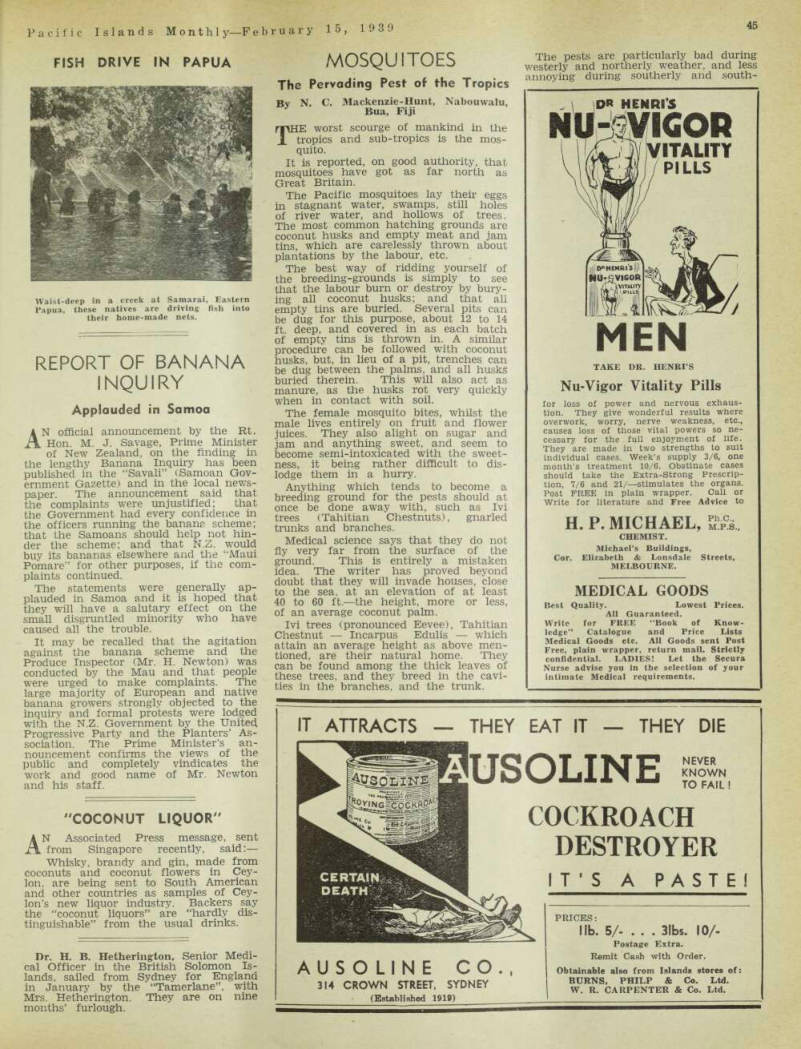
Report Of Banana
Applauded in Samoa
AN official announcement by the Rt.
Hon. M. J. Savage, Prime Minister of New Zealand, on the finding in the lengthy Banana Inquiry has been published in the “Savali” (Samoan Gov ernment Gazette) and in the local news paper. The announcement said that the complaints were unjustified; that the Government had every confidence in the officers running the banan?. scheme; that the Samoans should help not hin der the scheme; and that N.Z. would buy its bananas elsewhere and the “Maui Pomare” for other purposes, if the com plaints continued.
The statements were generally ap plauded in Samoa and it is hoped that they will have a salutary effect on the small disgruntled minority who have caused all the trouble.
It may be recalled that the agitation against the banana scheme and the Produce Inspector (Mr. H. Newton) was conducted by the Mau and that people were urged to make complaints. The large majority of European and native banana growers strongly objected to the inquiry and formal protests were lodged with the N.Z. Government by the United Progressive Party and the Planters’ As sociation. The Prime Minister’s an nouncement confirms the views of the public and completely vindicates the work and good name of Mr. Newton and his staff.
"Coconut Liquor"
AN Associated Press message, sent from Singapore recently, said: — Whisky, brandy and gin, made from coconuts and coconut flowers in Cey lon, are being sent to South American and other countries as samples of Cey lon’s new liquor industry. Backers say the “coconut liquors” are “hardly dis tinguishable” from the usual drinks.
Dr. H. B. Hetherington, Senior Medi cal Officer in the British Solomon Is lands, sailed from Sydney for England in January by the “Tamerlane”, with Mrs. Hetherington. They are on nine months’ furlough.
Mosquitoes
The Pervading Pest of the Tropics
By N. C. Mackenzie-Hunt, Nabouwalu, Bua, Fiji r[E worst scourge of mankind in the tropics and sub-tropics is the mos quito.
It is reported, on good authority, that mosquitoes have got as far north as Great Britain.
The Pacific mosquitoes lay their eggs in stagnant water, swamps, still holes of river water, and hollows of trees.
The most common hatching grounds are coconut husks and empty meat and jam tins, which are carelessly thrown about plantations by the labour, etc.
The best way of ridding yourself of the breeding-grounds is simply to see that the labour burn or destroy by bury ing all coconut husks; and that all empty tins are buried. Several pits can be dug for this purpose, about 12 to 14 ft. deep, and covered in as each batch of empty tins is thrown in. A similar procedure can be followed with coconut husks, but, in lieu of a pit, trenches can be dug between the palms, and all husks buried therein. This will also act as manure, as the husks rot very quickly when in contact with soil.
The female mosquito bites, whilst the male lives entirely on fruit and flower juices. They also alight on sugar and jam and anything sweet, and seem to become semi-intoxicated with the sweet ness, it being rather difficult to dis lodge them in a hurry.
Anything which tends to become a breeding ground for the pests should at once be done away with, such as Ivi trees (Tahitian Chestnuts), gnarled trunks and branches.
Medical science says that they do not fly very far from the surface of the ground. This is entirely a mistaken idea. The writer has proved beyond doubt that they will invade houses, close to the sea, at an elevation of at least 40 to 60 ft. —the height, more or less, of an average coconut palm.
Ivi trees (pronounced Eevee), Tahitian Chestnut Incarpus Edulis which attain an average height as above men tioned, are their natural home. They can be found among the thick leaves of these trees, and they breed in the cavi ties in the branches, and the trunk.
The pests are particularly bad during westerly and northerly weather, and less annoying during southerly and south
east- trade winds. From personal ob servation, it would seem that where there are many Ivi trees, and a pre ponderance of other similar growth, they will be particularly bad.
In Fiji, their activities usually com mence round about 3 or 4 p.m., and con tinue unabated throughout the night, and until after 9 a.m. It is possible, however, to be bitten by stray mosquit oes at noon, and more especially when going through thick jungle. It is usu ally the large brown mosquito which.
bites in the day-time, although the Culex Anopheles, the little black and white fel low, and the others, do their share.
THERE are many diseases, some fatal, transmissible by mosquitoes. Those which transmit yellow and blackwater fever very often thrive in the vicinity of towns.
Although the malaria mosquito also has the same habitat, he usually pre fers the thick damp jungles and forests.
Although the malaria mosquito is pre
sent in Fiji, and quite common, there is strange to say, no malaria. This may be due to the absence of fever-breeding germs, or to climatic conditions. Much has been written on the possible trans port of malaria from infected places to uninfected areas, by aeroplane. This pos sibility is ever present, but there seems to be a definite line of demarcation be tween places infected, and those unin fected.
The only thing. to do is to use every conceivable means at our disposal for the prevention of the spread of this menace. Larvae of the malaria mos quito usually take approximately two days to incubate, and maintain them selves on the surface of the water in a horizontal position, whilst the ordinary mosquito larvae take up a perpendicular position. Their breathing organs are similar to those of other insects.
Elephantiasis, or the Falaria germ, is transmitted through the agency of mos quitoes, and is a very common disease m some parts of Fiji; being very preva lent in the Lau Group, and very bad in Rotuma. Other places seem to be sin gularly immune, as for instance, from Wainunu downwards, and round the Bua province, where it is a fairly dry cli mate.
The germs, which resemble small thread-worms, invade the blood stream, and cause the swelling of the extremi ties, attacking mostly the legs and arms of the victim. It is as well to keep those who are infected with Falaria well away from your house or bungalow, and iso late them from other labour in your labour lines, or barracks.
The breeding of mosquitoes may be retarded by means of a little petroleum, mixed with tar, poured on the surface of any stagnant water or pools. This should be repeated every fortnight. Most cottages and homesteads are either screened with wire gauze or have a spec ial screened mosquito-proof room, where the family usually congregate after “tif fin”. In spite of one having one’s house built thus, some of the pests manage to gain access when the door is opened.
When there is a plague, it is as well to have a good spray pump ready, with some good insecticide. Mosquitoes per ish much quicker than do flies, or cock roaches, under the spray.
Full protection from the pests can only be had by stocking all stagnant pools and creeks with Gambusia fish which prey on and eats the larvae. There is also the Giant Mosquito, a parasite, and quite harmless, which prevs on all smaller mosquitoes. Itself, it feeds on fruit juices and the sap of various tropi cal trees.
Much has been done to combat mos quitoes by draining, in the Pontine Marshes in Italy, the Canal Zone at Panama, the Singanore Naval Base.
Papua and New Guinea, and by the planting of eucalyptus trees in the first mentioned place and in Ethiopia, and many other places. The planting of these trees is considered to be beneficial and of the first importance, next to swamp-draining.
Miss Margaret Stuckey, of Melbourne, will leave Sydney for Port Moresby. Pa pua, bv the “Tasman” on February 25.
She will be married shortly after arrival to Mr. Stewart Lade, the new head of the L.M.S. school there.
Rev. and Mrs. S. H. Dewdney will ar rive in Sydney from Port Moresby, Pa pua, by the “Tasman” on February 19 to spend furlough. They are stationed at Orokolo. doing mission work for the London Missionary Society.
Advertisements & other items, pp. 47-48 (2 items)
45
Pacific Islands Monthl y —F ebruary 15, 1939
Usoline
„ \ DR HENRI'S
NIHiVICOP
1 i /C 7 VITALITY
VITALITY
PILLS
W
D 0 HINDIS |||l
NU-‘; VIGOR
w
MEN
TAKE DR. HENRI’S
Nu-Vigor Vitality Pills
for loss of power and nervous exhaustion. They give wonderful results where overwork, worry, nerve weakness, etc., causes loss of those vital powers so necessary for the full enjoyment of life.
They are made in two strengths to suit individual cases. Week’s supply 3/6, one month’s treatment 10/6. Obstinate cases should take the Extra-Strong Prescription, 7/6 and 21/ —stimulates the organs.
Post FREE in plain wrapper. Call or Write for literature and Free Advice to
H. P. MICHAEL, M h pj3„
CHEMIST.
Michael’s Buildings, Cor. Elizabeth & Lonsdale Streets,
MELBOURNE.
MEDICAL GOODS
Best Quality. Lowest Prices.
AH Guaranteed.
Write for FREE “Book of Knowledge” Catalogue and Price Lists Medical Goods etc. All Goods sent Post Free, plain wrapper, return mail. Strictly confidential. LADIES! Let the Secura Nurse advise you in the selection of your intimate Medical requirements.
IT ATTRACTS THEY EAT IT THEY DIE So
mmm
USOLINE
NEVER
KNOWN
TO FAIL !
AUSOLINE CO.
314 CROWN STREET, SYDNEY
(Established 1919)
COCKROACH
DESTROYER
IT'S A PASTE
PRICES:
Mb. 5/- . . . 3lbs. 10/- Postage Extra.
Remit Cash with Order.
Obtainable also from Islands stores of:
BURNS, PHILP & Co. Ltd.
W. R. CARPENTER & Co. Ltd.
STEAMSHIPS TRADING COMPANY, LIMITED.
MERCHANTS, SHIPOWNERS AND PLANTERS
PORT MORESBY AND SAMARA I.
Our organisation provides every facility and efficient service as
MANAGING AGENTS AND VISITING REPRESENTATIVES OF
COCONUT AND RUBBER PLANTATIONS
Estates supervised in bearing and planting stages.
Comprehensive reports compiled and regular visits made to Estates by our competent Plantation Inspector.
WRITE, CABLE OR CALL FOR PARTICULARS:
STEAMSHIPS TRADING COMPANY LTD.
STEAMSHIPS TRADING COMPANY LTD.
PORT MORESBY PAPUA SAMARA I
Chairman and Managing Director: A. S. FITCH.
Shipowners, Wholesale and Retail Merchants and Traders; Shipping, Customs and Insurance Agents; Copra and Rubber Plantation Owners.
MAIL CONTRACTORS TO COMMONWEALTH AND PAPUAN GOVERNMENTS.
AGENCIES:—At Port Moresby; Coral Sea Insurance Co.: Phoenix Insurance Co.; Delta sawmills, Ltd.; Acme Bakery Co.; Vacuum Oil Co., Pty., Ltd. At Samara!• Coral Sea Insurance Co.; Delta Sawmills. Ltd.; Bankers and Traders’
Insurance Co.; National Mutual Life Insurance Co.; Kularo Shipyards; Mamai Plantations.
BRANCHES:—In Papua: Hanuabada, Sivitoi, Aroma, Koki, Hula, Ela Beach Duga Duga, Yule Island.
SYDNEY: NELSON & ROBEKTSON PTE. LTD., 13 Spring St.; Melbourne, 396 Flinders Lane. London, E. Whiteaway & Co.. 7 Chiswell Street, Finsbury, London.
Cable Address: “STEAMSHIPS.” Code; Bentley s.
Over Thirty Years Ago
The first Younger Stove was exported to the Pacific Islands. Ruggedly strong in construction, highly efficient and economical in fuel, has made them the most popular stove in the South Seas.
The illustration shows a Younger Single Stove. Special stoves, with cast iron ovens for Island requirements made to order. • Write us for quotations for special sizes and catalogue of double and single oven stoves. •
G. Fletcher & Co.
50 OXFORD STREET. SYDNEY
Capt. Luckham, C.B.E.
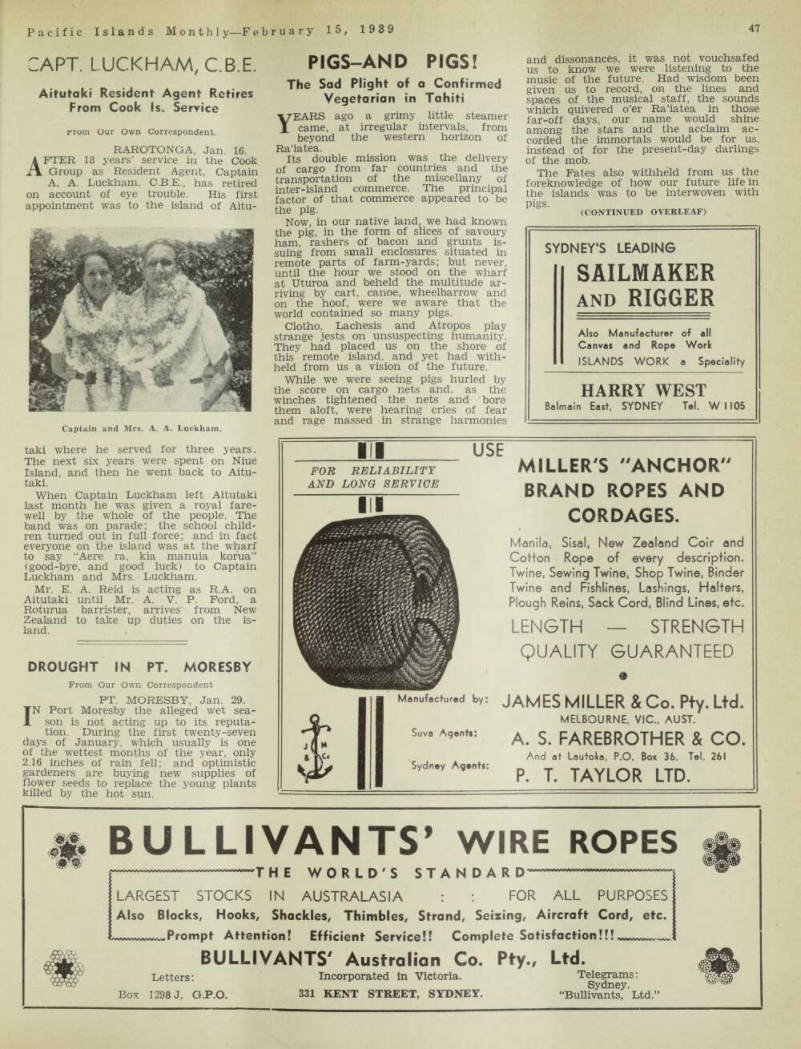
Aitutaki Resident Agent Retires From Cook Is. Service
rrom Our Own Correspondent.
Rarotonga, Jan. 16.
AFTER 18 years’ service in the Cook Group as Resident Agent, Captain A. A. Luckham, C.8.E., has retired on account of eye trouble. His first appointment was to the island of Aitu-
taki where he served for three years.
The next six years were spent on Niue Island, and then he went back to Aitu taki.
When Captain Luckham left Aitutaki last month he was given a royal fare well by the whole of the people. The band was on parade; the school child' ren turned out in full force; and in fact everyone on the island was at the wharf to say “Acre ra, kia manuia korua” (good-bye, and good luck) to Captain Luckham and Mrs. Luckham.
Mr. E. A. Reid is acting as R.A. on Aitutaki until Mr. A. V. P. Ford, a Roturua barrister, arrives from New Zealand to take up duties on the is land.
Captain and Mrs. A. A. Luckham.
Drought In Pt. Moresby
From Our Own Correspondent
Pt. Moresby, Jan. 29.
IN Port Moresby the alleged wet sea son is not acting up to its reputa tion. During the first twenty-seven days of January, which usually is one of the wettest months of the year, only 2.16 inches of rain fell; and optimistic gardeners are buying new supplies of flower seeds to replace the young plants killed by the hot sun.
Pigs-And Pigs!
The Sad Plight of a Confirmed Vegetarian in Tahiti
YEARS ago a grimy little steamer came, at irregular intervals, from beyond the western horizon of Ra’iatea.
Its double mission was the delivery of cargo from far countries and the transportation of the miscellany of inter-island commerce. The principal factor of that commerce appeared to be the pig.
Now, in our native land, we had known the pig, in the form of slices of savoury ham, rashers of bacon and grunts is suing from small enclosures situated in remote parts of farm-yards; but never, until the hour we stood on the wharf at Uturoa and beheld the multitude ar riving by cart, canoe, wheelbarrow and on the hoof, were we aware that the world contained so many pigs.
Clotho, Lachesis and Atropos play strange jests on unsuspecting humanity.
They had placed us on the shore of this remote island, and yet had with held from us a vision of the future.
While we were seeing pigs hurled by the score on cargo nets and, as the winches tightened the nets and bore them aloft, were hearing cries of fear and rage massed in strange harmonies
and dissonances, it was not vouchsafed us to know we were listening to the music of the future. Had wisdom been given us to record, on the lines and spaces of the musical staff, the sounds which quivered o’er Ra’iatea in those far-off days, our name would shine among the stars and the acclaim ac corded the immortals would be for us, instead of for the present-day darlings of the mob.
The Fates also withheld from us the foreknowledge of how our future life in the islands was to be interwoven with pigs.
(Continued Overleaf)
In the wisdom of our maturity we have discarded the carnivorous habits of our youthful days and have become as the beasts of the field. The sight of
torn flesh and reeking gore gives us vertigo; while the smell of flesh-pots charged with garlic and onions destroys our appetite. Yet, since our coming to
the islands—on birthdays and Christmas and New Year —we have been continu ally deluged with pigs.
The intentions of the donors, of course, are of the highest order. In Polynesia, the royal present, the gift of gifts, as worthy of presentation and ac ceptance as the offering of a brace of peacocks to a Roman Emperor, is the pig.
IT all began at MacFarlane’s place, in Moorea. We had been there sev eral months, and the time of our de parture was at hand. Our native friends came, one by one, to say farewell, and with each came also, a pig.
Before the schooner arrived to take us to Papeete, MacFarlane’s lawns were covered with tethered pigs, and we were in despair as to what disposal to make of them.
By the time they were loaded on the schooner the hatches were full. Half way down the bay, we heard a hail.
Canoes were putting off for the schooner. They came alongside. More pigs!
Fortunately, at that time, we had a very dear friend, who kept an hotel at Papeete, and we did not have to clutter up our place in Tahiti with all these pigs. We would have paid, richly, any one to take this schooner-load of pigs off our hands; but our friend of the hotel spared us that expense and re ceived the cargo with paeans of joy.
WERE our contact with pigs confined to birthdays and feast days, we might summon our fortitude and look upon these occasions as we regard days of fasting and repentance—instru ments of moral and spiritual discipline.
But our neighbours keep pigs that are constantly breaking loose and up rooting our garden, and our slumbers are frequently interrupted by night ex peditions of pig-owners, accompanied by excited dogs, trailing in full cry across our premises.
If we wish to go to the districts and are thrifty enough to go by truck we must travel with numerous pigs as companions. The whole bottom of the truck is invariably covered with a par quetry of pigs which forms an uneasy foot-rest throughout the journey.
If we walk into the town, there is sure to pass us on the road a rickety cart, driven by a Chinaman, bearing a load of pigs. At the quay, as we pass along the waterfront, are newly-arrived island schooners discharging a squealing cargo of pigs—some of which usually break loose at the moment of our pass ing, and spoil the whiteness of our duck trousers in brushing past, if they do not actually overthrow us and our dignity into the dust of the roadway.
In this sea of pigs we are a forlorn castaway; for we are no trencherman.
Were it an ocean of carrots and lentils and eggplant and lettuce —that would be another story.—A.C.R.
Rev. and Mrs. H. J. E. Short, of the London Missionary Society station at Hula, Papua, have proceeded to Eng land after attending the World Con ference at Madras, India.
Mr. W. J. (“Billy”) Candler, well known travelling inspector for Gillespie Bros. Pty. Ltd., prominent Australian flour manufacturers, arrived in Sydney on January 19 by the “Nankin”, after paying one of his periodical visits to New Guinea. He sailed for Fiji by the “Mariposa” on February 3, and will later proceed to Western Samoa.
Advertisements & other items, pp. 49-50 (2 items)
Bu Llivants’ Wire Ropes
SYDNEY'S LEADING
SAILMAKER
AND RIGGER
Also Manufacturer of all Canvas and Rope Work ISLANDS WORK a Speciality
HARRY WEST
Balmain East, SYDNEY Tel. W 1105
11l
USE
MILLER'S "ANCHOR"
BRAND ROPES AND
CORDAGES.
FOR RELIABILITY
AND LONG SERVICE
111 Manufactured by: Suva Agent*: Sydney Agents: Manila, Sisal, New Zealand Coir and Cotton Rope of every description.
Twine, Sewing Twine, Shop Twine, Binder Twine and Fishlines, Lashings, Halters, Plough Reins, Sack Cord, Blind Lines, etc.
LENGTH STRENGTH
QUALITY GUARANTEED
Manufactured by: JAMES MILLER & Co. Pty. Ltd.
Suva Agent,: A> FAREB ROTHER & CO.
And at Lautolca, P.O. Box 36. Tel. 261
MELBOURNE. VIC., AUST.
P. T. TAYLOR LTD.
BU LLIVANTS’ WIRE ROPES
TH E
STOCKS IN
WORLD'S
AUSTRALASIA
STAN DARD
LARGEST STOCKS IN AUSTRALASIA : FOR ALL PURPOSES Also Blocks, Hooks, Shackles, Thimbles, Strand, Seizing, Aircraft Cord, etc.
Attention! Efficient Service!! Complete Satisfaction!!!
BULLIVANTS' Australian Co. Pty., Ltd.
Letters:
Box 1298 J, G.P.O.
Incorporated In Victoria.
331 KENT STREET, SYDNEY.
Telegrams: Sydney. ‘Bullivants, Ltd.” m »
PRODUCING UNIFORM GOOD RESULTS SINCE 1868
ALWAYS ASK FOR IT
THEY KEEP YOU FIT
AND KEEP YOU SLIM
The whole grain of rich, sun-ripened wheat, transformed, after careful selection, into a perfect health food, delicious for breakfast, for afternoon tea or supper.
Arnott's Famous Shredded Wheatmeal Biscuits are rich in precious vitamins and proteins, and very easily digested. ... Try them with butter, cheese, jam or honey.
Clmotils
FAMOUS
SHREDDED
WHEATMEAL
BISCUITS
822 ALWAYS ASK YOUR GROCER FOR ARNOTTS ?
48
February 15, 193 9—P acific Islands Monthly
Eastern Samoa
Progress Under American Rule
Prom Our Own Correspondent
Honolulu, Jan. 4.
IN his annual report, Mr. Claude A.
Swanson, secretary of the U.S. navy, makes the following remarks about American Samoa, which his department administers: On June 30, 1938, the native popu lation of American Samoa, including Swain’s Island, was 12,241, an increase of more than 100 per cent, on the 1900 figure, which was estimated at 5,679.
The increase is due to the cessation of internecine warfare and the improve ment of the sanitary and medical work of the medical officers and their assist ants. (The scheme is greatly assisted by the native medical practitioners, trained by the well-known Dr. S. M.
Lambert at the Suva hospital).
Free clinics and hospitals are a feat ure of the navy scheme.
An average enrolment of 2,546 pupils, employing 73 teachers, was maintained by the 30 public schools.
There has been a notable stimulation of native industry, especially with na tive arts and crafts for sale to tourists and for shipment to the United States and Hawaii for sale in shops. Copra re ceipts totalled $99,382 and arts and crafts brought an income of approx. $45,000.
Commander E. W. Hanson, the new governor, has proved himself very popu lar, and under his personal guidance the Samoans are being encouraged to con serve their outstanding native culture.
The Imperfect Criminal
An Incident In Papua
Prom Our Own Correspondent
Pt. Moresby, Jan. 28.
PAPUAN natives show a strong inclin ation towards progress, but in the matter of crime they are singularly unproficient in some of the finer points of technique.
Pipi Heni, of Elevala, has been for many years employed by the Public Works Department. The Department runs a sort of savings bank for its na tive employees; and one of them, a Western native who should have been a greater “mug” than in fact he is, wanted to deposit some cash.
In the absence of the white officer who usually attends to such matters, Pipi persuaded the native to hand the cash to him; and, on being asked for a receipt, became faintly indignant: “I think you bushman”, he protested. “You no savvy me? What for you want him paper?”
But the “mug”, though silenced, was not satisfied. He called again and saw the officer, with the result that Pipi Heni appeared before the Magistrate last Monday.
A fine of £25 seemed fairly safe to throw the financier back onto the al ternative of “six months hard”. But not so. The fine was paid within twenty four hours!
Masters Neil and John Montgomery, of New Guinea, arrived in Sydney by the last “Bulolo”, and proceeded to Geelong Grammar School, Victoria, where they will resume their schooling.
The Polynesian Club
A REPRESENTATIVE gathering of Islands and Maori people attended a meeting of the Polynesian Club of Sydney on January 24. A feature of the evening was a travel lecture, given by Messrs. Franz and Piet Dona, the Dutch- Americans who are leisurely cruising around the world in their yacht “Marie”.
Another guest was Mr. W. Takarangi, of Wanganui, a Maori member of the N.Z. Boy Scout contingent at the recent Jamboree. In his honour, members pre sented a series of Polynesian folk dances, with the Maori motif prevailing, and
Mrs Waikalnga Tipene offered three forms of the Maori poi. Twenty girls danced the Canoe poi (poi waka).
The Club intends shortly to hold an exhibition of Islands curios—mainly from the Polynesian collection of the Presi dent (Mr. Leonard Moran), as well as from the Club’s own possessions and from private members.
Judith and Philip Street returned to Sydney from Rabaul, by the “Bulolo” on January 30, after spending holidays with their parents in New Guinea.
Advertisements & other items, pp. 51-52 (2 items)
49
Pacific Islands Monthl y—F ebruary 15, 1939
fatnouf
O.SA-.
~o v, liqueur " ’ , .. this «« eUO o unique ,he P«e»« e ' S novour eW ° hroughout th h velvety OS'hisky With renrenrber opulority- ro Sydney . .Uon rouqbou; the *• yeWety Have 0 S.t. ilsky w,th . , ney renrenrber bisky .s° bw .rUFR S
USV : of Distinction
/ Mot 6» «o. — *
DELICIOUS, TASTY FOODS
For ISLAND MEALS
AUNT MART’S COOKERY
BOOK.
There’s no finer book for ever[ home ... 212 pages, lavishly Illustrated in colour, and over 400 recipes and useful hints make it a book that every housewife will want. Send only one shilling and twopence to
TILLOCK & CO. PTY. LTD.,
Sydney N.S.W., and get your copy of this great book NOW.
JUST TRY any of AUNT MARY'S Pure Food Products, and you will be back for more . . . delicious In themselves or with innumerable dishes.
AUNT MARY'S BAKING POWDER
AUNT MARY'S TOMATO SAUCE
AUNT MARY'S SPAGHETTI IN TOMATO
SAUCE
AUNT MARY'S BAKED BEANS IN TOMATO
SAUCE
AUNT MARY'S CANNED VEGETABLES
Green Peas, Cauliflower, Celery, etc.
RANEE CURRY POWDER
BLOSSOM HONEY In Attractive Jars Or any of the large variety of Pure Food Products specially packed for Tropical conditions, in Tillock’s Hermetically Sealed 1-lb. tins. All goods are procurable from your local stores.
TILLOCK & CO. PTY. LTD., SYDNEY.
For TROPICAL
FEVERS
Malaria and other forms of tropical fevers are quickly and safely relieved by Genuine Vincent’s A.P.C. tablets or powders. The action of Vincent’s is to reduce fever and bring about a refreshing, healthful relaxation of the nerves.
Also for the prevention of fevers, Vincent’s A.P.C. has been tested and proved in hot countries over many years. You can take Vincent’s regularly and frequently for unlimited periods without any harmful effects whatever. Vincent’s A.P.C. do not affect the heart.
Use Genuine Vincent’s A.P.C.’s freely and safely for the relief of all nerve and muscular pains. They are definitely superior, their formula having been originated by the Medical Superintendent and Chief Dispenser of Australia’s largest public hospital.
FOR SAFETY’S SAKE, SAY “VINCENT’S”.
PAIN*
MASTER
POWDERS &
TABLETS
1/4 AND 2/4.
SINGLES 2d eo
“FAIRHOLME”, Mountain School for Girls
*4 .
WsSo***i
i Aerial View of Grounds and Buildings.
PRESBYTERIAN GIRLS’ COLLEGE, TOOWOOMBA, Q’LAND.
2,000 feet above sea level. Unrivalled Climate. Academic, Home Science and Commercial Courses. Tennis, Swimming, Organised Games.
Next term commences Ist February, 1939.
Principal: Miss D. E. CULPIN, B.A.
For Prospectus apply Secretary:-R. T. PHELPS, F.A.A., TOOWOOMBA, QLD.
Fine New Club Building In Rabaul
The premises of the New Guinea Club, in Rabaul-described by a recent visitor to the Territory as the best club in the Pacific”. This is a challenge that may not be allowed to pass. What of the Clubs in Fiji and Papua?
Islands
Tuberculosis In The
Is the Lowly Pig to Blame?
Prom Our Own Correspondent
Papeete, Jan. 7.
ONE of the greatest medical mysteries is the wide prevalence of tuberculosis throughout the islands of the South Pacific. The free, active out-of-door life of the Polynesian should, in the ordinary course of events, fortify his body against invasion by this disease. Tuber culosis usually finds its breeding ground in crowded, ill-lighted, urban communi ties under conditions of unwholesome air, under-nourishment and squalor.
An explanation of this anomaly has been offered by an eminent physician and surgeon who has served many years as medical officer in two of the largest archipelagoes in Polynesia. His re searches and experience have convinced him that the propagator of tuberculosis in the islands is the pig. It is generally accepted that, of all the lower animals,
the physical constitution of the pig most nearly resembles that of man.
Canibals we have met, testify that the flesh of man is much like pork in tex ture and flavour. Scientists use the guinea-pig in their researches into the diseases which afflict humanity. It has been established that the pig is an easy victim of tuberculosis of the same type as that which attacks human beings.
The Polynesian method of cooking in the ahimaa (native oven) corresponds to the preparing of food in a fireless cooker. The ahimaa does not generate enough heat to destroy the tubercular bacilli which can survive a temperature of 60 deg. centigrade for the period of an hour.
The physician quoted has found a high percentage of pigs in Polynesia to be in fected with tuberculosis. A continuous diet of live germs is bound, sooner or later, to break through any resistence the body may offer. This appears plaus ible and might explain the appearance of the disease in the most unexpected places.
EDITORIAL NOTE: A somewhat similar conclusion —that the pig definite ly is suspect—was reached by medical officers who investigated the prevalence of tuberculosis in Papuan villages near Port Moresby some two or three years ago. This is a good illustration of the need for general conferences —in this in stance, in relation to tuberculosis —between Administrative officials of the various Islands territories.
Mr. J. L. Bain, who until the end of last year had been in charge of Papua Oil Development Co.’s wireless station at Daru, Western Papua, died in Pt. Mores by Hospital on January 7. His connec tion with Papua dated back to 1914, when he installed the first wireless tele graphy plant on the west side of Paga Hill. The following year he was respon sible for the erection of a station on Woodlark Island.
Advertisements & other items, p. 52 (1 item)
Diabetes
treated without Injection, Pasting or Pletlng! Free—New Book, entitled “A Treatise on Diabetes—lts Cause and Treatment”, explains fully this latest theory. Successful home method. Write
CHEMISTS’ SUPPLIES CO., Dept. P.M.,
Box 1178, Christchurch, N.Z, (Kindly enclose 6d. stamps for handling).
Jap. Menace
Says There Is No Jap. Menace Letter From Interior of Chino
WORLD-WANDERING American journalist Marc. T. Greene writes to the editor of the “P.1.M.” from the interior of Southern China, where he has been taking a look at the war situation. He insists that the Japanese are in a far worse plight than is generally supposed.
Kunming, Yunnan Province, China, December 17.
THIS town, once called Yunnan-fu, but now changed to Kunming, is a true outpost, and the China of a hundred years ago practically unchanged.
Just now, though, it is of importance, because some of the offices of the National Government are here, and if the Japs should take Chungking this will be the next capital.
All sorts of Europeans are here now munitions agents, aircraftsmen, aviators, journalists, spies and persons of indeter minate occupation or reason for being
present.
You get here from the coast by French railway, and it is over that that much of the supplies for the Chinese forces have been coming in. It is the only route now open from the sea to the interior of China, and the Japs, are expected to bomb it any time. They were here in Kunming not long ago, and dropped a bomb on a school, killing more than eighty children. They “mistook the school for a barracks”.
The railway is one of the most re markable in the world, climbing 6,006 ft. from the tropical plain through a ter rain which presented as many difficulties to railway construction as any in the Alps, Andes or Rockies. The scenery is wild and magnificent, the country very little populated.
Only three years ago all of Yunnan Province was in possession of the Com munist bandits. These advanced on this town, and the few Europeans then here all gathered one morning at the station, prepared to evacuate, when word was re ceived that the bandits had turned an other way.
The American Ambassador has just come by road from Chungking, a journey of five days, and tomorrow he is going to attempt to get through to Burma by the new road. That is expected to be the future line of communication for sup plies and so forth to the Chinese armies, in case the railroad to the coast is des troyed.
Life in China is interesting and of a fascinating uncertainty. I am taking a considerable part, in the line of publicity, on behalf of the Chinese.
We all hope, and expect, the Japb. will be beaten. They are making no headway, now, while the morale of the Chinese forces is excellent. The Generalissimo says 10,000,060 men are now under train ing. Much munition supply is coming in from Russia, also from America, England and Germany. Here in Kunming are a number of German munition agents, also airmen.
The guerilla activities are making in creasing difficulty for the Japanese. More than 60,000 are now said to be closing in around Shanghai, so there is likely to be
more activity there. I expect to return
there, presently.
You can tell the Australians they needn’t worry any more about the Jap.
“menace”. Unless we are all wrong up here, or things unlooked-for happen, Japan will presently become a third class Power—if she still exists as anything at all. Moreover, there is much unrest there, and a chance of some sort of explosion at any time. The facts about the Japanese failure in China certainly cannot be kept from the Japanese people much longer.
Miss Olive Cooper, of Benalla, Victoria, was a passenger by the January “Tanda” to spend several months in New Guinea as the guest of Dr. and Mrs. R. W.
Cooper.
Poor Maps Of N. Guinea
And Papua
IN a recent address on the status of the geographical knowledge of N. Guinea, Mr. G. A. V. Stanley said that for a general survey it was necessary to prepare a map on a scale of not less than 16 miles to the inch. The material for such a map was scattered. Much of it was to be found in scientific periodicals, many of which were not on the shelves of any library in Australia.
At the beginning of 1936 the total un mapped area was estimated at 115,200 sq. miles, which was 37 per cent, of the island as a whole. Since that estimate exploratory work had been proceeding in many parts of the island. Aerial surveys were being carried out in the search for oil, and when the results
of these eventually became available very little of the area would remain un known.
Very little of the results of Govern-, ment officials’ patrols in the Mandated Territory had been published and a great deal of the mapping of Papua had been sketchy. There was no publication in English comparable to those in Dutch and German.
Mrs. V. Weatherall, of Wau, New Guinea, was a passenger on the “Bulolo” which arrived in Sydney on January 30.
Hon. Arthur Jewell and Mrs. Jewell were in Pt. Moresby early in February, en route to Kanosia, from the east end, where Mr. Jewell has been inspecting his Company’s plantations in the Conflicts Group, while Mrs. Jewell paid a visit to her privately-owned rubber plantation at Sagarai.
Advertisements & other items, p. 53 (2 items)
51
Pacific Islands Monthl y—F ebruary 15, 1939
Amp-Lie
3RIOCS 5f SIRATTO
P
HOME POWER
UNITS
By Briggs & Stratton O/r'il® a
MODEL 300
PRICE - - £24/10/
Output 800 watts 12 volts (1) Automatic Starting (2) Air-Cleaner, oil-bath type (3) Petrol Filter (4) Float-feed adjustable Carburettor (5) Magneto Ignition, etc. (6) Automatic Cut-out.
Features 2, 3 and 4 are positively exclusive to Model 300 Small, light, compact Petrol electric generators with everything a car engine has.
ELECTRICITY
ANYWHERE—
—ANYTIME
£ For Home Lighting & Battery Charging $ Will operate twelve 25 watt Lamps & 12 hours per gallon of petrol. gg B Also MODEL 100 (6 volts 100 watts) at £l2/10/- Briggs & Stratton Petrol Motors also available. Single cylinder’ 4-cycle, air-cooled engines from i to 5 horsepower.
The World’s largest manufacturers of this class of engine.
EXCLUSIVE AGENTS:
AMPLION (A'SIA) PTY. LIMITED
66 CLARENCE ST., SYDNEY.
In Memory Of Tamasese
From Our Own Correspondent
Apia, Jan. 12.
r.E annual pilgrimage of Mau adher ents to the grave of the late High Chief Tamasese, at Lepea, took place on December 28, but, owing to inclement weather, was not so largely attended as usual. Tamasese was killed- in the Mau riot in December, 1929.
The procession was lead by the Pese ga band, with the British and Mau flags in the van. Mau guards followed, with about 300 female Mauites led by Masiofo (Mrs.) Tamasese. Then came the Mau executive and native members of the Legislative Council, faipules, chiefs and native officials and rank and file of the Mau. Fa’atonu Taisi (Mr. O. F. Nelson) and his daughters joined the procession, which was more than half a mile long, at Vaimea.
Prosperous Fiji
Present Boom Attributed To New Gold Industry
FIJI is more prosperous than it has ever been”, said Mr. W. H. Brabant a retired Comptroller of Customs for Fiji, who arrived at Auckland by the ‘Niagara” in January. Signs of this new prosperity were everywhere. Suva, the capital, was being practically re built and other portions of the Fiji group were showing signs of activity in road-building and general public works The whole country was alive with the latest model motor cars.
“Where does all this come from?” Mr Brabant asked. “Sugar production is normal and steady, due to British and Canadian preference for Empire sugar New Zealand absorbs the bulk of the shrunken banana crop, and the copra in dustry is suffering because of low world prices. That indicates a normal if not a sub-normal activity. It is the pro duction of gold developed during the past three years that is the real cause of prosperity”.
A great deal of outside capital had been spent in the development of the three principal mines, with the result that all were now producing gold and two had reached the dividend stage, he said. They bade fair to rival in value the output of the sugar industry.
“Of course, to keep pace with these new developments the Government has spent a lot of money on public works”, Mr. Brabant continued. “That is being financed partly by borrowing in London, partly from the accumulated surplus of previous years, and partly from the in creased revenue which the new prosper ity has brought”.
Leprosy Cure Found By
Fiji Nun
ANEW cure for leprosy has been dis covered by Sister Marie Suzanne, a French nun of the Society of Mary, who has been working for many years at the Makogai leper colony in the Fiji Islands, according to recent reports in Paris newspapers.
She has returned to France to discuss its practicability and marketing with French scientists and experts.
Sister Marie Suzanne found that lepers at Makogai used an oil which they made from special nuts to ease the pain caused by the disease. She experiment ed with it, and produced an ethylic ether which when injected into the patient causes almost instant relief. It is also a cure for rheumatism and for sciatica, it is claimed.
Sister Marie Suzanne is now working with M. Jeanson, a distinguished botan ist, who has devoted himself to the cure of leprosy.
40 Inches Of Rain!
THERE was a phenomenal rainfall, given officially as over 40 inches in 24 hours, in the Nadarivatu district of Fiji (which is on the Sigatoka river, in the south-east section of Viti Levu).
The sawmill of the Fiji Kauri Timber and Land Co. was almost flooded out, and the buildings were unroofed by the high wind; but, although great incon venience and much loss were suffered, no damage was done.
Advertisements & other items, p. 54 (1 item)
Your Tropical Rit
When you visit the Pacific Islands, whether on Business or Pleasure, you need Specia’ % ° f Corr 4 t L t -. Whlch nt well and Sunder easily; Tunic Shirts.
Silk Shirts, Light Underwear, White Shoes, etc.
WALTER HORNE & CO., LTD., established in 1885, specialise in this Service Skilled Tailors make your Suits from First-class material within 24 hours. Complete equipment can be supplied from our Large Stock at Reasonable, Moderate Prices BUY FROM THE FIRM WHICH UNDERSTANDS YOUR NEEDS AND
DRESSES YOU CORRECTLY.
WALTER HORNE & CO. LTD., carry a Full Range of Drapery of all kinds; also Frocks. Millinery, Foundations and Lingerie, Hosiery, Shoes and Sandals, Ribbons and Laces, Household Drapery.
Lad ies' Hairdressing and Manicuring -fc Men resident in any of the Pacific Territories can he supplied with Suitable Clothes.
Write to us and Describe your Requirements.
WALTER HORNE & CO. LTD.
Drapers and Men's Wear Specialists
SUVA, FIJI.
A. B. DONALD LTD.
AUCKLAND
ISLAND TRADERS ; GENERAL MERCHANTS
P.O. Box 1509. Cables and Telegrams: “Kingdom”, Auckland. —Branches at —— Rarotonga and throughout the Cook Islands At Papeete and throughout the Society, Marquesas and Paumotu Islands,
trading as "ETABLISSEMENTS DONALD, TAHITI"
At Fiji: Trading as "Dominion Fruit Co.", Suva.
Fine Type Of Young Natives At Central Medical School, Fiji
WHEN Sir Walter Carpenter was in Suva on January 12 en route to America and Europe, he presented the “Sir Walter Carpenter Shield” to the cricket team of the Central Medical School winners in the 1937-8 competition of the United Cricket Association. The group shows the winning team and those who took part in the presentation. In
front, from left to right, are: Dr. D. W.
Hoodless (principal of the Central Medical School), Aisaki Niu (captain of the School’s Eleven), Sir Walter Carpenter, Major Clive Brewster, and Mr. J.
Amputch (secretary of the Cricket Association).
A most interesting feature of the photograph is the glimpse it gives of the
types of young men who are being train ed at this now famous institution, to take their places in the different terri tories as native medical practitioners, Here are Polynesians from Samoa, Tonga, Cook Islands; Indians from Fiji; Melanesians from New Hebrides and Solomons; Micronesians from Fiji and the Gilbert and Ellice Colony.
Advertisements & other items, p. 55 (1 item)
(dfiß®
)Jy I«L \ PI d s <**■ rceo 1 ?,rOU ° 1 P»ctf' c ei .0 iV>« <** * " , S^» s « ** Svl v>.'° r ** -* er VG^ C t ra'° ed O b ' c ’ p , |6 ? C
ser^^'
Market
Shell Poachers Ruin
PEARLS and pearl-shell worth £250,000 are being taken yearly from north Australian waters by Japanese sampans, according to Mr. J. B. Marco, representative of the Australian Pearl Co., Hatton Gardens, London, who vis ited Australia in January.
Mr. Marco said that about 140 Jap anese sampans operated off the Austra lian coast, from Thursday Island, Dar win, and Broome. Each gathered about 30 tons of shell, which in 1937 was worth £l4O a ton. Last year the col lection was lower, and the price, be cause of the flooding of the market by Japanese, averaged considerably less.
Loss From Malaria

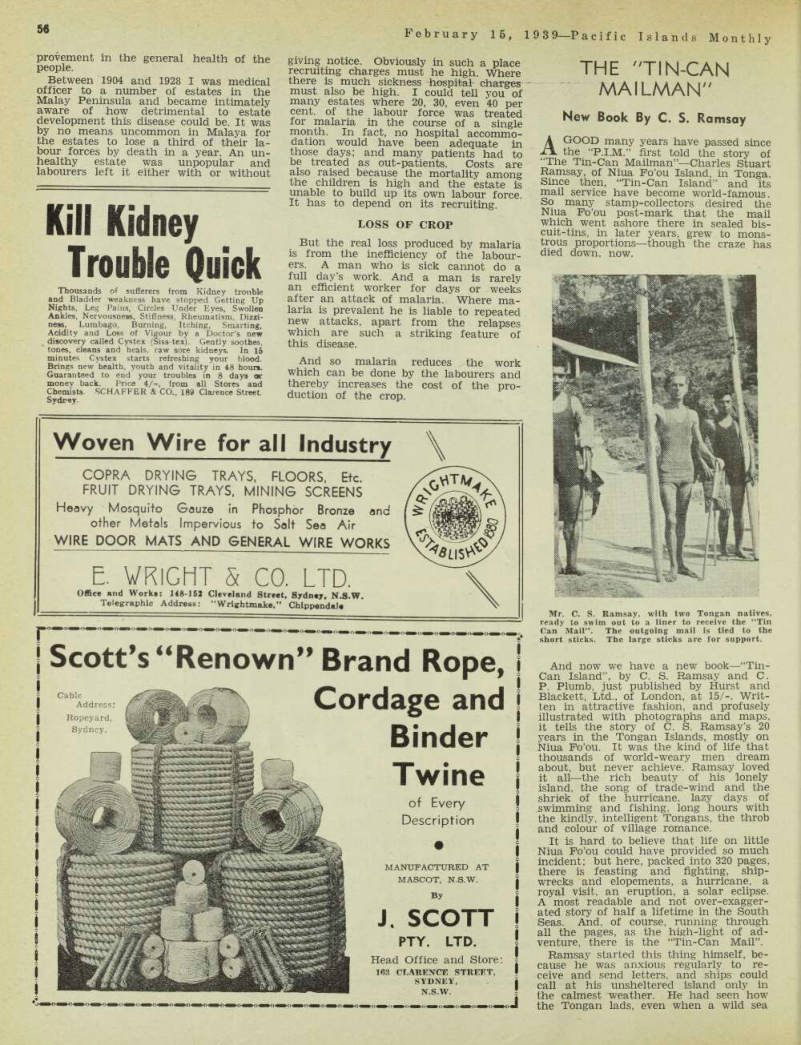
Aspect of imperial Development
AT a combined meeting of the Plant ers’ Group and Empire Social Ser vices Group of the Royal Empire Society in London at the end of last year, Sir Malcolm Watson, Director of the Ross Institute of Tropical Hygiene, spoke on “Malaria and Empire Development”.
Sir Harry Lindsay’s letter in “The Times” of August 6 had pointed out the extent of the trade already done by the Colonies and Dependencies and how much more important these markets might become for Great Britain, and the Empire generally, if the Colonies were better developed, and had them selves larger markets for their products,
which were not only foodstuffs but often the raw products of industries in Britain.
In a leading article, “The Times” of the same date had emphasised the im portance of Sir Harry Lindsay’s letter.
Expansion of trade has its various prob lems: “Things have to be grown before they can be sold; and there are prob lems of production to be solved as well as problems of distribution”. It added this warning: “The final test of success ful administration is not to be sought in increased returns of trade and re venue, important as such increases are, but in the growth of a healthy, pros perous and happy population with ex panding opportunities for leading a fuller life”.
Hindrance To Empire
Development
Sir Malcolm Watson spoke of his own experience of over 40 years of the tropics.
Malaria was the greatest hindrance to Empire development, directly and indir ectly; although there were other im portant factors. He gave examples of how malaria had held up progress, and told how for years no official spent a night at Bela wan, the chief port in North Sumatra, because of the severity of the malaria, but travelled from Me dan by the first train and returned by the last.
Malaria attacked Port Swettenham so severely that Sir Frank Swettenham.
High Commissioner of Malaya, sent a telegram ordering it to be closed soon after it was opened in 1901. But, thanks to Ross’s discovery, steps were taken to make the port healthy and it was not closed. Sir Malcolm also referred to es tates which had been closed on account of malaria.
Unrecognised Effects Of
Malaria
“Apart from such obvious examples of how malaria has hindered development, it has a more pernicious effect than is ordinarilv realised. I had my eyes op ened only when, bv controlling malaria in the towns of Klang and Port Swet tenham. in the Federated Malay States.
I found that the death rate from all diseases fell in a most striking way, as well as the death rate from malaria.
The following tables, Nos. 1 and 2. show clearly what hanpened as a result of the anti-malarial work carried out in 1901:
There were many similar examples of lower death rates from all diseases in cluding malaria following anti-malarial work. It is clear now that where ma laria is prevalent the death rate from dysentery, maternal mortality, convul sions in children, septic diseases and kidney diseases will all be greatly in creased, and that where malaria is re moved there is an extraordinary im
Table No. 1.
Table showing the deaths in Klang and Port Swettenham. Corrected for deaths occurring in hospital. 1900 1901 1902 1903 1904 1905 Fever 259 368 59 46 48 45 Other diseases 215 214 85 69 74 68 Total ... 474 582 144 115 122 113 (Anti-malarial drainage began in :
Table No. 2.
Table showing the number of deaths District, excluding those occurring Town and Port Swettenham. 1900 1901 1902 1903 Fever .. 173 266 227 230 Other diseases 133 150 176 198 1901.) in Klang in Klang 1904 1905 286 351 204 271 Total ... 306 416 403 428 490 622 (No anti-malarial work done.)
provement in the general health of the people.
Between 1904 and 1928 I was medical officer to a number of estates in the Malay Peninsula and became intimately aware of how detrimental to estate development this disease could be. It was by no means uncommon in Malaya for the estates to lose a third of their la bour forces by death in a year. An un healthy estate was unpopular and labourers left it either with or without
giving notice. Obviously in such a place recruiting charges must he high. Where there is much sickness -hospital/ charges must also be high. I could tell you of many estates where 20, 30, even 40 per cent, of the labour force was treated for malaria in the course of a single month. In fact, no hospital accommo dation would have been adequate in those days; and many patients had to be treated as out-patients. Costs are also raised because the mortality among the children is high and the estate is unable to build up its own labour force.
It has to depend on its recruiting.
Loss Of Crop
But the real loss produced by malaria is from the inefficiency of the labour ers. A man who is sick cannot do a full day’s work. And a man is rarely an efficient worker for days or weeks after an attack of malaria. Where ma laria is prevalent he is liable to repeated new attacks, apart from the relapses which are such a striking feature of this disease.
And so malaria reduces the work which can be done by the labourers and thereby increases the cost of the pro duction of the crop.
Advertisements & other items, pp. 56-58 (3 items)
Morris, Hedstrom, Ltd.,
Registered Office - - Suva, Fiji.
BRANCHES THROUGHOUT FIJI, TONGA AND SAMOA
Agents for: >
LLOYD'S
NOBELS (AUSTRALIA) LIMITED—EXPLOSIVES
MATSON NAVIGATION COMPANY
RUSTON & HORNSBY LIMITED
IMPERIAL CHEMICAL INDUSTRIES LIMITED
JOHN LYSAGHT (AUST.) LTD.
VACUUM OIL COMPANY PROP'TY. LIMITED
FORD MOTOR COMPANY LIMITED
■L GOODYEAR TIRE & RUBBER EXPORT COY.
SYDNEY OFFICE: DALTON HOUSE, 115 PITT ST.
■ Th( W ma
LEO
the
side-^l-,
I2in There Is a Ransomes Mower for every lawn—our range covers machines for all conditions, not only for ordinary lawns of all sizes, but for areas such as tennis courts, bowling greens, putting courses, etc., where a specially fine surface is essential.
Whether you require a light side-wheel machine or a petrol or electric motor mower, there is a Ransomes model which will give complete satisfaction. * ** toall m0 vjet loin., paring® siz es.
and
Made by:
RANSOMES, SIMS & JEFFERIES,
LTD., Ipswich, England.
ansomcs
LAWN - MOWERS
Write for illustrated literature and all information.
MORRIS, HEDSTROM, LTD.,
Suva, Lautoka and Ba.
55
Pacific Islands Monthl y—F ebruary 16, 1939
Motor Spirit
<2 % ■*>
Shell develops greater power, gives much better top-gear performance on hills, saves many change-downs and therefore saves petrol. On short and long runs, for stopping and starting, Shell gives miles to the gallon by reason of its higher energy content.
When starting you get into top sooner.
When accelerating, you get instant pick-up because of the extra volatility of Shell.
THE SHELL COMPANY OF AUSTRALIA LTD. (Incorporated in Great Britain)
OS 59/l E
Kill Kidney
Trouble Quick
Thousands of sufferers from Kidney trouble and Bladder weakness have stopped Getting Up Nights, Leg Pains, Circles Under Eyes, Swollen Ankles, Nervousness, Stiffness, Rheumatism, Dizziness, Lumbago, Burning, Itching, Smarting, Acidity and Loss of Vigour by a Doctor’s new discovery called Cystex (Siss-tex). Gently soothes, tones, cleans and heals, raw sore kidneys. In 15 minutes Cystex starts refreshing your blood.
Brings new health, youth and vitality in 48 hours.
Guaranteed to end your troubles in 8 days oar money back. Price 4/-, from all Stores and Chemists. SCHAFFER & CO., 189 Clarence Street Sydney.
Woven Wire for all Industry
COPRA DRYING TRAYS, FLOORS, Etc.
FRUIT DRYING TRAYS, MINING SCREENS
Heavy Mosquito Gauze in Phosphor Bronze and other Metals Impervious to Salt Sea Air WIRE DOOR MATS AND GENERAL WIRE WORKS
E. VRIGtiT & CO. LTD.
Office and Work*; 148-152 Cleveland Street, Sydney, N.S.W.
Telegraphic Address: ** Wrightmake,” Chippendale
Scott’s “Renown” Brand Rope,
Cable Address Ropeyard, Sydney.
Cordage and
Binder
Twine
of Every
Description
MANUFACTURED AT
MASCOT, N.S.W.
By
J. SCOTT
PTY. LTD.
Head Office and Store;
163 CLARENCE STREET,
SYDNEY,
N.S.W.
The "Tin-Can
Mailman"
New Book By C. S. Ramsay
A GOOD many years have passed since the "P.1.M.” first told the story of "The Tin-Can Mailman”—Charles Stuart Ramsay, of Niua Fo’ou Island, in Tonga.
Since then, "Tin-Can Island” and its mail service have become world-famous.
So many stamp-collectors desired the Niua Fo’ou post-mark that the mail which went ashore there in sealed bis cuit-tins, in later years, grew to mons trous proportions—though the craze has died down, now.
And now we have a new book —“Tin- Can Island”, by C. S. Ramsay and C.
P. Plumb, just published by Hurst and Blackett, Ltd., of London, at 15/-. Writ ten in attractive fashion, and profusely illustrated with photographs and maps, it tells the story of C. S. Ramsay’s 20 years in the Tongan Islands, mostly on Niua Fo’ou. It was the kind of life that thousands of world-weary men dream about, but never achieve. Ramsay loved it all —the rich beauty of his lonely island, the song of trade-wind and the shriek of the hurricane, lazy days of swimming and fishing, long hours with the kindly, intelligent Tongans, the throb and colour of village romance.
It is hard to believe that life on little Niua Fo’ou could have provided so much incident; but here, packed into 320 pages, there is feasting and fighting, ship wrecks and elopements, a hurricane, a royal visit, an eruption, a solar eclipse.
A most readable and not over-exagger ated story of half a lifetime in the South Seas. And, of course, running through all the pages, as the high-light of ad venture, there is the “Tin-Can Mail”.
Ramsay started this thing himself, be cause he was anxious regularly to re ceive and send letters, and ships could call at his unsheltered island only in the calmest weather. He had seen how the Tongan lads, even when a wild sea
Mr. C. S. Ramsay, with two Tongan natives, ready to swim out to a liner to receive the “Tin Can Mail”. The outgoing mail is tied to the short sticks. The large sticks are for support.
was breaking, went out fishing; they waited for a certain kind of backwash, then from the high rocks threw in their swimming-poles of light fau wood, and followed immediately themselves, catch ing their poles out in the unbroken water.
So he decided to try the system when the monthly steamer then the “Tofua”, commanded by Captain Davey—came along. Only, instead of fishing-gear, he attached to his pole a watertight packet of mail. Getting out was comparatively simple—just a timely dive—but getting back, across the rocks through a raging sea, was a different matter.
However, the system worked, and Ram say’s swim out to the steamer, usually with a couple of Tongans, but some times alone, became a fixed institution.
Captain Davey co-operated. The incom ing mail was soldered into a biscuit-tin, so that Ramsay easily could push it ashore: and the captain, appreciative of this unusual arrangement, always had his passengers on the qui vive, to see the “Tin-Can Mailman”.
Several times, the nautical mail-car riers nearly lost their lives. Once, the steamer came along at night, failed to see the swimmers, and went on again, and they could not find their way back to the landing. Another time, also at night, an unexpected current swept them miles away, along the coast. Once, they were within inches of being drawn into the steamer’s propellers. And there were sharks.
The arrangement continued for years, and Ramsay must have made his fa mous swim many scores of times, until the depression came, and not only caus ed the withdrawal of the steamer ser vice, but also compelled Mr. Ramsay to seek a livelihood elsewhere. But he re turned to Tonga, later; and the “Tin- Can Mail” still goes on. When this writer was along there, not long ago, the ship, en route from Apia to Suva, stopped off Niua Fo’ou. and a biscuit-tin of mail was lowered overside. But it was receiv ed by natives in an outrigger canoe —
Ramsay swims no more.
R.
Pt. Moresby Gaol
From Our Own Correspondent
Port Moresby, Feb. 4.
IMPROVEMENTS have been made in the arrangement and control of Badili Gaol, Port Moresby, in which a dramatic murder occurred last year.
In July last, Captain C. P. Dolan, well known in Sydney military and journalis tic circles, joined the Papuan Govern ment service as head gaoler. Under his control, a stricter discipline hac been in troduced, and his suggestions for the im proved arrangement of the various gaol buildings and the compound have re sulted in more effectual supervision and more regular routine.
Captain Dolan is the first head gaoler to hold also the position of an officer of Native Armed Constabulary. A small de tachment of police is stationed perman ently at the gaol under his orders, and there is now a regular police night guard in addition to the warder on night duty.
Mr. R. W. Robertson, of the Watut, New Guinea, arrived in Sydney by the “Bulolo” on January 31.
Mr. “Ossie” H. Clifford, manager of Colless’s Bakery at Thursday Island, is at present in Sydney. He will return to T.I. at the end of March.
Nauru's Precautions
Against Epidemics
Prom Our Own Correspondent
Nauru, Jan. 9.
A MILD outbreak of measles on the “Triaster” on her way up from Aus tralia in December, caused a period of strict quarantine. Every possible pre caution was taken to keep infection from the natives. The B.P.C. (European) hos pital and two private houses were used
for quarantine purposes. The passengers were released in time for the Christmas festivities.
The death of a native from infantile paralysis, early in January, gave the island another scare; and certain precau tionary measures were prescribed, espe cially among the European children. The native Boxing Day sports were postponed and all gatherings among natives pro scribed until the necessary safety per iod had elapsed.
Mrs. E. J. Frame is back in Port Moresby, looking all the better for her visit to relations in the U.S.A. She ar rived by the last “Macdhui”, accompanied by her husband, who underwent success ful medical treatment in Sydney.
Advertisements & other items, pp. 59-60 (2 items)
57
Pacific Islands Monthl y—F ebruary 15, 1939
Uultr ter WT Cirvvtiititfvv^
“FIREARM REPAIRS”. “Our Hands Make Good Arms”. GOODS SENT C.O.D.
High-Grade Second-hand
Guaranteed English
Hammerless
SHOTGUNS
I am continually receiving consignments from England. Amongst those in stock at present are:— Purdy, Jeffery, Lang. Greener. Boswell, Rigby, Evans, Holloway & Naughton, Westley Richards, Webley & Scott, Cashmore and Hollis. Write for Second-hand List.
A large range of Second-hand Rifles, all Calibres, most with new Barrels.
There is no list, published, but, if you write for details, they will be forwarded by return.
All Firearms over 50/- are sent Carriage Free. Quality Firearms and Fishing Tackle. 143. ELIZABETH STREET, SYDNEY ’Phone MA 3540 (Near Market Street).
SILRQHU
Ililllll 111 ii*
Uultr ter WT Cirvvtiititfvv^
For mission duties, os a work-boat, for pleasure or for fishing, there is no more suitable for the Islands than the Chapman 1 6ft. Cabin Launch.
Built with the same sturdy strength and sweeping lines as the hull of the craft, the roomy cabin protects the engine and, besides, provides sleeping accommodation for two. There is ample storage space.
The power provided is a Chapman Pup Engine either 3 or 3i h.p. easy to.start simple to operate and giving a good 50 miles per gallon.
Send NOW for FREE interesting details.
CHAPMAN & SHERACK
26 Clara Street, Erskineville, N.S.W.
ENGINE MANUFACTURERS FOR THIRTY YEARS
KOYONG . . MOSS YALE
DAY AND BOARDING SCHOOL AND
KINDERGARTEN FOR GIRLS.
Pupils prepared for School, Music Examinations. Excellent Climate and Health Record.
Own Orchard, vegetables, poultry & dairy.
Home Life and Individual Attention.
Boarders taken from six years old.
Prospectus on application.
MISS MEIN, Principal.
At Blue Mountains—Springwood, N.S.W.
Springwood Ladies" College
Est. 1897. Kindergarten to Leaving Certificate. Tennis, Riding, Swimming, Team Games. Unequalled climate. Pure Jersey Milk. Senior and Junior Houses. Openair sleeping. Inclusive fees. Special vacation arrangements for Island pupils.
M. E. DURAND, Principal.
Papuans As Cricketers
From Our Own Correspondent G,_ a m • . PT - MORESBY, Jan. 14.
REAT interest has been shown in the Native Cricket Shield Competition, organised as an experiment by offi cials of the Port Moresby Cricket Club.
A considerable amount of talent has been disclosed by individual members of the eight competing clubs; and indica tions are that a combined native team from Port Moresby and district would make a creditable showing against most possible opponents.
Batting averages are as high as 74 for the series. The best bowling per formance to date is that of Vui Vagi, of Hula, who has taken 22 wickets for 118 runs—an average of 5.4. Arua Mo rea has 31 wickets to his credit at 6 2 runs each; and Gomara Geita has taken 28 wickets at an average cost of 8.8.
Mr. and Mrs. N. B. Blood, of Rabaul, New Guinea, received numerous con gratulations on the birth of a son—Peter Raymond Beresford—on January 27.
Mrs. A. W. Ardlie, well-known in the Territory of New Guinea, died suddenly in Melbourne early in January.
Pattern Service
EACH month we publish a Fashions design, patterns of which may be purchased by our readers direct from this office, post free. To obtain a pattern, print your name and address below, giving the number of “~ e P at tern and the bust size, and send to Pattern Department”, Pacific Islands Monthly, Box 3408 R, G.P.0., Sydney: enclose also the pnce of the pattern in postal note or stamps.
It will be sent by return mail.
Name Address Pattern Number size
M 6444.—Make this smart frock for yourself In a few hours, and trim with gay contrasting material. It features flared skirt, full sleeves and rever neckline. Size: 36 inch bust takes four yards of 36 inch wide material and a quarter yard of contrasting. Paper pattern, for sizes 32 to 40 inch bust, price 1/1.
Mrs. A. S. Evensen, wife of the manager of Coconut Products, Ltd., Pondo, New Guinea, left Rabaul, recently by the “Neptuna” for Hong Kong, to spend a short holiday.
Advertisements & other items, p. 60 (2 items)
58
February 15, 193 9—P acific Islands Monthly
m
v ,\ *
LLSOmXI
kdlw X X "471 I"
Classic Eau de Cologne The world's favourite invigorating, fragrant and cool. • "Tosca" Eau de Cologne A happy union of a glamorous perfume with the freshness of Classic Eau de Cologne. • "Rhinegold" Eau de Cologne A happy union of an elusive, subtle perfume with the freshness of Classic Eau de Cologne.
REPRESENTATIVE: ROBERT BLAU (AUST.)
A.C.A. BUILDING. CNR. KING & YORK STREETS. SYDNEY
Fashion Hints for Islands Women
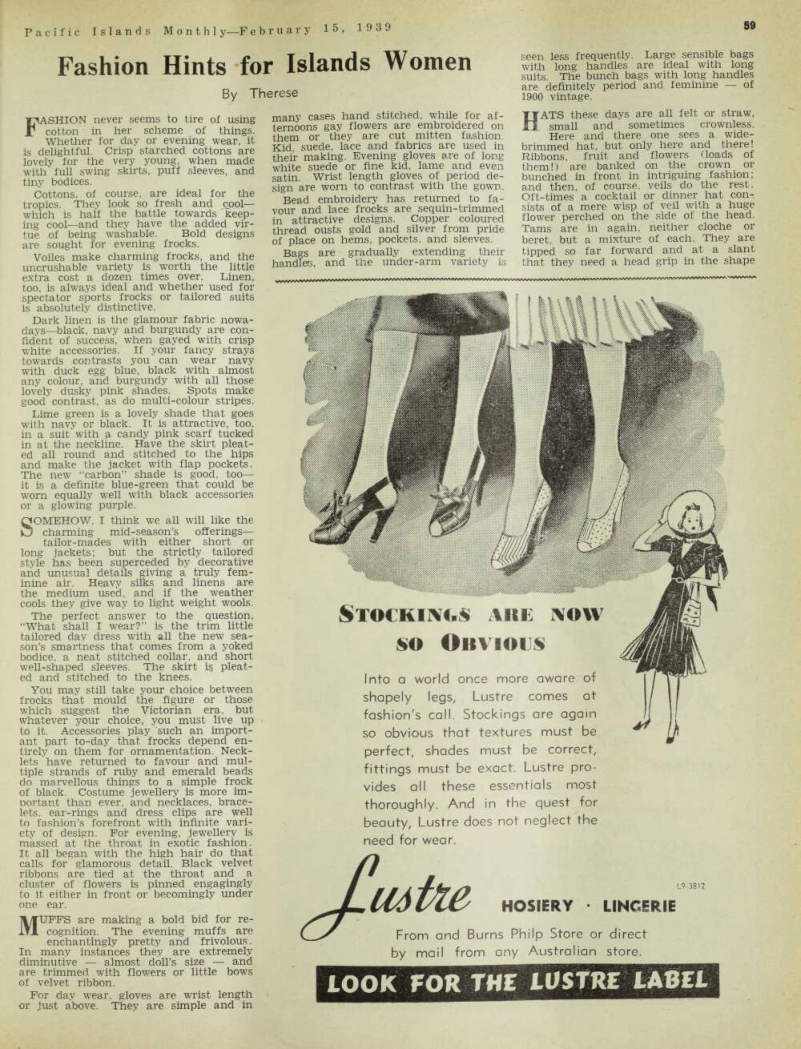

By Therese
FASHION never seems to tire of using cotton in her scheme of things.
Whether for day or evening wear, it is delightful. Crisp starched cottons are lovely for the very young, when made with full swing skirts, puff sleeves, and tiny bodices.
Cottons, of course, are ideal for the tropics. They look so fresh and cool — which is half the battle towards keep ing cool —and they have the added vir tue of being washable. Bold designs are sought for evening frocks.
Voiles make charming frocks, and the uncrushable variety is worth the little extra cost a dozen times over. Linen, too, is always ideal and whether used for spectator sports frocks or tailored suits is absolutely distinctive.
Dark linen is the glamour fabric nowa days—black, navy and burgundy are con fident of success, when gayed with crisp white accessories. If your fancy strays towards contrasts you can wear navy with duck egg blue, black with almost any colour, and burgundy with all those lovely dusky pink shades. Spots make good contrast, as do multi-colour stripes.
Lime green is a lovely shade that goes with navy or black. It is attractive, too, in a suit with a candy pink scarf tucked in at the neckline. Have the skirt pleat ed all round and stitched to the hips and make the jacket with flap pockets.
The new “carbon” shade is good, too — it is a definite blue-green that could be worn equally well with black accessories or a glowing purple.
QOMEHOW, I think we all will like the charming mid-season’s offerings— tailor-mades with either short or long jackets; but the strictly tailored style has been superceded by decorative and unusual details giving a truly fem inine air. Heavy silks and linens are the medium used, and if the weather cools they give way to light weight wools.
The perfect answer to the question, “What shall I wear?” is the trim little tailored day dress with all the new sea son’s smartness that comes from a yoked bodice, a neat stitched collar, and short well-shaped sleeves. The skirt i$ pleat ed and stitched to the knees.
You may still take your choice between frocks that mould the figure or those which suggest the Victorian era, but whatever your choice, you must live up to it. Accessories play such an import ant part to-day that frocks depend en tirely on them for ornamentation. Neck lets have returned to favour and mul tiple strands of ruby and emerald beads do marvellous things to a simple frock of black. Costume jewellery is more im portant than ever, and necklaces, brace lets. ear-rings and dress clips are well to fashion’s forefront with infinite vari ety of design. For evening, jewellery is massed at the throat in exotic fashion.
It all began with the high hair do that calls for glamorous detail. Black velvet ribbons are tied at the throat and a cluster of flowers is pinned engagingly to it either in front or becomingly under one ear.
MUFFS are making a bold bid for re cognition. The evening muffs are enchantingly pretty and frivolous.
In many instances they are extremely diminutive almost doll’s size and are trimmed with flowers or little bows of velvet ribbon.
For day wear, gloves are wrist length or just above. They are simple and in
many cases hand stitched, while for afternoons gay flowers are embroidered on them or they are cut mitten fashion.
Kid, suede, lace and fabrics are used in their making. Evening gloves are of long white suede or fine kid, lame and even satin. Wrist length gloves of period design are worn to contrast with the gown.
Bead embroidery has returned to favour and lace frocks are sequin-trimmed in attractive designs. Copper coloured thread ousts gold and silver from pride of place on hems, pockets, and sleeves.
Bags are gradually extending their handlers, and the under-arm variety is
seen less frequently. Large sensible bags with long handles are ideal with long suits. The bunch bags with long handles are definitely period and feminine of 1900 vintage.
HATS these days are all felt or straw, small and sometimes crownless.
Here and there one sees a wide brimmed hat, but only here and there!
Ribbons, fruit and flowers (loads of them!) are banked on the crown or bunched in front in intriguing fashion; and then, of course, veils do the rest.
Oft-times a cocktail or dinner hat con sists of a mere wisp of veil with a huge flower perched on the side of the head.
Tams are in again, neither cloche or beret, but a mixture of each. They are tipped so far forward and at a slant that they need a head grip in the shape
of.a ribbon band to keep them in posi tion.
The hair styles have influenced hats, too. One has so many period styles to choose from in hair dressing. For even ing there is the eighteenth century Pom padour elegance which calls for a taffeta dress and a ribbon round the throat; the 1860 romanticism that goes so well with the crinoline; and the Edwardian sophistication that calls for jewelled combs and looks so worldly-wise. They are all enchanting and give a new zest to life.
Vishnu Prasad, of P.O. Box 17. GP.O., Suva, Fiji, who is 14 years of age, wishes to correspond with pen friends of either sex, in other countries. “Interested in stamp collecting and exchange of post cards.”
Advertisements & other items, pp. 61-62 (1 item)
lithe
f ■-M . x-;?
Stockings are \o\v
so Oiivioiis
Into a world once more aware of shapely legs, Lustre comes at fashion's call. Stockings are again so obvious that textures must be perfect, shades must be correct, fittings must be exact. Lustre provides all these essentials most thoroughly. And in the quest for beauty, Lustre does not neglect the need for wear.
lithe
L 9-3812
HOSIERY * LINGERIE
From and Burns Philp Store or direct by mail from any Australian store.
LOOK FOR THE LUSTRE LABEL
FOOD
good
best
the
ever
ve
you
ted
tas
FITZROY brand
LUNCHEON BEEF
in Oblong Cans
PACKED BY A SPECIAL PROCESS.
'Riverstone" & "OX & PALM" Brand Trade Meats.
Corned —Boiled & Roast Meats . 120z5., 160z5., 240z5., 21b., 31b., 41b., 51b., 61b.
Imperial
HOT MEALS
in 51b., 51b. and 11b. Cans. 7 Varieties: Imperial Beef Steak Pudding. Steak and Kidney Pudding. Chops and Tomato. Steak and Tomato. Sausages and Tomato. Sausages, Spaghetti and Tomato. Lamb and Green Peas.
Try also Imperial MANGO & PA PAW CHUTNEY.
Imperial CRUSTLESS CHEDDAR CHEESE.
RIVERSTONE MEAT CO. PTY. LTD.,
5-7 O’Connell St., Sydney. Cables: “IMPERIAL”.
Pearce Cr Co. Ltd. Fiji Representatives LAn foods
Treasure Hunt On Cocos
Island
Mutinous Crew and Mad Boatswain
STORIES of adventure, based on a fruitless hunt for the Peruvian trea sure believed to be buried on Cocos Island fin the far eastern Pacific) have been published in the “P.1.M.” in past years. Here is the latest, as reported from Hollywood, U.S.A., in January.
An amazing tstorv of mutiny and vio lence during a South Sea treasure hunt is being unfolded before the Federal grand jury here.
The principal witness is Captain Ro bert Hoffman, of the schooner “Metha Nelson”. The vessel left San Pedro last
September with a crew of amateurs and sailed for Cocos Island, where the trea sure was supposed to be buried.
Countess Dorothy di Frasso, a well known member of the film colony, and Mr. Marino Bello, stepfather of the late Jean Harlow, were among the treasure seekers.
After weeks of fruitless digging every one lost their temper, Captain Hoffman said, and the ‘“Metha Nelson” became a “real hell ship”. Drunk for three days, the boatswain, Rolf Barrman, terrorised the ship with a gun.
Plied with gin, and incited by two of the “guests”, the crew defied the captain’s authority.
“I knocked some discipline into them.
I shackled some to stanchions”, said Captain Hoffman, who added that the Countess di Frasso asked him to shoot Charles Segal, one of the ringleaders, be cause she feared he was planning to seize the ship and hold her to ransom.
Captain Hoffman revealed that he mar ried Mr. Bello to Evelyn Husby, the ship’s nurse, a few days after the voyage began.
Finally, the schooner, with its mut inous crew, was towed back to port.
From The Yodda
Mr. G. J. Bridges arrived in Auckland, N.Z. early in February by the motor ship “Trienza” from Ocean Island, where he is manager for the British Phosphate Commission.
Mrs. Pasemaca Volimer, a pioneer resi dent of Fiji, died at Levuka on January 11, aged 78.
Mr. and Mrs. A. Kingsley, of the Yodda, Papua, are at present on a visit to Australia. The above snapshot was taken in George Street, Sydney. Mrs. Kingsley became “front page news” for a day, in Perth. Leaving Port Moresby on a Saturday morning, and travelling on the regular air-liners, and spending a night in Townsville, Sydney and Adelaide, she reached Perth, W.A., on Tuesday afternoon. “Port Moresby to Perth in four days”, was how the news papers head-lined it.
Advertisements & other items, p. 62 (1 item)
Recor Ds
Packed Free and sent C.O.D. without extra charges.
H.M. Voice Slightly-used Portables, delivered straight to your nearest port for .. .. . . £3/15/-.
Send for Latest Record Lists.
Talkeries Music Stores
451 Queen Victoria Buildings, Sydney
Eight Dredges
Bulolo Co.'s Establishment Complete This Year
BY the end of 1939, Bulolo Gold Dredg ing Ltd. will have 8 dredges oper ating in the Bulolo Valley, in the goldfields region of New Guinea.
The new deep-digging dredge, No. 7. which is now being assembled, will be finished in April, and will then commence operations.
It had originally been intended to move the machinery from No. 1 dredge to a new hull that has been constructed on the Watut River, and this was to be called No. 8 dredge. It was found, how ever, that there was still a good deal of rich ground to be dug over in the location of No. 1 dredge. Accordingly, No. 1 dredge has been completely recon ditioned, and it recommenced digging operations on January 29 in its old loca tion.
New machinery is now being built for the new hull on the Watut River, and this will be assembled as No. 8 dredge which, it is expected, will commence op eration about September.
Bv the end of this year the establish ment of B.G.D. in New Guinea will be as follows: — Nos. 1,2, 3 and 4 dredges will be at work along the Bulolo flats—the latter near the junction with the Watut—and they are described as medium diggers-about 40 feet.
No. 5 and No. 7 are deep digging dredges, and will operate on the Bulolo flats, near the location of Nos. 1 and 2.
No. 6 is a small dredge, digging to about 26 feet, located on the flat near Wau.
No. 8. as stated, will be a new dredge, digging to about 40 feet, located on the Watut River near its junction with the Bulolo.
Lamps For Isolated Stations
THERE are five main amenities demanded by the isolated planter or trader in the Pacific Islands. In their order of importance they are; Water supply, lighting, drainage, refrigeration, and radio communication.
So far as lighting is concerned, there are two main ways of supplying the want—an electric light unit driven by a motor engine or wind mill, or the system of using vaporised kerosene in lamps with incandescent burners. A number of manufacturers have made a specialty of this system of lighting, and the spots of brilliant radiance which may be seen about the Islands at night is the result of their efforts. There are a few lamps on the market which have attained a high degree of popularity, and among these are the Tilley and the Coleman lamps.
The Tilley Lamp Co., of Hendon, London, pro duce lamps which burn ordinary kerosene under pressure, and give a clear, bright, steady light of 300 candle power, at the small cost of one penny for six hours. Two kinds of lamps of interest to the Pacific Islands are the Tilley Table Lamp, which is elegantly finished and can be carried from room to room with absolute safety; and the Tilley Storm Lantern, which is strongly made of stout brass, non-corrosive, and which can be used for all kinds of work out of doors in rough weather. These lamps are insect-proof and are simple in use and adjustment.
Messrs. Burns, Philp & Co., Ltd. are agents for the Tilley Lamps throughout the South Seas, and the lamps and their parts, therefore, may be obtained at their various stores.*** Mr. J. McGmther, Resident Agent at
Mangaia, together with his wife, ar
rived in Auckland by the “Matua” on January 23. He has retired after 15 years service in the Cook Islands.
Advertisements & other items, p. 63 (2 items)
61
Pacific Islands Monthl y —F ebruary 15, 1939
M®Ilrath’S
AFTER THE PARTY
make sure of a bright to-morrow!
Don’t spoil your enjoyment of the party by wondering whether gaiety will give place to regret to-morrow.
The possible ill-effect of a little extra indulgence in eating, drinking or smoking on occasions is easily checked by a sparkling glass of Eno’s “Fruit Salt” before retiring. The acidity caused by over-indulgence is definitely corrected by Eno’s "Fruit Salt” because of its anti-acid action. Take it at night or first thing every morning to clear away poisons from your system and keep the bloodstream pure.
The words Eno and "Fruit Salt ” are registered trade marks.
ATTRACTIVE FOOD
FOR THE TROPICS
M®ILRATH’S
PRICE LISTS
Post
cm Application
I.X.L. or Rosa Peaches, 16oz. .
I.X.L or Rosa Peaches, 30oz.
Rosa Jelly Crystals, 4oz New Season’s Evap. Apricots. 3 Crown Choice Arnott’s Popso Crackers, No. 2 tin Mcllrath’s Crustless Cheese, Boz Holbrook's Queen Olives, soz.
Rosa Pure Olive Oil, lOoz. ..
Holbrook’s Sweet Gherkins, soz.
I.X.L. Tomato Sauce, lOoz. ..
Cerebos Salt, drums ..
Heinz Spaghetti in Sauce, Boz.
Californian Diamond Walnuts New Season’s Barcelona Nuts Rosa Pure Soap, large bars .
Amazol Maize Starch, loose ..
Johnson’s Adhesive Plaster, lin. x 10 yds Rosa Aspirin Tablets, grn. 5. 100 s. 6d tin 9£d tin 4£d pkt. 7£d pkt. lUd bot. 1/8 bot. 1/- jar. 8d bot. 1/2 drum 6*d tin 1/1 lb. lOd lb. 7id bar 6d lb. 5/9 doz. 9/3 doz. 4/- doz. 1/2* lb. 1/11 tin. 7/3 doz. 11/3 doz. 19/- doz. 11/9 doz. 7/9 doz. 13/6 doz. 6/3 doz. 12/6 doz. 9/6 doz. 77- doz 5/6 doz. 1/8 reel 1/- bot All Prices f.o.b. Sydney. Cases and Packing Free. • * • •EX PORT OCPARTMENT • • • 20 2 PITT ST RE ET, SYD N EY
NEW SOUTH WALES . AUSt/rALIA.
Goldfields Ltd.
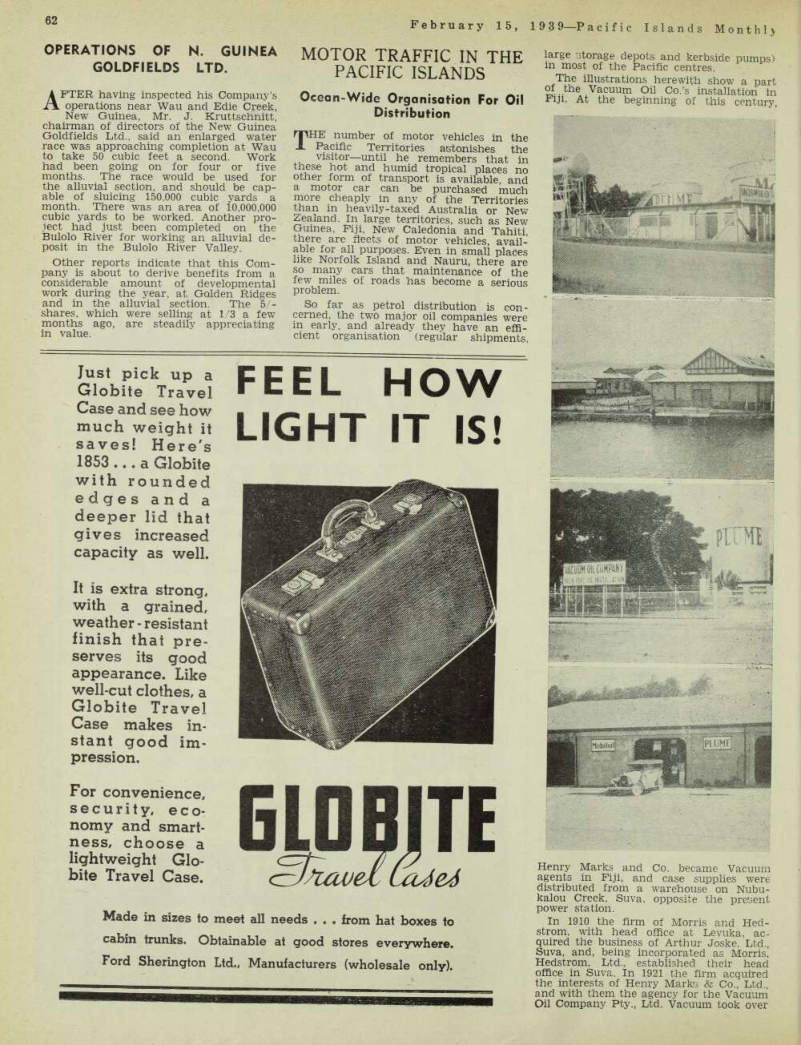
Operations Of N. Guinea
AFTER having inspected his Company’s operations near Wau and Edie Creek, New Guinea, Mr. J. Kruttschnitt, chairman of directors of the New Guinea Goldfields Ltd., said an enlarged water race was approaching completion at Wau to take 50 cubic feet a second. Work had been going on for four or five months. The race would be used for the alluvial section, and should be cap able of sluicing 150,000 cubic yards a month. There was an area of 10,000,000 cubic yards to be worked. Another pro ject had just been completed on the Bulolo River for working an alluvial de posit in the Bulolo River Valley.
Other reports indicate that this Com pany is about to derive benefits from a considerable amount of developmental work during the year, at. Golden Ridges and in the alluvial section. The 5/shares, which were selling at 1/3 a few months ago, are steadily appreciating in value.
Pacific Islands
Motor Traffic In The
Ocean-Wide Organisation For Oil Distribution
THE number of motor vehicles in the Pacific Territories astonishes the visitor—until he remembers that in these hot and humid tropical places no other form of transport is available, and a motor car can be purchased much more cheaply in any of the Territories than in heavily-taxed Australia or New Zealand. In large territories, such as New Guinea, Fiji, New Caledonia and Tahiti there are fleets of motor vehicles, avail able for all purposes. Even in small places like Norfolk Island and Nauru, there are so many cars that maintenance of the few miles of roads has become a serious problem.
So far as petrol distribution is con cerned, the two major oil companies were in early, and already they have an effi cient organisation (regular shipments,
large -storage depots and kerbside pumps) in most of the Pacific centres.
The illustrations herewith show a part of the Vacuum Oil Co.’s installation in Fiji. At the beginning of this century
Henry Marks and Co. became Vacuum agents in Fiji, and case supplies were distributed from a warehouse on Nubu kalou Creek, Suva, opposite the present power station.
In 1910 the firm of Morris and Hed strom, with head office at Levuka, ac quired the business of Arthur Joske, Ltd., Suva, and, being incorporated as Morris, Hedstrom, Ltd., established their head office in Suva. In 1921 the firm acquired the interests of Henry Marks & Co., Ltd., and with them the agency for the Vacuum Oil Company Pty., Ltd. Vacuum took over
a newly-erected warehouse at Walu Bay and sold their old building and land.
Three years later a warehouse was opened in Levuka, from which Vanua Levu, Taveuni and Lau were serviced, and 1928 saw the construction of a warehouse at Lautoka, the biggest sugar centre in the Colony. Consumption increased steadily, and in 1933 Vacuum established a bulk petrol installation on reclaimed land near the waterfront in Suva.
The pictures on the opposite page show; Top. —Installation, Depot Road, Suva.
Second.—Case warehouse, drum-filling shed and warehouse superintendent’s residence at Walu Bay. Third.—Fuel oil installation situated opposite the Suva wharf. Bottom.—A Fijian service station.
J. Jones’ establishment in Renwick Road, Suva.
Advertisements & other items, p. 64 (1 item)
Feel How
lust pick up a Globite Travel Case and see how much weight it saves! Here's 1853 ... a Globite with rounded edges and a deeper lid that gives increased capacity as well.
It is extra strong, with a grained, weather-resistant finish that preserves its good appearance. Like well-cut clothes, a Globite Travel Case makes instant good impression.
LIGHT IT IS!
For convenience, security, economy and smartness, choose a lightweight Globite Travel Case.
Made in sizes to meet all needs . . . from hat boxes to cabin trunks. Obtainable at good stores everywhere.
Ford Sherington Ltd., Manufacturers (wholesale only).
Nauru's "Pigsty Alley"
From Our Own Correspondent
Nauru, Jan. 16.
WHILE no signboards indicate the names of local thoroughfares, the designation “Pigsty Alley” seems to have been generally agreed upon by Eu ropean residents for the new stretch of unmade road which passes behind the police lines and is skirted by rows of pigsties belonging to the native police.
The story behind this road is interesting.
Last year the Administration desired to build a special hospital wing for in fant welfare and baby health work—a praiseworthy project in view of the high infantile mortality. There being insuffi cient space within the grounds of the old native hospital, it was decided to ex tend one wing across the main palm lined road at its entrance to the Admin istration residential settlement. This has necessitated the opening up of a series of minor tracks, including the circuitous “Pigsty Alley”, along which all traffic from the British Phosphate Commission’s offices to the Administration must pass.
The fact that the new baby health building is of excellent design, and will serve a most useful purpose, has not prevented the European community from condemning its erection on the present site. The stretch of road, now cut <3ff from vision and use, was the most pic turesque on Nauru, being lined with spe cial coconut palms imported from the Solomons by General Griffiths during his regime.
Another Plane In Papua
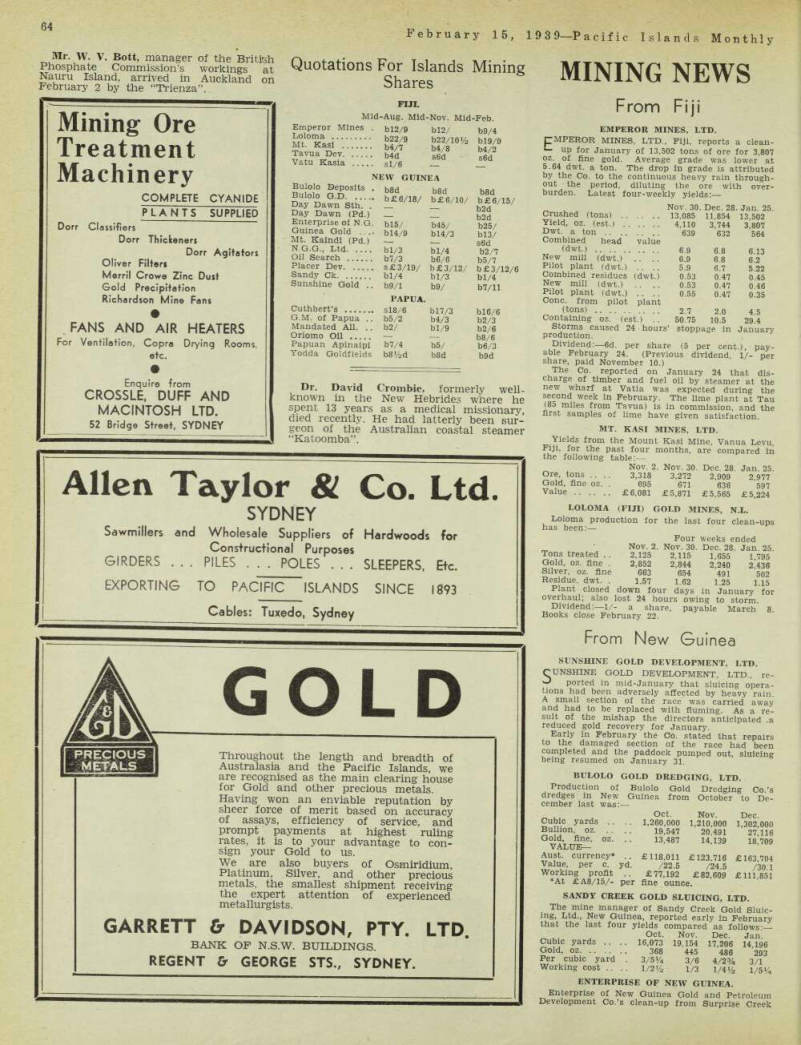
From Our Owfb Correspondent
Pt. Moresby, Jan. 14.
ANEW addition to Port Moresby’s growing air fleet is a Dolphin Doug las amphibian, which landed at the aerodrome here on January 10, having flown in two stages from Brisbane. The plane is powered with two engines, each of 450 horse power, and has a working range of 1,000 miles. Her crew includes Messrs. F. E. Secor (pilot), J. R. Lund (assistant), and M. Reynolds (photo grapher) .
This is the second aircraft brought here by the Fairchild-K.N.I.L.M. organ isation, which is under contract to make an aerial survey of the oil-prospecting areas held by Island Exploration Co.
Ltd. and A.P.C.
M. Satragne, an engineer in the Public Works Department of New Caledonia, left Noumea by the last “Commissaire Ramel”, for Prance.
Mr. W. V. Bott, manager of the British Phosphate Commission’s workings at Nauru Island, arrived in Auckland on February 2 by the “Trienza”.
Advertisements & other items, pp. 65-66 (2 items)
63
Pacific Islands Monthl y—F ebruary 15, 1939
300 Watts
MOCK Sr KIRBY LTD
♦ M ♦
FOR YOUR HOME
M&tSCtUif
with a “JOHNSON”
“ Iron-Horse” Generator
Lights twelve
25 watt globes
300 WATTS
12 VOLTS
Why deny yourself the comfort and convenience of Electric Light and Power for your Radio? With a Johnson (< lron Horse” Generator Electric Light actually costs you less than the messy, dangerous, old-fashioned Lamps—for approximately 1/- you can use 3 lights for 3£ hours every night in the week.
Never before has it been possible to offer such real comfort at such small cost. You no longer need to be inconvenienced with the old-style lighting . . . Electric Light, the great boon of to-day's civilisation, is now available quickly and economically—at the touch of a switch the Johnson "Iron Horse" Generator makes possible economical Electric Light for your home and build ings, and at the same time provides Power for your Radio and Power for Charging Batteries.
Here are a Few of the more Important Features; 300 WATTS ... 12 VOLTS . . . Lights 12-25 Watt Globes . . . ELECTRIC STARTING —just push a button . . FULL RANGE CONTROL . . . Special Built-in Generator—Johnson Iron Horse 4-Cycle Petrol Engine . . .
AUTOMATIC CUT-OUT disconnects when not running . . . Quiet Operation . . . Minimum Vibration.
CASH PRICE, with 70 Amp. Battery ex bond £24/10/- Approx, cost per Point for Material Only 12/6. Weight when packed 100 lbs. Freight extra. Write for illustrated Iron Horse Generator Folder giving complete specifications.
Postal Address... BOX 4150 Y G.P.O. SYDNEY
Mining Ore
Treatment
Machinery
COMPLETE CYANIDE
PLANTS SUPPLIED
Dorr Classifiers Dorr Thickeners Dorr Agitators Oliver Filters Merril Crowe Zinc Dust Gold Precipitation Richardson Mine Fans •
FANS AND AIR HEATERS
For Ventilation, Copra Drying Rooms, etc. • Enquire from
CROSSLE, DUFF AND
MACINTOSH LTD.
52 Bridge Street, SYDNEY
Quotations For Islands Mining
Shares
Dr. David Crombie, formerly well known in the New Hebrides where he spent 13 years as a medical missionary, died recently. He had latterly been sur geon of the Australian coastal steamer “Katoomba”.
Fiji.
Mid-Aug. Mid-Nov. Mid-Feb.
Emperor Mines . b!2/9 bl2/ b9/4 Loloma Mt. Kasl Tavua Dev b22/9 b4/7 b4d b22/10y 2 b4/8 s6d bl9/9 b4/2 s6d Vatu Kasia sl/6 new guinea Bulolo Deposits .
Bulolo G.D Day Dawn Sth. . b8d b£6/18/ b8d b £ 6/10/ b8d b£6/15/ b2d Day Dawn (Pd.) b2d Enterprise of N.G. b!5/ b45/ b25/ Guinea Gold ...
Mt. Kalndl (Pd.) b!4/9 bl4/3 bl3/ s6d N.G.G., Ltd bl/3 bl/4 b2/7 Oil Search b7/3 b6/6 b5/7 Placer Dev s £3/19/ b £3/12/ b£ 3/12/6 Sandy Ck bl/4 bl/3 bl/4 Sunshine Gold .. b9/l
Papua.
b9/ b7/ll Cuthbert’s S18/6 b5/2 bl7/3 b4/3 hi R !R G.M. of Papua ..
Dio/ 0
b2/3 Mandated All. .. b2/ bl/9 b2/6 Oriomo Oil — b8/6 Papuan Apinaipi b7/4 b5/ b6/3 Yodda Goldfields b8V 2 d b8d b9d
Mining News
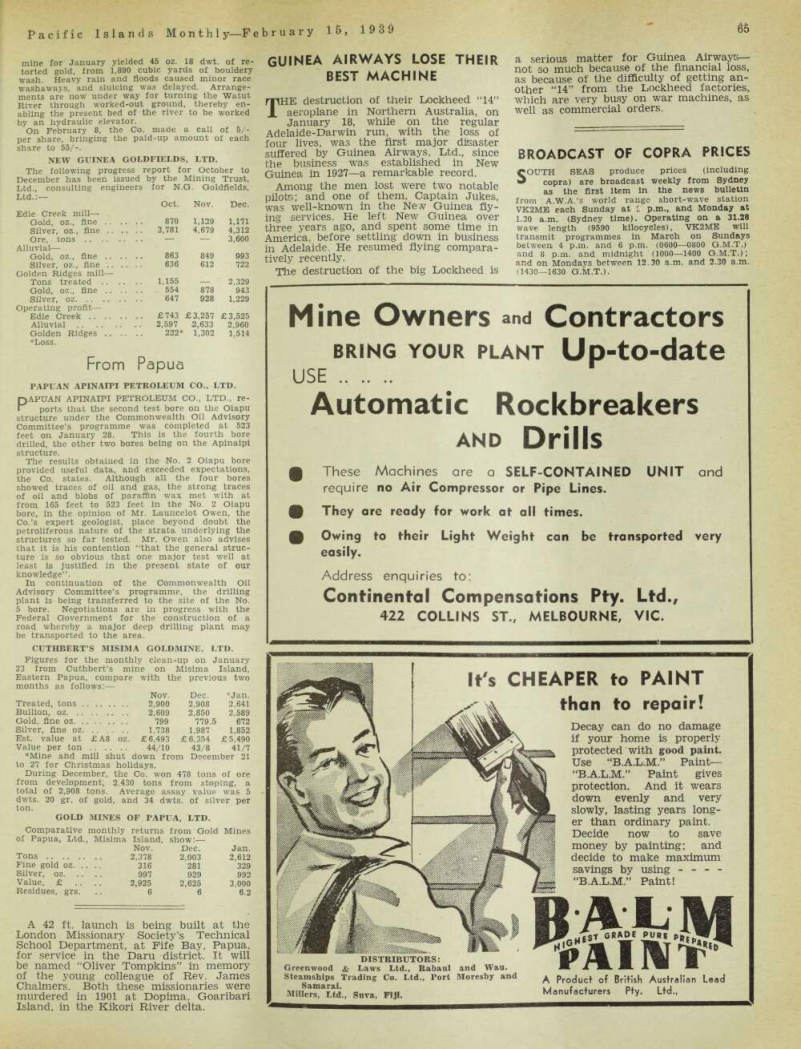
From Fiji
Emperor Mines, Ltd.
rMPEROR MINES, LTD., Fiji, reports a clean up for January of 13,502 tons of ore for 3,807 oz. of fine gold. Average grade was lower at 5.64 dwt. a ton. The drop in grade is attributed by the Co. to the continuous heavy rain through out the period, diluting the ore with over burden. Latest four-weekly yields;—
Storms caused 24 hours’ stoppage in January production. y Dividend:—6d. per share (5 per cent.), pay able February 24. (Previous dividend, 1/- per share, paid November 10.) The Co. reported on January 24 that dis charge of timber and fuel oil by steamer at the new wharf at Vatia was expected during the second week in February. The lime plant at Tau (8o miles from Tavua) is in commission, and the first samples of lime have given satisfaction.
Mt. Kasi Mines, Ltd.
Yields from the Mount Kasi Mine, Vanua Levu, Fiji, for the past four months, are compared in the following table:—
Loloma (Fiji) Gold Mines, N.L.
Loloma production for the last four clean-ups has been:—
Plant closed down four days in January for overhaul: also lost 24 hours owing to storm.
Dividend:—l/- a share, payable March 8 Books close February 22.
From New Guinea
Sunshine Gold Development, Ltd.
C Unshine Gold Development, Ltd., Re-
J ported in mid-January that sluicing opera tions had been adversely affected by heavy rain.
A small section of the race was carried away and had to be replaced with fluming. As a re sult of the mishap the directors anticipated .a reduced gold recovery for January.
Early in February the Co. stated that repairs to the damaged section of the race had been completed and the paddock pumped out, sluicing being resumed on January 31.
Bulolo Gold Dredging, Ltd.
Production of Bulolo Gold Dredging Co.’s dredges in New Guinea from October to De cember last was:—
Sandy Creek Gold Sluicing, Ltd,
The mine manager of Sandy Creek Gold Sluic ing, Ltd., New Guinea, reported early in February that the last four yields compared as follows:-
Enterprise Of New Guinea.
Enterprise of New Guinea Gold and Petroleum Development Co.’s clean-up from Surprise Creek
Crushed (tons) ..
Nov. 30. Dec. 28. 13.085 11.854 Jan. 25. 13,502 Yield, oz. (est.) .. 4,110 3,744 3,807 Dwt. a ton .. .. 639 632 564 Combined head (dwt.) value 6.9 6.8 6.13 New mill (dwt.) 6.9 6.8 6.2 Pilot plant (dwt.) 5.9 6.7 5.22 Combined residues (dwt.) 0.53 0.47 0.45 New mill (dwt.) 0.53 0.47 0.46 Pilot plant (dwt.) 0.55 0.47 0.35 Cone, from pilot (tons) plant 2.7 2.0 4.5 Containing oz. (est.) .. 50.75 10.5 29.4
Nov. 2. Nov. 30.
Dec. 28.
Jan. 25.
Ore, tons .. 3,318 3,272 2,909 2,977 Gold, fine oz. . 695 671 636 597 Value £6,081 £5,871 £5,565 £5,224
Four weeks ended Nov. 2.
Nov. 30.
Dec. 28. Jan. 25.
Tons treated .. 2,125 2,115 1,655 1,795 Gold, oz. fine . 2,852 2,844 2,240 2,436 Silver, oz. fine 663 654 491 502 Residue, dwt. . 1.57 1.62 1.25 1.15
Cubic yards Oct.
Nov.
Dec. 1,260,000 1,210,000 1,302,000 Bullion, oz. .. 19,547 20,491 27,116 Gold, fine, oz. .. 13,487 14,139 18,709
Value—
Aust. currency* £118,011 £123,716 £163,704 Value, per c. y'd. /22.5 /24.5 /30 1 Working profit .. £77,192 £82.609 £111,851 ♦At £ A8/15/per fine ounce.
, . . Oct. Nov. Dec. Jan.
Cubic yards .. .. 16,073 19,154 17,206 14 196 Gold > oz 368 445 486 293 Per cubic yard . 3/5% 3/6 4/23/ 4 3/1 Working cost ... 1/2% 1/3 1/4% 1/5%
mine for January yielded 45 oz. 18 dwt. of re torted gold, from 1,890 cubic yards of bouldery wash. Heavy rain and floods caused minor race washaways, and sluicing was delayed. Arrange ments are now under way for turning the Watut River through worked-out ground, thereby en abling the present bed of the river to be worked by an hydraulic elevator.
On February 8, the Co. made a call of 5/per share, bringing the paid-up amount of each share to 55/-.
New Guinea Goldfields, Ltd.
The following progress report for October to December has been issued by the Mining Trust, Ltd., consulting engineers for N.G. Goldfields, Ltd.:—
From Papua
Papuan Apinaipi Petroleum Co., Ltd.
Papuan apinaipi petroleum co., ltd., re ports that the second test bore on the Oiapu structure under the Commonwealth Oil Advisory Committee’s programme was completed at 523 feet on January 28. This is the fourth bore drilled, the other two bores being on the Apinaipi structure.
The results obtained in the No. 2 Oiapu bore provided useful data, and exceeded expectations, the Co. states. Although all the four bores showed traces of oil and gas, the strong traces of oil and blobs of paraffin wax met with at from 165 feet to 523 feet in the No. 2 Oiapu bore, in the opinion of Mr. Launcelot Owen, the Co.’s expert geologist, place beyond doubt the petroliferous nature of the strata underlying the structures so far tested. Mr. Owen also advises that it is his contention “that the general struc ture is so obvious that one major test well at least is justified in the present state of our knowledge”.
In continuation of the Commonwealth Oil Advisory Committee’s programme, the drilling plant is being transferred to the site of the No. 5 bore. Negotiations are in progress with the Federal Government for the construction of a road whereby a major deep drilling plant may be transported to the area.
Cuthbert’S Misima Goldmine, Ltd.
Figures for the monthly clean-up on January 23 from Cuthbert’s mine on Misima Island, Eastern Papua, compare with the previous two months as follows: —
During December, the Co. won 478 tons of ore from development, 2,430 tons from stoping, a total of 2,908 tons. Average assay value was 5 dwts. 20 gr. of gold, and 34 dwts. of silver per ton.
Gold Mines Of Papua, Ltd.
Comparative monthly returns from Gold Mines of Papua, Ltd., Misima Island, show: —
A 42 ft. launch is being built at the London Missionary Society’s Technical School Department, at Fife Bay, Papua, for service in the Daru district. It will be named “Oliver Tompkins” in memory of the young colleague of Rev. James Chalmers. Both these missionaries were murdered in 1901 at Dopima. Goaribari Island, in the Kikori River delta.
Oct.
Nov.
Dec.
Edie Creek mill — Gold, oz., fine .. .. 870 1,129 1,171 Silver, oz., fine .. .. 3,781 4,679 4,312 Ore, tons — 3,600 Alluvial — Gold, oz., fine .. .. 863 849 993 Silver, oz., fine .. .. 636 612 722 Golden Ridges mill — Tons treated .. 1,155 — ■ 2.329 Gold, oz., fine .. .. 554 878 943 Silver, oz 647 928 1,229 Operating profit— Edie Creek .. £743 £3,257 £3,525 Alluvial 2,597 2,633 2,960 Golden Ridges .. .. 222* 1,302 1,514 ♦Loss.
Nov.
Dec. *Jan.
Treated, tons 2.900 2.908 2.641 Bullion, oz 2,609 2,850 2,589 Gold, fine oz 799 779.5 672 Silver, fine oz 1,738 1,987 1,852 Est. value at £ A8 oz. £6,493 £6,354 £5.490 Value per ton 44/10 43/8 41/7 •Mine and mill shut down from December 21 to 27 for Christmas holidays.
Nov.
Dec.
Jan.
Tons 2,378 2,003 2,612 Fine gold oz 316 281 329 Silver, oz 997 929 992 Value, £ 2,925 2,625 3,000 Residues, grs. 6 6 6.2
Advertisements & other items, p. 66 (1 item)
Gold
Allen Taylor & Co. Ltd.
SYDNEY
Sawmillers and Wholesale Suppliers of Hardwoods for Constructional Purposes GIRDERS . . . PILES . . . POLES . . . SLEEPERS. Etc.
EXPORTING TO PACIFIC ISLANDS SINCE 1893
Cables: Tuxedo, Sydney
s
GOLD
Throughout the length and breadth of Australasia and the Pacific Islands, we are recognised as the main clearing house for Gold and other precious metals.
Having won an enviable reputation by sheer force of merit based on accuracy of assays, efficiency of service, and prompt payments at highest ruling rates, it is to your advantage to consign your Gold to us.
We are also buyers of Osmiridium, Platinum, Silver, and other precious metals, the smallest shipment receiving the expert attention of experienced metallurgists.
GARRETT & DAVIDSON, PTY. LTD.
BANK OP N.S.W. BUILDINGS.
REGENT & GEORGE STS., SYDNEY.
Guinea Airways Lose Their
Best Machine
THE destruction of their Lockheed “14” aeroplane in Northern Australia, on January 18, while on the regular Adelaide-Darwin run, with the loss of four lives, was the first major disaster suffered by Guinea Airways, Ltd., since the business was established in New Guinea in 1927 —a remarkable record.
Among the men lost were two notable pilots; and one of them, Captain Jukes, was well-known in the New Guinea fly ing services. He left New Guinea over three years ago, and spent some time in America, before settling down in business in Adelaide. He resumed flying compara tively recently.
The destruction of the big Lockheed is
a serious matter for Guinea Airways— not so much because of the financial loss, as because of the difficulty of getting an other “14” from the Lockheed factories, which are very busy on war machines, as well as commercial orders.
Broadcast Of Copra Prices
SOUTH SEAS produce prices (including copra) are broadcast weekly from Sydney as the first item in the news bulletin from A.W.A.’s world range short-wave station VK2MB each Sunday at C p.m., and Monday at 1.30 a.m. (Sydney time). Operating on a 31.28 wave length (9590 kilocycles), VK2ME will transmit programmes in March on Sundays between 4 p.m. and 6 p.m. (0600 —0800 G.M.T.) and 8 p.m. and midnight (1000 —1400 G.M.T.); and on Mondays between 12.30 a.m. and 2.30 a.m.
11430—1630 G.M.T.).
Advertisements & other items, pp. 67-68 (2 items)
65
Pacific Islands Monthl y —P ebruary 15, 1930
Paint"
Mine Owners and Contractors
BRING YOUR PLANT Up-t O-date
USE
Automatic Rockbreakers
AND Drills
£ These Machines are a SELF-CONTAINED UNIT and require no Air Compressor or Pipe Lines. 9 They are ready for work at all times. 0 Owing to their Light Weight can be transported very easily.
Address enquiries to:
Continental Compensations Pty. Ltd.,
422 COLLINS ST., MELBOURNE, VIC.
m \
It's CHEAPER to PAINT
than to repair!
DISTRIBUTORS:
Greenwood & Laws Ltd., Rabaul and Wau.
Steamships Trading Co. Ltd., Port Moresby and Samarai.
Millers, Ltd., Suva, FIJI.
Decay can do no damage if your home is properly protected with good paint.
Use “8.A.L.M.” Paint— “B.A.L.M.” Paint gives protection. And it wears down evenly and very slowly, lasting years longer than ordinary paint.
Decide now to save money by painting; and decide to make maximum savings by using - - - - “8.A.L.M.” Paint! grade pure He?!
PAINT"
A Product of British Australian Lead Manufacturers Pty. Ltd.,
CRIBBAGE BOARDS—FIat Boards,
1/-, 2/6, and 3/-. Bone Cribbage Pegs, Set of four for 6d. Triangle Cribbage Boards, 2/6, and 3/6.
Folding Cribbage Boards with space for playing cards, 2/6 and 3/6.
SETS OF CHESSMEN, 4/6, 5/9,!
6/6, and 10/6. Bakelite Moulded, 10/6, and 12/6. Boards, 1/6, 2/-,I 3/6, 4/6, 5/6, and 8/6.
Buzzers 2/6, 2/9, Adjustable all way Morse Code Key as illustrated. 12/6.
P.M.G. Type, 19/6. 3/6, 7/6.
NOVELTIES FROM ABROAD:
Pocket Sundial, 22/6. Prophet Weather forecasts, 12/6.
Australian Boomerangs: 3/6, 4/6, 5/6. Koala Bear Dolls: 25/-, 15/-, 9/6, 3/6.
A Novelty from U.S.A. Dancing Dinah: She tap dances to the music of any radio, musical instrument, song or whistle. Selling in thousands in U.S.A. Now 10/6.
U.S.A. Catapult Model Aeroplanes, A d jus table Electric Forehead Torch.
Pits snugly; for Professional Men B andsmen, Miners, etc.: 10/6. With separate Torch Battery Container; 18/6. Batteryless Hand Torch, 25/-.
Heavy Duty XL Electric Solder Irons. 12 months’ guarantee. 32/6 value. NOW 22/6.
Accumulators. Unspillable genuine British Built Every Ready. 2 Volt units. NOW 18/6. Actual capacity, 20 amps. Send for full lists.
Buy assembled or build the Ai Patrol 2 - valve Battery - operate Radio for all short-wave station and broadcasts. Easy to operate change over switch. All part £4/1/6, Valves 28/9, Batterie £2/15/9, Phones 30/-, Speaker 21/3 The set assembled and complete £l2/14/9. Easiway Charts 6d.
“Totem”, a wellmade little game, for Homes, Clubs.
Hotels, etc. Push the starting knob and off spin the 2 reels, one the horses and the other the odds when the spin terminates the Winner and Winner’s Price is clearly shown.
Cheat and fool-proof, 21/-.
Send for Leaflet.
Elect rlc Dry shavers for 240
A.C. D.C. El-
ectric sup ply. Writ for full list
VICO” 75/
Special price to traders. Wrlt< for prices. “Packard” 90/-. W stock every make.
Car Sets-—Nothing Better, Lowest Battei 7 £ 16/16/-. Others, £l9/10/and_£ 22/10/-. Write for particulars.
Pocket Telescopes, made in England, 3/11, 4/11, 5/6, 10/6, 16/6.
French Domino Sets, bevelled Ebony backs, 8/6, 12/6, 18/6. Cheaper grades ' 1/6, 3/6, 5/6.
Dart Boards, 3/11, 5/6, 8/11, 15/-, 21/-.
Feathered Competition Brass Darts, set Pi 3 for 7/6. Send for Lists.
Ormond Sin. Vernier 2-Action Dials, 8/6.
Dynamic Speaker, all ohmages, best .nake, 17/9. Brand New.
Permagnetic Speaker, SirT and 6 3 /iin
23/-.___Leading Make
Ainpllon LI, Permagnetic Speaker, 8 In., 35/-, to Clear. L 5. 10 in., 45/-.
Highest Grade Swiss Music Boxes, for Cigarettes, etc., 25/-. 35/-, 37/6, 39/6 Book Jokes—What To Know About Women. Album of Parisian Beauties 2 for 2/6, post free.
Novelty Trick Cigars, giant size, smok ■ cigarette inside, 1/-.
Splendid Tricks and Puzzles. The T, Trick, 9d. The Squarem Puzzle. 9d. The 2 Asses Puzzle, 1/-. The Magic Egg Trick 2/6.
Lightweight Table Tennis Bats, 2/6; English Balls, 2/6 dozen. Cameras, samples 33 Model. 35/-; 5.50 Models. 55/ Electric Bells, work right off 240 volts 13/6; Battery Operated Electric Bells! 3/11, 4/6; 2-way Insulated 100 ft. Coils of Wire, excellent for bells, etc., 5/- coil.
Like-a-Flash Super Het. Mantle Mode: Electric Radio, 1938-9 designs. £l3/10/ value. NOW £B/10/- CASH.
Trade-in Radios, £5/10/-, £B/10/- £l2/10/-. All reconditioned as new.
Rebuilt 4 Valve Marco 4 Battery Sets, in Console Cabinets £B/10/-, A Levenson Creation: The Like-a-Flash “Lilliput” Portable Battery Operated Radio Receiver. IT'S NEW. 2 Valves, complete with headphones, aerial, earth, etc. Small, compact, and efficient, £7/10/- Complete. Take it with you anywhere you go. The most economical Set ever introduced. Not much larger than a cigar box.
CROWN AND ANCHOR SETS, 10/6.
5 Poker Dice, in box .. .. 7/6 and 10/6 In Leather Case, .. .. 7/6, 10/6, 12/6 Head and Tail Dice, Sets of Five, 8/6 and 11/6, Large Transparent 1 to 6 Dice, 1/6 each. Extra Large 2/6.
We stock all kinds of Dice and Dice Cups.—Send for Lists.
The World’s Best Indoor Pastime-Game: “MONOPOLY’. The World’s Craze 10/6. BIG BUSINESS. 12/9. A Facsimile Game. We stock Games of all kinds.
“Presto”, the Mysterious Coin-Box!
The most baffling Trick ever conceived* Borrow a coin; request owner to mark in a way he will identify it again. In exchange for coin, hand him a small bakelite box bound up.
Ask him to open it. Inside he will find a match box, also securely bound. Inside this he will find a cloth bag, also bound up. When opened up, he finds the coin he marked, in the bag. This is one of the most mystifying Tricks ever performed. Price, complete with instructions: 2/6, plus postage, 3d.
Gramophone Record Overhead Cutting Unit, with Cutting Head, 84/-, Local Made, £B/10/- British make.
Gramophone Records for Home Recording: Sin. Plain Celluloid Blanks, 7/6; Plain Acetate, Bin„ 3/6; lOin. 5/6; 12in. 7/6. Write for full lists.
Pregrooved, Bin„ 4/6; 10in., 6/6. Steel Cutting Needles, 2/- each. Special Play Back Needles, 4/6 per 100; 2/6 per 50.
R.C.A. Victor Cutting Needles for Pregrooved Records, 8 for 5/-.
Billiard Balls, Resilient, faultless in running, true to angle and perfect , balance; a real superior ball, unaffected by climate conditions 1 |“Dymondite” Billiard Balls, 1% in.,l 21/- set. 2.—“Dymonite” Billiard Balls, 1-7/8 in., 25/- set. 3 —“Dy- 1 monite” Billiard Balls, 2 in., 35/- set I [4.— “Dymonite” Billiard Balls, 2-1/16 In., 55/- set. Postage on each set 1/-.
Goldring English Pick-up Heads. Suit and Fit all Gramophone Tone Arms Type 44/4 Pick-up Head with Builtin Volume Control: 19/6. Type 44/5 Pick-up Head, with Volume Control attached; 21/-. Type 33/3 Pick-up Head with Highly Polished Nickle Finish: 18/6. Bakelite Case Pick-up Head; 16/6.
Table Type Interesting Pin Games: 12/6, 15/-. Competition Dart Boards: 21/-. Others: 2/6, 8/11, 11/6. Competition Brass and Feathered Darts: 3 for 5/6. Table Tennis Sets: 7/6, 15/-.| Model Aeroplane Kits, all types.
Write for leaflets. Draught Sets: 4/6, 6/6, 10/6. Monopoly Sets: 10/6, 16/6, 21/-. Big Business. A Monopoly type of game, 12/6.
British built portable electric 240 volt A.C. Gramophones, with Pick-up fitted all mounted on handy size Portable Cabinet, with all leads supplied ready to plug into electric current, £6/6/-.
“Y O G I", The
greatest and straightest of all tricks, match size. You keep them guessing.
Its uncanny— its wonderful, 2/6.
Midget Single Jack 1 Hole Mounting j/g “Ormond” British .00035 ’ Single* Hole Mount Variable Condensers, with 4in.
Black Polished Bakelite Dial, 15/-
NOW
“Pilot” U.S.A. .00035 Variable Condensers, 11/6. NOW 5/6 Sterling Silver Cats Whiskers for Crystal Sets 6d. l“Pacent” Shockproof UX Bakelite I Valve Sockets. Phospher Bronze Fit- I tin gs I Auto Aerials, 2 and 3 Strand Roof Type, 31/, Collapsible Type 21/. Traders, write for Price. Just landed: Collapsible-hinge Type. Fits easily and quickly on Door Hinge, 33/-.
Range U.S.A. Types.
All Metal, Indestructible Vest Pocket Size, Quick and Easy Cigarette Maker, 6/6. Makes them like the factory.
G r a phoscope 8/6. With It you can copy any Prawlng or Photo up to size 6 x 4 in.
Write for full list of Foreign Stamps and Albums.
Microphones. Sing, Play, Recite. Great Fun for Home, Dance, Party, etc., or for use in Factories, Stores, etc. Write for full range. Just plug leads of Microphone into pick-up terminals of any set 9/6 to £6/6/-. \UA 6 OV/ oo As illustrated with long lead fitted. Splendid Reproducer. 22/6 Excel lent English Mic rophone, Table Model, with selfconta i n ed pre - amplifier unit in Base: 39/6.
These Microphones suit all sets. The leads plug into the Pickup terminals of the set.
Write for full illustrated list of the finest range of microphones available.
V!
“Cosmocord” British Built Gramophone Pick-Up Heads.
Will suit all Gramophone Tone Arms, 11/6 and 19/6.
“Cosmocord” Radio-Gradio Unit Electric Turntable with Pick-Up Mounted—pull neat lid of beautiful table-model cabinet and out comes Unit.—Hook up to any radio in a jiffy, £9/10 /..
Wates Pocket Meters: 14/-.
Reads 0 to 6, 0 to 15, 0 to 180 volts. 0 to 30 M/A. 2 Reading Pocket Volt Meters 7/6. 3 Reading Meters 10/6.
Emmicol Universal Meter 18/6. 0 to 6, 0 to 150, 0 to 30 M/A, 0 to 2000 ohms 18/6.
Electrical Continental Solder Irons, 240 volts: 15/-. 6 v.
Electric Solder Irons: 22/6.
Large 50 amp. Battery Clips; 1/3 each. We stock all sizes.
GOSMOCOBD'
25 “Like a Flash” British make (iramopbone Pickups complete Richards, just arrived 25/-
“Cosmocord” . . 25/-
“Cosmocord” De Luxe 32/6 “Cosmocord” high definition 38/6 “Cosmocord” Super de Luxe 45/- Amplion (English) ... 28/6 B.T.H. Crystal Type 75/-.
Write for Full List.
Write for Punch Board Leaflet*
LEVENSON'S RADIO
Write for Pin-Game, Totem and Odds and Evens Leaflets
GAMES, NOVELTIES AND HOBBIES
226 PITT STREET, SYDNEY
Manufacturers, Importers, and Exporters, Branches: Radio Cheapside, 240 a Pitt St.
N.S.W., AUSTRALIA
Cable address: “Leveradioh.” Goods forwarded V.P.P. or Sight Draft. Satisfaction and Service Guaranteed. We can supply by mail all General Merchandise at a Better Price. Quotations with pleasure.
Please add freight and packing. Write for full list of interesting leaflets of Games, Hobbies, Novelties, and Electrical Goods.
Australian Short Wave
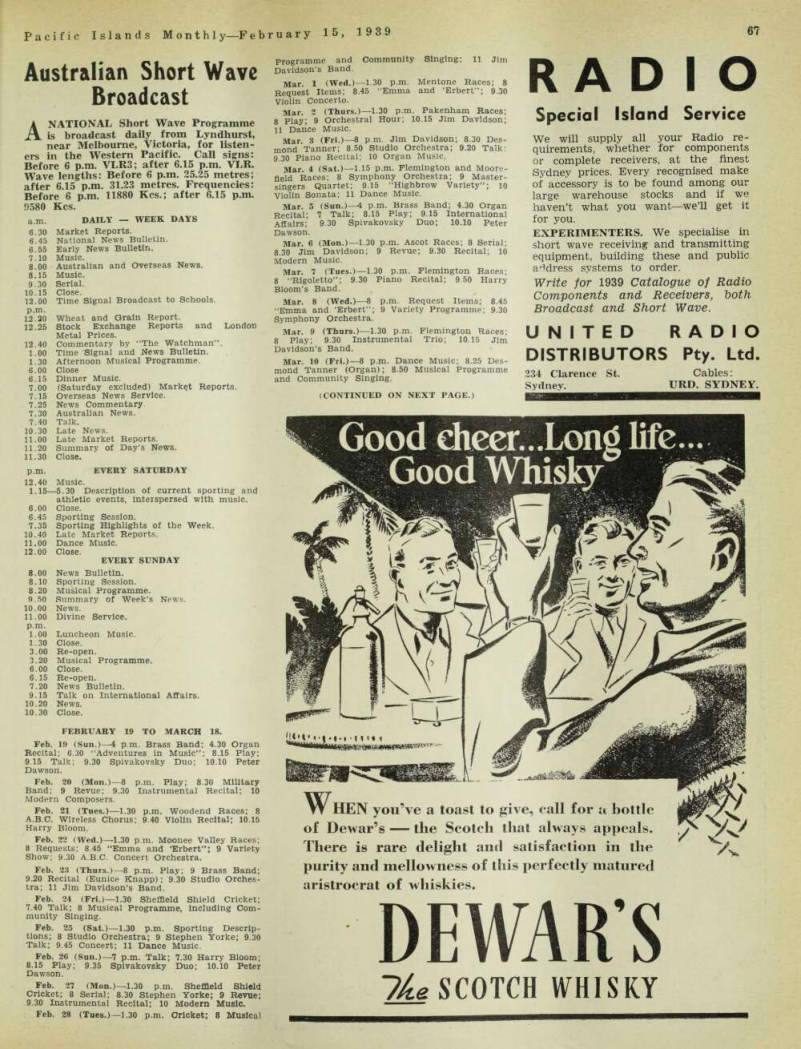
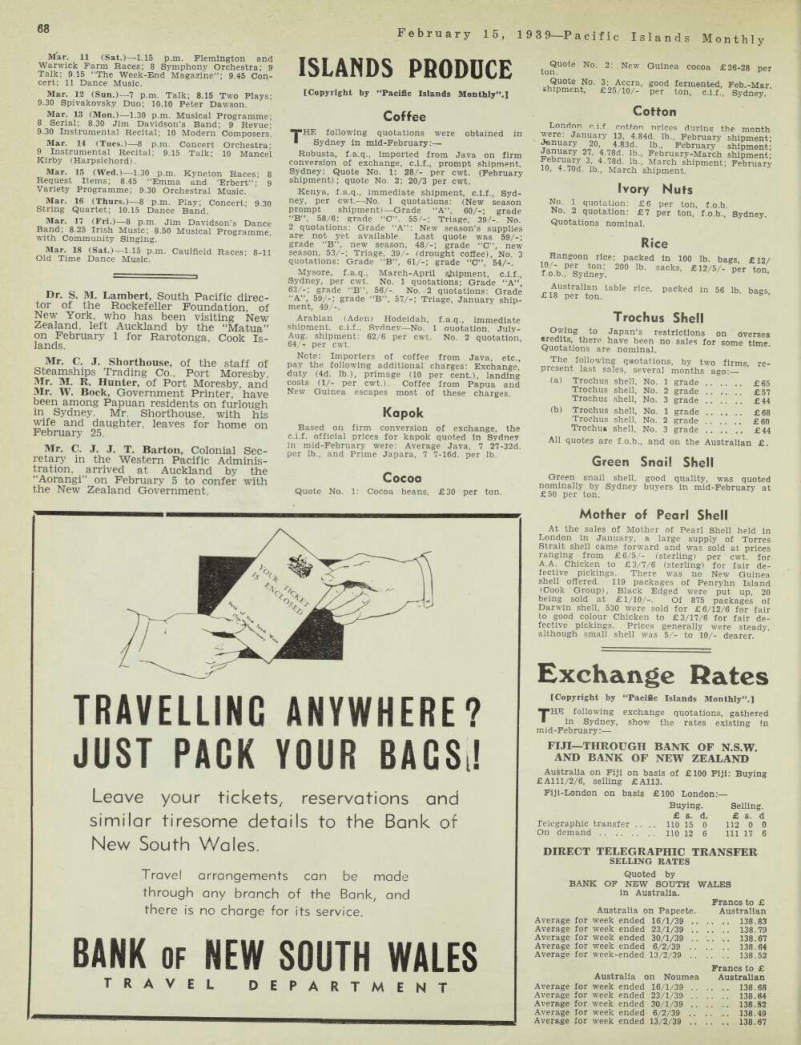
Broadcast
A NATIONAL Short Wave Programme
is broadcast daily from Lyndhurst, near Melbourne, Victoria, for listen ers in the Western Pacific. Call signs: Before 6 p.m. VLR3; after 6.15 p.m. VLR.
Wave lengths: Before 6 p.m. 25.25 metres; after 6.15 p.m. 31.23 metres. Frequencies: Before 6 p.m. 11880 Kcs.; after 6.15 p.m. 9580 Kcs.
A.M. Daily Week Days
6.30 Market Reports. 6.45 National News Bulletin. 6.55 Early News Bulletin. 7.10 Music. 8.00 Australian and Overseas News. 8.15 Music. 9.30 Serial. 10.15 Close. 12.00 Time Signal Broadcast to Schools, p.m. 12.20 Wheat and Grain Report. 12.25 Stock Exchange Reports and London Metal Prices. 12.40 Commentary by “The Watchman”. 1.00 Time Signal and News Bulletin. 1.30 Afternoon Musical Programme. 6.00 Close 6.15 Dinner Music. 7.00 (Saturday excluded) Market Reports. 7.15 Overseas News Service. 7.25 News Commentary 7.30 Australian News. 7.40 Talk. 10.30 Late News. 11.00 Late Market Reports. 11.20 Summary of Day’s News. 11.30 Close.
P.M. Every Saturday
12.40 Music. 1.15 —5.30 Description of current sporting and athletic events, interspersed with music. 6.00 Close. 6.45 Sporting Session. 7.35 Sporting Highlights of the Week. 10.40 Late Market Reports. 11.00 Dance Music. 12.00 Close.
Every Sunday
8.00 News Bulletin. 8.10 Sporting Session. 8.20 Musical Programme. 9.50 Summary of Week’s News. 10.00 News. 11.00 Divine Service, p.m. 1.00 Luncheon Music. 1.30 Close. 3.00 Re-open. 3.20 Musical Programme. 6.00 Close. 6.15 Re-open. 7.20 News Bulletin. 9.15 Talk on International Affairs. 10.20 News. 10.30 Close.
February 19 To March 18.
Feb. 19 (Sun.) —4 p.m. Brass Band; 4.30 Organ Recital: 6.30 “Adventures in Music”; 8.15 Play; 9.15 Talk; 9.30 Spivakovsky Duo; 10.10 Peter Dawson.
Feb. 20 (Mon.) —8 p.m. Play; 8.30 Military Band; 9 Revue; 9.30 Instrumental Recital; 10 Modern Composers.
Feb. 21 (Tues.) —1.30 p.m. Woodend Races; 8 A.B.C. Wireless Chorus; 9.40 Violin Recital; 10.15 Harry Bloom.
Feb. 22 (Wed.) —1.30 p.m. Moonee Valley Races; 8 Requests: 8.45 “Emma and ‘Erbert”; 9 Variety Show; 9.30 A.B.C. Concert Orchestra.
Feb. 23 (Thurs.)—B p.m. Play; 9 Brass Band; 9.20 Recital (Eunice Knapp); 9.30 Studio Orches tra; 11 Jim Davidson’s Band.
Feb. 24 (Fri.)—l.3o Sheffield Shield Cricket; 7.40 Talk; 8 Musical Programme, including Com munity Singing.
Feb. 25 (Sat.)—l.3o p.m. Sporting Descrip tions; 8 Studio Orchestra; 9 Stephen Yorke; 9.30 Talk; 9.45 Concert; 11 Dance Music.
Feb. 26 (Sun.) —7 p.m. Talk; 7.30 Harry Bloom; 8.15 Play; 9.35 Spivakovsky Duo; 10.10 Peter Dawson.
Feb. 27 (M0n.)—1.30 p.m. Sheffield Shield Cricket; 8 Serial; 8.30 Stephen Yorke; 9 Revue; 9.30 Instrumental Recital; 10 Modern Music.
Feb, 28 (Tues.)—l.3o p.m. Cricket; 8 Musical
Programme and Community Singing; 11 Jim Davidson’s Band.
Mar. 1 (Wed.) —1.30 p.m. Mentone Races; 8 Request Items; 8.45 “Emma and ’Erbert’’; 9.30 Violin Concerto.
Mar. 2 (Thurs.) —1.30 p.m. Pakenham Races; 8 Play; 9 Orchestral Hour; 10.15 Jim Davidson; 11 Dance Music.
Mar. 3 (Fri.) —8 p.m. Jim Davidson; 8.30 Des mond Tanner; 8.50 Studio Orchestra; 9.20 Talk; 9.30 Piano Recital; 10 Organ Music.
Mar. 4 (Sat.) —1.15 p.m. Flemington and Moore fleld Races; 8 Symphony Orchestra: 9 Master singers Quartet: 9.15 “Highbrow Variety”; 10 Violin Sonata; 11 Dance Music.
Mar. 5 (Sun.) —4 p.m. Brass Band; 4.30 Organ Recital; 7 Talk; 8.15 Play; 9.15 International Affairs: 9.30 Spivakovsky Duo; 10.10 Peter Dawson.
Mar. 6 (Mon.) —1.30 p.m. Ascot Races; 8 Serial; 8.30 Jim Davidson; 9 Revue; 9.30 Recital; 10 Modern Music.
Mar. 7 (Tues.) —1.30 p.m. Flemington Races; 8 “Rlgoletto”; 9.30 Piano Recital; 9.50 Harry Bloom’s Band.
Mar. 8 (Wed.) —8 p.m. Request Items; 8.45 “Emma and ’Erbert”; 9 Variety Programme; 9.30 Symphony Orchestra.
Mar. 9 (Thurs.) —1.30 p.m. Flemington Races; 8 Play; 9.30 Instrumental Trio; 10.15 Jim Davidson’s Band.
Mar. 10 (Fri.) —8 p.m. Dance Music; 8.25 Des mond Tanner (Organ); 8.50 Musical Programme and Community Singing.
(Continued On Next Page.)
Mar. 11 (Sat.)—l.ls p.m. Flemlngton and Warwick Farm Races; 8 Symphony Orchestra; 9 Talk; 9.15 “The Week-End Magazine”; 9.45 Con cert; 11 Dance Music.
Mar. 12 (Sun.)—7 p.m. Talk; 8.15 Two Plays; 9.30 Spivakovsky Duo; 10.10 Peter Dawson.
Mar. 13 (Mon.) —1.30 p.m. Musical Programme; 8 Serial; 8.30 Jim Davidson’s Band; 9 Revue; 9.30 Instrumental Recital; 10 Modern Composers.
Mar. 14 (Tues.) —8 p.m. Concert Orchestra; 9 Instrumental Recital; 9.15 Talk; 10 Mancel Kirby (Harpsichord).
Mar. 15 (Wed.) —1.30 p.m. Kyneton Races; 8 Request Items; 8.45 “Emma and ’Erbert”- 9 Variety Programme; 9.30 Orchestral Music.
Mar. 16 (Thurs.)— B p.m. Play; Concert; 9.30 String Quartet; 10.15 Dance Band.
Mar. 17 (Fri.)— B p.m. Jim Davidson’s Dance Band; 8.25 Irish Music; 8.50 Musical Programme with Community Singing.
Mar. 18 p.m. Caulfield Races; 8-11 Old Time Dance Music.
Dr. S. M. Lambert, South Pacific direc tor of the Rockefeller Foundation, of New York, who has been visiting New Zealand, left Auckland by the “Matua” on February 1 for Rarotonga. Cook Is lands.
Mr. C. J. Shorthouse, of the staff of Steamships Trading Co.. Port Moresby.
Mr. M. R. Hunter, of Port Moresby, and Mr. W. Bock, Government Printer, have been among Papuan residents on furlough in Sydney. Mr. Shorthouse. with his wife and daughter, leaves for home on February 25.
Mr. C. J. J. T. Barton, Colonial Sec retary in the Western Pacific Adminis tration. arrived at Auckland by the “Aorangi” on February 5 to confer with the New Zealand Government.
Advertisements & other items, pp. 69-70 (2 items)
67
Pacific Islands Monthl y—F ebruary 15, 1939
Dewar’S
RADIO
Special Island Service
We will supply all your Radio requirements, whether for components or complete receivers, at the finest Sydney prices. Every recognised make of accessory is to be found among our large warehouse stocks and if we haven’t what you want —we’ll get it for you.
EXPERIMENTERS. We specialise in short wave receiving and transmitting equipment, building these and public address systems to order.
Write for 1939 Catalogue of Radio
Components and Receivers, both
Broadcast and Short Wave.
UNITED RADIO
DISTRIBUTORS Pty. Ltd.
234 Clarence St. Cables: Sydney. URD. SYDNEY.
V o IS >p f¥ i !» H a * m y. \
SWBW
Whe
:n you’ve a toast to give, call for a bottle of Dewar’s the Scotch that always appeals.
There is rare delight and satisfaction in the purity and mellowness of this perfectly matured aristrocrat of whiskies.
DEWAR’S
~?/te SCOTCH WHISKY
>v / >■
TRAVELLING ANYWHERE?
JUST PACK YOUR BACSJ
Leave your tickets, reservations and similar tiresome details to the Bank of New South Wales.
Travel arrangements can be made through any branch of the Bank, and there is no charge for its service.
BANK OF NEW SOUTH WALES
travel department
Islands Produce
[Copyright by “Pacific Islands Monthly”.!
Coffee
THE following quotations were obtained in Sydney in mid-February;— Robusta, f.a.q., imported from Java on firm conversion of exchange, c.i.f., prompt shipment.
Sydney: Quote No. 1: 28/- per cwt. (February shipment); quote No. 2: 20/3 per cwt.
Kenya, f.a.q., immediate shipment, c.i.f., Syd ney, per cwt.—No. 1 quotations: (New season prompt shipment)—Grade “A”, 60/-; grade “B”. 58/6; grade “C”. 55/-; Triage. 39/-. No. 2 quotations: Grade “A”: New season’s supplies are not yet available. Last quote was 59/-; grade “B”, new season, 48/-; grade “C”, new season, 53/-; Triage, 39/- (drought coffee), No. 3 quotations: Grade “B”, 61/-; grade “C”, 54/-.
Mysore, f.a.q., March-April shipment, c.i.f., Sydney, per cwt. No. 1 quotations; Grade “A”, 63/-; grade “B”, 56/-. No. 2 quotations: Grade “A”, 59/-; grade “B”, 57/-; Triage, January ship ment, 49/-.
Arabian (Aden) Hodeidah, f.a.q., immediate shipment, c.i.f., Sydney—No. 1 Quotation, July- Aug. shipment: 62/6 per cwt. No. 2 quotation, 64/i per cwt.
Note; Importers of coffee from Java, etc., pay the following additional charges: Exchange, duty (4d. lb.), primage (10 per cent.), landing costs (1/- per cwt.). Coffee from Papua and New Guinea escapes most of these charges.
Kapok
Based on firm conversion of exchange, the c.i.f. official prices for kapok quoted in Sydney in mid-February were: Average Java, 7 27-32 d. per lb., and Prime Japara, 7 7-16 d. per lb.
Cocoa
Quote No. 1: Cocoa beans, £3O per ton.
ton U ° te N °' 2 " NeW Guinea cocoa £26-28 per Quote No. 3; Accra, good fermented, Feb.-Mar shipment, £25/10/- per ton, c.i.f., Sydney. *
Cotton
London c.i.f. cotton nrices during the month were; January 13, 4.84 d. lb., February shipment: January 20, 4.83 d. lb., February shipment; January 27, 4.78 d. lb., Pebruary-March shipment: 3 ’ 4-78 - Ib -> March shipment; February 10, 4.70 d. lb., March shipment.
Ivory Nuts
No. 1 quotation: £6 per ton, f.o b No. 2 quotation: £7 per ton, f.0.b., Sydney.
Quotations nominal.
Rice
Rangoon rice: packed in 100 lb. bags, £l2/ Sydney. 2 °° lb ’ SaCtS ' £l2/5/ ' pcr ton ' Australian table rice, packed in 56 lb. bags £lB per ton. 8 ’
Trochus Shell
Owing to Japan’s restrictions on oversea sredlts, there have been no sales for some time.
Quotations are nominal.
The following quotations, by two firms re present last sales, several months ago: (a) Trochus shell, No. 1 grade £65 Trochus shell, No. 2 grade .. . . .. £57 Trochus shell. No. 3 grade £44 (b) Trochus shell, No. 1 grade £6B Trochus shell, No. 2 grade £6O Trochus shell, No. 3 grade £44 All quotes are f.0.b., and on the Australian £.
Green Snail Shell
Green snail shell, good quality, was quoted nominally by Sydney buyers in mid-February at £5O per ton.
Mother of Pearl Shell
At the sales of Mother of Pearl Shell held in London in January, a large supply of Torres Strait shell came forward and was sold at prices ranging from £6/5/- (sterling) per cwt. for A.A. Chicken to £3/7/6 (sterling) for fair de fective pickings. There was no New Guinea shell offered. 119 packages of Penryhn Island (Cook Group), Black Edged were put up 20 being sold at £l/10/-. Of 875 packages of Darwin shell, 530 were sold for £6/12/6 for fair to good colour Chicken to £3/17/6 for fair de fective pickings. Prices generally were steady although small shell was 5/- to 10/- dearer.
Exchange Rates
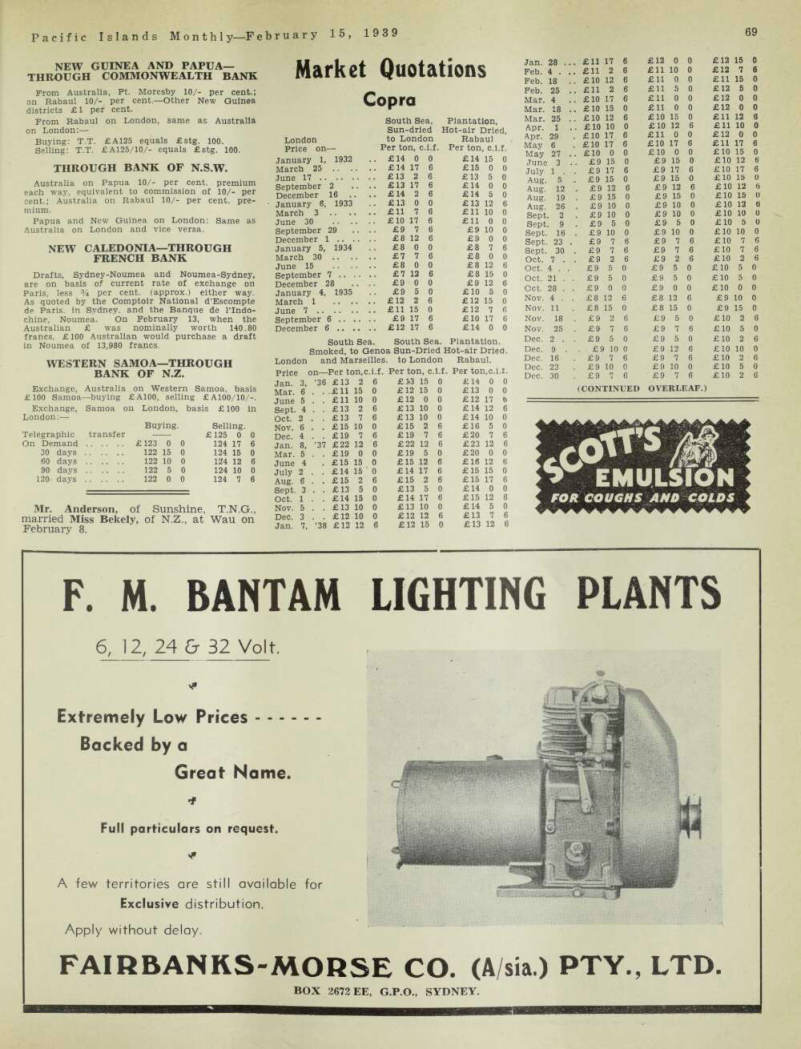
[Copyright by “Pacific Islands Monthly”.] THE following exchange quotations, gathered " in Sydney, show the rates existing in mid-February:—
Fiji—Through Bank Of N.S.W.
And Bank Of New Zealand
Australia on Fiji on basis of £lOO Fiji: Buying £AIII/2/6, selling £AII3.
Piji-London on basis £lOO London:—
Direct Telegraphic Transfer
Selling Rates
Quoted by
Bank Op New South Wales
in Australia.
Buying. Selling. £ s. d. £ s. d Telegraphic transfer ... 110 15 0 112 0 0 On demand 110 12 6 111 17 6
Francs to £ Australia on Papeete.
Australian Average for week ended 16/1/39 .. .. .. 138.83 Average for week ended 23/1/39 .. .. .. 138.79 Average for week ended 30/1/39 .. .. .. 138.67 Average for week ended 6/2/39 .. . . .. 138.64 Average for week-ended 13/2/39 . . . . .. 138.52 Francs to £ Australia on Noumea Australian Average for week ended 16/1/39 .. .. .. 138.68 Average for week ended 23/1/39 .. .. .. 138.64 Average for week ended 30/1/39 .. .. .. 138.52 Average for week ended 6/2/39 .. .. .. 138.49 Average for week ended 13/2/39 ..
New Guinea And Papua
Through Commonwealth Bank
From Australia, Pt. Moresby 10/- per cent.; on Rabaul 10/- per cent.—Other New Guinea districts £1 per cent.
From Rabaul on London, same as Australia on London: — Buying: T.T. £AI2S equals £stg. 100.
Selling: T.T. £AI2S/10/- equals £stg. 100.
Through Bank Of N.S.W.
Australia on Papua 10/- per cent, premium each way, equivalent to commission of 10/- per cent.; Australia on Rabaul 10/- per cent, pre mium.
Papua and New Guinea on London: Same as Australia on London and vice versa.
New Caledonia—Through
French Bank
Drafts, Sydney-Noumea and Noumea-Sydney, are on basis of current rate of exchange on Paris, less % per cent, (approx.) either way.
As quoted by the Comptoir National d’Escompte de Paris, in Sydney, and the Banque de ITndo chine, Noumea. On February 13, when the Australian £ was nominally worth 140.80 francs. £lOO Australian would purchase a draft in Noumea of 13,980 francs.
Western Samoa—Through
Bank Of N.Z.
Exchange, Australia on Western Samoa, basis £lOO Samoa—buying £AIOO, selling £AIOO/10/-.
Exchange, Samoa on London, basis £ 100 in London; —
Mr. Anderson, of Sunshine, T.N.G., married Miss Bekely, of N.Z., at Wau on February 8.
Buying. Selling.
Telegraphic transfer £ 125 0 0 On Demand £123 0 0 124 17 6 30 days 122 15 0 124 15 0 60 days 122 10 0 124 12 6 90 days 122 5 0 124 10 0 120 days 122 0 0 124 7 6
Market Quotations
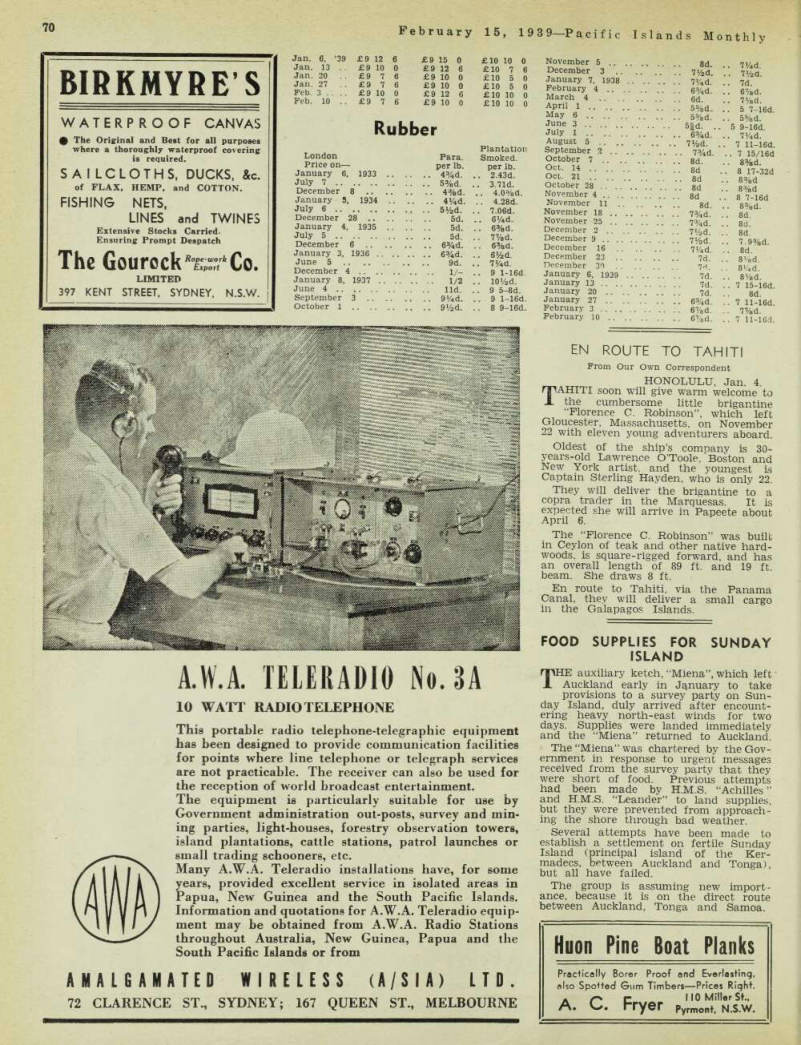
Jan. 28 .. . £11 17 6 £12 0 0 £12 15 0 Feb. 4 . . . £11 2 6 £11 10 0 £12 7 6 Feb. 18 . . £10 12 6 £11 0 0 £11 15 0 Feb. 25 . . £11 2 6 £11 5 0 £12 5 0 Mar. 4 . . £10 17 6 £11 0 0 £12 0 0 Mar. 18 . . £10 15 0 £11 0 0 £12 0 0 Mar. 25 . . £10 12 6 £10 15 0 £11 12 6 Apr. 1 . . £10 10 0 £10 12 6 £11 10 0 Apr. 29 . £10 17 6 £11 0 0 £12 0 0 May 6 . £10 17 6 £10 17 6 £11 17 6 May 27 . . £10 0 0 £10 0 0 £10 15 0 June 3 . . £9 15 0 £9 15 0 £10 12 6 July 1 . . £9 17 6 £9 17 6 £10 17 6 Aug. 5 . £9 15 0 £9 15 0 £10 15 0 Aug. 12 . £9 12 6 £9 12 6 £10 12 (j Aug. 19 . £9 15 0 £9 15 0 £10 15 (l Aug. 26 . £9 10 0 £9 10 0 £10 12 6 Sept . 2 . £9 10 0 £9 10 0 £10 10 0 Sept . 9 . £9 5 0 £9 5 0 £10 5 0 Sept. 16 . £9 10 0 £9 10 0 £10 10 0 Sept. 23 . £9 7 6 £9 7 6 £10 7 6 Sept. 30 . £9 7 6 £9 7 6 £10 7 6 Oct. 7 . . £9 2 6 £9 2 6 £10 2 6 Oct. 4 . . £9 5 0 £9 5 0 £10 5 0 Oct. 21 . . £9 5 0 £9 5 0 £10 5 0 Oct. 28 . . £9 0 0 £9 0 0 £10 0 0 Nov. 4 . . £8 12 6 £8 12 6 £9 10 0 Nov. 11 £8 15 0 £8 15 0 £9 15 0 Nov. 18 . £9 2 6 £9 5 0 £10 2 6 Nov. 25 . £9 7 6 £9 7 6 £10 5 0 Dec. 2 . £9 5 0 £9 5 0 £10 2 6 Dec. 9 . £9 10 0 £9 12 6 £10 10 0 Dec. 16 £9 7 6 £9 7 6 £10 2 6 Dec. 23 £9 10 0 £9 10 0 £10 5 0 Dec. 30 £9 7 6
(Continued
£9 7 6
Overleaf.)
£10 2 6
London Price on— January 1, 1932 March 25 .. .
Copra
South Sea, Plantation, Sun-dried Hot-air Dried, to London Rabaul Per ton, c.i.f. Per ton, c.l.f, .. £14 0 0 £14 15 0 . .. £14 17 6 £15 0 0 June 17 .. .. £13 2 6 £13 5 0 September 2 £13 17 6 £14 0 0 December 16 . £14 2 6 £14 5 0 January 6, 1933 March 3 .. . £13 0 0 £11 7 6 £13 £11 12 10 6 0 June 30 .. . £10 17 6 £11 0 0 September 29 £9 7 6 £9 10 0 December 1 .. £8 12 6 £9 0 0 January 5, 1934 March 30 .. . £8 0 0 £7 7 6 £8 £8 7 0 6 0 June 15 .. . £8 0 0 £8 12 6 September 7 .. £7 12 6 £8 15 0 December 28 . £9 0 0 £9 12 6 January 4, 1935 March 1 .. £9 5 0 £12 2 6 £10 £12 5 15 0 0 June 7 £11 15 0 £12 7 6 September 6 .. £9 17 6 £10 17 6 December 6 .. £12 17 6 £14 0 0 South Sea.
South Sea.
Plantation.
Smoked, to Genoa Sun-Dried Hot-air Dried.
London and Marseilles, to London Rabaul.
Price on—Per ton.c.i.f. Per ton, c.l.f. Per ton.c.i.r.
Jan. 3, ’36 £13 2 6 £ !*3 15 0 £14 0 0 Mar. 6 . . £11 15 0 £12 15 0 £13 0 0 June 5 . . £11 10 0 £12 0 0 £12 17 b Sept. 4 . . £13 2 6 £13 10 0 £14 12 6 Oct. 2 . . £13 7 6 £13 10 0 £14 10 0 Nov. 6 . . £15 10 0 £15 2 6 £16 5 0 Dec. 4 . . £19 7 6 £19 7 6 £20 7 6 Jan. 8, ’37 £22 12 6 £22 12 6 £23 12 6 Mar. 5 . . £19 0 0 £19 5 0 £20 0 0 June 4 . £15 15 0 £15 12 6 £16 12 6 July 2 . . £14 15 0 £14 17 6 £15 15 0 Aug. 6 . . £15 2 6 £15 2 6 £15 17 6 Sept. 3 . . £13 5 0 £13 5 0 £14 0 0 Oct. 1 . . £14 15 0 £14 17 6 £15 12 6 Nov. 5 . . £13 10 0 £13 10 0 £14 5 0 Dec. 3 . . £12 10 0 £12 12 6 £13 7 6 Jan. 7, ’38 £12 12 6 £12 15 0 £13 12 6
November 5 . .. 7>/ 4 d. • • 7y 2 d.
December 3 ..
January 7, 1938 .. .. 7d.
February 4 .. . .. 6 7 / a d.
March 4 .. 7y a d.
April 1 .. .. 5 7-16d.
May 6 . . .. 5 5 /ad.
June 3 .. . 5 9-16d.
July 1 .. 7»/ 4 d.
August 5 . 7 ll-16d.
September 2 ..
October 7 ..
Oct. 14 .. .. 7 15/16d . . 8%d. . 8 17-32d Oct. 21 ,. .
October 28 .. 8%d R3/-H November 4 • • 0/811
O N 1 Oa
November 11 .
• O (-Xoq
.. 8 3 / a d.
November 18 .. .. .. 8d.
November 25 . . . 8d.
December 2 .. . . 8d.
December 9 .. .. .. 7.9%d.
December 16 .. .. 7y 4 d. .. 8d.
December 23 .. .. 7d. .. 8y a d.
December 30 .. .. 7H. 8V 4 d.
January 6, 1939 .. . .. sy a d.
January 13 . . .. 7 15-16d.
January 20 .. .. 8d.
January 27 .. . .. 7 ll-16d.
February 3 7 7 / a d.
February 10 .. .. 7 ll-16d.
Jan. 6, ’39 £9 12 6 £9 15 0 £ 10 10 0 Jan, 13 .. £9 10 0 £9 12 6 £10 7 6 Jan. 20 £9 7 6 £9 10 0 £10 5 0 Jan. 27 £9 7 6 £9 10 0 £10 5 0 Peb. 3 .. .. £9 10 0 £9 12 6 £ 10 10 0 Feb. 10 .. £9 7 6 £9 10 0 £10 10 0
Rubber
London Plantation Para.
Smoked.
Price on— per lb. per lb.
January 6, 1933 .. 2.43d.
July 7 .. .. 3.71d.
December 8 .. .. 4.0%d.
January 5, 1934 .. 4.28d.
July 6 .. .. 7.06d.
December 28 . .. 6y 4 d.
January 4, 1935 . . .. 5d. .. 6%d.
July 5 .. .. 7%d.
December 6 . . .. 6%d.
January 3, 1936 .. ey 2 d.
June 5 9d. .. 7y.d.
December 4 1 .. .. 9 l-16d.
January 8, 1937 .. .. 1/2 .. ioy 2 d.
June 4 .. .. 9 5-8d.
September 3 . .. 9 l-16d.
October 1 . .. 9y 2 d. .. 8 9-16d.
Advertisements & other items, pp. 71-72 (2 items)
69
Pacific Islands Monthl y—F ebruary 15, 1939
F. M. Bantam Lighting Plants
Jr*»
6, 12, 24 & 32 Volt. ! .
Extremely Low Prices Backed by a Great Name. •f Full particulars on request. * A few territories are still available for Exclusive distribution.
Apply without delay.
FAIRBANKS-MORSE CO. (A/sia.) PTY., LTD
BOX 2672 EE, G.P.0., SYDNEY.
BIRKMYRE’S
WATERPROOF CANVAS
The Original and Best for all purposes where a thoroughly waterproof covering is required.
S A I LCLOTHS, DUCKS, &c.
of FLAX. HEMP, and COTTON.
FISHING NETS,
LINES and TWINES
Extensive Stocks Carried- Ensuring Prompt Despatch
The Gourock*r P r 4 Co.
LIMITED
397 KENT STREET, SYDNEY, N.S.W.
'•V f Q¥
A.W.A. TELERADIO No. 3A
10 WATT RADIOTELEPHONE
This portable radio telephone-telegraphic equipment has been designed to provide communication facilities for points where line telephone or telegraph services are not practicable. The receiver can also be used for the reception of world broadcast entertainment.
The equipment is particularly suitable for use by Government administration out-posts, survey and mining parties, light-houses, forestry observation towers, island plantations, cattle stations, patrol launches or small trading schooners, etc.
Many A.W.A. Teleradio installations have, for some years, provided excellent service in isolated areas in Papua, New Guinea and the South Pacific Islands.
Information and quotations for A.W.A. Teleradio equipment may be obtained from A.W.A. Radio Stations throughout Australia, New Guinea, Papua and the South Pacific Islands or from
AMALGAMATED WIRELESS (A/SIA) LTD.
72 CLARENCE ST., SYDNEY; 167 QUEEN ST., MELBOURNE
En Route To Tahiti
Prom Our Own Correspondent
Honolulu, Jan. 4.
TAHITI soon will give warm welcome to the cumbersome little brigantine “Florence C. Robinson”, which left Gloucester, Massachusetts, on November 22 with eleven young adventurers aboard.
Oldest of the ship’s company is 30years-old Lawrence O’Toole. Boston and New York artist, and the youngest is Captain Sterling Hayden, who is only 22.
They will deliver the brigantine to a copra trader in the Marquesas. It is expected she will arrive in Papeete about April 6.
The “Florence C. Robinson” was built in Ceylon of teak and other native hard woods, is square-rigged forward, and has an overall length of 89 ft. and 19 ft. beam. She draws 8 ft.
En route to Tahiti, via the Panama Canal, they will deliver a small cargo in the Galapagos Islands.
Food Supplies For Sunday
Island
mHE auxiliary ketch, “Miena”, which left X Auckland early in January to take provisions to a survey party on Sun day Island, duly arrived after encount ering heavy north-east winds for two days. Supplies were landed immediately and the “Miena” returned to Auckland.
The “Miena” was chartered by the Gov ernment in response to urgent messages received from the survey party that they were short of food. Previous attempts had been made by H.M.S. “Achilles ” and H.M.S. “Leander” to land supplies, but they were prevented from approach ing the shore through bad weather.
Several attempts have been made to establish a settlement on fertile Sunday Island (principal island of the Ker madecs, between Auckland and Tonga), but all have failed.
The group is assuming new import ance, because it is on the direct route between Auckland, Tonga and Samoa.
Advertisements & other items, p. 72 (2 items)
70
February 15, 193 9—P acific Islands Monthly
Huon Pine Boat Planks
Practically Borer Proof and Everlasting, also Spotted Gum Timbers—Prices Right.
A n 110 Miller St., A* » ry©T Pyrmont, N.S.W.
Shipping Services in the Pacific
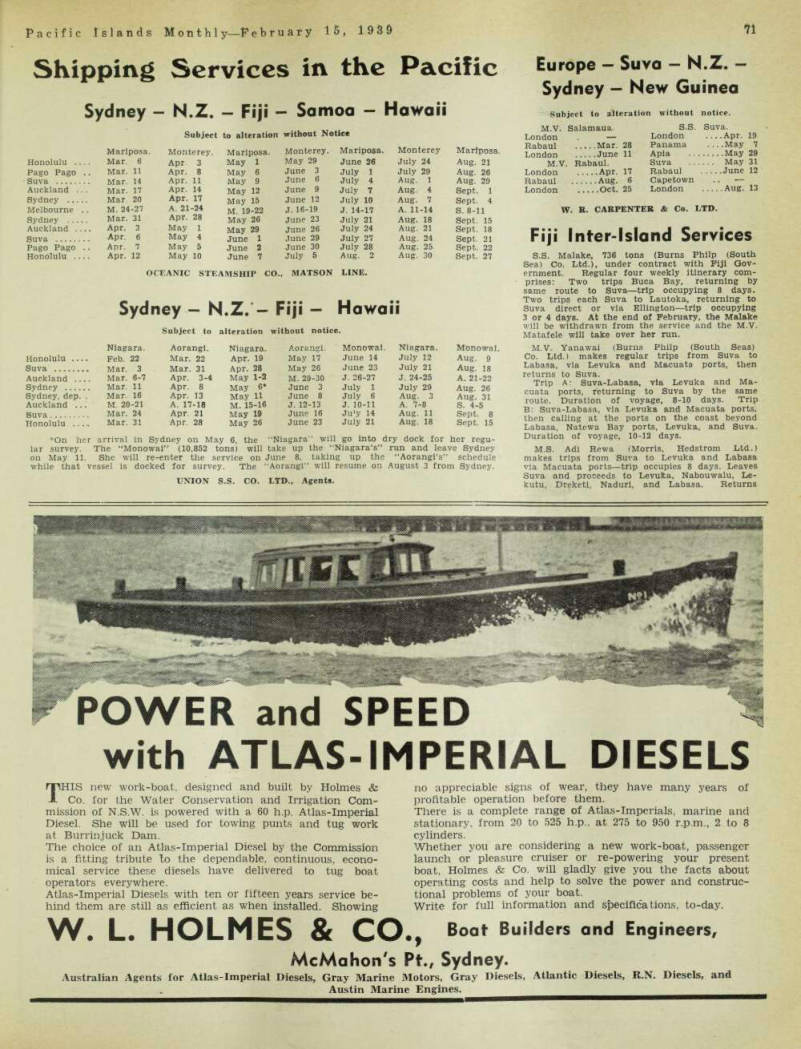
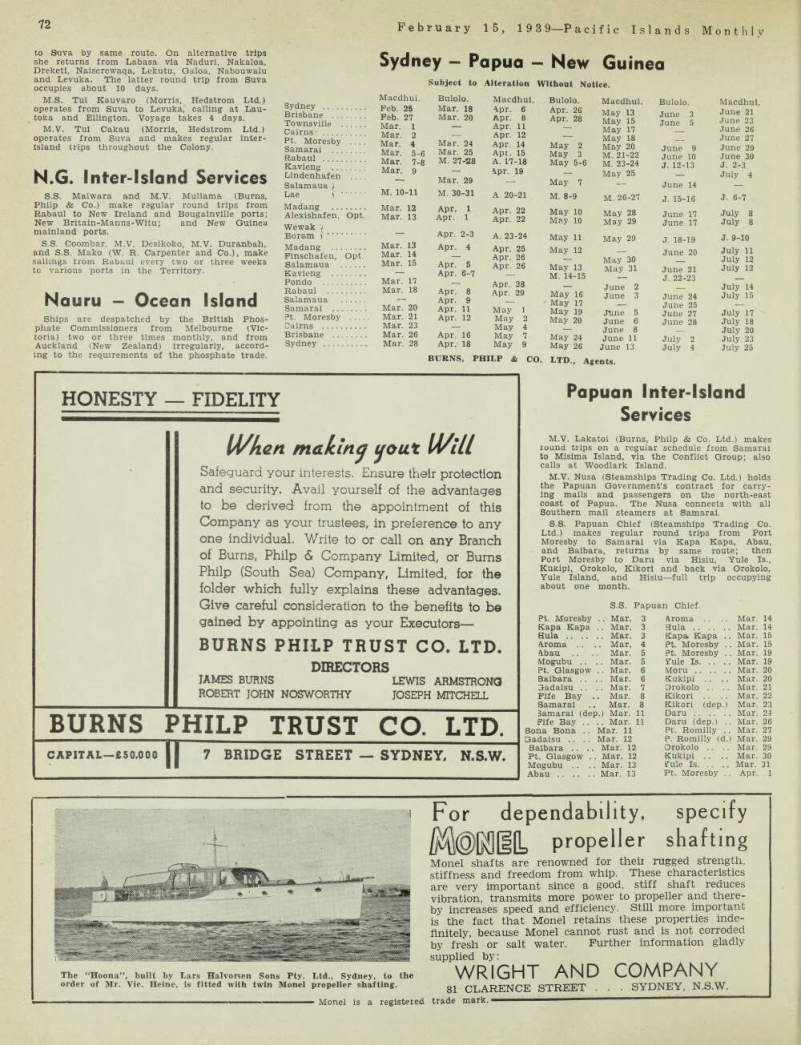
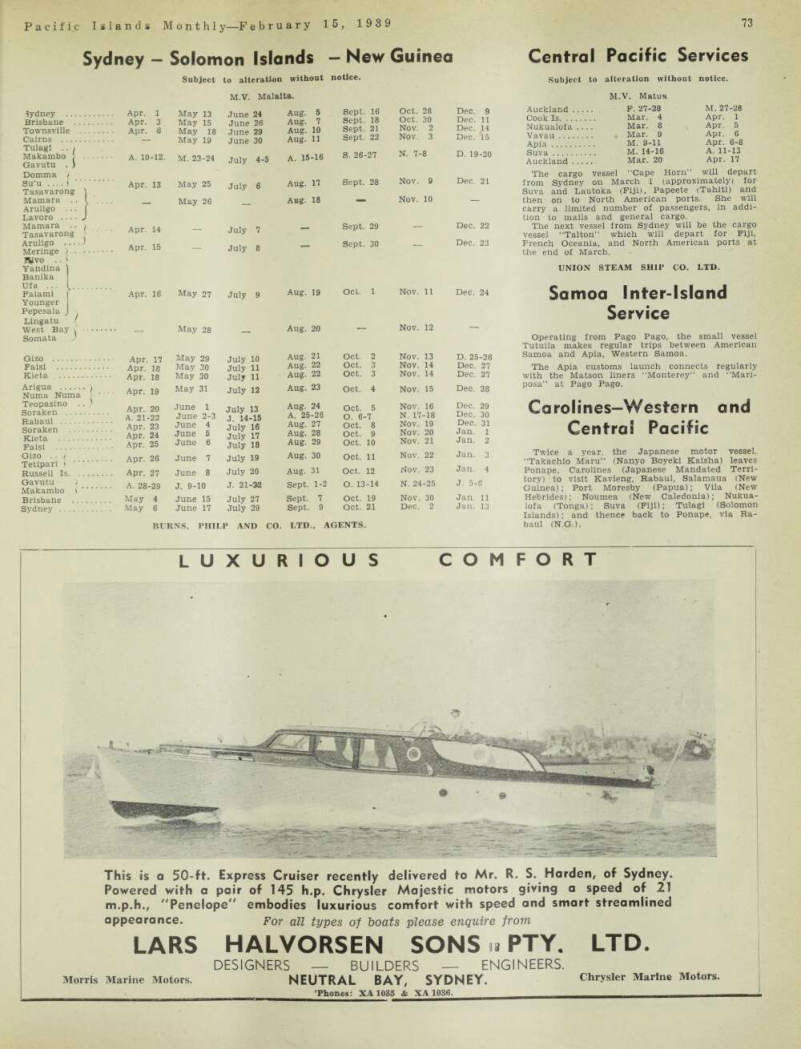
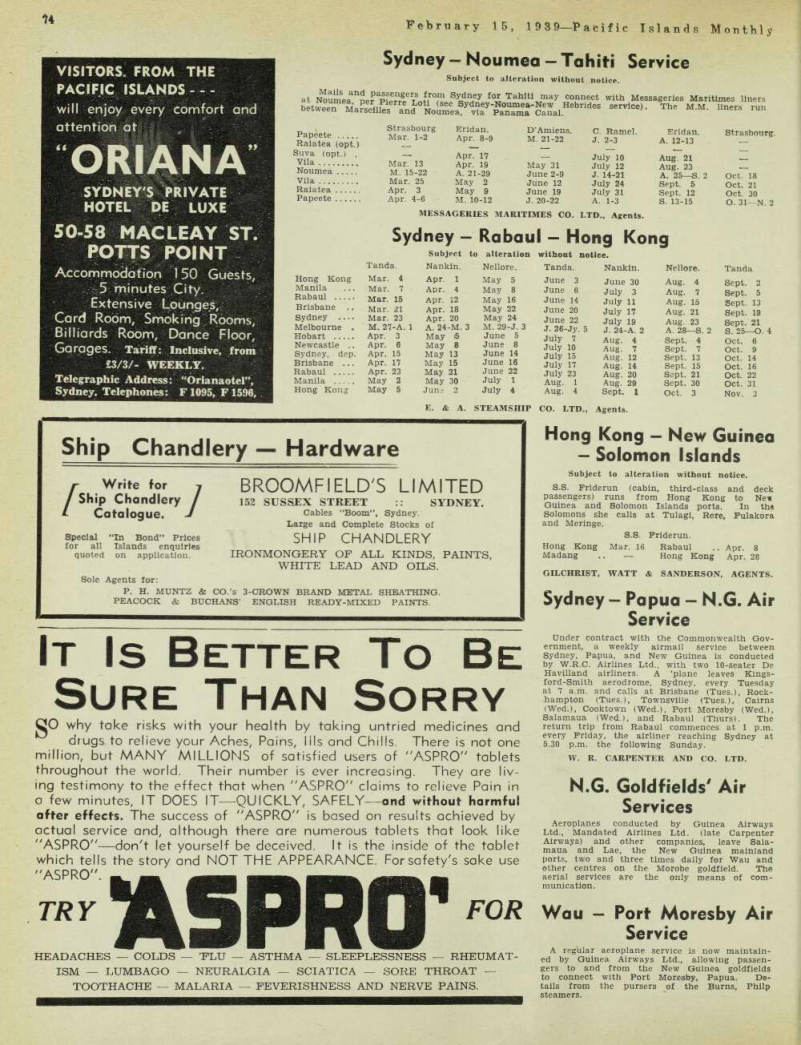
Sydney - N.Z. - Fiji - Samoo - Hawaii Subject to alteration without Notice
Sydney - N.Z.’- Fiji - Hawaii Subject to alteration without notice.
Europe Suvo - N.Z. - Sydney - New Guinea
Fiji Inter-Island Services
S.S. Malake, 736 tons (Burns Phllp (South Sea) Cos. Ltd.), under contract with Fiji Gov ernment. Regular four weekly itinerary com prises: Two trips Buca Bay, returning by same route to Suva —trip occupying 8 days.
Two trips each Suva to Lautoka, returning to Suva direct or via Ellington—trip occupying 3 or 4 days. At the end of February, the Malake will be withdrawn from the service and the M.V.
Matafele will take over her run.
M.V. Yanawai (Burns Philp (South Seas) Cos. Ltd.) makes regular trips from Suva to Labasa, via Levuka and Macuata ports, then returns to Suva.
Trip A; Suva-Labasa, via Levuka and Ma cuata ports, returning to Suva by the same route. Duration of voyage, 8-10 days. Trip B: Suva-Labasa, via Levuka and Macuata ports, then calling at the ports on the coast beyond Labasa, Natewa Bay ports, Levuka, and Suva.
Duration of voyage, 10-12 days.
M.S. Adi Rewa (Morris, Hedstrom Ltd.) makes trips from Suva to Levuka and Labasa via Macuata ports—trip occupies 8 days. Leaves Suva and proceeds to Levuka, Nabouwalu, Le kutu, Dreketi, Naduri, and Labasa. Returns
Mariposa.
Monterey.
Mariposa.
Monterey.
Mariposa.
Monterey Mariposa.
Honolulu Mar. 6 Apr 3 May 1 May 29 June 26 July 24 Aug. 21 Pago Pago ..
Mar. 11 Apr. 8 May 6 June 3 July 1 July 29 Aug. 26 Suva Mar. 14 Apr. 11 May 9 June 6 July 4 Aug. 1 Aug. 29 Auckland ...
Mar. 17 Apr. 14 May 12 June 9 July 7 Aug. 4 Sept. 1 Sydney Mar. 20 Apr. 17 May 15 June 12 July 10 Aug. 7 Sept. 4 Melbourne ..
M. 24-27 A. 21-24 M. 19-22 J. 16-19 J. 14-17 A. 11-14 S. 8-11 Sydney Mar. 31 Apr. 28 May 26 June 23 July 21 Aug. 18 Sept. 15 Auckland Apr. 3 May 1 May 29 June 26 July 24 Aug. 21 Sept. 18 Suva Apr. 6 May 4 June 1 June 29 July 27 Aug, 24 Sept. 21 Pago Pago ..
Apr. 7 May 5 June 2 June 30 July 28 Aug. 25 Sept. 22 Honolulu Apr. 12 May 10 June 7 July 5 Aug. 2 Aug. 30 Sept. 27
Oceanic Steamship Co.
, Matson
Line.
Niagara.
Aorangl.
Niagara.
Aorangi.
Monowal.
Niagara.
Monowal.
Honolulu ...
Feb. 22 Mar. 22 Apr. 19 May 17 June 14 July 12 Aug. 9 Suva . Mar. 3 Mar. 31 Apr. 28 May 26 June 23 July 21 Aug. 18 Auckland ...
Mar. 6-7 Apr. 3-4 May 1-2 M. 29-30 J. 26-27 J. 24-25 A. 21-22 Sydney Mar. 11 Apr. 8 May 6* June 3 July 1 July 29 Aug. 26 Sydney, dep.
Mar. 16 Apr. 13 May 11 June 8 July 6 Aug. 3 Aug. 31 Auckland .., M. 20-21 A. 17-18 M. 15-16 J. 12-13 J. 10-11 A. 7-8 S. 4-5 Suva Mar. 24 Apr. 21 May 19 June 16 Ju'y 14 Aug. 11 Sept. 8 Honolulu ...
Mar. 31 Apr. 28 May 26 June 23 July 21 Aug. 18 Sept. 15 *On her arrival in Sydney on May 6, the “Niagara” will go into dry dock for her regular survey.
The “Monowal’
' (10,852 tons) will take up the “ Niagara’s” run and leave Sydney on May 11.
She will re-enter the service on June 8, taking up the “Aorangi's” schedule while that vessel is docked for survey. The ‘ ‘Aorangi” will resume on August 3 from Sydney.
Union
S.S. Co.
LTD., Agents.
Subject to alteration without notice.
M.V. Salamaua. S.S. Suva.
London — London Apr. 19 Rabaul Mar. 28 Panama May 7 London June 11 Apia May 29 M.V. Rabaul. Suva May 31 London Apr. 17 Rabaul June 12 Rabaul Aug. 6 Capetown .. — London Oct. 25 London Aug. 13
W. E. Carpenter & Co. Ltd.
to Suva by same route. On alternative trips she returns from Labasa via Naduri, Nakaloa.
Dreketl, Naiserewaqa, Lekutu, Galoa, Nabouwalu and Levuka. The latter round trip from Suva occupies about 10 days.
M.S. Tul Kauvaro (Morris, Hedstrom Ltd.) operates from Suva to Levuka, calling at Lau toka and Ellington. Voyage takes 4 days.
M.V. Tui Cakau (Morris, Hedstrom Ltd.) operates from Suva and makes regular inter island trips throughout the Colony.
N.G. Inter-Island Services
5.5. Maiwara and M.V. Muliama (Burns, Philp & Cos.) make regular round trips from Rabaul to New Ireland and Bougainville ports; New Britain-Manus-Witu; and New Guinea mainland ports. 5.5. Coombar, M.V. Desikoko, M.V. Duranbah, and S.S. Mako (W. R. Carpenter and Cos.), make sailings from Rabaul every two or three weeks to various ports in the Territory.
Nauru - Ocean Island
Ships are despatched by the British Phos phate Commissioners from Melbourne (Vic toria) two or three times monthly, and from Auckland (New Zealand) irregularly, accord ing to the requirements of the phosphate trade.
Sydney — Papua — New Guinea Subject to Alteration Without Notice.
Papuan Inter-Island
Services
M.V. Lakatoi (Burns, Philp & Co. Ltd.) makes round trips on a regular schedule from Samarai to Mlsima Island, via the Conflict Group; also calls at Woodlark Island.
M.V. Nusa (Steamships Trading Co. Ltd.) holds the Papuan Government’s contract for carry ing malls and passengers on the north-east coast of Papua. The Nusa connects with all Southern mail steamers at Samarai.
S.S. Papuan Chief (Steamships Trading Co.
Ltd.) makes regular round trips from Port Moresby to Samarai via Kapa Kapa, Abau, and Balbara, returns by same route; then Port Moresby to Daru via Hisiu, Yule Is., Kukipl, Orokolo, Kikori and back via Orokolo, Yule Island, and Hisiu—full trip occupying about one month.
Sydney Brisbane ...
Townsville Cairns Pt. Moresby Samarai ...
Macdhul.
Feb. 25 Feb. 27 Mar. 1 Mar. 2 Mar. 4 Mar. 5-6 Mar. 7-8 Mar. 9 M. 10-11 Mar. 12 Mar. 13 Bulolo.
Mar. 18 Mar. 20 Mar. 24 Mar. 25 M. 27-28 Mar. 29 M. 30-31 Apr. 1 Apr. 1 Apr. 2-3 Apr. 4 Apr. 5 Apr. 6-7 Macdhul.
Apr. 6 Apr. 8 Apr. 11 Apr. 12 Apr. 14 Apr. 15 A. 17-18 Apr. 19 Bulolo.
Apr. 26 Apr. 28 May 2 May 3 May 5-6 May 7 Macdhul.
May 13 May 15 May 17 May 18 May 20 Bulolo.
June 3 June 5 June 9 Macdhul.
June 21 June 23 June 26 June 27 June 29 Rabaul Kavieng ...
Lindenhafen Salamaua > M. 21-22 M. 23-24 May 25 June 10 J. 12-13 June 14 June 30 J. 2-3 July 4 Lae ) ’
Madang A. 20-21 Apr. 22 Apr. 22 M. 8-9 M. 26-27 J. 15-16 J. 6-7 Alexishafen, Wewak > Opt.
May 10 May 10 May 28 May 29 June 17 June 17 July 8 July 8 Boram y • ‘ - Madang ...
Pinschafen, Salamaua Opt.
Mar. 13 Mar. 14 Mar. 15 A. 23-24 Apr. 25 Apr. 26 Apr. 26 Apr. 28 Apr. 29 May 11 May 12 May 13 M. 14-15 May 29 May 30 May 31 J, 18-19 June 20 J. 9-10 July 11 July 12 July 12 Kavieng . ..
Pondo Mar. 17 June 21 J. 22-23 Rabaul . ...
Mar. 18 Apr. 8 Apr. 9 Apr. 11 Apr. 12 May 16 May 17 May 19 May 20 June 2 — July 14 Salamaua June 3 June 24 July 15 Samarai Mar. 20 May 1 May 2 iv/r q \r d — June 25 — Pt. Moresby Cairns Mar. 21 Mar. 23 June 5 June 6 June 27 June 28 July 17 July 18 July 20 July 23 July 25 Brisbane ...
Sydney Mar. 26 Mar. 28 Apr. 16 May 7 Apr. 18 May 9
Burns, Philp & Co.
— June o May 24 June 11 May 26 June 13 LTD., Agents.
July 2 July 4
S.S. Papuan Chief.
Pt. Moresby .. Mar. 3 Aroma ..
Mar. 14 Kapa Kapa .. Mar. 3 Hula Mar. 14 Hula .. .. 3 Kapa Kapa ..
Mar. 15 Aroma .. Mar. 4 Pt. Moresby ..
Mar. 15 Abau ..
Mar. 5 Pt. Moresby ..
Mar. 19 Mogubu .. .. Mar. 5 5fule Is Mar. 19 Pt. Glasgow .. Mar. 6 Moru Mar. 20 Baibara .. .. Mar. 6 Kukipi .. ..
Mar. 20 Uadaisu .. .. Mar. 7 Orokolo ..
Mar. 21 Fife Bay . . Mar. 8 Kikori ..
Mar. 22 Samaral Mar. 8 Kikori (dep.) Mar. 23 Samara! (dep.) Mar. ; 11 Daru Mar. 24 Fife Bay .. .. Mar. 11 Daru (dep.) ..
Mar. 26 Bona Bona ..
Mar. 11 Pt. Romilly ..
Mar. 27 Gadaisu ..
Mar. 12 P. Romilly (d.) Mar. 29 Baibara ..
Mar. 12 Drokolo ..
Mar. 29 Pt. Glasgow . . Mar. 12 Kukipi .. ..
Mar. 30 Mogubu .. , Mar. 13 STule Is Mar. 31 Abau Mar. 13 Pt. Moresby ..
Apr. 1
Sydney - Solomon Islands - New Guinea Subject to alteration without notice.
M.V. Malaita.
Central Pacific Services
The cargo vessel “Cape Horn” will depart from Sydney on March 1 (approximately) for Suva and Lautoka (Fiji), Papeete (Tahiti) and then on to North American ports. She will carry a limited number of passengers, in addi tion to mails and general cargo.
The next vessel from Sydney will be the cargo vessel “Talton” which will depart for Fiji, French Oceania, and North American ports at the end of March.
Union Steam Ship Co. Ltd.
Samoa Inter-Island
Service
Operating from Pago Pago, the small vessel Tutuila makes regular trips between American Samoa and Apia, Western Samoa.
The Apia customs launch connects regularly with the Matson liners “Monterey” and “Mari posa” at Pago Pago.
Carolines-Western and
Central Pacific
Twice a year, the Japanese motor vessel, “Takachio Maru” (Nanyo Boyeki Kaisha) leaves Ponape, Carolines (Japanese Mandated Terri tory) to visit Kavieng, Rabaul, Salamaua (New Guinea); Port Moresby (Papua); Vila (New Hebrides); Noumea (New Caledonia); Nukua lofa (Tonga); Suva (Fiji); Tulagl (Solomon Islands); and thence back to Ponape, via Ra baul (N.G.).
Sydney Rrlshanp Apr. 3 May 13 May 15 May 18 May 19 M. 23-24 May 25 May 26 June 24 June 26 June 29 June 30 July 4-5 July 6 July 7 July 8 Aug. 5 Aug. 7 Aug. 10 Aug. 11 A. 15-16 Aug. 17 Aug. 18 Sept. 16 Sept. 18 Oct. 28 Oct. 30 Dec.
Dec. 9 11 Tnwnsvlllp . . Apr. 6 Sept. 21 Nov. 2 Dec. 14 Claims Sept. 22 Nov. 3 Dec. 15 Tulagl . . 1
Makambo [
Gavutu . ) Domma Su’u 3 Tasavarong 3 Mamara .. 1 Aruligo ... j Lavoro J Mamara .. i Tasavarong Aruligo ) A. 10-12.
Apr. 13 Apr. 14 Apr. 15 S. 26-27 Sept. 28 Sept. 29 Sept. 30 N. 7-8 Nov. 9 Nov. 10 D. 19-20 Dec. 21 Dec. 22 Dec. 23 IVvo .
Yandina Banika Ufa ...
Oct. 1 Nov. 11 Nov. 12 Paiami Younger Pepesala Llngatu ) Apr. 16 May 27 May 28 July 9 Aug. 19 Aug. 20 Dec. 24 West DtXy Somata J Gizo May 29 May 30 Mp v July 10 Tnlv 11 Aug. 21 Oct. 2 Nov. 13 D. 25-26 Paisi ...
A nr IP Aug. 22 Oct. 3 Nov. 14 Dec. 27 io juiy i-i July 11 July 12 July 13 J. 14-15 July 16 Aug. 22 Aug. 23 Aug. 24 A. 25-26 Aug. 27 Aug. 28 Oct. 3 Nov. 14 Dec. 27
Arigua )
Numa Numa Teopasino .. ) Soraken Rabaul Stnralrpn Apr. 19 Apr. 20 A. 21-22 Apr. 23 Lvxay ju May 31 June 1 June 2-3 June 4 Oct. 4 Oct. 5 O. 6-7 Oct. 8 Nov. 15 Nov. 16 N. 17-18 Nov. 19 Nov. 20 Nov. 21 Dec.
Dec.
Dec.
Dec. 28 29 30 31 1 Kieta Apr. 24 June 5 July 17 Oct. 9 Jan.
Paisi Apr. 25 June 6 July 18 Aug. 29 Oct. 10 jan. 2 Gizo .. i Apr. 26 June 7 July 19 July 20 Aug. 30 Oct. 11 Nov. 22 Jan. 3 Tetipan i RiisspII Ts Apr. 27 June 8 Aug. 31 Oct. 12 Nov. 23 Jan. 4 Gavutu ) A 28-29 J. 9-10 June 15 J. 21-22 Sept. 1-2 Sept. 7 O.13-14 N. 24-25 J. 5g Makambo Brisbane S ** May 4 July 27 Oct. 19 Nov. 30 Jan. 11 Sydney ..
May 6 June 17 July 29 Sept. 9 Oct. 21 Dec. 2 Jan. 13
Burns, Philp And Co.
Ltd., Agents.
Subject to alteration without notice.
M.V. Matua Auckland P. 27-28 M. 27-28 Cook Is Mar. 4 Apr. 1 Nukualofa Mar. 8 Apr. 5 Vavau Mar. 9 Apr. 6 Apia M. 9-11 Apr. 6-8 Suva M. 14-16 A. 11-13 Auckland Mar. 20 Apr. 17
Sydney Noumea Tahiti Service
Subject to alteration without notice. at I^um S ea an DerpS e ? n H 0 , n .'. Sy =a ey to l Tahltl „ may 00nnect » iu > Messageries Maritime* liners SerylM) - The MM '
Sydney - Rabaul - Hong Kong Subject to alteration without notice.
Hong Kong New Guinea
- Solomon Islands
Subject to alteration without notice.
S.S. Priderun (cabin, third-class and deck passengers) runs from Hong Kong to Nen Guinea and Solomon Islands ports. In ths Solomons she calls at Tulagi, Here, Pulakora and Meringe.
S.S. Priderun.
Hong Kong Mar. 16 Rabaul .. Apr. 8 Madang .. Hong Kong Apr. 28
Gilchrist, Watt & Sanderson, Agents.
Sydney - Papua - N.G. Air
Service
Under contract with the Commonwealth Gov ernment, a weekly airmail service between Sydney, Papua, and New Guinea is conducted by W.R.C. Airlines Ltd., with two 10-seater De Havilland airliners. A ’plane leaves Kings ford-Smith aerodrome, Sydney, every Tuesday at 7 a.m. and calls at Brisbane (Tues.), Rock hampton (Tues.), Townsville (Tues.), Cairns (Wed.), Cooktown (Wed.), Port Moresby (Wed.), Salamaua (Wed.), and Rabaul (Thurs). The return trip from Rabaul commences at 1 p.m. every Friday, the airliner reaching Sydney at 5.30 p.m. the following Sunday.
W. R. Carpenter And Co. Ltd.
N.G. Goldfields' Air
Services
Aeroplanes conducted by Guinea Airways Ltd., Mandated Airlines Ltd. (late Carpenter Airways) and other companies, leave Sala maua and Lae, the New Guinea mainland ports, two and three times daily for Wau and other centres on the Morobe goldfield. The aerial services are the only means of com munication.
Wau Port Moresby Air
Service
A regular aeroplane service is now maintain ed by Guinea Airways Ltd., allowing passen gers to and from the New Guinea goldfields to connect with Port Moresby, Papua. De tails from the pursers of the Burns, Philp steamers.
Papeete Raiatea (opt.) Strasbourg Mar. 1-2 Eridan.
Apr. 8-9 D’Amiens.
M. 21-22 C. Ramel.
J. 2-3 Eridan.
A. 12-13 Strasbourg.
Suva (opt.) .
Vila — Apr. 17 July 10 Aug. 21 Mar. 13 Apr. 19 May 31 July 12 Aug. 23 Noumea M. 15-22 A. 21-29 June 2-9 J. 14-21 A. 25—S. 2 Oct. 18 Vila Mar. 25 May 2 June 12 July 24 Sept. 5 Oct. 21 Raiatea Apr. 3 May 9 June 19 July 31 Sept. 12 Oct. 30 Papeete Apr. 4-6 M. 10-12 J. 20-22 A. 1-3 S. 13-15 O. 31—N. 2
Messageries
Imaritimes Co.
LTD., Agents.
Tanda.
Nankin.
Nellore.
Tanda.
Nankin.
Nellore.
Tanda Hong Kong Mar. 4 Apr. 1 May 5 June 3 June 30 Aug. 4 Sept. 2 Manila Rabaul Mar. 7 Apr. 4 May 8 June 6 July 3 Aug. 7 Sept. 5 Mar. 15 Apr. 12 May 16 June 14 July 11 Aug. 15 Sept. 13 Brisbane Mar. -21 Apr. 18 May 22 June 20 July 17 Aug. 21 Sept. 19 Sept. 21 S. 25—O. 4 Sydney Melbourne .
Mar. 23 M, 27-A. 1 Apr. 20 A. 24-M. 3 May 24 M. 29-J. 3 June 22 J. 26-Jy. 5 July 19 J. 24-A. 2 Aug. 23 A. 28—S. 2 Hobart Newcastle ..
Sydney, dep.
Apr. 3 Apr. 6 Apr. 15 May (5 May 8 May 13 June 5 June 8 June 14 July 7 July 10 July 15 Aug. 4 Aug. 7 Aug. 12 Sept. 4 Sept. 7 Sept. 13 Oct. 6 Oct. 9 Oct. 14 Brisbane ...
Apr. 17 May 15 June 16 July 17 Aug. 14 Sept. 15 Oct. 16 Rabaul Apr. 23 May 21 June 22 July 23 Aug. 20 Sept. 21 Oct. 22 Manila May 2 May 30 July I Aug. 1 Aug. 29 Sept. 30 Oct. 31 Hong Kong May 5 Juns 2 E. & A.
July 4
Steamship
Aug. 4
Co. Ltd.,
Sept. 1 Agents.
Oct. 3 Nov. 3
Sydney New Guinea - Hong Kong M.V. Neptuna.
Saigon - Java - South Seas - N.Z. - Sydney Subject to alteration without notice.
Sydney T.l. - Darwin Singapore
Solomon Is. Inter-Island
A.S. Mamutu, 200 tons (Burns Philp (South Seas) Cos. Ltd.), operates through the Group.
She has cargo capacity for 120 tons of copra.
Noumea - Australia
The small steamer Neo Hebridais (Societ* Maritime et Miniere Hagen) carries on a monthly service between Noumea (New Caledonia), and Newcastle and Sydney (N.S.W.I. The round trip occupies about 17 days.
The three vessels of the Societe Le Nickel, Cap Tarifa (2,177 tons), Capltaine Illlaquer (2,138 tons), and Notou (2,384 tons) make ir regular trips between Noumea (New Caledonia) and Sydney, Newcastle, and Port Kembla,
N.S.W.
Sydney Salamaua ...
M. 22-25 Apr. 1 M. 26-31 June 7 Aug. 2-5 Aug. 12 Oct.
Oct. 6-11 18 D. 13 Dec. -16 23 Rabaiil Apr. 3 June 9 Aug. 14 Oct. 20 Dec. 25 Cebu (opt.) ..
Apr. 10 June 16 Aug. 21 Oct. 27 Jan. 1 Manila Apr. 13 June 19 Aug. 24 Oct. 30 Jan. 4 Hong Kong .
A. 15-19 J. 21-25 A. 26-30 Nov. 1-5 Jan. 6-10 Saigon Apr. 25 July 1 Sept. 5 Nov. 11 Jan. 16 Madang May 6 July 12 Sept. 16 Nov. 22 Jan. 27 Salamaua ...
May 9 July 15 Sept. 19 Nov. 25 Jan. 30 Rabaul May 12 July 18 Sept. 22 Nov. 28 Feb. 2 Sydney M. 19-20 July 25 S. 29-30 Dec. 5 Feb. 9 Melbourne ...
M. 22-24 July 28
Burns, Philp & Co.
Oct. 2-4 LTD., Agents.
Dec. 8-11 Feb. 12
Maetsuycker.
Roggevaen.
Tasman.
Maetsuycker.
Tasman.
Maetsuycker.
Tasman.
Saigon Feb. 15 Mar. 14 Apr. 13 May 17 June 14 July 16 Aug. 16 Singapore ...
P. 17-18 M. 16-17 A. 15-16 M. 19-20 J. 16-17 J. 18-19 A. 18-19 Batavia F. 20-22 M. 19-20 A. 18-19 M. 22-24 J. 19-21 J. 21-24 A. 21-23 Samarang ...
Feb. 23 Mar. 21 Apr 20 May 25 June 22 July 25 Aug. 24 Sourabaya ...
Feb. 24 Mar. 22 Apr. 21 May 26 June 23 July 26 Aug. 25 Pt. Moresby .
Mar. 3 Mar. 30 Apr. 28 June 2 June 30 Aug. 2 Sept. 1 Samarai Mar. 4 — Apr. 29 — July 1 — Sept. 2 Salamaua ...
Mar. 6 — May 1 — July 3 — Sept. 4 Rabaul Mar. 8-9 — May 3-4 — J. 5-6 — S. 6-7 Vila Apr. 4 June 6 — Aug. 7 — Noumea — Apr. 5-7 — June 7-9 — A. 8-10 — Auckland Mar. 16 Apr. 11 May 11 June 12 July 13 Aug. 13 Sept. 14 Wellington ..
Mar. 22 Apr. 17 May 17 June 17 July 19 Aug. 19 Sept. 20 Sydney M. 27-29 A. 22-25 M. 22-24 J. 21-23 J. 24-26 A. 23-25 S. 25-27 Pt. Moresby .
Apr. 3 May 1 May 29 June 28 July 31 Aug. 30 Oct. 2 Sourabaya ...
Apr. 10 May 9 June 5 July 5 Aug. 7 Sept. 6 Oct. 9 Samarang ...
Apr. 11 May 10 June 6 July 6 Aug. 8 Sept. 7 Oct. 10 Batavia A. 12-13 M. 11-13 June 7-9 July 7-10 A. 9-11 S. 8-10 O. 11-13 Singapore ...
Apr. 15 May 15 June 11 July 12 Aug. 13 Sept. 12 Oct. 15 Saigon — June 13 July 14 Aug. 15 Sept. 14 Oct. 17
Royal Packet Navigation Co
. Ltd.
Marella Merkur.
Marella.
Sydney .Mar. 9 Apr. 6 May 6 Brisbane .Mar. 11 Apr. 8 May 8 Townsville (opt.) Mar. 14 Apr. 11 May 11 Thursday Is Mar. 17 Apr. 14 May 14 Darwin Mar. 21 Apr. 18 May 18 Sourabaya •Mar. 26 Apr. 23 May 23 Samarang Mar. 27 Apr, 24 May 24 Cheribon (opt.) . , Mar. 28 Apr. 25 May 25 Batavia .Mar. 29 Apr. 26 May 26 Singapore M. 31-A. 4 A. 28 M. 28—J. 3 Batavia •Apr. 7 May 7 June 6 Samarang Apr. 8 May 8 June 7 Sourabaya ... .Apr. 9 May 9 June 8 Darwin . Apr. 14 May 14 June 13 Thursday Is .Apr. 17 May 17 June 16 Townsville (opt.) Apr. 19 May 18 June 18 Brisbane .Apr. 22 May 22 June 21 Sydney Apr. 24 M. 24-25 June 23 Melbourne .Apr. 27 May 27 June 26
Burns, Philp & Co.
Ltd
Agents.
Gilbert and Ellice Islands
Service
M.V. Moamoa (Burns Philp (South Sea) Co.
Ltd.) and M.V. John Bolton (W. R. Carpenter and Co.) operate from Tarawa (Gilbert Is lands), and connect regularly with all Islands in the Gilbert and Ellice Groups.
Sydney Noumea New
Hebrides lndochina
As the result of losing a propeller when near ing Saigon in mid-December, the “Pierre Loti” has been at Saigon awaiting the arrival of a new one. She is expected to return to Sydney aS^ Ut fv, Mar^ h , 17, leavin g a S ain for the Islands and the East a fortnight later, according to present arrangements.
Messageries Maritimes Co., Agents.
Advertisements & other items, pp. 73-80 (8 items)
71
Pacific Islands Monthl y—P ebruary IS, 19 3 9
With Atlas-Imperial Diesels
R It , mm
POWER and SPEED
THIS new work-boat, designed and built by Holmes & Co. for the Water Conservation and Irrigation Commission of N.S.W. is powered with a 60 h.p. Atlas-Imperial Diesel. She will be used for towing punts and tug work at Burrinjuck Dam.
The choice of an Atlas-Imperial Diesel by the Commission is a fitting tribute to the dependable, continuous, economical service these diesels have delivered to tug boat
operators everywhere.
Atlas-Imperial Diesels with ten or fifteen years service behind them are still as efficient as when installed. Showing no appreciable signs of wear, they have many years of profitable operation before them.
There is a complete range of Atlas-Imperials, marine and stationary, from 20 to 525 h.p., at 275 to 950 r.p.m., 2 to 8 cylinders.
Whether you are considering a new work-boat, passenger launch or pleasure cruiser or re-powering your present boat, Holmes & Co. will gladly give you the facts about operating costs and help to solve the power and constructional problems of your boat.
Write for full information and specifications, to-day.
W. L. HOLMES & CO., Boat Builders and Engineers,
McMahon's Pt., Sydney.
Australian Agents for Atlas-Imperial Diesels, Gray Marine Motors, Gray Diesels, Atlantic Diesels, R.N. Diesels, and Austin Marine Engines.
ĐSDSF
The “Hoona”, built by Lars Halvorsen Sons Pty. Ltd., Sydney, to the order of Mr. Vic. Heine, is fitted with twin Monel propeller shafting.
Monel Is a registered
For dependability, specify
M(9®3i(L propeller shafting
Monel shafts are renowned for theii rugged strength, stiffness and freedom from whip. These characteristics are very important since a good, stiff shaft reduces vibration, transmits more power to propeller and thereby increases speed and efficiency. Still more important is the fact that Monel retains these properties indefinitely, because Monel cannot rust and is not corroded by fresh or salt water. Further information gladly supplied by:
WRIGHT AND COMPANY
81 CLARENCE STREET . . . SYDNEY, N.S.W. trade mark. 1 1
LUXURIOUS COMFORT
rt rs:~ .il?
This is a 50-ft. Express Cruiser recently delivered to Mr. R. S. Harden, of Sydney.
Powered with a pair of 145 h.p. Chrysler Majestic motors giving a speed of 21 m.p.h., "Penelope" embodies luxurious comfort with speed and smart streamlined appearance. For all types of boats please enquire from
LARS HALVORSEN SONS«PTY. LTD.
DESIGNERS BUILDERS ENGINEERS.
Morris Marine Motors. NEUTRAL BAY, SYDNEY. Chrysler Marine Motors. ’Phones: XA 1085 & XA 1036. - -
VISITORS, FROM THE
PACIFIC ISLANDS - - -
will enjoy every comfort and attention at
ORIANA
SYDNEY'S PRIVATE
HOTEL DE LUXE
50-S8 MAC LEAY ST.
POTTS POINT
Accommodation 150 Guests, 5 minutes City.
Extensive Lounges, Card Room, Smoking Rooms, Billiards Room, Dance Floor, Garages. Tariff: Inclusive, from
£3/3/- WEEKLY.
Telegraphic Address: “Orianaotel”, Sydney. Telephones: F 1095, F 1596,
Ship Chandlery Hardware
/Write for j
Ship Chandlery /
Catalogue. J
Catalog
Special “In Bond” Prices for all Islands enquiries quoted on application.
BROOMFIELD'S LIMITED
152 SUSSEX STREET SYDNEY.
Cables “Boom”, Sydney.
Large and Complete Stocks of
SHIP CHANDLERY
IRONMONGERY OF ALL KINDS, PAINTS,
WHITE LEAD AND OILS.
Sole Agents for: P. H. MUNTZ & CO.’S 3-CROWN BRAND METAL SHEATHING.
PEACOCK & BUCHANS’ ENGLISH READY-MIXED PAINTS.
It Is Better To Be
Sure Than Sorry
QO why take risks with your health by taking untried medicines and drugs to relieve your Aches, Pains, Ills and Chills. There is not one million, but MANY MILLIONS of satisfied users of "ASPRO" tablets throughout the world. Their number is ever increasing. They are living testimony to the effect that when "ASPRO" claims to relieve Pain in a few minutes, IT DOES IT—QUICKLY, SAFELY— and without harmful after effects. The success of "ASPRO" is based on results achieved by actual service and, although there are numerous tablets that look like "ASPRO"—don't let yourself be deceived. It is the inside of the tablet which tells the story and NOT THE APPEARANCE. For safety's sake use
"ASPRO".
TRY
ASPRO
FOR
HEADACHES
COLDS
’FLU ASTHMA SLEEPLESSNESS RHEUMAT-
ISM LUMBAGO NEURALGIA SCIATICA SORE THROAT
TOOTHACHE MALARIA FEVERISHNESS AND NERVE PAINS.
MODERN SLEEPING EQUIPMENT
Australia's Largest Manufacturers of
STEEL BEDS
Hospital Beds and Equipment Ships' All-Steel Berths Lawn Hammocks Cabinet Beds Garden Seats Stretchers "Steelite-De-Luxe"
Mattresses "Aero" Spring- Filled Bedding "Morning Glory"
Bedding
TUBULAR STEEL FURNITURE
Address all Correspondence and Orders to —
NEWLANDS BROTHERS PTY. LTD.
Head Office & Works: Riley and Albion Sts. Sydney, N.S.W.
Cable and Telegraphic Address: “Newlandbed” Sydney 1 r nm-mm *mm , mb if
R.F.IA-8
22 RIM FIRES
The New
Brass Case
ensures consistency in performance.
The Dry
Lubricated
Bullets with which 'lmperials' are loaded ensure minimum wear of the rifle barrel.
ICIANZ "Imperials" are the cleanest and most reliable ammunition any rifleman can use.
Obtainable Everywhere Popular Prices In Short, Long and Long Rifle, Solid or Hollow Point.
High Velocity
Hard Hilling
CI\N/
Mpr
CARTRIDGES
*IA .onc 12
WHERE TO STAY IN PORT MORESBY
HOTEL MORESBY
i
NEAR THE &
WHARF
MODERN
ACCOMMODATION
ONLY THE BEST
BRANDS OP
WINES, SPIRITS
AND BEERS
IN STOCK.
LICENSEE:
The PAPUA
HOTEL
Catering specially for Tourists and Travellers.
Hotel
Moresby
Ltd.
Licensee: Papua Hotel, Ltd.
First-class Accommodation. Parties Arranged.
Situated on high ground overlooking both coasts, its Spacious Lounges are always Cool and comfortable . . . Cars meet all Steamers.
The Development
of the Territory
is linked up with
* h
UXH
GUINEA AIRWAYS
2 5 -2 mmm m m w AIR TRANSPORT is responsible for New Guinea's rapid progress.
GUINEA AIRWAYS—the pioneer Air Transport Company in New Guinea —has carried an aggregate of 63,619 passengers and 44,000 tons of cargo by air in the past ten years.
GUINEA AIRWAYS is the largest freight-carrying service in the world.
Every type of goods can be carried—with speed and safety —by Guinea Airways.
GUINEA AIRWAYS LIMITED operate regular air services in New Guinea and Papua. They use over fifty aerodromes and landing grounds in the two Territories.
GUINEA AIRWAYS PLANES depart from Port Moresby for the Goldfield on the arrival of each boat. Tickets are obtainable from the Purser.
Insist on flying with the pioneer Company both in New Guinea and in Australia.
Australian Services:
ASK FOR PARTICULARS REGARDING THE
REGULAR ADEL A IDE-DARWIN SERVICE.
LIMITED
LAE-SALAMAUA
Head Office: Austral Chambers, New Guinea Office: Lae, Currie Street, Adelaide, S.A. Mandated Territory of New Guinea m
fH UXH
BRANCH OFFICES AND AGENTS AT WAD—SALAMAUA—PORT MORESBY AND SYDNEY.
The more
SATISFACTION
you llfind J
0& *C^ AC O'- C° V V rr h s O h v \^ c° » o*
Ife
the sun beats down with throatparching fierceness—when the air shimmers with the tropical heat—that's when you'll really appreciate the cooling, enjoyable qualities of K. 8.; for the hotter the weather, the more real refreshment there is in a cool, satisfying glass of TOOTH'S K.B. LAGER.
72
February 15, 19 S 9—P acific Islands Monthly
73
Pacific Islands Monthl y—F ebruary 15, 1939
75
Pacific Islands Monthl y—F ebruary 15, 1939
Pacific Travellers
(CONTINUED FROM PAGE 1.)
February 15, 1939-Pacific Islands Monthly
Published by Pacific Publications Pty., Ltd., Union House, 247 George Street, Sydney. (Telephone: BW 5037). Wholly set up and printed in Australia by the Sydney and Melbourne Publishing Co., Pty., Ltd., 29 Alberta St., Sydney. (Telephone: MA7101).