Islands
Pacific
Monthly
Vol. Ix. No. 8.
March 15, 1939
Hi \spstered at th? G.P.0., Sydney, for transmission by post as a newspaper .]
8 d
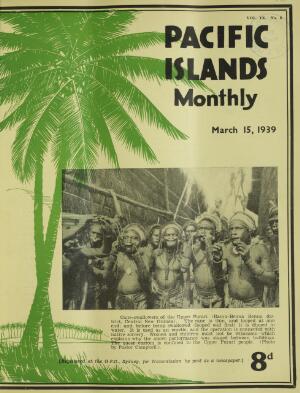
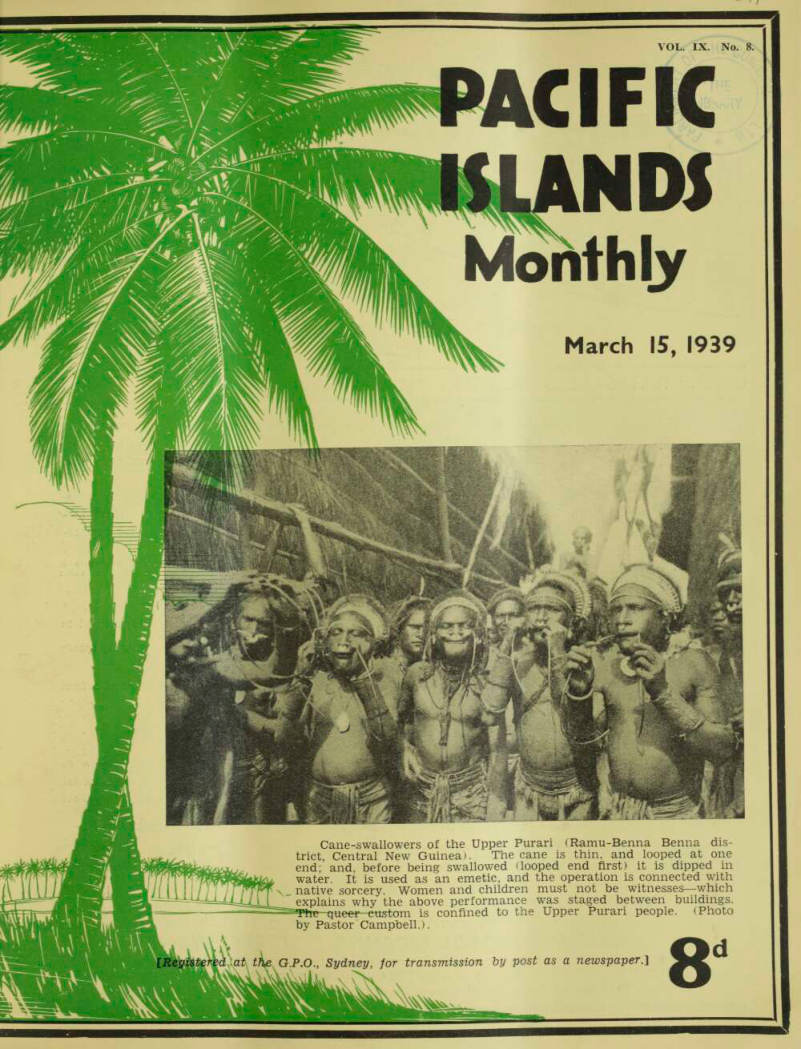
Cane-swallowers of the Upper Purari (Ramu-Benna Benna dis trict, Central New Guinea). The cane is thin, and looped at one end; and, before being swallowed (looped end first) it is dipped in water. It is used as an emetic, and the operation is connected with native sorcery. Women and children must not be witnesses—which explains why the above performance was staged between buildings. queer custom is confined to the Upper Purari people. (Photo by Pastor Campbell.).
Advertisements & other items, p. 2 (2 items)
Pacific Islands Monthl y—M arch 15, 1939
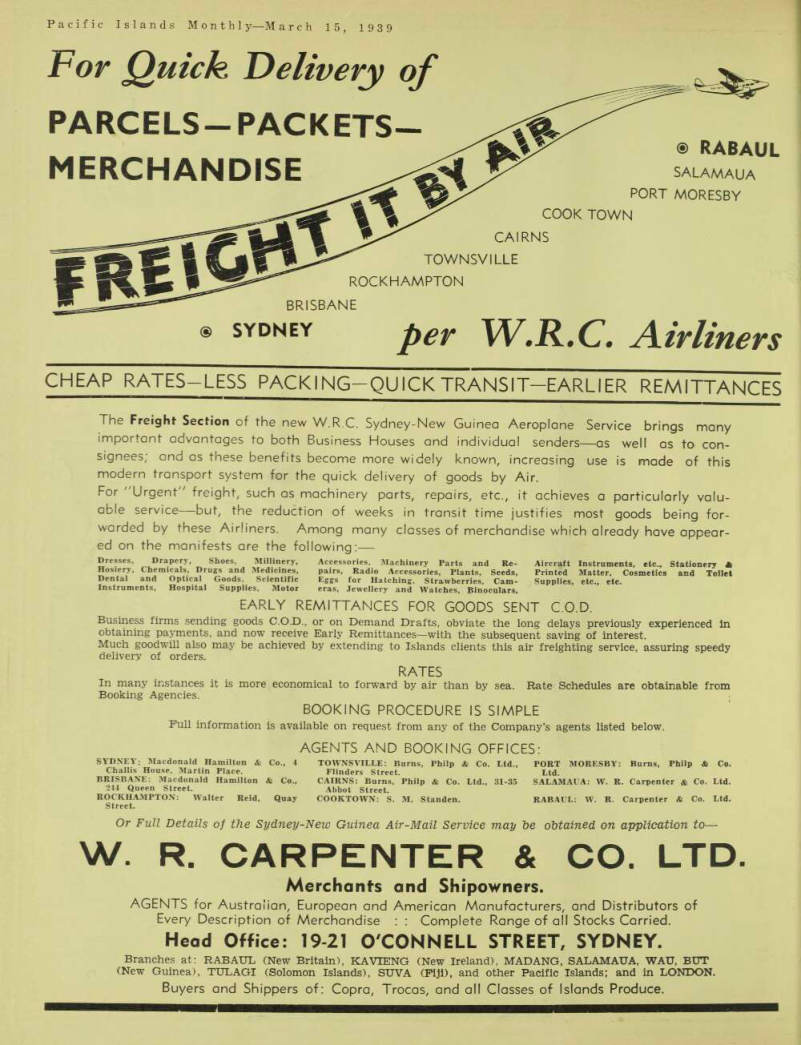
For Quick Delivery of
PARCELS-PACKETS-
MERCHANDISE
® RABAUL
SALAMAUA
fj^
PORT MORESBY
COOK TOWN
CAIRNS
TOWNSVILLE
ROCKHAMPTON
BRISBANE
SYDNEY
per W.R.C, Airliners
CHEAP RATES-LESS PACKING-QUICK TRANSIT-EARLIER REMITTANCES
The Freight Section of the new W.R.C. Sydney-New Guinea Aeroplane Service brings many important advantages to both Business Houses and individual senders—as well as ta consignees; and as these benefits become more widely known, increasing use is made of this modern transport system for the quick delivery of goods by Air.
For '"Urgent" freight, such as machinery parts, repairs, etc., it achieves a particularly valuable service—but, the reduction of weeks in transit time justifies most goods being forwarded by these Airliners. Among many classes of merchandise which already have appeared on the manifests are the following:— Dresses, Drapery, Shoes, Millinery, Accessories, Machinery Parts and Re- Aircraft Instruments, etc.. Stationery £ Hosiery, Chemicals, Drugs and Medicines, pairs, Radio Accessories, Plants, Seeds, Printed Matter, Cosmetics and Toilet Dental and Optical Goods, Scientific Eggs for Hatching, Strawberries, Cam- Supplies, etc., etc.
Instruments, Hospital Supplies, Motor eras. Jewellery and Watches, Binoculars,
EARLY REMITTANCES FOR GOODS SENT C.O.D.
Business firms sending goods C.0.D., or on Demand Drafts, obviate the long delays previously experienced in obtaining payments, and now receive Early Remittances —with the subsequent saving of interest.
Much goodwill also may be achieved by extending to Islands clients this air freighting service, assuring speedy delivery of orders.
RATES
In many instances it is more economical to forward by air than by sea. Rate Schedules are obtainable from Booking Agencies.
BOOKING PROCEDURE IS SIMPLE
Full information is available on request from any of the Company’s agents listed below.
AGENTS AND BOOKING OFFICES:
SYDNEY; Macdonald Hamilton & Co., 4 Challis House, Martin Place.
BRISBANE: Macdonald Hamilton & Co., 244 Queen Street.
ROCKHAMPTON: Walter Reid, Quay Street.
TOWNSVILLE: Burns, Philp & Co. Ltd., Flinders Street.
CAIRNS: Burns, Philp & Co. Ltd., 31-35 Abbot Street.
COOKTOWN: S. M. Standen.
Philp & Co.
Co. Ltd.
RABAUL: W. R. Carpenter & Co. Ltd.
PORT MORESBY: Burns,
Ltd.
SALAMAUA; W. R. Carpenter Or Full Details of the Sydney-New Guinea Air-Mail Service may he obtained on application to —
W. R. CARPENTER & CO. LTD
Merchants and Shipowners.
AGENTS for Australian, European and American Manufacturers, and Distributors of Every Description of Merchandise : : Complete Range of all Stocks Carried.
Head Office: 19-21 O'CONNELL STREET, SYDNEY.
Branches at: RABAUL (New Britain), KAVTENG (New Ireland), MADANG, SALAMAUA, WAU, BUT (New Guinea), TULAGI (Solomon Islands), SUVA (Fiji), and other Pacific Islands; and in LONDON.
Buyers and Shippers of: Copra, Trocas, and all Classes of Islands Produce.
Pacific Islands Travellers
PER AIRLINER FOR N.G. ON FEB. 14: Messrs.
Chalmers, Jenan, Bayliss, Scott, McKenzie, Saunders, Gray, Temple-Walk.
PER “AORANGI” FOR FIJI ON FEB. 16: Messrs. Curry, Dent, Griffiths, Renton, Sher wood, White, Barry, Blacket. Hardy, Ikawa, Lester, Ruston, Rudrananda. Ramakrisknan, Shield,' Moody. Mesdames Burgess, Barker, Curry,’ Dent, Griffiths, Wigrall, Wharton. Berry, Blacket, Hardy, Lester, Ruston, Rudrananda, Ramakrisknan. Misses Ball, Chapman. Dryer, Blacket. Davis, Frazer.
PER “MORINDA” FOR LORD HOWE, N. 1., & N. HEBRIDES ON FEB. 16: Messrs. Barber, de Groen, O’Donnell, Marks, Scott, Pilcher, Wood forth, Moody, Wales (2), Jones, Grieve, Nott, Baxter, Attwater, Jaede (2), Barton, Mear, Dun can, Brown, Downes, Poole, Hewitt, Reilly, Fenton, Miller, O’Mahony, McMullin, Hall, Kirby, Michell, Roxburgh, Hall, Hopping, Camp bell, Davies. Mesdames Jocteur, O’Donnell, Marks, Scott, Messiter, Jones, Mear, Baxter, Attwater, Jaede (2), Hudson, Wheatley, Mc- Whinney, Douglass, O’Connor, Gateman. Misses Bartlett, Jones, Arnold, Croft, Carberry, Haskell, Baird, Lewin, Sherrill, Warren, Morell, Mudge, Springett, Bellamy, Fisher, Wilson, Appleton, Fleming, Morgan, Rogers, McKenzie, Mitchell, Simper, Douglas. Bailey, Lloyd.
PER AIRLINER FROM N.G. ON FEB. 17; Messrs. Temple-Walk, Scott, Saunders. Gray, Delphin, Hawkes, Peadon, Cull, Mannie, Travis.
Chalmers.
PER “MALAITA” FOR 8.5.1. AND N.G. PORTS ON FEB. 18: Messrs. Johnstone, Paul, Kerkham, Lewis, Maunder, Hitchcock, Moore, Costello, Ber gin, Jillett, Russell, Baxter, Riley, Fletcher, Robertson, Beard, Edney, Bell, Taylor; Father Palmer; Rev. Metcalf; Capt. Hardie. Mesdames Waters, Lotze, Treatt, Widdy, Morris, Bergin, Mitchell-Hill, Smith, Palmer, Bell, Turner, Davies, Taylor. Misses Walford, Roescorl, Bardwell, Matherton, Richardson, Menzies, Cohen, Moore, McDonald.
PER “MACDHUI” FROM PAPUA & N.G. ON FEB. 20: Messrs. Dodd. Frazer, Gatenby, Higgins, Hanna, Hayston, Johnston, Jarman, Lapham, Rogers, Suiter, Uruhart, Vivian. Wade, Watkins.
Johnston, Lilwall, Parry, Smallwood, Wooff, Lyon, LaughUn, Murray, Partridge, Reynolds.
Winterford, Parker, Small, Duncan, Jurgens, Dougherty, Budden, Brookbank, Clunn, Hooper, Holmes, McKone, McKenna, Robinson, Sergeyeff, Abbott, Altria, Arnold, Bennie, Bloxham, Bennett, Christie. Coote. Mesdames Craig, Frazer, Grif fiths, Jarman, Loudon, Rogers, Walker, Winter ford, Fuller, Ingold, Luff, Smallwood, Dougherty, Budden, Chambers, Holmes, Howard, Abbott,
Bloxham, Christie. Misses Cooper, Evans (3), Loudon, Miller, McSweeney, Mocatta, Page, Stehr (3), Sommerville, Kirby, Rudd, Chester. Graham shaw, Mathews, Sinclare, Bourke, Gorkin, Lumley, Broodbank, Broadfoot, James, Lyons, Adams.
Masters Hardy, Lowe, Miller, Mocatta, Uechtritz, Chester, Dougherty, Munro (2), Spiller, Swanson, Schafer, Harding (2», Adams.
PER AIRLINER FOR N.G. ON FEB. 21: Messrs.
Clarke, Florance, Hobson, Kennedy, Halings, Atkins. Mesdames Edgell, Hobson.
PER “NELLORE” FROM N.G. ON FEB, 22; Messrs. Mac Lean, Renton, Rundnagel, Sullivan, Holland, Normoyle, Flatten. Mesdames Renton, Kerby, Normoyle. Miss Holland.
PER AIRLINER FROM N.G. ON FEB. 24; Messrs. Allen, Sinclair, Pike, Sylvester, De Raaft.
Mrs. Peadon.
PER -TASMAN” FOR PAPUA ON FEB. 25: Messrs. Cresswell, Crisp, Gloe, Guinan, Higgins, Mahoney, McEwen, Rinington, Shorthouse. Mes dames Crisp, Guinan, Higgins, Shorthou§e. Misses Colledge, Marstyn, Orford, Stuckey.
PER “MACDHUI” FOR PAPUA AND N.G. ON FEBRUARY 25: Messrs. Koch, Mason, Wright, Hilder, Kenyon, Carter, Day, Chinnery, Bent zinger, Scope, Burns, Wardrop, Lloyd, Meek, Rose, Gilmore, Bryant, Pyke, Trenchard Smith,
(Continued On Page 76)
Phillips, Kennedy, Purchell Theckston, Osborne, Smith, Ord, Clayton, McKay, Hides, Topping, Hunter, Ferries, Soderman, Dudley, Edney, Sweet man Osborne, Crisp, Cameron, Miller, Shields, Field, Paolini, Strathearn Milne, Young, Maguire, Grant, O’Connor, Everett, Johnson, Robinson Garwood, Spence, Buzzachi; Judge Phillips; Rev.
Dixon, Rev. Clarke. Mesdames Smallwood, Clay, Hilder, Day, Burns, Hartley, Wardrop, Speedie, Horton, Turner, Batze, Thomas, Pyke, Trenchard, Skelly, Theckston, Taylor, Hayes, Brennan, Gil- A „ l i sten ’ Hoile - Perries, Dixon, McDonald.
Wiihs, Maguire. Misses Rudd, Kirby, Hawkes, Major, Wheelan, Adams, Goldberg. Hayes Bren nan, Wombell, Mill; Sister Irwin.
RRR A^^, INER TO NG - ON FEB - 28: Messrs.
Burke, McConnon, Hitchcock. Probert, Bent zinger, Marbelli, Condon, Neal, Allen, Haling Miss Lloydell.
PER AIRLINER FROM N.G. ON MARCH 3- » T Challis, Haling, Neal, Anderson, Ongley, Laidley-Cay, Yaincey. Mrs. Mills.
PER AIRLINER TO N.G. ON MARCH 7 Messrs. Murray, Howard.
MARPTf" B Q ULO u°” FROM PAPUA & N.G. ON MARCH 9. Messrs Bailey, Bishton, Browne Beattie, Bullock, Brown. Blakey, Bennett Cole
„Ca^l?«,?°UttS - Edwards ElwyJ,
Garden, Griffiths, Giblin, Hodgekiss, Hill. Harris Kalbfen’ Joubert ’ Johnstone, Keenan] Kalbfell, Keogh, Lewis, Lang, Loundon, MaxweU Mamwarmg, McLaren, Moloney, Orr, Page Pack' f ay ’ Ross ’ sherr y- Stengel, Shellab’ear, fhomps ™’ Walshe ’ Wild, Woods, Wilkie, Clark M ° ore , (2). Mesdames Bishton. Coleman T^nii IS, r C 1 k ’ Donaldson . Fryer, Healy, Irving’
S ’ McCar thy, Maxwell, Main waring, Marsnail, Moore, Perkins, Ray, Ross Tait Kin°rf S ’ w Va f d ’ Misses Bennett, Boag, Cooper Schwabe d ’ Kmg ’ Lynn ’ Maye ’ Sha rpe! « “™ RINDA ” FROM LORD HOWE NI tnv N 'if k R ° ES ° N MARCH 9 ; Messrs. Adam' Johnson p i ? Urn ° o’ ° leary ’ Dumon t, Grieve] Johnson. Pilcher, Sanders, Attwater Barton Brown, Bradshaw, Curlewis, Clough, Davies Dun can Fenton, Hall, Hines, Hopping Lawton Marks, Mear, Miller, Morris, Moody, NoU OMiihoncy, Roxburgh, Scott, Valkenburgh Williamson Woodforth. Young, Jaede (2? Jones (2). Mesdames Joy, Dumont, Johnson Kane R^ nken - Attwater, Bradshaw. Curlewis’
Davis, Douglas, Gateman, Jaede (2) Jones Tnu-ton, Watson-Mason, Marks, Mear, Patterson Rox fZl h ’ COU ’ Yalkenburgh, Williamson Woo d - Misses Gall, Mordin, Quintal f“ per ’ Appleton, Arnold, Bartlett, Baird Bel lamy Carberry, Croft, Douglas, Downs Fisher Saf,n ng \. HaSkil1 ’ Hudson ’ King, Lewiri, Uoyd Watson-Mason. McKinnon, Morell Mudge Retmock - R odgers, McKenzie, SherSl' Spnngett, Warren, Wilson. mlrch “^ PT S NA ” PROM NG ‘ FORTS ON Rpr p h SS f S ‘ T Barnett > Ditton, Gaude, fnf GrSh, h S ’ Johnson, Richards, Brown ing, Griffiths, Hann, Esson, Baker Dickson Mesdn Dillon ’ In g ran i- Pulla’r, Savage’
Mesdames Ditton, Ker, Richards, Hawnt, Thom: Savage 85011 ’ Colquhoun ’ White, Evenson, PER ‘ NIAGARA” FROM FIJI ON MARCH 11f 2 i SS Griffl h n s . Dent ’ Farquhar Grtnward Ousev G ’ Bardaker - Hopkins, Morison .2*.
Woodvatt R Whii Bllo^ ll ’ Seymour ’ Whiteman, woodyatt. White, Zilman (2), Caten Huntlev Frv Se Smi S : T a ™ blyn ’ Walker. Makan Hanak Frj, Greer, Michaels, Talbot, Turner. Mesdame4 Allen, Angermunde, Barber. Dent Harwood Hon wSody^ rl5 Wha I i I f artln -v OUSey - Himfidn t ■ Y harton - Young, Zellman, Clark Huntley, Lindsay, Smith. Misses Harwood Mar low Morison, Rea (2), Aspinall. Zillman Bradlev' Caldwell. Mother Chanel. -Bradley, Me P JS A SS? R RROM N - G - ON MARCH 11: Sinclair, CaSeJ Saunders - Eentzinger.
PE R AIRLINER FOR N.G. ON MARCH 14- Messrs. Gray, Greenham, Buckeridge Mowbrav Mesdames Hore-Lacy, Foley. Miss Taylor. y " ig ’ an old identity o£ Fiji, died at Tailevu on February 23 ? orR 75 l ears ag0 ’ she s P ent some time PoJm Guinea and other parts of the Lodoni, TaSevu y Settling down at
Advertisements & other items, p. 3 (2 items)
1
Pacific Islands Mont hi y—M arch 15, 1939
Pacific
THE
KP.M.
SOUTH
PACIFIC
LINE
SOURABAYA
PORT MORISS)
/ * * it
Links the East with the South
Pacific Islands, New Zealand & Australia
KP.M.
SOUTH PACIFIC LINE
Royal Packet Navigation Co.
Ltd., Paketvaart House, 255 George Street, Sydney. (N. V. Koninkli jke Paketvaart MaatschapplJ—lncorporated in the Netherlands).
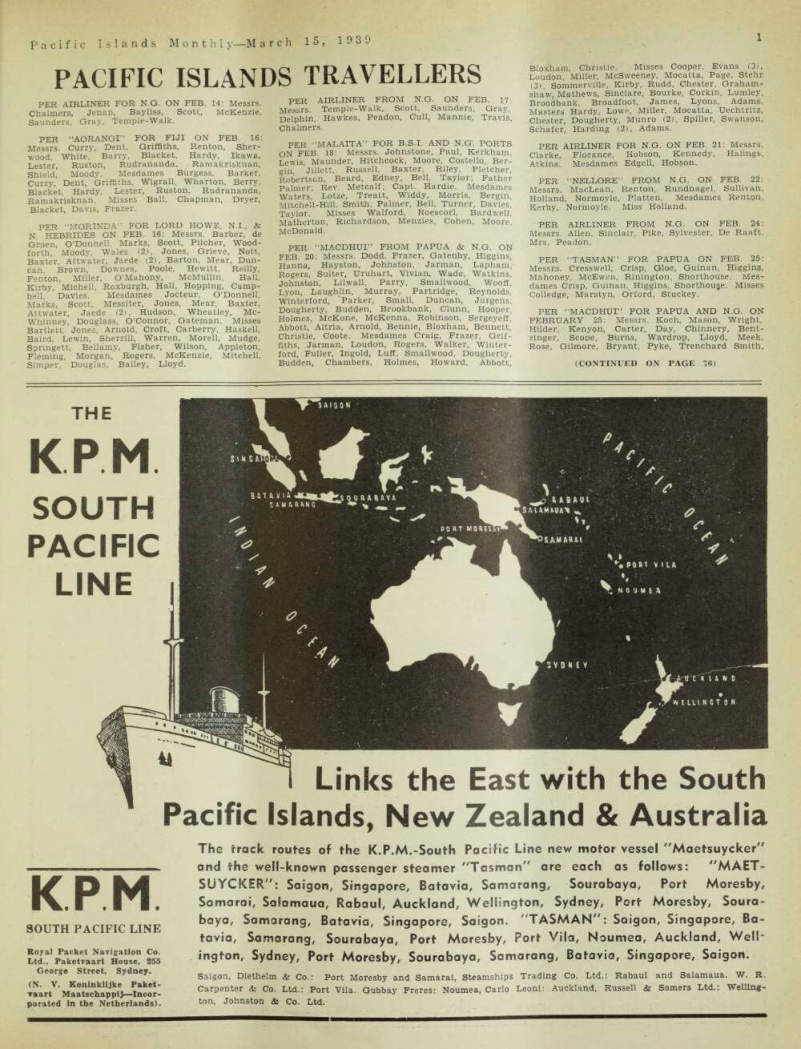
The track routes of the K.P.M.-South Pacific Line new motor vessel "Maetsuycker" and the well-known passenger steamer "Tasman" are each as follows: "MAET- SUYCKER": Saigon, Singapore, Batavia, Samarang, Sourabaya, Port Moresby, Samarai, Salamaua, Rabaul, Auckland, Wellington, Sydney, Port Moresby, Sourabaya, Samarang, Batavia, Singapore, Saigon. "TASMAN* 1 : Saigon, Singapore, Batavia, Samarang, Sourabaya, Port Moresby, Port Vila, Noumea, Auckland, Wellington, Sydney, Port Moresby, Sourabaya, Samarang, Batavia, Singapore, Saigon.
Saigon, Diethelm & Co.: Port Moresby and Samarai, Steamships Trading Co. Ltd.: Rabaul and Salamaua. W. R.
Carpenter & Co. Ltd.: Port Vila. Gubbay Freres: Noumea, Carlo Leoni: Auckland, Russell & Somers Ltd.; Wellington. Johnston & Co. Ltd.
Advertisers.
Amalgamated Wire less Aust. Ltd. . . 60 Amplion (A’sia) Ltd. 35 Angus & Coote Ltd. 69 Arnott’s Biscuits . 24 “Aspro” 62 Atkins Ltd., W. . 57 “Ausolene” ... 51 Baker, W. Jno. . . 14
B.A.L.M. Ltd. ... 65
Bank of N.S.W. . . 76 Berger & Sons . . 44 ’Bernly” Guest House 28 “Bidomak” . . . .21 Blau (Aust.) Robt. 58 Breckwoldt & Co. . 50 Broomfields Ltd. . 72 Brotherton, A. B. .58 Brunton’s Flour . . 39 Bullivants Ltd. . . 48 Burns, Philp & Co. 2 B.P. Magazine . . 28
B.P. (S.S.J Co. . . 62
Burns, Philp Trust Co. Ltd 70 Buzacott Ltd. ... 43 Carlton & United Breweries Ltd. . . 29 Carpenter, W. R., Ltd cov. 2 Chapman & Sherack 68 Chemist H.P.
Michael 51 Chemists’ Supplies Co 68 Chivers & Sons Ltd. 36 “Cinnamolia” Pre parations ... 30 Clyde Engineering Co. Ltd 61 Coleman Lamp Co. 22 Colonial Sugar Re fining Co. Ltd. . 17 Continental Com pensations Pty.
Ltd 30, 65 Coral Starch ... 36 Crossle, Duff & Macintosh Ltd. . 64 “Cystex” 47 Danks & Son Ltd. . 69 Dewar’s Whisky . . 74 Doan’s Pills ... 71
Donaghy & Sons Ltd 63 Donald Ltd., A. B. 54 Eaton Ltd., J. W. 45 Electrolux Refrigerators . . 32 Eno’s Fruit Salt . 20 Excelsior Supply Co. 46 Fairbanks Morse Ltd 63 “Fairholm” College 59 Fletcher & Sons . 42 Ford Sherington Ltd 67 Foster Clark Ltd. . 25 Fryer, A. C. ... 72 Garden Vale Pro ducts Ltd. ... 36 Garrett & Davidson 64 Gillespie’s Flour . . 35 Grace Bros. Ltd. . 10 Grand Pacific Hotel 55 Grove & Sons, W.
H 34 Guinea Airways Ltd cov. 3 Halvorsen Sons Ltd. 71 Hardy’s Indigestion Remedy ... 14 Harper, M 33 Holbrook’s Ltd. ... 39 Holmes & Co., W. . 73 Horne, W. & Co. . 54 Horlick’s Malted Milk 27 Hotel Moresby . . 76
1.C.1.A.N.Z. Ltd. . . 53
Intercontinental Airways ... 13 Jones & Co. Ltd., H. 35 Kodak Pty. Ltd. . . 12 “Kolynos” Tooth paste 15 Kopsen & Co. Ltd. 49 Kork-N-Seal Ltd. . 36 Koyong Boarding School ... 9 Levenson’s Radio . 66 Lloyd & Co. Ltd. . 11 Mcllrath’s Ltd. . . 18 Maxwell Porter Ltd. 45 Miller & Co. Pty.
Ltd 48 Morris, Hedstrom, Ltd 56
N.D.L 72
Nestle’s Milk ... 38 Newlands Bros. Ltd. 70 Noyes Bros. Ltd. . 75 “Oriana” 74 Pabst Canned Beer 18 Pacific Is. Club . 10 Papua Hotel, The . 76 Paul & Grey Ltd. . 52 Penfriends Wanted . 71 Pike Bros. Ltd. . . 22 Position Wanted . . 65 Prescott Ltd. ... 37 P rouds Ltd. ... 11
Ransome, Sims & Jeffries Ltd. . . 56 Reed, William E. . 24 Riverstone Meat Co. 19 Rohu, Sil . . . .53 Royal Packet Co. . 1 Scott’s Emulsion . 19 Scott, Ltd., J. ... 72 Smyth & Co., J. H. 46 Springwood L. Col. 59 Steamships Trading Co. Ltd 42 Sterling Varnish Co. 9 Sullivan Ltd., C. . 35
Swallow & Ariell . 37 - - j? C . * / Taylor & Co., A. . 64 ’’Tenax” Soap . . 59 Tiliock & Co. Ltd. . 26 Toohey’s Ltd. ... 23 •‘Top Dog” Men’s Wear 33 Tooth & Co. . cov. 4 United Radio Dis tributors Ltd. . . 67 Usher’s Hotel ... 26 Vacuum Oil Co. . . 31 Vincent’s A.P.C. . . 75
Warburton, Franki Ltd 16 West, Harry ... 48 Weymark & Son . 36 Wholesale Type writer Co. ... 13 Wills, W.D. and H. 0., Ltd. ... 33 Wright & Co. Ltd., E 45 Wunderlich Ltd. , . 45 Yorkshire Insurance Co. Ltd 47
Contents
Pacific Islands Travellers 1 Amalgamation, Inertia, and Austra lian Politicians 3 Mandates Commission Asks Pertinent Questions About Samoa 4 U.S.A. in the Pacific 4 Effect of Gold Industry's Growth on Fiji 5 Military Experts Visit the Islands .. 5 Death of Royal Tahitian 5 Can Copra Producers Be Organised? 6 Australian Amalgamation Plan May Include 8.5.1. and N. Hebrides . 7 Papuan Girl Attacked by Crocodile . 8 N.G. Finances in Extraordinary Position 9 Tropicalities 9 Progress of Trans-Pacific Air Service 10 About Islands People 11 Fiji’s Riches 12 “Combine” Attacks N.G. Air Mail Route 13 The Copra Market in Europe .. 13 Bitoi Route Recommended for N.G.
Goldfields Road 14
Japan's Future Policy 15 Tongans in Trousers and Top Hats 17 Sir Hubert Murray on Native Policy 20 A Top-Dressing in the Tropics ... 23 Myths of the South Seas 24 New Guinea’s Inland Timbers .. .. 27 Samoan Legislative Council’s Meeting 29 Call of the Islands 33 Kapok-Growing in Papua 36 Hoisting the Flag in Papua in 1884 . 38 The Viti Company 39 Purple Days in Old Samoa 43 Tahiti’s Money Mystery Explained . 48 How Shall We Treat the Natives of New Guinea? 51 Fashions for Islands Women .. .. 59 Ingratitude—A Papuan Tale .. .. 61 New Gold at Wau, T.N.G 63 Mining Notes 65 Short-Wave Radio Programmes ... 67 Death of Capt. “Myles” Thompson . 69 Copra and Rubber Prices 70 Produce and Exchange Rates .. .. 72 Shipping Timetables 73
Advertisements & other items, p. 4 (2 items)
2
March 15, 193 9—P acific Islands Monthly
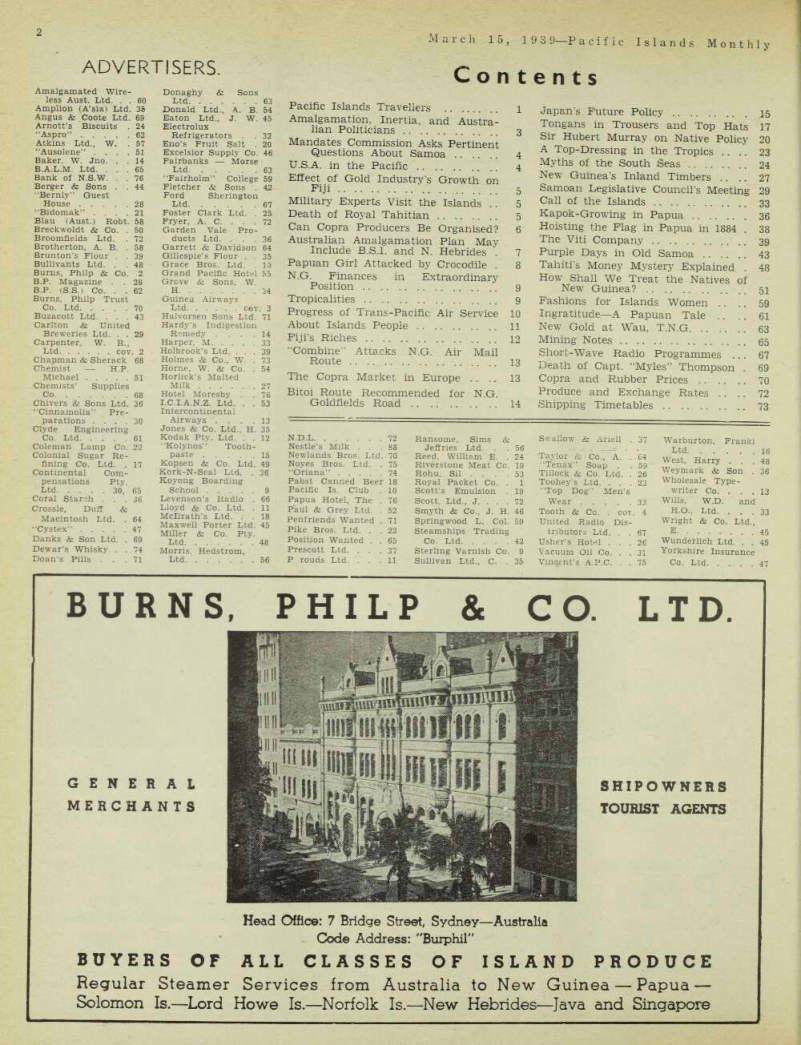
Burns, Philp & Co. Ltd.
GENERAL
MERCHANTS
iilll m uu» I
IK lit
111
till
II
SHIPOWNERS
TOURIST AGENTS
Head Office: 7 Bridge Street, Sydney—Australia Code Address: "Burphil"
BUYERS OF ALL CLASSES OF ISLAND PRODUCE Regular Steamer Services from Australia to New Guinea Papua Solomon Is.—Lord Howe Is.—Norfolk Is.—New Hebrides —Java and Singapore
Pacific Islands monthly
The Newspaper-Magazine of the South Seas IRegistered at the G.P.0., Sydney, for transmission by post as a newspaper .]
Published Once Each Month and Circulated in Australia and New Zealand and in the following Pacific Territories and Islands Groups:
Crown Colony of FIJI.
Australian Territory of Papua.
Mandated Territory (Australia) of New Guinea, Bismarck Archipelago and Northern Solomon Islands.
Mandated Territory (Japan) of Marshall. Caroline and Marianna Islands.
French Territory of New Caledonia.
British and French Condominium of New Hebrides.
American Territory of Eastern Samoa.
American Territory of Guam.
Mandated Territory of Nauru.
British Crown Colony of Gilbert and Ellice Islands.
Mandated Territory (New Zealand) of Samoa British Solomon Islands Protectorate.
British Protectorate of Tongan Islands.
New Zealand Territory of Cook Islands.
Australian Territory of Norfolk Island.
French Colony of Oceania (Tahiti, etc.).
American Territory of Hawaiian Islands.
Owned and Produced by Pacific Publications Pty. Ltd., Union House, 247 George Street, Sydney.
'tttt ttpwomf J Managing Director 8W5037 TELEPHONE -j BuBineBB and Editorial MA7IOI
P.O. Box 3408 R
Registered Address of Telegrams, Radiograms, and Cables: “Pacpub”, Sydney.
Contributions
Articles, Stories, and Photographs dealing with Pacific Islands subjects are invited and will be paid for on publication at usual rates.
Subscription Rates
Per Annum, within British Empire, Prepaid, Post Free 8/- Per Annum, elsewhere, prepaid. Post Free 10/- Single Copies Bd.
Editor and Publisher:
R. W. Robson, P.R.G.S.
Assisted by Selwyn Hughes.
Advertising Manager: L. W. Bailey.
Advertising Office and Printing-House: 29 Alberta St., Sydney.
Advertising rates furnished on application.
Colours, etc by Arrangement Process Blocks made at Advertiser’s expense when required. Screen, 100.
Changes of Advertising Copy should reach this Office by 3rd of each month, otherwise previous advertisement may be repeated.
IN LONDON, the “Pacific Islands Monthly” is on sale at the Bookstall, Australia House, The Strand, London.
Agents
The following are authorised to receive sub scriptions for the Pacific Islands Monthly:— Islands Branches of Burns, Philp & Co. Ltd., and Burns Philp (South Sea) Co. Ltd.
Islands Branches of W. R. Carpenter & Co. Ltd.
All Branches of Morris, Hedstrom Ltd.
G. Thomas & Co., Rabaul, New Guinea.
T. A. Olsson, Wau, New Guinea.
Whitten Bros. Ltd., Samarai, Papua.
Steamships Trading Co., Papua. All Branches.
P. Costello. Suva, Fiji.
J, Muir, Suva, Fiji.
N. C. Mackenzie-Hunt, Walnunu, Bua, FIJI.
All Branches and Representatives of W. H. Grove & Sons Ltd., Auckland, New Zealand.
Cook Islands Trading Co., Rarotonga, Cook Is.
A. C. Rowland, Papeete, Tahiti.
Representative in London: W. C. HARVEY, Coronation Building 4 Lloyds Avenue, London, E.C.2. from whom may be obtained copies of Pacific Islands Monthly, Pacific Islands Year Book, advertising schedules, etc.
Vol. IX. No. 8.
Sydney, hAorch 15, 1939.
< 8d - Per °OPy rnce ( Prepaid: 8/- p.a.
Amalgamation, Inertia, and Australian
Politicians
IF amalgamation means a continu ance of the procrastination, pre varication and general inertia which, for two years, have marked Can berra’s control over New Guinea and Papua, Territories residents may well pray to be saved from the new Australian Minister’s new plan.
On the grounds only of efficiency and economy—especially the latter— there are reasons for amalgamation.
On broader grounds—based on Mr. W.
M. Hughes’ dictum that “the nation which controls this protective fringe of Pacific Islands controls Australia” —there are some weighty arguments to support the proposal that the two Territories should be placed under one vigorous administration. But if the change means merely that an ex panded bureaucracy will have in creased opportunities for sleeping on the job, then the last condition of the Territories may well be worse than the first.
It is nearly two years since Rabaul was threatened with volcanic extinc tion, and it was decided to remove the capital immediately to a safer place.
It is a year since the Griffiths Com mittee recommended that Lae be the new site. It is nine months since Mr.
Hughes said that the new capital
should be at Salamaua, and that a new road would be built forthwith between Wau and Salamaua. It is over three months since the Minister announced that an expert committee would be appointed at once to investi gate a plan of amalgamation, which embraced a new capital site, and methods of defence, development and settlement.
Just before going to press, we in quired of Canberra whether anything had been done in regard to the amalgamation committee, the road, or anything else; and we were politely informed that the various- months’old proposals still await the sanction of Cabinet.
It is a situation deplorable beyond words. Both Territories, at an early date, should be fitted into the Aus tralian plan of defence. Both are ripe for well-directed developmental activities —and the rank and file of both public services are composed mostly of intelligent and keen young Australians, eager to be up and at it.
The finances of both Territories need a general overhaul—especially New Guinea, where there has been an alarming, unexplained and apparently inexcusable drift into a condition where current expenditure is much in
excess of current revenue. There are a score of separate problems, as apart from these general conditions, de manding governmental attention. And not a thing has been done.
It may not be fair to blame the new Minister. He does not have full Cabinet rank; and he appears to have done his best to get decisions made, in accordance with his own business like formula; and, anyway, he is not i esponsible for the gang of squabbling politicians which masquerades at Canberra as a National Government.
Logic, and the demand for increased efficiency in the Territories adminis tration, and the imperative need for building up defences against the southwards-thrusting Japanese, pro vide a strong case for amalgamation, and, moreover, suggest the extension of that plan to the Solomons and the New Hebrides—as explained else where. That is the theory of it. But there is another side. The Australian governmental record of the last two years, in relation to the Territories, provides one very good reason why the Territories should resist any closer ties with the Australian politicians and the inert bureaucracy which they allow to exist.
Indications are that the committee eventually will be appointed, and will make a leisurely tour of both Terri tories—and probably of Northern Territory, Nauru and Norfolk Island —and take copious evidence. Very many months will pass, and much
money will be spent before a report is made.
Meanwhile, Territories residents will have ample opportunities of arguing amalgamation, pro and con. Already, it is apparent that there is much to be said on both sides.
Broadly, and in theory, this journal is in favour of amalgamation. But when it sees the kind of administra tion which Australian politicians so far have given the Territories, it is inclined to say that the less the Islands have of Australia, the better
What Is The "Malo"?
Pertinent Questions About Samoa
A TOUGH task was given to Dr. R. M.
Campbell, economic adviser to the N.Z. High Commissioner, when he submitted the Western Samoa annual report to the Mandates Commission of the League of Nations at Geneva in January.
Some apparently well-informed mem bers of the Commission asked a series of questions—especially relating to the activities in Samoa of Mr. Nelson and his family—which Dr. Campbell was unable to answer.
M. Palacios said that, while everything seemed to indicate that the Mau held a predominant position in the territory and were regarded with favour by New Zealand, the Commission had received reports and information, mainly from the press, mentioning an anti-Mau move ment called the Malo. He asked Whether it was true that the Malo was as strong in numbers and influence as “the organ isation dominated by Mr. O. F Nelson and his son-in-law, Tamasese”.
Dr. Campbell replied that, in general, the political situation was calm and nor mal. It appeared that the new Mau had been over-publicised and did not, at pre sent, represent more than 3i per cent of the Samoans. The Mau was still the or ganisation representing the greater ma jority of the native Samoan population It would be interesting to hear the opinion of a few men in Apia, concern ing Dr. Campbell’s answer. It has been stated, repeatedly, that the Malo is near ly the equal of the Mau. To say the Malo is only 3i per cent, of the Sa moans, while the Mau is 51 per cent (the “greater majority”) seems to indicate that there has been vigorous lying some where.
N.G. Govt. Airmail Contract Goes
to Guinea Airways
The new Government contract for the aerial transport of mails, goods and passengers in New Guinea—tenders for which closed early in February—has gone mostly to Guinea Airways Ltd. The Salamaua-Madang section remains with Mandated Airlines.
The contract, after being held for a long time by Guinea Airways, was secur ed about four years ago by the newly arrived aeroplanes of Carpenter and Co (now Mandated Airlines Ltd.); and it has been held by the latter ever since.
Mr. A. F. J. White, formerly District Commissioner at Ra, Fiji, was committed for trial at Suva on February 18 on charges of stealing £155, from public funds. Mr. White was on leave in Eng land, but returned immediately to Fiji when informed, in December, that there appeared to be irregularities in his ac counts.
U.S.A. In Pacific
Significance of Guam Proposal
AS in the “Pacific Islands Monthly”, in February, the American plan to spend £1,250,000 sterling on the fortification of the island of Guam (in the Caroline Islands, near Japanese territory) has been having a rough passage in the American Congress.
On February 24, the House of Representatiyes, by 205 to 169 votes, rejected the plan to fortify the island on the grounds that it would be provocative to Japan; but it was announced on March 7, when the defence estimates were before the American Senate, that high uSent Ca nlea aV for °thp 6 rpi . maki f g ,J n , pl . ea f fo ?T remclusion of the poUcy y ’° n 8 s ° f Tf i ■ . , , , If the proposal is restored by the Senf£oV a fv, 1S c ° nsidere( J Ji kel y- is possible that the Representatives decision will be over-ridden and that the plan will u laW ’ as 18 esirec * by President Kooseven.
U.S.A., to an increasing degree, is displaying determination to stand by the democracies against the Berlin-Rome- Tokyo triangle: and, apparently, a part
of the new foreign policy of the United States is to lake all necessary steps to check the southward thrust of Japan The fortification of Guam Island and a slowing up of the programme of with drawal from the Philippines appear to be part of the new foreign policy.
Foreigners!
Status of Australian Planters in Solomons
Solomons might be more prosper- A ous if we planters there were not treated as foreigners”, said Mr. C. R.
Bignell, of Fulakora, 8.5.1., when inter viewed by newspaper reporters in Bris bane in February.
“We are ruled from Piii' tVipv Hnn’t know much about the country there, and they don’t seem to care.
“ We have beautiful soil, capable of pro ducing bananas, citrus fruits, and tim ber, and of raising good cattle. But we have no encouragement, such as is given in other island groups, to go in for anv thing but copra. We are not allowed to ship bananas or citrus fruit to Australia.
Restrictions confront the planter at every turn, “Gold miners have the greatest diffi culty in getting land titles from the au thorities in Fiji”.
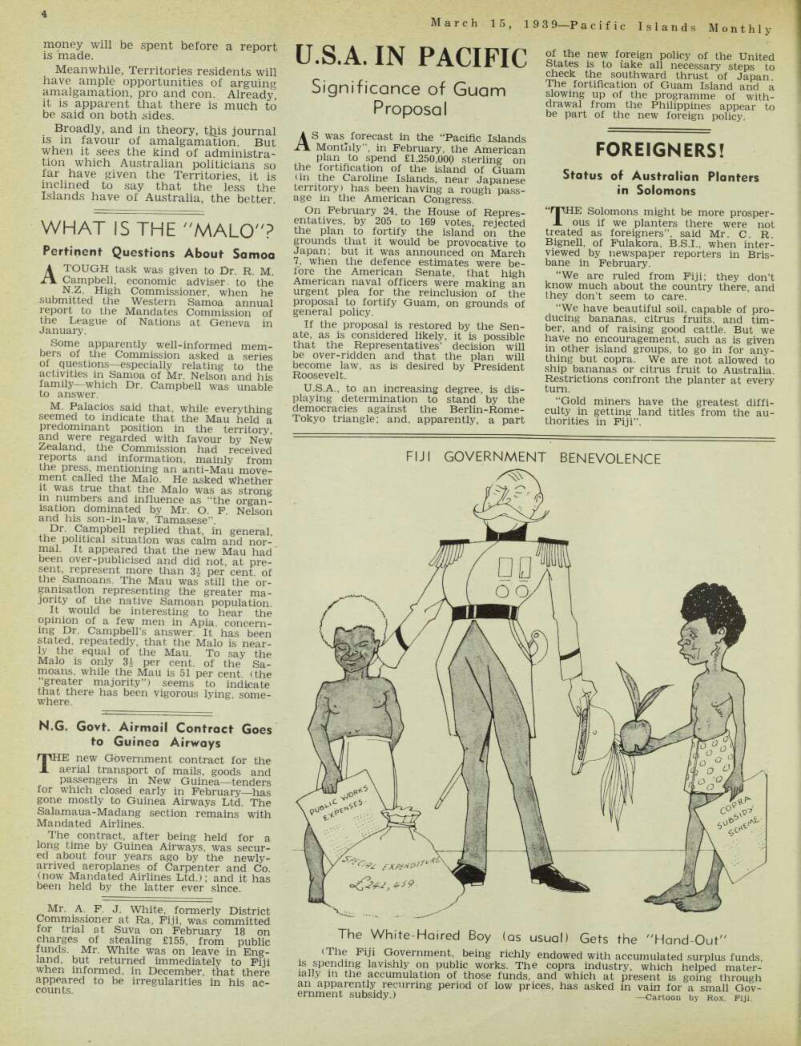
Fiji Government Benevolence
The White-Haired Boy (as usual) Gets the "Hand-Out" (The Fiji Government, being richly endowed with accumulated surplus funds, is spending lavishly on public works. The copra industry, which helped mater ially in the accumulation of those funds, and which at present is going through an apparently recurring period of low prices, has asked in vain for a small Gov ernment subsidy.) Cartoon by Rox, Fiji.
New Port, Town and Settlement Effect
Settlement Effect of Gold Industry's Growth in Fiji
WHEN the new Carpenter steamer “Suva” berthed at the new wharf at Vatia Point, on the north coast of Viti Levu, Fiji, in February, and dis charged 1.600 tons of fuel oil and 300,000 super ft. of timber, all for use at the new gold mines, a few miles inland, an other stage was marked in the very rapid development of the Crown Colony of Fiji.
It may be noted that the value of the gold produced in Fiji is now equal to about £750,000 per annum, and most of this comes from the new field near Tavua. To produce this huge treasure, a large staff of men and enormous equip ment are now employed; and the new wharf at Vatia Point has been built to allow for the quick and easy transpor tation of supplies. It is expected that, every month, hundreds of tons of sup plies for the mines will be landed from lighters, from the small coastal steam ers and from three or four overseas steamers which will make regular calls.
The new gold-mine industry has, not only created a busy little town at Tavua —it was only four or five buildings at the road junction four years ago—but the provision of a good road and a new port has stimulated land settlement in the district, and agricultural and pas toral industries are increasing. A new timber-getting industry also is developing.
It would seem that Tavua, with its port at Vatia Point, is to become an im portant Fijian town.
As the “Suva” was making her maid en voyage, and was the first steamer to tie up at the new wharf, Messrs. W.
R. Carpenter and Co. Ltd., owners of the “Suva”, celebrated the occasion by giv ing a party aboard the “Suva” at Vatia wharf. Amongst those who attended were: — Mr. N E. Nilsen (general manager, Emperor Co.), and Mrs. Nilsen. Mr. H. J. Harrison (acting manager, Loloma Co.), and Mrs. Harrison, with Mrs. W. Gourley (Perth, Western Australia), Mr.
R P. Kay (manager, Tavua Power Pty., Ltd.), Hon. H. H. Ragg, M.L.C., Mr. J. Allen (C.S.R. manager, Rarawai), with Mrs. Allen, District Commissioner N. C. Caldwell, and Mrs. Caldwell, Mr. A. Farquhar (C.S.R. manager, Lautoka), Mr.
Griffiths (C.S.R. manager, Penang), Mr. and Mrs. Martin, Mr. Tiffen (district engineer), Mr.
W. Finlayson, Mr. Rourke, Mr. and Mrs. J.
Edwards. The party was entertained on board by Captain F. E. and Mrs. Laloe and Major C.
Brewster.
18 Wallis Islanders Adrift
From Our Own Correspondent
Apia. Feb. 22.
A WIRELESS broadcast from Suva, Fiji, states that two canoes from Wallis Island (Ue’a), a French pos session, some 500 miles north of Samoa, have been missing since February 19.
The canoes contained 18 natives. It is possible that they have been driven to Samoa. Wallis islanders often have ar rived at Falealapo (the westernmost point of Savaii) having been carried there by the prevailing current and wind.
Mr. J. J. Griffiths, who for the past six years has been manager of the Grand Pacific Hotel. Suva, Fiji, has retired. Mr.
C. Brown, formerly chief steward of the "“Matua” and “Aorangi”, has been ap pointed to the vacancy.
Caledonia
Japanese Active In New Caledonia
A JAPANESE syndicate is engaged in negotiating the purchase of an im portant mining property in New Caledonia, owned by two residents of the island (said the “Bulletin du Commerce” late in February). The transaction will represent a sum of more than 20 million francs (about £150,000). Three Japanese experts left Japan by the “Naniwa Maru” on February 26, for Noumea, to study the mining property.
The Oceania Mining Company (already operating in New Caledonia) has just received 1,500 tons of equipment and eight experts from Japan, wherewith to modernise the nickel workings at Ouli- Oulie and Yamato, at Kua.
Papua's New Military
Aerodrome
Australian Air Force officers, who ar rived in a bomber, early in March, selected an area beside the Rouna Road, about 7 miles from the town, to be the new military aerodrome, and part of the • defence organisation now being rapidly introduced to Port Moresby.
Pacific
Military Experts In
An inspection in Samoa
From Our Own Correspondent
Apia, Feb. 22.
A PLAN for the defence of the Central and South-west Pacific has been re ceiving the attention of the Imperial naval and military authorities.
Under special charter, the motor ves sel “Yanawai”, owned by Messrs. Burns Philp (S.S.) Co., Fiji, arrived here on February 17, with a party of British ex perts. She had called at various islands in the Central Pacific recently; and she remained here for a short time while the experts examined possible landing-places for aeroplanes and seaplanes.
No information whatever was released regarding the vessel or the nature of her activities. She left the same day for an unknown destination.
The Prime Ministers of Australia and New Zealand, with high naval and mili tary officials, are expected to attend a conference in March, to co-ordinate plans for defence of British Territories in and around the Pacific,
Death Of Royal Tahitian
From Our Own Correspondent
Papeete, Feb. 20.
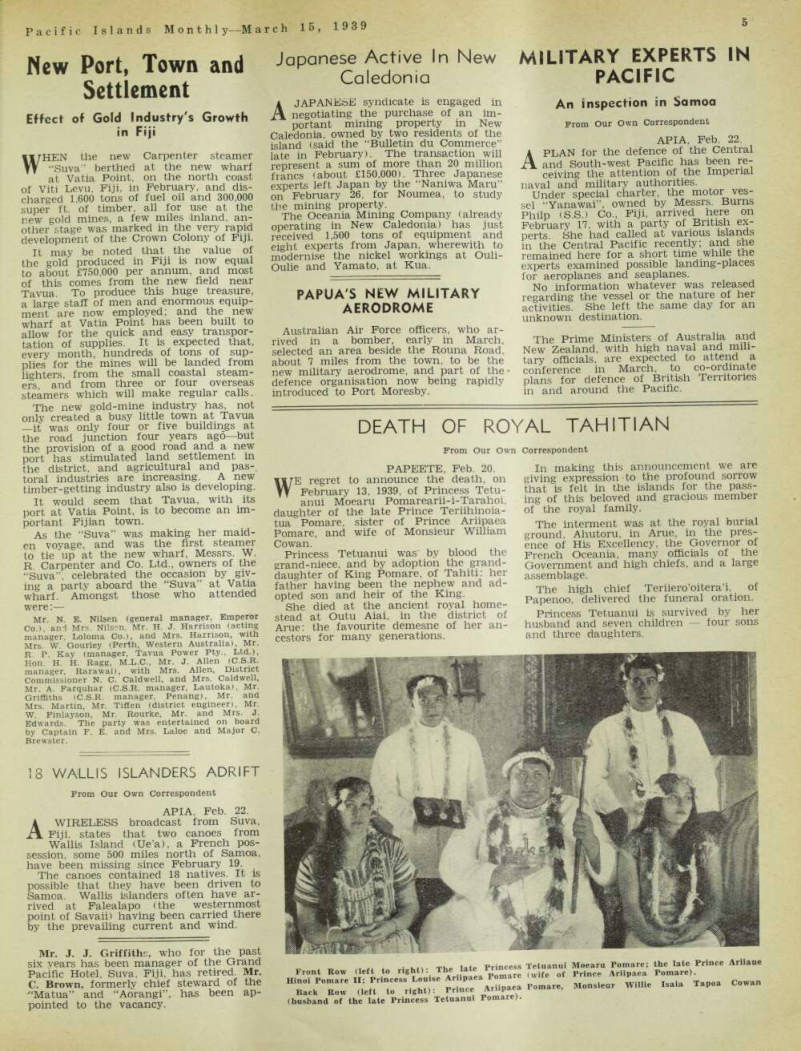
WE regret to announce the death, on February 13, 1939, of Princess Tetu anui Moearu Pomarearii-i-Tarahoi, daughter of the late Prince Teriihinoia tua Pomare. sister of Prince Ariipaea Pomare, and wife of Monsieur William Cowan.
Princess Tetuanui was by blood the grand-niece, and by adoption the grand daughter of King Pomare, of Tahiti: her father having been the nephew and ad opted son and heir of the King.
She died at the ancient royal home stead at Outu Aiai, in the district of Arue: the favourite demesne of her an cestors for many generations.
In making this announcement we are giving expression to the profound sorrow that is felt in the islands for the pass ing of this beloved and gracious member of the royal family.
The interment was at the royal burial ground. Ahutoru. in Arue, in the pres ence of His Excellency, the Governor of French Oceania, many officials of the Government and high chiefs, and a large assemblage.
The high chief Teriiero’oitera’i, of Papenoo, delivered the funeral oration.
Princess Tetuanui is survived by her husband and seven children four sons and three daughters.
Front Row (left to right): The late princess Tetuanui Moearu Pomare; the late Prinee Ariiaue Hinoi Pomare II; Princess Louis Ariipaea (wife of Prince Ariipaea Pomare) Back Row (left to right): Prince Ariipaea Pomare, Monsieur Willie Isaia Tapoa Cowan (husband of the late Princess Tetuanui Pomare).
Advertisements & other items, p. 7 (1 item)
5
Pacific Islands Monthl y—M arch 15, 1939
"Macdhui" Passengers
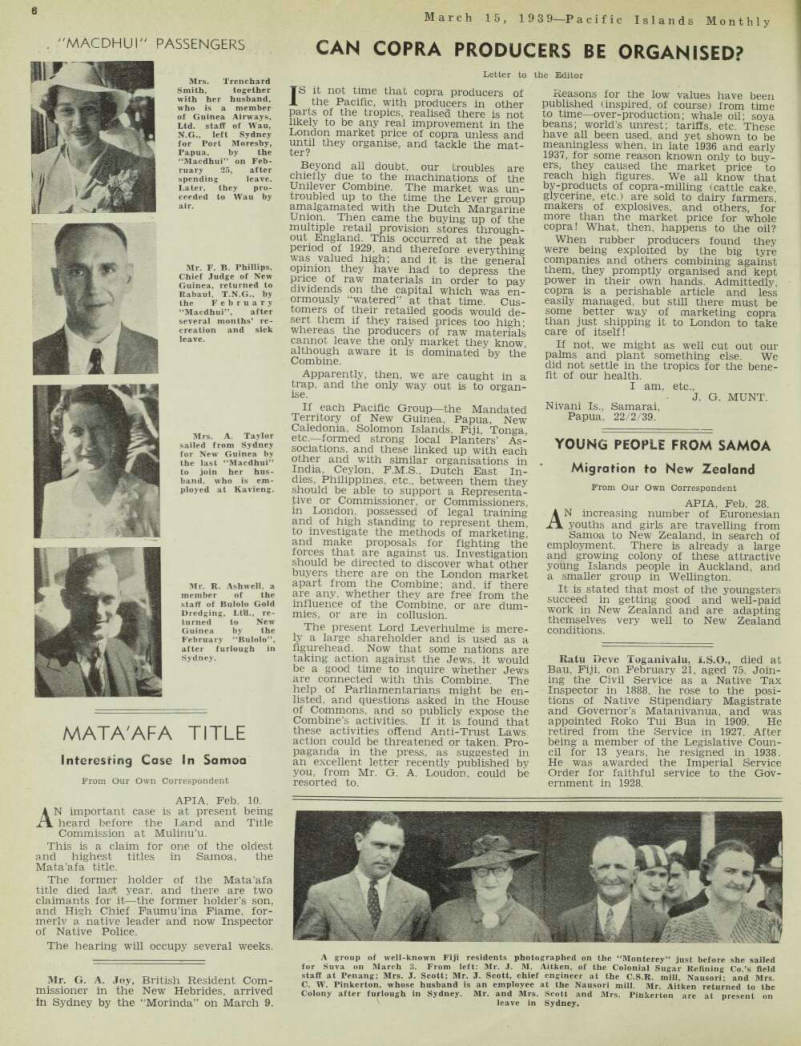
Mrs. Trenchard Smith, together with her husband, who is a member of Guinea Airways, Ltd. staff of Wau, N.G., left Sydney for Port Moresby, Papua, by the “Macdhui” on Feb ruary 25, after spending leave.
Later, they pro ceeded to Wau by air.
Mr. F. B. Phillips, Chief Judge of New Guinea, returned to Rabaul. T.N.G., by the February “Macdhui”, after several months’ re creation and sick leave.
Mrs. A. Taylor sailed from Sydney for New Guinea by the last “Macdhui” to join her hus band, who is em ployed at Kavieng.
Mr. R. Ashwell, a member of the staff of Bulolo Gold Dredging, Ltd., re turned to New Guinea by the February “Bulolo”, after furlough in Sydney.
Mata'afa Title
Interesting Case In Samoa
From Our Own Correspondent
Apia, Feb. 10.
AN important case is at present being heard before the Land and Title Commission at Mulinu’u.
This is a claim for one of the oldest and highest titles in Samoa, the Mata’afa title.
The former holder of the Mata'afa title died last year, and there are two claimants for it—the former holder’s son, and High Chief Faumu’ina Fiame, for merly a native leader and now Inspector of Native Police.
The hearing will occupy several weeks.
Mr, G. A. Joy, British Resident Com missioner in the New Hebrides, arrived in Sydney by the “Morinda” on March 9.
Can Copra Producers Be Organised?
Letter to the Editor
IS it not time that copra producers of the Pacific, with producers in other parts of the tropics, realised there is not likely to be any real improvement in the London market price of copra unless and until they organise, and tackle the mat ter?
Beyond all doubt, our troubles are chiefly due to the machinations of the Unilever Combine. The market was un troubled up to the time the Lever group amalgamated with the Dutch Margarine Union. Then came the buying up of the multiple retail provision stores through out England. This occurred at the peak period of 1929. and therefore everything was valued high; and it is the general opinion they have had to depress the price of raw materials in order to pay dividends on the capital which was en ormously “watered” at that time. Cus tomers of their retailed goods would de sert them if they raised prices too high; whereas the producers of raw materials cannot leave the only market they know although aware it is dominated by the Combine.
Apparently, then, we are caught in a trap, and the only way out is to organ ise.
If each Pacific Group—the Mandated Territory of New Guinea, Papua, New Caledonia, Solomon Islands, Fiji, Tonga, etc.—formed strong local Planters’ As sociations, and these linked up with each other and with similar organisations in India, Ceylon, F.M.S., Dutch East In dies. Philippines, etc., between them they should be able tp support a Representa tive or Commissioner, or Commissioners, in London, possessed of legal training and of high standing to represent them, to investigate the methods of marketing, and make proposals for fighting the forces that are against us. Investigation should be directed to discover what other buyers there are on the London market apart from the Combine; and, if there are any, whether they are free from the influence of the Combine, or are dum mies, or are in collusion.
The present Lord Leverhulme is mere ly a large shareholder and is used as a figurehead. Now that some nations are taking action against the Jews, it would be a good time to inquire whether Jews are connected with this Combine. The help of Parliamentarians might be en listed, and questions asked in the House of Commons, and so publicly expose the Combine’s activities. If it is found that these activities offend Anti-Trust Laws action could be threatened or taken. Pro paganda in the press, as suggested in an excellent letter recently published by you, from Mr. G. A. Loudon, could be resorted to.
Reasons for the low values have been published (inspired, of course) from time to time—over-production; whale oil; soya beans; world’s unrest; tariffs, etc. These have all been used, and yet shown to be meaningless when, in late 1936 and early 1937, for some reason known only to buy ers, they caused the market price to reach high figures. We all know that by-products of copra-milling (cattle cake, glycerine, etc.) are sold to dairy farmers, makers of explosives, and others, for more than the market price for whole copra! What, then, happens to the oil?
When rubber producers found they were being exploited by the big tyre companies and others combining against them, they promptly organised and kept power in their own hands. Admittedly, copra is a perishable article and less easily managed, but still there must be some better way of marketing copra than just shipping it to London to take care of itself!
If not, we might as well cut out our palms and plant something else. We did not settle in the tropics for the bene fit of our health.
I am, etc.,
J. G. Munt.
Nivani Is., Samarai, Papua, 22/2/39.
Young People From Samoa
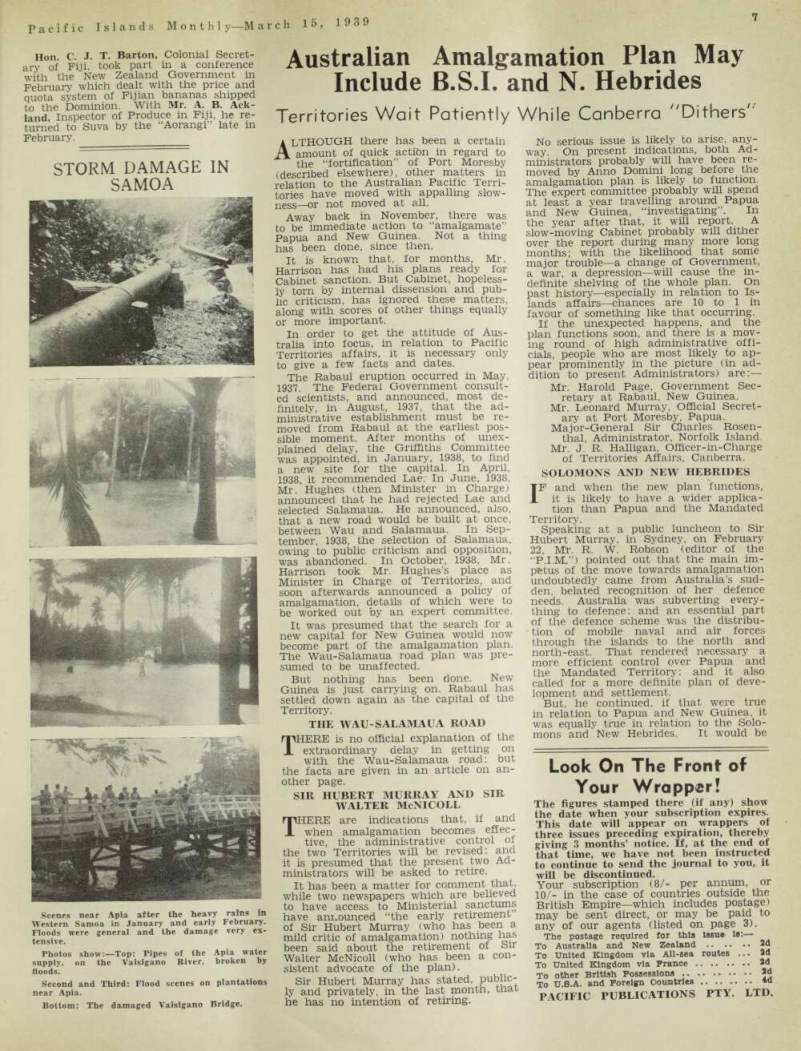
Migration to New Zealand
From Our Own Correspondent
Apia, Feb. 28.
AN Increasing number of Euroneslan youths and girls are travelling from Samoa to New Zealand, in search of employment. There is already a large and growing colony of these attractive young Islands people in Auckland, and a smaller group in Wellington.
It is stated that most of the youngsters succeed in getting good and well-paid work in New Zealand and are adapting themselves very well to New Zealand conditions.
Ratu Deve Toganivalu, i. 5.0., died at Bau, Fiji, on February 21, aged 75. Join ing the Civil Service as a Native Tax Inspector in 1888, he rose to the posi tions of Native Stipendiary Magistrate and Governor’s Matanivanua, and was appointed Roko Tui Bua in 1909. He retired from the Service in 1927. After being a member of the Legislative Coun cil for 13 years, he resigned in 1938.
He was awarded the Imperial Service Order for faithful service to the Gov ernment in 1928.
A group of well-known Fiji residents photographed on the “Monterey” just before she sailed for Suva on March 3. From left: Mr. J. M. Aitken, of the Colonial Sugar Refining Co.’s field staff at Penang; Mrs. J. Scott; Mr. J. Scott, chief engineer at the C.S.R. mill, Nausori; and Mrs.
C. W. Pinkerton, whose husband is an employee at the Nausori mill. Mr. Aitken returned to the Colony after furlough in Sydney. Mr. and Mrs. Scott and Mrs. Pinkerton are at present on leave in Sydney.
Hon. C. J. T. Barton, Colonial Secret ary of Fiji, took part in a conference with the New Zealand Government in February which dealt with the price and quota system of Fijian bananas shipped to the Dominion. With Mr. A. B. Ack land, Inspector of Produce in Fiji, he re turned to Suva by the “Aorangi” late in February.
Advertisements & other items, p. 8 (1 item)
6
March 15, 193 9—P acific Islands Monthly
Samoa
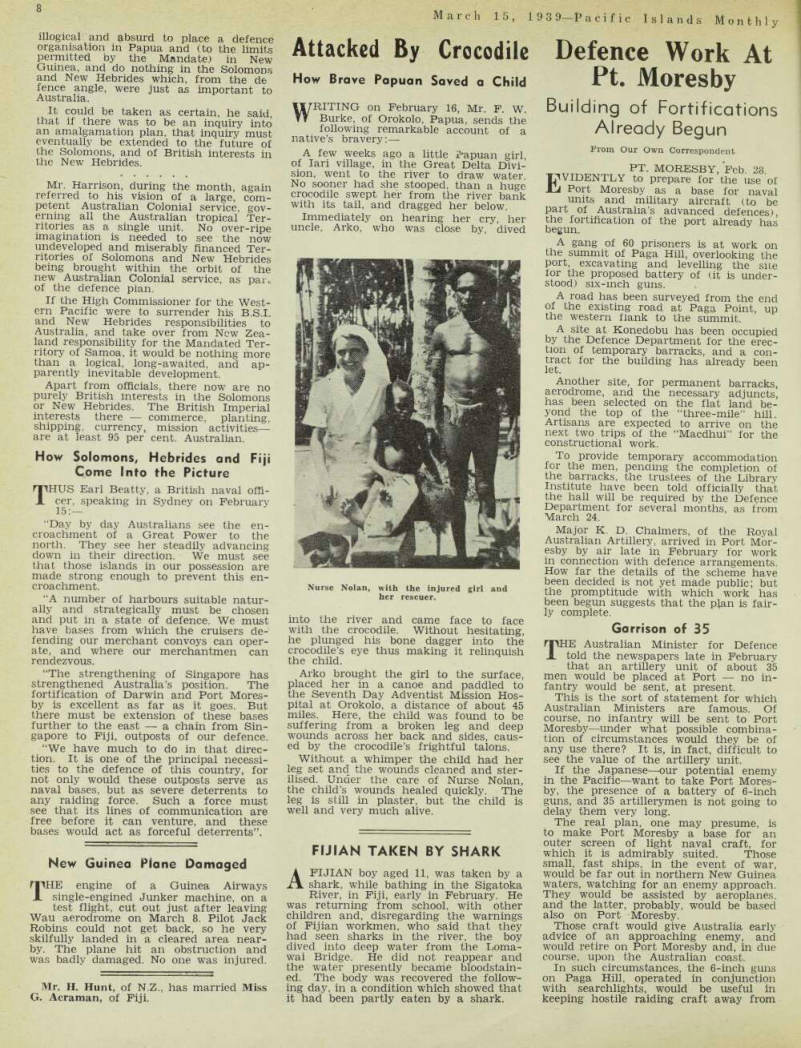
Storm Damage In
Scenes near Apia after the heavy rains in Western Samoa in January and early February.
Floods were general and the damage very ex tensive.
Photos show:—Top: Pipes of the Apia water supply, on the Vaisigano River, broken by floods.
Second and Third: Flood scenes on plantations near Apia.
Bottom: The damaged Vaisigano Bridge.
Australian Amalgamation Plan May
Include B.S.I. and N. Hebrides Territories Wait Patiently While Canberra "Dithers"
ALTHOUGH there has been a certain amount of quick action in regard to the “fortification” of Port Moresby (described elsewhere), other matters in relation to the Australian Pacific Terri tories have moved with appalling slow ness__or not moved at all.
Away back in November, there was to be immediate action to “amalgamate”
Papua and New Guinea. Not a thing has been done, since then.
It is known that, for months, Mr.
Harrison has had his plans ready for Cabinet sanction. But Cabinet, hopeless ly torn by internal dissension and pub lic criticism, has ignored these matters, along with scores of other things equally or more important.
In order to get the attitude of Aus tralia into focus, in relation to Pacific Territories affairs, it is necessary only to give a few facts and dates.
The Rabaul eruption occurred in May, 1937. The Federal Government consult ed scientists, and announced, most de finitely, in August, 1937, that the ad ministrative establishment must be re moved from Rabaul at the earliest pos sible moment. After months of unex plained delay, the Griffiths Committee was appointed, in January, 1938, to find a new site for the capital. In April, 1938, it recommended Lae. In June, 1938.
Mr. Hughes (then Minister in Charge) announced that he had rejected Lae and selected Salamaua. He announced, also, that a new road would be built at once, between Wau and Salamaua. In Sep tember, 1938, the selection of Salamaua, owing to public criticism and opposition, was abandoned. In October, 1938, Mr.
Harrison took Mr. Hughes’s place as Minister in Charge of Territories, and soon afterwards announced a policy of amalgamation, details of which were to be worked out by an expert committee.
It was presumed that the search for a new capital for New Guinea would now become part of the amalgamation plan.
The Wau-Salamaua road plan was pre sumed to be unaffected.
But nothing has been done. New Guinea is just carrying on. Rabaul has settled down again as the capital of the Territory.
The Wau-Salamaua Road
THERE is no official explanation of the extraordinary delay in getting on with the Wau-Salamaua road: but the facts are given in an article on an other page.
Sir Hubert Murray And Sir
Walter Mcnicoll
THERE are indications that, if and when amalgamation becomes effec tive, the administrative c<pntrol of the two Territories will be revised: and it is presumed that the present two Ad ministrators will be asked to retire.
It has been a matter for comment that, while two newspapers which are believed to have access to Ministerial sanctums have announced “the early retirement’ of Sir Hubert Murray (who has been a mild critic of amalgamation) nothing has been said about the retirement of Sir Walter McNicoll (who has been a con sistent advocate of the plan).
Sir Hubert Murray has stated, public ly and privately, in the last month, that he has no intention of retiring.
No serious issue is likely to arise, any way On present indications, both Ad ministrators probably will have been re moved by Anno Domini long before the amalgamation plan is likely to function.
The expert committee probably will spend at least a year travelling around Papua and New Guinea, “investigating”. In the year after that, it will report. A slow-moving Cabinet probably will dither over the report during many more long months; with the likelihood that some major trouble—a change of Government, a war, a depression—will cause the in definite shelving of the whole plan. On past history—especially in relation to Is lands affairs —chances are 10 to 1 in favour of something like that occurring.
If the unexpected happens, and the plan functions soon, and there is a mov ing round of high administrative offi cials, people who are most likely to ap pear prominently in the picture (in ad dition to present Administrators) are:— Mr. Harold Page, Government Sec retary at Rabaul, New Guinea.
Mr. Leonard Murray, Official Secret ary at Port Moresby, Papua.
Major-General Sir Charles Rosen thal, Administrator, Norfolk Island.
Mr. J. R. Halligan, Ofiicer-in-Charge of Territories Affairs, Canberra.
Solomons And New Hebrides
IF and when the new plan functions, it is likely to have a wider applica tion than Papua and the Mandated Territory.
Speaking at a public luncheon to Sir Hubert Murray, in Sydney, on February 22, Mr. R. W. Robson (editor of the “P.1.M.”) pointed out that the main im petus of the move towards amalgamation undoubtedly came from Australia’s sud den. belated recognition of her defence needs. Australia was subverting every thing to defence; and an essential part of the defence scheme was the distribu tion of mobile naval and air forces through the islands to the north and north-east. That rendered necessary a more efficient control over Papua and the Mandated Territory: and it also called for a more definite plan of deve lopment and settlement.
But, he continued, if that were true in relation to Papua and New Guinea, it was equally true in relation to the Solo mons and New Hebrides. It would be
illogical and absurd to place a defence organisation in Papua and (to the limits permitted by the Mandate) in New Guinea, and do nothing in the Solomons and New Hebrides which, from the de fence angle, were just as important to Australia.
It could be taken as certain, he said, that if there was to be an inquiry into an amalgamation plan, that inquiry must eventually be extended to the future of the Solomons, and of British interests in the New Hebrides.
Mr. Harrison, during the month, again referred to his vision of a large, com petent Australian Colonial service, gov erning all the Australian tropical Ter ritories as a single unit. No over-ripe imagination is needed to see the now undeveloped and miserably financed Ter ritories of Solomons and New Hebrides being brought within the orbit of the new Australian Colonial service, as pai\, of the defence plan.
If the High Commissioner for the West ern Pacific were to surrender his 8.5.1. and New Hebrides responsibilities to Australia, and take over from New Zea land responsibility for the Mandated Ter ritory of Samoa, it would be nothing more than a logical, long-awaited, and ap parently inevitable development.
Apart from officials, there now are no purely British interests in the Solomons or New Hebrides. The British Imperial interests there commerce, planting, shipping, currency, mission activities— are at least 95 per cent. Australian.
How Solomons, Hebrides and Fiji
Come Into the Picture
THUS Earl Beatty, a British naval offi cer, speaking in Sydney on February 151— “Day by day Australians see the en croachment of a Great Power to the north. They see her steadily advancing down in their direction. We must see that those islands in our possession are made strong enough to prevent this en croachment.
“A number of harbours suitable natur ally and strategically must be chosen and put in a state of defence. We must have bases from which the cruisers de fending our merchant convoys can oper ate, and where our merchantmen can rendezvous.
“The strengthening of Singapore has strengthened Australia’s position. The fortification of Darwin and Port Mores by is excellent as far as it goes. But there must be extension of these bases further to the east a chain from Sin gapore to Fiji, outposts of our defence.
“We have much to do in that direc tion. It is one of the principal necessi ties to the defence of this country, for not only would these outposts serve as naval bases, but as severe deterrents to any raiding force. Such a force must see that its lines of communication are free before it can venture, and these bases would act as forceful deterrents”.
New Guinea Plane Damaged
THE engine of a Guinea Airways single-engined Junker machine, on a test flight, cut out just after leaving Wau aerodrome on March 8. Pilot Jack Robins could not get back, so he very skilfully landed in a cleared area near by. The plane hit an obstruction and was badly damaged. No one was injured.
Mr. H. Hunt, of N.Z., has married Miss G. Acraman, of Fiji.
Advertisements & other items, p. 9 (2 items)
7
Pacific Islands Monthl y —M arch 15, 1939
Your Wrapper!
Look On The Front of
The figures stamped there (if any) show the date when your subscription expires.
This date will appear on wrappers of three issues preceding expiration, thereby giving 3 months’ notice. If, at the end of that time, we have not been instructed to continue to send the journal to you, it will be discontinued.
Your subscription (8/- per annum, or 10/- in the case of countries outside the British Empire—which includes postage) may be sent direct, or may be paid to any of our agents (listed on page 3).
The postage required for this issue Is:— To Australia and New Zealand 2d To United Kingdom via All-sea routes ... 2d To United Kingdom via Prance 2d To other British Possessions 2d To U.S.A. and Foreign Countries 4a
PACIFIC PUBLICATIONS PTY. LTD.
Attacked By Crocodile
How Brave Papuan Saved a Child
WRITING on February 16, Mr. F. W.
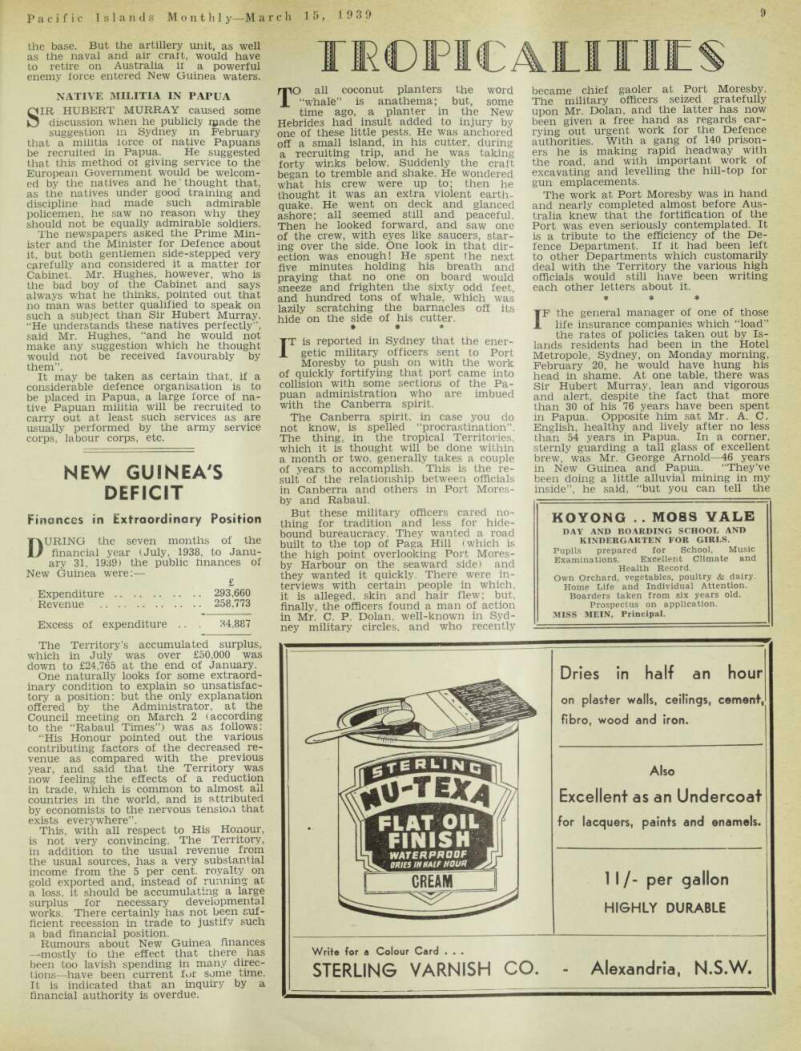
Burke, of Orokolo. Papua, sends the following remarkable account of a native’s bravery;— A few weeks ago a little Papuan girl, of lari village, in the Great Delta Divi sion, went to the river to draw water.
No sooner had she stooped, than a huge crocodile swept her from the river bank with its tail, and dragged her below.
Immediately on hearing her cry, her uncle, Arko, who was close by, dived
into the river and came face to face with the crocodile. Without hesitating, he plunged his bone dagger into the crocodile’s eye thus making it relinquish the child.
Arko brought the girl to the surface, placed her in a canoe and paddled to the Seventh Day Adventist Mission Hos pital at Orokolo, a distance of about 45 miles. Here, the child was found to be suffering from a broken leg and deep wounds across her back and sides, caus ed by the crocodile’s frightful talons.
Without a whimper the child had her leg set and the wounds cleaned and ster ilised. Under the care of Nurse Nolan, the child’s wounds healed quickly. The leg is still in plaster, but the child is well and very much alive.
Nurse Nolan, with the injured girl and her rescuer.
Fijian Taken By Shark
A FIJIAN boy aged 11, was taken by a shark, while bathing in the Sigatoka River, in Fiji, early in February. He was returning from school, with other children and, disregarding the warnings of Fijian workmen, who said that they had seen sharks in the river, the boy dived into deep water from the Loma wai Bridge. He did not reappear and the water presently became bloodstain ed. The body was recovered the follow ing day, in a condition which showed that it had been partly eaten by a shark.
Pt. Moresby
Defence Work At Pt. Moresby Building of Fortifications Already Begun
From Our Own Correspondent
Ept. Moresby, Feb. 28.
VIDENTLY to prepare for the use of Port Moresby as a base for naval units and military aircraft (to be part of Australia’s advanced defences), the fortification of the port already has begun.
A gang of 60 prisoners is at work on the summit of Paga Hill, overlooking the port, excavating and levelling the site for the proposed battery of (it is under stood) six-inch guns.
A road has been surveyed from the end of the existing road at Paga Point, up the western flank to the summit.
A site at Konedobu has been occupied by the Defence Department for the erec tion of temporary barracks, and a con tract for the building has already been let.
Another site, for permanent barracks, aerodrome, and the necessary adjuncts, has been selected on the flat land be yond the top of the “three-mile” hill.
Artisans are expected to arrive on the next two trips of the “Macdhui” for the constructional work.
To provide temporary accommodation for the men, pending the completion of the barracks, the trustees of the Library Institute have been told officially that the hall will be required by the Defence Department for several months, as from March 24.
Major K. D. Chalmers, of the Royal Australian Artillery, arrived in Port Mor esby by air late in February for work in connection with defence arrangements.
How far the details of the scheme have been decided is not yet made public; but the promptitude with which work has been begun suggests that the plan is fair ly complete.
Garrison of 35
r'E Australian Minister for Defence told the newspapers late in February that an artillery unit of about 35 men would be placed at Port no in fantry would be sent, at present.
This is the sort of statement for which Australian Ministers are famous. Of course, no infantry will be sent to Port Moresby—under what possible combina tion of circumstances would they be of any use there? It is, in fact, difficult to see the value of the artillery unit.
If the Japanese—our potential enemy in the Pacific —want to take Port Mores by, the presence of a battery of 6-inch guns, and 35 artillerymen is not going to delay them very long.
The real plan, one may presume, is to make Port Moresby a base for an outer screen of light naval craft, for which it is admirably suited. Those small, fast ships, in the event of war, would be far out in northern New Guinea waters, watching for an enemy approach.
They would be assisted by aeroplanes, and the latter, probably, would be based also on Port Moresby.
Those craft would give Australia early advice of an approaching enemy, and would retire on Port Moresby and, in due course, upon the Australian coast.
In such circumstances, the 6-inch guns on Paga Hill, operated in conjunction with searchlights, would be useful in keeping hostile raiding craft away from
the base. But the artillery unit, as well as the naval and air craft, would have to retire on Australia if a powerful enemy force entered New Guinea waters.
Native Militia In Papua
SIR HUBERT MURRAY caused some discussion when he publicly ipade the suggestion in Sydney in February that a militia force of native Papuans be recruited in Papua. He suggested that this method of giving service to the European Government would be welcom ed by the natives and he thought that, as the natives under good training and discipline had made such admirable policemen, he saw no reason why they should not be equally admirable soldiers.
The newspapers asked the Prime Min ister and the Minister for Defence about it, but both gentlemen side-stepped very carefully ana considered it a matter for Cabinet. Mr. Hughes, however, who is the bad boy of the Cabinet and says always what he thinks, pointed out that no man was better qualified to speak on such a subject than Sir Hubert Murray.
“He understands these natives perfectly”, said Mr. Hughes, “and he would not make any suggestion which he thought would not be received favourably by them”.
It may be taken as certain that, if a considerable defence organisation is to be placed in Papua, a large force of na tive Papuan militia will be recruited to carry out at least such services as are usually performed by the army service corps, labour corps, etc.
New Guinea's
Deficit
Finances in Extraordinary Position
DURING the seven months of the financial year (July, 1938, to Janu ary 31, 1939) the public finances of New Guinea were:—
The Territory’s accumulated surplus, which in July was over £50,000 was down to £24,765 at the end of January.
One naturally looks for some extraord inary condition to explain so unsatisfac tory a position: but the only explanation offered by the Administrator, at the Council meeting on March 2 (according to the “Rabaul Times”) was as follows: “His Honour pointed out the various contributing factors of the decreased re venue as compared with the previous year, and said that the Territory was now feeling the effects of a reduction in trade, which is common to almost all countries in the world, and is attributed by economists to the nervous tension that exists everywhere”.
This, with all respect to His Honour, is not very convincing. The Territory, in addition to the usual revenue from the usual sources, has a very substantial income from the 5 per cent, royalty on gold exported and, instead of running at a loss, it should be accumulating a large surplus for necessary developmental works. There certainly has not been suf ficient recession in trade to justify such a bad financial position.
Rumours about New Guinea finances —mostly to the effect that there has been too lavish spending in many direc tions —have been current for some time.
It is indicated that an inquiry by a financial authority is overdue.
£ Expenditure .. 293,660 Revenue .. 258,773 Excess of expenditure . . . 34,887
Tropicalities
TO all coconut planters the word “whalfc” is anathema; but, some time ago, a planter in the New Hebrides had insult added to injury by one of these little pests. He was anchored off a small island, in his cutter, during a recruiting trip, and he was taking forty winks below. Suddenly the craft began to tremble and shake. He wondered what his crew were up to; then he thought it was an extra violent earth quake. He went on deck and glanced ashore; all seemed still and peaceful.
Then he looked forward, and saw one of the crew, with eyes like saucers, star ing over the side. One look in that dir ection was enough! He spent the next five minutes holding his breath and praying that no one on board would sneeze and frighten the sixty odd feet, and hundred tons of whale, which was lazily scratching the barnacles off its hide on the side of his cutter. • • * IT is reported in Sydney that the ener getic military officers sent to Port Moresby to push on with the work of quickly fortifying that port came into collision with some sections of the Pa puan administration who are imbued with the Canberra spirit.
The Canberra spirit, in case you do not know, is spelled “procrastination”.
The thing, in the tropical Territories, which it is thought will be done within a month or two, generally takes a couple of years to accomplish. This is the re sult of the relationship between officials in Canberra and others in Port Mores by and Rabaul.
But these military officers cared no thing for tradition and less for hide bound bureaucracy. They wanted a road built to the top of Paga Hill (which is the high point overlooking Port Mores by Harbour on the seaward side) and they wanted it quickly. There were in terviews with certain people in which, it is alleged, skin and hair flew; but. finally, the officers found a man of action in Mr. C. P. Dolan, well-known in Syd ney military circles, and who recently
became chief gaoler at Port Moresby.
The military officers seized gratefully upon Mr. Dolan, and the latter has now been given a free hand as regards car rying out urgent work for the Defence authorities. With a gang of 140 prison ers he is making rapid headway with the road, and with important work of excavating and levelling the hill-top for
gun emplacements.
The work at Port Moresby was in hand and nearly completed almost before Aus tralia knew that the fortification of the Port was even seriously contemplated. It is a tribute to the efficiency of the De fence Department. If it had been left to other Departments which customarily deal with the Territory the various high officials would still have been writing each other letters about it. * ♦ ♦ IF the general manager of one of those life insurance companies which “load” the rates of policies taken out by Is lands residents had been in the Hotel Metropole, Sydney, on Monday morning, February 20, he would have hung his head in shame. At one table, there was Sir Hubert Murray, lean and vigorous and alert, despite the fact that more than 30 of his 76 years have been spent in Papua. Opposite him sat Mr. A. C.
English, healthy and lively after no less than 54 years in Papua. In a corner, sternly guarding a tall glass of excellent brew, was Mr. George Arnold—46 years in New Guinea and Papua. “They’ve been doing a little alluvial mining in my inside”, he said, “but you can tell the
boys in Wau that I’m pretty well, and I’ll- be back soon”. With him, fit and brown, was Mr. C. B. L. Wilde, who has shown Australia that Wau can grow the world’s best coffee. He has been 30i years in New Guinea. At another table, chatting to Mr. and Mrs. Loudon, of Port Moresby, was Mr. Les. Joubert, Mr.
Arnold’s old “mate” on Morobe. Mr.
Joubert is somewhere in his fifties, 31 of those years were spent in the roughest parts of New Guinea and Papua; but he still has all his hair and teeth, and a figure and an outlook which place him in the ranks of permanent youth. * ♦ tc NEW GUINEA’S Administrator, Sir Walter McNicoll, used fruity meta phors on March 2, when describing to his Legislative Council the unprotect ed state of New Guinea. He said that the Territory “hangs like an over-ripe peach over the fence of the Australian orchard, waiting to be picked by some passing marauder. It is to be hoped that the orchardists’ watchdogs will be able to keep the marauders at a distance. It would be better still if the fence could be extended and strengthened so as to include the overhanging branches”.
Which seemed to be another way of
saying that he hoped that Australia soon would annex the Mandated Territory.
Sir Walter has committed a sort of lese majesty. In of all Mandate officials, the Mandate system is holy and untouchable. It now is to be expected that a platoon of long-haired monsters from Geneva will arrive presently in Ra baul and tear out the toenails and other wise mutilate the body of His Disrespect ful Honour, the Administrator.
Advertisements & other items, pp. 11-12 (2 items)
9
Pacific Islands Mont hi y —M arch 15, 1939
Finish
KOYONG .. MOSS YALE
DAY AND BOARDING SCHOOL AND
KINDERGARTEN FOR GIRLS.
Pupils prepared for School, Music Examinations. Excellent Climate and Health Record.
Own Orchard, vegetables, poultry & dairy.
Home Life and Individual Attention.
Boarders taken from six years old.
Prospectus on application.
MISS MEIN, Principal.
FLAT OIL
FINISH
WATERPROOF
DRIES IHHAIF HOUR
Write for a Colour Card . . .
STERLING VARNISH CO.
Dries in halt an hour on plaster walls, ceilings, cement, fibro, wood and iron.
Also Excellent as an Undercoat for lacquers, paints and enamels. 1 I /- per gallon
HIGHLY DURABLE
Alexandria, N.S.W.
THE PACIFIC ISLANDS CLUB
Visitors from the Islands to Sydney (or those interested in Islands affairs), are advised to communicate with the honorary secretary of the above Club, which has been formed to study the history, traditions, economics, and political develyiments of the Pacific Islands.
ANNUAL MEETING will be held on Wednesday, April 5, 8 p.m., at Hotel Carlton, Sydney.
THE PACIFIC ISLANDS CLUB,
C/o Pacific Publications Pty. Ltd., Union House, George St., Sydney.
Transpacific Air
Service
Meteorological Station at Noumea
IT would appear that the plan that Pan-American Airways shall run a sea-plane service across the Central Pacific from Hawaii to Australia via Canton Island and New Caledonia is be ing steadily proceeded with.
Details of the plan were given in the last issue of the “P.1.M.”, and it then was stated that a contract had just been signed between the Government of French New Caledonia and Pan Ameri can Airways, under which the latter were to establish a fortnightly return service between North America and Australia, via Noumea, before June 30, 1939. The island of Nouville, which lies opposite the town of Noumea, is now being pre pared as a suitable aeroplane station.
It is reported in the “Bulletin du Com merce” of January 28 (published in Nou mea) that Monsieur Suraud left Mar seilles on January 23, by the “Ville de Strasburg. for Noumea. He is a meteor ological engineer, and he is bringing with mm complete equipment, wherewith he will establish a meteorological station at
Nouville, and will direct its operation when it commences to function in con nection with the P.A.A. trahs-Pacific ser vice.
Although the terms of the agreement between the French Government and Pan American Airways have been published nothing at all has yet been said by Pan American Airways; and, so far as is known, that company is still committed to the plan under which it is to run a service from Hawaii down through the Samoan Islands to Auckland in New Zealand. The “Bulletin du Commerce”, says that up to January 28 the Ameri can company has made no official an nouncement concerning its plans for the organisation of an aero-port at Nouville.
Boeing Clipper’S Maiden Flight
Pan-American Airways’ giant flying boat, the Boeing Clipper, which is of a similar type to those intended ultimately for the South Pacific service, arrived at Hong Kong on March 5 on her maiden night across the Pacific from San Fran cisco.
Solomons
Earthquake Damage In
AVERY brief message from Rev. J. F.
Goldie, head of the Methodist Mis sion in the Solomons, says that in mid-February damage amounting to £5OO was caused by very severe earth tremors which destroyed the buildings of the mission station at Gizo, in the Northern Solomons. No one was injured.
Rev. J. P. Jarman, L.Th., of the Meth odist Mission Station at Bunama, Pa pua, has been compelled to resign owing to ill-health. He returned to Australia on February 20.
Advertisements & other items, p. 12 (2 items)
10
March 15, 193 9—P acific Islands Monthly
A GRACE BROS! Catalogue
BRINGS THE BIGGEST STORE IN
AUSTRALIA TO YOUR DOOR
Let us put you on our Mailing List To all addresses on our list we send Free of Charge Six Catalogues a year, including two Sale Books, when prices of all goods, except Proprietary articles, are marked at attractive reductions.
WRITE TO GRACE BROS. FOR EVERYTHING.
Prom our huge selection of merchandise we are practically able to meet your every requirement.
Should you not see exactly what you need in any of our Catalogues write in just the same. If not in stock we will do our utmost to procure it for you.
When next in Sydney, call and inspect our extensive range of attractive merchandise.
CATALOGUES POST FREE ANYWHERE!
GRACE BROS. Pty. Ltd.
Broodway SYDNEY 'Phone: M 6506
*0 % m € m
About Islands People
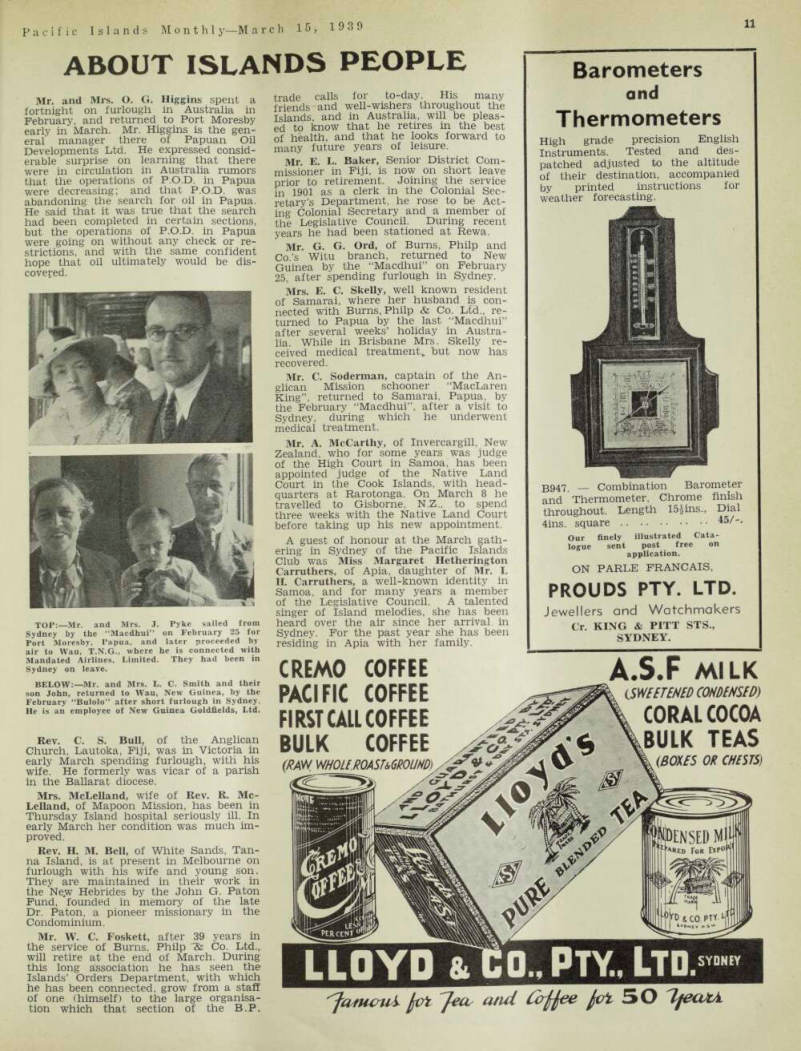
Mr. and Mrs. O. G. Higgins spent a fortnight on furlough in Australia in February, and returned to Port Moresby earlv in March. Mr. Higgins is the gen eral manager there of Papuan Oil Developments Ltd. He expressed consid erable surprise on learning that there were in circulation in Australia rumors that the operations of P.O.D. in Papua were decreasing: and that P.O.D. was abandoning the search for oil in Papua.
He said that it was true that the search had been completed in certain sections, but the operations of P.O.D. in Papua were going on without any check or re strictions, and with the same confident hope that oil ultimately would be dis covered.
Rev. C. S. Bull, of the Anglican Church, Lautoka, Fiji, was in Victoria in early March spending furlough, with his wife. He formerly was vicar of a parish in the Ballarat diocese.
Mrs. McLelland, wife of Rev. R. Mc- Lelland, of Mapoon Mission, has been in Thursday Island hospital seriously ill. In early March her condition was much im proved.
Rev. H. M. Bell, of White Sands, Tan na Island, is at present in Melbourne on furlough with his wife and young son.
They are maintained in their work in the Ne.w Hebrides by the John G. Paton Fund, founded in memory of the late Dr. Paton, a pioneer missionary in the Condominium.
Mr. W. C. Foskett, after 39 years in the service of Burns, Philp "8z Co. Ltd., will retire at the end of March. During this long association he has seen the Islands’ Orders Department, with which he has been connected, grow from a staff of one (himself) to the large organisa tion which that section of the B.P.
trade calls for to-day. His many friends and well-wishers throughout the Islands, and in Australia, will be pleas ed to know that he retires in the best of health, and that he looks forward to many future years of leisure.
Mr. E. L. Baker, Senior District Com missioner in Fiji, is now on short leave prior to retirement. Joining the service in 1901 as a clerk in the Colonial Sec retary’s Department, he rose to be Act ing Colonial Secretary and a member of the Legislative Council. During recent years he had been stationed at Rewa.
Mr. G. G. Ord, of Burns, Philp and Co.’s Witu branch, returned to New Guinea by the “Macdhui” on February 25, after spending furlough in Sydney.
Mrs. E. C. Skelly, well known resident of Samarai, where her husband is con nected with Burns, Philp & Co. Ltd., re turned to Papua by the last “Macdhui” after several weeks’ holiday in Austra lia. While in Brisbane Mrs. Skelly re ceived medical treatment,, but now has recovered.
Mr. C. Soderman, captain of the An glican Mission schooner “MacLaren King”, returned to Samarai, Papua, by the February “Macdhui”, after a visit to Sydney, during which he underwent medical treatment.
Mr. A. McCarthy, of Invercargill, New Zealand, who for some years was judge of the High Court in Samoa, has been appointed judge of the Native Land Court in the Cook Islands, with head quarters at Rarotonga. On March 8 he travelled to Gisborne, N.Z., to spend three weeks with the Native Land Court before taking up his new appointment.
A guest of honour at the March gath ering in Sydney of the Pacific Islands Club was Miss Margaret Hetherington Carruthers, of Apia, daughter of Mr. I.
H. Carruthers, a well-known identity in Samoa, and for many years a member of the Legislative Council. A talented singer of Island melodies, she has been heard over the air since her arrival in Sydney. For the past year she has been residing in Apia with her family.
TOP:—Mr. and Mrs. J. Pyke sailed from Sydney by the “Macdhui” on February 25 for Port Moresby, Papua, and later proceeded by air to Wau, T.N.G., where he is connected with Mandated Airlines, Limited. They had been in Sydney on leave.
BELOW:—Mr. and Mrs. L. C. Smith and their son John, returned to Wan, New Guinea, by the February “Bulolo” after short furlough in Sydney.
He is an employee of New Guinea Goldfields, Ltd.
Advertisements & other items, pp. 13-14 (2 items)
11
Pacific Islands Mont hi y—M arch 15, 1939
Pacific Coffee
Barometers
and
Thermometers
High grade precision English Instruments. Tested and despatched adjusted to the altitude of their destination, accompanied by printed instructions for weather forecasting. 8947. Combination Barometer and Thermometer, Chrome finish throughout. Length 15-2-ins., Dial 4ins. square 45/ “* Our finely illustrated Catalogue sent post free on application.
PROUDS PTY. LTD.
Jewellers and Watchmakers
Cr. KING & PITT STS.,
SYDNEY.
ON PARLE FRANCAIS,
CREMO COFFEE
PACIFIC COFFEE
FIRST CAUCOFFEE
BULK COFFEE
(RAN WNOIEROASTM
A.S.F Ml LK
(SWEETENEDCONDENSED)
CORAL COCOA
BULK TEAS
(SOUS OR CHESTS)
4-
CJ’jA
<» & Cr o o V V »
ENSED
f/y Expo a ßed
IOR
OVD
PIT
CO fcr ONC
Eu D mm
Capture the Action!
Capture the Colour !
MOVIE 5 at
SNAPSHOT cost
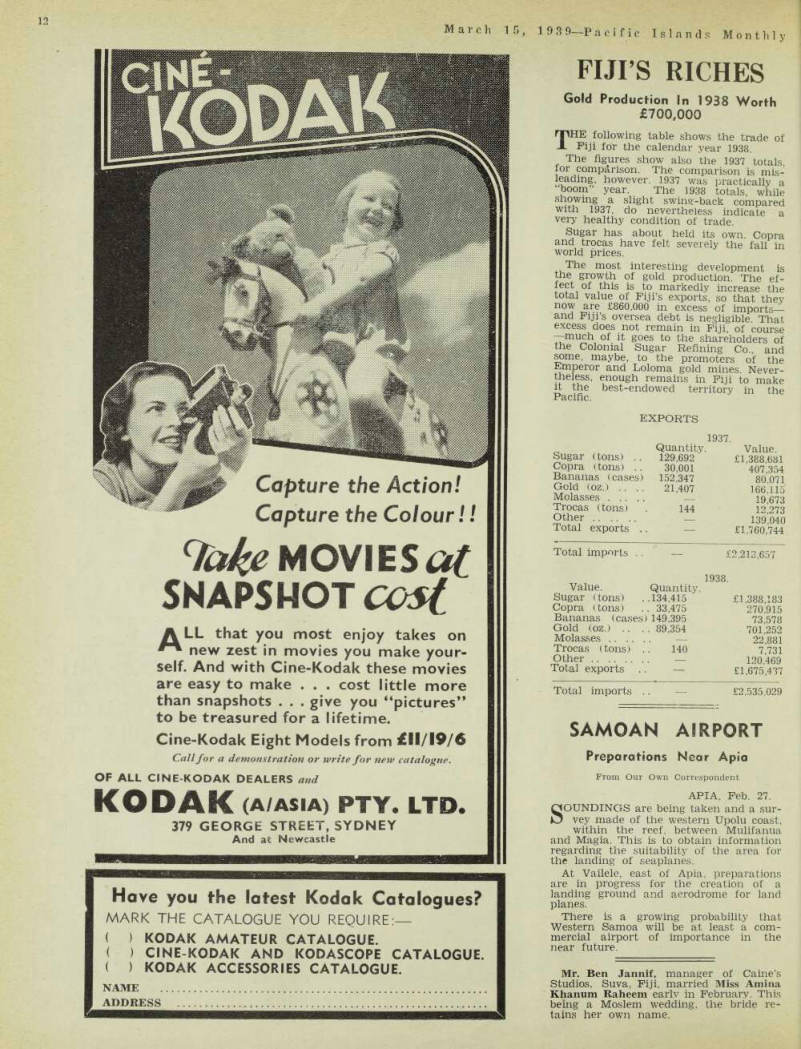
A LL that you most enjoy takes on new zest in movies you make yourself. And with Cine-Kodak these movies are easy to make . . . cost little more than snapshots . . . give you “pictures” to be treasured for a lifetime.
Cine-Kodak Eight Models from £ll/19/6 Call for a demonstration or write for new catalogue.
OF ALL CINE-KODAK DEALERS and
KODAK (A/as IA) PTY. LTD.
379 GEORGE STREET, SYDNEY
And at Newcastle
Hove you the latest Kodak Catalogues?
MARK THE CATALOGUE YOU REQUIRE;—
( ) KODAK AMATEUR CATALOGUE.
( ) CINE-KODAK AND KODASCOPE CATALOGUE.
( ) KODAK ACCESSORIES CATALOGUE.
NAME
ADDRESS
Fiji’S Riches
Gold Production In 1938 Worth £700,000
The following table shows the trade of Fiji for the calendar year 1938.
The figures show also the 1937 totals, lor comparison. The comparison is mis leading, however. 1937 was practically a boom” year. The 1938 totals, while showing a slight swing-back compared with 1937, do nevertheless indicate a very healthy condition of trade.
Sugar has about held its own. Copra and trocas have felt severely the fall in world prices.
The most interesting development is the growth of gold production. The ef fect of this is to markedly increase the total value of Fiji’s exports, so that thev now are £860,000 in excess of imports— and Fiji’s oversea debt is negligible That excess does not remain in Fiji, of course —much of it goes to the shareholders of the Colonial Sugar Refining Co., and some, maybe, to the promoters of the Emperor and Loloma gold mines. Never theless, enough remains in Fiji to make it the best-endowed territory in the Pacific.
Exports
1937.
Quantity. Value.
Sugar (tons) .. 129,692 £1,388,681 Copra (tons) .. 30,001 407,354 Bananas (cases) 152,347 80,071 Gold (oz.) .. . 21,407 166,115 Molasses . .. 19,673 Trocas (tons) 144 12,273 Other 139,040 Total exports .. — £1.760.744 Total imports .. — £2,213.657 1938.
Value.
Quantity.
Sugar (tons) .134,415 £1,388,183 Copra (tons) , 33.475 270,915 Bananas (cases) 149,395 73,578 Gold (oz.) .. . . 89.354 701,252 Molasses — 22,881 Trocas (tons) . 140 7,731 Other — 120.469 Total exports .. — £1,675,437 Total imports . — £2,535,029
Samoan Airport
Preparations Near Apia
Prom Our Own Correspondent
Apia, Feb. 27.
SOUNDINGS are being taken and a sur vey made of the western Upolu coast, within the reef, between Mulifanua and Magia. This is to obtain information regarding the suitability of the area for the landing of seaplanes.
At Vailele, east of Apia, preparations are in progress for the creation of a landing ground and aerodrome for land planes.
There is a growing probability that Western Samoa will be at least a com mercial airport of importance in the near future.
Mr. Ben Jannif, manager of Caine’s Studios, Suva, Fiji, married Miss Amina Khanum Raheem early in February. This being a Moslem wedding, the bride re tains her own name.
Air Mail
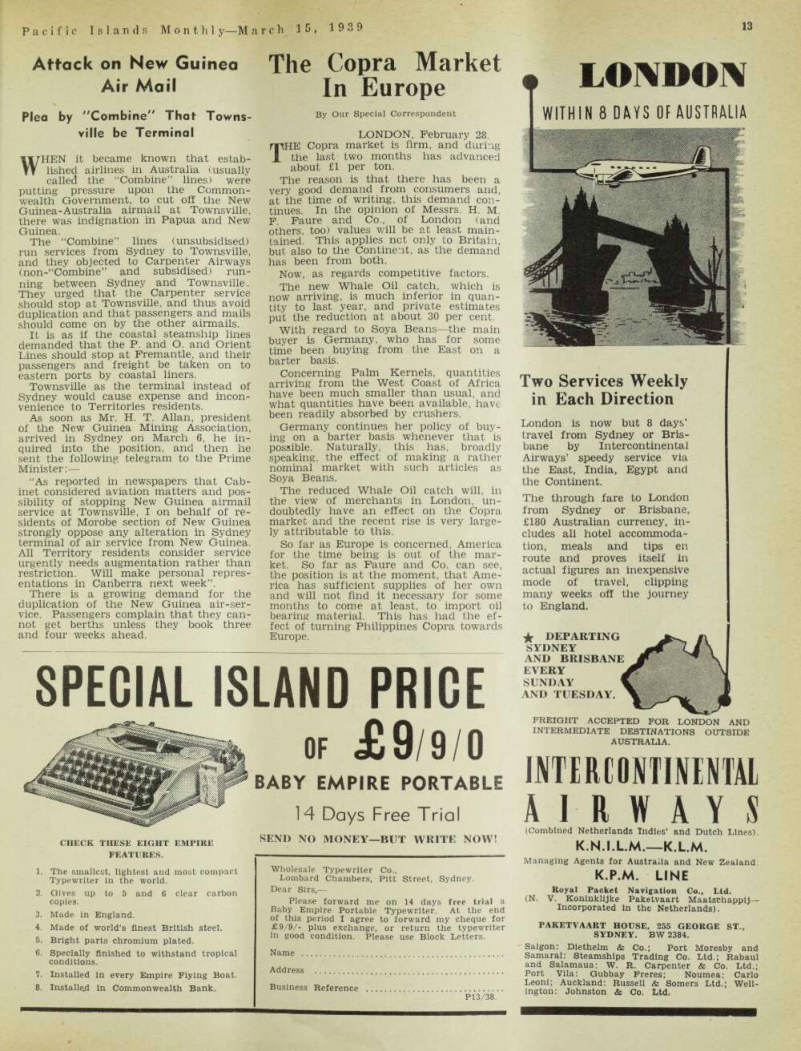
Attack on New Guinea Air Mail Plea by "Combine" That Towns ville be Terminal
WHEN it became known that estab lished airlines in Australia (usually called the “Combine” lines) were putting pressure upon the Common wealth Government, to cut off the New Guinea-Australia airmail at Townsville, there was indignation in Papua and New Guinea.
The “Combine” lines (unsubsidised) run services from Sydney to Townsville, and they objected to Carpenter Airways (non-“ Combine” and subsidised) run ning between Sydney and Townsville.
They urged that the Carpenter service should stop at Townsville, and thus avoid duplication and that passengers and mails should come on by the other airmails.
It is as if the coastal steamship lines demanded that the P. and O. and Orient Lines should stop at Fremantle, and their passengers and freight be taken on to eastern ports by coastal liners.
Townsville as the terminal instead of Sydney would cause expense and incon venience to Territories residents.
As soon as Mr. H. T. Allan, president of the New Guinea Mining Association, arrived in Sydney on March 6, he in quired into the position, and then he sent the following telegram to the Prime Minister:— “As reported in newspapers that Cab inet considered aviation matters and pos sibility of stopping New Guinea airmail service at Townsville, I on behalf of re sidents of Morobe section of New Guinea strongly oppose any alteration in Sydney terminal of air service from New Guinea.
All Territory residents consider service urgently needs augmentation rather than restriction. Will make personal repres entations in Canberra next week”.
There is a growing demand for the duplication of the New Guinea air-ser vice. Passengers complain that they can not get berths unless they book three and four weeks ahead.
In Europe
The Copra Market In Europe
By Our Special Correspondent
LONDON, February 28.
THE Copra market is firm, and during the last two months has advanced about £1 per ton.
The reason is that there has been a very good demand from consumers and, at the time of writing, this demand con tinues. In the opinion of Messrs. H. M.
P. Faure and Co., of London (and others, too) values will be at least main tained. This applies net only to Britain, but also to the Continent, as the demand has been from both.
Now, as regards competitive factors.
The new Whale Oil catch, which is now arriving, is much inferior in quan tity to last year, and private estimates put the reduction at about 30 per cent.
With regard to Soya Beans—the main buyer is Germany, who has for some time been buying from the East on a barter basis.
Concerning Palm Kernels, quantities arriving from the West Coast of Africa have been much smaller than usual, and what quantities have been available, have been readily absorbed by crushers.
Germany continues her policy of buy ing on a barter basis whenever that is possible. Naturally, this has, broadly speaking, the effect of making a rather nominal market with such articles as Soya Beans.
The reduced Whale Oil catch will, in the view of merchants in London, un doubtedly have an effect on the Copra market and the recent rise is very large ly attributable to this.
So far as Europe is concerned, America for the time being is out of the mar ket. So far as Faure and Co. can see, the position is at the moment, that Ame rica has sufficient supplies of her own and will not find it necessary for some months to come at least, to import oil bearing material. This has had the ef fect of turning Philippines Copra towards Europe.
Advertisements & other items, pp. 15-16 (2 items)
13
Pacific Islands Month 1 y—M arch 15, 1939
Special Island Price
LONDON
WITHIN 8 DAYS OF AUSTRALIA
Two Services Weekly
in Each Direction
London is now but 8 days’ travel from Sydney or Brisbane by Intercontinental Airways’ speedy service via the East, India, Egypt and the Continent.
The through fare to London from Sydney or Brisbane, £lBO Australian currency, includes all hotel accommodation, meals and tips en route and proves itself in actual figures an inexpensive mode of travel, clipping many weeks off the journey to England.
* DEPARTING
SYDNEY
AND BRISBANE
EVERY
SUNDAY
AND TUESDAY.
FREIGHT ACCEPTED FOR LONDON AND
INTERMEDIATE DESTINATIONS OUTSIDE
AUSTRALIA.
INTERCONTINENTAL
AIRWAYS
(Combined Netherlands Indies’ and Dutch Lines).
K.N.I.L.M.—K.L.M.
Managing Agents lor Australia and New Zealand
K.P.M. LINE
Royal Packet Navigation Co., Ltd. (N. V. Koninklijke Paketvaart MaatschapplJ— Incorporated in the Netherlands).
PAKETVAART HOUSE, 255 GEORGE ST.,
SYDNEY. BW 2384.
Saigon: Diethelm & Co.; Port Moresby and Samaral: Steamships Trading Co. Ltd.; Rabaul and Salamaua: W. R. Carpenter & Co. Ltd.; Port Vila: Gubbay Freres; Noumea: Carlo Leonl; Auckland: Russell & Somers Ltd.; Wellington: Johnston & Co. Ltd.
SPECIAL ISLAND PRICE
m of £9/9/0
BABY EMPIRE PORTABLE
14 Days Free Trial
CHECK THESE EIGHT EMPIRE
FEATURES.
SEND NO MONEY—BUT WRITE NOW!
1. The smallest, lightest and most compact Typewriter in the world. 2. Gives up to 5 and 6 clear carbon copies. 3. Made in England. 4. Made of world’s finest British steel. 5. Bright parts chromium plated. 6. Specially finished to withstand tropical conditions. 7. Installed in every Empire Flying Boat. 8. Installed in Commonwealth Bank.
Wholesale Typewriter Co., Lombard Chambers, Pitt Street, Sydney.
Dear Sirs, — Please forward me on 14 days free trial a Baby Empire Portable Typewriter. At the end of this period I agree to forward my cheque for £9/9/- plus exchange, or return the typewriter in good condition. Please use Block Letters.
Name /, Address Business Reference Pl3/38.
A COMPLETE HAIR CUTTING OUTFIT
for Home use.
a a 25/-. Post Free for Cosh.
Contains 1 Barber's Scissors, 1 No. 1 Hair Clipper, 1 No. 0000 Trimming Clipper and 1 Comb.
Write for fully illustrated Catalogue of Knives, Scissors, Razors and Veterinary Instruments.
Post free to the Islands.
W. JNO. BAKER
THE CUTLERY SPECIALISTS,
PTY. 3 HUNTER ST.,
LTD. SYDNEY, N.S.W.
ESTABLISHED 1888.
R. M. Hardy’s
Wonderful Discovery
The greatest health tonic of the age.
HARDY'S will banish forever all stomach troubles. Read the following testimonials: 6 Walter Street, Paddington, Sydney, N.S.W.
Dear Sir, —I feel I must write my appreciation of your wonderful cure for stomach troubles. For years I have been a constant sufferer from chronic indigestion, and at times I have been unable to attend work. But since taking Hardy’s powders I have made a great improvement and can now sit down and enjoy a good meal without any after effects, and I can thank you for being in my present job: and also for a good appetite. I am now in the best of health.
Yours gratefully, (Sgd.) RICHARD JUDGE. Mr. Richard Judge.
HARDY'S The Much Talked About Remedy.
Mrs. L. Pickham.
Mr. Hardy. 10 Jane Street, Balmain, Sydney.
June 24th, 1938.
Dear Sir, —I feel self-conscious I must come along and recommend you on your wonderful indigestion discovery as it has worked miracles on me. I suffered for months before my last baby was born and never thought I would eat again, but thanks to “Hardy’s” I am now a new person, can eat anything with safety. Kindly publish this to save other expectant mothers from months of agony.
Thanking you once again for your soothing remedy.
Yours truly,
(Sgd.) Mrs. L. PICKHAM.
HARDY'S is a scientific discovery containing
vital mineral and vegetable ingredients.
Strengthen your nerves, blot out that depressed feeling and brain fag, by taking a course of HARDY’S soz. tin 2/6, lOoz. tin 3/9 —from all Chemists and Stores throughout Australia, New Zealand and the Pacific Islands.
N. G. Goldfields
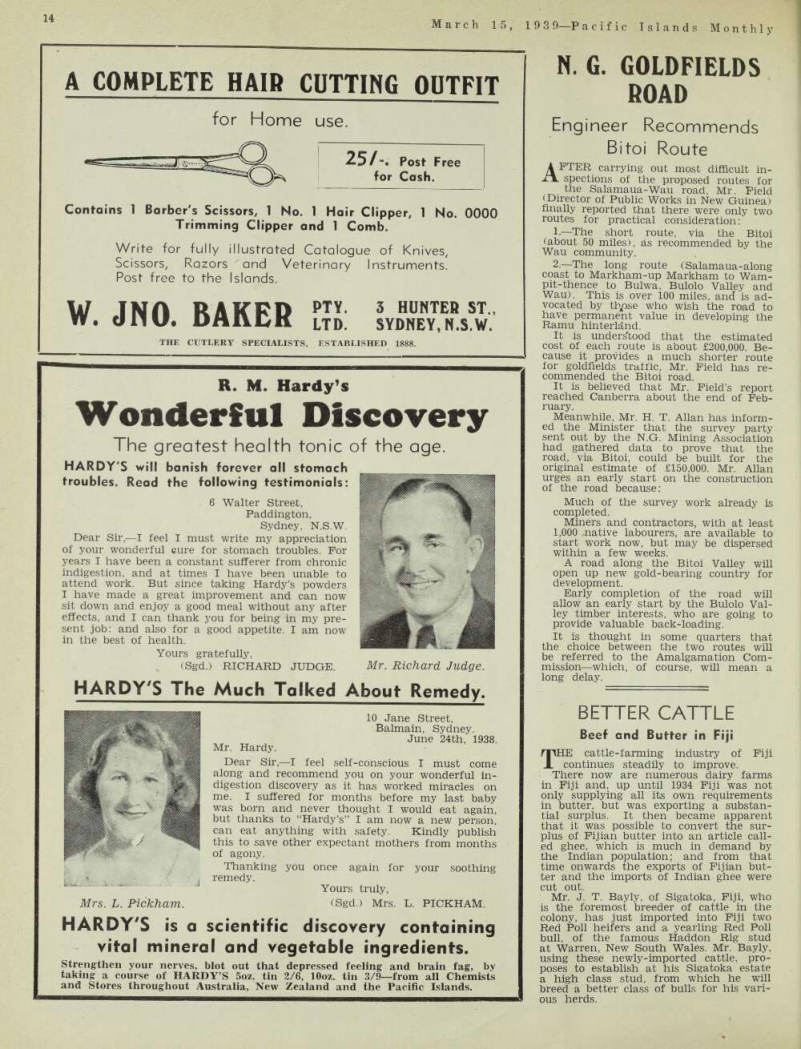
Road
Engineer Recommends Bitoi Route
AFTER carrying out most difficult in spections of the proposed routes for . the Salamaua-Wau road, Mr. Field (Director of Public Works in New Guinea) finally reported that there were only two routes for practical consideration: I.—The short route, via the Bitoi (about 50 miles), as recommended by the Wau community. 2.—The long route (Salamaua-along coast to Markham-up Markham to Wam pit-thence to Bulwa, Bulolo Valley and Wau). This is over 100 miles, and is ad vocated by tb 4 ose who wish the road to have permanent value in developing the Ramu hinterland.
It is understood that the estimated cost of each route is about £200,000. Be cause it provides a much shorter route for goldfields traffic, Mr. Field has re commended the Bitoi road.
It is believed that Mr. Field’s report reached Canberra about the end of Feb ruary.
Meanwhile, Mr. H. T. Allan has inform ed the Minister that the survey party sent out by the N.G. Mining Association had gathered data to prove that the road, via Bitoi, could be built for the original estimate of £150,000. Mr. Allan urges an early start on the construction of the road because: Much of the survey work already is completed.
Miners and contractors, with at least 1,000 native labourers, are available to start work now, but may be dispersed within a few weeks.
A road along the Bitoi Valley will open up new gold-bearing country for development.
Early completion of the road will allow an early start by the Bulolo Val ley timber interests, who are going to provide valuable back-loading.
It is thought in some quarters that the choice between the two routes will be referred to the Amalgamation Com mission—which, of course, will mean a long delay.
Better Cattle
Beef and Butter in Fiji
r:E cattle-farming industry of Fiji continues steadily to improve.
There now are numerous dairy farms in Fiji and, up until 1934 Fiji was not only supplying all its own requirements in butter, but was exporting a substan tial surplus. It then became apparent that it was possible to convert the sur plus of Fijian butter into an article call ed ghee, which is much in demand by the Indian population; and from that time onwards the exports of Fijian but ter and the imports of Indian ghee were cut out.
Mr. J. T. Bayly, of Sigatoka, Fiji, who is the foremost breeder of cattle in the colony, has just imported into Fiji two Red Poll heifers and a yearling Red Poll bull, of the famous Haddon Rig stud at Warren, New South Wales. Mr. Bayly, using these newly-imported cattle, pro poses to establish at his Sigatoka estate a high class stud, from which he will breed a better class of bulls for his vari ous herds.
South"
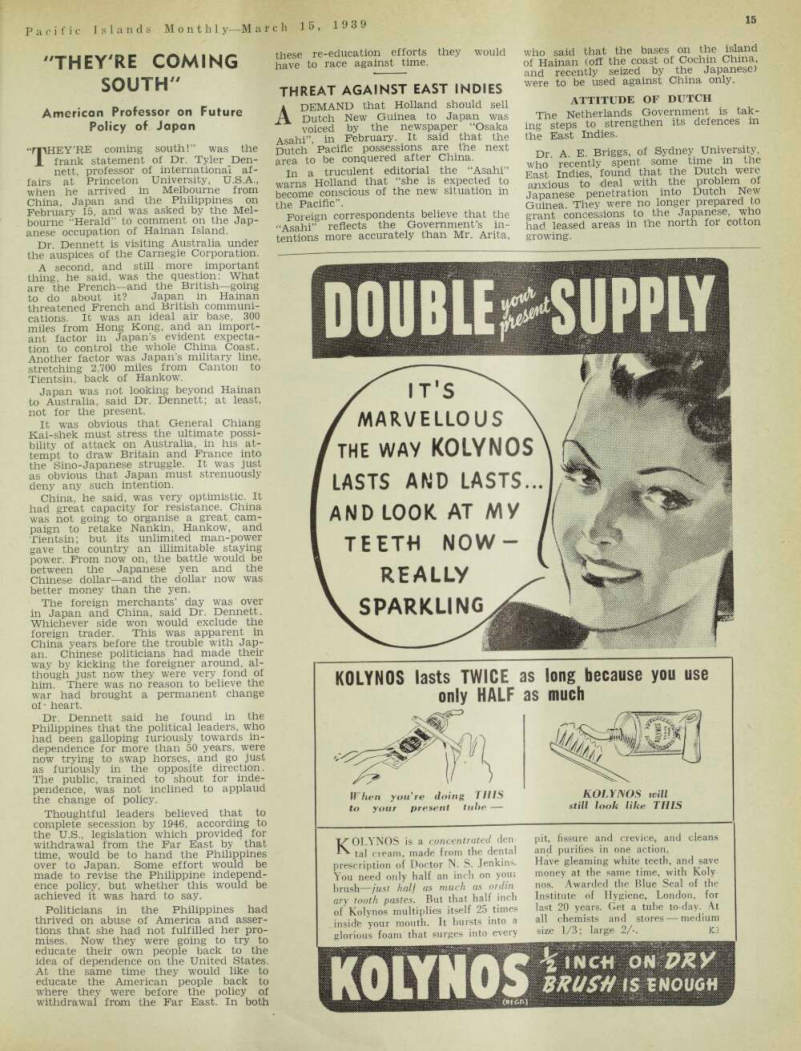
"They're Coming
American Professor on Future Policy of Japan
“rTVHEY'RE coming south!” was the 1 frank statement of Dr. Tyler Den nett, professor of international af fairs at Princeton University, U.S.A., when he arrived in Melbourne from China, Japan and the Philippines on February 15, and was asked by the Mel bourne “Herald” to comment on the Jap anese occupation of Hainan Island.
Dr Dennett is visiting Australia under the auspices of the Carnegie Corporation.
A second, and still more important thing, he said, was the question; What are the French—and the British—going to do about it? Japan in Hainan threatened French and British communi cations. It was an ideal air base, 300 miles from Hong Kong, and an import ant factor in Japan’s evident expecta tion to control the whole China Coast.
Another factor was Japan’s military line, stretching 2,700 miles from Canton to Tientsin, back of Hankow.
Japan was not looking beyond Hainan to Australia, said Dr. Dennett; at least, not for the present.
It was obvious that General Chiang Kai-shek must stress the ultimate possi bility of attack on Australia, in his at tempt to draw Britain and France into the Sino-Japanese struggle. It was just as obvious that Japan must strenuously deny any such intention.
China, he said, was very optimistic. It had great capacity for resistance. China was not going to organise a great cam paign to retake Nankin, Hankow, and Tientsin; but its unlimited man-power gave the country an illimitable staying power. From now on, the battle would be between the Japanese yen and the Chinese dollar—and the dollar now was better money than the yen.
The foreign merchants’ day was over in Japan and China, said Dr. Dennett.
Whichever side won would exclude the foreign trader. This was apparent in China years before the trouble with Jap an. Chinese politicians had made their way by kicking the foreigner around, al though just now they were very fond of him. There was no reason to believe the war had brought a permanent change of - heart.
Dr. Dennett said he found in the Philippines that the political leaders, who had been galloping furiously towards in dependence for more than 50 years, were now trying to swap horses, and go just as furiously in the opposite direction.
The public, trained to shout for inde pendence, was not inclined to applaud the change of policy.
Thoughtful leaders believed that to complete secession by 1946, according to the U.S., legislation which provided for withdrawal from the Far East by that time, would be to hand the Philippines over to Japan. Some effort would be made to revise the Philippine independ ence policy, but whether this would be achieved it was hard to say.
Politicians in the Philippines had thrived on abuse of America and asser tions that she had not fulfilled her pro mises. Now they were going to try to educate their own people back to the idea of dependence on the United States.
At the same time they would like to educate the American people back to where they were before the policy of withdrawal from the Far East. In both
these re-education efforts they would have to race against time.
Threat Against East Indies
a DEMAND that Holland should sell A Dutch New Guinea to Japan was voiced by the newspaper “Osaka Asahi”, in February. It said that the Dutch ’ Pacific possessions are the next area to be conquered after China.
In a truculent editorial the “Asahi” warns Holland that “she is expected to become conscious of the new situation in the Pacific”.
Foreign correspondents believe that the “Asahi” reflects the Government’s in tentions more accurately than Mr. Arita,
who said that the bases on the island
Oo."S
were t 0 be used againSt ° hma ° nly ’
Attitude Of Dutch
The tak mg steps to strengthen its aeiences the East Indies.
E Briggs, of Sydney University, who recently spent some time in the East In dies found that the Dutch were ajnx ious to deal with the problem of j apane se penetration into Dutch New Guinea. They were no longer prepared to grant concessions to the Japanese, who had leased areas in the north for cotton growing.
Advertisements & other items, p. 17 (2 items)
15
Pacific Islands Mont hi y—M arch 15, 1939
/Marvellous '
/ I T s
THE WAV KOLYNOS
LASTS AND LASTS.
AND LOOK AT MV
TEETH NOW-
REALLY
Y SPARKLING A
i K§ KOLYNOS lasts TWICE as long because you use
only HALF as much
When you’re doing THIS to your present tube KOLYNOS will still look like THIS K' OLYNOS is a concentrated den tal cream, made from the dental prescription of Doctor N. S. Jenkins.
You need only half an inch on youi brush —just half as much as or din ary tooth pastes. But that half inch of Kolynos multiplies itself 25 times inside your mouth. It bursts into a glorious foam that surges into every pit, fissure and crevice, and cleans and purifies in one action.
Have gleaming white teeth, and save money at the same time, with Koly nos. Awarded the Blue Seal of the Institute of Hygiene, London, for last 20 years. Get a tube to-day. At all chemists and stores medium size 1/3; large 2/-. K 3
INCH ON
BRUSH IS ENOUGH
Work
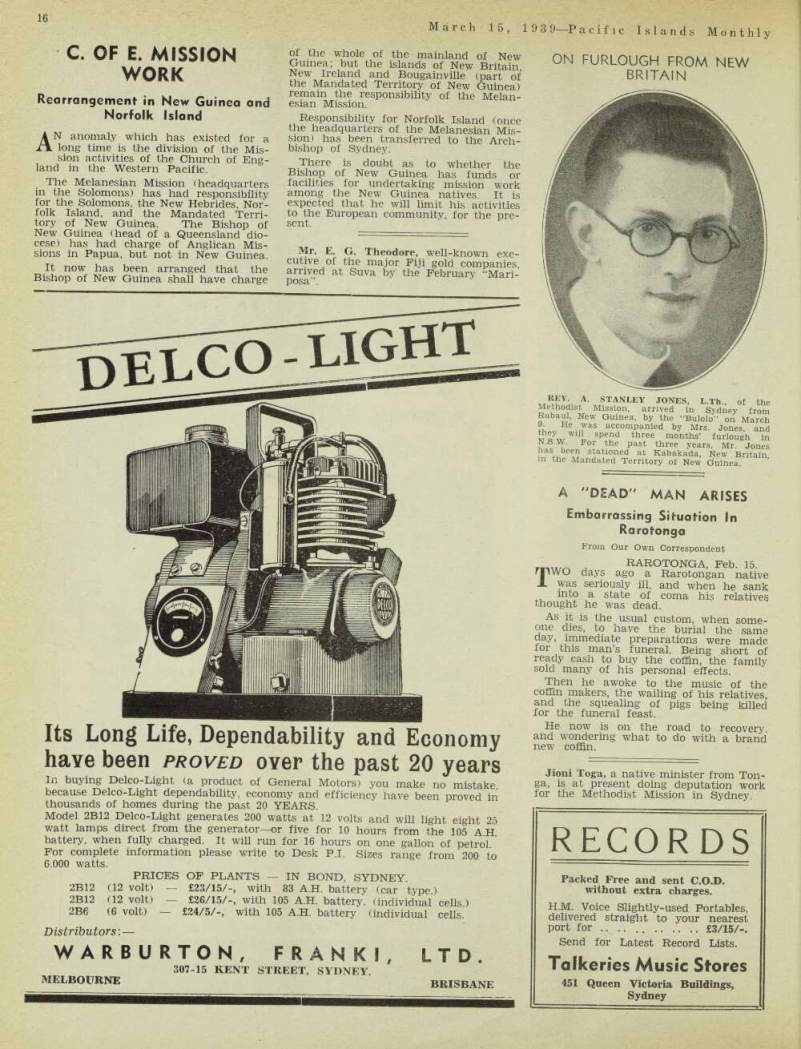
C. Of E. Mission
Rearrangement in New Guinea and Norfolk Island
AN anomaly which has existed for a long time is the division of the Mis sion activities of the Church of Eng land in the Western Pacific.
The Melanesian Mission (headquarters in the Solomons) has had responsibility for the Solomons, the New Hebrides, Nor folk Island, and the Mandated Terri tory of New Guinea. The Bishop of New Guinea (head of a Queensland dio cese) has had charge of Anglican Mis sions in Papua, but not in New Guinea.
It now has been arranged that the Bishop of New Guinea shall have charge
of the whole of the mainland of New Guinea; but the islands of New Britain New Ireland and Bougainville (part of the Mandated Territory of New Guinea) remain the responsibility of the Melan esian Mission.
Responsibility for Norfolk Island (once the headquarters of the Melanesian Mis sion) has been transferred to the Arch bishop of Sydney.
There is doubt as to whether the Bishop of New Guinea has funds or facilities for undertaking mission work among the New Guinea natives. It is expected that he will limit his activities to the European community, for the pre sent.
Mr. E. G. Theodore, well-known exe cutive of the major Fiji gold companies, arrived at Suva by the February “Mari posa”.
On Furlough From New
Britain
Stanley Jones, L.Th., Of The
Methodist Mission, arrived in Sydney from Rabaul, New Guinea, by the “Bulolo” on March a. He was accompanied by Mrs. Jones, and Sp !? d three months ’ furlough in Fo r , the P ast three years, Mr. Jones has been stationed at Kabakada, New Britain in the Mandated Territory of New Guinea.
Rarotonga
A "Dead" Man Arises
Embarrassing Situation In Rarotonga
From Our Own Correspondent
T„ . Rarotonga, Feb. 15.
WO days ago a Rarotongan native was seriously ill, and when he sank into a state of coma his relatives thought he was dead.
As it is the usual custom, when some one dies, to have the burial the same day, immediate preparations were made for this man’s funeral. Being short of ready cash to buy the coffin, the family sold many of his personal effects.
Then he awoke to the music of the coffin makers, the wailing of his relatives, and the squealing of pigs being killed for the funeral feast.
He now is on the road to recovery and wondering what to do with a brand new coffin.
Jioni Toga, a native minister from Ton ga, is at present doing deputation work for the Methodist Mission in Sydney.
Advertisements & other items, p. 18 (2 items)
Dki-Co
: light
Its Long Life, Dependability and Economy
have been proved over the past 20 years In buying Delco-Light (a product of General Motors) you make no mistake because Delco-Light dependability, economy and efficiency have been proved in thousands of homes during the past 20 YEARS.
Model 2812 Delco-Light generates 200 watts at 12 volts and will light eight 25 watt lamps direct from the generator—or five for 10 hours from the 105 AH battery, when fully charged. It will run for 16 hours on one gallon of petrol For complete information please write to Desk P.I. Sizes range from 200 to 6.000 watts.
PRICES OF PLANTS IN BOND, SYDNEY
2812 (12 volt) £23/15/-, with 83 A.H. battery (car type.) 2812 (12 volt) £26/15/-, with 105 A.H. battery, (individual cells.) 286 (6 volt) £24/5/-, with 105 A.H. battery (individual cells.
Distributors:
WARBURTON, FRANK!, LTD.
307-15 KENT STREET, SYDNEY.
MELBOURNE BRISBANE
Recor Ds
Packed Free and sent C.O.D. without extra charges.
H.M. Voice Slightly-used Portables, delivered straight to your nearest port for .. £3/15/-.
Send for Latest Record Lists.
Talkeries Music Stores
451 Queen Victoria Buildings, Sydney
Top Hats
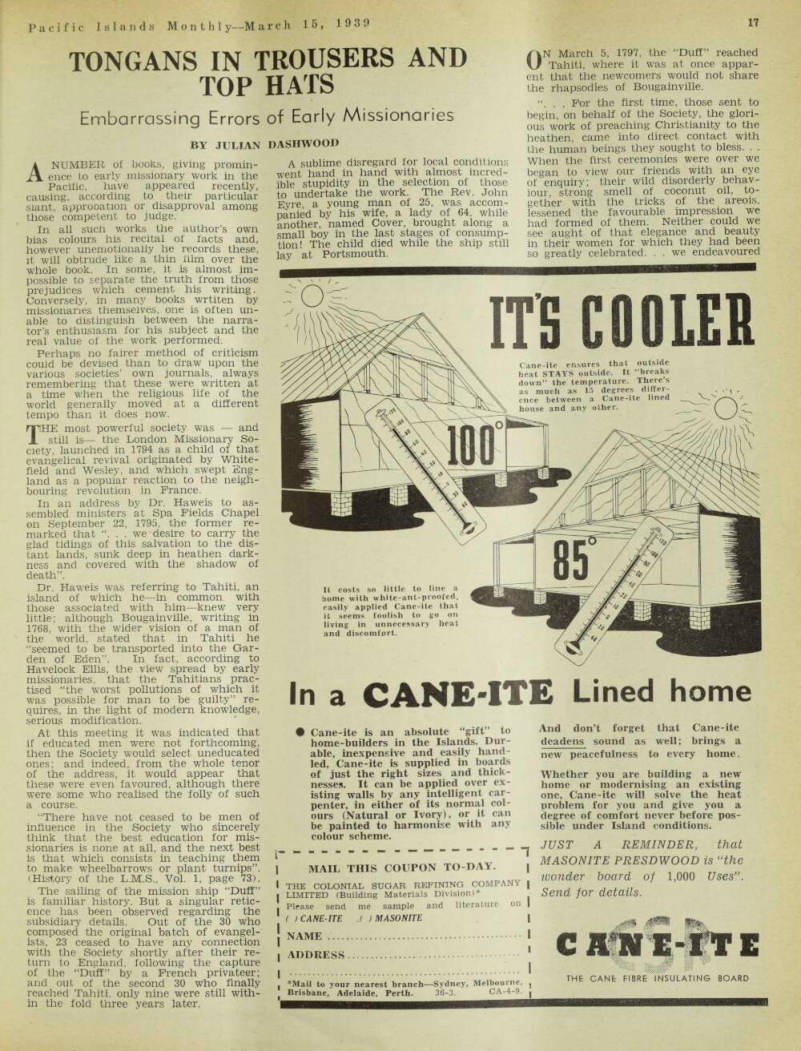
Tongans In Trousers And
Embarrassing Errors of Early Missionaries
By Julian Dashwood
A NUMBER of books, giving promin ence to early missionary work in the Pacific, have appeared recently, causing, according to their particular slant, approbation or disapproval among those competent to judge.
In all such works the author’s own bias colours his recital of facts and, however unemotionally he records these, it will obtrude like a thin Him over the whole book. In some, it is almost im possible to separate the truth from those prejudices which cement his writing.
Conversely, in many books wrtiten by missionaries themselves, one is often un able to distinguish between the narra tor’s enthusiasm for his subject and the real value of the work performed.
Perhaps no fairer method of criticism could be devised than to draw upon the various societies’ own journals, always remembering that these were written at a time when the religious life of the world generally moved at a different tempo than it does now.
THE most powerful society was and still is— the London Missionary So ciety, launched in 1794 as a child of that evangelical revival originated by White field and Wesley, and which swept Eng land as a popular reaction to the neigh bouring revolution in France.
In an address by Dr. Haweis to as sembled ministers at Spa Fields Chapel on September 22, 1795, the former re marked that “. . . we desire to carry the glad tidings of this salvation to the dis tant lands, sunk deep in heathen dark ness and covered with the shadow of death”.
Dr. Haweis was referring to Tahiti, an island of which he—in common with those associated with him—knew very little; although Bougainville, writing in 1768, with the wider vision of a man of the world, stated that in Tahiti he ‘‘seemed to be transported into the Gar den of Eden”. In fact, according to Havelock Ellis, the view spread by early missionaries, that the Tahitians prac tised “the worst pollutions of which it was possible for man to be guilty” re quires, in the light of modern knowledge, serious modification.
At this meeting it was indicated that if educated men were not forthcoming, then the Society would select uneducated ones: and indeed, from the whole tenor of the address, it would appear that these were even favoured, although there were some who realised the folly of such a course.
“There have not ceased to be men of influence in the Society who sincerely think that the best education for mis sionaries is none at all, and the next best is that which consists in teaching them to make wheelbarrows or plant turnips”. (History of the L.M.S., Vol. 1. page 73).
The sailing of the mission ship “Duff” is familiar history. But a singular retic ence has been observed regarding the subsidiary details. Out of the 30 who composed the original batch of evangel ists, 23 ceased to have any connection with the Society shortly after their re turn to England, following the capture of the “Duff” by a French privateer; and out of the second 30 who finally reached Tahiti, only nine were still with in the fold three years later.
A sublime disregard for local conditions went hand in hand with almost incred ible stupidity in the selection of those to undertake the work. The Rev. John Eyre, a young man of 25, was accom panied by his wife, a lady of 64. while another, named Cover, brought along a small boy in the last stages of consump tion! The child died while the ship still lay at Portsmouth.
ON March 5, 1797, the “Duff” reached Tahiti, where it was at once appar ent that the newcomers would not share the rhapsodies of Bougainville.
“. . , For the first time, those sent to begin, on behalf of the Society, the glori ous work of preaching Christianity to the heathen, came into direct contact with the human beings they sought to bless. . .
When the first ceremonies were over we began to view our friends with an eye of enquiry; their wild disorderly behav iour, strong smell of coconut oil, to gether with the tricks of the areois, lessened the favourable impression we had formed of them. Neither could we see aught of that elegance and beauty in their women for which they had been so greatly celebrated. . . we endeavoured
to make them understand that this was the day of the Atua, and that on it we durst not trade, but their women, re pulsed, occasioned even greater wonder among them”. (From the official Jour nal kept on board the “Duff”).
And yet in J. R. Forster’s “Observa tions Made on a Voyage Round the World”, published in 1778, we find a charming description of Tahiti, and its people. “In short, their character”, he concludes, “is as amiable as that of any nation that ever came unimproved out of the hands of Nature. . . Whenever we came to this happy island we could perceive the opulence and happiness of its inhabitants”.
Turnbull, who visited Tahiti in 1880 writes that “their manner of addressing strangers, from the king to the meanest subject, is courteous and affable in the extreme. . . They certainly live amongst each other in more harmony than is usual amongst Europeans”.
Yet these were the same people of whom the chronicler on the “Duff” could find little or nothing to praise, and to whom the pilgrim evangelists sang their sombre and prophetic hymn, beginning “O’er the gloomy hills of darkness”.
FROM the outset, arguments arose as to the wisdom of entering either the political or commercial fields. In
1837 we find the missionary J. M Ors mond writing that “we are a set of trad ing priests, our closets are neglected and our cloth disgraced”.
Politically, too, the Society soon found itself unabie or unwilling to refrain from interference with secular affairs. First in Tahiti and Kaiatea, then in Raroton ga in 1826, a code of laws was drawn up by the missionaries in consultation with the leading chiefs, and subsequently ratified by the peopie generally. In this manner, as will readily be understood, the Society not only strengthened its spiritual authority, but also obtained a temporal hold over those islands on which it was represented.
The severity- of many of these laws and their puritanical insistence on the preservation of moral standards led, in 1891, to Mr. F. J. Moss, first British Re sident at Rarotonga, including the fol lowing remarks in his report for that year on the conditions in Mangaia: “• • • There is no regard for personal liberty, nor any pretence to sucn a re gard. At sunset a bell rings from the Mission House, and the streets of the two adjacent villages are at once paraded by policemen, each with a native drum, who warns the people to remain in their own premises, which they cannot then leave unless with a lighted torch in hand.
After sunset, the streets are thoroughly deserted, except by the police, who prowl about secretly and enter any house, at any hour, to satisfy themselves that no improper proceedings are going on with in. These policemen number 150—about one to every twelve of the population.
Their only qualification is church-mem bership, and the night duty is done by detachments selected weekly. . . Women are said to have been exposed in dark holes, and with little or no clothing, to the attacks of mosquitoes; men are said to have been hung up by the feet; and similar means taken to extort criminat ing confession and its attendant fine”.
That these methods had not earned unanimous approval is clearly demonstra ted in a letter, from Tahiti, by the mis sionary Howe, in 1848: “Having registered the lands as na tional property, the Governor passed a law . . . that the people should keep the schools, chapels and missionary pre mises in repair ... out of 80 delegates there were only seven in favour of his motion, those who spoke said that we had got enough out of them already!
Such things are excessively painful to hear”.
BUT perhaps the worst indictment which can be levelled against the Society is the inoculation of the peoples under its influence with a fear of death and a sense of sin—innovations which in the case of the Tahitians had as far-reaching results as the opening of Pandora’s box. That neither existed formerly has been amply established. In Cook’s “Third Voyage of Discovery, 1776- 1780”, occurs the passage: “I never saw
them, in any misfortune, labour under the appearance of anxiety after the critical moment was past. Neither does care ever seem to wrinkle their brow.
On the contrary, even the approach of death does not appear to alter their usual vivacity”.
To compare with this we find, in the “History of the L.M.S., Vol. 1, pages 268- 269”: “A generation trained in heathenism could not thus have come under the power of the Gospel without in many cases passing through the deep waters of spiritual experience. Pomare him self was an example of this. Fear of eternal punishment as the only fit re ward for crimes such as his, and hope that in some way Christ would deliver him seem to have alternately tortured and’soothed his darkened mind. . . Civ ilisation, apart from the Gospel, could never have started such questions as these and could certainly have held out no comfort to any such troubled souls”.
NO review, however brief, would be com plete without some mention of the sweeping changes wrought by the Society in the domestic life and customs of the people generally, often to the det riment of health and happiness.
These attempts to transplant Victorian niceties to the South Seas were most clearly seen in Tonga where, by the close of last century, the population had been dizened out in old bonnets, shape less gowns, trousers and swallow-tailed coats for Sunday, and where, in place of the cool spaciousness of their former homes, houses had become receptacles for accumulated rubbish, the chairs cov ered with hideous antimacassars and the tables loaded with round worsted mats.
Punishable too, by fine and imprison ment: (a) To wear native clothing; (b) to play at ball; (c) to bathe on Sunday; rd) to wear a garland of flowers; (e) to build a native-fashioned house.
And when one pauses to think that out of a total revenue of over £6,500,000. a large proportion was expended m bringing about a state of affairs similar to that just described, one is not only inclined to deplore such misplaced zeal but also to endorse the words of the late Lord Stanmore, a former Governor of Fiji and High Commissioner of the Paci fic, who said, apropos of conditions m Tonga that “men in such circumstances are ripe for revolt, and sometimes the revolt comes”.
Advertisements & other items, pp. 19-20 (2 items)
17
Pacific Islands Monthl y—M arch 15, 1939
Its Cooler
100 Tj
Cane-ite ensures that outside heat STAYS outside. It “breaks down” the temperature. There’s as much as 15 degrees difference between a Cane-ite house and any other. lined It costs so little to line a home with white-ant-proofed, easily applied Cane-ite that it seems foolish to go on living in unnecessary heat and discomfort. 05
In a CANE-ITE Lined home
• Cane-ite is an absolute “gift” to home-builders in the Islands. Durable, inexpensive and easily handled, Cane-ite is supplied in boards of just the right sizes and thicknesses. It can be applied over existing walls by any intelligent carpenter, in either of its normal colours (Natural or Ivory), or it can be painted to harmonise with any colour scheme.
MAIL THIS COUPON TO-DAY.
THE COLONIAL SUGAR REFINING COMPANY
LIMITED (Building Materials Division)* Please send me sample and literature on ( ) CANE-ITE J ) MASONITE [
NAME • I
ADDRESS 1
1 , *Mail to your nearest branch —Sydney, Melbourne, , t Brisbane, Adelaide, Perth. 36-3. CA-4-9. j And don’t forget that Cane-ite deadens sound as well; brings a new peacefulness to every home.
Whether you are building a new home or modernising an existing one, Cane-ite will solve the heat problem for you and give you a degree of comfort never before possible under Island conditions.
JUST A REMINDER, that
MASONITE PRESDWOOD is <( the
wonder board of 1,000 Uses”.
Send for details.
CANE-ITE
THE CANE FIBRE INSULATING BOARD
ATTRACTIVE FOOD
FOR THE TROPICS
M^ILRATHS
I
PRICE LISTS
Post
cm Application
1/3 each 14/6 doz. 2/4 each 27/- doz. 1/1* each 13/- doz. 2/- each 1/2* lb. 1/1* lb. 1/- lb. 1/1 lb. lOd lb. 3/3 bot. 8d tin 10*d tin 1/1* tin 1/6 tin 23/6 doz. 14/- doz. 13/- doz. 11/6 doz. 12/6 doz. 9/6 doz. 36/- doz. 7/6 doz. 10/- doz. 13/- doz.. 17/- doz.
Evap. Peaches, 3 crown ..
Californian Diamond Walnuts Finest Brazil Nuts ..
“Rosa” Virgin Olive Oil, 250 z. .
C. & B. Herrings in Sauce, 7oz.
C. & B. Herrings in Sauce, 14oz.
C. & B. Kippered Herrings, 16oz.
Selmore Sockeye Salmon, 16oz.
“Rosa” or I.X.L. Peaches in Syrup, 16oz 6d tin I.X.L. Peeled Tomatoes, 30oz. .. 10*d tin Bathurst Cauliflower, 19oz. .. 9*d tin I.X.L. Vegetable, Pea, or Celery Soup. Boz ‘ s*d. tin 5/3 doz.
Gartsides Mushrooms, 14oz. . 1/3 tin 14/6 doz.
All Prices f.o.b. Sydney. Cases and Packing Free.
QccciXiJtAf
• • • -export OAPARTMENT • • •
20 2 PITT STREET, SYDNEY
NEW SOUTH WALES. AUSTRALIA.
PABST CANNED BEEP
Brewed in one of the world's largest and most modern breweries, PABST comes to you in genuine
"KEGLINED" NON-REFILLABLE CANS
TWO TYPES:
PABST EXPORT BEER—A Light- Lager Beer.
PABST OLD TANKARD ALE—An English Type stronger and heavier than Export.
Packed In Cartons containing 24 x 12 oz. cans and sold throughout the Pacific; but In case of any difficulty In obtaining supplies, write to:
BOX 1861 K, G.P.0., SYDNEY.
'NO LIGHT CAN STEAL
TS
FLAVOUR"
N.I.'S Troubles
SAYING that they had been unable to obtain" a reasonable living in spite of all their efforts, 27 residents of Nor folk Island reached Auckland on Febru ary 13, in the steamer “Tasman in search of work in New Zealand. About 15 of them are former New Zealanders: the others have spent their lives on Nor folk Island. They said that a change from Australian to New Zealand control and more frequent shipping services were necessary before the island could hope to flourish. One hundred settlers had left in the last three months.
Mr. A. J. Peadon, a well-known New Guinea miner, suffered a painful accid ent in the Ramu district in February.
He was working on his claim, when a large stone rolled on to him and badly cut his leg. He was brought to Sydney by aeroplane, and placed under expert treatment, in the hope that the broken bones may be made to grow together again.
Mr. E. C. Monck, who is well-known in New Guinea, left Sydney for Rabaul, by the February “Bulolo”, “looking”, as he expressed it, “for further investments”. A few years ago, Mr. Monck took over the lease of the famous Ah Chee Hotel in Rabaul and re-named it the Cosmo politan Hotel. Then he sold it and returned to West Australia. A little later, he made the trip by air from Perth to Wau, in New Guinea, in the Hercules aeroplane bought in West Australia by Mr. E. Stevens. Mr.
Monck went on to Rabaul, and took over the lease of the Hotel Rabaul.
He sold out on May 15, 1937, to Mrs.
C. R. Bignell and left for a trip up East. Exactly a fortnight later, in
Hong Kong, Mr. Monck received news of the Rabaul eruption, wherein so much property was destroyed. He since has visited China, Japan, Singa pore and the East Indies, and has spent some time in Western Aus tralia.
Advertisements & other items, pp. 21-22 (2 items)
19
Pacific Islands Monthl y —M arch 15, 1939
IROVlfi iiws
Cool. E«W”f„
hAornent^^^we
At o
Imperial
Sheep Tongues 12 oz.
Lamb Tongues 12 oz.
Ox Tongues 24 oz.
Ox Tongues 2 lb.
Camp Pie 12 oz.
ASSORTED IMPERIAL HOT MEALS
Steak & Kidney Pudding. Beef Steak Pudding.
Sausages & Tomato. Chops & Tomato.
Lamb & Green Peas. Sausages, Spaghetti & Steak & Tomato. Tomato.
Mango & Papaw Chutney 15 oz.
Cheddar Cheese (Mild and Tasty) 8 oz.
“ FITZROY”
Luncheon Beef (in oblong can) .. .
Pork Sausages Beef Sausages
“ HAMPER ”
Corned Beef (Taper Can) 16 oz. 16 oz. 16 oz. 12 oz.
“OX & PALM” or “ ”
Native Grade Meats. Corned, Boiled and/or Roast Beef 120 z., 160 z., 240 z., 21b., 31b., 41b., 51b., 61b.
“ WESTFIELD ”
Corned, Boiled and/or Roast Mutton .. .. 12 oz.
Corned, Boiled and/or Roast Mutton .. .. 16 oz.
All lines can be obtained from leading Island Stores.
THE RIVERSTONE MEAT Co. Pty. Ltd.
7 Hay Street, Sydney.
FIJI REPRESENTATIVES: PEARCE Cr CO. LTD.
S 3 Sc
KEEP COOL
WITH ENO!
Does the heat make you limp and laggardly? Then you should get to know about Eno. A sparkling glass of Eno cools you through and through— restores your enterprise and energy— and removes the very cause of heatdistress by helping Nature to dismiss clogging waste within. Get a bottle of Eno to-day and prove this for yourself.
ENOS
FRUIT
SALT"
TRADE MARK
Polynesian Club
A PICTURESQUE ceremony took place at the February meeting of the Poly nesian Club, when a gift of mats from Mrs. Wetzel, of Samoa, sister of the Faatonu Taisi, O. F. Nelson was presented to the Club by Mrs. Augusta Lembke, of Randwick, Sydney. Mrs.
Lembke, who is the daughter of Mrs Wetzel, replied to an address of welcome by the President, Mr. Leonard Moran and unrolled the mats herself, being the first to sit down on them, and wished the Club success.
A kava-making followed, at which Mrs Lembke was the chief guest. This cere mony was supervised by Mr. Richard Hahn, and was made by Mrs. Waikainga Tipene, a chieftainess of the Ngapuhi (N.Z.). The kava was also presented to Mrs. Vika Lamacraft (Tonga), Mr. Ha muera Ormsby (a rangatira of the Mani apoto people, N.Z.), Mrs. Ruth Tareta Beckman (Avarua, Rarotonga), Mrs Daisy Strachan (Butaritari, Gilbert Is lands), Miss Olita and Mr. R. Hahn (Tonga), Mr. Victor Tipene (Wellington, N.Z.), Mr. John McCoy (Norfolk Island), and Mrs. Fetch (Pitcairn Island), both descendants of men of the “Bounty”.
Others present who partook of the cere monial drink were Madame Antoinette Mourin (formerly of Makatea), Mr. Hemi Hokena (Hawkes Bay, N.Z.), Mrs. Ka tarina Ormsby (Rotorua, N.Z.).
Another gift of finely made long and short Maori “poi” was received from Mr.
Julian Waretini, of Rotorua. In the ab sence of Mr. Waretini in N.Z., Mrs. Wiki Byron, the Club’s senior Arawa repres entative, partook of the kava as a com pliment to her fellow tribesman. After the kava, a fine programme of Polynes ian folk dances was presented by the members, among them being the Samoan “Ma’ulu’ulu” and the Maori dance com memorating the voyage to N.Z. of the famous canoe, Te Arawa.
Mr. Royston Raymond Leslie Foulkes, Government Medical Assistant at Nama tanai, T.N.G.. died on February 13, aged 44. He had spent nine years in the New Guinea Public Service. At one time, he was engaged in medical work in Persia and later took part in the Great War.
Native Policy
Sir Hubert Murray on Native Policy "We May Have Gone a Little Too Far"
SIR HUBERT MURRAY, Lieutenant- Governor of Papua, was likened to i - L P rd Lugard, of Nigeria, and the latter s pupil Sir Donald Cameron, of Tanganyika, by Dr. H. lan Hogbin, when presiding at a luncheon arranged in his honour by Pacific Islands Club members at the Carlton Hotel, Sydney, on Feb ruary 23.
Both Lord Lugard and Sir Donald Cameron are regarded as outstanding native administrators, and recognised authorities throughout the Empire on Col onial problems. “Because of his long ex perience and eminent gifts”, said Dr Hogbin, “Sir Hubert takes rank with them!”
Those who attended (including leading Sydney business men), were interested to hear an important statement from Sir Hubert; “In a place like Papua one has to deal with Europeans as well as na tives, and the latter need just as much protection as the Papuans. I have al ways endeavoured to hold the scales evenly between both peoples. Because one is pro-native, there is no necessity for one to be anti-white. I contend that one can be both pro-native and pro-European!”
There was sometimes a danger that an administrator, he said, might be carried away by his duty to the natives and for get what he owed to the European mem bers of the same community. “I do not say that it always exists”, Sir Hubert added, “but one has to guard against the possibility”.
Sir Hubert recalled the time when any person who took an interest in na tives’ cultures was regarded as a crank.
If employers clothed and fed their na tive employees in an adequate manner, it was solely in the interests of themselves: adequately garbed and housed natives were a better business proposition. But with the advancement of anthropology, the whole outlook had changed. “I am wondering whether we may not have gone just a little too far in looking after the natives”, he said.
Sir Hubert told some interesting and amusing stories of his early days in Papua.
Sir Hubert’s appearance at the P.I. Club was his last in public for some time.
Soon after, he entered St. Vincent’s Hos pital, Sydney, to undergo treatment for malaria. He left hospital on March 3, and is now resting in the country.
Fiji Inter-Island Vessel Sold

AFTER 10 years in the Fiji inter island trade, the Burns Philp (South Sea) Co.’s steamer “Malake” (736 tons) has been sold to John Burke, Ltd., of Queensland. She was built in 1928 by the Grangemouth Dockyard Co., Ltd., Scotland, and was commissioned as a passenger and cargo vessel for the Fiji service almost immediately. The two motor vessels “Matafele” (formerly in Samoa) and “Yanawai” will take over her run.
The “Malake” arrived in Sydney from Suva on February 24 and, after being refitted for use as a general cargo boat, left for Queensland on March 3 to main tain a service between Brisbane, Mac kay and Rockhampton,
Mr. James George Ashley, manager of the Royal Hotel, Levuka, Fiji, died on February 13, at the age of 45. He was well-known in the Colony, having been associated with the Metropole and Mel bourne Hotels for many years.
His Honour Mr. Douglas R. Stewart, C.M.G., Administrator of St. Kitts-Nevis, West Indies, who was fot many years connected with the Fiji Civil Service, died recently at the age of 52.
Mr. Trafford Smith, of the British Col onial Office, has been seconded to the Fiji Government Secretariat for two years. He took up his duties in Febru ary.
Advertisements & other items, pp. 22-24 (4 items)
20
March 15, 193 9—P acific Islands Monthly
*
for the worst with the worst in sight, There’s dishonor in flight, prepare to fight; Despise not your foe, but attack with zest—’
'J Prepare for the worst and achieve the best Prepare for the winter and bronchial ills, Sore throat, bronchitis, and deadly chills.
Prepare for the worst and the best assure —- Get Woods’ Great Peppermint Cure.
Woods’ Great Peppermint Cure, For Coughs and Colds, never fails.
21
Pacific Islands Month! y—M arch 15, 1939
Nerves
SCIENTIFIC
CONTROL
Attached to the Laboratories of the Douglas Drug Company are three fully-qualified chemists and a Doctor of Medicine who graduated at the Universities of Edinburgh and Glasgow. m
A VITAL
MESSAGE
to Sufferers from
NERVES
BRAIN FAG and THAT
DEPRESSED FEELING
Lack of Confidence . . Headaches . . Nervous Indigestion . . Sleeplessness . . Listlessness . .
Anaemia . . Nerve pains and other similar Nervous and Constitutional weaknesses .
BIDOMAK provides a method of supplying energy to the cells of the body wherever the natural supply of vitality is insufficient to maintain the normal activity of glands and organs. It provides vital mineral elements. It is a scientific compound of certain vital mineral elements which are lacking in the average modern diet, and which include ferrum, calcium, sodium, potassium, phosphates, glycerophosphates, sucrose, as well as other necessary elements.
For men, women and children of naturally weak constitution BIDOMAK gives the chance of revitalised, vigorous health, whilst those who are obliged by their work to be keyed up always have found in BIDOMAK a most certain way of keeping always thrillingly fit.
A REFRESHING HEALTH DRINK
A delightful health drink can be made by mixing a dose of BIDOMAK with a wine glass full or half a tumbler of ice cold water, or any aerated water. A few d'rops of BIDOMAK in a tumbler of ice cold water is a delightful refreshing thirst-quencher.
BIDOMAK
The Tonic of the Century.
FOR NERVES, BRAIN AND THAT DEPRESSED FEELING Product of the Douglas Drug Co., Sydney,Adelaide, Melbourne, Brisbane, Perth. Sole Wholesale Agents for Tasmania: L. Fairthorne & Son Pty. Ltd. New Zealand Distributors; Q-tol-Fluenzol Laboratories, Thorndon Quay, Wellington, N.Z.
Your Suit
ready in a
few hours
Make your selection from our patterns (gladly sent on request). Then when your steamer arrives, our representative will conduct you to our premises for a “try-on”. A few hours later, your Suit will be ready— Hand Tailored to measure.
PIKE BROTHERS
LIMITED
Queen St., Brisbane.
roleman
TABLE LAMPS
Have many features: FULL BRILLIANCE—3OO Candle Power of Eyeresting light.
SAFE—FueI cannot spill, even if tipped over.
CONVENIENCE LIGHTS INSTANTLY
(no preheating).
FUEL COST—About halfpenny per hour.
Equipped with genuine “Pyrex” heat-resisting glass globe and attractive Parchment Shade.
Long-Service Generator has more carbon space, fewer changes, more economical.
Fuel fount strongly made of Brass and Steel —unbreakable.
Coleman Lamps are available to burn either petrol or kerosene. Modernistic in design and finish. Can be made insect-proof in a “Jiffy” with special Coleman Insect Screen Assembly.
NEAREST
LIKE
DISTRIBUTORS IN THE PACIFIC
ALL BRANCHES OF
BURNS, PHILP & CO. LTD. W. R. CARPENTER & CO. LTD.
WHITTEN BROS. LTD. MORRIS, HEDSTROM LTD.
STEAMSHIPS TRADING CO. LTD.
AND MANY OTHER FIRMS THROUGHOUT THE ISLANDS. 3 fe “The Sunshine of the Night”.
ISLANDS—
Papua Prospers
Oil-Rubber-Coffee-Defence Works
AS a result of oil prospecting operations and the high price of rubber, Papua is experiencing new commercial pros perity, said Sir Hubert Murray (Lieut.- Governor of Papua) on his arrival in Sydney in February.
The rubber plantations, owned by Eu ropeans and worked with native labour, now covered a total area of about 70,000 acres, 50,000 acres of which had been taken up in the last two years. The en tire output of the plantations was ab sorbed by Australia.
The coffee plantations were also pros pering. Unlike the rubber plantations, they were owned and worked by Papuans.
The Administration assisted the owners by remitting taxation, supplying seed, and instructing the natives how to cultivate their holdings, stipulating that they should work a certain number of days in the week. The crop was marketed by the Administration, which returned the natives half the proceeds of sale, and with the other half maintained a fund reserved expressly for native purposes, such as the establishment of hospitals and schools.
This year the coffee crop was sold for £2,000, of which the natives received £l,OOO. Several hundreds of natives were now engaged in coffee production.
With the prospect that the production of petroleum would soon be added to Papua’s many valuable exports, the ade quate defence of the country assumed an even greater importance, said Sir Hu bert Murray. Considerable significance, therefore, attached to the recent visit to Papua of three Australian defence ex
perts. This mission had selected a site for a base for the mobile naval and air forces which the Federal Government in tended to establish at Port Moresby. Fix ed defences would be provided there and the base would be used as a station for flying-boats.
Kauri From Fiji
New Export Trade
THE Fiji Kauri Timber and Land Company Ltd. made its first regular shipment of kauri logs to Australia by the steamer “Tambua” in February (says the “Fiji Times”). The company has an agreement for a year’s supply of kauri logs to Australian manufacturers who are interested in veneer work.
February shipment totals 108,000 ft., the logs ranging from 6 ft. to 13 ft. in cir cumference. They were transported from the mill to Tavua by lorry and thence rafted alongside the ship at Tavua Bay, where they were loaded.
Shipments will be made every five weeks. This is expected to be the begin ning of a profitable export trade.
Mr. J. C. Barley, Resident Commis sioner in the Gilbert and Ellice Islands Colony, arrived in Sydney on February 23, after 5 months’ absence on furlough in Europe. He is accompanied by Mrs.
Barley. Mr. Barley has been Commis sioner, with his base at Ocean Island, for six years. Previously he was for many years in the British Colonial service in the Solomons. With his wife, Mr. Barley will board the first steamer leaving Aus tralia to load phosphates at Ocean Is land.
The Tropics
A Top-Dressing In The Tropics
By “Amel.”
¥N Suva, the business of having one’s i hair attended to is a simple matter. For the male of the species, European, Indian and Japanese bar ber shops offer a varied choice to suit most tastes and pockets; and, if you cannot decide which to patronise, you simply “eenie, meenie, minie, mo” them!
For the female of the species, who naturally desires more twiddley-bits to her hair-dressing, there is an up to-date and well-appointed establish ment, where, in an atmosphere of coolness and peace, it is possible to be shampooed, bobbed, shingled, bingled, dyed, waved or curled. Such an en chanting, inviting array of possibilities to tempt the feminine mind! No won der so many of them fall for things they shouldn’t!
But, wait! The scene changes to a humble copra plantation, on an island a couple of hundred miles from Suva.
Delicately-scented hair-dressing em poriums are lamentably distant, and one’s hair grows at an alarming rate —due, no doubt, to the outdoor life and the “wide open spaces”. When it reaches an uncontrollable length, and mosquitoes and heat are driving one crazy, the following procedure is adopted.
One chooses a Sunday morning (this is the favourite time) when Father has himself comfortably established with spectacles and book. Then one approaches him somewhat diffidently, and says, in a half-bantering tone, “Oh—er —um—Dad ... I suppose you couldn’t spare half an hour or so, could you?”
Down goes the book, and one is treated to a very cold glare.
“What for, eh? Hrrrmph! Want your hair cut, do you? Oh, well, all right. Never saw such people . . . can’t leave a bloke alone for five minutes. Are you all ready? Got the clippers and scissors and comb, and something to tie round your neck?
“Come along, then. Sit here. And don’t slump like that . . . haven’t you got a spine?
“Now, how much do you want taken off? A goodish bit here, but not too much there? You women are too darn finicky. What a nuisance these ears are! Here, hold that one down while I trim around it. Hang the mos quitoes! There . . . that will do you.
It looks all right. For goodness sake clear out now, and don’t ask me to cut your hair again for another six months!”
One thanks Father—it really was good of him—and then hovers uncer tainly around the nearest mirror for half an hour, anxious to have a look, but without courage to take that first peep.
And now let’s have a look at a Fijian female getting her hair ready for a meke-meke.
When she decides to give her hair a
“doing”, she does the thing properly.
No half-pie measures for her. She dons her oldest sulu, and smears her head (and half her face) with a priming of wood-ashes mixed to the desired consistency with water. (This is to kill off some of the livestock!) When this nauseating mess has been on for several hours, giving the wearer a somewhat haggard appearance, she pours over it a delightful concoction of black dye and swamp mud . . . guaranteed to grow whiskers on a bil- Hard ball!!
After a decent period has elapsed, Milady deigns to wash her besmeared head. Then she dries it, combs it, trims it neatly, massages it with coconut oil, and, presto, she is ready to face the social whirl!
Dr. G. H. Vernon, who sold out his interests at Daru, in Western Papua last year, and moved to Round Hill, in Eastern Papua, where he proposed to grow kapok, has accepted a Gov ernment position as medical officer at Misima, and took up his residence at that busy mining centre in January, Dr. Vernon has not given up his plan tation at Round Hill, but he has abandoned the kapok plan and has turned the property over to rubber growing. He intends to remain in definitely at Misima, where he finds the work and associations very con genial. Incidentally, he has had a good deal of work to do since he arrived there, owing to recurrent epidemics of sickness among the native labourers at the mines.
Advertisements & other items, p. 25 (2 items)
23
Pacific Islands Monthl y—M arch 15, 1931)
Hi The Mrstheh
liii J § o
for 15th Time
Mr. Chompion is Acting-Governor for 15th Time
From Our Own Correspondent
Pt. Moresby, Feb. 20.
Hon. h. w. champion, c.b.e., Papua’s Government Secretary and the senior member of the Executive Council, has been sworn in to act as Lieutenant Governor of the Territory during the absence on furlough of Sir Hubert Murray.
This is the fifteenth occasion on which Mr. Champion has been Acting Adminis trator, and the total duration of his ten ure of the office amounts to several years.
Myths Of Tropic
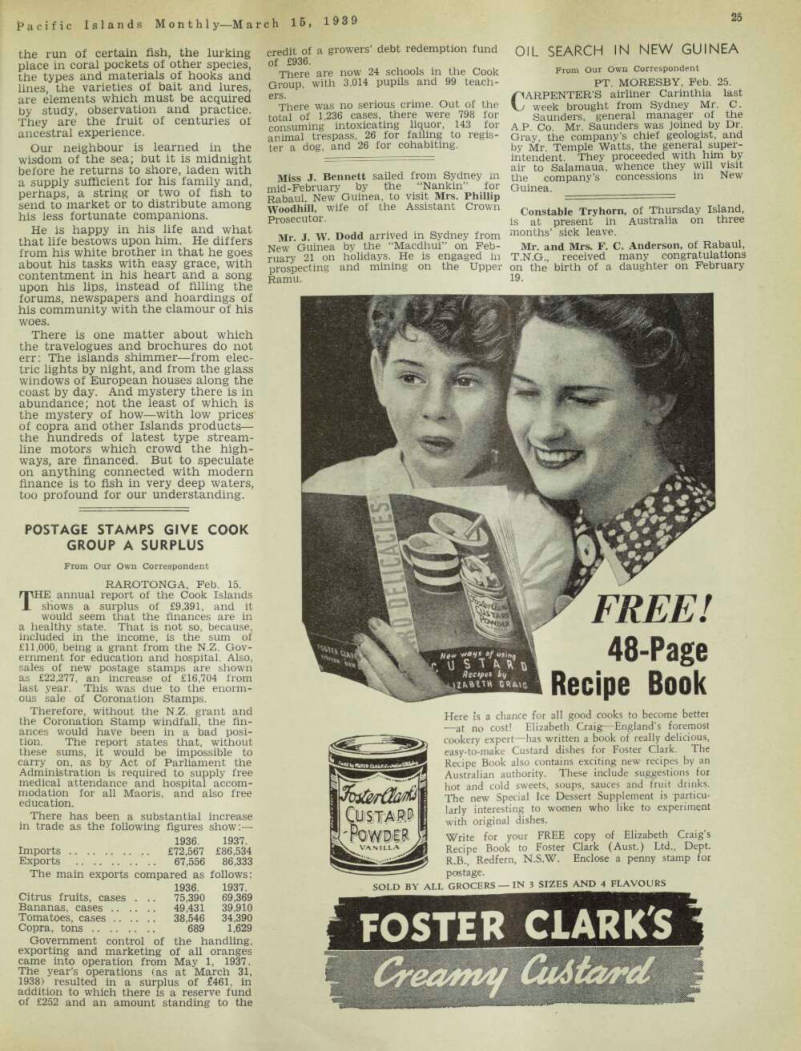
Isles
Story of Disillusionment
By “Tauata.”
LONG ago, some writer or college of writers composed the Legend of the Tropics. Conceived to adorn a tale of some veracious traveller, per petuated to embellish torrid romance and travel agency brochures, it seems destined to live forever.
Between the Tropics of Cancer and Capricorn, Nature conducts herself in a most extraordinary way. The sun, in the morning, rushes up like a rocket, and at evening disappears be hind the western horizon with the speed of a falling meteor. Light and darkness explode over the world with out the gracious ceremonies of dawn and twilight.
Absolutely every writer of travelogue or romance who leads his reader to the Torrid Zone, wedges into his text some sentence to faithfully carry on
the myth: “Night fell suddenly like a sable curtain over the palpitating tropic world” or some phrase of similar import.
Islands— “emerald jewels set in the enamel of a sapphire sea”—invariably shimmer, and are full of mystery.
Nature is ever bountiful. The native of these fortunate latitudes toils not neither does he spin. He has but to shake a tree or extend his hand from his couch of flowery ease, and his table and wardrobe are supplied.
The sea is equally generous. A canoe floated from the beach is soon filled with flying fish seeking refuge from pursuing enemies. The larger fish leap in after their prey. The native stuns them with a few well directed blows of his paddle, and his marketing for the day is accomplished.
T IKE everyone born in the Tem- L* perate Zones, we believed these things until we came to the islands.
At the hour of sunset of our first day on Tahiti we repaired to a wooden bench, under the trees of the water front, to witness the thunderous descent of night—of which we had read so much. Instead, we saw the banners of the hosts of Saint Michael filling the western sky and reflecting their crimson and royal purple, and colours no man can name, on the cloud masses of the firmament. Gradu ally these faded to a gentle twilight.
In the faint afterglow we saw the planet mercury. That was all.
Our next disillusionment was the fortunate native.
At Feraoraoraa (the twilight before the dawn), our Tahitian neighbour is off to the mountains for Fe’i (the mountain plantain). The Fe’i plan tations are in distant branch valleys, far up on the flanks of the moun tains. The sun is high in the heavens when he returns, bearing a load that would break the back of the average white man. A dip in the river, and it is time to prepare the ahimaa (native oven). When prepared and covered, the ahimaa needs no atten tion; so our neighbour refreshes his weary body by taking a nap.
This is usually the hour the explor ing tourist appears on the scene to take notes on the effortless and care free life of the tropics.
After his repast, our neighbour goes to his coconut plantation, and the back-wearying task of making copra, which need not be described here.
Next, his taro patch demands his at tention—a labour of no small diffi culty as he stands in the deep mud under the burning rays of the sun.
During the late hours of the after noon, we see him occupied with the hundred and one small chores of the farmstead. Perhaps he has an hour or two of repose after the sun has gone down. Then, the sound of a conch-shell trumpet summons him to the shore—the hour for fishing is at hand.
THE lore of the fisherman in these waters is as intricate as the art of the astrologer. The nights of the moon, the ebb and flow of the sea,
the run of certain fish, the lurking place in coral pockets of other species, the types and materials of hooks and lines, the varieties of bait and lures, are elements which must be acquired by study, observation and practice.
They are the fruit of centuries of ancestral experience.
Our neighbour is learned in the wisdom of the sea; but it is midnight before he returns to shore, laden with a supply sufficient for his family and, perhaps, a string or two of fish to send to market or to distribute among his less fortunate companions.
He is happy in his life and what that life bestows upon him. He differs from his white brother in that he goes about his tasks with easy grace, with contentment in his heart and a song upon his lips, instead of filling the forums, newspapers and hoardings of his community with the clamour of his woes.
There is one matter about which the travelogues and brochures do not err: The islands shimmer—from elec tric lights by night, and from the glass windows of European houses along the coast by day. And mystery there is in abundance; not the least of which is the mystery of how—with low prices of copra and other Islands products— the hundreds of latest type stream line motors which crowd the high ways, are financed. But to speculate on anything connected with modern finance is to fish in very deep waters, too profound for our understanding.
Advertisements & other items, p. 26 (2 items)
24
March 15, 193 9—P acific Islands Monthly
Qmoitls
25 YEARS OP SERVICE
William E. Reed
(Established 1913)
BROKER & AGENT
Union House, 24T George St.. Sydney For all Plantation and Trading Requirements. Enquiries welcome.
THE FAVOURITE
SCHOOL LUNCH
Usually the school lunch is a very scratchy meal, eaten just when the vigorous exercise of the playground has made a strong demand on the endurance of the child. However, with little trouble it can be improved in value and made wonderfully attractive, simply by adding buttered Milk Arrowroot Biscuits. All children love them.
Qmoitls
FAMOUS
MILK
ARROWROOT
BISCUITS
C 34 ALWAYS ASK YOUR GROCER FOR ARNOTT'S I
Postage Stamps Give Cook
Group A Surplus
From Our Own Correspondent
Rarotonga, Feb. 15.
THE annual report of the Cook Islands shows a surplus of £9,391, and it would seem that the finances are in a healthy state. That is not so, because, included in the income, is the sum of £ll,OOO, being a grant from the N.Z. Gov ernment for education and hospital. Also, sales of new postage stamps are shown as £22,277, an increase of £16,704 from last year. This was due to the enorm ous sale of Coronation Stamps.
Therefore, without the N.Z. grant and the Coronation Stamp windfall, the fin ances would have been in a bad posi tion. The report states that, without these sums, it would be impossible to carry on, as by Act of Parliament the Administration is required to supply free medical attendance and hospital accom modation for all Maoris, and also free education.
There has been a substantial increase in trade as the following figures show: —
Government control of the handling, exporting and marketing of all oranges came into operation from May 1, 1937.
The year’s operations (as at March 31, 1938) resulted in a surplus of £461, in addition to which there is a reserve fund of £252 and an amount standing to the
credit of a growers’ debt redemption fund of £936.
There are now 24 schools in the Cook Group, with 3,014 pupils and 99 teach ers.
There was no serious crime. Out of the total of 1,236 cases, there were 798 for consuming intoxicating liquor, 143 for animal trespass, 26 for failing to regis ter a dog, and 26 for cohabiting.
Miss J. Bennett sailed from Sydney in mid-February by the “Nankin” for Rabaul, New Guinea, to visit Mrs. Phillip Woodhill, wife of the Assistant Crown Prosecutor.
Mr. J. W. Dodd arrived in Sydney from New Guinea by the “Macdhui” on Feb ruary 21 on holidays. He is engaged in prospecting and mining on the Upper Ramu.
1936. 1937.
Imports .. £72,567 £86,534 Exports . .. 67,556 86,333 The main exports compared as follows: 1936. 1937.
Citrus fruits, cases . .. 75,390 69,369 Bananas, cases .. . . .. 49,431 39,910 Tomatoes, cases .. , ,. .. 38,546 34,390 Copra, tons 689 1,629
Oil Search In New Guinea
From Our Own Correspondent
Pt. Moresby, Feb. 25.
CIARPENTER’S airliner Carinthia last ; week brought from Sydney Mr. C.
Saunders, general manager of the AP Co Mr. Saunders was joined by Dr.
Gray, the company’s chief geologist, and by Mr Temple Watts, the general super intendent. They proceeded with him by air to Salamaua, whence they will visit the company’s concessions in New Guinea.
Constable Tryhorn, of Thursday Island, is at present in Australia on three months’ sick leave.
Mr. and Mrs. F. C. Anderson, of Rabaul, T.N.G., received many congratulations on the birth of a daughter on February 19.
Advertisements & other items, p. 27 (2 items)
25
Pacific Islands Monthl y—M arch 15, 1939
Foster Clarks
w 48
Page
Book
Recipe
FREE
Here is a chance for all good cooks to become better —at no cost! Elizabeth Craig —England’s foremost cookery expert —has written a book of really delicious, easy-to-make Custard dishes for Foster Clark. The Recipe Book also contains exciting new recipes by an Australian authority. These include suggestions for hot and cold sweets, soups, sauces and fruit drinks.
The new Special Ice Dessert Supplement is particularly interesting to women who like to experiment with original dishes.
Write for your FREE copy of Elizabeth Craig’s Recipe Book to Foster Clark (Aust.) Ltd., Dept.
R. 8., Redfern, N.S.W. Enclose a penny stamp for postage.
SOLD BY ALL GROCERS IN 3 SIZES AND 4 FLAVOURS
tmiMV
vanilla
FOSTER CLARKS
'i 'A
Norfolk Island And New
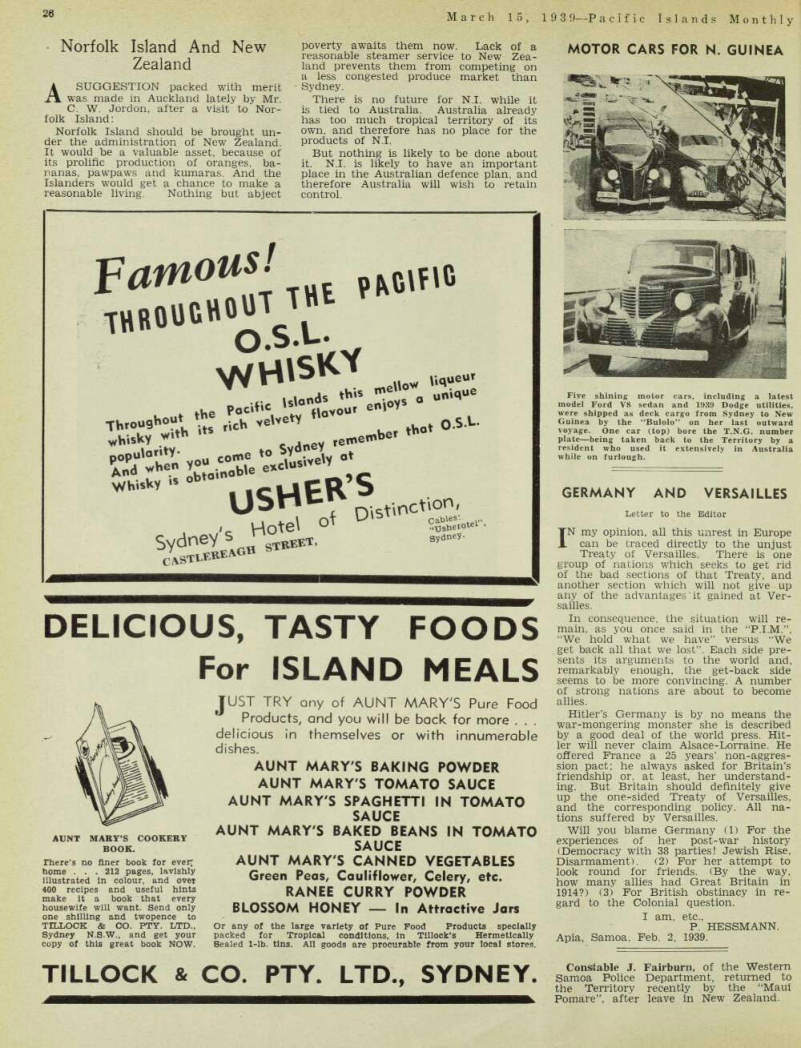
Zealand
A SUGGESTION packed with merit was made in Auckland lately by Mr.
C. W. Jordon, after a visit to Nor folk Island: Norfolk Island should be brought un der the administration of New Zealand.
It would be a valuable asset, because of its prolific production of oranges, ba nanas, pawpaws and kumaras. And the Islanders would get a chance to make a reasonable living. Nothing but abject
poverty awaits them now. Lack of a reasonable steamer service to New Zea land prevents them from competing on a less congested produce market than Sydney.
There is no future for N.I. while it is tied to Australia. Australia already has too much tropical territory of its own, and therefore has no place for the products of N.I.
But nothing is likely to be done about it. N.I. is likely to have an important place in the Australian defence plan, and therefore Australia will wish to retain control.
Motor Cars For N. Guinea
Five shining motor cars, including a latest model Ford V8 sedan and 1939 Dodge utilities, were shipped as deck cargo from Sydney to New Guinea by the “Bulolo” on her last outward voyage. One car (top) bore the T.N.G. number plate—being taken back to the Territory by a resident who used it extensively in Australia while on furlough.
Germany And Versailles
Letter to the Editor IN my opinion, all this unrest in Europe can be traced directly to the unjust Treaty of Versailles. There is one group of nations which seeks to get rid of the bad sections of that Treaty, and another section which will not give up any of the advantages' it gained at Ver sailles.
In consequence, the situation will re main, as you once said in the "P.l.M.’’, “We hold what we have” versus "We get back all that we lost”. Each side pre sents its arguments to the world and, remarkably enough, the get-back side seems to be more convincing. A number of strong nations are about to become allies.
Hitler’s Germany is by no means the war-mongering monster she is described by a good deal of the world press. Hit ler will never claim Alsace-Lorraine. He offered France a 25 years’ non-aggres sion pact; he always asked for Britain’s friendship or. at least, her understand ing. But Britain should definitely give up the one-sided Treaty of Versailles, and the corresponding policy. All na tions suffered by Versailles.
Will you blame Germany (1) For the experiences of her post-war history (Democracy with 38 parties! Jewish Rise.
Disarmament). (2) For her attempt to look round for friends. (By the way, how many allies had Great Britain in 1914?) (3) For British obstinacy in re gard to the Colonial question.
I am, etc.,
P. Hessmann.
Apia, Samoa, Feb. 2, 1939.
Constable J. Fairburn, of the Western Samoa Police Department, returned to the Territory recently by the “Maui Pomare”, after leave in New Zealand.
Advertisements & other items, p. 28 (2 items)
26
March 15, 193 9—P acific Islands Monthly
Famous! flt
"•«•••£ T
O.S.L.
ri , he w*sr.s* htou9 hout * ich velvet O.SL hisky with ten ,ember t« action, . « c Hote\ of UIS o-gs.
ssaa---*
DELICIOUS, TASTY FOODS
For ISLAND MEALS
AUNT MARY’S COOKERY
BOOK.
There’s no finer book for everr home ... 212 pages, lavishly Illustrated in colour, and over 400 recipes and useful hints make it a book that every housewife will want. Send only one shilling and twopence to
TILLOCK & CO. PTY. LTD.,
Sydney N.S.W., and get your copy of this great book NOW.
JUST TRY any of AUNT MARY'S Pure Food Products, and you will be back for more . . . delicious in themselves or with innumerable dishes.
AUNT MARY'S BAKING POWDER
AUNT MARY'S TOMATO SAUCE
AUNT MARY'S SPAGHETTI IN TOMATO
SAUCE
AUNT MARY'S BAKED BEANS IN TOMATO
SAUCE
AUNT MARY'S CANNED VEGETABLES
Green Peas, Cauliflower, Celery, etc.
RANEE CURRY POWDER
BLOSSOM HONEY In Attractive Jars Or any of the large variety of Pure Pood Products specially packed for Tropical conditions, in Tillock’s Hermetically Sealed 1-lb. tins. All goods are procurable from your local stores.
TILLOCK & CO. PTY. LTD., SYDNEY
Timbers
New Guinea’S Inland
Permit For One Firm Only
DESPITE Opposition protests, the Fed eral Government proposes to go ahead with its plan to grant to one firm (by tender) the exclusive right to cut 50,000,000 super feet, in the Bulolo forests, New Guinea. Mr. Cur tin Mr A. E. Green and others, urged that, instead of one permit, the area and the quantity should be divided among several permits.
The Minister has advised that, after consultation with the Inspector-General of Forests, he has been influenced by the following reasons;— The Bulolo forest is a comparatively small area.
The mill proposed is not as large as many in Queensland and smaller than the majority in Western Australia.
The position of the permit area neces sitates very heavy expenditure, both as regards the saw-mill and its branch (the ply mill) and a battery of kilns, and also in the provision of communica tion to the coast. This expenditure can be borne only by a reputable firm at tracted by a reasonable quantity of raw product.
Marketing of timber from New Guinea presents problems which are most effi ciently solved by firms already in the business who have the necessary well organised sales branch.
Supplies of Hoop Pine in Australia will be exhausted in about seven years and it is therefore, important that a strong reputable firm start the industry in New Guinea, which must, as time goes on, be the supplier of Australia’s needs in this quality of pine and cabinet woods.
Forestry will be best served both as regards reforesting the area and enforc ing forestry regulations if the area is let to one strong firm rather than to a num ber of small men.
The proposal is to grow the pine in plantation formation as the mill cuts the timber out, thus more than making good the wastage, for the second growth will yield more timber to the acre than the virgin forest. The rotation is 40 years, so that when the last of the 200,000,000 super feet of pine, now esti mated to be in the Bulolo Valley, has been converted, the plantations first made will be ready for cutting. This sys tem, which is in force in all countries where forestry is understood, results in a sustained yield for all time.
No reliable estimate of the Bulolo Valley cedar is available, but it is thought to be no less than 250,000 super feet.
Advertisements & other items, p. 29 (2 items)
27
Pacific Islands Mont hi y—M arch 15, 1939
They Criied Him Tiribtim
f/COME ON T/RED
, J IA ST MAN IN.
i\
HEAR THAT? VO UR
BOY CALLED MINE 'TIRED
run’. IT'S AWFUL / HE'S
ALWAYS TIRED. / DON'T
KNOW WHAT TO DO
1 ’-''Vtt n j
PONT TAKE ANY
NOTICE OF JOHNNIE, DOT -
HE’S JUST FULL OF SPIRITS.
YOU KNOW, HE USED TO BE
LIKE TIM. THE DOCTOR SAID
HE WAS OUTGROWING
IS STRENGTH AND PUT
HIM ON HORLICKS.
LOOK AT HIM NOW,
5 Is There a "Tired Tim" in Home?
Just stop a minute and think of the energy your boy burns up every day!
While you walk —he runs! He s always on the go—burning up energy —and that energy has to be replaced! If it is not—then he droops into a state of dull, listless tiredness.
Your child needs extra nourishment to give him additional energy. Doctors recommend Horlicks because it supplies just the right amount of extra nourishment. Horlicks builds children up and helps them grow.
Give your child a cupful of Horlicks at bedtime, and another at mid-day. Then you’ll see ful difference in him. wonder- Make yours a Horlicks home from now on—and you’ll give your child real energy . . . you’ll build him up to be a fine sturdy young man.
Ask your chemist or storekeeper to-day for a bottle of Horlicks (14V2 oz. size 3/- in the main towns throughout the British Pacific Islands). 5 orlicJn y mha Mixe
guards against
NIGHT-STARVATION
Strength of Sugar Cane Fibre
SYNTHETIC building materials made of sugar cane fibre have been proved to be stronger than wooden boards used for similar construction, according to tests made at Columbia University, by William J. Krefeld, associate professor of civil engineering at the University. The tests were witnessed by engineers of the Building Department of New York City. The cane fibre, according to Mr. Krefeld, has been accepted by the engineers as a substitute for wood in frame construction. Cane fibre board, it is stated, is 330 per cent, stronger than wooden boards when used horizontally for sheathing. It can be produced more cheaply than wood and is three times more effective as an insulator. — Captain Rose has taken charge of the Government ketch “Melbidir”, at T.I., as successor to Captain Booker.
Epidemics In N. Hebrides
A PLANTER of Epi, New Hebrides, writing at the beginning of Febru ary, said that there had been a severe epidemic of influenza and dengue fever in that part of the group recently, and that many natives had died. There have been a number of reports of this char acter lately, suggesting that there has been much mortality among the natives of the New Hebrides. Maybe the time is opportune for the British authorities to inquire into the character of the medi cal services in the group.
The Methodist Mission auxiliary ketch “St. Nicolas” will be transferred from North Australia to Misima Island. Pa pua, about the middle of the year.
Vote-Less
Voice Less And
Sad Condition of Papua and New Guinea
THE European residents of Papua and New Guinea—especially the non-offi cial class—have little hope of escap ing from the shackles of bureaucracy.
They are doomed, it seems, to live per manently in the power of officialdom, without representation in the Govern ment, and without recourse.
Australia proposes to amalgamate the two Territories. As the plan vitally af fects the interests of thousands of pri vate people. Sir Hubert Murray suggested that it might be submitted to a referen
dum of Europeans in the two Territories.
The Australian Minister for Territories (Mr. Harrison) said that that was “un necessary”. He said that the commit tee which would be appointed by the Government to advise on the amalgama tion, could take evidence from anyone who desired to give it.
The Minister’s attitude gives point to certain emphatic views expressed recent ly by the “Rabaul Times”. Commenting on the indifference of New Guinea re sidents regarding a proposed new ap pointment to the Legislative Council (which is advisory, composed non-offi cially of the Administrator’s nominees, and dominated, in any event, by the block vote of departmental heads who sit there ex officio) the newspaper says: “Admittedly, little more can be accom plished in a Chamber with a packed of ficial vote, which is always carefully in the majority. Under present circum stances, we can expect little else whilst Canberra controls the minutest detail of administration policy, leaving nothing for the local legislators to decide on their own initiative. It would be an em barrassing position if, during one bright session, the official members failed to vote ‘en bloc’ and the Government suf fered a defeat on some important "issue framed to further some Canberraistic scheme, originated for the edification of the Geneva critics—which is the ‘raison d’etre’ of half our legislation”.
Because residents of the Northern Ter ritory of Australia must pay Australian taxation, they are given a vote-less rep resentative in the Federal Parliament.
He may speak, but he may not vote: and it is an interesting commentary on politicians and their ways that the Min isters practically ignore the Northern Territory representative and his repres entations.
As Papua and New Guinea do not pay Australian taxes, they are not regarded as having any claim to Australian Par liamentary representation. No one could quarrel with that—if the Territories had any kind of local self-government. Nom inally, the Territories are governed from Port Moresby and Rabaul by Adminis trators accessible to the lightly taxed Eu ropean residents—a system that might have much to commend it. Actually, they are governed from Canberra, by a bu reau of capable but hard-boiled and unsympathetic officials.
The voices at Moresby and Rabaul are the voices of Murray and McNicoll; but the hands which hold the reins are the hands of Australian bureaucrats, whose names, even, are not known.
It is an extraordinary condition of af fairs. Little wonder that New Guinea residents are quite indifferent about their Legislative Council.
French Copra For France
THE French Government has promul gated a regulation concerning the importation of copra into France.
This regulation provides that where copra is subject to a provisional quota, French buyers must first of all prove that they have imported a certain quan tity of copra from French Colonies be fore they are able to import copra from countries other than French Colonies.
For the present, the proportion of French Colonial products has been fixed at 80 per cent., so that for every 20 tons im ported from a foreign country the im porter must prove that 80 tons have been imported from French Colonies.
Advertisements & other items, p. 30 (2 items)
28
March 15, 193 9—P acific Islands Monthly
B.P. Magazine
BP
READ THE
AUTUMN NUMBER
Now On Sale Short Stories Pictures Travel Articles Pages for the Children Stage Latest Fashions Screen A
ONE SHILLING PER COPY
ON SALE AT ALL NEWSAGENTS AND BOOKSELLERS
m A * i
STAY AT
SYDNEY'S NEW GUEST HOUSE,
BERNLY
Delightfully situated at
SPRINGFIELD AVENUE, POTTS POINT
(4 mins, from City) An ideal home for visitors from the Islands and Overseas.
COMFORT . . . CONVENIENCE,
PRIVACY AND GOOD SERVICE.
100 Richly Furnished Bedrooms, many with Private Showers.
HOT & COLD WATER & TELEPHONES
IN ALL ROOMS.
BILLIARDS . . . ROOF GARDEN.
CUISINE BY FIRST-CLASS CHEF.
Tariff: From 3 gns. p.w. Inclusive —or Room only if desired.
Proprietor : F. J. BERNE.
Samoan Legislative
Council Views of Hon. O. F. Nelson
From Our Own Correspondent
Apia, Feb. 14..
TWO new European representatives (Hon. O. F. Nelson and Dr. C. M.
Dawson) and two new Samoan re presentatives, Hon. Asiata Muese and Hon. Faalava’au. were welcomed at the Legislative Council meeting by the Act ing Administrator (Mr. A. C. Turnbull).
Mr. Turnbull said that the heavy damage done to roads and bridges by the recent heavy storms and floods had to be provided for. Fortunately, the rev enue of the territory is expected to be sufficient to meet the expenditure until the end of the financial year. Consider able damage has been done in outside districts, particularly in Savaii. He com mended the Public Works Department and the director (Mr. Schaaffhausen) for good work in speedily restoring road and water services, and the Health De partment for measures to prevent disease from flood refuse and stagnant water.
The principal business before the Coun cil was “Building Construction Ordin ance 1939”. which is to establish within the municipality a concrete area, where new buildings have to be built in con crete or brick. This is a sequence of the disastrous fire a year ago, when Messrs.
Bums, Philp’s large wooden copra shed, containing 1,000 tons of copra, was des troyed. This shed has been replaced by a shed of concrete and iron.
The Administrator said that the larger business concerns are already building in concrete. It was claimed that the new ordinance would impose undue hardship on persons possessing small capital, by forcing them to replace old buildings with concrete structures. Mr.
Turnbull assured the Council that there was no desire on the part of the Admini stration to cause any hardship to any individual whatever. The Administrator under Clause 8 of the Bill has discre tionary powers to grant relief from the provisions of the Ordinance in cases of hardship. On the other hand there would be a very considerable saving in insur ance rates and also in maintenance cost for concrete and brick buildings.
The storage of copra in wooden pre mises within the business area consti tuted a great danger and it is proposed to legislate to meet the situation.
Hon. O. F. Nelson, in a long address, gave an outline of the long-standing dis pute regarding his candidature as repre sentative of the Samoans on the Council, and stated that his political views had been distorted by press propaganda. He said that it was the late General Rich ardson who had invented the slogan “Samoa for the Samoans” and that he had adopted this slogan, including in the term “Samoans” all permanent residents of Samoa, who have made their homes here, or who have interests here for themselves or others.
Mr. Nelson admitted that a fire-proof concrete area in Apia would be of com mercial advantage, and he would sup port the Bill—if it were brought in when people were in the financial position to meet the additional cost. He read letters of protest from the Apia Chamber of Commerce and the United Progressive Party, which said that the new law
would impose hardships on the small business people of Apia, especially at the present time, but that some regulations regarding storage of copra in Apia sheds would be welcomed and supported. Insurance on the present wooden buildings would in no case be nearly sufficient to rebuild in concrete. The ultimate resuit of the Ordinance would be to drive the small business man out of business.
Mr. Nelson strongly opposed any discretionary powers being granted by the present or any other Ordinance to the Administrator. He said such a delegation of power and authority is “bad law’’ and that through it he personally had been subjected to hardships, humiliation, degradation and irreparable losses. c-amnan members pxnresspri aP ree The Samoan mempers expiessed agreement with Mr. Nelson.
The second reading of the Bill was
postponed.
Mr. and Mrs. J. Bower arrived in New Zealand on leave by the February “Maui Pomare” from Apia, Western Samoa. He recently has been Acting-Inspector of Produce in Samoa, during the absence in N.Z. of Mr. H. S. Newton on furlough, Rev. and Mrs. G. T. Warren, of 8.5.1., have resigned from the Melanesian Mis sion and have returned to England. Mr.
Warren has been head of the boy’s school at Maravovo since 1921, and Mrs.
Warren has been actively engaged in mission work for the past 19 years, Mr. P. Coote, manager of Burns, Philp and Co., Ltd., at Rabaul, New Guinea, arrived in Sydney by the February “Macdhui” to spend three months’ fur ]oUgh. “Rabaul is just the same as ever’’, he said on arrival, “and trading condi tions are quite good, despite the depressed copra market.”
Advertisements & other items, pp. 31-32 (2 items)
29
Pacific Islands Monthl y—M arch 15, 1939
I\C T 0 Ria
ML BITTER
mm m ttera^
THE BE
i•! •
“CINNAMCLIA”
PREPARATIONS.
DYSENTERY! —One of the worst scourges of the tropics—makes its annual appearance fairly regularly every fly season and exacts a heavy toll of human life, besides causing a lot of misery and suffering, as well as the economic loss of time and labour, through infected persons being laid up for days, weeks and sometimes months, before being able to return to their normal occupation.
Every household and institution in the tropics should always keep on hand a stock of “Cinnamolia”, which is undoubtedly the best remedy so far discovered, for the treatment and cure of this dreaded disease.
A dose administered immediately the first symptoms are observed will often check it in a day or two. If not, the treatment should be continued daily until all symptoms have disappeared and the patient’s condition is normal again, This is not a “quack” medicine— but a scientifically prepared remedy, which destroys the germs that cause the disease, aids nature to remove the debris, and soothes the irritated and damaged surfaces of the intestinal tract.
It was used with great success for 5 years or more in tropical hospitals, before being prepared and offered for sale to the general public. It can now be obtained at 3/- per bottle at
FALKS PHARMACY
338 GEORGE ST., SYDNEY.
Also Cinnamolia Inhalant for coughs, colds, flu, catarrh, etc., at 2/- per bottle with dropper.
Cinnamolia Ointment for cuts, scratches, abrasions, ulcers, piles, etc., at 1/6 per jar.
For Wholesale Rates to Chemists, Hospitals and other Institutions, apply to “Cinnamolia’* Preparations, 17 Murray St., Waterloo, N.S.W.
AUSTRALIAN
BULLDOG BATTERIES
A BATTERY
FOR
EVERY
PURPOSE
HI Q These Batteries DO NOT LOSE CHARGE WHEN NOT IN USE . . . ■ • Plates DO NOT BUCKLE and Term-
inals DO NOT CORRODE . .
Hi Radio type are UNCONDITIONAL-
■ LY GUARANTEED FOR THREE
YEARS.
You will SAVE MONEY by Using BULLDOG BATTERIES Write to ... .
Continental Compensations Pty. Ltd.,
423 COLLINS ST., MELBOURNE, VIC.
We also Supply—
DIESEL ENGINES OF ALL TYPES.
Fijian Soccer Football Team
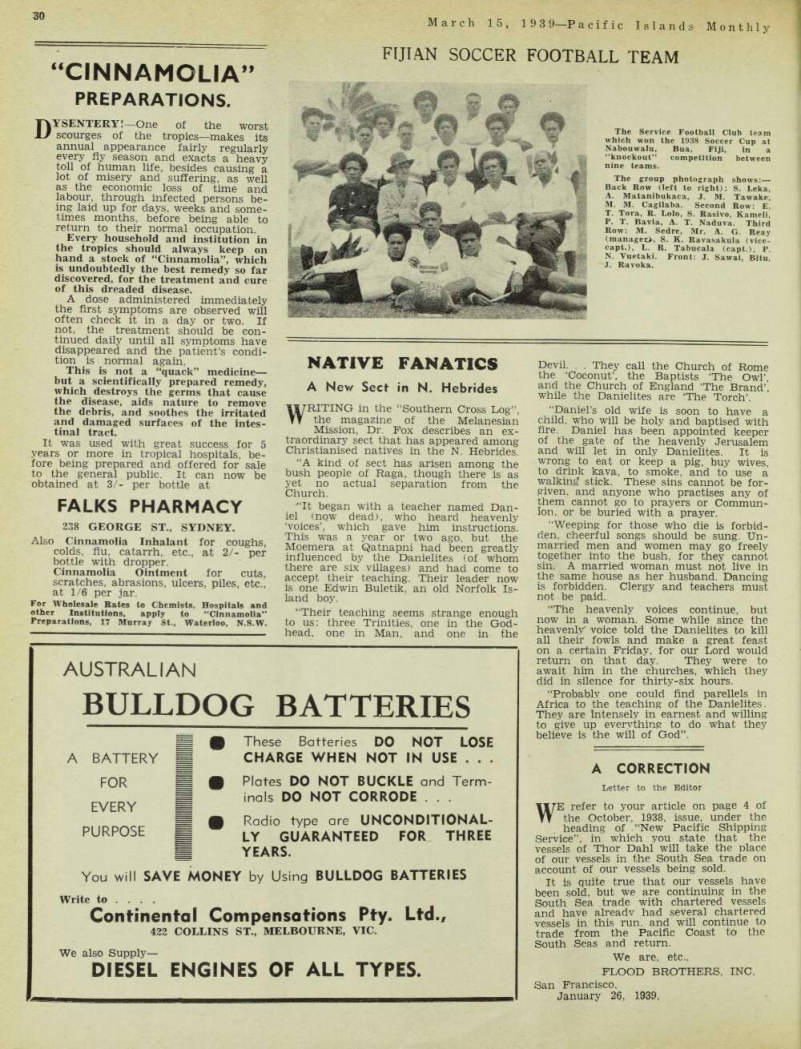
The Service Football Club team which won the 1938 Soccer Cup at Nabouwalu, Bua, Fiji, in a “knockout” competition between nine teams.
The group photograph shows:— Back Row (left to right): S. Leka, A. Matanibukaca, J. M. Tawake, M. M. Cagilaba. Second Row: E.
T. Tora, R. Lolo, S. Rasivo, Kameli, P. T. Bavia, A. T. Naduva. Third Row: M. Sedre, Mr. A. G. Reay (managed, S. K, Ravasakula (vice capt.), L. R. Tabucala (capt.), P.
N. Vuetaki. Front: J. Sawai, Bitu,
J. Ravoka.
Native Fanatics
A New Sect in N. Hebrides
WRITING in the “Southern Cross Log”, the magazine of the Melanesian Mission, Dr. Fox describes an ex traordinary sect that has appeared among Christianised natives in the N. Hebrides.
“A kind of sect has arisen among the bush people of Raga, though there is as yet no actual separation from the Church. ■"‘lt began with a teacher named Dan iel (now dead), who heard heavenly ‘voices’, which gave him instructions.
This was a year or two ago, but the Moemera at Qatnapni had been greatly influenced by the Danielites (of whom there are six villages) and had come to accept their teaching. Their leader now is one Edwin Buletik, an old Norfolk Is land boy.
“Their teaching seems strange enough to us: three Trinities, one in the God head. one in Man, and one in the
Devil. . . They call the Church of Rome the ‘Coconut’, the Baptists ‘The Owl’ and the Church of England ‘The Brand’’, while the Danielites are ‘The Torch’.
“Daniel’s old wife is soon to have a child, who will be holy and baptised with fire. Daniel has been appointed keeper of the gate of the heavenly Jerusalem and will let in only Danielites. It is wrong to eat or keep a pig, buy wives, to drink kava, to smoke, and to use a walking 1 stick. These sins cannot be for given, and anyone who practises any of them cannot go to prayers or Commun ion, or be buried with a prayer.
“Weeping for those who die is forbid den, cheerful songs should be sung. Un married men and women may go freely together into the bush, for they cannot sin. A married woman must not live in the same house as her husband. Dancing is forbidden. Clergy and teachers must not be paid.
“The heavenly voices continue, but now in a woman. Some while since the heavenly* voice told the Danielites to kill all their fowls and make a great feast on a certain Friday, for our Lord would return on that day. They were to await him in the churches, which they did in silence for thirty-six hours.
“Probably one could find parellels in Africa to the teaching of the Danielites.
They are intensely in earnest and willing to give up everything to do what they believe is the will of God”.
A Correction
Letter to the Editor WE refer to your article on page 4 of the October, 1938, issue, under the heading of “New Pacific Shipping Service”, in which you state that the vessels of Thor Dahl will take the place of our vessels in the South Sea trade on account of our vessels being sold.
It is quite true that our vessels have been sold, but we are continuing in the South Sea trade with chartered vessels and have alreadv had several chartered vessels in this run. and will continue to trade from the Pacific Coast to the South Seas and return.
We are, etc.,
Flood Brothers, Inc.
San Francisco, January 26, 1939.
Advertisements & other items, pp. 33-34 (2 items)
31
Pacific Islands Monthl y—M arch 15, 1939
That’S Iti
World’s Best
and Biggest Selling
Motor OH . •
This oil lubricated the first car (Selden's) and the first plane (WrighJ's) and to-day the makers of Mobiloil supply oil for the lubrication of the engines of the £6.000.000 liner. Queen Mary"-thus Mobiloil's reputation for outstanding quality has grown till it outsells each and every brand in the world. It is as nearly perfect a lubricant as can be made and, because all gummy, nonlubricating impurities have been removed, there is more oil and. therefore. more protection in a gallon of Mobiloil than in any other brand.
Modern Refrigeration for the South Sea Islands
The
ELECTROLUX
KEROSENE OPERATED
REFRIGERATOR
MARVEL
OF
MODERN
SCIENCE
% ■v.
THE
MIRACLE
OF
ICE
FROM
HEAT
THE ELECTROLUX OFFERS economical, modern and completely efficient refrigeration for
ISLANDS' HOMES.
FREEZES CONTINUOUSLY WHILE SMALL LAMP BURNS
Freezing controlled by simply regulating height of flame. Uses only gallon of kerosene per week.
MOTORLESS ... NO PARTS TO GET OUT OF ORDER.
MODEL L3B
• (as illustrated] Capacity 4 cubic feet.
GUARANTEED FOR TWO YEARS
Obtainable from w Write to your Local Distributor for prices and full details.
MODEL L 22
Capacity 2.2 cubic feet.
MODEL LKSS
Capacity 5.5 cubic feet.
W. R. Carpenter & Company Ltd.—Sydney and following New Guinea Branches : Rabaul, Salamaua, Wau, Kavieng, Madang.
But and Wewak.
Representation In Papua and New Hebrides, W. R. Carpenter & Coy. (Solomon Is.) Pty. Ltd. —Tulagi, British Solomon Islands.
On Chong & Company Pty. Ltd.—Butaritari, Gilbert & Ellice Islands.
The Call Of The
Islands
Crowding Memories of Papua
From a letter by Henry Dexter, late of Milne Bay, Papua, who writes feelingly of his com fortable, snow-covered house in England—but wants to know “what is happening in Papua!”
GERMAN HARRY,” a well-known identity about the coast of Papua, twenty-five years ago, knew what he was talking about when he told Jack McLaren: — “Once you hear that call you have to answer it. I tried to turn deaf ears to it and failed. Four times I cast the sands of the Islands off my feet, finally and for ever, as I thought; and four times I had to return. At Moresby they said that I was making a habit of it.
“While you are in the Islands, theatres, pretty women, good cooking, horse-racing, and all the rest of it looked jolly fine; but, somehow, when you got among those things it wasn’t the same.
“A man soon gets fed up with city life. For one thing, there’s so much hustle. You see a chap twirl round a corner on one leg merely to buy a packet of cigarettes. And there is always such a thumping noise going on, and fellows trying to take you down for all you’ve got, and the people seem unreal, artificial-like. And very soon the pretty women don’t seem so pretty, and you get tired of young skirts, and old faces.
“That sort of thing is no good to a fellow accustomed to knocking about with easy-going cannibals, and after a while you’ll be nosing around the shipping office, seeing about a pas sage back, and calling yourself a goat for ever having left. It is the Call getting to work.
“You take my tip, and get out of this country as soon as you can. Its damned unsettlin’, I can tell you.”
Yes, “German Harry” was right— the Islands get hold of a man. And if, from force of circumstances, one is away from them, how eagerly one looks for news from the place which one probably cursed while in it, but can never forget.
Take that little group who assemble every Thursday morning at a cafe in Sydney. All ex-Papuans, they are men who were planting, trading, or storekeeping. An ex-Commissioner for Native Affairs, an ex-Government Storekeeper, or Commissioner for Public Works. They meet to talk of
old times, and with the hope that someone on furlough will turn up to give them news of the old spot. Listen to some of the tales of the old days.
THE “Laurabada” is lying alongside the wharf at Samarai. Sir Hubert Murray was on board, also the Commissioner for Public Works. The island is to have its electric light in stalled. There has been a lot of argu ment about installing a light on the wharf. The idea was strongly sup ported by the local R.M., but just as strongly vetoed by the C. for P.W.
Darkness comes on, the C. for P.W. has a dinner appointment ashore. He appears on deck in all the splendour of a white tropical suit, a lighted cigar in his hand, and an umbrella. He steps on what he thought to be the wharf, but is really only a shadow. In a moment he is swimming strongly.
The boys haul him aboard, still grasp ing the cigar.
One can just hear H.E. saying, in his dry way: ‘Well, I suppose the R.M. will now get his light on the wharf”.
That these men are sportsmen is proved by the fact that it is the ex- C. for P.W. himself who tells the tale.
Now they are talking of an old timer known as Jimmy. Jimmy had a plantation in Milne Bay. He owned a small motor boat. Occasionally he ran over to Samarai for a bender.
Although one of the quietest of men when sober, he was one of the most objectionable after he had had one over the eight. He’d accost a stranger, and roll off the most vile language.
When it ended in a row, as it some times did, he was one of the poorest exponents of the noble art.
A COPRA ship was loading at the wharf. One of the crew, a de cent little fellow, had come ashore to have a pot of beer. Jimmy was there, well primed. He looked at the sailor and opened fire.
For a time, the little chap stood it;
then he knocked Jimmy down. Jimmy refused to get up. “You can’t hit a man when he is down”, he said.
“No,” replied the little man, “but I can get down, too”. Suiting the ac tion to the word, he lay down along side the bigger man, and knocked seven bells out of him.
Now, Jimmy always stored this up as a grievance. Seven months passed’ and the same ship was loading at the wharf. Fletcher was in charge of the hotel. Jimmy appeared, and ordered a long-sieever of beer. Having dealt with this, he stood waving his arms in the air.
“Why the physical jerks, Jimmy?” asked Fletcher. ‘Tin going looking for him,” was the reply.
An hour later, Fletcher went along the street, by the B.P. store. There m a doorway, was Jimmy. He was sopping a bloody nose, and his eye was rapidly closing. “I see you found him Jimmy”, was Fletcher’s only re mark. J
Advertisements & other items, pp. 35-36 (1 item)
Capstan
B.EGD
THE
HALL-MARK
OF
PERFECTION
IN
CLOTHING, HATS,
SHIRTS, PYJAMAS,
MERCERY, HOSIERY,
& KNITTED GOODS.
They Look Well! and They Wear Well!
EVERY GARMENT GUARANTEED
CAPSTAN
Capstan Cigarettes, round airtight 50's.
Medium and full strength.
SPECIALLY
PACKED FOR
THE TROPICS
Capstan Navy Cut Tobacco, made the finest Virginia leaf. 88*5-10-8 from
BRITISH SOLOMON ISLANDS
STAMPS
New issue at 10 per cent, over cost.
On Covers Id. each cover extra.
Coronation Set on Reg. Cover posted to any address l/6d.
Cash with order. With all enquiries please send a stamped addressed envelope.
M. HARPER,
Mandoliana Island, P.O. Box 6, Tulagi, 8.5.1.
W. H. GROVE & Sons Ltd.
Islands Traders p.o. box 490 AUCKLAND Telegraphic and Cable Address: “Grove,” Auckland.
Shippers of all classes of New Zealand Products, specially prepared for the Island trade.
Representing Rylands & Sons (Col.) Ltd., of London and Manchester. (Including the tamous “Dacca” Mills Products ) Parbury Henty & Co. Pty. Ltd., of Sydney and Kobe.
“AGFA” Photographic Corporation, of Berlin.
J. Blair King, of London. World-famed Shirts.
Burrell & Co. Ltd., Millwall, London, E. 14. Oil, White Lead and all classes of Paints, including “FERROCENE” their special Tropical Paint . . . PREVENTS CORROSION made in RED, GREY, and GREEN.
Jjtepim
'XHi.
Q
J O O
Photograph with Agfa Isochrom - this is a film for all types of exposures. It enables you to get the best out of your photographs. Good definition, reproduction of the finest details, brilliant gradation, and high sensitivity. Orthochromatic with wide exposure latitude.
M
rraj
m. u
"German Harry"
Letter to the Editor T SEE that inquiries have been made ± for a certain “German Harry”; and, in the January issue, it is stated that a Captain Harry Christensen, a Dane, was known to be at Papeete in 1918.
The “German Harry” known about Cooktown and Papua, since long be fore 1900, was well-known to me from 1898, and I think that he may possibly be the man inquired for. The “Harry” and “German” were only nicknames, as his real name was Soren Christen sen, and he was a Dane. We were partners for a time in the beche-de mer industry, so I naturally got to know him very well indeed, and he made no secret of his past life, which had been full of adventure and rom ance.
I am pretty sure that this “G.H,” was never in Tahiti. He died in Sydney about 1916 or 1917.
I am, etc.,
C. O. Anderson,
s.s. “Papuan Chief.”
Port Moresby, 11/2/1939.
Rarotonga
Maori Social Clubs On
Prom Our Own Correspondent
Rarotonga. Feb. 15.
THANKS to the generosity of Mr.
Chambers, a retired merchant from India, a much-needed want is being met and two native social clubs have been formed, one at Arorangi and the other at Ngatangiia—each with a mem bership of over a hundred.
Converting dwellings at considerable ex pense, Mr. Chambers has fitted each club-house with dance-floors, ping-pong tables, games tables, seats, lights, etc.
Each member pays an entrance fee of 1/-, then 6d. per month. A committee of members conduct the club, run two dances a week, and have inter-club ping nong matches. It will not be long be fore every village on Rarotonga has its own club.
Advertisements & other items, p. 36 (1 item)
34
March 15, 193 9—P acific Islands Monthly
The Missing Lode
Fruitless Search for Rich Copper Vein on Rurutu
From Our Own Correspondent
Papeete, Feb. 12.
THE mirage of Golconda has flickered over many an island of the South Seas and has drawn men from afar to seek not only Inca gold and the bur ied hoards of long dead buccaneers, but fabulous riches of mineral treasure re puted to lie in the heart of mountains, awaiting the prospector and the miner.
During the past quarter of a century, the descendants of traders, sea-faring men and planters (who, during the pre ceding 70 years, had visited and traver sed the phosphate island, MakaLea. with out suspecting the riches lying just be neath the jungle roots), have been seek ing consolation by ransacking the moun tainous interior of Tahiti for a possible vein of some precious metal. Now and again rumour has carried the story of gold or platinum in some remote valley; but never has anything tangible come out of these reputed discoveries and it has long ago been accepted that the mountains of Tahiti conceal no treasure of metals or mineral wealth.
IT was with no little surprise, therefore, that the watchers on the wharf one day beheld two U.S. mining engineers descend from a mail steamer, bearing the paraphernalia of their pro fession. They did not disclose their er rand. It was not long, however, before the cloud of mystery which shrouded their comings and goings became lumin ous with forked lightning and clam ourous with angry cries. Presently from its murky depths emerged two of the most indignant citizens who had ever breathed the air of these latitudes.
They stormed into the United States Consulate with a story of ore samples equal in richness to the highest grade copper ore from mines in the Peruvian Andes, represented to them as having been taken from a large ore vein in the mountains of Tahiti. They had voyaged all this distance to verify and explore this ore body, and now the man who had sent the specimens was refusing to reveal the secret of its location. Where was that ore vein? Did the Consul know? They wanted satisfaction, dam ages. vengeance—and so on for hours, until the Consulate quaked with the violence of their fury.
The harassed and bewildered Consul could offer no aid or consolation. Nor could the mountains and the sea to which the engineers addressed daily orations of masterly composition. Fin ally. the steamer arrived and they de parted. The owner of the house where they lodged complained bitterly that his walls were so blistered and scorched it was necessary to have them scraped and repainted. Inhabitants of the north coast of Tahiti reported that after the steamer had passed, a thick, purple mist had hovered over the ocean long after the vessel had vanished beyond the horizon.
WHEN cosmic balance was restored, some local magnates instituted an investigation. The ore specimens which, in their wrath, the mining en gineers had hurled on the floor of the Consulate, were examined and found to be. indubitablv. copper ore of very super ior quality. The man who had sent the samples to California reluctantly con
fessed he did not know the place whence they came.
A native had brought them in, he explained. This native had told him of great quantities of the same kind of rock lying about; but was crafty and would not disclose the precise location Believing that he could persuade or bribe the native, at some future date to impart
SS to°Mends’ irf SSSSSL**"
five had disappeared. One could well imagine his consternation when these ensineers shook the ore samples in his face and demanded to be led to the place whence they had been taken; after what he had been through he felt, and presumed he looked, like the sole survivor of a volcanic disaster. If the magnates wished for the ore specimens they could have them: on the one con-
dition that copper and copper mines should never again be mentioned in his presence. The magnates agreed.
In due time they found the native and by virtue of largess added to rich promises, garnered the intelligence that the ore specimens had come from the is land of Rurutu. An expedition verified that there was a lot of the same kind of rock lying about.
NOT long afterward, watchers on the Papeete wharf beheld, descending from a ship, a mining engineer. He was welcomed joyously by the magnates, refreshed after his long voyage, and de spatched with his paraphernalia aboard a schooner to Rurutu. For months he delved and pick-axed and drilled and tunneled. He found pockets of mangan ese of high quality, hectares of paint rock, and slight traces of many metals;
but .no vein of copper. He returned to Papeete and departed.
After a season, another and more em inent mining engineer arrived. He was received, refreshed and packed off by schooner to Rurutu. He delved and pick
axed and drilled and tunneled. He found pockets of manganese, hectares of paint rock, traces of many metals; but no vein of copper. The magnates were bewild ered, but resolved to try once more.
The third expert, with his other para phernalia, took to Rurutu a sound know ledge of Polynesian languages—acquired after a residence of many years in the islands. He found manganese, paint rock and traces of many metals. In addition he unearthed a venerable ancient of Rurutu who remembered things the care less younger generations had long for gotten.
This patriarch told many a tale of the olden time to his sympathetic listener.
One was of a white man’s ship which came from a land far beyond the rising of the sun and was driven by a storm on the reefs of Rurutu. She had been laden—much to the wonderment of the natives—with ofai (rock). They were curious ofai; different from anything found on Rurutu. The wind and seas had broken up the ship and tossed these strange ofai on the shallows and beaches.
When the engineer heard this story he awoke to the fact that to arrive at the mother lode of all this scattered ore, he would have to drive a tunnel four thou sand miles to the eastward! He packed his belongings and came with all haste to Papeete.
RECENTLY, the discovery of gold in Fiji raised hopes and started exploring activity in all the mountainous is lands of the Pacific —except Tahiti. On
that island the winds of promise did nothing more than stir ashes of dead hopes in which no spark of adventure remained that could be fanned into even a faint semblance of a glow.
Advertisements & other items, pp. 37-38 (2 items)
35
Pacific Islands Monthl y—M arch 15, 1939
Ahp-Lite
RIGGS & SIRATTO
MODEL 300
PRICE - - £24/10/
AHP-LITE
HOME POWER
UNITS
By Briggs Cr Stratton Small, light, compact Petrol electric generators with everything a car engine has. 9J U
ELECTRICITY
ANYWHERE—
—ANYTIME
® For Home Lighting Output 300 watts 12 volts (1) Press Button Starting (2) Air-Cleaner, oil-bath type (3) Petrol Filter (4) Float-feed adjustable Carburettor (5) Magneto Ignition, etc. (6) Automatic Cut-out.
Features 2, 3 and 4 are posi tively exclusive to Model 300 (Weight when packed 971b5.) ® Battery Charging ® Will operate twelve 25 watt Lamps @ 12 hours per gallon of petrol.
Also, Model 100, 6 volts, 100 watts, manual starting £l2/10/-. (Weight when packed 701b5.) Briggs Stratton Petrol Motors also available. Single cylinder'’4-cycle, air-cooled engines from i to 5 horsepower.
The World’s largest manufacturers of this class of engine.
EXCLUSIVE AGENTS:
AMPLION (A'SIA) PTY. LIMITED
66 CLARENCE ST„ SYDNEY
Cable Address; "AMPLION,” Sidney.
PURE RICE
STARCH
Always ask for . . .
CORAL BRAND
100% PURE
to 8
CORAL BRAND
RICE STARCH
A COK»l.t^*«C^_lT«.
Noted for its
QUALITY
and
WHITENESS.
Goes Farthest and gives Lasting Finish
WILL NOT
STICK TO
IRON.
Obtainable from Leading Island Stores.
Manufactured by
AUSTRALIAN RICE, LTD.
Sydney, N.S.W.
'jotciyoAcmi
V-A'RI-ETIC*
Australia's Choicest Products: Green Peas French Beans Cauliflower Beetroot Spinach Cabbage Carrots Parsnips Celery Brussels Sprouts White Turnips Sweet Corn Tomato Puree Tomato Sauce Tomato Soup Tutti Fruit Sauce (Worcestershire flavor)
VALE
N PRODUCTS LIMITED
, 2-4 BROWN iTR-E-CT, N-EWTOWN
tYDN-EY. AUSTRALIA
Always . . .
make sure you have at hand an ample Reserve of these Delicious . .
Garden
Vale
Ready-toserve Vegetables
Kapok-Growing In
Papua
Planters Want Channel To The Market
IF the Commonwealth Government is sincere in its policy of encouraging new settlement and new production m the Territories of Papua and New Guinea, it should examine the position in relation to the cultivation of kapok in Papua.
A number of planters in Papua have been encouraged to produce kapok, and the Commonwealth Government pays them a bounty of 2d. per lb. But more than that will have to be done if this industry is to be established. ~T hei ’ e definitely is a world demand for this product, at a profitable price; but the trouble is the absence of an organ ised market. There appears to be only one firm in Australia which regularly buys kapok, and this firm usually offers 4id. per lb., with the indication that you can take it or leave it”. The un fortunate planter, having no other chan nel open, has to take it.
The experience of one planter in Pa pua is typical. He started with 18 acres, from which he did well so long as the local market in Papua could absorb his product. He was so pleased that he laid down another 100 acres and started to ex port kapok. He sent one consignment to Sydney, and discovered that kapok is handled there by only one firm, who of fered him the usual 4£d. per lb. He knew that the true market rate was in the vicinity of 7d. per lb., so he decided to fight. He searched around, and finally he was able to sell his kapok to a firm of furniture manufacturers in Brisbane for 9d. per lb. But he could not get any further orders on a firm basis, so he has turned most of his kapok plantation over to other things.
Under present conditions, there are only two alternatives for the Papuan planter—to sell to the “take it or leave it” firm in Sydney at 4id. per lb., or to incur expense and uncertainty in trv ing to find a regular channel to the world market.
If the Commonwealth Government in tends seriously to assist and encourage primary industries in Papua and New Guinea, it should form some sort of or ganisation which will enable the plant ers to find a direct track from their plantations to world markets, where they can get the best available prices for their product. No planter worthy of the name will allow himself to be consist ently victimised by the “take it or leave it” type of merchant.
Mr. D. Jones, of the Samoa Public Works Department, has returned to New Zealand after completing his term of service at Apia.
Sister Butler, who is in charge of the hospital at Avarua, Rarotonga, is now spending her leave in New Zealand, the land of her birth. During her residence of several years in the Cook Islands, she has co-operated actively with Dr. E.
P. Ellison in child welfare work.
Pretty Wedding In Samoa
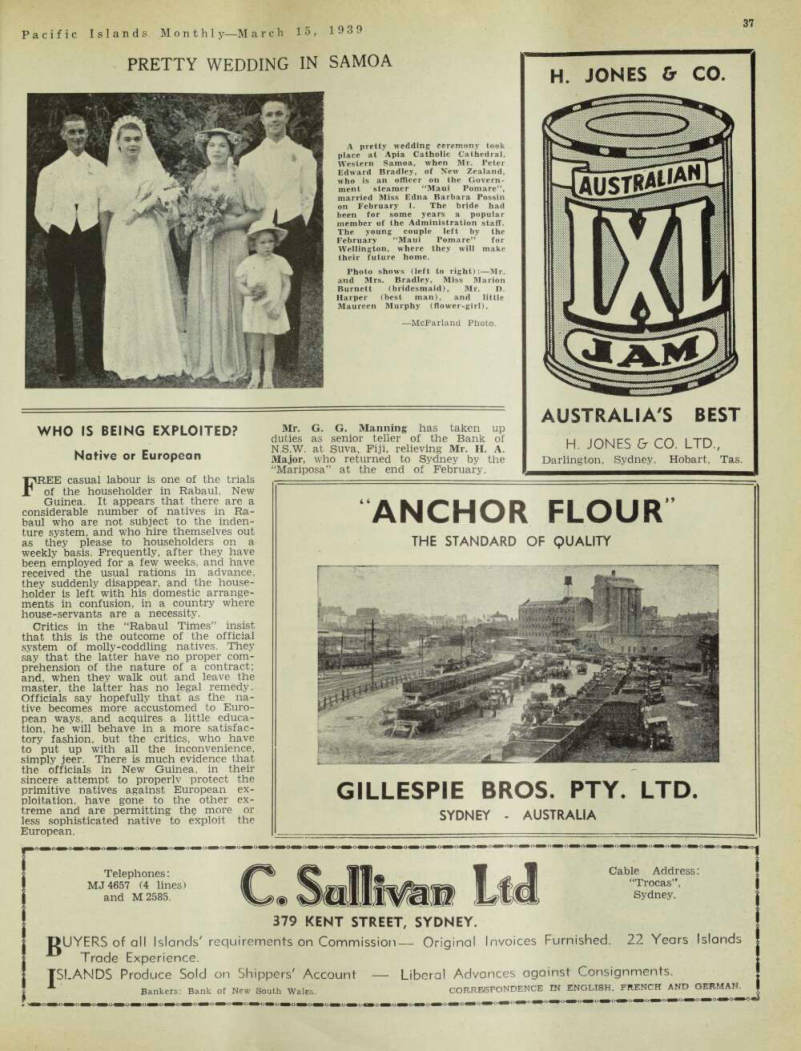
A pretty wedding ceremony took place at Apia Catholic Cathedral, Western Samoa, when Mr. Peter Edward Bradley, of New Zealand, who is an officer on the Govern ment steamer “Maui Pomare”, married Miss Edna Barbara Possin on February 1. The bride had been for some years a popular member of the Administration staff.
The young couple left by the February “Maui Pomare” for Wellington, where they will make their future home.
Photo shows (left to right):—Mr. and Mrs. Bradley, Miss Marion Burnett (bridesmaid), Mr. D.
Harper (best man), and little Maureen Murphy (flower-girl).
McFarland Photo.
Who Is Being Exploited?
Native or European
FREE casual labour is one of the trials of the householder in Rabaul, New Guinea. It appears that there are a considerable number of natives in Ra baul who are not subject to the inden ture system, and who hire themselves out as they please to householders on a weekly basis. Frequently, after they have been employed for a few weeks, and have received the usual rations in advance, they suddenly disappear, and the house holder is left with his domestic arrange ments in confusion, in a country where house-servants are a necessity.
Critics in the “Rabaul Times” insist that this is the outcome of the official system of molly-coddling natives. They say that the latter have no proper com prehension of the nature of a contract; and, when they walk out and leave the master, the latter has no legal remedy.
Officials say hopefully that as the na tive becomes more accustomed to Euro pean ways, and acquires a little educa tion, he will behave in a more satisfac tory fashion, but the critics, who have to put up with all the inconvenience, simply jeer. There is much evidence that the officials in New Guinea, in their sincere attempt to properlv protect the primitive natives against European ex ploitation, have gone to the other ex treme and are permitting the more or less sophisticated native to exploit the European.
Mr. G. G. Manning has taken up duties as senior teller of the Bank of N.S.W. at Suva, Fiji, relieving Mr, H. A.
Major, who returned to Sydney by the “Mariposa” at the end of February.
Advertisements & other items, pp. 39-40 (2 items)
37
Pacific Islands Monthl y—M arch 15, 1939
austrSU^
H. JONES & CO.
AUSTRALIA'S BEST
H. JONES & CO. LTD.,
Darlington, Sydney. Hobart, Tas.
ANCHOR FLOUR
THE STANDARD OF QUALITY
■ m
GILLESPIE BROS. PTY. LTD.
SYDNEY - AUSTRALIA
Telephones: MJ 4657 (4 lines) and M 2585.
L m ar Cable Address: “Trocas”, Sydney.
379 KENT STREET, SYDNEY.
OLIVERS of all Islands' requirements on Commission— Original Invoices Furnished. 22 Years Islands Trade Experience.
ISLANDS Produce Sold on Shippers' Account - Liberal Advances against Consignments. 1 Bankers: Bank of New South Wales. CORRESPONDENCE IN ENGLISH. FRENCH AND GERMAN.
Kork-N-Scal
FOR HOME USE
• Hand Applied Airtight Pressure Proof
FOR ALL HOME BOTTLING
—THE LITTLE CAP THAT
will Re-seal 1,000 Times
KORK-N-SEAL (Aust.) LTD.
106 COMMONWEALTH STREET,
SYDNEY. AUSTRALIA.
We are Specialists . . . \ Let us have your confidence. Sixty years is our record of supplying the leading Houses throughout the World in ... .
FRESH FRUIT VEGETABLES PRODUCE
’Phones; MA 3612 (4 lines).
Cable Address: “Weymarkson”
Codes—Bentleys Private
WEYMARK & SON LTD.
FRUIT AND PRODUCE MERCHANTS
14-18 STEAMMILL STREET - - SYDNEY
cniVEts
Obtainable from all Leading Grocery Stores Chivers and Sons Ltd., Histon, Cambridge, E. 76
PURE
FOODS
GOLD MEDAL JAMS
CANNED ENGLISH FRUITS
CANNED ENGLISH VEGETABLES
CUSTARD POWDER
OLD ENGLISH MARMALADE
JELLY CRYSTALS, ETC.
Write to Department A*, England, for attractive Recipe Book.
Hoisting the Flag at Papua
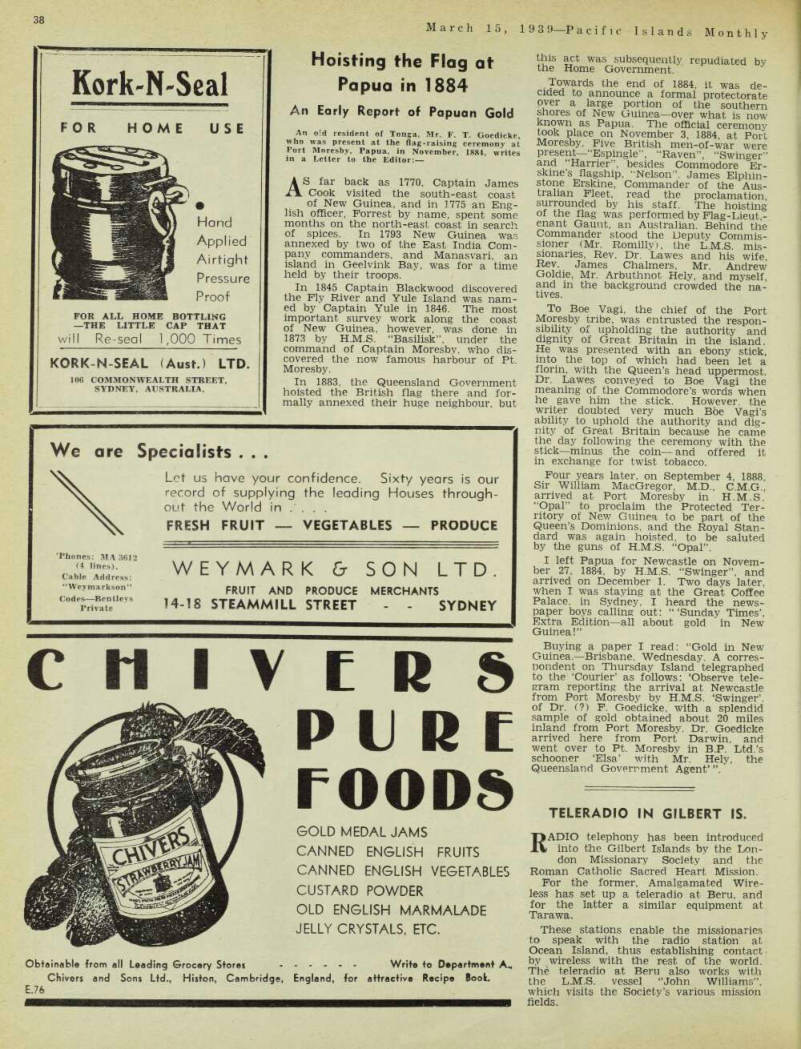
Papua in 1884 An Early Report of Papuan Gold
An old resident of Tonga, Mr. F. T. Goedicke, who was present at the flag-raising ceremony at Port Moresby. Papua, in November, 1884, writes in a Letter to the Editor:— AS far back as 1770, Captain James Cook visited the south-east coast of New Guinea, and in 1775 an Eng lish officer, Forrest by name, spent some months on the north-east coast in search of spices. In 1793 New Guinea was annexed by two of the East India Com pany commanders, and Manasvari, an island in Geelvink Bay, was for a time held by their troops.
In 1845 Captain Blackwood discovered the Fly River and Yule Island was nam ed by Captain Yule in 1846. The most important survey work along the coast of New Guinea, however, was done in 1873 by H.M.S. “Basilisk”, under the command of Captain Moresby, who dis covered the now famous harbour of Pt.
Moresby.
In 1883, the Queensland Government hoisted the British flag there and for mally annexed their huge neighbour, but
this act was subsequently repudiated by the Home Government.
Towards the end of 1884, it was de cided to announce a formal protectorate over a large portion of the southern shores of New Guinea —over what is now known as Papua. The official ceremony took place on November 3, 1884. at Port Moresby. Five British men-of-war were present—“Espingle”, “Raven”, “Swinger” and “Harrier”, besides Commodore Er skme’s flagship, “Nelson”. James Elphin stone Erskine, Commander of the Aus tralian Fleet, read the proclamation, surrounded by his staff. The hoisting of the flag was performed by Flag-Lieut,enant Gaunt, an Australian. Behind the Commander stood the Deputy Commis sioner (Mr. Romilly), the L.M.S. mis sionaries, Rev. Dr. Lawes and his wife, Rev. James Chalmers. Mr. Andrew Goldie, Mr. Arbuthnot Hely, and myself, and in the background crowded the na tives.
To Boe Vagi, the chief of the Port Moresby tribe, was entrusted the respon sibility of upholding the authority and dignity of Great Britain in the island.
He was presented with an ebony stick, into the top of which had been let a florin, with the Queen’s head uppermost.
Dr. Lawes conveyed to Boe Vagi the meaning of the Commodore’s words when he gave him the stick. However, the writer doubted very much Boe Vagi’s ability to uphold the authority and dig nity of Great Britain because he came the day following the ceremony with the stick—minus the coin— and offered it in exchange for twist tobacco.
Four years later, on September 4. 1888, Sir William MacGregor, M.D., C.M.G., arrived at Port Moresby in H.M.S.
“Opal” to proclaim the Protected Ter ritory of New Guinea to be part of the Queen’s Dominions, and the Royal Stan dard was again hoisted, to be saluted by the guns of H.M.S. “Opal”.
I left Papua for Newcastle on Novem ber 27. 1884, by H.M.S. “Swinger”, and arrived on December 1. Two days later, when I was staying at the Great Coffee Palace, in Sydney, I heard the news paper boys calling out: “‘Sunday Times’, Extra Edition—all about gold in New Guinea!”
Buying a paper I read: “Gold in New Guinea. —Brisbane, Wednesday. A corres pondent on Thursday Island telegraphed to the ‘Courier’ as follows: ‘Observe tele gram reporting the arrival at Newcastle from Port Moresby by H.M.S. ‘Swinger’, of Dr. (?) F. Goedicke, with a splendid sample of gold obtained about 20 miles inland from Port Moresby. Dr. Goedicke arrived here from Port Darwin, and went over to Pt. Moresby in B P. Ltd.’s schooner ‘Elsa’ with Mr. Hely, the Queensland Government Agent’ ”.
Teleradio In Gilbert Is.
RADIO telephony has been introduced into the Gilbert Islands by the Lon don Missionary Society and the Roman Catholic Sacred Heart Mission.
For the former, Amalgamated Wire less has set up a teleradio at Beru, and for the latter a similar equipment at Tarawa.
These stations enable the missionaries to speak with the radio station at Ocean Island, thus establishing contact by wireless with the rest of the world.
The teleradio at Beru also works with the L.M.S. vessel “John Williams”, which visits the Society’s various mission fields.
The Viti Co.

interesting Experiment in Fijian Native Trading
(By Gilchrist Alexander, in “From the Middle Temple to the South Seas”, dealing with a period of about 20 years ago.) I WAS much interested in a move ment among the Fijians, which appeared to be an effort on the part of some of them to emancipate them selves from the control of the white man in the disposal of native pro duce.
For centuries, the Fijians have been dominated by their chiefs. At one time, the control of the chiefs was absolute, and their privileges in re spect to lala and other matters were immense. It was all the more note worthy that the movement of which I speak appeared to be directed by a commoner—one Apolosi Nawai, who, however, was credited by the more superstitious with possessing almost divine powers.
Apolosi was the managing director of the Viti Company, Ltd.—“Viti” be ing the native form of “Fiji”. The company was in the nature of a co operative societv. whose main object was the sale of native produce, prin cipally bananas, for the benefit of the many native shareholders. Unlike the similar society in Tonga, the Kautaha, which was obviously engineered by white men for personal purposes, the Viti Company, Ltd., seemed to be a genuine effort on the part of the natives to conduct their own business.
Apolosi published the following notice in the European newspapers:— “To all the population of the Colony of Fiji: “This is mv confession letter to you all, my brethren.
“Before I commence my business I will let you know first the foundation of my work. I.—l shall love all my brethren. 2.—1 shall honour all the chiefs. 3.—1 will honour the King ; through all his subjects. 4. —I will fear the Lord our God.
“These are the foundations of my work at present.
Apolosi R. Nawai.”
A week or two later, notices ap peared headed: “Viti Company, Ltd.
To all you gentlemen who buy bananas”, and signed, “Apolosi R.
Nawai, Managing Director”.
The new company was in difficul ties from the beginning. It incurred the hostility of the white planters and merchants, who strongly resented the appearance of a united body of native rivals in business. The Wesleyan Methodist Mission suffered a huge financial loss, when large numbers of natives transferred the contributions which they would ordinarily have given to the mission to the new com pany.
To the Government, Apolosi was anathema. He had come into conflict with the police at the Yasawas, and
had suffered a term of imprisonment, He was regarded as a dangerous man, and his extraordinary power over the people was feared.
That Apolosi’s power was real was evident when a meeting of the company was held in the Town Hall of Suva. For days before the meeting, natives flocked to Suva from all over the Colony. Sleeping-room was at a
premium, and certain wanderers dur ing prohibited hours were accommo dated perforce in the lock-up.
Seven hundred natives congregated in the Town Hall on the day of the meeting. Apolosi, attired in a well fitting tussore silk suit, made by a Sydney tailor, drove up in a smart motor car, and was received with al most regal state. His address to the
natives differed as much from the speech of a City of London chairman of directors as the South Seas differ from London, but it had the secret of success. He played upon the men tality of his audience with the skill of a Lloyd George. With business details he had little concern. Loyalty to the company and support for himself were the keynotes of his theme, and he adroitly wove into his speech an appeal to his followers to respect the Government.
This experiment in native co-opera tion was almost foredoomed to failure.
Without experience of business habits and methods, and with a thriftless ness and extravagance seemingly in herent in those trained in communist ideas, the native directors of the com pany soon involved themselves in a hopeless tangle. Under the law which enacted that where a contract was entered into between a native and a non-native party for more than £2O, the non-native party must submit a memorandum to the Magistrate of the district, the affairs of the company came under my notice. I had a good deal of sympathy with the objects of the company, but it soon became ap parent that it was not properly con stituted, and the technical obstacles to natives trading on a large scale were almost insuperable.
Added to all this, Apolosi and some of his followers lacked moral stamina.
They could not be trusted with large sums of money, and were constantly involved in drunken brawls in the town. I have recollections of a case in \yhich a European butcher, in censed at Apolosi’s insolent intrusion into his shop, had used by way of a boxing-glove a large and juicy piece of raw meat.
The ultimate end of the Viti Com pany, and of its managing director, did not come under my personal ob servation. After I had left the Colony, Apolosi got into serious trouble with the authorities and was eventually deported to Rotumah, an island de pendency of Fiji somewhat distant from the main group. And so ended what I have alwavs thought might, under sympathetic and skilled guid ance, have been a useful lesson and training to native Fijians in the con duct of industrial affairs.
Professor Peter H. Buck and Professor Radcliffe Brown have been honoured by the Anthropological Society of New South Wales by being elected honorary mem bers. Dr. Buck is back at Yale Univer sity, U.S.A., for a year, though he is ex pected in New Zealand for the centen ary celebrations towards the close of 1939.
Dr. Radcliffe Brown occupies the Chair of Anthropology at Oxford, England. Both have had long experience in Pacific re search.
Dr. H. lan Hogbin, president of the Pacific Islands Club in Sydney, will not seek re-election at the annual meeting in April. Under Club rules the president can only hold office for two years in succession. Members, generally, will re ceive this intimation with regret, for he has proved a most capable president. He will, however, continue his association with the Club he assisted in founding.
Advertisements & other items, pp. 41-42 (2 items)
39
Pacific Islands Mont hi y—M arch 15, 1939
Puddings
PRESCOTT I™ Iy S d?Je S y are sole wholesale adonis /d?'-
PINEAPPLE BACON & HANS
DAISY BRAND BUTTER
“375” BUTTER in'TINS iib.-2ib. sib.Sizes LEA & PERRINS’ Sauces and Most other Super-Quality Lines of the Trade
SWALLOW
& ARIELVS
llllllllllllllllllllllillllillllllllllHllllllllllllllllllllllllllllllll lllllllllllliiilllllllllllliillllilllllllllllllllllllllllllllllilllllllllllllllllllllllllllllllllllHllllllllHii
PLUM
PUDDINGS
1 lb. : 1 lb.
Ulb. :21b. and 3 lb.
Kenowned for Quality
Manufactured at Port Melbourne, Australia FIJI REPRESENTATIVES - - PEARCE £r CO. LTD.
BECAUSE IT IS
SEALED AGAINST
DUST AND GERMS
I * u m 1&9 m* m n ?st Brand rntm m
WdensedM
s Yt> The hottest weather cannot affect the purity or flavour of Nestle s Milk. While unopened it will keep sweet and fresh despite the severest climatic conditions. Order a supply to-day.
Copyright B 2
NESTLE'ScrSmMI lr
BEST, THEREFORE CHEAPES
Saving Babies In Polynesia
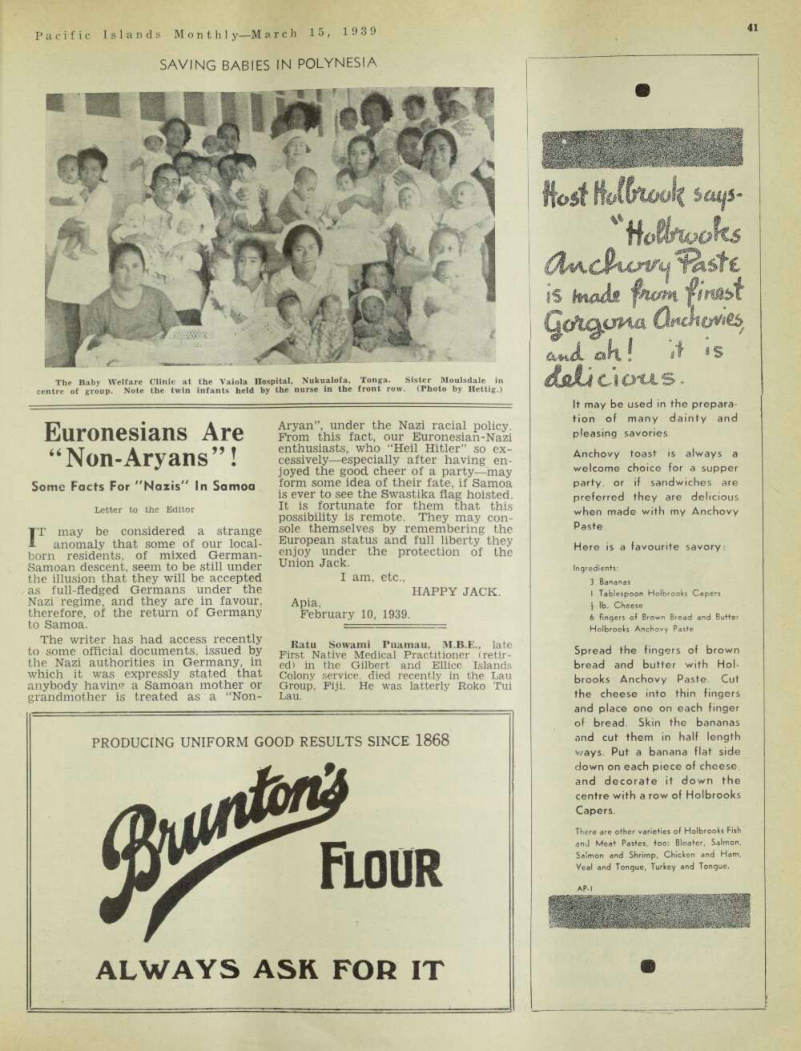
The Baby Welfare Clinic at the Vaiola Hospital, Nukualofa, Tonga. Sister Moulsdale in centre of group. Note the twin infants held by the nurse in the front row. (Photo by Hettig.)
“Non-Aryans”!
Euronesians Are “Non-Aryans”!
Some Facts For "Nazis" In Samoa
Letter to the Editor IT may be considered a strange anomaly that some of our local born residents, of mixed German- Samoan descent, seem to be still under the illusion that they will be accepted as full-fledged Germans under the Nazi regime, and they are in favour, therefore, of the return of Germany to Samoa.
The writer has had access recently to some official documents, issued by the Nazi authorities in Germany, in which it was expressly stated that anybody having a Samoan mother or grandmother is treated as a “Non-
Aryan”, under the Nazi racial policy.
From this fact, our Euronesian-Nazi enthusiasts, who “Heil Hitler” so ex cessively—especially after having en joyed the good cheer of a party—may form some idea of their fate, if Samoa is ever to see the Swastika flag hoisted.
It is fortunate for them that this possibility is remote. They may con sole themselves by remembering the European status and full liberty they enjoy under the protection of the Union Jack.
I am, etc.,
Happy Jack.
Apia,
February 10, 1939.
Ratu Sowami Puamau, late First Native Medical Practitioner (retir ed) in the Gilbert and Ellice Islands Colony service, died recently in the Lau Group, Fiji. He was latterly Roko Tui Lau.
Advertisements & other items, p. 43 (2 items)
41
Pacific Islands Monthl y —M arch 15, 19 3 9
js htagh fivcm. fmtet
Ifosf sJbwo\{ -
%% Hotl*
ihkfs£
js htagh fivcm. fmtet
G&l OhJiov^
ftttd ak ! »f 1 S
dfJj Cl Otis.
It may be used in the preparation of many dainty and pleasing savories Anchovy toast is always a welcome choice for a supper party, or if sandwiches are preferred they are delicious when made with my Anchovy Paste Here is a favourite savory.- Ingredients: 3 Bananas I Tablespoon Holbrooks Capers i lb. Cheese 6 fingers of Brown Bread and Butter Holbrooks Anchovy Paste Spread the fingers of brown bread and butter with Holbrooks Anchovy Paste. Cut the cheese into thin fingers and place one on each finger of bread. Skin the bananas and cut them in half length v/ays. Put a banana flat side down on each piece of cheese and decorate it down the centre with a row of Holbrooks Capers.
There are other varieties of Holbrooks Fish and Meat Pastes, too: Bloater, Salmon, Salmon and Shrimp, Chicken and Ham, Veal and Tongue, Turkey and Tongue.
AP-I
PRODUCING UNIFORM GOOD RESULTS SINCE 1868
ALWAYS ASK FOR IT
Bananas Up—Copra Down
Planters" Life in Samoa
From Our Own Correspondent
Apia, Feb. 15.
AFTER the very adverse weather con ditions of January. Western Samoa is enjoying a period of quiet sun shine and warmth.
Owing to the complete loss of the com ing cocoa crop, cocoa planters are in bad straits. Four recently gave up their holdings.
During the week of rain and floods in January, one plantation in the hills near Apia measured no less than 80.88 inches.
This was Tapatapao plantation (N.Z.R.E.).
The hurricane destroyed so many banana crops in Fiji, Tonga and Raro tonga that the New Zealand Govern ment quotas for banana shipments from Western Samoa have been raised. The last “Maui Pomare” took 7,700 cases; the ‘‘Matua”, leaving to-day. lifts 8,000 cases; while the following “Matua” will prob ably lift 10,000 cases for New Zealand.
Dutch New Guinea
Notable Progress Reported
From Our Own Correspondent
Port Moresby, Feb. 20.
IN view of the present activity in Netherlands, New Guinea, it does not appear likely that that Territory’s absorption by Australia, as advocated by Mr. T. L. Sefton (“P.1.M.”, January, 1939), will take place.
Returns for 1937, which are the latest available, show that the Dutch Colony is growing fast in economic importance.
Imports for the year amounted in value to £A288,000, an increase of £94,000 over the previous year, while exports increased by £72,000 to £186,000. The excess of imports over exports (£102,000) is accounted for by the great activity in exploration and prospecting, and by the fact that many plantations inaugurated in re cent years have not yet reached the producing stage.
Copra export is still small, at 4,327 tons. Timber is produced on an in creasingly large scale, and is almost wholly absorbed locally by the Gov ernment and the Netherlands New Guinea Petroleum Co. Production is steadily increasing, and the question of export of timber to Papua and Mandated New Guinea is under con sideration.
Exports of copal and damar gum amounted to 2,574 tons, an increase of nearly 1,000 tons on the previous year.
Nutmeg and mace increased from 502 tons to 652; and cotton from 68 tons to 297.
Exploration by the gold and oil in terests is still proceeding vigorously, and the American-Netherlands Arch bold Expedition has furnished a great deal of information of which full ad vantage is being taken; while the newly-formed Netherlands Company of New Guinea, with its large capital and its strong Government backing, is paying full attention to agricultural development.
Cook Islands R.A.
Appointment to Aitutaki
From Our Own Correspondent
Rarotonga. Feb. 5.
THE appointment of Mr. Alan Victor Penberthy Ford, barrister and solici tor, of Rotorua. New Zealand, as Resident of Aitutaki. Cook Group, has been made by the Public Service Com missioners.
Mr. Ford has had a wide experience of Native Land Court advocacy and prac tice. He joined the Native Department in 1913 and, later, entered the legal of fice of Messrs. Earl & Kent, barristers and solicitors, of Auckland, specialising in Native Land Court practice. Later he practised in Rotorua for 20 years as a native land conveyancing specialist.
It is understood that there were aver 50 applicants for this position, Including a number of local residents.
Advertisements & other items, p. 44 (2 items)
42
March 15, 193 9—P acific Islands Monthly
Over Thirty Years Ago
STEAMSHIPS TRADING COMPANY, LIMITED.
MERCHANTS, SHIPOWNERS AND PLANTERS
PORT MORESBY AND SAMARAI.
Our organisation provides every facility and efficient service as
MANAGING AGENTS AND VISITING REPRESENTATIVES OF
COCONUT AND RUBBER PLANTATIONS
Estates supervised in bearing and planting stages.
Comprehensive reports compiled and regular visits made to Estates by our competent Plantation Inspector.
WRITE, CABLE OR CALL FOR PARTICULARS:
STEAMSHIPS TRADING COMPANY LTD.
STEAMSHIPS TRADING COMPANY LTD.
PORT MORESBY PAPUA SAMARA!
Chairman and Managing Director: A. S. FITCH.
Shipowners, Wholesale and Retail Merchants and Traders; Shipping, Customs and Insurance Agents; Copra and Rubber Plantation Owners.
MAIL CONTRACTORS TO COMMONWEALTH AND PAPUAN GOVERNMENTS.
AGHNCIES:—At Port Moresby: Coral Sea Insurance Co.; Phoenix Insurance Co.; Delta Sawmills, Ltd.; Acme Bakery Co.; Vacuum Oil Co.. Pty., Ltd. At Samarai: Coral Sea Insurance Co.; Delta Sawmills, Ltd.: Bankers and Traders’
Insurance Co.; National Mutual Life Insurance Co.; Kularo Shipyards; Mamai Plantations.
BRANCHES:—In Papua: Hanuabada, Sivitoi. Aroma, Kokl, Hula, Ela Beach, Duga Duga, Yule Island.
SYDNEY: NELSON & ROBERTSON PTY. LTD., 12 Spring St.; Melbourne, 396 Flinders Lane: London, E. Whiteaway & Co., 7 Chiswell Street, Finsbury, London.
Cable Address: “STEAMSHIPS.” Code: Bentley’s.
Over Thirty Years Ago
The first Younger Stove was exported to the Pacific Islands. Ruggedly strong in construction, highly efficient and economical in fuel, has made them the most popular stove in the South Seas.
The illustration shows a Younger Single Oven Stove. Special stoves, with cast iron ovens for island reqairements made to order.
Write us for quotations for special sizes and catalogue of double and single oven stoves.
G. Fletcher & Son
50 OXFORD STREET, SYDNEY
Purple Days In Old Samoa
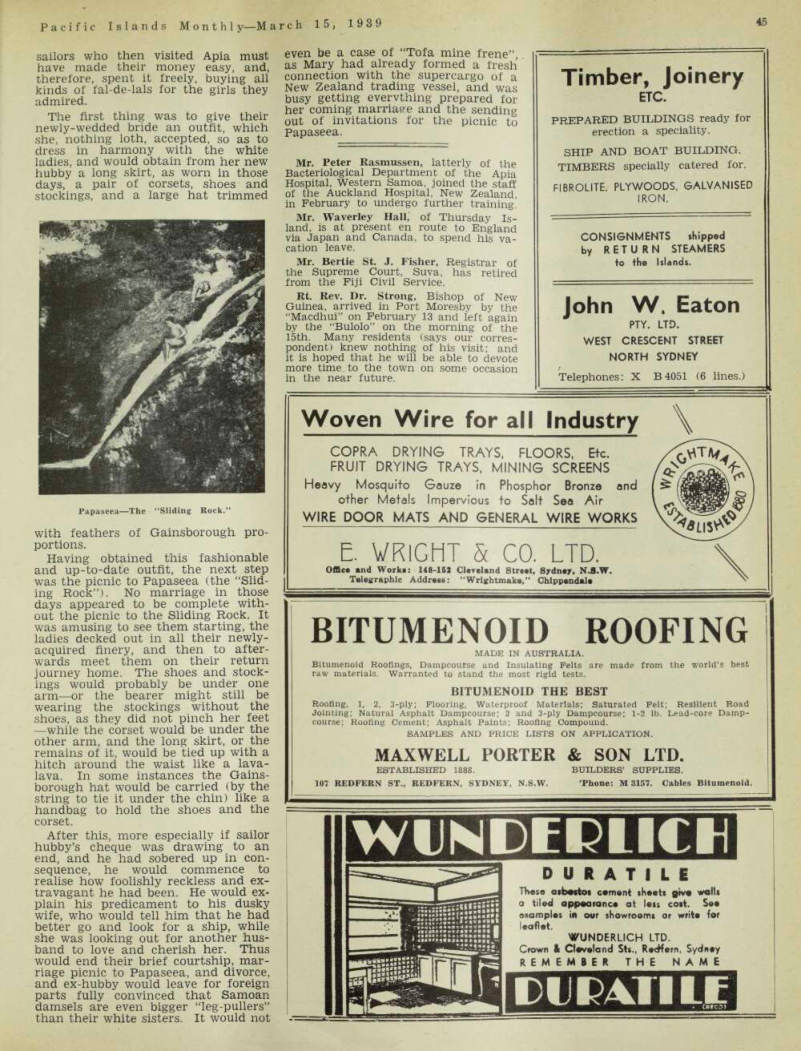
How Sailor-Men Found Entertainment In Apia Fifty Years Ago
GEORGE E. L. WESTBROOK (a descendant of an East Anglian family, which claimed descent directly from Henry VIE, through the Earl;: of Bridge water) died in Samoa on January 31, aged 18. Sailor, trader, merchant, writer and politician, he was one of the few men left who remember the Central Paci fic Islands as they were before the European nations fastened codes of laws upon them. In this article, which he sent to the “P.1.M.” about five years ago, Mr.
Westbrook draws a vivid picture of Old Apia, as he saw it when he settled down there in the ’eighties.
WHEN I first visited Samoa, there were many people still living who could tell very interesting and amusing stories of their early days there, when the township of Apia was called the “Sailor’s Paradise”.
Many of the notable characters floating around in those days were always called by their nicknames.
“Cranky Jack” was an Englishman of good family. “Gentleman Jack” was also an Ehglishman, and the grand son of a bishop. Then there were “Monkey Jack”, “Three-fingered Jack”, “Whistling Jack Smith”, “Scandalous Jack Smith”, “Lying Jack Smith”, and “Ugly Jack Smith”. Petersen” was a Dane.
“Charley Squarehead” and “Charley the Russian” both claimed Heligoland as the land of their birth. This brought them under the control of the British Consul, giving them both the dignity of being classed as British
subjects, although one was really a Russian and the other a German. It was the custom in those days, before Heligoland was exchanged with Ger many for some concession in Africa, for many foreigners shipping in Eng lish ships to say that they came from the small one-mile-square rock in the North Sea, at the mouth of the Elbe.
“Charley the Rooster” was another queer kind of individual, and was nicknamed the Rooster from a habit he had, when walking down the street, of putting his head forward, and beating his elbows against his sides.
There were also the two Mikes, Spanish Mike and Irish Mike. “Flash Harry” had a habit of showing sailors around, and pointing out to them certain properties on the beach of which he said he was the owner.
There were a number of other people, all of whom were never called by any
thing other than their nicknames, such as “Billy Bones”, “Paunchy Bill”, “Dinkum Dunlop”, “Crooked-eyed Bill”, “Sweet William”, and “Billy the Steward” (William Lowther), who hailed from Pimlico, London.
Billy, who kept a diary, which he first started when he as a boy ran away to sea, and had been recording nearly everything that had happened during his adventurous life, was a man worth listening to, and, when re lating a story regarding himself would produce a volume of his diary, and prove by day and month that he was not romancing. His diary would have filled a fair-sized book-shelf. He made several voyages with Bully Hayes, and afterwards settled down in the Gilbert Islands, where he died, a very old man, more than 20 years ago. What became of his diary, no body knows. It was very carefully written in a fine, legible hand.
IN those days, Samoa had a big, floating population, and the town ship of Apia must have had a bigger white population than it has now. It was certainly not the calamitous place it is as at present, governed by New Zealand, under the Mandate from the League of Nations, nor was it over staffed with officials, nor top-heavy with by-laws and taxation without re presentation.
The place in those days was appar ently well governed by the Samoans themselves, in accordance with their own manners and customs,
(Continued Overleaf.)
L 1 Li . f e was free and easy. Many of the so-called “lawless” characters and South Sea rovers made Apia a regular call, where they could have a ifi° ( fbQ^ ie KniTfi ey wer ? more ’ after all, than boisterous, ebullient persons, On account of this, the harbour of Apia was crowded with shipping of all kinds. There were fine Aucklandbuilt schooners and brigantines, fitted
out with trade rooms in charge of supercargoes. Sydney traders fitted out the same way. Whaleships with very motley crews aboard, hailing from all the countries under the sun. Most of these whalers were under the American flag, sailing out of Nan tucket, Martha’s Vineyard. and Eastern ports. There were also a number of whalers sailing out of
Kcbart Town, Sydney, New Zealand, and the Hawaiian Islands, under the old Hawaiian flag.
In addition to this there were the blackbirders”, such as the “Carl” brig and the schooner “Daphne”. The “blackbirders” in those days, were to an extent slavers, making good money by “inducing” Melanesians and any natives they could get hold of to take service on the plantations of Hawaii, Queensland and Fiji.
VyiTH such a big floating population it was only natural that there were a fair number of sailors’ board ing houses and places where men could get an honest drink. These were kept mostly by darkies, who had found their way to Samoa and settled down by marrying Samoans. The darker strain of their descendants can still be seen in some of the Samoans to day. “Black Tom”, “Bill Henry”, “George Washington”, “Bill Williams”, “Bruce the Fiddler”, and “Old Bob”, were negroes in full colour and char acteristics.
There being no European Govern ment, no taxes or customs dues were collected, drinking saloons paying no license. A case of Green gin could be purchased in those days for three Chilian dollars (about 8/- English money), all liquors being cheap in proportion, and were sold at 10 cents per nip, out of which the dispenser made a rattling good profit.
All that was necessary at the time to start a drinking saloon was the purchase of a few dozen glasses and a case or two of grog. Get hold of a girl who could play “Champagne Charley” or some other topical airs of the day on the accordeon, and every thing would be set, and the guests would flock in.
Even in those days it was con sidered best not to give the Samoan males drink, and they were never al lowed to enter the bar rooms. With the women, of course, it was different, and there were quite a number of them who made it a practice to visit the various saloons at night and en tertain the sailors. They were not all Samoans, but included Hawaiians, Gil bert and Marshall islanders, also a number of Tongans and Rarotongans.
Some of the women also had nick names, such as “Ugly”, “Fatty”, “Venus”, “Pretty”, “Greasy”, “Sissy”.
The sailors, however, addressed them by their nicknames, till such times as they knew them all as “Mary”.
The American Consular Agent was very obliging in those times (depend ing upon his fees) and would marry any of those who thought they were in love with their duskv sweethearts for the sum of 5 dollars cash, and for double that amount would grant them a divorce at the same time, which proved that those who married in haste were in those days not com pelled to repent at leisure.
THERE were two native damsels, one a Samoan, and the other a Hawaiian, who, I suppose on account of their bewitching looks and pleasant manners, were regularly married and divorced to some newcomer, every two or three weeks. The class of
sailors who then visited Apia must have made their money easy, and, therefore, spent it freely, buying all kinds of fal-de-lals for the girls they admired.
The first thing was to give their newly-wedded bride an outfit, which she, nothing loth, accepted, so as to dress in harmony with the white ladies, and would obtain from her new hubby a long skirt, as worn in those days, a pair of corsets, shoes and stockings, and a large hat trimmed
with feathers of Gainsborough pro portions.
Having obtained this fashionable and up-to-date outfit, the next step was the picnic to Papaseea (the “Slid ing Rock”). No marriage in those days appeared to be complete with out the picnic to the Sliding Rock. It was amusing to see them starting, the ladies decked out in all their newly acquired finery, and then to after wards meet them on their return journey home. The shoes and stock ings would probably be under one arm—or the bearer might still be wearing the stockings without the shoes, as they did not pinch her feet —while the corset would be under the other arm, and the long skirt, or the remains of it, would be tied up with a hitch around the waist like a lava lava. In some instances the Gains borough hat would be carried (by the string to tie it under the chin) like a handbag to hold the shoes and the corset.
After this, more especially if sailor hubby’s cheque was drawing to an end, and he had sobered up in con sequence, he would commence to realise how foolishly reckless and ex travagant he had been. He would ex plain his predicament to his dusky wife, who would tell him that he had better go and look for a ship, while she was looking out for another hus band to love and cherish her. Thus would end their brief courtship, mar riage picnic to Papaseea, and divorce, and ex-hubby would leave for foreign parts fully convinced that Samoan damsels are even bigger “leg-pullers” than their white sisters. It would not
even be a case of “Tofa mine frene”, as Mary had already formed a fresh connection with the supercargo of a New Zealand trading vessel, and was busy getting evervthing prepared for her coming marriaere and the sending out of invitations for the picnic to Papaseea.
Mr. Peter Rasmussen, latterly of the Bacteriological Department of the Apia Hospital, Western Samoa, joined the staff of the Auckland Hospital, New Zealand, in February to undergo further training!
Mr. Waverley Hall, of Thursday Is land, is at present en route to England via Japan and Canada, to spend his va cation leave.
Mr. Bertie St. J. Fisher, Registrar of the Supreme Court, Suva, has retired from the Fiji Civil Service.
Rt. Rev. Dr. Strong, Bishop of New Guinea, arrived in Port Moresby by the “Macdhui” on February 13 and left again by the “Bulolo” on the morning of the 15th. Many residents (says our corres pondent) knew nothing of his visit; and it is hoped that he will be able to devote more time to the town on some occasion in the near future.
Papaseea—The “Sliding Rock.”
Advertisements & other items, pp. 45-47 (3 items)
43
Pacific Islands Monthl y—M arch 15, 1939
Centrifuqal Pumps
DIESELS For HARD JOBS
Petter Crude Oil Engines
Valveless, two-stroke Petter patent cold starter. Low fuel consumption. Perfect lubrication. 6 to 21 B.H.P. Stationary and portable types. Send lor new catalogue just published.
7 TO II MARKET STREET SYDNEY.
BUZACOTT PETTER
800 Watt - 32 Volt
Home lighting Plant
Dependable and very economical tor the moderate size farm home.
Buzacotl Petrol-Kerosene 2 H.P. Series "W~ engine, with multiple vee-belt drive to oversize generator.
Complete with batiery. switchboard and push-button starting. Send for particulars.
Centrifuqal Pumps
Single or two
stage, 1-in.
to 6-in.
Direct-coupled vee belt or chain drive.
Supplied in any height, mesh, and gauge of wire: rolls of 50 or 100 ft Ask your storekeeper for latest prices.
I gu*ac«^tl^J£ols
». /||\ ■ ttoii market STREET SYDNEY. 7TO M MARKET STREET SYDNEY. U| I ■
TTOII MARKET STREET SYDNEY.
EVERY KIND oF PLOW
For Every Kind of Job
from singlefurrow mouldboard to heavy-duty tractor-drawn road plow. Long experience of specialized manufacturing gives leadership. Strength, without unnecessary weight, makes "BUZACOTT" the best plow you can buy. Let us quote for the plow you need.
7 TO II MARKET STREET SYDNEY.
ONE-MAN CLEARING
“DIGGER" WINCH
Has enormous power, light weight, very compact. One man can operate. Easy to move around. Most power ful winch for its size. Does not dance around ropes. Write to-day for
descriptive folders.
7TO II MARKET STREET SYDNEY
Full details of these or any other machinery lines FREE on request.
BUZACOTT-WOLSELEY Ltd., 7-11 Market St., SYDNEY, N.S.W.
YES/|
but r>.
which)
WMK-
ers
OF COURSE
Bergers I lilill! <prWa|||d* JCeeps on DCeeping on/
AGENTS THROUGHOUT THE ISLANDS.
Timber, Joinery
ETC.
PREPARED BUILDINGS ready for erection a speciality.
SHIP AND BOAT BUILDING.
TIMBERS specially catered for.
FIBROLITE. PLYWOODS. GALVANISED
IRON.
CONSIGNMENTS shipped
by RETURN STEAMERS
to the Islands.
John W. Eaton
PTY. LTD.
WEST CRESCENT STREET
NORTH SYDNEY
Telephones: X 84051 (6 lines.)
Woven Wire for all Industry
COPRA DRYING TRAYS, FLOORS, Etc.
FRUIT DRYING TRAYS, MINING SCREENS
Heavy Mosquito Gauze in Phosphor Bronze and other Metals Impervious to Salt Sea Air WIRE DOOR MATS AND GENERAL WIRE WORKS
E. WRIGHT & CO. LTD.
Office and Worka: 148-162 Cleveland Street, Sydney. N.B.W.
Telegraphic Address: “Wrlghtmake,” Chippendale
BITUMENOID ROOFING
MADE IN AUSTRALIA.
Bitumenold Roofings, Dampcourse and Insulating Pelts are made from the world’s best raw materials. Warranted to stand the most rigid tests.
BITUMENOID THE BEST
Roofing, 1,2, 3-ply; Flooring, Waterproof Materials; Saturated Pelt; Resilient Road Jointing; Natural Asphalt Dampcourse; 2 and 3-ply Dampcourse; 1-2 lb. Lead-core Dampcourse; Roofing Cement; Asphalt Paints; Roofing Compound.
SAMPLES AND PRICE LISTS ON APPLICATION.
MAXWELL PORTER & SON LTD.
ESTABLISHED 1888. BUILDERS’ SUPPLIES.
107 REDFERN ST., REDFERN, SYDNEY, N.S.W. ’Phone: M 3157. Cables Bitumenold.
WIiNDERIKHI
... ..." 'lllii**' 1 «» *»« n•» '*** • *“•*
DURA T I L E
a These o«b#«tos cement sheets give waits a tiled appearance at less cost. See examples In our showrooms or write far leaflet.
WUNDERLICH LTD.
Crown & Cleveland Sts., RecHern, Sydney
REMEMBER THE NAME
CUIAIUIB
45
Pacific Islands Monthl y—M arch 15, 1939
New Bulk Store At Port
Moresby
From Our Own Correspondent
Port Moresby, Feb. 16.
BURNS, Philp and Co. are building a new bulk store on the block ad joining their main store on Port Road, Port Moresby. Although the steel and iron structure, which is to be ap proximately 90 feet by 40, will be rather incongruous in the line of concrete build ings, it will certainly be an improve ment on the primitive shed that has occupied a comer of the block hitherto; and it provides one more tangible proof of the growing importance of Port Moresby.
and Polynesian
Honoured By European and Polynesian Makea Ariki, of Rarotonga, Goes To His Rest
By a Special Correspondent.
Rarotonga, Feb. 10.
THE death of their paramount chief, Makea nui Tinirau Ariki, 0.8. E., a man respected and loved by both the European and Polynesian com munities, was a great shock to the Rarotongans. The funeral ceremonies were notable.
The body of the Makea was brought from his residence at Pokoinu to the ancient, sacred tribal marae of Tapu tapuatea on January 26, and lay in state at the Palace until the 27th.
The Mataiapos and Rangatiras as sembled and directed the native cus toms pertaining to the death of an Ariki. The same evening, the other Arikis of Rarotonga came to the marae, with their people, to mourn
and to pay tribute to their departed friend.
The Fotikitaua (High Priest) of the Ngati Makea received and welcomed them in traditional fashion.
In accordance with native custom, the people of the different districts, under their arikis and chiefs, as sembled in some thousands to pay their tribute in song to the departed.
The singing also conveys a comfort to the hearts of the sorrowing family; and, as each district ceases its song, the leader pays a special tribute to the departed ariki and sympathy to the mourning family. After the speech, he presents gifts from the dis trict to the widow and family.
The songs and speeches continued throughout the night, until 9.30 a.m. on Friday, when Makea nui Tinirau Ariki was borne to his last resting place.
The coffin was carried, first, by the members of the Ariki family, from the palace. As a mark of respect and appreciation to Makea nui, who had played a great and important part in creating the friendship and brother hood at present existing between the two races, the Europeans then carried the bier, on which the coffin was placed, to the people representing the Islands of Atiu, Mauke and Mitiaro.
These people, the Enuamanu, carried the bier to the Palace gates, where the Puaikura (Arorangi people) re ceived and carried it to the London Missionary churchyard entrance.
Here, the Takitumu representatives —who, in accordance with native custom, prepare the grave for the arikis, and chiefs of the Makea nui family—bore the bier to the church entrance, where it was once again taken charge of by the members of the Makea family, who carried it into the church.
After the funeral service, which was conducted in English and Maori by the Revs. Cater and Challis, the late Makea was carried to his grave to lie beside the Tupuna, or ancestors, of this famous and noble family.
After the burial service the people, in accordance with native custom, took part in singing and native danc ing. Later in the day, the division of food from the family to the other tribes was made.
In the evening, singing and native dancing continued; and this was pro longed for seven days and nights.
A Polynesian Noble.
Makea nui Tinirau Ariki succeeded to the Ariki title in 1921. Ftom the time of his accession until his death he was staunch, loyal and outstand ing in his support for his Government and his King. He always had the wel fare of his people at heart, and the memory of his kindly hospitality to all, both Maoris and Europeans, will remain as a monument to his great ness. He was a strong supporter of the London Missionary Society Church.
He received the Jubilee and Corona tion Medals, in addition to the 0.8. E. (1933).
Makea nui was a descendant of Queen Makea, who was chief of the
Federal Government when the island was annexed in 1900. Through this line, he traced his ancestry back through the famed Karika Ariki of Manua. Samoa, who, according to tradition, settled in Rarotonga with Tangiia, of Tahiti. He also was a descendant of Tinomana Rurutini, whose elder daughter, Vainu, married Pepehia, the first missionary to Raro tonga, who landed from the ship when John Williams, in 1823, found the long : looked-for island of Tumu-te varo-varo (the ancient name of Raro tonga).
Advertisements & other items, p. 48 (1 item)
Sydn^"Y?“N.S'.W?'' I Wellington ' Nz ’
WANTED TO PURCHASE
Used stamps of all Pacific Islands.
Highest prices paid. Regular consignments solicited. Remittances guaranteed by return mail.
J. H. SMYTH PTY. LTD.
114 Castlereagh St., Sydney, Aust
The Most Extensive Manufacturers in the British Empire of
RUBBER STAMPS,
INKS, STENCILS,
Marking Devices,
ACME STAMP PADS
OFFICE S STATIONERY SUPPLIES
u u We also Manufacture & Supply a Complete Line of LI M EWAS HI N G AND
SPRAYING MACHINES
for all purposes.
Let us know your requirements and we will quote by return.
WRITE FOR OUR GENERAL CATALOGUE
Limewashing Machine
EXCELSIOR SUPPLY CO
PTY. LTD.
278 Host Office Place,
MELBOURNE, VIC.
HEAD OFFICE :
180 BHOAOWAY, 50 Victoria Street.
SYDN^"y?“n.s'.W?'' i WELLINGTON ' NZ ’
Late Makea Held Life-Saving
Medal
From Our Own Correspondent
Rarotonga, Feb. 7.
The late Makea Ariki held, not only the 0.8. E., and the Jubilee and Coronation Medals, but he also had been awarded the Royal Humane Society’s Medal, for saving life. Some years ago, in a heavy storm, an elderly native fisherman was blown out to sea in his canoe. The Makea, with his crew, in a motor launch, went out to the rescue, and after a long and hard fight against moun tainous seas, the fisherman was saved.
The late chief, who was 65 years old, is survived by a widow and two married daughters, Mrs. Love and Mrs. Cowan. Among messages of con dolence received were messages from the Governor-General of N.Z. and Lady Galway; Prime Minister Savage; Queen Salote and Prince Tugi, of Tonga; Lady Pomare; Sir Apirana Ngata; Mr. Langstone (Minister for the Cook Is.); Mr. Robinson, M.P.; and Mr. Turnbull (Acting Adminis trator of Samoa).
Hoodoo On Yachts
Accidents In Eastern Polynesia
From Our Own Correspondent
Papeete, Feb. 10.
Superstitious people are becoming firmly convinced that some malig nant spirit broods over the waters or lurks under the sea in the South Pacific, in wait for yachts. Whether it be a Tuputupua (demon of the Night World) or Tuaraatai (the shark god) or old Neptune Ruahatu himself, they do not know.
It is certain, however, that when a vacht enters these latitudes something like this usually happens.
The yachting party breaks up in an explosion of wrath and fury; The crew becomes mutinous; Some structural defect develops which compels a long delay for re pairs; Someone aboard breaks an arm or a leg; The funds give out and the boat gathers barnacles in Papeete Har bour; The yacht leaves her bones on some coral reef.
Not long ago, the ill-fated yacht “Mal abar” was wrecked on the Tuamotu
atoll, Kaukura, and her passengers ex perienced some of the privations of Robinson Crusoe, until rescued.
Word has just been received at Papeete that another yacht, the “Nani”, a smart little craft belonging to Doctor Audemard, of Papeete, has gone ashore at precisely the same spot and is being broken up by the waves on the Kaukura reefs, be side the remains of the “Malabar”.
Mr. D. Odegard, of the Cook Islands Trading Co. Ltd., arrived in New Zea land recently by the “Matua” from Rarotonga, en route to Norway to visit his father who has been seriously ill.
New Guinea Legislative
Council
OWING to the departure from New Guinea of the Rev. F. J. Lewis, head of the Methodist Mission in New Guinea, a vacancy has occurred in the non-official ranks of the Legislative Council. The Administrator took the somewhat unusual course of inserting an advertisement in the “Rabaul Times , stating that a vacancy exists and ask ing that individuals or associations in the Territory make suggestions to him for the filling of the vacancy. He has power to appoint whom he wishes to the
vacant position in the Legislative Council The non-official members of the Leg islative Council of New Guinea are sup posed to represent the three main in terests of the Territory outside the offi cial classes—namely, commerce, mining and the missionary bodies. Mr. Lewis was a representative of the mission in terests, and it is expected, therefore, that his successor also will be connected with the missions.
Mr. Frank Waddingham, who arrived in Fiji in the 80’s of last century, died recently at Nadi, aged 71.
Advertisements & other items, pp. 49-50 (1 item)
Kill Kidney Germs
The Yorkshire Insurance Coy. Ltd.
ESTABLISHED IN YORK 1824
Agents and Attorneys throughout the Pacific Islands SUVA Williams & Gosling Ltd.
SALAMAUA - A. Innes
KAVIENG F. v. Saunders
PAPUA
Port Moresby E. A. James Samarai P- J- Wood NEW GUINEA BRANCH : Park St.. RABAUL
Fire
Accident
Marine
Total Assets Exceed £16,500.000 J. D. HAIG, Manager
Kill Kidney Germs Restore Your Health
There Is nothing that can make you feel older and more rundown than Kidney and Bladder trouble caused by Germs developed In your body during Colds or from Bad Teeth or Tonsils or during other Infectious or bacterial diseases. Ordinary medicines can’t help you much because they do not fight the true cause of your trouble and get rid of the health-destroying germs.
Germs in the Kidneys and Urinary System may cause you to suffer from one or more of the following dangerous and vitality-destroying symptoms: Getting up Nights, Uric Acid, Nervousness, Leg Pams, Dizziness, frequent Headaches, Lumbago, Rheumatism, Swollen Ankles, Dark Circles under the Eyes, Dry, Muddy Skin, Loss of Energy, and Burning, Itching passages.
Help Nature 3 Ways
Fortunately for sufferers, most chemists now have the new twin-tablet treatment called Cystex, which is a doctor’s prescription. Cystex fights and removes the underlying cause of your trouble in these 3 ways : 1. It kills and removes germs from the Kidneys and Urinary System 2. It soothes and heals irritated mem braues and stops pain. 3. It acts as a mild, gentle tonic to the Kidneys and helps them remove Uric Acid and other poisonous wastes from the blood.
Feel
10 Years
Younger
More than t million men anc women In all parts of the world have used Cystex. Many of them cannot Stop Getting Up Nights . praise it highly Sleep Soundly . . Feel enough. *or Years Younger instance, Mr
B. M. recently wrote .
“For six years kidney trouble and bladder weakness caused me to suffer from backaches, nervousness, stiffness, swollen joints, rheumatism, and a thoroughly rundown condition.
My appetite was gone. I couldn’t sleep well, and I felt only half a man. I learned of Cystex and although sceptical, decided to try it. Within 24 hours I noticed a marked improvement. I felt new energy returning. Within three days the improvement was so decided . . that I knew I had Urinary System found a remedy that would restore me to health. After a 24-day treatment my health and vigour were completely restored.
I can eat anything, sleep soundly, my nerves are steady as a rock, and I feel ten years younger.”
8-Day Guaranteed Test
You do not need to risk any money In gutting Cystex to the test. Simply get ystex from your chemist under this written guarantee. It must stop your pain, make you feel younger and stronger and full of life and vitality and satisfy you in every way, or you simply return the empty package and your money is refunded in full. You are the sole judge as to your satisfaction. Within 48 hours you will begin to notice a tremendous improvement, but under the guarantee we want you to take the full 8-day supply and see for yourself the amazing things that the complete twin-tablet treatment can do for you, Get Cystex from your chemist; today. The guarantee protects you
SYDNEY'S LEADING
SAILMAKER
and RIGGER
Also Manufacturer of all Canvas and Rope Work ISLANDS WORK a Speciality
HARRY WEST
Balmain East, SYDNEY Tel. W 1105
Money Mystery
Explained
"Dollars" and "Reals" In Tahiti
From Our Own Correspondent yTnrm/-\t-i PAPEETE. Feb. 9.
ISITORS to Tahiti are likely to be mystified by the terms used in trading transactions at most of the shops about Papeete.
The official currency is the money of France—francs and centimes. Yet when inquiring the cost of some piece of nierchandise, one usually is told that the price is one dollar two quar ters, which signifies seven francs, or one dollar three reals, if the price is six francs fifty centimes.
Now, by what magic of arithmetic has a unit of money (the five franc note) been endowed with five quarters instead of four? The stranger in the islands remains bewildered until he learns the history of Moni Manu (bird money).
During the greater part of the nineteenth century, the commerce of
Tahiti and its adjacent islands was conducted through Valparaiso.
The House of Brander—which in the sixties became established as the major factor in the commerce of the islands—had a line of ships carrying cargoes between Papeete and Val paraiso, where transhipment was to and from sailing vessels voyaging around the Horn.
Easter Island was under lease to the House of Brander as a hacienda for stock-raising.
The money of Chile became the medium of exchange and dollar tara) quarter (toata) and real (raera) the customary terms, of value among the island natives.
The coins of Chile carried the effigy of an eagle—its wings outspread —and was named “Moni Manu”, to distinguish it from the silver coinage of many other countries—Greece, Italy, Spam, Mexico and even the anoient Papal States—that circulated in Islands commerce.
After Tahiti and dependencies were ceded to France, the money of France and Moni Manu continued side by side in Islands commerce (at an aver age exchange of two and one-quarter Ghile dollars for five francs), through the first decade of the nineteenth century.
When Chilean money was finally excluded as a medium of exchange by Government decree, the price of food stuffs advanced 225 per cent, over night! Transactions at the market of Papeete had alwavs been based on Moni Manu. Consequently, when Mom Manu was abolished, on a fixed date, the natives calmly demanded a quarter Moni Farani (a franc) for the same weight of fish or vegetables priced at a quarter Moni Manu, the morning before..
Although Chilean money vanished from the market place on'that date, the names of its coins remain. Five francs notes are tara, or dollars; franc pieces are quarters; and fifty centime coins are raera or reals, to the present day.
Rev. H. W. Whyte, formerly of India, has taken up duties with the London Mis sionary Society in Western Samoa. He has replaced Rev. H. S. Perkins, who spent the past nine years in Apia.
Mr. J Bennie, of the N.G. Administra tion s Stores Department. Rabaul, arriv ed in Australia on leave in mid-Febru ary by the “Macdhui”.
Advertisements & other items, p. 50 (2 items)
48
March 15, 193 9—P acific Islands Monthly
BULLIVANTS’ wire ropes
11l
USE
RELIABILITY
LONG SERVICE
MILLER'S "ANCHOR"
BRAND ROPES AND
CORDAGES.
Manila, Sisal, New Zealand Coir and Cotton Rope of every description.
Twine, Sewing Twine, Shop Twine, Binder Twine and Fishlines, Lashings, Halters, Plough Reins, Sack Cord, Blind Lines, etc.
LENGTH STRENGTH
QUALITY GUARANTEED
Manufactured by: J AMES [v( ILL E R & Co. Pty. Ltd.
MELBOURNE. VIC. AUST.
Suva Agents: $ & CO.
Sydney Agents: And L ” utola ’ P -°- B °> 34. Tel. 241
P. T. TAYLOR LTD.
BULLIVANTS’ wire ropes
THE WORLD'S STANDARD'
LARGEST STOCKS IN AUSTRALASIA ; FOR ALL PURPOSES Also Blocks, Hooks, Shackles, Thimbles, Strand, Seizing, Aircraft Cord, etc.
Prompt Attention! Efficient Service!! Complete Satisfaction!!!.
BULLIVANTS' Australian Co. Pty.,
Letters: Incorporated in Victoria.
Box 1298 J, G.P.O. 331 KENT STREET, SYDNEY.
Ltd.
Telegrams; Sydney.
“Bullivants; Ltd.”
Loring Andrews, Fisherman
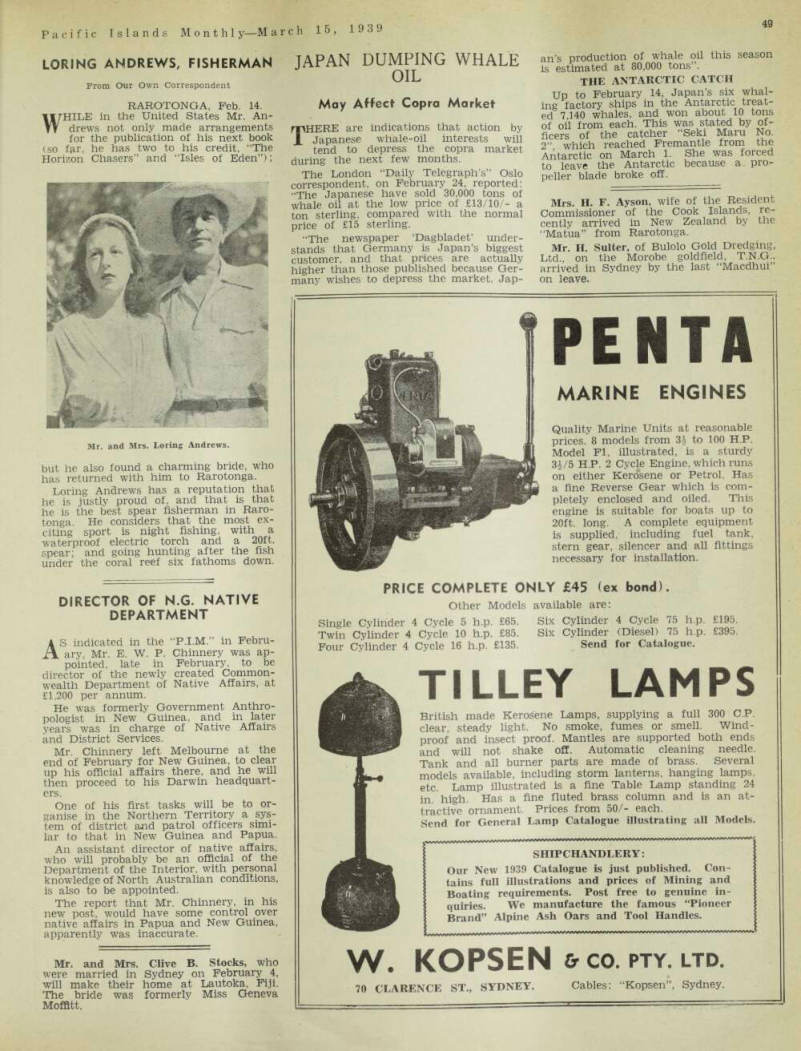
From Our Own Correspondent
Rarotonga, Feb. 14.
WHILE in the United States Mr. An drews not only made arrangements for the publication of his next book (so far, he has two to his credit, “The Horizon Chasers” and “Isles of Eden”);
but he also found a charming bride, who has returned with him to Rarotonga.
Loring Andrews has a reputation that he is justly proud of, and that is that he is the best spear fisherman in Raro tonga. He considers that the most ex citing sport is night fishing, with a waterproof electric torch and a 20ft. spear; and going hunting after the fish under the coral reef six fathoms down.
Mr. and Mrs. Loring Andrews.
Director Of N.G. Native
Department
AS indicated in the “P.1.M.” in Febru ary, Mr. E. W. P. Chinnery was ap pointed. late in February, to be director of the newly created Common wealth Department of Native Affairs, at £1,200 per annum.
He was formerly Government Anthro pologist in New Guinea, and in later years was in charge of Native Affairs and District Services.
Mr. Chinnery left Melbourne at the end of February for New Guinea, to clear up his official affairs there, and he will then proceed to his Darwin headquart ers.
One of his first tasks will be to or ganise in the Northern Territory a sys tem of district and patrol officers simi lar to that in New Guinea and Papua.
An assistant director of native affairs, who will probably be an official of the Department of the Interior, with personal knowledge of North Australian conditions, is also to be appointed.
The report that Mr. Chinnery, in his new post, would have some control over native affairs in Papua and New Guinea, apparently was inaccurate.
Mr. and Mrs. Clive B. Stocks, who were married in Sydney on February 4, will make their home at Lautoka, Fiji.
The bride was formerly Miss Geneva Moffltt,
Japan Dumping Whale
Oil
Moy Affect Copra Market
THERE are indications that action by Japanese whale-oil interests will tend to depress the copra market during the next few months.
The London “Daily Telegraph’s” Oslo correspondent, on February 24, reported; “The Japanese have sold 30,000 tons of whale oil at the low price of £l3/10/- a ton sterling, compared with the normal price of £l5 sterling.
“The newspaper ‘Dagbladet’ under stands that Germany is Japan’s biggest customer, and that prices are actually higher than those published because Ger many wishes to depress the market. Jap
an’s production of whale oil this season is estimated at 80,000 tons”. the antarctic catch Up to February 14, Japan’s six whal ing factory ships in the Antarctic treat ed 7 140 whales, and won about 10 tons of oil from each. This was stated by of ficers of the catcher “Seki Maru No. 2” which reached Fremantle from the Antarctic on March 1. She was forced to leave the Antarctic because a pro peller blade broke off.
Mrs. H. F. Ayson, wife of the Resident Commissioner of the Cook Islands, re cently arrived in New Zealand by the “Matua” from Rarotonga.
Mr. H. Suiter, of Bulolo Gold Dredging, Ltd., on the Morobe goldfield, T.N.G., arrived in Sydney by the last “Macdhui” on leave.
Advertisements & other items, pp. 51-52 (3 items)
49
Pacific Islands Monthl y —M arch 15, 1939
Penta
MARINE ENGINES
Quality Marine Units at reasonable prices. 8 models from to 100 HP.
Model FI, illustrated, is a sturdy 3i/5 H P. 2 Cycle Engine, which runs on either Kerosene or Petrol. Has a fine Reverse Gear which is completely enclosed and oiled. This engine is suitable for boats up to 20ft. long. A complete equipment is supplied, including fuel tank, stern gear, silencer and all fittings necessary for installation.
PRICE COMPLETE ONLY £45 <ex bond).
Other Models available are: Single Cylinder 4 Cycle 5 h.p. £65. Six Cylinder 4 Cycle 75 h.p. £195.
Twin Cylinder 4 Cycle 10 h.p. £B5. Six Cylinder (Diesel) 75 h.p. £395.
Four Cylinder 4 Cycle 16 h.p. £135. Send for Catalogue.
TILLEY LAMPS
British made Kerosene Lamps, supplying a full 300 C.P. clear, steady light. No smoke, fumes or smell. Windproof and insect proof. Mantles are supported both ends and will not shake off. Automatic cleaning needle.
Tank and all burner parts are made of brass. Several models available, including storm lanterns, hanging lamps, etc. Lamp illustrated is a fine Table Lamp standing 24 in. high. Has a fine fluted brass column and is an attractive ornament. Prices from 50/- each.
Send for General Lamp Catalogue illustrating all Models.
SHIPCHANDLERY:
Our New 1939 Catalogue is just published. Contains full illustrations and prices of Mining and Boating requirements. Post free to genuine inquiries. We manufacture the famous “Pioneer Brand” Alpine Ash Oars and Tool Handles.
w. KOPSEN & CO. PTY. LTD.
70 CLARENCE ST., SYDNEY. Cables: “Kopsen”, Sydney.
WM. BRECKWOLDT & €O.,
SOUTH SEA MERCHANTS
POSTAL ADDRESSES:—
NEW GUINEA:—P.O. Box 89, Rabaul.
FIJI;—P.O. Box 111, Suva.
TAHITI:—P.O. Box 60, Papeete.
SAMOA:—P.O. Box 124, Apia.
AGENTS FOR...
TELEGRAPHIC ADDRESS:
BREWO
A R
MEDICINES...
ATEBRIN— THE PROTECTION AGAINST MALARIA.
ASPIRIN BAYER— THE GENUINE ASPIRIN— AND
ALL OTHER BAYER PRODUCTS.
STOCK ALWAYS AVAILABLE AT OUR BRANCHES.
All Orders Executed at Original "Bayer" Prices.
MERCEDES-BENZ DIESEL TRUCKS:
2 Tonner Type, L. 1,500 -45 H.P. just arrived in Rabaul for demonstration. Fuel consumption— -28 miles on one gallon only of SHELL DIESOLINE, costing about B*d. in Rabaul. Lubricating Oil—Shell Dervoil Medium.
Prices for all types, up to loading capacity of 12,000 lbs., and for special types, on application.
"HANOMAG" Diesel Tractors. "VESTA" Sewing Machines.
"ANCRE" Cast Iron Sauce Pots. A "LOHSE" Uralt Lavender.
"FROWO" Hurricane Lanterns. “ "BREWO" Swedish Axes and Hatchets.
"ARARA" Gas Stoves. "ARVIKA" Swedish Axes and Hatchets.
CONTINENTAL Tyres and Tubes for Motor Cars and Bicycles. and MERCEDES-BENZ" Diesel Marine Engines.
"PETROMAX" Hurricane Lanterns (Incandesc.) and Lamps. (Not Agents tor Tahiti).
TIGER BRAND" Corrugated and Flat Galvanised Ironsheets.
TAIFUN" Bicycles and Accessories.
TWO LIONS Best Known Quality of A.l. Butcher Knives.
BREWO Razor Blades, Black, Brown, Blue, Pink, Silver.
TORPEDO", "BIJOU" and "ERICA" Typewriters, Portable and Office.
"BECK' S" "Key Brand" German Lager.
"TELEFUNKEN" Wireless Sets, Battery and Current. Best results obtained.
Many Sold. Ever-increasing Turnover.
ALSO ALL TRADE LINES OF GERMAN, BRITISH, CONTINENTAL, JAPANESE AND CHINESE ORIGIN
AGENTS FOR:
LIEBERMANN, WAELCHLI & CO.,
Kobe, Yokohama, Tokio and Shanghai.
JOHN CAMPBELL & CO., SYDNEY. (All Australian Goods.)
PLEASE NOTE:
our f” We sell WHOLESALE ONLY but, upon application, we will supply the Trademark. names of firms at all places in the Pacific Islands retailing our goods.
50
March 15, 193 9—P acific Islands Monthly
How Shall We Treat The Natives
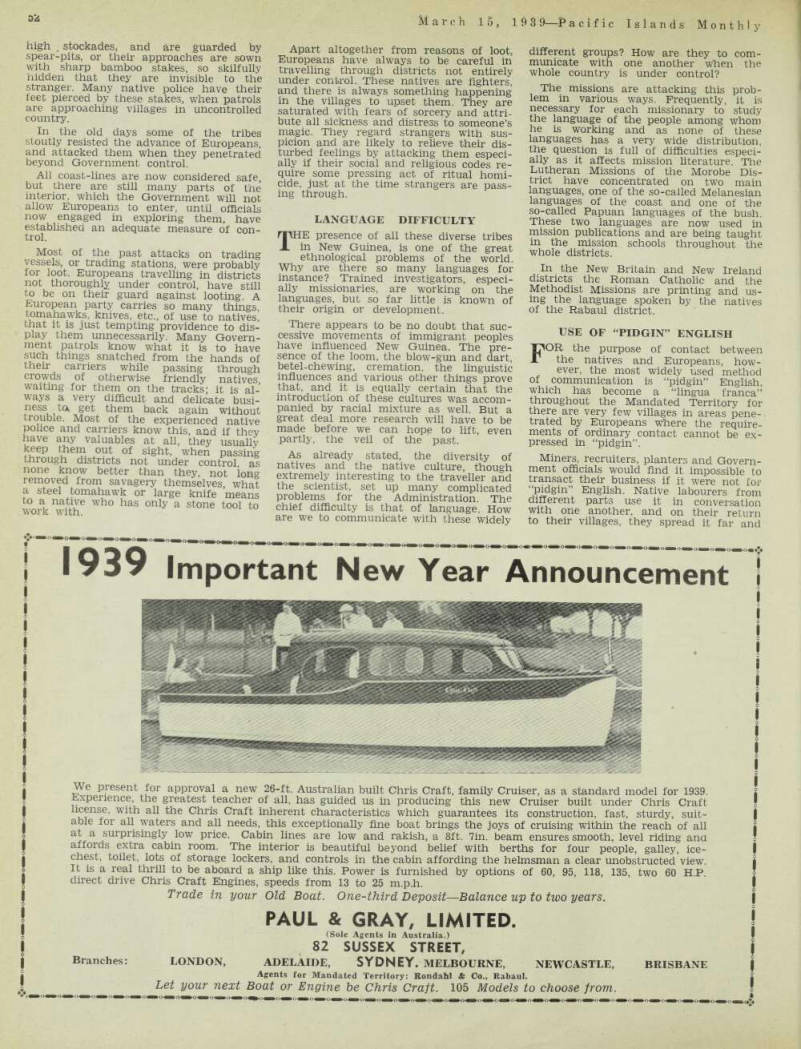
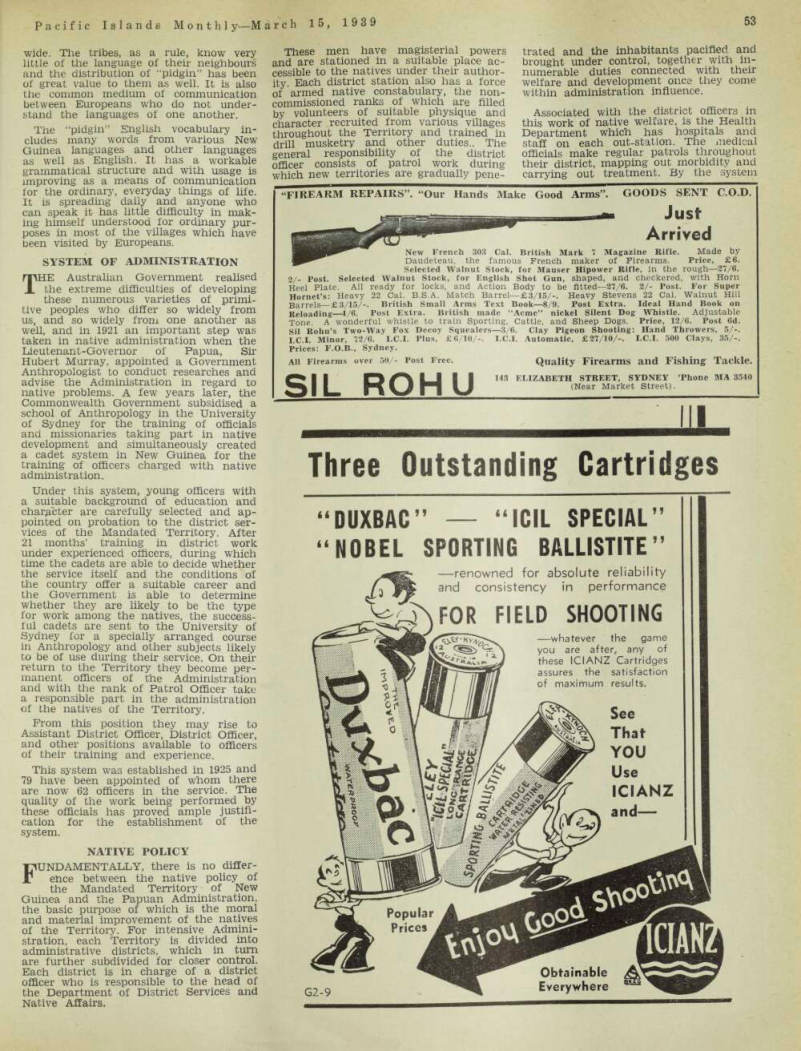
Of New Guinea?
Australia's Problems In Her Pacific Territories
(An address by Mr. J. R. Halligan, of the Australian Prime Minister’s Department, read before the Anthro pological Section of the Scientific congress, held in Australia in Janu ary. Mr. Halligan is virtually the liaison officer between the Australian Government and the Administrators of Papua and New Guinea.) THE natives of New Guinea are dis tributed in relatively small linguis tic groups throughout practically the whole of the main island and the archi pelagoes. Their regular habitations have been found at altitudes between sea level and 8,000 ft., and sometimes even higher.
I have no definite figures as to the population in Dutch Territory; but the enumerated native population (under Government control) of the Mandated Territory on June 30, 1938, was 581,342.
In addition, it is estimated that there are more than 200,000 natives inhabit ing the great plateau country south of the Bismarck Ranges, between the head of the Ramu River and Mt, Hagen.
These people, who were discovered in 1933, have been visited frequently since that date, and a number of administra tive posts have been established at var ious places on the plateau. A great many of the natives of the area may now be considered partially under control, and in two or three years, it is probable that they will be enumerated.
Similar additions will also be made to the census of Papua, which in 1937 was 231,000, when many of the numerous groups discovered in that Territory dur ing the last four years will have come sufficiently under control to be recorded on the census.
The New Guinea peoples vary greatly in type, language and culture. Ethno logists, especially Seligman, speak of them as Papuasians.
Differing so widely from one another, they present many complicated problems to the Administrations. Their diversities of type, language, social organisation, material culture, religious beliefs and fears of magic, present a wide range of problems which require to be closely studied by officials charged with the responsibility of the administration and development of the Territories.
Dual Responsibility
THE Administrations have a dual re sponsibility, i.e., the welfare and up lift of the native inhabitants and the economic development of the area.
The blending of these objectives pre sents an absorbing study.
The Mandate under which New Guinea is held by Australia enjoins that the Mandatory Power shall promote to the utmost the material and moral well be ing and the social progress of the in-, habitants of the Territory. The Common wealth Government at all times is alive to the serious obligations it accepted with the Mandate, and its policy in re gard to the treatment of the natives has always aimed to carry out to the fullest degree its trusteeship. This policy makes provision for the safeguarding of the natives in all circumstances— namely:
The natives in their primitive state.
The natives in their villages.
Native labourers.
The task of bringing natives from savagery to control is one of the most important functions of the Administra tion and one that requires much skill and patience upon the part of the officials entrusted with the work.
In the initial stages of contact, homi cidal activities, such as head-hunting, cannibalism, immolation of widows, in fanticide, and inter-tribal warfare, which exist in some form or other in country not under control, have to be suppressed before the Administration can proceed successfully to lay down an organisation.
These practices disappear as the people gradually merge into avenues that lead to development upon lines formulated by the Administration.
This, however, produces new problems that require the most careful direction by the Administration officers. It may be said that the work of officials is never done. The adjustment of to-day creates the problem of to-morrow, and right throughout the two Australian Territories officials are faced with a never-ending variety of human problems, ranging from the primitive activities opposed to European standards, to struggles for ad justment in the new conditions where natives are expected to take their pan in the administration of their own groups and changing economics.
Before The Government Came
BEFORE the coming of the Govern ment and the establishment of con trol, the natives lived in a state of constant inter-group warfare. Even now, in uncontrolled areas, one may sometimes see spearmen, or bow and arrow-men, hotly engaged in the no-man’s land be tween the villages. In uncontrolled coun try, the villages are either perched in the most inaccessible places, or are situated at strategic points, for protection against attack. Usually they are surrounded by
high . stockades, and are guarded by spear-pits, or their approaches are sown with sharp bamboo stakes, so skilfully hidden that they are invisible to the stranger. Many native police have their feet pierced by these stakes, when patrols are approaching villages in uncontrolled country.
In the old days some of the tribes stoutly resisted the advance of Europeans, and attacked them when they penetrated beyond Government control.
All coast-lines are now considered safe, but there are still many parts of the interior, which the Government will not allow Europeans to enter, until officials now engaged in exploring them, have established an adequate measure of con trol.
Most of the past attacks on trading vessels, or trading stations, were probably for loot. Europeans travelling in districts not thoroughly under control, have still to be on their guard against looting. A European party carries so many things, tomahawks, knives, etc., of use to natives, that it is just tempting providence to dis play them unnecessarily. Many Govern ment patrols know what it is to have such things snatched from the hands of their carriers while passing through crowds of otherwise friendly natives waiting for them on the tracks; it is al ways a very difficult and delicate busi ness t(x get them back again without trouble. Most of the experienced native police and carriers know this, and if thev have any valuables at all, they usually keep them out of sight, when passing through districts not under control as none know better than they, not long removed from savagery themselves, what a steel tomahawk or large knife means to a native who has only a stone tool to work with.
Apart altogether from reasons of loot, Europeans have always to be careful in travelling through districts not entirely under control. These natives are fighters, and there is always something happening in the villages to upset them. They are saturated with fears of sorcery and attri bute all sickness and distress to someone’s magic. They regard strangers with sus picion and are likely to relieve their dis turbed feelings by attacking them especi ally if their social and religious codes re quire some pressing act of ritual homi cide, just at the time strangers are pass ing through.
Language Difficulty
THE presence of all these diverse tribes in New Guinea, is one of the great ethnological problems of the world.
Why are there so many languages for instance? Trained investigators, especi ally missionaries, are working on the languages, but so far little is known of their origin or development.
There appears to be no doubt that suc cessive movements of immigrant peoples have influenced New Guinea. The pre sence of the loom, the blow-gun and dart, betel-chewing, cremation, the linguistic influences and various other things prove that, and it is equally certain that the introduction of these cultures was accom panied by racial mixture as well. But a great deal more research will have to be made before we can hope to lift, even partly, the veil of the past.
As already stated, the diversity of natives and the native culture, though extremely interesting to the traveller and the scientist, set up many complicated problems for the Administration. The chief difficulty is that of language. How are we to communicate with these widely
different groups? How are they to com municate with one another when the whole country is under control?
The missions are attacking this prob lem in various ways. Frequently, it is necessary for each missionary to study the language of the people among whom he is working and as none of these languages has a very wide distribution, the question is full of difficulties especi ally as it affects mission literature. The Lutheran Missions of the Morobe Dis trict have concentrated on two main languages, one of the so-called Melanesian languages of the coast and one of the so-called Papuan languages of the bush.
These two languages are now used in mission publications and are being taught in the mission schools throughout the whole districts.
In the New Britain and New Ireland districts the Roman Catholic and the Methodist Missions are printing and us ing the language spoken by the natives of the Rabaul district.
Use Of “Pidgin” English
FOR the purpose of contact between the natives and Europeans, how ever, the most widely used method of communication is “pidgin” English, which has become a “lingua franca” throughout the Mandated Territory for there are very few villages in areas pene trated by Europeans where the require ments of ordinary contact cannot be ex pressed in “pidgin”.
Miners, recruiters, planters and Govern ment officials would find it impossible to transact their business if it were not for “pidgin” English. Native labourers from different parts use it in conversation with one another, and on their return to their villages, they spread it far and
wide. The tribes, as a rule, know very little of the language of their neighbours and the distribution of “pidgin” has been of great value to them as well. It is also the common medium of communication between Europeans who do not under stand the languages of one another.
The “pidgin” English vocabulary in cludes many words from various New Guinea languages and other languages as well as English. It has a workable grammatical structure and with usage is improving as a means of communication for the ordinary, everyday things of life.
It is spreading daily and anyone who can speak it has little difficulty in mak ing himself understood for ordinary pur poses in most of the villages which have been visited by Europeans.
System Of Administration
THE Australian Government realised the extreme difficulties of developing these numerous varieties of primi tive peoples who differ so widely from us, and so widely from one another as well, and in 1921 an important step was taken in native administration when the Lieutenant-Governor of Papua, Sir Hubert Murray, appointed a Government Anthropologist to conduct researches and advise the Administration in regard to native problems. A few years later, the Commonwealth Government subsidised a school of Anthropology in the University of Sydney for the training of officials and missionaries taking part in native development and simultaneously created a cadet system in New Guinea for the training of officers charged with native administration.
Under this system, young officers with a suitable background of education and character are carefully selected and ap pointed on probation to the district ser vices of the Mandated Territory. After 21 months’ training in district work under experienced officers, during which time the cadets are able to decide whether the service itself and the conditions of the country offer a suitable career and the Government is able to determine whether they are likely to be the type for work among the natives, the success ful cadets are sent to the University of Sydney for a specially arranged course in Anthropology and other subjects likely to be of use during their service. On their return to the Territory they become per manent officers of the Administration and with the rank of Patrol Officer take a responsible part in the administration of the natives of the Territory.
From this position they may rise to Assistant District Officer, District Officer, and other positions available to officers of their training and experience.
This system was established in 1925 and 79 have been appointed of whom there are now 62 officers in the service. The quality of the work being performed by these officials has proved ample justifi cation for the establishment of the system.
Native Policy
Fundamentally, there is no differ ence between the native policy of the Mandated Territory of New Guinea and the Papuan Administration, the basic purpose of which is the moral and material improvement of the natives of the Territory. For intensive Admini stration, each Territory is divided into administrative districts, which in turn are further subdivided for closer control.
Each district is in charge of a district officer who is responsible to the head of the Department of District Services and Native Affairs.
These men have magisterial powers and are stationed in a suitable place accessible to the natives under their authority. Each district station also has a force of armed native constabulary, the noncommissioned ranks of which are filled by volunteers of suitable physique and character recruited from various villages throughout the Territory and trained in drill musketry and other duties.. The general responsibility of the district officer consists of patrol work during which new territories are gradually pene-
trated and the inhabitants pacified and brought under control, together with in numerable duties connected with their welfare and development once they come within administration influence, Associated with the district officers in this work of native welfare, is the Health Department which has hospitals and staff on each out-station. The iiiedical officials make regular patrols throughout their district, mapping out morbidity and carrying out treatment. By the system
of -patrol work and intensive administratum, district officers and medical officers are kept in suitable touch with hie, health and progress in the villages.
By a policy of appointing suitable natives nominated by the villagers themselves to accept responsibilities in village administration, the European officers have established liaison which keeps them in touch with the health and problems of the community and enables them more easily to introduce ideas and activities of value to their progress.
An important phase of administration is the supervision and control of natives who elect to work on plantations, in the mines, and in other commercial activities conducted by Europeans.
The essence of the native labour policy is that it must he voluntary an P d /o
forced labour is permitted. The system under which such labour is made avail able is regulated by the Native Labour Ordinance which provides safeguards during all phases of the native labourer’s existence—i.e.:— Recruitment.
Medical examination.
Execution of contract.
Transport to the scene of work.
Period of labour i maintenance of hours of relaxation).
Termination of contract.
Repatriation.
Recent Exploration
THE discovery, in 1926, of rich gold fields in New Guinea and the ex pansion of plantation areas through out the Territory, created a demand for a larger supply of native labour and
led to the penetration of new districts, and districts hitherto only partially known. Simultaneously, an intensive system of patrol work was introduced in the great central ranges in the main land between Mt. Chapman and Mt Hagen.
By 1933, most of the villages between Mt. Chapman and the Kratke Mountains of the Mandated Territory had been visited on more than one occasion and friendly contact established with many of the groups inhabiting them.
In 1932, a Government post was estab lished on plateau country at the head of the Ramu River and in 1933 an Assist ant District Officer of the N.G, Admini stration carried out an extended patrol westerly between the Ramu Station and Mt. Hagen, where a population of ap proximately 200,000 people was discovered.
Additional stations were subsequently established at Bena Bena and Chimbu for the continuing intensive work and last year a third station was established at Mt. Hagen itself.
Extensive patrols were also made in the Sepik and Madang districts of the mainland where friendly contact was established with many thousands of peoples who had not before been visited by Government patrols. A patrol, especi ally organised to examine the country between Mt. Hagen and the Dutch bor der has been operating since March, 1938 and has now reached its objective.
It is interesting to note that Central New Guinea is probably one of the last unexplored regions of the earth.
In Bougainville, the unknown interior was successfully penetrated in many parts and to-day there is scarcely a por tion of this large island which is not known to the Government.
Patrols In Papua
IN Papua, special patrols operating in the head-waters of the Fly, Strick land and Kikori Rivers during the past few years have discovered numerous groups of interesting peoples hitherto unknown to the Administration. One pat rol which proceeded to the head of the Strickland River in 1934 discovered at Tari Puroro large numbers of people who resembled in type and culture the people of Mt. Hagen, 100 miles to the south west, discovered by N.G. officers a year before.
The work of exploration and gradual penetration is steadily proceeding in both Territories and there is every rea son to believe that within the next few years practically all of the native groups of the two Territories will have been visited by Government officers.
Area Under Control
THE following gives an indication of the amount of work performed by the Administration since the estab lishment of the present administration in New Guinea in May, 1921; Of the 93,000 sq. miles of the Territory, approximately 37,370 are under complete control, and a further 18,000 under in fluence or partial influence. The extent to wiiich the natives have been brought under control can be judged from the figures of the recorded native population and other statistics as follows:
1913. 1922. 1938.
Population— European 968 1,288 4,508 Natives under control (counted) 152.000 251,017 581,342 1913. 1921-22. 1938.
Exports £402,000 £499,197 £2,980,360 Imports .. £425,000 £468,711 £1,610,967 Revenue .. £87,750 £257,506 £506,388 Expenditure £166,100 £261,566 £508 613
Advertisements & other items, pp. 53-56 (4 items)
51
Pacific Islands Monthl y—M arch 15, 1939
Usoline
\ DR HENRIS
NU-VIGOR
i VITALITY
PILLS
V (jl lU-evwoß w
MEN
TAKE DR. HENRI’S
Nu-Vigor Vitality Pills
for loss of power and nervous exhaustion. They give wonderful results where overwork, worry, nerve weakness, etc., causes loss of those vital powers so necessary for the full enjoyment *f life.
They are made in two strengths to suit individual cases. Week’s supply 3/6, one month’s treatment 10/6. Obstinate cases should take the Extra-Strong Prescription, 7/6 and 21/—stimulates the organs.
Post FREE in plain wrapper. Call or Write for literature and Free Advice to
H. P. MICHAEL, S&.
CHEMIST.
Michael’s Buildings, Cor. Elizabeth & Lonsdale Streets,
MELBOURNE.
MEDICAL GOODS
Best Quality. Lowest Prices.
All Guaranteed.
Write for FREE “Book of Knowledge’’ Catalogue and Price Lists Medical Goods etc. All Goods sent Post Free, plain wrapper, return mail. Strictly confidential. LADIES! Let the Secura Nurse advise you in the selection of your intimate Medical requirements.
IT ATTRACTS
jSI
THEY EAT IT THEY DIE
USOLINE
NEVER
KNOWN
TO FAIL !
AUSOLINE CO
314 CROWN STREET, SYDNEY
(Established 1910)
COCKROACH
DESTROYER
IT'S A PASTE
PRICES:
Mb. 5/- . . . 3lbs. 10/- Postage Extra.
Remit Cash with Order.
Obtainable also from Islands stores of;
BURNS. PHILP & Co. Ltd.
W. R. CARPENTER & Co. Ltd.
1939 Important New Year Announcement
imh
We present for approval a new 26-ft. Australian built Chris Craft, family Cruiser, as a standard model for 1939.
Experience, the greatest teacher of all, has guided us in producing this new Cruiser built under Chris Craft hcense, with all the Chris Craft inherent characteristics which guarantees its construction, fast, sturdy, suitable for all waters and all needs, this exceptionally fine boat brings the joys of cruising within the reach of all at a surprisingly low price. Cabin lines are low and rakish, a Bft. Tin. beam ensures smooth, level riding and affords extra cabin room. The interior is beautiful beyond belief with berths for four people, galley, icechest, toilet, lots of storage lockers, and controls in the cabin affording the helmsman a clear unobstructed view.
It is a real thrill to be aboard a ship like this. Power is furnished by options of 60, 95, 118, 135, two 60 H.P. direct drive Chris Craft Engines, speeds from 13 to 25 m.p.h.
Trade in your Old Boat. One-third Deposit—Balance up to two years.
PAUL & GRAY, LIMITED.
(Sole Agents in Australia.)
82 SUSSEX STREET,
Branches: LONDON, ADELAIDE, SYDNEY. MELBOURNE, NEWCASTLE, BRISBANE Agents for Mandated Territory: Bondahl & Co., Rabaul.
Let your next Boat or Engine be Chris Craft. 105 Models to choose from.
“FIREARM REPAIRS ’. “Our Hands Make Good Arms ”. GOODS SENT C.O.D.
New French 303 Cal, Daudeteau, the famoi
Just-
Arrived
New French 303 Cal. British Mark 7 Magazine Rifle. Made by Daudeteau, the famous French maker of Firearms. Price, £6.
Selected Walnut Stock, for Mauser Hipower Rifle, in the rough—37/6. 2/- Post. Selected Walnut Stock, for English Shot Gun, shaped, and checkered, with Horn Heel Plate. All ready for locks, and Action Body to be fitted —37/6. 3/- Post. For Super Hornet’s: Heavy 22 Cal. B.S.A. Match Barrel —£3/15/-. Heavy Stevens 22 Cal. Walnut Hill Barrels —£3/15/-. British Small Arms Text 800k —8/9. Post Extra. Ideal Hand Book on Reloading—4/6. Post Extra. British made “Acme” nickel Silent Dog Whistle. Adjustable Tone. A wonderful whistle to train Sporting, Cattle, and Sheep Dogs. Price, 13/6. Post 6d, Sit Rohu’s Two-Way Fox Decoy Squealers—3/6. Clay Pigeon Shooting: Hand Throwers, 5/-. 1.C.1. Minor, 73/6. 1.C.1. Plus, £6/10/-. 1.C.1. Automatic, £37/10/-. 1.C.1. 500 Clays, 35/-.
Prices: F. 0.8., Sydney.
All Firearms over so/- Post Free. Quality Firearms and Fishing Tackle.
I I I I I I 143 ELIZABETH STREET, SYDNEY ’Phone MA 3540
I El P"1 (Near Market Street).
ill
Three Outstanding Cartridges
“DUXBAC” “ICIL SPECIAL”
“ NOBEL SPORTING BALLISTITE ”
—renowned for absolute reliability and consistency in performance
FOR FIELD SHOOTING
—whatever the game you are after, any of these ICIANZ Cartridges assures the satisfaction of maximum results.
See That A
YOU
il >-.s X3* Use m
ICIANZ
and— -09 ft m m oc s J Popular Prices 099
ICIAN
Obtainable Everywhere G 2-9
Your Tropical Rit
you visit the Pacific Islands, whether on Business or Pleasure, you need Special SUk Thi'rttufht Und\r°4a C r Whit! ty shoel hl et. m Wel ‘ and laUnder easHy: T “" lc Shl “* can be supplied from our Large Stock at Reasonable, Moderate Prices. P BUY FROM THE FIRM WHICH UNDERSTANDS YOUR NEEDS AND
DRESSES YOU CORRECTLY.
WALTER HORNE & CO. LTD., carry a Full Range of Drapery of all kinds; also Frocks, Millinery, Foundations and Lingerie, Hosiery, Shoes and Sandals, Ribbons and Laces, Household Drapery.
Ladies' Hairdressing and Manicuring
* Men resident in any of the Pacific Territories can he supplied with Suitable Clothes.
Write to us and Describe your Requirements.
WALTER HORNE & CO. LTD.
Drapers and Men's Wear Specialists
SUVA, FIJI.
A. B. DONALD LTD
AUCKLAND
ISLAND TRADERS ; GENERAL MERCHANTS
P.O. Box 1509. Cables and Telegrams: “Kingdom”, Auckland.
Branches at Rarotonga and throughout the Cook Islands At Papeete and throughout the Society, Marquesas and Paumotu Islands,
trading as "ETABLISSEMENTS DONALD, TAHITI"
At Fiji: Trading as "Dominion Fruit Co.", Suva.
53
Pacific Islands Month! y—M arch 15, 1939
54
March 15, 19 3 9—p aci f i c Islands Monthly
Ellice Islander Wins P.I.
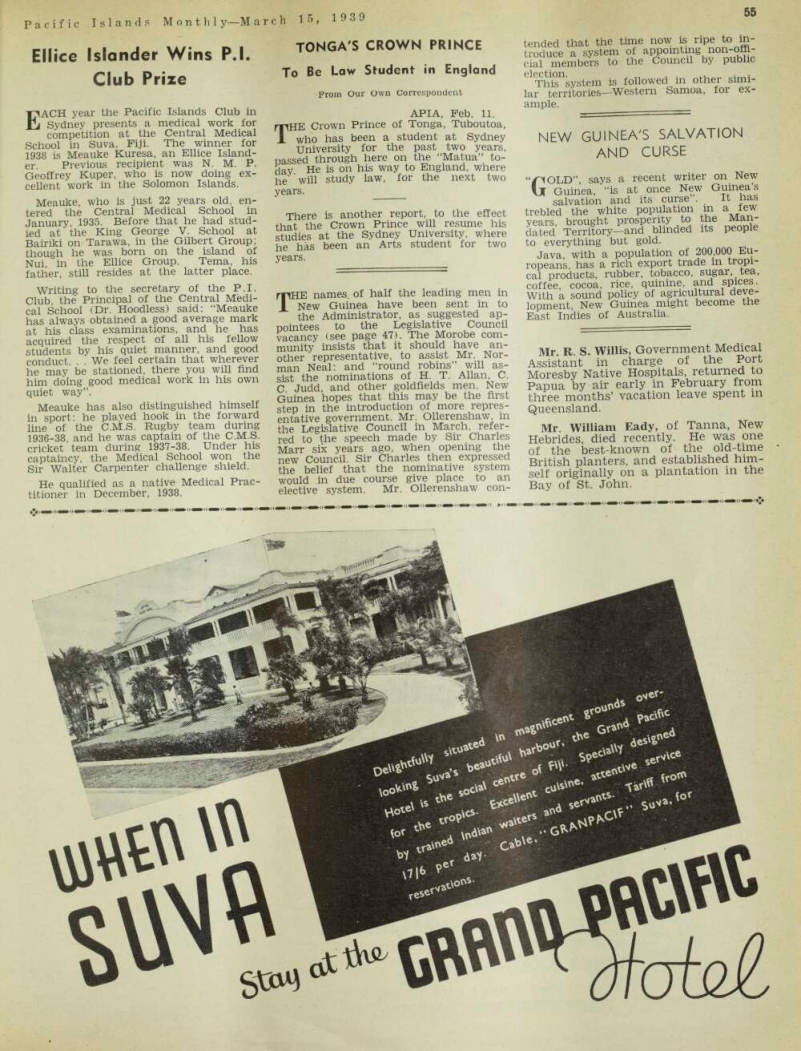
Club Prize
EACH year the Pacific Islands Club in Sydney presents a medical work for competition at the Central Medical School in Suva, Fiji. The winner for 1938 is Meauke Kuresa, an Ellice Island er Previous recipient was N. M. P.
Geoffrey Kuper, who is now doing ex cellent work in the Solomon Islands.
Meauke, who is just 22 years old, en tered the Central Medical School in January, 1935. Before that he had stud ied at the King George V. School at Bairiki on Tarawa, in the Gilbert Group: though he was born on the island of Nui in the Ellice Group. Tema, his father, still resides at the latter place.
Writing to the secretary of the P.I.
Club the Principal of the Central Medi cal School (Dr. Hoodless) said: “Meauke has always obtained a good average mark at his class examinations, and he has acquired the respect of all his fellow students by his quiet manner, and good conduct . . We feel certain that wherever he may be stationed, there you will find him doing good medical work in his own quiet way”.
Meauke has also distinguished himself in sport: he played hook in the forward line of the C.M.S. Rugby team during 1936-38, and he was captain of the C.M.S. cricket team during 1937-38. Under his captaincy, the Medical School won the Sir Walter Carpenter challenge shield.
He qualified as a native Medical Prac titioner in December, 1938.
Tonga's Crown Prince
To Be Law Student in England
Prom Our Own Correspondent
Apia, Feb. 11.
THE Crown Prince of Tonga, Tuboutoa, who has been a student at Sydney University for the past two years, nassed through here on the “Matua” to day He is on his way to England, where he will study law, for the next two years.
There is another report, to the effect that the Crown Prince will resume his studies at the Sydney University, where he has been an Arts student for two years.
THE names, of half the leading men in New Guinea have been sent in to the Administrator, as suggested ap pointees to the Legislative Council vacancy (see page 47). The Morobe com munity insists that it should have an other representative, to assist Mr. Nor man Neal: and “round robins” will as sist the nominations of H. T. Allan, C.
C Judd, and other goldfields men. New Guinea hopes that this may be the first step in the introduction of more repres entative government. Mr. Ollerenshaw, in the Legislative Council in March, refer red to the speech made by Sir Charles Marr six years ago, when opening the new Council. Sir Charles then expressed the belief that the nominative system would in due course give place to an elective system. Mr. Ollerenshaw con
tended that the time now is ripe to in troduce a system of appointing non-offi cial members to the Council by public election.
This system is followed in other simi lar territories—Western Samoa, for ex ample.
New Guinea's Salvation
And Curse
says a recent writer on New VI Guinea, “is at once New Guinea’s salvation and its curse . It has trebled the white population m a few years, brought prosperity to the Man dated Territory—and blinded its people to everything but gold.
Java, with a population of 200,000 Eu ropeans, has a rich export trade in tropi cal products, rubber, tobacco, sugar, tea, coffee, cocoa, rice, quinine, and spices.
With a sound policy of agricultural deve lopment, New Guinea might become the East Indies of Australia.
Mr. R. S. Willis, Government Medical Assistant in charge of the Port Moresby Native Hospitals, returned to Papua by air early in February from three months’ vacation leave spent in
Queensland.
Mr. William Eady, of Tanna, New Hebrides, died recently. He was one of the best-known of the old-time British planters, and established him self originally on a plantation in the Bay of St, John.
Mr. R. H. Stracham has relieved Mr.
V. G. Tisdall at the Suva branch of the Bank of N.S.W. The latter returned to Australia from the Colony at the end of February.
Mr. R. McLaughlin arrived in Sydney in February by the “Macdhui” on three months’ furlough. He is employed in the shipping department of B.P.’s branch at Rabaul, New Guinea.
Mr. and Mrs. Alport Barker, well known residents of Suva, celebrated the 30th anniversary of their wedding on February 8, and to mark the occasion Mr. and Mrs. F. I’A. Ryan entertained a large number of guests, including His Excellency the Governor, Sir Harry Luke, at their residence in St. Fort Street’, Suva. Many tributes were paid to Mr. and Mrs. Barker. Mrs. Barker was born in Fiji, and Mr. Barker has lived in the Colony since he was a boy.
Advertisements & other items, pp. 57-58 (1 item)
r.
% oX^ Stw
MORRIS, HEDSTROM, ltd.,
Registered Office - - Suva, Fiji.
BRANCHES THROUGHOUT FIJI. TONGA AND SAMOA
Agents for : V.
LLOYD'S
NOBELS (AUSTRALIA) LIMITED-EXPLOSIVES
MATSON NAVIGATION COMPANY
RUSTON & HORNSBY LIMITED
IMPERIAL CHEMICAL INDUSTRIES LIMITED
JOHN LYSAGHT (AUST.) LTD.
VACUUM OIL COMPANY PROP'TY. LIMITED
FORD MOTOR COMPANY LIMITED
GOODYEAR TIRE & RUBBER EXPORT COY. J.
SYDNEY OFFICE: DALTON HOUSE, 115 PITT ST.
For all conditions
j. and all crops
Whether for animal or tractor draught, for light work or for the severest conditions, there are Ransomes’ ploughs and implements which will meet your requirements.
Ransomes have been making ploughs for nearly 150 years, and to-day they offer an unsurpassed range of implements for all Made by: RANSOMES, SIMS & JEFFERIES, LTD,, IPSWICH, ENG.
The illustration shows the BTSL, a light steel cultivator which can be adapted for a large variety of operations.
ansomcs
conditions and all crops.
Ransomes other manufactures include hand, horse and motor lawn mowers, aerodrome equipment, etc. Write for illustrated literature and all information.
PLOUGHS and IMPLEMENTS
MORRIS, HEDSTROM, LTD. Suva, Lautoka, and Ba.
Turned Down
Jewish Colony Flan for New Guinea
mHE Australian Prime Minister an nounced in February that hpnpncp 'f posed to any gr o Up settlement plan for alien migrants, it had refused to con sider the suggestion that the plateau country, on the mainland of New Guinea should be used for the establishment ?. a Jewish colony. A similar sugges tlon - in relation to Western Australia, was rejected by the Government for the same reason.
As the Lyons Government probably is the most visionless administration that ever has held office in Canberra it ap pears useless to pursue this subject fu?-
I'* 1 ® I ’* But> for the information of many intelligent people who displayed an in terest in the plan to place a large col ony of Central European refugees on the central tablelands of New Guinea it may be pointed out that this is a region very suitable for white settlement; that it is virgin country and therefore, may be organised as a new colony without interfering with established interests; that Jewish societies interested in the plan were prepared—provided that an expert survey justified the expenditure to make available any sum up to £15,000 000 to assist the settlement; that Australia very urgently needs development and settlement in New Guinea, if her hold upon that country is to be confirmed in the future; and that the Australian Gov ernment is not apparently capable of or ganising colonies in Australia itself let alone in New Guinea.
There may be good reason for pre venting the establishment of alien Euro pean communities in Australia, but that cannot possibly apply to New Guinea. It is much better to have a European popu lation there, established under conditions which will ensure that the next gener ation will be taught the English language only, rather than that the country should be occupied by Japanese.
“Suva” On Maiden
Voyage
In Fiji and New Guinea
THERE was much interest in Pacific Islands ports in February in the new Carpenter steamer “Suva”, which on her maiden voyage visited Samoa, Fiii New Guinea, etc.
The “Fiji Times” of February 8 said:— The “Suva” returned to Suva last night from Lautoka and Vatia Point. Her cargo included a large consignment of timber for Lautoka which was, as usual discharged in the stream. At Vatia Point 1,600 tons of oil was pumped into the new tank recently completed by Tavua Power Pty., and in addition, a big con signment of lumber was landed for the mines.
Major C. A. Brewster, of Suva, accom panied the ship to Lautoka and Vatia and said afterwards that she was a good solid honest British cargo carrier, and would serve Fiji and New Guinea to great advantage, being admirably equip ped for handling a bulk cargo such as copra. The ship could maintain a speed of 12 knots, and so make three trips a year between Europe and the Pacific Is lands.
Papua's Finances
From Our Own Correspondent
Port Moresby, Feb. .18.
pAPUA’S total revenue for the half year end • ing December 31, 1938. amounted to £78,087.
This is £15,472 less than the revenue for the corresponding months of 1937; the difference be ing accounted for by reduced sales of postage stamps and a falling off of £1,902 in Customs dues.
Expenditure during the period was £77,223.
The details show an increase in the expenditure on the Government Secretary’s Department and on Public Works, and decreases in practically all other directions.
The Trust Fund aggregated £71,291, including Native Taxation Fund, £21,170.
After a voyage of 37 days from San
Pedro, California, the 48-ton auxiliary
yacht “Navigator” arrived at Auckland,
via the Pacific Islands, on February 10,
The position recently held by Rev.
F. G. Lewis, as chairman of the Methodist Mission Society in New Guinea will be occunied bv Rpv l MarArthnr r a dTfh wbn W 2 A ; ® ipEd .’ wh ° J? as been stationed cit Vunsirims, Other
changes are: Rev. Howard Pearson to Kabakada and later to open a new station in the Bainings; Rev. G. J. fatten to Namatanai; Rev. C. W. J. bannering: to Vunairima, where he will be in charge of the education section there
Advertisements & other items, pp. 58-60 (3 items)
56
March 15, 193 9—P acific Islands Monthly
57
acific Islands Monthl y—M arch 15, 1939
William Atkins Pty. Ltd
IRON & STEEL MERCHANTS
ENGINEERS' SUPPLIES, COACH & MOTOR HARDWARE
SYDNEY.
1 fm a
mmfi
nnn □
non
Kin a
WWIiUAHATKIHSLt
MUIftOW
lUWtsßsw
IRON and STEEL WAREHOUSE
BUCKLAND ST. off GEORGE ST.wtsr
BULK IRON t STEEL STORE
CLEVELAND ST.
MEAD OFFICE 449 451 KENT ST
NEAR TOWN HALL
ESTABLISHED 50 YEARS AND CARRYING ONE OF THE LARGEST STOCKS OF IRON AND
STEEL IN AUSTRALIA.
Full, comprehensive & up-to-date range in all Departments—
including the following lines:
Steel Department
MILD STEEL:
Rounds, Squares, Flats, Half-rounds, Hexagons, Bevel, Shoeing, Tyre, Angles, Tees, Sheets, Plates, Girder Plates, Chequer Plates, Channels, Hoops, Etc.
BRIGHT STEEL:
Rounds, Squares, Hexagons.
Extra Special High Speed Tool Steel, Mining Steel, Blister Steel and Spring Steel, Rounds, Flats Gr Squares.
Bar Iron— All sections and sizes.
Engineers' Supplies: Set Screws, Studs, Metal Thread Screws, Coach Screws. Files, Cotter Pins, Bright and Black Bolts, Rivets, Etc., Hack Saw Blades.
Power Transmission Gear: Including Plummer Blocks, Couplings, Collars, Etc.
Coach and Motor Hardware: Axles, Springs, Wheelstuff, Duck, Paints.
Farriers' Supplies: Horse Nails, Anvils, Vices, Etc.
Motor-Trimmers and Motor Builders' Requirements.
C. A. WILLEY'S
Quick-Drying Coach and Car Paints, Roughstuff. Elastic Gloss, Synflex Enamels, Lacquers.
DUCO Lacquers and DULUX Enamels—FAßßEX Motor Toppings and Leather Cloths, MANNING Abrasive Wet or Dry Papers Vehicle Rubber.
Sole Distributors of CHAMPION'S Decorators Paint Products.
Distributing Agents for BROLITE Lacquers, SYNFLEX Enamels and "POLYGLOSS" Finish.
Prompt attention to all enquiries.
Cable Address:
WILATKIN, SYDNEY.
THE WORLD’S BEST TEXTILES
FROM MANCHESTER.
100% BRITISH MANUFACTURE
MADE IN ENGLAND.
Brotherton’s name was established in 1878—ever since when they have specialised in the manufacture of Cotton Textiles suitable for the Native Trades. ® our Specialties are:Lava-Lavas, Pearl Divers Ramies, Para Reds, Khaki and Dyed Drills, Calicoes (Plain and Fancies) Greys—Whites
—Sheetings—Poplins—Art Silks—Ginghams, Etc.
0 Owners of the following well-known brands—“Mokarnie”, “Rintarnie” “Okarnie”
“Africarnie”, “Arkaldo”, “Cunaldo”, “Staraldo”, “Arntonco”, “Brotonco”, “Airport’, “Bestport”, “Millport”, “Joker”, “Judgement”, “Straitate”, etc. £ We are a Private Company under the direct supervision of Mr. Arnold B. Brotherton w with Years of Experience in South Pacific Trade-Indents through Usual Channels.
A. B. BROTHERTON & CO. LTD., 40 DICKINSON ST., MANCHESTER 1., ENG (Arnold B. Brotherton). Cables and ’Grams—“RINTARNIE”, Manchester.
4 ft
tltaniiA txr
4711 your ideal
refresher!
m
FAMOUS
RHINE
LAVENDER iJCrv I
3827 m Representative:
ROBERT BLAU (AUST. )
A Fragrance of
Wistful Charm
Famous Rhine Lavender, ’ wafting to you the dewy sweetness of oldworld Rhenish gardens.
A.C.A. BUILDING, CNR. KING
& YORK STREETS, SYDNEY
Pattern Service
EACH month we publish a Fashions design, patterns of which may be purchased by our readers direct from this office, post free. To obtain a pattern, print your name and address below, giving the number of the pattern and the bust size, and send to “Pattern Department”, Pacific Islands Monthly, Box 34088, G.P.0., Sydney; enclose also the price of the pattern in postal note or stamps.
It will be sent by return mail.
Name Address Pattern Number Size
Mr. and Mrs. N. O. Carlson arrived in New . Zealand by the “Matua” on Feb ruary 19 from Tonga, where Mr. Carlson is manager of the Vavau branch of Burns Philp (S.S.) Co. Ltd. They will spend their vacation in N.Z. and Aus tralia before returning to Tonga.
6494. —This smart evening frock is of shimmer ing spotted net, and the jacket, with its snappy puffed sleeves and bolero lines, is of gay taffeta in a contrasting shade. Material required: 4⅞ yds. 36 in. wide for frock, and 1½ yds. 36 in. taffeta for bolero. In sizes 32 to 40 in. bust, paper pattern, 1/1.
Advertisements & other items, p. 60 (1 item)
58
March 15, 19 3 9—P aci f i c Islands Monthly
Fashion Hints for Islands Women
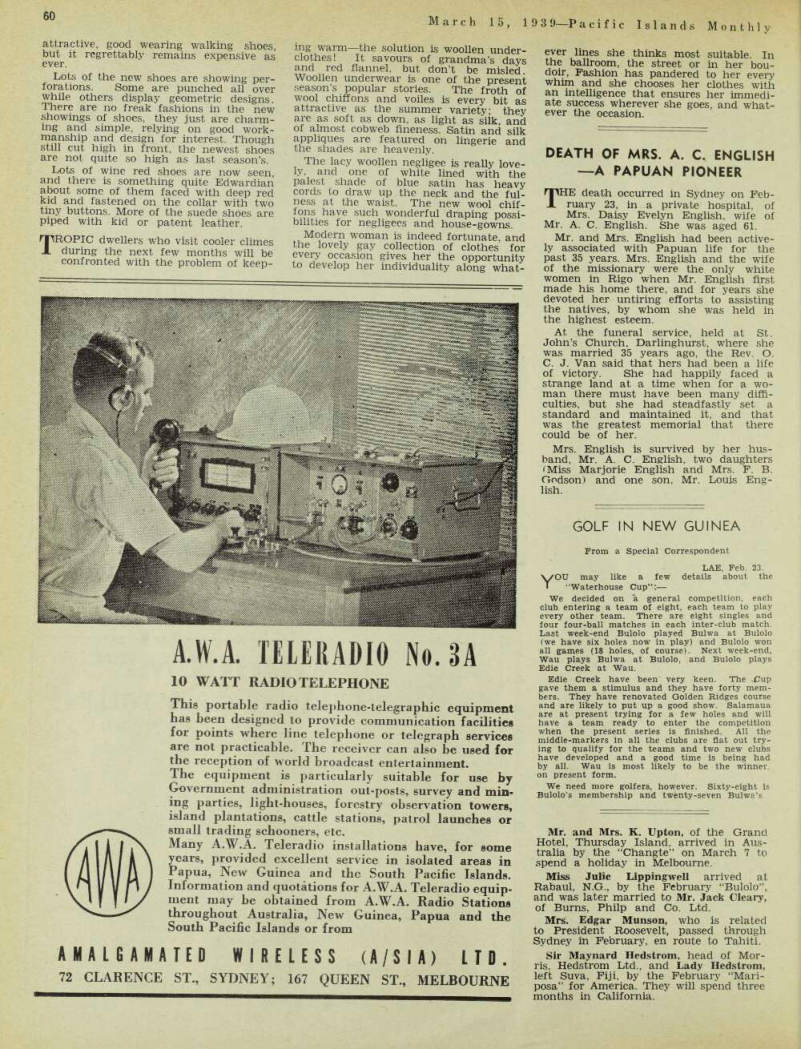
By Therese
AUTUMN and winter showings nowa days are as full of colour as summer modes. The new dahlia shades are really lovely and range from the rich ness of royal purple to the definite cy clamen shades. Taffeta is a delightful medium for these glowing shades. Flum, wine, red cabbage and grape red find their most delightful expression in vel vet.
Evening frocks are sequin spangled or bead embroidered, and lilmy silk nets have exotic flowers lacquered over their surface in shades of peacock, shocking pink, sea green, or cyclamen. Pastel nets are scattered lightly with gold and silver flowers and make the loveliest frocks for debutantes.
Lames and lacquered angelskin satins patterned in brilliant colours, go to the making of evening coats and wraps. One of the most exquisite coats seen was a floor length of white taffeta cloque, hand painted in falling leaf design in green and gold. The sleeves were almost reminiscent of the leg o’ mutton and the coated fitted snugly at the waist and hips from whence it flared widely to the hem. It was a perfect triumph of simplicity and sophistication.
Frocks are featured rather than en sembles in the new designs, and the most popular shades seem to be wine and teal blue. When there is a combination of colours they are strongly contrasted and mixed with a lot of black. A stunning pink jacket is trimmed with bright blue and green soutache and worn with a black skirt.
Afternoon dresses are simple in effect, but full of lovely embroideries. Skirts are shorter and fuller than previously, with the exception of the strictly tail ored garments and these, though short, retain the slim line. Shoulders are wider, too, which tend to make waists look smaller.
COSTUME jewellery is still popular but requires to be chosen with the great est discrimination. See that it is worn with a reason —either because it is just the right thing poised on one por tion of your frock, or the frock needs a necklace or some such ornament to lift it to the heights, and not merely be cause everybody else is wearing it and you simply must follow their example.
Hats are a tremendous thrill. Nearly every one of them, whether small or large, sports a feather trim of some de scription. Some continue with the de finite Edwardian note and hoist an os trich feather aloft. The feathers are thrust at all sorts of different angles— some perch precariously on the side of a pill box, others soar heavenwards. The bird’s wing is particularly attractive on a boater hat, and bows of stiffened ribbon also appear on this type of hat with great success.
Every clothes-conscious woman pays great attention to accessories. They are the “sauce piquante” to the more or less solid fare.
Artificial flowers are very popular in Fashion’s scheme of things, and the variety presented—from quaint little pos ies of patent leather to exquisite French flowers —is really amazing. Great shaggy carnations are delightful for both day and evening and they, like the huge clus ters of French flowers, are worn thrust at the waist or pinned at the low decol letage.
Stockings are a matter of importance.
There are so many shades from which to choose that it makes the choice almost a bewildering one. Colours are, of course, affected by price range and the more sophisticated shades—the new rusty browns and browny blacks—are only suitable for the sheerest weights. A nice beige that is “not too pink and not too sandy” is what the average woman calls for, allowing her imagination to run riot only for formal occasions and evenings.
Two pairs of one shade is almost a gen erally accepted method of purchasing stockings these days that proves itself a marvellous economy.
BENEATH the swing of our short and flaring skirts shoes take on a new importance. They march to the of Fashion’s parade and there is a whole regiment of designs. Suede looks like being first favourite with calf a good sec ond. It appears also as though skin shoes will stage a comeback. Crocodile makes
attractive, good wearing walking shoes, but it regrettably remains expensive as ever.
Lots of the new shoes are showing per forations. Some are punched all over while others display geometric designs.
There are no freak fashions in the new showings of shoes, they just are charm ing and simple, relying on good work manship and design for interest. Though still cut high in front, the newest shoes are not quite so high as last season’s.
Lots of wine red shoes are now seen, and there is something quite Edwardian about some of them faced with deep red kid and fastened on the collar with two tiny buttons. More of the suede shoes are piped with kid or patent leather.
TROPIC dwellers who visit cooler climes during the next few months will be confronted with the problem of keep
ing warm—the solution is woollen under clothes! It savours of grandma’s days and red flannel, but don’t be misled Woollen underwear is one of the present season’s popular stories. The froth of wool chiffons and voiles is every bit as attractive as the summer variety; they are as soft as down, as light as silk, and of almost cobweb fineness. Satin and silk appliques are featured on lingerie and the shades are heavenly.
The lacy woollen negligee is really love ly. and one of white lined with the palest shade of blue satin has heavy cords to draw up the neck and the ful ness at the waist. The new wool chif fons have such wonderful draping possi bilities for negligees and house-gowns.
Modern woman is indeed fortunate, and the lovely gay collection of clothes for every occasion gives her the opportunity to develop her individuality along what
ever lines she thinks most suitable. In the ballroom, the street or in her bou doir, Fashion has pandered to her every whim and she chooses her clothes with an intelligence that ensures her immedi ate success wherever she goes, and what ever the occasion.
Advertisements & other items, pp. 61-62 (2 items)
59
Pacific Islands Monthl y—M arch 15, 1939
Tenax
At Blue Mountains— Springwood, N.S.W.
Springwood Ladies' College
Est 1897. Kindergarten to Leaving Certificate. Tennis, Riding, Swimming, Team Games. Unequalled climate. Pure Jersey Milk. Senior and Junior Houses. Openair sleeping. Inclusive fees. Special vacation arrangements for Island pupils.
M. E. DURAND, Principal.
A >F V-
Tropical Diseases
Hold No Terrors
—lf you use TENAX Daily The germs of Diphtheria, Malaria, Dhobie Itch, Tinea and Surfer’s Foot, cannot harm you if you are protected by the rich "Ti-trol” later of TENAX.
TENAX contains "Ti-trol," eleven times quicker than carbolic as a germicide, but
NON-POISONOUS and NON-IRRITANT.
A PRODUCT OF AUSTRALIAN SOAPS
LIMITED
GUARD AGAINST
INFECTION Su mum
TENAX
Hkt tymuirtelu fyeAwuecdojL-
TOlLET SOAP
12 and over Under 12 Kindergarten
FAIHHOLME”
PRESBYTERIAN GIRLS’ COLLEGE
BOARDING SCHOOL FOR GIRLS
Founded 1917. Principal
TOOWOOMBA. QLD.
MISS D. E. CULPIN, B.A.
NOTE : The fee charged under the heading of incidentals as above covers Sports, Class Singing, Physical Culture and ordinary school stationery.
A reduction of 10% on all charges other than special subjects is allowed for sisters, and in all cases fees are chargeable from date of entry only.
COURSES AS PRESCRIBED FOR QUEENSLAND UNIVERSITY PUBLIC EXAMINATIONS (Academic, Home Science, Commercial) Provision is made for the accommodation of boarders from distant parts during short vacations.
For further information apply to the Secretary . • • , MR R T PHELPS, F.A.A., 491 Ruthven Street, Toowoomba, Qld.
A.ff.A. TELERADIO No. 3A
10 WATT RADIOTELEPHONE
This portable radio telephone-telegraphic equipment has been designed to provide communication facilities for points where line telephone or telegraph services are not practicable. The receiver can also be used for the reception of world broadcast entertainment.
The equipment is particularly suitable for use by Government administration out-posts, survey and mining parties, light-houses, forestry observation towers, island plantations, cattle stations, patrol launches or small trading schooners, etc.
Many A.W.A. Teleradio installations have, for some years, provided excellent service in isolated areas in Papua, New Guinea and the South Pacific Islands.
Information and quotations for A.W.A. Teleradio equipment may be obtained from A.W.A. Radio Stations throughout Australia, New Guinea, Papua and the South Pacific Islands or from
AMALGAMATED WIRELESS (A/SIA) LTD.
72 CLARENCE ST., SYDNEY; 167 QUEEN ST., MELBOURNE
Death Of Mrs. A. C. English
A Papuan Pioneer
THE death occurred in Sydney on Feb ruary 23, in a private hospital, of Mrs. Daisy Evelyn English, wife of Mr. A. C. English. She was aged 61.
Mr. and Mrs. English had been active ly associated with Papuan life for the past 35 years, Mrs. English and the wife of the missionary were the only white women in Rigo when Mr. English first made his home there, and for years she devoted her untiring efforts to assisting the natives, by whom she was held in the highest esteem.
At the funeral service, held at St.
John’s Church, Darlinghurst, where she was married 35 years ago, the Rev. O.
C. J. Van said that hers had been a life of victory. She had happily faced a strange land at a time when for a wo man there must have been many diffi culties, but she had steadfastly set a standard and maintained it, and that was the greatest memorial that there could be of her.
Mrs. English is survived by her hus band, Mr. A. C. English, two daughters (Miss Marjorie English and Mrs. F. B.
Godson) and one son, Mr. Louis Eng lish.
Golf In New Guinea
Prom a Special Correspondent LAE, Feb. 23.
YOU may like a few details about the “Waterhouse Cup”:— We decided on a general competition, each club entering a team of eight, each team to play every other team. There are eight singles and four four-ball matches in each inter-club match.
Last week-end Bulolo played Bulwa at Bulolo (we have six holes now in play) and Bulolo won all games (18 holes, of course). Next week-end, Wau plays Bulwa at Bulolo, and Bulolo plays Edie Creek at Wau.
Edie Creek have been very keen. The .Cup gave them a stimulus and they have forty mem bers. They have renovated Golden Ridges course and are likely to put up a good show. Salamaua are at present trying for a few holes and will have a team ready to enter the competition when the present series is finished. All the middle-markers in all the clubs are flat out try ing to qualify for the teams and two new clubs have developed and a good time is being had by all. Wau is most likely to be the winner on present form.
We need more golfers, however. Sixty-eight is Bulolo’s membership and twenty-seven Bulwa’s Mr. and Mrs. K. Upton, of the Grand
Hotel, Thursday Island, arrived in Aus
tralia by the “Changte” on March 7 to spend a holiday in Melbourne.
Miss Julie Lippingwell arrived at
Rabaul, N.G., by the February ‘‘Bulolo”,
and was later married to Mr. Jack Cleary, of Burns, Philp and Co. Ltd.
Mrs. Edgar Munson, who is related
to President Roosevelt, passed through
Sydney in February, en route to Tahiti.
Sir Maynard Hedstrom, head of Mor
ris, Hedstrom Ltd., and Lady Hedstrom,
left Suva, Fiji, by the February “Mari posa” for America. They will spend three months in California.
Ingratitude
By H.J.E.S.
MR. GALLFULL seemed annoyed. He was. generally. His face always looked as though he was smelling something. At this moment his expres sion was of one suddenly faced with a dog, long dead.
He was holding, in each hand, an ear of two black youths. They had been enjoying an old-time fight, and still were at it, in spirit.
Gallfull dragged them along the road.
“You’ll come to the Government”, he gasped. “Attempted murder, that’s what I’ll charge you with, Ezekiel. You were trying to kill Jacob! Cain is the name I should have given you”.
The boys writhed along, reluctantly, two hands trying to readjust loin cloths and the other two wiping blood from crescent noses. Gallfull pulled them up the steep steps to the magistrate’s of fice. He forced Ezekiel into the presence of the man-of-law, who was busily typ ing tax returns.
“I charge this boy with attempted mur der”, declared Gallfull, dramatically.
“Poor Jacob was almost strangled when I came up”.
The magistrate took his fingers from the keys. “Oh, boys of that size never finish each other, Mr. Gallfull”, he said.
“I don’t think they feel so murderous towards each other as we whites do some times. Why not call it a case of com mon assault? I’ll deal with it to-morrow; I’m terribly busy now”.
“I don’t want to keep a murderer on my place for 24 hours”, cried Gallfull.
“I want the case tried now”.
“Believe me, if there are any murder ers around here, you won’t keep them with you”, said the R.M., quietly. “At present, I can’t take the case, so I will hand it over to my assistant, Mr. Hope ful”.
A sturdy young man stepped from the next office. “Take up this matter”, be gan the magistrate, “and see ”
“I protest!” interposed Gallfull. “I won’t be turned over to an office boy!
The case is serious”.
“Mr. Hopeful is the Assistant Magis trate of this District, Mr. Gallfull”, said the R.M. “I understood you knew that.
Please take the parties into the court room, Mr. Hopeful”.
“I refuse to be dictated to as to how I am to charge my own boys”, splutter ed Gallfull.
“If the case is as you claim you have no say in the matter at all, Mr. Gall full. If Jacob or anybody claims that Ezekiel tried to kill him, then the mat ter is out of your hands altogether”.
The R.M. stood up. “What kind talk you make along this boy, Jacob. Ezekiel try to kill you finish?”
“O, no, we play along ground. Tau bada he talk we die. We no die!”
Gallfull seemed to smell two dead dogs.
“Don’t lie before me”, he shrieked, “I saw you clutch ”
“Now, Mr. Gallfull”, said the magis trate, “I will see that no lies are told to me—that is the most important part of this matter. If Jacob wants to make court against Ezekiel, I’ll hear him —or any other patriarch or prophet in Papua —and there will be no lying”.
“I know what I saw”, screamed Gall full. “Do you imply that I lie?”
“Now, now, Mr. Gallfull”, replied the R.M., “I think that when you come into this court you should be sober!”
“I’m drunk, am I? I’ll have you up for libel!” bellowed the infuriated man.
“Oh, no. I don’t imply that you are drunk. I mean that one should come into a court with a sober mien, not over wrought with fury”.
“I’ll show you how sober I am”, stut tered the informer. “I’ll write to head quarters. My complaint will be clear enough”.
Gallfull moved to depart with dramatic dignity. Unfortunately, his pose was so perpendicular that he could not see the steps. The top one was nearer than he thought. He was uttering a prophecy of retribution. It broke suddenly into a yell of wonder, as his feet skidded over the edge of the verandah, and his body bumped down the stairs.
Hurriedly the magistrate descended to assist the sprawling, little, fat form; but
with groanings which, fortunately, could not be uttered, Gallfull squirmed unaided to his feet. He gave an ungrateful glance at his would-be helpers and, with out a . word of farewell lurched up the path.
“Well, well”, exclaimed the R.M. “I don’t think that Ezekiel could have felt so like Cain as Gallfull looks”.
A sound of smothered laughter came from above. The men of law looked up and saw Ezekiel and Jacob clasping each other in an ecstasy of mirth.
“Good!” said the A.R.M. “Mr. Gallfull has settled that case splendidly, after all”.
Mr, and Mrs. C. G. Kilner received numerous congratulations on the birth of a son, Peter, at Namanula, New Guinea, early in February.
Advertisements & other items, p. 63 (2 items)
61
Pacific Islands Monthl y—M arch 15, 1939
For Island Homes
You can have all the convenience of electric light and power, by installing a home lighting plant equipped with Clyde storage batteries. Clyde Plates are specially designed for slow discharge over long periods. At the snap of a switch, the unfailing power of Clyde Batteries will illuminate your home, operate your wireless, fans, refrigerators and other electrical appliances.
Clyde Home Lighting Batteries are fully guaranteed .
HOME -LIGHTING BATTERIES
Sales & Service Division, 61-65 Wentworth Ave., Sydney.
Island Agents: Burns, Philp & Co. Ltd. W. R. Carpenter & Co., Ltd.
Rabaul: John L. Peadon Ltd. , Fiji: Morris Hedstrom Ltd.
Fijians Adrift On A Raft
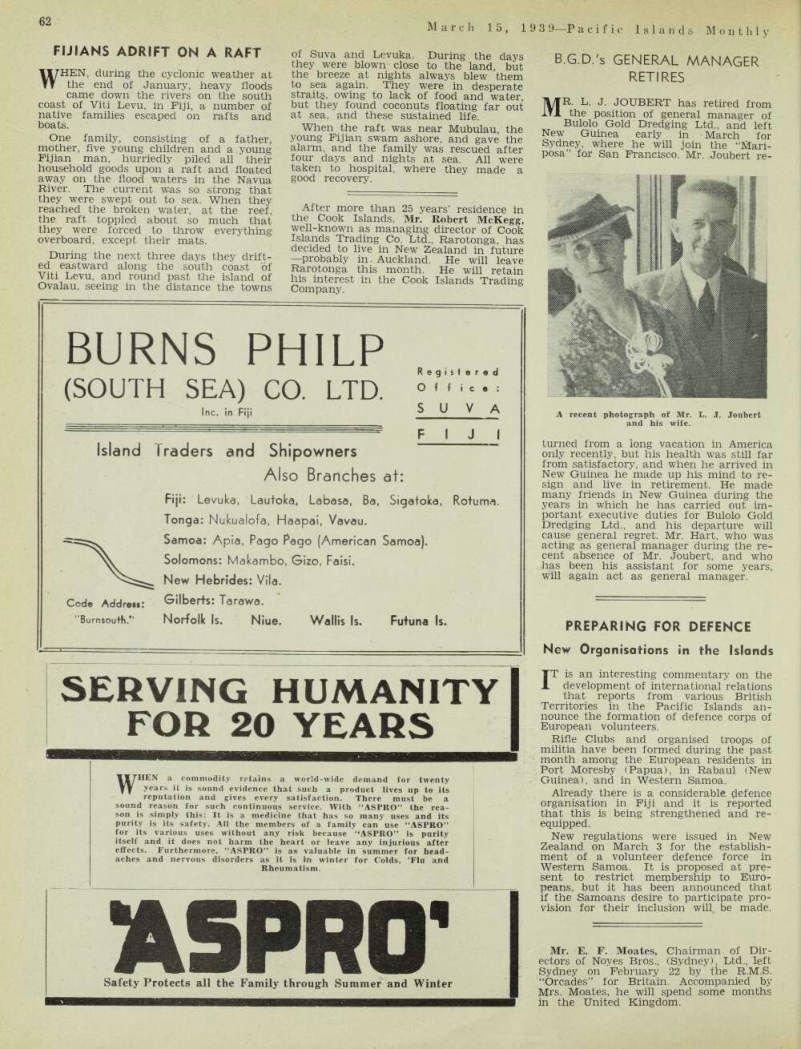
WHEN, during the cyclonic weather at the end of January, heavy floods came down the rivers on the south coast of Viti Levu, in Fiji, a number of native families escaped on rafts and boats.
One family, consisting of a father, mother, five young children and a young Fijian man, hurriedly piled all their household goods upon a raft and floated away on the flood waters in the Navua River. The current was so strong that they were swept out to sea. When they reached the broken water, at the reef, the raft toppled about so much that they were forced to throw everything overboard, except their mats.
During the next three days they drift ed eastward along the south coast of Viti Levu. and round past the island of Ovalau, seeing in the distance the towns
of Suva and Levuka. During the days they were blown close to the land, but the breeze at nights always blew them to sea again. They were in desperate straits, owing to lack of food and water, but they found coconuts floating far out at sea, and these sustained life.
When the raft was near Mubulau, the young Fijian swam ashore, and gave the alarm, and the family was rescued after four days and nights at sea. All were taken to hospital, where they made a good recovery.
After more than 25 years’ residence in the Cook Islands, Mr. Robert McKegg, well-known as managing director of Cook Islands Trading Co. Ltd., Rarotonga, has decided to live in New Zealand in future —probably in. Auckland. He will leave Rarotonga this month. He will retain his interest in the Cook Islands Trading Company.
B.G.D.'S General Manager
Retires
MR. L. J. JOUBERT has retired from the position of general manager of Bulolo Gold Dredging Ltd., and left New Guinea early in March for Sydney, where he will join the “Mari posa” for San Francisco. Mr. Joubert re-
turned from a long vacation in America only recently, but his health was still far from satisfactory, and when he arrived in New Guinea he made up his mind to re sign and live in retirement. He made many friends in New Guinea during the years in which he has carried out im portant executive duties for Bulolo Gold Dredging Ltd., and his departure will cause general regret. Mr. Hart, who was acting as general manager during the re cent absence of Mr. Joubert, and who has been his assistant for some years, will again act as general manager.
A recent photograph of Mr. L. J. Joubert and his wife.
Preparing For Defence
New Organisations in the Islands
IT is an interesting commentary on the development of international relations that reports from various British Territories in the Pacific Islands an nounce the formation of defence corps of European volunteers.
Rifle Clubs and organised troops of militia have been formed during the past month among the European residents in Port Moresby (Papua), in Rabaul (New Guinea), and in Western Samoa.
Already there is a considerable, defence organisation in Fiji and it is reported that this is being strengthened and re equipped.
New regulations were issued in New Zealand on March 3 for the establish ment of a volunteer defence force in Western Samoa. It is proposed at pre sent to restrict membership to Euro peans, but it has been announced that if the Samoans desire to participate pro vision for their inclusion will be made.
Mr. E. F. Moates, Chairman of Dir ectors of Noyes Bros., (Sydney), Ltd., left Sydney on February 22 by the R.M.S.
“Orcades” for Britain. Accompanied by Mrs. Moates, he will spend some months in the United Kingdom.
Advertisements & other items, p. 64 (1 item)
Aspro'
BURNS PHILP
Registered
(SOUTH SEA) CO. LTD. <>"“• =
SUVA
Inc. in Fiji I J i Island Traders and Shipowners
Also Branches at:
Fiji: Levuka, Lautoka., Labasa, Ba, Sigatoka, Rofuma.
Tonga: Nukualofa, Haapai, Vavau.
Samoa: Apia, Pago Pago (American Samoa).
Solomons: Makambo, Gizo, Faisi.
New Hebrides: Vila.
Code Address: Gilberts: Tarawa.
"Bumsoufh.*' Norfolk Is. Niue. Wallis Is. Futuna Is.
SERVING HUMANITY
FOR 20 YEARS
WHEN a commodity retains a world-wide demand for twenty years it is sound evidence that such a product lives up to its reputation and gives every satisfaction. There must be a sound reason for such continuous service. With “ASPRO” the reason is simply this: It is a medicine that has so many uses and its purity is its safety. All the members of a family can use “ASPRO” for its various uses without any risk because “ASPRO” is purity itself and it does not harm the heart or leave any injurious after effects. Furthermore, “ASPRO” is as valuable in summer for headaches and nervous disorders as it is in winter for Colds, ’Flu and Rheumatism.
ASPRO'
Safety Protects all the Family through Summer and Winter
Wau, N.G.
New Gold At
Development of Sluicing Industry
AN important new phase of the New Guinea gold industry has developed during the past couple of years, said Mr H. T. Allan, in a chat with the editor of the “Pacific Islands Monthly”.
Mr. Allan is president of the New Guinea Mining Association and he him self as a tributer of New Guinea Gold fields Ltd., is now the active head of a successful sluicing enterprise near Wau.
“The day of the man with the box and the pan and a few boys has defin itely gone”, said Mr. Allan. “Under those old conditions about half the gold that was washed out was lost down stream, and only very rich patches could be made to show a profit.
“But there is rich gold all along the hills on either side of the Bulolo River and that applies especially to the hills on the western side near Wau, and along towards Edie Creek.
“During the past two years a number of enterprises based on sluicing, and using the most modern methods, have started up in this latter area, with the result that profitable gold is being won in increasing quantities. These develop ments have changed the whole outlook of the Morobe gold industry. There ap pears to be a very large area of country capable of treatment; but the work must be undertaken by men or by small com panies with sufficient capital to buy the right equipment, and with sufficient knowledge to employ modern methods.
Then the reward is likely to be rich.
“If these developments are possible
under the severe handicap imposed by aerial freight, just think what the pos sibilities are if we could get a road from the coast and could get the benefit of cheap transport. Such a condition Would make profitable many areas which now are regarded as unprofitable, because it costs too much to work them.
“Under present conditions the gold in dustry in and around Wau has a defin ite life, but probably a short one; but if we ’ were given cheap transport— which we have been promised—a bigger and a highly profitable gold industry will continue in this district for a long time to come”.
Life Saved By Radio
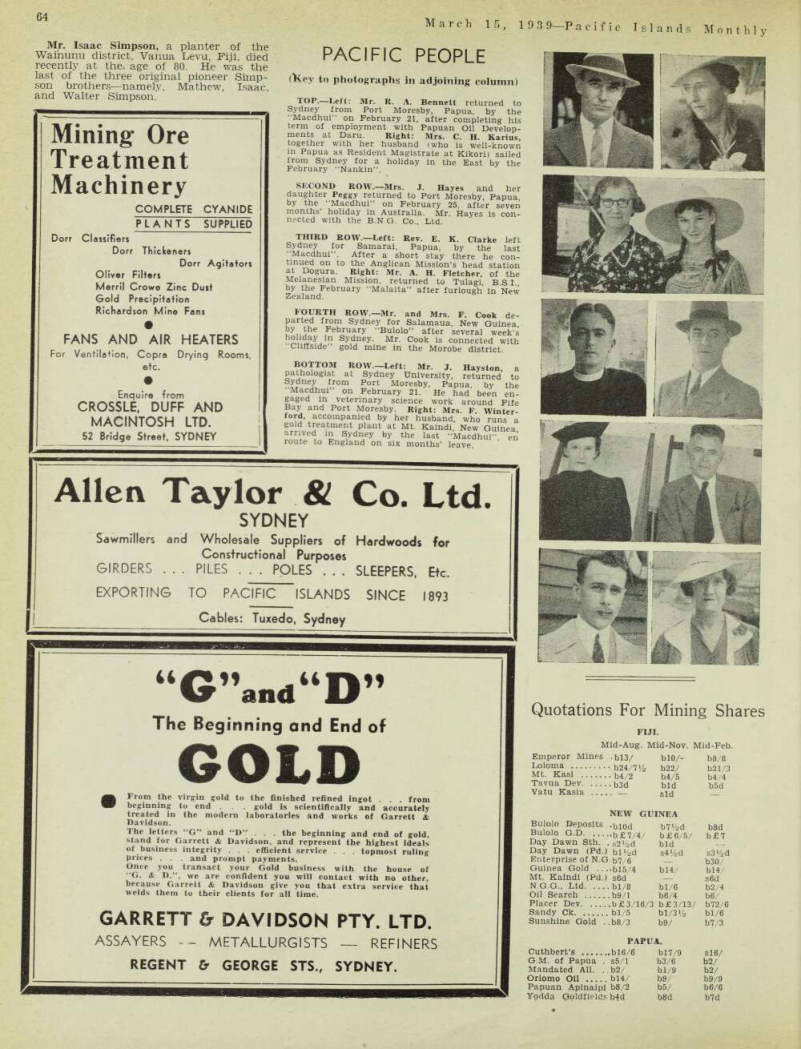
A RADIO amateur in Wellington, N.Z., recently heard an American wireless operator on Canton Island (in the Phoenix Group, north of Fiji) trying to communicate with Honolulu, and asking for assistance for a man on Canton Is land who was seriously ill with appen dicitis.
There are two parties on Canton Is land—British and American. Both na tions claim Canton Island as a suitable station in the contemplated trans-Paci fic aeroplane services and, as no agree ment has been reached, it apparently has been settled that so long as each coun try maintains an official party there, each country has an equal right to use the island as an aeroplane base.
As the Canton Is. operator was unable to contact Honolulu, the New Zealand amateur communicated with the Ameri can Consul-General at Wellington, who immediately sent a cablegram to the re sponsible officials in Honolulu.
As a result a vessel left immediately for Canton Island (a distance of 1,500
miles) and the sick man was taken to Honolulu and has since recovered. Radio and the prompt action taken by the N.Z. amateur probably savfed his life.
Hon. G. H. Murray, Director of Agri culture in New Guinea, left Rabaul by the last “Nankin” on a visit to Japan He has been suffering from ill health for some time and the trip is in the form of sick leave.
Mr. Isaac Simpson, a planter of the Waihunu district, Vanua Levu, Fiji, died recently at the, age of 80. He was the last of the three original pioneer Simp son brothers —namely, Mathew, Isaac, and Walter Simpson.
Advertisements & other items, pp. 65-66 (2 items)
63
Pacific Islands Monthl y—M arch 15, 19 3 9
F. M. Bantam Lighting Plants
KANGAROO BRAND
Ropes,
Cordage,
and Twines for every purpose
Backed by
86 years of service.
Manufactured by
M. DONAGHY AND SONS,
Fty. Ltd.Geelong and Sydney.
Fiji Representatives:
PEARCE AND CO.
LIMITED
P.O. BOX 237, SUVA
F. M. BANTAM LIGHTING PLANTS
6, 12, 24 & 32 Volt.
Extremely Low Prices Backed by a Great Name. •f Full particulars on request. * A few territories are still available for Exclusive distribution.
Apply without delay.
FAIHBANKS-MORSE CO. (A/sia.) PTY., LTD.
BOX 2672 EE, G.P.0., SYDNEY.
Mining Ore
Treatment
Machinery
COMPLETE CYANIDE
PLANTS SUPPLIED
Dorr Classifiers Dorr Thickeners Dorr Agitators Oliver Filters Merril Crowe Zinc Dust Gold Precipitation Richardson Mine Fans •
FANS AND AIR HEATERS
For Ventilation. Copra Drying Rooms, etc. • Enquire from
CROSSLE. DUFF AND
MACINTOSH LTD.
52 Bridge Street. SYDNEY
Allen Taylor & Co. Ltd.
SYDNEY
Sawmillers and Wholesale Suppliers of Hardwoods for Constructional Purposes GIRDERS . . . PILES . . . POLES . . . SLEEPERS. Etc.
EXPORTING TO PACIFIC ISLANDS SINCE 1893
Cables: Tuxedo, Sydney
“G”a«d“D”
The Beginning and End of
GOLD
• From the virgin gold to the finished refined ingot . . . from beginning to end . gold is scientifically and accurately treated in the modern laboratories and works of Garrett & Davidson.
The letters “G” and “D” . . . the beginning and end of gold, stand for Garrett & Davidson, and represent the highest ideals of business integrity . . . efficient service . . topmost ruling prices . . and prompt payments.
Once you transact your Gold business with the house of ‘‘G. & D.”, we are confident you will contact with no other, because Garrett & Davidson give you that extra service that welds them to their clients for all time.
GARRETT & DAVIDSON PTY. LTD.
ASSAYERS -- METALLURGISTS REFINERS
REGENT & GEORGE STS., SYDNEY.
Pacific People
(Key to photographs in adjoining column)
TOP - —Left: Mr. R. A. Bennett returned to Sydney from Port Moresby, Papua, by the ■•Macdhui” on February 21, after completing his term of employment with Papuan Oil Develop ments at Daru. Right: Mrs. C. H. Karius, together with her husband (who is well-known m Papua as Resident Magistrate at Kikori) sailed from Sydney for a holiday in the East by the February “Nankin”.
SECOND ROW.—Mrs. J. Hayes and her daughter Peggy returned to Port Moresby, Papua, by the “Macdhui” on February 25, after seven months' holiday in Australia. Mr. Hayes is con nected with the B.N G. Co., Ltd.
THIRD ROW.—Left: Rev. E. K. Clarke left Sydney for Samarai, Papua, by the last “Macdhui”. After a short stay there he con tinued on to the Anglican Mission’s head station at Dogura. Right: Mr. A. H. Fletcher, of the Melanesian Mission, returned to Tulagi BSI by the February “Malaita” after furlough’ in New Zealand.
FOURTH ROW—Mr. and Mrs. F. Cook de parted from Sydney for Salamaua, New Guinea by the February “Bulolo” after several week’s Sydney. Mr. Cook is connected with ‘ Cliffside ’ gold mine in the Morobe district.
ROW-j-Left: Mr. J. Hayston. a pathologist at Sydney University, returned to Sydney from Port Moresby, Papua by the •Macdhui” on February 21. He had’ been en gaged in veterinary science work around Fife Bay and Port Moresby. Right: Mrs. F. Winter ford, accompanied by her husband, who runs a gold treatment plant at Mt. Kaindi, New Guinea arrived in Sydney by the last "Macdhui” en route to England on six months’ leave.
Quotations For Mining Shares
Fiji.
Mid-Aug. Mid-Nov. Mid-Feb.
Emperor Mines •b!3/ blO/b8/8 Loloma ■ b24/7*/ 2 b22/ b21/3 Mt. Kasl • b4/2 b4/5 b4/4 Tavua Dev • b3d bid b5d Vatu Kasia • — sld
New Guinea
Bulolo Deposits •blOd b7Vad b8d Bulolo G.D •b£7/4/ b £ 6/5/ b £ 7 Day Dawn Sth. , ■ s2V a d bid Day Dawn (Pd.) bl»/ 2 d s4>/ 2 d s3*/ad Enterprise of N.G.b7/6 b30/ Guinea Gold ... •b!5/4 bl4/ bl4/ Mt. Kalndl (Pd.) s6d s6d N G.G., Ltd bl/8 bl/6 b2/4 Oil Search . b9/l b6/4 b6/ Placer Dev .b£ 3/16/3 b £ 3/13/ b72/6 Sandy Ck bl/5 bl/3Va bl/6 Sunshine Gold . .b8/3 b9/ b7/3
Papua.
Cuthbert’s ,bl6/6 bl7/9 sl6/ G.M. of Papua . s5/l b3/6 b2/ Mandated All. .. b2/ bl/9 b2/ Oriomo Oil b!4/ b9/ b9/9 Papuan Apinaipl b8/2 b5/ b6/6 Yodda Opldfields b4d b8d b7d
Mining Notes
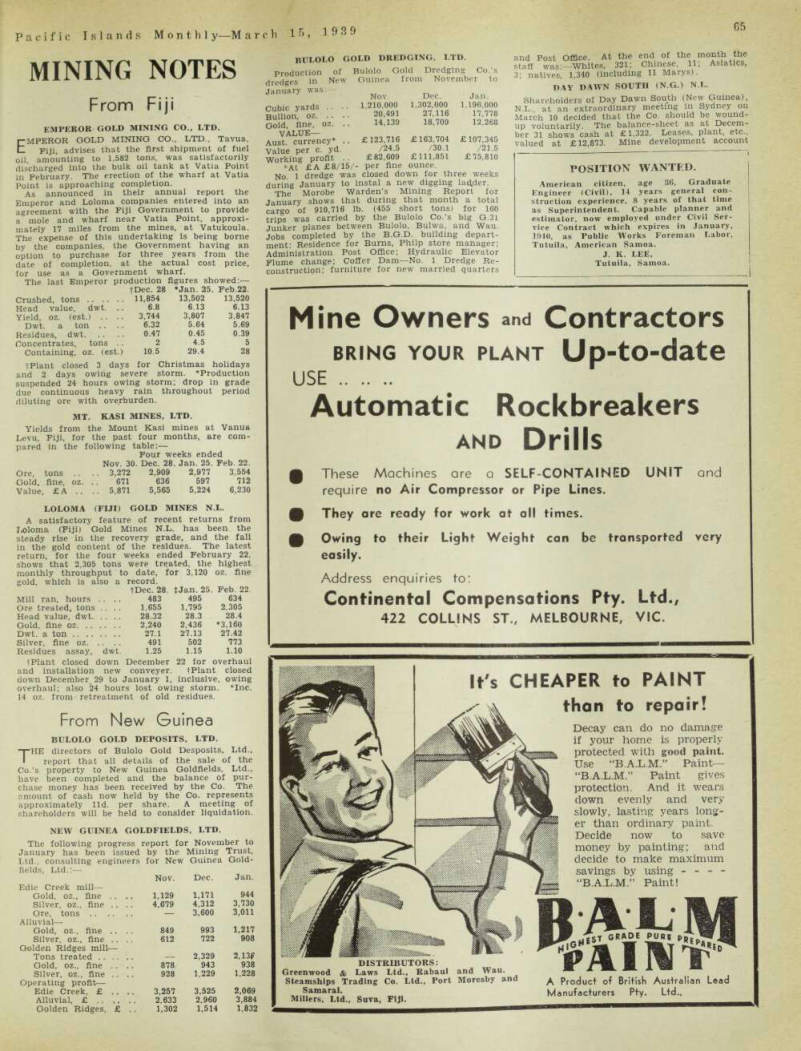
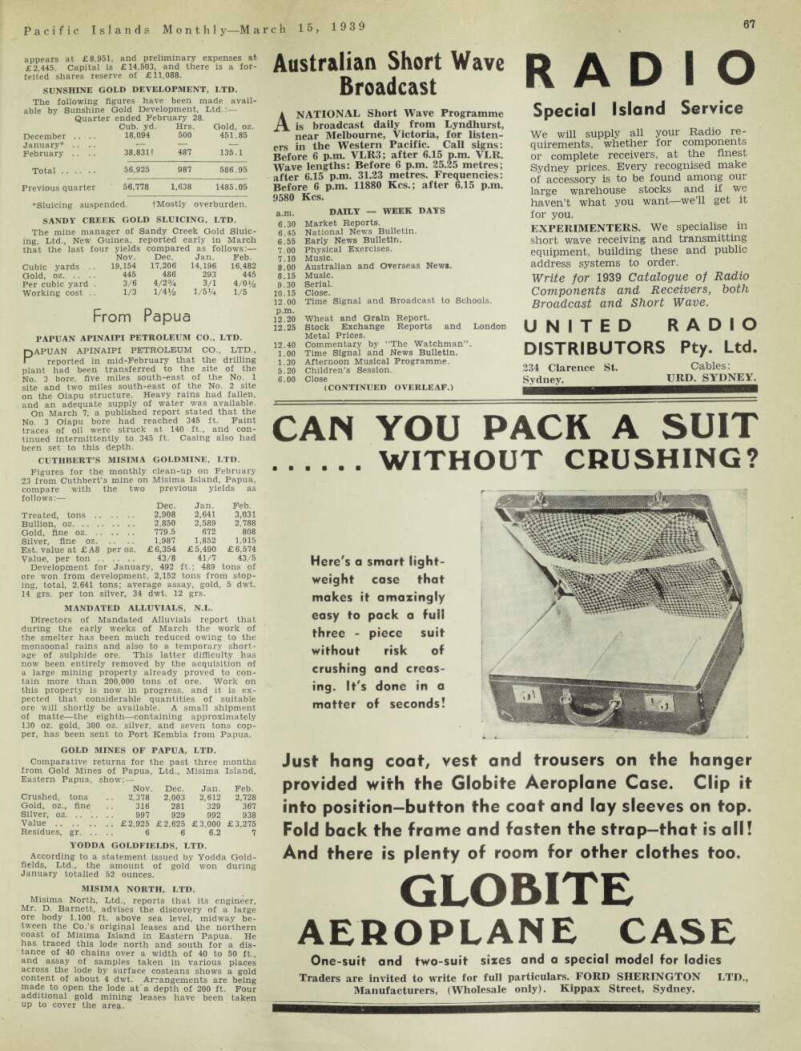
From Fiji
Emperor Gold Mining Co., Ltd.
Emperor gold mining co., ltd., Tavua, Fiji, advises that the first shipment of fuel oil amounting to 1.582 tons, was satisfactorily discharged into the bulk oil tank at Vatia Point in February. The erection of the wharf at Vatia Point is approaching completion.
As announced in their annual report the Emperor and Loloma companies entered into an agreement with the Fiji Government to provide a mole and wharf near Vatia Point, approxi mately 17 miles from the mines, at Vatukoula.
The expense of this undertaking is being borne by the companies, the Government having an option to purchase for three years from the date of completion, at the actual cost price, for use as a Government wharf.
The last Emperor production figures showed:—
tPlant closed 3 days for Christmas holidays and 2 days owing severe storm. ‘Production suspended 24 hours owing storm; drop in grade due continuous heavy rain throughout period diluting ore with overburden.
Mt. Kasi Mines, Ltd.
Yields from the Mount Kasi mines at Vanua Levu, Fiji, for the past four months, are com pared in the following table:— Four weeks ended
Loloma (Fiji) Gold Mines N.L.
A satisfactory feature of recent returns from I.oloma (Fiji) Gold Mines N.L. has been the steady rise in the recovery grade, and the fall in the gold content of the residues. The latest return, for the four weeks ended February 22, shows that 2,305 tons were treated, the highest monthly throughput to date, for 3,120 oz. fine gold, which is also a record.
From New Guinea
Bulolo Gold Deposits, Ltd.
THE directors of Bulolo Gold Desposits, Ltd., report that all details of the sale of the Co.’s property to New Guinea Goldfields, Ltd., have been completed and the balance of pur chase money has been received by the Co. The amount of cash now held by the Co. represents approximately lid. per share. A meeting of shareholders will be held to consider liquidation.
New Guinea Goldfields, Ltd.
The following progress report for November to January has been issued by the Mining Trust, Ltd., consulting engineers for New Guinea Gold fields, Ltd.:—
bulolo gold dredging, ltd.
Production of Bulolo Gold Dredging Co.'s dredges in New Guinea from November to January was: —
No 1 dredge was closed down for three weeks during January to instal a new digging ladder.
The Morobe Warden’s Mining Report for January shows that during that month a total cargo of 910,716 lb. (455 short tons) for 160 trips was carried by the Bulolo Co.’s big G.3l Junker planes between Bulolo, Bulwa, and Wau.
Jobs completed by the B.G.D. building depart ment: Residence for Burns, Philp store manager; Administration Post Office; Hydraulic Elevator Flume change: Coffer Dam—No. 1 Dredge Re construction; furniture for new married quarters
and Post Office. At the end of the month the staff was;—Whites, 321; Chinese. 11; Asiatics, 3; natives, 1,340 (including 11 Marys).
Day Dawn South (N.G.) N.L.
Shareholders of Day Dawn South (New Guinea), N.L., at an extraordinary meeting in Sydney on March 10 decided that the Co. should be wound up voluntarily. The balance-sheet as at Decem ber 31 shows cash at £1,322. Leases, plant, etc., valued at £12,873. Mine development account
January was: — Nov. Dec. Jan. mhic vards . .. 1,210,000 1,302.000 1.196.000 Bullion! OZ 20.491 27,116 17,778 Gold. fine. oz. .. 14,139 18,709 12,268
Value —
Aust currency* .. £123,716 £163,704 £107,345 value per c. yd. /24.5 /30.1 /21.5 Working profit .. £82,609 £111,851 £75,810 * At £ A £8/15/- per fine ounce.
tDec. 28 ♦Jan. 25.
Feb.22.
Crushed, tons 11,854 13,502 13,520 Head value, dwt. .. 6.8 6.13 6.13 Yield, oz. (est.) .. 3,744 3,807 3,847 Dwt. a ton .. 6.32 5.64 5.69 Residues, dwt 0.47 0.45 0.39 Concentrates, tons .. 2 4.5 5 Containing, oz. (est.) 10.5 29.4 28
Nov. 30. Dec. 28. Jan. 25. Feb. 22.
Ore, tons .. .. 3,272 2,909 2,977 3,554 Gold, fine, oz. .. 671 636 597 712 Value, £ A .. .. 5,871 5.565 5,224 6,230
tDec. 28. fJan. 25.
Peb. 22.
Mill ran, hours . 483 495 634 Ore treated, tons 1,655 1,795 2,305 Head value, dwt. 28.32 28.3 28.4 Gold, fine oz. .. 2,240 2,436 *3,160 Dwt. a ton .. .. 27.1 27.13 27.42 Silver, fine oz. . 491 502 773 Residues assay, dwt. 1.25 1.15 1.10 tPlant closed down December 22 for overhaul and installation new conveyer. tPlant closed down December 29 to January 1, inclusive, owing overhaul; also 24 hours lost owing storm ♦Inc. 14 oz. from retreatment of old residues.
Nov.
Dec.
Jan.
Edie Creek mill — Gold, oz., fine .. .. 1,129 1,171 944 Silver, oz., fine .. .. 4,679 4,312 3,730 Ore, tons — 3.600 3,011 Alluvial— Gold, oz., fine .. .. 849 993 1,217 Silver, oz., fine .. . . 612 722 908 Golden Ridges mill— Tons treated .. .. .. — 2,329 2,13?
Gold, oz., fine .. 878 943 938 Silver, oz., fine .. 928 1,229 1,228 Operating profit— Edie Creek, £ .. 3,257 3,525 2,069 Alluvial, £ 2,633 2,960 3,884 Golden Ridges, £ .. 1,302 1,514 1,832
appears at £8,951, and preliminary expenses at £2,445. Capital is £14,503, and there is a for feited shares reserve of £ll,OBB.
Sunshine Gold Development, Ltd,
The following figures have been made avail able by Sunshine Gold Development, Ltd.: — Quarter ended February 28.
Sandy Creek Gold Sluicing, Ltd.
The mine manager of Sandy Creek Gold Sluic ing, Ltd., New Guinea, reported early in March that the last four yields compared as follows:
From Papua
Papuan Apinaipi Petroleum Co., Ltd.
Papuan apinaipi petroleum co., ltd., reported in mid-February that the drilling plant had been transferred to the site of the No. 3 bore, five miles south-east of the No. 1 site and two miles south-east of the No. 2 site on the Oiapu structure. Heavy rains had fallen, and an adequate supply of water was available.
On March 7, a published report stated that the No. 3 Oiapu bore had reached 345 ft. Faint traces of oil were struck at 140 ft., and con tinued intermittently to 345 ft. Casing also had been set to this depth.
Cuthbert’S Misima Goldmine, Ltd.
Figures for the monthly clean-up on February 23 from Cuthbert’s mine on Misima Island, Papua, compare with the two previous yields as follows: —
Mandated Alluvials, N.L.
Directors of Mandated Alluvials report that during the early weeks of March the work of the smelter has been much reduced owing to the monsoonal rains and also to a temporary short age of sulphide ore. This latter difficulty has now been entirely removed by the acquisition of a large mining property already proved to con tain more than 200,000 tons of ore. Work on this property is now in progress, and it is ex pected that considerable quantities of suitable ore will shortly be available. A small shipment of matte—the eighth—containing approximately 130 oz. gold, 300 oz. silver, and seven tons cop per, has been sent to Port Kembla from Papua.
Gold Mines Of Papua, Ltd.
Comparative returns for the past three months from Gold Mines of Papua, Ltd., Misima Island, Eastern Papua, show:—
Yodda Goldfields, Ltd,
According to a statement issued by Yodda Gold fields, Ltd., the amount of gold won during January totalled 52 ounces.
Misima North, Ltd.
Misima North, Ltd., reports that its engineer, Mr. D. Barnett, advises the discovery of a large ore body 1,100 ft. above sea level, midway be tween the Co.’s original leases and the northern coast of Misima Island in Eastern Papua. He has traced this lode north and south for a dis tance of 40 chains over a width of 40 to 50 ft., and assay of samples taken in various places across the lode by surface costeans shows a gold content of about 4 dwt. Arrangements are being made to open the lode at a depth of 200 ft. Four additional gold mining leases have been taken up to cover the area.
Cub. yd. Hrs. Gold, oz.
December .. .. 18,094 500 451.85 January* ... — — — February .. .. 38,831t 487 135.1 Total 56,925 987 586.95 Previous quarter 56,778 1,638 1485.05 ♦Sluicing suspended. tMostly overburden.
Nov. Dec. Jan. Feb.
Cubic yards .. 19,154 17,206 14,196 16,482 Gold, oz 445 486 293 445 Per cubic yard . 3/6 4/2 3 /4 3/1 4/0V 2 Working cost . . 1/3 1/41/51/5
Dec.
Jan.
Feb.
Treated, tons . 2,908 2,641 3,031 Bullion, oz. .. 2,850 2,589 2,788 Gold, fine oz. . 779.5 672 808 Silver, fine oz 1,987 1,852 1,915 Est. value at £A8 per oz. £6,354 £5,490 £6,574 Value, per ton 43/8 41/7 43/5 Development for January, 492 ft.; 489 tons of ore won from development, 2,152 tons from stoping, total, 2,641 tons; average assay, gold, 5 dwt. 14 grs. per ton silver, 34 dwt. 12 grs.
Nov. Dec. Jan. Feb.
Crushed, tons .. 2,378 2,003 2,612 2,728 Gold, oz., fine .. 316 281 329 367 Silver, oz 997 929 992 938 Value £2,925 £2,625 £3,000 £3,275 Residues, gr 6 6 6.2 7
Advertisements & other items, pp. 67-68 (3 items)
65
Pacific Islands Month 1 y—M arch 15, 1939
Paint
POSITION WANTED.
American citizen, age 36, Graduate Engineer (Civil), 14 years general construction experience, 8 years of that time as Superintendent. Capable planner and estimator, now employed under Civil Service Contract which expires in January, lf)40, as Public Works Foreman Labor, Tutuila, American Samoa.
J. K. LEE,
Tutuila, Samoa.
Mine Owners and Contractors
BRING YOUR PLANT Up-t O-date
USE
Automatic Rockbreakers
AND Drills
0 These Machines are a SELF-CONTAINED UNIT and require no Air Compressor or Pipe Lines. 0 They are ready for work at all times.
Owing to their Light Weight can be transported very easily.
Address enquiries to:
Continental Compensations Pty. Ltd.,
422 COLLINS ST., MELBOURNE, VIC.
/ <r ► \ «
It's CHEAPER to PAINT
than to repair!
Decay can do no damage If your home is properly protected with good paint.
Use “8.A.L.M.” Paint— “B.A.L.M.” Paint gives protection. And it wears down evenly and very slowly, lasting years longer than ordinary paint.
Decide now to save money by painting; and decide to make maximum savings by using - - - - “8.A.L.M.” Paint!
DISTRIBUTORS:
Greenwood & Laws Ltd., Rabaul and Wau.
Steamships Trading Co. Ltd., Port Moresby and Samarai.
Millers, Ltd., Suva, Fiji.
PAINT
A Product of British Australian Lead Manufacturers Pty. Ltd.,
Electric Motors for driving Models, etc etc., work off 4 to 12 volts —wet or dry batteries, 5/9, 8/6 10/6, 12/6. Electric Railway Engines with fender, 12 rails, 65/-, 75/-, 95/-. Transformers, 240 volts, 25/-.
Adjustable all way Morse Code Key as illustrated. 12/6.
P.M.G. Type, 19/6.
Buzzers 2/6, 2/9, 3/6, 7/6.
NOVELTIES FROM ABROAD:
Pocket Sundial, 22/6. Prophet Weather forecasts, 12/6.
Australian Boomerangs: 3/6, 4/6, 5/6. Koala Bear Dolls: 25/-, 15/-J 9/6, 3/6. Special price to traders. A Novelty from U.S.A. Dancing Dinah: She tap dances to the music of any radio, musical instrument, song or whistle. Selling in thousands in U.S.A. Now 10/6.
U.S.A. Catapult Model Aeroplanes, 2/-.
A d j u s table Electric Forehead Torch Fits snugly for Professional Men B a n d s m en.
Miners, etc.: 10/6. With separate Torch Battery Container: 18/6. Batteryless Hand Torch, 26/-.
Heavy Duty XL Electric Solder Irons. 12 months’ guarantee. 82/6 value. NOW 22/6.
Accumulators. Unspillable genuine British Built Every Ready. 2 Volt units. NOW 18/6. Actual capacity, 20 amps. Send for full lists.
Buy assembled or build the Air Patrol 2 - valve Battery - operated Radio for all short-wave stations and broadcasts. Easy to operate, change over switch. All parts £4/1/6, Valves 28/9, Batteries £2/15/9, Phones 80/-, Speaker 21/8.
The set assembled and complete, £l2 14/9. Easiway Charts 6d.
“Totem”, a wellmade little game, for Homes, Clubs, Hotels, etc. Push the starting knob and off spin the 2\ reels, one the horses and the other the odds when the spin terminates the Winner and Winner’s Price is clearly shown.
Cheat and fool-proof, 21/-.
Send for Leaflet.
Electric Dry shavers for 240
A.C. D.C. El-
ectric supply. Write for full list
“VICO” 75/.
Special price to traders. Write for prices. “Packard” 90/-. We stock every make.
Just Arrived—The Magic Egg Trick, 2/6.
The Mystic 10/-, £1 or £5 Note Producer, 3/6. The 2 Ass Puzzle. 1/-. Squarem Puzzle or the “T" Trick, 9d. each.
Pocket Telescopes, made In England, 3/11, 4/11, 5/6, 10/6, 16/6, French Domino Sets, bevelled Ebony backs, 8/6, 13/6, 18/6. Cheaper grades, 1/6, 3/6, 5/6.
Dart Boards, 3/11, 5/6, 8/11, 15/-, 21/-.
Feathered Competition Brass Darts, set of 3 for 7/6. - Send for Lists.
Ormond 3in. Vernier 2-Action Dials, 8/6.
Dynamic Speaker, all ohmages, best make, 17/0. Brand New.
Permagnetic Speaker, sin. and 6 3 /4in., 23/-. Leading Make.
Ampllon LI. Per magnetic” Speaker, 8 in.", 35/-, to Clear. L 5, 10 in., 45/-.
Highest Grade Swiss Music Boxes, for Cigarettes, etc., 25/-, 35/-, 37/6, 39/6, Book Jokes—What To Know About Women. Album of Parisian Beauties, 2 for 2/6, post free.
Novelty Trick Cigars, giant size, smok' cigarette inside, 1/-.
Splendid Tricks and Puzzles. The T.
Trick. 9d. The Squarem Puzzle. 9d. The 2 Asses Puzzle, 1/-. The Magic Egg Trick, 2/6.
Lightweight Table Tennis Bats, 2/6; English Balls, 2/6 dozen. Cameras, samples, 63/-; Model. 35/-; 5.50 Models, 55/-.
Electric Bells, work right off 240 volts, 13/6; Battery Operated Electric Bells, 3/11, 4/6; 2-way Insulated 100 ft. Coils of Wire, excellent for bells, etc.. 5/- coil.
Like-a-Flash Super Het. Mantle Model Electric Radio, 1938-9 designs. £l3/10/ value. NOW £B/10/- CASH.
Write for o f u b
CROWN AND ANCHOR SETS, 10/6.
5 Poker Dice, in box .. .. 7/6 and 10/6 In Leather Case 7/6, 10/6, 12/6 Head and Tail Dice, Sets of Five, 8/6 and 11/6. Large Transparent 1 to 6 Dice. 1/6 each. Extra Large 2/6.
We stock all kinds of Dice and Dice Cups.—Send for Lists.
The World’s Best Indoor Pastime-Games:
“MONOPOLY” and “TOTOPOLY”. The
World’s Craze, 10/6. BIG BUSINESS, 12/9.
A Facsimile Game. We stock Games of all kinds.
“Presto”, the Mysterious Coin-Box! — The most baffling Trick ever conceived* Borrow a coin; request owner to mark in a way he will identify it again. In exchange for coin, hand him a small bakelite box bound up.
Ask him to open it. Inside he will find a match box, also securely bound. Inside this he will find a cloth bag, also bound up. When opened up, he finds the coin he marked, In the bag. This is one of the most mystifying Tricks ever performed. Price, complete with instructlons: 2/6, plus postage, 3d.
Gramophone Record Overhead Cutting Unit, with Cutting Head, 84/-, Local Made, £B/10/- British make.
Gramophone Records for Home Recording; Sin. Plain Celluloid Blanks, 7/6; Plain Acetate, Bin., 3/6; lOln. 5/6; 12in. 7/6. Write for full lists.
Pregrooved, Bin., 4/6; 10in., 6/6. Steel Cutting Needles, 2/- each. Special Play Back Needles, 4/6 per 100; 2/6 per 50.
R.C.A. Victor Cutting Needles for Pregrooved Records, 8 for 5/-. 1
[Billiard Balls, Resilient, faultless in {running, true to angle and perfect balance; a real superior ball, unaffected by climate conditions. 1.
“Dymondite” Billiard Balls, 1 % in., 21/- set. 2. —“Dymonite” Billiard Balls, 1-7/8 in., 25/- set. 3.—“Dymonite” Billiard Balls, 2 in., 35/- set. 4.—“Dymonite” Billiard Balls, 2-1/16 in., 55/- set. Postage on each set 1/-.
Ormond British Made Highest Grade Vernier Dials, 3 inch Brown Bakelite or Metal, 8/6.
“UTILITY” Short Wave Dials—World’s Best, 12/6.
Goldring English Pick-up Heads. Suit and Fit all Gramophone Tone Arms.
Type 44/4 Pick-up Head with Builtin Volume Control: 19/6. Type 44/5 Pick-up Head, with Volume Control attached: 21/-. Type 33/3 Pick-up Head with Highly Polished Nickle Finish: 18/6. Bakelite Case Pick-up Head 16/6.
Table Type Interesting Pin Games: 12/6, 15/-. Competition Dart Boards: 21/-. Others: 2/6, 8/11, 11/6. Competition Brass and Feathered Darts: 3 for 5/6. Table Tennis Sets; 7/6, 15/-.| Model Aeroplane Kits, all types.
Write for leaflets. Draught Sets: 4/6, 6/6, 10/6.
British built portable electric 240 volt A.C. Gramophones, with Pick-up fitted all mounted on handy size Portable Cabinet, with all leads supplied ready to plug into electric current, £6/6/m
“Y O G I”, The
greatest and straightest of all tricks, match size. You keep them guessing.
Its uncanny— its wonderful, 2/6.
Midget Single Jack 1 Hole Mounting 1/3.
“Ormond” British .00035 Single Hole Mount Variable Condensers, with 4in.
Black Polished Bakelite Dial, 15/-.
NOW 7/ 6 .
“Pilot” U.S.A. .00035 Variable Condensers, 11/6. NOW 5/6.
“Pacent” Shockproof UX Bakelite Valve Sockets. Phospher Bronze Fittings 1/3, Auto Aerials, 2 and 3 Strand Roof Type, 31/, Cbllapsible Type 21/. Traders, write for Price. Just landed: Collapsible-hinge Type. Fits easily and quickly on Door Hinge, 33/-.
Range U.S.A. Types.
All Metal, Indestructible Vest Pocket Size, Quick and Easy Cigarette Maker, 6/6. Makes them like the factory.
G r a phoscope 8/6. With it you can copy any Prawing or Photo up to size 6 x 4 in.
Write for full list of Foreign Stamps and Albums.
Microphones. Sing, Play, Recite. GreaJt Fun for Home, Dance, Party, etc., or for use in Factories, Stores, etc. Write for full ramge. Just plug leads of Microphone into pick-up terminals of any set. 9/6 to £6/6/-.
As illustrated with long lead fitted. Splendid w Reproducer. 22/6
Excel lent / \
English Mi- M \ c rop hone, ( (/•j&Vjl U Table Model, contained These Microphones suit all sets. The leads plug Into the Pickup terminals of the set.
Write for full Illustrated list of the finest range of microphones. Order from this list.
“Cosmocord” British Built Gramophone Pick-Up Heads.
Will suit all Gramophone Tone Arms, 11/6 and 19/6.
“Cosmocord” Radio-Gradio Unit Electric Turntable with Pick-Up Mounted—pull neat lid of beautiful table-model cabinet and out comes Unit.—Hook up to any radio in a jiffy, £9/10/-.
Wates Pocket Meters: 14/-.
Reads 0 to 6, 0 to 15, 0 to 180 volts. 0 to 30 M/A. 2 Reading Pocket Volt Meters 7/6. 3 Reading Meters 10/6.
Emmicol Universal Meter 18/6. 0 to 6, 0 to 150, 0 to 30 M/A, 0 to 2000 ohms 18/6.
Electrical Continental Solder Irons, 240 volts: 15/-. 6 v.
Electric Solder Irons: 22/6.
Large 50 amp. Battery Clips; 1/3 each. We stock all sizes.
“Like a Flash” British make (iramophone Pickups complete Richards, just arrived 25/-
“Cosmocord” . . , 25/-
“Cosmocord” De Luxe 32/6 “Cosmocord” high definition 38/6 “Cosmocord” Super de Luxe 46/- Amplion (English) 28/6 B.T.H, Crystal Type 75/-.
Write for Pull List.
'COSMOCORD*
Write for Punch Board Leaflets
LEVENSON’S RADIO
GAMES, NOVELTIES AND HOBBIES
226 PITT STREET. SYDNEY
Manufacturers, Importers, and Exporters.
Branches: Radio Cheapside, 240 a Pitt St.
N.S.W., AUSTRALIA
Cable address: “Leveradioh.” Goods forwarded V.P.P. or Sight Draft. Satisfaction, and Service Guaranteed. We can supply by mail all General Merchandise at a Better Price. Quotations with pleasure.
Please add freight and packing. Write for full list of interesting leaflets of Games, Hobbies, Novelties, and Electrical Goods.
Write f«.r Pin-Game, Totem and Odds and Evens Leaflets
66
March 15, 193 9—P acific Islands Monthly
Australian Short Wave
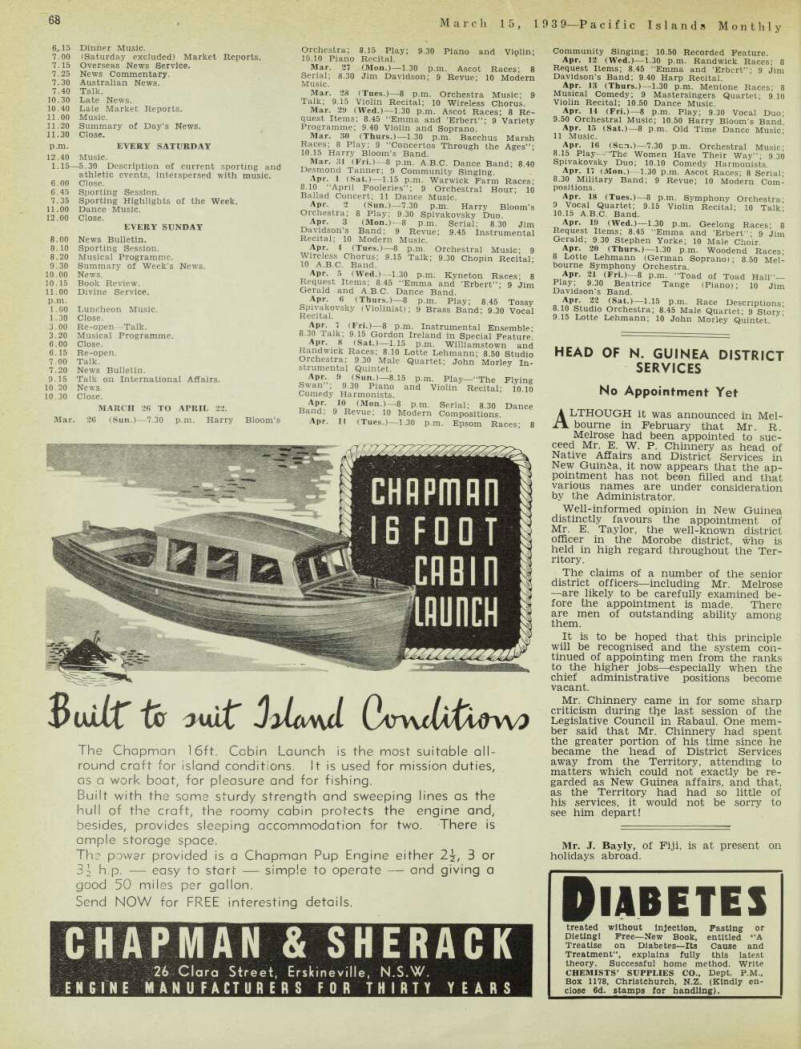
Broadcast
A NATIONAL Short Wave Programme
is broadcast daily from Lyndhurst,
near Melbourne, Victoria, for listen ers in the Western Pacific. Call signs: Before 6 p.m. VLR3; after 6.15 p.m. VLR.
Wave lengths: Before 6 p.m. 25.25 metres; after 6.15 p.m. 31.23 metres. Frequencies: Before 6 p.m. 11880 Kcs.; after 6.15 p.m. 9580 Kcs.
A.M. Daily Week Days
6.30 Market Reports. 6.45 National News Bulletin. 6.55 Early News Bulletin. 7.00 Physical Exercises. 7.10 Music. 8.00 Australian and Overseas News. 8.15 Music. 9.30 Serial. 10.15 Close. 12.00 Time Signal and Broadcast to Schools, p.m. 12.20 Wheat and Grain Report. 12.25 Stock Exchange Reports and London Metal Prices. 12.40 Commentary by “The Watchman”. 1.00 Time Signal and News Bulletin. 1.30 Afternoon Musical Programme. 5.20 Children’s Session. 6.00 Close
(Continued Overleaf.)
6.15 Dinner Music. 7.00 (Saturday excluded) Market Reports. 7.15 Overseas News Service. 7.25 News Commentary. 7.30 Australian News. 7.40 Talk. 10.30 Late News. 10.40 Late Market Reports. 11.00 Music. 11.20 Summary of Day’s News. 11.30 Close.
P.M. Every Saturday
12.40 Music. 1.15—5.30 Description of current sporting and athletic events, interspersed with music. 6.00 Close. 6.45 Sporting Session. 7.35 Sporting Highlights of the Week. 11.00 Dance Music. 12.00 Close.
Every Sunday
8.00 News Bulletin. 8.10 Sporting Session. 8.20 Musical Programme. 9.30 Summary of Week’s News. 10.00 News. 10.15 Book Review. 11.00 Divine Service, p.m. 1.00 Luncheon Music. 1.30 Close. 3.00 Re-open—Talk. 3.20 Musical Programme. 6.00 Close. 6.15 Re-open. 7.00 Talk. 7.20 News Bulletin. 9.15 Talk on International Affairs. 10,20 News. 10.30 Close.
March 26 To April 22.
Mar. 26 (Sun.) —7.30 p.m. Harry Bloom’s
Orchestra: 8.15 Play; 9.30 Piano and Violin; 10.10 Piano Recital.
Mar. 27 (M0n.)—1.30 p.m. Ascot Races; 8 Serial; 8.30 Jim Davidson; 9 Revue; 10 Modern Music.
Mar. 28 (Tues.) —8 p.m. Orchestra Music; 9 Talk; 9,15 Violin Recital; 10 Wireless Chorus.
Mar. 29 (Wed.)—l.3o p.m. Ascot Races; 8 Re quest Items; 8.45 “Emma and ’Erbert”; 9 Variety Programme; 9.40 Violin and Soprano.
Mar. 30 (Thurs.)—l.3o p.m. Bacchus Marsh Races; 8 Play; 9 “Concertos Through the Ages”; 10.15 Harry Bloom’s Band.
Mar. 31 (Fri.)—B p.m. A.B.C. Dance Band; 8.40 Desmond Tanner; 9 Community Singing.
Apr. 1 (Sat.)—l.ls p.m. Warwick Farm Races; 8.10 “April Fooleries”; 9 Orchestral Hour; 10 Ballad Concert; 11 Dance Music.
Apr. 2 (Sun.)—7.3o p.m. Harry Bloom’s Orchestra: 8 Play; 9.30 Spivakovsky Duo.
Apr. 3 (Mon.)—B p.m. Serial; 8.30 Jim Davidson’s Band; 9 Revue; 9.45 Instrumental Recital: 10 Modern Music.
Apr. 4 (Tues.)—B p.m. Orchestral Music; 9 Wireless Chorus; 9.15 Talk; 9.30 Chopin Recital; 10 A.B.C. Band.
Apr. 5 (Wed.) —1.30 p.m. Kyneton Races; 8 Request Items; 8.45 “Emma and ’Erbert” - 9 Jim Gerald and A.B.C. Dance Band.
Apr 6 (Thurs.)—B p.m. Play; 8.45 Tossy Spivakovsky (Violinist): 9 Brass Band; 9.30 Vocal Recital. o Apr ’ ? <Fri.) —8 p.m. Instrumental Ensemble; 8.30 Talk; 9.15 Gordon Ireland in Special Feature.
Apr. 8 (Sat.) —1.15 p.m. Williamstown and Randwick Races; 8.10 Lotte Lehmann; 8.50 Studio Orchestra; 9.30 Male Quartet; John Morley In strumental Quintet.
Apr. 9 (Sun.)—B.ls p.m. Play—“ The Flying Swan ; 9.30 Piano and Violin Recital; 10 10 Comedy Harmonists.
Ap , r - n lo x, (Mon ->-- 8 P-m. Serial: 8.30 Dance Band; 9 Revue; 10 Modern Compositions.
Apr. 11 (Tues.) —1.30 p.m. Epsom Races; 8
Community Singing; 10.50 Recorded Feature.
Apr. 12 (Wed.) —1.30 p.m. Randwick Races; 8 Request Items; 8.45 “Emma and ’Erbert’’; 9 Jim Davidson’s Band; 9.40 Harp Recital.
Apr. 13 (Thurs.) —1.30 p.m. Mentone Races; 8 Musical Comedy; 9 Mastersingers Quartet; 9 10 Violin Recital; 10.50 Dance Music.
Apr. 14 (Fri.)—B p.m. Play; 9.30 Vocal Duo; 9.50 Orchestral Music; 10.50 Harry Bloom s Band.
Apr. 15 (Sat.) —8 p.m. Old Time Dance Music; 11 Music.
Apr. 16 (Sun.)—7.3o p.m. Orchestral Music; 8.15 Play—“ The Women Have Their Way”; 9 30 Spivakovsky Duo; 10.10 Comedy Harmonists.
Apr. 17 (M0n.)—1.30 p.m. Ascot Races; 8 Serial; 8.30 Military Band; 9 Revue; 10 Modern Com positions.
Apr. 18 (Tues.) —8 p.m. Symphony Orchestra; 9 Vocal Quartet: 9.15 Violin Recital; 10 Talk -10.15 A.B.C. Band. ’
Apr. 19 (Wed.) —1.30 p.m. Geelong Races; 8 Request Items; 8.45 “Emma and ’Erbert”; 9 Jim Gerald; 9.30 Stephen Yorke; 10 Male Choir Apr. 20 (Thurs.)—l.3o p.m. Woodend Races; 8 Lotte Lehmann (German Soprano); 8.50 Mel bourne Symphony Orchestra.
Apr. 21 (Fri.)—B p.m. “Toad of Toad Hair- Play; 9.30 Beatrice Tange (Piano); 10 Jim Davidson’s Band. o j? <Sat.) —1.15 p.m. Race Descriptions; 8.10 Studio Orchestra; 8.45 Male Quartet; 9 Story 9.15 Lotte Lehmann; 10 John Morley Quintet. ’
Advertisements & other items, pp. 69-70 (2 items)
67
Pacific Islands Monthl y — M arch 15, 1939
Radio
Special Island Service
We will supply all your Radio requirements, whether for components or complete receivers, at the finest Sydney prices. Every recognised make of accessory is to be found among our large warehouse stocks and if we haven’t what you want —well get it for you.
EXPERIMENTERS. We specialise in short wave receiving and transmitting equipment, building these and public address systems to order.
Write for 1939 Catalogue of Radio Components and Receivers, both Broadcast and Short Wave.
UNITED RADIO
DISTRIBUTORS Pty. Ltd.
334 Clarence St. Cables: Sydney. CRD. SYDNEY.
CAN YOU PACK A SUIT
WITHOUT CRUSHING?
matter of seconds! . . • » Just hang coat, vest and trousers on the hanger provided with the Globite Aeroplane Case. Clip it into position-button the coat and lay sleeves on top.
Fold back the frame and fasten the strap-that is all!
And there is plenty of room for other clothes too.
GLOBITE
AEROPLANE CASE
One-suit and two-suit sizes and a special model for ladies Traders are invited to write for full particulars. FORD SHERINGTON LTD., Manufacturers, (Wholesale only). Kippax Street, Sydney.
Here's a smart lightweight case that makes it amazingly easy to pack a full three - piece suit without risk of crushing and creasing. It's done in a
ill 111 u 111
BuiXr to mat Jilaw
The Chapman 16ft. Cabin Launch is the most suitable allround craft for island conditions. It is used for mission duties, as a work boat, for pleasure and for fishing.
Built with the same sturdy strength and sweeping lines as the hull of the craft, the roomy cabin protects the engine and, besides, provides sleeping accommodation for two. There is ample storage space.
The power provided is a Chapman Pup Engine either 3 or 31 h.p. easy to start simple to operate and giving a good 50 miles per gallon.
Send NOW for FREE interesting details.
CHAPMAN & SHERACK
26 Clara Street, Erskineville, N.S.W.
ENGINE MANUFACTURERS FOR THIRTY YEARS
Services
Head Of N. Guinea District
No Appointment Yet
ALTHOUGH it was announced in Mel bourne In February that Mr. R.
Melrose had been appointed to suc ceed Mr, E. W. P. Chinnery as head of Native Affairs and District Services in New Guinea, it now appears that the ap pointment has not been filled and that various names are under consideration by the Administrator, Well-informed opinion in New Guinea distinctly favours the appointment of Mr. E. Taylor, the well-known district officer in the Morobe district, who is held in high regard throughout the Ter ritory.
The claims of a number of the senior district officers—including Mr. Melrose —are likely to be carefully examined be fore the appointment is made. There are men of outstanding ability among them.
It is to be hoped that this principle will be recognised and the system con tinued of appointing men from the ranks to the higher jobs—especially when the chief administrative positions become vacant.
Mr. Chinnery came in for some sharp criticism during last session of the Legislative Council in Rabaul. One mem ber said that Mr. Chinnery had spent the greater portion of his time since he became the head of District Services away from the Territory, attending to matters which could not exactly be re garded as New Guinea affairs, and that, as the Territory had had so little of his services, it would not be sorry to see him depart!
Mr. J. Bayly, of Fiji, is at present on holidays abroad.
Advertisements & other items, p. 70 (1 item)
Diabetes
treated without Injection, Pasting or pie ting! Free—New Book, entitled “A Treatise on Diabetes—lts Cause and Treatment”, explains fully this latest theory. Successful home method. Write
CHEMISTS’ SUPPLIES CO., Dept. P.M.,
Box 1178, Christchurch, N.Z. (Kindly enclose 6d. stamps for handling).
Captain "Myles”
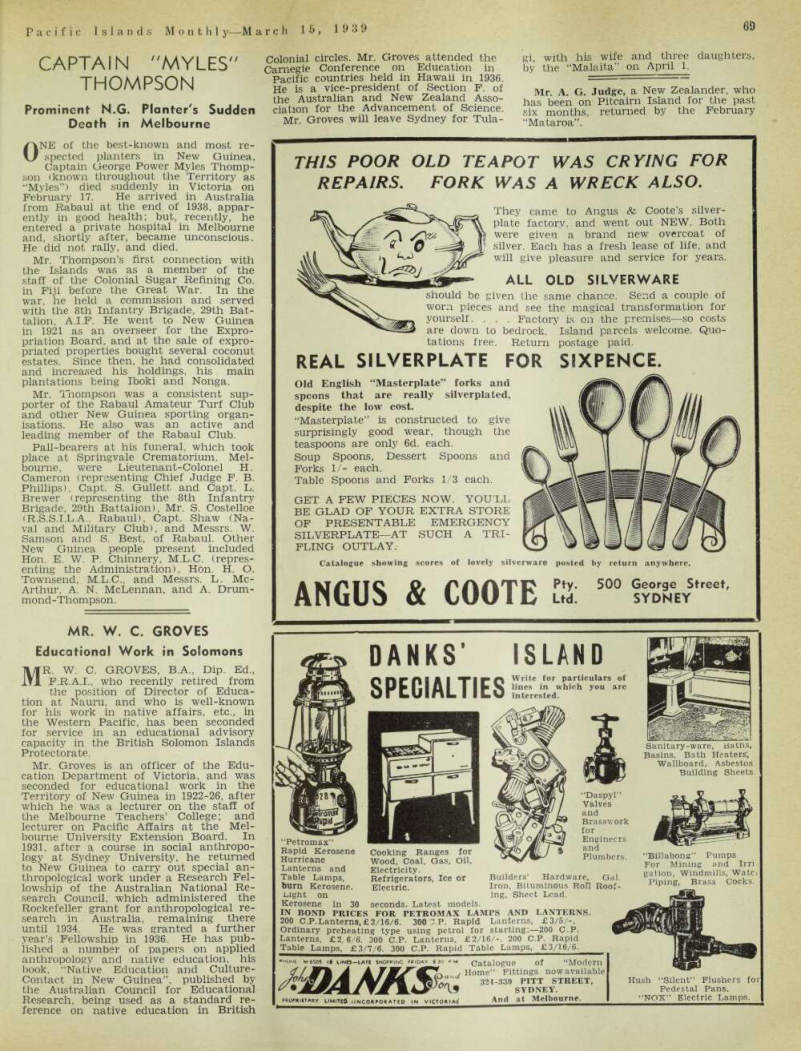
Thompson
Prominent N.G. Planter's Sudden Death in Melbourne
ONE of the best-known and most re spected planters in New Guinea, Captain George Power Myles Thomp son (known throughout the Territory as “Myles”) died suddenly in Victoria on February 17. He arrived in Australia from Rabaul at the end of 1938, appar ently in good health; but, recently, he entered a private hospital in Melbourne and, shortly after, became unconscious.
He did not rally, and died.
Mr. Thompson’s first connection with the Islands was as a member of the staff of the Colonial Sugar Refining Co. in Fiji before the Great War. In the war, he held a commission and served with the Bth Infantry Brigade, 29th Bat talion, A.I.F. He went to New Guinea in 1921 as an overseer for the Expro priation Board, and at the sale of expro priated properties bought several coconut estates. Since then, he had consolidated and increased his holdings, his main plantations being Iboki and Nonga.
Mr. Thompson was a consistent sup porter of the Rabaul Amateur Turf Club and other New Guinea sporting organ isations. He also was an active and leading member of the Rabaul Club.
Pall-bearers at his funeral, which took place at Springvale Crematorium. Mel bourne, were Lieutenant-Colonel H.
Cameron (representing Chief Judge F. B.
Phillips), Capt. S. Gullett and Capt. L.
Brewer (representing the Bth Infantry Brigade, 29th Battalion), Mr. S. Costelloe (R.S.S.I.L A„ Rabaul), Capt. Shaw (Na val and Military Club), and Messrs. W.
Samson and S. Best, of Rabaul. Other New Guinea people present included Hon. E. W. P. Chinnery, M.L.C. (repres enting the Administration). Hon. H. O.
Townsend, M.L.C., and Messrs. L. Mc- Arthur. A. N. McLennan, and A. Drum mond-Thompson.
Mr. W. C. Groves
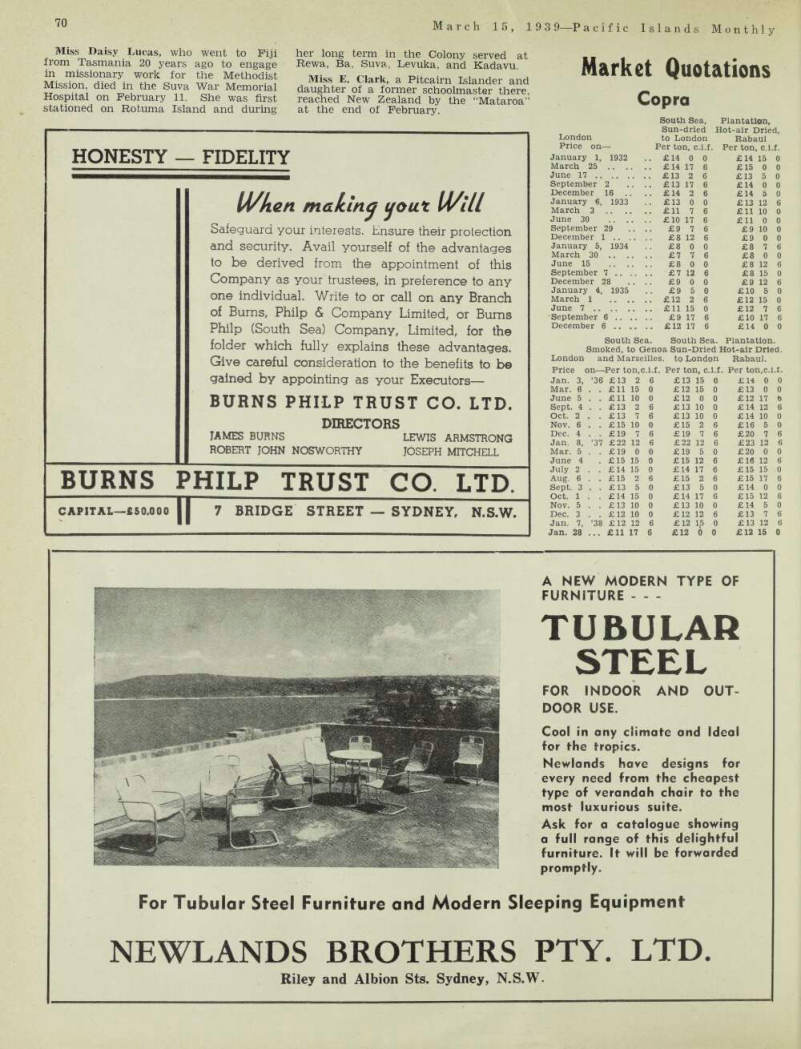
Educational Work in Solomons
MR. W. C. GROVES, 8.A., Dip. Ed., F.R.A.1., who recently retired from the position of Director of Educa tion at Nauru, and who is well-known for his work in native affairs, etc., in the Western Pacific, has been seconded for service in an educational advisory capacity in the British Solomon Islands Protectorate.
Mr. Groves is an officer of the Edu cation Department of Victoria, and was seconded for educational work in the Territory of New Guinea in 1922-26, after which he was a lecturer on the staff of the Melbourne Teachers’ College; and lecturer on Pacific Affairs at the Mel bourne University Extension Board. In 1931, after a course in social anthropo logy at Sydney University, he returned to New Guinea to carry out special an thropological work under a Research Fel lowship of the Australian National Re search Council, which administered the Rockefeller grant for anthropological re search in Australia, remaining there until 1934. He was granted a further year’s Fellowship in 1936. He has pub lished a number of papers on applied anthropology and native education, his book, “Native Education and Culture- Contact in New Guinea”, published by the Australian Council for Educational Research, being used as a standard re ference on native education in British
Colonial circles. Mr. Groves attended the Carnegie Conference on Education in Pacific countries held in Hawaii in 1936.
He is a vice-president of Section F. of the Australian and New Zealand Asso ciation for the Advancement of Science.
Mr. Groves will leave Sydney for Tula
gi with his wife and three daughters, by the “Malaita” on April 1.
Mr. A. G. Judge, a New Zealander, who has been on Pitcairn Island for the past six months, returned by the February “Mataroa”.
Miss Daisy Lucas, who went to Fiji from Tasmania 20 years ago to engage in missionary work for the Methodist Mission, died in the Suva War Memorial Hospital on February 11. She was first stationed on Rotuma Island and during
her long term in the Colony served at Rewa, Ba, Suva, Levuka, and Kadavu Miss E Clark a Pitcairn Tslanrfpr daughter of a former schoolmaster there. reached New Zealand by the “Mataroa” at the end of February.
Advertisements & other items, pp. 71-72 (2 items)
69
Pacific Islands Monthl y —M arch 15, 1939
Wanks?-
o THIS POOR OLD TEAPOT WAS CRYING FOR REPAIRS. FORK WAS A WRECK ALSO .
They came to Angus & Coote’s silverplate factory, and went out NEW. Both were given a brand new overcoat of silver. Each has a fresh lease of life, and will give pleasure and service for years.
ALL OLD SILVERWARE
should be given the same chance. Send a couple of worn pieces and see the magical transformation for yourself. . . . Factory is on the premises—so costs are down to bedrock. Island parcels welcome. Quotations free. Return postage paid.
REAL SILVERPLATE FOR SIXPENCE.
Old English “Masterplate” forks and spcons that are really silverplated, despite the low cost.
“Masterplate” is constructed to give surprisingly good wear, though the teaspoons are only 6d. each.
Soup Spoons, Dessert Spoons and Forks 1/- each.
Table Spoons and Forks 1/3 each.
GET A FEW PIECES NOW. YOU'LL
BE GLAD OF YOUR EXTRA STORE
OF PRESENTABLE EMERGENCY
SILVERPLATE—AT SUCH A TRI-
FLING OUTLAY.
Catalogue showing scores of lovely silverware posted by return anywhere.
ANGUS & COOTE
Pty. 500 George Street,
Ltd. SYDNEY
•n
BANKS’ ISLAND
SPECIALTIES
Write for particulars of lines in which you arc interested.
“Petromax”
Rapid Kerosene Hurricane Lanterns and Table Lamps, bum Kerosene.
Bight on Kerosene in 30 Cooking Ranges for Wood, Coal, Gas, Oil, Electricity.
Refrigerators, Ice or Electric.
Builders’ Hardware, Gal.
Iron, Bituminous Roll Roofing. Sheet Lead. seconds. Latest models.
IN BOND PRICES FOR PETROMAX LAMPS AND LANTERNS. 200 C.P.Lanterns,£2/16/6. 300 "P. Rapid Lanterns, £3/5/-.
Ordinary preheating type using petrol for starting:—2oo C.P.
Lanterns, £2,6/6. 300 C.P. Lanterns, £2/16/-. 200 C.P. Rapid Table Lamps, £3/7/6. 300 C.P. Rapid Table Lamps, £3/16/6. o‘ONt M 6505 I* LINES-LATE SHOPPING PBIDAY 830 PM Qund n*
PROPRIETARY LIMITED- (INCORPORATED IN VICTORIAII
wojuj iv w l l jnyrniNU rmiwsi o jg
WANKS?-
Catalogue of “Modern Home” Fittings now available
324-330 PITT STREET,
SYDNEY.
And at Melbourne.
Sanitary-ware, Baths, Basins. Bath Heaters’, Wallboard, Asbestos Building Sheets.
“Billabomz” Pumps For Mining and Irri gation, Windmills, Watei Piping, Brass Cocks.
Hush “Silent” Flushers for Pedestal Pans.
“NOX” Electric Lamps.
dsdfdf
■H R I
A NEW MODERN TYPE OF
FURNITURE
TUBULAR
STEEL
FOR INDOOR AND OUT-
DOOR USE.
Cool in ony climate and Ideal tor the tropics.
Newlands have designs for every need from the cheapest type of verandah chair to the most luxurious suite.
Ask for a catalogue showing a full range of this delightful furniture. It will be forwarded promptly.
For Tubular Steel Furniture and Modern Sleeping Equipment
NEWLANDS BROTHERS PTY. LTD.
Riley and Albion Sts. Sydney, N.S.W.
Market Quotations
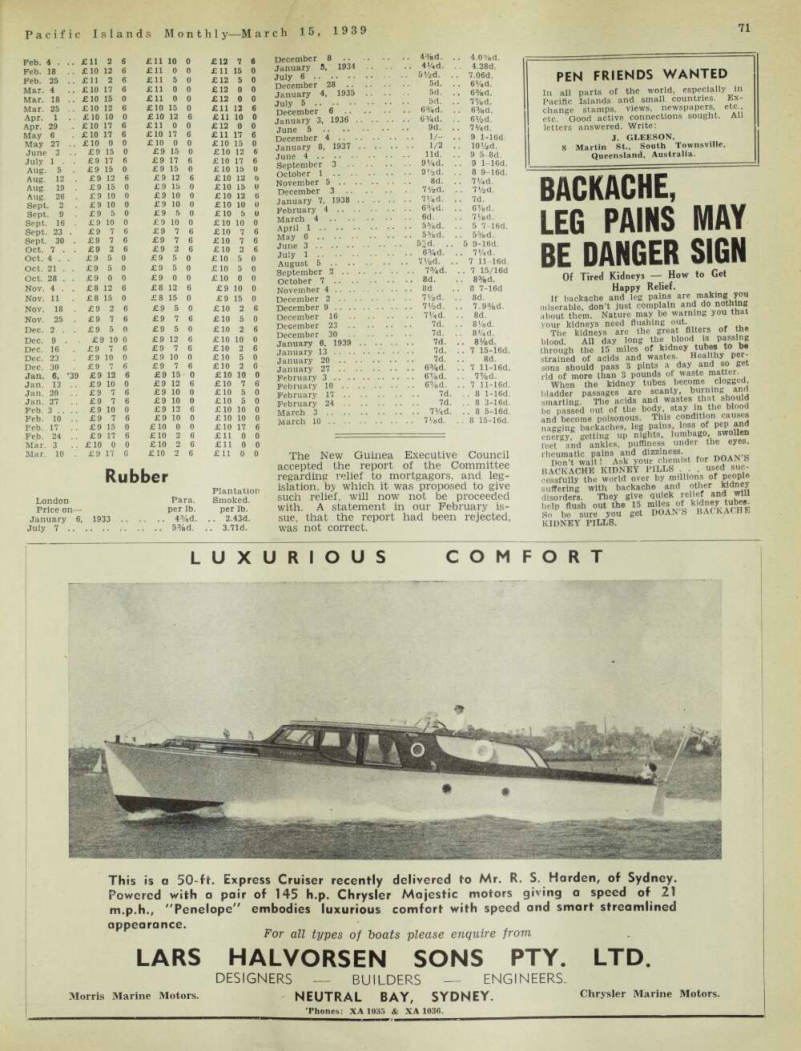
Copra
South Sea, Plantation, Sun-dried Hot-air Dried, London to London Rabaul Price on— Per ton, c.i.f.
Per ton, , c.l.I.
January 1, 1932 £14 0 0 £14 15 0 March 25 .. £14 17 6 £15 0 0 June 17 .. .. £13 2 6 £13 5 0 September 2 £13 17 6 £14 0 0 December 16 . £14 2 6 £14 5 0 January 6, 1933 £13 0 0 £13 12 6 March 3 .. £11 7 6 £11 10 0 June 30 £ 10 17 6 £11 0 0 September 29 £9 7 6 £9 10 0 December 1 .. £8 12 6 £9 0 0 January 5, 1934 £8 0 0 £8 7 6 March 30 .. £7 7 6 £8 0 0 June 15 £8 0 0 £8 12 6 September 7 .. £7 12 6 £8 15 0 December 28 £9 0 0 £9 12 6 January 4, 1935 £9 5 0 £10 5 0 March 1 £12 2 6 £12 15 0 June 7 .. .. £11 15 0 £12 7 6 September 6 .. £9 17 6 £10 17 6 December 6 .. £12 17 6 £14 0 0 South Sea South Sea.
Plantation.
Smoked, to Genoa Sun-Dried Hot-air Dried.
London and Marseilles, to London Rabaul.
Price on—Per ton,c.i.f. Per ton, c.l.I. , Per ton.c.i.i.
Jan. 3, ’36 £13 2 ( 3 £13 15 0 £14 0 0 Mar. 6 . . £11 15 0 £12 15 0 £13 0 0 June 5 . . £11 10 0 £12 0 0 £12 17 b Sept. 4 . . £13 2 6 £13 10 0 £14 12 6 Oct. 2 . . £13 7 6 £13 10 0 £14 10 0 Nov. 6 . . £15 10 0 £15 2 6 £16 5 0 Dec. 4 . . £19 7 ( 5 £ 19 7 6 £20 7 6 Jan. 8, ’37 £22 12 ( 3 £22 12 6 £23 12 6 Mar. 5 . . £19 0 0 £19 5 0 £20 0 0 June 4 . £15 15 C ) £15 12 6 £16 12 6 July 2 . . £14 15 I ) £14 17 6 £15 15 0 Aug. 6 . . £15 2 6 £15 2 6 £15 17 6 Sept. 3 . . £13 5 0 £13 5 0 £14 0 0 Oct. 1 . . £14 15 C ) £14 17 6 £15 12 6 Nov. 5 . . £13 10 C ) £13 10 0 £14 5 0 Dec. 3 . . £12 10 ( ) £12 12 6 £13 7 6 Jan. 7, ’38 £12 12 ( 3 £12 15 0 £13 12 6 Jan. 28 ... £11 17 6 1 £12 6 0 £12 15 0
The New Guinea Executive Council accepted the report of the Committee regarding relief to mortgagors, and leg islation, by which it was proposed to give such relief, will now not be proceeded with. A statement in our February is sue, that the report had been rejected, was not correct.
December 8 . 4.0%d.
January 3, 1934 . . . . 4*/ 4 d. . 4 28d.
July 6 . 7.06d.
December 28 . .. 5d. . 6V 4 d.
January 4, 1935 . . . . 6%d.
July 5 . 7Y 8 d.
December 6 . .. 6 3 / 4 d. . . 6 3 /sd.
January 3, 1936 . . .. . . .. 6 3 / 4 d. . . 6»/ 2 d.
June 5 . 7 l / 4 d.
December 4 . 9 l-16d January 8, 1937 . . . . . 10'/ 2 d.
June 4 .. .. lid. . . 9 5-8d.
September 3 .. .. 9 V 4 d. . . 9 l-16d.
October 1 . 8 9-16d.
November 5 . . . . 8d. . 7>/ 4 d.
December 3 . . . 7V 2 d. . . 7V a d.
January 7, 1938 .. . . .. . . 7 , / 4 d. . . 7d.
February 4 .. .. 6 3 / 4 d. . . ey 8 d.
March 4 ., . . 6d. . 7V 8 d.
April 1 . 5 7-16d.
May 6 . 5 s / 8 d.
June 3 55d. .. 5 9-16d.
July 1 . . .. 6 3 / 4 d. . ,. 7V 4 d.
August 5 . 7 ll-16d.
September 2 .. 7 15/16d October 7 . . 8%d.
November 4 .. .. 8d . 8 7-16d December 2 .. .. 7V 2 d. . . 8d.
December 9 ,. 7.9%d.
December 16 .. .. 7>/ 4 d. . . 8d.
December 23 .. .. .. 7d. . 8Vad.
December 30 .. .. 7d. . 8V 4 d.
January 6, 1939 .. .. ... 7d. .. SVsd.
January 13 ... 7d. .. 7 15-16d.
January 20 8d.
January 27 .. 7 ll-16d.
February 3 . . 7 7 /ad.
February 10 .. 7 ll-16d.
February 17 ... 7d. .. 8 l-16d.
February 24 ... 7d. .. 8 3-16d.
March 3 .. .. 7>/ 4 d. .. 8 5-16d.
March 10 .. .. 7V 8 d. .. 8 15-16d.
Feb. 4 . .. £11 2 6 £11 10 0 £12 7 6 Feb. 18 £10 12 6 £11 0 0 £11 15 0 Feb. 25 . . £11 2 6 £11 5 0 £12 5 0 Mar. 4 .. £10 17 6 £11 0 0 £12 0 0 Mar. 18 .. £10 15 0 £11 0 0 £12 0 0 Mar. 25 . . £ 10 12 6 £10 15 0 £11 12 6 Apr. 1 . • £10 10 0 £10 12 6 £11 10 0 Apr. 29 £10 17 6 £11 0 0 £12 0 0 May 6 £10 17 6 £10 17 6 £11 17 6 May 27 .. £10 0 0 £10 0 0 £10 15 0 June 3 .. £9 15 0 £9 15 0 £10 12 6 July 1 . • £9 17 6 £9 17 6 £10 17 6 Aug. 5 . £9 15 0 £9 15 0 £10 15 0 Aug. 12 £9 12 6 £9 12 6 £10 12 b Aug. 19 £9 15 0 £9 15 0 £10 15 0 Aug. 26 . £9 10 0 £9 10 0 £10 12 6 Sept. 2 £9 10 0 £9 10 0 £10 10 0 Sept. 9 £9 5 0 £9 5 0 £10 5 U Sept. 16 . £9 10 0 £9 10 0 £10 10 0 Sept. 23 . £9 7 6 £9 7 6 £10 7 6 Sept. 30 . £9 7 6 £9 7 6 £10 7 6 Oct. 7 . . £9 2 6 £9 2 6 £10 2 6 Oct. 4 . . £9 5 0 £9 5 0 £10 5 0 Oct. 21 . . £9 5 0 £9 5 0 £10 5 0 Oct. 28 . . £9 0 0 £9 0 0 £10 0 0 Nov. 4 . . £8 12 6 £8 12 6 £9 10 0 Nov. 11 £8 15 0 £8 15 0 £9 15 0 Nov. 18 . £9 2 6 £9 5 0 £10 2 6 Nov. 25 . £9 7 6 £9 7 6 £10 5 0 Dec. 2 . . £9 5 0 £9 5 0 £10 2 6 Dec. 9 . £S I 10 0 £9 12 6 £10 10 0 Dec. 16 £9 7 6 £9 7 6 £10 2 6 Dec. 23 £9 10 0 £9 10 0 £10 5 0 Dec. 30 £9 7 6 £9 7 6 £10 2 6 Jan. 6, ’39 £9 12 6 £9 15 0 £10 10 0 Jan. 13 .. £9 10 0 £9 12 6 £10 7 6 Jan. 20 £9 7 6 £9 10 0 £10 5 0 Jan. 27 .. £9 7 6 £9 10 0 £10 5 0 Feb. 3 .. .. £9 10 0 £9 12 6 £10 10 0 Feb. 10 . . £9 7 6 £9 10 0 £10 10 0 Feb. 17 .. £9 15 0 £10 0 0 £10 17 6 Feb. 24 .. £9 17 6 £10 2 6 £11 0 0 Mar. 3 .. £10 0 0 £10 2 6 £11 0 0 Mar. 10 .
London Price on— £9 17 G £10
Rubber
2 6 Para, per lb. £11 0 0 Plantation Smoked, per lb.
January 6 1, 1933 4%d. .. 2.43d July 7 .. 5%d. .. 3.71d.
Advertisements & other items, pp. 72-73 (3 items)
70
March 15, 193 9—P acific Islands Monthly
71
Pacific Islands Monthl y—M arch 15, 1939
Backache,
PEN FRIENDS WANTED
In all parts of the world, especially in Pacific Islands and small countries. Exchange stamps, views, newspapers etc etc. Good active connections sought. All letters answered. Write:
J. GLEESON,
8 Martin St., South Townsville, Queensland, Australia.
BACKACHE,
LEG PAINS MAY
BE BANGER SIGN
Of Tired Kidneys How to Get
Happy Relief.
If backache and leg pains are making you miserable, don’t just complain and do nothing about them. Nature may be warning you that your kidneys need flushing out.
The kidneys are the great filters of the blood. All day long the blood is Passing through the 15 miles of kidney tubes to be strained of acids and wastes. Healthy persons should pass 3 pints a day and so get rid of more than 3 pounds of waste matter.
When the kidney tubes become clogged, bladder passages are scanty, burning and smarting. The acids and wastes that should be passed out of the body, stay in the blood and become poisonous. This condition causes nagging backaches, leg pains, loss of pep and energy, getting up nights, lumbago, swollen feet and ankles, puffiness under the eyes, rheumatic pains and dizziness. n fuN’<s Don’t wait 1 Ask your chemist for DOAN b BACKACHE KIDNEY PILLS . . used successfully the world over by millions of people suffering with backache and other kidney disorders. They give quick relief and wHI help flush out the 15 miles )f k £ney SjSSt So be sure you get DOAN S BACKACHE
KIDNEY PILLS.
LUXURIOUS COMFORT
This is a SCMt. Express Cruiser recently delivered to Mr. R. S. Harden, of Sydney.
Powered with a pair of 145 h.p. Chrysler Majestic motors giving a speed of 21 m.p.h., "Penelope" embodies luxurious comfort with speed and smart streamlined appearance.
For all types of boats please enquire from
LARS HALVORSEN SONS PTY. LTD.
DESIGNERS BUILDERS ENGINEERS.
Morris Marine Motors. NEUTRAL BAY, SYDNEY. Chrysler Marine Motors. ’Phones: XA 1035 & XA 1036.
Islands Produce
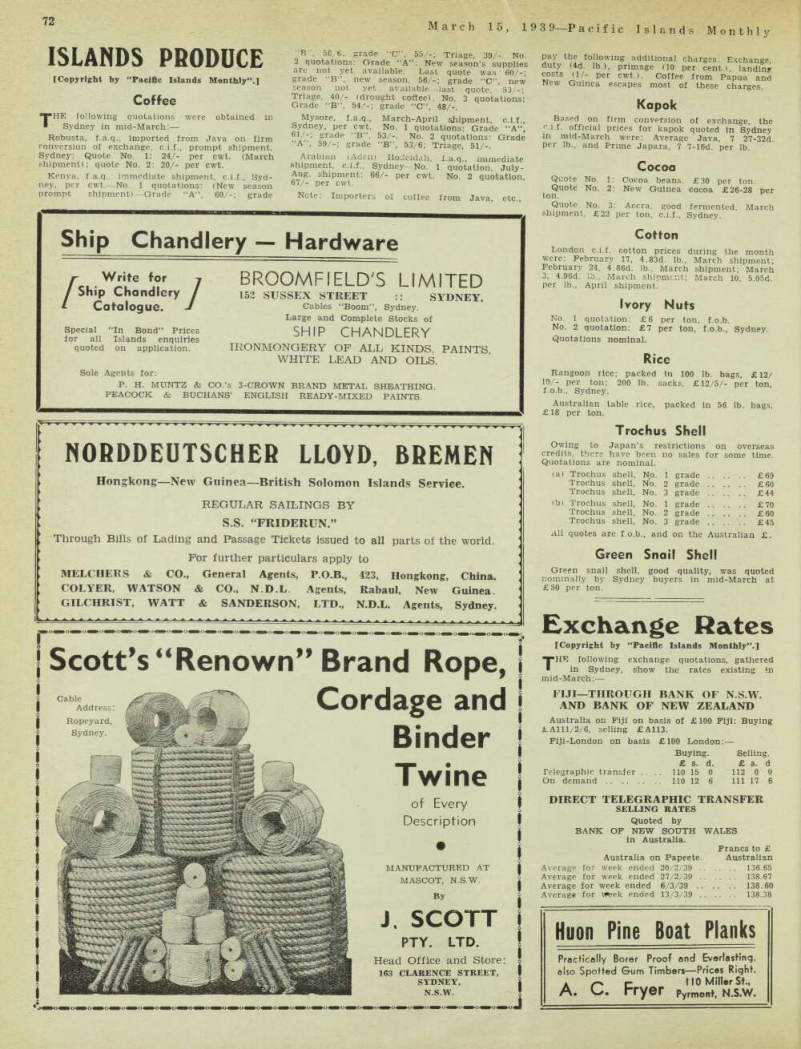
[Copyright by “Pacific Islands Monthly”.]
Coffee
THE following quotations were obtained in Sydney in mid-March:— Robusta, f.a.q., imported from Java on firm conversion of exchange, c.i.f,, prompt shipment, Sydney: Quote No. 1: 24/- per cwt. (March shipment); quote No. 2: 20/- per cwt.
Kenya, f.a.q.. immediate shipment, c.i.f., Syd ney, per cwt.—No. 1 quotations: (New season prompt shipment)—Grade “A”, 60/-; grade
B'. 58, 6, grade “C”, 55/-; Triage, 39/-. No. 2 quotations: Grade “A”: New season's supplies are not yet available. Last quote was 60/-; grade “B”, new season, 56/-; grade “C”, new season not yet available —last quote, 53/-; Triage, 40/- (drought coffee), No. 3 quotations: Grade “B”, 54/-; grade “C”, 48/-.
Mysore, f.a.q., March-April shipment, c.i.f., Sydney, per cwt. No. 1 quotations; Grade “A”, 61/-; grade “B”, 53/-. No. 2 quotations: Grade “ A ”, 59/-; grade “B”, 53/6; Triage, 51/-.
Arabian (Aden) Hodeidah, f.a.q., immediate shipment, c.i.f., Sydney—No. 1 quotation, July- Aug. shipment: 66/- per cwt. No. 2 quotation, 67/- per cwt.
Note: Importers of coffee from Java, etc.,
pay the following additional charges; Exchange duty (4d. lb.), primage (10 per cent.), landing costs (1/- per cwt.). Coffee from Papua and New Guinea escapes most of these charges.
Kapok
Based on firm conversion of exchange, the f-i f - official prices for kapok quoted in Sydney in mid-March were: Average Java, 7 27-32 d. per lb., and Prime Japara, 7 7-16 d. per lb.
Cocoa
Quote No. 1; Cocoa beans. £3O per ton.
Quote No. 2: New Guinea cocoa £26-28 per ton.
Quote No. 3: Accra, good fermented, March shipment, £22 per ton, c.i.f., Sydney.
Cotton
London c.i.f. cotton prices during the month were; February 17, 4.83 d. lb., March shipment; February 24, 4.86 d. lb., March shipment; March 3,4.96 d. lb., March shipment; March 10, 5.05 d. per lb., April shipment.
Ivory Nuts
No. 1 quotation: £6 per ton, f.o.b.
No. 2 quotation: £7 per ton, f.0.b., Sydney.
Quotations nominal.
Rice
Rangoon rice: packed in 100 lb. bags, £l2/ 10/- per ton; 200 lb. sacks, £l2/5/- per ton, f.0.b., Sydney.
Australian table rice, packed in 56 lb. bags, £lB per ton.
Trochus Shell
Owing to Japan’s restrictions on overseas credits, there have been no sales for some time.
Quotations are nominal. (a) Trochus shell, No. 1 grade £69 Trochus shell, No. 2 grade £6O Trochus shell, No. 3 grade £44 (b) Trochus shell, No. 1 grade £7O Trochus shell, No. 2 grade £6O Trochus shell, No. 3 grade £45 All quotes are f.0.b., and on the Australian £.
Green Snail Shell
Green snail shell, good quality, was quoted nominally by Sydney buyers in mid-March at £5O per ton.
Exchange Rates
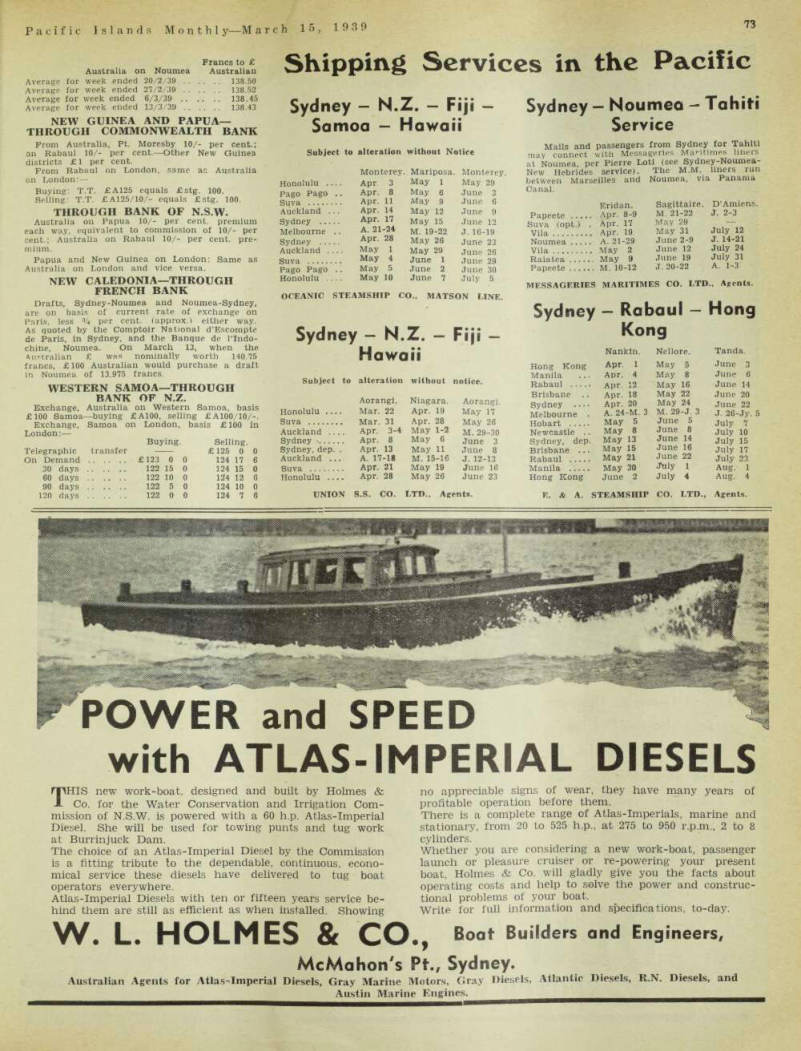
[Copyright by “Pacific Islands Monthly”.] THE following exchange quotations, gathered in Sydney, show the rates existing in mid-March:—
Fiji—Through Bank Of N.S.W.
And Bank Of New Zealand
Australia on Fiji on basis of £lOO Fiji: Buying £Alll/2/6, selling £AII3.
Flji-London on basis £lOO London: —
Direct Telegraphic Transfer
Selling Rates
Quoted by
Bank Op New South Wales
in Australia.
Buying. Selling. £ s. d. £ s. d Telegraphic transfer ... 110 15 0 112 0 0 On demand 110 12 6 111 17 6
Francs to £ Australia on Papeete.
Australian Average for week ended 20/2/39 .. .. .. 136.65 Average for week ended 27/2/39 .. . . . . 138.67 Average for week ended 6/3/39 .. .. .. 138.60 Average for \feek ended 13/3/39 .. .. .. 138.38
New Guinea And Papua
Through Commonwealth Bank
From Australia, Pt. Moresby 10/- per cent.; on Rabaul 10/- per cent.—Other New Guinea districts £1 per cent.
From Rabaul on London, same as Australia on London:— Buying: T.T. £AI2S equals £stg. 100.
Selling: T.T. £AI2S/10/- equals £stg. 100.
Through Bank Of N.S.W.
Australia on Papua 10/- per cent, premium each way. equivalent to commission of 10/- per cent.; Australia on Rabaul 10/- per cent, pre mium.
Papua and New Guinea on London: Same as Australia on London and vice versa.
New Caledonia—Through
French Bank
Drafts, Sydney-Noumea and Noumea-Sydney, are on basis of current rate of exchange on Paris, less 3 A per cent, (approx.) either way.
As quoted by the Comptoir National d’Escompte de Paris, in Sydney, and the Banque de ITndo chine, Noumea. On March 13, when the Australian £ was nominally worth 140.75 francs, £lOO Australian would purchase a draft in Noumea of 13,975 francs.
Western Samoa—Through
Bank Of N.Z.
Exchange, Australia on Western Samoa, basis £lOO Samoa—buying £AIOO, selling £AIOO/10/-.
Exchange, Samoa on London, basis £ 100 in London:—
Francs to £ Australia on Noumea Australian Average for week ended 20/2/39 . .
Average for week ended 27/2/39 . . . . .. 138.52 Average for week ended 6/3/39 ..
Average for week ended 13/3/39 . . . . .. 138.43
Buying. Selling.
Telegraphic transfer £ 125 0 0 On Demand £123 0 0 124 17 6 30 days 122 15 0 124 15 0 60 days 122 10 0 124 12 G 90 days 122 5 0 124 10 0 120 days 122 0 0 124 7 6
Advertisements & other items, p. 74 (2 items)
Cordage and
Ship Chandlery Hardware
/Write for j
Ship Chandlery /
Catalogue. J
Catalog
Special “In Bond” Prices for all Islands enquiries quoted on application.
BROOMFIELD'S LIMITED
152 SUSSEX STREET :: SYDNEY.
Cables “Boom”, Sydney.
Large and Complete Stocks of
SHIP CHANDLERY
IRONMONGERY OF ALL KINDS, PAINTS,
WHITE LEAD AND OILS.
Sole Agents for: P. H. MUNTZ & CO.’S 3-CROWN BRAND METAL SHEATHING.
PEACOCK & BUCHANS’ ENGLISH READY-MIXED PAINTS.
NORDDEUTSCHER LLOYD, BREMEN
Hongkong—New Guinea—British Solomon Islands Service.
REGULAR SAILINGS BY
S.S. “FRIDERUN.”
Through Bills of Lading and Passage Tickets issued to all parts of the world.
For further particulars apply to MELCHERS & CO., General Agents, P. 0.8., 423. Hongkong, China.
COLYER, WATSON & CO., N.D.L. Agents, Rabaul, New Guinea.
GILCHRIST, WATT & SANDERSON, LTD., N.D.L. Agents, Sydney.
Scott’s “Renown” Brand Rope,
Cordage and
Binder
Twine
Cable Address: Ropeyard, Sydney. ■>-
of Every
Description
MANUFACTURED AT
MASCOT, N.S.W.
By
J. SCOTT
PTY. LTD.
Head Office and Store:
163 CLARENCE STREET,
SYDNEY,
N.S.W.
Huon Pine Boat Planks
Practically Borer Proof and Everlasting, also Spotted Sum Timbers —Prices Right. * /-» p MO Miller St M v. i ry©T Pyrmont, N.S.W.
Shipping Services in the Pacific
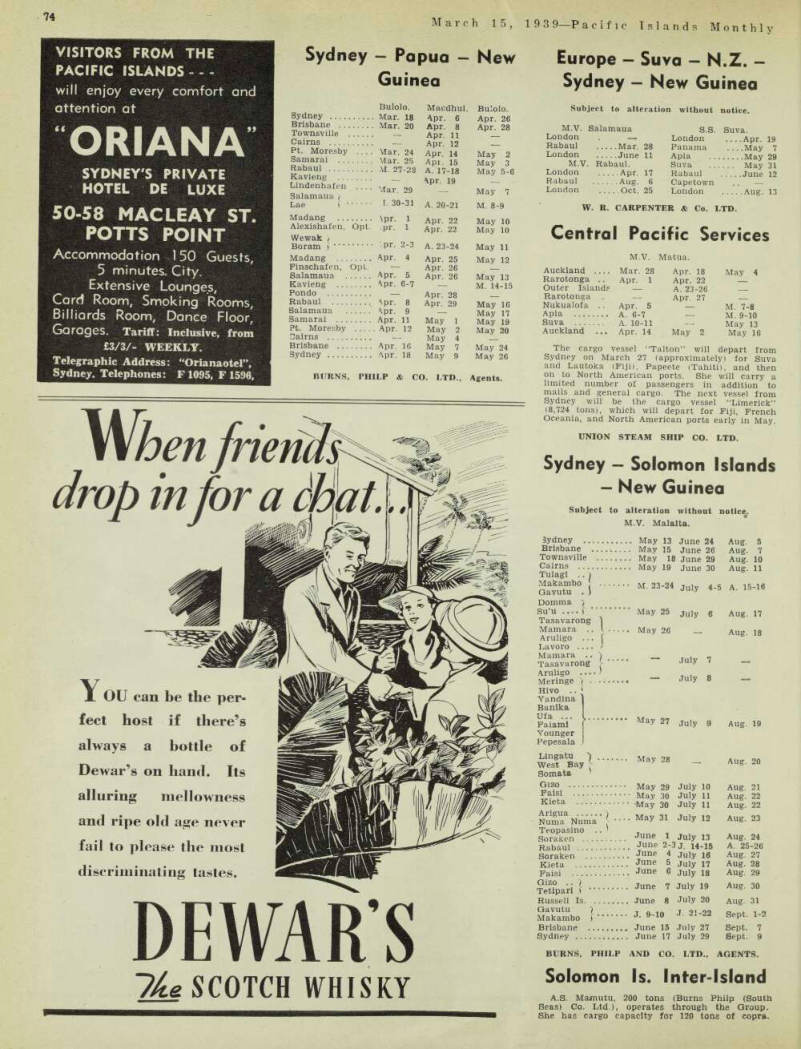
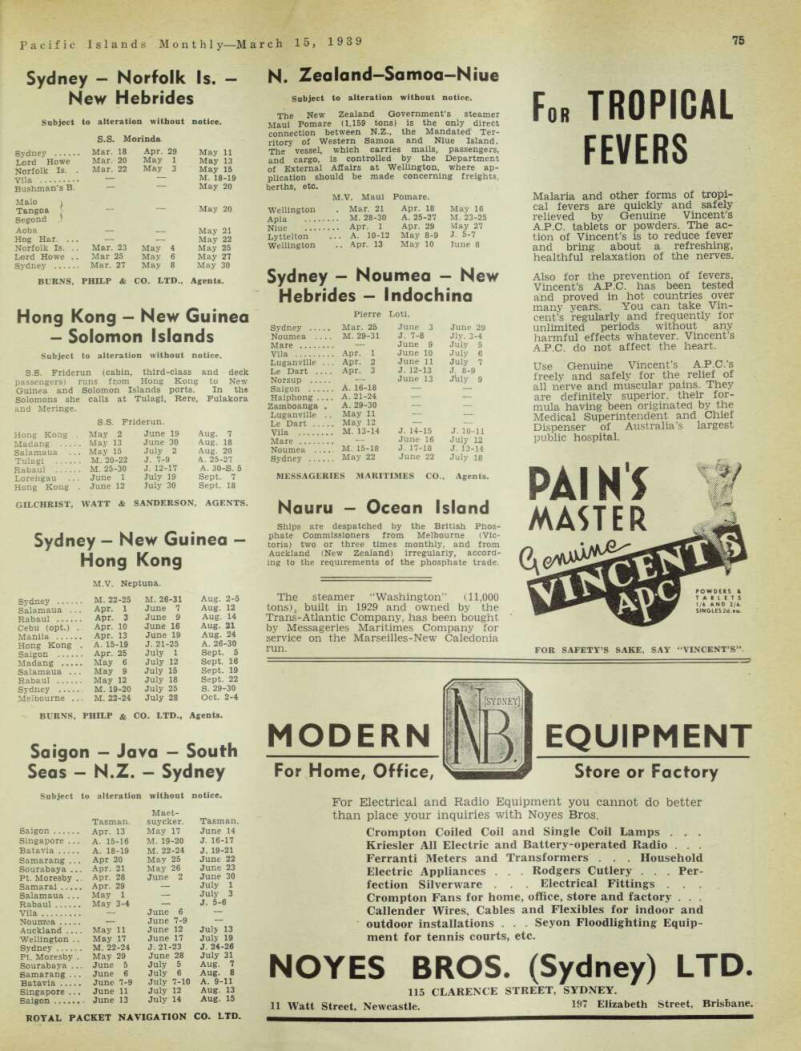
Sydney - N.Z. - Fiji - Samoa - Hawaii Subject to alteration without Notice
Oceanic Steamship Co., Matson Line.
Sydney - N.Z. - Fiji - Hawaii Subject to alteration without notice.
Sydney — Noumea — Tahiti
Service
Mails and passengers from Sydney for Tahiti may connect with Messageries Mantimes liners at Noumea, per Pierre Loti (see Sydney-Noumea- New Hebrides service). The M.M. liners run between Marseilles and Noumea, via Panama Canal.
Sydney Rabaul Hong Kong
Monterey.
Mariposa.
Monterey.
Honolulu Apr 3 May 1 May 29 Pago Pago ..
Apr. 8 May 6 June 3 Suva Apr. 11 May 9 June 6 Auckland ...
Apr. 14 May 12 June 9 Sydney Apr. 17 May 15 June 12 Melbourne ..
A. 21-24 M. 19-22 J. 16- 19 Sydney Apr. 28 May 26 June 23 Auckland May 1 May 29 June 26 Suva May 4 June 1 June 29 Pago Pago ..
May 5 June 2 June 30 Honolulu May 10 June 7 July 5
Aorangl.
Niagara.
Aorangi.
Honolulu ...
Mar. 22 Apr. 19 May 17 Suva Mar. 31 Apr. 28 May 26 Auckland Apr. 3-4 May 1-2 M. 29-30 Sydney • Apr. 8 May 6 June 3 Sydney, dep. .
Apr. 13 May 11 June 8 Auckland ...
A. 17-18 M. 15-16 J. 12-13 Suva Apr. 21 May 19 June 16 Honolulu ...
Apr. 28 May 26 June 23
Union
S.S. Co.
LTD., Agents.
Eridan. Sagittaire. D’Amiens.
Papeete Apr. 8-9 M. 21-22 J. 2-3 Suva (opt.) . Apr. 17 May 29 — Vila Apr. 19 May 31 July 12 Noumea A. 21-29 June 2-9 J. 14-21 Vila ... Mav 2 June 12 July 24 Raiatea May 9 June 19 July 31 Papeete M.10-12 J.20-22 A. 1-3 MESSAGERIES MARITIMES CO. LTD.. A R cnts.
Nankin.
Nellore.
Tanda.
Hong Kong Apr 1 May 5 June 3 Manila Apr. 4 May 8 June 6 Rabaul Apr. 12 May 16 June 14 Brisbane ..
Apr. 18 May 22 June 20 Sydney Apr. 20 May 24 June 22 Melbourne .
A. 24-M. 3 M. 29-J. 3 J. 26-Jy. 5 Hobart May 5 June 5 July 7 Newcastle ..
May 8 June 8 July 10 Sydney, dep, May 13 June 14 July 15 Brisbane ...
May 15 June 16 July 17 Rabaul May 21 June 22 July 23 Manila May 30 July 1 Aug. 1 Hong Kong June 2 July 4 Aug. 4 E. & A.
Steamship
Co. Ltd.,
Agents.
Sydney - Papua - New Guinea
Burns, Philp & Co. Ltd., Agents.
Europe - Suva - N.Z. - Sydney New Guinea Subject to alteration without notice.
W. R. Carpenter & Co. Ltd.
Central Pacific Services
The cargo vessel “Talton” will depart from Sydney on March 27 (approximately) for Suva and Lautoka (Fiji), Papeete (Tahiti), and then on to North American ports. She will carry a limited number of passengers in addition to mails and general cargo. The next vessel from Sydney will be the cargo vessel “Limerick” (8,724 tons), which will depart for Fiji, French Oceania, and North American ports early in May.
Union Steam Ship Co. Ltd.
Sydney - Solomon Islands
New Guinea
Subject to alteration without notice.
M.V. Malalta.
Burns, Philp And Co. Ltd., Agents.
Solomon Is. Inter-Island
A.S. Maanutu, 200 tons (Burns Philp (South Seas) Co. Ltd.), operates through the Group.
She has cargo capacity for 120 tons of copra.
Sydney ...
Brisbane ..
Townsville Bulolo.
Mar. 18 Macdhui.
Apr. 6 Apr. 8 Apr. 11 Apr. 12 Apr. 14 Api. 15 A. 17-18 Apr. 19 Bulolo.
Apr. 26 Apr. 28 Cairns Pt. Moresby Samarai . ..
Rabaul Kavieng ...
Lindenhafen Salamaua t VTar. 24 Mar. 25 Mar. 29 I. 30-31 May 2 May 3 May 5-6 May 7 Lae s ■ A. 20-21 M. 8-9 Madang Alexishafen, Wewak \ Opt. \pr. 1 pr. 1 pr. 2-3 Apr. 22 Apr. 22 May 10 May 10 Boram ( • • • • A. 23-24 May 11 Madang . . .
Pinschafen, Salamaua Kavieng ...
Pondo Opt.
Apr. 4 Apr. 5 Apr. 6-7 Apr. 25 Apr. 26 Apr. 26 May 12 May 13 M. 14-15 Rabaul . .. .
Salamaua Samarai . ..
Pt. Moresby Cairns Brisbane ...
Sydney Apr. 8 Apr. 9 Apr. 11 . Apr. 12 Apr. 1C Apr. 18 Apr. 29 May 1 May 2 May 4 May 7 May 9 May 16 May 17 May 19 May 20 May 24 May 26
M.V.
Salamaua S.S.
Suva.
London — London Apr. 19 Rabaul Mar. 28 Panama . . . .Mav 7 London June 11 Apia M.V. Rabaul.
Suva 31 London Apr. 17 Rabaul 12 Rabaul Aug. 6 Capetown London Oct. 25 London Aug. 13
M.V. Matua.
Auckland Mar. 28 Apr. 18 May 4 Rarotonga .. Apr. 1 Apr. 22 — Outer Islands — A. 23-26 — Rarotonga . — Apr. 27 — Nukualofa . . Apr. 5 — M. 7-8 Apia A. 6-7 — M. 9-10 Suva A. 10-11 May 13 Auckland ... Apr. 14 May 2 May 16
Sydney June 24 Aug. 5 Brisbane 15 June 26 Aug. 7 Townsville 18 June 29 Aug. 10 cairns 19 June 30 Aug. 11 Tulagl . ) Makambo ( ( 0/1 July 4-5 Gavutu 1 A. la-io Domma ) Su’u May 25 July 6 Aug. 17 Tasavarong Mamara Aruligo — Aug. 18 Lavoro .
Mamara •• 'I July 7 Tasavarong .
Aruligo .
July 8 Hivo ..
Yandina Banika Ufa ...
Paiaml July 9 Aug. 19 Younger Pepesala Lingatu 1 . no Aug. 20 West Bay ay Zo — Somata Gizo ...
July 10 Aug.
Aug. 21 Paisi July 11 22 Kieta ..
July 11 Aug. 22 Arigua Numa Numa 1 May 31 July 12 Aug. 23 Teopasino ..
Soraken . ...
June i July 13 Aug. 24 Rabaul ..
June 2-3 J. 14-15 A. 25-26 Soraken June 4 July 16 Aug. 27 Kieta ..
June 5 July 17 Aug. 28 Paisi ...
June 6 July 18 Aug. 29
Gizo ..
Tetipari J 7 July 19 Aug. 30 Russell Is. .. 8 July 20 Aug. 31 Gavutu Makambo > J. 9-10 J. 21-22 Sept. 1-2 Brisbane 15 July 27 Sept. 7 Sydney .. 17 July 29 Sept. 9
Sydney Norfolk Is.
New Hebrides Subject to alteration without notice.
Burns, Philp & Co. Ltd., Agents.
Hong Kong - New Guinea
- Solomon Islands
Subject to alteration without notice, S.S. Friderun (cabin, third-class and deck passengers) runs from Hong Kong to New Guinea and Solomon Islands ports. In th« Solomons she calls at Tulagi, Here, Fulakora and Meringe.
Gilchrist, Watt & Sanderson, Agents.
Sydney - New Guinea - Hong Kong
Burns, Philp & Co. Ltd., Agents.
Saigon - Java South Seas - N.Z. - Sydney Subject to alteration without notice.
N. Zealand—Samoa—Niue
Subject to alteration without notice.
The New Zealand Government’s steamer Maui Pomare (1,159 tons) is the only direct connection between N.Z., the Mandated' Ter ritory of Western Samoa and Niue Island.
The vessel, which carries mails, passengers, and cargo, is controlled by the Department of External Affairs at Wellington, where ap plication should be made concerning freights, berths, etc.
Sydney - Noumea - New Hebrides Indochina
Nauru - Ocean Island
Ships are despatched by the British Phos phate Commissioners from Melbourne (Vic toria) two or three times monthly, and from Auckland (New Zealand) irregularly, accord ing to the requirements of the phosphate trade.
The steamer “Washington” (11,000
built in 1929 and owned by the Trans-Atlantic Company, has been bought by Messageries Maritimes Company for service on the Marseilles-New Caledonia run.
S.S. Morinda Svdney Mar. 18 Apr. 29 May 11 Lord Howe Mar. 20 May 1 May 13 Norfolk Is. .
Mar. 22 May 3 May 15 Vila — — M. 18-19 Bushman’s B. — — May 20 Malo Tangoa
Segond )
May 20 Aoba — — May 21 Hog Har. ... — — May 22 Norfolk Is. ..
Mar. 23 May 4 May 25 Lord Howe ..
Mar 25 May 6 May 27 Sydney Mar. 27 May 8 May 30
S.S. Friderun.
Hong Kong .
May 2 June 19 Aug. 7 Madang . May 13 June 30 Aug. 18 Salamaua .. . May 15 July 2 Aug. 20 Tulagi . M. 20-22 J. 7-9 A. 25-27 Rabaul . M. 25-30 J. 12-17 A. 30-S. 5 Lorengau ...
June 1 July 19 Sept. 7 Hong Kong June 12 July 30 Sept. 18
M.V. Neptuna.
Sydney M. 22-25 M. 26-31 Aug. 2-5 Salamaua ...
Apr. 1 June 7 Aug. 12 Rabaul Apr. 3 June 9 Aug. 14 Cebu (opt.) .
Apr. 10 June 16 Aug. 21 Manila Apr. 13 June 19 Aug. 24 Hong Kong .
A. 15-19 J. 21-25 A.26-30 Saigon Apr. 25 July 1 Sept. 5 Madang May 6 July 12 Sept. 16 Salamaua ...
May 9 July 15 Sept. 19 Rabaul May 12 July 18 Sept. 22 Sydney M. 19-20 July 25 S. 29-30 Melbourne .. . M. 22-24 July 28 Oct. 2-4
Saigon Tasman.
Apr. 13 Maetsuycker.
May 17 Tasman.
June 14 Singapore ...
A. 15-16 M. 19-20 J. 16-17 Batavia A. 18-19 M. 22-24 J. 19-21 Samarang ...
Apr 20 May 25 June 22 Sourabaya ...
Apr. 21 May 26 June 23 Pt. Moresby .
Apr. 28 June 2 June 30 Samarai Apr. 29 — July 1 Salamaua ...
May 1 — July 3 Rabaul May 3-4 — J. 5-6 Vila — June 6 — Noumea — June 7-9 — Auckland May 11 June 12 July 13 Wellington ..
May 17 June 17 July 19 Sydney M.22-24 J. 21-23 J. 24-26 Pt. Moresby .
May 29 June 28 July 31 Sourabaya ...
June 5 July 5 Aug. 7 Samarang ...
June 6 July 6 Aug. 8 Batavia June 7-9 July 7-10 A. 9-11 Singapore ...
June 11 July 12 Aug. 13 Saigon . June 13 July 14 Aug. 15
Royal Packet Navigation
Co. Ltd.
M.V. Maui Pomare.
Wellington . Mar. 21 Apr. 18 May 16 Apia ... ... M. 28-30 A. 25-27 M. 23-25 Niue Apr. 1 Apr. 29 May 27 Lyttelton ... A. 10-12 May 8-9 J. 5-7 Wellington .. Apr. 13 May 10 June 8
Sydney Pierre Mar. 25 Loti.
June 3 June 29 Noumea ... . M. 29-31 J. 7-8 Jly. 3-4 Mare — June 9 July 5 Vila . Apr. 1 June 10 July 6 Luganville .. . Apr. 2 June 11 July 7 Le Dart ... . Apr. 3 J. 12-13 J. 8-9 Norsup — June 13
Jhly 9
Saigon . A. 16-18 — — Haiphong ... , A. 21-24 — — Zamboanga .
A. 29-30 — — Luganville . . May 11 — — Le Dart , May 12 — — Vila . M. 13-14 J. 14-15 J. 10-11 Mare — June 16 July 12 Noumea M. 15-18 J. 17-18 J. 13-14 Sydney , May 22 June 22 July 18
Messageries Makitimes Co.,
Agents.
Advertisements & other items, pp. 75-77 (3 items)
73
Pacific Islands Monthl y—M arch 15, 1939
With Atlas-Imperial Diesels
POWER and SPEED
THIS new work-boat, designed and built by Holmes & Co. for the Water Conservation and Irrigation Commission of N.S.W. is powered with a 60 h.p. Atlas-Imperial Diesel. She will be used for towing punts and tug work at Burrinjuck Dam.
The choice of an Atlas-Imperial Diesel by the Commission is a fitting tribute to the dependable, continuous, economical service these diesels have delivered to tug boat operators everywhere.
Atlas-Imperial Diesels with ten or fifteen years service behind them are still as efficient as when installed. Showing no appreciable signs of wear, they have many years of profitable operation before them.
There is a complete range of Atlas-Imperials, marine and stationary, from 20 to 525 h.p., at 275 to 950 r.p.m., 2 to 8 cylinders.
Whether you are considering a new work-boat, passenger launch or pleasure cruiser or re-powering your present boat, Holmes & Co. will gladly give you the facts about operating costs and help to solve the power and constructional problems of your boat.
Write for full information and specifications, to-day.
W. L. HOLMES & CO., Boat Builders and Engineers,
McMahon's Pt., Sydney.
Australian Agents for Atlas-Imperial Diesels, Gray Marine Motors, Gray Diesels, Atlantic Diesels, R.N. Diesels, and Austin Marine Engines.
VISITORS FROM THE
PACIFIC ISLANDS --
will enjoy every comfort and attention at
ORIANA
SYDNEY'S PRIVATE
HOTEL DE LUXE
50-58 MACLEAY ST.
POTTS POINT
Accommodation 150 Guests, 5 minutes. City.
Extensive Lounges, Card Room, Smoking Rooms, Billiards Room, Dance Floor, Garages. Tariff: Inclusive, from
£3/3/- WEEKLY.
Telegraphic Address: “Orianaotel”, Sydney. Telephones: F 1095, F 1596,
\\hen friemls
drop in for a chat.
m Ji \ X Y OU can be the perfect host if there’s always a bottle of Dewar’s on hand. Its alluring mellowness and ripe old age never fail to please the most discriminating tastes.
DEWAR’S
1/lb scotch whisky
For TROPICAL
FEVERS
Malaria and other forms of tropical fevers are quickly and safely relieved by Genuine Vincent’s A.P.C. tablets or powders. The action of Vincent’s is to reduce fever and bring about a refreshing, healthful relaxation of the nerves.
Also for the prevention of fevers, Vincent’s A.P.C. has been tested and proved in hot countries oyer many years. You can take Vincent’s regularly and frequently for unlimited periods without any harmful effects whatever. Vincent’s A.P.C. do not affect the heart.
Use Genuine Vincent’s A.P.C.’s freely and safely for the relief of all nerve and muscular pains. They are definitely superior, their formula having been originated by the Medical Superintendent and Chief Dispenser of Australia’s largest public hospital.
FOR SAFETY’S SAKE. SAY “VINCENT’S”.
PAI MS 7
MASTER
POWDERS t
TABLETS
I/* AND 2/4.
SINGLES 2d. eo
MODERN
For Home, Office,
(SYDNEY]
j EQUIPMENT
Store or Factory
For Electrical and Radio Equipment you cannot do better than place your inquiries with Noyes Bros.
Crompton Coiled Coil and Single Coil Lamps . . .
Kriesler All Electric and Battery-operated Radio . . .
Ferranti Meters and Transformers . . . Household Electric Appliances . . . Rodgers Cutlery . . . Perfection Silverware . . . Electrical Fittings . .
Crompton Fans for home, office, store and factory . . .
Callender Wires, Cables and Flexibles for indoor and outdoor installations . . Seyon Floodlighting Equipment for tennis courts, etc.
NOYES BROS. (Sydney) LTD.
115 CLARENCE STREET, SYDNEY.
11 Watt Street, Newcastle. 197 Elizabeth Street, Brisbane.
75
Pacific Islands Monthl y —M arch 15, 1939
Storm Disturbs Banana
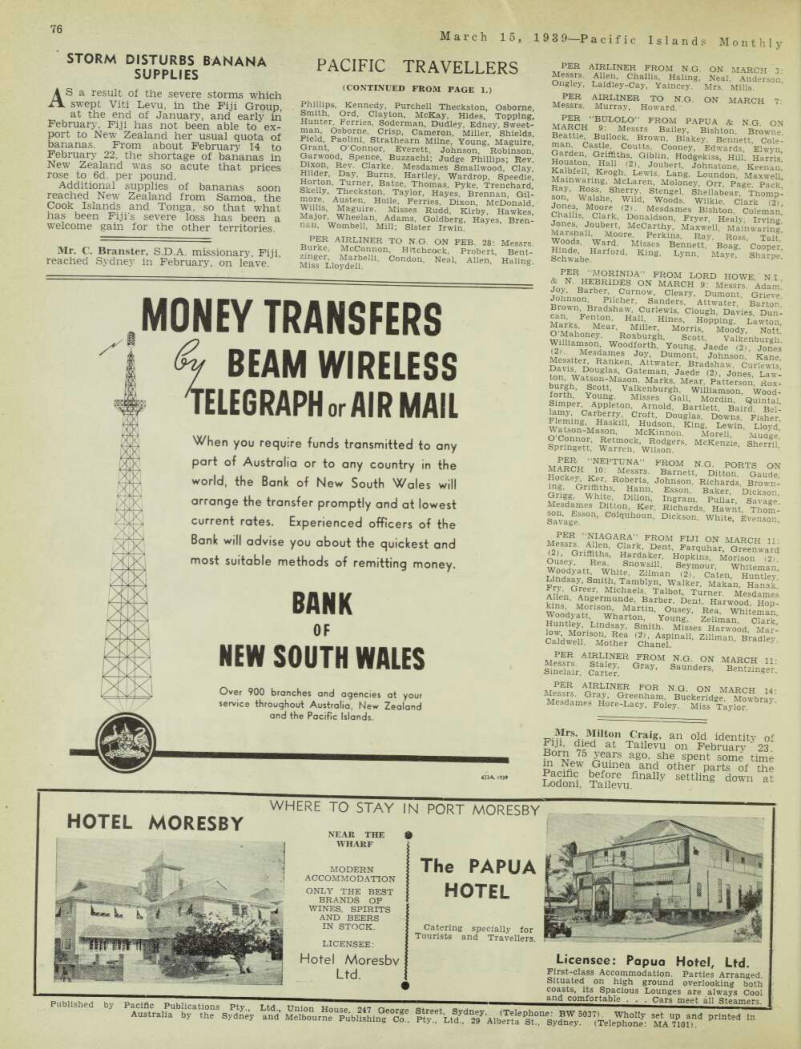
Supplies
AS a result of the severe storms which swept Vlti Levu, in the Fiji Group, at the end of January, and early in February. Fiji has not been able to ex port to New Zealand her usual quota of bananas. From about February 14 to February 22. the shortage of bananas in New Zealand was so acute that prices rose to 6d. per pound.
Additional supplies of bananas soon reached New Zealand from Samoa, the Cook Islands and Tonga, so that what has been Fiji's severe loss has been a welcome gain for the other territories.
Mr. C. Branster, S.D.A. missionary, Fiji, reached Sydney in February, on leave.
Advertisements & other items, pp. 78-80 (4 items)
Pacific Travellers
76
March 15, 193 9—P acific Islands Monthly
(CONTINUED FROM PAGE 1.)
Money Transfers
BEAM WIRELESS
ELEGRAPH or AIRMAIL
When you require funds transmitted to any part of Australia or to any country in the world, the Bank of New South Wales will arrange the transfer promptly and at lowest current rates. Experienced officers of the Bank will advise you about the quickest and most suitable methods of remitting money.
BANK
OF
NEW SOUTH WALES
Over 900 branches and agencies at your service throughout Australia, New Zealand and the Pacific Islands.
HOTEL MORESBY
WHERE TO STAY IN PORT MORESBY
NEAR THE $
WHARF
MODERN
ACCOMMODATION
ONLY THE BEST
BRANDS OF
WINES, SPIRITS
AND BEERS
IN STOCK.
LICENSEE:
Hotel Moresby
Ltd.
The PAPUA
HOTEL
Catering specially for Tourists and Travellers.
Licensee: Papua Hotel, Ltd.
First-class Accommodation. Parties Arranged.
Situated on high ground overlooking both coasts, its Spacious Lounges are always Cool and comfortable . . . Cars meet all Steamers.
A
UXH
mi
The Development
of the Territory
is linked up with GUINEA AIRWAYS
$ AIR TRANSPORT is responsible for New Guinea's rapid progress.
GUINEA AIRWAYS —the pioneer Air Transport Company in New Guinea —has carried an aggregate of 63,619 passengers and 44,000 tons of cargo by air in the past ten years.
GUINEA AIRWAYS is the largest freight-carrying service in the world.
Every type of goods can be carried—with speed and safety —by Guinea Airways.
GUINEA AIRWAYS LIMITED operate regular air services in New Guinea and Papua. They use over fifty aerodromes and landing grounds in the two Territories.
GUINEA AIRWAYS PLANES depart from Port Moresby for the Goldfield on the arrival of each boat. Tickets are obtainable from the Purser.
Insist on flying with the pioneer Company both in New Guinea and in Australia, Australian Services:
ASK FOR PARTICULARS REGARDING THE
REGULAR ADEL AIDE-DARWIN SERVICE.
LIMITED
LAE-SAL A MALI A
Head Office: Austral Chambers, New Guinea Office: Lae, Currie Street, Adelaide, S.A. Mandated Territory of New Guinea BRANCH OFFICES AND AGENTS AT WAU— SALAMAUA—PORT MORESBY AND SYDNEY.
Z 7 ™
UIM
9
'A
SCH
& ft* H* p!L> / r* y f/
WELCOME CARGO
9
r->j\ n
\ 0\ E ■ M ry
PILSENER
C*» fv, £ uW ♦ / A P1u.27 «5x !l*cir / ** -<r ,L *fN? wifi 4 >
SSS
$ pi m **S C H P >U "Lower away” —and what a welcome cargo it is!
Resets Pilsener—in the famous long bottle—the drink which eases the white man’s burden!
Call for a bottle to-night and relish its malt and
hop flavour.
RESCH’S
LONG BOTTLE