Advertisements & other items, pp. 1-2 (3 items)
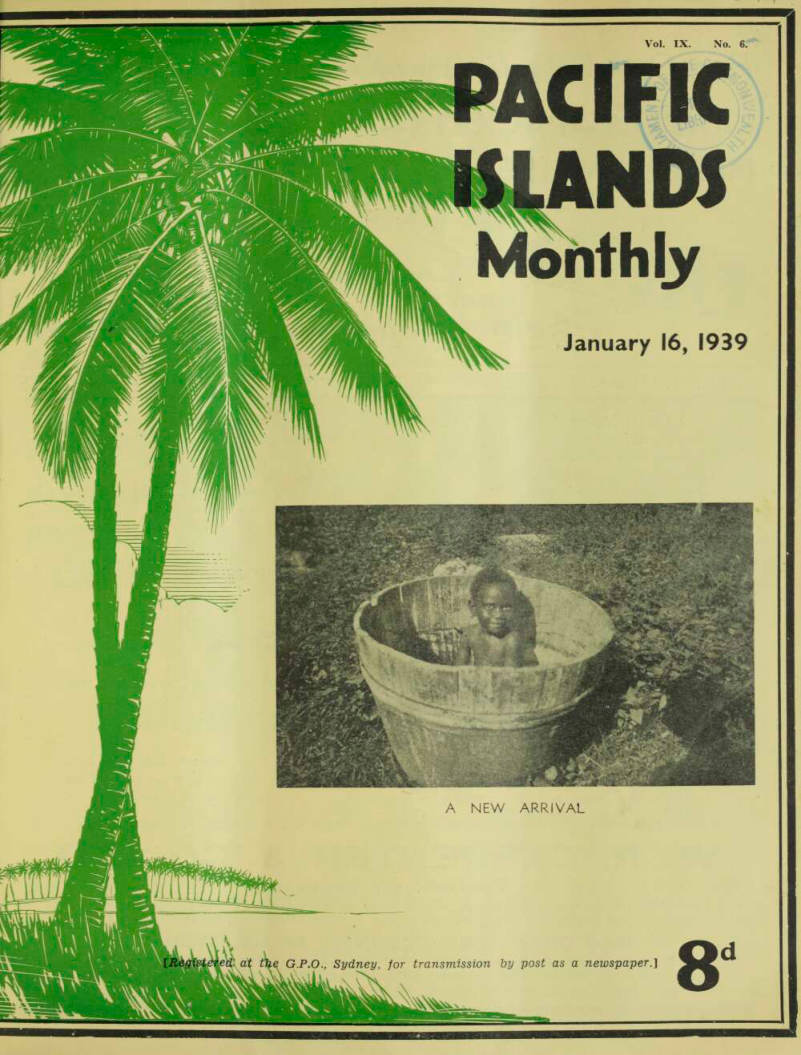
Islands
PACIFIC
Monthly
Vol. IX. No. 6.
January 16,1989
[Registetety at the G.P.0., Sydney, for transmission by post as a newspaper .]
8
A NEW ARRIVAL
Pacific Islands Monthl y—J anuary 16, 1939
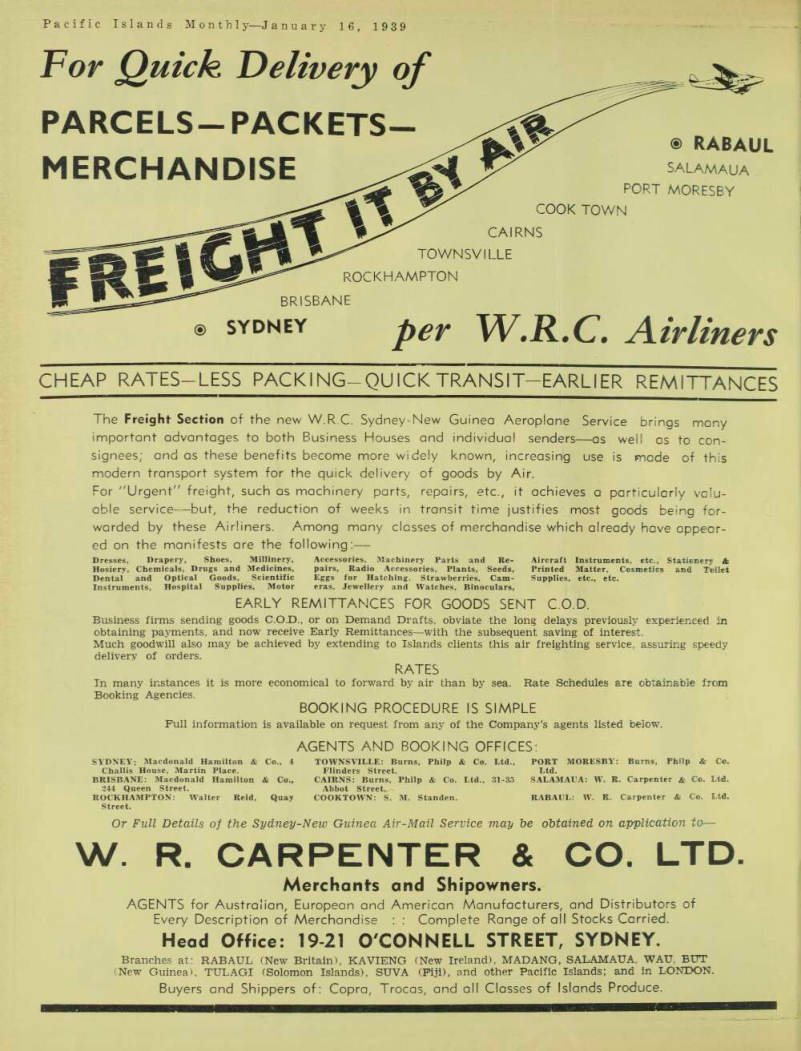
For Quick Delivery of
PARCELS-PACKETS-
MERCHANDISE
n m
® RABAUL
SALAMAUA
PORT MORESBY
COOK TOWN
CAIRNS
TOWNSVILLE
ROCKHAMPTON
BRISBANE
® SYDNEY
per W.R.C.Airliners
CHEAP RATES-LESS PACKING-QUICK TRANSIT-EARLIER REMITTANCES
The Freight Section of the new W.R.C. Sydney-New Guinea Aeroplane Service brings many important advantages to both Business Houses and individual senders—as well as to consignees; and as these benefits become more widely known, increasing use is made of this modern transport system for the quick delivery of goods by Air.
For "Urgent" freight, such as machinery parts, repairs, etc., it achieves a particularly valuable service—but, the reduction of weeks in transit time justifies most goods being forwarded by these Airliners. Among many classes of merchandise which already have appeared on the manifests are the following:— Dresses, Drapery, Shoes, Millinery, Accessories. Machinery Parts and Re- Aircraft Instruments, etc.. Stationery & Hosiery, Chemicals, Drugs and Medicines, pairs, Radio Accessories, Plants, Seeds, Printed Matter, Cosmetics and Toilet Dental and Optical Goods, Scientific Eggs for Hatching. Strawberries, Cam- Supplies, etc., etc.
Instruments, Hospital Supplies, Motor eras. Jewellery and Watches, Binoculars,
EARLY REMITTANCES FOR GOODS SENT C.O.D.
Business firms sending goods C.0.D., or on Demand Drafts, obviate the long delays previously experienced in obtaining payments, and now receive Early Remittances—with the subsequent saving of interest.
Much goodwill also may be achieved by extending to Islands clients this air freighting service, assuring speedy delivery of orders.
RATES
In many instances it is more economical to forward by air than by sea. Rate Schedules are obtainable from Booking Agencies.
BOOKING PROCEDURE IS SIMPLE
Full information is available on request from any of the Company’s agents listed below,
AGENTS AND BOOKING OFFICES:
SYDNEY: Macdonald Hamilton & Co., 4 TOWNSVILLE: Burns, Philp & Co. Ltd., PORT MORESBY: Burns, Philp & Co.
Challis House, Martin Place. Flinders Street. Ltd.
BRISBANE: Macdonald Hamilton & Co. f CAIRNS: Burns, Philp & Co. Ltd., 31-35 SALAMAUA: W. R. Carpenter & Co. Ltd. 244 Queen Street. Abbot Street.
ROCKHAMPTON: Walter Reid, Quay COOKTOWN: S. M. Standen. RABAUL: W. R. Carpenter & Co. Ltd.
Street.
Or Full Details of the Sydney-New Guinea Air-Mail Service may be obtained on application to —
W. R. CARPENTER & CO. LTD.
Merchants and Shipowners.
AGENTS for Australian, European and American Manufacturers, and Distributors of Every Description of Merchandise : : Complete Range of all Stocks Carried.
Head Office: 19-21 O'CONNELL STREET, SYDNEY.
Branches at: RABAUL (New Britain), KAVIENG (New Ireland), MADANG, SALAMAUA, WAU. BUT (New Guinea), TULAGI (Solomon Islands), SUVA (Fiji), and other Pacific Islands; and in LONDON.
Buyers and Shippers of: Copra, Trocas, and all Classes of Islands Produce.
Pacific Islands Travellers
Passengers Per Airliner “Carmania”
FROM N.G. ON DECEMBER 16 FOR AUS TRALIA: Messrs. Perriman, Willis, Hope, Ed gell. Priest, Large, Barnes. Mesdames Edgell, Jenner.
Passengers Per “Morinda” Which
Arrived In Sydney From Lord Howe,
NORFOLK IS. AND N. HEBRIDES ON DE CEMBER 18: Messrs. Blackwell, Palmer, Pa ton, Wilson, Edenborough, Le Sueur, Lisle, Menzies, Fitzgerald, Gaven, Guest, Harkness, Hunter, Kenny, Lee, Palm (2), Phillips, Pur kis, - Richmond, Roxbrough, Sieveking, War wick (2), Watson. Misses Beveridge, Everett, Gillespie, Stone, Stopp, Brown, Englert, Plight, Jeffreys, Sinclair, Triggs, Tunks. Mesdames Hollaway, Kenny, Richmond, Sieveking, Swain, Wilson.
Passengers Per “Bulolo” Which Ar
RIVED IN SYDNEY FROM N.G. AND PAPUA ON DECEMBER 18: Messrs. Anderson (2), Arm strong, Astor, Babbage, Bums, Barwick, Cut ler, Cole, Clift, Davies, Dexter, Dishon, Evans, English, Einsiedel, Florence, Ferris, Fancourt, Griffiths, Grant, Gazzard, Harvey, Huenerbein, Hockey, Hall, Hunter, Harper, Hides, Heiner, Huon, Johns, Jones, Kerry, Kingsford, Lewis, Lappin, Lischeld, Lloyd, Murray, MacLeod, Mc- Lean, Moor, Ord, Osborne, O’Donnell, Oates, O’Farrell, O’Connor, O’Malley, Paulini, Ruth
erford, Roubley, Rohrlach, Ross (2), Rutland, Schwarz, Scott, Simons, Templeton, Ure, Webb,’
White, Wood, Walker, Walshe. Mesdames Bar ker, Bannigan, Baldie, Beer, Clift, Cox, Fer ris, Griffiths, Grant, Hoile, Hockey, Hunter, Heiner, Ingram, Johns, Johnston, Kingsford!
Murray, Maxwell, Osborne, Paulini, Passmore!
Robertson, Ryan, Roubley, Rohrlach, Ross, Rich’, Skelly, Stewart, Saunders, Ure, Vernon, Wat kins (2), Wales, Walsh, Wiles, Walshe, Brown.
Misses Boag, Craig, Cooper, Deaton, Loudon, McCaghern, McNally, Miller, Norris, Osborne (2), Perry, Rosser, Shannon, Tonkin, Telford. Sister de Pazzi.
Passengers Per Airliner “Carinthia”
From Sydney For N.G. On December
19: Messrs. Chestnut, Gordon, Simpson, Dick son, Painham, Field, Prior, Murray. Mesdames Barker, Simpson, Dickson, Fainham. Misses Matthews, McGahn.
Passengers Per “Morinda” From Syd
NEY FOR LORD HOWE AND NORFOLK IS LANDS ON DECEMBER 20: Messrs. Gill, Crad dock, Blundell, Smith, Woolley, Watson, Reu ben, Twiss, Thompson, Eagles, Crommelin, Sluman, Gray, Smythe, Thompson, Selff, Bas ser, Creek, Bruce. Mesdames Gill, Davis, Smith, Woolley, Hyslop, Thompson. Watson, Mason, Blundell, Eagles, Hipe, Millengen, Mc- Cann, Lewis, Downes. Misses Mordin, Gall,
Deasey, Drew, Nabas, Thompson, Leveck, Mar tin, Read, Mawdesley, Watson, Mason, Evans, Watsford, Ferguson, Day, Mawdesley, Sheather, Christian (2), Bataille, Lewis, Dunn, McCann, Tranten (2), Watchorn, Galloway, Fuge, Fos ter, Downes, Cocksedge, Brett, Pritchitt, Wood ward.
Passengers Per “Tanda” Which
Reached Sydney From N.G. On Decem
BER 21: Messrs. Kennedy, Burgess, Thompson, Ellis, Clift, Doonar, Ball, Costelloe, Tracey, Sherman, Provan, Ward, Tadgell, Monger, Gil more. Mesdames Ellis, Provan, Bennie, Bal four (2).
Passengers Per Airliner “Carinthia”
Prom N.G. For Australia On December
22: Messrs. Simpson, Purves, Baillie, Stanley, Hinks, Perriman. Mrs. Simpson.
Passengers Per “Aorangi” From Syd
NEY FOR FIJI ON DECEMBER 22: Messrs.
Booth, Morgan, Nair, Marchant, Mune. Mes dames Mune, Gentry, Tracey. Miss Savoie.
Passengers Per “Tasman” From Syd
NEY FOR PAPUA ON DECEMBER 24: Messrs.
Glasson, Hardy, Smith, Warner, Wright. Mes dames Cobb, Glaessner, Stach.
Passengers Per Airliner “Carmania”
PROM SYDNEY FOR N.G. ON DECEMBER 27: Messrs. Llewellyn, Hoile. Miss Brown.
Passengers Per “Morinda” Which
Reached Sydney From Lord Howe And
F Continued On Page 80)
Norfolk Islands On December 28'
Messrs. Arthur-Smith, Adams, Dillon, Austic, Richards. Mesdames Christian, Arthur-Smith, Adams, Richards. Misses Quintal, Robinson, White, Evans, Watsford.
Passengers Per “Malaita” Which
Reached Sydney From N.G. And 8.5.1.
ON DECEMBER 28: Messrs. Bums, Campbell, James, Askew, Beach, Bergelin, Boydell, Dickes, Dickie, Hetherington, Hitchcock, Hughes, Knibbs, Mill, Rixon, Silvester, Sim monds, Stewart. Mesdames James, Murray As kew, Dickes, Hetherington, Rixon. Misses Col lins, Faulkner, Cohen, Jones, May, Moore. Sis ters Ignaces, Ludowisa, Wendelina, Marie Ire nee, Marie Raphael, Mary Geraldine.
Passengers Per Airliner “Carmania”
From N.G. For Australia On December
30; Messrs. Roberts, Taylor, Hoile, Reid, Thrasher, Hitchcock, Karius (2), Bunting. Mrs.
Hunter.
Passengers Per “Bulolo” From Syd
NEY FOR N.G. AND PAPUA ON DECEMBER 31: Messrs. Rodger, Clark, Woolcott, Beggs, Stephen, Webb, Temple, Watts, Ellis, Krutt schnitt, McCullock, Young, Vaughan, O’Malley, Rutland, Middleton, Finney, Gillingwater, Ridge, Crimson, Horton, Woodruff, Graham (2), Wilkinson, Fader, Gordon, Robinson, Fin ney, Franck, Hoadley, Christie, Maclean, Hor ton, Phillips, Reynolds (2), Scannell, Allison, Large, Fitch, Evans, Webb, Tribolet, Chamb ers, Kendall, Ling, Schuford, Taylor, Landers, Garrad, Pentony, Archer, Reeves, Nicolle, Steele, McArdle, Berry, Father Schmitt, Hay ston, Maxwell, Broadfoot, Turner (2), Con drew, Oaten, Barrell, Lillistone, Battis, An derson, Fox (2), Shannon, Pianta, Kennedy, MacArthur. Mesdames Woolcott, Stephen, Ma son, Kruttschnitt, Lewis, Middleton, Miller, Heath, Gillingwater, Harvey, Parer, Graham, Eginton, Loader, Phillips, Scannell, Allison, Evans, Chambers, Anisimoff, Huie, Rigby, Hadley, Reynolds (2), Maxwell. Misses Boag, Cooper, Roe, Chandler, Crook, Cook, Temby, Sutton, Howell, Miner, Blackman, Creek, Hutchinson, Coleman, Spicer, Irvine,
fj e^ ett ’xT H^ aly ’ Fannin S. Lee, Clancy, Whyte, Wells, Nash, Veltch, Pope, Simons, Carnell, Gome, Johnson, Davies, Swords, Swain Car michael, Huie, Broadfoot. Sister Mary Flor ence.
Passengers Per Airliner “Caronia”
FROM SYDNEY FOR N.G. ON JANUARY 3; Messrs. Jenkins, Dickson, Horton.
Passengers Per “Neptuna” Which
Reached Sydney Prom N.G. On January
4. Messrs. Avenell, Atherton, Bowker, Best, Creer, Cook, Canny, Drayson, Devany, Eglin ton, Earl, Frost, Fitzgibbon, Hart, Maxwell, Mossman, Pomery (2), Parry, Robinson, Stan ley, Spence, Tregellas, Jacobsen. Mesdames Atherton, Creer, Drayson, Devany, Eglinton Frost, Gunther, Gamble, Hill, Jones, Leydin, Maggs, Priebe, Prior, Robinson, Roberts, Strudwick, Thompson, Jacobsen. Misses Jack son, Leeder, Frazer.
Passengers Per “Morinda” From Syd
NEY FOR LORD HOWE, NORFOLK IS AND N. HEBRIDES, ON JANUARY 7: Messrs. Eedy, Hyder, Jackson, Fenwick, Salter, Johnson,’
Meares, Rooke, Kelynack, Lee, Watts, Rosen thal, Thwaites, Sanders, Stephens, Powers, Geld ing, Cleary, Stephenson, Towey, Quintal, Cam eron, Cool, Dimmock, Clarke, Hewlett, Rich mond, Monteath, Chapman, Fleming, Chisholm, Randerson, De Mestre, Lloyd, Thompson, Tur ner, Redmond. Fathers Schir and Narvor. Mes dames Eedy, Rooke, Weil, Griffith, Ward, Bairstow, Stephen, Watts, Thwaites, Rosenthal, Johnson, Clay, Wheatley, Redmond, Cranny.
Misses Cunningham, Palmer, Johnstone, Lord ing, Langhorn (2), Deasey, Johnston, McKil lop, McLeneghan, Stephenson, Blackburn (2), Clay, Prendergast, Teece, Bailey, Fenton, Buf fet.
Passengers Per “Malaita” From Syd
NEY FOR 8.5.1. AND N.G. ON JANUARY 7: Messrs. Barber, Evans, Grosvenor, Crump, Mc- Kinnon, Russell, Crooke, Waters, Kaines, Cocks, Elkington, Lotze, Frame, Crump, Jones, Kings mill, Shields, Harricks, Mitchellhill, Luxa, Tur ner, Ryan, Wilson, Maxwell, Hanscomb, Berg lan, Blackburn, Spring, Doyle, Hargreaves.
Fathers Tiggeler and Junker. Mesdames Crump, Kaines, Elgas, Ryan, Newall, Ormsby, Price, Turner, Maxwell, Hanscomb, Doyle.
Misses Field, Tatham, Crew, Muller, Cohen, Moore, Packer.
Passengers Per “Macdhui” Which
ARRIVED IN SYDNEY FROM N.G. AND PA PUA ON JANUARY 9: Messrs. Appleby (2), Donnell, Ellis, Fastre, Perrocheau, Howell, Kink, Mowlds, Maliphant, McKay, Mackinnon, McManus, Pratt, Sullivan, Stubbings, Sodo man, Taylor, Thurlow, Watkins, Whitehouse, Whiteland, Johnston, Thomas, losia, Adorno, Axentieff, Benham, Brown, Cahill, Dixon, Foley, Miller, Pullen, Randall, Rosser, Timewell, Wil son, Clegg, Dight, Graham, Godsall, Hope, Parcell, Rathje, Semple. Mesdames Appleby, Daymond, Foley, Howell, Leetch, Mackay, Mc- Donald, Whitehouse, Thomas, losia, Adorno, Cahill, Dixon, Field, Timewell, Sinclair.
Misses Leggatt, Love, Kirby, Rudd, Howard.
Two members of the Chinese crew of the Shell Co.’s tanker “Pinna” disap peared overboard on December 22, while she was en route from Suva to Lautoka.
Advertisements & other items, p. 3 (2 items)
1
Pacific Islands Monthl y—J anuary 16, 1939
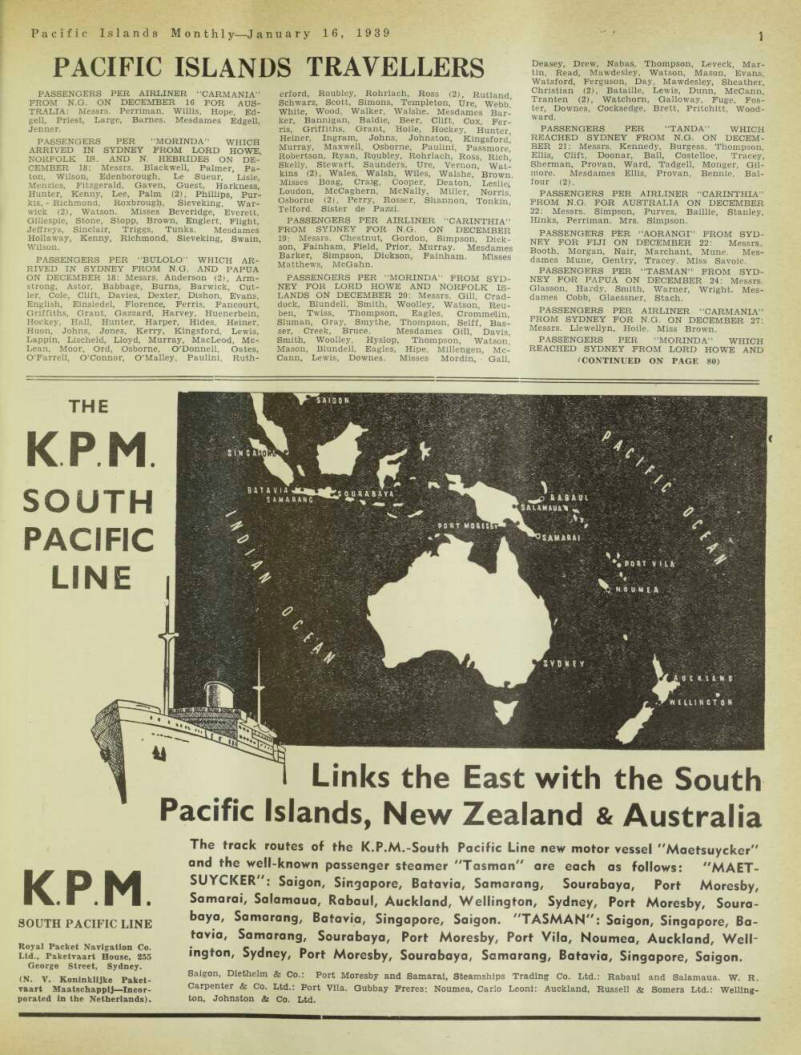
South
THE
KPM.
PACIFIC
LINE
44
Links the East with the South
Pacific Islands, New Zealand & Australia
KPM
SOUTH PACIFIC LINE
Royal Packet Navigation Co.
Ltd., Paketvaart House, 255 George Street, Sydney. (N. V. Koninklijke Paketvaart Maatschappij—lncorporated in the Netherlands).
The track routes of the K.P.M.-South Pacific Line new motor vessel "Maetsuycker" and the well-known passenger steamer "Tasman" are each os follows: "MAET- SUYCKER": Saigon, Singapore, Batavia, Samarang, Sourabaya, Port Moresby, Samarai, Salamaua, Rabaul, Auckland, Wellington, Sydney, Port Moresby, Sourabaya, Samarang, Batavia, Singapore, Saigon. "TASMAN": Saigon, Singapore, Batavia, Samarang, Sourabaya, Port Moresby, Port Vila, Noumea, Auckland, Wellington, Sydney, Port Moresby, Sourabaya, Samarang, Batavia, Singapore, Saigon.
Saigon, Diethelm & Co.: Port Moresby and Samarai, Steamships Trading Co. Ltd.: Rabaul and Salamaua. W. R.
Carpenter & Co. Ltd.: Port Vila. Gubbay Preres: Noumea, Carlo Leoni: Auckland, Russell & Somers Ltd.: Wellington, Johnston & Co. Ltd.
Advertisers.
“Alnwick Kinder garten ... 64 Amalgamated Wire less of Aust. Ltd. 41 Amplion (A’sia) Ltd 24 Angus & Coote Ltd 16 Arnott’s Biscuits . 42 “Aspro” 22 “Ausolene” ... 47 Baker, Ltd, W. Jno. 71
B.A.L.M. Ltd. . . 49
Bank of N.S.W. . 74 Berger & Sons Ltd 50 “Bernly” Guest House 54 “Bidomak” ... 17 Blau (Aust.) Robt. 64 Breckwoldt & Co.
W. . . . 36, 46, 48 British Institute of Engineering Tech nology Ltd. ... 17 Broomfields, Ltd. . 78 Brown & Co. Ltd., Geo 67 Brotherton & Co., A.
B 53 Brunton’s Flour . 43 Bullivants, Ltd. . . 62 Burns, Philp & Co. 2 B.P. Magazine . . 22
B.P. (S.S.) Co. . . 44
Burns, Philp Trust Co. Ltd. ... 78 Buzacott, Ltd. . . 45 Carlton & United Breweries Ltd. . 21 Carpenter, W. R.
Limited . . cov. 2 Chapman & Sherack 63 Chemist H. P.
Michael ... 47 Chemists’ Supplies Co 71 Chivers & Sons Ltd 37 “Cinnamolia” Pre parations ... 54 Coleman Lamp Co. 27 Continental Com pensations Pty.
Ltd 44, 71 Coral Starch ... 38
Crossle, Duff & Macintosh, Ltd. . 70 “Cystex” ... 52 Danks & Son, Ltd. 59 Dewar’s Whisky . . 68 Doan’s Pills ... 80 Donald, Ltd, A. B. 56 Eaton, Ltd., J. W. 51 Electrolux Refrig erators 20 Excelsior Supply Co 31 Fairbanks - Morse Limited ... 79 “Fairholm” College 60 Fletcher & Sons . 48 For Sale . . . 53, 55 Ford Sherington, Ltd 32 Foster Clark Ltd. . 29 “44 Macleay St.” . 60 Fryer, A. C. ... 79 Garden Vale Pro ducts, Ltd. ... 38 Garrett & Davidson 70 Gillespie’s Flour . . 35 Grand Pacific Hotel 57 Grove & Sons, W.
H 30 Guinea Airways, Ltd cov. 3 Hallstroms Pty Ltd 39 Halvorsen Sons Ltd 76 Hardy’s Indigestion Remedy ... 14 Harper, M. ... 32 Holbrooks’, Ltd. . . 43 Horlick’s Malted Milk 23 Horne, W. & Co. . 56 Hotel Moresby . . 80
1.C.1.A.N.Z. Ltd. . . 77
Intercontinental Airways ... 15 Jones & Co. Ltd, H. 35 “Kambala” School for Girls ... 65 Kodak Pty. Ltd. . 12 Kopsen & Co. Ltd. 61 Kork-N-Seal, Ltd. . 37 Koyong Boarding School 31 Levenson’s Radio . 72 Lloyd & Co. Pty.
Ltd 13 Mcllrath’s Ltd. . . 66 Maxwell Porter Ltd 51 Melanesian Mission 16 Miller & Co. Pty.
Ltd 62 Morris, Hedstrom, Limited ... 58
N.D.L 80
Nestle’s Milk ... 28 Newlands Bros. Ltd 40 Noyes Bros., Ltd. 59 “Oriana” ... 78 Pabst Canned Beer 66 Pacific Is. Club . 13 Papua Hotel, The 80
Paul & Grey Ltd. . 69 Pike Bros. Ltd. . 14 Plantation for Sale 77 Prescott, Ltd. ... 34 Prouds, Ltd. ... 13 Ransome, Sims & Jeffries, Ltd. . . 58 Reed, William E. . 42 Return Thanks . .11 Riverstone Meat Co 73 Rohu, Sil . . . . 63 Royal Packet Co. . 1 Scott’s Emulsion . 65 Scott, Ltd., J. . . 49 Smyth Ltd., J. H. . 26 Springwood L. Col. 66
Steamships Trading Co. Ltd 53 Sterling Varnish Co 11 Sullivan, Ltd., C. . 35 Swallow & Ariell . 34 “Talkeries”, The . 18 Taylor & Co., A. . 70 “Tenax” Soap . . 26 Tillock & Co. Ltd. 55 Tongan Stamps & Photos Bureau . 68 Toohey’s Ltd. ... 75 “Top Dog” Men’s Wear 33 Tooth & Co. . cov. 4
Trinity Grammar School . . ’ . . 15 Usher’s Hotel . . . aa Vacuum Oil Co. . 25 Vincent’s A.P.C. . . 26 Warburton, Franki Ltd 18 West, Harry . . . C 2 Weymark & Son . 37 Wills, W.D. and H. 0., Ltd. ... 33 Wright & Co. Ltd., E 51 Wunderlich, Ltd. . 51 Yorkshire Insur ance Co. Ltd. . . 52
Contents
Pacific Islands Travellers 1, 80 Japan Faces a Year of Crises 3 Drought in Many Islands 4 Fiji’s Defence 5 Carpenter and Co. May Extend to Papua 5 Fiji Governor Visits Tonga & Samoa 5 Nazi Activities in Samoa 6 Development Plans for N.G. & Papua 7 Shrewd Comment on N. Guinea .. 8 Pt. Moresby May be Big Naval Base 9 Sir Walter Carpenter Visits U.S.A. and Britain 9 Papuan With Six Toes! 10 Tropicalities 11 Finances of New Guinea 11 N.G. Airmail Overtaxed 12 About Islands People 13 Economic Condition of Fiji Indians 14 Earl & Countess Beatty in Samoa 15 Need for Practical Plan to Aid Copra 15, 51 Men Who Knew Yesterday—R. W.
Gosset (Cook Is.) 18 Trans-Pacific Airmails 23 Native Labour Conditions in T.N.G. 24
N.I. Revives Whaling Industry ... 26 Dwindling Labour Supply in N.G. 27 Are There Nazis in New Guinea? . 31 Tahiti’s Ancient Hospitality 34 Land of No Locks or Clocks 35 Quick Rescue Saves Lives in Tahiti 37 How N.G. Government Treats Pros pectors 38 Archbold Party in Dutch N. Guinea 40 Chinese Stores as Social Centres .. 42 New Samoan Councillors 47 Fiji Pineapple Industry 53 New Hebrides Planter’s Outcry ... 55 Fiji Shipping Service Criticised ... 57 Escape to the South Sea Islands .. 59 New L.M.S. Church on Nauru .. .. 61 U.S. Yacht Wrecked in Fr. Oceania 63 Fashion Hints for Islands Women . 64 Former Union Leader Pleads Case for Japan 67 Pacific Mining Activity 69 Islands Radio Programmes (Short Wave) 73 Produce and Exchange Rates .. .. 74 Market Quotations 75 Shipping Timetables 76
Advertisements & other items, p. 4 (1 item)
Burns. Philp & Co. Ltd.
GENERAL
MERCHANTS
iwm m in
iin
111 Hi
SIS
ill
SHIPOWNERS
TOURIST AGENTS
Head Office: 7 Bridge Street, Sydney—Australia Code Address: "Burphil 11 BUYERS OF ALL CLASSES OF ISLAND PRODUCE Regular Steamer Services from Australia to New Guinea Papua Solomon Is.—Lord Howe Is.—Norfolk Is.—New Hebrides —Java and Singapore
Pacific Islands Monthly
The Newspaper-Magazine of the South Seas [Registered at the G.P.0., Sydney, for transmission by post as a newspaper.]
Published Once Each Month and Circulated in Australia and New Zealand and in the following Pacific Territories and Islands Groups:
Crown Colony of Fiji.
Australian Territory of Papua.
Mandated Territory (Australia) of New Guinea, Bismarck Archipelago and Northern Solomon Islands.
Mandated Territory (Japan) of Marshall, Caroline and Marianna Islands.
French Territory of New Caledonia.
British and French Condominium of New Hebrides.
American Territory of Eastern Samoa.
American Territory of Guam.
Mandated Territory of Nauru.
British Crown Colony of Gilbert and Ellice Islands.
Mandated Territory (New Zealand) of Samoa.
British Solomon Islands Protectorate.
British Protectorate of Tongan Islands.
New Zealand Territory of Cook Islands.
Australian Territory of Norfolk Island.
French Colony of Oceania (Tahiti, etc.).
American Territory of Hawaiian Islands.
Owned and Produced by Pacific Publications Pty. Ltd., Union House, 247 George Street, Sydney.
TFT FPTTOMF J Managing Director 8W5037 TELEPHONE BusinesB and Editorial MA7IOI
P.O. Box 3408 R
Registered Address of Telegrams, Radiograms, and Cables: “Pacpub”, Sydney.
Contributions
Articles, Stories, and Photographs dealing with Pacific Islands subjects are invited and will be paid for on publication at usual rates.
Subscription Rates
Per Annum, within British Empire, Prepaid, Post Free 8/- Per Annum, elsewhere, prepaid, Post Free 10/- Single Copies Bd.
Editor and Publisher:
R. W. Robson, F.R.G.S.
Assisted by Selwyn Hughes.
Advertising Manager: L. W. Bailey.
Advertising Office and Printing-House: 29 Alberta St., Sydney.
Advertising rates furnished on application.
Colours, etc by Arrangement Process Blocks made at Advertiser’s expense when required. Screen, 100.
Changes of Advertising Copy should reach this Office by 3rd of each month, otherwise previous advertisement may be repeated.
IN LONDON, the “Pacific Islands Monthly” is on sale at the Bookstall, Australia House, The Strand, London.
Agents
The following are authorised to receive sub scriptions for the Pacihc Islands Monthly:— Islands Branches of Burns, Philp & Co. Ltd., and Burns Philp (South Sea) Co. Ltd.
Islands Branches of W. R. Carpenter & Co. Ltd.
All Branches of Morris, Hedstrom Ltd.
G. Thomas & Co., Rabaul, New Guinea.
T. A. Olsson, Wau, New Guinea.
Whitten Bros. Ltd., Samarai, Papua.
Steamships Trading Co., Papua. All Branches.
P. Costello, Suva, Fiji.
J. Muir, Suva, Fiji.
N. C. Mackenzie-Hunt, Wainunu, Bua, Fiji.
All Branches and Representatives of W. H. Grove & Sons Ltd., Auckland, New Zealand.
Cook Islands Trading Co., Rarotonga, Cook Is.
A. C. Rowland, Papeete, Tahiti.
Representative in London: W. C. HARVEY, Coronation Building 4 Lloyds Avenue, London, E. 0.2. from whom may be obtained copies of Pacific Islands Monthly, Pacific Islands Year Book, advertising schedules, etc.
Vol. IX. No. 6.
Sydney, January 16, 1939.
Price* ( Bd ’ Per Copy rnce ( Prepaid: 8/- p.a.
Japan Faces A Year of Crises
THE month, for students of the Pacific scene, has held much of significance, and something of hope.
The new year opens with the sinister shadow of Japan no less sinister. The picture grows uglier, as we see more clearly the ceaseless, thrusting activities of the Japanese in the Pacific, driven on by their fana tical belief that it is their ordained mission to control the Western Pacific, direct civilisation and regenerate mankind.
To those who do not see below the surface, Japan’s Chinese adventure seems to have gone sadly awry. But the present military inactivity in China is due to winter conditions, as much as to the continued resistance of the Chinese. It is true that Japan has poured a huge army, and enorm ous treasure into the campaign in China, and China still is fighting back. But the actual, literal facts are that Japan now holds the whole of the eastern, and by far the more valuable portion of China; that she has thrown out European economic establishments and trade of almost incalculable value; and that she is actively and steadily consolidating her gains, so that Japanese home economy may quickly get the benefits of her conquests.
Because of the cleverness of Japan
in making the Pact with Germany and Italy, the democratic countries (Britain, America and France) have been out-manoeuvred. They can do little more than stand by, while Japan captures or annihilates their com mercial empire in China. Had it not been for the “Berlin-Rome-Tokio axis”, it is certain that British forces would have gone to China, long ago, to save British property from de liberate and planned destruction. But, so long as Germany and Italy remain obedient to the immediate whim of incalculable dictators, Britain and France dare not remove their forces from Europe; and meanwhile the great American navy has remained, as always, at the command of the queer combination of Washington chatterers, cigar-chewing ideologists and egoistic press magnates, which masquerades as a democratic Govern ment.
That is the depressing side of the picture. It is not all gloomy.
Britain, France and America, though out-manoeuvred, are by no means beaten. Time, definitely, is working on the side of the democracies. The latter are assisting China to keep on fighting. If China collapses now, the Japanese will get away with spoils of fabulous richness—territory, trade, raw materials, vast reservoirs of food
stuffs and man-power—from which they will build the machine that is to destroy Western civilisation. But Japan to-day is horribly near to economic collapse. The strain of the China campaign has been terrific; early in January, the Japanese Gov ernment resigned. If the Chinese continue to fight, and if the demo cratic powers use the facilities which are at their command to cripple Japanese trade in the world, it is just possible that 1939 will see Japan in volved in disaster so great that the menace of her southwards thrust will cease to cast its shadow over this and the next generation of Europeans in the Pacific.
We can only wait and see. The portents are good. The United States, throwing off, at last, the shackles of the traditional isolationist policy, early in January, condemned the Totalitarian States—and, inferen tially, the Berlin-Rome-Tokio axis— in the most startling Presidential speech of the decade; and the British Prime Minister immediately sup ported the American utterance.
America is now considering plans to strengthen enormously her line oi naval defence in the Pacific; and she says she may advance that line west ward to include the fortification of Guam. Guam is right in among the Japanese mandated islands; and any fortification there must be linked up with a new defence plan embracing
the Philippines. American strategy, up to the present, always assumed that Guam would be gobbled up, and the Philippines abandoned, while the U.S.A. forces retired to their Central Pacific line (based on the Aleutian islands, Hawaii and Samoa). But this more aggressive America apparently is prepared to meet Asia (if Asia must be met) much farther westward— which means, of course, that an effort would be made to keep the Philippines out of the Japanese maw.
The month’s developments are: Political confusion in Japan, as a re sult of the economic strain; a more aggressive spirit in America, and an apparent, growing willingness to line up with the democracies in resisting Hitler-ism—which means, in turn, greater freedom for the democracies in dealing with Japan in the Far East; and a growing realisation that the democracies, by unitedly using their enormous economic strength, can cripple Japan and save China, without firing a shot. Meanwhile, there is not a word of Russia; she re mains in the background, a mysteri ous, imponderable force.
Islands
Drought In Many
REPORTS from all parts of the Pacific indicate that many of the Islands have suffered from a very serious drought, which is still unbroken in many places. The reports come from New Guinea, in the west, right across to the distant islands of French Oceania, in the east.
There has been great dryness in some of the islands of Central Polynesia, and a grave shortage of water has been re ported from Nauru and from points in the Gilbert Islands. Reports from the Marquesas Islands, over in French Oceania, indicate the worst drought on record, and the position there is still very serious.
Reports from points on the mainland of New Guinea say that the rainfall has been considerably below the average and, now that the dry season has come, drinking water is likely to become scarce.
N. Guinea Administrator
Returns
mHE Administrator of New Guinea, Sir JL Walter McNicoll, and Lady McNicoll, after four months’ furlough—spent partly in the Far East and partly in Sydney—sailed for Rabaul, from Sydney, by the “Tanda”, on January 14.
New Year honours included K.C.M.G., for Sir Harry Luke, Governor of Fiji; C.8.E., for Rt. Rev. Dr. C. J. Nicolas, S.M., Roman Catholic Bishop of Fiji; and M.8.E., for Mr. H. E. Maude, an ad ministrative officer in the Gilbert and El lice Islands.
The gift of two supporters of the Melanesian Mission, an electric light plant has been installed at the mission hospital at Fauabu, 8.5.1. The plant gives a powerful light and there is a sufficient margin of power to equip an X-ray plant.
"For It"
Japan May Be
Visitor's Impression of Position In Chino
(From Marc. T. Greene, World-Wander ing American Journalist)
Hong Kong, Dec. 27.
I HAVE just returned from the interior of Southern China. The war is more or less at a standstill for the time being—but that is all to the good for the Chinese.
There is every indication that the Jap anese “are for it” —and with a ven geance !
You people down there won’t have to
lie awake at nights, any more, worrying about the “Japanese menace”.
EDITORIAL NOTE: The foregoing was part of a personal letter, not written for publication. It is an interesting note from a man on the spot. There are sev eral indications that the Japanese are becoming exhausted by their Chinese ad venture. Statesmanship at home may enable them to consolidate, economically, the territory they have over-run, so that they may develop in China sufficient trade advantage to make up for their losses elsewhere. If they cannot do that they will be, as Mr. Greene says, “for it”.
Mr. C. F. Frost, of Guinea Airways Ltd., Lae, arrived in Sydney from N.G. by the “Neptuna” on January 4, accom panied by his mother, Mrs. A. M. Frost, of the European Hospital staff, Wau.
Advertisements & other items, p. 6 (2 items)
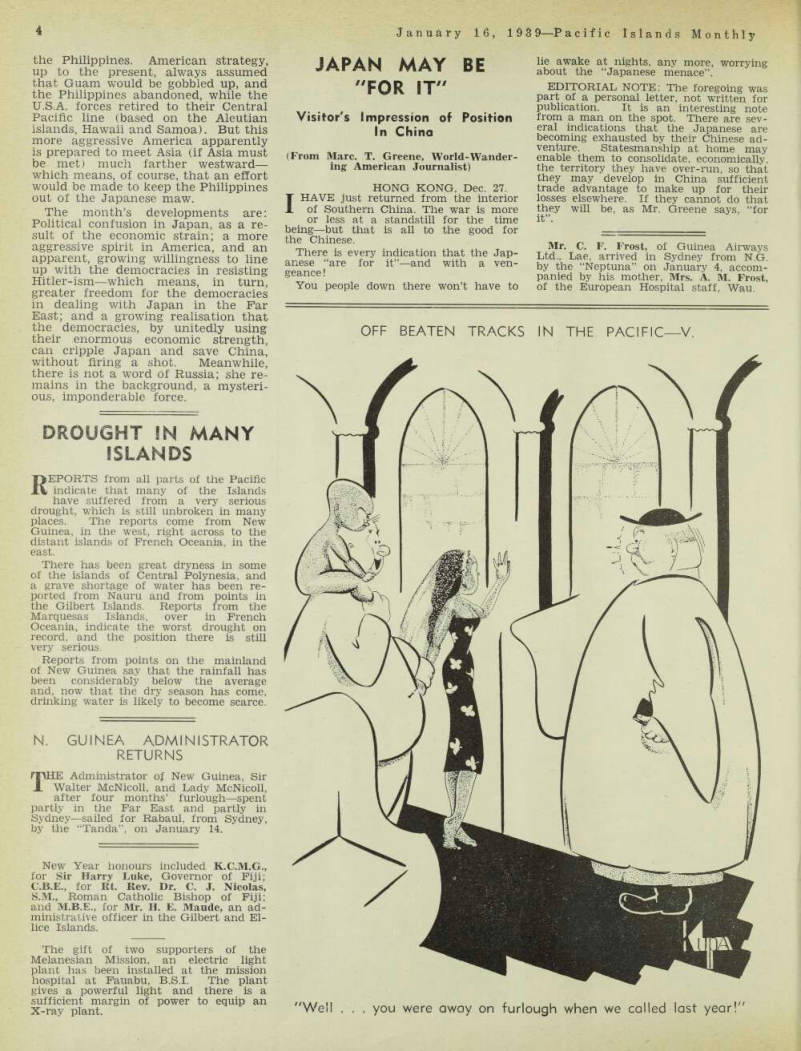
Off Beaten Tracks In The Pacific—V.
"Well... you were away on furlough when we called last year!"
4
January 16, 193 9—l? acific Islands Monthly
Bulolo Co.'S Manager
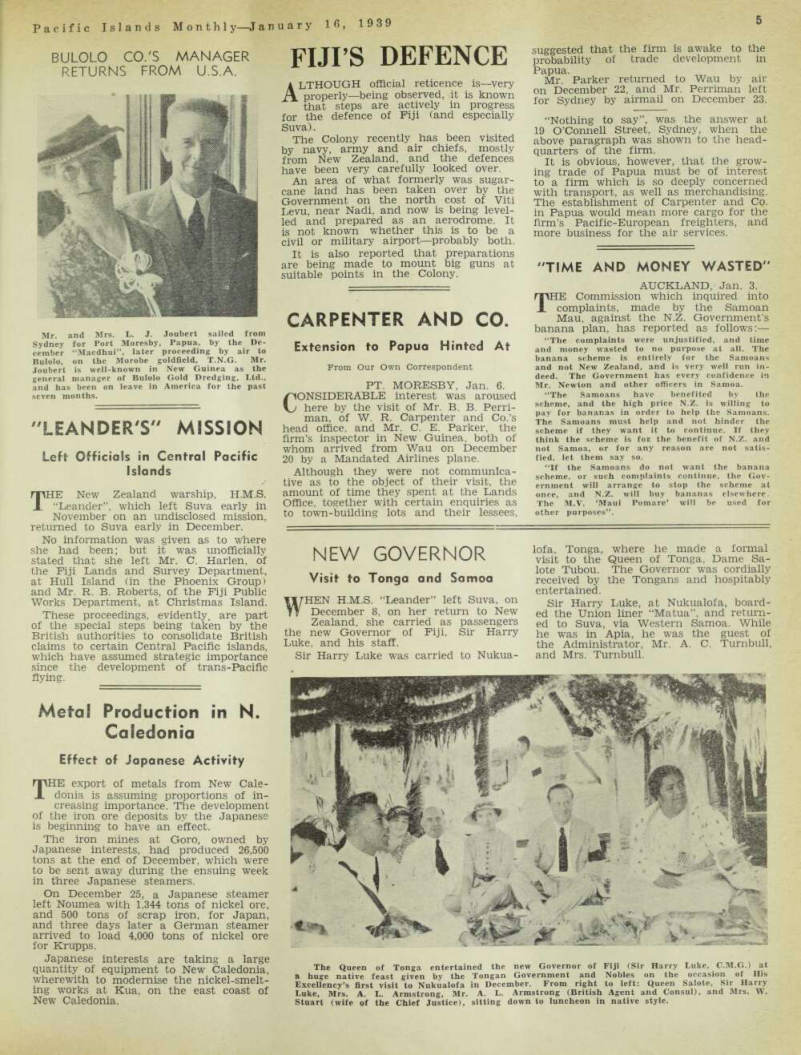
Returns From U.S.A.
Mr. and Mrs. L. J. Joubert sailed from Sydney for Port Moresby, Papua, by the De cember “Macdhui”, later proceeding by air to Bulolo, on the Morobe goldfield, T.N.G. Mr.
Joubert is well-known in New Guinea as the general manager of Bulolo Gold Dredging, Ltd., and has been on leave in America for the past seven months.
"Leander's" Mission
Left Officials in Central Pacific Islands
THE New Zealand warship, H.M.S.
“Leander”, which left Suva early in November on an undisclosed mission, returned to Suva early in December.
No information was given as to where she had been; but it was unofficially stated that she left Mr. C. Harlen, of the Fiji Lands and Survey Department, at Hull Island (in the Phoenix Group) and Mr. R. B. Roberts, of the Fiji Public Works Department, at Christmas Island.
These proceedings, evidently, are part of the special steps being taken by the British authorities to consolidate British claims to certain Central Pacific islands, which have assumed strategic importance since the development of trans-Pacific flying.
Caledonia
Meta! Production in N.
Caledonia Effect of Japanese Activity
THE export of metals from New Cale donia is assuming proportions of in creasing importance. The development of the iron ore deposits by the Japanese is beginning to have an effect.
The iron mines at Goro, owned by Japanese interests, had produced 26,500 tons at the end of December, which were to be sent away during the ensuing week in three Japanese steamers.
On December 25, a Japanese steamer left Noumea with 1,344 tons of nickel ore, and 500 tons of scrap iron, for Japan, and three days later a German steamer arrived to load 4,000 tons of nickel ore for Krupps.
Japanese interests are taking a large quantity of equipment to New Caledonia, wherewith to modernise the nickel-smelt ing works at Kua, on the east coast of New Caledonia.
Fiji’S Defence
ALTHOUGH official reticence is—very properly—being observed, it is known that steps are actively in progress for the defence of Fiji (and especially Suva).
The Colony recently has been visited by navy, army and air chiefs, mostly from New Zealand, and the defences have been very carefully looked over.
An area of what formerly was sugar cane land has been taken over by the Government on the north cost of Viti Levu, near Nadi, and now is being level led and prepared as an aerodrome. It is not known whether this is to be a civil or military airport—probably both.
It is also reported that preparations are being made to mount big guns at suitable points in the Colony.
Carpenter And Co.
Extension to Papua Hinted At
From Our Own Correspondent
Pt. Moresby, Jan. 6.
CONSIDERABLE interest was aroused here by the visit of Mr. B. B. Perri man, of W. R. Carpenter and Co.’s head office, and Mr. C. E. Parker, the firm’s inspector in New Guinea, both of whom arrived from Wau on December 20 by a Mandated Airlines plane.
Although they were not communica tive as to the object of their visit, the amount of time they spent at the Lands Office, together with certain enquiries as to town-building lots and their lessees,
suggested that the firm is awake to the probability of trade development in Papua.
Mr. Parker returned to Wau by air on December 22, and Mr. Perriman left for Sydney by airmail on December 23.
“Nothing to say”, was the answer at 19 O’Connell Street, Sydney, when the above paragraph was shown to the head quarters of the firm.
It is obvious, however, that the grow ing trade of Papua must be of interest to a firm which is so deeply concerned with transport, as well as merchandising.
The establishment of Carpenter and Co. in Papua would mean more cargo for the firm’s Pacific-European freighters, and more business for the air services.
"Time And Money Wasted”
Auckland, Jan. 3.
THE Commission which inquired into
complaints, made by the Samoan
Mau, against the N.Z. Government’s
banana plan, has reported as follows; — “The complaints were unjustified, and time and money wasted to no purpose at all. The banana scheme is entirely for the Samoans and not New Zealand, and is very well run in deed. The Government has every confidence in Mr. Newton and other officers in Samoa.
“The Samoans have benefited by the scheme, and the high price N.Z. is willing to pay for bananas in order to help the Samoans.
The Samoans must help and not hinder the scheme if they want it to continue. If they think the scheme is foe the benefit of N.Z. and not Samoa, or for any reason are not satis fied, let them say so.
“If the Samoans do not want the banana scheme, or such complaints continue, the Gov ernment will arrange to stop the scheme at once, and N.Z. will buy bananas elsewhere.
The M.V. ‘Maui Pomare’ will be used for other purposes”.
New Governor
Visit to Tonga and Samoa
WHEN H.M.S. “Leander” left Suva, on December 8, on her return to New Zealand, she carried as passengers the new Governor of Fiji, Sir Harry Luke, and his staff.
Sir Harry Luke was carried to Nukua
lofa, Tonga, where he made a formal visit to the Queen of Tonga, Dame Sa lote Tubou. The Governor was cordially received by the Tongans and hospitably entertained. sir Harry Luke, at Nukualofa, board ed the Union liner “Matua”, and return ed to Suva, via Western Samoa. While he was in Apia, he was the guest of the Administrator, Mr. A. C. Turnbull, and Mrs. Turnbull.
The Queen of Tonga entertained the new Governor of Fiji (Sir Harry Luke, C.M.G.) at a huge native feast given by the Tongan Government and Nobles on the occasion of His Excellency’s first visit to Nukualofa in December. From right to left: Queen Salote, Sir Harry Luke, Mrs. A. L. Armstrong, Mr. A. L. Armstrong (British Agent and Consul), and Mrs. W.
Stuart (wife of the Chief Justice), sitting down to luncheon in native style.
Advertisements & other items, p. 7 (1 item)
5
Pacific Islands Monthl y—J anuary 16, 1939
Nazi Activity In Western Samoa
Small Organisation Creates an Embarrassing Situation
WHEN the “Matua” arrived in Apia, Western Samoa, on December 11, it brought to Western Samoa the German Consul-General from New Zea land, Herr Ramm. No one knew quite why Herr Ramm should have considered an official visit to Samoa to be neces sary, just now; but, for all that, he was greeted courteously and cordially. He was the guest of the Administrator, at Vailima, until December 14, when he went on to Pago Pago.
But the Consul-General, almost im mediately, was placed in a position of acute embarrassment.
A German resident of Samoa, Herr Matthes, has developed an admiration for the Hitler-Nazi regime; and he has formed a Nazi group in Apia. There are only a few adherents, and the or ganisation is regarded mostly with amused tolerance by the rest of the population—and especially by the older German residents.
Herr Matthes induced a small num ber of Samoan natives to join a “Ger man Club”, and to ask publicly for a return of Samoa to Germany. The Sa moans mostly were elderly men, who had been employed by the German Ad ministration before 1914, and they have no influence among the natives. The club collected money for Nazi flags and badges.
The arrival of the German Consul- General gave Herr Matthes his big moment. When Herr Ramm stepped onto the Customs wharf, he was greet ed, to his horror, by Herr Matthes, standing stiffly to attention, while ranged behind him, under a fluttering Swastika flag, was a small company of Samoan natives, wearing German em blems.
It was a demonstration very gratifying to any German; but, in the special cir cumstances, very malapropos.
In the background, an interested spectator, was Sir Harry Luke, the
newly-appointed Governor of Fiji and High Commissioner for the Western Pacific, who happened to arrive on that Matua”, on his way back from Tonga to Fiji.
Herr Ramm was formally introduced by Herr Matthes to the Samoan Nazis, and the little ceremony ended.
But, immediately, strong protests against the demonstration were made by both British and Germans. Both com munities are anxious to live in amity, and avoid anything which might stir up racial feeling. The British took the opportunity of pointing out that there really has been too much Nazi pro paganda recently. Natives have been told that Hitler soon will take command of Samoa. A German youth, who can speak only a few words of English, has been brought to Samoa recently to con duct a German school, for the children of Germans and part-Germans.
“We do not wish to be unpleasant”, said one leading Britisher. “But, in the circumstances, we can only assume that those who are not with us are against us. Why that German school? Why does the Consul-General make a 3,000 miles journey to Samoa, if Germany is not interested in Samoa?”
“If the New Zealand Government thought it good enough to deport a good Britisher like Smyth for his sympathies with the native Samoans, surely they ought to deport one or two gentlemen who are trying to introduce Nazi doc trines among the natives”, was another comment.
The German Consul-General, after making himself acquainted with local conditions, took occasion to approach leading British residents and to assure them that objectionable activities among Samoan natives had been com pletely stopped, and that a certain gen tleman had been officially and severely reprimanded.
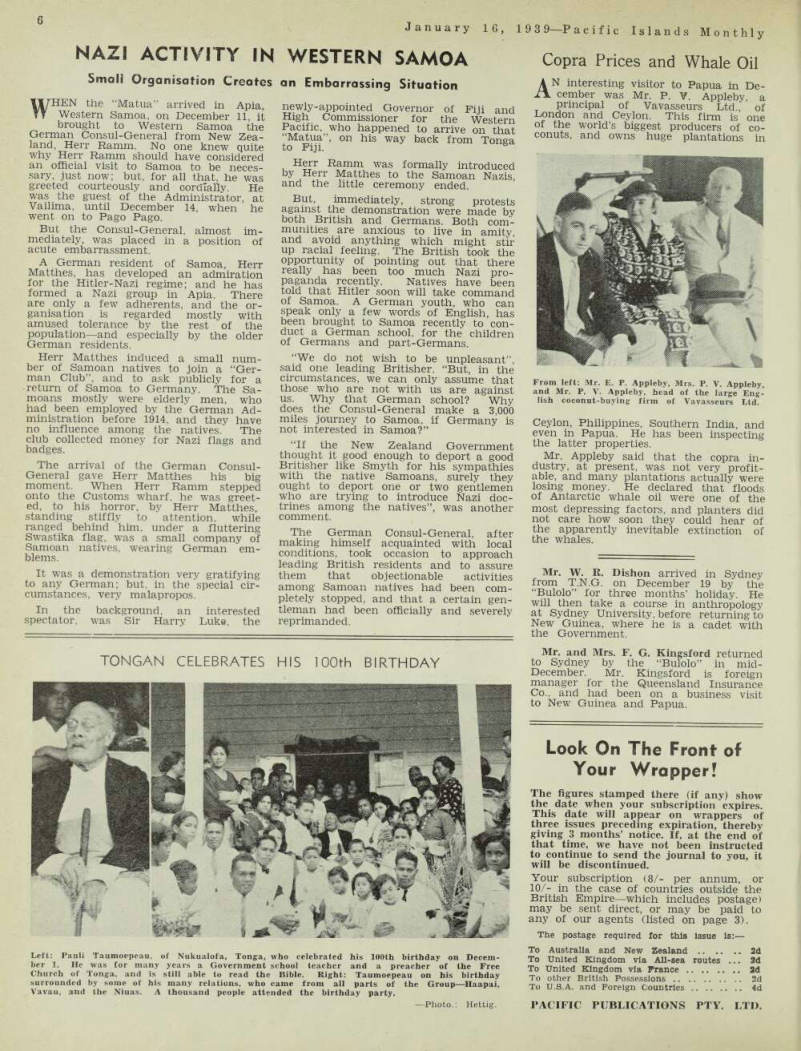
Tongan Celebrates His 100Th Birthday
Left: Pauli Taumoepeau, of Nukualofa, Tonga, who celebrated his 100th birthday on Decem ber 1. He was for many years a Government school teacher and a preacher of the Free Church of Tonga, and is still able to read the Bible. Right: Taumoepeau on his birthday surrounded by some of his many relations, who came from all parts of the Group—Haapai, Vavau, and the Niuas. A thousand people attended the birthday party.
Photo.: Hettig.
Copra Prices and Whale Oil
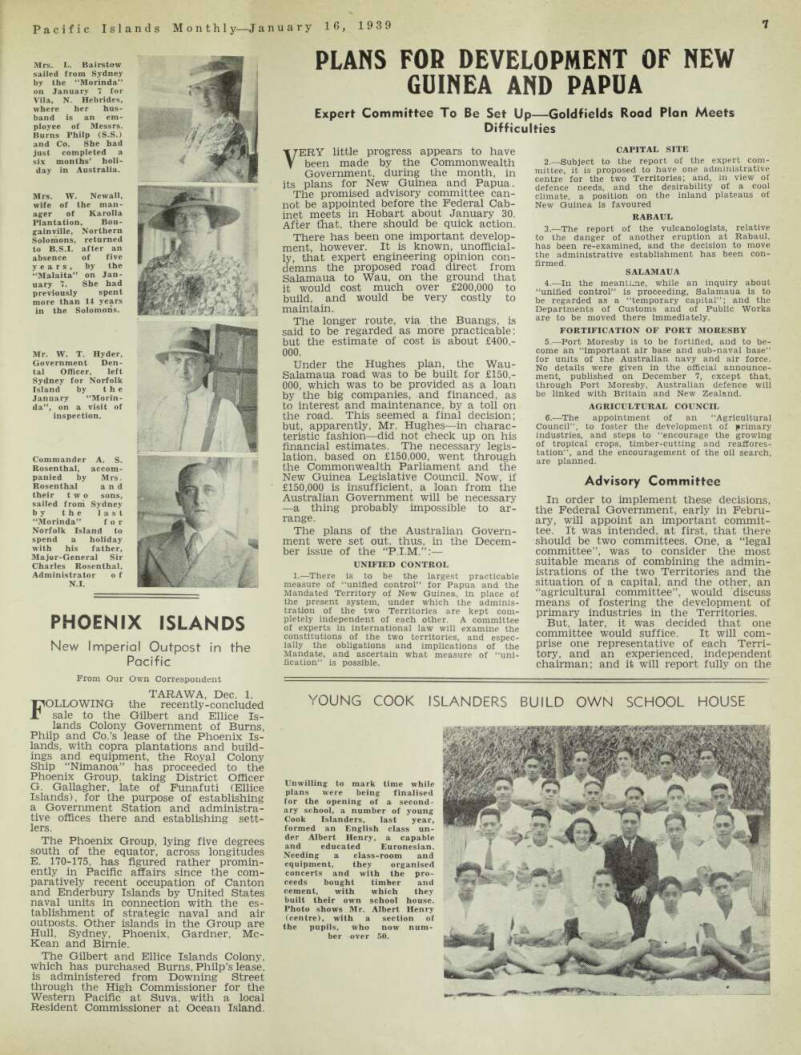
AN interesting visitor to Papua in De cember was Mr. P. V. Appleby, a principal of Vavasseurs Ltd, of London and Ceylon. This firm is one of the world’s biggest producers of co conuts, and owns huge plantations in
Ceylon, Philippines, Southern India, and even in Papua. He has been inspecting the latter properties.
Mr. Appleby said that the copra in dustry, at present, was not very profit able, and many plantations actually were losing money. He declared that floods of Antarctic whale oil were one of the most depressing factors, and planters did not care how soon they could hear of the apparently inevitable extinction of the whales.
Mr. W. R. Dishon arrived in Sydney from T.N.G. on December 19 by the “Bulolo” for three months’ holiday. He will then take a course in anthropology at Sydney University, before returning to New Guinea, where he is a cadet with the Government.
Mr. and Mrs. F. G. Kingsford returned to Sydney by the “Bulolo” in mid- December. Mr. Kingsford is foreign manager for the Queensland Insurance Co., and had been on a business visit to New Guinea and Papua.
From left: Mr. E. P. Appleby, Mrs. P. V. Appleby, and Mr, P. V. Appleby, head of the large Eng lish coconut-buying firm of Vavasseurs Ltd.
Mrs. L. Bairstow sailed from Sydney by the “Morinda” on January 7 for Vila, N. Hebrides, where her hus band is an em ployee of Messrs.
Burns Philp (S.S.) and Co. She had just completed a six months’ holi day in Australia.
Mrs. W. Newall, wife of the man ager of Karolla Plantation, Bou gainville, Northern Solomons, returned to B.S.I. after an absence of five years, by the “Malaita” on Jan uary 7. She had previously spent more than 14 years in the Solomons.
Mr. W. T. Hyder, Government Den tal Officer, left Sydney for Norfolk Island by the January “Morin da”, on a visit of inspection.
Commander A. S.
Rosenthal, accom panied by Mrs.
Rosenthal and their two sons, sailed from Sydney by the last “Morinda” for Norfolk Island to spend a holiday with his father, Major-General Sir Charles Rosenthal, Administrator of N.I.
Advertisements & other items, p. 8 (2 items)
6
January IC, 193 9—P acific Islands Monthly
Your Wrapper!
Look On The Front of
The figures stamped there (if any) show the date when your subscription expires.
This date will appear on wrappers of three issues preceding expiration, thereby giving 3 months’ notice. If, at the end of that time, we have not been instructed to continue to send the journal to you, it will be discontinued.
Your subscription (8/- per annum, or 10/- in the case of countries outside the British Empire—which includes postage) may be sent direct, or may be paid to any of our agents (listed on page 3).
The postage required for this issue is:— To Australia and New Zealand 2d To United Kingdom via All-sea routes ... 2d To United Kingdom via Prance 2d To other British Possessions 2d To U.S.A. and Foreign Countries 4d
PACIFIC PUBLICATIONS PTY. LTD.
Phoenix Islands
New Imperial Outpost in the Pacific
From Our Own Correspondent
Tarawa, Dec. 1.
FOLLOWING the recently-concluded sale to the Gilbert and Ellice Is lands Colony Government of Burns, Philp and Co.’s lease of the Phoenix Is lands, with copra plantations and build ings and equipment, the Royal Colony Ship “Nimanoa” has proceeded to the Phoenix Group, taking District Officer G. Gallagher, late of Funafuti (Ellice Islands), for the purpose of establishing a Government Station and administra tive offices there and establishing sett lers.
The Phoenix Group, lying five degrees south of the equator, across longitudes E. 170-175, has figured rather promin ently in Pacific affairs since the com paratively recent occupation of Canton and Enderbury Islands by United States naval units in connection with the es tablishment of strategic naval and air outposts. Other islands in the Group are Hull, Sydney, Phoenix, Gardner, Mc- Kean and Birnie.
The Gilbert and Ellice Islands Colony, which has purchased Burns, Philp’s lease, is administered from Downing Street through the High Commissioner for the Western Pacific at Suva, with a local Resident Commissioner at Ocean Island.
Puns For Development Of New
Guinea And Papua
Expert Committee To Be Set Up—Goldfields Rood Plan Meets Difficulties
VERY little progress appears to have been made by the Commonwealth Government, during the month, in its plans for New Guinea and Papua.
The promised advisory committee can not be appointed before the Federal Cab inet meets in Hobart about January 30.
After that, there should be quick action.
There has been one important develop ment, however. It is known, unofficial ly, that expert engineering opinion con demns the proposed road direct from Salamaua to Wau, on the ground that it would cost much over £200,000 to build, and would be very costly to maintain.
The longer route, via the Buangs, is said to be regarded as more practicable; but the estimate of cost is about £400,- 000.
Under the Hughes plan, the Wau- Salamaua road was to be built for £150,- 000, which was to be provided as a loan by the big companies, and financed, as to interest and maintenance, by a toll on the road. This seemed a final decision; but, apparently, Mr. Hughes—in charac teristic fashion —did not check up on his financial estimates. The necessary legis lation, based on £150,000, went through the Commonwealth Parliament and the New Guinea Legislative Council. Now, if £150,000 is insufficient, a loan from the Australian Government will be necessary —a thing probably impossible to ar range.
The plans of the Australian Govern ment were set out, thus, in the Decem ber issue of the “P.I.M.”:—
Unified Control
I.—There is to be the largest practicable measure of “unified control” for Papua and the Mandated Territory of New Guinea, in place of the present system, under which the adminis tration of the two Territories are kept com pletely independent of each other. A committee of experts in international law will examine the constitutions of the two territories, and espec ially the obligations and implications of the Mandate, and ascertain what measure of “uni fication” is possible.
Capital Site
2—Subject to the report of the expert com mittee, it is proposed to have one administrative centre for the two Territories; and, in view of defence needs, and the desirability of a cool climate, a position on the inland plateaus of New Guinea is favoured
Rabaul
3. —The report of the volcanologists, relative to the danger of another eruption at Rabaul, has been re-examined, and the decision to move the administrative establishment has been con firmed.
Salamaua
4. the meantime, while an inquiry about “unified control” is proceeding, Salamaua is to be regarded as a “temporary capital”: and the Departments of Customs and of Public Works are to be moved there Immediately.
Fortification Of Port Moresby
5. —Port Moresby is to be fortified, and to be come an “important air base and sub-naval base” for units of the Australian navy and air force.
No details were given in the official announce ment, published on December 7, except that, through Port Moresby, Australian defence will be linked with Britain and New Zealand.
Agricultural Council
6. —The appointment of an “Agricultural Council”, to foster the development of primary industries, and steps to “encourage the growing of tropical crops, timber-cutting and reaffores tation”, and the encouragement of the oil search, are planned.
Advisory Committee
In order to implement these decisions, the Federal Government, early in Febru ary, will appoint an important commit tee. It was intended, at first, that there should be two committees. One, a “legal committee”, was to consider the most suitable means of combining the admin istrations of the two Territories and the situation of a capital, and the other, an
“agricultural committee”, would discuss
means of fostering the development of primary industries in the Territories.
But, later, it was decided that one committee would suffice. It will com prise one representative of each Terri
tory, and an experienced, independent
chairman; and it will report fully on the
whole of the questions involved in amal gamation of the Territories, choice of a capital, system of defence, improved transport and increased settlement and development.
To discuss the personnel of the com mittee, the Minister in charge of Terri tories, Mr. Harrison, conferred with the Administrator of New Guinea (Brigad ier-General Sir Walter McNicoll) in Sydney in December and January, and later in January he will meet the Lieutenant-Governor of Papua (Sir Hu bert Murray. Later this year he may visit the Territories himself.
It will be seen, however, that all these matters are closely linked, so far as the Federal Government is concerned, with a wide variety of questions. Here are some of them:— What amount of fortification, and what strength of armed forces, can be placed at Port Moresby? And to what extent can these protect New Guinea?
Assuming that a considerable degree of “unified control” is possible, would it be practicable to govern both Territories from Port Moresby, or from a point in the Mandated Territory, unless the two Territories are connected by road? (At present, although they adjoin, the only way of communication is by sea and by air.) Is it possible even to consider Wau as a capital (for the two Territories) un less there is a road between Wau and the coast?
If a road cannot be built for £150,000, would Australia provide funds to cover the extra cost? And, if so, should Aus tralia then insist upon a developmental road, rather than a road constructed only to serve the Morobe goldfield?
If roading is to be so very expensive, is it possible to return to a consideration of a plan of developing the country agri culturally by subsidised aeroplane trans port?
Are the Territories to be self-support ing in future? Or will Australia for de fence reasons, continue to subsidise Pa pua and find a subsidy, if necessary, for New Guinea? Or would an amalgama tion of the Territories mean that Pa pua’s usual deficit would be taken care of by the surplus which New Guinea usually gets from her gold royalty?
Consideration of these questions, one in relation to the other, may be clari fied if a really competent committee is appointed, and sets to work, at an early date.
"Short" Versus "Long"
Route
Wau Miners Want Independent
Report
THE New Guinea Mining Association held a general meeting in Wau on December 23, and the road position was discussed in the light of knowledge that the Government engineers regarded the Bitoi route (the “shortest and most di rect route”) as very difficult, and likely to cost much more than £150,000.
The belief was expressed that the Ad ministration favoured “the long route” (via Buangs, or via Markham and Wam pit); whereas the only route which would be fair to the Goldfields communities was the direct route.
On the motion of Mr. Harold Taylour it was decided that a licensed surveyor should be obtained to take a close sur vey of the Bitoi route, with particular regard to the “gorge” portion, and that later a qualified engineer should be ob tained to give expert advice as to the possibility of putting a road through the gorge section and assessing the cost.
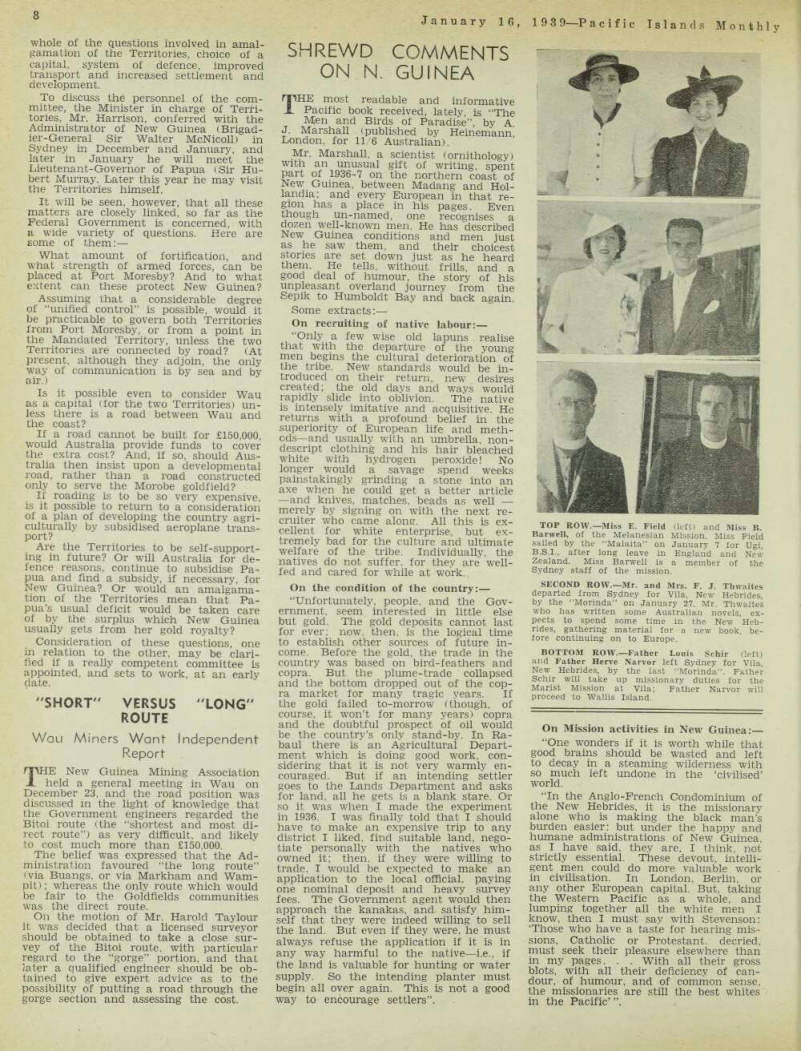
Young Cook Islanders Build Own School House
Unwilling to mark time while plans were being finalised for the opening of a second ary school, a number of young Cook Islanders, last year, formed an English class un der Albert Henry, a capable and educated Euronesian.
Needing a class-room and equipment, they organised concerts and with the pro ceeds bought timber and cement, with which they built their own school house.
Photo shows Mr. Albert Henry (centre), with a section of the pupils, who now num ber over 50.
Advertisements & other items, p. 9 (1 item)
7
Pacific Islands Monthl y—J anuary 16, 1939
Shrewd Comments
On N. Guinea
THE most readable and informative Pacific book received, lately, is “The Men and Birds of Paradise”, by A.
J. Marshall (published by Heinemann, London, for 11/6 Australian).
Mr. Marshall, a scientist (ornithology) with an unusual gift of writing, spent part of 1936-7 on the northern coast of New Guinea, between Madang and Hol landia; and every European in that re gion has a place in his pages. Even though un-named, one recognises a dozen well-known men. He has described New Guinea conditions and men just as he saw them, and their choicest stories are set down just as he heard them. He tells, without frills, and a good deal of humour, the story of his unpleasant overland journey from the Sepik to Humboldt Bay and back again.
Some extracts:— On recruiting of native labour:— “Only a few wise old lapuns realise that with the departure of the young men begins the cultural deterioration of the tribe. New standards would be in troduced on their return, new desires created; the old days and ways would rapidly slide into oblivion. The native is intensely imitative and acquisitive. He returns with a profound belief in the superiority of European life and meth ods—and usually with an umbrella, non descript clothing and his hair bleached white with hydrogen peroxide! No longer would a savage spend weeks painstakingly grinding a stone into an axe when he could get a better article —and knives, matches, beads as well merely by signing on with the next re cruiter who came along. All this is ex cellent for white enterprise, but ex tremely bad for the culture and ultimate welfare of the tribe. Individually, the natives do not suffer, for they are well fed and cared for while at work.
On the condition of the country:— “Unfortunately, people, and the Gov ernment, seem interested in little else but gold. The gold deposits cannot last for ever: now. then, is the logical time to establish other sources of future in come. Before the gold, the trade in the country was based on bird-feathers and copra. But the plume-trade collapsed and the bottom dropped out of the cop ra market for many tragic years. If the gold failed to-morrow (though, of course, it won’t for many years) copra and the doubtful prospect of oil would be the country’s only stand-by. In Ra baul there is an Agricultural Depart ment which is doing good work, con sidering that it is not very warmly en couraged. But if an intending settler goes to the Lands Department and asks for land, all he gets is a blank stare. Or so it was when I made the experiment in 1936. I was finally told that I should have to make an expensive trip to any district I liked, find suitable land, nego tiate personally with the natives who owned it; then, if they were willing to trade. I would be expected to make an application to the local official, paying one nominal deposit and heavy survey fees. The Government agent would then approach the kanakas, and satisfy him self that they were indeed willing to sell the land. But even if they were, he must always refuse the application if it is in any way harmful to the native —i.e., if the land is valuable for hunting or water supply. So the intending planter must begin all over again. This is not a good way to encourage settlers”.
On Mission activities in New Guinea:— “One wonders if it is worth while that good brains should be wasted and left to decay in a steaming wilderness with so much left undone in the ‘civilised’ world.
“In the Anglo-French Condominium of the New Hebrides, it is the missionary alone who is making the black man’s burden easier; but under the happy and humane administrations of New Guinea, as I have said, they are, I think, not strictly essential. These devout, intelli gent men could do more valuable work in civilisation. In London, Berlin, or any other European capital. But. taking the Western Pacific as a whole, and lumping together all the white men I know, then I must say with Stevenson: ‘Those who have a taste for hearing mis sions, Catholic or Protestant, decried, must seek their pleasure elsewhere than in my pages. . . With all their gross blots, with all their deficiency of can dour, of humour, and of common sense, the missionaries are still the best whites in the Pacific’ ”.
TOP ROW.—Miss E. Field (left) and Miss B.
Barwell, of the Melanesian Mission. Miss Field sailed by the “Malaita” on January 7 for Ugi, B.S.I. after long leave in England and New Zealand. Miss Barwell is a member of the Sydney staff of the mission.
SECOND ROW.—Mr. and Mrs. F. J. Thwaites departed from Sydney for Vila, New Hebrides, by the “Morinda” on January 27. Mr. Thwaites who has written some Australian novels, ex pects to spend some time in the New Heb rides, gathering material for a new book, be fore continuing on to Europe.
BOTTOM ROW.—Father Louis Schir (left) and Father Herve Narvor left Sydney for Vila, New Hebrides, by the last “Morinda”. Father Schir will take up missionary duties for the Marist Mission at Vila; Father Narvor will proceed to Wallis Island.
May Be Big Naval
Base
Future of Port Moresby
IT is inevitable that, if the armaments race continues in the Pacific, Port Moresby will assume great importance.
A glance at the map shows how suitably it is placed in relation to Singapore, the Dutch East Indies, the vital East Coast of Australia, and the line of immense forti fications being constructed by America, north and south through the centre of the Pacific.
Port Moresby is a magnificent port, capable of sheltering the biggest fleet in the world. Fairfax Harbour (the north western portion of Port Moresby) lies hidden among the hills, with deep, shel tered water. An important Australian flotilla lay completely concealed in there, in the critical days of August, 1914.
The topography is such that the port could be easily defended against ap proach from the sea. At the back are the foothills leading up into the high moun tains —there could be no approach from there.
For many months of the year, Port Moresby is an arid unbeautiful place.
Luxuriant tropical vegetation comes with in a few miles of it, and there are rush ing mountain rivers only 20 or 30 miles away, but the port itself is in a dry spot —a meteorological freak. But, after a few showers, it is covered quickly with grass and flowering shrubs. If the port becomes an air and navy base, a good water supply probably will be brought in, and the character of the place, under liberal irrigation, will be changed wholly, for the better.
The “Daily Herald”, of London, on Janu ary 2, published a map of Australia and New Guinea, and said that Australia has decided to have its own “Gibraltar” at Port Moresby, which was admirably situ ated for Australia’s defence.
In view of these things, it is amusing to recall that not six months ago, Aus tralia’s Prime Minister, in most emphatic fashion, declared that there was neither thought or intention of fortifying Port Moresby, or placing Australian armed forces there.
Education Of Young
Nauruans
SO interested was Mr. J. E. Harrison, Minister for Territories, in the 12 Nauruans brought to the Sydney Scout Jamboree by Mr. Hurst, of Gee long, that an interview at the Common wealth Offices, Sydney, on January 10, intended for 15 minutes, extended over an hour.
Mr. Hurst described his educational work among the young Nauruans —undertaken at his own expense—and point ed out to the Minister that his main problem was the proper employment of the young Nauruans, after they had been educated and technically trained.
The Minister talked for a long time, with the Nauruan lads, and discussed with them the future of their life on Nauru, and their hopes and opportuni ties. He appeared to be impressed with the high standard of their intelligence, and their command of good English.
Mr. A. W. L. Savage, Accountant Gen eral and Deputy Treasurer of Fiji, left Suva in December for England on leave.
W.R.C. Abroad
Head of Carpenter Organisation Visits U.S.A. and Britain
IT is to be expected that, on February 15, old Father Thames will take a look over London’s hoary traditions and time-honoured institutions, and carefully will block up all gaps open for occupation by new ideas and dynamic enterprise.
For, on that date, Sir Walter Carpen ter will arrive in London, from Austra lia via America: and, if opportunity offers, he may try to apply his extra ordinary energy to the ancient city’s choicest prerogatives. For a man does not easily forget the habits of a life time: and Sir Walter is all for modern ity and progress—and especially ship ping in its relation thereto.
In any event, he will have something biting and uncompromising to say about the failure of the British Empire, up to the present, to provide a policy ade quate for the defence of British inter ests in the Pacific. When he left Syd ney on January 6, he was prepared to argue that the way is open for Japan to thrust south-eastwards, seizing New Guinea, Fiji and New Zealand and thus virtually isolating Australia. He would not agree that Japan, acting thus-wise, would open her flank most dangerously to the Americans —the Americans, he thought, would not fight unless attack ed. But, by now, Sir Walter is in Ame rica, and maybe he will learn there that the Americans will not permit Japan to seize Pacific territories already occupied by Europeans.
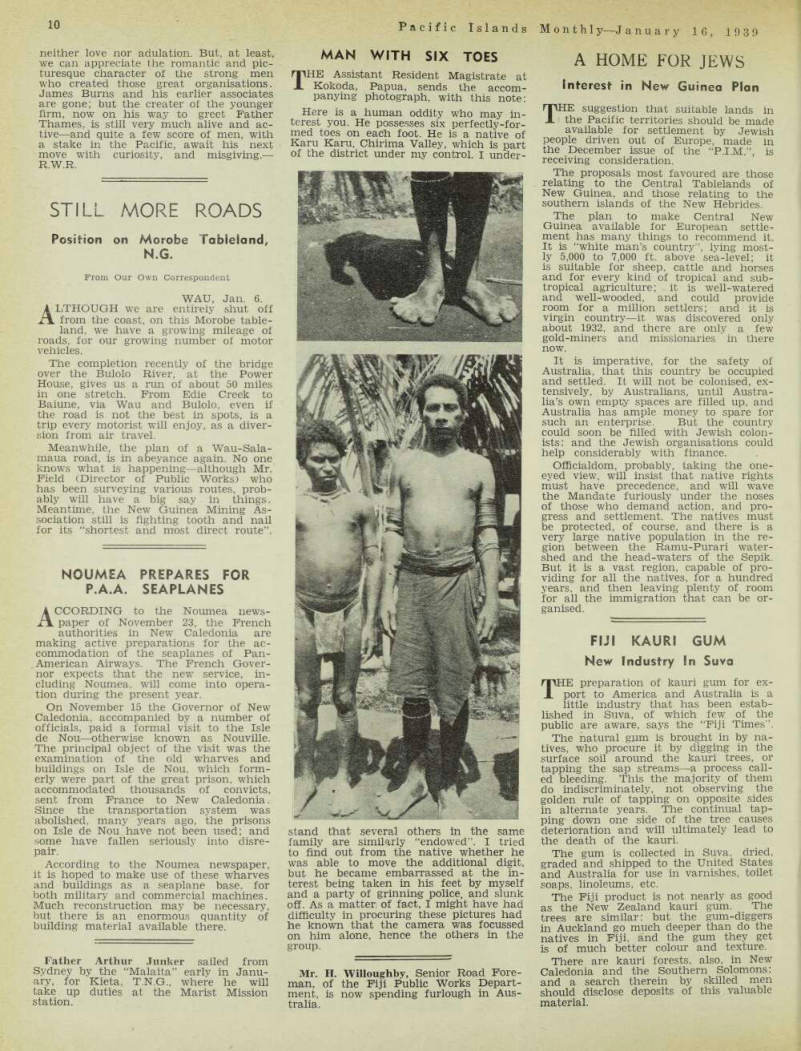
OF all Pacific personalities to-day, that of Sir Walter Carpenter probably is the most conspicuous and pictures que. Thirty years ago, he was an ener getic, big-framed young man, managing trading stores in the Pacific and get ting ready to strike out on his own ac count. To-day, he is the active, direct ing head of an immense organisation, which includes merchandising, planting, shipping, manufacturing, hotel-keeping,
mail-carrying, aerial transport, and a dozen more.
All this has grown out of one man’s idea, and belief in himself. Walter Ran dolph Carpenter’s father was an Ameri can sea-captain, and he was born in Singapore. He was pickled in the salt of the Pacific before he had grown whiskers. In the nineties, while still a boy, he was manager of J. B. Carpenter and Son Ltd. at Thursday Island; from 1908 to 1914, he was manager for Rob ert Kaad and Co., in Suva.
Then came the war, with its insati able demand for explosives. Explosives meant glycerine, and the best glycerine comes from coconut oil. W.R.C. saw the chance, just a little sooner than anyone else. He went out into the Pacific, and he bought copra wherever he could find it —unlimited quantities of it. Next arose the problem of getting it to Eu rope and U.S.A. —nearly all shipping was commandeered. W.R.C. hired everything that would float upon the blue ocean, from liners to leaky old schooners, and piled bags of copra all over them, and sent them on their way.
THE copra made the markets, and W.R.C. made a fortune. But he didn’t stop. That wap over 20 years ago, and he hasn’t stopped yet. This scribe predicts that he will stop only when he is finally bagged by the Great Reaper.
Since 1914, W.R.C. has established W. R. Carpenter and Co. Ltd.; and that firm, wherein two brothers and two sons of W.R. are active executives, has: Established stores, plantations, and trading stations all over New Guinea and the Solomon Islands: Established a fleet of inter-island cargo-carriers; Purchased control of On Chong and Co. Ltd. (Gilbert and Ellice Islands) and Brown and Joske Ltd. (Fiji).
Established the W.R.C. Line of steam ers, running between Pacific Islands ports and Europe; Founded the South Pacific Insurance Co. Ltd.; Established Mandated Airlines Ltd., which carry on aerial transport in New Guinea and Papua; Purchased control of the hotels in most of the Morobe towns, New Guinea; Established the weekly airmail service between Sydney and New Guinea, under contract with the Commonwealth Gov ernment.
Those are only the firm’s major en terprises. The minor concerns are in numerable. And the firm never stops —always, something new is being plan ned, planted or launched. Some of the firm’s executives were in Papua the other day, having a look around—it is sug gested that the signboard is now going up in Port Moresby.
ALWAYS, at the centre of it, is W.R.C. —a big, dominating man, handsome still despite his 60 odd years; with a loud, jolly laugh and a most generous disposition offsetting a grim eye and a predatory beak of a nose. A “holy ter ror” in a hard-fought deal, and yet a man whose private charities are beyond number —he gave £lO,OOO, not long ago, to a maternal welfare fund. A very human person: this scribe, whose pro fession is a knowledge of language, has heard W.R. in a rage, and thus has ac quired several new curse-words of great beauty and potency.
Between them, Burns Philp and Co. and W. R. Carpenter and Co., control most of the trade and transport of New Guinea: and New Guinea folk, describ ing them as “a monopoly”, accord them
Sir Walter Carpenter.
neither love nor adulation. But, at least, we can appreciate the romantic and pic turesque character of the strong men who created those great organisations.
James Burns and his earlier associates are gone; but the creater of the younger firm, now on his way to greet Father Thames, is still very much alive and ac tive —and quite a few score of men, with a stake in the Pacific, await his next move with curiosity, and misgiving.—
R.W.R.
Advertisements & other items, p. 11 (1 item)
9
Pacific islands Monthl y—J anuary 16, 1939
Still More Roads
Position on Morobe Tableland, N.G.
From Our Own Correspondent WAU, Jan. 6.
ALTHOUGH we are entirely shut off from the coast, on this Morobe table land, we have a growing mileage of roads, for our growing number of motor vehicles.
The completion recently of the bridge over the Bulolo River, at the Power House, gives us a run of about 50 miles in one stretch. From Edie Creek to Baiune, via Wau and Bulolo, even if the road is not the best in spots, is a trip every motorist will enjoy, as a diver sion from air travel.
Meanwhile, the plan of a Wau-Sala maua road, is in abeyance again. No one knows what is happening—although Mr.
Field (Director of Public Works) who has been surveying various routes, prob ably will have a big say in things.
Meantime, the New Guinea Mining As sociation still is fighting tooth and nail for its “shortest and most direct route”.
Noumea Prepares For
P.A.A. Seaplanes
ACCORDING to the Noumea news paper of November 23, the French authorities in New Caledonia are making active preparations for the ac commodation of the seaplanes of Pan- American Airways. The French Gover nor expects that the new service, in cluding Noumea, will come into opera tion during the present year.
On November 15 the Governor of New Caledonia, accompanied by a number of officials, paid a formal visit to the Isle de Nou —otherwise known as Nouville.
The principal object of the visit was the examination of the old wharves and buildings on Isle de Nou, which form erly were part of the great prison, which accommodated thousands of convicts, sent from France to New Caledonia.
Since the transportation system was abolished, many years ago, the prisons on Isle de Nou have not been used; and some have fallen seriously into disre pair.
According to the Noumea newspaper, it is hoped to make use of these wharves and buildings as a seaplane base, for both military and commercial machines.
Much reconstruction may be necessary, but there is an enormous quantity of building material available there.
Father Arthur Junker sailed from Sydney by the “Malaita” early in Janu ary, for Kieta, T.N.G., where he will take up duties at the Marist Mission station.
Man With Six Toes
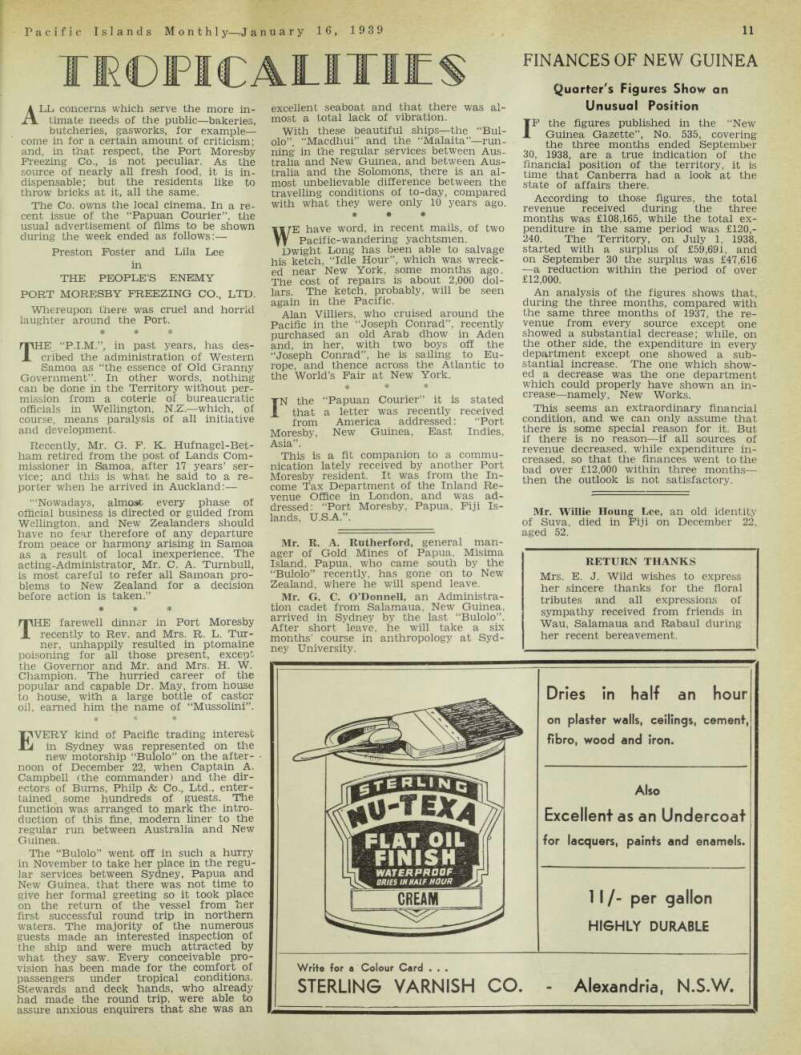
THE Assistant Resident Magistrate at Kokoda, Papua, sends the accom panying photograph, with this note; Here is a human oddity who may in terest you. He possesses six perfectly-for med toes on each foot. He is a native of Karu Karu, Chirima Valley, which is part of the district under my control. I under-
stand that several others in the same family are similarly “endowed”. I tried to find out from the native whether he was able to move the additional digit, but he became embarrassed at the in terest being taken in his feet by myself and a party of grinning police, and slunk off. As a matter of fact, I might have had difficulty in procuring these pictures had he known that the camera was focussed on him alone, hence the others in the group.
Mr. H. Willoughby, Senior Road Fore man, of the Fiji Public Works Depart ment, is now spending furlough in Aus tralia.
A Home For Jews
Interest in New Guinea Plan
THE suggestion that suitable lands in the Pacific territories should be made available for settlement by Jewish people driven out of Europe, made in the December issue of the is receiving consideration.
The proposals most favoured are those relating to the Central Tablelands of New Guinea, and those relating to the southern islands of the New Hebrides.
The plan to make Central New Guinea available for European settle ment has many things to recommend it.
It is “white man’s country”, lying most ly 5,000 to 7,000 ft. above sea-level; it is suitable for sheep, cattle and horses and for every kind of tropical and sub tropical agriculture; it is well-watered and well-wooded, and could provide room for a million settlers; and it is virgin country—it was discovered only about 1932, and there are only a few gold-miners and missionaries in there now.
It is imperative, for the safety of Australia, that this country be occupied and settled. It will not be colonised, ex tensively, by Australians, until Austra lia’s own empty spaces are filled up, and Australia has ample money to spare for such an enterprise. But the country could soon be filled with Jewish colon ists: and the Jewish organisations could help considerably with finance.
Officialdom, probably, taking the one eyed view, will insist that native rights must have precedence, and will wave the Mandate furiously under the noses of those who demand action, and pro gress and settlement. The natives must be protected, of course, and there is a very large native population in the re gion between the Ramu-Purari water shed and the head-waters of the Sepik.
But it is a vast region, capable of pro viding for all the natives, for a hundred years, and then leaving plenty of room for all the immigration that can be or ganised.
Fiji Kauri Gum
New Industry In Suva
r'.E preparation of kauri gum for ex port to America and Australia is a little industry that has been estab lished in Suva, of which few of the public are aware, says the “Fiji Times”.
The natural gum is brought in by na tives, who procure it by digging in the surface soil around the kauri trees, or tapping the sap streams —a process call ed bleeding. This the majority of them do indiscriminately, not observing the golden rule of tapping on opposite sides in alternate years. The continual tap ping down one side of the tree causes deterioration and will ultimately lead to the death of the kauri.
The gum is collected in Suva, dried, graded and shipped to the United States and Australia for use in varnishes, toilet soaps, linoleums, etc.
The Fiji product is not nearly as good as the New Zealand kauri gum. The trees are similar: but the gum-diggers in Auckland go much deeper than do the natives in Fiji, and the gum they get is of much better colour and texture.
There are kauri forests, also, in New Caledonia and the Southern Solomons: and a search therein by skilled men should disclose deposits of this valuable material.
Advertisements & other items, p. 12 (1 item)
10
Pacific Islands Monthl y—J anuary 16, 1939
Tropicalitifs
ALL concerns which serve the more in timate needs of the public—bakeries, butcheries, gasworks, for example come in for a certain amount of criticism; and, in that respect, the Port Moresby Freezing Co., is not peculiar. As the source of nearly all fresh food, it is in dispensable; but the residents like to throw bricks at it, all the same.
The Co. owns the local cinema. In a re cent issue of the “Papuan Courier”, the usual advertisement of films to be shown during the week ended as follows: Preston Foster and Lila Lee in
The People’S Enemy
Port Moresby Freezing Co., Ltd.
Whereupon there was cruel and horrid laughter around the Port. *- * * THE “P.1.M.”, in past years, has des cribed the administration of Western Samoa as “the essence of Old Granny Government”. In other words, nothing can be done in the Territory without per mission from a coterie of bureaucratic officials in Wellington, N.Z.—which, of course, means paralysis of all initiative and development.
Recently, Mr. G. F. K. Hufnagel-Bet ham retired from the post of Lands Com missioner in Samoa, after 17 years’ ser vice; and this is what he said to a re porter when he arrived in Auckland;— ‘“Nowadays, almost every phase of official business is directed or guided from Wellington, and New Zealanders should have no fear therefore of any departure from peace or harmony arising in Samoa as a result of local inexperience. The acting-Administrator. Mr. C. A. Turnbull, is most careful to refer all Samoan pro blems to New Zealand for a decision before action is taken.” » * * THE farewell dinner in Port Moresby recently to Rev. and Mrs. R. L. Tur ner, unhappily resulted in ptomaine poisoning for all those present, except the Governor and Mr. and Mrs. H. W.
Champion. The hurried career of the popular and capable Dr. May, from house to house, with a large bottle of castor oil, earned him the name of “Mussolini”. * * * EVERY kind of Pacific trading interest in Sydney was represented on the new motorship “Bulolo” on the after noon of December 22, when Captain A.
Campbell (the commander) and the dir ectors of Bums, Philp & Co., Ltd., enter tained some hundreds of guests. The function was arranged to mark the intro duction of this fine, modern liner to the regular run between Australia and New Guinea.
The “Bulolo” went off in such a hurry in November to take her place in the regu lar services between Sydney, Papua and New Guinea, that there was not time to give her formal greeting so it took place on the return of the vessel from her first successful round trip in northern waters. The majority of the numerous guests made an interested inspection of the ship and were much attracted by what they saw. Every conceivable pro vision has been made for the comfprt of passengers under tropical conditions.
Stewards and deck hands, who already had made the round trip, were able to assure anxious enquirers that she was an
excellent seaboat and that there was al most a total lack of vibration.
With these beautiful ships—the “Bul olo”, “Macdhui” and the “Malaita” —running in the regular services between Aus tralia and New Guinea, and between Aus tralia and the Solomons, there is an al most unbelievable difference between the travelling conditions of to-day, compared with what they were only 10 years ago. * * * WE have word, in recent mails, of two Pacific-wandering yachtsmen.
Dwight Long has been able to salvage his ketch, “Idle Hour”, which was wreck ed near New York, some months ago.
The cost of repairs is about 2,000 dol lars. The ketch, probably, will be seen again in the Pacific.
Alan Villiers, who cruised around the Pacific in the “Joseph Conrad”, recently purchased an old Arab dhow in Aden and, in her, with two boys off the “Joseph Conrad”, he is sailing to Eu rope, and thence across the Atlantic to the World’s Fair at New York. * * * IN the “Papuan Courier” it is stated that a letter was recently received from America addressed: “Port Moresby, New Guinea, East Indies, Asia”.
This is a fit companion to a commu nication lately received by another Port Moresby resident. It was from the In come Tax Department of the Inland Re venue Office in London, and was ad dressed: “Port Moresby, Papua, Fiji Is lands, U.S.A.”.
Mr. R. A. Rutherford, general man ager of Gold Mines of Papua, Misima Island, Papua, who came south by the “Bulolo” recently, has gone on to New Zealand, where he will spend leave.
Mr. G. C. O’Donnell, an Administra tion cadet from Salamaua, New Guinea, arrived in Sydney by the last “Bulolo”.
After short leave, he will take a six months' course in anthropology at Syd ney University.
Finances Of New Guinea
Quarter's Figures Show an Unusual Position
IF the figures published in the “New Guinea Gazette”, No. 535, covering the three months ended September 30, 1938, are a true indication of the financial position of the territory, it is time that Canberra had a look at the state of affairs there.
According to those figures, the total revenue received during the three months was £108,165, while the total ex penditure in the same period was £120,- 240. The Territory, on July 1, 1938, started with a surplus of £59,691, and on September 30 the surplus was £47,616 —a reduction within the period of over £12,000.
An analysis of the figures shows that, during the three months, compared with the same three months of 1937, the re venue from every source except one showed a substantial decrease; while, on the other side, the expenditure in every department except one showed a sub stantial increase. The one which show ed a decrease was the one department which could properly have shown an in crease—namely, New Works.
This seems an extraordinary financial condition, and we can only assume that there is some special reason for it. But if there is no reason—if all sources of revenue decreased, while expenditure in creased, so that the finances went to the bad over £12,000 within three months — then the outlook is not satisfactory.
Mr. Willie Houng Lee, an old identity of Suva, died in Fiji on December 22, aged 52.
Advertisements & other items, pp. 13-14 (2 items)
11
Pacific Islands Monthl y—„J anuary 16, 1939
Mm'll
RETURN THANKS
Mrs. E. J. Wild wishes to express her sincere thanks for the floral tributes and all expressions of sympathy received from friends in Wau, Salamaua and Rabaul during her recent bereavement.
SE
CREAM
Write for a Colour Card . . ,
STERLING VARNISH CO.
Dries in half an hour on plaster walls, ceilings, cement, fibro, wood and iron.
Also Excellent as an Undercoat for lacquers, paints and enamels.
1 I/- per gallon
HIGHLY DURABLE
Alexandria, N.S.W.
£ % f m
Whatever you
ask you’ll find amongst
the Miniature Kodaks
OF ALL KODAK DEALERS
THROUGHOUT THE ISLANDS and
KODAK (A/ASIA) PTY. LTD.
379 George St., Sydney SUPREMA in name . . .
SUPREME in design! Makes 12 exposures 2-\- x 2-\ in. on SS62O Kodak Film. Has automatic film spacing device with exposure counter, double exposure prevention device, etc. With f/3.5 Anastigmat lens, Compur- Rapid Shutter to 1/400 second. Price £l6 36-exp. 35mm. models at half what you expected to pay. Nothing new to learn; striking pictures are a certainty! With Body Release.
Retina I, with f/3.5 lens; Black £lO/10/- Chromium £l2 Retina 11, with f/2 lens, coupled range-finder, £27/10/- A brilliant example of modern photographic craftsmanship. For 16 exposures on SS62O Kodak Film. Has action front, body release, etc. Satin Chromium finish. Choice of f/4.5 and f/3.5 lenses.
Prices from £B/10/-
Write for Catalogue
Ks *&sk
KODAK FILM
FOR EXTRA QUALITY.
Kodak Film is based on fifty years’ experience with Island and Tropical needs. Its EXTRA QUALITY means
SNAPSHOTS YOU’LL BE PROUD
OF.
For the pictures that are hard to get, load with Kodak Verichrome or lightning-fast Kodak Super Sensitive Panchromatic—they’re the films
that GET THE PICTURE.
Church Centenary
In The Marquesas Islands
Prom Our Own Correspondent
Papeete, Dec. 18.
THE centenary of the establishment of the Roman Catholic Church in the Marquesas Islands was celebrated in the Cathedral Church of the Vicaire Apostolique, at Atuona, Hiva-oa, on November 20.
Several hundreds of islanders were transported from distant communities by the schooners “Denise” and “Tere Ora”, to Atuona.
The Roman Catholic Mission in the South Pacific was established at Man gareva, Gambier Islands, in 1834, by Pere Laval, Pere Caret and Frere Col omban, and it was from that centre that the church was extended to the other islands of Central Polynesia, in 1838, to the Marquesas Islands.
Not Enough Seats
New Guinea Airmail Overtaxed
CRITICISM is being directed against the airmail service, between Sydney and New Guinea, conducted by Messrs. W. R. Carpenter and Co., Ltd. — not because the service is inefficient, but because it is insufficient.
It appears that for several weeks past it has been impossible for a person to secure a berth on the aeroplanes, with out booking several weeks in advance.
The passengers offering represent from two to three times as many as the aero planes can accommodate.
Individuals have made strong represen tations to Messrs. Carpenter, urging that another aeroplane be put on to take the available traffic, but the firm replies that this cannot be done without the express permission of the Commonwealth Government —and, so far, the Common wealth Government has taken no inter est in the matter.
It is presumed that the hold-up has something to do with the subsidy. The subsidy provided by the Commonwealth Government is for a weekly airmail of one aeroplane—there is no financial pro vision for a subsidy for two aeroplanes.
However, the demand for the service very definitely is there; the Federal Gov ernment says that now it is embarked upon a policy under which it will en courage in every possible way the devel opment of Papua and the Mandated Ter ritory; and the next logical step would appear to be the provision of some addi tional money, under which a larger aero plane service can take care of the grow ing public demand.
Port Moresby's New
Suburb
From Our Own Correspondent
Pt. Moresby, Jan. 6.
THE Australasian Petroleum Co.’s colony, vulgarly known as “Headache Village”, is growing fast, and now forms a suburb of Port Moresby. Seven cottages are now occupied, and the mess room and laboratories are functioning busily.
The site is far removed from the bright lights of Musgrave Street and the- fever ed gaiety of the hotels. But there is a clear view for some distance up and down the road, and residents there may safely—if due precautions are taken— whisper to one another the forbidden name of “Oil”.
Advertisements & other items, p. 14 (1 item)
12
January 16, 193 9—P acific Islands Monthly
About Islands People
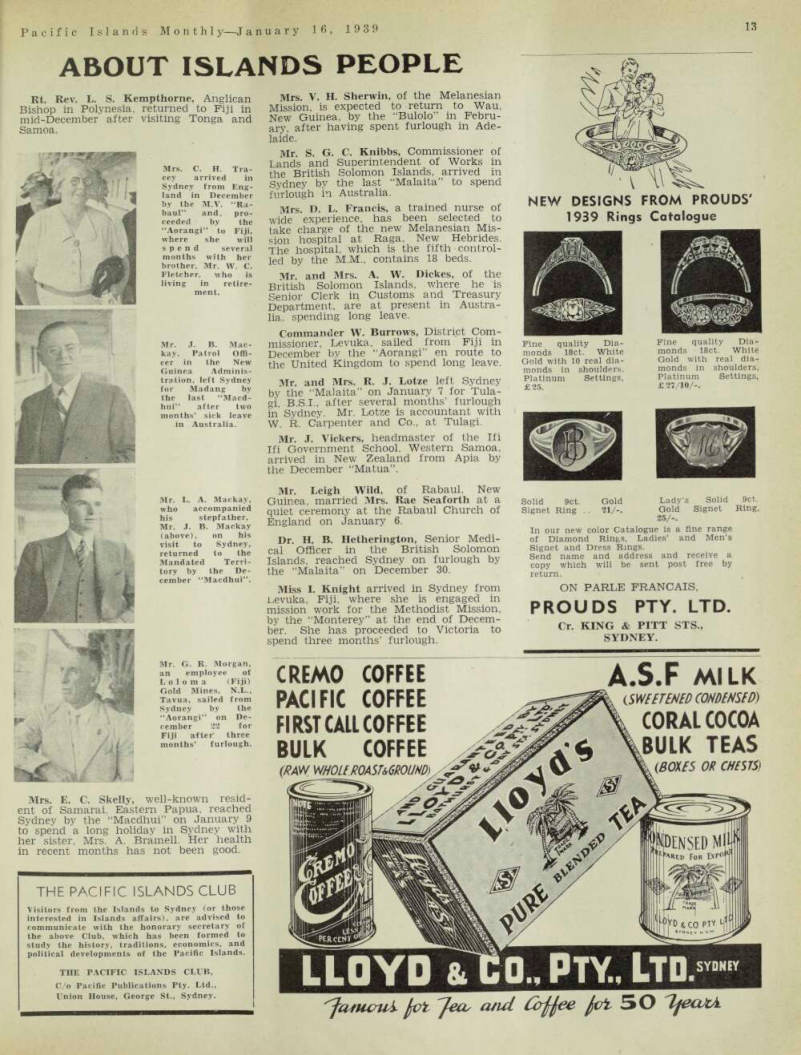
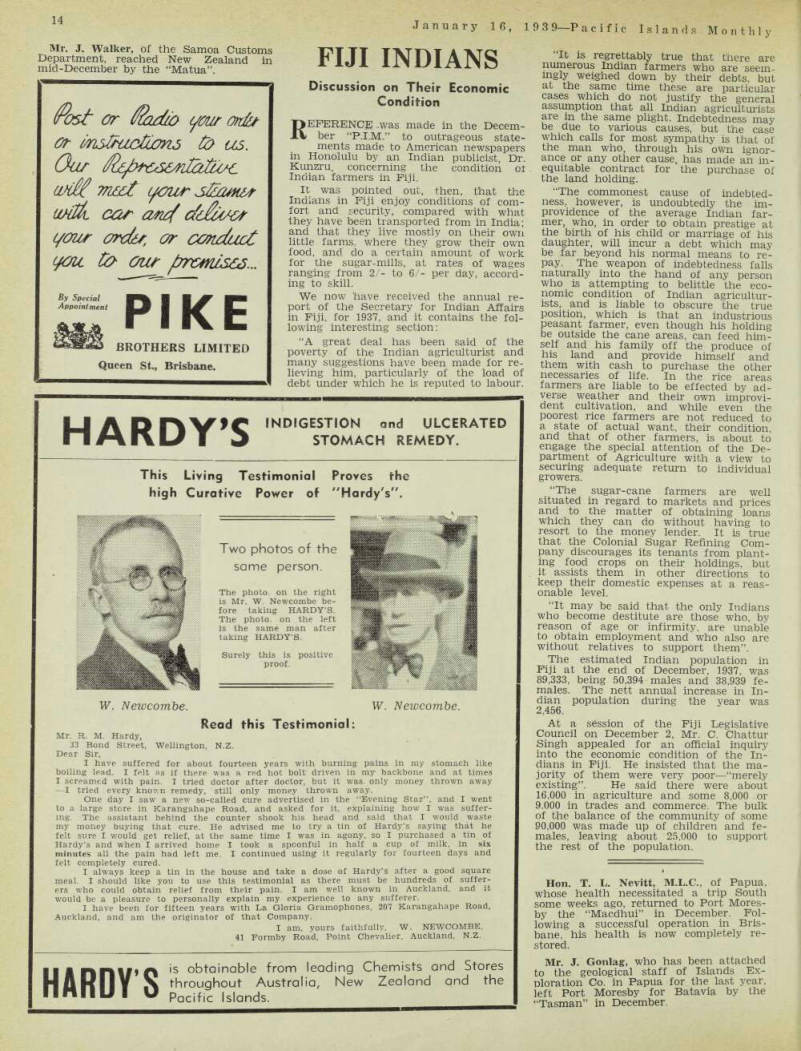
Rt. Rev. L. S. Kempthorne, Anglican Bishop in Polynesia, returned to Fiji in mid-December after visiting Tonga and Samoa.
Mrs. E. C. Skelly, well-known resid ent of Samarai. Eastern Papua, reached Sydney by the “Macdhui” on January 9 to spend a long holiday in Sydney with her sister, Mrs. A. Bramell. Her health in recent months has not been good.
Mrs. V. H. Sherwin, of the Melanesian Mission, is expected to return to Wau, New Guinea, by the “Bulolo” in Febru ary, after having spent furlough in Ade laide.
Mr. S. G. C. Knibbs, Commissioner of Lands and Superintendent of Works in the British Solomon Islands, arrived in Sydney by the last “Malaita” to spend furlough in Australia.
Mrs. D. L. Francis, a trained nurse of wide experience, has been selected to take charge of the new Melanesian Mis sion hospital at Raga. New Hebrides.
The hospital, which is the fifth control led by the M.M., contains 18 beds.
Mr. and Mrs. A. W. Dickes, of the British Solomon Islands, where he is Senior Clerk in Customs and Treasury Department, are at present in Austra lia. spending long leave.
Commander W. Burrows, District Com missioner. Levuka. sailed from Fiji in December by the “Aorangi” en route to the United kingdom to spend long leave.
Mr. and Mrs. R. J. Lotze left Sydney by the “Malaita” on January 7 for Tula gi. 8.5.1., after several months’ furlough in Sydney. Mr. Lotze is accountant with W. R. Carpenter and Co., at Tulagi.
Mr. J. Vickers, headmaster of the Ifi Ifi Government School. Western Samoa, arrived in New Zealand from Apia by the December “Matua”.
Mr. Leigh Wild, of Rabaul. New Guinea, married Mrs. Rae Seaforth at a quiet ceremony at the Rabaul Church of England on January 6.
Dr. H. B, Hetherington, Senior Medi cal Officer in the British Solomon Islands, reached Sydney on furlough by the “Malaita” on December 30.
Miss I. Knight arrived in Sydney from Levuka, Fiji, where she is engaged in mission work for the Methodist Mission, by the “Monterey” at the end of Decem ber. She has proceeded to Victoria to spend three months’ furlough.
Mrs. C. H. Tra cey arrived in Sydney from Eng land in December by the M.V. “Ra baul” and. pro ceeded by the “Aorangi” to Fiji, where she will spend several months with her brother, Mr. W. C.
Fletcher, who is living in retire ment.
Mr. J. B. Mac kay, Patrol Offi cer in the New Guinea Adminis tration, left Sydney for Madang by the last “Macd hui” after two months’ sick leave in Australia.
Mr. L. A. Mackay, who accompanied his stepfather, Mr. J. B. Mackay (above), on his visit to Sydney, returned to the Mandated Terri tory by the De cember “Macdhui”.
Mr. G. R. Morgan, an employee of Lo1oma (Fiji) Gold Mines, N.L., Tavua, sailed from Sydney by the “Aorangi” on De cember 22 for Fiji after’ three months’ furlough.
Mr. J. Walker, of the Samoa Customs Department, reached New Zealand in mid-December by the “Matua”.
Advertisements & other items, pp. 15-16 (1 item)
Lloyd & Co..Pty..Ltd
are • T
NEW DESIGNS FROM PROUDS f
1939 Rings Catalogue
Fine quality Diamonds 18ct. White Gold with 10 real diamonds in shoulders.
Platinum Settings, £25.
Fine quality Diamonds 18ct. White Gold with real diamonds in shoulders.
Platinum Settings, £27/10/-.
Solid 9ct.
Signet Ring Gold Lady’s Solid Oct. 21/-. Gold Signet Ring, 25/-.
In our new color Catalogue is a fine range of Diamond Rings, Ladies’ and Men’s Signet and Dress Rings.
Send name and address and receive a copy which will be sent post free by return.
ON PARLE FRANCAIS,
PROUDS PTY. LTD.
Cr. KING & PITT STS.,
SYDNEY.
CREMO COFFEE
PACIFIC COFFEE
FIRST CALL COFFEE
BULK COFFEE
(Paw WHOumsMu
A.S.F MILK
CSWfmm
CORAL COCOA
BULK TEAS
(BOXfS OK CHI STS)
lENSED Ml
■ared For ■’T
j) jO) &CO PTY L j
**ON
SYDNEY
LLOYD & CO..PTY..LTD
'J'amcnik foot atui SO 'lfeaJzA
THE PACIFIC ISLANDS CLUB
Visitors from the Islands to Sydney (or those interested in Islands affairs), are advised to communicate with the honorary secretary of the above Club, which has been formed to study the history, traditions, economics, and political developments of the Pacific Islands.
THE PACIFIC ISLANDS CLUB,
C/o Pacific Publications Pty. Ltd., Union House, George St., Sydney.
Post or Posts (/our or msthaoGons us.
Our Ps/otcssmlaii
coitt most (/c uotfit cor ansf (/our orctr, or constuct you. to cur premises...
By Special Appointment
PIKE
BROTHERS LIMITED
Queen St., Brisbane.
14 A U r\y)C INDIGESTION and ULCERATED ■ 1M l\ T d STOMACH REMEDY.
This Living Testimonial Proves the
high Curative Power of "Hardy's".
Two photos of the
same person.
The photo, on the right is Mr. W. Newcombe before taking HARDY’S.
The photo, on the left is the same man after taking HARDY’S.
Surely this is positive proof.
W. Newcombe.
W. Newcombe.
Read this Testimonial:
Mr. R. M. Hardy, 33 Bond Street, Wellington, N.Z.
Dear Sir, I have suffered for about fourteen years with burning pains in my stomach like boiling lead. I felt as if there was a red hot bolt driven in my backbone and at times I screamed with pain. I tried doctor after doctor, but it was only money thrown away —I tried every known remedy, still only money thrown away.
One day I saw a new so-called cure advertised in the “Evening Star”, and I went to a large store in Karangahape Road, and asked for it, explaining how I was suffering. The assistant behind the counter shook his head and said that I would waste my money buying that cure. He advised me to try a tin of Hardy’s saying that he felt sure I would get relief, at the same time I was in agony, so I purchased a tin of Hardy’s and when I arrived home I took a spoonful in half a cup of milk, in six minutes all the pain had left me. I continued using it regularly for fourteen days and felt completely cured.
I always keep a tin in the house and take a dose of Hardy’s after a good square meal. I should like you to use this testimonial as there must be hundreds of sufferers who could obtain relief from their pain. I am well known in Auckland, and it would be a pleasure to personally explain my experience to any sufferer.
I have been for fifteen years with La Gloria Gramophones, 207 Karangahape Road, Auckland, and am the originator of that Company.
I am, yours faithfully, W. NEWCOMBE, 41 Formby Road, Point Chevalier, Auckland, N.Z. 11 I nnU’ D is obtainable from leading Chemists and Stores HAKIIY S throughout Australia, New Zealand and the 11 nil U I U p aci fj c islands.
Fiji Indians
Discussion on Their Economic Condition
REFERENCE -was made in the Decem ber “P.1.M.” to outrageous state ments made to American newspapers in Honolulu by an Indian publicist, Dr.
Kunzru, concerning the condition ot Indian farmers in Fiji.
It was pointed out, then, that the Indians in Fiji enjoy conditions of com fort and security, compared with what they have been transported from in India; and that they live mostly on their own little farms, where they grow their own food, and do a certain amount of work for the sugar-mills, at rates of wages ranging from 2/- to 6/- per day, accord ing to skill.
We now have received the annual re port of the Secretary for Indian Affairs in Fiji, for 1937, and it contains the fol lowing interesting section: “A great deal has been said of the poverty of the Indian agriculturist and many suggestions have been made for re lieving him, particularly of the load of debt under which he is reputed to labour.
It is regrettably true that there are numerous Indian farmers who are seem ingly weighed down by their debts, but at the same time these are particular cases which do not justify the general assumption that all Indian agriculturists are in the same plight. Indebtedness may be due to various causes, but the case which calls for most sympathy is that of the man who, through his own ignor ance or any other cause, has made an in equitable contract for the purchase of the land holding.
“The commonest cause of indebted ness, however, is undoubtedly the im providence of the average Indian far mer, who, in order to obtain prestige at the birth of his child or marriage of his daughter, will incur a debt which may be far beyond his normal means to re pay. The weapon of indebtedness falls naturally into the hand of any person who is attempting to belittle the eco nomic condition of Indian agricultur ists, and is liable to obscure the true position, which is that an industrious peasant farmer, even though his holding be outside the cane areas, can feed him self and his family off the produce of his land and provide himself and them with cash to purchase the other necessaries of life. In the rice areas farmers are liable to be effected by ad verse weather and their own improvi dent cultivation, and while even the poorest rice farmers are not reduced to a state of actual want, their condition, and that of other farmers, is about to engage the special attention of the De partment of Agriculture with a view to securing adequate return to individual growers.
“The sugar-cane farmers are well situated in regard to markets and prices and to the matter of obtaining loans which they can do without having to resort to the money lender. It is true that the Colonial Sugar Refining Com pany discourages its tenants from plant ing food crops on their holdings, but it assists them in other directions to keep their domestic expenses at a reas onable level.
“It may be said that the only Indians who become destitute are those who, by reason of age or infirmity, are unable to obtain employment and who also are without relatives to support them”.
The estimated Indian population in Fiji at the end of December, 1937, was 89,333, being 50,394 males and 38,939 fe males. The nett annual increase in In dian population during the year was 2,456.
At a session of the Fiji Legislative Council on December 2, Mr. C. Chattur Singh appealed for an official inquiry into the economic condition of the In dians in Fiji. He insisted that the ma jority of them were very poor—“merely existing”. He said there were about 16.000 in agriculture and some 8,000 or 9.000 in trades and commerce. The bulk of the balance of the community of some 90.000 was made up of children and fe males, leaving about 25,000 to support the rest of the population.
I Hon. T, L. Nevitt, M.L.C., of Papua, whose health necessitated a trip South some weeks ago, returned to Port Mores by the “Macdhui” in December. Fol lowing a successful operation in Bris bane, his health is now completely re stored.
Mr. J. Gonlag, who has been attached to the geological staff of Islands Ex ploration Co. in Papua for the last year, left Port Moresby for Batavia by the “Tasman” in December.
Earl And Countess Beatty In Samoa
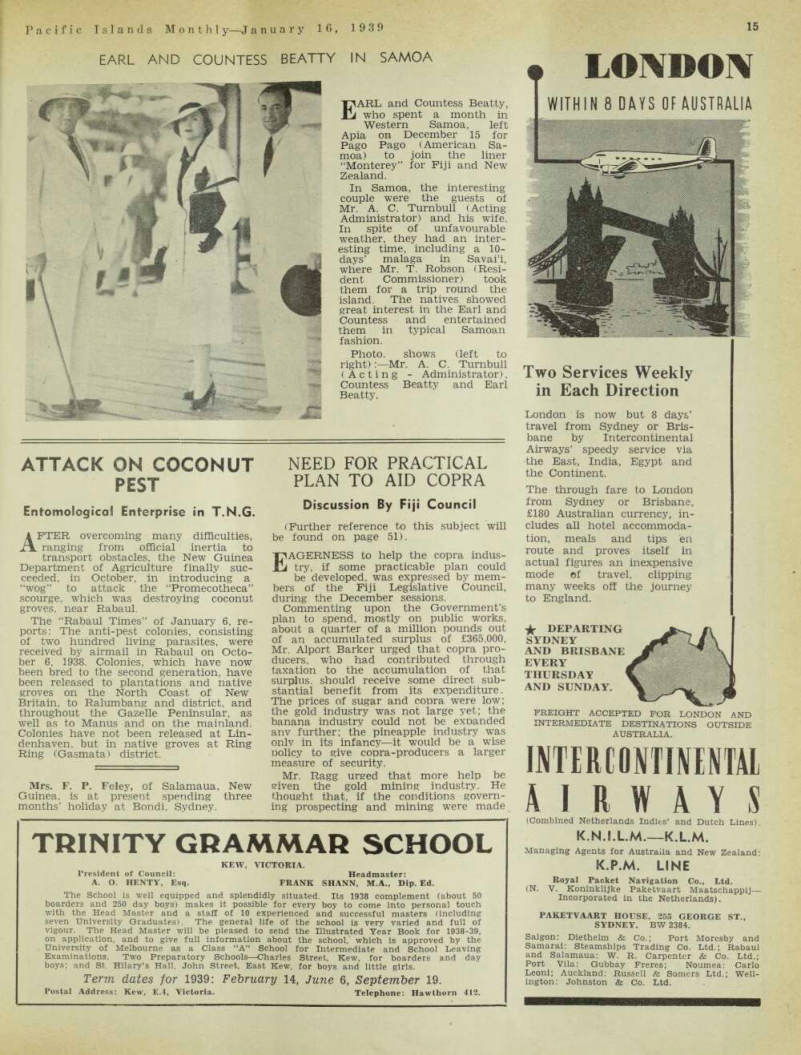
EARL and Countess Beatty, who spent a month in Western Samoa, left Apia on December 15 for Pago Pago (American Sa moa) to join the liner “Monterey” for Fiji and New Zealand.
In Samoa, the interesting couple were the guests of Mr. A. C. Turnbull (Acting Administrator) and his wife.
In spite of unfavourable weather, they had an inter esting time, including a 10days’ malaga in Savai’i, where Mr. T. Robson (Resi dent Commissioner) took them for a trip round the island. The natives showed great interest in the Earl and Countess and entertained them in typical Samoan fashion.
Photo. shows (left to right):—Mr. A. C. Turnbull (Acting - Administrator), Countess Beatty and Earl Beatty.
Attack On Coconut
Pest
Entomological Enterprise in T.N.G.
AFTER overcoming many difficulties, ranging from official inertia to transport obstacles, the New Guinea Department of Agriculture finally suc ceeded, in October, in introducing a “wog” to attack the “Promecotheca” scourge, which was destroying coconut groves, near Rabaul.
The “Rabaul Times” of January 6, re ports: The anti-pest colonies, consisting of two hundred living parasites, were received by airmail in Rabaul on Octo ber 6, 1938. Colonies, which have now been bred to the second generation, have been released to plantations and native groves on the North Coast of New Britain, to Ralumbang and district, and throughout the Gazelle Peninsular, as well as to Manus and on the mainland.
Colonies have not been released at Lin denhaven. but in native groves at Ring Ring (Gasmata) district.
Mrs. F. P. Foley, of Salamaua, New Guinea, is at present spending three months’ holiday at Bondi, Sydney.
Need For Practical
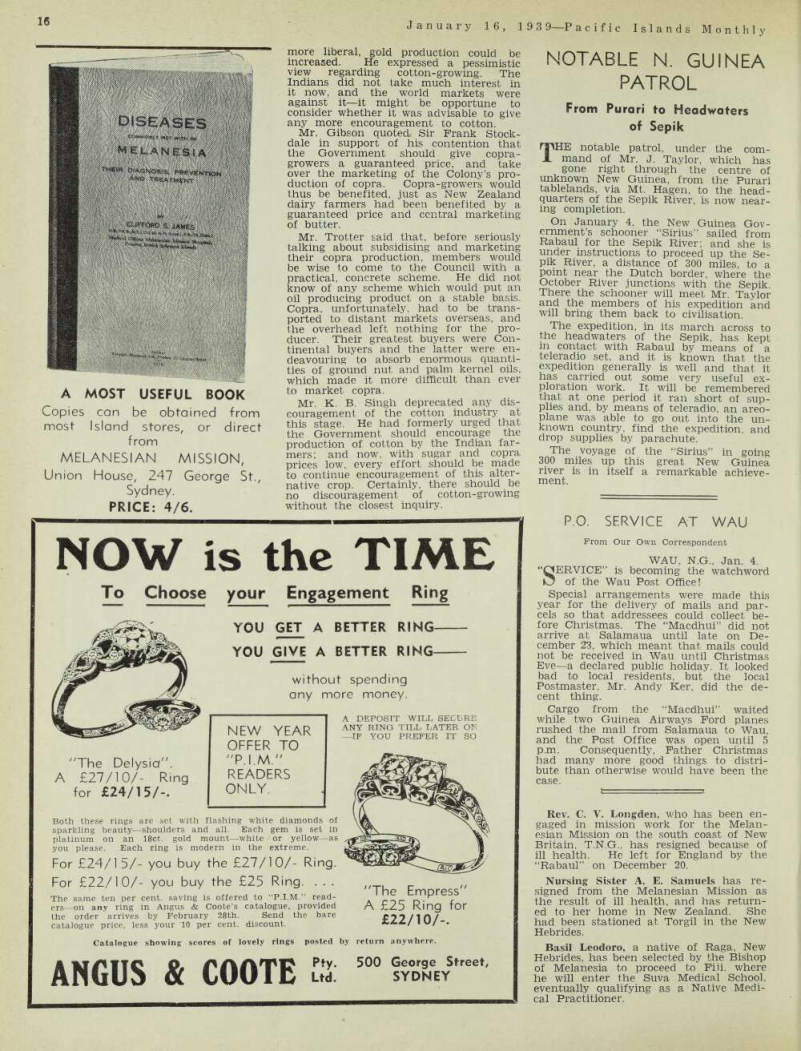
Plan To Aid Copra
Discussion By Fiji Council
(Further reference to this subject will be found on page 51).
EAGERNESS to help the copra indus try, if some practicable plan could be developed, was expressed by mem bers of the Fiji Legislative Council, during the December sessions.
Commenting upon the Government’s plan to spend, mostly on public works, about a quarter of a million pounds out of an accumulated surplus of £365.000, Mr. Alport Barker urged that copra pro ducers, who had contributed through taxation to the accumulation of that surplus, should receive some direct sub stantial benefit from its expenditure.
The prices of sugar and copra were low; the gold industry was not large yet; the banana industry could not be exnanded anv further: the pineapple industry was only in its infancy—it would be a wise policy to give copra-producers a larger measure of security.
Mr. Ragg urged that more help be eiven the gold mining industry. He thought that, if the conditions govern ing prospecting and mining were made
more liberal, gold production could be increased. He expressed a pessimistic view regarding cotton-growing. The Indians did not take much interest in it now, and the world markets were against it —it might be opportune to consider whether it was advisable to give any more encouragement to cotton.
Mr. Gibson quoted Sir Frank Stock dale in support of his contention that the Government should give copra growers a guaranteed price, and take over the marketing of the Colony’s pro duction of copra. Copra-growers would thus be benefited, just as New Zealand dairy farmers had been benefited by a guaranteed price and central marketing of butter.
Mr. Trotter said that, before seriously talking about subsidising and marketing their copra production, members would be wise to come to the Council with a practical, concrete scheme. He did not know of any scheme which would put an oil producing product on a stable basis.
Copra, unfortunately, had to be trans ported to distant markets overseas, and the overhead left nothing for the pro ducer. Their greatest buyers were Con tinental buyers and the latter were en deavouring to absorb enormous quanti ties of ground nut and palm kernel oils, which made it more difficult than ever to market copra.
Mr. K. B. Singh deprecated any dis couragement of the cotton industry at this stage. He had formerly urged that the Government should encourage the production of cotton by the Indian far mers; and now, with sugar and copra prices low, every effort should be made to continue encouragement of this alter native crop. Certainly, there should be no discouragement of cotton-growing without the closest inquiry.
Advertisements & other items, pp. 17-18 (2 items)
15
Pacific Islands Monthl y—J anuary 10, 1939
Airways
• LONDON
WITHIN 8 DAYS OF AUSTRALIA
S 3
Two Services Weekly
in Each Direction
London is now but 8 days’ travel from Sydney or Brisbane by Intercontinental Airways’ speedy service via the East, India, Egypt and the Continent, The through fare to London from Sydney or Brisbane, £lBO Australian currency, includes all hotel accommodation, meals and tips en route and proves itself in actual figures an inexpensive mode of travel, clipping many weeks off the journey to England.
* DEPARTING
SYDNEY
AND BRISBANE
EVERY
THURSDAY
AND SUNDAY.
FREIGHT ACCEPTED FOR LONDON AND
INTERMEDIATE DESTINATIONS OUTSIDE
AUSTRALIA.
HVTERCONTININTAI
AIRWAYS
(Combined Netherlands Indies’ and Dutch Lines).
K.N.I.L.M.—K.L.M.
Managing Agents for Australia and New Zealand:
K.P.M. LINE
Royal Packet Navigation Co,, Ltd. (N. V. Koninklljke Paketvaart Maatschappij— Incorporated in the Netherlands).
PAKETVAART HOUSE, 255 GEORGE ST,,
SYDNEY. BW 2384.
Saigon: Diethelm & Co.; Port Moresby and Samarai: Steamships Trading Co. Ltd.; Rabaul and Salamaua: W. R. Carpenter & Co. Ltd.; Port Vila: Gubbay Freres; Noumea: Carlo Leoni; Auckland: Russell Somers Ltd.; Wellington: Johnston & Co. Ltd.
TRINITY GRAMMAR SCHOOL
KEW, VICTORIA.
President of Council: Headmaster: A. O. HENTY, Esq. FRANK SHANN, M.A., Dip. Ed.
The School is well equipped and splendidly situated. Its 1938 complement (about 50 boarders and 250 day boys) makes it possible for every boy to come into personal touch with the Head Master and a staff of 10 experienced and successful masters (including seven University Graduates). The general life of the school is very varied and full of vigour. The Head Master will be pleased to send the Illustrated Year Book for 1938-39, on application, and to give full information about the school, which is approved by the University of Melbourne as a Class “A” School for Intermediate and School Leaving Examinations. Two Preparatory Schools—Charles Street, Kew, for boarders and day boys; and St. Hilary’s Hall, John Street, East Kew, for boys and little girls.
Term dates for 1939: February 14, June 6, September 19.
Postal Address: Kew, E. 4, Victoria. Telephone: Hawthorn 412.
■ MELAINES{A
/ mmii' , . . hnwea* i J . V.-' I ‘s' ’ :■ : ■. ,•* 4( < *. % ' . .'j V
A MOST USEFUL BOOK
Copies can be obtained from most Island stores, or direct from
MELANESIAN MISSION,
Union House, 247 George St., Sydney.
PRICE: 4/6.
NOW is the TIME
To Choose your Engagement Ring i
YOU GET A BETTER RING-
YOU GIVE A BETTER RlNG-
without spending any more money.
'The Delysio".
A £27/10/- Ring for £24/15/-.
NEW YEAR
OFFER TO
"P.I.M"
READERS
ONLY.
A DEPOSIT WILL SECURE
ANY RING TILL LATER OF
—IF YOU PREFER IT SO
Both these rings are set with flashing white diamonds of sparkling beauty-—shoulders and all. Each gem is set in platinum on an 18ct. gold mount —white or yellow—as you please. Each ring is modern in the extreme.
For £24/15/- you buy the £27/10/- Ring.
For £22/10/- you buy the £25 Ring. . . .
The same ten per cent, saving is offered to “P.1.M.” readers—on any ring in Angus & Coote’s catalogue, provided the order arrives by February 28th. Send the bare catalogue price, less your 10 per cent, discount. sw 'The Empress"
A £25 Ring for £22/10/-.
Catalogue showing scores of lovely rings posted by return anywhere.
ANGUS & COOTE
Pty. 500 George Street,
Ltd. SYDNEY
Notable N. Guinea
Patrol
From Purari to Headwaters of Sepik
r:E notable patrol, under the com mand of Mr. J. Taylor, which has gone right through the centre of unknown New Guinea, from the Purari tablelands, via Mt. Hagen, to the head quarters of the Sepik River, is now near ing completion.
On January 4, the New Guinea Gov ernment’s schooner “Sirius” sailed from Rabaul for the Sepik River; and she is under instructions to proceed up the Se pik River, a distance of 300 miles, to a point near the Dutch border, where the October River junctions with the Sepik.
There the schooner will meet Mr. Taylor and the members of his expedition and will bring them back to civilisation.
The expedition, in its march across to the headwaters of the Sepik, has kept in contact with Rabaul by means of a teleradio set, and it is known that the expedition generally is well and that it has carried out some very useful ex ploration work. It will be remembered that at one period it ran short of sup plies and, by means of teleradio, an areo plane was able to go out into the un known country, find the expedition, and drop supplies by parachute.
The voyage of the “Sirius” in going 300 miles up this great New Guinea river is in itself a remarkable achieve ment.
P.O. Service At Wau
From Our Own Correspondent
Wau, N.G., Jan. 4.
“QERVICE” is becoming the watchword KJ of the Wau Post Office!
Special arrangements were made this year for the delivery of mails and par cels so that addressees could collect be fore Christmas. The “Macdhui” did not arrive at Salamaua until late on De cember 23, which meant that mails could not be received in Wau until Christmas Eve—a declared public holiday. It looked bad to local residents, but the local Postmaster. Mr. Andy Ker, did the de cent thing.
Cargo from the “Macdhui” waited while two Guinea Airways Ford planes rushed the mail from Salamaua to Wau, and the Post Office was open until 5 p.m. Consequently, Father Christmas had many more good things to distri bute than otherwise would have been the case.
Rev. C. V. Longden, who has been en gaged in mission work for the Melan esian Mission on the south coast of New Britain, T.N.G., has resigned because of ill health. He left for England by the “Rabaul” on December 20.
Nursing Sister A. E. Samuels has re signed from the Melanesian Mission as the result of ill health, and has return ed to her home in New Zealand. She had been stationed at Torgil in the New Hebrides.
Basil Leodoro, a native of Raga, New Hebrides, has been selected by the Bishop of Melanesia to proceed to Fiii. where he will enter the Suva Medical School, eventually qualifying as a Native Medi cal Practitioner.
Advertisements & other items, p. 19 (1 item)
Bidomak
MILLION
STARVIN
MINERALS ARE NEEDED BY
IVERV CELL IN
YOUR BODY
CALCIUM
HEART, TEETH. BLOOD,
BONES, NER/ES
PHOSPHORUS
t BRAIN. GLANDS,
1 BLOOD
FERRU M
{BLOOD
POTASSIUM
{MUSCLE, BLOOD
SODIUM
{BLOOD
BIDOMAK
contains them all ...in
on easilyassimilated
s pre-dissolved liquid him
OVERCOME TROPICAL
LETHARGY AND
DEPRESSED FEELING
BIDOMAK will quickly overcome the effects of severe Tropical conditions and bring you back to the pinnacle of health and good spirits safely and pleasantly. The depressing after effects of Malaria are banished quickly by taking a course of BIDOMAK —The Tonic of the Century.
SCIENTIFIC CONTROL
Attached to the Laboratories of
the Douglas Drug Company are
three fully qualified chemists and
a doctor of Medicine who gradu-
ated at the Universities of Edin-
burgh and Glasgow.
ON 3 SQUARE MEALS A DAY
Terrible Diet Deficiency of Vital Food Minerals!
Amazing discoveries of Modern Medicine strike
at root of NERVE TROUBLES.
BIDOMAK
“The Tonic of the Century”
MILLIONS are starving on three square meals a day! That may seem a strange statement, but it is a true one.
Due to over-refinement, many modern foods are short of vital mineral substances. Without these minerals the blood becomse impoverished . . . nerve cells and tissues are starved . . . perfect health is impossible.
Why? Because hard work, worry, over-indulgence drain the natural supply of minerals from our bodies. When our food does not replace them, we suffer from nerve weakness, headaches, stomach upset, depression, sleeplessness, and brain fag.
When you get enough of these minerals, you get well quickly and naturally. The simplest way is to take BIDOMAK, as thousands are doing in all parts of the world. BIDOMAK contains the necessary minerals in the form of glycerophosphates and phosphates in the most quickly assimilable liquid form.
Bidomak Benefits Quickly—
No Waiting for Weeks!
Within 30 seconds the ingredients in BIDOMAK have entered the blood-stream through the blood vessels of the small intestine. They are carried thereby to every part of the body.
Here they restore to buoyant health the starved nerve cells and tissues. They stop the cause of nerve pains. They banish that irritable, depressed feeling—end headaches and chronic nervous dyspepsia.
They tone up every part of the system and make you feel really well. They put a sparkle in your eye—a spring in your step—colour in your cheeks.
So stop feeling rundown and weary. Buy your first bottle of BIDOMAK to-day.
EVERY BOTTLE OF BIDOMAK
CONTAINS ALL THE FOLLOWING
VITAL MINERAL FOODS:
mwu l 550 pts of Milk 50 lbs of Beef 66 lbs Lettuce 5 lbs of Spinoch 50 pts Orange Juice If MijmiMSmMSM 4 pt M.lk 40 ozs Cheese 130 lbs Bananas 11 lbs Lettuce 5 pts of Orange AS-OTtR "POTASSIUM” .AS 22 028. OF LETTUCE Cobbac^ 17 ozs Carrots 22 ozs Spinach "SODIUM" AS 10 PTS. Of ORANGE. JUICE 125 Iki Cabbage 10 lbs Bananas 5 lbs. of Lettuce 13 lbs Spinach i :/ 4I» Ii&ULLIiJj 44 pts Orange Juice S 3 44 lbs. Carrots 90 lbs Bananas 134 lbs Cabbage —i
BIDOMAK
THE TONIC OF THE CENTURY-^/ - Nerves. Brain
Get a
bottle of
BIDOMAK
to-day—
At all
Stores.
Bishop At 35 Years Of Age
Prom Our Own Correspondent
Tarawa, Dec. 1.
THE Most Rev. Dr. O. Terrienne, of the Sacred Heart Mission of the Roman Catholic Church, has return ed to the Gilbert Islands, where he had previously spent many years as a Rev erend Father in the mission field.
Dr. Terrienne has been on furlough to Europe since April last, and was conse crated as Bishop in Cannes (France) last June, at the age of 35.
Mrs. Virisila Tikoigau Maybir, a well known figure in Suva, died in mid-De cember from septic poisoning. She is survived by her husband, Mr. Charles Maybir, and a family of seven.
Men Who Knew Yesterday
R. W. Gosset's Memories of Rarotonga
By Eric Ramsden
THE last of the beachcombers had not left the waterfront when R. w.
Gosset landed in Rarotonga in the early part of this century.
The island was then recovering from the turbulent days when F. J. Moss was Resident Commissioner. Moss had been succeeded by Colonel W. E. Gudgeon, C.M.G., son of Thomas Mayth Gudgeon, historian of the Maori Wars. The New 7 Zealander, then nineteen years old, was the new Administrator’s nephew.
While outwardly religious (as was the
same in other Polynesian communities). the Rarotongans at times felt the mis sionary yoke a trifle irksome. Sunday’s church parade was invariably followed by bush-beer parties in the valleys—to the annoyance of the Rev. J. J. K. Hutchens, of the L.M.S., one of the last of the missionary autocrats. Bibles were put
aside. The natives, accompanied by more tolerant European neighbours, made for the orange groves.
Queen Makea still held sway, supported by such arikis as her husband, Ngamaru Ariki, of Atiu; Karika Ariki, of Avarua; Kainuku Ariki and Pa Ariki, of Ngatan giia; and Tinomana, of Arorangi. R. J.
Seddon, New Zealand’s forceful Premier, had landed in state on the island. Makea had also been honoured by a visit from the Governor, Lord Ranfurley. Hence forth, Rarotonga was British, Any possi bility of French intervention was re moved.
Cook Island waters were still sailed by native-owned and manned schooners that made Pacific history. Vanilla was booming.
The last of the old lime and coffee groves were still in existence. Once upon a time the Rarotongans exported quantities of
Mr. R. W. Gosset. —Photo: May Moore.
limejuice—helped with liberal additions of sea water! The latter was difficult to detect.
Tamarua Metua, last of the tohungas, resided near the ancient marae of Arai te-Tonga, where he was fed by his great granddaughter. As he had attended five annual ceremonial feasts prior to the ar rival of John Williams in 1823, some indi cation may be obtained of his age. Tam arua died about 1902.
At Arorangi, John Salmon, a member of the Tahitian-Hebrew clan, descend ants of Arii-taimai and Alexander Sal mon, a London Jew, dwelt with his wife, Tinomana, at what he called the “Royal Palace”. Salmon fancied himself as a Prince Consort. On the strength of that title he induced American traders to send him such luxuries as a buggy, then a decided novelty.
Among the sea captains then living were Taylor, a typical Yankee, Piltze and Engeleke, Germans, and Nagle, another American, whose half-caste son com manded the schooner “Maungaroa” when she was lost between Auckland and Raro tonga in 1901. All Avarua lined the beach when Captain Engeleke’s bride arrived from Germany. The couple had never previously met. The bridegroom’s brother had stood proxy for him. “It was only time that I ever saw Captain Enge leke look at all self-conscious!’ says Mr. Gosset.
The bride spoke no English. But her husband soon made her acquainted with that tongue. However, as his English was more reminiscent of the fo’castle it vastly amused his friends: at times, Mrs.
Engeleke’s choice of language was even embarrassing!
Alexander McAlister, once chief officer of the N.Z. Government steamer “Tut anekai”, resided on his plantation. Hugh McCrone Connal was then Government engineer and surveyor: he was the first man there to run a plantation on scien tific lines. Connal also built the first concrete bridge in Rarotonga. Percy Brown, manager for the Cook Islands Trading Company, soon followed his ex ample in establishing a proper planta tion.
MR. GOSSET.' can recall the wreck of the four-masted barque “Saragossa”, loaded with 4,000 tons of coal, at Mangaia in 1904. The following year the barque “Thistle” met her end at Palmer ston Island: she carried two and a half million feet of timber. He twice visited that island. John Masters, son of the original William Masters, was then living, and he gave the newcomer some infor mation that is not generally known.
For example, few know that Masters was accompanied to Palmerston Island by an Indian, who also did his share in populating the atoll. As the latter lim ped. he was given the name of Pareka.
Pareka’s presence explains the dark cast of features and glossy hair, (as distinct from their Polynesian physical char acteristics), of some of his descendants.
“The blend was a good one”, says Mr.
Gosset, “some of the Palmerston Island girls were then regarded as very pretty.”
A wheat ship, bound from Australia to California, was wrecked there in the 50’s. The first the islanders knew of it was when they saw a pair of geese on the lagoon. On visiting one of the smaller outer islands, they found some of the bodies of the 270 passengers. But already the land crabs had made short work of them. fTIHE loss of the “Maungaroa” between Jl Rarotonga and Auckland is a mystery that has never been solved. The little schooner of forty tons was lost with all
hands. “Tiro” Nagle, a half-caste, was in command.
But a satisfactory explanation was found for the wreck of the “Ngamaru Ariki”: she was piled up on the reef at Atiu and burnt. That was in accordance with Polynesian custom. The schooner bore the name of the island’s chief, (and Makea’s consort), and on his death it was thought fitting that the vessel, too, should go. Ngamaru is described by Mr.
Gosset as “a regular old savage”. In his day he had been a cannibal. On marry ing Makea, he made Rarotonga his home.
The “Takitimu”. another native schoo ner, was absent for nine months. The women had wailed and cut their hair.
But she turned up again. Mr. Gosset was once on another native craft that took three weeks to reach Aitutaki! Captain Tuana had some knowledge of latitude, but longitude was quite beyond him. The
island was passed in the night. Because of the presence of a tere on board, of about sixty people, the situation became alarming : there was a serious shortage of fresh water. But Tuana sailed back along the latitude and eventually made Aitutaki.
A friend of those days was Captain Frank Worsley, then in command of the “Countess of Ranfurly”, (which was sub sequently sold and wrecked in 1910 at the Isle of Pines). Worsley later went to the Antarctic with Shackleton, made a name for himself as an author, and secured a D.S.O. in the Great War.
He can also recall the period when the Grice Sumner vessels from Melbourne called at Rarotonga to collect labour for Malden Island. “Iti” Strickland, a gigantic member of a well-known Titutaki family, was overseer: he ruled the recruits for the guano deposits with an iron hand.
“The boys used to return, after their in
denture, burnt black”, says Mr. Gosset.
“There was no shade on Malden!”
Norwegian sailing ships were chartered in those days at a low price, both for labour and guano. The last of these ves sels he remembers at Avarua was the “Jerfalcon”. “The smell in the holds was appalling, and there the natives had to sleep, on mats, on top of the guano!”
Makea Ariki-nui Tinirau, 0.8JE., now the principal Rarotongan chief was well known to Mr. Gosset as a young man. He was closely related to Queen Makea.
Many a time the New Zealander accom panied Tinirau, “a splendid specimen of Polynesian manhood, handsome, with all the dignity and courtesy of his race”, to gather plantains in the mountains, WHILE on Rarotonga he made a col lection of artifacts, particularly stone axes and sling-stones. At one time, Mr. Gosset had more than 200 of them. Also .at Lord Ranfurly’s request, he collected specimens of bird life, which now repose in the British Museum.
The Ara Metua, the old paved road which ran round the island (and known in former times as Ara-Nui-o-Toi) in terested the visitors. Parts were then still in a good state of preservation, though constructed 700 years ago by Toi and his followers. Mr. Gosset, who is a surveyor by profession, regarded it as “a great engineering feat”.
But equally impressive was the ancient irrigation system, fine examples of which were found in Connal’s bush. Taro fields were irrigated on a succession of terraces fed from the mountain streams. Later, he saw similar work at Kulambangra, in the Solomons, also wrought, he believes, by Polynesian hands. “Their formation showed that the natives had a sound knowledge of engineering generally, and of hydraulics in particular. This is a sphere of Polynesian activity in Raro tonga into which there should be more research.”
Pa Ariki took him to the site of the murder of Anne Butcher, one of five European women who visited Rarotonga in the “Cumberland” under the command of Captain Goodenough in 1814. She was eaten at Ngatangiia, that year, because some of the crew in their search for sandalwood cut the sacred nono trees at the marae. W. C. Wentworth, later the Australian statesman, was also a pas senger on that vessel. Anne Butcher was on shore with a native family: for that act of desecration by her companions she was eaten.
In the summer the swamps near the foothills used to dry up. The natives knew that eels hibernated there. So they watched the pigs root for them in the mud, and, as they appeared, they would grab them.
One day Mr. Gosset saw some strange birds flying overhead: they had also been observed by the local poultry. The latter at once made for cover, as instinct told them that the new arrivals were pre datory, Mr. Gosset shot two. which he sent to the Auckland Museum for iden tification. They were New Zealand hawks, blown from their homeland.
A hitherto unrecorded incident that occurred during Mr. Seddon’s visit is re membered by the New Zoalar*ier. Travel ling with the Prime Minister was Edward Tregear, the Polynesian scholar, famous for his dictionary. By some mistake, at the ceremonial giving of gifts, Tregear’s name was called after certain other people he considered of lesser standing.
Well aware of Polynesian etiquette, he waited until the mats were placed in front of him. Then he rofee, spumed them, and walked away. The Rarotongans
understood the significance of his act.
But Mr. Seddon was definitely annoyed.
“Tregear was right”, says Mr. Gosset.
“and Makea herself said so.”
Advertisements & other items, pp. 20-22 (5 items)
18
January 16, 19 3 9—P aci f i c Islands Monthly
F)Et-Co
LIGHT
T
Its Long Life, Dependability and Economy
have been proved over the past 20 years In buying Delco-Light (a product of General Motors) you make no mistake, because Delco-Light dependability, economy and efficiency have been proved in thousands of homes during the past 20 YEARS.
Model 2812 Delco-Light generates 200 watts at 12 volts and will light eight 25 watt lamps direct from the generator—or five for 10 hours from the 105 A.H. battery, when fully charged. It will run for 16 hours on one gallon of petrol.
For complete information please write to Desk P.I. Sizes range from 200 to 6.000 watts.
PRICES OF PLANTS IN BOND, SYDNEY.
2812 (12 volt) £23/15/-, with 83 A.H. battery (car type.) 2812 (12 volt) £26/15/-, with 105 A.H. battery, (individual cells.) 286 (6 volt) £24/5/-, with 105 A.H. battery (individual cells.
Distributors :—
WARBURTON, FRANK), LTD.
307-15 KENT STREET, SYDNEY.
MELBOURNE BRISBANE
Recor Ds
Packed Free and sent C.O.D. without extra charges.
H.M. Voice Slightly-used Portables, delivered straight to your nearest port for .. .. .. £3/15/-.
Send for Latest Record Lists.
Talkeries Music Stores
451 Queen Victoria Buildings, Sydney
yppo'LtarutißA
t.
V. r. ? o o’ r / ji Are you earning less than £lO per week? If so, you cannot afford to miss reading “ENGINEERING OPPORTUNITIES ”
After months of intensive effort and research, we are pleased to announce that the 1939 revised edition of “Engineering Opportunities’’ is now out of the Publishers’ hands and ready for Free Distribution. Containing 227 pages of practical guidance, this book is, beyond argument, the finest and most complete handbook on Successful Engineering Careers ever compiled. It is a book that should be on the book-shelf of every person interested in Engineering, irrespective of his position or age, education or experience.
The handbook contains, among other interesting matter, details of A.M I.Mech.E., A.M.1.C.E., A.M.1.E.E., A.M.1.A.E., A M .1. Ae .E., A.M.l.Struct.E., A.M.1.W.T., and other important engineering Examinations; and out-lines Home Study Courses in all branches of Mechanical, Civil and Constructional, Electrical, Aeronautical, Automobile, Diesel, Refrigeration, Welding, Air Conditioning, Ship Construction, Geology and Mineralogy, Machine Construction Drawing and Design, Television and Radio Engineering.
In your own interests, we advise you to send for your copy of this enlightening guide to well-paid posts by filling in and posting the coupon NOW.
There is no cost or obligation of any kind.
All Correspondence is regarded as confidential.
Distance is no obstacle.
THE BRITISH INSTITUTE OF
ENGINEERING TECHNOLOGY.
Head Office; London (Centres throughout the World).
Australasian Offices: Kembla Building, Margaret St., Sydney, Australia.
This Australasian Branch was established several years ago to ensure prompt and efficient service throughout the Pacific Islands, Australia, New Zealand and the Far East and to meet the rapidly increasing demands for our Services.
THE BRITISH INSTITUTE OF
ENGINEERING TECHNOLOGY,
Kembla Building, Margaret Street, Sydney, N.S.W.
Please forward FREE OP COST OR OBLIGATION of any kind your 227 page handbook,
“ENGINEERING OPPORTUNITIES.”
NAME
ADDRESS
P.M.1.3.
Modern Refrigeration for the South Sea Islands
The ELECTROLUX KEROSENE OPERATED
REFRIGERATOR
MARVEL
OF
MODERN
SCIENCE
/ m mm. m
THE
MIRACLE
OF
ICE
FROM
HEAT
THE ELECTROLUX OFFERS economical, modern and completely efficient refrigeration for
ISLANDS' HOMES.
FREEZES CONTINUOUSLY WHILE SMALL LAMP BURNS
Freezing controlled by simply regulating height of flame. Uses only \ gallon of kerosene per week.
MOTORLESS ... NO PARTS TO GET OUT OF ORDER.
MODEL L 22 MODEL L3B MODEL LKSS Capacity @ (as illustrated) • Capacity 2,2 cubic feet. Capacity 4 cubic feet. 5.5 cubic feet.
GUARANTEED FOR TWO YEARS
Obtainable from ® Write to your Local Distributor for prices and full details.
W. R. Carpenter & Company Ltd.— Sydney and following New Guinea Branches : Rabaul, Salamaua, Wau, Kavieng, Madang, But and Wewak.
Representation in Papua and New Hebrides.
W. R. Carpenter & Coy. (Solomon Is.) Pty. Ltd.— Tulagi, British Solomon Islands.
On Chong & Company Pty. Ltd.—Butaritari, Gilbert & Ellice Islands.
19
Pacific Islands Monthl y—j anuary 16, 1939
20
January 16, 193 9—P acific Islands Monthly
G. H. Massy-Baker Dead
In Papua
From Our Own Correspondent
Pt. Moresby, Jan. 6.
AN old Papuan identity, in the person of Mr. G. H. Massy-Baker, died at his home at Kerema on December 18.
Mr. Massy-Baker, who was born in 1868 in England, had served in the Brit ish Army in India, and retired with the rank of Captain before coming to Papua in December, 1908.
In that year, he joined the Govern ment Service as a surveyor’s assistant, and was made an Assistant Resident Magistrate in 1911, and Resident Magis trate in 1912.
In 1911, he led one of the expeditions in search of the Hon. M. S. C. Smith, who had left Kikori with the intention of travelling overland to the Strickland River. Mr. Baker ascended the Strick land on that occasion, beyond the fur thest point reached by the famous Ever ill expedition.
In 1913, he did a great deal of patrol ling on the Fly and Bamu Rivers, and on one of his journeys discovered Lake Murray, which has its outlet into the Strickland, from the north.
Mr. Baker retired from the Govern ment Service in 1919, and settled near Kerema, where he had been stationed as Resident Magistrate of the Gulf Division for the last five years.
Mr. A. Armstrong, an engineer with W. R. Carpenter & Co. Ltd., Rabaul, New Guinea, arrived in Sydney by the December “Bulolo”. After a short holi day, he will return to the Mandated Territory.
Advertisements & other items, p. 23 (2 items)
21
Pacific Islands Monthl y—J anuary 16, 1939
Victoria
BITTER
RA iri r :
Mysterious Ruins
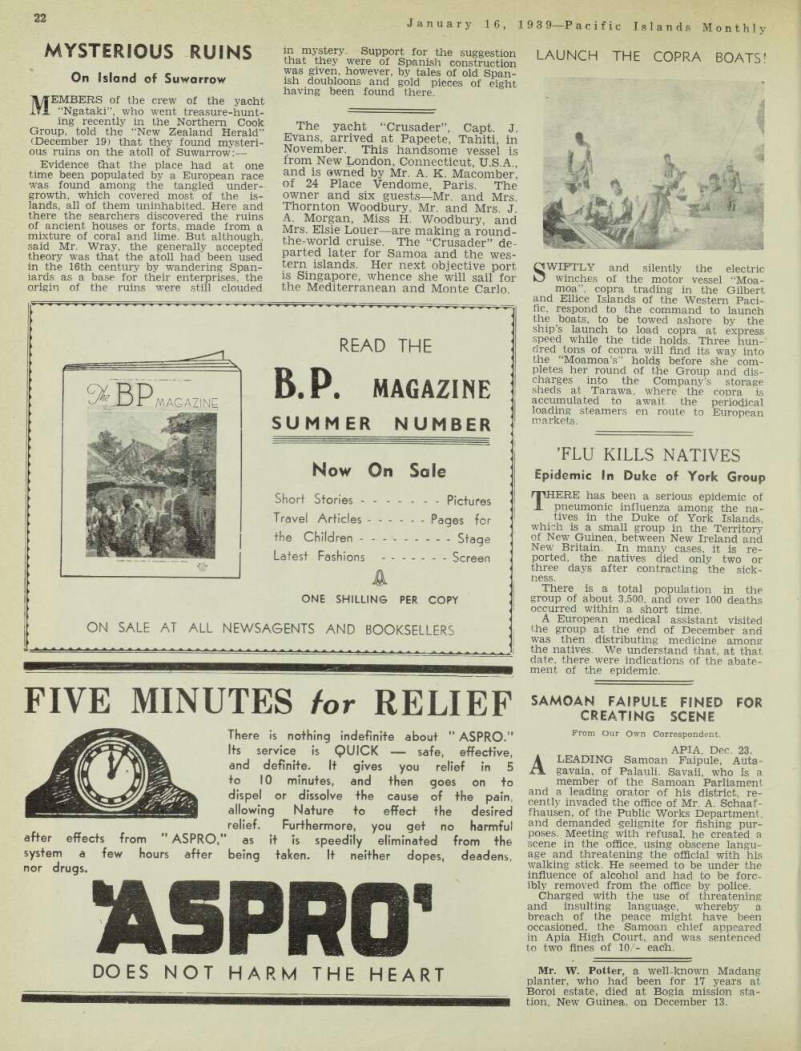
On island of Suwarrow
MEMBERS of the crew of the yacht “Ngataki”, who went treasure-hunt ing recently in the Northern Cook Group, told the “New Zealand Herald’’ (December 19) that they found mysteri ous ruins on the atoll of Suwarrow:— Evidence that the place had at one time been populated by a European race was found among the tangled under growth, which covered most of the is lands, all of them uninhabited. Here and there the searchers discovered the ruins of ancient houses or forts, made from a mixture of coral and lime. But although, said Mr. Wray, the generally accepted theory was that the atoll had been used in the 16th century by wandering Span iards as a base for their enterprises, the origin of the ruins were still clouded
in mystery. Support for the suggestion that they were of Spanish construction was given, however, by tales of old Span ish doubloons and gold pieces of eight having been found there.
The yacht “Crusader”, Capt. J.
Evans, arrived at Papeete, Tahiti, in November. This handsome vessel is from New London, Connecticut, U.S.A., and is owned by Mr. A. K. Macomber, of 24 Place Vendome, Paris. The owner and six guests—Mr. and Mrs.
Thornton Woodbury, Mr. and Mrs. J.
A. Morgan, Miss H. Woodbury, and Mrs. Elsie Louer—are making a round the-world cruise. The “Crusader” de parted later for Samoa and the wes tern islands. Her next objective port is Singapore, whence she will sail for the Mediterranean and Monte Carlo.
Launch The Copra Boats!
SWIFTLY and silently the electric winches of the motor vessel “Moa moa”. copra trading in the Gilbert and Ellice Islands of the Western Paci fic, respond to the command to launch the boats, to be towed ashore by the ship’s launch to load copra at express speed while the tide holds. Three hun dred tons of copra will find its way into the “Moamoa's” holds before she com pletes her round of the Group and dis charges into the Company’s storage sheds at Tarawa, where the copra is accumulated to await the periodical loading steamers en route to European markets.
’Flu Kills Natives
Epidemic In Duke of York Group
THERE has been a serious epidemic of pneumonic influenza among the na tives in the Duke of York Islands, which is a small group in the Territory of New Guinea, between New Ireland and New Britain. In many cases, it is re ported, the natives died only two or three days after contracting the sick ness.
There is a total population in the group of about 3,500, and over 100 deaths occurred within a short time.
A European medical assistant visited the group at the end of December and was then distributing medicine among the natives. We understand that, at that date, there were indications of the abate ment of the epidemic.
Creating Scene
Samoan Faipule Fined For
From Our Own Correspondent.
Apia Dec 23
A LEADING Samoan Faipule, Auta gavaia, of Palauli. Savaii, who is a member of the Samoan Parliament and a leading orator of his district, re cently invaded the office of Mr. A. Schaaf fhausen, of the Public Works Department, and demanded gelignite for fishing pur poses. Meeting with refusal, he created a scene in the office, using obscene langu age and threatening the official with his walking stick. He seemed to be under the influence of alcohol and had to be forc ibly removed from the office by police.
Charged with the use of threatening and insulting language, whereby a breach of the peace might have been occasioned, the Samoan chief appeared in Apia High Court, and was sentenced to two fines of 10/- each.
Mr. W. Potter, a well-known Madang planter, who had been for 17 years at Boroi estate, died at Bogia mission sta tion, New Guinea, on December 13.
Advertisements & other items, p. 24 (1 item)
B.P. Magazine
READ THE
SUMMER NUMBER
Now On Sole Short Stories Pictures Travel Articles Pages for the Children Stage Latest Fashions Screen
ONE SHILLING PER COPY
ON SALE AT ALL NEWSAGENTS AND BOOKSELLERS BP
FIVE MINUTES RELIEF
There is nothing indefinite about " ASPRO. 8 Its service is QUICK safe, effective, and definite. It gives you relief in 5 to 10 minutes, and then goes on to dispel or dissolve the cause of the pain, allowing Nature to effect the desired relief. Furthermore, you get no harmful after effects from " ASPRO," as it is speedily eliminated from the system a few hours after being taken. It neither dopes, deadens,
nor drugs.
DOES NOT HARM THE HEART
Trans-Pacific
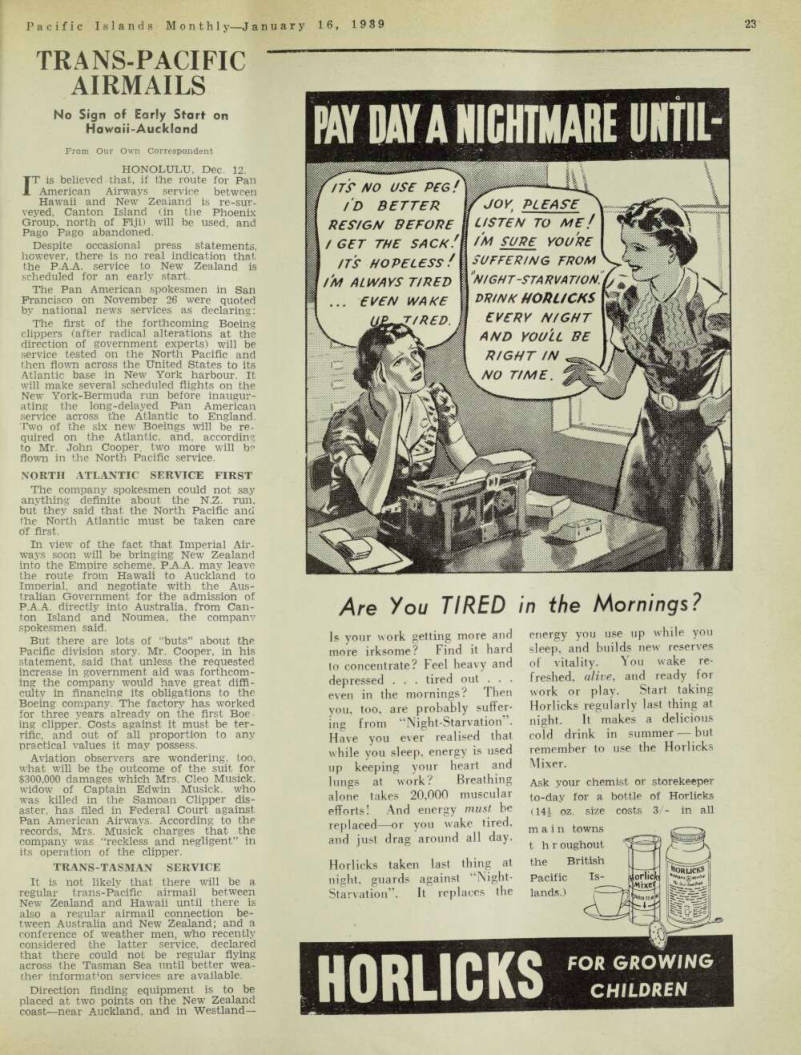
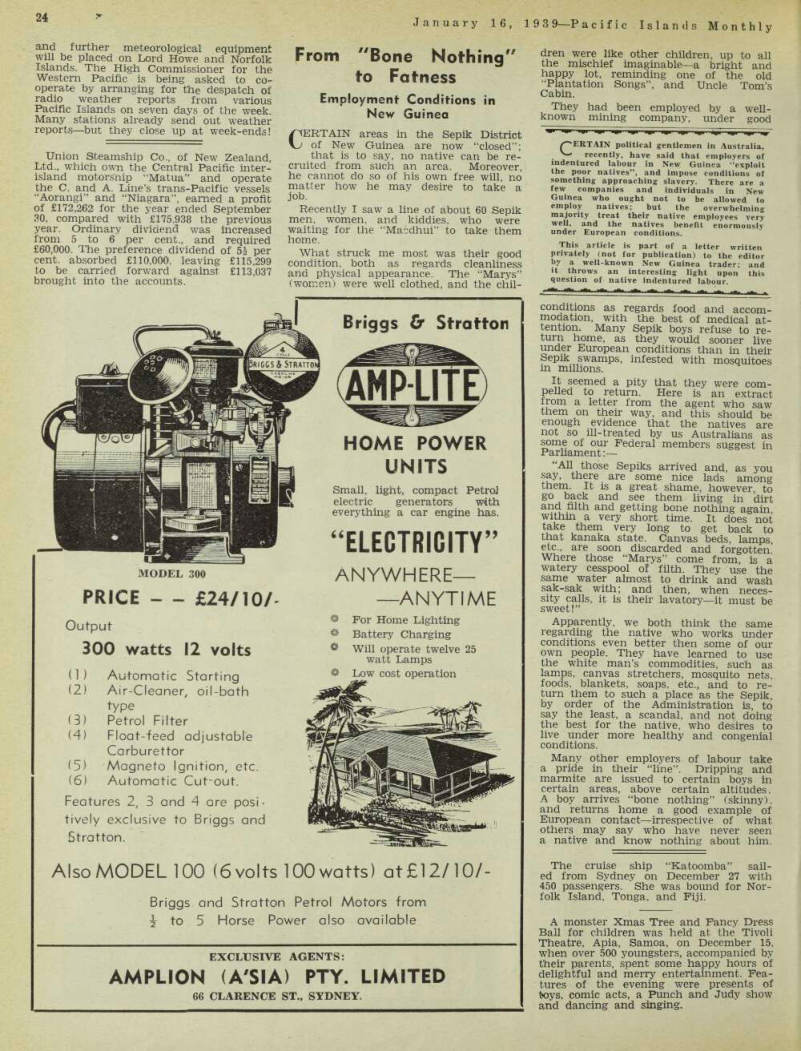
Airmails
No Sign of Early Start on Hawaii-Auckland
From Our Own Correspondent
Honolulu, Dec. 12.
IT is believed that, if the route for Pan American Airways service between Hawaii and New Zealand is re-sur veyed, Canton Island (in the Phoenix Group, north of Fiji) will be used, and Pago Pago abandoned.
Despite occasional press statements, however, there is no real indication that the P.A.A. service to New Zealand is scheduled for an early start.
The Pan American spokesmen in San Francisco on November 26 were quoted by national news services as declaring: The first of the forthcoming Boeing clippers (after radical alterations at the direction of government experts) will be service tested on the North Pacific and then flown across the United States to its Atlantic base in New York harbour. It will make several scheduled flights on the New York-Bermuda run before inaugur ating the long-delayed Pan American service across the Atlantic to England.
Two of the six new Boeings will be re quired on the Atlantic, and. according to Mr. John Cooper, two more will be flown in the North Pacific service.
North Atlantic Service First
The company spokesmen could not say anything definite about the N.Z. run, but they said that the North Pacific and the North Atlantic must be taken care of first.
In view of the fact that Imperial Air ways soon will be bringing New Zealand into the Empire scheme, P.A.A. may leave the route from Hawaii to Auckland to Imperial, and negotiate with the Aus tralian Government for the admission of P.A.A. directly into Australia, from Can ton Island and Noumea, the company spokesmen said.
But there are lots of “buts” about the Pacific division story. Mr. Cooper, in his statement, said that unless the requested increase in government aid was forthcom ing the company would have great diffi culty in financing its obligations to the Boeing company. The factory has worked for three years already on the first Boe ing clipper. Costs against it must be ter rific, and out of all proportion to any practical values it may possess.
Aviation observers are wondering, too, what will be the outcome of the suit for $300,000 damages which Mrs. Cleo Musick. widow of Captain Edwin Musick, who was killed in the Samoan Clipper dis aster. has filed in Federal Court against Pan American Airways. According to the records, Mrs. Musick charges that the company was “reckless and negligent” in its operation of the clipper.
Trans-Tasman Service
It is not likely that there will be a regular trans-Pacific airmail between New Zealand and Hawaii until there is also a regular airmail connection be tween Australia and New Zealand; and a conference of weather men, who recently considered the latter service, declared that there could not be regular flying across the Tasman Sea until better wea ther information services are available.
Direction finding equipment is to be placed at two points on the New Zealand coast —near Auckland, and in Westland—
and further meteorological equipment will be placed on Lord Howe and Norfolk Islands. The High Commissioner for the Western Pacific is being asked to co operate by arranging for the despatch of radio weather reports from various Pacific Islands on seven days of the week.
Many stations already send out weather reports—but they close up at week-ends!
Union Steamship Co., of New Zealand, Ltd., which own the Central Pacific inter island motorsnip “Matua” and operate the C. and A. Line’s trans-Pacific vessels “Aorangi” and “Niagara”, earned a profit of £172,262 for the year ended September 30, compared with £175,938 the previous year. Ordinary dividend was increased from 5 to 6 por cent., and required £60,000. The preference dividend of 5i per cent, absorbed £llO,OOO, leaving £115,299 to be carried forward against £113,037 brought into the accounts.
Advertisements & other items, pp. 25-26 (2 items)
23
Pacific Islands Monthl y—J anuary 16, 1939
Not Mv A Nightmare Mill-
ITS NO USE PEG i
ID BETTER
RESIGN BEFORE
JOY
PLEASE
n
LISTEN TO MEf
/M Sl/PE YOU'RE
/ T THE SACK.
SUFFERING FROM
ITS HOPELESS!
i'm always tired
... EVEN WAKE
URST/RED.
7ED % NIGHT-STARVATION.
KE j DRINK HORLICKS
ED. EVERY N/GHT
~Jk and youll be
RIGHT IN
\ NO TIME. *3mt
mmL
Urn i
Are You TIRED in the Mornings?
Is your work getting more and more irksome? Find it hard to concentrate? Feel heavy and depressed . . . tired out . . . even in the mornings? Then you, too, are probably suffering from “Night-Starvation”.
Have you ever realised that while you sleep, energy is used up keeping your heart and lungs at work? Breathing alone takes 20.000 muscular efforts! And energy must be replaced—or you wake tired, and just drag around all day.
Horlicks taken last thing at
night, guards against “Night-
Starvation”. It replaces the energy you use up while you sleep, and builds new reserves of vitality. You wake refreshed, alive , and ready for work or play. Start taking Horlicks regularly last thing at night. It makes a delicious cold drink in summer but remember to use the Horlicks Mixer.
Ask your chemist or storekeeper to-day for a bottle of Horlicks d-H oz. size costs 3/- in all main towns t h r oughout the British Pacific Islands.)
FOR GROWING
CHILDREN
HorucKS Via,'" orlic Mixe
MODEL 300
PRICE - - £24/10/
Briggs & Stratton
AMpfftE
RIGGS & STRA7TO
M o/rM® m
HOME POWER
UNITS
Small, light, compact PetroJ electric generators with everything a car engine has.
ELECTRICITY”
ANYWHERE—
—ANYTIME
Output 300 watts 12 volts (1) Automatic Starting (2) Air-Cleaner, oil-bath type (3) Petrol Filter (4) Float-feed adjustable Carburettor (5) Magneto Ignition, etc, (6) Automatic Cut-out.
Features 2, 3 and 4 are positively exclusive to Briggs and Stratton. ® For Home Lighting ® Battery Charging ® Will operate twelve 25 watt Lamps ® Low cost operation I Also MODEL 100 (6 volts 100 watts) at £l2/10/- Briggs and Stratton Petrol Motors from i to 5 Horse Power also available
EXCLUSIVE AGENTS:
AMPLION (A'SIA) PTY. LIMITED
66 CLARENCE ST., SYDNEY.
From "Bone Nothing"
to Fatness Employment Conditions in New Guinea
CERTAIN areas in the Sepik District of New Guinea are now “closed”; that is to say, no native can be re cruited from such an area. Moreover, he cannot do so of his own free will, no matter how he may desire to take a job.
Recently I saw a line of about 60 Sepik men, women, and kiddies, who were waiting for the “Macdhui” to take them home.
What struck me most was their good condition, both as regards cleanliness and physical appearance. The “Marys” (women) were well clothed, and the cliil
dren were like other children, up to all the mischief imaginable—a bright and happy lot, reminding one of the old “Plantation Songs”, and Uncle Tom’s Cabin.
They had been employed by a well known mining company, under good
/'CERTAIN political gentlemen in Australia, recently, have said that employers of indentured labour in New Guinea “exploit the poor natives”, and impose conditions of something approaching slavery. There are a few companies and individuals in New Guinea who ought not to be allowed to employ natives; but the overwhelming majority treat their native employees very well, and the natives benefit enormously under European conditions.
This article is part of a letter written privately (not for publication) to the editor by a well-known New Guinea trader; and it throws an interesting light upon this question of native indentured labour.
conditions as regards food and accom modation, with the best of medical at tention. Many Sepik boys refuse to re turn home, as they would sooner live under European conditions than in their Sepik swamps, infested with mosquitoes m millions.
It seemed a pity that they were com pelled to return. Here is an extract from a letter from the agent who saw them on their way, and this should be enough evidence that the natives are not so ill-treated by us Australians as some of our Federal members suggest in Parliament:— “All those Sepiks arrived and, as you say, there are some nice lads among them. It is a great shame, however, to go back and see them living in dirt and filth and getting bone nothing again within a very short time. It does not take them very long to get back to that kanaka state. Canvas beds, lamps, etc., are soon discarded and forgotten Where those “Marys” come from, is a watery cesspool of filth. They use the same water almost to drink and wash sak-sak with; and then, when neces sity calls, it is their lavatory—it must be sweet!”
Apparently, we both think the same regarding the native who works under conditions even better then some of our own people. They have learned to use the white man’s commodities, such as lamps, canvas stretchers, mosquito nets, foods, blankets, soaps, etc., and to re turn them to such a place as the Sepik, by order of the Administration is, to say the least, a scandal, and not doing the best for the native, who desires to live under more healthy and congenial conditions.
Many other employers of labour take a pride in their “line”. Dripping and marmite are issued to certain boys in certain areas, above certain altitudes.
A boy arrives “bone nothing” (skinny), and returns home a good example of European contact—irrespective of what others may say who have never seen a native and know nothing about him.
The cruise ship “Katoomba” sail ed from Sydney on December 27 with 450 passengers. She was bound for Nor folk Island, Tonga, and Fiji.
A monster Xmas Tree and Fancy Dress Ball for children was held at the Tivoli Theatre, Apia, Samoa, on December 15, when over 500 youngsters, accompanied by their parents, spent some happy hours of delightful and merry entertainment. Fea tures of the evening were presents of toys, comic acts, a Punch and Judy show and dancing and singing.
Advertisements & other items, p. 27 (1 item)
r>
/ ■ & * »4»«si'
For Tropical
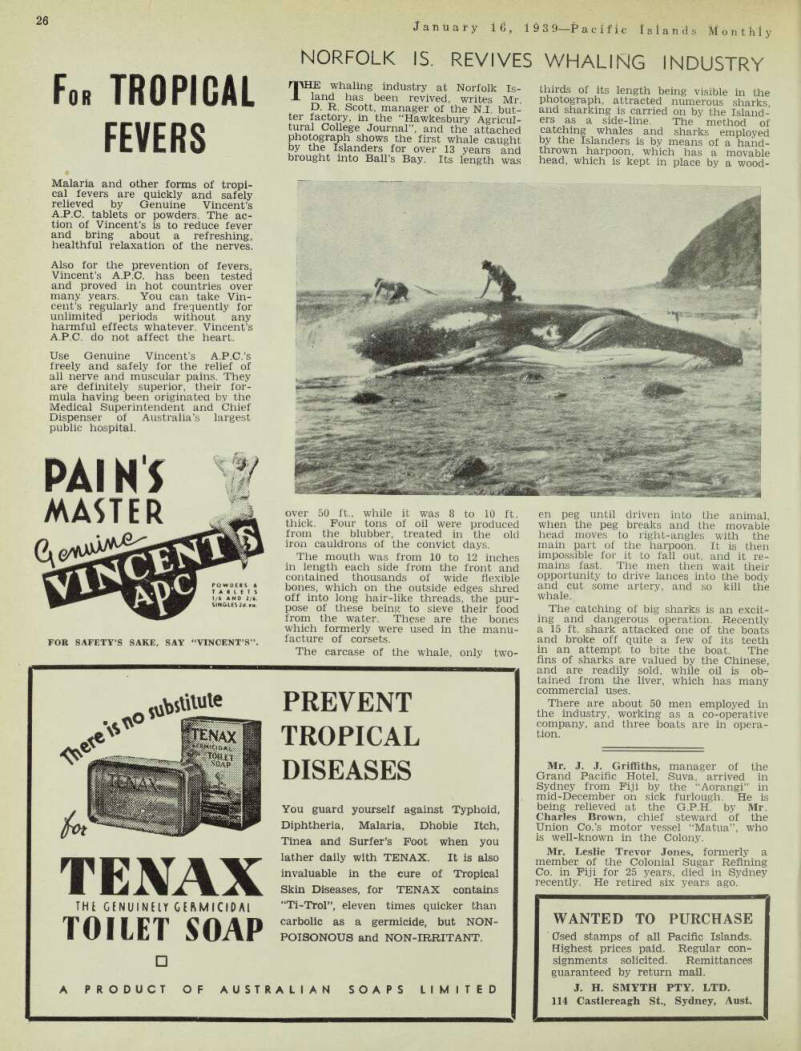
Fevers
Malaria and other forms of tropi cal fevers are quickly and safely relieved by Genuine Vincent’s A.P.C. tablets or powders. The ac tion of Vincent’s is to reduce fever and bring about a refreshing, healthful relaxation of the nerves.
Also for the prevention of fevers, Vincent’s A.P.C. has been tested and proved in hot countries over many years. You can take Vin cent’s regularly and frequently for unlimited periods without any harmful effects whatever. Vincent’s A.P.C. do not affect the heart.
Use Genuine Vincent’s A.P.C.’s freely and safely for the relief of all nerve and muscular pains. They are definitely superior, their for mula having been originated by the Medical Superintendent and Chief Dispenser of Australia’s largest public hospital.
Norfolk Is. Revives Whaling Industry
rpHE whaling industry at Norfolk Is ± land has been revived, writes Mr D. R. Scott, manager of the N.I. but ter factory, in the “Hawkesbury Agricul tural College Journal”, and the attached photograph shows the first whale caught by the Islanders for over 13 years and brought into Ball’s Bay. Its length was
over 50 ft., while it was 8 to 10 ft. thick. Four tons of oil were produced from the blubber, treated in the old iron cauldrons of the convict days.
The mouth was from 10 to 12 inches in length each side from the front and contained thousands of wide flexible bones, which on the outside edges shred off into long hair-like threads, the pur pose of these being to sieve their food from the water. These are the bones which formerly were used in the manu facture of corsets.
The carcase of the whale, only two
thirds of its length being visible in the photograph, attracted numerous sharks and sharking is carried on by the Island ers as a side-line. The method of catching whales and sharks employed by the Islanders is by means of a hand thrown harpoon, which has a movable head, which is kept in place by a wood
en peg until driven into the animal, when the peg breaks and the movable head moves to right-angles with the main part of the harpoon. It is then impossible for it to fall out, and it re mains fast. The men then wait their opportunity to drive lances into the body and cut some artery, and so kill the whale.
The catching of big sharks is an excit ing and dangerous operation. Recently a 15 ft. shark attacked one of the boats and broke off quite a few of its teeth in an attempt to bite the boat. The fins of sharks are valued by the Chinese, and are readily sold, while oil is ob tained from the liver, which has many commercial uses.
There are about 50 men employed in the industry, working as a co-operative company, and three boats are in opera tion.
Mr. J. J. Griffiths, manager of the Grand Pacific Hotel, Suva, arrived in Sydney from Fiji by the “Aorangi” in mid-December on sick furlough. He is being relieved at the G.P.H. by Mr.
Charles Brown, chief steward of the Union Co.’s motor vessel “Matua”, who is well-known in the Colony.
Mr. Leslie Trevor Jones, formerly a member of the Colonial Sugar Refining Co. in Fiji for 25 years, died in Sydney recently. He retired six years ago.
Advertisements & other items, p. 28 (3 items)
26
January 16, 193 9—P acific Islands Monthly
Tenax
PAINS
MASTER
powders & ra■L i t s
1/6 AND 2/6,
SINGLES2d ea
FOR SAFETY’S SAKE, SAY “VINCENT’S ”.
toslUule
M
nax
e
NOAP
TENAX
THE GENUINELY C E P. MICID AI
TOILET SOAP
PREVENT
TROPICAL
DISEASES
You guard yourself against Typhoid, Diphtheria, Malaria, Dhobie Itch, Tinea and Surfer’s Foot when you lather daily with TENAX. It is also invaluable in the cure of Tropical Skin Diseases, for TENAX contains “Ti-Trol”, eleven times quicker than carbolic as a germicide, but NON-
POISONOUS and NON-IRRITANT.
A PRODUCT OF AUSTRALIAN SOAPS LIMITED
Wanted To Purchase
CJsed stamps of all Pacific Islands.
Highest prices paid. Regular consignments solicited. Remittances guaranteed by return mail.
J. H. SMYTH PTY. LTD.
114 Castlereagh St., Sydney, Aust.
New Guinea

Dwindling Labour Supply In
Is Introduction of Coolie Labour the Solution?
Prom A Special Correspondent
THE future commercial development of the Mandated Territory of New Guinea depends to a great extent on an adequate labour supply being avail able for the man who is prepared to take up land for agricultural purposes, or to work mining leases.
Although the present labour situation cannot be described as one to create im mediate apprehension; it is, neverthe less, one which should be given consid eration before it becomes a vital prob lem. For it is at this stage when far sighted employers are beginning to real ise that the demands on the man-power of the Territory, plus the changing eco nomic conditions, are indications of an approaching problem which should be forestalled and some scheme prepared, ready to be put into, operation when the problem becomes acute.
A survey of the Territory’s male in digenous population as at June 30, 1938, shows that there are approximately 200,- 000. Of this number nearly 42,000 are indentured labourers. Compare these figures with those of 1914 when the total native population was put down in offi cial figures as 230,000 (including 78,000 estimated). Of this number, 57,115 were enumerated males and of the 78,000 es timated it would be safe to take 40,000 as males, making a total of 97,115, with 17,000 indentured labourers. The com parison shows approximately twice as
manv indentured labourers used in 1938, in the ratio of native male population, as in 1914. The increase is easily ac counted for by the greater extent of planted land on the various estates and the development of the gold industry.
Latest figures show 20,855 labourers em ployed on plantations and 7,189 in min ing There is an increase of 1,600 labour ers in 1938, as compared with the fig ures at June 30, 1937.
EMPLOYERS of large numbers of na tive labourers state that each year they are experiencing greater diffi culty in obtaining fresh supplies of workers. Official figures show that the number of workers renewing their con tracts are becoming less each year. Take the following figures for four years as an indication: — ,
These same employers are of opinion that conditions will become worse as the years go by, and there is no reason to doubt such an assumption. One of the main contributing factors to the decrease in the renewal of contracts is the lack of economic pressure which compels the indigenous native to work.
Unlike the Malay or the Javanese, where there is a dense population and the necessities of life are not so easily obtained, the New Guinea native is abundantly supplied with his every need, without the necessity of working to any marked degree and also he can procure all his ordinary requirements without money. The ground is so pro lific that all his food can be grown with the minimum of energy; the sea is full of fish; or, if inland natives, the jungle is full of small game to supplement the vegetable diet. Native tobacco grows profusely—he either makes his own pipe out of clay or he utilises the dried ba nana leaf in which to roll his cigarette: the beaten out bark of certain trees pro vides him with suitable clothing and the übiquitous coconut and betel-nut palms supply building and household materials. Why, he asks, should he work?
THAT is a question which I, too, have often asked and the answer seems to be that it is only the spirit of adventure, the urge to visit the un known. the inquisitiveness of the human that sends him hundreds of miles away to bind himself in an agreement for years and often to return empty-hand ed, yet with a brain filled with greater knowledge and a changed outlook upon life in general. In a lesser degree one might compare this urge to that which prompted the young country lad from the Australian bush to enlist and go overseas during the Great War. He re turned with a greater knowledge and a broader vision.
With no economic necessity to force the New Guinea native into the labour market, it follows that when his natural curiosity has been satisfied then the number offering for indenture will con
No. of labourers renewing Period. contracts. 1924-25 .. .. .. 9,477 1935-36 .. .. .. .. 7.244 1936-37 .. .. .. .. 6,330 1937-38 . . . . .. .. 5,581
siderably decrease. Admittedly, each year the enumerated population increases, thus making more eligible for employ ment; but the end must be reached some day. Added to this is their improved economic condition as a result of the higher prices they obtain for their pro duce since the introduction of legisla ture whereby they sell their copra direct to the exporters, receiving ordinary mar ket prices. By this means many of the natives in the more thickly-populated districts, and where there are good roads, have purchased their own motor lorries, erected their own hot-air kilns and work independently of the white or Asiatic trader who, at one time, served as the middleman in the tropics.
In the not too-distant future com mercial and agricultural undertakings in New Guinea will be forced to restrict their development on account of labour shortage at the present rate of native prosperity, decrease in extension of con tracts and increase in the demands for labour.
THE most practical solution of the problem which suggests itself is that the supply of indentured native la bour should be taken over by the Gov ernment, and an official Labour Bureau established to control the supply of plan tations, mining activities, commercial, and other interests requiring native la bour.
Unfortunately, Article 3 of the Terms of the New Guinea Mandate includes the clause: “The Mandatory shall see that the slave trade is prohibited, and that no forced labour is permitted, ex cept for essential public works and ser vices, and then only for adequate re muneration”. This is a hurdle which presents a difficulty hard to surmount from a legal point of view, though from a common-sense and practicable point of view it cannot but be agreed that na tives, after having served one or two terms under a contract of service, leave no doubt as to the benefits they derive from nourishing and regular food, medi cal attention, hygienic surroundings and mental advancement together with the general moral improvement as a result of discipline and a regular mode of liv ing. In fact it may safely be said that the employers of native labourers are really doing a greater work in educating and improving the New Guinea native physically than is generally appreciated.
His praises are seldom sung; more often one hears only of the isolated cases when some unsuitable individual has trouble with his employees, and some unknow ing person treats it as a general occur rence.
FAILING the supply by the Govern ment, the other solution lies in im ported labour from one of the East ern countries where the dense population and economic conditions compel the masses to seek unskilled work at a low rate of pay. It has been argued that New Guinea plantations and other acti vities would not be able to stand the cost.
This is a debatable point. The world points to our present “cheap labour”.
That is also open to argument. The average labourer here, recruited and in dentured, costs the employer about £l5 a year or 25/- a month for a type of labourer far down on the efficiency scale. The coolie class would perform at least twice as much work as the aver age New Guinea native, who invariably has to be given the strictest supervision to obtain results. Here again the lack of economic pressure in New Guinea is demonstrated for the employee has no fear of dismissal, it carries neither stigma nor destitution for, unlike the coolie, he
is able to subsist comfortably from the provisions of a bountiful Nature.
It would be Utopia in New Guinea with coolie labour—for the planters to be freed of the ever-constant problem of ob taining fresh recruits for his labour line; to be freed of the never-ending urging on of unwilling workers who so often seek the slightest opportunity to escape the duties allotted to them. There would be a decline in the number of neurotic cases amongst the whites and a tend ency for a higher standard of living.
Advertisements & other items, pp. 29-30 (1 item)
Sneed -Master
Co li
Easy to operate. Simply open Valve — Strike a match —and it lights. Boils one pint of water in minutes. Easy to carry. Weighs only 5 lbs. 9h ozs. Take it anywhere—use it any time—it is always ready—INSTANTLY.
THE STOVE WITH 100 USES
ADVANTAGES
1. Lights INSTANTLY—No preheating. 2. INSTANT regulation of heat (high, medium or low). 3. Safety Shut-off Valve—avoids repumping each time stove is lighted. 4. Built - in automatic tip - cleaning needle. 5. Wind-proof, Silent, Odourless “Life- Time” Burner. The same type as used on Coleman’s highest priced ranges. 6. Extra large Straight Generator —easily cleaned and replaced. 7. Triple Nickel-Plated Brass Fount— Rust-Proof —Tested for 200 lbs. pressure —SAFE.
DISTRIBUTORS IN THE PACIFIC ISLANDS:
All Branches of Burns, Philp & Co., Ltd.; W. R. Carpenter & Co., Ltd.; Morris, Hedstrom, Ltd.; Whitten Bros., Ltd.; Steamships Trading Co., Ltd.; and many other firms throughout the Islands. o /■v O a.
S & 3 * 1 j s t i)
MUST
BE Sw fETENED CONlffi
i vum
< TS»
NESI
BRAND
: e Anglo-Swiss Condensed
SYDNEY
YOUR FIRST
CONSIDERATION
NESTLE S MILK
remains PURE and
FRESH under all climatic conditions
You cannot afford to take risks with milk . . . only the best is good enough . . . that’s why you should always use Nestles Milk. It is made from the finest full cream country milk. From start to finish every process of manufacture is carried out under the strictest supervision. It will never become contaminated while unopened, and it is fully guaranteed to stand up to ANY climatic conditions. To protect your own health and the health of your family always insist on Nestles— the safest, most nourishing and most economical milk you can buy.
NESTLES
FULL CREAM
MILK
BEST, THEREFORE CHEAPEST
Cojn right A"s7c
N. Hebrides Old identity
Passes Death of "Dick" Collins
Mr. Richard (“Dick”) Collins,
for long years a trader on the Is land of Aoba, New Hebrides, died in the Paton Memorial Hospital at Vila on December 6, and was buried in the Roman Catholic cemetery the following day. He was 69 years of age.
Prior to coming to the New Hebrides some 40 years ago, Mr. Collins was a concert artist in his home town, Glas gow; and, later, he toured the United States. Canada, Australia and New Zea land. He knew Harry Lauder in his struggling days.
A bout of pneumonia in Sydney in the early nineteen hundreds ruined “Dick’s” voice and ended his stage career. He then went to the New Hebrides: first as an employee of Burns Philp (S.S.) Co., on the old inter-island steamer, S.S. “Tambo”. He later started as a trader on Aoba. In 1932, due to his in creasing years, and the trade depression, “Dick” gave up his trading station and carried on (not very successfully) as a small contractor at Vila.
During all his years in the New Heb rides, “Dick” Collins was held in the high est esteem by both British and French, and his word was known as his bond.
His death marks the passing of another of the old-timers of the British com munity, now sadly reduced in numbers.
He left a widow.
Author Frisbie Returns To
Puka Puka
Prom Our Own Correspondent
Apia, Dec. 13.
THE new B.P. inter-island vessel “Matafele” left Apia on December 9 for Puka Puka and Nassau Islands, at which latter place she is to lift about 200 tons of copra. Passengers on board were the well-known American author, Robert Dean Frisbie and his wife and child, and Pastor R. Reye, of the Seventh Day Adventist Mission.
On her return, the “Matafele” will take up running in an inter-insular ser vice in Fiji. She is under the command of Captain Tanner.
Rt. Rev. W. H. Baddeley, D. 5.0., M.C.,
M.A., Bishop of Melanesia, left the
Solomon Islands early in January on board the mission vessel “Southern Cross” to visit the Melanesian Mission stations on the island of New Britain in the Mandated Territory of New Guinea.
Educating Your Children
ISLANDS parents contemplating sending their children to Australia to be educated could not do better than consider the claims of the Southport Church of England schools, Queens land.
Pounded in 1912, St. Hilda’s School enrolls girls of all ages and a thorough modern edu cation in all branches is offered. There is a full course in domestic science. Art in all its branches is taught by a qualified mistress. There are classes in drawing, painting, commercial art. pottery, weaving, raffia-work, etc. French is taught throughout the school, and diction, literature, history, and geography are given special attention. The School is a member of the Girls’ Secondary Schools’ Association, and the girls compete with the leading Brisbane schools in all sports.
On the banks of the Nerang River, the South port School for boys challenges comparison with
any other public school in the British Empire as a group of buildings in an ideal setting. The central dormitory block satisfies every require ment 0 f modern hygiene, with cool, airy rooms, wlde verandahs and great height. There is also an open a ir gymnasium and a block of modern classrooms. The school has been organised on English Public School lines, with three separate “houses” which compete with each other in all sports. Prefects and dormitory captains are chosen each year, and learn valuable lessons in leadership and responsibility. A good moral tone has always been maintained, and every boy learns the fundamental lessons of honesty, decency, good manners, and fair play. „ , . a , T
Captain Gilbert Symons, M.C., who
was A.D.C. to the late Sir Eyre Hutson during his term as Governor of Fiji from 1925 to 1929, died recently in Eng land.
Advertisements & other items, pp. 31-32 (2 items)
29
Pacific Islands Monthl y—J anuary 16, 1939
Foster Clarks
\ LOVE M Ym)IT 'CA MOMMY
OWES ME CRfAMV CUSTARD, TOO
LOVELY,
MUMMY
... its lovely
« FLAVOUR makes
Foster CI ar k’s
Creamy
family
Custard the
avourite
f No one can resist Foster Clark’s Custard. It’s so beautifully rich and creamy —and its flavour appeals to children and grown-ups alike.
Give kiddies Foster Clark’s Custard on their fruit —and see how they enjoy it! Mrs. B. Dover of Carleon Crescent, Randwick, is one of thehundreds of housewives who praise Foster Clark’s Custard. She says: "It always lives up to its fine reputation.”
WE ALWAYS
ENJOY
FOSTER CLARKS
CUSTARD — IT'S
DELICIOUS
ON FRUIT
SOLD By ALL GROCERS — IN 3
CUiTARB
Powder
SIZES AND 4 FLAVOURS
FREE RECIPE BOOK. Write to
Foster Clark (Aust.) Ltd., Dept.
R. 8., Redfern, N.S.W., for Elizabeth Craig’s FREE illustrated 48page Recipe Book. Enclose id. stamp for postage.
H6OB
FOSTER CLARKS
W. H. GROVE & Sons Ltd.
Islands Traders P - box 490 AUCKLAND Telegraphic and Cable Address: “Grove/ 1 Auckland.
Shippers of all classes of New Zealand Products, specially prepared for the Island trade.
Representing Rylands & Sons (Col.) Ltd., of London and Manchester. (Including the famous “Dacca” Mills Products.) Parbliry Henty & Co. Pty. Ltd., of Sydney and Kobe.
“AGFA” Photographic Corporation, of Berlin.
J. Blair King, of London. World-famed Shirts.
Burrell & Co. Ltd., Millwall, London, E. 14. Oil, White Lead and all classes of Paints, including “FERROGENE” their special Tropical Paint . . . PREVENTS CORROSION made in RED, GREY, and GREEN.
Q 190
ZheMm
/ 'xm.
Photograph with Agfa Isochrom - this is a Film for all types of exposures. It enables you to get the best out of your photographs. Good definition, reproduction of the finest details, brilliant gradation, and high sensitivity. Orthochromatic with wide exposure latitude.
Farewell To Dr. Harper
Fiji
GREAT regret was expressed by all classes of the community of Lautoka, Fiji, when it became known that they were to lose the services of their most popular Resident District Medical Officer, who has also been in charge of the Lautoka Hospital, in the person of Dr. Philip Harper (says the. “Fiji Times”). He had been nine years at Lautoka and had proved himself a very
capable as well as a very willing and sympathetic medical man.
After nearly 30 years’ service with the Government, the Doctor decided to take his well-earned rest and retire on his pension. He has left for England.
Before his departure, he and his wife were “farewelled” at many public func tions, and received several valuable pre sents.
There was a farewell function at tended by the whole community in the Colonial Sugar Refining Company’s So cial Hall at Lautoka, on Sunday. No vember 27. The Doctor and his wife left for England to join their children on December 2.
Dr. Worger has taken the place of Dr. Harper.
Dr. Philip Harper, with Native Medical Assistants of the Lautoka District.
Bad Drought In Marquesas
Group
From Our Own Correspondent
Papeete. Dec. 15.
THE schooner “Denise” (Captain Mer vin), arrived at Papeete from the Marquesas Tslands on November 30.
Captain Mervin reports a long-contin ued and devastating drought in all the islands of the Marquesas—especially Nukuhiva.
Already, seven months have passed without even a shower of rain. Coconut groves which barely survived the pro longed drought of 1937 have succumbed this year.
Droughts in the Marquesas Islands continue for one and even two years, when a rainless season overtakes those latitudes. They are situated in the dol drums where there are very different climatic conditions from those prevailing in the islands further south.
The native Marquesans in times of plenty, guard themselves against the long drought by storing breadfruit in deep pits. The breadfruit so stored be comes with time a fermenting sour paste called mahi —not acceptable to Eu ropean palates. It being the only source of food supply (outside of fish and im norted tinned meats'* available during the rainless seasons, the physical condi tion of the Marquesan natives becomes very deteriorated if the drought is pro longed.
Guinea?
Are There Nazis In New Guinea?
Letter to the Editor
RESIDENTS of Rabaul were startled when they heard, per medium of the radio press, that Mr. Dave Davies, president of the local Property Owners’
Association, had been making somewhat sensational statements in Sydney about the activities of the German Nazis up here, and the relationship between the Germans and the natives. We presume that our friend Mr, Davies allowed him self to get into the hands of some of the irresponsible reporters of the sensa tion-loving Sydney newspapers, and the things that he said were wildly exagger ated. We refuse to believe that he said the things attributed to him.
There is no Nazi problem in this Ter ritory. All this wild talk about Ger man spies being at work in New Guinea is so much rubbish. The comparatively small number of Germans in the Terri tory—and especially those in Rabaul — are the essence of tact, and they do no thing at all to give offence to the Brit ish official class. Generally speaking, they are likeable men and good neigh bours —Britishers and Germans get along very well together.
These attempts by sensational news papers to stir up belief in a spy system in New Guinea are very much to be deplored.
I am, etc.,
Rabaulite.
Rabaul. Jan. 2.
Happy Social Function
In Rabaul
ONE of the pleasantest and most en joyable social gatherings of the year took place in Rabaul on December 19, when Mr. W. H. Carpenter entertain ed at dinner the players of the six cric ket teams of the Rabaul Cricket Asso ciation, together with the officials. The function was designed by Mr. Carpenter to mark the close of the cricket season, and also as a token of his appreciation of the enjoyment he has had from fol lowing cricket matches during the com petitions.
The proceedings were marked by a spirit of harmony and happiness. Short speeches were made by the host (Mr.
Carpenter), the Acting Administrator (Mr. Harold Page), the president of the Cricket Association (Mr. J. E. Savage), the captain of the Administration team (Mr. A. Schmidt), Mr. R. Melrose, the president of the New Guinea Club (Mr.
R. L. Clark), the president of the Ra baul Club (Dr. Brennan), the president of the Kokopo Sports Club (Mr. J. A.
Ewen), the secretary of the Association (Mr. R. Stevens), and various others.
The whole gathering, at the end, heartily cheered Mr. Carpenter and praised the fine gesture he had made in bringing all the cricketers together in this happy fashion.
Major Clive Brewster Joske has receiv ed cabled advice to the effect that his assumption of the family name of Brew ster was formally enrolled at the Col lege of Arms in London on November 19. As the change of name, which has been known to be pending for some time, is now effective, he desires to be known in future by the surname of Brews ter.—“Fiji Times”.
Gilbert And Ellice Notes
Prom Our Own Correspondent
Tarawa, Dec. 1.
THE M-V. “Moamoa” (Burns Philp South Sea Co. Ltd.) has returned to its headquarters at Tarawa, Gilbert Islands, after transporting a large num ber of lepers, on behalf of the Medical Department, to the up-to-date Fiji leper station at Makogai, near Suva.
The “Moamoa” underwent a general overhaul on the slip whilst in Suva, and collected copra throughout the Ellice Islands on the return trip.
The “Moamoa’s” chief engineer, Mr. J.
A. Harris, joined the ranks of the bene dicts whilst in Suva, being quietly mar ried to Miss Clara Reiher, daughter of Mr. Henry Reiher, of Tarawa.
A new auxiliary vessel, the “Kiakia”, built for the Colony Government, has arrived from the shipbuilding yards in Hong Kong, to be placed at the dis posal of the Medical Department as a travelling medical officer’s vessel in the Group.
Administrative Conference
The Government vessel. “Nimanoa”. brought the Acting Resident Commis sioner (His Honour R. H. Garvey) from
Ocean Island to Tarawa, where the vari ous District Officers of the Colony as sembled for the purpose of an Adminis trative Conference.
Drought
Drought conditions have prevailed in the Southern Gilberts, leaving the na tives in certain districts without one of their staple foods —the coconut.
The R.C.S. “Nimanoa” has made two special trips with full cargoes of nuts from other parts of the Group for de livery as food relief in the drought-stricken districts, on behalf of the Gov ernment.
Personal
District Officer E. R. Bevington, late of Beru, has been transferred to Ocean Is land, and Dr. K. R. Steehson has been
appointed to Beru as Resident Medical Officer and Administrative Officer.
Mr. P. D. Macdonald, Secretary to the Government at Ocean Island, proceeds in January to Fanning Island to relieve as Administrative Officer at that centre.
It is understood that Major C. A. Swin bourne, 0.8. E., late Senior Administra tive Officer at Tarawa, Central Gilberts, may be permanently appointed to Fan ning Island on his return from furlough in a few months’ time.
For the first time for over 20 years there have been enough Europeans gath ered together at one time at Tarawa, other than crews from visiting war ships, to justify a visit in force to Bai riki to engage in a challenge cricket
match against the Bairiki (native) Boys’
High School. The occasion was the re cent visit to Tarawa by the Acting Re sident Commissioner, His Honour R. H.
Garvey, and the simultaneous assemb ling of all Colony Administrative Officers for Conference.
The visiting cricketers were royally entertained by Captain F. G. L. Holland (Superintendent of Education) and Mrs.
Holland, and a most enjoyable afternoon was spent, both in the field and at the pavilion.
Rev. H. T. Shotten, M.A., of the Meth odist Mission at Kiriwina, Papua, arrived in Sydney with Mrs. Shotten and their child by the December “Macdhui”. Ow ing to his wife’s ill-health, Mr. Shotten will retire from the mission field, after six years of service.
Mr. Herbert Rushton, C.8.E., who was Colonial Treasurer in Fiji from 1922 un til 1929, when he was transferred to Kenya, died recently in England, at the age of 62.
Dr. Monier, of the 13th Regiment of Colonial Artillery, has been appointed Director of the Gaston Bourret Insti tute in New Caledonia. He is due in Noumea this month by the “Commissaire Ramel”.
Advertisements & other items, pp. 33-34 (2 items)
31
Pacific Islands Monthl y—J anuary 16, 1939
Excelsior Supply Co. Pty. Ltd.
KOYONG .. MOBS YALE
DAY AND BOARDING SCHOOL AND
KINDERGARTEN FOR GIRLS.
Pupils prepared for School, Music Examinations. Excellent Climate and Health Record.
Own Orchard, vegetables, poultry & dairy.
Home Life and Individual Attention.
Boarders taken from six years old.
Prospectus on application.
MISS MEIN. Principal.
SHEAFFER’S WORLD FAMOUS
Streamlined, Feather Touch PENS and PENCILS
If you want Design, Beauty and Quality buy
a SHEAFFER
All Lifetime Pena are guaranteed for the life of the user except against loss and wilful damage.
When serviced, they are subject to a small fee for insurance, postage and handling.
Beautiful and Useful Gifts for All Occasions.
SKRIP - The
Successor to Ink makes all Pens write better. 2 oz. 1/6, 4 oz. 2/6 Plus Postage Distributors Identify the Lifetime Pen by the white dot
74T LTSC AA 3T
Feather Touch Lifetime Pencil Regular Pen Lifetime Fen Pencil 9 6 2b/- 761- each 361- ea. each each The working parts of the Sheaffer Pencil are guaranteed against wear for the lifetime of the user.
When serviced they are subject to a small fee for insurance, postage and handling.
All Sheaffer regular pens are guaranteed against defects of material and workmanship.
Obtainable from Selected Jewellers and Stationers everywhere
EXCELSIOR SUPPLY CO. PTY. LTD.
278 Post Office Place,
MELBOURNE, VIC.
HEAD OFFICE J
160 BROADWAY.
SYDNEY. N.S,W.
50 Victoria Street,
WELLINGTON, N.Z.
BRITISH SOLOMON ISLANDS
STAMPS
New issue at 10 per cent, over cost.
On Covers Id. each cover extra.
Coronation Set on Reg. Cover posted to any address l/6d.
Cash with order. With all enquiries please send a stamped addressed envelope.
M. HARPER,
Mandoliana Island, P.O. Box 6, Tulagi, 8.5.1.
Here's the smartest low-priced travel case available . . . LEATHER- LIKE No. 34 . . . made of smooth glossy fibre, with solid leather streps and handle and reinforced corners. Colour brown, blue or black. Ask for - - -
LEATHERLIKE
TRAVEL CASE N 0.34
Traders invited to write for full particulars
FORD SHERINGTON, LTD.
Manufacturers (Wholesale only).
Kippax Street Sydney.
Married On Cruising Yacht
From Our Own Correspondent
Papeete, Dec. 8.
CHARMING wedding having the added interest that it was solemnised at sea—was the marriage of Made moiselle France Lucas, daughter of the late Captain Emmanuel and Madame Lucas, to Mr. Ralph Chapman, on board the yacht, “Moana”, on November 20.
Mr. Chapman is a young man of Ta hiti, who entered the service of Mr.
William B. Leeds, owner of the “Moana".
when Mr. Leeds visited the island in The wedding ceremony was celebrated, while the “Moana” was voyaging from Tahiti to Moorea, in the presence of His Excellency# the Governor and Madame de Gery, who. with their children, were guests of Mr. Leeds. Mr. and Mrs Chapman are to make their home in New York. They sailed on the “Moana” when she departed for Honolulu on No vember 29.
The luxury yacht “Moana”.
A Correction
Letter to the Editor AN article in the “P.I.M.” of November (which, apparently, is a summary of an article published in a Sydney newspaper) purports to describe my life; but contains some errors.
Firstly, I have never been a resident of the Isle of Pines, in New Caledonia.
I have little, or no recollection, of the interview with the Sydney reporter, as I was in hospital, and suffering great pain at the time, and more or less under the influence of drugs. I deny that I said that we would be better off in the hands of Australia or the United States. In many wavs we are better off as we are—such as the status of educa ted half-castes. They now have full citi zen rights. What chance would they have under American or Australian rule?
I am, etc.,
J. Petersen.
Waverlev, Sydney. 30/12/1938.
Chinese Girl's Shorthand
Success
MISS BICK LIN, a Chinese girl born and reared in Rabaul. who had been taught shorthand in the local con vent, successfully undertook the senior grade shorthand examination conducted by a well-known business college in Melbourne. She obtained a pass with no less than 88 per cent, of marks, and won the college diploma. Probably this is the first time that any resident of New Guinea, taught by mail —and certainly the first Chinese —has won this distinc tion. .
On a world cruise, the U.S. tourist ship “Stella Polaris” will visit Samoa on Feb ruary . 22.
Advertisements & other items, p. 34 (1 item)
32
January 16, 193 9—P acific Islands Monthly
Tahiti
New Bishop Of
From Our Own Correspondent
Papeete, Dec. 8.
A MESSAGE from Rome has made known to the Church in French Oceania that Pere Paul Mazet, Cheva lier de la Legion d’Honneur, has been designated Vicaire Apostolique de Tahiti, in succession to Monseigneur Amedee Nouailles, who died in August, 1937.
Like his predecessor, Pere Paul has ministered during many years to a parish of widely scattered atolls in the Tuamotu Archipelago. His principal station has been the atoll Reao, where is situated the leper colony of Eastern French Oceania.
In recognition of his services in the establishment of this colony, and of his many years of devotion to the care of its inmates, Pere Paul has been awarded the Cross of the Legion of Honour.
Japanese Lugger
Confiscated
From Our Own Correspondent
Port Vila, Dec. 8.
ON November 21 the New Hebrides police, at Port Vila, received in formation that a strange vessel was anchored off Terama, on the south coast of the island of Efate. The police proceeded immediately to the spot and took possession of the vessel, and brought it to Vila, which is the port of entry for the Territory.
It proved to be a Japanese lugger called the “Taian Mam”, under the command of Captain Kanaya. The captain was charged in the Court of First Instance with entering and anchoring his vessel, and landing at a place other than the correct port of entry. The court imposed a fine of £2O sterling and ordered the confis cation of the lugger and cargo.
The captain of the lugger has now appealed to the Joint Court against the judgment of the Court of First Instance.
"Maui Pomare" Springs
A Leak
From Our Own Correspondent
Apia Dec 12
AFTER the arrival of the’ N.Z. Gov ernment motor vessel, “Maui Po mare”, on November 30, it was found that the ship, during the very rough trip from New Zealand, had sprung a leak.
In consequence two pumps, one of them the motor pump of the Apia fire bri gade, were pumping continuously for several days.
Although about 2,000 cases of bananas were lifted, she left behind a large num ber of passengers, mostly Government of ficials. Most of these people will leave Apia to-day by the “Matua” for N.Z.
Missionary
37 Years as Papuan Missionary Rev. R. L. Turner Retires
From Our Own Correspondent
Pt. Moresby, Dec. 15.
THE Annual Conference of the London Missionary Society, in Papua, has come to an end, and missionaries will be returning to their stations this week.
The principal event to be recorded is the retirement of Rev. R. L. Turner, after 37 years of service in Papua.
Mr. Turner, who was also a member of the Legislative Council, was sta tioned at Delena. His place there will be filled by Rev. Percy Chatterton, who has done so much in past years for native education. Mr. Chatterton’s work as educationist will be carried on at Metoreia by Rev. Stuart Lade, 8.A., of Adelaide, who is a newcomer to Papua.
Rev. John Gilkison, also a new ar rival, will be stationed at Mailu, and Rev, H. Brown, M.A. at Moru.
Rev. D. E. Ure, L.Th., who has been in charge of the head station near Port Moresby, goes on long furlough, and will be relieved by Rev. O, G.
Parry, B.Ec.
A farewell dinner was given to Mr. and Mrs. Turner, at Metoreia, on December 7. The Lieut-Govenor was present, as were also Hon. W. H.
Champion and Mrs. Champion, Hon.
A. P. Lyons and Mrs. Lyons, Hon.
F. J. Williams and Mrs. Williams, Hon. H. L. Murray, Mr. C. Brough, and Mr. J. Spychiger.
Miss J. March and Miss E. E. Brabin, 8.A., of the Methodist Mission at Vunai rima, New Britain, T.N.G., have an nounced their intention of retiring this year.
A Chinese storekeeper named Hong Lee, alias Lee On, was fined £BO in the police court in Suva recently for supplying a bottle of whisky to a native. The police stated that this Chinese trader was an old offender.
He had been previously fined £5O for selling liquor without a licence, and £3O for supplying liquor to a native.
The magistrate added the £5O and £3O
together, and thus imposed a fine of £BO for the third offence—in default, 6 months’ imprisonment.
An advertisement in the “Rabaul Times” gives the official announcement that the old partnership existing be tween Messrs. P. O. Cutler and V. A.
Pratt, who carried on business as plant ers and traders, has been dissolved.
Advertisements & other items, pp. 35-36 (2 items)
33
Pacific Islands Monthl y—J anuary 16, 1939
Capstan
o
REGD
7
THE
HALL-MARK
OF
PERFECTION
IN
CLOTHING, HATS,
SHIRTS, PYJAMAS,
MERCERY, HOSIERY,
& KNITTED GOODS.
They Look Well! and They Wear Well!
EVERY GARMENT GUARANTEED
CAPSTAN
Capstan Cigarettes, round airtight 50‘s.
Medium and full strength.
SPECIALLY
PACK CD FOR
THC TROPICS
>f *K, Capstan A \ Navy Cut ii&y Tobacco, made from the finest Virginia leaf. 8825-10-
PRESCOTT L T JP U yTn X e^ are sole wholesale abort is fdJ^
PINEAPPLE BACON s HANS
DAISY BRAND BUTTER
“375” BUTTER in Tl NS nb.-21b.-sib. sizes LEA & PERRINS’ Sauces and Most other Super-Quality Lines of the Trade
Swallow & Ariel!
LIMITED
PORT MELBOURNE :: AUSTRALIA
MANUFACTURERS
SINCE 1854
OF HIGH QUALITY
BISCUITS
CABIN BISCUITS
NAVY and PILOT BREAD
PACKED EXPRESSLY. FOR EXPORT
IN TINS UP TO SOlbs.
Tahiti's Ancient
Hospitality
Dies Under a Heterogeneous Civilisation
From Our Own Correspondent.
Papeete, Dec. 11.
ERHAPS the most cherished memory carried away by visitors to Tahiti in the old days, was the hospitality be stowed in unstinted measure by the natives of the island.
Maximo Rodriguez, journeying around Tahiti in 1775, records in his diary:—“lt dawned clear, and with wind from S., fresh. I started for the district of Papara, which adjoins that of Atehuru. I pro ceed on until the middle of the night, with the object of getting close up to a bad stretch of water that lies about the middle of said district, where the Ari'i resides. He received me with much kind ness, and gave me a nice house to lodge in, and I passed the night without inci dent.”
The translator, Doctor B. Glanvill Corney, adds this footnote:—“l take this opportunity of recording the pleasure and satisfaction I experienced 133 years after Maximo, in accepting hospitality from the Ari’i of Papara, chief of the Teva and President of the District Coun cil, who received me with much kindness, and gave me a nice house to lodge in, where I passed several nights without in cident, other than of a felicitous kind, and enjoyed many interesting and in structive conversations with my host on the subject of Maximo and his wander ings, and his native contemporaries.”
One could have hoped that Tahitian hospitality had survived, with all the gracious charm of spirit and usage to which these two bear witness. But, about twenty years ago, new Wallaces and Captain Cooks came to re-dlscover the South Seas. Following them came the mis sionaries of the New Civilisation—authors, writers, scriveners, doctors of science, doctors of tropical medicine, professors, anthropologists, cinema actors, artists, painters, rovers, adventurers, treasure hunters, sun-bathers, refugees from pro hibition, rum runners, poets, dreamers— a grave and reverend company, some times, but always a trifle too heterogen eous for the Polynesian mind to compre hend.
During subsequent years many things have happened to convince the Tahitian of the wisdom of his European brother in regarding his house as his castle.
Gradually, the portcullis lias been dropped and the drawbridge elevated in Tahitian homes, and the wayfarer no longer hears the hearty “Haere Mai, Tamaa” (come and dine with us) as he passes through the countryside.
New Capital For Papuan Co.
AN issue of approximately 20,000 or dinary shares in Steamships Trading Co. Ltd., of Papua, has been offered to shareholders in the proportion of one for every six held on November 28. The new capital will be used for general business expansion, and in particular for extensions and improvements to the slip way at Port Moresby.
Rev. T. G. Paul, of Camden, N.S.W., has accepted the position of Commissary in Australia to the Bishop of Melanesia, Right Rev. W. H. Baddeley.
Pidgin In The Mission
Press
WE have received three interesting products of the Lutheran Mission Press, at Madang, New Guinea. They comprise a catechism, a hymn book, and a small newspaper, compiled for the use of the natives who are being taught by the Lutheran Missionaries to read and write.
The typography and general character of the work are really excellent—it is hard to believe that so high a standard
Papa Belong Mifela
Papa belor) mifela ju i stap antap, ol tambuem nem belor) ju. \ Pasin belop ju i kam lorj olples. Maus belor) ju tasol ol bi hainem, lor) kelaut lor) geraun tu. Kaikai belor) mifela belor) de nau ju giwem mifela.
Trobel belor) mifela ju no moa tirjtirj; mi fela tu no ken tirjtir) alor) trobel ol mekem alor) mifela. Ju no brirjem mifela lop sam tir) belor) traiem mifela. Ju lusem mifela alor) ban belor) Satan. Kirjdom em belor) ju tasol, ju strorj fela, ju gat nem oltaim.
Tru! could be reached by native compositors and printers in this isolated part of the Pacific.
At first we were intrigued by the langu age employed. We assumed that it was some kind of Northern New Guinea dialect, spelled in European characters.
Then a phrase or two caught the editor ial eye, and it became apparent that, actually, these books are written in Pidgin English, but according to the phonetic method of spelling applied by the Lutherans. The combination is in teresting, and a page, which appears to be the “Lord’s Prayer”, and which is the introduction to the “Sing Sing Book” (or, as they call it, “Sinsin Buk”) is re produced herewith. It will be noticed that the mission typographers are using a symbol like an “n”, with its tail turned in, to designate the sound “ng”.
Burglars broke into the general store of W. R. Carpenter and Co., Ltd., in Mango Avenue, Rabaul, in mid- December, and about £74 was stolen from the strong-room, as well as a quantity of goods from the store.
Some of the circumstances surround ing the robbery were peculiar, and a number of local people were convinced that it was an “inside job”.
Land Of No Locks
Or Clocks
By Don Gordon
“TIUT aren’t you going to lock up be- JDfore you go?” I asked my host, as we descended the verandah steps of his island home in New Guinea. We were bound for the steamer’s port-of call, some 30 miles away, and would be absent three or four days.
Mine Host laughed. “Lock up?” he repeated. “How can I lock up when there are no locks?”
And then I realised that none of the doors had locks; in fact many of the doorways did not even possess doors!
We simply walked out of the house and left a young “monkey”—as the 12years-old house-boy was called —in charge of the silver forks and spoons, rare brassware and clothing; to say nothing of the canned food in the pantry, and the suites of cane furniture.
And not half a mile away stood a na tive village with some 200 sons and grandsons of cannibal raiders!
As we stepped into the launch my companion nodded to an ugly-looking six-foot black, “Me go now. You look out good along house”, he remarked casually, and the six-foot chief grunted.
“Aren’t you taking a bit of a risk?”
I suggested, astonished at his casualness.
He shook his head. There was no risk'
at all, he assured me. For two weeks, before his house was built, his packing cases of trade goods, provisions, trunks and furniture had lain in various na tive houses in the village. Not even a newspaper had been stolen. And news papers are greedily sought after by the natives for rolling cigarettes.
“They’re not civilised enough yet”, Mine Host explained. “The native is nat urally honest, and naturally moral. It is only after contact with the more popu lated seaports and their civilisation that he starts thieving; where he sees arti cles worn by other natives and his van ity craves for possession. It’s human na ture all the world over”.
“I wonder when the steamer will be in?” I enquired, later, as the launch ploughed its way through the waters by the coast of a picture-book tropic is land, with its coral beds and waving palms stretched out over the gleaming strip of white sand beach.
“The steamer? ... Oh, either to-day or to-morrow: possibly next day. She’s seldom on time. But what’s the differ ence ©f a day or two in this country?
I think we’ll have something to eat, eh?”
“What’s the time?” I asked.
“Haven’t the vaguest idea”. Then, glancing up at the sun, which rises around about six and sets at six in the evening, with only a variation of some II minutes from January to December he replied: “I should say it’s about one o’clock. But why worry about time?”
We both laughed. . Yes, why worry about such a small thing as time? There were no trains to catch; steamer sailings had a charming uncertainty extending over 18 hours. There was work to be done: One continued the job until it was finished—to-day, to-morrow or next week. What did it matter? Clocks were unnecessary chains to a civilisation whose advantages were doubtful in this
Land of No Clocks or Locks. One ate when one was hungry; one slept when one was tired. Hours were never men tioned.
“I’ll come over on Friday and see you”, says the departing visitor. He may arrive in the morning or late afternoon, or even on Thursday night or Saturday morning. It makes no difference. If you happen to be away he will make himself at home in your house of No Locks to await your return.
And then . . . Civilisation with its fastened windows, bolted doors and the elaborate burglar alarm. . . The morning rush for the 8.15 ferry; the unfinished game of bridge and/or the hasty kiss to catch the last tram; the appointment un der the clock at 3.30 sharp!
Slaves of the Ticking Clock and the Yale Lock! No wonder I envied Mine Host in his savage land of unlocked houses and his clockless days!
Advertisements & other items, pp. 37-38 (2 items)
35
Pacific Islands Monthl y—J anuary 16, 1939
Anchor Flour
H.JONES SCO
AUSTRALIA’S BEST
H. JONES & CO., LTD.
Darlington, Sydnoy Hobart. Ta».
a
ANCHOR FLOUR
THE STANDARD OF QUALITY
GILLESPIE BROS. PTY. LTD.
SYDNEY - AUSTRALIA
Telephones ; MJ 4657 (4 lines) and M 2585 L Cable Address: “Trocas”, Sydney.
® wWoMm
379 KENT STREET, SYDNEY
gUYERS of all Islands' requirements on Commission Original Invoices Furnished. 22 Years Islands Trade Experience.
JSLANDS Produce Sold on Shippers' Account Liberal Advances against Consignments.
Bankers : Bank of Now South Wales. CORRESPONDENCE IN ENGLISH, FRENCH AND GERMAN
11 I 'lO m The extraordinary advantages of our new PETROMAX Rapid lanterns and table-lamps are obvious: Due to the very high heating efficiency of the absolutely safe and automatic Paraffin pre heating device, the usual pre-heating time of about 5 minutes has been reduced to 30 seconds!
natJH
• I *omi lid C PETROMAX RAPID Lanterns and Lamps need one fuel only, i. e., the inexpensive paraffin or petrol, it required, for both pre heating and burning.
WRITE FOR THE NEW AND INTERESTING PROSPECTUS
Rapid
W. BRECKWOLDT tr CO., Roboul. Sole Agents for South Seas.
Penetration Of Unknown
Papua
“W E had a very interesting flight to 7? Lake Kutubu, in the uncontrolled area, last month”, says a Papuan official, in a private letter.
“The lake itself is as beautiful as Lake Windermere, and the other English lakes. The shores are not swampy and grass-fringed, such as one might expect, but are as clear-cut as the shores of Neutral Bay, Sydney. I found it hard to realise that I was not standing on a salt-water shore.
“There are five officers of the Papuan Administration now at this new station on Lake Kutubu, and they use the lake as a base from which to make patrols into the uncontrolled area”.
This is an indication of the manner in which the administration of Papua is steadily extending Government control over the hitherto unknown interior — still marked on the latest maps as un explored and uncontrolled.
Postage Stamp Error
A CORRESPONDENT of the “Stamp Lover’’ draws attention to an inter esting error on the part of the art ist responsible for the design of the current Fiji lid. pictorial postage stamp.
It will be noted that a native canoe is featured on the id., lid., and 3d. values, but whereas the id. value shows a boat manned by three natives and the 3d. value by one native, the canoe in the lid. value is sailing merrily along with out any member of the crew being in sight.
It is suggested that perhaps the crew has gone below for dinner, but, in view of the apparent proximity of reefs shown on the stamp, we are rather afraid that in that case the canoe would be in imminent danger of shipwreck.
The Melbourne Stock Exchange has granted official quotation to 933,298
contributing shares of 5/-, fully paid,
in Oil Search, Ltd., which has in terests in Australia, New Guinea and Papua. Subscribed capital is £334,012, in 1,333,298 fully paid shares of 5/-,
and 2,748 contributing shares, paid to
various amounts. Directors are Messrs.
W. A, Freeman, A. J. Gibson, S. N.
McLean, E. F. Griffin, J. Mackay, H. G.
Foxall, and W. D. Wharton.
Advertisements & other items, p. 38 (1 item)
36
January 16, ,1 9 3 9—Pa cif i c Islands Monthly
Heroic Rescue
Very Quick Work Saves Lives in Papeete
From Our Own Correspondent
Papeete, Dec. 8.
THE deep channel between Tahiti and Moorea is the meeting place of strong currents of the sea.
The high mountains of both islands deflect the winds to stir up the sur face of the waters. Even on a day of comparative calm, a crossing on the little craft that carry wares and pas sengers is an uncomfortable experi ence for those who are not good sailors.
When a boisterous toerau storm blows from the north-west, it lashes the channel to a fury of towering waves which, in endless procession, crash on the barrier and dash on, pouring their waters into Papeete Harbour. This causes a strong current to flow out of Toata Pass. The outflow ing current meeting the waves causes them to curl and crash in the entrance of the Pass, and the surf there is as violent as on the reefs at either side.
Through such a storm the small power-schooner, “Tiare Avaro”, loaded with passengers, came from Moorea, on November 26.
It was a terrifying crossing which should never have been attempted through such seas in so small a craft.
The “Tiare Avaro” captain must have known the risk he took in head ing for Toata Pass. Even the big liner “Eridan”, lying in Papeete Har bour, would not essay the boiling in ferno of cross waves, crashing breakers and battling currents at the Pass, and delayed her departure until the storm abated.
But the “Tiare Avaro” captain chanced it, and disaster overtook him.
The vessel, caught on the crest of a towering wave, with her rudder and propeller in the air, was thrown broadside as the wave curled to break against the current, and capsized as the wave crashed, throwing her pas sengers into the water.
Those who saw the accident be lieved everyone on board would be speedily drowned.
Mr. William B. Leeds, whose yacht “Moana” lay at anchor in the lee of a small islet near the Pass, had been watching the “Tiare Avaro”. When he saw her capsize, he jumped into his motor launch and, ordering his other motor launch and a ship’s boat to follow, dashed out through the Pass to the rescue.
Closely following, the Government power-schooner “Tamara”, with the Governor of French Oceania on board, fought its way out. His Excellency had been at the quay and, seeing the accident, had gone aboard the “Tamara” to direct the work of rescue.
They were in time. All the “Tiare Avaro” passengers save one (who was carried away by the current and
overwhelmed before help arrived) were rescued, and hurried ashore to the hospital, where they were cared for until they had recovered from the shock of their terrifying experience.
On November 29, in the “Bulletin du Presse”, the Governor, in a special announcement, expressed his warm thanks to those who assisted to rescue the people from the “Tiare Avaro”; and especially to the captain and crew of the American yacht “Moana”, who acted so quickly and effectively.
Javanese Burglars
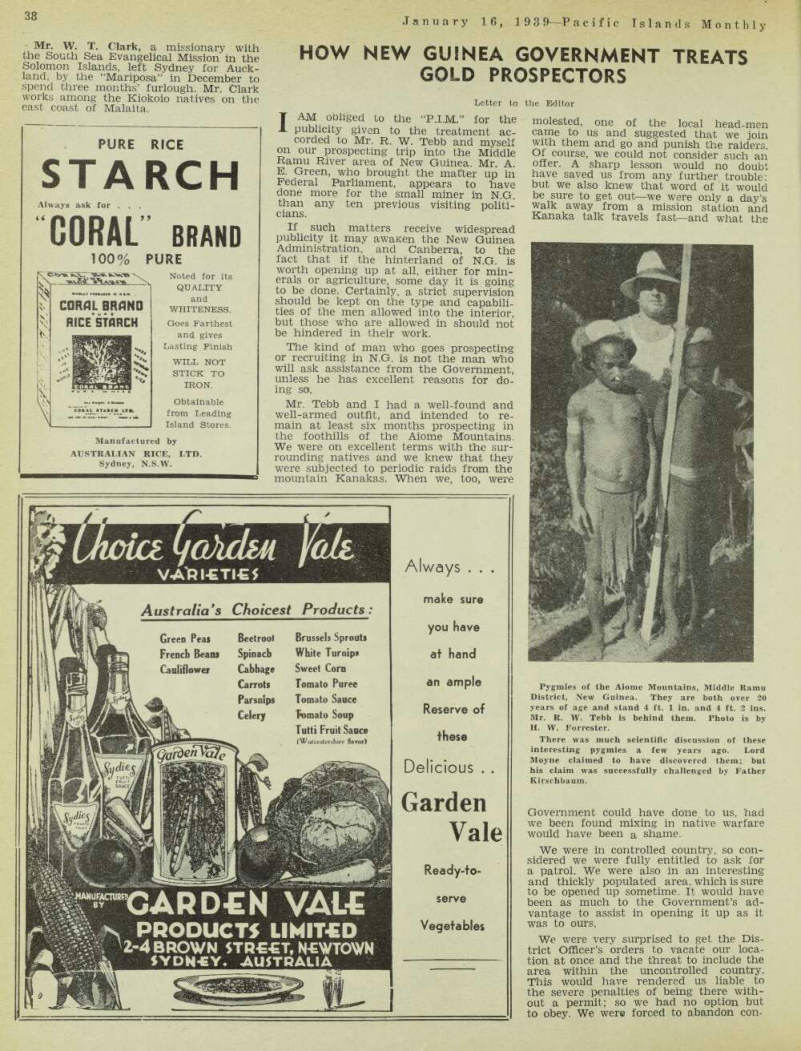
From Our Own Correspondent
Noumea. Nov. 24.
TWO Javanese labourers, suspected of numerous burglaries of busi ness premises in Noumea, were hunted down by the police. One was shot dead, and one captured.
Both men resisted savagely, and many shots were exchanged with the police. A native policeman was shot dead, and two other natives, assisting the police, were wounded.
The Javanese who was killed was carrying two revolvers, and a large bunch of keys.
- Mr. W. T. Clark, a missionary with the South Sea Evangelical Mission in the Solomon Islands, left Sydney for Auck land, by the “Mariposa” in December to spend three months’ furlough. Mr. Clark works among the Kiokoio natives on the east coast of Malaita.
Advertisements & other items, pp. 39-40 (2 items)
37
Pacific Islands Mont hi y — J anuary 16, 1939
Chi Vers
Kork-N-Scal
for HOME USE
• Hand
Applied
Airtight Pressure Proof
FOR ALL HOME BOTTLING
—THE LITTLE CAP THAT
will Re-seal 1,000 Times
KORK-N-SEAL (Aust.) LTD.
SYDNEY, AUSTRALIA,
106 COMMONWEALTH STREET,
We are
X Specialists . . .
Let us have your confidence. Sixty years is our record of supplying the leading Houses throughout the World in ... .
FRESH FRUIT VEGETABLES PRODUCE
’Phones: MA 3612 (4 lines) Cable Address: “Wcymarkson”
Codes— Bentleys Private
WEYMARK & SON LTD.
FRUIT AND PRODUCE MERCHANTS
14-18 STEAMMILL STREET - - SYDNEY
CHI VERS
FAMOUS ENGLISH PRODUCTS
CANNED ENGLISH VEGETABLES
CANNED ENGLISH FRUITS
OLDE ENGLISH MARMALADE
GOLD MEDAL JAMS
JELLY CRYSTALS. ETC.
Obtainable from all leading Grocery Store
WRITE TO DEPARTMENT "A"
CHIVERS & SONS LTD.
His+on, Cambs., Eng.
FOR ATTRACTIVE RECIPE BOOK
OK m
CHIV£B S
& $ CO s LD \
STfIMD^R O
FRESH
L ENGLISH ,
IX /
PEAS
PURE RICE
STARCH
Always ask for . . .
CORAL BRAND
100% PURE
Noted for its
QUALITY
and
WHITENESS.
Goes Farthest and gives Lasting Finish
WILL NOT
STICK TO
IRON.
Obtainable from Leading Island Stores.
MMuUI «■ ■
CORAL BRAND
RICE STARCH
Manufactured by
AUSTRALIAN RICE, LTD.
Sydney, N.S.W.
Australia's Choicest Products Brussels Sprouts While Turnips Sweet Corn Tomato Puree Tomato Sauce Tomato Soup Tutti Fruit Sauce (Worcestershire flavor) Beetroot Spinach Cabbage Carrots Parsnips Celery Green Peas French Beans Cauliflower ST W'S
garden
m *
GARDEN VALE
-HANUFACTURR
* BY I
PRODUCTS LIMITED
2-4 BROWN STR-E-ET, N-EWTOWN
JYDN-EY. -AUSTRALIA
Always . . . make sure you have at hand an ample Reserve of these Delicious . .
Garden
Vale
Ready-toserve Vegetables
Gold Prospectors
How New Guinea Government Treats
Letter to the Editor
I AM obliged to the “P.1.M.” for the publicity given to the treatment ac corded to Mr. R. W. Tebb and myself on our prospecting trip into the Middle Ramu River area of New Guinea. Mr. A.
E. Green, who brought the mafter up in Federal Parliament, appears to have done more for the small miner in N.G. than any ten previous visiting politi cians.
If such matters receive widespread publicity it may awaken the New Guinea Administration, and Canberra, to the fact that if the hinterland of N.G. is worth opening up at all, either for min erals or agriculture, some day it is going to be done. Certainly, a strict supervision should be kept on the type and capabili ties of the men allowed into the interior, but those who are allowed in should not be hindered in their work.
The kind of man who goes prospecting or recruiting in N.G. is not the man who will ask assistance from the Government, unless he has excellent reasons for do ing so.
Mr. Tebb and I had a well-found and well-armed outfit, and intended to re main at least six months prospecting in the foothills of the Aiome Mountains.
We were on excellent terms with the sur rounding natives and we knew that they were subjected to periodic raids from the mountain Kanakas. When we, too, were
molested, one of the local head-men came to us and suggested that we join with them and go and punish the raiders.
Of course, we could not consider such an offer. A sharp lesson would no doubt have saved us from any further trouble but we also knew that word of it would be sure to get out—we were only a day’s walk away from a mission station and Kanaka talk travels fast—and what the
Government could have done to us, had we been found mixing in native warfare would have been a shame.
We were in controlled country, so con sidered we were fully entitled to ask for a patrol. We were also in an interesting and thickly populated area, which is sure to be opened up sometime. It would have been as much to the Government’s ad vantage to assist in opening it up as it was to ours.
We were very surprised to get the Dis trict Officer’s orders to vacate our loca tion at once and the threat to include the area within the uncontrolled country.
This would have rendered us liable to the severe penalties of being there with out a permit; so we had no option but to obey. We were forced to abandon con
Pygmies of the Aiome Mountains, Middle Ramu District, New Guinea. They are both over 20 years of age and stand 4 ft. 1 in. and 4 ft. 2 ins.
Mr. R. W. Tebb is behind them. Photo is by H. W. Forrester.
There was much scientific discussion of these interesting pygmies a few years ago. Lord Moyne claimed to have discovered them; but his claim was successfully challenged by Father Kirschbaum.
siderable quantities of supplies, mining gear, etc., that we had had carried out there at high airfreight cost.
At that same time, the Government was spending £B,OOO to £lO,OOO of public money in conducting an expedition into the country beyond Mount Hagen. No mining men were included in this expedi tion. Beyond collecting reams of data for reports, and possibly material for a travel book, little value would appear to have come from it. When this party got into trouble with hostile natives, two Ford aeroplanes were at once chartered, and ample assistance was rushed to them within a few hours.
However, the gold prospector is a super optimist. He has to be, or he could not be a prospector. But even he is liable to stop and wonder when he knows that, after spending hundreds of pounds in money and weeks of time in preparation and months in the bush, he is liable to be bundled out with as scant ceremony as if he were a drunk from a pub. But, being what he is, he will probably come at it even then.
I am, etc..
H. W. Forrester.
Bulolo, T.N.G. 23/11/’3B.
Advertisements & other items, p. 40 (1 item)
38
January 16, 19 3 9—P aci f i c Islands Monthly
Far Eastern War Affects
Philippines
from Our Own Correspondent.
Honolulu, Dec. 2.
TROUBLES never come singly, even for countries. Scared out of their wits are Filipinos about the forecast ex pansion southward of Imperial Japan.
Last week more bad news was officially announced.
For the first nine months of 1938, exports from the Philippines have slumped owing to low world prices for the major exports, sugar, hemp, lumber and coconut oil.
Since the war began in China, Japan, usually the best customer for hemp and lumber, has slashed purchases in the Philippines.
This year will see the first Philippines unfavourable trade balance in 17 years.
That is, with foreign countries. Trade with the U.S.A. remains slightly in the favour of the Islands.
"German Harry"
MR. F. ANTHONSEN, of Whawatane, N.Z., writes, in reply to the inquiry for “German Harry”, published in October, to say that in 1918, in Papeete, Tahiti, he met Captain Harry Christen sen. The latter was a Dane, a big, tall man, about 65. and probably was the man sought for.
Another correspondent, a planter in the Trobriand Islands, says that “Ger man Harry” was for long a boat builder in Sydney, where he died in 1913.
It would appear that there were two notable sailors named Christensen in the Pacific about the same time.
The details have been sent to the in quirer, who will forward them to Den mark.
Rev. and Mrs. J. R. Andrew arrived in Sydney by the December “Macdhui” from Port Moresby, Papua. Formerly chairman of the Panua district for the Methodist Mission, Mr. Andrews has now resigned and will not return to the Ter ritory.
new official handbook
Of Papua
ANEW edition (making the fifth) of the Official Handbook of Papua, written and compiled by Mr. Lewis Lett, has just been issued by the Gov ernment Printer in Port Moresby. Many years have passed since the last edition, and this new compilation is not only timely, but is exceedingly well done.
There is a complete description of the history, geography, administrative ma chinery and economic condition of the Territory; while the various laws and regulations under which land settlement, farming, trading, mining, etc., are car ried on are fully and authoritatively de scribed.
An up-to-date map of the Territory is included in the Handbook, and there are also numerous illustrations from
photographs taken by Messrs. A. and K.
Gibson.
This Handbook—which, incidentally, is a credit to the typographical art will be useful to every resident of Papua and to all business firms having deal ings with the Territory.
Mr. T. Webb, a member of the ad ministrative staff of New Guinea, sta tioned at Lae. has suffered a great deal of sickness since he came south on fur lough a year ago. He has just com pleted a spell of about four months in hospital. He is going to Townsville this month to spend a short holiday be fore returning to New Guinea.
Mr. V. E. Aveling, of the staff of Burns Philp (S.S.) Co. Ltd.. Apia, returned to Samoa in December after several months’ holidays in Australia.
Advertisements & other items, pp. 41-43 (4 items)
39
Pacific Islands Mont hi y—J anuary 16, 1930
Halls! Rom
The Comforts of Continuous
Refrigeration in South Sea Island
homes, Cost LESS with a
HALLS! ROM
Kerosene Operated REFRIGERATOR
NOT only does a HALLSTROM cost less in the initial outlay, but for many years to come it will save you money every day. in every way.
A 5 YEAR GUARANTEE Plus
= Special Islands = Model: JLOWER purchase cost.
Tremendous sales enable Hallstrom Refrigerators to be sold at a 25% lower .price.
O GREATER EFFICIENCY AND
ECONOMY WITH CONTINUOUS
REFRIGERATION.
Constant and correct temperature maintained by burning kerosene for ONLY 2 HOURS (approx.) each day in hottest weather.
9 TROUBLE-FREE SERVICE.
Hallstrom Refrigerators are built to give lifetime service free from service problems.
• MORE FOOD STORAGE SPACE.
35% more storage space with maximum efficiency. Capacity; 5V2 cubic feet. Food Compartments: 23 Vz in. high, 19% deep, 17% in. wide. Included is a 21 Ice Cube Tray. Cabinet is equipped with sealed, moisture-proof insulation. £4
Write for particulars to: —
= Sole Manufacturers:
I HALLSTROMS Pty. Ltd,
= SYDNEY. =
= CHEST MODELS
= from £2O, f.o.b. Sydney jH Units Only for Other = EE Makes from £l5 f.o.b. = = Sydney. = Factory: 462 Willoughby Rd., Willoughby, N.S.W Showrooms; 102 Clarence St., Sydney.
LARGEST MANUFACTURERS OF
KEROSENE-OPERATED REFRIGERATORS
IN THE SOUTHERN HEMISPHERE.
toAVttM
“GUBA” MAKES
A RECORD
Adventures in Unexplored Mew Guinea
Tm? i<arrro u » u• , HE large flying boat Guba , which <spipnr*i expedition—now located at Dutch New Guinea "made™ istorv bv flying from Port iforesbl to qvdnev ih one dav farlv in November The following day it flew on to where remained for SJS S. »t S g overhaul or certain equipment.
On December 14 the “Guba” at tempted to make more history by fly mg from Melbourne to Port Moresby m one hop. She left Melbourne shortly after 4 a.m. on December 14, but had to come down at Townsville (Northern Queensland) to receive The G “Guba” the fohowing dav and then
over the tip Guiiel to Hot
landia P Guinea to Hoi- The “Guba” brought four well known Port Moresby residents from Port Moresby to Sydney—namely, Mrs.
G. O. Higgins, Miss McKenzie (matron of the European Hospital at Port Moresby), and Mr and Mrs Frank of H° n itS r « Phn r drin ? lgglr L s and h^r two Y* 10 baye been at school in Melbourne), and Miss McKenzie.
The extent to which the Archbold expedition, in the wilds of New Guinea, is relying on radio was described in Melbourne by Captain Russel R.
Rogers, pilot of the “Guba”. Captain Rogers explained that parties from the expedition leave the base at Hoi landia and travel through unknown country, often peopled by hostile natives. Their business is to collect insects, mammals, plants and geo logical specimens.
The expedition has installed an advance base inland, at Lake Hab bema, at an elevation of over 11,000 feet above sea level, in the vicinity of Mount Wilhelmina. Personnel and equipment for this base are flown in from Hollandia, on Humboldt Bay, the flying boat alighting and taking-off from Lake Habbema. From this ad vance base, several land parties have been sent out into the interior. These advance parties are supplied with provisions by flying boat, which, in cases where landing is impossible, drops stores and petrol by parachute.
The advance base and the land parties are equipped with small wire less transmitting and receiving sets to enable them to keep in touch with each other and with the main base at Humboldt Bay. Much of this equip ment has been supplied to the expedi tion by Amalgamated Wireless—prin cipally that company’s teleradio equip ment, five of which installations have been supplied.
The expedition proposes to conduct scientific investigations in the vicinity of Lake Habbema for the next six months.
THE ARCHBOLD 1936 EXPEDITION
* n 1936, Dr. Archbold conducted a similar expedition to Papua, where the P art y operated in the Upper Fly and Strickland Rivers, with a base at Daru - This expedition used a Fair chlld “Clipper” flying boat, which eventually was sunk in Port Moresby harbour and was a total loss.
When this happened, a party of 70 was established at Mount Mabion and was dependent on the flying boat for Provisions. They had rations suf- A clent f °r only eight or ten days, and ‘ he nearest supply was at least 14 d^ s Journey to the Black River, where they had made a cache. The Mount Mabion party, which was then also equipped with an A.W.A. tele radio set < was informed of the loss of ? he fl y in £ boat and the necessity for immediate evacuation, provided sup plies were thought sufficient to reach the B i ac k River, ThP nQ rfv ror >iioH
insufficient
A^angements
then were made for a plane to fly from Lae, over previously unexplored and unmapped territory, to the camp of the stranded explorers.
Au brev Knob niint nf th* roiiof
was dfre^^
Thevcmddnotßo^rs
party’ owing
but Cantain ? . Lapta i n Rogers experience en
toAVttM
of rice and two gallons of petrol were dropped. The petrol which was needed to provide P power for the the
radio equipment, was in gallon tins attached to parachutes. Twelve of the bags of rice and all the petrol were recovered by the stranded party, and the stores were sufficient to keep the party alive until they reached their cache on the Black River, whence they proceeded by raft to the Fly River, where they were picked up by a relief vessel chartered by Dr. Arch bold.
“Guba”, the name of the present expedition’s flying boat, is a Motu word meaning “North-west wind squall”.
During the establishment of the base at Lake Habbema, the “Guba” has made frequent trips, carrying in over 100 of the personnel, with six months’ supplies, including many modern amenities such as electric light and wireless equipment, food storage and refrigeration and heating equipment.
Wherever the members of the Arch bold expedition travel, however far they penetrate into the wilderness, Captain Rogers said, they keep in touch by wireless with the main base of their expedition which, in turn, is in touch with the A.W.A. radio stations at Port Moresby and other New Guinea centres.
Throughout the recent non-stop flight from Moresby to Sydney, and back again, the “Guba” was in direct touch with the A.W.A. Port Moresby radio station on the one hand, and Sydney radio station on the other.
The “Guba” was also in direct touch with its own main base at Humboldt Bay, and also with San Francisco.
Modern Sleeping Equipment
Australia's Largest Manufacturers of
STEEL BEDS
Hospital Beds and Equipment Ships' All-Steel Berths Lawn Hammocks Cabinet Beds Garden Seats Stretchers "Steelite-De-Luxe"
Mattresses "Aero" Spring- Filled Bedding "Morning Glory"
Bedding
TUBULAR STEEL FURNITURE
Address all Correspondence and Orders to —
NEWLANDS BROTHERS PTY, LTD.
Head Office & Works: Riley and Albion Sts. Sydney, N.S.W.
Cable and Telegraphic Address: “Newlandbed” Sydney «K W Pi % Iq i - 3 . tats a* m hU
BrTSS Hi
ipa
ill • m v zm mtsm r . • ■.
Active Oil Search In
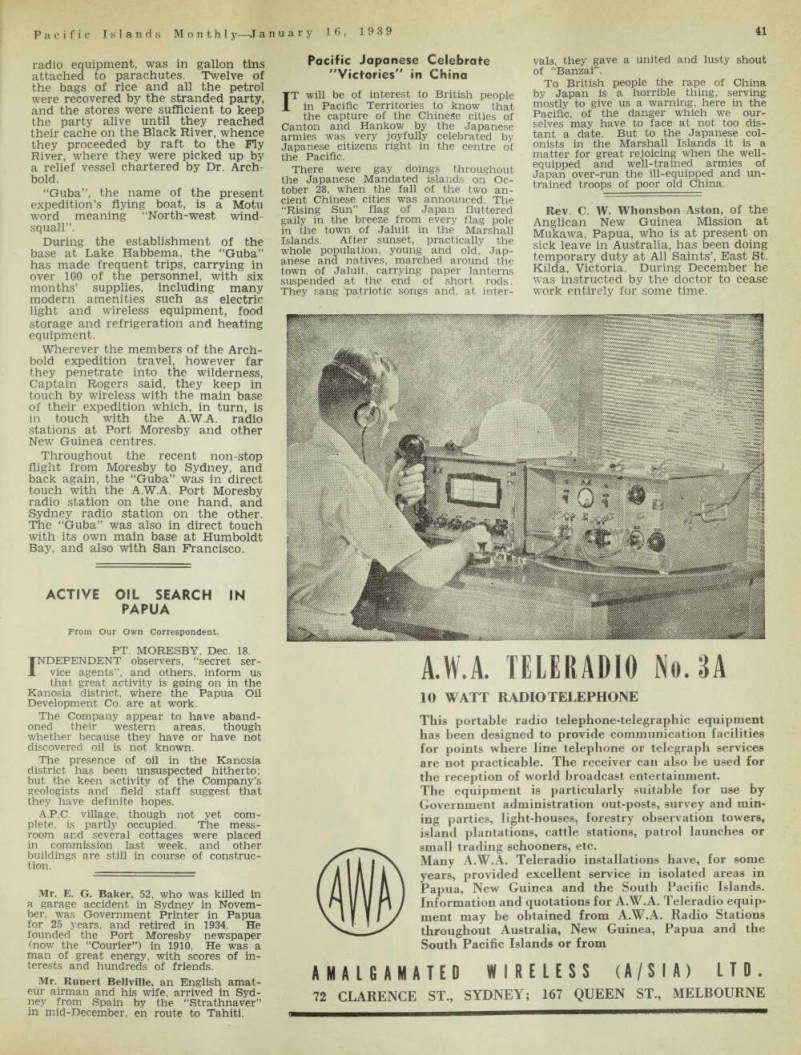
Papua
Prom Our Own Correspondent.
Pt. Moresby. Dec, 18.
INDEPENDENT observers, “secret ser vice agents”, and others, inform us that great activity is going on in the Kanosia district, where the Papua Oil Development Co. are at work.
The Company appear to have aband oned their western areas. though whether because they have or have not discovered oil is not known.
The presence of oil in the Kanosia district has been unsuspected hitherto: but the keen activity of the Company’s geologists and field staff suggest that they have definite hopes.
A.P.C. village, though not yet com plete, is partly occupied. The mess room and several cottages were placed in commission last week, and other buildings are still in course of construc tion.
Mr. E. G. Baker, 52, who was killed in a garage accident in Sydney in Novem ber, was Government Printer in Papua for 25 years, and retired in 1934. He founded the Port Moresby newspaper (now the “Courier”) in 1910. He was a man of great energy, with scores of in terests and hundreds of friends.
Mr. Runert Bellville. an English amat eur airman and his wife, arrived in Syd ney from Spain by the “Strathnaver” in mid-December, en route to Tahiti.
Pacific Japanese Celebrate
"Victories" in China
IT will be of interest to British people in Pacific Territories to know that the capture of the Chinese cities of Canton and Hankow by the Japanese armies was very joyfully celebrated by Japanese citizens right in the centre of the Pacific.
There were gay doings throughout the Japanese Mandated islands on Oc tober 28. when the fall of the two an cient Chinese cities was announced. The “Rising Sun” flag of Japan fluttered gaily in the breeze from every flag pole in the town of Jaluit in the Marshall Islands. After sunset, practically the whole ponulation. young and old. Jap anese and natives, marched around the town of Jaluit. carrying paper lanterns suspended at the end of short rods.
They sang patriotic songs and. at inter
vals, they gave a united and lusty shout of “Banzai”.
To British people the rape of China by Japan is a horrible thing, serving mostly to give us a warning, here in the Pacific, of the danger which we our selves may have to face at not too dis tant a date. But to the Japanese col onists in the Marshall Islands it is a matter for great rejoicing when the well equipped and well-trained armies of Japan over-run the ill-equipped and un trained troops of poor old China.
Rev. C. W. Whonsbon Aston, of the Anglican New Guinea Mission at Mukawa, Papua, who is at present on sick leave in Australia, has been doing temporary duty at All Saints’, East St.
Kilda, Victoria. During December he was instructed by the doctor to cease work entirely for some time.
Advertisements & other items, p. 43 (2 items)
41
Pacific Islands Monthl y—J anuary 16, 1939
A.W.A. Teleradio No.Aa
10 WATT RADIOTELEPHONE
This portable radio telephone-telegraphic equipment has been designed to provide communication facilities for points where line telephone or telegraph services are not practicable. The receiver can also be used for the reception of world broadcast entertainment.
The equipment is particularly suitable for use by Government administration out-posts, survey and mining parties, light-houses, forestry observation towers, island plantations, cattle stations, patrol launches or small trading schooners, etc.
Many A.W.A. Teleradio installations have, for some years, provided excellent service in isolated areas in Papua, New Guinea and the South Pacific Islands.
Information and quotations for A.W.A. Teleradio equipment may be obtained from A.W.A. Radio Stations throughout Australia, New Guinea, Papua and the South Pacific Islands or from
AMALGAMATED WIRELESS (A/SIA) LTD.
72 CLARENCE ST., SYDNEY; 167 QUEEN ST., MELBOURNE
Social Inequalities And
The Papuan Natives
From Our Own Correspondent.
Pt. Moresby, Dec. 20.
ABOOK of unusual interest to soci ologists, students of native custom, and the ordinary reader, is “The Origin of the Inequality of the Social Classes”, by Gunnar Landtman. (Kegan Paul, 1938. 21/-).
Dr. Dandtman, who made a close study ?^^ h i e o^ iwai^apU^S d + U T g th l y Sl rs ls nothing if not thorough. The Q 2 n s nn Pag6S f ° f text a + e supp °J‘. t nea J*ly references to published works, wb l * 6 authorities quoted number more man yuu.
The book is dedicated “in gratitude and admiration” to Sir Hubert Murray; and, in spite of its formidable propor tions, is written in a lucid and easy style, entirely free from the affected and irritating language of the anthropolo gists.
It is packed with interesting detail concerning the beginning and cause of social distinctions among primitive peoples; and, once opened, is not easy to put aside, until the last page has been read.
The section on “Priesthood”, under which the author includes sorcerers and sorcery of all kinds, throws much light on the perplexing problem of native superstitions, and makes it clear that the practice of black and white magic has been inseparable from the early stages of social and economic develop ment in every country of the world, and is one of the commonest causes of early social differentiation.
Mr. Joseph McWhinney has been ap pointed Registrar of the Court of Nor folk Island succeeding Mr. L. V. Bros sey, formerly an officer of the Papuan Public Service.
Chinese Stores
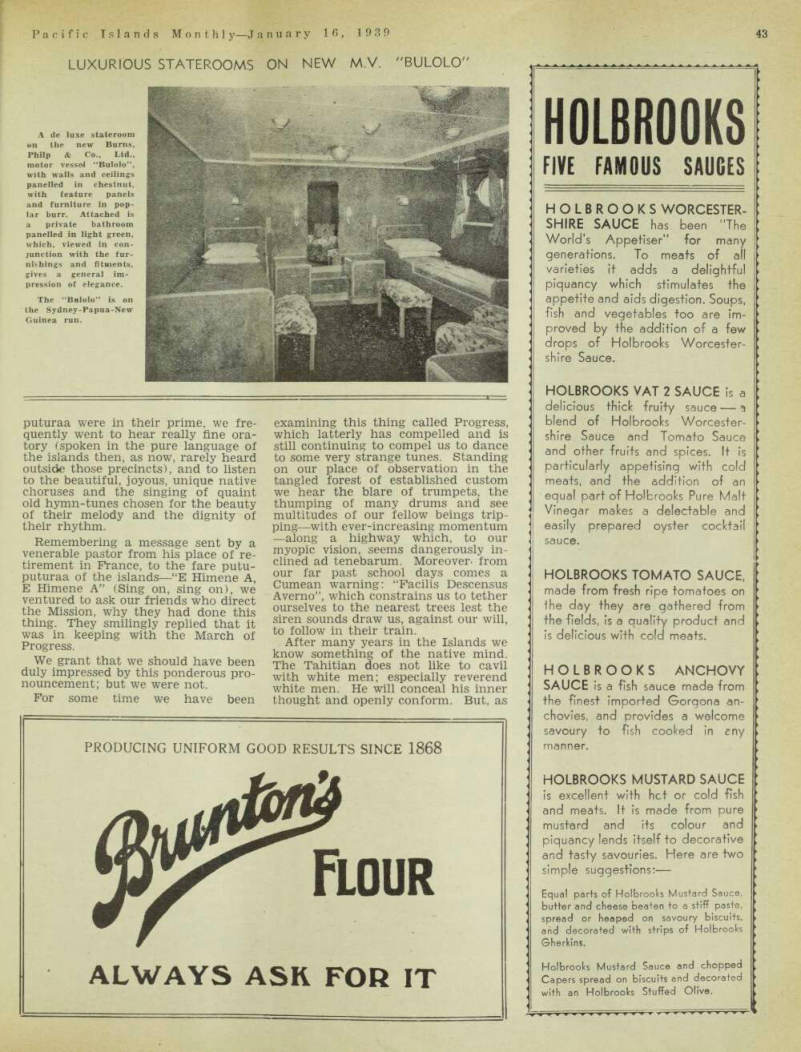
As Social Centres Reflection Upon Pacific Missionaries
AS one travels about the Islands of French Oceania (and Polynesia generally) he finds everywhere—at cross-roads and here and there beside the highway—the little shops of Chinese merchants.
They are- all of them- much alike— square, whitewashed wooden build ings with a narrow verandah across one side. Within, some shelves of tinned foodstuffs, bolts of bright coloured dresswares, cigarettes, pac kets of matches and, in a little show case (crowded at one end of the counter against the high, fenced top desk, where the owner keeps the books and abacus of his accountings), soap, perfumes of Paris, mouth organs and odds and ends of mercery, compose the stock-in-trade.
Nearby, on a stand, a big copper samovar (in which coffee is continu ally brewing) and some benches and tables scattered about, complete the furnishings.
The Chinese proprietor does not, however, exhaust his energies in store keeping. In an outbuilding is a brick oven where, nightly, he bakes the loaves of bread he delivers at dawn about the district, from his ancient two-wheeled cart, drawn by a decrepit horse; announcing his coming with blasts from a conch-shell trumpet. In addition, he buys and cures vanilla beans, and most—if not all—of the copra of the district passes through his hands.
His shop is frequented at all hours.
The women gather daily, to buy bread and coffee for the household, chaffer with the merchant over lengths of cotton print and, most of all, to ex change the gossip of the district; the men, to sit about tables before steam ing bowls of coffee and to talk of Ash ing, wild-pig hunting in the hills, the price of copra, the affairs of the island world, and the district gossip.
Outside the young people drape themselves along the edge of the verandah and sing and chatter and laugh to the accompaniment of gui tars, accordions and mouth organs.
The shop of the Chinaman has be come, not only the economic, but also the social centre of the community.
This latter distinction, not so very long ago, was held by the fare putu puturaa (the meeting houses attached to the Protestant church of the dis trict), until the edict went forth that the singing of Bible verse to native music—a custom since the memory of man knoweth not the contrary—would no longer be tolerated in the churches.
We were most sorry to hear of this edict, for we knew it would eventuate in the breaking up and Anal disap pearance of those meeting places.
Years ago, when the fare putu
puturaa were in their prime, we fre quently went to hear really fine ora tory (spoken in the pure language of the islands then, as now, rarely heard outside those precincts), and to listen to the beautiful, joyous, unique native choruses and the singing of quaint old hymn-tunes chosen for the beauty of their melody and the dignity of their rhythm.
Remembering a message sent by a venerable pastor from his place of re tirement in France, to the fare putu puturaa of the islands—“E Himene A, E Himene A” (Sing on, sing on), we ventured to ask our friends who direct the Mission, why they had done this thing. They smilingly replied that It was in keeping with the March of Progress.
We grant that we should have been duly impressed by this ponderous pro nouncement; but we were not.
For some time we have been
examining this thing called Progress, which latterly has compelled and is still continuing to compel us to dance to some very strange tunes. Standing on our place of observation in the tangled forest of established custom we hear the blare of trumpets, the thumping of many drums and see multitudes of our fellow beings trip ping—with ever-increasing momentum —along a highway which, to our myopic vision, seems dangerously in clined ad tenebarum. Moreover, from our far past school days comes a Cumean warning: “Facilis Descensus Averno”, which constrains us to tether ourselves to the nearest trees lest the siren sounds draw us, against our will, to follow in their train.
After many years in the Islands we know something of the native mind.
The Tahitian does not like to cavil with white men; especially reverend white men. He will conceal his inner thought and openly conform. But, as
time passes, he will progressively be come flu (fed up), and one day the place of his abiding will know him no more.
The “Duff” missionaries started off with some pretty dismal hymnology; but they learned better, later on. They awoke in time to appreciate that the native Tahitian—whose every act and thought is intertwined with song and laughter—could not be led “O’er the gloomy hills of darkness” to murky valleys of harmonic despair.
We have been moved to cite eccles iastical history; of how the Early Fathers took ancestral ceremonies, festivals and usages; exorcised their excesses; expurgated the pagan al lusions of their symbolism; adapted, moulded and sanctified them to con
form to the New Faith; and on such foundations erected the stately edifice which has endured the storms, the lightnings, the earthquakes of two milleniums.
But, alas, in our efforts through the years to preserve this priceless jewel of unique music, we have been a lone voice crying in a wilderness where there is not even locusts and wild honey to give us comfort.
Meanwhile the Chinese merchant has been waxing fat; and in due time will inherit the earth.—A.C.R.
Mr. and Mrs. L. I. Howell, of the Seventh Day Adventist Mission at Vaila la, Papua, reached Australia from Port Moresby by the “Bulolo” at the end of December.
Advertisements & other items, p. 44 (2 items)
42
January 16, 102 O—P acific Islands Monthly
Clmjotts
25 YEARS OF SERVICE
William E. Reed
(Established 1913)
BROKER & AGENT
Union House, 247 George St., Sydney For all Plantation and Trading Requirements. Enquiries welcome.
OFTEN BUTTERED
NEVER BETTERED
CRISP, LIGHT BISCUITS which
bring out the flavour of cheese and add a new attractiveness to fresh or stewed fruit.
A delicious supplement to ham or paste or other tasty savoury, and still an epicurean delight, served simply with fresh butter.
The rich excellence of these famous Biscuits is the result of 67 years of specialisation.
They are packed in air-tight tins or packets for picnic convenience.
Clmjotts
FAMOUS
SAO BISCUITS
A 26 ALWAYS ASK YOUR GROCER FOR ARNOTT'S !
Luxurious Staterooms On New M.V. "Bulolo"
A de luxe stateroom on the new Bums, Philp & Co., Ltd motor vessel “Bulolo”, with walls and ceilings panelled in chestnut, with feature panels and furniture in pop lar burr. Attached is a private bathroom panelled in light green, which, viewed in con junction with the fur nishings and fitments, gives a general Im pression of elegance.
The “Bulolo” is on the Sydney-Papua-New Guinea run.
Advertisements & other items, pp. 45-46 (2 items)
43
Pacific Islands Month] y—J anuary 10, 1939
Holbrooks
FIVE FAMOUS SAUCES
HOLBROOKS WORCESTER-
SHIRE SAUCE has been "The World's Appetiser" for many generations. To meats of all varieties it adds a delightful piquancy which stimulates the appetite and aids digestion. Soups, fish and vegetables too are Improved by the addition of a few drops of Holbrooks Worcestershire Sauce.
HOLBROOKS VAT 2 SAUCE is a
delicious thick fruity sauce a blend of Holbrooks Worcestershire Sauce and Tomato Sauce and other fruits and spices. It is particularly appetising with cold meats, and the addition of an equal part of Holbrooks Pure Malt Vinegar makes a delectable and easily prepared oyster cocktail sauce.
HOLBROOKS TOMATO SAUCE,
made from fresfi ripe tomatoes on ■fhe day they are gathered from the fields, Is a quality product and is delicious with cold meats.
HOLBROOKS ANCHOVY
SAUCE is a fish sauce made from the finest imported Gorgona anchovies, and provides a welcome savoury to fish cooked In any manner.
HOLBROOKS MUSTARD SAUCE
is excellent with hct or cold fish and meats. It Is made from pure mustard and its colour and piquancy lends Itself to decorative and tasty savouries. Here are two
simple suggestions:—
Equal parts of Holbrooks Mustard Sauce, butter and cheese beaten to a stiff paste, spread or heaped on savoury biscuits, and decorated with strips of Holbrooks Gherkins.
Holbrooks Mustard Sauce and chopped Capers spread on biscuits and decorated with an Holbrooks Stuffed Olive,
PRODUCING UNIFORM GOOD RESULTS SINCE 1868
ALWAYS ASK FOR IT
AUSTRALIAN
BULLDOG BATTERIES
A BATTERY H
FOR
EVERY
PURPOSE
0 These Batteries DO NOT LOSE CHARGE WHEN NOT IN USE . . . • Plates DO NOT BUCKLE and Term-
inals DO NOT CORRODE
Radio type are UNCONDITIONAL-
LY GUARANTEED FOR THREE
YEARS.
You will SAVE MONEY by Using BULLDOG BATTERIES Write to ... .
Continental Compensations Pty. Ltd.,
422 COLLINS ST., MELBOURNE, VIC.
We also Supply—
DIESEL ENGINES OF ALL TYPES.
BURNS PHILP
(SOUTH SEA) CO. LTD.
Inc. in Fiji
Island Traders and Shipowners
Also Branches at:
Registered Office:
SUVA
FIJI
Code Address: "Burnsouth.’' Fiji: Levuka, Lautoka, Labasa, Ba, Sigatoka, Tonga: Nukualofa, Haapai, Vavau.
Samoa: Apia, Pago Pago (American Samoa).
Solomons: Makambo, Gizo, Faisi.
New Hebrides: Vila.
Gilberts: Tarawa.
Norfolk Is. Niue. Wallis Is. Futuna Is.
Rotuma.
He Made A Bolt
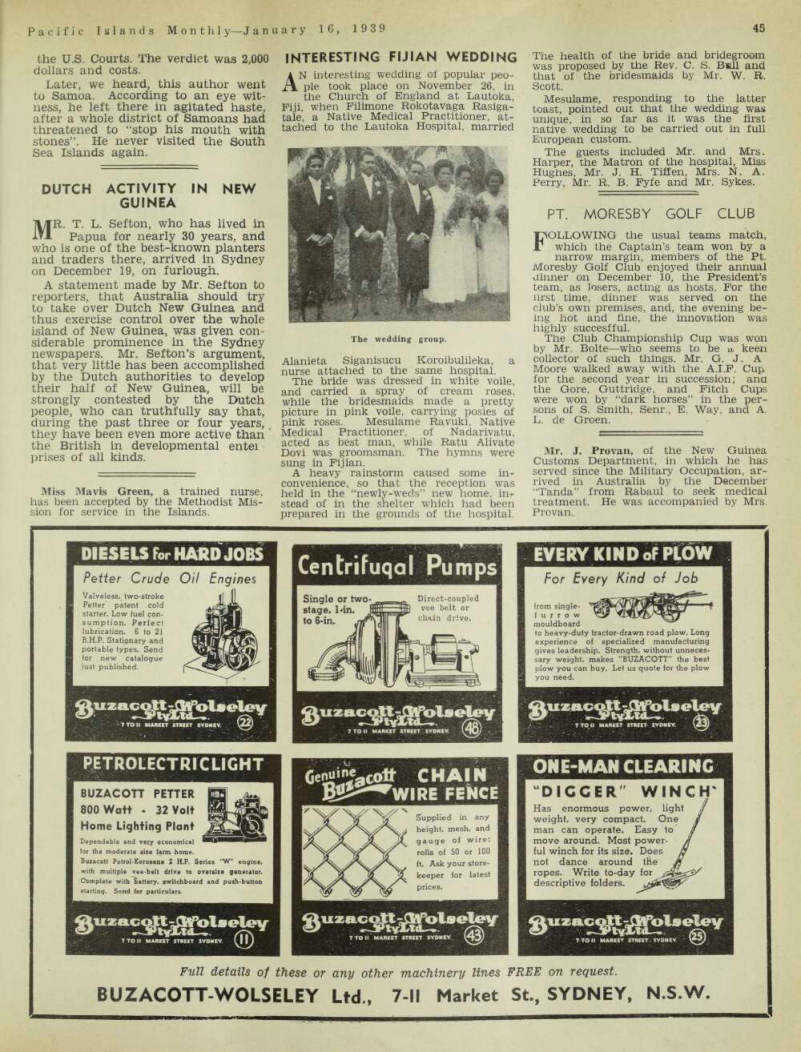
For It!
Memories of Jock London and Other Polynesian Authors
Prom Our Own Correspondent
Papeete, Dec. 8.
THE recent publication in the United States of a biography of Jack London recalls to old residents of Tahiti his voyage to the islands on board the “Snark” in 1907, These memories are not very pleasant. The personality revealed in the biography accords with the ap praisal made by residents during Mr.
London’s sojourn at Papeete and Moorea.
He, and another American writer who came six years later, established the precedent of satisfying their anger over real or fancied grievances, by directing, from the safe haven of a distant country, libellous attacks against residents of the islands. Mr.
London’s publishers were forced to make a very abject apology to avoid an action against them for libel. The litigant, after receiving this apology, was satisfied with holding the attack in the same measure of contempt that he felt for its authors; and so the matter passed.
The second writer was not so for tunate. He had been imprudent enough to return to Papeete after the publication of his book.
Soon after his landing, some wag informed him that the man he had libelled had engaged a company of burly longshoremen to waylay and give him a thorough beating up.
The author was terrified. He fled for refuge to the house of a fellow countryman, whence he sent frantic appeals to the U.S. Consul for protec tion.
The Consul—who privately wished the threats were real, and could be carried out with thoroughness and despatch—assured the author he would be safe so long as he did not venture out-of-doors. The author obeyed, to the letter, the injunction of the Consul; neither the sun by day nor the moon by night beheld him until the sailing of the next steamer for San Francisco.
The day of departure was filled with alarms. The wag sent word that spies, having seen his luggage carried aboard, the burly longshoremen had assembled to seize the author on his way to the wharf.
The author’s host had his Ford car ready, its top raised and storm cur tains fastened down. At the second whistle, he bundled in his quaking guest, made a record run to the wharf, and deposited him at the foot of the gang-plank; up which he fled like an antelope pursued by lions.
He escaped the mythical may hem; but he was overtaken in his own country by an action for libel—in stituted at Papeete and transferred to
the U.S. Courts. The verdict was 2,000 dollars and costs.
Later, we heard, this author went to Samoa. According to an eye wit ness, he left there in agitated haste, after a whole district of Samoans had threatened to “stop his mouth with stones”. He never visited the South Sea Islands again.
Dutch Activity In New
Guinea
MR. T. L. Sefton, who has lived in Papua for nearly 30 years, and who is one of the best-known planters and traders there, arrived in Sydney on December 19, on furlough.
A statement made by Mr. Sefton to reporters, that Australia should try to take over Dutch New Guinea and thus exercise control over the whole island of New Guinea, was given con siderable prominence in the Sydney newspapers. Mr. Sefton’s argument, that very little has been accomplished by the Dutch authorities to develop their half of New Guinea, will be strongly contested by the Dutch people, who can truthfully say that, during the past three or four years, they have been even more active than the British in developmental entei prises of all kinds.
Miss Mavis Green, a trained nurse, has been accepted by the Methodist Mis sion for service in the Islands.
Interesting Fijian Wedding
AN interesting wedding of popular peo ple took place on November 26, in the Church of England at Lautoka, Fiji, when Filimone Rokotavaga Rasiga tale, a Native Medical Practitioner, at tached to the Lautoka Hospital, married
Alanieta Siganisucu Koroibulileka, a nurse attached to the same hospital.
The bride was dressed in white voile, and carried a spray of cream roses, while the bridesmaids made a pretty picture in pink voile, carrying posies of pink roses. Mesulame Ravuki, Native Medical Practitioner, of Nadarivatu, acted as best man, while Ratu Alivate Dovi was groomsman. The hymns were sung in Fijian.
A heavy rainstorm caused some in convenience, so that the reception was held in the “newly-weds” new home, inr stead of in the shelter which had been prepared in the grounds of the hospital.
The health of the bride and bridegroom was proposed by the Rev. C. S. Bwll and that of the bridesmaids by Mr. W. R.
Scott.
Mesulame, responding to the latter toast, pointed out that the wedding was unique, in so far as it was the first native wedding to be carried out in full European custom.
The guests included Mr. and Mrs.
Harper, the Matron of the hospital, Miss Hughes, Mr. J. H. Tiffen, Mrs. N. A.
Perry, Mr. R. B. Fyfe and Mr. Sykes.
The wedding group.
Pt. Moresby Golf Club
FOLLOWING the usual teams match, which the Captain’s team won by a narrow margin, members of the Pt.
Moresby Golf Club enjoyed their annual dinner on December 10, the President’s team, as losers, acting as hosts. For the ilrst time, dinner was served on the club’s own premises, and, the evening be ing hot and fine, the innovation was highly succesfful.
The Club Championship Cup was won by Mr. Bolte —who seems to be » keen collector of such things. Mr. G. J. A Moore walked away with the A.I.P. Cup for the second year in succession; ana the Gore, Guttridge, and Fitch Cups were won by “dark horses” in the per sons of S. Smith, Senr., E. Way, and A.
L. de Groen.
Mr. J. Provan, of the New Guinea Customs Department, in which he has served since the Military Occupation, ar rived in Australia by the December “Tanda” from Rabaul to seek medical treatment. He was accompanied by Mrs.
Provan.
Advertisements & other items, pp. 47-48 (3 items)
45
Pacific Islands Monthl y—J anuary 16, 1939
"teniniuqal rumps"
DIESELS For HARD JOBS B r «. . f , n WI EVERY KIND oF PLOW
Fetter Crude Oil Engines
Valveless, Iwo-stroke Fetter patent cold starter. Low fuel consumption. Perfect lubrication. 6 to 21 B.H.P. Stationary and portable types. Send for new catalogue just published.
B Single or two stage, 1-in. to 6-in.
Direct-coupled vee belt or chain drive.
For Every Kind of Job
from singlefurrow mouldboard to heavy-duty tractor-drawn road plow. Long experience of specialized manufacturing gives leadership. Strength, without unnecessary weight, makes "BUZACOTT" the best plow you can buy. Let us quote for the plow you need.
BUl,,cJ®u^8 UI,,c J® u^
7TO II MARKET STREET SYDNEY. VTU/
7TO II MARKET STREET SYDNEY.
PETROLECTRICLIGHT otn u,n; aC2 tt CHAIN ■ ORE-MAHCLEARING E
BUZACOTT PETTER
800 Watt - 32 Volt Home Lighting Plant Dependable and very economical lor the moderate size farm home.
Buzacolt Petrol-Kerosene 2 H.P. Series "W" engine, with multiple vee-belt drive to oversize generator.
Complete with battery, switchboard and push-button starting. Send for particulars.
Supplied in any height, mesh, and gauge of wire; rolls of 50 or 100 ft Ask your storekeeper lor latest prices.
“DIGGER" WINCH
Has enormous power, light weight, very compact. One man can operate. Easy to move around. Most power ful winch for its size. Does not dance around ropes. Write to-day for descriptive folders. 7TO II MARKET STREET SYDNEY H 7TO 11 MAIUiT STREfT ,VDMeV ■ 7TO II MARKET STREET SYDNEY (^5)
7TO II MARKET STREET SYDNEY.
7TO II MARKET STREET SYDNEY
Full details of these or any other machinery lines FREE on request.
BUZACOTT-WOLSELEY Ltd., 7-11 Market St., SYDNEY, N.S.W
WM. BRECKWOLDT & CO.,
SOUTH SEA MERCHANTS
TELEGRAPHIC ADDRESS:
NEW GUINEA;—P.O. Box 89, Roboul. SAMOA:—P.O. Box 124, Apia FIJI: —P.O. Box 111, Suva.
POSTAL ADDRESSES:—
TAHITI: —P.O. Box 60, Papeete.
AGENTS FOR...
ATEBRIN— THE PROTECTION AGAINST MALARIA.
f A \ ASPIRIN BAYER— THE GENUINE ASPIRIN— AND
BAYER] MEDIC!NES ALL OTHER BAYER products.
/ STOCK ALWAYS AVAILABLE AT OUR BRANCHES.
All Orders Executed at Original "Bayer" Prices. 28 miles on one gallon only of Shell Dervoil Medium, costing 11 id. in Rabaul.
Prices for all types, up to loading capacity of 12,000 lbs., and for special types, on application.
'CONTINENTAL" Tyres and Tubes for Motor Cars and Bicycles.
"DEUTZ" and "MERCEDES-BENZ" Diesel Marine Engines.
"PETROMAX" Hurricane Lanterns (Incandesc.) and Lamps. (Not Agents for Tahiti).
"TIGER BRAND" Corrugated and Flat Galvanised Ironsheets.
"TAIFUN" Bicycles and Accessories.
"TWO LIONS" Best Known Quality of A.l. Butcher Knives.
"BREWO" Razor Blades, Black, Brown, Blue, Pink, Silver.
"TORPEDO", "BIJOU" and "ERICA" Typewriters, Portable and Office.
"BECK' S" "Key Brand" German Lager.
"TELEFUNKEN" Wireless Sets, Battery and Current. Best results obtained.
Many Sold. Ever-increasing Turnover.
ALSO ALL TRADE LINES OF GERMAN, BRITISH, CONTINENTAL, JAPANESE AND CHINESE ORIGIN
LIEBERMANN, WAELCHLI & CO.,
Kobe, Yokohama, Tokio and Shanghai.
JOHN CAMPBELL & CO., SYDNEY. (All Australian Goods.)
MERCEDES-BENZ DIESEL TRUCKS:
2 Tonner Type, L. 1,500 -45 H.P. just arrived in Rabaul for demonstration. Fuel consumption— HANOMAG" Diesel Tractors.
ANCRE" Cast Iron Sauce Pots.
FROWO" Hurricane Lanterns.
ARARA" Gas Stoves.
“VESTA" Sewing Machines.
"LOHSE" Uralt Lavender.
"BREWO" Swedish Axes and Hatchets.
"ARVIKA" Swedish Axes and Hatchets.
PLEASE NOTE:
Our Trademark. [ We sell WHOLESALE ONLY but, upon application, we will supply the names of firms at all places in the Pacific Islands retailing our goods. ■]
46
January 16, 193 9—P acific Islands Monthly
New Samoan
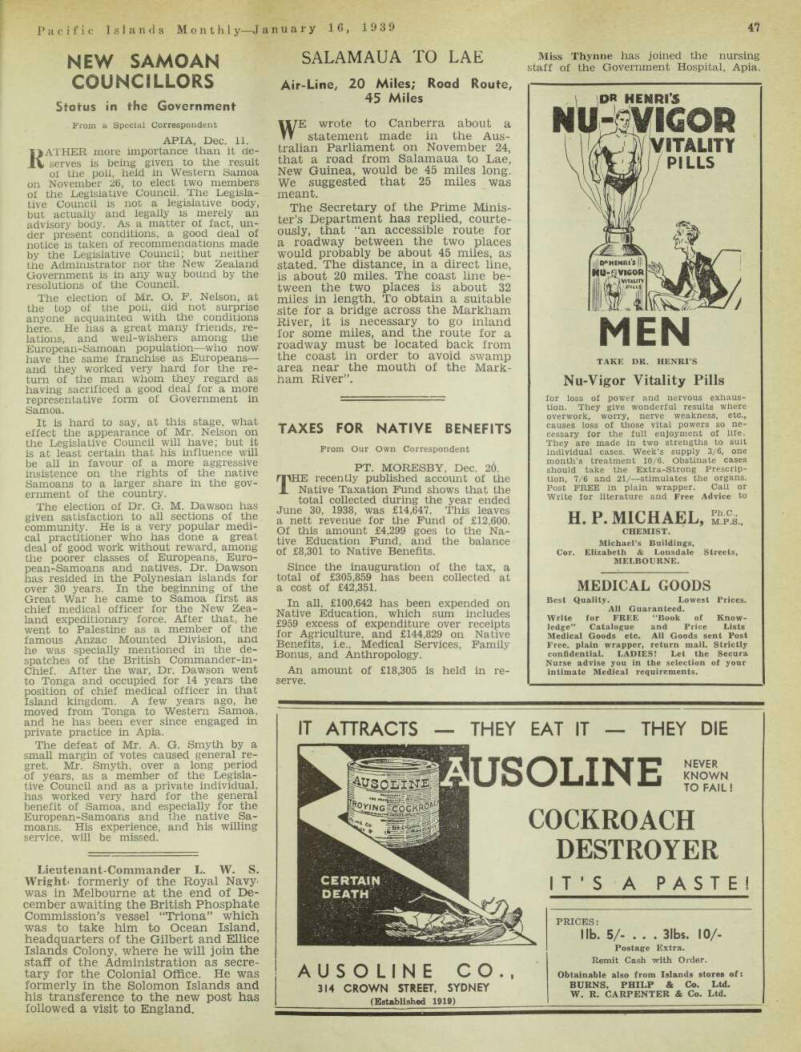
Councillors
Status in the Government
From a Special Correspondent
Apia, Dec. 11.
RATHER more importance than it de serves is being given to the result of the poll, held in Western Samoa on November 26, to elect two members of the Legislative Council. The Legisla tive Council is not a legislative body, but actually and legally is merely an advisory body. As a matter of fact, un der present conditions, a good deal of notice is taken of recommendations made by the Legislative Council; but neither the Administrator nor the New Zealand Government is in any way bound by the resolutions of the Council.
The election of Mr. O. F. Nelson, at the top of the poll, did not surprise anyone acquainted with the conditions here. He has a great many friends, re lations, and well-wishers among the European-Samoan population—who now have the same franchise as Europeans— and they worked very hard for the re turn of the man whom they regard as having sacrificed a good deal for a more representative form of Government in Samoa.
It is hard to say, at this stage, what effect the appearance of Mr. Nelson on the Legislative Council will have; but it is at least certain that his influence will be all in favour of a more aggressive insistence on the rights of the native Samoans to a larger share in the gov ernment of the country.
The election of Dr. G. M. Dawson has given satisfaction to all sections of the community. He is a very popular medi cal practitioner who has done a great deal of good work without reward, among the poorer classes of Europeans, Euro pean-Samoans and natives. Dr. Dawson has resided in the Polynesian islands for over 30 years. In the beginning of the Great War he came to Samoa first as chief medical officer for the New Zea land expeditionary force. After that, he went to Palestine as a member of the famous Anzac Mounted Division, and he was specially mentioned in the de spatches of the British Commander-in - Chief. After the war, Dr. Dawson went to Tonga and occupied for 14 years the position of chief medical officer in that Island kingdom. A few years ago, he moved from Tonga to Western Samoa, and he has been ever since engaged in private practice in Apia.
The defeat of Mr. A. G. Smyth by a small margin of votes caused general re gret. Mr. Smyth, over a long period of years, as a member of the Legisla tive Council and as a private individual, has worked very hard for the general benefit of Samoa, and especially for the European-Samoans and the native Sa moans. His experience, and his willing service, will be missed.
Lieutenant-Commander L. W. S.
Wright- formerly of the Royal Navy
was in Melbourne at the end of De cember awaiting the British Phosphate Commission’s vessel “Triona” which was to take him to Ocean Island, headquarters of the Gilbert and Ellice Islands Colony, where he will join the staff of the Administration as secre tary for the Colonial Office. He was formerly in the Solomon Islands and his transference to the new post has followed a visit to England.
Salamaua To Lae
Air-Line, 20 Miles; Road Route, 45 Miles
WE wrote to Canberra about a statement made in the Aus tralian Parliament on November 24, that a road from Salamaua to Lae, New Guinea, would be 45 miles long.
We suggested that 25 miles was meant.
The Secretary of the Prime Minis ter’s Department has replied, courte ously, that “an accessible route for a roadway between the two places would probably be about 45 miles, as stated. The distance, in a direct line, is about 20 miles. The coast line be tween the two places is about 32 miles in length. To obtain a suitable site for a bridge across the Markham River, it is necessary to go inland for some miles, and the route for a roadway must be located back from the coast in order to avoid swamp area near the mouth of the Mark ham River”.
Taxes For Native Benefits
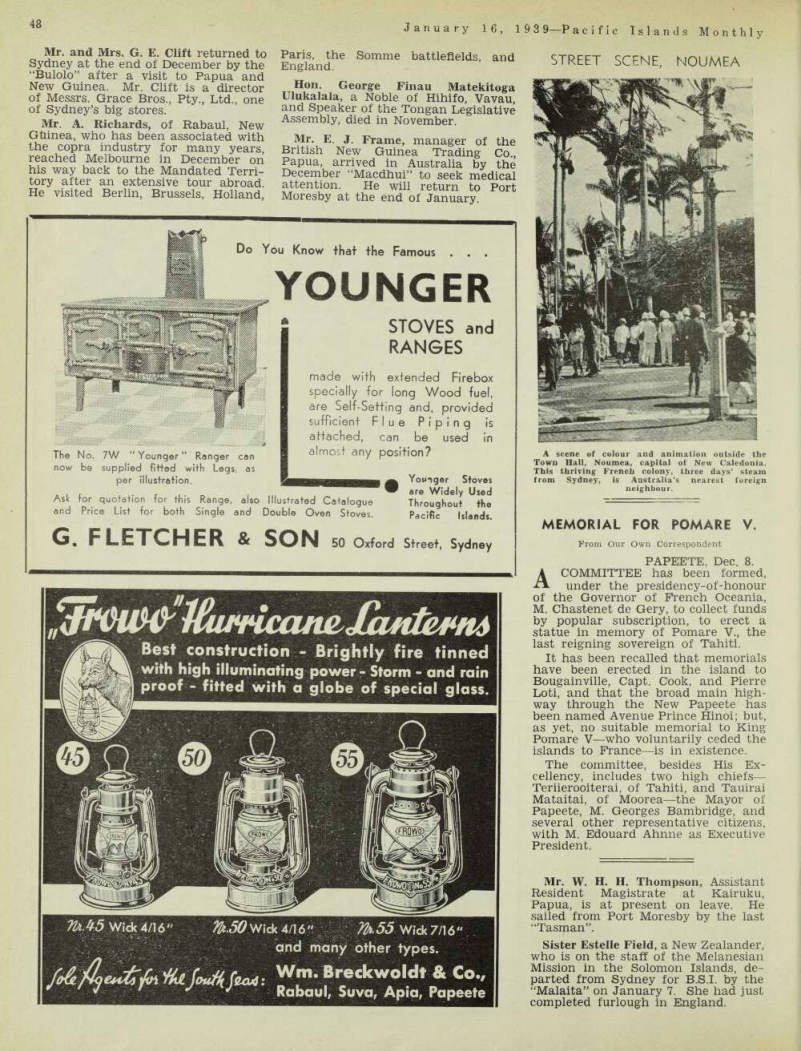
From Our Own Correspondent
Pt. Moresby, Dec. 20.
THE recently published account of the Native Taxation Fund shows that the total collected during the year ended June 30, 1938, was £14,647. This leaves a nett revenue for the Fund of £12,600.
Of this amount £4,299 goes to the Na tive Education Fund, and the balance of £8,301 to Native Benefits.
Since the inauguration of the tax, a total of £305,859 has been collected at a cost of £42,351.
In all, £100,642 has been expended on Native Education, which sum includes £959 excess of expenditure over receipts for Agriculture, and £144,829 on Native Benefits, i.e., Medical Services, Family Bonus, and Anthropology.
An amount of £18,305 is held in re serve.
Miss Thynne has joined the nursing staff of the Government Hospital, Apia.
Mr. and Mrs. G. E. Clift returned to Sydney at the end of December by the “Bulolo” after a visit to Papua and New Guinea. Mr. Clift is a director of Messrs. Grace Bros., Pty., Ltd., one of Sydney’s big stores.
Mr. A. Richards, of Rabaul, New Guinea, who has been associated with the copra industry for many years, reached Melbourne in December on his way back to the Mandated Terri tory after an extensive tour abroad.
He visited Berlin, Brussels, Holland,
Paris, the Somme battlefields, and England.
Hon. George Finau Matekitoga Ulukalala, a Noble of Hihifo, Vavau, and Speaker of the Tongan Legislative Assembly, died in November.
Mr. E. J. Frame, manager of the British New Guinea Trading Co., Papua, arrived in Australia by the December “Macdhui” to seek medical attention. He will return to Port Moresby at the end of January.
Advertisements & other items, pp. 49-50 (3 items)
47
Pacific Islands Monthl y—J anuary 16, 1939
Usoline
\ DR HENRI'S
NU-:VI€Oe
1 ILC;Iv VITALITY
ITALITY
PILLS
JO"MIMR|’S|||I
9U-“ VIGOR
I AJvitaiity
MEN
TAKE DR. HENRI’S
Nu-Vigor Vitality Pills
for loss of power and nervous exhaustion. They give wonderful results where overwork, worry, nerve weakness, etc., causes loss of those vital powers so necessary for the full enjoyment of life.
They are made in two strengths to suit individual cases. Week’s supply 3/6, one month’s treatment 10/6. Obstinate cases should take the Extra-Strong Prescription, 7/6 and 21/ —stimulates the organs.
Post FREE in plain wrapper. Cali or Write for literature and Free Advice to
H. P. MICHAEL, S!p c s,
CHEMIST.
Michael’s Buildings, Cor. Elizabeth & Lonsdale Streets,
MELBOURNE.
MEDICAL GOODS
Best Quality. Lowest Prices.
All Guaranteed.
Write for FREE “Book of Knowledge" Catalogue and Price Lists Medical Goods etc. All Goods sent Post Free, plain wrapper, return mail. Strictly confidential. LADIES! Let the Secura Nurse advise you in the selection of your intimate Medical requirements.
IT ATTRACTS
is LI
feyiNG
CERTAIN
DEATH
THEY EAT IT THEY DIE
USOLINE
NEVER
KNOWN
TO FAIL!
COCKROACH
DESTROYER
IT'S A PASTE
AUSOLINE CO..
314 CROWN STREET, SYDNEY
(Established 1919)
PRICES:
Mb. 5/- . . . 3lbs. 10/- Postage Extra.
Remit Cash with Order.
Obtainable also from Islands stores of:
BURNS, PHILP & Co. Ltd.
W. R. CARPENTER & Co. Ltd.
•• * Do You Know that the Famous . . .
YOUNGER
STOVES and
RANGES
made with extended Firebox specially for long Wood fuel, are Self-Setting and. provided sufficient Flue Piping is attached, can be used in The No. 7W M Younger’ 1 Ranger can almost any position? now be supplied fitted with Legs, as per illustration. Younger Stoves aii t i • r. ... are Widely Used Ask tor quotation for this Range, also Illustrated Catalogue Throughout the and Price List for both Single and Double Oven Stoves. Pacific Islands.
G. FLETCHER & SON
50 Oxford Street, Sydney
Best construction - Brightly fire tinned with high illuminating power - Storm - and rain proof - fitted with a globe of special glass. © ?h. 45 Wick 4/16 " 71/1.50 Wick 4/16 " 71/i. 55 Wick 7/16 " and many other types.
Wm. Breckwoldt & Co., Rabaul, Suva, Apia, Papeete
Udijoufy food:
Street Scene, Noumea
A scene of colour and animation outside the Town Hall, Noumea, capital of New Caledonia.
This thriving French colony, three days’ steam from Sydney, is Australia’s nearest foreign neighbour.
Memorial For Pomare V.
From Our Own Correspondent
Papeete, Dec. 8.
A COMMITTEE has been formed, under the presidency-of-honour of the Governor of French Oceania, M. Chastenet de Gery, to collect funds by popular subscription, to erect a statue in memory of Pomare V., the last reigning sovereign of Tahiti.
It has been recalled that memorials have been erected in the island to Bougainville, Capt. Cook, and Pierre Loti, and that the broad main high way through the New Papeete has been named Avenue Prince Hinoi; but, as yet, no suitable memorial to King Pomare V —who voluntarily ceded the islands to France —is in existence.
The committee, besides His Ex cellency, includes two high chiefs— Teriierooiterai, of Tahiti, and Tauirai Mataitai, of Moorea—the Mayor of Papeete, M. Georges Bambridge, and several other representative citizens, with M. Edouard Ahnne as Executive President.
Mr. W. H. H. Thompson, Assistant Resident Magistrate at Kairuku, Papua, is at present on leave. He sailed from Port Moresby by the last “Tasman”.
Sister Estelle Field, a New Zealander, who is on the staff of the Melanesian Mission in the Solomon Islands, de parted from Sydney for 8.5.1. by the “Malaita” on January 7. She had just completed furlough in England.
Wrecked By Old
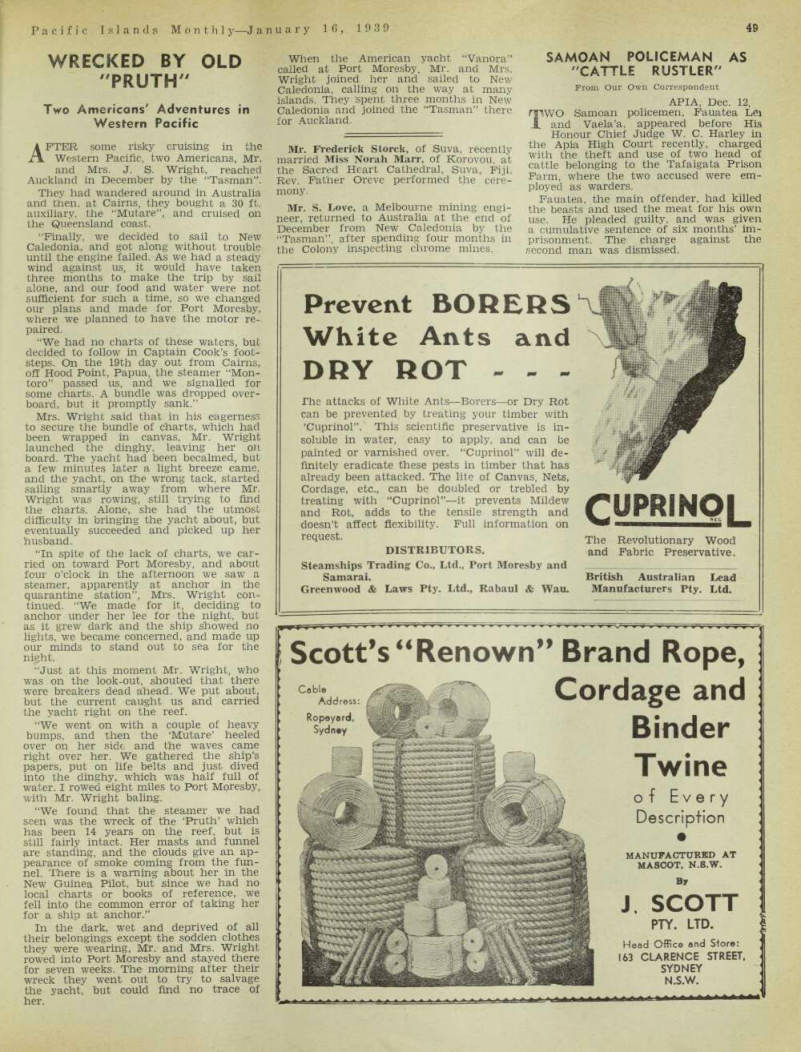
"Pruth"
Two Americans' Adventures in Western Pacific
AFTER some risky cruising in the Western Pacific, two Americans, Mr. and Mrs. J. S. Wright, reached Auckland in December by the “Tasman”.
They had wandered around in Australia and then, at Cairns, they bought a 30 ft. auxiliary, the “Mutare”, and cruised on the Queensland coast, “Finally, we decided to sail to New Caledonia, and got along without trouble until the engine failed. As we had a steady wind against us. it would have taken three months to make the trip by sail alone, and our food and water were not sufficient for such a time, so we changed our plans and made for Port Moresby, where we planned to have the motor re paired.
“We had no charts of these waters, but decided to follow in Captain Cook’s foot steps. On the 19th day out from Cairns, off Hood Point, Papua, the steamer “Mon toro” passed us, and we signalled for some charts. A bundle was dropped over board, but it promptly sank.”
Mrs. Wright said that in his eagerness to secure the bundle of charts, which had been wrapped in canvas, Mr. Wright launched the dinghy, leaving her on board. The yacht had been becalmed, but a few minutes later a light breeze came, and the yacht, on the wrong tack, started sailing smartly away from where Mr.
Wright was rowing, still trying to find the charts. Alone, she had the utmost difficulty in bringing the yacht about, but eventually succeeded and picked up her husband.
“In spite of the lack of charts, we car ried on toward Port Moresby, and about four o’clock in the afternoon we saw a steamer, apparently at anchor in the quarantine station”, Mrs. Wright con tinued. “We made for it, deciding to anchor under her lee for the night, but as it grew dark and the ship showed no lights, we became concerned, and made up our minds to stand out to sea for the
nifht.
“Just at this moment Mr. Wright, who was on the look-out, shouted that there were breakers dead ahead. We put about, but the current caught us and carried the yacht right on the reef.
“We went on with a couple of heavy bumps, and then the ‘Mutare’ heeled over on her side and the waves came right over her. We gathered the ship’s papers, put on life belts and just dived into the dinghy, which was half full of water. I rowed eight miles to Port Moresby, with Mr. Wright baling.
“We found that the steamer we had seen was the wreck of the ‘Pruth’ which has been 14 years on the reef, but is still fairly intact. Her masts and funnel are standing, and the clouds give an ap pearance of smoke coming from the fun nel. There is a warning about her in the New Guinea Pilot, but since we had no local charts or books of reference, we fell into the common error of taking her for a ship at anchor.”
In the dark, wet and deprived of all their belongings except the sodden clothes they were wearing, Mr. and Mrs. Wright rowed into Port Moresby and stayed there for seven weeks. The morning after their wreck they went out to try to salvage the yacht, but could find no trace of her.
When the American yacht “Vanora” called at Port Moresby, Mr. and Mrs.
Wright joined her and sailed to New Caledonia, calling on the way at many islands. They spent three months in New Caledonia and joined the “Tasman” there for Auckland.
Mr. Frederick Storck, of Suva, recently married Miss Norah Marr, of Korovou, at the Sacred Heart Cathedral, Suva, Fiji.
Rev. Father Oreve performed the cere mony.
Mr. S. Love, a Melbourne mining engi neer, returned to Australia at the end of December from New Caledonia by the “Tasman”, after spending four months in the Colony inspecting chrome mines.
Samoan Policeman As
"Cattle Rustler"
From Our Own Correspondent
Apia, Dec. 12.
TWO Samoan policemen, Fauatea Lei and Vaela’a, appeared before His Honour Chief Judge W. C. Harley in the Apia High Court recently, charged with the theft and use of two head of cattle belonging to the Tafaigata Prison Farm, where the two accused were em ployed as warders.
Fauatea, the main offender, had killed the beasts and used the meat for his own use. He pleaded guilty, and was given a cumulative sentence of six months’ im prisonment. The charge against the second man was dismissed.
Advertisements & other items, p. 51 (2 items)
49
Pacific Islands Monthl y —J anuary 16, 1939
Cuprinol
Prevent BORERS
White Ants and
DRY ROT - - -
The attacks of White Ants—Borers—or Dry Rot can be prevented by treating your timber with ‘Cuprinol”. This scientific preservative is insoluble in water, easy to apply, and can be painted or varnished over. “Cuprinol” will definitely eradicate these pests in timber that has already been attacked. Th,e lite of Canvas, Nets, Cordage, etc., can be doubled or trebled by treating with “Cuprinol”—it prevents Mildew and Rot, adds to the tensile strength and doesn’t affect flexibility. Full information on request.
DISTRIBUTORS.
Steamships Trading Co., Ltd., Port Moresby and Samarai.
Greenwood & Laws Pty. Ltd., Rabaul & Wau. m v,
CUPRINOL
The Revolutionary Wood and Fabric Preservative.
British Australian Lead Manufacturers Pty. Ltd.
Scott’s “Renown” Brand Rope,
Cordage and
Binder
Twine
Coble Address: Ropeyord, Sydney * «s -
of Every
Description
MANUFACTURED AT
MASCOT. N.S.W.
J. SCOTT
PTY. LTD.
Head Office and Store:
163 CLARENCE STREET.
SYDNEY
N.S.W.
Lae's Bid for Levien Trophy
From a Special Correspondent
LAE Dec 16 LAE is making a very determined 'effort to retain the Levien Athletic Trophy, donated in memory of the goldfields pioneer, the late Cecil J. Levien, for an nual competition in all sports between Edie Creek, Wau, Salamaua and Lae. Last week-end the local team (Guinea Air
ways, Ltd.) overwhelmingly defeated Wau at cricket, after having previously beaten Edie Creek, tennis team has won every match, likewise the billiards players, ° nly the snooker games have been lost, = Mr. C. R. Turbet, Senior Veterinary Officer in the Fiji Government, is at pre sent on his way to England with his wife on long leave. They will return to Suva via America
Aita!
The Vicissitudes of Housekeeping in Fr. Oceania
From Our Own Correspondent
Papeete, Dec. 23.
EUROPEANS who contemplate house keeping on Tahiti should be of sound temper and unshakable faith; for failing these, their religion and self con trol-even though they survive the ord inary exasperations of domestic economy —will sooner or later crumble in shatter ed fragments, like the walls of Jericho, before the sound of the word Aita.
The soft, gently sounding Tahitian negative, Aita, does not, however, pos sess the dynamic force (as did the mass ed trumpets of Joshua) to cause a cataclysm. Its action is relentless ero sion, like “a continual dropping in a very rainy day", until the foundations of sweetness and light are dissolved.
At feraoraoraa (the twilight hour be fore the dawn), the first Aita comes to herald the new day.
The hand maiden whose duty it is to attend the early morning market has not (Aita) remembered the instructions for the day’s provender, and must awak en the housewife for their repetition. On her return, it is discovered that there is Aita coffee. The hand maiden knew of this the night before, but forgot to men tion it. This was overcome by a trip to the tinito (the neighbourhood Chinese shop) —a journey, depending on the zeal of the messenger, of from ten to fifteen min utes. Coffee is brewed. The hand maiden then discloses there is Aita sugar. Another expedition to the tinito.
At long last, the table is ready. Coffee and toast are brought in, and the cover of the butter-dish is raised to reveal— Aita butter. This, also, the hand maiden knew, but she preferred to leave the dis covery to be the thrilling climax of the morning’s drama. One more expedition to the tinito—the spoil being a tin of half-rancid butter; the freshly packed Australian product being available only at a distant emporium—and the first re past of the day is achieved.
Aita continues to punctuate the day’s happenings like commas—including the infuriating semi-colon, Aita Ravea—until eventide brings the happy intelligence of Aita Mori (no kerosene) which compels the fourth expedition of the day to the tinito for a litre bottle of that illumin ant.
Aita Ravea deserves a special mono graph to expose fully its deeper mean ings and possibilities as an irritant. On the lips of the average Tahitian, it ex presses the helpless impotence of beings fettered, bound in chains and cast into the very nadir of the impossible. Aita Ravea is usually supplied in abundance by the man-of-all-work, in the presence of any undertaking apart from his rout ine duties of pulling weeds and chopping firewood.
And so the days lengthen into weeks, and the weeks into months until one day the foundations crumble and the walls fall with great rushing of winds and ter rifying thunders. And when the dust and the debris have settled down there is nothing left save a great big Aita. The hand maiden and the man-of-all-work have been blown by the concussion into the bosom of their families in a remote district—never to return.
Mr. A. F. Ellemor, 8.A., of Victoria, has been accepted by the Methodist Mission for service in the Pacific Islands.
Advertisements & other items, p. 52 (2 items)
50
January 16, 193 9 P acific Islands Monthly
Matone shades are washable,
fadeless and are practically permanent.
The peculiar "wet edge" enables the operator to join each finished section perfectly leaving an unmarked expanse of soft, restful colour that does not reflect light with a glare.
Ask your Berger agent for the Matone colour card. It gives practical suggestions for interior decoration.
Subsidise The Copra Industry
Interesting Plan Urged By Resident of Fiji
A PLEA for assistance for the copra industry, based on sound and vigor ous reasoning, is made by Mr. S. H.
Wilson, of Savu Savu, Fiji, in an article in the “Fiji Times” of December 10.
Mr. Wilson points out that, apart from copra, there are at least two great in dustries in the Islands —sugar-production and gold mining. But, in each case, the profits of those industries go directly to shareholders who do not live in the Is lands : whereas the whole proceeds of the copra industry are spread through the Islands communities.
Also (proceeds Mr. Wilson) copra keeps fully 75 per cent, of all inter insular shipping in regular employment.
Wages, ships' stores, and repairs are all paid for in the town centres. Thus cop ra helps very considerably in the eco nomic stability of those places.
We hear loud-voiced acclamation about the justice of the democratic form of Government, but we are apt to over look a very unjust and dangerous form of autocracy which is allowed to exist within our democracies, and that is the autocratic rule of the big buying com biner. These are allowed to plunge pri mary industries into despair and misery, when they think it can be done with not too much risk to themselves, keeping most of the profits within the orbit of their own organisations, rarely ever giv ing the consumer-buyer any of the ad vantages of the lower prices which they are able to force the producer to accept for his raw material.
These forces are an economic danger and are the root cause of low prices in industries, that are in themselves disun ited or unable to protect their interest collectively on account of the scattered nature of the places of production. Such a one is copra.
Mr. Wilson reminds us that the Is lands territories now are becoming high ly important units in the plan for de fending the European-Pacific countries against the future southwards thrust of Asia. The best way to make those Is lands bases stronger is to increase the European populations and guarantee them security, by assisting and protect ing their main industry, copra-produc tion. Other industries have had much Government protection: but practically nothing has been done for the copra in dustry. Why not? A measure of gen eral assistance at the present time would make a world of difference to the eco nomic condition of the Islands commu nities.
Mr. Wilson makes a practical sug gestion: That the Fiji Government ad vise the Home Government to grant some preference to Empire copra on the British market, as against the huge im portations of foreign oils and oil seeds.
This policy would be equally advantage ous to both the inhabitants of these Is lands and British industries, as all the extra money earned by copra would be spent on imported goods of British origin.
He presents the argument also in this way: These Islands should be helped to a better trading position by those coun tries who will benefit most through the strategical position of these bases on their trade routes. Australia. New Zea land and Great Britain are the coun tries that will benefit most, therefore is it unreasonable to look to these Govern ments to give some assistance to the main, and, in some cases, the only means
of gaining a livelihood by the people of these Islands groups?
It is to be hoped that this sound pre sentation of facts, in favour of assisting the copra industry, will be considered by the British Empire governments con cerned. Three things appear to be es sential; and. in their order, they are: 1. —An exchange of views by the Empire governments concerned, with a view to joint action. 2. —Consideration of ways and means of beating the powerful and merciless combines, which now control the copra market, and which would try to grab any benefit designed for the copra producer. 3. —Discovery of a practical method of giving preference, in British markets, to Empire-grown copra.
All the foregoing arguments and con siderations are based upon a plan for giving help to European copra-growers in the Pacific, south of the equator. In this connection, it must be remembered that the quantity of copra produced south of the equator, while large in it
self, is so small in the total of world production, that it is not even listed among the world’s chief sources of sup ply. The world copra market is sup plied chiefly from the Netherlands In dies, Malaya, Ceylon, the African Coast, and the Philippines. That fact, how ever, simplifies in some directions the solution of the problem presented by Mr.
Wilson.
Tuboutoa, Crown Prince of Tonga, who has been a law student at the University of Sydney for a year, is at present at home in Nukualofa. He will return to the University this year, and take a course in anthropology under Professor A. P. Elkin.
Advertisements & other items, pp. 53-54 (2 items)
51
Pacific Islands Monthl y—J anuary 16, 1939
Wunderlich
Timber, Joinery
ETC.
PREPARED BUILDINGS ready for erection a speciality.
SHIP AND BOAT BUILDING.
TIMBERS specially catered for.
FIBROLITE. PLYWOODS. GALVANISED
IRON.
CONSIGNMENTS shipped
by RETURN STEAMERS
to the Islands.
John W. Eaton
PTY. LTD.
WEST CRESCENT STREET
NORTH SYDNEY
Telephones: X B 4051 (6 lines.)
Woven Wire for all Industry
COPRA DRYING TRAYS, FLOORS, Etc.
FRUIT DRYING TRAYS. MINING SCREENS
Heavy Mosquito Gauze in Phosphor Bronze and other Metals Impervious to Salt Sea Air WIRE DOOR MATS AND GENERAL WIRE WORKS
E. WRIGHT & CO. LTD.
Office and Work*: 148-162 Cleveland Street, Sydney, N.B.W.
Telegraphic Address: “Wrightmake,” Chippendale f* Or £ £5
BITUMENOID ROOFING
MADE IN AUSTRALIA.
Bitumenoid Roofings, Dampcourse and Insulating Felts are made from the world’s best raw materials. Warranted to stand the most rigid tests.
BITUMENOID THE BEST
Roofing, 1,2, 3-ply; Flooring. Waterproof Materials: Saturated Pelt: Resilient Road Jointing; Natural Asphalt Dampcourse; 2 and 3-ply Dampcourse; 1-2 lb. Lead-core Dampcourse; Roofing Cement: Asphalt Paints; Roofing Compound.
SAMPLES AND PRICE LISTS ON APPLICATION.
MAXWELL PORTER & SON LTD.
ESTABLISHED 1888. BUILDERS’ SUPPLIES.
107 REDFERN ST., REDFERN, SYDNEY, N.S.W. ’Phone: M 3157. Cables Bitumenoid.
WUNDERLICH
lillliiHl
' j ■ m
duratile
TKeso asbestos cement sheets give walls a tiled appearance at less cost. See examples in our showrooms or write for leaflet.
WUNDERLICH LTD.
Crown & Cleveland Sts.. Rertfern, Sydney
REMEMBER THE NAME
DURATILE;
The Yorkshire Insurance Coy. Ltd.
ESTABLISHED IN YORK 1824
Agents and Attorneys throughout the Pacific Islands SUVA Williams & Gosling Ltd.
SALAMAUA : A. Innes
KAVIENG F. V. Saunders
PAPUA
Port Moresby E. A. James Samarai P. J. Wood NEW GUINEA BRANCH : Park St., RABAUL
Fire
Accident
Marine
Total Assets Exceed £16,500,000 J. D. HAIG, Manager
Kidney Acid Germs
Killed In 3 Hours
The underlying cause of much ill health and most Kidney and Bladder disorders Is irritating germs which develop in the body during Colds and from Bad Teeth and Tonsils or other bacterial diseases, so it’s no wonder that most every one may suffer from the danger of germs in the Kidneys, Bladder, and Urinary System.
These irritating germs cause a generally rundown condition and many dangerous symptoms, such as : Getting up Nights, Uric Acid, Leg Pains, Dizziness, frequent Headaches and Colds, Lumbago, Rheumatism, Swollen Ankles, Dark Circles under Eyes, Dry Muddy Skin, Loss of Energy, and Burning, Itching passages.
Helps Nature 3 Ways
Fortunately for sufferers, most chemists now have a new twin-tablet treatment called Cystex, which is a doctor’s prescription. Cystex acts in 3 positive ways to overcome the cause of your trouble : 1. It kills the germs responsible for most Kidney and Bladder disorders, 2. It soothes and heals irritated membranes and stops pain, 3. Gently stimulates the Kidneys and helps them to remove Uric Acid and other Poisons from the blood.
No matter how long you have suffered or how many medicines you have tried, you must remember that you cannot expect to get, the satisfactory result you desire until you attack your troubles and the underlying causes in these 3 ways with the doctor’s prescription Cystex.
Feel 10 Years
Germs in Your Younger Kidneys Make More than 5 million men Tou Old Before and women in all parts of Your Time. the world have used Cystex.
Many of them can no: praise it highly enough For instance, Mr. B. M. recently wrote : “For six years kidney trouble and bladder weakness caused me to suffer from backache, nervousness, stiffness,, swollen joints, rheumatism, and a thoroughly rundown con Germs Irritote Your dition. My appetite Kidnevs was gone. I couldn’t Moneys. sleep well, and I felt only half a man. decided to try it. Within 24 hours I noticed a marked improvement. I felt new energy returning. Within three days the improvement was so decided that I knew I had found a remedy that would restore me to health. After a 24-day treatment my health and vigour were completely restored. I can eat anything, sleep soundly, my nerves are steady as a rock. ;md I fee) ten years younger.”
8-Day Guaranteed Test
You do not need to risk any money in putting Cystex to the test. Simply get Cystex from your chemist under this written guarantee. It must stop your pain, make you feel younger and stronger and full of life and vitality and satisfy in every way, or you simply return the empty package and your money is refunded in full. You are the sole judge as to your satisfaction. Within 48 hours you will begin to notice a tremendous improvement, but under the guarantee we want you to take the full 8-day supply and see for yourself the amazing things that this new twin-tablet treatment can do for you. Get Cystex from your chemist today. The guarantee protects you.
SCHAFFER & CO.,.JsYDNEY.
A Lucky Thought
Philatelic Covers Worth 100 Dollars Each
From Our Own Correspondent
Honolulu, Dec. 12.
WHEN Richard Archbold and his companions flew off from Hawaii on June 6 for New Guinea, via Wake Island, Russell Rogers stuffed in his pocket 20 “covers” (stamped envelopes) given to him by a group of enthusiastic (and lucky) Honolulu philatelists.
Each cover was addressed to a person in Honolulu, and a 2-cents U.S. postage
stamp was affixed to each. The covers all bore the notation “First flight— Hawaii to New Guinea. Archbold Expe dition, flying boat Guba, June, 1938”.
After some haggling, the Honolulu post office was persuaded to postmark each “Honolulu, 1 p.m., June 6, 1938”.
A newspaper reporter waited until the last minute, until Russ. Rogers had the Cuba’s engines warmed up, and he was about to set off. Then anxiously, hur riedly, the reporter appealed to Russ.: “Say, fella, please take these along and mail them when you get to New Guinea”, he beseeched.
Richard Archbold had turned down every other request, from all over the U.S. mainland and even Europe, but good-natured Russ, looked around to see if Archbold was looking, and he wasn’t, so Russ, pocketed the bundle, and so off they went!
It took the “covers” exactly three days to reach New Guinea—that is, by air— but it took them five months and 19 days to get back to Honolulu—because they came by steamer via the Orient.
En route, they were back-stamped at Hollandia (New Guinea) and Hong Kong.
Besides being the first covers carried by air from Hawaii to New Guinea, they are the first direct between Hawaii and Wake, and between Wake and New Guinea.
U.S. collectors are hot about them.
New York offers, for example, currently are at 100 dollars each. But the local lucky lads are hanging on to them. The price will go up.
W. M. Reid Becomes
Exporters Ltd.
SOME years ago, when Mr. W. M.
Reid was living in Tahiti, he began to import to Tahiti Australian food stuffs for various clients in French Oceania. In this way he worked up a considerable trade in such articles as flour, biscuits, preserved and canned fruit, canned meat, hardware and soft goods. Later, when he returned to live in Sydney, he traded there as W. M.
Reid and gradually worked up quite a considerable Islands connection.
Recently Mr. W. M. Reid took the place of his brother on the board of Messrs. Robert Reid and Co. Ltd., the old-established Australian softgoods warehouse, and he was, therefore, not able to give all his attention to the Aus tralian export business which he had worked up. Consequently, the firm of Exporters Pty. Ltd., was formed and this small comnany took over Mr. W. M.
Reid’s business in December last.
Exporters Pty. Ltd. have their office and warehouse at 35 Circular Quay West Sydney. The directors are Messrs. W.
M. Reid. D. Gillespie, and A. A. Haw orth. Mr. Haworth is the managing director of the business, which embraces all forms of buying and selling on behalf of Island residents.
Master Alan (“Bill”) Imlay, son of Captain and Mrs. N. G. Imlay, late of the Treasury, Port Moresby. Papua, created a record for the Willoughby Primary School, N.S.W., at the recent High School Entrance examinations by being the only boy under 11 years of age to win the coveted position of Dux. He will continue his studies at
North Sydney Boys’ High School.
Fiji Pineapples
Good Prospects for New Industry
r[E opinion that pineapple canning was destined to become the most im portant industry in Fiji was express ed to “New Zealand Herald” by Major C. Brewster, managing-director of the Fijian firm of Brown and Joske, Lim ited. From the progress already made he visualised an eventual output of about 500,000 cases a year, he said.
Fiji was prospering in spite of talk of world depression, Major Brewster add ed. Gold production was expanding.
There had been a satisfactory season for sugar. Crops had been good, and there was every prospect that they would be the same next year. The copra mar ket was depressed, but he was quite certain that it would rise again when ever reasonable prices returned for pri mary commodities generally.
Major Brewster, who is president of the Banana Association in Fiji, said that it had been understood that the introduction of the New Zealand Gov ernment’s marketing scheme for banana imports would reduce costs of distribu tion. Yet, in spite of the low prices paid to the shipper in Fiji, the housewife in New Zealand still had to pay high rateo for bananas. One result of the market ing scheme had been the formation of a co-operative organisation among ship pers in Fiji with a view to more effec tive bargaining and better control of shipments.
Ends
Life Of Adventure
Death of Jens A. Fabricius
A LIFE crowded with adventure ended with the death in New Zealand in October last of Mr. Jens A. Fab ricius. eldest son of the late Mr. and Mrs.
P. C. Pabricius, of Apia, Western Samoa.
His remains were embalmed and taken by the “Matua” to Samoa, where they were laid to rest in the Tufuiopa Ceme tery, the funeral being attended by rep resentatives of the Administration and commercial houses, and friends.
Jens Fabricius received his early edu cation in Apia and later went to New Zealand, where he attended King’s Col lege. Returning to Samoa, he worked for a time in his father’s business, P. C.
Pabricius, Ltd. As a lad he was always keen on assisting on every occasion when there a ship in port. Especially was he helpful during the civil trouble in Samoa in 1889, and was a willing worker with the British and American wounded marines at the dressing station tempor arily erected opposite the present firm’s premises on the beach in Apia.
No doubt all this gave him a spirit of adventure and in 1912 he left Samoa to “see the world”. The next that was heard of him was that he was packing fruit in California, U.S.A. Tiring of this, he pro ceeded to Alaska for the salmon packing season. Later, he joined the United States Marine Corps, seeing service in the Philippines, Peking (China), and then back to Philadelphia. Trouble then broke out in the San Domingo Republic in West Indies and young Fab ricius was ordered there on active service, taking part in some heavy and particu larly gruesome fighting.
In 1917 he was discharged from the Marine Corps and returned home to Samoa. It was immediately apparent that
he was suffering from the effects of his experiences in San Domingo and that his mind seemed obsessed with the fright fulness of things witnessed during the short campaign. He remained in Apia but a few months, and then proceeded to New Zealand for medical attention. He had been in Auckland ever since, up to the time of his death on October 14.
The surviving members of the Fab ricius family now are Mr. P. C. Pabricius (managing director of P. C. Fabricius, Ltd.), Mrs. E. Dusterdieck, and Mrs. Chas.
Hellesoe, all of Apia.
Rev. R. J. Maddox, accompanied by his wife and three children, reached Sydney from Western Samoa on December 23, on six months’ furlough. He is Chairman of the Methodist Mission in Samoa.
Hon. Dr. C. M. Dawson, who recently was elected a European member of the Samoa Legislative Council, reached New Zealand late in December by the “Matua” from Apia. He was on a brief holiday, recuperating after a severe bout of in fluenza.
Advertisements & other items, pp. 55-56 (2 items)
53
Pacific Islands Monthl y—J anuary 16, 1939
Steamships Trading Company Ltd.
FOR SALE
BUICK MARINE ENGINE, 4 Cyl., water
cooled sump and manifold, hand and electric starter, dynamo, battery, reduction gear, clutch and reverse, all shafting, stem tube and propeller. Complete and ready to instal. Six months’ guarantee, or twelve hour bench test offered. Price, £6O.
Apply L. Schroeder, Tulagi, Solomon Islands.
STEAMSHIPS TRADING COMPANY LTD.
PORT MORESBY PAPUA SAMARA I
Chairman and Managing Director: A. S. FITCH.
Shipowners, Wholesale and Retail Merchants and Traders; Shipping, Customs and Insurance Agents; Copra and Rubber Plantation Owners.
MAIL CONTRACTORS TO COMMONWEALTH AND PAPUAN GOVERNMENTS.
AGENCIES: —At Port Moresby; Coral Sea Insurance Co.; Phoenix Insurance Co.; Delta Sawmills, Ltd.; Acme Bakery Co.; Vacuum Oil Co., Pty., Ltd. At Samarai; Coral Sea Insurance Co.; Delta Sawmills, Ltd.; Bankers and Traders’
Insurance Co.; National Mutual Life Insurance Co.; Kularo Shipyards; Mamai Plantations.
BRANCHES: —In Papua: Hanuabada, Sivitoi, Aroma, Koki, Hula, Ela Beach, Duga Duga, Yule Island.
SYDNEY: NELSON & ROBERTSON PTT. LTD., 12 Spring St.; Melbourne, 396 Flinders Lane: London, E. Whiteaway & Co., 7 Chiswell Street, Finsbury, London.
Cable Address: “STEAMSHIPS.” Code: Bentley’s.
STEAMSHIPS TRADING COMPANY, LIMITED.
MERCHANTS, SHIPOWNERS AND PLANTERS
PORT MORESBY AND SAMARA I.
Our organisation provides every facility and efficient service as
MANAGING AGENTS AND VISITING REPRESENTATIVES OF
COCONUT AND RUBBER PLANTATIONS
Estates supervised in bearing and planting stages.
Comprehensive reports compiled and regular visits made to Estates by our competent Plantation Inspector.
WRITE, CABLE OR CALL FOR PARTICULARS:
STEAMSHIPS TRADING COMPANY LTD.
THE WORLD’S BEST TEXTILES
FROM MANCHESTER.
100% BRITISH MANUFACTURE
MADE IN ENGLAND.
Brotherton’s name was established in 1878—ever since when they have specialised in the manufacture of Cotton Textiles suitable for the Native Trades. ® Our Specialties are:Lava-Lavas, Pearl Divers Ramies, Para Reds, Khaki and Dyed Drills, Calicoes (Plain and Fancies) Greys—Whites —Sheetings—Poplins—Art Silks —Ginghams, Etc. £ Owners of the following well-known brands —“Mokarnie”, “Rintarnie”, “Okarnie”, “Africarnie”, “Arkaldo”, “Cunaldo”, “Staraldo”, “Arntonco”, “Brotonco”, “Airport”, “Bestport”, “Millport”, “Joker”, “Judgement”, “Straitate”, etc.
We are a Private Company under the direct supervision of Mr. Arnold B. Brotherton with Years of Experience in South Pacific Trade-Indents through Usual Channels.
A. B. BROTHERTON & CO. LTD., 40 DICKINSON ST., MANCHESTER L, ENG (Arnold B. Brotherton). Cables and ’Grams —“RINTARNIE”, Manchester.
“CINNAMOLIA”
PREPARATIONS.
DYSENTERY! —One of the worst scourges of the tropics—makes its annual appearance fairly regularly every fly season and exacts a heavy toll of human life, besides causing a lot of misery and suffering, as well as the economic loss of time and labour, through infected persons being laid up for days, weeks and sometimes months, before being able to return to their normal occupation.
Every household and institution in the tropics should always keep on hand a stock of “Cinnamolia”, which is undoubtedly the best remedy so far discovered, for the treatment and cure of this dreaded disease.
A dose administered immediately the first symptoms are observed will often check it in a day or two. If not, the treatment should be continued daily until all symptoms have disappeared and the patient’s condition is normal again.
This is not a “quack” medicine— but a scientifically prepared remedy, which destroys the germs that cause the disease, aids nature to remove the debris, and soothes the irritated and damaged surfaces of the intestinal tract.
It was used with great success for 5 years or more in tropical hospitals, before being prepared and offered for sale to the general public. It can now be obtained at 3/- per bottle at
FALKS PHARMACY
238 GEORGE ST„ SYDNEY.
Also Cinnamolia Inhalant for coughs, colds, flu, catarrh, etc., at 2/- per bottle with dropper.
Cinnamolia Ointment for cuts, scratches, abrasions, ulcers, piles, etc., at 1/6 per jar.
For Wholesale Rates to Chemists, Hospitals and other Institutions, apply to ‘‘Cinnamolia’' Preparations, 17 Murray St.. Waterloo, N.S.W.
■ a :4 M 1 ; -W' h - ■ I S i mm
STAY AT
SYDNEY'S NEW GUEST HOUSE,
BERNLY
Delightfully situated at
SPRINGFIELD AVENUE, POTTS POINT
(4 mins, from City) An ideal home for visitors from the Islands and Overseas.
COMFORT . . . CONVENIENCE,
PRIVACY AND GOOD SERVICE.
100 Richly Furnished Bedrooms, many with Private Showers.
HOT & COLD WATER & TELEPHONES
IN ALL ROOMS.
BILLIARDS . . . ROOF GARDEN.
CUISINE BY FIRST-CLASS CHEF.
Tariff: From 3 gns. p.w. Inclusive—or Room only If desired.
Proprietor : F. J. BERNE.
Decoration For French
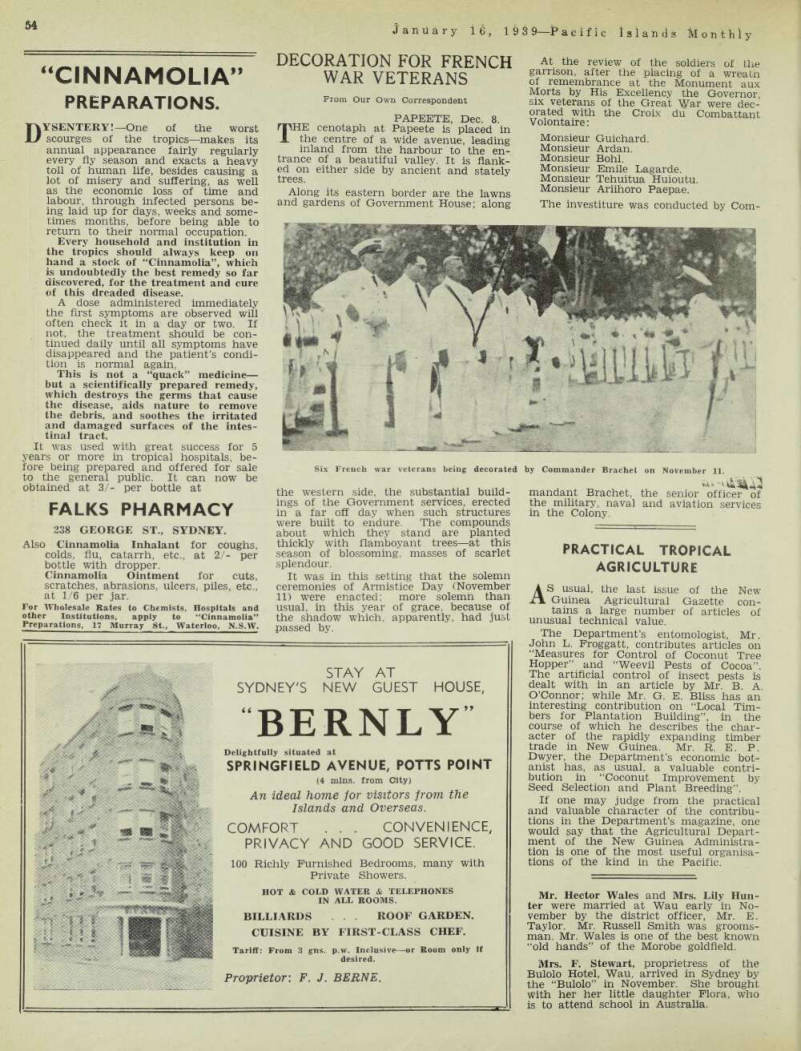
War Veterans
Prom °“ r ° wn Corresporltlent
Papeete, Dec. 8.
rpHE cenotaph at Papeete is placed in A the centre of a wide avenue, leading inland from the harbour to the en trance of a beautiful valley. It is flank e(i on either side by ancient and stately trees.
Along its eastern border are the lawns and gardens of Government House; along
the western side, the substantial build ings of the Government services, erected in a far off day when such structures were built to endure. The compounds about which they stand are planted thickly with flamboyant trees —at this season of blossoming, masses of scarlet splendour.
It was in this setting that the solemn ceremonies of Armistice Day (November 11) were enacted: more solemn than usual, in this year of grace, because of the shadow which, apparently, had just passed by.
At the review of the soldiers of the slx Veterans of Wjr were’dec thB CrOlX dU Combattant Monsieur Guichard.
Monsieur Ardan.
Monsieur Bohl.
Monsieur Emile Lagarde.
Monsieur Tehuitua Huioutu.
Monsieur Ariihoro Paepae.
The investiture was conducted by Com- J
mandant Brachet, the senior officer of the military, naval and aviation services in the Colony.
Six French war veterans being decorated by Commander Brachet on November 11.
Practical Tropical
Agriculture
AS usual, the last issue of the New Guinea Agricultural Gazette con tains a large number of articles of unusual technical value.
The Department’s entomologist, Mr.
John L. Froggatt, contributes articles on “Measures for Control of Coconut Tree Hopper” and “Weevil Pests of Cocoa”.
The artificial control of insect pests is dealt with in an article by Mr. B. A.
O’Connor; while Mr. G. E. Bliss has an interesting contribution on “Local Tim bers for Plantation Building”, in the course of which he describes the char acter of the rapidly expanding timber trade in New Guinea. Mr. R. E. P.
Dwyer, the Department’s economic bot anist has, as usual, a valuable contri bution in “Coconut Improvement by Seed Selection and Plant Breeding”.
If one may judge from the practical and valuable character of the contribu tions in the Department’s magazine, one would say that the Agricultural Depart ment of the New Guinea Administra tion is one of the most useful organisa tions of the kind in the Pacific.
Mr. Hector Wales and Mrs. Lily Hun ter were married at Wau early in No vember by the district officer, Mr. E.
Taylor. Mr. Russell Smith was grooms man. Mr. Wales is one of the best known “old hands” of the Morobe goldfield.
Mrs. F. Stewart, proprietress of the Bulolo Hotel, Wau, arrived in Sydney by the “Bulolo” in November. She brought with her her little daughter Flora, who is to attend school in Australia.
Outcry
New Hebrides Planter’s Outcry Why Are Surplus Funds Being Spent in Vila?
Letter to the Editor r[ERE are a few thousand pounds in the Condominium Treasury and our two local dictators proceed to allocate its expenditure.
Is it to be voted towards the estab lishment of a suitable and efficient medi cal service, with a hope of dealing with the alarming increase in the rate of de population of the natives; or for the comfort of mind and care of the white population of the Group? It is to be de voted to the creation of main roads on the various islands, and to their upkeep?
Is it to be used to provide lights for the various ports and anchorages and prom inent danger spots, in places outside Vila? Is it to be used for establishing schools for the white children of the Group? Is it to be used for any other useful purpose, devised so that those who supply an overwhelming proportion of the revenue should get some share and benefit from the taxes they pay—for in stance, in engaging extra surveyors so as to hasten the land surveys.
No! Who thinks of such heresy? It is to be used to supply teleradios for the various District Agencies, to give Vila a water supply system and electric light, and to supply Vila and the exceedingly well-paid, comfortably housed, and not over-worked officials, with extra com forts.
Nobody doubts that Vila needs a water supply. So, also, I am sure, do hun dreds of other more important centres.
The planters and traders can do with out electric light, water systems or tele radio, or pay for them themselves.
The rest of the Group—and, in par ticular, the north —contribute directly and indirectly, nine-tenths of the re venue; that is, these districts supply the produce which pays the revenue. The natives contribute their share by their consumption of dutiable goods and the production of copra, etc.; but, for con venience, their share is included in that of the traders.
We are constantly being reminded by our well-paid and privileged officials, that we should be grateful, as we are one of the lightest-taxed people in the world.
As the measure of taxation, is not the amount paid in taxes, but the benefits received in exchange, it is not difficult for us to prove we are among the most highly-taxed peoples—as, excepting the people in Vila, and the few officials out side that collection of mansions and hovels, we get absolutely no share oi me money collected, and the natives less than nothing.
For ordinary administrative purposes, the centralising of authority in the hands of officials, is beyond doubt, the best system, for places like this Group, and the phases of “civilisation” found here.
For the administration and allocation of finance, it is about the worst. Those who provide the money should have a voice, and a loud voice, in the way and direction the money is spent. They have been dumb, hitherto, and they are inar ticulate, because it is designed that they should be inarticulate. Officials do not want outside interference regarding the supply of extra comforts and convenien ces for themselves and for the centre of Government, where most of them live.
Until essential services are supplied to
the Group as a whole, and the revenue expended equitably, things like teleradio and the rest are in the category of lux uries.
Wake up, you worms. Combine and agitate, and look to your rights!
I am, etc.,
One Of The Worms.
New Hebrides. 7/12/1938.
Mr. T. W. Ellis, who has been in the Lands and Mines Department at Rabaul for 20 years, arrived in Sydney by the December “Tanda” from New Guinea to spend four months’ leave in Australia.
Advertisements & other items, p. 57 (2 items)
55
Pacific Islands Monthl y —J anu a r y 16, l£S9
Whisky
For Sale
Ocean going Auxiliary Ketch, 45ft. x 13ft. x 7ft. draught, heart otf Kauri, 3 skins, 36 h.p. Aisla Craig Diesel Engine; fully equipped for offshore cruising: £2,000. Owner will deliver to any port in Pacific.
Apply—
MILLS-PALMER,
“Arundel”, Waterloo Quadrant, Auckland, N.Z.
pam° us ‘ TU =
THROUGHOUT
Whisky
r, ,w "“' whisky * lth c .„ eV ,eme
Cd-S "W. «<'"■'•*"' •’
~-w Viqu £ur „„nd. *» rr£f . «“>»”• to Sydney exC \usive»T -
USHE R ’ S
enjoys tnbet that O.S.k. \-\o\e\ Sydney s beE t c/ vstieß eagH ‘o* 0.-^ Sydney-
DELICIOUS, TASTY FOODS
For ISLAND MEALS
AUNT MARY’S COOKERY
BOOK.
There’s no finer book for home . . . 212 pages, lavishly Illustrated in colour, and over 400 recipes and useful hints make it a book that every housewife will want. Send only one shilling and twopence to
TILLOCK & CO. PTY. LTD.,
Sydney N.S.W., and get your copy of this great book NOW.
JUST TRY any of AUNT MARY'S Pure Food 0 Products, and you will be back for more .. . delicious in themselves or with innumerable dishes.
AUNT MARY'S BAKING POWDER
AUNT MARY'S TOMATO SAUCE
AUNT MARY'S SPAGHETTI IN TOMATO
SAUCE
AUNT MARY'S BAKED BEANS IN TOMATO
SAUCE
AUNT MARY'S CANNED VEGETABLES
Green Peas, Cauliflower, Celery, etc.
RANEE CURRY POWDER
BLOSSOM HONEY In Attractive Jars Or any of the large variety of Pure Pood Products specially packed for Tropical conditions, in Tillock’s Hermetically Sealed 1-lb. tins. All goods are procurable from your local
TILLOCK & CO. PTY. LTD., SYDNEY.
£32 Stolen From Apia
German School
From Our Own Correspondent
Apia, Dec. 19.
AN audacious burglary was committed in the evening of December 14 at the German School at Vaimea, when during the absence of the teacher (Mr.
P. Hessmann), a thief forced an entry into the locked residence and with a hammer opened a trunk where a sum of £32 in notes was kept.
Apparently the crime was committed by someone with a knowledge of the locality.
Prints of bare, muddy feet found on the premises point to native Samoans as the malefactors.
Mr. Richard W. Fugle, plantation man ager, Purdy Islands, Manus, died recently in New Guinea.
Vigorous Development
Policy of Government of French Oceania
Prom Our Own Correspondent
Papeete, Dec. 8.
TE VEA MAOHI” reports a speech made recently before the Council of Finance by His Excellency, M.
Chastenet De Gery, Governor of French Oceania. He reviewed the work of the Administration and outlined a very ex tensive programme to increase and ex tend the services of the Departments of Education, Medicine, Agriculture and Public Works.
Since the beginning of the year, the services of education have been co-ord
mated and measures adopted to increase efficiency, not only on tne larger islands, but in tne remote parts of tne Colony The same is true of the medical ser vice. Additional doctors, and general and maternity nurses are to be made avail able for regular service among the more distant archipelagoes. A new power schooner—the “Tamara” (now nearing completion)—i s to take the place of the Muette” (wrecked on Amanu), and smaller craft will be provided for inter island medical inspections and services in the several groups.
The prospectus of the Department of Public Works includes a new concrete wharf at Uturoa, Ra’iatea (now under construction); other wharves in the Lee ward Islands and in Moorea; the laying of new and the extension of old water systems in various parts of the Colony the hard surfacing of the main road around Tahiti; new road-making, and the reconstruction and strengthening of bridges and culverts on Tahiti, Moorea and Ra’iatea.
The Department of Agriculture is be ing equipped to offer practical instruc uon to young people in cultivating sci entifically the indigenous food plants; to conserve and extend forests; and to re gulate and limit the cutting down of large trees.
These works will be financed by sur plus funds now available at the Colonial Treasury.
Fiji Administration
Two Out of Five Districts Defined
THE Colony of Fiji, in accordance with decisions made last year, has been divided into five administrative dis tricts, known respectively as Northern Southern, Eastern, Western and Cen tral.
A recent gazette defines the Western and Central districts, as follows: Western—provinces of Lautoka, Nadi, Nadroga, and Colo West, the Tikana of Komave, the coastal islands adjacent, the Yasawa and Calolo groups, and Vatulele island. Mr. A. E. G. Howard to be Provincial Commissioner in charge, assisted by Mr. K. V. Macguire Central—provinces of Ba, Colo North and Ra, and coastal islands adjacent.
Mr. C. V. Caldwell to be Provincial Commissioner, assisted by Mr C C Legge and Mr. R. A. F. Wallis.
Islands Scouts At Sydney
Jamboree
rl] Pacific Islands were represented at the Seventh World’s Scout Jamboree held at Bradfield, Sydney, in December, by native scouts from the Loyalty Islands and Nauru and by French boys from New Caledonia.
The seven broad-shouldered Loyalty natives attracted much attention—they were garbed in blue and white sarongs and wide-brimmed straw hats, and wore no shoes. The islanders were in charge of Rev. Father Benignus, of Loyalty Is lands, and the whole French contingent, numbering 42, was under the command of M. Andrew Annette, assistant com missioner at scout headquarters in Paris for French colonies.
The Nauruans were a section of the young natives who are now undergoing technical training at Geelong, Victoria.
It was originally intended that a group of Fijians should attend the Jamboree, but that idea Was passed over in favour of sending a contingent to the next Jam boree, which will be held in Wellington, New Zealand, at the end of this year.
Advertisements & other items, p. 58 (1 item)
Your Tropical Rit
When you visit the Pacific Islands, whether on Business or Pleasure, you need Special Equipment—Light Suits of Correct Style, which tit well and launder easily; Tunic Shirts Silk Shirts, Light Underwear, White Shoes, etc.
WALTER HORNE & CO. LTD., established in 1885, specialise in this Service. Skilled Tailors make your Suits from First-class material within 24 hours. Complete equipment can be supplied from our Large Stocks at Reasonable, Moderate Prices.
BUY FROM THE FIRM WHICH UNDERSTANDS YOUR NEEDS AND
DRESSES YOU CORRECTLY
WALTER HORNE &! CO. LTD., carry a Full Range of Drapery of all kinds; also Frocks, Millinery, Foundations and Lingerie, Hosiery, Shoes and Sandals, Ribbons and Laces, Household Drapery.
Men resident in any of the Pacific Territories can be supplied with Suitable Clothes.
Ladies' Hairdressing and Manicuring
Write to us and Describe your Requirements.
WALTER HORNE & CO. LTD.
Drapers and Men's Wear Specialists
SUVA. FIJI
A. B. DONALD LTD.
AUCKLAND
ISLAND TRADERS :: GENERAL MERCHANTS
P. O. Box 1509 Cables and Telegrams: "Kingdom," Auckland Branches at Rarotonga and throughout the Cook Islands At Papeete and throughout ihe Society, Marquesas and Paumotu Islands trading as " ETABLISSEMENTS DONALD. TAHITI "
At Fiji: Trading as "Dominion Fruit C 0.," Suva
Fiji Complains
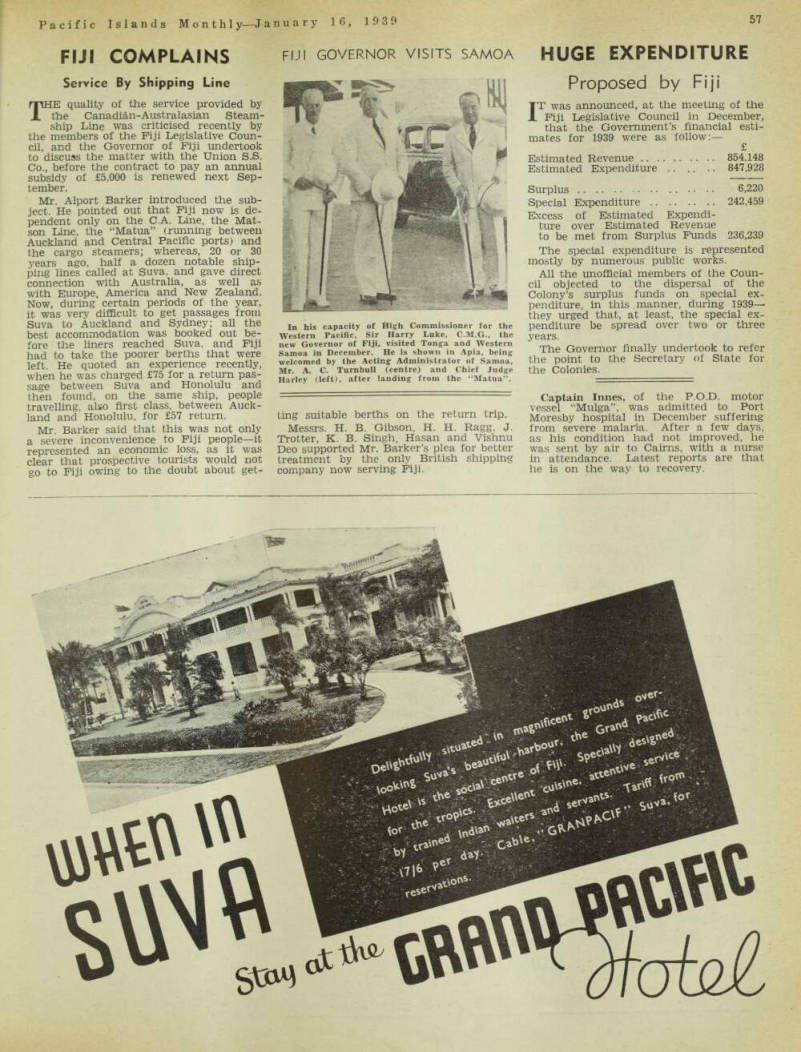
Service By Shipping Line
r E quality of the service provided by the Canadian-Australasian Steam ship Line was criticised recently by the members of the Fiji Legislative Coun cil, and the Governor of Fiji undertook to discuss the matter with the Union S.S.
Co., before the contract to pay an annual subsidy of £5,000 is renewed next Sep tember.
Mr. Alport Barker introduced the sub ject. He pointed out that Fiji now is de pendent only on the C.A, Line, the Mat son Line, the “Matua” (running between Auckland and Central Pacific ports) and the cargo steamers; whereas, 20 or 30 years ago, half a dozen notable ship ping lines called at Suva, and gave direct connection with Australia, as well as with Europe, America and New Zealand.
Now, during certain periods of the year, it was very difficult to get passages from Suva to Auckland and Sydney; all the best accommodation was booked out be fore the liners reached Suva, and Fiji had to take the poorer berths that were left. He quoted an experience recently, when he was charged £75 for a return pas sage between Suva and Honolulu and then found, on the same ship, people travelling, also first class, between Auck land and Honolulu, for £57 return.
Mr. Barker said that this was not only a severe inconvenience to Fiji people—it represented an economic loss, as it was clear that prospective tourists would not go to Fiji owing to the doubt about get
ting suitable berths on the return trip.
Messrs. H. B. Gibson, H. H. Ragg. J.
Trotter, K. B. Singh. Hasan and Vishnu Deo supported Mr. Barker’s plea for better treatment by the only British shipping company now serving Fiji.
Fiji Governor Visits Samoa
In his capacity of High Commissioner for the Western Pacific, Sir Harry Luke, C.M.G., the new Governor of Fiji, visited Tonga and Western Samoa in December. He is shown in Apia, being welcomed by the Acting Administrator of Samoa, Mr, A. C. Turnbull (centre) and Chief Judge Harley (left), after landing from the “Matua”.
Proposed by Fiji
Huge Expenditure
IT was announced, at the meeting of the Fiji Legislative Council in December, that the Government’s financial esti mates for 1939 were as follow:
Excess of Estimated Expendi ture over Estimated Revenue to be met from Surplus Funds 236,239 The special expenditure is represented mostly by numerous public works.
All the unofficial members of the Coun cil objected to the dispersal of the Colony’s surplus funds on special ex penditure, in this manner, during 1939 they urged that, at least, the special ex penditure be spread over two or three years.
The Governor finally undertook to refer the point to the Secretary of State for the Colonies.
Captain Innes, of the P.O.D. motor vessel “Mulga”, was admitted to Port Moresby hospital in December suffering from severe malaria. After a few days, as his condition had not improved, he was sent by air to Cairns, with a nurse in attendance. Latest reports are that he is on the way to recovery.
£ Estimated Revenue 854,148 Estimated Expenditure .. .. .. 847,928 Surplus 6,220 Special Expenditure 242,459
Advertisements & other items, p. 59 (2 items)
57
Pacific Islands Monthl y—J anuary 16, 1939
)l
,« . 1 cen« e . -e, a* 1 ® .« (rort' *« * e soc *»«Tsu^- <ot «*»«** ' Ca^'®’ r 6*l- ,|b oa ‘ - .esec^ 0 "
Man Disappears In Fiji
River
AN extraordinary accident occurred on the Rewa River, in Fiji, near Suva, on December 14, as a result of which Mr. George Bright, aged 35, chief offi cer of the Suva Fire Brigade, lost his life.
Mr. Bright was spending the day with a friend, Mr. Dick Freeman, on the latter’s launch, and Mr. Freeman was travelling along the Rewa River, buying bananas for the market. Mr. Freeman and Mr. Bright had been sitting on top of the launch, and then Mr. Freeman went below. He heard a splash and returned on deck. Mr. Bright had disap peared, the only sign of him being his hat, floating on the water nearby.
The aid of natives was enlisted, and subsequently the police were called in.
and a very thorough search of the whole locality was made; but the body of the missing man was not found until the following day, 14 miles downstream.
He apparently was a healthy man and there is nothing to show why he fell into the water. Apparently the cause of death was drowning. Mr. Bright came from Auckland and joined the Suva Fire Brigade in 1928, and became chief offi cer in 1930. He was well-known and highly respected, and was not married.
Mr. H. Hall, formerly of the Agricul tural Department in Western Australia, arrived in Suva by the December “Niag ara” to join the Fiji Civil Service as veterinary officer.
Mr. P. Oates reached Sydney from Bu lolo, New Guinea, where he is employed by B.G.D. Ltd., by the motorship “Bu lolo”, on December 19.
Five Generations of Fijians
THIS photograph of five generations of one family, resident at Tokou, near Levuka, Ovalau, Fiji, indicates that there is no decadence here (writes Mr.
J. A. Sword).
The photo, was taken at Loreto Mis sion Station a few months ago, very shortly before the decease of the oldest of the group—who was 82 years of age at the time of her death.
The parties represented are:—Left front—lrena (aged 82 years); right front —Mario (great grand-daughter of Irena, with Irena’s great-great grand-son in her arm); back right—Akeneta (daugh ter of Irena); back left —Serafina (grand-daughter of Irena).
The island of Ovalau, and particular ly Levuka. is recognised as the most healthy place in Fiji, and this may in some measure account for such a healthy group of matrons.
New Hebrides Wedding
CIARRYING a shower bouquet of ' frangipanni. and wearing a softly fitting gown of off-white chiffon velvet and silver lame, with her exquis ite veil of hand-made lace (which is a family heirloom). Miss Ida Russell Malone, of Boort. Victoria, made a charming bride for her marriage to Mr.
Donald Wilkinson, of Tanna, New Heb rides.
Miss Malone was attended by Miss Maude Rankine, Matron of the Pa ton Hospital. Vila, who wore a frock of ice blue satin with a redingote of tulle to tone, and carried a bouquet of deep pink roses.
The ceremony, which was conducted by Rev. H. M. Bell, of Whitesands, assisted by Dr. W. Armstrong, of Lenakel, was celebrated in the Presbyterian Church at Lenakel.
After the service Dr. and Mrs. Arm strong entertained the wedding party and a few intimate friends at the Mis sion House.
Advertisements & other items, p. 60 (1 item)
Ifldisp^
MORRIS, HEDSTROM, ltd.,
Registered Office - - Suva, Fiji.
BRANCHES THROUGHOUT FIJI, TONGA AND SAMOA
Y Agents for : >
LLOYD’S
NOBELS (AUSTRALIA) LIMITED—EXPLOSIVES
MATSON NAVIGATION COMPANY
RUSTON & HORNSBY LIMITED
IMPERIAL CHEMICAL INDUSTRIES LIMITED
JOHN LYSAGHT (AUST.) LTD.
VACUUM OIL COMPANY PROP'TY. LIMITED
FORD MOTOR COMPANY LIMITED
■L GOODYEAR TIRE & RUBBER EXPORT COY. J.
SYDNEY OFFICE: DALTON HOUSE. 115 PITT ST.
Ifldisp^
for
aerodromes
and other large areas.
\ tractor** Ban , s » m ' s <i“‘"t„ple Mower ?fi Z n : n? P t le 1 7 . ffc >. Quintuple liy 2 ft., Septuple t 0 n . uuit s—25 ft. wide. Also a sulky mower 30 in. wide for hilly land. y
ansomcs
GANG MOWERS
We illustrate our standard machine.
For longer grass and heavier work, we offer the “ Magna - Gang ” pattern.
Illustrated catalogue showing a complete range of hand, animal draught and motor lawn mowers will be sent on application.
MORRIS,
HEDSTROM, LTD.,
Suva, Lautoka and Ba.
RANSOMES, SIMS & JEFFERIES, LTD. Ipswich, England.
Escape to the South Sea
Islands How to Live Happily in a Tropical Paradise on $50 a Month, for Two
Condensed from an article in “The American Mercury” by Phillip Aquila Kempster.
I SHOULD like to be on a liner plough ing southwest' through the Pacific. As the water became a more and more brilliant blue each day, as the smooth trade wind became warmer, I should be filled with an inner content.
I should feel, despite the fact that my native city lay half a world behind, that I was coming home.
The legend of the South Seas has per sisted for generations. Almost everyone has been touched by the alluring vision of an island paradise, particularly when modem life becomes most oppressive. It is strange that only the merest handful have realised their dream. But there have been a few . . .
Some time ago, my wife and I decided that we weren’t getting as much out of life as we should, so we packed up and followed the sun. We lived for nearly two years on the island of Moorea, 12 miles across the channel from Tahiti. Our home, which we rented for $6 a month, was in a setting of exquisite beauty—green mountains towering at our back, coco nut palms around the house, and a stretch of white sand and turquoise water in front.
The house consisted of one large room, about 30 feet by 20, built off the ground on stilts. There was a little verandah in front, facing the beach, with overhanging eaves of palm thatch. The walls were plank for three feet, and above that, young bamboo reeds through which sun light and fresh air filtered constantly.
We partitioned off the place with cur tains. From packing cases we built book cases, shelves, etc. Two beds, a table, a few odd chairs, a gasoline lamp and a secondhand oil stove about completed the furnishings. The lot didn’t cost more than $3O.
We lived in what would probably be called a primitive style, but I wonder if you in the big cities, and you who are hard put to it to make ends meet in rural areas, are, despite the conveniences of your so-called civilisation, any happier.
In our island home we had just about everything we wanted, and we spent no more than $35 a month after the first month. They were the happiest two years we have ever known.
There is just one catch to pulling up stakes and coming to these French owned islands—you can’t make a living down there. Therefore, your first requisite is a certain amout of cash or an assured income. But dollars stretch a long way, with the franc so cheap. Your greatest outlay will be steamer fare. The French authorities insist that you either have a return ticket or deposit $9O when you land—to be returned when you leave. This is insurance against the islands being overrun with penniless beachcombers.
When you arrive in Papeete (a sleepy little French village of about 4.000 souls) you will probably go to a hotel for a week until you get your bearings. A comfortable room will cost 60 cents a day. In a week you’ll meet most of the foreigners worth knowing and hear all about the rest. You probably will solve
the transportation problem by purchasing a secondhand bicycle for $lO.
Meals at the hotel cost about 40 cents, but you can get good meals at the Chinese restaurants for 20. Your breakfast, con sisting of coffee, rolls, butter and fruit, will cost about 6 cents.
The early morning open-air market will be a revelation to you. Natives and Chinese travel ail night, bringing their produce for sale. The fishermen display a rare assortment, from the large meaty food fish, to octopus, and a sort of sea centipede which looks .horrible but is a delicacy to the Chinese.
Out in the country, where it is cooler, and rents less expensive than in town, you probably will pay 10 or 12 dollars a month for a house in which you can live
comfortably. It will be fairly well fur nished in simple style. Water will be piped from a mountain stream to a shower bath and the kitchen sink. There will be an outhouse in the rear.
You need not become accustomed to strange foods. You can get pretty much the same as you’re used to at home.
Meat and ice will be delivered at your door every other day. From a nearby Chinese gardener you can buy for 10 francs enough vegetables for a week. Tro pical fruits cost next to nothing. Avocados, mangos, papayas, bananas, oranges and breadfruit are plentiful.
Tinned New Zealand butter costs 30 cents a pound. Excellent French bread is delivered to you daily for three cents a loaf. Your coffee, raised nearby, costs
ten cents a pound, and if you roast it yourself in a pan over an open fire and then grind it, you will have a delicious brew. You can get American cigarettes for a dime, for they are minus the government tax stamp.
Clothing is no problem. A man can get a pretty good white suit made by Chinese tailors for $5. When in town I usually wore shorts, a polo shirt and Chinese sandals costing 50 cents. Most of the rest of the time I went barefooted, with a “pareu” wrapped around my waist and twisted to form a pair of close-fitting trunks. Shorts, shirts, sandals, lounging pyjamas, and a cotton dress or two suffice for most of the foreign women in the is- “ , ... . , . , ..
Your house will be only a stone’s throw from the sea, and the swimming in the
lagoon is as fine as any in the world.
The waters teem with game fish. You can catch them with hook and line or get a pair of goggles and a spear and go out with the natives. There’s a knack to it that way, but you’ll have a lot of fun learning.
All this can be yours at a cost of $5O a month—for two. If you are single, you can get by on $35. If you have a bit more money you can rent a furnished house with two or three bedrooms, fancy plumbing, electric lighting and all modern conveniences in Tahiti for $4O a month.
The Polynesian natives are a lovable, charming, if somewhat decadent people.
Treat them right and they are your friends for life. Their ways may be dif ferent from yours but—look around and see which is happier.
Language will be no obstacle. Much English is spoken, and you’ll soon pick up enough French and Tahitian words to get by. Practically all the storekeepers speak a little English and you will learn quickly to bargain with the Chinese in a pidgin dialect.
You will not find much night life along the unpaved streets of Papeete. You can go to the one motion-picture house for a couple of francs and see films of yes teryear. resurrected to delight the Poly nesian audience. Boxing programmes and horse races are staged frequently. On your $5O a month you will be able to en joy these little luxuries.
Probably one quarter of the population is white or part white. You will soon have a wide circle of acquaintances. They will drop in at your house frequently, and you in turn will enjoy visiting them.
You may hear lurid tales of the rainy season, but don’t let them scare you off.
A lot of water falls in December, Janu ary and February, but it’s not too bad and there is fine weather between rains.
The rest of the year is magnificent.
Life in the islands is simple and satis fying—if you’re the right person. If you can’t do without all the little conveniences of the machine age, don’t go. If you’re the ultragregarious kind, stay home and mill around with your fellows.
But if you’re another sort, you’ll find in the South Seas, a happiness that’s pretty hard to put into words; something real and vital that you’ll never forget as long as you live.
Advertisements & other items, pp. 61-62 (2 items)
59
Pacific Islands Monthl y—J anuary 16, 1939
Noyes Bros. (**•») Ltd.
28* “Petromax”
Rapid Kerosene Hurricane Lanterns and Table Lamps, burn Kerosene.
Light on Kerosene in 30
DANKS’ ISLAND
O nroi A I TTI r 1 O Write for particulars of UI LUmL I |ty! ines in which y° u are interested. for Engineers Plumbers ■■■a Sanitary-ware, Baths, Basins, Bath Heaters, Wallboard. Asbestos Building Sheets Cooking Ranges for Wood, Coal, Gas, Oil, Electricity.
Refrigerators, Ice or Electric.
Builders’ Hardware, Gal Iron, Bituminous Ron Roofing, Sheet Lead.
“Billabone” Pumps For Mining and Irrigation, Windmills, Watei Piping, Brass Cocks. seconds. Latest models.
IN BOND PRICES FOR PETROMAX LAMPS AND LANTERNS 200 C.P.Lanterns, £2/16/6. 300 C.P. Rapid Lanterns, £3/5/-.
Ordinary preheating type using petrol for starting:—2oo C.P.
Lanterns, £2,6/6. 300 C.P. Lanterns, £2/16/-. 200 C.P. Rapid Table Lamps, £3/7/6. 300 C.P. Rapid Table Lamps, £3/16/6.
PH ON r M65C518 s hop^c^ u - Catalogue of “Modern t'LWm M JLfKd Home’’ Fittings now available
JYjKiL 324-330 PITT STREET.
PkOPRIETARY LIMITED. (INCORPORATED
And at Melbourne.
Hush “Silent” Flushers for Pedestal Pans. *‘NOX” Electric Lamps.
TIME AND MONEY
For Electrical and Radio Equipment you cannot do better than place your inquiries with Noyes Bros.
Crompton Coiled Coil and Single Coil Lamps . . . Kriesler AH electric and Battery-operated Radio . . . Ferranti Meters and Transformers . . . Simpson Electric Turntables . . .
Household Electric Appliances . . . Rodgers Cutlery . . .
Perfection Silverware . . . Electrical Fittings . . . Crompton Fans for home, office, store and factory Callender Wires, Cables and Flexibles for indoor and outdoor installations . . . Seyon Floodlighting Equipment for tennis courts, etc.
NOYES BROS. (**•») LTD.
115 CLARENCE ST., SYDNEY
11 WATT ST., NEWCASTLE. 197 ELIZABETH ST., BRISBANE
12 and over ...
Under 12 Kindergarten
“FAIRHOLME”
PBESBYTEBIAN GIBES’ COLLEGE
BOARDING SCHOOL FOR GIRLS—TOOWOOMBA, QLD.
Founded 1917. Principal MISS D. E. CULPIN, B.A.
SCHEDULE OF FEES:
Tuition. £ s. d. 3 13 6 2 12 6 I 10 0 NOTE : The fee charged under the heading of incidentals as above covers Sports, Class Singing, Physical Culture and ordinary school stationery.
A reduction of 10% on all charges other than special subjects Is allowed for sisters, and in all cases fees are chargeable from date of entry only.
COURSES AS PRESCRIBED FOR QUEENSLAND UNIVERSITY PUBLIC EXAMINATIONS (Academic, Home Science, Commercial) Provision Is made for the accommodation of boarders from distant parts during short vacations.
For further information apply to the Secretary . , .
MR. R. T. PHELPS, F.A.A., 491 Ruthven Street, Toowoomba, Qld.
WHEN SPENDING YOUR VACATION IN SYDNEY YOUR CHOICE OF RESIDENCE IS A MAHER SO VITAL TO YOUR ENJOYMENT!
May we commend to you for All-round Excellence
SYDNEY'S MOST EXCLUSIVE PRIVATE HOTEL
44 MACLEAY STREET
Here for you await unrivalled H. & C. Water and Telephones a* and Cuisine—Suites with Private Baths— oms—Magnificent Harbour Views Roof Garden Sun Rooms Spacious Lounges and Smoke Rooms and every modern convenience All under Personal Supervision of the Proprietress.
MISS M. E. BURROWS
per week inclusive.
Radios:
"FORTYFOR"
Sydney.
Telephone: FL 2641
2,000 Miles By
Outrigger
Adventurers Leave Honolulu For Pago Pago
THREE men left Honolulu at Christ mas in a modernised 100-year-old Samoan canoe for what is described as the white man’s first attempt to make a trans-Pacific outrigger canoe trip.
They are: U. A. Woodbury, of Elsinore, Califor nia: Don Hall, of Long Beach, Califor nia; and Charles Kern, of Providence, Rhode Island. They believe that they can sail from Honolulu to Pago Pago, American Samoa, 2,000 miles, in 20 days.
The sides of the 32ft. canoe have been built up and the hull strengthened by metal ribs and transverse rods. A keel has been added. The outrigger is a gal vanised iron case, containing a supply of fresh water.
The canoe hull has been sectioned off into hatches, the forward being filled with empty metal cans for buoyancy in the event of an upset. The second hatch has galvanised tanks for clothing;, food and equipment Next is a 7 ft. long sleeping compartment with a zippered canvas covering. Finallv there is a 5 ft. cockpit for seating the two men on watch. Behind this is a well for an out board motor.
The motor will be used only where ne cessary. The canoe will depend on a 175 sq. ft. Marconi rigged sail and a jib. In stead of a paddle, the canoe will be steered by a pivot type rudder, which folds up astern when the canoe is beach ed.
Father Gerard Tigs-eler, a new re cruit for the Marist Mission, sailed from Sydney for Tulagi, British Solomon Is lands, by the “Malaita” on January 7.
Opening Of New L.M.S. Church On Nauru
ON Sunday, December 11, there took place on Nauru the opening and de dication of the new Nauruan Protestant Church, under the auspices of the London Missionary Society. The Mission ship, “John Williams V.”, had arrived on the previous Friday, with Rev.
G. H. Eastman (Beru), Rev. J. H. Spivey (Abaiang) and some Gilbertese teachers and boys from the neighbouring islands.
The most historic figure was Timoteo Tabwia, who is 82 years of age, and was the first man to bring the Christian message to the shores of Nauru.
Last year a monu ment was erected on the site of his landing to com memorate the Jubi lee.
All Nauruan Pro testants were pre sent, together with a large muster of Europeans. His Honour the Admin istrator and Mrs.
Chalmers attended, with the staff of the Administration.
The British Phos
phate Commissioners were represented by the Nauru manager and his wife (Mr. and Mrs. W. V. Bott), and the assist ant manager and his wife (Mr. and Mrs. Kirk).
After appropriate sentences had been read by the presiding Minister (Rev.
Clifford L. Welch, resident in Nauru),
Rev. G. H. Eastman received the key from John Harris and led the old man Tabwia to turn the key in the lock, and open the doors. Then followed the dedi cation service at which Rev. G. H. East man preached. A statement was made by Senior Head Teacher J. Aroi in Eng lish, and in Nauruan by Head Chief T.
Detudamo. They said how much the Nauruans had appreciated the assistance
which had been so gladly given by Mr.
A. Harold Gaze (General Manager of the British Phosphate Commissioners at Melbourne office) and the Nauru man ager, Mr. W. V. Bott, the assistant man ager, Mr. R. B. Kirk, and during his absence on furlough, Mr. W. Allen. The B. carpenter (Mr. Ward) had super
vised the main structure, and carried out his contract faithfully and enthusiastic ally. All the B.P.C. staff had shown willingness to give of their time and knowledge to help, where such help had been needed. The sympathy of the Ad ministration was greatly appreciated in the freeing of John Harris (carpenter) to work on the building with the assist ance of 12 others.
A feature of the church is the stained glass windows over the altar, which were designed by Mr. W. Frater, of Yencken and Co., Melbourne. The local scenery is adapted to the design which has na tive birds, flowers and people drawn from photographs.
The building has cost in the neigh bourhood of £3,500, raised on Nauru by the people.
Nauru’s new Protestant Church, opened in December.
Wedding In Rabaul
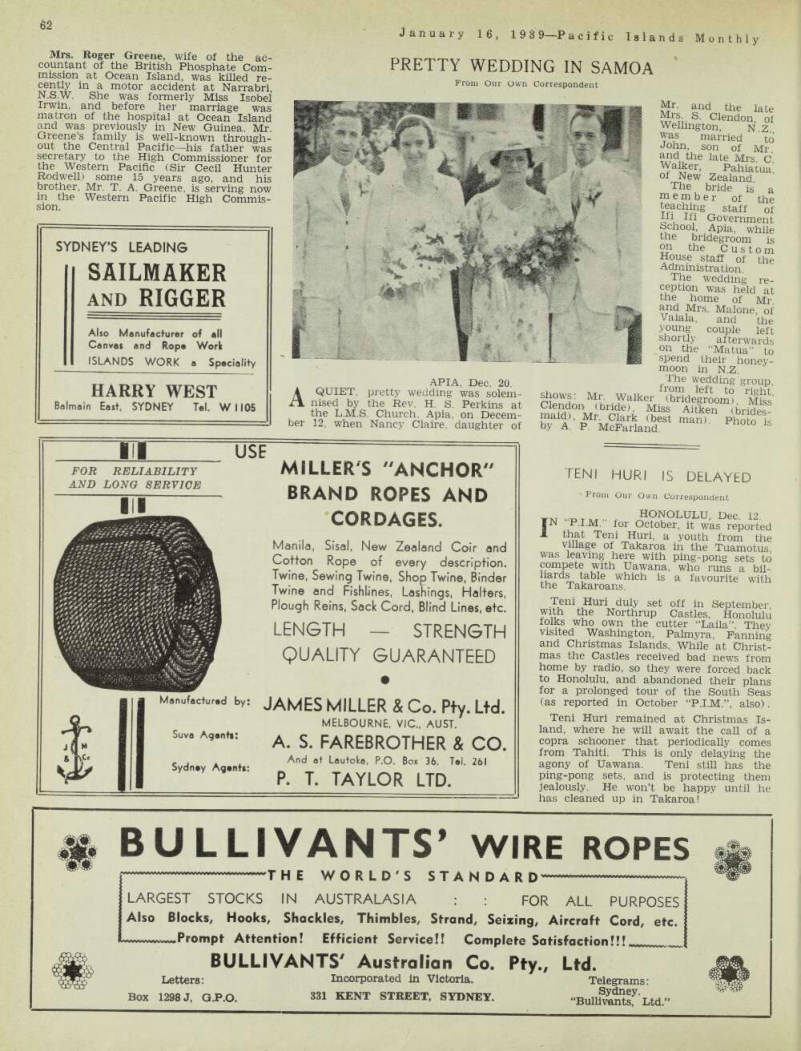
MISS JEAN BIGNELL, daughter of Mrs. Charles R. Bignell, licensee of the Hotel Rabaul, was married on January 5, in Rabaul, to Mr. Dudley L.
Roberts, at the Methodist Church. Miss Jean Bignell, a pretty and charming girl, accompanied her mother to Rabaul when the latter took over the Hotel Rabaul in 1937. Mrs. Bignell and her two daugh ters, Margaret and Jean, previously had lived in the Solomon Islands, where the family still are the owners of a coconut plantation.
Mr. S. D. Anderson, accountant of the Kavieng branch of W. R. Carpenter and Co. Ltd., arrived in Sydney by the De cember “Bulolo”, and proceeded to Vic toria and, later, Tasmania, to spend, three months’ furlough.
Mrs. Roger Greene, wife of the ac countant of the British Phosphate Com mission at Ocean Island, was killed re cently in a motor accident at Narrabri N.S.W. She was formerly Miss Isobel Irwin, and before her marriage was matron of the hospital at Ocean Island and was previously in New Guinea. Mr Greene’s family is well-known through out the Central Pacific—his father was secretary to the High Commissioner for the Western Pacific (Sir Cecil Hunter Rodwell) some 15 years ago, and his brother, Mr. T. A. Greene, is serving now in the Western Pacific High Commis sion.
Advertisements & other items, p. 63 (2 items)
61
Pacific Islands Monthl y—J anuary 16, 1039
W. Kopsen & Co. Pty. Ltd.
m m
RENTA
MARINE ENGINES
For power and quiet smooth running the Penta Twin is unrivalled. The most popular of the Penta range, it is fully equipped with fine built-in Reverse Gear, and overhead raised chain starter. Runs for approx. 2 hours on 1 gallon petrol with speed up to 12 m.p.h.
Suitable for boats up to 30ft. in length.
Easily installed and easily operated.
PRICE, COMPLETE: £B5 Ex Bond.
Also single, four and six cylinder engines up to 100 H P.
Write for comprehensive catalogue.
TILLEY LAMPS
Burn Kerosene with a light of 300 c.p.
Storm, Insect, and Fool Proof. British made.
New typtf mantle, supported top and bottom will not shake off. Brass and will not corrode; 11 different models of Lamps suitable for every purpose.
Send for Catalogue.
All-Purpose Lamp and Lantern (not illustrated) 50/-.
Obtainable from your local agent or
W. KOPSEN AND CO. PTY. LTD.,
SHIPCHANDLERY
and
Mining Gear
We have large and complete Stocks of Shipchandlery and Mining Gear. Boat fittings of all descriptions manufactured in our own marine foundry.
We are manufacturers of the wellknown “Pioneer” brand Ash Oars and Tool Handles. Write for free catalogue of any line which may interest you. 1 70 Clarence St., Sydney.
CHAMPION
OUTBOARD MOTORS
2.9 H.P. Speed 1-9 M.P.H.
Fine new outboards weighing only 311 b., suitable for all dinghys, skiffs or boats up to 16ft. long. The fully enclosed full float carburettor ensures easy starting and smooth, sweet running at all speeds.
Full of pep and runs for over 3 hours on 1 gallon petrol.
More Horse Power at less cost.
PRICE, COMPLETE: ONLY £l9/17/6 Ex Bond.
W. KOPSEN & CO. Pty. Ltd.
70 CLARENCE ST., SYDNEY.
■HM.CABLES; “KOPSEN”, SYDNEY. ■■ ■■
Pretty Wedding In Samoa
Prom Our Own Correspondent
Apia, Dec. 20.
A QUIET, pretty wedding was solem nised by the Rev. H. S. Perkins at the L.M.S. Church. Apia, on Decem ber 12, when Nancy Claire, daughter of
Mr. and the late Mrs. S. Clendon, oi
Wellington, n.Z
was married to John, son of Mr andthe late Mrs. c
Walker, Pahiatua,
of New Zealand The bride is a member of the teaching staff of Hi Government ?u hoo i.’ . A Pia, while the bridegroom is on the Custom House staff of the
Administration.
The wedding re ception was held at the home of Mr. and Mrs. Malone, of Vaiala, and the young couple left shortly afterwards on the “Matua” to spend their honey moon in N.Z.
The wedding group, shows: Mr. Walker "bridegroom” Mks Clendon (bride), Miss Altken brideS ri’’ p Mr M ?£ r rU b d est man) - p “
Teni Hurt Is Delayed
Prom Our Own Correspondent
1. AT „_ Tlkir , HONOLULU, Dec. 12.
N P.I.M. lor October, it was reported that Teni Huri, a youth from the village of Takaroa in the Tuamotus was leaving here with ping-pong sets to compete with Uawana, who runs a bil table which is a favourite with the Takaroans.
Teni Huri duly set off in September with the Northrup Castles, Honolulu folks who own the cutter “Laila” They visited Washington, Palmyra, Fanning and Christmas Islands. While at Christ mas the Castles received bad news from home by radio, so they were forced back to Honolulu, and abandoned their plans for a prolonged tour of the South Seas (as reported in October “P.1.M.”, also).
Teni Huri remained at Christmas Is land, where he will await the call of a copra schooner that periodically comes from Tahiti. This is only delaying the agony of Uawana. Teni still has the ping-pong sets, and is protecting them jealously. He won’t be happy until he has cleaned up in Takaroa!
Advertisements & other items, p. 64 (3 items)
62
January 16, 193 9 — P acific Islands Monthly
Sailmaker
SYDNEY'S LEADING
and RIGGER
Also Manufacturer of all Canvas and Rope Work ISLANDS WORK a Speciality
HARRY WEST
Balmain East. SYDNEY Tel. W 1105
If
USE
FOR RELIABILITY
AND LONG SERVICE
// Manufactured by: Suva Agent*; Sydney Agent*:
MILLER'S "ANCHOR
BRAND ROPES AND
CORDAGES.
Manila, Sisal, New Zealand Coir and Cotton Rope of every description.
Twine, Sewing Twine, Shop Twine, Binder Twine and Fishhnes, Lashings, Halters, Plough Reins, Sack Cord, Blind Lines, etc.
LENGTH STRENGTH
QUALITY GUARANTEED
JAMES MILLER & Co. Pty. Ltd.
MELBOURNE, VIC.. AUST.
A. S. FAREBROTHER & CO.
And at Lautoka, P.O. Box 36. Tel. 261
P. T. TAYLOR LTD.
M* BU LLIVANTS’ wire ropes
THE WORLD'S STANDARD
* LARGEST STOCKS IN AUSTRALASIA : : FOR ALL PURPOSES Also Blocks, Hooks, Shackles, Thimbles, Strand, Seizing, Aircraft Cord, etc. vwwwwww*wv«-Prompt Attention! Efficient Service!! Complete Satisfaction!!!
BULLIVANTS' Australian Co. Pty., Ltd.
BOX
Letters:
1298 J, G.P.O.
Incorporated in Victoria.
331 KENT STREET, SYDNEY.
Telegrams: Sydney. ‘Bullivants, Ltd.’
Shipwrecked
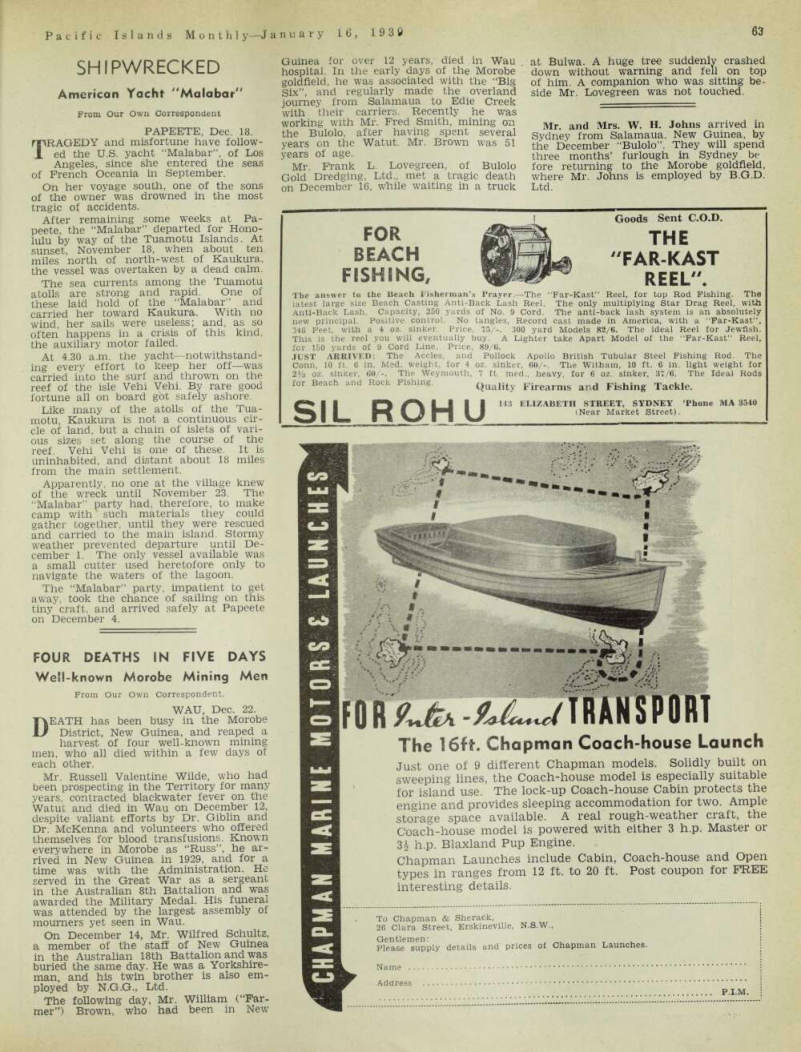
American Yacht "Malabar"
From Our Own Correspondent
Papeete, Dec. 18.
TRAGEDY and misfortune have follow ed the U.S. yacht “Malabar”, of Los Angeles, since she entered the seas of French Oceania in September.
On her voyage south, one of the sons of the owner was drowned in the most tragic of accidents.
After remaining some weeks at Pa peete, the “Malabar” departed for Hono lulu by way of the Tuamotu Islands. At sunset, November 18, when about ten miles north of north-west of Kaukura, the vessel was overtaken by a dead calm.
The sea currents among the Tuamotu atolls are strong and rapid. One of these laid hold of the “Malabar” and carried her toward Kaukura. With no wind, her sails were useless; and, as so often happens in a crisis of this kind, the auxiliary motor failed.
At 4.30 a.m. the yacht—notwithstand ing every effort to keep her off —was carried into the surf and thrown on the reef of the isle Vehi Vehi. By rare good fortune all on board got safely ashore.
Like many of the atolls of the Tua motu, Kaukura is not a continuous cir cle of land, but a chain of islets of vari ous sizes set along the course of the reef. Vehi Vehi is one of these. It is uninhabited, and distant about 18 miles from the main settlement.
Apparently, no one at the village knew of the wreck until November 23. The ■ Malabar” party had, therefore, to make camp with such materials they could gather together, until they were rescued and carried to the main island. Stormy weather prevented departure until De cember 1. The only vessel available was a small cutter used heretofore only to navigate the waters of the lagoon.
The “Malabar” party, impatient to get away, took the chance of sailing on this tiny craft, and arrived safely at Papeete on December 4.
Four Deaths In Five Days
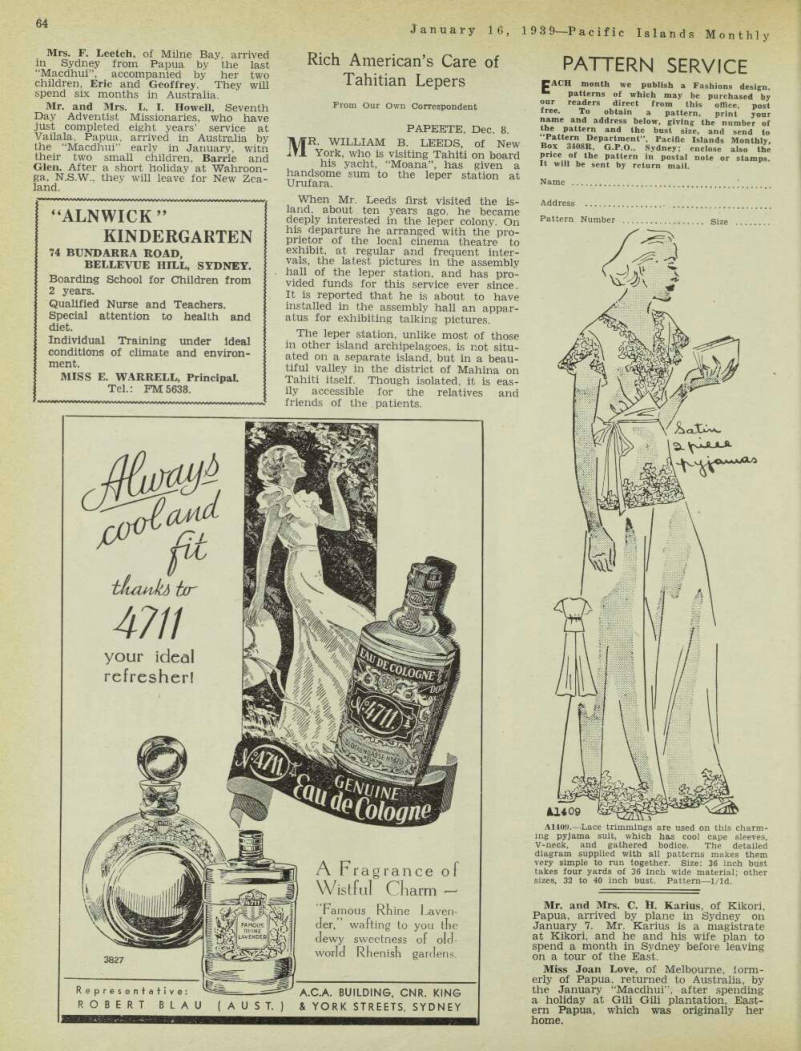
Well-known Morobe Mining Men
From Our Own Correspondent.
WAU, Dec. 22.
DEATH has been busy in the Morobe District, New Guinea, and reaped a harvest of four well-known mining men, who all died within a few days of each other.
Mr. Russell Valentine Wilde, who had been prospecting in the Territory for many years, contracted blackwater fever on the Watut and died in Wau on December 12, despite valiant efforts by Dr. Giblin and Dr. McKenna and volunteers who offered themselves for blood transfusions. Known everywhere in Morobe as “Russ”, he ar rived in New Guinea in 1929, and for a time was with the Administration. He served in the Great War as a sergeant in the Australian Bth Battalion and was awarded the Military Medal. His funeral was attended by the largest assembly of mourners yet seen in Wau.
On December 14, Mr. Wilfred Schultz, a member of the staff of New Guinea in the Australian 18th Battalion and was buried the same day. He was a Yorkshire man, and his twin brother is also em ployed by N.G.G., Ltd.
The following day, Mr. William (“Far mer”) Brown, who had been in New
Guinea for over 12 years, died in Wau hospital. In the early days of the Morobe goldfield, he was associated with the “Big Six”, and regularly made the overland journey from Salamaua to Edie Creek with their carriers. Recently he was working with Mr. Fred Smith, mining on the Bulolo, after having spent several years on the Watut. Mr. Brown was 51 years of age.
Mr. Frank L. Lovegreen, of Bulolo Gold Dredging, Ltd., met a tragic death on December 16, while waiting in a truck
at Bulwa. A huge tree suddenly crashed down without warning and fell on top of him. A companion who was sitting be side Mr. Lovegreen was not touched.
Mr. and Mrs. W. H. Johns arrived in Sydney from Salamaua, New Guinea, by the December “Bulolo”. They will spend three months’ furlough in Sydney be fore returning to the Morobe goldfield, where Mr. Johns is employed by B.G.D.
Ltd.
Mrs. F. Leetch, of Milne Bay, arrived in Sydney from Papua by the last “Macdhui”, accompanied by her two children, Eric and Geoffrey. They will spend six months in Australia.
Mr. and Mrs. L. I. Howell, Seventh Day Adventist Missionaries, who have just completed eight years’ service at Vailala, Papua, arrived in Australia by the “Macdhui” early in January, with their two small children, Barrie and Glen. After a short holiday at Wahroon ga, N.S.W., they will leave for New Zea land.
Advertisements & other items, pp. 65-66 (1 item)
Mufuzh -^4.«/Irans
Goods Sent C.O.D.
FOR iSm THE
beach BIoLr "FAR-KAST
FISHING, REEL".
The answer to the Beach Fisherman’s Prayer.—The “Far-Kast” Reel, for top Rod Fishing. The latest large size Beach Casting Anti-Back Lash Reel. The only multiplying Star Drag Reel, with Anti-Back Lash. Capacity, 250 yards of No. 9 Cord. The anti-back lash system is an absolutely new principal. Positive control. No tangles, Record cast made in America, with a “Far-Kast”, 346 Feet, with a 4 oz. sinker Price, 75/-. 300 yard Models 82/6. The ideal Reel for Jewhsh.
This is the reel you will eventually buy. A Lighter take Apart Model of the “Far-Kast” Reel, for 150 yards of 9 Cord Line. Price, 89/6.
JUST ARRIVED: The Accles, and Pollock Apollo British Tubular Steel Fishing Rod. The Conn, 10 ft. 6 in. Med. weight, for 4 oz. sinker, 60/-. The Witham, 10 ft. 6 in. light weight for 2V2 oz. sinker, 60/-. The Weymouth, 7 ft. med., heavy, for 6 oz. sinker, 37/6. The Ideal Rods for Beach and Rock Fishing. Quality Firearms and Fishing Tackle. I 1 I 8 I 143 ELIZABETH STREET, SYDNEY Phone MA 3540 I 15 P™! II (Near Market Street).
■ t v ► * n %. , *Sf f Vs
\\j f r-''
//*&&ss
mUfUzH -^4.«/IRANS
0
The 16ft. Chapman Coach-house Launch
Just one of 9 different Chapman models. Solidly built on sweeping lines, the Coach-house model is especially suitable for island use. The lock-up Coach-house Cabin protects the engine and provides sleeping accommodation for two. Ample storage space available. A real rough-weather craft, the Coach-house model is powered with either 3 h.p. Master or h.p. Blaxland Pup Engine.
Chapman Launches include Cabin, Coach-house and Open types in ranges from 12 ft. to 20 ft. Post coupon for FREE interesting details.
To Chapman & Sherack, 26 Clara Street, Erskineville, N.S.W., Gentlemen: T Please supply details and prices of Chapman Launches.
Name . .
Address
P.I.M.
“ALNWICK”
KINDERGARTEN
74 BUNDARRA ROAD,
BELLEVUE HILL, SYDNEY.
Boarding School for Children from 2 years.
Qualified Nurse and Teachers.
Special attention to health and diet.
Individual Training under ideal conditions of climate and environment.
MISS E. WARRELL, Principal.
Tel.: FM 5638.
Tahitian Lepers
Rich American’s Care of Tahitian Lepers
From Our Own Correspondent
Papeete, Dec. 8.
Mr. William B. Leeds, Of New
York, who is visiting Tahiti on board his yacht, “Moana”, has given a handsome sum to the leper station at Urufara.
When Mr. Leeds first visited the is land. about ten years ago. he became deeply interested in the leper colony. On his departure he arranged with the pro prietor of the local cinema theatre to exhibit, at regular and frequent inter vals, the latest pictures in the assembly hall of the leper station, and has pro vided funds for this service ever since.
It is reported that he is about to have installed in the assembly hall an appar atus for exhibiting talking pictures.
The leper station, unlike most of those in other island archipelagoes, is not situ ated on a separate island, but in a beau tiful valley in the district of Mahina on Tahiti itself. Though isolated, it is eas ily accessible for the relatives and friends of the patients.
Pattern Service
EACH month we publish a Fashions design, patterns of which may be purchased by our readers direct from this office, post free. To obtain a pattern, print your name and address below, giving the number of the pattern and the bust size, and send to Pattern Department”, Pacific Islands Monthly, Box 3408 R, G.P.0., Sydney; enclose also the price of the pattern in postal note or stamps.
It will be sent by return mail.
Name Address Pattern Number Size
Al4oy.—Lace trimmings are used on this charm ing pyjama suit, which has cool cape sleeves, V-neck, and gathered bodice. The detailed diagram supplied with all patterns makes them very simple to run together. Size: 36 inch bust takes four yards of 36 inch wide material; other sizes, 32 to 40 inch bust. Pattern—l/ld.
Mr. and Mrs. C. H. Karins, of Kikori, Papua, arrived by plane in Sydney on January 7. Mr. Karius is a magistrate at Kikori, and he and his wife plan to spend a month in Sydney before leaving on a tour of the East.
Miss Joan Love, of Melbourne, iorm erly of Papua, returned to Australia, by the January “Macdhui”, after spending a holiday at Gili Gili plantation, East ern Papua, which was originally her home.
Advertisements & other items, p. 66 (2 items)
64
January 16, 19 S 9—P acif i c Islands Monthly
J:
4711 your ideal
refresherl
3827 m Representative:
ROBERT BLAU (AU S T.
A Fragrance of
Wistful Charm
Famous Rhine Lavender, ’ wafting to you the dewy sweetness of oldworld Rhenish gardens.
A.C.A. BUILDING. CNR. KING
& YORK STREETS, SYDNEY
Fashion Hints for Islands Women
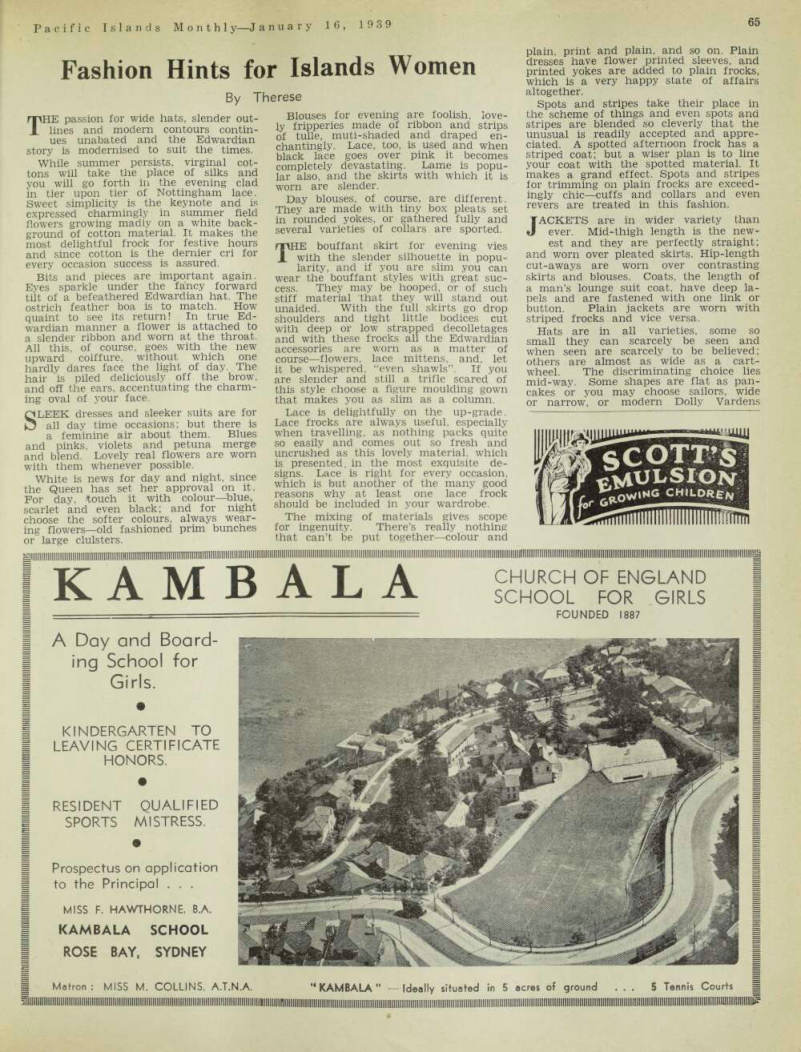
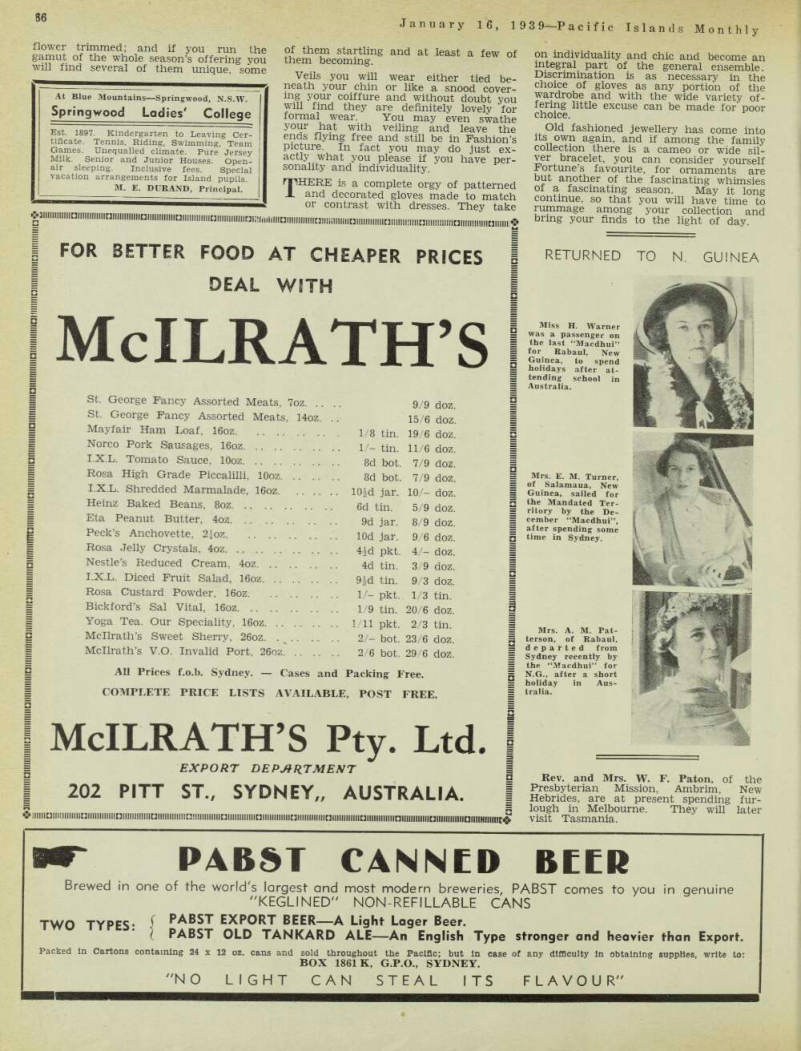
By Therese
THE passion for wide hats, slender out lines and modern contours contin ues unabated and the Edwardian story is modernised to suit the times.
While summer persists, virginal cot tons will take the place of silks and you will go forth in the evening clad in tier upon tier of Nottingham lace.
Sweet simplicity is the keynote and is expressed charmingly in summer field flowers growing madly on a white back ground of cotton material. It makes the most delightful frock for festive hours and since cotton is the dernier cri for every occasion success is assured.
Bits and pieces are important again.
Eyes sparkle under the fancy forward tilt of a befeathered Edwardian hat. The ostrich feather boa is to match. How quaint to see its return! In true Ed wardian manner a flower is attached to a slender ribbon and worn at the throat.
All this, of course, goes with the new upward coiffure, without which one hardly dares face the light of day. The hair is piled deliciously off the brow, and off the ears, accentuating the charm ing oval of your face.
SLEEK dresses and sleeker suits are for all day time occasions: but there is a feminine air about them. Blues and pinks, violets and petuna merge and blend. Lovely real flowers are worn with them whenever possible.
White is news for day and night, since the Queen has set her approval on it.
For day, touch it with colour—blue, scarlet and even black; and for night choose the softer colours, always wear ing flowers—old fashioned prim bunches or large clulsters.
Blouses for evening are foolish, love ly fripperies made of ribbon and strips of tulle, muti-shaded and draped en chantingly. Lace, too, is used and when black lace goes over pink it becomes completely devastating. Lame is popu lar also, and the skirts with which it is worn are slender.
Day blouses, of course, are different.
They are made with tiny box pleats set in rounded yokes, or gathered fully and several varieties of collars are sported.
THE bouffant skirt for evening vies with the slender silhouette in popu larity. and if you are slim you can wear the bouffant styles with great suc cess. They may be hooped, or of such stiff material that they will stand out unaided. With the full skirts go drop shoulders and tight little bodices cut with deep or low strapped decolletages and with these frocks all the Edwardian accessories are worn as a matter of course —flowers, lace mittens, and. let it be whispered, “even shawls”. If you are slender and still a trifle scared of this style choose a figure moulding gown that makes you as slim as a column.
Lace is delightfully on the up-grade.
Lace frocks are always useful, especially when travelling, as nothing packs quite so easily and comes out so fresh and uncrushed as this lovely material, which is presented in the most exquisite de signs. Lace is right for every occasion, which is but another of the many good reasons why at least one lace frock should be included in your wardrobe.
The mixing of materials gives scope for ingenuity. There’s really nothing that can’t be put together—colour and
plain, print and plain, and so on. Plain dresses have flower printed sleeves, and printed yokes are added to plain frocks, which is a very happy state of affairs altogether.
Spots and stripes take their place in the scheme of things and even spots and stripes are blended so cleverly that the unusual is readily accepted and appre ciated. A spotted afternoon frock has a striped coat; but a wiser plan is to line your coat with the spotted material. It makes a grand effect. Spots and stripes for trimming on plain frocks are exceed ingly chic —cuffs and collars and even revers are treated in this fashion.
JACKETS are in wider variety than ever. Mid-thigh length is the new est and they are perfectly straight; and worn over pleated skirts. Hip-length cut-aways are worn over contrasting skirts and blouses. Coats, the length of a man’s lounge suit coat, have deep la pels and are fastened with one link or button. Plain jackets are worn with striped frocks and vice versa.
Hats are in all varieties, some so small they can scarcely be seen and when seen are scarcely to be believed; others are almost as wide as a cart wheel. The discriminating choice lies mid-way. Some shapes are flat as pan cakes or you may choose sailors, wide or narrow, or modern Dolly Vardens
flower trimmed: and if you run the gamut of the whole season’s offering you will find several of them unique, some
of them startling and at least a few of
them becoming.
Veils you will wear either tied be neath your chin or like a snood cover ing your coiffure and without doubt you will find they are definitely lovely for formal wear. You may even swathe your hat with veiling and leave the ends flying free and still be in Fashion’s picture. In fact you may do just ex actly what you please if you have per sonality and individuality.
THERE is a complete orgy of patterned and decorated gloves made to match or contrast with dresses. They take
pn individuality and chic and become an integral part of the general ensemble.
Discrimination is as necessary in the choice of gloves as any portion of the wardrobe and with the wide variety of fering little excuse can be made for poor choice.
Old fashioned jewellery has come into its own again, and if among the family collection there is a cameo or wide sil ver bracelet, you can consider yourself Fortune’s favourite, for ornaments are but another of the fascinating whimsies of a fascinating season. May it long continue, so that you will have time to rummage among your collection and bring your finds to the light of day
Advertisements & other items, pp. 67-68 (1 item)
Kamb A L A
s COTT?fc
■c^ULSION
j r wING CHILDf^g/y
KAMB A L A
CHURCH OF ENGLAND
SCHOOL FOR GIRLS
FOUNDED 1887
A Day and Board-
ing School for
Girls.
KINDERGARTEN TO
LEAVING CERTIFICATE
HONORS.
RESIDENT QUALIFIED
SPORTS MISTRESS.
Prospectus on application to the Principal . . .
MISS F. HAWTHORNE. B.A.
KAMBALA SCHOOL
ROSE BAY. SYDNEY
: * ft 4, m m - AT mm
Matron : MISS M. COLLINS, A.T.N.A.
KAMBALA " Ideally situated in 5 acres of ground ... 5 Tennis Courts
At Blue Mountains—Springwood, N.S.W.
Springwood Ladies 7 College
Est. 1897. Kindergarten to Leaving Certificate. Tennis, Riding, Swimming, Team Games. Unequalled climate. Pure Jersey- Milk. Senior and Junior Houses. Openair sleeping. Inclusive fees. Special vacation arrangements for Island pupils.
M. E. DURAND, Principal.
FOR BETTER FOOD AT CHEAPER PRICES
DEAL WITH
McILRATH’S
COMPLETE PRICE LISTS AVAILABLE, POST FREE.
McILRATH’S Pty. Ltd.
EXPORT DEPARTMENT
202 PITT ST., SYDNEY,, AUSTRALIA.
Returned To N. Guinea
Rev. and Mrs. W. F. Paton, of the Presbyterian Mission, Ambrim, New Hebrides, are at present spending fur lough in Melbourne. They will later visit Tasmania.
Miss H. Warner was a passenger on the last “Macdhui” for Rabaul, New Guinea, to spend holidays after at tending school in Australia.
Mrs. E. M. Turner, of Salamaua, New Guinea, sailed for the Mandated Ter ritory by the De cember “Macdhui”, after spending some time in Sydney.
Mrs. A. M. Pat terson, of Rabaul, departed from Sydney recently by the “Macdhui” for N.G., after a short holiday in Aus tralia.
Advertisements & other items, p. 68 (1 item)
Pabst Canned Beer
Brewed in one of the world's largest and most modern breweries, PABST comes to you in genuine
"KEGLINED" NON-REFILLABLE CANS
TWO TYPES* PABST EXPORT BEER—A Light Lager Beer.
I PABST OLD TANKARD ALE—An English Type stronger and heavier than Export.
Packed in Cartons containing 24 x 12 oz. cans and sold throughout the Pacific; but in case of any difficulty In obtaining supplies, write to:
BOX 1861 K, G.P.0., SYDNEY.
"NO LIGHT CAN STEAL ITS FLAVOUR"
Pro-Japan
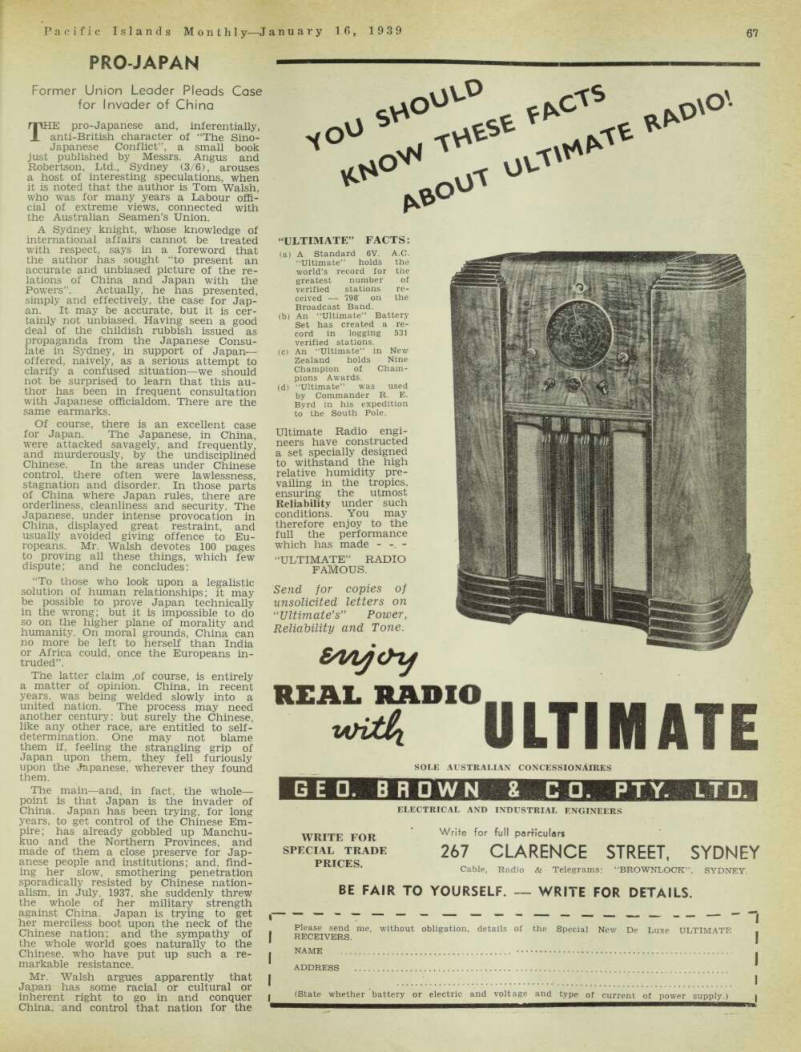
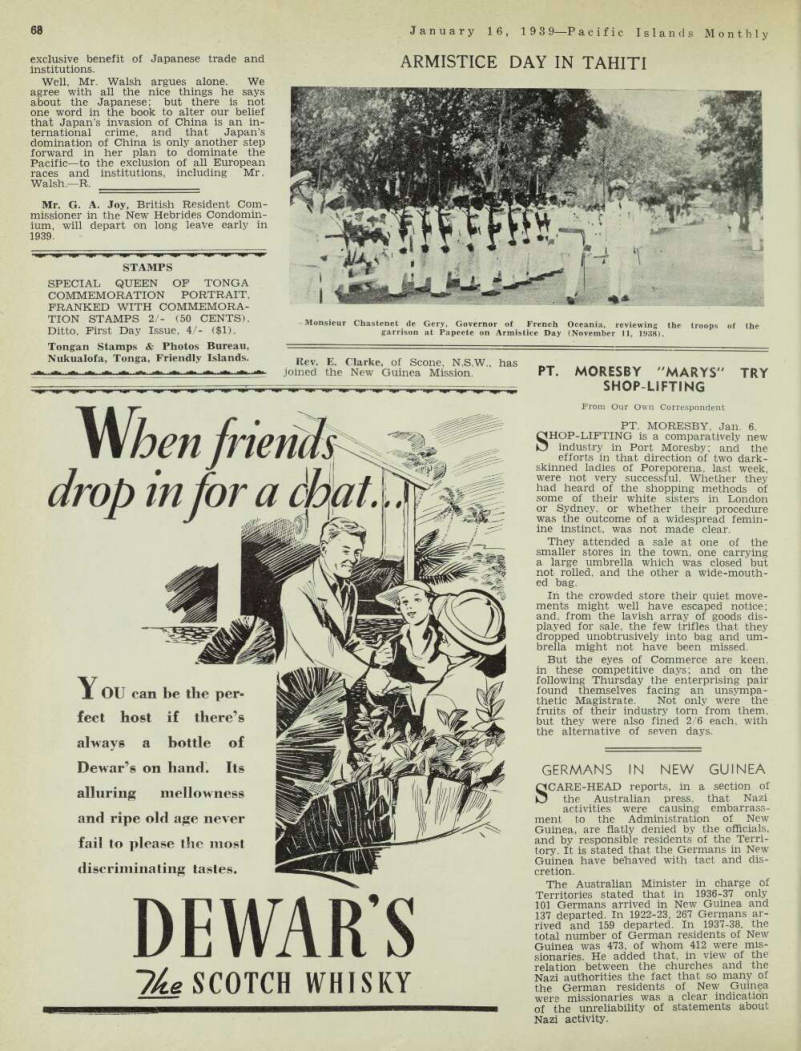
Former Union Leader Pleads Case for Invader of China
THE pro-Japanese and, inferentially,
anti-British character of “The Sino- Japanese Conflict”, a small book just published by Messrs. Angus and Robertson, Ltd., Sydney (3/6), arouses a host of interesting speculations, when it is noted that the author is Tom Walsh, who was for many years a Labour offi cial of extreme views, connected with the Australian Seamen’s Union.
A Sydney knight, whose knowledge of international affairs cannot be treated with respect, says in a foreword that the author has sought “to present an accurate and unbiased picture of the re lations of China and Japan with the Powers”. Actually, he has presented, simply and effectively, the case for Jap an. It may be accurate, but it is cer tainly not unbiased. Having seen a good deal of the childish rubbish issued as propaganda from the Japanese Consu late in Sydney, in support of Japan offered, naively, as a serious attempt to clarify a confused situation—we should not be surprised to learn that this au thor has been in frequent consultation with Japanese officialdom. There are the same earmarks.
Of course, there is an excellent case for Japan. The Japanese, in China, were attacked savagely, and frequently, and murderously, by the undisciplined Chinese. In the areas under Chinese control, there often were lawlessness, stagnation and disorder. In those parts of China where Japan rules, there are orderliness, cleanliness and security. The Japanese, under intense provocation in China, displayed great restraint, and usually avoided giving offence to Eu ropeans. Mr. Walsh devotes 100 pages to proving all these things, which few dispute; and he concludes: “To those who look upon a legalistic solution of human relationships; it may be possible to prove Japan technically in the wrong; but it is impossible to do so on the higher plane of morality and humanity. On moral grounds, China can no more be left to herself than India or Africa could, once the Europeans in truded”.
The latter claim ,of course, is entirely a matter of opinion. China, in recent years, was being welded slowly into a united nation. The process may need another century: but surely the Chinese, like any other race, are entitled to self determination. One may not blame them if, feeling the strangling grip of Japan upon them, they fell furiously upon the Japanese, wherever they found them.
The main—and, in fact, the whole— point is that Japan is the invader of China. Japan has been trying, for long years, to get control of the Chinese Em pire; has already gobbled up Manchu kuo and the Northern Provinces, and made of them a close preserve for Jap anese people and institutions; and, find ing her slow, smothering penetration sporadically resisted by Chinese nation alism. in July, 1937, she suddenly threw the whole of her military strength against China. Japan is trying to get her merciless boot upon the neck of the Chinese nation; and the sympathy of the whole world goes naturally to the Chinese, who have put up such a re markable resistance.
Mr. Walsh argues apparently that Japan has some racial or cultural or inherent right to go in and conquer China, and control that nation for the
exclusive benefit of Japanese trade and institutions.
Well, Mr. Walsh argues alone. We agree with all the nice things he says about the Japanese; but there is not one word in the book to alter our belief that Japan’s invasion of China is an in ternational crime, and that Japan’s domination of China is only another step forward in her plan to dominate the Pacific —to the exclusion of all European races and institutions, including Mr.
Walsh. —R. Mr. G. A. Joy, British Resident Com missioner in the New Hebrides Condomin ium, will depart on long leave early in 1939.
Advertisements & other items, pp. 69-70 (2 items)
67
Pacific Islands Monthl y—J anuary 16, 1939
•** Ultimate
“ULTIMATE” FACTS:
(a) A Standard 6V. A.C.
“Ultimate” holds the world’s record for the greatest number of verified stations received 798 on the Broadcast Band. (b) An “Ultimate” Battery Set has created a record in logging 531 verified stations. (c) An “Ultimate” in New Zealand holds Nine Champion of Champions Awards. (d) “Ultimate” was used by Commander R. E.
Byrd in his expedition to the South Pole.
Ultimate Radio engineers have constructed a set specially designed to withstand the high relative humidity prevailing in the tropics, ensuring the utmost Reliability under such conditions. You may therefore enjoy to the full the performance which has made - -
“ULTIMATE” RADIO
FAMOUS.
Send for copies of
unsolicited letters on “Ultimate , s ,> Power, Reliability and Tone. ■ m
REAL RADIO
•** ULTIMATE
SOLE AUSTRALIAN CONCESSIONAIRES
GE □. B R OWN & C □
WRITE FOR
SPECIAL TRADE
PRICES.
ELECTRICAL AND INDUSTRIAL ENGINEERS
Write for full parficulars
267 CLARENCE STREET. SYDNEY
1 Cable, Radio & Telegrams; “BROWNLOCK”, SYDNEY.
BE FAIR TO YOURSELF. WRITE FOR DETAILS.
Please send me, without obligation, details of the Special New De Luxe ULTIMATE .
RECEIVERS.
NAME
ADDRESS
(State whether battery or electric and voltage and type of current of power supply.)
STAMPS
SPECIAL QUEEN OF TONGA
COMMEMORATION PORTRAIT,
FRANKED WITH COMMEMORA-
TION STAMPS 2/- (50 CENTS).
Ditto, First Day Issue, 4/- ($1).
Tongan Stamps & Photos Bureau, Nukualofa, Tonga, Friendly Islands.
W henj
drop in for a a
& n y. y Y OU can be the perfect host if there’s always a bottle of Dewar’s on hand. Its alluring mellowness and ripe old age never fail to please the most discriminating tastes.
DEWAR’S
7Ae SCOTCH WHISKY
Armistice Day In Tahiti
Rev. E. Clarke, of Scone, N.S.W., has joined the New Guinea Mission.
Monsieur Chastenet de Gery, Governor of French Oceania, reviewing the troops of the garrison at Papeete on Armistice Day (November 11, 1938).
Shop-Lifting
Pt. Moresby "Marys" Try
From Our Own Correspondent
Pt. Moresby, Jan. 6.
SHOP-LIFTING is a comparatively new industry in Port Moresby; and the efforts in that direction of two dark skinned ladies of Poreporena, last week, were not very successful. Whether they had heard of the shopping methods of some of their white sisters in London or Sydney, or whether their procedure was the outcome of a widespread femin ine instinct, was not made clear.
They attended a sale at one of the smaller stores in the town, one carrying a large umbrella which was closed but not rolled, and the other a wide-mouth ed bag.
In the crowded store their quiet move ments might well have escaped notice; and, from the lavish array of goods dis played for sale, the few trifles that they dropped unobtrusively into bag and um brella might not have been missed.
But the eyes of Commerce are keen, in these competitive days; and on the following Thursday the enterprising pair found themselves facing an unsympa thetic Magistrate. Not only were the fruits of their industry torn from them, but they were also fined 2/6 each, with the alternative of seven days.
Germans In New Guinea
SCARE-HEAD reports, in a section of the Australian press, that Nazi activities were causing embarrass ment to the Administration of New Guinea, are flatly denied by the officials, and by responsible residents of the Terri tory. It is stated that the Germans in New Guinea have behaved with tact and dis cretion.
The Australian Minister in charge of Territories stated that in 1936-37 only 101 Germans arrived in New Guinea and 137 departed. In 1922-23, 267 Germans ar rived and 159 departed. In 1937-38, the total number of German residents of New Guinea was 473, of whom 412 were mis sionaries. He added that, in view of the relation between the churches and the Nazi authorities the fact that so many of the German residents of New Guinea were missionaries was a clear indication of the unreliability of statements about Nazi activity.
Mining News
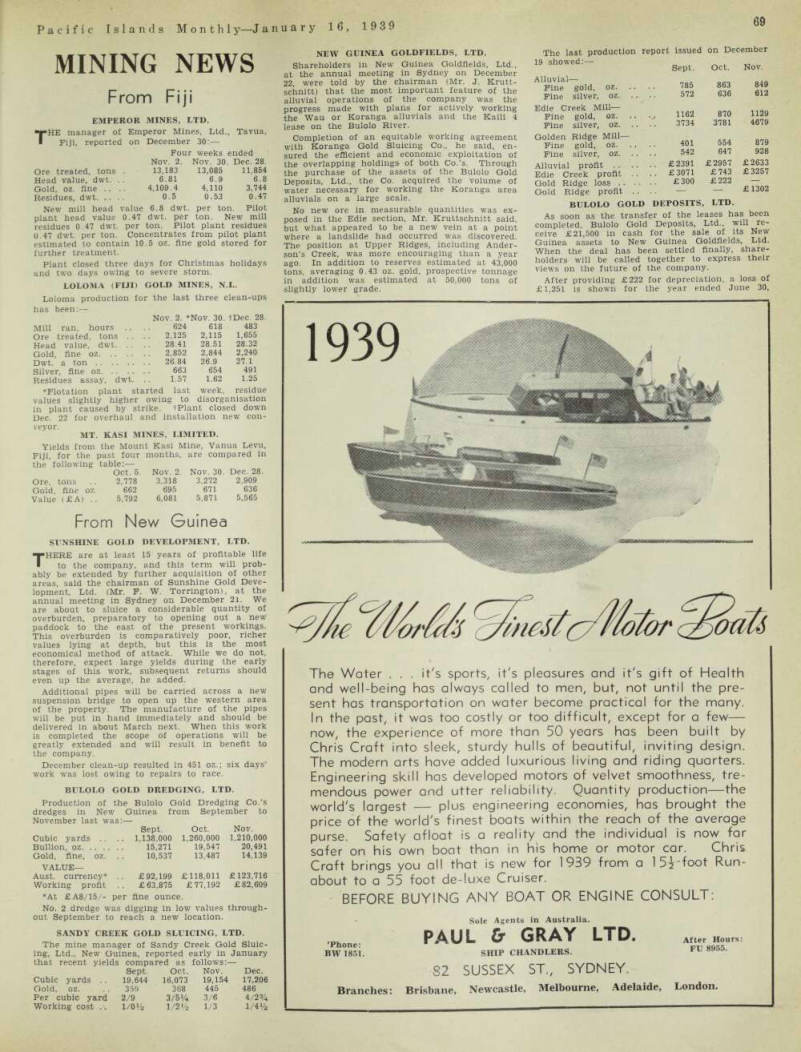
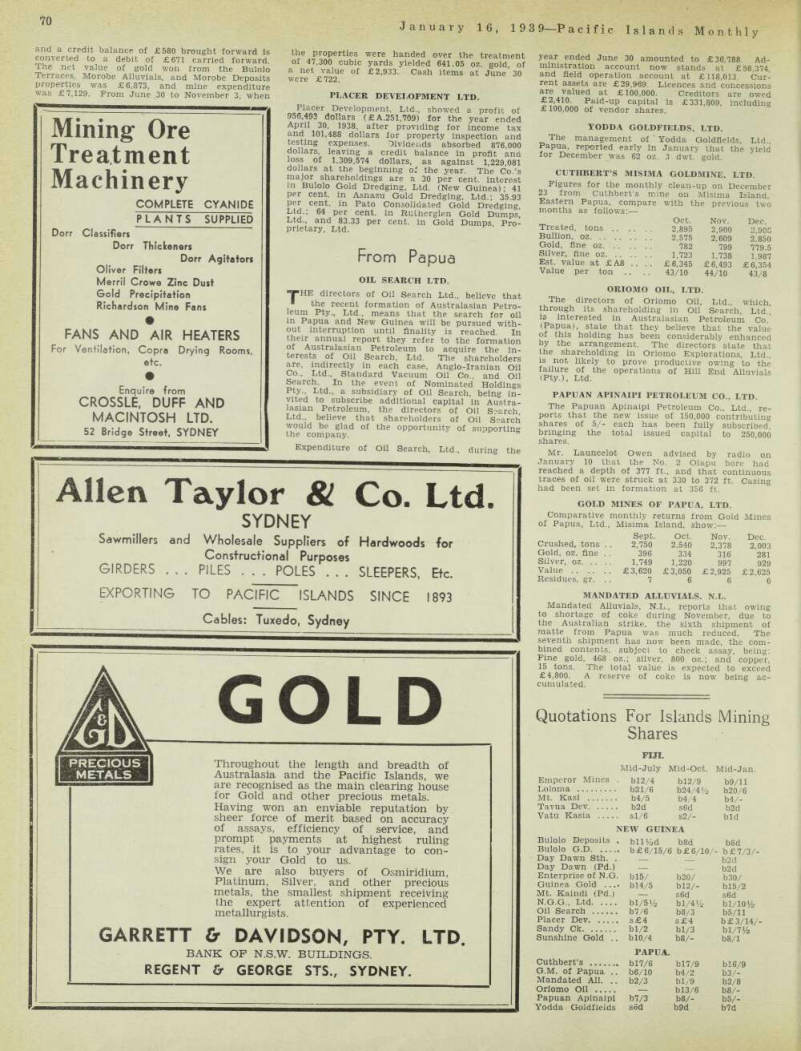
From Fiji
New mill head value 6.8 dwt. per ton. Pilot plant head value 0.47 dwt. per ton. New mill residues 0.47 dwt. per ton. Pilot plant residues 0.47 dwt. per ton. Concentrates from pilot plant estimated to contain 10.5 oz. fine gold stored for further treatment.
Plant closed three days for Christmas holidays and two days owing to severe storm.
Loloma (Fiji) Gold Mines, N.L.
Loloma production for the last three clean-ups has been: —
Mt. Kasi Mines, Limited.
Yields from the Mount Kasi Mine, Vanua Levu, Fiji, for the past four months, are compared in the following table: —
From New Guinea
Sunshine Gold Development, Ltd,
THERE are at least 15 years of profitable life to the company, and this term will prob ably be extended by further acquisition of other areas, said the chairman of Sunshine Gold Deve lopment, Ltd. (Mr. F. W. Torrington), at the annual meeting in Sydney on December 21. We are about to sluice a considerable quantity of overburden, preparatory to opening out a new paddock to the east of the present workings.
This overburden is comparatively poor, richer values lying at depth, but this is the most economical method of attack. While we do not, therefore, expect large yields during the early stages of this work, subsequent returns should even up the average, he added.
Additional pipes will be carried across a new suspension bridge to open up the western area of the property. The manufacture of the pipes will be put in hand immediately and should be delivered in about March next. When this work is completed the scope of operations will be greatly extended and will result in benefit to the company.
December clean-up resulted in 451 oz.; six days’ work was lost owing to repairs to race.
Bulolo Gold Dredging, Ltd.
Production of the Bulolo Gold Dredging Co.’s dredges in New Guinea from September to November last was:—
No. 2 dredge was digging in low values through out September to reach a new location.
Sandy Creek Gold Sluicing, Ltd.
The mine manager of Sandy Creek Gold Sluic ing, Ltd., New Guinea, reported early in January that recent yields compared as follows:
New Guinea Goldfields, Ltd.
Shareholders in New Guinea Goldfields, Ltd., at the annual meeting in Sydney on December 22, were told by the chairman (Mr. J. Krutt schnitt) that the most important feature of the alluvial operations of the company was the progress made with plans for actively working the Wau or Koranga alluvials and the Kaili 4 lease on the Bulolo River.
Completion of an equitable working agreement with Koranga Gold Sluicing Co., he said, en sured the efficient and economic exploitation of the overlapping holdings of both Co.’s. Through the purchase of the assets of the Bulolo Gold Deposits, Ltd., the Co. acquired the volume of water necessary for working the Koranga area alluvials on a large scale.
No new ore in measurable quantities was ex posed in the Edie section, Mr. Kruttschnitt said, but what appeared to be a new vein at a point where a landslide had occurred was discovered.
The position at Upper Ridges, including Ander son’s Creek, was more encouraging than a year ago. In addition to reserves estimated at 43,000 tons, averaging 0.43 oz. gold, prospective tonnage in addition was estimated at 50,000 tons of slightly lower grade.
Bulolo Gold Deposits, Ltd.
As soon as the transfer of the leases has been completed, Bulolo Gold Deposits, Ltd., will re ceive £21,500 in cash for the sale of its New Guinea assets to New Guinea Goldfields, Ltd.
When the deal has been settled finally, share holders will be called together to express their views on the future of the company.
After providing £222 for depreciation, a loss of £1,251 is shown for the year ended June 30,
Emperor
Mines, Ltd.
■••HE manager of 1 Fiji, reported Emperor Mines, Ltd., Tavua, on December 30; — Four weeks ended Nov. 2. Nov. 30. Dec. 28.
Ore treated, tons . 13,183 13,085 11,854 Head value, dwt. .. 6.81 6.9 6.8 Gold, oz. fine .. 4,109.4 4,110 3.744 Residues, dwt 0.5 0.53 0.47
Nov. 2. * Nov. 30. tDec. 28.
Mill ran, hours .. 624 618 483 Ore treated, tons .. 2,125 2,115 1,655 Head value, dwt. . . 28.41 28.51 28.32 Gold, fine oz 2,852 2,844 2,240 Dwt. a ton 26.84 26.9 27.1 Silver, fine oz 663 654 491 Residues assay, dwt. 1.57 1.62 1.25 •Flotation plant started last week, residue values slightly higher owing to disorganisation in plant caused by strike. tPlant closed down Dec. 22 for overhaul and installation new conveyor.
Oct. 5. Nov. 2. Nov. 30. Dec. 28.
Ore, tons . . 2.778 3.318 3,272 2,909 Gold, fine oz. 662 695 671 636 Value ( £ A) .. 5.792 6,081 5,871 5,565
Sept.
Oct.
Nov.
Cubic yards .. 1,138.000 1,260,000 1,210,000 Bullion, oz 15,271 19,547 20,491 Gold, fine, oz. 10,537 13,487 14,139
Value—
Aust. currency* £92,199 £118,011 £123,716 Working profit £63,875 £77,192 £82,609 •At £ A8/15/per fine ounce.
Sept.
Oct.
Nov.
Dec.
Cubic yards 19,644 16,073 19,154 17,206 Gold, oz. 359 368 445 486 Per cubic yard 2/9 3/51/4 3/6 4/23/4 Working cost .. 1/0 Va 1/2 «/ 2 1/3 1/41/2
The last production
report issued
on December 19 showed: — Sept.
Oct.
Nov.
Alluvial — Pine gold, oz. .. 785 863 849 Pine silver, oz. .. 572 636 612 Edie Creek Mill — Pine gold, oz. 1162 870 1129 Pine silver, oz. .. 3734 3781 4679 Golden Ridge Mill — Pine gold, oz. 401 554 879 Fine silver, oz. .. 542 647 928 Alluvial profit .. £2391 £2957 £2633 Edie Creek profit .. £3071 £743 £3257 Gold Ridge loss . . . . .. £300 £222 — Gold Ridge profit . . — — £ 1302
and a credit balance of £5BO brought forward is converted to a debit of £671 carried forward.
The net value of gold won from the Bulolo Terraces, Morobe Alluvials, and Morobe Deposits properties was £6,873, and mine expenditure was £7,129. From June 30 to November 3, when
the properties were handed over the treatment of 47,300 cubic yards yielded 641.05 oz. gold of a net value of £2,933. Cash items at June 30 were £722.
Placer Devei/Opment Ltd.
Placer Development, Ltd., showed a profit of 956,493 dollars (£A.251,709) for the year ended April 30, 1938, after providing for income tax and 101,488 dollars for property inspection and testing expenses. Dividends absorbed 876,000 dollars, leaving a credit balance in profit and loss of 1,309,574 dollars, as against 1,229,081 dollars at the beginning of the year. The Co.’s major shareholdings are a 30 per cent, interest in Bulolo Gold Dredging, Ltd. (New Guinea): 41 per cent, in Asnazu Gold Dredging, Ltd.; 35.93 per cent, in Pato Consolidated Gold Dredging, Ltd.; 64 per cent, in Rutherglen Gold Dumps Ltd., and 83.33 per cent, in Gold Dumps, Pro prietary, Ltd,
From Papua
Oil Search Ltd.
"T HE directors of Oil Search Ltd., believe that 0 the recent formation of Australasian Petro leum Pty., Ltd., means that the search for oil in Papua and New Guinea will be pursued with out interruption until finality is reached In their annual report they refer to the formation of Australasian Petroleum to acquire the in terests of Oil Search, Ltd. The shareholders are, indirectly in each case, Anglo-Iranian Oil Co., Ltd., Standard Vacuum Oil Co., and Oil Search. In the event of Nominated Holdings Pty., Ltd., a subsidiary of Oil Search, being in vited to subscribe additional capital in Austra lasian Petroleum, the directors of Oil Search, Ltd., believe that shareholders of Oil Search would be glad of the opportunity of supporting the company.
Expenditure of Oil Search, Ltd., during the
year ended June 30 amounted to £36,788. Ad ministration account now stands at £58,374, and field operation account at £118,013, Cur rent assets are £29,969. Licences and concessions are valued at £lOO,OOO. Creditors are owed £2,410. Paid-up capital is £331,809, including £lOO,OOO of vendor shares.
Yodda Goldfields, Ltd.
The management of Yodda Goldfields, Ltd., Papua, reported early in January that the yield for December was 62 oz. 3 dwt. gold.
Cutiibert’S Misima Goldmine, Ltd.
Figures for the monthly clean-up on December 23 from Cuthbert’s mine on Misima Island.
Eastern Papua, compare with the previous two months as follows:
Oriomo Oil, Ltd.
The directors of Oriomo Oil, Ltd., which, through its shareholding in Oil Search, Ltd.| is interested in Australasian Petroleum Co’ (Papua), state that they believe that the value of this holding has been considerably enhanced by the arrangement. The directors state that the shareholding in Oriomo Explorations, Ltd., is not likely to prove productive owing to the failure of the operations of Hill End Alluvials (Pty.), Ltd.
Papuan Apinaipi Petroleum Co., Ltd.
The Papuan Apinaipi Petroleum Co., Ltd., re ports that the new issue of 150,000 contributing shares of 5/- each has been fully subscribed, bringing the total issued capital to 250,000 shares.
Mr. Launcelot Owen advised by radio on January 10 that the No. 2 Oiapu bore had reached a depth of 377 ft., and that continuous traces of oil were struck at 330 to 372 ft. Casing had been set in formation at 356 ft.
Gold Mines Of Papua, Ltd.
Comparative monthly returns from Gold Mines of Papua, Ltd., Misima Island, show: —
Mandated Alluvials. Nx.
Mandated Alluvials, NX., reports that owing to shortage of coke during November, due to the Australian strike, the sixth shipment of matte from Papua was much reduced. The seventh shipment has now been made, the com bined contents, subject to check assay, being: Fine gold, 468 oz.; silver, 800 oz.; and copper, 15 tons. The total value is expected to exceed £4,800. A reserve of coke is now being ac cumulated.
Oct. Nov. Dec.
Treated, tons 2,895 2.900 2.90C Bullion, oz 2,575 2.609 2 850 Gold, fine oz 782 799 779.5 Silver, fine oz 1,723 1.738 1 987 Est. value at £A8 .. .. £6,345 £6,493 £6,354 Value per ton ,. .. 43/10 44/10 43/8
Sept.
Oct.
Nov.
Dec.
Crushed, tons .. 2,750 2,540 2,378 2,003 Gold, oz. fine .. 396 334 316 281 Silver, oz 1,749 1,220 997 929 Value £3,620 £3,050 £2,925 £2,625 Residues, gr. .. 7 6 6 6
Advertisements & other items, pp. 71-72 (2 items)
69
Pacific Islands Monthl y —J anuary 16, 1939
Paul & Gray Ltd.
* S' 3f r o/\ The Water . . . it's sports, it's pleasures and it's gift of Health and well-being has always called to men, but, not until the present has transportation on water become practical for the many.
In the past, it was too costly or too difficult, except for a few— now, the experience of more than 50 years has been built by Chris Craft into sleek, sturdy hulls of beautiful, inviting design.
The modern arts have added luxurious living and riding quarters.
Engineering skill has developed motors of velvet smoothness, tremendous power and utter reliability. Quantity production—the world's largest plus engineering economies, has brought the price of the world's finest boats within the reach of the average purse. Safety afloat is a reality and the individual is now far safer on his own boat than in his home or motor car. Chris Craft brings you all that is new for 1939 from a 1 si~foot Runabout to a 55 foot de-luxe Cruiser.
BEFORE BUYING ANY BOAT OR ENGINE CONSULT: ’Phone: BW 1851.
Branches: After Hours: FU 8955.
Sole Agents in Australia.
PAUL & GRAY LTD.
SHIP CHANDLERS.
82 SUSSEX ST., SYDNEY.
Brisbane, Newcastle, Melbourne, Adelaide, London.
Mining Ore
Treatment
Machinery
COMPLETE CYANIDE
PLANTS SUPPLIED
Dorr Classifiers Dorr Thickeners Dorr Agitators Oliver Filters Merrii Crowe Zinc Dust Gold Precipitation Richardson Mine Fans •
FANS AND AIR HEATERS
For Ventilation, Copra Drying Rooms, etc. • Enquire from
CROSSLE, DUFF AND
MACINTOSH LTD.
52 Bridge Street. SYDNEY
Allen Taylor & Co. Ltd.
SYDNEY
Sawmillers and Wholesale Suppliers of Hardwoods for Constructional Purposes GIRDERS . . . PILES . . . POLES . . . SLEEPERS. Etc.
EXPORTING TO PAoTrC ISLANDS SINCE 1893
Cables: Tuxedo, Sydney
A
GOLD
Throughout the length and breadth of Australasia and the Pacific Islands, we are recognised as the main clearing house for Gold and other precious metals.
Having won an enviable reputation by sheer force of merit based on accuracy of assays, efficiency of service, and prompt payments at highest ruling rates, it is to your advantage to consign your Gold to us.
We are also buyers of Osmiridium, Platinum, Silver, and other precious metals, the smallest shipment receiving the expert attention of experienced metallurgists.
GARRETT fir DAVIDSON, PTY. LTD.
BANK OF N.S.W. BUILDINGS.
REGENT & GEORGE STS., SYDNEY.
Quotations For Islands Mining
Shares
Fiji.
Mid-July Mid-Oct.
Mid-Jan.
Emperor Mines . bl2/4 bl2/9 b9/ll Loloma b21/6 b24/4i/ a b20/6 Mt. Kasi b4/5 b4/4 b4/- Tavua Dev b2d s6d b2d Vatu Kasia sl/6 s2/bid
New Guinea
Bulolo Deposits . ■ bliy 2 d b8d b8d Bulolo G.D * b£ 6/15/6 b£6/10/ - b £ 7/3/- Day Dawn Sth. . — b2d Day Dawn (Pd.) b2d Enterprise of N.G. bl5/ b20/ b30/ Guinea Gold ... • bl4/5 bl2/bl5/2 Mt. Kaindi (Pd.) — s6d s6d N.G.G., Ltd b I/51/2 b 1/4 1/2 b 1/10 1/2 Oil Search b7/6 b8/3 b5/ll Placer Dev s £4 s £4 b£3/14/- Sandy Ck bl/2 bl/3 bl/71/2 Sunshine Gold .. blO/4 b8/b8/l
Papua.
Cuthbert’s bl7/6 bl7/9 bl6/9 G.M. of Papua .. b6/10 b4/2 b3/- Mandated All. .. b2/3 bl/9 b2/8 Oriomo Oil — bl3/6 b8/- Papuan Apinaipi b7/3 b8/b5/- Yodda Goldfields sod b9d b7d
This Needed Patience!
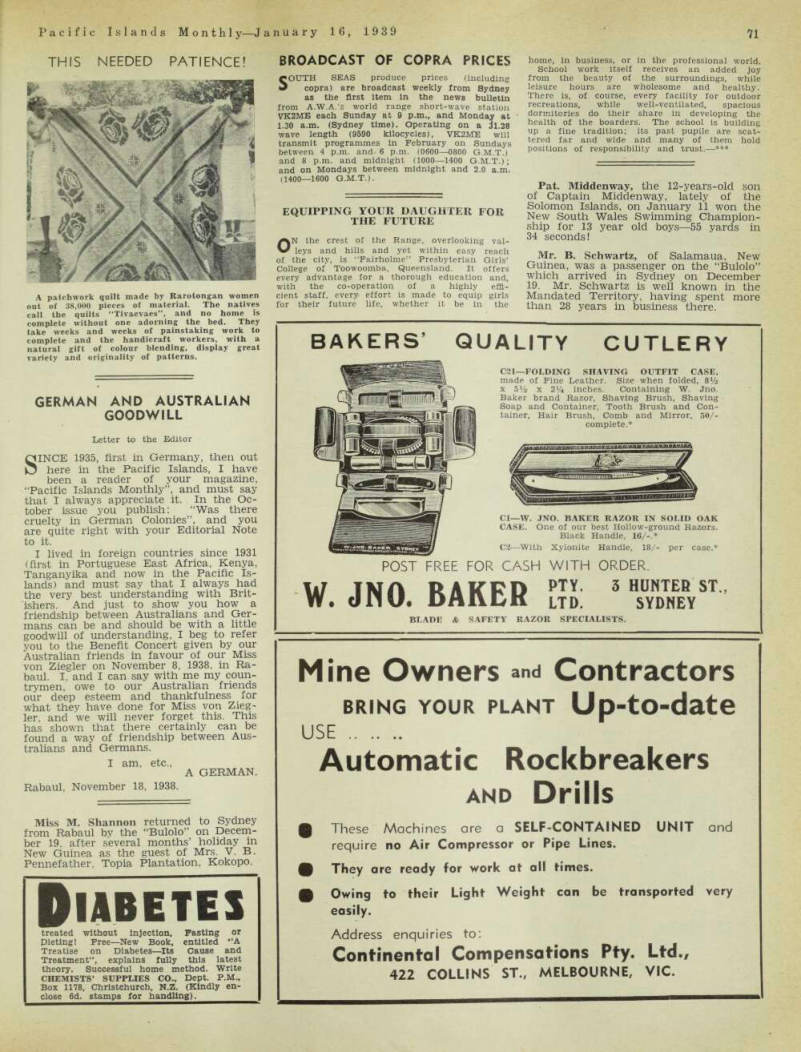
A patchwork quilt made by Rarotongan women out of 38,000 pieces of material. The natives call the quilts “Tivaevaes”, and no home is complete without one adorning the bed. They take weeks and weeks of painstaking work to complete and the handicraft workers, with a natural gift of colour blending, display great variety and originality of patterns.
German And Australian
Goodwill
Letter to the Editor SINCE 1935, first in Germany, then out here in the Pacific Islands, I have been a reader of your magazine, “Pacific Islands Monthly”, and must say that I always appreciate it. In the Oc tober issue you publish: “Was there cruelty in German Colonies”, and you are quite right with your Editorial Note to it.
I lived in foreign countries since 1931 (first in Portuguese East Africa, Kenya, Tanganyika and now in the Pacific Is lands) and must say that I always had the very best understanding with Brit ishers. And just to show you how a friendship between Australians and Ger mans can be and should be with a little goodwill of understanding, I beg to refer you to the Benefit Concert given by our Australian friends in favour of our Miss von Ziegler on November 8, 1938, in Ra baul. I, and I can say with me my coun trymen, owe to our Australian friends our deep esteem and thankfulness for what they have done for Miss von Zieg ler. and we will never forget this. This has shown that there certainly can be found a way of friendship between Aus tralians and Germans.
I am, etc.,
A German.
Rabaul, November 18, 1938.
Miss M. Shannon returned to Sydney from Rabaul by the “Bulolo” on Decem ber 19. after several months’ holiday in New Guinea as the guest of Mrs. V. B.
Pennefather, Topia Plantation, Kokopo.
Broadcast Of Copra Prices
SOUTH SEAS produce prices (including copra) are broadcast weekly from Sydney as the first item in the news bulletin from A.W.A.’s world range short-wave station VK2ME each Sunday at 9 p.m., and Monday at 1.30 a.m. (Sydney time). Operating on a 31.28 wave length (9590 kilocycles), VK2ME will transmit programmes in February on Sundays between 4 p.m. and 6 p.m. (0600 —0800 G.M.T.) and 8 p.m. and midnight (1000 —1400 G.M.T.); and on Mondays between midnight and 2.0 a.m.
(1400—1600 G.M.T.).
of Captain Middenway, lately of the
Equipping Your Daughter For
The Future
ON the crest of the Range, overlooking val leys and hills and yet within easy reach of the city, is “Fairholme” Presbyterian Girls’
College of Toowoomba, Queensland. It offers every advantage for a thorough education and, with the co-operation of a highly effi cient staff, every effort is made to equip girls for their future life, whether it be in the
home. In business, or in the professional world.
School work itself receives an added joy from the beauty of the surroundings, while leisure hours are wholesome and healthy.
There is, of course, every facility for outdoor recreations, while well-ventilated, spacious dormitories do their share in developing the health of the boarders. The school is building up a fine tradition; its past pupile are scat tered far and wide and many of them hold positions of responsibility and trust. —♦** Pat. Middenway, the 12-years-old son of Captain Middenway, lately of the Solomon Islands, on January 11 won the New South Wales Swimming Champion ship for 13 year old boys—ss yards in 34 seconds!
Mr. B. Schwartz, of Salamaua, New Guinea, was a passenger on the “Bulolo” which arrived in Sydney on December 19. Mr. Schwartz is well known in the Mandated Territory, having spent more than 28 years in business there.
Advertisements & other items, pp. 73-74 (2 items)
W. Jno. Baker
BAKERS’ QUALITY CUTLERY
C2I—FOLDING SHAVING OUTFIT CASE.
made of Fine Leather. Size when folded, BV2 x 5 l / 2 x 214 inches. Containing W. Jno.
Baker brand Razor, Shaving Brush, Shaving Soap and Container, Tooth Brush and Container, Hair Brush, Comb and Mirror, 50/complete.* i Cl—W. JNO. BAKER RAZOR IN SOLID OAK CASE. One of our best Hollow-ground Razors.
Black Handle, 16/-.* C2 —With Xylonite Handle, 18/- per case.*
POST FREE FOR CASH WITH ORDER.
PTY. 3 HUNTER ST.,
LTD. SYDNEY
W. JNO. BAKER
BLADE & SAFETY RAZOR SPECIALISTS.
Mine Owners and Contractors
BRING YOUR PLANT Up-t O-date
USE
Automatic Rockbreakers
AND Drills
0 These Machines are a SELF-CONTAINED UNIT and require no Air Compressor or Pipe Lines.
They are ready for work at all times. 9 Owing to their Light Weight can be transported very easily.
Address enquiries to:
Continental Compensations Pty. Ltd.,
422 COLLINS ST., MELBOURNE, VIC.
ELECTRIC OSCILLATING FANS
For operation from 240 volt A.C Supply. Overall height 16 inches Wind Propeller 4-Blade, 12 inch diameter, completely enclosed wire shield, convenient switch in base having off position and speed positions. The Oscillating feature ensures the Wind Stream being directed over an angle of at least 45 degrees. £6/6/-.
Stromberg 240 A.C. Fans 29/6, Adjustable all way Morse Code Key as illustrated. 12/6.
P.M.G. Type, 19/6.
Buzzers 2/6, 2/9, 3/6, 7/6.
Gramophone Recording Units, overhead cutting Gear, with cutting Head: £B/10/-. Motors: 84/-. £5/5/-. Microphones 39/6; Needles Blank Records, etc., etc. Write for particulars. Also see second column.
A d j u s table Electric Forehead Torch Fits snugly; for Professional Men B andsmen, Miners, etc. 10/6. With separate Torch Battery Container: 18/6. Batteryless Hand Torch, 25/-, Heavy Duty XL Electric Solder Irons. 12 months’ guarantee. 32/6 value. NOW 22/6.
Accumulators. Unspillable genuine British Built Every Ready. 2 Volt units. NOW 18/6. Actual output, 20 amps.
Buy assembled or build the Air Patrol 2 - valve Battery - operated Radio for all short-wave stations and broadcasts. Easy to operate, change over switch. All parts £4/1/6, Valves 28/9, Batteries £2/15/9, Phones 30/-, Speaker 21/3.
The set assembled and complete, £l2/14/9. Easiway Charts 6d.
Valves; we guarantee a cheaper price for any replacement. Just send along your order.
“Totem”, a wellmade little game, for Homes, Clubs, Hotels, etc. Push the starting knob and off spin the 2 reels, one the horses and the other the odds when the spin terminates the Winner and Winner’s Price is clearly shown.
Cheat and fool-proof, 21/-.
Send for Leaflet.
Electric Dry shavers for 240
A.C. D.C. El-
ectric supply. Write for full list.
“VICO” 75/.
Special price to traders. Write for prices. “Packard” 90/-. We stock every make. uar Sets—Nothing Better, Lowest Battery Drain, £l6/16/-. Others, £l9/10/and £22/10/-. Call or write for particulars.
Pocket Telescopes, made in England, 3/11, 4/11, 5/6, 10/6, 16/6.
French Domino Sets, bevelled Ebony backs, 8/6, 12/6, 18/6. Cheaper grades, i/6, 3/6, 5/6.
Dart Boards, 3/11, 5/6, 8/11, 15/-, 21/-.
Feathered Competition Brass Darts, set of 3 for 7/6. Send for Lists.
Ormond 3in. Vernier 2-Action Dials, 8/6.
Dynamic Speaker, all ohmages, best make, 17/9. Brand New.
Permagnetic Speaker, Sin. and 6 3 / 4 in 23/-. Leading Make.
Amplion LI, Permagnetic Speaker, 35/to Clear. L 5, 10in., 45/-.
Highest Grade Swiss Music Boxes, for Cigarettes, etc., 25/-, 35/-, 37/6, 39/6, Book Jokes—What To Know About Women. Album of Parisian Beauties, 2 for 2/6, post free.
Novelty Trick Cigars, giant size, smoke cigarette inside, 1/-.
Splendid Tricks and Puzzles. The T Trick, 9d. The Squarem Puzzle, 9d. The 2 Asses Puzzle, 1/-.
Lightweight Table Tennis Bats, 2/6; Eng lish Balls, 2/6 dozen. Cameras, samples, 63/-; Model, 35/-; 5.50 Models. 55/-.
Electric Bells, work right off 240 volts 13/6; Battery Operated Electric Bells 3/11, 4/6; 2-way Insulated 100 ft. Coils of Wire, excellent for bells, etc., 5/- coil.
Like-a-Flash Super Ret. Mantle Model Electric Radio, 1938-9 designs. £l3/10 value. NOW £B/10/- CASH.
Trade-in Radios, £5/10/-, £B/10/ £l2/10/-. All reconditioned as new.
Rebuilt 4 Valve Marco 4 Battery Sets, in Console Cabinets £B/10/-.
A Levenson Creation: The Like-a-Flash “Lilliput” Portable Battery Operated Radio Receiver. IT’S NEW. 2 Valves, complete with headphones, aerial, earth, etc. Small, compact, and efficient, £7/10/- Complete. Take it with you anywhere you go. The most economical Set ever introduced. Not much larger than a cigar box.
CROWN AND ANCHOR SETS, 10/6.
5 Poker Dice, in box .. .. 7/6 and 10/6 In Leather Case 7/6, 10/6, 12/6 Head and Tail Dice, Sets of Five, 8/6 valve Sockets. Phospher Bronze Pit and 11/6. Large Transparent 1 to 6 tings 1/3 11/6. Large Transparent Dice, 1/6 each. Extra Large 2/6.
We stock all kinds of Dice and Dice Cups.—Send for Lists.
Electric Train Sets, Loco., Tender, and 12 Rails, 65/, 75/-, 85/-, 95/-.
Transformers. 17/6, 21/-, 25/- Extra.
The World’s Best Indoor Pastime-Game: MONOPOLY”. The World’s Craze. 10/6. BIG BUSINESS, 12/9. A Facsimile Game. We stock Games of all kinds.
“Presto”, the Mysterious Coin-Box!
The most baffling Trick ever conceived* Borrow a coin; request owner to mark in a way he will identify it again. In exchange for coin, hand him a small bakelite box bound up.
Ask him to open it. Inside he will find a match box, also securely bound. Inside this he will find a cloth bag, also bound up. When opened up, he finds the coin he marked, in the bag. This is one of the most mystifying Tricks ever performed. Price, complete with instructions: 2/6, plus postage, 3d.
Like-a-flash Eliminoise Aerial Kit. for short d u a wave sets.
Aenal Pyrex type Insulators, transposi 1 1 o n blocks and 200 ft. aerial wire, 22/6. Eliminates unwanted aerial and hideous electrical noises from your dual-wave or short-wave set.
Goldring English Pick-up Heads. Suit and Fit all Gramophone Tone Arms Type 44/4 Pick-up Head with Builtin Volume Control: 19/6. Type 44/5 Pick-up Head, with Volume Control attached: 21/-, Type 33/3 Pick-up Head with Highly Polished Nickle Finish: 18/6. Bakelite Case Pick-up Head: 16/6.
Table Type Interesting Pin Games: 12/6, 15/-. Competition Dart Boards 21/-. Others: 2/6, 8/11, 11/6. Competition Brass and Feathered Darts 3 for 5/6. Table Tennis Sets: 7/6 15/-. Model Aeroplane Kits, all types Write for leaflets. Draught Sets 4/6, 6/6, 10/6. Monopoly Sets: 10/6, 16/6, 21/-. Big Business. A Monopoly type of game, 12/6. r r “Yogi”, The greatest and straightest of all tricks, match size. You keep them guessing.
Its uncanny— its wonderful, 2/6.
We guarantee a better price for all kinds of canvas goods, horse rugs tents, tarpaulins, window blinds, etc.
Also material in the piece. Ask for quote.
Midget Single Jack 1 Hole Mount- % 1/3.
Ormond” British .00035 Single Hole Mount Variable Condensers, with 4in.
Black Polished Bakelite Dial, 15/-
NOW
7/6.
“Pilot” U.S.A. .00035 Variable Condensers, 11/6. NOW 5/6.
Sterling Silver Cats Whiskers for Crystal Sets ga.
“Pacent” Shockproof UX Bakelite Auto Aerials, 2 and 3 Strand Roof Type, 31/, Collapsible Type 21/. Trad- , write for Price. Just landed: Collapsible-hinge Type. Fits easily and quickly on Door Hinge, 33/-.
Range U.S.A. Types.
All Metal, Indestructible Vest Pocket Size, Quick and Easy Cigarette Maker, 6/6.
G r a phoscope 8/6. With it you can copy any Drawing or Photo up to size 6 x 4 in.
Write for full list of Foreign Stamps and Albums.
Microphones. Sing, Play, Recite. Great Fun for Home, Dance, Party, etc., or for use in Factories, Stores, etc. Write for full range. Just plug leads of Microphone into pick-up terminals of any set. 9/6 to £6/6/-. \J/ eov/ 00 As illustrated with long lead fitted. Splendid Reproducer. 22/6 Excel lent English Mic r 0 p h o ne.
Table Model, with selfcontained pre - amplifier unit In Base: 39/6.
These Microphones suit all sets. The leads plug into the Pickup terminals of the set.
Write for full Illustrated list of the finest range of microphones available.
Sweet Chim- ®Trm^ rriol l“g Bell. A WOW B e a u t i f u 1 BtU unit. Works off Batt. or ChmU T ran sformer ACo»OC S/6. Write for full list of Radio Gramophone Microphones.
Wates Pocket Meters: 14/-.
Reads 0 to 6, 0 to 15, 0 to 180 volts. 0 to 30 M/A. 2 Reading Pocket Volt Meters 7/6. 3 Reading Meters 10/6.
Emmicol Universal Meter 18/6. 0 to 6, 0 to 150, 0 to 30 M/A, 0 to 2000 ohms 18/6.
Electrical Continental Solder Irons, 240 volts: 15/-. 6 v.
Electric Solder Irons; 22/6.
Large 50 amp. Battery Clips: 1/3 each.
COSMOCOCD'
25- “Like a Flash” British make Gramophone Pickups complete Richards, just arrived 25/- “Cosmocord” . . . 25/- “Cosmocord” De Luxe 32/6 “Cosmocord” high definition 38/6 “Cosmocord” Super de Luxe 45/- Amplion (English) 28/6 B.T.H. Crystal Type 75/-.
Write for Full List.
Gramophone Record Overhead Cutting Unit, with Cutting Head, 84/-, Local Made, £B/10/- British make.
Gramophone Records for Home Recording; Sin. Plain Celluloid Blanks, 7/6; Plain Acetate, Bin., 3/6; lOin. 5/6; 12in.
Pregrooved, Bin., 4/6; 10in., 6/6. Steel Cutting Needles, 2/- each. Special Play Back Needles, 4/6 per 100; 2/6 per 50.
R.C.A. Victor Cutting Needles for Pregrooved Records, 8 for 5/-.
Write for Punch Board Leaflets
LEVENSON’S RADSO
GAMES. NOVELTIES AND HOBBIES
226 PITT STREET. SYDNEY
Write for Pin-Game, Totem and Odds and Manufacturers, Importers, and Exporters. L ea fl e t s Branches: Radio Cheapside, 240 a Pitt St.
N.S.W., AUSTRALIA
Cable address: “Leveradioh." Goods forwarded V.P.P. or Sight Draft. Satisfaction and Service Guaranteed. We can supply by mail all General Merchandise at a Better Price. Quotations with pleasure.
Please add freight and packing. Write for full list of interesting leaflets of Games, Hobbies, Novelties, and Electrical Goods.
Diabetes
treated without injection. Pasting or Pietlng! Free—New Book, entitled “A Treatise on Diabetes—lts Cause and Treatment”, explains fully this latest theory. Successful home method. Write
CHEMISTS’ SUPPLIES CO., Dept. P.M.,
Box 1178, Christchurch, N.Z. (Kindly enclose 6d. stamps for handling).
Australian Short Wave
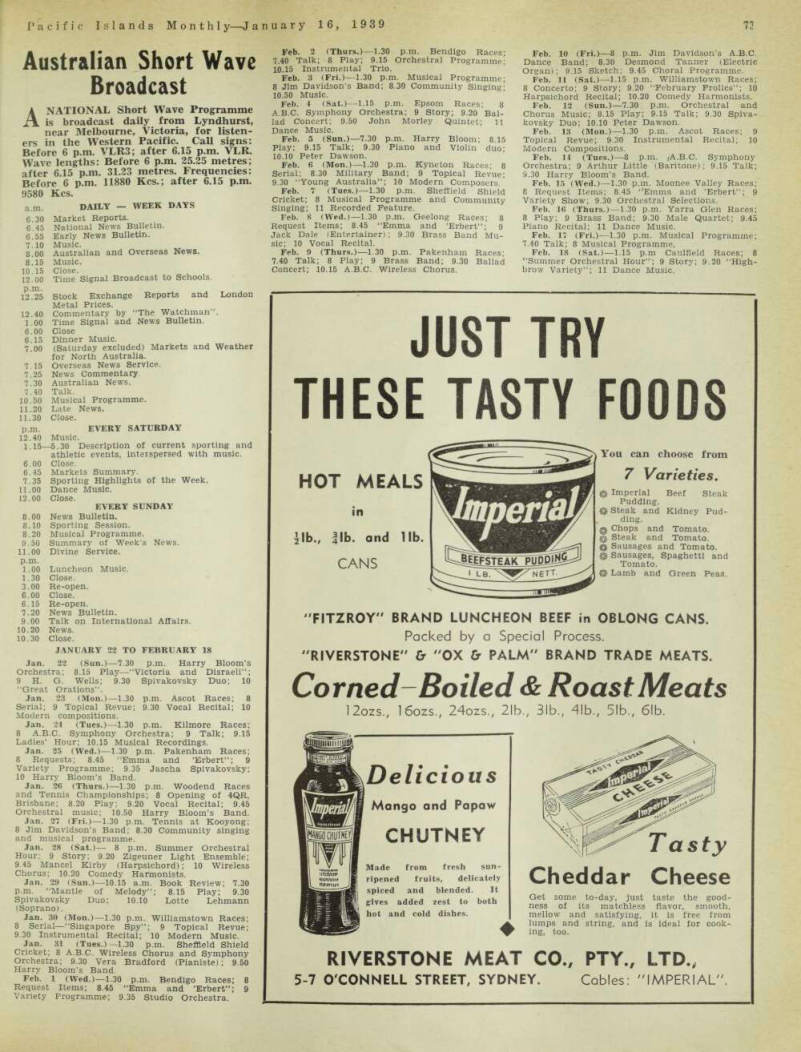
Broadcast
A NATIONAL Short Wave Programme is broadcast daily from Lyndhurst, near Melbourne, Victoria, for listen ers in the Western Pacific. Call signs: Before 6 p.m. VLR3; after 6.15 p.m. VLR.
Wave lengths: Before 6 p.m. 25.25 metres; after 6.15 p.m. 31.23 metres. Frequencies: Before 6 p.m. 11880 Kcs.; after 6.15 p.m. 9580 Kcs.
A M. Daily Week Days
6.30 Market Reports. 6.45 National News Bulletin. 6.55 Early News Bulletin. 7.10 Music. 8.00 Australian and Overseas News. 8.15 Music.
10.15 Close. , ,
12.00 Time Signal Broadcast to Schools, p.m. 12.25 Stock Exchange Reports and London Metal Prices. 12.40 Commentary by “The Watchman”. 1.00 Time Signal and News Bulletin. 6.00 Close 6.15 Dinner Music. 7.00 (Saturday excluded) Markets and Weather for North Australia. 7.15 Overseas News Service. 7.25 News Commentary 7.30 Australian News. 7.40 Talk. 10.50 Musical Programme. 11.20 Late News. 11.30 Close.
P.M. Every Saturday
12.40 Music. 1.15 —5.30 Description of current sporting and athletic events, interspersed with music. 6.00 Close. 6.45 Markets Summary. 7.35 Sporting Highlights of the Week. 11.00 Dance Music. 12.00 Close.
Every Sunday
8.00 News Bulletin. 8.10 Sporting Session. 8.20 Musical Programme. 9.50 Summary of Week’s News. 11.00 Divine Service, p.m. 1.00 Luncheon Music. 1.30 Close. 3.00 Re-open. 6.00 Close. 6.15 Re-open. 7.20 News Bulletin. 9.00 Talk on International Affairs. 10.20 News. 10.30 Close.
January 22 To February 18
Jan. 22 (Sun.) —7.30 p.m. Harry Bloom’s Orchestra; 8.15 Play—“ Victoria and Disraeli”; 9 H. G. Wells; 9.30 Spivakovsky Duo; 10 “Great Orations”.
Jan. 23 (Mon.) —1.30 p.m. Ascot Races; 8 Serial; 9 Topical Revue; 9.30 Vocal Recital; 10 Modern compositions.
Jan. 24 (Tues.) —1.30 p.m. Kilmore Races; 8 A.B.C. Symphony Orchestra; 9 Talk; 9.15 Ladies’ Hour; 10.15 Musical Recordings.
Jan. 25 (Wed.) —1.30 p.m. Pakenham Races; 8 Requests; 8.45 “Emma and ’Erbert”; 9 Variety Programme; 9.35 Jascha Spivakovsky; 10 Harry Bloom’s Band.
Jan. 26 (Thurs.) —1.30 p.m. Woodend Races and Tennis Championships; 8 Opening of 4QR, Brisbane; 8.20 Play; 9.20 Vocal Recital; 9.45 Orchestral music; 10.50 Harry Bloom’s Band.
Jan. 27 (Fri.) —1.30 p.m. Tennis at Kooyong: 8 Jim Davidson’s Band; 8.30 Community singing and musical programme.
Jan, 28 (Sat.) — 8 p.m. Summer Orchestral Hour; 9 Story; 9.20 Zigeuner Light Ensemble; 9,45 Mancel Kirby (Harpsichord): 10 Wireless Chorus; 10.20 Comedy Harmonists.
Jan. 29 (Sun.) —10.15 a.m. Book Review; 7.30 p.m. “Mantle of Melody”; 8.15 Play; 9.30 Spivakovsky Duo; 10.10 Lotte Lehmann (Soprano).
Jan. 30 (Mon.) —1.30 p.m. Williamstown Races; 8 Serial—“ Singapore Spy”; 9 Topical Revue; 9.30 Instrumental Recital; 10 Modern Music.
Jan. 31 (Tues.)—l.3o p.m. Sheffield Shield Cricket: 8 A.B.C. Wireless Chorus and Symphony Orchestra; 9.30 Vera Bradford (Pianiste); 9.50 Harry Bloom’s Band.
Feb. 1 (Wed.) —1.30 p.m. Bendigo Races; 8 Request Items; 8.45 “Emma and ’Erbert”; 9 Variety Programme; 9.35 Studio Orchestra.
Feb. 2 (Thurs.)—l.3o p.m. Bendigo Races; 7.40 Talk; 8 Play; 9.15 Orchestral Programme; 10.15 Instrumental Trio.
Feb. 3 (Fri.)—l.3o p.m. Musical Programme; 8 Jim Davidson’s Band; 8.30 Community Singing; 10.50 Music.
Feb. 4 (Sat.)—l.ls p.m. Epsom Races; 8 A.B.C. Symphony Orchestra; 9 Story; 9.20 Ballad Concert; 9.50 John Morley Quintet; 11 Dance Music.
Feb. 5 (Sun.)—7.3o p.m. Harry Bloom; 8.15 Play; 9.15 Talk; 9.30 Piano and Violin duo; 10.10 Peter Dawson.
Feb. 6 (M0n.)—1.30 p.m. Kyneton Races; 8 Serial; 8.30 Military Band; 9 Topical Revue; 9.30 “Young Australia”: 10 Modern Composers.
Feb. 7 (Tues.)—l.3o p.m. Sheffield Shield Cricket: 8 Musical Programme and Community Singing; 11 Recorded Feature.
Feb. 8 (Wed.)—l.3o p.m. Geelong Races; 8 Request Items; 8.45 “Emma and ’Erbert”; 9 Jack Dale (Entertainer); 9.30 Brass Band Music; 10 Vocal Recital.
Feb. 9 (Thurs.)—l.3o p.m. Pakenham Races; 7.40 Talk; 8 Play; 9 Brass Band; 9.30 Ballad Concert; 10.15 A.B.C. Wireless Chorus.
Feb. 10 (Fri.)—B p.m. Jim Davidson’s A.B.C.
Dance Band; 8.30 Desmond Tanner (Electric Organ); 9.15 Sketch; 9.45 Choral Programme.
Feb, 11 (Sat.)—l.ls p.m. Williamstown Races; 8 Concerto; 9 Story; 9.20 “February Frolics”: 10 Harpsichord Recital; 10.20 Comedy Harmonists.
Feb. 12 (Sun.)—7.3o p.m. Orchestral and Chorus Music; 8.15 Play; 9.15 Talk; 9.30 Spiva kovsky Duo; 10.10 Peter Dawson.
Feb. 13 (M0n.)—1.30 p.m. Ascot Races; 9 Topical Revue; 9.30 Instrumental Recital; 10 Modern Compositions. peb. 14 (Tues.)—B p.m. (A.B.C. Symphony Orchestra; 9 Arthur Little (Baritone): 9.15 Talk; 9.30 Harry Bloom’s Band.
Feb. 15 (Wed.)—l.3o p.m. Moonee Valley Races; 8 Request Items; 8.45 “Emma and ’Erbert”; 9 Variety Show; 9.30 Orchestral Selections.
Feb. 16 (Thurs.)—l.3o p.m. Yarra Glen Races; 8 Play; 9 Brass Band; 9.30 Male Quartet; 9.45 Piano Recital; 11 Dance Music.
Feb. 17 (Fri.)—l.3o p.m. Musical Programme; 7.40 Talk; 8 Musical Programme.
Feb. 18 (Sat.)—l.ls p.m Caulfield Races; 8 “Summer Orchestral Hour”; 9 Story; 9.20 “High brow Variety”; 11 Dance Music.
Advertisements & other items, p. 75 (2 items)
73
Pacific Islands Monthl y—J anuary 16, 1939
These Tasty Foods
JUST TRY
HOT MEALS
in
ilb., fib. and lib.
CANS
pudd®£3
Ulee
FSTEAK
• LB. NETT
T-rn You can choose from
7 Varieties .
® Imperial Beef Steak Pudding. & Steak and Kidney Pudding. @ Chops and Tomato. @ Steak and Tomato. @ Sausages and Tomato. ® Sausages, Spaghetti and Tomato. @ Lamb and Green Peas.
"FITZROY" BRAND LUNCHEON BEEF in OBLONG CANS.
Packed by a Special Process.
"RIVERSTONE" & "OX & PALM" BRAND TRADE MEATS.
Corned Boiled & Roast Meats
120z5., 160z5., 240z5., 21b., 31b., 41b., 51b., 61b. mm
Deli
cious
Mango and Papaw
CHUTNEY
Made from fresh sunripened fruits, delicately spiced and blended. It gives added zest to both hot and cold dishes. ♦ C Ta s
Cheddar Cheese
Get some to-day, just taste the goodness of its matchless flavor, smooth, mellow and satisfying, it is free from lumps and string, and is ideal for cooking, too.
RIVERSTONE MEAT CO., PTY., LTD.,
5-7 O'CONNELL STREET, SYDNEY. Cables: "IMPERIAL".
Islands Produce
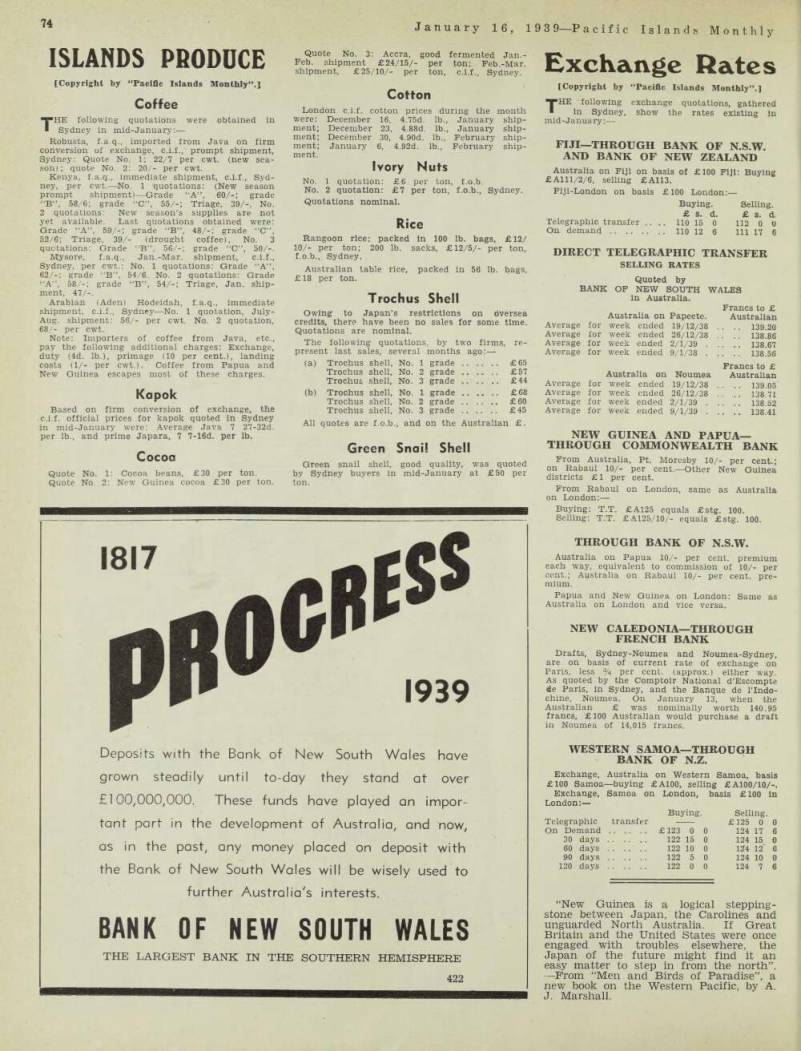
[Copyright by “Pacific Islands Monthly". 1
Coffee
THE following quotations were obtained in Sydney in mid-January:— Robusta, f.a.q., imported from Java on firm conversion of exchange, c.i.f., prompt shipment, Sydney: Quote No. 1; 22/7 per cwt. (new sea son); quote No. 2; 20/- per cwt.
Kenya, f.a.q., immediate shipment, c.i.f., Syd ney, per cwt.—No. 1 quotations: (New season prompt shipment)—Grade “A", 60/-; grade “B", 58/6; grade “C”, 55/-; Triage, 39/-. No. 2 quotations: New season’s supplies are not yet available. Last quotations obtained were: Grade “A”, 59/-; grade “B”, 48/-; grade “C”, 52/6; Triage, 39/- (drought coffee), No. 3 quotations: Grade “B”. 56/-; grade “C”, 50/-.
Mysore, f.a.q., Jan.-Mar. shipment, c.i.f., Sydney, per cwt.: No. 1 quotations: Grade “A", 62/-; grade “B”, 54/6. No. 2 quotations: Grade “A”, 58/-; grade “B", 54/-; Triage, Jan. ship ment, 47/-.
Arabian (Aden) Hodeidah, f.a.q., immediate shipment, c.i.f., Sydney—No. 1 quotation, July- Aug. shipment: 56/- per cwt. No. 2 quotation, 68/- per cwt.
Note: Importers of coffee from Java, etc., pay the following additional charges: Exchange, duty (4d. lb.), primage (10 per cent.), landing costs (1/- per cwt.). Coffee from Papua and New Guinea escapes most of these charges.
Kapok
Based on firm conversion of exchange, the c.i.f. official prices for kapok quoted in Sydney in mid-January were: Average Java 7 27-32d. per lb., and prime Japara, 7 7-16d. per lb.
Cocoa
Quote No. 1: Cocoa beans, £30 per ton.
Quote No. 2: New Guinea cocoa £30 per ton.
Quote No. 3: Accra, good fermented Jan.- Feb. shipment £24/15/- per ton; Feb.-Mar. shipment, £25/10/- per ton, c.i.f., Sydney.
Cotton
London c.i.f. cotton prices during the month were: December 16, 4.75 and. lb., January ship ment; December 23, 4.88 and. lb., January ship ment; December 30, 4.90 and. lb., February ship ment; January 6,4.92 and. lb., February ship ment.
Ivory Nuts
No. 1 quotation: £6 per ton, f.o.b.
No. 2 quotation: £7 per ton, f.0.b., Sydney.
Quotations nominal.
Rice
Rangoon rice: packed in 100 lb. bags, £l2/ 10/- per ton; 200 lb. sacks, £l2/5/- per ton, f.0.b., Sydney.
Australian table rice, packed in 56 lb. bags, £lB per ton.
Trochus Shell
Owing to Japan’s restrictions on oversea credits, there have been no sales for some time.
Quotations are nominal.
The following quotations, by two firms, re present last sales, several months ago:— (a) Trochus shell. No. 1 grade £65 Trochus shell, No. 2 grade £57 Trochus shell, No. 3 grade £44 (b) Trochus shell, No. 1 grade £6B Trochus shell, No. 2 grade £6O Trochus shell, No. 3 grade £45 All quotes are f.0.b., and on the Australian £.
Green Snail Shell
Green snail shell, good quality, was quoted by Sydney buyers in mid-January at £SO per ton.
Exchange Rates
[Copyright by “Pacific Islands Monthly”.] THE following exchange quotations, gathered in Sydney, show the rates existing in mid-January:—
Fiji—Through Bank Of N.S.W.
And Bank Of New Zealand
Australia on Fiji on basis of £lOO Fiji; Buying £Alll/2/6, selling £AII3.
Fiji-London on basis £lOO London:—
Direct Telegraphic Transfer
Selling Rates
Quoted by
Bank Of New South Wales
in Australia.
New Guinea And Papua
Through Commonwealth Bank
From Australia, Pt. Moresby 10/- per cent.; on Rabaul 10/- per cent.—Other New Guinea districts £ 1 per cent.
From Rabaul on London, same as Australia on London:— Buying: T.T. £AI2S equals £stg. 100.
Selling: T.T. £AI2S/10/- equals £stg. 100.
Through Bank Of N.S.W.
Australia on Papua 10/- per cent, premium each way, equivalent to commission of 10/- per cent.; Australia on Rabaul 10/- per cent, pre mium.
Papua and New Guinea on London: Same as Australia on London and vice versa.
New Caledonia—Through
French Bank
Drafts, Sydney-Noumea and Noumea-Sydney, are on basis of current rate of exchange on Paris, less % per cent, (approx.) either way.
As quoted by the Comptoir National d’Escompte de Paris, in Sydney, and the Banque de ITndo chine, Noumea. On January 13, when the Australian £ was nominally worth 140.95 francs, £lOO Australian would purchase a draft in Noumea of 14,015 francs.
Western Samoa—Through
Bank Of N.Z.
Exchange, Australia on Western Samoa, basis £lOO Samoa—buying £AIOO, selling £AIOO/10/-.
Exchange, Samoa on London, basis £lOO in London: —
“New Guinea is a logical stepping stone between Japan, the Carolines and unguarded North Australia. If Great Britain and the United States were once engaged with troubles elsewhere, the Japan of the future might find it an easy matter to step in from the north”. —From “Men and Birds of Paradise”, a new book on the Western Pacific, by A.
J. Marshall.
Buying.
Selling. £ s. d. £ s. d Telegraphic transfer .. .. 110 15 0 112 0 0 On demand .. 110 12 6 111 17 6
Francs to £ Australia on Papeete. Australian Average for week ended 19/12/38 .. .. 139.20 Average for week ended 26/12/38 . . .. 138.86 Average for week ended 2/1/39 138.67 Average for week ended 9/1/38 138.56 Francs to £ Australia on Noumea Australian Average for week ended 19/12/38 .. .. 139.05' Average for week ended 26/12/38 .. .. 138.71 Average for week ended 2/1/39 138.52 Average for week ended 9/1/39 138.41
Buying. Selling.
Telegraphic transfer £ 125 0 0 On Demand ... £ 123 0 0 124 17 6 30 days 122 15 0 124 15 0 60 days 122 10 0 124 12' 6 90 days 122 5 0 124 10 0 120 days 122 0 0 124 7 6
Advertisements & other items, p. 76 (1 item)
pB«C tSS
W W W 1939
Deposits with the Bank of New South Wales have grown steadily until to-day they stand at over £100,000,000. These funds have played an important part in the development of Australia, and now, as in the past, any money placed on deposit with the Bank of New South Wales will be wisely used to further Australia's interests.
BANK OF NEW SOUTH WALES
THE LARGEST BANK IN THE SOUTHERN HEMISPHERE 422
Market Quotations
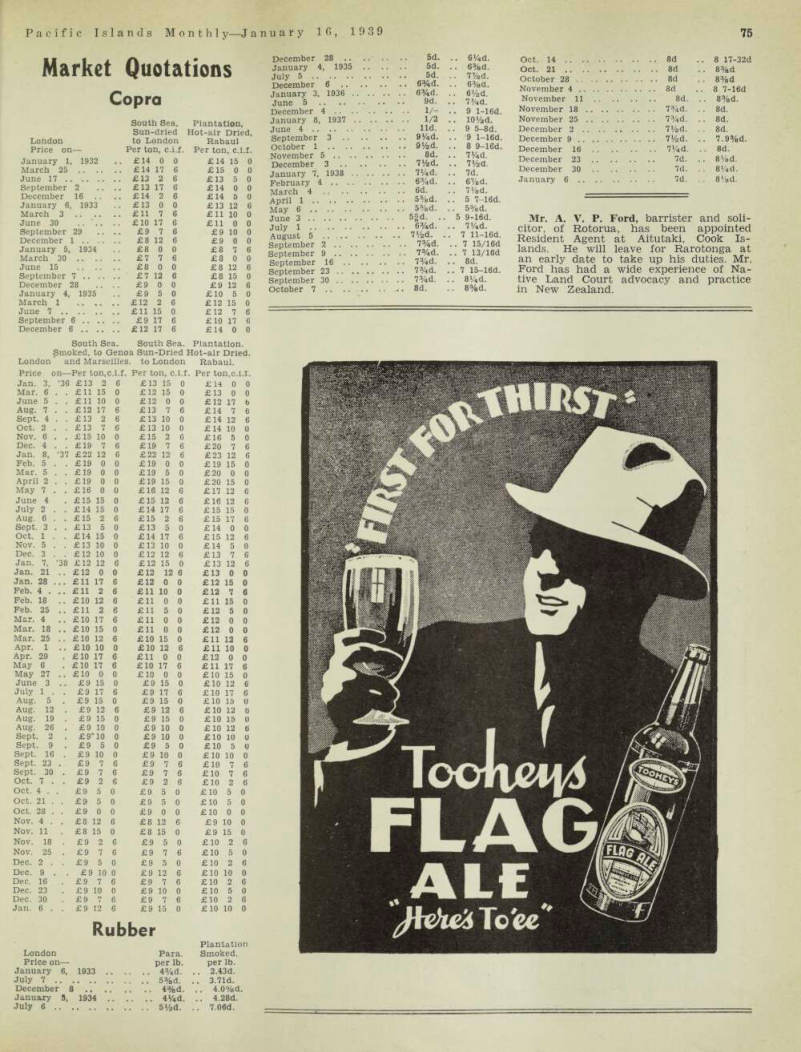
Mr. A. V. P. Ford, barrister and soli citor, of Rotorua, has been appointed Resident Agent at Aitutaki, Cook Is lands. He will leave for Rarotonga at an early date to take up his duties. Mr.
Ford has had a wide experience of Na tive Land Court advocacy and practice in New Zealand.
Oct. 14 8 17-32d Oct. 21 83/ad October 28 8d 8%d November 4 8d 8 7-16d November 11 .. .. 8d. .. 8%d.
November 18 8d.
November 25 .. .. 7 3 Ad. .. 8d.
December 2 .. .. 7V 2 d. .. 8d.
December 9 7y 2 d. .. 7.9%d.
December 16 .. .. 7y 4 d. .. 8d.
December 23 .. ,. .. 7d. ..
S'/sd.
December 30 .. . . 7d. . . sy 4 d.
January 6 .. .. 7d. .. 8>/ed.
December 28 .. .. .. 5d. .. 6‘Ad.
January 4, 1935 .. .. .. 5d. .. 6%d.
July 5 .. 7y a d.
December 6 .. .. 6 3 /ad.
January 3, 1936 .. .. .. .. 6%d. .. 6‘/ 2 d.
June 5 . .. 9d. .. 7‘Ad.
December 4 ... 1/- .. 9 l-16d.
January 8, 1937 . . .. ... 1/2 .. 10‘Ad.
June 4 .. .. lid. .. 9 5-8d.
September 3 .. .. . . 9 V^d. .. 9 l-16d.
October 1 .. 8 9-16d.
November 5 .. .. 8d. .. 7V 4 d.
December 3 .. 7‘Ad.
January 7, 1938 .. .. .. . . 7‘Ad. .. 7d.
February 4 .. .. 6 3 Ad. .. 6 7 Ad.
March 4 . . . 6d. .. 7‘Ad.
April 1 .. 5 7-16d.
May 6 .. 5 s /ad.
June 3 .. 5gd. .. 5 9-16d.
July 1 .. 7‘Ad.
August 5 . 7 ll-16d.
September 2 .. 7 15/16d September 9 .. .. 7 3 Ad. .. 7 13/16d September 16 ,. .. 7 3 Ad. .. 8d.
September 23 .. 7 15-16d.
September 30 .. .. 7 3 Ad. .. 8‘Ad.
October 7 . .. 8d. . . 8%d.
Copra
South Sea, Plantation, Sun-dried Hot-air Dried, London to London Rabaul Price on— Per ton, c.i.f.
Per ton, c.i.f.
January 1, 1932 . . £14 0 0 £14 15 0 March 25 £14 17 6 £15 0 0 June 17 . £13 2 6 £13 5 0 September 2 . , £13 17 6 £14 0 0 December 16 . . £14 2 6 £14 5 0 January 6 . 1933 £13 0 0 £13 12 6 March 3 £11 7 6 £11 10 0 June 30 £10 17 6 £11 0 0 September 29 . . £9 7 6 £9 10 0 December 1 .. .. £8 12 6 £9 0 0 January 5, , 1934 . . £8 0 0 £8 7 6 March 30 £7 7 6 £8 0 0 June 15 £8 0 0 £8 12 6 September 7 .. .. £7 12 6 £8 15 0 December 28 £9 0 0 £9 12 6 January 4, , 1935 £9 5 0 £10 5 0 March 1 £12 2 6 £12 15 0 June 7 .. £11 15 0 £12 7 6 September 6 .. .. £9 17 6 £10 17 6 December 6 .. .. £12 17 6 £14 0 0 South Sea.
South Sea.
Plantation.
Smoked, to Genoa Sun-Dried Hot-air Dried.
London and Marseilles, to London Rabaul.
Price on— -Per ton,c.i.f. Per ton, c.I.f. Per ton.c.l.l.
Jan. 3, ’36 £13 2 6 £13 15 0 £14 0 0 Mar. 6 . . £11 15 0 £12 15 0 £13 0 0 June 5 . . £11 10 0 £12 0 0 £12 17 b Aug. 7 . . £12 17 6 £13 7 6 £14 7 6 Sept. 4 . . £13 2 6 £13 10 0 £14 12 6 Oct. 2 . . £13 7 6 £13 10 0 £14 10 0 Nov. 6 . . £15 10 0 £15 2 6 £16 5 0 Dec. 4 . . £19 7 6 £19 7 6 £20 7 6 Jan. 8, ’37 £22 12 6 £22 12 6 £23 12 6 Feb. 5 . . £19 0 0 £19 0 0 £19 15 0 Mar. 5 . . £19 0 0 £19 5 0 £20 0 0 April 2 . . £19 0 0 £19 15 0 £20 15 0 May 7 . . £16 0 0 £16 12 6 £17 12 6 June 4 £15 15 0 £15 12 6 £16 12 6 July 2 . . £14 15 0 £14 17 6 £15 15 0 Aug. 6 . . £15 2 6 £15 2 6 £15 17 6 Sept. 3 . . £13 5 0 £13 5 0 £14 0 0 Oct. 1 . . £14 15 0 £14 17 6 £15 12 6 Nov. 5 . . £13 10 0 £13 10 0 £14 5 0 Dec. 3 . . £12 10 0 £12 12 6 £13 7 6 Jan. 7, ’38 £12 12 6 £12 15 0 £13 12 6 Jan. 21 .. £12 0 0 £12 12 6 £13 0 0 Jan. 28 ... £11 17 6 £12 0 0 £12 15 0 Feb. 4 . .. £11 2 6 £11 10 0 £12 7 6 Feb. 18 .. £10 12 6 £11 0 0 £11 15 0 Feb. 25 .. £11 2 6 £11 5 0 £12 5 0 Mar. 4 .. £10 17 6 £11 0 0 £12 0 0 Mar. 18 .. £10 15 0 £11 0 0 £12 0 0 Mar. 25 .. £10 12 6 £10 15 0 £11 12 6 Apr. 1 .. £10 10 0 £10 12 6 £11 10 0 Apr. 29 £10 17 6 £11 0 0 £12 0 0 May 6 £10 17 6 £10 17 6 £11 17 6 May 27 .. £10 0 0 £10 0 0 £10 15 0 June 3 .. £9 15 0 £9 15 0 £10 12 6 July 1 . . £9 17 6 £9 17 6 £10 17 6 Aug. 5 . £9 15 0 £9 15 0 £10 15 0 Aug. 12 . £9 12 6 £9 12 6 £10 12 b Aug. 19 . £9 15 0 £9 15 0 £10 15 0 Aug. 26 . £9 10 0 £9 10 0 £10 12 6 Sept. 2 . £9*10 0 £9 10 0 £10 10 0 Sept. 9 . £9 5 0 £9 5 0 £10 5 0 Sept. 16 . £9 10 0 £9 10 0 £10 10 0 Sept. 23 . £9 7 6 £9 7 6 £10 7 6 Sept. 30 . £9 7 6 £9 7 6 £10 7 6 Oct. 7 . . £9 2 6 £9 2 6 £10 2 6 Oct. 4 . . £9 5 0 £9 5 0 £10 5 0 Oct. 21 . . £9 5 0 £9 5 0 £10 5 0 Oct. 28 . . £9 0 0 £9 0 0 £10 0 0 Nov. 4 . , £8 12 6 £8 12 6 £9 10 0 Nov. 11 . £8 15 0 £8 15 0 £9 15 0 Nov. 18 . £9 2 6 £9 5 0 £10 2 6 Nov. 25 . £9 7 6 £9 7 6 £10 5 0 Dec. 2 . . £9 5 0 £9 5 0 £10 2 6 Dec. 9 . . £9 10 0 £9 12 6 £10 10 0 Dec. 16 . £9 7 6 £9 7 6 £10 2 6 Dec. 23 . £9 10 0 £9 10 0 £10 5 0 Dec. 30 £9 7 6 £9 7 6 £10 2 6 Jan. 6 . . £9 12 6 £9 15 0 £10 10 0
Rubber
Plantation London Para.
Smoked.
Price on— per lb. per lb.
January 6, 1933 . .. 2.43d.
July 7 .. ., 3.71d.
December 8 . .. 4.0%d.
January 9, 1934 .. .. 4>/ 4 d. .. 4.28d.
July 6 .. .. 7.06d,
Advertisements & other items, p. 77 (2 items)
75
Pacific Islands Monthl y—J anuary 16, 1939
TooWi
FLAG
ale JkHeZ To'ec'
Shipping Services in the Pacific
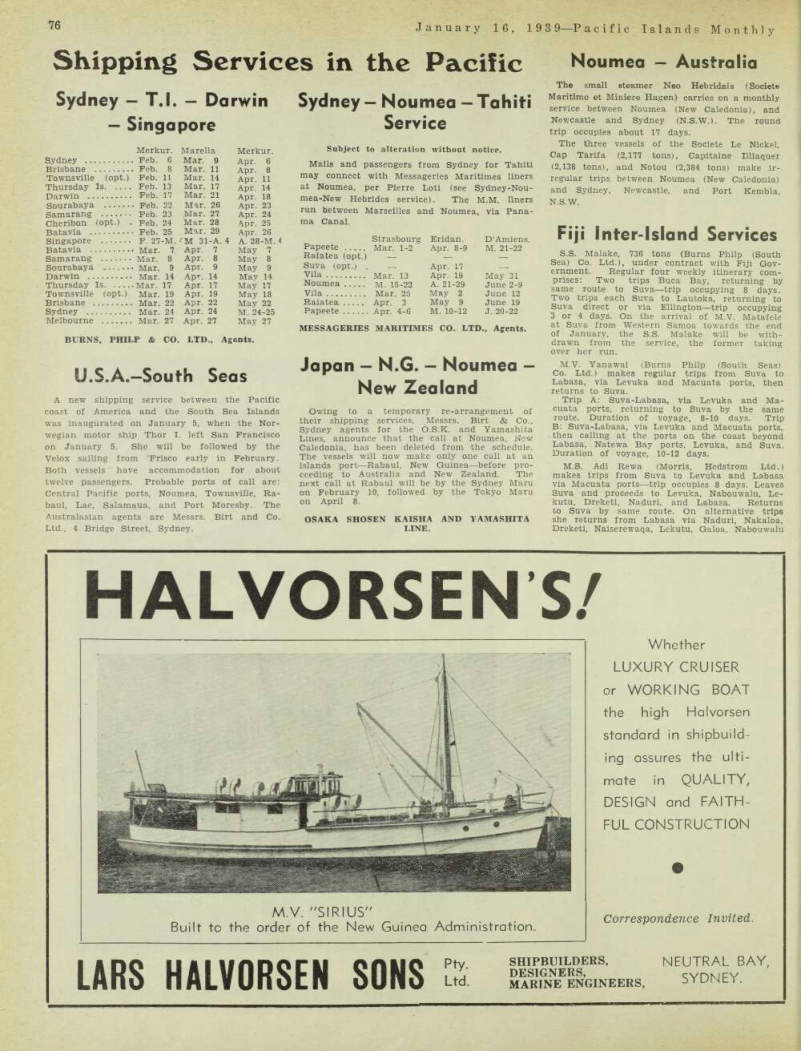
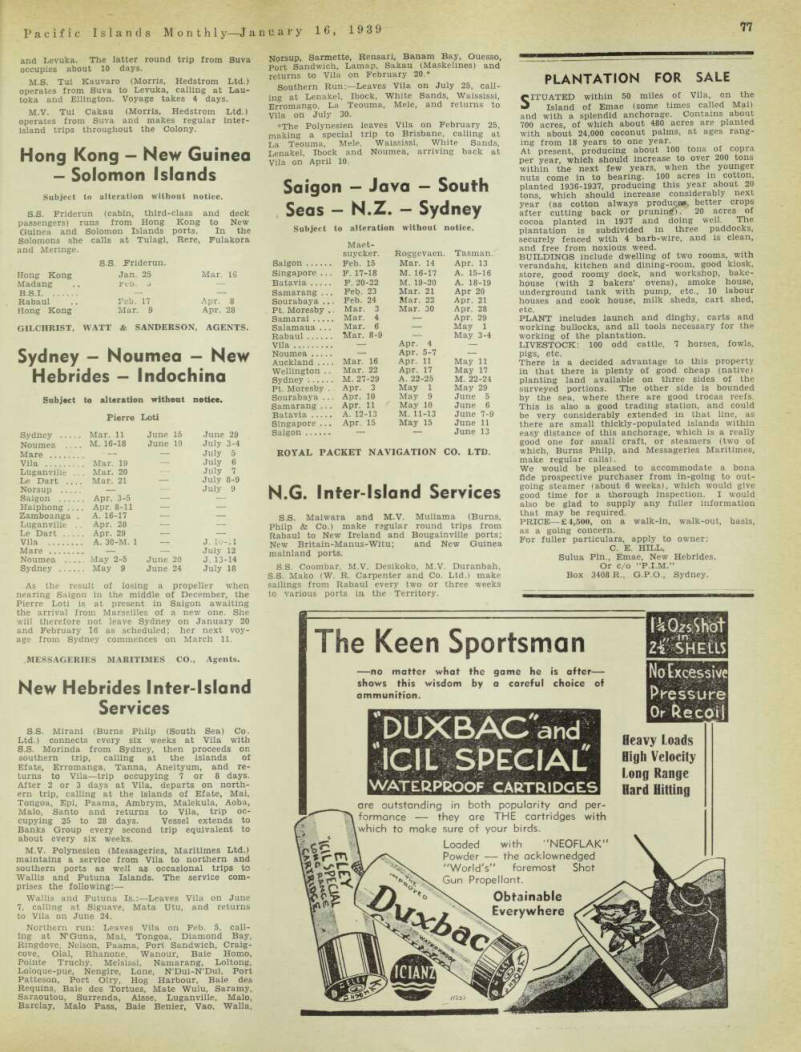
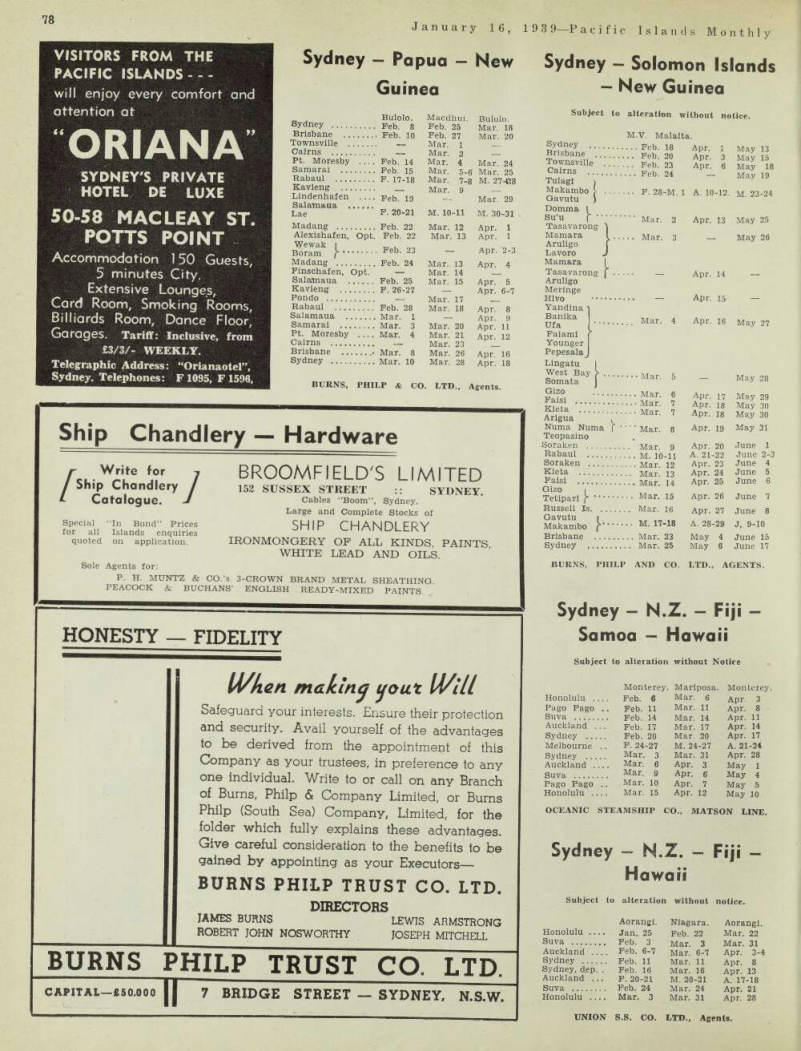
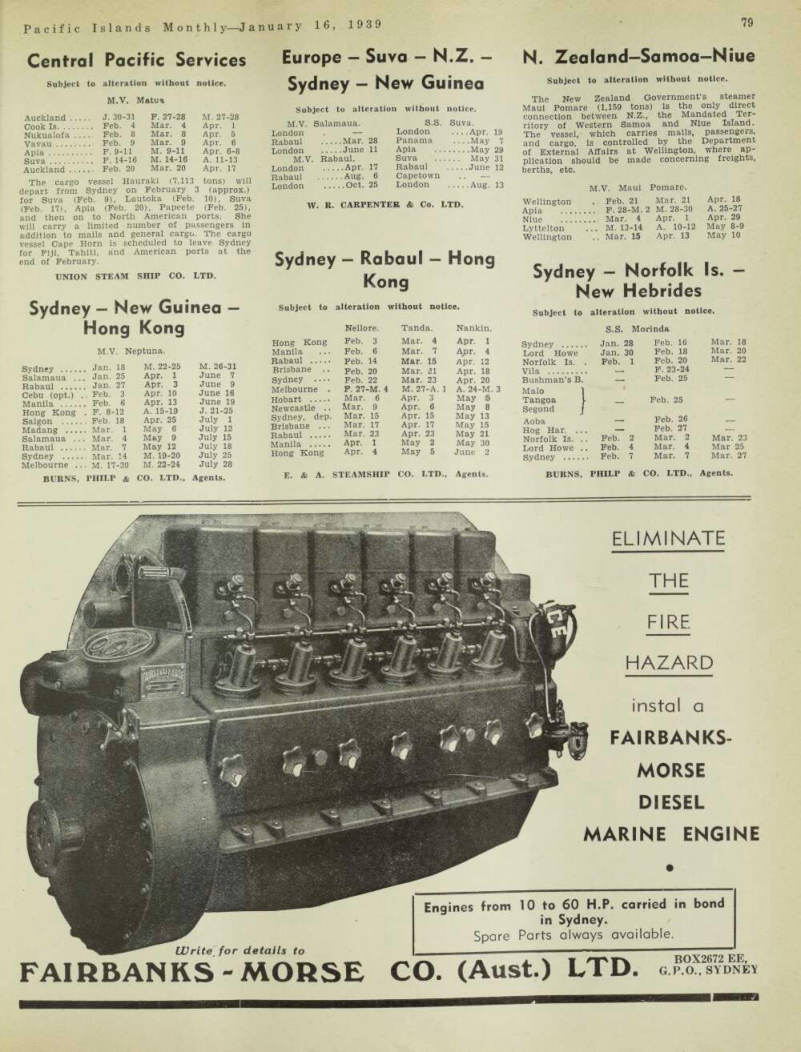
Sydney - T.l. - Darwin - Singapore
U.S.A.-South Seas
A new shipping service between the Pacific coast of America and the South Sea Islands was inaugurated on January 5, when the Nor wegian motor ship Thor I. left San Francisco on January 5. She will be followed by the Velox sailing from ’Frisco early in February.
Both vessels ' have accommodation for about twelve passengers. Probable ports of call are: Central Pacific ports, Noumea, Townsville, Ra baul, Lae, Salamaua, and Port Moresby. The Australasian agents are Messrs. Birt and Co.
Ltd., 4 Bridge Street, Sydney.
Sydney Noumea Tahiti
Service
Subject to alteration without notice.
Mails and passengers from Sydney for Tahiti may connect with Messageries Maritimes liners at Noumea, per Pierre Loti (see Sydney-Nou mea-New Hebrides service). The M.M. liners run between Marseilles and Noumea, via Pana ma Canal.
Japan - N.G. - Noumea -
New Zealand
Owing to a temporary re-arrangement of their shipping services, Messrs. Birt & Co., Sydney agents for the O.S.K. and Yamashita Lines, announce that the call at Noumea, New Caledonia, has been deleted from the schedule.
The vessels will now make only one call at an islands port—Rabaul, New Guinea—before pro ceeding to Australia and New Zealand. The next call at Rabaul will be by the Sydney Maru on February 10, followed by the Tokyo Maru on April 8.
Osaka Shosen Kaisha And Yamashita
Line.
Noumea - Australia
The small steamer Neo Hebridais (Societt Maritime et Miniere Hagen) carries on a monthly service between Noumea (New Caledonia), and Newcastle and Sydney (N.S.W.). The round trip occupies about 17 days.
The three vessels of the Societe Le Nickel, Cap Tarifa (2,177 tons), Capitaine Illiaquer (2,138 tons), and Notou (2,384 tons) make ir regular trips between Noumea (New Caledonia) and Sydney, Newcastle, and Port Kembla,
N.S.W.
Fiji Inter-Island Services
S.S. Malake, 736 tons (Burns Philp (South Sea) Co. Ltd.), under contract with Fiji Gov ernment. Regular four weekly itinerary com prises: Two trips Buca Bay, returning by same route to Suva—trip occupying 8 days.
Two trips each Suva to Lautoka, returning to Suva direct or via Ellington—trip occupying 3 or 4 days. On the arrival of M.V. Matafele at Suva from Western Samoa towards the end of January, the S.S. Malake will be with drawn from the service, the former taking over her run.
M.V. Yanawai (Burns Philp (South Seas) Co. Ltd.) makes regular trips from Suva to Labasa, via Levuka and Macuata ports, then returns to Suva.
Trip A: Suva-Labasa, via Levuka and Ma cuata ports, returning to Suva by the same route. Duration of voyage, 8-10 days. Trip B: Suva-Labasa, via Levuka and Macuata ports, then calling at the ports on the coast beyond Labasa, Natewa Bay ports, Levuka, and Suva.
Duration of voyage, 10-12 days.
M.S. Adi Rewa (Morris, Hedstrom Ltd.) makes trips from Suva to Levuka and Labasa via Macuata ports—trip occupies 8 days. Leaves Suva and proceeds to Levuka, Nabouwalu, Le kutu, Dreketi, Naduri, and Labasa. Returns to Suva by same route. On alternative trips she returns from Labasa via Naduri, Nakaloa, Dreketi, Naiserewaqa, Lekutu, Galoa, Nabouwalu
Merkur.
Marella Merkur.
Sydney Feb. 6 Mar. 9 Apr. 6 Brisbane Feb. 8 Mar. 11 Apr. 8 Townsville (opt.) Feb. 11 Mar. 14 Apr. 11 Thursday Is Feb. 13 Mar. 17 Apr. 14 Darwin Feb. 17 Mar. 21 Apr. 18 Sourabaya ■ Feb. 22 Mar. 26 Apr. 23 Samarang Feb. 23 Mar. 27 Apr. 24 Cheribon (opt.) .
Feb. 24 Mar. 28 Apr. 25 Batavia ■ Feb. 25 Mar. 29 Apr. 26 Singapore F. 27 -M. 1 M 31-A. 4 A. 28-M. 4 Batavia ■ Mar. 7 Apr. 7 May 7 Samarang Mar. 8 Apr. 8 May 8 Sourabaya ...
Mar. 9 Apr. 9 May 9 Darwin Mar. 14 Ap’-. 14 May 14 Thursday Is • Mar. 17 Apr. 17 May 17 Townsville (opt.) Mar. 19 Apr. 19 May 18 Brisbane Mar. 22 Apr. 22 May 22 Sydney Mar. 24 Apr. 24 M. 24-25 Melbourne Mar. 27 Apr. 27 May 27
Burns, Philp &
Co. Ltd.,
Agents.
Papeete Strasbourg Mar. 1-2 Eridan.
Apr. 8-9 D’Amiens.
M. 21-22 Raiatea (opt.) — — — Suva (opt.) . — Apr. 17 — Vila Mar. 13 Apr. 19 May 31 Noumea M. 15-22 A. 21-29 June 2-9 Vila Mar. 25 May 2 June 12 Raiatea Apr. 3 May 9 June 19 Papeete Apr. 4-6 M. 10-12 J.20-22
Messagekies
Maritimes Co. Ltd., Agents.
and Levuka. The latter round trip from Suva occupies about 10 days.
M.S. Tui Kauvaro (Morris, Hedstrom Ltd.) operates from Suva to Levuka, calling at Lau toka and Ellington. Voyage takes 4 days.
M.V. Tui Cakau (Morris, Hedstrom Ltd.) operates from Suva and makes regular inter island trips throughout the Colony.
Hong Kong - New Guinea
Solomon Islands
Subject to alteration without notice.
S.S. Friderun (cabin, third-class and deck passengers) runs from Hong Kong to New Guinea and Solomon Islands ports. In the Solomons she calls at Tulagi, Rere, Fulakora and Meringe.
Sydney - Noumea - New Hebrides - Indochina Subject to alteration without notice.
As the result of losing a propeller when nearing Saigon in the middle of December, the Pierre Loti is at present in Saigon awaiting the arrival from Marseilles of a new one. She will therefore not leave Sydney on January 20 and February 16 as scheduled; her next voy age from Sydney commences on March 11.
Messageries Maritimes Co., Agents.
New Hebrides Inter-Island
Services
S.S. Mirani (Burns Philp (South Sea) Co.
Ltd.) connects every six weeks at Vila with S.S. Morinda from Sydney, then proceeds on southern trip, calling at the islands of Efate, Erromanga, Tanna, Aneityum, and re turns to Vila —trip occupying 7 or 8 days.
After 2 or 3 days at Vila, departs on north ern trip, calling at the islands of Efate, Mai, Tongoa, Epi, Paama, Ambrym, Malekula, Aoba, Malo, Santo and returns to Vila, trip oc cupying 25 to 28 days. Vessel extends to Banks Group every second trip equivalent to about every six weeks.
M.V. Polynesien (Messageries, Maritimes Ltd.) maintains a service from Vila to northern and southern ports as well as occasional trips to Wallis and Futuna Islands. The service com prises the following;— Wallis and Futuna Is.:—Leaves Vila on June 7, calling at Siguave, Mata Utu, and returns to Vila on June 24.
Northern run: Leaves Vila on Feb. 5, call ing at N’Guna, Mai, Tongoa, Diamond Bay, Ringdove, Nelson, Paama, Port Sandwich, Craig cove, Olal, Rhanone, Wanour, Baie Homo, Pointe Truchy, Melsissi, Namarang, Loltong, Loloque-pue, Nengire, Lone, N’Dui-N’Dui, Port Patteson, Port Olry, Hog Harbour, Baie des Requins, Baie des Tortues, Mate Wulu, Saramy, Saraoutou, Surrenda, Alsse, Luganville, Malo, Barclay, Malo Pass, Baie Benier, Vao, Walla,
Norsup, Sarmette, Rensari, Banam Bay, Ouesso, Port Sandwich, Lamap, Sakau (Maskelines) and returns to Vila on February 20.* Southern Run: —Leaves Vila on July 25, call ing at Lenakel, Ibock, White Sands, Waississi, Erromango, La Teouma, Mele, and returns to Vila on July 30. ♦The Polynesien leaves Vila on February 25, making a special trip to Brisbane, calling at La Teouma, Mele, Waississi, White Sands, Lenakel, Ibock and Noumea, arriving back at Vila on April 10.
Saigon Java South
Seas - N.Z. - Sydney
Subject to alteration without notice.
N.G. Inter-Island Services
5.5. Maiwara and M.V. Mullama (Burns.
Philp & Co.) make regular round trips from Rabaul to New Ireland and Bougainville ports; New Britain-Manus-Wltu; and New Guinea mainland ports. 5.5. Coombar, M.V. Desikoko, M.V. Duranbah, S.S. Mako (W. R. Carpenter and Co. Ltd.) make sailings from Rabaul every two or three weeks to various ports in the Territory.
Hong Kong s.s.
Priderun.
Jan. 25 Mar. 16 Madang *VD. o —
B.S.I
— — Rabaul Feb. 17 Apr. 8 Hong Kong Mar. 9 Apr. 28
Gilchrist,
Watt
& Sanderson,
Agents.
Pierre Loti Sydney , Mar. 11 June 15 June 29 Noumea ...
M. 16-18 June 19 July 3-4 Mare — — July 5 Vila . Mar. 19 — July 6 Luganville . . . Mar. 20 — July 7 Le Dart ... . Mar. 21 — July 8-9 Norsup — — July 9 Saigon Apr. 3-5 — — Haiphong ... . Apr. 8-11 — — Zamboanga .
A. 16-17 — — Luganville .
Apr. 28 — —- Le Dart . . . . . Apr. 29 — — Vila . A. 30-M. 1 J. 10-11 Mare — July 12 Noumea ... ,. May 2-5 June 20 J. 13-14 Sydney . May 9 June 24 July 18
Saigon Maetsuycker.
Feb. 15 Roggevaen. Tasman.
Mar. 14 Apr. 13 Singapore ...
F. 17-18 M. 16-17 A. 15-16 Batavia F. 20-22 M. 19-20 A. 18-19 Samarang . ..
Feb. 23 Mar. 21 Apr 20 Sourabaya .., , Feb. 24 Mar. 22 Apr. 21 Pt. Moresby . . Mar. 3 Mar. 30 Apr. 28 Samarai Mar. 4 — Apr. 29 Salamaua ...
Mar. 6 — May 1 Rabaul Mar. 8-9 — May 3-4 Vila — Apr. 4 — Noumea — Apr. 5-7 — Auckland , Mar. 16 Apr. 11 May 11 Wellington ..
Mar. 22 Apr. 17 May 17 Sydney ; M. 27-29 A. 22-25 M. 22-24 Pt. Moresby .
Apr. 3 May 1 May 29 Sourabaya ... , Apr. 10 May 9 June 5 Samarang ...
Apr. 11 May 10 June 6 Batavia A. 12-13 M. 11-13 June 7-9 Singapore ...
Apr. 15 May 15 June 11 Saigon — — June 13
Royal Packet Navigation
Co. Ltd.
Sydney Papua - New Guinea
Sydney Solomon Islands New Guinea
Sydney - N.Z. - Fiji - Samoa Hawaii
Sydney - N.Z. - Fiji - Hawaii
Bulolo.
Macdhui, Bulolo.
Sydney Feb. 25 Mar. 18 Brisbane ..
Feb. 27 Mar. 20 Townsville . ...
Mar. 1 Cairns Mar. 2 Pt. Moresby Feb. 14 Mar. 4 Mar. 24 Samarai .., Feb. 15 Mar. 5- 6 Mar. 25 Rabaul ..,, Mar. 7-R M. 27-128 Kavieng ..
Mar. 9 Lindenhafen Feb. ID Mar. 29 Salatnaua .
Lae F. 20-21 M. 10-11 M. 30-31 Madang ...
Feb. 22 Mar. 12 Apr. 1
Alexishafen,
Opt. Feb. 22 Mar. 13 Apr. 1 Wewak j Boram f * * — Apr. 2-3 Madang Mar. 13 Apr. 4 Finschafen, Opt. — Mar. 14 Salaimaua .
Feb. 25 Mar. 15 Apr. 5 Kavieng ...
Apr. 6-7 Pondo Mar. 17 Rabaul ...
Mar. 18 Apr. 8 Salamaua .
Apr. 9 Samarai ...
Mar. 3 Mar. 20 Apr. 11 Pt. Moresby ... Mar. 4 Mar. 21 Apr. 12 Cairns Mar. 23 Brisbane ..
Mar. 26 Apr. 16 Sydney Mar. 28 Apr. 18
Burns,
Philp & Co. Ltd.,
Agents.
Subject to alteration without notice.
Sydney ., Brisbane .
Townsville .
Cairns .
M.V. Malalta. .. Feb. 20 Apr. . . Feb. 23 Apr, 3 6 May 13 May 15 May 18 May 19 M. 23-24 Tulagi Makambo Gavutu Domma I 1 .. P. 28-M. 1 A. 10 i-12.
Su'u (
Tasavarong ’j
Mamara I ...
Aruligo
Lavoro J
Mamara 1
Tasavarong f . ..
Aruligo Meringe UitiA Mar. 2 3 Apr.
Apr. 13 14 1 R May 25 May 26 Yandina Banika Ufa Paiaml Younger Pepesala Lingatu West Baj 4 Apr. 10 16 4 27 May 28 Somata 1 5 Gizo c Apr. 17 May 29 Paisi .., D rj Kieta ..
R^r i rt Apr.
Apr.
Apr.
Apr.
A. 21- 18 May 30 Arigua .
Numa Numa f • Teopasino Soraken Rabaul Mar. i 8 9 -11 18 19 20 .9.9.
May 30 May 31 June 1 June 2-3 Soraken Kieta ..
“ 1 i 12 1 'I Apr. 23 Anr 24.
June 4 June 5 Paisi ...
Mar It) 14 Apr. 25 June 6 Gizo i Mar xeupan f Russell Is Gavutu i
Makambo f
Brisbane Sydney •. M. 17 ID 16 -18 23 25 Apr. 27 A. 28-29 May 4 May 6 June 8 J, 9-10 June 15 June 17
Burns,
Philp
And
CO.
, Ltd.,
Agents.
Subject to alteration without Notice Monterey.
Mariposa.
Monterey.
Honolulu . . . .
Feb, 6 Mar. 6 Apr. 3 Pago Pago .
Feb. 11 Mar. 11 Apr. 8 Suva Feb. 14 Mar. 14 Apr. 11 Auckland Feb. 17 Mar. 17 Apr. 14 Sydney ..
Feb. 20 Mar. 20 Apr. 17 Melbourne F. 24-27 M. 24-27 A. 21-24 Sydney .., Mar. 3 Mar. 31 Apr. 28 Auckland .
Mar. 6 Apr. 3 May 1 Suva Mar. 9 Apr. 6 May 4 Pago Pago Mar. 10 Apr. 7 May 5 Honolulu .
Mar. 15 Apr. 12 May 10
Oceanic
Steamship Co., Matson Line.
Subject to alteration without notice.
Aorangi.
Niagara.
Aorangi.
Honolulu Jan, 25 Feb. 22 Mar. 22 Suva Feb. 3 Mar. 3 Mar. 31 Auckland Feb. 6-7 Mar. 6-7 Apr. 3-4 Sydney Feb. 11 Mar. 11 Apr. 8 Sydney, dep. .
Feb. 16 Mar. 16 Apr. 13 Auckland ...
F. 20-21 M. 20-21 A. 17-18 Suva Feb. 24 Mar. 24 Apr. 21 Honolulu Mar. 3 Mar, 31 Apr. 28
Union
S.S. CO. LTD., Agents.
Central Pacific Services Subject to alteration without notice.
Sydney - New Guinea - Hong Kong
Europe - Suva - N.Z. - Sydney - New Guinea Subject to alteration without notice.
Sydney - Roboul - Hong Kong Subject to alteration without notice.
N. Zealand-Samoa-Niue
Subject to alteration without notice.
The New Zealand Government’s steamer Maui Pomare (1,159 tons) is the only direct connection between N.Z., the Mandated Ter ritory of Western Samoa and Niue Island.
The vessel, which carries mails, passengers, and cargo, is controlled by the Department of External Affairs at Wellington, where ap plication should be made concerning freights, berths, etc.
Sydney Norfolk Is.
New Hebrides Subject to alteration without notice.
M.V. Matua Auckland J. 30-31 F. 27-28 M. 27-28 Cook Is Feb. 4 Mar. 4 Apr. 1 Nukualofa ... Feb. 8 Mar. 8 Apr. 5 Vavau Feb. 9 Mar. 9 Apr. 6 Apia F. 9-11 M. 9-11 Apr. 6-8 Suva F. 14-16 M. 14-16 A. 11-13 Auckland Feb. 20 Mar. 20 Apr. 17 The cargo vessel Hauraki <7,113 tons) will depart from Sydney on February 3 (approx.) for Suva (Feb. 9), Lautoka (Feb. 10), Suva (Feb. 17), Apia (Feb. 20), Papeete (Feb. 25), and then on to North American ports. She will carry a limited number of passengers in addition to mails and general cargo . The cargo vessel Cape Horn is scheduled to leave Sydney for Fiji, Tahiti, and American ports at the end of February.
Union Steam Ship Co. Ltd.
M.V. Neptuna.
Sydney . Jan. 18 M. 22-25 M. 26-31 Salamaua .. . Jan. 25 Apr. 1 June 7 Rabaul . Jan. 27 Apr. 3 June 9 Cebu (opt.) . ,. Feb. 3 Apr. 10 June 16 Manila . Feb. 6 Apr, 13 June 19 Hong Kong , F. 8-12 A. 15-19 J. 21-25 Saigon . Feb. 18 Apr. 25 July 1 Madang . Mar. 1 May 6 July 12 Salamaua .. . Mar. 4 May 9 July 15 Rabaul . Mar. 7 May 12 July 18 Sydney .. Mar. 14 M. 19-20 July 25 Melbourne .. . M. 17-20 M. 22-24 July 28
Burns,
Philp &
Co. Ltd.,
Agents.
M.V. Salamaua. S.S. Suva.
London — London Apr. 19 Rabaul Mar. 28 Panama May 7 London June 11 Apia May 29 M.V. Rabaul. Suva May 31 London Apr. 17 Rabaul June 12 Rabaul Aug. 6 Capetown .. — London Oct. 25 London Aug. 13
W. R. Carpenter & Co. Ltd.
Nellore.
Tanda.
Nankin.
Hong Kong Feb. 3 Mar. 4 Apr. 1 Manila Feb. 6 Mar. 7 Aj)r. 4 Rabaul Feb. 14 Mar. 15 Apr. 12 Brisbane ..
Feb. 20 Mar. -21 Apr. 18 Sydney . • •.
Feb. 22 Mar. 23 Apr. 20 Melbourne .
P. 27-M. 4 M.27-A. 1 A. 24-M. 3 Hobart Mar. 6 Apr. 3 May 6 Newcastle ..
Mar. 9 Apr. 6 May 8 Sydney, dep.
Mar. 15 Apr. 15 May 13 Brisbane ...
Mar. 17 Apr. 17 May 15 Rabaul Mar. 23 Apr. 23 May 21 Manila Apr. 1 May 2 May 30 Hong Kong Apr. 4 May 5 June 2 E. & A.
Steamship
Co. Ltd.,
Agents.
M.V. Maui Pomare.
Wellington . Feb. 21 Mar. 21 Apr. 18 Apia F. 28-M. 2 M. 28-30 A. 25-27 Niue Mar. 4 Apr. 1 Apr. 29 Lyttelton ... M. 13-14 A, 10-12 May 8-9 Wellington .. Mar. 15 Apr. 13 May 10
s.s.
Morinda Sydney Jan. 28 Feb. 16 Mar. 18 Lord Howe Jan. 30 Feb. 18 Mar. 20 Norfolk Is. , Feb. 1 Feb. 20 Mar. 22 Vila P. 23-24 — Bushman’s B.
Feb. 25 — Malo 1 Tangoa Feb. 25 —
Segond J
Aoba — Feb. 26 — Hog Har.
Feb. 27 — Norfolk Is. .
Feb. 2 Mar. 2 Mar. 23 Lord Howe . , Feb. 4 Mar. 4 Mar 25 Sydney Feb. 7 Mar. 7 Mar. 27
Burns,
Philp
Co. Ltd.,
Agents.
Advertisements & other items, pp. 78-84 (7 items)
76
January 16, 193 9—P acific Islands Monthly
Halvorsens/
M.V. "SIRIUS 77
Built to the order of the New Guinea Administration.
Whether
LUXURY CRUISER
or WORKING BOAT
the high Halvorsen standard in shipbuilding assures the ultimate in QUALITY,
DESIGN and FAITH-
FUL CONSTRUCTION
LARS HALVORSEN SONS
Ptv SHIPBUILDERS,
, / ' DESIGNERS,
Ltd. MARINE ENGINEERS
Correspondence Invited.
NEUTRAL BAY,
SYDNEY.
PLANTATION FOR SALE
SITUATED within 50 miles of Vila, on the Island of Emae (some times called Mai) and with a splendid anchorage. Contains about 700 acres, of which about 480 acres are planted with about 24,000 coconut palms, at ages ranging from 18 years to one year.
At present, producing about 100 tons of copra per year, which should increase to over 200 tons within the next few years, when the younger nuts come in to bearing. 100 acres in cotton, planted 1936-1937, producing this year about 20 tons, which should increase considerably next year (as cotton always produce#, better crops after cutting back or pruning). 20 acres of cocoa planted in 1937 and doing well. The plantation is subdivided in three paddocks, securely fenced with 4 barb-wire, and is clean, and free from noxious weed.
BUILDINGS include dwelling of two rooms, with verandahs, kitchen and dining-room, good kiosk, store, good roomy dock, and workshop, bakehouse (with 2 bakers’ ovens), smoke house, underground tank with pump, etc., 10 labour houses and cook house, milk sheds, cart shed, etc.
PLANT includes launch and dinghy, carts and working bullocks, and all tools necessary for the working of the plantation.
LIVESTOCK: 100 odd cattle, 7 horses, fowls, pigs, etc.
There is a decided advantage to this property in that there is plenty of good cheap (native) planting land available on three sides of the surveyed portions. The other side is bounded by the sea, where there are good trocas reefs.
This is also a good trading station, and could be very considerably extended in that line, as there are small thickly-populated islands within easy distance of this anchorage, which is a really good one for small craft, or steamers (two of which, Burns Philp, and Messageries Maritimes, make regular calls).
We would be pleased to accommodate a bona fide prospective purchaser from in-going to outgoing steamer (about 6 weeks), which would give good time for a thorough inspection. I would also be glad to supply any fuller information that may be required.
PRICE —£4,500, on a walk-in, walk-out, basis, as a going concern.
For fuller particulars, apply to owner:
C. E. HILL,
Sulua Pin., Emae, New Hebrides.
Or c/o “P.I.M.”
Box 3408 R., G.P.O., Sydney.
The Keen Sportsman
—no matter what the game he is after— shows this wisdom by a careful choice of ammunition.
Heavy Loads
High Velocity
Long Range
Hard Hitting
are outstanding in both popularity and performance they are THE cartridges with ,which to make sure of your birds.
Loaded with "NEOFLAK"
Powder the acklownedged "World's" foremost Shot Gun Propellant.
Obtainable
Everywhere
IT M < i 96 *
VISITORS FROM THE
PACIFIC ISLANDS---
will enjoy every comfort and attention at
ORIANA
SYDNEY'S PRIVATE
HOTEL DE LUXE
50-58 MACLEAY ST.
POTTS POINT
Accommodation 150 Guests, 5 minutes City.
Extensive Lounges, Card Room, Smoking Rooms, Billiards Room, Dance Floor, Garages. Tariff; Inclusive, from
£3/3/- WEEKLY.
Telegraphic Address: “Orianaotel”, Sydney. Telephones: F 1095, F 1596,
Ship Chandlery Hardware
/Write tor j
Ship Chandlery /
Cataloaue. J
Catalogue
Special “In Bond” Prices for all Islands enquiries quoted on application.
Sole Agents for:
BROOMFIELD'S LIMITED
152 SUSSEX STREET :: SYDNEY.
Cables “Boom”, Sydney.
Large and Complete Stocks of
SHIP CHANDLERY
IRONMONGERY OF ALL KINDS, PAINTS,
WHITE LEAD AND OILS.
P. H. MUNTZ & CO.’s 3-CROWN BRAND METAL SHEATHING.
PEACOCK & BUCHANS’ ENGLISH READY-MIXED PAINTS.
HONESTY FIDELITY
IVAen making gout IVIU
Safeguard your interests. Ensure their protection and security. Avail yourself of the advantages to be derived from the appointment of this Company as your trustees, in preference to any one individual. Write to or call on any Branch of Burns, Philp <S Company Limited, or Bums Philp (South Sea) Company, Limited, for the folder which fully explains these advantages.
Give careful consideration to the benefits to be gained by appointing as your Executors—
BURNS PHILP TRUST CO. LTD.
DIRECTORS
JAMES BURNS LEWIS ARMSTRONG
ROBERT JOHN NOSWORTHY JOSEPH MITCHELL
BURNS PHILP TRUST CO. LTD.
CAPITAL £50.000 7 BRIDGE STREET SYDNEY, N.S.W.
Write for details to
FAIRBANKS - MORSE
ELIMINATE
THE
FIRE
HAZARD
instal a
FAIRBANKS-
MORSE
DIESEL
MARINE ENGINE
Engines from 10 to 60 H.P. carried in bond in Sydney.
Spare Parts always available. / a i \ I 80X2672 EE,
CO. (Aust.) tIU. G.P.0., SYDNEY
Huon Pine Boat Planks
Practically Borer Proof and Everlasting, also Spotted Gum Timbers—Prices Right.
As* r MO Miller St., . fryer p yrmon t t n.s.w.
PILES
How to relieve them.
You can’t mistake piles. You feel uneasy and fidgety, wondering how on earth to stop that irritation or
bleeding.
Day and night piles worry you, taking your heart out of your job. You can’t stand still for long, and you feel just as bad when sitting. Piles are dilated or inflamed veins of the lower bowel and are aggravated by a cold or constipation. In severe cases surgical treatment even may be necessary.
Let DOAN’S Ointment give you the relief you so sorely need. This special pile prescription is healing, antiseptic and soothing. That is why it is equally successful in overcoming eczema and other itching skin complaints. But, be sure you get DOAN’S.
If
NORDDEDTSCHER LLOYD. BREMEN
Hongkong—New Guinea—British Solomon Islands Service.
REGULAR SAILINGS BY
S.S. “FRIDERUN.”
Through Bills of Lading and Passage Tickets issued to all parts of the world.
For further particulars apply to MELCHERS & CO., General Agents, P. 0.8., 423, Hongkong, China.
COLYER, WATSON & CO., N.D.L. Agents, Rabaul, New Guinea.
GILCHRIST, WATT & SANDERSON, LTD., N.D.L. Agents, Sydney.
WHERE TO STAY IN PORT MORESBY
HOTEL MORESBY
i
NEAR THE
WHARF
MODERN
ACCOMMODATION
ONLY THE BEST
BRANDS OP
WINES, SPIRITS
AND BEERS
IN STOCK.
LICENSEE:
Hotel Moresby
Ltd.
The PAPUA
HOTEL
Catering specially for Tourists and Travellers.
Licensee: Papua Hotel, Ltd.
First-class Accommodation. Parties Arranged.
Situated on high ground overlooking both coasts, its Spacious Lounges are always Cool and comfortable . . . Cars meet all Steamers.
The Development
of the Territory
. ft m
UXH
is linked up with GUINEA AIRWAYS
5 AIR TRANSPORT is responsible for New Guinea's rapid progress.
GUINEA AIRWAYS—the pioneer Air Transport Company in New Guinea —has carried an aggregate of 63,619 passengers and 44,000 tons of cargo by air in the past ten years.
GUINEA AIRWAYS is the largest freight-carrying service in the world.
Every type of goods can be carried—with speed and safety —by Guinea Airways.
GUINEA AIRWAYS LIMITED operate regular air services in New Guinea and Papua. They use over fifty aerodromes end landing grounds in the two Territories.
GUINEA AIRWAYS PLANES depart from Port Moresby for the Goldfield on the arrival of each boat. Tickets are obtainable from the Purser.
Insist on flying with the pioneer Company both in New Guinea and in Australia.
Australian Services:
ASK FOR PARTICULARS REGARDING THE
REGULAR ADEL AIDE-DARWIN SERVICE.
LIMITED
LAE - SALA M AUA
Head Office; Austral Chambers, New Guinea Office: Lae, Currie Street, Adelaide, S.A. Mandated Territory of New Guinea BRANCH OFFICES AND AGENTS AT WAU— SALAMAUA—PORT MORESBY AND SYDNEY. m «i
h UXH
k v» V\ 3S . zM/st- Qglfr i tT aud «Y%^?
TOOTH 4 CO LIMITED
-fm a_-, k liiaDlsl
WAVERIEY BREWERY
v X E 2i y
WAVEAIEY WIW“1
ON * •■
c/lamoHc/-xj/u7^ec//a/>e/
ensures a
PERFECT DRINK
atu/t/ie Jea/
PRESERVES THE FLAVOUR
When ordering lager, first look for the Diamond-shaped Label-that is your guarantee of quality. Then notice the "Spot" Crown Seal, it is designed to retain that quality, and ensure perfect freshness and flavour in any climate.
RESCHS
77
Pacific Islands Monthl y—J anuary 16, 1939
79
Pacific Islands Monthl y—J anuary 16, 1939
Pacific Travellers
(CONTINUED FROM PAGE 1.)
Published by Pacific Publications Pty., Ltd., Union House, 247 George Street, Sydney. (Telephone: BW 5037). Wholly set up and printed in Australia by the Sydney and Melbourne Publishing Co., Pty., Ltd., 29 Alberta St., Sydney. (Telephone: MA 7101).