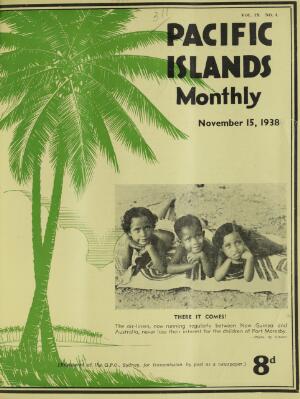
Islands
Pacific
Monthly
Vol. Ix. No. 4.
November 15, 1938
\at the G.P.0., Sydney, for transmission hy post as a newspaper .]
8“
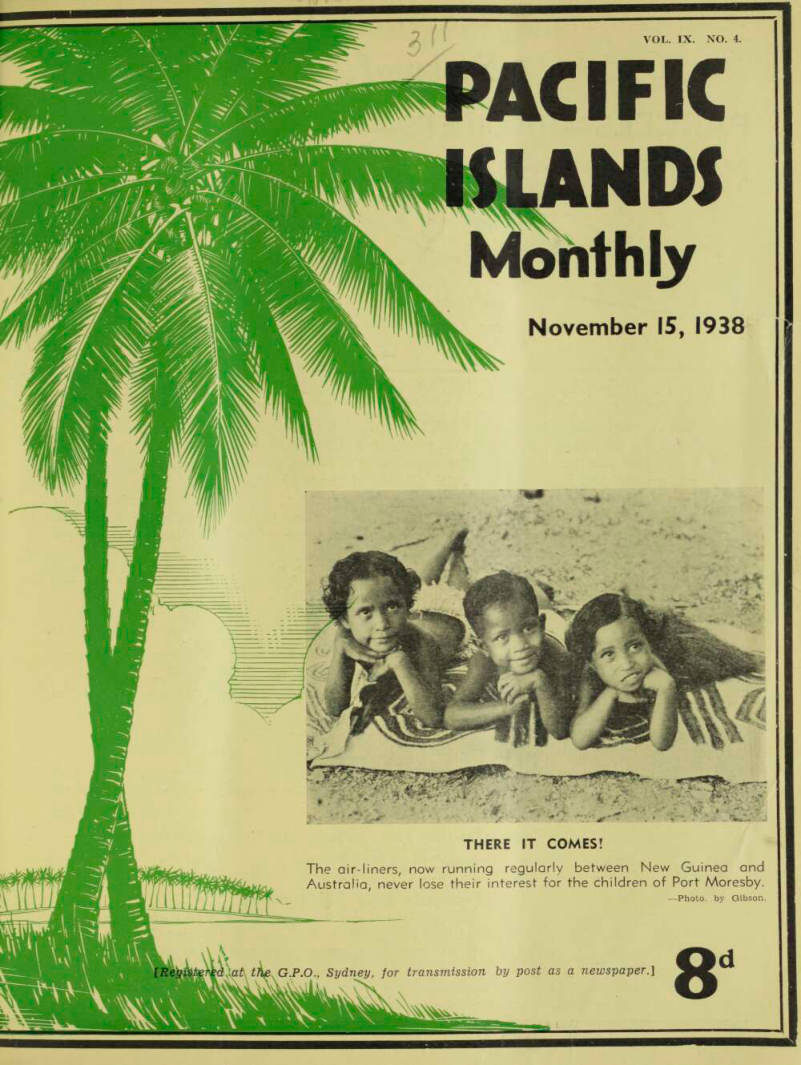
There It Comes!
The air-liners, now running regularly between New Guinea and Australia, never lose their interest for the children of Port Moresby. —Photo, by Gibson.
Advertisements & other items, p. 2 (2 items)
Pacific Islands Monthl y—N ovember 15> 1938
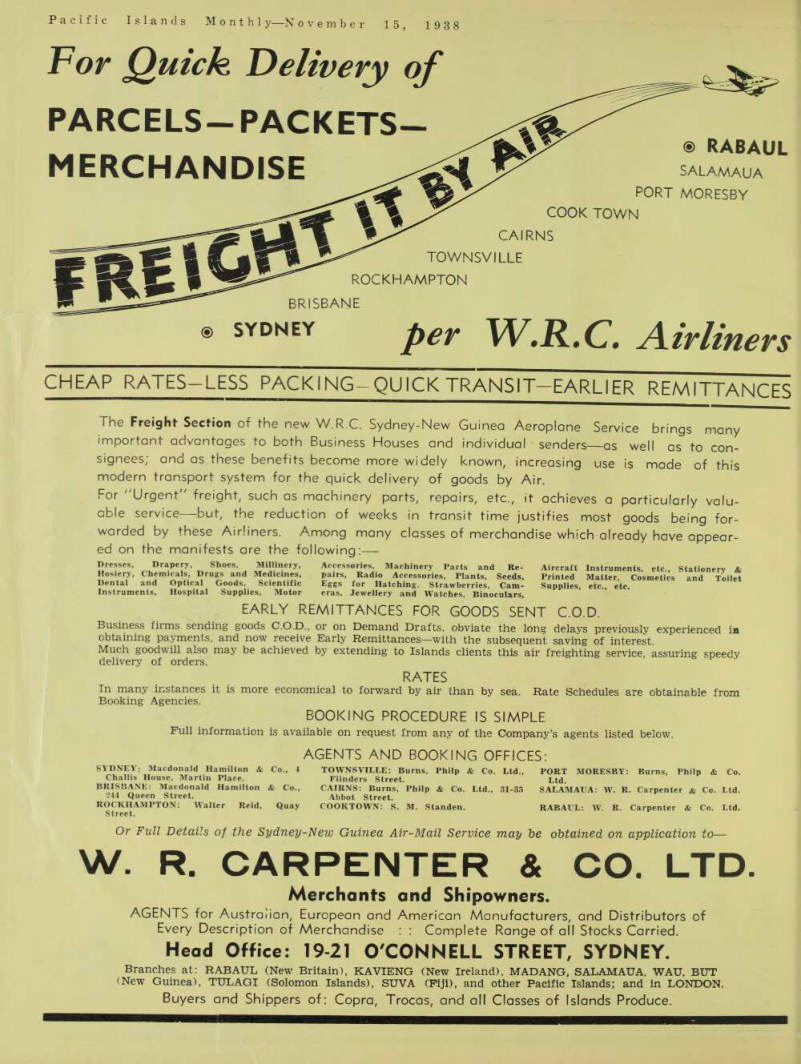
For Quick Delivery of
PARCELS-PACKETS-
MERCHANDISE
® rabaul
SALAMAUA
PORT MORESBY
COOK TOWN
CAIRNS
TOWNSVILLE
ROCKHAMPTON
BRISBANE
® SYDNEY
per W .R.C.A
CHEAP RATES-LESS PACKING-QUICK TRANSIT-EARLIER REMITTANCES
The Freight Section of the new W.R.C. Sydney-New Guinea Aeroplane Service brings many important advantages to both Business Houses and individual senders—as well as to consignees; and as these benefits become more widely known, increasing use is made of this modern transport system for the quick delivery of goods by Air.
For "Urgent" freight, such as machinery parts, repairs, etc., it achieves a particularly valuable service—but, the reduction of weeks in transit time justifies most goods being forwarded by these Airliners. Among many classes of merchandise which already have appeared on the manifests are the following:— Dresses, Drapery, Shoes, Millinery, Hosiery, Chemicals, Drugs and Medicines, Dental and Optical Goods, Scientific Instruments, Hospital Supplies, Motor Accessories, Machinery Parts and Repairs, Radio Accessories, Plants, Seeds, Eggs for Hatching. Strawberries, Cameras, Jewellery and Watches, Binoculars, Aircraft Instruments, etc.. Stationery & Printed Matter, Cosmetics and Toilet Supplies, etc., etc.
EARLY REMITTANCES FOR GOODS SENT C.O.D.
Business firms sending goods C.0.D., or on Demand Drafts, obviate the long delays previously experienced in obtaining payments, and now receive Early Remittances—with the subsequent saving of interest.
Much goodwill also may be achieved by extending to Islands clients this air freighting service, assuring speedy delivery of orders.
RATES
In many instances it is more economical to forward by air than by sea. Rate Schedules are obtainable from Booking Agencies.
BOOKING PROCEDURE IS SIMPLE
Pull information is available on request from any of the Company’s agents listed below.
AGENTS AND BOOKING OFFICES:
SYDNEY: Macdonald Hamilton & Co., 4 Challis House, Martin Place.
BRISBANE: Macdonald Hamilton & Co., 244 Queen Street.
ROCKHAMPTON: Walter Reid, Quay Street.
TOWNSVILLE: Burns, Philp & Co. Ltd., Flinders Street.
CAIRNS: Burns, Philp & Co. Ltd., 31-35 Abbot Street.
COOKTOWN: S. M, Standen.
PORT MORESBY: Burns, Philp & Co.
Ltd.
SALAMAUA: W. R. Carpenter & Co. Ltd.
RABAUL: W. R. Carpenter & Co. Ltd.
Or Full Details of the Sydney-New Guinea Air-Mail Service may he obtained on application to —
W. R. CARPENTER & CO. LTD
Merchants and Shipowners.
AGENTS for Australian, European and American Manufacturers, and Distributors of Every Description of Merchandise : Complete Range of all Stocks Carried.
Head Office: 19-21 O'CONNELL STREET, SYDNEY.
Branches at: RABAUL (New Britain), KAVIENG (New Ireland), MADANG, SALAMAUA, WAU, BUT (New Guinea), TULAGI (Solomon Islands), SUVA (Fiji), and other Pacific Islands; and in LONDON.
Buyers and Shippers of: Copra, Trocas, and all Classes of Islands Produce.
Pacific Islands Travellers
Passengers Per Airmail Liner “Caro
Nia”, Which Left Sydney For Papua
& N.G. ON OCTOBER 11; Messrs. Brewster, Dixon-Swift, Wilson, Davies, Lillicrap, Martin, Carswold, Dickin, Sedgers.
Passengers Per Airmail Liner “Car
Mania”, Which Left Rabaul, N.G., For
AUSTRALIA ON OCTOBER 14: Messrs. Edwards, Hyde, Davis, Hadley, Shaw, Eldred, Hyde (2 *.
Ruygrok.
Passengers Per “Montoro” Which
Reached Sydney From N.G. And Papua
ON OCTOBER 14; Messrs. Annan, Buckland, Burns, Cheetham, Clinch, Condren, England, Fairey, Floyd, Gillingwater, Hallam, Harrison, Hughes, Johnston, Kendell, Longden, Maloney, Moon. Mugliston, Murcutt, Phillips, Powell, Sacker, Smith, Tribolet, Washington, Water house, Batze‘ (2), Burness, Bushby, Fitch, Green, Hopkins, Joseph, Kennedy, McDonald, Toogood, Ward, Anderson, Crowley, Freeman, McArthur, Matley, Osborne, Ryan, Schuster, Siganto, Wade, Woods. Mesdames Carr, Clay, Clinch, Gillingwater, Hardaker, Rowes, Nisbet, Oliver, Parks, Ryan, Sullivan, White, Batze (2), Dett man, Eckhoff (2), Kennedy, Byrne, Wade, Wash ington. Misses Back, Boag, Cooper. Godsell, Harrison, Healy, Love, Miller, Pattison, Watson, Cooke, Devine, Brenchley, Byrne, Freeman, Mac- Auley, Rosin.
Passengers Per “Malaita”, Which
SAILED FROM SYDNEY FOR N.G. AND SOLO
Mon Islands Ports On October 15:
Messrs. Laidlaw, Beverley, Fallowes, Lambert, Bowman, Macpherson, Humphreys, Withy, Dick, Smith, Kofler, O’Neil, Burns, Adair, Pascoe, Ball. Mesdames Downs, Kingsford, Laidlaw, Beverley, Cook, Humphreys, Bilston, Sprott, Glenn. Misses Graham, McGarvey, Laidlaw (2), Wilks, Brewer, Moore, Cohen.
Passengers Per Airmail Liner “Carin
Thia” Which Left Sydney For Papua
& N.G. ON OCTOBER 18; Messrs. Walker, Gray, Clegg. Fell. Hiles, Siggins, Reilly. Mesdames McKenna, Sommerville, Ingold. Miss Jones.
Passengers Per “Nankin” 'Which Ar
Rived In Sydney From Rabaul, New
GUINEA, ON OCTOBER 20; Messrs. Alday, Green, Targett, Hillier, Gee, Mackay. Mes dames Green, Little, Gee.
Passengers Per Airmail Liner “Caro
NIA” WHICH LEFT RABAUL, N.G., FOR AUS TRALIA ON OCTOBER 21: Messrs. Fell, Mon eur, Siggins, Atkinson, Hiles, Rondahl, Har combe, Mulholland. Mesdames Florence. Misses Hagarty, Gofton.
Passengers Per “Tasmian” Which
Sailed From Sydney For Port Moresby,
PAPUA, ON OCTOBER 21: Messrs. Bramell, Kienzle, Champion, Walshe, Harvey, Story, Heath, Gilkinson, May, Hall, Delbridge, Gray, Westerman, Simons, Barwick. Mesdames Kien zle, Walshe, Gray. Miss Rowbotham.
Passengers Per “Aorangi” Which
REACHED SYDNEY FROM SUVA, FIJI, ON OC TOBER 22: Messrs. Costello, Gumming, Foulis, Martin, Mune, Ruthven, Bentley, Berry, Wood ward (2), Gosnell, Morgan. Mesdames Foulis, Martin, Mune, Howell, Woodward, Gosnell. Misses Howell, Powell, Gosnell (2).
Passengers Per Airmail Liner “Car
Mania” Which Left Sydney For Papua
& N.G. ON OCTOBER 25: Messrs. Clarke, Evans, Nichterlein, Norris, Scott, Gilmore, Atkinson, Shaw, Allen. Miss McGraham.
Passengers Per “Macdhui” Which Ar
RIVED IN SYDNEY PROM PAPUA & N.G. ON OCTOBER 27; Messrs. Ashwell, Adams, Archer, Bunting, Briant, Barham, Burton, Cridland, Cox, Chisholm, Dixon, Edwards, Fahey, Flan agan, Frank, Garrad, Crimson, Hunter, Haynes, Horton, Jackson, James, Kershaw, Keenan, Lee.
O’Malley, Penny, Rogerson, Shannon, Scannell, Turner, Tompsett, Vicary, Walmsley, Wilson, Wells, Wauchope. Mesdames Bunting, Cridland, Chisholm, Dixon, de Groen, Pitton, Garrad, Gribben, Hill, Hoile, Lambden, Middleton, Rog erson, Selwood, Turner, Wauchope. Misses Ay ton, Barker, Bedser, Cameron, Columbia, Hob ler, Helene, Kirby, Rudd, Reginlinda, Slade, Wegner.
(Continued On Page 82)
Passengers Per “Aorangi” Which Left
SYDNEY FOR SUVA, FIJI, ON OCTOBER 27: Messrs. Booth, Campbell, Chapman, Eland, Ken yon, Morland, Pascoe, Lane, Kempthorne, Rich ardson, Stack, Marchant. Mesdames Crummer Morland, Stack, Marchant. Miss Stack.
Passengers Per “Morinda” Which Left
SYDNEY FOR LORD HOWE, NORFOLK IS. & N. HEBRIDES ON OCTOBER 27: Messrs. Shaw, Daval, Douglass, Smith (2), Westwood, Brady.
Martin, Hurstwaite, White, Prentice, Caro, Wil liams, Herbert. Gray, Spence, Commins, Wel don, Weekes, Madden. Brinklow, Jordan, Don nelly, Frew, Palmer, Wilson. Mills, Bale, Walsh.
Stranger-Leathes, Le Job, Kolanji, Nolan, Mc- Whinney, Searby. Mesdames Aitken, Hines.
Jones. Douglass, Smith (2). Campbell, Dawkins.
McCormish, Kelso. Thompson, Nolan, Sawyer, Carroll, Searby, Topham, Smith. King, Wise.
Misses Blake. Parmeter, Kennedy. Baxter, Frame, Finlay (2), Fagan, Jeffreys, Willis, Daw kins, Buxton. Sheridan. Knapman (2), Swin son (2), Atkinson, Robson, Stone, Morrison, Til lett, Moore, Grant, Mclntosh, Monk, Ryan, Tracy, Wise.
Passengers Per Airmail Liner “Carin
THIA” WHICH LEFT RABAUL, N.G., FOR AUS TRALIA ON OCTOBER 28; Messrs. Stirling. Cot
ter, Paulks, Blackley, McConnan, Reilly, Barry Hiles. Miss English.
Passengers Per “Neptuna” Which
Reached Sydney From N.G. On October
31: Messrs. Dixon, Horton, Dibble, Allison, Bar rel! Cowan, Hippersley, Lockhart, Lucas, Mitchell.
Michell, Russell, Wilson, Childs, Vagg, Finn, Fraser, Meares, Ryan, Robinson, Shelton’ Clark!
Larking, Read, Sturgeon. Mesdames Horton, Barker, Fraser, Lucas, McEwan, Morgon, Po land, Russell, Swanson, Silvester, Hill, McCon nor, Tuckey, Vagg, Meares, Sturgeon, Shelton, Webb, Clark. Larking, Read, Russell. Misses Gannon, Harris, Jacobsen, Savage.
Passengers Per Airmail Liner “Caro
NIA” WHICH LEFT SYDNEY FOR PAPUA & N.G. ON NOVEMBER 1: Messrs. Campbell, Mc- Kenzie, Gray, Leyer, Lee. Mesdames Dixon, Fraser, Steele, Crouch.
Passengers Per “Macdhui” Which
SAILED FROM SYDNEY FOR PAPUA & N.G.
ON NOVEMBER 2; Messrs. Hayes, Goodwyn, Lyons, Verteuil, Pringle, Millward, Ford, Clin ton, Taylor, Strong, Shoobridge, Hutchinson, Lees. Board. Young, Lumley, Weekes, Baker, Skinner, Tomkinson, Prosser. Boulter, Roberts, Williams, Provan, Brough, Lewis, Izoo, Searle, Munn, Rondahl, Benton, Warnaby, Waddell, McKone, Hargreaves, McKinnon, Cameron, Kent, Ryan, Lyon, Burton, Mater, Shorter, Wright.
Black, Gray, Pianta, Cotman, Cole, Muller, Allen, Reilly, Merriman, Wilson, Eaton, Bergstrand, Noack, Hallam, Stubbings. Ashwell, Reed, Os borne, Peters, Turner, Richter. Ryan. Newbold, Boel, Layer, Freund. Hooper, Clerkin, Bloner, Osborne, Matthies. Mesdames Walker, Borgas, Burton, Hutchinson, Shay. Board, Skinner, Tom kinson, Prosser, White, Provan, Thomas, Freund, Searle, Munn, Rondahl, Benton, Ever sen, Simnett, Cameron. Lyon, Kent, Gray, Noack, Wakeford, Turner, Reilly, Conroy, Pomeroy, Kiessling, Adams, McKenzie, Croft, Matthies.
Misses Kirby, Rudd. Bayley (2). Henderson, Whitehead, Harris, Smith, Thomas, Lyon, Car lom, Clarke, Charlton, Gissing.
Passengers Per Airmail Liner “Car
Mania” Which Left Rabaul, N.G., For
Australia On November 4: Messrs. Lee.
Campbell, Kavanagh, Quinn, Miles, Weeks, Lumm, Morris. Marshal, Ogg. Mrs. Ogg.
Passengers Per Airmail Liner “Carin
THIA” WHICH LEFT SYDNEY FOR PAPUA & N.G. ON NOVEMBER 11; Messrs. Kingsford.
Bickham, Voss, Osborne, Jolly. Mrs. Lane.
Advertisements & other items, p. 3 (2 items)
I
Pacific Islands Monthl y—N ovember 15, 1938
Pacific
THE
KPM
SOUTH
PACIFIC
LINE
il
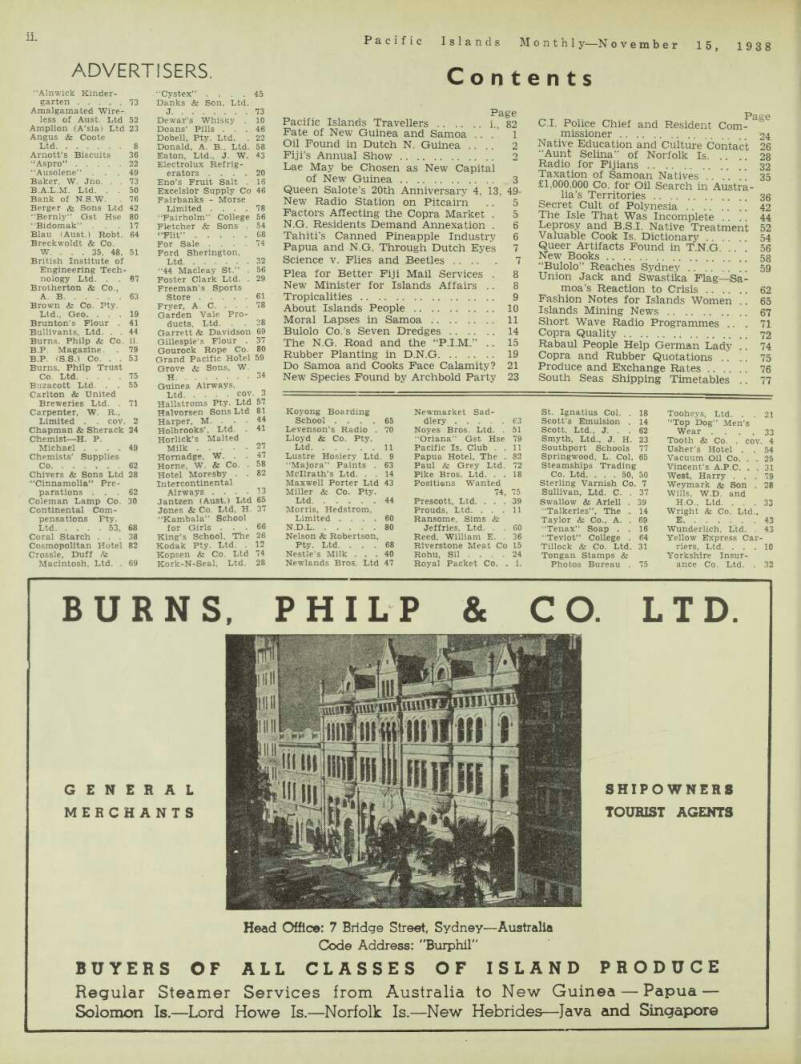
Links the East with the South
Pacific Islands, New Zealand & Australia
KPM
SOUTH PACIFIC LINE
Royal Packet Navigation Co.
Ltd., Paketvaart House, 255 George Street, Sydney. (N. V. Koninklijke Paketvaart Maatschappi]—lncorporated in the Netherlands).
The track routes of the K.P.M.-South Pacific Line new motor vessel "Maetsuycker" and the well-known passenger steamer "Tasman" are each as follows: "MAET- SUYCKER": Saigon, Singapore, Batavia, Samarang, Sourabaya, Port Moresby, Samarai, Salamaua, Rabaul, Auckland, Wellington, Sydney, Port Moresby, Sourabaya, Samarang, Batavia, Singapore, Sa.'gon. "TASMAN": Saigon, Singapore, Batavia, Samarang, Sourabaya, Port Moresby, Port Vila, Noumea, Auckland, Wellington, Sydney, Port Moresby, Sourabaya, Samarang, Batavia, Singapore, Saigon.
Saigon, Diethelm & Co.: Port Moresby and Samarai, Steamships Trading Co. Ltd.: Rabaul and Salamaua, W. R.
Carpenter & Co. Ltd.: Port Vila. Gubbay Preres; Noumea. Carlo Leoni: Auckland, Russell & Somers Ltd.: Wellington, Johnston & Co. Ltd.
Advertisers.
“Alnwick Kinder garten 73 Amalgamated Wire-. less of Aust. Ltd 52 Amplion (A’sia) Ltd 23 Angus & Coote Ltd 8 Arnott’s Biscuits 36 “Aspro” 22 “Ausolene” ... 49 Baker. W. Jno. . . 73
B.A.L.M. Ltd. . . 50
Bank of N.S.W. . 76 Berger & Sons Ltd 42 “Bernly” Gst Hse 80 “Bidomak” ... 17 Blau (Aust.) Robt. 64 Breckwoldt & Co.
W. . . . 35, 48, 51 British Institute of Engineering Tech nology Ltd. . . 67 Brotherton & Co., A. B 63 Brown & Co. Pty.
Ltd., Geo. ... 19 Brunton’s Flour . 41 Bullivants, Ltd. . . 44 Burns. Philp & Co. ii.
B.P. Magazine. . 79
B.P. (S.S.) Co. . . 53
Burns, Philp Trust Co. Ltd 75 Buzacott Ltd. . . 55 Carlton & United Breweries Ltd. . 71 Carpenter, W. R., Limited . . cov. 2 Chapman & Sherack 24 Chemist—H. P.
Michael ... 49 Chemists’ Supplies Co 62 Chivers & Sons Ltd 28 “Cinnamolia” Pre parations ... 62 Coleman Lamp Co. 30 Continental Com pensations Pty.
Ltd 53, 68 Coral Starch ... 38 Cosmopolitan Hotel 82 Crossle, Duff Sc Macintosh, Ltd. . 69
“Cystex” ... 45 Danks & Son, Ltd.
J 73 Dewar’s Whisky . 10 Doans’ Pills ... 46 Dobell, Pty. Ltd. . 22 Donald, A. 8., Ltd. 58 Eaton, Ltd., J. W. 43 Electrolux Refrig erators ... 20 Eno’s Fruit Salt . 16 Excelsior Supply Co 46 Fairbanks - Morse Limited . . . .78 “Fairholm” College 56 Fletcher & Sons . 54 “Flit” 68 For Sale ... 74 Ford Sherington, Ltd 32 “44 Macleay St.” . 56 Foster Clark Ltd. . 29 Freeman’s Sports Store 61 Fryer, A. C. . . . 78 Garden Vale Pro ducts, Ltd. . . 28 Garrett & Davidson 69 Gillespie’s Flour . 37 Gourock Rope Co. 80 Grand Pacific Hotel 59 Grove & Sons. W.
H 34 Guinea Airways, Ltd cov. 3 Hallstroms Pty. Ltd 57 Halvorsen Sons Ltd 81 Harper, M. ... 44 Holbrooks’. Ltd. . 41 Horlick’s Malted Milk 27 Hornadge, W. . . 47 Horne, W. & Co. . 58 Hotel Moresby . . 82 Intercontinental Airways ... 13 Jantzen (Aust.) Ltd 65 Jones & Co. Ltd, H. 37 “Kambala” School for Girls ... 66 King’s School. The 26 Kodak Pty. Ltd. . 12 Kopsen & Co. Ltd 74 Kork-N-Seal. Ltd. 28
Koyong Boarding School ... 65 Levenson’s Radio . 70 Lloyd & Co. Pty.
Ltd 11 Lustre Hosiery Ltd. 9 “Majora” Paints . 63 Mcllrath’s Ltd. . . 14 Maxwell Porter Ltd 43 Miller & Co. Pty.
Ltd 44 Morris, Hedstrom, Limited ... 60
N.D.L 80
Nelson & Robertson, Pty. Ltd. ... 68 Nestle’s Milk ... 40 Newlands Bros. Ltd 47
Newmarket Sad dlery 63 Noyes Bros. Ltd. . 51 “Oriana” Gst Hse 79 Pacific Is. Club . .11 Papua Hotel, The . 82 Paul & Grey Ltd. 72 Pike Bros. Ltd. . . 18 Positions Wanted 74, 75 Prescott, Ltd. ... 39 Prouds, Ltd. ... 11 Ransome, Sims & Jeffries, Ltd. . . 60 Reed, William E. . 36 Riverstone Meat Co 15 Rohu, Sil . . . . 24 Royal Packet Co. . i.
St. Ignatius Col. . 18 Scott’s Emulsion , 14 Scott, Ltd., J. . . 62 Smyth, Ltd., J. H. 23 Southport Schools 77 Springwood, L. Col, 65 Steamships Trading Co. Ltd. ... 50, 50 Sterling Varnish Co. 7 Sullivan, Ltd. C. . 37 Swallow & Ariell . 39 “Talkeries”, The . 14 Taylor & Co., A. . 69 “Tenax” Soap . . 16 “Teviot” College . 64 Tillock & Co. Ltd. 31 Tongan Stamps & Photos Bureau . 75
Tooheys, Ltd. . . 21 “Top Dog’’ Men’s Wear ... 33 Tooth & Co. . cov. 4 Usher’s Hotel . . 54 Vacuum Oil Co. . . 25 Vincent’s A.P.C. . . 31 West, Harry ... 79 Weymark & Son . 28 Wills, W.D. and H. 0., Ltd. ... 33 Wright & Co. Ltd., E 43 Wunderlich, Ltd. . 43 Yellow Express Car riers, Ltd. ... 10 Yorkshire Insur ance Co. Ltd. . 32
Contents
Page Pacific Islands Travellers i., 82 Fate of New Guinea and Samoa .. . ’ 1 Oil Found in Dutch N. Guinea ... 2 Fiji’s Annual Show 2 Lae May be Chosen as New Capital of New Guinea 3 Queen Salote’s 20th Anniversary 4, 13, 49- New Radio Station on Pitcairn .. 5 Factors Affecting the Copra Market . 5 N.G. Residents Demand Annexation . 6 Tahiti’s Canned Pineapple Industry 6 Papua and N.G. Through Dutch Eyes 7 Science v. Flies and Beetles 7 Plea for Better Fiji Mail Services . 8 New Minister for Islands Affairs .. 8 Tropicalities 9 About Islands People 10 Moral Lapses in Samoa 11 Bulolo Co.’s Seven Dredges 14 The N.G. Road and the “P.1.M.” .. 15 Rubber Planting in D.N.G 19 Do Samoa and Cooks Face Calamity? 21 New Species Found by Archbold Party 23
Page C.I. Police Chief and Resident Com missioner 24 Native Education and Culture Contact 26 ‘•Aunt Selina” of Norfolk Is 28 Radio for Fijians 32 Taxation of Samoan Natives 35 £1,000.000 Co. for Oil Search in Austra lia’s Territories 36 Secret Cult of Polynesia * 42 The Isle That Was Incomplete ... 44 Leprosy and 8.5.1. Native Treatment 52 Valuable Cook Is. Dictionary .. 54 Queer Artifacts Found in T.N.G. . 56 New Books 53 “Bulolo” Reaches Sydney ! 59 Union Jack and Swastika Flag—Sa moa’s Reaction to Crisis 62 Fashion Notes for Islands Women .. 65 Islands Mining News 67 Short Wave Radio Programmes ... 71 Copra Quality 72 Rabaul People Help German Lady .. 74 Copra and Rubber Quotations ... 75 Produce and Exchange Rates 76 South Seas Shipping Timetables .. 77
Advertisements & other items, p. 4 (2 items)
Ii
Pacific Islands Monthl y—N ovember 15, 1938
Burns
GENERAL
MERCHANTS
PHILP & CO.
r< mil m f.
SUM
til
fin
in mi 111 111 Hi] 111 23 m
LTD.
SHIPOWNERS
TOURIST AGENTS
Head Office: 7 Bridge Street, Sydney—Australia Code Address: "Burphil"
BUYERS OF ALL CLASSES OF ISLAND PRODUCE Regular Steamer Services from Australia to New Guinea Papua Solomon Is. —Lord Howe Is. —Norfolk Is. —New Hebrides —Java and Singapore
Pacific Islands Monthly
The Newspaper-Magazine of the South Seas
[Registered at the G.P.0., Sydney, lor transmission by post as a newspaper.] Published Once Each Month and Circulated in Australia and New Zealand and in the following Pacific Territories and Islands Groups:
Crown Colony of Fiji.
Australian Territory of Papua.
Mandated Territory (Australia) of New Guinea, Bismarck Archipelago and Northern Solomon Islands.
Mandated Territory (Japan) of Marshall, Caroline and Marianna Islands.
French Territory of New Caledonia.
British and French Condominium of New . Hebrides.
American Territory of Eastern Samoa.
American Territory of Guam.
Mandated Territory of Nauru.
British Crown Colony of Gilbert and Ellice Islands.
Mandated Territory (New Zealand) of Samoa.
British Solomon Islands Protectorate.
British Protectorate of Tongan Islands.
New Zealand Territory of Cook Islands.
Australian Territory of Norfolk Island.
French Colony of Oceania (Tahiti, etc.).
American Territory of Hawaiian Islands.
Owned and Produced by Pacific Publications Pty. Ltd., Union House, 247 George Street, Sydney.
-rwr ppxinwp J Managing Director 8W5087 TELEPHONE BuBineBB and Editorial MA7IOI
P.O. Box 3408 R
Registered Address of Telegrams, Radiograms, and Cables: “Pacpub”, Sydney.
Contributions
Articles, Stories, and Photographs dealing with Pacific Islands subjects are Invited and will be paid for on publication at usual rates.
Subscription Rates
Per Annum, within British Empire, Prepaid, Post Free 8/- Per Annum, elsewhere, prepaid, Post Free 10/- Slngle Copies Bd.
Editor and Publisher:
R. W. Robson, F.R.G.S.
Assisted by Selwyn Hughes.
Advertising Manager; L. W. Bailey.
Advertising Office and Printing-House: 29 Alberta St., Sydney.
Advertising rates furnished on application.
Colours, etc by Arrangement Process Blocks made at Advertiser’s expense when required. Screen, 100.
Changes of Advertising Copy should reach this Office by 3rd of each month, otherwise previous advertisement may be repeated.
Agents
The following are authorised to receive sub scriptions for the Pacific Islands Monthly:— Islands Branches of Burns, Philp & Co. Ltd., and Burns Philp (South Sea) Co. Ltd.
Islands Branches of W. R. Carpenter & Co. Ltd.
All Branches of Morris, Hedstrom & Co. Ltd.
G. Thomas & Co,, Rabaul, New Guinea.
T. A. Olsson, Wau, New Guinea.
Whitten Bros. Ltd., Samarai, Papua.
Steamships Trading Co., Papua. All Branches.
P. Costello, Suva, Fiji.
J. Muir Suva, Fiji.
N. C. Mackenzle-Hunt, Walnunu, Bua, Fiji.
All Branches and Representatives of W. H. Grove & Sons Ltd., Auckland, New Zealand.
Cook Islands Trading Co., Rarotonga, Cook Is.
A. C. Rowland, Papeete, Tahiti.
Representative in London: W. C. HARVEY, Coronation Building 4 Lloyds Avenue, London, E. 0.2. from whom may be obtained copies of Pacific Islands Monthly, Pacific Islands Year Book, advertising schedules, etc.
Vol. IX. No. 4.
Sydney, November 1 5, 1938.
Prl<*a ( 8d - Per Copy rrllc ( Prepaid: 8/- p.a
Fate Of New Guinea And Samoa
WE do not think that Australia is likely to lose New Guinea —but she deserves to.
Consider the situation as it is to day. All New Guinea commercial interests are in a state of suspended animation, awaiting a four-months overdue decision about the new capital and the Morobe road; Ger many is carrying on a fierce, insistent demand for the return of her colonies, among which New Guinea is listed as one of the richest undeveloped tropical territories in the world; land hungry Japanese are snooping around the northern borders, placing upon Australia a clear obligation to develop and defend the Territory; public meetings are being held all over New Guinea by exasperated European re sidents, asking for one thing and an other, but all summed up in a demand for a clear-cut announcement of policy, in relation to the future of the Territory.
And, on the other side of the pic ture, what? An Administration which, although admirably staffed, cannot move without permission from Can berra. An Administrator who has chosen this time, of all others, to go
away on a four-months’ holiday. An Australian Government that has sub ordinated all matters (including Ter ritories affairs) to its miserable, unedifying squabblings, and actually has given us three Ministers for Territories within three days!
All this is not peculiar to the oc casion and the moment. It is typical of the way in which the coteries of professional politicians, who success ively take charge in Canberra, have treated Australia’s magnificent natural heritage in the Pacific. We despair of any improvement in the future.
Two or three times, lately, Aus tralia’s record in New Guinea has been publicly criticised; and on each occasion Mr. W. M. Hughes (then transient Minister for Territories) arose and sneered, and quoted blister ing figures to show how New Guinea trade and European population have increased under Australian rule. But neither Mr. Hughes nor any other Australian apologist has answered this journal’s repeated charge that all those comforting figures are the re sult of the activities of persons and companies engaged in the Morobe
gold industry, and that, apart from the Morobe district, very little has been done by the Administration to develop the country’s enormous re sources or improve the condition of the natives.
A dozen times, in the past month, Australian Ministers have babbled about “Australia’s sacred obligations to the native peoples of New Guinea”.
How, as a matter of simple, literal fact, have those obligations been ful filled?
Has any system of village-school education been operated, apart from the missions? No! Has any scienti fically-designed system been put into operation (as in Papua), to ease the impact of European civilisation upon the social organisation of these primitive peoples, and so preserve their simple culture, their village in stitutions, and their lives? Nothing has been done. Has the Government taken steps to train selected natives as native medical practitioners, on a systematic plan, so as to improve native village health and hygiene, as has been done in every other Pacific territory, from Papua right across to the Cook Islands? Not a thing has been done.
But the Government has permitted
many, many thousands of primitive natives to be engaged and transported long distances, to be housed in bar racks and used as labourers for plan tations, mines, wharves, etc.; and re turned to their villages at the end of three years with a fragmentary and improper knowledge of the ways of the white man and of “civilisation”.
There is nothing seriously wrong with this system, so long as it is intelli gently and scientifically handled, and the effect on native life of the return of discharged labourers to their vil lages is controlled. Under present conditions, it is not controlled and is having a disturbing and deplorable effect.
There are competent, trained men in the Territory, quite capable of governing it in a manner creditable to Australia, and satisfactory to those who put “native welfare” in the fore front of their considerations. But we shall have the present unsatisfactory conditions so long as professional politicians rule at Canberra, and send ex-politicians and ex-soldiers to act as administrators in the Pacific. * * * Were it not that control of New Guinea is absolutely necessary to Australia, as a defence barrier against Asia, there might be an agi tation for a return to German control.
As it is, we can say that the idea of allowing any other nation to con trol New Guinea is intolerable to Aus tralia; and that Germany is not mak ing the return of New Guinea a major issue, anyway. We have ex pressed that opinion a dozen times; and, from information received dur ing the month from many authori tative (including German) sources, we repeat it.
The sensationalist newspapers of Australia—and they nearly all are in that category now—have been fea turing “Germany’s demand for the return of New Guinea” almost daily, and the politicians have added their defiant squeals to the general clamour.
It can be ignored, almost wholly, as newspaper stunting. Germany, natur ally, will lay emphasis upon the enormous wealth of New Guinea, actual and potential, when colonies are under discussion; but that will be done to strengthen her position when her demand for territory is focussed, ultimately, upon a slice of Africa.
British investors in New Guinea and Western Samoa may sleep in peace.
We say it with regret. It would have been a very good thing if fear of losing New Guinea had scared Aus tralian politicians into some sem blance of real activity in New Guinea, along lines of clear-cut policy. * * * As we go to press, and since the foregoing was written, the Prime
Minister of Australia has formally announced, in unequivocal terms, that Australia does not, and will not in any circumstances, contemplate the return of New Guinea to Germany.
J
Oil Found
In Dutch New Guinea
From a Special Correspondent.
Samarang, Oct. 14.
TT is no longer a secret, now, that the operations of drilling for oil in Dutch New Guinea have met with good success.
At the first trial, oil was found at no greater depth than 120 feet.
Further investigations are proceed ing. The future of this enterprise seems to be very hopeful.
"Cuba" To Fly To Sydney
THE Archbold expedition’s big flying boat “Guba”, will leave Hollandia (north of Dutch New Guinea) early in December, will call at Port Moresby on December 3. and then will fly south to Sydney and Melbourne, and will return a few days later.
Mr. N. A. Osborne, of Island Explora tion Co., returned to Papua by airliner on November 9.
Fijian Native
Farmers
Carry Off District Prize at Suva Show
Prom Our Own Correspondent.
Suva, Oct. 20.
r[E most interesting feature of the Fiji annual show, held in Suva in mid-October, was the fact that the com petition for a collective district exhibit was won, with a very fine display of produce, by a group of native Fijian farmers, from the districts of Rewa, Naitisiri and Tailevu.
This was regarded as sound evidence of the growing interest of the Fijians in agricultural industries.
It was noted, however, that although most of the large Indian population are peasant farmers, they made very few exhibits at the show.
Outstanding features were the display of the Colonial Sugar Refining Co.; an exhibit arranged by the Department of Mines, indicating the growing import ance of the Fiji gold industry; exam ples of what is being done by entomo logical science to control tropical pests by the introduction of parasites; and a display of the small copra driers which have been operated so successfully in different parts of the group.
It is to be regretted that the exhibi tion did not attract more outside atten tion. The outside world should be given more information about the unlimited resources, and the wealth, actual and potential, of this important Crown Col ony.
Advertisements & other items, p. 6 (2 items)
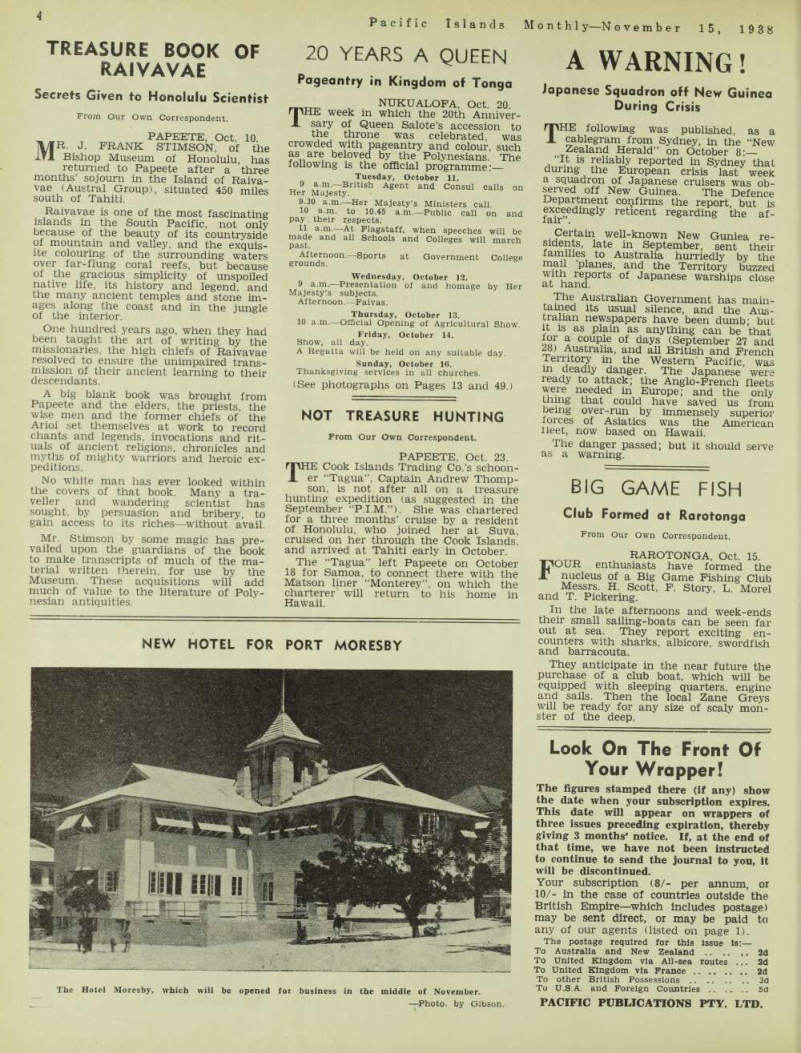
Off Beaten Tracks In The Pacific—Iv.
"All right, Ori—have it your own way!"
2
Pacific Islands Monthl y—N ovember 15, 1938
Lae May Be Chosen
How Otherwise Explain Public Works Activity in N. Guinea?
AN extraordinary situation exists in regard to the selection of a new capi tal for New Guinea, and the con struction of a road to connect the Mo robe goldfield towns with the port of Salamaua.
Officially nothing has been done since Mr. Hughes, four months ago, rejected the Griffiths Committee’s recommenda tion of Lae, and then saw his own selec tion of Salamaua rejected by the Com monwealth Government.
Repeatedly, right up until he lost the administration of Pacific Territories, in the Cabinet re-shuffle at the beginning of November, he told frequent inquirers that the “search for a new capital was proceeding diligently”, and that the sur veys of four or five alternative routes for the proposed roads were nearing com pletion. He indicated, on October 18, that the Middle Bitoi route (practically direct from Salamaua to Wau) was fav oured.
But nothing has been done—officially.
The Administrator has gone away on four months’ leave, and Canberra, when asked questions, is merely evasive.
It was assumed by many that Canberra is stalling for time, being unwilling to undertake heavy expenditure in New Guinea until it could be sure that it would hold control of New Guinea. A more likely explanation is that Canberra finds itself embarrassed by the need for providing a large portion of the £500,000, which is the estimated cost of the new administrative establishment.
In Favour Of Wau
In these circumstances, there has been pressure in favour of the selection of
Wau. It is pointed out that, if the road is built between Wau and Salamaua (.the linance for which is being provided by me big companies in what is virtually a compulsory loan), the administrative es tablishment could be placed quickly and very much more cheaply at Wau, where a town system already is in existence, and has not to be carved out of the jungle.
But, in the meantime, there has been extraordinary and unexpected activity at Lae (the original choice of the Griffiths Committee).
Our correspondent at Lae reports that, since early October, there have been surveyors and chainmen, assisted by teams of native labourers, at work there. “Traverses”, he .says, “have been run everywhere”. He further reports:— The new capital design is like a spid er’s web, the headquarters being in the middle (for the flies to walk in!) and roads radiating from it. One may call it wheel-shaped.
Writing by airmail on November 10, he says:— “There are now six surveyors busy at Lae, each with a gang of boys.
“The construction of the Markham road (from Lae up the Markham) is now proceeding seriously, and all the ma terial is on the job for the necessary bridges. We now can drive five miles up this road, over temporary bridges.
“There will be a deviation of this road, about 5i miles out of Lae, towards the proposed bridge-head, over the Markham River (from which point, ac cording to the Griffiths plan, the road will run along the coast 18 miles to Salamaua).
“Some of the surveyors, in conversa tion, have praised the suitableness of this Lae area for the purpose of laying out a town.
“A representative of the Department of Forests is also here at present, look ing into the timber position”.
The foregoing indicates that, whatever Canberra may think and say, tne New Guinea administration is very much on the job, and is doing everything possible in the way of preparation. Once Can berra can make up its mind, no time will be lost in New Guinea.
Problem Of The Road
Probably, if Lae is favoured, the real problem is the route of the road. Can berra. undoubtedly, wants to get on with the development of New Guinea. If the road goes direct from Salamaua to Wau (and thus gives the goldfield cheaper transport), and the capital is at Lae, then communication with Central New Guinea will have to be either — (a) Along the proposed coastal road to Salamaua; then over the new direct mountain road to the Bulolo Valley; thence via the Watut, by a new road, to the Upper Markham —a circuitous and expensive arrangement, so far as Cen tral New Guinea is concerned. (b) By a new road to be built straight up the Markham Valley into Central New Guinea, ignoring the Lae-Salamaua and the Salamaua-Wau roads.
It is a headache for the authorities.
They may seek to compromise by adopt ing the Buangs route for the Wau-Sala maua road. It is longer than the Mid dle Bitoi route, and would be correspond ingly more expensive for freighting: but it would serve the need for a Lae-Cen tral New Guinea route, as well as pro viding road communication between the goldfield and Salamaua. The Wau miners, however, seem determined to demand the shortest and cheapest route
(Bitoi, or thereabouts): and the action of the New Guinea Administration in mop ping up about £400,000 of gold royalties, during the past ten years, instead of using the money for reading, as orig inally intended, gives the miners now a strong claim for special consideration.
Miss M. Hodge, of the Methodist Mis sion, Salamo, Papua, is now in Sydney on leave.
Lieut.-Colonel Neville Sneyd Bertie Clay died at his residence in Papara, Tahiti, on October 17, aged 74. The greater part of Colonel Clay’s military career was passed in India. When he retired, after distinguished service, he settled in Tahiti. He was greatly re spected and beloved by those who knew him intimately. His passing has taken from the British colony at Tahiti one of its most valued and esteemed mem bers.
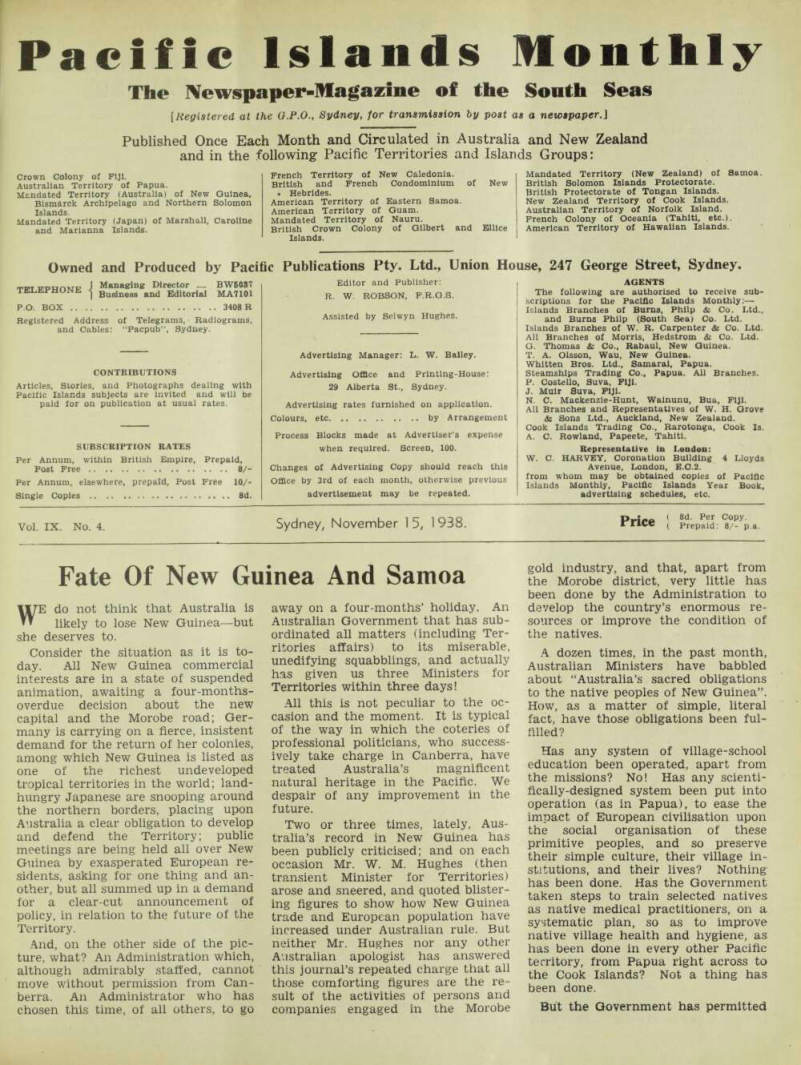
Unasual snapshot at the launching of the new steamer, “Suva”, recently, built in Europe for the Carpenter Line.
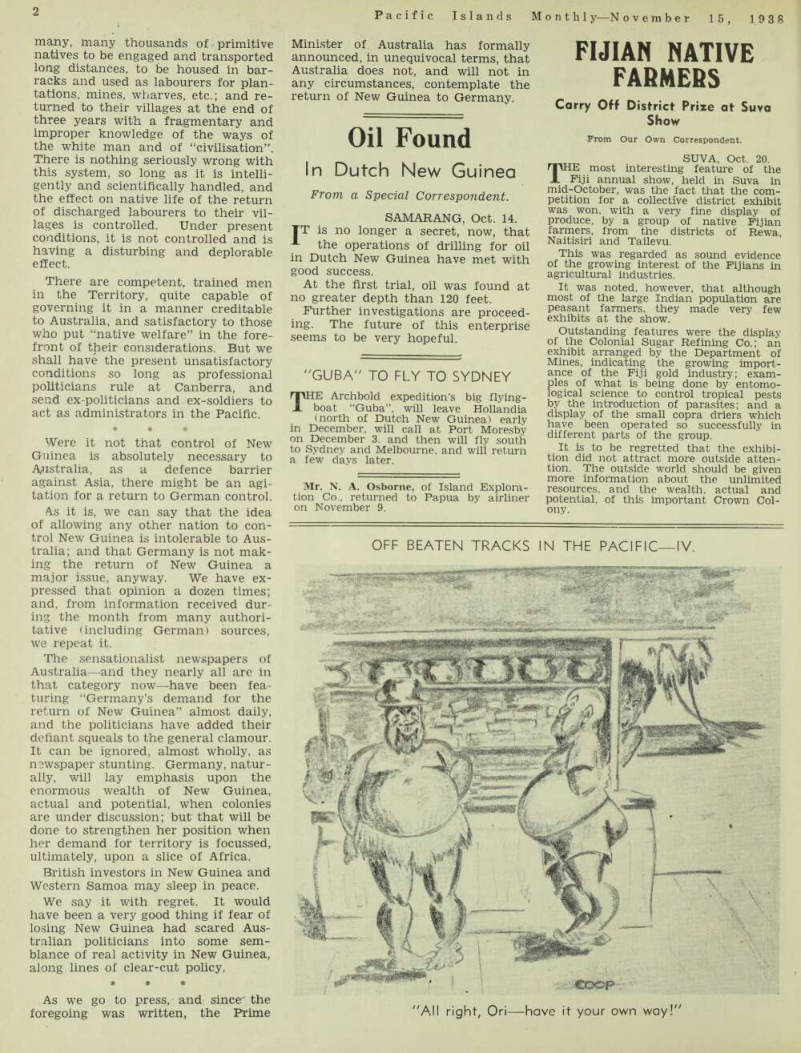
Northward Bound
Mr, L. G. Mill ward sailed from Sydney for Port Moresby, Papua,, by the “Macdhui” on November 2, to Join Australasian Petro leum Co.
Ltd. He will be engaged in geolo gical work.
Father Muller, of the Marist Mis sion, left for Ra baul, N. Guinea, by the last “Macd hui”, after spend ing several months leave in Sydney.
He later proceed ed to Bougain ville Island, where he is engaged in Mission work.
Mr. A. K. Pringle, of the geological staff of Australas ian Petroleum Co.
Ltd., departed from Sydney early in November for Pt. Moresby, Pa pua, on the last “Macdhui”.
Father Boell, a new Sacred Heart Missionary, sailed from Sydney for Pt. Moresby, Pa pua, by the No vember “Macdhui”
Advertisements & other items, p. 7 (1 item)
3
Pacific Islands Monthl y —N ovember 15, 1938
Treasure Book Of
Raivavae
Secrets Given to Honolulu Scientist
From Our Own Correspondent.
M Papeete, Oct. 10.
R. J. Frank Stimson, Of The
Bishop Museum of Honolulu, has returned to Papeete after a three months’ sojourn in the Island of Raiva vae (Austral Group), situated 450 miles south of Tahiti.
Raivavae is one of the most fascinating islands in the South Pacific, not only because of the beauty of its countryside pf mountain and valley, and the exquis ite colouring of the surrounding waters over far-flung coral reefs, but because of the gracious simplicity of unspoiled native life, its history and legend, and the many ancient temples and stone im ages along the coast and in the jungle of the interior.
One hundred years ago, when they had been taught the art of writing by the missionaries, the high chiefs of Raivavae resolved to ensure the unimpaired trans mission of their ancient learning to their descendants.
A big blank book was brought from Papeete and the elders, the priests, the wise men and the former chiefs of the Arioi set themselves at work to record chants and legends, invocations and rit uals of ancient religions, chronicles and myths of mighty warriors and heroic ex peditions.
No white man has ever looked within the covers of that book. Many a tra veller and wandering scientist has sought, by persuasion and bribery, to gain access to its riches—without avail.
Mr. Stimson by some magic has pre vailed upon the guardians of the book to make transcripts of much of the ma terial written therein, for use by the Museum. These acquisitions will add much of value to the literature of Poly nesian antiquities.
Advertisements & other items, p. 8 (1 item)
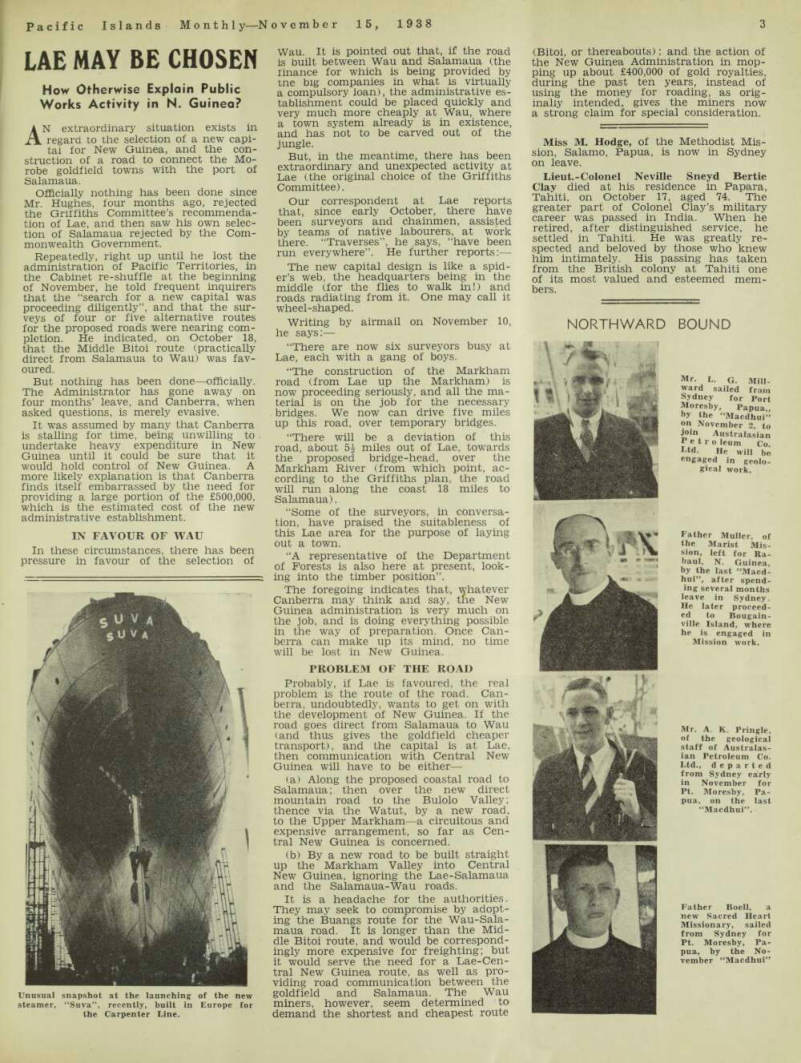
New Hotel For Port Moresby
The Hotel Moresby, which will be opened for business in the middle of November. —Photo, by Gibson.
20 Years A Queen
Pageantry in Kingdom of Tonga
T . Nukualofa, Oct. 20.
HE week m which the 20th Anniver sary of Queen Salote’s accession to the throne was celebrated, was crowded with pageantry and colour, such as are beloved by the Polynesians. The following is the official programme:— Tuesday, October 11. 9 a.m.—British Agent and Consul calls on Her Majesty. 9.30 a.m.—Her Majesty’s Ministers call. 10 a.m. to 10.45 a.m.—Public call on and pay their respects. 11 a.m.—At Flagstaff, when speeches will be made and all Schools and Colleges will march past.
Afternoon.—Sports at Government College grounds.
Wednesday, October 12. 9 a.m.—Presentation of and homage by Her Majesty’s subjects.
Afternoon.—Paivas.
Thursday, October 13. 10 a.m.—Official Opening of Agricultural Show.
Friday, October 14, Show, all day.
A Regatta will be held on any suitable day.
Sunday, October 16.
Thanksgiving services in all churches. (See photographs on Pages 13 and 49.)
Not Treasure Hunting
Prom Our Own Correspondent.
Papeete, Oct. 23.
THE Cook Islands Trading Co.’s schoon er “Tagua”, Captain Andrew Thomp son, is not after all on a treasure hunting expedition (as suggested in the September “P.1.M.”). She was chartered for a three months’ cruise by a resident of Honolulu, who joined her at Suva, cruised on her through the Cook Islands, and arrived at Tahiti early in October.
The “Tagua” left Papeete on October 18 for Samoa, to connect there with the Matson liner “Monterey”, on which the charterer will return to his home in Hawaii.
A Warning!
Japanese Squadron off New Guinea During Crisis
THE following was published, as a cablegram from Sydney, in the “New Zealand Herald” on October 8 “It is reliably reported in Sydney that during the European crisis last week a squadron of Japanese cruisers was ob served off New Guinea. The Defence Department confirms the report, but is exceedingly reticent regarding the af lair , Certain well-known New Guniea re sidents, late in September, sent their lamihes to Australia hurriedly by the mail ’planes, and the Territory buzzed with reports of Japanese warships close at hand.
The Australian Government has main tained its usual silence, and the Aus tralian newspapers have been dumb; but it is as plain as anything can be that for a couple of days (September 27 and Australia, and all British and French Territory in the Western Pacific, was in deadly danger. The Japanese were ready to attack; the Anglo-French fleets were needed in Europe; and the only thing that could have saved us from being over-run by immensely superior lorces of Asiatics was the American fleet, now based on Hawaii.
The danger passed; but it should serve as a warning.
Big Game Fish
Club Formed at Rarotonga
From Our Own Correspondent.
F Rarotonga, Oct. 15.
OUR enthusiasts have formed the nucleus of a Big Game Fishing Club Messrs. H. Scott, F. Story, L. Morel and T. Pickering.
In the late afternoons and week-ends their small sailing-boats can be seen far out at sea. They report exciting en counters with sharks, albicore, swordfish and barracouta.
They anticipate in the near future the purchase of a club boat, which will be equipped with sleeping quarters, engine and sails. Then the local Zane Greys will be ready for any size of scaly mon ster of the deep.
Advertisements & other items, p. 8 (2 items)
4
Pacific Islands Monthl y—N ovember 15, 1938
Your Wrapper!
Look On The Front Of
The figures stamped there (if any) show the date when your subscription expires.
This date will appear on wrappers of three issues preceding expiration, thereby giving 3 months’ notice. If, at the end of that time, we have not been instructed to continue to send the journal to you, it will be discontinued.
Your subscription (8/- per annum, or 10/- in the ease of countries outside the British Empire—which includes postage) may be sent direct, or may be paid to any of our agents (listed on page 1).
The postage required for this issue Is:— To Australia and New Zealand 2d To United Kingdom via All-sea routes ... 2d To United Kingdom via Prance 2d To other British Possessions 3d To U.S.A. and Foreign Countries 5d
PACIFIC PUBLICATIONS PTY. LTD.
New Radio Station On Pitcairn Is.
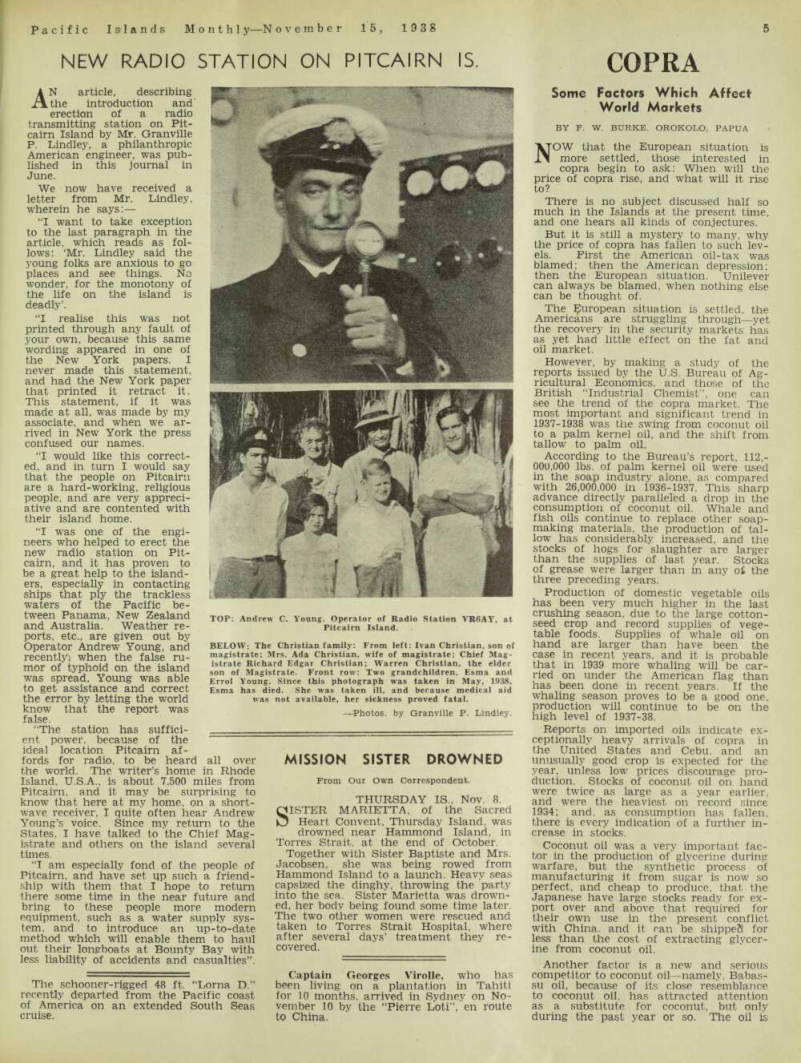
AN article, describing the introduction and erection of a radio transmitting station on Pit cairn Island by Mr. Granville P. Lindley, a philanthropic American engineer, was pub lished in this journal in June.
We now have received a letter from Mr. Lindley, wherein he says;— “I want to take exception to the last paragraph in the article, which reads as fol lows; ‘Mr. Lindley said the young folks are anxious to go places and see things. No wonder, for the monotony of the life on the island is deadly’.
“I realise this was not printed through any fault of your own, because this same wording appeared in one of the New York papers. I never made this statement, and had the New York paper that printed it retract it.
This statement, if it was made at all, was made by my associate, and when we ar rived in New York the press confused our names.
“I would like this correct ed, and in turn I would say that the people on Pitcairn are a hard-working, religious people, and are very appreci ative and are contented with their island home.
“I was one of the engi neers who helped to erect the new radio station on Pit cairn, and it has proven to be a great help to the island ers, especially in contacting ships that ply the trackless waters of the Pacific be tween Panama, New Zealand and Australia. Weather re ports, etc., are given out by Operator Andrew Young, and when the false ru mor of typhoid on the island was spread. Young was able to get assistance and correct the error by letting the world know that the report was false.
“The station has suffici ent power, because of the ideal location Pitcairn af
fords for radio, to be heard all over the world. The writer’s home in Rhode Island, U.S.A., is about 7,500 miles from Pitcairn, and it may be surprising to know that here at my home, on a short wave receiver, I quite often hear Andrew Young’s voice. Since my return to the States. I have talked to the Chief Mag istrate and others on the island several times.
“I am especially fond of the people of Pitcairn, and have set qp such a friend ship with them that I hope to return there some time in the near future and bring to these people more modern equipment, such as a water supply sys tem. and to introduce an up-to-date method which will enable them to haul out their longboats at Bounty Bay with less liability of accidents and casualties”.
The schooner-rigged 48 ft. “Lorna D.” recently departed from the Pacific coast of America on an extended South Seas cruise.
TOP: Andrew C. Young, Operator of Radio Station VR6AY, at Pitcairn Island.
BELOW: The Christian family: From left: Ivan Christian, son of magistrate; Mrs. Ada Christian, wife of magistrate; Chief Mag istrate Richard Edgar Christian; Warren Christian, the elder son of Magistrate. Front row: Two grandchildren, Esma and Errol Young. Since this photograph was taken in May, 1938, Esma has died. She was taken ill, and because medical aid was not available, her sickness proved fatal. —Photos, by Granville P. Lindley.
Mission Sister Drowned
From Our Own Correspondent.
Thursday Is., Nov. 8.
SISTER MARIETTA, of the Sacred Heart Convent. Thursday Island, was drowned near Hammond Island, in Torres Strait, at the end of October.
Together with Sister Baptiste and Mrs.
Jacobsen, she was being rowed from Hammond Island to a launch. Heavy seas capsized the dinghy, throwing the party into the sea. Sister Marietta was drown ed, her body being found some time later.
The two other women were rescued and taken to Torres Strait Hospital, where after several days’ treatment they re covered.
Captain Georges Virolle, who has been living on a plantation in Tahiti for 10 months, arrived in Sydney on No vember 10 by the “Pierre Loti”, en route to China.
Copra
Some Factors Which Affect World Markets
By F. W. Burke. Orokolo, Papua
NOW that the European situation is more settled, those interested in copra begin to ask; When will the price of copra rise, and what will it rise to?
There is no subject discussed half so much in the Islands at the present time, and one hears all kinds of conjectures.
But it is still a mystery to many, why the price of copra has fallen to such lev els. First the American oil-tax was blamed; then the American depression: then the European situation. Unilever can always be blamed, when nothing else can be thought of.
The European situation is settled, the Americans are struggling through—yet the recovery in the security markets has as yet had little effect on the fat and oil market.
However, by making a study of the reports issued by the U.S. Bureau of Ag ricultural Economics, and those of the British “Industrial Chemist”, one can see the trend of the copra market. The most important and significant trend in 1937-1938 was the swing from coconut oil to a palm kernel oil, and the shift from tallow to palm oil.
According to the Bureau’s report, 112,- 000,000 lbs. of palm kernel oil were used in the soap industry alone, as compared with 26,000,000 in 1936-1937. This sharp advance directly paralleled a drop in the consumption of coconut oil. Whale and fish oils continue to replace other soap making materials, the production of tal low has considerably increased, and the stocks of hogs for slaughter are larger than the supplies of last year. Stocks of grease were larger than in any of the three preceding years.
Production of domestic vegetable oils has been very much higher in the last crushing season, due to the large cotton seed crop and record supplies of vege table foods. Supplies of whale oil on hand are larger than have been the case in recent years, and it is probable that in 1939 more whaling will be car ried on under the American flag than has been done in recent years. If the whaling season proves to be a good one, production will continue to be on the high level of 1937-38.
Reports on imported oils indicate ex ceptionally heavy arrivals of copra in the United States and Cebu, and an unusually good crop is expected for the year, unless low prices discourage pro duction. Stocks of coconut oil on hand were twice as large as a year earlier, and were the heaviest on record since 1934; and. as consumotion has fallen, there is every indication of a further in crease in stocks.
Coconut oil was a very important fac tor in the production of glycerine during warfare, but the synthetic process of manufacturing it from sugar is now so perfect, and cheap to produce, that the Japanese have large stocks ready for ex port over and above that required for their own use in the present conflict with China, and it can be shipped for less than the cost of extracting glycer ine from coconut oil.
Another factor is a new and serious competitor to coconut oil—namely. Babas su oil, because of its close resemblance to coconut oil, has attracted attention as a substitute for coconut, but only during the past year or so. The oil is
produced by crushing the nut of the Babassu palm, which grows wild in Bra zil in great abundance. The Babassu kernels yield 65 per cent, of oil.
The production of Babassu oil to-day is small, and is yet only a minor com petitor of coconut. Production, however is being encouraged by the Brazilian Government, to meet the ever-increasing demand for the oil. It is reported that thousands of tons of Babassu nuts rot on the ground every year in Brazil, and so this industry, fostered by the Brazil ian Government, appears to be a poten tial tonnage competitor of coconut in the years to come.
As to the future prospects of the oil and fat market, statistics indicate that larger stocks of oils and fats will be available. This outlook apparently ac counts for the present low prices of fats and oils, and there is no indication of any substantial rise for some time to come.
Annexation
A Demand For
New Guinea Residents and Mandates System
ALL European residents of New Guinea at present are signing four copies of a petition, which states:— “We, the undersigned residents of the Mandated Territory of New Guinea, hereby forward our petition for the annexing of the Mandated Territory of New Guinea by Australia, and pro test against any suggestion that this Territory be handed back to Ger many”.
One copy will go to the King, one to the British Parliament, and one to the Australian Parliament.
The petition is receiving universal support: and its purpose is being as sisted by public meetings in all parts of the Territory.
This strong agitation, no doubt, will be noted when the Four Powers (Brit ain, Germany, France and Italy) meet to make a more definite European set tlement. and Germany advances her in evitable demand for colonial territory.
Meanwhile, it may be noted that the general belief, that “Mandates” repres ent territories held in trust from the League of Nations, for ultimate disposal elsewhere, is quite wrong. The “Rabaul Times”, in a timely article, quotes Mr.
Amery, formerly Secretary for the Col onies, and an acknowledged authority:— “Germany ceded her colonial territor ies as completely and irrevocably as she ceded Alsace-Lorraine or the former Ger man territories which are now part of Poland. She ceded them by Article 119 of the Treaty of Versailles, not to the League but to the principal Allied and Associated Powers. These Powers pro ceeded to divide these territories between themselves by mutual agreement. With that division the League had nothing whatever to do”, Mr. Amery explains how the League came into the picture. The Allied Pow ers wished to make it clear to President Wilson and to the world, that the ex- German colonies were not being taken over for exploitation, but for their own security and it was the intention to ad minister them in the interests of the inhabitants: documents, embodying these undertakings were submitted to the Lea gue and it was agreed that annual re ports should be made to the League.
Rabaul Public Meeting
There were 300 at the public meeting in Rabaul on November 1, when reso lutions opposing any suggestion of hand ing back New Guinea were passed.
Hon. J. C. Mullaly presided, and de livered the principal address, and others who took a prominent part included: Hon. R. Melrose (President of the Pub lic. Service Association), Hon. R. L. Clark (President of the R.S. & 5.1.L.A.), Mr.
R. Youlden (Public Service Association), Mr. D. Davies (President, Business and Property Owners’ Association), and Mr.
S. E. Costelloe (Citizens’ Association), Hon. C. R. Field, Mr. McConnell, Mr.
Walker-Flynn, and Mr. R. L. Solomons.
Mr. W. E. Grose, president of the Planters’ Association, also signed the re sulting petition.
Sir W. Carpenter Draws a
Comparison
Nearly three years ago, Sir Walter Carpenter, head of Messrs. W. R. Car penter & Co. Ltd., delivered an address in which he argued that, for strategic as well as economic reasons, Australia could not contemplate the return to Ger many of the Mandated Territory of New Guinea.
“There has been advanced the plea that a German country in the Western Pacific might constitute a valuable buffer between Australia and Japan”, said Sir Walter. “Against that, we see the recent rapprochement between Japan and Ger many. . . There are reasons enough why Australia should maintain a constant vigilance on her equatorial frontier.
There are equally strong reasons why the Germans should not, under the new conditions, return to their position of in fluence in the Pacific”.
“I delivered that address nearly three years ago”, said Sir Walter, this week, to the “P.1.M.”, “and I looked anxiously to Australia, and especially to New Guinea, for some support for my argu ments. But there was not a word from New Guinea. The only public interest they showed there, at that moment, was a readiness to support a German shipping line and German traders, as against British institutions.
“To-day, however, the whole of New Guinea is demanding—and rightly so— that Germany’s demand for New Guinea be resisted, and asking for annexation by Australia. Yet the circumstances are exactly the same as I outlined three years ago—except that may be the possibili ties are a little clearer.
“Is it any wonder that one becomes a bit cynical regarding ‘public move ments’? ”
Sharp, Deadly Epidemic
in New Hebrides
ON August 27, the second doctor at the French hospital at Port Vila, Dr.
Montfort, assisted by a Fijian N.M.P., Peni Tuidraki, was sent urgently to the island of Tongoa. in New Hebrides, to deal with what appeared to be a malaria epidemic, which was causing numerous deaths among natives on the island.
Dr.. Montfort found that a great many villages had been stricken by the dis ease, with rapid and deadly complica tions, but in some cases, where the vil lages were better situated than others, the people had resisted the onslaught of the disease.
Dr. Montfort left Tongoa on August 30, leaving instructions and medicines
with Mr. Nottage, the missionary on Tongoa.
At the request of Dr. Herivaux, Dr.
Montfort made an investigation in Tongoa into the spread of the tubercular germ.
This should contribute much to import ant work being undertaken at Port Vila by all the New Hebrides consultants of the French hospital, concerning tuber culosis in New Hebrides.
A dividend of 1/- a share (the third) payable on December 8, was announced by the chairman of Loloma (Fiji) Gold Mines, N.L. (Mr. P. F. Cody), at the third annual meeting in Melbourne on November 11.
Canned Pines
New Industry Started in Tahiti
From Our Own Correspondent
R Papeete, Oct. 24.
E recently constituted Societe Indus trielle Agricole de Tahiti will begin operating its factory for the canning of pineapples on November 1.
The Company will despatch, this sea son, 10,000 cases of this product to France, to fill contracts already negoti ated. Sample shipments of canned Ta hitian pineapples have established the Company’s product in the favour of buy ers, and the full season’s output has been taken at a price only two francs per case below that of the well-advertised Hawai ian canned pineapple.
Plantations of pineapple in the dis tricts of Papara, Vaiari and Mahina are bemg extended and will come into full bearing in 1939, when the Company will be able to produce 30,000 to 40,000 cases By virtue of contracts with native land owners, the Company plans to double the acreage of pineapples each year.
The operating plant is equipped with the finest machinery of the latest pat tern; enabling the Society to manufac ture at minimum costs.
The success of this newly-established industry may be a deciding factor in the future welfare of these islands. The re duced prices of copra and vanilla, and the practical extinction of the mar ket for pearl-shell, make imperative new agricultural undertakings and experi ments; for agriculture is the sole foun dation of the economy in this colony— so far as the native Polynesian is con cerned.
Islands Air
Transport
Rabaul-Kavieng Service Likely
THE new aerodrome which is being laid out at Rapindik, Rabaul (referred to elsewhere) represents an important step in aviation development in New Guinea.
As soon as it is complete, Carpenter Air ways will prepare a regular aeroplane service between Rabaul and Kavieng (Northern New Ireland).
New aerodromes now are being plan ned at Kavieng and Namatana! (in New Ireland) and Buka Passage and Kieta (Bougainville).
The next step, probably, will be an aeroplane service between Rabaul and Tulagi (in the Solomons) via Bougain ville and one of the northern towns in the Solomons,
Advertisements & other items, p. 10 (1 item)
6
Pacific Islands Monthl y—N ovember 15, 1938
As Their Neighbours
See Them Dutch Opinion of Australians in Papua and New Guinea
IN “Koloniaal Tijdschrift” (the periodi cal of the Netherlands East Indies civil servants) Dr. F. T. Marijn has published articles about the Civil Ser vice in Papua and the Mandated Terri tory.
After giving a description of the frame of government in both territories, he compares the task and the economic and social conditions of the civil servants in the Australian colonies with those in the Netherlands East Indies. He thinks that salaries and living conditions compare unfavourably but that, on the other hand, the regulations for recreation leave and long leave are more attractive than in the Netherlands Indies, where every six years a furlough of eight months is granted, with paid-passage to Europe and a little more than half-pay.
“What is the most striking quality of the Australian civil servants?” he goes on; and thus replies: “There are several; Their great sober ness, sportivity and practical ideas of government—they all seem to love the country and like the people of New Guinea. Inspection tours and expedi tions are physically very heavy. There are no rest-houses —at least, not in the sense of the word as we use it. They mostly camp, or pass the night, in a so called ‘rest-house’, a building in native style without any furniture or comfort.
“Very frequently, they must cut their way through the woods or follow native tracks, right onto a hill and straight down again—tracks of the kind that made the Italian explorer, d’Albertis, sigh that he preferred the climbing of Mont Blanc to that of a 400 metres hill in New Guinea. And he had experience of both.
“Physical hardships do not seem to count very much with them and, although their theoretical knowledge of native custom law is small, they all have a practical and enviable knack in applying it to native problems.
“But their first quality seems to be perseverance and the great devotion with which they fulfill their task”.
Inter-Island Vessel For
French Oceania
From Our Own Correspondent.
Papeete, Oct. 19.
MR. LEWIS HERSHON, who is the majority shareholder in the Societe Industrielle Agricole de Tahiti, and proprietor of an extensive estate in the island, is sailing, with Madame Hershon, by the “Friday” for Suva; where they will join the M.V. “Aorangi”, for San Francisco.
Mr. Hershon is visiting the States for the purpose of negotiating the delivery of a 200-tons cargo and passenger steam er for inter-island service in French Oceania. This steamer is to be operated by a locally-formed French Company, between Papeete and the Leeward Is lands (Raiatea, Bora Bora, etc.).
It is a modern, up-to-date vessel, hav ing comfortable accommodation for pas sengers.
From time to time, the Company will send the steamer on voyages through the several groups of French Oceania.
B.S.I. Bride
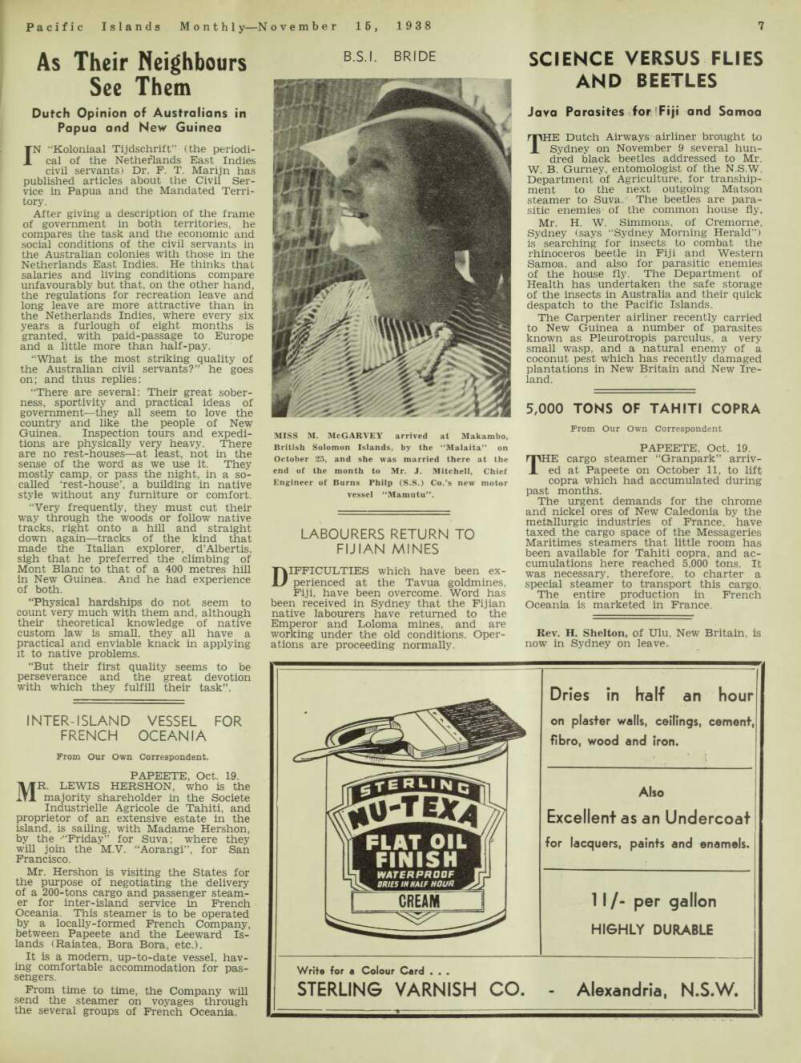
MISS M. McGARVEY arrived at Makambo, British Solomon Islands, by the "Malaita” on October 25, and she was married there at the end of the month to Mr. J. Mitchell, Chief Engineer of Burns Philp (S.S.) Co.’s new motor vessel "Mamutu”.
Labourers Return To
Fijian Mines
DIFFICULTIES which have been ex perienced at the Tavua goldmines, Fiji, have been overcome. Word has been received in Sydney that the Fijian native labourers have returned to the Emperor and Loloma mines, and are working under the old conditions. Oper ations are proceeding normally.
Science Versus Flies
And Beetles
Java Parasites for Fiji and Samoa
THE Dutch Airways airliner brought to Sydney on November 9 several hun dred black beetles addressed to Mr.
W. B. Gurney, entomologist of the N.S.W.
Department of Agriculture, for tranship ment to the next outgoing Matson steamer to Suva. The beetles are para sitic enemies of the common house fly.
Mr. H. W. Simmons, of Cremorne, Sydney (says “Sydney Morning Herald”) is searching for insects to combat the rhinoceros beetle in Fiji and Western Samoa, and also for parasitic enemies of the house fly. The Department of Health has undertaken the safe storage of the insects in Australia and their quick despatch to the Pacific Islands.
The Carpenter airliner recently carried to New Guinea a number of parasites known as Pleurotropis parculus, a very small wasp, and a natural enemy of a coconut pest which has recently damaged plantations in New Britain and New Ire land.
5,000 Tons Of Tahiti Copra
From Our Own Correspondent
Papeete, Oct. 19.
THE cargo steamer “Granpark” arriv ed at Papeete on October 11, to lift copra which had accumulated during past months.
The urgent demands for the chrome and nickel ores of New Caledonia by the metallurgic industries of France, have taxed the cargo space of the Messageries Maritimes steamers that little room has been available for Tahiti copra, and ac cumulations here reached 5,000 tons. It was necessary, therefore, to charter a special steamer to transport this cargo.
The entire production in French Oceania is marketed in France.
Rev. H. Shelton, of Ulu, New Britain, is now in Sydney on leave
Advertisements & other items, p. 11 (2 items)
7
Pacific Islands Monthl y—N ovember 15, 1938
Write for a Colour Card . . .
STERLING VARNISH CO.
Dries in half an hour on plaster walls, ceilings, cement, fibre, wood and iron.
Also Excellent as an Undercoat for lacquers, paints and enamels. 1 I /- per gallon
HIGHLY DURABLE
Alexandria, N.S.W.
Dutch Planes in Papua
and T.N.G.
To Assist in Oil Search
AUSTRALIAN Federal authorities have approved of the introduction into Papua and New Guinea, by Dutch interests (the K.N.1.L.M.), of three aero planes—two Douglas Amphibians and one Fokker aeroplane—for charter work for the companies seeking oil in the Territories.
The planes are to operate in the Ter ritories as visiting aircraft, and the ap proval that has been given covers the use of the machines for purposes of aer ial photography and for air transport operations directly associated with the exploration work of the companies that are prospecting for petroleum. But they are not to be used in any other air transport or commercial activities.
The approval in the case of the Fokker is for its use in the Territories for a per iod not exceeding 12 months and, in the case of the Douglas Amphibians, for a period not exceeding two years. If neces sary the periods may be extended, if the merits of the case warrant such a course.
Cup Sweeps In T.N.G.
REPORTS show that there were sweeps on the Melbourne Cup wherever Aus tralians congregated in New Guinea.
Some wunners:— New Guinea Club sweep, worth £145, £4O. and £2O. First prize: E. L. Eglinton.
Salamaua sweep, worth £lOO, £3O and £5. First prize: S. G. Neal (Lae).
Kokopo sweep, worth £27, won by Mar tin Hitipipeuw.
Transport Slow In
Fiji
Plea for Better Mail Services
From Our Own Correspondent.
Suva, Oct. 16.
THE principal island of Fiji, Viti Levu, is now served with a good road, which runs right around tne coast; yet it still takes practically a week to send a letter from Suva to Lautoka and get an answer.
This is not the only example of a slow and inefficient postal system. More than two hours after an oversea mail has been delivered at the Suva post of fice, lessees of letter-boxes may be seen dancing with impatience in the lobby, awaiting the sorting. The post office building itself is small and antiquated.
These matters were brought before a recent meeting of the Suva Chamber of Commerce by Mr. Alport Barker, and it was agreed to make strong representa tions to the Government. The Govern ment has spent money freely on new buildings and roads, and it is contended that the postal services could be speeded up. \ Fiji is the richest and most populous territory in the South Pacific and. in the circumstances, it is surprising that no enterprising young man with a good aeroplane has established himself there, and sought transport work with mails and passengers. Several have gone to New 7 Guinea.
An attempt was made to establish aerial services in Fiji some six years ago: but that was in the depth of the depression, and the enterprise failed.
The three-tons American yacht, “Marie'’. which was in Fiji in October, arrived in Sydnev early in November. She is manned by Captain Prank Dona and his brother.
Australia’S
Territories
Canberra Duties Transferred from Mr. Hughes to Assistant Minister
IN a re-arrangement of Cabinet duties, on November 7 the Australian Prime Minister transferred the responsibil ity for Islands Territories administration (New Guinea, Papua, Nauru and Nor folk Island) from the Minister for Ex ternal Affairs (Rt. Hon. W. M. Hughes) to Mr. J. A. Perkins (Minister assisting the Prime Minister).
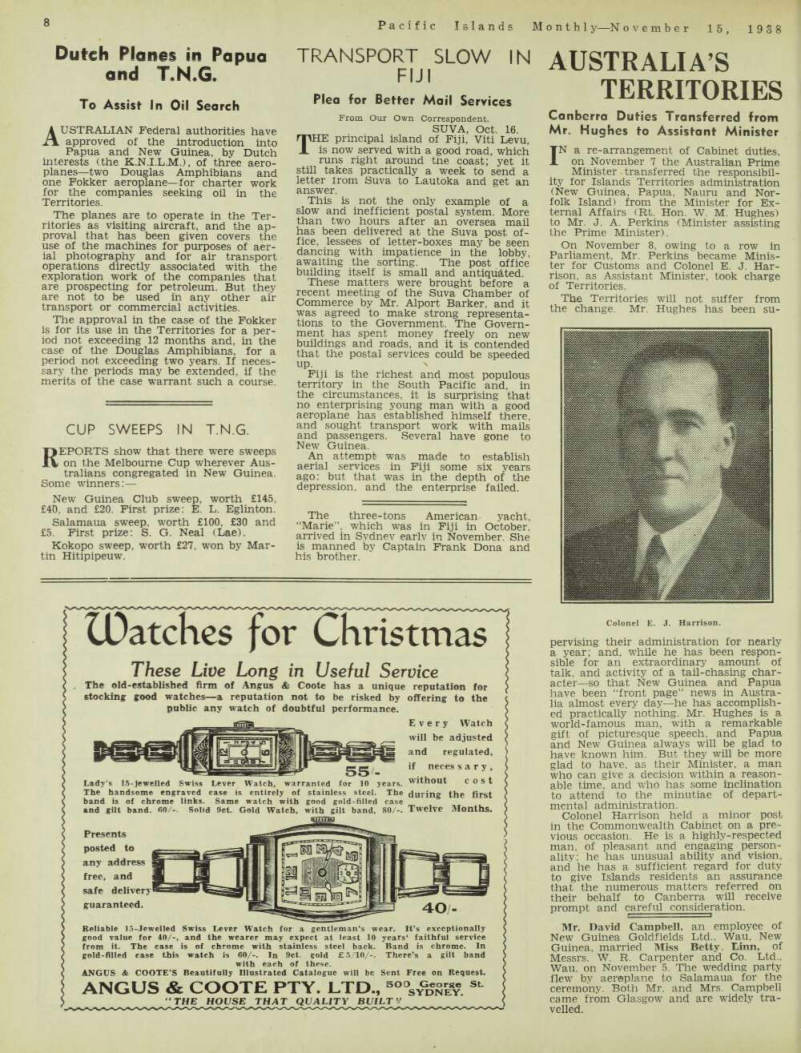
On November 8. owing to a row in Parliament, Mr. Perkins became Minis ter for Customs and Colonel E. J. Har rison, as Assistant Minister, took charge of Territories.
The Territories will not suffer from the change. Mr. Hughes has been su-
pervising their administration for nearly a year; and, while he has been respon sible for an extraordinary amount of talk, and activity of a tail-chasing char acter —so that New Guinea and Papua have been “front page” news in Austra lia almost every day—he has accomplish ed practically nothing. Mr. Hughes is a world-famous man, with a remarkable gift of picturesque speech, and Papua and New Guinea always will be glad to have known him. But they will be more glad to have, as their Minister, a man who can give a decision within a reason able time, and who has some inclination to attend to the minutiae of depart mental administration.
Colonel Harrison held a minor post in the Commonwealth Cabinet on a pre vious occasion. He is a highly-respected man. of pleasant and engaging person ality: he has unusual ability and vision, and he has a sufficient regard for duty to give Islands residents an assurance that the numerous matters referred on their behalf to Canberra will receive prompt and careful consideration.
Mr. David Campbell, an employee of New Guinea Goldfields Ltd.. Wau. New Guinea, married Miss Betty. Linn, of Messrs. W. R. Carpenter and Co. Ltd., Wau. on November 5. The wedding party flew by aeroplane to Salamaua for the ceremony. Both Mr. and Mrs. Campbell came from Glasgow and are widely tra velled.
Colonel E. J. Harrison.
Advertisements & other items, p. 12 (2 items)
8
Pacific Islands Monthl y—N ovember 15, 1938
tDatches for Christmas
SJP
55-
These Live Long in Useful Service
The old-established firm of Angus & Coote has a unique reputation for stocking good watches—a reputation not to be risked by offering to the public any watch of doubtful performance.
Every Watch will be adjusted and regulated, if neces sar y , Lady’s 15-jewelled Swiss Lever Watch, warranted for 10 years, without cost The handsome engraved case is entirely of stainless steel. The during the first band is of chrome links. Same watch with good gold-filled case and gilt band. 6ft/- Solid 9ct. Gold Watch, with gilt band. 80/-. Twelve Months.
Presents posted to any address free, and safe delivery guaranteed.
Reliable 15-Jewelled Swiss Lever Watch for a gentleman’s wear. It’s exceptionally good value for 40/-, and the wearer may expect at least 10 years* faithful service from it. The case is of chrome with stainless steel back. Band is chrome. In gold-filled case this watch is 60/-. In 9ct. gold £5/10/-. There’s a gilt band with each of these.
ANGUS & COOTE’S Beautifully Illustrated Catalogue will be Sent Free on Request.
ANGUS & COOTE PTY. LTD., 500 s£SZ r & st
“THE HOUSE THAT QUALITY BUILT V
m 40
Tropicalities
A TALL tale, related by a Fijian, was repeated to the Pacific Island Club on November 2, by Mr. R. H. Lester, of Fiji, who addressed the gathering on “The Fijian—Yesterday and To-day”.
By accident, a native fisherman up set his canoe in the water outside an island reef. Each time he tried to swim ashore the current carried him out to sea again. All day long he swam, until near evening he was close to the reef, only to be thrust back again. For a week this battle with the sea was waged, until the swimmer finally managed to reach safety, only to find when he drag ged himself ashore, that he had bar nacles all over his body as a result of his long immersion in the water! * * * A NOTE from another world-wander ing newspaper man—this time, Hakon Mielche, artist and special correspondent for a group of Danish newspapers. He has been recently in South America, the United States (16,000 miles in 33 States), Spain and Czecho slovakia.
“An American reporter, a good friend of mine, was killed by a bomb in his car a few days after I left him on the Tervel front, in Spain”, says Mr. Miel che. “They did not try such dirty tricks on us in the South Seas, so no wonder I prefer the Islands —even the reef around Vanikoro, where we left the poor old ‘Monsunen’. ”
The English translation of Mr. Miel che’s book about the “Monsunen” expe dition has been published in Britain and America and has been very favourably reviewed. * * * A STRANGE story comes from Tonga, which, if true, will probably have the effect of rendering those blessed lotus isles more sought after then any other part of the earth.
The story is that a woman living in one of the villages of Tongatabu, who can look back upon a century’s exist ence already, appears to have determ ined to make a fair start in her second century, and is cutting a new set of teeth. Whether this strange develop ment of second childhood has rendered the use of teething powder necessary, history does not state, and we do not know whether the old lady suffers from convulsions, or is given a ring to bite on.
It is also recorded that a young man, living in the same place, rejoices in the possession of a double row of teeth, “set sharkwise”; but that the old lady’s per formance has lowered his status in the village life— F.T.G. * * * A FIJI District Commissioner and his wife, on a trip through the country, came to a native village, where a mother had died, leaving a young orphan.
The Commissioner’s wife, taking com passion, decided to adopt the mite.
Some time later, two native women came to see the infant. It lay asleep on a mat. “Ah, little child, you are a white baby now, and when you grow up you will not talk to us”, sadly reflected one.
The other interrupted: “He is a white child now; he cannot understand Fijian.
Speak to him in English”, Her compan ion nodded wisely, and, bending over the infant, said: “Goddam! Goddam! God dam!”
HAVING spent 12 months in the Ply River section of Papua, engaged on an aerial survey, Captain Harold C. Crow ley arrived recently in Sydney, He told a reporter that Papua, generally, was “a monotonous, dreary, interminable swamp”; and the newspaper headings laid emphasis on the “dreary swamp”.
Residents of Central and Eastern Papua will be pleased with the new advertise ment of their country. * * * SEA-DOG” (New Guinea), in a bunch of Munchausen reminiscen ces, tells us that people who stam mer often sing well. A deck hand on an Islands schooner (he writes) who suf fered from an impediment in his speech
ran to the captain at the wheel during a storm and started, "P-p-please, s-s-sir”.
“For goodness’ sake, hurry up’’, said the captain, irritably. “If you can’t say it, sing it”.
The deck hand took a very long breath and sang:— “Should auld acquaintance be forgot “And never brought to mind, “The mate ’e’s fallen overboard, “And ’e’s half a mile behind!”
Mrs. Jean Stephens, who has been teacher at the Administration’s European School in Wau, New Guinea, for a little over a year, arrived in Australia at the end of October with her small son. Her place has been taken by Mrs. Rossi, of Edie Creek, who has had considerable teaching experience in Queensland.
Advertisements & other items, pp. 13-14 (2 items)
9
Pacific Islands Monthl y —N ovember 15, 1938
Mike Lingerie
OH
FOR YOU - LOVELY LADY
TJHE feminine heart has never fluttered for more exquisite lingerie than Lustre is showing for this Christmas.
It is so appealingly lovely and glamorous.
New colours, new fabrics, new styles— all contribute to joyous moments in the choosing of Lustre lingerie, and the giving or wearing of it afterwards. 12. Li Wjl 1 .
Ws * * *- \oV'/ From and Burns Philp Store or direct
by mail from any Australian store.
ADELAIDE
MELBOURNE
SYDNEY
TO BRISBANE
NEW GUINEA
DOOR TO DOOR
EXPRESS PARCEL DELIVERIES
BY
AIR MAIL
Via— Rockhampton . . . Townsville Cairns . . . Cooktown Port Moresby . . . Salamaua Rabaul.
Rates on application to
YELLOW EXPRESS
CARRIERS LTD.
103 Murray St., Pyrmont, Sydney Tel.; MW2551 in conjunction with
W. R. CARPENTER & CO., LTD.
'When friends
drop in for ado fit.
m I \ 'Y OU can be the perfect host if there’s always a bottle of Dewar’s on hand. Its alluring mellowness and ripe old age never fail to please the most discriminating tastes.
DEWAR’S
~?Ae SCOTCH WHISKY
About Islands People
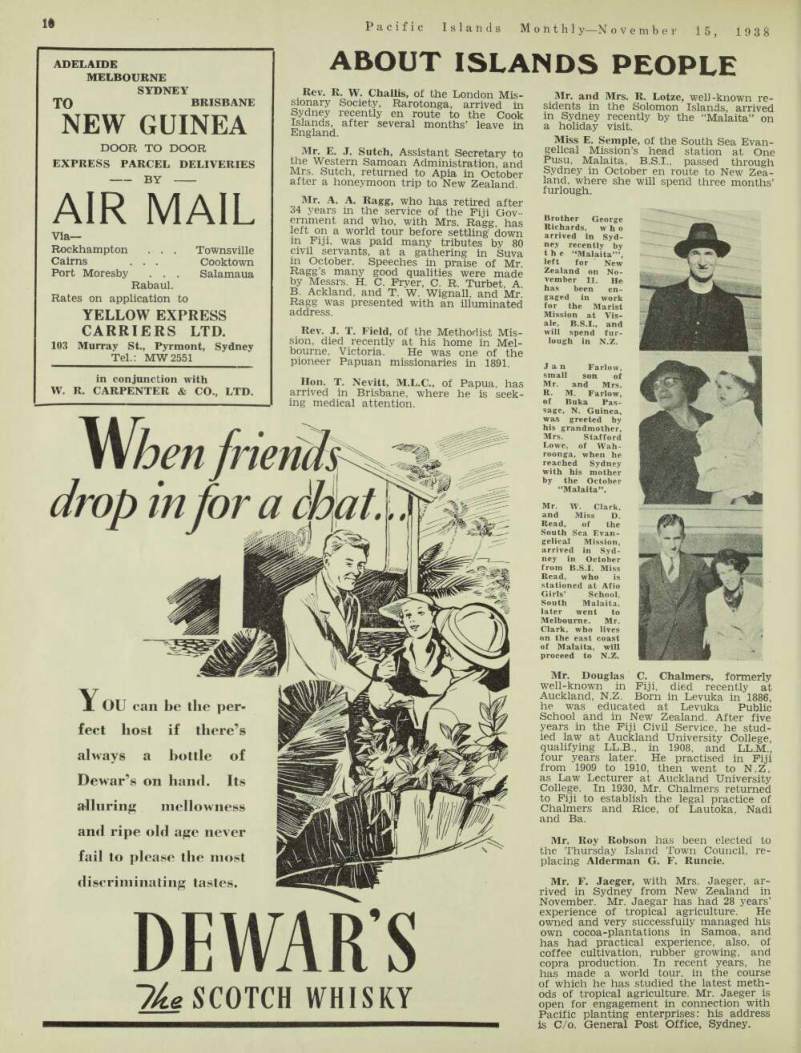
Rev. R. W. Challis, of the London Mis sionary Society, Rarotonga, arrived in Sydney recently en route to the Cook Islands, after several months’ leave in England.
Mr- E - J- Sutch, Assistant Secretary to the Western Samoan Administration, and Mrs. Sutch, returned to Apia in October after a honeymoon trip to New Zealand.
Mr. A. A. Ragg, who has retired after 34 years in the service of the Fiji Gov ernment and who, with Mrs. Ragg, has left on a world tour before settling down in Fiji, was paid many tributes by 80 civil servants, at a gathering in Suva in October. Speeches in praise of Mr Ragg’s many good qualities were made by Messrs. H. C. Fryer, C. R. Turbet, A.
B. Ackland. and T. W. Wignall, and Mr.
Ragg was presented with an illuminated address.
Rev. J. T. Field, of the Methodist Mis sion. died recently at his home in Mel bourne, Victoria. He was one of the pioneer Papuan missionaries in 1891.
Hon. T. Nevitt, M.L.C., of Papua, has arrived in Brisbane, where he is seek ing medical attention.
Mr. and Mrs. R. Lotze, well-known re sidents in the Solomon Islands, arrived in Sydney recently by the “Malaita” on a holiday visit.
Miss E. Semple, of the South Sea Evan gelical Mission’s head station at One Pusu, Malaita. 8.5.1., passed through Sydney in October en route to New Zea land, where she will spend three months’ furlough.
Mr. Douglas C. Chalmers, formerly well-known in Fiji, died recently at Auckland, N.Z. Born in Levuka in 1886, he was educated at Levuka Public School and in New Zealand. After five years in the Fiji Civil Service, he stud ied law at Auckland University College, qualifying LL.B., in 1908, and LL.M., four years later. He practised in Fiji from 1909 to 1910, then went to N.Z. as Law Lecturer at Auckland University College. In 1930, Mr. Chalmers returned to Fiji to establish the legal practice of Chalmers and Rice, of Lautoka, Nadi and Ba.
Mr. Roy Robson has been elected to the Thursday Island Town Council, re placing Alderman G. F. Runcie.
Mr. F. Jaeger, with Mrs. Jaeger, ar rived in Sydney from New Zealand in November. Mr. Jaegar has had 28 years’ experience of tropical agriculture. He owned and very successfully managed his own cocoa-plantations in Samoa, and has had practical experience, also, of coffee cultivation, rubber growing, and copra production. In recent years, he has made a world tour, in the course of which he has studied the latest meth ods of tropical agriculture. Mr. Jaeger is open for engagement in connection with Pacific planting enterprises: his address is C/o. General Post Office, Sydney.
Brother George Richards, who arrived in Syd ney recently by
the “Malaita”,
left for New Zealand on No vember 11. He has been en gaged in work for the Marist Mission at Vis ale, B.S.I., and will spend fur lough in N.Z.
Jan Farlow, small son of Mr. and Mrs.
R. M. Farlow, of Buka Pas sage, N. Guinea, was greeted by his grandmother, Mrs. Stafford Lowe, of Wah roonga, when he reached Sydney with his mother by the October “Malaita”.
Mr. W. Clark, and Miss D.
Read, of the South Sea Evan gelical Mission, arrived in Syd ney in October from B.S.I. Miss Read, who is stationed at Afio Girls’ School, South Malaita, later went to Melbourne. Mr.
Clark, who lives on the east coast of Malaita, will proceed to N.Z.
Advertisements & other items, p. 14 (1 item)
10
Pacific Islands Mohthl y—N ovembei 1 15, 1938
N. Guinea
The Airmail To
What Has Been Done in Six Months
THE weekly airmail between Australia, Papua and New Guinea ndw has been running for six months.
The service has been operated smooth ly. and without fuss or accident; time tables have been adhered to in all kinds of weather; and the DHB6 machines have flown over Australian plains, wide tropi cal seas, and New Guinea’s towering mountains, with remarkable regularity.
The service has been a great boon to Islands residents generally, especially in the transport of urgent cargo. The planes have carried everything, from medical supplies to seedlings, from en gine parts to parasites bred to attack coconut pests. Persons seriously ill have been able to get south to Australian specialists in a few hours. New Guinea residents, disliking the international out look on September 28, thanked God for the aeroplanes, into which they hurried ly loaded their families. New Guinea letters are now read within a week, where formerly six and seven weeks were needed.
The whole tempo of business life in New Guinea and Papua is being changed; while the use of the aeroplane and the teleradio is removing the terrors of iso lation from the life of the planter in the outer islands.
The airmail service, plus the introduc tion of fast, modern vessels like the “Macdhui” and “Bulolo”, is going to have a profound effect upon industrial de velopment in the territories. The men engaged in gold-mining in New Guinea and oil-drilling in Papua, to whom time is money, are travelling by airmail to an increasing degree, while those with more time to spare have the benefit of
faster ships.
The same applies to tourist traffic.
Oversea tourists are coming to Australia in increasing numbers. Those anxious to see New Guinea, but who have not time for the voyage by steamer, now use the aeroplanes. By flying, they can see a great deal in a fortnight, and even m a week.
It seems certain that Carpenter and Co. will be obliged to duplicate the ser vice within their first year of operation.
Already, the weekly service cannot cope with all demands.
The annual synod of the Methodist Church in Fiji was held in October, and the reports disclosed the progress of in teresting work among both Fijians (who readily accept Christianity) and Indians (who cling very stubbornly to their own religions). During the past year, in the 10 Fijian schools, the students increased by 28 per cent.; and, in the 13 Indian schools, by over 12 per cent.
Samoa
Moral Lapses In
Spirited Reply to Missionary's Slanders
Letter to the Editor YOU probably have noticed a news paper report of a speech in Sydney by a former missionary of the Lon don Missionary Society in Apia, Rev. C.
G. Stallan. It was made to a lunch eon gathering and published by the “Sydney Morning Herald” on August 31 under the captions: “Evils of Modern Civilisation —Drink, Gambling and Pic tures in Samoa —Missionary’s Fears”. (We saw the report; but, as we con sidered it silly, and so inaccurate and prejudiced as to convey an entirely wrong picture of Samoa, it was not re ferred 10 in this journal.—Ed. “P.1.M.”).
The contents of this article have aroused surprise, and indignation in Western Samoa —though it is not clear whether the remarks by Mr. Stallan re fer to American Samoa or to the Man dated Territory of Western Samoa. As far as the latter is concerned the alle gations are wholly unjustified and either imaginary or the product of a strangely perverted viewpoint. In the local news paper, a former missionary has already replied to Mr. Stallan’s address, and re futed same.
Mr. Stallan contends that the Sa moan race is being demoralised by drink, racing, gambling, boxing and the cinema, and that the influence of re ligious teaching is weakening. He says that drinking in American Samoa, among the natives, started with the repeal of prohibition in U.S.A.
It is a well-known fact that home brewing and drinking among natives started only after the New Zealand Gov ernment introduced —with the hearty consent of the missions—prohibition in Western Samoa. Only recently the Hon.
Tamasese, in a speech in the Legisla tive Council, deplored the bad effects of prohibition on the young Samoan gener ation. But, after all, nobody can say that drink is an outstanding evil amongst Samoan natives. There are
certainly some sly-grog shops, and “faamaiu” home-brew novels on the Apia water-front—mainly serving the entertainment of visiting sailors.
As regards racing, the efforts of the Apia Turf Club are to stimulate among the natives interest in horse-breeding and love of animals—a very necessary education for the Samoan, who is from sheer ignorance often inclined to ill treat and abuse his horse. Gambling among natives is almost non-existent.
The promotion of boxing among the Samoan youth, undertaken by leading Europeans and also by the Marist School Brothers, has had a very good effect on the Samoans, teaching tnem the value of good sportsmanship and fair play.
The cinema in Apia, where there ex ists only one picture theatre, is regu larly censored before being shown; and, as the morals of the natives are decid edly more liberal than those of the white man, there is considerable room for doubt whether any harm can pos sibly be done to native morals, even by a picture with an uncensored Mae Wesu as star. We in Samoa think that Mr.
Stallan could speak with authority on this aspect.
Mr. Stallan believes that the influence of religious teaching among the Samoan is weakening. This is also disputed; but, if conceded, whose fault is it? The old type of missionaries, who brought Christianity to Samoa and educated the natives in the moral principles of reli gious thought, gave also an example to their native flocks by leading them selves a Christian, moral and unblem ished life. More recent arrivals on the missionary field do not seem to follow in the footsteps of their predecessors, and, while preaching morality to others, are moral offenders themselves. Mr.
Stallan probably knows of the case of a certain missionary in Samoa (who has since left the country) against whom serious allegations of immorality and moral lapses were made, which were the common talk of his Samoan congrega tion, and served seriously to undermine respect, not only for the missionary him self, but also for his fellow mission workers, and white residents generally.
And, though the case was hushed up by superior influence, and the offender left Samoa, it is not forgotten par ticularly as, shortly afterwards, similar allegations were made against another missionary, who also had to leave Apia.
Samoans are not exactly fools, and are surprisingly quick in observing and sizing up the white man—not only by his words, but also, and particularly, by his deeds, and his mode of life. The Rev. Stallan will, therefore, understand when I close this letter with the famous and fitting quotation: “O si tacuisses”.
I am, etc.,
Veritas.
Apia, Samoa, 21/10/’3B.
Advertisements & other items, pp. 15-16 (3 items)
11
Pacific Islands Mont hi y—N ovember 15, 1988
pty. Ltd.
Barometers
and
Thermometers
High grade precision English Instruments. Tested and despatched adjusted to the altitude of their destination, accompanied by printed instructions for weather forecasting. 8947. —Combination Barometer and Thermometer, Chrome finish throughout. Length 15iins., Dial 4ins. square 45/-.
Our finely illustrated Catalogue sent post free on application.
ON PARLE FRANCAIS,
PROUDS PTY. LTD.
Jewellers and Watchmakers
Cr. KING & PITT STS.,
SYDNEY.
CREMO COFFEE
PACIFIC COFFEE
FIRSTCALL COFFEE
BULK COFFEE
(RAW WHOLE ROASTMOUHD),
A.S.F MILK
(.SWEETENED CONDENSED)
CORAL COCOA
BULK TEAS
(BOXES OR CHESTS)
<9 a ** o 6 jO A Cr o O V \ V Jjtp
ENSED M(
Drn VxPO * * "'RED For Expo & $
i CO PTY H 1
STOnev li S'" L
pty. Ltd.
SYDNEY
jjot 'Jea, and OrJjjee jj<A 50 'TjeaXA.
£ m tm k m
Whatever you
ask you’ll find amongst
the Miniature Kodaks
OF ALL KODAK DEALERS
THROUGHOUT THE ISLANDS and
KODAK (A/ASIA) PTY. LTD.
379 George St., Sydney SUPREMA in name . . .
SUPREME in design! Makes 12 exposures 2-\ x 2-\- in. on SS62O Kodak Film. Has automatic film spacing device with exposure counter, double exposure prevention device, etc. With f/3.5 Anastigmat lens, Compur- Rapid Shutter to 1 /400 second. Price £l6 fi
Write for Catalogue
36-exp. 35mm. models at half what you expected to pay. Nothing new to learn; striking pictures are a certainty! With Body Release.
Retina I, with f/3.5 lens; Black £lO/10/- Chromium £l2 Retina 11, with f/2 lens, coupled range-finder, £27/10/- A brilliant example of modern photographic craftsmanship. For 16 exposures on SS62O Kodak Film. Has action front, body release, etc. Satin Chromium finish. Choice of f/4.5 and f/3.5 lenses.
Prices from £B/10/-
KODAK FILM
FOR EXTRA QUALITY.
Kodak Film is based on fifty years’ experience with Island and Tropical needs. Its EXTRA QUALITY means
SNAPSHOTS YOU’LL BE PROUD
OF.
For the pictures that are hard to get, load with Kodak Verichrome or lightning-fast Kodak Super Sensitive Panchromatic—they’re the films
that GET THE PICTURE.
The Pacific Islands Club
Visitors from the Islands to Sydney (or those interested in Islands affairs), are advised to communicate with the honorary secretary of the above Club, which has been formed to study the history, traditions, economics, and political developments of the Pacific Islands.
Next Club Gathering, Tuesday, December 6, Hotel Carlton, Sydney.
THE PACIFIC ISLANDS CLUB.
C/o Pacific Publications Pty. Ltd., Union House, George St., Sydney.
"Oxford Movement"
JUST in case you do not know—we did not, until gently corrected by an official of the Anglican Church — there are two movements: an “Oxford Movement”, which is 100 years old, and an “Oxford Group Movement”, which is of very recent appearance. The “Oxford Movement” is more commonly known as “the Catholic Revival in England”, and the “Tractarian Movement”. The “Ox ford Group Movement” is of American origin, and has been much publicised.
When, in last issue, we referred to the “Oxford Movement” at Samarai, we meant, of course, the “Oxford Group Movement”.
Advertisements & other items, p. 16 (1 item)
12
Pacific Islands Monthl y— N ovember 15, 1938
Twenty Years A Queen
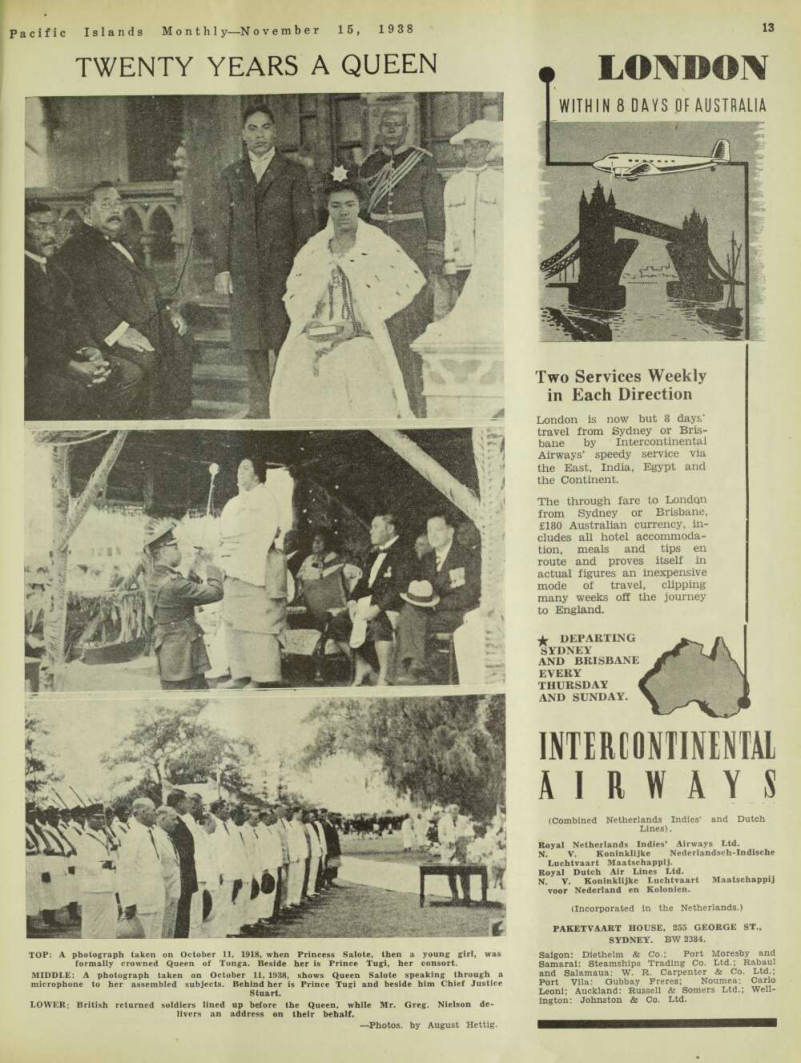
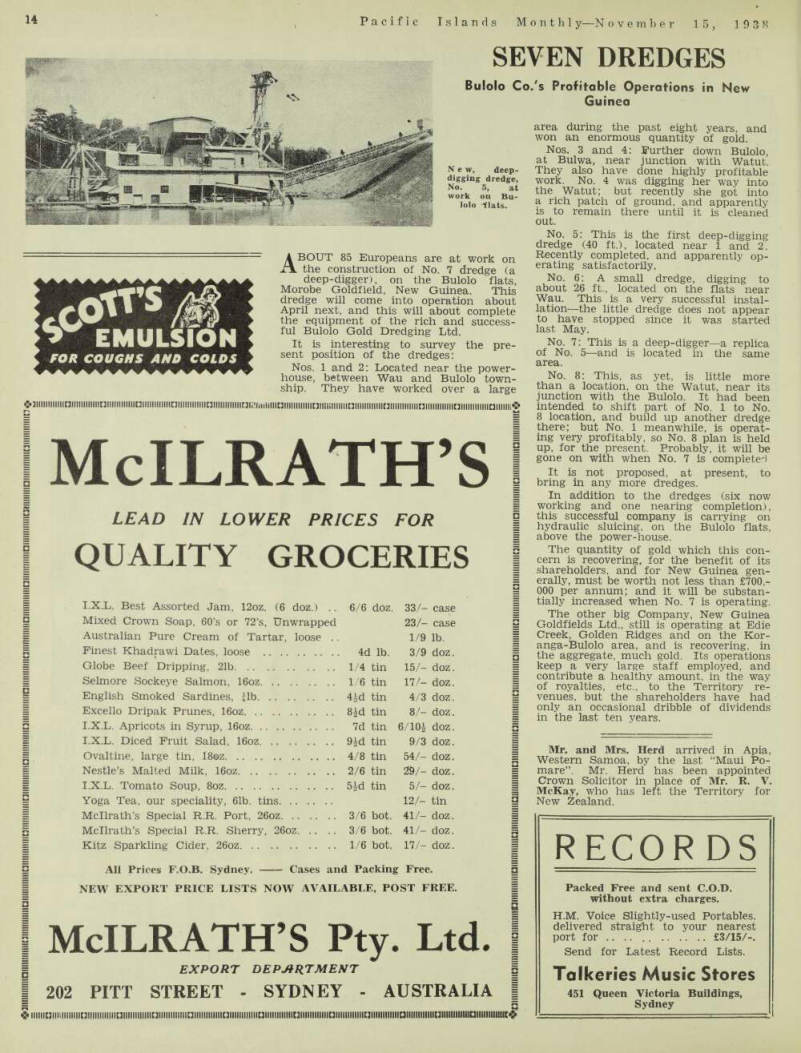
TOP: A photograph taken on October 11, 1918, when Princess Salote, then a young girl, was formally crowned Queen of Tonga. Beside her is Prince Tugi, her consort.
MIDDLE: A photograph taken on October 11, 1938, shows Queen Salote speaking through a microphone to her assembled subjects. Behind her is Prince Tugi and beside him Chief Justice Stuart.
LOWER; British returned soldiers lined up before the Queen, while Mr. Greg. Nielson de livers an address on their behalf. —Photos, by August Hettig.
ABOUT 85 Europeans are at work on the construction of No. 7 dredge (a deep-digger), on the Bulolo flats, Morobe Goldfield, New Guinea. This dredge will come into operation about April next, and this will about complete the equipment of the rich and success ful Bulolo Gold Dredging Ltd.
It is interesting to survey the pre sent position of the dredges: Nos, 1 and 2: Located near the power house, between Wau and Bulolo town ship. They have worked over a large
New, deep digging dredge, No. 5, at work on Bu lolo flats.
Advertisements & other items, pp. 17-18 (2 items)
13
Pacific Islands Monthl y—N ovember 15, 1938
Intercontinental
LONDON
WITHIN 8 DAYS OF AUSTRALIA
i y
Two Services Weekly
in Each Direction
London is now but 8 days’ travel from Sydney or Brisbane by Intercontinental Airways’ speedy service via the East, India, Egypt and the Continent.
The through fare to London from Sydney or Brisbane, £lBO Australian currency, includes all hotel accommodation, meals and tips en route and proves itself in actual figures an inexpensive mode of travel, clipping many weeks off the journey to England.
* DEPARTING
SYDNEY
AND BRISBANE
EVERY
THURSDAY
AND SUNDAY
INTERCONTINENTAL
AIRWAYS
(Combined Netherlands Indies’ and Dutch Lines).
Royal Netherlands Indies’ Airways Ltd.
N. V. Koninklijke Nederlandsch-Indische Luchtvaart Maatschappij.
Royal Dutch Air Lines Ltd.
N. V. Koninklijke Luchtvaart Maatschappij voor Nederland en Kolonien. (Incorporated in the Netherlands.)
PAKETVAART HOUSE, 255 GEORGE ST.,
SYDNEY. BW 2384.
Saigon: Diethelm & Co.; Port Moresby and Samaral: Steamships Trading Co. Ltd.; Rabaul and Salamaua: W. R. Carpenter & Co. Ltd.; Port Vila; Gubbay Freres; Noumea: Carlo Leoni; Auckland: Russell & Somers Ltd.; Wellington: Johnston & Co. Ltd.
m
McILRATH’S
LEAD IN LOWER PRICES FOR
QUALITY GROCERIES
I.X.L. Best Assorted Jam, 12oz. (6 doz.) .. 6/6 doz. 33/- case Mixed Crown Soap, 60’s or 72’s, Unwrapped 23/- case Australian Pure Cream of Tartar, loose .. 1/9 lb.
Finest Khadrawi Dates, loose 4d lb. 3/9 doz.
Globe Beef Dripping, 21b 1/4 tin 15/- doz.
Selmore Sockeye Salmon, 16oz 1/6 tin 17/- doz.
English Smoked Sardines, ilb tin 4/3 doz.
Excello Dripak Prunes, 16oz Bid tin 8/- doz.
I.X.L. Apricots in Syrup, 16oz 7d tin 6/10i doz.
I.X.L. Diced Fruit Salad, 16oz 9id tin 9/3 doz.
Ovaltine, large tin, IB©z 4/8 tin 54/- doz.
Nestle’s Malted Milk, 16oz 2/6 tin 29/- doz.
I.X.L. Tomato Soup, Boz 5Jd tin 5/- doz.
Yoga Tea, our speciality, 61b. tins 12/- tin Mcllrath’s Special R.R. Port, 260 z 3/6 bot. 41/- doz.
Mcllrath’s Special R.R. Sherry, 260 z 3/6 bot. 41/- doz.
Kitz Sparkling Cider, 260 z 1/6 bot. 17/- doz.
All Prices F. 0.8. Sydney. Cases and Packing Free.
NEW EXPORT PRICE LISTS NOW AVAILABLE, POST FREE.
McILRATH’S Pty. Ltd.
EXPORT DEPARTMENT
202 PITT STREET - SYDNEY - AUSTRALIA
Seven Dredges
Bulolo Co.'s Profitable Operations in New Guinea
area during the past eight years, and won an enormous quantity of gold.
Nos. 3 and 4: Further down Bulolo, at Bulwa, near junction with Watut.
They also have done highly profitable work. No. 4 was digging her way into the Watut; but recently she got into a rich patch of ground, and apparently is to remain there until it is cleaned out.
No. 5: This is the first deep-digging dredge (40 ft.), located near 1 and 2.
Recently completed, and apparently op erating satisfactorily.
No. 6: A small dredge, digging to about 26 ft., located on the flats near Wau. This is a very successful instal lation—the little dredge does not appear to have stopped since it was started last May.
No. 7; This is a deep-digger—a replica of No. s—and is located in the same area.
No. 8: This, as yet, is little more than a location, on the Watut, near its junction with the Bulolo. It had been intended to shift part of No. 1 to No. 8 location, and build up another dredge there; but No. 1 meanwhile, is operat ing very profitably, so No. 8 plan is held up, for the present. Probably, it will be gone on with when No. 7 is complete^ It is not proposed, at present, to bring in any more dredges.
In addition to the dredges (six now working and one nearing completion), this successful company is carrying on hydraulic sluicing, on the Bulolo flats, above the power-house.
The quantity of gold which this con cern is recovering, for the benefit of its shareholders, and for New Guinea gen erally, must be worth not less than £700,- 000 per annum; and it will be substan tially increased when No. 7 is operating.
The other big Company, New Guinea Goldfields Ltd., still is operating at Edie Creek, Golden Ridges and on the Kor anga-Bulolo area, and is recovering, in the aggregate, much gold. Its operations keep a very large staff employed, and contribute a healthy amount, in the way of royalties, etc., to the Territory re venues, but the shareholders have had only an occasional dribble of dividends in the last ten years.
Mr. and Mrs. Herd arrived in Apia, Western Samoa, by the last “Maui Po mare”. Mr. Herd has been appointed Crown Solicitor in place of Mr. R. V.
McKay, who has left the Territory for New Zealand.
Advertisements & other items, p. 18 (2 items)
14
Pacific Islands Monthl y—N ovember 15, 1938
Recor Ds
Packed Free and sent C.O.D. without extra charges.
H.M. Voice Slightly-used Portables, delivered straight to your nearest port for .. .. . . £3/15/-.
Send for Latest Record Lists.
Talkeries Music Stores
451 Queen Victoria Buildings, Sydney
The New Guinea Road And The "P.I.M."

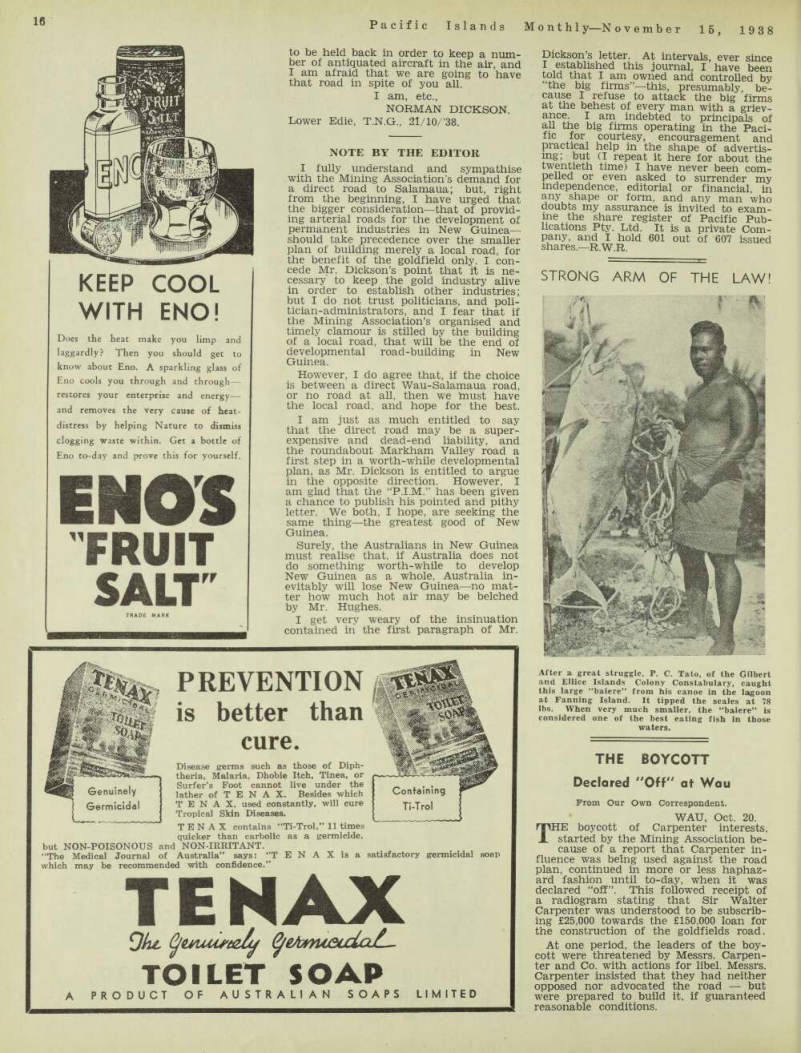
Letter to the Editor
IT is generally recognised here that your magazine is the mouthpiece of the vested interests in this Territory and it is often stimulating to get the other fellow’s point of view. Chiefly for that reason, the boycott did not do you as much harm as it should and, for the same reason, you probably will not have much to worry about with regard to circulation, while the battle for the road and against high freights and charges is on.
Your article in September, “Monopo lies in New Guinea” leaves one in a state of bewildered indecision—whether to weep with you over the pathetic situ ation of a world helpless in the grip of the money power, or to continue in a state of amazement at your naivete, for do you really think that the big firms carried on during 1929-1934 from altruistic motives, or that they lost one penny piece by doing it?
At any rate, if the money power is to devour us all eventually, and the neople named in your article represent it as you seem to infer, there is no sign of that defeatist inhibition in this com munity so far, and we hope to cause some more violent indigestion before we are finally assimilated.
Turning to other articles in your September issue: Mr. Hughes is well able to defend himself from journalistic attack, and it is to be hoped that he can do so against the Parliamentary pack, most of whom are, I am afraid, only too prone to dance to the piping of that ogre, the money power.
Mr. Hughes was not up here very long, but Mr. Fairbairn had a much quicker look, as you say. Mr. Hughes has pass ed the stage when he can have axes to grind. Mr. Fairbairn probably has no need to, hut he has friends who have, and most people here think that his statements were impertinent and mis chievous in the light of the auspices of his visit, and the sum of his experience.
You say you are not anti-road, Stev enson said: “There is nothing so mon strous but we can believe it of our selves”. By frequent asseveration I think you have almost come to believe it. You know that the primary object of this road is to cheapen costs on the Morobe goldfield, so that it can continue to carry the baby for this Territory, but do it a little easier than during the past three or four years. Without cheap transport the life of the field, as a whole, is not 15 or 20 years, but more like five.
Your anti-road outlook appears when you insist that it should be led round some circuitous route which you know would bring haulage costs around about the same as the existing murderous air freights. You have said so. And all in order to open up some problematical agricultural and/or pastoral project for the Ramu and Markham Valleys, for sooth!
The Markham Valley had a road once at a cost of £40,000 but it never appeared to open up anything beyond a gap in revenue, and a void in the landscape where it once existed.
Your anti-road aspect appeared in your celebrated circular, when you ex pressed solicitude of the danger of the big firms being taxed to pay for it when you knew they were not likely to be asked to pay anything (I leave out the suggestion of the equitableness of their being expected to contribute something to the country’s development as beside the point). Your anti-road attitude bobs
up again when you persist in clouding the issue in connection with the road and the capital by grouping both propos als together, by stating that Salamaua cannot be the capital but that Lae might and thereby inferring that the road, by devious meandering should be led there —a proposal that you know would kill the road through excessive cost alone.
It is shown again in your circular, where you stated that £150,000 would go no where in its cost and that any direct route was impracticable and impossible on account of landslides, rain, and gen eral maintenance costs. This without any practical knowedge of the country and despite examples of roads at higher elevation in wetter countries throughout the world. I think that should be about
enough to show that, to my mind, your anti-road attitude amounts almost to inspiration in all your writings on the subject.
The question appears to be whether to expend a fairly large sum for the im mediate benefit of a going concern that has shown itself capable of repaying the expenditure over a very short period, if necessary, or of expending what ultim ately will be a much larger sum upon experimental development, much of which will necessarily be of the nature of trial by error and which will have to be paid for by the goldfield anyhow.
Given direct cheap transport, the gold field can foot the bill, as heretofore, un til the new industries can stand on their own feet —if ever. Without it, in a very short time, you will have neither gold mining nor agriculture, so take your pick.
You can’t have it all ways. The development of this country is not going
to be held back in order to keep a num ber of antiquated aircraft in the air, and I am afraid that we are going to have that road in spite of you all.
I am, etc.,
Norman Dickson.
Lower Edie, T.N.G., 21/10/’3B.
Advertisements & other items, pp. 19-20 (2 items)
15
Pacific Islands Mont hi y —N ovember 15, 1938
You’Ll Enjoy
THESE TASTY FOODS
HOT MEALS
in Jib., I lb. and lib.
CANS
hnoerial
W.
puddTN^3
CjEfsteak
ETT
You can choose from 7 Varieties . & Imperial Beef Steak Pudding. @ Steak and Kidney Pudding. @ Chops and Tomato. © Steak and Tomato.
Q Sausages and Tomato. & Sausages, Spaghetti and Tomato. @ Lamb and Green Peas.
"FITZROY" BRAND LUNCHEON BEEF in OBLONG CANS.
Packed by a Special Process.
"RIVERSTONE" & "OX & PALM" BRAND TRADE MEATS.
Corned-Boiled & Roast Meats
1 2ozs., 16ozs. 240z5., 21b., 31b., 41b., 51b., 61b. ilium
Delicious
Mango and Papaw
CHUTNEY
Made from fresh sun-ripened fruits, delicately spiced and blended. It gives added zest to both hot and cold dishes. ♦ o
Tasty
Cheddar Cheese
Get some to-day, just taste the goodness of its matchless flavor, smooth, mellow and satisfying, it is free from lumps and string, and is ideal for cooking, too.
RIVERSTONE MEAT CO., PTY„ LTD.,
5-7 O'CONNELL STREET, SYDNEY. Cables; "IMPERIAL".
KEEP COOL
WITH ENO!
Does the heat make you limp and laggardly? Then you should get to know about Eno. A sparkling glass of Eno cools you through and through— restores your enterprise and energy— and removes the very cause of heatdistress by helping Nature to dismiss clogging waste within. Get a bottle of Eno to-day and prove this for yourself.
ENOS
FRUIT
SALT'
TRADE MARK
•*& Genuinely Germicidal
PREVENTION
is better than
cure.
Disease germs such as those of Diphtheria, Malaria, Dhobie Itch, Tinea, or Surfer’s Foot cannot live under the lather of TE N AX. Besides which T E N A X, used constantly, will cure Tropical Skin Diseases.
T E N A X contains “Ti-Trol,” 11 times quicker than carbolic as a germicide, m as IB Containing Ti-Trol
but NON-POISONOUS and NON-IRRITANT.
“The Medical Journal of Australia” says: “T E N A X is a satisfactory germicidal which may be recommended with confidence.”
TENAX
Otu. Qwiuu'tzlu fyeAmtetHof -
TOILET SOAP
A PRODUCT OF AUSTRALIAN SOAPS LIMITED
Note By The Editor
I fully understand and sympathise with the Mining Association’s demand for a direct road to Salamaua; but, right from the beginning, I have urged that the bigger consideration —that of provid ing arterial roads for the development of permanent industries in New Guinea should take precedence over the smaller plan of building merely a local road, for the benefit of the goldfield only. I con cede Mr. Dickson’s point that it is ne cessary to keep the gold industry alive in order to establish other industries; but I do not trust politicians, and poli tician-administrators, and I fear that if the Mining Association’s organised and timely clamour is stilled by the building of a local road, that will be the end of developmental road-building in New Guinea.
However, I do agree that, if the choice is between a direct Wau-Salamaua road, or no road at all, then we fnust have the local road, and hope for the best.
I am just as much entitled to say that the direct road may be a super expensive and dead-end liability, and the roundabout Markham Valley road a first step in a worth-while developmental plan, as Mr. Dickson is entitled to argue in the opposite direction. However, I am glad that the “P.1.M.” has been given a chance to publish his pointed and pithy letter. We both, I hope, are seeking the same thing—the greatest good of New Guinea.
Surely, the Australians in New Guinea must realise that, if Australia does not do something worth-while to develop New Guinea as a whole, Australia in evitably will lose New Guinea —no mat ter how much hot air may be belched by Mr. Hughes.
I get very weary of the insinuation contained in the first paragraph of Mr.
Dickson’s letter. At intervals, ever since I established this journal, I have been told that I am owned and controlled by the big firms”—this, presumably, be cause I refuse to attack the big firms at the behest of every man with a griev ance. I am indebted to principals of all the big firms operating in the Paci fic for courtesy, encouragement and practical help in the shape of advertis ing; but (I repeat it here for about the twentieth time) I have never been com pelled or even asked to surrender my independence, editorial or financial, in any shape or form, and any man who doubts my assurance is invited to exam me the share register of Pacific Pub lications Pty. Ltd. It is a private Com pany, and I hold 601 out of 607 issued shares.—R.W.R.
Strong Arm Of The Law!
After a great struggle, P. C. Tato, of the Gilbert and Ellice Islands Colony Constabulary, caught this large “baiere” from his canoe in the laigoon at Fanning Island. It tipped the scales at 78 lbs. When very much smaller, the “baiere” is considered one of the best eating fish in those waters.
The Boycott
Declared "Off" at Wau
Prom Our Own Correspondent.
WAU, Oct. 20.
THE boycott of Carpenter interests, started by the Mining Association be cause of a report that Carpenter in fluence was being used against the road plan, continued in more or less haphaz ard fashion until to-day, when it was declared “off”. This followed receipt of a radiogram stating that Sir Walter Carpenter was understood to be subscrib ing £25,000 towards the £150,000 loan for the construction of the goldfields road.
At one period, the leaders of the boy cott were threatened by Messrs. Carpen ter and Co. with actions for libel. Messrs.
Carpenter insisted that they had neither opposed nor advocated the road but were prepared to build it, if guaranteed reasonable conditions.
Advertisements & other items, p. 20 (1 item)
16
Pacific Islands Monthl y—N ovember 15, 1938
Nerve Troubles
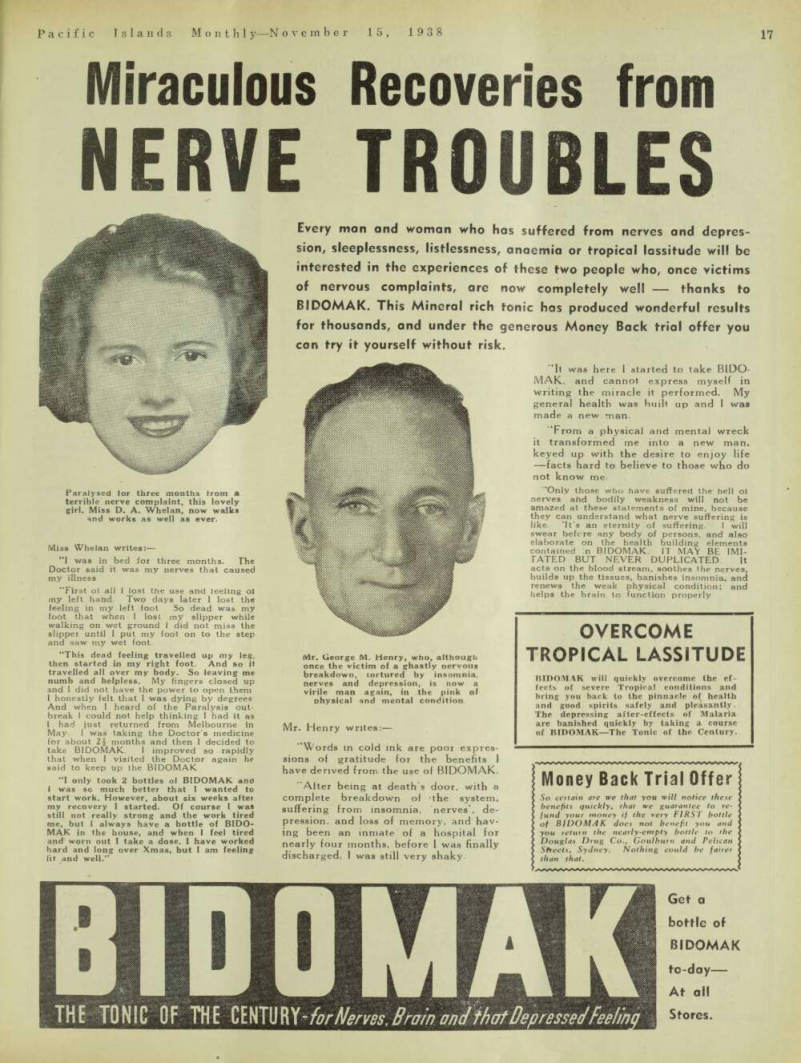
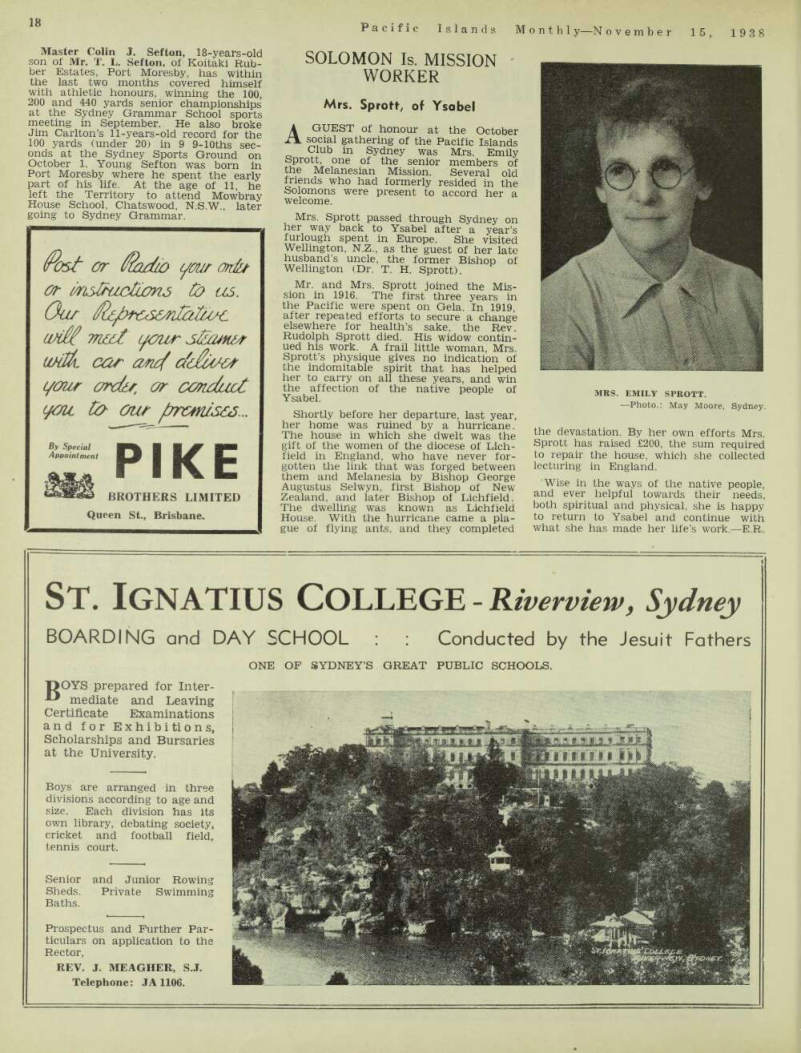
Miraculous Recoveries from
Miss Whelan writes;— “I was in bed for three months. The Doctor said it was my nerves that caused my illness “First ot all 1 lost the use and teeling ol my left hand. Two days later I lost the feeling in my left foot So dead was my foot that when I lost my slipper while walking on wet ground 1 did not miss the slipper until 1 put my foot on to the step and saw my wet foot.
“This dead feeling travelled up my leg, then started in my right foot. And so it travelled all over my body. So leaving me numb and helpless. My fingers closed up and I did not have the power to open them 1 honestly felt that I was dying by degrees And when I heard of the Paralysis out break I could not help thinking I had it as I had just returned from Melbourne in May. 1 was taking the Doctor's medicine for about months and then 1 decided to take BIDOMAK. 1 improved so rapidly that when I visited the Doctor again he said to keep up the BIDOMAK “I only took 2 bottles of BIDOMAK and 1 was so much better that 1 wanted to start work. However, about six weeks after my recovery I started. Of course I was still not really strong and the work tired me, but 1 always have a bottle of BIDO MAK in the house, and when 1 feel tired and worn out I take a dose. I have worked hard and long over Xmas, but I am feeling fit and well.’’
Every man and woman who has suffered from nerves and depres sion, sleeplessness, listlessness, anaemia or tropical lassitude will be interested in the experiences of these two people who, once victims of nervous complaints, are now completely well thanks to BIDOMAK. This Mineral rich tonic has produced wonderful results for thousands, and under the generous Money Back trial offer you con try it yourself without risk.
Mr. Henry writes:— “Words in cold ink are poor expres sions of gratitude for the benefits I have derived from the use of BIDOMAK.
"After being at death’s door, with a complete breakdown of 'the system, suffering from insomnia, nerves’, de pression. and loss of memory, and hav ing been an inmate of a hospital for nearly four months, before I was finally discharged. 1 was still very shaky.
‘lt was here I started to take BIDO MAK. and cannot express myself in
writing the miracle it performed. My
general health was built up and I was made a new man. ’’From a physical and mental wreck it transformed me into a new man. keyed up with the desire to enjoy life —facts hard to believe to those who do not know me.
“Only those who have suffered the hell ol nerves and bodily weakness will not be amazed at these statements of mine, because they can understand what nerve suffering is like ‘lt's an eternity of suffering. I will swear before any body of persons, and also elaborate on the health building elements contained n BIDOMAK IT MAY BE IMI
Tated But Never Duplicated It
acts on the blood stream, soothes the nerves, builds up the tissues, banishes insomnia, and renews the weak physical condition: and helps the brain to function properly
Paralysed tor three months trom a terrible nerve complaint, this lovely girl. Miss D. A. Whelan, now walks and works as well as ever.
Mr. George M. Henry, who, although once the victim of a ghastly nervous breakdown, tortured by insomnia, nerves and depression, is now a virile man again, in the pink of physical and mental condition
Master Colin J. Sefton, 18-years-old son of Mr. T. L. Sefton, of Koitaki Rub ber Estates, Port Moresby, has within the last two months covered himself with athletic honours, winning the 100, 200 and 440 yards senior championships at the Sydney Grammar School sports meeting in September. He also broke Jim Carlton’s 11-years-old record for the 100 yards (under 20) in 9 9-10ths sec onds at the Sydney Sports Ground on October 1, Young Sefton was born in Port Moresby where he spent the early part of his life. At the age of 11, he left the Territory to attend Mowbray House School, Chatswood, N.S.W., later going to Sydney Grammar.
Advertisements & other items, pp. 21-22 (2 items)
17
Pacific Islands Mont hi y—N ovember 15, 1938
TONIC OF THE for Nerves. Brain and that Depressed Feeling
OVERCOME
TROPICAL LASSITUDE
BIDOMAK will quickly overcome the effects of severe Tropical conditions and bring you back to the pinnacle of health and good spirits safely and pleasantly.
The depressing after-effects of Malaria are banished quickly by taking a course of BIDOMAK—The Tonic of the Century.
Money Back Trial Offer
So certain are we that you will notice these benefits quickly, that we guarantee to refund your money if the very FIRST bottle of BIDOMAK does not benefit you and you return the nearly-empty bottle to the Douglas Drug Co., Goulburn and Pelican Sheets, Sydney. Nothing could be fairer than that.
TONIC OF THE for Nerves. Brain and that Depressed Feeling Get a bottle of
BIDOMAK
to-day— At ail Stores.
Post or Paotb your cr msthuftions to us.
Our Peprcs&rita&
usctf Tnist yo unth. car arc/ your order, or conduct you. to our premises...
By Special Appointment
PIKE
BROTHERS LIMITED
Queen St., Brisbane.
Worker
Solomon Is. Mission
Mrs. Sprott, of Ysabel
A GUEST of honour at the October social gathering of the Pacific Islands Club in Sydney was Mrs. Emily Sprott, one of the senior members of the Melanesian Mission. Several old friends who had formerly resided in the Solomons were present to accord her a welcome.
Mrs. Sprott passed through Sydney on her way back to Ysabel after a year’s furlough spent in Europe. She visited Wellington, N.Z., as the guest of her late husband’s uncle, the former Bishop of Wellington (Dr. T. H. Sprott).
Mr. and Mrs. Sprott joined the Mis sion in 1916. The first three years in the Pacific were spent on Gela. In 1919, after repeated efforts to secure a change elsewhere for health’s sake, the Rev.
Rudolph Sprott died. His widow contin ued his work. A frail little woman, Mrs.
Sprott’s physique gives no indication of the indomitable spirit that has helped her to carry on all these years, and win the affection of the native people of Ysabel.
Shortly before her departure, last year, her home was ruined by a hurricane.
The house in which she dwelt was the gift of the women of the diocese of Lich field in England, who have never for gotten the link that was forged between them and Melanesia by Bishop George Augustus Selwyn, first Bishop of New Zealand, and later Bishop of Lichfield.
The dwelling was known as Lichfield House. With the hurricane came a pla gue of flying ants, and they completed
the devastation. By her own efforts Mrs.
Sprott has raised £2OO, the sum required to repair the house, which she collected lecturing in England.
Wise in the ways of the native people, and ever helpful towards their needs, both spiritual and physical, she is happy to return to Ysabel and continue with
what she has made her life’s work.
E.R.
Mrs. Emily Sprott.
—Photo.: May Moore, Sydney.
Advertisements & other items, p. 22 (2 items)
18
Pacific Islands Monthl y—N ovember 15, 1938
St. Ignatius College -Riverview, Sydney
BOARDING and DAY SCHOOL Conducted by the Jesuit Fathers T>OYS prepared for Intermediate and Leaving Certificate Examinations and for Exhibit!ons, Scholarships and Bursaries at the University.
Boys are arranged in three divisions according to age and size. Each division has its own library, debating society, cricket and football field, tennis court.
Senior and Junior Rowing Sheds. Private Swimming Baths.
Prospectus and Further Particulars on application to the Rector,
REV. J. MEAGHER, S.J.
Telephone: JA 1106.
ONE OF SYDNEY’S GREAT PUBLIC SCHOOLS.
" ' ■ ,JX* 11 JL» I Ki l l I
Tests In Dutch
N. Guinea
Rubber Plantation Being Tried
LAST July, the Dutch New Guinea Company was formed. This company proposes to open up Dutch New Guinea on a large scale; and the Dutch CiovemmenL has decided lo stari an ex tensive rubber estate of 1,000 hectares on the Ransiki River plains.
This Government plantation, to be established near the Ransiki River, is to be regarded as a pioneer enterprise and experimental garden. It will enable the Government to get a clear and practical view of the possibilities of introducing private planters. It is not intended to compete against the Dutch New Guinea Company; but it seems that the latter has not yet at its disposal the necessary experts and plantation staff. In due course, the company may take over the Government’s plantations, on which it has an option.
During the last few years, a commis sion of experts has been continually ex amining agricultural possibilities in Dutch New Guinea. Generally speaking, and in comparison with the other parts of the Netherlands East Indies, these possibilities are deemed unfavourable. At first, it was thought that some parts would be suitable for cotton-growing, but it has been proved that the idea that (for instance) the Momi plains (where the Japanese cotton estate is situated) could compete with the best cotton grounds in other parts of the world, must be abandoned.
It is because of that that the commis sion has decided to experiment with growing of plantation rubber (hevea braziliensis). On this 1,000 hectares es tate, experiments will be made with cotton, sisal, derris-root, etc. Labour
will be imported from Java
F.T.M.
Origin Of Tahiti Imports
From Our Own Correspondent
Papeete, Oct. 20.
mHE Governor of French Oceania by A executive order, has promulgated various presidential decrees relative to the indication of origin of certain pro ducts from countries outside the French dominions.
These presidential decrees specify a long list of tools, implements, and arti cles of utility and ornament, hardware, and so forth; in steel, copper, zinc, tin, nickel or their alloys, polished or unpol ished, varnished or plated with gold, sil ver, nickel or chrome; also articles of porcelain or other ceramic materials used in electric installations; all of which must comply to the requirements, in the de crees cited, relative to the indications of the country of origin.
Exporters should consult the consulates of France for details of these require ments.
The decrees appear in the Official Journal of the Republic of France of June 3, 1937 (pages 6125 to 6128) and of August 11, 1937 (page 9065) and in the Journal Officiel of French Oceania of September 15, 1938.
Hon. J. T. O’Malley, Commissioner for Native Affairs in Papua, arrived in Syd ney by the “Macdhui” in October, on leave.
Advertisements & other items, pp. 23-24 (3 items)
19
Pacific Islands Month 1 y—N ovember 15, 19 3 8
Ultimate
: ■ A* r ■■ . * m t C Caledonia ‘
the PACIFIC
Radio Reception in the Pacific Islands has been perfected by Ultimate Radio Engineers. They have constructed a set specially designed for tropical conditions, utilising patents that are NOT available to any other manufacturer.
Ultimate is the only radio set that can possibly give you perfect performance in the Pacific Islands.
Send for copies of unsolicited letters on Ultimate’s power, reliability and tone that we are constantly receiving. All particulars are free for the asking.
Models are available for all types of electric operation as well as for battery reception.
tsl/ljO-u
REAL RADIO
ULTIMATE
(SOLE AUSTRALIAN CONCESSIONAIRES)
GEO. BROWN
PTY. LTD
ELECTRICAL AND INDUSTRIAL ENGINEERS
FOR for full p©mcul©rs
SPECIAL TRADE
PRICES.
267 CLARENCE STREET. SYDNEY
Cable. Radio & Telegrams: "BROWNLOCK”, SYDNEY.
BE FAIR TO YOURSELF WRITE FOR DETAILS: Please send me, without obligation, details of the Special New De Luxe ULTIMATE
RECEIVERS.
NAME
ADDRESS
(State whether battery or electric and voltage and type of current of power supply.)
Modern Refrigeration for the South Sea Islands
The ELECTROLUX KEROSENE OPERATED
REFRIGERATOR
THE ELECTROLUX OFFERS economical, modern and completely efficient refrigeration for
ISLANDS' HOMES.
FREEZES CONTINUOUSLY WHILE SMALL LAMP BURNS
Freezing controlled by simply regulating height of flame. Uses only gallon of kerosene per week.
MOTORLESS ... NO PARTS TO GET OUT OF ORDER.
MODEL L 22 MODEL L3B
Capacity • (as illustrated) * 2.2 cubic feet. Capacity 4 cubic feet.
GUARANTEED FOR TWO YEARS
• Write to your Local Distributor for prices and full details.
MODEL LKSS
Capacity 5.5 cubic feet.
Obtainable from , .
W. R. Carpenter & Company Ltd.—Sydney and following New Guinea Branches : Rabaul, Salamaua, Wau, Kavieng, Madang, But and Wewak.
Representation in Papua and New Hebrides.
W. R. Carpenter & Coy. (Solomon Is.) Pty. Ltd.—Tulagi, British Solomon Islands, On Chong & Company Pty. Ltd.—Butaritari, Gilbert & Ellice Islands.
20
Pacific Islands Monthl y—N ovember 15, 1038
Face Calamity?
Do Samoa and Cook Is.
Fears of New Labour Adminis tration May be Premature
MISGIVINGS have been expressed in the Central Pacific Territories, con trolled by New Zealand, because the New Zealand Labour Government has been returned to office with a huge ma jority—which apparently gives it a man date to do anything it pleases.
Those misgivings appear to the out sider to be a little premature. It would be wise to await events.
When, to everyone’s astonishment, Labour went into office in N.Z. in 1935, they were a very raw team indeed, and their knowledge of the science of gov ernment —especially the government of tropical islands —could have been written with a minus sign. Some of the things they attempted to do in Samoa and the Cook Islands aroused the derision of all who knew anything of Pacific Islands admin istration.
But the Cabinet Ministers have been learning a lot, in the last three years: and they have had the honesty and de cency to realise their errors and remedy them. That fact gives one some confid ence in the future. It may not be as bad as some expect.
The ever-famous “Goodwill Mission”, for instance, repatriated the Chinese labourers from Samoa, and bluntly told the desperate Samoan planters to use local labour. But when the Govern ment found that, as the planters had stated, local labour was unprocurable, it permitted the recruiting of labour from Niue: and out of this acknowledgment a better system of providing Samoan plantations with labourers may be evolv ed.
The N.Z. Government, over-riding all advice from experienced men, put a semi-socialistic fruit marketing plan into operation in the Cook Islands. But, when the thing was found virtually unwork able, it acknowledged its mistake, and went sharply and drastically into re verse.
There were evils connected with the C.I. fruit trade —and not all on the side of the merchants —and out of all the confusion there now may emerge a more efficient system, operating more fairly for all concerned.
In Samoa, of course, there still is an administration tied in an embarrassing manner to the Nelson-controlled Mau.
At first, this arrangement was an out rage on government. Mr. Nelson, having been rescued by the Labour Cabinet from the injustice and oppression he suffered under the old regime, seemed to think he had now a license to run the Samoan administration on peculiar Nelsonian lines: while the newly-organised Mau party insisted on sticking its nose into every department of the Samoan Govern ment in a manner that hopelessly un dermined most official responsibility. The situation that developed in 1936-37 was both Gilbertian and tragic.
But, month by month, that has been changed. Mr. Nelson, a year ago, found that Wellington was not giving the same heed to his demands and recommendations —at any rate, when there was any sus picion that he was actuated by a spirit of revenge and malice. The Mau-domin ated Fono of Faipule is being more firm ly kept in its place by the Government, and has become correspondingly tamer.
Taking it by and large, the political situation in Western Samoa is improved, as a result of a better understanding by the N.Z. Labour Ministers of their obli gations and responsibilities. One sees evidence of that in the decision to retain Mr. Braisby in Samoa as officer in charge of the police. The announcement, two months ago, that he was being removed, had all the ear-marks of a Mau intrigue, working successfully upon Wellington.
The return of the N.Z. Labour Govern ment may not be, for Samoa, Cook Is lands and Niue the calamity that is feared.
Grievances And Fears Of
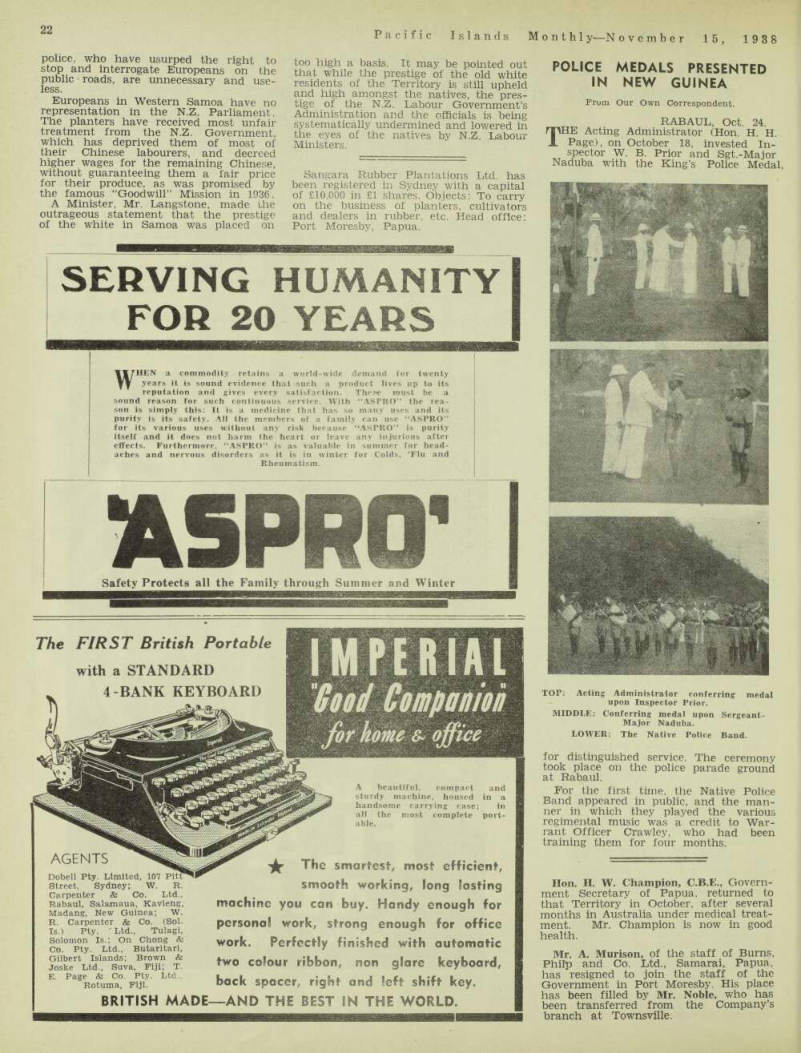
Europeans
Prom Our Own Correspondent
Apia. Oct. 10.
THE grievances and fears of European residents in Samoa were set out in the N.Z. Parliament, when the Sa
moa Bill was under debate there some weeks ago.
We believe that the new laws are only another development of Labour’s disas trous policy of pandering to all demands of the Nelson-Mau party however un reasonable they may be. We refer es pecially to the abolition of the right of the Administrator to confirm or. refuse Faipule appointments, and the waiving of exile and deportation as punishment for political offenders.
The contention of v the Government member, Mr. O’Brien, that the reason for discontent of European planters was that they had to pay 4/- per day to Samoan labourers is made ridiculous by the fact that European planters are able to pro cure Samoan labourers at a wage of 1/6 per day.
That the Mau police is “helping to keep order” is another illusion of the N.Z. Labour Government. The Mau
police, who have usurped the right to stop and interrogate Europeans on the public roads, are unnecessary and use less.
Europeans in Western Samoa have no representation in the N.Z. Parliament.
The planters have received most unfair treatment from the N.Z. Government, which has deprived them of most of their Chinese labourers, and decreed higher wages for the remaining Chinese, without guaranteeing them a fair price for their produce, as was promised by the famous “Goodwill” Mission in 1936.
A Minister, Mr. Langstone, made the outrageous statement that the prestige of the white in Samoa was placed on
too high a basis. It may be pointed out that while the prestige of the old white residents of the Territory is still upheld and high amongst the natives, the pres tige of the N.Z. Labour Government’s Administration and the officials is being systematically undermined and lowered in the eyes of the natives by N.Z. Labour Ministers.
Sangara Rubber Plantations Ltd. has been registered in Sydney with a capital of £lO.OOO in £1 shares. Objects: To carry on the business of planters, cultivators and dealers in rubber, etc. Head office: Port Moresby, Papua.
Advertisements & other items, pp. 25-26 (2 items)
21
Pacific Islands Month 1 y—N ovember 15, 1938
Ale
JMeZTcee"
SERVING HUMANITY I
FOR 20 YEARS
WHEN a commodity retains a world-wide demand for twenty years it is sound evidence that such a product lives up to its reputation and gives every satisfaction. There must be a sound reason for such continuous service. With “ASPRO” the reason is simply this: It is a medicine that has so many uses and its purity is its safety. All the members of a family can use "ASPRO” for its various uses without any risk because "ASPRO” is purity itself and it does not harm the heart or leave any injurious after effects. Furthermore, “ASPRO” is as valuable in summer for headaches and nervous disorders as it is in winter for Colds, ’Flu and Rheumatism.
ASPRO
The FIRST British Portable
with a STANDARD
4 BANK KEYBOARD
srs 1 ★
AGENTS
Dobell Pty. Limited, 107 Pitt Street, Sydney; W. R.
Carpenter & Co. Ltd., Rabaul, Salamaua, Kavieng, Madang, New Guinea; W.
R. Carpenter & Co. (Sol.
Is.) Pty. ' Ltd., Tulagi, Solomon Is.; On Chong & Co. Pty. Ltd., Butaritari, Gilbert Islands; Brown & Joske Ltd., Suva, Fiji; T.
E. Page & Co. Pty. Ltd., Rotuma, Fiji.
BRITISH MADE—
A beautiful, compact and sturdy machine, housed in a handsome carrying case; in all the most complete portable.
The smartest, most efficient
smooth working, long fasting
machine you con buy. Handy enough for
persona! work, strong enough for office
work. Perfectly finished with automatic
two colour ribbon, non glare keyboard,
bock spacer, right and left shift key.
AND THE BEST IN THE WORLD.
I—— ——
Police Medals Presented
In New Guinea
From Our Own Correspondent.
Rabaul, Oct. 24.
mHE Acting Administrator (Hon. H. H.
A Page), on October 18, invested In spector W. B. Prior and Sgt.-Major Naduba with the King’s Police Medal
for distinguished service. The ceremony took place on the police parade ground at Rabaul.
For the first time, the Native Police Band appeared in public, and the man ner in which they played the various regimental music was a credit to War rant Officer Crawley, who had been training them for four months.
Hon. H. W. Champion, C.8.E., Govern ment Secretary of Papua, returned to that Territory in October, after several months in Australia under medical treat ment. Mr. Champion is now in good health.
Mr. A. Murison, of the staff of Burns, PhiPp and Co. Ltd., Samarai, Papua, has resigned to join the staff of the Government in Port Moresby. His place has been filled by Mr. Noble, who has been transferred from the Company’s branch at Townsville.
TOP: Acting Administrator conferring medal upon Inspector Prior.
MIDDLE: Conferring medal upon Sergeant- Major Naduba.
LOWER: The Native Police Band.
Advertisements & other items, p. 26 (1 item)
22
Pacific Islands Monthl y~N ovember 15, 1938
New Species
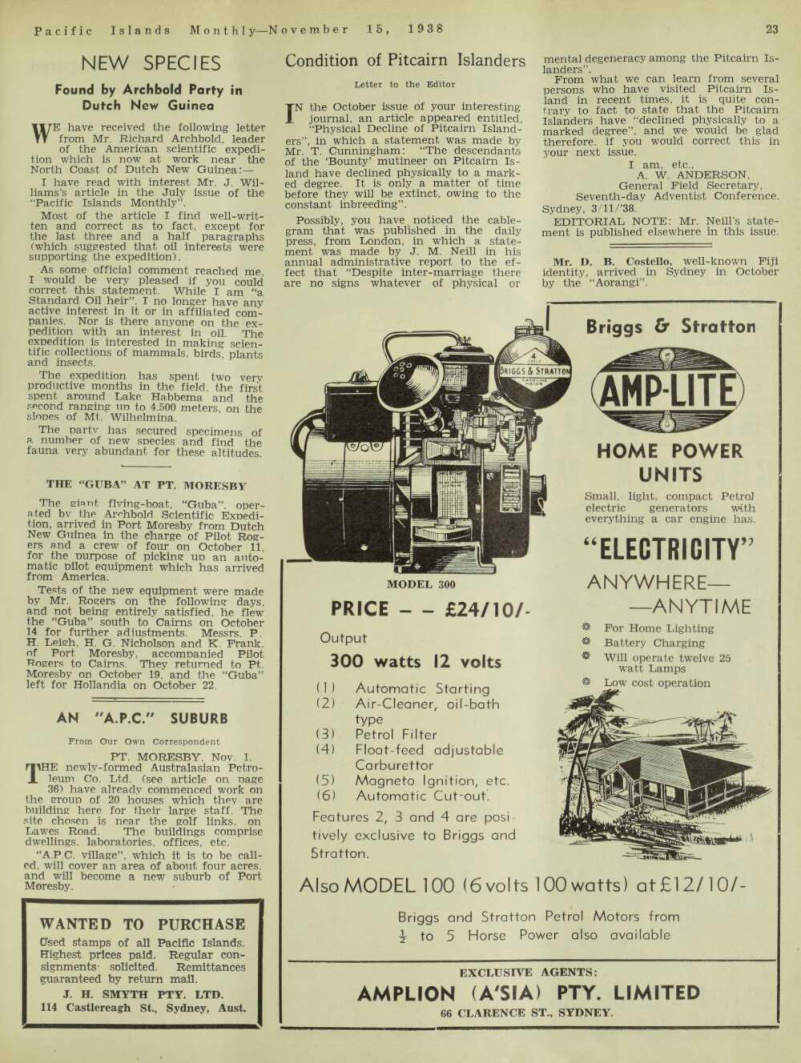
Found by Archbold Party in Dutch New Guinea
WE have received the following letter from Mr. Richard Archbold, leader of the American scientific expedi tion which is now at work near the North Coast of Dutch New Guinea:— I have read with interest Mr. J. Wil liams’s article in the July issue of the “Pacific Islands Monthly”.
Most of the article I find well-writ ten and correct as to fact, except for the last three and a half paragraphs (which suggested that oil interests were supporting the expedition).
As some official comment reached me, I would be very pleased if you could correct this statement. While I am “a Standard Oil heir”. I no longer have any active interest in it or in affiliated com panies. Nor is there anyone on the ex pedition with an interest in oil. The expedition is interested in making scien tific collections of mammals, birds, plants and insects.
The expedition has spent two very productive months in the field, the first spent around Lake Habbema and the spcond ranging up to 4.500 meters, on the slopes of Mt. Wilhelmina.
The party has secured specimens of a number of new species and find the fauna very abundant for these altitudes.
The “Cuba” At Pt. Moresby
The giant flving-boat. "Guba”. oper ated bv the Arehbold Scientific Expedi tion, arrived in Port Moresby from Dutch New Guinea in the charge of Pilot Rog ers and a crew of four on October 11. for the purpose of picking up an auto matic pilot equipment which has arrived from America.
Tests of the new equipment were made by Mr. Rogers on the following days, and not being entirely satisfied, he flew the “Guba” south to Cairns on October 14 for further adjustments. Messrs. P.
H. Leigh, H. G. Nicholson and K. Frank, nf Port Moresby, accompanied Pilot Rogers to Cairns. They returned to Pt.
Moresby on October 19. and the “Guba” left for Hollandia on October 22.
An "A.P.C." Suburb
From Our Own Correspondent
Pt. Moresby. Nov. 1.
THE newly-formed Australasian Petro leum Co. Ltd. (see article on cage 36) have already commenced work on the group of 20 houses which they are building here for their large staff. The site chosen is near the golf links, on Lawes Road. The buildings comprise dwellings, laboratories, offices, etc.
“A.PC. village”, which it is to be call ed, will cover an area of about four acres, and will become a new suburb of Port Moresby.
Condition of Pitcairn Islanders
Letter to the Editor IN the October issue of your interesting journal, an article appeared entitled, “Physical Decline of Pitcairn Island ers”, in which a statement was made by Mr. T. Cunningham: “The descendants of the ‘Bounty’ mutineer on Pitcairn Is land have declined physically to a mark ed degree. It is only a matter of time before they will be extinct, owing to the constant inbreeding”.
Possibly, you have noticed the cable gram that was published in the daily press, from London, in which a state ment was made by J. M. Neill in his annual administrative report to the ef fect that “Despite inter-marriage there are no signs whatever of physical or
mental degeneracy among the Pitcairn Is landers”.
From what we can learn from several persons who have visited Pitcairn Is land in recent times, it is quite con trary to fact to state that the Pitcairn Islanders have “declined physically to a marked degree”, and we would be glad therefore, if you would correct this in your next issue.
I am, etc.,
A. W. Anderson.
General Field Secretary, Seventh-day Adventist Conference.
Sydney, 3/11/’3B.
EDITORIAL NOTE: Mr. Neill’s state ment is published elsewhere in this issue.
Mr. D. B. Costello, well-known Fiji identity, arrived in Sydney in October by the “Aorangi”.
Advertisements & other items, p. 27 (3 items)
23
Pacific Islands Monthl y—N ovember 15, 1938
Ampiite
RIOCS & STRATTO
m ©//'■'ii** ti- E3
Briggs & Stratton
AMPIITE
HOME POWER
UNITS
Small, light, compact Petrol electric generators with everything a car engine has.
“ELECTRICITY”
MODEL 300
PRICE - - £24/10/
ANYWHERE—
—ANYTIME
Output 300 watts 12 volts (1) Automatic Starting (2) Air-Cleaner, oil-bath type (3) Petrol Filter (4) Float-feed adjustable Carburettor (5) Magneto Ignition, etc. (6) Automatic Cut-out.
Features 2, 3 and 4 are posi tively exclusive to Briggs and Stratton. ® For Home Lighting & Battery Charging ® Will operate twelve 25 watt Lamps ® Low cost operation Also MODEL 100 (6 volts 100 watts) at £12/10/- Briggs and Stratton Petrol Motors from J to 5 Horse Power also available
EXCLUSIVE AGENTS:
AMPLION (A'SIA) PTY. LIMITED
66 CLARENCE ST., SYDNEY.
Wanted To Purchase
CJsed stamps of all Pacific Islands.
Highest prices paid. Regular consignments- solicited. Remittances guaranteed by return mail.
J. H. SMYTH PTY. LTD.
114 Castlereagh St., Sydney, Aust.
Teleradio Saves Time In
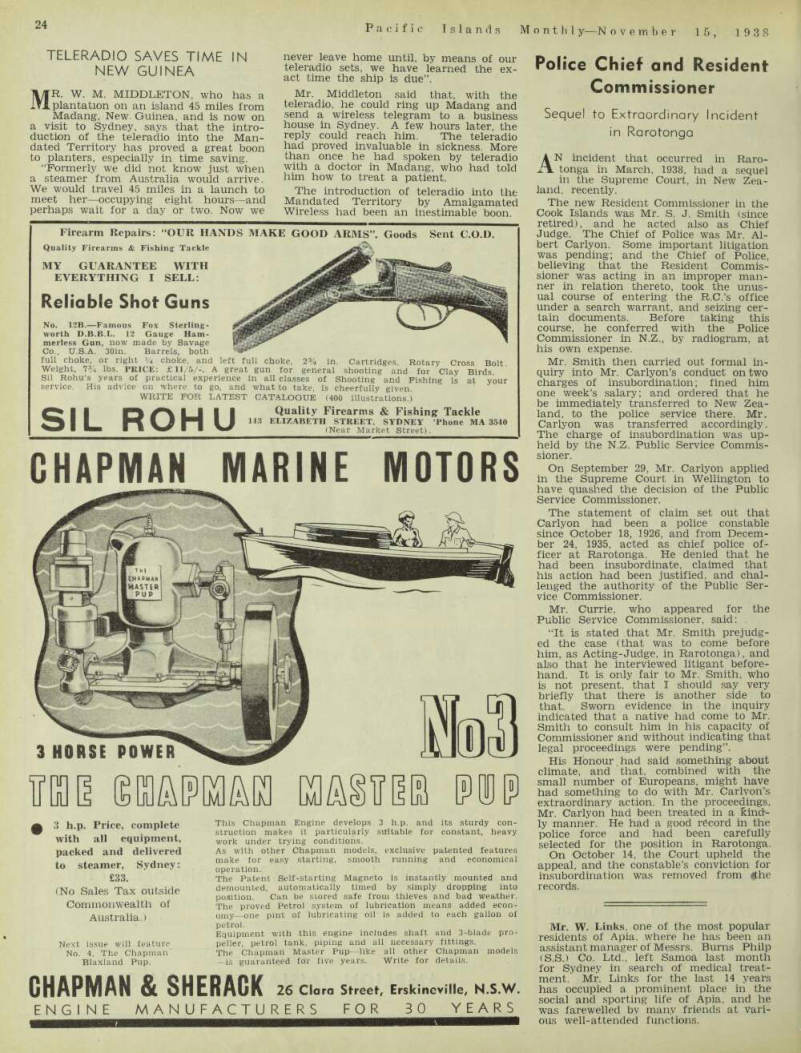
New Guinea
MR. W. M. MIDDLETON, who has a plantation on an island 45 miles from Madang, New Guinea, and is now on a visit to Sydney, says that the intro duction of the teleradio into the Man dated Territory has proved a great boon to planters, especially in time saving.
“Formerly we did not know just when a steamer from Australia would arrive.
We would travel 45 miles in a launch to meet her—occupying eight hours —and perhaps wait for a day or two. Now we
never leave home until, by means of our teleradio sets, we have learned the ex act time the ship is due”.
Mr. Middleton said that, with the teleradio, he could ring up Madang and send a wireless telegram to a business house in Sydney. A few hours later, the reply could reach him. The teleradio had proved invaluable in sickness. More than once he had spoken by teleradio with a doctor in Madang, who had told him how to treat a patient.
The introduction of teleradio into the Mandated Territory by Amalgamated Wireless had been an inestimable boon.
Commissioner
Police Chief and Resident Commissioner Sequel to Extraordinary Incident in Rarotonga
A N incident that occurred in Raro tonga in March, 1938, had a sequel in the Supreme Court, in New Zea land, recently.
The new Resident Commissioner in the Cook Islands was Mr. S. J. Smith (since retired), and he acted also as Chief Judge. The Chief of Police was Mr. Al bert Carlyon. Some important litigation was pending; and the Chief of Police, believing that the Resident Commis sioner w r as acting in an improper man ner in relation thereto, took the unus ual course of entering the R.C.’s office under a search warrant, and seizing cer tain documents. Before taking this course, he conferred with the Police Commissioner in N.Z., by radiogram, at his own expense.
Mr. Smith then carried out formal in quiry into Mr. Carlyon’s conduct on two charges of insubordination; fined him one week’s salary; and ordered that he be immediately transferred to New Zea land, to the police service there. Mr.
Carlyon was transferred accordingly.
The charge of insubordination was up held by the N.Z. Public Service Commis sioner.
On September 29, Mr. Carlyon applied in the Supreme Court in Wellington to have quashed the decision of the Public Service Commissioner.
The statement of claim set out that Carlyon had been a police constable since October 18, 1926, and from Decem ber 24, 1935, acted as chief police of ficer at Rarotonga. He denied that he had been insubordinate, claimed that his action had been justified, and chal lenged the authority of the Public Ser vice Commissioner.
Mr. Currie, who appeared for the Public Service Commissioner, said: “It is stated that Mr. Smith prejudg ed the case (that was to come before him, as Acting-Judge, in Rarotonga), and also that he interviewed litigant before hand. It is only fair to Mr. Smith, who is not present, that I should say very briefly that there is another side to that. Sworn evidence in the inquiry indicated that a native had come to Mr.
Smith to consult him in his capacity of Commissioner and without indicating that legal proceedings were pending”.
His Honour , had said something about climate, and that, combined with the small number of Europeans, might have had something to do with Mr. Carlvon’s extraordinary action. In the proceedings, Mr. Carlyon had been treated in a kind ly manner. He had a good record in the police force and had been carefully selected for the position in Rarotonga.
On October 14, the Court upheld the appeal, and the constable’s conviction for insubordination was removed from she records.
Mr. W. Links, one of the most popular residents of Apia, where he has been an assistant manager of Messrs. Burns Philp (S.S.) Co. Ltd., left Samoa, last month for Sydney in search of medical treat ment. Mr. Links for the last 14 years has occupied a prominent place in the social and sporting life of Apia, and he was farewelled by many friends at vari ous well-attended functions.
Advertisements & other items, pp. 28-29 (4 items)
24
Pacific Islands Monthl y—N ovember 15, 1938
Mmmi
Firearm Repairs: “OUR HANDS MAKE GOOD ARMS”. Goods Sent C.O.D.
Quality Firearms & Fishing Tackle
MY GUARANTEE WITH
EVERYTHING I SELL:
Reliable Shot Guns
No. 12B.—Famous Fox Sterling worth D.8.8.L. 12 Gauge Hammerless Gun, now made by Savage Co., U.S.A. 30in. Barrels, both full choke, or right V 4 choke, and left full choke, 2% in. Cartridges. Rotary Cross Bolt.
Weight, 7% lbs. PRICE: £ll/5/-. A great gun for general shooting and for Clay Birds Sil Rohu’s years of practical experience in all classes of Shooting and Fishing is at your service. His advice on where to go, and what to take, is cheerfully given.
WRITE FOR LATEST CATALOGUE (400 illustrations.)
Quality Firearms & Fishing Tackle
143 ELIZABETH STREET, SYDNEY Phone MA 3540 (Near Market Street).
SIL ROHU
CHAPMAN MARINE MOTORS
)V THi Chapman
MASTER
PUP
3 HORSE POWER
MMMI
wmm
3 h.p. Price, complete with all equipment, packed and delivered to steamer, Sydney: £33. (No Sales Tax outside Commonwealth of Australia.) Next issue will feature No. 4, The Chapman Blaxland Pup.
This Chapman Engine develops 3 h.p. and its sturdy construction makes it particularly suitable for constant, heavy work under trying conditions.
As with other Chapman models, exclusive patented features make for easy starting, smooth running and economical operation.
The Patent Self-starting Magneto is instantly mounted and demounted, automatically timed by simply dropping into position. Can be stored safe from thieves and bad weather.
The proved Petrol system of lubi’ication means added economy —one pint of lubricating oil is added to each gallon of petrol.
Equipment with this engine includes shaft and 3-blade propeller, petrol tank, piping and all necessary fittings.
The Chapman Master Pup—like all other Chapman models —is guaranteed for five years. Write for details.
CHAPMAN & SHERACK 26 Clara Street, Erskineville, N.S.W.
ENGINE MANUFACTURERS FOR 30 YEARS
25
Pacific Islands Monthl y—N ovember 15, 1938
fs
** / I*l* ■»* .-.w^vw^vy SWSWRmww w*smm
Samoa Legislative Council
Prom Our Own Correspondent t APIA, Oct. 15. rpHE elections for two unofficial mem- X bers of the Legislative Council of Western Samoa are fixed for Novem ber 26. The present members are Messrs.
A. G. Smyth and I. H. Carruthers.
The franchise has been very consider ably extended. Every European resid ent, male or female, over 21 years of age, being a legitimate child of European de scent, is now entitled to vote. The elec toral roll, which comprised about 300 names under the old system, based on income or property of £2OO per annum, will probably be composed now of some 800 to 1,000 names, of whom 75 per cent, are of mixed European-Samoan descent.
Contact
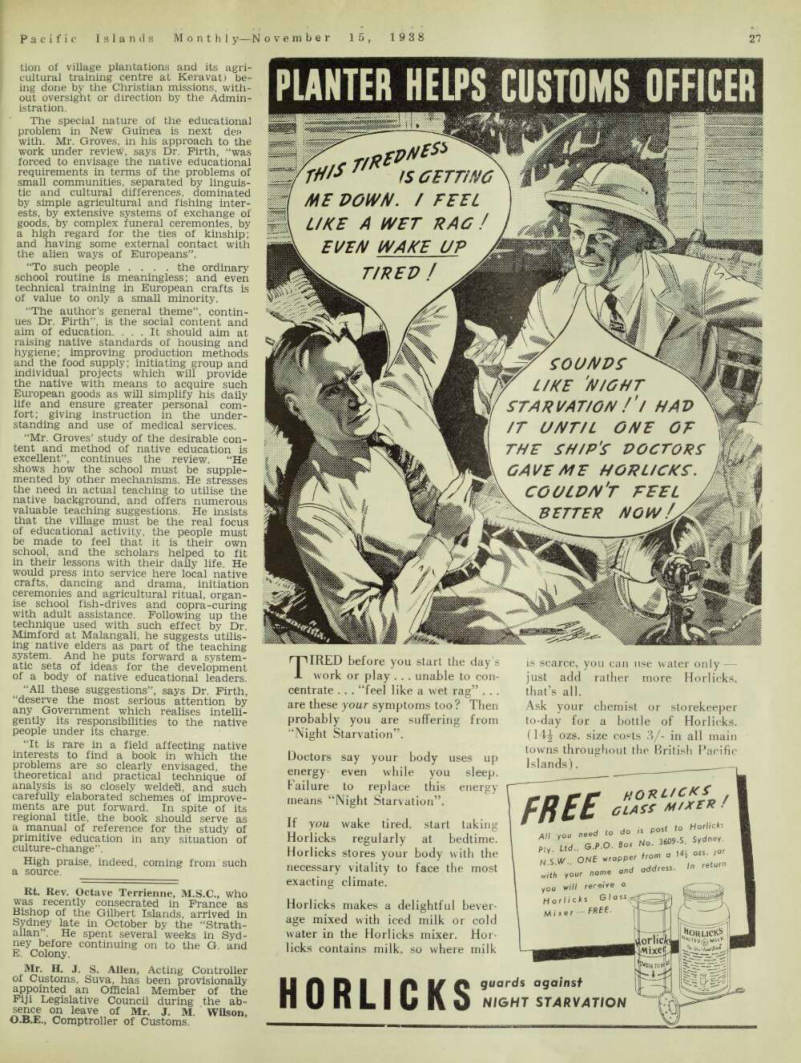
Native Education And Culture
New Guinea's Failure to Evolve a Policy
IN a recent issue of “Oversea Education” (the Colonial Office official journal of education published by the Secret ary of State) appear three interesting ar ticles which cover similar ground in the widely separated territories of Rhodesia, the Union of South Africa, and the Ter ritory of New Guinea.
It is interesting to note the similarity in the related problems of native educa tion and social development in the three places,
The Rhodesias
THE article on the situation in Rho desia deals in some detail with the
problem of education in relation to the native village—in face of the alarm ing exodus of adult male natives and their employment on European mining and industrial enterprises.
In permitting this unregulated exodus, it is pointed out that, in Rhodesia, as in New Guinea, “we are draining the native reserves of their brightest spirits and most useful citizens, and are thereby tending to hinder the course of native development”.
While education (in its wide social con notation, and not merely as formal schooling on the European pattern) is powerless to prevent this situation, it can contribute in a practical way towards adjusting the village life to the new conditions. It is the old problem of so cial adjustment—a problem which has never before been met in such acute and urgent form as with the process of de tribalising of native peoples in increasing contact with European civilisation going on at the present time.
Broadly speaking, the development of native agriculture, with groups of vil lages as co-operating units, under regu lar “educational” guidance and expert supervision (focussing upon schools with agricultural teaching bias) is suggested as a means of social stabilisation, and as a counter to the detrlbaiising influences.
Union Of South Africa
r:E article on the situation in the Union of South Africa consists of a summary by Professor A. Victor Murray, of the “Report of the Inter-de partmental Committee on Native Educa tion, 1935-36” (Government Printer, Pre toria) .
The report deals fully with the vexed question of the relation of missions and government in native education and so cial development. It is concerned with what is and what might be; it is both liberal in its outlook, and radical and constructive- in its suggestion. It deals not only with the aims of native educa tion and the carrying out of those aims in the school systems, but with the prac tical problems of administration in rela tion to education. It looks to the school as the social development centre of the community it serves; deals with the ur gent need for co-operation of all admin istrative agencies (medicine and agricul ture, for example) in the educational programme; and with the problem of lan guage; and generally lifts the whole question of native education out of its traditional utilitarian rut.
Territory Of New Guinea
rE article dealing with New Guinea is by Dr. Raymond Firth, Reader in Social Anthropology at London Uni versity, a member of the Colonial Office Advisory Committee on Education, and an authority on the anthropology and ad ministration of Pacific natives. It con sists of a comprehensive review of the book by Mr. W. C. Groves (educational ist and anthropologist) published in 1936 by the Australian Council for Educational Research and the Oxford University Press, “Native Education and Culture Contact in New Guinea”.
Dr. Firth, using the data of Mr.
Groves’ study, first presents the existing situation in New Guinea in relation to native education —practically the whole of the village educational work (apart from the special work of the Department of Agriculture, with its system of inspec
tion of village plantations and its agri cultural training centre at Keravat) be ing done by the Christian missions, with out oversight or direction by the Admin istration.
The special nature of the educational problem in New Guinea is next de?i with. Mr. Groves, in his approach to the work under review, says Dr. Firth, “was forced to envisage the native educational requirements in terms of the problems of small communities, separated by linguis tic and cultural differences, dominated by simple agricultural and fishing inter ests, by extensive systems of exchange of goods, by complex funeral ceremonies, by a high regard for the ties of kinship: and having some external contact with the alien ways of Europeans”.
“To such people ... the ordinary school routine is meaningless; and even technical training in European crafts is of value to only a small minority.
“The author’s general theme”, contin ues Dr. Firth”, is the social content and aim of education. ... It should aim at raising native standards of housing and hygiene; improving production methods and the food supply; initiating group and individual projects which will provide the native with means to acquire such European goods as will simplify his daily life and ensure greater personal com fort; giving instruction in the under standing and use of medical services.
“Mr. Groves’ study of the desirable con tent and method of native education is excellent”, continues the review. “He shows how the school must be supple mented by other mechanisms. He stresses the need in actual teaching to utilise the native background, and offers numerous valuable teaching suggestions. He insists that the village must be the real focus of educational activity, the people must be made to feel that it is their own school, and the scholars helped to fit in their lessons with their daily life. He would press into service here local native crafts, dancing and drama, initiation ceremonies and agricultural ritual, organ ise school fish-drives and copra-curing with adult assistance. Following up the technique used with such effect by Dr.
Mimford at Malangali, he suggests utilis ing native elders as part of the teaching system. And he puts forward a system atic sets of ideas for the development of a body of native educational leaders.
“All these suggestions”, says Dr. Firth, “deserve the most serious attention by any Government which realises intelli gently its responsibilities to the native people under its charge.
“It is rare in a field affecting native interests to find a book in which the problems are so clearly envisaged, the theoretical and practical technique of analysis is so closely welded, and such carefully elaborated schemes of improve ments are put forward. In spite of its regional title, the book should serve as a manual of reference for the study of primitive education in any situation of
culture-change”.
High praise, indeed, coming from such a source.
Rt. Rev. Octave Terrienne, M.S.C., who was recently consecrated in France as Bishop of the Gilbert Islands, arrived in Sydney late in October by the “Strath allan”. He spent several weeks in Syd ney before continuing on to the G and E. Colony.
Mr. H. J. S. Allen, Acting Controller of Customs, Suva, has been provisionally appointed an Official Member of the Fiji Legislative Council during the ab sence on leave of Mr. J. M. Wilson, 0.8. E., Comptroller of Customs.
Advertisements & other items, pp. 30-32 (3 items)
26
Paeifie Islands Monthl y—N o v ember 15, 1938
The King’S School
lySSLgCfio (•*<
(PARRAMATTA)
N.S W.
Extensive Modern Additions—New Class Rooms, Laboratories, Dormitories, Modern Swimming Pool.
Vacancies for 1939 Apply, THE HEADMASTER
W/rHis 77 iscfi
7 T**'
d Mt DOWN. / /-ffZ
- LIKE A WET !
■n\ iFVf/V /
Gt
TIREV
JFK SOUNDS \J
LIKE 'NIGHT
STARVATION !'I HAD
/T UNTIL ONE OF
THE SHIP'S DOCTORS
GAVE ME HOR LICKS.
couldn’t feel
Abetter now/d^
I / TIRED before you start the day s work or play . . . unable to concentrate . . . “feel like a wet rag” . . . are these your symptoms too? Then probably you are suffering from “Night Starvation”.
Doctors say your body uses up energy even while you sleep.
Failure to replace this energy means “Night Starvation”.
If you wake tired, start taking Horlicks regularly at bedtime.
Horlicks stores your body with the necessary vitality to face the most exacting climate.
Horlicks makes a delightful beverage mixed with iced milk or cold water in the Horlicks mixer. Horlicks contains milk, so where milk is scarce, you can use water only just add rather more Horlicks, that’s all.
Ask your chemist or storekeeper to-day for a bottle of Horlicks. (14J ozs. size costs 3/- in all main towns throughout the British Pacific Islands).
FREE '
z'zdo.ziddCt
P N y sTone „ wr » »«« • Z your -»« -*«"-• ,e,u ' n you will receive a Horlicks G ,asS;^C===P M/xer FREE-
HORLICKS
HoruClC* orlic ixeiT I 1 Nut guards against
NIGHT STARVATION
Kork-N-Seal
FOR HOME USE
FOR ALL HOME BOTTLING
—THE LITTLE CAP THAT
will Re - seal 1,000 Times
KORK - N - SEAL (Ausf.) LTD.
106 COMMONWEALTH STREET
SYDNEY, AUSTRALIA
Applied Airtight Pressure Proof Hand
We are Specialists . . . \Let us have your confidence. Sixty years is our record of supplying the leading Houses throughout the World In ... .
FRESH FRUIT VEGETABLES PRODUCE
Phones: MA 3612 (4 lines) Cable Address: “Weymarkson’' Codes —Bentleys Private
WEYMARK & SON LTD.
FRUIT AND PRODUCE MERCHANTS
14-18 STEAMMILL STREET - - SYDNEY
CHI VERS
FAMOUS ENGLISH PRODUCTS
CANNED ENGLISH VEGETABLES
CANNED ENGLISH FRUITS
OLDE ENGLISH MARMALADE
GOLD MEDAL JAMS
JELLY CRYSTALS. ETC.
Obtainable from all leading Grocery Stores
WRITE TO DEPARTMENT "A"
CHIVERS & SONS LTD.
Histon, Cambs., Eng.
FOR ATTRACTIVE RECIPE BOOK
m on
\chwers
I k CQ s LO
standard
FRESH
h
ENGLISH
PEAS
s ano
27
Pacific Islands Monthl y—N ovember 15, 1938
"Aunt Selina" Of Norfolk
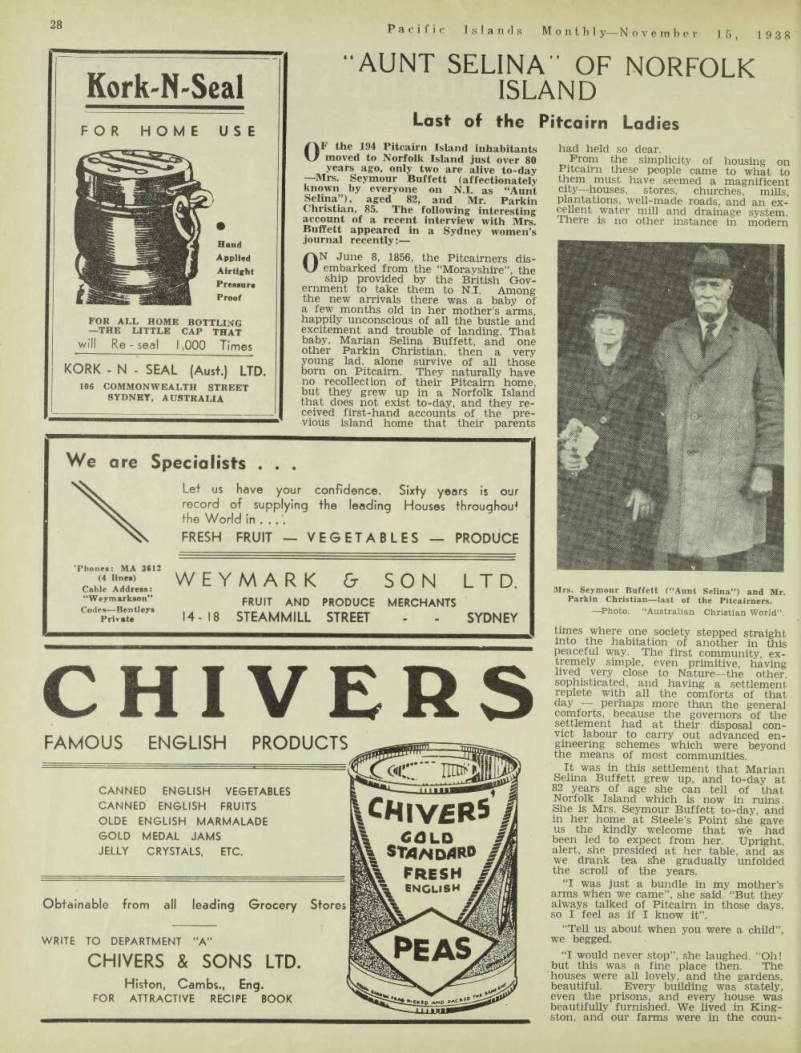
Island
Last of the Pitcairn Ladies
OF the 194 Pitcairn Island inhabitants moved to Norfolk Island just over 80 years ago, only two are alive to-day —Mrs. Seymour Buffett (affectionately known by everyone on N.I. as “Aunt Selina”), aged 82, and Mr. Parkin Christian, 85. The following interesting account of a recent interview with Mrs.
Buffett appeared in a Sydney women’s journal recently:— ON June 8, 1856, the Pitcairners dis embarked from the “Morayshire”, the ship provided by the British Gov ernment to take them to N.I. Among the new arrivals there was a baby of a few months old in her mother’s arms, happily unconscious of all the bustle and excitement and trouble of landing. That baby, Marian Selina Buffett, and one other Parkin Christian, then a very young lad, alone survive of all those born on Pitcairn. They naturally have no recollection of their Pitcairn home, but they grew up in a Norfolk Island that does not exist to-day, and they re ceived first-hand accounts of the pre vious island home that their parents
had held so dear.
From the simplicity of housing on Pitcairn these people came to what to them must have seemed a magnificent city—hpuses, stores, churches, mills, plantations, well-made roads, and an ex cellent water mill and drainage system.
There is no other instance in modern
times where one society stepped straight into the habitation of another in this peaceful way. The first community, ex tremely simple, even primitive, having lived very close to Nature-the other, sophisticated, and having a settlement replete with all the comforts of that day perhaps more than the general comforts, because the governors of the settlement had at their disposal con vict labour to carry out advanced en gineering schemes which were beyond the means of most communities.
It was in this settlement that Marian Selina Buffett grew up, and to-day at 82 years of age she can tell of that Norfolk Island which is now in ruins.
She is Mrs. Seymour Buffett to-day, and in her home at Steele’s Point she gave us the kindly welcome that we had been led to expect from her. Upright, alert, she presided at her table, and as we drank tea she gradually unfolded the scroll of the years.
“I was just a bundle in my mother’s arms when we came”, she said. “But they always talked of Pitcairn in those days, so I feel as if I know it”.
“Tell us about when you were a child”, we begged.
“I would never stop”, she laughed. “Oh! but this was a fine place then. The houses were all lovely, and the gardens, beautiful. Every building was stately, even the prisons, and every house was beautifully furnished. We lived in King ston, and our farms were in the coun
Mrs. Seymour Buffett (“Aunt Selina”) and Mr.
Parkin Christian—last of the Pitcairners, —Photo. “Australian Christian World”.
try. It was a happy place. We were one big family. We had very little money, but what did it matter? We changed what we wanted with each other—and there was always plenty”.
“But why did you let it go to ruin?”
“Well, we had very little money, as I told you”. There was reserve in our hostess’s tone, and we knew we were ap proaching dangerous ground.
“They took the houses from us, no one knows why”, she said.
Rev. George Hunn Nobbs Guided
the religious observances, and an in tensely religious community support ed him in his work. Nobbs was former ly an officer in the British Navy and had arrived at Pitcairn in 1828, aged 29 years. He threw in his lot with the is landers and acted as teacher and min ister there for many years, married the daughter of Charles Christian, and de voted his life to the work of the church.
Sunday was very strictly observed. No work was done; they went to church. A young Norfolk Islander to-day says: “I think they went to church all day”.
There were two churches built at N.I. during the penal occupation—a Church of England and a Roman Catholic. Aunt Selina, staunch Church of England, as were all the Pitcairners then, says that “the Roman Catholic Church was lovelier than you can believe. It had windows and everything beautiful. So is St. Bar nabas’ beautiful. It is full of lovely things, too”.
We cordially agreed, for the church built by the Melanesian Mission is an artistic triumph.
“I don’t go out much now, you know”, she continued, “but when I did go I al ways went to our church in Kingston.
That’s where we all worshipped and were christened and married. That’s the church we love”.
Then we heard how the first church they worshipped in was blown down in a gale, and the present church made in the big storehouse. The Roman Catho lic Church, alas, was ruined by neglect, and, sad to say, with some human aid. for the boys of long ago broke most of the windows.
Since those days other forms of relig ion have come into use on the island.
The Seventh Day Adventists are a large body, and the Methodists have their church, and there the old Pitcairn Is land hymns are- still sung.
AND here let us tell another story than Aunt Selina’s, which was told us sec ond hand, for the heroine of it died some years ago. It goes back to Pit cairn days.
When Admiral Moresby, of H.M.S.
“Portland”, visited Pitcairn Island in 1852 he was so much struck by the islanders and their pastor that he and his offi cers did everything in their power to forward the Pitcairn interests. It was on the “Portland” tljat George Hunn Nobbs left the island for England to be ordain ed. Mr. Nobbs took Jane, one of his young daughters, with him, arranging to leave her on the way to Valparaiso to be educated.
All these plans were carried out, but something else occurred which was un foreseen. A young girl on a warship is a rare occurrence, and when the “Port land” again took on board Mr. Nobbs and his daughter, the latter, who had left Pitcairn a shy girl, who knew noth ing of any place but her simple island home, was returning a travelled young lady, and a very attractive one at that.
She was fair as her English grandfather, with large blue eyes and flaxen hair.
And the captain of the “Portland” fell
in love with her. She must have enjoyed that voyage enormously. The sailors made her a present—literally made it. for on board they fashioned her a cedar table, and a chest of drawers made in two sections like a sea chest.
She arrived back at Pitcairn with these most rare possessions for a Pit cairner, and with her troth plighted to the captain. He was to dome for her as soon as his duties allowed. There was no easy communication in those days, and voyages were very long. The gallant captain sailed away, and his ship visited far waters before he could return to Pit cairn. When at last he did, after sev eral years, laden with presents for his lass, he found her the wife of John Quintal.
And it was a Quintal home, and from the lips of Jane’s grandchildren, that we heard the story of the first romance
of young Jane Nobbs, as they had heard it often from old Jane Quintal’s lips.
The table and the chest are still in the possession of the family.
THIS story has nothing to do with Aunt Selina Buffett, and she has so much to tell that we must return to her tea table. She goes back to the days of her youth happily, and we share with her the regret at the lost landmarks. She tells of the vegetable gardens where the golf links are now, and the many more pines that sheltered “the town”. As she talks we can almost hear the old Islands songs being sung and see the lads and lassies dancing the Tahitian dances.
“They were lovely, those boys and girls”, she says, and, gazing at her vivid, well-featured face, we believe her.
We hear of yam-digging time, when before daylight the men went out in
whaleboats and brought in loads of fish.
The women in the meantime made cook ing fires near the yam fields, and when the fish arrived they cooked it and pre pared a sumptuous feast. As well as the fish there were pork, black puddings, and savoury stews. The whole affair was a glorious picnic. In the evening they danced their graceful dances derived from their Tahitian foremothers with traces of their forefathers’ sailor dances inter mixed.
“Bounty” Day
“It was something like paradise then”, Aunt Selina says, and there was the sad ness of loss in her voice.
But she is too sturdy, this old lady of 82, to spend her time in regrets. There is some of the old fun and laughter in her voice as she tells of weddings and the wonderful celebrations which used to take place on “Bounty Day".
“They shouldn’t drop that”, she says severely. ‘ You keep up Anniversary Day in Syd ney, and ‘Bounty Day’ is the same here, and should be kept up”. We heartily agreed.
We told Aunt Selina that we had been to the school-house to see the wonderful model of the “Bounty” made by Mr. W.
Allen, and we also told her that the “Bounty” gun, which lies neglected in front of the courthouse, merits more shelter and care.
“Any museum in the world would like to have that”, we remarked.
“But they can’t have it; it’s ours”, she responded sturdily.
Which is quite true. It belongs to the Norfolk Islanders, once the Pitcairners, and before that the “Bounty” mutineers.
Perhaps, they will gather it, and the few other remaining “Bounty” treasures, and the old, almost unique, convict treasures, in a museum of their own some day.
Advertisements & other items, p. 33 (2 items)
29
Pacific Islands Month! y—N ovember 15, 1938
Foster Clarks
NO-I HATE FRUIT!
» <7 ss A-***. v.
THEY JUST WOULDNT
EAT FRUIT UNTIL -
I GAVE THEM
FOSTER CLARK'S
CREAMY CUSTARD
and the whole family
like its Delicious Flavour
LOVELY,
MUMMY
-MORE /
THERE 5 NO
CUSTARD TO
COMPARE WITH
POSTER CLARKS
Stop meal-time fights! Give the family Foster Clark’s delicious creamy Custard on their fruit.
Mrs. Adams, of Rose Bay— seen here with one of her sons —is among the hundreds of enthusiasts for Foster Clark’s Custard. Its reputation for flavour and nourishment is long estab lished and worldwide.
Foster Clark’s Custard is sold by all grocers, in 3 sizes and 4 flavours.
Buy a penny packet, to try it!
H6OO
& V Cu
ARP
row ©IB
FOSTER CLARKS
Death of Miss Lila Palusian
RESIDENTS of Pago Pago (American Samoa) will be sorry to learn of the death, on October 13 in Sydney, of Miss Lila Palusian, daughter of Vaiata. of Pago Pago, and late ward of Mr. and Mrs. Sam Bowen, of Strathfield. Miss Palusian, who had been a vivacious mem ber of the Polynesian Club’s set at the Pageant of Nations in February, was a relation both of the Paatonu Taisi O F Nelson, and of the late Chief Tuimaiea liifano.
The interment, which took place at Manly, was largely attended. The Poly nesian Club of Sydney was represented by the president (Mr. L. Moran), the Chief tainess (Mrs. M. Missen-Garrett, of Rotuma). and thirty members. Before lowering the coffin into the grave, it was covered “faa Samoa” with a fine piece of tapa cloth from Pago Pago. After the final religious service, the Samoan fare well song was sung (Tofa mai feleni).
Miss N. Fagan, of the Melanesian Mis sion, will take temporary charge of the mission station at Torgil, New Hebrides, in the absence of Miss Erima Muir, who is suffering from a serious breakdown.
Miss Fagan, who has recently completed furlough, was to have proceeded to Kum bun, New Britain, but her place will be taken by Miss A. Piggot.
Apinaipi Co.'s Operations
Papuan Oil Search
From Our Own Correspondent
Pt. Moresby, Oct. 20.
rpHE field manager of Papuan Apinaipi X Petroleum Co. Ltd., Mr. R. S. Haynes. who left here recently on a business trip south, stated that houses, roads and other necessary work on his Co.’s conces sion have been completed, and three scout bores have been drilled, while aer ial surveys of the area have been made.
Two scout bores were drilled on the Apinaipi structure, and gas was encoun tered with a surface pressure of 250 lbs. to the sq. inch.
At the Oiapu structure. No. 1 scout bore has reached 1,007 ft. Evidence shows that underlying strata contain gas and oil.
It is proposed now to test the area by deep drilling. Application has been made to the Commonwealth Govern ment for the loan of deep drilling plant, and for a £ for £ subsidy. If the appli cation is granted, the deep drilling plant will first be operated at Oiapu and, later, at other locations.
The Co., by advertisement in Austra lian newspapers in October, offered an other issue of shares to the public.
Rev. Dr. Guiseppe Capra, regius profes sor of the Universities of Rome and Peru gia, who recently arrived in Australia, was the guest of Bishop Nicolas, of Suva, Fiji, in October. He intends touring and ex nloring in Samoa, the New Hebrides and New Caledonia before returning to Rome.
Advertisements & other items, p. 34 (2 items)
30
Pacific Islands Monthl y—N ovember 15, 1938
coleman
YOU CAN
WITH A
MASTER-LITE LANTERN
These new lanterns develop an abundance of light—to meet any need.
Equipped with the No. 1111 Coleman Hi-Power Mantle, positive built-in pump, and genuine “Pyrex” heat and rain resisting bulge type globe, with 30% more lighting surface.
Safe —has the Coleman shut-off valve and other safety features.
No. 236—For PetroI—INSTANT-lighting.
No. 237 —For Kerosene —preheating model.
DISTRIBUTORS IN THE PACIFIC ISLANDS
Va / All Branches of Burns, Philp & Co. Ltd., W. R. Carpenter & Co. Ltd., Morris, Hedstrom Ltd., Whitten Bros. Ltd., Steamships Trading Co.
Ltd., and many other firms throughout the Islands.
“THE SUNSHINE OF THE NIGHT”.
Healing Art
Periodic Crazes in Tahiti
From Our Own Correspondent
Papeete, Oct. 10.
ANY new and bizarre form of the art of healing always finds ready accept ance on Tahiti. The more unusual and fantastic the method, the more en thusiastic is the reception accorded it.
The present novelty is a procedure which is alleged to have come from China, by way of Paris. We are not in formed as to its official name; but, for want of a better term, it can be desig nated needle therapeutics.
The treatment consists of sticking needles into various parts of the body along the course of some trunk nerve.
According to the savants of this school, this procedure will relieve and eventually cure all the ills to which the flesh is heir.
Marvellous cures are always reported when a new vogue in therapeutics sweeps the Islands.
This was particularly true when, two years ago. a Roumanian “professor” took the island by storm with his system of eso- and exo-hydropathy, a starvation diet, and his assumption of profound wis dom.
The professor appeared to have an hypnotic influence over his followers, which keyed them up to an ecstatic fer vour, resembling that of the strange cult called holy hollers, which flourished in the United States during the early years of the century. Indeed, the professor’s European disciples (and there are many such) would become angry and hostile toward anyone who ventured to offer counsel or criticism.
In the course of a few weeks Papeete was full of pallid, hollow-eyed phantoms who, nevertheless, resolutely proclaimed that they were new men and women— as, undoubtedly, they were!
The inevitable consequences of the violent assaults on the human economy exacted by this regime, at length mani fested themselves. There were sudden deaths from heart failure, several pati ents became insane, and the increasing weakness of the others awakened them to the danger which threatened them.
The professor heard some very unpleas ant opinions of himself and his therapeu tics from those who had sufficient strength remaining to voice their indig nation. The most caustic remarks came from an elderly and very aristocratic English lady who was sojourning in the islands and had come under the profes sor’s spell. It is reported that her lan guage on this occasion departed from the cultured and classic idiom of Mayfair, and that she displayed a surprising knowledge of the rich vocabulary cur rent about the Indian docks and cele brated fish markets of London.
The professor was unperturbed.
He boasted to his intimates that he had had a very inexpensive and enjoy able stay in the islands. Soon after wards he departed—it is said, to Mexico— in search of new worlds to conquer.
Mr. Parkin Christian, a direct descend ant of Fletcher Christian, leader of the mutineers of the “Bounty” and founder of the colony of Pitcairn Island, recently arrived at Wellington. He said that he was of the fifth generation since Flet cher Christian, whose descendants now comprised a large family.
Tongan Natives' Poverty
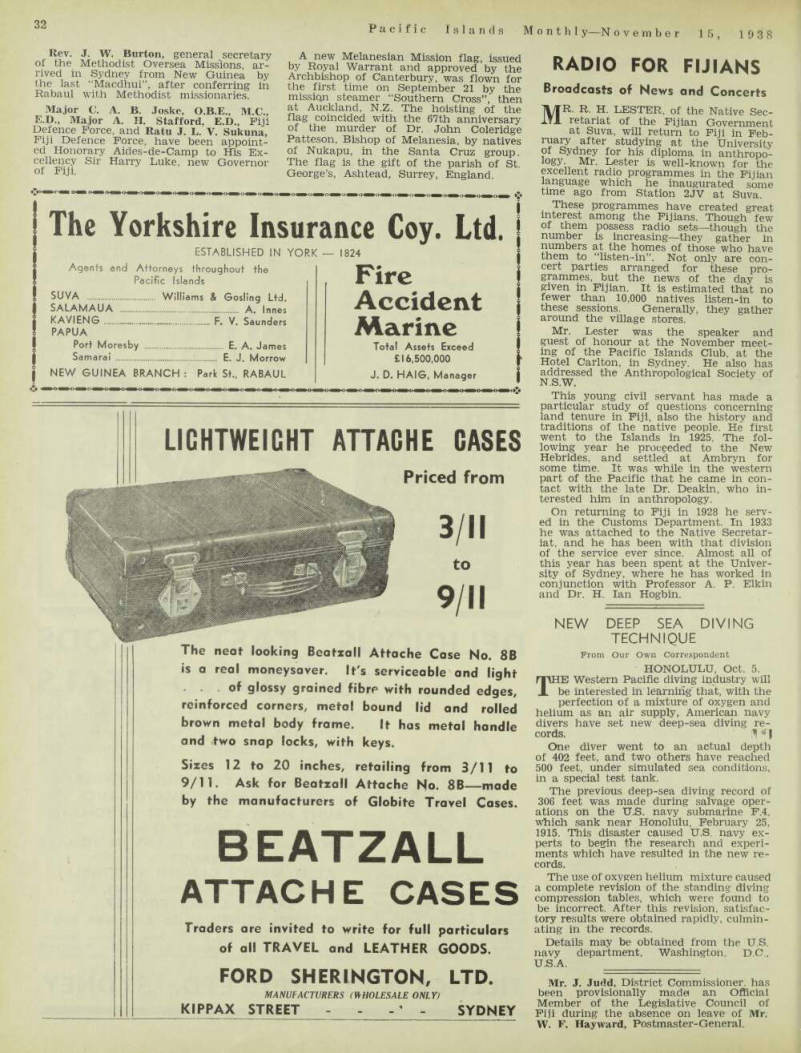
Is Church a Burden?
Letter to the Editor.
THE inhabitants of the island of Foa, Haapai Group, Tonga, are complain ing bitterly about the shortage of food.
Yams, kumala, taro, manioc, etc., most ly are consumed, but supplies were squan dered or wasted at the last Wesleyan Mission Conference, which was held in the Haapai Group, and the new crop, which will be a very small one, is not ready. The copra price being low. it takes about eight sacks of dry copra to buy a sack of flour.
I am afraid our natives work too much
in God’s vineyard, and too little on their own yam-patches.
The island of Foa has an area of 5 sq. miles and a population of 900. Yet it supports no less than 15 churches, 6 well-paid ministers, and 88 lay-preach ers.
Church services are held on Sunday four, and often six times, besides Monday at 5 p.m., Wednesday at 7 a.m., and Friday at 5 p.m. The native who works on his plantation in the bush, must leave off at about 4 p.m., just when the day becomes pleasant to work.
I am. etc..
F. T. Goedicke.
Haapai, Tonga, 10/9/’3B.
Pastor T. Howse, of the S.D.A. Mission in Samoa is on furlough in Australia.
Rev. J. W. Burton, general secretary of the Methodist Oversea Missions, ar rived in Sydney from New Guinea by the last “Macdhui”, after conferring in Rabaul with Methodist missionaries.
Major C. A. B. Joske, 0.8. E., M.C., E.D., Major A. H. Stafford, E.D., Fiji Defence Force, and Ratu J. L. V. Sukuna, Fiji Defence Force, have been appoint ed Honorary Aides-de-Camp to His Ex cellency Sir Harry Luke, new Governor of Fiji.
A new Melanesian Mission flag, issued by Royal Warrant and approved by the Archbishop of Canterbury, was flown for the first time on September 21 by the mission steamer “Southern Cross”, then at Auckland, N.Z. The hoisting of the flag coincided with the 67th anniversary of the murder of Dr. John Coleridge Patteson, Bishop of Melanesia, by natives of Nukapu, in the Santa Cruz group.
The flag is the gift of the parish of St.
George’s, Ashtead, Surrey, England.
Advertisements & other items, pp. 35-36 (2 items)
31
Pacific Islands Monthl y—N ovember 15, 1938
Q\e*>£efSl
BECAUSE it is the only A.P.C. prepared to the specific therapeutic hospital formula prescribed for use in a large public hospital, Genuine Vincent’s A.P.C. is far more effective for relieving pain than other similar preparations. Send the coupon below and test the greater effectiveness of genuine Vincent's A.P.C. for yourself.
STOPS SAFELY
HEADACHE
'FLU & COLDS
RHEUMATISM
NEURALGIA
SC I ATICA
NEURITIS
LUMBAGO
AND ALL NERVE AND
MUSCULAR RAINS
PA I N'f
MASTER
Q\e*>£efSl
POWDERS *
TABLETS
1/6 AND 2/1,.
SINGLES 2d. ea.
Vincent Chemical Co. Pty. Ltd. 76 Liverpool St.,
FREE SAMPLE
SYDNEY.
Please send me a free sample of your powders and/or tablets.
NAME
ADDRESS
P.I.M.
DELICIOUS, TASTY FOODS
For ISLAND MEALS
AUNT MART’S COOKERY
BOOK.
There’s no finer book for every home . . . 212 pages, lavishly illustrated in colour, and over 400 recipes and useful hints make it a book that every housewife will want. Send only one shilling and twopence to
TILLOCK & CO. PTY. LTD.,
Sydney N.S.W., and get your copy of this great book NOW.
JUST TRY any of AUNT MARY'S Pure Food ** Products, and you will be back for more . . . delicious in themselves or with innumerable dishes.
AUNT MARY'S BAKING POWDER
AUNT MARY'S TOMATO SAUCE
AUNT MARY'S SPAGHETTI IN TOMATO
SAUCE
AUNT MARY'S BAKED BEANS IN TOMATO
SAUCE
AUNT MARY'S CANNED VEGETABLES
Green Peas, Cauliflower, Celery, etc.
RANEE CURRY POWDER
BLOSSOM HONEY In Attractive Jars Or any of the large variety of Pure Food Products specially packed for Tropical conditions, in Tillock’s Hermetically Sealed 1-lb. tins. All goods are procurable from your local
TILLOCK & CO. PTY. LTD., SYDNEY.
The Yorkshire Insurance Coy. Ltd.
ESTABLISHED IN YORK 1824
Agents and Attorneys throughout the Pacific Islands SUVA Williams & Gosling Ltd.
SALAMAUA A. Innes
KAVIENG .. F. V. Saunders
PAPUA
Port Moresby E. A. James Samarai E. J. Morrow NEW GUINEA BRANCH : Park St.. RABAUL
Fire
Accident
Marine
Total Assets Exceed £16,500,000 J. D. HAIG, Manager
LIGHTWEIGHT ATTACHE GASES
Priced from
9/11 3/11 to The neat looking Beatzall Attache Case No. 8B is a real moneysaver. It's serviceable and light of glossy grained fibre with rounded edges, reinforced corners, metal bound lid and rolled brown metal body frame. It has metal handle and two snap locks, with keys.
Sizes 12 to 20 inches, retailing from 3/11 to 9/11. Ask for Beatzall Attache No. BB—made by the manufacturers of Globite Travel Cases.
BEATZALL
ATTACHE CASES
Traders are invited to write for full particulars of all TRAVEL and LEATHER GOODS.
FORD SHERINGTON, LTD.
KIPPAX STREET - - - SYDNEY
MANUFACTURERS (WHOLESALE ONLY)
Radio For Fijians
Broadcasts of News and Concerts
MR. R. H. LESTER, of the Native Sec retariat of the Fijian Government at Suva, will return to Fiji in Feb ruary after studying at the University of Sydney for his diploma in anthropo logy. Mr. Lester is well-known for the excellent radio programmes in the Fijian language which he inaugurated some time ago from Station 2JV at Suva.
These programmes have created great interest among the Fijians. Though few of them possess radio sets—though the number is increasing—they gather in numbers at the homes of those who have them to “listen-in”. Not only are con cert parties arranged for these pro grammes, but the news of the day is given in Fijian. It is estimated that no fewer than 10,000 natives listen-in to these sessions. Generally, they gather around the village stores.
Mr. Lester was the speaker and guest of honour at the November meet ing of the Pacific Islands Club, at the Hotel Carlton, in Sydney. He also has addressed the Anthropological Society of
N.S.W.
This young civil servant has made a particular study of questions concerning land tenure in Fiji, also the history and traditions of the native people. He first went to the Islands in 1925. The fol lowing year he proceeded to the New Hebrides, and settled at Ambryn for some time. It was while in the western part of the Pacific that he came in con tact with the late Dr. Deakin, who in terested him in anthropology.
On returning to Fiji in 1928 he serv ed in the Customs Department. In 1933 he was attached to the Native Secretar iat, and he has been with that division of the service ever since. Almost all of this year has been spent at the Univer sity of Sydney, where he has worked in conjunction with Professor A. P. Elkin and Dr. H. lan Hogbin.
Technique
New Deep Sea Diving
Prom Our Own Correspondent
Honolulu, Oct. 5.
FTIHE Western Pacific diving industry will X be interested in learning' that, with the perfection of a mixture of oxygen and helium as an air supply, American navy divers have set new deep-sea diving re cords. J One diver went to an actual depth of 402 feet, and two others have reached 500 feet, under simulated sea conditions, in a special test tank.
The previous deep-sea diving record of 306 feet was made during salvage oper ations on the U.S. navy submarine P. 4, which sank near Honolulu, February 25, 1915. This disaster caused U.S. navy ex perts to begin the research and experi ments which have resulted in the new re cords.
The use of oxygen helium mixture caused a complete revision of the standing diving compression tables, which were found to be incorrect. After this revision, satisfac tory results were obtained rapidly, culmin ating in the records.
Details may be obtained from the U.S. navy department, Washington, D.C.,
U.S.A.
Mr. J. Judd, District Commissioner, has been provisionally made an Official Member of the Legislative Council of Fiji during the absence on leave of Mr.
W. F. Hayward, Postmaster-General.
Advertisements & other items, p. 36 (1 item)
32
Pacific Islands Mont hi y—N ovember 15, 1938
Relic Of Tragedy In Tonga
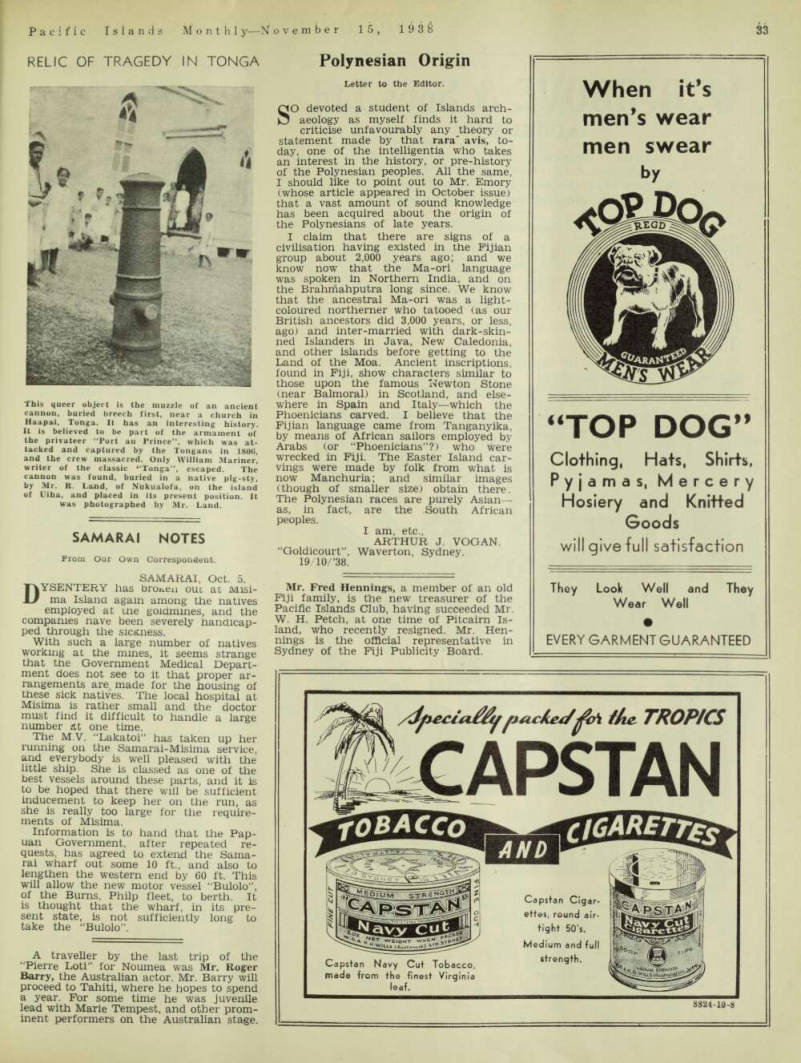
This queer object is the muzzle of an ancient cannon, buried breech first, near a church in Haapai, Tonga. It has an interesting history.
It is believed to be part of the armament of the privateer “Port au Prince”, which was at tacked and captured by the Tongans in 1806, and the crew massacred. Only William Mariner, writer of the classic “Tonga”, escaped. The cannon was found, buried in a native pig-sty, by Mr. R. Land, of Nukualofa, on the island of Uiha, and placed in its present position. It was photographed by Mr. Land.
Samarai Notes
Prom Our Own Correspondent.
Samarai, Oct. 5.
DYSENTERY has bron.en out at Misi ma Island again among the natives employed at me goldmines, and the companies nave been severely handicap ped through the siCKness.
With such a large number of natives working at the mmes, it seems strange that the Government Medical Depart ment does not see to it that proper ar rangements are made for the housing of these sick natives. The local hospital at Misima is rather small and the doctor must find it difficult to handle a large number at one time.
The M.V, “Lakatoi” has taken up her running on the Samarai-Misima service, and everybody is well pleased with the little ship. She is classed as one of the best vessels around these parts, and it is to be hoped that there will be sufficient inducement to keep her on the run, as she is really too large for the require ments of Misima.
Information is to hand that the Pap uan Government, after repeated re quests, has agreed to extend the Sama ra! wharf out some 10 ft., and also to lengthen the western end by 60 ft. This will allow the new motor vessel "Bulolo”, of the Burns, Philp fleet, to berth. It is thought that the wharf, in its pre sent state, is not sufficiently long to take the “Bulolo”.
A traveller by the last trip of the “Pierre Loti” for Noumea was Mr. Roger Barry, the Australian actor. Mr, Barry will proceed to Tahiti, where he hopes to spend a year. For some time he was juvenile lead with Marie Tempest, and other prom inent performers on the Australian stage.
Polynesian Origin
Letter to the Editor.
SO devoted a student of Islands arch aeology as myself finds it hard to criticise unfavourably any theory or statement made by that rara' avis, to day, one of the intelligentia who takes an interest in the history, or pre-history of the Polynesian peoples. All the same, I should like to point out to Mr. Emory (whose article appeared in October issue) that a vast amount of sound knowledge has been acquired about the origin of the Polynesians of late years.
I claim that there are signs of a civilisation having existed in the Fijian group about 2,000 years ago; and we know now that the Ma-ori language was spoken in Northern India, and on the Brahrhahputra long since. We know that the ancestral Ma-ori was a light coloured northerner who tatooed (as our British ancestors did 3,000 years, or less, ago) and inter-married with dark-skin ned Islanders in Java, New Caledonia, and other islands before getting to the Land of the Moa. Ancient inscriptions, found in Fiji, show characters similar to those upon the famous Newton Stone (near Balmoral) in Scotland, and else where in Spain and Italy—which the Phoenicians carved. I believe that the Fijian language came from Tanganyika, by means of African sailors employed by Arabs (or “Phoenicians”?) who were wrecked in Fiji. The Easter Island car vings were made by folk from what is now Manchuria: and similar images (though of smaller size) obtain there.
The Polynesian races are purely Asian— as, in fact, are the South African peoples.
I am, etc.,
Arthur J. Vogan.
“Goldicourt”, Waverton, Sydney. 19/10/’3B.
Mr. Fred Hennings, a member of an old Fiji family, is the new treasurer of the Pacific Islands Club, having succeeded Mr.
W. H. Fetch, at one time of Pitcairn Is land, who recently resigned. Mr. Hen nings is the official representative in Sydney of the Fiji Publicity Board.
Advertisements & other items, pp. 37-38 (2 items)
33
Pacific Islands Mont hi y —N ovember 15, 1938
Capstan
When it’s men’s wear men swear fcEGD
“TOP DOG”
Clothing, Hats, Shirts, Pyjamas, Mercery Hosiery and Knitted Goods will give full satisfaction They Look Well and They Wear Well
EVERY GARMENT GUARANTEED
/Jp£cia&tf p TROPICS
CAPSTAN
fOBACCp
NOTH
Dj u RE "St
AND
CIGARETTES
Capstan Navy Cut Tobacco, made from the finest Virginia leaf.
Capstan Cigarettes, round airtight 50's.
Medium and full strength.
AP 8824-10-8
W. H. GROVE & Sons Ltd.
AUCKLAND
Islands Traders p.o. box 490 Telegraphic and Cable Address: “Grove,” Auckland.
Shippers of all classes of New Zealand Products, specially prepared for the Island trade.
Representing
Rylands & Sons (Col.) Ltd of London and Manchester. (Including the famous “Dacca” Mills Products.) Parbury Henty & Co. Pty. Ltd., of Sydney and Kobe.*
“AGFA” Photographic Corporation, of Berlin.
J. Blair King, of London. World-famed Shirts.
Burrell & Co. Ltd., Millwall, London, E. 14. Oil, White Lead and all classes of Paints, including “FERROGENE” . their special Tropical Paint . . . PREVENTS CORROSION . . . made in RED, GREY, and GREEN.
'raUWUUWTC'
S 4! 3 or o^> ONE would think that the camera was made from a single cast, so harmonious is the construction of the Speedex Record camera. Elegant appearance, easiness to carry in the case, extremely reliable lens and shutter, all help to make this camera one of the best of its kind. The correct choice of a camera is very important, for one does not buy a new camera every day, and it therefore has to be borne in mind that with the Speedex Record one is always fully equipped. As film use the all-weather Agfa Isochrom film.
Southern Seas
By Don McDiarmid, in an American Magazine.
Are you among the chosen few, Who’ve watched the coast-line fade from view, And some stout ship sailed out to sea To carry you, as it did me, Far out across Pacific lanes Through waters showered with tropic rains To reach, at last, the South Sea Isles?
Have you seen, with the rising sun, A new Marquesan day begun, Revealing needled crags that soar To pierce low clouds, and reach for more, While opalescent waters vie For recognition with a sky Whose beauty no one mortal should Presume to picture, though he could?
And have you ever left the crowd When smoke was thick, and talk was loud Within the cabin of your craft, To wander to a deck “back aft”, And view a sunset which too soon Was but a memory; or commune With countless stars, and waves that toss Perpetual, ’neath the Southern Cross?
Have you, inside Papeete’s reef, Seen colour-schemes beyond belief, Where even natives on the quay Present a pastel symphony?
Or have you seen a full moon rise From water’s edge, to Tongan skies To find a cloud, so black and bold, And border it with flaming gold?
If you have sailed the Southern Sea, There’s nothing need be said by me, For, long as life remains, you will Recall this as your greatest thrill; But if you still have been denied The wonders of the Isles that hide In Southern Seas, I say to you: “Set sail . . . and live your life anew!”
Unflattering Official
Report On Pitcairn Is.
THE residents of Pitcairn Island are plainly neglecting the education of their own children, and are paying more than they can affdrd for work in the mission field, says Mr. J. C. Neill (British Colonial Service) in his annual report.
Everything on the island is subject to a tithe for religious purposes, says the report, and the yield from this, plus freewill offerings, is sent overseas for the use of Seventh Day Adventists.
The report adds that the island’s medi cal history is remarkable, with an aver age of one death a year for the last 80 years. Despite inter-marriage, there are no signs whatsoever of physical or men tal degeneracy, although they are degen erating culturally.
Families are undisciplined. Children are lapsing into the Pitcairn dialect, a queer mixture of Tahitian and English, neglecting English.
It is proposed for the first time to im pose laws, including a fine of £5 for adultery, or living in sin, and a fine of £2 for bathing in drinking water.
Mrs. E. Sprott, of the Melanesian Mis sion, passed through Sydney in October on her way back to the mission station on Santa Ysabel, Solomon Islands, after spending furlough in England.
Advertisements & other items, p. 38 (1 item)
34
Pacific Islands Monthl y—N ovember 15, 1938
In Samoa
Taxation Of Natives
Interesting Comparison With Fiji and Tonga
THE question of the differentiation in the copra export tax was raised by the Hon. Tamasese in the Legislative Council (reports “New Zealand Herald”).
He asked why the rate to Samoans was 30/- a ton seeing that to Europeans, who did not pay the personal tax, it was 20/-.
“This matter was bound up with the whole budgeting position of the territory’, said the Acting Administrator, Mr. Turn bull. If the Samoans were paying per sonal tax, as they did in former years, the extra 10/- on copra would gladly be remitted. On the present population the Treasury would be receiving £lB,OOO a year from Samoans, whereas they only paid between £4,000 and £5,000 in copra tax. Europeans had had the personal tax remitted, but they had a salary tax, business tax and other taxes that natives did not pay and the total was much higher per head than that of Samoans. If a per sonal tax was paid no doubt the extra tax could be remitted. As compared with Fiji and Tonga, the natives paid very little in taxes. The cost of native organi sation had increased considerably. Large numbers of Samoans had been taken into the service and there had been a revision of their pay.
Special Services Provided
Hon. C. C. McKay said the Samoans did not pay 10/- a ton extra for nothing. Ser vices were provided for them that the Europeans did not get. Native and village organisations cost over £4,000 a year, there was a special court for native affairs, a lands and titles Court, a special news paper, a special fono of faipule and free hospital treatment. None of these services was represented by a corresponding ser vice for Europeans and the cost far ex ceeded the amount collected on native copra.
Hon. Tamasese: Samoans pay more into the revenue as far as licenses and duty are concerned. No Samoan would object to pay salary tax if he had a three figure income. The turnover tax (sales and stores) is really paid by the natives.
Help In Solving Problems
Hon. C. C. McKay: Take Tonga. They pay a personal tax of 36/- and £1 on copra, and a village tax of 4/- for the equivalent of the pulinu’u, leoleo and scribes. By this means the most numer ous class of officials was carried without any call on the central treasury.
The Acting Administrator; I would be quite prepared to recommend to the Gov ernment that the tax be remitted if there were some means of making it up. Per haps the Hon. Tamasese might tell the council how the amount could be made up.
Hon. Tamasese said he recommended the reduction so that Samoans would pay the same as Europeans. The Acting Admini strator would be quite capable of finding some means of getting it out of the people.
The Acting Administrator: Thank you.
I am glad to hear you have such faith in my powers; but, all the same, I would like to have your help sometimes in solv ing these problems. -Mrs. Vowels, wife of the Mayor of Thursday Island, Alderman E. H. Vowels, arrived in Brisbane recently to spend a long holiday.
No Air-mail For Samarai
From Our Own Correspondent.
Samarai, Oct. 5.
A MATTER which needs attention is that we cannot post air-mail letters to catch the air-mail from Rabaul, when the opportunity offers. We are told that, unless we can secure New Guinea stamps to put on the letters, to gether with sufficient Papuan stamps, we cannot send any per air-mail.
The local post office does not sell New Guinea stamps, so if we require them we shall have to send up to Rabaul, and get them sent to us.
EDITORIAL NOTE: It is an extraord inary thing that Samarai, although only a little way off the air-mail track, can not use the air-mail because the Samarai post office is too unenterprising or too
proud to stock the necessary stamps. Pre sumably, if a Papuan postmaster were asked to sell New Guinea stamps, or vice versa, a brigade of outraged officials would cast themselves, in hari kari abandonment, upon the points of their pens! Yet—strange as it may appear to the uninstructed outside world —Papua and New Guinea are territories of Aus tralia.
A recent visitor to Fiji was Captain Andy Thompson, one of the best known men in the Central Pacific, who has made his home for many years in the Cook Is lands. While in Suva he renewed acquain tance with Mr. Graham Dickson, now pur ser of the liner “Aorangi”, who held a similar post on the old “Makura” when she used to pass through Rarotonga. Mr.
Dickson at one time represented the Union Company at Avarua, C.I.
Advertisements & other items, p. 39 (2 items)
35
Pacific Islands Monthl y—N ovember 15, 1938
Petrcima*
J rxtijy c The extraordinary advantages of our new PETROMAX Rapid lanterns and table-lamps are obvious; Due to the very high heating efficiency of the absolutely safe and automatic Paraffin pre-heating device, the usual pre-heating time of about 5 minutes has been reduced to 30 seconds! c PETROMAX RAPID Lanterns and Lamps need one fuel only, i. e., the inexpensive paraffin or petrol, if required, for both pre-heating and burning.
'write for the new and INTERESTING prospectus
Rapid
W. BRECKWOLDT & CO., Roboul. Sole Agents for South Seas.
Suva Medical School
THE “Niagara”, on her last trip, carried to Fiji a medical work which members of the Council of the Pacific Islands Club in Sydney have donated to the sen ior student for 1938 at the Central Medi cal School. The prize will be awarded fol lowing the December examinations. The book was selected on the suggestion of the Principal, (Dr. Hoodless), and it is the Club’s intention to make the prize an an nual one. Last year’s winner was Geoffrey Kuper, N.M.P., of Santa Anna, Solomons Group.
Rt. Rev. W. H. Baddeley, Bishop of Mel anesia, has been elected a member of the Pacific Islands Club.
£1,000,000 Co. For Oil Search In
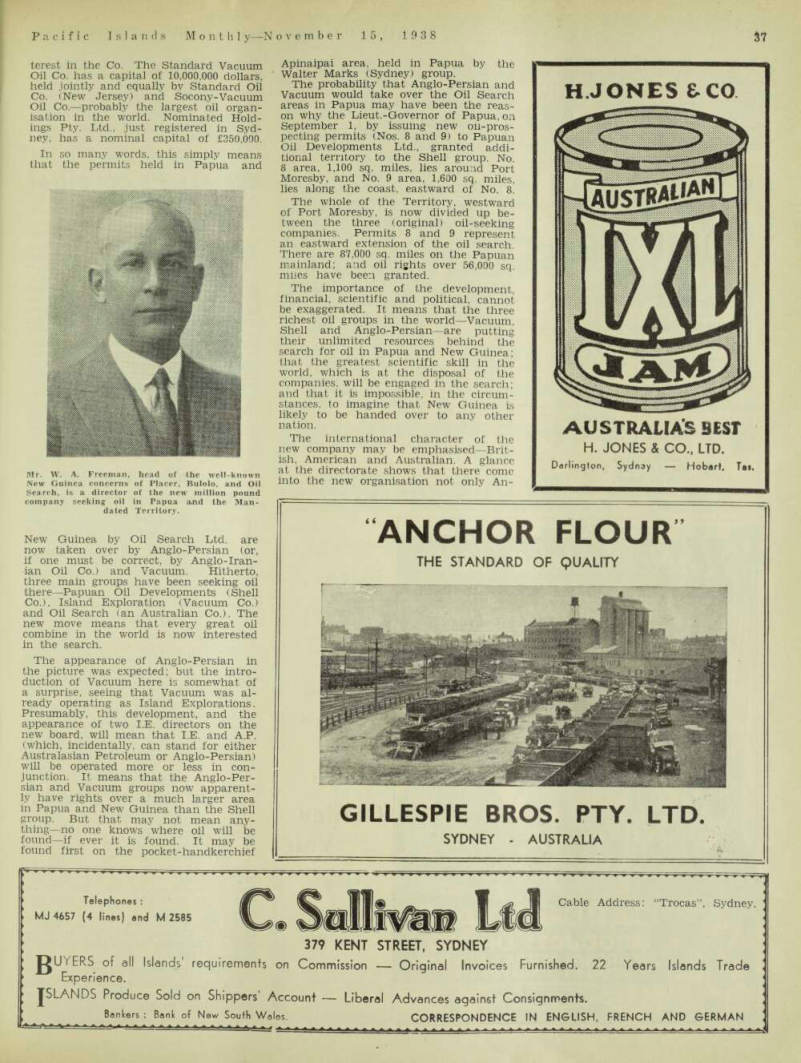
Papua And Hew Guinea
Enormous Finance and Scientific Skill for Continuance of Enterprise
THE formation of Australasian Petro leum Co. Pty. Ltd., to take over the New Guinea and Papua interests of Oil Search Ltd., has an international sig nificance.
The nature of the development—which was forecast in recent issues of the “P.i.M.’ —has been very fully described in the Australian newspapers of October 18 and the following days. Briefly, it is as fol lows : (1) Australasian Petroleum Co. Pty.
Ltd. has been incorporated in Melbourne with a nominal capital of £1,000,000, in £1 shares, to take over the oil-search permits and all property of Oil Search Ltd. and Oriomo Oil Ltd. (both Austra lian companies) in New Guinea and Papua. (2) The shareholders in the new Co. are Vacuum Oil Co. Pty. Ltd., Mel bourne (subsidiary of and wholly owned
by Standard-Vacuum Oil Co., New York) D’Arcy Exploration Co. Ltd., London (sub sidiary of and wholly owned by Anglo- Iranian Oil Co. Ltd.), and Nominated Holdings Pty. Ltd., Sydney, a subsidiary of and wholly owned by Oil Search Ltd and Oriomo Oil Ltd. Vacuum Oil Co.’ p ty-. Ltd. has the right to introduce one additional shareholding company. (3) Vacuum Oil Co. Pty. Ltd and D’Arcy Exploration Co. Ltd. each have subscribed for 135,000 £1 shares in the new Co., to be paid for in cash, and Nom inated Holdings Pty. Ltd. will be allotted 135,000 fully paid shares. The additional Co., if introduced, will also subscribe for 135,000 shares of £1 each to be paid for m cash. Australasian Petroleum Co Pty. Ltd. will pay to Oil Search Ltd. a sum equal to the amount expended on the areas held under Special Permits, ap proximately £45,000. The initial working capital of the Co. will be £270,000 less the amount payable to Oil Search Ltd. (4) Australasian Petroleum Co. Pty.
Ltd. have assumed the control and direc tion of the geological surveys hitherto carried on by Oil Search Ltd. and Orio mo Oil Ltd. in New Guinea and Papua. (5) The following are first directors of the new Co.:— Hugh Hamilton (Melbourne), Chair man of Vacuum Oil Co. Pty. Ltd., di rector of New Zealand Petroleum’ Co.
Ltd. and Island Exploration Co. Pty.
Ltd.
Wesley A. Ince, solicitor (of Arthur Robinson & Co., Melbourne), director of N.Z. Petroleum Co. Ltd. and Island Exploration Co. Pty. Ltd.
W. J. Byrne, solicitor (of Whiting & Byrne, Melbourne), chairman of Com monwealth Oil Refineries Ltd.
M. T. Lloyd (Melbourne), attorney in Australia for Anglo-Iranian Oil Co.
Ltd., and managing director of Com monwealth Oil Refineries Ltd.
William Addison Freeman (Sydney), president of Placer Development Ltd., chairman of Bulolo Gold Dredging Ltd. and Oil Search Ltd., director of Aus tral Malay Tin Ltd., etc.
Eric Furnival Griffin (Sydney), man aging director of Oil Search Ltd. and Oriomo Oil Ltd., etc. (6) The shareholding companies in Australasian Petroleum Co. Pty. Ltd., other than Nominated Holdings Pty.
Ltd., have the right to purchase from Australasian Petroleum Co. Pty. Ltd. in such proportions as they may mutually agree, the whole or part of the crude oil, casing head petroleum spirit, and the natural gas. produced and saved, at the fair price thereof. Such price shall be agreed upon by all the shareholding com panies, and, failing agreement, shall be fixed by arbitration. (7) Immediately upon taking over con trol of the Special Permit areas in New Guinea and Papua, Australasian Petro leum Co. Pty. Ltd. will carry out an active and vigorous search for petroleum in such areas, and upon discovery of petroleum in commercial quantities will produce it in accordance with good oil field practice. (8) Anglo-Iranian Oil Co. has a paid up capital of £32,849,757; and the Brit ish Government hold the controlling in
terest in the Co. The Standard Vacuum Oil Co. has a capital of 10,000,000 dollars, held jointly and equally by Standard Oil Co. (New Jersey) and Socony-Vacuum Oil Co—probably the largest oil organ isation in the world. Nominated Hold ings Pty. Ltd., just registered in Syd ney, has a nominal capital of £350,000.
In so many words, this simply means that the permits held in Papua and
New Guinea by Oil Search Ltd. are now taken over by Anglo-Persian (or, if one must be correct, by Anglo-Iran ian Oil Co.) and Vacuum. Hitherto, three main groups have been seeking oil there—Papuan Oil Developments (Shell Co.), Island Exploration (Vacuum Co.) and Oil Search (an Australian Co.). The new move means that every great oil combine in the world is now interested in the search.
The appearance of Anglo-Persian in the picture was expected; but the intro duction of Vacuum here is somewhat of a surprise, seeing that Vacuum was al ready operating as Island Explorations.
Presumably, this development, and the appearance of two I.E. directors on the new board, will mean that I.E. and A.P. (which, incidentally, can stand for either Australasian Petroleum or Anglo-Persian) will be operated more or less in con junction. It means that the Anglo-Per sian and Vacuum groups now apparent ly have rights over a much larger area in Papua and New Guinea than the Shell group. But that may not mean any thing—no one knows where oil will be found —if ever it is found. It may be found first on the pocket-handkerchief
Apinalpai area, held in Papua by the Walter Marks (Sydney) group.
The probability that Anglo-Persian and Vacuum would take over the Oil Search areas in Papua may have been the reas on why the Lieut.-Governor of Papua, on September 1, by issuing new on-pros pecting permits (Nos. 8 and 9) to Papuan Oil Developments Ltd., granted addi tional territory to the Shell group. No. 8 area, 1,100 sq. miles, lies around Port Moresby, and No. 9 area, 1,600 sq. miles, lies along the coast, eastward of No. 8.
The whole of the Territory, westward of Port Moresby, is now divided up be tween the three (original) oil-seeking companies. Permits 8 and 9 represent an eastward extension of the oil search.
There are 87,000 sq. miles on the Papuan mainland: and oil rights over 56,000 sq. miles have been granted.
The importance of the development, financial, scientific and political, cannot be exaggerated. It means that the three richest oil groups in the world —Vacuum, Shell and Anglo-Persian—are putting their unlimited resources behind the search for oil in Papua and New Guinea: that the greatest scientific skill in the world, which is at the disposal of the companies, will be engaged in the search: and that it is impossible, in the circum stances. to imagine that New Guinea is likely to be handed over to any other nation.
The international character of the new company may be emphasised- Brit ish, American and Australian. A glance at the directorate shows that there come into the new organisation not only An
Mr. W. A. Freeman, head of the well-known New Guinea concerns of Placer, Bulolo, and Oil Search, is a director of the new million pound company seeking oil in Papua and the Man dated Territory.
glo-Persian, Vacuum, and Oil Search, 'but also, indirectly, Commonwealth Oil Refineries (which means the Govern ment of Australia), the New Zealand Pet roleum Co., and the now rich and pow erful Placer-Bulolo Gold group, Papuan and New Guinea people may not like
combines; but here, at least, is a com bination that gives them an assurance that, if there is oil in their country, it will be found and, what is more, pro duced and distributed. It is as well to remember, in connection with any oil search, that there is now an ample sup ply of oil for world requirements. It is one thing to find oil; but quite another to market it.
Mr. W. A. Freeman
Extraordinarily good work appears to have been done by someone in turning Oil Search Ltd. from a comparatively small Australian company, with limited resources, into a very powerful interna tional organisation, with limitless re sources. Two or three men gain kudos; but the chief credit goes to Mr. W. A.
Freeman, a quiet-speaking, calm-plan ning Sydney solicitor, who has worked for a long time, with great patience, for this development. His success caused no surprise to those who knew his achievements in connection with the Placer-Bulolo companies—two of the prettiest money-spinners of the present decade.
There is one note of regret in all this —regret that the indefatigable E. L.
Walter (who organised Oriomo Oil. out of which Oil Search was born) did not live to see the impressive thing into which his early plan has grown. It must be over ten years since Mr. Walter sent his first oil-seeking expedition into the Papuan jungles.
All this is pleasing and promising; but oil is still to be found. Hundreds of
skilled young men are ranging over the great island' of New Guinea, and hun dreds of thousands of pounds are being spent; but not one word yet has been said to give us an assurance that there is a commercial oilfield in New Guinea That fact may add fervour to our hope that the new company will be very success ful.
Advertisements & other items, pp. 40-42 (4 items)
36
Pacific Islands Monthl y—N ovember 15, 1938
Qmo4i!s
25 YEARS OP SERVICE
William E. Reed
(Established 1913)
BROKER & AGENT
Union House, 247 George St.. Sydney For all Plantation and Trading Requirements. Enquiries welcome.
THE FAVOURITE
SCHOOL LUNCH
Usually the school lunch is a very scratchy meal, eaten just when the vigorous exercise of the playground has made a strong demand on the endurance of the child. However, with little trouble it can be improved in value and made wonderfully attractive, simply by adding buttered Milk Arrowroot Biscuits. All children love them.
Qmo4i!s
FAMOUS
MILK
ARROWROOT
BISCUITS
C 3 ALWAYS ASK YOUR GROCER FOR ARNOTT'S !
37
Pacific Islands Month! y —N o v ember 15, 1938
Anchor Flour
H.JONES &C 0
AUSTRALIA’S BEST
H. JONES & CO., LTD.
Darlington, Sydnay Hobart, Tai.
ANCHOR FLOUR
THE STANDARD OF QUALITY
•f/ wi
GILLESPIE BROS. PTY. LTD.
SYDNEY - AUSTRALIA
Telephones : MJ 4657 (4 lines) and M 2585 L OB mm Cable Address: “Trocas”, Sydney
379 KENT STREET, SYDNEY
JJUYERS of all Islands requirements on Commission Original Invoices Furnished. 22 Years Islands Trade Experience.
JSLANDS Produce Sold on Shippers' Account Liberal Advances against Consignments.
Bankers : Bank of New South Wales. CORRESPONDENCE IN ENGLISH, FRENCH AND GERMAN
PURE RICE
STARCH
Always ask for it
CORAL BRAND
100% PURE
Noted for its
QUALITY
and
WHITENESS
Goes Farthest and rives Lasting Finish
WILL NOT
STICK TO
IRON
Obtainable from Leading Island Stores
CORAL BRAND
RICESTARCH
s;
CORAL A
Manufactured by
AUSTRALIAN RICE LTD.
Sydney, N.S.W.
t i Australia*s Choicest Products: Brussels Sprouts White Turnips Sweet Corn Tomato Puree Tomato Sauce Tomato Soup Tutti Fruit Saace (Worcestershire flavor) Beetroot Spinach Cabbage Carrots Parsnips Celery Green Peal French Beans Cauliflower !*■
CARD-EN VALE
AHUFACTURR
BY (
ms PRODUCTS LIMITED
W'. '2-4 BROWN STR-E-CT, N-EWTOWN
tYDN-EY. AUSTRALIA
)L Always . . . make sure you have at hand
an ample
Reserve of these Delicious . .
Garden
Yale
Ready-to-
serve
Vegetables
Germany's Colonial
Ambitions
Not Interested in the Pacific
has no colonial ambitions vj in the Far East, and that means the Pacific and New Guinea”, said Herr J. E. Schwarz von Berk, former Editor in-chief of the Nazi newspaper, “Der Angriff”, on his arrival in Sydney in Oc tober by air-liner from the East Indies.
“Herr Hitler said this after the An chsluss”, added Herr von Berk. “He said that Germany would never return to the Far East. We never intend to get into a new rivalry with the British Fleet.
It was our first agreement with Great Britain to show our goodwill.
“If we had such a widespread colonial system as before the war we would have to have a fleet, and this would be a new point of conflict. We are interested only in Africa”.
Rhinoceros Beetle
Fiji-Somoan Search for a Parasite
THE Samoan Administration is co-op erating with the Fiji Government in providing funds to send Mr. Sim monds, of the Fiji Agricultural Depart ment, to the East to search for a para site to combat the rhinoceros beetle (says the “New Zealand Herald”). In formation has been received that there is every prospect that the search will be successful. New Zealand Repara tion Estates will contribute 20 per cent, of the Samoan cost.
The damage done to the copra trade in Samoa by this pest has been enor mous, but in the last few months it has not been so noticeable. With the com ing warm, dry weather, however, it may become more active.
The palms affected by the parasite present a pathetic sight. The fronds be come stunted and ragged and no nuts appear. In some cases the trees recover, but it takes years to get back to full bearing.
End Of Measles Epidemic
In Cooks
THE measles epidemic in the Cook Islands is now ended. Restrictions have been lifted and schools re opened. About 700 cases were reported in Rarotonga; and, thanks to the good medical work carried out under Dr. E.
P. Ellison’s supervision, not one case end ed fatally.
Dr. Ellison was away in the Northern Cooks in October, gathering in lepers, who will be taken to the leper station in Makogai, Fiji.
Mrs. Flatten, wife of Rev. G. J. Flatten, L.Th., of the Methodist Mission at Vun airima. New Britain, arrived in Sydney by the “Tanda” recently, to visit her children.
Advertisements & other items, p. 42 (1 item)
38
Pacific Islands Monthl y—N ovember 15, 1938
"Smellful Odour"
Mr. Green Asks Australian Parlia ment Some Pertinent Questions About Timber Lease
THE action of the Commonwealth Gov ernment in inviting tenders for the lease of timberlands in the Bulolo Valley, New Guinea, under such condi tions that the contract would appear al most a gift to a big company (see page 76 of of September has been strongly criticised on a number of occa sions by Mr. A. E. Green, M.P.
In his last attack on the project, Mr.
Green said that the area offered for lease (4 sq. miles on the left bank and 8 sq. miles on the right bank of the Bulolo, 3 miles from Wau) was too large; and,’in any event, the supplies of hoop, klinkii and other pines were too limited to per mit of wholesale export from the coun try. Mr. Green proceeded:— “I do not wish to lay a charge of cor rupt practice against the Administra tion, or even to breathe that such exists, but I do say that a proposal of this na ture arouses suspicion, and that, as a matter of public policy it would be wiser to divide the area between at least two companies.
“Two men engaged in the sawmilling industry in the northern rivers district of N.S.W. went to New Guinea two years ago, looking for timber lands, and came upon these stands of hoop pine on the banks of the Bulolo River. They made application for permission to market the pine, but nothing was done in the mat ter except that they were asked a con siderable number of questions.
“It will be remembered that in 1926 Mr. Lane Poole made a report on New Guinea. He mentioned the timber areas which are at present being well worked by the missions along the coast, little mention was made of these valuable for ests of hoop pine, klinkii and cedar in close proximity to Wau. There was no idea that they existed to any extent.
“I suggest that in the interests of good government tenders should be called and two leases given. There should be no suspicion of ill-feeling or uneasy fore boding. The two men who went up there two years ago submitted a tender, but their proposal was turned down. I hope it is a baseless rumour that a firm in Brisbane has been granted a lease, but that is common talk in New Guinea.
“The Queensland forests are largely denuded of cedar, the local name for which in New Guinea is toona. In Sala maua a gentleman showed me a log for which, he said, he would get £lOO in Sydney. If we grant exclusive rights over 20 sq. miles of timber which would be hard to match, if it exists, we shall be doing what is altogether wrong in the public interest. I trust that before it is too late provision will be made for at least two tenders to be submitted.
“The amount of royalty is 3/6 per 100 super, feet on hoop pine, and a some what lower rate on second-class tim ber.
“Moreover, in the conditions of tender no provision is made for re-afforestation.
“The lease is to be for ten years. In Western Australia such leases are grant ed for one year with the right of annual renewal if the contractor is carrying out his work satisfactorily. In Victoria such leases are granted for three years.
“In the circumstances it appears to be entirely wrong to grant one company the right to timber fights over such a large
area for ten years. I believe that one company proposes to remove the timber by means of flying foxes, which is not a difficult way, to erect mills on the spot, and to manufacture veneers in the valley where the timber is produced. I trust that the Minister for External Affairs will give this matter his most careful attention, so that the project will not have a smellful odour”.
Second-Lieutenant F. J. R. Nicholls, Royal Artillery, has been appointed Pri vate Secretary and Aide-de-Camp to Sir Harry Luke, new Governor of Fiji and High Commissioner for the Western Pacific. ]\j r< rp rj. Russell, Chief Police Magis trate* of* Suva, Fiji, has been appointed an Official Member of the Legislative Council of the Colony.
Advertisements & other items, pp. 43-44 (2 items)
39
Pacific Islands Monthl y—N ovember 15, 1938
Plum
PRESCOTT US sydlhby are sole wholesale adonis id?'-
PINEAPPLE BACON & HAMS
DAISY BRAND BUTTER
“375” BUTTER in TINS iib.-2ib.-sib.Sizes LEA & PERRINS’ Sauces and Most other Super-Quality Lines of the Trade
SWALLOW
& ARIELL’S
llllllllilllillllllllllllllllllllillllllllllllllllllllllllllllllllllllll lllllilllllllllllllllllllllllllllilllllllllllllllllllllllllllllllllllllllllllllllllllllllllllllllllllllllllllllll
PLUM
PUDDINGS
Renowned for Quality Manufactured at Port Melbourne, Australia
NESTLES MILK
cannot sour
while unopened
Thousands of gallons of rich, creamy milk come info Nesfle's Condenseries every day; every batch is carefully analysed to ensure uniform high qualify in the finished product. In every stage of preparation, Nesfle's Mittc is fully protected—firstly by a hygienic manufacturing process, and then by the hermetically sealed tin, which prevents any possibility of contamination or souring while it remains unopened. That is why you can always rely on Nesfle's Milk—it never varies.
Nestle’s
FULL CREAM
MILK
BEST THEREFORE CHEAPEST
The Order Of The
Bath
SOME years ago, on the “Montoro” from South, I had the Governor of Papua, Sir Hubert Murray, as a fel low passenger.
On the first morning out, the tall fig ure of H.E. preceded me to the bath room. Here, the usual business of listing the passengers and allocating their baths was in progress.
A new steward was on duty.
“This way, sir”, he said to the Gover nor. “And the name, sir?”
“Murray”, answered His Ex., mildly.
“Right ho, Mr. Murray”, said the stew ard, heartily. “Go right ahead”—and, crossing to the list, he scrawled across the entire allocated name-space the le gend “Mr. Murray”.
The Governor, indifferent to this de motion, proceeded to his bath.
“Hey!” I interposed. “Half a mo’. That’s not ‘Mr.’ Murray; that’s Sir Hubert”.
“Why, dammit”, said the steward, “ ’E’s just told me his name is Murray”.
“Yes. but it’s Sir Hubert Murray—not ‘mister’ ”.
“ ’Ave it your own way”, said the stew ard obligingly and. striking out the “Mr” above it, wrote “Sir”.
“Even now”. I said, “It’s hardly cor rect. Sir Murray is not the usual form.
Actually he is His Excellency Sir Hubert Murray, K.C.M.G., Lieutenant Governor”.
“Gripes!” exclaimed the steward, eyeing in dismay the already over-crowded name space, with its alteration jammed up against the line above. “Not much room for a yard of moniker like that!”
Then he had a brain-wave, and, can celling the “Sir”, he wrote in microscopic letters, “Lord”. I gave it up.
Presently, H.E. emerged from the bath cubicle, his face ruddy from towelling.
“ ’Ave a good bath, my lord?” inquir ed the brisk little attendant, hurrying forward with an armful of fresh towels.
“Next gentleman, please”.
And the newly-elevated peer passed on without batting an eye.
It might be supposed that the above rather dizzying vicissitudes would have been enough for one voyage; but still greater social advancement was to come to the Governor before he escaped at Port Moresby.
The sports committee had got under way early, and an enterprising tourist was making the rounds of the passen gers, soliciting names for entry in the various games being organised. Having added my name to the list he remarked: “Well, I think that’s everybody”. Then his roving eye alighted on Sir Hubert, sitting apart, reading.
“Who’s that bloke?” asked the tourist.
I told him it was Sir Hubert Murray.
Papua’s Governor, and suggested he might like a fling at deck tennis, quoits or whatever was going.
Nothing loth, the tourist swooped down on his unsuspecting prey saying: “Ex cuse me. your Highness, but would you like to enter for the sports?”
“His Highness”, with a twinkle, de
dined.
W.G.
Rev. J. W. Dixon, Principal of the Training Institution in Papua, arrived at Cairns, by the last “Montoro” and travelled South by train.
Advertisements & other items, p. 44 (1 item)
40
Pacific Islands Mont hi y—N ovember 15, 1938
Worshippers Of The Shark
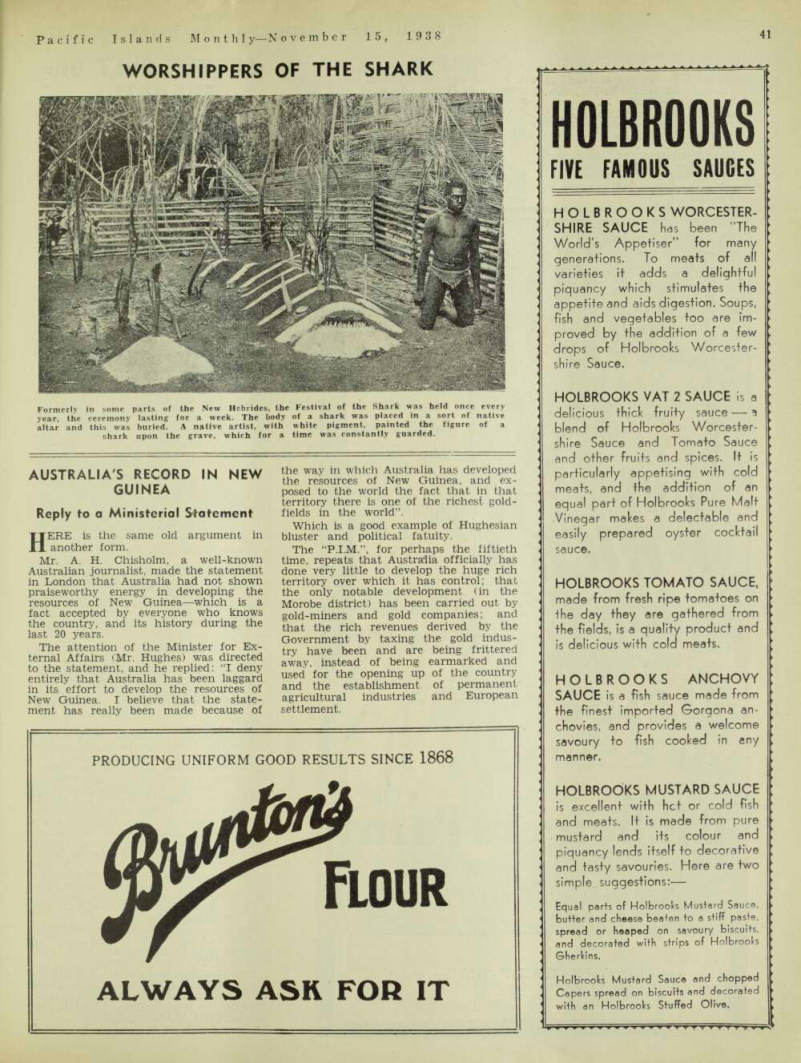
Formerly in some parts of the New Hebrides, the Festival of the Shark was held once every year, the ceremony lasting for a week. The body of a shark was placed in a sort of native altar and this was buried. A native artist, with white pigment, painted the figure of a shark upon the grave, which for a time was constantly guarded.
Australia's Record In New
Guinea
Reply to a Ministerial Statement
HERE is the same old argument in another form.
Mr. A. H. Chisholm, a well-known Australian journalist, made the statement in London that Australia had not shown praiseworthy energy in developing the resources of New Guinea —which is a fact accepted by everyone who knows the country, and its history during the last 20 years.
The attention of the Minister for Ex ternal Affairs (Mr. Hughes) was directed to the statement, and he replied: “I deny entirely that Australia has been laggard in its effort to develop the resources of New Guinea. I believe that the state ment has really been made because of
the way in which Australia has developed the resources of New Guinea, and ex posed to the world the fact that in that territory there is one of the richest gold fields in the world”.
Which is a good example of Hughesian bluster and political fatuity.
The “P.1.M.”, for perhaps the fiftieth time, repeats that Australia officially has done very little to develop the huge rich territory over which it has control; that the only notable development (in the Morobe district) has been carried out by gold-miners and gold companies: and that the rich revenues derived by the Government by taxing the gold indus try have been and are being frittered away, instead of being earmarked and used for the opening up of the country and the establishment of permanent agricultural industries and European settlement.
Advertisements & other items, p. 45 (2 items)
41
Pacific Islands Mont hi y—N ovember 15, 1938
Holbrooks
FIVE FAMOUS SAUCES
HOLBROOKS WORCESTER-
SHIRE SAUCE has been "The World's Appetiser" for many generations. To meats of all varieties it adds a delightful piquancy which stimulates the appetite and aids digestion. Soups, fish and vegetables too are improved by the addition of a few drops of Holbrooks Worcestershire Sauce.
HOLBROOKS VAT 2 SAUCE is a
delicious thick fruity sauce a blend of Holbrooks Worcestershire Sauce and Tomato Sauce and other fruits and spices. It is particularly appetising with cold meats, and the addition of an equal part of Holbrooks Pure Malt Vinegar makes a delectable and
easily prepared oyster cocktail
sauce.
HOLBROOKS TOMATO SAUCE,
made from fresh ripe tomatoes on the day they are gathered from the fields, Is a quality product and is delicious with cold meats.
HOLBROOKS ANCHOVY
SAUCE is a fish sauce made from the finest imported Gorgona anchovies, and provides a welcome savoury to fish cooked in any manner.
HOLBROOKS MUSTARD SAUCE
is excellent with hot or cold fish and meats. It is made from pure mustard and its colour and piquancy lends itself to decorative and tasty savouries. Here are two
simple suggestions:—
Equal parts of Holbrooks Mustard Sauce, butter and cheese beaten to a stiff paste, spread or heaped on savoury biscuits, and decorated with strips of Holbrooks Gherkins.
Holbrooks Mustard Sauce and chopped Capers spread on biscuits and decorated with an Holbrooks Stuffed Olive.
PRODUCING UNIFORM GOOD RESULTS SINCE 1868
ALWAYS ASK FOR IT
Wedding At Port Vila
MISS JOY COATES was married to Mr. Lindsay Macmillan at Port Vila, New Hebrides, on September 22.
The bride is the third daughter of Mr. and Mrs. A. Ernest Coates, of “Tu ralla”, Chatswood, N.S.W., and the groom is the son of the late Dr. and Mrs. T. Macmillan, of Tanna Island, New Hebrides and Surrey Hills, Melbourne.
Mr. Macmillan was born on Tanna, and is engaged in ornithological pursuits in the Pacific Islands.
The marriage was performed at the Paton Memorial Mission Chapel by Dr A. Frater, and was attended by Commis sioner Joy, Messrs. Blackwell and Bair stow, of the British Residency, Mesdames Frater, Carter (Queensland), Timmins (Melbourne), the hospital nurses, and others; and was a notably pretty and happy little ceremony.
Mr. A. W. James, of the Customs De partment, Suva, Fiji, accompanied by Mrs. James and family, arrived in Syd ney by the October “Mariposa”.
Tuamotus
Secret Cult Of
May Indicate Common Aryan Origin of Europeans and Polynesians
WHEN the early missionaries came to the Islands they examined and made copious notes concerning the religion of the natives.
Men like Henry Nott and J. M. Ors mond gained the confidence of the high priests and secured full details of ritual and doctrine. The Polynesian clergy were frank in exposing all the elements of the popular religion and the ceremonies at the Marae; but they were careful to give no hint of, or reveal in any way, the exist ence of a secret cult which had existed since time immemorial.
For nearly a century, the knowledge of that esoteric cult has lain hidden from the knowledge of European students.
It is only in recent times that an im perfect insight into its elements has been given to Polynesian scholars in New Zea land, and its full significance was not re vealed until the researches of Mr. J.
Frank Stimson (of the Bishop Museum) in the Eastern Tuamotus, brought to light the innermost secrets of the esoteric rit uals.
Mr. Stimson’s introduction to his bulle tin No. 111, entitled “The Cult of Kiho- Tumu”, begins as follows:—“The follow ing account of the cult of Kiho-Tumu sup plements my study of Tuamotu religion.
The present record seems to confirm in many essentials the main conclusions of my previous study, and brings new and welcome support to the thesis already elaborated.
“In brief, this thesis maintains that an early ethnic wave of Polynesians—termed, for convenience, Palae-Polynesian— brought with it a conception of cosmo genesis and of a supreme god, which formed an esoteric religion taught only to the priests and nobles.
“The philosophical ideas involved are so lofty that it is difficult to imagine how they could have arisen among barbaric peoples. It would appear more logical to infer that they were derived from some highly-developed, ancient civilization, somewhere in south-eastern Asia, in pre historic times.
“Whatever the explanation may be, the fact remains that this brief and imper fect fragment of a nobler past bears liv ing witness to the genius of the Palae- Polynesian race, whose capacity for philo sophic reflection and introspection has, perhaps, never been surpassed and rarely equalled by any people of a similar cul tural level.”
It is true that the exoteric cult—that taught to the common people—contained many references to the supreme god, Kiho (or To, in New Zealand and Tho in the Society Islands); but so overlaid and dis guised that its true significance was hid den from the uninitiated Polynesians and early European investigators alike, until very recent times.
The true name of the supreme deity was so intensely tapu that it could be pro nounced only in some secret place, and then only In a low whisper.
Traces of the cult are all but lost at Tahiti. Yet there are memories in place names, the most striking of which is that given to the land in Arue, where is the burial ground of the royal family.
In “The Cult of Riho” is a “chant of
the Sacred Possessions of Kiho-The-All- Source”, of which the following is the first stanza; — “My Sacred Crimson Diadem, whereof I chant, is woven, is interlaced together; it is called ‘The Blinding Lightning Flash’, a diadem sanctified in sacred ritual, be longing to the Supreme Creator, as he stands upon the sacred terrace of his temple Ahu-Toru (altar of ascending fire).”
The royal burial place at Arue is named Ahu-Toru; and, in addition, it is said, the ancient name of the royal Marae Tarahoi (on Point Outu Aiai, in the same district) was '“Marae Ahu-Toru”. To modern Tahitians this name is merely a place name without significance.
It is well-known that most of the people of antiquity possessed an esoteric worship, termed the Mysteries to which those only were admitted who had been prepared by certain ceremonies, called initiations.
Where these Mysteries originated is not known. It is supposed that they came from India, by way of Chaldea, into Egypt, and thence were carried to Greece.
Centuries of research and speculation have not disclosed the precise nature of these antique initiations, nor the doct rines taught in their arcana. Enough has been culled from the guarded allusions to the Mysteries, by ancient authors who were themselves initiates to confirm the surmise that they concerned the Universe and the doctrine of One Supreme Creator of that Universe.
The analogy between these elements of the Mysteries and those of the Cult of lo (or Kiho or Kio, according to the dialect in which the name occurs) in Polynesia, gives credence to the theory of their com mon origin in remote times, before the dawn of history.
Might it not be logical to infer that in this esoteric Polynesian lore we may have the primitive form of those Mysteries of antiquity, which have baffled the curios ity of the uninitiated throughout the ages, as well as another signpost pointing to the common Aryan origin of the Polynesian and European race?—A.C.R.
land is an ideal place for a hospital and there can be no question of inflicting hardship on anyone.
The Administration have purchased from the natives in this district (as well as other districts) a great number of small areas of land which they have set aside for native reserves. These areas of land are the best available, and mostly have beach frontages. The titles are vested in the protector of natives and cannot be sold. A great number of these reserves have no natives living on them. These three reserves have more than one thou sand bearing coconut palms on them, and are capable of carrying more than fifty natives, yet there is not one native living on them. These areas of land are free to any native who cares to live on them; no rent to pay; the natives are, however, ex pected to keep them reasonably clean.
I think there is little doubt that the action of the natives, in pulling out the survey pegs, was inspired by a European, the name of whom would not be hard for anyone living here to guess.
I am etc.,
H. J. Washington.
Kabaira Plantation, North Coast, Rabaul. 15/10/’3S.
Advertisements & other items, p. 46 (2 items)
42
Pacific Islands Monthl y—N ovember 15, 1938
which)
"T
but , A
Mint f
OF COURSE
\v
f (PREPARED),
o<eeps on D(e
AGENTS THROUGHOUT THE ISLANDS.
Unused Native Land In
New Guinea
Letter to the Editor ON listening to the remarks of “The Watchman” from station V.L.R. (taken from the Melbourne “Age”) on the 13th inst. I was surprised and dis gusted to hear the lies and exaggeration which had been published with reference to the resumption of land by the New Guinea Administration, on the north coast of New Britain. No doubt the man who sent this report to the “Age” should be tarred and feathered, and then kicked out of the Territory as a public nuis ance.
The facts of the matter are as follows: The Administration sent a surveyor to the north coast to survey a small area of land to be resumed for the purpose of building a native hospital. Could one think of a more just reason for resuming this small area?
As for the hardship alleged to have been inflicted on the natives, this is all piffle. Firstly the Administration never in flict hardships on natives: secondly there are tens of thousands of acres of first class land in this district lying idle for the simple reason there are not enough natives to live on it. This small area of
Advertisements & other items, p. 47 (2 items)
43
Pacific Islands Monthl y—N ovember 15, 1938
Wundepiichi
Timber, Joinery
ETC.
PREPARED BUILDINGS ready for erection a speciality.
SHIP AND BOAT BUILDING.
TIMBERS specially catered for.
FIBROLITE, PLYWOODS. GALVANISED
IRON.
CONSIGNMENTS shipped
by RETURN STEAMERS
to the Islands.
John W. Eaton
PTY. LTD.
WEST CRESCENT STREET
NORTH SYDNEY
Telephones: X 84051 (6 lines.)
Woven Wire for all Industry
COPRA DRYING TRAYS, FLOORS. Etc.
FRUIT DRYING TRAYS, MINING SCREENS
Heavy Mosquito Gauze in Phosphor Bronze and other Metals Impervious to Salt Sea Air WIRE DOOR MATS AND GENERAL WIRE WORKS
E. VRIGHT & CO. LTD.
Office and Works: 148-162 Cleveland Street, Sydney. N.S.W.
Telegraphic Address: "Wrlghtmake," Chippendale
BITUMENOID ROOFING
MADE IN AUSTRALIA.
Bitumenold Roofings, Dampcourse and Insulating Pelts are made from the world’s best raw materials. Warranted to stand the most rigid tests.
BITUMENOID THE BEST
Roofing, 1,2, 3-ply; Flooring, Waterproof Materials; Saturated Pelt; Resilient Road Jointing; Natural Asphalt Dampcourse; 2 and 3-ply Dampcourse: 1-2 lb. Lead-core Dampcourse; Roofing Cement: Asphalt Paints; Roofing Compound.
SAMPLES AND PRICE LISTS ON APPLICATION.
MAXWELL PORTER & SON LTD.
ESTABLISHED 1888, BUILDERS’ SUPPLIES.
107 REDFERN ST., REDFERN, SYDNEY. N.S.W. ’Phone: M 3167. Cables Bitumenold.
WUNDEPIICHI
j;S!ssssu:>(i;;;:;
-(•KtlfiHlUllf ■ tii. »««*'»■
DURA T I L E
These asbestos cement sheets give walls a tiled appearance at less cost. See examples in our showrooms or write for leaflet.
WUNDERLICH LTD.
Crown & Cleveland Sts., Redfern, Sydney
REMEMBER THE NAME
ducatiilß
“Pen Friends” Wanted.
PEN FRIENDS in the Pacific Islands are sought by George F. Hygate (17), Box 1699, G.P.0., Melbourne. He is interested in sport, and his hobbies are stamp and post-card collecting, and overseas correspondence. - - ■ , T , „ . Mr. George Turnbull of Messrs. Mprey and Co.. Thursday Island, recently arrived in Sydney for a period of convalescence h “T'ninint,”
Dy tne iaipmg .
Miss W T . E. Manning has joined the nursing staff at the Melanesian Mission hospital at Fauabu. Malaita, 8.5.1. She has had considerable nursing experience in New Zealand.
The Isle That Was Incomplete
By Frank Exon
LENNOX awoke from his afternoon siesta and wandered drowsily to the door of the hut. With pleasurable an ticipation, his gaze idled along the dazzling ribbon of beach. Then he stiffened, and all signs of drowsiness left him.
From the cool darkness within. Dale watched with some uneasiness. Affecting a nonchalance he was far from feeling, he awaited the outburst he knew must come.
“So you’ve been playing the fool again”, said Lennox, quietly, though his effort at restraint was very obvious.
Dale shrugged a careless agreement.
“You say so. But is that evidence?” he queried, pertly.
“Perhaps not. But you’ll stop your funny business nevertheless—while you're safe.”
“Threats? Again?”
“Yes”, said Lennox, simply, “and for your own good. You don’t seem to realise”, he went on, “how serious I am—how ser ious the position is, though you’ve been warned often enough Here are two of us —once bosom friends—marooned on this two-by-two island. Conditions are abnor mal and yet, such is your folly, you choose to make no allowance for temperamental abnormalities.”
Temperamental?” Dale broke in, con temptuously. “Half the word will do Either half.”
Lennox ignored the interruption “We’ve ueen here a long time now—too long” he on. “Two of us—alone on a few acres of sandbank—under conditions trying be yond belief. We’ve kept physically fit but our mental outlook is obviously strained our perspective is awry; our auras are clashing hopelessly. You won’t help; you prefer, it seems, to throw us still further out of step, to upset what little harmony remains, by deliberately thwarting a whim of mme—your description—which you re gard as ridiculous. It’s no whim; you’re monkeying with something vou don’t understand. Stop it! Leave me to my queerness ... I repeat . . . while you’re safe.
The last was said with a certain wist fulness that Dale missed. He noted only the threat and again became frankly con temptuous.
“Stop what?” he asked. “Stop moving a log—a mere piece of driftwood—because to do so excites your complexes or warps your perspective or some such jargon?
Don’t be so dam’ silly! You’ve been child ishly unreasonable ever since the con founded thing came ashore. You’ve mooned about it for hours like a half-wit. You spend half the day aligning it and view ing it from different angles. I’ve watched you. . . And you expect me to humour you in such madness—for madness it is. I should be doing you a kindness if I set the blasted log adrift again. Some night I will.”
“You’ll not do that!” Dale recognised a new and dangerous quality in the order, and said no more. “It might seem a small thing to do, but the effect. I warn you would be disproportionate. And despite your stupidity it would be lonely here with out you.” Lennox broke off and abruptly left the hut.
DOWN on the beach, where the gannet colonies nested and squawked their protests against his intrusion. Len nox sat and reviewed for the hundredth time the events of the past months. They had come to this tiny outpost, he and Dale, almost a year ago. engaged in mete orological research—forecasting and plot ting the vagaries of the cyclones which neriodically wrought such havoc in those waters. An island steamer dropped them, with their tinned stores and water, and would return when their work was finished.
Miles out there in the Pacific, the nature of their work and the unusualness of the situation had at first appealed to
them, and the days had passed smoothly, if slowly. Lennox tended his instruments and read therefrom the weather auguries, plotted the upper air currents, studied the tides and found a wealth of interest in the coral formations and the marine life of those prolific tropic seas; Dale worked the wireless transmitter that formed their sole link with the outside world; each took his share of the domestic duties, and for a while all had been harmony.
How, then, had the present situation — this perpetual clashing of wills leading to incessant and ever more dangerous quar rels arisen? Lennox knew well enough, but he couldn’t reduce his knowledge to concrete terms that Dale would under stand —or even try to understand. He knew—the reasoning side of him knew— that all the lads accusations were true; that he was being unreasonable, that judged by the standards of the world they had left his queernesses verged closely on madness, and that unless some form of mental discipline were possible a tragedy was imminent. But no exercise of will, he knew now, could throw off the insidious disorder that possessed him—that had striped him of his civilised inheritance oi stability and reduced him to an elemental crudity, capable of any extravagance even of murder. For he realised it might come to that.
He wondered what an alienist would make of his case, what allowances a jury could possibly make for one who, back in his normal world was undoubtedly sane, yet who had slain a companion on the most trivial pretext imaginable? He saw his defence and the absurdity of it; that he had been forced to kill Dale because he persisted in moving a log—a plebeian piece of driftwood —out of a certain posi tion.
A marauding frigate bird, harassing a home-flying gannet, dropped like a plum met across his vision. Lennox eyed the skilled tumbler delightedly, then, as it flattened into a graceful curve, left it with a shudder of distaste. Could even an alienist, witnessing this incident, have gained a clue as to his disorder. He thought not.
The sun dropped low, making a crimson wake that cut across the island’s encircl ing reef in most pleasing fashion. The tide was unduly low and but patchily covered the out-cropping rocks between the beach and the reef. Leaving exposed raw gaps of ooze and sand tangled, smelling sea growth. Long stretches of stagnant water lay dark and forbidding; sinister pools, oily-surfaced and inky black, mirrored the glow of the setting sun. Unlovely slug-like bodies of beche-de-mer lay contorted amongst grey slime; sea snakes writhed, half-covered, in shallow pools; bleached
things—half-glimpsed, half-guessed—dis
turbed the stinking weed or stalked blindly across drying patches until the tide, mak ing slowly, gave kindly covering to their nakedness.
The stale breath of dying things, the stench of rotting weed, the half-sensed exhalations of innumerable slimy crea tions, the almost tangible silence that hung pall-like over all (his ears had long since ceased to register the din of the seabirds) all added to the effect of utter desolation. He might have been the last man in a dying world. Could anyone with any imagination, he asked himself, be ex pected to maintain a normal mental bal ance in this environment?
LENNOX shivered. It was not a setting favourable to his present perilous state.
And yet it was not the solitude alone that had brought him to this border line of sanity; it was scarcely more than a contributing factor. Solitude, he argued,
was an abstract state, and one to which a nature in any way flexible could adapt itself. The real trouble was of a very different order. It was structural; it was a concrete omission; something vital to man’s very being had been left out of the island’s make-up. He knew what that something was—now. The place had no Third Dimension! A few-acre turtlebacked hummock of sand and coral, bare of all vegetation, it modestly broke, and no more than broke, a plane surface of infinite extent.
Lennox saw himself as a three-dimensioned being squeezed into a two-dimensioned world—a queer restricted world of flat parallels made by the ribbon of beach. the water’s edge, the reef, the horizon and
the wispy strata of cloud usually lying thereon. There was no perspective; he had been ruthlessly thrust into a flat pro jection—like those unfortunate figures he had seen in Japanese woodcuts. Save for the sun’s wake at morning and evening and the moon’s in her last quarter—noth ing ever cut across the eternal horizontals; not even the wireless masts or the ele vation of the hut satisfied the eye’s crav ing for something to break an infinite series of re-echoing lines, He hac j whimsically recognised this in the early days of his exile—had even then realised in an intuitive sort of way that playing with the notion was dangerous, Yet, forewarned as he had been, what had at first been a mere irritating dis
taste had flourished in that will-sapping atmosphere into a terrible obsession—de fiant of any attempt at restraint.
But he was still fighting; he was still
Advertisements & other items, pp. 48-49 (3 items)
«BU LLIVANTS’ wire ropes
BRITISH SOLOMON ISLANDS
STAMPS
New issue at 10 per cent, over cost.
On Covers Id. each cover extra.
Coronation Set on Reg Cover posted to any address l/6d.
Cash with order. With all enquiries please send a stamped addressed envelope.
M. HARPER,
Mandoliana Island.
P.O. Box 6, Tulagi, 8.5.1.
11l
FOR RELIABILITY
AND LONG SERVICE
USE
MILLER'S "ANCHOR"
BRAND ROPES AND
CORDAGES.
Manila, Sisal, New Zealand Coir and Cotton Rope of every description.
Twine, Sewing Twine, Shop Twine, Binder Twine and Fishlines, Lashings, Halters, Plough Reins, Sack Cord, Blind Lines, etc.
LENGTH STRENGTH
QUALITY GUARANTEED
• Manufactured by; Suva Agenh; Sydney Agents:
JAMES MILLER & Co. Pty. Ltd.
MELBOURNE, VIC., AUST.
A. S. FAREBROTHER & CO.
And at Lautolca, P.O. Box 36. Tel. 261
P. T. TAYLOR LTD.
«BU LLIVANTS’ wire ropes
T UC U/AD I n'C C T A M n A d n «
THE WORLD'S STANDARD
LARGEST STOCKS IN AUSTRALASIA : FOR ALL PURPOSES Also Blocks, Hooks, Shackles, Thimbles, Strand, Seizing, Aircraft Cord, etc.
Prompt Attention! Efficient Service!! Complete Satisfaction!!!
BULLIVANTS' Australian Co. Pty., Ltd.
Letters: Incorporated in Victoria.
Box 1298 J, G.P.O. 331 KENT STREET, SYDNEY.
Telegrams: Sydney.
“Bullivants, Ltd.” «
45
Pacific Islands Monthl y —N ovember 15, 1938
Germs in Your Kidneys
Kill Health and Vitality
I'M TIRED OUT
NERVOUS ,ACH I NG
AND GET UP NIGHTS
TRY CYSTEX
MAYBE YOUR
KIDNEYS NEED HELP
ITHELPEDYOU YES, MY ANKLES
WONDERFULLY AREN'T SWOLLEN
AND MY DIZZINESS
I f ll i IS GONE 2”
8 DAYS LATER
GOT MORE
YOU SAY
CYSTEX IS
GUARANTEED
YES, IT WONT COST
A PENNY IF IT
DOESN'T FIX YOU UP
PAY TODAY
AND FEEL
ThATS FINE,JIM,
CYSTEX CERTAINLY
IS WONDERFUL
TH ANK.S TO
CYSTEX
% 0 3: O' 0 There is nothing that can make you feel older and more rundown than Kidney and Bladder disorders caused by Germs developed in your body during Colds or from Bad Teeth or Tonsils or during other infectious or bacterial diseases. Ordinary medicines don’t help you much because they do not kill the Germs which are the true cause of your trouble.
Germs in your Kidneys and Urinary System cause you to suffer from one or more of the following dangerous and energy destroying ailments: Getting up Nights, Excess Acidity, Nervousness, Leg Pains, Dizziness, frequent Headaches, Lumbago, Rheumatism, Swollen Ankles, Dark Circles under the Eyes, Dry, Muddy Skin, Physical Weakness, Loss of Energy, and Burning, Itching Passages.
Help Nature 3 Ways
Fortunately for sufferers from troubles due to Germs in the Urinary System all chemists now have a twin-tablet treatment called Cystex, which is a doctor’s prescription. Cystex ends the underlying cause of your trouble in 3 ways: 1. It kills the Germs in the Kidneys and Urinary System. 2. It soothes and tones irritated membranes and combats pain. 3. It acts as a mild, gentle diuretic tonic to the Kidneys and helps them remove excess Uric Acid and other poisonous wastes from the blood.
Feel 10 Years
Younger
More than 5 million men and women in all parts of the world have used Cystex.
Letters in praise of it are written every day.
For instance, Mr. B. Mann recently wrote: “For six years kidney trouble and bladder weakness due to germs in the urinary system caused me to suffer from headaches, nervousness, stiffness, swollen joints, and a rundown condition. My appetite was gone. I couldn’t sleep well and felt only half a man. I learned of Cystex and although skeptical decided to try it. Within 24 hours I noticed a marked improvement.
I felt new energy returning. Within three days the improvement was so decided that I knew I had found a remedy to stimulate improved health. After a short time my health and vigour were completely normal.
I can eat anything, sleep soundly, my nerves are steady as a rock, and I feel ten years younger.’’
Make This 8-Day
Guaranteed Test
Get Cystex from your chemist today. Put it to the test. See what it can do for you.
Cystex will not cost you a single penny unless it satisfies you completely and you agree that it is easily worth ten times the small cost. Cystex starts working in 3 hours, must alleviate your pain, make you feel younger, stronger and full of life and energy, or you simply return the empty package and your money is refunded in full. You are the sole judge as to your satisfaction. During the first two or three days you probably will notice a marked Improvement but we want you to take the full 8-day supply and see for yourself the tremendous good that this complete twintablet treatment can do for you. Ask your chemist for Cystex today. The guarantee protects you. SCHAFFER & CO., SYDNEY.
From Painful
Happy Relief
Backache
Cau-ed by Tired Kidneys
Many of those gnawing, nagging, painful backaches people blame on colds or strains are often caused by tired kidneys—and can be relieved when treated in the right way.
The kidneys are one of Nature’s chief ways of taking acids and wastes out of the blood.
A healthy person should pass about 3 pints a day and so get rid of more than 3 pounds of waste matter.
If the 15 miles of lidney tubes and filters don’t work well, this poisonous waste stays in the body. It may start nagging backaches, leg pains, loss of pep and energy, getting up nights, lumbago, swollen feet and ankles, pufflness under the eyes, rheumatic pains and dizziness Don’t let it lay you up.
Ask your chemist for DOAN’S BACKACHE KIDNEY PILLS . . used successfully the world over by millions of people. They give quick relief and will help to flush out the 15 miles of kidney tubes. So be sure you get
Doan’S Backache Kidney Pills.
sane. And there were still a few allies.
There was the tide-level indicator, for in stance—an upright plank with fascinating oblique stay wires. It helped. And there were the frigate birds with their spectacu lar nose dives; and the lively hydrogen filled balloons which each morning rocket ted straight up into the still air. He en vied them; they climbed so easily out of the frame that fettered him. (But he couldn’t force himself to plot their hori zontal drift; only their vertical ascension was ever recorded.) AND, most faithful of all, there was the log—the- gift of some capricious cur rent —that had stranded on the white beach just in time to prevent Lennox from slipping entirely over the edge.
From the first he had, as Dale said, worshipped this unlovely, barnacled thing.
It was so restfully different to his tortured mind; it had nothing in common with the sea and the sand; it bravely broke the dazzling line of the beach and, best of all, its position could be arranged so that it cut athwart those infernal hori zontals. From the first, his eye had sought it unbidden and left it Reluctantly. Should the sand have drifted over it, or should its position have been changed so that it came not into view at the expected time, there was a distinct sense of loss.
Later, Dale had come to realise the log’s usefulness as a fishing adjunct and would
innocently leave it lying along the water s edge—thus adding another parallel to war against his companion’s reason. Tnus had begun the trouole that, gaining impetus each day, had culminated in the present crisis.
A whim! That is what Dale had called his insistence that the log be left un touched. A whim, was it? Would he go to the lengths he was planning for a mere idle whim? No! He was fighting for his sanity—yet Dale hadn’t the wit to see it.
He would sacrifice much for that—even Dale, he had decided. There seemed no other way.
Absent-mindedly, he scored a cross in the sand. A fascinating design, the simple cross, he mused; altogether pleasing, even apart from its symbolism. Equal and op posite lines—definitely terminating—per fect balance—instead of those abhorred parallels that led the eye and the brain into hopeless infinity.
It was dark now. From the hut came the cough of the engine and the crash of the wireless spark as Dale said good night to the outside world. Purposefully— his mind made up—Lennox rose, climbed the sandy path and entered the trans mitting room unobserved. He struck.
The wireless shrilled a sustained and eerie howl as Dale’s body fell across the signalling key. Then it suddenly ceased and not all the long and puzzled calls from the mainland could break that om inous silence.
FOR some time thereafter Lennox was very busy; too busy to notice his lone liness or the phenomenally low state of the barometer. When the cyclone had passed, the island had been swept clean.
Masts, station, everything had gone down before the onslaught of those savage winds and unprecedented seas.
One only remained to puzzle the landing party from the relief ship. It was a cross, staunchly built of two sections of rough-hewn log, with a cross-arm deliberately “cockbilled”, and the up right firmly stayed with diagonal haw sers.
"Tin-Can Mailman" Returns
To Tonga
From Our Own Correspondent.
Honolulu, Oct. 5.
THE good people of the Tongan isles will be interested in reading this story, which appeared in the New York press on September 10: A British world-war veteran, Charles Ramsay, is on his way back to the Tongan islands, before another world war breaks out.
Ramsay, a copra exporter, arrived in New York from England aboard the liner “President Roosevelt” to-day. He was in a hurry to reach the Tongas, a South Sea island group, 1,000 miles north-east of New Zealand.
“Things over in Europe are crazier than they were 20 years ago”, Ramsay said.
“But in the Tongas life is different.
“The islanders are a happy people’ , Ramsay added. “They have no under standing of the strife and war which so much of the world takes for granted.
There is no crime. Tongans help each other.”
The Tongas are inhabited by 250 Euro peans and 30,000 natives.
Rev. T. G. Paul, M.A., rector of. Cam den, N.S.W., has accepted the position of commissary in Australia for the Bishop of Melanesia.
Advertisements & other items, p. 50 (2 items)
46
Pacific Islands Month 1 y—N ovember 15, 1938
Limewashing And
The Most Extensive Manufacturers in the British Empire of
RUBBER STAMPS,
INKS, STENCILS,
Marking Devices,
ACME STAMP PADS
OFFICE & STATIONERY SUPPLIES
ra B We also Manufacture & Supply a Complete Line of
LIMEWASHING AND
SPRAYING MACHINES
for all purposes.
Let us know your requirements and we will quote by return.
WRITE FOR OUR GENERAL CATALOGUE
Limewashing Machine
EXCELSIOR SUPPLY CO. PTY. LTD.
278 Post Office Place,
MELBOURNE, VIC.
HEAD OFFICE :
160 BROADWAY,
Formerly known as George St., West, \
SYDNEY, N.S.W.
50 Victoria Street,
WELLINGTON, N.Z.
Starting Early!
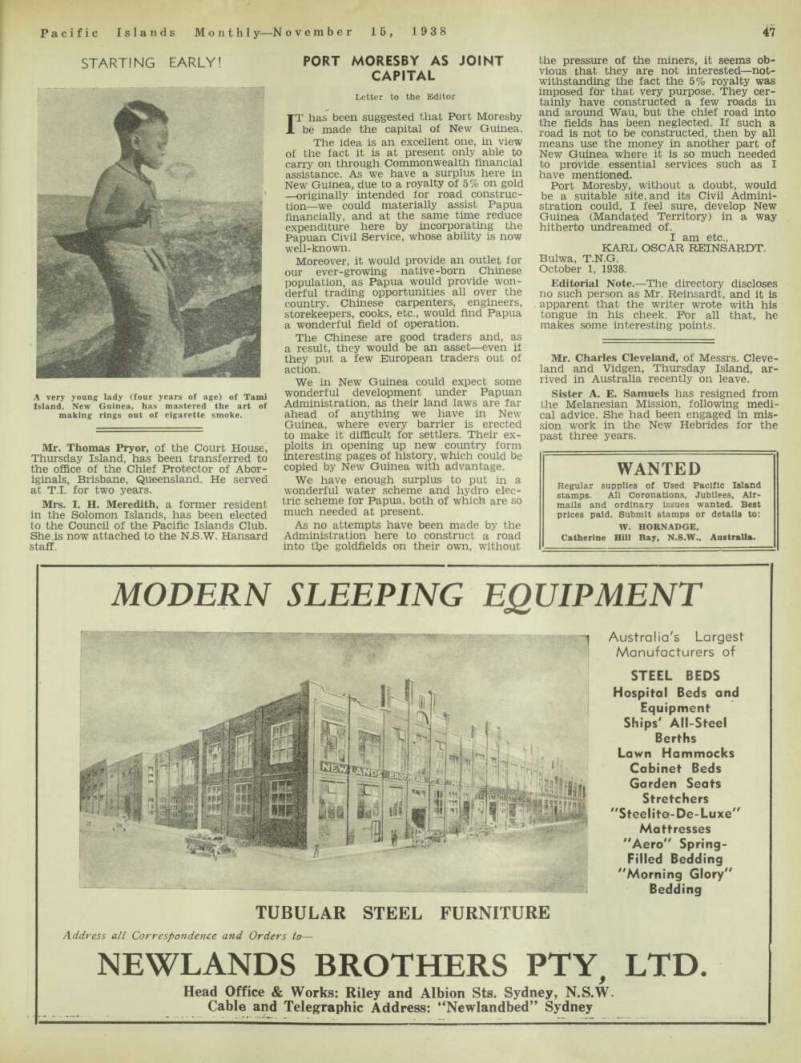
Mr. Thomas Pryor, of the Court House, Thursday Island, has been transferred to the office of the Chief Protector of Abor iginals, Brisbane, Queensland. He served at T.I. for two years.
Mrs. I. H. Meredith, a former resident in the Solomon Islands, has been elected to the Council of the Pacific Islands Club.
She is now attached to the N.S.W. Hansard staff.
A very young lady (four years of age) of Tami Island, New Guinea, has mastered the art of making rings out of cigarette smoke.
Port Moresby As Joint
Capital
Letter to the Editor IT has been suggested that Port Moresby be made the capital of New Guinea.
The idea is an excellent one, in view of the fact it is at present only able to carry on through Commonwealth financial assistance. As we have a surplus here in New Guinea, due to a royalty of 5% on gold —originally intended for road construc tion —we could materially assist Papua financially, and at the same time reduce expenditure here by incorporating the Papuan Civil Service, whose ability is now well-known.
Moreover, it would provide an outlet for our ever-growing native-born Chinese population, as Papua would provide won derful trading opportunities all over the country. Chinese carpenters, engineers, storekeepers, cooks, etc., would find Papua a wonderful field of operation.
The Chinese are good traders and, as a result, they would be an asset—even if they put a few European traders out of action.
We in New Guinea could expect some wonderful development under Papuan Administration, as their land laws are far ahead of anything we have in New Guinea, where every barrier is erected to make it difficult for settlers. Their ex ploits in opening up new country form interesting pages of history, which could be copied by New Guinea with advantage.
We have enough surplus to put in a wonderful water scheme and hydro elec tric scheme for Papua, both of which are so much needed at present.
As no attempts have been made by the Administration here to construct a road into tfie goldfields on their own, without
the pressure of the miners, it seems ob vious that they are not interested—not withstanding the fact the 5% royalty was imposed for that very purpose. They cer tainly have constructed a few roads in and around Wau, but the chief road into the fields has been neglected. If such a road is not to be constructed, then by all means use the money in another part of New Guinea where it is so much needed to provide essential services such as I have mentioned.
Port Moresby, without a doubt, would be a suitable site, and its Civil Admini stration could, I feel sure, develop New Guinea (Mandated Territory) in a way hitherto undreamed of.
I am etc.,
Karl Oscar Reinsardt.
Bulwa, T.N.G.
October 1, 1938.
Editorial Note. —The directory discloses no such person as Mr. Reinsardt, and it is apparent that the writer wrote with his tongue in his cheek. For all that, he makes some interesting points.
Mr. Charles Cleveland, of Messrs. Cleve land and Vidgen, Thursday Island, ar rived in Australia recently on leave.
Sister A. E. Samuels has resigned from the Melanesian Mission, following medi cal advice. She had been engaged in mis sion work in the New Hebrides for the past three years.
Advertisements & other items, pp. 51-52 (3 items)
47
Pacific Islands Monthl y—N ovember 15, 1938
Modern Sleeping Equipment
WANTED
Regular supplies of Used Pacific Island stamps. All Coronations, Jubilees, Airmails and ordinary Issues wanted. Best prices paid. Submit stamps or details to:
W. HORNADGE,
Catherine Hill Bay, N.S.W., Australia.
MODERN SLEEPING EQUIPMENT
Australia's Largest Manufacturers of
STEEL BEDS
Hospital Beds and Equipment Ships' All-Steel Berths Lawn Hammocks Cabinet Beds Garden Seats Stretchers ,# Steelite(-De-Luxe"
Mattresses "Aero" Spring- Filled Bedding "Morning Glory"
Bedding
TUBULAR STEEL FURNITURE
Address all Correspondence and Orders to —
NEWLANDS BROTHERS PTY, LTD.
Head Office & Works: Riley and Albion Sts. Sydney, N.S.W.
Cable and Telegraphic Address: “Newlandbed” Sydney a m X r ,n jr mm m I i i I ft r
mmj •
.'.l’liiii
WM. BRECKWOLDT & CO.,
SOUTH SEA MERCHANTS
POSTAL ADDRESSES:—
NEW GUINEA:—P.O. Box 89, Rabaul. TAHITI:—P.O. Box 60, Papeete.
FIJI:—P.O. Box 111, Suva. SAMOA:—P.O. Box 124, Apia.
TRADE MARK
BREWO
AGENTS FOR...
MERCEDES - BENZ DIESEL
TRUCKS, HANOMAG TRACTORS,
D.K.W. MOTORCARS, CONTIN-
ENTAL TYRES AND TUBES,
MERCEDES-BENZ MARINE EN-
GINES.
A R ASPIRIN . . . ATEBRIN . . . YATREN PYRAMIDON . . . PLASMOCHIN . . .
MITIGAL , . .HELMITOL . . . NEOSAL-
VARSAN . . . ETC., ETC
Stocks always available at our Branches. All orders will be executed at original “BAYER’
PRICES.
PETROMAX"-
HURRICANE LANTERNS, LAMPS AND'
ACCESSORIES.
FROWO"~
HURRICANE LANTERNS,
No. 45, 55, 65, 75, 85, Etc.
"TIGER BRAND"-
CORRUGATED AND FLAT GALVANISED
IRON.
/i SWEDISH Axes and Hatchets . . . Bicycles . . .
Sewing Machines . . .
Knives . . . Razor Blades . . . Lavalavqs . . . Toothpaste . . . Real Briar Tobacco Pipes . . Poundbeads . . . Seedbeads . . .
Cutbeads, also all kinds of
GERMAN, BRITISH
and
CONTINENTAL
MAKE
A TRIAL-
APPLY
TO-DAY.
GOODS.
BLANKETS
TAIFUN - BICYCLES AND ACCESSORIES.
TELEFUNKEN"- radio sets.
ARARA"- gas stoves
"ANCRE"- CAST IRON SAUCEPANS
"TWO LIONS"-
COPRA KNIVES, BUTCHERS' KNIVES
BECK'S- "KEY BRAND" GERMAN LAGER.
BREWO— RAZOR BLADES.
Black, Brown, Green, Blue, Pink, Silver.
BIRKO"-"POLISSE" AND "POLO
RAZOR BLADES.
LOHSE, URALT LAVENDER.
TORPEDO " "BIJOU" and "ERICA'
TYPEWRITERS.
VESTA SEWING MACHINES
48
Pacific Islands Monthl y—N ovember 15, 1938
Honour Of Queen Salote
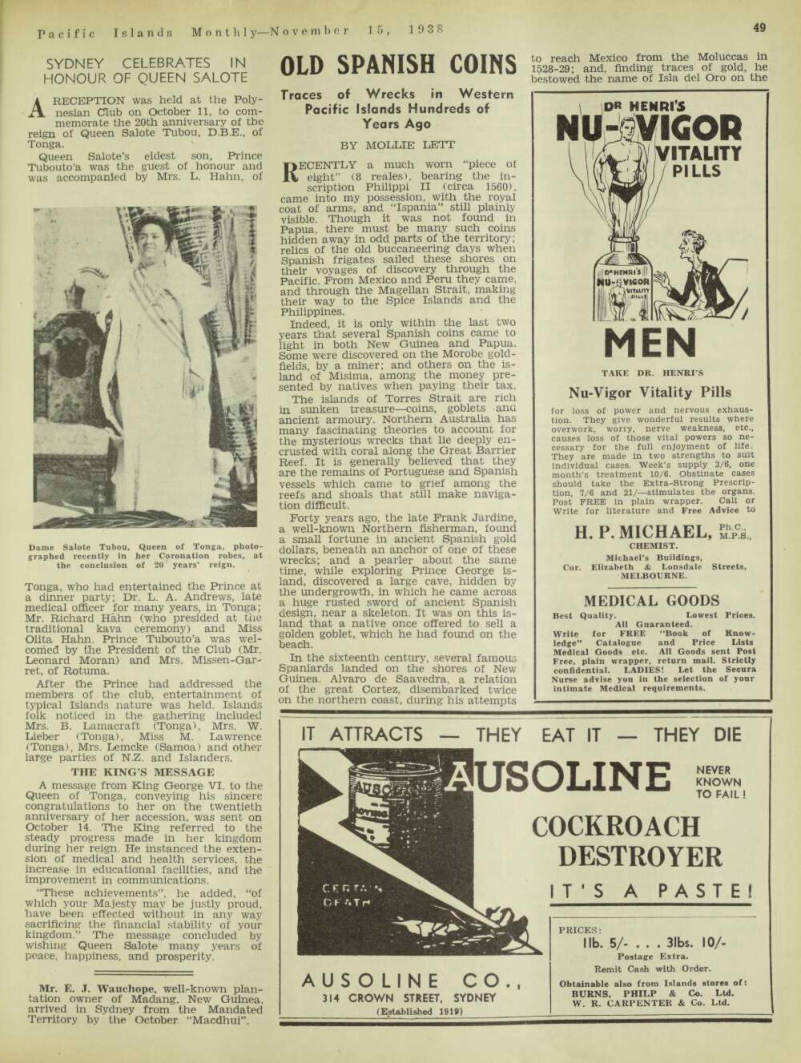
Sydney Celebrates In
A RECEPTION was held at the Poly nesian Club on October 11, to com memorate the 20th anniversary of the reign of Queen Salote Tubou, D.8.E., of Tonga.
Queen Salote’s eldest son. Prince Tubouto’a was the guest of honour and was accompanied by Mrs. L. Hahn, of
Tonga, who had entertained the Prince at a dinner party; Dr. L. A. Andrews, late medical officer for many years, in Tonga; Mr. Richard Hahn (who presided at the traditional kava ceremony) and Miss Olita Hahn. Prince Tubouto’a was wel comed by the President of the Club (Mr.
Leonard Moran) and Mrs. Missen-Gar ret, of Rotuma.
After the Prince had addressed the members of the club, entertainment of typical Islands nature was held. Islands folk noticed in the gathering included Mrs. B. Lamacraft (Tonga), Mrs. W.
Lieber (Tonga), Miss M. Lawrence (Tonga), Mrs. Lemcke (Samoa) and other large parties of N.Z. and Islanders.
The King S Message
A message from King George VI. to the Queen of Tonga, conveying his sincere congratulations to her on the twentieth anniversary of her accession, was sent on October 14. The King referred to the steady progress made in her kingdom during her reign. He instanced the exten sion of medical and health services, the increase in educational facilities, and the improvement in communications.
“These achievements”, he added, “of which your Majesty may be justly proud, have been effected without in any way sacrificing the financial stability of your kingdom.” The message concluded by wishing Queen Salote many years of peace, happiness, and prosperity.
Mr. E. J. Wauchope, well-known plan tation owner of Madang, New Guinea, arrived in Sydney from the Mandated Territory by the October “Macdhui”.
Dame Salote Tubou, Queen of Tonga, photo graphed recently in her Coronation robes, at the conclusion of 20 years’ reign.
Old Spanish Coins
Traces of Wrecks in Western Pacific Islands Hundreds of Years Ago
By Mollie Lett
RECENTLY a much worn “piece of eight” (8 reales), bearing the in scription Philippi II (circa 1560). came into my possession, with the royal coat of arms, and “Ispania” still plainly visible. Though it was not found in Papua, there must be many such coins hidden away in odd parts of the territory; relics of the old buccaneering days when Spanish frigates sailed these shores on their voyages of discovery through the Pacific. From Mexico and Peru they came, and through the Magellan Strait, making their way to the Spice Islands and the Philippines.
Indeed, it is only within the last two years that several Spanish coins came to light in both New Guinea and Papua.
Some were discovered on the Morobe gold fields, by a miner; and others on the is land of Misima, among the money pre sented by natives when paying their tax.
The islands of Torres Strait are rich in sunken treasure —coins, goblets ana ancient armoury. Northern Australia has many fascinating theories to account for the mysterious wrecks that lie deeply en crusted with coral along the Great Barrier Reef. It is generally believed that they are the remains of Portuguese and Spanish vessels which came to grief among the reefs and shoals that still make naviga tion difficult.
Forty years ago, the late Frank Jardine, a well-known Northern fisherman, found a small fortune in ancient Spanish gold dollars, beneath an anchor of one of these wrecks; and a pearler about the same time, while exploring Prince George is land, discovered a large cave, hidden by the undergrowth, in which he came across a huge rusted sword of ancient Spanish design, near a skeleton. It was on this is land that a native once offered to sell a golden goblet, which he had found on the beach.
In the sixteenth century, several famous Spaniards landed on the shores of New Guinea. Alvaro de Saavedra, a relation of the great Cortez, disembarked twice on the northern coast, during his attempts
to reach Mexico from the Moluccas in 1528-29; and, finding traces of gold, he bestowed the name of Isla del Oro on the
strange land. He was followed by others, Gryalva, and De Retez, and, later, Louis Vaez de Torres, who in 1606 sailed through the south-eastern archipelago and along the eastern and southern shores, on his way through the Strait, which now bears his name. So taken was he with the beauty of the coastlands that he gave New Guinea the name of the Land of Buenaventura.
“All this land of New Guinea” wrote Torres in his long-forgotten letter to the King of Spain (a copy of which was found in the Archives at Manila after the cap ture of that city by the British, in 1762),
“is peopled with Indians not very white, much painted and naked, except for a cloth made of the bark of trees. They fight with darts, targets and some stone clubs, which are made fine with plumage. Along the coast are many islands and habita tions . . . many parts very large with very large rivers and many plains ... In these parts I took possession for your Majesty ... We went along 300 leagues of the coast and caught in all this land 20 per sons of different nations that with them we might be able to give a better account to Your Majesty. They give much notice of
other people, although as yet they do not make themselves well understood ...”
It seems, after sailing through the is lands which now bear his name, the Louisiades, Torres entered a bay to the east, which he called St. Francis; and, later, on August 10, 1606, he discovered the great bay of San Lorenzo and Port Mon terey (Orangerie Bay) which lay some 60 miles to the west.
“It is very beautiful and pleasant’’ wrote Diego de Praeao, an officer on board, “with a very nne and clear bottom, for there is safe anchorage in all parts of it.
The land to the north consists of well cultivated plains, with abundance of water, and groves of coconut trees ... It is 10 de grees 10 minutes South, and it is the best land and the most fertile that has yet been discovered.”
Torres sailed from Callao, Peru, in De cember, 1605, as Almirante, under the command of Captain Pedro Fernandez de Quiros, whose expedition in search of the great southern continent, Australis Terra, consisted of three vessels—the “Capitana”, the “Almirante”, and “Labia” (a launch), which were manned by 300 sailors and soldiers, and among whom were 6 Friars of St. Francis.
Early in 1606, they discovered the New Hebrides group, which de Quiros under the impression that he had at last found the southern continent, named La Australia del Espiritu Santo; and here he estab lished a settlement so fantastic that from the first it was doomed to failure. Sickness and discontent drove the men to mutiny, and de Quiros was forced to return to Mexico.
Torres, thus abandoned, set his course for the Philippines, and it was while mak ing for Manila that he discovered the Louisiade archipelago and the eastern and southern coast of New Guinea.
“We had at this time nothing but bread and water”* wrote Torres. “It was the height of winter, with sea-wind and ill-will (of his crew) against us. All this did not prevent me from reaching the mentioned latitude ... I could not weather the East point, so I coasted along to the westward on the south side.”
There are legends among the natives of Aroma, on the southern coast —tales told by the old men—of a strange and myster ious craft that put in, in the dim and dis tant past, for foodstuffs and water. It is not improbable that the vessel was the “Almirante”, and that, in purchasing food, the sailors offered coins in exchange; and these, after passing from tribe to tribe, eventually reached the interior; where they were unearthed not long ago.
Torres Strait became known to navi gators on Torres reaching the Philippines.
There are many strange relics along Papua’s southern and western shores that mark their course. In the great Fly River estuary, mysterious and untraceable wreckage still floats ashore in the chan nels that separate the islands from the mainland. There are strong currents that sweep through the Papuan Gulf, and the sea breaks heavily across the 40 mile span, and the passages through the countless sandbanks are difficult to follow. Spanish frigates making for the Spice Islands or Peru, via Torres Strait must have foun dered in the rollers that hurl themselves on the banks that stretch far out to sea.
If only the history of those lost adven turers could be made known; and if only this battered old coin of mine could speak; what tales it could tell of the glory that was Spain! It might even have much to say of New Guinea that would astonish us, for it passed through many hands on its passage through the far-flung posses sions of the monarchy, over 300 years ago.
Advertisements & other items, pp. 53-54 (3 items)
49
Pacific Islands Month 1 y—N ovember 15, 1938
Kjsoline
\ D K HENRIS
NU- VIGOR
1 11/L ,'IV VITALITY
VITALITY
PILLS
D*NINRIS
NU-t; VIGOR
VITALITY
PlLLjl
MEN
TAKE DR. HENRIS
Nu-Vigor Vitality Pills
for loss of power and nervous exhaustion. They give wonderful results where overwork, worry, nerve weakness, etc., causes loss of those vital powers so necessary for the full enjoyment of life.
They are made in two strengths to suit individual cases. Week’s supply 3/6, one month’s treatment 10/6. Obstinate cases should take the Extra-Strong Prescription, 7/6 and 21/ —stimulates the organs.
Post FREE in plain wrapper. Call or Write for literature and Free Advice to
H. P. MICHAEL, Silpi,
CHEMIST.
Michael’s Buildings, Cor. Elizabeth & Lonsdale Streets,
MELBOURNE.
MEDICAL GOODS
Best Quality. Lowest Prices.
All Guaranteed.
Write for FREE “Book of Knowledge” Catalogue and Price Lists Medical Goods etc. All Goods sent Post Free, plain wrapper, return mail. Strictly confidential. LADIES! Let the Secura Nurse advise you in the selection of your intimate Medical requirements.
IT ATTRACTS THEY EAT IT THEY DIE
kJSOLINE
NEVER
KNOWN
TO FAIL !
COCKROACH
DESTROYER
IT'S A PASTE!
io/-
AUSOLINE CO.
314 CROWN STREET, SYDNEY
(Established 191®)
PRICES:
Mb. 5/- . . . 3lbs.
Postage Extra.
Remit Cash with Order.
Obtainable also from Islands stores of!
BURNS, PHILP & Co. Ltd.
W. R. CARPENTER & Co. Ltd.
STEAMSHIPS TRADING COMPANY LTD.
PORT MORESBY PAPUA SAMARAI
Chairman and Managing Director: A. S. FITCH.
Shipowners. Wholesale and Retail Merchants and Traders; Shipping, Customs and Insurance Agents; Copra and Rubber Plantation Owners.
MAIL CONTRACTORS TO COMMONWEALTH AND PAPUAN GOVERNMENTS.
AGENCIES: —At Port Moresby; Coral Sea Insurance Co.; Phoenix Insurance Co.; Delta Sawmills, Ltd.; Acme Bakery Co. ; Vacuum Oil Co. Pty. Ltd. At Samarai: Coral Sea Insurance Co. : Delta Sawmills. Ltd, : Bankers and Traders’
Insurance Co. ; National Mutual Life Insurance Co. ; Kularo Shipyards: Mamai Plantations.
BRANCHES: —In Papua: Hanuabada, Sivitoi, Aroma, Koki, Hula, Ela Beach, Duga Duga, Yule Island.
SYDNEY: NELSON & ROBERTSON PTY. LTD., 12 Spring St.; Melbourne. 396 Flinders Lane; London. E. Whiteaway & Co., 7 Chiswell Street, Finsbury. London.
Cable Address: “STEAMSHIPS.” Code: Bentley’s.
STEAMSHIPS TRADING COMPANY, LIMITED.
MERCHANTS, SHIPOWNERS AND PLANTERS
PORT MORESBY AND SAMARAI.
Our organisation provides every facility and efficient service as
MANAGING AGENTS AND VISITING REPRESENTATIVES OF
COCONUT AND RUBBER PLANTATIONS
Estates supervised in bearing and planting stages.
Comprehensive reports compiled and regular visits made to Estates by our competent Plantation Inspector.
WRITE, CABLE OR CALL FOR PARTICULARS:
STEAMSHIPS TRADING COMPANY LTD.
Prevent BORERS
White Ants and
DRY ROT - - -
The attacks of White Ants—Borers—or Dry Rot can be prevented by treating your timber with ‘Cuprinol”. This scientific preservative is insoluble in water, easy to apply, and can be painted or varnished over. “Cuprinol” will definitely eradicate these pests in timber that has already been attacked. Th,e life of Canvas, Nets, Cordage, etc., can be doubled or trebled by treating with “Cuprinol”—it prevents Mildew and Rot, adds to the tensile strength and doesn’t affect flexibility. Pull information on request.
DISTRIBUTORS.
Steamships Trading Co., Ltd., Port Moresby and Samarai.
Greenwood & Laws Pty. Ltd., Rabaul & Wau.
CUPRINOL
The Revolutionary Wood and Fabric Preservative.
British Australian Lead Manufacturers Pty. Ltd.
50
Pacific Islands Monthl y — N ovember 15, 1938
High Loading Costs
New Zealand Trade With Fiji Lost to Australia
BECAUSE loading costs in New Zealand are twice as high as they are in Australia, it is practically impossible for N.Z. merchants to sell goods to Fiji in competition with Australia. That was the conclusion reached by the Auckland Chamber of Commerce, after investigat ing *the decline of New Zealand trade with Fiji. Freight rates are controlled more by loading and unloading charges than by distance travelled—in this case, at any rate.
A letter on the subject of freight rates received from the Union Steam Ship Co. stated that handling charges in New Zealand had so greatly increased dur ing the past year or two. owing to in creased wages and reduced working time, as to preclude any possibility of freight reductions.
Yachtsman Lost At Sea
From Our Own Correspondent
Papeete. Oct. 10
WHEN the sailing yacht “Malabar'' arrived at Papeete late in Septem ber. she brought with her a dis tressing tale of tragedy at sea.
The “Malabar”, voyaging from the California coast to Tahiti with her owner, Mr. Boedecker. his two sons and a guest, on board, had arrived in the neighbour hood of the Marquesas Islands when she met with heavy weather and rough seas.
One of Mr. Boedecker’s sons, while coming on deck from the cabin, was caught by the swinging boom and knocked overboard. His brother instantly dived to his rescue and sustained him until he had recovered from the shock of the blow on the head from the boom.
He then asked his brother if he could care for himself for a minute or two until he (the rescuer) could divest him self of his shoes and shirt, so as to be able to swim more unencumbered.
The brother assured him that he could.
When he had succeeded in discarding his clothing, the young man again went to his brother’s assistance but could not find him.
Meanwhile the yacht had been put about and search of the surrounding waters was continued for hours, but no trace of the missing man was found.
Pt. Moresby Aquatic Club
From Our Own Correspondent
Pt. Moresby, Oct. 28.
MUCH interest has been shown in our Aquatic Club since the determina tion of the new president (Mr. G.
O. Higgins) and Committee to race a type of dinghy known as the Pritchard design, in preference to the native-owned canoe.
Five of these craft, built to design by the Kwato Mission, arrived early in Oc tober from Samarai, and though a few minor deficiencies were revealed in pre liminary tests, it is considered that ad justments will soon prove that the craft are suitable for the Club’s purposes.
The Club is renovating the old club house, and raising funds, and the pre sident has offered a series of trophies for preliminary test races.
Mr. Henry Dunman Eve, chief surveyor to Oil Search Limited, died in New Guinea on October 13. He was a no table explorer. He took part in two im portant expeditions, the Oakley-Eve pa trol, 1932, and the Eve-Townsend patrol, 1934. The former sought to open up a route from Aitape to the Sepik River.
Vast swamps were encountered close to the Sepik River, and these compelled the party to return to the coast. The later expedition was successful in surveying a route from Wewak to the Sepik River and in returning thence north-westerly
to Aitape. The deceased’s surveys during the past eight years added much to the topographical and general knowledge of New Guinea. Besides being an accurate surveyor and careful observer, Mr. Eve was remarkably successful in dealing with natives. Before joining the Com pany’s service in 1930 he was employed for four years with the Federal Capital Commission, Canberra, as staff surveyor.
He is survived by a widow and an infant daughter. The funeral took place at Wewak, whence the service was read by the District Officer. Mr. G. W. L. Town send.
Advertisements & other items, p. 55 (2 items)
51
Pacific Islands Monthl y—N ovember 15, 1938
Noyes Bros. (**««) Ltd.
E A a.
TIME A\D MONEY
For Electrical and Radio Equipment you cannot do better than place your inquiries with Noyes Bros.
Crompton Coiled Coil and Single Coil Lamps . . . Kriesler AH electric and Battery-operated Radio . . . Ferranti Meters and Transformers . . . Simpson Electric Turntables . . .
Household Electric Appliances . . . Rodgers Cutlery . . .
Perfection Silverware . . . Electrical Fittings . . . Crompton Fans for home, office, store and factory . . . Callender Wires, Cables and Flexibles for indoor and outdoor installations . . Seyon Floodlighting Equipment for tennis courts, etc.
NOYES BROS. (**««) LTD.
115 CLARENCE ST.. SYDNEY
11 WATT ST.. NEWCASTLE. 197 ELIZABETH ST.. BRISBANE.
Best construction - Brightly fire tinned w 'th high illuminating power - Storm - and rain proof - fitted with a globe of special glass. 55 50 ti t 7Vi45 Wick 4/16 Tfr.so Wick 4/16 " Wick 7/16 and many other types. jj (■ Wm. Breckwoldt & Co., ’ Rabaul, Suva, Apia, Papeete
Extended Franchise In
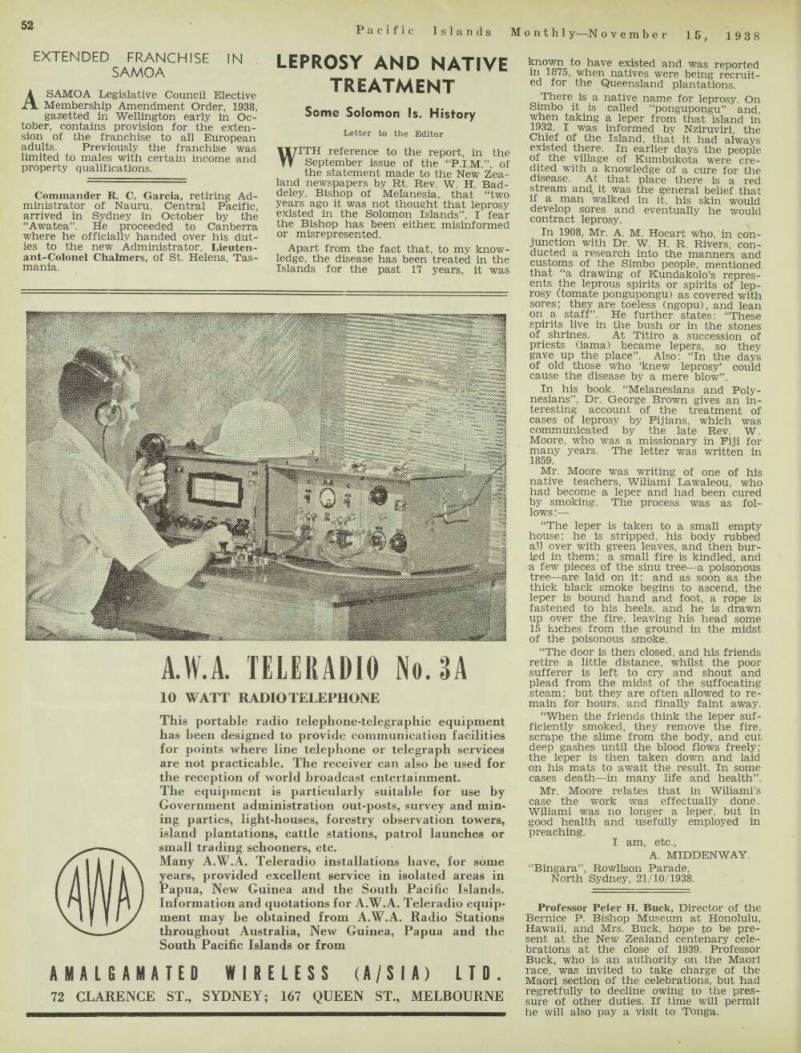
Samoa
A SAMOA Legislative Council Elective Membership Amendment Order, 1938, gazetted in Wellington early in Oc tober, contains provision for the exten sion of the franchise to all European adults. Previously the franchise was limited to males with certain income and property qualifications.
Commander R. C. Garcia, retiring Ad ministrator of Nauru, Central Pacific, arrived in Sydney in October by the “Awatea”. He proceeded to Canberra where he officially handed over his dut ies to the new Administrator. Lieuten ant-Colonel Chalmers, of St. Helens, Tas mania.
Treatment
Leprosy And Native
Some Solomon Is. History
Letter to the Editor WITH reference to the report, in the September issue of the “P.1.M.”, of the statement made to the New Zea land newspapers by Rt. Rev. W. H. Bad deley, Bishop of Melanesia, that “two years ago it was not thought that leprosy existed in the Solomon Islands”, I fear the Bishop has been either misinformed or misrepresented.
Apart from the fact that, to my know ledge, the disease has been treated in the Islands for the past 17 years, it was
known to have existed and was reported in 1875, when natives were being recruit ed for the Queensland plantations.
There is a native name for leprosy. On Simbo it is called “pongupongu” and, when taking a leper from that island in 1932, I was informed by Nziruviri, the Chief of the Island, that it had always existed there. In earlier days the people of the village of Kumbukota were cre dited with a knowledge of a cure for the disease. At that place there is a red stream and. it was the general belief that if a man walked in it, his skin would develop sores and eventually he would
contract leprosy.
In 1908, Mr. A. M. Hocart who, in con junction with Dr. W. H. R. Rivers, con ducted a research into the manners and customs of the Simbo people, mentioned that “a drawing of Kundakolo’s repres ents the leprous spirits or spirits of lep rosy (tomate pongupongu) as covered with sores; they are toeless (ngopu), and lean on a staff”. He further states: “These spirits live in the bush or in the stones of shrines. At Titiro a succession of priests (iama) became lepers, so they gave up the place”. Also: “In the days of old those who ‘knew leprosy’ could cause the disease by a mere blow”.
In his book. “Melanesians and Poly nesians”, Dr. George Brown gives an in teresting account of the treatment of cases of leprosy by Fijians, which was communicated by the late Rev. W.
Moore, who was a missionary in Fiji for many years. The letter was written in 1859.
Mr. Moore was writing of one of his native teachers, Wiliami Lawaleou, who had become a leper and had been cured by smoking. The process was as fol lows: “The leper is taken to a small empty house: he is stripped, his body rubbed all over with green leaves, and then bur ied in them; a small fire is kindled, and a few pieces of the sinu tree —a poisonous tree —are laid on it; and as soon as the thick black smoke begins to ascend, the leper is bound hand and foot, a rope is fastened to his heels, and he is drawn up over the fire, leaving his head some 15 inches from the ground in the midst of the poisonous smoke.
“The door is then closed, and his friends retire a little distance, whilst the poor sufferer is left to cry and shout and plead from the midst of the suffocating steam; but they are often allowed to re main for hours, and finally faint away.
“When the friends think the leper suf ficiently smoked, they remove the fire, scrape the slime from the body, and cut deep gashes until the blood flows freely; the leper is then taken down and laid on his mats to await the result. In some cases death —in many life and health”.
Mr. Moore relates that in Wiliami’s case the work was effectually done.
Wiliami was no longer a leper, but in good health and usefully employed in preaching.
I am, etc.,
A. Middenway.
“Bingara”, Rowlison Parade, North Sydney, 21/10/1938.
Professor Peter H. Buck, Director of the Bernice P. Bishop Museum at Honolulu, Hawaii, and Mrs. Buck, hope to be pre sent at the New Zealand centenary cele brations at the close of 1939. Professor Buck, who is an authority on the Maori race, was invited to take charge of the Maori section of the celebrations, but had regretfully to decline owing to the pres sure of other duties. If time will permit he will also pay a visit to Tonga.
Advertisements & other items, p. 56 (2 items)
52
Pacific Islands Monthl y—N ovember 15, 1938
A.W.A. Teleradio No. Ba
t, &
10 WATT RADIOTELEPHONE
m This portable radio telephone-telegraphic equipment has been designed to provide communication facilities for points where line telephone or telegraph services are not practicable. The receiver can also be used for the reception of world broadcast entertainment.
The equipment is particularly suitable for use by Government administration out-posts, survey and mining parties, light-houses, forestry observation towers, island plantations, cattle stations, patrol launches or small trading schooners, etc.
Many A.W.A. Teleradio installations have, for some years, provided excellent service in isolated areas in Papua, New Guinea and the South Pacific Islands.
Information and quotations for A.W.A. Teleradio equipment may be obtained from A.W.A. Radio Stations throughout Australia, New Guinea, Papua and the South Pacific Islands or from
AMALGAMATED WIRELESS (A/SIA) LTD.
72 CLARENCE ST., SYDNEY; 167 QUEEN ST., MELBOURNE
Roading
Air Traffic And
Guinea Airways Attitude to New Guinea Project
ON page 76 of your issue of October cer tain resolutions, stated to have been passed at a largely attended meeting, convened at Wau on September 25 by the New Guinea Mining Associa tion and other representative local bod ies, are published. One statement is made that: — “Mr. Fairbairn arrived in Wau two days before his notified date, accom panied by the chairman and manager of Guinea Airways Ltd.”.
It is desired by my Board to point out that no significance it attachable to the fact that this Company’s managing di rector, Mr. H. M. Smith (not the chair man) and the general manager, Mr. E.
H. Chater, accepted a casual invitation by Mr. Fairbairn to fly with him from Port Moresby to Wau. Although our chairman (Mr. C. V. T. Wells) has visited the Territory four times in the last six-and-a-half years, he has not been there since November, 1936.
A further quotation from the record of the Wau meeting reads:— “The remainder of his (Mr. Fair bairn’s) visit was confined to Lae, as the guest of Guinea Airways Ltd. Mr. Fair bairn then proceeded, via Salamaua, to Australia, without returning to Wau.
This meeting states that Mr. Fairbairn’s remarks cannot be disinterested, and re flect the views of those opposed to the construction of the road. This meeting records its resentment of the action of this politician. This motion was carried unanimously”.
In the opinion of my Board, the im pression conveyed by a perusal of the foregoing remarks is that Guinea Air ways Limited is opposed to the policy of road building in New Guinea and more particularly of a road between the coast and Wau. There is also the plain inference to be drawn that the officials of this Company at Lae had attempted to influence Mr. Fairbairn against the policy of the Commonwealth Govern ment to build any such road or roads.
I am authorised to state definitely that Guinea Airways has never been op posed to the principle of road construc tion in any part of New Guinea. The attitude of my Board has always been that roadways are necessary to a gen eral scheme of development of any country, and to the Morobe district of New Guinea in particular. At first glance, road construction in the vicinity of an established airline might appear to be prejudicial to air traffic, but my Board has never regarded the matter in this light.
Evidence of this is the following ex tract from our chairman’s published ad dress to shareholders of this Company on November 27, 1931 (seven years ago), in Adelaide: — “The policy of Guinea Airways Ltd. is not and never has been one of ob struction towards road building in the district. Although a serviceable traffic road through such country might take two years or more to construct, it would undoubtedly have a stimulating effect upon the development of the surround ing Territory and provide employment.
Nevertheless it would not and could not displace air transport. It would be com plementary to it”.
These views have not changed in the
years that have elapsed since they were expressed.
In conclusion, my Board has never com municated with Mr. Fairbairn at any time, nor discussed his views on any subject.
I am, etc., For Guinea Airways Limited,
(Sgd.) E. J. Collever,
Secretary.
Adelaide, 20/10/’38.
Mr. George H. Farwell, formerly of Tahiti, has been elected to the Council of the Anthropological Society of New South Wales. Several years ago Mr. Farwell was a member of a treasure-seeking expedition to the Tuamotu Islands. Since his marriage he has been a resident of Sydney, and is well-known for his contributions on Pacific topics to the Australian press.
Botany Of Rotuma
From Our Own Correspondent
Honolulu, Oct. 5.
DR. HAROLD ST. JOHN, botanist of the University of Hawaii and Bishop Museum, Honolulu, has returned from field work on Rotuma, the isolated isle north of the Fiji group, with at least 100 specimens of new botanical species. He is enthusiastic about his discoveries; but, ahead of him, lies at least three years’ solid work of full identification and report before the Bishop Museum can publish a Rotuma botanical bulletin for distribu tion throughout the scientific world. (Why Rotuma, one of the few remain ing “blind spots” of Pacific botany, was chosen, was reported in the “P.1.M.” of June, 1938).
Dr. St. John said that Rotuma is rich
with botanic specimens found nowhere else. He describes the coconuts as among the largest he has seen. He is grateful for the many courtesies and the generous help given him by Fiji government officials and by the Fiji community as a whole.
Mr. E. B. Buxton, meteorologist for Pan-American Airways, who has been at Auckland for some time, passed through Sydney in October, on his way to Manila (Philippine Islands) to which station he has been temporarily assigned.
Dr. K. Washington Gray, chief geolo gist, and Mr. C. Walker, constructional engineer, of Australasian Petroleum Co., arrived in Port Moresby in October by the mail plane, to commence operations on behalf of the new oil company.
Advertisements & other items, p. 57 (2 items)
53
Pacific Islands Monthl y—N ovember 15, 19 3 8
Burns Philp
Registered
(SOUTH SEA) CO. LTD. <»”■•••
Inc, In Fiji SUVA Island Traders and Shipowners Also Branches at: Code Address: "Burnsouth."
Fiji: Levuka, Lautoka, Labasa, Ba, Sigatoka, Rotuma.
Tonga: Nukualofa, Haapai, Vavau.
Samoa: Apia, Pago Pago (American Samoa).
Solomons: Makambo, Gizo, Faisi.
New Hebrides: Vila.
Gilberts: Tarawa.
Norfolk Is. Niue. Wallis Is. Futuna Is.
AUSTRALIAN
BULLDOG BATTERIES
9 These Batteries DO NOT LOSE CHARGE WHEN NOT IN USE . . . • Plates DO NOT BUCKLE and Term-
inals DO NOT CORRODE . .
• Radio type are UNCONDITIONAL-
LY GUARANTEED FOR THREE
YEARS.
You will SAVE MONEY by Using BULLDOG BATTERIES Write to ... .
ConHnental Compensations Pty. Ltd.,
422 COLLINS ST., MELBOURNE, VIC.
We also Supply—
DIESEL ENGINES OF ALL TYPES.
A BATTERY
FOR
EVERY
PURPOSE
History
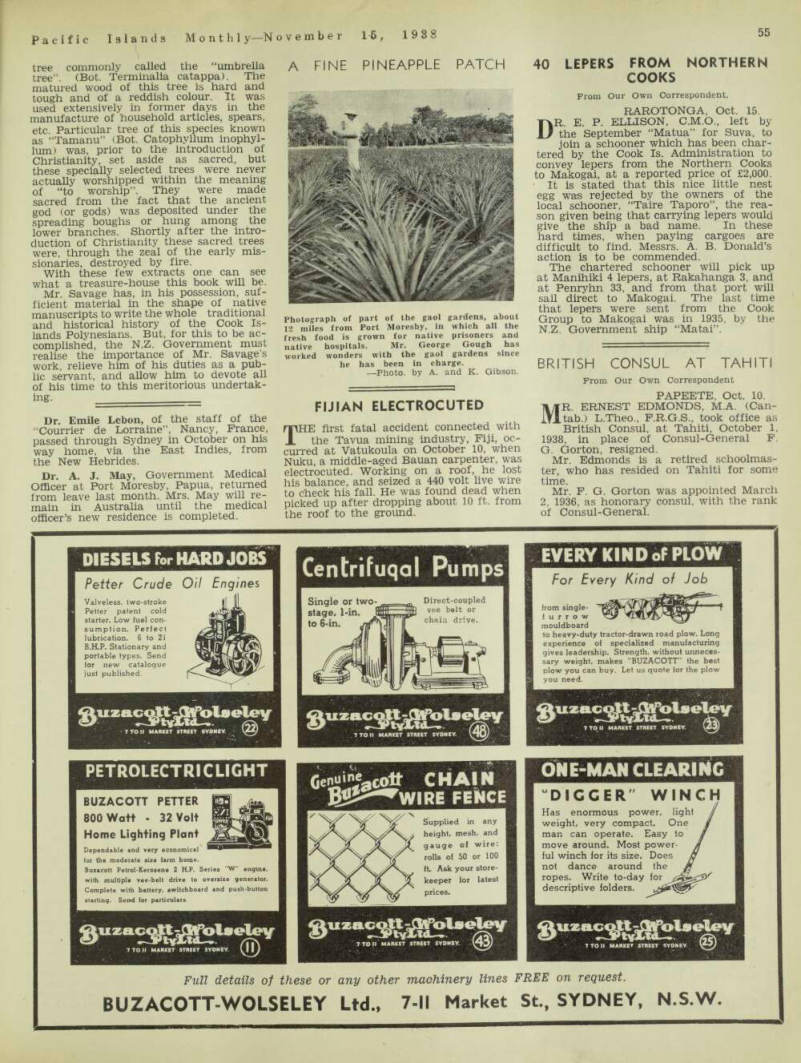
Section of Polynesian History 40 Years' Valuable Work by Mr.
Stephan Savage
From Our Own Correspondent.
Rarotonga, Oct. 10.
IN the hands of the printers is a 700page manuscript of what will be a book of outstanding merit. This work of Mr. Stephan Savage is more than a dictionary—it is an encyclopaedia, giving the historical, natural, traditional, mythi cal and allegorical history of Rarotonga and its Polynesian inhabitants.
, this dicti onary there would iSitimoKi lost i t 0 P° sterit y something of value, as no other man has this knowledge that Mr. Savage has set tO , students of the PolynestbA th S W ?s k J? 11 just be as valuable Egyptolo^ Setta St ° ne iS t 0 stu dcnts of NPw r Voo a i Vag J arriv ! d in Rarotonga from at That ° V S r 44 i y f ars ag0 ’ and had at that time a knowledge of N.Z. Maori with the Rarotongans, he ma^e himself clearly under stood, so he set himself to learn the lan guage. By 1898, he had acquired a goSd of . the ianguage, and com menced then to collect words and tradi tions in earnest. He was frequently em- Government^ 15 ' 118 translations for the cirwif o te C ? l 9 nel w - E - Gudgeon (Re sident Commissioner for the Cook Is.) in nffil a I PP^ mte ?. Mr - Sava^e as Secretary' Official Translator and Interpreter, in wi^ C^£ aci f y he was in constant contact with the language, and therefore was Si e nr ° c °Ji ect an y tribal and family histones oid customs, words and phrases of the older form of the language.
Since that time, he has been constant &fw le Pi tmg u d ?' ta; • on many occasions s itt m g up whole nights listening to the ° ld ° f th / uA sland telling the tales istones of their gods and ancestors While he was interpreter in the Land court, and heard any new word or phrase, he would make a note of same, and after Court he would ask the mean ing and its use.
Both the late Bishop Williams and Dr P. H. Buck have been keenly interested m this dictionary. They have given the author valuable advice, and encouraged Mr Savage to continue and finish this work when often he felt inclined to drop the matter, on account of meeting what seemed insuperable obstacles, and accu mulations of his Government work leav ing him very little free time.
The following extracts from the manu script will demonstrate the enormous la bour entailed, especially when the whole is the work of one man.
“Aitu”: a god, a deity, a spirit. Also, the name of certain ancient tribes who came from the East and settled on many of the islands. According to tradition, some of the Aitu tribes settled on the is lands of Aitutaki, Atiu, and Mangaia. At Aitutaki they were eventually destroyed or driven away. At Mangaia they were from time to time slaughtered, in order to provide sacrifices to the gods. There still exists at Mangaia the remains of a great oven named “Te-Umu-Aitu”, where large numbers of these people were cook ed after being slain.
“Ara-Nui-O-Toi”. (Comp.n.) (Hist.).
Tradition states that this is the name of the first road that was formed complete ly round the island of Rarotonga. It was made by a chief named Toi, a celebrated ancestor of the Polynesians (Maori) who, with a fellow named Te-Marai. came to the island of Rarotonga some 700 years ago—long before the advent of Tangiia nui or Karika. The road was originally paved with stones, the whole of its length, and undoubtedly involved a great deal of manual labour in its construc tion—which indicates that Toi must have had a considerable number of followers, and that he was a civil engineer, as well as being an able navigator. It is a great pity this road, in many places has been totally destroyed, although there are por tions still intact. Toi must have resided on the island for some time; then he sailed away to a land then known as Rangimake-oki-rangi, and latterly as Avaiki-atutau (New Zealand).
“Kauariki” (n). A large deciduous
tree commonly called the “umbrella tree’’. (Bot. Terminalia catappa). The matured wood of this tree is hard and tough and of a reddish colour. It was used extensively in former days in the manufacture of household articles, spears, etc. Particular tree of this species known as “Tamanu” (Bot. Catophyllum inophyl lum) was, prior to the introduction of Christianity, set aside as sacred, but these specially selected trees were never actually worshipped within the meaning of “to worship”. They were made sacred from the fact that the ancient god (or gods) was deposited under the spreading boughs or hung among the lower branches. Shortly after the intro duction of Christianity these sacred trees were, through the zeal of the early mis sionaries, destroyed by fire.
With these few extracts one can see what a treasure-house this book will be.
Mr. Savage has, in his possession, suf ficient material in the shape of native manuscripts to write the whole traditional and historical history of the Cook Is lands Polynesians. But, for this to be ac complished, the N.Z. Government must realise the importance of Mr. Savage’s work, relieve him of his duties as a pub lic servant, and allow him to devote all of his time to this meritorious undertak ing. === Dr. Emile Lebon, of the staff of the “Courrier de Lorraine”, Nancy, France, passed through Sydney in October on his way home, via the East Indies, from the New Hebrides.
Dr. A. J. May, Government Medical Officer at Port Moresby, Papua, returned from leave last month. Mrs. May will re main in Australia until the medical officer’s new residence is completed.
Advertisements & other items, p. 58 (2 items)
54
Pacific Islands Monthly—N o v e m b e r 15, 1938
throughout T«t
F am° uS ’ TUf
pMilf'U
O.S.L.
, JU. rtzz*'
TJSft* " , “ h aSi m .«-« «2S rem e
ssttssa^-
’ usher s wbet Sydney 5 sXß eet. casteereagh Hotel of Ois^Ss^ 1 Sydney-
Do You Know that the Famous , . ,
YOUNGER
STOVES and
RANGES
made with extended Firebox specially for long Wood fuel, are Self-Setting and, provided sufficient Flue Piping is attached, can be used almost any position? m The No. 7W "Younger" Ranger can now be supplied fitted with Legs, as per illustration.
Ask for quotation for this Range, also Illustrated Catalogue and Price List for both Single and Double Oven. Stoves.
Younger Stoves are Widely Used Throughout the Pacific Islands.
G. FLETCHER & SON 50 Oxford Street, Sydney
A Fine Pineapple Patch
Photograph of part of the gaol gardens, about 12 miles from Port Moresby, in which all the fresh food is grown for native prisoners and native hospitals. Mr. George Gough has worked wonders with the gaol gardens since he has been in charge.
Photo, by A. and K. Gibson.
Fijian Electrocuted
THE first fatal accident connected with the Tavua mining industry, Fiji, oc curred at Vatukoula on October 10, when Nuku, a middle-aged Bauan carpenter, was electrocuted. Working on a roof, he lost his balance, and seized a 440 volt live wire to check his fall. He was found dead when picked up after dropping about 10 ft. from the roof to the ground.
40 Lepers From Northern
Cooks
From Our Own Correspondent.
Rarotonga, Oct. 15.
DR. E. P. ELLISON, C.M.0., left by the September “Matua” for Suva, to join a schooner which has been char tered by the Cook Is. Administration to convey lepers from the Northern Cooks to Makogai, at a reported price of £2,000.
It is stated that this nice little nest egg was rejected by the owners of the local schooner, “Taire Taporo”, the rea son given being that carrying lepers would give the ship a bad name. In these hard times, when paying cargoes are difficult to find. Messrs. A. B. Donald’s action is to be commended.
The chartered schooner will pick up at Manihiki 4 lepers, at Rakahanga 3, and at Penryhn 33, and from that port will sail direct to Makogai. The last time that lepers were sent from the Cook Group to Makogai was in 1935, by the N.Z. Government ship “Matai”.
British Consul At Tahiti
From Our Own Correspondent
Papeete, Oct. 10.
Mr. Ernest Edmonds, M.A. (Can
tab.) L.Theo., F.R.G.S., took office as British Consul, at Tahiti, October 1, 1938, in place of Consul-General F.
G. Gorton, resigned.
Mr. Edmonds is a retired schoolmas ter, who has resided on Tahiti for some time.
Mr. F. G. Gorton was appointed March 2, 1936, as honorary consul, with the rank of Consul-General.
Advertisements & other items, p. 59 (1 item)
Centrifugal Pumps
DIESELS For HARD JOBS
Petter Crude Oil Engines
Valveless, two-stroke Petter patent cold starter. Low fuel consumption. Perfect lubrication. 6 to 21 B.H.P. Stationary and portable types. Send for new catalogue just published.
Centrifugal Pumps
Single or twostage, 1-in. to 6-in.
Direct-coupled vee belt or chain drive.
7 TO II MARKET STREET SYDNEY.
7TO II MARKET STREET SYDNEY.
EVERY KIND oF PLOW
For Every Kind of Job
from singlefurrow mouldboard to heavy-duty tractor-drawn road plow. Long experience of specialized manufacturing gives leadership. Strength, without unnecessary weight, makes "BUZACOTT" the best olow you can buy. Let us quote lor the plow B you need. i
7 TO II MARKET STREET SYDNEY.
PETROLECTRICLICHT oenU ine ott CHAIN I ONE-MAN CLEARING
fence
BUZACOTT PETTER
800 Watt - 32 Volt
Home Lighting Plant
Dependable and very economical for the moderate size farm home.
Buzacott Petrol-Kerosene 2 H.P. Series “W" engine, with multiple vee-belt drive to oversize generator.
Complete with battery, switchboard and push-button starting. Send tor particulars.
Supplied in any height, mesh, and gauge of wire; rolls of 50 or 100 ft Ask your storekeeper for latest prices.
“DIGGER WINCH
Has enormous power, light weight, very compact. One man can operate. Easy to move around. Most powerful winch for its size. Does not dance around the ropes. Write to-day for
descriptive folders.
BUZttCJil®8 UZttC Jil® I I
(m ■ 7TOH MARKET STREET SYDNEY. 7TO II MARKETSTREET SYDNEY.
7 TO II MARKET STREET SYDNEY,
Full details of these or any other machinery lines FREE on request.
BUZACOTT-WOLSELEY Ltd., 7-11 Market St., SYDNEY, N.S.W.
How To Stay Sane In
Tropical Islands
From Our Own Correspondent.
Honolulu, Oct. 5.
MORE than any other, white people who live in the tropics worry about their mental health. They become forget ful, careless about their appearance, and so on.
Ten easy lessons in staying sane were given to the public of these sub-tropic isles by Dr. Franklin G. Ebaugh, inter nationally famed psychiatrist and director of Hawaii’s new psychiatric clinic. His 10 rules: 1. Keep physically fit at all times, be
cause physical ills contribute greatly to insanity. 2. Maintain an objective attitude in life. 3. Manage to have a confidential re lationship with some person or persons. 4. Develop the ability to show insight into one’s conduct. Check up on your self and do something about it. 5. Have a sense of humour. 6. Attack your problems in an active manner. 7. Participate in work that is satisfying. 8. Relax and rest, and engage in recre ation. 9. Have a freedom of routine. 10. Participate in normal social activi ties.
Queer Artifacts Found
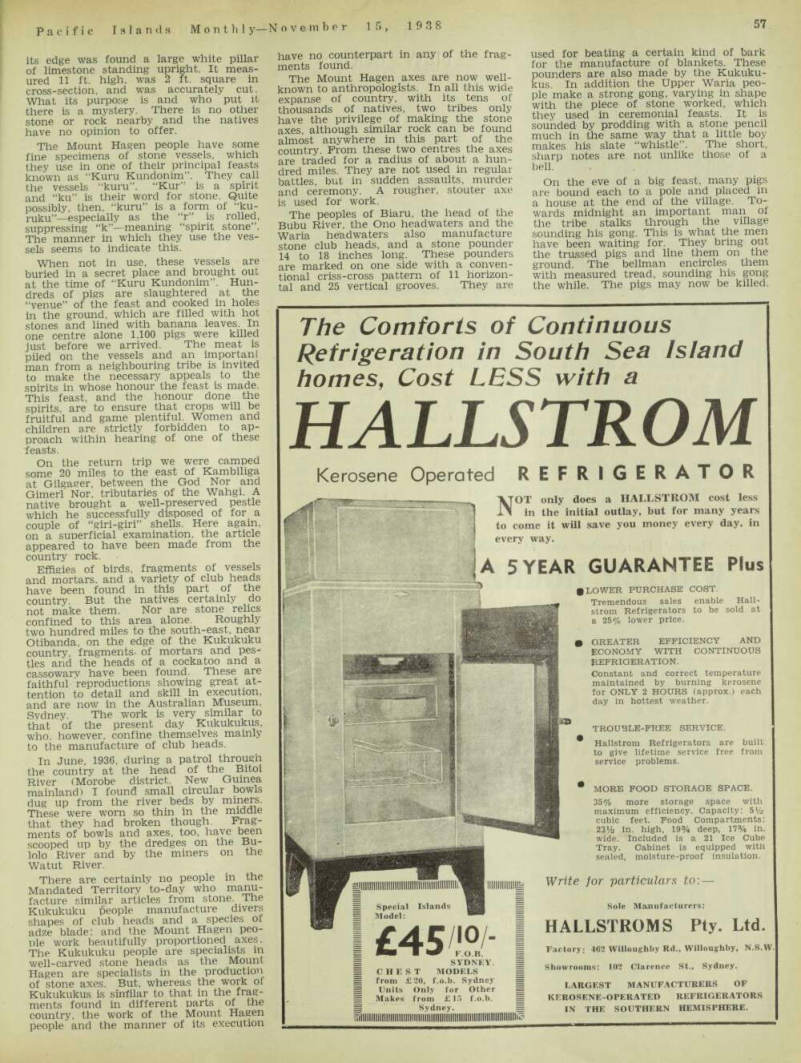
In New Guinea Relics of a People Long Dead
MUCH material of scientific value, as well as general interest, is publish er in A “°ceania”—a journal produced by the Australian National Research Council, of Science House, Gloucester Street, Sydney, and devoted to the study of the native people of Australia and the Pacific Islands, The editor is Dr. A P Elkin and the assistant editor is Dr. H lan Hogbm, both of whom are well known anthropologists. . Some of the articles in the September issue of interest to Pacific Islands readers are; The Life of Children in Manam (New Guinea)”, by Camilla H. Wedg wood; The History of Rotuma, as Re flected in its Language”, by C. Maxwell Churchward; “The Word ‘Mana’: a Linguistic Study”, by A. Capell; “Notes on the Hill People of North Eastern Guadalcanal”, by L. W. S. Wright- “Stonp Workers of New Guinea, Past and Pre sent , by John J, Murphy.
As Mr. Murphy’s article deals with a subject of much interest to New Guinea and Papua miners (who have dug up many of the mysterious arti facts) we have taken the liberty of re producing it hereunder. Mr. Murphy is an officer of the Department of District Services and Native Affairs, in New Guinea.
A CONSIDER ABLE portion of our knowledge of our ancient peoples has been gained from the study of iragments of stone vessels, implements, and ornaments which have survived them. Brought to light in our day, they have been no small factor in limning the lives of a people whom they have survived by, perhaps, thousands of years.
In New Guinea are found many such relics. Here we find, fashioned in stone, a fragmental history of a people who ap parently inhabit no part of the island to-day, nor have they, perhaps, for a thousand years past.
Practically anywhere in the Mandated Territory relics and fragments are found.
They appear to have been made from the country rock, and usually take the form of plain or decorated bowls, some with pedestals, and some without; mor tars and pestles; effigies of birds and of the male genitalia. They have been dug up in creek-beds or in gardens, and in many cases have been, for generations, in the possession of various native com munities who use them in feasts and rituals.
On one occasion when I was camped at a place called Kambiliga, on the south bank of the Middle Wahgi, on the way to Mt, Hagen (Central New Guinea), a young man brought a fragment of a mortar which he had found in one of the creeks. It appears to have been made from the country rock and is about a quarter of the complete arti cle. It has a handle attached and was evidently an oval-shaped vessel. With constant grinding it had worn compara tively thin at the middle, and the fric iton marks of —doubtless —a pestle could be seen. The rim was carved like thick rope, and altogether it had the appear ance of being a symmetrically made article.
Four days later the patrol came to a large swampy tract some ten or twelve miles wide. This tract was entirely tree less and bordered the upper reaches of the swiftly-flowing Wahgi River. At
its edge was found a large white pillar of limestone standing upright. It meas ured 11 ft. high, was 2 ft. square in cross-section, and was accurately cut.
What its purpose is and who put it there is a mystery. There is no other stone or rock nearby and the natives have no opinion to offer.
The Mount Hagen people have some fine specimens of stone vessels, which they use in one of their principal feasts known as “Kuru Kundonim”. They call the vessels “kuru”. “Kur” is a spirit and “ku” is their word for stone. Quite possibly, then, “kuru” is a form of “ku ruku”—especially as the “r” is rolled, suppressing “k”—meaning “spirit stone”.
The manner in which they use the ves sels seems to indicate this.
When not in use, these vessels are buried in a secret place and brought out at the time of “Kuru Kundonim”. Hun dreds of pigs are slaughtered at the “venue” of the feast and cooked in holes in the ground, which are filled with hot stones and lined with banana leaves. In one centre alone 1,100 pigs were killed just before we arrived. The meat is piled on the vessels and an important man from a neighbouring tribe is invited to make the necessary appeals to the spirits in whose honour the feast is made.
This feast, and the honour done the spirits, are to ensure that crops will be fruitful and game plentiful. Women and children are strictly forbidden to ap proach within hearing of one of these feasts.
On the return trip we were camped some 20 miles to the east of Kambiliga at Gilgager, between the God Nor and Gimerl Nor. tributaries of the Wahgi. A native brought a well-preserved pestle which he successfully disposed of for a couple of “giri-giri” shells. Here again, on a superficial examination, the article appeared to have been made from the country rock.
Effigies of birds, fragments of vessels and mortars, and a variety of club heads have been found in this part of the country. But the natives certainly do not make them. Nor are stone relics confined to this area alone. Roughly two hundred miles to the south-east, near Otibanda, on the edge of the Kukukuku country, fragments- of mortars and pes tles and the heads of a cockatoo and a cassowarv have been found. These are faithful reproductions showing great at tention to detail and skill in execution, and are now in the Australian Museum, Sydney. The work is very similar to that of the present day Kukukukus, who. however, confine themselves mainly to the manufacture of club heads.
In June, 1936, during a patrol through the country at the head of the Bitoi River (Morobe district. New Guinea mainland) I found small circular bowls dug up from the river beds by miners.
These were worn so thin in the middle that they had broken though. Frag ments of bowls and axes, too, have been scooped up by the dredges on the Bu lolo River and by the miners on the Watut River.
There are certainly no people in the Mandated Territory to-day who manu facture similar articles from stone. The Kukukuku people manufacture divers shapes of club heads and a species of adze blade: and the Mount Hagen peo ple work beautifully proportioned axes.
The Kukukuku people are specialists in well-carved stone heads as the Mount Hagen are specialists in the production of stone axes. But. whereas the work of Kukukukus is sintilar to that in the frag ments found in different parts of the country, the work of the Mount Hagen people and the manner of its execution
have no counterpart in any of the fragments found. mu p ivrmint TTaerpn axes are now well- Jl e n In 11l this wide of country® with Its tens of thousands of natives, two tribes only axes aUhough U staUar rockclnbe fouSd almost anywhere in this part of the country. From these two centres the axes are traded for a radius of about a hundred miles. They are not used in regular battles, but in sudden assaults, murder and ceremony. A rougher, stouter axe is used for work.
The peoples of Biaru, the head of the Bubu River, the Ono headwaters and the Waria headwaters also manufacture stone club heads, and a stone pounder 14 to 18 inches long. These pounders are marked on one side with a conventional criss-cross pattern of 11 horizontal and 25 vertical grooves. They are
used for beating a certain kind of bark for the manufacture of blankets. These pounders are also made by the Kukuku kus. In addition the Upper Waria peo- Pie make a strong gong, varying in shape with the p £ ce ° f leasts*’ It^is sounded by prodd™!ti a stone pencil l^akes' his h slat ™ “whistle” 3,4 Th^'short makes his slate whistle ine snoit, sharp notes are not unllke those of a bell. on the eve of a big feast, many pigs are bound each to a pole and placed in a house at the end of the village. To wards midnight an important man of the tribe stalks through the village sounding his gong. This is what the men have been waiting for. They bring out the trussed pigs and line them on the ground. The bellman encircles them with measured tread, sounding his gong the while. The pigs may now be killed.
Women and children dare not show themselves nor pry when the gong is being sounded, for this is the voice of a spirit.
From New Britain comes the “Muk muk”. An occasional deposit is found where a stratum of hard black stone oc curs next to a white marble-like strat um with a well-defined line between.
From this rock the natives made an oval ball about four or five inches long, one half of which was white and the other half black. Presented white end first it was a formal declaration of war.
The black end meant peace.
Hon. A. H. Bunting, M.L.C., of Sama rai, Papua, accompanied by Mrs. Bunt ing, has returned to Australia. Mr.
Bunting’s health is not satisfactory.
Advertisements & other items, pp. 60-61 (2 items)
44 Macleay Street
WHEN SPENDING YOUR VACATION IN SYDNEY YOUR CHOICE OF RESIDENCE IS A MATTER SO VITAL TO YOUR ENJOYMENT!
May we commend to you for All-round Excellence ...
SYDNEY’S MOST EXCLUSIVE PRIVATE HOTEL
44 MACLEAY STREET
Here for you await unrivalled Service and Cuisine—Suites with Private Baths— H. & C. Water and Telephones in all rooms—Magnificent Harbour Views Roof Garden Sun Rooms Spacious Lounges and Smoke Rooms and every modern convenience All under Personal Supervision of the Proprietress,
MISS M. E. BURROWS
0 cm & 7*
TARIFF: From £3/3/-
per week inclusive.
Radios:
"FORTYFOR"
Sydney.
Telephone: FL 2641
“FAIRHOLME”, Mountain School for Girls
r VA
N X .«•* V£ ** *j* - ' C • - Aerial View of Grounds and Buildings.
PRESBYTERIAN GIRLS’ COLLEGE, TOOWOOMBA, Q’LAND.
2,000 feet above sea level. Unrivalled Climate. Academic, Home Science and Commercial Courses. Tennis, Swimming, Organised Games.
Principal: Miss D. E. CULPIN, B.A.
For Prospectus apply Secretary :-R. T. PHELPS, F.A.A., TOOWOOMBA, QLD.
The Comforts of Continuous
Refrigeration in South Sea Island
homes, Cost LESS with a
HALLSTROM
Kerosene Operated REFRIGERATOR
iiiiiiiiiiuiyy
= Special Islands = Model: only does a HALLSTROM cost less in the initial outlay, but for many years to come it will save you money every day. in every way.
A 5 YEAR GUARANTEE Plus
(LOWER PURCHASE COST.
Tremendous sales enable Hallstrom Refrigerators to be sold at a 25% lower price.
GREATER EFFICIENCY AND
ECONOMY WITH CONTINUOUS
REFRIGERATION.
Constant and correct temperature maintained by burning kerosene for ONLY 2 HOURS (approx.) each day in hottest weather.
TROUBLE-FREE SERVICE.
Hallstrom Refrigerators are built to give lifetime service free from service problems.
MORE FOOD STORAGE SPACE.
35% more storage space with maximum efficiency. Capacity; 5Vi cubic feet. Food Compartments: 23Vi in. high, 19% deep, 17% in. wide. Included is a 21 Ice Cube Tray. Cabinet is equipped with sealed, moisture-proof insulation.
Write for particulars to:
Sole Manufacturers: £45 ,0 - 1
FOB.
I HALLSTROMS Pty. Ltd.
SYDNEY.
= CHEST MODELS
= from £2O, f.o.b. Sydney = Units Only for Other = Makes from £l5 f.o.b.
Factory; 462 Willoughby Rd., Willoughby, N.S.I Showrooms: 102 Clarence St., Sydney.
Sydney. =
nillllllllllllllllllllllllllllllllllllllllllllllllllllllllllHllllllllllllli^
LARGEST MANUFACTURERS OF
KEROSENE-OPERATED REFRIGERATORS
IN THE SOUTHERN HEMISPHERE.
57
Pacific Islands Monthl y—N ov em ber 15, 19 3 8
New Books
Vikings Op The Sunrise, By Dr.
Peter H. Buck. Our copy from Angus and Robertson, Ltd., Sydney. 15/-.
This work already has been described at length by an American correspondent in these pages. Dr. Buck, probably the greatest living authority on the subject, has brought into 330 well-documented and closely indexed pages, an authentic account of how the Pacific was navi gated and the islands colonised by the Poly nesian race. The Polynesians’ greatest voy ages, some of them covering many thousands of miles, were undertaken before Columbus crossed the Atlantic. This fascinating book throws new light upon the mysterious monu ments and stone images of the central and eastern Pacific, and gives us much more data about those migrations of the dim past, which apparently link Polynesia with Caucasian, Mongolian and Ethiopian races.
SO YOU THINK IT’S NEW!, by W.
J. Funk. Our copy from Angus and
Robertson, Sydney. 5/-.
An astonishing array of facts and figures, showing that there are very few human situ ations of the present day—economic, social, medical, scientific—which have not their counterpart in history somewhere in the last 5,000 years. For instance: “Hot dog” stands were common 1900 years ago. Inoculation for smallpox antedates Christ. Nudist crazes be gan far back, before history. Permanent waves and face-lifting were known in anci ent Mediterranean countries. Nero had an elevator 120 ft. high, and a self-playing organ.
Shatter-proof glass was made 1900 years ago, and artificial eyes 2600 B.C. People in India, in the dawn of our history, were making ice with clay, vaporisation and radiation. They were scolding their girls for running wild and staying out late at nights before ever Julius Caesar marched into Gaul and Britain.
Let’S See If The World Is
ROUND, by Hakon Mielche, Danish art
ist. Our copy from W. Hodge and Co.
Ltd.. 86 Hatton Garden, London, ECI.
12/6.
This book was published in Danish about three years ago, and now we have an Eng lish translation, it is a bright, racy account of the voyage of the “Monsunen”. Danish sci entific ship, from Europe to Panama. Gala pagos Is., Marquesas, Tahiti, Samoa. Fiji. New Caledonia, New Hebrides, Banks and Torres Islands, to Vanikoro (Southern Solomons) where she was wrecked. Mr. Mielche, in addi tion to being a humourist, is a clever and witty artist, and the book is illustrated with scores of diverting thumb-nail sketches, in which we recognise many men well-known in the Pacific. An excellent travel-book, and its 330 pages are packed with entertainment.
GUIDE TO SYDNEY, compiled and
published by N.S.W. Bookstall Co. Pty.
Ltd., Sydney. 2/6.
A compilation that is long overdue. Here we have all the information that travellers want about the Metropolis of the South Seas, ar ranged in handy form —where to go, how to get there, what to see. There is a whole ser ies of new maps, recently drawn —valuable, because the city lay-out has changed a good deal in recent years.
Education Of Fijian
Women
Good Work Done by Europeans
AS an example of the good work be ing done, in an unostentatious way, by sections of the Europeans to help the Fijian community in Fiji, it is noted that no less than 200 Fijian women as sembled in Suva early in October to at tend the 14th annual conference of the Fijian Women’s Guild.
The object of this organisation is to instruct the women in the care of their young infants, and in the conduct of their homes, so as to meet the new con ditions of European civilisation. The women are intelligent and adaptable, and much good has been achieved, es pecially in the direction of reducing in fant mortality.
The conference extended over several days, under the leadership of Mrs. O. C.
K. Corrie, and the various addresses were followed with close attention.
Rev. H. J. E. Short, of the L.M.S. mis sion at Hula, left Port Moresby by the “Tasman” on October 27 to attend the International Missionary Conference at Madras. Mrs. Short, who was in Ade laide, will join her husband in Colombo; and. later, Mr. and Mrs. Short will go on to Europe. They will return to Papua at the end of next year, via America.
Advertisements & other items, p. 62 (2 items)
58
Pacific Islands Monthl y—N ovember 15, 1938
Your Tropical Rit
When you visit the Pacific Islands, whether on Business or Pleasure, you need Special Equipment—Light Suits of Correct Style, which fit well and launder easily; Tunic Shirts, Sillc Shirts, Light Underwear, White Shoes, etc.
WALTER HORNE & CO. LTD., established in 1885, specialise in this Service. Skilled Tailors make your Suits from First-class material within 24 hours. Complete equipment can be supplied from our Large Stocks at Reasonable, Moderate Prices.
BUY FROM THE FIRM WHICH UNDERSTANDS
DRESSES YOU CORRECTLY
WALTER HORNE &' CO. LTD., carry a Full Range of Drapery of all kinds; also Frocks, Millinery, Foundations and Lingerie, Hosiery, Shoes and Sandals, Ribbons and Laces, Household Drapery.
YOUR NEEDS AND
. Men resident in any of the Pacific Territories can he supplied mth Suitable Clothes.
Ladies' Hairdressing and Manicuring
Write to us and Describe your Requirements.
WALTER HORNE & CO. LTD.
Drapers and Men's Wear Specialists
SUVA, FIJI
A. B. DONALD LTD.
AUCKLAND
ISLAND TRADERS :: GENERAL MERCHANTS
P. O. Box 1509 Cables and Telegrams: "Kingdom," Auckland Branches at Rarotonga and throughout the Cook Islands At Papeete and throughout the Society, Marquesas and Paumotu Islands trading as " ETABLISSEMENTS DONALD, TAHITI "
At Fiji: Trading as "Dominion Fruit C 0.," Suva
Modern Motor Vessel For Sydney-New Guinea Run
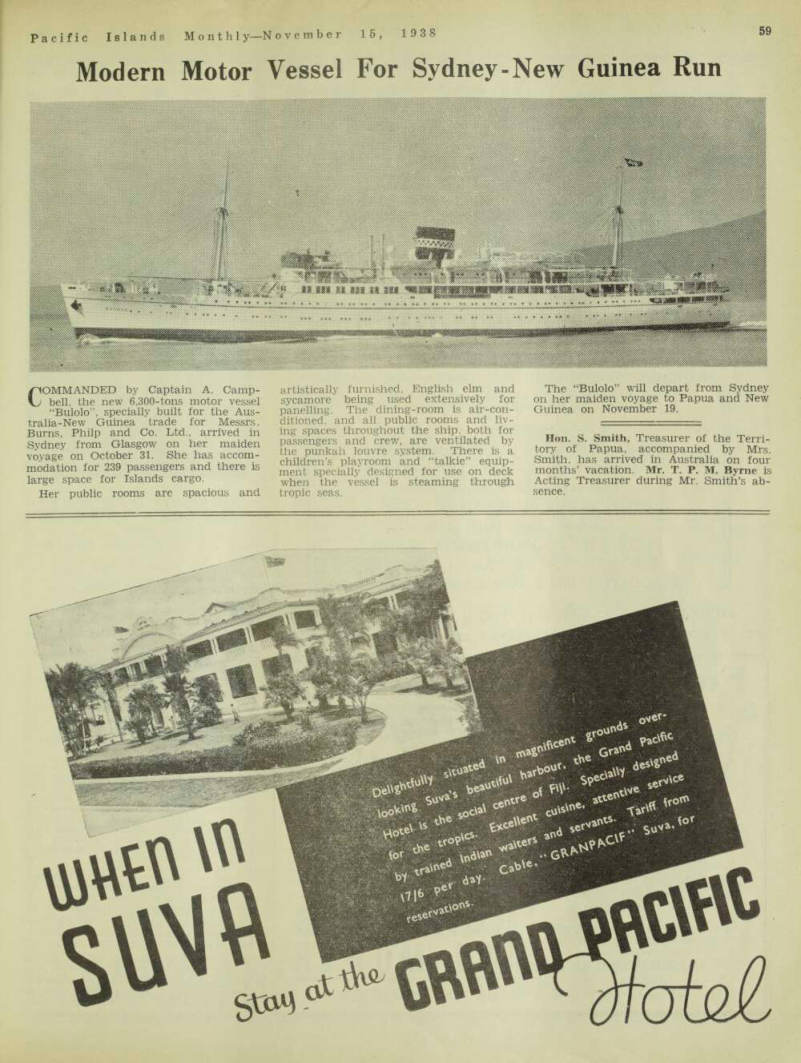
COMMANDED by Captain A. Camp bell, the new 6,300-tons motor vessel “Bulolo”, specially built for the Aus tralia-New Guinea trade for Messrs.
Burns, Philp and Co. Ltd., arrived in Sydney from Glasgow on her maiden voyage on October 31. She has accom modation for 239 passengers and there is large space for Islands cargo.
Her public rooms are spacious and
artistically furnished. English elm and sycamore being used extensively for panelling. The dining-room is air-con ditioned, and all public rooms and liv ing spaces throughout the ship, both for passengers and crew, are ventilated by the punkah louvre system. There is a children’s playroom and “talkie” equip ment specially designed for use on deck when the vessel is steaming through tropic seas.
The “Bulolo” will depart from Sydney on her maiden voyage to Papua and New Guinea on November 19.
Hon. S. Smith, Treasurer of the Terri tory of Papua, accompanied by Mrs.
Smith, has arrived in Australia on four months’ vacation. Mr. T. P. M. Byrne is Acting Treasurer during Mr. Smith’s ab sence.
Advertisements & other items, p. 63 (2 items)
59
Pacific Islands Monthl y—N ovember 15, 1938
se^ oos
)l m m
mkh
P,, O'** 1 ' oU ° Pa c*c . , .#. <*■"'
m r> M -
«*" ser v»o«. ; ,or tr a'° ed C^' 6, —^ - r <M* |6 9 cr —^
se^ oos
A Mishap And A Quick
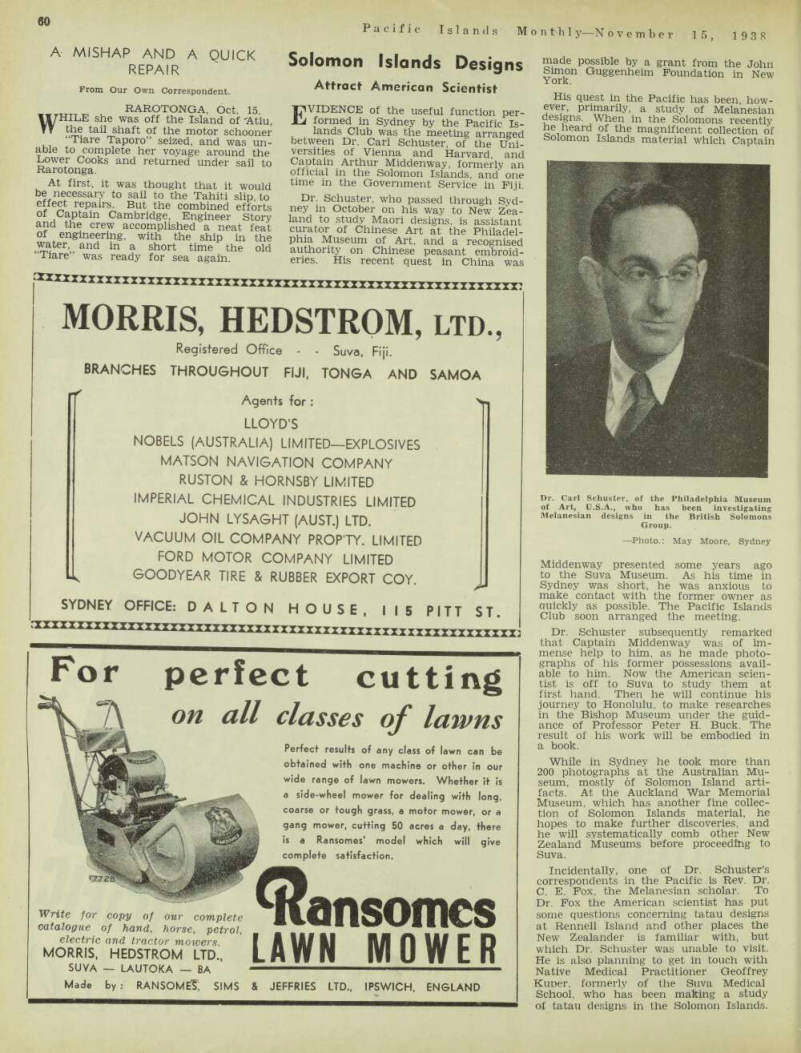
Repair
From Our Own Correspondent.
Rarotonga, Oct. 15
WHILE she was off the Island of 'Atm, the tail shaft of the motor schooner “Tiare Taporo” seized, and was un able to complete her voyage around the Lower Cooks and returned under sail to Rarotonga.
At first, it was thought that it would be necessary to sail to the Tahiti slip, to repairs. But the combined efforts of Captain Cambridge, Engineer Story and the crew accomplished a neat feat of engineering, with the ship in the water, and in a short time the old Tiare” was ready for sea again.
phiaMuseumArt and ? recognised
Solomon Islands Designs Attract American Scientist
TjWIDENCE of the useful function per £j formed in Sydney by the Pacific Is lands Club was the meeting arranged between Dr. Carl Schuster, of the Uni versities of Vienna and Harvard and Captain Arthur Middenway, formerly an official in the Solomon Islands, and one in Government Service in Fiji.
Dr '- Sc A luster ’ who P assed through Syd ney m October on his way to New Zea land,to study Maori designs, is assistant curator of Chinese Art at tbp PbiioHoi
phiaMuseumArt and ? recognised
authority on Chinese peasant embroid enes. His recent quest in China was
made possible by a grant from the John Simon Guggenheim Foundation in New York.
His quest in the Pacific has been, how ever, primarily, a study of Melanesian designs. When in the Solomons recently he heard of the magnificent collection of Solomon Islands material which Captain
Middenway presented some years ago to the Suva Museum. As his time in Sydney was short, he was anxious to make contact with the former owner as quickly as possible. The Pacific Islands Club soon arranged the meeting.
Dr. Schuster subsequently remarked that Captain Middenway was of im mense help to him, as he made photo graphs of his former possessions avail able to him. Now the American scien tist is off to Suva to study them at first hand. Then he will continue his journey to Honolulu, to make researches in the Bishop Museum under the guid ance of Professor Peter H. Buck. The result of his work will be embodied in a book.
While in Sydney he took more than 200 photographs at the Australian Mu seum, mostly of Solomon Island arti facts. At the Auckland War Memorial Museum, which has another fine collec tion of Solomon Islands material, he hopes to make further discoveries, and he will systematically comb other New Zealand Museums before proceeding to Suva.
Incidentally, one of Dr. Schuster’s correspondents in the Pacific is Rev. Dr.
C. E. Fox, the Melanesian scholar. To Dr. Fox the American scientist has put some questions concerning tatau designs at Rennell Island and other places the New Zealander is familiar with, but which Dr. Schuster was unable to visit.
He is also planning to get in touch with Native Medical Practitioner Geoffrey Kuper, formerly of the Suva Medical School, who has been making a study of tatau designs in the Solomon Islands.
Dr. Carl Schuster, of the Philadelphia Museum of Art, C.S.A., who has been investigating Melanesian designs in the British Solomons Group. -Photo.: May Moore, Sydney
Advertisements & other items, pp. 64-65 (3 items)
60
Pacific Islands Mon t h 1 y—N ovember 15, 1938
Wansorocs
MORRIS, HEDSTROM, ltd.,
Registered Office - - Suva, Fiji.
BRANCHES THROUGHOUT FIJI, TONGA AND SAMOA
Agents for :
LLOYD'S
NOBELS (AUSTRALIA) LIMITED-EXPLOSIVES
MATSON NAVIGATION COMPANY
RUSTON & HORNSBY LIMITED
IMPERIAL CHEMICAL INDUSTRIES LIMITED
JOHN LYSAGHT (AUST.) LTD.
VACUUM OIL COMPANY PROP'TY. LIMITED
FORD MOTOR COMPANY LIMITED
GOODYEAR TIRE & RUBBER EXPORT COY.
SYDNEY OFFICE: DALTON HOUSE, 115 PITT ST.
For perfect cutting
T\on all classes of lawns
Perfect results of any class of lawn can be obtained with one machine or other in our wide range of lawn mowers. Whether it is a side-wheel mower for dealing with long, coarse or tough grass, a motor mower, or a gang mower, cutting 50 acres a day, there is a Ransomes' model which will give complete satisfaction.
Wansorocs
LAWN MOWER
f 222 Write for copy of our complete catalogue of hand, horse, petrol, electric and tractor mowers.
MORRIS, HEDSTROM LTD.,
SUVA LAUTOKA BA
Made by: SIMS & JEFFRIES LTD., IPSWICH. ENGLAND
FREEMANS
For Quality Goods at Low Prices
ESTABLISHED SINCE 1905
165-167 Castlereagh St., Sydney, N S.W. aM'Mya
Bicycles.
Good Strong Bicycles, slightly used, fixed or free wheel, with brake, In good order 46/-.
Gent’s Roadster Bicycle, free wheel, electric dynamo and lamp, handbrake, good tyres and tubes, slightly used: £B/15/-.
“Speedwell” Bicycle, Club-racer, brazed on back stays, free wheel, t a pered frame, hand - brake, slightly use d £4/19/6 Brand-new Gent’s “Oxford” Special Roadster Bicycle.
Equipment: Brake, lamp, tools, free wheel .. £5/19/6.
Lady’s brand new “Oxford” Special Cycle, fitted with free wheel, dress nets, chain guard, mud guards, spring top saddle and handbratce. All English fittings throughout A variety of colors. At the amazing price of £6/19/6.
Gent’s Brand-new Oxford” Club-racer Bicycle, fully tapered frame and forks, brazedon seat stays. Equipment; "Pltz” H/bars, side-pull brake, doubl-slded hub, Endrlck rims, “Dunlop” black and white tyres, speedo. Complete Cycle £B/19/6.
X
Powerful Field Glasses.
Extra-powerful Field Glasses, centre focus, complete In case 21/-.
“Lumiere” Paris, High-power, Field Glasses, centre focus, with case and strap ... 30/-.
Extra High-power, Marine Glasses, day and night use, centre focus, In case . .. 46/-.
French “Prisma” Field Glasses, large eyepieces, 6X, wide vision. With strap and leather case 55/- “Carlmere” Field Glasses, with sun shield, extra powerful, in case 50/- “Carlex” 8 x 25 Binocular Field Glasses, extra powerful, centre focus, with shoulder strap, in solid leather case, suitable for races, marine or field use £4/15/-.
“Delmar” 8 x 25 Prismatic Binocular Field Glasses, wide range, centre focus, with strap and solid leather case £4/19/6.
“Achromatic” Field Glasses, War Office model, extra powerful, wide range, complete with shoulder strap, In solid leather case £3/15/-/.
“Audemair”, 8 x 30 Prismatic Field Glasses, extra-wide optics, central and individual focus, complete with strap and case, £6/10/- Postage Paid on all Field Glass Orders.
Saddlery.
We specialise in High-grade Saddles made of best quality materials t h r o u ghout.
Strong guaranteed trees and first class workmanship.
All metal work guaranteed Solid Brass.
Strong High-grade Saddles in Stock, Kemp or Poiey styles. Strong guaranteed trees, narrow grip, firm pads, best quality flaps and skirts mounted with leathers, girth, & 3-bar N.P. Irons £3/19/6 High-grade Station Saddles, in Kemp or Poiey styles, deep comfortable kip seat, narrow grip, wide leather facings at back, strong firm pads, extra long kip flaps and skirts, mounted with leathers, girth, and 3bar N.P. irons £4/19/6.
Very Fine High-grade Super Station Stock Saddles, built on strongly plated, guaranteed trees, deep comfortable hogskin seat, with 4Vi in. dip, narrow, grip, wide leather faungs at back, very firm 5 1 /a In. strong capped pads, raised thigh pads, extended leather points, extra long flaps and skirts made of long wearing flexible klp, mounted with bevelled leathers, girth, and 4-bar N.P. irons £6/19/6.
SPECIAL, SADDLES MADE TO ORDER.
Sporting Goods.
GOLF SETS.
"J A. Kirkwood’’ Hickory Shaft Matched Golf Sets; special rustless heads made In Scotland, including mid-iron, mashle, putter and brassie-driver, in leather mounted waterproof canvas bag 42/6.
J A. Kirkwood” Steel Shaft Matched Golf Sets; latest heavy ridged back design, rustless heads made in Scotland, including midiron, mashie, putter and brassie-driver, in leather mounted waterproof canvas bag. 69/6.
CHAS. CAMPBELL, our well known golf professional and ex-open champion of Australia, will select your Golf Clubs. His advice is yours free of charge.
WE STOCK EVERYTHING. WRITE FOR
YOUR REQUIREMENTS. GOODS FOR-
WARDED V.P.P. OR SIGHTDRAFT.
SERVICE AND SATISFACTION GUAR-
ANTEED. PLEASE ADD FREIGHT. ALL
PACKING FREE.
Jewellery Specials.
Gent’s Modern Shape “Starlex” Chrome Wrist Watches; Jewelled lever movement, luminous dial, leather strap 19/6.
Men’s Latest Square-shaped “York” Lever Wrist Watches; 15 Jewelled movement, Chrome Link Band 39/6.
Gent’s Chrome 7-Jewelled Lever Watches, on leather band . 29/6.
Men’s 10-year Guaranteed Gold-filled Wrist Watches; 15 Jewels, 5 adjustments, very latest smart shapes 45/-.
Gent’s Solid Gold-filled Wrist Watches, modern shapes, 15 Jewelled movement, luminous dial, leather band, complete with presentation case 65/-.
“Fenchurch” Solid gold-filled Gent’s Wrist Watches, latest square shape, 15 Jewelled, shock-absorber movement, latest modern dial, Rolled-gold Link Band, complete with presentation case £4/16/-.
Lady’s Chrome Wrist Watches, latest miniature shapes, on chrome link band . . 39/6.
Lady’s 9ct. Gold Wrist Watches, ultra smart shapes, 17 Jewelled movement, 5 adjustments, 44 hr. time-keepers’ 69/6.
Lady’s Solid Chrome Wrist Watches, brilliant studded bezel, dainty baguette shapes, complete with double-rope moire wristband, with presentation case 75/-.
Chrom. STOP WATCHES. Swiss made, 1-5. ’Floretta” Levers, Guaranteed accurate racing Time Pieces 27/6.
Postage Paid on all Jewellery Orders.
Musical Instruments.
Ukeleles: Complete with set of strings. Free Tutor 10/6.
Steel Guitars, beautiful tone, Free Tutor, 36/- “Harmony” Guitars, beautiful tone, nicely finished, Free Tutor £3/19/6 “Harmony” Guitars, professional model, pearl position dots, beautiful finish and tone.
With Free Tutor £6/6/-.
Guitar Cases, 19/6, Set of Picks, Steels, 4/6 per set.
High-grade “Valencia” Accordeons, brand new, all steel bronze reeds, nickel protected bellows, ebonised frames, good value, magnificent tone, 2 stop 25/- 3 stop 35/- English Banjo Manodlins, 6 brackets, complete with case, tutor 37/6 English Banjo Mandolins, 8 brackets, complete with case, tutor 50/-
Typewriter Bargains.
Slightly ased.
Corona, 3-Bank, Portable Typewriters. In case, perfect order £5/19/6.
Corona, 4-Bank, Portable Typewriters, in case, perfect order £B/15/-.
Remington 4-Bank Portable Typewriters, in case, perfect order £ 8/16/-.
“Royal” Portable Typewriter, 4 bank, in case, perfect order £lO/10/-.
FREEMANS
FOR PROMPT SERVICE
and
HONEST VALUE.
165-167 Castlereagh Street, SYDNEY, New South Wales.
61
Pacific islands Monthl y —N ovember 15, 1938
“Cinnamolia”
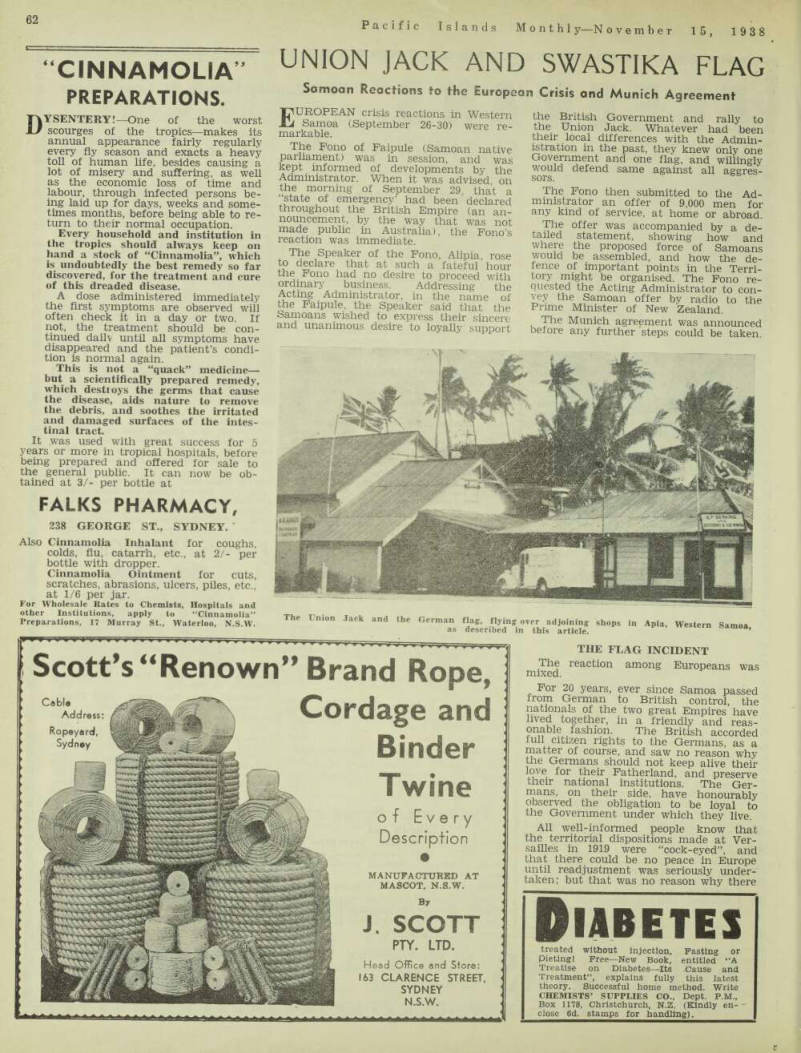
Preparations.
DYSENTERY! —One of the worst scourges of the tropics—makes its annual appearance fairly regularly every fly season and exacts a heavy toll of human life, besides causing a lot of misery and suffering, as well as the economic loss of time and labour, through infected persons be ing laid up for days, weeks and some times months, before being able to re turn to their normal occupation.
Every household and institution in the tropics should always keep on hand a stock of “Cinnamolia”, which is undoubtedly the best remedy so far discovered, for the treatment and cure of this dreaded disease.
A dose administered immediately the first symptoms are observed will often check it in a day or two. If not, the treatment should be con tinued dailv until all symptoms have disappeared and the patient’s condi tion is normal again.
This is not a “quack” medicine— but a scientifically prepared remedy, which destioys the germs that cause the disease, aids nature to remove the debris, and soothes the irritated and damaged surfaces of the intes tinal tract.
It was used with great success for 5 years or more in tropical hospitals, before being prepared and offered for sale to the general public. It can now be ob tained at 3/- per bottle at
Falks Pharmacy,
238 George St., Sydney.
Also Cinnamolia Inhalant for coughs, colds, flu, catarrh, etc., at 2/- per bottle with dropper.
Cinnamolia Ointment for cuts, scratches, abrasions, ulcers, piles, etc., at 1/6 per jar.
For Wholesale Rates to Chemists, Hospitals and other Institutions, apply to “Cinnamolia”
Preparations, 17 Murray St., Waterloo, N.S.W.
Union Jack And Swastika Flag
Samoan Reactions to the European Crisis and Munich Agreement
EUROPEAN crisis reactions in Western Samoa (September 26-30) were re markable.
The Fono of Faipule (Samoan native parliament) was in session, and was kept informed of developments by the Administrator. When it was advised, on the morning of September 29, that a state of emergency’ had been declared throughout the British Empire (an an nouncement, by the way that was not made public in Australia), the Fono’s reaction was immediate.
The Speaker of the Fono, Alipia, rose to declare that at such a fateful hour the Fono had no desire to proceed with ordinary business. Addressing the Acting Administrator, in the name of the Faipule, the Speaker said that the Samoans wished to express their sincere and unanimous desire to loyally support
the British Government and rally to the Union Jack. Whatever had been their local differences with the Admin istration in the past, they knew only one Government and one flag, and willingly would defend same against all aggres sors.
The Fono then submitted to the Ad ministrator an offer of 9,000 men for any kind of service, at home or abroad.
The offer was accompanied by a de tailed statement, showing how and where the proposed force of Samoans would be assembled, and how the de fence of important points in the Terri tory might be organised. The Fono re quested the Acting Administrator to con vey the Samoan offer by radio to the Prime Minister of New Zealand.
The Munich agreement was announced before any further steps could be taken.
The Union Jack and the German flag, flying over adjoining shops in Apia, Western Samoa, as described in this article.
The Flag Incident
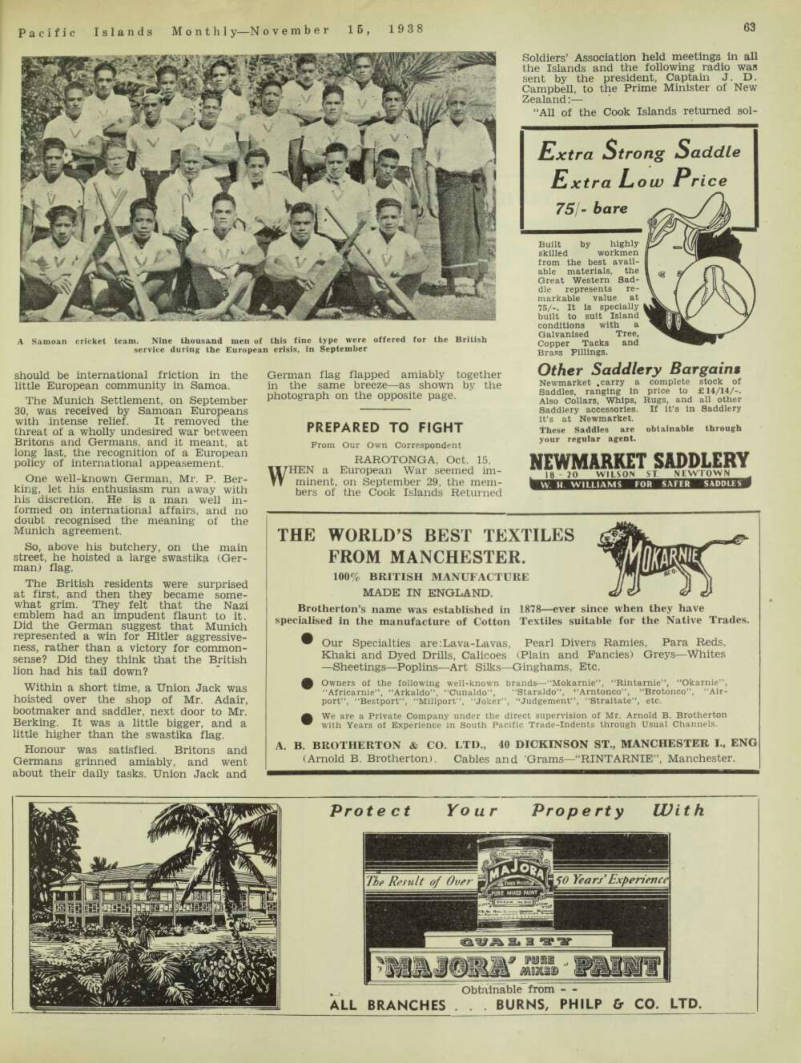
The reaction among Europeans was
Liiiacu.
For 20 years, ever since Samoa passed from German to British control, the nationals of the two great Empires have lived together, in a friendly and reas onable fashion. The British accorded full citizen rights to the Germans, as a matter of course, and saw no reason why the Germans should not keep alive their love for their Fatherland, and preserve their national institutions. The Ger mans, on their side, have honourably observed the obligation to be loyal to the Government under which they live.
All well-informed people know that the territorial dispositions made at Ver sailles in 1919 were “cock-eyed”, and that there could be no peace in Europe until readjustment was seriously under taken; but that was no reason why there
should be international friction in the little European community in Samoa.
The Munich Settlement, on September 30, was received by Samoan Europeans with intense relief. It removed the threat of a wholly undesired war between Britons and Germans, and it meant, at long last, the recognition of a European policy of international appeasement.
One well-known German, Mr. P. Ber king, let his enthusiasm run away with his discretion. He is a man well in formed on international affairs, and no doubt recognised the meaning of the Munich agreement.
So, above his butchery, on the main street, he hoisted a large swastika (Ger man) flag.
The British residents were surprised at first, and then they became some what grim. They felt that the Nazi emblem had an impudent flaunt to it.
Did the German suggest that Munich represented a win for Hitler aggressive ness, rather than a victory for common sense? Did they think that the British lion had his tail down?
Within a short time, a Union Jack was hoisted over the shop of Mr. Adair, bootmaker and saddler, next door to Mr.
Berking. It was a little bigger, and a little higher than the swastika flag.
Honour was satisfied. Britons and Germans grinned amiably, and went about their daily tasks. Union Jack and
German flag flapped amiably together in the same breeze —as shown by the photograph on the opposite page.
A Samoan cricket team. Nine thousand men of this fine type were offered for the British service during the European crisis, in September
Advertisements & other items, p. 66 (3 items)
62
Pacific Islands Monthl y—N ovember 15, 1938
Cordage and
Scott’s “Renown” Brand Rope,
Cable Address: Ropeyard, Sydney
Binder
Twine
of Every
Description
MANUFACTURED AT
MASCOT, N.S.W,
J, SCOTT
PTY. LTD.
Head Office and Store:
163 CLARENCE STREET,
SYDNEY
N.S.W.
Diabetes
treated without injection. Pasting or pieting! Free—New Book, entitled “A Treatise on Diabetes—lts Cause and Treatment”, explains fully this latest theory. Successful home method. Write
CHEMISTS’ SUPPLIES CO., Dept. P.M.,
Box 1178, Christchurch, N.Z. (Kindly en- close 6d. stamps for handling).
Prepared To Fight
Prom our own correspondent DAPOTnNrpa 0 f „„™ T n ttAKUiuiNUA, uct. ih. 117 HEN a European War seemed im }/} minent, on September 29, the mem bers of the Cook Islands Returned
Soldiers’ Association held meetings in all the Islands and the following radio was sent by the president, Captain J. D.
Campbell, to the Prime Minister of New Zealand: — “All of the Cook Islands returned sol
their about 300 ■ again offer Empire” any ca Pacity to the p re • A reply was received from Mr Savaee as follows: “Offer of services from rlw/S ed s ? ld f ie . rs of Cook Elands received with grateful appreciation”.
Besides the returned soldiers manv of the young men of the is Inds offered their services. as onered
Rev. P. Clark, of the Methodist Mis sion at Nakanai, New Britain. New Guinea, with Mrs. Clark, arrived in Syd .J? 16 “Neptuna” on October 31.
TJjSI y lll spend furl( >ugh in Western
Au Jf alla '
Mrs. A. E. Barker, whose husband is A/Iw? ess • n^^ ager . for Methodist rStSS arr ,i ved * n Sydney by the October ‘Mariposa”. She has been suf fering from ill-health for some time.
Advertisements & other items, pp. 67-68 (2 items)
63
Pacific Islands Mont hi y—N ovember 15, 1938
Extra Strong
Extra Low
751- bare
Built by highly skilled workmen from the best available materials, the Great Western Saddle represents remarkable value at 75/-. It is specially built to suit Island conditions with a Galvanised Tree, Copper Tacks and Brass Fillings.
Saddle
Price
Other Saddlery Bargains
Newmarket .carry a complete stock of Saddles, ranging In price to £l4/14/-.
Also Collars, Whips, Rugs, and all other Saddlery accessories. If it’s in Saddlery it’s at Newmarket.
These Saddles are obtainable through your regular agent.
NEWMARKET SADDLERY
18 20 WILSON ST. NEWTOWN
W. H WILLIAMS FOR SAFER SADDLES
THE WORLD’S BEST TEXTILES
FROM MANCHESTER.
100% BRITISH MANUFACTURE ]\)]
MADE IN ENGLAND.
Brotherton’s name was established in 1878—ever since when they have specialised in the manufacture of Cotton Textiles suitable for the Native Trades.
Khaki and Dyed Drills, Calicoes (Plain and Fancies) Greys—Whites —Sheetings—Poplins—Art Silks —Ginghams, Etc. £ Owners of the following well-known brands—“Mokarnie”, “Rintarnie”, “Okarnie”, “Africarnie”, “Arkaldo”, “Cunaldo”, “Staraldo”, “Arntonco”, “Brotonco”, “Airport”, “Bestport”, “Millport ’, “Joker”, “Judgement”, “Straitate”, etc.
A We are a Private Company under the direct supervision of Mr. Arnold B. Brotherton " with Years of Experience in South Pacific Trade-Indents through Usual Channels.
A. B. BROTHERTON & CO. LTD., 40 DICKINSON ST., MANCHESTER 1., ENG (Arnold B. Brotherton). Cables and Grams —“RINTARNIE”, Manchester. ® Our Specialties are:Lava-Lavas, Pearl Divers Ramies, Para Reds,
Protect Your Property
With
0 Years’ Experience The Result of Over ■a e W Obtainable from ALL BRANCHES BURNS, PHILP & CO. LTD.
TEVIOT COLLEGE,
Killora, Sydney, N.S.W.
A Boarding School for Boys, 4to 15 years, situated in a healthy and ideal position on the North Shore heights.
The purpose of the School is to provide an education, calculated, to develop well-balanced minds and bodies, to encourage initiative and breadth of outlook, and to stimulate the formation of wholesome Christian character in a homely atmosphere.
Boys from THE ISLANDS may spend School Vacations at the School Seaside House.
Prospectus on application. Principals: Clark, J. Knowles, B.A.
J: 4711 your ideal
refresher!
3827 v > A 111 Representative:
ROBERT BLAU
A U S T.
A F ragrance of
Wistful Charm
Famous Rhine Lavender, wafting to you the dewy sweetness of oldworld Rhenish gardens.
A.C.A. BUILDING, CNR. KING
& YORK STREETS, SYDNEY
Pattern Service
CACH month we publish a Fashions design, patterns of which may be purchased by our readers direct from this office, post tree. To obtain a pattern, print your name and address below, giving the number of <<d pattern and the bust size, and send to Pattern Department”, Pacific Islands Monthly.
Box 3408 R, G.P.0., Sydney; enclose also the pnce °f the pattern in postal note or stamps.
It will be sent by return mail.
Name Address Pattern Number size
Coolness and comfort were the first consider ations of the designers of this all-service style, and simplicity ran a close third! You’ll find it so easy to make, it will only take an hour or so to run together. Silk, cotton, or linen washable fabrics are all suitable choices.
Material required: Five yards of 36 inch ma terial. For small and large figures, the wide range of sizes is from 32 to 48 inch bust.
Frock M 6219
Advertisements & other items, p. 68 (1 item)
64
Pacific Islands Monthl y—N ovember 15, 1938
Fashion Hints for Islands Women
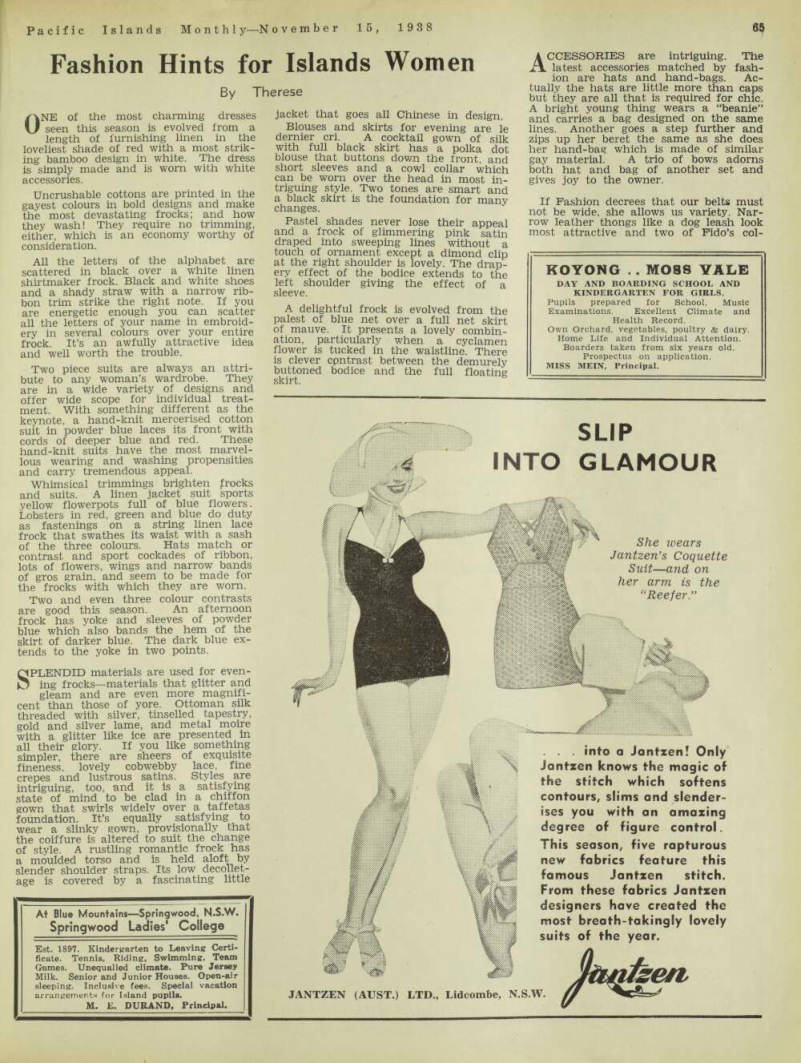
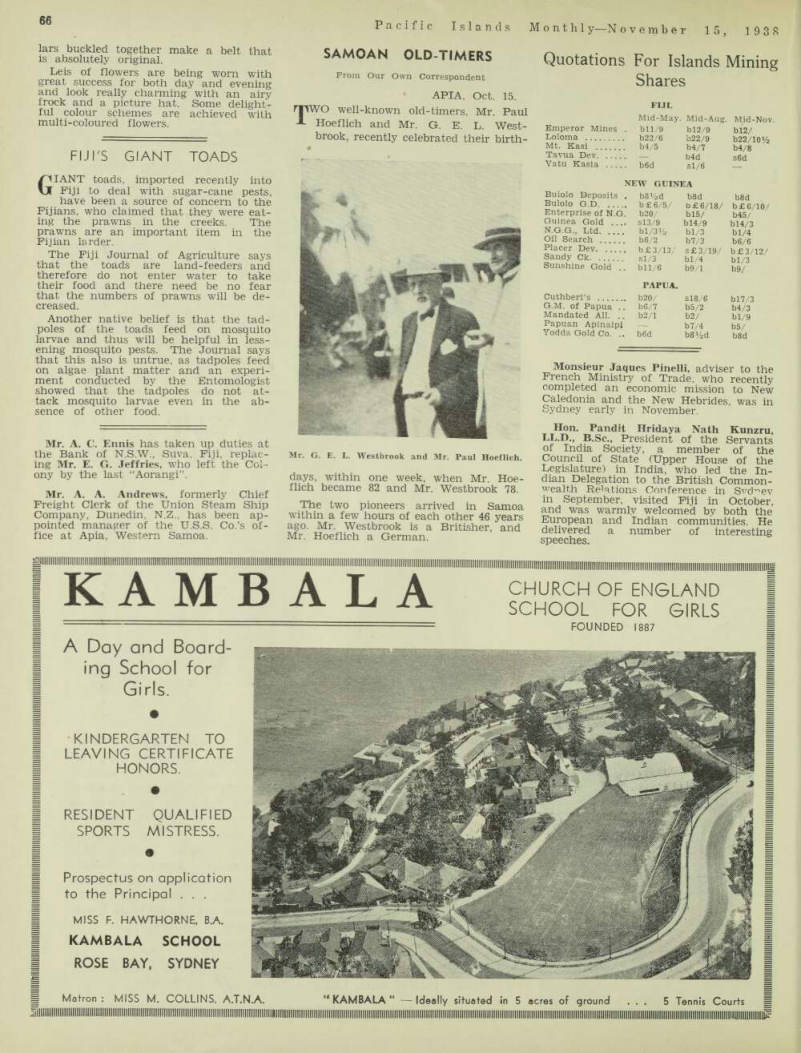
By Therese
ONE of the most charming dresses seen this season is evolved from a length of furnishing linen in the loveliest shade of red with a most strik ing bamboo design in white. The dress is simply made and is worn with white accessories.
Uncrushable cottons are printed in the gayest colours in bold designs and make the most devastating frocks; and how they wash! They require no trimming, either, which is an economy worthy of consideration.
All the letters of the alphabet are scattered in black over a white linen shirtmaker frock. Black and white shoes and a shady straw with a narrow rib bon trim strike the right note. If you are energetic enough you can scatter all the letters of your name in embroid ery in several colours over your entire frock. It’s an awfully attractive idea and well worth the trouble.
Two piece suits are always an attri bute to any woman’s wardrobe. They are in a wide variety of designs and offer wide scope for individual treat ment. With something different as the keynote, a hand-knit mercerised cotton suit in powder blue laces its front with cords of deeper blue and red. These hand-knit suits have the most marvel lous wearing and washing propensities and carry tremendous appeal.
Whimsical trimmings brighten frocks and suits. A linen jacket suit sports yellow flowerpots full of blue flowers.
Lobsters in red, green and blue do duty as fastenings on a string linen lace frock that swathes its waist with a sash of the three colours. Hats match or contrast and sport cockades of ribbon, lots of flowers, wings and narrow bands of gros grain, and seem to be made for the frocks with which they are worn.
Two and even three colour contrasts are good this season. An afternoon frock has yoke and sleeves of powder blue which also bands the hem of the skirt of darker blue. The dark blue ex tends to the yoke in two points.
SPLENDID materials are used for even ing frocks —materials that glitter and gleam and are even more magnifi cent than those of yore. Ottoman silk threaded with silver, tinselled tapestry, gold and silver lame, and metal moire with a glitter like ice are presented in all their glory. If you like something simpler, there are sheers of exquisite fineness, lovely cobwebby lace, fine crepes and lustrous satins. Styles are intriguing, too, and it is a satisfying state of mind to be clad in a chiffon gown that swirls widely over a taffetas foundation. It’s equally satisfying to wear a slinky gown, provisionally that the coiffure is altered to suit the change of style. A rustling romantic frock has a moulded torso and is held aloft by slender shoulder straps. Its low decollet age is covered by a fascinating little
jacket that goes all Chinese in design.
Blouses and skirts for evening are le dernier cri. A cocktail gown of silk with full black skirt has a polka dot blouse that buttons down the front, and short sleeves and a cowl collar which can be worn over the head in most in triguing style. Two tones are smart and a black skirt is the foundation for many changes.
Pastel shades never lose their appeal and a frock of glimmering pink satin draped into sweeping lines without a touch of ornament except a dimond clip at the right shoulder is lovely. The drap ery effect of the bodice extends to the left shoulder giving the effect of a sleeve.
A delightful frock is evolved from the palest of blue net over a full net skirt of mauve. It presents a lovely combin ation, particularly when a cyclamen flower is tucked in the waistline. There is clever cpntrast between the demurely buttoned bodice and the full floating skirt.
ACCESSORIES are intriguing. The latest accessories matched by fash ion are hats and hand-bags. Ac tually the hats are little more than caps but they are all that is required for chic.
A bright young thing wears a “beanie” and carries a bag designed on the same lines. Another goes a step further and zips up her beret the same as she does her hand-bag which is made of similar gay material. A trio of bows adorns both hat and bag of another set and gives joy to the owner.
If Fashion decrees that our belts must not be wide, she allows us variety. Nar row leather thongs like a dog leash look most attractive and two of Pido’s col
lars buckled together make a belt that is absolutely original.
Leis of flowers are being worn with great success for both day and evening and look really charming with an airy frock and a picture hat. Some delight ful colour schemes are achieved with multi-coloured flowers.
Advertisements & other items, p. 69 (2 items)
65
Pacific Islands Monthl y—N ovember 15, 1938
Into Glamour
KOYONG .. MOSS YALE
DAY AND BOARDING SCHOOL AND
KINDERGARTEN FOR GIRLS.
Pupils prepared for School, Music Examinations, Excellent Climate and Health Record.
Own Orchard, vegetables, poultry & dairy.
Home Life and Individual Attention.
Boarders taken from six years old.
Prospectus on application.
MISS MEIN, Principal.
SLIP
INTO GLAMOUR
L £, She wears Jantzen’s Coquette Suit—and on her arm is the “Reefer” . . into a Jantzen! Only Jantzen knows the magic of the stitch which softens contours, slims and slenderises you with an amazing degree of figure control.
This season, five rapturous new fabrics feature this famous Jantzen stitch.
From these fabrics Jantzen designers have created the most breath-takingly lovely suits of the year.
JANTZEN (AUST.) LTD., Lidcombe, N.S.W.
At Blue Mountains—Springwood, N.S.W.
Springwood Ladies' College
Est. 1897. Kindergarten to Leaving Certificate. Tennis. Riding, Swimming. Team Games. Unequalled climate. Pure Jersey Milk. Senior and Junior Houses. Open-air sleeping. Inclusive fees. Special vacation arrangements for Island pupils.
M. £. DURAND. Principal.
Fiji's Giant Toads
GIANT toads, imported recently into Fiji to deal with sugar-cane pests, have been a source of concern to the Fijians, who claimed that they were eat ing the prawns in the creeks. The prawns are an important item in the Fijian larder.
The Fiji Journal of Agriculture says that the toads are land-feeders and therefore do not enter water to take their food and there need be no fear that the numbers of prawns will be de creased.
Another native belief is that the tad poles of the toads feed on mosquito larvae and thus will be helpful in less ening mosquito pests. The Journal says that this also is untrue, as tadpoles feed on algae plant matter and an experi ment conducted by the Entomologist showed that the tadpoles do not at tack mosquito larvae even in the ab sence of other food.
Mr. A. C. Ennis has taken up duties at the Bank of N.S.W., Suva, Fiji, replac ing Mr. E. G. Jeffries, who left the Col ony by the last “Aorangi”.
Mr. A. A. Andrews, formerly Chief Freight Clerk of the Union Steam Ship Company, Dunedin, N.Z.. has been ap pointed manager of the U.S.S. Co.’s of fice at Apia, Western Samoa.
Samoan Old-Timers
From Our Own Correspondent
Apia. Oct. 15.
rpWO well-known old-timers, Mr. Paul A Hoeflich and Mr. G. E. L. West brook, recently celebrated their birth-
days, within one week, when Mr. Hoe flich became 82 and Mr. Westbrook 78.
The two pioneers arrived in Samoa within a few hours of each other 46 years ago. Mr. Westbrook is a Britisher, and Mr. Hoeflich a German.
Mr. G. E. L. Westbrook and Mr. Paul Hoeflich.
Quotations For Islands Mining
Shares
Monsieur Jaques Pinelli, adviser to the French Ministry of Trade, who recently completed an economic mission to New Caledonia and the New Hebrides, was in Sydney early in November.
Hon. Pandit Hridaya Nath Kunzru, LL.D., B.Sc., President of the Servants of India Society, a member of the Council of State (Upper House of the Legislature) in India, who led the In dian Delegation to the British Common wealth Relations Conference in in September, visited Fiji in October, and was warmly welcomed by both the European and Indian communities. He delivered a number of interesting speeches.
Fiji.
Mid-May. Mid-Aug. Mid-Nov.
Emperor Mines . bll/9 b!2/9 b!2/ Loloma b22/6 b22/9 b22/10V 2 Mt. Kasl b4/5 b4/7 b4/8 Tavua Dev b4d $6d Vatu Kasia b6d sl/6
new guinea Bulolo Deposits . bSVad b8d b8d Bulolo G.D. ... . b £ 6/5/ b£6/18/ b £ 6/10/ Enterprise of N.G. b20 bl5/ b45/ Guinea Gold ..
S13/9 bl4/9 bl4/3 N.G.G., Ltd. ... bl/3y a bl/3 bl/4 Oil Search . b6/2 b7/3 b6/6 Placer Dev. .. . b £3/13/ s£3/19/ b£3/12/ Sandy Ck . sl/3 bl/4 bl/3 Sunshine Gold . bll/6 b9/l b9/
Papua.
Cuthbert’s b20/ S18/6 bl7 3 G.M. of Papua ,. b6/7 b5/2 b4/3 Mandated All. .. b2/l b2/ bl/9 Papuan Apinaipi — b7/4 b5/ Yodda Gold Co. .. b6d b8»/ 2 d b8d
Advertisements & other items, p. 70 (2 items)
66
Pacific Islands Monthl y—N ovember 15, 1938
Kamb A L A
CHURCH OF ENGLAND
SCHOOL FOR GIRLS
A Day and Board-
ing School for
Girls.
KINDERGARTEN TO
LEAVING CERTIFICATE
HONORS.
RESIDENT QUALIFIED
SPORTS MISTRESS.
Prospectus on application to the Principal . . .
MISS F. HAWTHORNE, BA.
KAMBALA SCHOOL
ROSE BAY, SYDNEY
Matron : MISS M. COLLINS. A.T.N.A.
FOUNDED 1887
■ m A; ■■ Li m KAMBALA " Ideally situated in 5 acres of ground 5 Tennis Courts
Pacific Mining
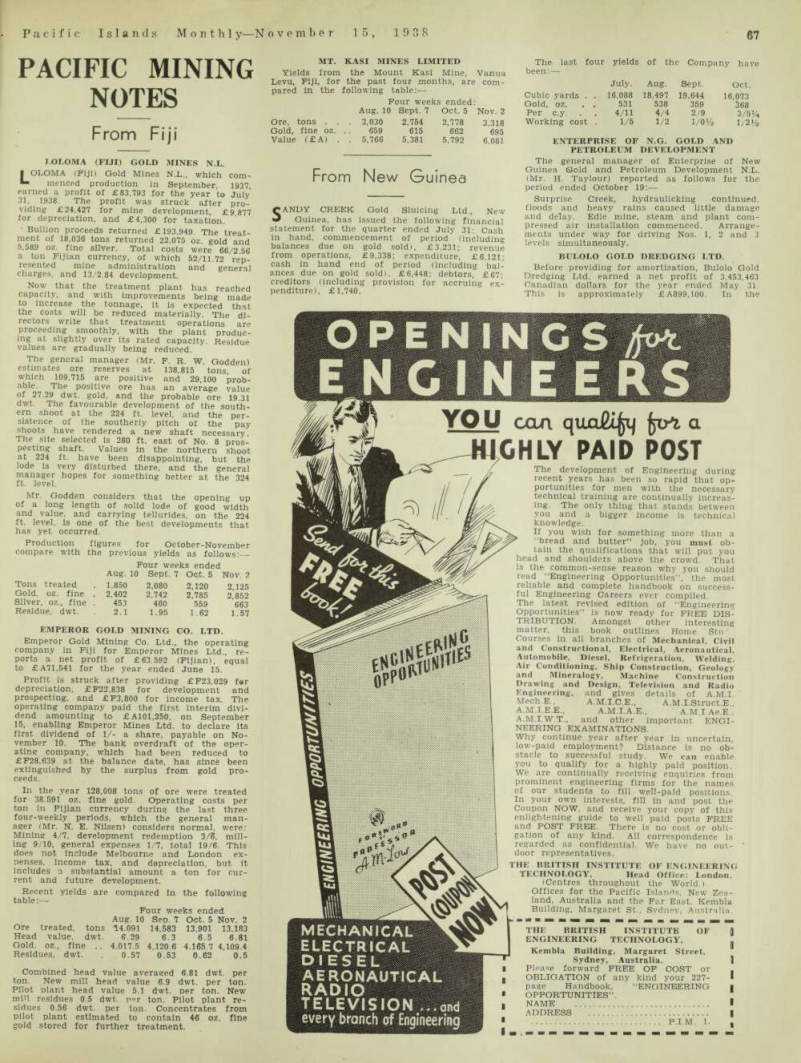
Notes
From Fiji
I.Oloma (Fiji) Gold Mines N.L.
I OLOMA (Fiji) Gold Mines N.L., which com menced production in September, 1937 earned a profit of £83,793 for the year to July 31, 1938. The profit was struck after pro viding £24,427 for mine development, £9 877 for depreciation, and £4,300 for taxation.
Bullion proceeds returned £193,949. The treat ment of 18.036 tons returned 22,075 oz. gold and 5,589 oz. fine silver. Total costs were 66/2 56 a ton Fijian currency, of which 52/11.72 rep resented mine administration and general charges, and 13/2.84 development.
Now that the treatment plant has reached capacity, and with improvements being made to increase the tonnage, it is expected that the costs will be reduced materially. The di rectors write that treatment operations are proceeding smoothly, with the plant produc ing at slightly over its rated capacity. Residue values are gradually being reduced.
The general manager (Mr. F. R. W, Godden) estimates ore reserves at 138,815 tons, of which 109,715 are positive and 29,100 prob able. The positive ore has an average value of 27.29 dwt. gold, and the probable ore 19.31 dwt. The favourable development of the south ern shoot at the 224 ft. level, and the per sistence of the southerly pitch of the pay shoots have rendered a new shaft necessary The site selected is 280 ft. east of No. 8 pros pecting shaft. Values in the northern shoot at 224 ft. have been disappointing, but the lode is very disturbed there, and the general manager hopes for something better at the 324 ft. level.
Mr. Godden considers that the opening up of a long length of solid lode of good width and value, and carrying tellurides, on the 224 ft. level, Is one of the best developments that has yet occurred.
Production figures for October-November compare with the previous yields as follows:
Emperor Gold Mining Co. Ltd.
Emperor Gold Mining Co. Ltd., the operating company in Fiji for Emperor Mines Ltd., re ports a net profit of £63.592 (Fijian), equal to £ A 71.541 for the year ended June 15.
Profit is struck after providing £F23,029 for depreciation, £F22.838 for development and prospecting, and £F3,800 for income tax. The operating company paid the first interim divi dend amounting to £A101,250, on September 15, enabling Emperor Mines Ltd. to declare its first dividend of 1/- a share, payable on No vember 10. The bank overdraft of the oper ating company, which had been reduced to £F28,639 at the balance date, has since been extinguished by the surplus from gold pro ceeds.
In the year 128,008 tons of ore were treated for 38 591 oz. fine gold. Operating costs per ton in Fijian currency during the last three four-weekly periods, which the general man ager (Mr. N. E. Nilsen) considers normal, were; Mining 4/7, development redemption 3/8, mill ing 9/10, general expenses 1/7, total 19/6. This does not Include Melbourne and London ex penses, income tax, and depreciation, but it includes a substantial amount a ton for cur rent and future development.
Recent yields are compared In the following table:—
Combined head value averaged 6.81 dwt. per ton. New mill head value 6.9 dwt. per ton.
Pilot plant head value 5.1 dwt. per ton. New mill residues 0.5 dwt. p°r ton. Pilot plant re sidues 0.56 dwt. per ton. Concentrates from pilot plant estimated to contain 46 oz. fine gold stored for further treatment.
Mt. Kasi Mines Limited
Yields from the Mount Kasi Mine, Vanua Levu, Fiji, for the past four months, are com pared in the following table: —
Four weeks ended Aug. 10 Sept. 7 Oct. 5 Nov. 2 Tons treated 1.850 2,080 2.120 2,125 Gold, oz. fine . 2,402 2.742 2,785 2,852 Silver, oz.. fine . 453 460 559 663 Residue, dwt. 2.1 1.95 1.62 1.57
Four weeks ended Aug. 10 Sep. 7 Oct. 5 Nov. 2 Ore treated, tons 14.091 14.583 13,901 13.183 Head value, dwt. 6.29 6.3 6.5 6.81 Gold, oz., fine .. 4,017.5 4,120.6 4.165,7 4.109.4 Residues, dwt. 0.57 0.53 0.62 0.5
Four weeks ended: Aug. 10 Sept. 7 Oct. 5 Nov. 2 Ore. tons . . . 3,030 2,754 2,778 3,318 Gold, fine oz. .. 659 615 662 695 Value (£ A) . . 5,766 5,381 5,792 6.081
From New Guinea
SANDY CREEK Gold Sluicing Ltd., New Guinea, has issued the following financial statement for the quarter ended July 3i : Cash in hand, commencement of period (including balances due on gold sold), £3,231; revenue from operations, £9,338; expenditure, £6,121; cash in hand end of period (including bal ances due on gold sold), £6,448; debtors, £67; creditors (including provision for accruing ex penditure), £1,740.
The last four yields of the Company have been:—
Enterprise Of N.G. Gold And
Petroleum Development
The general manager of Enterprise of New Guinea Gold and Petroleum Development N.L. (Mr. H. Taylour) reported as follows for the period ended October 19;— Surprise Creek, hydraulicking continued, floods and heavy rains caused little damage and delay. Edie mine, steam and plant com pressed air installation commenced. Arrange ments under way for driving Nos. 1, 2 and 3 levels simultaneously.
Bulolo Gold Dredging Ltd.
Before providing for amortisation, Bulolo Gold Dredging Ltd. earned a net profit of 3,453,463 Canadian dollars for the year ended May 31 This is approximately £A899,100. In the
July.
Aug.
Sept.
Oct.
Cubic yards . . 16,088 18,497 19,644 16,073 Gold, oz. . . 531 538 359 368 Per c.y. . 4/11 4/4 2/9 3/5V 4 Working cost . 1/5 1/2 i/o y 2 1/2 y 2
previous year, the profit was 3,585,975 dollars before providing for amortisation.
Cabled advice states that dredgable gravel re serves at May 31 were 192,000,000 cubic yards, and about 20,000,000 further yards which will be handled hydraulically. Dredge No. 7, which is now under construction, should be com pleted during March of next year. The con struction of a further dredge, No. 8, has been decided upon, and it is expected that it will be operating by the middle of 1939.
Production of the Co.’s dredges in New Guinea from July to September has been:
Throughout September the No. 2 dredge was digging in very low values, through a gorge to a new location, which has now been reached.
Bulolo Gold Deposits Ltd.
The following yields have been reported by Bulolo Gold Deposits, New Guinea:—
This is the final clean-up before handing over the leases to New Guinea Goldfields Ltd.
Sunshine Gold Development Ltd.
Sunshine Gold Development Ltd., New Guinea, reports that the clean-up for October yielded 4500 z. gold. A dividend of 6d. per share has been declared payable on Decem ber 12. Books will close on December 1.
New Guinea Goldfields Limited
The following progress report for September has been issued by the Mining Trust Limited consulting engineers for N.G. Goldfields Ltd.—
July.
Aug.
Sept.
Cubic yards . , , . 1,232,000 1.249,000 1,138.000 Bullion, oz. 19,667 23,492 15,271 Gold, fine oz. . 13,569 16,209 10,537 Value— Aust. currency* . £118,729 £141,829 £92,199 Value, per c.y. /23.1 /27.2 /10.4 WorKing profit £77,875 £100,695 £63,875 • At £ A8/15/per fine ounce.
Aug. 4, Sept. 4, Sept. 26, to to to Sept. 6.
Sept. 25.
Nov. 3.
Morobe Alluvials— Hours 600 290 750 Cubic yards 7,500 2,000 8.700 Gold, oz. . 140 50 209.55 Morobe Deposits— Hours 525 300 480 Cubic yards . . 8,500 4,500 4,000 Gold, oz. . . 45 30 50
July.
Aug.
Sent.
Edre Creek Mill— Pine gold, oz. .. 1,208 1,154 1,162 Silver, oz 4,052 3,865 3.734 Operating profit . . £2,771 £2,532 £3.071 Alluvial— Pine gold, oz. .. 1,120 809 785 Silver, oz 797 612 572 Operating profit £4,395 £2,700 Nil.
Golden Ridges— Treated, tons .. — *1,200 1,633 Gold, fine oz. . . , . 113 401 Silver, oz — 116 542 Operating loss .. .. £1,005 Operating profit . — — £300 ♦Reconstructed mill run in on low-grade tailmgs.
Advertisements & other items, pp. 71-72 (2 items)
67
Pacific Islands Month! y—N ovember 15, 19 3 B
Engineers
OPENINGS A*.
YOU can a
HIGHLY PAID POST
l The development of Engineering
iiStuw
pflP
OP
MECHANICAL
ELECTRICAL
DIESEL
AERONAUTICAL
RADIO
TELEVISION ...and
every branch of Engineering
Engineering during recent years has been so rapid that opportunities for men with the necessary technical training are continually increasing. The only thing that stands between you and a bigger income is technical knowledge.
If you wish for something more than a •'bread and butter” Job, you must obtain the qualifications that will put you head and shoulders above the crowd. That is the common-sense reason why you should read ‘‘Engineering Opportunities”, the most reliable and complete handbook on successful Engineering Careers ever compiled.
The latest revised edition of “Engineering Opportunities” is now ready for FREE DIS- TRIBUTION. Amongst other interesting matter, this book outlines Home Stir’
Courses in all branches of Mechanical. Civil and Constructional, Electrical, Aeronautical, Automobile, Diesel, Refrigeration, Welding, Air Conditioning. Ship Construction, Geology and Mineralogy, Machine Construction Drawing and Design, Television and Radio Engineering, and gives details of A.M.I, Mech.E., A.M.1.C.E., A.M.l.Struct.E..
A.M.1.E.E., A.M.1.A.E.. A.M.I.Ae.E .
A.M.I. W.T., and other important ENGI-
NEERING EXAMINATIONS.
Why continue year after year in uncertain, low-paid employment? Distance is no obstacle to successful study. We can enable you to qualify for a highly paid position.
We are continually receiving enquiries from prominent engineering firms for the names of our students to fill well-paid positions.
In your own interests, fill in and post the Coupon NOW, and receive your copy of this enlightening guide to well paid posts FREE and POST FREE. There is no cost or obligation of any kind. All correspondence is regarded as confidential. We have no outdoor representatives.
THE BRITISH INSTITUTE OF ENGINEERING
TECHNOLOGY, Head Office: London. (Centres throughout the World.) Offices for the Pacific Islands. New Zealand, Australia and the Far East, Kembla Building, Margaret St., Svdnev, Australia.
THE BRITISH INSTITUTE OF
ENGINEERING TECHNOLOGY,
Kembla Building, Margaret Street, Sydney, Australia.
Please forward FREE OF COST or OBLIGATION of any kind your 227page Handbook, “ENGINEERING
OPPORTUNITIES”.
NAME
ADDRESS
P.I.M. 1.
FLIT
kills
MOSQUITOES.
FLIT is now the most deadly to household insects because it contains a of agents found in other insecticide.
6 Horse Power Single Cylinder Engine, uses either kerosene or benzine. Direct coupled to Sin. centrifugal pump. No foundations necessary.
Pumps 25,000 Gallons on One Gallon of Benzine,
PUMPMOBIL
self-contained, truly portable
—weighs only 120 lb.
Ideal Plant for Mining in all its branches and for all Irrigation purposes.
Pumps 15,000 gallons per hour. Fuel consumption—half gallon per hour.
Units may be inspected at Wau Carrying Company, Wau. Particulars from— NELSON & ROBERTSON PTY. LIMITED, 12 Spring Street, Sydney
Mine Owners and Contractors
BRING YOUR PLANT Up-t O-date
USE
Automatic Rockbreakers
AND Drills
Q These Machines are a SELF-CONTAINED UNIT and require no Air Compressor or Pipe Lines.
They are ready for work at all times.
Q Owing to their Light Weight can be transported very easily.
Address enquiries to:
Continental Compensations Pty. Ltd.,
422 COLLINS ST., MELBOURNE, VIC.
From Papua
Cuthbert’S Misima Goldmine Ltd.
piGURES for the monthly clean-up on Octo s ber 23 from Cuthbert’s Misima mine, East ern Papua, compare with the previous two months as follows:
(Gold at £AB per oz.) £6,684 £6,797 £6,345 Value per ton .. .. 46/9 46/9 43/10 Total development for September:—377 ft., 490 tons of ore won from development, 2,415 tons from stoping, total 2,905 tons, average assay: Gold 6 dwts. 5 grs. p.t. Silver: 36 dwts. p.t.
September was the wettest month for some time —29 inches of rain being recorded.
Papuan Apinaipi Petroleum Co. Ltd.
Papuan Apinaipi Petroleum Co. Ltd. reported on November 8 that the Oiapu bore had reach ed a depth of 1,124 ft. Heavy gas at a pres sure of 400 lb. per sq. inch was encountered at a depth of 1,062 ft., and persisted to 1,065 ft. In order to expedite the programme of test boreholes at Oiapu, referred to in the report of Dr. Wade and Dr. Ward, the present well has been plugged, and the drill transferred to the site of the next well.
The Company’s geologist, Mr. Owen, reports that the present bore has given all the geo logical information hoped for, and in view of the data obtained he is of the opinion that it will not be necessary to await the comple tion of detailed geological mapping before deep drilling can be commenced.
The Company decided to make a new issue of 150,000 shares of 5/- each at par, to be offered to shareholders in the proportion of three new shares for every two held.
Gold Mines Of Papua Ltd,
Comparative monthly returns from Gold Mines of Papua Ltd., Misima Island, show: —
Yodda Goldfields Ltd.
The management of Yodda Goldfields Lim ited, Papua, reported early in November that the output for the month of October was 55 oz. 5V2 dwt.
Mr. Ernst Hansen, a representative of an English business house in Japan, mar ried Mrs. Eileen Spencer at Salamaua.
New Guinea, in October. They will join the K.P.M. steamer “Maetsuycker” this month at Port Moresby for Sourabaya and then go on to Japan.
Aug.
Sept.
Oct.
Treated, tons .. .. 2,858 2,905 2,895 Bullion, oz 2,872 2.922 2,575 Gold, fine oz. 822 835 782 Silver, fine oz.
Est. value— 1,939 1,986 1,723
July.
Aug.
Sept.
Oct.
Crushed, tons . 2,190 2,128 2,750 2,540 Gold, oz., fine — — 396 334 Silver, oz. . . — — 1,749 1,220 Value ... £2,575 £2,705 £3,620 £3,050 Residues, gr. . — 6 7 6
Advertisements & other items, p. 72 (1 item)
68
Pacific Islands Monthl y—N ovember 15, 1938
Fiji Logs For Sydney
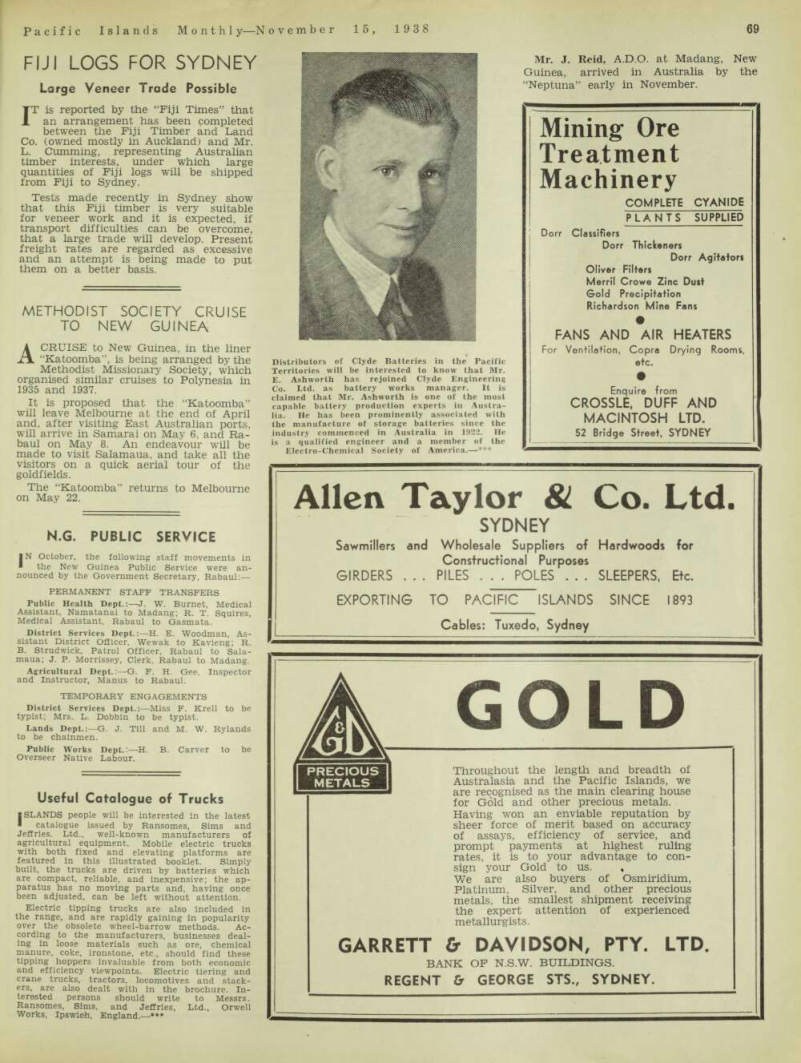
Large Veneer Trade Possible
IT is reported by the “Fiji Times” that an arrangement has been completed between the Fiji Timber and Land Co. (owned mostly in Auckland) and Mr.
L. Gumming, representing Australian timber interests, under which large quantities of Fiji logs will be shipped from Fiji to Sydney.
Tests made recently in Sydney show that this Fiji timber is very suitable for veneer work and it is expected, if transport difficulties can be overcome, that a large trade will develop. Present freight rates are regarded as excessive and an attempt is being made to put them on a better basis.
Methodist Society Cruise
To New Guinea
A CRUISE to New Guinea, in the liner “Katoomba”, is being arranged by the Methodist Missionary Society, which organised similar cruises to Polynesia in 1935 and 1937.
It is proposed that the “Katoomba” will leave Melbourne at the end of April and, after visiting East Australian ports, will arrive in Samarai on May 6, and Ra baul on May 8. An endeavour will be made to visit Salamaua, and take all the visitors on a quick aerial tour of the goldfields.
The “Katoomba” returns to Melbourne on May 22.
N.G. Public Service
IN October, the following staff movements in ■ the New Guinea Public Service were an nounced by the Government Secretary, Rabaul:—
Permanent Staff Transfers
Public Health Dept.:—J. W. Burnet, Medical Assistant, Namatanai to Madang; R. T. Squires, Medical Assistant, Rabaul to Gasmata.
District Services Dept.:—H. E. Woodman, As sistant District Officer, Wewak to Kavieng; R.
B. Strudwick, Patrol Officer, Rabaul to Sala maua; J. P. Morrissey, Clerk, Rabaul to Madang.
Agricultural Dept.:—G. F. H. Gee, Inspector and Instructor, Manus to Rabaul.
Temporary Engagements
District Services Dept.:—Miss F. Krell to be typist; Mrs. L. Dobbin to be typist.
Lands Dept.:—G. J. Till and M. W. Rylands to be chainmen.
Public Works Dept.:—H. B. Carver to be Overseer Native Labour.
Useful Catalogue of Trucks
ISLANDS people will be interested in the latest catalogue issued by Ransomes, Sims and Jeffries. Ltd., well-known manufacturers of agricultural equipment. Mobile electric trucks with both fixed and elevating platforms are featured in this illustrated booklet. Simply built, the trucks are driven by batteries which are compact, reliable, and inexpensive; the ap paratus has no moving parts and, having once been adjusted, can be left without attention.
Electric tipping trucks are also included in the range, and are rapidly gaining in popularity over the obsolete wheel-barrow methods. Ac cording to the manufacturers, businesses deal ing in loose materials such as ore, chemical manure, coke, ironstone, etc., should find these tipping hoppers invaluable from both economic and efficiency viewpoints. Electric tiering and crane trucks, tractors, locomotives and stack ers, are also dealt with in the brochure. In terested persons should write to Messrs.
Ransomes, Sims, and Jeffries, Ltd., Orwell Works, Ipswich, England.—***
Mr. J. Reid, A.D.O. at Madang, New Guinea, arrived in Australia by the “Neptuna” early in November.
Distributors of Clyde Batteries in the Pacific Territories will be interested to know that Mr.
E. Ashworth has rejoined Clyde Engineering Co. Ltd. as battery works manager. It is claimed that Mr. Ashworth is one of the most capable battery production experts in Austra lia. He has been prominently associated with the manufacture of storage batteries since the industry commenced in Australia in 1922. He is a qualified engineer and a member of the Electro-Chemical Society of America.
Advertisements & other items, pp. 73-74 (3 items)
69
Pacific Islands Mont hi y—N ovember 15, 1938
Gold
Mining Ore
Treatment
Machinery
COMPLETE CYANIDE
PLANTS SUPPLIED
Dorr Classifiers Dorr Thickeners Dorr Agitators Oliver Filters Merril Crowe Zinc Dust Gold Precipitation Richardson Mine Pans •
FANS AND AIR HEATERS
For Ventilation, Copra Drying Rooms, etc. • Enquire from
CROSSLE, DUFF AND
MACINTOSH LTD.
52 Bridge Street, SYDNEY
Allen Taylor Co. Ltd.
SYDNEY
Sawmillers and Wholesale Suppliers of Hardwoods for Constructional Purposes GIRDERS . . . PILES . . . POLES . . . SLEEPERS. Etc.
EXPORTING TO PACIFIC ISLANDS SINCE 1893
Cables: Tuxedo, Sydney
A
GOLD
Throughout the length and breadth of Australasia and the Pacific Islands, we are recognised as the main clearing house for Gold and other precious metals.
Having won an enviable reputation by sheer force of merit based on accuracy of assays, efficiency of service, and prompt payments at highest ruling rates, it is to your advantage to consign your Gold to us. , We are also buyers of Osmiridium, Platinum, Silver, and other precious metals, the smallest shipment receiving the expert attention of experienced metallurgists.
GARRETT & DAVIDSON, PTY. LTD.
BANK OF N.S.W. BUILDINGS.
REGENT & GEORGE STS. SYDNEY.
HIGHEST GRADE AMERICAN
RESSED STEEL MODEL TOYS
BUY NOW or LAY-BY for XMAS.
Wholesale or Retail.
Sets, Bats, Balls, cocks, Shuttlecock etc. Write for full Table Tennis Nets, Shuttle- Sets, Bats lists. 2/6, 2/9, 3/6, 7/6.
Adjustable all' way Morse Code Key as illustrated. 12/6.
P.M.G. Type, 19/6.. Buzzers Gramophone Recording Units, overhead cutting Gear, with cutting Lead: £B/10/-. Motors: 84/-, £ 5/5/-. Microphones, Needles.
Blank Records, etc., etc. Write for particulars. Sample Amplifiers supplied.
A d j u s table Electric Forehead Torch Fits snugly; for Professional Men B andsmen Miners, etc.: 10/6. With separate Torch Battery Container: 18/6.
I .®aS
No. 600—CORD ROADSTER, 10/9. Exact
Replica. Fitted with strong Clockwork motor, rubber tyres, etc. Length, 15in.
No. 245—CITY DELIVERY VAN, 4/6. All
Steel Model, with opening door at rear for parcels Without Motor. Length, 12in.
No. 337—RACING CAR, 12/6. Replica of Major Seagrave’s Golden Arrow Racer.
Fitted with rubber tyres and extra strong, fast clockwork motor. Length, 18in,
No. 253—SEDAN WITH LIGHTS, 15/-.
Model of Airflow Chrysler Sedan, complete with Electric headlights, rubber tyres and strong spring motor. Length, 15in.
No. 275—AERIAL LADDER TRUCK, 12/6.
Model of American Fire Engine, with Extension Ladder. When the engine bumps any object, such as a wall, the ladder automatically extends. Fitted with mo tor. Length of Engine, 18in. Ladder extends 36in.
No. 603—ZEPHYR CAR, 6/6. Mystery Car.
Needs no wmuing. Smart model of Futuristic Roadster. When car is pulled backwards slightly, it automatically speeds on its way when released. Length. lOin.
No. 244.—CAR & TRAILER, 15/-. This
is a splendid Model of a Ford Sedan.
Complete with very attractive detacnable Trailer. All equipped with rubber tyres, and Car with strong Clockwork motor. Length overall, approx. 24in.
Auto Sets for Cars, Planes, Launches, etc.; no Batteries needed; 2 wires to Accumulator (only) needed: £l6/16/-. 16/-. Trouble Free £22/10/- Value.
Buy now or write for particulars.
Buy assembled or build the Air Patrol 2 - valve Battery - operated Radio for all short-wave stations and broadcasts. Easy to operate change over switch. All parts £4/1/6, Valves 28/9, Batteries £2/15/9, Phones 30/-, Speaker 21/3, The set assembled and complete, £l2/14/9. Easiway Charts 6d.
Like-a-Flasn Super Het. Mantle ivioae Electric Radio, 1938-9 designs. £l3/10/ value. NOW £B/10/- CASH.
Trade-in Radios, £5/10/-, £B/10/- £l2/10/-. All reconditioned as new.
Rebuilt 4 Valve Marco 4 Battery Sets n Console Cabinets £B/10/-, A Levenson Creation: The Like-a-Fla“h “Lilliput” Portable Battery Operated Radio Receiver. IT'S NEW. 2 Valves, complete with headphones, aerial, earth, etc. Small, compact, and efficient £7/10/- Complete. Take it with you anywhere you go. The most economical Set ever introduced. Not much larger cnan a cigar box.
Collaro 240 AC Electric Gramo phone Motors, complete, ready to install 49/6. Continental AC-DC 240 Type. £B/8/-. Now £5.
Valves; we guarantee a cheaper price for any replacement. Just send along your order. is “Totem”, a wellmade little game, for Homes, Clubs.
Hotels, etc. Push the starting knob and off spin the 2 reels, one the horses and the other the odds when the spin terminates the Winner and Winner’s Price is clearly shown Cheat and fool-proof, 21/-.
Send for Leaflet.
Electric Dry shavers for 240
A.C. D.C. El-
ectric supply. Write for full list.
“VICO” 75/.
Special price to traders. Write for prices. “Packard” 90/.
CROWN AND ANCHOR SETS, 10/6.
5 Poker Dice, in box .. .. 7/6 and 10/6 In Leather Case, .. .. 7/6, 10/6, 12/6 Head and Tail Dice, Sets of Five, 8/6 and 11/6. Large Transparent 1 to 6 Dice, 1/6 each. Extra Large 2/6.
Electric Train Sets, Loco., Tender, and 12 Rails, 65/, 75/-, 85/-, 95/-.
Transformers, 17/6, 21/-, 25/- Extra. •presto”, the Mysterious Coin-Box!
The most baffling Trick ever conceived 1 Borrow a coin; re quest owner to mark in a way he will identify it again. In exchange for coin hana him a small bakelite box bound up Ask him to open it. Inside he will find a match box, also securely bound. In side this he will find a cloth bag, also bound up. When opened up, he finds the coin he marked, in the bag. This is one of the most mystifying Tricks ever performed. Price, complete with instructions: 2/6, plus postage, 3d.
Llke-a-flash Eliminoi Aerial Kit, for short
(SEES®
dual wave sets.
Aerial Pytyp« Insulators, transport 11 o n blocks and 200 ft. aerial wire, 22/6. Eliminates unwanted aerial and hideous electrical noises from your dual-wave or short-wave set.
Goldring English Pick-up Heads. Suit and Fit all Gramophone Tone Arms.
Type 44/4 Pick-up Head with Builtin Volume Control: 19/6. Type 44/5 Pick-up Head, with Volume Control attached; 21/-. Type 33/3 Pick-up Head with Highly Polished Nickle Finish: 18/6. Bakelite Case Pick-up Head: 16/6.
Swiss Music Boxes for Cigarettes etc.: 21/-, 25/-, 27/6.
We stock all kinds of Dice and Dice Cups. Send for Lists.
Table Type Interesting Pin Games: 12/6, 15/-. Competition Dart Boards 21/-. Others: 2/6, 8/11, 11/6. Competition Brass and Feathered Darts 3 for 5/6. Table Tennis Sets: 7/6 15/-. Model Aeroplane Kits, all types Write for leaflets. Draught Sets 4/6, 6/6, 10/6. Monopoly Sets; 10/6 16/6, 21/-. Bull and Bears 12/6. @0 “Yogi”, The greatest and straightest of all tricks, match size. You keep them guessing or tracing how its done, 2/6.
Microphones. Sing, Play, Recite. GreaJt Fun for Home, Dance, Party, etc., or for use in Factories, Stores, etc. Write for full ramge. Just plug leads of Pick-up into pick-up terminals of any set. 9/6 to £6/6/-.
A// to 0 9 /n All kinds of Test Cases, Portable Cabinets, etc. Made to Order. Prices on application.
Midget Single Jack 1 Hole Mounting 1/3.
“Ormond” British .00035 Single Hole Mount Variable Condensers, with 4in.
Black Polished Bakelite Dial, 15/-.
NOW 7 /6 ,
“Pilot” U.S.A. .00035 Variable Condensers, 11/6, NOW 5/6.
Sterling Silver Cats Whiskers for Crystal Sets 6d.
"Pacent” Shockproof UX Bakelite Vale Sockets. Phospher Bronze Fittings i/3.
Auto Aerials, 2 and 3 Strand Roof Type, 31/, Collapsible Type 21/. Traders, write for Price. Just landed: Range U.S.A. Types.
All Metal, Indestructible Vest Pocket Size, Quick and Easy Cigarette Maker, 6/6.
G r a phoscope 8/6. With it you can copy any Drawing or Photo up to size 6 x 4 in.
Write for full list of Foreign Stamps and Albums.
L«/
MCKOtf
HEAD
mo*n
phone Rubber Pads: ’Phone Cords: 1/6.
As illustrated with long lead fitted. Splendid Reproducer.
Excel lent English Mic r o p h o ne, Table Model, with selfcontained Pre - amplifier unit In Base: 39/6.
These Microphones suit all sets. The leads plug Into the Pickup terminals of the set.
Write for full Illustrated list of the finest range of microphones available.
Sweet Chim Bell. A ELEC!RJC b e autiful SEU unit. Works off Batt. or ChJT T ran sfonner *C*OC 8/6. Write for full list of Radio Gramophone Microphones.
Wates Pocket Meters: 14/-.
Reads 0 to 6, 0 to 15, 0 to 180 volts. 0 to 30 M/A. 2 Reading Pocket Volt Meters 7/6. 3 Reading Meters 10/6.
Emmicol Universal Meter 18/6. 0 to 6, 0 to 150, 0 to 30 M/A, 0 to 2000 ohms 18/6.
Electrical Continental Solder Irons, 240 volts: 15/-. 6 v.
Electric Solder Irons: 22/6.
Large 50 amp. Battery Clips: 1/3 each.
COSMOCOBD*
25 “Like a Flash” British make Gramophone Pickups complete Richards, just arrived 25/- “Cosmocord” 25/- “Cosmocord” De Luxe 32/6 "Cosmocord” high definition SB/6 “Cosmocord” Super de Luxe 45/- Amplion (English) 28/6 B.T.H. Crystal Type 75/-.
Write for Full List.
Write for Punch Board Leaflets
LEVENSON’S RADIO
Write fur Pin-Game, Totem and Odds and Evens Leaflets
GAMES, NOVELTIES AND HOBBIES
226 PITT STREET, SYDNEY
Manufacturers, Importers, and Exporters.
Branches: Radio Cheapside, 240 a Pitt St.
N.S.W., AUSTRALIA
Cable address: “Lcveradioh.” Goods forwarded V.P.P. or Sight Draft. Satisfaction, and Service Guaranteed. We can supply by mail all General Merchandise at a Better Price. Quotations with pleasure.
Please add freight and packing. Write for full list of interesting leaflets of Games, Hobbies, Novelties, and Electrical Goods.
70
Pacific Islands Monthl y—N ovember 15, 1938
Broadcast
Australian Short Wave Broadcast Nov. 20 to Dec. 17
A NATIONAL Short Wave Programme is broadcast daily from Lyndhurst, near Melbourne, Victoria, for listen ers in the Western Pacific. Call signs: Before 6 p.m. VLR3; after 6.15 p.m. VLR.
Wave lengths: Before 6 p.m. 25.25 metres; after 6.15 p.m. 31.23 metres. Frequencies: Before 6 p.m. 11880 Kcs.; after 6.15 p.m. 9580 Kcs.
Am. Daily Weekdays
6.30 Market Reports. 7.10 Music. 8.00 Australian and Overseas News. 8.15 Music. 12.00 Broadcast to Schools, p.m. 12.25 Stock Exchange Reports and London Metal Prices. 12.40 Recorded Music. 1.00 Time Signal, and News Bulletin. 3.00 (Monday, Tuesday, and Friday) Broad cast to Schools. 3.20 (Tuesday and Friday) Classic Music. 5.20 Children’s Session. 5.30 Close (Wednesday, 5.15). 6.30 Comment by “The Watchman.” 6.45 Sporting News. 7.00 (Saturday excluded) Markets and Weather for North Australia. 7.15 Overseas News Service. 7.40 (Tuesday excluded) Talk. 8.50 Australasian News Service. 9.10 (Usually) Musical Programme. 10.50 Musical Programme. 11.20 Late News. 11.30 Close.
P.M. Every Saturday
12.40 Music. 1.15 —5.30 Description of current sporting and athletic events, interspersed with music. 6.30 Markets Summary. 7.35 Sporting Highlights of the Week. 11.00 Dance Music. 12.00 Close.
A.M. Every Sunday
8.00 News Bulletin. 8.20 Musical Programme. 9.30 “On the Land” Session. 9.50 Summary of Week’s News. 11.00 Divine Service, p.m. 1.30 Close. 3.00 Re-open. 6.00 Close. 6.15 Re-open. 6.50 News Bulletin. 8.30 Recordings of Oversea Artists. 9.00 Talk on International Affairs. 10.20 News. 10.30 Close. (Times given are Australian Eastern Stand ard—lo hours ahead of Greenwich Mean Time.)
November 20 To December 17
Nov. 20 (Sun.) —10.30 a.m. “From The Operas”: 7 p.m. New Note Octet; 7.45 Sir Granville Bantock conducting A.B.C. Wireless Orchestra; 9.20 Play.
Nov. 21 (Mon.) —8 p.m. Serial “Labours of Hercules”; 8.30 National Military Band; 9 Re vue; 9.30 Choral Cavalcade; 10.20 Travel Let ter.
Nov. 22 (Tues.) —8 p.m. Play; 8.45 Instru mental Recital; 9 Symphony Hour; 10 Talk; 10.15 Instrumental Trio.
Nov. 23 (Wed.) —7.40 p.m. Talk—“ Bully Hayes”; 8 Request Items; 8.45 “Emma and ’Erbert”; 9.30 Serial.
Nov. 24 (Thurs.)—l.3o p.m. Yarra Glen Races: 8 “The Play’s The Thing”; 9.45 A.B.C.
Symphony Orchestra; 10.15 Harry Bloom’s Band.
Nov. 25 (Fri.) —1.30 p.m. Sheffield Shield Cricket —Qld. v. N.S.W.; 8 “Friday Specials In Rhythm”: 8.30 Community Singing.
Nov. 26 (Sat.) —1.15 p.m. Moonee Valley Races and Qld. v. N.S.W. cricket match; 8 Old-Time Dance.
Nov. 27 (Sun.) —10.15 a.m. Book Review; 10.30
“Prom The Operas”; 7.15 p.m. New Note Oc tet: 7.50 Dance Music; 9 Talk; 9.20 Play.
Nov. 28 (Mon.) —1.30 p.m. Cricket—Qld. v.
N.S.W.; 8 Serial; 8.30 Stephen Yorke; 9 Review; 9.30 “Choral Cavalcade”.
Nov. 29 (Tues.) —1.30 p.m. Cricket—Qld. v.
N.S.W.; 8 Play; 9.30 A.B.C. Symphony Or chestra; 10.50 Dance Music.
Nov. 30 (Wed.) —1.30 p.m. Ballarat Races; 7.40 Talk —“De Rougemont”; 8 Request Items; 9.30 “Captain Kettle”; 9.45 Harry Bloom; 10.15 “Peat Smoke and Heather”.
Dec. 1 (Thurs.) —1.30 p.m. Ballarat Races; 8 “The Play’s The Thing”; 8.50 Lotte Lehmann (Soprano); 9 Orchestral Hour; 10.15 Dance Music.
Dec. 2 (Fri.) —3 p.m. “Adventures in Music”; 8 “Friday Specials in Music”; 8.50 Community Singing.
Dec. 3 (Sat.) —1.15 p.m. Epsom and Canter bury Park Races; 8 Stephen Yorke; 8.30 Schu bert’s Melodies: 8.50 A.B.C. Symphony Orches tra; 9.45 Bridge Talk.
Dec. 4 (Sun.) —10.15 a.m. Book Review; 7 p.m. Talk by Dr. lan Hogbin; 7.15 New Note •Octet; 7.45 A.B.C. Wireless Chorus; 9.20 Play.
Dec. 5 (Mon.) —130 p.m. Caulfield Races; 8 Serial; 8.30 National Military Band; 9 A.B.C.
Wireless Chorus; 9.35 Tropical Review.
Dec. 6 (Tues.) —12 p.m. “Glimpses of Eng lish Literature”; 7.40 Commentary by the “Watchman”; 8 Music and Community Sing ing.
Dec. 7 (Wed.) —7.40 Talk —“Henry Retford”: 8 Request Items; 8.45 “Emma and ’Erbert”; 9.30 Serial; 9.45 Dance Music; 10.15 “Peat Smoke and Heather”, Dec. 8 (Thurs.)— 7.ss p.m. Music; 9.15 A.B.C. Symphony Orchestra; 10 Talk on World Affairs.
Dec. 9 (Fri.) —130 p.m. Cricket—Australia v.
“The Rest”; 8 “Friday Specials in Music”: 8.30 Desmond Tanner at Organ; 8.50 Comedy Harmonists; 9.30 Opera.
Dec. 10 (Sat.) —8 p.m. National Military Band: 8.30 Melodies of Schubert; 8.45 Sym phony Music; 9.45 Musical Programme.
Dec. 11 (Sun.) —10.15 am. Book Review; 10.30 “From the Operas”: 7.50 p.m. Harry Bloom’s Band; 9 Talk on International Affairs.
Dec. 12 (Mon.) —130 p.m. Ascot Trots; 8
(Continued Overleaf)
Serial; 8.30 Stephen Yorke; 8.50 Review; 9.15 Concert; 10.15 Music.
Dec. 13 (Tues.) —3.15 p.m. Cricket—Austra lia v. “The Rest”; 9 A.B.C. Symphony Or chestra; 10.15 Dance Music.
Dec, 14 (Wed.) —1.30 p.m. Mentone Races; 8 Request Items; 8.45 “Emma and ’Erbert”; 9.30
Serial; 9.45 Dance Music; 10.15 “Peat Smoke and Heather”.
Dec. 15 (Thurs.) —1.30 p.m. Pakenham Races; 8 Play; 10 Talk on World Affairs; 10.50 Harry Bloom’s Band.
Dec. 16 (Fri.) —1.30 p.m. Cricket—Vic. v.
Qld. and Vic. Tennis Championships: 8 Jim Davidson’s Band; 8.30 Community Singing.
Dec. 17 (Sat.) —1.15 p.m. Ascot Races; 8 un til 11 Old-Time Dance Music.
Islands Co. Pays 10 Per Cent.
Steamships Trading Co., Ltd., which is a Company of merchants, ship owners ana planters operating in Pa pua, reports a net profit of £17,400 for the year ended June 30.
With £4,934 brought forward there is available £22,332, and a transfer of £B,OOO to reserve for maintenance and renewal of vessels is recommended. The dividend of 10 per cent, requires £10,300, and £4,031 remains to be carried forward. The pro fit was struck after providing £3,829 for depreciation.
During the year the issued capital was increased by 35,924 shares, which were issued at a premium. This premium, less the expenses of issue, was transferred to general reserve. The new capital was used in the development of the Com pany’s merchandise business and ship ping activities, including the purchase of two new vessels for the coastal trade.
Capital is £110,862, and there are re serves of £28,756. Creditors are owed £41.336. Of the total value of assets £195,287, land, buildings, ships and plant represent £79,260. Plantations are valued at £20,983. Debtors owe £59,331, and stocks are shown at £59,331.
Advertisements & other items, pp. 75-76 (2 items)
71
Pacific Islands Month! y — N ovember 15, 1988
Ikc T 0 Ria
BITTER
if wsavm
R AM
rnrr
Th ree Transmissions Daily
Broadcasting on a new schedule, the National Short Wave Station is now almost continuously on the air from 6.30 a.m. until 11.30 p.m. daily. The three transmissions each day comprise:— 6.30 a.m. to 10.15 a.m. (Australian Eastern Standard Time). Call Sign, VLR3. Frequency, 11880 kcs. Wave Length, 25.25 m.
Power, 2 kw. 12 Noon to 6.00 p.m. Call Sign, VLR3.
Frequency, 11880 kcs. Wave Length, 25.25 m. Power, 2 kw. 6.15 p.m. to 11.30 p.m. (12 Midnight on Saturdays). Call Sign, VLR. Frequency, 9580 kcs. Wave Length, 3123 m. Power, 2 kw.
With an increase in power from 1 to 2 kilowatts, the use of a directional aerial, and the variation of wave length for day and evening transmissions, it is hoped that reception in the South Seas will be noticeably improved. The Broadcasting Commission is anxious to receive reports from Islands listeners. Letters should be addressed to Box 1686, G.P.0.. Melbourne, Victoria.
Broadcast Of Copra Prices.
SOUTH SEAS produce prices (Including copra) are broadcast weekly from Sydney as the first Item In the news bulletin from A.W.A.’s world range short-wave station VK2ME each Sunday at 9 p.m., and Monday at 1.30 a.m. (Sydney time). Operating on a 31.28 wave length (9590 kilocycles), VK2ME will transmit programmes in December on Sundays between 4 p.m. and 6 p.m. (0600 —0800 G.M.T.) and 8 p.m. and midnight (1000 —1400 G.M.T.); and on Mondays between midnight and 2.0 a.m.
(1400—1600 G.M.T.).
Copra Quality
Some Practical Aspects
THE following is a review of an article published in the Malayan Agricul tural Journal (Vol. XXV. No. 12, 1937) and written by Mr. F. C. Cooke, of the Straits Settlements Department of Ag riculture;— THERE is no real reason why bad copra should be produced anywhere in the world for, apart from very slight dif ferences in oil content in the nuts of different countries, the quality of the meat is the same in all ripe coconuts J™ 1 ? 1 healthy palms all over the world Differences in quality are due only to differences in care in the preparation of the copra and its subsequent handling and it calls for no great amount of care’ no high technical knowledge and no great expense, to prepare very good copra.
For years the Departments of Agri culture of all copra-producing countries have been trying to educate local produc ers to prepare good copra, and to induce local traders to encourage its production Yet even to-day the general standard of quality of the world’s copra is appalling ly low, in comparison with the standards oi every other primary agricultural pro duce that enters into world trade.
Undoubtedly, one factor that contrib utes to this is the fact that as copra de teriorates, while its oil becomes more acid, while moulds destroy its substance, it unfortunately happens that simultan eously the oil content of the remainder rises. Thus, though deterioration involves loss of weight and loss of quality in the oil and in the cake, yet no decrease even a slight increase—occurs in the
first figure the buyers look at—the oil content of the sample.
This fact, however, does not entirely explain the present unsatisfactory condi tion of the world’s copra, for despite it, the miller of copra is prepared to pay more for good copra than for bad. The higher value of the good oil and cake that he can make from good copra out weighs the greater proportion of oil that he can get from bad copra.
The reason why the amount of deter ioration that occurs in copra is so great as compared with that in other compar able products, such, for instance, as palm oil palm kernels, or cocoa, seems to lie in the system by which it is handled on the world’s markets.
If one ships palm kernels, palm oil or cocoa from West Africa to Liverpool, New York Hamburg or London, one sells on definite well-known clauses which specify the grades of quality with considerable accuracy and which are substantially the same in all these markets. In the case of the two former products, not only can one thus sell on a clause closely defining the quality of the produce, but the con tract also provides for the payment of premia, or deductions of allowance, ac cording to the variation of the parcel from the standard quality specified in the clause. In the case of cocoa, the system of futures, spot markets, and defined grades provides more elaborate machin ery serving the same purpose of combin ing the advantages of forward sale or purchase with a final adjustment of price with very great exactitude according to the exact quality.
For copra we have simply the two grades of f.m.s. and fair merchantable, and the forward sale of these grades as such. Compared to the grade definitions in other products the meaning of these copra terms is extremely vague. Thev really amount to little more than “Fair Average Quality for the country concern ed” and a quality distinctly lower than F.A.Q. but still recognisable as copra.
This vagueness of definition of grades and the inability to buy or sell a stand ard grade forward with subsequent ac curate adjustment of the spot price ac cording to the quality delivered militate to discourage the buyer in the country of origin from paying more for superior quality. Until he does so, efforts to in duce "the producer to prepare a better quality naturally meet with little sponse.
This situation also renders almost im possible the introduction of any satisfac tory system of official grading at source, such as has been introduced in recent years in respect of nearly every other important primary agricultural product that is marketed wholesale.
The special contracts made by some estates for regular sale of “estate quality copra” are not a contradiction of the statements made above; for though in such sales the buyer may get the exact quality he wants, and the seller gets the extra price his quality deserves, both have to sacrifice the great advantage of trading in the ooen market. In any event this only affects estates, not the small holders who produce a large pro portion of the world’s copra.
The considerations set out above are not theoretical ones. Let anyone who is interested in the matter ask, for in stance. Messrs. Cadburys or Messrs. Rown trees if they would like to buy cocoa under the same conditions as copra is bought: and further ask them if they think that the quality of cocoa from West Africa would be what it is to-day if there were not accurate definitions in the standard clauses defining grades of cocoa.
Advertisements & other items, p. 76 (2 items)
72
Pacific Islands Monthl y—N ovember 15, 1938
Air-Cooling!
BENDIX BRINGS:
'k
New efficiency to outboarding!
One-Pull Starting!
Air-Cooling!
OUTBOARDS AS OBEDIENT
as Your Motor Car!
MO TOIL—NO FUSS—Starts cold with a single Pull, Synchronised controls and anti-flood carburetion, Anti-Aircraft ignition. Scintilla Magneto, finest ever used in an Outboard Motor. Eclipse Outboard motors are the only aircooled motors on the market to-day, positive uniform cooling at all speeds and under all conditions. The lowest priced outboard motors in Australia.
Big Twin H.P. Single 2\ H.P. and the Silent Electric £36/10/-. £l9/10/-. £lO/10/-.
RONDAHL LTD., RABAUL. SUB-AGENT: MANDATED TERRITORIES.
Telephone: BW 1851.
BRANCHES: LONDON,
PAUL & GRAY, LIMITED.
82 SUSSEX STREET,
ADELAIDE, NEWCASTLE, SYDNEY. MELBOURNE,
After Hours: FU 8955.
BRISBANE.
Relief for Mortgagors in New
Guinea
A COMMITTEE of Inquiry, consisting of Messrs. G. G. Hogan, M.L.C. (chairman), J. C. Archer, J. C. Mul laly, M.L.C., and R. H. Siggins, has been appointed to advise the Acting-Admin istrator of New Guinea “whether it is necessary or advisable in the interests of the Territory that there should be introduced into the Legislative Council of the Territory legislation for the pur pose of granting relief to mortgagors, and, if so, the nature of such legisla tion”’.
The committee commenced its sittings in Rabaul on November 4.
Mr. H. Dowling, of the District Ser vice Department in New Guinea, has been transferred from Salamaua to Ma dang.
Mr. Roy Smith has taken over the dut ies of clerk in the Kieta District Office, T.N.G.. relieving Mr. Considine.
Advertisements & other items, pp. 77-78 (2 items)
73
Pacific Islands Monthl y—N ovember 15, 1938
Banks’ Island
“ALNWICK ”
KINDERGARTEN
74 BUNDARRA ROAD,
BELLEVUE HILL, SYDNEY.
Boarding School for Children from 2 years.
Qualified Nurse and Teachers.
Special attention to health and diet.
Individual Training under ideal conditions of climate and environment.
MISS E. WARRELL, Principal.
Tel.: FM 5638.
HAIR SCISSOR, 7jin. overall. c> 5/ - cach -
-5/6 each.
D .Of D Solid Steel Blade, Compressed Leather Hunting Knife.
KNIVES AND SCISSORS
POSTED FREE TO THE
ISLANDS FOR CASH.
Best quality Sheffield mode Scissor, 6in. . . 6/6 each.
WRITE TO US FOR OUR ILLUSTRATED
CATALOGUE OF CUTLERY. Posted Free.
W. JNO. BAKER m 5 HUBTE “ ST
LTD.
SYDNEY
till com
BANKS’ ISLAND
SPECIALTIES
Write for particulars of lines in which you arc interested.
Q
LSI I
Cooking Ranges for Wood, Coal, Gas, Oil, Electricity. in 30 seconds.
Builders’ Hardware, Gal Iron, Bituminous Roll Roof Ing, Sheet Lead.
"Petromax”
Rapid Kerosene Hurricane Lanterns and Table Lamps, burn Kerosene.
Light on Kerosene Latest models.
IN BOND PRICES FOR PETROMAX LAMPS AND LANTERNS. 200 C.P.Lanterns,£2/16/6. 300C.P. Rapid Lanterns, £3/5/-.
Ordinary preheating type using petrol for starting:—2oo C.P.
Lanterns, £2/6/6. 300 C.P. Lanterns, £2/16/-. 200 C.P. Rapid Table Lamps. £3/7/6. 300 C.P. Rapid Table Lamps, £3/16/6. »mone. m 6505 '8 unes-late Shopping MuoAY sac pm Catalogue of "Modern (f /W% A A J Home" Fittings nowavailable
JMgJjg 324-330 PITT STREET,
Sanitary-ware. Baths, Basins. Bath Heaters, Wallboard, Asbestos Building Sheets.
“Daspyl”
Valves Brasswork for Engineers and Plumbers.
“Billabong” Pumps For Mining and Irri gation, Windmills, Water Piping, Brass Cocks.
PROPRIETARY LIMITED (INCORPORATED IN VICTORIA!
SYDNEY.
And at Melbourne.
Hush "Silent” Flushers for Pedestal Pans.
“NOX” Electric Lamps.
FOR SALE
PORTABLE, perfect, 50 nice records. £6, packed and put aboard Brisbane.
“Aria”, C/o. “P.1.M.”, Box 3408 R, G.P.0., Sydney.
Manager’s Position
Young Man, 30 years of age, with good merchandising experience, requires Managerial Engagement in the Islands. At present in North Queensland. Salary required not less than £750 per annum.
Reply to— “ Queensland Manager*”, C/o. Pacific Publications Pty. Ltd., Box 3408 R, G.P.0., Sydney,
Penta Marine
Engines
For power and quiet smooth running the Penta Twin is unrivalled. The most popular of the Penta range it is fully equipped with fine built-in Reverse Gear’ and overhead raised chain starter. Runs for approx’ 2 hours on 1 gallon petrol with speed up to 12 mph Suitable for boats up to 30ft. in length.
Easily installed and easily operated.
PRICE, COMPLETE; £B5 EX BOND.
m
Champion Outboard
Motors
2.9 H.P. Speed 1-9 M.P.H.
Fine new outboards weighing only 311 b., suitable for all dinghys, skiffs or boats up to 16ft. long. The fully enclosed full float carburettor ensures easy starting and smooth, sweet running at all speeds.
Full of pep and runs for over 3 hours on 1 gallon petrol.
More Horse Power at less cost.
PRICE COMPLETE; ONLY £l9/17/6 EX BOND.
SHIPCHANDLERY
and
Mining Gear
We have large and complete Stocks of Shipchandlery and Mining Gear. Boat fittings of all descriptions manufactured in our own marine foundry.
We are manufacturers of the wellknown “Pioneer” brand Ash Oars and Tool Handles. Write for free catalogue of any line which may interest you.
TILLEY LAMPS
Burn Kerosene or Petrol with a light of 300 c.p.
Storm, Insect, and Fool Proof. British made.
New type mantle, supported top and bottom, will not shake off. Brass and will not corrode; 11 different models of Lamps suitable for every purpose.
Send for Catalogue.
All-Purpose Lamp and Lajitern (not illustrated) 50/-.
Obtainable from your local agent or
W. KOPSEN AND CO. PTY. LTD.,
70 Clarence St., Sydney.
W.
KOPSEN & CO., PTY., LTD.
70 CLARENCE STREET, SYDNEY
CABLES: “KOPSEN”, SYDNEY.
Unknown Papua
Exploration Supported by Seaplane
From Our Own Correspondent.
Pt. Moresby, Nov. 4.
PREPARATIONS for the flight to re cently-discovered Lake Kutubu, and the carriage thereto of a further year’s supplies for the Police Camp, on the lake, are in progress. Accompanying the Lt.-Governor (Sir Hubert Murray) and other Government officials, will be three patrol officers of the Service Messrs. A. Timperley, A. Atkinson and J.
Bramell, who together, with Patrol Offi cer Adamson (already at the camp) will conduct a series of patrols further in land, using Kutubu as a base.
The seaplane will leave about Novem ber 15.
Lady
Australians Help German Lady Interesting Incident in Rabaul
There was international significance in an event in Rabaul on November 8.
All Rabaul rallied to support a bene fit performance of the Dramatic So ciety, to assist a highly respected resid ent. Miss von Ziegler, who settled there over 20 years ago, and who suffered se vere losses in the eruption. A financial triumph was scored by the president (Mrs. Clive Backhouse) and an artistic triumph by the producer (Mr J E Savage).
A substantial sum is available for the beneficiary. £lO was added to the sum by the German Consulate: and the N G Administration granted Miss von Ziegler a pension of £52 per annum.
Mr G. Furter, pioneer German mer chant in New Guinea, in returning thanks on behalf of Miss von Ziegler said: “This is a true manifestation of the first and foremost quality of the Australian character: The spirit of help and kindness towards those who have met with misfortune such as our Frau lein has suffered. There is always a spontaneous response to any such appeal —there is no difference if the one in need is <pne of your own kith and kin or not.
This has profoundly and deeply stirred Fraulein von Ziegler’s heart, and also the hearts of her countrymen, and this in spite of the anxious times we all went through such a short while ago, with its fears and horrible forebodings.
Let me assure you all of our deepest gratitude. We shall make known to night’s events far and wide, and I pray that this news will be one more stepping stone towards a lasting friendship and understanding between our two great na tions”.
New Caledonia
Resident Says It Should Be Australian or American
Mr. Julius Petersen, A Dane By
birth, and a Frenchman by adop tion, and now a resident of Isle of Pines, New Caledonia, is visiting Sydney.
He is 75 years old. After a seafaring career, he settled on a plantation in Santo, in the New Hebrides, in 1897. In 1927, he sold out.
Mr. Petersen told Sydney newspapers that the New Hebrides Condominium is a failure. The solution he suggested was to divide the territory so that each na tion could have supreme control over one portion.
“Although I am French by adoption”, Mr. Petersen added, “I believe that New Caledonia would be better off in the hands of Australia or the United States”.
Oil Seed Market Review
FAURE’S review of oil and fat markets, issued in London late in October (re ceived by airmail) sees no early pros pect of improvement. Almost all lines are in over-supply. The review says:— “At the present moment, with the en ormous wheat crops and the plentiful supplies of oils and fats, it is difficult to see how the expected trade revival in the U.S.A. will spread to the oil and oil seed markets”.
Advertisements & other items, p. 78 (1 item)
74
Pacific Islands Monthl y—N ovember 15, 1938
Market Quotations
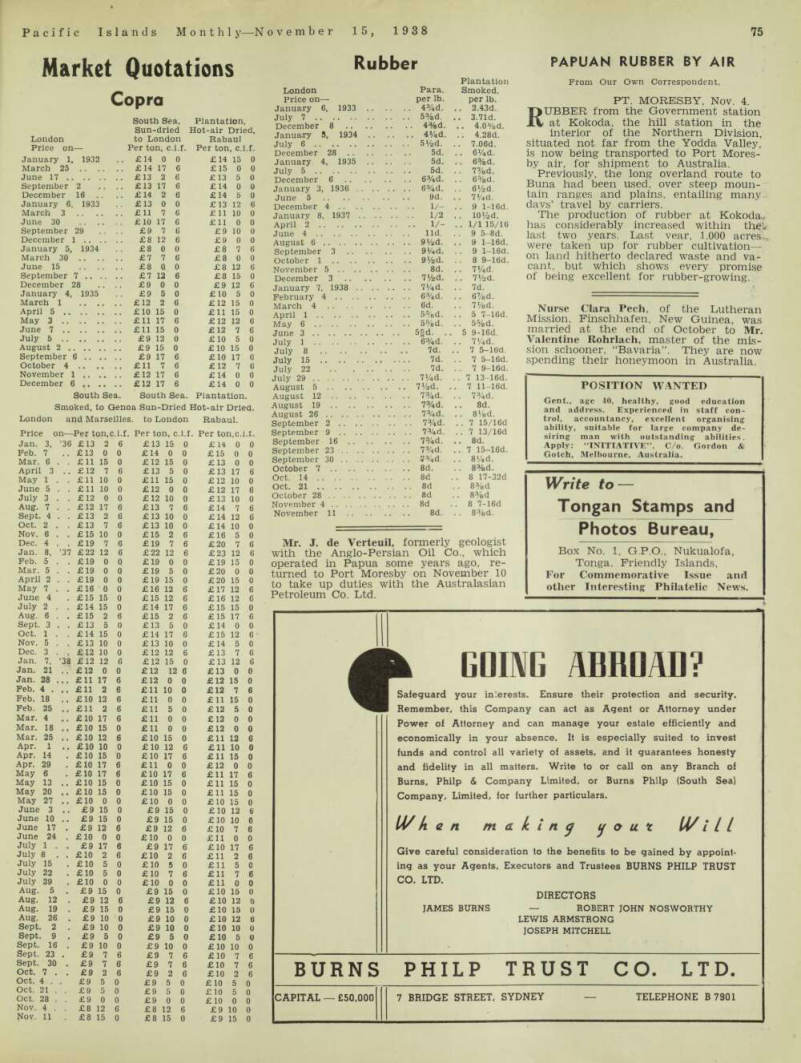
Copra
South Sea, Plantation, Sun-dried Hot-air Dried, London to London Rabaul Price on— Per ton, c.i.f.
Per ton, c.i.f.
January 1 , 1932 £14 0 0 £14 15 0 March 25 £14 17 6 £15 0 0 June 17 . £13 2 6 £13 5 0 September 2 . . . . £13 17 6 £14 0 0 December 16 £14 2 6 £14 5 0 January 6, 1933 £13 0 0 £13 12 6 March 3 £11 7 6 £11 10 0 June 30 £10 17 6 £11 0 0 September 29 £9 7 6 £9 10 0 December 1 .. £8 12 6 £9 0 0 January 5, 1934 £8 0 0 £8 7 6 March 30 £7 7 6 £8 0 0 June 15 £8 0 0 £8 12 6 September 7 .. £7 12 6 £8 15 0 December 28 £9 0 0 £9 12 6 January 4. 1935 £9 5 0 £10 5 0 March 1 £12 2 6 £12 15 0 April 5 .. £10 15 0 £11 15 0 May 3 .. £11 17 6 £12 12 6 June 7 ., £11 15 0 £12 7 6 July 5 .. £9 12 0 £10 5 0 August 2 . £9 15 0 £10 15 0 September 6 .. £9 17 6 £10 17 6 October 4 £11 7 6 £12 7 6 November 1 .. £12 17 6 £14 0 0 December ( S .. £12 17 6 £14 0 0 South Sea.
South Sea.
Plantation.
Smoked, to Genoa Sun-Dried Hot-air Dried.
London and Marseilles, to London Rabaul.
Price on— -Per ton.c.i.f.
Per ton, c.i.f, . Per ton.c.i.f.
Jan. 3, ’36 £13 2 6 £13 15 0 £14 0 0 Feb. 7 .. £13 0 0 £14 0 0 £15 0 0 Mar. 6 . . £11 15 0 £12 15 0 £13 0 0 April 3 .. £12 7 6 £13 5 0 £13 17 6 May 1 . . £11 10 0 £11 15 0 £12 10 0 June 5 . . £11 10 0 £12 0 0 £12 17 6 July 3 . . £12 0 0 £12 10 0 £13 10 0 Aug. 7 . . £12 17 6 £13 7 6 £14 7 6 Sept. 4 . . £13 2 6 £13 10 0 £14 12 6 Oct. 2 . . £13 7 6 £13 10 0 £14 10 0 Nov. 6 . . £15 10 0 £15 2 6 £16 5 0 Dec. 4 . . £19 7 6 £19 7 6 £20 7 6 Jan. 8, ’37 £22 12 6 £22 12 6 £23 12 6 Feb. 5 . . £19 0 0 £19 0 0 £19 15 0 Mar. 5 . . £19 0 0 £19 5 0 £20 0 0 April 2 . . £19 0 0 £19 15 0 £20 15 0 May 7 . . £16 0 0 £16 12 6 £17 12 6 June 4 £15 15 0 £15 12 6 £16 12 6 July 2 . , £14 15 0 £14 17 6 £15 15 0 Aug. 6 . . £15 2 6 £15 2 6 £15 17 6 Sept. 3 . , £13 5 0 £13 5 0 £14 0 0 Oct. 1 . . £14 15 0 £14 17 6 £15 12 6 Nov. 5 . . £13 10 0 £13 10 0 £14 5 0 Dec. 3 . . £12 10 0 £12 12 6 £13 7 6 Jan. 7, '38 £12 12 6 £12 15 0 £13 12 6 Jan. 21 .. £12 0 0 £12 12 6 £13 0 0 Jan. 28 ... £11 17 6 £12 0 0 £12 15 0 Feb. 4 . .. £11 2 6 £11 10 0 £12 7 6 Feb. 18 .. £10 12 6 £11 0 0 £11 15 0 Feb. 25 .. £11 2 6 £11 5 0 £12 5 0 Mar. 4 £10 17 6 £11 0 0 £12 0 0 Mar. 18 .. £10 15 0 £11 0 0 £12 0 0 Mar. 25 .. £10 12 6 £10 15 0 £11 12 6 Apr. 1 .. £10 10 0 £10 12 6 £11 10 0 Apr. 14 £10 15 0 £10 17 6 £11 IS 0 Apr. 29 £10 17 6 £11 0 0 £12 0 0 May 6 £10 17 6 £10 17 6 £11 17 6 May 13 .. £10 15 0 £10 15 0 £11 15 0 May 20 .. £10 15 0 £10 15 0 £11 15 0 May 27 .. £10 0 0 £10 0 0 £10 15 0 June 3 .. £9 15 0 £9 15 0 £10 12 6 June 10 .. £9 15 0 £9 15 0 £10 10 0 June 17 . £9 12 6 £9 12 6 £10 7 6 June 24 . £10 0 0 £10 0 0 £11 0 0 July 1 . . £9 17 6 £9 17 6 £10 17 6 July 8 . . £10 2 6 £10 2 6 £11 2 6 July 15 £10 5 0 £10 5 0 £11 5 0 July 22 £10 5 0 £10 7 6 £11 7 6 July 29 . £10 0 0 £10 0 0 £11 0 0 Aug. 5 . £9 15 0 £9 15 0 £10 15 (I Aug. 12 . £9 12 6 £9 12 6 £10 12 6 Aug. 19 . £9 15 0 £9 15 0 £10 15 0 Aug. 26 , £9 10 0 £9 10 0 £10 12 6 Sept. 2 . £9 10 0 £9 10 0 £10 10 0 Sept. 9 . £9 5 0 £9 5 0 £10 5 0 Sept. 16 . £9 10 0 £9 10 0 £10 10 0 Sept. 23 . £9 7 6 £9 7 6 £10 7 6 Sept. 30 . £9 7 6 £9 7 6 £10 7 6 Oct. 7 . . £9 2 6 £9 2 6 £10 2 6 Oct. 4 . . £9 5 0 £9 5 0 £10 5 0 Oct. 21 . . £9 5 0 £9 5 0 £10 5 0 Oct. 28 . . £9 0 0 £9 0 0 £10 0 0 Nov. 4 . . £8 12 6 £8 12 6 £9 10 0 Nov. 11 £8 15 0 £8 15 0 £9 15 0
Rubber
Mr. J. de Verteuil, formerly geologist with the Anglo-Persian Oil Co., which operated in Papua some years ago, re turned to Port Moresby on November 10 to take up duties with the Australasian Petroleum Co. Ltd.
Plantation London Para.
Smoked.
Price on— per lb. per lb.
January 6, 1933 .. ,. .. 4 3 Ad. .. 2.43d.
July 7 .. .. 5%d. .. 3.71d.
December 8 .. 4.0 a /sd.
January S, 1934 .. .. 4‘Ad. .. 4.28d.
July 6 ,. .. 5‘/ 2 d. .. 7.06d.
December 28 .. .. 5d. .. 6‘Ad.
January 4, 1935 .. .. 5d. .. 6%d.
July 5 .. .. 5d. .. 7%d.
December 6 . .. 6 3 Ad. .. 6 3 /ad.
January 3, 1936 . . . . .. .. 6 3 Ad. .. 6‘/ad.
June 5 . .. 9d. .. 7‘Ad.
December 4 ... 1/- .. 9 l-16d.
January 8, 1937 .. . . ... 1/2 .. 10‘/ad.
April 2 ... 1/- .. 1/1 15/16 June 4 .. .. lid. . . 9 5-8d.
August 6 .. 9 l-16d.
September 3 .. . . 9‘Ad. .. 9 l-16d.
October 1 .. 8 9-16d.
November 5 .. . . 8d. .. 7‘Ad.
December 3 . .. 7‘/ad. .. 7‘/ad.
January 7, 1938 . . . . .. .. 7‘Ad. .. 7d.
February 4 .. 6 7 /ed.
March 4 . .. 6d. .. 7‘/ad.
April 1 .. 5 7-16d.
May 6 . . .. 5 5 /ad. .. sy«d.
June 3 .. 5|jd. .. 5 9-16d.
July 1 .. 7‘Ad.
July 8 , .. 7d. .. 7 5-16d.
July 15 7d. .. 7 5-16d.
July 22 ,. .. 7d. .. 7 9-16d.
July 29 .. .. 7‘Ad. .. 7 13-16d.
August 5 . .. 7‘Ad. , , 7 ll-16d.
August 12 . .. 7 3 Ad. .. 7 3 Ad.
August 19 .. .. 7%d. .. 8d.
August 26 .. .. 7 3 Ad. .. 8‘/ad.
September 2 .. .. 7 3 Ad. .. 7 15/16d September 9 .. .. 7 3 /!id. .. 7 13/16d September 16 ,. .. 7 3 Ad. .. 8d.
September 23 .. . . 7 3 Ad. .. 7 15-16d.
September 30 .. . . 3 3 4d. .. 8*Ad.
October 7 . .. 8d. .. 8%d.
Oct. 14 .. . . 8d .. 8 17-32d Oct. 21 .. . . 8d . . 8 3 /ed October 28 . . . . 8d .. 8 3 /ad November 4 ... 8d ,. 8 7-16d November 11 ... 8d. . . 8%d.
Papuan Rubber By Air
From Our Own Correspondent.
Pt. Moresby, Nov. 4.
RUBBER from the Government station at Kokoda, the hill station in the interior of the Northern Division, situated not far from the Yodda Valley, is now being transported to Port Mores by air, for shipment to Australia.
Previously, the long overland route to Buna had been used, over steep moun tain ranges and plains, entailing many days’ travel by carriers.
The production of rubber at Kokoda, has considerably increased within th£* last two years. Last vear, 1.000 acres were taken up for rubber cultivation— on land hitherto declared waste and va cant, but which shows every promise of being excellent for rubber-growing.
Nurse Clara Pech, of the Lutheran Mission, Finschhafen, New Guinea, was married at the end of October to Mr.
Valentine Rohrlach, master of the mis sion schooner, “Bavaria”. They are now spending their honeymoon in Australia.
Advertisements & other items, p. 79 (2 items)
75
Pacific Islands Monthl y —N ovember 15, 1938
Going Abroad?
POSITION WANTED
Gent., age 40, healthy, good education and address. Experienced in staff control, accountancy, excellent organising ability, suitable for large company desiring man with outstanding abilities.
Apply: “INITIATIVE”. C/o. Gordon & Gotch, Melbourne, Australia.
Write to
Tongan Stamps and
Photos Bureau,
Box No. 1, G.P.0., Nukualofa, Tonga. Friendly Islands, For Commemorative Issue and other Interesting Philatelic News.
GOING ABROAD?
Safeguard your inlerests. Ensure their protection and security.
Remember, this Company can act as Agent or Attorney under Power of Attorney and can manage your estate efficiently and economically in your absence. It is especially suited to invest funds and control all variety of assets, and it guarantees honesty and fidelity in all matters. Write to or call on any Branch of Burns, Philp & Company Limited, or Burns Philp (South Sea) Company, Limited, for further particulars.
IV ft an making gout IV ill Give careful consideration to the benefits to be gained by appointing as your Agents, Executors and Trustees BURNS PHILP TRUST
CO. LTD.
DIRECTORS
JAMES BURNS ROBERT JOHN NOSWORTHY
LEWIS ARMSTRONG
JOSEPH MITCHELL
BURNS PHILP TRUST CO. LTD.
CAPITAL £50.000 7 BRIDGE STREET. SYDNEY TELEPHONE B 7901
Islands Produce
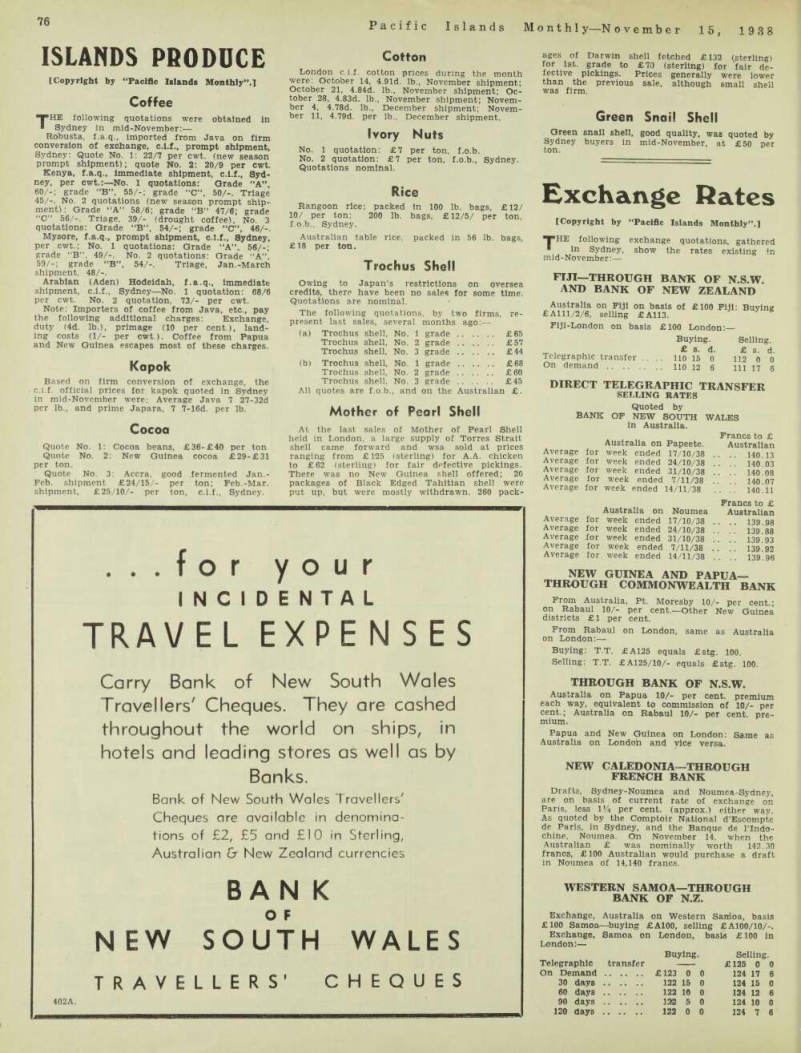
[Copyright by “Pacific Islands Monthly”.]
Coffee
THE following quotations were obtained in Sydney in mid-November:— Robusta, f.a.q., imported from Java on firm conversion of exchange, c.i.f., prompt shipment, Sydney; Quote No. 1: 22/7 per cwt. (new season prompt shipment): quote No. 2: 20/9 per cwt.
Kenya, f.a.q.. Immediate shipment, c.i.f., Syd ney, per cwt.:—No. 1 quotations; Grade “A”, 60/-; grade “B”, 55/-; grade “C”, 50/-. Triage 45/-. No. 2 quotations (new' season prompt ship ment) : Grade “A” 58/6; grade “B” 47/6; grade “C” 56/-. Triage. 39/- (drought coffee), No. 3 quotations: Grade “B”, 54/-; grade “C”, 46/-, Mysore, f.a.q., prompt shipment, c.i.f., Sydney, per cwt.; No. 1 quotations: Grade “A”, 56/-; grade “B”, 49/-. No. 2 quotations: Grade “A”, 59/-; grade “B”, 54/-. Triage, Jan.-March shipment, 48/-.
Arabian (Aden) Hodeidah, f.a.q., Immediate shipment, c.i.f., Sydney—No. 1 quotation: 68/6 per cwt. No. 2 quotation, 73/- per cwt.
Note: Importers of coffee from Java, etc., pay the following additional charges: Exchange, duty (4d. lb.), primage (10 per cent.), land ing costs (1/- per cwt). Coffee from Papua and New Guinea escapes most of these charges.
Kapok
Based on firm conversion of exchange, the c.i.f. official prices for kapok quoted in Sydney in mid-November were; Average Java 7 27-32 d per lb., and prime Japara, 7 7-16 d. per lb.
Cocoa
Quote No. 1; Cocoa beans, £36-£4O per ton Quote No. 2: New Guinea cocoa £29-£3l per ton.
Quote No. 3: Accra, good fermented Jan.- Feb. shipment £24/15/- per ton; Feb.-Mar. shipment, £25/10/- per ton, c.i.f., Sydney.
Cotton
London c.i.f. cotton prices during the month were: October 14, 4.01 d. lb., November shipment: October 21, 4.84 d. lb., November shipment; Oc tober 28, 4.83 d. lb., November shipment; Novem ber 4,4.78 d. lb., December shipment; Novem ber 11, 4.79 d. per lb., December shipment.
Ivory Nuts
No. 1 quotation: £7 per ton, f.o.b.
No. 2 quotation: £7 per ton, f.0.b., Sydney.
Quotations nominal.
Rice
Rangoon rice: packed in 100 lb. bags, £l2/ 10/ per ton; 200 lb. bags. £l2/5/ per ton, f.0.b., Sydney.
Australian table rice, packed in 56 lb. bags, £lB per ton.
Trochus Shell
Owing to Japan’s restrictions on oversea credits, there have been no sales for some time.
Quotations are nominal.
The following quotations, by two firms, re present last sales, several months ago:— (a) Trochus shell, No. 1 grade £65 Trochus shell, No. 2 grade £57 Trochus shell, No. 3 grade £44 (b) Trochus shell, No. 1 grade £6B Trochus shell, No. 2 grade £6O Trochus shell. No. 3 grade £45 All quotes are f.0.b., and on the Australian £.
Mother of Pearl Shell
At the last sales of Mother of Pearl Shell held in London, a large supply of Torres Strait shell came forward and wsa sold at prices ranging from £125 (sterling) for A.A. chicken to £62 (sterling) for fair defective pickings.
There was no New Guinea shell offered; 20 packages of Black Edged Tahitian shell were put up, but were mostly withdrawn. 260 pack
ages of Darwin shell fetched £132 (sterling) for Ist. grade to £7O (sterling) for fair de fective pickings. Prices generally were lower than the previous sale, although small shell was firm.
Green Snail Shell
Green snail shell, good quality, was quoted by Sydney buyers in mid-November, at £5O per ton.
Exchange Rates
[Copyright by “Pacific Islands Monthly”.] THE following exchange quotations, gathered « in Sydney, show the rates existing in mid-November:—
Fiji—Through Bank Of N.S.W.
And Bank Of New Zealand
Australia on Fiji on basis of £lOO Fiji; Buying £Alll/2/6, selling £AII3.
Fiji-London on basis £lOO London:—
Direct Telegraphic Transfer
Selling Rates
Quoted by
Bank Of New South Wales
in Australia.
New Guinea And Papua
Through Commonwealth Bank
From Australia, Pt. Moresby 10/- per cent.; on Rabaul 10/- per cent.—Other New Guinea districts £1 per cent.
From Rabaul on London, same as Australia on London:— Buying; T.T. £AI2S equals £stg. 100.
Selling: T.T. £AI2S/10/- equals £stg. 100.
Through Bank Of N.S.W.
Australia on Papua 10/- per cent, premium each way, equivalent to commission of 10/- per cent.; Australia on Rabaul 10/- per cent, pre mium.
Papua and New Guinea on London: Same as Australia on London and vice versa.
New Caledonia—Through
French Bank
Drafts, Sydney-Noumea and Noumea-Sydney, are on basis of current rate of exchange on Paris, less VA per cent, (approx.) either way.
As quoted by the Comptoir National d’Escompte de Paris, in Sydney, and the Banque de ITndo chine, Noumea. On November 14, when the Australian £ was nominally worth 142.30 francs, £lOO Australian would purchase a draft in Noumea of 14,140 francs.
Western Samoa—Through
Bank Of N.Z.
Exchange, Australia on Western Samoa, basis £lOO Samoa—buying £AIOO, selling £AIOO/10/-.
Exchange, Samoa on London, basis £lOO in London:—
Buying. Selling. m , £ s. d. £ s. d.
Telegraphic transfer ... 110 15 0 112 0 0 On demand 110 12 6 111 17 6
Average for Australia on Papeete. week ended 17/10/38 Francs to £ Australian .. .. 140.13 Average for week ended 24/10/38 .. .. 140.03 Average for week ended 31/10/38 .. .. 140.08 Average for week ended 7/11/38 . . .. 140.07 Average for week ended 14/11/38 .. .. 140.11 Average for Australia on week ended Noumea 17/10/38 Francs to £ Australian .. .. 139.98 Average for week ended 24/10/38 . . .. 139.88 Average for week ended 31/10/38 .. .. 139.93 Average for week ended 7/11/38 , . . .. 139.92 Average for week ended 14/11/38 . . .. 139.96
Buying. Selling.
Telegraphic transfer £125 0 0 On Demand £123 0 0 124 17 6 30 days 122 15 0 124 15 0 60 days 122 10 0 124 12 6 90 days 132 5 0 124 10 0 120 days 122 0 0 124 7 6
Advertisements & other items, p. 80 (2 items)
76
Pacific Islands Monthl y—N ovember 15, 19 8 8
...for your
INCIDENTAL
TRAVEL EXPENSES
Carry Bank of New South Wales Travellers' Cheques. They are cashed throughout the world on ships, in hotels and leading stores as well as by Banks.
Bank of New South Wales Travellers 7 Cheques are available in denominations of £2, £5 and £lO in Sterling, Australian Cr New Zealand currencies
BANK
O F
NEW SOUTH WALES
TRAVELLERS' CHEQUES
402 A.
Shipping Services in the Pacific
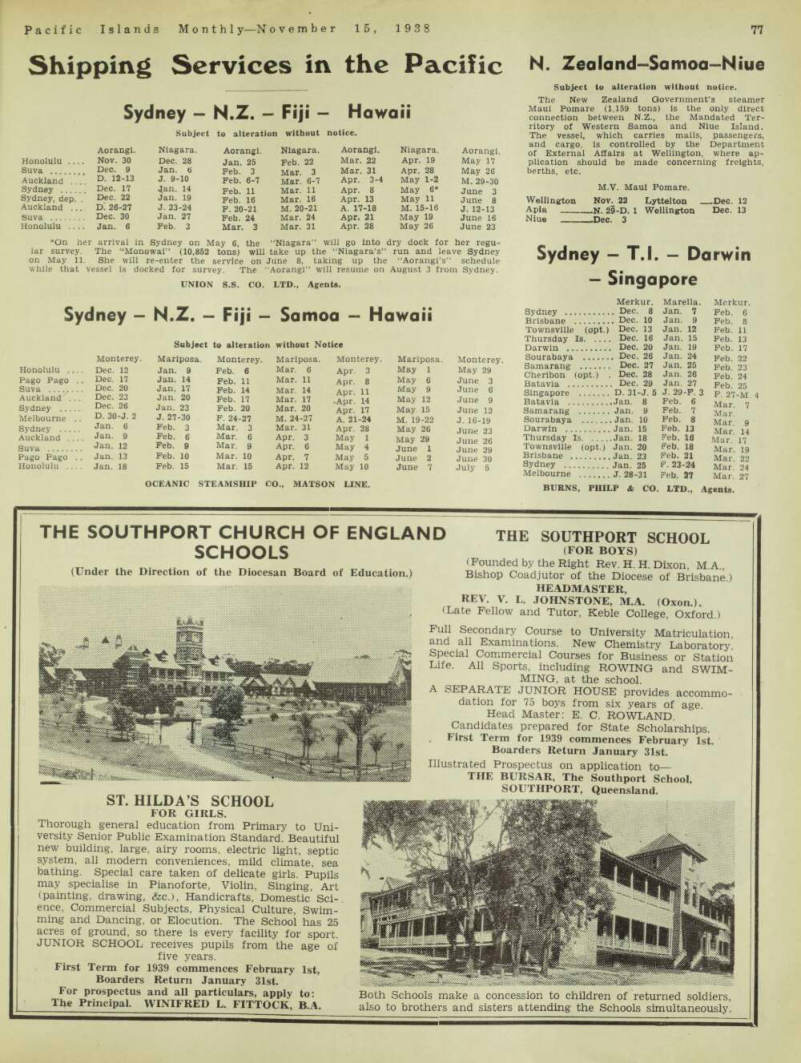
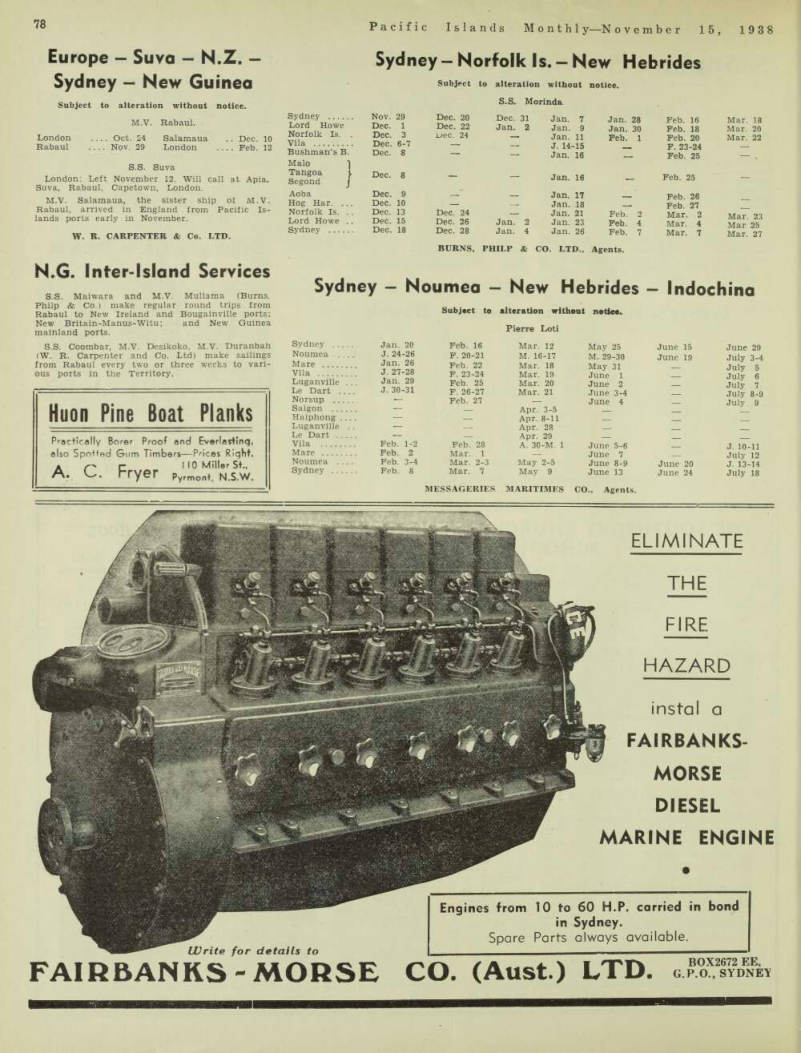
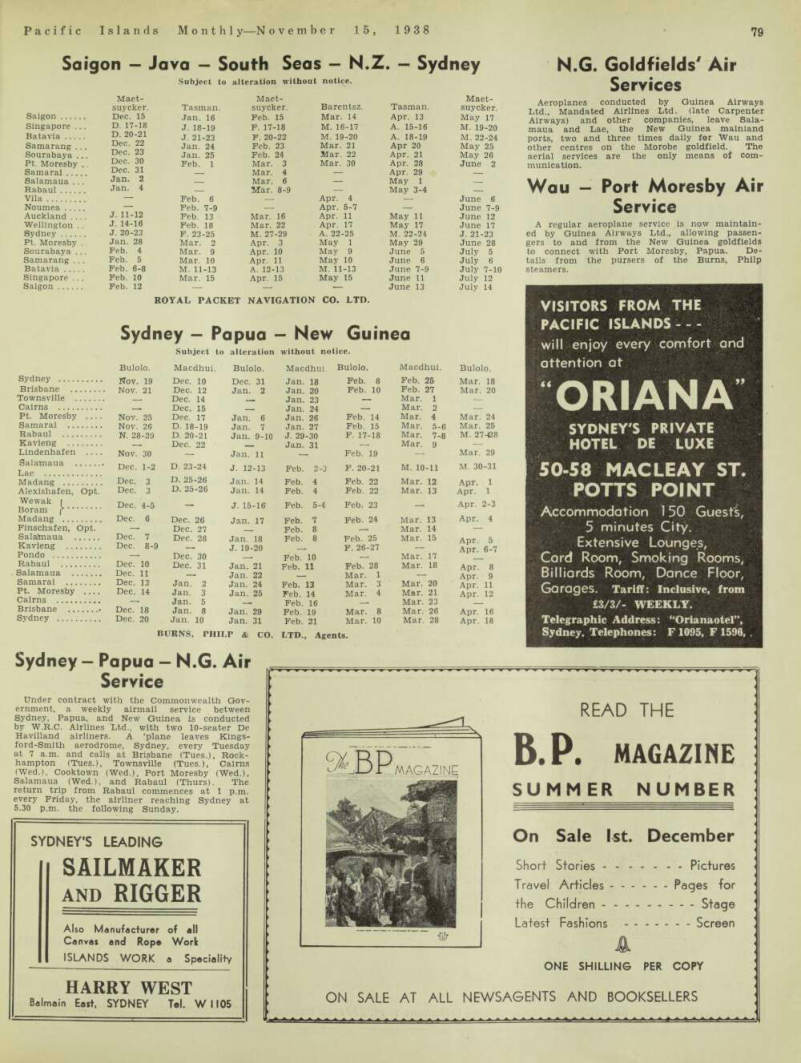
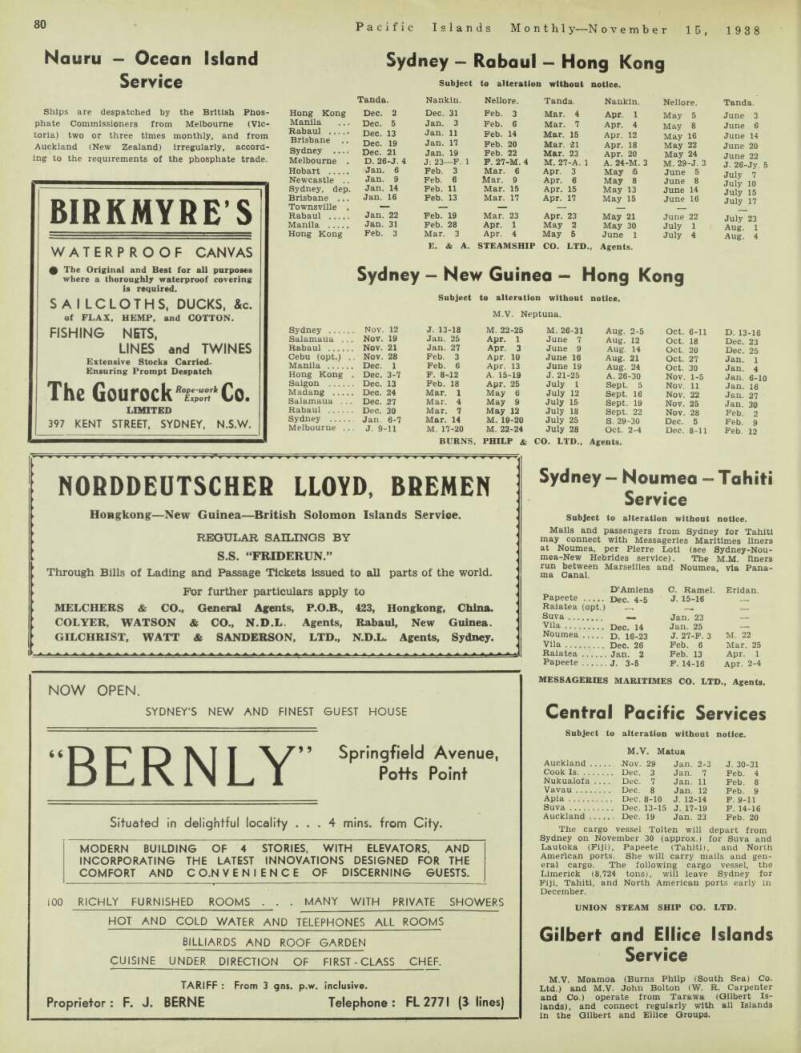
Sydney - N.Z. - Fiji - Hawaii Subject to alteration without notice.
•On her arrival in Sydney on May 6, the “Niagara” will go into dry dock for her regu lar survey. The “Monowai” (10,852 tons) will take up the “Niagara’s” run and leave Sydney on May 11. She will re-enter the service on June 8, taking up the “Aorangi’s” schedule while that vessel is docked for survey. The "Aorangi” will resume on August 3 from Sydney.
Union S.S. Co. Ltd., Agents.
Sydney - N.Z. - Fiji - Samoa - Hawaii Subject to alteration without Notice
N. Zealand-Samoa-Niue
Subject to alteration without notice.
The New Zealand Government’s steamer Maui Pomare (1,159 tons) is the only direct connection between N.Z., the Mandated Ter ritory of Western Samoa and Niue Island.
The vessel, which carries mails, passengers, and cargo, is controlled by the Department of External Affairs at Wellington, where ap plication should be made concerning freights, berths, etc.
M.V. Maul Pomare.
Wellington Nov. 22 Lyttelton Dec. 12 Apia N. 29-D. 1 Wellington Dec. 13 Niue Dec. 3
Sydney - T.l. Darwin - Singapore
Aorangi. Niagara. Aorangl. Niagara. Aorangi. Niagara. Aorangi.
Honolulu Nov. 30 Dec. 28 j a n. 25 Feb. 22 Mar. 22 Apr. 19 May 17 Suva Dec. 9 Jan. b p e b. 3 Mar 3 Mar. 31 Apr. 28 May 26 Auckland ... 1 2-13 J. 9-10 Peb. 6-7 Mar. 6-7 Apr. 3-4 May 1-2 m. 29-30 Sydney Dec. 17 Jan. 14 p e b. n Mar. 11 Apr. 8 May 6* j une 3 Sydney, dep. . Dec. 22 Jan. 19 p e b. ie Mar. 16 Apr. 13 May 11 June 8 Auckland ... D. 26-27 J. 23-24 F. 20-21 M. 20-21 A. 17-18 M. 15-16 J. 12-13 Suva Dec. 30 Jan. 27 p e b. 24 Mar. 24 Apr. 21 May 19 June 16 Honolulu Jan. 6 Feb. 3 Mar. 3 Mar. 31 Apr. 28 May 26 June 23
Monterey.
Mariposa.
Monterey.
Mariposa.
Monterey.
Mariposa.
Monterey.
Honolulu ...
Dec. 12 Jan. 9 Feb. 6 Mar. 6 Apr 3 May I May 29 Pago Pago . . Dec. 17 Jan. 14 Feb. 11 Mar. 11 Apr. 8 May 6 June 3 Suva Dec. 20 Jan. 17 Feb. 14 Mar. 14 Apr. 11 May 9 June 6 Auckland ...
Dec. 23 Jan. 20 Feb. 17 Mar. 17 •Apr. 14 May 12 June 9 Sydney Dec. 26 Jan. 23 Feb. 20 Mar. 20 Apr. 17 May 15 June 12 Melbourne ..
D. 30-J. 2 J. 27-30 P. 24-27 M. 24-27 A. 21-24 M. 19-22 J. 16-19 Sydney Jan. 6 Feb. 3 Mar. 3 Mar. 31 Apr. 28 May 26 June 23 Auckland ...
Jan. 9 Feb. 6 Mar. 6 Apr. 3 May 1 May 29 June 26 Suva Jan. 12 Feb. 9 Mar. 9 Apr. 6 May 4 June 1 June 29 Pago Pago .
Jan. 13 Feb. 10 Mar. 10 Apr. 7 May 5 June 2 June 30 Honolulu Jan. 18 Feb. 15 Mar. 15 Apr. 12 May 10 June 7 July 5
Oceanic Steamship
Co., Matson Line.
Merkur.
Marella . Merkur.
Sydney . Dec. 8 Jan. 7 Feb. 6 Brisbane . Dec. 10 Jan. 9 Feb. 8 Townsville (opt.) Dec. 13 Jan. 12 Feb. 11 Thursday Is Dec. 16 Jan. 15 Feb. 13 Darwin Dec. 20 Jan. 19 Feb. 17 Sourabaya . Dec. 26 Jan. 24 Feb. 22 Samarang Dec. 27 Jan. 25 Feb. 23 Cheribon (opt.) Dec. 28 Jan. 26 Feb. 24 Batavia . Dec. 29 Jan. 27 Feb. 25 Singapore D. 31-J. 5
J. 29-P. 3 P. 27-M 4
Batavia .Jan. 8 Feb. 6 Mar. 7 Samarang Jan. 9 Feb. 7 Mar.
Sourabaya .Jan. 10 Feb. 8 Mar. 9 Darwin Jan. 15 Feb. 13 Mar. 14 Thursday Is .Jan. 18 Feb, 16 Mar. 17 Townsville (opt.) Jan. 20 Feb. 18 Mar. 19 Brisbane Jan. 23 Feb. 21 Mar. 22 Sydney Jan. 25 F. 23-24 Mar. 24 Melbourne J. 28-31 Feb. 37 Mar. 27
Burns, Philp & Co.
Ltd.,
Agents.
Europe Suva N.Z.
Sydney - New Guinea Subject to alteration without notice.
S.S. Suva London: Left November 12. Will call at Apia.
Suva, Rabaul, Capetown, London.
M.V. Salamaua, the sister ship of M.V.
Rabaul, arrived in England from Pacific Is lands ports early in November.
W. R. Carpenter & Co. Ltd.
N.G. Inter-Island Services
5.5. Maiwara and M.V. Muliama (Bums, Philp & Co.) make regular round trips from Rabaul to New Ireland and Bougainville ports: New Britain-Manus-Witu; and New Guinea mainland ports. 5.5. Coombar, M.V. Desikoko, M.V. Duranbah (W. R. Carpenter and Co. Ltd) make sailings from Rabaul every two or three weeks to vari ous ports in the Territory.
Sydney Norfolk Is. New Hebrides Subject to alteration without notice.
Sydney - Noumea - New Hebrides - Indochina Subject to alteration without notice.
M.V.
Rabaul.
London Oct. 24 Salamaua .. Dec. 10 Rabaul ... Nov. 29 London .. Feb. 12
s.s.
Morinda Sydney Nov. 29 Dec. 20 Dec. 31 Jan. 7 Jan. 28 Feb. 16 Mar. 18 Lord Howe Dec. 1 Dec. 22 Jan. 2 Jan. 9 Jan. 30 Feb. 18 Mar. 20 Norfolk Is. .
Dec. 3 L»ec. 24 — Jan. 11 Peb. 1 Feb. 20 Mar. 22 Vila Dec. 6-7 — — J. 14-15 F. 23-24 Bushman’s B.
Dec. 8 — — Jan. 16 Feb. 25
Malo 1
Tangoa J.
Segond J
Dec. 8 - - Jan. 16 Peb. 25 - Aoba Dec. 9 ' Jan. 17 Feb. 26 Hog Har. ...
Dec. 10 — Jan. 18 T Feb. 27 Norfolk Is. ..
Dec. 13 Dec. 24 Jan. 21 Peb. 2 Mar. 2 \] J’ 23 25 Lord Howe ..
Dec. 15 Dec. 26 Jan. 2 Jan. 23 Feb. 4 Mar. 4 Mar Sydney Dec. 18 Dec. 28 Jan. 4 Jan. 26 Feb. 7 Mar. 7 Mar. 27
Burns,
Philp
Co. Ltd,,
Agents.
Sydney Jan. 20 Feb. 16 Pierre Loti Mar. 12 May 25 June 15 June 29 Noumea ...
J. 24-26 F. 20-21 M. 16-17 M. 29-30 June 19 July 3-4 Mare Jan. 26 Feb. 22 Mar. 18 May 31 July 5 Vila J. 27-28 F. 23-24 Mar. 19 June 1 July 6 July 7 Luganville ...
Jan. 29 Feb. 25 Mar. 20 June 2 Le Dart ... «J. 30-31 F. 26-27 Mar. 21 June 3-4 July 8-9 Norsup — Feb. 27 — June 4 July 9 Saigon — — Apr. 3-5 Haiphong — — Apr. 8-11 Luganville .. — — Apr. 28 Le Dart — — Apr. 29 Vila Feb. 1-2 Feb. 28 A. 30-M. 1 June 5-6 J. 10-11 Mare Feb. 2 Mar. 1 — June 7 July 12 Noumea ...
Feb. 3-4 Mar. 2-3 May 2-5 June 8-9 June 20 J. 13-14 Sydney Feb. 8 Mar. 7 May 9 June 13 June 24 July 18
Messageries
Maritimes
CO., Agents.
Saigon Java South Seas N.Z. Sydney Subject to alteration without notice.
Sydney - Papua - New Guinea Subject to alteration without notice.
Sydney - Papua - N.G. Air
Service
Under contract with the Commonwealth Gov ernment, a weekly airmail service between Sydney, Papua, and New Guinea is conducted by W.R.C. Airlines Ltd., with two 10-seater De Havilland airliners. A ’plane leaves Kings ford-Smith aerodrome, Sydney, every Tuesday at 7 a.m. and calls at Brisbane (Tues.), Rock hampton (Tues.), Townsville (Tues.), Calms (Wed.), Cooktown (Wed.), Port Moresby (Wed.), Salamaua (Wed.), and Rabaul (Thurs). The return trip from Rabaul commences at 1 p.m. every Friday, the airliner reaching Sydney at 5.30 p.m. the following Sunday.
N.G. Goldfields' Air
Services
Aeroplanes conducted by Guinea Airways Ltd., Mandated Airlines Ltd. (late Carpenter Airways) and other companies, leave Sala maua and Lae, the New Guinea mainland ports, two and three times daily for Wau and other centres on the Morobe goldfield. The aerial services are the only means of com munication.
Wou - Port Moresby Air
Service
A regular aeroplane service is now maintain ed by Guinea Airways Ltd., allowing passen gers to and from the New Guinea goldfields to connect with Port Moresby, Papua. De tails from the pursers of the Burns, Philp steamers.
Maet- Maet- Maetsuycker.
Tasman. suycker.
Barentsz.
Tasman. suycker.
Saigon Dec. 15 Jan. 16 Feb. 15 Mar. 14 Apr. 13 May 17 Singapore ...
D. 17-18 J. 18-19 F. 17-18 M. 16-17 A. 15-16 M. 19-20 Batavia D. 20-21 J. 21-23 F. 20-22 M. 19-20 A. 18-19 M. 22-24 Samarang . ..
Dec. 22 Jan. 24 Feb. 23 Mar. 21 Apr 20 May 25 Sourabaya .,.
Dec. 23 Jan. 25 Feb. 24 Mar. 22 Apr. 21 May 26 Pt. Moresby ..
Dec. 30 Feb. 1 Mar. 3 Mar. 30 Apr. 28 June 2 Samarai Dec. 31 Mar. 4 — Apr. 29 Salamaua ...
Jan. 2 Mar. 6 — May 1 Rabaul Jan. 4 Mar. 8-9 — May 3-4 Vila — Feb. 6 — Apr. 4 — June 6 Noumea — Feb. 7-9 — Apr. 5-7 — June 7-9 Auckland ...
J. 11-12 Feb. 13 Mar. 16 Apr. 11 May 11 June 12 Wellington ..
J. 14-16 Feb. 18 Mar. 22 Apr. 17 May 17 June 17 Sydney J. 20-23 F. 23-25 M. 27-29 A. 22-25 M. 22-24 J. 21-23 Pt. Moresby .
Jan. 28 Mar. 2 Apr. 3 May 1 May 29 June 28 Sourabaya . ..
Feb. 4 Mar. 9 Apr. 10 May 9 June 5 July 5 Samarang ...
Feb. 5 Mar. 10 Apr. 11 May 10 June 6 July 6 Batavia Feb. 6-8 M. 11-13 A. 12-13 M. 11-13 June 7-9 July 7-10 Singapore ...
Feb. 10 Mar. 15 Apr. 15 May 15 June 11 July 12 Saigon Feb. 12
Royal Packet
Navigation
Co. Ltd.
June 13 July 14
Bulolo.
Macdhui.
Bulolo.
Macdhui.
Bulolo.
Macdhui.
Bulolo.
Sydney Nov. 19 Dec. 10 Dec. 31 Jan. 18 Feb. 8 Feb. 25 Mar. 18 Brisbane Nov. 21 Dec. 12 Jan. 2 Jan. 20 Feb. 10 Feb. 27 Mar. 20 Townsville Dec. 14 Jan. 23 Mar. 1 Cairns Dec. 15 Jan. 24 Mar. 2 — Pt. Moresby ...
Nov. 25 Dec. 17 Jan. 6 Jan. 26 Feb. 14 Mar. 4 Mar. 24 Samarai Nov. 26 D. 18-19 Jan. 7 Jan. 27 Feb. 15 Mar. 5-6 Mar. 25 Rabaul N. 28-29 D, 20-21 Jan. 9-10 J. 29-30 P. 17-18 Mar. 7-8 M. 27-128 Kavleng Dec. 22 Jan. 31 Mar. 9 — Lindenhafen ...
Nov. 30 — Jan. 11 — Feb. 19 — Mar. 29 Salatnaua Lae Dec. 1-2 D. 23-24 J. 12-13 Feb. 2-3 F. 20-21 M. 10-11 M. 30-31 Madang Dec. 3 D. 25-26 Jan. 14 Feb. 4 Feb. 22 Mar. 12 Apr. 1 Alexishafen, Opt.
Dec. 3 D. 25-26 Jan. 14 Feb. 4 Feb. 22 Mar. 13 Apr. 1 Wewak i Boram f Dec. 4-5 - J. 15-16 Feb. 5-6 Feb. 23 — Apr. 2-3 Madang Dec. 6 Dec. 26 Jan. 17 Feb. 7 Feb. 24 Mar. 13 Apr. 4 Finschafen, Opt. — Dec. 27 Feb. 8 Mar. 14 — Salaftnaua Dec. 7 Dec. 28 Jan. 18 Feb. 8 Feb. 25 Mar. 15 Apr. 5 Kavieng Dec. 8-9 — J. 19-20 F. 26-27 — Apr. 6-7 Pondo — Dec. 30 Feb. 10 Mar. 17 Rabaul Dec. 10 Dec. 31 Jan. 21 Feb. 11 Feb. 28 Mar. 18 Apr. 8 Salamaua Dec. 11 — Jan. 22 Mar. 1 — Apr. 9 Samarai Dec. 13 Jan. 2 Jan. 24 Feb. 13 Mar. 3 Mar. 20 Apr. 11 Pt. Moresby Dec. 14 Jan. 3 Jan. 25 Feb. 14 Mar. 4 Mar. 21 Apr. 12 Cairns — Jan. 5 Feb. 16 Mar. 23 Brisbane - Dec. 18 Jan. 8 Jan. 29 Feb. 19 Mar. 8 Mar. 26 Apr. 16 Sydney Dec. 20 Jan. 10 Jan. 31 Feb. 21 Mar. 10 Mar. 28 Apr. 18
Burns, Philp & Co.
LTD., Agents.
Nauru - Ocean Island
Service
Ships are despatched by the British Phos phate Commissioners from Melbourne (Vic toria) two or three times monthly, and from Auckland (New Zealand) irregularly, accord ing to the requirements of the phosphate trade.
Sydney - Rabaul - Hong Kong Subject to alteration without notice.
Sydney - New Guinea - Hong Kong Subject to alteration without notice.
Sydney - Noumea - Tahiti
Service
Subject to alteration without notice.
Malls and passengers from Sydney for Tahiti may connect with Messageries Marltimes liners at Noumea, per Pierre Loti (see Sydney-Nou mea-New Hebrides service). The M.M. liners run between Marseilles and Noumea, via Pana ma Canal.
Central Pacific Services
Subject to alteration without notice.
M.V. Matua Auckland .Nov. 29 Jan. 2-3 J. 30-31 Cook Is Dec. 3 Jan. 7 Peb. 4 Nukualofa Dec. 7 Jan. 11 Peb. 8 Vavau Dec. 8 Jan. 12 Feb. 9 Apia Dec. 8-10 J. 12-14 P. 9-11 Suva Dec. 13-15 J. 17-19 F. 14-16 Auckland Dec. 19 Jan. 23 Feb. 20 The cargo vessel Tolten will depart from Sydney on November 30 (approx.) for Suva and Lautoka (Fiji), Papeete (Tahiti), and North American ports. She will carry mails and gen eral cargo. The following cargo vessel, the Limerick (8,724 tons), will leave Sydney for Fiji, Tahiti, and North American ports early in December.
Union Steam Ship Co. Ltd.
Gilbert and Ellice Islands
Service
M.V. Moamoa (Burns Philp (South Sea) Co.
Ltd.) and M.V. John Bolton (W. R. Carpenter and Co.) operate from Tarawa (Gilbert Is lands), and connect regularly with all Islands in the Gilbert and Ellice Groups.
Tanda.
Nankin.
Nellore.
Tanda.
Nankin.
Nellore.
Tanda.
Hong Kong Dec. 2 Dec. 31 Feb. 3 Mar. 4 Apr. 1 May 5 June 3 Manila Dec. 5 Jan. 3 Feb. 6 Mar. 7 Apr. 4 May 8 June 6 Rabaul Brisbane ..
Dec. 13 Dec. 19 Jan. 11 Jan. 17 Feb. 14 Feb. 20 Mar. 15 Mar. -21 Apr. 12 Apr. 18 May 16 May 22 June 14 June 20 Sydney Dec. 21 Jan. 19 Feb. 22 Mar. 23 Apr. 20 May 24 June 22 Melbourne .
D. 26-J.4 J; 23—F. 1 F. 27-M. 4 M. 27-A.1 A. 24-M. 3 M. 29-J. 3 J. 26-Jy. 5 July 7 July 10 July 15 July 17 Hobart Jan. 6 Feb. 3 Mar. 6 Apr. 3 May (5 June 5 Newcastle ..
Jan. 9 Feb. 6 Mar. 9 Apr. 6 May 8 June 8 Sydney, dep.
Jan. 14 Feb. 11 Mar. 15 Apr. 15 May 13 June 14 Brisbane ...
Jan. 16 Feb. 13 Mar. 17 Apr. 17 May 15 June 16 Townsville . — — — — — Rabaul Jan. 22 Feb. 19 Mar. 23 Apr. 23 May 21 June 22 July 23 AUg. 1 Manila Jan. 31 Feb. 28 Apr. 1 May 2 May 30 July 1 Hong Kong Feb. 3 Mar. 3 E. & A.
Apr. 4
Steamship
May 5
Co. Ltd.,
June 1 Agents.
July 4 Aug. 4
Sydney . Nov. 12 J. 13-18 M.V. Neptuna.
M. 22-25 M. 26-31 Aug. 2-5 Oct. 6-11 D. 13 -16 Salamaua ...
Nov. 19 Jan. 25 Apr. 1 June 7 Aug. 12 Oct. 18 Dec. 23 Rabaul Nov. 21 Jan. 27 Apr. 3 June 9 Aug. 14 Oct. 20 Dec. 25 Cebu (opt.) . , Nov. 28 Feb. 3 Apr. 10 June 16 Aug. 21 Oct. 27 Jan. 1 Manila Dec. 1 Feb. 6 Apr. 13 June 19 Aug. 24 Oct. 30 Jan. 4 Hong Kong . Dec. 3-7 P. 8-12 A. 15-19 J. 21-25 A. 26-30 Nov. 1-5 Jan. 6-10 Saigon . Dec. 13 Feb. 18 Apr. 25 July 1 Sept. 5 Nov. 11 Jan.
Ifi Madang . Dec. 24 Mar. 1 May 6 July 12 Sept. 16 Nov. 22 Jan. 27 Salamaua ...
Dec. 27 Mar. 4 May 9 July 15 Sept. 19 Nov. 25 Jan. 30 Rabaul Dec. 30 Mar. 7 May 12 July 18 Sept. 22 Nov. 28 Feb. 2 Sydney Jan 6-7 Mar. 14 M. 19-20 July 25 S. 29-30 Dec. 5 Feb. 9 Melbourne ..
J. 9-11 M. 17-20 M. 22-24 July 28 Oct. 2-4 Dec. 8-11 Feb. 12
Burns,
Philp &
Co. Ltd.,
Agents.
Papeete D’Amiens Dec. 4-5 C. Ramel.
J. 15-16 Eridan.
Raiatea (opt.) Suva Jan. 23 — Vila Dec. 14 Jan. 25 — Noumea D. 16-23 J. 27-P. 3 M. 22 Vila Dec. 26 Feb. 6 Mar, 25 Raiatea Jan. 2 Feb. 13 Apr. 1 Papeete J. 3-5 F. 14-16 Apr. 2-4
Messageries
Mar1Times Co. Ltd,
Agents.
Samoa Inter-Island
Service
In command of Captain Tanner, the M.V.
Matafele (Burns Philp (South Seas) Co. Ltd.) left Hong Kong on November 10 and is expect ed to arrive at Apia, Western Samoa, early in December. It is tentatively arranged that she shall connect regularly with Pago Pago (Ame rican Samoa), also Tokelaus, Swain, Nassau, and Phoenix Groups.
Noumea - Australia
The small steamer Neo Hebridais (Societe Maritime et Miniere Hagen) carries on a monthly service between Noumea (New Caledonia), and Newcastle and Sydney (N.S.W.L The round trip occupies about 17 days.
The three vessels of the Societe Le Nickel, Cap Tarifa (2,177 tons), Capitaine Illiaquer (2,138 tons), and Notou (2,384 tons) make ir regular trips between Noumea (New Caledonia) and Sydney, Newcastle, and Port Kembla,
N.S.W.
Papuan Inter-Island
Services
M.V. Lakatoi (Burns Philp & Co. Ltd.) makes round trips on a regular schedule from Samaral to Misima Island, via the Conflict Group; also calls at Woodlark Island.
M.V. Nusa (Steamships Trading Co. Ltd.) holds the Papuan Government’s contract for carry ing mails and passengers on the north-east coast of Papua. The Nusa connects with all Southern mail steamers at Samarai.
S.S. Papuan Chief (Steamships Trading Co.
Ltd.) makes regular round trips from Port Moresby to Samarai via Kapa Kapa, Abau, and Baibara, returns by same route; then Port Moresby to Daru via Hisiu, Yule Is., Kuklpi, Orokolo, Kikori and back via Orokolo, Yule Island, and Hisiu—full trip occupying about one month.
Sydney - Solomon Islands - New Guinea
M.V. Malaita.
Sydney Brisbane ..
Townsville Cairns ...
Tulagi i
Makambo j-
Gavutu ) Domma I
Nov. 26
Nov. 28 Dec. 1 D. 6-7 Jan. 7 Jan. 9 Jan. 12 Jan. 13 J. 17-18 « Feb. 18 Apr. 1 Feb. 20 Apr. 3 Feb. 23 Apr. 6 Feb. 24 —
F. 28-M. 1 A. 10-12.
May 13 May 15 May 18 May 19 M. 23-24 June 24 June 26 June 29 June 30 July 4-5 Aug. 5 Aug. 7 Aug. 10 Aug. 11 A. 15-16 Aug. 17 Aug. 18 Su’u Tasavaro Mamara Aruligo Lavoro Mamara ig 1 ( * Dec. 8 Jan. 19 Mar. 2 Mar. 3 Apr. 13 May 25 May 26 July 6 Tasavaro Aruligo Meringe ' Hivo Yandina Banika Ufa Faiami Younger Pepesala Lingatu West Ba: Somata Gizo
ng f
Jan. 20 Jan. 21 Jan. 22 Apr. 14 Apr. 15 Apr. 16 July 7 July 8 July 9 • ,1 Dec. 10 Mar. 4 May 27 May 28 May 29 May 30 May 30 May 31 June 1 June 2-3 Aug. 19 Aug. 20 Aug. 21 Aug. 22 Aug. 22 Aug. 23 Aug. 24 A. 25-26 1 Jan. 23 Jan. 24 Alai. 0 Apr. 17 Apr. 18 Apr. 18 Apr. 19 Apr. 20 A. 21-22 July 10 July 11 July 11 July 12 July 13 J. 14-15 Faisi ...
Kieta Dec. 12 Dec. 13 Mar. 6 Mar. 7 Ar.igua Numa Numa Teonasino Dec. 13 h Dec. 14 Jan. 24 Jan. 25 Jan. 26 J. 27-28 Mar. 7 Mar. 8 Mar. 9 M. 10-11 Rabaul Soraken Kieta ..
D. 18-19 j'. 29-30 Jan. 31 tfl-V -I Mar. 12 Mar. 13 Mar. 14 Mar. 15 Mar. 16
Tvt 1 *7 Iq
Apr. 23 Apr. 24 Apr. 25 Apr. 26 Apr. 27
A 9Q.Oo
June 4 July 16 July 17 Till v 1ft Aug. 27 Aug. 28 Aug. 29 Aug. 30 Aug. 31 Sept. 1-2 Sept. 7 Sept. 9 Faisi ..
June 5 Gizo 1 F0D. 1 June 6 juxy jlo July 19 July 20 T 91-99 Tetiparl / ■R.nsspll Is Feb. 2 T? *) A June 7 Gavutu L A June 8 Makambo Brisbane Sydney r Dec. 29 r eo. * Feb. 9 Feb. 11 JM. li-lo Mar. 23 Mar. 25 May 4 May 6 J, 9-10 June 15 June 17 July 27 July 29
Burns, Philp
& CO.
LTD., Agents
Japan N.G. Noumea New Zealand
Subject to alteration without notice.
Canberra Maru.
Kobe . . . . Nov. 30 Lyttelton . . D. 29-30 Moji . . . . Dec. 1 Wellington . D. 31-J. 5 Rabaul . . . Dec. 9 Auckland . . J. 7-10 Brisbane . .
D.13-14 Manila . Jan. 21 Sydney . . .
D.16-19 Hong Kong . . Jan. 23 Melbourne D. 21-24 Shanghai . Jan. 26 Dunedin . .
D.28-29 Kobe . . . Jan. 28
Osaka Shosen Kaisha And Yamash1Ta
Line.
Advertisements & other items, pp. 81-85 (6 items)
77
Pacific Islands Monthl y—N ovember 15, 1938
The Southport Church Of England
SCHOOLS
(Under the Direction of the Diocesan Board of Education.) * 4 m *
ST. HILDA’S SCHOOL
FOR GIRLS.
Thorough general education from Primary to University Senior Public Examination Standard. Beautiful new building, large, airy rooms, electric light, septic system, all modern conveniences, mild climate, sea bathing. Special care taken of delicate girls. Pupils may specialise in Pianoforte, Violin, Singing, Art (painting, drawing, &c.). Handicrafts, Domestic Science, Commercial Subjects, Physical Culture, Swimming and Dancing, or Elocution. The School has 25 acres of ground, so there is every facility for sport.
JUNIOR SCHOOL receives pupils from the age of five years.
First Term for 1939 commences February Ist, Boarders Return January 31st.
For prospectus and all particulars, apply to: The Principal. WINIFRED L. FITTOCK, B.A.
THE SOUTHPORT SCHOOL
(FOR BOYS)
(Founded by the Right Rev. H. H. Dixon, M.A., Bishop Coadjutor of the Diocese of Brisbane.)
HEADMASTER,
REV. V. L. JOHNSTONE, M.A. (Oxon.).
(Late Fellow and Tutor, Keble College, Oxford.) Full Secondary Course to University Matriculation and all Examinations. New Chemistry Laboratory’
Special Commercial Courses for Business or Station Life. All Sports, including ROWING and SWIM- MING, at the school.
A SEPARATE JUNIOR HOUSE provides accommodation for 75 boys from six years of age.
Head Master: E. C. ROWLAND.
Candidates prepared for State Scholarships.
First Term for 1939 commences February Ist.
Boarders Return January 31st.
Illustrated Prospectus on application to THE BURSAR, The Southport School, SOUTHPORT, Queensland.
N - Both Schools make a concession to children of returned soldiers, also to brothers and sisters attending the Schools simultaneously.
Huon Pine Boat Planks
Practically Borer Proof and Everlasting, also Spotted Gum Timbers—Prices Right. r* 110 Miller St., fryer p yrm ont. n.s.w.
Write for details to
FAIRBANKS - MORSE
ELIMINATE
THE
FIRE
HAZARD
instal a
FAIRBANKS-
MORSE
DIESEL
MARINE ENGINE
Engines from 10 to 60 H.P. carried in bond in Sydney.
Spare Parts always available.
CO. (Aust.) LTD. G. P. Q X , 2 S YDNE\
VISITORS FROM THE
PACIFIC ISLANDS---
will enjoy every comfort and attention at
ORIANA
SYDNEY'S PRIVATE
HOTEL DE LUXE
50-58 MACLEAY ST.
POTTS POINT
Accommodation 150 Guests, 5 minutes City.
Extensive Lounges, Card Room, Smoking Rooms, Billiards Room, Dance Floor, Garages. Tariff: Inclusive, from
£3/3/- WEEKLY.
Telegraphic Address: “Orianaotel”, Sydney. Telephones: F 1095, F 1596,
9LBP
READ THE
B.P. MAGAZINE
SUMMER NUMBER
On Sale Ist. December Short Stories Pictures Travel Articles Pages for the Children Stage Latest Fashions Screen A
ONE SHILLING PER COPY
ON SALE AT ALL NEWSAGENTS AND BOOKSELLERS
SYDNEY’S LEADING
SAILMAKER
and RIGGER
Also Manufacturer of all Canvas and Rope Work ISLANDS WORK a Speciality
HARRY WEST
Balmain Enit. SYDNEY Tal. WIIOS
BIRKMYRE’S
WATERPROOF CANVAS
0 The Original and Best for all purposes where a thoroughly waterproof covering is required.
SAILCLOTHS. DUCKS, &c.
of FLAX, HEMP, and COTTON.
FISHING NETS,
LINES and TWINES
Extensive Stocks Carried.
Ensuring Prompt Despatch
The Gourock fio is‘Co.
LIMITED
397 KENT STREET, SYDNEY, N.S.W.
NORDDEUTSCHER LLOYD, BREMEN
Hongkong—New Guinea—British Solomon Islands Service.
REGULAR SAILINGS BY
S.S. “FRIDERUN.”
Through Bills of Lading and Passage Tickets issued to all parts of the world.
For further particulars apply to MELCHERS & CO., General Agents, P. 0.8., 423, Hongkong, China.
COLYER, WATSON & CO., N.D.L. Agents, Rabaul, New Guinea.
GILCHRIST, WATT & SANDERSON, LTD., N.D.L. Agents, Sydney.
NOW OPEN.
SYDNEY’S NEW AND FINEST GUEST HOUSE
6 t
BERNLY
Springfield Avenue,
Potts Point
Situated in delightful locality ... 4 mins, from City.
MODERN BUILDING OF 4 STORIES, WITH ELEVATORS. AND INCORPORATING THE LATEST INNOVATIONS DESIGNED FOR THE
COMFORT AND CONVENIENCE OF DISCERNING GUESTS.
iOO RICHLY FURNISHED ROOMS . . . MANY WITH PRIVATE SHOWERS HOT AND COLD WATER AND TELEPHONES ALL ROOMS
BILLIARDS AND ROOF GARDEN
CUISINE UNDER DIRECTION OF FIRST-CLASS CHEF.
TARIFF : From 3 gns. p.w. inclusive.
Proprietor: F. J. BERNE Telephone: FL2771 (3 lines)
HALVORSENS
i
M.V. "SIRIUS"
Built tc the order of the New Guinea Administration.
AUSTRALIA'S
LEADING
BOATBUILDERS
Whether
LUXURY CRUISER
or WORKING BOAT
the high Halvorsen standard in shipbuilding assures the ultimate in QUALITY,
DESIGN and FAITH-
FUL CONSTRUCTION
Correspondence Invited.
LARS HALVORSEN SONS E
SHIPBUILDERS,
DESIGNERS,
MARINE ENGINEERS,
NEUTRAL BAY,
SYDNEY.
78
Pacific Islands Monthl y—N ovember 15, 1938
79
Pacific Islands Monthl y —N ovember 15, 1938
80
Pacific Islands Monthl y—N ovember 15, 1938
81
Pacific Islands Monthl y—N overaber 15, 1938
Production
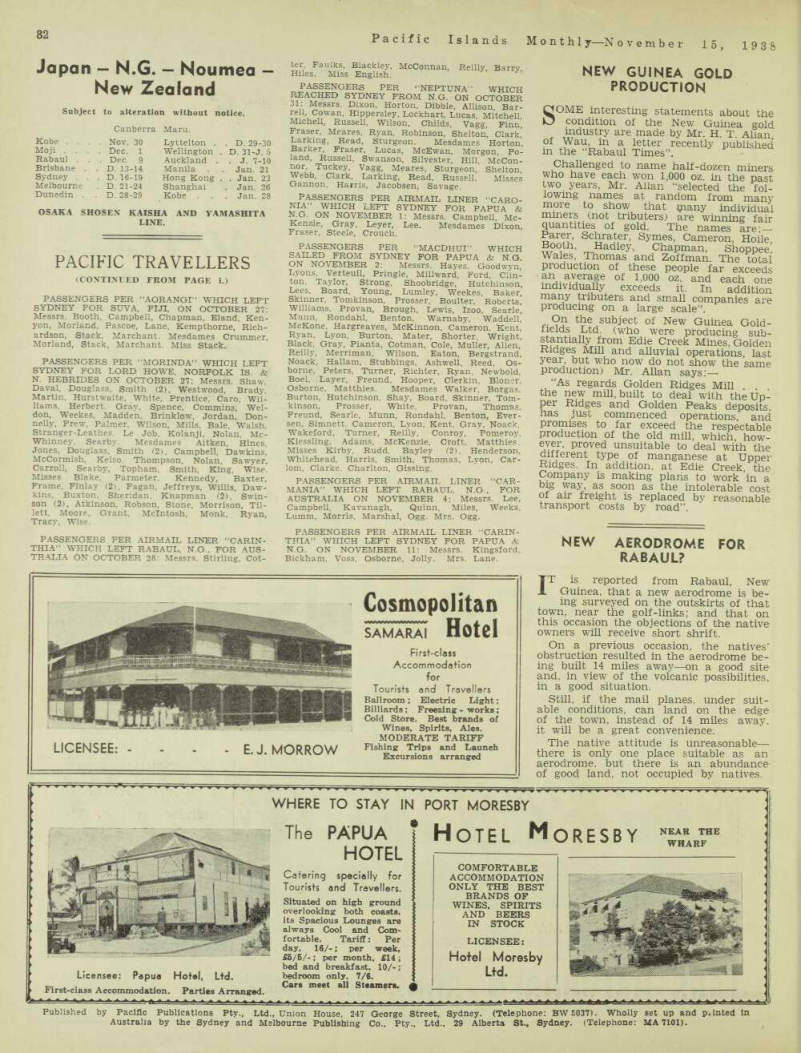
New Guinea Gold
SOME interesting statements about the condition of the New Guinea gold industry are made by Mr. H. T. Allan, of Wau, in a letter recently published in the ‘ Rabaul Times”.
Challenged to name half-dozen miners who have each won 1,000 oz. in the oast two years, Mr. Allan “selected the fol lowing names at random from many more to show that piany individual miners (not tributers) are winning fair quantities of gold. The names are - Parer, Schrater, Symes, Cameron, Hoile, Booth, Hadley, Chapman, Shoppee.
Wales Thomas and Zoffman. The total production of these people far exceeds an average of 1,000 oz. and each one individually exceeds it. In addition many tributers and small companies are producing on a large scale”.
On the subject of New Guinea Gold fields Ltd. (who were producing sub stantially from Edie Creek Mines, Golden Ridges Mill and alluvial operations, last year but who now do not show the same production) Mr. Allan says:— “As regards Golden Ridges Mill . the new mill, built to deal with the Up per Ridges and Golden Peaks deposits . has just commenced operations, and promises to far exceed the respectable production of the old mill, which, how ever, proved unsuitable to deal with the different type of manganese at Upper Ridges. In addition, at Edie Creek, the Company is making plans to work in a big way, as soon as the intolerable cost of air freight is replaced by reasonable transport costs by road”
New Aerodrome For
Rabaul?
IT is reported from Rabaul, New Guinea, that a new aerodrome is be ing surveyed on the outskirts of that town, near the golf-links: and that on this occasion the objections of the native owners will receive short shrift.
On a previous occasion, the natives" obstruction resulted in the aerodrome be ing built 14 miles away—on a good site and, in view of the volcanic possibilities, in a good situation.
Still, if the mail planes, under suit able conditions, can land on the edge of the town, instead of 14 miles away, it will be a great convenience.
The native attitude is unreasonable — there is only one place suitable as an aerodrome, but there is an abundance of good land, not occupied by natives.
Advertisements & other items, pp. 86-88 (3 items)
Pacific Travellers
82
Pacific Islands Monthl y—N ovember 15, 1938
(CONTINUED FROM PAGE i.)
Published by Pacific Publications Pty., Ltd., Union House, 247 George Street, Sydney. (Telephone: BW 5037). Wholly set up and pointed In Australia by the Sydney and Melbourne Publishing Co., Pty.. Ltd.. 29 Alberta St., Sydney. (Telephone: MA7101).
Cosmopolitan
LICENSEE: -
E.J. MORROW
SAMARA! Hotel
First-class Accommodation for Tourists and Travellers Ballroom ; Electric Light: Billiards; Freezing - works ; Cold Store. Best brands of Wines, Spirits, Ales.
MODERATE TARIFF
Fishing Trips and Launch Excursions arranged
WHERE TO STAY IN PORT MORESBY
Licensee: Papua Hotel, Ltd.
First-class Accommodation. Parties An
The PAPUA
HOTEL
Catering specially for
Tourists and Travellers.
Situated on high ground overlooking both coasts, its Spacious Lounges are always Cool and Comfortable. Tariff: Per day. 16/-; per week, £6/5/- ; per month, £l4 ; bed and breakfast, 10/-; bedroom only, 7/6.
Cars meet all Steamers.
Hotel Moresby
NEAR THE
WHARF
COMFORTABLE
ACCOMMODATION
ONLY THE BEST
BRANDS OF
WINES. SPIRITS
AND BEERS
IN STOCK
LICENSEE;
Hofei Moresby
Ltd.
;.v.
...so does Civilization
by GUINEA AIRWAYS
GUINEA AIRWAYS, LIMITED
was established in 1927; and has grown as the figures show —providing regular, uninterrupted services between the Goldfields and the Coast. .0 TIME certainly seems to have flown in the Territory during the past eleven years. Since 1927, when the development of the Morobe Goldfield commenced, New Guinea's European population has been trebled, and the Empire’s gold production has been increased by nearly £2,000,000 per annum. Without Air Transport, such rapid progress would have been impossible.
GUINEA AIRWAYS—the pioneer Air Transport Company in New Guinea—is the largest freight-carrying service in the world. Every type of goods is carried —with speed and safety—by Guinea Airways.
GUINEA AIRWAYS LIMITED operates regular air services in New Guinea and Papua, using over fifty aerodromes and landing grounds in the two territories.
GUINEA AIRWAYS planes depart from Port Moresby for the Goldfields on the arrival of each boat. Tickets are obtainable from the Purser.
Fly with GUINEA AIRWAYS, in New Guinea and in Australia.
AUSTRALIAN SERVICES: Guinea Airways planes leave Adelaide for Darwin every Tuesday, Thursday and Saturday, connecting with overseas services, and returning every Sunday, Monday and Friday.
Ask for full details.
GUINEA AIRWAYS
LIMITED
LAE-SALAMAUA
Head Office: Austral Chambers, Currie Street, Adelaide, S.A.
New Guinea Office: Lae, Mandated Territory of New Guinea m « tw m BRANCH OFFICES AND AGENTS AT WAU—SALAMAUA—PORT MORESBY AND SYDNEY.
A Tropical Thirst
demands a Satisfying Drink
i r ysr
R AL'c
w«|| r " *">-V FROM THE FINEST MALj3fe|| \ an# bottled by ~gg|i
k To ?TH & Co., LIMITS
Sydney. austr ALiAggfi
that’s why K.B. is so popular
south of (< the ”
All through the tropics, wherever there are men who like good beer, you 11 always find K. B. It's the drink that men appreciate —a drink just made to satisfy a tropical thirst! 5? fa
TOOTH'S
KB
LAGER.