Pacific
Islands
Monthly
Vol. Ix. No. 3.
October 15, 1938
[Registered at the G.P.0.. Sydney, lor transmission by post as a newspaper.]
8 a
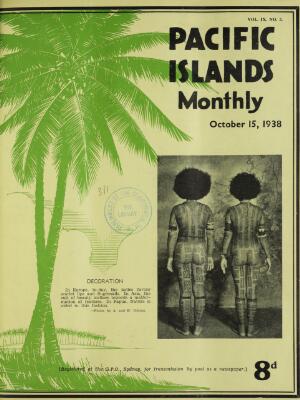
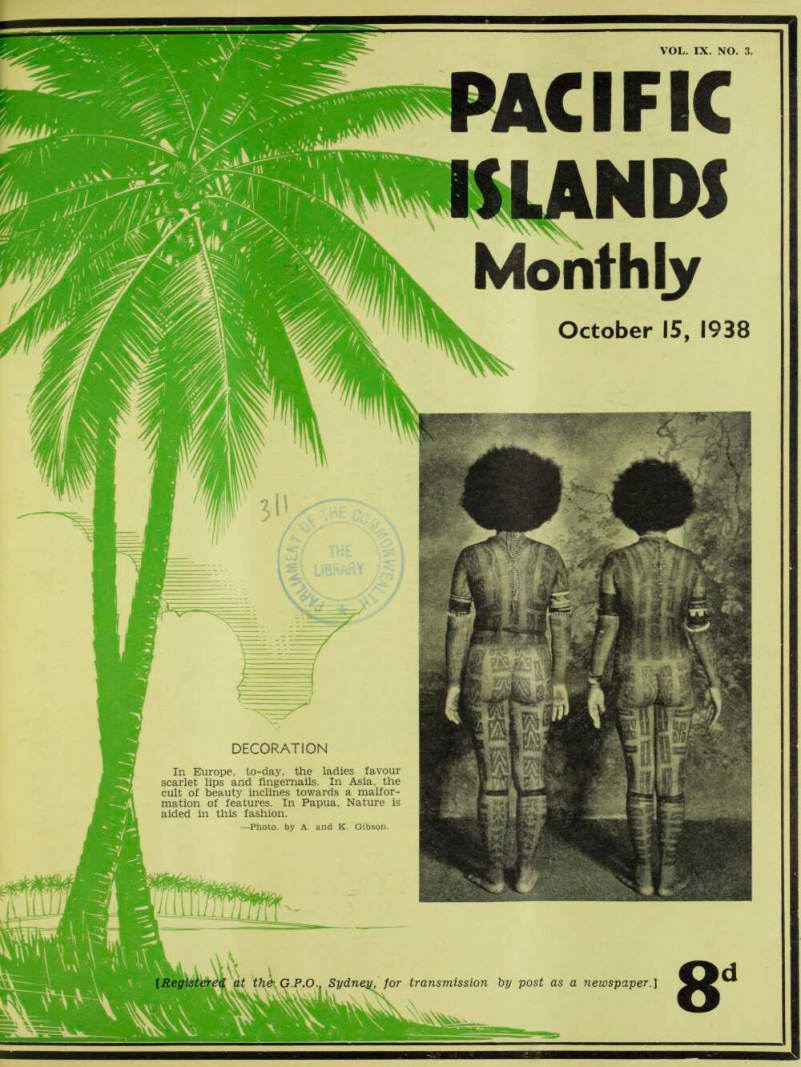
Decoration
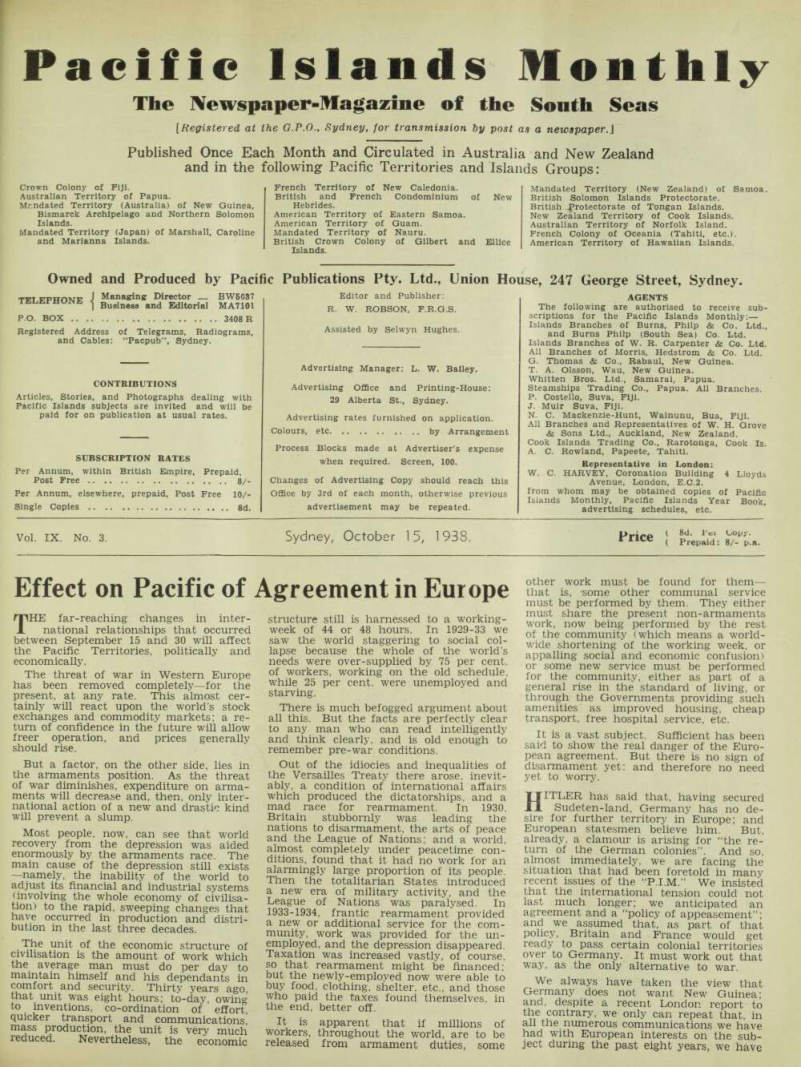
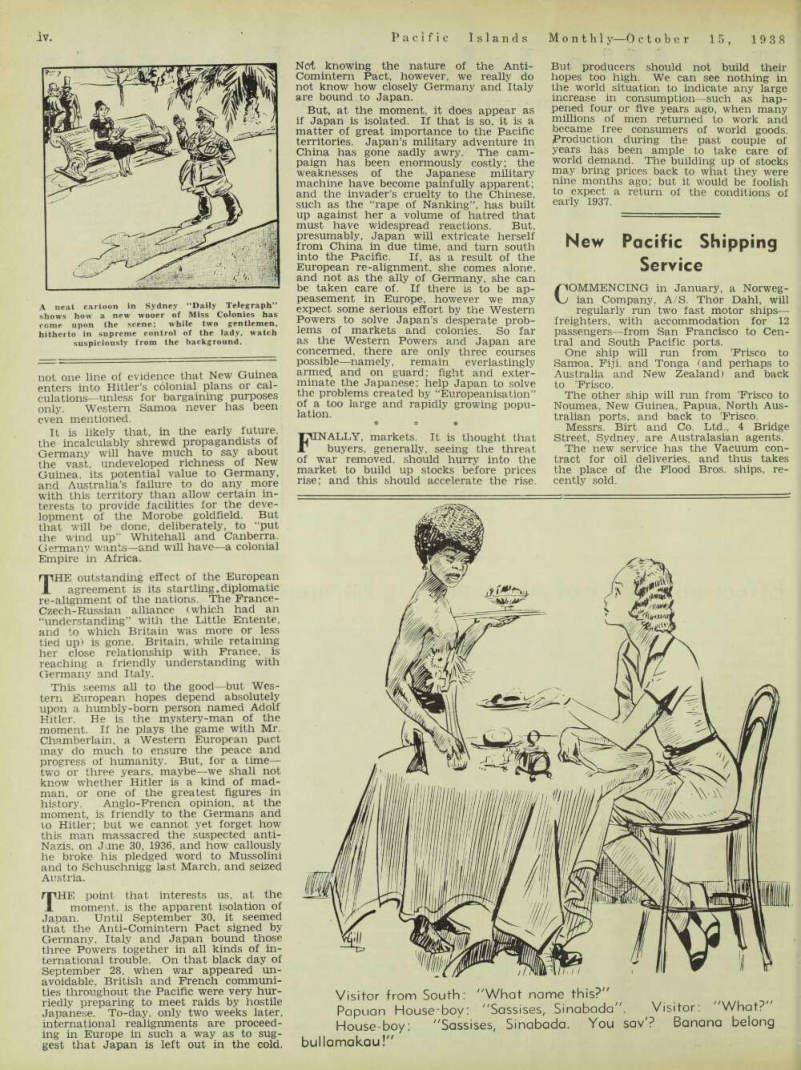
In Europe, to-day, the ladies favour scarlet lips and fingernails. In Asia, the cult of beauty inclines towards a malfor mation of features. In Papua, Nature is aided in this fashion. —Photo, by A. and K. Gibson.
Advertisements & other items, p. 2 (2 items)
Pacific Islands Monthl y—O l5, 1938
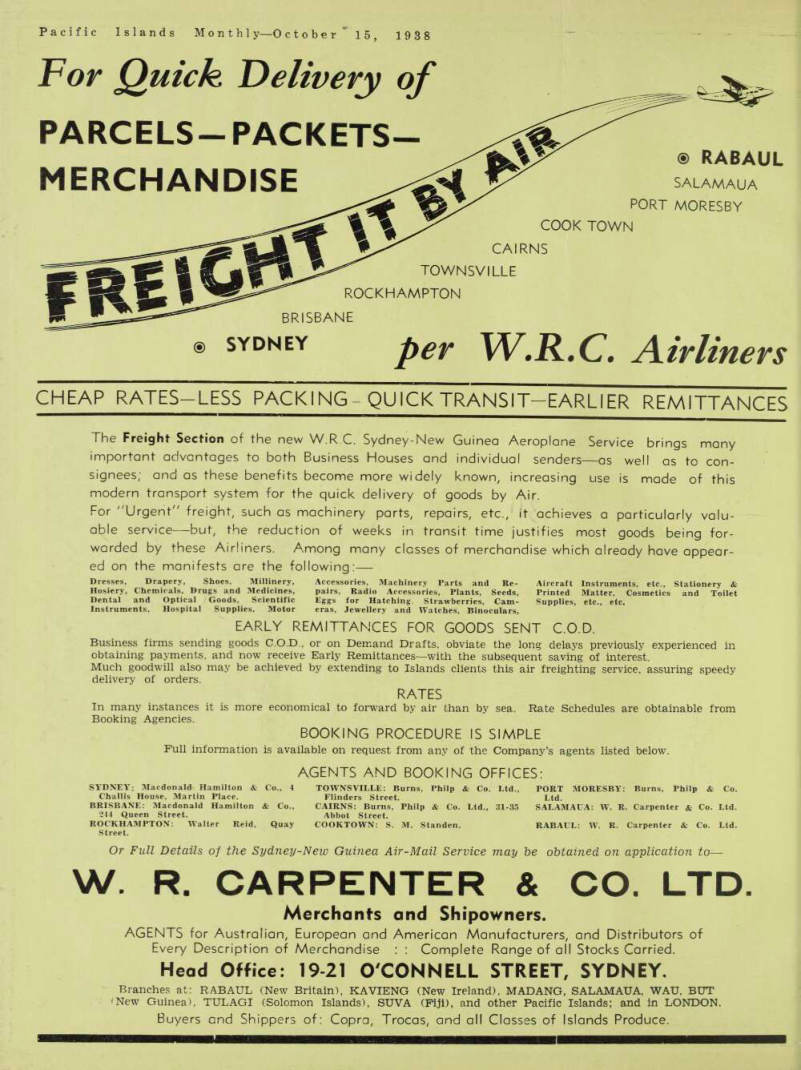
For Quick Delivery of
PARCELS-PACKETS-
MERCHANDISE
ROCKH/
® RABAUL
SALAMAUA
PORT MORESBY
COOK TOWN
CAIRNS
TOWNSVILLE
ROCKHAMPTON
BRISBANE
® SYDNEY
per W.R.C.Airliners
CHEAP RATES—LESS PACKING-QUICK TRANSIT—EARLIER REMITTANCES
The Freight Section of the new W.R.C. Sydney-New Guinea Aeroplane Service brings many important advantages to both Business Houses and individual senders—as well as to consignees; and as these benefits become more widely known, increasing use is made of this modern transport system for the quick delivery of goods by Air.
For ''Urgent" freight, such as machinery parts, repairs, etc., it achieves a particularly valuable service—but, the reduction of weeks in transit time justifies most goods being forwarded by these Airliners. Among many classes of merchandise which already have appeared on the manifests are the following:— Dresses, Drapery, Shoes. Millinery, Accessories. Machinery Parts and Re- Aircraft Instruments, etc.. Stationery & Hosiery, Chemicals, Drugs and Medicines, pairs, Radio Accessories, Plants, Seeds, Printed Matter, Cosmetics and Toilet Dental and Optical Goods, Scientific Eggs for Hatching. Strawberries, Cam- Supplies, etc., etc.
Instruments, Hospital Supplies, Motor eras, Jewellery and Watches, Binoculars,
EARLY REMITTANCES FOR GOODS SENT C.O.D.
Business firms sending goods C.0.D., or on Demand Drafts, obviate the long delays previously experienced in obtaining payments, and now receive Early Remittances—with the subsequent saving of interest.
Much goodwill also may be achieved by extending to Islands clients this air freighting service, assuring speedy delivery of orders.
RATES
In many instances it is more economical to forward by air than by sea. Rate Schedules are obtainable from Booking Agencies.
BOOKING PROCEDURE IS SIMPLE
Full information is available on request from any of the Company’s agents listed below.
AGENTS AND BOOKING OFFICES:
SYDNEY; Macdonald Hamilton & Co., 4 TOWNSVILLE: Burns, Philp & Co. Ltd., PORT MORESBY: Burns, Philp & Co.
Challis House, Martin Place. Flinders Street. Ltd.
BRISBANE: Macdonald Hamilton & Co., CAIRNS: Burns, Philp & Co. Ltd., 31-35 SALAMAUA: W. R. Carpenter & Co. Ltd. 244 Queen Street. Abbot Street.
ROCKHAMPTON: Walter Reid, Quay COOKTOWN: S. M. Standen. RABAUL: W. R. Carpenter & Co. Ltd, Street.
Or Full Details of the Sydney-New Guinea Air-Mail Service may he obtained on application to —
W. R. CARPENTER & CO. LTD.
Merchants and Shipowners.
AGENTS for Australian, European and American Manufacturers, and Distributors of Every Description of Merchandise : : Complete Range of all Stocks Carried.
Head Office: 19-21 O'CONNELL STREET, SYDNEY.
Branches at: RABAUL (New Britain), KAVIENG (New Ireland), MADANG, SALAMAUA, WAU, BUT 'New Guinea), TULAGI (Solomon Islands), SUVA (Fiji), and other Pacific Islands; and in LONDON.
Buyers and Shippers of: Copra, Trocas, and all Classes of Islands Produce.
Pacific Islands Travellers
Passengers Per “Morinda” From Syd
NEY FOR LORD HOWE IS., NORFOLK IS.,
And New Hebrides On September 15;
Messrs. Arthur, Ewing, Leigh, Tattersall, Niven.
Bairstow, Martin, Thomas, Adams, Gaihblier, Bayly (2), Baxter, Cunningham, Marlin, Benny, Flower, Moir, Lord, Heffernan, Gill. Mesdames Ewing, Baddeley, Kelly, Butt, Simpson. Misses Glissan, Buckland, Owen, Henry, O’Connor, Gorrick, Boldham, Shelper, Wilde, Pearce (2), Bayly, Watchorm, Perkins, Thorpe, Brown, Nicholls.
Passengers Per Airmail Liner Which
Arrived In Sydney On September 16
FROM: —Rabaul: Mrs. Cameron. Salamaua: Mesdames Crouch and Judd; Messrs. Judd and Curry.
Passengers Per “Macdhui” Which
Arrived In Sydney From New Guinea
And Papua On September 17: Messrs.
Audsley, Atkinson, Board, Barnewitz, Brough, Boys. Collins, Cooper, Crookshanks, Davidson, Downham, Doggett, Deland, Dodd, English, Fryer, Farn, Geddes, Gardner, Haycroft, Horne, Harris, Loudon, Lukin, Lord, Molloy, Mullerreid, Maxwell, McLennan, Moseley, Matthias, Mac- Lean, Munro, Niall, Oakley. Pratt, Rideout (2), Rigby. Sutton. Shade, Shorter, Shoppee, Tom linson, Thiele, Yourn, Warner, Wade, Ward, Wiltshire, Watson. Mesdames Bird. Ditton, De
land, English, Earl, Haycroft, Horne, Ma>c gregor. Maxwell, McLennan, Matthias, Munro, Niall, Oakley, Price, Rawson, Rigby, Short, Shoppee, Turner, Tomlinson, Wade. White.
Misses Balmain, Donovan, St. Florent, Harber, Kirby, Margaret, Rudd, Williamson.
Passengers Per Airmail Liner Which
Left Sydney On September 20 For:—
Salamaua; Mr. Hintos. Rabaul: Mr. Hore- Lacy. Brisbane to Port Moresby: Miss Jacobs.
Townsville to Salamaua: Mr. Green. Cairns to Rabaul; Miss Hogan. Salamaua to Rabaul: Messrs. Shipson, Neal, Ostrom, Markkanin; Mrs. Simpson; Miss Markkanin.
Passengers Per “Tanda” Which Ar
RIVED IN SYDNEY FROM RABAUL, N.G., ON SEPTEMBER 21:—Messrs. Townsend, Reed, Rey nolds (2), Noble, Berry. Mesdames McCosker, Gosmer, Reynolds, Tahija, Johnson, Flatten, Costello. Miss Harris.
Passengers Per “Maetsuycker” From
Sydney For Pt. Moresby, Papua, On
SEPTEMBER 24:—Messrs. Mackie, Swanson, Waterhouse, Wyborn (2). Mesdames Batham, Chawner, Fletcher, Swanson, Wyborn.
Passengers Per Airmail Liner Which
Left Rabaul (N.G.) On September 24
FOR: —Salamaua; Messrs. Costello, Neal, Os
trom, Johnson. Salamaua to Brisbane: Mrs.
V. Smith, Miss J. Smith. To Sydney: Mrs.
Cahill. Pt. Moresby to Cairns: Mr. Casement.
To Brisbane: Miss Jacobs, Mrs. Thompson. To Sydney: Mr. Aitlsen.
Passengers Per “Macdhui” From Syd
NEY FOR NEW GUINEA AND PAPUA ON SEPTEMBER 24:—Messrs. Milligan, James, Horne, Burton, Rich, Rogerson, Daulton, Rob ertson. Laird, Rutledge, Ryan, Devine, Cox, Whitbread, Cou-tts, Turner, Whale, Abel, Pom eroy, Chisholm, Stopp, Cheetham, Whyte, Buck land, Benham, Archer. Slorach, Brudo Boyd, Chapman. Jay, McCabe, Armstrong, Bentley, Duncan, Reaby, Louttit, Wedd, Partridge, Sav iane, Paoloni, Shaw, Frank, Wakefield Mulli gan, Sexton, Thomas, Matthies. Mesdames Tay lor, McLean, Smallwood, Rowatt, Rich, Rog erson, Laird, Chisholm, Montgomery, Grose, Drosten, Gibson. Champion, Whyte, Rohrlach, Lee. Chapman, Johnson, Matthies. Misses Rudd, Kirby, Raymond, Cameron, Devitt, Mackay, Kostka, Linus.
Passengers Per Airmail Liner Which
Left Sydney On September 27 For:
Rabaul; Messrs. Cotter, Sterling, Padgett, Faulks. Cairns to Rabaul: Messrs. Murray, Parker, Osborne.
Passengers Per “Niagara” Which
SAILED FROM SYDNEY FOR SUVA. FIJI. ON SEPTEMBER 29; Messrs. Alldritt, Cummings,
(Continued On Page 84.)
Day, Hedstrom, Mackie, Cipra, Kettle,, Leather, Lane, McLeod, McHugh, Robinson, Smythe, Trivett, Verge. Mesdames Dickson, Smythe.
Misses Swinton (2).
Passengers Per Airmail Liner Which
Left Rabaul (N.G.) On September 30
FOR;—Salamaua: Messrs. Ramcke, Padgett, Faulks, Sterling, Cotter. Sydney: Mesdames Mullaly and Heron. Salamaua to Sydney: Messrs. Campbell, Fader, Peacock. Pt. Moresby to Sydney: Mr. Clegg.
Passengers Per “Mala3Ta” Which Ar
Rived In Sydney From Rabaul (N.G.)
AND 8.5.1. ON OCTOBER 7;—Messrs. Bar ham, Boy dell, Clark, Deck, Doyle, Eilam. Grant, Hart, Hewitt, Kenny, Leauli, Lotze, Moore, Moriarty,. Mortimer, Moxon, Phillips, Price, Richards, Sandars, Smith, Tomlinson, Turn bull, Wills. Mesdames Barham, Catanach, Col lins, Fairchild, Farlow, Hart, Kennedy, Lee, Lotze, Mcßae, Osborne, Phillips, Price, Riddi ford, Short, Silvester, Widdy, Wilson. Misses Campion, Cohen, Collins, Grant, Holdgate Moore, Parsons, Read, Semple.
Passengers Per “Morinda” Which
Arrived In Sydney From Lord Howe
IS.. NORFOLK IS.. AND NEW HEBRIDES ON OCTOBER 7:—Messrs. Adams, Barry, Bayley, Baxter, Benny, Brewer, Douglas, Gambier. Gill, Hoare, Kursey, Lord, Moir, Moverly, McKellar- White, Stevens, Stephenson. Tattersall, Arthur, Hughes, Leigh, Niven, Edwards, Hill, Downes, Ewing. Mesdames Parnant, Hankinson, Hines, Kelly, Kirby, Kursey, M'ollin, Moverly, M<> Kellar-White, Saville, Stevens, Bailey, Bever idge, Blackwell, Burgess, Downes, Ewing, Hut chinson. Misses Bayley, Buckland, Gehde, Glis sion, Garrick. Henry, Nichols, «Oates (2). O’Con nor, Owen. Oldham. Pearce (2), Ralph, Richard son, Shelper, Wilde, Willis, Brown, Perkins, Thorpe, Bailey, Everett, Messiter, Wilson.
Passengers Per “Tanda” From Sydney
For Rabaul, N.G., On October 12;—Messrs.
Taylor, McGowan. Tupling. Holmes, Spensley, Alexander, Bruckshaw, Anthony, Kyle, John ston, George, Robinson, Roberts, Kerslake. Mes dames Holmes, McGowan, Spensley, Dwyer, Bruckshaw, Anthony, Cassell, Challis, George.
Robinson. Misses Makins, Booth, Banks.
Rt. Rev. P, N. Strong:, Bishon of New Guinea, will return to Papua from Syd ney by the October “Montoro”.
Advertisements & other items, p. 3 (2 items)
I
Pacific Islands Monthl y —O ctober 15, 1938
Pacific
THE
KPM
SOUTH
PACIFIC
LINE
BATAVIA
S AM A A AN G
H.
SURABAYA
PORT M 0 AIS At
*3 U
Links the East with the South
Pacific Islands, New Zealand & Australia
KPM
M
SOUTH PACIFIC LINE
Royal Packet Navigation Co.
Ltd.. Paketvaart House, 255 George Street, Sydney. (N. V. Koninklijke Paketvaart Maatschappij—lncorporated in the Netherlands).
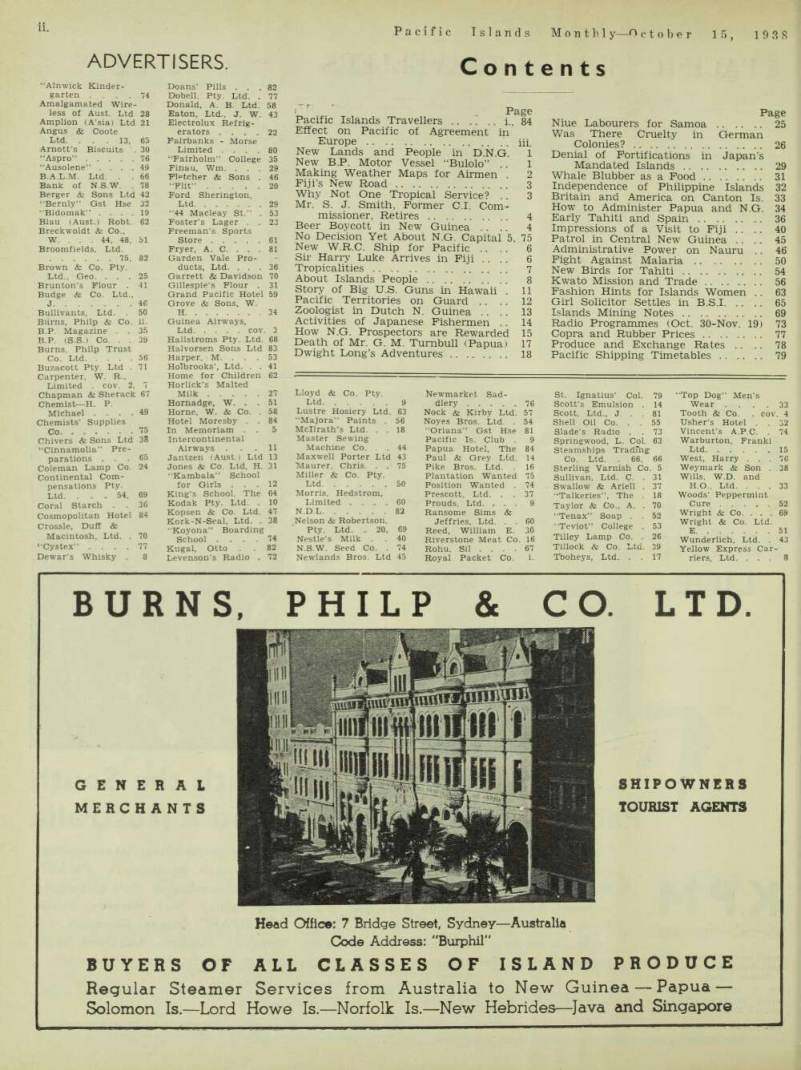
The track routes of the K.P.M.-South Pacific Line new motor vessel "Maetsuycker" and the well-known passenger steamer "Tasman" are each as follows: "MAET- SUYCKER": Saigon, Singapore, Batavia, Samarang, Sourabaya, Port Moresby, Samarai, Salamaua, Rabaul, Auckland, Wellington, Sydney, Port Moresby, Sourabaya, Samarang, Batavia, Singapore, Saigon. "TASMAN": Saigon, Singapore, Batavia, Samarang, Sourabaya, Port Moresby, Port Vila, Noumea, Auckland, Wellington, Sydney, Port Moresby, Sourabaya, Samarang, Batavia, Singapore, Saigon.
Saigon, Diethelm & Co.: Port Moresby and Samarai, Steamships Trading Co. Ltd.: Rabaul and Salamaua. W. R.
Carpenter & Co. Ltd.: Port Vila. Gubbay Preres: Noumea, Carlo Leoni; Auckland, Russell & Somers Ltd.: Wellington, Johnston & Co. Ltd.
Advertisers.
“Alnwick Kinder garten ... 74 Amalgamated Wire less of Aust. Ltd 28 Amplion (A’sia) Ltd 21 Angus & Coote Ltd. ... 13, 65 Arnott’s Biscuits .30 “Aspro” 76 “Ausolene” ... 49
B.A.L.M. Ltd. . . 66
Bank of N.S.W. . 78 Berger & Sons Ltd 42 “Bernly” Gst Hse 32 “Bidomak” ... 19 Blau (Aust.) Robt. 62 Breckwoldt & Co., W. . . . 44, 48, bl Broomfields, Ltd. 75, 82 Brown & Co. Pty.
Ltd., Geo. ... 25 Brunton’s Flour . 41 Budge & Co. Ltd., J 46 Bullivants, Ltd. . 50 Burns, Philp & Co. ii.
B.P. Magazine . . 35
B.P. (S.S.) Co. . . 39
Burns, Philp Trust Co. Ltd 56 Buzacott Pty. Ltd . 71 Carpenter, W. R., Limited . cov. 2, 7 Chapman & Sherack 67 Chemist—H. P.
Michael ... 49 Chemists’ Supplies Co 75 Chivers & Sons Ltd 38 “Cinnamolia” Pre parations ... 65 Coleman Lamp Co. 24 Continental Com pensations Pty.
Ltd. . . 54, 69 Coral Starch . . 36 Cosmopolitan Hotel 84 Crossle, Duff & Macintosh. Ltd. . 70 “Cystex” ... 77 Dewar’s Whisky . 8
Doans’ Pills ... 82 Dobell, Pty. Ltd. . 77 Donald, A. B. Ltd. 58 Eaton, Ltd., J. W. 43 Electrolux Refrig erators ... 22 Fairbanks - Morse Limited ... 80 “Fairholm” College 35 Finau, Wm. ... 29 Fletcher & Sons . 46 “Flit” 20 Ford Sherington, Ltd 29 “44 Macleay St.” . 53 Foster’s Lager . . 23 Freeman’s Sports Store 61 Fryer, A. C. ... 81 Garden Vale Pro ducts, Ltd. ... 36 Garrett & Davidson 70 Gillespie's Flour . 31 Grand Pacific Hotel 59 Grove & Sons, W.
H 34 Guinea Airways, Ltd cov. 3 Hallstroms Pty. Ltd. 68 Halvorsen Sons Ltd 83 Harper, M. ... 53 Holbrooks’, Ltd. . .41 Home for Children 62 Horlick’s Malted Milk 27 Hornadge, W. . . 51 Horne, W. & Co. . 58 Hotel Moresby . . 84 In Memoriam . . 5 Intercontinental Airways . . .11 Jantzen lAust.) Ltd 13 Jones & Co. Ltd, H. 31 “Kambala” School for Girls ... 12 King’s School. The 64 Kodak Pty. Ltd. . 10 Kopsen & Co. Ltd. 47 Kork-N-Seal, Ltd. . 38 “Koyona” Boarding School ... 74 Kugal, Otto . . 82 Levenson’s Radio . 72
Lloyd & Co. Pty.
Ltd 9 Lustre Hosiery Ltd. 63 “Majora” Paints . 56 Mcllrath’s Ltd. . . 18 Master Sewing Machine Co. . . 44 Maxwell Porter Ltd 43 Maurer, Chris. . . 75 Miller & Co. Pty.
Ltd 50 Morris, Hedstrom, Limited ... 60
N.D.L 82
Nelson & Robertson.
Pty. Ltd. . 20, 69 Nestle’s Milk . 40 N.S.W. Seed Co. . 74 Newlands Bros. Ltd 45
Newmarket Sad dlery 76 Nock & Kirby Ltd. 57 Noyes Bros. Ltd. . 54 “Oriana” Gst Hse 81 Pacific Is. Club 9 Papua Hotel, The 84 Paul & Grey Ltd. 14 Pike Bros. Ltd. . 16 Plantation Wanted 75 Position Wanted . 74 Prescott, Ltd. . . 37 Prouds, Ltd. , . . 9 Ransome Sims & Jeffries, Ltd. . . 60 Reed. William E. 30 Riverstone Meat Co. 16 Rohu, Sil . . . . 67 Royal Packet Co. i.
St. Ignatius’ Col. 79 Scott’s Emulsion . 14 Scott, Ltd., J. . . 81 Shell Oil Co. . . 55 Slade’s Radio . . 73 Springwood, L. Col. 63 Steamships Trading Co. Ltd. . 66. 66 Sterling Varnish Co. 5 Sullivan, Ltd. C. . 31 Swallow & Ariell . 37 “Talkeries”, The . 18 Taylor & Co., A. . 70 “Tenax” Soap . . 52 “Teviot” College . 53 Tilley Lamp Co. . 26 Tillock & Co. Ltd. 39 Tboheys, Ltd. . . 17
“Top Dog” Men’s Wear ... 33 Tooth & Co. . cov. 4 Usher’s Hotel . . 52 Vincent’s A.P.C. . 74 Warburton, Franki Ltd 15 West, Harry ... 76 Weymark & Son . 38 Wills, W.D. and H. 0.. Ltd. ... 33 Woods’ Peppermint Cure 52 Wright & Co. ... 69 Wright & Co. Ltd.
E 51 Wunderlich, Ltd. . 43 Yellow Express Car riers, Ltd. ... 8
Contents
! r Page Pacific Islands Travellers i., 84 Effect on Pacific of Agreement in Europe iff.
New Lands and People in D.N.G. 1 New B.P. Motor Vessel “Bulolo” .. 1 Making Weather Maps for Airmen . 2 Fiji’s New Road 3 Why Not One Tropical Service? .. 3 Mr. S. J. Smith, Former C.I. Com missioner, Retires 4 Beer Boycott in New Guinea ... 4 No Decision Yet About N.G. Capital 5, 75 New W.R.C. Ship for Pacific .. . . 6 Sir Harry Luke Arrives in Fiji . . . . 6 Tropicalities 7 About Islands People 8 Story of Big U.S. Guns in Hawaii . 11 Pacific Territories on Guard .. .. 12 Zoologist in Dutch N. Guinea ... 13 Activities of Japanese Fishermen .. 14 How N.G. Prospectors are Rewarded 15 Death of Mr. G. M. Turnbull (Papua) 17 Dwight Long’s Adventures 18
Page Niue Labourers for Samoa 25 Was There Cruelty in German Colonies? 26 Denial of Fortifications in Japan’s Mandated Islands 29 Whale Blubber as a Food 31 Independence of Philippine Islands 32 Britain and America on Canton Is. 33 How to Administer Papua and N.G. 34 Early Tahiti and Spain 36 Impressions of a Visit to Fiji .. .. 40 Patrol in Central New Guinea ... 45 Administrative Power on Nauru .. 46 Fight Against Malaria 50 New Birds for Tahiti 54 Kwato Mission and Trade 56 Fashion Hints for Islands Women .. 63 Girl Solicitor Settles in 8.5.1 65 Islands Mining Notes 69 Radio Programmes (Oct. 30-Nov. 19) 73 Copra and Rubber Prices 77 Produce and Exchange Rates .. .. 78 Pacific Shipping Timetables 79
Advertisements & other items, p. 4 (2 items)
Ii
Pacific Islands Month! y—O ctober 15, 1938
Burns, Philp & Co. Ltd.
GENERAL
MERCHANTS
mil in
nil
in 1111
ill 111
[[[III
Head Office: 7 Bridge Street, Sydney- Code Address: "Burphil" -Australia
SHIPOWNERS
TOURIST AGENTS
BUYERS OF ALL CLASSES OF ISLAND PRODUCE Regular Steamer Services from Australia to New Guinea Papua Solomon Is.—Lord Howe Is. —Norfolk Is. —New Hebrides —Java and Singapore
Pacific Islands Monthly
The Newspaper-Magazine of the South Seas [Registered at the G.P.0., Sydney , for transmission by post as a newspaper J
Published Once Each Month and Circulated in Australia and New Zealand and in the following Pacific Territories and Islands Groups:
Crown Colony of FIJI.
Australian Territory of Papua.
Mandated Territory (Australia) of New Guinea, Bismarck Archipelago and Northern Solomon Islands.
Mandated Territory (Japan) of Marshall, Caroline and Marianna Islands.
French Territory of New Caledonia.
British and French Condominium of New Hebrides.
American Territory of Eastern Samoa.
American Territory of Guam.
Mandated Territory of Nauru.
British Crown Colony of Gilbert and Ellice Islands.
Mandated Territory (New Zealand) of Samoa, British Solomon Islands Protectorate.
British protectorate of Tongan Islands.
New Zealand Territory of Cook Islands.
Australian Territory of Norfolk Island.
French Colony of Oceania (Tahiti, etc.).
American Territory of Hawaiian Islands.
Owned and Produced by Pacific Publications Pty. Ltd., Union House, 247 George Street, Sydney.
>ti?t v'-pun-hiip J Managing Director 8W5037 TELEPHONE BusinegB and Editorial MA7IOI
P.O. Box 3408 R
Registered Address of Telegrams, Radiograms, and Cables: "Pacpub”, Sydney.
Contributions
Articles, Stories, and Photographs dealing with Pacific Islands subjects are invited and will be paid for on publication at usual rates.
Subscription Rates
Per Annum, within British Empire, Prepaid, Post Free 8/- Per Annum, elsewhere, prepaid. Post Free 10/- Single Copies Bd.
Editor and Publisher:
R. W. Robson, F.R.G.S.
Assisted by Selwyn Hughes.
Advertising Manager: L. W. Bailey.
Advertising Office and Printing-House: 29 Alberta St., Sydney.
Advertising rates furnished on application.
Colours, etc by Arrangement Process Blocks made at Advertiser’s expense when required. Screen, 100.
Changes of Advertising Copy should reach this Office by 3rd of each month, otherwise previous advertisement may be repeated.
Agents
The following are authorised to receive sub scriptions for the Pacific Islands Monthly:— Islands Branches of Burns, Philp & Co. Ltd., and Burns Philp (South Sea) Co. Ltd.
Islands Branches of W. R. Carpenter & Co. Ltd.
All Branches of Morris, Hedstrom & Co. Ltd.
G. Thomas & Co.. Rabaul, New Guinea.
T. A. Olsson, Wau, New Guinea.
Whitten Bros. Ltd., Samarai, Papua.
Steamships Trading Co., Papua. All Branches.
P. Costello, Suva, Fiji.
J. Muir Suva. Fiji.
N. C. Mackenzie-Hunt, Walnunu, Bua, Fiji.
All Branches and Representatives of W. H. Grove & Sons Ltd., Auckland, New Zealand.
Cook Islands Trading Co., Rarotonga, Cook Is.
A. C. Rowland, Papeete, Tahiti.
Representative in London: W. C. HARVEY, Coronation Building 4 Lloyds Avenue, London, E.C.2. from whom may be obtained copies of Pacific Islands Monthly, Pacific Islands Year Book, advertising schedules, etc.
Vol. IX. No. 3.
Sydney, October 15, 1938.
Priro I Bd. Pei Copy. i live ( Prepaid: 8/- p.a.
Effect on Pacific of Agreement in Europe
THE far-reaching changes in inter national relationships that occurred between September 15 and 30 will affect the Pacific Territories, politically and economically.
The threat of war in Western Europe has been removed completely—for the present, at any rate. This almost cer tainly will react upon the world’s stock exchanges and commodity markets; a re turn of confidence in the future will allow freer operation, and prices generally should rise.
But a factor, on the other side, lies in the armaments position. As the threat of war diminishes, expenditure on arma ments will decrease and, then, only inter national action of a new and drastic kind will prevent a slump.
Most people, now, can see that world recovery from the depression was aided enormously by the armaments race. The main cause of the depression still exists —namely, the inability of the world to adjust its financial and industrial systems (involving the whole economy of civilisa tion) to the rapid, sweeping changes that have occurred in production and distri bution in the last three decades.
The unit of the economic structure of civilisation is the amount of work which the average man must do per day to maintain himself and his dependants in comfort and security. Thirty years ago, that unit was eight hours; to-day, owing to inventions, co-ordination of effort quicker transport and communications, mass production, the unit is very much reduced. Nevertheless, the economic
structure still is harnessed to a working week of 44 or 48 hours. In 1929-33 we saw the world staggering to social col lapse because the whole of the world’s needs were over-supplied by 75 per cent, of workers, working on the old schedule, while 25 per cent, were unemployed and starving.
There is much befogged argument about all this. But the facts are perfectly clear to any man who can read intelligently and think clearly, and is old enough to remember pre-war conditions.
Out of the idiocies and inequalities of the Versailles Treaty there arose, inevit ably, a condition of international affairs which produced the dictatorships, and a mad race for rearmament. In 1930, Britain stubbornly was leading the nations to disarmament, the arts of peace and the League of Nations: and a world, almost completely under peacetime con ditions, found that it had no work for an alarmingly large proportion of its people.
Then the totalitarian States introduced a new era of military activity, and the League of Nations was paralysed. In 1933-1934, frantic rearmament provided a new or additional service for the com munity, work was provided for the un employed, and the depression disappeared.
Taxation was increased vastly, of course, so that rearmament might be financed; but the newly-employed now were able to buy food, clothing, shelter, etc., and those who paid the taxes found themselves, in the end, better off.
It is apparent that if millions of workers, throughout the world, are to be released from armament duties, some
other work must be found for them — that is, -some other communal service must be performed by them. They either must share the present non-armaments work, now being performed by the rest of the community (which means a world wide shortening of the working week, or appalling social and economic confusion) or some new service must be performed for the community, either as part of a general rise in the standard of living, or through the Governments providing such amenities as improved housing, cheap transport, free hospital service, etc.
It is a vast subject. Sufficient has been said to show the real danger of the Euro pean agreement. But there is no sign of disarmament yet: and therefore no need yet to worry, HITLER has said that, having secured Sudeten-land, Germany has no de sire for further territory in Europe; and European statesmen believe him. But, already, a clamour is arising for “the re turn of the German colonies ’. And so, almost immediately, we are facing the situation that had been foretold in many recent issues of the “P.1.M.” We insisted that the international tension could not last much longer; we anticipated an agreement and a “policy of appeasement’’; and we assumed that, as part of that policy, Britain and France would get ready to pass certain colonial territories over to Germany. It must work out that way, as the only alternative to war.
We always have taken the view that Germany does not want New Guinea; and, despite a recent London report to the contrary, we only can repeat that, in all the numerous communications we have had with European interests on the sub ject during the past eight years, we have
not one line of evidence that New Guinea enters into Hitler’s colonial plans or cal culations—unless for bargaining purposes only. Western Samoa never has been even mentioned.
It is likely that, in the early future, the incalculably shrewd propagandists of Germany will have much to say about the vast, undeveloped richness of New Guinea, its potential value to Germany, and Australia’s failure to do any more with this territory than allow certain in terests to provide facilities for the deve lopment of the Morobe goldfield. But that will be done, deliberately, to “put the wind up” Whitehall and Canberra.
Germany wants —and will have—a colonial Empire in Africa.
THE outstanding effect of the European agreement is its startling.diplomatic re-alignment of the nations. The France- Czech-Russian alliance (which had an “understanding” with the Little Entente, and to which Britain was more or less tied up) is gone. Britain, while retaining her close relationship with France, is reaching a friendly understanding with Germany and Italy.
This seems all to the good—but Wes tern European hopes depend absolutely upon a humbly-born person named Adolf Hitler. He is the mystery-man of the moment. If he plays the game with Mr.
Chamberlain, a Western European pact may do much to ensure the peace and progress of humanity. But, for a time — two or three years, maybe—we shall not know whether Hitler is a kind of mad man, or one of the greatest figures in history. Anglo-French opinion, at the moment, is friendly to the Germans and io Hitler; but we cannot yet forget how this man massacred the suspected anti- Nazis, on Jane 30, 1936, and how callously he broke his pledged word to Mussolini and to Schuschnigg last March, and seized Austria.
THE point that interests us, at the moment, is the apparent isolation of Japan. Until September 30, it seemed that the Anti-Comintern Pact signed by Germany, Italy and Japan bound those three Powers together in all kinds of in ternational trouble. On that black day of September 28, when war appeared un avoidable, British and French communi ties throughout the Pacific were very hur riedly preparing to meet raids by hostile Japanese. To-day, only two weeks later, international realignments are proceed ing in Europe in such a way as to sug gest that Japan is left out in the cold.
Not knowing the nature of the Anti- Comintern Pact, however, we really do not know how closely Germany and Italy are bound to Japan.
But, at the moment, it does appear as if Japan is isolated. If that is so, it is a matter of great importance to the Pacific territories. Japan’s military adventure in China has gone sadly awry. The cam paign has been enormously costly; the weaknesses of the Japanese military machine have become painfully apparent; and the invader’s cruelty to the Chinese, such as the “rape of Nanking”, has built up against her a volume of hatred that must have widespread reactions. But, presumably, Japan will extricate herself from China in due time, and turn south into the Pacific. If, as a result of the European re-alignment, she comes alone, and not as the ally of Germany, she can be taken care of. If there is to be ap peasement in Europe, however we may expect some serious effort by the Western Powers to solve Japan’s desperate prob lems of markets and colonies. So far as the Western Powers and Japan are concerned, there are only three courses possible—namely, remain everlastingly armed, and on guard; fight and exter minate the Japanese; help Japan to solve the problems created by “Europeanisation” of a too large and rapidly growing popu lation. * * * FNALLY, markets. It is thought that buyers, generally, seeing the threat of war removed, should hurry into the market to build up stocks before prices rise; and this should accelerate the rise.
But producers should not build their hopes too high. We can see nothing in the world situation to indicate any large increase in consumption—such as hap pened four or five years ago, when many millions of men returned to work and became free consumers of world goods.
Production during the past couple of years has been ample to take care of world demand. The building up of stocks may bring prices back to what they were nine months ago; but it would be foolish to expect a return of the conditions of early 1937.
A neat cartoon in Sydney “Daily Telegraph” shows how a new wooer of Miss Colonies has come upon the scene; while two gentlemen, hitherto in supreme control of the lady, watch suspiciously from the background.
House-boy: "Sassises, Sinabada. You sav'? Banana belong
New pacific Shipping Service
COMMENCING in January, a Norweg ian Company, A/S. Thor Dahl, will regularly run two fast motor ships— freighters, with accommodation for 12 passengers—from San Francisco to Gen tral and South Pacific ports, One ship will run from ’Frisco to Samoa, Fiji, and Tonga (and perhaps to Australia and New Zealand) and back to ’Frisco.
The other ship will run from ’Frisco to Noumea, New Guinea, Papua, North Aus tralian ports, and back to 'Frisco.
Messrs. Birt and Co. Ltd., 4 Bridge Street, Sydney, are Australasian agents, The new service has the Vacuum con tract for oil deliveries, and thus takes the place of the Flood Bros, ships, re cently sold.
Visitor from South: "What name this?"
Papuan House-boy: "Sassises, Sinabada". Visitor: "What?"
House-boy: "Sassises, Sinabada. You sav'? Banana belong builamakau!"
Advertisements & other items, p. 6 (1 item)
Iv
Pacific Islands Monthl y—o ctober 15, 1938
New lands and People
Archbold Exploration In Dutch New Guinea
From Our Own Correspondent.
Honolulu, Sept. 7.
THAT Russell Rogers, pilot of the air boat “Guba”, with the Archbold ex pedition in Dutch New Guinea, knows his tropical flying is proved by what he did during the first ten days of August.
He flew no less than 110 men and 30 tons of supplies and equipment from Hollandia, tne expedition’s base on the north coast, to advance camps that have been established 180 miles inland. One is on the Idenburg River, and the other on Lake Habbema, 11,000 feet above sea level.
The Indenburg party is breaking through into the unexplored country that was aerially photographed. The Lake Habbema party are executing a similar mission east and north. Each party car ries a portable two-way radio telephone set, with which Hollandia and the “Guba” (while in flight) are contacted.
Friendly relations have been made with the natives, who are very primitive people with nothing to indicate previous contacts with the outside world. There are a few scattered villages in the moun tains and valleys, but the bulk of the population appears to be concentrated in the big valley east of Lake Habbema, Mr.
Archbold reports.
Daily reports are made by the field parties via their radio-telephone sets to the Hollandia base, and requests for sup plies, equipment and medicines are at tended to immediately by Russell Rog ers, who flies out in the “Guba” and drops them in parachutes.
Reports Mr. Archbold: “I feel enthus iastic about the progress of the expedi tion to date, as everything has proceeded exactly according to schedule. Everything is working out perfectly. There has been no sickness. The scientists already have secured many fine specimens of rare mammals, birds and plants. This is not surprising, because the parties are in vir gin territory. It seems our most san guine expectations will be exceeded”.
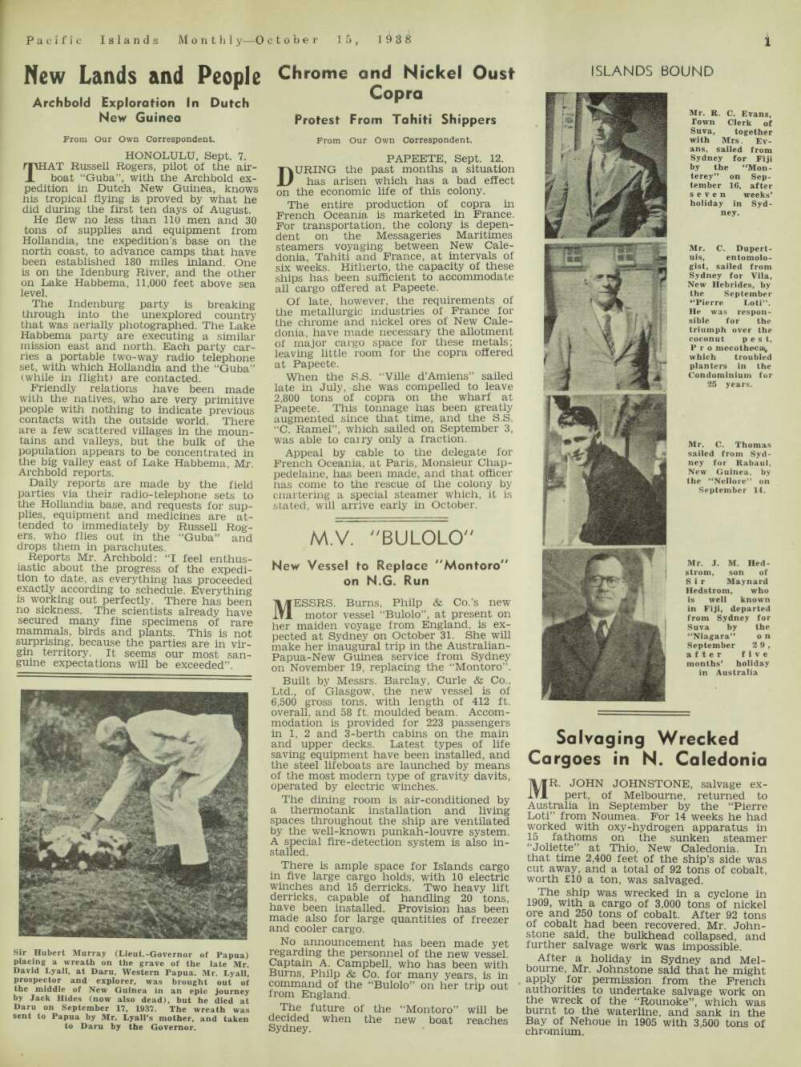
Sir Hubert Murray (Lieut.-Governor of Papua) placing a wreath on the grave of the late Mr.
David Lyall, at Daru, Western Papua. Mr. Lyall, prospector and explorer, was brought out of the middle of New Guinea in an epic journey by Jack Hides (now also dead), but he died at Daru on September 17, 1937. The wreath was sent to Papua by Mr. Lyall’s mother, and taken to Daru by the Governor.
Copra
Chrome and Nickel Oust Copra Protest From Tahiti Shippers
From Our Own Correspondent.
Papeete, Sept. 12.
DURING the past months a situation has arisen which has a bad effect on the economic life of this colony.
The entire production of copra in French Oceania is marketed in France.
For transportation, the colony is depen dent on the Messageries Maritimes steamers voyaging between New Cale donia, Tahiti and France, at intervals of six weeks. Hitherto, the capacity of these ships has been sufficient to accommodate all cargo offered at Papeete.
Of late, however, the requirements of the metallurgic industries of France for the chrome and nickel ores of New Cale donia, have made necessary the allotment of major cargo space for these metals; leaving little room for the copra offered at Papeete.
When the S.S. “Ville d’Amiens” sailed late in July, she was compelled to leave 2,800 tons of copra on the wharf at Papeete. This tonnage has been greatly augmented since that time, and the S.S.
“C. Ramel”, which sailed on September 3, was able to cairy only a fraction.
Appeal by cable to the delegate for French Oceania, at Paris, Monsieur Chap pedelaine, has been made, and that officer has come to the rescue of the colony by cnartering a special steamer which, it is stated, will arrive early in October.
M.V. "Bulolo"
New Vessel to Replace "Montoro" on N.G. Run
MESSRS. Burns, Philp & Co.’s new motor vessel “Bulolo”, at present on her maiden voyage from England, is ex pected at Sydney on October 31. She will make her inaugural trip in the Australian- Papua-New Guinea service from Sydney on November 19, replacing the “Montoro”.
Built by Messrs. Barclay, Curie & Co., Ltd., of Glasgow, the new vessel is of 6,500 gross tons, with length of 412 ft. overall, and 58 ft. moulded beam. Accom modation is provided for 223 passengers in 1, 2 and 3-berth cabins on the main and upper decks. Latest types of life saving equipment have been installed, and the steel lifeboats are launched by means of the most modern type of gravity davits, operated by electric winches.
The dining room is air-conditioned by a thermotank installation and living spaces throughout the ship are ventilated by the well-known punkah-louvre system.
A special fire-detection system is also in stalled.
There is ample space for Islands cargo in five large cargo holds, with 10 electric winches and 15 derricks. Two heavy lift derricks, capable of handling 20 tons, have been installed. Provision has been made also for large quantities of freezer and cooler cargo.
No announcement has been made yet regarding the personnel of the new vessel.
Captain A. Campbell, who has been with Burns, Philp & Co. for many years, is in command of the “Bulolo” on her trip out from England.
The future of the “Montoro” will be decided when the new boat reaches
Sydney.
Islands Bound
Mr. R. C. Evans, Town Clerk of Suva, together with Mrs. Ev ans, sailed from Sydney for Fiji by the “Mon terey” on Sep tember 16, after seven weeks’ holiday in Syd ney.
Mr. C. Dupert uis, entomolo gist, sailed from Sydney for Vila, New Hebrides, by the September “Pierre Loti”.
He was respon sible for the triumph over the coconut pest.
Pro mecotheca, which troubled planters in the Condominium for 25 years.
Mr. C. Thomas sailed from Syd ney for Rabaul, New Guinea, by the “Nellore” on September 14.
Mr. J. M. Hed strom, son of Sir Maynard Hedstrom, who is well known in Fiji, departed from Sydney for Suva by the “Niagara” on September 29, after five months’ holiday in Australia
Salvaging Wrecked
Cargoes in N. Caledonia
MR. JOHN JOHNSTONE, salvage ex pert, of Melbourne, returned to Australia in September by the “Pierre Loti” from Noumea. For 14 weeks he had worked with oxy-hydrogen apparatus in 15 fathoms on the sunken steamer “Joliette” at Thio, New Caledonia. In that time 2,400 feet of the ship’s side was cut away, and a total of 92 tons of cobalt, worth £lO a ton, was salvaged.
The ship was wrecked in a cyclone in 1909, with a cargo of 3,000 tons of nickel ore and 250 tons of cobalt. After 92 tons of cobalt had been recovered, Mr. John stone said, the bulkhead collapsed, and further salvage work was impossible.
After a holiday in Sydney and Mel bourne, Mr. Johnstone said that he might apply for permission from the French authorities to undertake salvage work on the wreck of the “Rounoke”, which was burnt to the waterline, and sank in the Bay of Nehoue in 1905 with 3,500 tons of chromium.
Advertisements & other items, p. 7 (1 item)
1
Pacific Islands Mont hi y—O ctober 15, 1938
Making Weather Maps For Airmen
Important New Organisation in South Pacific
We are indebted to Mr. E. B. Buxton, Meteorologist for Pan American Airways at Auckland, for this interesting description of a new organisation in the Pacific.
DURING the past two years Pan Ame rican Airways has had its meteoro logists in the South Pacific, daily carrying out analyses of the weather, from Cocos Island in the Indian Ocean, to Tahiti, in the Society Group.
For several years prior to this, the meteorological office in Alameda, U.S.A., and its branch in Manila had been an alysing tropical weather along its routes to the Orient, but the study of the South Pacific had been based upon statistics and the works of other agencies.
Late in 1936, the Company sent one of its meteorologists, experienced in the characteristics of typhoons and other tropical weather phenomena, to Auck land, N.Z., to prepare for a survey flight.
The resources of the well-established N.Z. Meteorological Office were extended to the Company by the Director, Dr. E.
Kidson, and Dr. Macky of his staff was assigned to Auckland, where he co-oper ated with the Pan American meteorolo gist in the preparation of weather maps.
After the first survey flight was carried out in March, 1937, work on permanent bases in the South Pacific progressed steadily, regular service commencing late in December.
The interruption in the South Pacific service has not interfered with the rou tine meteorological research being carried out by the Company’s staff.
In the past two years over 800 weather charts of the South Pacific have been drawn from reports collected from Aus tralia, New Zealand, ships at sea, and the Islands. These reports are dissem inated from collecting centres at Rich mond and Pt. Cook (Australia) and Wellington (New Zealand). The broad casts are picked up by the Company’s radio in Auckland and turned over to the Meteorological Department in the Terminal Building in Mechanics Bay.
With these reports, which are synoptic, a map is prepared showing the pressure distribution and the location of Fronts (discontinuities between various air masses).
The Auckland office prepares all fore casts south of the Equator, while the Alameda office is responsible for advices issued north.
The first flights emphasised several im portant requisites for the despatching of aircraft in this region.
A fairly dense network of observation stations, furnishing at least two reports daily, with a high percentage of regul arity, is required. Upper-air surround ings must be obtained in order to ascer tain the structure of the tropical storms which are such a prominent feature of the weather in this part of the world.
From an airline point of view it is not sufficient to know the approximate loca tion of the centre of a storm; something must be known of its frontal structure, if an accurate forecast of flying condi tions is to be made.
Looking into the future, when frequent services will be operating in the South Pacific, a conference was called by Dr.
Kidson in Wellington in November, 1937.
Invitations were extended to representa tives from Australia, Apia, Suva, London, U.S.A., France and New Zealand. Pan American Airways was represented at this conference, and a complete organisation was developed in the form of resolutions and recommendations which, when car ried out, will ensure a satisfactory met eorological service for all transport op erations in the South Pacific.
To carry out these recommendations, sizeable appropriations will be requir ed in some cases. The co-operation of all Administrations in the Pacific has been solicited, as being vital to the suc cess of aircraft operations in the South Seas.
Recognition of the invaluable service rendered by voluntary meteorological ob servers throughout the Pacific Islands is not often enough brought to the atten tion of the public. The solitary radio observer or school-teacher, reading his barometer and coding his report of local weather conditions several hundred miles from the next observer, plays a more im portant part in weather forecasting and research than he would in any other part of the world.
A good example of this occurred re cently, when the writer of this article succeeded in tracing a mass of Polar Maritime air from its first appearance in the Australian Bight, north-eastward in
to the tropics, and thence eastward be yond Tahiti. This air, fresh from high latitudes, is naturally cold and, having been long over water, is relatively moist.
In its passage north and east it is heated from below and this thermodynamic pro cess causes the typical south-westerly type of weather so familiar to navigators of the Tasman.
From day to day, the progress of this air mass was traced r by locating its northern boundary, which appears on the weather chart as a blue line. This blue line is known technically as a Squall Line, or Cold Front. Tracing his Front up to Norfolk Island was fairly easy from ship reports; but, north of Latitude 30S, the air had become so modified that its boundaries became more difficult to find.
Its passage over Noumea was indicated by the shift in wind. Reports from Santo and Vanikoro were missing, hence be tween Vila and Tulagi the location of the Front was vague and uncertain. The Tongans, Fiji, Rotuma and Funafuti veri fied the movement of the mass still fur ther; and, finally, Wallis, Uiuafu, Kep pel and Apia reported its effects.
The reports from Danger Island, Mani hiki and Penrhyn were significant, in that they proved that they were out of the range of the Front, It does not ap pear that the air mass penetrated the equatorial latitude, but its eastward march was clearly traced past the Cook Islands.
With sufficient reports, it will be pos sible to study the modifications an air mass undergoes in such a journey, and forecasting for the tropics will be im proved.
This is only one case where Island stations played a significant part in an interesting bit of meteorological research.
Each and every report received at this office is carefully scrutinised, and an attempt made to visualise the weather at each particular station. Seven days a week, throughout the year, this goes on, since an interruption breaks up the continuity and reasoning behind the weather map.
Mr. and Mrs. David Morris, and their daughter Patricia, paid a short visit to Fiji by the “Otranto” in September. Mr.
Morris is a director of Morris, Hedstrom, Ltd.
Dr. H. W. Jack, Director of Agriculture at Suva, Fiji, and Mrs. Jack returned to the Colony on September 15 by the “Nia gara” after leave.
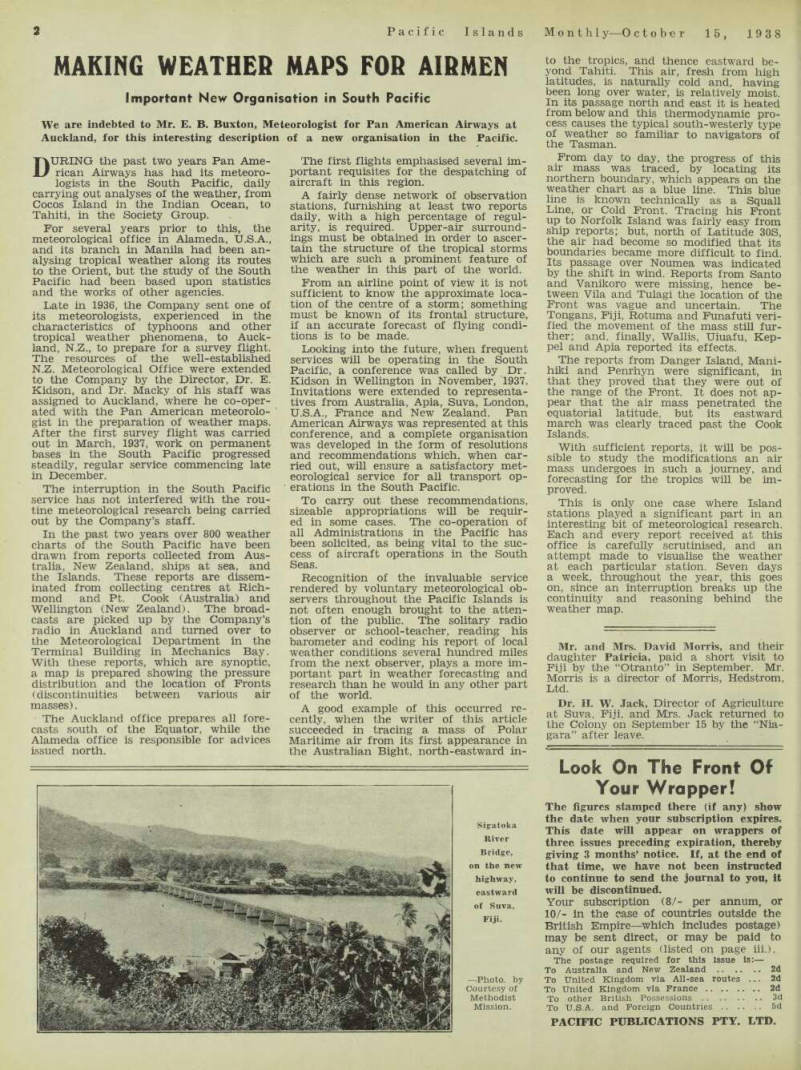
Sigatoka River Bridge, on the new highway, eastward of Suva, Fiji. —Photo, by Courtesy of Methodist Mission.
Advertisements & other items, p. 8 (2 items)
2
Pacific Islands Mont hi y —o ctober 15, 1938
Your Wrapper!
Look On The Front Of
The figures stamped there (if any) show the date when your subscription expires.
This date will appear on wrappers of three issues preceding expiration, thereby giving 3 months’ notice. If, at the end of that time, we have not been instructed to continue to send the journal to you, it will be discontinued.
Your subscription (8/- per annum, or 10/- in the case of countries outside the British Empire—which includes postage) may be sent direct, or may be paid to any of our agents (listed on page hi.).
The postage required for this Issue is:— To Australia and New Zealand 2d To United Kingdom via All-sea routes ... 2d To United Kingdom via France 2d To other British Possessions 3d To U.S.A. and Foreign Countries 5d
PACIFIC PUBLICATIONS PTY. LTD.
Fiji's New Road
Toll-Gate Causes Annoyance
FJI residents are proud of the new road, opened recently between Siga toka and Suva, which makes it possible now for motorists to drive right round the large island of Viti Levu. But the decision to pay for the road by means of a toll has caused annoyance.
Nadi and Sigatoka residents are justly irate at the decision of the Government to instal a toll gate on the Sigatoka-Suva Road (says the “Fiji Times”). Toll gates are an anachronism and ?re being done away with in England as much as pos sible.
“We can understand the toll on the Rewa Bridge, as that was part of the agreement, but why, in heaven’s name, a toll gate on the Sigatoka-Suva Road? Are not the people in the back blocks penal ized. enough as it is, without having to pay extra to use the roads?
“In nine cases out of ten the settlers go in to Suva on business, not pleasure, and it costs them quite a bit to get in.
Now, on top of all their other expenses, they have to contribute towards —what?”
The Bay Loo Co., Ltd., of Rabaul, was the successful tenderer for the erection of new Police Barracks and additions to the District Office at Wewak, Northern New Guinea. The contract is for £1,700.
The 50 tons British yacht “Ronda” ar rived at Apia, Western Samoa, in Sep tember, in the course of her Pacific cruise. Her owner is Captain H. Hudson, R.N, (Rtd.L
Niue Has £13,132
Made Out of Stamps
THE island of Niue which has a native population of 4,215, and is under New Zealand administration, had a govern mental revenue last year of £35,443, and finished with a surplus of £13,132.
This was due entirely to the sale of Coronation postage stamps, there having been a special issue for the tiny territory —and philatelists having, as usual, rushed in furiously to buy.
The year’s exports were worth £23,321 and the imports £29,309.
Wild Pig Menace In Vanua
Levu
WILD pigs are becoming a serious prob blem in Vanua Levu, one of the two large islands of Fiji. They have in creased so rapidly that they have become not only a nuisance, but a danger.
One newspaper correspondent says;— “Native gardens are being destroyed; late rice crops suffered heavily; and the con tinued loss to coconut planters is severe.
Surely the Government can grant a little assistance? Why not again pay 1/- for every jaw bone as was done in the past?
It would offer inducement to the natives ‘to go on the kill’.”
Nurse Williamson, of the Methodist Mission, arrived in Sydney from Misima Island, Papua, by the last “Macdhui” and proceeded to Victoria, where she will spend a holiday.
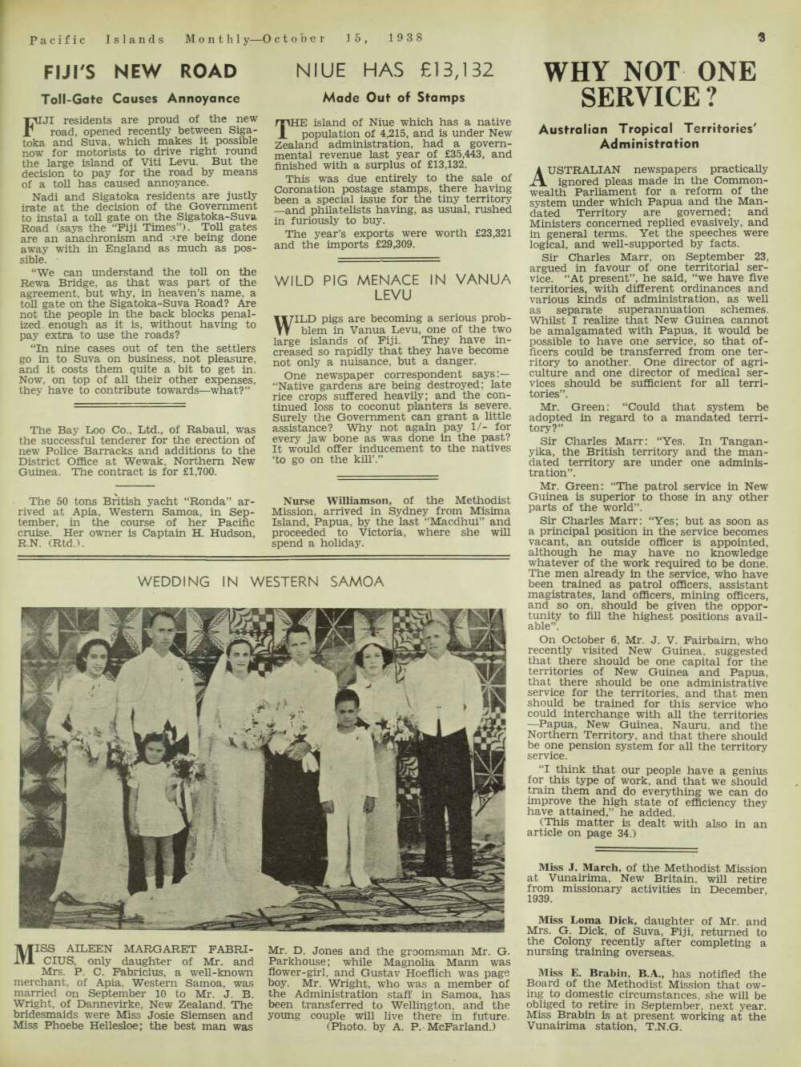
Wedding In Western Samoa
Miss Aileen Margaret Fabri-
CIUS, only daughter of Mr. and Mrs. P. C. Fabricius, a well-known merchant, of Apia, Western Samoa, was married on September 10 to Mr. J. B.
Wright, of Dannevirke, New Zealand. The bridesmaids were Miss Josie Siemsen and Miss Phoebe Hellesloe; the best man was
Mr. D, Jones and the groomsman Mr. G.
Parkhouse; while Magnolia Mann was flower-girl, and Gustav Hoeflich was page boy. Mr. Wright, who was a member of the Administration staff in Samoa, has been transferred to Wellington, and the young couple will live there in future. (Photo, by A. P. McFarland.)
Service?
Why Not One
Australian Tropical Territories' Administration
AUSTRALIAN newspapers practically ignored pleas made in the Common wealth Parliament for a reform of the system under which Papua and the Man dated Territory are governed; and Ministers concerned replied evasively, and in general terms. Yet the speeches were logical, and well-supported by facts.
Sir Charles Marr, on September 23, argued in favour of one territorial ser vice. “At present”, he said, “we have five territories, with different ordinances and various kinds of administration, as well as separate superannuation schemes.
Whilst I realize that New Guinea cannot be amalgamated with Papua, it would be possible to have one service, so that of ficers could be transferred from one ter ritory to another. One director of agri culture and one director of medical ser vices should be sufficient for all terri tories”.
Mr. Green: “Could that system be adopted in regard to a mandated terri tory?”
Sir Charles Marr: “Yes. In Tangan yika, the British territory and the man dated territory are under one adminis tration”.
Mr. Green: “The patrol service in New Guinea is superior to those in any other parts of the world”.
Sir Charles Marr: “Yes; but as soon as a principal position in the service becomes vacant, an outside officer is appointed, although he may have no knowledge whatever of the work required to be done.
The men already in the service, who have been trained as patrol officers, assistant magistrates, land officers, mining officers, and so on, should be given the oppor tunity to fill the highest positions avail able”.
On October 6, Mr. J. V. Fairbairn, who recently visited New Guinea, suggested that there should be one capital for the territories of New Guinea and Papua, that there should be one administrative service for the territories, and that men should be trained for this service who could interchange with all the territories —Papua, New Guinea, Nauru, and the Northern Territory, and that there should be one pension system for all the territory service.
“I think that our people have a genius for this type of work, and that we should train them and do everything we can do improve the high state of efficiency they have attained,” he added. (This matter is dealt with also in an article on page 34.) Miss J. March, of the Methodist Mission at Vunairima, New Britain, will retire from missionary activities in December, 1939.
Miss Loma Dick, daughter of Mr. and Mrs. G. Dick, of Suva, Fiji, returned to the Colony recently after completing a nursing training overseas.
Miss E. Brabin, 8.A., has notified the Board of the Methodist Mission that ow ing to domestic circumstances, she will be obliged to retire in September, next year.
Miss Brabin is at present working at the Vunairima station, T.N.G.
Advertisements & other items, p. 9 (1 item)
3
Pacific Islands Monthl y —O ctober 15, 1938
"S.J.S." Retires
Sequel to Cook Is. Fruit Control
Plan
MR. S. J. SMITH, who retired a couple of months ago from the position of Resident Commissioner of the Cook Islands, has now, at his own request, re tired from the New Zealand Government Service on superannuation. He had been 40 years in the service—the last 23 con nected with the Islands Territories.
It is no secret that Mr. Smith was a bitterly disappointed man when he with drew from Rarotonga. He had devoted years of his life to a study of the condi tions surrounding the marketing of the produce of Cook Islands, Niue and Samoa in New Zealand; and when the N.Z.
Labour Government decided to take con trol of the trade, Mr. Smith went eagerly to Rarotonga in 1937, as Resident Com missioner, to direct the marketing organi sation there, and try out certain plans and strongly-held theories of his own.
He found, however, that plans and theories which appeared sound and “watertight” in the rooms of politicians and officials, had a different appearance when put under practical test in the cold and merciless light of the market-place.
The difficulties of the fruit control plan seemed to grow in number and complexity, the longer he struggled with them, and almost broke his heart.
Mr. Smith, however, both as an im portant official in Wellington, and as an Island Administrator, proved himself to be a man of courage, rectitude and indus try; and, even if his fruit control plans went awry, it is a fact that he leaves be hind him, in New Zealand and her tropi cal territories, an enviable record of work well done, and a very large number of friends and well-wishers.
The Two Samoas
From Our Own Correspondent.
APIA, Sept. 20.
U.S.S. “Ontario” arrived in Apia on Sep tember 12 with Commander Hanson (Governor of American Samoa) and Mrs. Hanson, and an official party from Pago Pago, to pay an official visit to Western Samoa. A ball in honour of the American visitors was given at Vaili ma on Tuesday night, September 13, when over 200 guests accepted the invi tation of Acting-Administrator and Mrs.
Turnbull. The “Ontario” left on Septem ber 15 on her return to Pago Pago.
Opium Raids In Fiji
THE police have been busy in Fiji lately, trying to check a traffic in opium; and various Chinese in Lautoka and Ba have been sentenced to imprisonment, and heavy fines, for having the vicious drug in their possession.
The most serious development was a raid upon the crew of the Sugar Com pany’s steamer “Fiona”. As a result, the boatswain, Dickenson, was sentenced to two months’ gaol, and the carpenter, Nib lock, to one month, for being in possession of opium.
Output of Koitaki Para Rubber Estates, Ltd., Papua, for September was 38,480 lb. of dry rubber.
Beer Boycott
N.G. Miners on Warpath
THERE was a stir in Sydney on October 11, when it was announced that the New Guinea Mining Association had de clared a boycott against the two hotels in Wau, owned by Messrs. W. R. Car penter & Co., Ltd.; and that an extension of the boycott to the firm’s stores and flying services was contemplated.
It was explained that this course was being followed because members of the Mining Association believed that some action had been taken by Carpenter & Co., Ltd., to prevent the construction of the road between Wau and Salamaua.
It was stated that the miners were re fusing to drink beer, and that this was the first beer strike in New Guinea.
The principals of W. R. Carpenter & Co., in Sydney, took immediate action, and very strong representations were made to the Minister for Territories (Mr.
Hughes), and to Mr. C. C. Judd, who is at present representing the Mining As sociation in Australia.
Offer To Build Road
Sir Walter Carpenter told the “Pacific Islands Monthly” that he denied, in a most emphatic fashion, that any action had been taken by him, or any other person connected with his firm, to block the construction of the proposed road.
He and his associates were quite indif ferent as to whether the road was built or not. His firm, if given the opportunity, was quite prepared to build the road.
Sir Walter handed us, for publication, the following copy of a radiogram which he had that morning despatched to the manager of his firm in Salamaua: — “The following radiogram has been sent by Judd to Allan (President of the Min ing Association at Wau): ‘Have seen W.
R. Carpenter and am assured by him he is not opposing road. —Judd’.
“Judd also informed us that he felt that the rumour had been circulated by interested people. So much are we not opposing road that we have offered to build same immediately if Commonwealth Government will guarantee repayment over ten years of cost plus interest. Ad vise Miners’ Federation and publish this message.”
Sir Walter Carpenter also stated that he was having inquiries made forthwith in New Guinea and Australia with a view to ascertaining the source of the report that he or his associates were opposing the road; and, if he could obtain this in formation, he would commence an action for malicious libel.
Our Road"
"Determined To Have Our Road"
Morobe Goldfields Interests are Emphatic
From a Special Correspondent.
WAU, Oct. 8.
THE public meeting held in Wau on September 26 to deal with the road and capital site matters (see report on page 76) was possibly the largest and most enthusiastic public meeting ever held in New Guinea, and shows that public feeling is at last becoming aroused in this district. We are determined to have our road, whatever happens.
At the moment it would appear that, in spite of all that has been printed, the
road that will be built will be the one by the most direct route —that is, up the Bitoi Valley (not Bergin’s or Sheldon’s route), but a new one following the Bitoi Valley, where the grades will not exceed one in 14. The total length will be 48 miles, and the construction cost will be the smallest of any of the routes pro posed.
You may be interested to 'Know that the Public Works Department in Rabaul, in its estimates for the maintenance cost of the road to be built, considers that the maximum maintenance cost on any road will not exceed £6,700 annually, and that the freight cost of goods per ton, includ ing the payment of a toll for redemption and interest on the loan, will vary be tween £4/10/- and £5/10/- per ton, ac cording to the route selected.
We are now definitely opposed to any long roundabout route.
Editorial Note: In our view, it is more important, for the future of New Guinea, that the Salamaua-Morobe road should be the first stage of a highway giving ac cess to Central New Guinea, than that it should be built only to give cheap freights to the Wau-Edie Creek goldfield, which has a limited life.
But it is a fact that the Morobe in terests are being made to pay specially for the new road, and therefore have a clear right to say that, in its construction, their interests shall be primarily considered.
It is also a fact —of a very exasperating character—that the New Guinea Adminis tration has collected at least £500,000 in gold royalty from these Morobe interests in recent years, and has spent it all for general purposes, and has mighty little to show for it. An Administration worthy of the name would have used the gold fields revenues long ago to build for the goldfields towns a road that would give cheap access to the coast, and then would have used the economic impetus of the impermanent gold industry to establish permanent agricultural industries on the Central New Guinea plateaus. Now, it is too late. A road from Salamaua to Wau, via the Bitoi, may be capable of use as the first link in a road through the Bulolo and Watut valleys to the Markham and Ramu country—but we doubt it.
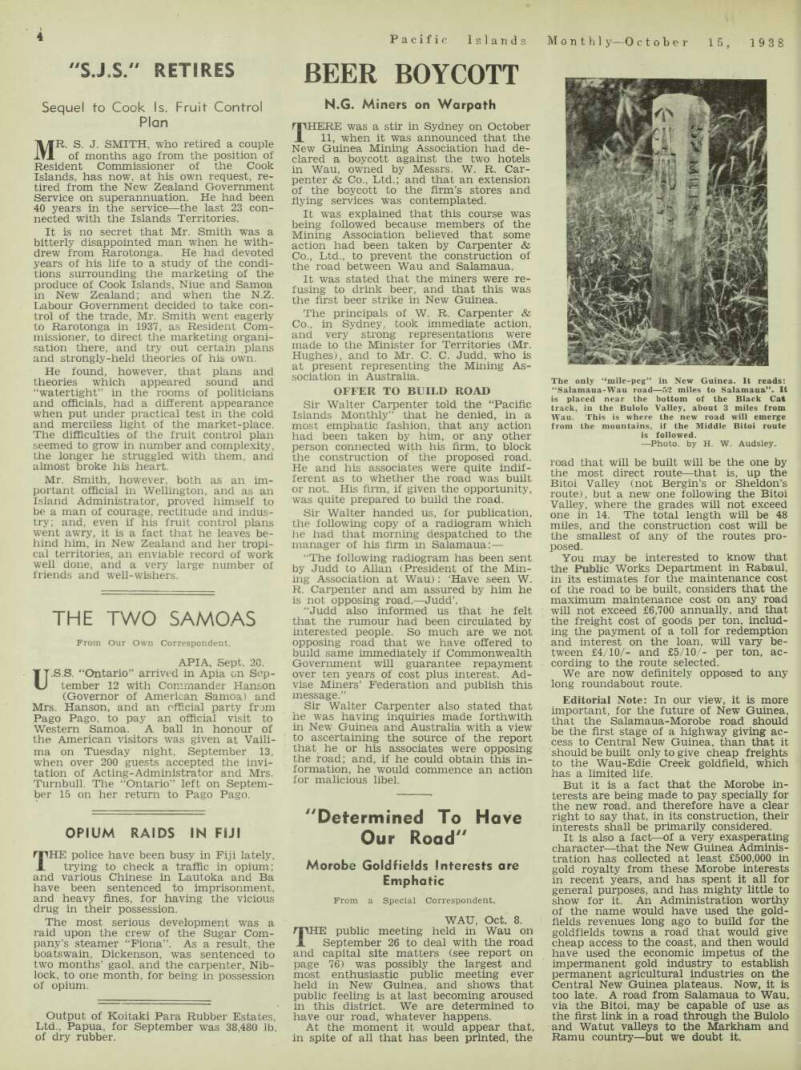
The only “mile-peg” in New Guinea. It reads; “Salamaua-Wau road—52 miles to Salamaua”. It is placed near the bottom of the Black Cat track, in the Bulolo Valley, about 3 miles from Wau. This is where the new road will emerge from the mountains, if the Middle Bitoi route is followed. —Photo, by H. W. Audsley.
Advertisements & other items, p. 10 (1 item)
4
Pacific Islands Monthl y—O ctober 15, 1938
No Decision In New Guinea
Capital Site Still Unknown—Wall Interests Fight for Retention of Road Plan
rdo not like to adopt the methods of the sensational press, and hint at duplicity, graft, and Queer Goings On; but there certainly is something mysterious about Canberra and recent events in New Guinea.
Consider the facts in their sequence: May 29, 1937—Eruption at Rabaul.
November, 1937—Expert vulcanolo«dsts recommend earliest possible removal of administrative establishment, April, 1938—Griffiths Committee recom mends Lap as site for administrative establishment, and submits detailed plans. . June, 1938—Mr. Hughes, for some Un known reason, rejects Griffiths report, Dashes to New Guinea and back, and an nounces that Salamaua will be new caoi tal, at cost of about £350.000, and that a road will be built at a cost of £150,000, to connect Wau with Salamaua.
July, 1938—Administrator goes to Sala maua with engineers, and finds that it will cost £250,000 above the Minister’s esti mate, to fill in a swamp and to make Salamaua suitable for purpose stated.
Survey parties begin to survey four alter native routes for Wau-Salamaua road.
August, 1938—There is such a chorus of criticism of Salamaua as the capital site that it is announced, practically officially, that the Minister’s selection had been abandoned.
September, 1938—Administrator and officials arrive at Lae presumably to make plans for transfer of capital, according to Griffiths renort: but return to Rabaul, after a couple of days.
September, 22, 1938—Administrator de parts on four months’ leave.
And, since then, nothing.
Almost every day. during September and up to date, Mr. Lyons and Mr. Hughes have been asked about the “New Guinea capital site” in Parliament bv members, and outside by pressmen, and they con sistently have returned evasive answers.
On October, before going to Tasmania on three weeks’ holiday, the Prime Minister said that “the search for a new capital site was still proceeding diligently”—a silly and flippant statement, on the face of it. No search is going on.
It is believed, at the date of this writ ing (October 11) that the choice lies be tween Lae and Wau, with a possibility that financial considerations yet may keep the administrative establishment some where in the Rabaul district. But this is all guesswork.
Attack On Road Plan
THERE is the same vague and unsatis factory atmosphere about the road plan.
We hinted, last month, that strong in fluences were operating to kill the road plan; and so it nroved. Mr, c. C. Judd, of the Wau Mining Association, has been hard at work in Canberra and Sydney all this month, fighting off an attack upon the road proposal, which is based on the argument that it would be cheaper to subsidise the aeronlane services, so as to give low freights, than to spend the money on a road that may cost something far in excess of the estimate.
However, on September 22, the Legis lative Council of New Guinea met and passed the Road Loan Bill. The Bill was criticised by Messrs. J. C. Mullaly and W.
E. Grose, who asked how they could be expected to deal intelligently with the
plan, when they had no details about the character of the road, the route to be followed, and the absence of data showing how the deficiency was to be provided for, if the toll did not produce enough rev enue.
The Director of Works, Mr. C. R. Field, said that the intended road would be 20 feet wide, allowing for a 12 foot carriage way and four feet water tables on each side. Metalling, in his opinion, was not of such great importance as drainage; bridges would be designed similar to the Victorian class B bridge. In speaking of the uncertainty of the toll, Mr. Field said: “Perhaps we owe something to the gold fields. A considerable amount of the rev enue of this country comes from the gold fields. Perhaps it is reasonable to let them have some consideration on account of the amount of revenue they produce, The estimate this year of gold royalty is £117,000. In my opinion it is even more im portant, if there is a tendency for the price of gold to come down, to give the goldfields a chance of cheaper transport and keep them going longer than they would with aeroplane transport.”
Mr. Hughes, being persistently nagged at in Parliament between September 20 and October 6. finally said that there were five routes being surveyed, and that a decision as to the best route could not be reached until all the data was com plete.
Indications are that the strong repre sentations made by Morobe interests to the Minister, and oh the spot by Mr. Judd, have kept the road plan intact and in be ing; but the Australian Federal Govern ment machinery is notoriouslv inefficient and slow-moving, and Wau will be lucky if it sees its road complete inside four years.
Wau As Capital?
CITIZENS of Wau have been making strong representations to Canberra in favour of placing the capital at Wau and their plan was received so kindly by Mr. Hughes that one newspaper announced that Wau had been selected.
Rabaul sniffs with disdain at the idea of conducting the administration from Wau, isolated in the Morobe ranges at one end of the Territory; but many of the objections to Wau would disappear if there was a good trafficable road between Wau and the coast. Then, Wau would have much to recommend it, especially the climate.
But, if the administration is to remain at Rabaul until a road is built in to Wau, it might as well remain there altogether.
Wau people can see that for themselves, and it is little wonder that they get very weary of the dodging of the politicians and the time-wasting circumlocution ot bureaucrats.
Lae And The Minister
THE evident determination of the Mini ster to say no word or take no action in favour of Lae —the selection of an expert committee that, obviously, was be yond bias and influence—is a little hard to understand.
Lae, of course, is the headquarters of Guinea Airways, Ltd.:and one gets the impression that the Minister feels that his shining coat may be tarnished if he even associated himself with this rich organisation. Yet the fact is that, with out Guinea Airways, there would have been no Morobe goldfield: and without Morobe, the Administration of New Guinea would have been a very poor, feeble thing, financially busted. The
(Continued on Page 75.)
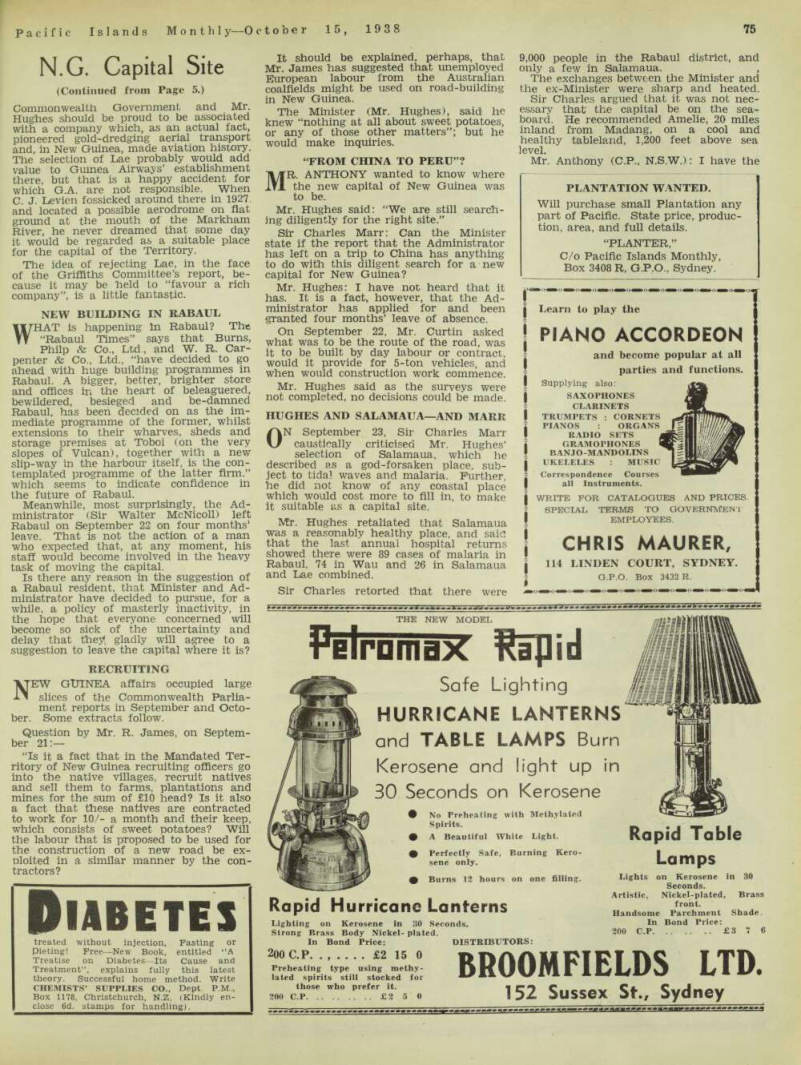
Commonwealth Government and Mr.
Hughes should be proud to be associated with a company which, as an actual fact, pioneered gold-dredging aerial transport and, in New Guinea, made aviation history.
The selection of Lae probably would add value to Gumea Airways’ establishment there, but that is a happy accident for which G.A. are not responsible. When C. J. Levien fossicked around there in 1927. and located a possible aerodrome on flat ground at the mouth of the Markham River, he never dreamed that some day it would be regarded as a suitable place for the capital of the Territory.
The idea of rejecting Lae, in the face of the Griffiths Committee’s report, be cause it may be held to “favour a rich company”, is a little fantastic.
New Building In Rabaul
WHAT is happening In Rabaul? The “Rabaul Times” says that Burns, Philp & Co., Ltd,, and W. R. Car penter & Co., Ltd., “have decided to go ahead with huge building programmes in Rabaul. A bigger, better, brighter store and offices in the heart of beleaguered, bewildered, besieged and be-damned Rabaul, has been decided on as the im mediate programme of the former, whilst extensions to their wharves, sheds and storage nremises at Toboi (on the very slopes of Vulcan), together with a new slip-way in the harbour itself, is the con templated programme of the latter firm.” which seems to indicate confidence in the future of Rabaul.
Meanwhile, most surprisingly, the Ad ministrator (Sir Walter McNicoll) left Rabaul on September 22 on four months’ leave. That is not the action of a man who expected that, at any moment, his staff would become involved in the heavy task of moving the capital.
Is there any reason in the suggestion of a Rabaul resident, that Minister and Ad ministrator have decided to pursue, for a while, a policy of masterly inactivity, in the hope that everyone concerned will become so sick of the uncertainty and delay that they* gladly will agree to a suggestion to leave the capital where it is?
Recruiting
NEW GUINEA affairs occupied large slices of the Commonwealth Parlia ment reports in September and Octo ber. Some extracts follow.
Question by Mr. R. James, on Septem ber 21: — “Is it a fact that in the Mandated Ter ritory of New Guinea recruiting officers go into the native villages, recruit natives and sell them to farms, plantations and mines for the sum of £lO head? Is it also a fact that these natives are contracted to work for 10/- a month and their keep, which consists of sweet potatoes? Will the labour that is proposed to be used for the construction of a new road be ex ploited in a similar manner by the con tractors?
It should be explained, perhaps, that Mr. James has suggested that unemployed European labour from the Australian coalfields might be used on road-building in New Guinea.
The Minister (Mr. Hughes), said he knew “nothing at all about sweet potatoes, or any of those other matters”; but he would make inquiries.
“From China To Peru”?
MR. ANTHONY wanted to know where the new capital of New Guinea was to be.
Mr. Hughes said: “We are still search ing diligently for the right site.”
Sir Charles Marr: Can the Minister state if the report that the Administrator has left on a trip to China has anything to do with this diligent search for a new capital for New Guinea?
Mr. Hughes: I have not heard that it has. It is a fact, however, that the Ad ministrator has applied for and been granted four months’ leave of absence.
On September 22, Mr. Curtin asked what was to be the route of the road, was it to be built by day labour or contract, would it provide for 5-ton vehicles, and when would construction work commence.
Mr. Hughes said as the surveys were not completed, no decisions could be made.
Hughes And Salamaua—And Marr
ON September 23, Sir Charles Marr caustically criticised Mr. Hughes’ selection of Salamaua, which he described as a god-forsaken nlace, sub ject to tidal waves and malaria. Further, he did not know of any coastal place which would cost more to fill in, to make it suitable as a capital site.
Mr. Hughes retaliated that Salamaua was a reasonably healthy place, and said that the last annual hospital returns showed there were 89 cases of malaria in Rabaul, 74 in Wau and 26 in Salamaua and Lae combined.
Sir Charles retorted that there were
9,000 people in the Rabaul district, and only a few in Salamaua.
The exchanges between the Minister and the ex-Minister were sharp and heated.
Sir Charles argued that it was not nec essary that the capital be on the sea board. He recommended Amelie, 20 miles inland from Madang, on a cool and healthy tableland, 1,200 feet above sea level.
Mr. Anthony (C.P., N.S.W.): I have the
official report here, and it bears out what Sir Charles has said about Salamaua.
Mr. Hughes: I also have an official re
port, and my report overrides yours.
Sir Charles Marr then rose on a point of personal explanation. “I spoke of Salamaua as a fever-infested area, and everyone in New Guinea knows that that is so”, he said. The fact is that the greatest part of the population of Salamaua is in the cemetery.”
Mr. Hughes: I do not know whether Sir Charles can make a statement of that kind.
Called to order by the Speaker Sir Charles said that Mr. Hughes, in stating that he (Sir Charles) had misrepresented the facts, had himself been guilty of mis representation.
Advertisements & other items, p. 11 (2 items)
5
Pacific Islands Monthl y —o ctober 15, 1938
rtO-TEjr^
IN MEMORIAM
LYALL
TREASURED memories of my dear Son. and our Brother. David, who gave his life to exploration. Passed away at Daru, Papua. 17th Sept., 1937. Age, 26 years.
One year has passed since that sad day.
When the one we loved was called away; The end was sudden, the shock severe.
We little knew the end was near.
Loved in life, honoured in death, A beautiful memory, is all we have left. —Sadly missed by his loving mother and brothers, Victor. Jackie and Clifford.
AT REST.
rtO-TEjr^
iB mmm
CREAM
Write for a Colour Card . . .
STERLING VARNISH CO.
Dries in half an hour on plaster walls, ceilings, cement, fibre, wood and iron.
Also Excellent as an Undercoat for lacquers, paints and enamels. 1 I /- per gallon
HIGHLY DURABLE
Alexandria, N.S.W.
W.R.C. Line
"S.S. Suva" Leaves for Pacific Ports in November
THE 9,000-tons steamer “Suva”, newly built for the W.R.C. Line (Carpenter & Co., Ltd.) is expected to sail from London about November 12 for Pacific ports, via Panama. She will go, first, to Vancouver, and thence to Apia, in Wes tern Samoa.
The Carpenter firm hope to provide, with their new ship, a regular service be tween Western Samoa and Europe.
Prom Apia, the “Suva” will go to Suva and Rabaul, and may call at other Is lands ports, if required. From New Guinea, she will proceed direct to Cape town, and thence back to London. It is not intended that on this, her maiden voyage, she shall call at Australian ports.
That schedule—London, Panama, Pacific ports, Capetown, and back to London—
wm be followed regularly, three times per annum, by the “S.S. Suva”, in future. The Apia call will be made regularly if justified by results
Fijian Chief
Character of Late Ratu Veli
A STRIKING tribute to a Fijian chief was paid recently by Mr. H. B. Gib son, in an article in the “Fiji Times”. It is notable as indicating the type of men found frequently among the chiefly class of Fijians. The following are extracts;— In the sudden passing of Ratu Veli, late Roko Tui Macuata, Fiji has lost a character the strength of which we will probably never see again in our time. In addition to the possession of a fine pre sence Ratu Veli was a leader of no mean order.
I can never forget the debt of grati tude which we residents of Nasea owe to his organising ability on the occasion of
the Labasa hurricane of December 10. A handful of Europeans, many Chinese and hundreds of Indians who live in Nasea owe, if not our lives, then our present state of health and well-being, to the leadership of Ratu Veli.
He always captained his own vessel. I have sailed with him on many an oc casion, and it was characteristic of his seamanship, as it was characteristic of his whole life, that in an emergency one always found Ratu Veli with the rudder in his own hand.
He was never loath to criticise an officer of State or Church, whom he thought to be weak, misguided or prejudiced. He was extremely diplomatic and always polite, but he was no mere flagwagger.
He had friends amongst peoples of all nationalities, amongst followers of many creeds and in many stations of life.
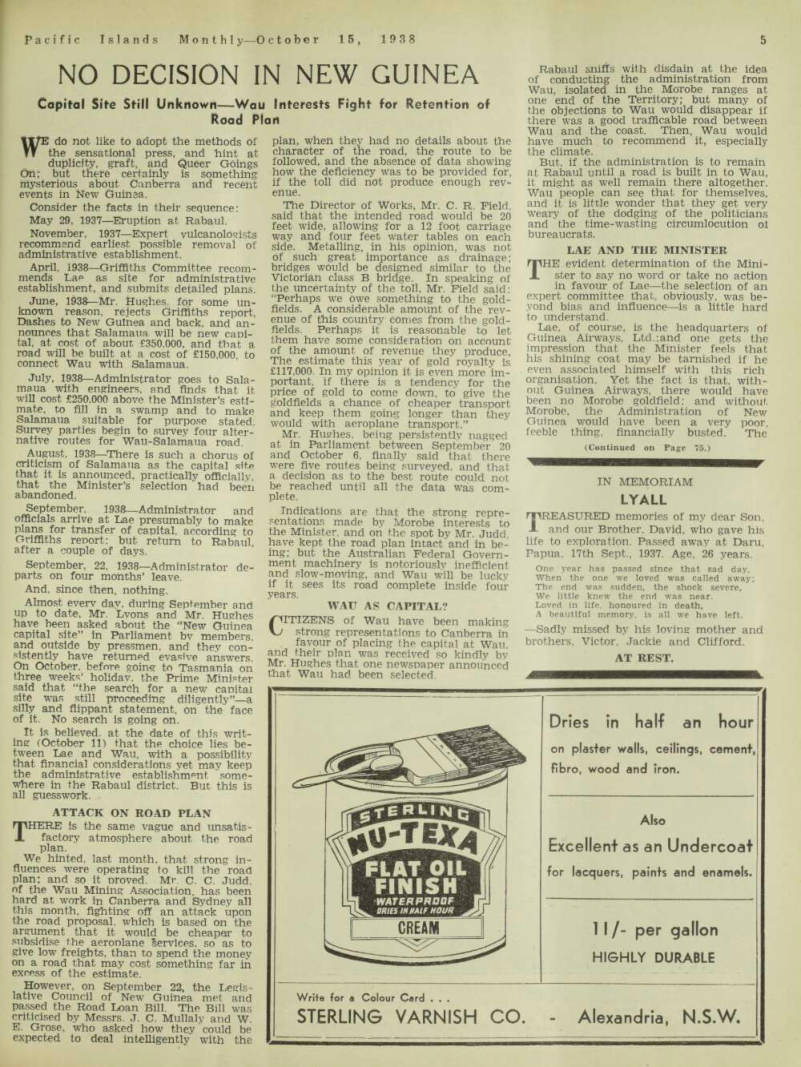
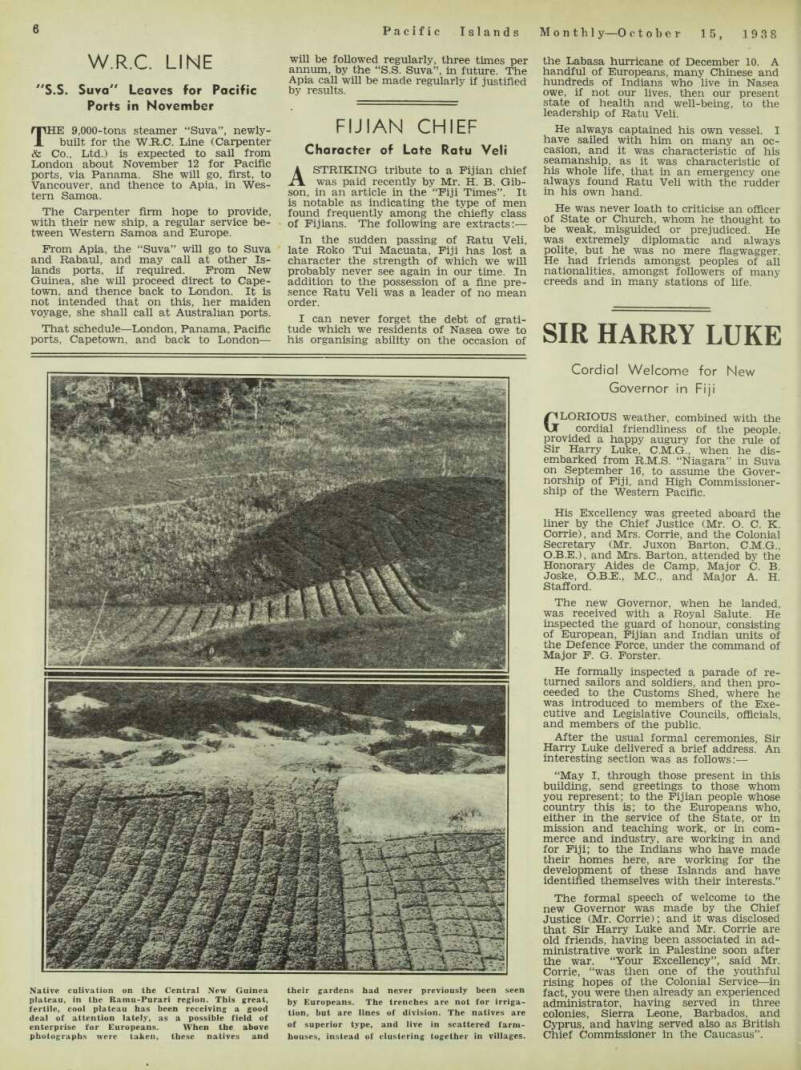
Native culivation on the Central New Guinea plateau, in the Ramu-Purari region. This great, fertile, cool plateau has been receiving a good deal of attention lately, as a possible field of enterprise for Europeans. When the above photographs were taken, these natives and
their gardens had never previously been seen by Europeans. The trenches are not for irriga tion, but are lines of division. The natives are of superior type, and live in scattered farm houses, instead of clustering together in villages.
Sir Harry Luke
Cordial Welcome for New Governor in Fiji
GLORIOUS weather, combined with the cordial friendliness of the people, provided a happy augury for the rule of Sir Harry Luke, C.M.G., when he dis embarked from R.M.S. “Niagara” in Suva on September 16, to assume the Gover norship of Fiji, and High Commissioner ship of the Western Pacific.
His Excellency was greeted aboard the liner by the Chief Justice (Mr. O. C. K.
Corrie), and Mrs. Corrie, and the Colonial Secretary (Mr. Juxon Barton, C.M.G., 0.8. E.), and Mrs. Barton, attended by the Honorary Aides de Camp, Major C. B.
Joske, 0.8. E., M.C., and Major A. H.
Stafford.
The new Governor, when he landed, was received with a Royal Salute. He inspected the guard of honour, consisting of European, Fijian and Indian units of the Defence Force, under the command of Major P. G. Forster.
He formally inspected a parade of re turned sailors and soldiers, and then pro ceeded to the Customs Shed, where he was introduced to members of the Exe cutive and Legislative Councils, officials, and members of the public.
After the usual formal ceremonies, Sir Harry Luke delivered a brief address. An interesting section was as follows: “May I, through those present in this building, send greetings to those whom you represent; to the Fijian people whose country this is; to the Europeans who, either in the service of the State, or in mission and teaching work, or in com merce and industry, are working in and for Fiji; to the Indians who have made their homes here, are working for the development of these Islands and have identified themselves with their interests.”
The formal speech of welcome to the new Governor was made by the Chief Justice (Mr. Corrie); and it was disclosed that Sir Harry Luke and Mr. Corrie are old friends, having been associated in ad ministrative work in Palestine soon after the war. “Your Excellency”, said Mr.
Corrie, “was then one of the youthful rising hopes of the Colonial Service —in fact, you were then already an experienced administrator, having served in three colonies, Sierra Leone, Barbados, and Cyprus, and having served also as British Chief Commissioner in the Caucasus”.
Advertisements & other items, p. 12 (1 item)
6
Pacific Islands Mont hi y—O ctober 15, 1938
Tropicalities
THE schooner was sinking. The cap tain, even rougher and harder-bitten than his men, yelled through the gale:— “All hands on deck. Come up you mis fired adjectival lot of lubbery sons of sea cooks. Can any one of yer say a prayer? No. I thought as much. Not one of yer!”
Then up spake a native boat-boy claiming that he was a good Mission fella and plenty prayer belonga him.
“Then pray like yer never prayed be fore,” yelled the captain. “We’re a life belt short.” ♦ ♦ ♦ THUS Sir Charles Marr, in the Aus tralian Parliament on September 23 on Mr. Harold Page, Government Secre tary in New Guinea and at present Act
ing-Administrator :
“We have not a better officer in the service than Mr. Harold Page, brother of the Minister for Commerce (Sir Earle Page). It is unfortunate for him, in some ways, that he is related to the Minister.
I first visited New Guinea in 1927 as a Minister, when Brigadier-General Wisdom was the Administrator, and I confess that at that time I was not enamoured of Mr.
Page. Later, when Brigadier-General Griffiths was appointed Administrator by the Lyons Government, I, in my capacity as Minister, said: T want one Adminis trator, not two’. But after his return to Australia, I asked him what he thought of Mr. Page, and he said, T have never met a more conscientious, or better officer than Mr. Page is’. I mention this be cause I think that we should do our very utmost to encourage good officers and
give them the opportunity to advance to the highest positions we have to offer. I suggested some years ago that Mr. Page should be appointed Administrator of Nauru, in order to prove his capacity as an administrator, but the suggestion was not acceptable.” * * * IT’S an old Navy custom that British warships never carry a white flag. This tradition caused an amusing incident at Apia, Western Samoa, on August 29, 1914, when the New Zealand troops, es corted by the Australian squadron, ar rived to take possession of the islands from Germany. The rules of war made it imperative that a flag of truce should be carried by the landing party when ask ing for the surrender of the town. There was consternation for a time, when it was discovered that the party was all ready but no white flag was available.
Finally, the difficulty was overcome by nailing a serviette to a staff! * * * WHEN the good ship “Sirius” brought the Administrator and a party of officials to Lae, New Guinea, early in September, on some mysterious mission connected with the new capital, minor horrors were anticipated by the Euro peans—but no one guessed just what they were in for. They soon learned. The “vice-regal” edict went forth: All officials, including the D.O. and the Roadmaster, were to wear neckties in future, when appearing in public.
The uncouth, non-official class gasned, and then jeered: but levitv turned to sympathy when the wretched officials
duly appeared, their faces stiff, and their sweating necks duly encased in the gay products of Sydney tie factories. The only sensible costume in the always humid coastal districts of New Guinea— except in Rabaul, where official rigidities are painfully observed—is an open-neck shirt. However, officialdom will have its way, the world over.
But Lae had its revenge. Next day, half the dogs in the place appeared, with ribbons tied in gay little bows around their necks. The unhappy official tie wearers did not bat an eye-lid—lese majesty is definitely an offence in New Guinea —but we are informed that their expressions definitely were less severe. ♦ * ♦ TWO or three of the residents of the Samarai district of Papua have writ ten to us, in terms which call for asbestos paper and non-inflammable ink, about the Oxford Movement at Kwato, and its application to the native villages and village life. Some of the articles which have been published in Australian journals about this aspect of the Oxford Movement, do appear a little ridiculous; but, maybe, comment had better wait upon a clearer understanding of what actually is claimed by the Kwato Mission.
Captain H. and Mrs. Gosling, of Suva, returned to Fiji from a holiday visit to England by the “Niagara” in September.
Pastor E. B. Rudge, President of the Australasian Union Conference of Seventh Day Adventists, arrived in Suva, Fiji, by the “Monterey” in September. He is well known to Fiji residents, having been con nected with the Fiji Mission of Seventh Day Adventists as Superintendent for a number of years.
Advertisements & other items, pp. 13-14 (2 items)
7
Pacific Islands Mont hi y —O ctober 15, 19 3 8
To The Residents Of Western Samoa
IT is notified that our New Steamship "SUVA" will sail from London about November 12, for Pacific Islands Ports, via Panama Canal and
Vancouver.
The "SUVA" will include Apia, Western Samoa, in her Regular Schedule of Pacific Islands calls; and thence she will proceed to Fiji and New Guinea, and will return to London, via South Africa.
A Regular, Direct, Shipping Service, with a Completely Modern Vessel, between Europe and Samoa, is thus made available to Importers and Exporters of Western Samoa. The Service will be continued if it is justified
by Public Support.
ALL PARTICULARS FROM
ITINERARY
of
S.S. SUVA
Leaving London in Mid-November, 1938, and making Three Round Trips per annum.
LONDON
PANAMA
APIA (WESTERN SAMOA)
SUVA (FIJI)
RABAUL (N. GUINEA)
CAPETOWN
LONDON
W. R. CARPENTER & CO. LTD. : SYDNEY
and Islands Branches
AGENTS IN SAMOA: MORRIS HEDSTROM, LTD., APIA
ADELAIDE
MELBOURNE
SYDNEY
TO BRISBANE
NEW GUINEA
DOOR TO DOOR
EXPRESS PARCEL DELIVERIES
BY
AIR MAIL
Via— Rockhampton . . . Townsville Cairns . . . Cooktown Port Moresby . . . Salamaua Rabaul.
Rates on application to
YELLOW EXPRESS
CARRIERS LTD.
103 Murray St., Pyrmont, Sydney Tel.: MW2551 in conjunction with
W. R. CARPENTER & CO., LTD.
When you’ve a toast to give, call for a bottle of Dewar’s the Scotch that always appeals. There is rare delight and satisfaction in the purity and mellowness of this perfectly matured aristocrat of whiskies.
DEWAR’S
~)ke SCOTCH WHISKY
About Islands People
Miss Alice Piggott, formerly of Yarra bah Mission, Queensland, who has been receiving special training at the Training Hostel for Women in Sydney, will leave for Kumbun, New Britain, T.N.G., in the diocese of Melanesia, by the next “Mon toro”.
Rev. and Mrs. H. T. Shotton, who are at present engaged in mission work for thje Methodist Mission at Kiriwina, Papua, will shortly be returning to Sydney.
Miss Emily Clarke, late of Norfolk Island, and Sister Merle Charlton, of Vic toria, are expected to leave for Port Moresby, Papua, by the “Macdhui” early in November. They will engage in duties for the Australian Board of Missions.
Miss Bessie Smith will join the “Macd hui” at Brisbane early in November, for Port Moresby, Papua, from whence she will proceed to Doubina. to take up duties for the Methodist Mission.
Rev. J. Gilkison, late of Wellington, N.Z., will leave Sydney for Pt. Moresby, Papua, by the “Montoro” on October 19, to undergo a short training period before being assigned to one of the London Mis sionary Society’s stations.
Mr. Stuart Lade, 8.A., of the Methodist Mission, will leave by the next “Mon toro” for Port Moresby, Papua, where he will take up a position in the Methodist Boy’s School.
Rev. H. A. Brown, M.A., of the London Missionary Society, is expected to arrive in Sydney on November 17 from London, England. He will proceed to Port Moresby, Papua, by the “Bulolo” on November 19.
Rev. Henry W. Whyte, M.A., and Mrs.
Whyte, of Ipswich, Queensland, have been appointed to the London Missionary Society, at Apia, Samoa. They will leave Auckland, New Zealand, by the “Matua” on November 29. Mr. Whyte has had 20 years’ of missionary experience in India.
Rev. J. W. Burton, General Secretary of the Methodist Overseas Missions, left Sydney by the “Macdhui” on September 24 for Rabaul, New Guinea, where he will confer with local missionaries in connec tion with important district matters. He recently paid a visit to Fiji to investigate educational matters.
Commander R. C. Garsia, who lately has retired from the position of Adminis trator of Nauru, arrived in Auckland on October 10, on his way back to Australia.
Mr. G. S. Mouat, M.P.S., Ph.C., has ac quired the old-established pharmaceutical business of A. J. Swann & Co., Ltd., in Suva, Fiji, and the business will in future be carried on under his personal super vision. Mr. Mouat came originally to Fiji as manager of Swann & Co.. Ltd., and subsequently joined the staff of Mr. C. A.
Adams, at Lautoka.
Miss Sylvia Tree arrived in Syd ney from Pa peete, by the “Pierre Loti” on October 5. She spent some time in Tahiti where two friends, Geoffrey and Dahl Pollings, made a docum entary film of Tahiti.
Mr. and Mrs. L.
J. M. Page, of Vila, New Heb rides, arrived in Sydney by the October “Pierre Loti” for a short holiday. He is a well known surveyor.
Mr. Auguste Roland, of the staff of Bank of Indo-China in Noumea, New Caledonia, arriv ed at Sydney by the last “Pierre Loti”.
He intends tak ing up per manent resid ence in Sydney.
Advertisements & other items, p. 14 (1 item)
8
Pacific Islands Monthl y —o ctober 15, 1938
About Islands People
Miss Frienda Simpfendoerfer, of Bris bane, Queensland, has taken up duties with the Lutheran Mission at Madang, New Guinea.
Mr. N. M. Johnstone has joined the staff of the Bank of N.S.W., Wau, New Guinea.
Mr. L. Kissick, of Burns, Philp and Co. Ltd., Salamaua, New Guinea, has been transferred to the Wau branch.
Sir Walter McNicoll, Administrator of New Guinea, left Rabaul by the “Nellore” on September 22, to spend four months’ leave in the East and in Australia. He was accompanied by Lady McNicoll.
Madame Struve-Gleiche, who has been travelling through the Pacific Islands in search of material for songs, stories and sketches, arrived in Sydney from Nou mea by the September “Pierre Loti’’.
Major Mann, Superintendent of Aero dromes for Civil Aviation in Australia, arrived in Sydney from Salamaua, New Guinea, by aeroplane in September, after inspecting aerodromes in the N.G. gold fields district.
Monsieur Henri David, assistant to the French Deputy at Santo, New Heb rides, recently married Mademoiselle Marie-Louise Houdie, daughter of Mad ame Houdie, who owns and manages a plantation at Mele.
Mr. R. J. Lotze, of Tulagi, a member of the British Solomon Islands Advisory Committee, arrived in Sydney by the “Malaita”, on furlough. He was accom panied by Mrs. Lotze.
Miss Margery Munro, of Sydney, was recently married at Kieta, New Guinea, to Mr. Alexander Scott, local manager of Messrs. Burns, Philp and Co. Ltd. The ceremony was performed by the District Officer (Mr. R. Merrylees), at the hos pitable home of Dr. and Mrs. Price.
There was a large gathering of district residents, and the newly-married couple were showered with good wishes.
Dr. R. F. Baird, formerly Chief Mag istrate of Norfolk Island, has been ap pointed Government Medical Officer and Lieutenant-Colonel F. R. Xvakhos has been appointed Chief Magistrate.
Rev. V. C. A. Longden, of the Melan esian Mission at Moewe Harbour, New Britain, New Guinea, has been in Syd ney on leave. He will return to the Mandated Territory this month.
Rev. Otto Thiele, of the Lutheran Mis sion, was in New Guinea in September making arrangements to purchase for the Mission the well-known Gisarum plan tation on Siassi Island, which has been conducted for a long time by Messrs.
Money and Reynolds.
Brother Walter Garrod, M.S.C., left Sydney by the last “Mon toro” for Pt.
Moresby, Papua, en route to Yule Island, where he is engaged in mis sion work for the Sacred Heart Mission. Brother Garrod, has been in Papua for 12 years.
Mr. E. Ryan sailed from Syd ney by the last “Macdhui” for Misima Is land, Papua, where he is employed by Cuthbert’s Misi ma Goldmine Ltd. He spent three months’ leave in Sydney.
Mr. G. C.
(“Jos”) Holmes, branch manager of W. R. Car penter & Co.
Ltd., at Kavi eng, returned to New Guinea by the September “Montoro” after two months’ holiday in N.S.
Wales.
Father F. Lyons, M.S.C., of the Sacred Heart Mission, who has been in Sydney for some months receiving medical attention, de parted from Sydney for Ft.
Moresby, Papua, by the “Macd hui” on Sep tember 24.
Advertisements & other items, p. 15 (2 items)
9
Pacific Islands Mont hi y —o ctober 15, 1938
Pty. Ltd
A FINE WATCH
(Dust and Damp-proof) A watch to be depended on to keep accurate time under the severest conditions of service. / V A high grade 15 jewelled lever movement in a strong screw back and front nickel case with a clean open countenance, giving the time at a glance.
PRICE 45/-.
Our new finely illustrated colour catalogue sent post free.
ON PARLE FRANCAIS,
PROUDS PTY. LTD.
Jewellers and Watchmakers
Cr. KING & PITT STS.,
SYDNEY.
CREMO COFFEE
PACIFIC COFFEE
FIRSTCALL COFFEE
BULK COFFEE
(RAN. WOUROASMROUND)
cr a
A.S.F MILK
(SWEETENED
CORAL COCOA
BULK TEAS
(BOXESOR CHESTS)
% o & A O V s - V
ENSEDMI
p_ tv l 4 * few *Red For Exp<» £
OVD
5, CO PTY
Onev h **
PTY. LTD
SYDNEY
'JamcwS jet 'Jew and toffee fot 50 'TjewcA
THE PACIFIC ISLANDS CLUB
Visitors from the Islands to Sydney (or those interested in Islands affairs), are advised to communicate with the honorary secretary of the above Club, which has been formed to study the history, traditions, economics, and political developments of the Pacific Islands.
Next Club Gathering, Wednesday, November 2, 8 p.m., Hotel Carlton, Sydney.
THE PACIFIC ISLANDS CLUB.
C/o Pacific Publications Pty. Ltd., Union House, George St., Sydney.
New Guinea Air Services
ANEW air service has been inaugurated by W.R.C. Airlines in New Guinea, between Salamaua, Madang and We wak, which connects with the Australia- New Guinea service. The machine being used is a two-engined Dragon. The plane leaves Salamaua on Wednesday afternoon and proceeds to Wau, where it stops overnight, leaving in the morning of
Thursday and arrives at Madang at 8.50 a.m.; it continues on to Wewak if suf ficient inducement offers, and arrives ~,ack Salamaua at 9.30 a.m, on the Friday, It is reported that W.R.C. Airlines proposes to station a Dragon plane at Rabaul for inter-island services which will include Kavieng, Buka. Kieta and other ports when suitable landing grounds have been established.
Copra Freights
Co-operative Action Urged to Secure Relief
Prom Our Own Correspondent.
Port Moresby, Sept. 18.
A REQUESI that the Papuan Govern ment mignt intercede in the matter of increased overseas freights—which had so far exceedea previous rates that local buyers of copra had increased their mar ginal deduction by over 30/ —was brought forward by Hon. J. G. Nelsson at a re cent meeting of the Legislative Council.
This deduction is a serious matter for all copra producers, and it is hoped that planters in both Papua and New Guinea by combined efforts and demands, may secure some relief.
It is understood that the Papuan Gov ernment is investigating the whole posi tion.
Australia
Coffee "Dumped" In Australia Protests From (stands Growers
AS a result of the continued “dumping” of coffee from the Dutch East Indies —which has been further aggravated this year by the removal of export restrictions in Brazil —coffee planters in the South Seas have become alarmed over the fall in price and the prospects of the indus try.
At the recent session of the Legislative Council of Papua it was proposed that the Papuan Government suggest to the Australian Government that, as most coffee manufacturers and retailers in Australia are also interested in tea, Com monwealth contracts for tea or coffee should be refused unless a proportion of Islands coffee be included.
This measure of protection was sug gested as a result of recent increased purchases of coffee from Brazil and the Dutch East Indies by Australian coffee roasters. The latter had not been slow to take advantage of the world position, with the result that the price now of fered to Islands coffee producers is be low a profitable basis.
Papuan and New Guinea coffee is al ready admitted into the Commonwealth duty free. On all imports of coffee, other than Islands coffee, a duty of 4d. per lb. and 10/- primage is payable. Landing charges amount to about 1/- per cwt.
The average wholesale price for bulk coffee in Melbourne during 1937 was 1/3 to 1/8 per lb.
In 1936-7 Papua exported 88 tons of coffee valued at £7,536 (9.17 d. per lb), and in 1937-8, 83 tons, valued at £6,606, Mr. Nicol Entrop arrived in Sydney in September by the “Montoro” from Sam arai, where he was in hospital for some time recovering from bums received from an accident on the yacht “Vanora” on June 27, when a small primus stove ex ploded.
Mrs. G. A. Joy, wife of the Resident Commissioner of the New Hebrides, ar rived in Sydney recently by the “Pierre Loti”. She was accompanied by her son Arthur, who is on his way back to Glemes College, Hobart, Tasmania, after spend ing his school holidays with his parents at Vila.
Advertisements & other items, p. 16 (2 items)
10
Pacific Islands Mont hi y—O ctober 15, I§BB
Snapshot Cost
r 1M k I i
Capture the Action!
Capture the Colour!!
lake MOVIES at
SNAPSHOT Cost
ALL that you most enjoy takes on new zest in movies you make yourself. And with Cine-Kodak these movies are easy to make . . . cost little more than snapshots . . . give you “pictures” to be treasured for a lifetime.
Cine-Kodak Eight Models from £ll/19/6 Call for a demonstration or write for new catalogue .
OF ALL CINE-KODAK DEALERS and
KODAK (A/ASIA) PTY. LTD.
379 GEORGE STREET, SYDNEY
And at Newcastle
Still "A Pain In The Neck"
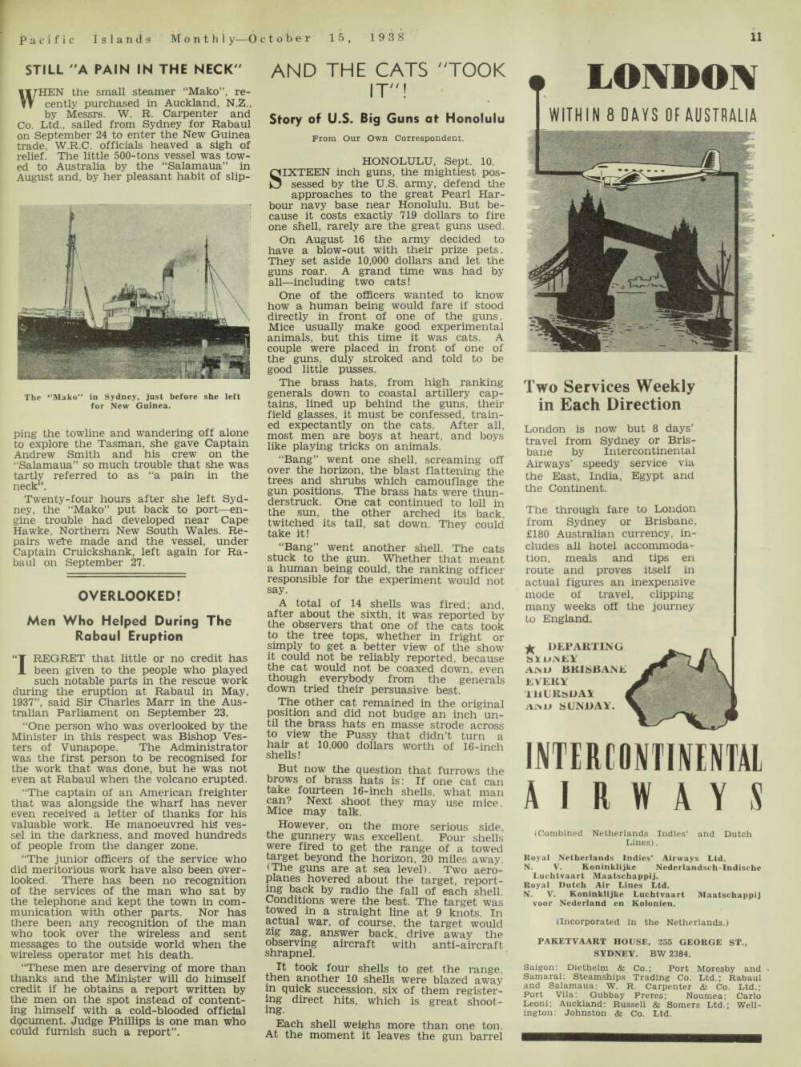
WHEN the small steamer "Make”, re cently purchased in Auckland, N.Z., by Messrs. W. R. Carpenter and Co. Ltd., sailed from Sydney for Rabaul on September 24 to enter the New Guinea trade, W.R.C. officials heaved a sigh of relief. The little 500-tons vessel was tow ed to Australia by the “Salamaua” in August and, by her pleasant habit of slip-
ping the towline and wandering off alone to explore the Tasman, she gave Captain Andrew Smith and his crew on the “Salamaua” so much trouble that she was tartly referred to as “a pain in the neck”.
Twenty-four hours after she left Syd ney, the “Mako” put back to port—en gine trouble had developed near Cape Hawke, Northern New South Wales. Re pairs were made and the vessel, under Captain Cruickshank, left again for Ra baul on September 27.
The “Make” in Sydney, just before she left for New Guinea.
Rabaul Eruption
Overlooked!
Men Who Helped During The Rabaul Eruption
“T REGRET that little or no credit has X been given to the people who played such notable parts in the rescue work during the eruption at Rabaul in May, 1937”, said Sir Charles Marr in the Aus tralian Parliament on September 23.
“One person who was overlooked by the Minister in this respect was Bishop Ves ters of Vunapope. The Administrator was the first person to be recognised for the work that was done, but he was not even at Rabaul when the volcano erupted.
“The captain of an American freighter that was alongside the wharf has never even received a letter of thanks for his valuable work. He manoeuvred his ves sel in the darkness, and moved hundreds of people from the danger zone.
“The junior officers of the service who did meritorious work have also been over looked. There has been no recognition of the services of the man who sat by the telephone and kept the town in com munication with other parts. Nor has there been any recognition of the man who took over the wireless and sent messages to the outside world when the wireless operator met his death.
“These men are deserving of more than thanks and the Minister will do himself credit if he obtains a report written by the men on the spot instead of content ing himself with a cold-blooded official document. Judge Phillips is one man who could furnish such a report”.
And The Cats "Took
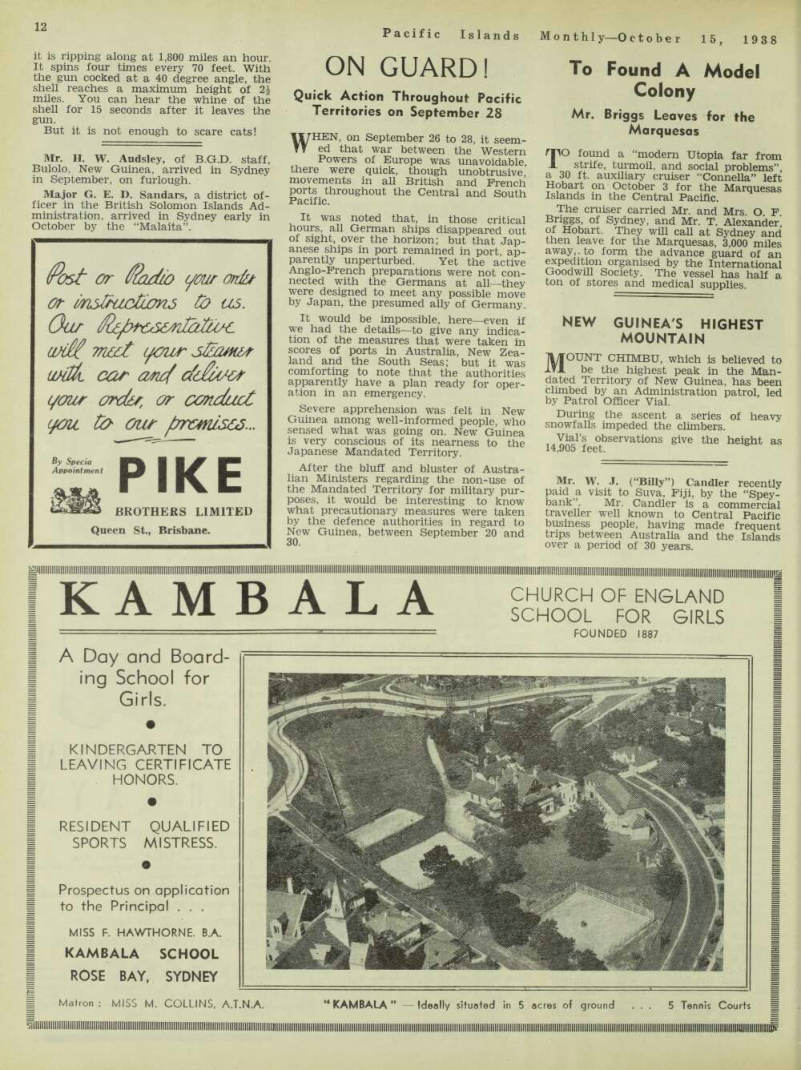
IT"!
Story of U.S. Big Guns at Honolulu
From Our Own Correspondent.
Honolulu, Sept. 10.
SIXTEEN inch guns, the mightiest pos sessed by the U.S. army, defend the approaches to the great Pearl Har bour navy base near Honolulu. But be cause it costs exactly 719 dollars to fire one shell, rarely are the great guns used.
On August 16 the army decided to have a blow-out with their prize pets.
They set aside 10,000 dollars and let the guns roar. A grand time was had by all —including two cats!
One of the officers wanted to know how a human being would fare if stood directly in front of one of the guns.
Mice usually make good experimental animals, but this time it was cats. A couple were placed in front of one of the guns, duly stroked and told to be good little pusses.
The brass hats, from high ranking generals down to coastal artillery cap tains, lined up behind the guns, their field glasses, it must be confessed, train ed expectantly on the cats. After all, most men are boys at heart, and boys like playing tricks on animals.
“Bang” went one shell, screaming off over the horizon, the blast flattening the trees and shrubs which camouflage the gun positions. The brass hats were thun derstruck. One cat continued to 101 l in the sun, the other arched its back, twitched its tail, sat down. They could take it!
“Bang” went another shell. The cats stuck to the gun. Whether that meant a human being could, the ranking officer responsible for the experiment would not say.
A total of 14 shells was fired; and, after about the sixth, it was reported by the observers that one of the cats took to the tree tops, whether in fright or simply to get a better view of the show it could not be reliably reported, because the cat would not be coaxed down, even though everybody from the generals down tried their persuasive best.
The other cat remained in the original position and did not budge an inch un til the brass hats en masse strode across to view the Pussy that didn’t turn a hair at 10,000 dollars worth of 16-inch shells!
But now the question that furrows the brows of brass hats is; If one cat can take fourteen 16-inch shells, what man can? Next shoot they may use mice.
Mice may talk.
However, on the more serious side, the gunnery was excellent. Four shells were fired to get the range of a towed target beyond the horizon, 20 miles away. (The guns are at sea level). Two aero planes hovered about the target, report ing back by radio the fall of each shell.
Conditions were the best. The target was towed in a straight line at 9 knots. In actual war, of course, the target would zig zag, answer back, drive away the observing aircraft with anti-aircraft shrapnel.
It took four shells to get the range, then another 10 shells were blazed away in quick succession, six of them register ing direct hits, which is great shoot ing.
Each shell weighs more than one ton.
At the moment it leaves the gun barrel
it is ripping along at 1,800 miles an hour.
It spins four times every 70 feet. With the gun cocked at a 40 degree angle, the shell reaches a maximum height of 2i miles. You can hear the whine of the shell for 15 seconds after it leaves the gun.
But it is not enough to scare cats!
Mr. H. W. Audsley, of B.G.D. staff, Bulolo, New Guinea, arrived in Sydney in September, on furlough.
Major G. E. D. Sandars, a district of ficer in the British Solomon Islands Ad ministration, arrived in Sydney early in October by the “Malaita”.
Advertisements & other items, pp. 17-18 (2 items)
11
Pacific Islands Mont hi y—O ctober 15, 1938
Intercontinental
LONDON
WITHIN 8 PAYS OF AUSTRALIA
Two Services Weekly
in Each Direction
London is now but 8 days’ travel from Sydney or Brisbane by Intercontinental Airways’ speedy service via the East, India, Egypt and the Continent.
The through fare to London from Sydney or Brisbane, £lBO Australian currency, includes all hotel accommodation, meals and tips en route and proves itself in actual figures an inexpensive mode of travel, clipping many weeks off the journey to England.
* DEPARTING
SYDNEY
AINU BRISBANE
EVERY
THURSDAY
Ainu SUNDAY.
INTERCONTINENTAL
AIRWAYS
(Combined Netherlands Indies’ and Dutch Lines).
Royal Netherlands Indies’ Airways Ltd.
N. V. Koninkli jke Nederlandsch-Indiscbe Luchtvaart Maatschappij.
Royal Dutch Air Lines Ltd.
N. V. Koninklijke Luchtvaart Maatschappij voor Nederland en Kolonien. (Incorporated in the Netherlands.)
PAKETVAART HOUSE, 255 GEORGE ST.,
SYDNEY. BW 2384,
Saigon: Diethelm & Co.; Port Moresby and Samarai: Steamships Trading Co. Ltd.; Rabaul and Salamaua: W. R. Carpenter & Co. Ltd.; Port Vila: Gubbay Freres; Noumea: Carlo Leoni; Auckland: Russell & Somers Ltd.; Wellington: Johnston & Co. Ltd.
Post or Porto
or imthcctcons to as.
Our Pcprcoortat
uritt most r/o urith cor anc i/our order, or conduct c/oic to our premises...
By Specia Appointment
PIKE
BROTHERS LIMITED
Queen St., Brisbane.
On Guard!
Quick Action Throughout Pacific Territories on September 28
WHEN, on September 26 to 28, it seem ed that war between the Western Powers of Europe was unavoidable, there were quick, though unobtrusive, movements in all British and French ports throughout the Central and South Pacific.
It was noted that, in those critical hours, all German ships disappeared out of sight, over the horizon; but that Jap anese ships in port remained in port, ap parently unperturbed. Yet the active Anglo-French preparations were not con nected with the Germans at all—they were designed to meet any possible move by Japan, the presumed ally of Germany.
It would be impossible, here—even if we had the details—to give any indica tion of the measures that were taken in scores of ports in Australia, New Zea land and the South Seas; but it was comforting to note that the authorities apparently have a plan ready for oper ation in an emergency.
Severe apprehension was felt in New Guinea among well-informed people, who sensed what was going on. New Guinea is very conscious of its nearness to the Japanese Mandated Territory.
After the bluff and bluster of Austra lian Ministers regarding the non-use of the Mandated Territory for military pur poses. it would be interesting to know what precautionary measures were taken by the defence authorities in regard to New Guinea, between September 20 and 30.
Colony
To Found A Model Colony Mr. Briggs Leaves for the Marquesas
TO found a “modern Utopia far from strife, turmoil, and social problems”, a 30 ft. auxiliary cruiser “Connella” left Hobart on October 3 for the Marquesas Islands in the Central Pacific.
The cruiser carried Mr. and Mrs. O F Briggs, of Sydney, and Mr. T. Alexander, of Hobart. They will call at Sydney and then leave for the Marquesas, 3,000 miles away,, to form the advance guard of an expedition organised by the International Goodwill Society. The vessel has half a ton of stores and medical supplies
Mountain
New Guinea's Highest
MOUNT CHIMBU, which is believed to be the highest peak in the Man dated Territory of New Guinea, has been climbed by an Administration patrol, led by Patrol Officer Vial.
During the ascent a series of heavy snowfalls impeded the climbers.
Vial’s observations give the height as 14,905 feet.
Mr. W. J. (“Billy”) Candler recently paid a visit to Suva, Fiji, by the “Spey bank”. Mr. Candler is a commercial traveller well known to Central Pacific business people, having made frequent trips between Australia and the Islands over a period of 30 years.
Advertisements & other items, p. 18 (2 items)
12
Pacific Islands Monthl y—o ctober 15, 1938
Kamb A L A
CHURCH OF ENGLAND
SCHOOL FOR GIRLS
FOUNDED 1887
A Day and Board-
ing School for
Girls.
KINDERGARTEN TO
LEAVING CERTIFICATE
HONORS.
RESIDENT QUALIFIED
SPORTS MISTRESS.
o Prospectus on application to the Principal . . .
MISS F. HAWTHORNE. B.A.
KAMBALA SCHOOL
ROSE BAY. SYDNEY
> , «! m m m ■ i i ?■ f i* K m . mm m
SPSt'. M', .
■V ■ I. ■ ... * M Mi i P M m I ■ hi m m m
Matron : MISS M. COLLINS, A.T.N.A.
u KAMBALA" —ldeally situated in 5 acres of ground ... 5 Tennis Courts
Deerstalking In New
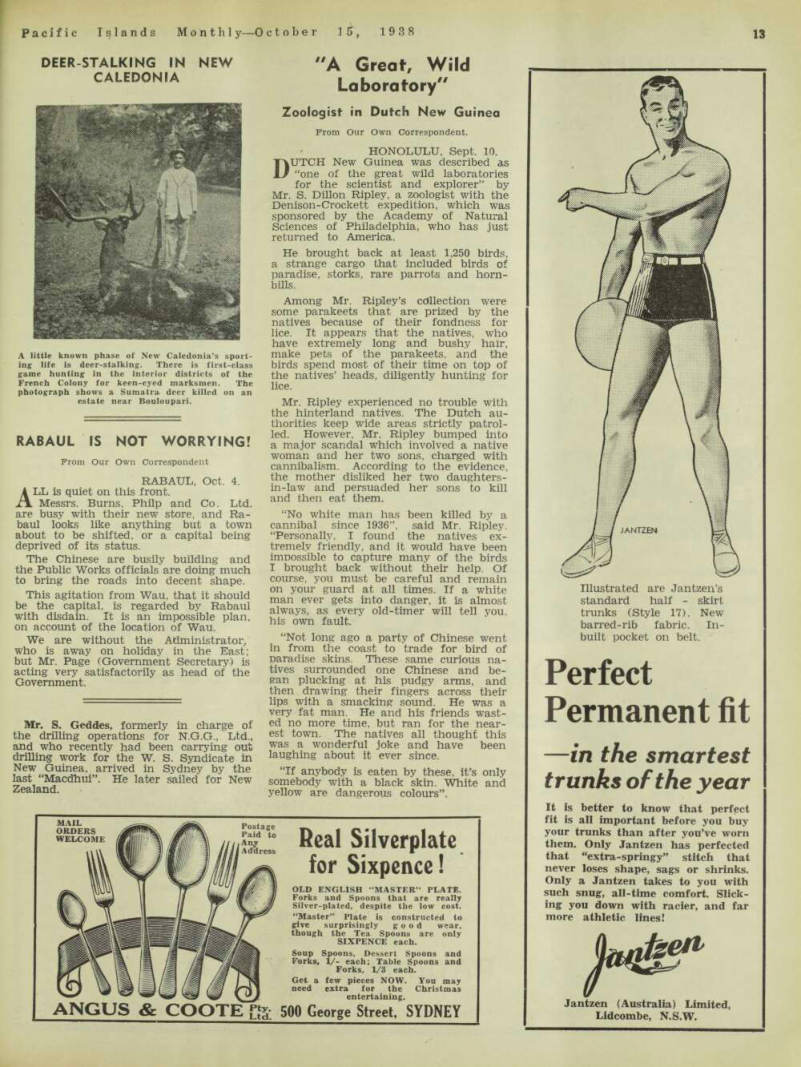
Caledonia
A little known phase of New Caledonia’s sport ing life is deer-stalking. There is first-class game hunting in the interior districts of the French Colony for keen-eyed marksmen. The photograph shows a Sumatra deer killed on an estate near Bouloupari.
Rabaul Is Not Worrying!
Prom Our Own Correspondent
Rabaul, Oct. 4.
ALL is quiet on this front.
Messrs. Burns, Philp and Co. Ltd. are busy with their new store, and Ra baul looks like anything but a town about to be shifted, or a capital being deprived of its status.
The Chinese are busily building and the Public Works officials are doing much to bring the roads into decent shape.
This agitation from Wau, that it should be the capital, is regarded by Rabaul with disdain. It is an impossible plan, on account of the location of Wau.
We are without the Administrator/ who is away on holiday in the East; but Mr. Page (Government Secretary) is acting very satisfactorily as head of the Government.
Mr. S. Geddes, formerly in charge of the drilling operations for N.G.G., Ltd., and who recently had been carrying out drilling work for the W. S. Syndicate in New Guinea, arrived in Sydney by the last “Macdhui”. He later sailed for New Zealand.
Laboratory"
"A Great, Wild Laboratory"
Zoologist in Dutch New Guinea
From Our Own Correspondent.
Honolulu, Sept. 10.
DUTCH New Guinea was described as “one of the great wild laboratories for the scientist and explorer” by Mr. S. Dillon Ripley, a zoologist with the Denison-Crockett expedition, which was sponsored by the Academy of Natural Sciences of Philadelphia, who has just returned to America.
He brought back at least 1,250 birds, a strange cargo that included birds of paradise, storks, rare parrots and hom bills.
Among Mr. Ripley’s collection were some parakeets that are prized by the natives because of their fondness for lice. It appears that the natives, who have extremely long and bushy hair, make pets of the parakeets, and the birds spend most of their time on top of the natives’ heads, diligently hunting for lice.
Mr. Ripley experienced no trouble with the hinterland natives. The Dutch au thorities keep wide areas strictly patrol led. However, Mr. Ripley bumped into a major scandal which involved a native woman and her two sons, charged with cannibalism. According to the evidence, the mother disliked her two daughters in-law and persuaded her sons to kill and then eat them.
“No white man has been killed by a cannibal since 1936”, said Mr. Ripley.
“Personally, I found the natives ex tremely friendly, and it would have been impossible to capture many of the birds I brought back without their help. Of course, you must be careful and remain on your guard at all times. If a white man ever gets into danger, it is almost always, as every old-timer will tell you, his own fault.
“Not long ago a party of Chinese went in from the coast to trade for bird of paradise skins. These same curious na tives surrounded one Chinese and be gan plucking at his pudgy arms, and then drawing their fingers across their lips with a smacking sound. He was a very fat man. He and his friends wast ed no more time, but ran for the near est town. The natives all thought this was a wonderful joke and have been laughing about it ever since.
“If anybody is eaten by these, it’s only somebody with a black skin. White and yellow are dangerous colours”.
Advertisements & other items, p. 19 (2 items)
13
Pacific Islands Month 1 y—o ctober I£, 1938
Permanent fit
& 1/
JANTZEN
Illustrated are Jantzen’s standard half - skirt trunks (Style 17). New barred-rib fabric. Inbuilt pocket on belt.
Perfect
Permanent fit
—in the smartest
trunks of the year
It is better to know that perfect fit is all important before you buy your trunks than after you’ve worn them. Only Jantzen has perfected that “extra-springy” stitch that never loses shape, sags or shrinks.
Only a Jantzen takes to you with such snug, all-time comfort. Slicking you down with racier, and far more athletic lines!
Jantzen (Australia) Limited, Lidcombe, N.S.W.
Si to Real Silvcrplate
Address * ,
for Sixpence!
OLD ENGLISH “MASTER” PLATE.
Forks and Spoons that are really Silver-plated, despite the low cost.
“Master” Plate is constructed to give surprisingly good wear, though the Tea Spoons are only SIXPENCE each.
Soup Spoons, Dessert Spoons and Forks, 1/- each; Table Spoons and Forks, 1/3 each.
Get a few pieces NOW. You may need extra for the Christmas entertaining.
K - 500 George Street. SYDNEY
Fishermen Of
Japan
Significant Facts from Hawaii
From Our Own Correspondent
Honolulu, Sept. 10.
UNCLE SAM already has spent hun dreds of millions of dollars in estab lishing a super-defence base in these islands, and he has budgeted to spend millions upon millions more, the idea be ing to keep the ambitious Japanese west of Hawaii.
But, in the shadow of the great guns that command the approaches from Jap an. in the coastal waters that wash into Pearl Harbour (the immense base that is the crux of the Hawaii defence scheme) enterprising, alien Japanese are reaping a harvest—and making military experts wonder.
The latest figures available show that alien Japanese dominate the commercial fishing industry of the islands. Of the total U.S. licenses issued. 272 belong to alien Japanese, and only 70 to U.S. citi
zens (many of them of Japanese parent age).
These fishermen use sampans, many of them ocean-going. Licensed power boats (sampans) owned by these aliens total 384, a sizeable fleet. Alien Japan ese also own 280 licensed rowboats.
There are 595 night-angling permits possessed by aliens. This gives the hold ers access to foreshores.
This tightly-knit alien Japanese group monopolises the wholesale and retail marketing of fish. There is proceeding, at present, a territorial investigation of the entire system. The public have com plained about the high prices.
Experts are here from Washington to see that the investigation covers every angle, to probe every angle of the set up themselves, anyhow.
Japanese fishing fleets are spread throughout the Pacific. Make a note of the localities: In the Dutch East In dies. along Australia’s northern coasti, in the Mandated Islands, in Siberian waters, in Alaskan waters, in Hawaii, along the California coast, and down in the vicinity of the Panama Canal.
Many of the sampans have an ex traordinarily long cruising range. Many are equipped with radio.
Major H. S. N. Robinson, Secretary of the Melanesian Mission, returned to Sydney early in October from New Zea land, where he attended to the business side of the visit of the Melanesian Mis sion yacht “Southern Cross”, which made the trip to Auckland for a special sur vey by Lloyds.
Mr. W. N. Lock, of the S.D.A. Mission at Merigeda, Papua, arrived in Sydney recently on leave.
Country
A Rich New
Tablelands of Central New Guinea
“M Y information is that, after gold iTl mining is finished in New Guinea, the Ramu River district and the hinterland to Mount Hagen and Mount Dixon will be the country for cattle and sheep, and that it will become a great primary producing country”, said Sir Charles Marr in the Australian Parlia ment lately. “Additional communications and roads will be needed.
“An Australian man unshipped 40 head of Australian cattle, swam them ashore, and drove them up to the Ramu River, where he built a bungalow which the na tives burnt out, and then built himself another one. That man is now well es tablished. He is a typical Australian.
Nobody else is allowed into the country —it is not under control—but this man has done good work. Apart from driving the cattle to the goldfields, where he sold them at £4O a head, he has done other things to place himself on a firm foot ing in the Mandated Territory. I take off my hat to him”.
Mr. A. J. Campbell, a Seventh Day Ad ventist missionary who has been station ed in Central New Guinea, in the Ramu- Purari area, for 2J years, told “Sydney Morning Herald” recently:— “There are many people scratching around on arid ground in Australia when there are thousands of square miles of good agricultural territory in Central New Guinea, which is droughtless, We have a splendid possession in New Guinea, but nobody seems to know about it”.
Advertisements & other items, p. 20 (1 item)
Outboard Motors
'C5s T
NEW
BENDIX BUILT
Sailor stow your oars! Here's what it takes to add the last touch of contentment to your hours afloat. . . The Eclipse Air-Cooled Gasoline Out-board Motors are designed and built on the selfsame principles that have made the modern air-cooled aviation engines the marvels of internal combustion engineering! They run "cool as a cucumber" at low trolling speeds or wide-open throttle! Fully enclosed—fully streamlined 1 Polished feather-weight aluminium construction except for vital super-strength engine parts! ! No water pump or water jacketing to clog and corrode.
One pull starting one lever control.
Three models: Electric 1.1 H.P., Single 2i H.P. & the Big Twin H.P.
Call or write for a Demonstration.
PAUL & GRAY LTD.
82 SUSSEX ST.,
BRANCHES: LONDON, ADELAIDE, SYDNEY. NEWCASTLE. MELBOURNE, BRISBANE.
Old-Time Tahiti

Mrs. Oscar Nordmap, of Papeete, and a friend, wearing gowns which are over 40 years old, to show the kind of costumes which were compulsory in Tahiti in the middle of last century.
Guinea Miners

Little Help For N.
How Australia Rewards the Prospectors
A STRONG plea on behalf of the pros pectors and miners in New Guinea, who take all the risks and discom forts of opening up new territory, was made in the Australian Parliament by Mr. A. E. Green, who recently visited the Territory.
Mr. Green attacked the gold royalty of 5 per cent, in its application to these men. Miners who were earning barely enough to purchase adequate food, were charged relatively the same rate as large companies, such as the Bulolo Dredging Company, which is showing a profit of £600,000 per annum. He urged that, in view of the small amount that must ac crue to the revenue by imposing the tax on the prospector earning less than an appropriate wage, the tax be abolished on all gold returning less than an ade quate living.
As the Minister’s only answer was that he would “consider” it, Mr. Green re turned to the attack later; and then Mr. Hughes recounted (on September 23) the history of the gold royalty in New Guinea, and said; “I shall consider very carefully and sympathetically the sug gestion that prospectors, especially those who are on poor ground, and those who are recovering such a small quantity of gold as to make the royalty a formidable item in their economy, should be exemp ted from its operation”.
Mr. Green also brought up the case of Messrs. Forrester and Tebb, two pros pectors who last April pushed in from Madang to a point on Mogo Creek, four miles south of the Ramu River, near the uncontrolled area. They found a prom ising area, and set to work to develop it —but wild natives from the Bismarcks (uncontrolled area) came in and stole
their gear. They appealed to the DO. at Madang for help; but all they got was advice “to vacate your present min ing location without delay”. A patrol was not available to go out and protect their property: and they were told that, if they delayed, action would be taken to include their area within the uncon trolled area, which would mean that they could not go out there and re commence prospecting. In view of this.
Forrester and Tebb abandoned their area, and the £2OO they had sunk in the enterprise. It was understandable that men should feel resentment against such treatment.
The Minister said he would inquire into the matter. He added—with his usual septuagenarian determination to make a joke out of anything, no matter how seri ous —“We must have some regard for the hobbies of these lighthearted people (the
uncontrolled natives) and their need for recreation”.
EDITORIAL NOTE; The foregoing is typical of the spirit in which Australia governs New Guinea. Men who. with superb tenacity and courage, are pros pecting this primitive region, receive no encouragement and very little help from certain sections of politicians and offi cials: but the whole administration gets the jitters if a European dares even to plant a sound kick in the stern of a thieving native. Forrester and Tebb did what they thought was right—and lost everything. The next time that prospec tors find themselves in similar circum stances, there may be an “unfortunate accident”. Whose will be the fault?
Mr. Peter Johnson has completed his two years’ term with the Bank of New South Wales, Wau, New Guinea.
Father Francois Caillon, who has been engaged in missionary work in the New Hebrides for the past 35 years, arrived in Sydney by the October “Pierre Loti” on a health and holiday trip.
Mr. and Mrs. K. C. Strachan arrived in Sydney by the “Mangola” recently from Butaritari, Gilbert Islands, where he is resident engineer for Burns, Philp & Co., Ltd.
Miss Molly Molloy, sister of Mr. W. Brian Molloy, who has been practising law in Port Moresby for three years, returned to Sydney by the “Maetsuycker” from Papua on September 23. "Though a visitor her self to Papua for only 10 weeks, Miss Molloy was much amused at the gullibility of tourists from cruise liners —they bought poinciana seed pods from the wily natives for anything up to 2/- each, under the impression that they were “rare Papuan
boomerangs!”
Advertisements & other items, p. 21 (2 items)
15
Pacific Islands Monthl y—o ctobef 15, J 938
Delco-Light
p
Yours
the Comfort
and Economy
of Electric
Light
DELCO-LIGHT
l (A Product of General Motors.) With unfailing dependability, a Delco-Light Plant will give you plenty of brilliant light . . . whenever and wherever you need it ... in your home, boat or camp. It will also provide ample power for your radio.
Model 2812 Delco-Light generates 200 watts at 12 volts and will light eight 25 watt lamps direct from the generator—or five for 10 hours from the 105 A.H. battery, when fully charged. It will run for 16 hours on one gallon of petrol.
For complete information please write to Desk PI. Sizes range from 200 to 6,000 watts.
PRICES OF PLANTS IN BOND, SYDNEY.
2812 (12 volt) £23/15/-, with 83 A.H. battery (car type) 2812 (12 volt) £26/15/-, with 105 A.H. battery, (individual cells) 286 (6 volt) £24/5/-, with 105 A.H. battery (individual cells.
Distributors'. —
WARBURTON, FRANKI, LTD.
307-15 KENT STREET, SYDNEY.
MELBOURNE BRISBANE
Tongan Reforms
An Election Next Month
Letter to the Editor PERMIT me to thank you for the pub licity you have given to “Leftist” views in regard to Tonga. Something has been achieved at last. At the recent Parliament certain improvements were registered. Briefly, they are:— (1) An extension of Public Works (which will give some further em ployment) . (2) The abolition of arrears in the Poll Tax up to 1937 inclusive (a big thing this), and a reduction in the tax of 1/- per quarter. (3) Reduction in motor lorry licenses on the smaller vehicles.
(4) Rate per day for prisoners paying off their arrears of Poll Tax in future to be 2/6 per day instead of 3d. per day—this latter ini quitous rate having been the law for 63 years. (5) An increase of duty on other than British goods, to give some assist ance to British imports against Jap. (mainly). This is right in principle, but should have been done years ago, or, rather, the Japanese should never have been allowed in.
With regard to No. 2, a proposition was brought forward in Parliament to abolish the Poll Tax altogether and, had it not been for the stupidity of one of the people’s representatives, it would have been carried. But at the decisive moment he let his people down. The proposition was voted upon, and it was found to be 10 in favour of the abolition of the tax and 9 to retain it, one member not hav ing voted. Somebody asked him, “What about it?”, and he voted with the Govern ment’s 9, thus making it 10 all; and the casting vote with the Speaker who, as is usual, voted to maintain the status quo.
The gentleman who let his constituents down is one of the three run by the Wes leyan Mission at the last election, 3 years ago, when the people were told in the sermons from the Wesleyan pulpits to vote for three named Wesleyans.
There is a strong fear here that this Wesleyan Mission and certain high per sonages—all Wesleyans—are simply work ing together to get as much out of the common people as they possibly can. The people are beginning to see the position, and at the next election of people’s re presentatives, in November, it is hoped that they will clear these three out and get three more in place of them who will faithfully discharge their trust.
I am, etc.,
Observer.
Nukualofa, Tonga. 22/9/’3B.
War On Coconut Pest
THE “Mariposa” brought to Sydney on October 3 several million leaf para sites from Fiji, which are to fight a coco nut pest in New Guinea. The parasites were taken in a specially cooled box in the Carpenter airliner, which left for Rabaul on October 4.
“The parasites were packed in a box with a store of honey on which they feed,” said Mr. R. O. Mant, flight super intendent of W.R.C. Airlines. “We re ceived instructions to pack ice around the box, the interior of which must be kept at about 40 degrees Fahr.”
When the parasites arrived at Rabaul on October 7 they were received by officers of the Department of Agriculture, and will be set loose to wage war on other in sects which have ravaged the coconut plantations since they were covered with pumice during last year’s volcanic erup tion.
The sloop “Rigault de Genouilly” of the French Pacific squadron arrived in Syd ney from Tahiti early in October, for overhaul.
When a party of Samoans was working at Vaea Hill gravel pit, at the Roman Catholic Mission, near Apia, on Septem ber 19, a sudden fall of earth buried sev eral natives under two tons of gravel.
A 20-years-old Samoan, Masima, of Tau fusi, was killed; the others were rescued almost unharmed.
Advertisements & other items, p. 22 (2 items)
16
Pacific Islands Monthl y—o ctober lt>, 19 3 8
You’Ll Enjoy
THESE TASTY FOODS
HOT MEALS
in
i\b., |lb. and lib.
CANS
Hi I LB. nett You can choose from
7 Varieties .
& Imperial Beef Steak Pudding. © Steak and Kidney Pudding. @ Chops and Tomato. @ Steak and Tomato. $ Sausages and Tomato. ® Sausages, Spaghetti and Tomato. © Lamb and Green Peas.
"FITZROY" BRAND LUNCHEON BEEF in OBLONG CANS.
Packed by a Special Process.
"RIVERSTONE" Cr "OX & PALM" BRAND TRADE MEATS.
Corned-Boiled & Roast Meats
120z5., 160z5,, 240z5., 21b., 31b., 41b., 51b., 61b.
Bio®
Delicious
Mango and Papaw
CHUTNEY
Made from fresh sun-ripened fruits, delicately spiced and blended. It gives added zest to both hot and cold dishes. o
Tasty
Cheddar Cheese
Get some to-day, just taste the goodness of Its matchless flavor, smooth, mellow and satisfying, it is free from lumps and string, and is ideal for cooking, too.
RIVERSTONE MEAT CO., PTY., LTD.,
5-7 O'CONNELL STREET, SYDNEY. Cables: "IMPERIAL".
Mr. G. M. Turnbull
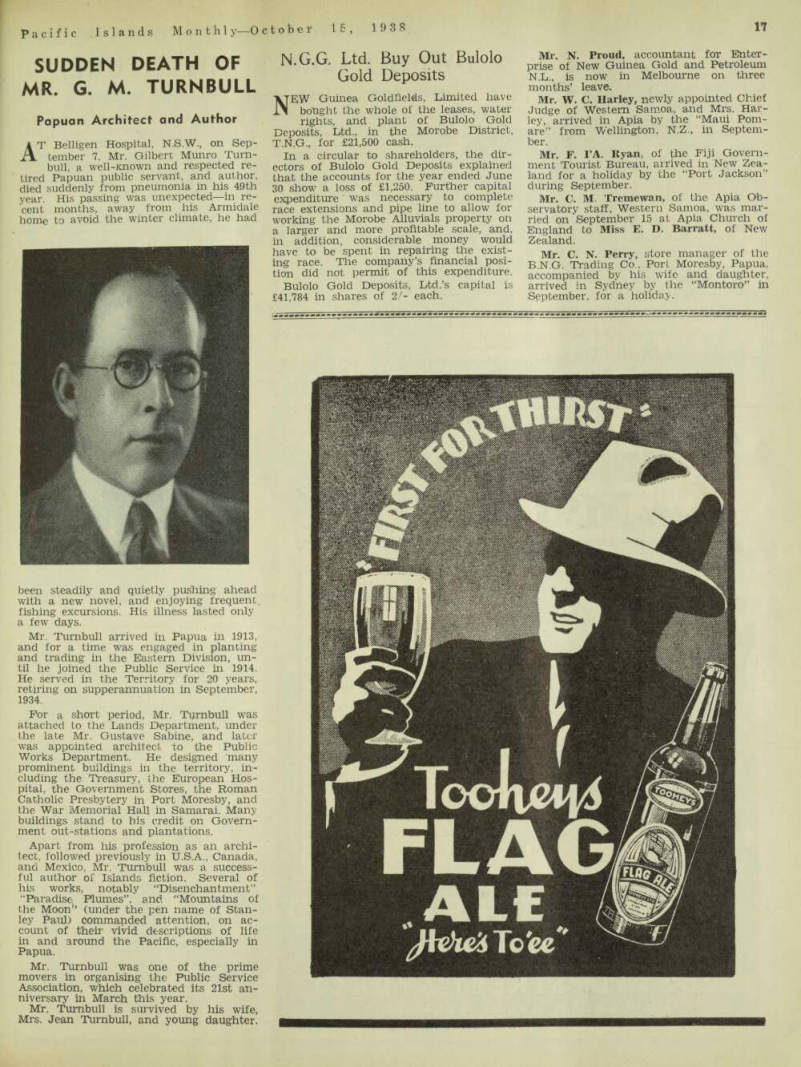
Sudden Death Of
Papuan Architect and Author
AT Belligen Hospital, N.S.W., on Sep tember 7. Mr. Gilbert Munro Turn bull, a well-known and respected re tired Papuan public servant, and author, died suddenly from pneumonia in his 49th year. His passing was unexpected—in re cent months, away from his Armidale home to avoid the winter climate, he had
been steadily and quietly pushing ahead with a new novel, and enjoying frequent, fishing excursions. His illness lasted only a few days.
Mr. Turnbull arrived in Papua in 1913, and for a time was engaged in planting and trading in the Eastern Division, un til he joined the Public Service in 1914.
He served in the Territory for 20 years, retiring on supperannuation in September, 1934.
For a short period, Mr. Turnbull was attached to the Lands Department, under the late Mr. Gustave Sabine, and later was appointed architect to the Public Works Department. He designed 'many prominent buildings in the territory, in cluding the Treasury, the European Hos pital, the Government Stores, the Roman Catholic Presbytery in Port Moresby, and the War Memorial Hall in Samarai. Many buildings stand to his credit on Govern ment out-stations and plantations.
Apart from his profession as an archi tect, followed previously in U.S.A., Canada, and Mexico, Mr. Turnbull was a success ful author of Islands fiction. Several of his works, notably “Disenchantment”
“Paradise. Plumes”, and “Mountains of the Moon” (under the pen name of Stan ley Paul) commanded attention, on ac count of their vivid descriptions of life in and around the Pacific, especially in Papua.
Mr. Turnbull was one of the prime movers in organising the Public Service Association, which celebrated its 21st an niversary in March this year.
Mr. Turnbull is survived by his wife, Mrs. Jean Turnbull, and young daughter.
Gold Deposits
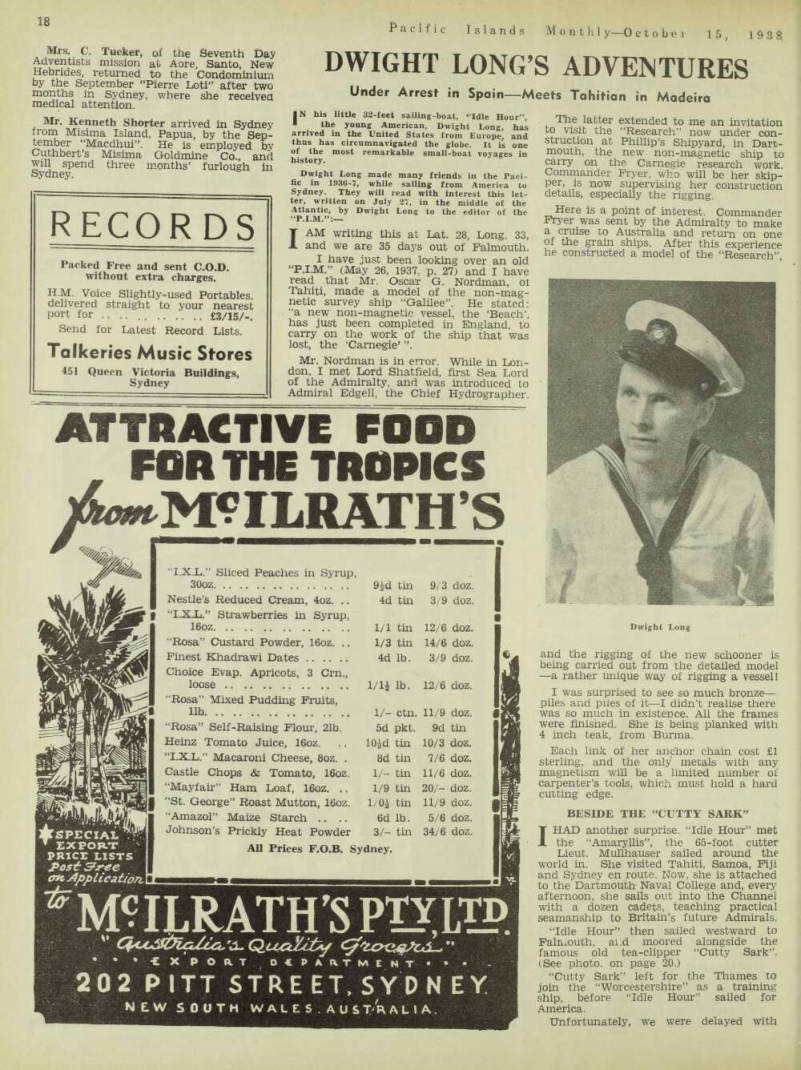
N.G.G. Ltd. Buy Out Bulolo Gold Deposits
NEW Guinea Goldfields, Limited have bought the whole of the leases, water rights, and plant of Bulolo Gold Deposits, Ltd., in the Morobe District, T.N.G., for £21,500 cash.
In a circular to shareholders, the dir ectors of Bulolo Gold Deposits explained that the accounts for the year ended June 30 show a loss of £1,250. Further capital expenditure was necessary to complete race extensions and pipe line to allow for working the Morobe Alluvials property on a larger and more profitable scale, and, in addition, considerable money would have to be spent in repairing the exist ing race. The company’s financial posi tion did not permit of this expenditure.
Bulolo Gold Deposits, Ltd.’s capital is £41,784 in shares of 2/- each.
Mr. N. Proud, accountant for Enter prise of New Guinea Gold and Petroleum N.L., is now in Melbourne on three months’ leave.
Mr. W. C. Harley, newly appointed Chief Judge of Western Samoa, and Mrs. Har ley, arrived in Apia by the “Maui Pom are” from Wellington, N.Z., in Septem ber.
Mr. F. I’A. Ryan, of the Fiji Govern ment Tourist Bureau, arrived in New Zea land for a holiday by the “Port Jackson”
during September.
Mr. C. M. Tremewan, of the Apia Ob servatory staff, Western Samoa, was mar ried on September 15 at Apia Church of England to Miss E. D. Barratt, of New Zealand.
Mr. C. N. Perry, store manager of the B.N.G. Trading Co., Port Moresby, Papua, accompanied by his wife and daughter, arrived in Sydney by the “Montoro” in September, for a holiday.
Mrs. C. Tucker, of the Seventh Day Adventists mission at Aore, Santo, New Hebrides, returned to the Condominium by the September “Pierre Loti” after two months in Sydney, where she received medical attention.
Mr. Kenneth Shorter arrived in Sydney from Misima Island, Papua, by the Sep tember “Macdhui”. He is employed by Cuthbert’s Misima Goldmine Co., and will spend three months’ furlough in Sydney.
Advertisements & other items, pp. 23-24 (2 items)
17
Pacific Islands Monthl y— O ctobel* 15, 1938
Too hofi
1
FLAG
ALE
JhheSTc'ee
RECOR DS
Packed Free and sent C.O.D. without extra charges.
H.M. Voice Slightly-used Portables, delivered straight to your nearest port for .. £3/15/-.
Send for Latest Record Lists.
Talkeries Music Stores
451 Queen Victoria Buildings, Sydney
ATTRACTIVE FOOD
, FOR THE TROPICS
A^m^ilraths
7 S .1 All Prices F. 0.8. Sydney.
M^ILRATH'SPTY.LTi)
Qu&uUty * * % -EXPORT OCPAATMCNT • • •
202 PITT STREET.SYDNEY
MEW SOUTH WALES. AUS T'R ALIA.
Dwight Long’S Adventures

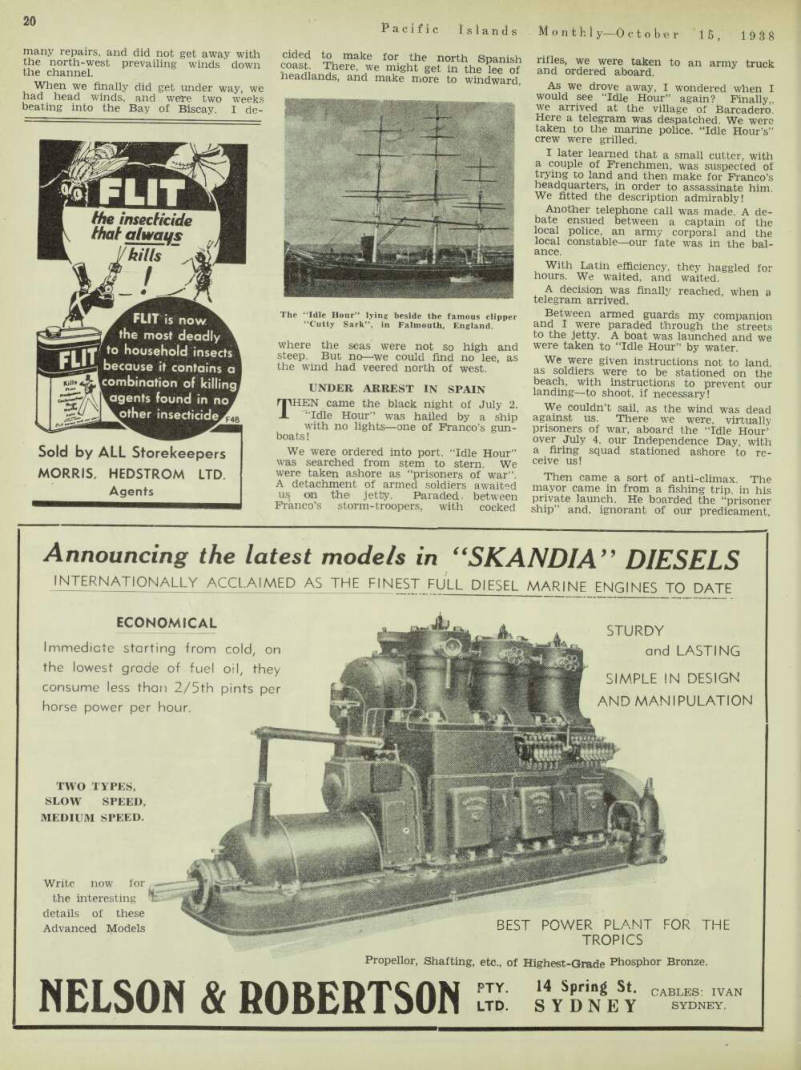
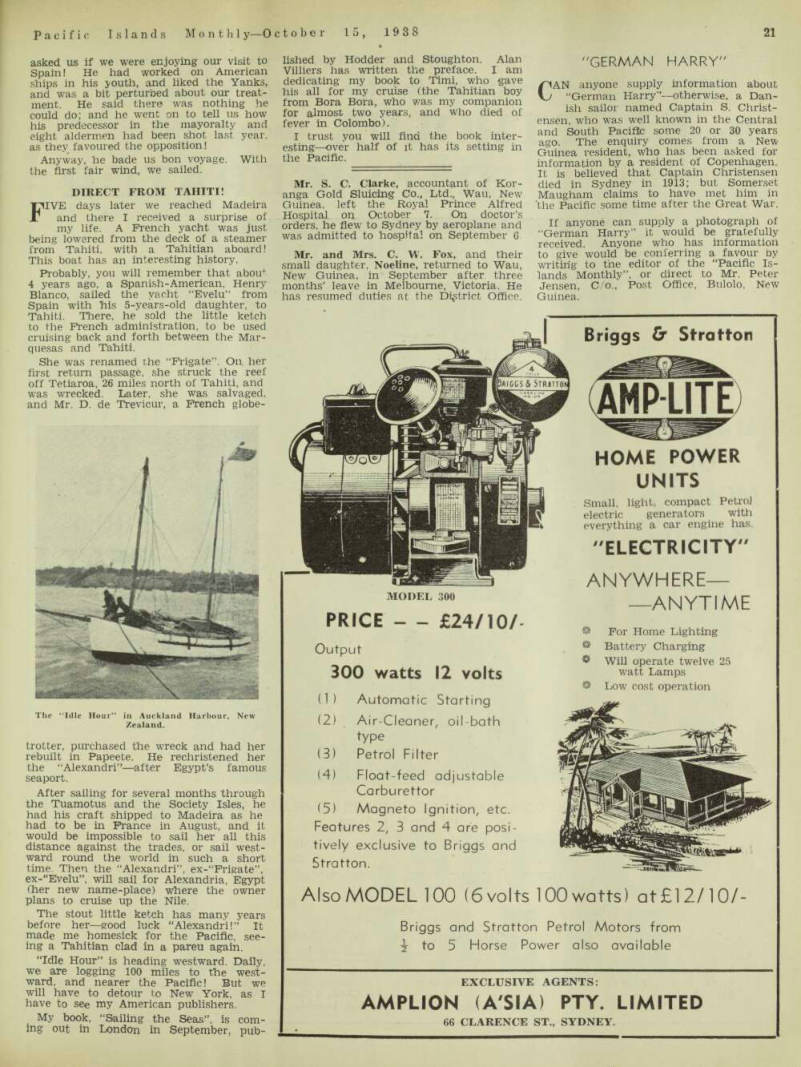
Under Arrest in Spain—Meets Tahitian in Madeira
■ N his little 32-feet sailing-boat, “Idle Hour”, ■ the young American, Dwight Long, has arrived in the United States from Europe, and thus has circumnavigated the globe. It is one of the most remarkable small-boat voyages in history.
Dwight Long made many friends in the Paci fic in 1936-7, while sailing from America to Sydney. They will read with interest this let ter, written on July 27, in the middle of the Atlantic, by Dwight Long to the editor of the
‘‘P.I.M.”:—
I AM writing this at Lat. 28, Long. 33, and we are 35 days out of Falmouth.
I have just been looking over an old “P.1.M.” (May 26, 1937, p. 27) and I have read that Mr. Oscar G. Nordman, of Tahiti, made a model of the non-mag netic survey ship “Galilee”. He stated: “a new non-magnetic vessel, the ‘Beach’, has just been completed in England, to carry on the work of the ship that was lost, the ‘Carnegie’
Mr. Nordman is in error. While in Lon don, I met Lord Shatfield, first Sea Lord of the Admiralty, and was introduced to Admiral Edgell, the Chief Hydrographer.
The latter extended to me an invitation to visit the “Research” now under con struction at Phillip’s Shipyard, in Dart mouth, the new non-magnetic ship to carry on the Carnegie research work.
Commander Fryer, who will be her skip per, is now supervising her construction details, especially the rigging.
Ilere is a point of interest. Commander Fryer was sent by the Admiralty to make a cruise to Australia and return on one of the grain ships. After this experience he constructed a model of the “Research”.
and the rigging of the new schooner is being carried out from the detailed model —a rather unique way of rigging a vessel!
I was surprised to see so much bronze — piles and piles of it—l didn’t realise there was so much in existence. All the frames were finished. She is being planked with 4 inch teak, from Burma.
Each link of her anchor chain cost £1 sterling, and the only metals with any magnetism will be a limited number of carpenter’s tools, which must hold a hard cutting edge.
Beside The “Cutty Sark”
IHAD another surprise. “Idle Hour” met the “Amaryllis”, the 65-foot cutter Lieut. Mullhauser sailed around the world in. She visited Tahiti, Samoa, Fiji and Sydney en route. Now, she is attached to the Dartmouth Naval College and, every afternoon, she sails out into the Channel with a dozen cadets, teaching practical seamanship to Britain’s future Admirals.
“Idle Hour” then sailed westward to Falmouth, ai.d moored alongside the famous old tea-clipper “Cutty Sark”. (See photo, on page 20.) “Cutty Sark” left for the Thames to join the “Worcestershire” as a training ship, before “Idle Hour” sailed for America.
Unfortunately, we were delayed with
Dwight Long
many repairs, and did not get away with the north-west prevailing winds down the channel.
When we finally did get under way, we had head winds, and weTe two weeks beating into the Bay of Biscay. I de
neacuanas, and make more to windward
where the seas were not so high and steep. But no—we could find no lee, as the wind had veered north of west.
Under Arrest In Spain
THEN came the black night of July 2.
“Idle Hour” was hailed by a ship with no lights—one of Franco’s gun boats !
We were ordered into port. “Idle Hour” was searched from stem to stern. We were taken ashore as “prisoners of war”.
A detachment of armed soldiers awaited us on the jetty. Paraded, between Franco’s storm-troopers, with cocked
rifles, we were taken to an army truck and ordered aboard.
As we drove away, I wondered when I would see “Idle Hour” again? Finally,, we arrived at the village of Barcadero.
Here a telegram was despatched. We were taken to the marine police. “Idle Hour’s” crew were grilled.
I later learned that a small cutter, with a couple of Frenchmen, was suspected of trying to land and then make for Franco’s headquarters, in order to assassinate him.
We fitted the description admirably!
Another telephone call was made. A de bate ensued between a captain of the local police, an army corporal and the local constable—our fate was in the bal ance.
With Latin efficiency, they haggled for hours. We waited, and waited.
A decision was finally reached, when a telegram arrived.
Between armed guards my companion and I were paraded through the streets to the jetty. A boat was launched and we were taken to “Idle Hour” by water.
We were given instructions not to land, as soldiers were to be stationed on the beach, with instructions to prevent our landing—to shoot, if necessary!
We couldn’t sail, as the wind was dead against us. There we were, virtually prisoners of war, aboard the “Idle Hour’ over July 4. our Independence Day, with a firing squad stationed ashore to re ceive us!
Then came a sort of anti-climax. The mayor came in from a fishing trip, in his private launch. He boarded the “prisoner ship” and, ignorant of our predicament,
The “Idle Hour” lying beside the famous clipper “Cutty Sark”, in Falmouth, England.
asked us if we were enjoying our visit to Spain! He had worked on American ships in his youth, and liked the Yanks, and was a bit perturbed about our treat ment. He said there was nothing he could do; and he went on to tell us how his predecessor in the mayoralty and eight aldermen had been shot last year, as they favoured the opposition!
Anyway, he bade us bon voyage. With the first fair wind, we sailed.
Direct From Tahiti!
FIVE days later we reached Madeira and there I received a surprise of my life. A French yacht was just being lowered from the deck of a steamer from Tahiti, with a Tahitian aboard!
This boat has an interesting history.
Probably, you will remember that about 4 years ago, a Spanish-American, Henry Blanco, sailed the yacht “Evelu” from Spain with his 5-years-old daughter, to Tahiti. There, he sold the little ketch to the French administration, to be used cruising back and forth between the Mar quesas and Tahiti.
She was renamed the “Frigate”. On her first return passage, she struck the reef off Tetiaroa, 26 miles north of Tahiti, and was wrecked. Later, she was salvaged, and Mr. D. de Trevicur, a French globe-
trotter, purchased the wreck and had her rebuilt in Papeete. He rechristened her the “Alexandri”—after Egypt’s famous seaport.
After sailing for several months through the Tuamotus and the Society Isles, he had his craft shipped to Madeira as he had to be in Prance in August, and it would be impossible to sail her all this distance against the trades, or sail west ward round the world in such a short time. Then the “Alexandri”, ex-“ Frigate”, ex-“Evelu”, will sail for Alexandria. Egypt (her new name-place) where the owner plans to cruise up the Nile.
The stout little ketch has many years before her—good luck “Alexandri!” It made me homesick for the Pacific, see ing a Tahitian clad in a pareu again.
“Idle Hour” is heading westward. Daily, we are logging 100 miles to the west ward, and nearer the Pacific! But we will have to detour to New York, as I have to see my American publishers.
My book, “Sailing the Seas”, is com ing out in London in September, pub
lished by Hodder and Stoughton. Alan Villiers has written the preface. I am dedicating my book to Timi, who gave his all for my cruise (the Tahitian boy from Bora Bora, who was my companion for almost two years, and who died of fever in Colombo).
I trust you will find the book inter esting—over half of it has its setting in the Pacific.
Mr. S. C. Clarke, accountant of Kor anga Gold Sluicing Co., Ltd., Wau, New Guinea, left the Royal Prince Alfred Hospital on October 7. On doctor’s orders, he flew to Sydney by aeroplane and was admitted to hospital on September 6 Mr. and Mrs. C. W. Fox, and their small daughter, Noeline, returned to Wau, New Guinea, in September after three months’ leave in Melbourne, Victoria. He has resumed duties at the District Office.
The “Idle Hour” in Auckland Harbour, New Zealand.
Advertisements & other items, pp. 24-26 (4 items)
18
Pacific Islands Month! y—o ctobei 15, 19S8
19
Pacific Islands Mont hi y—o ctober 15, 19S8
Overcome
TROPICAL
LETHARGY
and
Depressed Feeling
Yi % A m * 0 £.
Banish
“Nerves’*
with
BI DOMAK
SS Pa
EVERY BOTTLE OF BIDOMAK
CONTAINS ALL THE FOLLOWING
VITAL MINERAL FOODS:
AS MUCH ‘‘ FERR U M ” AS 80 0 OYSTERS 550 pts ut Milk SO lbs •of Beef 66 lbs Lettuce S lbs of Spinoch SO pts Orange Juice IS < 1 try r — C I 4 pts ol Milk 40 ozs Cheese 130 Ibi Bananas 22 lbs Lettuce 5 pts of Orange Juice
If You are Irritable, Tired, Run-
Down or Depressed You need BIDOMAK
“Bidomak” will quickly overcome the effects of severe tropic conditions and bring you back to the pinnacle of health and good spirits safely and pleasantly. “Bidomak” restores appetite, increases energy and vitality, helps you to sleep soundly and makes it possible for you to take full value from your regular food.
It provides the vital minerals— ferrum, calcium., phosphorus, potassium, sodium—in an easily assimilable, palatable, liquid form.
The chart at the right will give you some idea of the amazing concentration of these minerals in “Bidomak”. Within 30 seconds the ingredients enter the bloodstream and commence building up the worn-out tissues and restoring health and vigor.
Get a bottle of “Bidomak” from your store and take it as directed.
It is pleasant to take, and you will be amazed at the speed with which it gives you genuine restoration of your full health.
AS MUCH "CALCIUM”
AS MUCH “POTASSIUM" AS 22 OZS. OF LETTUCE S lbs Cabbage 17 ozs Carrots 22 ozs Spinach AS MUCH “SODIUM” AS 10 PTS. OF ORANGE JUICE 125 lbs Cabbage sy\ 10 lbs Bananas 5 lbs of Lettuce 13 lbs Spinach
TJTJITTr
44 pts Orange Juice 44 lbs Carrots 90 lbs Bananas 134 Ibi Cabbage ± & am 9 m
Take The Vital Minerals Doctors Recommend
The Tonic of the Century in “BOTTLED MINERALS”
At all Stores
the insecticide that always Vkills S I .
Kill* 3C F4B Sold by ALL Storekeepers
MORRIS, HEDSTROM LTD.
Agents
Announcing the latest models DIESELS
INTERNATIONALLY ACCLAIMED AS THE FINEST FULL DIESEL MARINE ENGINES TO DATE
ECONOMICAL
Immediate starting from cold, on the lowest grade of fuel oil, they consume less than 2/sth pints per horse power per hour.
TWO TYPES,
SLOW SPEED,
MEDIUM SPEED.
Write now for the interesting details of these Advanced Models m
STURDY
and LASTING
SIMPLE IN DESIGN
AND MANIPULATION
NELSON & ROBERTSON
BEST POWER PLANT FOR THE
TROPICS
Propellor, Shafting, etc., of Highest-Grade Phosphor Bronze.
PTY. 14 Spring St, cables, ivan
ltd. SYDNEY SYDNEY.
20
Pacific Islands Mont hi y—o ctober 15, I§3S
"German Harry"
CAN anyone supply information about “German Harry”—otherwise, a Dan ish sailor named Captain S. Christ ensen, who was well known in the Central and South Pacific some 20 or 30 years ago. The enquiry comes from a New Guinea resident, who has been asked for information by a resident of Copenhagen.
It is believed that Captain Christensen died in Sydney in 1913; but Somerset Maugham claims to have met him in 'the Pacific some time after the Great War.
If anyone can supply a photograph of “German Harry” it would be gratefully received. Anyone who has information to give would be conferring a favour by writirig to the editor of the “Pacific Is lands Monthly”, or direct to Mr. Peter Jensen, C/0., Post Office, Bulolo, New Guinea.
Advertisements & other items, pp. 27-28 (3 items)
21
Pacific Islands Mont hi y—o ctober 15, 1938
Amplite
3RIOCS& STR4TTO
Briggs & Stratton
MODEL 300
PRICE - - £24/10/
Output 300 watts 12 volts (1) (2) (3) (4) (5) Automatic Starting Air-Cleaner, oil-bath type Petrol Filter Float-feed adjustable Carburettor Magneto Ignition, etc.
Features 2, 3 and 4 are positively exclusive to Briggs and Stratton.
AMPLITE
HOME POWER
UNITS
Small, light, compact Petrol electric generators with everything a car engine has.
"ELECTRICITY"
ANYWHERE—
—ANYTIME
® For Home Lighting ® Battery Charging ® Will operate twelve 25 watt Lamps ® Low cost operation m i si s DR Also MODEL 100 (6volts 100 watts) at£l2/10/- Briggs and Stratton Petrol Motors from J to 5 Horse Power also available
EXCLUSIVE AGENTS:
AMPLION (A'SIA) PTY. LIMITED
66 CLARENCE ST.. SYDNEY.
Modern Refrigeration for the South Sea Islands
The ELECTROLUX
KEROSENE OPERATED
REFRIGERATOR
MARVEL
OF
MODERN
SCIENCE
m m m . 1 ' m I ti .'
THE
MIRACLE
OF
ICE
FROM
HEAT
THE ELECTROLUX OFFERS economical, modern and completely efficient refrigeration for
ISLANDS' HOMES.
FREEZES CONTINUOUSLY WHILE SMALL LAMP BURNS
Freezing controlled by simply regulating height of flame. Uses only \ gallon of kerosene per week.
MOTORLESS ... NO PARTS TO GET OUT OF ORDER.
MODEL L 22 MODEL L3B MODEL LKSS Capacity ® (as illustrated) ® Capacity 2.2 cubic feet. Capacity 4 cubic feet.
GUARANTEED FOR TWO YEARS
Obtainable from ® Write to your Local Distributor for prices and full details. 5.5 cubic feet.
W. R. Carpenter & Company Ltd. —Sydney and following New Guinea Branches : Rabaul, Salamaua, Wau, Kavieng, Madang.
But and Wewak.
Representation in Papua and New Hebrides.
W. R. Carpenter & Coy. (Solomon Is.) Pty. Ltd.— Tulagi, British Solomon Islands.
On Chong & Company Pty. Ltd. —Butaritari, Gilbert & Ellice Islands.
22
Pacific Islands Mont hi y—o ctober 15, 1938
Author-Skipper May Settle Down
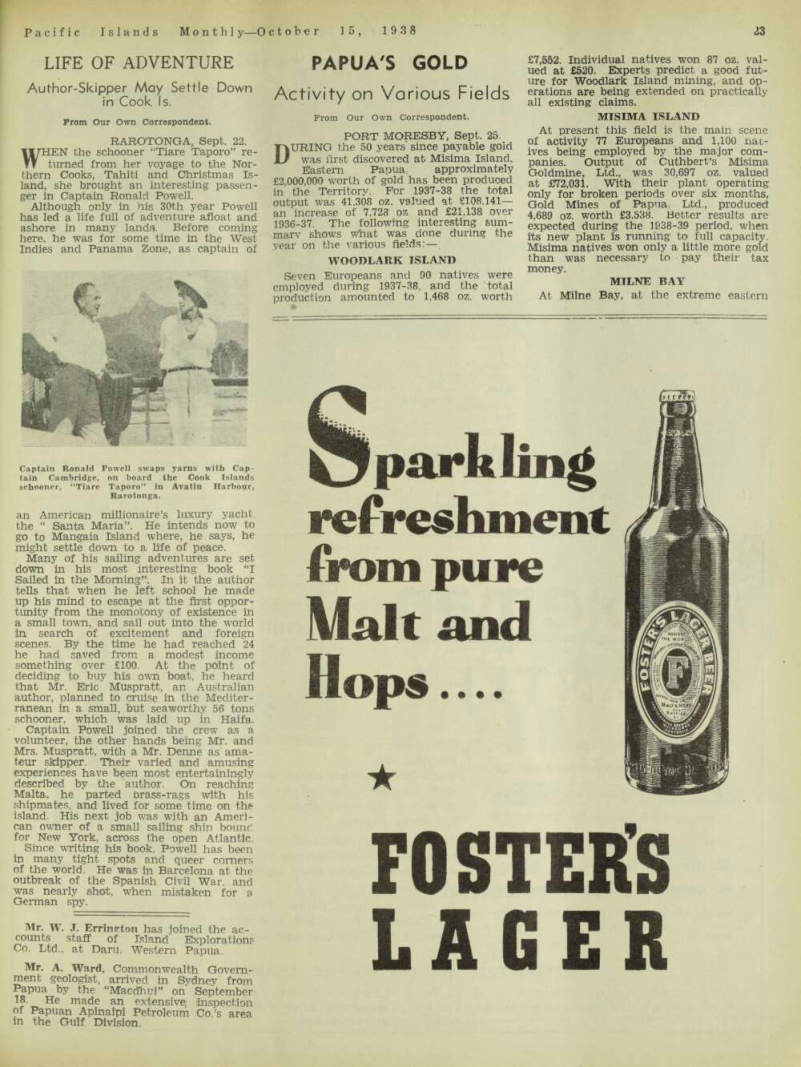
Life Of Adventure
Author-Skipper May Settle Down in Cook Is.
Prom Our Own Correspondent.
Rarotonga, Sept. 22.
WHEN the schooner “Tiare Taporo” re turned from her voyage to the Nor thern Cooks, Tahiti and Christmas Is land, she brought an interesting passen ger in Captain Ronald Powell.
Although only in his 30th year Powell has led a life full of adventure afloat and ashore in many lands. Before coming here, he was for some time in the West Indies and Panama Zone, as captain of
an American millionaire’s luxury yacht, the “ Santa Maria”. He intends now to go to Mangaia Island where, he says, he might settle down to a life of peace.
Many of his sailing adventures are set down in his most interesting book “I Sailed in the Morning”. In it the author tells that when he left school he made up his mind to escape at the first oppor tunity from the monotony of existence in a small town, and sail out into the world in, search of excitement and foreign scenes. By the time he had reached 24 he had saved from a modest income something over £lOO. At the point of deciding to buy his own boat, he heard that Mr. Eric Muspratt, an Australian author, planned to cruise in the Mediter ranean in a small, but seaworthy 56 tons schooner, which was laid up in Haifa.
Captain Powell joined the crew as a volunteer, the other hands being Mr. and Mrs. Muspratt, with a Mr. Denne as ama teur skipper. Their varied and amusing experiences have been most entertainingly described by the author. On reaching Malta, he parted brass-rags with his shipmates, and lived for some time on the island. His next job was with an Ameri can owner of a small sailing ship bonne for New York, across the open Atlantic.
Since writing his book, Powell has been in many tight spots and queer comers of the world. He was in Barcelona at the outbreak of the Spanish Civil War, and was nearly shot, when mistaken for a German spy.
Mr, W. J. Errinsrton has joined the ac counts staff of Island Explorations Co. Ltd., at Daru. Western Papua.
Mr. A. Ward, Commonwealth Govern ment geologist, arrived in Sydney from Papua by the “Macdhui” on September 18. He made an extensive; inspection of Papuan Apinaipi Petroleum Co.’s area in the Gulf Division.
Captain Ronald Powell swaps yarns with Cap tain Cambridge, on board the Cook Islands schooner, “Tiare Taporo” in Avatiu Harbour, Rarotonga.
Papua's Gold
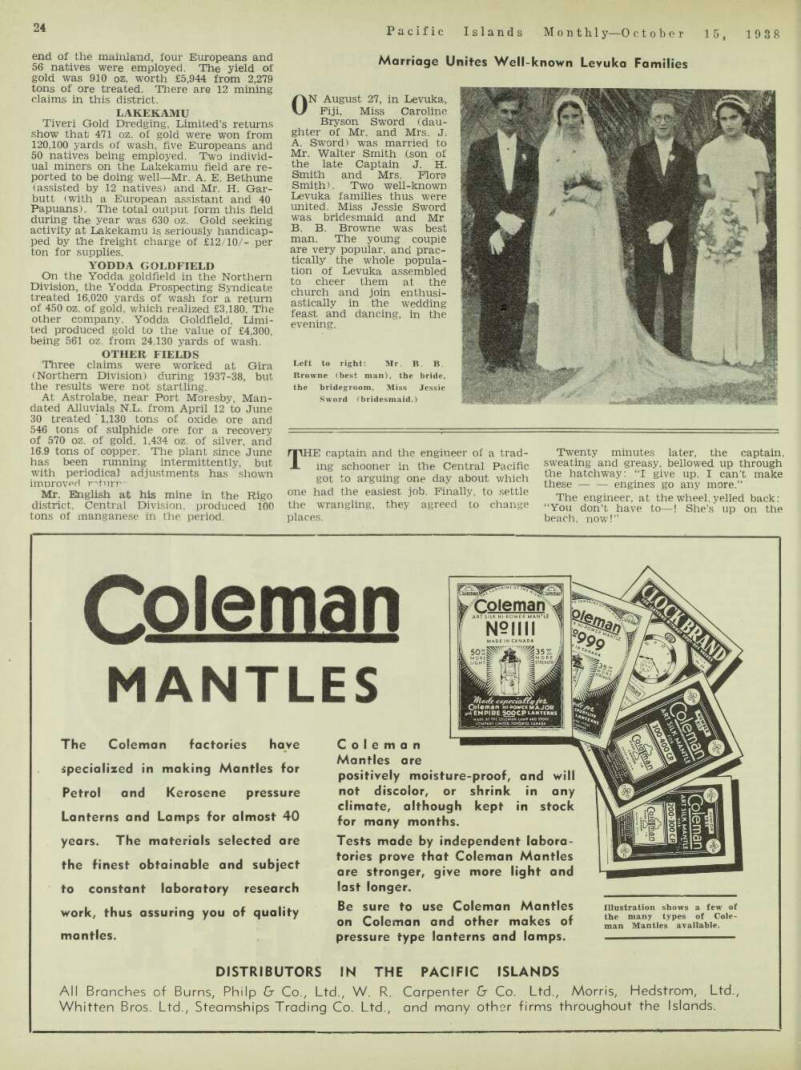
Activity on Various Fields
From Our Own Correspondent,
Port Moresby, Sept. 25.
DURING the 50 years since payable gold was first discovered at Misima Island, Eastern Papua, approximately £2,000,000 worth of gold has been produced in the Territory. For 1937-38 the total output was 41.308 oz. valued at £108.141 an increase of 7,728 oz and £21,138 over 1936-37. The following interesting sum marv shows what was done during the year on the various fields: —
Woodlark Island
Seven Europeans and 90 natives were employed during 1937-38, and the total production amounted to 1,468 oz. worth •
£7,552. Individual natives won 87 oz. val ued at £520. Experts predict a good fut ure for Woodlark Island mining, and op erations are being extended on practically all existing claims.
Misima Island
At present this field is the main scene of activity 77 Europeans and 1,100 nat ives being employed by the major com panies. Output of Cuthbert’s Misima Goldmine, Ltd., was 30,697 oz. valued at £72,031. With their plant operating only for broken periods over six months, Gold Mines of Papua, Ltd., produced 4,689 oz. worth £3.538. Better results are expected during the 1938-39 period, when its new plant is running to full capacity.
Misima natives won only a little more gold than was necessary to pay their tax money.
Milne Bay
At Milne Bay, at the extreme eastern
end of the mainland, four Europeans and 56 natives were employed. The yield of gold was 910 oz, worth £5,944 from 2,279 tons of ore treated. There are 12 mining claims in this district.
Lakekamu
Tiveri Gold Dredging, Limited’s returns show that 471 oz. of gold were won from 120,100 yards of wash, five Europeans and 50 natives being employed. Two individ ual miners on the Lakekamu field are re ported to be doing well—Mr. A. E. Bethune (assisted by 12 natives) and Mr. H. Gar butt (with a European assistant and 40 Papuans). The total output form this field during the year was 630 oz. Gold seeking activity at Lakekamu is seriously handicap ped by the freight charge of £l2/10/- per ton for supplies.
Yodda Goldfield
On the Yodda goldfield in the Northern Division, the Yodda Prospecting Syndicate treated 16,020 yards of wash for a return of 450 oz. of gold, which realized £3,180. The other company. Yodda Goldfield, Limi ted produced gold to the value of £4,300, being 561 oz. from 24,130 yards of wash.
Other Fields
Three claims were worked at Gira (Northern Division) during 1937-38, but the results were not startling.
At Astrolabe, near Port Moresby, Man dated Alluvials N.L. from April 12 to June 30 treated " 1,130 tons of oxide? ore and 546 tons of sulphide ore for a recovery of 570 oz. of gold. 1,434 oz. of silver, and 16.9 tons of copper. The plant since June has been running intermittently, but with periodical adjustments has shown improved return' Mr. English at his mine in the Rigo district. Central Division, produced 100 tons of manganese in the period.
THE captain and the engineer of a trad ing schooner in the Central Pacific got to arguing one day about which one had the easiest job. Finally, to settle the wrangling, they agreed to change places.
Twenty minutes later, the captain, sweating and greasy, bellowed up through the hatchway: “I give up. I can’t make these engines go any more.”
The engineer, at the wheel, yelled back: ‘‘You don’t have to —! She’s up on the beach, now!”
Advertisements & other items, p. 29 (2 items)
23
Pacific Islands Monthl y—O ctober 15, 19 3 8
parltling
refreshment from pure Malt and flops
FOSTER'S
LAGER
Marriage Unites Well-known Levuka Families
ON August 27, in Levuka, Fiji, Miss Caroline Bryson Sword (dau ghter of Mr. and Mrs. J.
A. Sword) was married to Mr. Walter Smith (son of the late Captain J. H.
Smith and Mrs. Flora Smith). Two well-known Levuka families thus were united. Miss Jessie Sword was bridesmaid and Mr B. B. Browne was best man. The young couple are very popular, and prac tically the whole popula tion of Levuka assembled to cheer them at the church and join enthusi astically in the wedding feast and dancing, in the evening.
Left to right: Mr. B. B.
Browne (best man), the bride, the bridegroom, Miss Jessie Sword
Advertisements & other items, p. 30 (2 items)
24
Pacific Islands Monthl y—o ctober 15, 1938
roleman
MANTLES
The Coleman factories have specialized in making Mantles for Petrol and Kerosene pressure Lanterns and Lamps for almost 40 years. The materials selected are the finest obtainable and subject to constant laboratory research Coleman kPT SILK HI-POWER M A N T L
N9MII
Coleman Mantles are positively moisture-proof, and will not discolor, or shrink in any climate, although kept in stock for many months.
Tests made by independent laboratories prove that Coleman Monties are stronger, give more light and last longer. work, thus assuring you of quality mantles.
Be sure to use Coleman Mantles on Coleman and other makes of pressure type lanterns and lamps.
Illustration shows a few of the many types of Coleman Mantles available.
DISTRIBUTORS IN THE PACIFIC ISLANDS
AM Branches of Burns, Philp £r Co., Ltd., W. R. Carpenter £r Co. Ltd., Morris, Hedstrom, Ltd., Whitten Bros. Ltd., Steamships Trading Co. Ltd., and many other firms throughout the Islands.
Samoa
Niue Labourers For
How N.Z. Government is Replacing Chinese
Prom Our Own Correspondent.
APIA, Sept. 13.
THE plantation manager of the New Zealand Reparation Estates, Mr. R.
F Ott, left recently for Niue Island, to recruit 20 Niue islanders as plantation labourers for the New Zealand Govern ment’s Reparation Estates.
Niue boys have proved superior as plan tation workers in Samoa to the native Samoans —especially for work of a per manent nature —and it is believed that in future a larger mimber of Niue islanders will be contracted for work on Samoan Government and private plantations.
This is a very interesting development.
The New Zealand Ministers, when they came here in July, 1936, and insisted on the reparation of the indentured Chinese labourers, argued that all the plantation labour needed could be supplied locally.
They would not listen to the experienced planters, who declared that tne well endowed Samoans had never accepted re gular work as labourers, and probably never would.
Mission Conference In
India
BECAUSE Rev. T. T. Webb, of North Australia, is unable to make the trip, Rev. A. H. Blacket, 8.A., 8.D., of the Methodist Mission at Nausori, Fiji, has been selected by the National Missionary Council of Australia to be a represent ative at the Madras Missionary Confer ence in India in December.
Another missionary, well-known in the Pacific, Rev. J. W. Burton, M.A., chair man of the N.M.C.A. and secretary of the Methodist Board of Oversea Missions will be unable to attend the Conference. It is hoped that Canon J. $. Needham, chairman of the New Guinea Mission will fill his place. The representative of the “Younger Churches in the Pacific” will be a Fijian, Wilson Inia.
Rev. H. J. E. Short, delegate of the London Missionary Society, will leave Papua by the “Tasman” on October 27 for India, via Java. After the Confer ence, he and his wife will go on to Eng land to do deputation work for the L.M.S., later returning to Papua via North America.
U.S. Destroyer On A Secret
Mission
rE U.S. destroyer “Maury” is ex pected in Auckland this month. She left Honolulu on September 14 on a “secret mission” to the South Pacific. It was reported that her mission is “one of a number of moves to be made by the United States for the consolidation of aerial and naval defence lines in the Pacific with those of Britain and France”.
Mrs. Smallwood, a former teacher at several of the Government schools on is lands in Torres Strait, died recently at Thursday Island, where she had lived in retirement for a number of years.
Advertisements & other items, p. 31 (2 items)
25
Pacific Islands Mont hi y —o ctober 15, 1938
Ultimate
Radio Reception in the Pacific Islands has been perfected by Ultimate Radio Engineers. They have constructed a set specially designed for tropical conditions, utilising patents that are NOT available to any other manufacturer.
Ultimate is the only radio set that can possibly give you perfect performance in the Pacific Islands.
Send for copies of unsolicited letters on Ultimate’s power, reliability and tone that we are constantly receiving. All particulars are free for the asking.
Models are available for all types of electric operation as well as for battery reception.
S/1/LjOTj
REAL RADIO
witii
ULTIMATE
(SOLE AUSTRALIAN CONCESSIONAIRES)
GEO. BROWN
CO. PTY. LTD.
ELECTRICAL AND INDUSTRIAL ENGINEERS
Write for full particulars
267 CLARENCE STREET. SYDNEY
Cable. Radio & Telegrams: “BROWNLOCK”, SYDNEY.
BE FAIR TO YOURSELF WRITE FOR DETAILS:
WRITE FOR
SPECIAL TRADE
PRICES.
Please send me, without obligation, details of the Special New De Luxe ULTIMATE
RECEIVERS.
NAME
ADDRESS
I ( (State whether battery or electric and voltage and type of current of power supply.)
Physical Decline of Pitcairn
Islanders
IN the last 20 years the descendants of the “Bounty” mutineers on Pitcairn Island have declined physically to a marked degree, said Mr. T. Cunningham, who reached Sydney from London by the “Ormonde” on September 22. “It is only a matter of time before they will be ex tinct, owing to the constant inbreeding”, he stated.
After an interval of 17 years he made his second visit to Pitcairn on the “Arawa”, which called at the isolated little island in May, in response to a radio for medical assistance to cope with an outbreak of typhoid fever. The “Arawa’s” doctor went to the settlement to investigate, and hastily returned to the ship to confiscate baskets and fruit bought by Mr. Cunning ham from the Islanders. The goods were returned after they had been'disinfected; This is the origin of the story of typhoid on Pitcairn, referred to elsewhere.
Earthquake in Samoa
APIA, Sept. 13.
A STRONG earthquake tremor was felt in Apia at 1 a.m. on August 25. The shock was the most severe experienced this year and originated 20 miles north west of Apia, at Mount Tofua, an extinct volcano.
Mr. Julius Kruttschnitt, chairman of dir ectors of New Guinea Goldfields, Ltd., has been nominated president of the Austral asian Institute of Mining and Metallurgy for 1939.
IVDss Mary Mills, of the New Guinea Mission, arrived in Sydney from Papua by the September “Montoro”.
Was There Cruelty In German
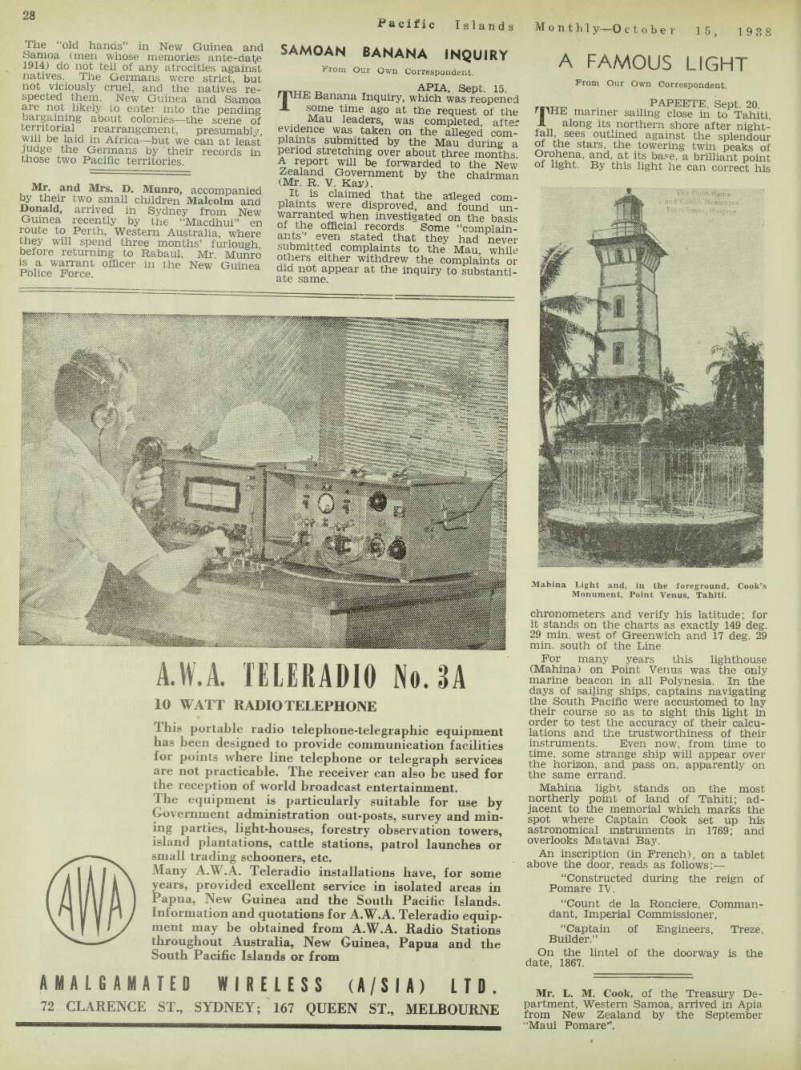
Colonies?
A Handbook of 1919, and Something About One-Eyed Propaganda
NOW that the European international crisis is over, the next subject of argument with Germany probably will be the question of returning the former Ger man colonies.
This matter has been discussed in the “P.1.M.”; and we have expressed the opinion that completely good friendship between. Britain and Germany is not possible while the great Germanic nation is without colonies. We also have praised the ability in colonial administration dis played by Germany prior to 1914. In re ply, we have received, from a valued cor respondent, the following:— IAM disturbed when I read that you are rather inclined to favour the re turn of some of Germany’s colonies. I have a book here before me, “Treatment of Natives in the German Colonies”, pre pared under the direction of the His torical Section of the Foreign Office. The information it contains was compiled by trained writers, and it (with others) was prepared for the Peace Conference (1919) to provide British delegates with infor mation in the most convenient form re specting the different countries they had to consider. G. W. Prothero is the General Editor and formerly Director of the Historical Section. This handbook deals with the official element, Adminis tration of Justice, Flogging. Forced Labour, and Brutalities in South West Africa, and the different Risings and Re bellions. It is very damning indeed.
It appears that the actual administra tion of justice was in a state of chaos.
Each official was a law unto himself.
Power was given to and exercised by minor officials, almost without appeal to the higher authorities, who failed to exercise any effective supervision over the proceedings of their subordinates. And in every official scandal that was revealed, secret influences screened the offenders to prevent publicity.
Father Schmitz, a missionary, and his associates in Togoland, who exposed some of the atrocities and immoralities of an officer named Schmidt, were directly threatened by Dernberg in the Reichstag.
The Secretary of State said that he had written to the Chapter of Cologne Cathe dral complaining of the charges brought by their missionaries against officials, and intimating that if what he termed “the unfounded charges” did not cease, he would feel compelled to resort to ad ministrative measures against the mis sions. “This campaign against officials must cease, else it would be impossible to get anyone to enter the Colonial Service”. (Dernberg, Reichstag, December 3rd, 1906.) In the administration of the German colonies the system of flogging was the chief instrument of .oppression. The facts in connection with this system were so notorious and so generally known in other colonies that German African colonies were freely spoken of as the “Colonies of the Twenty-five” (i.e., where 25 lashes were the usual punishment), and the “Flogging Colonies”.
I read in “The Times” recently that courses in colonial practice will open in
October at the Reich Institute for Colonial Administration, which is now being set up. “When (it is stated) the day of justice breaks, a trained corps of colonial administrators will thus await the order of the Puhrer”.
Teachings at the Institute will seek to combine the lessons drawn from pre-war colonial experience with the newer ideas of the National-Socialist Reich. Par ticular attention will be paid to the ap plication of the Nazi racial theory in the colonies, which implies a rigid separation of natives and Europeans.
In a book on the German Colonial Em pire, edited by Hans Meyer in 1910, re ference is made to South-west Africa’s policy, and it is stated that colonists could not consider the inhabitants; they were allowed to live as long as they did not interfere with the development of progress, but should they do so, then they were shot down like wild animals.
“Wo sie diese Forderung aber nicht erfullten, hat man sie wie Raubwild abgeschossen”.
I feel that if we give way to the Ger mans, as we are doing, they will not only want their former colonies returned to them, but will demand ours as well.
Any people who could ill-treat natives as the Germans did in South-west Africa, when they exterminated over 75,000 in the Majimaji Rebellion by their ferocity, are not fit to handle primitive and sub ject people. In the Herero Rebellion in 1904, General von Trotha, “issued his pro clamation of October 2, 1904, stating that Hereros, with or without arms, would be shot, and that the whole nation must leave the country. No attempt was made to negotiate with the rebels. No quarter was given. Women and children were shot or hanged”. Only about 20,000 out of 80,000 escaped from the slaughter.
Among the cruelties, one reads that a practice was to hang natives by means of barbed-wire round their necks. Bodies, too, were found fastened together in graves, with every indication of being buried alive.
This handbook, of course, is biased, and the Foreign Office was making out a case.
But can it all be exaggeration?
Editorial Note
AS the future happiness and progress of humankind, under the new con ditions of communication and transport, depend upon the maintenance of good relations between nations, it follows that the misuse of propaganda and publicity media may be the greatest danger of our era.
Our greatest curse to-day is an ignorant, cockeyed, sensation-loving press. Europe, on September 27, 1938, was on the very brink of a frightful war; and 90 per cent, of the blame for that goes to the news papers. Facts are twisted or half presented, without scruple, so as to play upon racial hatreds and selfish prejudices.
Publicists, to an increasing degree, base their appeals upon a deliberately inade quate survey of the facts.
The handbook quoted by our correspon dent is suspect, because it belongs to the “Hang the Kaiser” period of European politics—when every kind of half-truth was dished up, with imaginative trim mings, to justify the punishment of de feated Germany. Out of that period came the Versailles Treaty—and from the Ver sailles Treaty the sequence of events that brought the world so close to a holocaust that, on September 27, we almost could smell the slaughter and decay and see the crumbling of European civilisation.
There surely is another and a better side to the story of German colonisation.
The “old hands” in New Guinea and Samoa (men whose memories ante-date 1914) do not tell of any atrocities against natives. The Germans were strict, but not viciously cruel, and the natives re spected them. New Guinea and Samoa are npt likely to enter into the pending bargaining about colonies—the scene of territorial rearrangement, presumably, will be laid in Africa—but we can at least judge the Germans by their records in those two Pacific territories.
Mr. and Mrs. D. Munro, accompanied by their two small children Malcolm and Donald, arrived in Sydney from New Guinea recently by the “Macdhui” en route to Perth, Western Australia, where they will spend three months’ furlough before returning to Rabaul. Mr. Munro is a warrant officer in the New Guinea Police Force.
Advertisements & other items, pp. 32-33 (3 items)
26
Pacific Islands Monthl y—o ctober 15, 1938
Tilley
=One Lamp for every purpose In or Outdoors E.X. 4.
• ALL-PURPOSE” LAMP
Light of 300 c.p. 6 hours for Id. Burns Ordinary Kerosene This Lamp is designed for general all-round service. It is the cheapest Vapour Lamp on the market, but at the same time highly efficient in every detail and simple; to operate. Can be carried about as Storm Lantern in the fiercest gale; used as a Hanging Lamp (indoors or out) by fitting 12ins. Reflector which slides on to the Suspension Wire; or turned into a Table Lamp by just detaching the Suspension Wire. The light is perfectly steady and unaffected by draughts, however severe. Lamp is strongly made of polished brass, with no parts to rust, corrode or get out of order. Burner hood enamelled in bright colours. Reflector is enamelled white. Get rid of all antiquated devices and use this up-to-date All-British Tilley Lamp.
Obtainable throughout the Pacific Islands from the Branches of;
BURNS PHILP & CO., LTD., and
BURNS PHILP (SOUTH SEAS) CO., LTD.
Spare Parts and Lamps also obtainable from— W. KOPSEN & CO. LTD CLARENCE STREET, SYDNEY.
If any difficulty, please write direct to: THE TILLEY LAMP CO. (Dept. P.M.) HENDON, LONDON, N.W.4
HYJOAN-Al umwm
'OH VO NT ASK
OLD SLOWCOACH
- she'll SPOIL
V everything
LISTEN TO
THATJ POOP
JOAN. ID DO
ANYTHING TO
HELP HEP -
BUT WHAT
CAN / DO ?
SHES ALWAYS
TIRED AND
LISTLESS ! A
& i ms. m 'IK
RHYL, SHE'S OUTGPOhIINGW
HEP STRENGTH . MY
YOUNGSTER WAS JUST
THE SAME UNTIL DOCTOR
. PUT HER ON HORLICKS
Is Your Child LEFT OUT of Things? a RE you worried about the way your child drags around . . • too tired to join in the fun?
Doctors will tell you that your child burns up more energy-creating fuel in a day than you do! Children are always on the “go”! But that lost energy has to be replaced. If it is not, then her little body tires quickly . . . she becomes dull, listless, and takes no interest in the things that normal children love so much.
Children need extra nourishment to give them additional energy, and keep them up to the mark. Horlicks will give your child this extra energy and keep her active through the critical growing years.
It’s the best energy-builder she can have —and she’ll love it!
Give your child a cup of Horlicks at bedtime, and another at mid-day.
You’ll see that awful dullness and listlessness change to healthy vitality.
Ask your chemist or storekeeper to-day for a bottle of Horlicks (14V 2 oz. size costs 3/- In the main towns throughout the British Pacific Islands).
HorucKS Jlorlic MixeC
’HiUTOUt*
HORLICKS
FOR GROWING
CHILDREN
27
Pacific Islands Monthl y—o ctober 15, 1938
Samoan Banana Inquiry
Prom Our Own Correspondent.
T upt3 t APIA. Sept. 15. he Banana Inquiry, which was reopened some time ago at the request of the Mau leaders, was completed, after evidence was taken on the alleged com plaints submitted by the Mau during a period stretching over about three months A report will be forwarded to the New Zealand Government by the chairman (Mr. R. V. Kay).
It is claimed that the alleged com plaints were disproved, and found un warranted when investigated on the basis of the official records Some “complain ants even stated that they had never submitted complaints to the Mau while others either withdrew the complaints or did not appear at the inquiry to substanti ate same.
A Famous Light
Prom Our Own Correspondent.
, Papeete, Sept. 20.
r|\HE mariner sailing close in to Tahiti, J. along its northern shore after night * sees ou^ine d against the splendour of the stars, the towering twin peaks of and, at its base, a brilliant point of light. By this light he can correct his
chronometers and verify his latitude; for it stands on the charts as exactly 149 deg. 29 min. west of Greenwich and 17 deg. 29 min. south of the Line For many years this lighthouse (Mahina) on Point Venus was the only marine beacon in all Polynesia. In the days of sailing ships, captains navigating the South Pacific were accustomed to lay their course so as to sight this light in order to test the accuracy of their calcu lations and the trustworthiness of their instruments. Even now, from time to time, some strange ship will appear over the horizon, and pass on, apparently on the same errand.
Mahina light stands on the most northerly point of land of Tahiti; ad jacent to the memorial which marks the spot where Captain Cook set up his astronomical instruments in 1769; and overlooks Matavai Bay.
An inscription (in French), on a tablet above the door, reads as follows: “Constructed during the reign of Pomare IV.
“Count de la Ronciere, Comman dant, Imperial Commissioner, “Captain of Engineers, Treze, Builder.”
On the lintel of the doorway is the date, 1867.
Mr. L, M. Cook, of the Treasury De partment, Western Samoa, arrived in Apia from New Zealand by the September “Maui Pomare”.
Mahina Light and, in the foreground, Cook’s Monument, Point Venus, Tahiti.
Advertisements & other items, p. 34 (2 items)
28
Pacific Islands Mon t h 1 y~O cto b e r 15, 193 8
A.W.A. Leieradio No. 3A
10 WATT RADIOTELEPHONE
This portable radio telephone-telegraphic equipment has been designed to provide communication facilities for points where line telephone or telegraph services are not practicable. The receiver can also be used for the reception of world broadcast entertainment.
The equipment is particularly suitable for use by Government administration out-posts, survey and mining parties, light-houses, forestry observation towers, island plantations, cattle stations, patrol launches or small trading schooners, etc.
Many A.W.A. Teleradio installations have, for some years, provided excellent service in isolated areas in Papua, New Guinea and the South Pacific Islands.
Information and quotations for A.W.A. Teleradio equipment may be obtained from A.W.A. Radio Stations throughout Australia, New Guinea, Papua and the South Pacific Islands or from
AMALGAMATED WIRELESS (A/SIA) LTD.
72 CLARENCE ST., SYDNEY; 167 QUEEN ST., MELBOURNE 4 4
Japan's Mandated
Islands
Denial of Fortifications and Hostile Bases
By John Williams
SINCE the expiry of the treaty of Lon don in December. 1936, by which Britain. Japan and America agreed not to upset the Pacific status quo by de veloping new navy bases, there have been statements made in London and Wash ington that Japan is developing bases in her mandated islands.
Such bases would “fence off” the Philip pines from the U.S. sphere of influence in the Pacific and base for base match those being developed by America at Midway, Wake and other islands in mid and west Pacific. From the Australasian point of view. Japan’s new bases would cut the trade routes to the Orient and create for Japan a fine advance strategy in her pene tration southward, which is the bogey of Anzacs.
The Japanese attitude to these state ments and fears is one of impatient de rision. However, no official statement was made until lust recently when an Overseas Ministry spokesman made a flat denial that Japan is fortifying the mandated is lands or has any intention of doing so.
He added: “Any foreigner can go into the islands and see for himself!”
It is a coincidence, but at this time a wealthy U.S. citizen was anxious to visit the mandated islands in his luxury yacht during a world cruise. Through the U.S.
State Department he made application, but the Japanese Government refused per mission. (And that is the fate, so far as we know, of every application made for permission to enter the Marshall and Caroline Islands.
That mandated territory is absolutely closed against European inspection, and has been for many years. Only a few Europeans have been allowed to go to de signated places. There may be no fortifi cations there: but there are aeroplane bases, submarine shelters, and large stores of oil fuel—Ed. “P.T.M.”).
The Japanese official agreed that Japan is anxious to thrust an airline from Japan down through her mandated islands. In deed, the Communications Ministry in tends to request an appropriation of 2.000.000 dollars from the next Diet, he said, for the purpose of developing man dated air routes.
Loss Of Giant Airboat
Little known to the outside world. Japan has been working on the mandated aerial developments for some time.
More than two years ago, the American Douglas Aircraft Company built a 32-pas senger airboat with a range of almost 3,000 miles. Other specifications: Gross weight, 28.500 pounds: two 1,000 h.p.
Wright Cyclone engines; highest speed at 6.500 feet, 185 m.p.h. In a few words, more or less on the same “lines” as the Empire airboats.
This airboat, after thorough testing, was sold and shipped to Japan with scarcely any mention in the U.S. press. Douglas experts followed and instructed the Jap anese, who frankly intended to copy its best features.
Exactly two weeks after the “Hawaii Clipper” disappeared on the Pan-Ameri can Airways route near Manila, a crew of seven Japanese set off from Tokyo in a “Japanese” Douglas airboat, with the in
tention of surveying a trunk airline through the mandated islands. They had passed the Bonin Islands, all well, but when at a point given as 143 degrees 10 minutes east longitude and 25 degrees 17 minutes west latitude, the airboat devel oped engine trouble—and no more was heard from it.
The Japanese Government promptly dis patched numerous surface craft in search, but no trace of it has been found. Thus ended, tragically, Japan’s first attempt to fly southward.
My Tokyo informant says that this wifi not deter Japan’s determination to push the airline scheme. The Overseas Ministry spokesman was frank about the islands’ varied uses to Japan. Minerals have been discovered, and exports of these to Japar supplement the sugar and fish industries.
The spokeman added; “Fishing and pearl-diving are very im portant in the islands. The Japanese ships in large numbers go as far south as Australia on these missions. They will continue to do so. After all, the seas are free —or they are supposed to be.”
Mr. A. McMillan, of the Samoan Police Department, returned to Apia from N.Z. in mid-September.
Dr. Hridaya Kunzaru, President of the Servants of India Society, who has been in Australia attending the British Com monwealth Affairs Conference, will visit Fiji at the end of October.
Mrs. Isabella Landels, widow of the late Rev. J. D. Landels, pioneer Presby terian missionary at Malo, New Hebrides, died recently in Victoria, at the age of 77.
Advertisements & other items, p. 35 (2 items)
29
Pacific Islands Monthl y — O ctober 15, 1938
Globite
W. FINAU
International Stamp & Photo Service,
BOX 40. NUKUALOFA.' TONGA IS.. OCEANIA.
Photos of native life and scenes In Tonga: 5/-.
Tin-Can Mail cover franked with eight pretty Niuafoou mint: 4/6; same with 3 varieties: 1/6.
Registered, postmarked and despatched at Niuafoou (Tin-Can Island).
Tongan mint of 15 all different: 16/6 postpaid.
St ,
CAN YOU PACK A SUIT
WITHOUT CRUSHING?
Here's a smart lightweight case that makes it amazingly easy to pack a full three - piece suit without risk of crushing and creas-, ing. It's done in a matter of seconds!
Just hang coal, vest and trousers on the hanger provided with the Globite Aeroplane Case. Clip it into position-button the coat and lay sleeves on top.
Fold back the frame and fasten the strap-that is all!
And there is plenty of room for other clothes too.
GLOBITE
AEROPLANE CASE
One-suit and two-suit sizes and a special model for ladies Traders are invited to write for full particulars. FORD SHERINGTON LTD., Manufacturers, (Wholesale only).. Kippax Street, Sydney.
Small Generators for Isolated
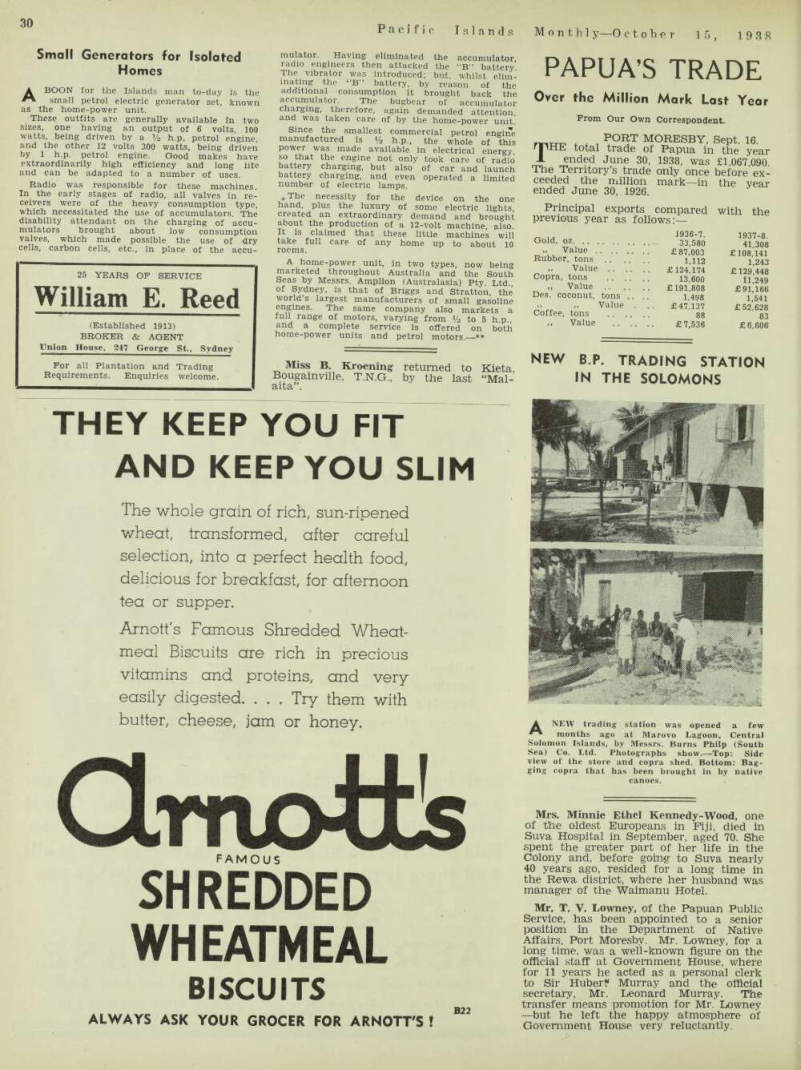
Homes
A BOON for the Islands man to-day is the small petrol electric generator set, known as the home-power unit.
These outfits are generally available in two sizes, one having an output of 6 volts, 100 watts, being driven by a V 2 h.p. petrol engine, and the other 12 volts 300 watts, being driven by 1 h.p. petrol engine. Good makes have extraordinarily high efficiency and long life and can be adapted to a number of uses.
Radio was responsible for these machines.
In the early stages of radio, all valves in re ceivers were of the heavy consumption type, which necessitated the use of accumulators. The disability attendant on the charging of accu mulators brought about low consumption valves, which made possible the use of dry cells, carbon cells, etc., in place of the accu
mulator. Having eliminated the accumulator radio engineers then attacked the “B'’ battery!
The vibrator was introduced; but, whilst elim inating the “B” battery, by reason of the additional consumption it brought back the accumulator. The bugbear of accumulator charging, therefore, again demanded attention, and was taken care of by the home-power unit.
Since the smallest commercial petrol engine manufactured is y 2 h.p., the whole of this power was made available in electrical energy, so that the engine not only took care of radio battery charging, but also of car and launch battery charging, and even operated a limited number of electric lamps. • The necessity for the device on the one hand, plus the luxury of some electric lights, created an extraordinary demand and brought about the production of a 12-volt machine, also.
It is claimed that these little machines will take full care of any home up to about 10 rooms.
A home-power unit, in two types, now being marketed throughout Australia and the South Seas by Messrs. Amplion (Australasia) Pty. Ltd., of Sydney, is that of Briggs and Stratton, the world s largest manufacturers of small gasoline engines. The same company also markets a full range of motors, varying from % to 5 h.p., and a complete service is offered on both home-power units and petrol motors.—**
Miss B. Kroening returned to Kieta,
Bougainville, T.N.G., by the last “Mal
aita”.
Papua’S Trade
Over the Million Mark Last Year
Prom Our Own Correspondent.
T_ . , , PORT MORESBY, Sept. 16.
HE total trade of Papua in the year ended June 30, IS3B, was £1,067,090.
The Territory’s trade only once before ex ceeded the million mark—in the year ended June 30, 1926.
Principal exports compared with the previous year as follows:
Gold, oz 1936-7. 1937-8. 41,308 „ Value £108,141 Rubber, tons .. 1,112 1,243 „ Value ,. .. £124,174 £129,448 Copra, tons .. 13,600 11,249 ,, Value £91,166 Des. coconut, tons .. 1.498 1,541 .. ,, Value £47,137 £52,628 Coffee, tons .. . 83 .. Value ,. . • .. £7,536 £6,606
New B.P. Trading Station
In The Solomons
Mrs. Minnie Ethel Kennedy-Wood, one of the oldest Europeans in Fiji, died in Suva Hospital in September, aged 70. She spent the greater part of her life in the Colony and, before going to Suva nearly 40 years ago, resided for a long time in the Rewa district, where her husband was manager of the Waimanu Hotel.
Mr. T. V. Lowney, of the Papuan Public Service, has been appointed to a senior position in the Department of Native Affairs, Port Moresby. Mr. Lowney, for a long time, was a well-known figure on the official staff at Government House, where for 11 years he acted as a personal clerk to Sir Hubert 4 Murray and the official secretary, Mr. Leonard Murray. The transfer means promotion for Mr. Lowney —but he left the happy atmosphere of Government House very reluctantly.
A NEW trading station was opened a few months ago at Marovo Lagoon, Central Solomon Islands, by Messrs. Burns Philp (South Sea) Co. Ltd. Photographs show.—Top: Side view of the store and copra shed. Bottom: Bag ging copra that has been brought In by native canoes.
Advertisements & other items, p. 36 (2 items)
30
Pacific Islands Monthl y — O ctober 15, 19 3 R
CLmottls
25 YEARS OP SERVICE
William E. Reed
(Established 1913)
BROKER & AGENT
Union House. 247 George St.. Sydney For all Plantation and Trading Requirements. Enquiries welcome.
THEY KEEP YOU FIT
AND KEEP YOU SLIM
The whole grain of rich, sun-ripened wheat, transformed, after careful selection, into a perfect health food, delicious for breakfast, for afternoon tea or supper.
Arnott's Famous Shredded Wheatmeal Biscuits are rich in precious vitamins and proteins, and very easily digested. ... Try them with butter, cheese, jam or honey.
CLmottls
FAMOUS
SHREDDED
WHEATMEAL
BISCUITS
822 ALWAYS ASK YOUR GROCER FOR ARNOTT'S !
A Food
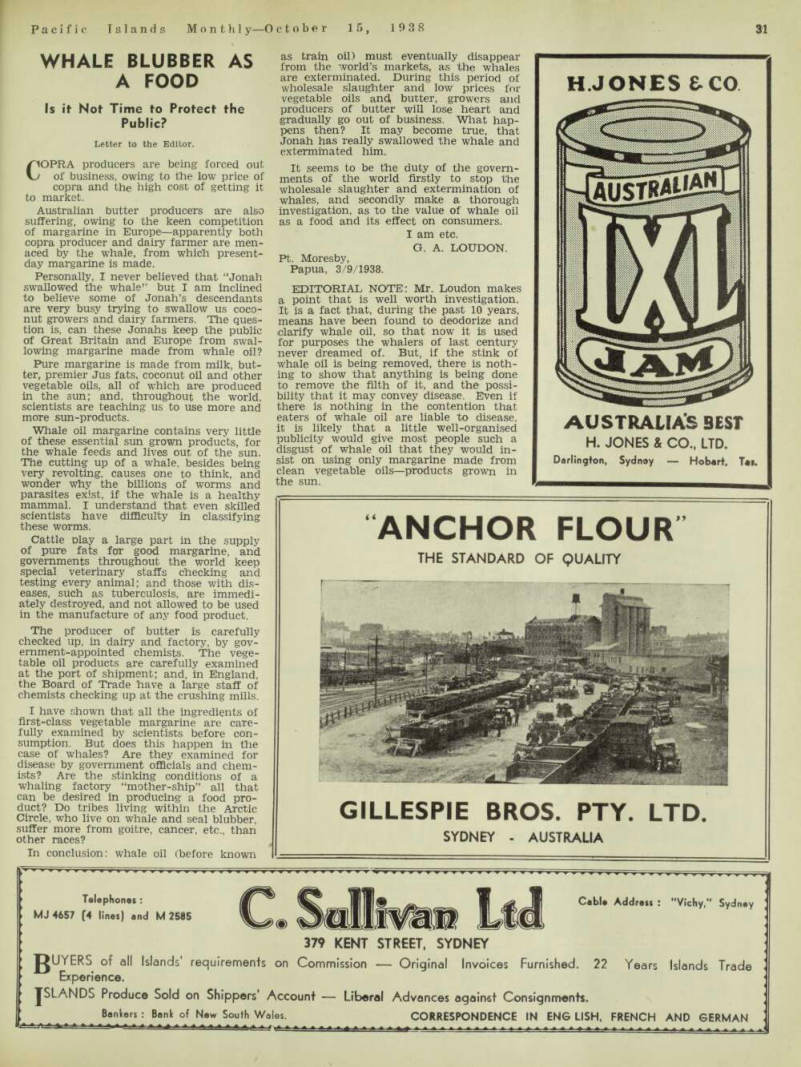
Whale Blubber As
Is it Not Time to Protect the Public?
Letter to the Editor.
COPRA producers are being forced out of business, owing to the low price of copra and the high cost of getting it to market.
Australian butter producers are also suffering, owing to the keen competition of margarine in Europe—apparently both copra producer and dairy farmer are men aced by the whale, from which present day margarine is made.
Personally, I never believed that “Jonah swallowed the whale” but I am inclined to believe some of Jonah’s descendants are very busy trying to swallow us coco nut growers and dairy farmers. The ques tion is, can these Jonahs keep the public of Great Britain and Europe from swal lowing margarine made from whale oil?
Pure margarine is made from milk, but ter, premier Jus fats, coconut oil and other vegetable oils, all of which are produced in the sun; and, throughout the world, scientists are teaching us to use more and more sun-products.
Whale oil margarine contains very little of these essential sun grown products, for the whale feeds and lives out of the sun.
The cutting up of a whale, besides being very revolting, causes one to think, and wonder why the billions of worms and parasites exist, if the whale is a healthy mammal. I understand that even skilled scientists have difficulty in classifying these worms.
Cattle play a large part in the supply of pure fats for good margarine, and governments throughout the world keep special veterinary staffs checking and testing every animal; and those with dis eases, such as tuberculosis, are immedi ately destroyed, and not allowed to be used in the manufacture of any food product.
The producer of butter is carefully checked up, in dairy and factory, by gov ernment-appointed chemists. The vege table oil products are carefully examined at the port of shipment; and, in England, the Board of Trade have a large staff of chemists checking up at the crushing mills.
I have shown that all the ingredients of first-class vegetable margarine are care fully examined by scientists before con sumption. But does this happen in the case of whales? Are they examined for disease by government officials and chem ists? Are the stinking conditions of a whaling factory “mother-ship” all that can be desired in producing a food pro duct? Do tribes living within the Arctic Circle, who live on whale and seal blubber, suffer more from goitre, cancer, etc., than other races?
In conclusion: whale oil (before known
as train oil) must eventually disappear from the world’s markets, as the whales are exterminated. During this period of wholesale slaughter and low prices for vegetable oils and, butter, growers and producers of butter will lose heart and gradually go out of business. What hap pens then? It may become true, that Jonah has really swallowed the whale and exterminated him.
It seems to be the duty of the govern ments of the world firstly to stop the wholesale slaughter and extermination of whales, and secondly make a thorough investigation, as to the value of whale oil as a food and its effect on consumers.
I am etc.
G. A. Loudon.
Pt. Moresby, Papua, 3/9/1938.
EDITORIAL NOTE: Mr. Loudon makes a point that is well worth investigation.
It is a fact that, during the past 10 years, means have been found to deodorize and clarify whale oil, so that now it is used for purposes the whalers of last century never dreamed of. But, if the stink of whale oil is being removed, there is noth ing to show that anything is being done to remove the filth of it, and the possi bility that it may convey disease. Even if there is nothing in the contention that eaters of whale oil are liable to disease, it is likely that a little well-organised publicity would give most people such a disgust of whale oil that they would in sist on using only margarine made from clean vegetable oils—products grown in the sun.
Advertisements & other items, p. 37 (2 items)
31
Pacific Islands Mont hi y—O ctober 15, 1938
Anchor Flour
H.JONES e-co
AUSTRALIA’S BEST
H. JONES & CO., LTD.
Darlington, Sydnoy Hobart. Ta«.
ANCHOR FLOUR
THE STANDARD OF QUALITY
K * '
GILLESPIE BROS. PTY. LTD
SYDNEY - AUSTRALIA
m
379 KENT STREET, SYDNEY
JJUYERS of all Islands' requirements on Commission Original Invoices Furnished. 22 Years Islands Trade Experience.
JSLANDS Produce Sold on Shippers' Account Liberal Advances against Consignments.
Bankers : Bank of New South Wales. CORRESPONDENCE IN ENG LISH, FRENCH AND GERMAN m Cable Address : "Vichy," Sydney Telephones ; MJ 4657 (4 lines) and M 2585 m
Tahiti Rebels Against Jazz
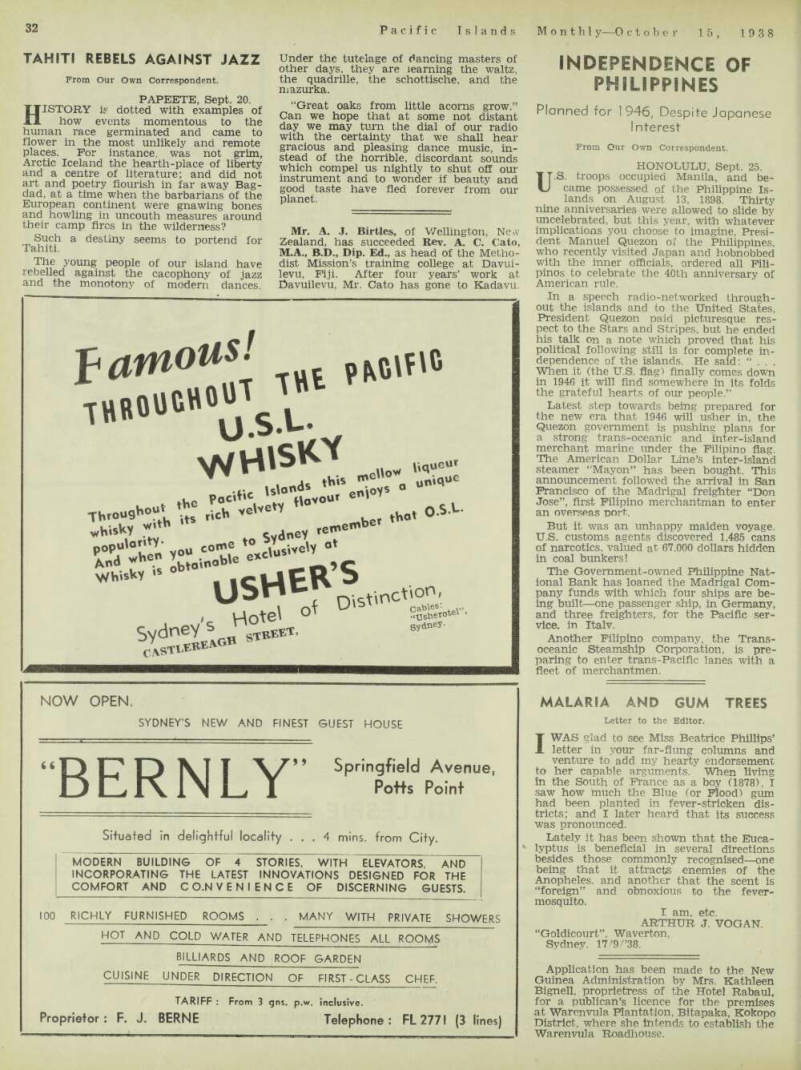
From Our Own Correspondent.
Papeete, Sept. 20.
HISTORY is dotted with examples of how events momentous to the human race germinated and came to flower in the most unlikely and remote places. For instance, was not grim, Arctic Iceland the hearth-place of liberty and a centre of literature; and did not art and poetry flourish in far away Bag dad, at a time when the barbarians of the European continent were gnawing bones and howling in uncouth measures around their camp fires in the wilderness?
Such a destiny seems to portend for Tahiti.
The young people of our island have rebelled against the cacophony of jazz and the monotony of modern dances.
Under the tutelage of dancing masters of other days, they are learning the waltz, the quadrille, the schottische, and the mazurka.
“Great oaks from little acorns grow.”
Can we hope that at some not distant day we may turn the dial of our radio with the certainty that we shall hear gracious and pleasing dance music, in stead of the horrible, discordant sounds which compel us nightly to shut off our instrument and to wonder if beauty and good taste have fled forever from our planet.
Mr. A. J. Birtles, of Wellington, Ne# Zealand, has succeeded Rev. A. C. Cato, M.A., 8.D., Dip. Ed., as head of the Metho dist Mission’s training college at Davui levu, Fiji. After four years’ work at Davuilevu, Mr. Cato has gone to Kadavu.
Independence Of
Philippines
Planned for 1946, Despite Japanese Interest
From Qur Own Correspondent.
Honolulu, Sept. 25.
U.S. troops occupied Manila, and be came possessed of the Philippine Is lands on August 13, 1898. Thirty nine anniversaries were allowed to slide by uncelebrated, but this year, with whatever implications you choose to imagine, Presi dent Manuel Quezon of the Philippines, who recently visited Japan and hobnobbed with the inner officials, ordered all Fili pinos to celebrate the 40th anniversary of American rule.
In a speech radio-networked through out the islands and to the United States, President Quezon paid picturesque res pect to the Stars and Stripes, but he ended his talk on a note which proved that his political following still is for complete in dependence of the islands. He said: “ . . .
When it (the U.S. flag) finally comes down in 1946 it will find somewhere in its folds the grateful hearts of our people.”
Latest step towards being prepared for the new era that 1946 will usher in, the Quezon government is pushing plans for a strong trans-oceanic and inter-island merchant marine under the Filipino flag.
The American Dollar Line’s inter-island steamer “Mayon” has been bought. This announcement followed the arrival in San Francisco of the Madrigal freighter “Don Jose”, first Filipino merchantman to enter an overseas port.
But it was an unhappy maiden voyage.
U.S. customs agents discovered 1,485 cans of narcotics, valued at 67.000 dollars hidden in coal bunkers!
The Government-owned Philippine Nat ional Bank has loaned the Madrigal Com pany funds with which four ships are be ing built—one passenger ship, in Germany, and three freighters, for the Pacific ser vice. in Italv.
Another Filipino company, the Trans oceanic Steamship Corporation, is pre paring to enter trans-Pacific lanes with a fleet of merchantmen.
Malaria And Gum Tries
Letter to the Editor.
IWAS glad to see Miss Beatrice Phillips’ letter in your far-flung columns and venture to add my hearty endorsement to her capable arguments. When living in the South of Prance as a boy (1878), I saw how much the Blue Cor Flood) gum had been planted in fever-stricken dis tricts; and I later heard that its success was pronounced.
Lately it has been shown that the Euca lyptus is beneficial in several directions besides those commonly recognised—one being that it attracts enemies of the Anopheles, and another that the scent is “foreign” and obnoxious to the fever mosquito.
I am. etc.
Arthur J. Vogan.
“Goldicourt”, Waverton, Sydney. 17/9/’3B.
Application has been made to the New Guinea Administration by Mrs. Kathleen Bignell, proprietress of the Hotel Rabaul, for a publican’s licence for the premises at Warenvula Plantation, Bitapaka, Kokopo District, where she Intends to establish the Warenvula Roadhouse,
Advertisements & other items, p. 38 (2 items)
32
Pacific Islands Monthl y —O ctober 15, 1938
famous!
Vj .S-L’
Uow \icioeur * . I nds » his ' I,C f a un“» uC . p pacific ' s ' an^ vo ar en\oys «* hroo9 hout h its rich veWety at q.S.U rhishy *‘ th dney remember 5tfSS V° u C ° o bie •*
ss*- oba ;.cupß ,c
'"able cxeiusWeW - ■ i icuER’S
V?!; o r Distinction,
/ Uote\ ° “T3sbet(
s&Si---*
NOW OPEN.
SYDNEY'S NEW AND FINEST SUEST HOUSE
‘‘O F 7 O\l I \X” Springfield Avenue, D tL r\ IN L Y Pot+s Point Situated in delightful locality ... 4 mins, from City.
MODERN OF 4 STORIES. WITH ELEVATORS. AND INCORPORATING THE LATEST INNOVATIONS DESIGNED FOR THE
COMFORT AND CONVENIENCE OF DISCERNING GUESTS.
100 RICHLY FURNISHED ROOMS . . . MANY WITH PRIVATE SHOWERS HOT AND COLD WATER AND TELEPHONES ALL ROOMS
BILLIARDS AND ROOF GARDEN
CUISINE UNDER DIRECTION OP FIRST-CLASS CHEF.
TARIFF : From 3 gns. p.w. inclusive.
Proprietor: F. J. BERNE Telephone: FL2771 (3 lines)
Co-Operation
Britain And America On Canton Island
AN important new stage in Anglo- American co-operation in the Pacific was marked by an announcement, made in London and Washington in Aug ust, that Great Britain and the United States had concluded an agreement for their joint political and commercial con trol of Canton and Enderbury Islands in the Phoenix Group (north of Fiji).
For one hundred years, the eight islands of the Phoenix Group (excluding Baker and Howland Islands, which lie far to the north-west) were regarded as British territory; but as they had little commer cial importance, and no inhabitants ex cept a few coconut planters and phosphate diggers, no one took any interest in them.
When the famous Australian airman, Kingsford Smith, made his pioneer flight across the Pacific, he pointed out that the Phoenix Islands were on the direct line between Fiji and Hawaii, and there fore must have value in the coming age of aviation.
Developments since then are well-known.
The United States grabbed Howland and Baker Islands, as part of an aviation de fence scheme, while Britain very ener getically planted flags and established officials on the main Phoenix Islands, so that her title to these valuable dots of land might not be challenged America, however, did challenge; and, during the past year, we have had the quaint spect acle of important officials, representing respectively the United and Britain, camped amicably side by side on these barren sandbanks, under the equator, chasing crabs and reporting languidly by radio on meteorological conditions, while Washington and London engaged in long-winded arguments.
The new agreement will end the situ ation. Latest information is that Ameri can workmen and materials have been landed on Canton, and the place is being properly prepared and equipped for use as a landing station for aeroplanes and fly ing boats.
There are no details, yet, of the nature of the government which will be estab lished on Canton and Enderbury Islands, but, as the principle of Anglo-American co-operative control has been accepted by both sides, there should be no diffi culty in giving final shape to the arrange ment—the obvious purpose of which is to allow the planes of both British and American trans-Pacific lines to land freely at this small but important avia tion station.
U.S. Yacht At Samoa
THE U.S. yacht “Henrietta” arrived at Apia, Samoa, from Pago Pago and Swain’s Is. late in August. Cap tain Peter Sawyer, from Truro, Cape Cod, Boston, left his home port a year ago on a three years’ world cruise. He is accom panied by his wife (an Australian), and has a cosmopolitan crew of volunteers.
So far, the itinerary has been West In dies, South America, Magellan’s Strait, Easter Is., Tuamotus, and Tahiti; and the continuation of the cruise will take them via Fiji and New Caledonia to Aus tralia, New Zealand, Singapore and Suez Canal.
An Illusive God
WHILE in the west of Papua, recently, a Government Patrol Officer found that the natives in one village wor shipped a crocodile as their god, their belief being that years ago the reptile ate an aged chief and that his spirit still dwells inside it and works for their good.
This spirit, so they said, kept them in formed of the movements of enemy tribes, and particularly if raids were con templated. Only the night before it had warned them of the patrol’s approach.
This, they explained ingenuously, was all to the good, for they were thus able to clean up the village before the party's arrival.
The officer was informed that an old woman, a relation of the dead chief, was the only person whose call the crocodile would answer. It was she who supplied it with food and talked to the spirit of the chief.
When the officer asked for a demon stration of her powers, the natives readily consented. Eight o’clock that night was the appointed time, on the condition that no lights should be showing.
Four hours the officer waited in the darkness, the silence broken only by the buzzing of mosquitoes and the croaking of frogs in the surrounding swamps, while at intervals the woman sent her shrill voice over the water, to be echoed by the impenetrable walls of the man grove-lined banks. But, alas, no god made his appearance.
Becoming apologetic, the natives at last informed the officer that their god must be displeased and that it must be due to his scepticism They declared that the crocodile never made his pre sence known to disbelievers: and they re fused to be laughed out of their super stitous belief. —ML.
Mr. F. S. Osborn, who occupied several senior positions in the Public Works De partment, Fiji, before retiring in 1922, re cently died in Auckland. N.Z., aged 72.
Mrs. Broederlow, who had lived for many years in Fiji, died in Suva hospital recently, aged 70. One son, Mr. Peter Broederlow, lives in Samoa.
Advertisements & other items, pp. 39-40 (2 items)
33
Pacific Islands Monthl y —O ctober 15, 1938
Capstan
When it’s men’s wear men swear
B.EGD
V V$
“TOP DOG”
Clothing, Hats, Shirts, Pyjamas, Mercery Hosiery and Knitted Goods will give full satisfaction They Look Well and They Wear Well •
EVERY GARMENT GUARANTEED
AIRTIGHT
TINS/ KEEP THEM
ROUND AIR-
TIGHT 50’s—
MEDIUM AND
FULL
STRENGTH
4335 — 8.7 [°'fr
FRESH
CAPSTAN NAVY
CUT TOBACCO
MADE FROM THE
FINEST VIRGINIA
LEAF
Capstan
W. H. GROVE & Sons Ltd.
AUCKLAND
Islands Traders p.o. box 490 Telegraphic and Cable Address; “Grove,” Auckland.
Shippers of all classes of New Zealand Products, specially prepared for the Island trade.
Representing
Rylands & Sons (Col,) Ltd., of London and Manchester. (Including the famous “Dacca” Mills Products.) Parbury Henty & Co. Pty. Ltd., of Sydney and Kobe.
“AGFA” Photographic Corporation, of Berlin.
J. Blair King 1 , of London. World-famed Shirts.
Burrell & Co. Ltd., Millwall, London, E. 14. Oil, White Lead and all classes of Paints, including “FERROCENE” . their special Tropical Paint . . . PREVENTS CORROSION . . . made in RED, GREY, and GREEN. 0
Agfa-Billy-Re cord
ONE would think that the camera was made from a single cast, so harmonious is the construction of the Speedex Record camera. Elegant appearance, easiness to carry in the case, extremely reliable lens and shutter, all help to make this camera one of the best of its kind. The correct choice of a camera is very important, for one does not buy a new camera every day, and it therefore has to be borne in mind that with the Speedex Record one is always fully equipped. As film use the all-weather Agfa Isochrom film.
Papua and New Guinea
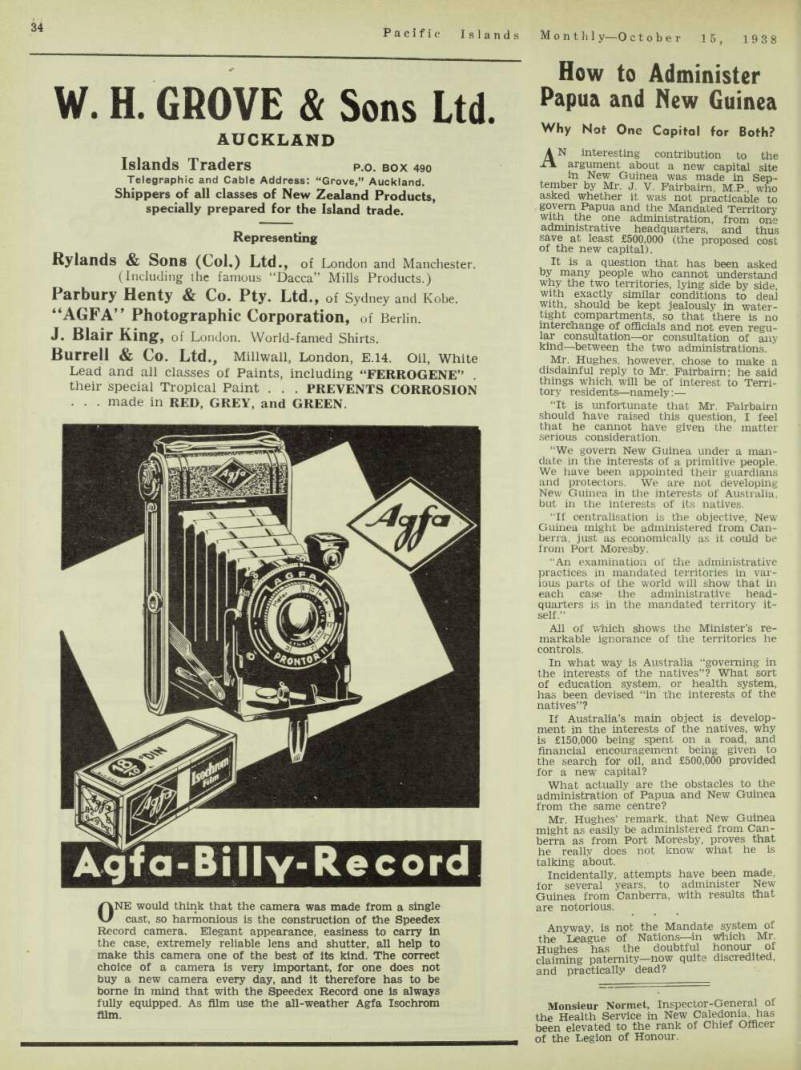
How to Administer Papua and New Guinea Why Not One Capitol for Both?
AN interesting contribution to the argument about a new capital site in New Guinea was made in Sep tember by Mr. J. V. Fairbairn, M.P., who asked whether it was not practicable to govern Papua and the Mandated Territory with the one administration, from one administrative headquarters, and thus save at least £500,000 (the proposed cost of the new capital).
It is a question that has been asked by many people who cannot understand why the two territories, lying side by side, with exactly similar conditions to deal with, should be kept jealously in water tight compartments, so that there is no interchange of officials and not even regu lar consultation—or consultation of any kind—between the two administrations.
Mr. Hughes, however, chose to make a disdainful reply to Mr. Fairbairn; he said things which will be of interest to Terri tory residents—namely;— “It is unfortunate that Mr. Fairbairn should have raised this question, I feel that he cannot have given the matter serious consideration.
“We govern New Guinea under a man date in the interests of a primitive people.
We have been appointed their guardians and protectors. We are not developing New Guinea in the interests of Australia, but in the interests of its natives.
“If centralisation is the objective, New Guinea might be administered from Can berra, just as economically as it could be from Port Moresby.
“An examination of the administrative practices in mandated territories in var ious parts of the world will show that in each case the administrative head quarters is in the mandated territory it self.”
All of which shows the Minister’s re markable ignorance of the territories he controls.
In what way is Australia “governing in the interests of the natives”? What sort of education system, or health system, has been devised “in the interests of the natives”?
If Australia’s main object is develop ment in the interests of the natives, why is £150,000 being spent on a road, and financial encouragement being given to the search for oil, and £500,000 provided for a new capital?
What actually are the obstacles to the administration of Papua and New Guinea from the same centre?
Mr. Hughes’ remark, that New Guinea might as easily be administered from Can berra as from Port Moresby, proves that he really does not know what he is talking about.
Incidentally, attempts have been made, for several years, to administer New Guinea from Canberra, with results that are notorious.
Anyway, is not the Mandate system of the League of Nations—in which Mr.
Hughes has the doubtful honour of claiming paternity—now quite discredited, and practically dead?
Monsieur Normet, Inspector-General of the Health Service in New Caledonia, has been elevated to the rank of Chief Officer of the Legion of Honour.
Blonde and Brunette —a snapshot at Samarai, Papua.
Advertisements & other items, p. 40 (1 item)
34
Pacific Islands Mont hi y—o ctober 15, 1938
Influenza In The Islands
Memories of Pneumonic Plague
Letter to the Editor.
INFLUENZA has again come ashore from some ship at Papeete and is spreading through the islands. That it has assumed the magnitude of an epi demic, the closing of the schools bears witness.
By rare good fortune this outbreak is not of the type of disease designated ••Spanish Influenza”. If it were, it would have stalked ashore with none to hinder it; for maladies under the title of “in fluenza” are not included in the inter national lists of disease to be quaran tined.
Like the Holy Roman Empire—which was “neither holy nor Roman nor an Empire”—Spanish Influenza is neither Spanish nor influenza. Anyone who had perused the medical reports of the out break in Manchuria in 1910, recognised this pestilence, masquerading under the name “Spanish Influenza”, as pneumonic plague.
Under the circumstances of war, the doctors and those in authority (if, in deed, the authorities were ever told the truth) were afraid to reveal the true name of the disease, and it was allowed to go forth, with no quarantine restric tions and under a false title, to slay its millions in every country in the world.
That should have been a warning.
But, after twenty years, we look through the international lists of quarantinable diseases to discover that the most tragic, the most destructive epidemic in history, has taught our all-wise international medical profession no lasting lesson.
I am, etc.,
Rerehiri-I-Amaura.
Tahiti. 30/9/1938.
New Steamer For C.S.R. Co.
THE Colonial Sugar Refining Co.’s new vessel “Tambua”, 3,566 gross ton nage, arrived in Suva from the shipyards in Dundee on September 13, and in Syd ney on September 26. She is a single screw, coal-burning steamer, designed for the sugar trade between Fiji, Australia and New Zealand. She can carry 2,288 tons of molasses in wing tanks, and she has ample space for general cargo. Her speed is about 11 knots. She can ac commodate 12 passengers.
Group
N.Z. Sloop Visits G. & E.
From Our Own Correspondent.
Tarawa, Sept. 2.
rE N.Z. sloop “Wellington’* (Com mander Lauriston Clark) recently made its annual visit to the Gilbert and Ellice Colony, bringing the new Acting Resident Commissioner, His Honour Mr.
H H Garvey, M.A., F.R.A.1., on a visit of inspection from headquarters at Ocean Island.
The Senior Administrative Officer, Major C. A. Swinbourne, 0.8. E., paid the usual formal call aboard, followed by a visit ashore by the Acting Resident Com missioner, accompanied by Commander Lauriston Clark and District Officer Blaikie. After taking the salute from
the native police Guard of Honour and meeting European residents, the Com missioner addressed the native population through an interpreter.
During the warship’s stay, a sports and entertainment programme was car ried through, including a native dance at Betio village and the annual cricket match, Navy versus Boys’ School, at Baeriki.
Mr. and Mrs. T. Garrett, of Varzin Plantation, Kokopo, New Guinea, who have been absent from the Territory for several years, returned to Rabaul by the Septem ber “Salamaua”.
Rev. H. Irving, who during the past 18 months has been curate of Suva, Fiji, re turned to New Zealand by the last “Mari posa”, having resigned owing to ill-health.
Having completely stripped the pearl shell beds off the Arnhem Land coast, North Australia, during the past two years, the 190 luggers of the Japanese pearling fleet have moved to new beds off the south-west coast of Melville Island, about 80 miles from Darwin.
Advertisements & other items, pp. 41-42 (2 items)
35
Pacific Islands Monthl y—O ctooer 15, 1938
B.P. Magazine
READ THE
SPRING NUMBER
Now on Sale Short Stories Pictures Travel Articles --- Pages for the Children - - - - Stage Latest Fashions Screen A
ONE SHILLING PER COPY
ON SALE AT ALL NEWSAGENTS AND BOOKSELLERS
“FAIRHOLME”, Mountain School for Girls
•iSS-
>4% up •* - 'N a*#- ♦ m Js • ■ . ■ Aerial View of Grounds and Buildings.
PRESBYTERIAN/GIRLS’ COLLEGE, TOOWOOMBA, Q’LAND.
2,000 feet above sea level. Unrivalled Climate. Academic, Home Science and Commercial Courses. . Tennis, Swimming, Organised Games.
Principal: Miss D. E. CULPIN, B.A.
For Prospectus apply Secretary :-R. T. PHELPS, F.A.A., TOOWOOMBA, QLD.
PURE RICE
STARCH
Always asJk for . . . ii
CORAL BRAND
100% PURE
Noted for its
QUALITY
and
WHITENESS
Goes Farthest and gives Lasting Finish
WILL NOT
STICK TO
IRON
Obtainable from Leading Island Stores Manufactured by
AUSTRALIAN RICE LTD.
Sydney, N.S.W.
CORAL BRAND
RICE STARCH
s.
Governor To Visit Unknown
Papua
ARRANGEMENTS have been made under which a party comprising Sir Hubert Murray (Lieut. Governor of Papua), and Messrs. H. L. Murray (Offi cial Secretary), H. W. Champion (Gov ernment Secretary) F. E. Williams (Gov ernment Anthropologist) and four mem bers of the magisterial service, will be taken in a Guinea Airways machine in November from Kikori to the Police Camp at Lake Kutubu in the interior, on the edge of the region labelled “unexplored and uncontrolled”.
Actually, this huge central region is now becoming better known and is be ing steadily brought under control, as described in an article on page 15 of last issue. A police camp was established at Kutubu last year by Mr. Ivan Champion, AR M., and Patrol Officer C. T. J: Adam son; and these two officials, with 10 con stables and 30 carriers have been making extensive patrols to the east and west.
Captain G. F. ‘W. Zimmer, formerly of the Papuan Administration, who during recent years has engaged in mining work on the Lakekamu goldfield, has joined the staff of Islands Exploration Company which is seeking oil in Western Papua.
M. Louis Bouvier, a Frenchman who is walking around the world, reached Sydney by the last “Malaita” after tramping through parts of Papua and New Guinea. He will return to Marseilles via Prance’s Pacific colonies.
Spain
Early Tahiti And
Some History of 150 Years Ago
From Our Own Correspondent.
Papeete, Sept. 18.
A GLIMPSE into the Spanish official mind in regard to the expeditions into Pacific waters undertaken by French and English navigators during the late years of the eighteenth century, is given in the confidential despatch and en closure, sent by the Viceroy of Peru, Don Teodoro de Croix, to the Secretary of State for the Indes under the date, July 5, 1786: Confidential.
“Most Excellent Senor,—The exploi tation of the island of Otaheti. being of the highest importance of the Monarchy, and the Royal Commands that were ad dressed to my predecessor and to myself to carry it out and, if possible, establish Missions there, having been repeated I have endeavoured to promote this under taking with all speed; but the Public Treasury being completely exhausted, and finding no means nor resources for giving effect to my plans, these have, of necessity, been suspended. Neverthe less, as there Is reason to believe that European nations may not be losing sight of so fine a possession and that, once settled there, they might cause us much trouble or apprehension, I apprise your Excellency of the position for your guid ance,, -Regarding this point, I think it prob able. despite the strictness with which they mask their designs, that the French expedition under the Count of La Perouse may be proceeding, among other projects, to examine the island In ques tion; as Your Excellency will observe from the annexed copy of a despatch addressed to me by the Governor of La Concepcion in Chile:— “ ‘Lima: sth July, 1786.
“ ‘Most Excellent Senor:—Having re ceived intelligence, when at the fron tier, of the arrival in this bay, on the 24th February, of the Most Christian King’s two frigates, the ‘Buzola’ and ‘Astrolavio’. (Note: ‘La Boussole’, com manded by the Sieur de la Perouse, and ‘L’Astrolabe’ under Capt. de Langle) under the command of the Count of La Perouse, I had to come down to this city in order to fulfil Our Sovereign’s com mand, dated at Aranjuez on the 19th of May last, and communicated lo the Pre sident of this Realm, of which the Com mandante La Perouse carries with him a duplicate. ... I found that Don Pedro Quixada, the officer in command here,, had already waited upon the strangers, prior to my arrival, and had afforded them all the assistance they asked; but I took pains to make things pleasant for the commanders, the officers, and the other persons they have on board, to their entire satisfaction. Briefly, they will have as many supplies as they stand in need of, which is to say wood, water, some fresh provisions, dried vege tables, flour, wine, etc., and the Count of La Perouse assures me that he will get away to sea in the coming week, without fail.
“ ‘But he has not told me what places he is bound to next, and, as it is said that he was very reticent on this sub ject before my arrival, I have not cared to push inquiries unavailingly in the face of an express order not to disclose
the scheme of his voyage, which no doubt he will have. . . . None of the members of the present expedition exhibit any thought but enthusiasm for research, for the improvement of navigation, for the extension of geographical knowledge, the exploration of seas and islands, and the configuration of the Globe and all it contains of use to its inhabitants. That, as would seem, is the philosophy of these admirable men; but still, it is not to be supposed that they will set aside their nation’s interests by neglecting to keep an eye, as chances offer, on places best adapted for settlement. . . .
“T have noticed that they say noth ing about occupying themselves with any search for a Southern Continent, nor with penetrating the seas toward that Pole, nor about visiting New Zealand either. Maybe they do not consider it necessary; but they carry with them the journals of the famous Captain Kook, his nautical and astronomical observa tions, and notes of all that he examined during his three voyages round the world, and even his own instruments, which the Royal Society of Sciences of London passed on to the Count of La Perouse. as I have just learnt.
“ ‘Kook spoke in the highest terms of the island of Otaheti; preferring it. for purposes of colonisation, before any of the neighbouring places discovered by Mendana and Quiros. All modern cir cumnavigators praise its situation, soil, climate, and resources, as Being fitted for an establishment of the first order.
These gentlemen have formed no meaner an estimate of the same island, but I do not know whether they intend to visit it or no.
“Tt may well be that they will not care to lose the time that is so necessary to them for gaining those high latitudes on the other side of the Equator where, as I said before, they have much before them: especially in connection with com pleting the latest explorations in that hemisphere, which Kook perforce left un finished, by reason of his unfortunate death. I remain, etc., etc. —Ambrosio Higgins de Vallinar’.”
Doctor B. G. Corney (from whose “Quest and Occupation of Tahiti”, Vol. 11. these extracts are adds the following footnote:—“O’Higgins’ surmise that La Perouse was bound to Tahiti amongst other places, was a sound one The French instructions directed in fact that, though the ships were to part, com pany after quitting Easter Island, they should re-loin at Tahiti and spend a month there; calling afterwards at the leeward islands of the Society Group.
However, they never did go there”.
The following Royal Command was the last document issued in regard to the long contemplated expedition to Tahiti for the purpose of restoring the Spanish inscription that Cantain Cook had obli terated. and re-establishing the Mission which had been abandoned in 1775: “From Your Excellency’s confidential despatch of July, of the year last nast No. 28. and the copy enclosed with it of one you received from Don Ambrosio Higgins, Governor of La Concepcion de Chile, the King has become acauainted with designs which it is possible the French expedition commanded by the Count of La Perouse, and other Euro pean nations besides, may have had in regard to the Island of Otaheti. *“His Majesty likewise learns the rea sons which have made it impossible on our part to exploit the island and settle Missionaries upon it, the business of
which was • entrusted, through the
medium of repeated Royal Commands, to your Viceregency. It is still His Majesty’s intention to carry this enter prise into effect, when it may be possible to do so; and I am commanded to give Your Excellency this intimation of his Royal will, for your information and compliance. —Dated 19th June, 1787”.
The King was not destined to see his royal intention achieved. On the 14th
of December, in the following year, he ceased to live; and the occupation of Tahiti by missionaries of his nation was never resumed.
Captain Ernest Kettle, master of the London Missionary Society’s schooner “John Williams V”, well-known in Cen tral Pacific, was in Australia in Septem ber spending furlough.
Advertisements & other items, pp. 42-44 (3 items)
Card-En Vale
Always . . . make sure Australia’s Choicest Products: you have Green Peas French Beans Cauliflower Beetroot Spinach Cabbage Carrots Parsnips Celery Brussels Sprouts White Turnips Sweet Corn Tomato Puree Tomato Sauce Tomato Soup Putti Fruit Sauce (Worcestershire flavor) at hand an ample Reserve of these
Qarden
Delici
ICIOUS . .
SAW
Garden
Vale
Ready-toserve Vegetables
CARD-EN VALE
manufacturer
l;N PRODUCTS LIMITED
, 2-4 BROWN STPC-CT, N-EWTOWN
-isA SYDN-EY. AUSTRALIA
1L
37
Pacific Islands Monthl y—O ctober 15, 1938
Canterbury
PRESCOTT L T J?
are sole wholesale agents
PINEAPPLE BACON S HAMS
DAISY BRAND BUTTER
“875' BUTTER in TINS llb.-21b.-sib.Sizcs LEA & PERRINS’ Sauces and Most other Super-Quality Lines of the Trade
Swallow & Arieli’s
WORLD RENOWNED
CANTERBURY
CARES
:xxxxxxxxxxxxxxxxxxxxxxxxxxxxxxxxxxxxxxxxxxxxx: Each Cake is Enclosed, by special process, in air-tight tin, and is warranted to keep its condition for a considerable period.
Kork-N-Seal
FOR HOME USE
FOR ALL HOME BOTTLING
—THE LITTLE CAP THAT
will Re - seal 1,000 Times
KORK - N - SEAL (Ausf.) LTD,
106 COMMONWEALTH STREET
SYDNEY, AUSTRALIA
Hand Applied Airtight Pressure Proof
We are Specialists
Let us have your confidence. Sixty years is our record of supplying the leading Houses throughout the World in ... .
FRESH FRUIT VEGETABLES PRODUCE
'Phones; MA 3612
JI'SL. WEYMARK
"Weymarkson”
Codes—Bentleys . . . . . .. ... , Private 14-18 STEAMMILL
& SON LTD.
FRUIT AND PRODUCE MERCHANTS
STREET - . SYDNEY
CHIV E R S
PURE
CB
FOODS
GOLD MEDAL JAMS
CANNED ENGLISH FRUITS
CANNED ENGLISH VEGETABLES
CUSTARD POWDER
OLD ENGLISH MARMALADE
JELLY CRYSTALS, ETC.
Obtainable from all Leading Grocery Stores Write to Department A> Chivers and Sons Ltd., Histon, Cambridge, England, for attractive Recipe Book.
E. 76
Quackless Ducks
And a Desperate Plea for Crowless Roosters
By A. C. R.
SOMEONE, either by accident or de sign, has evolved the quackless duck.
There are many speciments of this satisfying breed of water fowl in Tahiti.
He tries valiantly to emulate his noisy ancestor: stretching his neck, opening his spoon-like beak to its widest extent, and contracting his thorax in a mighty effort; but all that emanates is a wheezy hiss.
This achievement envisions the bringing to pass of a transmutation vastly more vital to the peace and serenity of a har assed humanity—the crowless rooster.
The roosters of Tahiti, like Rostand’s chantjcleer, crow not only to cause the rising of the sun. but to keep it steadily in its course throughout the day. By night, they awake at stated occasions to regulate the procession of the constellations.
As stations for these fanfares, they in variably choose the vicinity of our resi dence or, at night, the trees adjacent to the windows of our sleeping quarters. Were they numbered among our possessions, we might find consolation for our irritated nerves and compensation for our violated
slumbers in the prospect of the smoking forms of these disturbers of our tran quility one day gracing our table. But they are not.
What we lack is, however, supplied in abundance by our neighbours; and, for some reason known only to those myster ious and malignant forces that cunningly contrive instruments to plague humanity, all the chickens of our neighborhood have chosen our demesne as their happy hunt ing ground. Each morning, before the sun has risen, the roosters and their retinues enter from all points of the compass: sounding their approach like trumpeters and heralds inducting pageants to the jousting arena of Camelot—and we are awakened to another day of fury and exasperation.
The Tahiti hens are scarcely less noisy than their consorts. From mom ’til eve— like many people we know—they keep up a continual clatter of gossip, back biting and criticism of each others’ fea thers.
We have essayed every method our in genuity could invent to abate the nuisance.
Dogs were trained to chase crowing cocks —they all died of exhaustion; fire crackers and Roman candles: Chinese gongs and missiles.
The last has resulted in the denting or fracture of everything movable in our possession. Our aim is poor and we have never hit anything; thereby preserving ourselves in the state of love and charity with our neighbors who own the fowl. All that ever happens is the noisy scattering of indignant hens who, within five minutes have returned to hold a council of delib eration to determine if the object is edible, while a massed choir of cocks send up a sevenfold Hallelujah in mockery of our efforts.
Theocritus, Virgil and countless poets, through the centuries since their time, have sung the praises of the calm ser enity of bucolic life. None of them had ever encountered the domestic fowl—male nnd female—of Tahiti. Were they to day residents of our island they would be composing sonorous hexameters of petition to omthologists. bird fanciers and biologists to emulate the creator of the quackless duck by evolving the crowless rooster and the cackleless hen.
He who achieves this miracle of science will merit ribands, orders, titles of nobilitv and his bronze bust in all the Halls of Fame; for he will be a benefactor of the nremier class, worthy of the homage of his fellow men.
Leprosy Scourge In B.S.I.
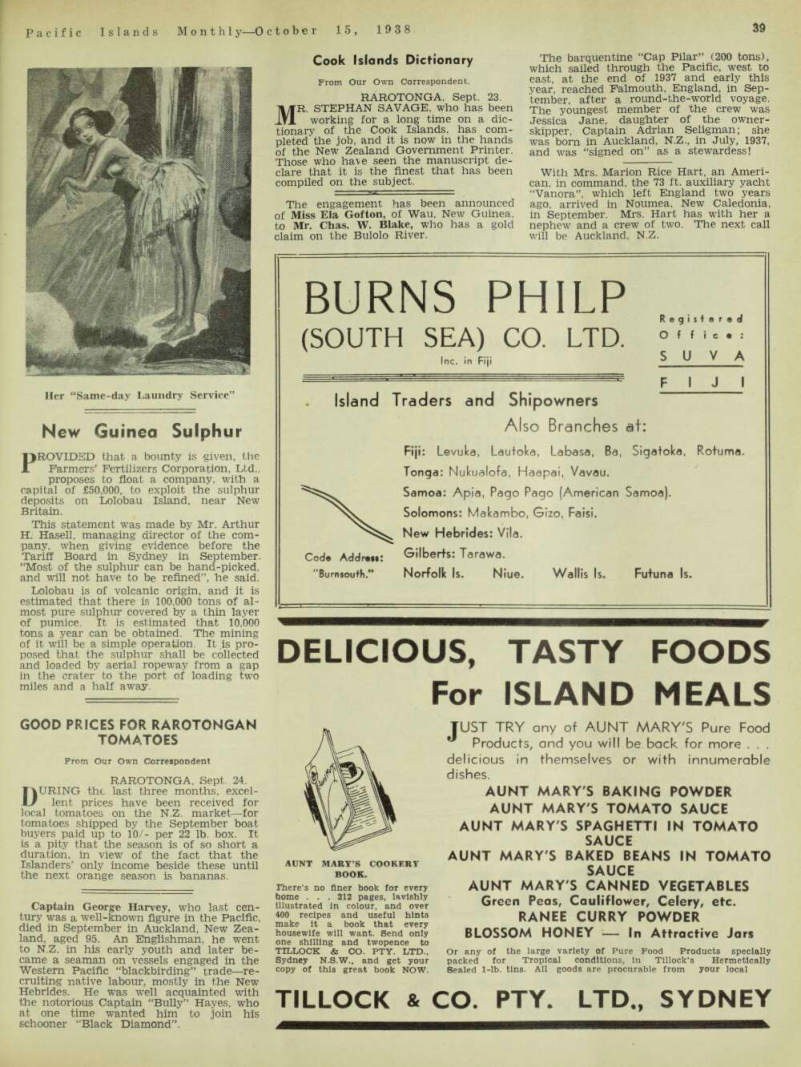
THE scourge of leprosy among Mela nesian natives—narticularly in the British Solomon Islands —and the urgent need for increased facilities for fighting the disease were emphasised by the Bishop of Melanesia (Rt. Rev. W. H. Baddeley) in an address at Auckland, N.Z.. in Sep tember.
At present an expert is making a sur vey of lepers in the Solomons, but other than that the Administration has done little to cope with the situation. The Mission runs a leprosarium without sub sidy, but is handicapped through lack of funds. Asking for support, the Bishop said, “In the Mission field the hospital is as essential as the church, and our expenditure on hospitals and dispensaries is as essential as it is heavy.” He added that “well-fed bodies are better able to resist leprosy and so the Mission is en couraging agriculture and efficient ro tation of crops so that a better variety of food of improved nutritive value can be obtained by the natives.”
Her “Same-day Laundry Service”
New Guinea Sulphur
PROVIDED that a bounty is given, the Farmers’ Fertilizers Corporation, Ltd., proposes to float a company, with a capital of £50,000, to exploit the sulphur deposits on Lolobau Island, near New Britain.
This statement was made by Mr. Arthur H. Hasell, managing director of the com pany, when giving evidence before the Tariff Board in Sydney in September.
“Most of the sulphur can be hand-picked, and will not have to be refined”, he said.
Lolobau is of volcanic origin, and it is estimated that there is 100,000 tons of al most pure sulphur covered by a thin layer of pumice. It is estimated that 10,000 tons a year can be obtained. The mining of it will be a simple operation. It is pro posed that the sulphur shall be collected and loaded by aerial ropeway from a gap in the crater to the port of loading two miles and a half away.
Good Prices For Rarotongan
Tomatoes
Prom Our Own Correspondent
Rarotonga. Sept. 24.
DURING the last three months, excel lent prices have been received for local tomatoes on the N.Z. market—for tomatoes shipped by the September boat buyers paid up to 10/- per 22 lb. box. It is a pity that the season is of so short a duration, in view of the fact that the Islanders’ only income beside these until the next orange season is bananas.
Captain George Harvey, who last cen tury was a well-known figure in the Pacific, died in September in Auckland, New Zea land, aged 95. An Englishman, he went to N.Z. in his early youth and later be came a seaman on vessels engaged in the Western Pacific “blackbirding” trade —recruiting native labour, mostly in the New Hebrides. He was well acquainted with the notorious Captain “Bully” Hayes, who at one time wanted him to join his schooner “Black Diamond”.
Cook Islands Dictionary
From Our Own Correspondent.
Rarotonga, Sept. 23.
MR. STEPHAN SAVAGE, who has been working for a long time on a dic tionary of the Cook Islands, has com pleted the job, and it is now in the hands of the New Zealand Government Printer.
Those who have seen the manuscript de clare that it is the finest that has been compiled on the subject.
The engagement has been announced of Miss Ela Gofton, of Wau, New Guinea, to Mr, Chas. W. Blake, who has a gold claim on the Bulolo River.
The barquentine “Cap Pilar” (200 tons), which sailed through the Pacific, west to east, at the end of 1937 and early this year, reached Falmouth, England, in Sep tember, after a round-the-world voyage.
The youngest member of the crew was Jessica Jane, daughter of the owner skipper, Captain Adrian Seligman; she was bom in Auckland, N.Z., in July, 1937, and was “signed on” as a stewardess!
With Mrs. Marion Rice Hart, an Ameri can, in command, the 73 ft. auxiliary yacht “Vanora”, which left England two years ago. arrived in Noumea, New Caledonia, in September. Mrs. Hart has with her a nephew and a crew of two. The next call will be Auckland, N.Z.
Advertisements & other items, pp. 45-46 (2 items)
39
Pacific Islands Monthl y—o ctober 15, 1938
Burns Philp
(SOUTH SEA) CO. LTD.
Inc. in Fiji SUVA Island Traders and Shipowners Also Branches at: x Code Address: "Burn south.** Fiji: Levuka, Laufoka, Labasa, Ba, Sigafoka, Rofuma.
Tonga: Nukualofa, Haapai, Vavau.
Samoa: Apia, Pago Pago (American Samoa).
Solomons: Makambo, Gizo, Falsi.
New Hebrides: Vila.
Gilberts: Tarawa.
Norfolk Is. Niue. Wallis Is. Futuna Is.
DELICIOUS, TASTY FOODS
For ISLAND MEALS
AUNT MARY’S COOKERY
BOOK.
There’s no finer book for every home ... 212 pages, lavishly illustrated in colour, and over 400 recipes and useful hints make it a book that every housewife will want. Send only one shilling and twopence to
TILLOCK & CO. PTY. LTD.,
Sydney N.S.W., and get your copy of this great book NOW.
JUST TRY any of AUNT MARY'S Pure Food Products, and you will be back for more . . . delicious in themselves or with innumerable dishes.
AUNT MARY'S BAKING POWDER
AUNT MARY'S TOMATO SAUCE
AUNT MARY'S SPAGHETTI IN TOMATO
SAUCE
AUNT MARY'S BAKED BEANS IN TOMATO
SAUCE
AUNT MARY'S CANNED VEGETABLES
Green Peas, Cauliflower, Celery, etc.
RANEE CURRY POWDER
BLOSSOM HONEY In Attractive Jars Or any of the large variety of Pure Food Products specially packed for Tropical conditions, In Tlllock’s Hermetically Sealed 1-lb. tins. All goods are procurable from your local
TILLOCK & CO. PTY. LTD., SYDNEY
IS MAINTAINED
1
AND GUARANTEED
IN EVERY TIN
OF NESTLES
MILK
ii vu
&< leand Anglo-Swiss Condensed M
SYDNEY
Millc is the most important of all foods, yet the most easily contaminated. Amazing precautions are taken to ensure the purity of Nestle's Milk precautions that might seem more than are necessary were it not for the fact that you cannot be too careful with milk. The milk supplied to Nestle's comes from chosen herds. It is tested on arrival at the Condensery, condensed under the most hygienic conditions and by the most scientific methods, and then put into hermetically sealed containers. It cannot sour or become contaminated while unopened. That is why Nestles Milk is the safest, purest and most economical milk that you can use A*
NESTLES
FULL CREAM
MILK
BEST, THEREFORE CHEAPEST A 262 E .
Mount Kasi
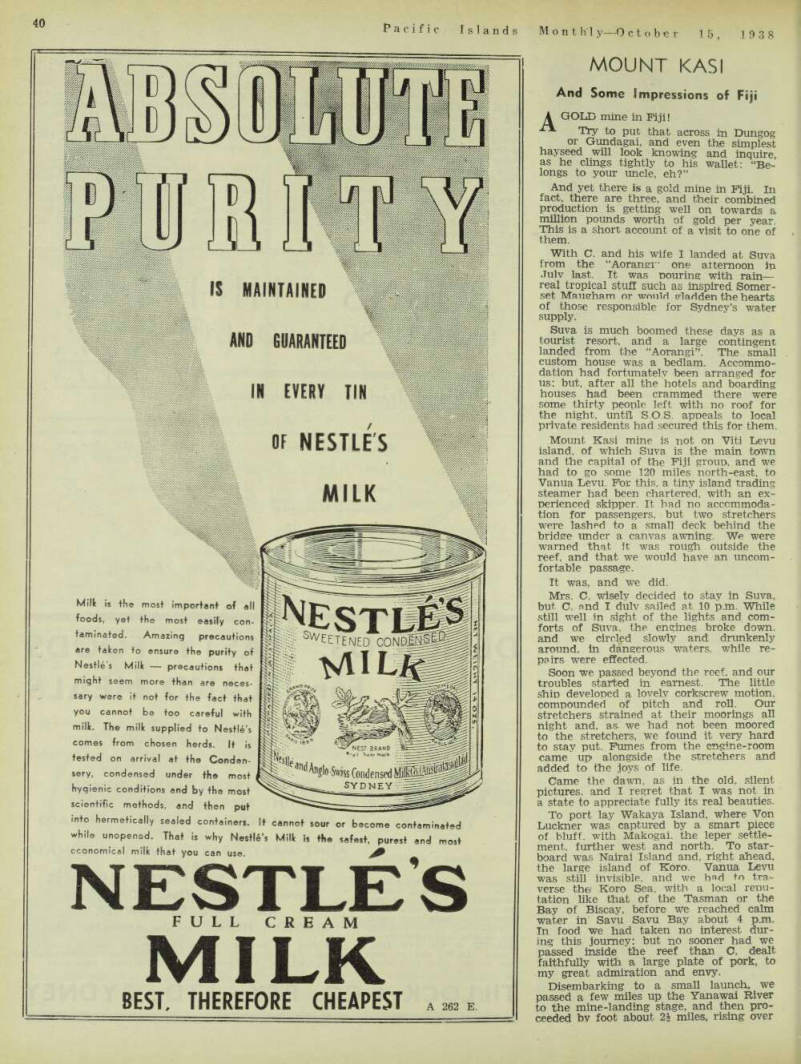
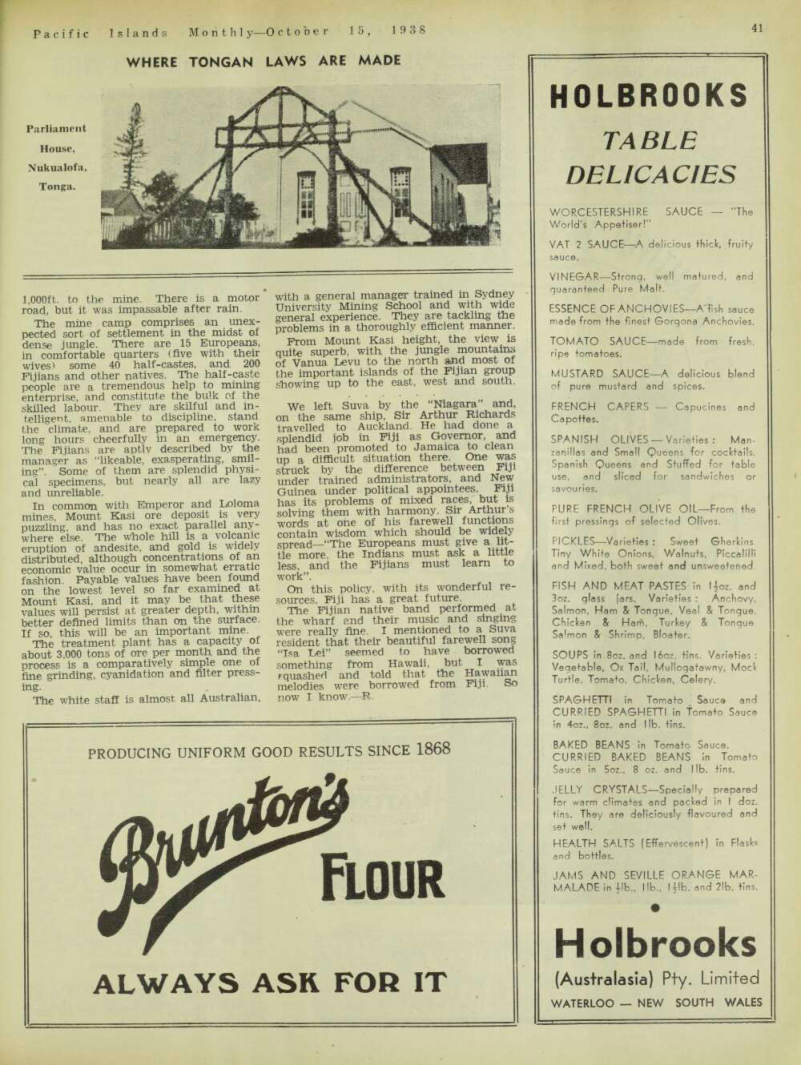
And Some Impressions of Fiji
A GOLD mine in Fiji!
Try to put that across in Dungog or Gundagai, and even the simplest hayseed will look knowing and inquire as he clings tightly to his wallet: “Be longs to your uncle, eh?”
And yet there is a gold mine in Fiji. In fact, there are three, and their combined production is getting well on towards a million pounds worth of gold per year.
This is a short account of a visit to one of them.
With C. and his wife I landed at Suva from the “Aorangi" one aiternoon in Julv last. It was nouring with rain real tropical stuff such as inspired Somer set Maugham or would gladden the hearts of those responsible for Sydney’s water supply.
Suva is much boomed these days as a tourist resort, and a large contingent landed from the “Aorangi”. The small custom house was a bedlam. Accommo dation had fortunately been arranged for us: but, after all the hotels and boarding houses had been crammed there were some thirty people left with no roof for the night, until SO S. appeals to local private residents had secured this for them.
Mount Kasi mine is not on Viti Levu island, of which Suva is the main town and the capital of the Fiji group, and we had to go some 120 miles north-east, to Vanua Levu. For this, a tiny island trading steamer had been chartered, with an ex perienced skipper. It had no accommoda tion for passengers, but two stretchers were lashed to a small deck behind the bridge under a canvas awning. We were warned that it was rough outside the reef, and that we would have an uncom fortable passage.
It was, and we did.
Mrs. C. wisely decided to stay in Suva, but C. end I dulv sailed at 10 p.m. While still well in sight of the lights and com forts of Suva, the engines broke down, and we circled slowly and drunkenly around, in dangerous waters, while re pp irs were effected.
Soon we passed beyond the reef, and our troubles started in earnest. The little ship developed a lovely corkscrew motion, compounded of pitch and roll. Our stretchers strained at their moorings all night and. as we had not been moored to the stretchers, we found it very hard to stay put. Fumes from the engine-room came up alongside the stretchers and added to the joys of life.
Came the dawn, as in the old, silent pictures, and I regret that I was not in a state to appreciate fully its real beauties.
To port lay Wakaya Island, where Von Luckner was captured by a smart piece of bluff, with Makogai, the leper settle ment, further west and north. To star board was Nairai Island and, right ahead, the large island of Koro. Vanua Levu was still invisible, and we had to tra verse the Koro Sea. with a local repu tation like that of the Tasman or the Bay of Biscay, before we reached calm water in Savu Savu Bay about 4 p.m.
In food we had taken no interest dur ing this journey; but no sooner had we passed inside the reef than C. dealt faithfully with a large plate of pork, to my great admiration and envy.
Disembarking to a small launch, we passed a few miles up the Yanawai River to the mine-landing stage, and then pro ceeded bv foot about 21 miles, rising over
I.oooft. to the mine. There is a motor road, but it was impassable after rain.
The mine camp comprises an unex pected sort of settlement in the midst of dense jungle. There are 15 Europeans, in comfortable quarters (five with their wives) some 40 half-castes, and 200 Fijians and other natives. The half-caste people are a tremendous help to mining enterprise, and constitute the bulk of the skilled labour. They are skilful and in telligent. amenable to discipline, stand the climate, and are prepared to work long hours cheerfully in an emergency.
The Fijians are aptlv described by the manager as “likeable, exasperating, smil ing”. Some of them are splendid physi cal specimens, but nearly all are lazy and unreliable.
In common with Emperor and Loloma mines, Mount Kasi ore deposit is very puzzling, and has no exact parallel any where else. The whole hill is a volcanic eruption of andesite, and gold is widely distributed, although concentrations of an economic value occur in somewhat erratic fashion. Payable values have been found on the lowest level so far examined at Mount Kasi, and it may be that these values will persist at greater depth, within better defined limits than on the surface.
If so, this will be an important mine.
The treatment plant has a capacity of about 3,000 tons of ore per month, and the process is a comparatively simple one of fine grinding, cyanidation and filter press ing.
The white staff is almost all Australian,
with a general manager trained in Sydney University Mining School and with wide general experience. They are tackling the problems in a thoroughly efficient manner.
Prom Mount Kasi height, the view is quite superb, with the jungle mountains of Vanua Levu to the north and most of the important islands of the Fijian group showing up to the east, west and south.
We left Suva by the “Niagara” and, on the same ship, Sir Arthur Richards travelled to Auckland. He had done a splendid job in Fiji as Governor, and had been promoted to Jamaica to clean up a difficult situation there. One was struck by the difference between Fiji under trained administrators, and New Guinea under political appointees. Fiji has its problems of mixed races, but is solving them with harmony. Sir Arthur s words at one of his farewell functions contain wisdom which should be widely spread—“ The Europeans must give a lit tle more, the Indians must ask a little less, and the Fijians must learn to work”.
On this policy, with its wonderful re sources. Fiji has a great future.
The Fijian native band performed at the wharf and their music and singing were really fine. I mentioned to a Suva resident that their beautiful farewell song “Isa Lei” seemed to have borrowed something from Hawaii, but I was squashed and told that the Hawaiian melodies were borrowed from Fiji. So now I know. —R.
Advertisements & other items, p. 47 (3 items)
Where Tongan Laws Are Made
Parliament House, Nukualofa, Tonga.
41
Pacific Islands Monthl y—O ctober 15, 1938
Holbrooks
TABLE
DELICACIES
WORCESTERSHIRE SAUCE "The
World's Appetiser!"
VAT 2 SAUCE —A delicious thick, fruity sauce.
VINEGAR —Strong, well matured, and guaranteed Pure Malt.
ESSENCE OF ANCHOVIES—ATish sauce
made from the finest Gorgona Anchovies.
TOMATO SAUCE—made from fresh, ripe tomatoes.
MUSTARD SAUCE—A delicious blend of pure mustard and spices.
FRENCH CAPERS Capucines and Capottes.
SPANISH OLIVES —Varieties ; Manzanillas and Small Queens for cocktails, Spanish Queens and Stuffed for table use, and sliced for sandwiches or savouries,
PURE FRENCH OLIVE OlL—From the
first pressings of selected Olives.
PlCKLES—Varieties : Sweet Gherkins Tiny White Onions, Walnuts. Piccalilli and Mixed, both sweet and unsweetened FISH AND MEAT PASTES in 4oz. and 3oz. glass jars. Varieties : Anchovy, Salmon, Ham & Tongue, Veal & Tongue, Chicken & Ham, Turkey & Tongue Salmon & Shrimp, Bloater, SOUPS in Boz. and l6oz. tins. Varieties : Vegetable, Ox Tail, Mullogatawny, Mock Turtle, Tomato, Chicken, Celery.
SPAGHETTI in Tomato Sauce and CURRIED SPAGHETTI in tomato Sauce in 40z., Boz. and lib. tins.
BAKED BEANS In Tomato Sauce.
CURRIED BAKED BEANS in Tomato
Sauce in 50z., 8 oz. and Mb. tins.
JELLY CRYSTALS—Specially prepared for warm climates and packed in I doz. tins. They are deliciously flavoured and set well.
HEALTH SALTS (Effervescent) in Flasks and bottles.
JAMS AND SEVILLE ORANGE MAR-
MALADE in Mb., 41b. and 2lb. tins.
Holbrooks
(Australasia) Pty. Limited
WATERLOO NEW SOUTH WALES
PRODUCING UNIFORM GOOD RESULTS SINCE 1868
ALWAYS ASK FOR IT
Bishop's Jubilee
New Cathedral Towers Mark Fiji Bishop's Jubilee
THE golden jubilee of his ordination was celebrated on September 22 by his Lordship the Most Reverend Dr. C.
J, Nicolas, S.M., Vicar Apostolic of Fiji, Almost the whole of these fifty years have been spent in Fiji where (says the “Fiji Times”) His Lordship is loved by his own flock and esteemed and respected by all sections of the community.
The occasion was marked by numerous
religious and public observances; and on the afternoon of September 25 the new towers of the Sacred Heart Cathedral, which are the jubilee gift to the Bishop from his people, were formally blessed and presented.
Miss Betty Linn, of Mandated Airlines, Ltd., Wau, New Guinea, has announced her engagement to Mr. David M. Camp bell, a member of the local office staff of N.G. Goldfields, Ltd. The wedding will take place at Salamaua in November.
Radios Part
In Development of Papua and New Guinea
LIFE in the remote parts of New Guinea, Papua, and the neighbour ing islands has been revolutionised by the new teleradio outfits, of which 150 have been installed within the past two years,” said Mr. L. A. Hooke, general manager of Amalgamated Wireless (A/sia), Ltd., on his return to Sydney in mid-September from a visit of inspection.
Mr. J* ooke instanced the case of a man CMr. N. Entrop) whom he met. whose clothing had caught fire from a primus lamp while on the American yacht Vanora”. Although he had quickly lumped into the sea, he was very severely ‘burned. The yacht put in at the Tro bnand Group. where a planter with a teleradio set communicated with Port Moresby.loo miles away. A ’plane flew to the ‘Vanora”, and picked up the patient, who was eventually brought to Sydney for treatment. Nothing else, said Mr. Hooke, but quick action could have saved the man, who was well again in two months.
The “Montoro” upon which Mr. Hooke travelled, was asked by the Rabaul radio station to divert her course to pick up a sick man whose plight had been reported by teleradio from a plantation at Djaul.
The patient was paddled to the ship in a native canoe and taken South for treat ment. His wife was constantly advised by teleradio of his progress and move ments.
Suppplies By Air
Teleradio performed a valuable service withm the past few months for a patrol party working through unexplored coun try in the mainland. The explorers were in daily touch by teleradio with the Ad ministrator at Rabaul (700 miles away), and when they ran short of supplies, they simply said so. An aeroplane was sent out, and, as the country was too difficult to land, supplies were dropped by parachute.
Mr. Hooke explained that planters, ex ploring parties, geologists engaged upon scientific research, and others seldom travelled without teleradio sets which could readily be carried by native bearers Organisations such as Papua Oil Deve lopment Co. and Islands Exploration Co have their own “mother stations” which are in constant touch with officers in outlying places. These stations, work ing with the A.W.A. main stations at the principal centres of population, link the dwellers of the most remote parts with the whole outside world.
“Aviation and radio are jointly per forming a great service of development in Papua and the Mandated Territory of New Guinea,” said Mr. Hooke. “Large ’planes leave Lae and Salamaua daily, lifting loads up to four tons in weight.
When the plant for A.W.A.’s first wire less station was transported from Sala maua to Wau,” he added, “we started with 300 native boys, carrying the gear over trackless country on a journey which occupied six weeks. Recently, a large dredge weighing 4,000 tons was carried in sections over the same country by air.
The air trip between Salamaua and Wau now occupies only 35 minutes.”
Miss Hilda Walker, B.A. (Oxon.), has been appointed assistant teacher at the Anglican St. John’s school for Solomon Islanders in Fiji.
Advertisements & other items, p. 48 (2 items)
42
Pacific Islands Monthl y—o ctober 15, 1938
Matone shades are washable,
fadeless and are practically permanent.
The peculiar "wet edge" enables the operator to join each finished section perfectly leaving an unmarked expanse of soft, restful colour that does not reflect light with a glare.
Ask your Berger agent for the Matone colour card. It gives practical suggestions for interior decoration.
AGENTS THROUGHOUT THE ISLANDS.
Samara I—"Gem Of The Pacific”
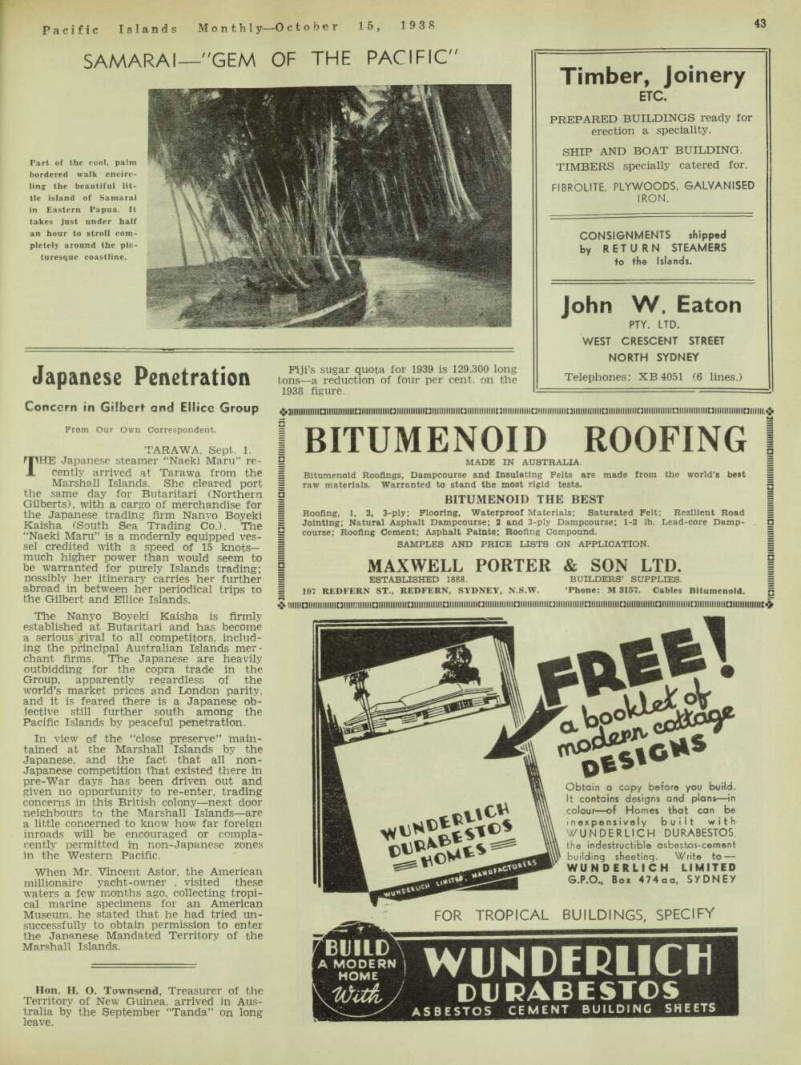
Part of the cool, palm bordered walk encirc ling the beautiful lit tle island of Samara! in Eastern Papua. It takes just under half an hour to stroll com pletely around the pic turesque coastline.
Japanese Penetration
Concern in Gilbert and Ellice Group
From Our Own Correspondent.
Tarawa, Sept. 1.
rpHE Japanese steamer “Naeki Maru” re- X cently arrived at Tarawa from the Marshall Islands. She cleared port the same day for Butaritari (Northern Gilberts), with a cargo of merchandise for the Japanese trading firm Nanyo Boyeki Kaisha (South Sea Trading Co.). The “Naeki Maru” is a modernly equipped ves sel credited with a speed of 15 knots— much higher power than would seem to be warranted for purely Islands trading; possibly her itinerary carries her further abroad in between her periodical trips to the Gilbert and Ellice Islands.
The Nanyo Boyeki Kaisha is firmly established at Butaritari and has become a serious rival to all competitors, includ ing the principal Australian Islands mer chant firms. The Japanese are heavily outbidding for the copra trade in the Group, apparently regardless of the world's market prices and London parity, and it is feared there is a Japanese ob jective still further south among the Pacific Islands by peaceful penetration.
In view of the “close preserve” main tained at the Marshall Islands by the Japanese, and the fact that all non- Japanese competition that existed there in pre-War days has been driven out and given no opportunity to re-enter, trading concerns in this British colony—next door neighbours to the Marshall Islands—are a little concerned to know how far foreign inroads will be encouraged or compla cently permitted in non-Japanese zones in the Western Pacific.
When Mr. Vincent Astor. the American millionaire yacht-owner , visited these waters a few months ago, collecting tropi cal marine specimens for an American Museum, he stated that he had tried un successfully to obtain permission to enter the Japanese Mandated Territory of the Marshall Islands.
Hon. H, O. Townsend, Treasurer of the Territory of New Guinea, arrived in Aus tralia by the September “Tanda” on long leave.
Fiji’s sugar quota for 1939 is 129,300 long tons —a reduction of four per cent, on the 1938 figure.
MARCH IS next year will be the 50th anniversary of the memorable escape by H.M.S. “Calliope” from Apia Harhour, Western Samoa, when a terrific . . , „ . . ... . storm wrecked all shipping in the port, including three American warships (“Trenton”, “Vandalia”, and “Nipsic”) and three German warships (“Adler", “iTHAr” ariH with erpflt of ~7 b • • Wtn gre 1 v®? 1 life. The incident is commemorated in various ways each year; but probably the most unique celebration is that held
in Apia in true nautical style by Lodge Calliope (No. 52, New Zealand), , At the conclusion of the ordinary 6 o S hos ? gavel is made from a piece of timber from the o ld ship, orders “the main brace to be spliced in real old Jamaica”. The bo’sun whistle then calls the whole company to
rovl“renaS kteS
. repast is set out. in the position of honour is a model of the famous “Calliope” and the refectory is decked out with flags, etc. A pleasant hour is usually spent in music, song, and story.
Advertisements & other items, pp. 49-50 (2 items)
43
Pacific Islands Monthl y—o ctober 15, 1938
Wunderlich
Timber, Joinery
ETC.
PREPARED BUILDINGS ready for erection a speciality.
SHIP AND BOAT BUILDING.
TIMBERS specially catered for.
FIBROLITE, PLYWOODS. GALVANISED
IRON.
CONSIGNMENTS shipped
by RETURN STEAMERS
to the Islands.
John W. Eaton
PTY. LTD.
WEST CRESCENT STREET
NORTH SYDNEY
Telephones: X 84051 (6 lines.)
BITUMENOID ROOFING
MADE IN AUSTRALIA.
Bltumenold Roofings, Dampcourse and Insulating Felts are made from the world’s best raw materials. Warranted to stand the most rigid tests.
BITUMENOID THE BEST
Roofing, 1,2, 3-ply; Flooring, Waterproof Materials; Saturated Felt; Resilient Road Jointing: Natural Asphalt Dampcourse; 2 and 3-ply Dampcourse: 1-2 lb. Lead-core Dampcourse: Roofing Cement: Asphalt Paints; Roofing Compound.
SAMPLES AND PRICE LISTS ON APPLICATION.
MAXWELL PORTER & SON LTD.
ESTABLISHED 1888. BUILDERS’ SUPPLIES.
107 REDFERN ST., REDFERN, SYDNEY. N.S.W. Phone: M 3157. Cables Bltumenold.
*«SSS&!
Jr'
abpo'^BcU^
\ «^»0* s Obtain a copy before you build.
It contains designs and plans—in colour—of Homes that can be inexpensively built with
WUNDERLICH DURABESTOS
the indestructible asbestos-cement building sheeting. Write to —
WUNDERLICH LIMITED
S.P.O., Box 474 a a, SYDNEY
FOR TROPICAL BUILDINGS, SPECIFY
WUNDERLICH
DURABESTOS
ASBESTOS CEMENT BUILDING SHEETS
Master Sewing Machine Co.
15 ENMORE ROAD, NEWTOWN, SYDNEY
ESTABLISHED FOR 23 YEARS
SPECIALISING IN
RECONDITIONED
SEWING MACHINES
OF ALL TYPES
Hand Machines - - £2 £3 £4 Upright Models - - £4 £6 £8 Dropheads - - - £7 £8 £lO including
SINGER—WHITE—NEW CENTURY—HOME—AND OTHER WELL KNOWN MAKES.
• Allow us to select a machine for you ... we will strive to please; your subsequent recommendations will reward us. o Also in Stock— Machines for Leather, Canvas- Bootpatching. Highspeed Dressmaking. Hemstitching, etc.
EVERY MACHINE GUARANTEED MECHANICALLY PERFECT
NEEDLES AND PARTS
SUPPLIED FOR ALL
MAKES OF MACHINES
REPAIR WORK BY
COMPETENT
MECHANICS
Best construction - Brightly fire tinned with high illuminating power - Storm - and rain proof - fitted with a globe of special glass.
Q (m * ¥ * &M) 7h.*fs Wick 4/16" V/L.50 Wick 4/16" 7fa.55 Wick 7/16" and many other types. foutffw. Wm * Breckwoldt & Co., J J J Rabaul, Suva, Apia, Papeete
Samarai!
Martial Law In
Citizens Flee To Arms
Contributed
RECENT developments have caused considerable alarm to the worthy burghers of Samarai (Eastern Papua) some of whom are making hasty pre parations to evacuate the island and flee to the safety of the hills. “Back to the Bamboos” is said to be their slogan.
Coming so soon after their narrow es cape from the local head-hunters—an escape from which they can never be sufficiently grateful to “the four abso lutes” —this new alarm has set the erst while peaceful community by their ears.
An unusual feature of the remarkable affair is that no one knew anything about it until the intelligence arrived in a hitherto unknown Sydney journal, which stated, in its issue of July 30. that “Samarai and Galilee will be gar risoned by steel-hatted British Tommies and armed police”.
The first reaction to this startling an nouncement was one of great indigna tion; and a crowded public meeting, headed by the Mayor and Aldermen, re solved: (a) That a strong protest be sent to His Excellency the Lieut.-Gover nor (and a copy to Canberra) against the counling of Samarai with Galilee, a land with which Samarai has nothing in common save a well-developed, fully matured thirst: and (b) that anyone found on the island with a steel hat. or a stolen hat, be weighted with fire bars and sunk in the stream until well perforated by the toredo borer.
These resolutions having been carried unanimously, the inhabitants immediate ly divided themselves into two camps.
One, as stated above, made hasty pre parations to evacuate the island, whilst the other occupied a strategic position commanding the communication lines be tween the two pubs, and are reported to be strongly entrenched there.
Later
Further reports are to the effect that a number of the guards have withdrawn themselves from the vital channels of communication referred to above, and the fugitives have postponed their depar ture indefinitely.
It is stated that this development is due to a rumour, probably ill-founded, that the original report should have read “Samaria” instead of Samarai.
Nevertheless strong reinforcements have arrived from the plantations and mines on the mainland, and any threat to the libertv of the subject will be met with the strongest possible resistance.
Latest
An indication of the ferment which has been caused by the recent unrest mav be found in the fact that September 1 found the whole population in arms, at a dance in the Institute Hall (in aid of the Cricket Club funds) which was somewhat marred by an incident which caused “wholesale destruction of pro perty” when the M.C., in a moment of abstraction, was overcome by his emo tions whilst handing round a tray of coffee cups. But normalitv was restored eventually and the casualties up to now are listed hereunder: — Missing—One upper set of dentures.
Killed—Nil.
Advertisements & other items, p. 50 (1 item)
44
Pacific Islands Monthl y—O ctober 15, 1938
Government Patrol Explores Central New Guinea
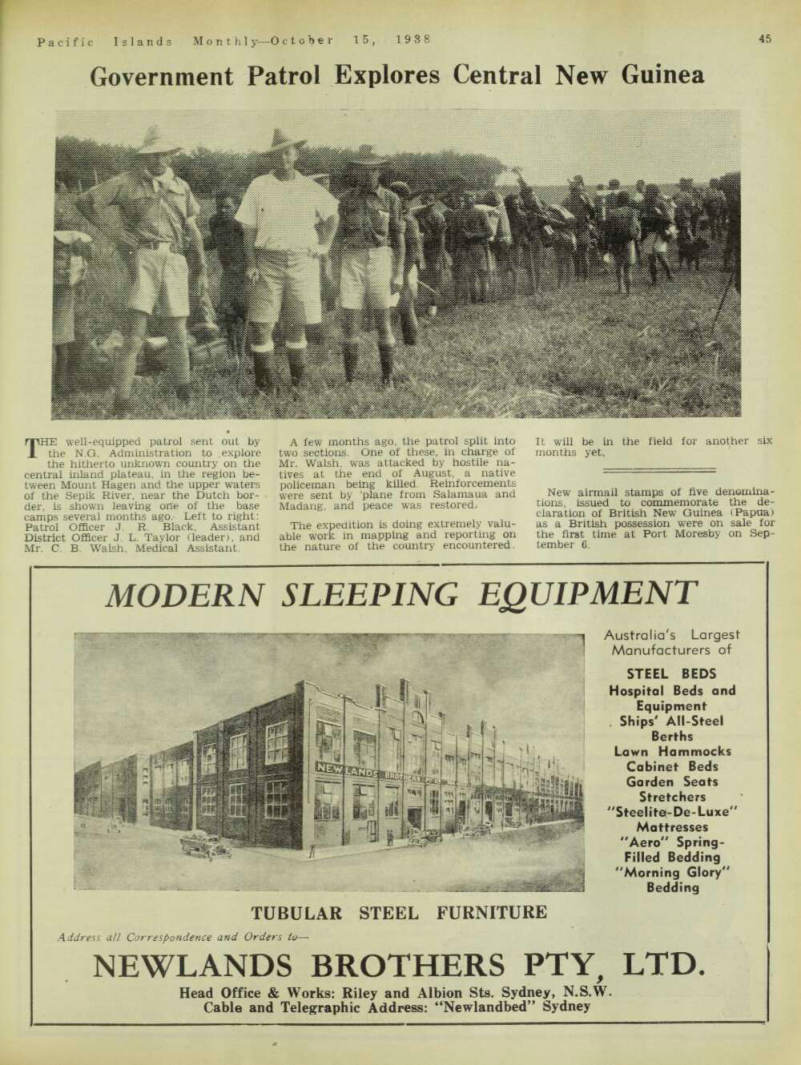
THE well-equipped patrol sent out by the N.G. Administration to explore the hitherto unknown country on the central inland plateau, in the region be tween Mount Hagen and the upper waters of the Sepik River, near the Dutch bor der, is shown leaving one of the base camps several months ago. Left to right: Patrol Officer J. R Black, Assistant District Officer J L. Taylor deader), and Mr. C. B Walsh. Medical Assistant.
A few months ago, the patrol split into two sections. One of these, in charge of Mr. Walsh, was attacked by hostile na tives at the end of August, a native policeman being killed Reinforcements were sent by ’plane from Salamaua and Madang, and peace was restored.
The expedition is doing extremely valu able work in mapping and reporting on the nature of the country encountered.
It will be in the field for another six months yet.
New airmail stamps of five denomina tions, issued to commemorate the de claration of British New Guinea (Papua) as a British possession were on sale for the first time at Port Moresby on Sep tember 6.
Advertisements & other items, p. 51 (2 items)
45
Pacific Islands Monthl y—o ctober 15, 1938
Newlands Brothers Pty, Ltd.
MODERN SLEEPING EQUIPMENT
Australia's Largest Manufacturers of
STEEL BEDS
Hospital Beds and Equipment Ships' All-Steel Berths Lawn Hammocks Cabinet Beds Garden Seats Stretchers "Steelite-De-Luxe"
Mattresses "Aero" Spring- Filled Bedding "Morning Glory"
Bedding
TUBULAR STEEL FURNITURE
Address all Correspondence and Orders to —
NEWLANDS BROTHERS PTY, LTD.
Head Office & Works: Riley and Albion Sts. Sydney, N.S.W.
Cable and Telegraphic Address: “Newlandbed” Sydney 1
IMf
- «• n to all Jr * ■ S.
VI m «L
To Classify Shellfish
PRACTICALLY everyone in the Islands has at one time collected shells, if only with the object of sending them away to friends oversea. Others have given up in despair of ever being able to identify and classify their finds. It is to these latter that Mr. A. W. B.
Powell’s “Shellfish of New Zealand” (Unity Press Ltd., Auckland) will ap peal.
Mr. Powell has written in a manner which the amateur can readily under stand. Illustrations, of prime importance in any work dealing with such minute ly differing objects as shell specimens, are in eighteen excellent plates which alone are worth the 5/- asked for the book.
The greater number of species listed and described are also common to most Islands Groups.
Mr. and Mrs. R. S. Taylor sailed from Sydney for Tulagi, 8.5.1., by the last “Malaita”.
Administrative Power
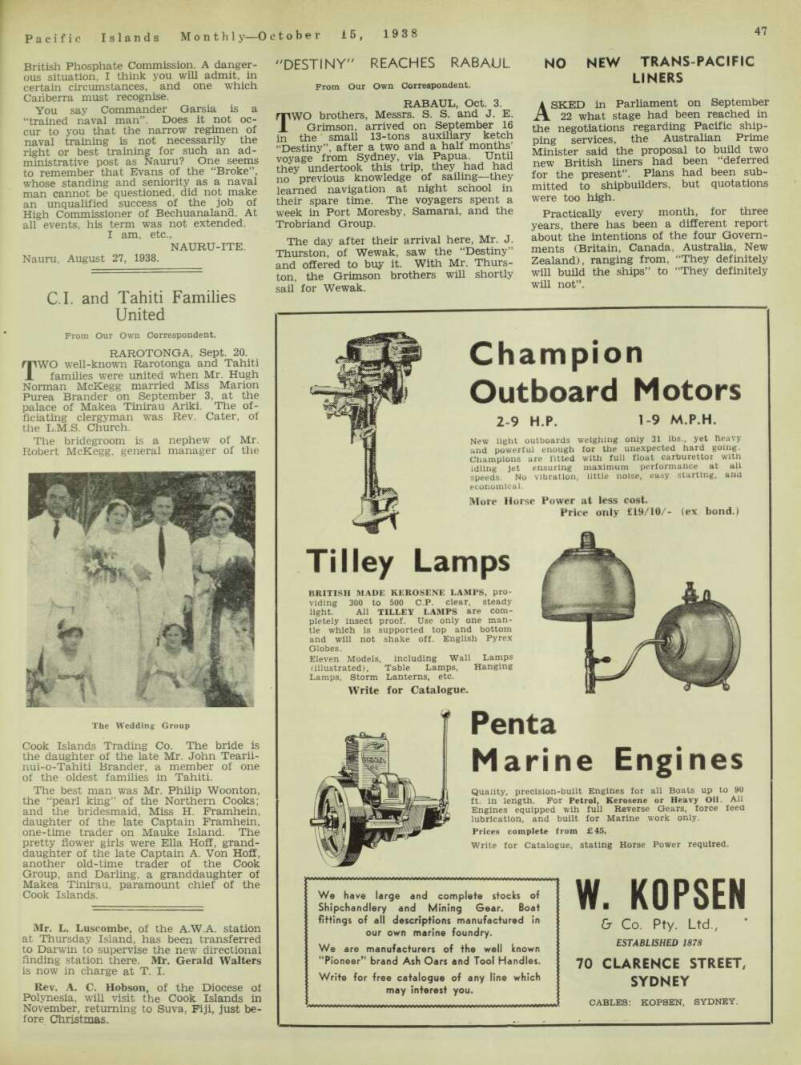
on Nauru Island
Letter to the Editor.
THE information published in your July and August issues relative to the position of Commander Garsia as Ad ministrator of Nauru, appears to be of a clumsily “inspired” nature, obviously in tended to save somebody’s face.
It may have been an astute publicity move to work the defence business; but rather maladroit to the minds of think ing residents of the island, who realise that the place presents an obvious case of the best defence being no defence at all. Nor will it be agreed, I think granting the need for an elaborate sys tem of defence—that a retired lieutenant commander of the Royal Australian Navy is necessarily the best or most authori tative adviser on the subject. After all, the Commonwealth Government may have its own plans in the matter; and it is possible that the trained defence experts
(of whom we still have a few in Aus tralia, from A.I.F. times, products of Duntroon and Camberley), have other views and more far-reaching plans than those of Commander Garsia.
The idea of danger to the Europeans on the island from the 1,500 well-treated Chinese labourers in the employ of the British Phosphate Commission is ludi crous to anyone who knows the condi tions. A walk through the Chinese com pound, to-day, in the company of the very efficient Labour Inspector, will ef fectively dispel any such idea.
There have been two so-called “riots” amongst the Chinese coolies on the is land, in my experience. The first was effectively quelled by General Griffiths, who employed a few dozen local natives, armed with waddies, for the purpose The second “riot”, which happened during the Newman Administration, had no possible connection with Europeans, and arose from a tong feud within the compound.
It resulted in the death qf one native po liceman; and this, it was believed at the time, might have been avoided had the situation been less inexpertly handled.
I have no doubt that the Europeans who have lived on the island through the Gar sia regime, feel gratified at the sudden and very recent administrative solicitude for their welfare. But I think they will be disinclined, from their experience, to credit the suggestion that this solicitude has been the cause of Commander Gar sia’s “retirement”.
No; the plain facts in the case are that Commander Garsia’s initial appointment was for a term of five years. That term expired early this year. For reasons of expediency, it was extended for six months, and has now expired. During the extension period, Commander Garsia was notified by Canberra that his term would not be further extended. There is no question of Commander Garsia’s deciding as you suggest, “that he would rather re linquish the post than remain in Nauru and be fettered by the red tape of Can berra”.
After all, Canberra has to take the ini tiative in some circumstances. Or is a petty island Administrator to “rule the roost” on his own judgment alone?
Remember that the situation in Nauru is unique; there is no legislative or even official advisory body in existence, and this gives an Administrator absolute power over the destinies of the people and in terests of the island—except in the mat ters that concern the actual work of the
British Phosphate Commission. A danger ous situation, I think you will admit, in certain circumstances, and one which Canberra must recognise.
You say Commander Garsia is a “trained naval man”. Does it not oc cur to you that the narrow regimen of naval training is not necessarily the right or best training for such an ad ministrative post as Nauru? One seems to remember that Evans of the “Broke”, whose standing and seniority as a naval man cannot be questioned, did not make an unqualified success of the job of High Commissioner of Bechuanaland. At all events, his term was not extended.
I am, etc.,
Nauru-Ite.
Nauru, August 27, 1938.
Advertisements & other items, p. 52 (2 items)
46
Pacific Islands Monthl y—o ctobc-r 15, 1938
Younger
m Do You Know that the Famous . . .
* STOVES and
RANGES
made with extended Firebox specially for long Wood fuel, are Self-Setting and, provided sufficient Flue Piping is attached, can be used in almost any position?
The No. 7W " Younger" Ranger can now be supplied fitted with Legs, as per illustration.
Ask for quotation for this Range, also Illustrated Catalogue and Price List for both Single and Double Oven Stoves.
G. FLETCHER & SON 50 Oxford Street, Sydney Younger Sieves are Widely Used Throughout the Pacific Islands.
JAMES BUDGE LTD
REFRIGERATION. .
“BUDGE" Automatic or Manually-controlled Refrigeration and Ice-making Plants, with or without insulated Cabinets or Rooms, ranging from 4 cubic feet to 1000 cubic feet or larger, using ammonia in the large and sulphur dioxide (SO2) in the small units.
Where electricity is not available, crude oil engines may be utilised for driving the larger plants and petrol engines for driving the smaller machines. The accompanying illustration is of a petrol engine driven SO2 unit. Enquirers please state power available (if any), size of cabinet and amount of ice required per day.
JAMES BUDGE PTY. LIMSTED
REFRIGERATION AND GENERAL ENGINEERS
McEvoy and Harley Streets
ALEXANDRIA SYDNEY ,
Established 1890
ENGINEERING WORKSHOPS
ALL CLASSES OF MACHINES MADE AND RECONDITIONED
CL and Tahiti Families
United
Prom Our Own Correspondent.
Rarotonga, Sept. 20.
TWO well-known Rarotonga and Tahiti families were united when Mr. Hugh Norman McKegg married Miss Marion Purea Brander on September 3, at the palace of Makea Tinirau Ariki. The of ficiating clergyman was Rev. Cater, of the L.M.S. Church.
The bridegroom is a nephew of Mr.
Robert McKegg, general manager of the
Cook Islands Trading Co. The bride is the daughter of the late Mr. John Tearii nui-o-Tahiti Brander, a member of one of the oldest families in Tahiti.
The best man was Mr. Philip Woonton, the “pearl king” of the Northern Cooks; and the bridesmaid, Miss H, Framhein, daughter of the late Captain Framhein, one-time trader on Mauke Island. The pretty flower girls were Ella Hoff, grand daughter of the late Captain A. Von Hoff, another old-time trader of the Cook Group, and Darling, a granddaughter of Makea Tinirau, paramount chief of the Cook Islands.
Mr. L. Luscombe, of the A.W.A. station at Thursday Island, has been transferred to Darwin to supervise the new directional finding station there. Mr. Gerald Walters is now in charge at T. I.
Rev. A. C. Hobson, of the Diocese of Polynesia, will visit the Cook Islands in November, returning to Suva, Fiji, just be fore Christmas.,
The Wedding Group
"Destiny" Reaches Rabaul
From Our Own Correspondent.
Rabaul, Oct. 3.
TWO brothers, Messrs. S. S. and J. E.
Grimson. arrived on September 16 in the small 13-tons auxiliary ketch “Destiny”, after a two and a half months’ voyage from Sydney, via Papua. Until they undertook this trip, they had had no previous knowledge of sailing—they learned navigation at night school in their spare time. The voyagers spent a week in Port Moresby, Samarai, and the Trobriand Group.
The day after their arrival here, Mr. J.
Thurston, of Wewak, saw the “Destiny” and offered to buy it. With Mr. Thurs ton, the Grimson brothers will shortly sail for Wewak.
SSS-Mf SUTSftZ deferred
No New Transpacific
Liners
a SKED in Parliament on September 2 2 what stage had been reached in the negotiations regarding Pacific ship . ser vices, the Australian Prime
SSS-Mf SUTSftZ deferred
for the present’’. Plans Quotations mitted to shipbuilders, but quotations were too high.
Practically every month, for three years, there has been a different report about the intentions of the four Govern ments (Britain, Canada Australia, New Zealand), ranging from, “They definitely will build the ships to They definitely wm not ”-
Advertisements & other items, pp. 53-54 (3 items)
47
Pacific Islands Monthl y—o ctober 15, 1938
Marine Engines
Champion
Outboard Motors
2-9 H P
1-9 M.P.H.
New light outboards weighing only 31 lbs., yet heavy and powerful enough for the unexpected hard going.
Champions are fitted with full float carburettor with idling Jet ensuring maximum performance at all speeds. No vibration, little noise, easy starting, ana economical.
More Horse Power at less cost.
Price only £l9/10/- (ex bond.)
Tilley Lamps
BRITISH MADE KEROSENE LAMPS, pro-
viding 300 to 500 C.P. clear, steady light. All TILLEY LAMPS are completely insect proof. Use only one mantle which is supported top and bottom and will not shake off. English Pyrex Globes.
Eleven Models, including Wall Lamps (illustrated), Table Lamps, Hanging Lamps, Storm Lanterns, etc.
Write for Catalogue.
Penta
Marine Engines
Quality, precision-built Engines for all Boats up to 90 ft. in length. For Petrol, Kerosene or Heavy OH. All Engines equipped wih full Reverse Gears, force feed lubrication, and built for Marine work only.
Prices complete from £45.
Write for Catalogue, stating Horse Power required.
We have large and complete stocks of Shipchandlery and Mining Gear. Boat fittings of all descriptions manufactured in our own marine foundry.
We are manufacturers of the well known "Pioneer” brand Ash Oars and Tool Handles.
Write for free catalogue of any line which may interest you.
W. KOPSEN
& Co. Pty. Ltd., *
ESTABLISHED 1878
70 CLARENCE STREET,
SYDNEY
CABLES: KOPSEN, SYDNEY.
WM. BRECKWOLDT & CO.,
SOUTH SEA MERCHANTS
POSTAL ADDRESSES:—
NEW GUINEA:—P.O. Box 89, Raboul.
FIJI:—P.O. Box 111. Suva.
TAHITI:—P.O. Box 60, Papeete.
SAMOA:—P.O. Box 124, Apia.
TRADE MARK
BREWO
AGENTS FOR.
MERCEDES - BENZ DIESEL
TRUCKS, HANOMAG TRACTORS,
D.K.W. MOTORCARS, CONTIN-
ENTAL TYRES AND TUBES,
MERCEDES-BENZ MARINE EN-
GINES.
B A E R ASPIRIN . . . ATEBRIN . . . YATREN PYRAMIDON . . . PLASMOCHIN . . .
MITIGAL . . HELMITOL . . . NEOSAL- VARSAN . . . ETC., ETC. . . .
Stocks always available at our Branches. All orders will be executed at original “BAYER”
PRICES.
PETROMAX"-
HURRICANE LANTERNS, LAMPS AND'
ACCESSORIES.
"FROWO"-
HURRICANE LANTERNS,
No. 45, -55, 65, 75, 85, Etc
"TIGER BRAND"-
CORRUGATED AND FLAT GALVANISED
IRON.
MAKE
A TRIAL-
APPLY
TO-DAY.
SWEDISH Axes and Hatchets . . . Bicycles . . .
Sewing Machines . . .
Knives . . . Razor Blades . . . Lavalavas . . . Toothpaste . . . Real Briar Tobacco Pipes . . Poundbeads . . . Seedbeads . , .
Cutbeads. also all kinds of
GERMAN, BRITISH
and
CONTINENTAL
GOODS.
BLANKETS
i
TAIFUN"- BICYCLES AND ACCESSORIES
TELEFUNKEN"- radio sets
ARARA"- GAS STOVES
ANCRE"- CAST IRON SAUCEPANS,
“TWO LIONS"-
COPRA KNIVES, BUTCHERS' KNIVES
BECK'S- "KEY BRAND" GERMAN LAGER.
BREWO RAZOR BLADES.
Black, Brown, Green. Blue, Pink, Silver.
BIRKO"-"POLISSE" AND "POLO'
RAZOR BLADES,
LOHSE, URALT LAVENDER.
TORPEDO" "BIJOU" and "ERICA"
TYPEWRITERS.
VESTA SEWING MACHINES
48
Pacific Islands Mont hi y—o ctober 15, 1938
P.I. Club Entertains Maori Chieftainess
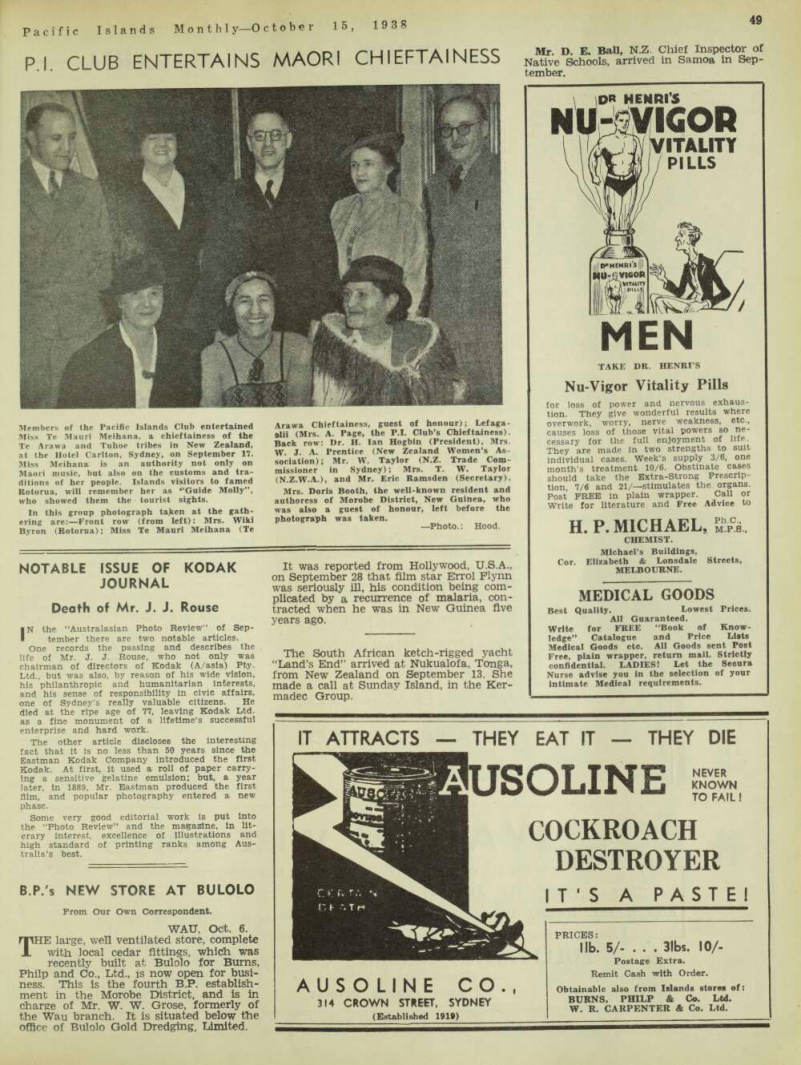
Members of the Pacific Islands Club entertained Miss To Mauri Meihana, a chieftainess of the Te Arawa and Tuhoe tribes in New Zealand, at the Hotel Carlton, Sydney, on September 17.
Miss Meihana is an authority not only on Maori music, but also on the customs and tra ditions of her people. Islands visitors to famed Rotorua, will remember her as “Guide Molly”, who showed them the tourist sights.
In this group photograph taken at the gath ering are:—Front row (from left): Mrs. Wiki Byron (Rotorua); Miss Te Mauri Meihana (Te
Arawa Chieftainess, guest of honour); Lefaga- Olii (Mrs. A. Page, the P.I. Club’s Chieftainess).
Back row: Dr. H. lan Hogbin (President), Mrs.
W. J. A. Prentice (New Zealand Women’s As sociation); Mr. W. Taylor (N.Z. Trade Com missioner in Sydney); Mrs. T. W. Taylor (N.Z.W.A.), and Mr. Eric Ramsden (Secretary).
Mrs. Doris Booth, the well-known resident and authoress of Morobe District, New Guinea, who was also a guest of honour, left before the photograph was taken. —Photo.: Hood.
Journal
Notable Issue Of Kodak
Death of Mr. J. J. Rouse
IN the “Australasian Photo Review” of Sep tember there are two notable articles.
One records the passing and describes the life of Mr. J. J. Rouse, who not only was chairman of directors of Kodak (A/asia) Pty.
Ltd., but was also, by reason of his wide vision, his philanthropic and humanitarian interests, and his sense of responsibility in civic affairs, one of Sydney’s really valuable citizens. He died at the ripe age of 77, leaving Kodak Ltd. as a fine monument of a lifetime’s successful enterprise and hard work.
The other article discloses the interesting fact that it is no less than 50 years since the Eastman Kodak Company introduced the first Kodak. At first, it used a roll of paper carry ing a sensitive gelatine emulsion; but, a year later, in 1889, Mr. Eastman produced the first film, and popular photography entered a new phase.
Some very good editorial work is put into the “Photo Review” and the magazine, in lit erary interest, excellence of illustrations and high standard of printing ranks among Aus tralia’s best.
B.P.'S New Store At Bulolo
From Our Own Correspondent.
WAU, Oct. 6.
THE large, well ventilated store, complete with local cedar fittings, which was recently built at Bulolo for Burns, Philp and Co., Ltd., is now open for busi ness. This is the fourth B.P. establish ment in the Morobe District, and is in charge of Mr. W. W. Grose, formerly of the Wau branch. It is situated below the office of Bulolo Gold Dredging, Limited.
It was reported from Hollywood, U.S.A., on September 28 that film star Errol Flynn was seriously ill, his condition being com plicated by a recurrence of malaria, con tracted when he was in New Guinea five years ago.
The South African ketch-rigged yacht “Land’s End” arrived at Nukualofa, Tonga, from New Zealand on September 13. She made a call at Sunday Island, in the Ker madec Group.
Mr. D. E. Ball, N.Z. Chief Inspector of Native Schools, arrived in Samoa in Sep tember.
Advertisements & other items, p. 55 (2 items)
49
Pacific Islands Mon thl y— october 15, 19 3 8
Soline
l D B HENRI’S
HU-t VIGOR
1 \\Jl'j TVVitality
PILLS
obhimri's MU-vtcoP iTiwithitv
VITiIITY
; p "- L Si w
MEN
TAKE DR. HENRI’S
Nu-Vigor Vitality Pills
for loss of power and nervous exhaustion. They give wonderful results where overwork, worry, nerve weakness, etc., causes loss of those vital powers so necessary for the full enjoyment of life.
They are made In two strengths to suit individual cases. Week’s supply 3/6, one month’s treatment 10/6. Obstinate cases should take the Extra-Strong Prescription, 7/6 and 21/ —stimulates the organs.
Post FREE in plain wrapper. Call or Write for literature and Free Advice to
H. P. MICHAEL, SE&.
CHEMIST.
Michael’s Buildings, Cor. Elizabeth & Lonsdale Streets,
MELBOURNE.
MEDICAL GOODS
Best Quality. Lowest Prices.
All Guaranteed.
Write for FREE “Book of Knowledge” Catalogue and Price Lists Medical Goods etc. All Goods sent Post Free, plain wrapper, return mail. Strictly confidential. LADIES! Let the Secura Nurse advise you in the selection of your intimate Medical requirements.
IT ATTRACTS
THEY EAT IT THEY DIE
SOLINE
NEVER
KNOWN
TO FAIL !
AUSOLINE CO
314 CROWN STREET. SYDNEY
(Established 1919)
COCKROACH
DESTROYER
IT'S A PASTE
PRICES:
Mb. 5/- . . . 3lbs. 10/- Postage Extra.
Remit Cash with Order.
Obtainable also from Islands stores of:
BURNS, PHILP & Co. Ltd.
W. R. CARPENTER & Co. Ltd.
Pretty Wedding In Wau
From Our Own Correspondent WAU, Oct. 2.
THE marriage between Miss Jessie Learmonth Hobler, daughter of the late Mr. W. L.
Hobler and Mrs. Hobler, formerly of Rock hampton, and now of Sydney, and Mr. Leonard Cooper Dobbin, son of Colonel and Mrs. L.
Dobbin, late of Sydney, and now of Melbourne, was celebrated at St. Augustine’s Church, Wau, New Guinea, on September 24. Rev. V. H.
Sherwin officiated.
The bride, given away by Hon. N. P. H. Neal, wore lame made on classical lines, with a large train. Her veil was worn over the face and held by a .diamante halo and small posy of orange blossom. She carried a bouquet of gardenias and lily of the valley. Miss Nell Hobler, as bridesmaid, chose a hyacinth blue chiffon frock featuring accordion pleated skirt, sleeves, and vest. She wore flesh mittens and a shoulder-length veil, held in place by a wreath of flowers. Miss Joyce Harris was organist.
The reception was held at Wau Guest House, where Mrs. Stower, as hostess, wearing a black taffeta frock and smart black toque, received 60 guests. The decorations on the wedding cake were a miniature rowing skiff and aero plane, representing the sports in which the bride and bridegroom are most Interested.
Rev. A. L, Sadd, of the London Mission ary Society, returned to his station at Beru, Gilbert and Ellice Group, in Sep
tember after furlough in England
Fight Against Malaria
Use of Plasmoquine and Atabrine in Southern States of America
THE present position of the world fight against malaria (which kills 3,000,000 people annually) is set out in a recent article by Paul de Kruif, in “Country Gentleman”. It is written from the point of view of the United States, where a major problem is the continued existence of virulent malaria in the Southern States; but the following extracts are just as applicable to the fever-ridden terri tories of Melanesia.
MALARIA spreads in just.one way: by one kind of she mosquito. This in sect sucks the blood of an infected person; then she bites and spits the mic robes back into healthy people.
Why can’t our bug hunters, using oil, Pans green and drainage ditches, destroy all mosquito breeding places? Such mea sures made the Panama Canal possible.
But—aside from the enormous cost—if our South were thoroughly drained of all its waters that hatch malaria mosquitoes, the land, with a greatly lowered water table, might no longer support its millions of human beings.
Yet the man-to-mosquito-to-man chain must be broken. If mosquitoes can’t be kept from giving malaria to men, why
can’t we keep men from infecting mos quitoes?
Another weapon is quinine, which has saved millions from malarious death. It cures individual cases wonderfully. Yet quinine has dismally failed jto prevent malaria’s wrecking the blood of our Southern millions. Malaria microbes are tough, and in many a human being the curative doses doctors have to use are so terrific they’re dangerous. Many prefer the disease to the cure! Thus the chain of infection survives, and malaria con tinues in the community.
When it became evident that the man to-mosquito-to-man chain couldn’t be broken by quinine, a team of German microbe hunters began to seek a syn thetic drug which would do the trick. By 1925 they had cooked up a chemical which, in experiments with malaria in canary birds, was real poison for male and female microbes. Here was power that quinine lacked.
But there are two kinds of malaria microbes, sexual and sexless neuters.
These neuters are the real killers. Yet, strangely, it is the male and female microbes that perpetuate the chain of malarious death. It is these that a mos quito sucks into her stomach, where they beget myriads of malaria-microbe chil dren which Mrs. Mosquito injects into the blood of healthy people.
To test this new coal-tar chemical— “plasmoquine”—on humans, German microbe hunter Roehl hurried to Spain where malignant, tropical malaria was raging. June, 1925, he sent an excited telegram back to Germany: “Plasmoquine kills sexual malaria parasites in human beings!”
But plasmoquine was feeble against the murderous sexless microbes. Quinine could cure malaria, but couldn’t power fully prevent it. Plasmoquine could pre vent malaria from going via mosquito from man to man. But couldn’t cure it.
Our searchers struck off on a new chemical trail —something that would kill these sexless microbes. And, in 1930, after five years of toiling, they developed a complicated drug which they called “ata brine”.
Like wildfire, beginning 1932, the little yellow pills of atabrine spread over the tropical world. And no death-fighting remedy—with the possible exception of salvarsan for syphilis and insulin for diabetes —has ever had such a roaring “Yes” of scientific approval. From India, from Africa, from the Dutch East Indies, from Central and South America—from all dangerously malarious tropical re
gions—came scientific cheers for atabrine.
Compared to quinine, these pills were harmless. At worst, they colored some people’s skins yellow for a while. Babies could take them safely. And it was amaz ing how littie atabrine you needed to cure most malarious people. One little pill, by mouth, three times a day, for five days or at longest seven. Atabrine magi cally brought people moribund with mali gnant malaria back from the grave. It began to be reported in many a tropical pest-hole that doctors no longer feared even that most sinister form of malaria, “black-water fever”, in which shivering grows more and more violent, fevers fiercer and fiercer, the blood dissolving and running out of the doomed one in horrid dark red urine.
Georgia’s State Health Commissioner T. F. Abercrombie heard of the miracles atabrine was performing in the tropical hospitals of the United Fruit Company.
In 1933 he sent State Epidemiologist Daniel Seckinger, armed with these new fangled pills, to Calhoun County, Georgia.
Here malaria was so vicious that hardly a white family could live in its rural re gions. Here 80 out of every 100 rural school children, in 1932, showed their blood peppered with malaria parasites.
May, 1933, when the mosquitoes began their sinister humming, Seckinger split these farm people up into two gangs: To half the families, in which he found any case of malaria, he gave the 15 pills of atabrine. And since the county was notorious for its malignant malaria, he fed those same families very tiny amounts of plasmoquine three times a week all summer to keep them from giving mos quitoes that deadly infection.
That autumn there was no doubt of the answer. The persons who did not take atabrine suffered six times the amount of malaria suffered by the families under atabrine. Having thus proved the effectiveness of atabrine, Seckinger gave his magic pills to cure all who were sick.
In the bad malaria of 1934 that fol lowed, it was plain that this 1933 ata brine dosage hadn’t left many microbes for the 1934 mosquitoes. While malaria was epidemic over the rest of Calhoun County-death rate at the terrible high of 109 per 100,000—in all of Seckinger’s 54 square miles there wasn’t much malaria. And not one person died of it.
TT ln T^ February ’ 1934 ’ Glynn County’s Health Commissioner, Dr. M. E. Win chester started another experiment.
Aided by seven F.E.R.A. nurses and P.E.R.A. funds to provide free atabrine he canvassed every last home of Glynn County’s rural families. Forty per cent of them gave a history of undoubted malaria the year before. Winchester set up four health centres, with nurses to examine, teach and treat all who came complaining of “dumb chills and innard fever . The nurses enforced a rule that if any member of a family was malarious —everyone in the family got the 15-pill treatment.
That summer and autumn there was at least 90 per cent, malaria, and no deaths from it in Glynn County. Less than 50 people had to come back for a second treatment, and the school teachers were amazed because no children had to fever nt h ° m6 fr ° m schoQl With chills and . r J? , 1935 ’ Winchester extended his tests rnf?SfS rio o St ly i malar i ous P arts of Mclntosh TSI n £oii gato Tth conclusive results.
The health record of these former pest me^%7l S 936Zd m 7. throUgh ““ SUm ' Meanwhile the systematic 15-pill treat ment in the Glynn County health centres
every spring, of all members of all families with any member malarious, had reduced that ancient, perennial, lifesapping plague to hardly more than a memory. And in the blood-test surveys Winchester made each year from 1934 to 1937, in no year did the positives reach one per cent. This record for that invincibly malarious cor ner of our Southland is unprecedented.
Despite this, there are malariologists high in authority who admit they still have to be shown. Dr. L. L. Williams, jr., of the U.S. Public Health Service, points out that malaria has up-and-down swings in periods of years. He fears that Dr. Winchester’s experiments began on a downswing in 1934, and that when the upswing starts, atabrine may be power less.
To such criticism Winchester replies: “If I’m wrong, I’m anxious to be shown.
The Georgia state laboratory examina
tions of the people’s blood show there’s very little malaria. People aren’t losing work time from malaria. They aren’t dying from it. What I want to find out is what’s wrong with the experiment”, Winchester is building Exhibit A for all Southern rural regions that can’t wipe o ut malaria by wiping out mosquitoes. If men no longer can give malaria to mos quitoes, the man-to-mosquito-to-man chain is broken, and malaria should dis appear in a few years.
Advertisements & other items, pp. 56-57 (2 items)
50
Pacific Islands Month 1 y—o ctober 15, 1938
BULLIVANTS’ wire ropes
11l
USE
FOR
AND
RELIABILITY
LONG SERVICE
MILLER'S "ANCHOR
BRAND ROPES AND
CORDAGES.
Manila, Sisal, New Zealand Coir and Cotton Rope of every description.
Twine, Sewing Twine, Shop Twine, Binder Twine and Fishlines, Lashings, Halters, Plough Reins, Sack Cord, Blind Lines, etc.
LENGTH STRENGTH
QUALITY GUARANTEED
Manufactured by: JAMES MILLER & Co. Pty. Ltd.
MELBOURNE. VIC., AUST.
Suva Agantt; A $ fAREBROTHER & CO. c . . . And at Lautolca, P.O. Box 36. Tel. 261 Sydney Agents:
P. T. TAYLOR LTD.
BULLIVANTS’ wire ropes
THE WORLD'S STANDARD
LARGEST STOCKS IN AUSTRALASIA : FOR ALL PURPOSES Also Blocks, Hooks, Shackles, Thimbles, Strand, Seizing, Aircraft Cord, etc.
Attention! Efficient Service!! Complete Satisfaction!??
BULLIVANTS' Australian Co. Pty., Ltd.
Letters* Incorporated In Victoria. Telegrams: Sydney.
Box 1298 J, G.P.O. 331 KENT STREET, SYDNEY. “Bullivants, Ltd.” ♦ ♦
WANTED
Regular supplies of Used Pacific Island stamps. All Coronations, Jubilees, Airmails and ordinary Issues wanted. Best prices paid. Submit stamps or details to:
W. HOENADGE,
Catherine Hill Bay, N.S.W., Australia.
Woven Wire for all Industry
COPRA DRYING TRAYS, FLOORS, Etc.
FRUIT DRYING TRAYS, MINING SCREENS
Heavy Mosquito Gauze in Phosphor Bronze and other Metals Impervious to Salt Sea Air WIRE DOOR MATS AND GENERAL WIRE WORKS
E. VRIGHT & CO. LTD.
Offlce and Works: 148-162 Cleveland Street, Sydney, N.B.W.
Telegraphic Address: “Wrlghtmake.” Chippendale
VI '/r The extraordinary advantages of our new PETROMAX Rapid lanterns and table-lamps are obvious: Due to the very high heating efficiency of the absolutely safe and automatic Paraffin pre-heating device, the usual pre heating time of about 'mt m 5 minutes has been reduced o 30 seconds'
relrnmax
id % i W. BRECKWOLDT Cr CO., Rabaul. Sole Agents for South Seas.
Another Wandering
Yachtsman
From Our Own Correspondent.
Honolulu, Sept. 20.
MR. NORTHRUP CASTLE, scion of a local wealthy family, departed on September 5 for a prolonged cruise through South Pacific isles in his auxili ary cutter “Laila”, which is a 41-foot ves sel technically identified as a Norwegian pilot boat. It is equipped with a 20 h.p. engine.
The tentative itinerary provides for calls at Fanning and Christmas Islands, the Tuamotus, Tahiti and the Marquesas.
First mate will be Mrs. Castle, who al ways accompanies her venturesome hus band on his voyages. Incidentally, he be came known to Australia when, in 1934. he
scoured outlying Hawaiian islands for the lost Australian airman, Captain C. T. P.
Ulm. For this purpose, he used the schooner “Lanikai” which he sold later on to the Hollywood interests that used her in the super-imaginative movie, “Hurri cane”.
Some time ago, “P.1.M.” reported that Mr. Castle was building a schooner in Honolulu for the current voyage, but he abandoned this work when he was offered the “Laila”, which for long had been idle in Puget Sound.
In May-June of this year Mr. Castle sailed her to Honolulu from Seattle.
Miss Joy Coates, of Chatswood, N.S.W.. arrived in New Caledonia from Sydney by the September “Pierre Loti” to be mar ried to Mr. Lindsay Macmillan, of Noumea.
The Polynesian
Origin
Discussion of the South American Theory
From Our Own Correspondent.
Papeete, Sept. 20.
A SCHOOL of thought persists which sees in certain elements in Poly nesian life of pre-European times, bear ing unmistakable evidence of origin in the South American continent, proofs that the Polynesian race emigrated into the Pacific from the Americas and not, as is generally accepted, from Asia, by way of the East Indies.
How these South American elements could have been, and most probably were, introduced into Polynesia, is told concisely and clearly by Mr. Kenneth P. Emory, of the Bernice P. Bishop Museum, in his bulletin No. 116, entitled. “Stone Remains in the Society Islands”. In discoursing of the probable origin of the art of dressed stonework found in the ancient Marae, of Tahiti, Mr. Emory writes as follows: “That the construction of facings of rectangular blocks of unequal size, neces sitating in some instances the cutting of shoulders or jogs in order to bring the top of the finished course to a level, is an old technique in South-eastern Poly nesia, is clear from its appearance in pre historic image platforms of Easter Island, where it is even more at home than in the Society Islands—the only other place in Polynesia from which it has been re ported besides Hawaii.
“While it may have evolved either in Tahiti or Easter Island, its appearance as the dominant note in the cut-stone facings of ancient Peru makes South America a possible source, with Easter Island, where its megalithic aspect brings it more in line with the Inca work, the
introductory point.
“As it is now generally agreed that the sweet potato, in South-eastern Polynesia, is an introduction from America, and once ante-dating the final dispersals fb Hawaii and New Zealand (from this cul tural centre in the Society Islands some twenty generations ago, or before the fourteenth century), it is quite within reason to entertain an American origin for a cultural element so specialised as this stone facing.
“It is a conspicuous element localised in the part of America nearest to Poly nesia, a part where currents strike out and flow in the direction of Easter Island and the Tuamctus. This current, in 1929, carried a flock of drums of gasoline, from some wreck on the South American coast, into the Tuamotus, bringing timely aid to the nearly exhausted supply of our party.
May not one of the sea-going rafts of the early Incas have been swept into this cur rent, carrying survivors as far as Easter Island. 2,000 miles to the west? on!S ron ? Easter Island to Tahiti, another 2,000 miles west, voyages are more likely to have been performed.
“In times of trouble, Easter Islanders forced to flee from their island, or Poly nesian visitors turning back, would set out before the trades towards the islands 9j the west, taking with them things or ideas which were new to Polynesia, and of value or interest to them.”
Dr. Agnes Hoege r , of the Lutheran Mission, Madang, N.G., was in Queens land in September, having just returned from U.S.A.
Advertisements & other items, p. 58 (2 items)
52
Pacific Islands Mont hi y—O ctober 15, 1938
Tejiax
A b WATS CIVS
A BAIkY
TMOtfCWT
I r.
V To the things you do or ought.
Always feel and know at night All you do is fair and right.
Always promptly check a chill With a dose which always will.
Always tell your neighbours, too, All Woods’ Great Peppermint Cure will do.
Woods' Great Peppermint Cure, For Bronchial Coughs, Colds, Influenza.
toslUule
\s
ENAX
s« '"ill) A
TEJIAX
THI Gf NUINtIY CIRMICIDAI
TOILET SOAP
PREVENT
TROPICAL
DISEASES
You guard yourself against Typhoid, Diphtheria, Malaria, Dhobie Itch, Tinea and Surfer’s Foot when you lather daily with TENAX. It is also invaluable in the cure of Tropical Skin Diseases, for TENAX contains “Ti-Trol”, eleven times quicker than carbolic as a germicide, but NON-
POISONOUS and NON-IRRITANT.
A PRODUCT OF AUSTRALIAN SOAPS LIMITED
Pacific Travellers
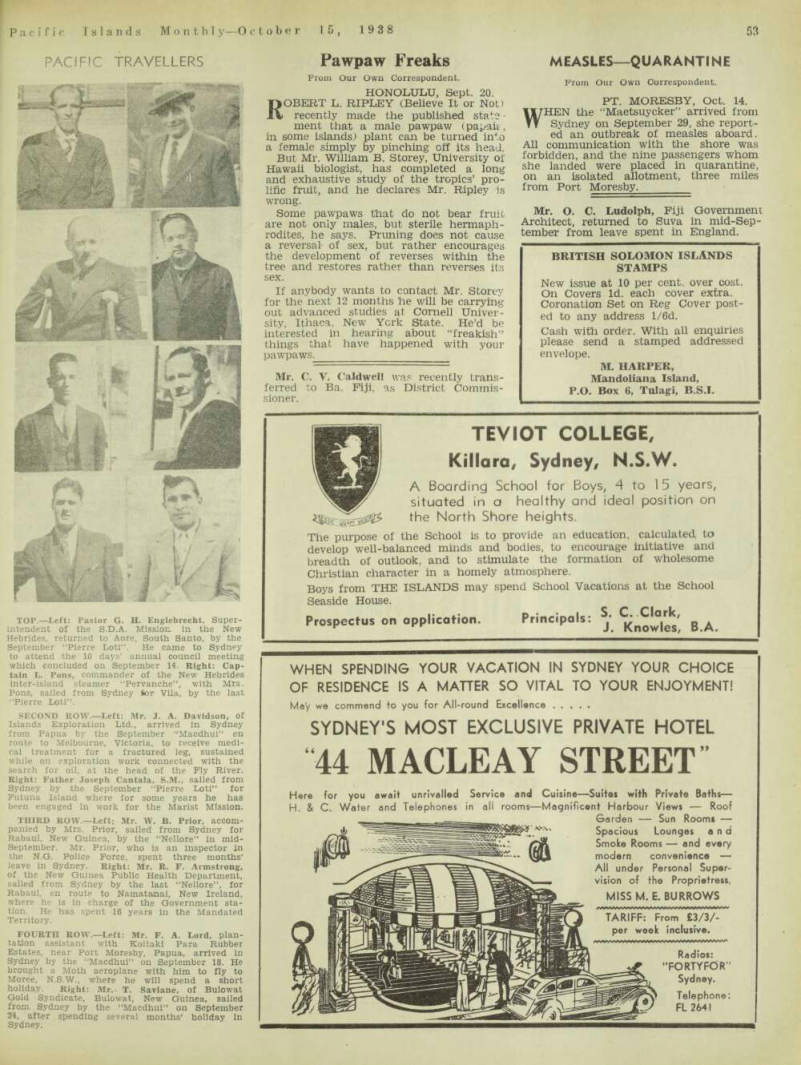
TOP.—Left: Pastor G. H. Englebrecht, Super intendent of the S.D.A. Mission, in the New Hebrides, returned to Acre, South Santo, by the September “Pierre Loti”. He came to Sydney to attend the 10 days’ annual council meeting which concluded on September 14. Right: Cap tain L. Pons, commander of the New Hebrides inter-island steamer “Pervanche”, with Mrs.
Pons, sailed from Sydney for Vila, by the last “Pierre Loti”.
SECOND ROW.—Left: Mr. J. A. Davidson, of Islands Exploration Ltd., arrived in Sydney from Papua by the September “Macdhui” en route to Melbourne, Victoria, to receive medi cal treatment for a fractured leg, sustained while on exploration work connected with the search for oil, at the head of the Ply River.
Right: Father Joseph Cantala, S.M., sailed from Sydney by the September “Pierre Loti” for Futuna Island where for some years he has been engaged in work for the Marist Mission, THIRD ROW.—Left: Mr. W. B. Prior, accom panied by Mrs. Prior, sailed from Sydney for Rabaul, New Guinea, by the “Nellore” in mid- September. Mr. Prior, who is an inspector in the N.G. Police Force, spent three months’ leave in Sydney. Right; Mr. R. F. Armstrong, of the New Guinea Public Health Department, sailed from Sydney by the last “Nellore”, for Rabaul. en route to Namatamai, New Ireland, where he is in charge of the Government sta tion. He has spent 16 years in the Mandated Territory.
FOURTH ROW.—Left: Mr. F. A. Lord, plan tation assistant with Koitaki Para Rubber Estates, near Port Moresby, Papua, arrived in Sydney by the “Macdhui” on September 18. He brought a Moth aeroplane with him to fly to Moree, N.S.W., where he will spend a short holiday. Right: Mr, T. Saviane, of Bulowat Gold Syndicate, Bulowat, New Guinea, sailed from Sydney by the “Macdhui” on September 24, after spending several months’ holiday In Sydney.
Pawpaw Freaks
From Our Own Correspondent.
Honolulu, Sept. 20.
ROBERT L. RIPLEY (Believe It or Not) recently made the published state • ment that a male pawpaw (papau, in some islands) plant can be turned into a female simply by pinching off its head.
But Mr. William B. Storey, University of Hawaii biologist, has completed a long and exhaustive study of the tropics’ pro lific fruit, and he declares Mr. Ripley is wrong.
Some pawpaws that do not bear fruit are not only males, but sterile hermaph rodites, he says. Pruning does not cause a reversal of sex, but rather encourages the development of reverses within the tree and restores rather than reverses its sex.
If anybody wants to contact Mr. Storey for the next 12 months he will be carrying out advanced studies at Cornell Univer sity, Ithaca, New York State. He’d be interested in hearing about “freakish” things that have happened with your pawpaws.
Mr, C. V. Caldwell was recently trans ferred to Ba, Fiji, as District Commis sioner.
Measles—Quarantine
Prom Our Own Correspondent.
Pt. Moresby, Oct. 14.
WHEN the “Maetsuycker” arrived from Sydney on September 29, she report ed an outbreak of measles aboard.
All communication with the shore was forbidden, and the nine passengers whom she landed were placed in quarantine, on an isolated allotment, three miles from Port Moresby.
Mr. O. C. Ludolph, Fiji Government Architect, returned to Suva in mid-Sep tember from leave spent in England.
Mr. T. N. Tudberry, overseer of Arigua plantation, Kieta, New Guinea, is at pre sent spending holidays in Queensland.
Rt. Rev. Henry Newton, D.D., who re tired two years ago after having served for 14 years in Papua as Bishop of New Guinea, has returned to the Territory ana is still carrying on mission work. He has lately undertaken to fill the place of the Rev. C. Whonsbon-Aston, who has had charge of the work of the Australian Board of Missions at Mukawa, but who is now in Australia on a year’s sick leave, during which he will do curacy work at All Saints, St. Hilda, Victoria. Bishop Newton has been in the Anglican ministry for 47 years, and he is regarded in Papua as one of the greatest friends the natives ever have had.
Advertisements & other items, pp. 59-60 (2 items)
53
Pacific Islands Monthl y —O ctober 15, 1938
44 Macleay Street
BRITISH SOLOMON ISLANDS
STAMPS
New issue at 10 per cent, over cost.
On Covers Id. each cover extra.
Coronation Set on Reg Cover posted to any address l/6d.
Cash with order. With all enquiries please send a stamped addressed envelope.
M. HARPER,
Mandoliana Island, P.O. Box 6, Tulagl, 8.5.1.
TEVIOT COLLEGE,
Killara, Sydney, N.S.W.
A Boarding School for Boys, 4to 15 years, situated in a healthy and ideal position on the North Shore heights.
The purpose of the School is to provide an education, calculated, to develop well-balanced minds and bodies, to encourage initiative and breadth of outlook, and to stimulate the formation of wholesome Christian character in a homely atmosphere.
Boys from THE ISLANDS may spend School Vacations at the School Seaside House.
Prospectus on application.
Principals: S. C. Clark, J. Knowles, B.A.
WHEN SPENDING YOUR VACATION IN SYDNEY YOUR CHOICE OF RESIDENCE IS A MAHER SO VITAL TO YOUR ENJOYMENT!
May we commend to you for All-round Excellence
SYDNEY'S MOST EXCLUSIVE PRIVATE HOTEL
44 MACLEAY STREET
Here for you await unrivalled Service and Cuisine—Suites with Private Baths H. & C. Water and Telephones in all rooms—Magnificent Harbour Views — Roof Garden — Sun Rooms — Spacious Lounges and Smoke Rooms — and every modern convenience — All under Personal Supervision of the Proprietress,
MISS M. E. BURROWS
-Vr*
TARIFF: From £3/3/-
per week Inclusive.
Radios:
■FORTYFOR"
Sydney.
Telephone: FL 2641
For Electrical and Radio Equipment you cannot do better than place your inquiries with Noyes Bros.
Crompton Coiled Coil and Single Coil Lamps . . . Kriesler All electric and Battery-operated Radio . . . Ferranti Meters and Transformers . . . Simpson Electric Turntables . . .
Household Electric Appliances . . . Rodgers Cutlery . . .
Perfection Silverware . . . Electrical Fittings . . . Crompton Fans for home, office, store and factory . . . Callender Wires, Cables and Flexibles for indoor and outdoor installations . . . Seyon Floodlighting Equipment for tennis courts, etc.
NOYES BROS. (**•») LTD.
115 CLARENCE ST., SYDNEY
11 WATT ST., NEWCASTLE. 197 ELIZABETH ST., BRISBANE.
AUSTRALIAN
BULLDOG BATTERIES
• These Batteries DO NOT LOSE CHARGE WHEN NOT IN USE . . . • Plates DO NOT BUCKLE and Term-
inals DO NOT CORRODE
• Radio type are UNCONDITIONAL-
LY GUARANTEED FOR THREE
YEARS.
You will SAVE MONEY by Using BULLDOG BATTERIES Write to ... .
Continental Compensations Pty. Ltd.,
422 COLLINS ST., MELBOURNE, VIC.
We also Supply—
DIESEL ENGINES OF ALL TYPES.
A BATTERY ■
FOR
EVERY
PURPOSE
Tahiti
New Birds For
Interesting and Valuable Experi ment in Aviculture
From Our Own Correspondent.
Papeete, Sept. 20.
OUR island of Tahiti is particularly fortunate in having as residents men and women endowed with special knowledge and of that quality of spirit which inspires them to apply their know ledge to the welfare of the colony.
A great deficiency, in otherwise ideal surroundings, is the poverty of bird life in the islands.
The Itatae, which fly in pairs and look like seraphim against the sapphire of our southern sky; the Rupe, our handsome mountain pigeon; the Uupa, the dove of Tahiti; and even the dismal Upoa, which flies by night crying the wail of a lost spirit; have been decimated almost to extinction by gunmen who slay for the de light of killing, and by predatory hawks introduced many years ago.
Mr. Eastham Guild, of Paea, Tahiti— for many years a serious student ol avi culture—has been, for seme time, carrying on experiments to remedy this deficiency.
In the Journal of the Avicultural Society of Great Britain, Mr. Guild has given a most interesting account of his under taking;— “Since the climatic conditions were fav ourable, and the profusion of grasses, weeds and flowers provided a variety of foods, I could see no reason why certain small birds from other countries of similar climate should not thrive here, and I started the experiment with a few Fire Pinches and Cordon Bleus, which I per sonally brought with me from Dakar, West Africa.
“The French Government has been very sympathetic in my experiments, giving me necessary permits to import birds, and has passed local laws prohibiting all shooting and trapping. Likewise, the British Con sul-General has aided me considerably to obtain permits to secure some of the ex quisite and rare Australian Finches.
“I am just now expecting, through the courtesy of Mr. H. B. Brown, Secretary of the Taronga Zoo, of Sydney, a ship ment of about 500 birds from Australia, including Gouldian, long-tailed, and Star Finches, all to be liberated as soon as they have been properly conditioned.
“So far, I have liberated about 6,000 birds of fifty different kinds. As to re sults, the species may be divided into the following classes:— Birds Which Have Nested and Reared Young Gouldian, Double Bar, Zebra, Masked, Long Tailed and Fire Finches; Euphonia, Mrs. Wilson’s, Maroon and Black Tan agers; African, Orange-Breasted, Orange Cheeked and St. Helena Waxbills; Gol den and Ringneck Pheasants; Cordon Bleu; Indian Amaduvade; Magpie Man nikin, California Quail and Mallard Duck.
Birds Which Come to be Fed, But Have Not Nested Rufous-Tailed, Blue-Faced and Tri coloured Parrot Finches; Diamond Spar row; Yellow-Winged Sugarbird; New Zealand Zosterop; and Pekin Robin.
“Gradually, through the presence of the birds I have imported, people on the is land are becoming bird-conscious.
“His Excellency, Monsieur Chastnet de Gery, has established a feeding-dish in the grounds at Government House; also Mr.
James Norman Hall has put one up on his property to attract any birds that may wander to his side of the island. Mr.
Charles B. Nordhoff, who is keenly in terested in water-fowl, has done a great deal to promote this interest by liber ating Wood and Mandarin Duck, as well as California Quail and Pheasants, “We are receiving great help and en couragement from France through the un tiring efforts of Monsieur Jean Delacour who is doing everything possible to pro tect birds throughout the French colonies.”
Mr. Guild’s handsome estate at Paea is ideally situated for the successful carrying out of his objectives in aviculture, and is thoroughly equipped for this purpose.
Advertisements & other items, pp. 60-61 (3 items)
54
Pacific Islands Monthl y—O ctober 15, 1938
55
Pacific Islands Monthl y—o ctober 15, 1938
Shell
Aes'P
\ eMe«H
4ovn°
at\A
m start the engine Just think of the number of starts, the times you accelerate, slow down and accelerate again, the uphill as well as the flat running you do every time you take the car out. You • • . (6) o & drive off, gear changing slow down for a kiddie, then and accelerating • • accelerate again • • as Q) i Q) slow down for an obstructing car, then accelerate . • step on it going uphill j\Vn call in at a friend's place . • Another start, gear pull up at shop changing and accelerating • . then another start, changing gears and accelerating . .
This "stop-and-go" driving wastes petrol unless you drive on Shell.
The unrivalled volatility and extra energy content of Shell means many savings to you. On starting you get away immediately, because your engine develops full power at the press of the starter. With gearchanging, the surging power ensures that you change up sooner and more smoothly. You spend less time in low gears. When you accelerate swiftly you get instant response from your engine, and on bends and hills the extra power which Shell provides will take you over in M top ,, .
So - use the most powerful - therefore, the most economical spirit, Shell.
SHELL
Saves on 'STOP-and-GO Drivinq
THE SHELL COMPANY OF AUSTRALIA LTD. (Incorporated in Great Britain) 0!
Kwato Mission
And Trade
Hope of the Oxford Group Movement
Letter to the Editor.
SNOOPING around among broadcast and short wave, on the night of 20th July last, we were startled to hear the announcement “Mr. Russell Abel, of Kwato, will now tell us of the inter esting work in the dissemination amongst the local natives of the new cult, com monly called the O.G.M. (Oxford Group Movement); and of the astonishing changes made in village fife and customs.”
If we can believe Mr. Russell Abel the millenium has at last arrived in Papua; or, if not in the whole of the Territory, at least amongst the anthropophagi dwel ling in the vicinity of that much-boosted industrial mission.
Dwelling, as we do, in the Stygian darkness of the D’Entrecasteaux Group, where lying is a fine art, thieving a
science, and the pursuit of the other fel low’s wife about the only recreation left since the Government prohibited fighting, we can only conclude that either Mr. Rus sell Abel is a cheerful and fatuous opti mist, or aU we have ever known about brown brother in general, and the Papuan in particular for 30 years, has been just a bad dream.
That the new cult should have taken root at Kwato proves that the age of miracles is not past—either that, or we must accuse Mr. Abel of broadcasting an interesting and descriptive account of what is, at best, a passing and imperman ent phase of village life. If, twelve months from now, any vestige of the O.GM. can be found among the oily, greasy mass of “rascality” that inhabits Rogeia, and other islands adjacent, settlers in Papua will be considerably surprised, and it will then be time for Messrs. Abel and Baskett to exhibit a modicum of optimistic satis faction.
The Eastern Papuan possesses in full the capacity to be “all things to all men”.
He follows the line of least resistance,.or rather the practice of it; and keeps one side of his make-up for the Government:
one for the Mission; and one for “Tau badas” of the common or garden variety.
A brief conversation with any member oi these sections of the white community will bear this out, and show why they seldon can see eye to eye on any matter relating to the native.
The present propaganda from Kwato is quite understandable. It is an “Indus trial Mission’ , which, to be interpreted, is a Mission that usually spells business with a big B.
Kwato, as a Mission, through the years has been an immense power for good, especially so latterly, through its medical work and hospital. This phase of its activity recommends it to all unprejud iced persons; and it needs bolstering by neither fiction nor fairy-tales.
Kwato as a business and trading com pany is quite a different proposition. No ship-owner, boat-builder, engineer or trader can hope to compete with them.
Their student and other sources of cheap labour enable them to under-cut any competitor, and the financial standing and credit they possess as a Mission gives them the advantage where there is any trading opposition of any kind. What they lose on the swings of business they can recoup on the roundabouts of public subscriptions.
Small wonder then, that at the men tion of Kwato, local tradesmen begin to exhibit all the symptoms of an apoplectic attack, and make use of language usually described as “unparliamentary”.
However, for these unfortunate exiles there is hope at last. If the O.G.M. can so touch the black hearts of head-hunt ing cannibals as to enable them to climb the dizzy heights of moral rectitude, and. without difficulty, breathe the rarefied air of incorruptible virtue (accompanied of course by Messrs Russell Abel and Geoffrey Baskett), then surely the Move ment will also touch the flinty hearts of those who guide the business side of Kwato Extension, Inc., so that competi tion will be tempered with mercy, and a modicum of compassion will be extended to those settlers who dwell within the field of Kwato operations, and who have (unlike most Missionaries) to live by “the toil of their hands, and the sweat of their brows”.
At least, let us hope so.
I am, etc.
E. W. Harrison.
Sebulugomwa, Papua. 27/8/’3B.
Mr. L. V. Waterhouse, managing dir ector of Bulolo Gold Dredging, Ltd., sailed from Sydney for Port Moresby, Papua, by the “Maetsuycker” on September 24.
He connected with Guinea Airways air liner and flew across to the Morobe gold field, New Guinea.
Advertisements & other items, p. 62 (2 items)
56
Pacific Islands Mont hi y—o ctober 15, 1938
When making gout IViU
HONESTY FIDELITY
Safeguard your interests. Ensure their protection and security. Avail yourself of the advantages to be derived from the appointment of this Company as your trustees, in preference to any one individual. Write to or call on any Branch of Burns, Philp <S Company Limited, or Bums Philp (South Sea) Company, Limited, for the folder which fully explains these advantages.
Give careful consideration to the benefits to b© gained by appointing as your Executors—
BURNS PHILP TRUST CO. LTD.
DIRECTORS
JAMES BURNS LEWIS ARMSTRONG
ROBERT JOHN NOSWORTHY JOSEPH MITCHELL
BURNS PHILP TRUST CO. LTD.
CAPITAL— £SO,OOO 7 BRIDGE STREET SYDNEY, N.S.W.
Protect Your Property With Years’ Experience The Result of Over mi mm*) Obtainable from - - ALL BRANCHES . . . BURNS, PHILP Cr CO. LTD.
Samoan Pioneer Passes On

Prom Our Own Correspondent.
APIA, Sept. 20.
ONE of the few remaining pioneers and “old-timers” of Samoa, died recently, in the person of Mr. Henry Achatz, of
Mataur.uuta, at the age of 79 years. He was born at Harmony, Minnesota, U.S.A, and came to Samoa 47 years ago from South America. He started a plantation and business of his own, and was well respected for his honest and straightfor ward ways. He leaves a widow and a large family to mourn their loss.
Mr. Henry Acbatz.
67 Years Since Bishop Patteson's
Murder
THE 67th anniversary of the murder of Dr. John Coleridge Patteson, Bishop of Melanesia, by natives at Nukapu, in the Santa Cruz group on Sep tember 20, 1871, was celebrated in Auck land on September 20 by the Bishop of Melanesia (Rt. Rev. W. H. Baddeley).
The murder of Bishop Patteson was due to a tragic error. The bishop had for years protested unavailingly against the iniquities of recruiters of kanaka labour impersonating missionaries to faci litate kidnapping. Bishop Patteson visited Nukapu, and at the request of two na tives, went ashore in a native canoe instead of in his own boat. He was clubbed to death in a native hut ashore, his body, rolled in a native mat, being recovered from a canoe turned adrift from the shore.
Mr. J. Hayes, of the accounts branch of the B.N.G. Trading Co., Port Moresby.
Papua, arrived in Brisbane recently by the “Montoro” on leave.
Pilot Norm. Fader has left the services of Mandated Airlines, Ltd., New Guinea and is now flying with Guinea Airways.
Ltd
Advertisements & other items, p. 63 (2 items)
57
Pacific Islands Monthl y—o ctober 15, 1938
Nockekirbyltd
MOCK Sr KIRBY LTD
FOR YOUR HOME
WS& ph/*/
with a “JOHNSON
“Iron-Horse” Generator
Lights twelve
25 watt globes
300 WATTS
12 VOLTS
Why deny yourself the comfort and convenience of Electric Light and Power for your Radio? With a Johnson “Iron Horse” Generator Electric Light actually costs you less than the messy, dangerous, old-fashioned Lamps—for approximately 1/- you can use 3 lights for hours every night in the week.
Never before has it been possible to offer such real comfort at such small cost. You no longer need to be inconvenienced with the old-style lighting . . . Electric Light, the great boon of to-day's civilisation, is now available quickly and economically—at the touch of a switch the Johnson "Iron Horse" Generator makes possible economical Electric Light for your home and build ings, and at the same time provides Power for your Radio and Power tor Charging Batteries.
Here are a Few of the more Important Features ; 300 WATTS ... 12 VOLTS . . . Lights 12-25 Watt Globes . . . ELECTRIC STARTING—just push a button . . . FULL RANGE CONTROL . . Special Built-in Generator—Johnson Iron Horse 4-Cycle Petrol Engine . . .
AUTOMATIC CUT-OUT disconnects when not running . . . Quiet Operation . . . Minimum Vibration.
CASH PRICE, with 70 Amp. Battery /j 1 1 ex bond Approx, cost per Point for Material Only 12/fi. Weight when packed 100 lbs. Freight extra. Write for illustrated Iron Horse Generator Folder giving complete specifications.
NOCKeKIRBYLTD
PostalAddress. m 4150Y G.P.O. SYDNEY
•*. i »■ - ' -
Polynesia At New York
World Fair
From Our Own Correspondent.
Honolulu, Sept. 30.
POLYNESIA will be strongly represented at the New York World Fair in 1939, in a display that will cover 46,000 sq. feet, landscaped to represent a tropical garden, in which appropriate buildings will be erected for exhibits of Polynesian culture from primitive to modem times.
This announcement was made this week by Mr. John H. Wilson, postmaster, of Honolulu, and veteran showman, who has entered into a partnership with New York promoters.
Hawaii and Samoa representatives will be chosen from the communities here, but in January Mr. Wilson will sail for Fiji.
New Zealand and Tahiti to engage at least 20 men and women from each group. Mr.
Wilson will be accompanied by an agent of the New York group.
Preference will be given to troupes al ready experienced in public performances.
In Tahiti Mr. Wilson hopes to enlist fire walkers. Artisans will be chosen so that they may demonstrate their arts and crafts in the shadow of Manhattan’s towers.
Mr. J. B. Collins, of W. R. Carpenter & Co,, Ltd., Salamaua. New Guinea, ar rived in Sydney by the “Macdhui” in September, for three months’ furlough.
Mr. A. Cooper, formerly with Cuthbert’s Misima Goldmine, Co., Ltd., Misima Is land, Eastern Papua, arrived in Sydney re cently by the “Macdhui”.
Healthy Finance
Samoan Report for 1937-38
From Our Own Correspondent.
APIA, Sept. 13.
THE annual report of the Mandated Territory of Western Samoa for the year ended March 31, 1938, shows the following:— One of the Samoan seats in the Legis lative Council is still vacant owing to the nomination of the Mau of Mr. O. P Nelson for the seat. Mr. Nelson, owing to his European status, is ineligible. The report mentions the formation of a Sam oan Party in opposition to the Mau Movement.
There is an admission of the failure of the experiment of the Government-owned N.Z. Reparations Estate? to replace Chin ese plantation labour with Samoan lab our. It is stated that “very few natives have availed themselves of facilities to reside permanently on the plantations and the resident Samoans have been limi ted to two drier attendants”.
Health conditions in the Territory dur ing the year compare favourably with the preceding year. A striking reduction in infant mortality was recorded, ascribed to intensified baby welfare work and pro gressive medical and sanitary education among the natives. During the year, 16,800 Samoan fales were visited and 1.820 vilage inspections carried out. Over 72 women’s village committees are in ex istence, and collaborate with the Medical Department and the Native medical prac titioners.
Trade in 1937 was the best since 1928 total trade being £620,304 against £430,275 for the previous year, an increase of 44.16 per cent., mainly due to better prices for copra and cocoa during the first half of 1937 and an increase in banana ex ports, which reached the record figure of 187,755 cases.
In consequence of improved trade condi tions, the finances of the Samoan Admini stration were the best for many years past, and a surplus of £3BO is shown after the payment of £5,500 in direct redemp tion of debt, the setting aside of £5,000 for the proposed replacement of the bridge over the Vaisigano River, and a further £8,500 for the 1938-39 building programme. The accumulated surplus at March, 1938, was £24,561, apart from re serves for replacements of assets, and for building purposes, totalling £25,000. The total revenue of the Administration in 1937-38 was £139,450, the highest since 1920-21.
61 Natives Fined
THE volcanologists, last year, urgently recommended the removal of the Rapindik native hospital, on the out skirts of Rabaul, on the ground that it is very dangerously situated near to Matupi volcano. The administration, accordingly, surveyed a section of native land, in the Ratavul district, as a preliminary to plac ing the hospital there. The natives, how ever, pulled up the survey pegs, and the work could not continue.
On September 26, in Rabaul, 61 natives were charged with having removed the pegs. All pleaded guilty and were con victed.
Mr. Norman Davies has taken over the management of the Cosmopolitan Hotel, Samarai, Papua.
Advertisements & other items, p. 64 (2 items)
58
Pacific Islands Monthl y—O ctober 15, 1938
Your Tropical Rit
When you visit the Pacific Islands, whether on Business or Pleasure, you need Special Equipment—Light Suits of Correct Style, which fit well and launder easily; Tunic Shirts Silk Shirts. Light Underwear, White Shoes, etc.
WALTER HORNE & CO. LTD., established in 1885, specialise in this Service. Skilled Tailors make your Suits from First-class material within 24 hours. Complete equipment can be supplied from our Large Stocks at Reasonable, Moderate Prices.
BUY FROM THE FIRM WHICH UNDERSTANDS YOUR NEEDS AND
DRESSES YOU CORRECTLY
WALTER HORNE & CO. LTD., carry a Full Range of Drapery of all kinds; also Frocks, Millinery, Foundations and Lingerie, Hosiery, Shoes and Sandals, Ribbons and Laces, Household Drapery.
Men resident in any of the Pacific Territories can be supplied with Suitable Clothes.
Ladies' Hairdressing and Manicuring
Write to us and Describe your Requirements.
WALTER HORNE & CO. LTD.
Drapers and Men's Wear Specialists
SUVA, FIJI
A. B. DONALD LTD.
AUCKLAND
ISLAND TRADERS :: GENERAL MERCHANTS
P. O. Box 1509 Cables and Telegrams: M K•.ngdom, ,, Auckland Branches at Rarotonga and throughout the Cook Islands At Papeete and throughout the Society, Marquesas and Paumotu Islands
trading as " ETABLISSEMENTS DONALD, TAHITI"
At Fiji: Trading as "Dominion Fruit C 0.," Suva
Uawana, Beware!
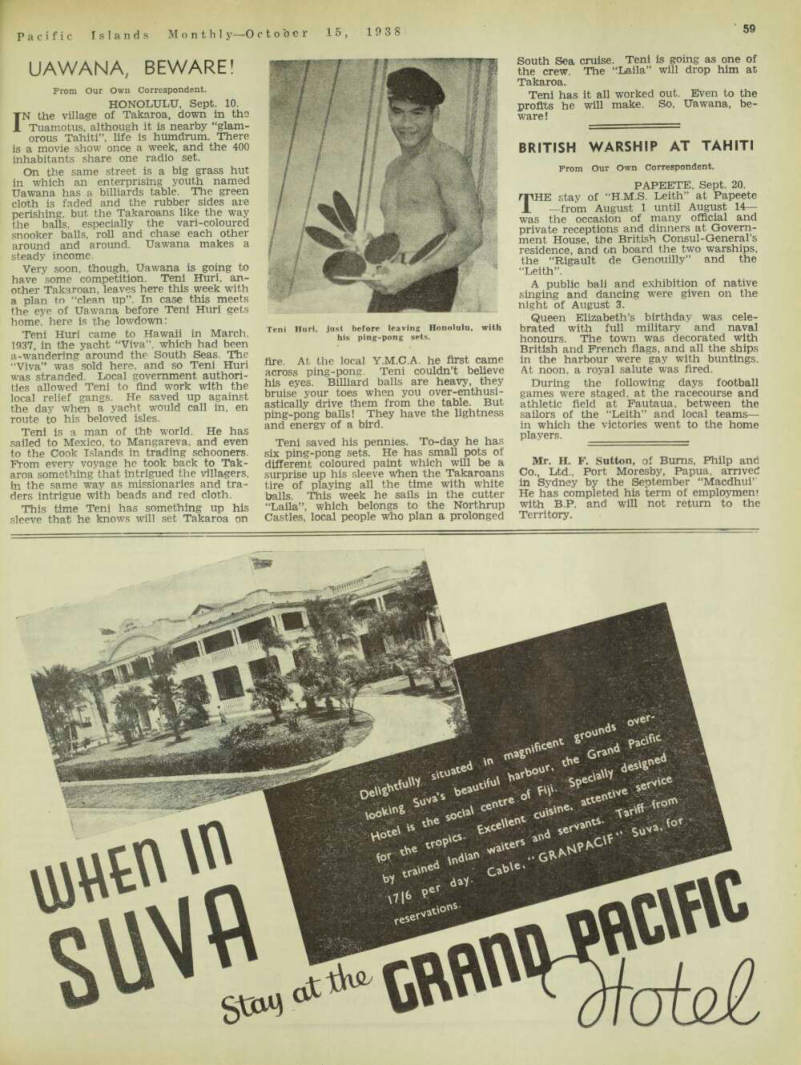
From Our Own Correspondent.
Honolulu, Sept. 10.
IN the village of Takaroa, down in the Tuamotus, although it is nearby “glam orous Tahiti”, life is humdrum. There is a movie show once a week, and the 400 inhabitants share one radio set.
On the same street is a big grass hut in which an enterprising youth named Uawana has a billiards table. The green cloth is faded and the rubber sides are perishing, but the Takaroans like the way the balls, especially the vari-coloured snooker balls, roll and chase each other around and around. Uawana makes a steady income.
Very soon, though, Uawana is going to have some competition. Teni Huri, an other Takaroan, leaves here this week with a plan to “clean up”. In case this meets the eye of Uawana before Teni Huri gets home, here is the lowdown: Teni Huri came to Hawaii in March, 1937, in the yacht “Viva”, which had been a-wandering around the South Seas. The “Viva” was sold here, and so Teni Huri was stranded. Local government authori ties allowed Teni to find work with the local relief gangs. He saved up against the day when a yacht would call in, en route to his beloved isles.
Teni is a man of thfe world. He has sailed to Mexico, to Mangareva, and even to the Cook Islands in trading schooners.
Prom every voyage he took back to Tak aroa something that intrigued the villagers, in the same way as missionaries and tra ders intrigue with beads and red cloth.
This time Teni has something up his sleeve that he knows will set Takaroa on
fire. At the local Y.M.C.A. he first came across ping-pong Teni couldn’t believe his eyes. Billiard balls are heavy, they bruise your toes when you over-enthusi astically drive them from the table. But ping-pong balls! They have the lightness and energy of a bird.
Teni saved his pennies. To-day he has six ping-pong sets. He has small pots of different coloured paint which will be a surprise up his sleeve when the Takaroans tire of playing all the time with white balls. This week he sails in the cutter “Laila”, which belongs to the Northrup Castles, local people who plan a prolonged
South Sea cruise. Teni is going as one of the crew. The “Laila” will drop him at Takaroa.
Teni has it all worked out. Even to the profits he will make. So, Uawana, be ware!
Teni Hurl, just before leaving Honolulu, with his ping-pong sets.
British Warship At Tahiti
From Our Own Correspondent.
Papeete, Sept. 20.
THE stay of “H.M.S. Leith” at Papeete —from August 1 until August 14 — was the occasion of many official and private receptions and dinners at Govern ment House, the British Consul-General’s residence, and on board the two warships, the “Rigault de Genouilly” and the “Leith”.
A public ball and exhibition of native singing and dancing were given on the night of August 3.
Queen Elizabeth’s birthday was cele brated with full military and naval honours. The town was decorated with British and French flags, and all the ships in the harbour were gay with buntings.
At noon, a royal salute was fired.
During the following days football games were staged, at the racecourse and athletic field at Fautaua, between the sailors of the “Leith” and local teams— in which the victories went to the home players.
Mr. H. F. Sutton, of Bums, Philp and Co., Ltd., Port Moresby, Papua, arrived in Sydney by the September “Macdhui’
He has completed his term of employment with B.P. and will not return to the Territory.
Advertisements & other items, p. 65 (1 item)
*
so*
SVW
Pitcairn Laws
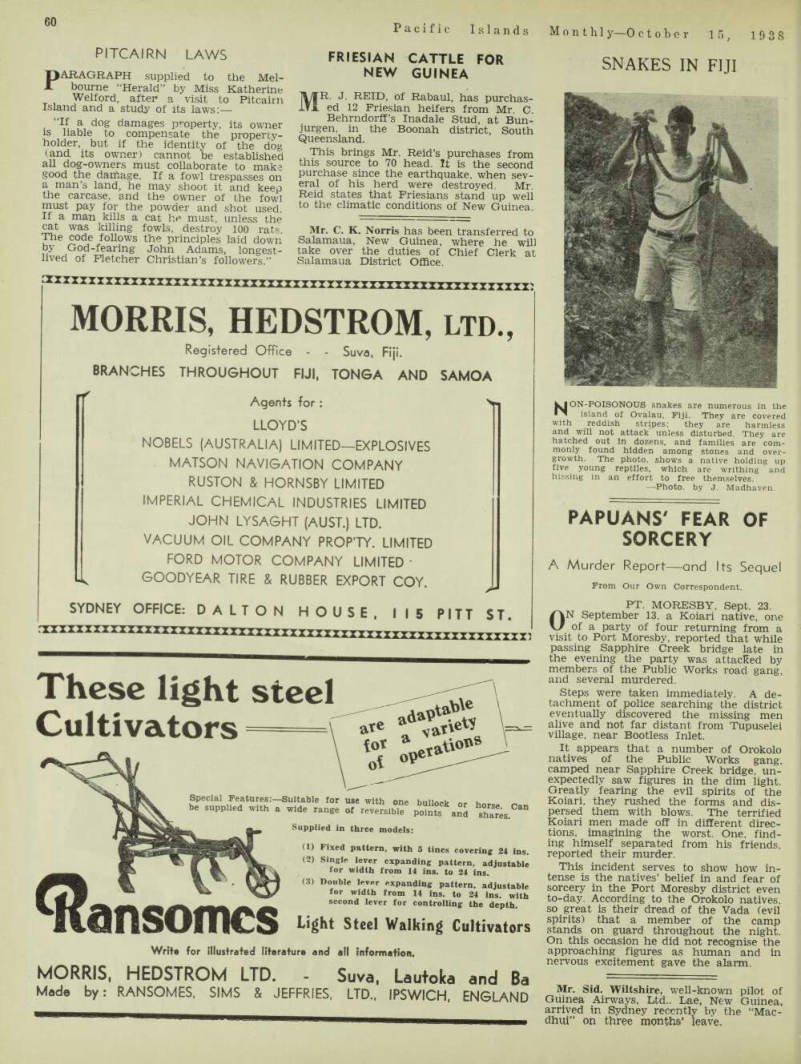
PARAGRAPH supplied to the Mel bourne “Herald” by Miss Katherine Welford, after a visit to Pitcairn Island and a study of its laws;— “If a dog damages property, its owner is liable to compensate the property holder, but if the identity of the dog (and its owner) cannot be established all dog-owners must collaborate to make good the damage. If a fowl trespasses on a man’s land, he may shoot it and keep the carcase, and the owner of the fowl must pay for the powder and shot used.
If a man kills a cat he must, unless the cat was killing fowls, destroy 100 rats.
The code follows the principles laid down by God-fearing John Adams, longest lived of Fletcher Christian’s followers,”
Friesian Cattle For
New Guinea
MR. J. REID, of Rabaul, has purchas ed 12 Friesian heifers from Mr C Behrndorff’s Inadale Stud, at Bun jurgen, in the Boonah district, South Queensland.
This brings Mr. Reid’s purchases from this source to 70 head. It is the second purchase since the earthquake, when sev eral of his herd were destroyed. Mr.
Reid states that Friesians stand up well to the climatic conditions of New Guinea.
Mr. C. K. Norris has been transferred to Salamaua, New Guinea, where he will take over the duties of Chief Clerk at Salamaua District Office.
Snakes In Fiji
NON-POISONOUS snakes are numerous in the island of Ovalau, Fiji. They are covered with reddish stripes; they are harmless and will not attack unless disturbed. They are hatched out in dozens, and families are com monly found hidden among stones and over growth. The photo shows a native holding up five young reptiles, which are writhing and hissing in an effort to free themselves. —Photo, by J. Madhaven.
Sorcery
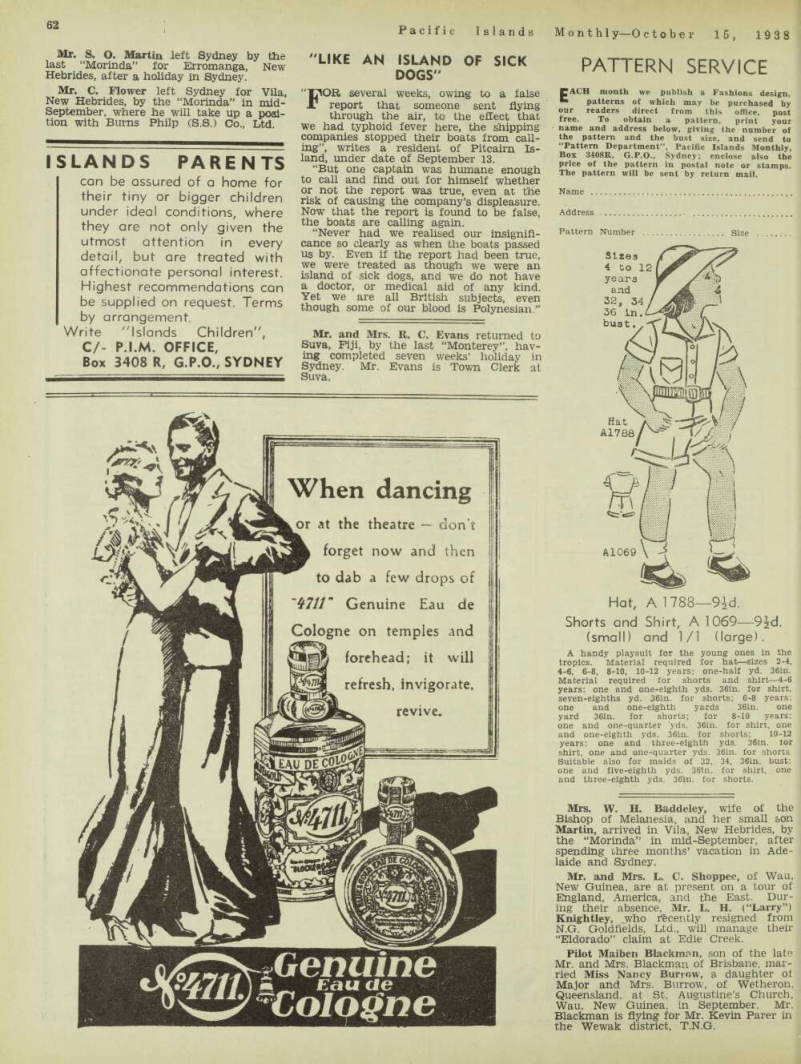
Papuans' Fear Of
A Murder Report—and Its Sequel
From Our Own Correspondent.
Pt. Moresby, Sept. 23.
ON September 13, a Koiari native, one of a party of four returning from a visit to Port Moresby, reported that while passing Sapphire Creek bridge late in the evening the party was attacked by members of the Public Works road gang, and several murdered.
Steps were taken immediately. A de tachment of police searching the district eventually discovered the missing men alive and not far distant from Tupuselei village, near Bootless Inlet.
It appears that a number of Orokolo natives of the Public Works gang, camped near Sapphire Creek bridge, un expectedly saw figures in the dim light.
Greatly fearing the evil spirits of the Koiari, they rushed the forms and dis persed them with blows. The terrified Koiari men made off in different direc tions. imagining the worst. One, find ing himself separated from his friends, reported their murder.
This incident serves to show how in tense is the natives’ belief in and fear of sorcery in the Port Moresby district even to-day. According to the Orokolo natives, so great is their dread of the Vada (evil spirits) that a member of the camp stands on guard throughout the night.
On this occasion he did not recognise the approaching figures as human and in nervous excitement gave the alarm.
Mr. Sid. Wiltshire, well-known pilot of Guinea Airways, Ltd.. Lae, New Guinea, arrived in Sydney recently by the “Mac dhui” on three months' leave.
Mr. S. O. Martin left Sydney by the last “Morinda” for Erromanga, New Hebrides, after a holiday in Sydney.
C- . Flower left Sydney for Vila, Hebrides, by the ‘‘Morinda’’ in mid- E r?2 Sl ‘ tion with Bums Philp (S.S.) Co., Ltd.
Advertisements & other items, pp. 66-68 (4 items)
60
Pacific Islands Monthl y—o ctober 15, 1028
Morris, Hedstrom, Ltd.,
Registered Office - - Suva, Fiji.
BRANCHES THROUGHOUT FIJI, TONGA AND SAMOA
Agents for : Vi
LLOYD'S
NOBELS (AUSTRALIA) LIMITED—EXPLOSIVES
MATSON NAVIGATION COMPANY
RUSTON & HORNSBY LIMITED
IMPERIAL CHEMICAL INDUSTRIES LIMITED
JOHN LYSAGHT (AUST.) LTD.
VACUUM OIL COMPANY PROP'TY. LIMITED
FORD MOTOR COMPANY LIMITED ■
GOODYEAR TIRE & RUBBER EXPORT COY. J.
SYDNEY OFFICE: DALTON HOUSE. 115 PITT ST.
These light steel
Cultivators
p a daP^„ at e \ va t* eW
ilotvs
op cta Special Features:-Suitable for use with one bullock or hnr» „ be supplied with a wide range of reversible points anS shares Supplied in three models: (1) Fixed pattern, with 5 tines covering 24 ins. (2) Single lever expanding pattern, adjustable for width from 14 ins. to 24 ins. (3) Double lever expanding pattern, adjustable for width from 14 ins. to 24 ins. with second lever for controlling the depth.
Light Steel Walking Cultivators
Write for illustrated literature and all information.
MORRIS, HEDSTROM LTD. - Suva, Lautolca and Ba Made by: RANSOMES, SIMS & JEFFRIES, LTD., IPSWICH, ENGLAND
ansomes
61
Pacific Islands Monthl y—o ctooer 15, 1038
Freemans
For Quality Goods at Low Prices
ESTABLISHED SINCE 1905
165-167 Castlereagh St., Sydney, N S.W.
Powerful Field Glasses.
I Extra-powerful Field Glasses, centre complete in case focus, 21/-.
“Lumiere” Paris, High-power, Field Glasses, centre focus, with case and strap ... 30/-.
Extra High-power, Marine Glasses, day and night use, centre focus, in case . .. 46/-.
French “Prisma” Field Glasses, large eyepieces, 6X, wide vision. With strap and leather case 55/- “Carlmere” Field Glasses, with sun shield, extra powerful, in case 50/- “Carlex” 8 x 25 Binocular Field Glasses, extra powerful, centre focus, with shoulder strap, in solid leather case, suitable for races, marine or field use £4/15/-.
“Delmar” 8 x 25 Prismatic Binocular Field Glasses, wide range, centre focus, with strap and solid leather case £4/19/6.
“Achromatic” Field Glasses, War Office model, extra powerful, wide range, complete with shoulder strap, in solid leather case £ 3/15/-/.
"Audemair”, 8 x 30 Prismatic Field Glasses, extra-wide optics, central and individual focus, complete with strap and case, £6/10/- Postage Paid on all Field Glass Orders.
Bicycles.
Good Strong Bicycles, slightly used, fixed or free wheel, with brake, in good order 45/- Gent’s Roadster Bicycle, free wheel, electric dynamo and lamp, handbrake, good tyres and tubes, slightly used: £B/15/-.
“Speedwell” Bicycle, Club-racer, brazed on back stays, free wheel, t a pered frame, hand - brake, slightly use d £4/19/6 Brand-new Gent’s “Oxford” Special Roadster Bicycle.
Equipment: Brake, - lamp, tools, free wheel .. £5/19/6.
Lady’s brand new “Oxford” Special Cycle, fitted with free wheel, dress nets, chain guard, mud guards, spring top saddle and handbrake. All English fittings throughout A variety of colors. At the amazing price of .. .. £6/19/6.
I Gent’s Brand-new Oxford” Club-racer Bicycle, fully tapered frame and forks, brazedon seat stays. Equipment; “Pitz” H/bars, side-pull brake, doubl-sided hub, Endrlck rims, “Dunlop” black and white tyres, speedo. Complete Cycle £B/19/6.
Sporting Goods.
GOLF SETS.
“J. A. Kirkwood’* Hickory Shaft Matched Golf Sets; special rustless heads made in Scotland, including mid-iron, mashie, putter and brassie-drlver, in leather mounted waterproof canvas bag 42/6.
“J. A. Kirkwood” Steel Shaft Matched Golf Sets; latest heavy ridged back design, rustless heads made in Scotland, including midiron, mashie, putter and brassle-driver, in leather mounted waterproof canvas bag. 69/6.
CHAS. CAMPBELL, our well known golf professional and ex-open champion of Australia, will select your Golf Clubs. His advice is yours free of charge.
WE STOCK EVERYTHING. WRITE FOR
YOUR REQUIREMENTS. GOODS FOR-
WARDED V.P.P. OR SIGHTDRAFT.
SERVICE AND SATISFACTION GUAR-
ANTEED. PLEASE ADD FREIGHT. ALL
PACKING FREE.
Saddlery.
We specialise in High-grade Saddles made of best quality materials t h r o u ghout.
Strong guaranteed trees and first class workmanship.
All metal work guaranteed Solid Brass.
Strong High-grade Saddles in Stock, Kemp or Poiey styles. Strong guaranteed trees, narrow grip, firm pads, best quality flaps and skirts mounted with leathers, girth, & 3-bar N.P. Irons £3/19/6 High-grade Station Saddles, in Kemp or Poiey styles, deep comfortable kip seat, narrow grip, wide leather facings at back, strong firm pads, extra long kip flaps and skirts, mounted with leathers, girth, and 3bar N.P. irons £4/19/6.
Very Fine High-grade Super Station Stock Saddles, built on strongly plated, guaranteed trees, deep comfortable hogskln seat, with 4V 2 in. dip, narrow, grip, wide leather facings at back, very firm 5Va In. strong capped pads, raised thigh pads, extended leather points, extra long flaps and skirts made of long wearing flexible kip, mounted with bevelled leathers, girth, and 4-bar N.P. irons £6/19/6.
SPECIAL SADDLES MADE TO ORDER.
Jewellery Specials.
Gent’s Modern Shape “Starlex” Chrome Wrist Watches; jewelled lever movement, luminous dial, leather strap 19/6.
Men’s Latest Square-shaped “York” Lever Wrist Watches; 15 Jewelled movement, Chrome Link Band 39/6.
Gent’s Chrome 7-Jewelled Lever Watches, on leather band 29/6.
Men’s 10-year Guaranteed Gold-filled Wrist Watches; 15 jewels, 5 adjustments, very latest smart shapes 45/-.
Gent’s Solid Gold-filled Wrist Watches, modern shapes, 15 Jewelled movement, luminous dial, leather band, complete with presentation case 55/-.
“Fenchurch” Solid gold-filled Gent’s Wrist Watches, latest square shape, 15 Jewelled, shock-absorber movement, latest modern dial, Rolled-gold Link Band, complete with presentation case £4/15/-.
Lady’s Chrome Wrist Watches, latest miniature shapes, on chrome link band . 39/6.
Lady’s 9ct. Gold Wrist Watches, ultra smart shapes, 17 Jewelled movement, 5 adjustments, 44 hr. time-keepers’ 59/6.
Lady’s Solid Chrome Wrist Watches, brilliant studded bezel, dainty baguette shapes, complete with double-rope moire wristband, with presentation case 75/-.
Chrom. STOP WATCHES, Swiss made. 1-5. ‘Floretta” Levers, Guaranteed accurate racing Time Pieces 27/6.
Postage Paid on all Jewellery Orders.
Musical Instruments.
Ukeleles: Complete with set of strings, Free Tutor 10/6.
Steel Guitars, beautiful tone. Free Tutor, 85/- “Harmony” Guitars, beautiful tone, nicely finished. Free Tutor £3/19/6 “Harmony” Guitars, professional model, pearl position dots, beautiful finish and tone.
With Free Tutor £6/6/-.
Guitar Cases, 19/6. Set of Picks, Steels, 4/6 per set.
High-grade “Valencia” Accordeons, brand new, all steel bronze reeds, nickel protected bellows, ebonlsed frames, good value, magnificent tone, 2 stop 25/- 3 stop 35/- English Banjo Manodlins, 6 brackets, complete with case, tutor 37/6 English Banjo Mandolins, 8 brackets, complete with case, tutor 50/v
Typewriter Bargains.
Slightly used.
Corona, 3-Bank, Portable Typewriters, In case, perfect order £5/19/6.
Corona, 4-Bank, Portable Typewriters, in case, perfect order £B/16/-.
Remington 4-Bank Portable Typewriters, in case, perfect order £B/16/-.
“Royal” Portable Typewriter, 4 bank, in case, perfect order £lO/10/-.
FREEMANS
FOR PROMPT SERVICE
and
HONEST VALUE.
165-167 Castlereagh Street, SYDNEY, New South Woles.
ISLANDS PARENTS
can be assured of a home for their tiny or bigger children under ideal conditions, where they are not only given the utmost attention in every detail, but are treated with affectionate personal interest.
Highest recommendations can be supplied on request. Terms by arrangement.
Write "Islands Children",
C/- P.I.M. OFFICE,
Box 3408 R, G.P.0., SYDNEY
“Like An Island Of Sick
Dogs"
“17'OR several weeks, owing to a false Jl report that someone sent flying through the air, to the effect that we had typhoid fever here, the shipping companies stopped their boats from call ing”, writes a resident of Pitcairn Is land, under date of September 13.
“But one captain was humane enough to call and find out for himself whether or not the report was true, even at the risk of causing the company’s displeasure.
Now that the report is found to be false, the boats are calling again.
“Never had we realised our insignifi cance so clearly as when the boats passed us by. Even if the report had been true, we were treated as though we were an island of sick dogs, and we do not have a doctor, or medical aid of any kind.
Yet we are all British subjects, even though some of our blood is Polynesian.”
Mr. and Mrs. R. C. Evans returned to Suva, Fiji, by the last “Monterey”, hav ing completed seven weeks’ holiday in Sydney. Mr. Evans is Town Clerk at Suva.
Pattern Service
pACH month we publish a Fashions design, “ patterns of which may be purchased by our readers direct from this office, post free. To obtain a pattern, print your name and address below, giving the number of the pattern and the bust size, and send to “Pattern Department”, Pacific Islands Monthly, Box 34088, G.P.0., Sydney; enclose also the price of the pattern in postal note or stamps.
The pattern will be sent by return mail.
Name Address Pattern Number size
A handy playsuit for the young ones in the tropics. Material required for hat —sizes 2-4, 4-6, 6-8, 8-10, 10-12 years: one-half yd. 36in.
Material required for shorts and shirt —4-6 years: one and one-eighth yds. 36in. for shirt, seven-eighths yd. 36in. for shorts; 6-8 years: one and one-eighth yards 36in. one yard 361 n. for shorts; for 8-10 years: one and one-quarter yds. 36in. for shirt, one and one-eighth yds. 36in. for shorts: 10-12 years: one and three-eighth yds. 36in, tor shirt, one and one-quarter yds. 36in. for shorts Suitable also for maids of 32, 34, 36in. bust: one and five-eighth yds. 36in. for shirt, one and three-eighth yds. 36in. for shorts.
Mrs. W. H. Baddeley, wife of the Bishop of Melanesia, and her small son Martin, arrived in Vila, New Hebrides, by the “Morinda” in mid-September, after spending three months’ vacation in Ade laide and Sydney.
Mr. and Mrs. L. C. Shoppee, of Wau, New Guinea, are at present on a tour of England, America, and the East. Dur ing their absence, Mr. L. H. (“Larry”) Knightley, jvho recently resigned from N.G. Goldfields, Ltd., will manage their “Eldorado” claim at Edie Creek.
Pilot Maiben Blackmon, son of the late Mr. and Mrs. Blackman of Brisbane, mar ried Miss Nancy Burrow, a daughter of Major and Mrs. Burrow, of Wetheron, Queensland, at St. Augustine’s Church, Wau, New Guinea, in September. Mr.
Blackman is flying for Mr. Kevin Parer in the Wewak district, T.N.G.
Hat, A 1788—9½id.
Shorts and Shirt, A 1069—9½d. (small) and 1/1 (large).
Advertisements & other items, p. 68 (2 items)
62
Pacific Islands Monthl y—o ctober 15, 1938
Cologne
13k r revive. cogA
EAU
DE m %
When dancing
or at the theatre don’t forget now and then to dab a few drops of “47//" Genuine Eau de Cologne on temples and forehead; it will refresh, invigorate. 4711]
Cologne
Fashion Hints for Islands Women
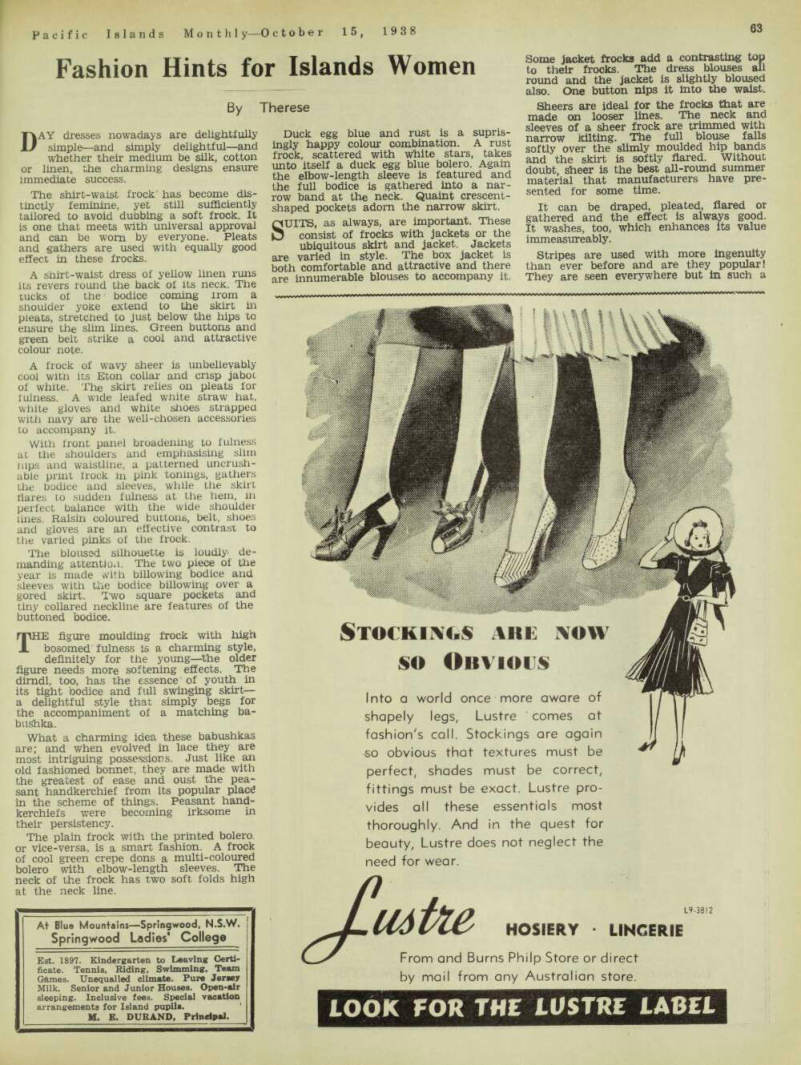
By Therese
DAY dresses nowadays are delightfully simple—and simply delightful—and whether their medium be silk, cotton or linen, the charming designs ensure immediate success.
The shirt-waist frock has become dis tinctly feminine, yet still sufficiently tailored to avoid dubbing a soft frock. It is one that meets with universal approval and can be worn by everyone. Pleats and gathers are used with equally good effect in these frocks.
A shirt-waist dress of yellow linen runs its revers round the back of its neck. The tucks of the bodice coming from a shoulder yoke extend to the skirt in pleats, stretched to just below the hips to ensure the slim lines. Green buttons and green belt strike a cool and attractive colour note.
A frock of wavy sheer is unbelievably cool with its Eton collar and crisp jabot of white. The skirt relies on pleats for fulness. A wide leafed white straw hat, white gloves and white shoes strapped with navy are the well-chosen accessories to accompany it.
With front panel broadening to fulness at the shoulders and emphasising slim hips and waistline, a patterned uncrush able print frock in pink tonings, gathers the bodice and sleeves, while the skirt flares to sudden fulness at the hem, in perfect balance with the wide shoulder lines. Raisin coloured buttons, belt, shoes and gloves are an effective contrast to the varied pinks of the frock.
The bloused silhouette is loudly- de manding attention. The two piece of the year is made with billowing bodice and sleeves with the bodice billowing over a gored skirt. iivo square pockets and tiny collared neckline are features of the buttoned bodice. rE figure moulding frock with high bosomed fulness is a charming style, definitely for the young—the older figure needs more softening effects. The dirndl, too, has the essence of youth in its tight bodice and full swinging skirt — a delightful style that simply begs for the accompaniment of a matching ba bushka.
What a charming idea these babushkas are; and when evolved in lace they are most intriguing possessions. Just like an old fashioned bonnet, they are made with the greatest of ease and oust the pea sant handkerchief from its popular pi act? in the scheme of things. Peasant hand kerchiefs were becoming irksome in their persistency.
The plain frock with the printed bolero, or vice-versa, is a smart fashion. A frock of cool green crepe dons a multi-coloured bolero with elbow-length sleeves. The neck of the frock has two soft folds high at the neck line.
Duck egg blue and rust is a supns ingly happy colour combination. A rust frock, scattered with white stars, takes
Te fiu W bS h nm
row band at the neck. Quaint crescent shaped pockets adorn the narrow skirt.
Sttt'T’q qo oiwflv*! arp imnortfljit Th6S6 UITS, as mese consist of frocks with jackets or the übiquitous skirt and jacket. Jackets are varied in style. The box jacket is both comfortable and attractive and there are innumerable blouses to accompany it.
Some jacket frocks add a contrasting top to their frocks. The dress blouses all round and the jacket is slightly bloused also. One button nips it into the waist.
Sheers are ideal for the frocks that are made on looser lines. The neck and sleeves of a sheer frock are trimmed with narrow kilting. The full blouse falls softly over the slimly moulded hip bands and the skirt is softly flared. Without doubt Sheer is the best all-round summer material that manufacturers have pre sented for some time.
It can be draped, pleated, flared or gathered and the effect is always good.
It washes, too, which enhances its value immeasureably.
Stripes are used with more ingenuity than ever before and are they popular!
They are seen everywhere but in such a
variety of colour combinations that they never pall. Stripes are now worn in squares and V’s as well as cross-wise and length-wise. The colours are really breath-taking—glowing reds, greens, pur ples and yellows combined with the true touch of artistry. An evening gown of striped sheer is a thing of beauty and outstanding in its individuality.
ALL evening gowns are lovely—whether slim and sophisticated or bouffant and flowing, romance is in every line and fold.
A frock of deep rose net is extrava gantly gathered in both bodice and skirt and a gathered centre panel of blue net in deep contrast is finished with a bow at the low waistline. Narrow straps hold the frock aloft.
The corseletted waistline appears fre quently on frocks of heavy crepe and
satin. This high and low banded waist holds an important place in Fashion’s rulings, and the skirt beneath is fitted to below the hips then flares widely.
Lace is deservedly in the limelight this season. A burgundy lace goes over a’ full foundation of dusky pink taffetas and is magnificent. The halter neck line is made of the taffetas. A black lace frock is tied at the waist with turquoise velvet ribbon. A V-shaped shirred panel, draped shoulders, and the skirt gathered widely over a taffeta slip, and a frock appealing in its femininity is presented.
Boldly patterned satins and sheers are well to the fore. These come in brilli ant colours splashed over pastel grounds and are lovely beyond description. No trimming is required for frocks made of these patterned silks. A good cut and their own beauty are sufficient to cause a sensation.
BE discriminating in your choice of accessories. Dressmaker jewellery and artificial flowers can be charm ing but they require discriminate choos ing. Too much, and all is lost; just the right amount and added chic is the re sult.
Gloves require the same careful choice.
Skin gloves are always a good bet —hand stitched, of course, and the gloves of pig skin wear and look well and are the per fect complement to tailored and spec tator sports frocks. Long kid gloves are finding favour for formal afternoon wear and they are to be had in delicate pastel shades that will match any frock in your wardrobe.
Shoes are given as much consideration as the rest of the wardrobe. New on the skyline is the heavenly-comfortable Cubit —that wedge soled shoe that is now seen everywhere. Two tone shoes always look chic and cool, and set off the frocks with which they are worn. The court, like “the poor”, is always with us and deser vedly so since nothing can claim more chic than this type of shoe. It is cor rect with formal afternoon wear and can be worn on informal occasions also.
Advertisements & other items, pp. 69-70 (2 items)
63
Pacific Islands Monthl y—o ctober 15, 1938
udtte
Stockings are now
so Obvious
Into a world once more aware of shapely legs, Lustre comes at fashion's call. Stockings are again -so obvious that textures must be perfect, shades must be correct, fittings must be exact. Lustre provides all these essentials most thoroughly. And in the quest for beauty, Lustre does not neglect the need for wear.
HOSIERY LINGERIE
From and Burns Philp Store or direct by mail from any Australian store.
udtte
L 9-3812
LOOK FOR THE LUSTRE LABEL
At Blue Mountains —Springwood, N.S.W.
Springwood Ladles' College
Est. 1897. Kindergarten to Leaving Certificate. Tennis, Riding, Swimming. Team Games. Unequalled climate. Pure Jersey Milk. Senior and Junior Houses. Open-air sleeping. Inclusive fees. Special vacation arrangements for Island pupils.
M. E. DURAND, Principal.
THE KING’S SCHOOL
( PARRAMATTA)
N.S W.
ft II Extensive Modern Additions —New Class Rooms, Laboratories, Dormitories, Modern Swimming Pool, Vacancies for 1959 Apply, THE HEADMASTER
"Dark River"
A New Islands Story By Nordhoff and Hall
From Our Own Correspondent.
Papeete, Oct. 1.
THE bubble reputation—however glitter ing- and iridescent it may be in other lands —casts no spell upon the criti cal judgment of a book, the mise-en soene of which is Polynesia, when it comes to be read by older residents of the Pacific islands.
There are volumes now in circulation by authors who have achieved fame and fortune, and their works acceptance and regard, which, nevertheless, are anathema in the South Seas on account of the pro found ignorance of the Islands life and custom, of history and legend, of native character and motive, that stares out of their pages.
The unqualified approval by South Seas critics of Messrs. Nordhoff and Hall’s “Dark River” (lately published as a serial in the “Saturday Evening Post” and presently to be brought out in book form) is, therefore, a hall-mark attesting accur acy of incident and environments, authenticity of drama and character pre sentation.
In its pages—as we read —we have met men and women we knew in days long past; have lived again in remote places whose beauty cast a never-ending en chantment over our memory; have sensed about us the fragrance of romance which has held many a European in these fas cinating Islands.
What is so satisfactory about Nordhoff and Hall’s work is that there is in it no trace of the sentimentality which makes much of the South Sea literature so sick ening.
It is a plain tale, well told; but the charm of style, the certainty of touch, capture the reader’s mind so that, for the time, he is actually living in the Islands and sharing in the daily life, with its problems and comedy and tragedy, of those about him.
Mr. J. Fairbaim, of the Police Depart ment, Western Samoa, arrived in New Zealand recently on furlough.
Advertisements & other items, p. 70 (1 item)
64
Pacific Islands Monthl y—o ctober 15, 19 3 S
Girl Solicitor Settles
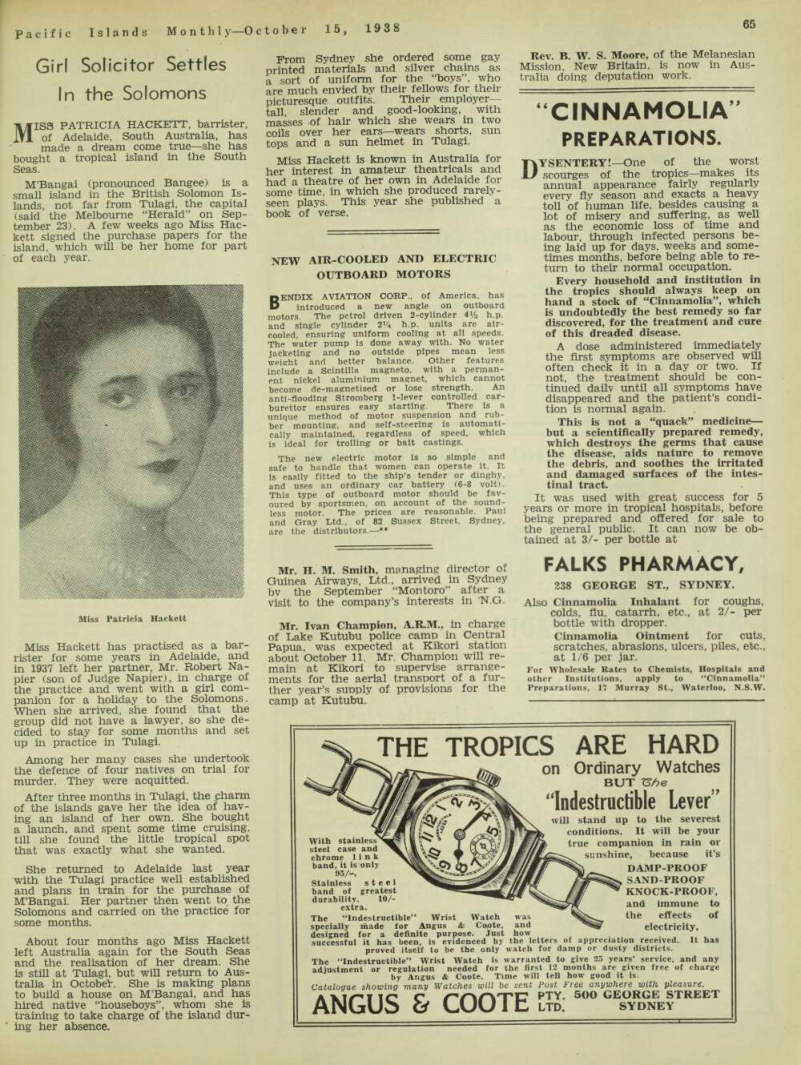
In the Solomons
MISS PATRICIA HACKETT, barrister, of Adelaide, South Australia, has made a dream come true —she has bought a tropical island in the South Seas.
M’Bangai (pronounced Bangee) is a small island in the British Solomon Is lands, not far from Tulagi, the capital (said the Melbourne “Herald” on Sep tember 23). A few weeks ago Miss Hac kett signed the purchase papers for the island, which will be her home for part of each year.
Miss Hackett has practised as a bar rister for some years in Adelaide, and in 1937 left her partner, Mr. Robert Na pier (son of Judge Napier), in charge of the practice and went with a girl com panion for a holiday to the Solomons.
When she arrived, she found that the group did not have a lawyer, so she de cided to stay for some months and set up in practice in Tulagi.
Among her many cases she undertook the defence of four natives on trial for murder. They were acquitted.
After three months in Tulagi, the charm of the islands gave her the idea of hav ing an island of her own. She bought a launch, and spent some time cruising, till she found the little tropical spot that was exactly what she wanted.
She returned to Adelaide last year with the Tulagi practice well established and plans in train for the purchase of M’Bangai. Her partner then went to the Solomons and carried on the practice for some months.
About four months ago Miss Hackett left Australia again for the South Seas and the realisation of her dream. She is still at Tulagi, but will return to Aus tralia in OctobeV. She is making plans to build a house on M’Bangai, and has hired native “houseboys”, whom she is training to take charge of the island dur ing her absence.
From Sydney she ordered some gay printed materials and silver chains as a sort of uniform for the “boys”, who are much envied by their fellows for their picturesque outfits. Their employer tall, slender and good-looking, with masses of hair which she wears in two coils over her ears—wears shorts, sun tops and a sun helmet in Tulagi.
Miss Hackett is known in Australia for her interest in amateur theatricals and had a theatre of her own in Adelaide for some time, in which she produced rarely seen plays. This year she published a book of verse.
Miss Patricia Hackett
New Air-Cooled And Electric
Outboard Motors
BENDIX AVIATION CORP., of America, has introduced a new angle on outboard motors. The petrol driven 2-cylinder 4V 2 h.p. and single cylinder 2V 4 h.p. units are air cooled, ensuring uniform cooling at all speeds.
The water pump is done away with. No water jacketing and no outside pipes mean less weieht and better balance. Other features include a Scintilla magneto, with a perman ent nickel aluminium magnet, which cannot become de-magnetised or lose strength. An anti-flooding Stromberg 1-lever controlled car burettor ensures easy starting. There is a unique method of motor suspension and rub ber mounting, and self-steering is automati cally maintained, regardless of speed, which is ideal for trolling or bait castings.
The new electric motor is so simple and safe to handle that women can operate it. It is easily fitted to the ship’s tender or dinghy, and uses an ordinary car battery (6-8 volt).
This type of outboard motor should be fav oured by sportsmen, on account of the sound less motor. The prices are reasonable. Paul and Gray Ltd., of 82 Sussex Street, Sydney, are the distributors. —*• Mr. H. M. Smith, managing director of
Guinea Airways, Ltd., arrived in Sydney
bv the September “Montoro” after a visit to the company’s interests in N.G.
Mr. Ivan Champion, A.R.M., in charge of Lake Kutubu police camp in Central Papua, was expected at Kikori station about October 11. Mr. Champion will re main at Kikori to supervise arrange ments for the aerial transport of a fur ther year’s sunply of provisions for the camp at Kutubu.
Rev. B. W. S. Moore, of the Melanesian Mission, New Britain, is now in Aus tralia doing deputation work.
Advertisements & other items, p. 71 (2 items)
65
Pacific Islands Mont hi y—o ctober 16, 1938
“Indestructible Lever”
“CINNAMOLIA”
PREPARATIONS.
DYSENTERY!— One of the worst scourges of the tropics—makes its annual appearance fairly regularly every fly season and exacts a heavy toll of human life, besides causing a lot of misery and suffering, as well as the economic loss of time and labour, through infected persons being laid up for days, weeks and sometimes months, before being able to return to their normal occupation.
Every household and institution in the tropics should always keep on hand a stock of “Cinnamolia”, which is undoubtedly the best remedy so far discovered, for the treatment and cure of this dreaded disease.
A dose administered immediately the first symptoms are observed will often check it in a day or two. If not, the treatment should be continued dailv until all symptoms have disappeared and the patient’s condition is normal again.
This is not a “quack” medicine — but a scientifically prepared remedy, which destroys the germs that cause the disease, aids nature to remove the debris, and soothes the irritated and damaged surfaces of the intestinal tract.
It was used with great success for 5 years or more in tropical hospitals, before being prepared and offered for sale to the general public. It can now be obtained at 3/- per bottle at
FALKS PHARMACY,
238 GEORGE ST., SYDNEY.
Also Cinnamolia Inhalant for coughs, colds, flu, catarrh, etc., at 2/- per bottle with dropper.
Cinnamolia Ointment for cuts, scratches, abrasions, ulcers, piles, etc., at 1/6 per jar.
For Wholesale Rates to Chemists, Hospitals and other Institutions, apply to “Cinnamolia”
Preparations, 17 Murray St., Waterloo, N.S.W.
THE TROPICS ARE HARD
<V/$v <0 With stainless steel case an chrome 1i n band, it is only 95/-.
Stainless steel band of greatest durability. 10/extra.
The “Indestructible” Wrist Watch was specially made for Angus & Coote, and designed for a definite purpose. Just how successful it has been, is evidenced by the letters of appreciation received proved itself to be the only The “Indestructible” Wrist Watch is . .. ■ * . adjustment or regulation needed for the first 12 months are given free of charge by Angus & Coote. Time will tell how good it is.
Catalogue showing many Watches will he sent Post Free anywhere with pleasure.
pTy 500 GEQRGE STREET
SYDNEY
on Ordinary Watches
BUT OZ>e
“Indestructible Lever”
will stand up to the severest conditions. It will be your true companion in rain or sunshine, because it’s
DAMP-PROOF
SAND-PROOF
KNOCK-PROOF,
and immune to the effects of
electricity.
It has watch for damp or dusty districts, is warranted to give 25 years’ service, and any O ULLLLKjy 0-0 grtUU/tM’y rr U.VVIVVU w...
ANGUS & COOTE EK:
Volcanic Activity In New
Guinea
MR. S. CAREY, a geologist with Oil Search Ltd. in New Guinea and Papua, lectured to the Pacific Is lands Club at the Carlton Hotel. Sydney, on October 5 on “Volcanic Acivity in New Guinea”. He pointed out that while the damage wrought by the recent Rabaul eruption had been severe, matters would have been much worse had the other volcanoes surrounding the township erup ted with the same force as Vulcan. He
said that if Rapindik, just behind Ra baul, had blown up. history might have repeated itself with a second Pompeii.
Mr. Carey explained the origin of what were erroneously called “tidal waves”, which have been experienced from time to time on New Guinea coasts. Volcanic eruptions on the bed of the ocean caus ed the sea in the vicinity to boil and steam quickly rose to the surface: the water thrown back by the explosion and steam jets caused a large wave. Similarly a series of explosions caused a series of large waves.
New Books
Madman’S Island”, By Lon L.
Idriess. Our copy from Angus and
Robertson Ltd., Sydney. 6/-.
What would you do if you were marooned on a very small, mangrove island near the Barrier Reef, North Queensland, with nothing but a few simple articles of camp equipment?
It is indicated that there is nothing on the island to assist human existence except a small spring, liable to inundation during high tides.
That was the dismal situation in which Idriess and another man found themselves several years ago. But life was by no means dull.
There was the endless, primitive adventure of procuring food —in which every ounce of their bushcraft was called upon—and further excite ment lay in the fact that the other man was subject to spells of homicidal mania, during which he stalked Idriess purposefully among rocks and through mangrove thickets.
It is explained that Idriess wrote this book a long time ago. but it did not “click”. Now that he is Australia’s most successful author, the book has been revised; and Idriess’s large public will find much pleasure in it. Idriess, in his inimitable fashion, describes the strange ness of life in that lonely place; the grim intentness with which they set about matching their quickness and ingenuity against the cun ning of the fish and crabs which were their only hope of sustaining life; their despair as ships passed distantly, ignoring their frantic signals, and the months dragged on; and their primitive savagery whenever one of them went mad, and attacked the other. Idriess is at his best when describing the curious natural pheno mena of their bleak little island. An eminently readable book.
“MAELSTROM”, by E. V. Timms. Our
copy from Angus and Robertson, Ltd.,
Sydney, 8/6.
This admirable novel has been universally ac claimed, and it carries Mr. Timms to the front rank of British authors. The story opens with the death of Cardinal Richelieu, dictator of France; is interwoven closely with the dramatic national events which immediately followed: shifts for a time to England and introduces Oliver Cromwell; and ends in New France, which was being established then in Eastern Canada. It is an Alexander Dumas, or “Scarlet Pimpernel” type of story—it bristles with dar ing deeds and startling situations, portrays some very lovable women, introduces famous historical personages to its quick-moving drama, and it is endowed with much rich humour.
All critics have joined in chorus to praise the craftsmanship of Mr. Timms, who has succeed ed in building, against an historical back ground that appears to be most accurately and faithfully drawn, one of the best and liveliest stories we have read in years.
Ten Years' Timber Lease
Warning in Australian Parliament
FURTHER information about the Fed eral Government’s plan to give a contract to someone to remove 50.000 super feet of hoop pine and klinkii from the Bulolo Valley, New Guinea, was sought in the Australian Parliament by Mr. A. E. Green on September 23. What were the areas affected, what was the term of the contract, and how was it pro posed to remove the timber?
The Minister was completely vague. One gathers, from a close study of his long speech, that tenders close on December 2; that the contract is for 10 years; and that the contractor must begin to remove timber within two years, either by the new road (if it is built!) or by some other means.
Mr. Green said he had heard some strange stories about the proposal of the Government to give a long-term contract to one Company; and he gave a warn ing that the members of the House would be very vigilant.
Advertisements & other items, p. 72 (2 items)
66
Pacific Islands Monthl y—O ctober 15, 1938
Steamships Trading Company Ltd.
PORT MORESBY PAPUA SAMARA)
Chairman and Managing Director: A. S. FITCH.
Shipowners, Wholesale and Retail Merchants and Traders; Shipping, Customs and Insurance Agents; Copra and Rubber Plantation Owners.
MAIL CONTRACTORS TO COMMONWEALTH AND PAPUAN GOVERNMENTS.
AGENCIES:—At Port Moresby; Coral Sea Insurance Co.; Phoenix Insurance Co.; Delta Sawmills, Ltd.; Acme Bakery Co. ; Vacuum Oil Co. Pty. Ltd. At Samarai: Coral Sea Insurance Co.; Delta Sawmills. Ltd.; Bankers and Traders’
Insurance Co. ; National Mutual Life Insurance Co.; Kularo Shipyards; Mamai Plantations.
BRANCHES:—In Papua: Hanuabada, Sivitoi, Aroma, Koki, Hula. Ela Beach, Duga Duga, Yule Island.
SYDNEY: NELSON & ROBERTSON PTY. LTD., 12 Spring St.; Melbourne, 396 Flinders Lane; London, E. Whiteaway & Co.. 7 Chiswell Street. Finsbury. London.
Cable Address: “STEAMSHIPS.” Code: Bentley’s.
STEAMSHIPS TRADING COMPANY, LIMITED.
MERCHANTS, SHIPOWNERS AND PLANTERS
PORT MORESBY AND SAMARA I.
Our organisation provides every facility and efficient service as
MANAGING AGENTS AND VISITING REPRESENTATIVES OF
COCONUT AND RUBBER PLANTATIONS
Estates supervised in bearing and planting stages.
Comprehensive reports compiled and regular visits made to Estates by our competent Plantation Inspector.
WRITE, CABLE OR CALL FOR PARTICULARS:
STEAMSHIPS TRADING COMPANY LTD.
/ -r &
It's CHEAPER to PAINT
than to repair!
Decay can do no damage if your home is properly protected with good paint.
Use “8.A.L.M.” Paint— “B.Alj.M,” Paint gives protection. And it wears down evenly and very slowly, lasting years longer than ordinary paint.
Decide now to save money by painting; and decide to make maximum savings by using - - - - “8.A.L.M.” Paint!
DISTRIBUTORS:
Greenwood & Laws Ltd., Rabanl and Wau.
Steamships Trading Co. Ltd., Port Moresby and Samarai. grade PURS A Product of British Australian Lead Manufacturers Pty. Ltd.,
Tonga's Queen
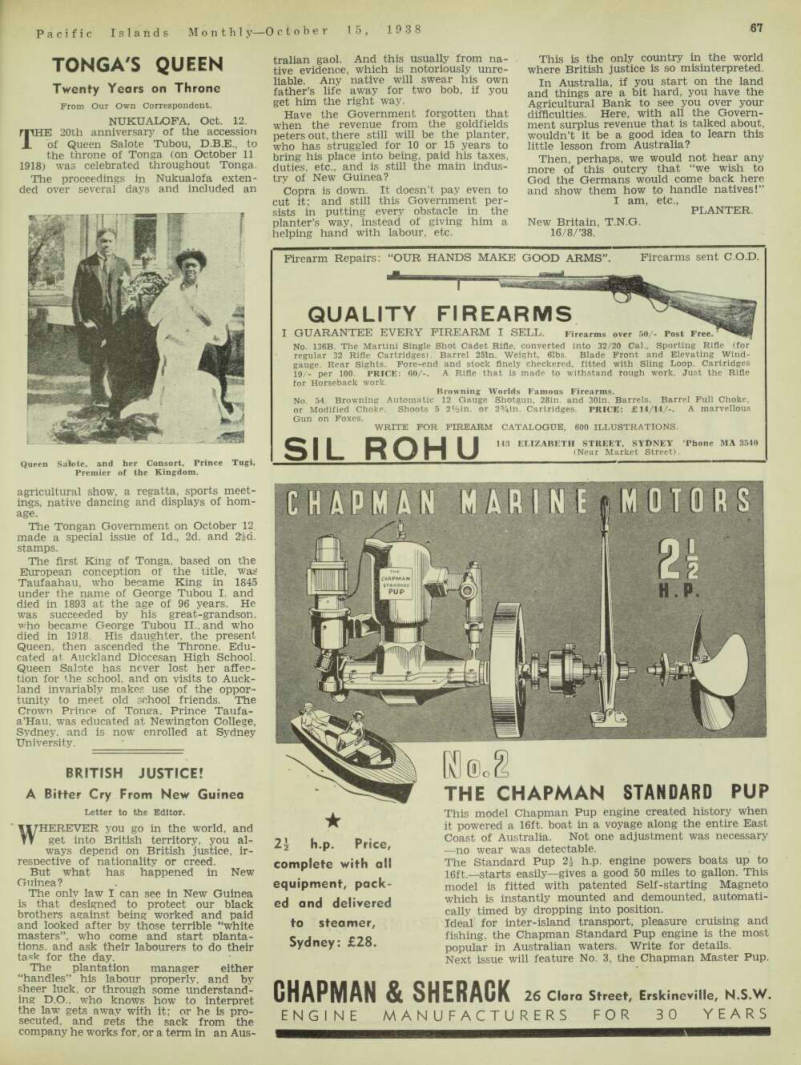
Twenty Years on Throne
From Our Own Correspondent.
Nukualofa, Oct. 12.
THE 20th anniversary of the accession of Queen Salote Tubou, D.8.E., to the throne of Tonga (on October 11 1918) was celebrated throughout Tonga.
The proceedings in Nukualofa exten ded over several days and included an
agricultural show, a regatta, sports meet ings, native dancing and displays of hom age.
The Tongan Government on October 12 made a special issue of Id., 2d. and stamps.
The first King of Tonga, based on the European conception of the title, was Taufaahau, who became King in 1845 under the name of George Tubou I. and died in 1893 at the age of 96 years. He was succeeded by his great-grandson, who became George Tubou 11.. and who died in 1918. His daughter, the present Queen, then ascended the Throne. Edu cated at Auckland Diocesan High School.
Queen Salote has never lost her affec tion for the school, and on visits to Auck land invariably makes use of the oppor tunity to meet old school friends. The Crown Prince of Tonga, Prince Taufa a’Hau, was educated at Newington College, Sydney, and is now enrolled at Sydney University.
Queen Salote, and her Consort, Prince Tugi, Premier of the Kingdom.
British Justice?
A Bitter Cry From New Guinea
Letter to the Editor, WHEREVER you go in the world, and get into British territory, you al ways depend on British justice, ir resnective of nationality or creed.
But what has happened in New Guinea?
The only law I can see in New Guinea is that designed to protect our black brothers against being worked and paid and looked after by those terrible “white masters”, who come and start planta tions. and ask their labourers to do their ta*k for the day.
The plantation manager either “handles” his labour properly, and by sheer luck, or through some understand ing D. 0., who knows how to interpret the law gets away with it; or he is pro secuted, and gets the sack from the company he works for, or a term in an Aus
tralian gaol. And this usually from na tive evidence, which is notoriously unre liable. Any native will swear his own father’s life away for two bob, if you get him the right way.
Have the Government forgotten that when the revenue from the goldfields peters out, there still will be the planter, who has struggled for 10 or 15 years to bring his place into being, paid his taxes, duties, etc., and is still the main indus try of New Guinea?
Copra is down. It doesn’t pay even to cut it; and still this Government per sists in putting every obstacle in the planter’s way, instead of giving him a helping hand with labour, etc.
This is the only country in the world where British justice is so misinterpreted.
In Australia, if you start on the land and things are a bit hard, you have the Agricultural Bank to see you over your difficulties. Here, with all the Govern ment surplus revenue that is talked about, wouldn’t it be a good idea to learn this little lesson from Australia?
Then, perhaps, we would not hear any more of this outcry that “we wish to God the Germans would come back here and show them how to handle natives!”
I am, etc.,
Planter.
New Britain, T.N.G. 16/8/’38.
Mr. Richard Thomas Lindley, son of Mr. and Mrs. Robert C. Lindley, of Bris bane, recently married Miss Elizabeth Katherine Greenwald, of Milwaukee, Wisconsin, U.S.A., at Libba Lossu Plan tation, Kavieng, New Guinea, where he is manager.
Mr. Darcy Jones, sales manager of the Chris Craft Boats and Marine En gine Division of Paul and Gray Ltd., re turned to Sydney early in October from an extensive tour of inspection of the eastern coast of Australia, from Sydney to Cairns. He reports an unusual hap pening: he met by chance in a Cairns street, Mr. “Ted” Tanner, well-known in that centre, who served in the Great War with Mr. Jones—after not having seen each other since 1916. Recognition was mutual, after 27 years!
Advertisements & other items, pp. 73-74 (2 items)
67
Pacific Islands Monthl y —o ctober 15, 1938
Quality Firearms
Firearm Repairs: “OUR HANDS MAKE GOOD ARMS”.
Firearms sent C.O.D.
X GUARANTEE EVERY FIREARIVX I SELXj. Firearms over 50/- Post Free No. 1368, The Martini Single Shot Cadet Rifle, converted into 32/20 Cal., Sporting Rifle (for regular 32 Rifle Cartridges). Barrel 251 n. Weight, 61bs. Blade Front and Elevating Windgauge. Rear Sights. Fore-end and stock finely checkered, fitted with Sling Loop. Cartridges 19/- per 100. PRICE: 60/-. A Rifle that is made to withstand rough work. Just the Rifle for Horseback work.
Browning Worlds Famous Firearms.
No. 54. Browning Automatic 12 Gauge Shotgun, 28in. and 30in. Barrels. Barrel Full Choke, or Modified Choke. Shoots 5 2V 2 in. or 2 3 Ain. Cartridges. PRICE: £l4/14/-. A marvellous Gun on Foxes.
WRITE FOR FIREARM CATALOGUE, 600 ILLUSTRATIONS.
SF"% II I I 143 ELIZABETH STREET, SYDNEY ’Phone MA 3540 (Near Market Street).
CHAPMAN
H pup ■ * - H®o
THE CHAPMAN STANDARD PUP
2j h.p. Price,
complete with all
equipment, pack-
ed and delivered to steamer,
Sydney: £2B.
This model Chapman Pup engine created history when it powered a 16ft. boat in a voyage along the entire East Coast of Australia. Not one adjustment was necessary —no wear was detectable.
The Standard Pup 2i h.p. engine powers boats up to 16ft—starts easily—gives a good 50 miles to gallon. This model is fitted with patented Self-starting Magneto which is instantly mounted and demounted, automatically timed by dropping into position.
Ideal for inter-island transport, pleasure cruising and fishing, the Chapman Standard Pup engine is the most popular in Australian waters. Write for details.
Next issue will feature No. 3, the Chapman Master Pup.
CHAPMAN & SHERAGK 26 Clara Street, Erskineville, N.S.W
ENGINE MANUFACTURERS FOR 30 YEARS
The Comforts of Continuous
Refrigeration in South Sea Island
homes , Cost LESS with a
HALLSTROM
Kerosene Operated REFRIGERATOR
A »
iaiiiiiiiiiimiiiiiiiiiiiiiiiiiiiiiiiiiiiiiii
'IIIIIIIIIIK
Special Islands Model: NOT only does a HALLSTROM cost less in the initial outlay, but for many years to come it will save you money every day, in every way.
YEAR GUARANTEE Plus
LOWER PURCHASE COST.
Tremendous sales enable Hallstrom Refrigerators to be sold at a 25% lower price.
GREATER EFFICIENCY AND
ECONOMY WITH CONTINUOUS
REFRIGERATION.
Constant and correct temperature maintained by burning kerosene for ONLY 2 HOURS (approx.) each day in hottest weather.
TROUBLE-FREE SERVICE.
Hallstrom Refrigerators are built to give lifetime service free from service problems.
MORE FOOD STORAGE SPACE.
35% more storage space with maximum efficiency. Capacity: 5y 2 cubic feet. Pood Compartments: 23V 2 in. high, 19% deep, 17% in. wide. Included is a 21 Ice Cube Tray. Cabinet is equipped with sealed, moisture-proof insulation. £45/10/. *** M F. 0.8.
Write for particulars to: —
Sole Manufacturers:
HALLSTROMS Pty. Ltd.
SYDNEY. =
= CHEST MODELS
= from £2O, f.o.b. Sydney = S Units Only for Other =5 H Makes from £l5 f.o.b. = = Sydney.
Tiiiiiiiiiiiiiiiiiiiiiiiiiiiiiiiiiiiiiiiiiiiiiiiiiiiiiinnninnniiiiiiii
Factory; 462 Willoughby Rd., Willoughby, N.S.W Showrooms: 102 Clarence St., Sydney.
LARGEST MANUFACTURERS OF
KEROSENE-OPERATED REFRIGERATORS
IN THE SOUTHERN HEMISPHERE.
Guinea
Australia In N.
Character of The Record
MR. JENNINGS, in the Australian House of Representatives on October 7, directed attention to a statement made by the Australian journalist and naturalist, Mr. A. H. Chisholm, on his return to London from a visit to Ger many, to the effect that German scien tists were showing a marked interest in the resources of New Guinea, and were complaining that Australia had failed in its duty to exploit these resources ade quately, and left this task to Americans.
The Minister for External Affairs, Mr.
Hughes, denied that the Government had
been laggard in its efforts to develop the resources of New Guinea.
Later, Mr. Hughes pointed out that Australia had every reason to be proud of development in New Guinea. In 1913, the white population of the Territory was only 968. Now it was 4,332. In the same period natives under European control had increased from 230,000 to 542,000. The value of exports had grown from £402,000 to £3,389,000, and imports had increased from £425,000 to £1,311,000. The Com monwealth, in the years that it had held the mandate, had spent about £350,000 on development works in New Guinea.
Editorial Note: And the “Pacific Islands Monthly” repeats its assertion, made on dozens of occasions, that Australia has nothing in New Guinea to be proud of.
Here is a great, rich, undeveloped coun try; endless opportunities for initiative and enterprise; many hundreds of re sourceful young Australians, official and non-official, eager to get on with the work of development; and, squatting on top of it all, an Administration that is paralysed in New Guinea, and controlled in Canberra, by a gang of blathering and visionless politicians and ex-politicians, who ought not to be allowed out without petticoats. Nearly all the development that has occurred in New Guinea since 1918 has been carried out by the gold miners, and the gold companies, and a couple of enterprising trading firms; and what they have achieved has been achieved mostly in spite of the Govern ment. and not because of encouragement received. Where are the new lands opened up to European settlement? What new lines of agriculture have been intro duced? How many new plantations have been started, to take the place of the German-planted areas, now petering out 9 What new industries have been estab lished, outside the Morobe goldfields 9 What public works have been carried out, outside of Morobe? What has been done worthy of mention, in introducing health and education services to the natives?
Morobe Warden's Report
For September
THE following extracts are taken from the Mine Managers’ Monthly Reports supplied to the Warden of the Morobe Goldfield, T.N.G., for the period ended September 30:— Sunshine G.D. Ltd. —For the quarter ended (August 31, the total gold won from the Con solidated Claims amounted to 834 oz. from 80.- 800 yds. Staff comprised 11 Europeans and 127 natives. One native died in Wau Hospital from chronic dysentery. A shelter shed was erected on the dredge tailings near the Baiune River, to serve as a garage and protection for stores, etc., in the event of the Baiune River not being safe to ford.
Bulolo Deposits Ltd, —Morobe Alluvials: A pad dock containing 7,900 yds. was completed for a fair return. Two more paddocks will com plete the workings up to the road. Morobe Deposits: A paddock was completed, the plant shifted and a total of 8,500 cub. yds. treated for a fair return. This ground is improving in values and the ground Is more easily re moved. Flat Creek was worked, but on account of the dry spell, little work was done on Upper Morobe and Lower Morobe. Employees: Whites, 5; natives, 116.
Bulolo G.D. Ltd.—Total cargo carried was 1,054,849 lbs. (527 short tons) in 184 trips, 280 tons of cargo for the Co. were landed at Lae from 3 vessels. 222 ft. of drilling was carried out ahead of No. 2 dredge. Pitting and cost eening on the eastern boundary of Gorge Leases totalled 413 ft. Shafting amounted to 19 ft.
Dredge No. 7 Construction; Good progress con tinues to be made, 64 workmen and 40 natives being engaged. Commenced a new retort house at Bulolo and native quarters at No. 6 camp.
Timbering work on the Wau Bridge is under way.
Advertisements & other items, p. 74 (1 item)
68
Pacific Islands Mont hi y—O ctober 15, 1938
Oil-Seekers In Papua 20
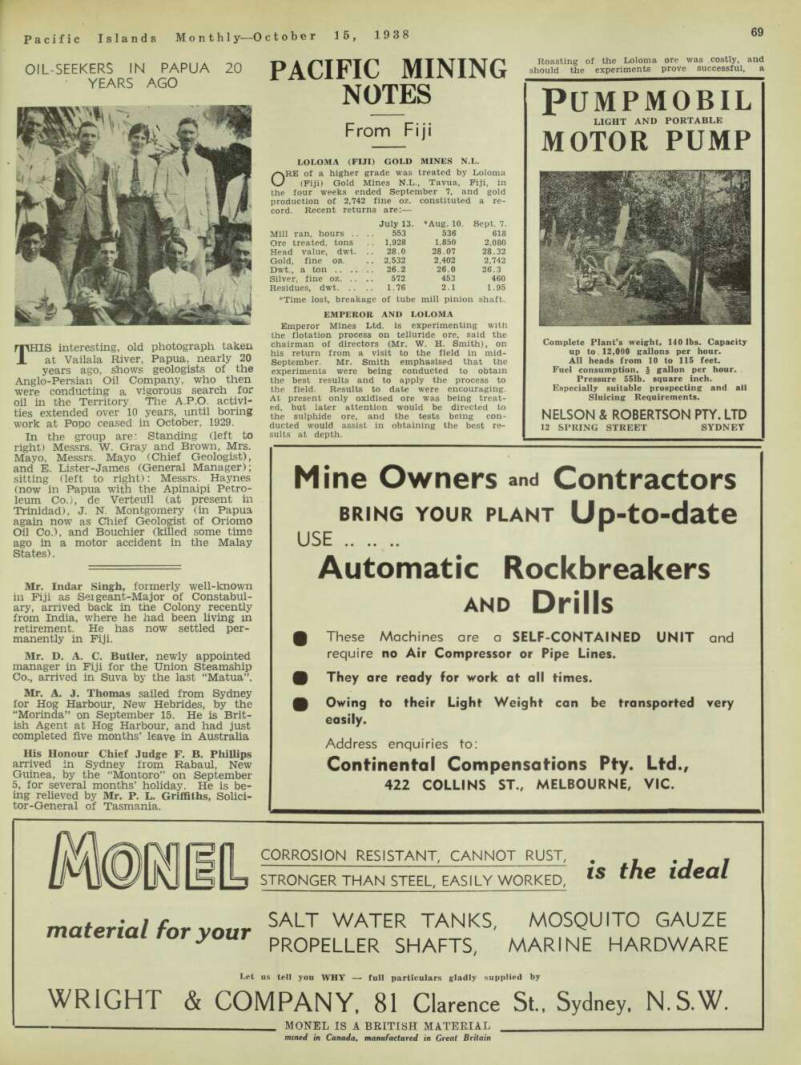
Years Ago
THIS interesting, old photograph taken at Vailala River, Papua, nearly 20 years ago, shows geologists of the Anglo-Persian Oil Company, who then were conducting a vigorous search for oil in the Territory The A.P.O. activi ties extended over 10 years, until boring work at Popo ceased in October, 1929.
In the group are: Standing (left to right) Messrs. W. Gray and Brown, Mrs.
Mayo, Messrs. Mayo (Chief Geologist), and E. Lister-James (General Manager); sitting (left to right): Messrs. Haynes (now in Papua with the Apinaipi Petro leum Co.), de Verteuil (at present in Trinidad), J. N. Montgomery (in Papua again now as Chief Geologist of Oriomo Oil Co.), and Bouchier (killed some time ago in a motor accident in the Malay States).
Mr. Indar Singh, formerly well-known in Fiji as Seigeant-Major of Constabul ary, arrived back in the Colony recently from India, where he had been living in retirement. He has now settled per manently in Fiji.
Mr. D. A. C. Butler, newly appointed manager in Fiji for the Union Steamship Co., arrived in Suva by the last “Matua”.
Mr. A. J. Thomas sailed from Sydney for Hog Harbour, New Hebrides, by the “Morinda” on September 15. He is Brit ish Agent at Hog Harbour, and had just completed five months’ leave in Australia His Honour Chief Judge F. B. Phillips arrived In Sydney from Rabaul, New Guinea, by the “Montoro” on September 5, for several months’ holiday. He is be ing relieved by Mr. P. L. Griffiths, Solici tor-General of Tasmania.
Pacific Mining
Notes
From Fiji
Loloma (Fiji) Gold Mines N.L.
ORE of a higher grade was treated by Loloma (Fiji) Gold Mines N.L., Tavua, Fiji, in the four weeks ended September 7, and gold production of 2,742 fine oz. constituted a re cord. Recent returns are:—
Emperor And Loloma
Emperor Mines Ltd. is experimenting with the flotation process on telluride ore, said the chairman of directors (Mr. W. H. Smith), on his return from a visit to the field in mid- September. Mr. Smith emphasised that the experiments were being conducted to obtain the best results and to apply the process to the field. Results to date were encouraging.
At present only oxidised ore was being treat ed, but later attention would be directed to the sulphide ore, and the tests being con ducted would assist in obtaining the best re sults at depth.
Roasting of the Loloma ore was costly, and should the experiments prove successful, a
July 13. *Aug. 10. Sept. 7.
Mill ran, hours .. .. 553 536 618 Ore treated, tons .. 1,928 1,850 2,080 Head value, dwt. .. 28.0 28.07 28.32 Gold, fine oz. .. 2,532 2,402 2,742 Dwt., a ton 26.2 26.0 26.3 Silver, fine oz 572 453 460 Residues, dwt 1.76 2.1 1.95 *Time lost, breakage of tube mill pinion shaft.
reduction in costs was confidently expected.
Mr. Smith said that developmental work in the Loloma mine at 224 ft. was disclosing rich tellu ride ore. The ore body was going down strongly below the level, and augured well for
the future of the field at depth. Sinking of the new main shaft was in progress.
In the Emperor mine a winze was being sunk from 300 ft. to 400 ft., the depth at which rich values were being obtained in the Loloma mine. At this horizon the Company was ex pecting better results.
Mr. Smith added that in the Dolphin mine operatidns had reached a depth of 200 ft., and developments were satisfactory.
Emperor Mines Limited.
Gold recovered by Emperor Mines Ltd. (Fiji) again exceeded the 4,000 oz. mark in the four weeks ended September 7. In the last four crushing periods the yields have been steady around this point.
In the September clean-up the Company crushed 14,583 tons for a yield of 4,120.6 oz of fine gold. Combined head value, 6.3 dwt. 6.3 dwt. a ton. New mill head value, 6.3 dwt. a ton; pilot plant head value, 5.7 dwt. a ton.
Combined residue value was 0.53 dwt. a ton; new mill residues, 0.49 dwt. a ton; pilot plant residues, 1.4 dwt. a ton. Concentrates from pilot plant weighing approximately three tons estimated to contain 60oz. of fine gold were stored for further treatment.
Latest yields compare as follow:
Progress Report.—Koroere Area: Good pro gress made in forming and metalling road from Cardigan section to “Emperor” mill. Bulk oil installation: Work has been delayed owing to shortage of labour and sickness. Lime-burning plant at Tau: Satisfactory progress has been made, and everything was in readiness for bricklayers, when they arrived on September 23.
The Company reports that option holders have exercised their rights on the remaining shares, totalling 140,000, making the capital 1,900,000 shares of 10/- fully paid. The option shares will participate in the first dividend of 1/- per share, which thus requires £95,000.
Mt. Kasi Mines Ltd.
Yields from the Mount Kasi mine, Vanua Levu, for the past four months, are compared in the following table:—
July 13.
Aug. 10.
Sept. 7.
Tons, crushed 14,748 14,091 14,583 Head value, dwt. 6.2 6.29 6.3 Yield, oz. (est.) .. 4,166.6 4,017.5 4,120.6 Dwt., a ton 5.66 5.67 5.65 Tailings, dwt. 0.6 0.57 0.53
Four weeks ended: June 15.
July 13. Aug. 10. Sep. 7.
Ore, tons .. .. 2,749 3,290 3,030 2,754 Gold, fine oz. 608 650 659 615 Value, £ A. . . £5320 £5,687 £5,766 £5,381
Advertisements & other items, pp. 75-76 (2 items)
69
Pacific Islands Monthl y—O ctober 35, 1938
Pumpmobil
LIGHT AND PORTABLE
MOTOR PUMP
s Complete Plant’s weight, 140 lbs. Capacity up to 12,000 gallons per hour.
All heads from 10 to 115 feet.
Fuel consumption, £ gallon per hour.
Pressure 551 b. square inch.
Especially suitable prospecting and all Sluicing Requirements.
NELSON & ROBERTSON PTY. LTD
12 SPRING STREET SYDNEY
Mine Owners and Contractors
BRING YOUR PLANT Up-t O-date
USE
Automatic Rockbreakers
AND Drills
• These Machines are a SELF-CONTAINED UNIT and require no Air Compressor or Pipe Lines. 0 They are ready for work at all times. 0 Owing to their Light Weight can be transported very easily.
Address enquiries to:
Continental Compensations Pty. Ltd.,
422 COLLINS ST. ( MELBOURNE, VIC.
f c
CORROSION RESISTANT, CANNOT RUST,
STRONGER THAN STEEL, EASILY WORKED,
is the ideal
material for your
SALT WATER TANKS, MOSQUITO GAUZE
PROPELLER SHAFTS, MARINE HARDWARE
Let us tell you WHY full particulars gladly supplied by WRIGHT & COMPANY, 81 Clarence St., Sydney, N.S.W.
MONEL IS A BRITISH MATERIAL
mined in Canada, manufactured in Great Britain
Mining Ore
Treatment
Machinery
COMPLETE CYANIDE
PLANTS SUPPLIED
Dorr Classifiers Dorr Thickeners Dorr Agitators Oliver Filters Merril Crowe Zinc Dust Gold Precipitation Richardson Mine Fans •
FANS AND AIR HEATERS
For Ventilation, Copra Drying Rooms, etc. • Enquire from
CROSSLE. DUFF AND
MACINTOSH LTD.
52 Bridge Street, SYDNEY
Allen Taylor & Co. Ltd.
SYDNEY
Sawmillers and Wholesale Suppliers of Hardwoods for Constructional Purposes GIRDERS . . . PILES . . . POLES . . . SLEEPERS. Etc.
EXPORTING TO PACIFIC ISLANDS SINCE 1893
Cables: Tuxedo, Sydney
YOUR GOLD
When you consign your gold to the house of Garrett & Davidson, you are assured of the fullest degree of business integrity . . . absolute accuracy of assays . . . and prompt payment at highest ruling prices.
Known as Australasia’s clearing house for precious metals, the greatest proportion of the gold business of the Pacific Islands passes through the Garrett & Davidson organisation.
Apart from Gold, highest prices are also paid for Osmiridium, Platinum, Silver, and all other precious metals.
Immediate attention given to every inquiry.
GARRETT & DAVIDSON, PTY., LTD.
ASSAYERS . . . METALLURGICAL CHEMISTS,
BANK OF N.S.W. BUILDINGS.
REGENT & GEORGE STS., SYDNEY.
From New Guinea
Gold And Power Limited.
GOLD AND POWER LIMITED has been in corporated in New Guinea to purchase the assets of Upper Watut Gold Alluvials N.L. (in liquidation). The issued capital is £16,031. The directors of Sandy Creek Gold Sluicing Ltd. (Messrs. H. B. Jamieson, H. G. Hyde, J. W.
Hinks, and A. J. Smeaton) are personally in terested in the Company and the Sandy Creek Company has invested £l,OOO in the concern.
Towards the end of 1937, the New Guinea assets of Upper Watut Gold Alluvials were put up for sale. Sandy Creek Company was interested, but did not have sufficient oppor tunity to examine the leases closely and, therefore, did not tender. The liquidators re jected the tenders received. Sandy Creek Com pany again was approached, and it found that the largest creditors of Upper Watut Gold were willing to sell their interest for £6,000.
A hurried decision was necessary; thereupon the Sandy Creek directors formed and financed the Hydraulic Gold and Power Syndicate in order to close the deal. The new Company (Gold and Power Ltd.) will take over the Syndicate’s interest and will also purchase the assets of Upper Watut Gold Alluvials.
Bulolo Gold Deposits Ltd.
The following yields have been reported by Bulolo Gold Deposits, New Guinea:—
This Company has now been taken over by New Guinea Goldfields Limited.
New Guinea Goldfields Limited.
The following progress report for August has been issued by the Mining Trust Limited, con sulting engineers for N.G. Goldfields Ltd.:— -
The reconstructed Golden Ridges mill was run in on low-grade tailings during August, and treated 1,200 tons for a recovery of 113 oz. fine gold and 116 oz. silver. The estimated oper ating loss was £ 1,005.
The Company has arranged to purchase the whole of the assets of Bulolo Gold Deposits Ltd. for £21,500 (see page 17 for details). New Guinea Goldfields Ltd. has also made an agreement with Koranga Gold Sluicing Ltd. for the working of the deep alluvials belonging to both Companies in the Koranga area.
Enterprise Of New Guinea N.L.
The general manager of Enterprise of New Guinea Gold and Petroleum Development N.L. (Mr. Harold Taylour), reported as follows for the period, August 26 to September 8: Edie mine, No. 3 level, west drive, No. 1 parallel lode to 68ft. at 60ft. assays 4dwt. 4.Bgr. gold over 27in.; at 65ft. two smaller sections of lode assay 9wdt. loz. gold; No. 1 level, west drive, main lode crosscut at 801 ft. not yet reached. Pootwall ore exposed 15ft. wide, all works proceeding satisfactorily.
Production of unrefined retorted alluvial gold from all sources for September was 250 z. 1 dwt. from 5,100 cub. yds.
Aug 3.
Sept. 6.
Sept. 25.
Morobe Alluvials— Hours 550 600 290 Yards . 5.000 7.500 2,000 Gold, oz. 70 140 50 Morobe Deposits— Hours 470 525 300 Yards . 6.500 8,500 4,500 Gold, oz. .. 45 45 30
June. July. Aug.
Edie Creek mill— Gold, oz., fine .. 1,126 1,208 1,154 Silver, oz., fine . 3,906 4,052 3,865 Alluvial— Gold, oz., fine .. 1,185 1,120 809 Silver, oz., fine .. 838 797 612 Operating profit— Edie Creek .. .. £1,588 £2,771 £2,532 Alluvial 4,639 4,305 2,700
Bulolo Gold Dredging Ltd.
The August output of Bulolo Gold Dredging Ltd.. Morobe goldfield, New Guinea, compares with the two previous yields as follows: —
Sandy Creek Gold Sluicing Ltd.
The mine manager of Sandy Creek Gold Sluicing Limited, New Guinea, reported on Oc tober 4 that the working of No. 1 plant at Sandy Creek during September was seriously affected by flooding. The last four yields com pare as follows: —
June. July. Aug.
Cubic yards .. 1,184,000 1,232,000 1,249,000 Bullion oz 18,265 19,667 23,492 Gold, fine, oz. . . 12,603 13.569 16,209 V&lU6 "
Aust. currency* . £110,276 £118,729 £141,829 Value, per c.y. . /22.3 /23.1 /27.2 Working profit .. £75,967 £77,875 £100,695 ♦At £A8/15/- per fine ounce.
June. July. Aug. Sept.
Cubic yards .. 15,949 16,088 18,497 19,644 Gold oz. . . 292 531 538 359 Per c.y. ... 2/9 4/11 4/4 2/9 Work, cost 1/3 Vb 1/5 1/2 1/0 Vz
Advertisements & other items, p. 76 (1 item)
70
Pacific Islands Month! y—O ctober 15, 1938
From Papua
Papuan Apinaipi Petroleum Co.
RADIO advice from Mr. Launcelot Owen, the Papuan Apinaipi Petroleum Co.’s geolo gist, stated on September 12 that the Oiapu bore was down 853 feet, that the trace of oil struck at 774 feet was continuous to 842 ft., and that there was slight gas at 774 ft. to the bottom. Dr. Wade and Dr. Ward having com pleted their inspection of the Company’s area, returned to Sydney in September by the “Macdhui”. They have submitted a report to the Minister for Territories.
The following report of their visit has been received from Mr. Launcelot Owen: ‘‘The de tail work done and the results of my exam ination of the air photographs taken since
my report of May 31 have fully confirmed my favourable opinion of the Oiapu structure as a potential oil producer. The showing of oil does prove that the lower argillaceous ser ies in which we are now drilling, is petrolifer ous at the actual well site. Such work as has been done, and the results from the Oiapu bore have amply confirmed the statements in my published report and the conclusions which I reached. The cores have been minutely ex amined by Dr. Wade and Dr. Ward, and my self. A noticeable feature of the cores is the abundance of plant remains, which proves shallow water conditions of deposition”.
Mandated Alluvials N.L.
Mandated Alluvials, N.L., Papua, reports that returns from Chillagoe smelters, give the net assay of the fourth shipment of matte as 286 oz. gold, 4590 z. silver, and 7 tons copper, the total value being £3,048.
Misima North Ltd.
Misima North Limited has been registered in Sydney with a nominal capital of £lOO,OOO in £1 shares to acquire mines and mineral pro perties in Eastern Papua. The first directors are Messrs Joseph Tomlinson, Robert Dugan, Claude M. Cox, and Alfred N. Harding.
Yodda Goldfields Ltd.
Yodda Goldfields Ltd., Papua, reports a net profit of £l,OBB for the year ended April 30, and, after deducting a debit balance of £712, brought forward, there remains a credit of £376 in profit and loss account. The direc tors recommend payment of a dividend of Id a share, amounting to £365. In May last, capital was reduced by writing off assets suf ficient to reduce the nominal value of shares to 2/- each. Gross proceeds of gold won during the year totalled £3.737 from 25,882 c. yds., averaging 2/10 a yard. Continued improve ments in results are anticipated and a conse quent payment of quarterly dividends.
Mr. H. T. Kienzle, mine manager of Yodda Goldfields Ltd., said at the annual meeting in Sydney in mid-September, that the mine had a life of about 10 years. The present output was about 70oz. per month. A dividend of Id. per share was declared at the meeting, and,
in a statement submitted by the directors, a further dividend of Id. per share, payable on October 15, was foreshadowed.
Yield for Yodda Goldfields for September was 87oz. 3dwt.
Gold Mines Of Papua Ltd.
Comparative monthly returns from Gold Mines of Papua, Ltd., Misima Island, show:—
Cuthbert’S Misima Goldmine Ltd.
Figures for the monthly cleanup on Sep tember 23 from Cuthbert’s Misima mine com pare with the previous two months as fol lows: —
Total developments for August 401 ft.; 511 tons ore won from development; 2,347 tons from stopping; total 2,858 tons; average assay, gold 6dwt. 6gr. per ton; silver, 36dwt. 3gr. per ton.
Mr. Percy Morris, a director of Morris, Hedstrom, Ltd., and a former resident of Fiji, visited the Colony on a holiday trip in September.
Mrs. Montgomery, wife of Mr. J. N.
Montgomery, chief geologist of Oriomo Oil Co. Ltd., arrived in Port Moresby from Melbourne by the “Macdhui” on Septem ber 30.
June. July.
Aug.* Sept.f Crushed, tons 1,690 2,190 2,128 2,750 Gold, oz., fine — — ' 396 Silver, oz — — — 1,749 Value £1,775 £2,675 £2,705 £3,620 ♦ Average battery head value by assay was 5dwt. and the tails 6 grains. t Residues, 7 grains.
July. Aug. Sept.
Treated, tons .. .. 2,800 2,858 2.905 Bullion, ozs 2,466 2,872 2,922 Gold, fine, oz 804 822 835 Silver, fine, oz 1,570 1,939 1,986 Value, £A8 oz. .. £6,517 £6.684 £6,797 Value per ton .. 46/7 46/9 46/9
Advertisements & other items, pp. 77-78 (2 items)
71
Pacific Islands Mont hi y—o ctober 15, 1938
Centrifugal Pumps
DIESELS For HARD JOBS
Fetter Crude Oil Engines
Valveless, Iwo-stroke Fetter patent cold starter. Low fuel consumption. Perfect lubrication. G to 21 B.H.P. Stationary and portable types. Send lor new catalogue just published.
Centrifugal Pumps
Single or twostage, 1-in. to 6-in.
Direct-coupled vee belt or chain drive.
EVERY KIND oF PLOW
For Every Kind of Job
from singlefurrow mouldboard to heavy-duty tractor-drawn road plow. Long experience of specialized manufacturing gives leadership. Strength, without unnecessary weight, makes "BUZACOTT" the best plow you can buy. Let us quote for the plow you need. 7TO II MARKET STREET SYDNEY. t-AdJ * / ARt
7TO II MARKET STREET SYDNEY.
PETROLECTRICUCHT oenU ine o tt CHAIN ■ ONE-MAN CLEARING
DIGGER' WINCH
BUZACOTT FETTER
800 Watt - 32 Volt
Home Lighting Plant
Dependable and very economical tor the moderate size farm home.
Buzacott Petrol-Kerosene 2 H.P. Series “W" engine, with multiple vee-belt drive to oversize generator.
Complete with battery, switchboard and push-button starting. Send tor particulars.
Supplied any and mesh height 100 rolls Ask store your lor latest keeper prices Has enormous power, light weight, very compact. One man can operate. Easy to move around. Most powerful winch for its size. Does not dance around the ropes. Write to-day for
descriptive folders.
/||\ ■ 7TO II MARKET STREET SYDNEY. \frD) ■ 7TO II MARKET STREET SYDNEY
7TO II MARKET STREET SYDNEY.
Full details of these or any other machinery lines FREE on request.
BUZACOTT-WOLSELEY Pty. Ltd., 7-11 Market St., SYDNEY, N.S.W,
Ventrillos—Learn to throw your voice, 1/-. Send 2/8 for 2 Gigantic and Interesting Catalogues and Leaflets.
Fountain Pen size Microscope and Compass Combined 6/6.
Midget Razor Hones, for all Blades, 1/6. Joy Buzzer Hand Shakers, 3/3. Fountain Pen size Torch 2/3.
Put and Take Tops 2/-.
Model Outboard Electric Motors. 12/6 and 19/6. 4 in 1 Pen size Screwdriver 2/-.
Miscroscopes, 5/6, 6/6, and 9/6.
Microscope Kits 12/6.
Table Tennis Sets, .. 6/6, 8/6.
New 3 in 1 Roulette Game, Doggie, . Roulette, etc., with directions .. .. 3/9. 2/6,2/9, 3/6, 7/6.
Adjustable all way Morse Code Key as illustrated. 12/6.
P.M.G. Type, 19/6.. Buzzers A d j u s table Electric Forehead Torch Pits snugly; for Professional Men B a n d s m en, Miners, etc.; 10/6. With
CROWN AND ANCHOR SETS, 10/6.
5 Poker Dice, in box .. .. 7/6 and 10/6 In Leather Case 7/6, 10/6, 12/6 Head and Tail Dice, Sets of Five, 8/6 and 11/6. Large Transparent 1 to 6 Dice, 1/6 each. Extra Large 2/6.
Electric Train Sets, Loco., Tender, and 12 Rails, 65/, 75/-, 85/-, 95/-.
Transformers. 17/6, 21/-. 25/- Extra. ‘'Presto”, the Mysterious Coin-Box!
The most baffling Trick ever conceived Borrow a coin; request owner to mark in a way he will identify it again. In exchange for coin, hand him a small bakelite box bound up.
Ask him to open it. Inside he will find a match box, also securely bound. Inside this he will find a cloth bag, also bound up. When opened up, he finds the coin he marked, in the bag. This is one of the most mystifying Tricks ever performed. Price, complete with instructions: 2/6, plus postage, 3d.
‘mnn-o-ujpfT
RUBBER CLRD
QERIPL
separate Torch Battery Container: 18/6.
Electric 240 Volt A.C. Mantel Model Super Het. Radio, Midget Size. Neat Cloth Covered Cab inet. Perfect Tone. 12 months’
Guarantee: £l3/10/-. Value NOW £B/10/-.
Wholesale or Retail. Table Tennis Sets, Bats, Balls, . Nets, Shuttlecocks, Shuttlecock Sets, Bats, etc. Write for full lists.
From Customs Overtime Sales.
Special highest Grade High Fidel ity Gramophone speaker unit and tone arm with head rest, 35/-.
NOW 12/6. Metal Tone Arm and Speaker Unit for Gramophone,
21/-. NOW 7/6.
4o sTßonbs
3orr.
Portable Electric Battery Operated Lighting Outfit. Takes standard cells, complete with pull switch, 2 lights, lead and shade . . . .7/6.
Auto Aerials.
Chromium Plated Like-a-fiash Ellminoise Aerial Kit. for short or dual wave sets.
Aerial Pyrex type Insulators. transposl tion blocks and 200 ft. aerial wire, 22/6. Eliminates unwanted aerial and hideous electrical noises from your dual-wave or short-wave set.
Goldring English Pick-up Heads. Suit and Fit all Gramophone Tone Arms Type 44/4 Pick-up Head with Builtin Volume Control: 19/6. Type 44/5 Pick-up Head, with Volume Control attached: 21/-. Type 33/3 Pick-up Head with Highly Polished Nackle Finish: 18/6. Bakelite Case Pick-up Head: 16/6.
Swiss Music Boxes for Cigarettes etc.: 21/-. 25/-, 27/6.
We stock all kinds of Dice and Dice Cups. Send for Lists.
Table Type Interesting Pin Games: 12/6, 15/-. Competition Dart Boards 21/-. Others; 2/6, 8/11, 11/6. Competition Brass and Feathered Darts 3 for 5/6. Table Tennis Sets: 7/6, 15/-. Model Aeroplane Kits, all types Write for leaflets. Draught Sets 4/6, 6/6, 10/6. Monopoly Sets: 10/6 J 6/6, 21/-. Bull and Bears 12/6.
Collapsible Type 21/-. Roof Types 2 or 3 strands. 31/-. Complete with Insulators.
Ready to fit. 240 A.C. Electric Complete Massage Outfits, with Applicators for Muscular or Nervous Complaints 42/-.
“Totem”, a wellmade little game, for Homes, Clubs Hotels, etc. Push the starting knob and off spin the 2 reels, one the horses and the other the odds when the spin terminates the Winner and Win ner’s Price is clearly shown.
Cheat and fool-proof, 21/-.
Send for Leaflet.
“Yogi”, The greatest and straightest of all tricks, match size. You keep them guessing or tracing how its done, 2/©.
J] Electric Dry shavers for 240
A.C. D.C. El-
ectric supply. Write for full list.
“VICO” 75/.
Special price to traders. Write for prices. “Packard” 90/.
Clockwork All Metal Model Boats, 15/-.
Electric All Metal Boats, with Model Motor, 9/6, 11/6, 12/6, 14/6 complete.
PUZZLE PADLOCK
A PADLOCK and CIGAR CUTTER
COMBINED.
Buy assembled or build the Air Patrol 2 - valve Battery - operated Radio for all short-wave stations and broadcasts. Easy to operate, change over switch. All parts £4/1/6, Valves 28/9, Batteries £2/15/9, Phones 30/-, Speaker 21/3.
The set assembled and complete, £l2/14/9. Easiway Charts 6d.
G r a phoscope 8/6. With It Albums. % Collaro 240 AC Electric Gramophone Motors, complete, ready to install 49/6. Continental AC-DC 240 Type. £B/8/-. Now £5.
Valves; we guarantee a cheaper price for any replacement. Just send along your order.
Microphones. Sing, Play, Recite. Great Fun for Home, Dance, Party, etc., or for use in Factories, Stores, etc. Write for full range. Just plug leads of Pick-up into pick-up terminals of any set. 9/6 to £6/6/-. r — as I!// eov/ 00 V7\ As illustrated with long lead fitted. Splendid Reproducer.
Excel lent English Mlc r o p h o ne, Table Model, with selfconta i n ed Pre - amplifier unit in Ease: 39/6. v* These Microphones suit all sets. The leads plug into the Pickup terminals of the set.
Write for full Illustrated list of the finest range of microphones available. Sweet Chim- Kl cn-Di/ lng BelL A «|CTRICb e a u t i f u 1 DfeU Unit. Works fauMJ off Batt. or Oumk T ran sformer AG*»o€ g/6. Write for full list of Radio Gramophone Microphones. •i!
Wates Pocket Meters: 14/- Reads 0 to 6, 0 to 15, 0 t( 180 volts. 0 to 30 M/A. ; Reading Pocket Volt Meter 7/6. 3 Reading Meters 10/6 Emmicol Universal Mete: 18/6. 0 to 6, 0 to 150, 0 t( 30 M/A, 0 to 2000 ohms 18/6 Electrical Continental Solde: Irons, 240 volts: 15/-. 6 v Electric Solder Irons: 22/6 Large 50 amp. Battery Clips 1/3 each.
COSMOCOBD'
25- “Like a Flash” British make Gramophone Pickups complete Richards, just arrived 25/- “Cosmocord” 25/- “Cosmocord” De Luxe 32/6 “Cosmocord” high definition 38/6 “Cosmocord” Super de Luxe 45/- Amplion (English) 28/6 B.T.H. Crystal Type 75/-.
Write for Full List.
You cannot open the lock unless you place it behind your back. It’s bewildering!
Price: 2/6 each. .11/
CSfOtf
HEAD
sn phone Rubber Pads: ’Phone Cords; 1/6.
H e adphones Stearing 4 0 0 0 ohms: 15/-. Lissen: 19/6. S.T.C. or 8.T.H., all British Makes: 30/- pair. Head- 2/- Pair. 6 ft.
Write for Punch Board Leaflets
LEVENSON’S RADIO 5*
f*>r Pin-Game,
GAMES, NOVELTIES AND HOBBIES Totem and
226 PITT STREET, SYDNEY odds .nd
Manufacturers, Importers, and Exporters, ilfflff.
Branches: Radio Cheapside, 240 a Pitt St.
N.S.W.. AUSTRALIA
Cable address: “Leveradioh.” Goods forwarded V.P.P. or Sight Draft. Satisfaction, and Service Guaranteed. We can supply by mail all General Merchandise at a Better Price. Quotations with pleasure.
Please add freight and packing. Write for full list of interesting leaflets of Games, Hobbies, Novelties, and Electrical Goods.
Quotations For Islands Mining
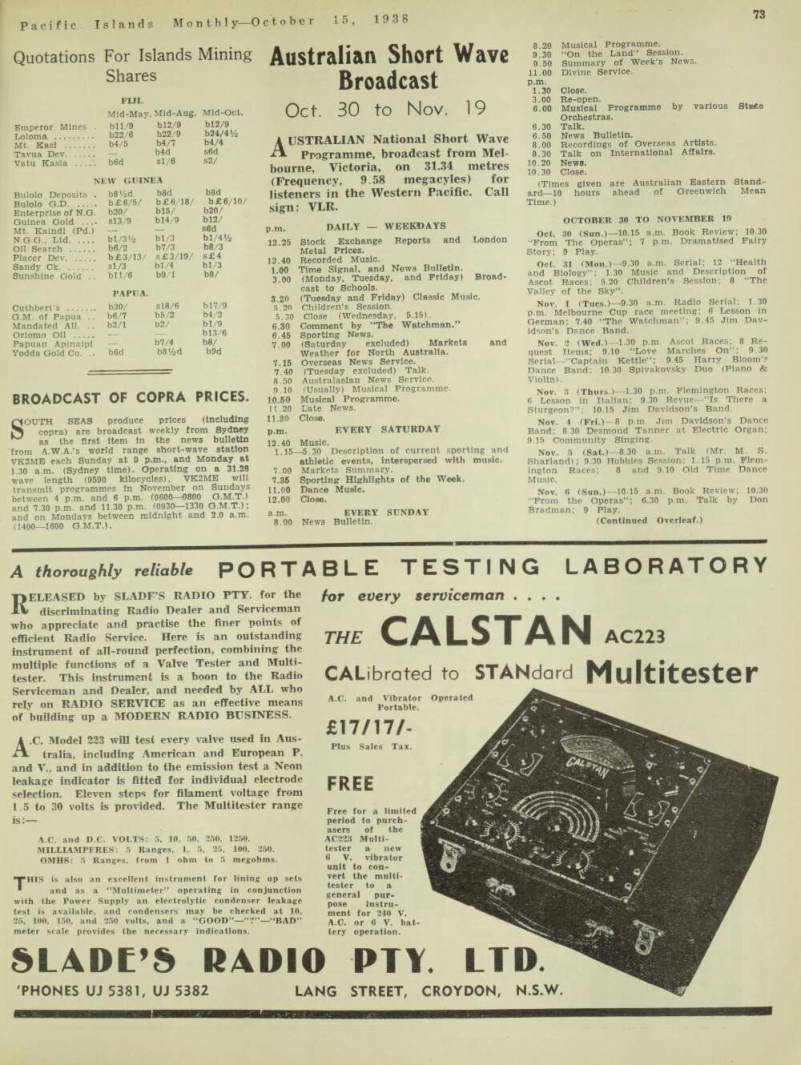
Shares
Fiji.
Mid-May. Mid-Aug.
Mid-Oct.
Emperor Mines . bll/9 b!2/9 b!2/9 Loloma b22/6 b22/9 b24/4Vfe Mt. Kasl b4/5 b4/7 b4/4 Tavua Dev — b4d s6d Vatu Kasia b6d sl/6 s2/
New Guinea
Bulolo Deposits . b8V 2 d b8d b8d Bulolo G.D b £ 6/5/ b£6/18/ b£6/10/ Enterprise of N.G. b20/ b!5/ b20/ Guinea Gold ...
S13/9 b!4/9 b!2/ Mt. Kaindi (Pd.) — — s6d N.G.G.. Ltd bl/3V 2 bl/3 bl/4V 2 Oil Search b6/2 b7/3 b8/3 Placer Dev b£3/13/ s£3/19/ s£4 Sandy Ck sl/3 bl/4 bl/3 Sunshine Gold .. bll/6 b9/l b8/ Cuthbert's
Papua.
b20/ S18/6 bl7/9 G.M. of Papua .. b6/7 b5/2 b4/2 Mandated All. .. b2/l b2/ bl/9 Oriomo Oil — — bl3/6 Papuan Apinaipl — b7/4 b8/ Yodda Gold Co. .. b6d b8'/ 2 d b9d
Broadcast Of Copra Prices.
SOUTH SEAS produce prices (including copra) are broadcast weekly from Sydney as the first item In the news bulletin from A.W.A.’s world range short-wave station VK2MB each Sunday at 9 p.m., and Monday at 1.30 a.m. (Sydney time). Operating on a 31.28 wave length (9590 kilocycles), VK2ME will transmit programmes in November on Sundays between 4 p.m. and 6 p.m. (0600 —0800 G.M.T.) and 7.30 p.m. and 11.30 p.m. (0930 —1330 G.M.T.); and on Mondays between midnight and 2.0 a.m.
(1400—1600 G.M.T.).
Australian Short Wave
Broadcast Oct. 30 to Nov. 19
AUSTRALIAN National Short Wave
Programme, broadcast from Mel
bourne, Victoria, on 31.34 metres
(Frequency, 9.58 megacyles) for
listeners in the Western Pacific. Call
sign: VLR.
P.M. Daily Weekdays
12.25 Stock Exchange Reports and London Metal Prices. 12.40 Recorded Music. 1,00 Time Signal, and News Bulletin. 3.00 (Monday, Tuesday, and Friday) Broad cast to Schools. 3.20 (Tuesday and Friday) Classic Music. 5.2 ft Children’s Session. 5.30 Close (Wednesday, 5.15). 6.30 Comment by “The Watchman.” 6.45 Sporting News. 7.00 (Saturday excluded) Markets and Weather for North Australia. 7.15 Overseas News Service. 7.40 (Tuesday excluded) Talk. 8.50 Australasian News Service. 9.10 (Usually) Musical Programme. 10.50 Musical Programme. 11.20 Late News. 11.30 Close.
P.M. Every Saturday
12.40 Music. 1.15—5.30 Description of current sporting and athletic events, interspersed with music. 7.00 Markets Summary. 7.35 Sporting Highlights of the Week. 11.00 Dance Music. 12.00 Close.
A.M. Every Sunday
8.00 News Bulletin.
8.20 Musical Programme. 9.30 “On the Land” Session. 9.50 Summary of Week’s News. 11.00 Divine Service. p.m. 1.30 Close. 3.00 Re-open. 6.00 Musical Programme by various Stafte Orchestras. 6.30 Talk. 6.50 News Bulletin. 8.00 Recordings of Overseas Artists. 8.30 Talk on International Affairs. 10.20 News. 10.30 Close. (Times given are Australian Eastern Stand ard—lo hours ahead of Greenwich Mean Time.)
October 30 To November 19
Oct. 30 (Sun.) —10.15 a.m. Book Review; 10.30 “From The Operas”: 7 p.m. Dramatised Fairy Story; 9 Play.
Oct. 31 (M0n.)—9.30 a.m. Serial; 12 “Health and Biology”: 1.30 Music and Description of Ascot Races: 5.20 Children’s Session; 8 “The Valley of the Sky”.
Nov. 1 (Tues.) —9-30 a.m. Radio Serial; 1.30 p.m. Melbourne Cup race meeting: 6 Lesson in German: 7.40 “The Watchman”: 9.45 Jim Dav idson’s Dance Band.
Nov. 2 (Wed.) —130 p.m. Ascot Races: 8 Re quest Items; 9.10 “Love Marches On”; 9.30 Serial—“ Captain Kettle”: 9.45 Harry Bloom’s Dance Band; 10.30 Spivakovsky Duo (Plano & Violin).
Nov. 3 (Thurs.)—l.3o p.m. Flemington Races; 6 Lesson in Italian; 9.30 Revue—“ls There a Sturgeon?”; 10.15 Jim Davidson’s Band.
Nov. 4 (Fri.)—B p.m. Jim Davidson’s Dance Band: 8 30 Desmond Tanner at Electric Organ; 9.15 Community Singing.
Nov. 5 (Sat.) —8.30 a.m. Talk (Mr. M. S.
Sharland); 9.30 Hobbles Session; 1.15 p.m. Plem ington Races; 8 and 9.10 Old Time Dance Music.
Nov. 6 (Sun.) —10.15 a.m. Book Review; 10.30 “From the Operas”; 6.30 p.m. Talk by Don Bradman: 9 Play.
(Continued Overleaf.)
Nov. 7 (Mon.) —1.30 p.m. Geelong Races; 6 French Lesson; 8 Serial; 8.30 National Military Band (Stephen Yorke).
Nov. 8 (Tues.) —9.30 a.m. Serial; 3 p.m.
“Everyday Science and Nature Study”; 6 Ger man Lesson.
Nov. 9 (Wed.) —1.30 p.m. Musical Programme & Woodend Races; 8 Request Items; 9.10 Music.
Nov. 10 (Thurs.) —1.30 Mornington Races; 6 Italian Lesson; 7.40 Talk “Revealing a Con tinent”: 8 Musical Programme.
Nov. 11 (Fri.)—3 p.m. “Adventures in Mu sic”; 3.20 Seymour Races; 8 Jim Davidson’s
Dance Band; 8.30 Desmond Tanner at Electric Organ; 9.15 Community Singing.
Nov. 12 (Sat.) —9.30 a.m. Hobbies Session; 1.15 Williamstown Races; 10.30 Dance Music.
Nov. 13 (Sun.) —10.30 a.m. “From the Op eras”; 4.30 p.m. Organ Recital; 4.50 Adelaide Wireless Chorus; 7.15 New Note Octet; 7.50 Harry Bloom; 9.20 Play.
Nov. 14 (Mon.) —8 p.m. Serial ‘‘The Labours of Hercules”; 8.30 National Military Band; 9 Topical Revue; 9.30 “Choral Cavalcade”.
Nov. 15 (Tues.) —3.15 p.m. Kimore Races; 6 German Lesson; 8 Musical Programme, includ ing community singing.
Nov. 16 (Wed.) —1.30 p.m. Bendigo Races; 8 Request Items; 8.45 “Emma and ’Erbert”; 9.10 “Love Marches On”; 9.30 Serial; 9.45 Harry Bloom’s Band; 10.50 Spivakovsky Duo.
Nov. 17 (Thurs.) —1.30 p.m. Bendigo Races; 6 Italian Lesson; 7.40 Talk—“ Australia, the Heroine”: 8 “The Play’s the Thing”.
Nov. 18 (Fri.) —3 p.m. “Adventures in Mu sic”; 8 Jim Davidson’s A.B.C. Dance Band; 8.30 Desmond Tanner at Electric Organ.
Nov. 19 (Sat,)—l.ls p.m. V.A.T.C. Races (Caulfield): 7.35 Sporting Highlights; 11 Dance Music; 12 Close.
Advertisements & other items, pp. 79-80 (1 item)
Slade’S Radio Pty. Ltd
A thoroughly reliable PORTABLE TESTING LABORATORY
Released by sladfs radio pty. for the discriminating Radio Dealer and Serviceman who appreciate and practise the finer points of efficient Radio Service. Here is an outstanding instrument of all-round perfection, combining the multiple functions of a Valve Tester and Multitester. This instrument is a boon to the Radio Serviceman and Dealer, and needed by ALL who rely on RADIO SERVICE as an effective means of building up a MODERN RADIO BUSINESS.
A.C. Model 223 will test every valve used in Australia, including American and European P. and V., and in addition to the emission test a Neon leakage indicator is fitted for individual electrode selection. Eleven steps for filament voltage from 1.5 to 30 volts is provided. The Multitester range is:— A.C. and D.C. VOLTS: 5, 10, 50, 250. 1250.
MILLIAMPERES: 5 Ranges, 1, 5. 25, 100, 250.
OMHS: 5 Ranges, from 1 ohm to 5 megohms.
TTHIS is also an excellent instrument for lining up sets ■ and as a “Multimeter” operating in conjunction with the Power Supply an electrolytic condenser leakage test is available, and condensers may be checked at 10, 25, 100, 150, and 250 volts, and a “GOOD”—“BAD” meter scale provides the necessary indications.
tor every serviceman ...
THE CALSTAN AC22B
CALibrated to STANdard MllltiteSter
A.C. and Vibrator Operated Portable. £l7/17/- Plus Sales Tax.
FREE
Free for a limited period to purchasers of the AC223 Multitester a new 6 V. vibrator unit to convert the multitester to a general purpose instrument for 240 V.
A.C. or 6 V. bat tery operation.
SLADE’S RADIO PTY. LTD
'PHONES UJ 5381, UJ 5382
LANG STREET, CROYDON, N.S.W.
KOYONG . . MOBS YALE
DAY AND BOARDING SCHOOL AND
KINDERGARTEN FOR GIRLS.
Pupils prepared for School, Music Examinations. Excellent Climate and Health Record.
Own Orchard, vegetables, poultry & dairy.
Home Life and Individual Attention.
Boarders taken from six years old.
Prospectus on application.
MISS MEIN, Principal.
POSITION WANTED.
Young, Healthy, Man desires Position in Islands. Experienced all depts. Chain Store Organisation, also Bulk Stores.
Good References. Accept any position with prospects. Apply:—
“INTEGRITY”,
C/- “P.1.M.” Office, 247 George St., Sydney.
Amazing New Tomatoes!
CLIMBING TOMATO (Imported). Amazing introduction. Climbs to 20ft. on trellis, fence, net-
ting. BEARS THROUGHOUT THE YEAR. Yields
TWO BUSHELS large (3%1n, x 2»/ 2 in.), red, meaty Tomatoes, per plant. AMAZINGLY PRODUCTIVE. SOW NOW. Government tested SEEDS (95 per cent, germination in 7 days), 2/6 packet, posted.
PURE WHITE TOMATO (imported), “White Beauty”. Skin, flesh, juice, and seeds PURE WHITE. Amazing new 100 PER CENT. NON- ACID HEALTH TOMATO (non-lnjurlous), LUSCIOUS FLAVOUR, heavy bearer. Large fruit (5y 2 in. x iy 4 1n.), DISEASE FREE. Easily grown any locality. DROUGHT PROOF!
Makes delicious Jam. Government tested seed (germination 85 per cent.), 2/6 packet, posted.
SOW NOW. Exclusive Distributors for Southern Hemisphere:—
N.S.W. SEED CO.,
17a PITT ST. (SYDNEY). Also at 390 Rawson Chambers, 3rd Floor, Railway Sq.
Because it is the only a.p.c. prepared to the specific therapeutic hospital formula prescribed for use in a large public hospital. Genuine Vincent’s A.P.C. is far more effective for relieving pain than other similar preparations. Send the coupon below and test the greater effectiveness of genuine Vincent’s A.P.C. for yourself.
STOPS SAFELY
HEADACHE
'FLU & COLDS
RHEUMATISM
NEURALGIA
SCIATICA
NEURITIS
LUMBAGO
AND ALL NERVE AND
MUSCULAR PAINS
PAIH *
MAST E R
POWDERS &
TABLETS
1/6 AND 2/6.
SINGLES 2d. eo.
Vincent Chemical Co. Pty. Ltd. 76 Liverpool St.,
SYDNEY.
FREE SAMPLE
Please send me a free sample of your powders and/or tablets.
NAME
ADDRESS
P.I.M.
Melville Island
Short-Lived Plan to Place Jews There
THOUSANDS of foreign Jews, driven out of Germany, Austria, Italy, etc., have been clamouring for admission to Australia, and thus causing embarrass ment to Canberra, which does not know what to do with them.
For a time, prominence was given to a suggestion that 100,000 Jewish refugees be placed on Melville Island. This island, 40 miles north of Darwin, is 80 miles long, by 40 miles wide, and contains 1,500,000 acres. It was claimed to be fertile and well-watered, and eminently fit for coloni sation.
Very soon, however, the plan was vigorously condemned by a number of people who personally had visited Melville Island. They declared that it was hot, humid, low-lying and malarious, and most unfit for colonisation. The plan appears now to have died.
It is recalled that, in recent years, a sort of Australian promotion company has held some option over Melville Island, and has been trying to organise a settle ment plan there.
Where Socialism
Operates
Strength and Weakness of Tonga
(Written for the P.I.M. by J. T.
Goedicke, of Haapai, Tonga, 80 years of age, and an old resident of Tonga.) THE little kingdom of Tonga is with out a parallel in the countries of the world, for it has neither poverty nor serious crime, nor a national debt, and a system of virtual land nationalisation prevails.
The Government is constitutional, with the British Consul and Agent as the power behind the throne. The people are happy, if not prosperous. The conditions of life are easy, and every Tongan has his bit of land —or should have it. Edu cation is universal, and in some respects it is up to colonial matriculation stand ard —although an agricultural education would be more suitable. The Tongan’s health is well looked after by European doctors and native medical practitioners.
While there is no poverty in Tonga, there is no wealth. The immemorial tribal system is opposed to the accumu lation of property. A man’s relations have the right to come and live with him, and share what he possesses.
Some years ago a Tongan high chief lost his wife, and married a Samoan of high rank. One result was that he was bothered by his wife’s Samoan relations, who were all related to him because they were related to her. Those Samoans came to Tonga with nothing; they re turned with well-stocked sandalwood chests which they had “cadged” from their relative’s husband. He would not break Polynesian etiquette by refusal — he would rather be heavily in debt to the traders!
In Tonga are to be seen the strength and weakness of Socialism—“a people without poverty, but a people without in dividualism”. The Tongan may be ready to utilise the inventions and discoveries of others, but he will not invent or dis cover for himself. The man who wants to rise above his fellows had better leave the country. To those whose ideal of life will be realised in short hours of labour, abundance of food, and neither poverty nor riches, Tonga will be Uto pia.
But whether humanity at large would be content with that Utopia becoming world-wide is a matter of speculation.
Social and economic conditions must alter in civilised lands —but then will not fol low the Polynesian pattern where the changes are affected.
Advertisements & other items, pp. 80-82 (3 items)
74
Pacific Islands Mont hi y—o ctober 15, 1938
“Alnwick”
KINDERGARTEN
74 BUNDARRA ROAD,
BELLEVUE HILL. SYDNEY.
Boarding School for Children from 2 years.
Qualified Nurse and Teachers.
Special attention to health and diet.
Individual Training under ideal conditions of climate and environment.
MISS E. WARRELL, Principal.
Tel.: FM 5638.
PLANTATION WANTED.
Will purchase small Plantation any part of Pacific. State price, production, area, and full details.
“PLANTER,”
C/o Pacific Islands Monthly, Box 3408 R, G.P.0., Sydney.
Learn to play the
PIANO ACCORDEON
and become popular at all parties and functions.
Supplying also:
SAXOPHONES
CLARINETS
TRUMPETS : CORNETS
PIANOS ORGANS
UKELELES : MUSIC
Correspondence Courses all Instruments.
WRITE FOR CATALOGUES AND PRICES.
SPECIAL TERMS TO GOVERNMENT
EMPLOYEES.
CHRIS MAURER,
114 LINDEN COURT, SYDNEY.
RADIO SETS
GRAMOPHONES
BANJO-MANDOLINS
G.P.O. Box 3432 R.
THE NEW MODEL
felrnmax Rapid
I m
Safe Lighting
HURRICANE LANTERNS
and TABLE LAMPS Burn
Kerosene and light up in
30 Seconds on Kerosene
No Preheating with Methylated Spirits.
A Beautiful White Light. mm mm mm Perfectly Safe, Burning Kerosene only.
Rapid Table
Lamps
% Burns 12 hours on one filling.
Rapid Hurricane Lanterns
Lights on Kerosene in 30 Seconds.
Artistic, Nickel-plated, Brass front.
Handsome Parchment Shade.
In Bond Price: 200 C.P £3 7 6 Lighting on Kerosene in 30 Seconds.
Strong Brass Body Nickel- plated.
In Bond Price: DISTRIBUTORS 200 C.P £2 15 0 Preheating type using methylated spirits still stocked for »r,' hap, “ s « 152 Sussex St., Sydney uibxkid u iun.s:
BROOM FI ELDS LTD.
Diabetes
treated without injection, Fasting or Pieting! Free—New Book, entitled “A Treatise on Diabetes—lts Cause and Treatment”, explains fully this latest theory. Successful home method. Write
CHEMISTS’ SUPPLIES CO., Dept P.M.,
Box 1178, Christchurch, N.Z. (Kindly enclose 6d. stamps for handling).
SYDNEY'S LEADING
SAILMAKER
and RIGGER
Also Manufacturer of all Canvas and Rope Work ISLANDS WORK a Speciality
HARRY WEST
Balmain East, SYDNEY Tal. W 1105
Extra Strong Saddle
Extra Low P
rice
7S\- bare
Built by highly skilled workmen from the best available materials, the Great Western Saddle represents remarkable value at 75/-. It is specially built to suit Island conditions with a Galvanised Tree, Copper Tacks and Brass Fillings.
Other Saddlery Bargains
Newmarket carry a complete stock of Saddles, ranging in price to £l4/14/-.
Also Collars, Whips, Rugs, and all other Saddlery accessories. If it’s in Saddlery it’s at Newmarket.
These Saddles are obtainable through your regular agent.
NEWMARKET SADDLERY
18-20 WILSON ST NEWTOWN
W. H WILLIAMS FOR SAFER SADDLES
FIVE MINUTES RELIEF
There is nothing indefinite about " ASPRO."
Its service is QUICK safe, effective, and definite. It gives you relief in 5 to 10 minutes, and then goes on to dispel or dissolve the cause of the pain, allowing Nature to effect the desired relief. Furthermore, you get no harmful after effects from " ASPRO," as it is speedily eliminated from the system a few hours after being taken. It neither dopes, deadens, nor drugs.
ASPRO*
DOES NOT HARM THE HEART
N.G. Capital Site
(Continued from Page 5.)
Resolutions By Public Meeting In Wau, New Guinea
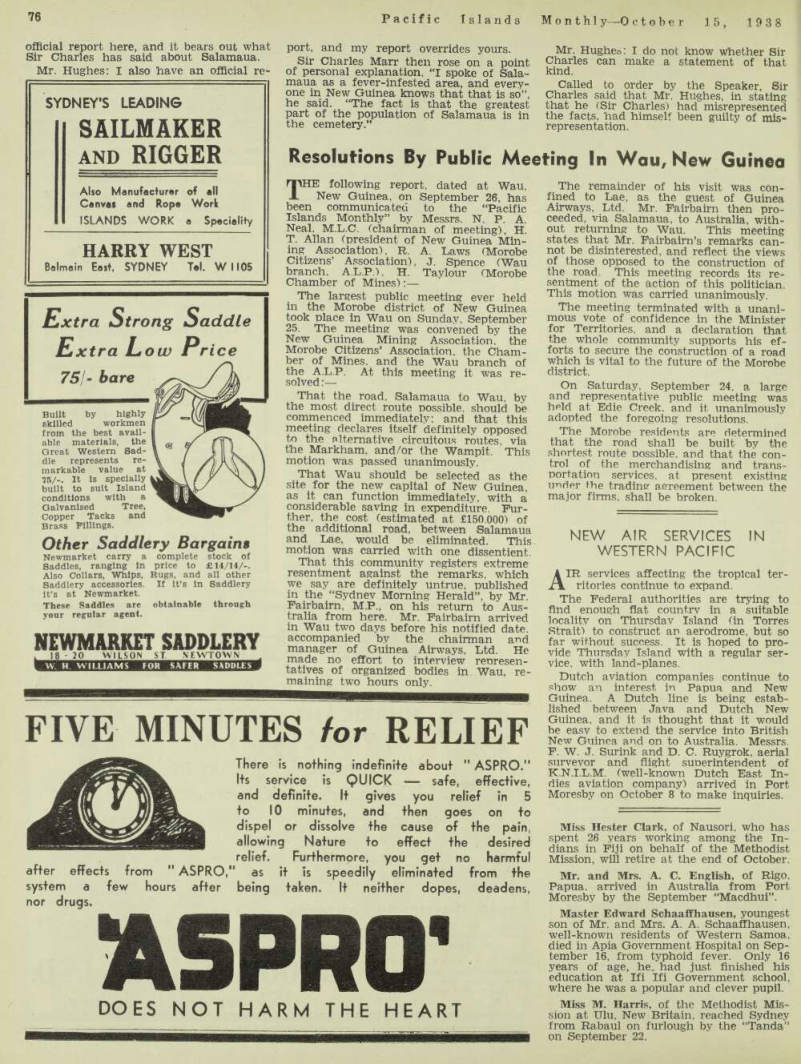
THE following report, dated at Wau, New Guinea, on September 26, has been communicated to the “Pacific Islands Monthly” by Messrs. N. P. A.
Neal. M.L.C. (chairman of meeting), H.
T. Allan (president of New Guinea Min ing Association), R. A. Laws (Morobe Citizens’ Association), J. Spence (Wau branch, A.L.P.), H. Taylour (Morobe Chamber of Mines);— The largest public meeting ever held in the Morobe district of New Guinea took place in Wau on Sunday, September 25. The meeting was convened by the New Guinea Mining Association, the Morobe Citizens’ Association, the Cham ber of Mines, and the Wau branch of the A.L.P. At this meeting it was re solved : That the road, Salamaua to Wau, by the most direct route possible, should be commenced immediately: and that this meeting declares itself definitely opposed to the alternative circuitous routes, via the Markham, and/or the Wampit. This motion was passed unanimously.
That Wau should be selected as the site for the new capital of New Guinea, as it can function immediately, with a considerable saving in expenditure. Fur ther, the cost (estimated at £150.000) of the additional road, between Salamaua and Lae, would be eliminated. This motion was carried with one dissentient.
That this community registers extreme resentment against the remarks, which we say are definitely untrue, published in the “Sydney Morning Herald”, by Mr.
Fairbairn, M.P., on his return to Aus tralia from here. Mr. Fairbairn arrived in Wau two days before his notified date, accompanied by the chairman and manager of Guinea Airways, Ltd. He made no effort to interview represen tatives of organized bodies in Wau, re maining two hours only.
The remainder of his visit was con fined to Lae, as the guest of Guinea Airways, Ltd. Mr. Fairbairn then pro ceeded, via Salamaua, to Australia, with out returning to Wau. This meeting states that Mr. Fairbairn’s remarks can not be disinterested, and reflect the views of those opposed to the construction of the road. This meeting records its re sentment of the action of this politician.
This motion was carried unanimously.
The meeting terminated with a unani mous vote of confidence in the Minister for Territories, and a declaration that the whole community supports his ef forts to secure the construction of a road which is vital to the future of the Morobe district.
On Saturday, September 24. a large and representative public meeting was held at Edie Creek, and it unanimously adopted the foregoing resolutions.
The Morobe residents are determined that the road shall be built by the shortest route nossible, and that the con trol of the merchandising and trans portation services, at present existing under the trading agreement between the major firms, shall be broken.
New Air Services In
Western Pacific
AIR services affecting the tropical ter ritories continue to expand.
The Federal authorities are trying to find enough flat country in a suitable locality on Thursday Island (in Torres Strait) to construct an aerodrome, but so far without success. It is hoped to pro vide Thursday Island with a regular ser vice, with land-planes.
Dutch aviation companies continue to show an interest in Papua and New Guinea. A Dutch line is being estab lished between Java and Dutch New Guinea, and it is thought that it would be easy to extend the service into British New Guinea and on to Australia. Messrs.
F. W. J. Surink and D. C. Ruygrok, aerial surveyor and flight sunerintendent of K.N.I.L.M. (well-known Dutch East In dies aviation company) arrived in Port Moresby on October 8 to make inquiries.
Miss Hester Clark, of Nausori, who has spent 26 years working among the In dians in Fiji on behalf of the Methodist Mission, will retire at the end of October.
Mr. and Mrs. A. C. English, of Rigo.
Papua, arrived in Australia from Port Moresby by the September “Macdhui”.
Master Edward Schaaffhausen, youngest son of Mr. and Mrs. A. A. Schaaffhausen, well-known residents of Western Samoa, died in Apia Government Hospital on Sep tember 16, from typhoid fever. Only 16 years of age, he. had just finished his education at Ifi Ifi Government school, where he was a popular and clever pupil.
Miss M. Harris, of the Methodist Mis sion at Ulu, New Britain, reached Sydney from Rabaul on furlough by the “Tanda” on September 22.
Advertisements & other items, p. 82 (1 item)
76
Pacific Islands Monthl y—o ctober 15, 1938
Market Quotations
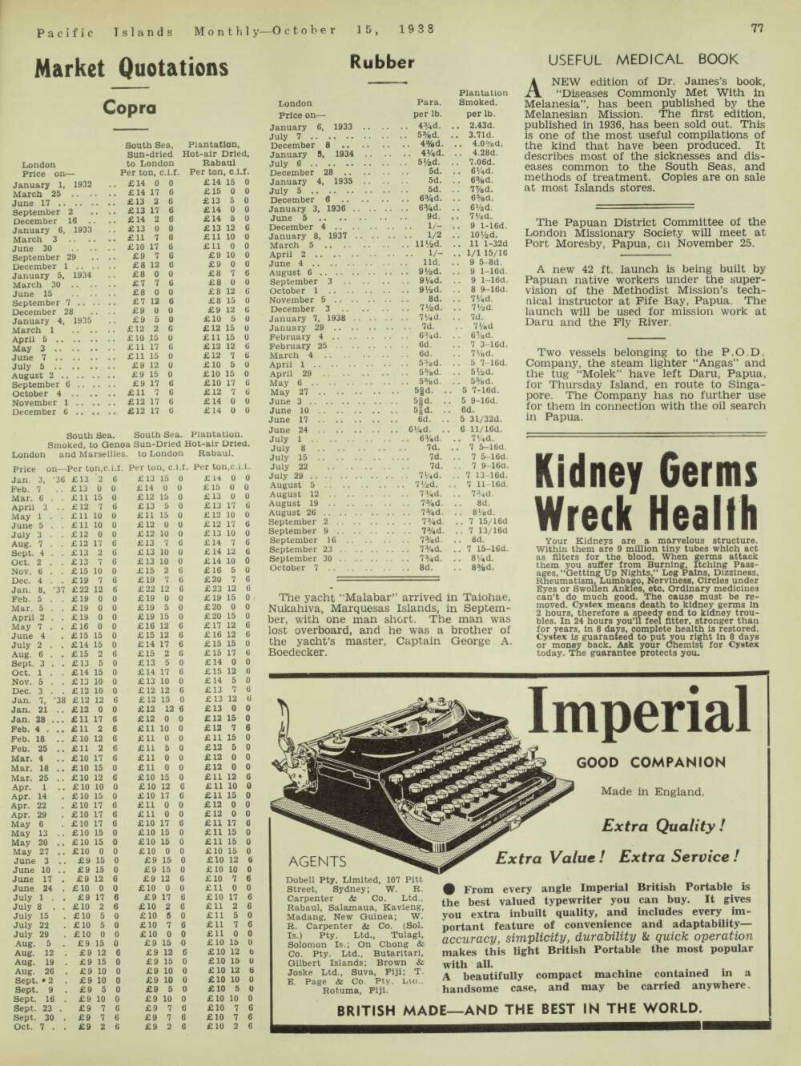
The yacht “Malabar” arrived in Taiohae.
Nukahiva, Marquesas Islands, in Septem ber, with one man short. The man was lost overboard, and he was a brother of the yacht’s master, Captain George A.
Boedecker.
R
ubber
Plantation London Para.
Smoked.
Price on— per lb. per lb.
January 6, 1933 4%d. .. 2.43d.
July 7 5 3 /ad. .. 3.71d.
December 8 .. .. 4.0 3 /ad.
January 9, 1934 4V 4 d. .. 4.28d.
July 6 .. 7.06d.
December 28 .. 5d. .. ey 4 d.
January 4, 1935 5d. .. 6%d.
July 5 5d. .. 7%d.
December 6 .. .. 6%d.
January 3, 1936 .. 6 3 Ad. .. ey 2 d.
June 5 9d. .. 7'Ad.
December 4 .. .. 9 l-16d.
January 8, 1937 . . 1/2 .. ioy 2 d.
March 5 .. .. .. 11 l-32d April 2 .. 1/1 15/16 June 4 lid. . . 9 5-8d.
August 6 .. 9 l-16d.
September 3 .. 9V 4 d. .. 9 1-16d.
October 1 .. .. 9'/ 2 d. .. 8 9-16d.
November 5 .. .. 8d. .. 7'Ad.
December 3 .. 7V 2 d.
January 7, 1938 . 7'Ad. .. 7d.
January 29 .. . . 7d. .. 7Vkd February 4 .. .. .. 6’/ 8 d.
February 25 6d. .. 7 3-16d.
March 4 6d. . . 7V 8 d.
April 1 5%d. .. 5 7-16d.
April 29 5 5 /sd. .. 5V 2 d.
May 6 .. 5%d.
May 27 .. .. 5|d. . . 5 7-16d.
June 3 5|d- • . 5 9-16d.
June 10 .. .. 5|d. . . 6d.
June 17 ... 6d. . 5 31/32d.
June 24 .. .. 6«Ad. . . 6 ll/16d.
July 1 6 3 / 4 d. .. 7'Ad.
July 8 7d. .. 7 5-16d.
July 15 7d. .. 7 5-16d.
July 22 .. 7d. .. 7 9-16d.
July 29 .. 7 13-16d.
August 5 7*/ 2 d. .. 7 ll-16d.
August 12 7 3 Ad. .. 7 3 Ad.
August 19 . . . . 7 3 Ad. 8d.
August 26 7 3 Ad. . . 8'/ad.
September 2 . . .. 7 3 / 4 d. .. 7 15/16d September 9 .. .. 7%d. .. 7 13/16d September 16 7 3 Ad. .. 8d.
September 23 . .. 7 3 Ad. .. 7 15-16d.
September 30 . . . . 7 3 Ad. . . 8‘Ad.
October 7 .. .. 8d. . . 8%d.
London Price on
Copra
South Sea, Plantation, Sun-dried Hot-air Dried, to London Rabaul Per ton, c.i.f. Per ton, c.l.f.
January 1, March 25 1932 £14 0 0 £14 17 6 £14 15 £15 0 0 0 June 17 .. £13 2 6 £13 5 0 September 2 .. £13 17 6 £14 0 0 December 16 . £14 2 6 £14 5 0 January 6, March 3 1933 •• £13 0 0 £11 7 6 £13 12 £11 10 6 0 June 30 £ 10 17 6 £11 0 0 September 29 .. .. £9 7 6 £9 10 0 December 1 .. £8 12 6 £9 0 0 January 5, March 30 1934 £8 0 0 £7 7 6 £8 7 £8 0 6 0 June 15 £8 0 0 £8 12 6 September 7 .. £7 12 6 £8 15 0 December 28 . . £9 0 0 £9 12 6 January 4, March 1 1935 £9 5 0 £12 2 6 £10 5 £12 15 0 0 April 5 .. £10 15 0 £11 15 0 May 3 .. £11 17 6 £12 12 6 June 7 .. £11 15 0 £12 7 6 July 5 .. £9 12 0 £10 5 0 August 2 . £9 15 0 £10 15 0 September 6 .. £9 17 6 £10 17 6 October 4 £11 7 6 £12 7 6 November 1 .. £12 17 6 £14 0 0 December < B .. £12 17 6 £14 0 0 South Sea. South Sea. Plantation.
Smoked, to Genoa Sun-Dried Hot-air Dried.
London and Marseilles, to London Rabaul.
Price on— -Per ton.c.i.f.
Per ton, c.l.f.
Per ton,c.i.l.
Jan. 3, '36 £13 2 6 £13 15 0 £14 0 0 Peb. 7 £13 0 0 £14 0 0 £15 0 0 Mar. 6 . . £11 15 0 £12 15 0 £13 0 0 April 3 . . £12 7 6 £13 5 0 £13 17 6 May 1 . - £11 10 0 £11 15 0 £12 10 0 June 5 . . £11 10 0 £12 0 0 £12 17 6 July 3 . . £12 0 0 £12 10 0 £13 10 0 Aug. 7 . . £12 17 6 £13 7 6 £14 7 6 Sept. 4 . . £13 2 6 £13 10 0 £14 12 6 Oct. 2 . . £13 7 6 £13 10 0 £14 10 0 Nov. 6 . . £15 10 0 £15 2 6 £16 5 0 Dec. 4 . . £19 7 6 £19 7 6 £20 7 6 Jan. 8, ’37 £22 12 6 £22 12 6 £23 12 6 Feb. 5 . . £19 0 0 £19 0 0 £19 15 0 Mar. 5 . . £19 0 0 £19 5 0 £20 0 0 April 2 . . £19 0 0 £19 15 0 £20 15 0 May 7 . . £16 0 0 £16 12 6 £17 12 6 June 4 £15 15 0 £15 12 6 £16 12 6 July 2 . . £14 15 0 £14 17 6 £15 15 0 Aug. 6 . . £15 2 6 £15 2 6 £15 17 6 Sept. 3 . . £13 5 0 £13 5 0 £14 0 0 Oct. 1 . . £14 15 0 £14 17 6 £15 12 6 Nov. 5 . . £13 10 0 £13 10 0 £14 5 0 Dec. 3 . . £12 10 0 £12 12 6 £13 7 6 Jan. 7, ’38 1 £12 12 6 £12 15 0 £13 12 6 Jan. 21 .. £12 0 0 £12 12 6 £13 0 0 Jan. 28 ... £11 17 6 £12 0 0 £12 15 0 Peb. 4 . .. £11 2 6 £11 10 0 £12 7 6 Peb. 18 .. £10 12 6 £11 0 0 £11 15 0 Feb. 25 .. £11 2 6 £11 5 0 £12 5 0 Mar. 4 £10 17 6 £11 0 0 £12 0 0 Mar. 18 .. £10 15 0 £11 0 0 £12 0 0 Mar. 25 .. £10 12 6 £10 15 0 £11 12 6 Apr. 1 .. £10 10 0 £10 12 6 £11 10 0 Apr. 14 £10 15 0 £10 17 6 £11 15 0 Apr. 22 £10 17 6 £11 0 0 £12 0 0 Apr. 29 £10 17 6 £11 0 0 £12 0 0 May 6 £10 17 6 £10 17 6 £11 17 6 May 13 .. £10 15 0 £10 15 0 £11 15 0 May 20 .. £10 15 0 £10 15 0 £11 15 0 May 27 .. £10 0 0 £10 0 0 £10 15 0 June 3 .. . £9 15 0 £9 15 0 £10 12 6 June 10 .. £9 15 0 £9 15 0 £10 10 0 June 17 . £9 12 6 £9 12 6 £10 7 6 June 24 , £10 0 0 £10 0 0 £11 0 0 July 1 . . £9 17 6 £9 17 6 £10 17 6 July 8 . . £10 2 6 £10 2 6 £11 2 6 July 15 , £10 5 0 £10 5 0 £11 5 0 July 22 , £10 5 0 £10 7 6 £11 7 6 July 29 . £10 0 0 £10 0 0 £11 0 0 Aug. 5 . £9 15 0 £9 15 0 £10 15 0 Aug. 12 . £9 12 6 £9 12 6 £10 12 6 Aug. 19 . £9 15 0 £9 15 0 £10 15 0 Aug. 26 . £9 10 0 £9 10 0 £10 12 6 Sept. • 2 . £9 10 0 £9 10 0 £10 10 0 Sept. 9 . £9 5 0 £9 5 0 £10 5 0 Sept. 16 £9 10 0 £9 10 0 £10 10 0 Sept. 23 . £9 7 6 £9 7 6 £10 7 6 Sept. 30 . . £9 7 6 £9 7 6 £10 7 6 Oct. 7 . , . £9 2 6 £9 2 6 £10 2 6
Useful Medical Book
ANEW edition of Dr. James’s book, “Diseases Commonly Met With in Melanesia”, has been published by the Melanesian Mission. The first edition, published in 1936, has been sold out. This is one of the most useful compilations of the kind that have been produced. It describes most of the sicknesses and dis eases common to the South Seas, and methods of treatment. Copies are on sale at most Islands stores.
The Papuan District Committee of the London Missionary Society will meet at Port Moresby, Papua, on November 25.
A new 42 ft. launch is being built by Papuan native workers under the super vision of the Methodist Mission’s tech nical instructor at Fife Bay, Papua. The launch will be used for mission work at Daru and the Fly River.
Two vessels belonging to the P.O.D.
Company, the steam lighter “Angas” and the tug “Molek” have left Daru, Papua, for Thursday Island, en route to Singa pore. The Company has no further use for them in connection with the oil search in Papua.
Advertisements & other items, p. 83 (2 items)
77
Pacific Islands Monthl y —o ctober 15, 1938
Imperial
Kidney Germs
Wreck Health
Your Kidneys are a marvelous structure.
Within them are 9 million tiny tubes which act as filters for the blood. When germs attack them you suffer from Burning. Itching Passages, “Getting Up Nights,” Leg Pains, Dizziness, Rheumatism, Lumbago, Nerviness, Circles under Eyes or Swollen Ankles, etc. Ordinary medicines can’t do much good. The cause must be removed. Cystex means death to kidney germs In 2 hours, therefore a speedy end to kidney troubles. In 24 hours you’ll feel fitter, stronger than for years, In 8 days, complete health Is restored.
Cystex Is guaranteed to put you right In 8 days or money back. Ask your Chemise for Cystex today. The guarantee protects you.
3*
AGENTS
Imperial
GOOD COMPANION
Made in England.
Extra Quality!
Extra Value! Extra Service!
Dobell Pty. Limited, 107 Pitt Street, Sydney; W. R.
Carpenter & Co. Ltd., Rabaul, Salamaua, Kavieng, Madang, New Guinea; W.
R. Carpenter & Co. (Sol.
Is.) Pty. Ltd., Tulagi, Solomon Is.; On Chong & Co. Pty. Ltd., Butaritari, Gilbert Islands; Brown & Joske Ltd., Suva, Fiji; T.
E. Page & Co. Pty. Liu., Rotuma, Fiji. From every angle Imperial British Portable is the best valued typewriter you can buy. It gives you extra inbuilt quality, and includes every important feature of convenience and adaptability—
accuracy, simplicity, durability & quick operation
makes this light British Portable the most popular with all.
A beautifully compact machine contained m a handsome case, and may be carried anywhere BRITISH MADE—AND THE BEST IN THE WORLD.
Islands Produce
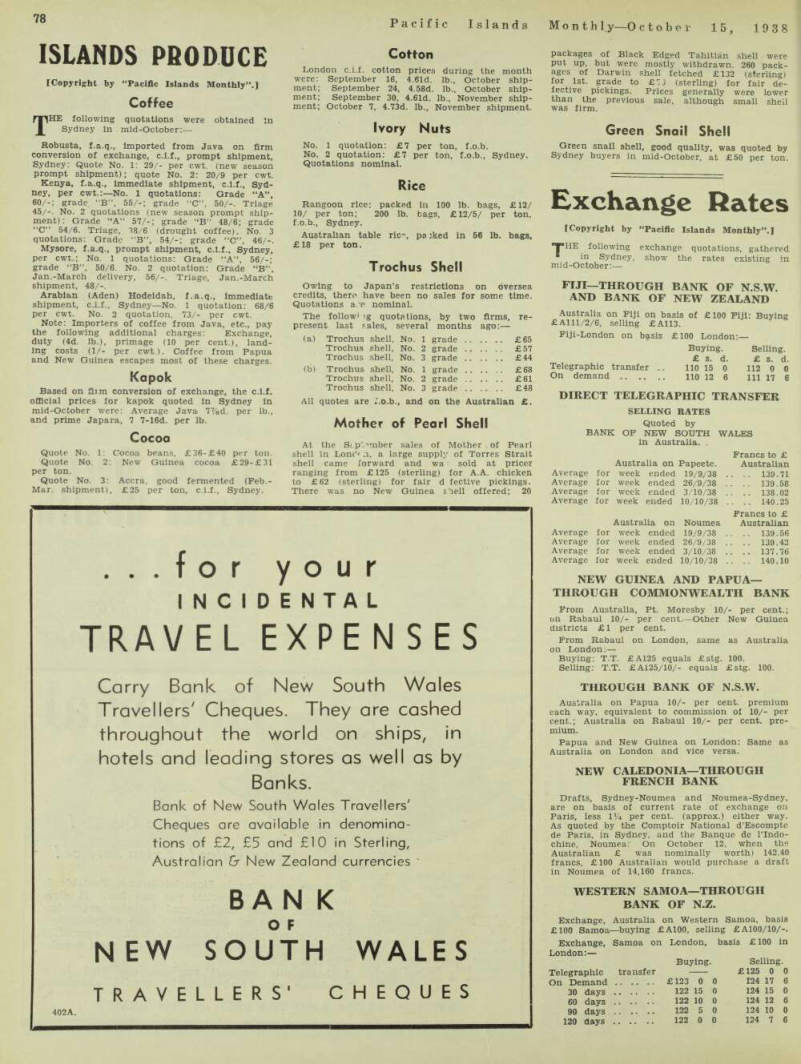
[Copyright by “Pacific Islands Monthly”.]
Coffee
THE following quotations were obtained in Sydney in mid-October:— Robusta, f.a.q., Imported from Java on firm conversion of exchange, c.i.f., prompt shipment, Sydney: Quote No. 1: 29/- per cwt. (new season prompt shipment); quote No. 2: 20/9 per cwt.
Kenya, f.a.q., immediate shipment, c.i.f., Syd ney, per cwt.:—No. 1 quotations: Grade “A”, 60/-; grade “B", 55/-; grade “C”, 50/-. Triage 45/-. No. 2 quotations (new season prompt ship ment); Grade “A” 57/-; grade “B” 48/6; grade “C” 54/6. Triage, 38/6 (drought coffee). No. 3 quotations: Grade “B”, 54/-; grade “C”, 46/-.
Mysore, f.a.q., prompt shipment, c.i.f., Sydney, per cwt.; No. 1 quotations: Grade “A”, 56/-; grade “B”, 50/6. No. 2 quotation: Grade “B”, Jan.-March delivery, 56/-. Triage, Jan.-March shipment, 48/-.
Arabian (Aden) Hodeidah, f.a.q., immediate shipment, c.i.f., Sydney—No. 1 quotation; 68/6 per cwt. No. 2 quotation, 73/- per cwt.
Note: Importers of coffee from Java, etc., pay the following additional charges: Exchange, duty (4d. lb.), primage (10 per cent.), land ing costs (1/- per cwt). Coffee from Papua and New Guinea escapes most of these charges.
Kapok
Based on Aim conversion of exchange, the c.i.f. official prices for kapok quoted in Sydney in mid-October were: Average Java 7 7 /ad. per lb., and prime Japara, 7 7-16 d. per lb.
Cocoa
Quote No. 1: Cocoa beans, £36-£4O per ton.
Quote No. 2; New Guinea cocoa £29-£3l per ton.
Quote No. 3: Accra, good fermented (Peb.- Mar. shipment), £25 per ton, c.i.f., Sydney.
Cotton
London c.i.f. cotton prices during the month were: September 16, 4.61 d. lb., October ship ment; September 24, 4.58 d. lb., October ship ment; September 30, 4.61 d. lb., November ship ment; October 7,4.73 d. lb., November shipment.
Ivory Nuts
No. 1 quotation; £7 per ton, f.o.b.
No. 2 quotation: £7 per ton, f.0.b., Sydney.
Quotations nominal.
Rice
Rangoon rice: packed in 100 lb. bags, £l2/ 10/ per ton; 200 lb. bags, £l2/5/ per ton, f.0.b., Sydney.
Australian table ric-% pa ;ked in 56 lb. bags, £lB per ton.
Trochus Shell
Owing to Japan’s restrictions on oversea credits, there have been no sales for some time.
Quotations a:o nominal.
The follow) \g quotations, by two firms, re present last sales, several months ago:— (a) Trochus shell, No. 1 grade £65 Trochus shell. No. 2 grade £57 Trochus shell, No. 3 grade £44 (b) Trochus shell. No. 1 grade £6B Trochus shell, No. 2 grade £6l Trochus shell, No. 3 grade £4B All quotes are f.0.b., and on the Australian £.
Mother of Pearl Shell
At the sales of Mother of Pearl shell in Lone 1 ' n, a large supply of Torres Strait shell came forward and wa sold at prices ranging from £125 (sterling) for A.A. chicken to £62 (sterling) for fair d fective pickings.
There was no New Guinea shell offered; 20
packages of Black Edged Tahitian shell were put up, but were mostly withdrawn. 260 pack ages of Darwin shell fetched £132 (sterling) for Ist. grade to £7l (sterling) for fair de fective pickings. Prices generally were lower than the previous sale, although small shell was firm.
Green Snail Shell
Green snail shell, good quality, was quoted by Sydney buyers in mid-October, at £5O per ton.
Exchange Rates
[Copyright by “Pacific Islands Monthly”.] THE following exchange quotations, gathered in Sydney, show the rates existing in mid-October:—
Fiji—Through Bank Of N.S.W.
And Bank Of New Zealand
Australia on Fiji on basis of £lOO Fiji; Buying £AIII/2/6, selling £AII3.
Fiji-London on basis £lOO London:—
New Guinea And Papua
Through Commonwealth Bank
From Australia, Pt. Moresby 10/- per cent.; on Rabaul 10/- per cent. —Other New Guinea districts £1 per cent.
Prom Rabaul on London, same as Australia on London:— Buying: T.T. £AI2S equals £stg. 100.
Selling: T.T. £AI2S/10/- equals £stg. 100.
Through Bank Of N.S.W.
Australia on Papua 10/- per cent, premium each way, equivalent to commission of 10/- per cent.; Australia on Rabaul 10/- per cent, pre mium.
Papua and New Guinea on London; Same as Australia on London and vice versa.
New Caledonia—Through
French Bank
Drafts, Sydney-Noumea and Noumea-Sydney, are on basis of current rate of exchange on Paris, less IVt per cent, (approx.) either way.
As quoted by the Comptolr National d’Escompte de Paris, in Sydney, and the Banque de ITndo chine, Noumea: On October 12, when the Australian £ was nominally worth) 142.40 francs, £lOO Australian would purchase a draft in Noumea of 14,160 francs.
Western Samoa—Through
Bank Of N.Z.
Exchange, Australia on Western Samoa, basis £lOO Samoa—buying £AIOO, selling £AIOO/10/-.
Exchange, Samoa on London, basis £lOO in London: —
Buying.
Selling. £ s. d. £ s. d.
Telegraphic transfer .. 110 15 0 112 0 0 On demand 110 12 6 111 17 6
Direct
Telegraphic Transfer
Selling
Rates
Quoted by
Bank Op New South Wales
in Australia.
Francs to £ Australia on Papeete.
Australian Average for week ended 19/9/38 . . .. 139.71 Average for week ended 26/9/38 . . .. 139.58 Average for week ended 3/10/38 . . .. 138.02 Average for week ended 10/10/38 . . .. 140.25 Francs to £ Australia on Noumea Australian Average for week ended 19/9/38 . . .. 139.56 Average for week ended 26/9/38 . . .. 139.42 Average for week ended 3/10/38 . , .. 137.76 Average for week ended 10/10/38 . . .. 140.10
Buying. Selling.
Telegraphic transfer £125 0 0 On Demand £123 0 0 124 17 6 30 days 122 15 0 124 15 0 60 days 122 10 0 124 12 6 90 days 122 5 0 124 10 0 120 days 122 0 0 124 7 6
Advertisements & other items, p. 84 (2 items)
78
Pacific Islands Month l.y—O ctober 15, 1938
...for your
INCIDENTAL
TRAVEL EXPENSES
Carry Bank of New South Wales Travellers' Cheques. They are cashed throughout the world on ships, in hotels and leading stores as well as by Banks.
Bank of New South Wales Travellers 7 Cheques are available in denominations of £2, £5 and £lO in Sterling, Australian £r New Zealand currencies '
BANK
O F
NEW SOUTH WALES
TRAVELLERS’ CHEQUES
402 A.
Shipping Services in the Pacific
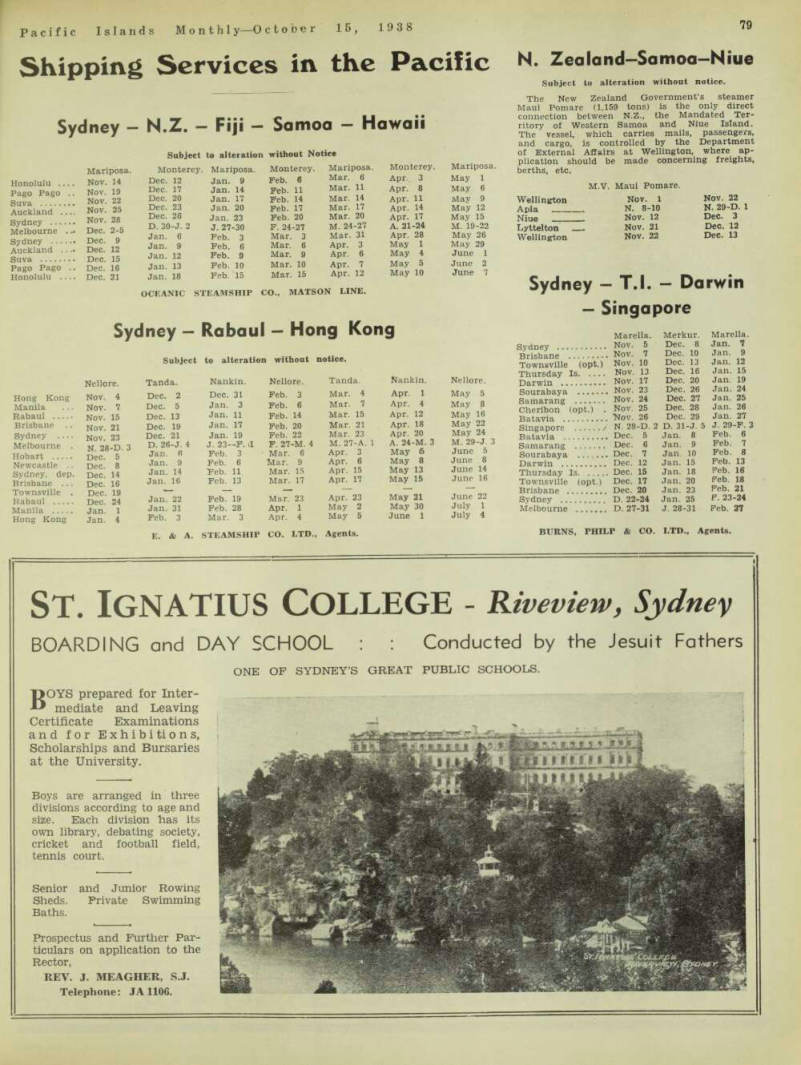
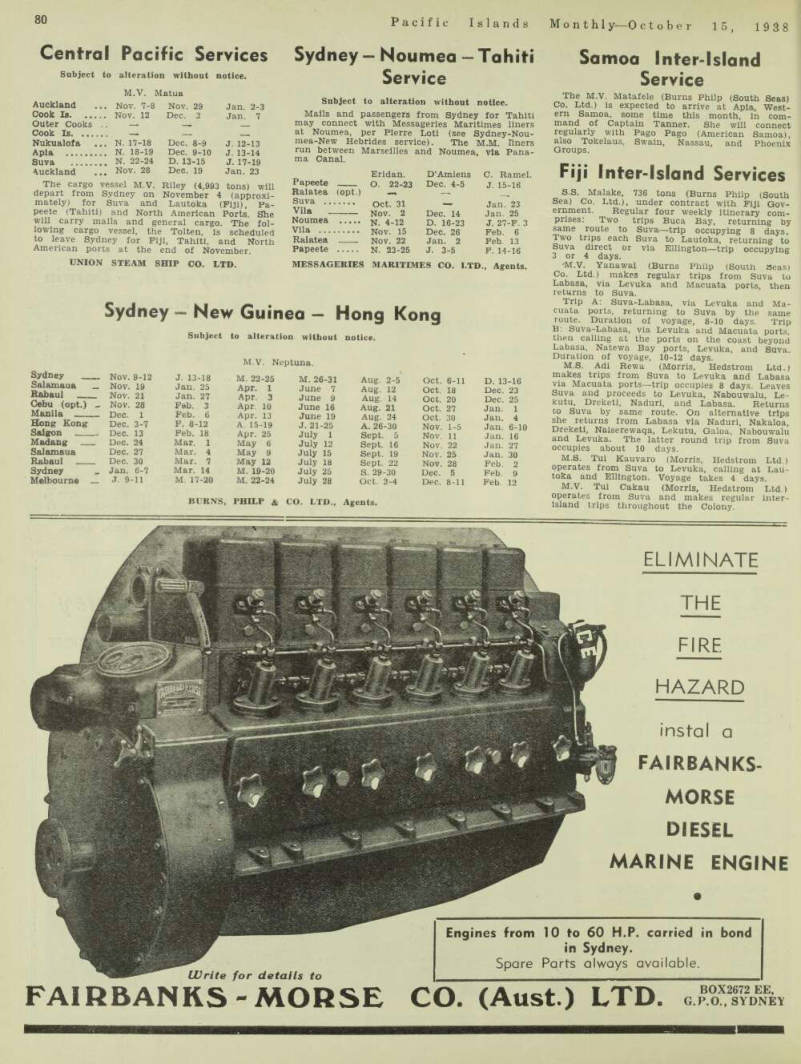
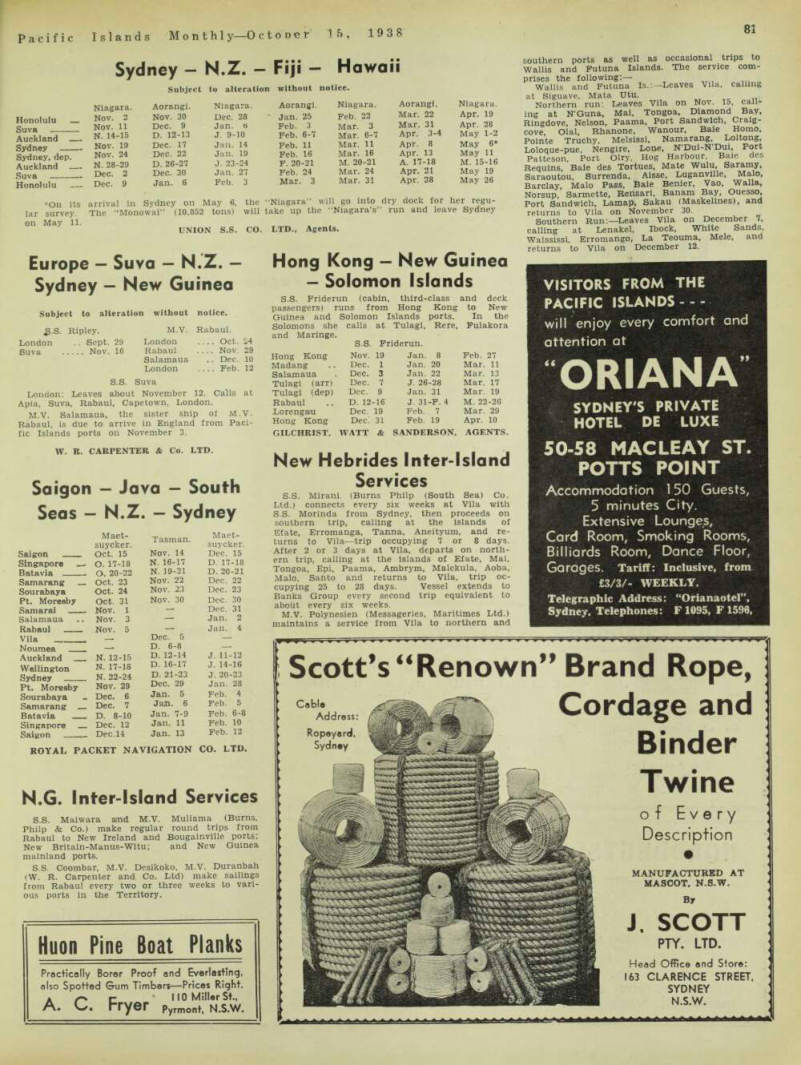
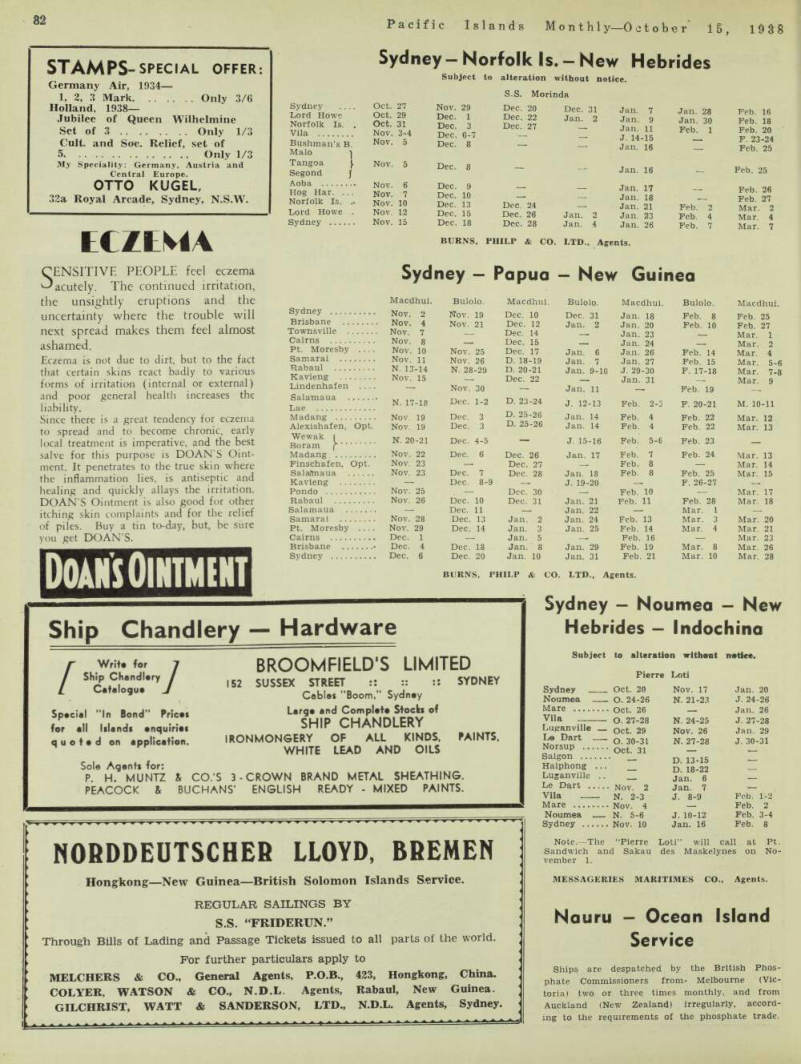
Sydney N.Z. Fiji Samoa Hawaii
Sydney Robaul Hong Kong
N. Zeaiand-Samoa-Niue
Subject to alteration without notice.
The New Zealand Government’s steamer Maui Pomare (1,159 tons) is the only direct connection between N.Z., the Mandated Ter ritory of Western Samoa and Niue Island.
The vessel, which carries mails, passengers, and cargo, is controlled by the Department of External Affairs at Wellington, where ap plication should be made concerning freights, berths, etc.
M.V. Maui Pomare.
Wellington Nov. 1 Nov. 22 Apia N. 8-10 N. 29-D. 1 Niue . Nov. 12 Dec. 3 Lyttelton Nov. 21 Dec. 12 Wellington Nov. 22 Dec. 13
Sydney - T.l. - Darwin Singapore
Subject to alteration without Notice Honolulu Pago Pago ..
Mariposa.
Nov. 14 Nov. 19 Nov. 22 Monterey.
Dec. 12 Dec. 17 Dec. 20 Mariposa.
Jan, 9 Jan. 14 Jan. 17 Monterey.
Peb. 6 Peb. 11 Feb. 14 Mariposa.
Mar. 6 Mar. 11 Mar. 14 Monterey.
Apr 3 Apr. 8 Apr. 11 Mariposa.
May 1 May 6 May 9 Auckland Sydney Nov. 25 Nov. 28 Dec. 23 Dec. 26 Jan. 20 Jan. 23 Peb. 17 Feb. 20 Mar. 17 Mar. 20 M. 24-27 Mar. 31 Apr. 14 Apr. 17 A. 21-24 Apr. 28 May 12 May 15 Melbourne ...
QvHnpv ..« Dec. 2-5 Dec. 9 Dec. 12 Dec. 15 Dec. 16 Dec. 21 D. 30-J. 2 Jan. 6 J. 27-30 Peb. 3 F. 24-27 Mar. 3 M. 19-22 May 26 oyuiicjf Auckland ...
Suva Pago Pago ..
Honolulu Jan. 9 Jan. 12 Jan. 13 Jan. 18 Feb. 6 Peb. 9 Feb. 10 Feb. 15 Mar. 6 Mar. 9 Mar. 10 Mar. 15 Apr. 3 Apr. 6 Apr. 7 Apr. 12 May 1 May 4 May 5 May 10 May 29 June 1 June 2 June 7
Oceanic Steamship Co., Matson Line.
Subject to alteration i without notice.
Nellore.
Tanda.
Nankin.
Nellore.
Tanda.
Nankin.
Nellore.
Hong Kong Nov. 4 Dec. 2 Dec. 31 Feb. 3 Mar. 4 Apr. 1 May 5 Manila Nov. 7 Dec. 5 Jan. 3 Feb. 6 Mar. 7 Apr. 4 May 8 Rabaul Nov. 15 Dec. 13 Jan. 11 Feb. 14 Mar. 15 Apr. 12 May 16 Brisbane Nov. 21 Dec. 19 Jan. 17 Feb. 20 Mar. 21 Apr. 18 May 22 Sydney Nov 23 Dec. 21 Jan. 19 Feb. 22 Mar. 23 Apr. 20 May 24 Melbourne • N.28-D. 3 Dec. 5 Dec. 8 Dec. 14 Dec. 16 D. 26-J. 4 J. 23--F. >1 F. 27-M. 4 M.27-A. 1 A. 24-M. 3 M. 29~J. 3 Hobart Jan. 6 Feb. 3 Mar. 6 Apr. 3 May 6 June 5 Newcastle ..
Sydney, dep.
Brisbane ...
Jan. 9 Jan. 14 Jan. 16 Feb. 6 Feb. 11 Feb. 13 Mar. 9 Mar. 15 Mar. 17 Apr. 6 Apr. 15 Apr. 17 May 8 May 13 May 15 June 8 June 14 June 16 Townsville .
Rabaul Dec. 19 Dec. 24 Jan. 22 Feb. 19 Mar. 23 Apr. 23 May 21 June 22 Manila Jan. 1 Jan. 31 Feb. 28 Apr. 1 May 2 May 30 July 1 Hong Kong Jan. 4 Feb. 3 E. & A.
Mar. 3
Steamship
Apr. 4
Co. Ltd.
May 5 , Agents.
June 1 July 4
Marella.
Merkur.
Marella.
Sydney Nov. 5 Dec. 8 Jan. 7 Brisbane Nov. 7 Dec. 10 Jan. 9 Townsville (opt.) Nov. 10 Dec. 13 Jan. 12 Thursday Is Nov. 13 Dec. 16 Jan. 15 Darwin Nov. 17 Dec. 20 Jan. 19 Sourabaya Nov. 23 Dec. 26 Jan. 24 Samarang Nov. 24 Dec. 27 Jan. 25 Cheribon (opt.) .
Nov. 25 Dec. 28 Jan. 26 Batavia Nov. 26 Dec. 29 Jan. 27 Singapore / N. 28 -D. 2 D. 31-J. 5 J. 29 -P. 3 Batavia Dec. 5 Jan. 8 Feb. 6 Samarang Dec. 6 Jan. 9 Feb. 7 Sourabaya ...
Dec. 7 Jan. 10 Feb. 8 Darwin Dec. 12 Jan. 15 Feb. 13 Thursday Is Dec. 15 Jan. 18 Feb. 16 Townsville (opt.) Dec. 17 Jan. 20 Peb. 18 Brisbane Dec. 20 Jan. 23 Feb. 21 Sydney D. 22-24 Jan. 25 F. 23-24 Melbourne D. 27-31 J. 28-31 Peb. 27
Burns, Philp &
CO.
LTD., Agents.
Central Pacific Services
The cargo vessel M.V. Riley (4,993 tons) will depart from Sydney on November 4 (approxi mately) for Suva and Lautoka (Fiji), Pa peete (Tahiti) and North American Ports. She will carry malls and general cargo. The fol lowing cargo vessel, the Tolten, is scheduled to leave Sydney for Fiji, Tahiti, and North American ports at the end of November.
Union Steam Ship Co. Ltd.
Sydney-Noumea-Tahiti
Sgtyic©
Subject to alteration without notice.
Malls and passengers from Sydney for Tahiti may connect with Messageries Maritimes liners at Noumea, per Pierre Loti (see Sydney-Nou mea-New Hebrides service). The M.M. Liners run between Marseilles and Noumea, via Pana ma Canal.
Sydney - New Guinea - Hong Kong
Samoa Inter-Island
Service
The M.V. Matafele (Burns Philp (South Seas) Co. Ltd.) is expected to arrive at Apia, West ern Samoa, some time this month, in com mand of Captain Tanner, She will connect regularly with Pago Pago (American Samoa), also Tokelaus, Swain, Nassau, and Phoenix Groups.
Fiji Inter-Island Services
S.S. Malake, 736 tons (Burns Philp (South Sea) Co. Ltd.), under contract with Fiji Gov ernment. Regular four weekly itinerary com prises: Two trips Buca Bay, returning by same route to Suva—trip occupying 8 days.
Two trips each Suva to Lautoka, returning to Suva direct or via Ellington—trip occupying 3 or 4 days.
'M.V. Yanawai (Burns Philp (South Seas) Co. Ltd.) makes regular trips from Suva to Labasa, via Levuka and Macuata ports, then returns to Suva.
Trip A: Suva-Labasa, via Levuka and Ma cuata ports, returning to Suva by the same route. Duration of voyage, 8-10 days. Trip B: Suva-Labasa, via Levuka and Macuata ports, then calling at the ports on the coast beyond Labasa, Natewa Bay ports, Levuka, and Suva.
Duration of voyage, 10-12 days.
M.S. Adi Rewa (Morris, Hedstrom Ltd.) makes trips from Suva to Levuka and Labasa via Macuata ports—trip occupies 8 days. Leaves Suva and proceeds to Levuka, Nabouwalu, Le kutu, Dreketi, Naduri, and Labasa. Returns to Suva by same route. On alternative trips she returns from Labasa via Naduri, Nakaloa, Dreketi, Naiserewaqa, Lekutu, Galoa, Nabouwalu and Levuka. The latter round trip from Suva occupies about 10 days.
M.S. Tui Kauvaro (Morris, Hedstrom Ltd.) operates from Suva to Levuka, calling at Lau toka and Ellington. Voyage takes 4 days.
M.V. Tui Cakau (Morris, Hedstrom Ltd.) operates from Suva and makes regular inter island trips throughout the Colony.
Subject to alteration without notice.
M.V. Matua Auckland ... Nov. 7-8 Nov. 29 Jan. 2-3 Cook Is Nov. 12 Dec. 3 Jan. 7 Outer Cooks .. — — — Cook Is — — Nukualofa ... N. 17-18 Dec. 8-9 J. 12-13 Apia N. 18-19 Dec. 9-10 J. 13-14 Suva N. 22-24 D. 13-15 J. 17-19 Auckland ... Nov. 28 Dec. 19 Jan. 23
Subject to alteration without notice.
M.V. Neptuna. * Sydney Salamaua Rabaul Cebu (opt.) - Manila Nov. 9-12 Nov. 19 Nov. 21 Nov. 28 Dec. 1 Dec. 3-7 Dec. 13 Dec. 24 Dec. 27 Dec, 30 Jan. 6-7 J. 9-11 J. 13-18 Jan. 25 Jan. 27 Fsb. 3 Feb. 6 P. 8-12 Feb. 18 Mar. 1 Mar, 4 Mar. 7 Mar. 14 M. 17-20 M. 22-25 Apr. 1 Apr. 3 Apr. 10 Apr. 13 M. 26-31 June 7 June 9 June 16 J Une jg Aug. 2-5 Aug. 12 Aug. 14 Aug. 21 Aug. 24 A. 26-30 Sept. 5 Sept. 16 Sept. 19 Sept. 22 S. 29-30 Oct. 2-4 Oct. 6-11 Oct. 18 Oct. 20 Oct. 27 Oct. 30 Nov. 1-5 Nov. 11 Nov. 22 Nov. 25 Nov. 28 Dec. 5 Dec. 8-11 D. 13 Dec.
Dec.
Jan.
Jan.
Jan.
Jan.
Jan.
Jan.
Feb.
Feb.
Feb. -16 23 25 1 Hong Kong Saigon Madang Salamaua Rabaul Sydney „ Melbourne A. 15-19 Apr. 25 May 6 May 9 May 12 M. 19-20 M. 22-24 J. 21-25 July 1 July 12 July 15 July 18 July 25 July 28 4 6-10 16 27 30 2 9 12
Burns,
Philp & Co. Ltd.,
Agents.
Papeete Eridan.
O. 22-23 D’ Amiens Dec. 4-5 C. Ramel.
J. 15-16 Ralatea (opt.) Suva Oct. 31 — Jan. 23 Vila Nov. 2 Dec. 14 Jan. 25 Noumea N. 4-12 D. 16-23 J. 27-F. 3 Vila Nov. 15 Dec. 26 Feb. 6 Raiatea Nov. 22 Jan. 2 Feb. 13 Papeete N. 23-25 J. 3-5 F. 14-16
Messageries
Maritimes Co. Ltd., Agents.
Sydney - N.Z. - Fiji - Hawaii
Europe Suva - N.Z.
Sydney - New Guinea
S.S. Suva London: Leaves about November 12. Calls at Apia, Suva, Rabaul, Capetown, London.
M.V. Salamaua, the sister ship of M.V.
Rabaul, is due to arrive in England from Paci fic Islands ports on November 3.
W. R. Carpenter & Co. Ltd.
Saigon Java South Seas - N.Z. - Sydney
N.G. Inter-Island Services
5.5. Maiwara and M.V. Muliama (Burns, Philp & Co.) make regular round trips from Rabaul to New Ireland and Bougainville ports: New Britain-Manus-Witu; and New Guinea mainland ports. 5.5. Coombar, M.V. Desikoko, M.V. Duranbah (W. R. Carpenter and Co. Ltd) make sailings from Rabaul every two or three weeks to vari ous ports in the Territory.
Hong Kong - New Guinea
Solomon Islands
S.S. Friderun (cabin, third-class and deck passengers) runs from Hong Kong to New Guinea and Solomon Islands ports. In the Solomons she calls at Tulagi, Rere, Pulakora and Maringe.
New Hebrides Inter-Island
Services
S.S. Mirani (Burns Phllp (South Sea) Co.
Ltd.) connects every six weeks at Vila with S.S. Morinda from Sydney, then proceeds on southern trip, calling at the Islands of Efate, Erromanga, Tanna. Aneityum, and re turns to Vila—trip occupying 7 or 8 days.
After 2 or 3 days at Vila, departs on north ern trip, calling at the Islands of Efate, Mai, Tongoa, Epi, Paama, Ambrym, Malekula, Aoba, Malo, Santo and returns to Vila, trip oc cupying 25 to 28 days. Vessel extends to Banks Group every second trip equivalent to about every six weeks.
M.V. Polynesien (Messageries, Maritimes Ltd.) maintains a service from Vila to northern and
southern ports as well as occasional trips to Wallis and Futuna Islands. The service com prises the following:— Wallis and Futuna Is.:—Leaves Vila, calling at Siguave, Mata Utu.
Northern run: Leaves Vila on Nov. 15, call ing at N’Guna, Mai, Tongoa, Diamond Bay, Ringdove, Nelson, Paama, Port Sandwich, Craig cove, Olal, Rhanone. Wanour, Bale Homo.
Pointe Truchy, Melsissi, Namarang, Loltong, Loloque-pue, Nengire, Lone, N’Dui-N’Dui, Port Patteson, Port Olry, Hog Harbour, Bale des Requins, Bale des Tortues, Mate Wulu, Saramy, Saraoutou, Surrenda, Aisse, Luganville, Malo, Barclay, Malo Pass, Bale Benier, Vao, Walla, Norsup, Sarmette, Rensari, Banam Bay, Ouesso, Port Sandwich, Lamap, Sakau (Maskelines), and returns to Vila on November 30.
Southern Run:—Leaves Vila on December 7. calling at Lenakel, Ibock, White Sands, Waississi, Erromango, La Teouma, Mele, and returns to Vila on December 12.
Subject to alteration without notice.
Niagara.
Aorangi.
Niagara.
Aorangi.
Niagara.
Aorangi.
Niagara.
Honolulu — Nov. 2 Nov. 30 Dec. 28 • Jan. 25 Feb. 22 Mar. 22 Apr. 19 Suva Auckland - Nov. 11 Dec. 9 Jan. ti Feb. 3 Mar. 3 Mar. 31 Apr. 28 N. 14-15 D. 12-13 J. 9-10 Feb. 6-7 Mar. 6-7 Apr. 3-4 May 1-2 Sydney Sydney, dep.
Auckland - Nov. 19 Dec. 17 Jan. 14 Feb. 11 Mar. 11 Apr. 8 May 6* Nov. 24 Dec. 22 Jan. 19 Feb. 16 Mar. 16 Apr. 13 May 11 N. 28-29 D. 26-27 J. 23-24 F. 20-21 M. 20-21 A. 17-18 M. 15-16 Suva Honolulu — Dec. 2 Dec. 30 Jan. 27 Feb. 24 Mar. 24 Apr. 21 May 19 Dec. 9 Jan. 6 Feb. 3 Mar. 3 Mar. 31 Apr. 28 May 26 *On its arrival in Sydney on May 6, the “Niagara” will go into dry dock for her regular survey, on May 11.
The “Monowai” (10,852 tons) will
Union S.S. Co.
take up the “Niagara’s LTD., Agents. ’ run and leave Sydney
Subject to alteration without notice. £.S. Ripley. M.V. Rabaul.
London .. Sept. 29 London Oct. 24 Suva Nov. 16 Rabaul Nov. 29 Salamaua .. Dec. 10 London ... Feb. 12
s.s.
Priderun.
Hong Kong Nov. 19 Jan. 8 Feb. 27 Madang Dec. 1 Jan. 20 Mar. 11 Salamaua Dec. 3 Jan. 22 Mar. 13 Tulagi (arr) Dec. 7 J. 26-28 Mar. 17 Tulagi (dep) Dec. 9 Jan. 31 Mar. 19 Rabaul D. 12 -16 J. 31-P. 4 M. 22-26 Lorengau Dec. 19 Feb. 7 Mar. 29 Hong Kong Dec. 31 Feb. 19 Apr. 10
Gilchrist,
Watt
Sanderson.
Agents.
Maetsuycker.
Tasman.
Maetsuycker.
Saigon Oct. 15 Nov. 14 Dec. 15 Singapore — O. 17-18 N. 16-17 D. 17-18 Batavia , O. 20-22 N. 19-21 D. 20-21 Samarang Oct. 23 Nov. 22 Dec. 22 Sourabaya Oct. 24 Nov. 23 Dec. 23 Ft. Moresby Oct. 31 Nov. 30 Dec. 30 Samarai Nov. 1 — Dec. 31 Salamaua Nov. 3 — Jan. 2 Rabaul Nov. 5 — Jan. 4 Vila Dec. 5 — Noumea — D. 6-8 — Auckland N. 12-15 D.12-14 J. 11-12 Wellington N. 17-18 D. 16-17 J. 14-16 Sydney N. 22-24 D. 21-23 J. 20-23 Pt. Moresby Nov. 29 Dec. 29 Jan. 28 Sourabaya Dec. 6 Jan. 5 Feb. 4 Samarang Dec. 7 Jan. 6 Feb. 5 Batavia D. 8-10 Jan. 7-9 Feb. 6-8 Singapore — Dec. 12 Jan. 11 Feb. 10 Sniirnn Dec.14 Jan. 13 Feb. 12
Royal Packet Navigation
Co. Ltd.
Sydney-Norfolk Is.-New Hebrides
Sydney - Papua New Guinea
Sydney - Noumea - New Hebrides - Indochina
Nauru - Ocean Island
Service
Ships are despatched by the British Phos phate Commissioners from* Melbourne (Vic toria) two or three times monthly, and from Auckland (New Zealand) irregularly, accord ing to the requirements of the phosphate trade.
Subject to alteration without notice.
S.S. Morinda Sydney Lord Howe Norfolk Is. .
Vila Bushman's B.
Malo 1
Tangoa
Segond j
Oct. 27 Oct. 29 Oct. 31 Nov. 3-4 Nov. 5 Nov. 29 Dec. 1 Dec. 3 Dec. 6-7 Dec. 8 Dec. 20 Dec. 22 Dec. 27 Dec. 31 Jan.
Jan. 2 Jan. — Jan. — J. 14 — Jan. 7 9 11 -15 16 Jan. 28 Jan. 30 Feb. 1 Feb. 16 Feb. 18 Feb. 20 F. 23-24 Feb. 25 Nov. 5 Dec. 8 - Jan. 16 — Feb. 25 Aoba Hog Har. . ..
Norfolk Is. ..
Lord Howe .
Sydney Nov. 6 Nov. 7 Nov. 10 Nov. 12 Nov. 15 Dec. 9 Dec. 10 Dec. 13 Dec. 15 Dec. 18
Burns.
Dec. 24 Dec. 26 Dec. 28
Philp & Co.
— Jan.
Jan. — Jan.
Jan. 2 Jan.
Jan. 4 Jan.
LTD., Agents. 17 18 21 23 26 Feb. 2 Feb. 4 Feb. 7 Feb. 26 Feb. 27 Mar. 2 Mar. 4 Mar. 7
Macdhui.
Bulolo.
Macdhui.
Bulolo.
Macdhui.
Bulolo.
Macdhui.
Sydney Nov. 2 Nov. 19 Dec. 10 Dec. 31 Jan. 18 Feb. 8 Feb. 25 Brisbane Nov. 4 Nov. 21 Dec. 12 Jan. 2 Jan. 20 Feb. 10 Feb. 27 Townsville Nov. 7 Dec. 14 Jan. 23 Mar. 1 Cairns Nov. 8 — Dec. 15 Jan. 24 Mar. 2 Pt. Moresby ...
Nov. 10 Nov. 25 Dec. 17 Jan. 6 Jan. 26 Feb. 14 Mar. 4 Samarai Nov. 11 Nov. 26 D. 18-19 Jan. 7 Jan. 27 Feb. 15 Mar. 5-6 Rabaul N, 13-14 N. 28-29 D. 20-21 Jan. 9-10 J. 29-30 F. 17-18 Mar. 7-8 Kavieng Nov. 15 Dec. 22 Jan. 31 Mar. 9 Lindenhafen ... — Nov. 30 — Jan. ii Feb. 19 Salamaua Lae N. 17-18 Dec. 1-2 D. 23-24 J. 12-13 Feb. 2-3 F. 20-21 M. 10-11 Madang Nov. 19 Dec. 3 D. 25-26 Jan. 14 Feb. 4 Feb. 22 Mar. 12 Alexishafen, Opt.
Nov. 19 Dec. 3 D. 25-26 Jan. 14 Feb. 4 Feb. 22 Mar. 13 Wewak I Boram r '' N. 20-21 Dec. 4-5 — J. 15-16 Feb. 5-6 Feb. 23 — Madang Nov. 22 Dec. 6 Dec. 26 Jan. 17 Feb. 7 Feb. 24 Mar. 13 Finschafen, Opt.
Nov. 23 — Dec. 27 — Feb. 8 — Mar. 14 Salaftnaua Nov. 23 Dec. 7 Dec. 28 Jan. 18 Feb. 8 Feb. 25 Mar. 15 Kavieng — Dec. 8-9 — J. 19-20 — F. 26-27 — Pondo Nov. 25 — Dec. 30 Feb. 10 — Mar. 17 Rabaul Nov. 26 Dec. 10 Dec. 31 Jan. 21 Feb. 11 Feb. 28 Mar. 18 Salamaua — Dec. 11 — Jan. 22 — Mar. 1 — Samarai Nov. 28 Dec. 13 Jan. 2 Jan. 24 Feb. 13 Mar. 3 Mar. 20 Pt. Moresby ...
Nov. 29 Dec. 14 Jan. 3 Jan. 25 Feb. 14 Mar. 4 Mar. 21 Cairns Dec. 1 — Jan. 5 — Feb. 16 — Mar. 23 Brisbane • Dec. 4 Dec. 18 Jan. 8 Jan. 29 Feb. 19 Mar. 8 Mar. 26 Sydney Dec. 6 Dec. 20 Jan. 10 Jan. 31 Feb. 21 Mar. 10 Mar. 28
Burns, Philp & Co.
LTD., Agents.
Subject to alteration without notice.
Pierre Loti Sydney Oct. 20 Nov. 17 Jan. 20 Noumea O. 24-26 N. 21-23 J. 24-26 Mare Oct. 26 Jan. 26 Vila O. 27-28 N. 24-25 J. 27-28 Lupanville Oct. 29 Nov. 26 Jan. 29 L© Dart O.30-31 N. 27-28 J. 30-31 Norsup Oct. 31 Saigon D. 13-15 Haiphong ...
D. 18-22 Luganville . .
Jan. 6 Le Dart Nov. 2 Jan. 7 — Vila N. 2-3 J. 8-9 Feb. 1-2 Mare Nov. 4 Feb. 2 Noumea — N. 5-6 J. 10-12 Feb. 3-4 Sydney Nov. 10 Jan. 16 Feb. 8 Note. —The “Pierre Loti” will call at Pt.
Sandwich and Sakau des Maskelynes on November 1.
Messageries Maritimes Co
,, Agents.
Sydney - Papuo - N.G. Air
Service
Under contract with the Commonwealth Gov ernment, a weekly airmail service between Sydney, Papua, and New Guinea is conducted by W.R.C. Airlines Ltd., with two 10-seater De Havilland airliners. A ’plane leaves Kings ford-Smith aerodrome. Sydney, every Tuesday at 7 am. and calls at Brisbane (Tues.), Rock hampton (Tues.), Townsville (Tues.), Cairns (Wed.), Cooktown (Wed.), Port Moresby (Wed.), Salamaua (Wed.), and Rabaul (Thurs). The return trip from Rabaul commences at 1 p.m. every Friday, the airliner reaching Sydney at 5.30 p.m. the following Sunday.
W. R. Carpenter And Co. Ltd.
N.G. Goldfields' Air
Services
Aeroplanes conducted by Guinea Airways Ltd., Mandated Airlines Ltd. (late Carpenter Airways) and other companies, leave Sala maua and Lae, the New Guinea mainland ports, two and three times daily for Wau and other centres on the Morobe goldfield. The aerial services are the only means of com munication.
Wau - Port Moresby Air
Service
A regular aeroplane service is now maintain ed by Guinea Airways Ltd., allowing passen gers to and from the New Guinea goldfields to connect with Port Moresby, Papua. De tails from the pursers of the Burns, Philp steamers.
Sydney - Solomon Islands - New Guinea
M.V. Malaita.
Sydney Brisbane Townsvill Cairns Tulagi Makambc Gavutu Domma Nov. 26 Jan. 7 Feb. 18 Apr. 1 May 13 June 24 Aug. 5 e Nov. 28 Jan. 9 Jan. 12 Jan. 13 Feb. 20 Feb. 23 Feb. 24 Apr. 3 Apr. 6 May 15 May 18 May 19 June 26 June 29 June 30 Aug. 7 Aug. 10 Aug. 11 1 L ..
J. 17-18 F. 28-M. 1 A. 10-12.
M. 23-24 May 25 May 26 July 4-5 Tiilir ft A. 15-16 Aug. 17 Aug. 18 Su’u r Tasavarong ' Mamara Aruligo Lavoro - Mamara i Tasavarong
Aruligo •
Dec. 8 Jan. 19 Jan. 20 Jan. 21 Mar. 2 Mar. 3 Apr. 13 Apr. 14 Apr. 15 July O July 7 July 8 Hivo Yandina Banika Ufa Faiami Younger Pepesalaj Lingatu West Ba; Somata Gizo p a isi ,.. r ,1 Dec. 10 Jan. 22 Mar. 4 Mar. 5 Mar. 6 Apr. 16 May 27 May 28 May 29 TVTq v 30 July 9 Aug. 19 Aug. 20 ) Jan. 23 A nr* 1 7 July 10 Aug. 21 A nr 1 ft July 11 Aug. 22 Jan. 24 Mar. 7 Api . 1 O jf 111* IQ JVld.V TV/Tqv July 11 Aug. 22 Arigua Numa Numa Dec. 14 Jan. 24 Jan. 25 Ton Oft Mar. 7 Mar. 8 rVpi . 10 Apr. 19 Apr. 20 A. 21-22 iviay jw May 31 June 1 June 2-3 July 12 July 13 Aug. 23 Aug. 24 Rabaul Soraken Kieta lid 11.
J. 27-28 Mar. 9 J. 14-15 A 25-26 j 29-30 -VA. lU-li Apr. 23 Apr. 24 Apr. 25 Apr. 26 Apr. 27 June 4 July 16 27 Jan. 31 Feb. 1 Mar. 12 TVTq r 17 June 5 July 17 Aug. 28
1Vx Cu ,
June 6 July 18 Aug. 29 Gizo l Tetipari i Duccull Ts Feb. 2 F. 3-4 Mar. 15 Ma*. 16 M. 17-18 June 7 June 8 July 19 July 20 Aug. 30 Aug. 31 Gavutu L Feb. 4 Feb. 9 A. 28-29 J. 9-10 June 15 J. 21-22 Sept. 1-2 Sept. 7 Makambo !
T3 v>\ cha np Mar. 23 May 4 July 27 Sydney Dec. 31 Feb. 11 Mar. 25 May 6 June 17 July 29 Sept. 9
Burns. Philp & Co.
LTD., Agents
Papuan Inter-Island
Services
M.V. Lakatoi (Burns Philp & Co. Ltd.) makes round trips on a regular schedule from Samarai to Misima Island, via the Conflict Group; also cai.s at Woodlark Island.
M.V. Nusa (Steamships Trading Co. Ltd.) holds the Papuam Government’s contract for carry ing mails and passengers on the north-east coast of Papua. The Nusa connects with all Southern mail steamers at Samarai.
S.S. Papuan Chief (Steamships Trading Co.
Ltd.) makes regular round trips from Port Moresby to Samarai via Kapa Kapa, Abau, and Baibara, returns by same route; then Port Moresby to Daru via Hisiu, Yule Is., Kukipi, Orokolo, Kikori and back via Orokolo, Yule Island, and Hisiu —full trip occupying about one month.
Gilbert- and Ellice Islands
Service
M.V. Moamoa (Burns Philp (South Sea) Co.
Ltd.) and M.V. John Bolton (W. R. Carpenter and Co.) operate from Tarawa (Gilbert Is lands), and connect regularly with all Islands in the Gilbert and Ellice Groups.
New Caledonian Inter-
Island Services
M.V. Le Phoque (Societe des lies Loyalty) makes regular trips, carrying mails and pass engers, from Noumea along the east coast to Arama. Also from Noumea to Poum and Be lep Islands, via the west coast. Leaving Nou mea on the run up the east coast the vessel calls at Yate, Touarou, N. Goye, Kaukue, Thio Nakety, Canalo, Gouaoua, Hauoilou, Moueo’
Pouerihouen, Tieti, Poindimie, Wagap, Touho’, Kokingone, Hieghene, Tao, Outbatch, Pouebo, Balada, Pam and Arama. Return by same route. Ports visited on west coast trip are: Bourail, Poya, Mueo, Poumbout, Kono, Voh, Temala, Ouaco, Koumac, Karamble, Tahga diou, Paagoumene, Nehoue. Mouac, Belep, and return by same route. Her next trip up the east coast commences on November 25 (ap prox.); and next west coast voyage is due on December 13 (approx.).
M.V. Le Phoque also maintains a 4 weeks’ service between Noumea and the Loyalty Group.
The vessel calls at Tadine (Mare Is.), Chop enehe, and We (Lifou Is.). Fajoue, St. Joseph and Banout (Ouvea Is.). Calls are made oc casionally at Isle of Pines and Walpole Is land. Next trip to Loyalty Group: November 21 (approx.).
Noumea Australia
The small steamer Neo Hebridais (Societe Maritime et Miniere Hagen) carries on a monthly service between Noumea (New Caledonia), and Nev/castle and Sydney (N.S.W.). The round trip occupies about 17 days.
The three vessels of the Societe Le Nickel, Cap Tarifa (2,177 tons). Capitaine Illiaquer (2,138 tons), and Notou (2,384 tons) make ir regular trips between Noumea (New Caledonia) and Sydney, Newcastle, and Port Kembla,
N.S.W.
Solomon Is. Inter-Island
A.S. Mamutu, 200 tons (Burns Philp (South Seas) Co. Ltd.), operates through the Group.
She has cargo capacity for 120 tons of copra.
Carolines—Western and
Centra! Pacific
Twice a year, the Japanese motor vessel, “Takachio Maru” (Nanyo Boyeki Kaisha) leaves Ponape, Carolines (Japanese Mandated Terri tory) to Visit Kavieng, Rabaul, Salamaua (New Guinea); Port Moresby (Papua); Vila (New Hebrides); Noumea (New Caledonia); Nukua lofa (Tonga); Suva (Fiji); Tulagi (Solomon Islands); and thence back to Ponape via Ra baul (N.G.).
“Papuan Chief”
Samarai . Oct. 30 Daru. dep .. Nov. 14 Fife Bay . Oct. 30 Pt. Romilly . Nov. 15 Bona Bona . Oct. 30 Pt. Romilly, dep N. 17 Gadaisu . Oct. 31 Orokolo .. Nov. 17 Baibara . Oct. 31 Kukipi . ...
Pt. Glasgow . . Oct. 31 Yule Is. .. .. Nov. 19 Mogubu .. . . . Nov. 1 Pt. Moresby . Nov. 20 Abau . Nov. 1 Pt. Moresby . Nov. 24 Aroma , 2 Kapa Kapa . . Nov. 24 Hula 2 Hula .. Nov. 24 Kapa Kapa . Nov. 3 Aroma . . Nov. 25 Pt. Moresby . Nov. 3 Abau Pt. Moresby . . Nov. 7 Mogubu . . Nov. 26 Yule Is. . Nov. 7 Pt. Glasgow . Nov. 27 Moru 8 Baibara . . Nov. 27 Kukipi . Nov 8 Gadaisu . . Nov. 28 Orokolo . Nov. 9 Fife Bay .. Nov. 29 Kikori N. 10- -11 Samarai . . Nov 20 Daru Nov. 12
Advertisements & other items, pp. 85-92 (8 items)
79
Pacific Islands Monthl y—O ctober 15, 1938
St. Ignatius College - Riveview, Sydney
BOARDING and DAY SCHOOL : : Conducted by the Jesuit Fathers
ONE OF SYDNEY’S GREAT PUBLIC SCHOOLS.
BOYS prepared for Intermediate and Leaving Certificate Examinations and for Exhibitions, Scholarships and Bursaries at the University.
Boys are arranged in three divisions according to age and size. Each division has its own library, debating society, cricket and football field, tennis court.
Senior and Junior Rowing Sheds. Private Swimming Baths.
Prospectus and Further Particulars on application to the Rector,
REV. J. MEAGHER, S.J.
Telephone: J A 1106.
IM m ■I M
ELIMINATE
THE
FIRE
HAZARD
instal a
FAIRBANKS-
MORSE
DIESEL
MARINE ENGINE
Write for details to
FAIRBANKS - MORSE
Engines from 10 to 60 H.P. carried in bond in Sydney.
Spare Parts always available.
CO. (Aust.) LTD.
80X2672 EE,
G.P.0., SYDNEY
VISITORS FROM THE
PACIFIC ISLANDS---
will enjoy every comfort and attention at
ORIANA
SYDNEY'S PRIVATE
HOTEL DE LUXE
50-58 MACLEAY ST.
POTTS POINT
Accommodation 150 Guests, 5 minutes City.
Extensive Lounges, Card Room, Smoking Rooms, Billiards Room, Dance Floor, Garages. Tariff: Inclusive, from
£3/3/- WEEKLY.
Telegraphic Address; “Orianaotel”, Sydney. Telephones: F 1095, F 1596,
Scott’s “Renown” Brand Rope,
Cordage and
Cable Address Ropey Sydney 4
ESM
n Ml **
Binder
Twine
of Every
Description
MANUFACTURED AT
MASCOT. N.S.W.
J. SCOTT
PTY. LTD.
Head Office and Store:
163 CLARENCE STREET.
SYDNEY
N.S.W.
Huon Pine Boat Planks
Practically Borer Proof and Everlasting, also Spotted Gum Timbers —Prices Right.
A r 110 Miller St., A. rryer pyrmont, n.s.w.
STAMPS- SPECIAL OFFER:
Germany Air, 1934 1,2, 3 Mark Only 3/6 Holland, 1938- Jubilee of Queen Wilhelmine Set of 3 Only 1/3 Cult, and Soc. Relief, set of 5 Only 1/3 My Speciality: Germany, Austria and Central Europe.
OTTO KUGEL,
32a Royal Arcade, Sydney, N.S.W.
ECZEMA
CENSITIVE PEOPLE feel eczema The continued irritation, the unsightly eruptions and the uncertainty where the trouble will next spread makes them feel almost ashamed.
Eczema is not due to dirt, but to the fact that certain skins react badly to various forms of irritation (internal or external) and poor general health increases the liability.
Since there is a great tendency for eczema to spread and to become chronic, early local treatment is imperative, and the best salve for this purpose is DOAN’S Ointment. It penetrates to the true skin where the inflammation lies, is antiseptic and healing and quickly allays the irritation.
DOAN'S Ointment is also good for other itching skin complaints and for the relief of piles. Buy a tin to-day, but, be sure you get DOAN’S.
Doans Ointment
Ship Chandlery Hardware
[ Writ* for 7 Ship Chandlery / Catalogue J Special "In Bond" Prices for all Islands enquiries quoted on application.
BROOMFIELD'S LIMITED
152 SUSSEX STREET :: :: :: SYDNEY Cables "Boom," Sydney Large and Complete Stocks of
SHIP CHANDLERY
IRONMONGERY OF ALL KINDS. PAINTS,
WHITE LEAD AND OILS
Sole Agents for: P. H. MUNTZ & CO.'S 3 -CROWN BRAND METAL SHEATHING.
PEACOCK & BUCHANS' ENGLISH READY - MIXED PAINTS.
NORDDEDTSCHEB LLOYD. BREMEN
Hongkong—New Guinea—British Solomon Islands Service.
REGULAR SAILINGS BY
S.S. “FRIDERUN.”
Through Bills of Lading and Passage Tickets issued to all parts of the world.
For further particulars apply to MELCHERS & CO., General Agents, P. 0.8., 423, Hongkong, China.
COLYER, WATSON & CO., N.D.L. Agents, Rabaul, New Guinea.
GILCHRIST, WATT & SANDERSON, LTD., N.D.L. Agents, Sydney.
SCHOONERS
LAUNCHES .
CRUISERS .
YACHTS
ALSO
CONSULT
r sen*
FOR ALL TYPES OF WORKING BOATS
Over a number of years many types of craft, designed for special work, have been launched from the Halvorsen Yards.
Illustrated is a boat built to the order of the New Guinea Administration, for general work among the Islands of the Western Pacific.
We will be pleased .to quote or advise on all contemplated boat-building jobs, on receipt of details of your requirements.
M.V. SIRIUS.
Twin-Screw Motor Vessel, 70 feet in length, beam of 16 feet. Two 44 h.p. Diesel Engines.
LARS HALVORSEN SONS
Pty.
Ltd.
SHIPBUILDERS,
DESIGNERS,
MARINE ENGINEERS,
NEUTRAL BAY,
SYDNEY.
Bn
LICENSEE:
E.J. MORROW
Cosmopolitan
SAMARA! Hotel
First-class Accommodation for Tourists and Travellers Ballroom: Electric Light; Billiards; Freezing - works; Cold Store. Best brands of Wines. Spirits, Ales.
MODERATE TARIFF
Fishing; Trips and Launch Excursions arranged
WHERE TO STAY IN PORT MORESBY
Licensee: Papua Hotel, Ltd.
First-class Accommodation. Parties Arranged.
The PAPUA ?
HOTEL
Catering specially for
Tourists and Travellers.
Situated on high ground overlooking both coasts, its Spacious Lounges are always Cool and Comfortable. Tariff: Per day. 16/-; per week, £6/5/-; per month, £l4; bed and breakfast, 10/-; bedroom only, 7/6.
Cars meet all Steamers. £
Hotel Moresby
NEAR THE
WHARF
COMFORTABLE
ACCOMMODATION
ONLY THE BEST
BRANDS OF
WINES. SPIRITS
AND BEERS.
IN STOCK
LICENSEE:
Hotel Moresby
Ltd.
A* 4
FROM COAST TO MOUNTAINS..
LAE
j\ <TJ : liiiiii mm
GUINEA AIRWAYS, LIMITED
was established in 1927; and has grown as the figures show.
To-day it is the largest freight-carrying service in the world.
Year Tonnage Passen- Ended Trans- gers Feb. 28. ported Carried. 1929 434 869 1930 ... 949 2,047 1931 1,146 1,995 1932 3,947 1,607 1933 3,980 3,856 1934 6,044 7,398 1935 6.102 9,721 1936 6,476 12.137 1937 6,705 11.869 1938 ... 8,408 12,120 Totals .. 44,191 63.619
Building a New Civilization ——
\ • •• • • V
...BY AIR!
The development of the Territory has been amazingly rapid—thanks to air transport.
GUINEA AIRWAYS LIMITED has transported every type of goods needed by the large and ever-growing European community.
GUINEA AIRWAYS operate regular air services in New Guinea and Papua, using over fifty aerodromes and landing grounds in the two Territories.
GUINEA AIRWAYS planes depart from Port Moresby for the Goldfield on the arrival of each boat. Tickets are obtainable from the Purser.
Fly with GUINEA AIRWAYS—the pioneer Company—in New Guinea and in Australia.
AUSTRALIAN SERVICES
ADELAIDE-DARWIN —Three times weekly, connecting with overseas services.
LIMITED
LAE-SALAMAUA
U*H Head Office: Austral Chambers, New Guinea Office: Lae, Currie Street, Adelaide, S.A. Mandated Territory of New Guinea BRANCH OFFICES AND AGENTS AT WAU—SALAMAUA—PORT MORESBY AND SYDNEY.
s«e* ' -s V- /n v: -* v e? - N »?■ 0 iU Resells Lager is protected \w the crown seal It refreshes and invigorates you as no other drink can. In Resch’s Lager, you get all the original freshness and flavour, because it is fully protected
against climatic conditions by the speci-
ally designed “Spot” Crown Seal.
RESCH’S^LACER
R.L.12.27.
80
Pacific Islands Monthl y—o ctober 15, 1938
82
Pacific Islands Mon t h 1 y—o ctob e r‘ 15, 19 3 8
83
Pacific Islands Monthl y—o ctober 15, 1938
Pacific Travellers
(CONTINUED FROM PAGE i.)
Pacific Islands Monthl y—o ctober 15, 1938
Published by Pacific Publications Pty., Ltd., Union House, 247 George Street, Sydney. (Telephone: BW 5037). Wholly set up and pointed in Australia by the Sydney and Melbourne Publishing Co., Pty., Ltd., 29 Alberta St., Sydney. (Telephone: MA7101).