Pacific
Islands
Monthly
Vol. Ix. No. 2.
September 15, 1938
[Registered <# the G.P.0., Sydney, for transmission by post as a newspaper.]
8 d
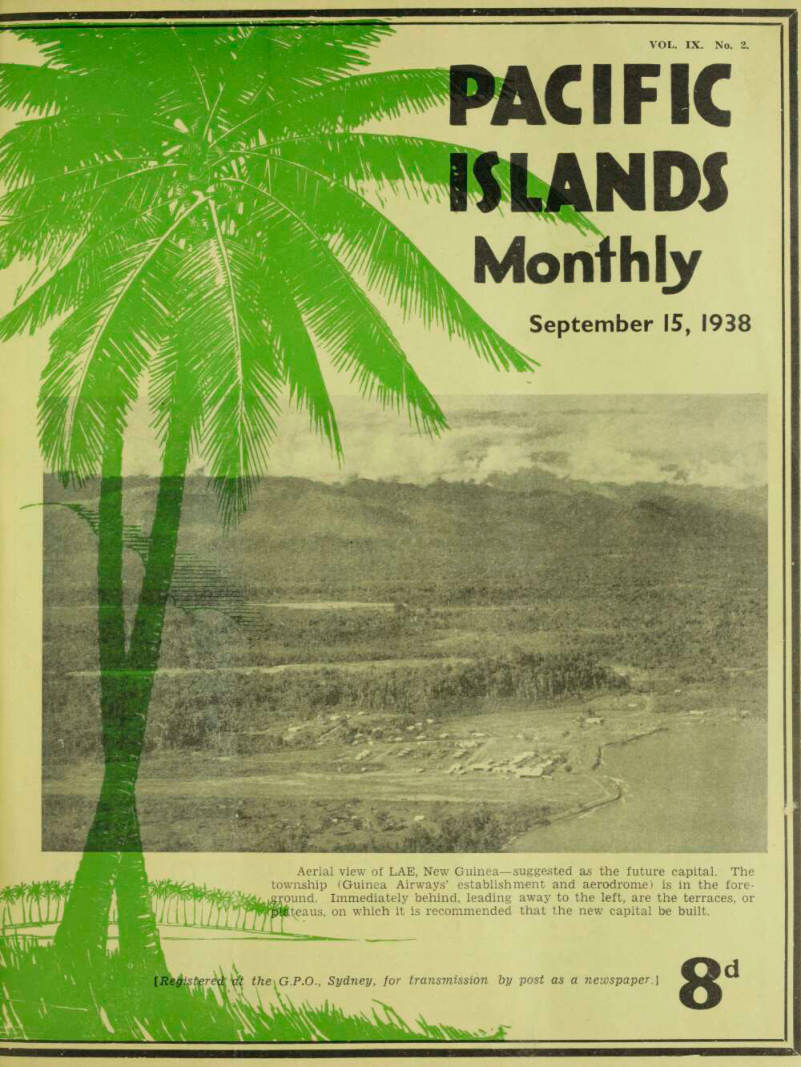
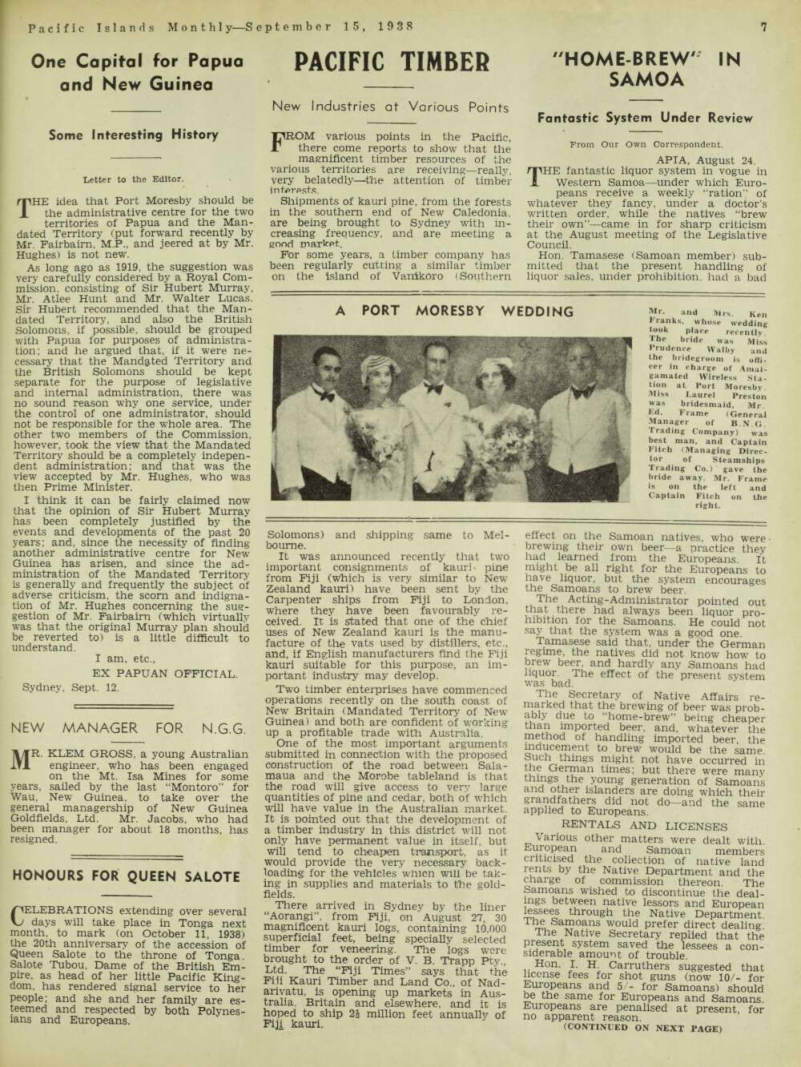
Aerial view of LAE, New Guinea—suggested as the future capital. The township (Guinea Airways’ establishment and aerodrome) is in the fore aground. Immediately behind, leading away to the left, are the terraces, or Rlateaus, on which it is recommended that the new capital be built.
Advertisements & other items, p. 2 (1 item)
W. R. Carpenter & Co. Ltd.
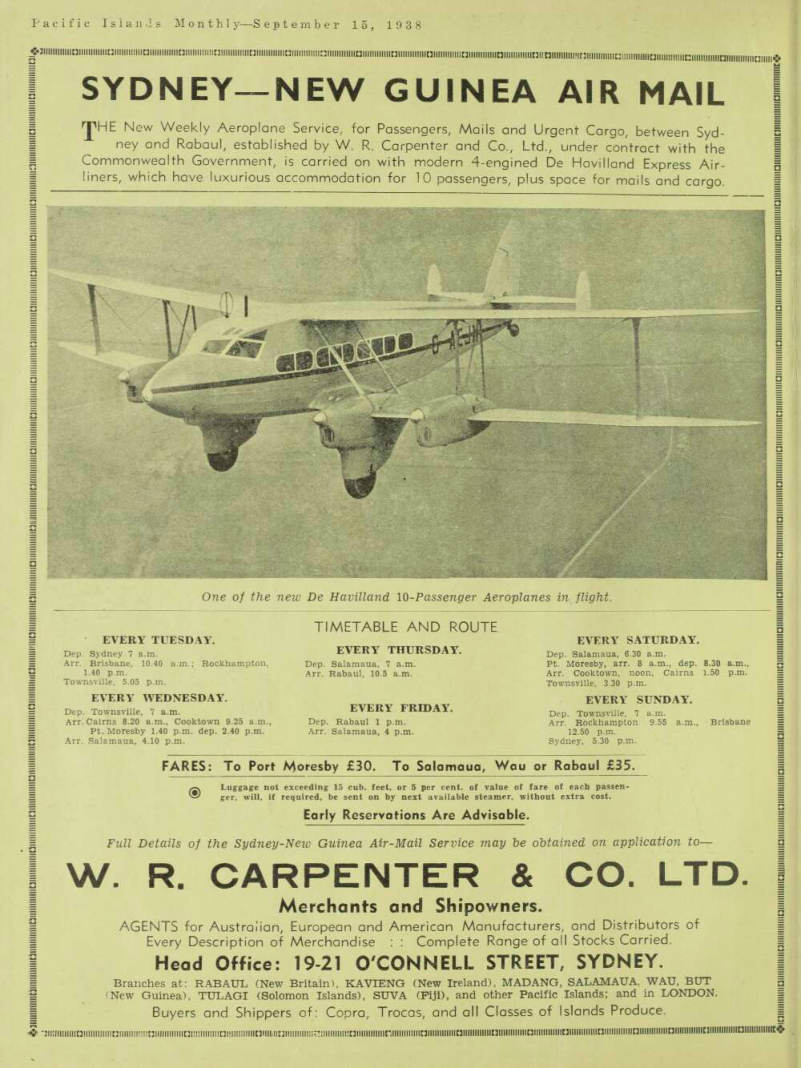
SYDNEY-NEW GUINEA AIR MAIL
'J'HE New Weekly Aeroplane Service, for Passengers, Mails and Urgent Cargo, between Sydney and Rabaul, established by W. R. Carpenter and Co., Ltd., under contract with the Commonwealth Government, is carried on with modern 4-engined De Havilland Express Airliners, which have luxurious accommodation for 10 passengers, plus space for mails and cargo. \ - v-
mmM
mm m One of the new De Havilland 10 -Passenger Aeroplanes in flight.
EVERY TUESDAY.
Dep. Sydney 7 a.m.
Arr. Brisbane, 10.40 a.m.; Rockhampton, 1.40 p.m.
Townsville, 5.05 p.m.
EVERY WEDNESDAY.
Dep. Townsville, 7 a.m.
Arr. Cairns 8.20 a.m., Cooktown 9.25 a.m., Pt. Moresby 1.40 p.m. dep. 2.40 p.m.
Arr. Salamaua, 4.10 p.m.
TIMETABLE AND ROUTE
EVERY THURSDAY.
Dep. Salamaua, 7 a.m.
Arr. Rabaul, 10.5 a.m.
EVERY FRIDAY.
Dep. Rabaul 1 p.m.
Arr. Salamaua, 4 p.m.
EVERY SATURDAY.
Dep. Salamaua, 6.30 a.m.
Pt. Moresby, arr. 8 a.m., dep. 8.30 a.m., Arr. Cooktown, noon, Cairns 1.50 p.m.
Townsville, 3,30 p.m.
EVERY SUNDAY.
Dep. Townsville, 7 a.m.
Arr. Rockhampton 9.55 a.m., Brisbane 12.50 p.m.
Sydney, 5.30 p.m.
FARES: To Port Moresby £3O. To Salamaua, Wou or Rabaul £35.
Luggage not exceeding 15 cub. feet, or 5 per cent, of value of fare of each passenger, will, if required, be sent on by next available steamer, without extra cost.
Early Reservations Are Advisable.
Full Details of the Sydney-New Guinea Air-Mail Service may he obtained on application to —
W. R. CARPENTER & CO. LTD.
Merchants and Shipowners.
AGENTS for Australian, European and American Manufacturers, and Distributors of Every Description of Merchandise : : Complete Range of ail Stocks Carried.
Head Office: 19-21 O'CONNELL STREET, SYDNEY,
Branches at: RABAUL (New Britain). KAVIENG (New Ireland), MADANG, SALAMAUA, WAU, BUT (New Guinea), TULAGI (Solomon Islands), SUVA (Fiji), and other Pacific Islands; and in LONDON.
Buyers and Shippers of: Copra, Trocas, and all Classes of Islands Produce.
Pacific Islands Travellers
N.CcrvrfßQ Pft? “Macdhui” From Syd-
PASSENGERS per aug 17; NEY A. "P de Ward Gib .
Messrs. Trammell orego yj arman ’ Richardson , son. Hicks Jonnswu*, R Bodger, Lewis, Purseliouse, Mader, Butteris, Shand, Mollison.
Downes. Southwell, Gray, Armstrong, Jacksori, Anderson, Brewer, Carr, Hams, Hallows, Stevenson, Watkins, Kuter, Chisholm, Low Dolan, Schultz, Burston, Erskine, Briggs, Pollard, Betts, Godsall, Richardson, Connolly Finlay, Honan, Burns, Callanan. Mesdames Trammell, Gregory, Price, Wade, Rawson, Harrison, Coomber, Jarman, Miller, Walton, Taylor, Wilson. Armstrong, Shaw <2), Frederick, Poland, Roberts, Watkins, Burns, Callanan. Misses Rudd, Kirby, Nixon, Donovan, Burrow, Whiting. Harber. Hobler, Harrison, Coulson, Miller, Broadfoot, Dunning. Leggatt, Bott.
Airmail Passengers Who Reached
SYDNEY ON AUG. 21 FROM:—Salamaua: Messrs. Hints, Stewart, Doyle.
Airmail Passengers Who Left Syd-
mttv on AUG 23 FOR’ Papua; J. Blackmole. Salamaua: F. Stabb. Rabaul: Mr. RondahL Cairns-Papua: Mrs. Drummond. Townsrille-Salamaua: Mr. Skelley.
Passengers Per ‘Nellore” Which
Reached Sydney From Rabaul On Aug.
24—Messrs. Tudor, Crooke, Negro, Conster dine. Swindles, Collier, Wilson, Poaline, Tup ling. Mesdames Tudor, Poaline, Quick.
Passengers Per “Morinda” Which
ARRIVED FRO m LORD HOWE. NORFOLK & N HEBRIDES ON AUG. 24:—Messrs. Engel brecht; Duper tuis, Martin, Davis, Hammond, L3igh( McGill> Quintall, Stopp, Whisker, Bates, B rocklebank, Bowman, Berwick (2), Byrne, coombes, Cook, Cuneo, Cunningham, Easton, Q o uld, Hackett, Henderson, Hinchcliffe, Jones, Mahoney, Moses (2), Murray, Neal, Park, Pike, Pinch> p r i ce> Quain, Ross, Smith (2), Sismey, Sutherland, Topham, Wilson, Whitney. Mes dames Bairstow, Nicol, Sargent, Mueller, Me- Laurin-Smith, Cook, Cuneo. Hinchcliffe, Johnson, Newman, Simpson, Warboys. Misses Rankin, Renfrew, Bradley, Burke, Cook, Hooker, Scott, MacDonald, Nichols, Purcell, Speer, Sutton, Thew. Wilson.
Passengers Per "Neptuna” From Syd
NEY FOR N.G. ON AUG. 25:-Messrs. Fox (2).
Dawson, Lega, Marshall, Smith, Sutcliffe, Thornthwaite, Wormald. Baden Jones Phlll potts, Doyle, Melvaine, Bowman, Chapman, Josch, Clarke, Darbyshlre. Mesdames Mar
shall, Mitchell, Sutcliffe, Theckston, Thornth waite, Phillips, Baden Jones, Doyle, Clarke, Best, Chapman, Cook, Lamond. Miss Kerr.
Passengers Per “Malaita” Which
Reached Sydney Prom 8.5.1. And N.G.
ON AUG. 26:—Messrs. Acton, Bouveir, Boyd, Glenn, Harricks, Howse, Metcalfe, Moore, Hughes, McCook, McKinnon, Monckton, Mor rison, Dick, Dormer, Gordon, Grisward, Hal pin, Hatton, O’Neill, Oldridge, Pascoe, Radcliffe, Reid (2), Risworth, Schmidlen, Smith, Tud berry, Turner, Warren. Messrs. Acton, Barker, Boyd, Glenn, Harricks, Howse, Metcalfe, Moore, Reid, Robertson, Short, Smith, Taylor. Tur ner, Warren. Misses Boyd, Cohen, Dieckman, Hanscombe, Moore, Penny, Risworth, Rundle, Lrloyd-Thomas, Wooland.
Passengers Per “Aorjangi” Which
ARRIVED IN SYDNEY FROM SUVA ON AUG. 26;—Messrs. Brabant, Hancock, Gilchrist, Chum, Derrick, Husselbee, Naran. Mesdames Brabant, Gilchrist, Roberts. Misses Pinches, Gilchrist, Ragg, Pinches, Joseph.
Airmail Passengers Who Reached
SYDNEY ON AUG. 28 PROM:—Salamaua; Messrs. Heath and Torrington, Mrs. Heath.
Papua: Messrs. Roper and Foster-Jay.
Airmail Passengers Who Left Syd
NEY ON AUG. 30 FOR:—Rabaul: Mrs. M. and Miss C. Perrin. Brisbane-Salamaua: W.
H. Bedfer. Brisbane-Rabaul: Major Mann, Cairns-Rabaul: A. F. Williams.
(Continued On Page 81.)
Passengers Per “Aorangi” From Syd
NEY FOR SUVA ON SEPT. 1:—Messrs. Tay lor, Brabant, Erickson, Fry, Ragg. Mesdames Baracche, Graham, Johnson. Morris, Thomp son, Watson, Bode, Harper, Lindsay, Ragg.
Misses Boyle, Blake, Lindsay.
Passengers Per “Malaita” Which
SAILED FROM SYDNEY FOR B.S.I. & N.G.
ON SEPT. 3: —Messrs. Smith, Hart, Flanagan, Lee, Clemens, Trench, Mortimer, Chamberlain, Boulter, Freeman, Siganto, Wind. Taylor, Har kins, Twist, Elliott, Grassick, Wells, Turnbull, Tomlinson, Wall, Burke, Conley, Wills, Mori arity, Boydell, Ashe. Mesdames Smith, Short, Lee, Hart, Collins, Kennedy, Riddiford, Ca tanach, Fairchild, Taylor, Harkins. Robertson, Hummerston, Joyes. Misses Champion, Holdgate, Cleaver, Collins, Freeman, Rosin, Mclllan, Kroening, Moore, Cohen.
Airmail Passengers Who Reached
Sydney On Sept. 4 From:—Rabaul: Mr.
Perriman. Salamaua: Messrs. Proud, Miller, Clark, Dixon-Swift, Stabb. Whyte.
Passengers Per “Montoro” Which
REACHED SYDNEY PROM N.G. & PAPUA ON SEPT. 5: —Messrs. Atkinson, Barrie, Baxter, Cameron, Clayton, Cooper. Parr, Ferris, Floyd, Graham, Healy, Hooke, Irvine, Izod, Johnson (2), Livingstone, Long. Norris, Perry, Pomeroy, Reed, Roche, Russell, Scott, Sulli van, Taylour, Tellesson, Turner, Tutill, Vaughan, Wauchope, White, Ashfield, Bake, Dixon, Garrett, Gay, Hams, Jacobson, Mac kinnon, Morrow, Morbelli, Provan, Shaw, Smith, Strong. Wiley, Pelensisi, Anderson, Bock, Brash, Doherty. Hayes, Kelly, Palmer, Phillips, Rutledge. Mesdames Bolte, Clayton, Clymo, Fasterbank, Gazzard, Hartley, Hooke, Hunt. Livingstone, Perry, Reid, Sherwin, Tut ill, Vaughan, Bradshaw, Dixon, Gay, Mackin non, Morrow, Morbelli, Spence, Wiley, Pyke, Doherty. Palmer. Misses Boag, Browne, Clis sold (2), Cooper, Kafler, Woodhill, Brown, Devltt, Hickle, Mills. Toole. White.
Airmail Passengers Who Left Syd
NEY ON SEPT. 6 FOR: —Salamaua: A. Lord.
Cairns-Papua: Mr. Graham.
Passengers Per “Neptuna” Which
SAILED FROM SYDNEY FOR N.G. ON SEPT. 7: —Messrs. Perichon, Lowney, Hanrahan, Moore, Davies, Heron, Grant, Biffin, Swanson, Hotz. Benhan, Fox, Macfarlane, Smith, Canny.
Mesdames Spagnola, Barnes, Adelskold, Dun can, Bartlett, Baldwin, Heron, Brewer, Swan son, Ives, Hotz, Griffith, Fox, Pennefather.
Misses Grant, Deaton, Mac Sweeney, Bucher, Shannon.
Passengers Per “Montoro” Which
Sailed From Sydney For Papua And
N.G. ON SEPT. 10:—Messrs. Pym. Kerr, Mar shall, Mason, Holmes, McLennan, Sawyer, Wil lis, Waldby, Rutledge. Lowney, Ellis, Thomson, Naulty, Wade, Drummond, Briggs, Anisimoff, Graham, Enser, Garrod, Hurley, James, John son, Collier, Bartlett, Coe, Wall, Travland, Gross, Clinch, Morton, Nevitt. Thomas (2), Munn, Gibson, Robinson, Brown (2), Dawson, Oswald, Rogers. Mesdames Pym, Leake, Avery, Cox, Thomson, Naulty, Wade, Chance, Hoeger, Lewis, Ekblade, Brewster, Oliver, Kiernan, Gross, Howes, England, Clinch, Smith, Mor ton, Jaeger, Thomas, Munn, Brown. Misses Cooper, Boag, Grahamslaw, Thomas, Kinder.
Burley, Walsh, Brewster, Bach, Miller, Byron, Gross, Brown.
Airmail Passengers Who Reached
SYDNEY ON SEPT. 11 FROM:—Salamaua; Mr.
Nutley. Rabaul: T. Fulton.
Airmail Passengers Who Left Syd
NEY ON SEPT. 13 FOR;—Papua: E. A. Aiken.
Rabaul: J. Horbory.
Advertisements & other items, p. 3 (2 items)
I
Pacific Islands Mon t h 1 y— S epte m b e r 15, 1938
Pacific
THE
KPM
SOUTH
PACIFIC
LINE
So a
Links the East with the South
Pacific Islands, New Zealand & Australia
KPM
SOUTH PACIFIC LINE
Royal Packet Navigation Co.
Ltd., Paketvaart House, 255 George Street, Sydney. (N. V. Koninklijke Paketraart Maatschappij—lncorporated in the Netherlands).
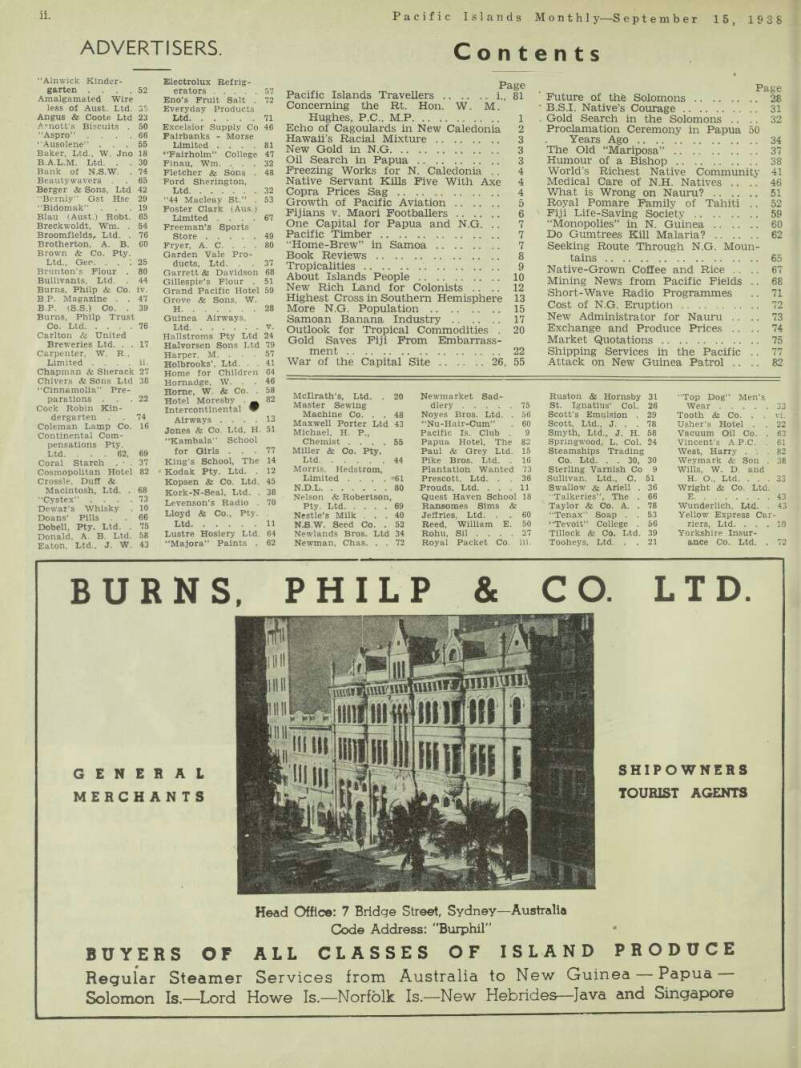
The track routes of the K.P.M.-South Pacific Line new motor vessel "Maetsuycker" and the well-known passenger steamer "Tasman" are each as follows: "MAET- SUYCKER": Saigon, Singapore, Batavia, Samarang, Sourabaya, Port Moresby, Samarai, Salamaua, Rabaul, Auckland, Wellington, Sydney, Port Moresby, Sourabaya, Samarang, Batavia, Singapore, Saigon. "TASMAN": Saigon, Singapore, Batavia, Samarang, Sourabaya, Port Moresby, Port Vila, Noumea, Auckland, Wellington, Sydney, Port Moresby, Sourabaya, Samarang, Batavia, Singapore, Saigon. % Saigon, Diethelm & Co.: Port Moresby and Samarai. Steamships Trading Co. Ltd.: Rabaul and Salamaua. W. R.
Carpenter & Co. Ltd.: Port Vila. Gubbay Freres: Noumea, Carlo Leoni: Auckland, Russell & Somers Ltd.: Wellington, Johnston & Co. Ltd.
Advertisers.
“Alnwick Kinder garten ... 52 Amalgamated Wire less of Aust. Ltd. 35 Angus & Coote Ltd 23 Arnott’s Biscuits . 50 “Aspro” ... 66 “Ausolene” ... 55 Baker, Ltd.. W. Jno 18
B.A.L.M. Ltd. . . 30
Bank of N.S.W. . 74 Beautywavers . . 65 Berger & Sons, Ltd 42 "Bernly” Gst Hse 29 “Bidomak” ... 19 Blau (Aust.) Robt. 65 Breckwoldt, Wm. . 54 Broomfields, Ltd. . 76 Brotherton, A. B. 60 Brown & Co. Pty.
Ltd., Geo. ... 25 Brunton’s Flour . 80 Bullivants, Ltd. . 44 Burns, Philp & Co. iv.
BP. Magazine . . 47
B.P. (S.S.) Co. . 39
Burns, Philp Trust Co. Ltd 76 Carlton & United Breweries Ltd. . . 17 Carpenter, W. R., Limited . . . . ii.
Chapman & Sherack 27 Chivers & Sons Ltd 38 “Cinnamolia” Pre parations ... 22 Cock Robin Kin dergarten . . 74 Coleman Lamp Co. 16 Continental Com pensations Pty.
Ltd. ... 62, 69 Coral Starch . • . 37 Cosmopolitan Hotel 82 Crossle. Duff & Macintosh, Ltd. . 68 “Cystex” ... 73 Dewar’s Whisky . 10 Doans’ Pills . . 66 Dobell, Pty. Ltd. . 75 Donald, A. B. Ltd. 58 Eaton, Ltd., J. W. 43
Electrolux Refrig erators 57 Eno’s Fruit Salt . 72 Everyday Products Ltd 71 Excelsior Supply Co 46 Fairbanks - Morse Limited . . . .81 “Fairholm” College 47 Finau, Wm. ... 32 Fletcher & Sons . 48 Ford Sherington, Ltd 32 “44 Macleay St.” . 53 Foster Clark (Aus.) Limited ... 67 Freeman’s Sports Store 49 Fryer, A. C. ... 80 Garden Vale Pro ducts, Ltd. . . 37 Garrett & Davidson 68 Gillespie’s Flour . 51 Grand Pacific Hotel 59 Grove & Sons, W.
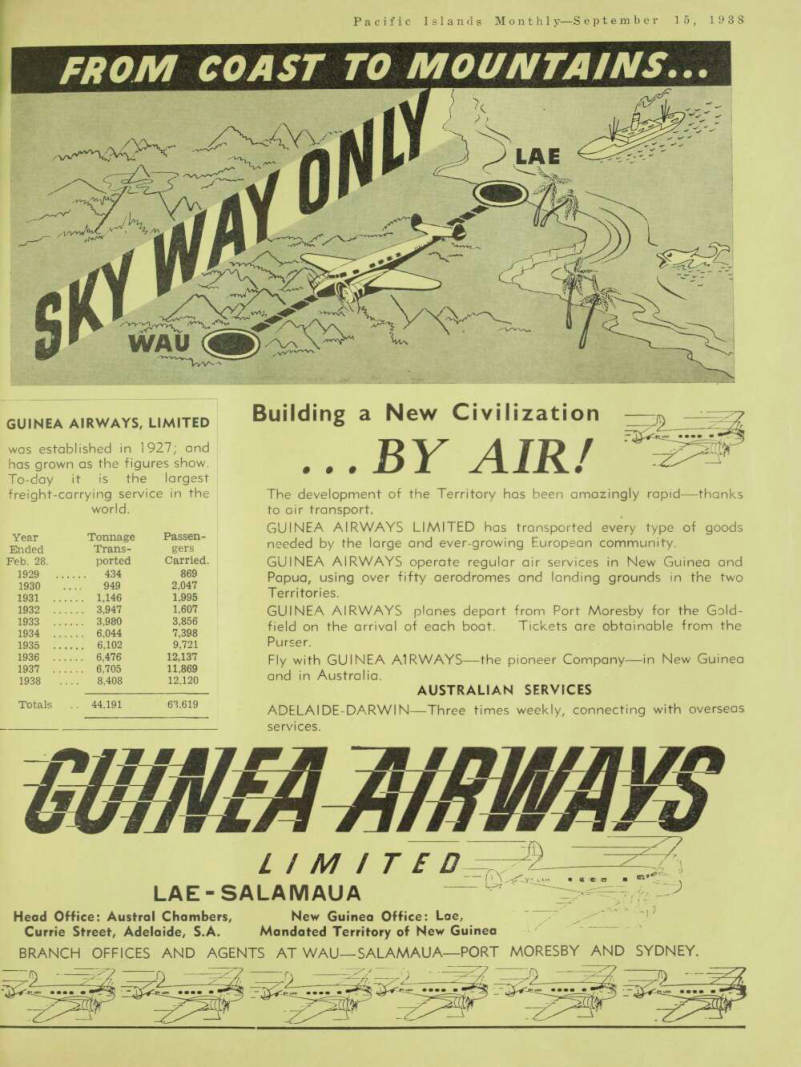
H 28 Guinea Airways, Ltd v.
Hallstroms Pty Ltd 24 Halvorsen Sons Ltd 79 Harper, M. ... 57 Holbrooks’, Ltd. . .41 Home for Children 64 Hornadge, W. . .46 Home, W. & Co. . 58
Hotel Moresby m B2
Intercontinental W Airways ... 13 Jones & Co. Ltd, H. 51 “Kambala” School for Girls ... 77 King’s School, The 14 Kodak Pty. Ltd. . 12 Kopsen & Co. Ltd. 45 Kork-N-Seal, Ltd. . 38 Levenson’s Radio . 70 Lloyd & Co., Pty.
Ltd 11 Lustre Hosiery Ltd. 64 “Majora” Paints . 62
Mcllrath’s, Ltd. . 20 Master Sewing Machine Co. . . 48 Maxwell Porter Ltd 43 Michael, H. P., Chemist ... 55 Miller & Co. Pty.
Ltd 44 Morris, Hedstrom, Limited ... *6l
N.D.L 80
Nelson & Robertson, Pty. Ltd 69 Nestle’s Milk ... 40 N.S.W. Seed Co. . 52 Newlands Bros. Ltd 34 Newman, Chas. . . 72
Newmarket Sad dlery ... 75 Noyes Bros. Ltd. . 56 “Nu-Hair-Cum” . 60 Pacific Is. Club . 9 Papua Hotel, The 82 Paul & Grey Ltd. 15 Pike Bros. Ltd. . 16 Plantation Wanted 73 Prescott, Ltd. . . 36 Prouds, Ltd. ... 11 Quest Haven School 18 Ransomes Sims & Jeffries, Ltd. . . 60 Reed. William E. 50 Rohu, Sil . . . . 27 Royal Packet Co. iii.
Ruston & Hornsby 31 St. Ignatius’ Col. 26 Scott’s Emulsion . 29 Scott, Ltd., J. . . 78 Smyth, Ltd., J. H. 58 Springwood, L. Col. 24 Steamships Trading Co. Ltd. . . 30, 30 Sterling Varnish Co 9 Sullivan, Ltd., C. 51 Swallow & Ariell . 36 “Talkeries”, The . 66 Taylor & Co. A. . 78 “Tenax” Soap . . 53 “Tevoit” College . 56 Tillock & Co. Ltd. 39 Tooheys, Ltd. . .21
“Top Dog’’ Men’s Wear 33 Tooth & Co. . . vi.
Usher’s Hotel . . 22 Vacuum Oil Co. . 63 Vincent’s A.P.C. . 61 West, Harry ... 82 Weymark & Son . 38 Wills, W. D. and H. 0., Ltd. ... 33 Wright & Co. Ltd.
E 43 Wunderlich, Ltd. . 43 Yellow Express Car riers, Ltd. ... 10 Yorkshire Insur ance Co. Ltd. . 72
Contents
Page Pacific Islands Travellers i., 81 Concerning the Rt. Hon. W. M.
Hughes, P.C., M.P 1 Echo of Cagoulards in New Caledonia 2 Hawaii’s Racial Mixture 3 New Gold in N.G 3 Oil Search in Papua 3 Freezing Works for N. Caledonia .. 4 Native Servant Kills Five With Axe 4 Copra Prices Sag 4 Growth of Pacific Aviation 5 Fijians v. Maori Footballers 6 One Capital for Papua and N.G. .. 7 Pacific Timber 7 “Home-Brew” in Samoa 7 Book Reviews 8 Tropicalities 9 About Islands People 10 New Rich Land for Colonists .. .. 12 Highest Cross in Southern Hemisphere 13 More N.G. Population 15 Samoan Banana Industry 17 Outlook for Tropical Commodities . 20 Gold Saves Fiji From Embarrass ment 22 War of the Capital Site 26, 55
Page Future of the Solomons 28 8.5.1. Native’s Courage 31 Gold Search in the Solomons ... 32 Proclamation Ceremony in Papua 50 Years Ago 34 The Old “Mariposa” 37 Humour of a Bishop 38 World’s Richest Native Community 41 Medical Care of N.H. Natives ... 46 What is Wrong on Nauru? 51 Royal Pomare Family of Tahiti .. 52 Fiji Life-Saving Society 59 “Monopolies” in N. Guinea 60 Do Gumtrees Kill Malaria? 62 Seeking Route Through N.G. Moun tains 65 Native-Grown Coffee and Rice ... 67 Mining News from Pacific Fields .. 68 Short-Wave Radio Programmes .. 71 Cost of N.G. Eruption 72 New Administrator for Nauru .. .. 73 Exchange and Produce Prices .. .. 74 Market Quotations 75 Shipping Services in the Pacific .. 77 Attack on New Guinea Patrol ... 82
Advertisements & other items, p. 4 (2 items)
Ii
Pacific Islands Monthl y—S eptember 15, 1938
Burns, Philp & Co. Ltd.
GENERAL
MERCHANTS
1
iti
S nil in hi HI if Ml
SHIPOWNERS
TOURIST AGENTS
Head Office: 7 Bridge Street, Sydney—Australia Code Address: "Burphil'' BUYERS OF ALL CLASSES OF ISLAND PRODUCE Regular Steamer Services from Australia to New Guinea Papua Solomon Is.— Lord Howe Is.—Norfolk Is.—New Hebrides—Java and Singapore
Pacific Islands Monthly
The Xewspaper-Magaziue of the South Seas [Registered at the G.P.0., Sydney, for transmission by post as a newspaper.]
Published Once Each Month and Circulated in Australia and New Zealand and in the following Pacific Territories and Islands Groups:
Crown Colony of Fiji.
Australian Territory of Papua.
Mandated Territory (Australia) of New Guinea, Bismarck Archipelago and Northern Solomon Islands.
Mandated Territory (Japan) of Marshall, Caroline and Marianna Islands.
French Territory of New Caledonia.
British and French Condominium of New Hebrides.
American Territory of Eastern Samoa.
American Territory of Guam.
Mandated Territory of Nauru.
British Crown Colony of Gilbert and Ellice Islands.
Mandated Territory (New Zealand) of Samoa.
British Solomon Islands Protectorate.
British Protectorate of Tongan Islands.
New Zealand Territory of Cook Islands.
Australian Territory of Norfolk Island.
French Colony of Oceania (Tahiti, etc.).
American Territory of Hawaiian Islands.
Owned and Produced by Pacific Publications Pty. Ltd., Union House, 247 George Street, Sydney.
titt pphonp J Managing Director 8W5037 TELEPHONE BufdneBB and Editorial MA7IOI
P.O. Box 3408 R
Registered Address of Telegrams, Radiograms, and Cables: “Pacpub”, Sydney.
Contributions
Articles, Stories, and Photographs dealing with Pacific Islands subjects are invited and will be paid for on publication at usual rates.
Subscription Rates
Per Annum, within British Empire, Prepaid, Post Free 8/- Per Annum, elsewhere, prepaid, Post Free 10/- Single Copies Bd.
Editor and Publisher:
R. W. Robson, P.R.Gs.
Assisted by Selwyn Hughes.
Advertising Manager: L. W. Bailey.
Advertising Office and Printing-House: 29 Alberta St., Sydney.
Advertising rates furnished on application.
Colours, etc by Arrangement Process Blocks made at Advertiser’s expense when required. Screen, 100.
Changes of Advertising Copy should reach this Office by 3rd of each month, otherwise previous advertisement may be repeated.
Agents
The following are authorised to receive sub scriptions for the Pacific Islands Monthly;— Islands Branches of Burns, Phllp & Co. Ltd., and Burns Philp (South Sea) Co. Ltd.
Islands Branches of W. R. Carpenter & Co. Ltd.
All Branches of Morris, Hedstrom & Co. Ltd, G. Thomas & Co.. Rabaul, New Guinea T. A. Olsson, Wau. New Guinea.
Whitten Bros. Ltd., Samaral, Papua.
Steamships Trading Co., Papua. All Branches.
P. Costello, Suva, Fiji.
J. Muir Suva, Fiji.
N. C. Mackenzie-Hunt, Wainunu, Bua, Fiji, All Branches and Representatives of W. H. Grove & Sons Ltd., Auckland, New Zealand.
Cook Islands Trading Co.. Rarotonga, Cook Is.
A. C. Rowland, Papeete, Tahiti.
Representative in London: W. C. HARVEY, Coronation Building 4 Lloyds Avenue, London, E.C.2. from whom may be obtained copies of Pacific Islands Monthly, Pacific Islands Year Book, advertising schedules, etc.
Vol. IX. No. 2.
Sydney, September 15, 1938.
Prirp ( 8d - Pei Copy ( Prepaid: 8/- p.a.
Concerning The Rt. Hon. W. M. Hughes,
P.C., M.P.
WHEN it was announced, ten months ago, that Australia’s Pacific Territories would be under the control of Rt. Hon. W. M. Hughes, P.C., M.P., residents in Papua, New Guinea, etc., exclaimed “Thank God! Now some thing will be done”. To-day, they are re garding the verbal cavortings and political twistings of Mr. Hughes with dismay.
It is not that they love the amazing little man less; it is only that the oc casion calls for something more than mere political clowning. Mr. Hughes can stand securely on his record; and every one who remembers 1914-20 always will give honour and respect to him who so hap pily represented the tough and tenacious character of wartime Australia. But that does not mean that Mr. Hughes can re main forever upon the political stage, without embarrassment to his friends and admirers.
Misgivings were first expressed by Islands interests, when Mr. Hughes—for some reason still mysteriously hidden— threw aside the Griffiths Committee’s re port on the new capital site; and, jump ing into an aeroplane, dashed off to New Guinea personally to select a site. He was 73 years old, he never previously had seen New Guinea, he knew nothing of the peculiar difficulties and complexities of tropical administration, and he spent
only three or four days fluttering around the vast Morobe district in an aeroplane.
But without apparent hesitation he selected Salamaua —and thereby precipi tated a first-class argument. While in New Guinea he greatly embarrassed the Lyons Government by his “what we have we hold” speech. There was such a row about it that when he returned to Aus tralia he repudiated the speech, making an explanation so feeble and unconvinc ing that even the sober ‘“Sydney Morning Herald” jeered.
Mr. Hughes, while in New Guinea, de cided that a road should be built from Wau to Salamaua. But he could not put even this worthy plan upon a practical foundation. He has left the route vague, and a subject of argument—no one knows yet whether the road will be merely a super-expensive local undertaking, or whether it is to be a really worthwhile highway, part of a developmental read ing plan.
Back in Australia, Mr. Hughes gave a diverting performance. It dawned slowly upon Australian press and public that the selection of Salamaua as New Guinea’s capital was as indefensible as it was im pulsive and hasty, and criticism mounted from a murmur to a roar. At first, Mr.
Hughes was merely cocky, and garru lously funny—he would not discuss the
matter seriously. But soon he was on the defensive; and then he declared (see full report elsewhere) that his selection was based upon the most authoritative official advice. But no one has been given even a hint of the official concerned; and no “authoritative” official would give such advice, anyway.
Next, we have the appointment of an Administrator of Nauru. There were over 150 applications; and one would suppose that Mr. Hughes would have gone to Cabinet with the “possibilities” reduced to a half-dozen. We know that actually he took about 60 of the applications to Cabinet, and Cabinet officials finally re duced them to four. When someone asked what amount of experience in tropical ad ministration Colonel Chalmers (the man selected) had had, the reply was; “Tropi cal experience! That did not enter into it”. To use an Americanism: We’ll say it didn’t!
A day or two later, the “little Digger" crossed swords with Mr. Fairbairn, M.P.
Mr. Fairbairn had asked some obvious questions that would occur to any logical, well-trained man of business habits who examines the administrative machinery of Papua and New Guinea. “Why have two capitals?” asked Mr. Fairbairn. “Why all the expense of duplication? Why not one administrative machine, and one ad ministrative centre? The two territories lie side by side, with exactly similar con ditions of administration, separated only by an imaginary line”.
Instead of accepting this as a serious
and practical contribution to a difficult discussion. Mr. Hughes sneered and snorted. He said it was a pity that Mr.
Fairbairn had not studied his subject. He said that one territory was a mandate, and therefore had to be developed in the interests of the natives, and one (presum ably) was to be otherwise developed. He suggested that it was impossible to con trol the two territories properly with the one set of machinery.
Which is sheer balderdash, and the kind of political twaddle of which Mr.
Hughes is master. There actually is not one sound practical reason why the two territories should not be administered as one, always provided that in certain minor matters a distinction is made, so that the terms of the Mandate may be observed.
Certain classes of officials —especially those with hen-like minds, who love to scratch around among the dotting of i’s and the crossing of t’s —insist that Papua and New Guinea must be kept separate.
So. to-day, we have the ridiculous spec tacle of two groups of officials remaining jealously on either side of en imaginary line, and not even consulting each other on such subjects as land, agriculture, health, transport, native welfare, mining, etc., concerning which their problems and duties are exactly similar.
As a matter of simple, well known fact, it is probable that Papua, under the wise Murray policy, is being developed more in the interests of the natives than any other territory in the Pacific; whereas New Guinea, by comparison, is not.
If, as Mr. Hughes says, New Guinea must be developed solely in the interests of the natives, why does he insist that Australia shall continue to hold New Guinea? And why does he propose to spend £150,000 there on a new road, and £500.000 on a new capital? Why did he ask the N.G. Legislative Council, the other day, to amend the ordinances controlling companies, and the oil search?
The various controversies at least have this saving grace: They show that, at long last, the Australian people and news papers are trying to understand living conditions and public problems in the Territories. The most exasperating fea ture is that the Minister, who really should know something of the Territories, and be capable of informing and directing public opinion, seems to think that each occasion calls simply for a display by him of humour, or impressive erudition, or just plain fooling.
He cannot realise, seemingly, that the control of these northern tropical terri tories, and their proper development by Europeans, is a matter of vital importance to the future of Australia.
It seems strange, in the light of history, to be writing thus of W.M.H. One vividly remembers a day in 1919, when Mr.
Hughes, fresh from the framing and sign ing of the Peace Treaty, was publicly adored by half a million people in Mel bourne. It took him an hour, in a soldier drawn carriage, to get from Spencer Street Station to the Town Hall. To-day, most of us would gladly escort him back to Spencer Street, if only he could cancel Versailles—that vicious international dis position, made by victory-drunk politicians, that is at the root of nearly all the world’s troubles to-day. A queer thought, that
Hughes of Versailles, Hughes “the Little Digger”, Hughes who leaped to the skies in 1919—and fell like a stone in 1922 Hughes the always lovable satirist, should now be Hughes of Salamaua.
To Combat A Coconut Pest
IT is probable that early steps will be taken by plantation owners in New Guinea to introduce the parasite Pleuro tropis Parvulus, which has been success ful in destroying the coconut pest Prome cotheca in the New Hebrides. At the re quest of the N.G, Administration, Mr.
Dupertuis (who introduced the parasite to the New Hebrides) sent some of the parasite in cold storage to New Guinea, in the hope that it might combat the outbreak of Promecotheca there. But it did not survive the journey.
Mr. H. W. Champion, Government Sec retary in Papua, is making a satisfactory recovery from his recent severe illness.
He is residing at present at Killara.
Sydney.
Cagoulards Murder
An Echo in New Caledonia
Prom Our Own Correspondent.
Noumea, Aug. 20.
A CERTAIN amount of interest was aroused by the arrival of M. Pourcher, a high official of the Police Depart ment, from France, by the “Tarifa”, at the commencement of the month.
Accompanied by the Captain of the Gendarmerie, M. Pourcher left Nehoue. where he interrogated M. Hal lumie, a fairly recent arrival from France in New Caledonia.
M. Hallumie, who is an accountant with Societe Chemique de Chrome, returned with Mon. Pourcher and the Captain, where an inquiry was held at Bourail, be fore Judge Rio.
The inquiry is believed to be related to the murder of Juif. in France, a few months ago. by the Cagoulards.
M. Pourcher left on August 18 for Sydney, where he caught a plane, to re turn speedily to France.
Advertisements & other items, p. 6 (2 items)
2
Pacific Islands Monthl y—B eptehiber 15, 1938
Off Beaten Tracks In The Pacific
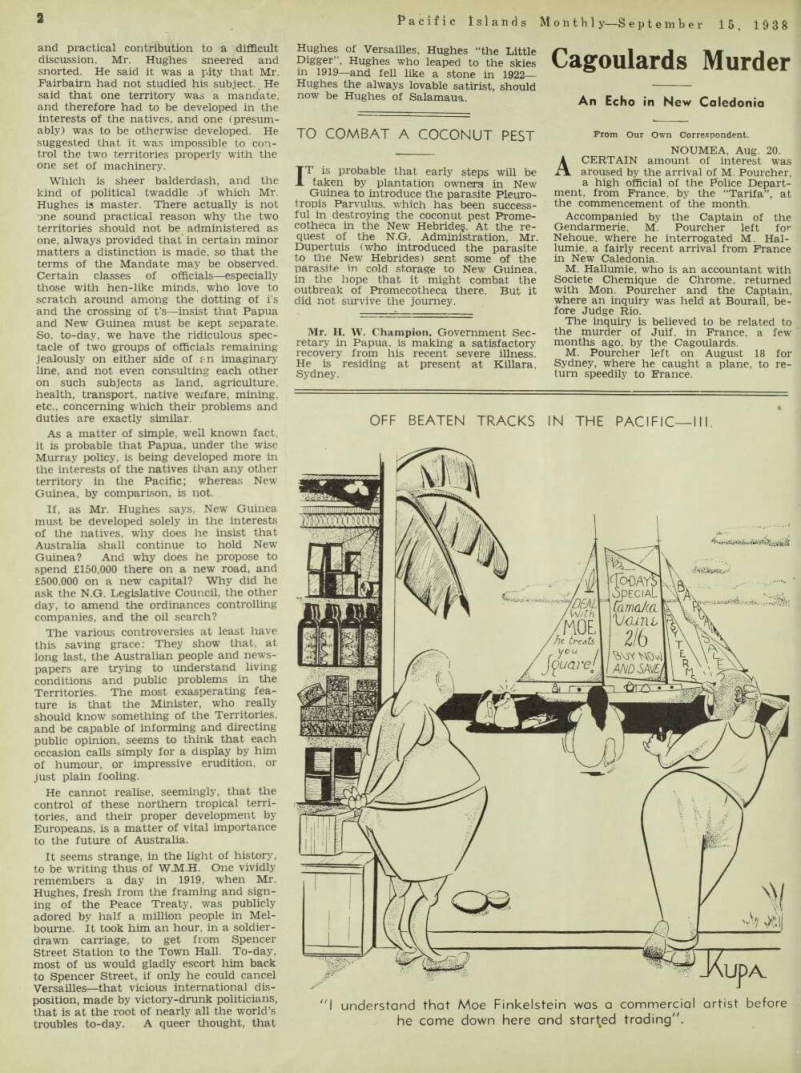
mm**#* {t W i 1 r I understand that Mae Finkelstein was a commercial artist before he come down here and starred trading".
Hawaii's Racial
Mixture
Remarkable Economic and Social Conditions
Honolulu, Aug. 29.
IN the past month there have been some enlightened surveys made of certain social aspects of the Hawaiian islands, the paradise of the coloured magazine advertisements. Honolulu, the capital, came in for particular attention.
A board of health summary estimates the population of the group at 412,000 (Honolulu 150,000) and, because the races have inter-married so much, the most difficult task is to classify the popula tion correctly. Outstanding in the pro portion of Japanese: 37 per cent, of the population, and one-quarter of the Jap anese is alien born, the balance claiming U.S. citizenship because they were born in Hawaii. It is noteworthy that the Japanese rarely inter-marry with other races.
There are some 25,000 soldiers and sailors permanently stationed in Hawaii, and if this number was withdrawn there would be but a comparative handful of whites left. In Hawaii, however, Caucas ians include such European races as Span ish and Portuguese. There are 30,000 Portuguese. Another heavy rate is the Filipino. 53,000. More than one-fifth of the total population is alien born.
An important angle is that there is an excess of 80.000 males over females in the islands, mostly agricultural workers. This fact, plus the largest military population under the Stars and Stripes, has given rise to a big white slave traffic that oper ates between San Francisco and Los Angeles and Honolulu.
The University of Hawaii has completed a social study of 218 average white fami lies in Honolulu. Of all white families in Honolulu, the survey indicates that 35 per cent, earn £4OO and £6OO p.a., and almost 30 per cent, earn between £6OO and £BOO. One of every four families in the lower income group have to borrow or liquidate their capial assets to make ends meet at the year end. The average amount paid in direct taxes by all white families studied was £2O. Largest item of expenditure was for food, Hawaii’s cost of living being notoriously high, much higher, for example, than highly taxed California, from which Hawaii buys the bulk rvf its food.
The whole industrial and economic life of the islands is monopolised by five major companies, the directorates of which interlock. This was revealed in a U.S. Department of Justice investigation.
The monopolies control the sugar and pineapple industries, all the public utili ties. the hotels, even the passenger and freight services to the U.S. mainland.
Sir Walter McNicoll (Administrator of New Guinea) and Lady McNicoll, will leave Rabaul on September 24 by the “Nellore” to visit Japan on holiday. They will leave Kobe later by the “Jean Gerard ’ for Saigon, where they will tranship for Singapore. They will subsequently travel to Australia by the “Nieuw Holland” ar riving early in December.
New Governor Of Fiji
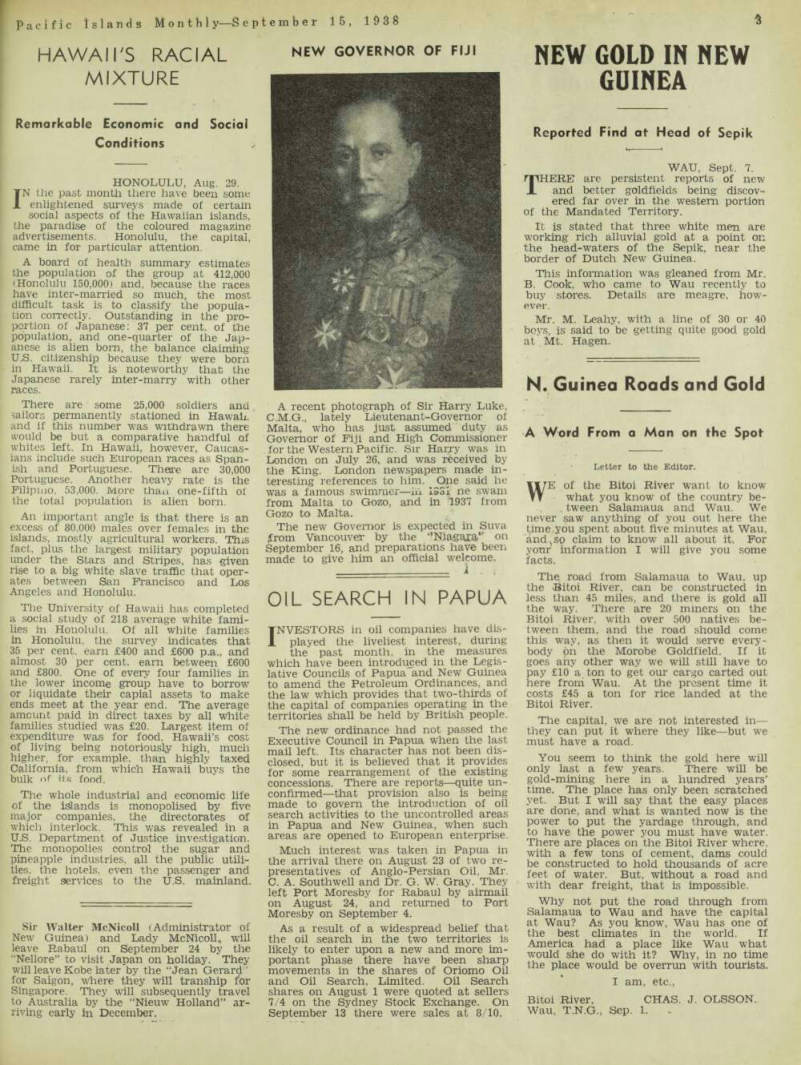
A recent photograph of Sir Harry Luke, C.M.G., lately Lieutenant-Governor of Malta, who has just assumed duty as Governor of Fiji and High Commissioner for the Western Pacific. Sir Harry was in London on July 26, and was received by the King. London newspapers made in teresting references to him. One said he was a famous swimmer—in 13S1 ne swam from Malta to Gozo, and in 1937 from Gozo to Malta.
The new Governor is expected in Suva jfrom Vancouver by the “Niagaxa/’ on September 16, and preparations have been made to give him an official welcome.
Oil Search In Papua
INVESTORS in oil companies have dis played the liveliest interest, during the past month, in the measures which have been introduced in the Legis lative Councils of Papua and New Guinea to amend the Petroleum Ordinances, and the law which provides that two-thirds of the capital of companies operating in the territories shall be held by British people.
The new ordinance had not passed the Executive Council in Papua when the last mail left. Its character has not been dis closed, but it is believed that it provides for some rearrangement of the existing concessions. There are reports—quite un confirmed —that provision also is being made to govern the introduction of oil search activities to the uncontrolled areas in Papua and New Guinea, when such areas are opened to European enterprise.
Much interest was taken in Papua in the arrival there on August 23 of two re presentatives of Anglo-Persian Oil, Mr.
C. A. Southwell and Dr. G. W. Gray. They left Port Moresby for Rabaul by airmail on August 24, and returned to Port Moresby on September 4.
As a result of a widespread belief that the oil search in the two territories is likely to enter upon a new and more im portant phase there have been sharp movements in the shares of Oriomo Oil and Oil Search, Limited. Oil Search shares on August 1 were quoted at sellers 7/4 on the Sydney Stock Exchange. On September 13 there were sales at 8/10.
New Gold In New
Guinea
Reported Find at Head of Sepik
WAU, Sept. 7.
THERE are persistent reports of new and better goldfields being discov ered far over in the western portion of the Mandated Territory.
It is stated that three white men are working rich alluvial gold at a point on the head-waters of the Sepik, near the border of Dutch New Guinea.
This information was gleaned from Mr.
B. Cook, who came to Wau recently to buy stores. Details are meagre, how ever.
Mr. M. Leahy, with a line of 30 or 40 boys, is said to be getting quite good gold at Mt. Hagen.
N. Guinea Roads and Gold
A Word From a Man on the Spot
Letter to the Editor.
WE of the Bitoi River want to know what you know of the country be , tween Salamaua and Wau. We never saw anything of you out here the t,ime you spent about five minutes at Wau, and so claim to know all about it. For your information I will give you some facts.
The road from Salamaua to Wau, up the Bitoi River, can be constructed in less than 45 miles, and there is gold all the way. There are 20 miners on the Bitoi River, with over 500 natives be tween them, and the road should come this way, as then it would serve every body on the Morobe Goldfield. If it goes any other way we will still have to pay £lO a ton to get our cargo carted out here from Wau. At the present time it costs £45 a ton for rice landed at the Bitoi River.
The capital, we are not interested in— they can put it where they like—but we must have a road.
You seem to think the gold here will only last a few years. There will be gold-mining here in a hundred years’ time. The place has only been scratched yet. But I will say that the easy places are done, and what is wanted now is the power to put the yardage through, and to have the power you must have water.
There are places on the Bitoi River where, with a few tons of cement, dams could be constructed to hold thousands of acre feet of water. But, without a road and with dear freight, that is impossible.
Why not put the road through from Salamaua to Wau and have the capital at Wau? As you know, Wau has one of the best climates in the world. If America had a place like Wau what would she do with it? Why, in no time the place would be overrun with tourists.
I am, etc.,
Bitoi River,
Chas. J. Olsson.
Wau, T.N.G., Sep. 1.
Advertisements & other items, p. 7 (1 item)
3
Pacific Islands Monthl y—S eptember 15, 1938
Freezing Works for New Caledonia Progress
New Caledonia Progress in Pastoral and Mining Industries
Noumea, Aug. 20.
A FTER long negotiation, the project of the installation of freezing works in New Caledonia has been accepted by the Council-General. The construction of the works, which is to be commenced next year, is expected to be finished in 1940.
This development will give the colony a splendid outlet for the products of the extensive cattle industry.
M. Connau, who was in Noumea, from France, in connection with the install ation of these works left for Sydney by the “Grama” en route to Prance.
It is reported here that the action of M Connau in boarding the ship at Noumea was considered a breach of some navigation law. and caused a hold-up of the disembarkation of the 600 tourists on their return to Sydney. It seems a strange development, when this business man merely took the opportunity to make a quick shipping connection, on his return journey to Prance.
The plan to establish a butter factory at Bourail, is considered another move in the direction of helping our pastoral industry. At present this country imports all its butter and a quantity of condensed milk from Australia.
The increased amount of minerals ex ported in the first six months of this year, and the recent improvement in the price of cattle, have given a great im petus to the economic life of New Cale donia.
Tropical Medical
Training
IT is expected that the Australian Gov ernment will provide funds to enable the University of Melbourne to main tain at least one young medical graduate at the Fiji Medical School to obtain a special knowledge of tropical diseases.
The Fiji Government has intimated to the Australian Government its willing ness to assist in such an arrangement.
The development is the result of the anxiety of the Australian authorities to take every reasonable precaution against the introduction of tropical diseases from Asia, through the rapidly growing airmail services.
It is to be hoped that the Australian authorities will go further in practical re cognition of the valuable work being done at the medical school in Suva. Facilities now exist there for the complete train ing of native medical practitioners, and selected men (natives) from Fiji, Samoa.
Cook Group, Tonga. Gilbert and Ellice.
Solomon Islands, and New Hebrides are now being successfully taught there, in a four years’ course, to undertake medical work among their own peoples. Aus tralia, for some reason, has held aloof from this admirable plan. A selected number of Papuans have been given medi cal training in Sydney. New Guinea has done virtually nothing. Why cannot a selected number of Papuan and New Guinea natives be trained in Suva, along with the natives of other territories? The cost of the four years’ course is very small.
Islands Bound
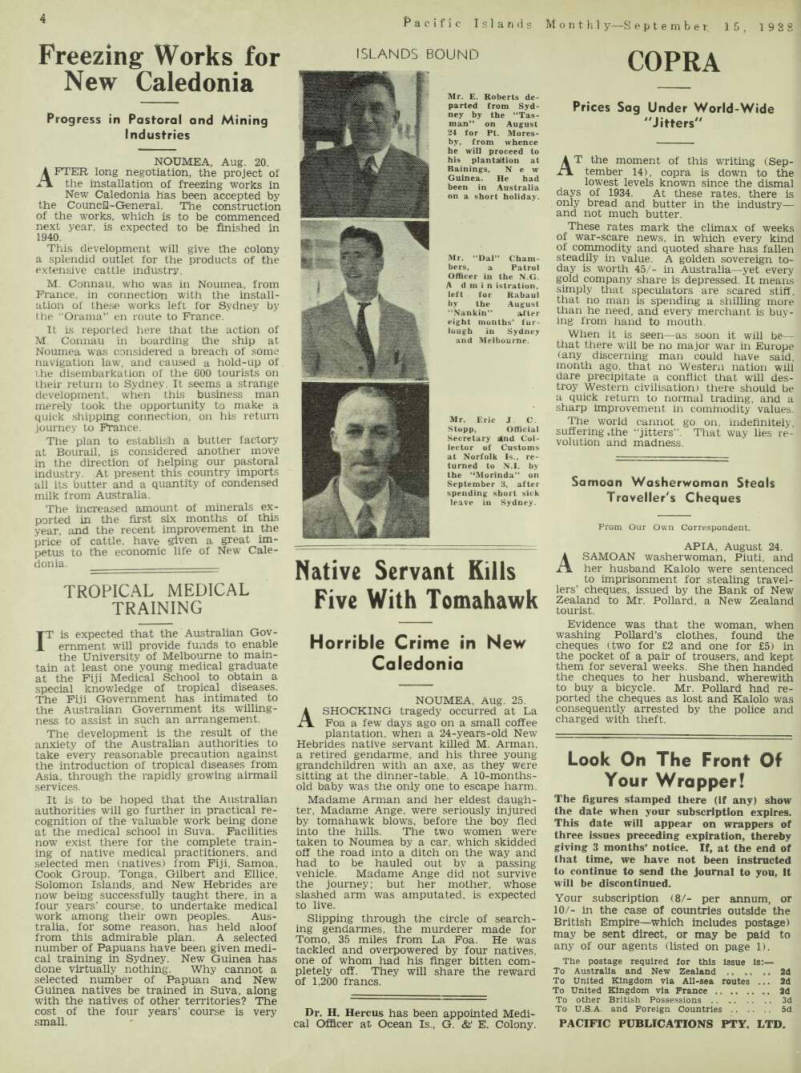
Mr. E. Roberts de parted from Syd ney by the “Tasan” on August 24 for Pt. Mores by, from whence he will proceed to his plantation at Bainings, New Guinea. He had been in Australia on a short holiday.
Mr. “Dal” Cham bers, a Patrol Officer in the N.G.
Administration, left for Rabaul by the August “Nankin” after eight months’ fur lough in Sydney and Melbourne.
Mr. Eric J. C.
Stopp, Official Secretary and Col lector of Customs at Norfolk Is., re turned to N.I. by the “Morinda” on September 3, after spending short sick leave in Sydney.
Native Servant Kills
Five With Tomahawk Horrible Crime in New Caledonia
Noumea, Aug. 25.
A SHOCKING tragedy occurred at La Poa a few days ago on a small coffee plantation, when a 24-years-old New Hebrides native servant killed M. Arman, a retired gendarme, and his three young grandchildren with an axe, as they were sitting at the dinner-table. A 10-months old baby was the only one to escape harm.
Madame Arman and her eldest daugh ter, Madame Ange. were seriously injured by tomahawk blows, before the boy fled into the hills. The two women were taken to Noumea by a car. which skidded off the road into a ditch on the way and had to be hauled out by a passing vehicle. Madame Ange did not survive the journey: but her mother, whose slashed arm was amputated, is expected to live.
Slipping through the circle of search ing gendarmes, the murderer made for Tomo, 35 miles from La Poa. He was tackled and overpowered by four natives, one of whom had his finger bitten com pletely off. They will share the reward of 1,200 francs.
Dr. H. Hercus has been appointed Medi cal Officer at Ocean Is., G. &' E. Colony.
Copra
Prices Sag Under World-Wide "Jitters"
AT the moment of this writing (Sep tember 14), copra is down to the lowest levels known since the dismal days of 1934. At these rates, there is only bread and butter in the industry— and not much butter.
These rates mark the climax of weeks of war-scare news, in which every kind of commodity and quoted share has fallen steadily in value. A golden sovereign to day is worth 45/- in Australia —yet every gold company share is depressed. It means simply that speculators are scared stiff, that no man is spending a shilling more than he need, and every merchant is buy ing from hand to mouth.
When it is seen—as soon it will be — that there will be no major war in Europe (any discerning man could have said, month ago, that no Western nation will dare precipitate a conflict that will des troy Western civilisation) there should be a quick return to normal trading, and a sharp improvement in commodity values.
The world cannot go on, indefinitely, suffering .the “jitters”. That way lies re volution and madness.
Traveller's Cheques
Samoan Washerwoman Steals Traveller's Cheques
From Our Own Correspondent.
APIA, August 24.
A SAMOAN washerwoman, Piuti, and her husband Kalolo were sentenced to imprisonment for stealing travel lers’ cheques, issued by the Bank of New Zealand to Mr. Pollard, a New Zealand tourist.
Evidence was that the woman, when washing Pollard’s clothes, found the cheques (two for £2 and one for £5) in the pocket of a pair of trousers, and kept them for several weeks. She then handed the cheques to her husband, wherewith to buy a bicycle. Mr. Pollard had re ported the cheques as lost and Kalolo was consequently arrested by the police and charged with theft.
Advertisements & other items, p. 8 (2 items)
4
Pacific Islands Monthl y—S l5, 1928
Your Wrapper!
Look On The Front- Of
The figures stamped there (if any) show the date when your subscription expires.
This date will appear on wrappers of three issues preceding expiration, thereby giving 3 months’ notice. If, at the end of that time, we have not been instructed to continue to send the journal to you, it will be discontinued.
Your subscription (8/- per annum, or 10/- in the case of countries outside the British Empire—which includes postage) may be sent direct, or may be paid to any of our agents (listed on page 1).
The postage required for this issue Is:— To Australia and New Zealand 2d To United Kingdom via All-sea routes ... 2d To United Kingdom via Prance 2d To other British Possessions 3d To U.S.A. and Foreign Countries 5d
PACIFIC PUBLICATIONS PTY. LTD,
In Search Of A
Capital
N.G. Officials on a Cruise
LAE. Sept. 7.
THE Administrator of New Guinea ar rived here on the Administration launch yesterday about 3 p.m., ac companied by the Secretary for Lands and the Director of Public Works.
The passage was exceptionally rough, the journey taking three days from Rabaul.
No one knows why they are here, but it is thought that possibly they expect communications from Canberra which can be investigated on the spot, by the experts mentioned.
Voyage Of The “Sirius”
Rabaul, Sept. 7.
The Administrator (Sir Walter McNicoll) left a few days ago in the Government boat “Sirius”, with Mr. Field (Director of P.W.D.), and Mr. Holmes (head of the Lands Department). to select a new capital site in place of Salamaua.
The Administrator did not take Mr.
Webb as captain of the boat, but has gone in charge of the boat himself, al though his qualifications are in doubt.
High officials here were opposed to his action. The incident is “the talk of the town”.
Two Golden Jubilees
Marist Teachers in Samoa and Fiji
THE Marist Brothers, in August, cele brated two Golden Jubilees, con nected with their mission work in Polynesia.
The first was on August 18, in Western Samoa. The boys’ school at Mulivai was founded on August 18, 1888: and on August 18, 1938. an anniversary dinner was given by the Marist Brothers Old Boys’ Union at the Catholic Club Hall. Mulivai. under the patronage of Bishop J. M. Darnand.
The first Marist Brothers actually ar rived in Apia in 1872, and commenced teaching there: but the Mulivai school was not opened until 16 years later. The Marist Brothers were the pioneers of European educational work in Samoa.
The second jubilee concerned Fiji. On August 27. 1888, three Marist pioneer teachers. Brothers Harvey, Vincent and Alphonsus. landed in Fiji, and shortly afterwards opened their first school in Suva, with 17 pupils. From that point, their work spread gradually over Fiji, and later was extended to the Indians: and to-day the Marists direct many im portant and beneficial institutions. Two of the pioneers are dead, but Brother Alphonsus is still actively at work; he is now director of the Marist Mission school at Naililili.
Mr. C. A. Holmes, who retired last year from the Fiji Government, married Miss D. Wyatt in Sydney on August 27.
Mr. Basil T, Hall, of Melbourne,- a well-known writer, arrived in Sydney in mid-September after a visit to New Caledonia and New Hebrides.
Gdowth Of Aviation In Pacific
Suva Likely To Become An Important Airport
AVIATION continues to develop rap idly in the Pacific, especially in the north-west.
The Dutch have introduced one new service (Batavia-Saigon) and are prepar ing another (Batavia-Celebes-Western New Guinea).
The Japanese are planning a new ser vice, east and west, between the Palau Islands and the Marshall Islands, just north of New Guinea.
The Americans are preparing for their Central Pacific Service: and Imperial Air ways are about to enter the Pacific, from both east and west.
Suva seems likely to become an import ant aviation centre, for both civil and military aircraft.
An Interesting Report
P.A.A. At Noumea?
NO date has yet been given for the opening of the Pan American Airways trans-Pacific service be tween Honolulu and Auckland, postpon ed when the “Samoa Clipper" was lost near Pago Pago last Christmas.
There are those who believe that P.A.A. have abandoned the plan to fly to New Zealand and. instead, will fly direct from Hawaii to Australia, via Canton Island and New Caledonia. This belief is sup ported by the following:— The “Bulletin du Commerce”. Noumea, on July 30. announced that “official in formation” had been received there that the seaplanes of Pan American Airways, commencing in January, 1939, would call regularly at Noumea. The New Cale donia authorities have given P.A.A. au thority to instal at Nouville (near Nou mea) a base for seaplanes, and a wharf and other equipment would be provided.
The new Boeing flying-boats would be used in the service.
The newspaper said that, once a week a flying-boat in this service would ar rive in Noumea from San Francisco, on its way to Australia—which meant that mails from Paris could reach New Cale donia in 12 days.
Use Of Canton Island
Then there is this, sent by our own correspondent in Honolulu on August 22: Pan American Airways will abandon landlocked Pago Pago harbour as an op erating base and instead will use Canton Island. In May last the U.S. navy tug.
“Ontario” took the P.A.A. advance party to Canton (as reported in July “P.1.M..), with the result that to-day the site for a permanent company base, including hotel, employees'quarters and the neces sary overhaul and supply buildings has been surveyed and laid out.
Coral heads are being blasted out of the lagoon to prepare runways in various directions across the lagoon for the air boats. Later on. Pan American radio equipment will be taken from Pago Pago and installed at Canton.
U.S. Government employees on Canton have surveyed a site for a landplane run way 5.400 ft. long on the atoll’s north rim. It runs directly into the prevailing easterly wind.
These improvements at Canton will be available, of course, to the U.S. navy and also to the British aircraft that in the near future will operate between Aus tralia and Canada.
The U.S. officials in Honolulu, who made these facts known to-day. could give no details of the rest of the route to Auckland. They reported, however, that the company is making overtures for the use of Suva as a stop.
Application To Australia?
It was reported in Sydney in Septem ber that an application had been made to the Australian Government by Pan American Airways for permission to land
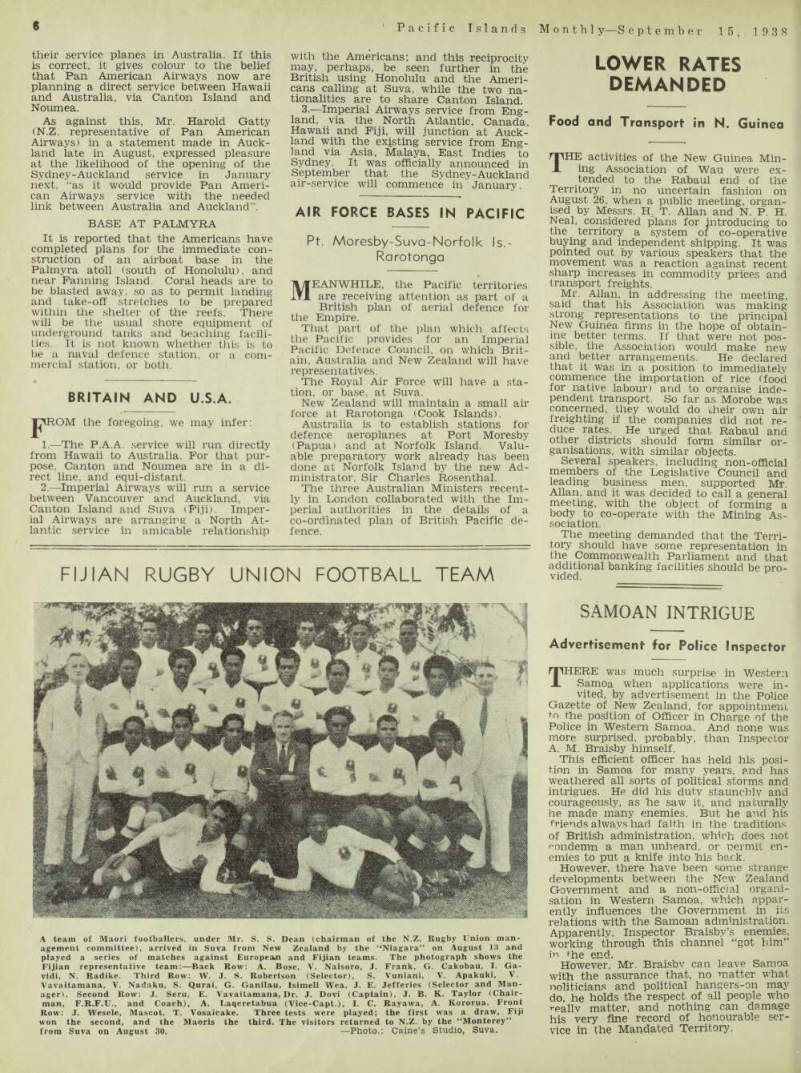
This diagram shows the maze of airmail services, actual and proposed, already, in the Paci fic Ocean. The black lines show the established services; the dash-and-dot line the service, from Vancouver to Hawaii-Canton-Fiji-Auckland, proposed by Imperial Airways; while the broken line, nearly parallel with it, indicates the route that Pan American Airways would follow on the Hawaii-Canton-Noumea-Australia run,
their service planes in Australia. If this is correct, it gives colour to the belief that Pan American Airways now are planning a direct service between Hawaii and Australia, via Canton Island and Noumea.
As against this, Mr. Harold Gatty (N.Z. representative of Pan American Airways) in a statement made in Auck land late in August, expressed pleasure at the likelihood of the opening of the Sydney-Auckland service in January next, “as it would provide Pan Ameri can Airways service with the needed link between Australia and Auckland”.
Base At Palmyra
It is reported that the Americans have completed plans for the immediate con struction of an airboat base in the Palmyra atoll (south of Honolulu), and near Panning Island. Coral heads are to be blasted away, so as to permit landing and take-off stretches to be prepared within the shelter of the reefs. There will be the usual shore equipment of underground tanks and beaching facili ties. It is not known whether this is to be a naval defence station, or a com mercial station, or both.
Advertisements & other items, p. 9 (1 item)
5
Pacific Islands Monthl y—S eptember 15, 1938
Britain And U.S.A.
the foregoing, we may infer: 1. —The P.A.A. service will run directly from Hawaii to Australia. For that pur pose. Canton and Noumea are in a di rect line, and equi-distant. 2. —lmperial Airways will run a service between Vancouver and Auckland, via Canton Island and Suva (Fiji). Imper ial Airways are arranging a North At lantic service in amicable relationship
with the Americans; and this reciprocity may, perhaps, be seen further in the British using Honolulu and the Ameri cans calling at Suva, while the two na tionalities are to share Canton Island. 3.—lmperial Airways service from Eng land, via the North Atlantic, Canada, Hawaii and Fiji, will junction at Auck land with the existing service from Eng land via Asia, Malaya, East Indies to Sydney. It was officially announced in September that the Sydney-Auckland air-service will commence in January.
Rarotonga
Air Force Bases In Pacific
Pt. Moresby-Suva-Norfolk Is.- Rarotonga
MEANWHILE, the Pacific territories are receiving attention as part of a British plan of aerial defence for the Empire.
That part of the plan which affects the Pacific provides for an Imperial Pacific Defence Council, on which Brit ain, Australia and New Zealand will have representatives.
The Royal Air Force will have a sta tion, or base, at Suva.
New Zealand will maintain a small air force at Rarotonga (Cook Islands).
Australia is to establish stations for defence aeroplanes at Port Moresby (Papua) and at Norfolk Island. Valu able preparatory work already has been done at Norfolk Island by the new Ad ministrator, Sir Charles Rosenthal.
The three Australian Ministers recent ly in London collaborated with the Im perial authorities in the details of a co-ordinated plan of British Pacific de fence.
Fijian Rugby Union Football Team
A team of Maori footballers, under Mr. S. S. Dean (chairman of the N.Z. Rugby Union man agement committee), arrived in Suva from New Zealand by the “Niagara” on August 13 and played a series of matches against European and Fijian teams. The photograph shows the Fijian representative team:—Back Row: A. Bose, V. Naisoro, J. Frank. G. Cakobau, I. Ga vidi, N. Radike. Third Row: W. J. S. Robertson (Selector), S. Vuniani, V. Apakuki, V.
Vavaitamana, V. Nadaku, S. Qurai, G. Ganilau, Isimeli Wea, J. E. Jefferies (Selector and Man ager). Second Row: J. Seru, E. Vavaitamana, Dr. J. Dovi (Captain), J. B. K. Taylor (Chair man, F.R.F.U., and Coach), A. Laqeretabua (Vice-Capt.), I. C. Rayawa, A. Kororua. Front Row: J. Wesele, Mascot, T. Yosaicake. Three tests were played; the first was a draw, Fiji won the second, and the Maoris the third. The visitors returned to N.Z. by the “Monterey” from Suva on August 30. —Photo.: Caine’s Studio, Suva.
Lower Rates
Demanded
Food and Transport in N. Guinea
THE activities of the New Guinea Min ing Association of Wau were ex tended to the Rabaul end of the Territory in no uncertain fashion on August 26, when a public meeting, organ ised by Messrs. H, T. Allan and N. P. H.
Neal, considered plans for introducing to the territory a system of co-operative buying and independent shipping. It was pointed out by various speakers that the movement was a reaction against recent sharp increases in commodity prices and transport freights.
Mr. Allan, in addressing the meeting, said that his Association was making strong representations to the principal New Guinea firms in the hope of obtain ing better terms. If that were not pos sible, the Association would make new and better arrangements. He declared that it was in a position to immediately commence the importation of rice (food for native labour) and to organise inde pendent transport. So far as Morobe was concerned, they would do their own air freighting if the companies did not re duce rates. He urged that Rabaul and other districts should form similar or ganisations, with similar objects.
Several speakers, including non-official members of the Legislative Council and leading business men. supported Mr.
Allan, and it was decided to call a general meeting, with the object of forming a body to co-operate with the Mining As sociation.
The meeting demanded that the Terri tory should have some representation in the Commonwealth Parliament and that additional banking facilities should be pro vided.
Samoan Intrigue
Advertisement for Police Inspector
THERE was much surprise in Western Samoa when applications were in vited, by advertisement in the Police Gazette of New Zealand, for appointment the position of Officer in Charge of the Police in Western Samoa. And none was more surprised, probably, than Inspector A. M. Braisby himself.
This efficient officer has held his posi tion in Samoa for many years, and has weathered all sorts of political storms and intrigues. He did his duty staunchly and courageously, as he saw it, and naturally he made many enemies. But he and his Mends always had faith in the traditions of British administration, which does not condemn a man unheard, or permit en emies to put a knife into his back.
However, there have been some strange developments between the New Zealand Government and a non-official organi sation in Western Samoa, which appar ently influences the Government in its relations with the Samoan administration.
Apparently, Inspector Braisby’s enemies, working through this channel “got him” in the end.
However, Mr. Braisby can leave Samoa with the assurance that, no matter what noliticians and political hangers-on may do, he holds the respect of all people who reallv matter, and nothing can damage his very fine record of honourable ser vice in the Mandated Territory.
Advertisements & other items, p. 10 (1 item)
6
Pacific Islands Monthl y—S eptember 15, 1938
One Capital for Papua
and New Guinea Some Interesting History
Letter to the Editor.
THE idea that Port Moresby should be the administrative centre for the two territories of Papua and the Man dated Territory (put forward recently by Mr. Fairbairn. M.P., and jeered at by Mr.
Hughes) is not new.
As long ago as 1919, the suggestion was very carefully considered by a Royal Com mission. consisting of Sir Hubert Murray, Mr. Atlee Hunt and Mr. Walter Lucas.
Sir Hubert recommended that the Man dated Territory, and also the British Solomons, if possible, should be grouped with Papua for purposes of administra tion: and he argued that, if it were ne cessary that the Mandated Territory and the British Solomons should be kept separate for the purpose of legislative and internal administration, there was no sound reason why one service, under the control of one administrator, should not be responsible for the whole area. The other two members of the Commission, however, took the view that the Mandated Territory should be a completely indepen dent administration; and that was the view accepted by Mr. Hughes, who was then Prime Minister.
I think it can be fairly claimed now that the opinion of Sir Hubert Murray has been completely justified by the events and developments of the past 20 years: and, since the necessity of finding another administrative centre for New Guinea has arisen, and since the ad ministration of the Mandated Territory is generally and frequently the subject of adverse criticism, the scorn and indigna tion of Mr. Hughes concerning the sug gestion of Mr. Fairbairn (which virtually was that the original Murray plan should be reverted to) is a little difficult to understand.
I am. etc.,
Ex Papuan Official.
Sydney, Sept. 12.
New Manager For N.G.G.
MR. KLEM GROSS, a young Australian engineer, who has been engaged on the Mt. Isa Mines for some years, sailed by the last “Montoro” for Wau, New Guinea, to take over the general managership of New Guinea Goldfields, Ltd. Mr. Jacobs, who had been manager for about 18 months, has resigned.
Honours For Queen Salote
CELEBRATIONS extending over several days will take place in Tonga next month, to mark (on October 11, 1938) the 20th anniversary of the accession of Queen Salote to the throne of Tonga.
Salote Tubou, Dame of the British Em pire, as head of her little Pacific King dom, has rendered signal service to her people; and she and her family are es teemed and respected by both Polynes ians and Europeans.
Pacific Timber
New Industries at Various Points
171 ROM various points in the Pacific, r there come reports to show that the magnificent timber resources of the various territories are receiving—really, very belatedly—the attention of timber interests.
Shipments of kauri pine, from the forests in the southern end of New Caledonia, are being brought to Sydney with in creasing frequency, and are meeting a good market.
For some years, a timber company has been regularly cutting a similar timber on the island of Vanikoro (Southern
Solomons) and shipping same to Mel bourne, It was announced recently that two important consignments of kauri • pine from Fiji (which is very similar to New Zealand kauri) have been sent by the Carpenter ships from Fiji to London, where they have been favourably re ceived. It is Stated that one of the chief uses of New Zealand kauri is the manu facture of the vats used by distillers, etc., and, if English manufacturers find the Fiji kauri suitable for this purpose, an im portant industry may develop.
Two timber enterprises have commenced operations recently on the south coast of New Britain (Mandated Territory of New Guinea) and both are confident of working up a profitable trade with Australia.
One of the most important arguments submitted in connection with the proposed construction of the road between Sala maua and the Morobe tableland is that the road will give access to very large quantities of pine and cedar, both of which will have value in the Australian market.
It is pointed out that the development of a timber industry in this district will not only have permanent value in itself, but will tend to cheapen transport, as it would provide the very necessary back loading for the vehicles whicn will be tak ing in supplies and materials to the gold fields.
There arrived in Sydney by the liner “Aorangi”, from Fiji, on August 27, 30 magnificent kauri logs, containing 10,000 superficial feet, being specially selected timber for veneering. The logs were brought to the order of V. B. Trapp Pty., Ltd. The “Fiji Times” says that the Fiji Kauri Timber and Land Co., of Nad arivatu, is opening up markets in Aus tralia. Britain and elsewhere, and it is hoped to ship 2i million feet annually of Fiji kauri.
Samoa
"Home-Brew" In
Fantastic System Under Review
From Our Own Correspondent.
APIA, August 24.
THE fantastic liquor system in vogue in Western Samoa—under which Euro peans receive a weekly “ration” of whatever they fancy, under a doctor’s written order, while the natives “brew their own” —came in for sharp criticism at the August meeting of the Legislative Council.
Hon. Tamasese (Samoan member) sub mitted that the present handling of liquor sales, under prohibition, had a bad
effect on the Samoan natives, who were brewing their own beer—a practice they had learned from the Europeans It might be all right for the Europeans to have liquor, but the system encourages the Samoans to brew beer.
The Acting-Administrator pointed out that there had always been liquor pro hibition for the Samoans. He could not say that the system was a good one.
Tamasese said that, under the German regime, the natives did not know how to brew beer, and hardly any Samoans had liquor. The effect of the present system was bad.
The Secretary of Native Affairs re marked that the brewing of beer was prob ably due to “home-brew” being cheaper than imported beer, and, whatever the method of handling imported beer, the inducement to brew would be the same.
Such things might not have occurred in the German times; but there were manv things the young generation of Samoans and other islanders are doing which their grandfathers did not do—and the same applied to Europeans.
Rentals And Licenses
Various other matters were dealt with.
European and Samoan members criticised the collection of native land rents by the Native Department and the charge of commission thereon. The Samoans wished to discontinue the deal ings between native lessors and European lessees through the Native Department Samoans would prefer direct dealing The Native Secretary replied that the present system saved the lessees a con siderable amount of trouble.
Hon. I. H. Carruthers suggested that license fees for shot guns (now 10/- for Europeans and 5/- for Samoans) should be the same for Europeans and Samoans.
Europeans are penalised at present, for no apparent reason.
(Continued On Next Page)
The Acting-Administrator said that Samoans had asked for a reduction of the license fees below 5/-, but the New Zealand Government refused.
To a suggestion of European members to reduce telephone rates, the Acting - Administrator replied that there was no prospect of such a reduction being granted.
Special Tax On Copra
Samoan members asked that the ex port duty on Samoan native copra should be reduced to the amount paid by Euro pean producers.
The Acting-Administrator stated that the Samoans paid no personal taxes, and therefore the extra 10/- per ton export duty on Samoan copra could not be re mitted. especially as it was remembered that the cost of the purely native ser vices and organisation had increased con siderably. Europeans, though not paying a personal tax now. were paying salary tax. turnover tax and other taxes which the Samoans were not paying. Compared with Fiji, Tonga and elsewhere, Samoans pay very little taxation.
The Acting-Administrator said he would be quite prepared to remit the 10/extra export duty, if there were some other way of getting the revenue. He would prefer a sliding scale of export duty on copra.
Education
Regarding an item, £125 for a trans lation of Dr. Kraemer’s “standard work on Samoa”. Hon. Tuala Tulo objected to the book, as, from the Samoan point of view, it contained much incorrect infor mation, especially about Samoan pedi grees. He said the Samoans would pre pare a book giving a true record of the foundations of the Samoan people.
The Secretary of Native Affairs stated that Kraemer’s book did not claim to be an absolute and final authority on the subject, but had considerable value for Universities and scientists.
Expenditure on the Government school grounds at Malifa and Ifi Ifi was ex plained as necessary owing to the increase in the number of pupils from 400 to 1,500.
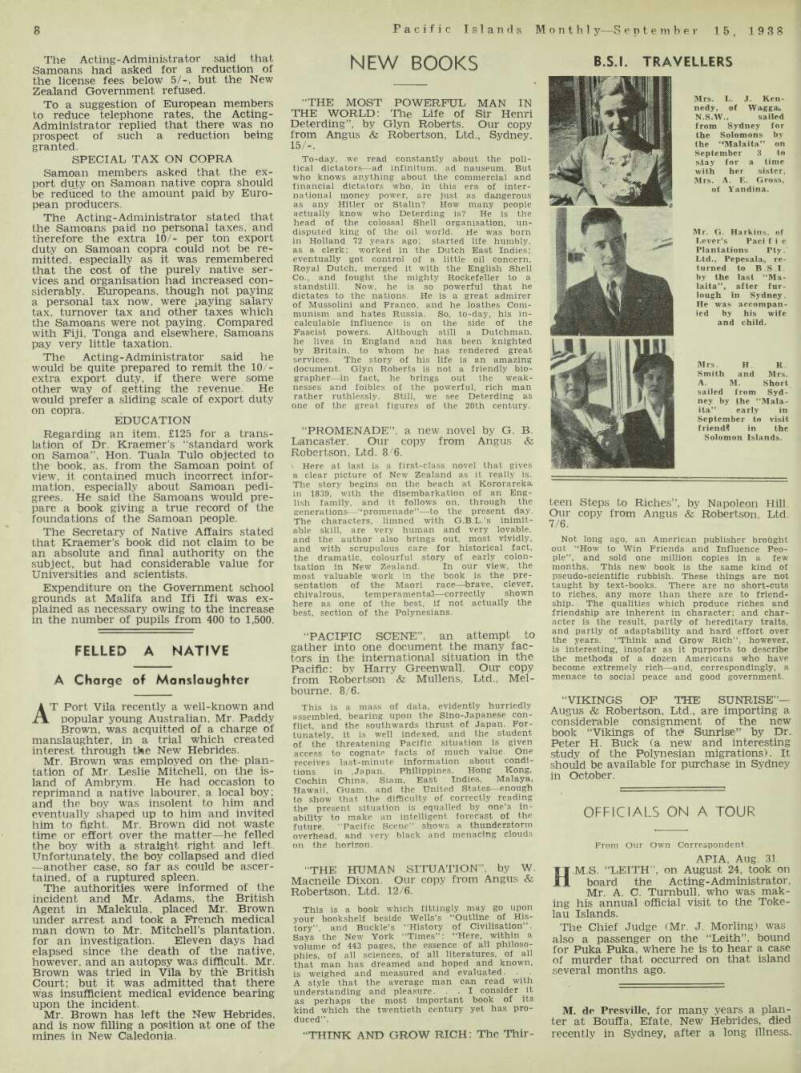
A Port Moresby Wedding
Mr. and Mrs. Ken Franks, whose wedding took place recently The bride was Miss Prudence Walby and the bridegroom is offi cer in charge of Amal gamated Wireless Sta tion at Port Moresby.
Miss Laurel Preston was bridesmaid, Mr.
Ed. Frame (General Manager of B.N.G.
Trading Company) was best man, and Captain Fitch (Managing Direc tor of Steamships Trading Co.) gave the bride away. Mr. Frame is on the left and Captain Fitch on the right.
Advertisements & other items, p. 11 (1 item)
7
Pacific Islands Monthl y—S eptember 15, 1938
A Charge of Manslaughter
Felled A Native
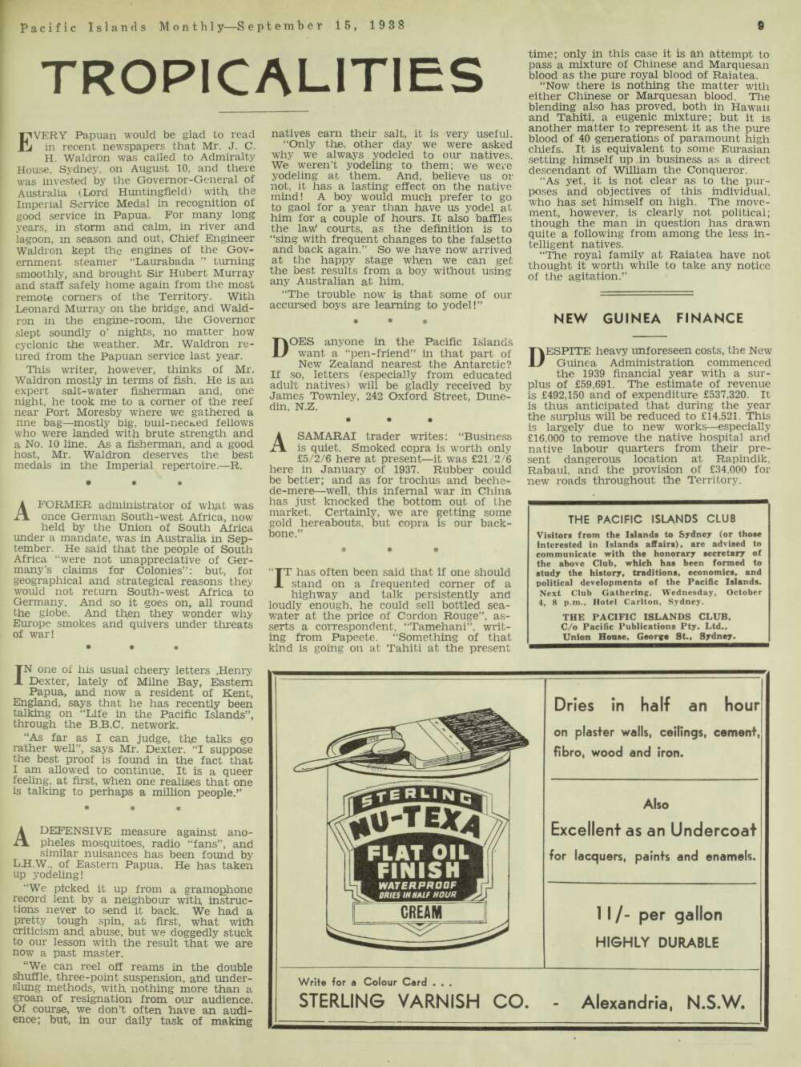
AT Port Vila recently a well-known and popular young Australian, Mr. Paddy Brown, was acquitted of a charge of manslaughter, in a trial which created interest through the New Hebrides.
Mr. Brown was employed on the plan tation of Mr, Leslie Mitchell, on the is land of Ambrym. He had occasion to reprimand a native labourer, a local boy; and the boy was insolent to him and eventually shaped up to him and invited him to fight. Mr. Brown did not waste time or effort over the matter —he felled the boy with a straight right and left.
Unfortunately, the boy collapsed and died —another case, so far as could be ascer tained, of a ruptured spleen.
The authorities were informed of the incident and Mr. Adams, the British Agent in Malekula, placed Mr. Brown under arrest and took a French medical man down to Mr. Mitchell’s plantation, for an investigation. Eleven days had elapsed since the death of the native, however, and an autopsy was difficult. Mr.
Brown was tried in Vila by the British Court; but it was admitted that there was insufficient medical evidence bearing upon the incident.
Mr. Brown has left the New Hebrides, and is now filling a position at one of the mines in New Caledonia,
New Books
“The Most Powerful Man In
THE WORLD: The Life of Sir Henri
Deterding”, by Glyn Roberts. Our copy
from Angus & Robertson, Ltd., Sydney.
15/-.
To-day, we read constantly about the poli tical dictators—ad infinitum, ad nauseum. But who knows anything about the commercial and financial dictators who, in this era of inter national money power, are just as dangerous as any Hitler or Stalin? How many people actually know who Deterding is? He is the head of the colossal Shell organisation, un disputed king of the oil world. He was born in Holland 72 years ago; started life humbly, as a clerk: worked in the Dutch East Indies; eventually got control of a little oil concern.
Royal Dutch, merged it with the English Shell Co., and fought the mighty Rockefeller to a standstill. Now, he is so powerful that he dictates to the nations. He is a great admirer of Mussolini and Franco, and he loathes Com munism and hates Russia. So, to-day, his in calculable influence is on the side of the Fascist powers. Although still a Dutchman, he lives in England and has been knighted by Britain, to whom he has rendered great services. The story of his life is an amazing document. Glyn Roberts is not a friendly bio grapher—in fact, he brings out the weak nesses and foibles of the powerful, rich man rather ruthlessly. Still, we see Deterding as one of the great figures of the 20th century.
“PROMENADE”, a new novel by G. B.
Lancaster. Onr copy from Angus & Robertson, Ltd. 8/6. \ Here at last is a first-class novel that gives a clear picture of New Zealand as it really is.
The story begins on the beach at Kororareka in 1839, with the disembarkation of an Eng lish family, and it follows on. through the generations—“promenade”—to the present day.
The characters, limned with G.B.L.’s inimit able skill, are very human and very lovable, and the author also brings out, most vividly, and with scrupulous care for historical fact, the dramatic, colourful story of early colon isation in New Zealand. In our view, the most valuable work in the book is the pre sentation of the Maori race—brave, clever, chivalrous, temperamental—correctly shown here as one of the best, if not actually the best, section of the Polynesians.
“PACIFIC SCENE”, an attempt to gather into one document the many fac tors in the international situation in the
Pacific: by Harry Greenwall. Our copy
from Robertson & Mullens, Ltd., Mel
bourne. 8/6.
This is a mass of data, evidently hurriedly assembled, bearing upon the Sino-Japanese con flict, and the southwards thrust of Japan. For tunately, it is well indexed, and the student of the threatening Pacific situation is given access to cognatp facts of much value. One receives last-minute information about condi tions in .Japan. Philippines. Hong Kong.
Cochin China, Siam, East Indies. Malaya.
Hawaii, Guam, and the United States—enough to show that the difficulty of correctly reading the present situation is equalled by one’s in ability to make an intelligent forecast of the future. Pacific Scene” shows a thunderstorm overhead, and very black and menacing clouds on the horizon.
“The Human Situation”, By W.
Macneile Dixon. Our copy from Angus & Robertson. Ltd. 12/6.
This is a book which fittingly may go upon your bookshelf beside Wells’s “Outline of His tory”. and Buckle’s “History of Civilisation”.
Says the New York “Times”: “Here, within a volume of 443 pages, the essence of all philoso phies, of all sciences, of all literatures, of all that man has dreamed and hoped and known, is weighed and measured and evaluated. . .
A style that the average man can read with understanding and pleasure. . . I consider it as perhaps the most important book of its kind which the twentieth century yet has pro duced”.
“Think And Grow Rich: The Thir
teen Steps to Riches”, by Napoleon Hill.
Our copy from Angus & Robertson, Ltd. 7/6.
Not long ago, an American publisher brought out “How to Win Friends and Influence Peo ple”, and sold one million copies in a few months. This new book is the same kind of pseudo-scientific rubbish. These things are not taught by text-books. There are no short-cuts to riches, any more than there are to friend ship. The qualities which produce riches and friendship are inherent in character; and char acter is the result, partly of hereditary traits, and partly of adaptability and hard effort over the years. “Think and Grow Rich”, however, is interesting, insofar as it purports to describe the methods of a dozen Americans who have become extremely rich—and, correspondingly, a menace to social peace and good government.
“Vikings Op The Sunrise”—
Augus & Robertson, Ltd., are importing a considerable consignment of the new book “Vikings of the* Sunrise” by Dr.
Peter H. Buck (a new and interesting
study of the Polynesian migrations). It
should be available for purchase in Sydney
in October.
B.S.I. Travellers
Mrs. L. J. Ken nedy, of Wagga, N.S.W., sailed from Sydney for the Solomons by the "Malaita” on September 3 to stay for a time with her sister, Mrs. A. E. Gross, of Yandina.
Mr. G. Harkins, of Lever’s Pacific Plantations Pty.
Ltd., Pepesala, re turned to B.S I. by the last "Ma laita”, after fur lough in Sydney.
He was accompan ied by his wife and child.
Mrs. H R Smith and Mrs.
A. M. Short sailed from Syd ney by the "Mala ita” early in September to visit friends in the Solomon Islands.
Officials On A Tour
Prom Our Own Correspondent,
Apia, Aug, 31
H.M.S. “LEITH". on August 24, took on board the Acting-Administrator.
Mr. A. C. Turnbull, who was mak ing his annual official visit to the Toke lau Islands.
The Chief Judge (Mr. J. Morling) was also a passenger on the “Leith”, bound for Puka Puka, where he is to hear a case of murder that occurred on that island several months ago.
M. do Presville, for many years a plan ter at Bouffa, Efate, New Hebrides, died recently in Sydney, after a long illness.
Advertisements & other items, p. 12 (1 item)
8
Pacific Islands Monthl y—S eptember 15, 19 3 8
Tropicalities
EVERY Papuan would be glad to read in recent newspapers that Mr. J. C.
H. Waldron was called to Admiralty House. Sydney, on August 10, and there was invested by the Governor-General of Australia (Lord Hunting-field) with the Imperial Service Medal in recognition of good service in Papua. For many long years, in storm and calm, in river and lagoon, in season and out, Chief Engineer Waldron kept the engines of the Gov ernment steamer “Laurabada ” turning smoothly, and brought Sir Hubert Murray and staff safely home again from the most remote comers of the Territory. With Leonard Murray on the bridge, and Wald ron in the engine-room, the Governor slept soundly o’ nights, no matter how cyclonic the weather. Mr. Waldron re tired from the Papuan service last year.
This writer, however, thinks of Mr.
Waldron mostly in terms of fish. He is an expert salt-water fisherman and, one night, he took me to a comer of the reef near Port Moresby where we gathered a fine bag—mostly big, buil-nech.ed fellows who were landed with brute strength and a No. 10 line. As a fisherman, and a good host, Mr. Waldron deserves the best medals in the Imperial repertoire.—R. • ♦ * A FORMER administrator of what was once German South-west Africa, now held by the Union of South Africa under a mandate, was in Australia in Sep tember. He said that the people of South Africa “were not unappreciative of Ger many’s claims for Colonies”: but, for geographical and strategical reasons they would not return South-west Africa to Germany. And so it goes on, all round the globe. And then they wonder why Europe smokes and quivers under threats of war! * ♦ * IN one of his usual cheery letters , Henry Dexter, lately of Milne Bay, Eastern Papua, and now a resident of Kent, England, says that he has recently been talking on “Life in the Pacific Islands”, through the 8.8. C. network.
“As far as I can judge, the talks go rather well”, says Mr. Dexter. “I suppose the best proof is found in the fact that I am allowed to continue. It is a queer feeling, at first, when one realises that one is talking to perhaps a million people.” ♦ ♦ ♦ A DEFENSIVE measure against ano pheles mosquitoes, radio “fans”, and similar nuisances has been found by L.H.W., of Eastern Papua. He has taken up yodeling!
“We picked it up from a gramophone record lent by a neighbour with instruc tions never to send it back. We had a pretty tough spin, at first, what with criticism and abuse, but we doggedly stuck to our lesson with the result that we are now a past master.
“We can reel off reams in the double shuffle, three-point suspension, and under slung methods, with nothing more than a groan of resignation from our audience.
Of course, we don’t often have an audi ence; but, in our daily task of making
natives earn their salt, it is very useful.
“Only thes other day we were asked why we always yodeled to our natives.
We weren’t yodeling to them; we were yodeling at them. And, believe us or not, it has a lasting effect on the native mind! A boy would much prefer to go to gaol for a year than have us yodel at him for a couple of hours. It also baffles the law* courts, as the definition is to “sing with frequent changes to the falsetto and back again.” So we have now arrived at the happy stage when we can get the best results from a boy without using any Australian at him.
“The trouble now is that some of our accursed boys are learning to yodel!” * * * DOES anyone in the Pacific Islands want a “pen-friend” in that part of New Zealand nearest the Antarctic?
If so, letters (especially from educated adult natives) will be gladly received by James Townley, 242 Oxford Street, Dune din, N.Z. • • • ASAMARAI trader writes: “Business is quiet. Smoked copra is worth only £5/2/6 here at present—it was £2l/2/6 here in January of 1937. Rubber could be better; and as for trochus and beche de-mere—well, this infernal war in China has just knocked the bottom out of the market. Certainly, we are getting some gold hereabouts, but copra is our back bone.” ♦ ♦ ♦ IT has often been said that if one should stand on a frequented corner of a highway and talk persistently and loudly enough, he could sell bottled sea water at the price of Cordon Rouge”, as serts a correspondent. “Tamehani”, writ ing from Papeete. “Something of that kind is going on at Tahiti at the present
time; only in this case it is an attempt to pass a mixture of Chinese and Marquesan blood as the pure royal blood of Raiatea.
“Now there is nothing the matter with either Chinese or Marquesan blood. The blending also has proved, both in Hawaii and Tahiti, a eugenic mixture; but it is another matter to represent it as the pure blood of 40 generations of paramount high chiefs. It is equivalent to some Eurasian setting himself up in business as a direct descendant of William the Conqueror.
“As yet, it is not clear as to the pur poses and objectives of this individual, who has set himself on high. The move ment, however, is clearly not political; though the man in question has drawn quite a following from among the less in telligent natives.
“The royal family at Raiatea have not thought it worth while to take any notice of the agitation.”
New Guinea Finance
DESPITE heavy unforeseen costs, the New Guinea Administration commenced the 1939 financial year with a sur plus of £59,691. The estimate of revenue is £492,150 and of expenditure £537,320. It is thus anticipated that during the year the surplus will be reduced to £14,521. This is largely due to new works —especially £16,000 to remove the native hospital and native labour quarters from their pre sent dangerous location at Rapindik, Rabaul. and the provision of £34.000 for new roads throughout the Territory.
Advertisements & other items, pp. 13-14 (2 items)
9
Pacific Islands Monthl y—S eptember 15, 1938
Alexandria, N.S.W.
THE PACIFIC ISLANDS CLUB
Visitors from the Islands to Sydney (or those Interested in Islands affairs), are advised to communicate with the honorary secretary of the above Club, which has been formed to study the history, traditions, economics, and political developments of the Pacific Islands.
Next Club Gathering, Wednesday, October 4, 8 p.m., Hotel Carlton, Sydney.
THE PACIFIC ISLANDS CLUB.
C/o Pacific Publications Pty. Ltd., Union House. George St., Sydney.
FLAT OIL
FINISH
w
WATERPROOF
DRIES IN HALF HOUR
CREAM
Write for a Colour Card . . .
STERLING VARNISH CO.
Dries in halt an hour on plaster walls, ceilings, cement, fibre, wood and iron.
Also Excellent as an Undercoat for lacquers, paints and enamels. 1 I /- per gallon
HIGHLY DURABLE
Alexandria, N.S.W.
ADELAIDE
MELBOURNE
SYDNEY
TO BRISBANE
NEW GUINEA
DOOR TO DOOR
EXPRESS PARCEL DELIVERIES
BY
AIR MAIL
Via— Rockhampton . . . Townsville Cairns . . . Cooktown Port Moresby . . . Salamaua Rabaul.
Rates on application to
YELLOW EXPRESS
CARRIERS LTD.
103 Murray St., Pyrmont, Sydney Tel.: MW2551 in conjunction with
W. R. CARPENTER & CO., LTD.
W hen friends
drop in for a Sat.
You can be the perfect host if there’s always a bottle of Dewar’s on hand. Its allur-
ing mellowness
and ripe old age never fail to please the most discriminating rt Perth ieiir
IHSTITiIT&
. Islgst£ni) C® s ..
J ohnDewa're§onsU 00 tastes. 9 0 A &
DEWAR’S
~?/ie SCOTCH WHISKY
About Islands People
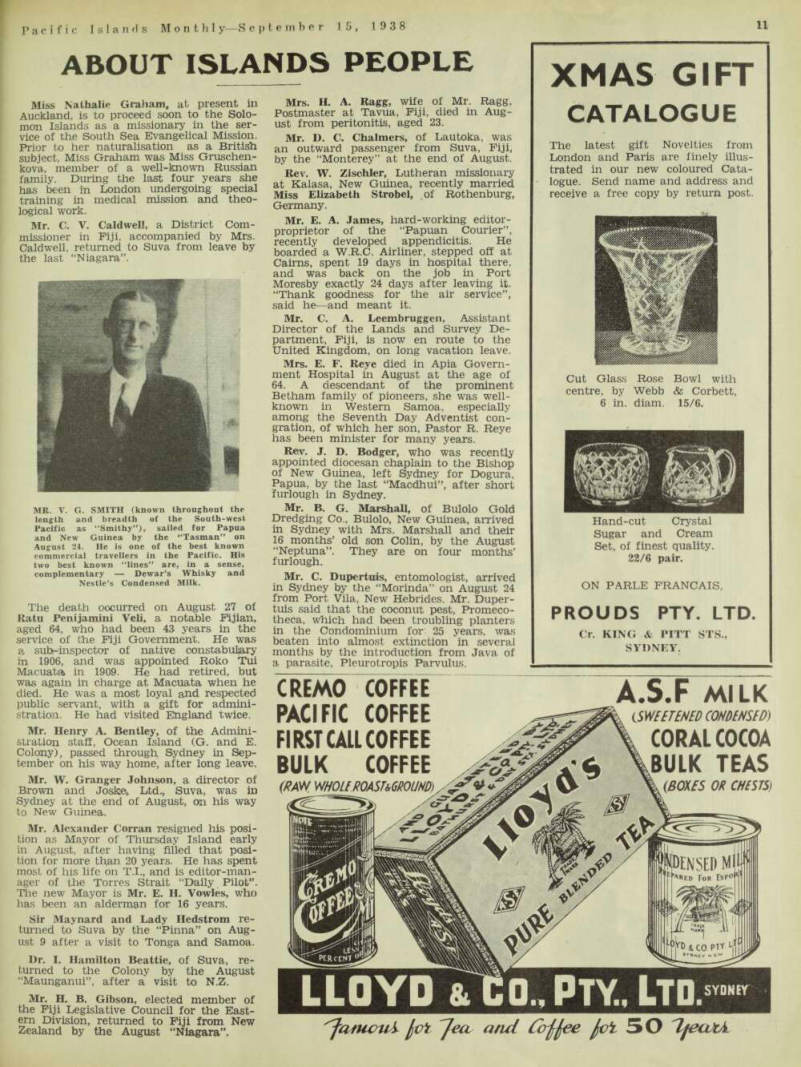
Captain E. Nelson-Turner, of the British Solomon Islands, where he is officer com manding the Armed Native Constabulary, arrived in Sydney by the September “Malaita”, accompanied by his wife, on long leave. He is now in the hands of a throat specialist and will shortly undergo an operation in Tusculum Private Hospital, Potts Point, Sydney. Later, he will visit England.
Senator C. W. Grant, of Tasmania, sailed from Sydney by the “Neptuna” early in September for Rabaul. He will spend some time in New Guinea, return ing to Australia by the October “Montoro”.
Rev. H. S. Hipkin, who has been a mis sionary for six years in the Solomon Is lands for the Melanesian Mission, arrived in New Zealand by the “Southern Cross VII” on August 29. He left within a few days for England by the “Rangitane”. Mr.
Hipkin will return to Melanesia in April next year.
Dr. W. J. C. Kau, a Dutch mining engi neer and scientist, who recently spent several months in Western Papua assist ing one of the large concerns in its search
for an oilfield, left Sydney by plane for Batavia at the beginning of September.
Mr. H. W. Simmonds, formerly Fiji Gov ernment Entomologist, arrived in Sydney with his wife from Suva by the “Niagara” late in August. He later went on to Java on a special mission on behalf of the Ad ministration of Western Samoa, seeking parasites to attack the rhinoceros beetle.
Messrs. R. Swift, N. Proud, and S. Clark, young Sydney mining engineers, who for the past three years have been stationed at Wau, came South from New Guinea by the W.R.C. airliner which, reached Sydney on September 4.
Rev. S. G. Phillips, of the London Mis sionary Society, arrived in New Zealand from Western Samoa by the “Matua” in September, having retired from mission ary work after serving for eight years.
He was principal of the Leulumoega Fou Boys’ High School at Malua Mr. F. H. Doherty, of A.W.A.’s staff at Wau, New Guinea, is at present in Aus tralia with his wife on four months’ leave.
Mr. D. B. Smith, of Morris, Hedstrom, Ltd., Suva, arrived in Australia from Fiji by the “Monterey” on September 5, on furlough.
Mr. A. H. Fletcher, who has been a lay member of the Melanesian Mission in B.SJ. for 11 years, arrived in N.Z. by the “Southern Cross” late in August to spend a short holiday with his parents in Auck land.
Dr. A. H. Pearce, of Suva, has resigned his post as Director of Medical Services in Fiji. The new director is Dr. V. W. T.
McGusty, 0.8. E.
Messrs. J. and T. Fox, well-known New Guinea prospectors, reached Sydney by the August “Neptuna”. Having spent 16 years in the Territory, they now intend to settle down in Australia.
Mr. H. R. Elves, a Canadian mining engineer, who spent a short time in New Caledonia examining chrome and nickel mining activities, arrived in Sydney from Noumea by the August “Tasman”.
Mr. George Pratt has retired from the Papuan Public Service, owing to ill-health.
Mr. W. Craig, of Wireless and Cable, Limited, was in Suva with his wife and young son early in September spending a short holiday before proceeding to Fan ning Island to live at the cable station for several years.
Rt, Rev. L. S. Kempthome, M.A., Bishop of Polynesia, arrived in Sydney on Sep tember 10 to do deputation work for the Australian Board of Missions. He came from the outposts of his diocese, Ocean Island and Nauru.
Mr. “Wally” Hams, who recently dis posed of his taxi service at Wau, New Guinea, arrived in Australia by the last “Montoro”.
Mr. Alf Pearce and Miss Molly O’Grady were married at Salamaua, New Gumea on August 13, the ceremony being per formed by Rev. Father Kirschbaum. Mr.
Pearce is manager of the Hotel Salamaua.
Mr. and Mrs. Lucas Staehelin were the guests of the Pacific Islands Club, Sydney, on September 7. Mr. Staehelin. who was leader of an expedition from the Swiss Ethnological Museum at Basle to Tahiti, the Tuamotus, the Marquesas, and the New Hebrides in 1932-34 gave a most interesting address about Tahiti, Moorea and the Marquesas. He made th (3 first ascents of Mts. Mouaroa and Tamaxu toofa, in Moorea.
Miss Nathalie Graham, at present in Auckland, is to proceed soon to the Solo mon Islands as a missionary in the ser vice of the South Sea Evangelical Mission.
Prior to her naturalisation as a British subject, Miss Graham was Miss Gruschen kova, member of a well-known Russian family. During the last four years she has been in London undergoing special training in medical mission and theo logical work, Mr. C. V. Caldwell, a District Com missioner in Fiji, accompanied by Mrs.
Caldwell, returned to Suva from leave by the last “Niagara”.
The death occurred on August 27 of Hatu Penijamini Veli, a notable Fijian, aged 64, who had been 43 years in the service of the Fiji Government. He was a sub-inspector of native constabulary in 1906, and was appointed Roko Tui Macuata in 1909. He had retired, but was again in charge at Macuata when he died. He was a most loyal and respected public servant, with a gift for admini stration. He had visited England twice.
Mr. Henry A. Bentley, of the Admini stration staff, Ocean Island (G. and E.
Colony), passed through, Sydney in Sep tember on his way home, after long leave.
Mr. W. Granger Johnson, a director of Brown and Joskei, Ltd., Suva, was in Sydney at the end of August, on his way to New Guinea.
Mr. Alexander Comm resigned his posi tion as Mayor of Thursday Island early in August, after having filled that posi tion for more than 20 years. He has spent most of his life on T. 1., and is editor-man ager of the Torres Strait “Daily Pilot”.
The new Mayor is Mr. E. H. Vowles, who has been an alderman for 16 years.
Sir Maynard and Lady Hedstrom re turned to Suva by the “Pinna” on Aug ust 9 after a visit to Tonga and Samoa.
Dr. I. Hamilton Beattie, of Suva, re turned to the Colony by the August “Maunganui”, after a visit to N.Z.
Mr. H. B. Gibson, elected member of the Fiji Legislative Council for the East ern Division, returned to Fiji from New Zealand by the August “Niagara”.
Mrs. H. A. Ragg, wife of Mr. Ragg, Postmaster at Tavua, Fiji, died in Aug ust from peritonitis, aged 23.
Mr. D. C. Chalmers, of Lautoka, was an outward passenger from Suva, Fiji, by the “Monterey” at the end of August.
Rev. W. Zisohler, Lutheran missionary at Kalasa, New Guinea, recently married Miss Elizabeth Strobel, of Rothenburg, Germany.
Mr. E. A. James, hard-working editor proprietor of the “Papuan Courier”, recently developed appendicitis. He boarded a W.R.C. Airliner, stepped off at Cairns, spent 19 days in hospital there, and was back on the job in Port Moresby exactly 24 days after leaving it.
“Thank goodness for the air service”, said he—and meant it.
Mr. C. A. Leembruggen, Assistant Director of the Lands and Survey De partment, Fiji, is now en route to the United Kingdom, on long vacation leave.
Mrs. E. F. Reye died in Apia Govern ment Hospital in August at the age of 64. A descendant of the prominent Betham family of pioneers, she was well known in Western Samoa, especially among the Seventh Day Adventist con gration, of which her son, Pastor R. Reye has been minister for many years.
Rev. J. D. Bodger, who was recently appointed diocesan chaplain to the Bishop of New Guinea, left Sydney for Dogura, Papua, by the last “Macdhui”, after short furlough in Sydney.
Mr. B. G. Marshall, of Bulolo Gold Dredging Co., Bulolo, New Guinea, arrived in Sydney with Mrs. Marshall and their 16 months’ old son Colin, by the August “Neptuna”. They are on four months’ furlough.
Mr. C. Dupertuis, entomologist, arrived in Sydney by the “Morinda” on August 24 from Port Vila, New Hebrides. Mr. Duper tuis said that the coconut pest, Promeco theca, which had been troubling planters in the Condominium for 25 years, was beaten into almost extinction in several months by the introduction from Java of a parasite, Pleurotropis Parvulus.
MR. V. G. SMITH (known throughout the length and breadth of the South-west Pacific as “Smithy”), sailed for Papua and New Guinea by the “Tasman” on August 24. He is one of the best known commercial travellers in the Pacific. His two best known “lines” are, in a sense,
complementary - Dewar’s Whisky and
Nestle’s Condensed Milk.
Advertisements & other items, pp. 15-16 (2 items)
About Islands People
11
Pacific Islands Monthl y—S eptember 15, 1938
Pty. Ltd
XMAS GIFT
CATALOGUE
The latest gift Novelties from London and Paris are finely illustrated in our new coloured Catalogue. Send name and address and receive a free copy by return post. m y m Cut Glass Rose Bowl with centre, by Webb & Corbett, 6 in. diam. 15/6. * Hand-cut Crystal Sugar and Cream Set, of finest quality. 22/6 pair.
ON PARLE FRANCAIS,
PROUDS PTY. LTD
Cr. KING & PITT STS.,
SYDNEY.
CREMO COFFEE
PACIFIC COFFEE
FIRSTCAIL COFFEE
BULK COFFEE
(MW WHOLE ROASUmUHD)
A.S.F MILK
I SWEETENED
CORAL COCOA
BULK TEAS
(BOXES OR CHESTS)
* & A Cr 0 jCR a & v \ V
ENSEDM
**ed For EsP<> & 4: C3b .i <?
p & CO PTY
n S'"
Pty. Ltd
SYDNEY
I k J I ■;« HI
'J'atuvuS [at ~Jea and Ceffee fct 50 'ZjeatV
n
Whatever you
ask you’ll find amongst
the Miniature Kodaks
OF ALL KODAK DEALERS
THROUGHOUT THE ISLANDS and
KODAK (A/ASIA) PTY. LTD.
379 George St., Sydney SUPREMA in name . , .
SUPREME in design! Makes 12 exposures 2\ x 2~X in. on SS62O Kodak Film. Has automatic film spacing device with exposure counter, double exposure prevention device, etc. With f/3.5 Anastigmat lens, Compur- Rapid Shutter to 1/400 second. Price £l6 36-exp. 35mm. models at half what you expected to pay. Nothing new to learn; striking pictures are a certainty! With Body Release.
Retina I, with f/3.5 lens; Black £lO/10/- Chromium £l2 Retina 11, with f/2 lens, coupled range-finder, £27/10/- A brilliant example of modern photographic craftsmanship. For 16 exposures on SS62O Kodak Film. Has action front, body release, etc. Satin Chromium finish. Choice of f/4.5 and f/3.5 lenses.
Prices from £B/10/- - a (i L
Write for Catalogue
KODAK FILM
FOR EXTRA QUALITY.
Kodak Film is based on fifty years’ experience with Island and Tropical needs. Its EXTRA QUALITY means
SNAPSHOTS YOU’LL BE PROUD
OF.
For the pictures that are hard to get, load with Kodak Verichrome or lightning-fast Kodak Super Sensitive Panchromatic—they’re the films
that GET THE PICTURE.
Colonists
New Rich Land For
New Guinea's Central Tablelands
ALREADY, in spite of the apparent in difference of the Administration, European enterprise is beginning to colonise the rich tablelands of Central New Guinea. A correspondent in the Ramu district, writing late in August, says: “Several men, who have settled dow. here on the Ramu tableland to seek gold have apparently made up their minds to engage in planting while maintaining themselves by alluvial mining. They are making preparations to plant such things as coffee and soya beans, and they may cultivate cinchona—the quinine plant which has been so successfully established here at the agricultural experimental station.
“It is believed that all produce from here could be taken down the Markham Valley by mules or horses, a four or five days’ journey, and if there is only a fair re turn from gold, I think these new colon ists are bound to succeed.
“Already, the cost of living here is down.
Vegetables of almost every description are growing luxuriantly in this temperate climate (we are about 5,000 ft. up) and we now have fresh milk from cows and goats, as well as fresh meat. A number of goats of a good type are being brought in here from the Lutheran Mission, at Finsch haven. I think the era of tinned meat and high costs caused by aeroplane freights is finished.
“I thing that there is a future here for timber—there are some fine varieties of big trees growing on these valleys and hill sides. Of course, we shall have to have a road out to the coast—Lae, I presume.
“You would be amazed if you could see the wide variety of vegetables we can grow here in these upland valleys, and their splendid quality. The missions here are producing cape gooseberry, grapefruit, strawberries, loganberries and mulberries.
“I should like to see some experiments made here with sheep—l believe that with certain breeds it would be splendid sheep country. There is no doubt about its suitability for cattle.”
Mr. F. I. Fleming has been appointed temporary wireless officer at Canton Is land, Central Pacific.
Constable W. Cook, who served for three years in the Police Department in Wes tern Samoa, arrived in New Zealand by the August “Maui Pomare” from Apia.
Mr. G. A. Loudon, of Eilogo Plantation, Papua, after two months’ residence in Papua, has returned to Wentworth Falls, N.S.W., under doctor’s orders, for a further period of residence in the cool air of the Blue Mountains. He is making satisfac tory progress in health.
Dr. Roncin, of the French hospital, Vila, left the New Hebrides for France by the last “Ville D’Amiens”. Dr. Momfort has succeeded him.
Mr. Charles Hutchings, who arrived in Fiji in 1879 and was prominent in the sugar industry for many years, died in Sydney recently.
Rev. L. N. Durand-Vaugaron, a French missionary who went to the New Hebrides in 1906 and served for many years at Pentecost and Mallicolo, died recently at Vila, from fever.
Hemisphere
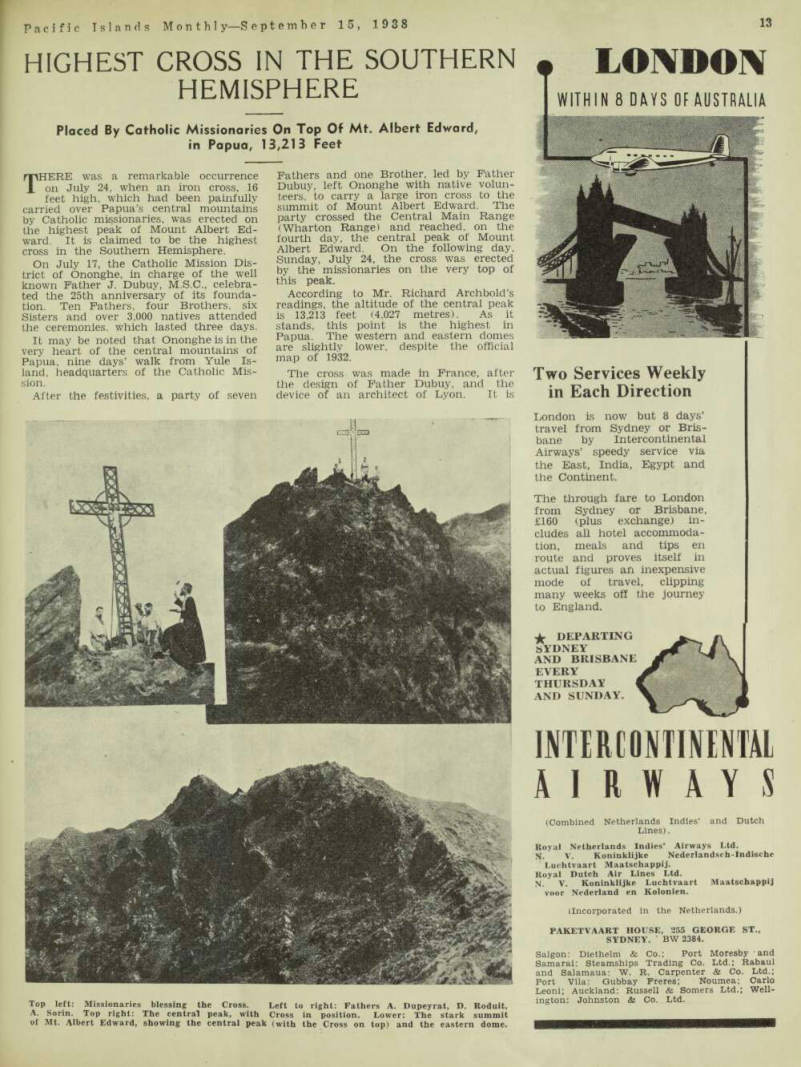
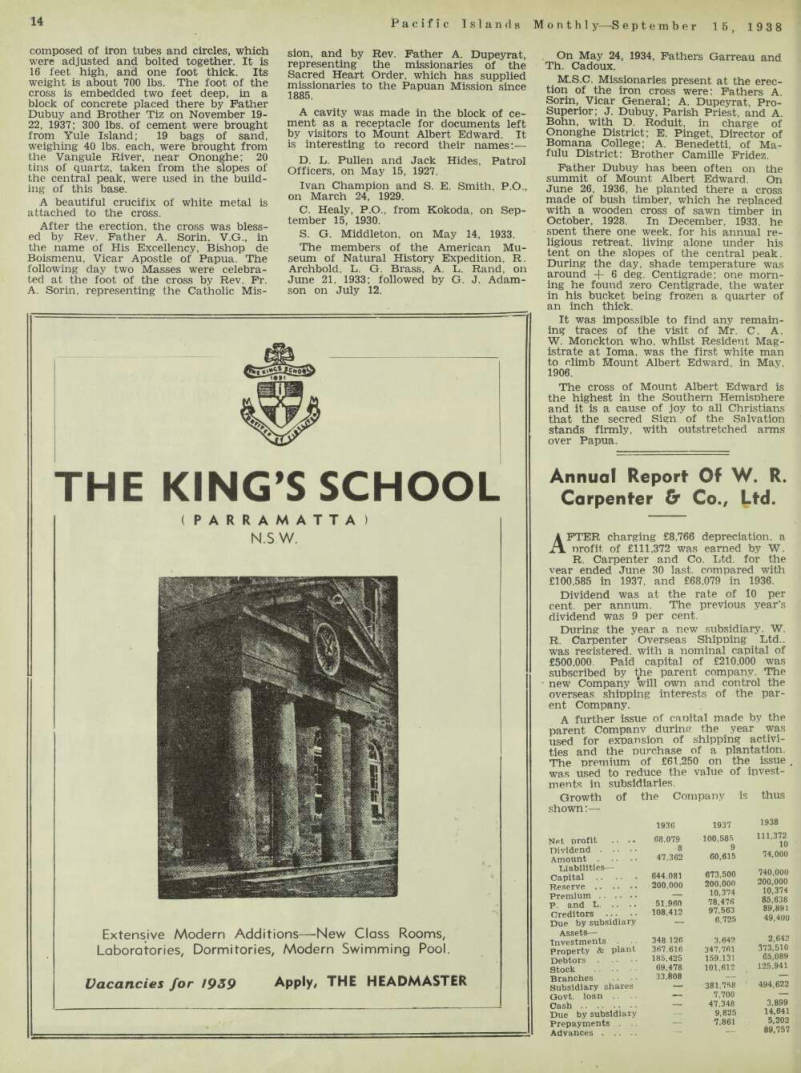
Highest Cross In The Southern
Placed By Catholic Missionaries On Top Of Mt. Albert Edward, in Papua, 13,213 Feet
THERE was a remarkable occurrence on July 24, when an iron cross, 16 feet high, which had been painfully carried over Papua’s central mountains by Catholic missionaries, was erected on the highest peak of Mount Albert Ed ward. It is claimed to be the highest cross in the Southern Hemisphere.
On July 17, the Catholic Mission Dis trict of Ononghe, in charge of the well known Father J. Dubuy, M.S.C., celebra ted the 25th anniversary of its founda tion. Ten Fathers, four Brothers, six Sisters and over 3,000 natives attended the ceremonies, which lasted three days.
It may be noted that Ononghe is in the very heart of the central mountains of Papua, nine days’ walk from Yule Is land, headquarters of the Catholic Mis sion.
After the festivities, a party of seven
Fathers and one Brother, led by Father Dubuy, left Ononghe with native volun teers, to carry a large iron cross to the summit of Mount Albert Edward. The party crossed the Central Main Range (Wharton Range) and reached, on the fourth day, the central peak of Mount Albert Edward. On the following day, Sunday, July 24, the cross was erected by the missionaries on the very top of this peak.
According to Mr. Richard Archbold’s readings, the altitude of the central peak is 13,213 feet (4,027 metres). As it stands, this point is the highest in Papua. The western and eastern domes are slightly lower, despite the official map of 1932.
The cross was made in France, after the design of Father Dubuy, and the device of an architect of Lyon. It is
Top left: Missionaries blessing the Cross. Left to right: Fathers A. Dupeyrat, D. Roduit, A. Sorin. Top right: The central peak, with Cross in position. Lower: The stark summit of Mt. Albert Edward, showing the central peak (with the Cross on top) and the eastern dome.
composed of iron tubes and circles, which were adjusted and bolted together. It is 16 feet high, and one foot thick. Its weight is about 700 lbs. The foot of the cross is embedded two feet deep, m a block of concrete placed there by Father Dubuy and Brother Tiz on November 19- 22, 1937; 300 lbs. of cement were brought from Yule Island; 19 bags of sand, weighing 40 lbs. each, were brought from the Vangule River, near Ononghe; 20 tins of quartz, taken from the slopes of the central peak, were used in the building of this base A beautiful crucifix of white metal is attached to the cross.
After the erection, the cross was blessed by Rev. Father A. Sorin, V.G., in the name of His Excellency, Bishop de Boismenu, Vicar Apostle of Papua. The following day two Masses were celebrated at the foot of the cross by Rev. Fr.
A. Sorin, representing the Catholic Mis-
s ion, and by Rev. Father A. Dupeyrat, representing the missionaries of the Sacred Heart Order, which has supplied missionaries to the Papuan Mission since igBs.
A cavity was made in the block of ce ment as a receptacle for documents left by visitors to Mount Albert Edward. It is interesting to record their names:— D . l. Pullen and Jack Hides, Patrol Officers on May 15 1927 T ’ , . ’ „ * „ Ivan Champion and S. E. Smith, P. 0., on C. Healy, P. 0., from Kokoda, on Sep te™ ™ Middleton, on May 14, 1933.
The members of the American Mu seum of Natural History Expedition, R.
Archbold, L. G. Brass, A. L. Rand, on June 21, 1933; followed by G. J. Adam son on July 12.
On May 24, 1934, Fathers Garreau and Th. Cadoux.
M.S.C. Missionaries present at the erec tion of the iron cross were: Fathers A.
Sorin, Vicar General; A. Dupeyrat, Pro- Superior; J. Dubuy, Parish Priest, and A.
Bohn, with D. Roduit, in charge of Ononghe District; E. Pinget, Director of Bomana College; A. Benedetti, of Ma fulu District: Brother Camille Fridez.
Father Dubuy has been often on the summit of Mount Albert Edward. On June 26, 1936, he planted there a cross made of bush timber, which he replaced with a wooden cross of sawn timber in October, 1928. In December, 1933. he spent there one week, for his annual re ligious retreat, living alone under his tent on the slopes of the central peak.
During the day, shade temperature was around + 6 deg. Centigrade; one morn ing he found zero Centigrade, the water in his bucket being frozen a quarter of an inch thick.
It was impossible to find any remain ing traces of the visit of Mr. C. A.
W. Monckton who, whilst Resident Mag istrate at loma. was the first white man to climb Mount Albert Edward, in May, 1906.
The cross of Mount Albert Edward is the highest in the Southern Hemisphere and it is a cause of joy to all Christians that the secred Sign of the Salvation stands firmly, with outstretched arms over Papua.
Advertisements & other items, pp. 17-18 (2 items)
13
Pacific Islands Monthl y—S eptember 15, 1938
Airways
• LONDON
WITHIN 8 DATS OF AIISTIAUA
Two Services Weekly
in Each Direction
London is now but 8 days’ travel from Sydney or Brisbane by Intercontinental Airways’ speedy service via the East, India, Egypt and the Continent.
The through fare to London from Sydney or Brisbane, £l6O (plus exchange) includes all hotel accommodation, meals and tips en route and proves itself in actual figures an inexpensive mode of travel, clipping many weeks off the journey to England.
+ DEPARTING
SYDNEY
AND BRISBANE
EVERY
THURSDAY
AND SUNDAY.
INTERCONTINENTAL
AIRWAYS
(Combined Netherlands Indies’ and Dutch Lines).
Royal Netherlands Indies’ Airways Ltd.
N. V. Koninklijke Nederlandseh-Indlsche Luchtvaart Maatschappij.
Royal Dutch Air Lines Ltd.
N. V. Koninklijke Luchtvaart Maatschappij voor Nederland en Kolonien. (Incorporated in the Netherlands.)
PAKETVAART HOUSE, 255 GEORGE ST.,
SYDNEY. BW 2384.
Saigon: Diethelm & Co.; Port Moresby and Samarai: Steamships Trading Co. Ltd.; Rabaul and Salamaua; W. R. Carpenter & Co. Ltd.; Port Vila: Gubbay Preres; Noumea: Carlo Leoni; Auckland: Russell & Somers Ltd.; Wellington: Johnston & Co. Ltd.
THE KING’S SCHOOL
(PARRAMATTA)
N.S W.
& m i Extensive Modern Additions —New Class Rooms, Laboratories, Dormitories, Modern Swimming Pool.
Vacancies for 1959 Apply, THE HEADMASTER
Carpenter & Co., Ltd.
Annual Report Of W. R.
AFTER charging £8,766 depreciation, a nrofit of £111,372 was earned by W.
R. Carpenter and Co. Ltd. for the vear ended June 30 last, compared with £100,585 in 1937. and £68,079 in 1936.
Dividend was at the rate of 10 per cent, per annum. The previous year’s dividend was 9 per cent.
During the year a new subsidiary. W.
R. Carpenter Overseas Shipping Ltd., was registered, with a nominal capital of £500.000. Paid capital of £210,000 was subscribed by the parent company. The new Company will own and control the overseas shipping interests of the par ent Company.
A further issue of canital made by the parent Companv during the year was used for expansion of shipping activi ties and the purchase of a plantation.
The premium of £61.250 on the issue was used to reduce the value of invest ments in subsidiaries.
Growth of the Company is thus shown: —
1936 1937 1938 Net profit .. .. 68.079 100,585 111,372 10 Dividend Amount 8 47,362 9 60,615 74,000 Liabilities — Capital Premium p. and L Creditors Due by subsidiary 644.081 51.960 108,412 673,500 200,000 10,374 78,476 97,563 6,725 740.000 200.000 10,374 85,638 89,891 49,400 Assets — 2,642 Investments 348 126 3.642 Property & plant 367,616 347,761 373,510 Debtors 185.425 159.131 65,089 Stock 69,478 101,612 125,941 Branches .. 33,608 — — Subsidiary shares — 381.758 494,622 Govt, loan — 7.700 — Cash — 47.348 3,899 Due by subsidiary — 9,825 14,641 Prepayments . . — 7,861 5,202 89,757 Advances — ■—
Advertisements & other items, p. 18 (1 item)
14
Pacific Islands Month] y—S eptember 15, 1938
More New Guinea Population
Archbold Expedition Reports Thickly-Settled Area in Dutch Hinterland
From Our Own Correspondent.
Honolulu, Aug. 20.
VIA his radio station at Hollandia, PK6XX, which normally operates on a frequency of 14,009 kilocycles, Richard Archbold reports that his Ameri can Museum of Natural History expedition in Dutch New Guinea is proceeding with out incident.
A base has been established at Lake Habbema, 11,000 feet above sea level, in the wild interior. A powerful radio sta tion will be set up at the base, which will be useful in the event of accident, sickness and other emergencies.
The expedition’s airboat “Guba”, in which they made their outstanding trans pacific flight from San Diego to Hoi landia, Dutch New Guinea, in June, will remain at the coast while not carrying men and supplies into the hinterland.
The Lake Habbema radio station will call it when required. There are 130 men stationed at the lake camp.
Small parties already are exploring the surrounding country, collecting specimens of rare mammals, birds and plants and taking thousands of photographs ot scientific value. Friendly relations are being made with the numerous tribes, many of which have not before seen white men. Each party carries a portable radio set. It is to these small parties that the “Guba” drops food supplies in small para chutes, each capable of safely landing about 70 pounds without damage—much to the wonderment of the natives.
Mr. Archbold expects the expedition to remain in the field until late summer of 1939.
At Hollandia, a complete overhaul work shop for the “Guba” already is in oper ation.
Most interesting discovery so far has been that of an immense inland valley, hitherto unsuspected, and containing numerous native villages, surrounded by well-cultivated gardens. Study of the aerial photographs taken suggests that this valley contains the largest concen tration of natives on the entire island of New Guinea.
Three Expeditions Seeking
New Guinea's Secrets
r would appear that, in the wide, rich valleys that lie on the plateaus, north and south of the main divid ing range (or “backbone”) along the en tire length of the island of New Guinea, there are large native populations; and the reports of the more recent explorers (Champion, Karius, Hides and O’Malley, in Papua; Taylor and the Leahy brothers in the Mandated Territory and now the Arch,bold expedition in Dutch New Guinea) show that, for the most part, these are skilled agriculturists, with con siderable social organisation.
These great interior plateaus and valley systems of New Guinea have come to our knowledge only within the last five years.
Taylor and the Leahys gave us the first authoritative account of this unknown region after they visited the Ramu-Purari- Mt. Hagen region, in 1933; and then, in 1935, the late Jack Hides made his famous
, . . - T _.. . , patrol around the Kikoi i headwaters and found his ‘ Papuan Wonderland , showing that the same type of country and people extended away south-westward of Mt.
Hagen.
This latest report from the Archbold expedition suggests that those tablelands, river valleys and agricultural people con tinue westward, over the border, into Dutch New Guinea.
It is worthy of note that this vast cen tral portion of “the largest island in the world” is still practically unexplored and unknown; and that its secrets now are being sought by three separate and in dependent expeditions, as follows: FROM PAPUA: Mr. Ivan Champion, a senior member of the Papuan service and well-known for his exploration work, is now in charge of an important organisa tion based on Lake Kutubu. This large lake was discovered (from the air) about two years ago; and as it is on the southern edge of the portion of the “unknown centre” that lies in Papua, Mr. Champion has placed a large base camp there; and, from that point, he is slowly and steadily pushing with police parties to the north wards, as part of a plan for bringing the unknown area under Government influ
ence and control. Communication between civilisation and Lake Kutubu is being maintained by portable radiophones, and a seaplane.
From The Mandated Territory
OF NEW GUINEA: Avery large patrol, led by Assistant District Officer J. L. Tay lor with Patrol Officer J, R. Black and Mr. C. B. Walsh as assistants, is now out in the unexplored region, between Mt.
Hagen and the Sepik River (and therefore almost due north of the area of Mr.
Champion’s operations), and is making good progress and doing valuable work.
Communication is being maintained by portable radiophone, and by aeroplanes which go out westward from Mt. Hagen at fixed times.
From Dutch New Guinea: The
Archbold expedition, operating in the north-east corner (as described overleaf), and various expeditions elsewhere, dir ected by the Dutch Administration.
Advertisements & other items, pp. 19-20 (1 item)
Paul & Gray Ltd.
85H.P. 6 cylinder. . . £197/10/-
WHEN BETTER MARINE ENGINES ARE BUILT,
CHRIS CRAFT WILL BUILD THEM
OINCE the day when Chris. Smith and his sons, Jay and Bernard, made the first successful installation of a petrol-driven motor in a boat, CHRIS CRAFT has had more than a casual interest in Motors—for they have been, and still are, the world’s largest users of Marine Motors.
WE firmly believe, and thousands of yachtsmen in all parts of the world will bear us out, that CHRIS CRAFT Motors are the finest money can buy, and if anyone, anywhere, is in a position to know what a motor will do or how to build a better motor, it is the CHRIS CRAFT organisation. So, before you buy a motor of any type it will pay you to see what CHRIS CRAFT offers. 4 and 6 Cylinder CHRIS CRAFT MARINE ENGINES ready for immediate delivery.
PAUL & GRAY LTD.
■Phone: SHIPCHANDLERS. After Hours:
BW 1851. PU 8955
82 SUSSEX STREET, SYDNEY
Branches: Brisbane, Newcastle, Melbourne, Adelaide, London.
Post or Padio
or indhudwns to
Ow Pc/>f&soAda&
uMt moot yo umUl cor ano your order, or conduct you. to our jorctms&s...
By Specia I I J B*"
Appointment ■ fkJv
r ii\b
BROTHERS LIMITED
en St., Brisbane.
Samoan Banana Inquiry
Re-Opened
Prom Our Own Correspondent.
Apia, Aug. 22.
IN spite of strong protests by European banana growers and a large majority of Samoan banana shippers (700 out of a total of 900), the Acting Admini strator has re-opened the inquiry into the working of the banana scheme and the methods of the Produce Inspector. The inquiry was proceeded with on the sth and 6th, but was then adjourned until August 25.
Mr. James E. Kennedy, an old pioneer of Fiji, recently died at Nadi, aged 84.
Going to Suva from Australia in 1870, he took up land on the Ba River and grew cotton. Later he was master of several trading vessels*in the Group. At one time he owned the Waimanu Hotel, on the Rewa River.
"Luxury Liners"
More Reports of Trans-Pacific Developments
THE relationship between the British and American shipping interests in regard to trans-Pacific steamship lines is just as vague and uncertain—if we may judge by newspaper reports—as the future relationship between the two nations regarding trans-Pacific airmails.
Having made the announcement of ficially and unofficially on several oc casions, that the plan of building two new 22,000-tons liners to run between Australia and North America had been abandoned on account of high shipbuild ing costs, the various interests concerned, early in September, declared that the plan had not been dropped but that, on the contrary, the Governments of Britain, Canada, Australia and New Zealand were now considering ways and means of giv ing effect to it.
Meanwhile, reports have been received in Auckland that the Matson Line pro poses to build two 40,000-tons luxury liners for the Pacific service, to replace the “Mariposa” and “Monterey”; and that the service, under the new conditions, will include Wellington, as well as Auckland In view of the events of the past few years, all such reports should be mixed with the usual dose of fruit salts.
Mr. W. J. Knox, of Mathias Planta tion, Buka Passage, New Guinea, mar ried Miss R. McKinnon, of Rabaul, in August.
Advertisements & other items, p. 20 (2 items)
16
Pacific Islands Monthl y—S eptember 15, 1938
oleman
Sneed -Master
Easy to operate. Simply open Valve- Strike a match —and it lights. Boils one pint of water in 2\ minutes. Easy to carry. Weighs only 5 lbs. 9£ ozs. Take it anywhere—use it any time—it is always ready—INSTANTLY.
THE STOVE WITH 100 USES
ADVANTAGES
1. Lights INSTANTLY —No preheating. 2. INSTANT regulation of heat (high, medium or low). 3. Safety Shut-off Valve —avoids repumping each time stove is lighted. 4. Built - in automatic tip - cleaning needle. 5. Wind-proof, Silent, Odourless “Life- Time” Burner. The same type as used on Coleman’s highest priced ranges. 6. Extra large Straight Generator —easily cleaned and replaced. 7. Triple Nickel-Plated Brass Fount — Rust-Proof—Tested for 200 lbs. pressure—SAFE.
DISTRIBUTORS IN THE PACIFIC ISLANDS:
All Branches of Burns, Philp & Co. Ltd.; W. R. Carpenter & Co. Ltd.; Burns Philp (South Sea) Co. Ltd.; Morris, Hedstrom Ltd.; Whitten Bros. Ltd.; Steamships Trading Co. Ltd.; and many other firms throughout the Islands.
S/> O wm A a. s.
'U % ** 7 a * J K V" a v- r i) w.
Adam And Eve
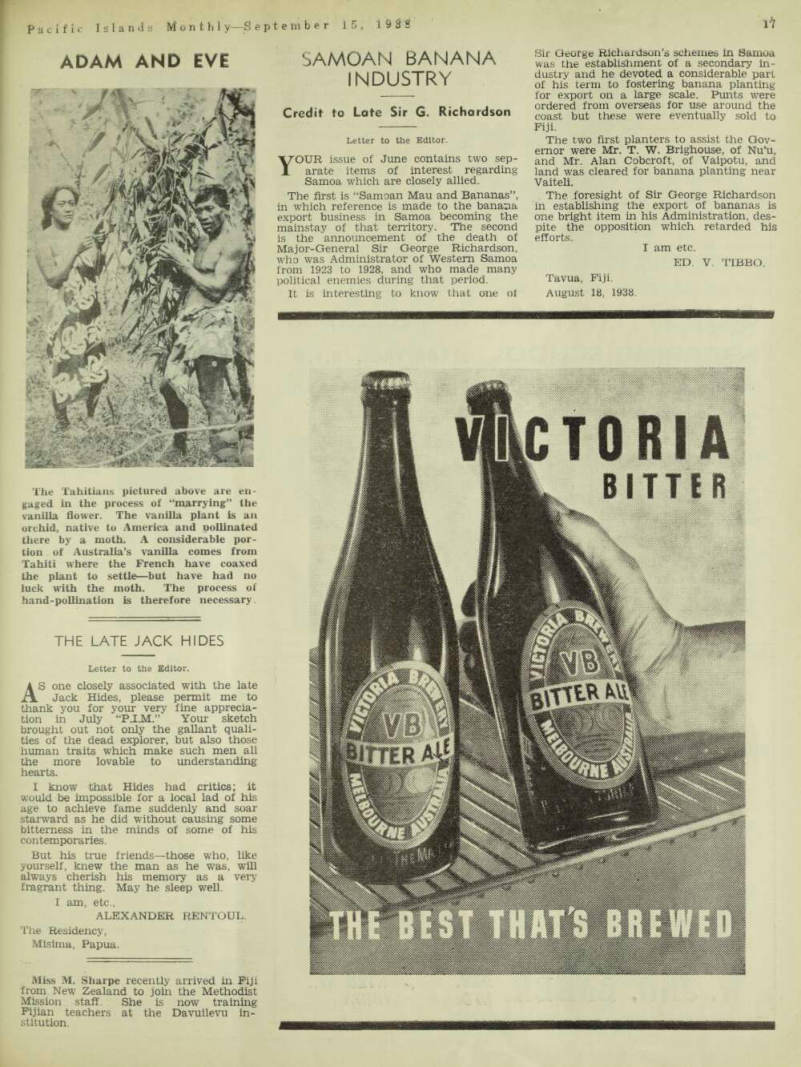
The Tahitians pictured above are en gaged in the process of “marrying” the vanilla flower. The vanilla plant is an orchid, native to America and pollinated there by a moth. A considerable por tion of Australia’s vanilla comes from Tahiti where the French have coaxed the plant to settle —but have had no luck with the moth. The process of hand-pollination is therefore necessary.
The Late Jack Hides
Letter to the Editor.
AS one closely associated with the late Jack Hides, please permit me to thank you for your very fine apprecia tion in July “P.1.M.” Your sketch brought out not only the gallant quali ties of the dead explorer, but also those human traits which make such men all the more lovable to understanding hearts.
I know that Hides had critics; it would be impossible for a local lad of his age to achieve fame suddenly and soar starward as he did without causing some bitterness in the minds of some of his contemporaries.
But his true friends —those who, like yourself, knew the man as he was, will always cherish his memory as a very fragrant thing. May he sleep well.
I am, etc..
Alexander Rentoul
The Residency, Misima, Papua.
Miss M. Sharpe recently arrived in Fiji from New Zealand to join the Methodist Mission staff She is now training Fijian teachers at the Davuilevu in stitution.
Industry
Samoan Banana
Credit to Late Sir G. Richardson
Letter to the Editor.
YOUR issue of June contains two sep arate items of interest regarding Samoa which are closely allied.
The first is “Samoan Mau and Bananas”, in which reference is made to the banana export business in Samoa becoming the mainstay of that territory. The second is the announcement of the death of Major-General Sir George Richardson, who was Administrator of Western Samoa from 1923 to 1928, and who made many political enemies during that period.
It is interesting to know that one of
Sir George Richardson’s schemes In Samoa was the establishment of a secondary industry and he devoted a considerable part of his term to fostering banana planting for export on a large scale. Punts were ordered from overseas for use around the coast but these were eventually sold to Fiji.
The two first planters to assist the Governor were Mr. T. W. Brighouse, of Nu’u, and Mr. Alan Cobcroft, of Vaipoto, and land was cleared for banana planting near Vaiteli.
The foresight of Sir George Richardson in establishing the export of bananas is one bright item in his Administration, despite the opposition which retarded his efforts.
I am etc.
Ed. V. Ttbbo.
Tavua, Fiji.
August 18, 1938.
Advertisements & other items, p. 21 (2 items)
17
Pacific Islands Month! y—S eptember 15, 193 S
Mctoria
BITTIR
RA
Norfolk Island Fruit
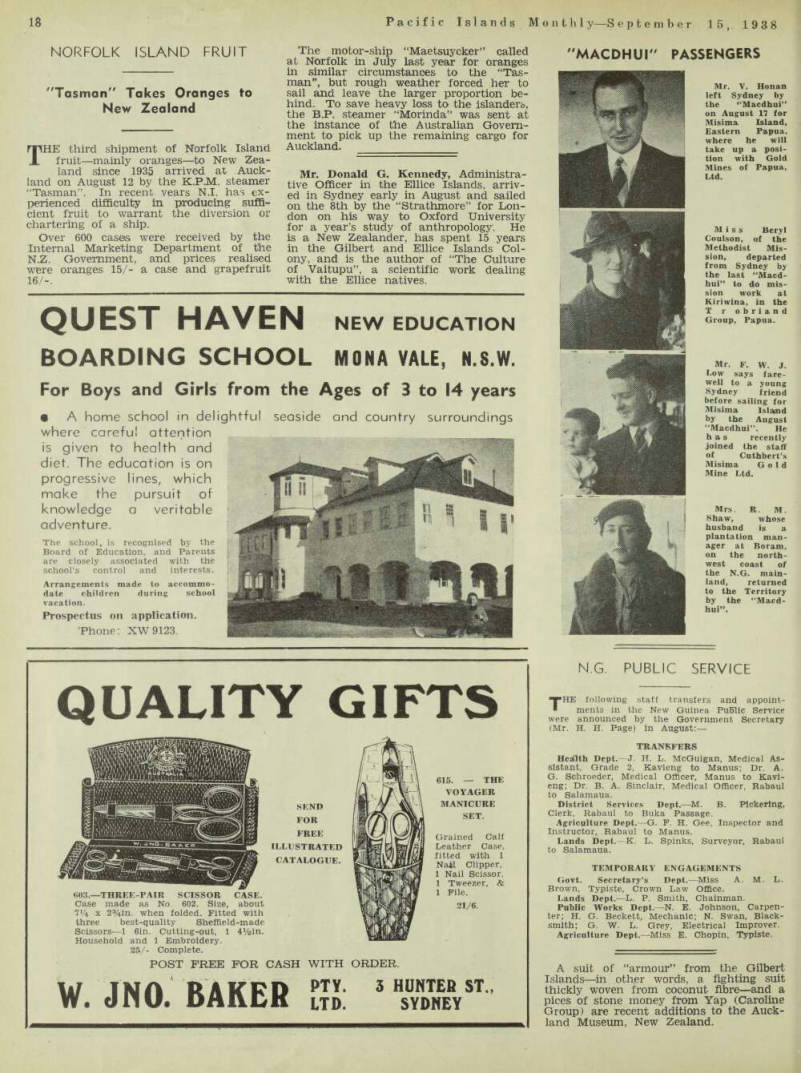
"Tasman" Takes Oranges to New Zealand
THE third shipment of Norfolk Island fruit—mainly oranges—to New Zea land since 1935 arrived at Auck land on August 12 by the K.P.M. steamer “Tasman”. In recent years N.I. has ex perienced difficulty in producing suffi cient fruit to warrant the diversion or chartering of a ship.
Over 600 cases were received by the Internal Marketing Department of the N.Z. Government, and prices realised were oranges 15/- a case and grapefruit 16/-.
The motor-ship “Maetsuycker” called at Norfolk in July last year for oranges in similar circumstances to the “Tas man”, but rough weather forced her to sail and leave the larger proportion be hind. To save heavy loss to the islanders, the BP. steamer “Morinda” was sent at the instance of the Australian Govern ment to pick up the remaining cargo for Auckland.
Mr. Donald G. Kennedy, Administra tive Officer in the Ellice Islands, arriv ed in Sydney early in August and sailed on the Bth by the “Strathmore” for Lon don on his way to Oxford University for a year’s study of anthropology. He is a New Zealander, has spent 15 years in the Gilbert and Ellice Islands Col ony, and is the author of “The Culture of Vaitupu”, a scientific work dealing with the Ellice natives.
"Macdhui" Passengers
Mr. V. Honan left Sydney by the “Macdhui” on August 17 for Misima Island, Eastern Papua, where he will take up a posi tion with Gold Mines of Papua, Ltd.
Miss Beryl Coulson, of the Methodist Mis sion, departed from Sydney by the last “Macd hui” to do mis sion work at Kiriwina, in the Trobriand Group, Papua.
Mr. F. W. J.
Low says fare well to a young Sydney friend before sailing for Misima Island by the August “Macdhui”. He has recently joined the staff of Cuthbert’s Misima Gold Mine Ltd.
Mrs. R M.
Shaw, whose husband is a plantation man ager at Boram, on the north west coast of the N.G. main land, returned to the Territory by the “Macd hui”.
N.G. Public Service
THE following staff transfers and appoint ments in the New Guinea Public Service were announced by the Government Secretary (Mr. H. H. Page) in August:—
Transfers
Health Dept.—J. H. L. McGuigan, Medical As sistant, Grade 2, Kavieng to Manus; Dr. A.
G. Schroeder, Medical Officer, Manus to Kavi eng: Dr. B. A. Sinclair, Medical Officer, Rabaul to Salamaua.
District Services Dept.—M. B. Pickering, Clerk, Rabaul to Buka Passage.
Agriculture Dept.—G. F. H. Gee, Inspector and Instructor, Rabaul to Manus.
Lands Dept.—K. L. Spinks, Surveyor, Rabaul to Salamaua.
Temporary Engagements
Govt. Secretary’s Dept.—Miss A. M. L.
Brown, Typiste, Crown Law Office.
Lands Dept.—L. P. Smith, Chainman.
Public Works Dept.—N. E. Johnson, Carpen ter; H. G. Beckett, Mechanic; N. Swan, Black smith; G. W. L. Grey, Electrical Improver.
Agriculture Dept.—Miss E. Chopin, Typiste.
A suit of “armour” from the Gilbert Islands —in oth,er words, a fighting suit thickly woven from coconut fibre—and a pices of stone money from Yap (Caroline Group) are recent additions to the Auck land Museum, New Zealand.
Advertisements & other items, pp. 22-23 (2 items)
Quality Gifts
QUEST HAVEN new education
BOARDING SCHOOL MONA VALE, N.S.W.
For Boys and Girls from the Ages of 3 to 14 years • A home school in delightful seaside and country surroundings where careful attention is given to health and diet. The education is on progressive lines, which make the pursuit of knowledge a veritable adventure. 1 The school, is recognised by the Board of Education, and Parents are closely associated with the school’s control and interests.
Arrangements made to accommodate children during school vacation.
Prospectus on application.
'Phone: XW9123.
QUALITY GIFTS
SEND
FOR
FREE
ILLUSTRATED
CATALOGUE.
603.—THREE-PAIR SCISSOR CASE.
Case made as No. 602. Size, about 7»/ 4 x 2 3 /4in. when folded. Fitted with three best-quality Sheffield-made Scissors —1 6in. Cutting-out, 1 4Vfein.
Household and 1 Embroidery. 25/- Complete.
POST FREE FOR CASH WITH ORDER.
615. THE
VOYAGER
MANICURE
SET.
Grained Calf Leather Case, fitted with 1 Nail Clipper, 1 Nail Scissor, 1 Tweezer, & 1 Pile. 21/6.
W. JNO. BAKER SI:
5 HUNTER ST.,
SYDNEY
Bidomak
Overcome
TROPICAL
LETHARGY
and
Depressed Feeling
Banish
‘ ‘Nerves”
with
BIDOMAK
It You ore Irritable, Tired, Run-
Down or Depressed You need BIDOMAK
“Bidomak” will quickly overcome the effects of severe tropic conditions and bring you back to the pinnacle of health and good spirits safely and pleasantly. “Bidomak” restores appetite, increases energy and vitality, helps you to sleep soundly and makes it possible for you to take full value from your regular food.
It provides the vital minerals — ferrum, calcium, phosphorus, potassium, sodium—in an easily assimilable, palatable, liquid form. % A m Z 6
EVERY BOTTLE OF BIDOMAK
CONTAINS ALL THE FOLLOWING
VITAL MINERAL FOODS:
0
AS MUCH “FERRUM” AS 8
**#>4 cy SSt I':
AS MUCH
CALCIUM
. m m -A
IBUIHIB
550 pts of Milk 50 lbs of Beef 66 lbs Lettuce 5 lbs of Spinach 50 pts Orange Juice
EGGS
4 pts of Milk 40 ozs Cheese 130 lbs Bananas 22 lbs Lettuce 5 pts of Orange Juice AS MUCH “POTASSIUM" AS 22 OZS. OF LETTUCE 5 lbs Cabbage 17 ozs Carrots The chart at the right will give you some idea of the amazing concentration of these minerals in “Bidomak”. Within 30 seconds the ingredients enter the bloodstream and commence building up the worn-out tissues and restoring health and vigor.
Get a bottle of “Bidomak” from your store and take it as directed.
It is pleasant to take, and you will be amazed at the speed with which it gives you genuine restoration of your full health. 22 ozs Spinach AS MUCH "SODIUM” AS 10 PTS. OF ORANGE JUICE 125 lbs Cabbage 10 lbs Bananas 3 I 5 lbs o* Lettuce ■,j\ 13 lbs Spinach AS MUCH “PHOSPHORUS" AS 11 LBS. OF SPINACH 44 pts Orange Juice 44 lbs Carrots 90 lbs Bananas 134 lbs Cabbage f ■S
Take The Vital Minerals Doctors Recommend
BIDOMAK
The Tonic of the Century in “BOTTLED MINERALS”
At all Stores
Two Patrol Vessels For
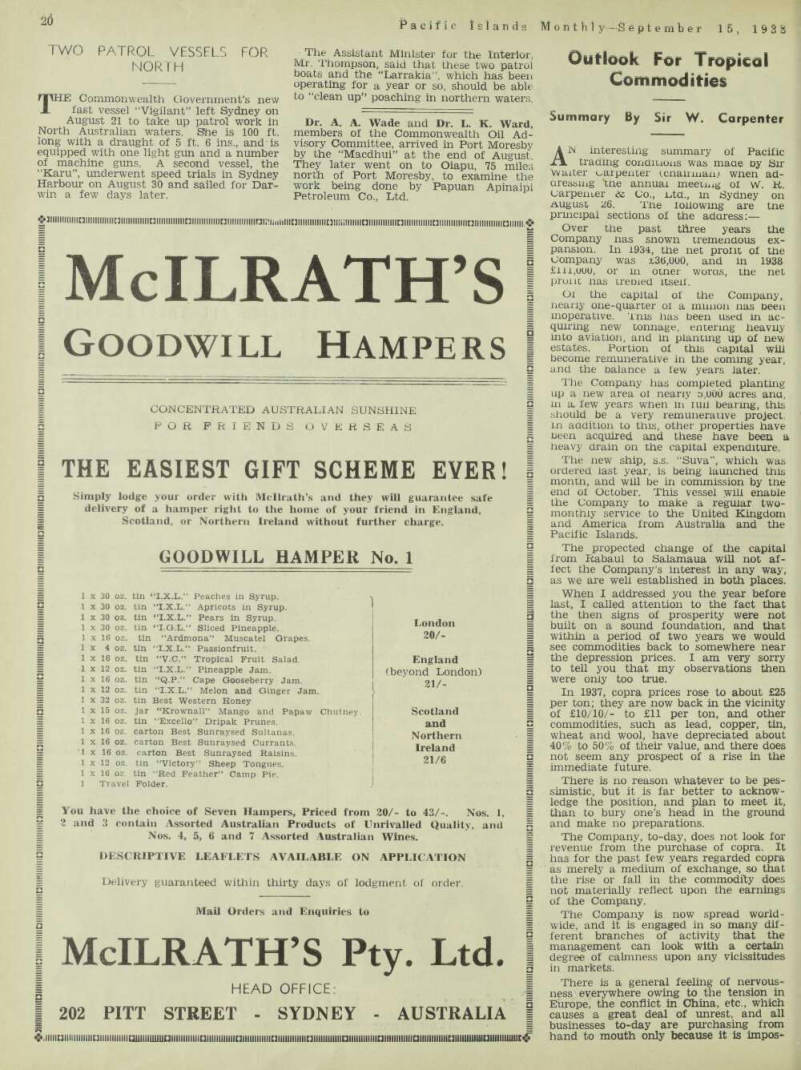
North
THE Commonwealth Government’s new fast vessel “Vigilant” left Sydney on August 21 to take up patrol work in North Australian waters. She is 100 ft. long with a draught of 5 ft. 6 ins., and is equipped with one light gun and a number of machine guns, A second vessel, the “Karu”, underwent speed trials in Sydney Harbour on August 30 and sailed for Dar win a few days later.
The Assistant Minister for the Interior Mr Thompson, said that these two patrol boats and the “Larrakia ”, which has been operating for a year or so. should be able to “dean up” poaching in northern waters, Dr. A. A. Wade and Dr. L. K. Ward, members of the Commonwealth Oil Ad visory Committee, arrived in Port Moresby by the “Macdhui” at the end of August They later went on to Oiapu 75 miles north of Port Moresby, to examine the work being done by Papuan Apinaipi Petroleum Co., Ltd.
Commodities
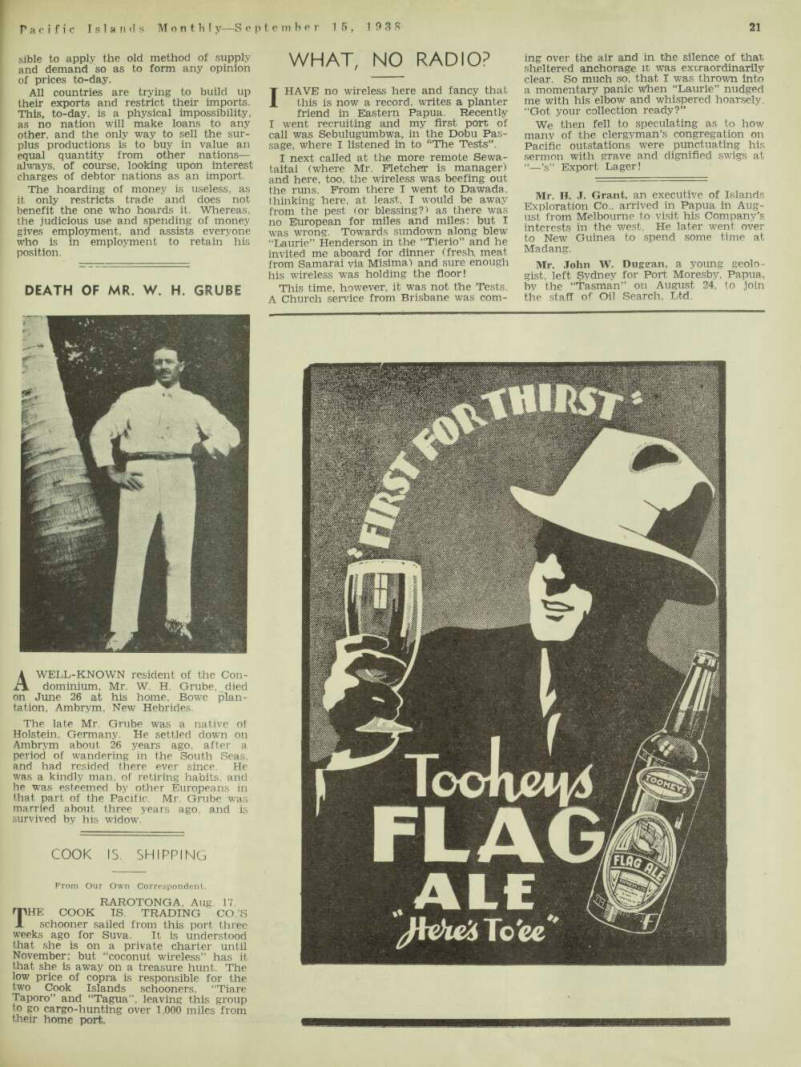
Outlook For Tropical Commodities Summary By Sir W. Carpenter
AN interesting summary of Pacific trading conditions was maae oy Sir Waiter oarpenter (cnamuanj wnen ad aressing 'tne annual meeting of W. H. carpenter & Co., ctd., m Sydney on August 26. xne foilowmg are tne principal sections of the address;— Over the past three years the Company nas snown tremendous ex pansion. In 1934, the net profit of the company was *38,000, and in 1938 £iii,uuo, or in otner woras, the net pront nas ire Died itsen .
Oi the capital of the Company, nearly one-quarter ol a minion nas Deen inoperative. Tms has been used in ac quiring new tonnage, entering heavuy into aviation, and in planting up of new estates. Portion of this capital will become remunerative in the coming year, and the balance a few years later.
The Company has completed planting up a new area ot nearly d,ouO acres ana, in a. few years when in mu bearing, this should be a very remunerative project, in addition to this, other properties have been acquired and these have been a heavy drain on the capital expenditure.
The new ship, s.s. “Suva”, which was ordered last year, is being launched this montn, and will be in commission by tne end of October. This vessel will enable the company to make a regular two monthiy service to the United Kingdom and America from Australia and the Pacific Islands.
The propected change of the capital from ftabaul to Salamaua will not af fect the Company’s interest in any way, as we are well established in both places.
When I addressed you the year before last, I called attention to the fact that the then signs of prosperity were not built on a sound foundation, and that within a period of two years we would see commodities back to somewhere near the depression prices. I am very sorry to tell you that my observations then were only too true.
In 1937, copra prices rose to about £25 per ton; they are now back in the vicinity of £lO/10/- to £ll per ton, and other commodities, such as lead, copper, tin, wheat and wool, have depreciated about 40% to 50% of their value, and there does not seem any prospect of a rise in the immediate future.
There is no reason whatever to be pes simistic, but it is far better to acknow ledge the position, and plan to meet it, than to bury one’s head in the ground and make no preparations.
The Company, to-day, does not look for revenue from the purchase of copra. It has for the past few years regarded copra as merely a medium of exchange, so that the rise or fall in the commodity does not materially reflect upon the earnings of the Company.
The Company is now spread world wide, and it is engaged in so many dif ferent branches of activity that the management can look with a certain degree of calmness upon any vicissitudes in markets.
There is a general feeling of nervous ness everywhere owing to the tension in Europe, the conflict in China, etc., which causes a great deal of unrest, and all businesses to-day are purchasing from hand to mouth only because it is impos
sible to apply the old method of supply and demand so as to form any opinion of prices to-day.
All countries are trying to build up their exports and restrict their imports.
This, to-day, is a physical impossibility, as no nation will make loans to any other, and the only way to sell the sur plus productions is to buy in value an equal quantity from other nations — always, of course, looking upon interest charges of debtor nations as an import.
The hoarding of money is useless, as it only restricts trade and does not benefit the one who hoards it. Whereas, the judicious use and spending of money gives employment, and assists everyone who is in employment to retain his position.
Advertisements & other items, p. 24 (2 items)
20
Pacific Islands Monthl y~S eptember 15, 193 b
Mcilrath S
Goodwill Hampers
CONCENTRATED AUSTRALIAN SUNSHINE
FOR FRIENDS OVERSEAS
THE EASIEST GIFT SCHEME EVER!
Simply lodge your order with IVlellrath’s and they will guarantee safe delivery of a hamper right to the home of your friend in England, Scotland, or Northern Ireland without further charge.
GOODWILL HAMPER No. 1
1 x 30 oz. tin “1.X.L.” Peaches in Syrup. 1 x 30 oz. tin “1.X.L.” Apricots in Syrup. 1 x 30 oz. tin “1.X.L.” Pears in Syrup. 1 x 30 oz. tin “1.G.L.” Sliced Pineapple. 1 x 16 oz. tin “Ardmona” Muscatel Grapes, lx 4 oz. tin “1.X.L.” Passionfruit. 1 x 16 oz. tin “V.C.” Tropical Fruit Salad. 1 x 12 oz. tin “1.X.L.” Pineapple Jam. 1 x 16 oz. tin “Q.P.” Cape Gooseberry Jam. 1 x 12 oz. tin “1.X.L.” Melon and Ginger Jam. 1 x 32 oz. tin Best Western Koney 1 x 15 oz. jar “Krownall” Mango and Papaw Chutney 1 x 16 oz. tin “Excello” Dripak Prunes. 1 x 16 oz. carton Best Sunraysed Sultanas. 1 x 16 oz. carton Best Sunraysed Currants. 1 x 16 oz. carton Best Sunraysed Raisins. 1 x 12 oz. tin “Victory” Sheep Tongues. 1 x 16 oz. tin “Red Feather” Camp Pie. 1 Travel Polder.
You have the choice of Seven Hampers, Priced from 20/- to 43/-. Nos. 1, 2 and 3 contain Assorted Australian Products of Unrivalled Quality, and Nos. 4,5, 6 and 7 Assorted Australian Wines.
DESCRIPTIVE LEAFLETS AVAILABLE ON APPLICATION
Delivery guaranteed within thirty days of lodgment of order.
IVfail Orders and Enquiries to
McILRATH’S Pty. Ltd.
HEAD OFFICE:
202 PITT STREET - SYDNEY - AUSTRALIA London 20/- England (beyond London) 21/- Scotland and Northern Ireland 21/6
Death Of Mr. W. H. Grube
A WELL-KNOWN resident of the Con- J\ dominium. Mr. W. H. Grube, died on June 26 at his home. Bowe plan tation, Ambrym. New Hebrides.
The late Mr. Grube was a native of Holstein. Germany. He settled down on Ambrym about 26 years ago, after a period of wandering in the South Seas, and had resided there ever since He was a kindly man. of retiring habits, and he was esteemed by other Europeans in that part of the Pacific, Mr. Grube was married about three years ago. and is survived by his widow
Cook Is. Shipping
Prom Our Own Correspondent.
Rarotonga, Aug. 17.
The cook is. trading co.s schooner sailed from this port three weeks ago for Suva. It is understood that she is on a private charter until November: but “coconut wireless” has it that she is away on a treasure hunt. The low price of copra is responsible for the two Cook Islands schooners. “Tiare Taporo” and “Tagua”, leaving this group to go cargo-hunting over 1,000 miles from their home port.
What, No Radio?
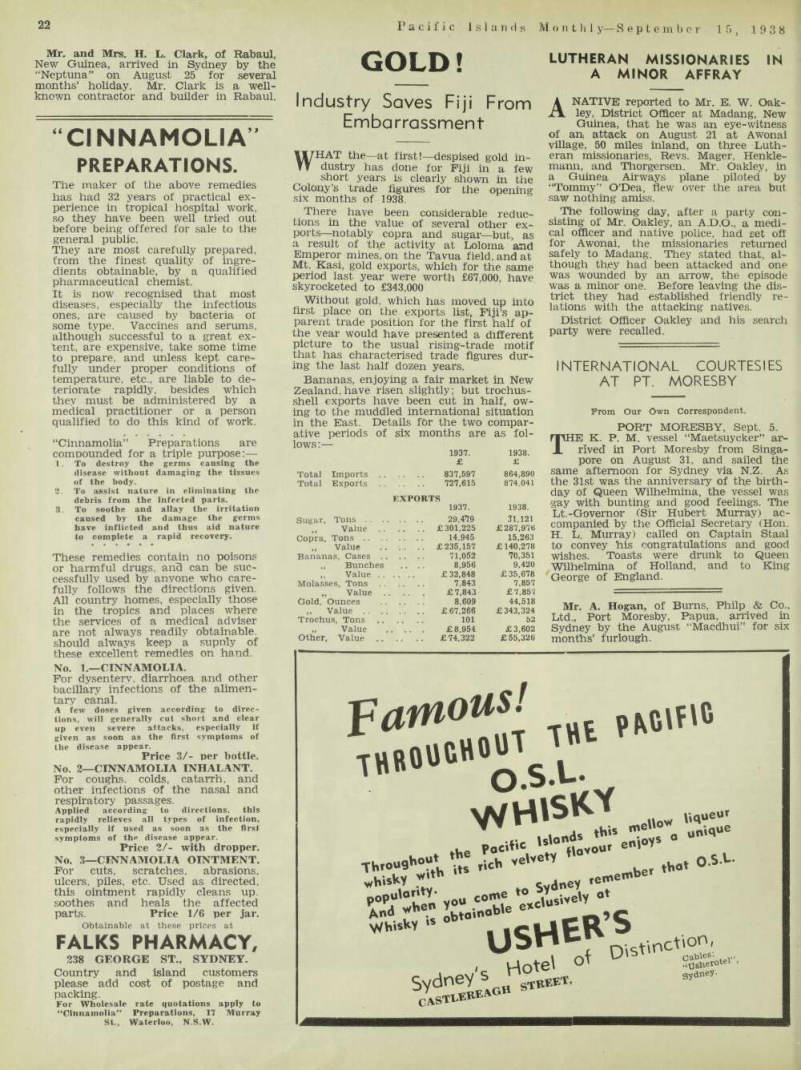
1HAVE no wireless here and fancy that this is now a record, writes a planter friend in Eastern Papua. Recently I went recruiting and my first port of call was Sebulugumbwa, in the Dobu Pas sage, where I listened in to “The Tests”.
I next called at the more remote Sewa taitai (where Mr. Fletcher is manager) and here, too. the wireless was beefing out the runs. From there I went to Dawada, thinking here, at least. I would be away from the pest (or blessing?) as there was no European for miles and miles: but I was wrong. Towards sundown along blew “Laurie” Henderson in the “Tierio” and he invited me aboard for dinner (fresh, meat from Samarai via Misima) and sure enough his wireless was holding the floor!
This time, however, it was not the Tests.
A Church service from Brisbane was com
ing over the air and in the silence of that sheltered anchorage it was extraordinarily clear. So much so, that I was thrown into a momentary panic when “Laurie” nudged me with his elbow and whispered hoarsely “Got your collection ready?”
We then fell to speculating as to how many of the clergyman’s congregation on Pacific outstations were punctuating hh sermon with, grave and dignified swigs at “ —’s” Export Lager!
Mr. H. J. Grant, an executive of Islands Exploration Cos., arrived in Papua in Aug ust from Melbourne to visit his Company’s interests in the west. He later went over to New Guinea to spend some time at Madang.
Mr. John W. Duggan. a young geolo gist, left Sydney for Port Moresby, Papua by the “Tasman” on August 24. to join the staff o f Oil Search, Ltd.
Mr. and Mrs. H. L. Clark, of Rabaul, New Guinea, arrived in Sydney by the “Neptuna” on August 25 for several months’ holiday. Mr. Clark is a well known contractor and builder in Rabaul.
Advertisements & other items, pp. 25-26 (2 items)
21
Pacific Islands Month! y—S eptember 15, 19 3 S
Flag
* HP ;■ \' A ! "
MM M * Ys
V/ noa & »« F **
ALE
Jhhe&To'ee
“CINNAMOLIA”
PREPARATIONS.
The maker of the above remedies has had 32 years of practical experience in tropical hospital work, so they have been well tried out before being offered for sale to the general public.
They are most carefully prepared, from the finest quality of ingredients obtainable, by a qualified pharmaceutical chemist.
It is now recognised that most diseases, especially the infectious ones, are caused by bacteria or some type. Vaccines and serums, although successful to a great extent, are expensive, take some time to prepare, and unless kept carefully under proper conditions of temperature, etc., are liable to deteriorate rapidly, besides which they must be administered by a medical practitioner or a person qualified to do this kind of work.
“Cinnamolia” Preparations are compounded for a triple purpose:— 1 To destroy the germs causing the disease without damaging the tissues of the body. 2. To assist nature in eliminating the debris from the infected parts. 3. To soothe and allay the irritation caused by the damage the germs have inflicted and thus aid nature to complete a rapid recovery.
These remedies contain no poisons or harmful drugs, and can be successfully used by anyone who carefully follows the directions given.
All country homes, especially those in the tropics and places where the services of a medical adviser are not always readily obtainable, should always keep a supply of these excellent remedies on hand.
No. 1.— CINNAMOLIA.
For dysentery, diarrhoea and other bacillary infections of the alimentary canal.
A few doses given according to directions. will generally cut short and clear up even severe attacks, especially if given as soon as the first symptoms of the disease appear.
Price 3/- per bottle.
No. 2—CINNAMOLIA INHALANT.
For coughs, colds, catarrh, and other infections of the nasal and respiratory passages.
Applied according to directions, this rapidly relieves all types of infection, especially if used as soon as the first symptoms of th** disease appear.
Price 2/- with dropper.
No. 3—CINNAMOLIA OINTMENT.
For cuts, scratches, abrasions, ulcers, piles, etc. Used as directed, this ointment rapidly cleans up. soothes and heals the affected parts. Price 1/6 per jar.
Obtainable at these prices at
FALKS PHARMACY,
238 GEORGE ST., SYDNEY.
Country and island customers please add cost of postage and packing.
For Wholesale rate quotations apply to “Cinnamolia” Preparations, 17 Murray St.. Waterloo, N.S.W.
Gold!
Industry Saves Fiji From Embarrassment
WHAT the—at first! —despised gold in dustry has done for Fiji in a few short years is clearly shown in the Colony’s trade figures for the opening six months of 1938.
There have been considerable reduc tions in the value of several other ex ports—notably copra and sugar—but, as a result of th,e activity at Loloma and Emperor mines, on the Tavua field, and at Mt. Kasi, gold exports, which for the same period last year were worth £67,000 have skyrocketed to £343,000 Without gold, which has moved up into first place on the exports list, Fiji’s ap parent trade position for the first half of the vear would have presented a different picture to the usual rising-trade motif that has characterised trade figures dur ing the last half dozen years.
Bananas, enjoying a fair market in New Zealand,have risen slightly; but trochus shell exports have been cut in half, ow ing to the muddled international situation in the East. Details for the two compar ative periods of six months are as fol lows: —
1937. 1938. £ £ Total Imports .. . . . . 837,597 864,890 Total Exports . . . . 727,615
Exports
874,041 1937. 1938.
Sugar, Tons .. .. . . . . 29,479 31,121 ,, Value .. .. .. £301.225 £287,976 Copra, Tons .. .. . . . . 14.945 15,263 „ Value . . . . £235,157 £140,278 Bananas, Cases .. .. .. 71,052 70,351 ,. Bunches . . . . 8,956 9,420 ,, Value .. .. .. £32,848 £35,678 Molasses, Tons . . . . 7,843 7,857 „ Value . . .. . £7,843 £7.857 Gold. Ounces . . . 8,609 44,518 ,, Value .. .. .. .. £67,266 £343,324 Trochus, Tons .. ... 101 52 „ Value . .. . £8,954 £3,602 Other, Value ,. .. .. £74,322 £55,326
Lutheran Missionaries In
A Minor Affray
A NATIVE reported to Mr. E. W. Oak ley, District Officer at Madang, New Guinea, that he was an eye-witness of an attack on August 21 at Awonai village, 50 miles inland, on three Luth eran missionaries, Revs. Mager, Henkle maim, and Thorgersen. Mr. Oakley, in a Guinea Airways plane piloted by “Tommy” O’Dea, flew over the area but, saw nothing amiss.
The following day, after a party con sisting of Mr. Oakley, an A.D.0., a medi cal officer and native police, had set off for Awonai, the missionaries returned safely to Madang. They stated that, al though they had been attacked and one was wounded by an arrow, the episode was a minor one. Before leaving the dis trict they had established friendly re lations with the attacking natives.
District Officer Oakley and his search party were recalled.
International Courtesies
At Ft. Moresby
Prom Our Own Correspondent.
Port Moresby, Sept. 5.
THE K. P. M. vessel “Maetsuycker” ar rived in Port Moresby from Singa pore on August 31, and sailed the same afternoon for Sydney via N.Z. As the 31st was the anniversary of th,e birth day of Queen Wilhelmina, the vessel was •gay with bunting and good feelings. The Lt.-Governor (Sir Hubert Murray) ac companied by the Official Secretary (Hon.
H. L. Murray) called on Captain Staal to convey his congratulations and good wishes. Toasts were drunk to Queen Wilhelmina of Holland, and to King George of England.
Mr. A. Hogan, of Burns, Philp & Co., Ltd., Port Moresby, Papua, arrived in Sydney by the August “Macdhui” for six months’ furlough.
Advertisements & other items, pp. 26-27 (2 items)
22
Pacific Islands Mont hi y—S eptember 15, 1938
Famous! m
How liqueur y * , . nds this „ unique ~e pacific l slo "tayour enjoys o Throughout rich yeivetY 0 S ,L. whisky vr'th «rs rein ember 'when you .*»"* * c ° %e VusWeW •* vThishy is oh o nohi , s S,,, “ T '
GIFTS of BEAUTY and UTILITY from ANGUS & COOTE'S Reliable Stocks
Remember Your Friends At CHRISTMAS TIME
You may do so confidently and successfully—with Angus & Coote’s goods and service at your disposal. You P . . h arin volir packed with care. They will arrive with the “bloom of newness” upon them. Suitable cards will be attached, if y . B . special good wishes—and Postage will cost you nothing.
Suitable Christmas presents are displayed below. Hundreds more will be found in Angus & Coote’s 1939 Catalogue, which is just completed. frD m 53 53
GOOD WATCH
If the present Is to be a watch, decide on one which has the trusty
JEWELEX MOVEMENT.
P2l.
Gentlemen’s Jewelex wrist watch with stainless steel case, 37/6, With gold-filled case, 55/-.
This movement is the one specially sponsored by the Retail Jewellers’ Association of Australia. These are men who know what constitutes a good watch. That Is why they picked the JEWELEX. m m SD p 22. p 22.
Gentlemen’s Jewelex wrist watch with chrome case 10/-. With 9ct. gold case £5/15/-.
WATCH BANDS
Ladies’ watches are fitted with black ribbon bands. Gentlemen’s have strong Suede straps. Chrome link bands are fitted for 3/6 extra. Gilt bands 5/6.
P 23. P 23.
Ladies’ Jewelex watch with chrome case 47/6.
With gold-filled case 57/6.
Guarantees:—All these watches are warranted to give 10 years’ wear, and will be adjusted and regulated, if necessary, free of charge during the first twelve months. no.
O P 2.3. P 23.
Ladies’ Jewelex watch with chrome case 47/6, and with 9ct. gold case 75/-.
P2S.—LADIES’ WIDTH 17/6. WIDER FOR GENTLEMEN 20/-.
Splendid 10-year, gold-filled link bands, which outlast many ribbon bands or leather straps. Complete with any initials.
A, U, S.
N, G, Serviette Holders, in five exclusive, individual patterns—A, N, G, U, and S.
Sterling silver 8/6 each. Silverplate 4/6 each. Engraving 9d per initial.
PI -’9.
THE HOUSEWIFE’S
45/-. A Mottled, stainless steel tray, 17V 2 by 9 inches, combining the utmost durability with handsome appearance. ,^^\\\^|
JOY. P 27
P2B.
SB I No stain will ever dis figure its gleaming sur- 1 face. Big enough for y full-sized Tea and Coffee Service. ri „ P3O.
One of the new bow ties £2O brooches of Oct. gold, An oblong diamond, very exclusive, with sapphire-studded with bright round diamond each side, centre, and horse- These three are in an ultra-modern, shoe suspended. 18ct. white gold mount, with pure platinum settings.
POPULAR WATER SET.
The two-pint jug and six goblets are of clear, cool, crystal, cut in the wellliked and easily-matched diamond patten?.
P 32.
A dainty and attractive Bow of sparkling diamonds, set in platinum, and mounted on a 15ct. gold bar.
P3l. £25 to £45.
This magnificent ring Is made from £25 to £45, according to size of centre diamond. It is pure platinum throughout at £3O upwards. Prom £25. it is 18ct. white gold, with platinum settings.
ATLAS
CLIPPERS.
15/-.
P 33 30 -
THE “GOOD SECOND-
CUP” TEAPOT.
The last cup poured from this teapot is as pure and fragrant as the first. That’s because the tea is placed in the Infuser you see in the bottom of the teapot. , , and then drawn up into the lid m a twinkling—after the tea is drawn. It’s really the perfect teapot, for it has the newest non-slip handle, and the modern non-drip spout. It’s full two-pint size, and it’s of best, hard silverplate. It’s made by Angus & Coote. 20/-. P 34.
Double-decker case containing 6 afternoon teaspoons and 6 cake forks.
POSTAGE IS PAID ON ALL THESE GOODS, AND THEIR SAFE DELIVERY TO
ANY ADDRESS, GUARANTEED BY
p;c.
ANGUS & COOTE pty. ltd.,
500 GEORGE STREET,
SYDNEY.
Reliable clippers, size 00, with special grip and two extra combs.
Raiatea Fire-Walkers
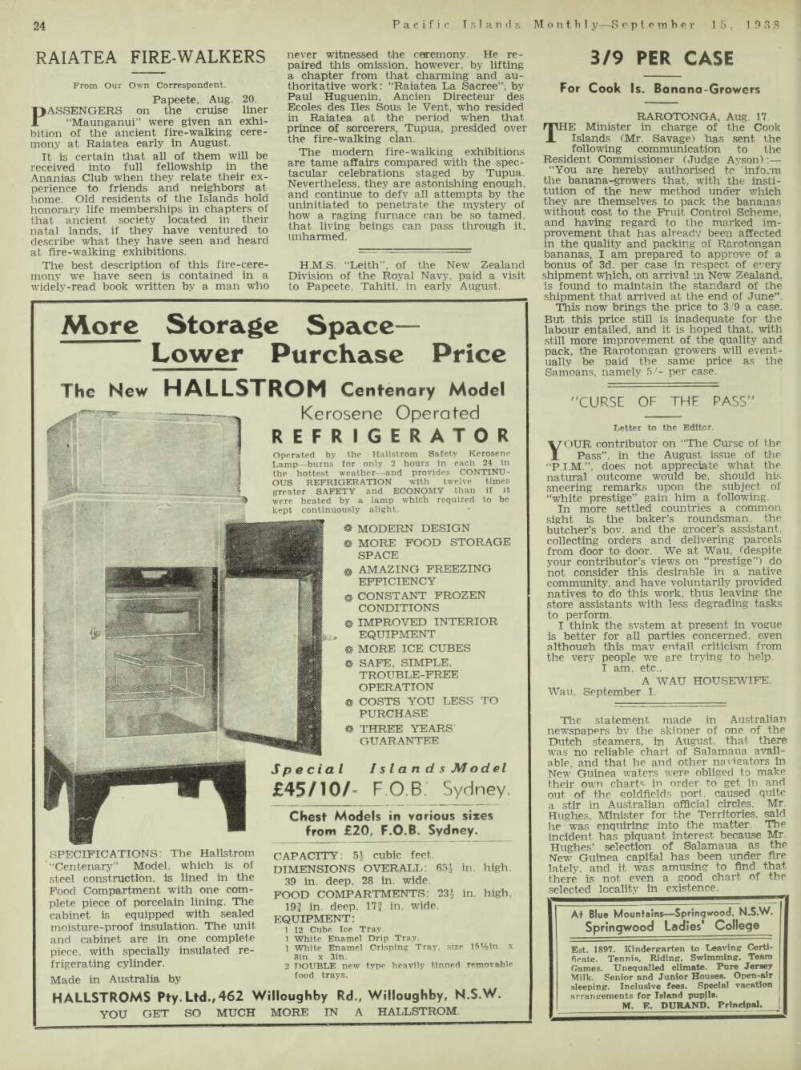
From Our Own Correspondent.
Papeete, Aug. 20.
PASSENGERS on the cruise liner “Maunganui" were given an exhi bition of the ancient fire-walking cere mony at Raiatea early in August.
It is certain that all of them will be received into full fellowship in the Ananias Club when they relate their ex perience to friends and neighbors at home. Old residents of the Islands hold honorary life memberships in chapters of that ancient society located in their natal lands, if they have ventured to describe what they have seen and heard at fire-walking exhibitions.
The best description of this fire-cere mony we have seen is contained in a widely-read book written by a man who
never witnessed the ceremony. He re paired this omission, however, by lifting a chapter from that charming and au thoritative work: “Raiatea La Sacree”, by Paul Huguenin, Ancien Directeur des Ecoles des lies Sous le Vent, who resided in Raiatea at the period when that prince of sorcerers, Tupua, presided over the fire-walking clan.
The modern fire-walking exhibitions are tame affairs compared with the spec tacular celebrations staged by Tupua.
Nevertheless, they are astonishing enough, and continue to defy all attempts by the uninitiated to penetrate the mystery of how a raging furnace can be so tamed, that living beings can pass through it. unharmed.
H.M.S. “Leith", of the New Zealand Division of the Royal Navy, paid a visit to Papeete, Tahiti, in early August.
3/9 Per Case
For Cook Is. Banana-Growers
Rarotonga, Aug. 17
THE Minister in charge of the Cook Islands (Mr. Savage) has sent the following communication to the Resident Commissioner (Judge Ayson):— “You are hereby authorised to inform the banana-growers that, with the insti tution of the new method under which they are themselves to pack the bananas without cost to the Fruit Control Scheme, and having regard to the marked im provement that has already been affected in the quality and packing of Rarotongan bananas, I am prepared to approve of a bonus of 3d. per case in respect of every shipment which, on arrival in New Zealand, is found to maintain the standard of the shipment that arrived at the end of June”.
This now brings the price to 3/9 a case.
But this price still is inadequate for the labour entailed, and it is hoped that, with still more improvement of the quality and pack, the Rarotongan growers will event ually be paid the same price as the Samoans, namely 5/- per case.
"Curse Of The Pass"
Letter to the Editor.
YOUR contributor on “The Curse oi the Pass”, in the August issue of the “P.1.M.”, does not appreciate what the natural outcome would be, should his sneering remarks upon the subject of “white prestige” gain him a following.
In more settled countries a common sight is the baker’s roundsman, the butcher’s bov. and the grocer’s assistant, collecting orders and delivering parcels from door to door. We at Wau, (despite your contributor’s views on “prestige”) do not consider this desirable in a native community, and have voluntarily provided natives to do this work, thus leaving the store assistants with less degrading tasks to perform.
I think the svstem at present in vogue is better for all parties concerned, even although this mav entail criticism from the very people we are trying to help.
I am, etc..
A Wau Housewife.
Wau, September 1.
The statement made in Australian newspapers by the skinner of one of the Dutch steamers, in August, that there was no reliable chart of Salamaua avail able. and that he and other navigators in New Guinea waters were obliged to make their own chart* in order to get in and out of the goldfields port, caused quite a stir in Australian official circles. Mr, Hughes, Minister for the Territories, said he -was enquiring into the matter The incident has piquant interest because Mr Hughes’ selection of Salamaua as the New Guinea capital has been under fire lately, and it was amusing to find that there is not even a good chart of the selected locality in existence.
Advertisements & other items, p. 28 (3 items)
24
Pacific Islands Month 1 y—S eptember 15.. 193 S
More Storage Space—
Lower Purchase Price
The New HALLSTROM Centenary Model
Kerosene Operated
REFRIGERATOR
Operated by the Hallstrom Safety Kerosene Lamp—burns for only 2 hours In each 24 in the hottest weather —and provides CONTINU- OUS REFRIGERATION with twelve times greater SAFETY and ECONOMY than if it were heated by a lamp which required to be kept continuously alight.
& MODERN DESIGN
$ MORE FOOD STORAGE
SPACE
q AMAZING FREEZING
EFFICIENCY
q CONSTANT FROZEN
CONDITIONS
$ IMPROVED INTERIOR
m> EQUIPMENT
& MORE ICE CUBES
@ SAFE, SIMPLE.
TROUBLE-FREE
OPERATION
a COSTS YOU LESS TO
PURCHASE
« THREE YEARS’
GUARANTEE
Special Islands Model
£45/10/- F. 0.8. Sydney.
Chest Models in various sizes
from €2O, F. 0.8. Sydney.
Mi I SPECIFICATIONS: The Hallstrom “Centenary” Model, which is of steel construction, is lined in the Food Compartment with one complete piece of porcelain lining. The cabinet is equipped with sealed moisture-proof insulation. The unit and cabinet are in one complete piece, with specially insulated refrigerating cylinder. in. high, in. high.
CAPACITY: cubic feet.
DIMENSIONS OVERALL; 65i
39 in. deep. 28 in. wide.
FOOD COMPARTMENTS: 23^
19| in. deep, 17f in. wide.
EQUIPMENT:
1 12 Cube Ice Tray. 1 White Enamel Drip Tray. 1 White Enamel Crisping Tray, size ISVfein.
Bin. x Sin, 2 DOUBLE new type heavily tinned removable food trays.
Made in Australia by
HALLSTROMS Fty.Ltd.,462 Willoughby Rd., Willoughby, N.S.W.
YOU GET SO MUCH MORE IN A HALLSTROM
Sprmgwood Ladies' College
At Blue Mountains —Springwood, N.5.W.
Est. 1897. Kindergarten to Leaving Certificate. Tennis, Riding, Swimming, Team Games. Unequalled climate. Pure Jersey Milk. Senior and Junior Houses. Open-air sleeping. Inclusive fees. Special vacation arrangements for Island pupils.
M. E, DURAND. Principal.
Islands Travellers
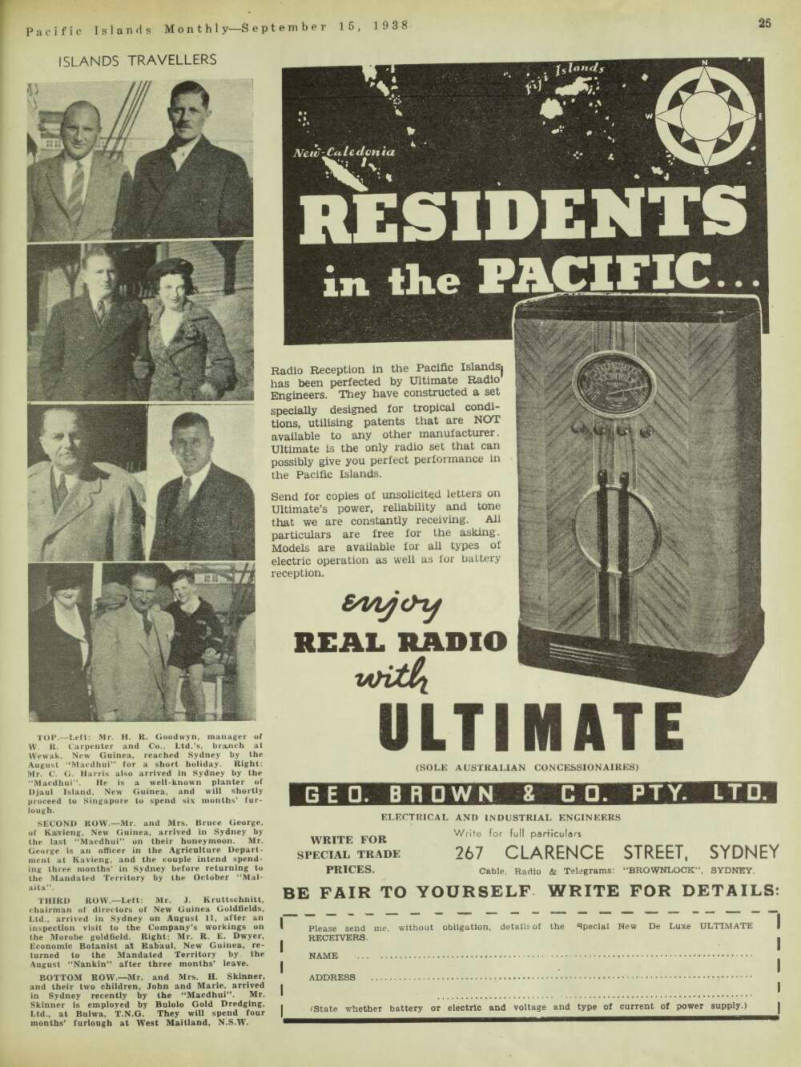
TOP.-Lett: Mr. H. R. Goodwyn, manager of W. R. Carpenter and Co., Ltd.’s, branch at Wewak, New Guinea, reached Sydney by the August “Macdhui” for a short holiday. Right: Mr. C. G. Harris also arrived in Sydney by the “Macdhui”. He is a well-known planter of Djaul Island, New Guinea, and will shortly proceed to Singapore to spend six months’ fur lough.
SECOND ROW. —Mr. and Mrs. Bruce George, of Kaivieng, New Guinea, arrived in Sydney by the last “Macdhui” on their honeymoon. Mr.
George is an officer in the Agriculture Depart ment at Kavieng, and the couple intend spend ing three months’ in Sydney before returning to the Mandated Territory by the October “Mal aita”.
THIRD ROW.—Left; Mr. J. Kruttschnitt. chairman of directors of New Guinea Goldfields, Ltd., arrived in Sydney on August 11, after an inspection visit to the Company’s workings on the Morobe goldfield. Right: Mr. R. E. Dwyer, Economic Botanist alt Rabaul, New Guinea, re turned to the Mandated Territory by the August “Nankin” after three months’ leave.
BOTTOM ROW.—Mr. and Mrs. H. Skinner, and their two children, John and Marie, arrived in Sydney recently by the “Macdhui”. Mr.
Skinner is employed by Buiolo Gold Dredging, Ltd., at Bulwa, T.N.G. They will spend four months’ furlough at West Maitland, N.S.W.
Advertisements & other items, p. 29 (2 items)
25
Pacific Islands Monthl y—S eptember 15, 1938
Ultimate
Radio Reception in the Pacific IslandSj has been perfected by Ultimate Radio Engineers. They have constructed a set specially designed for tropical conditions, utilising patents that are NOT available to any other manufacturer.
Ultimate is the only radio set that can possibly give you perfect performance in the Pacific Islands.
Send for copies of unsolicited letters on Ultimate’s power, reliability and tone that we are constantly receiving. All particulars are free for the asking.
Models are available for all types of electric operation as well as for battery reception.
tvij Oy
REAL RADIO
Wvtll
ULTIMATE
(SOLE AUSTRALIAN CONCESSIONAIRES)
GEO. BROWN « C□. PTY. LTD.
ELECTRICAL AND INDUSTRIAL ENGINEERS
WRITE FOR Wri,e for fu " parf!cu ' ars
special trade 267 CLARENCE STREET, SYDNEY
PRICES, Cable, Radio & Telegrams; “BROWNLOCK”, SYDNEY.
BE FAIR TO YOURSELF WRITE FOR DETAILS; I please send me, without obligation, details of the Special New De Luxe ULTIMATE
RECEIVERS.
NAME
ADDRESS
(State whether battery or electric and voltage and type of current of power supply.)
The War Of The Capital Site
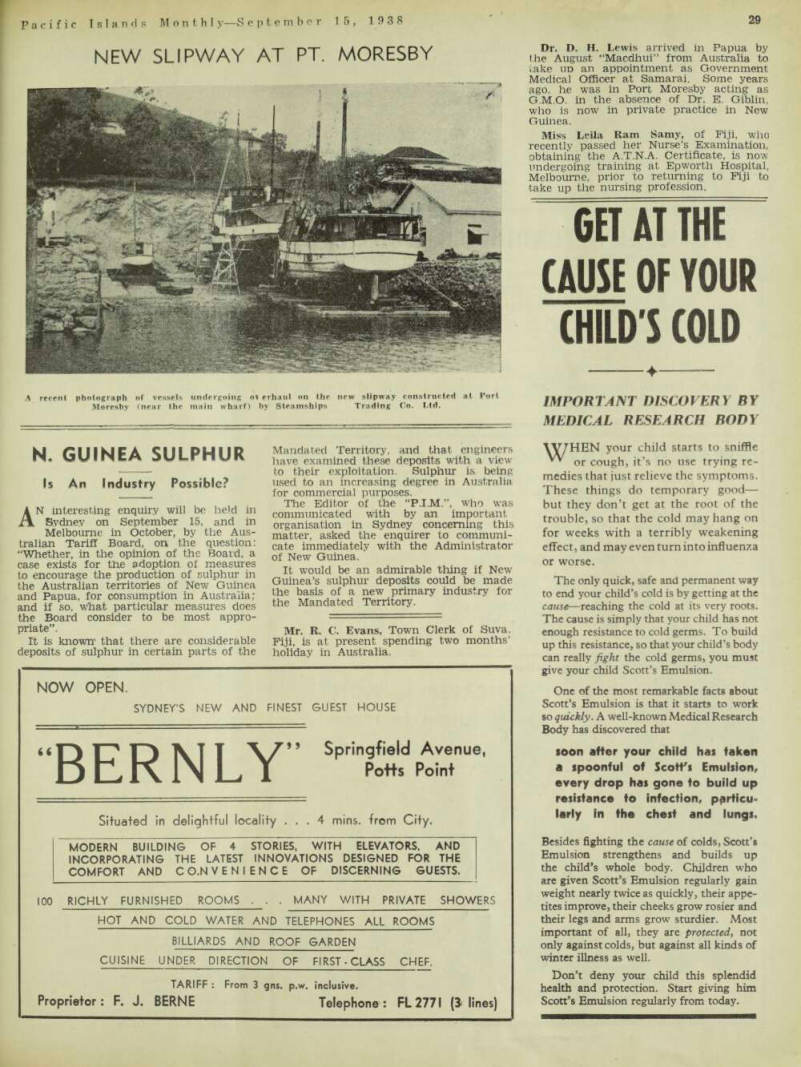
Salomaua Selection Under Review—Some Unusual and Remarkable Circumstances
By R. W. Robson
TEMPERS have been frayed and one or two reputations have been tarnished a little; but the controversy about the new site for the New Guinea administra tive headquarters has moved towards its logical and inevitable end. Already, it seems certain that: — The selection of Salamaua has been abandoned, as hasty and impractic able.
Another site will be selected (either on the mainland tableland or, in ac cordance with the Griffiths Committee report, at Lae)) at a series of Cabinet meetings, to commence on September 12.
The plan to build a road, so as to give the Morobe towns communica tion with the coast, has been attacked, but still stands.
The sequence of events since the Aug ust “P.1.M.” was published has been in teresting and, at times, amusing.
In August, we ventured the prophecy that Mr. Hughes’ h#sty and impulsive selection of Salamaua would be revised.
It really was no prophecy, but simple de duction.
Messrs. Hughes and McNicoll, flying around there in June, seemingly failed to notice a big swamp between the base of the isthmus and the foothills. But when the Administrator returned to Salamaua with his technical advisers in July, he was given the dismal news that it was not
possible to lay out a town unless the swamp was filled in; and said reclamation would cost £250,000.
As no such financial provision had been made, it was safe to assume that Can berra would be consulted; and Canberra, of course, would say: “For heaven’s sake, get busy and make another selection—and this time consult a few engineers and medical officers before reaching a decision.”
And it was so. But a good deal hap pened in the meantime. The Minister for the Territories (Mr. Hughes) contin ued to play the comedy part.
Mr. Fairbairn’S Visit
A PROMINENT member of the Com monwealth Parliament, Mr. J. V.
Fairbairn, piloting his own plane and accompanied by Mr. R. E. Elford, of "The Argus”, flew from Melbourne to the Morobe district of New Guinea, visited Wau, Lae, and Salamaua early in August and, after a quick examination, flatly condemned the Minister’s choice of Salamaua.
The Public Service Association of New Guinea, at a general meeting held on Aug ust 5. “viewed with alarm” any departure from the reports of the expert commit tees which recommended (a) the early removal of the capital from Rabaul, and (b) the establishment of the capital on a safe plateau on the mainland. The
meeting also “strongly opposed the sel ection of Salamaua as the capital site”.
By about August 20, it was beginning to dawn upon the Australian newspapers that the Salamaua selection must be re viewed. Sydney “Telegraph”, on August 22, published an interview with Mr.
Hughes. The Minister quoted Pliny the Elder, and was vague, and referred to Adam and Eve, but said this:— “There has been no alteration of the view that Salamaua should be the capital.
“Lae is not a port and Salamaua is.
People with axes to grind are saying that Salamaua is unhealthy, a death trap, but people still seem to go on living there.”
On August 23, Mr. Fairbairn entered the controversy with great spirit—he called the Salamaua selection “a major blunder”, and sought an interview with the Prime Minister—and Mr. Hughes ceased to be vague and humorous, and was seen on the defensive.
Mr. Hughes’ Defence
BY August 24, every newspaper was in full cry against Salamaua; and, that day, Mr. Hughes made this remarkable statement: — “It is proper that I should correct Mr, Fairbairn’s impression that by recom mendation (of Salamaua) was made in the face of adverse official opinion. The very contrary is the case. My recom mendation was based on the best and most authoritative official advice.”
That left a few people gasping. Who was the “authoritative” official who gave the Minister advice of such significance that he turned doVn the Griffiths re port and chose Salamaua?
We still are trying to find out!
On August 26, it was announced that the Legislative Council, in New Guinea, had “severely criticised the selection of Salamaua, and that the Federal Cabinet, meeting in Melbourne, had formally asked Mr. Hughes to submit a report upon the position generally.
By this time, it was reported freely (1) that Mr. Hughes’ position in the Cabinet was in danger and had been made worse by his “what we have we hold” speech m Rabaul, and the trouble over Salamaua; and (2) that there was now some likeli hood that the decision to build a Wau- Salamaua road would be reviewed.
The writer admits that, up to now, he had noted events with complacency, not to say pleasure— everything had fallen out exactly as he had foretold.
But this attack upon the road was a horse of another colour. We made cer tain urgent representations that the abandonment of the road plan, at this stage would be a tragic blunder. And this, despite the fact that we were sup posed to be “anti-road”!
Which introduces the remarkable story of the boycott.
The Wau-Salamaua Road
WHEN Mr. Hughes, late in June, an nounced his selection of Salamaua, and the building of a road “dir ectly over the mountain to Wau”, I sent a letter to every member of the Aus tralian Parliament, and attacked both plans. So far as the road was concerned, I said that the proposal to build a high way “directly over the mountains” was unsound and uneconomic; that “I am not opposing a Salamaua-Wau road, for which there long has been a demand”; and that, if a road could be built, the long way round, from Salamaua to Wau, so as to “form part of a permanent read ing system for the future development and security of New Guinea”, it would be welcomed and supported by all interests.
That was published in July “P.1.M.”, and surely was clear enough. Judge of my amazement, therefore, when I learned, late in August, that the Wau Mining Association had adjudged me an enemy of the road, and had called upon its mem bers to boycott the “P.1.M.”.
What made it more embarrassing was the discovery that the Mining Association favoured the Salamaua-Buangs-Snake River-Buiwa route; and this was the route which, in the August “P.1.M.”, I had noted and advocated, as the next best alter native to the Markham. (There is now a report that the best route now may prove to be an entirely new one, called the “Middle Bitoi”. De tails —received too late to discuss in this article —are published elsewhere in this issue.) In the very week that the unexpected attack on the road developed (August 22- 26), I received letters from half a dozen stout lads (five to be exact), cancelling their “P.1.M.” subscriptions. All were old readers; and, also, all were loyal mem bers of the Mining Association.
I will admit that we were tempted to sit still and do nothing, and let the Min ing Association stew in its own juice.
However, we decided to lay the blame for the boycott upon the impulsive tem perament that usually goes with red hair, and to argue it out amicably, at some later date. We “hopped in”, and sub mitted all the data at our command to show the powers that influence Cabinets that the road should go on, no matter what happened to Mr. Hughes and to his Salamaua selection. 1 am not sure that we achieved any thing. The withdrawal of the Road Loan
Bill from the business paper of the Legislative Council in Rabaul, without adequate explanation, on August 25, had a nasty appearance. Until that Bill is passed, there can be no finance for the road, and therefore no road.
A Peculiar Situation
THE situation is peculiar, and puzzling— but probably the explanation will be known before this is read in Wau.
M y Cabinet? that th" auction of his further connection with the Cabinet has been
postponed pending the early return from abroad of three senior Ministers (Messrs, Earle Page, Menzies and White), and that the confirmation of certain acts of Mr, Hughes (such as his New Guinea decisions) is held up, likewise.
That opinion is supported by the fol lowing facts.
During the last week of August, Mr.
Hughes was like Byron’s young lady who “swearing she would ne’er consent, con
ofA^l
ust - he ™ tuall y admitted that Salamaua
(Continued on Page 55.)
was “gone”, and indicated that the choice lay between Lae and Wau.
Incidentally, on August 30, in “Sydney Morning nerald”, Mr. Hugnes said his • withers were unwrung”, and proceeded; “The Government rejected the re commendation of the expert com miaee that Lae should be the capital, and that was why 1 went to New Guinea and inquired into the matter. 1 consulted the officials, and my re commendation of Salamaua was based on their advice.”
Almost as extraordinary a statement as that in th,e newspapers on August 24. Why aid the Government reject the Griffiths report? Echo answers, why!
The Prime Minister announced, on Sep tember 1, that the capital site decision would not be made until the three senior Mmisters returned, and a series of Cab inet meetings commenced, about Septem ber 12.
Mr. Hughes, meanwhile, continued to in sist that Salamaua is a healthy place; and therein he was cordially supported by oaiamaua residents, and ex-resiaents. No one had the heart to point out that the question is not concerned with the health i ulness oi tne present Salamaua, prettily and cleanly situated on its little isthmus.
The real question is whether anyone can hnd £250,000, wherewith to fill in the Salamaua swamp, and so make room for a bigger town.
Mining Association And “P.I.M”
SO the Mining Association has reason to remain alert, and keep its powder dry.
Fortunately—as we pointed out in July —the association has a shrewd and ener getic president in Mr. H. T. Allan, and he should be capable of handling whatever situation, unfavourable to the road, is cre ated by political earthquakes and erup tions at Canberra. Morobe residents should get ready to support Mr. Allan vigorously in any project he may make against any move to cancel the promised road.
Mr. Allan’s proposal to boycott the “P.1.M.” was ill-judged and hasty, and based on a misunderstanding; but we are not going to quarrel with him about it, because he did it as part of his good fight lor what he believed in—namely, the road.
If the route finally chosen is via the Bitoi or Francisco, we probably will cross swords with Mr. Allan in the future. But that is unlikely. We are concerned only with the sound future development of New Guinea; and, for that reason, we shall do all that we can to urge a road from Sala maua (the only port) into the Bulolo Valley, via the Buangs or the Markham, or any other route that has national rather than local value.
As a journalist with a sense of respon sibility, I should like to say something pointed about the boycott weapon; but the occasion is against it—especially as not more than a dozen or two of our 450 sub scribers in the Morobe district have been affected by it. It Is better that we con serve our energies and our belligerency lor the fight for the road. The committee of the Mining Association might remember, however, that no journal worthy of the name can be intimidated by threat of re prisals, either economic or personal.
Salamaua—Pro And Con
DURING the month, numerous state ments have been made by various institutions and persons, relative to the selection of a new capital site. They all have been published at length in Aus tralian newspapers. A summary here will suffice.
At a session on August 24, all the non official members of the New Guinea Leg islative Council, led by Mr. R. L. Clark, expressed opposition to the plan to place the capital at Salamaua.
On August 26, the N.G. Public Servants’
Association “viewed with indignation and dismay” a report that they did not want to leave Rabaul. They urged an early transfer, as recommended by the vulcano logists; but definitely not to Salamaua.
On August 25, non-official residents of Salamaua sent to the Australian Prime Minister a strong protest agamst reports that Salamaua was subject to bad malaria and in danger of tidal waves. The “S.M.
Herald” published, on August 27, a letter from Mrs. Allen Innes, to the same effect.
A Claim For Wau
MR. N. R. H, NEAL, on behalf of Wau residents, sent the Prime Minister a long radiogram on August 31, urging that Wau could advantageously be chosen as the new capital. He said: “In the event of the reconsideration of Salamaua as the capital site, the citizens of Wau urge the suitability of their town as a capital, Wau is an existing town ship with facilities equal to Rabaul, and it can function immediately as a capital without any large expenditure. There is ample space for all future developments and expansion. The principal objection of the Griffiths report—namely, high transportation costs—has been removed by the authorisation to construct a road between Salamaua and Wau, which was not contemplated wh,en the Capital Site Committee made its investigations.
“If Wau is selected as the capital, the main expenditure will be the provision of port facilities, which are already pro jected. The huge expenditure of laying out Salamaua or Lae for the new capital will be obviated, thus relieving the Com monwealth of Australia and the Man dated Territory of New Guinea of heavy financial commitments.
“Timber and agricultural developments
will ensure the permanency of the town ship after the goldfield is exhausted
Some 1,200 Europeans are now residing in Wau and the vicinity, (at 3,500 ft. above sea level) under healthy conditions and in an invigorating climate. The existing Administration tacmties include large European and native hospitals, schools, telephone service, electricity supply and excellent roads—all capable of expansion at low cost.
“Thp other obiection in the Griffiths ine otnei oojeciiun m me repoit namely, endemic tropical typhus iS not regarded seriously by the Wau population. Cases are now rare, and medical treatment has been successful! Ample water supply is available in close proximity for all public health requirements.”
Courageous Statement By
Mr. H. H. Page
rvNE of the most interesting contrlbutions Was a short speech by Mr.
Harold H. Page (Chief Secretary) before
the New Guinea Legislative Council, on
August 24, as follows;
“The question of a site for the future head quarters of the Territory is one that claimed the thoughtful attention of all the residents of Rabaul and most of the people of the Territory from within a few weeks of the eruption.
“Despite the imaginings of a certain publi cation, that seems to delight in a malicious campaign based on baseless or unconfirmed re ports to belittle not only my own, but also the public service of others in this Territory—a campaign, incidentally, in which too few op portunities are accorded to the public servant to refute —at no stage have I thought that Salamaua could get the selection.
“I felt in the first few months that, in the absence of any scientific data regarding the potential danger of our local volcanoes, the solution w'ould be found in the establishment of a residential suburb in the Tavui-Nodup area.
Rabaul would remain the office and shipping centre, and only those persons required for duty in Rabaul would need to be within the caldera, and only then during working hours.
The risk did not appear to me to be too great.
“However, the report of the Geologist, Dr.
Woolnough, and the Vulcanologist, Dr. Stehn, put a different aspect on the matter; and, in due course, after consideration of that report, the Commonwealth Government decided that at least Administrative Headquarters must be moved from Rabaul.
“Towards this end, action was taken by the CommonweaJth Government to have examined several possible locations; and, ultimately, an announcement was made that Salamaua had been selected.
“To the residents of Babaul, and particularly to the majority of the public servants who were more vitally interested, the announcement was received with grave misgivings. To those of us who had personal knowledge of Salamaua and its environs, there appeared but one thing that could have brought it any consideration, and that was that it had a harbour. It may be said that of all the possible places available for more or less immediate occupation, it had a harbour equal to the best.
“It is submitted, however, that the presence of a harbour is not sufficient reason for its acceptance as the future capital of the Terri tory. There are so many disadvantages, and there are lacking so many of the essentials for the laying-out of a big town on modern lines, that the existence of a harbour carries prac tically no weight.
“Moreover, the need appeared to require an early movement from Rabaul; and, from this aspect, the choice was bad, for much time must pass before even the small area of only possible bad building land could be prepared to permit of buildings, to enable the transfer of the smallest of Departmental Headquarters.
“That the Headquarters of the Territory must be moved from Rabaul has now been accepted as the wisest course. Much has been said and written about the relative merits of alter native sites, and it is not my purpose here to enter the lists in such discussion. I feel, how ever, that I would be failing in my duty to the public servants, who are vitally interested in their future permanent location and to the future of this Territory, for which we have high hopes and in which we have the greatest faith, if I did not utter a protest against the selection of Salamaua.’’
This speech, caused, something of a stir.
In the difficult situation that existed, no other official member of the Council was prepared to offer any comment on the subject. The silence of the Administra tor was remarked upon—especially as, in the absence of any other indication, it was believed that the Administrator and the Government Secretary had given the recommendation in favour of Salamaua to which the Minister has so prominently referred.
The courage of Mr. Page in making his statement, in the circumstances, has been
warmly praised.
Advertisements & other items, pp. 30-32 (3 items)
26
Pacific Islands Monthl y— S eptember 15, 1938
St. Ignatius College - Riveview, Sydney
BOARDING and DAY SCHOOL
Conducted by the Jesuit Fathers
t>OYS prepared for Intermediate and Leaving Certificate Examinations and for Exhibit!ons, Scholarships and Bursaries at the University.
Boys are arranged in three divisions according to age and size. Each division has its own library, debating society, cricket and football field, tennis court.
Senior and Junior Rowing Sheds. Private Swimming Baths.
Prospectus and Further Particulars on application to the Rector,
REV. J. MEAGHER, S.J.
Telephone: J A 1106.
ONE OF SYDNEY’S GREAT PUBLIC SCHOOLS.
Z2JJLMJLULUJ*
I nil'll 111 J
■"ii'7rrrrr.ifrifci
lUU M If 3R I i m i I A -.V. m
Firearm Repairs: “OUR HANDS MAKE GOOD ARMS”. Firearms sent C.O.D.
No. 1588 Winchester Model 70, Barrel 24 in., Bead Front Sight, Elevating Rear Sight. Weight, Leaf Sights. Weight, 6>/ 4 lb. Price, £l5/15/-. No. 143 A Savage Sporter, Model 23. Barrel 25 in., Bead Front and Elevating Rear Sight. Weight, 6Vl> lb. Price, £lO/17/6.
The Hornet Rifle is an Ideal one for Australian Soft Skinned Animals. The Winchester Model 70, also in 270, 220 Swift, and 250/3000 Cal, £l7/10/- each. Fitted with Lyman 48 Aperture Sight, £22/10/-.
Winchester’s latest Model, 218 Cal. “Bee” Rifle.—This is a lever Action, similar to the model 92. Magazine 7 Cartridges. Price, £l3/10/-. Cartridges, 25/- per 100. Velocity. 2860 f.s. Energy, 835 lb.
MAGAZINE RIFLES FOR THE FAMOUS
22 CAL. HORNET CARTRIDGES.
I GUARANTEE EVERY FIREARM I SELL.
QUALITY FIREARMS
Firearms over 50/- Post Free. 7% lb. Price, £l7/10/-.
The German “Zi-Di” Barrel 22 in.”, Bead Front and Folding
ROHU
Quality Firearms, and Fishing Tackle,
143 ELIZABETH STREET, SYDNEY ’Phone MA 3540 (N£ar Market Street).
NO. I
THE CHAPMAN
EXPORT MODEL
PUP" ENGINE
2 HP
PUP
h.p. Price
o m plete
with all
equipment.
Packed and
delivered to
s t e a m e r,
Sydney, *
£26.
This engine is suitable power for boats up to and including 16 ft.
It is easily started by one pull of the starting strap.
The “Lucas” magneto is driven direct off the end of the crankshaft by means of the new self-aligning coupling. The wellknown Patent floatless type carburettor means absolute proof against fire and maximum fuel economy.
The clutch is self-adjusting and runs in oil; (charged once a year only). Our new Patent Automatic Clutch can be supplied for 10/- extra if desired. This clutch has no lever, comes into action as you speed the engine up. and automatically releases when you cut down the revs to idle. Also supplied in 3 h.p. size at £3l.
In the next issue, we shall be featuring No 2: The Chapman Standard 2Vz h.p Engine, the World’s leading Marine Motor for its size.
Head Office and Showrooms, Clara St , Erskineville, N.S.W. Australia.
CHAPMAN & SHERACK
ENGINE MANUFACTURERS FOR 30 YEARS
W. H. GROVE & Sons Ltd
AUCKLAND
Islands Traders p.o. box 490 Telegraphic and Cable Address: “Grove," Auckland.
Shippers of all classes of New Zealand Products, specially prepared for the Island trade.
Representing
Rylands & Sons (Col,) Ltd., of London and Manchester. (Including the famous “Dacca” Mills Products.) Par bury Henty & Co. Pty. Ltd., of Sydney and Kobe. ‘‘AGFA” Photographic Corporation, of Berlin.
J. Blair King, of London. World-famed Shirts.
Burrell & Co. Ltd,, Millwall, London, E. 14. Oil, White Lead and all classes of Paints, including “FERROCENE” . their special Tropical Paint . . . PREVENTS CORROSION . . . made in RED, GREY, and GREEN.
C 4, I or as
Agfa-Billy-Re cord
ONE would think that the camera was made from a single cast, so harmonious is the construction of the Speedex Record camera. Elegant appearance, easiness to carry in the case, extremely reliable lens and shutter, all help to make this camera one of the best of Its kind. The correct choice of a camera is very important, for one does not buy a new camera every day, and it therefore has to be borne in mind that with the Speedex Record one is always fully equipped. As film use the all-weather Agfa Isochrom film.
27
Pacific Islands Monthl y—S eptember 15, 1938
Solomon Is.
Future
Pro and Anti-Australia
Letter to the Editor.
THERE recently was an article in the “P.1.M.” entitled “The Solomons— Some Reasons Why Australian Rule is Wanted”.
I have lived in the British Solomons for about 20 years, and I have never yet heard a resident of this group express a desire to see the administration taken over by Australia.
I visited the Mandated Territory last December, and the conversations I had, with people of different commercial in terests, only make me more convinced that any change, in the direction you mention, would certainly not be an ad vantage.
It would be interesting if some of the residents of this group, whom you refer to. would put their name to articles ex pressing their desire: because some of us are apt to believe that the mention of them may be only journalistic licence.
I am etc.
D. M. Lazarus.
Tulagi, B. S. I.
Julv 17, 1938.
EDITORIAL NOTE: The proposal seriously entertained in 1936—that Aus tralia should take over administrative control of the Solomons group, and Brit ain’s share of the New Hebrides group, seems to have faded from human memory.
One suspects that it was part of a long sighted defence plan, germinated in the alert brain of Sir Archdale Parkhill; and when that gentleman was defeated in 1937. and gave up the portfolio of Mini ster for Defence, the plan naturally went away into a crowded and forgotten pigeon hole.
It is a pity. It was a sound plan (of defence) and Sir A. Parkhill was an ex tremely able Minister for Defence—as Australia is now beginning unhappily to realise.
However, Solomon Island residents have the consolation of knowing that they are safe for the present. Australia now is not likely to adopt them, and send some job seeking ex-politician to govern them.
An Islands Identity
120 Trips to Tahiti in 50 Years
Prom Our Own Correspondent.
Papeete, Aug. 12.
MR. H. HEMUS, of Messrs. A. B. Don ald, Ltd., Auckland, New Zealand, ana Etablissements Donald, Tahiti, is now at Papeete in the interests of these allied companies.
Mr. Hemus first came to Tahiti from N.Z, in 1888. Since that time he has made 120 voyages to Papeete; having travelled over that route, the sum of 720,000 miles— equal to 30 times around the world. This does not include numerous voyages between Auckland and Fiji, which Mr. Hemus has made during the same period.
Mr. Hemus is making a prolonged stay here, relieving Mr. Gerald Shavood, Dir ector of Etablissements Donald, who is now in New Zealand for medical treat ment. Mr. Sha rood’s friends in Tahiti are rejoiced to learn that his malady is not as serious as first reporrea. and that he is progressing satisfactorily to full re covery.
Advertisements & other items, pp. 32-33 (2 items)
28
Pacific Islands Monthl y—S eptember 15, 1938
New Slipway At Pt. Moresby
A recent photograph of vessels undergoing ov erhaul on the new slipway constructed at Port Moresby (near the main wharf) by Steamships Trading Co. Ltd.
N. Guinea Sulphur
Is An Industry Possible?
AN interesting enquiry will be held in Sydney on September 15, and in Melbourne in October, by the Aus tralian Tariff Board, on the question: “Whether, in the opinion of the Board, a case exists for the adoption of measures to encourage the production of sulphur in the Australian territories of New Guinea and Papua, for consumption in Australia; and if so, what particular measures does the Board consider to be most appro priate”.
It is known' that there are considerable deposits of sulphur in certain parts of the
Mandated Territory, and that engineers have examined these deposits with a view to their exploitation. Sulphur is being used to an increasing degree in Australia for commercial purposes.
The Editor of the “P.1.M.”, who was communicated with by an important organisation in Sydney concerning this matter, asked the enquirer to communi cate immediately with the Administrator of New Guinea.
It would be an admirable thing if New Guinea’s sulphur deposits could be made the basis of a new primary industry for the Mandated Territory.
Mr. R. C. Evans, Town Clerk of Suva.
Fiji, is at present spending two months’ holiday in Australia.
Dr. D. H. Lewis arrived in Papua by the August “Macdhui” from Australia to take up an appointment as Government Medical Officer at Samarai. Some years ago, he was in Port Moresby acting as G.M.O. in the absence of Dr. E. Giblin, who is now in private practice in New Guinea.
Miss Leila Ram Samy, of Fiji, who recently passed her Nurse’s Examination, obtaining the A.T.N.A. Certificate, is now undergoing training at Epworth Hospital, Melbourne, prior to returning to Fiji to take up the nursing profession.
Advertisements & other items, p. 33 (1 item)
Child's Cold
GET AT THE
CAUSE OF YOUR
IMPORTANT DISCOVERY BY
MEDICAL RESEARCH BODY
\V7HEN your child starts to sniffle ** or cough, it’s no use trying remedies that just relieve the symptoms.
These things do temporary good—but they don’t get at the root of the trouble, so that the cold may hang on for weeks with a terribly weakening effect, and may even turn into influenza or worse.
The only quick, safe and permanent way to end your child’s cold is by getting at the cause —reaching the cold at its very roots.
The cause is simply that your child has not enough resistance to cold germs. To build up this resistance, so that your child’s body can really fight the cold germs, you must give your child Scott’s Emulsion.
One of the most remarkable facts about Scott’s Emulsion is that it starts to work so quickly. A well-known Medical Research Body has discovered that toon after your child has taken a spoonful of Scott's Emulsion, every drop has gone to build up resistance to infection, particu larly In the chest and lungs.
Besides fighting the cause of colds, Scott’s Emulsion strengthens and builds up the child’s whole body. Children who are given Scott’s Emulsion regularly gain weight nearly twice as quickly, their appetites improve, their cheeks grow rosier and their legs and arms grow sturdier. Most important of all, they are protected, not only against colds, but against all kinds of winter illness as well.
Don’t deny your child this splendid health and protection. Start giving him Scott’s Emulsion regularly from today.
NOW OPEN.
SYDNEY’S NEW AND FINEST GUEST HOUSE
1“} \TT \7” Springfield Avenue
dIKINL i
Situated in delightful locality ... 4 mins, from City.
MODERN BUILDING OF 4 STORIES. WITH ELEVATORS. AND INCORPORATING THE LATEST INNOVATIONS DESIGNED FOR THE COMFORT AND C O.N VENI E N C E OF DISCERNING GUESTS. 100 RICHLY FURNISHED ROOMS . . . MANY WITH PRIVATE SHOWERS HOT AND COLD WATER AND TELEPHONES ALL ROOMS
BILLIARDS AND ROOF GARDEN
CUISINE UNDER DIRECTION OF FIRST-CLASS CHEF.
TARIFF : From 3 gns. p.w. inclusive.
Proprietor: F. J. BERNE Telephone: FL2771 (3 lines)
N.Z.'S Declining Trade
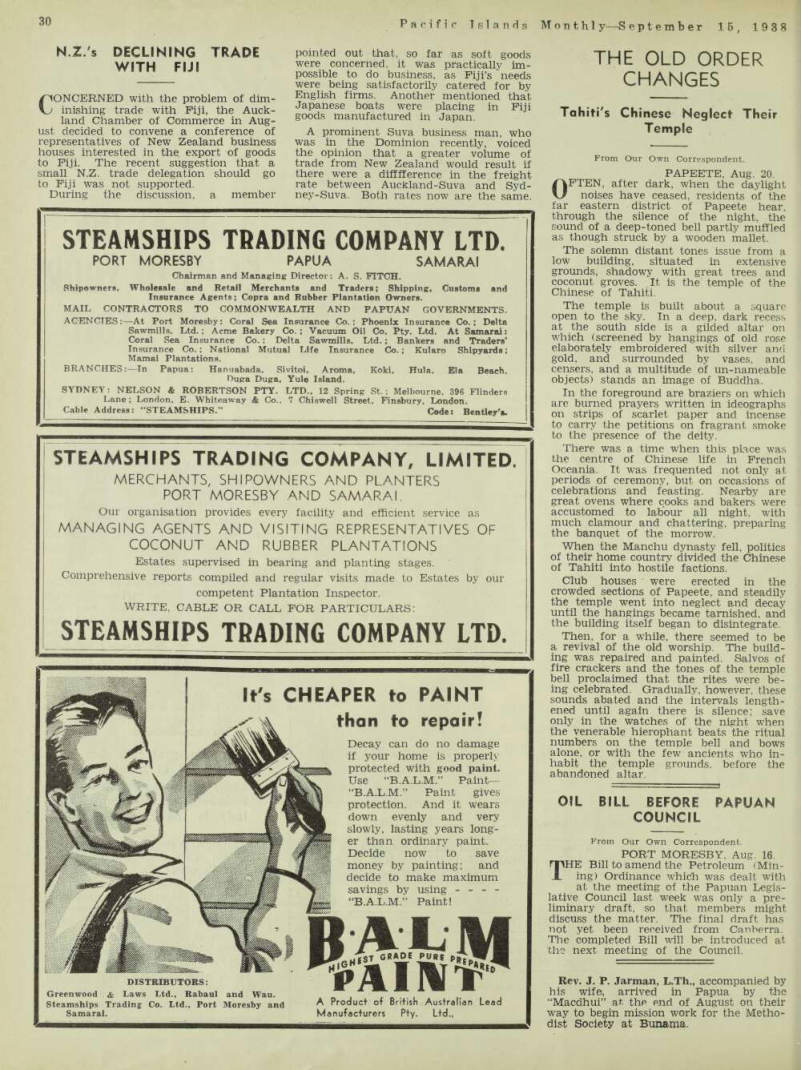
With Fiji
CONCERNED with the problem of dim inishing trade with Fiji, the Auck land Chamber of Commerce in Aug ust decided to convene a conference of representatives of New Zealand business houses interested in the export of goods to Fiji. The recent suggestion that a small N.Z. trade delegation should go to Fiji was not supported.
During the discussion, a member
pointed out that, so far as soft goods were concerned, it was practically im possible to do business, as Fiji’s needs were being satisfactorily catered for by English firms Another mentioned that t ?.„, w S re p J acln B in Fiji B° ods manufactured m Japan, A prominent Suva business man, who was in the Dominion recently, voiced the opinion that a greater volume of trade from New Zealand would result if there were a difference in the freight rate between Auckland-Suva and Syd ney-Suva. Both rates now are the same.
Changes
The Old Order
Tahiti's Chinese Neglect Their Temple
From Our Own Correspondent.
Papeete, Aug. 20.
OFTEN, after dark, when the daylight noises have ceased, residents of the far eastern district of Papeete hear, through the silence of the night, the sound of a deep-toned bell partly muffled as though struck by a wooden mallet.
The solemn distant tones issue from a low building, situated in extensive grounds, shadowy with great trees and coconut groves. It is the temple of the Chinese of Tahiti.
The temple is built about a square open to the sky. In a deep, dark recess at the south side is a gilded altar on which (screened by hangings of old rose elaborately embroidered with silver and gold, and surrounded by vases, and censers, and a multitude of un-nameable objects) stands an image of Buddha.
In the foreground are braziers on which are burned prayers written in ideographs on strips of scarlet paper and incense to carry the petitions on fragrant smoke to the presence of the deity.
There was a time when this place was the centre of Chinese life in French Oceania. It was frequented not only at periods of ceremony, but on occasions of celebrations and feasting. Nearby are great ovens where cooks and bakers were accustomed to labour all night, with much clamour and chattering, preparing the banquet of the morrow.
When the Manchu dynasty fell, politics of their home country divided the Chinese of Tahiti into hostile factions.
Club houses were erected in the crowded sections of Papeete, and steadily the temple went into neglect and decay until the hangings became tarnished, and the building itself began to disintegrate.
Then, for a while, there seemed to be a revival of the old worship. The build ing was repaired and painted. Salvos of fire crackers and the tones of the temple bell proclaimed that the rites were be ing celebrated. Gradually, however, these sounds abated and the intervals length ened until again there is silence; save only in the watches of the night when the venerable hierophant beats the ritual numbers on the temple bell and bows alone, or with the few ancients who in habit the temple grounds, before the abandoned altar.
Oil Bill Before Papuan
Council
From Our Own Correspondent.
Port Moresby. Aug. 16
THE Bill to amend the Petroleum (Min ing) Ordinance which was dealt with at the meeting of the Papuan Legis lative Council last week was only a pre liminary draft, so that members might discuss the matter. The final draft has not yet been received from Canberra.
The completed Bill will be introduced at the next meeting of the Council.
Rev. J. P. Jarman, L.Th., accompanied by his wifei, arrived in Papua by the “Macdhui” at the end of August on their way to begin mission work for the Metho dist Society at Bunama.
Advertisements & other items, p. 34 (2 items)
30
Pacific Islands Monthl y—S eptember 15, 1938
Steamships Trading Company Ltd.
PORT MORESBY PAPUA SAMARA!
Chairman and Managing Director: A. S. FITCH.
Shipowners, Wholesale and Retail Merchants and Traders; Shipping, Customs and Insurance Agents; Copra and Rubber Plantation Owners.
MAIL CONTRACTORS TO COMMONWEALTH AND PAPUAN GOVERNMENTS.
AGENCIES:—At Port Moresby: Coral Sea Insurance Co.: Phoenix Insurance Co.; Delta Sawmills. Ltd.; Acme Bakery Co.; Vacuum Oil Co. Pty. Ltd. At Samara!: Coral Sea Insurance Co, ; Delta Sawmills. Ltd.; Bankers and Traders’
Insurance Co.; National Mutual Life Insurance Co.; Kularo Shipyards; Mamai Plantations.
BRANCHES: —In Papua: Hanuabada, Sivitoi, Aroma, Koki, Hula, Ela Beach, Duga Duga, Yule Island.
SYDNEY: NELSON & ROBERTSON PTY. LTD.. 12 Spring St.; Melbourne. 396 Flinders Lane: London. E. Whiteaway & Co.. 7 Chiswell Street, Finsbury, London.
Cable Address: “STEAMSHIPS.” Code: Bentley’s.
STEAMSHIPS TRADING COMPANY, LIMITED.
MERCHANTS, SHIPOWNERS AND PLANTERS
PORT MORESBY AND SAMARAI.
Our organisation provides every facility and efficient service as
MANAGING AGENTS AND VISITING REPRESENTATIVES OF
COCONUT AND RUBBER PLANTATIONS
Estates supervised in bearing and planting stages.
Comprehensive reports compiled and regular visits made to Estates by our competent Plantation Inspector.
WRITE, CABLE OR CALL FOR PARTICULARS:
STEAMSHIPS TRADING COMPANY LTD
s
It's CHEAPER to PAINT
than to repair!
Decay can do no damage if your home is properly protected with good paint.
Use “8.A.L.M.” Paint— “B.A.L.M.” Paint gives protection. And it wears down evenly and very slowly, lasting years longer than ordinary paint.
Decide now to save money by painting; and decide to make maximum savings by using - - - - “8.A.L.M.” Paint!
DISTRIBUTORS:
Greenwood & Laws Ltd., Rabaul and Wau.
Steamships Trading Co. Ltd., Port Moresby and Samarai.
A Product of British Australian Lead Manufacturers Pty. Ltd.,
Native's Courage
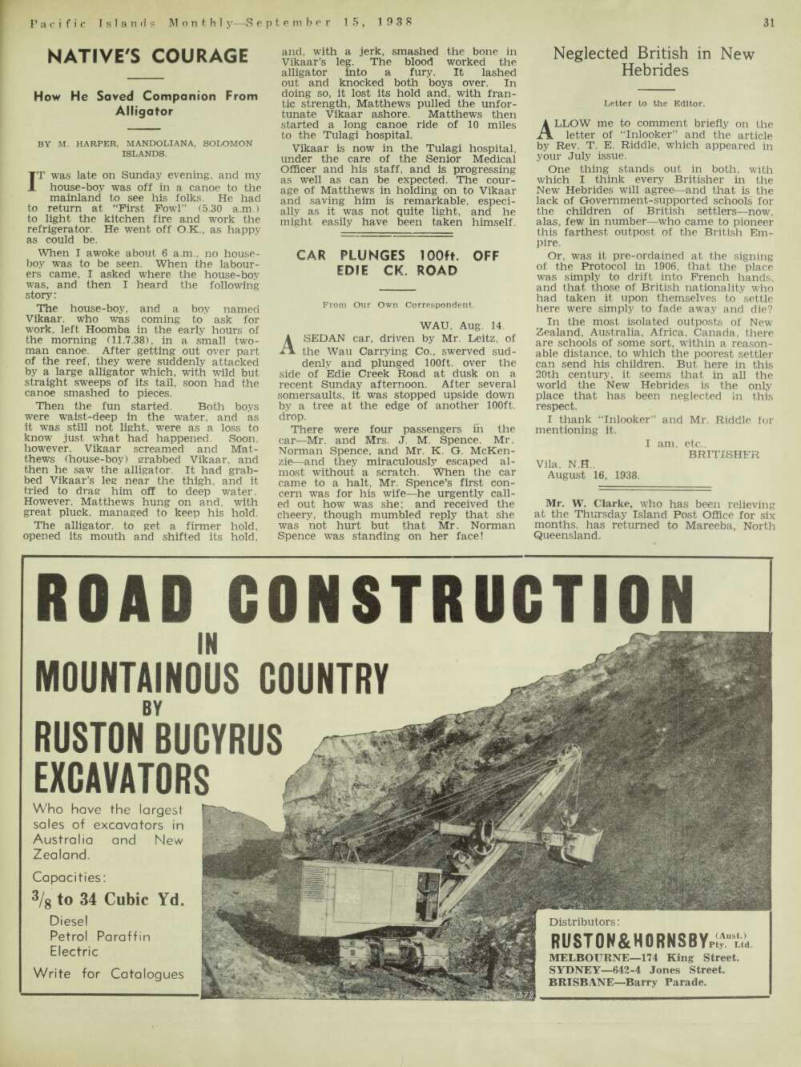
How He Saved Companion From Alligator
BY M. HARPER, M ANDO LIANA, SOLOMON
Islands.
IT was late on Sunday evening, and my house-boy was off in a canoe to the mainland to see his folks. He had to return at “First Fowl” (5.30 a.m.) to light the kitchen fire and work the refrigerator. He went off 0.K., as happy as could be.
When I awoke about 6 a.m.. no house boy was to be seen. When the labour ers came. I asked where the house-boy was, and then I heard the following story: The house-boy, and a boy named Vikaar. who was coming to ask for work, left Hoomba in the early hours of the morning (11.7.38). in a small two man canoe. After getting out over part of the reef, they were suddenly attacked by a large alligator which, with wild but straight sweeps of its tail, soon had the canoe smashed to pieces.
Then the fun started. Both boys were waist-deep in the water, and as it was still not light, were as a loss to know just what had happened. Soon, however. Vikaar screamed and Mat thews (house-boy) grabbed Vikaar. and then he saw the alligator. It had grab bed Vikaar’s leg near the thigh, and it tried to drag him off to deep water.
However. Matthews hung on and, with great pluck, managed to keep his hold.
The alligator, to get a firmer hold, opened its mouth and shifted its hold,
and. with a jerk, smashed the bone in Vikaar’s leg. The blood worked the alligator into a fury. It lashed out and knocked both boys over. In doing so, it lost its hold and, with fran tic strength, Matthews pulled the unfor tunate Vikaar ashore. Matthews then started a long canoe ride of 10 miles to the Tulagi hospital.
Vikaar is now in the Tulagi hospital, under the care of the Senior Medical Officer and his staff, and is progressing as well as can be expected. The cour age of Matthews in holding on to Vikaar and saving him is remarkable, especi ally as it was not quite light, and he might easily have been taken himself.
Car Plunges 100Ft. Off
Edie Ck. Road
From Our Own Correspondent.
WAU. Aug. 14.
A SEDAN car, driven by Mr. Leitz, of the Wau Carrying Co., swerved sud denly and plunged 100 ft. over the side of Edie Creek Road at dusk on a recent Sunday afternoon. After several somersaults, it was stopped upside down by a tree at the edge of another 100 ft. drop.
There were four passengers m the car—Mr. and Mrs. J. M. Spence. Mr.
Norman Spence, and Mr. K. G. McKen zie—and they miraculously escaped al most without a scratch. When the car came to a halt. Mr. Spence’s first con cern was for his wife —he urgently call ed out how was she: and received the cheery, though mumbled reply that she was not hurt but that Mr. Norman Spence was standing on her face!
Neglected British in New
Hebrides
Letter to the Editor.
ALLOW me to comment briefly on the letter of “Inlooker” and the article by Rev. T. E. Riddle, which appeared in your July issue.
One thing stands out in both, with which I think every Britisher in the New Hebrides will agree—and that is the lack of Government-supported schools for the children of British settlers—now. alas, few in number —who came to pioneer this farthest outpost of the British Em pire.
Or, was it pre-ordained at the signing of the Protocol in 1906, that the place was simply to drift into French hands, and that those of British nationality who had taken it upon themselves to settle here were simply to fade away and die?
In the most isolated outposts of New Zealand, Australia, Africa, Canada, there are schools of some sort, within a reason able distance, to which the poorest settler can send his children. But here in this 20th century, it seems that in all the world the New Hebrides is the only place that has been neglected in this respect.
I thank “Inlooker” and Mr. Riddle for mentioning It.
I am. etc..
Britisher
Vila. N.H., August 16, 1938.
Mr. W. Clarke, who has been relieving at the Thursday Island Post Office for six months, has returned to Mareeba, North Queensland.
Mrs, R. H. Green, wife of the principal of the Methodist Mission’s Davuilevu College, Fiji, was an inmate of the Suva War Memorial Hospital during August, suffering from injuries received in a motor accident at Nodroga. The car completely overturned, and Mrs. Green’s left arm was broken near the elbow and her neck and back were severely strained. She is now making satisfactory progress, but her recovery will be slow.
Advertisements & other items, pp. 35-36 (2 items)
31
Pacific Islands Monthl y—S eptember 15, 19 3 8
Road Construction
IN m .
A ■ m Distributors:
MOUNTAINOUS COUNTRY
BY
RUSTON BUGYRUS
EXCAVATORS
Who hove the largest sales of excavators in Australia and New Zealand.
Capacities: % to 34 Cubic Yd.
Diesel Petrol Paraffin Electric Write for Catalogues
RUSTON&HORNSBYp£"td
MELBOURNE—I 74 King Street.
SYDNEY—642-4 Jones Street.
BRISBANE —Barry Parade.
W. FINAU
International Stamp & Photo Service,
BOX 40, NUKUALOFA, TONGA IS., OCEANIA.
fit
Photos of native life and scenes in Tonga; 5/-.
Tin-Can Mall cover franked with eight pretty Niuafoou mint: 4/6; same with 3 varieties; 1/6.
Registered, postmarked and despatched at Niuafoou (Tin-Can Island).
Tongan mint of 15 all different: 16/6 postpaid. ■
LIGHTWEIGHT ATTACHE GASES
Priced from
3/11 to 9/11 The neat looking Beatzall Attache Case No. 8B is a real moneysaver. It's serviceable and light . . of glossy grained fibre with rounded edges, reinforced corners, metal bound lid and rolled brown metal body frame. It has metal handle and two snap locks, with keys.
Sizes 12 to 20 inches, retailing from 3/11 to 9/11. Ask for Beatzall Attache No. BB—made by the manufacturers of Globite Travel Cases.
BEATZALL
ATTACHE CASES
Traders are invited to write for full particulars
KIPPAX STREET ... SYDNEY
of all TRAVEL and LEATHER GOODS.
FORD SHERINGTON, LTD.
MANUFACTURERS WHOLESALE ONLY)
Is There Gold In "Them Thar Hills"?
"Them Thar Hills"?
Seven Years' Search in the Salomons
(Contributed) STILL another gold-mining epidemic seems likely to brgak out on Guadal canal Island which, over the past seven or eight years, has been visited by numerous mining engineers, near-engi neers and not so near ones, with rather lamentable results.
No doubt, all those share-holders who have not had sufficient injections of gold mining virus are ready to believe that there is some truth in the old hackneyed saying that “ a gold mine is a hole in the ground, and the owner is a nar”. At any rate, Guadalcanal does seem to have been a better place in which to sink gold rather than sink for it.
Still, all this by no means condemns the field, for there is surely gold “in them thar hills and rivers”, and New Guinea ites might please note that it is none of your 50% muck. Samples recently sent
south proved 96% pure; so that, if there is not sufficient to allay Uncle Sam’s aloof ness towards us over the little matter of war-debts, at least we can say “Thank God we are pure”. I mean, our gold is.
The gekko in the treacle seems to be in devising a means to fish the gold out of the treacherous boulder-strewn streams, which are subject to sudden and dangerous floods from the mountains in the near back-ground.
One mining engineer, a couple of years ago, hatched out a plan all his own to overcome this. It was to cost just the bare £30,000; but, apparently, his share-holders were suffering from stricture of the purse, or want of confidence, or something; so they sent along another M.E., of slightly more tonnage, to look it over, and he con demned the scheme first peep—and “fhoof” went another ton of optimism.
The field was then deserted, and all leases cancelled, and the jungle reigned supreme.
But not for long; for, soon after, up bobbed still another mining engineer. This lime, all the way from Western Australia where they should know something about gold-mining. Anyhow, he brought with him all the usual assurances as to his qualifications, and the “bogins of boodle” he represented—just a mere million and a half of English capital in this case— which is just pining to be poured into the Sorvohio River.
He states that if he gets the concessions he has asked for there will be 1,000 men on the field inside 12 months.
Alas, our Gold-mining Regulations were apparently framed rather with the idea of preventing than encouraging mining; and. though sane regulations have been pro mised for years, the office boy or whoever it is that attends to our little matters in Fiji, does not seem to have completed his prolonged siesta. The result is that mining matters here are in a glorious state of muddle and the drunk who asked “is this Pitt Street or Chrisamus?” was a para gon of lucidity in comparison.
However, thank God for Chamberlain and his efforts to regenerate sanity! And may some of it trickle this far!
Meanwhile, from the talk going round, copra planters on Guadalcanal are becom ing perturbed as to the possibility of see ing their holdings pouring through the sluice-boxes into the blue Pacific. Not that it would matter a row of pins, in view of the copra market outlook; but they would feel happier if assured that the share holders in the talked of II millions show were the same group which dominates the vegetable oil combine. In that case, it would be a game of “Take and Put”—that is. they might take all the “cream” of the copra industry, but they would put it back into the Sorvohio, which would be some consolation.
Tulagi, 20/8/1938.
Control of P.O.D. Co. in Papua
From Our Own Correspondent.
Pt. Moresby. Aug. 16.
PAPUA Oil Development Co. will shortly transfer the main portion of their Western Papua business to their head office in Port Moresby. This will considerably reduce the staff at Daru from whence most of the Com pany’s field parties were provisioned.
For the main part, these will now be under the management of the head office in Port Moresby,
Advertisements & other items, p. 36 (1 item)
32
Pacific Islands Monthl y—S eptember 15, 1938
The Trilithon, Or Haamoga- A-Maui, Of Tonga
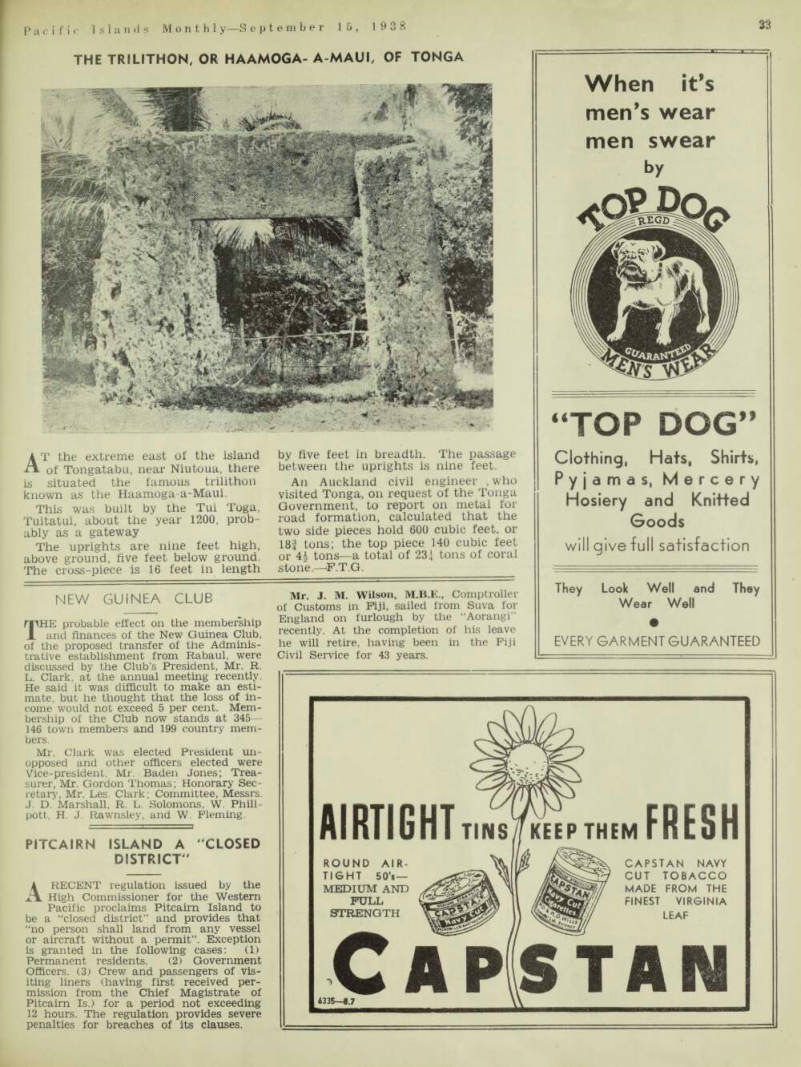
AT the extreme east of the island of Tongatabu, near Niutoua, there is situated the famous trilithon known as the Haamoga-a-Maui.
This was built by the Tui Toga, Tuitatui, about the year 1200, prob ably as a gateway The uprights are nine feet high, above ground, five feet below ground.
The cross-piece is 16 feet in length
by five feet in breadth. The passage between the uprights is nine feet.
An Auckland civil engineer , who visited Tonga, on request of the Tonga Government, to report on metal for road formation, calculated that the two side pieces hold 600 cubic feet, or 183 tons; the top piece 140 cubic feet or tons—a total of 23i tons of coral
stone
F.T.G.
New Guinea Club
11HE probable effect on the membership . and finances of the New Guinea Club, of the proposed transfer of the Adminis trative establishment from Rabaul, were discussed by the Club’s President, Mr. R.
L. Clark, at the annual meeting recently.
He said it was difficult to make an esti mate, but he thought that the loss of in come would not exceed 5 per cent. Mem bership of the Club now stands at 345 - 146 town members and 199 country mem bers.
Mr. Clark was elected President un~ opposed and other officers elected were Vice-president. Mi-. Baden Jones; Trea surer, Mr. Gordon Thomas; Honorary Sec retary, Mr. Les. Clark; Committee, Messrs J. D. Marshall, R. L. Solomons, W. Philh pott, H. J. Rawnsley, and W Fleming.
Pitcairn Island A "Closed
District"
A RECENT regulation issued by the High Commissioner for the Western Pacific proclaims Pitcairn Island to be a “closed district’’ and provides that “no person shall land from any vessel or aircraft without a permit”. Exception is granted in the following cases: (1) Permanent residents. (2) Government Officers. (3) Crew and passengers of vis iting liners (having first received per mission from the Chief Magistrate of Pitcairn Is.) for a period not exceeding 12 hours. The regulation provides severe penalties for breaches of its clauses.
Mr. J. M. Wilson, Comptroller of Customs in Fiji, sailed from Suva for England on furlough by the “Aorangi” recently. At the completion of his leave he will retire, having been in the Fiji Civil Service for 43 years.
Advertisements & other items, p. 37 (2 items)
33
Pacific Islands Monthl y—S eptember 15, 1938
Capsta
When It’s men’s wear men swear by
oEJPo,
Q regd « V.
Ns YJ>
“TOP DOG
If Clothing, Hats, Shirts, Pyjamas, Mercery Hosiery and Knitted Goods will give full satisfaction They Look Well and They Wear Well •
EVERY GARMENT GUARANTEED
AIRTIGHT
TINS/ KEEP THEM
ROUND AIR-
TIGHT 50's
MEDIUM AND
FULL
STRENGTH
6335 — 8.7
FRESH
CAPSTAN NAVY
CUT TOBACCO
MADE FROM THE
FINEST VIRGINIA
LEAF
Capsta
Impressive Ceremony 50 Years Ago
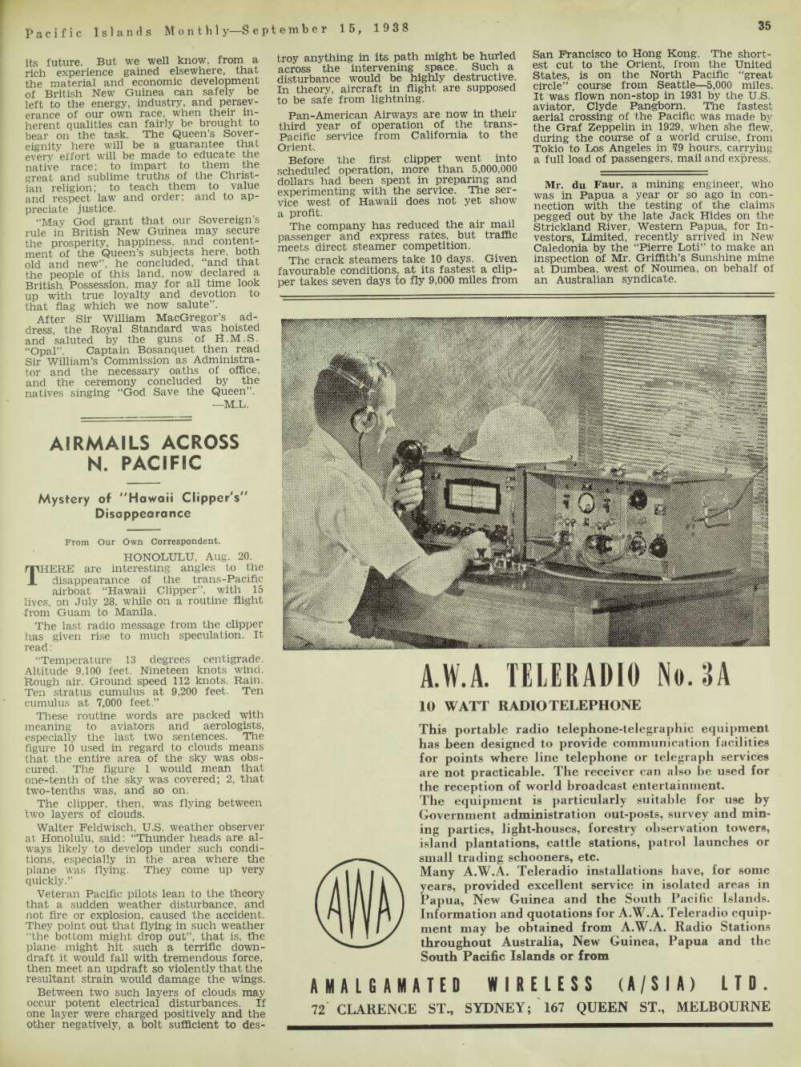
Hoisting of the British Flog in Popua on Sept. 4, 1888
FIFTY years ago on September 4, 1888, Sir William MacGregor, M.D., C.M.G., arrived in Papua from Cook town (Queensland) in H.M.S. “Opal”, commanded by Captain Bosanquet, to take over the reins of Government and, by Proclamtaion, declare the Protected Territory of New Guinea (as Papua was then referred to) to be part of the Queen’s Dominions.
A detailed report of the proceedings, written by Mr. Anthony Musgrave, who accompanied Sir William MacGregor as “Secretary for the Government”, de scribes the vivid scenes not only of the ceremony itself, but also of the entry into the harbour when H.M.S. “Opal” came to anchor.
Flags were flying in welcome from the London Missionary Society’s and Mr. A.
Goldie’s flagstaffs, and there was a gen eral air of excitement on landing—while the preliminary arrangements were in hand. A public notice was issued with out delay to all residents in the town ship of Granville, and a special invita tion went to members of the L.M.S.
Mission. Officers visited nearby villages (Hanuabada) summoning all natives to attend the ceremony.
“At 2.30 p.m.”, wrote Mr. Musgrave, “His Excellency came ashore . . . and at once proceeded to Government House.
By a quarter before four o’clock the ar rangements were completed, and the scene from Government House verandah. 150 ft. above sea and commanding a full view of the harbour and surroundings, was interesting and attractive.
“To the right and northerly, the mis sion flagstaff, dressed for the ceremony, was a triangle of lively colour. In the foreground. H.M.S. ‘Opal’, the L.M.S. schooner ‘Ellangowan’, and the Govern ment cutter ‘Maine’, were also decorated with taunting blowing out freely in the strong south-east trade wind. From the oval plateau covered with fine shingle in front of the building, the Govern ment flagstaff with its white shaft and crosstrees showed in clear outline against the blue background of the, harbour, while a single Union Jack flew from it as the Resident Deputy Com missioner’s symbol of authority.
“At the end of the plateau, beyond the mast and about its base, the local natives—men, women and children— grouped themselves in a semi-circle of some 200 or more. This was a remark ably good gathering, for although the three villages mentioned contain over 1,000 souls, a large number were inland for the last hunt of the season. In the middle of the group the mission stud ents and their wives in clean cotton clothing of different hues presented a strong and pleasing contrast to their nude and stock-headed relations.
“On the north side of the platform, the • guard of honour—blue-jackets and Marines under Commander Field, R.N, and Lieutenant Basil Hall, R.N.—'was placed with a drum-and-fife band front ing them, thus forming three sides of a square about the flag-mast. Two sig nalmen from the ‘Opal’ were also sta tioned at this point to attend to the flags appropriate to the ceremony”.
The Assembly consisted of the fol lowing:— Captain Day Bosanquet, R.N. (H.M.
Senior Officer for the Northern Division of the Australian Station), and officers of H.M.S. “Opal”.
Hugh Hastings Romilly, C.M.G., and Anthony Musgrave (Deputy Commission ers for British New Guinea).
Rev. W. G. Lawes (Senior member of the London Missionary Society) and Mrs. Lawes, Bingham Arbuthnot Hely (Accountant for the Protectorate).
Frank E. Lawes (Clerical Assistant and Acting Post Master, etc., at Pt. Mores by).
George Hunter (Government Officer, Rigo Station).
Andrew Goldie (Collector, Explorer and Storekeeper in British New Guinea since 1875).
Ruotoka (Rarotongan L.M.S. teacher, resident in Pt. Moresby since 1873), and South Sea Island boatmen, employed by the Government.
Being informed by Captain Bosan quet that everything as ready, His Ex cellency read the Proclamation declaring Her Majesty’s Sovereignity over the Pro tectorate, and immediately afterwards read the Imperial Letters Patent, which provided for a Constitution for the new Territory.
In his address, Sir William MacGregor after commenting on the fact that the history of British New Guinea as part of the Queen’s Dominion would com mence from September 4, drew attention to the great possibilities of the little known Territory.
“So much still remains to be made known in regard to the capabilities of this great country”, he said, “that at present no human eye can see far into
its future. But we well know, from a rich experience gained elsewhere, that the material and economic development of British New Guinea can safely be left to the energy, industry, and persev erance of our own race, when their in herent qualities can fairly be brought to bear on the task. The Queen’s Sover eignity here will be a guarantee that every effort will be made to educate the native race; to impart to them the great and sublime truths of the Christ ian religion: to teach them to value and respect law and order; and to ap preciate justice.
“May God grant that our Sovereign’s rule in British New Guinea may secure the prosperity, happiness, and content ment of the Queen’s subjects here, both old and new”, he concluded, “and that the people of this land, now declared a British Possession, may for all time look up with true loyalty and devotion to that flag which we now salute”.
After Sir William MacGregor’s ad dress, the Royal Standard was hoisted and saluted by the guns of H.M.S.
“Opal”. Captain Bosanquet then read Sir William’s Commission as Administra tor and the necessary oaths of office, and the ceremony concluded by the natives singing “God Save the Queen”.
M.L.
Advertisements & other items, p. 38 (2 items)
34
Pacific Islands Month 1 y—S eptember 15, 1938
Modern Sleeping Equipment
J i N : u •*** if! !* 13 iTI 111 A
jbLl stij f isii
a I «?■*• 42ste* b—t
TUBULAR STEEL FURNITURE
Address all Correspondence and Orders to — Australia's Largest Manufacturers of
STEEL BEDS
Hospital Beds and Equipment Ships 7 All-Steel Berths Lawn Hammocks Cabinet Beds Garden Seats Stretchers 7/ Steelite(-De-Luxe #/ Mattresses 77 Aero 7/ Spring- Filled Bedding /7 Morning Glory 77 Bedding
NEWLANDS BROTHERS PTY, LTD.
Head Office & Works: Riley and Albion Sts. Sydney, N.S.W.
Cable and Telegraphic Address: “Newlandbed” Sydney
Airmails Across
N. Pacific
Mystery of "Hawaii Clipper's"
Disappearance
From Our Own Correspondent.
Honolulu, Aug. 20.
THERE are interesting angles to the disappearance of the trans-Pacific airboat “Hawaii Clipper”, with 15 lives, on July 28. while on a routine flight from Guam to Manila.
The last radio message from the clipper has given rise to much speculation. It read: “Temperature 13 degrees centigrade.
Altitude 9,100 feet. Nineteen knots wind.
Rough air. Ground speed 112 knots. Rain.
Ten stratus cumulus at 9,200 feet. Ten cumulus at 7,000 feet.”
These routine words are packed with meaning to aviators and aerologists, especially the last two sentences. The figure 10 used in regard to clouds means that the entire area of the sky was obs cured. The figure 1 would mean that one-tenth of the sky was covered; 2, that two-tenths was, and so on.
The clipper, then, was flying between two layers of clouds.
Walter Feldwisch, U.S. weather observer at Honolulu, said: “Thunder heads are al ways likely to develop under such condi tions, especially in the area where the plane was flying. They come up very quickly.”
Veteran Pacific pilots lean to the theory that a sudden weather disturbance, and not fire or explosion, caused the accident.
They point out that flying in such weather “the bottom might drop out”, that is, the plane might hit such a terrific down draft it would fall with tremendous force, then meet an updraft so violently that the resultant strain would damage the wings.
Between two such layers of clouds may occur potent electrical disturbances. If one layer were charged positively and the other negatively, a bolt sufficient to des
troy anything in its path might be hurled across the intervening space. Such a disturbance would be highly destructive.
In theory, aircraft in flight are supposed to be safe from lightning.
Pan-American Airways are now in their third year of operation of the trans pacific service from California to the Orient.
Before the first clipper went into scheduled operation, more than 5,000,000 dollars had been spent in preparing and experimenting with the service. The ser vice west of Hawaii does not yet show a profit.
The company has reduced the air mail passenger and express rates, but traffic meets direct steamer competition.
The crack steamers take 10 days. Given favourable conditions, at its fastest a clip per takes seven days to fly 9,000 miles from
San Francisco to Hong Kong. The short est cut to the Orient, from the United States, is on the North Pacific “great circle” course from Seattle—s,ooo miles.
It was flown non-stop in 1931 by the U.S. aviator, Clyde Pangbom. The fastest aerial crossing of the Pacific was made by the Graf Zeppelin in 1929, when she flew, during the course of a world cruise, from Tokio to Los Angeles in 79 hours, carrying a full load of passengers, mail and express.
Mr. du Faur, a mining engineer, who was in Papua a year or so ago in con nection with the testing of the claims pegged out by the late Jack Hides on the Strickland River, Western Papua, for In vestors, Limited, recently arrived in New T Caledonia by the “Pierre Loti” to make an inspection of Mr. Griffith’s Sunshine mine at Dumbea, west of Noumea, on behalf of an Australian syndicate.
Hon. C. T. Wurth, M.L.C., Commissioner of Lands in Papua, will leave Port Moresby on November 15 on long leave, at the expiration of which he will retire from the Papuan Government Service.
Mr. Wurth is a well-known and highly respected man in the Territory. He has spent more than 20 years in Papua in the service of the Administration and rose steadily from a junior position to
be Assistant Resident Magistrate, Resi dent Magistrate, and then head of an important department and a member of the Legislative Council.
Rev. and Mrs. N. G. Pardey, Methodist missionaries in Western Samoa, returned to Apia by the last “Matua” from New Zealand, with their two-months-old daughter.
Advertisements & other items, pp. 39-40 (2 items)
35
Pacific Islands Monthl y —S eptember 15, 1938
A.W.A. Telekadio No.Sa
... - ; Vs .. v
10 WAIT RADIOTELEPHONE
M This portable radio telephone-telegraphic equipment has been designed to provide communication facilities for points where line telephone or telegraph services are not practicable. The receiver can also be used for the reception of world broadcast entertainment.
The equipment is particularly suitable for use by Government administration out-posts, survey and mining parties, light-houses, forestry observation towers, island plantations, cattle stations, patrol launches or small trading schooners, etc.
Many A.W.A. Teleradio installations have, for some years, provided excellent service in isolated areas in Papua, New Guinea and the South Pacific Islands, Information and quotations for A.W.A. Teleradio equipment may be obtained from A.W.A. Radio Stations throughout Australia, New Guinea, Papua and the South Pacific Islands or from
AMALGAMATED WIRELESS (A/SIA) LTD.
72 CLARENCE ST., SYDNEY; 167 QUEEN ST., MELBOURNE
PRESCOTT L T J? I>hl^e S y are sole wholesale adonis fbi'-
PINEAPPLE BACON & HANS
DAISY BRAND BUTTER
‘ 375 BUTTER in TINS Hb.-2ib.-slb.Si Z es LEA & PERRINS’ Sauces and Most other Super-Quality Lines of the Trade
Swallow & Ariell’s
WORLD RENOWNED
CANTERBURY
CARES
:xxxxxxxxx^
FRUIT
PLAIN
SEED
PLUM
ALMOND
IER
Cak
PRESERVED
GINGER
SULTANA
CHERRY
RIPE
GENOA
lxxxx:xxxxx: Each Cake is Enclosed, by special process, in air-tight tin, and is warranted to keep its condition for a considerable period.
Papua's Finance
Influence of Oil Companies
WE learn that the new Treasurer of the Territory of Papua, Mr. S.
Smith, is not very happy about the Territory’s financial outlook, and he spoke his mind frankly when discussing the estimates of revenue ana expenditure in the Legislative Council in Port Mores by recently.
The Territory’s finances during the past couple of years make a pretty pic ture—apparently bounding trade and in creasing revenue. But an analysis shows that the improvement in the Ter ritory’s finances is due very largely to two factors—the large expenditure un dertaken in the Territory by the big companies in their search for an oil field, and the astonishing returns from the sale of stamps (the result of phila telists’ demands).
Mr. Smith pointed out these facts in plain words of one syllable and said that the revenue that the Territory had en joyed during the past two years was of a character that Papua cannot reas onably expect under normal conditions.
“Were it not for the activity of these oil companies, Papua would have ex perienced rather lean years instead of years of plenty”, said Mr. Smith. “I do not want to appear too pessimistic —so I leave it to you to imagine what might be the conditions here if the search for oil should be discontinued”.
Exploration In Central
New Guinea
in Central New Guinea are 1 1 gradually being brought under control, as the result of constant patrolling’’, said Mr. A. F. Kyle, Assistant District Officer, of the Chimbu-Mt. Hagen district, New Guinea, on arrival in Sydney by the “Montoro” recently. “The present patrol, being led by A.D O. Taylor, should make known a great deal of hitherto unmap ped territory.
“More than 200 miles of good ‘bridle paths’ have been built in the last 18 months, and it is now possible to patrol the Mt. Hagen district on horse-back, despite the fact that the road traverses country more than 8,000 ft. above sea level,” he added.
Mr. Kyle referred to the part being played in the exploration of primitive territory by ’planes. “Aerial reconnais sance in unknown country is going to prove most valuable to us,” he said. “At the moment, th,e companies are mostly concerned with commercial work, but flights over country to be penetrated, and aerial photographs will enable us to see the lay of the land, the valleys, and where the population is.’’ As an example he quoted the manner in which supplies were flown to the Taylor patrol—more than 8,000 lb. of foodstuffs being dropped through an opening in the bottom of a large Pokker and, by means of parachutes, landed safely, the only “casualties” being two broken medicine bottles.
“Th,ere are numerous traces of gold In various Central New Guinea areas but not enough to warrant exploitation on a large scale,” Mr. Kyle said. “Mr. Mick Leahy is on good gold in the Mt. Hagen district, but he has to pass through 60 ft. overburden before reaching it. He employs about 200 local natives on his workings.”
Advertisements & other items, p. 40 (1 item)
36
Pacific Islands Month! y—§ eptember 15, 193$
The Old “Mariposa”
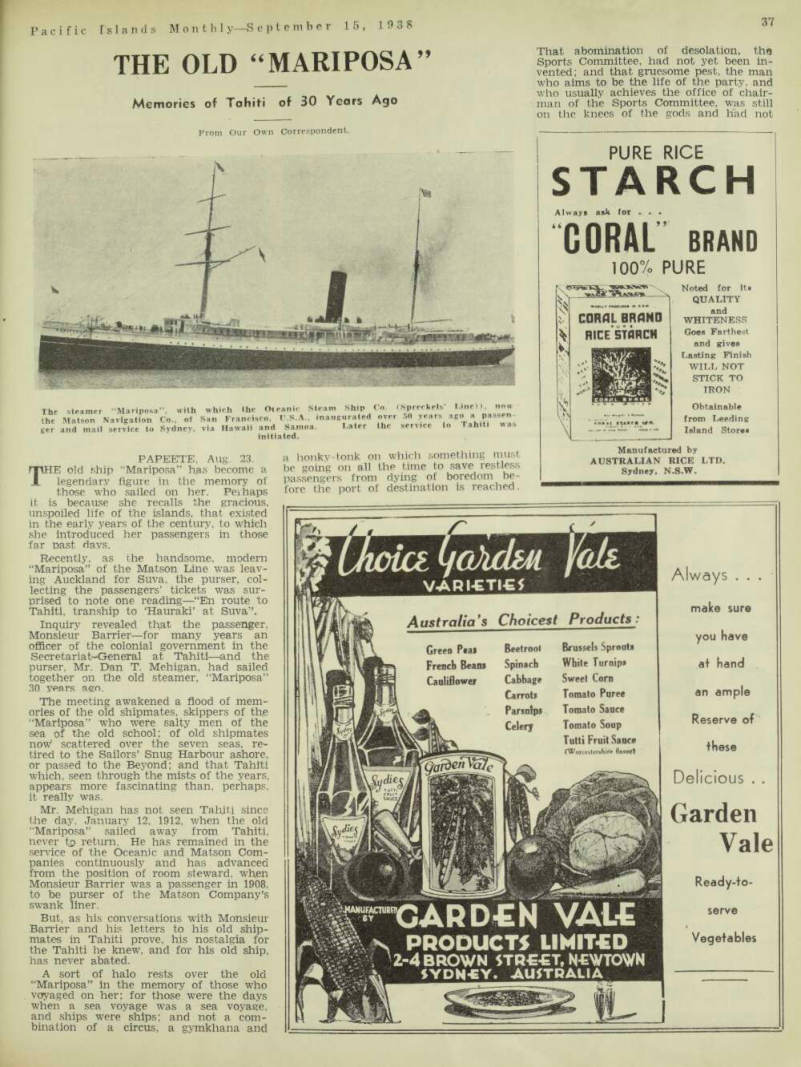
Memories of Tahiti of 30 Years Ago
From Our Own Correspondent.
Papeete. Aug. 23.
mHE old ship “Mariposa" h.as become a JL legendary figure in the memory of those who sailed on her. Pevhaps it is because she recalls the gracious, unspoiled life of the islands, that existed in the early years of the century, to which she introduced her passengers in those far past days.
Recently, as the handsome, modern “Mariposa” of the Matson Line was leav ing Auckland for Suva, the purser, col lecting the passengers’ tickets was sur prised to note one reading—“En route to Tahiti, tranship to ‘Hauraki’ at Suva”.
Inquiry revealed that the passenger, Monsieur Barrier—for many years an officer of the colonial government in the Secretariat-General at Tahiti—and the purser. Mr. Dan T. Mehigan, had sailed together on the old steamer, “Mariposa” 30 years ago.
The meeting awakened a flood of mem ories of the old shipmates, skippers of the “Mariposa” who were salty men of the sea of the old school; of old shipmates now' scattered over the seven seas, re tired to the Sailors’ Snug Harbour ashore, or passed to the Beyond; and that Tahiti which, seen through the mists of the years, appears more fascinating than, perhaps, it really was.
Mr. Mehigan has not seen Tahiti since the day, January 12, 1912, when the old “Mariposa” sailed away from Tahiti, never to return. He has remained in the service of the Oceanic and Matson Com panies continuously and has advanced from the position of room steward, when Monsieur Barrier was a passenger in 1908, to be purser of the Matson Company’s swank liner.
But, as his conversations with Monsieur Barrier and his letters to his old ship mates in Tahiti prove, h,is nostalgia for the Tahiti h,e knew, and for his old ship, has never abated.
A sort of halo rests over the old “Mariposa” in the memory of those who voyaged on her; for those were the days when a sea voyage was a sea voyage, and ships were ships; and not a com bination of a circus, a gymkhana and
a honkV’tonk on which something must be going on all the time to save restless passengers from dying of boredom be fore the port of destination is reached.
That abomination of desolation, thg Sports Committee, had not yet been in vented; and that gruesome pest, the man who aims to be the life of the party, and who usually achieves the office of chair man of the Sports Committee, was still on the knees of the gods and had not
The steamer "Mariposa”, with which the Oceanic Steam Ship Co. (Spreckels' Line) ). now the Matson Navigation Co., of San Francisco. U.S.A., inaugurated over 50 years ago a passen ger and mail service to Sydney, via Hawaii and Samoa. Later the service to Tahiti was initiated.
yet been born to add to the tribulations of a tortured world.
On ships like the “Mariposa” wearied bodies and taut nerves were refreshed and relaxed and comforted- by the sooth ing calm of the sea and the gracious amenity of the life on board. She car ried many distinguished passengers. The great Robert Louis Stevenson made many trips on her, and in his “Vailima Let ters are included several that were pen ned at sea on board the ship. Field-Mar shal Lord Kitchener voyaged on her when he came to Tahiti on his return home from Australia, before the Great War.
Advertisements & other items, pp. 41-42 (1 item)
yohdm
PURE RICE
STARCH
Always ask for ...
CORAL BRAND
100% PURE
Noted for Its
QUALITY
and
WHITENESS
Goes Farthest and gives Lasting Finish
WILL NOT
STICK TO
IRON
Obtainable from Leading Island Stores
HMuSII .
CORAL BRAND
RICE STARCH
Manufactured by
AUSTRALIAN RICE LTD.
Sydney, N.S.W.
fji
yohdm
w. y Always . . .
V-API-ETl€>
make sure Australia's Choicest Products: you have Brussels Sprout* White Turnip* Sweet Corn Tomato Puree Tomato Sauce Tomato Soup Tutti Fruit Sance Beetroot Spinach Cabbage Carrot* Parsnips Celery Green Pea* French Bean* Cauliflower at hand an ample IB Reserve of fhese (Worcestershire flavor)
Delici
cious
Garden
Vale
Ready-toserve Vegetables • IB i m
Kork-N-Scal
FOR HOME USE
FOR ALL HOME BOTTLING
—THE LITTLE CAP THAT
will Re - seal 1,000 Times
KORK - N - SEAL (Aust.) LTD.
106 COMMONWEALTH STREET
SYDNEY, AUSTRALIA
Hand Applied Airtight Pressure Proof
No Vice-Regal Tour
This Year
From Our Own Correspondent.
T— Apia, Aug. 20.
HE proposed visit of the Vice-Regal party, led by Lord Galway, Governor- General of New Zealand, has defin itely been abandoned, owing to influenza and measles epidemics in N.Z. and West ern Samoa. Viscount Galway expressed the hope that the visit might eventuate in May or June next year.
Lt.-Commander L. W. S. Wright, of the British Solomon Islands, was recently in England spending furlough.
Bishop
Humour Of A
Dr. Boddeley's Report of a Visit to New Britain
AVERY human document has just been received from the Melanesian Mission —a report of the annual visit to the Mandated Territory of New Guinea made early this year by the Bishop of Mel anesia, Rt. Rev. W. H. Baddeley, D. 5.0., M.C., M.A., whose headquarters are in the Solomon Islands. The Bishop has a discerning sense of humour and his re port is leavened here and there with de lightful little sidelights on unofficial inci dents.
Take, for example, the occasion of the Bishop's three days’ stay at Sag Sag, a little station at the far end of New Britain on Dampier Strait:— “At Sag Sag, we found plenty to do.
There were 138 candidates for confirm ation ; visits to be paid to neighbouring villages; friendly talks with the large number of natives who came in from a very big area; masses of kiddies to joke with; and, for those who wanted them, lessons in the art of slinging.
“Having seen a Sag Sag boy with a sling, I feel I know something more about young David and I don’t think Goliath was conscious of very much more after he heard the whistle of the pebble as it came whizzing through the air. I trust that the dignity of the episcopate was not lowered in the eyes of the Sag Sag folk, but I must confess that, in all my efforts, the stone fell out of the sling be hind me and after my first two or three attempts, the white staff retired en bloc to the verandah!”
A Night In The Bush
And this, of a night spent at a small outpost during a five days’ tramp through the bush of the Hak-Moewe district on the south coast of New Britain:— “Although the road was bad and the weather was filthy, we were a very happy party. Mr. Longdon met us at the junc tion of his parish and that of Mr. Castle and brought a gang of his lads with him —and his dog and his gun, the latter the guarantee of fresh meat for supper. We crossed rivers on very rickety bridges or on very primitive rafts: but it was all good fun and reminded me of holiday tramps at Home—under very different conditions.
“At Asar, where Mr. Longdon has made a start among a group of folk well worth the winning, we slept in the world’s smallest vicarage. It wasn*t a case of ‘When father says turn, we all turn’ as the old song (was it a song?) put it. There wasn’t even room to turn. But I cannot say much, for the advantage of being a Bishop (or the only Bishop in the party) is that if there is a bed going, the Bishop gets it. And I got it. But the three bits of sacking stretched over the framework sagged very badly in the middle and there were nasty gaps between for the benefit of the fiercest mosquitoes in Christendom!”
Then, again, at Au:— “Masses of small boys here —very like Kumbun station in that way. As at Kum bun they are ‘full of beans’. Mr. Thompson has many of them on his verandah in the evenings and tries to teach them to sing.
By way of variation, he taught them to sing ‘Who Killed Cock Robin’ and intro duced actions to make it all the more real.
Until , , . ! some days later, on going
through the station, he found his chorus all armed with bows and arrows-his chicken was saved; but only by his timely arrival!”
After The Eruption
Dr. Baddeley arrived at Rabaul in the Mission vessel “Southern Cross VII” just nine months after the volcanic eruption, and he noticed that: — “Vulcan Island, which last year was a smallish, flat island with a few trees now was a great cone some hundreds of feet high—a great mass of pumice and lava.
The hill-side beyond, which used to look so well-kept with its orderly plantations, now appeared like great rolling hills of desert sand. ' The slip on which the ‘Southern Cross’ was several times inspec ted and repainted, was under piles and piles of erupted material. The town itself had been extraordinarily well cleaned up and although many of the very fine trees in some of the avenues were looking much debranched, there was plenty of foliage.
I was glad to find that the Anglican Church and the Rectory had suffered no great damage—some repairs to gutterings and, later, a couple of coats of paint will make everything look as nice as it was before.”
The Brothers
On board the “Southern Cross” was a party of New Britain members of the Brothers movement, returning to their homeland after a year’s training at Tab alia, in the Solomons. This organisation (Ira Retatasiu, The Brothers) is a band of young natives who venture forth among primitive Melanesian peoples as the advance-guard of the white mission aries. While Rev, Baddeley sat in con ference with the New Britain mission staff at Arawe, Tasiu Charles (Dr. C. E.
Fox, the only European member of the movement) assembled the Brothers and discussed with them their own particular difficulties.
“It is a great blow to the development of the Brothers in this part of the dio cese that the Brothers from the Solomons are not allowed to come into New Guinea”, wrote the Bishop in his report. “If they were able to do so, their presence would be a stiffening to these keen, young men in New Britain.
“At the conclusion of the Brothers’ Con ference we had a service of Renewal of Vows and the admission of some new members —the same impressive service which we have at Tabalia (8.5.1.) in October each year and at Lolowai (New Hebrides) in June. These Brothers in the north have special need of our prayers.
They are all young—very young—in the faith; they are up against big difficulties in their districts; and they haven’t during the greater part of the year anyone to oversee them, although, of course, the District Clergy are always at hand and ready to do what they can for them.”
A Missed Opportunity
Rev. Baddeley’s report ends on a note of lament:— “The more I see of the Mandated Ter ritory of New Guinea, the more sad I am that it was not possible for the Church in Australia to go in, in reasonable strength, in the early days of the Mandate. Here was a great territory with a native popu lation of half a million folk committed to the care of the Commonwealth of Aus tralia and yet for some years nothing was done by the English Church. True, the Roman Church, the Lutherans, and the Methodists had long been at work in large areas of the territory, but a great deal remained to be done. The over whelming proportion of missionaries were
of German nationality, and that is still the case.
“If -‘the ultimate test of the retention of any Mandate is whether a nation de serves to hold it’, surely it was due to the Commonwealth that the Church should have made far greater efforts to make her contribution in the building up of the individual and corporate life of the native peoples. Government officials and 'anthropologists have their contri bution to give; but a civilisation which is merely based on Government regulations and scientific principles (so called—and many of them are mere theories) is not enough. There must be a leavening of those very things which only a Church
can give which sees in these people not merely so many heads to be counted, taxed, and ‘organised’ by a host of Gov ernment officials, but men made in the image of God, Whose will it is that they should have the fullest opportunity to develop those gifts with which He has possessed them "
Mr. Ronald J. Beech, of Gavutu, British Solomon Islands, recently was elected a fellow of the Royal Empire Society, Lon don.
Mr. D. W, Lattimer, of the Colonial Audit Service, has been transferred from Nigeria, British East Africa, to Fiji to take up the position of Assistant Auditor.
Advertisements & other items, pp. 42-44 (4 items)
38
Pacific Islands Monthl y—S eptember 15 1938
Chi Vers
We are Specialists . . .
X Let us have your confidence. Sixty years is our record of supplying the leading Houses throughout the World in ... .
FRESH FRUIT VEGETABLES PRODUCE
’Phones: MA 3C12 (4 lines) Cable Address: "Weyroarkson”
Codes—Bentleys Private
WEYMARK & SON LTD.
FRUIT AND PRODUCE MERCHANTS
14-18 STEAMMILL STREET - - SYDNEY
CHI VERS
FAMOUS ENGLISH PRODUCTS
CANNED ENGLISH VEGETABLES
CANNED ENGLISH FRUITS
OLDE ENGLISH MARMALADE
GOLD MEDAL JAMS
JELLY CRYSTALS, ETC.
Obtainable from ail leading Grocery Stores
WRITE TO DEPARTMENT "A"
CHIVERS & SONS LTD.
Histon, Cambs., Eng.
FOR ATTRACTIVE RECIPE BOOK
m o*
CHIVERS
k CO s to »T4md/iri>
FRESH
l ENGLISH i
s \ /
PEAS
PACKtP
11U
39
Pacific Islands Monthl y—S cptcmber 15, 1938
Burns Philp
(SOUTH SEA) CO. LTD.
Inc. in Fiji
Island Traders and Shipowners
Also Branches at:
Registered Office:
SUVA
FIJI
Code Address: "Burnsouth."
Fiji: Levuka, Lautoka, Labasa, Ba, Sigatoka, Rotuma.
Tonga: Nukualofa, Haapai, Vavau.
Samoa: Apia, Pago Pago (American Samoa).
Solomons: Makambo, Gizo, Faisi.
New Hebrides: Vila.
Gilberts: Tarawa.
Norfolk Is. Niue. Wallis Is. Futuna Is.
DELICIOUS, TASTY FOODS
For ISLAND MEALS
AUNT MARY’S COOKERY
BOOK.
There’s no finer book for every home . . . 212 pages, lavishly illustrated in colour, and over 400 recipes and useful hints make it a book that every housewife will want. Send only one shilling and twopence to
TILLOCK & CO. PTY. LTD.,
Sydney N.S.W., and get your copy of this great book NOW.
JUST TRY any of AUNT MARY'S Pure Food Products, and you will be back for more . . . delicious in themselves or with innumerable dishes.
AUNT MARY'S BAKING POWDER
AUNT MARY'S TOMATO SAUCE
AUNT MARY'S SPAGHETTI IN TOMATO
SAUCE
AUNT MARY'S BAKED BEANS IN TOMATO
SAUCE
AUNT MARY'S CANNED VEGETABLES
Green Peas, Cauliflower, Celery, etc.
RANEE CURRY POWDER
BLOSSOM HONEY In Attractive Jars Or any of the large variety of Pure Food Products specially packed for Tropical conditions, in Tillock’s Hermetically Sealed 1-lb. tins. All goods are procurable from your local stores.
TILLOCK & CO. PTY. LTD., SYDNEY
I
MUST BE
YOUR FIRST
CONSIDERATION
SWEETENED CON©
I vim
*‘i >6* Nffl
BRAND
3,1(1 Anjlo-Siviss Condensed Sydney
NESTLE S MILK
remains PURE and
FRESH under all climatic conditions
You cannot afford to take risks with milk . . . only the best is good enough . . . that's why you should always use Nestles Milk. It is made from the finest full cream country milk. From start to finish every process of manufacture is carried out under the strictest supervision. It will never become contaminated while un~ opened, and it is fully guaranteed to stand up to ANY climatic conditions. To protect your own health and the health of your family always insist on NestleW the safest, most nourishing and most economical milk you can buy.
NESTLES
FULL CREAM
MILK
BEST, THEREFORE CHEAPEST
Copyright A267c
On "Going Finish"
By “Mowgli”
JIKE most pidgin-English phrases,
J “going finish” is charged with un spoken meaning, and when heard from a friend about to depart on leave we gen erally say to ourselves. “Hello, New Guinea has not come up to Bill’s expectations.”
But, although we are well aware that Bill means what he says, we do not take him seriously, for most of us, at some time or other, have said the same thing ourselves; and. despite Bills avowal to the contrarv. we know that after a few months’ holiday in Australia he will be glad to return to New Guinea, saying as we greet him on arrival. “Man. it’s good to be back”.
The reason, apart from the practical ones of leave and gain, can be only guessed at. Let no one suggest that the “glamour” of the tropics is the reason, for we would be offended and resentful of that word and condemn it to the effeminate world of Hollywood, where it belongs.
People who have never resided in New Guinea talk much about the life of ease that; is led there by its European in habitants. As this is sheer imagination, it is not the reason why we return, time after time. Nor can we blame our few months’ holiday for having drugged our memories into forgetfulness of New Guinea disadvantages—the heat, malaria, un washed natives, exile, loneliness and sep aration from our families. These things we can never forget. What, then, is the explanation?
Can it be that home and Australia appear different from what we antici pated? The old gang is scattered, and with them our long-cherished dreams of doing this and going there in their com pany. The girls we used to know are engaged or married: the theatre parties we fancifully planned for them are dis missed. Somehow we have forgotten that time takes it toll. Instead of the warm welcome of our imagination, we find our selves strangers: and. a, few cas ual words of greeting and requests for New Guinea postage stamps, we are pas sed by.
The people seem to have changed, and we ask ourselves if it really is onlv a few vears since we thought and acted as they do now.
Our thoughts are driven back to New Guinea, to the comradeship of men of adventure—miners, planters, recruiters and patrol officers, who gamble with life, reckina little whether tupv nrjn or lose: men who have a code, but no command ments. We find ourselves thinking af fectionately of them, nroud that in a minor degree we are one of them.
We long for the comfort, conviviality and easy conversation of the club, the nuiet of New Guinea nights, and free dom from publicity and noise All is so cramned in the Australian pities. There is always the person next door, and, niaht and' day, there is al ways noise. There is no escaping it.
For weeks we try unsuccessfully. Then, desperately, we seize upon the onlv out let to peace and contentment —an Islands boat from the Walsh Bay wharves.
Alexander a Samoan mission worker in New Zealand, died recently in Auckland, at the age of 50. He had been an evangelist in N.Z. since 1912. and his racial kinship with the Maori people among whom! he worked, enabled him readily to gain their confidence.
Advertisements & other items, p. 44 (1 item)
40
Pacific Islands Monthl y—S eptember 15, 1938
World’S Richest Native Community
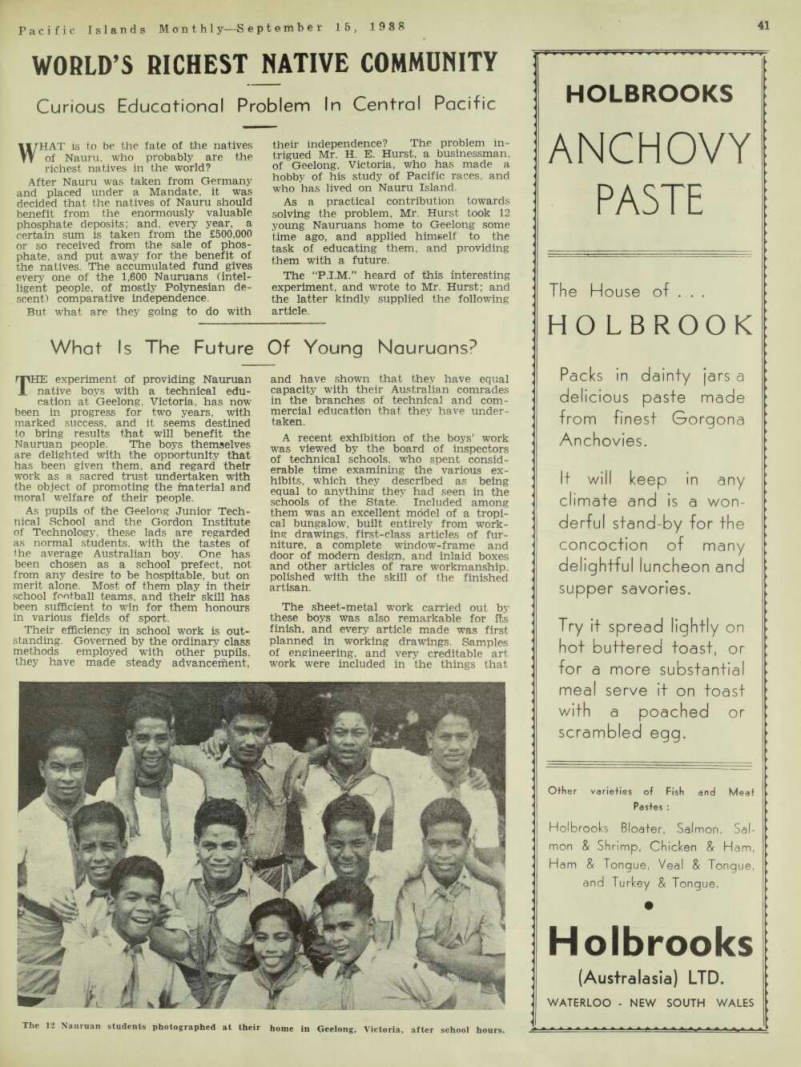
Curious Educational Problem In Central Pacific
WHAT is to be the fate of the natives of Nauru, who probably are the richest natives in the world?
After Nauru was taken from Germany and placed under a Mandate, it was decided that the natives of Nauru should benefit from the enormously valuable phosphate deposits; and. every year, a certain sum is taken from the £500,000 or so received from the sale of phos phate, and put away for the benefit of the natives. The accumulated fund gives every one of the 1,600 Nauruans (intel ligent people, of mostly Polynesian de scent) comparative independence.
But what are they going to do with
their independence? The problem in trigued Mr. H. E. Hurst, a businessman, of Geelong, Victoria, who has made a hobby of his study of Pacific races, and who has lived on Nauru Island.
As a practical contribution towards solving the problem, Mr. Hurst took 12 young Nauruans home to Geelong some time ago, and applied himself to the task of educating them, and providing them with a future.
The “P.1.M.” heard of this interesting experiment, and wrote to Mr. Hurst; and the latter kindly supplied the following article.
What Is The Future Of Young Nauruans?
THE experiment of providing Nauruan native bovs with a technical education at Geelong, Victoria, has now been in progress for two years, with marked success, and it seems destined to bring results that will benefit the
?hl e SS 8 '
are delighted with the opportunity that work as a sacred trust undertaken with m fqt p Pr nf m ?hTl5 and moral welfare of their people.
As pupils of the Geelong Junior Technical School and the Gordon Institute of Technology, these lads are regarded as normal students, with the tastes of the average Australian boy. One has been chosen as a school prefect, not from any desire to be hospitable, but on merit alone. Most of them play in their school football teams, and their skill has been sufficient to win for them honours in various fields of sport.
Their efficiency in school work is outstanding. Governed by the ordinary class methods employed with other pupils, they have made steady advancement,
and have shown that they have equal capacity with their Australian comrades in the branches of technical and com mercial education that they have under taken.
A reC ent exhibition of the boys’ work was viewed by the board of inspectors of technical schools, who spent consid erable time examining the various ex hlbits, which they described as being equal to anything they had seen in the schools of the State. Included among them was an excellent model of a tropi cal bungalow, built entirely from work intj drawings, first-class articles of fur niture. a complete window-frame and door of modern design, and inlaid boxes and other articles of rare workmanship, polished with the skill of the finished artisan, The sheet-metal work carried out by these boys was also remarkable for its finish, and every article made was first planned in working drawings. Samples of engineering, and very creditable art work were included in the things that
The 12 Nauruan students photographed at their home in Geelong, Victoria, after school hours.
the lads appear to have so completely mastered.
The experiment commenced two years ago, with seven Nauruan boys, five of whom are now filling positions of trust on their island with credit, and with no suggestion of being spoiled. In fact, they are setting a fine example to their fellow Nauruans, as tribute to their excellent character-training in Geelong.
I.t is impossible, in this short article, to describe fully the intricacies of the
whole experiment, which embraces a highly technical scheme of character development, j have sponsored the work at Geelong, an( j j have cons tructed suitable housing in S p ac i o us grounds at the rear of my h ome Here the boys live as close t 0 their own natural mode of life as is possible to do. They prepare their own mea i s i n a simple way, with food that will be obtainable on Nauru. They proceed to their school over a short,
well-defined route, in the company of a trusted European Scout. Outside this route is “out-of-bounds”, as is anything but the close precincts of their school.
On no account are they allowed to roam the streets or to move, excepting as a complete unit comprising all 12 boys.
They do not enter European homes, and never by any chance visit shops or en tertainments unless they are carefully guarded.
There are 12 boys in all, comprising two of the original seven, and 10 younger boys, who came to Geelong at the be ginning of this year. The older boys act as prefects, and they control the systems of working in an efficient manner.
Each boy will be trained to fill the requirements of the Administration of Nauru. All the five boys who completed their training last year are now usefully employed—two as wireless apprentices, one as a technical teacher, one as a works apprentice and one as a draftsman.
Two returned this year as prefects, and -one is now doing a splendid course of engineering, whilst the other is engaged in advanced wood-working and drafts manship. The remaining ten are at tending school in the ordinary way with the idea of determining for what they are best suited, and for which they will receive special instruction next year.
Crux Of The Problem
It should be remembered that there is no other territory quite like Nauru, where the enormously rich phosphate deposits are bringing wealth to a clever native people. As we have seen, educa tion there has reached the high standard which enables Nauruan boys to enter and more than hold their own in a large Australian school, and education is com pulsory for all boys and girls.
But what then? Comparatively few of the many products of Nauruan schools find employment, and it has been thought necessary to import Chinese and other Islanders to perform duties the Nauru ans should be able to accomplish. Long hours spent at school over the years rob them of inclination for their native arts and crafts, and life is without the pur pose that makes it worth while.
In any scheme of forced education, applied to the whole youth of a native community, it is inevitable that the critical time be reached when the boys and girls will be educated far in excess of their parents. The parent is reduced to a state of educational inferiority and becomes an object of pity in the eyes of the children. There is no parental control and no home discipline. As the natural restraint of custom and tradition has been destroyed, the moral fibre of the people is weakened.
This, it seems to me, is the stage of development reached at Nauru, and which presents a problem the Administration has yet to solve. An incentive to right thinking and right living has to be found, and the realisation of which finds its expression in the special character training now proceeding at Geelong.
Life in Nauru has always been a thing of ease. Day or night, through out the year, there is no need for any thing but the scantiest of clothing, and food there is in plenty for little or no exertion.
There was, however, some weak incen tive in the mere necessity to live. With the advent of easy money even that has passed away.
So it seems that the solution lies only in the possible provision of some nat ural motive for both physical and men tal exertion. The Geelong training aims
to provide such an incentive, by some form of recreational institution that will be controlled by the Nauruans and be so designed that all will desire to associate with it. So would be provided the re quired incentive; and, judging from re sults already achieved, it is more than a possibility.
Advertisements & other items, pp. 45-46 (3 items)
41
Pacific Islands Monthl y—S eptember 16, 1988
Anchovy
HOLBROOKS
PASTE
The House of . . .
HO LBROOK
Packs in dainty jars a delicious paste made from finest Gorgona Anchovies.
It will keep in any climate and is a wonderful stand-by for the concoction of many delightful luncheon and supper savories.
Try it spread lightly on hot buttered toast, or for a more substantial meal serve it on toast with a poached or scrambled egg.
Other varieties of Fish and Meat Pastes : Holbrooks Bloater. Salmon, Salmon & Shrimp, Chicken & Ham, Ham & Tongue, Veal & Tongue, and Turkey & Tongue. •
Holbrooks
(Australasia) LTD.
WATERLOO - NEW SOUTH WALES
painti
n
with
means painting to STAY / painted 1 ftP
rail
VTSI
m <ss*
(PREPARED)
“Keeps on Xeepikg on/”
AGENTS THROUGHOUT THE ISLANDS.
42
Pacific Islands Month! y—S eptcmher 15, 10 3 S
'Order Of The Crown
Of Tonga"
Letter to the Editor.
REFERRING to the article, “Germany and Tonga”, published in the May issue of the “P.1.M.”, in which the different Orders received by the Royal Family of Tonga were mentioned, I would like to add that H.M, King George Tubou 11., of Tonga, was the founder in 1913 of a Tongan decoration the “Order of the Crown of Tonga” (four classes).
The first consignment of 12 Orders (three of each class) were manufactur ed in Germany, and were 14ct. gold, hand enamelled. They arrived at Nu kualofa in April, 1914, and King George at once decorated himself with the “Order of the Crown of Tonga”, Class I. The following day H.M. Queen Takibui received the same Order, Class 1., and myself, as Chancellor, the Order of Class 111.
Before the King had any chance to bestow further decorations, news arrived in Tonga that Great Britain had de clared war on Germany, and that no further awards were to be made for the present.
King George died in December, 1918, and with him the “Order of the Crown of Tonga”.
I am, etc.,
F. T. Goedicke.
Haapai, Tonga.
August 2, 1938.
American Yachts At
Papeete
From Our Own Correspondent.
Papeete, Aug. 12.
THE yacht “Navigator”, with the owner and five guests on board, and com manded by Captain Frederick Kleb ingatt, arrived at Papeete in July, and. after a short visit, cleared for Hono lulu. Captain Klebingatt is well-known at Tahiti, having been chief mate of the old barkentine “S.N. Castle”, which voyaged between ’Frisco and Papeete during the early years of this century.
The “Navigator” was originally the pro perty of the late Captain L. A. Norris who, in 1925, won the trans-Pacific yacht race with the “Mariner”.
Another American yacht also arrived in July—the “Dwyn Wen” —having on board its owners, Mr. and Mrs. Eugene Overton, and three guests—Misses Re gina and Helene Claire and Mr. E. S.
Church. Mr. Overton, a distinguished barrister of Los Angeles, visited Tahiti 11 years ago on board the same yacht.
Howard Hughes, the American million aire sportsman, who recently flew around the world in record time, will shortly nroduce an aviation picture based on the life of the late Mrs. Amelia Ear hart Putpam, who disappeared in the Pacific during a world flight last year.
Katherine Hepburn is expected to play the principal part in the film.
Cool Hill Station
For New Caledonian Residents
IT is reported in the New Caledonia newspaper, “Bulletin du Commerce”, that the municipality of Noumea has voted a sum of 10,000 francs wherewith to initiate a plan for the establishment of a health resort on the low mountains in the interior of New Caledonia.
It is stated that the hill station that is planned will be in the region of Mt.
Coulee, at an altitude of about 3,000 ft. and that the road which will connect Noumea with the proposed station will follow a route that is picturesque and cool.
There are many mountain ranges in the interior of New Caledonia running up to 4.000 ft. and it is surprising that nothing has been done in the past to create a hill station of this kind—so necessary for European residents in a tropical country. The cool hill station is one of the features of life in the Dutch East Indies.
The annual Fiji Show will open at Suva on October 10.
Advertisements & other items, p. 47 (2 items)
43
Pacific Islands Mont hi y—S cptember 15, 19 3 8
Wundepiich
Timber, Joinery
ETC.
PREPARED BUILDINGS ready for erection a speciality.
SHIP AND BOAT BUILDING.
TIMBERS specially catered for.
FIBROLITE, PLYWOODS, GALVANISED
IRON.
CONSIGNMENTS shipped
by RETURN STEAMERS
to the Islands.
John W. Eaton
PTY. LTD.
WEST CRESCENT STREET
NORTH SYDNEY
Telephones: X 84051 (6 lines.)
Woven Wire for all Industry
COPRA DRYING TRAYS, FLOORS, Etc.
FRUIT DRYING TRAYS. MINING SCREENS
Heavy Mosquito Gauze In Phosphor Bronze and other Metals Impervious to Salt Sea Air WIRE DOOR MATS AND GENERAL WIRE WORKS
E. WRIGHT & CO. LTD.
Office nnd Work*: 148-162 Cleveland Street, Sydney, N.B.W.
Telegraphic Address: “Wrlghtmake,” Chippendale
BITUMENOID ROOFING
MADE IN AUSTRALIA.
Bitumenold Roofings, Dampcourse and Insulating Pelts are made from the world’s best raw materials. Warranted to stand the most rigid tests.
BITUMENOID THE BEST
Roofing, 1,2, 3-ply; Flooring, Waterproof Materials: Saturated Pelt; Resilient Road Jointing; Natural Asphalt Dampcourse; 2 and 3-ply Dampcourse; 1-2 lb. Lead-core Dampcourse; Roofing Cement; Asphalt Paints; Roofing Compound.
SAMPLES AND PRICE LISTS ON APPLICATION.
MAXWELL PORTER & SON LTD.
ESTABLISHED 1888. BUILDERS’ SUPPLIES.
107 REDFERN ST., REDFERN, SYDNEY. N.S.W. ’Phone: M 8157. Cables Bitumenoid.
WUNDEPIICH
; -jioiXmiofMira
yjjijljijlK-iHsjJ
■JssaggjEi
duratile
Those asbestos cement sheets give walls a tiled appearance at lets cost. See examples in our showrooms or write for leaflet.
WUNDERLICH LTD.
Crown & Cleveland Sts., Redfern, Sydney
REMEMBER THE NAME
C*«COI
Land "Titles”
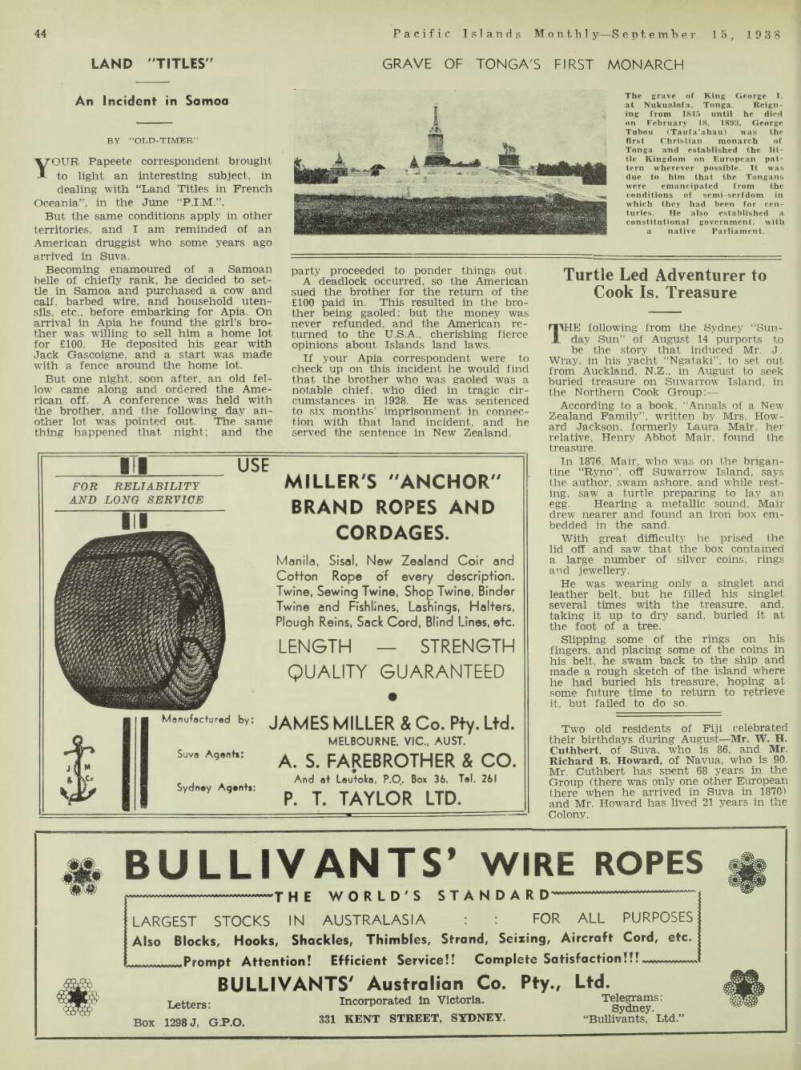
An Incident in Samoa
By ••Old-Timer'•
YOUR Papeete correspondent brought to light an interesting subject, in dealing with “Land Titles in French Oceania”, in the June ‘‘P.I.M.”.
But the same conditions apply in other territories, and I am reminded of an American druggist who some years ago arrived in Suva.
Becoming enamoured of a Samoan belle of chiefly rank, he decided to set tle in Samoa and purchased a cow and calf, barbed wire, and household uten sils. etc., before embarking for Apia. On arrival in Apia he found the girl’s bro ther was willing to sell him a home lot for £lOO. He deposited his gear with Jack Gascoigne, and a start was made with a fence around the home lot.
But one night, soon after, an old fel low came along and ordered the Ame rican off. A conference was held with the brother, and the following day an other lot was pointed out. The same thing happened that night; and the
party proceeded to ponder things out.
A deadlock occurred, so the American sued the brother for the return of the £lOO paid in. This resulted in the bro ther being gaoled: but the money was never refunded, and the American re turned to the U.S.A.. cherishing fierce opinions about Islands land laws.
If your Apia correspondent were to check up on this incident he would find that the brother who was gaoled was a notable chief, who died in tragic cir cumstances in 1928. He was sentenced to six months’ imprisonment in connec tion with that land incident, and he served the sentence in New Zealand.
Grave Of Tonga's First Monarch
The grave of King George I. at Nukualofa. Tonga. Reign ing from 1845 until he died on February 18, 1893, George Tubou (Taufa’ahau) was the first Christian monarch of Tonga and established the lit tle Kingdom on European pat tern wherever possible. It was due to him that the Tongans were emancipated from the conditions of semi-serfdom in which they had been for cen turies. He also established a constitutional government, with a native Parliament.
Turtle Led Adventurer to Cook Is
Cook Is. Treasure
THE following from the Sydney “Sun day Sun” of August 14 purports to be the story that induced Mr. J.
Wray, in his yacht “Ngataki”. to set out from Auckland, N.Z., in August to seek buried treasure on Suwarrow Island, in the Northern Cook Group:— According to a book. ‘‘Annals of a New Zealand Family”, written by Mrs, How ard Jackson, formerly Laura Mair, her relative. Henry Abbot Mair, found the treasure.
In 1876. Mair, who was on the brigan tine “Ryno”, off Suwarrow Island, says the author, swam ashore, and while rest ing. saw a turtle preparing to lay an egg. Hearing a metallic sound. Mair drew nearer and found an iron box em bedded in the sand.
With great difficulty he prised the lid off and saw that the box contained a large number of silver coins, rings and jewellery.
He was wearing only a singlet and leather belt, but he filled his singlet several times with the treasure, and. taking it up to dry sand, buried it at the foot of a tree.
Slipping some of the rings on his fingers, and placing some of the coins in his belt, he swam back to the ship and made a rough sketch of the island where he had buried his treasure, hoping at some future time to return to retrieve it. but failed to do so.
Two old residents of Fiji celebrated their birthdays during August—Mr. W. H.
Cuthbert. of Suva, who is 86, and Mr.
Richard B. Howard, of Navua, who is 90.
Mr. Cuthbert has snent 68 years in the Group (there was only one other European there when he arrived in Suva in 1870') and Mr. Howard has lived 21 years in the Colony.
Advertisements & other items, p. 48 (3 items)
44
Pacific Islands Monihl y—S eptember 18, 1938
Quality Guaranteed
11l
USE
RELIABILITY
LONG SERVICE
Manufactured by: Suva Agent*: Sydney Agent*:
MILLER'S "ANCHOR"
BRAND ROPES AND
CORDAGES.
Manila, Sisal, New Zealand Coir and Cotton Rope of every description.
Twine, Sewing Twine, Shop Twine, Binder Twine and Fishlines, Lashings, Halters, Plough Reins, Sack Cord, Blind Lines, etc.
LENGTH STRENGTH
QUALITY GUARANTEED
JAMES MILLER & Co. Pty. Ltd.
MELBOURNE, VIC., AUST.
A. S. FAREBROTHER & CO.
And at Lautolca, P.O. Box 36. Tel. 261
P. T. TAYLOR LTD.
BULLIVANTS’ wire ropes
THE WORLD'S STANDARD”"
LARGEST STOCKS IN AUSTRALASIA : : FOR ALL PURPOSES Also Blocks, Hooks, Shackles, Thimbles, Strand, Seizing, Aircraft Cord, etc. .Prompt Attention! Efficient Service!! Complete Satisfaction!!!
BULLIVANTS' Australian Co. Pty. f Ltd.
Letters:
Box 1298 J, G.P.O.
Incorporated In Victoria.
331 KENT STREET, SYDNEY.
Telegrams: Sydney.
“Bullivants, Ltd.”
Fiji Broadcast
Interest of Native Children
FIJIAN children who live in isolated places will go to surprising lengths to hear a radio programme.
Early in August an A.W.A. commun ity-type receiver was being taken on a tour of the more remote hill villages of Viti Levu. The officials concerned, with their pack horses and native bear ers, struggled over the muddy bridle paths, taking six hours to trek 10 miles between two villages, travelled in pour ing rain along paths made into quag mires by the pack horses. They crossed a mountain range, forded the flooded Wainamala River at least 20 times, and slipped and staggered along river flats head-high in Para grass.
Arrived at their destination, they in stalled their equipment and were hav ing a much-needed bath in the river when a host of Fijian children arrived, running over the trail that had taxed the party so sorely. They were from the school of the village the demonstra tors had left that morning; and, hav ing enjoyed the “Walesi” concert the night before, had followed the caravan to hear another entertainment. Aged from seven years, upwards, the child ren had set out after school hours at 3.30 p.m. and had run, slipped over and swum 10 miles of trail in less than three hours. They arrived singing, as only Fijian kiddies can sing.
The "Walesi” had an enthusiastic au dience that night, listening to the Suva station ZJV. Afterwards, the children slept around the intriguing box that had spoken to them in their own tongue— even mentioning their own names!
At dawn they disappeared into the river mists, for the journey back, in time for school.
EDITORIAL NOTE.—The introduc tion of radio to primitive communities —it is going on all over the world —will accelerate the pace of “Europeanisation”.
That is a pity: for already, the social problems created for Administrators by the rapid changes in environment and outlook are serious enough. However, nothing can be done about it —“progress” may not be checked. One can only hope that the Pacific administra tions will keep a close check over radio broadcasts designed for the native peo ples, and try to prevent, in their case, some of the deplorable effects seen as the result of uncontrolled or irrespon sible broadcasting elsewhere.
Blown Off Course: Two
Days Without Food
Prom Our Own Correspondent.
Rabaul. Aug. 27.
in the month, Mr. Jack Id Steiner, manager of Fead Islands Plantation, set out for the northerly island of the Group in a small pinnace.
Half way, he was struck by a violent storm which blew him right out of his course, and he had to make for New Britain. For two days he was without food before the coast was sighted. He then came on to Rabaul, where a week later he joined a schooner for the Fead Islands.
Dr. H. Bonney, Medical Officer at Port Moresby, Papua, who has been in Aus tralia recently spending leave, has ra~ signed from the Papuan Public Service.
Mission Ship "Duff"
IT has long been a matter of bewilder ment to me why Tahitians invariably call the L.M.S. missionary ship “Duff” by the name “Te Rapu”, writes a resident of Papeete. Normally the name “Duff” would become “Tufa” m Tahitian ton gues, and I could never understand how it could have become so alien a term as “Te Rapu”. The reason became plain when I read the story of its origin in Miss Teuira Henry’s book.
“On March 3, 1797, for the first time in •tihe records of Tahiti,, several earth quake shocks were felt and were accom panied with a high sea and a terrible storm, which greatly terrorized the inhabi tants. Early in the morning the first
shock took place, which drove the people out of their houses in confusion. At noon another occurred, which made them throw themselves pirostrate upon the ground and cry out for mercy to their gods. And at sunset a third shock caused many to hold night vigils, fearful that some awful calamity was at hand.
“On the following day, the 4th, there hove in sight the London Missionary Society’s ship “Duff”, to which the nat ives attributed the commotion, and in con sequence named it ‘Te Rapu’ (The Stir rer), a name they have always retained and have known it by no other. The good effect that the quake had upon the minds of the Tahitians towards the mis sionaries and their work was great.”
Advertisements & other items, p. 49 (1 item)
Tilley Lamps
Champion
Outboard Motors
2-9 HP.
1-9 M.P.H.
New light outboards weighing only 31 lbs., yet heavy and powerful enough for the unexpected hard going.
Champions are fitted with full float carburettor with idling Jet ensuring maximum performance at all speeds. No vibration, little noise, easy starting, and economical.
More Horse Power at less cost.
Price only £l9/10/- (ex bond.)
Tilley Lamps
BRITISH MADE KEROSENE LAMPS, pro-
viding 300 to 500 C.P. clear, steady light. All TILLEY LAMPS are completely insect proof. Use only one mantle which is supported top and bottom and will not shake off. English Pyrex Globes.
Eleven Models, including Wall Lamps (illustrated), Table Lamps, Hanging Lamps, Storm Lanterns, etc.
Write for Catalogue. \
Renta
Marine Engines
Quality, precision-built Engines for all Boats up to yu ft. in length. For Petrol, Kerosene or Heavy Oil All Engines equipped wlh full Reverse Gears, force feed lubrication, and built for Marine work only.
Prices complete from £45.
Write for Catalogue, stating Horse Power required.
We have large and complete stocks of Shipchandlery and Mining Gear. Boat fittings of all descriptions manufactured in our own marine foundry.
We are manufacturers of the well known "Pioneer” brand Ash Oars and Tool Handles.
Write for free catalogue of any line which may interest you.
W. KOPSEN
Gr Co. Pty. Ltd.,
ESTABLISHED 1878
70 CLARENCE STREET,
SYDNEY
CABLES: KOPSEN, SYDNEY.
"Maunganui" Tourists
Miss Samoa
From Our Own Correspondent.
Apia, Aug. 17.
THE Union S.S. Co.’s tourist cruiser “Maunganui”, arrived at Apia on August 5, with 300 tourists. Owing to a solitary case of measles on board, which was detected after the ship had left New Zealand she was strictly quarantined at Apia. None of the pass engers or crew was allowed on shore.
There had been no quarantine at Tonga and there was none in Fiji, the next port of call. It is reported that the quarantine here was imposed at the request of the Mau. The loss occasion ed by the tourists not coming ashore was estimated to be about £1,0D0.
Medical Care Of
N.H. Natives
Credit to Administration or Missions?
Letter to the Editor.
REV. MR. NOTTAGE has taken ex ception to some of my remarks in my reply to Miss Cheeseman con cerning Mr. Harrisson’s book, “Savage Civilisation”. He sees in it something that is not there, to wit, a comparison of work done by the missions with that done by planters and traders, and others.
I can assure him nothing was farther from my intention and I know the more experienced missionaries never thought so, either. I was protesting against an incorrect statement in Mr. Harrisson’s book. To do this by making other in correct comparisons would be absurd.
All I wished to do was to correct a mis statement and to give credit where cre dit was due. As Mr. Nottage admits that planters and traders do their some thing towards the health and well-being of the natives, by his admission he shows
that I was justified in my protests.
Mr. Nottage is rather stingy in giving any credit at all to the Administration; and the Rockefeller Foundation is cer tainly due for very much more than he concedes. None of us can say that the Administration does as much as it should, or could, either as regards pre vention or treatment, but it does con siderably more than Mr. Nottage is pre pared to admit, and no good cause is served by belittling what is done. He seems to be ignorant of the fact that the Administration pays the few N.M.P.’s we have, and for the periodi cal rounds of injections of N.A.B. and hookworm treatment. Both the French and British hospitals are subsidised—, not very liberally, certainly—for treating the natives. On the islands of Malexula and Santo, as well as in Vila, the French hospitals and medical men attend to quite large numbers of natives.
Mr. Nottage has a just grievance re garding the sentence, ‘*And what of the much-abused Condominium who supply the drugs used by the missions?” This is incorrect, and I know it is incorrect, as I have discussed the matter with mis sionaries of more than one sect, and knew they paid for the drugs, and what the principal drug cost them —and, in cidentally, the cost is very much less than what the planters, who get then drugs from Australia, pay. The clause has got mixed up in transcription, prob ably from the draft to the copy sent to the Editor of the “P.1.M.” In the draft it reads: “And what of the much abused Condominium, and what of the Rockefeller Foundation who make avail able the principal drug used by the mis sionaries”. I regret this error which is due to carelessness and not to delibera tion.
Outside this clause, what I said, in ef fect, was that planters and traders paid for drugs, in the highest market, from their own personal pockets, whereas the missions, being corporate bodies, paid for them out of mission funds. As Mr. Not tage says, there are missionaries who also pay out of their own pockets. I believe him, and give them credit for it.
As I have pointed out, the point I wished to emphasise was, that it was not by any means fair or correct to say that the missionaries were the only ones who did anything for the natives.
Concerning Mr. Nottage’s last para graph, I can only say that I had the same authority to assert what I did as he had to deny it, and from what I have been told since, by missionaries, more justification.
I am, etc.,
Ewan Corlette.
Bushman’s Bay, Malekula, N.H.
August 10, 1938.
Dr. C. Cooke, of the Bernice P. Bishop Museum, Honolulu, recently carried out scientific work in connection with land shells in Fiji on behalf of the Museum.
Mr, George Fear arrived in New Zealand from Norfolk Island by the K.P.M. liner “Tasman” in August, to settle down in the Dominion. He was for 13 years a well known resident of N.I. and at one time was a member of the Executive Council.
Mr. E. E. Jenkins, LL.B., M.A. (Cantab.), has been appointed Attorney-General in Fiji. Joining the Nyasaland Service, British Central Africa, in 1925, he ser ved for two years before being transferred to Northern Rhodesia, where he acted in various capacities includingl Acting Attorney-General and Solicitor General.
Advertisements & other items, p. 50 (2 items)
46
Pacific Islands Monthl y—? September 15, 19 8 S
Limewashing And
WANTED
Regular supplies of Used Pacific Island stamps. All Coronations, Jubilees, Airmails and ordinary issues wanted. Best prices paid. Submit stamps or details to:
W. HORNADGE,
Catherine Hill Bay, N.S.W., Australia.
The Most Extensive Manufacturers in the British Empire of
RUBBER STAMPS,
INKS, STENCILS,
Marking Devices,
ACME STAMP PADS
OFFICE a STATIONERY SUPPLIES
(o II I is We also Manufacture & Supply a Complete Line of
LIMEWASHING AND
SPRAYING MACHINES
for all purposes.
Let us know your requirements and we will quote by return.
WRITE FOR OUR GENERAL CATALOGUE
Limewashing Machine
EXCELSIOR SUPPLY CO. PTY. LTD.
278 Post Office Place,
MELBOURNE, VIC.
HEAD OFFICE :
160 BROADWAY, I 50 Victoria Street, Formerly known as George St., West, I WELLINGTON NZ
SYDNEY, N.S.W. I
Years Of Plenty
Before Twilight Engulfed the Tuamotus
From Our Own Correspondent.
Papeete, Aug. 16.
THE long barrier of reefs and atolls, to the east of Tahiti, called the Tua motu Archipelago, has been for nearly a century the Golconda, the Cathay of Kubla Khan, and the Fafner’s Cave of the South Pacific. With its treasures of pearls, pearl-shell, and copra on a hundred isles, and misty tales of buried Inca gold, this group has been the lode star of every South Seas trader since the first adventurer sailed these waters.
In practice, the figurative likeness to the Cave of Fafner has, through the years, proved the most appropriate: for the dragon within the cavern has taken far more than it has relinquished. Fleets of argosies have been shattered and ground to fragments on the sharp teeth of its merciless jaws; while their cargoes have disappeared forever into its insatiable maw. Every ship navigating the Tua motus eventually leaves its bones on one of the reefs of those treacherous seas.
If rumour be founded in fact, enough treasure (in the form of merchandise and coin of the realm) has been swallowed up beyond recovery if! commerce with the Inhabitants, to encrust the circles of several atolls with a blazing mosaic of emeralds, sapphires, and pigeon-blood rubies.
In the days when copra, pearls, and pearl-shell were of high value, the Tua motu native lived sumptuously. His table groaned under the weight of ample sup plies of luxuries brought in tins from far countries. His women folk were clad in fine raiment and their fingers and ear lobes glittered with jewellery.
If his requirements exceeded his pre sent resources, there were always at hand men inspired by optimism and a lively expectation of favours to come, eager to provide for his future.
The most generous of these, and cer tainly the most spectacular, was a com pany of optimists who descended on the Tuamotus from the United SGates of America, in the early 1920’5. Their trea sury apeared to be inexhaustible. Buildings were built, stations established. The seas of Oceania became populous with their power schooners. Foodstuffs, wares, and com of the realm were dispensed with lavish hands.
During this period the Tuamotu native abided in the seventh paradise of Tane- Ahu-Ura (Tane of the Red Feather Mantle), the Sun God of his ancestors.
The very atmosphere/ above the atolls glowed perpetually with a pink radiance.
What was the sum of the tribute left by these adventurers at the Cave of Fafner is Imown only to the grim-faced emis saries of soul-less money changers who eventually seized the property of the com pany in the States and abroad.
As in many another land, twilight now broods over the Tuamotu coral isles.
Whether it be the twilight of evening or the dawn, time alone will reveal.
The native of the atolls has returned to the ways of his forebears for a season; but memory and his experience with the undying optimism in the heart of man. encourages him in the belief that the glimmerings of light come from the East— or, rather, from the North-East.
A Valuable Anthropological
Record
MOST of the more valuable anthropo logical and ethnographical records in the world have been compiled by painstaking men, who during the past 200 years, have gone out among primitive races as Christian missionaries. Nowa days there is not much work of that kind left to be done; but there still are primi tive untouched races in New Guinea and. in that connection, a most valuable record has been compiled by Rev. John Frederick Mager, a missionary attached to the Lutheran Mission, Madang, T.N.G. Mr.
Mager calls his brochure “Education and Social Change in a New Guinea Society”: and in it he places on record notes and observations made during many years’
work in the interior of the mainland of New Guinea.
Mr. Mager, like all missionaries of vision, is deeply concerned about the effect of the introduction of European civilisation to the primitive races of New Guinea, and he examines the problem from all angles. Other anthropologists may not agree with his conclusions, but everyone will feel grateful to him for the mass of material which he has assembled and co-ordinated. This primitive country is being so rapidly penetrated by European influences that, within a few short years, native customs will have been altered and primitive social structures profoundly changed.
Mr. A. H. Dennc, of the N.Z. Education Department, recently carried out the annual inspection of Fiji schools.
Advertisements & other items, p. 51 (2 items)
47
Pacific Islands Montlil y—S eptembe 1* 15, 1038
B.P. Magazine
BP
READ THE
SPR[ NG NUMB ER
Now on Sale Short Stories Pictures Travel Articles Pages for the Children Stage Latest Fashions Screen A
ONE SHILLING PER COPY
ON SALE AT ALL NEWSAGENTS AND BOOKSELLERS
“FAIRHOLME”, Mountain School for Girls
t
iP^sN 1
V* m A pn V. ... % ?
Aerial View of Grounds and Buildings.
PRESBYTERIAN GIRLS’ COLLEGE, TOOWOOMBA, Q LAND.
2,000 feet above sea level. Unrivalled Climate. Academic, Home Science and Commercial Courses. Tennis, Swimming, Organised Games.
Principal; Miss D. E. CULPIN, B.A.
For Prospectus apply Secretary :-R. T. PHELPS, F.A.A., TOOWOOMBA, QLD.
Kauri From New Caledonia
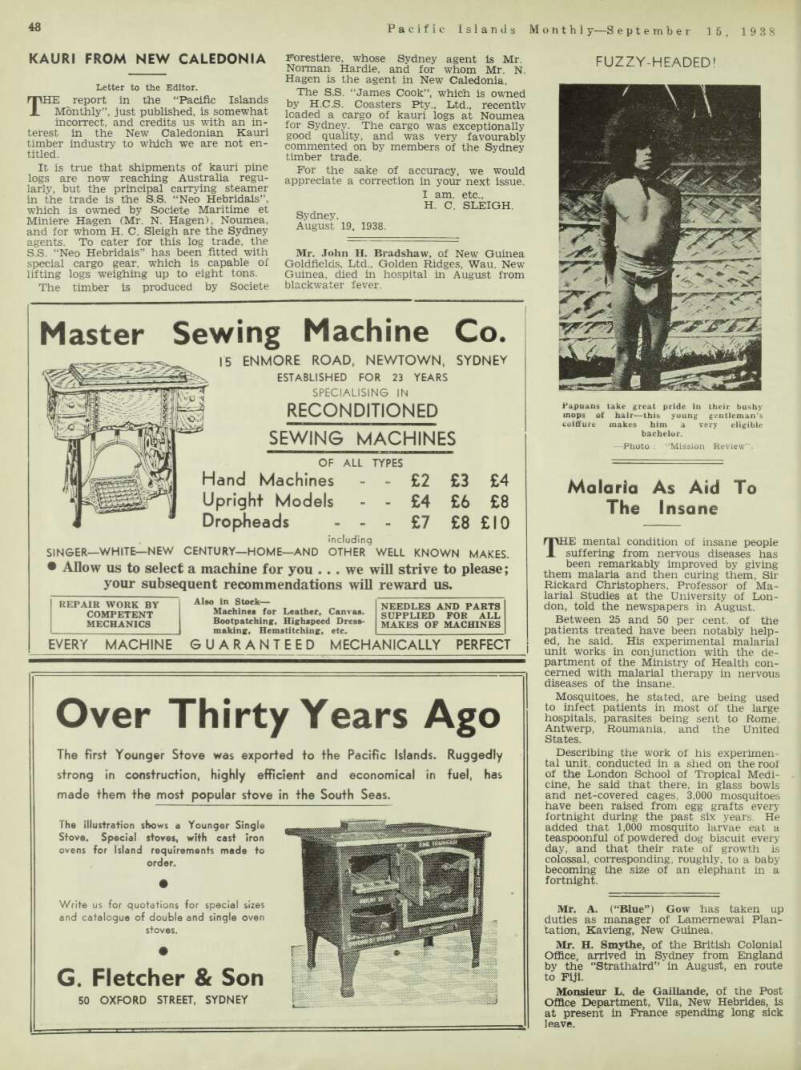
Letter to the Editor.
THE report in the “Pacific Islands Monthly”, just published, is somewhat incorrect, and credits us with an in terest in the New Caledonian Kauri timber industry to which we are not en titled.
It is true that shipments of kauri pine logs are now reaching Australia regu larly, but the principal carrying steamer in the trade is the S.S. “Neo Hebridais’’, which is owned by Societe Maritime et Miniere Hagen (Mr. N. Hagen), Noumea, and for whom H. C. Sleigh are the Sydney agents. To cater for this log trade, the S.S. “Neo Hebridais” has been fitted with special cargo gear, which is capable of lifting logs weighing up to eight tons.
The timber is produced by Societe
Forestiere, whose Sydney agent is Mr.
Norman Hardie, and for whom Mr. N.
Hagen is the agent in New Caledonia.
The S.S. “James Cook”, which is owned by H.C.S. Coasters Pty., Ltd., recentlv leaded a cargo of kauri logs at Noumea for Sydney. The cargo was exceptionally good quality, and was very favourably commented on by members of the Sydney timber trade.
For the sake of accuracy, we would appreciate a correction in your next issue.
I am. etc.,
H. C. Sleigh.
Sydney, August 19. 1938.
Mr. John H. Bradshaw, of New Guinea Goldfields, Ltd., Golden Ridges, Wau, New Guinea, died in hospital in August from blackwater fever.
Advertisements & other items, p. 52 (1 item)
Fuzzy-Headed!
Papuans take great pride in their bushy mops of hair—this young gentleman’s coiffure makes him a very eligible bachelor. —Photo : "Mission Review".
The Insane
Malaria As Aid To The Insane
r[E mental condition of insane people suffering from nervous diseases has been remarkably improved by giving them malaria and then curing them, Sir Rickard Christophers, Professor of Ma larial Studies at the University of Lon don, told the newspapers in August.
Between 25 and 50 per cent, of the patients treated have been notably help ed, he said. His experimental malarial unit works in conjunction with the de partment of the Ministry of Health con cerned with malarial therapy in nervous diseases of the insane.
Mosquitoes, he stated, are being used to infect patients in most of the large hospitals, parasites being sent to Rome.
Antwerp, Roumania, and the United States.
Describing the work of his experimen tal unit, conducted in a shed on the roof of the London School of Tropical Medi cine, he said that there, in glass bowls and net-covered cages, 3,000 mosquitoes have been raised from egg grafts every fortnight during the past six years. He added that 1,000 mosquito larvae eat a teaspoonful of powdered dog biscuit every day, and that their rate of growth is colossal, corresponding, roughly, to a baby becoming the size of an elephant in a fortnight.
Mr. A. (“Blue”) Gow has taken up duties as manager of Lamemewai Plan tation, Kavieng, New Guinea.
Mr. H. Smythe, of the British Colonial Office, arrived in Sydney from England by the “Strathaird” in August, en route to Fiji.
Monsieur L. de Gaillande, of the Post Office Department, Vila, New Hebrides, is at present in France spending long sick leave.
Advertisements & other items, pp. 52-53 (4 items)
48
Pacific Islands Monthl y—S eptember 15, 1938
Over Thirty Years Ago
Master Sewing Machine Co.
15 ENMORE ROAD, NEWTOWN, SYDNEY
ESTABLISHED FOR 23 YEARS
SPECIALISING IN
RECONDITIONED
SEWING MACHINES
OF ALL TYPES
Hand Machines - - £2 £3 £4 Upright Models - - £4 £6 £8 Dropheads - - - £7 £8 £lO including
SINGER—WHITE—NEW CENTURY—HOME—AND OTHER WELL KNOWN MAKES.
• Allow us to select a machine for you ... we will strive to please; your subsequent recommendations will reward us. \Vo o Also in Stock— Machines for Leather, Canvas.
Bootpatching, Highspeed Dressmaking, Hemstitching, etc.
EVERY MACHINE GUARANTEED MECHANICALLY PERFECT
NEEDLES AND PARTS
SUPPLIED FOR ALL
MAKES OF MACHINES
REPAIR WORK BY
COMPETENT
MECHANICS
Over Thirty Years Ago
The first Younger Stove was exported to the Pacific Islands. Ruggedly strong in construction, highly efficient and economical in fuel, has made them the most popular stove in the South Seas.
The illustration shows a Younger Single Stove. Special stoves, with cast iron ovens for Island requirements made to order. • Write us for quotations for special sizes and catalogue of double and single oven stoves. •
G. Fletcher & Son
50 OXFORD STREET. SYDNEY
r
49
Pacific Islands Monthl y—S eptember 15, 1938
Reccmans
For Quality Goods at Low Prices
ESTABLISHED SINCE 1905
165-167 Castlereagh St., Sydney, N.S.W.
Powerful Field Glasses.
Extra-powerful Field Glasses, centre complete in case focus, 21/-.
“Lumlere” Paris, High-power, Field Glasses, centre focus, with case and strap . .. 30/-.
Extra High-power, Marine Glasses, day and night use, centre focus, in case . .. 45/-.
French “Prisma” Field Glasses, large eyepieces, 6X, wide vision. With strap and leather case 55/- “Carlmere” Field Glasses, with sun shield. extra powerful, in case 50/- “Carlex” 8 x 25 Binocular Field Glasses, extra powerful, centre focus, with shoulder strap, In solid leather case, suitable for races, marine or field use £4/15/-.
“Delmar” 8 x 25 Prismatic Binocular Field Glasses, wide range, centre focus, with strap and solid leather case £4/19/6.
“Achromatic” Field Glasses. War Office model, extra powerful, wide range, complete with shoulder strap. In solid leather case £ 3/15/-/.
“Audemair”, 8 x 30 Prismatic Field Glasses, extra-wide optics, central and individual focus, complete with strap and case, £6/10/- Postage Paid on all Field Glass Orders.
Bicycles.
Good Strong Bicycles, slightly used, fixed or free wheel, with brake, in good order 45/-.
Gent’s Roadster Bicycle, free wheel, electric dynamo and lamp, handbrake, good tyres and tubes, slightly used: £B/15/-.
“Speedwell” Bicycle, Club-racer, brazed on back stays, free wheel, t a pered frame, hand - brake, slightly use d £4/19/6 Brand-new Gent’s “Oxford” Special Roadster Bicycle.
Equipment: Brake, lamp, tools, free wheel .. £5/19/6.
Lady’s brand new “Oxford” Special Cycle, fitted with free wheel, dress nets, chain guard, mud spring top saddle and handbrake. All English fittings throughout A variety of colors. At the amazing price of £6/19/6.
Gent’s Brand-new Oxford” Club-racer Bicycle, fully tapered frame and forks, brazedon seat stays. Equipment; “Pitz” H/bars, side-pull brake, doubl-slded hub, Endrlck rims, “Dunlop” black and white tyres, speedo. Complete Cycle £B/19/6.
L
Jewellery Specials.
Gent’s Modern Shape “Starlex” Chrome Wrist Watches; Jewelled lever movement, luminous dial, leather strap 19/6.
Men's Latest Square-shaped “York” Lever Wrist Watches; 15 Jewelled movement.
Chrome Link Band 39/6.
Gent’s Chrome 7-Jewelled Lever Watches, on leather band . 29/6.
Men’s 10-year Guaranteed Gold-filled Wrist Watches; 15 Jewels, 5 adjustments, very latest smart shapes 45/-.
Gent’s Solid Gold-filled Wrist Watches, modern shapes, 15 Jewelled movement, luminous dial, leather band, complete with presentation case 55/-.
“Fenchurch” Solid gold-filled Gent’s Wrist Watches, latest square shape. 15 Jewelled, shock-absorber movement, latest modern dial, Rolled-gold Link Band, complete with presentation case £4/15/-.
Lady’s Chrome Wrist Watches, latest miniature shapes, on chrome link band . 39/6.
Lady’s 9ct. Gold Wrist Watches, ultra smart shapes, 17 Jewelled movement, 5 adjustments, 44 hr. time-keepers’ 59/6.
Lady’s Solid Chrome Wrist Watches, brilliant studded bezel, dainty baguette shapes, complete with double-rope moire wristband, with presentation case 75/-.
Chrom. STOP WATCHES. Swiss made. 1-5.
“Floretta” Levers, Guaranteed accurate racing Time Pieces 27/6.
Postage Paid on all Jewellery Orders.
Musical Instruments.
Ukeleles: Complete with set of strings, Free Tutor 10/6.
Steel Guitars, beautiful tone. Free Tutor, 35/- “Harmony” Guitars, beautiful tone, nicely finished. Free Tutor £3/19/6 “Harmony” Guitars, professional model, pearl position dots, beautiful finish and tone.
With Free Tutor £6/6/-.
Guitar Cases, 19/6. Set of Picks, Steels, 4/6 per set.
High-grade “Valencia” Accordeons, brand new, all steel bronze reeds, nickel protected bellows, ebonised frames, good value, magnificent tone, 2 stop 25/- 3 stop 35/- English Banjo Manodlins, 6 brackets, complete with case, tutor 37/6 English Banjo Mandolins, 8 brackets, complete with case, tutor 50/-
Typewriter Bargains.
Slightly used.
Corona, 3-Bank, Portable Typewriters, in case, perfect order £5/19/6.
Corona, 4-Bank. Portable Typewriters, In case, perfect order £B/15/-.
Remington 4-Bank Portable Typewriters, In case, perfect order £B/15/-.
“Royal” Portable Typewriter, 4 bank, in case, perfect order £lO/10/-.
Sporting Goods.
GOLF SETS.
"J, A. Kirkwood’’ Hickory Shaft Matched Golf Sets; special rustless heads made Id Scotland, including mid-iron, mashie, putter and brassle-drlver, in leather mounted waterproof canvas bag 48/6. *‘.f A. Kirkwood" Steel Shaft Matched Golf Sets: latest heavy ridged back design, rustless heads made in Scotland, including midiron, mashie, putter and brassle-driver, in leather mounted waterproof canvas bag. 69/6.
CHAS. CAMPBELL, our well known golf professional and ex-open champion of Australia. will select your Golf Clubs. His advice is yours free of charge
WE STOCK EVERYTHING. WRITE FOE
YOUR REQUIREMENTS. GOODS FOR-
WARDED V.P.P. OR SIGHTDRAFT.
SERVICE AND SATISFACTION GUAR-
ANTEED. PLEASE ADD FREIGHT. ALL
PACKING FREE.
Saddlery.
We specialise in High-grade Saddles made of best quality materials t h r o u ghout.
Strong guaranteed trees and first class workmanship.
All metal work guaranteed Solid Brass.
Strong High-grade Saddles in Stock, Kemp or Poiey styles. Strong guaranteed trees, narrow grip, firm pads, best quality flaps and skirts mounted with leathers, girth, & 3-bar N.P. Irons £3/19/6 High-grade Station Saddles, in Kemp or Poiey styles, deep comfortable kip seat, narrow grip, wide leather facings at back, strong firm pads, extra long kip flaps and skirts, mounted with leathers, girth, and 3bar N.P. irons £4/19/6.
Very Fine High-grade Super Station Stock Saddles, built on strongly plated, guaranteed trees, deep comfortable hogskln seat, with 4V2 in. dip, narrow, grip, wide leather facings at back, very firm 5Va In. strong capped pads, raised thigh pads, extended leather points, extra long flaps and skirts made of long wearing flexible kip, mounted with bevelled leathers, girth, and 4-bar N.P. irons £6/19/6.
SPECIAL SADDLES MADE TO ORDER.
FREEMANS
FOR PROMPT SERVICE
and
HONEST VALUE.
165-167 Castlereagh Street, SYDNEY, New South Wales.
Copra Tax Suspended
From Our Own Correspondent,
Rarotonga, Aug. 17.
OWING to the low price ruling for copra, the export tax of £1 per ton from the Cook Islands has been suspended from July 22. , This will materially assist the native producers in the Northern Cooks, where they are dependent on copra alone.
Professor L. C. Graton, of the Univer sity of Harvard, U.S.A., recently arrived in New Caledonia to carry out a geological survey for the International Nickel Co., of Canada.
The Thriftless
Polynesian
A Problem in Tahiti
From Our Own Correspondent.
Papeete, Aug. 16.
SINCE the virtue of Thrift—together with many of the other virtues ac quired by our ancestors in the course of their long climb from the stone age to the Age of Stainless Steel and T.N.T. —has largely been jettisoned by that cos mos we euphemistically call Civilisation, Nordic mankind has taken another step toward the Polynesian Utopia that has been the dream of romanticists since the publication of Bougainville’s ecstatic praises of Nouvelle Cythere.
It would appear, therefore, that Poly nesia has set the fashion for modern financial ideology, as has Ashanti for present-day Art. and the Portala at Lhassa for Architecture.
In the Polynesian mind there is no comprehension of thrift. In the lan
guage exists no word which remotely ap proximates its meaning.
There was, indeed, a time when Tahi tians regarded the lands, descended to them from their ancestors, as a sacred trust; to be guarded and passed on, undiminished, to their progeny. But, that was during an age when there still survived a reverence for and an obli gation to ancestral custom. These, to day, have gone with the wind; as have the traditions, poetry and manners of the old culture. The average native of contemporary generations takes no thought whatsoever of the morrow.
If the value of his land will bring him a motor car, unnumbered admissions to the cinema, and a general good time, ancestral inhibitions and the fate of pos terity are cast into the depths of the sea outside the barrier reef, and he quaffs deeply of the joys of the present.
Already the shore property on the north and east coasts of Tahiti has pass ed into the hands of Europeans, and the former owners have retired to their diminished acres, situated under the coastal hills and in the valleys. The Government has taken measures, by salutary laws, to protect the native against himself; but wise regulations cannot prevent a landowner from mort gaging his property, squandering the proceeds, and eventually becoming dis possessed by foreclosure.
The economic future of the native on Tahiti is not promising, if this sort of thing continues.
Raiatea is somewhat in the same state, combined with inter-family land quar rels, which would require the delibera tions of a college of barristers to straighten out.
The mental attitude toward all of this, on the part of the younger natives, is “Aita Peapea”—which, freely translated, signifies: “Let the morrow take care of the things of the morrow”.
EDITORIAL NOTE: Pacific Islands administrators generally will find this ar gument a little difficult to follow. There need be no mortgage, foreclosure and permanent loss by natives of their lands if the native title to land is regarded by the Government as inalienable. That has been the basic principle of admin istration, for a long time, in most Paci fic territories controlled by British coun tries. Ignorant or thriftless natives may not be capable of holding land; but, in that event, the Government takes it over, as a trustee, and leases it to those who can use it profitably. But the land remains always the property of the in digenous natives, and the rentals are applied for their benefit. The titles to much land were obtained from the na tives. however, in the early days, be fore there was established government.
calmly.
Papuan Executed
From Our Own Correspondent.
Pt. Moresby, Aug. 17.
KARO, the Papuan who was sentenced to death for the murder of a native warder. Ume, was executed at 8 o’clock on August 8 at the Badili Gaol.
A large number of natives gathered on the outskirts of the gaol, and there was every indication that they fully realis ed the seriousness of the occasion.
The condemned man, attended by Rev.
Fathers McEncroe and Flynn, walked firmly to the gallows and met his death
calmly.
Advertisements & other items, p. 54 (2 items)
50
Pacific Islands Monthl y— S ep t ember 15, 1938
Sao Biscuits
25 YEARS OF SERVICE
William E. Reed
(Established 1913)
BROKER & AGENT
Union House. 247 George St.. Sydney For all Plantation and Trading Requirements. Enquiries welcome.
OFTEN BUTTERED
NEVER BETTERED
Crisp, light biscuits which bring out the flavour of cheese and add a new attractiveness to fresh or stewed fruit.
A delicious supplement to ham or paste or other tasty savoury, and still an epicurean delight served simply with fresh butter.
At home on cold nights butter the "Saos," grate a little cheese over them, and then sprinkle with cayenne pepper one minute in a hot oven and serve hot.
FAMOUS
SAO BISCUITS
A 2 6 ALWAYS ASK YOUR GROCER FOR ARNOTTS !
On Nauru?
What Is Wrong
Morale of Native Constabulary
Letter to the Editor.
THE statement in the “Pacific Islands Monthly", that Commander Garsia has retired from the post of Admin istrator because Australia refuses to support him in his wish to provide pro tection for the Europeans against a pos sible uprising by the Chinese, is ridicu lous on the face of it. It also reflects quite unfairly upon that fine body of men, the Nauruan Native Constabulary.
As one who knows Nauru and the con ditions intimately, I can tell you that the trouble is different from that stated, and goes far deeper.
Ask why two of the most skilled and highly-respected public servants in Nauru have been forced out; and why the na tive chiefs have begged Canberra for the temporary appointment, as Adminis trator. of General Griffiths. (General Griffiths is a former Administrator, whom they loved and trusted).
Any supposed fear of the inoffensive, law-abiding, Chinese coolies, so well cared for and controlled by the British Phosphate Commission, is incomprehen sible. Were this the reason of the re tirement of Commander Garsia it could only mean that he has lost faith in a hitherto proud police force, which has proved itself over and over again, dur ing previous administrations—a police force not without tradition and which, during the term of Administrator W. A.
Newman, with the greatest bravery, quelled a “Tong” riot among these Chinese coolies. Such an admission on the part of Commander Garsia would cast such an unfavourable light on his own methods of administration that one is loth to believe It.
The 44 police who comprise the "Nau ruan Armed Constabulary, with their strong reserves of men and arms (in cluding machine guns) is more than suf ficient to police effectually the small communitv on Nauru, even allowing for the well-disciplined 1.200 Chinese cool ies.
Their skill in the use of these arms, however, mieht reasonably be question ed. That could be easily rectified bv a reversion to the rifle shooting practice, encouraged by Administrators Griffiths and Newman, but not indulged in un der Commander Garsia.
The recent introduction of about a dozen police-boys from the Ellice Islands, contrary to the wishes of the Nauruan Chiefs and the Nauruan people, cer tainly suggests a marked loss in the morale of the police force of Nauru.
Such an insidious suggestion as the ne cessity for arming Europeans, after
about 17 years of Australian control and direction, is not calculated to improve it.
Should this be so, and if Australia’s undertaking to the League of Nations is more than cant and hypocrisy, the obvious course to pursue would be to ob tain the services of a man, such as those who direct the fine native police of New Guinea and Papua, to restore the Nau ruan Constabulary to the proud position it once occupied. Then we would hear no more of such suggestions as that attributed to Commander Garsia; and which, if made, the Commonwealth Gov ernment has very rightly turned down.
I am, etc.,
Nauruan.
Melbourne, August 23. 1938.
Cruising Yachts
From Our Own Correspondent.
Port Moresby. Aug. 16.
TWO small vessels have arrived in Port Moresby—the “Destiny” (13 tons) and the “Aurora” (16 tons). Both came from Sydney via Queensland ports, though the “Aurora” hails from Auckland. N.Z.
The “Destiny” is manned by her owners.
Messrs. Stan and Jack Grimson. and the “Aurora” is in charge of Mr. H. E. Terry, who has his wife and son on board Both vessels leave shortly for New Guinea.
Advertisements & other items, p. 55 (2 items)
51
Pacific Islands Monthl y—S eptember 15, 1938
Anchor Flour
H.JONES &C 0
AUSTRALIA’S BEST
H. JONti & CO., LID.
Darlington, Sydnoy Hobart, T«s.
ANCHOR FLOUR
THE STANDARD OF QUALITY
m
GILLESPIE BROS. PTY. LTD.
SYDNEY - AUSTRALIA
Telephones : MJ 4657 f 4 lines) and M 2585 Cable Address ! "Vichy," Sydney
379 KENT STREET, SYDNEY
of all Islands requirements on Commission Original Invoices Furnished. 22 Years Islands Trade Experience.
JSLANDS Produce Sold on Shippers’ Account Liberal Advances against Consignments.
Bankers: Bank of New South Wales. CORRESPONDENCE IN ENGLISH, FRENCH AND GERMAN
Royal Pomare Family, Of
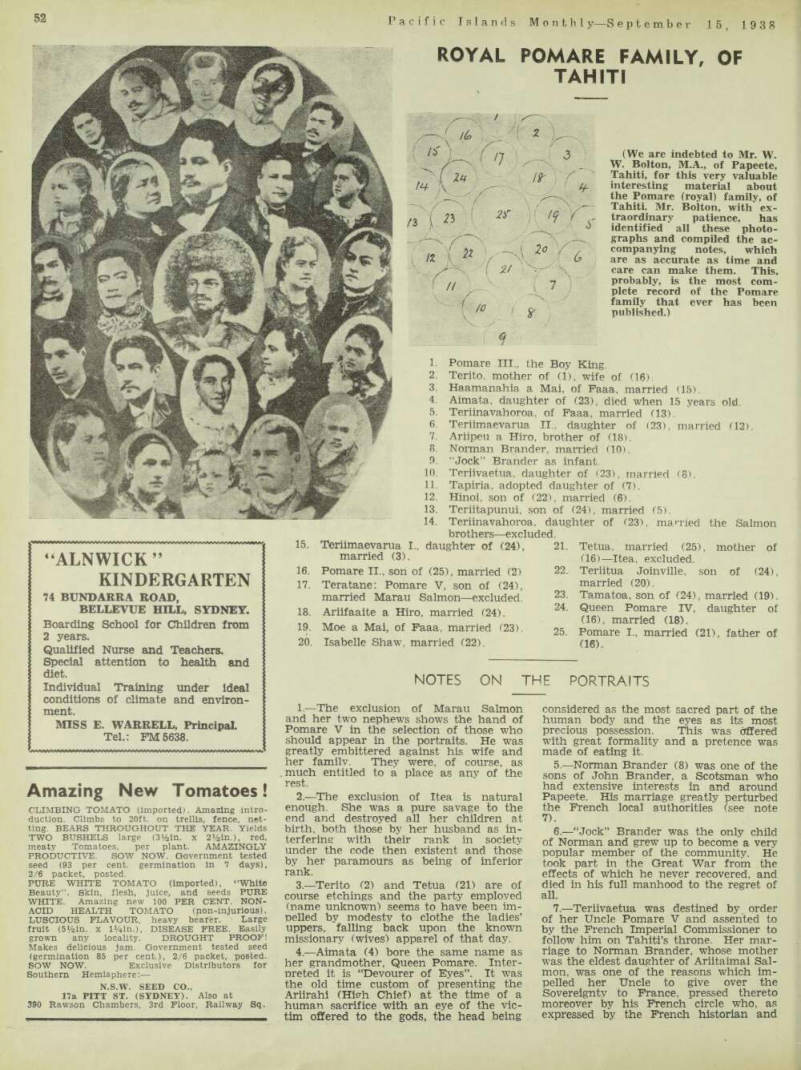
Tahiti
(We are indebted to Mr. W.
W. Bolton, M.A., of Papeete, Tahiti, for this very valuable interesting material about the Pomare (royal) family, of Tahiti. Mr. Bolton, with ex traordinary patience, has identified all these photo graphs and compiled the ac companying notes, which are as accurate as time and care can make them. This, probably, is the most com plete record of the Pomare family that ever has been published.)
1. Pomare III., the Boy King. 2. Terito, mother of (1), wife of (16) 3. Haamanahia a Mai, of Faaa. married (15). 4. Aimata, daughter of (23), died when 15 years old. 5. Teriinavahoroa, of Faaa, married (13). 6. Teriimaevarua II., daughter of (23), married (12). 7. Ariipeu a Hiro, brother of (18). 8. Norman Brander. married (10), 9. “Jock” Brander as infant. 10. Teriivaetua. daughter of (23). married (8). 11. Tapiria, adopted daughter of (7). 12. Hinoi, son of (22), married (6). 13. Teriitapunui, son of (24), married (5). 14. Teriinavahoroa, daughter of (23). married the Salmon brothers—excluded.
15. Teriimaevarua I., daughter of (24), married (3). 16. Pomare II., son of (25), married (2) 17. Teratane: Pomare V, son of (24), married Marau Salmon—excluded. 18. Ariifaaite a Hiro, married (24). 19. Moe a Mai, of Faaa, married (23). 20. Isabelle Shaw, married (22)
21. Tetua, married (25), mother of (16)—Itea, excluded. 22. Teriitua Joinville, son of (24), married (20). 23. Tamatoa, son of (24), married (19). 24. Queen Pomare IV, daughter of (16), married (18). 25. Pomare I., married (21), father of (16).
Notes On The Portraits
1. —The exclusion of Marau Salmon and her two nephews shows the hand of Pomare V in the selection of those who should appear in the portraits. He was greatly embittered against his wife and her family. They were, of course, as . much entitled to a place as any of the rest. 2. —The exclusion of Itea is natural enough. She was a pure savage to the end and destroyed all her children at birth, both those by her husband as in terfering with their rank in society under the code then existent and those by her paramours as being of inferior rank. 3. —Terito (2) and Tetua (21) are of course etchings and the party employed (name unknown) seems to have been im pelled by modesty to clothe the ladies’ uppers, falling back upon the known missionary (wives) apparel of that day. 4. —Aimata (4) bore the same name as her grandmother, Queen Pomare. Inter preted it is “Devourer of Eyes”. It was the old time custom of presenting the Ariirahi (High Chief) at the time of a human sacrifice with an eye of the vic tim offered to the gods, the head being
considered as the most sacred part of the human body and the eyes as its most precious possession. This was offered with great formality and a pretence was made of eating it. 5. —Norman Brander (8) was one of the sons of John Brander, a Scotsman who had extensive interests in and around Papeete. His marriage greatly perturbed the French local authorities (see note 7). 6. —“Jock” Brander was the only child of Norman and grew up to become a very popular member of the community. He took part in the Great War from the effects of which he never recovered, and died in his full manhood to the regret of all. 7. —Teriivaetua was destined by order of her Uncle Pomare V and assented to by the French Imperial Commissioner to follow him on Tahiti’s throne. Her mar riage to Norman Brander, whose mother was the eldest daughter of Ariitaimai Sal mon, was one of the reasons which im pelled her Uncle to give over the Sovereignty to France, pressed thereto moreover by his French circle who, as expressed by the French historian and
politician Deschanel in his “En Oceanic” (Paris, 1884), “were ourselves preparing with our own hands to seat upon the throne an Anglo-Saxon Monarchy”, The succession lapsing, the headship of the Pomare family passed along with it to another (see note 8). 8. —Hinoi, the nephew of Pomare V, was adopted by his Uncle and became his heir, both to position (as head of the lamily) and property. His popularity was immense: a very “Prince of good fellows”. 9. —Teriimaevarua I. (15) was adopted by Tapoa, her mother’s first Consort, and became Queen of Pora Pora. 10. —Ariifaaite (18) was the second con sort of Queen Pomare. In 1822 when Aimata was 8 and Tapoa, Prince of Pora Pora, was 16 they were betrothed for mally, the custom with those of tender years. He was given the name “Pomare” as a special mark of favour. They were not separated till 1834 and had no issue, Tapoa residing mostly in Pora Pora, wholly indifferent to his young wife.
Aimata then married her cousin—often called Tenania —a Raiatean prince. 11. —Moe a Mai (19) was considered the beauty of her day and came of Faaan stock, whose chiefly lineage was second to none on the island. 12. —lsabelle Shaw (20) was the half caste daughter of the master of a trad ing schooner (name not yet traced).) 13. Tamatoa (23) was of striking ap pearance, but of erratic and wild char acter. In 1857 he was crowned King of Raiatea, but his conduct was so im possible that he was forced by the popu lace to retire to Tahiti. His line became merged with the Salmons and the Branders. 14. —Terii, so often appearing at the commencement of names, is a contrac tion of Te-Arii and formerly was used to show the high lineage of the bearer. To day it is in common use for all.
Advertisements & other items, p. 56 (2 items)
52
Pacific Islands Monthl y—S eptember 15, 1938
Kindergarten
“ALNWICK”
74 BUNDARRA ROAD,
BELLEVUE HILL, SYDNEY.
Boarding School for Children from 2 years.
Qualified Nurse and Teachers.
Special attention to health and diet.
Individual Training under ideal conditions of climate and environment.
MISS E. WARRELL, Principal Tel.: FM 5638.
Amazing New Tomatoes!
CLIMBING TOMATO (imported). Amazing introduction. Climbs to 20ft. on trellis, fence, net-
ting. BEARS THROUGHOUT THE YEAR. Yields
TWO BUSHELS large (3%1n. x 2 1 / 2 in.), red, meaty Tomatoes, per plant. AMAZINGLY PRODUCTIVE. SOW NOW. Government tested seed (93 per cent, germination in 7 days), 2/6 packet, posted.
PURE WHITE TOMATO (imported), “White Beauty”. Skin, flesh, juice, and seeds PURE WHITE. Amazing new 100 PER CENT. NON- ACID HEALTH TOMATO (non-injurious).
LUSCIOUS FLAVOUR, heavy bearer. Large fruit (sVain, x iy 4 in.), DISEASE FREE. Easily grown any locality. DROUGHT PROOF!
Makes delicious jam. Government tested seed (germination 85 per cent.), 2/6 packet, posted.
SOW NOW. Exclusive Distributors for Southern Hemisphere:—
N.S.W. SEED CO.,
17a PITT ST. (SYDNEY). Also at 390 Rawson Chambers, 3rd Floor, Railway Sq.
Market Reports by
Teleradio Wireless Aids Torres Strait Beche-de-Mer Fishers
NATIVES of Torres Strait Islands have developed a modern outlook on life.
Under the influence of wireless, their conditions have undergone a radical change.
The islanders sail their luggers to the fishing fields, and spend a week or two catching beche-de-mer or gathering pearl shell. From time to time they land and use the new radio-telephone sets which have just been installed at 14 points in Torres Strait and on Cape York Penin sula. Thursday Island is called up and the state of the market discussed. If they hear that current prices are good, they hurry into port with the catch; otherwise they continue fishing.
So the formerly unsophisticated is landers now govern their operations and watch the Islands produce markets as closely as a farmer with a crop of wheat to sell or a speculative international stock broker.
Mr. F. L. Dawes, engineer of Amalga mated Wireless (A/asia), Ltd., returned to Sydney in August with this story of the routine life of the Torres Strait Islanders transformed by the introduction of radio.
On behalf of A.W.A., Mr. Dawes has in stalled wireless at 14 Government and Mission station's, where missionaries and
officials now talk by word of mouth with Thursday Island.
Hardly had the first station been in stalled than a man fell into a hole and suffered grave injuries. A wireless call was made to Thursday Is. and promptly an aeroplane flew over the intervening 200 miles and carried the man to hospital, five days earlier than could have been the case but for the radio.
The places on Cape York equipped are Aurakun, Weipa, Mapoon, Lockhart River, and St. Paul’s Mission stations and Iron Range goldmine. The Torres Islands served are Badu, Mabuiag, Saibai, Yorke, Darnley, and Murray. The Government patrol ketch “Melbidir”, which travels among the islands, has also been fitted; and at Thursday Island a permanently
operated “mother station” has been in stalled which keeps in touch with the whole of the out-stations.
A distress call from a Mission or Govern ment station does not necessarily entail the despatch of a medical man. In simple cases, Dr. Nimmo, of Thursday Island, discusses a patient’s symptoms and gives instructions for treatment. On one oc casion, five stations were simultaneously “hooked up” with T.I. and five groups of parents talked to the doctor about the whooping cough which afflicted their children.
Mrs. H. F. Ayson, wife of Judge Ay son, Resident Commissioner of the Cook Islands, arrived in Rarotonga by the August “Matua”.
Advertisements & other items, pp. 57-60 (3 items)
Tenax
V \ k\ m \ k v-
Tropical Diseases
Hold No Terrors
—if you use TENAX Daily The germs of Diphtheria, Malaria, Dhobie Itch, Tinea and Surfer’s Foot, cannot harm you if you are protected by the rich "Ti-fror’ later of TENAX.
GUARD AGAINST
TENAX contains "Ti-trol," eleven times quicker than carbolic as a germicide, but
NON-POISONOUS and NON-IRRITANT.
INFECTION tyMuy
A PRODUCT OF AUSTRALIAN SOAPS
LIMITED
TENAX
tyuuurte/y (^e/am&jdaA.
TOILET SOAP
WHEN SPENDING YOUR VACATION IN SYDNEY YOUR CHOICE OF RESIDENCE IS A MATTER SO VITAL TO YOUR ENJOYMENT!
May we commend to you for All-round Excellence
SYDNEY'S MOST EXCLUSIVE PRIVATE HOTEL
44 MACLEAY STREET
Here for you await unrivalled Service H. & C. Water and Telephones in all rc . V 1 R n and Cuisine—Suites with Private Baths— >ms —Magnificent Harbour Views Roof Garden - Sun Rooms Spacious Lounges and Smoke Rooms and every modern convenience All under Personal Supervision of the Proprietress.
MISS M. E. BURROWS
per week inclusive.
Radios:
"FORTY FOR"
Sydney.
Telephone: FL 2641
WM. BRECKWOLDT & CO.,
SOUTH SEA MERCHANTS
POSTAL ADDRESSES;—
NEW GUINEA: —P.O. Box 89, Roboul. TAHITI:—P.O. Box 60, Papeete.
FIJI:—P.O. Box 1 1 1, Suva. SAMOA:—P.O. Box 124, Apia.
TRADE MARK
BREWO
AGENTS FOR...
MERCEDES - BENZ DIESEL
TRUCKS, HANOMAG TRACTORS,
D.K.W. MOTORCARS, CONTIN -
ENTAL TYRES AND TUBES,
MERCEDES-BENZ MARINE EN-
GINES.
B A R ASPIRIN . . . ATEBRIN . . . YATREN PYRAMIDON . . . PLASMOCHIN . . .
MITIGAL . . .HELMITOL . . . NEOSAL- VARSAN . . . ETC., ETC. . . .
Stocks always available at our Branches. All orders will be executed at original “BAYER"
PRICES.
"PETROMAX"-
HURRICANE LANTERNS, LAMPS AND
ACCESSORIES.
"FROWO"-
HURRICANE LANTERNS,
No. 45, 55, 65, 75, 85, Etc.
"TIGER BRAND"-
CORRUGATED AND FLAT GALVANISED
IRON.
"TAIFUN"- BICYCLES AND ACCESSORIES.
TELEFUNKEN"- radio sets.
MAKE \ "ARARA"- gas stoves ATRIAL- \ "ANCRE"- cast iron saucepans.
SWEDISH Axes and Hatchets . . , Bicycles . . .
Sewing Machines . . .
Knives . . . Razor Blades . . . Lavalavas . . . Toothpaste . . . Rea! Briar Tobacco Pipes . . Poundbeads . . . Seedbeads . . .
Cutbeads. also all kinds of
GERMAN, BRITISH
and
CONTINENTAL
GOODS.
BLANKETS
APPLY
TO-DAY.
• jii
TWO LIONS"-
COPRA KNIVES, BUTCHERS' KNIVES
BECK'S— "KEY BRAND" GERMAN LAGER.
BREWO RAZOR BLADES.
Black, Brown, Green, Blue, Pink, Silver.
"BIRKO"-"POLISSE" AND "POLO"'
RAZOR BLADES
LOHSE, URALT LAVENDER
TORPEDO/' "BIJOU" and "ERICA
TYPEWRITERS.
VESTA SEWING MACHINES
\ DR HENRI'S
NU-J VIGOR
I 1 vitality
PILLS
I BTHEMRI'S l||l
MU-'VICOR
Ifirl
ii f-.w
MEN
TAKE DR. HENRI’S
Nu-Vigor Vitality Pills
for loss of power and nervous exhaustion. They give wonderful results where overwork, worry, nerve weakness, etc., causes loss of those vital powers so necessary for the full enjoyment of life.
They are made in two strengths to suit individual cases. Week’s supply 3/6, one month’s treatment 10/6. Obstinate cases should try the Extra-Strong Prescription, 7/6 and 21/ —stimulates the organs.
Post FREE in plain wrapper. Call or Write for literature and Free Advice to
H. P. MICHAEL, Eft.
CHEMIST.
Michael’s Buildings, Cor. Elizabeth & Lonsdale Streets,
MELBOURNE.
MEDICAL GOODS
Best Quality. Lowest Prices All Guaranteed.
Write for FREE “Book of Know ledge’’ Catalogue and Price Listi Medical Goods etc. All Goods sent Pos Free, plain wrapper, return mail. Strict! confidential. LADIES! Let the Secur Nurse advise you in the selection of you intimate Medical requirements.
IT ATTRACTS
THEY EAT IT THEY DIE
USOLINE
crnrA!s ofatm
AUSOLINE CO
314 CROWN STREET, SYDNEY
(Established 1919)
NEVER
KNOWN
TO FAIL !
COCKROACH
DESTROYER
IT’S A PASTE
PRICES:
lib. 5/- . . . 3lbs. 10/- Postage Extra.
Remit Cash with Order.
Obtainable also from Islands stores of:
BURNS, PHILP & Co. Ltd.
W. R. CARPENTER & Co. Ltd.
BRITISH SOLOMON ISLANDS
STAMPS
New issue at 10 per cent, over cost.
On Covers Id. each cover extra.
Coronation Set on Reg Cover posted to any address l/6d.
Cash with order. With all enquiries please send a stamped addressed envelope.
M. HARPER,
Mandoliana Island, P.O. Box 6, Tulagi, 8.5.1.
TEVIOT COLLEGE,
Killoro, Sydney, N.S.W.
A Boarding School for Boys, 4to 15 years, situated in a healthy and ideal position on the North Shore heights.
The purpose of the School is to provide an education, calculated, to develop well-balanced minds and bodies, to encourage initiative and breadth of outlook, and to stimulate the formation of wholesome Christian character in a homely atmosphere.
Boys from THE ISLANDS may spend School Vacations at the School Seaside House.
Prospectus on application. Principals; y 7
For Electrical and Radio Equipment you cannot do better than place your inquiries with Noyes Bros.
Crompton Coiled Coil and Single Coil Lamps . . . Kriesler AH electric and Battery-operated Radio . . . Ferranti Meters and Transformers . . . Simpson Electric Turntables . . .
Household Electric Appliances . . . Rodgers Cutlery . . .
Perfection Silverware . . . Electrical Fittings . . . Crompton Fans for home, office, store and factory . . . Callender Wires, Cables and Flexibles for indoor and outdoor installations . . . Seyon Floodlighting Equipment for tennis of P
NOYES BROS. (w*o LTD.
115 CLARENCE ST., SYDNEY
11 WATT ST.. NEWCASTLE. 197 ELIZABETH ST„ BRISBANE.
54
Pacific Islands Monthl y—S eptember 15, 1938
Site”
55
Pacific Islands Mont hi y —S eptember 15, 1988
War of the “Capital Site” (Continued from Page 27.)-
Expert Reports On Port
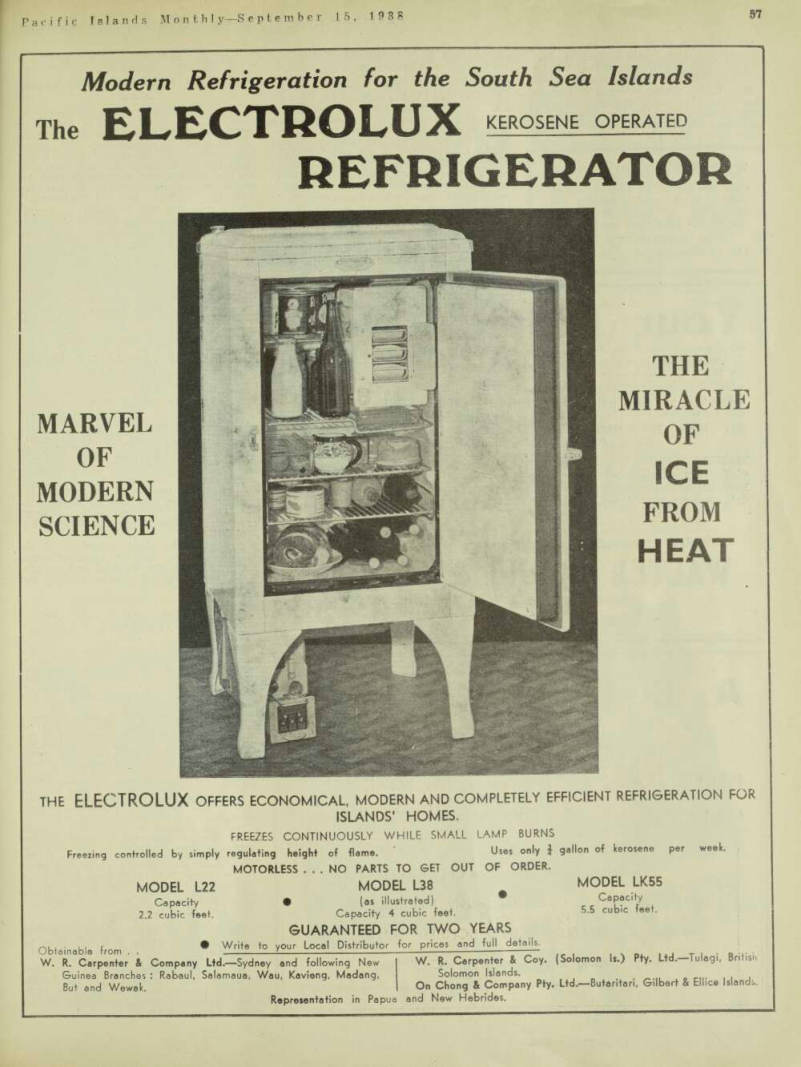
Moresby Water Supply
From Our Own Correspondent.
Pt. Moresby, Aug. 13.
BY the W.R.C. airliner from Sydney Mr. W. H. Roper, supervising engi neer of Works and Local Government in N.S.W., arrived here on August 3 to report on a water scheme Port Moresby. He will remain in the district for three weeks and then return to Australia by air.
It is estimated that the cost of the scheme will not exceed £40,000, but this estimate is not definite and the Ad ministration will await the expert’s re port.
It is understood that' the Government have had an offer from two Sydney businessmen, Messrs. Carter and Water house, to construct the works by private contract. This proposal is in abeyance pending the decision of the Federal Treasury regarding a loan. The Treas ury first desires to know the revised es timated total cost of the water scheme and the period over which expenditure would be spread before any consider ation can be given to granting a loan to Papua.
Colonel F. W. t)awson, medical officer from the N.Z. Health Department, has arrived in Rarotonga by the “Matua”.
He is assisting Drs. Ellison ,gind Rose in combating the measles epidemic in the Cook Islands.
Mr. Alfred B. Drew, a well-known Suva watchmaker and jeweller, died in Aug ust, at the age of 58. A New Zealander, he arrived in Fiji during the war years.
Mr. C. L. Cheng, formerly Chinese Vice-Consul in Fiji, returned to Suva from China by the August “Niagara” to join the directorate of Messrs. Jang, Hmg, Loong and Co.
Advertisements & other items, pp. 60-62 (3 items)
56
Pacific Islands Monthl y—S eptember 15, 1938
57
Pacific Islands Monthl y—S eptember 15, 1938
Electrolux
Modern Refrigeration for the South Sea Islands
The
KEROSENE OPERATED
REFRIGERATOR
MARVEL
OF
MODERN
SCIENCE
THE
MIRACLE
OF
ICE
FROM
HEAT
HE ELECTROLUX OFFERS economical, modern and completely efficient refrigeration for
ISLANDS’ HOMES.
FREEZES CONTINUOUSLY WHILE SMALL LAMP BURNS
Freezing controlled by simply regulating height of flame. Uses only gallon of kerosene per week.
MOTORLESS ... NO PARTS TO GET OUT OF ORDER.
MODEL L 22 MODEL L3B MODEL LKSS Capacity • (as illustrated) cc Ca P acit / t 2.2 cubic feet. Capacity 4 cubic feet. 55 cub,c feeti
GUARANTEED FOR TWO YEARS
)btainable from ® Write to your Local Distributor for prices and full details.
V. R. Carpenter & Company Ltd.—Sydney and following New Guinea Branches : Rabaul, Salamaua, Wau, Kavieng, Madang, But and Wewak.
Reoresentation W. R. Carpenter & Coy. (Solomon Is.) Pty. Ltd.—Tulagi, British Solomon Islands.
On Chong & Company Pty. Ltd.—Butaritari, Gilbert & Ellice Islands Parma and New Hebrides.
WANTED TO PURCHASE
CJsed stamps of all Pacific Islands.
Highest prices paid. Regular consignments solicited. Remittances guaranteed by return mail.
J. H. SMYTH PTY. LTD.
114 Castlereagh St., Sydney, Aust.
Pearling Threatened With Extinction
Extinction
A DEPUTATION, comprising Captain
A, G. Gregory and Mr. A. Clark, master pearlers, met the Commonwealth Minister for the Interior ((Mr. John McEwen) at Darwin on August 19 and urged that a bounty on pearl-shell be given to meet the increasing competition by Japanese. It sought also the estab lishment of a pool. Captain Gregory emphasised that only Government help could save the pearling centres of Thurs day Island and Broome from extinction.
The Minister said he would submit their case to the Government, which, he was confident, “would give it a most sym pathetic hearing’'.
A Third "Suva"
Name for New Carpenter Vessel
From Our Own Correspondent.
T_ SUVA, Sept. 3.
HE Registrar-General of Shipping in England has approved the name “Suva”, for the new vessel being built for W. R. Carpenter and Co.; and, in due course, the new vessel will be registered at this port, as is the case with the “Rabaul” and the “Salamaua”.
The new ship will be 415 ft. in length with a maximum breadth of 56 ft. 9 ins., a deadweight capacity of 9.000 tons and a speed of 12 knots.
She will be the third vessel to bear the name “Suva”. The first was a steamer of about 600 tons, which traded between Melbourne and Suva for Messrs.
James McEwan and Co., in the early 80’s: while the second was a steamer of 2,500 tons which traded to Fiji for the A.U.S.N. Co., about 30 years ago.
Success Of Samoan Banana
Inspection
Prom Our Own Correspondent.
A_ Apia, Aug. 26.
LTHOUGH the Mau is continuing its agitation against the Government’s banana scheme, and reported to be demanding the dismissal of an official, it is considered significant, that the Govern ment Produce Inspector has been asked to proceed to Rarotonga, in order to in troduce Samoan methods of banana in spection and grading there. Samoan methods are also followed in Tonga, Niue and Fiji, Owing to the rigid inspection of the fruit in Samoa, Samoan bananas realise better prices in New Zealand and are pre ferred on account of superior packing and quality.
Education Facilities In
Australia
TO-DAY, most thinking people agree that schools should provide an atmosphere of home-life and culture where the individuality of the child is allowed to develop spontaneously and without fear. The ideal school is co educational, and one which provides children with creative outlets.
Without stressing the importance of examin ations, modern educationalist recognise the necessity for fitting children to attain the same standard of knowledge by more progres sive means. The understanding of a sympa thetic staff of trained teachers, aided by mod ern equipment, such as a printing press, a library, and an epidiascope for visual educa tion, helps to supply the child with elements necessary for perfect growth. Physical educa tion. correct diet and a well-chosen environ ment are other Important factors.
The new education in Australia is no longer in its infancy. Quest Haven, one of the first schools to apply and adapt to local conditions the new educational methods in use in Eu rope and U.S.A., was established four years ago at Mona Vale, N.S.W., and to-day is a place where modern Islands, parents may ex pect their children to receive a well-planned education for complete living.—* Mr. C. H. Came, manager of Morris, Hedstrom, Ltd., at Ba, Fiji, left Suva by the “Monterey” on August 30, on holidays.
Mr. C. M. Teulon, District Engineer, of Suva, and Mr. J. J. Real, Land Offi cer and Deputy Registrar of Titles, have been appointed official members of the Suva Town Board.
Advertisements & other items, p. 62 (2 items)
58
.Pacific Islands Monthl y—S eptember 15, 1938
Your Tropical Kit
When you visit the Pacific islands, whether on Business or Pleasure, you need Special Equipment Light Suits of Correct Style, which fit well and launder easily; Tunic Shirts Silk Shirts, Light Underwear, White Shoes, etc.
WALTER HORNE & CO. LTD., established in 1885, specialise in this Service. Skilled Tailors make your Suits from First-class material within 24 hours. Complete equipment can be supplied from our Large Stocks at Reasonable. Moderate Prices.
BUY FROM THE FIRM WHICH UNDERSTANDS YOUR NEEDS AND
DRESSES YOU CORRECTLY
WALTER HORNE & CO. LTD., carry a Pull Range of Drapery of all kinds; also Frocks, Millinery, Foundations and Lingerie, Hosiery, Shoes and Sandals, Ribbons and Laces, Household Drapery.
Ladies' Hairdressing and Manicuring
Men resident in any of the Pacific Territories can be supplied with Suitable Clothes.
Write to us and Describe your Requirements.
WALTER HORNE & CO. LTD.
Drapers and Men's Wear Specialists
SUVA. FIJI
A. B. DONALD LTD.
AUCKLAND
ISLAND TRADERS :: GENERAL MERCHANTS
■> P. O. Box 1509 Cables and Telegrams: "Kingdom," Auckland Branches at Rarotonga and throughout the Cook Islands At Papeete and throughout the Society, Marquesas and Paumotu Islands
trading as " ETABLISSEMENTS DONALD. TAHITI"
At Fiji: Trading as "Dominion Fruit C 0.,” Suva
Life Saving Society
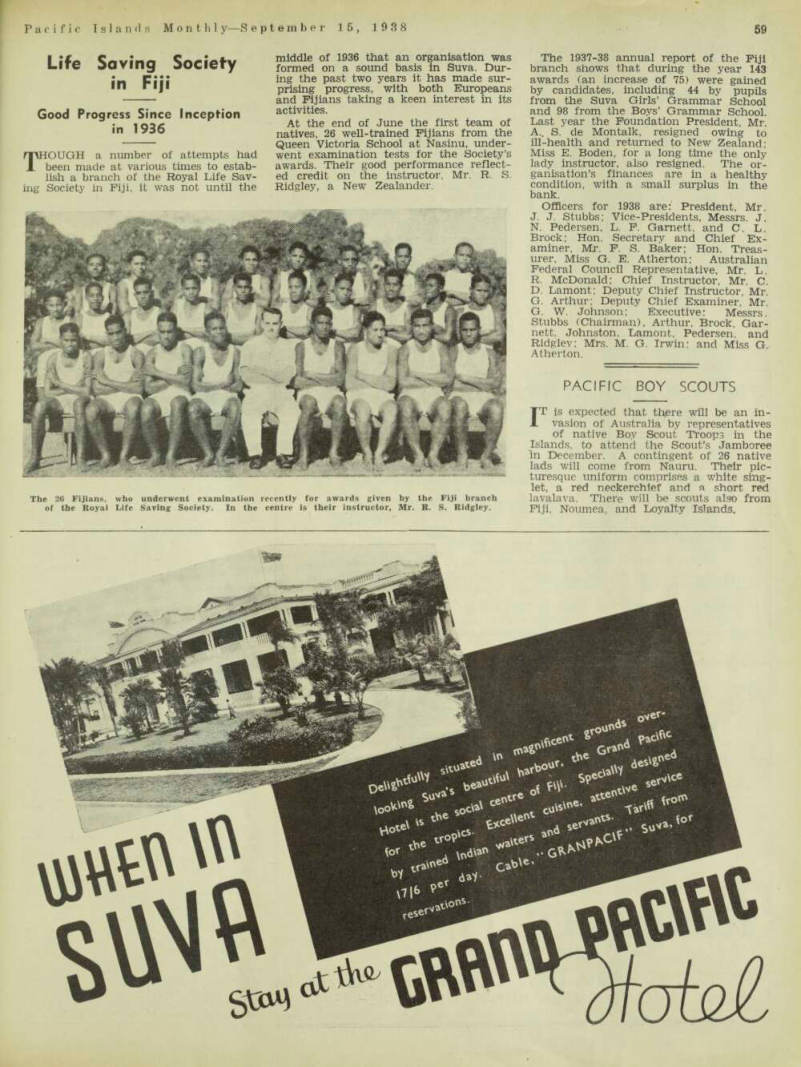
in Fiji Good Progress Since Inception in 1936
fTVHOUGH a number of attempts had J. been made at various times to estab lish a branch of the Royal Life Sav ing Society in Fiji, it was not until the
middle of 1936 that an organisation was formed on a sound basis in Suva. Dur ing the past two years it has made sur prising progress, with both Europeans and Fijians taking a keen interest in its activities.
At the end of June the first team of natives, 26 well-trained Fijians from the Queen Victoria School at Nasinu, under went examination tests for the Society’s awards. Their good performance reflect ed credit on the instructor, Mr. R. S.
Ridgley, a New Zealander.
The 1937-38 annual report of the Fiji branch shows that during the year 143 awards (an increase of 75) were gained by candidates, including 44 by pupils from the Suva Girls’ Grammar School and 98 from the Boys’ Grammar School.
Last year the Foundation President, Mr.
A.. S. de Montalk, resigned owing to ill-health and returned to New Zealand: Miss E. Boden, for a long time the only lady instructor, also resigned. The or ganisation’s finances are in a healthy condition, with a small surplus in the bank.
Officers for 1938 are: President, Mr.
J. J. Stubbs; Vice-Presidents, Messrs. J.
N. Pedersen, L. F. Garnett, and C. L.
Brock; Hon. Secretary and Chief Ex aminer, Mr. F. S. Baker; Hon. Treas urer. Miss G. E. Atherton; Australian Federal Council Representative, Mr. L.
R. McDonald; Chief Instructor, Mr. C.
D. Lamont; Deputy Chief Instructor, Mr.
G. Arthur: Deputy Chief Examiner, Mr.
G. W. Johnson; Executive: Messrs.
Stubbs (Chairman), Arthur, Brock, Gar nett. Johnston, Lamont, Pedersen, and Ridglev: Mrs. M. G. Irwin; and Miss G.
Atherton.
The 26 Fijians, who underwent examination recently for awards given by the Fiji branch of the Royal Life Saving Society. In the centre is their instructor, Mr. R. S. Ridgley.
Pacific Boy Scouts
IT is expected that there will be an in vasion of Australia by representatives of native Boy Scout Troops in the Islands, to attend the Scout’s Jamboree in December. A contingent of 26 native lads will come from Nauru. Their pic turesque uniform comprises a white sing let. a red neckerchief and a short red lavalava. There will be scouts also from Fiji, Noumea, and Loyalty Islands.
Mr. and Mrs. D. H. Vertigan arrived in Sydney in August by the “Macdhui” from Rabaul, New Guinea, on furlough. Mr.
Vertigan, who until recently was Assist ant District Officer at Namatanai, New Britain, probably will be assigned to the Morobe district when he returns to the Territory.
Advertisements & other items, pp. 63-64 (2 items)
59
Pacific Islands Mont hi y—S eptember 15, 1938
res^ OOS
B As ° vc
pout'd*
f ' Cenl h <*-* ?4C d s^ ei W * *** s b-*** oS f,f **'* ‘ £ T. see-' tenW ‘ o**- ** ,*# ** " S - c s n 4 ser^ 1 " .. su v»> r *• ers -V^" c ' t r^ cd O' 3 ' 6, r <W* •|b ? er
res^ OOS
0^
FALLING HAIR
DRIVE OUT ITCHING DANDRUFF.
“NU - HAIR-CUM”
THE GUARANTEED HAIR RESTORER
3 months’ Treatment' 5 - POST FREE.
This amazing preparation perfected after 10 years’ research, positively nourishes the hair growth and helps retain colour.
Good for “cradle-cap”.
GUARANTEED REMEDY FOR
DANDRUFF.
Hundreds Testimonials.
“NTT-HAIR-CUM”,
Dept. P, Box 1428, AUCKLAND. C.l.
THE WORLD’S BEST TEXTILES
FROM MANCHESTER.
100% BRITISH MANUFACTURE
MADE IN ENGLAND.
Brotherton’s name was established in 1878—ever since when they have specialised in the manufacture of Cotton Textiles suitable for the Native Trades.
Our Specialties are: Lava-Lavas, Pearl Divers Ramies, Para Reds, Khaki and Dyed Drills, Calicoes (Plain and Fancies) Greys— Whites—Sheetings —Poplins—Art Silks—Ginghams. Etc.
Owners of the following well-known brands—“Mokamle”, "Rlntarnle”, “Okarnle”
"Afrlcarnle”, "Arkaldo”, “Cunaldo”, “Staraldo”, “Arntonco”, “Brotonco” “Airport’’, “Bestport”, “Millport”, “Joker”, “Judgement’’, “Straltate”, etc. 0 a ES a Private Company under the direct supervision of Mr. Arnold B. Brotherton with Years of Experience In South Pacific Trade-Indents through usual Channels.
A. B. BROTHERTON & CO., LTD., 40 DICKINSON ST., MANCHESTER 1., ENG (Arnold B. Brotherton). Cables and ’Grams—“RINTARNIE”, Manchester.
Made in 5 Widths
7-inch, 8-inch, 9-inch, I Clinch and 11-in. cut These ploughs will do good work in new or old land.
Ample clearance is provided for ploughing in thick surface growth,
“CUB”
PLOUGHS
nsomcs
Write for illustrated literature and ell information, MORRIS, HEDSTROM LTD. - Suva, Lautoka and Ba Made by: RANSOMES, SIMS & JEFFRIES, LTD., IPSWICH, ENGLAND
“Monopolies” In New Guinea
Some Considerations Which Apparently are Overlooked
THERE are several indications that a strong campaign is proceeding among the non-offifficial Europeans in the Mandated Territory of New Guinea, directed against what are called the “monopolists”.
These activities have been seen in representations made to the Federal Government by deputations and organ isations in the Morobe and Rabaul dis tricts; in circulars issued by some or ganisations—especially the Mining As sociation of Wau; and in articles and letters published in the “Rabaul Times”.
The attack is directed primar&y against the big trading firms of Bums, Philp and Co. Ltd. and W. R. Carpenter and Co. Ltd. which run stores, own and operate plantations, and control sea and air transport) and against the aerial
transport companies operating in the Morobe district. The leaders of the at tack contend that these firms now are so powerful that it is practically im possible for any smaller trader or trans porter to commence operations in the Territory—in other words, that trading and transport in New Guinea now are in the grip of combines.
One person, writing very bitterly in the “Rabaul Times” recently, repudiated the argument of the big firms that their financial strength had helped the plant ers and miners through the depression.
He contended that the depression had been definitely of assistance to the big firms, because in giving financial as sistance they had completely guarded themselves with liens of all descriptfon over solid property, and they emerged from the depression more powerful and richer than ever, while for the most part the people they had assisted had lost their properties.
This may be an obvious exaggeration: but it shows how some people are think ing and talking.
There are indications, also, that this campaign is taking a political angle. It is likely that certain representations will be made, via the N.G. Administration, to the Commonwealth Government— and especially to the Australian Labour Party, in the belief that if and when Labour comes into power it will be con vinced of “the need for checking mono polies in New Guinea”.
THAT is the position from the point of view of the average resident of New Guinea. That there is a monopol istic tendency in New Guinea is bevond question—the power and influence of the big firms are apparent everywhere.
But there are two points which, in justice to the big firms, the residents should bear in mind.
The first is that it is not proved that the operations of the firms are cruel, vicious, or oppressive. On the contrary, there is evidence that, in at least the majority of cases, the local managers of Messrs. Burns. Philp and Co. Ltd. and Messrs, W. R. Carpenter and Co. Ltd. definitely carry out a headquarters pol icy designed to assist and encourage the industrious and thrifty man and to get him upon his feet again and out of debt.
For every man who complains of oppres sion there may be found two men who will frankly acknowledge that they have had a very fair deal from the so-called monopolists: and it is a fact that if New Guinea business had been in the hands of a lot of small firms in the 1929-1934 period, instead of in the hands of n couple of big firms with huge financial reserves, the whole Territory would have gone smash.
The second point to remember is that New Guinea, in providing scone for mononolistic operations, is not in the least peculiar.
On the contrary, every country in the world to-dav—and the more “civilised”, the more marked is this thing—is in the grip of combines and mononolists. It seems to be a development inseparable from the conditions of this particular time, which may be called the era of international money power. In Austra lia, -for examnle it would be difficult to name one trade or industry connected
with a general public service—such as food supplies, transport, amusements, finance, etc. —which is not more or less completely controlled by a combme or a monopoly.
It is natural that the big firms op erating in XMew Guinea —just as is tne case with big firms operating anywhere else —should display extreme sensitive ness on the subject of possible compe tition. The monopoly may be IUO per cent, benevolent in its ouuook and op erations; but it becomes fierce and mer ciless as soon as it is threatened wtih effective competition.
IT would be idle to deny that trade and transport in New Guinea—as in most other Pacific Territories —are large ly controlled by monopolies, but, to re peat, New Guinea is not at all peculiar m that respect. We may deplore the existence of monopolies; but we can say, in the case 01 New Guinea, that tne nrms that exercise this power are at least controlled by men of human quali ties, who are quite well known to all of us. We know their history and their habits and, however we may dislike the autocratic powers they possess, we at least need not picture tnem with two horns and a tail.
As a matter of fact, it would be pos sible to go further and say that, if the New Gumea Administration could for muiate a vigorous and long-visioned pol icy of development, it would be possible to use the strength and resources of the big firms in a manner most beneficial to the Territory.
The history of European colonisation in primitive countries everywhere indi cates that, if there is to be real and substantial progress, the backbone of the effort must be large Companies, oper ating in harmony with the Govern ment, on the one hand, and with the individual settlers, on the other.
In New Guinea, at the present time, there is a tendency for European set tlers and the big firms to get snarling at each other. Cannot the blame for this be laid at the door of the Administra tion in that it apparently has failed to recognise that it is responsible for holding the balance fairly as between the two sets of Interests?
There was the famous Shipping Bill, for instance. It is held up by planters as “an iniquitous instrument of monop olism”, although it clearly was based on the necessity for protecting British shipping in the Pacific. The Govern ment gave the big firms protection and privileges—and left it at that. Surely, having gone so far, it was under an ob ligation to protect also the interests of the settlers —at least to the extent of seeing that their various complaints and fears were submitted to the big firms for attention and action.
The directors of the big firms are not fools. They are well aware that their first care must be, not profits, but the protection of their investment; and no investment can be considered secure if the people upon whom it is based are in a condition of growing discontent.
The first care of any wise directorate is to have a satisfied clientele. But, in that regard, so far as New Guinea is concerned, it must have a helpful and not an aloof Government.
The Administration clearly has a re sponsibility, as between individual set tiers and the big firms; and, if it ap proaches the latter from the right angle, it should discharge that responsibility to the satisfaction of the settlers and the credit of Australia.
R.W.R.
Advertisements & other items, p. 64 (1 item)
60
Pacific Islands Month! y—-S eptember 15, 19 38
Western Pacific
Another Japanese Line in Western Pacific
ANOTHER Japanese motor vessel, “Takachiho Maru”, owned by Nanyo Boyeki Kaisha, Ltd., of Tokio, has commenced running on a regular sched ule among the ports of the Western Pacific islands.
Commencing last month (August), she left Ponape (Caroline Islands— a Jap anese Mandated Territory) to visit the following ports in this order:— Kavieng, New Guinea.
Rabaul, New Guinea.
Salamaua, New Guinea.
Port Moresby, Papua.
Port Vila, New Hebrides.
Noumea. New Caledonia.
Nukualofa, Tonga.
Suva, Fiji.
Tulagi, Solomon Islands.
Thence back to Ponape, via Rabaul.
Tahitian Princess Returns
From France
Prom Our Own Correspondent.
Papeete, Aug. 14.
PRINCESS Teriinui-o-Tahiti Pomare, accompanied by her cousin. Princess Moeterauri Tetupaia-i-Hauviri, ar rived at Papeete from France on August 1, The Princess Teriinui has returned after a long sojourn in France where she was received with great distinction by the President of France and in high Govern ment and social circles.
Mr. A. L. Chapman, Shell Co. repre sentative at Salamaua, and Mrs. Chap man arrived in Sydney from New Guinea by the August “Neptuna” on their honey moon, which included a visit to Hong Kong. After a short stay in Melbourne, the couple will return to the Mandated Territory by the “Macdhui” on September -24.
Advertisements & other items, p. 65 (2 items)
61
Pacific Islands Month! y —S eptember 16, 1928
Pai Ms
MASTER
POWDERS &
TABLETS
1/6 AND 2/6.
SINGLES 2d ea
HEADACHE
'FLU & COLDS
RHEUMATISM
NEURALGIA
SCIATICA
NEURITIS
LUMBAGO
AND All NERVE AND
MUSCULAR PAINS
Over the past 20 years thousands of men and women have proved Vincent's A.P.C. to be the most effective remedy for relieving all pain. That is why there are more Vincents A.P.C.
Powders and Tablets sold in Australia to-day than all other similar preparations.
If you suffer from Headache, Rheumatism, Heat Exhaustion, Nervous Irritability, Sleeplessness, or any nerve or muscular pain, get a packet of Vincent’s A.P.O. Powders or Tablets and take them as directed. Take Vincent’s A.P.C. also to relieve Feverishness and reduce temperature. You will be more than satisfied at the speedy, effective relief Vincent’s A.P.O. brings. Vincent’s A.P.C. can be taken with perfect safety, as it does not affect the heart orleave any after-effects.
FOR SAFETY'S SAKE, SAY-"V INC EN T'S A.P.C."
MORRIS, HEDSTROM, ltd.,
Registered Office - - Suva, Fiji.
BRANCHES THROUGHOUT FIJI, TONGA AND SAMOA
f' Agents for: 'T
LLOYD'S
NOBELS (AUSTRALIA) LIMITED-EXPLOSIVES
MATSON NAVIGATION COMPANY
RUSTON & HORNSBY LIMITED
IMPERIAL CHEMICAL INDUSTRIES LIMITED
JOHN LYSAGHT (AUST.) LTD.
VACUUM OIL COMPANY PROP'TY. LIMITED
FORD MOTOR COMPANY LIMITED
GOODYEAR TIRE & RUBBER EXPORT COY. j.
SYDNEY OFFICE: DAL T O N HOUSE, 115 PITT ST.
New Head For The King’S School
MR. H. D. Hake, M.A., of Haileybury Col lege, Hertford, England, has been selected as Headmaster of The King’s School, Parra matta, N.S.W., in succession to Rev. C. T.
Parkinson, M.A., who resigned recently. Mr.
Hake will take up his duties early in 1939.
He is at present housemaster at Haileybury, one of the famous “Rugby” schools of England.
He has a very good scholastic and war record, and he has travelled extensively in Africa, Canada and Australia. He is the first head master of The King’s School who has not been a clergyman of the Church of England.
This departure from tradition was brought about by a recent change in the School’s con stitution, whereby it became possible for a lay member of the Church of England to become headmaster.—* Mr. E. R. Oldham, Resident Magi
strate at Samarai, Papua, was recently
appointed to the position of Acting Com missioner for Native Affairs during the absence of Hon. J. T. O’Malley, who is on leave.
Rev. Oliver Furness, L.Th., of the Metho dist Mission, left Sydney by the August
“Mariposa” for Suva, Fiji, from whence
he will proceed to Rotuma Island to engage in mission work, replacing Rev C M. Churchward, who retired last year.
Mr. Furness was accompanied by his bride, formerly Miss Edna Hall, of Mel bourne.
Malaria?
Do Gumtrees Kill
Interesting Theory tor Melanesia
Letter to the Editor.
DURING the past twelve months or so, letters have appeared in the Sydney daily press under the title of “Leaves of Healing”. The leaves referred to are those of Australian eucalyptus trees. These trees have been transplanted to Southern Europe, India, Palestine, Africa, and South America. Why?
According to the correspondents, it was because they present a two-edged sword to the scourge of malaria, by reason of the fact that they not only kill the germ, but also drain the swamps and stagnant pools in which the malarial mosquito breeds.
Is tips so? One writer claims that marshy, useless parts of Italy have been turned into useful, cultivable land through the planting of gum trees. Another asserts that Lord Roberts was instrumental, 40 years ago, in having young trees and seeds taken from Australia and planted in India. When those trees matured, malaria was conquered. A month ago, a promin
ent Zionist leader who had just arrived in Sydney from Palestine, publicly acknow ledged a debt to Australia for the euca lyptus trees which had ridden the Holy Land of malaria.
Of course, Australian bush dwellers have long testified to the delightful, healthy incense which emanates from gum trees, making life among them the healthi est in the world. Aborigines have taught us that beds of the leaves are good for back and chest complaints, and who does not know the value of eucalyptus oil?
That, at least, has been commercially proved.
However, if these are trees of healing, why don’t we plant th,em in New Guinea and rid that territory of malaria? Surely this is a chance to be a “good neighbour” indeed. It is quite possible tnat the germi cidal properties of these tiny particles of volatile oil, which are said to exude from the eucalyptus leaves, do slay the mal aria germs. In any case, we need not act in th,e dark, because the Council for Scientific Research at Canberra can give guidance.
It is certain, however, that many coun tries have thought it well worth while to introduce our lovely gums to their soil— and the question remains—why? Maybe it is only because their thirsty roots have such an affinity for water, that they find and absorb the moisture that causes marshy ground. If so, then even to this extent, it seems, Australia can serve New Guinea well by doing a little gardening up North—and turning useless, germ breeding ground into useful land.
Sincerely hoping there is something for New Guinea in the idea.
I am etc.
Beatrice Phillips.
500 George Street, Sydney, September 7, 1938.
The scheduled cruises of H.M.A.S. “Can berra” and “Sydney” to Papua, New Guinea, and New Hebrides were cancelled on September 1, owing to out breaks of scarlet fever on the “Sydney” and measles and mumps on the “Can berra”.
Rabaul Electricity, Ltd., made a net pro fit of £2,250 for the year ended June 30. compared with £2,271 for 1936-37. Dividend of 91 per cent, requires £2.098, and £2,854 is carried forward against £2,702 brought into the accounts. Consumers at June 30 numbered 495 —an increase of 41. The board has considered applying for the rights to generate and distribute electricity at the new capital site, when a decision has been finally made.
Advertisements & other items, pp. 66-68 (3 items)
62
Pacific Islands Monthl y—S eptember 15, 1938
Bulldog Batteries
AUSTRALIAN
• These Batteries DO NOT LOSE CHARGE WHEN NOT IN USE . . . • Plates DO NOT BUCKLE and Term-
inals DO NOT CORRODE
• Radio type are UNCONDITIONAL-
LY GUARANTEED FOR THREE
YEARS.
You will SAVE MONEY by Using BULLDOG BATTERIES Write to ... .
Continental Compensations Pty. Ltd.,
423 COLLINS ST., MELBOURNE, VIC.
We also Supply—
DIESEL ENGINES OF ALL TYPES.
A BATTERY B
FOR m
EVERY
PURPOSE
Protect Your Property With
Yea rs' Experience The Result of Over 50
MIX
Obtainable from - ALL BRANCHES . . BURNS, PHILP & CO. LTD.
vwl I
ISLANDS PARENTS
can be assured of a home for their tiny or bigger children under ideal conditions, where they are not only given the utmost attention in every detail, but are treated with affectionate personal interest.
Highest recommendations can be supplied on request. Terms by arrangement, Write "Islands Children",
C/- P.I.M, OFFICE,
Box 3408 R, G.P.0., SYDNEY
Tahiti Wedding
Prom Our Own Correspondent.
Papeete, Aug. 14.
A notable wedding reception and dinner party was given recently by Mrs. J. B. Stevenson at her Taaone Estate, near Papeete. Mrs. Stevenson’s son is the husband of Princess Poma teau; and the function was given to celebrate the marriage of the Princess’ brother, Prince Opuhara, to Mademoiselle Lorette Pougerouse.
Among the guests were: M. J. Liauzin (Treasurer of Tahiti); M. and Madame M. Jorss; Mr. and Mrs. E. Overton, of the “Dwyn Wen”, and their yacht guests: Mr. Cobb (Consul for U.S.A.); Mr. and Mrs. L. Hershon; Mr. and Mrs.
O. Nordman; and members of the bride’s family.
Pattern Service
Each month we publish a diagram of a seasonable frock, a pattern of which may be had by our readers direct from this office, post free, on payment of the sum stated under the diagram. To obtain the pattern, print your name and address below, giving the number of the pattern and the bust size, and send to “Pattern Department”, Pacific Islands Monthly, Box 3408 R, G.P.0., Sydney; enclose also the price of the pattern in postal note or stamps.
The pattern will be sent by return mail.
Name Address Pattern Number size
Bolero-jacketed frocks are very popular and the design illustrated is simple and easy to make. Material required— 32 In. bust: three and a half yds. 36 in. and one yd. 36 in. for bolero; 34 in. bust: three and a half yds. 36 in. and one and a quarter yds. 36 in. for bolero: 36 in. bust: three and a half yds. 36 in. and one and five-eighth yds. 36 in. for bolero; 38, 40 in. bust: three and three-quarter yds. 36 in. and one and three-quarter yds. 36 in. for bolero.
Mrs. W. Provan, of Hisiu, Papua, arrived in Queensland in August to spend several
months’ holiday.
Bolero frock, M6390 —1/1.
Advertisements & other items, p. 68 (2 items)
64
Pacific Islands Mon t h 1 y—S eptember 15, 19 38
\\. 111 G E Rik I
r » r* a Ud i
LUSTRE
w
Seeking Route
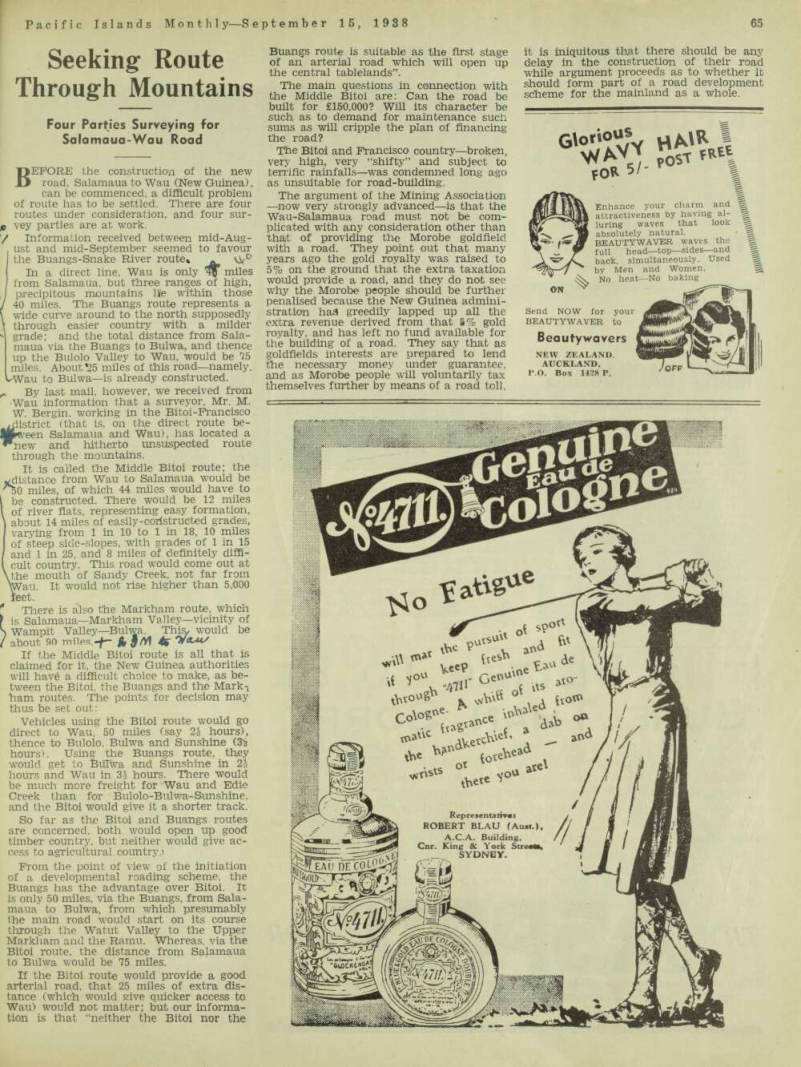
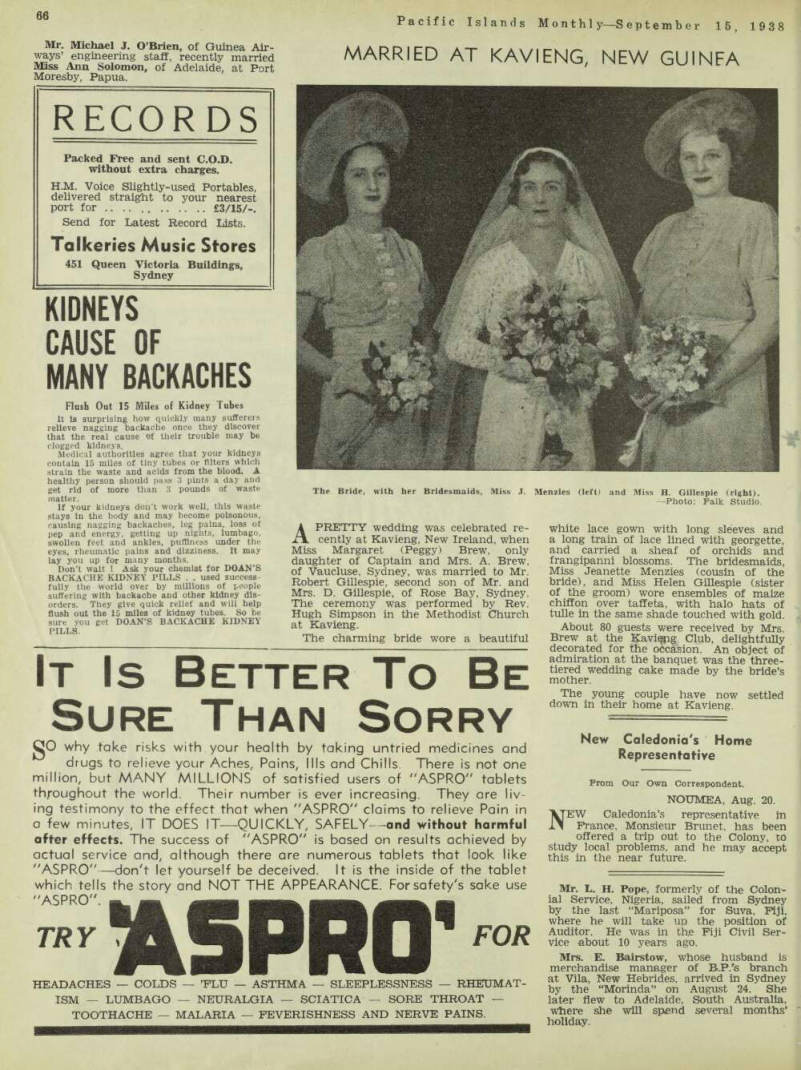
Through Mountains Four Parties Surveying for Salamaua-Wau Road
BEFORE the construction of the new road, Salamaua to Wau (New Guinea), can be commenced, a difficult problem of route has to be settled. There are four routes under consideration, and four sur ) vey parties are at work.
' Information received between mid-Aug ust and mid-September seemed to favour the Buangs-Snake River route* * In a direct line, Wau is only miles from Salamaua. but three ranges of high, precipitous mountains li|e within those 40 miles. The Buangs route represents a wide curve around to the north supposedly through easier country with a milder grade; and the total distance from Sala maua via the Buangs to Bulwa, and thence up the Bulolo Valley to Wau, would be 75 miles. About *25 miles of this road—namely. *Wau to Bulwa —is already constructed. . By last mail, however, we received from Wau information that a surveyor, Mr. M.
W. Bergin, working in the Bitoi-Francisco /district (that is, on the direct route be tween Salamaua and Wau), has located a r ne w and hitherto unsuspected route through the mountains.
It is called the Middle Bitoi route; the ./distance from Wau to Salamaua would be 'so miles, of which 44 miles would have to be constructed. There would be 12 miles of river flats, representing easy formation, i about 14 miles of easily-coristructed grades, I varying from 1 in 10 to 1 in 18, 10 miles of steep side-slopes, with grades of 1 in 15 and 1 in 25, and 8 miles of definitely diffi cult country. This road would come out at Uhe mouth of Sandy Creek, not far from Wau. It would not rise higher than 5,000 feet.
There is also the Markham route, which is Salamaua—Markham Valley—vicinity of I Wampit Valley—Bulwa. This, would be
about 90 miles.-f- fi, J/Vl 4*
If the Middle Bitoi route is all that is claimed for it, the New Guinea authorities will hav6 a difficult choice to make, as be tween the Bitoi, the Buangs and the Mark- t ham routes. The points for decision may thus be set out: Vehicles using the Bitoi route would go direct to Wau, 50 miles (say 21 hours), thence to Bulolo, Bulwa and Sunshine (3'i hours). Using the Buangs route, they would get to Bulwa and Sunshine in 2i hours and Wau in 31 hours. There ‘would be much more freight for Wau and Edie Creek than for Bulolo-Bulwa-Sunshine, and the Bitoi would give it a shorter track.
So far as the Bitoi and Buangs routes are concerned, both would open up good timber country, but neither would give ac cess to agricultural country.» Prom the point of view of the initiation of a developmental roading scheme, the Buangs has the advantage over Bitoi. It is only 50 miles, via the Buangs, from Sala maua to Bulwa, from which presumably the main road would start on its course through the Watut Valley to the Upper Markham and the Ramu. Whereas, via the Bitoi route, the distance from Salamaua to Bulwa would be 75 miles.
If the Bitoi route would provide a good arterial road, that 25 miles of extra dis tance (which would give quicker access to Wau) would not matter; but our informa tion is that “neither the Bitoi nor the
Buangs route is suitable as the first stage of an arterial road which will open up the central tablelands”.
The main questions in connection with the Middle Bitoi are: Can the road be built for £150,000? Will its character be such as to demand for maintenance such sums as will cripple the plan of financing the road?
The Bitoi and Francisco country—broken, very high, very “shifty” and subject to terrific rainfalls—was condemned long ago as unsuitable for road-building.
The argument of the Mining Association —now very strongly advanced—is that the Wau-Salamaua road must not be com plicated with any consideration other than that of providing the Morobe goldfield with a road. They point out that many years ago the gold royalty was raised to 5% on the ground that the extra taxation would provide a road, and they do not see why the Morobe people should be further penalised because the New Guinea admini stration haSi greedily lapped up all the extra revenue derived from that 5% gold royalty, and has left no fund available for the building of a road. They say that as goldfields interests are prepared to lend the necessary money under guarantee, and as Morobe people will voluntarily tax themselves further by means of a road toll.
it is iniquitous that there should be any delay in the construction of their road while argument proceeds as to whether it should form part of a road development scheme for the mainland as a whole.
Mr. Michael J. O’Brien, of Guinea Air ways’ engineering staff, recently married Miss Ann Solomon, of Adelaide, at Port Moresby, Papua.
Advertisements & other items, p. 69 (2 items)
65
Pacific Islands Monthl y—S eptember 15, 1938
■Js^Sv.S.
S£W.
fOR 5/-
Enhance your charm and attractiveness by having alluring waves that look absolutely natural.
BEAUTYWAVER waves the
full head—top—sides—and
back, simultaneously. Used by Men and Women.
No heat—No baking Send NOW for your
BEAUTYWAVER to
Beautywavers
NEW ZEALAND.
AUCKLAND,
P.O. Box 1438 P.
OFF
tVic ott SP o* fvl an de an t Vxctc // .»iv '•■*
■JS^SV.S.
c -■ n' a " c
f tot*** 4
*fis» °L„ v ov»» te '
Representa rival
ROBERT BLAU (Auit.).
A.C.A. Building, Cnr. King 8i York StreaM,
SYDNEY.
Married At Kavieng, New Guinea
A PRETTY wedding was celebrated re cently at Kavieng, New Ireland, when Miss Margaret (Peggy) Brew, only daughter of Captain and Mrs. A. Brew, of Vaucluse, Sydney, was married to Mr.
Robert Gillespie, second son of Mr. and Mrs. D. Gillespie, of Rose Bay, Sydney.
The ceremony was performed by Rev.
Hugh Simpson in the Methodist Church at Kavieng.
The charming bride wore a beautiful
white lace gown with long sleeves and a long train of lace lined with georgette, and carried a sheaf of orchids and frangipanni blossoms. The bridesmaids, Miss Jeanette Menzies (cousin of the bride), and Miss Helen Gillespie (sister of the groom) wore ensembles of maize chiffon over taffeta, with halo hats of tulle in the same shade touched with gold.
About 80 guests were received by Mrs.
Brew at the Kavieng Club, delightfully decorated for the occasion. An object of admiration at the banquet was the three tiered wedding cake made by the bride’s mother.
The young couple have now settled down in their home at Kavieng.
The Bride, with her Bridesmaids, Miss J. Menzles (left) and Miss H. Gillespie (right). —Photo: Falk Studio.
Representative
New Caledonia's Home Representative
Prom Our Own Correspondent.
Noumea, Aug. 20.
NEW Caledonia’s representative in Prance, Monsieur Brunet, has been offered a trip out to the Colony, to study local problems, and he may accept this in the near future.
Mr. L. H. Pope, formerly of the Colon ial Service, Nigeria, sailed from Sydney by the last “Mariposa” for Suva, Fiji, where he will take up the position of Auditor. He was in th,e Fiji Civil Ser vice about 10 years ago.
Mrs. E. Bairstow, whose husband is merchandise manager of B.P/s branch at Vila, New Hebrides, arrived in Sydney by the “Morinda” on August 24. She later flew to Adelaide, South Australia, where she will spend several months’ holiday.
Advertisements & other items, p. 70 (2 items)
66
Pacific Islands Monthl y—S eptember 15, 1938
Aspro
RECOR DS
Packed Free and sent C.O.D. without extra charges.
H.M. Voice Slightly-used Portables, delivered straight to your nearest port for .. £3/15/-.
Send for Latest Record Lists.
Talkeries Music Stores
451 Queen Victoria Buildings, Sydney
KIDNEYS
CAUSE OF
MANY BACKACHES
Flush Out 15 Miles of Kidney Tubes It la surprising how quickly many sufferers relieve nagging backache once they discover that the real cause of their trouble may be clogged kidneys.
Medical authorities agree that your kidneys contain 15 miles of tiny tubes or filters which strain the waste and acids from the blood. A healthy person should pass 3 pints a day and get rid of more than 3 pounds of waste matter.
If your kidneys don’t work well, this waste stays in the body and may become poisonous, causing nagging backaches, leg pains, loss of pep and energy, getting up nights, lumbago, swollen feet and ankles, pufflness under the eyes, rheumatic pains and dizziness. It may lay you up for many months.
Don’t wait 1 Ask your chemist for DOAN’S BACKACHE KIDNEY PILLS . . used successfully the world over by millions of people suffering with backache and other kidney disorders. They give quick relief and will help sure vou get DOAN'S BACKAC
PILLS.
flush out the 15 miles of kidney lUUCSt ov uc
J *EY
It Is Better To Be
Sure Than Sorry
gO why take risks with your health by taking untried medicines and drugs to relieve your Aches, Pains, Ills and Chills. There is not one million, but MANY MILLIONS of satisfied users of "ASPRO" tablets throughout the world. Their number is ever increasing. They are living testimony to the effect that when "ASPRO" claims to relieve Pain in a few minutes, IT DOES IT—QUICKLY, SAFELY— and without harmful after effects. The success of "ASPRO" is based on results achieved by actual service and, although there are numerous tablets that look like "ASPRO"—don't let yourself be deceived. It is the inside of the tablet which tells the story and NOT THE APPEARANCE. For safety's sake use
"ASPRO'
TRY
ASPRO
FOR
HEADACHES COLDS ’FLU ASTHMA SLEEPLESSNESS RHEUMAT-
ISM LUMBAGO NEURALGIA SCIATICA SORE THROAT
TOOTHACHE MALARIA FEVERISHNESS AND NERVE PAINS.
Native-Grown Coffee
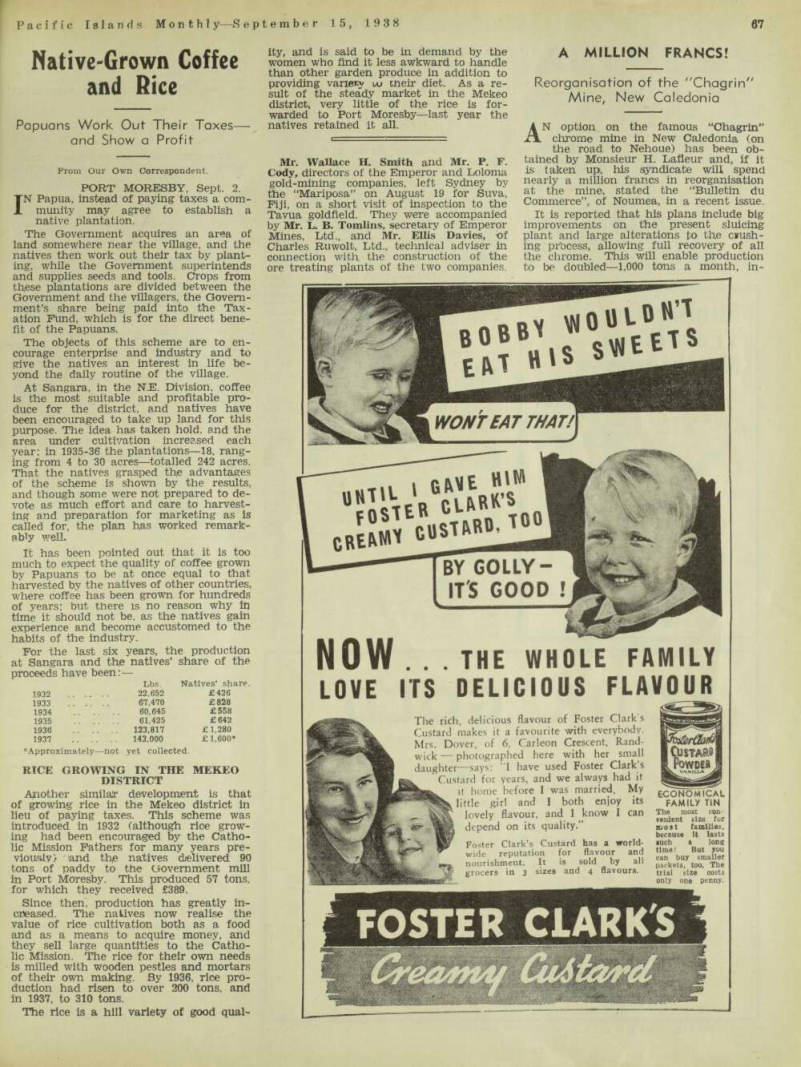
and Rice Papuans Work Out Their Taxes— and Show a Profit
Prom Our Own Correspondent.
Port Moresby, Sept. 2.
IN Papua, instead of paying taxes a com munity may agree to establish a native plantation.
The Government acquires an area of land somewhere near the village, and the natives then work out their tax by plant ing, while the Government superintends and supplies seeds and tools. Crops from these plantations are divided between the Government and the villagers, the Govern ment’s share being paid into the Tax ation Fund, which is for the direct bene fit of the Papuans.
The objects of this scheme are to en courage enterprise and industry and to give the natives an interest in life be yond the daily routine of the village.
At Sangara, in the N.E. Division, coffee is the most suitable and profitable pro duce for the district, and natives have been encouraged to take up land for this purpose. The idea has taken hold, and the area under cultivation increased each year: in 1935-36 the plantations—lB, rang ing from 4 to 30 acres—totalled 242 acres.
That the natives grasped the advantages of the scheme is shown by the results, and though some were not prepared to de vote as much effort and care to harvest ing and preparation for marketing as is called for, the plan has worked remark ably well.
It has been pointed out that it is too much to expect the quality of coffee grown by Papuans to be at once equal to that harvested by the natives of other countries, where coffee has been grown for hundreds of years: but tnere is no reason why In time it should not be, as the natives gain experience and become accustomed to the habits of the industry.
For the last six years, the production at Sangara and the natives’ share of the proceeds have been: —
Rice Growing In The Mekeo
District
Another similar development is that of growing rice in the Mekeo district in lieu of paying taxes. This scheme was introduced in 1932 (although rice grow ing had been encouraged by the Catho lic Mission Fathers for many years pre viously) and the natives delivered 90 tons of paddy to the Government mill in Port Moresby. This produced 57 tons, for which they received £389.
Since then, production has greatly in creased. The natives now realise the value of rice cultivation both as a food and as a means to acquire money, and they sell large quantities to the Catho lic Mission. The rice for their own needs is milled with wooden pestles and mortars of their own making. By 1936, rice pro duction had risen to over 200 tons, and in 1937, to 310 tons.
The rice is a hill variety of good qual
ity, and is said to be in demand by the women who find it less awkward to handle than other garden produce in addition to providing vanery wj ineir diet. As a re sult of the steady market in the Mekeo district, very little of the rice is for warded to Port Moresby—last year the natives retained it all.
Mr. Wallace H. Smith and Mr. P. F, Cody, directors of the Emperor and Loloma gold-mining companies, left Sydney by the “Mariposa” on August 19 for Suva, Fiji, on a short visit of inspection to the Tavua goldfield. They were accompanied by Mr. L. B. Tomlins, secretary of Emperor Mines, Ltd., and Mr. Ellis Davies, of Charles Ruwolt, Ltd., technical adviser in connection with, the construction of the ore treating plants of the two companies.
Lbs.
Natives’ share. 1932 22,652 £426 1933 67,470 £828 1934 60,645 £558 1935 61,425 £642 1936 123,817 £1,280 1937 143,000 £1,600* ♦Approximately—not yet collected.
Reorganisation of the "Chagrin"
A Million Francs!
Mine, New Caledonia
AN option on the famous “Chagrin” chrome mine in New Caledonia (on the road to Nehoue) has been ob tained by Monsieur H. Lafleur and, if it is taken up, his syndicate will spend nearly a million francs in reorganisation at the mine, stated the “Bulletin du Commerce”, of Noumea, in a recent issue.
It is reported that his plans include big improvements on the present sluicing plant and large alterations to the ciush ing process, allowing full recovery of all the chrome. This will enable production to be doubled —1,000 tons a month, in
stead of 500, as at present. Sixty ad ditional mine labourers will be employed, bringing the total to 200.
Since its opening, the “Chagrin’* mine has produced about 90,000 tons of chrome.
This has been handled by the Chrome Company (Society Tiebaghi) and this ar rangement will continue.
The enlargement of the mine workings will be carried out under the direction of M. Dubois, an engineer of the School of Mines and Geology at Nancy, Prance, who arrived in Noumea by the “Pierre Loti” in July.
Mr. H. M. Stuchbery arrived in Sydney from Suva by the “Strathmore” in Aug ust on his way to Tanganyika, British East Africa, where he has been trans ferred from the Fiji Civil Service. He was accompanied by his wife.
Advertisements & other items, pp. 71-72 (2 items)
67
Pacific Islands Monthl y —S eptember 15, 1938
sVeVts
UlOM’t
EAT
4
WONT EAT THAT!
m
bME
UNTIL
FOSTER CLMJK
caWiV CUBTAR®
TOO
CRE&NU
GOLLY
BY
ITS GOOD !
NOW.. . THE WHOLE FAMILY
LOVE ITS DELICIOUS FLAVOUR
The rich, delicious flavour of Foster Clark s Custard makes it a favourite with everybody.
Mrs. Dover, of 6, Carleon Crescent, Randwick photographed here with her small daughter —says; "1 have used Foster Clark’s Custard for years, and we always had it it home before I was married. My little girl and I both enjoy its lovely flavour, and I know I can depend on its quality.”
Foster Clark’s Custard has a worldwide reputation for flavour and nourishment. It is sold by all grocers in 3 sizes and 4 flavours.
STAR®
OWDIft
ECONOMICAL
FAMILY TIN
The most convenient size for most families, because It lasts •uch a long time! But you can buy smaller packets, too. The trial size costs only one penny.
FOSTER CLARK'S
Mining Ore
Treatment
Machinery
COMPLETE CYANIDE
PLANTS SUPPLIED
Dorr Classifiers Dorr Thickeners Dorr Agitators Oliver Filters Merril Crowe Zinc Dust Gold Precipitation Richardson Mine Fans •
FANS AND AIR HEATERS
For Ventilation, Copra Drying Rooms, etc. • Enquire from
CROSSLE. DUFF AND
MACINTOSH LTD.
52 Bridge Street. SYDNEY
YOUR GOLD
When you consign your gold to the house of Garrett & Davidson, you are assured of the fullest degree of business integrity . . . absolute accuracy of assays . . . and prompt payment at highest ruling prices.
Known as Australasia’s clearing house for precious metals, the greatest proportion of the gold business of the Pacific Islands passes through the Garrett & Davidson organisation.
Apart from Gold, highest prices are also paid for Osmiridium, Platinum, Silver, and all other precious metals.
Immediate attention given to every inquiry.
GARRETT & DAVIDSON, PTY., LTD.
ASSAYERS . . . METALLURGICAL CHEMISTS,
BANK OF N.S.W. BUILDINGS.
REGENT & GEORGE STS., SYDNEY.
Pacific Mining
News
From Fiji
Emperor Mines Ltd.
THE general manager of Emperor Mines Ltd., ■ Tavua. Fiji, in his report for the four weeks ended August 10, advises that during the last ten days of the period the values in the development headings on No. 3 level showed an improvement over those reported for the last period, and gave indications of the possibility of further improvement.
Construction and Development.—Trenching operations continued on westerly extension of Cardigan lode. Forming of road to Emperor mill well advanced. Vatda wharf construc tion; Moie extended to 72J> ft. and has reach ed deep water. Bulk oil tank almost com pleted; 2,000-ton tank has arrived. Contractor ready to commence assembling. Lime-burning plant at Tau: Rain has delayed operations somewhat, but progress is satisfactory.
Production since June has been;—
Mt. Kasi Mines Ltd.
Yields from Mt. Kasi mine, Vanua Levu, for the past four months, are compared in the following table;—
Loloma (Fiji) Gold Mines N.L.
Production from Loloma (Fiji) Gold Mines N.L., operating on the Tavua field, Fiji, was lower for the four weeks ended August 10.
The operating time of the mill was affected, through the breakage of the tube mill pinion shaft, and accounted for the reduced yield.
Production figures for the last three per iods are:—
The Company reports that the average val ues at the 224 ft. level of the mine are main taining the high grades previously established.
In the last 36 ft. of driving (mid-August), the value was 36.4 dwt. over a width of 60 inches.
June 15.
July 13.
Aug. 10.
Ore, long tons .. 14,464 14,748 14.091 Pine gold, oz. .. 4,177.6 4,166.6 4,017.5 Head value, dwt. 6V2 6.2 6.29 Residue, dwt. 0.7 0.6 0.57
May 18. June 15. July 13. Aug. 10 Ore, tons . . 3,050 2,749 3,290 3,030 Gold, fine oz. 626 608 650 659 Value. £ A. .. 5,477 5,320 5,687 5,766
June 15.
July 13.
Aug. 10.
Mill ran, hours 573 553 436 Ore treated, tons 1,960 1.928 1,850 Head value, dwt. 28.1 28.0 28.07 Gold, fine oz .. 2.573 2.532 2,402 Dwt., a ton 26.2 26.2 26.0 Silver, fine oz. 516 572 453 Tailings, assay, dwt. 1.85 1.76 2.1
From New Guinea
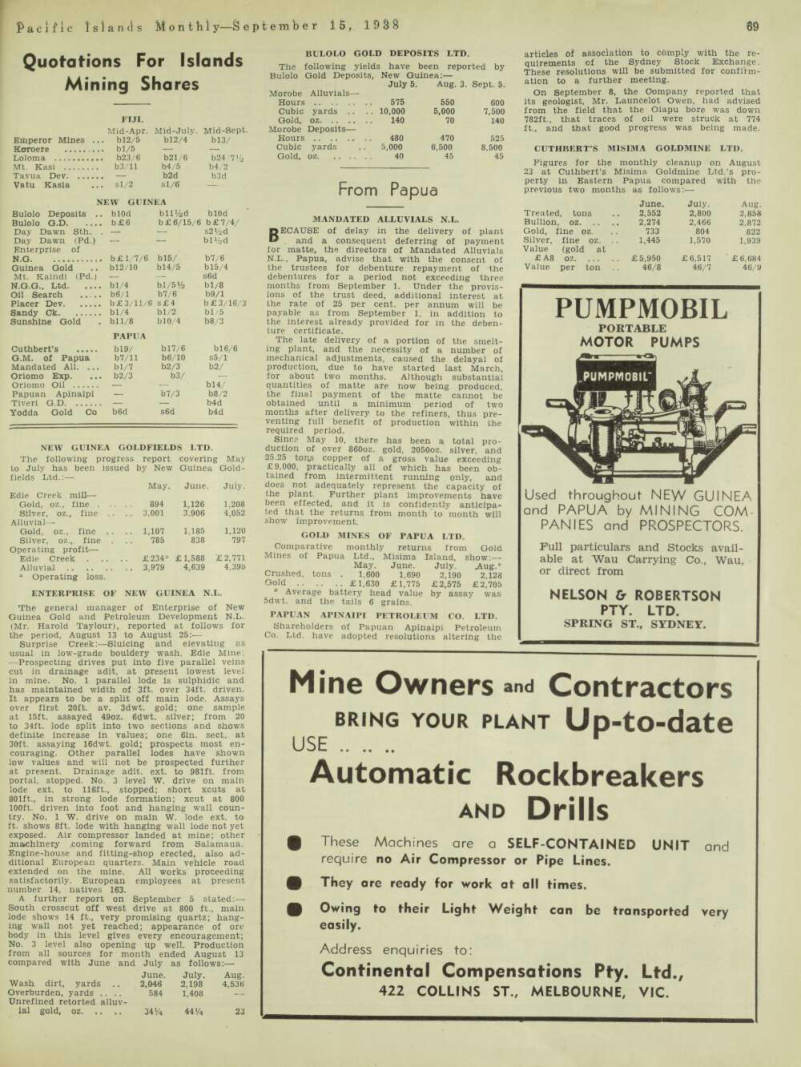
Sunshine Gold Development N.L.
■THE general manager of Sunshine Gold ■ Development N.L. reports that during the three months ended August 31 he sluiced a large quantity of marginal ground lying out- S i de^ he selected areas. Although the values of this marginal ground are lower than the average of the adjoining portion of the select ed area, they are payable. It would not be practical to leave them now and return to them later.
The managing director, who visited the mine, reports that work is proceeding in accordance with the plan laid down, providing for the profitable working of the property for many years. Owing to the nature of the ground, fluctuations in the yield are to be expected, but the directors anticipate that a satisfactory dividend rate will be maintained. The plant is in excellent order and the race is standing up to requirements.
Production for the quarter ended August 31 compares with that of the previous quarter as follows:
Bulolo Gold Dredging Ltd.
The July output of Bulolo Gold Dredging Ltd., Morobe goldfield, New Guinea, compares with the two previous yields as follows;
Sandy Creek Gold Sluicing Ltd.
Sandy Creek Gold Sluicing Ltd., New Guinea, earned net profit of £5,689 for the 12 months ended April 30, after £3,969 was written off for depreciation, brokerage, preliminary ex penses and other items. The directors report that, with £7,165 brought in, £11,134 was avail able. They declared a final dividend of iy 2 d. a share, making 3d. a share for the year. These dividends require £7,750, and £3,384 remains to be carried forward.
During the year, 196,500 cubic yards of ma terial were treated for a recovery of 3,271 oz. of gold, which realised £24,057, an average value of 2/5a cubic yard. These figures are an increase in quantity of material treated, and gold recovered, but a decrease in the aver age value a cubic yard as against last year.
Values have shown an improvement since the close of the financial year, and for the three months to July 31 averaged 3/6 a cubic yard.
At the annual meeting of the Company in Sydney on September 2, shareholders ratified the directors’ action in making an investment of £l,OOO in an undertaking, which is pur chasing the New Guinea assets of Upper Watut Gold Alluvial (N.L.) (in liq.). The chairman (Mr. H. B. Jamieson), said that the life of the present property owned by Sandy Creek was from five to six years and might even extend to 10 years. Since the close of the year, the boai’d had arranged for the Bulolo Company, to return to Sandy Creek portion of the 20 acres In the Lower Poverty Creek area, sold to them in 1925. With the advent of No. 2 plant in August last year, costs were mater ially reduced, and now stood at about 1/2 a cubic yard. Prospects for the current year were encouraging.
August production compares with the three previous months as follows: —
June . ..
Cub. yd.
Hours.
Gold (oz.) .. 30,000 513 306.1 July . .. .. 20,600 515 249.5 August .. .. 30,000 589 278.5 Total ,. . . 80,600 1617 834.1 Previous qtr. .. 52,500 1451 1084.3
„ , May. June. July.
Cubic yards . . 1,248.000 1,184.000 1 232 000 Bullion, OZ. . . 22,461 18.265 19,667 Gold, fine, oz. .. 15,499 12,603 13,569 Value— Aust. currency* . £135,616 £110,276 £118 729 Value, per c. y. . /26.8 /22.3 /23 1 Working profit .. £100,038 £75,967 £77.875 * At £A8/15/ per fine ounce.
May. June. July. Aug.
Cubic yards . .. 20,119 15,949 16,088 18,497 Gold, OZ 466 292 531 538 Per c. yd. .. . 3/4 2/9 4/11 4/4 Working cost 1/4 1/3 Vi 1/5 1/2
New Guinea Goldfields Ltd.
The following progress report covering May to July has been issued by New Guinea Gold fields Ltd.:—
Enterprise Of New Guinea N.L,
The general manager of Enterprise of New Guinea Gold and Petroleum Development N.L. (Mr. Harold Taylour), reported at follows for the period, August 13 to August 25: Surprise Creek: —Sluicing and elevating as usual in low-grade bouldery wash. Edie Mine: —Prospecting drives put into five parallel veins cut in drainage adit, at present lowest level in mine. No. 1 parallel lode is sulphidic and has maintained width of 3ft. over 34ft. driven.
It appears to be a split off main lode. Assays over first 20ft. av. 3dwt. gold; one sample at 15ft. assayed 490 z. 6dwt. silver; from 20 to 34ft. lode split into two sections and shows definite increase in values; one 6in. sect, at 30ft. assaying 16dwt. gold; prospects most en couraging. Other parallel lodes have shown low values and will not be prospected further at present. Drainage adit. ext. to 981 ft. from portal, stopped. No. 3 level W. drive on main lode ext. to 116 ft., stopped; short xcuts at 801 ft., in strong lode formation; xcut at 800 100 ft. driven into foot and hanging wall coun try. No. 1 W. drive on main W. lode ext. to ft. shows Bft. lode with hanging wall lode not yet exposed. Air compressor landed at mine; other ana#chinery ,coming forward from Salamaua.
Engine-house and fitting-shop erected, also ad ditional European quarters. Main vehicle road extended on the mine. All works proceeding satisfactorily. European employees at present number 14, natives 163.
A further report on September 5 stated:— South crosscut off west drive at 800 ft., main lode shows 14 ft., very promising quartz; hang ing wall not yet reached; appearance of ore body in this level gives every encouragement; No. 3 level also opening up well. Production from all sources for month ended August 13 compared with June and July as follows:
Bulolo Gold Deposits Ltd.
The following yields have been reported by Bulolo Gold Deposits, New Guinea:—
May.
June.
July.
Edie Creek mill— Gold, oz., fine . .. 894 1,126 1,208 Silver, oz., fine . . .. 3,001 3,906 4,052 Alluvial—- Gold, oz., fine ,. .. 1,107 1,185 1,120 Silver, oz., fine . 785 838 797 Operating profit— Edie Creek . . £234* £ 1,588 £2,771 Alluvial .. 3,979 4,639 4,395 * Operating loss.
July 5.
Aug. 3.
Sept. 5.
Morobe Alluvials— Hours 575 550 600 Cubic yards .. . 10,000 5,000 7,500 Gold, oz 140 70 140 Morobe Deposits— Hours 480 470 525 Cubic yards 5,000 6,500 8,500 Gold, oz 40 45 45
June. July. Aug.
Wash dirt, yards .. 2,046 2,198 4,536 Overburden, yards ... 584 1,408 — Unrefined retorted alluvial gold, oz 34 y 4 44 y 4 23
Advertisements & other items, p. 72 (1 item)
68
Pacific Islands Monthl y—S eptember 15, 1938
Mining Shares
Quotations For Islands Mining Shares
Fiji.
Mid-Apr.
Mid-July.
Mid-Sept.
Emperor Mines ... bl2/5 bl2/4 bl3/ Koroere bl/5 — — Loloma b23/6 b21/6 b24 '7Va Mt. Kasi b3/ll b4/5 b4/2 Tavua Dev — b2d b3d Vatu Kasia sl/2 sl/6 —
New Guinea
Bulolo Deposits .. blOd bliy 2 d blOd Bulolo G.D b £ 6 b£ 6/15/6 b £ 7/4/ Day Dawn Sth. . — — s2»/ 2 d Day Dawn (Pd.) — — blV 2 d Enterprise of N.G b£ 1/7/6 bl5/ b7/6 Guinea Gold bl2/10 bl4/5 bl5/4 Mt. Kaindi (Pd.) — — s6d N.G.G., Ltd bl/4 bl/SMs bl/8 Oil Search b6/l b7/6 b9/l Placer Dev b£ 3/11/6 s £ 4 b£ 3/16/3 Sandy Ck bl/4 bl/2 bl/5 Sunshine Gold bll/8 blO/4 b8/3 Cuthbert’s
Papua
bl9/ bl7/6 bl6/6 G.M. of Papua b7/ll b6/10 s5/l Mandated All. ... bl/7 b2/3 b2/ Oriomo Exp. b2/3 b3/ — Oriomo Oil — — bl4/ Papuan Apinaipi — b7/3 b8/2 Tiveri G.D — — b4d Yodda Gold Co b6d s6d b4d
From Papua
Mandated Alluvials N.L.
BECAUSE of delay in the delivery of plant and a consequent deferring of payment for matte, the directors of Mandated Alluvlals N.L., Papua, advise that with the consent of the trustees for debenture repayment of the debentures for a period not exceeding three months from September 1. Under the provis ions of the trust deed, additional interest at the rate of 25 per cent, per annum will be payable as from September 1, in addition to the interest already provided for in the deben ture certificate.
The late delivery of a portion of the smelt ing plant, and the necessity of a number of mechanical adjustments, caused the delayal of production, due to have started last March, for about two months. Although substantial quantities of matte are now being produced, the final payment of the matte cannot be obtained until a minimum period of two months after delivery to the refiners, thus pre venting full benefit of production within the required period.
Since May 10, there has been a total pro duction of over 860 oz. gold, 20500 z. silver, and 25.25 toi\s copper of a gross value exceeding £9,000, practically all of which has been ob tained from intermittent running only, and does not adequately represent the capacity of the plant. Further plant improvements have been effected, and it is confidently anticipa ted that the returns from month to month will show improvement.
Gold Mines Of Papua Ltd.
Comparative monthly returns from Gold Mines of Papua Ltd., Misima Island, show:— May. June. July. .Aug.* Crushed, tons . 1.600 1,690 2,190 2,128 Gold £1,630 £1,775 £2,575 £2,705 * Average battery head value by assay was sdwt. and the tails 6 grains.
Papuan Apinaipi Petroleum Co. Ltd.
Shareholders of Papuan Apinaipi Petroleum Co. Ltd. have adopted resolutions altering the
articles of association to comply with the re quirements of the Sydney Stock Exchange.
These resolutions will be submitted for confirm ation to a further meeting.
On September 8, the Company reported that its geologist, Mr. Launcelot Owen, had advised from the field that the Oiapu bore was down 782 ft., that traces of oil were struck at 774 ft., and that good progress was being made.
Cuthbert’S Misima Goldmine Ltd.
Figures for the monthly cleanup on August 23 at Cuthbert’s Misima Goldmine Ltd.’s pro perty in Eastern Papua compared with the previous two months as follows:
June.
July.
Aug.
Treated, tons 2,552 2,800 2,858 Bullion, oz 2,274 2,466 2,872 Gold, fine oz. 733 804 822 Silver, fine oz. .. 1,445 1,570 1,939 Value (gold at £ A8 oz £5,950 £6,517 £6,684 Value per ton 46/8 46/7 46/9
Advertisements & other items, pp. 73-74 (2 items)
69
Pacific Islands Monthl y—S eptember 15, 19S8
Automatic Rockbreakers
PUMPMOBIL
PORTABLE
MOTOR PUMPS
PUMPMOBIL"
Used throughout NEW GUINEA
and PAPUA by MINING COM-
PANIES and PROSPECTORS.
Full particulars and Stocks available at Wau Carrying Co., Wau, or direct from
NELSON & ROBERTSON
PTY. LTD.
SPRING ST., SYDNEY.
Mine Owners and Contractors
BRING YOUR PLANT Up-t O-date
USE
Automatic Rockbreakers
AND Drills
0 These Machines are a SELF-CONTAINED UNIT and require no Air Compressor or Pipe Lines. 9 They are ready for work at all times.
B Owing to their Light Weight can be transported very easily.
Address enquiries to:
Continental Compensations Pty. Ltd.,
422 COLLINS ST. ( MELBOURNE, VIC.
Ventrlllos—Learn to throw your voice, 1/-. Send 2/8 for 2 Gigantic and Interesting Catalogues and Leaflets.
Fountain Pen size Microscope and Compass Combined 6/6.
Midget Razor Hones, for all Blades, 1/6. Joy Buzzer Hand Shakers, 3/3. Fountain Pen size Torch 2/3.
Put and Take Tops 2/-.
Model Outboard Electric Motors, 12/6 and 19/6. 4 in 1 Pen size Screwdriver 2/-.
Miscroscopes, 5/6, 6/6, and 9/6.
Microscope Kits 12/6.
Table Tennis Sets, .. 6/6, 8/6.
New 3 in 1 Roulette Game, Doggie, Roulette, etc., with directions 3/9. 2/6,2/9, 3/6 Adjustable all w a 1 Morse Code Key as illustrated. 13/6.
P.M.G. Type, 19/6.. Buzzers A d j u s table Electric Forehead Torch Fits snugly; for Profess ional Men B andsmen, Miners, etc.: 10/6. With separate Torch Battery Container: 18/6.
Electric 240 Volt A.C, Mantr Model Super Het. Radio, Midget Size. Neat Cloth Covered Cab inet. Perfect Tone. 12 months’
Guarantee: £l3/10/-. Value NOW £B/10/-.
CJLVJ
•fit
Ail
Wholesale or Retail. Table Tennis Sets. Bats. Balls, Nets, Shuttlecocks, Shuttlecock Sets, Bats etc. Write for full lists.
Bad Minton Sets, Outdoor; 50/-.
Indoor Sets: 45/-.
Newmarket Race Game, 3 Horses Run up the straight. Operated by 3 Rocking levers. You can back your fancy: 16/6.
Table Pin Games. 3 Types. 10/6.
Bulls and Bears. The latest game, by inventor of. Monopoly l2/9, Hand Winding Gramophone Motors with Turntable and all Fittings, British 25/ Counters for playing Games: 3d. & 9d. doz.
“Totem”, a wellmade little game, for Homes, Clubs Hotels, etc. Push the starting knob and off spin the 2 reels, one the horses and the other the odds when the spin terminates the Winner and Winner’s Price is clearly shown.
Cheat and fool-proof, 21/-.
Send for Leaflet.
Electric Dry shavers for 240
A.C. D.C. El-
ectric supply. Write for full list.
“VICO” 75/.
Special price to traders. Write for prices. “Packard” 90/.
CROWN AND ANCHOR SETS, 10/6.
5 Poker Dice, in box .. .. 7/6 and 10/6 In Leather Case 7/6, 10/6, 12/6 Head and Tail Dice, Sets of Five, 8/6 and 11/6. Large Transparent 1 to 6 Dice, 1/6 each. Extra Large 2/6.
Electric Train Sets, Loco., Tender, and 12 Rails, 65/, 75/-, 85/-, 95/-.
Transformers, 17/6, 21/-, 25/- Extra.
“Presto”, the Mys terious Coin-Box! — The most baffling Trick ever conceived Borrow a coin; request owner to mark in a way he will identify it again. In exchange for coin, hand him a small bakelite box bound up.
Ask him to open it. Inside he will find a match box, also securely bound. In side this he will find a cloth bag, also bound up. When opened up, he finds the coin he marked, in the bag. This is one of the most mystifying Tricks ever performed. Price, complete with in structions: 2/6, plus postage, 3d.
‘man-o-wfiß
RUBBER CLRD
QERIQL
4o sTßpnbs
30 FT 5% 100 FT 10- Auto Aerials.
Chromium Plated
lUPER AUDIO
TCAIVirOBMIkS
Portable Electric Battery Operated Lighting Outfit. Takes standard cells, complete with pull switch, 2 lights, lea 4 and spade . . . 7/6.
T« E iStotf - 'MS. ?nsrpioo« 9K539 'Eliminoise' Aerial Kit, for short or dual wave sets.
Aerial Pyrex type Insulators. transpoai tion blocks and 200 ft. aerial wire, 22/6. Eliminates unwanted aerial and hideous electrical noises from your dual-wave or -hort-wave set.
Goldring English Pick-up Heads. Suit and Fit all Gramophone Tone Arms Type 44/4 Pick-up Head with Builtin Volume Control: 19/6. Type 44/5 Pick-up Head, with Volume Control attached: 21/-. Type 33/3 Pick-up Head with Highly Polished Nickle Finish: 18/6. Bakelite Case Pick-up Head: 16/6.
Swiss Music Boxes for Cigarettes, etc.: 21/-, 25/-, 27/6.
We stock all kinds of Dice and Dice Cups. Send for Lists.
Table Type Interesting Pin Games: 12/6, 15/-. Competition Dart Boards: 21/-. Others: 2/6, 8/11, 11/6, Competition Brass and Feathered Darts: 3 for 5/6. Table Tennis Sets: 7/6 15/-. Model Aeroplane Kits, all types Write for leaflets. Draught Sets: 4/6, 6/6, 10/6. Monopoly Sets: 10/6, 16/6, 21/-. Bull and Bears (like Monopoly): 12/6.
Collapsible Type 21/-. Roof Types 2 or 3 strands. 31/-. Complete with Insulators.
Ready to fit. 240 A.C. Electric Complete Massage Outfits, with Applicators for Muscular or Nervous Complaints 42/-.
Manufacturers’
Stock of Dynamic Speakers, 2.500 ohms: 8/6. 5 Cell 1,500 ft.
Focussing Torches.
NOW . . . 6/6.
“The Constructor* Wireless Bncyclo pedia”. By F, J.
Camm. Cloth bound.
Nearly 400 pages, 490 Illustrations, 7/6. The only Work of its Type. Com piled by an acknowledged expert, this volume forms a complete guide, in alphabetical order, to the construction, operation, repair and principles, of every type of wireless receiver, with a special section on television, and complete instructions on the making of various wireless components.
Buy assembled or build the Air Patrol 2 - valve Battery - operated Radio for all short-wave stations and broadcasts. Easy to operate, change over switch. All parts £4/1/6, Valves 28/9, Batteries £2/15/9, Phones 30/-, Speaker 21/3, The set assembled and complete, £l2/14/9. Easiway Charts 6d.
G r a phoscope 8/6. With It you can copy any Drawing or Photo up to sigize 6 x 4 in.
Focus s i n g Torches, 1,500 ft., 5-cell. 6/6 ‘Cosmocord” British 240 Volt AC Electric Gramophone Motor and all turntable fittings, 39/6 Valves; we guarantee a cheaper price for any replacement. Just send along your order.
Olllg, ITLay , XLCcite. Great Fun for Home, Dance, Party, etc., or for use in Factories, Stores, etc. Write for full range. Just plug leads of Pick-up into pick-up terminals of any set. 9/6 to £6/6/-. r U/A tv e ov/ oo n As illustrated with long lead fitted. Splendid Reproducer.
Excel lent English Mic r op h o ne, Table Model, with selfcontained Pre - amplifier unit in Rasp; 39/6.
These Microphones suit all sets. The leads plug into the Pickup terminals of the set.
Write for full illustrated list of the finest range of microphones available.
Home Recording Cutting Heads with Cutters complete: 105/-.
Plain Records: 5/6, 7/6, 8/6.
Cutting Needles: 1/- each.
Special Microphones; 38/6.
Simple Hook-up Directions if desired.
Special 21/- Value Gramophone Tone Arm Speaker Unit. NOW 7/6.
Wates Pocket Meters: 14/-.
Reads 0 to 6, 0 to 15, 0 to 180 volts. 0 to 30 M/A. 2 Reading Pocket Volt Meters 7/6. 3 Reading Meters 10/6.
Emmicol Universal Meter 18/6. 0 to 6, 0 to 150, 0 to 30 M/A, 0 to 2000 ohms 18/6.
Electrical Continental Solder Irons, 240 volts: 15/-. 6 v.
Electric Solder Irons; 22/6.
Large 50 amp. Battery Clips; 1/3 each.
COSMOCORD'
25
o*UUA
“Like a Plash” British make Gramophone Pickups complete Richards, just arrived 25/- “Cosmocord” ™ 25/- "Cosmocord” De Luxe 32/6 "Cosmocord” high definition ... 38/6 “Cosmocord” Super de Luxe 45/- Amplion (English) 28/6 B.T.H. Crystal Type 75/-.
Write for Full List.
RICUOV
HI AD
PHOMn
I AuUii
phone Rubber Pads: ’Phone Cords: 1/6.
H e adphones Stearing 4 0 0 0 ohms: 15/-. Lissen: 19/6. S.T.C. or 8.T.H., all British Makes: 30/- pair. Head- 2/- Pair. 6 ft.
Write for Punch Board Leaflet*
LEVENSON S RADIO
GAMES, NOVELTIES AND HOBBIES TotemUnd
226 PITT STREET, SYDNEY odd. and
Manufacturers, Importers, and Exporters, j Branches: Radio Cheapside, 240 a Pitt St. J 8
N.S.W., AUSTRALIA
Cable address; “Leveradioh.” Goods forwarded V.P.P. or Sight Draft. Satisfaction and Service Guaranteed. We can supply by mail all General Merchandise at a Better Price. Quotations with pleasure.
Please add freight and packing. Write for full list of interesting leaflets of Games, Hobbies, Novelties, and Electrical Goods.
Australian Short Wave
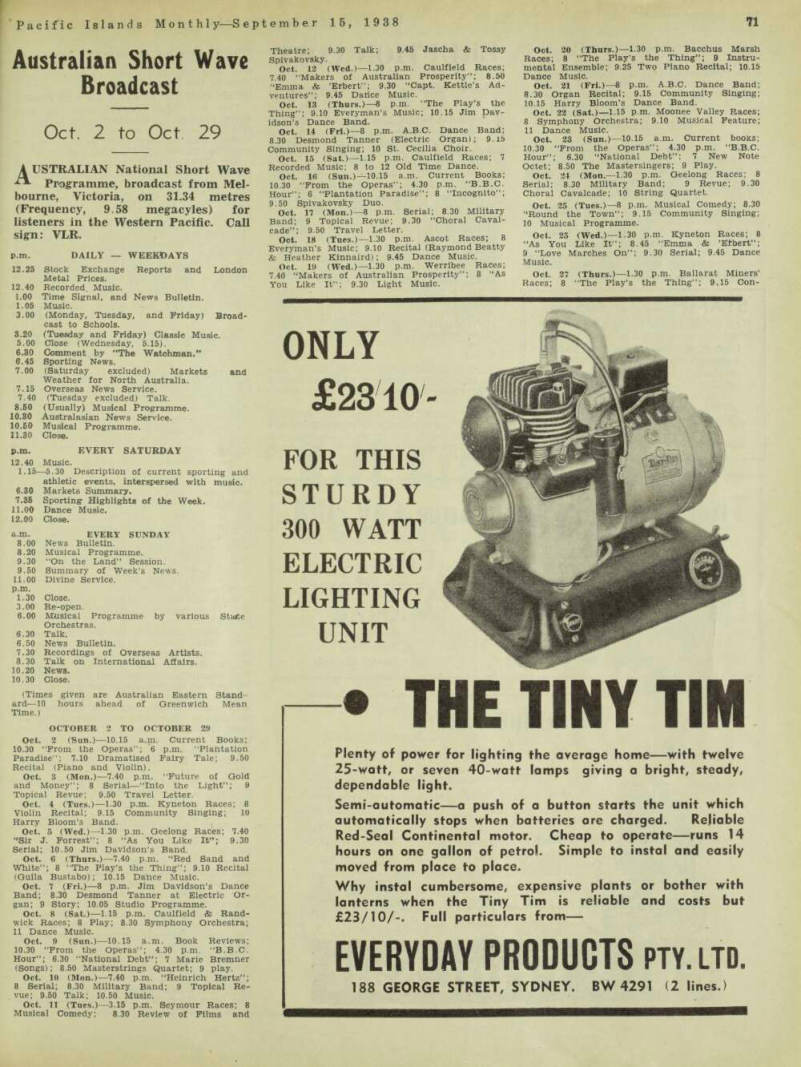
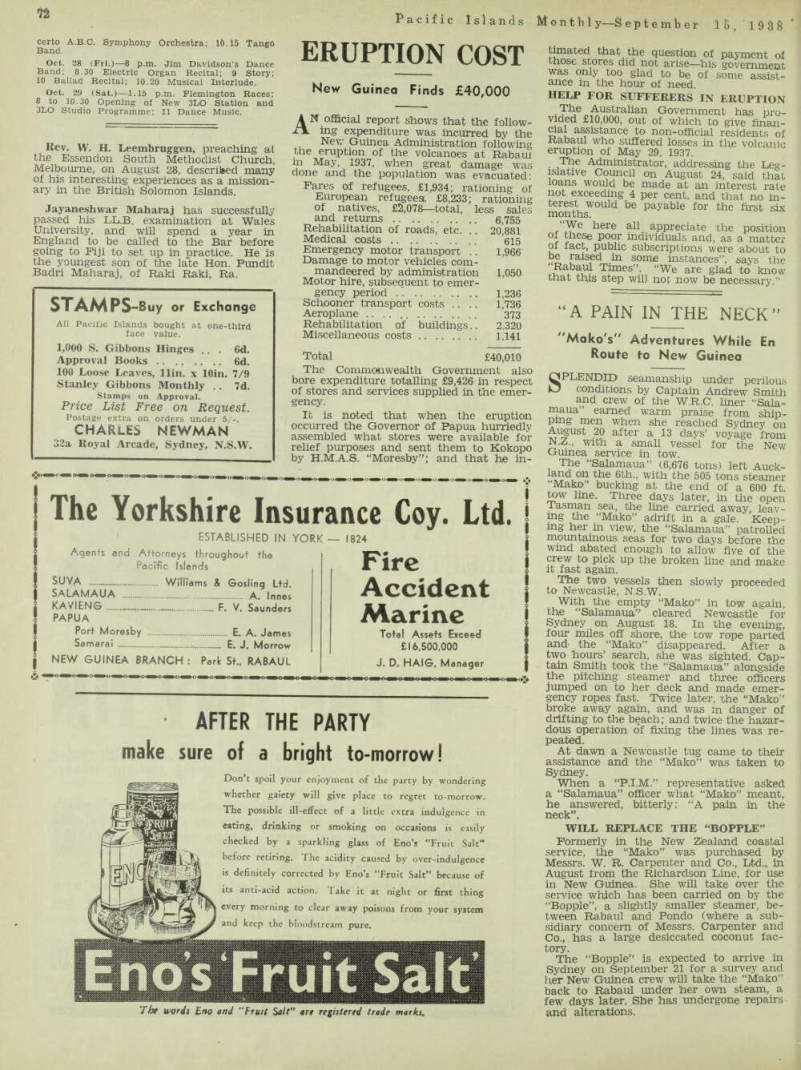
Broadcast Oct. 2 to Oct 29
A USTRALIAN National Short Wave
Programme, broadcast from Mel
bourne, Victoria, on 31.34 metres
(Frequency, 9.58 megacyles) for
listeners in the Western Pacific. Call
sign: VLR.
P.M. Daily — Weekdays
12.25 Stock Exchange Reports and London Metal Prices. 12.40 Recorded. Music. 1.00 Time Signal, and News Bulletin.
I. 05 Music. 3.00 (Monday, Tuesday, and Friday) Broad cast to Schools. 3.20 (Tuesday and Friday) Classic Music. 5.00 Close (Wednesday, 5.15). 6.30 Comment by “The Watchman.” 6.45 Sporting News. 7.00 (Saturday excluded) Markets and Weather for North Australia. 7.15 Overseas News Service. 7.40 (Tuesday excluded) Talk. 8.50 (Usually) Musical Programme. 10.80 Australasian News Service. 10.50 Musical Programme. 11.30 Close.
P.M. Every Saturday
12.40 Music. 1.15 —5.30 Description of current sporting and athletic events, interspersed with music. 6.30 Markets Summary. 7.36 Sporting Highlights of the Week. 11.00 Dance Music. 12.00 Close.
Am. Every Sunday
8.00 News Bulletin. 8.20 Musical Programme. 9.30 “On the Land’’ Session. 9.50 Summary of Week’s News.
II. Divine Service, p.m. 1.30 Close. 3.00 Re-open. 6.00 Musical Programme by various Staite Orchestras. 6.30 Talk. 6.50 News Bulletin. 7.30 Recordings of Overseas Artists. 8.30 Talk on International Affairs. 10.20 News. 10.30 Close. (Times given are Australian Eastern Stand ard —10 hours ahead of Greenwich Mean Time.)
October 2 To October 29
Oct. 2 (Sun.) —10.15 a.m. Current Books; 10.30 “From the Operas’’; 6 p.m. “Plantation Paradise’’; 7.10 Dramatised Fairy Tale; 9.50 Recital (Plano and Violin).
Oct. 3 (Mon.) —7.40 p.m. “Future of Gold and Money”; 8 Serial—“Into the Light”; 9 Topical Revue: 9.50 Travel Letter.
Oct. 4 (Tues.) —1.30 p.m. Kyneton Races; 8 Violin Recital: 9.15 Community Singing; 10 Harry Bloom’s Band.
Oct. 5 (Wed.) —1.30 p.m. Geelong Races; 7.40 “Sir J. Forrest”: 8 “As You Like It”; 9.30 Serial; 10.50 Jim Davidson’s Band.
Oct. 6 (Thurs.) —7.40 p.m. “Red Sand and White”; 8 “The Play’s the Thing”; 9.10 Recital (Guila Bustabo); 10.15 Dance Music.
Oct. 7 (Fri.) —8 p.m. Jim Davidson’s Dance Band: 8.30 Desmond Tanner at Electric Or gan; 9 Story; 10.05 Studio Programme.
Oct. 8 (Sat.) —1.15 p.m. Caulfield & Rand wick Races; 8 Play; 8.30 Symphony Orchestra; 11 Dance Music.
Oct. 9 (Sun.) —10.15 a.m. Book Reviews; 10.30 “From the Operas”; 4.30 p.m. “B.B.C.
Hour”; 6.30 “National Debt”; 7 Marie Bremner (Songs); 8.50 Masterstrings Quartet; 9 play.
Oct. 10 (Mon.) —7.40 p.m. “Heinrich Hertz”; 8 Serial; 8.30 Military Band; 9 Topical Re vue; 9.50 Talk; 10.50 Music.
Oct. 11 (Tues.) —3.15 p.m. Seymour Races; 8 Musical Comedy; 8.30 Review of Films and
Theatre; 9.30 Talk; 9.45 Jascha & Tossy Spivakovsky.
Oct. 12 (Wed.)—l3o p.m. Caulfield Races; 7.40 “Makers of Australian Prosperity”: 8.50 “Emma & ’Erbert”; 9.30 “Capt. Kettle’s Adventures”; 9.45 Dance Music.
Oct. 13 (Thurs.)—-8 p.m. “The Play’s the Thing”; 9.10 Everyman’s Music; 10.15 Jim Davidson’s Dance Band.
Oct. 14 (Fri.)—B p.m. A.B.C. Dance Band; 8.30 Desmond Tanner (Electric Organ); 9.15 Community Singing: 10 St. Cecilia Choir.
Oct. 15 (Sat.)—l.ls p.m. Caulfield Races; 7 Recorded Music; 8 to 12 Old Time Dance.
Oct. 16 (Sun.)—lo.ls a.m. Current Books; 10.30 “From the Operas”: 4.30 p.m. “8.8. C.
Hour”; 6 “Plantation Paradise”: 8 “Incognito”: 9.50 Spivakovsky Duo.
Oct. 17 (Mon.)—B p.m. Serial; 8.30 Military Band; 9 Topical Revue; 9.30 “Choral Cavalca £®” : ir 50 /TumT Ascot Races- 8 Everyman’s Music; 9.10 Recital (Raymond Beatty & Heather Kinnaird); 9.45 Dance Music.
Oct. 19 (Wed.)—l.3o p.m. Werribee Races; 7.40 “Makers of Australian Prosperity”: 8 “As You Like It”; 9.30 Light Music.
Oct. 20 (Thurs.)—l.3o p.m. Bacchus Marsh Races; 8 “The Play’s the Thing”; 9 Instru mental Ensemble; 9.25 Two Plano Recital; 10.15 Dance Music.
Oct. 21 (Fri.)—B p.m. A.B.C. Dance Band; 8.30 Organ Recital; 9.15 Community Singing: 10.15 Harry Bloom’s Dance Band.
Oct. 22 (Sat.)—l.ls p.m. Moonee Valley Races; 8 Symphony Orchestra; 9.10 Musical Feature; 11 Dance Music.
Oct. 23 (Sun.)—lo.ls a.m. Current books; 10.30 “From the Operas”; 4.30 p.m. “8.8. C.
Hour”; 6.30 “National Debt”: 7 New Note Octet; 8.50 The Mastersingers; 9 Play.
Oct. 24 (M0n.—1.30 p.m. Geelong Races; 8 Serial; 8.30 Military Band; 9 Revue; 9.30 Choral Cavalcade; 10 String Quartet.
Oct. 25 (Tues.)—B p.m. Musical Comedy; 8.30 “Round the Town”; 9.15 Community Singing: 10 Musical Programme.
Oct. 25 (Wed.)—l.3o p.m. Kyneton Races; 8 9 ‘ A f. Lo^e U 30Serial-* « *Da'nce Marches On , 9.30 Serial, 9.45 Dance iviusic.
Oct. 27 (Thurs.)—l.3o p.m. Ballarat Miners’
Races; 8 “The Play’s the Thing”; 9.15 Con-
Ban! ABC - symphony orchestra; 1015 Tango Oct. 28 (Fri.)—B p.m. Jim Davidson’s Dance Band; 8.30 Electric Organ Recital; 9 Story; 10 Ballad Recital; 10.20 Musical Interlude.
Oct. 29 (Sat.)—l.ls p.m. Plemington Races; 8 to 10.30 Opening of New 3LO Station and 3LO Studio Programme; 11 Dance Music. : fh ßev - W * H - Leembruggen, preaching at the Essendon South Methodist Church, Melbourne, on August 28, described many of his interesting experiences as a missionary in the British Solomon Islands.
Jayaneshwar Maharaj has successfully passed his LL.B. examination at Wales University, and will spend a year in England to be called to the Bar before going to Fiji to set up in oractice. He is the youngest son of the la“te Hon. Pundit Badri Maharaj, of Raki Raki, Ra.
Advertisements & other items, pp. 75-76 (2 items)
71
Pacific Islands Monthl y—S eptember 15, 1938
• The Tiny Tim
ONLY
£2310-
FOR THIS
STURDY
300 WATT
ELECTRIC
LIGHTING
UNIT
p?
• THE TINY TIM
Plenty of power for lighting the average home—with twelve 25-watt, or seven 40-watt lamps giving a bright, steady, dependable light.
Semi-automatic—a push of a button starts the unit which automatically stops when batteries are charged. Reliable Red-Seal Continental motor. Cheap to operate—runs 14 hours on one gallon of petrol. Simple to instal and easily moved from place to place.
Why instal cumbersome, expensive plants or bother with lanterns when the Tiny Tim is reliable and costs but £23/10/-. Full particulars from—
EVERYDAY PRODUCTS pty. ltd
188 GEORGE STREET, SYDNEY. BW 4291 (2 lines.)
STAMPS -Buy or Exchange
All Pacific Islands bought at one-third face value. 1,000 S. Gibbons Hinges 6d.
Approval Books 6d. 100 Loose Leaves, llin. x lOin. 7/9 Stanley Gibbons Monthly .. 7d.
Stamps on Approval.
Price List Free on Request.
Postage extra on orders under 5/-.
CHARLES NEWMAN
32a Royal Arcade, Sydney, N.S.W.
The Yorkshire Insurance Coy. Ltd.
ESTABLISHED IN YORK 1824
Agents and Attorneys throughout the Pacific Islands SUVA ~... Williams & Gosling Ltd.
SALAMAUA A. Innes
KAVIENG - —F. V. Saunders
PAPUA
Port Moresby . E. A. James Samarai E. J. Morrow
NEW GUINEA BRANCH: Parle St., RABAUL
Fire
Accident
Marine
Total Assets Exceed £16,500,000 J. D. HAIG, Manager
AFTER THE PARTY
make sure of a bright to-morrow!
i Don’t spoil your enjoyment of the party by wondering whether gaiety will give place to regret to-morrow.
The possible ill-effect of a little extra indulgence in eating, drinking or smoking on occasions is easily checked by a sparkling glass of Eno’s ‘'Fruit Salt” before retiring. The acidity caused by over-indulgence is definitely corrected by Eno’s "Fruit Salt” because of its anti-acid action. Take it at night or first thing every morning to clear away poisons from your system and keep the bloodstream pure.
Enos Fruit Salt
The words Eno and "Fruit Salt ” are registered trade marks.
Eruption Cost
New Guinea Finds £40,000
AN official report shows that the follow ing expenditure was incurred by the New Guinea Administration following the eruption of the volcanoes at Rabaul in May, 1937, when great damage was done and the population was evacuated: Fares of refugees, £1,934; rationing of European refugees*, £8,233; rationing of natives, £2,o7B—total, less sales and returns 6,755 Rehabilitation of roads, etc. .. 20,881 Medical costs 615 Emergency motor transport .. 1,966 Damage to motor vehicles com mandeered by administration 1,050 Motor hire, subsea uent to emer gency period 1,236 Schooner transport costs .. .. 1,736 Aeroplane 373 Rehabilitation of buildings.. 2.320 Miscellaneous costs 1,141 Total £40,010 The Commonwealth Government also bore expenditure totalling £9,426 in respect of stores and services supplied in the emer gency.
It is noted that when the eruption occurred the Governor of Papua hurriedly assembled what stores were available for relief purposes and sent them to Kokopo by H.M.A.S. “Moresby”; and that he in
tuna ted that the question of payment of those stores did not arise—his government was only too glad to be of some assist ance m the hour of need.
Help For Sufferers In Eruption
The Australian Government has pro vided £lO,OOO, out of which to give finan cial assistance to non-official residents of Rabaul who suffered losses in th,e volcanic eruption of May 29, 1937.
The Administrator, addressing the Leg islative Council on August 24, said that loans would be made at an interest rate not exceeding 4 per cent, and that no in terest would be payable for the first six months.
“We here all appreciate the position of these poor individuals and, as a matter of fact, public subscriptions were about to be raised in some instances”, says the Rabaul Times”. “We are glad to know that tips step will not now be necessary.”
“A Pain In The Neck”
"Moko's" Adventures While En Route to New Guinea
SPLENDID seamanship under perilous conditions by Captain Andrew Smith and crew of the W.R.C. liner “Saia maua” earned warm praise from ship ping men when she reached Sydney on August 20 after a 13 days’ voyage from N.Z., with a small vessel for the New Guinea service in tow.
The “Salamaua” (6,676 tons) left Auck land on the 6th., with the 505 tons steamer Mako” bucking at the end of a 600 ft. tow Ime. Three days later, in the open Tasman sea, the line carried away, leav ing the “Mako” adrift in a gale. Keep ing her in view, the “Salamaua” patrolled mountainous seas for two days before the wind abated enough to allow five of the crew to pick up the broken line and make it fast again.
The two vessels then slowly proceeded to Newcastle, N.S.W.
With the empty “Mako” in tow again, th,e “Salamaua” cleared Newcastle for Sydney on August 18. In the evening, four miles off shore, the tow rope parted and the “Mako” disappeared. After a two hours’ search, she was sighted. Cap tain Smith took the “Salamaua” alongside the pitching steamer and three officers jumped on to her deck and made emer gency ropes fast. Twice later, the “Mako” broke away again, and was in danger of drifting to the beach; and twice the hazar dous operation of fixing the lines was re peated.
At dawn a Newcastle tug came to their assistance and the “Mako” was taken to Sydney.
When a “P.1.M.” representative asked a “Salamaua” officer what “Mako” meant, he answered, bitterly: “A pain in the neck”.
Will Replace The “Bopple”
Formerly in the New Zealand coastal service, the “Mako” was purchased by Messrs. W. R. Carpenter and Co., Ltd., in August from the Richardson Line, for use in New Guinea. She will take over the service which has been carried on by the “Bopple”, a slightly smaller steamer, be tween Rabaul and Pondo (where a sub sidiary concern of Messrs. Carpenter and Co., has a large desiccated coconut fac tory.
The “Bopple” is expected to arrive in Sydney on September 21 for a survey and her New Guinea crew will take the “Mako” back to Rabaul under her own steam, a few days later. She has undergone repairs and alterations.
Administrator
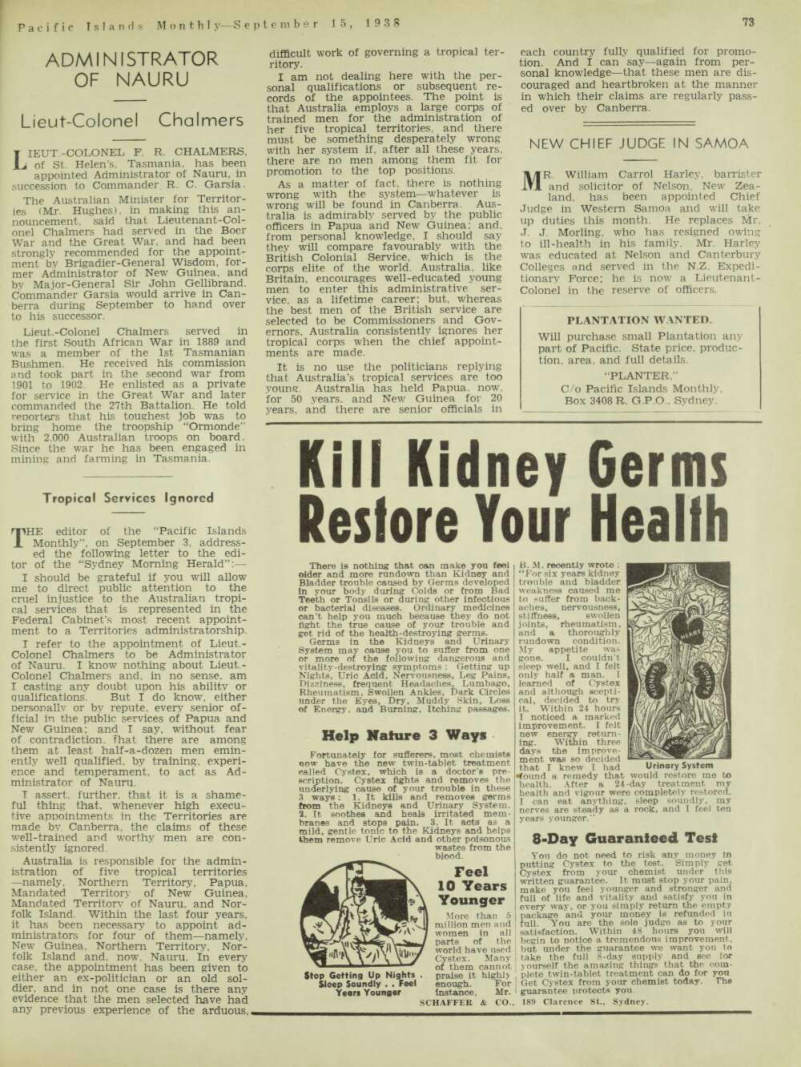
Of Nauru
Lieut-Colonel Chalmers
I Leut-Colonel F. R. Chalmers,
j of St. Helens. Tasmania, has been appointed Administrator of Nauru, in succession to Commander R C. Garsia.
The Australian Minister for Territor ies <Mr. Hughes), in making this an nouncement. said that Lieutenant-Col onel Chalmers had served in the Boer War and the Great War. and had been strongly recommended for the appoint ment by Brigadier-General Wisdom, for mer Administrator of New Guinea, and bv Major-General Sir John Gellibrand.
Commander Garsia would arrive in Can berra during September to hand over to his successor.
Lieut.-Colonel Chalmers served in the first South African War in 1889 and was a member of the Ist Tasmanian Bushmen. He received his commission and took part in the second war from 1901 to 1902, He enlisted as a private for service in the Great War and later commanded the 27th Battalion. He told reoorters that his toughest job was to bring home the troopship “Ormonde” with 2.000 Australian troops on board.
Since the war he has been engaged in mining and farming in Tasmania.
Tropical Services Ignored
THE editor of the “Pacific Islands Monthly”, on September 3. address ed the following letter to the edi tor of the “Sydney Morning Herald”: — I should be grateful if you will allow me to direct public attention to the cruel injustice to the Australian tropi cal services that is represented in the Federal Cabinet’s most recent appoint ment to a Territories administratorship.
I refer to the appointment of Lieut.- Colonel Chalmers to be Administrator of Nauru. I know nothing about Lieut.- Colonel Chalmers and. in no sense, am I casting any doubt upon his ability or qualifications. But I do know, either oersonally or by repute, every senior of ficial in the public services of Papua and New Guinea; and I say, without fear of contradiction. That there are among them at least half-a-dozen men emin ently well qualified, by training, experi ence and temperament, to act as Ad ministrator of Nauru.
I assert, further, that it is a shame ful thing that, whenever high execu tive appointments in the Territories are made bv Canberra, the claims of these well-trained and worthy men are con sistently ignored.
Australia is responsible for the admin istration of five tropical territories —namely. Northern Territory, Papua, Mandated Territory of New Guinea, Mandated Territory of Nauru, and Nor folk Island. Within the last four years, it has been necessary to appoint ad ministrators for four of them—namely, New Guinea, Northern Territory, Nor folk Island and, now. Nauru, in every case, the appointment has been given to either an ex-politician or an old sol dier. and in not one case is there any evidence that the men selected have had any previous experience of the arduous,
difficult work of governing a tropical ter ritory.
I am not dealing here with the per sonal qualifications or subsequent re cords of the appointees. The point is that Australia employs a large corps of trained men for the administration of her five tropical territories, and there must be something desperately wrong with her system if. after all these years, there are no men among them fit for promotion to the top positions.
As a matter of fact, there is nothing wrong with the system—whatever is wrong will be found in Canberra. Aus tralia is admirably served by the public officers in Papua and New Guinea; and. from personal knowledge, I should say they will compare favourably with the British Colonial Service, which is the corps elite of the world. Australia, like Britain, encourages well-educated young men to enter this administrative ser vice. as a lifetime career; but, whereas the best men of the British service are selected to be Commissioners and Gov ernors. Australia consistently ignores her tropical corps when the chief appoint ments are made.
It is no use the politicians replying that Australia’s tropical services are too youne. Australia has held Papua, now. for 50 years, and New Guinea for 20 years, and there are senior officials in
each country fully qualified for promo tion. And I can say—again from per sonal knowledge—that these men are dis couraged and heartbroken at the manner in which their claims are regularly pass ed over by Canberra.
New Chief Judge In Samoa
MR. William Carrol Harley, barrister and solicitor of Nelson. New Zea land. has been appointed Chief Judge in Western Samoa and will take up duties this month. He replaces Mr.
J. J. Morling. who has resigned owing to ill-health in his family. Mr. Harley was educated at Nelson and Canterbury Colleges and served in the N.Z. Expedi tionary Force; he is now a Lieutenant- Colonel in the reserve of officers.
Advertisements & other items, p. 77 (2 items)
73
Pacific Islands Monthl y—S eptember 15, 1938
Kill Kidney Germs
PLANTATION WANTED.
Will purchase small Plantation any part of Pacific. State price, production, area, and full details.
“PLANTER.”
C/o Pacific Islands Monthly.
Box 3408 R. G.P 0.. Sydney.
Kill Kidney Germs Restore Your Health
There is nothing that can make you feel older and more rundown than Kidney and Bladder trouble caused by Germs developed in your body during Colds or from Bad Teeth or Tonsils or during other infectious or bacterial diseases. Ordinary medicines can’t help you much because they do not fight the true cause of your trouble and get rid of the health-destroying germs.
Germs in the Kidneys and Urinary System may cause you to suffer from one or more of the following dangerous and vitality-destroying symptoms : Getting up Nights, Uric Acid, Nervousness, Leg Pains, Dizziness, frequent Headaches, Lumbago, Rheumatism, Swollen Ankles, Dark Circles under the Eyes, Dry, Muddy Skin, Loss of Energy, and Burning, Itching passages.
Help Nature 3 Ways
Fortunately for sufferers, most chemists oow have the new twin-tablet treatment called Cystex, which is a doctor’s prescription. Cystex fights and removes the underlying cause of your trouble in these 3 ways: 1. It kills and removes germs from the Kidneys and Urinary System. 2. It soothes and heals irritated membranes and stops pain. 3. It acts as a mild, gentle tonic to the Kidneys and helps them remove Uric Acid and other poisonous wastes from the blood.
Feel
10 Years
Younger
More than 5 million men and women in all parts of the world have used r Cystex. Many of them cannot • praise it highlj enough. For instance, Mr.
SCHAFFER & CO.
Stop Getting Up Nights Sleep Soundly . . Feel Yeor» Younger
m m B. M. recently wrote ; “For six years kidney trouble and bladder weakness caused me to suffer from backaches, nervousness, stiffness, swollen joints, rheumatism, and a thoroughly rundown condition.
My appetite was gone. I couldn’t sleep well, and I felt only half a man. I learned of Cystex and although sceptical, decided to try it. Within 24 hours I noticed a marked improvement. I felt new energy return ing. Within three days the improvement was so decided that I knew I had Urinary System <ound a remedy that would restore me to health. After a 24-day treatment my health and vigour were completely restored.
I can eat anything, sleep soundly, my nerves are steady as a rock, and I feel ten years younger.”
8-Day Guaranteed Test
You do not need to risk any money in putting Cystex to the test. Simply get Cystex from your chemist under this written guarantee. It must stop your pain, make you feel younger and stronger and full of life and vitality and satisfy you in every way, or you simply return the empty package and your money is refunded in full. You are the sole judge as to your satisfaction. Within 48 hours you will begin to notice a tremendous improvement , but under the guarantee we want you to take the full 8-day supply and see for yourself the amazing things that the complete twin-tablet treatment can do for you Get Cystex from your chemist today. The guarantee protects you. 189 Clarence St., Sydney.
Exchange Pates
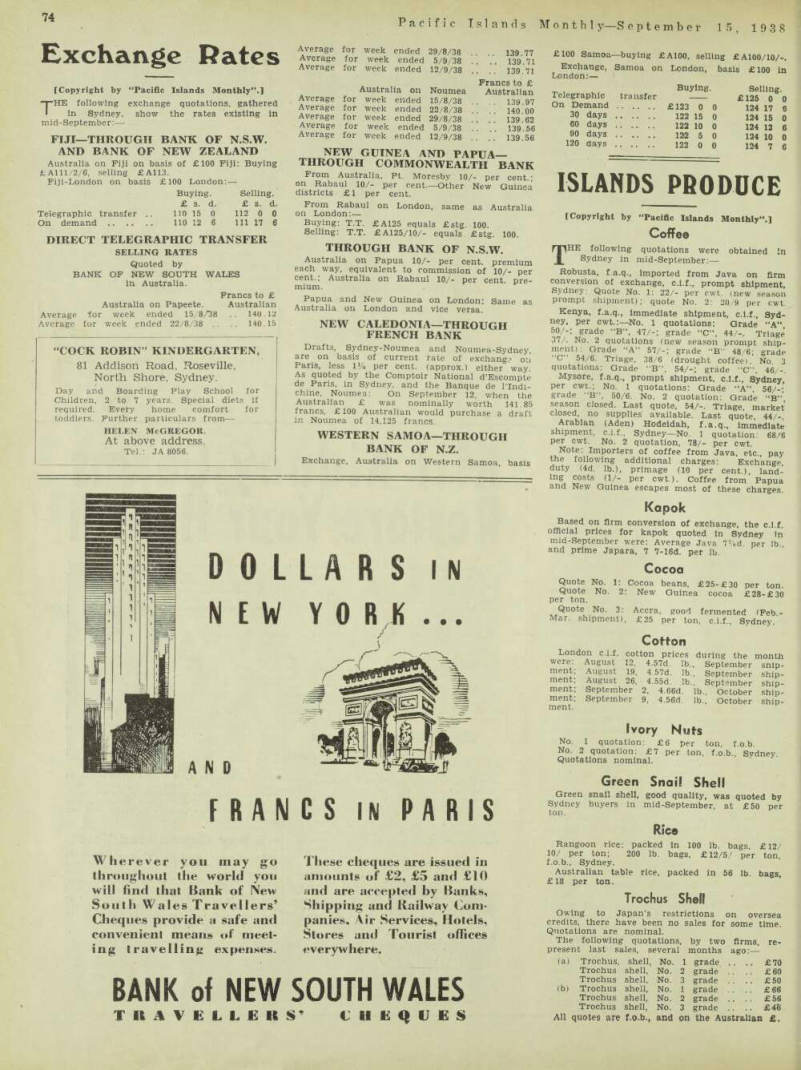
[Copyright by “Pacific Islands Monthly”.] THE following exchange quotations, gathered in Sydney, show the rates existing in mid-September;—
Fiji—Through Bank Of N.S.W.
And Bank Of New Zealand
Australia on Fiji on basis of £lOO Fiji; Buying £AIII/2/6, selling £AII3.
Fiji-London on basis £lOO London:—
Direct Telegraphic Transfer
Selling Rates
Quoted by
Bank Of New South Wales
in Australia.
New Guinea And Papua
Through Commonwealth Bank
Prom Australia, Pt. Moresby 10/- per cent.; on Rabaul 10/- per cent.—Other New Guinea districts £ 1 per cent.
Prom Rabaul on London, same as Australia on London:— Buying; T.T. £AI2S eqlials £stg. 100.
Selling: T.T. £AI2S/10/- equals £stg. 100.
Through Bank Of N.S.W.
Australia on Papua 10/- per cent, premium each way, equivalent to commission of 10/- per cent.; Australia on Rabaul 10/- per cent, pre mium.
Papua and New Guinea on London: Same as Australia on London and vice versa.
New Caledonia—Through
French Bank
Drafts, Sydney-Noumea and Noumea-Sydney, are on basis of current rate of exchange o:i Paris, less IV 4 per cent, (approx.) either way.
As quoted by the Comptolr National d’Escompte de Paris, in Sydney, and the Banque de ITndi chine, Noumea: On September 12, when the Australian £ was nominally worth 141.85 francs, £lOO Australian would purchase a draft in Noumea of 14,125 francs.
Western Samoa—Through
Bank Of N.Z.
Exchange, Australia on Western Samoa, basis
Buying.
Selling. £ s. d. £ s. d.
Telegraphic transfer .. 110 15 0 112 0 0 On demand 110 12 6 111 17 6
Francs to £ Australia on Papeete. Australian Average for week ended 15/8/38 .. 140.12 Average for week ended 22/8/38 140.15
Average for week ended 29/8/38 . . .. 139.77 Average for week ended 5/9/38 .. .. 139.71 Average for week ended 12/9/38 .. .. 139.71 Francs to £ Australia on Noumea Australian Average for week ended 15/8/38 .. .. 139.97 Average for week ended 22/8/38 .. .. 140.00 Average for week ended 29/8/38 . . .. 139.62 Average for week ended 5/9/38 .. .. 139.56 Average for week ended 12/9/38 .. .. 139.56
£100 Samoa- —buying £A100, selling £A100/10/-.
Exchange.
Samoa on London, basis £100 in London;— Telegraphic Buying. Selling, transfer £125 0 0 On Demand 30 days 122 15 0 124 15 0 60 days 90 days 120 days
Islands Produce
[Copyright by “Pacific Islands Monthly”.] Coffee
The following quotations were obtained in Sydney in mid-September;— Robusta, f.a.q., imported from Java on firm conversion of exchange, c.i.f., prompt shipment, Sydney: Quote No. 1: 22/- per cwt. (new season prompt shipment): quote No. 2: 20/9 per cwt.
Kenya, f.a.q., Immediate shipment, c.i.f., Syd ney, per cwt.:—No. 1 quotations: Grade “A”. 50/-; grade “B”, 47/-; grade “C”, 44/-. Triage 37/. No. 2 quotations (new season prompt ship ment): Grade “A” 57/-; grade ••B” 48/6; grade “C” 54/6. Triage. 38/6 (drought coffee i. No. 3 quotations: Grade “B”, 54/-; grade “C”, 46/-.
Mysore, f.a.q., prompt shipment, c.i.f., Sydney, per cwt.; No. 1 quotations: Grade “A”, 56/-; grade “B”, 50/6. No. 2 quotation: Grade “B”' season closed. Last quote, 54/-. Triage, market closed, no supplies available. Last quote, 44/-.
Arabian (Aden) Hodeidah, f.a.q., immediate shipment, c.i.f., Sydney—No. 1 quotation: 68/6 per cwt. No. 2 quotation, 78/- per cwt.
Note: Importers of coffee from Java, etc., pay the following additional charges; Exchange duty (4d. lb.), primage (10 per cent.), land ing costs (1/- per cwt.). Coffee from Papua and New Guinea escapes most of these charges.
Kapok
Based on firm conversion of exchange, the c.i.f. official prices for kapok quoted in Sydney in mid-September were: Average Java 7 7 H d. per lb., and prime Japara, 7 7-16 d. per lb.
Cocoa
Quote No. 1: Cocoa beans, £25-£3O per ton.
Quote No. 2: New Guinea cocoa £2B-£3O per ton.
Quote No. 3: Accra, good fermented (Peb - Mar. shipment), £25 per ton, c.i.f., Sydney.’
Cotton
London c.i.f. cotton prices during the month were: August 12. 4.57 d. lb.. September ship ment; August 19. 4 57d. lb.. September ship ment; August 26, 4.55 d. lb., September ship ment; September 2. 4.66 d. lb.. October ship ment; September 9. 4.56 d. lb.. October ship ment.
Ivory Nuts
No. 1 quotation: £6 per ton, f.o.b.
No. 2 quotation: £7 per ton, f.0.b., Sydney.
Quotations nominal.
Green Snail Shell
Green snail shell, good quality, was quoted by Sydney buyers in mid-September, at £5O per ton.
Rico
Rangoon rice: packed In 100 lb. bags. £l2/ 10/ per ton; 200 lb. bags, £l2/5/ per ton. f.0.b., Sydney.
Australian table rice, packed in 56 lb. bags, £lB per ton.
Trochus Shell
Owing to Japan’s restrictions on oversea credits, there have been no sales for some time.
Quotations are nominal.
The following quotations, by two firms, re present last sales, several months ago:— (a) Trochus, shell, No. 1 grade .. .. £7O Trochus shell. No. 2 grade .. .. £6O Trochus shell, No. 3 grade .. .. £5O (b) Trochus shell, No. 1 grade .. .. £66 Trochus shell, No. 2 grade .. .. £56 Trochus shell, No. 3 grade .. .. £46 All quotes are f.0.b., and on the Australian £.
Advertisements & other items, p. 78 (1 item)
Dollars In
“COCK ROBIN” KINDERGARTEN,
81 Addison Road, Roseville, North Shore, Sydney.
Day and Boarding Play School for Children, 2 to 7 years. Special diets if required. Every home comfort for toddlers. Further particulars from —
HELEN McGREGOR.
At above address.
Tel.: JA 8056.
3
DOLLARS in
N E W
Y 0 R K
• • • r m ■j
AND
FRANCS IN PARIS
Wherever you may go throughout the world you will find that Bank of New South Wales Travellers’
Cheques provide a safe and convenient means of meeting travelling expenses.
These cheques are issued in amounts of £2, £5 and £lO and are accepted by Banks, Shipping and Railway Companies, Air Services, Hotels, Stores and Tourist offices everywhere.
BANK of NEW SOUTH WALES
TIUVEILCKS’ CHEQUES
Market Quotations
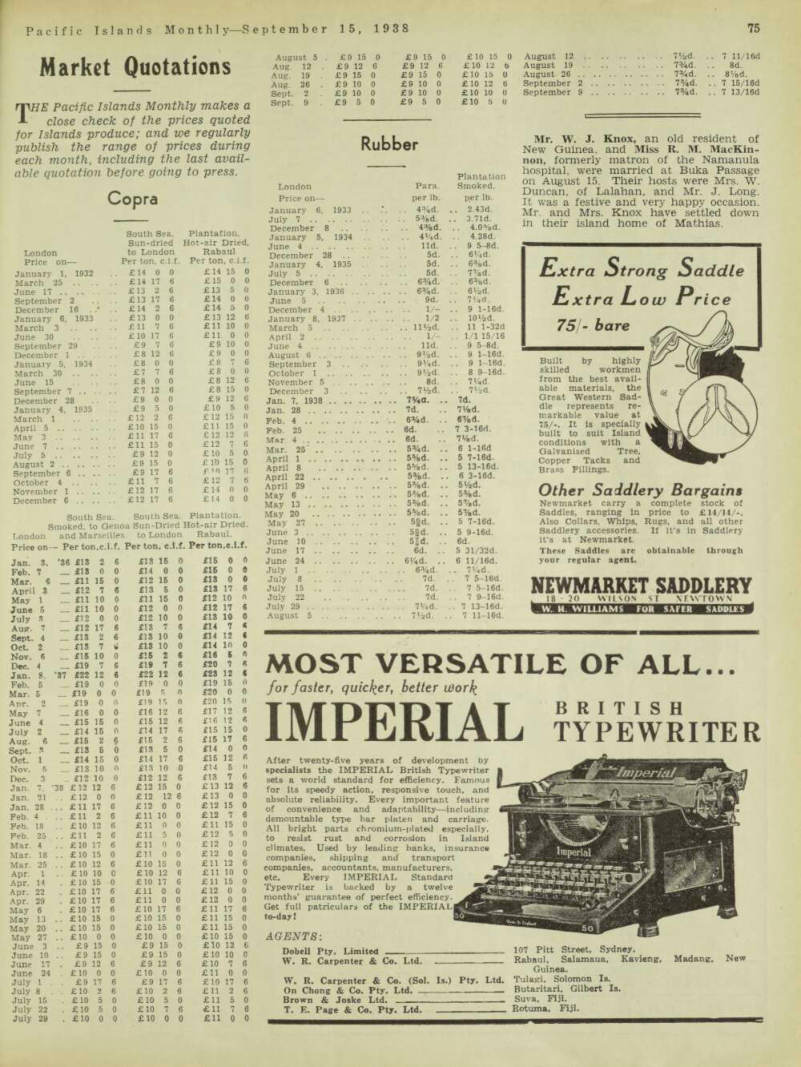
THE Pacific Islands Monthly makes a close check of the prices quoted for Islands produce; and we regularly publish the range of prices during each month, including the last avail able quotation before going to press.
Mr. W. J. Knox, an old resident of New Guinea, and Miss R. M. MacKin non, formerly matron of the Namanula hospital, were married at Buka Passage on August 15. Their hosts were Mrs. W.
Duncan, of Lalahan, and Mr. J. Long.
It was a festive and very happy occasion.
Mr. and Mrs. Knox have settled down in their island home of Mathias.
Copra
South Sea, Plantation, Sun-dried Hot-air Dried, London to London Rabaul Price on— Per ton, c.i.f.
Per ton, c.i.f.
January 1 . 1932 £14 0 0 £14 15 0 March 25 £14 17 6 £15 0 0 June 17 . £13 2 6 £13 5 0 September 2 £13 17 6 £14 0 0 December 16 . .' £14 2 6 £14 5 0 January 6, 1933 £13 0 0 £13 12 6 March 3 £11 7 6 £11 10 0 June 30 £10 17 6 £11 0 0 September 29 £9 7 6 £9 10 0 December 1 . . . . £8 12 6 £9 0 0 January 5, , 1934 £8 0 0 £8 7 6 March 30 £7 7 6 £8 0 0 June 15 £8 0 0 £8 12 6 September 7 .. . . £7 12 6 £8 15 0 December 28 £9 0 0 £9 12 6 January 4, , 1935 £9 5 0 £10 5 0 March 1 £12 2 6 £12 15 0 April 5 .. £10 15 0 £11 15 0 Mav 3 .. £11 17 6 £12 12 6 June 7 .. £11 15 0 £12 7 6 July 5 £9 12 0 £10 5 0 August 2 . £9 15 0 £10 15 0 September 6 .. . . £9 17 6 £10 17 6 October 4 £11 7 6 £12 7 6 November 1 .. .. £12 17 6 £14 n 0 December 1 6 . . . . £12 17 6 £14 0 0 South Sea.
South Sea.
Plantation.
Smoked, to Genoa Sun-Dried Hot-air Dried.
London and Marseilles, to London Rabaul.
Price on — Per ton.c.i.f.
Per ton, c.i.f.
Per ton.c.i.f.
Jan. 3. *36 £13 2 6 £13 15 0 £15 0 0 Feb. 7 £18 0 0 £14 0 0 £16 0 0 Mar. 6 £11 IB 0 £12 IB 0 £18 0 0 April 3 £12 7 6 £13 5 0 £18 17 6 May 1 ... £11 10 0 £11 15 0 £12 10 o June 5 £11 10 0 £12 0 0 £12 17 6 July 3 £12 0 0 £12 10 0 £18 10 0 Aug. 7 £12 17 6 £13 7 6 £14 7 4 Sept. 4 £13 2 6 £13 10 0 £14 12 « Oct. 2 £18 7 6 £13 10 0 £14 10 0 Nov. 6 £15 10 0 £16 2 6 £16 5 0 Dec. 4 £19 7 6 £19 7 6 £20 7 6 Jan. 8. *37 £22 12 6 £22 12 6 £28 12 « Feb. 5 £19 0 0 £19 0 0 £19 IB 0 Mar. 5 . £19 0 0 £19 5 0 £20 0 0 Apr. 2 £19 0 0 £19 15 0 £20 15 1) May 7 £16 0 0 £16 12 6 £17 12 6 June 4 £15 15 0 £16 12 6 £16 12 6 July 2 £14 15 0 £14 17 6 £15 15 0 Aug. 6 £15 2 6 £15 2 6 £15 17 6 Sept. * .. £18 5 6 £13 5 0 £14 0 0 Oct. 1 £14 15 0 £14 17 6 £15 12 6 Nov, 5 ... £13 10 0 £13 10 0 £14 5 li Dec. 3 £12 10 0 £12 12 6 £13 7 6 Jan. 7. ’38 £12 12 6 £12 15 0 £13 12 6 Jan. 21 £12 0 0 £12 12 6 £13 0 0 Jan. 28 ... £11 17 6 £12 0 0 £12 15 0 Peb. 4 .. £11 2 6 £11 10 0 £12 7 6 Feb. 18 £10 12 6 £11 0 0 £11 15 0 Peb. 25 .. £11 2 6 £11 5 0 £12 5 0 Mar. 4 £10 17 6 £11 0 0 £12 0 0 Mar. 18 .. £10 15 0 £11 0 0 £12 0 0 Mar. 25 .. £10 12 6 £10 15 0 £11 12 6 Apr. 1 .. £10 10 C £10 12 6 £11 10 0 Apr. 14 £10 15 0 £10 17 6 £11 15 0 Apr. 22 £10 17 6 £11 0 0 £12 0 0 Apr. 29 £10 17 6 £11 0 0 £12 0 0 May 6 £10 17 6 £10 17 6 £11 17 6 May 13 .. £10 15 0 £10 15 0 £11 15 0 May 20 .. £10 15 0 £10 15 0 £11 15 0 May 27 .. £10 0 0 £10 0 0 £10 15 0 June 3 .. £9 15 0 £9 15 0 £10 12 6 June 10 .. £9 15 0 £9 15 0 £10 10 0 June 17 . £9 12 6 £9 12 6 £10 7 6 June 24 £10 0 0 £10 0 0 £11 0 0 July 1 . . £9 17 6 £9 17 6 £10 17 6 July 8 . . £10 2 6 £10 2 6 £11 2 6 July 15 £10 5 0 £10 5 0 £11 5 0 July 22 £10 5 0 £10 7 6 £11 7 6 July 29 £10 0 0 £10 0 0 £11 0 0
August 12 7y 2 d. .. 7 ll/16d August 19 7%d. .. 8d.
August 26 7%d. .. 8V 8 d.
September 2 7%d. .. 7 15/16d September 9 7%d. .. 7 13/16d
August 5 . £9 15 0 £9 15 0 £10 15 0 Aug. 12 £9 12 6 £9 12 6 £10 12 6 Aug. 19 £9 15 0 £9 15 0 £10 15 0 Aug. 26 . £9 10 0 £9 10 0 £10 12 6 Sept. 2 £9 10 0 £9 10 0 £10 10 0 Sept. 9 £9 5 0 £9 5 0 £10 5 0
Rubber
Plantation London Para.
Smoked.
Price on— per lb. per lb.
January 6. 1933 ., .. 4%d. . ,. 2.43d.
July 7 .. . .. 5%d. . . 3.71d.
December 8 .. 4%d. .. 4.0 3 / 8 d.
January 5, 1934 . . . 4Vid. . . 4.28d.
June 4 . lid. . . 9 5—8d.
December 28 5d. .. 6’Ad.
January 4, 1935 . 5d. .. 6 3 / 8 d.
July 5 5d. . . 7Y 8 d.
December 6 . . 6%d. ey 8 d.
January 3, 1936 .. .. 6%d. .. 6Vad.
June 5 9d. . 7’/id.
December 4 . .. 1/- . .. 9 l-16d.
January 8, 1937 .. . .. 1/2 , . . 10’/ad.
March 5 .. .. HVfed. . . 11 l-32d April 2 . . . 1/- .. 1/1 15/16 June 4 . . . lid. . . 9 5-8d.
August 6 .. .. 9’/ad. . . 9 l-16d.
September 3 .. 9’Ad. . . 9 l-16d.
October 1 . .. 9’/ad. . . 8 9-16d.
November 5 8d. .. 7’Ad.
December 3 .. 7%d. . . 7’/ad.
Jan. 7, 1938 . 7d.
Jan. 28 .. . . . ,. 7d. 7Vsd.
Feb. 4 .. .. , . 6%d. .. 6%d.
Feb. 25 . . . 6d. 7 3-16d.
Mar 4 . 6d. 7Vad.
Mar. 25' .. .. S’Ad. .. 6 1-lfid April 1 .. .. .. 5%d. .. 5 7-16d.
April 8 . . 5V a d. .. 5 13-16d.
April 22 .. . . , . 5y«d. .. 6 3-16d.
April 29 .. 5Vsd. .. 5Wid.
May 6 .. . . . . .. 5 5 / 8 d. .. 5V 8 d.
May 13 .. .. .. 5%d. .. 5 7 /ad.
May 20 ... 5%d.
May 27 .. ,. 5|d. .. 5 7-16d.
June 3 .. .. 5|d. .. 5 9-16d.
June 10 .. . 5 7 d. .. 6d.
June 17 .. 6d. .. 5 31/32d.
June 24 . ey 4 d. .. 6 ll/16d.
July 1 .. ., .. 6¥ 4 d. . . 7*4d.
July 8 7d. . 7 5-16d July 15 .. 7d. . . 7 5-16d.
July 22 7d. . 7 9-16d.
July 29 . . . . . . 7>/4d. . . 7 13-16d.
August 5 .. 7’/ad. .. 7 ll-16d.
Advertisements & other items, p. 79 (2 items)
75
Pacific Islands Monthl y—S eptember 15, 1938
Imperial
If xtra Strong Saddle
Extra Loiv Price
Built by highly skilled workmen
75/- bare
from the best available materials, the Great Western Saddle represents remarkable value at 75/-. It is specially built to suit Island conditions with a Galvanised Tree, Copper Tacks and Brass Fillings.
Other Saddlery Bargains
Newmarket carry a complete stock of Saddles, ranging In price to £l4/14/-.
Also Collars. Whips, Rugs, and all other Saddlery accessories. If it’s in Saddlery it’s at Newmarket.
These Saddles are obtainable through your regular agent.
NEWMARKET SADDLERY
18 20 WILSON ST VFWTO VV \
VV. H WILLIAMS FOR SAFER SADDLES
MOST VERSATILE OF ALL...
for faster, quicker, better work
IMPERIAL
BRITISH
TYPEWRITER
iL V-H After twenty-five years of development by specialists the IMPERIAL British Typewriter sets a world standard for efficiency. Famous for its speedy action, responsive touch, and absolute reliability. Every important feature of convenience and adaptability—including demountable type bar platen and carriage.
All bright parts chromium-plated especially, to resist rust and corrosion in Island climates. Used by leading hanks, insurance companies, shipping and transport companies, accountants, manufacturers, etc. Every IMPERIAL Standard Typewriter is backed by a twelve months’ guarantee of perfect efficiency.
Get full patriculara of the IMPERIAL to-day I
AGENTS:
Dobell Pty. Limited W. R. Carpenter & Co. Ltd.
W. R. Carpenter & Co. (Sol. Is.) Pty. Ltd.
On Chong & Co. Pty. Ltd.
Brown & Joske Ltd.
T. E. Page & Co. Pty. Ltd. 107 Pitt Street, Sydney.
Rabaul, Salamaua, Kavieng, Madang, New Guinea.
Tulagi, Solomon Is.
Butaritari, Gilbert Is.
Suva, Fiji.
Rotuma, Fiji.
Premature Advt.?
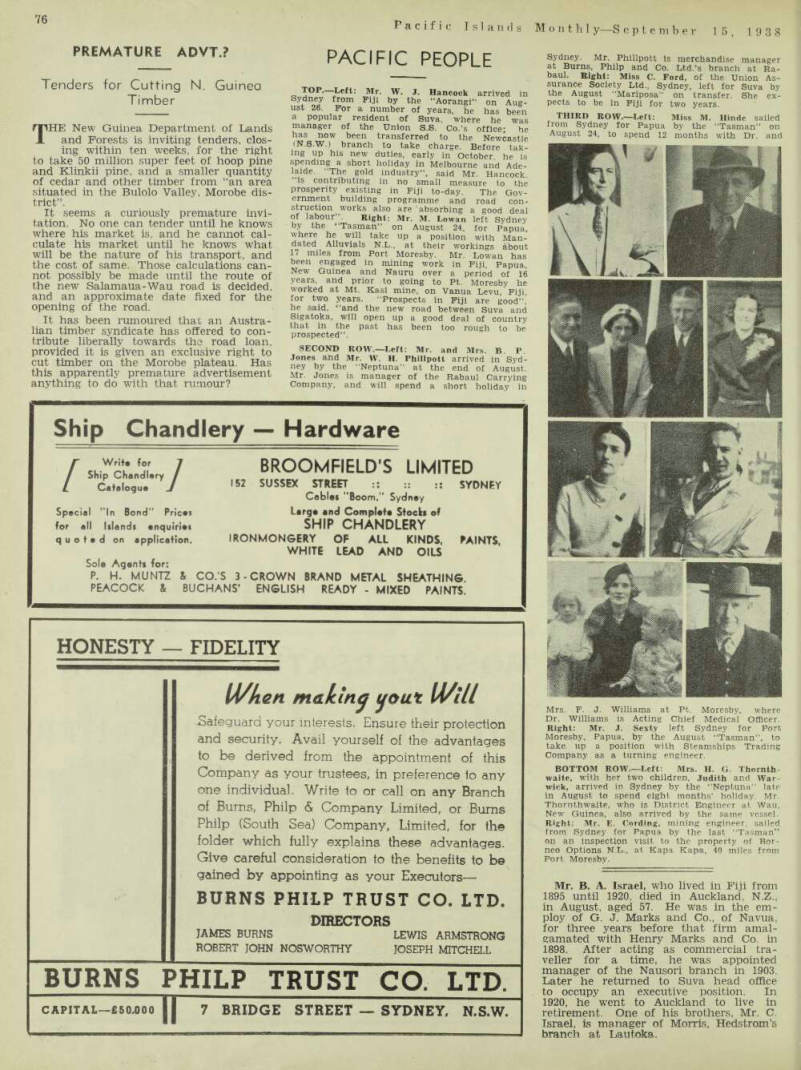
Tenders for Cutting N. Guinea Timber
THE New Guinea Department of Lands and Forests is inviting lenders, clos ing within ten weeks, for the right to take 50 million super feet of hoop pine and Klinkii pine, and a smaller quantity of cedar and other timber from “an area situated in the Bulolo Valley, Morobe dis trict”.
It seems a curiously premature invi tation. No one can tender until he knows where his market is, and he cannot cal culate his market until he knows what will be the nature of his transport, and the cost of same. Those calculations can not possibly be made until the route of the new Salamaua-Wau road is decided, and an approximate date fixed for the opening of the road.
It has been rumoured that an Austra lian timber syndicate has offered to con tribute liberally towards the road loan, provided it is given an exclusive right to cut timber on the Morobe plateau. Has this apparently premature advertisement anything to do with that rumour?
Pacific People
W. J. Hancock arrived in Sydney from Fiji by the “Aorangi” on Aug ust 26. For a number of years, he has been a popular resident of Suva, where he was manager of the Union S.S. Co.’s office; he h xT S « il ow been transferred to the Newcastle (N.S.W.) branch to take charge. Before tak ing up his new duties, early in October he is spending a short holiday in Melbourne and Ade laide. “The gold industry”, said Mr. Hancock, “is contributing in no small measure to the prosperity existing in Fiji to-day. The Gov ernment building programme and road con struction works also are absorbing a good deal of labour”. Right: Mr. M. Lowan left Sydney by the “Tasman” on August 24, for Papua, where he will take up a position with Man dated Alluvials N.L., at their workings about 17 miles from Port Moresby. Mr. Lowan has been engaged in mining work in Fiji. Papua, New Guinea and Nauru over a period of 16 years, and prior to going to Pt. Moresby he worked at Mt. Kasi mine, on Vanua Levu, Fiji, for two years. “Prospects in Fiji are good”, he said, “and the new road between Suva and Sigatoka, will open up a good deal of country that in the past has been too rough to be prospected”.
SECOND ROW.—Left: Mr. and Mrs. B P.
Jones and Mr. W. H. Phillpott arrived in Syd ney by the “Neptuna” at the end of August.
Mr. Jones is manager of the Rabaul Carrying Company, and will spend a short holiday in
Sydney. Mr. Phillpott is merchandise manager at Burns, Philp and Cos. Ltd.’s branch at Ra baul. Right: Miss C. Ford, of the Union As surance Society Ltd., Sydney, left for Suva by the August “Mariposa” on transfer. She ex pects to be in Fiji for two years.
THIRD ROW.—Left: Miss M. Hinde sailed from Sydney for Papua by the “Tasman” on August 24, to spend 12 months with Dr. and
Mrs. F. J. Williams at Pt. Moresby, where Dr. Williams is Acting Chief Medical Officer.
Right: Mr. J. Sexty left Sydney for Port Moresby, Papua, by the August “Tasman”, to take up a position with Steamships Trading Company as a turning engineer.
BOTTOM ROW.—Left: Mrs. H- G. Thornth waite, with her two children, Judith and War wick, arrived in Sydney by the “Neptuna” late in August to spend eight months’ holiday. Mr.
Thornthwaite, who is District Engineer at Wau, New Guinea, also arrived by the same vessel.
Right: Mr, E. Cording, mining engineer, sailed from Sydney for Papua by the last “Tasman” on an inspection visit to the property of Bor neo Options N.L., at Kapa Kapa, 40 miles from Port Moresby.
Mr. B. A. Israel, who lived in Fiji from 1895 until 1920, died in Auckland, N.Z.. in August, aged 57. He was in the em ploy of G. J. Marks and Co., of Navua, for three years before that firm amal gamated with Henry Marks and Co. in 1898. After acting as commercial tra veller for a time, he was appointed manager of the Nausori branch in 1903.
Later he returned to Suva head office to occupy an executive position. In 1920, he went to Auckland to live in retirement. One of his brothers, Mr. C.
Israel, is manager of Morris, Hedstrom’s branch at Lautoka.
Advertisements & other items, p. 80 (2 items)
76
Pacific Islands Monthl y—S eptember 15, 1938
Ship Chandlery Hardware
/Writ* for 7 Ship Chandlery / Catalogue J Special "In Bond" Pricer for all Islands enquiries quoted on application.
Sole Agents for:
P. H. MUNTZ
PEACOCK &
BROOMFIELD'S LIMITED
152 SUSSEX STREET :: :! SYDNEY
Cables "Boom," Sydney large and Complete Stocks of
SHIP CHANDLERY
IRONMONGERY OF ALL KINDS, PAINTS,
WHITE LEAD AND OILS
& CO.'S 3- CROWN BRAND METAL SHEATHING.
BUCHANS’ ENGLISH READY - MIXED PAINTS.
HONESTY FIDELITY
When making gout Will
Safeguard your interests. Ensure their protection and security. Avail yourself of the advantages to be derived from the appointment of this Company as your trustees, in preference to any one individual. Write to or call on any Branch of Burns, Philp <S Company Limited, or Bums Philp (South Sea) Company, Limited, for the folder which fully explains these advantages.
Give careful consideration to the benefits to be gained by appointing as your Executors—
BURNS PHILP TRUST CO. LTD.
DIRECTORS
JAMES BURNS LEWIS ARMSTRONG
ROBERT JOHN NOSWORTHY JOSEPH MITCHELL
BURNS PHILP TRUST CO. LTD.
capital—£so,ooo [I 7 BRIDGE STREET SYDNEY, N.S.W.
Shipping Services in the Pacific
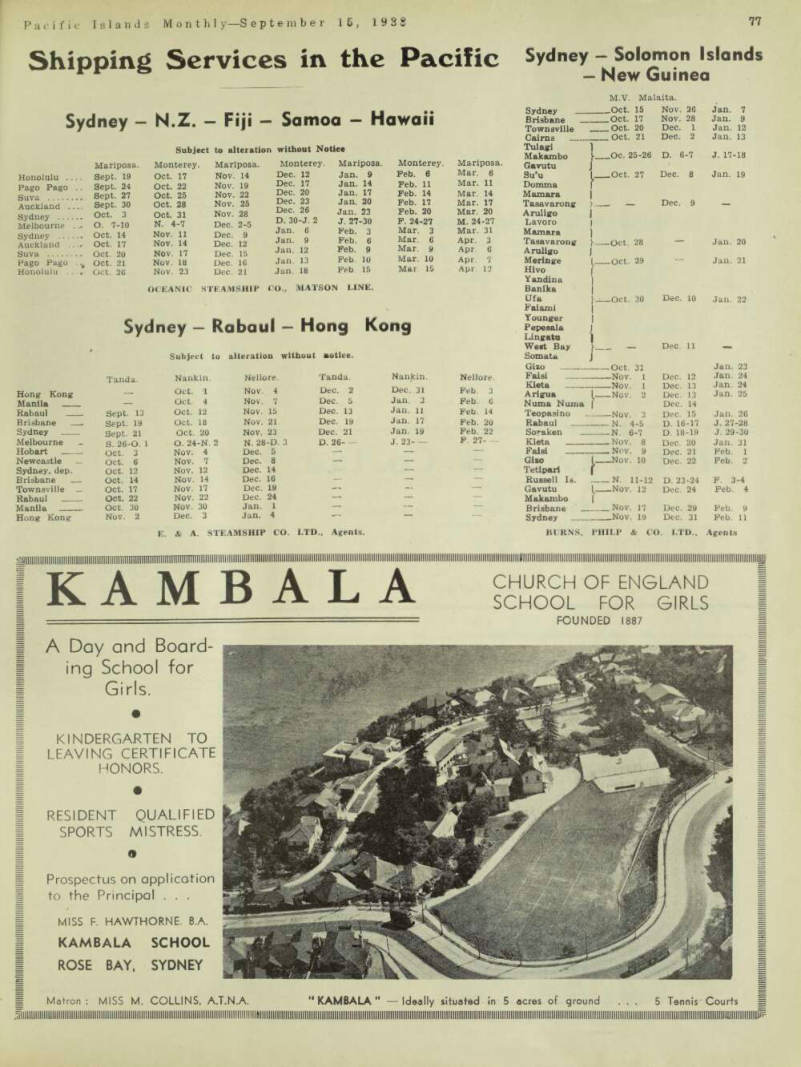
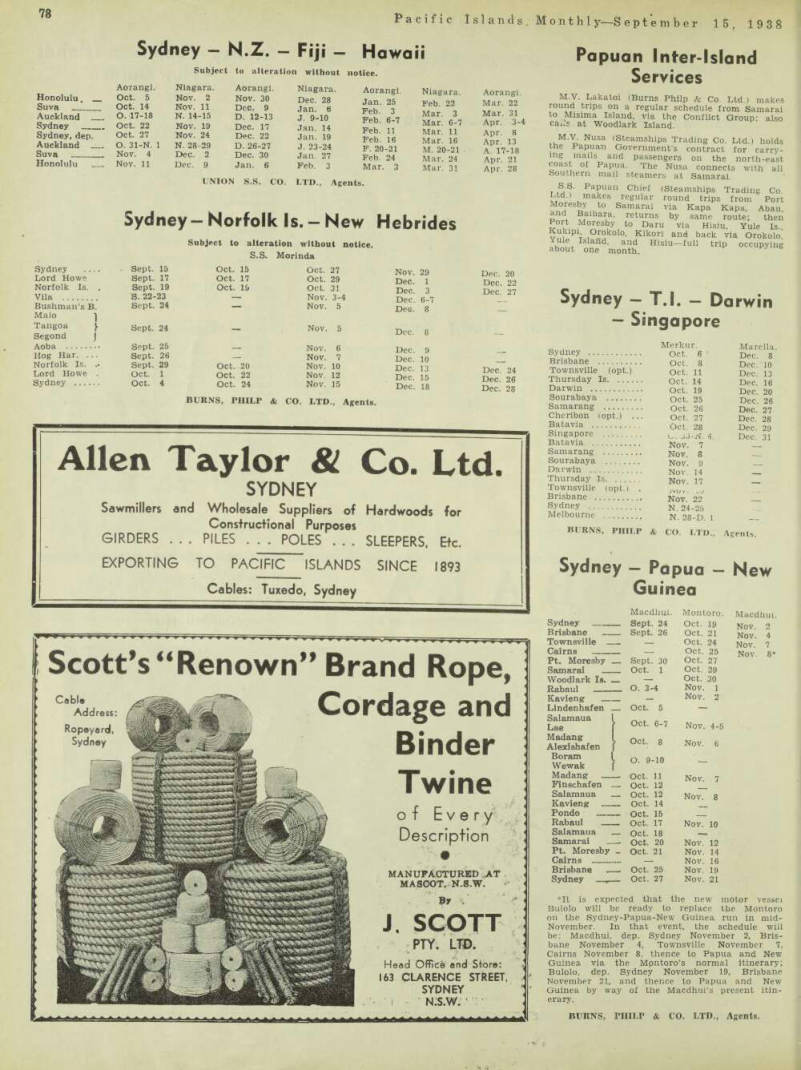
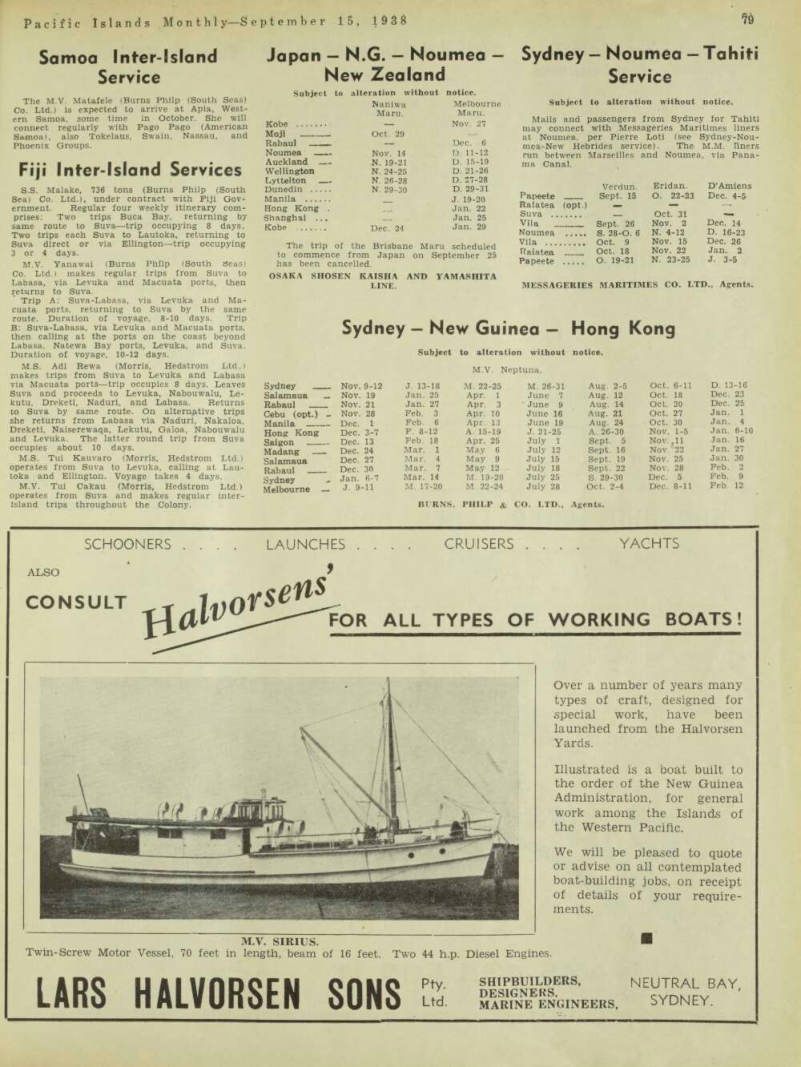
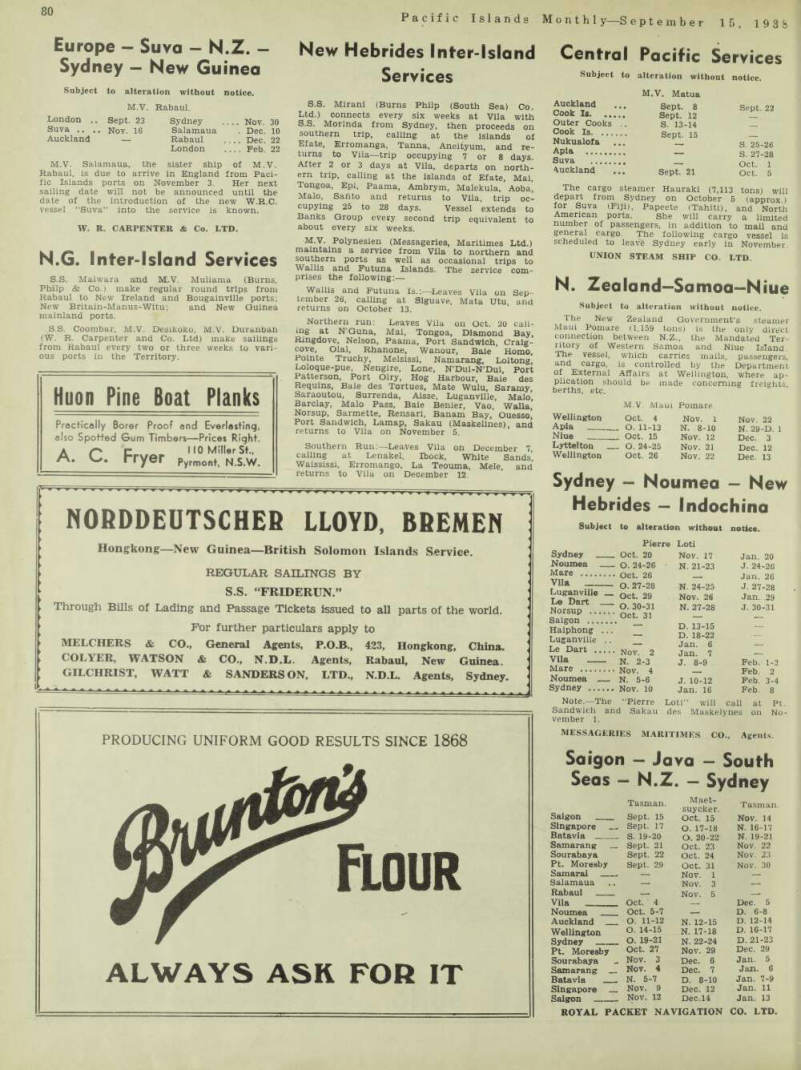
Sydney N.Z, Fiji Samoa Hawaii
Sydney - Rabaul - Hong Kong
Sydney Solomon Islands New Guinea
Subject to alteration without Notice Honolulu Pago Pago ..
Mariposa.
Sept. 19 Sept. 24 Sept. 27 Monterey.
Oct. 17 Oct. 22 Oct. 25 Mariposa.
Nov. 14 Nov. 19 Nov. 22 Monterey.
Dec. 12 Dec. 17 Dec. 20 Mariposa.
Jan. 9 Jan. 14 Jan. 17 Monterey.
Feb. 6 Peb. 11 Peb. 14 Mariposa.
Mar. 6 Mar. 11 Mar. 14 Auckland — Sydney Sept. 30 Oct. 3 Oct. 28 Oct. 31 Nov. 25 Nov. 28 Dec. 23 Dec. 26 D.30-J. 2 Jan. 6 Jan. 20 Jan. 23 Feb. 17 Feb. 20 Mar. 17 Mar. 20 Melbourne ...
Sydney O. 7-10 Oct. 14 N. 4-7 Nov. 11 Dec. 2-5 Dec. 9 J. 27-30 Peb. 3 F. 24-27 Mar. 3 M. 24-27 Mar. 31 Auckland ...
Suva Oct. 17 Oct. 20 Oct. 21 Oct. 20 Nov. 14 Nov. 17 Dec. 12 Dec. 15 Jan. 9 Jan. 12 Peb. 6 Peb. 9 Mar. 6 Mar. 9 Apr. 3 Apr. 6 Pago Pago Honolulu . .
Nov. 18 Nov. 23 Dec. 16 Dec. 21 Jan. 13 Jan. 18 Peb 10 Peb 15 Mar. 10 Mar 15 Apr. 7 Apr. 12
Oceanic Steamship Co., Matson Line.
■ Subject to alteration without motive.
Tanda.
Nankin.
Nellore.
Tanda.
Nankin.
Nellore.
Hong Kong Oct. 1 Nov. 4 Dec. 2 Dec. 31 Peb. 3 Manila Oct. 4 Nov. 7 Dec. 5 Jan. 3 Peb. 6 Kabaul Sept. 13 Oct. 12 Nov. 15 Dec. 13 Jan. n Peb 14 Brisbane —.
Sept. 19 Oct. 18 Nov. 21 Dec. 19 Jan. 17 Peb. 20 Sydney Sept. 21 OCt. 20 Nov. 23 Dec. 21 Jan. 19 Peb. 22 Melbourne S.26-0. 1 O. 24-N. 2 N.28-D. 3 D. 26- J. 23-— P. 27- Hobart Oct. 3
Nov. 4
Dec. 5 — — — Newcastle Oct. 6 Nov. 7 Dec. 8 —• — — Sydney, dep.
Oct. 12 Nov. 12 Dec. 14 — — Brisbane — Oct. 14 Nov. 14 Dec. 16 — — — Townsville — Oct. 17 Nov. 17 Dec. 19 —■ — — Rabaul OCt. 22
Nov. 22
Dec. 24 — — — Manila Oct. 30 Nov. 30 Jan. 1 — 1 — — Hong Kong Nov. 2 Dec. 3 Jan. 4 E. & A. STEAMSHIP CO. LTD., Agents.
M.V. Malalta.
Sydney .. . _Oct. 15 Nov. 26 Jan. 7 Oct. 17 Nov. 28 Jan. 9 Townsville Cairns Oct. 20 Oct. 21 Dec. 1 Dec. 2 Jan. 12 Jan. 13 Tulagi Makambo Oc. 25-26 D. 6-7 J. 17-18 Gavutu Su'u Oct. 27 Dec. 8 Jan. 19 Domma f Mamara Tasavarong Aruligo Lavoro Mamara 1 1 1 ) Dec. 9 - Tasavarong Aruligo Meringe Hivo Yandina Banika > Oct. 28 J I Oct. 29 r i i - Jan. 20 Jan. 21 Ufa Faiami
L—Oct. 30
Dec. 10 Jan. 22 Younger Pepesala Lingatu Wert Bay Somata I J 1 J Dec. 11 — Gizo Oct. 31 Jan. 23 Faisi —Nov. 1 Dec. 12 Dec. 13 Dec. 13 Dec. 14 Jan. 24 Kieta Nov 1 Jan. 24 Arigua Numa Nuuia J, Nov. 2 Jan. 25 Teopasino Rabaul Nov. 3 N. 4-5 Dec, 15 D. 16-17 D. 18-19 Jan. 26 J. 27-28 Soraken N. 6-7 J. 29-30 Kieta . Nnv ft Dec. 20 Dec. 21 Dec. 22 Jan. 31 Peb. 1 Feb. 2 Falsi ___Nov. 9 Gizo Tetiparl Nov. 10 Russell Is.
Gavutu Makambo N. 11-12 I Nov. 12 f D. 23-24 Dec. 24 P. 3-4 Peb. 4 Brisbane Sydney Nov. 17 .Nov. 19 Dec. 29 Dec. 31 Peb. 9 Peb. 11
Burns.
Philp & Co. Ltd.,
Agents
Sydney - N.Z. - Fiji - Hawaii
Sydney-Norfolk Is.-New Hebrides
Papuan Inter-Island
Services
M.V. Lakatoi (Burns Philp & Co. Ltd.) makes round trips on a regular schedule from Samarai to Misima Island, via the Conflict Group; also cans at Woodlark Island.
M.V. Nusa (Steamships Trading Co. Ltd.) holds the Papuan Government’s contract for carry mg mails and passengers on the north-east coast of Papua. The Nusa connects with all Southern mail steamers at Samarai. t ' Pa f uan Chief (Steamships Trading Co.
Ltd.) makes regular round trips from Port M °J eS £ y -J® Samarai via Kapa Kapa, Abau. „ ncl , Barbara, returns by same route; then Port Moresby to Daru via Hisiu, Yule Is..
Kukipi Orokolo, Kikori and back via Orokolo, V ll6 , Islanc *. and Hisiu —full trip occupying about one month.
Sydney T.l. Darwin - Singapore
* Sydney Papua New Guinea
*lt is expected that the new motor vessel Bulolo will be ready to replace the Montoro on the Sydney-Papua-New Guinea run in mid- November. In that event, the schedule will be: Macdhui, dep. Sydney November 2, Bris bane November 4, Townsville November 7, Cairns November 8, thence to Papua and New Guinea via the Mpntoro’s normal itinerary; Bulolo, dep. Sydney November 19, Brisbane November 21, and thence to Papua and New Guinea by way of the Macdhui’s present itin erary.
Burns, Philp & Co. Ltd., Agents.
Honolulu.
Suva Auckland Sydney Aorangi.
Oct. 5 Oct. 14 O. 17-18 Oct. 22 Subject Niagara.
Nov. 2 Nov. 11 N. 14-15 Nov. 19 to alteration without Aorangi. Niagara.
Nov. 30 Dec. 28 Dec. 9 Jan. 6 D. 12-13 J. 9-10 Dec. 17 .Tan 14 notice.
Aorangi.
Jan. 25 Feb. 3 Feb. 6-7 Feb. 11 Feb. 16 F. 20-21 Niagara.
Feb. 22 Mar. 3 Mar. 6-7 Aorangi.
Mar. 22 Mar. 31 Apr. 3-4 Sydney, dep.
Auckland Suva Oct. 27 O.31-N. 1 Nov. 4 Nov. 24 N. 28-29 Dec. 2 Dec. 22 D. 26-27 Dec. 2(1 Jan. 19 J. 23-24 Jan. 27 Feb. 3
Ltd., Ag!
Mar. 11 Mar. 16 M. 20-21 Apr. 8 Apr. 13 A. 17-18 Honolulu Nov. 11 Dec. 9 Jan. 6
Union S.S. Co.
Feb. 24 Mar. 3 ents.
Mar. 24 Mar. 31 Apr. 21 Apr. 28
Subject to alteration without notice.
S.S. Morinda Sydney Sept. 15 Oct. 15 Oct. 27 Nov. 29 Dec. 20 Lord Howe Sept. 17 Oct. 17 Oct. 29 Dec. 1 Dec. 22 Dec. 27 Norfolk Is. .
Sept. 19 Oct. 19 Oct. 31 Dec. 3 Vila S. 22-23 — Nov. 3-4 Dec. 6-7 Bushman’s B.
Sept. 24 — Nov. 5 Dec. 8
Malo ]
Tangoa J-
Sept. 24 Nov. 5 Dec. o
Segond J
o Aoba Sept. 25 — Nov. 6 Dec. 9 Hog Har. ...
Sept. 26 — Nov. 7 Dec. 10 Norfolk Is. ..
Lord Howe .
Sydney Sept. 29 Oct. 1 Oct. 4 Oct. 20 Oct. 22 Oct. 24
Burns, Philp & Co
Nov. 10 Nov. 12 Nov. 15 . LTD., Agents.
Dec.
Dec.
Dec. 13 15 18 Dec. 24 Dec. 26 Dec. 28
Merkur.
Marella.
Sydney Oct. 6 Dec. 8 Brisbane Oct. 8 Dec.' 10 Townsville (opt.) Oct. 11 Dec. 13 Thursday Is Oct. 14 Dec. 16 Darwin Oct. 19 Dec. 20 Sourabaya Oct. 25 Dec. 26 Samarang Oct. 26 Dec. 27 Cheribon (opt.) ...
Oct. 27 Dec. 28 Batavia Oct. 28 Dec. 29 Singapore 4.
Dec. 31 Batavia
Nov. 7
Samarang Nov. 8 Sourabaya ...
Nov. 9 Darwin Nov. 14 Thursday Is Nov. 17 Townsville (opt.) .
In U V . J
Brisbane Nov. 22 Sydney N. 24-25 Melbourne N. 28-D. 1
Burns, Philp
& Co. Ltd.,
Agents.
Sydney Macdhui.
Sept. 24 Sept. 26 Montoro.
Oct. 19 Oct. 21 Oct. 24 Oct. 25 Macdhui.
Brisbane Townsville Cairns
Inov.
Nov.
Nov. z 4 7 Pt. Moresby — Samara!
Woodlark Is.
Rabanl Sept. 30 Oct. 1 O. 3-4 Oct. 27 Oct. 29 Oct. 30 Nov. 1 Nov. 8* Kavieng Lindenhafen — Oct. 5 Nov. 2
Salamaua I.
Lae Oct. 6-7 Nov. 4-5 Madang
Alexishafen f
Boram (
Wewak Madang Finschafen — Salamaua — Kavieng Pondo — Oct. 8 O. 9-10 Oct. 11 Oct. 12 Oct. 12 Oct. 14 Oct. 15 Oct. 17 Oct. 18 Oct. 20 Oct. 21 Nov. 6 Nov. 7 Nov. 8 Rabaul Salamaua Samarai —.
Pt. Moresby Cairns Nov. 10 Nov. 12 Nov. 14 Nov. 16 Nov. 19 Nov. 21 Brisbane —— Sydney —,— Oct. 25 Oct. 27
Samoa Inter-Island
Service
The M.V. Matafele (Burns Philp (South Seas) Co. Ltd.) is expected to arrive at Apia, West ern Samoa, some time in October. She will connect regularly with Pago Pago (American Samoa), also Tokelaus, Swain, Nassau, and Phoenix Groups.
Fiji Inter-Island Services
S.S. Malake, 736 tons (Burns Philp (South Sea) Co. Ltd.), under contract with Fiji Gov ernment. Regular four weekly itinerary com prises; Two trips Buca Bay, returning by same route to Suva—trip occupying 8 days.
Two trips each Suva to Lautoka, returning to Suva direct or via Ellington—trip occupying 3 or 4 days.
M.V. Yanawai (Burns Philp (South Seas) Co. Ltd.) makes regular trips from Suva to Labasa, via Levuka and Macuata ports, then returns to Suva.
Trip A: Suva-Labasa, via Levuka and Ma cuata ports, returning to Suva by the same route. Duration of voyage. 8-10 days. Trip B: Suva-Labasa, via Levuka and Macuata ports, then calling at the ports on the coast beyond Labasa. Natewa Bay ports, Levuka, and Suva.
Duration of voyage, 10-12 days.
M.S. Adi Rewa (Morris, Hedstrom Ltd.) makes trips from Suva to Levuka and Labasa via Macuata ports—trip occupies 8 days. Leaves Suva and proceeds to Levuka, Nabouwalu, Le kutu, Dreketl, Naduri, and Labasa. Returns to Suva by same route. On alternative trips she returns from Labasa via Naduri, Nakaloa, Dreketi, Naiserewaqa, Lekutu, Galoa, Nabouwalu and Levuka. The latter round trip from Suva occupies about 10 days.
M.S. Tui Kauvaro (Morris, Hedstrom Ltd.) operates from Suva to Levuka, calling at Lau toka and Ellington. Voyage takes 4 days.
M.V. Tui Cakau (Morris, Hedstrom Ltd.) operates from Suva and makes regular inter island trips throughout the Colony.
The trip of the Brisbane Maru scheduled to commence from Japan on September 25 has been cancelled.
Osaka Shosen Kaisha And Yamashita
Line.
Sydney Noumea Tahiti
Service
Subject to alteration without notice.
Mails and passengers from Sydney for Tahiti may connect with Messageries Maritimes liners at Noumea, per Pierre Loti (see Sydney-Nou mea-New Hebrides service). The M.M. liners run between Marseilles and Noumea, via Pana ma Canal.
Sydney - New Guinea Hong Kong
Papeete Verdun.
Sept. 15 Eridan.
O. 22-23 D’Amiens Dec. 4-5 Ralatea (opt ) •— —■ Suva Oct. 31 — Vila Sept. 26 Nov. 2 Dec. 14 Noumea S.28-0. 6 N. 4-12 D. 16-23 Vila Oct. 9 Nov. 15 Dec. 26 Raiatea Oct. 18 Nov. 22 Jan. 2 Papeete O. 19-21 N. 23-25 J. 3-5
Messageries
Maritimes Co. Ltd., Agents.
Subject to alteration without M.V. Neptuna. notice.
Sydney Nov. 9-12 J. 13-18 M. 22-25 M. 26-31 Aug. 2-5 Oct. 6-11 D. 13 -16 Salamaua Nov. 19 Jan. 25 Apr. 1 June 7 Aug. 12 Oct. 18 Dec. 23 Rabaul Nov. 21 Jan. 27 Apr. 3 June 9 Aug. 14 Oct. 20 Dec. 25 Cebu (opt.) - Nov. 28 Feb. 3 Apr. 10 June 16 Aug. 21 Oct. 27 Jan. 1 Manila Dec. 1 Feb 6 Apr. 13 June 19 Aug. 24 Oct. 30 Jan. 4 Hong Kong Dec. 3-7 F. 8-12 A. 15-19 J. 21-25 A. 26-30 Nov. 1-5 Jan. 6-10 Saigon Dec. 13 Feb. 18 Apr. 25 July 1 Sept. 5 Nov. ,11 Jan. 16 Madang — Dec. 24 Mar. 1 May 6 July 12 Sept. 16 Nov. 22 Jan. 27 Salamaua Dec. 27 Mar. 4 May 9 July 15 Sept. 19 Nov. 25 Jan. 30 Rabaul — Dec. 30 Mar. 7 May 12 July 18 Sept. 22 Nov. 28 Feb. 2 Sydney Melbourne — Jan. 6-7 Mar. 14 M. 19-20 July 25 S. 29-30 Dec. 5 Feb. 9 J. 9-11 M. 17-20
Birns,
M 22-24 July 28
Philp & Co. Ltd.,
Oct. 2-4 Agents.
Dec. 8-11 Feb 12
Japan -
N.G. -
Nou
mea -
New Zealand
Subject to alteration without i notice.
Naniwa Melbourne Maru.
Maru.
Kobe — Nov. 27 Moji Oct. 29 — Rabaul — Dec. 6 Noumea Nov. 14 D. 11-12 Auckland — N. 19-21 D. 15-19 Wellington N. 24-25 D. 21-26 Lyttelton —.
N. 26-28 D. 27-28 Dunedin N. 29-30 D. 29-31 Manila J. 19-20 Hong Kong .
Jan. 22 Shanghai ...
Jan. 25 Kobe Dec. 24 Jan. 29
Europe - Suva - N.Z. - Sydney New Guinea
M.V. Salamaua, the sister ship of M.V.
Rabaul, is due to arrive in England from Paci fic Islands ports on November 3. Her next sailing date will not be announced until the date of the introduction of the new W.R.C. vessel “Suva” into the service is known.
W. R. Carpenter & Co. Ltd.
N.G. Inter-Island Services
5.5. Maiwara and M.V. Muliama (Burns, Philp & Co.) make regular round trips from Rabaul to New Ireland and Bougainville ports; New Britain-Manus-Witu; and New Guinea mainland ports. 5.5. Coombar, M.V. Desikoko, M.V. Duranban (W. R. Carpenter and Co. Ltd) make sailings from Rabaul every two or three weeks to vari ous ports in the Territory,
New Hebrides Inter-Island
Services
S.S. Mirani (Burns Philp (South Sea) Co.
Ltd.) connects every six weeks at Vila with S.S. Morinda from Sydney, then proceeds on southern trip, calling at the islands of Efate, Erromanga, Tanna, Aneityum, and re turns to Vila—trip occupying 7 or 8 days.
After 2 or 3 days at Vila, departs on north ern trip, calling at the islands of Efate, Mai, Tongoa, Epi, Paama, Ambrym, Malekula, Aoba, Malo, Santo and returns to Vila, trip oc cupying 25 to 28 days. Vessel extends to Banks Group every second trip equivalent to about every six weeks.
M.V. Polynesien (Messageries, Maritimes Ltd.) maintains a service from Vila to northern and southern ports as well as occasional trips to Wallis and Futuna Islands. The service com prises the following:— Wallis and Futuna Is.:—Leaves Vila on Sep tember 26, calling at Slguave, Mata Utu and returns on October 13.
Northern run; Leaves Vila on Oct. 20 call ing at N’Guna, Mai, Tongoa, Diamond Bay, Ringdove, Nelson, Paama, Port Sandwich, Craig coye, Olal, Rhanone, Wanour, Bale Homo.
Pointe Truchy, Melsissi, Namarang, Loltong, Loloque-pue, Nengire, Lone, N’Dui-N’Dui, Port Patterson, Port Olry, Hog Harbour, Baie des Requins, Baie des Tortues, Mate Wulu, Saramy, Saraoutou, Surrenda, Aisse, Luganville, Malo, Barclay, Malo Pass, Baie Benier, Vao, Walla, Norsup, Sarmette, Rensari, Banam Bay, Ouesso, Port Sandwich, Lamap, Sakau (Maskelines), and returns to Vila on November 5.
Southern Run:—Leaves Vila on December 7, calling at Lenakel, Ibock, White Sands’, Waississi, Erromango, La Teouma, Mele, and returns to Vila on December 12.
Central Pacific Services Subject to alteration without notice.
The cargo steamer Hauraki (7,113 tons) will depart from Sydney on October 5 (approx.) for Suva (Fiji), Papeete (Tahiti), and North American ports. She will carry a limited number of passengers, in addition to mail and general cargo. The following cargo vessel is scheduled to leave Sydney early in November.
Union Steam Ship Co. Ltd.
N. Zeoland-Samoa-Niue
Subject to alteration without notice.
The New Zealand Government’s steamer Maui Pomare (1,159 tons) is the only direct connection between N.Z., the Mandated Ter ritory of Western Samoa and Niue Island.
The vessel, which carries mails, passengers, and cargo, is controlled by the Department of External Affairs at Wellington, where ap plication should be made concerning freights, berths, etc.
Sydney - Noumea - New Hebrides Indochina
Saigon - Java - South Seas - N.Z. Sydney
Subject to alteration without notice.
M.V.
Rabaul.
London ..
Sept. 23 Sydney Nov. 30 Suva .. ..
Nov. 16 Salamaua . Dec. 10 Auckland — Rabaul ... Dec. 22 London Feb. 22
M.V. Matua p2 1 “ d ••• Sept. 8 Sept. 22 Cook Is Sept. 12 — Outer Cooks .. s. 13-14 — £°° k f s l Sept. 15 — Nukualofa ... — S. 25-26 A P la — S. 27-28 f uv * - Oct. 1 Auckland ... S ept. 21 Oct. 5
M.V. Maui Pomare Wellington Oct. 4 Nov. l Nov 22 Apia O. 11-13 N. 8-10 N. 29-D. 1 Niue Oct. 15 Nov. 12 Dec. 3 Lyttelton — O. 24-25 Nov. 21 Dec. 12 Wellington Oct. 26 Nov. 22 Dec. 13
Subject to alteration without Pierre Loti notice.
Sydney Oct. 20 Nov. 17 Jan. 20 Noumea O. 24-26 N. 21-23 J. 24-26 Mare Oct. 26 Jan. 26 Vila N. 24-25 Nov. 26 J. 27-28 Jan. 29 Luganville Lo Dart Norsup Saigon L/. Z l-Z o Oct. 29 O. 30-31 Oct. 31 N. 27-28 J. 30-31 Haiphong ...
Luganville . .
Le Dart Nov. 2 D. 13-15 D. 18-22 Jan. 6 Jan. 7 MM Vila N. 2-3 J. 8-9 Feb. 1-2 Mare Nov. 4 Feb. 2 Noumea N. 5-6 J. 10-12 Feb. 3-4 Sydney Nov. 10 Jan. 16 Feb. 8 Note. —The “Pierre Loti” will call at Pt.
Sandwich and Sakau des Maskelynes on November 1.
Messageries Maritimes Co., Agents.
Saigon Tasman.
Sept. 15 Maetsuycker.
Oct. 15 Tasman.
Nov. 14 Singapore Sept. 17 O. 17-18 N. 16-17 Batavia S. 19-20 O. 20-22 N. 19-21 Samarang Sept. 21 Oct. 23 Nov. 22 Sourabaya Sept. 22 Oct. 24 Nov. 23 Pt. Moresby Sept. 29 Oct. 31 Nov. 30 Samarai —
Nov. 1
Salamaua — Nov. 3 — Rabaui — Nov. 5 — Vila Oct. 4 Dec. 5 Noumea Oct. 5-7 D. 6-8 Auckland O. 11-12 N, 12-15 D. 12-14 Wellington O. 14-15 N. 17-18 D. 16-17 Sydney O. 19-21 N. 22-24 D. 21-23 Pt. Moresby Oct. 27 Nov. 29 Dec. 29 Sourabaya Nov. 3 Dec. 6 Jan. 5 Samarang Nov. 4 Dec. 7 Ja;n. 6 Batavia N. 5-7 D. 8-10 Jan. 7-9 Singapore Nov. 9 Dec. 12 Jan. 11 Saigon Nov. 12 Dec. 14 Jan. 13
Royal Packet Navigation
Co. Ltd.
Sydney Papua N.G. Air
Service
Under contract with the Commonwealth Gov ernment, a weekly airmail service between Sydney, Papua, and New Guinea is conducted by W.R.C. Airlines Ltd., with two 10-seater De Havilland airliners. A ’plane leaves Kings ford-Smith aerodrome, Sydney, every Tuesday at 1 a.m. and calls at Brisbane (Tues.), Rock hampton (Tues.), Townsville (Tues.), Cairns Cooktown (Wed.), Port Moresby (Wed.), Salamaua (Wed.), and Rabaul (Thurs). The return trip from Rabaul commences at 1 p.m. every Friday, the airliner reaching Sydney at 5.30 p.m. the following Sunday.
W. R. Carpenter And Co. Ltd.
N.G. Goldfields' Air
Services
Aeroplanes conducted by Guinea Airways Ltd.. Mandated Airlines Ltd. (late Carpenter Airways) and other companies, leave Sala maua * and Lae, the New Guinea mainland ports, two and three times daily for Wau and other centres on the Morobe goldfield. The aerial services are the only means of com munication.
Wau Port Moresby Air
Service
A regular aeroplane service is now maintain ed by Guinea Airways Ltd., allowing passen gers to and from the New Guinea goldfields to connect with Port Moresby, Papua. De tails from the pursers of the Burns, Philp steamers.
Hong Kong - New Guinea
- Solomon islands
S.S. Priderun (cabin, third-class and deck passengers) runs from Hong Kong to New Guinea and Solomon Islands ports. In the Solomons she calls at Tulagi, Here, Pulakora and Maringe.
Noumea Australia
The small steamer Neo Hebridais (Societo Maritime et Miniere Hagen) carries on a monthly service between Noumea (New Caledonia), and Newcastle and Sydney (N.S.W.). The round trip occupies about 17 days.
The three vessels of the Societe Le Nickel, Cap Tarifa (2,177 tons), Capitaine Illiaquer (2,138 tons), and Notou (2,384 tons) make ir regular trips between Noumea (New Caledonia) and Sydney, Newcastle, and Port Kembla,
N.S.W.
Nauru Ocean Island
Service
Ships are despatched by the British Phos phate Commissioners from Melbourne (Vic toria) two or three times monthly, and from Auckland (New Zealand) irregularly, accord ing to the requirements of the phosphate trade.
S.S. Priderun.
Hong Kong . Oct. 1 Tulagi (dep) .Oct. 19 Madang .. Oct. 13 Rabaul Oc. 22-27 Salamaua .. Oct. 15 .Lorengau . Oct. 30 Tulagi (arr) .Oct. 17 Hong Kong . Nov. 12
Gilchrist,
Watt &
Sanderson.
Agents.
Advertisements & other items, pp. 81-86 (6 items)
77
Pacific Islands Monthl y—S eptember 15, 1938
Kamb A L A
CHURCH OF ENGLAND
SCHOOL FOR GIRLS
FOUNDED 1887
A Day and Board-
ing School for
Girls.
KINDERGARTEN TO
LEAVING CERTIFICATE
HONORS.
RESIDENT QUALIFIED
SPORTS MISTRESS.
o Prospectus on application to the Principal . . .
MISS F. HAWTHORNE. B.A.
KAMBALA SCHOOL
ROSE BAY, SYDNEY
: ' H- Matron : MISS M. COLLINS, A.T.N.A. u KAMBALA " —ldeally situated in 5 acres of ground ... 5 Tennis Courts
Allen Taylor & Co. Ltd
SYDNEY
Sawmillers and Wholesale Suppliers of Hardwoods for Constructional Purposes GIRDERS . . . PILES . . . POLES . . . SLEEPERS. Etc.
EXPORTING TO PACIFIC ISLANDS SINCE 1893
Cables: Tuxedo, Sydney
Scott’s “Renown” Brand Rope,
Cable Address: Ropeyard, Sydney .
I
Twine
of Every
Description
MANUFACTURED AT
MASCOT, N.S.W.
9y
J, SCOTT
PTY. LTD.
Head Office and Store:
163 CLARENCE STREET.
SYDNEY
N.S.W.
SCHOONERS .
ALSO
CONSULT
LAUNCHES
YseW s
CRUISERS
YACHTS
FOR ALL TYPES OF WORKING BOATS!
Over a number of years many types of craft, designed for special work, have been launched from the Halvorsen Yards.
Illustrated is a boat built to the order of the New Guinea Administration, for general work among the Islands of the Western Pacific.
We will be pleased to quote or advise on all contemplated boat-building jobs, on receipt of details of your requirements.
M.V. SIRIUS. ■
Twin-Screw Motor Vessel, 70 feet in length, beam of 16 feet. Two 44 h.p. Diesel Engines.
LARS HALVORSEN SONS S'
SHIPBUILDERS,
DESIGNERS.
MARINE ENGINEERS,
NEUTRAL BAY,
SYDNEY.
Huon Pine Boat Planks
Practically Borer Proof and Everlasting, also Spotted Gum Timbers—Prices Right.
A P C-wa- 1 10 Miller St., rryer p yrm0 nt ( n.s.w.
NORDDEUTSCHER LLOYD, BREMEN
Hongkong:—New Guinea—British Solomon Islands Service.
REGULAR SAILINGS BY
S.S. “FRIDERUN ”
Through Bills of Lading and Passage Tickets issued to all parts of the world.
For further particulars apply to MELCHERS & CO., General Agents, P. 0.8., 423, Hongkong, China.
COLYER, WATSON & CO., N.D.L. Agents, Rabaul, New Guinea.
GILCHRIST, WATT & SANDERSON, LTD., N.D.L. Agents, Sydney.
PRODUCING UNIFORM GOOD RESULTS SINCE 1868
Flour
ALWAYS ASK FOR IT
Write for details to
FAIRBANKS - MORSE
ELIMINATE
THE
FIRE
HAZARD
instal a
FAIRBANKS-
MORSE
DIESEL
MARINE ENGINE
Engines from 10 to 60 H.P. carried in bond in Sydney.
Spare Parts always available.
CO. (Aust.) LTD. G. P. O X2 SYIWE\
SYDNEY’S LEADING
SAILMAKER
and RIGGER
Also Manufacturer of all Canvas and Rope Work ISLANDS WORK a Speciality
HARRY WEST
Balmain East. SYDNEY Tel. W 1105
LICENSEE:
E. J. MORROW
Cosmopolitan
samara! Hotel
First-class Accommodation for Tourists and Travellers Ballroom ; Electric Light: Billiards; Freezing - works ; Cold Store. Best brands of Wines, Spirits, Ales.
MODERATE TARIFF
Fishing Trips and Launch Excursions arranged
78
Pacific Islands Monthl y—S eptember IS, 19$8
79
Pacific Islands Month! y—S eptember 15, 19 3$
80
Pacific Islands Monthl y—S eptember 15, 1938
Pacific Travellers
81
Pacific Islands Monthl y—S eptember 15, 1938
(CONTINUED FROM PAGE i.)
Attack On H.G.
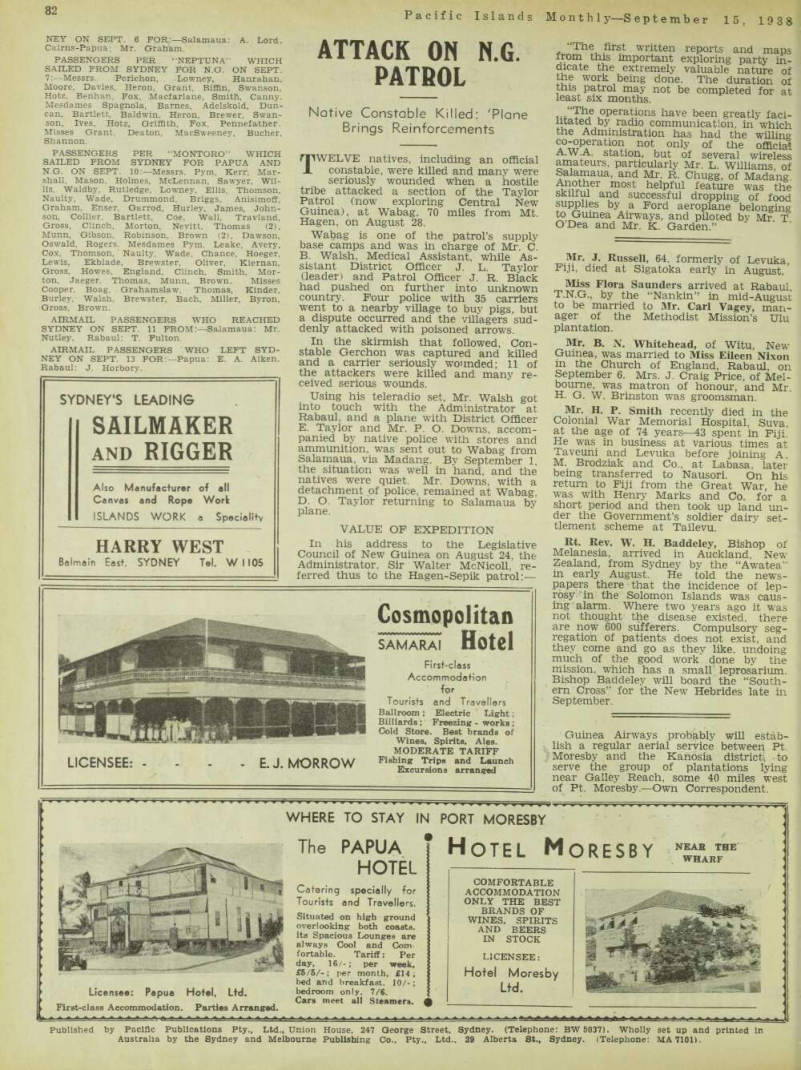
Patrol
Native Constable Killed: 'Plane Brings Reinforcements
TWELVE natives, including an official constable, were killed and many were seriously wounded when a hostile tribe attacked a section of the Taylor Patrol (now exploring Central New Guinea), at Wabag, 70 miles from Mt.
Hagen, on August 28.
Wabag is one of the patrol’s supply base camps and was in charge of Mr. C.
B. Walsh, Medical Assistant, while As sistant District Officer J. L. Taylor (leader) and Patrol Officer J. R. Black had pushed on further into unknown country. Four police with 35 carriers went to a nearby village to buy pigs, but a dispute occurred and the villagers sud denly attacked with poisoned arrows.
In the skirmish that followed, Con stable Gerchon was captured and killed and a carrier seriously wounded; 11 of the attackers were killed and many re ceived serious wounds.
Using his teleradio set, Mr. Walsh got into touch with the Administrator at Rabaul, and a plane with District Officer E. Taylor and Mr. P. O. Downs, accom panied by native police with stores and ammunition, was sent out to Wabag from Salamaua, via Madang. By September 1, the situation was well in hand, and the natives were quiet. Mr. Downs, with a detachment of police, remained at Wabag, D. O. Taylor returning to Salamaua by plane.
Value Of Expedition
In his address to the Legislative Council of New Guinea on August 24, the Administrator. Sir Walter McNicoll, re ferred thus to the Hagen-Sepik patrol:—
“The first written reports and maps from this important exploring party in dicate the extremely valuable nature of the work being done. The duration of this patrol may not be completed for at least six months. have been greatly faci litated by radio communication, in which the Administration has had the willing co-operation not only of the official A.W.A. station, but of several wireless amateurs, particularly Mr. L. Williams, of Salamaua, and Mr. R. Chugg, of Madang Another most helpful feature was the skilful and successful dropping of food supplies by a Ford aeroplane belonging to Gumea Airways, and piloted by Mr T O’Dea and Mr. K. Garden.”
Mr. J. Russell, 64. formerly of Levuka, Fiji, died at Sigatoka early in August.
Miss Flora Saunders arrived at Rabaul T.N.G., by the “Nankin” in mid-August to be married to Mr. Carl Vagey, man ager of the Methodist Mission’s Ulu plantation.
Mr. B. N, Whitehead, of Witu, New Guinea, was married to Miss Eileen Nixon in the Church of England, Rabaul, on September 6. Mrs. J. Craig Price, of Mel bourne, was matron of honour, and Mr.
H. G. W. Brinston was groomsman.
Mr. H. P. Smith recently died in the Colonial War Memorial Hospital, Suva, at the age of 74 years—43 spent in Fiji.
He was in business at various times at Taveuni and Levuka before joining A M. Brodziak and Co., at Labasa, later being transferred to Nausori. On his return to Fiji from the Great War, he was with Henry Marks and Co. for a short period and then took up land un der the Government’s soldier dairy set tlement scheme at Tailevu.
Rt. Rev. W. H. Baddeley, Bishop of Melanesia, arrived in Auckland, New Zealand, from Sydney by the “Awatea" in early August. He told the news papers there that the incidence of lep rosy in the Solomon Islands was caus ing alarm. Where two years ago it was not thought the disease existed, there are now 600 sufferers. Compulsory seg regation of patients does not exist, and they come and go as they like, undoing much of the good work done by the mission, which has a small leproskrium.
Bishop Baddeley will board the “South ern Cross” for the New Hebrides late in September.
Guinea Airways probably will estab lish a regular aerial service between Pt.
Moresby and the Kanosia district-, to serve the group of plantations lying near Galley Reach, some 40 miles west of Pt. Moresby.—Own Correspondent.
Advertisements & other items, pp. 86-88 (3 items)
82
Pacific Islands Monthly-September 15, 19 38
Published by Pacific Publications Pty., Ltd., Union House, 247 George Street, Sydney. (Telephone: BW 5037). Wholly set up and printed in Australia by the Sydney and Melbourne Publishing Co., Pty., Ltd.. 29 Alberta St., Sydney. (Telephone: MA7101).
Hotel Moresby
Licensee: Papua Hofei, Ltd.
First-class Accommodation. Parties Arranged.
WHERE TO STAY IN PORT MORESBY
The PAPUA f
HOTEL
Catering specially for
Tourists and Travellers.
Situated on high ground ; overlooking both coasts, its Spacious Lounges are always Cool and Com fortable. Tariff: Per day, 16/-; per week, £5/5/-; per month, £l4; bed and breakfast. 10/-; bedroom only. 7/6.
Cars meet all Steamers. £
Hotel Moresby
NEAR THE
WHARF
COMFORTABLE
ACCOMMODATION
ONLY THE BEST
BRANDS OF
WINES. SPIRITS
AND BEERS
[ IN STOCK
LICENSEE:
Hotel Moresby
Ltd.
mf
from coast to ...
/ \ T>
LAE
SZ2 \*. vW A
GUINEA AIRWAYS, LIMITED
was established in 1927; and has grown as the figures show.
Building a New Civilization
...BY AIR!
The development of the Territory has been amazingly rapid—thanks to air transport.
GUINEA AIRWAYS LIMITED has transported every type of goods needed by the large and ever-growing European community.
GUINEA AIRWAYS operate regular air services in New Guinea and Papua, using over fifty aerodromes and landing grounds in the two Territories.
GUINEA AIRWAYS planes depart from Port Moresby for the Goldfield on the arrival of each boat. Tickets are obtainable from the Purser.
Fly with GUINEA AIRWAYS—the pioneer Company—in New Guinea and in Australia.
AUSTRALIAN SERVICES
ADELAIDE-DARWIN—Three times weekly, connecting with overseas services.
LIMITED
LAE - SALAMAUA
_-£h .//> Head Office: Austral Chambers, Currie Street, Adelaide, S.A.
New Guinea Office: Lae, Mandated Territory of New Guinea BRANCH OFFICES AND AGENTS AT WAU—SALAMAUA—PORT MORESBY AND SYDNEY. £ 9 •2 5^
0 w
SCH
Si* ft? 9 v,o- -i II a o a V : a o '/ a> Ui / *9. <te ot^ /
SSS
«5? r vT
WELCOME CARGO
Lower away”— and what a welcome cargo it is!
Resch’s Pilsener—in the famous long bottle—the drink which eases the white man’s burden!
Call for a bottle to-night and relish its malt and
hop flavour.
BESOTS
LONG BOTTLE
PILSENER
pvvs $ 2 \ 2° ReSCHf p,t * pi **S p uV^£|