Pacific
Islands
Monthly
Vol. Ix. No. 1.
August 15, 1938
[Registered 0 the G.P.0., Sydney, jor transmission hy post as a newspaper .]
8“
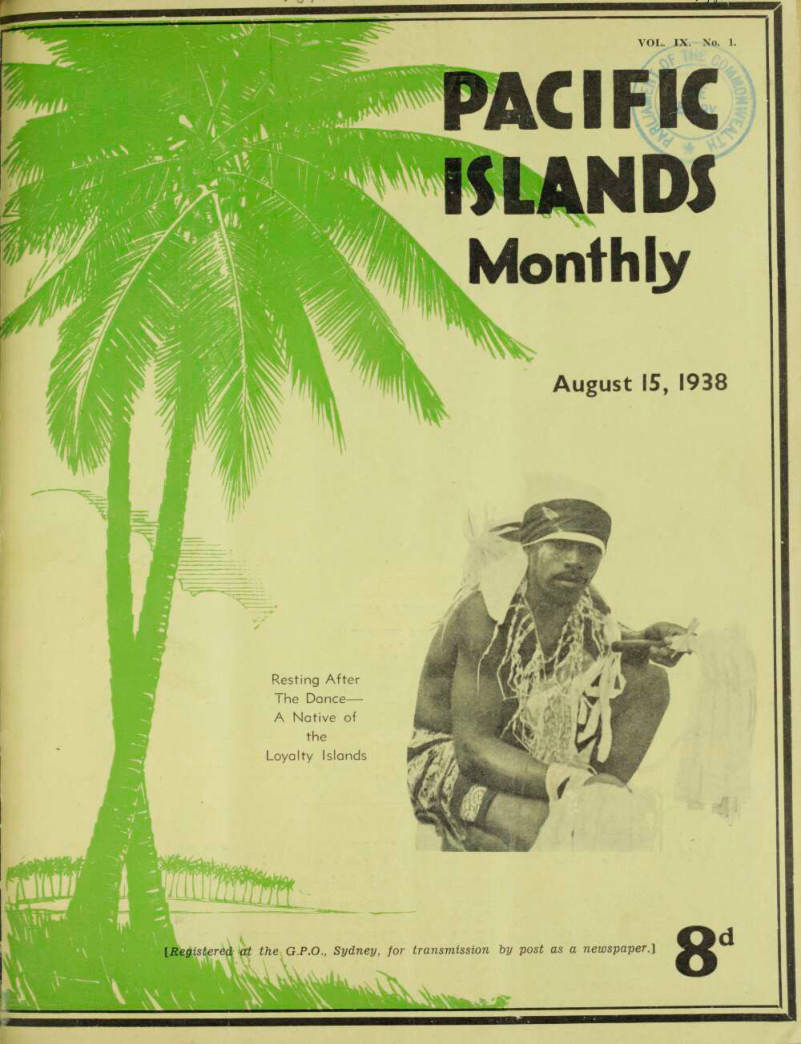
Resting After The Dance— A Native of the Loyalty Islands
Advertisements & other items, p. 2 (2 items)
Pacific Islands Monthl y —-A ugust 15, 1938.
W. R. Carpenter & Co. Ltd.
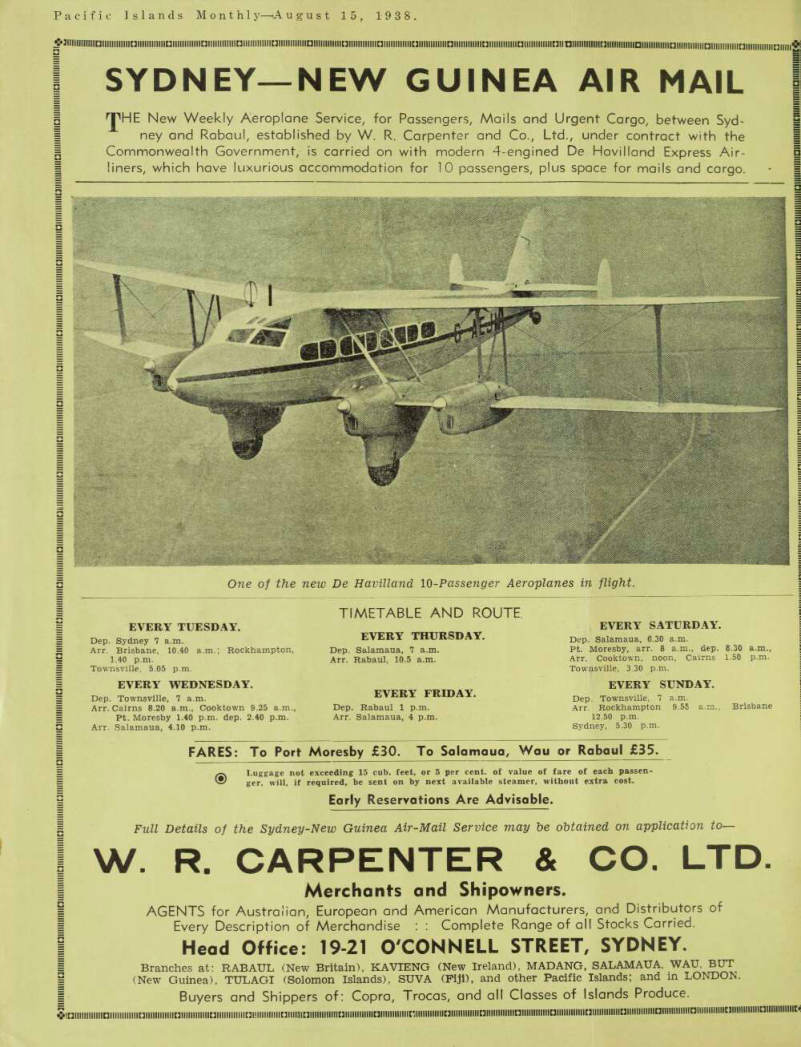
SYDNEY—NEW GUINEA AIR MAIL
T HE New Weekly Aeroplane Service, for Passengers, Mails and Urgent Cargo, between Sydney and Rabaul, established by W. R. Carpenter and Co., Ltd., under contract with the Commonwealth Government, is carried on with modern 4-engined De Havilland Express Airliners, which have luxurious accommodation for 10 passengers, plus space for mails and cargo. . ,
siS
i . A I* % • .
One of the new De Havilland 10 -Passenger Aeroplanes in flight.
EVERY TUESDAY.
Dep. Sydney 7 a.m.
Arr. Brisbane, 10.40 a.m.; Rockhampton, 1.40 p.m.
Townsville, 5.05 p.m.
EVERY WEDNESDAY.
Dep. Townsville, 7 a.m.
Arr. Cairns 8.20 a.m., Cooktown 9.25 a.m., Pt. Moresby 1.40 p.m. dep. 2.40 p.m.
Arr. Salamaua, 4.10 p.m.
TIMETABLE AND ROUTE
EVERY THURSDAY.
Dep. Salamaua, 7 a.m.
Arr. Rabaul, 10.5 a.m.
EVERY FRIDAY.
Dep. Rabaul 1 p.m.
Arr. Salamaua, 4 p.m.
EVERY SATURDAY.
Dep. Salamaua, 6.30 a.m.
Pt. Moresby, arr. 8 a.m., dep. 8.30 a.m..
Arr. Cooktown, noon, Cairns 1.50 p.m.
Townsville, 3.30 p.m.
EVERY SUNDAY.
Dep. Townsville, 7 a.m.
Arr. Rockhampton 9.55 a.m.. Brisbane 12.50 p.m.
Sydney, 5.30 p.m.
FARES: To Port Moresby £3O. To Salamaua, Wau or Rabaul £35.
Luggage not exceeding 15 cub. feet, or 5 per cent, of value of fare of each passenger, will, if required, be sent on by next available steamer, without extra cost.
Early Reservations Are Advisable.
Full Details of the Sydney-New Guinea Air-Mail Service may be obtained on application to—
W. R. CARPENTER & CO. LTD.
Merchants and Shipowners.
AGENTS for Australian, European and American Manufacturers, and Distributors of Every Description of Merchandise : : Complete Range of all Stocks Carried.
Head Office: 19-21 O'CONNELL STREET, SYDNEY.
Branches at: RABAUL (New Britain), KAVIENG (New Ireland), MADANG, SALAMAUA. WAU, BUT (New Guinea), TULAGI (Solomon Islands), SUVA (Fiji), and other Pacific Islands; and in LONDON.
Buyers and Shippers of: Copra, Trocas, and all Classes of Islands Produce.
Pacific Islands Travellers
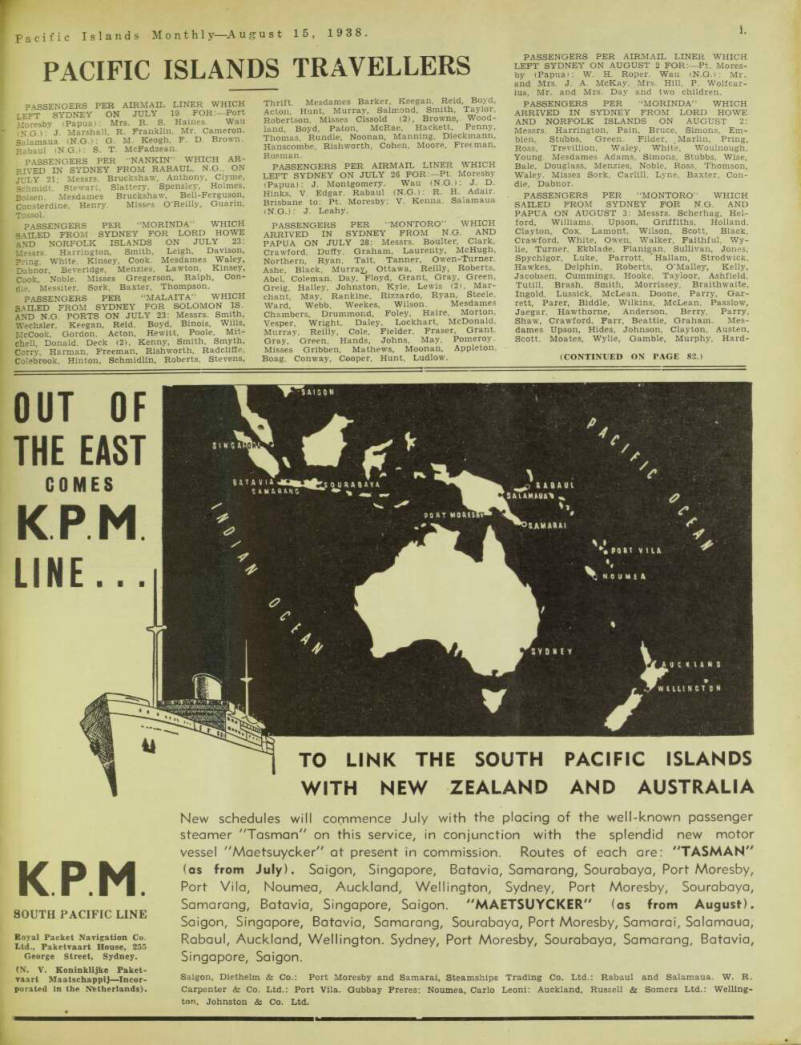
Passengers Per Airmail Liner Which
Sydney On July 19 For:—Port
Moresby .PaDuai: Mrs. R. S. Haines. Wau :«• t • j Marshall R. Franklin, Mr. Cameron.
Qainmaua (N.G.): G. M. Keogh, F. D. Brown.
Rabaul (N.G. i : S. T. McFadzean.
'ojcorNnrpt! pfr “NANKIN” WHICH AR- DTim tv qvtINFY PROM RABAUL N G ON Vmv 91- Messrs Bruckshaw Anthony. Ciyme.
Schmidt Stewart Slattery, Spensley, Holmes, Boisen Mesdames Bruckshaw, Bell-Ferguson, Consterdine Henry. Misses O’Reilly, Guarin,
Tossol. ’
Passengers Per “Morinda” Which
Sailed From Sydney For Lord Howe
And Norfolk Islands On July 23;
Messrs. Harrington, Smith, Leigh, Davison, Pring, White. Kinsey, Cook. Mesdames Waley, Dabnor Beveridge, Menzies, Lawton, Kinsey, Cook Noble. Misses Gregerson, Ralph, Condie Messiter. Sork, Baxter, Thompson.
Passengers Per “Malaita” Which
Csamd From Sydney For Solomon Is.
and NG PORTS ON JULY 23' Messrs. Smith, WPchsler Keeean Reid Boyd, Binois. Wills, McCook ’ Gordon. ’ Acton, Hewitt, Poole. Mitchell Donald Deck (2) Kenny, Smith. Smyth, Corry, Harman, Freeman, Rishworth. Radcliffe.
Colebrook, Hinton. Schmidlin, Roberts, Stevens,
Thrift. Mesdames Barker, Keegan. Reid, Boyd, Acton, Hunt, Murray, Salrr.ond, Smith, lay lor, Robertson. Misses Cissold (2) Browne, Wood land, Boyd, Paton, Mcßae, Hackett, Penny, Thomas, Rundle, Noonan, Manning, Dieckmann, Hanscombe, Rishworth, Cohen, Moore, Freeman, Rosman.
Passengers Per Airmail Liner Which
LEFT SYDNEY ON JULY 26 FOR:—Pt. Moresby (Papua): J. Montgomery. Wau (N.G^i. J. D.
Hinks, V. Edgar. Rabaul (N.G.i : R- H. Adair Brisbane to: Pt. Moresby. V. Kenna. Salamaua (N.G.): J. Leahy.
Passengers Per “Montoro” Which
Arrived In Sydney From N.G. And
PA PUA ON JULY 28: Messrs. Boulter, Clark, Crawford. Duffy. Graham. Laurenty, McHugh, Northern, Ryan, Tait, Tanner, Owen-Turner, Ashe Black. Murray, Ottawa, Reilly, Roberts, Abel Coleman. Day, Floyd, Grant, Gray, Green, Greig, Halley, Johnston, Kyle, Lewis (2i, Mar chant, May. Rankine, Rizzardo, Ryan, Steele.
Ward, Webb, Weekes. Wilson. Mesdames Chambers, Drummond, Foley, Haire, Morton, Vesper, Wright, Daley, Lockhart, McDonald.
Murray. Reilly, Cole. Fielder, Fraser Grant, Gray. Green. Hands, Johns. May, Pomeroy.
Misses Gribben, Mathews, Moonan, Appleton, Boag, Conway, Cooper. Hunt, Ludlow.
Passengers Per Airmail Liner Which
LEFT SYDNEY ON AUGUST 2 FOR:—Pt. Mores by (Papua): W. H. Roper. Wau (N.G.): Mr. and Mrs. J. A. McKay, Mrs. Hill, P. Wolfcar ius, Mr. and Mrs. Day and two children.
Passengers Per “Morinda” Which
Arrived In Sydney From Lord Howe
And Norfolk Islands On August 2:
Messrs. Harrington, Pain, Bruce, Simons, Em blen, Stubbs, Green. Filder, Marlin, Pring, Ross, Trevillion, Waley, White, Woulnough, Young. Mesdames Adams, Simons, Stubbs, Wise, Bale, Douglass, Menzies, Noble, Ross, Thomson, Waley. Misses Sork, Carlill, Lyne, Baxter, Con die, Dabnor.
Passengers Per “Montoro” Which
Sailed From Sydney For N.G. And
PAPUA ON AUGUST 3: Messrs. Scherhag, Hel ford, Williams. Upson, Griffiths, Holland, Clayton, Cox, Lament, Wilson, Scott, Black, Crawford, White, Owen, Walker, Faithful, Wy lie, Turner, Ekblade, Flanigan, Sullivan, Jones, Spychigor, Luke, Parrott, Strodwick, Hawkes, Delphin, Roberts, O’Malley, Kelly, Jacobsen, Cummings, Hooke, Tayloor, Ashfield, Tutill, Brash, Smith, Morrissey, Braithwaite, Ingold. Lussick, McLean, Doone, Parry, Gar rett, Parer, Biddle. Wilkins, McLean, Passlow, Jaegar, Hawthorne, Anderson, Berry, Parry, Shaw, Crawford, Farr, Beattie, Graham. Mes dames Upson, Hides, Johnson, Clayton. Austen, Scott. Moates, Wylie, Gamble, Murphy, Hard
(Continued On Page 82.)
mg Blackman, Strodwick, Briggs, Cummings McLaughlin, Hooke, Beazley, Uutill, Tayloor’ fr v 6W1S ’ Leigh ' Misses W* 1 * 6 - Boag,-Coop- Wo 1 Kirk ™ a "’ McAulay, Sinclair, Hickie, Rut- O’lforinell 104113^111 ’ Hlgley ’ Godsall, Townson,
Passengers Per “Niagara"’ Which
au T ch?t FI 1 OM AT YDNEY FOR SUVA - FLJI ’ ON AUGUST 4: Messrs. Austin, Burton Craig Long g ’ vftes 0 ’ ij' 6 ®,’ Osborn ’ Rankin, ’ Wilson’
MtoBenstead 6 eS Cra ‘ g ’ K ‘“°- Osborn ' PER “MORINDA” which
Railed From Sydney For Lord Howe
Norfolk Is., And New Hebrides On
AUGUST 4: Messrs. Dignam, Whiting, Topham Neal, Cuneo, Venard, Davis, Caldwell. Smith Davms, Dourah, Gould, Brocklebank, Hinch chffe, Cotter (2), Whitney, Bowman. Preston, Hanning, Park, Berwick, Quain, Eagles Pike Stephenson, Preston, Wilson, McGill Leroux’
OMahony, Martin, McDonald, Hammond Hen derson, Moses (2), Price, Ross, Hackett, Eas ton Sismey, Pinch, Murray, Coombes, Byrne Bates, Berwick, Sutherland. Mesdames Mc- Laurm Smith, Farmant, Bowker, Cuneo New matti, Douran, Hinchcliffe, Leroux, Hanning Tual, Preston, Willis. Misses McLaurin Smith Manning, Coghlan, Bradley, Gregerson, Bell’
Sutton, Wilson, Purcell, Thew, Renfrew Pres ton (2), Speer, MacDonald, Burke.
Passengers Per “Maetsuycker” Which
Sailed From Sydney For Pt. Moresby
PAPUA, ON AUGUST 7: Messrs. Ludowici Er nngton, Mason, Grant.
Passengers Per Airmail Liner Which
LEFT SYDNEY ON AUGUST 9 FOR:—Pt Mores by (Papua): J. Tate, Mr. Doyle. Salamaua (N G.): Mr. Foster-Joy, E. W. Torrington, Mr. and Mrs. T. W. Heath. Rabaul (N.G.): G. W.
Scott.
Passengers Per “Macdhui" Which
ARRIVED IN SYDNEY FROM N G AND PAPUA ON AUGUST 11: Messrs. Brammell, Bartlett (21. Burch, Collins, Ewing, Flower, Gib bons, Goodwyn, George, Gray, Gordon. Hogan, Hasforth, Hirst, Hutchinson, Heath, Huie, Har ris, Jones, Krutschnitt, Lane, Lock, Lumiey Lees, McCulloch, Mitchell, Parkinson, Penfold, Richardson, Ryerson, Roenfelt, Shuford, Skin-ner, Stobie, Schoobridge, Sangster, Umhauer, Vertigan, Wilson. Mesdames Burns, Currie, Despeissis. Franklin, George, Gray, Jones, Krutschnitt, Kaiser, Lee, Lees, Mitchell, Roth well, Shorthouse, Steels, Skinner, Vaughan, Ver~ tigan, Vicary, Wells. Misses Gordon, Hogg, Lange. Lindrum, Moore, Mumme. O’Keefe, Salas, Sutton.
Advertisements & other items, p. 3 (2 items)
I
Pacific Islands Monthl y—A ugust 15, 1938.
Out Of
THE EAST
GOMES
KPM
LINE...
8 * T a v 1 A S 0 U R A RAYA
SAMARA N G
RABAUL
SALAMAUA*
L *1
PORT MORESBY
v»
f . PORT VI LA
NOUMEA
J
ILLINCT 0 N
/ S 3 ii
KPM
SOUTH PACIFIC LINE
Royal Packet Navigation Co.
Ltd., Paketvaart House, 255 George Street, Sydney. (N. V. Koninklijke Paket- ▼aart MaatschappiJ—lncorporated in the Netherlands).
TO LINK THE SOUTH PACIFIC ISLANDS
WITH NEW ZEALAND AND AUSTRALIA
New schedules will commence July with the placing of the well-known passenger steamer "Tasman" on this service, in conjunction with the splendid new motor vessel "Maetsuycker" at present in commission. Routes of each are: "TASMAN' (as from July). Saigon, Singapore, Batavia, Samarang, Sourabaya, Port Moresby, Port Vila, Noumea, Auckland, Wellington, Sydney, Port Moresby, Sourabaya, Samarang, Batavia, Singapore, Saigon. "MAETSUYCKER" (as from August).
Saigon, Singapore, Batavia, Samarang, Sourabaya, Port Moresby, Samarai, Salamaua, Rabaul, Auckland, Wellington. Sydney, Port Moresby, Sourabaya, Samarang, Batavia,
Singapore, Saigon.
Saigon, Diethelm & Co.: Port Moresby and Samarai, Steamships Trading Co. Ltd.; Rabaul and Salamaua. W. R.
Carpenter & Co. Ltd.: Port Vila. Gubbay Preres: Noumea, Carlo Leoni: Auckland, Russell & Somers Ltd.: Wellington. Johnston & Co. Ltd.
Advertisers.
“Alnwick” Kinder garten ... 66 Amalgamated Wire less of Aust. Ltd 21 Angus & Coote Ltd 67 Arnott’s Biscuits . 36 “Aspro” ... 51 “Ausoline” . . 59
B.A.L M., Ltd. . . 56
Bank of N.S.W. . 76 Berger & Sons, Ltd 42 “Bernly” Gst Hse 50 “Bidomak” ... 15 Blau (Aust.) Robt. 19 Breckwoldt, Wm. . 58 Broomfields, Ltd. 48 Brown & Co. Pty.
Ltd., Geo. ... 25 Brunton’s Flour . . 41 Budge & Co., Jas. 46 Bullivants, Ltd. . . 57 Burns, Philp & Co. iv.
B.P. Magazine . . 30
B.P. (S.S.) Co. . . 52
Burns, Philp Trust Co. Ltd. ... 50 Carlton & United Breweries Ltd. . 29 Carpenter, W. R.
Limited ii.
Chapman & Sherack 22 Chivers & Sons Ltd 45 Coleman Lamp Co. 20 Continental Com pensations Pty.
Ltd 71, 73 Coral Starch ... 39 Cosmopolitan Hotel 80 Crossle, Duff & Macintosh, Ltd. . 70 “Cystex” ... 55 Dewar’s Whisky 10 Doans’ Pills ... 74 Dobell, Pty. Ltd. . 34 Donald. A. B. Ltd. 62 Eaton, Ltd., J. W. . 47 Electrolux Refrig erators ... 28 Ellerker, A. J. . . 79 Fairbanks - Morse Limited ... 81 “Fairholm” College 32
Falk’s Pharmacy . 69 Finau, Wm. . 36 Fletcher & Sons . 43 Ford Sherington, Ltd 55 ”44 Macleay St.” . 57 Foster Clark (Aus.) Limited ... 44 Freeman’s Sports Store 53 Fryer, A. C. . . .26 Garden Vale Pro ducts. Ltd. . . 39 Garrett & Davidson 70 Gillespie’s Flour .37 Gourock Rope Co. 78 Grand Pacific Hotel 63 Grove & Sons, W.
H 35 Guinea Airways, Ltd v.
Hallstroms Pty Ltd 75 Halvorsen Sons Ltd 79 Hardie & Co. Ltd J. 47 Harper, M. ... 48 Holbrooks’, Ltd . . 41 Hornadge, W. . . 10 Horne, W. & Co. 62 Hotel Moresby . . 60 T.C.I. A.N.Z. ltd. . 23 Intercontinental Airways ... 13 International Cor respondence Schl. 23 Jones & Co Ltd. H. 37 King’s School. The 68 Kodak Pty. Ltd. . 12 Kopsen & Co. Ltd. 61 Kork-N-Seal, Ltd . 45 Levenson’s Radio . 72 Lloyd & Co., Pty., Ltd H Lustre Hosiery Ltd. 66 “Majora” Paints . 77 Mcllrath’s, Ltd. . 18 Master Sewing Machine Co. . . 43 Maxwell Porter Ltd 47 Michael, H. P..
Chemist ... 59 Miller & Co. Pty.
Ltd 48
Morris, Hedstrom, Limited ... 64
N.D.L 32
Nelson & Robertson, Pty. Ltd. . 16, 71 Nestle’s Milk . . 40 Newlands Bros Ltd 60 Newmarket Sad dlery' . . .77 N.S.W. Seed Co. . 20 Noyes Bros. Ltd. . 46 Pacific Is. Club . . 22 Papua Hotel, The . 80 Paul & Gray Ltd. 27 Pike Bros. Ltd. . . 19 Plantation Wanted 77 Position Wanted . 75
Prescott, Ltd. . . 38 Prouds, Ltd. ... 11 Ransomes Sims & Jeffries, Ltd. . . 64 Reed, William E. 57 Reid, W. M. . . . 67 Rohu, Sil . . . . 22 Royal Packet Co. hi.
Ruston & Hornsby 24 Sadleir, G. N. . . 73 Rutherford, G. . . 65 St. Ignatius’ Col. 54 Scott’s Emulsion . 73 Scott, Ltd.. J. . . 26 Shell Oil Co. . . 49 Slade’s Radio Ltd. 74 Springwood, L. Col. 19
Stanley, Chris. . . 37 Steamships Trading Co. Ltd 70 Sterling Varnish Co 9 Sullivan, Ltd., C. . 44 Swallow & Ariel! . 38 Tait & Co Ltd, W.
S 78 “Talkeries”, The . 10 Taylor & Co., A. . 71 “Tenax” Soap . . 30 “Teviot” College . 69 Tillock Co Ltd 51 Tilley Lamp Co. . 32 Tooheys, Ltd. ... 17 ‘Top Dog” Men’s Wear 33
Tooth & Co. . . vii Vacuum Oil Co. . 3 IZ Vincent’s A.P.C. . 62c Warburton, Franki Ltd Iri West, Harry . . . 6ic Weymark & Son . 4st Wills, W. D. and H. 0.. Ltd. ...
Wood’s Peppermint Cure 52c Wright & Co. . . 787 Wright & Co. Ltd., E 2«S Wunderlich, Ltd. . 5iC Yellow Express Car riers, Ltd. 18J
Contents
Page Pacific Islands Travellers i., 82 The Real Issues in Peace or War .. 1 Mau Campaign Against Samoan Officials 2 “You Need Not Fear Japan”—U.S.
Journalist’s Opinion 2 Seeking Oil in Papua and JST.G 3 Violent Storm in Tonga 3 Archbold Party in Dutch N. Guinea 3 New Land Court Judge in Cook Is. 3 Loss of “Hawaii Clipper” 4 Native Land Problem in Fiji 4 New Caledonian Port Cleared ... 5 Two New Phosphate Ships 5 Natives Attack N.G. Patrol 5 Tax Reforms in Tonga 6 Australia’s “Colonising” in T.N.G. .. 6 Prospects of Mt. Kasi Mine, Fiji .. 7 W.R.C. Line to Call at Samoa ... 7 Selection of Salamaua Criticised .. 8 Tropicalities 9 About Islands People 10 Midway Is. to be U.S. Navy Base . 13 Papuan Sentenced to Death 14
Pages No New Trans-Pacific Liners .. .. 16& Cocoa and Its By-Products 200 “No Luxury”—Life of N.G. Officers . 22£ How Papua was Annexed in 1888 2^*.
The War of the “Capital Site" .. .. 268 Effect of Christianity on New Heb rides Natives 300 “Euronesians”? ’ 330 The Pomares of Tahiti 341.
Men Who Knew Yesterday—Robert Rasch, of Nauru Island 368 Japanese in Hawaii 388 Origin of the Polynesian Race .. .. 456 Pioneer Lutheran Missionary's Death 488 ’ 8.5.1. Rebellion That Wasn’t! .. 54£ Treasures of Tahitian Tombs 555 Fashions for Islands Women .. .. 677 New Guinea Timber 696 Pacific Mining Reports 700 Radio Programmes (Short Wave) .. 738 Exchange Rates and Produce Prices 768 Market Quotations 777 Shipping Services in the Pacific .. 788
Advertisements & other items, p. 4 (2 items)
Ii
Pacific Islands Monthl y—A ugust 15, 1938.
Burns, Philp & Co. Ltd.
GENERAL
MERCHANTS
Head Office: 7 Bridge Street, Sydney—Australia Code Address: "Burphil"
BUYERS OF ALL CLASSES OF ISLAND PRODUCE Regular Steamer Services from Australia to New Guinea Papua Solomon Is.—Lord Howe Is.—Norfolk Is.—New Hebrides—Java and Singapore mi niffs uiv: mi mi Ml
Hit
milt
m m
SHIPOWNERS
TOURIST AGENTS
Pacific Islands Monthly
The Newspaper-Magazine of the Sonth Seas
[Registered at the G.P.0., Sydney, for transmission hy post as a newspaper .] Published Once Each Month and Circulated in Australia and New Zealand and in the following Pacific Territories and Islands Groups:
Crown Colony of Fiji.
Australian Territory of Papua.
Mandated Territory (Australia) of New Guinea, Bismarck Archipelago and Northern Solomon Islands.
Mandated Territory (Japan) of Marshall, Caroline and Marianna Islands.
French Territory of New Caledonia.
British and French Condominium of New Hebrides.
American Territory of Eastern Samoa.
American Territory of Guam.
Mandated Territory of Nauru.
British Crown Colony of Gilbert and Ellice Islands.
Mandated Territory (New Zealand) of Samoa.
British Solomon Islands Protectorate.
British Protectorate of Tongan Islands.
New Zealand Territory of Cook Islamra.
Australian Territory of Norfolk Island.
French Colony of Oceania (Tahiti, etc.).
American Territory of Hawaiian Islands.
Owned and Produced by Pacific Publications Pty. Ltd., Union House, 247 George-Street, Sydney.
TFT FPHONF J Managing Director 8W5037 TELEPHONE Business and Editorial MA7IOI
P.O. Box 3408 R
Registered Address of Telegrams, Radiograms, and Cables: “Pacpub”, Sydney.
Contributions
Articles, Stories, and Photographs dealing with Pacific Islands subjects are invited and will be paid for on publication at usual rates,
Subscription Rates
Per Annum, within British Empire, Prepaid, Post Free 8/- Per Annum, elsewhere, prepaid. Post Free 107- Single Copies Bd.
Editor and Publisher:
R. W. Robson, F.R.G.S.
Assisted by Selwyn Hughes.
Advertisements
Advertising Manager; L. W. Bailey.
Advertising Office and Printing-House: 29 Alberta St., Sydney.
Advertising rates furnished on application.
Colours, etc by Arrangement Process Blocks made at Advertiser’s expense when required. Screen, 100.
Changes of Advertising Copy should reach this Office by 3rd of each month, otherwise previous advertisement may be repeated.
Agents
The following are authorised to receive sub scriptions for the Pacific Islands Monthly;— Islands Branches of Burns, Philp & Co. Ltd., and Burns Philp (South Sea) Co. Ltd.
Islands Branches of W. R. Carpenter & Co. Ltd.
All Branches of Morris, Hedstrom & Co. Ltd.
G. Thomas & Co., Rabaul, New Guinea.
T. A. Olsson, Wau, New Guinea.
Whitten Bros. Ltd., Samarai, Papua.
Steamships Trading Co., Papua. All Branches.
P. Costello, Suva, Fiji.
J. Muir Suva, Fiji.
N. C. Mackenzie-Hunt, Wainunu, Bua, Fiji.
All Branches and Representatives of W. H. Grove & Sons Ltd., Auckland, New Zealand.
Cook Islands Trading Co., Rarotonga, Cook Is.
A. C. Rowland, Papeete, Tahiti.
Representative in London: W. C. HARVEY, Coronation Building 4 Lloyds Avenue, London, E.C.2. from whom may be obtained copies of Pacific Islands Monthly, Pacific Islands Year Book, advertising schedules, etc.
Vol. IX. No. 12.
Sydney, August 15, 1938.
Prirp ( 8d - Per Copy * nICC ( Prepaid: 8/- p.a.
The Real Issue In Peace Or War
BEFORE long, there will be far-reach ing adjustments of territorial bound aries. To what extent are they likely to affect Pacific territories?
To-day, the world is an armed camp, echoing to the tramp of marching men —and, more significantly, to the whirr of aeroplane engines. If the nations go into a general dogfight, the issue will remain—maybe for years—completely in doubt; and it would be idle to speculate here about the future of the Pacific.
But if the world’s international prob lems —which, reduced to their common factors, are simply matters of land own ership, colonisation and freer trade — are to be settled peacefully, then decis ions must be taken, very soon, which will affect important Pacific territories.
The point is that present conditions cannot continue much longer. It must be either peace or war. If it is war, everything—maybe, civilisation itself— goes into the melting-pot. It is better to plan for peace, and anticipate early developments.
Before there can be hope of peace, two things must happen. The injustices of the Versailles Treaty must be remov ed; and the nations which control vast colonial Empires must find a formula through which the landless nations —especially Germany, Japan and Italy—can be given free access to new lands for
the settlement of their excess popula tion, new markets for their goods, and new sources of raw material.
For 20 years—ever since the “states men” of the Allied nations made their fantastic arrangements at Versailles, at the end of “the war that was to end war”—long-visioned men have been warning the world of what must hap pen. Now it is happening. Amidst all the murk of muddled politics, the con fusion created by the most ignorant and dangerous press in history, and the clam our 0 f rival “ideologies”, one may see in operation an implacable natural law namely, that when increasing populations a nd expanding trade meet closed Iron tiers and hostile, unsurmountable tar ifls, there will be war.
Slowly, but surely, British public opin ion is becoming conscious of these things: a nd ver y soon now—always providing that some untoward incident does not throw the world into a general war — Britain will attempt to lead the world into a policy of international appease ment. The basis of that policy must be a plan under which (a) the undevel oped territories held by Britain, France, Russia, Holland and Portugal will be made available to the colonising and trading energies of the great nations that now are without colonies, and (b) there will be much freer trade between
all nations. In theory, a customs tariff should .do no more than protect a na tion’s standard of living. In practice, in the last three decades, such tariffs have become instruments of selfishness, cruelty, monopoly and extortion.
Such a policy must take cognisance of certain well-known facts. British Dominions in the Pacific, observing a high standard of life, cannot be opened to the masses of Asia; but that places upon each British community an obli gation either to people and develop the country they hold, or open it to other Europeans. Vast areas in Africa are suitable for colonising by Europeans: can Britain, France and Belgium continue fairly to hold them against such coun tries as Germany, Italy and the Central European Slavonic nations? Is it right that Portugal, now decadent and notor iously incapable of colonial government, should continue to hold large colonies, especially in Africa, while the Germans now have none? Certain nations bor dering the Pacific insist on their right to control large Pacific territories, as a sort of advanced defensive barrier against Asia —the United States, with Hawaii and the Philippines, for instance, and Australia with New Guinea, New Britain and New Ireland—but if the menace they see in Asia were to disap pear, under a policy of international ap peasement, such nations could justify their retention of those rich territories only by making full and proper use of them.
The discussions are going to start very soon now—always assuming there is no sudden war—and far-sighted men inter ested in the more or less undeveloped Pacific territories should begin to study the situation and the outlook. British colonial interests generally, in common with those of other colony-holding na tions, will be called upon to make sacrifices. And, in the ultimate analy sis, their choice will be simple: A fairer division of colonial territory, and the avoidance of war, or an uncompromising cry of “what we have we hold”, and inevitable, endless war.
Actually, if the settlement is to be a peaceful one, South Pacific territories are not likely to be affected. The real changes will come elsewhere—probably Africa. The Commonwealth Govern ment has just committed itself to £500,- 000 expenditure in New Guinea; and Bums, Philp & Co., Ltd., and Morris, Hed strom Ltd. are building new stores, etc., in Western Samoa. Those institutions, presumably, did not make their decisions blindly.
Bastille Day In Fr.
Oceania
From Our Own Correspondent.
Papeete, July 30.
THE chief celebration of Bastille Day (July 14), so far as native partici pation is concerned, was held this year at Ra’iatea, under the Presidency of Honour of M. Andre Perrin, Administra tor of the Leeward Islands.
At Papeete, because the fete in honour of the naval training ship “Jeanne d’Arc” (during which the native celebrations usual at Bastille Day were enacted) was held at so recent a date, it was,decided to observe only the official ceremonies.
Until a year ago, when the natives of Tahiti and adjacent islands revived in all its splendour the traditional Bastille Day fete in honour of His Excellency, M.
Chastenet de Gery, present Governor of the Colony, the native celebrations at Ra’iatea have usually been superior to those at Papeete. The Leeward Islanders being in less intimate contact with Euro pean influence, have preserved their native customs and traditions more faith fully than have the Tahitians.
Kauri From N. Caledonia
SHIPMENTS of Kauri pine from the south-east of New Caledonia are now reaching Australia regularly by the steamer “James Cook’’. The industry is controlled by Societe Forestiere and H. C.
Sleigh, Ltd., and the Sydney agent is Mr.
Norman Hardie, George Street.
Late News
THE annual report of W. R. Carpenter and Co. Ltd., issued on August 12, shows pro fit £111,372, compared with £100,585 last year.
Dividend is 10 per cent.; £lO,OOO transferred to Contingencies Account and £2,000 to Super annuation Account; and £36,638 is carried forward.
Hon. A. H, Bunting, M.L.C., of Samarai, Papua, is still under medical care. He is one of the most popular figures in the Territory, and everyone wishes him an
early recovery.
"You Need Not Fear
Japan"
American Journalist is Outspoken
ANOTHER letter is to hand from Mr.
Marc T. Greene, that world-wander mg American journalist who specia lises in foreign affairs. During the past two or three years,, he has written to the “P.1.M.” from all parts of the world — South America, Greece, Central Africa, Siberia. Recently, he has been in the Far East, and in and out among the Dutch East Indies. Writing from Soura bay a on July 18, he expresses emphatic disagreement with the opinions expressed in the “P.1.M.” regarding the Japanese menace: “I do not believe that you need con cern yourself much more over Japan. If she comes out of this China business with out being broken altogether she will be too weakened to be any menace to any one for a long time to come, if ever again.
I hear, here, the amazing stories of the hardships of life in Japan now for the masses, and it is getting worse all the time.
“I do not in the least agree with you on Willard Price’s stuff. I think it is absolute rot. He sacrifices facts, accuracy, everything, to the dollar quest and getting books out about every three months. He is also much on the Japanese side. I do not thjnk his stuff is sound at all,, and I reckon to know a little about Japan my self.”
Permission has been given to the Kavieng Engineering Works to supply electricity to the town of Kavieng, N.G.
"A Sprinkling Of
Salt”
Mau Campaign Against Samoan Officials
From a Special Correspondent.
APIA, July 21.
BELIEVING that their influence with the New Zealand Government is so great that they can get what they want, certain Mau elements continue their agitation for the removal from Samoa of old enemies, in the persons of prominent officials.
No one knows just what “underground engineering” is going on; but it is be lieved here that Mau agitation is being directed against Mr. Newton (produce in spector), Mr. Braisby (inspector of police) and Dr. Monaghan (chief medical officer).
It is not expected that the agitation will get very far, however. There are indications that the New Zealand Govern ment now has the Samoan situation in much better focus, and “private and con fidential” letters to Mr. Savage and Mr.
Langstone now are received in Wellington with the proverbial sprinkling of salt.
More Samoans are deserting the Mau party for the Malietoa organisation— among them, the whole village of Afega, which is a community influential in Samoan politics.
Sydney newspapers have announced the engagement of Mr. Keith G. Miller, of Wewak, New Guinea, to Miss Catherine Cairns, of Delegate, N.S.W.
Advertisements & other items, p. 6 (2 items)
Off Beaten Tracks In The Pacific—Ii.
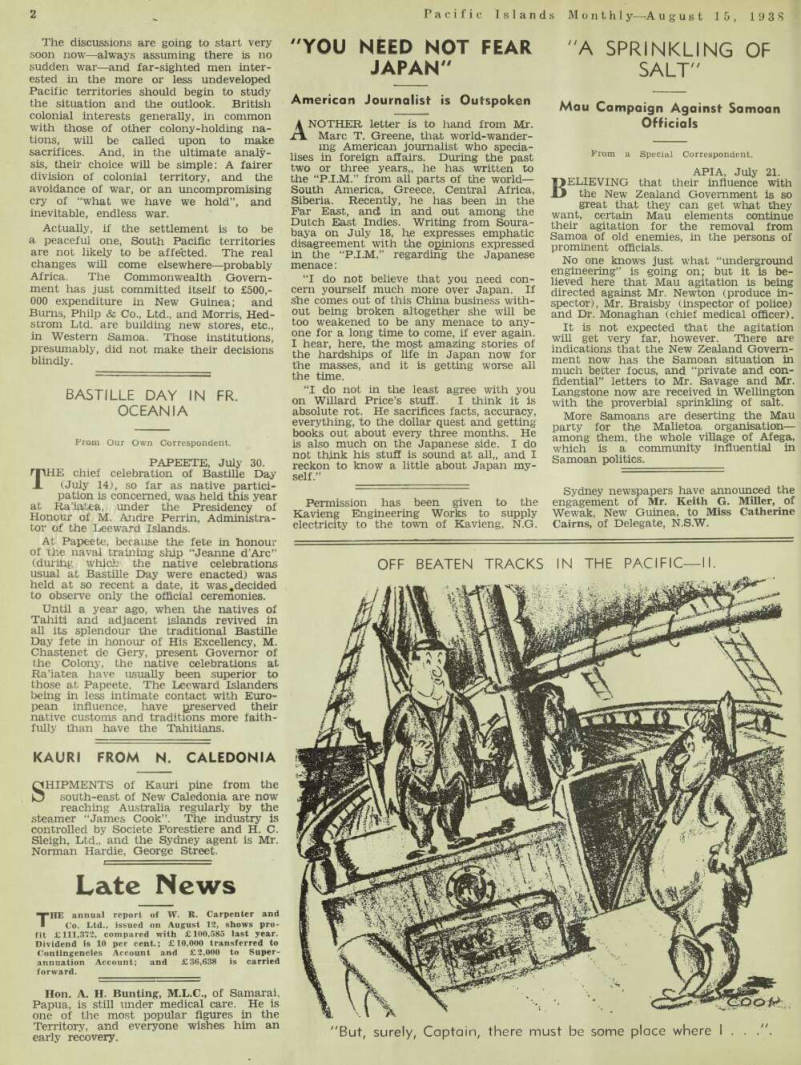
"But, surely, Captain, there must be some place where 1 . . .".
2
Pacific Islands Monthl y—A ugust 15, 19 3 8
Pacific Islands
Americans In Central Pacific Islands
From Our Own Correspondent.
, Honolulu, July 26.
DEPARTING from Honolulu on July 16, the U.S. coastguard cutter “Roger B.
Taney” made a periodic inspection visit to the U.S. units upon the equatorial islands of Jarvis. Baker, Howland, Can ton, and Enderbury.
New two-way radio sets were taken to replace the old equipment on each island.
However, there is nothina- significant about this, because the replacement sets are old type and more or less nothing better than semi-amateur. For example, they are not in the same street as the equipment used bv the British officials on Canton.
New refrigeration boxes, exactly the same make and size as the British —so there won’t be any “bad” feeling—went along for each island.
Many of the American youths on the islands will be replaced this time. The U.S. Government is still maintaining its policy of not including American-born Japanese youths in the parties.
Seeking Oil In
Territories
New Ordinance Causes Flutter
AN announcement that an amendment of the ordinances governing the search for oil in Papua and New Guinea has been submitted by Canberra for con sideration by the Legislative Councils of those two territories has caused some thing of a flutter among oil interests.
Nothing official is known about the pro posed new law, but the circumstances suggest that probably it is designed to encourage the continuance of the oil search in Papua and New Guinea, either by way of greater subsidies or increased concessions.
It must be remembered that, for nearly two years, the three main companies con cerned have been spending huge sums on the search for oil—Papua Oil Develop ments, Ltd. (Shell) in Papua, and Islands Explorations, Ltd. (Vacuum) and OH Search, Ltd. (an Australian concern) in both Papua and New Guinea.
They have not found oil; but there is nothing to indicate that they have lost confidence in the enterprise. On the con trary, it is reasonable to suppose that, having gone so far, they are prepared to go a long way farther; but, probably, be fore they undertake still greater expen diture, they require a better title to the various areas than they have at present.
Then there is the matter of the “un controlled areas”, in Papua and New Gumea. It is impossible to make the oil search complete unless it embraces those regions. It is realised that the present ban on entry to at least some portions of the areas cannot continue much longer.
After a lengthy holiday in Sydney, Mrs.
Arthur R. Miller and her small son are returning to Wewak, T.N.G. Mrs. Miller will leave her only daughter at “Kambala”
School, and her eldest son at Scots College, Sydney. Mr. Arthur R. Miller, of the Administration staff, returned by the June “Macdhui”.
Violent Storm In
Tonga
Three People Killed: Much Damage
A WHIRLWIND of such severity that some describe it as a cyclone swept through the village of Malapo, on Tongatabu, Tonga, at 4 a.m. on July 20.
All the houses in the village were de stroyed, and three people, a man, and a woman and her daughter, were killed.
Similar whirlwinds, about the same time, visited the islands of Foa, in the Haapai Group, and Tanga, in Vavau Group. Most of the houses, and many trees, were blown down in those islands, but no lives were lost.
Malapo is situated on the lagoon, about 9 miles eastward of Nukualofa.
The latter town was visited by an ex traordinary electrical disturbance, with a rainstorm which continued until day light. The people were terror-stricken by the almost continuous lightning and thunder.
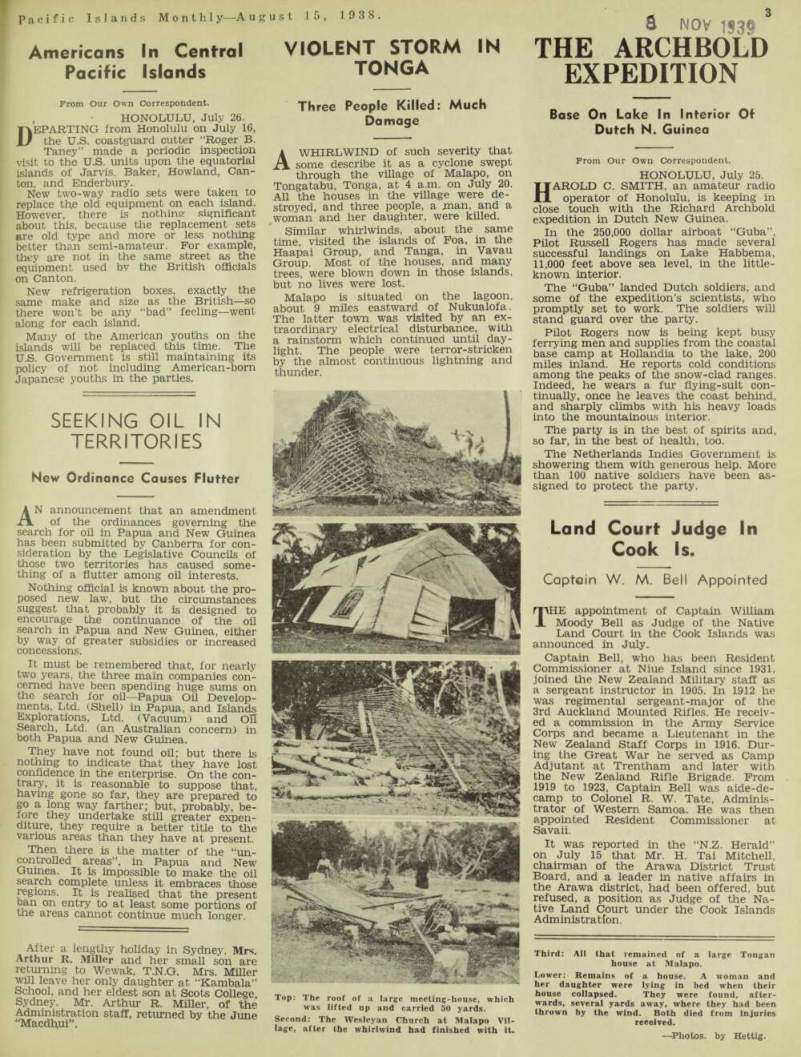
Top: The roof of a large meeting-house, which was lifted up and carried 50 yards.
Second: The Wesleyan Church at Malapo Vil lage, after the whirlwind had finished with it.
Third: All that remained of a large Tongan house at Malapo.
Lower: Remains of a house. A woman and her daughter were lying in bed when their house collapsed. They were found, after wards, several yards away, where they had been thrown by the wind. Both died from injuries received. —Photos, by Hettig.
The Archbold
Expedition
Base On Lake In Interior Of Dutch N. Guinea
Prom Our Own Correspondent.
Honolulu, July 25.
HAROLD C. SMITH, an amateur radio operator of Honolulu, is keeping in close touch with the Richard Archbold expedition in Dutch New Guinea.
In the 250,000 dollar airboat “Guba”, Pilot Russell Rogers has made several successful landings on Lake Habbema, 11,000 feet above sea level, in the little known interior.
The “Guba” landed Dutch soldiers, and some of the expedition’s scientists, who promptly set to work. The soldiers will stand guard over the party.
Pilot Rogers now is being kept busy ferrying men and supplies from the coastal base camp at Hollandia to the lake, 200 miles inland. He reports cold conditions among the peaks of the snow-clad ranges.
Indeed, he wears a fur flying-suit con tinually, once he leaves the coast behind, and sharply climbs with his heavy loads into the mountainous interior.
The party is in the best of spirits and, so far, in the best of health, too.
The Netherlands Indies Government is showering them with generous help. More than 100 native soldiers have been as signed to protect the party.
Land Court Judge In Cook Is
Cook Is.
Captain W. M. Bell Appointed
THE appointment of Captain William Moody Bell as Judge of the Native Land Court in the Cook Islands was announced in July.
Captain Bell, who has been Resident Commissioner at Niue Island since 1931, joined the New Zealand Military staff as a sergeant instructor in 1905. In 1912 he was regimental sergeant-major of the 3rd Auckland Mounted Rifles. He receiv ed a commission in the Army Service Corps and became a Lieutenant in the New Zealand Staff Corps in 1916. Dur ing the Great War he served as Camp Adjutant at Trentham and later with the New Zealand Rifle Brigade. From 1919 to 1923, Captain Bell was aide-de camp to Colonel R. W. Tate, Adminis trator of Western Samoa. He was then appointed Resident Commissioner at Savaii.
It was reported in the “N.Z. Herald” on July 15 that Mr. H. Tai Mitchell, chairman of the Arawa District Trust Board, and a leader in native affairs in the Arawa district, had been offered, but refused, a position as Judge of the Na tive Land Court under the Cook Islands Administration.
Advertisements & other items, p. 7 (1 item)
3
Pacific Islands Mont hi y—A ugust 15, 1938.
Pacific Airmails
Loss of "Hawaii Clipper"—The Hawaii-N.Z. Service
THE disappearance of the Pan American Airways trans-Pacific flying boat “Hawaii Clipper”, on July 29, when on her regular flight between Guam and Manila, is a complete mystery.
The boat was making the usual weekly service flight between San Francisco and Hongkong, and everything appeared in order when she called at Honolulu, Wake Island, Midway Island, and Guam. She was the Martin type of flying boat, with four nine-cylinder engines and was cap able of carrying 46 passengers at a speed of about 150 miles an hour.
The “Hawaii Clipper” left Guam at 11.40 a.m. on Friday, July 29, with 6 pas sengers and 9 crew, to fly 1,600 miles to Manila. She reported every half hour by radio. Early on Friday evening the radio operator on the Clipper reported that she had passed through several showers at an elevation of 9,000 ft. From that mo ment there was complete silence.
Within a couple of hours, there was a general alarm.
American naval vessels and aeroplanes from Manila and Guam immediately set out on a most comprehensive search, which swept the ocean in all directions for hundreds of miles. The “U.S.S.
Meigs”, which happened to be in the vicinity of the Clipper’s last reported posi tion, when the alarm was sent out, steamed immediately to that position; and, about 40 miles south-south-east thereof (a point midway between Guam and Manila) it found on the surface of the sea a patch of oil 1,500 ft. in circum ference. Subsequent investigation showed that there was petrol mixed with the oil.
The discovery was officially described as “significant but not conclusive”.
The search continued thereafter for over a week by American and Japanese ships, but not another trace of the Clipper was found.
The mystery deepens, the more it is considered. This huge flying ship had four powerful engines. Since the “Samoa Clipper” was destroyed in the South Pacific last January, by an explosion, caused through dumping petrol, special appliances have been fitted, to make a similar explosion practically impossible.
What strange accident happened, there fore, to cause this new flying-boat to dis appear without leaving a trace? Experts have pointed out that if the oil patch indicated a sudden plunge into the sea, there should have been some bits of wreckage floating on the surface, to mark the disaster.
Hawaii-Auckland Service
There still is no definite announce ment about the establishment of the Pan- American Airways service between Hawaii and New Zealand.
The company’s plans, knocked awry by the loss of the “Samoan Clipper” last Jan uary, were just beginning to take shape again, when this second disaster occurred.
Another factor making for delay is the disclosure that the first tests of the huge Boeing flying-boats (6 of which are being built for Pan-American Airways) disclosed some need for an alteration of plans. It is expected, however, that when the Boeings are available for the Pacific service (that is, if they are not wanted for an Atlantic service) the Martin flying-boats now en gaged on the Pacific service will become available for the Hawaii-Auckland run.
It seems possible, now, that the route
will be Honolulu-Canton Island-Suva (or Rose Is.)-Auckland, instead of Honolulu- Kingman Reef-Pago-Auckland, as first planned. The American planes, however, probably will not be able to use a British port, such as Suva or Apia, unless the proposed British service is assured of similar facilities in Hawaii. In that event, Pago or Rose Island will be the central Pacific station.
Native Land Problem In Fiji
Retiring Governor Outlines New Policy
From Our Own Correspondent.
A at . , SUVA, Aug. 2.
N important statement on the Gov ernment’s native lands policy in Fiji was made by Sir Arthur Rich ards at a farewell function accorded him by leading chiefs of the Colony before his departure for Jamaica.
It should be noted that, owing to the* increase in the number of Indians in Fiji, and their eagerness to acquire land, the land problem in Fiji is an extremely difficult one. The British Government is bound to protect the land rights of the Fijian natives.
“Let me refer to a resolution of the Council of Chiefs of 1936 on the subject of kovukovu, or family lands contained in the holdings of an alien mataqali,” said His Excellency. “I have( been in formed that these lands have been de fined and surveyed in many provinces, but not in all. I understand that, though these parcels are generally small in area, some are valuable and much sentiment attaches to them.
“The Government is anxious to see you all confirmed in the ownership of your rightful lands and, in furtherance of this policy, it is proposed to instruct the Native Lands Commission to inquire into and define family lands in places where such holdings are customary, after the completion of the Commission’s investi gations now proceeding in the province of Lau.
“You have been addressed by Governors on several occasions on this subject of your lands, and it is always foremost in your minds. This question is not only important to you who own the lands, but is also of vital importance to others who have made their homes in Fiji. Bound up with it is the future welfare of the Colony.
“You passed a resolution in 1936 asking in effect, that Government should control all lands you did not require. Govern ment appreciates the trust which' you have put in it by this resolution.
“Since then, the matter has been sub mitted to all the provincial councils, with the result that the resolution of the Council of Chiefs was upheld by a large majority.
“I consider that it would be best for Government to pass a Native Lands Trust Ordinance, giving Government power to deal with all the native lands in, the Colony. This would mean that Govern ment would be bound byj law to carry out its trust in th,e best interests of Fijians, first, and afterwards in the in terests of others. A Commission, headed by Ratu Sukuna. would then be appointed, and would arrange with each mataqali for lands to be set aside for the exclusive use of Fijians. The lands not needed for would be freed for leasing to others. The rent would, of course accrue to you.
“My proposal, then, is th#t you should ask the Government to control your lands for you. The Government would then pass this Bill of which I speak and your representatives in Council would have; the opportunity of criticising the detailed provisions of that Bill, and the regulations under it.
“Th,e Bill would simply vest control of all native lands in a Board. The Board would consist of the Governor (as chair man), a native chief, the Director of Land and Surveys, and the Adviser on Native Affairs.
“As soon as the law had been passed and the Board constituted, the Board would appoint a Commission consisting of Ratu Sukuna, and assistants to be chosen by him, to go round and settle, province by province, the areas to be gazetted as native reserves. When his recommendations had been approved by the Board they would be gazetted. All the lands outside of these native reserves would then be available for leasing to applicants of any race—Fijian, Indian or European.
“The Fijian would not only have his ancestral reserves, to be handed down only to Fijian descendants, in which no other race might hold land, but in what I will call the free areas outside he would have equal opportunities with others.
“In regard to the manner of leasing, the final decision would always rest with the Governor’s Board. But to assist them, I think wouldd be best to set up in each province a local committee, consisting of the District Commissioner, as chairman, the Roko or native Assistant Commis sioner,, one Fijian to be elected by the provincial council and one Indian to be nominated by the Governor. This local committee would inquire into every ap plication, would refer it to the Lands Office for verification of its position and availability and would then make its recommendations to the Governor’s Board, which might in cases of several appli cations for the same land approve of one of them or order the lease of the land to be sold by auction.”
Advertisements & other items, p. 8 (2 items)
4
Pacific Islands Montlily— August It, 1 §
Your Wrapper!
Look On The Front Of
The figures stamped there (if any) show the date when your subscription expires.
This date will appear on wrappers of three issues preceding expiration, thereby giving 3 months’ notice. If, at the end of that time, we have not been instructed to continue to send the journal to you, it will be discontinued.
Your subscription (8/- per annum, or 10/- in the case of countries outside the British Empire—which includes postage) may be sent direct, or may be paid to any of our agents (listed on page 3.) The postage required for this issue ls:~ To Australia and New Zealand 2d To United Kingdom via All-sea routes ... 2d To United Kingdom via France 2d To other British Possessions 3d To U.S.A. and Foreign Countries 5d
PACIFIC PUBLICATIONS PTY. LTD.
Hull Removed
New Caledonian Port Cleared
Noumea, Aug. 1.
USING a special oxy-hydrogen process patented in Australia, Mr. Johnston has succeeded in demolishing the iron hull of the sailing ship “Joliette”, which sank alongside the wharf at Thio during the cyclone of 1909, and has since been an obstacle to navigation.
The “Joliette” had loaded nickel and cobalt. Unfortunately, the tug employed by Societe Le Nickels was away when the cyclone struck the district, and the “Joliette” was subjected to a terrific buffetting. Being a sailing ship she was helpless and eventually she was over whelmed and sank alongside the wharf.
The hull of the shjp has been an obstruc tion at the wharf for nearly 30 years; but it has now been cut to pieces by Mr.
Johnston, operating under water, and a depth of 30 feet is available alongside the wharf.
Mr. Johnston, during his arduous work under water, ‘had some queer experi ences. A huge fish, which resembled an Australian groper, was very inquisitive and became his constant attendant; but a stick of dynamite, exploded in a judi cious fashion, settled th,e argument which was developing between them. There was also a shark, about 7 ft. long, which seemed attracted by the food possibilities represented by the diver; but he sue
cumbed to a lure of red meat upon a strong hook.
Mr. Johnston has not yet finished his work He is trying to recover a portion of the “joliette’s” cargo. The nickel is not so valuable as to warrant heavy expense, but the 250 tons of cobalt is well worth the trouble and it is now be ing brought to the surface.
New Offices For Fiji Government
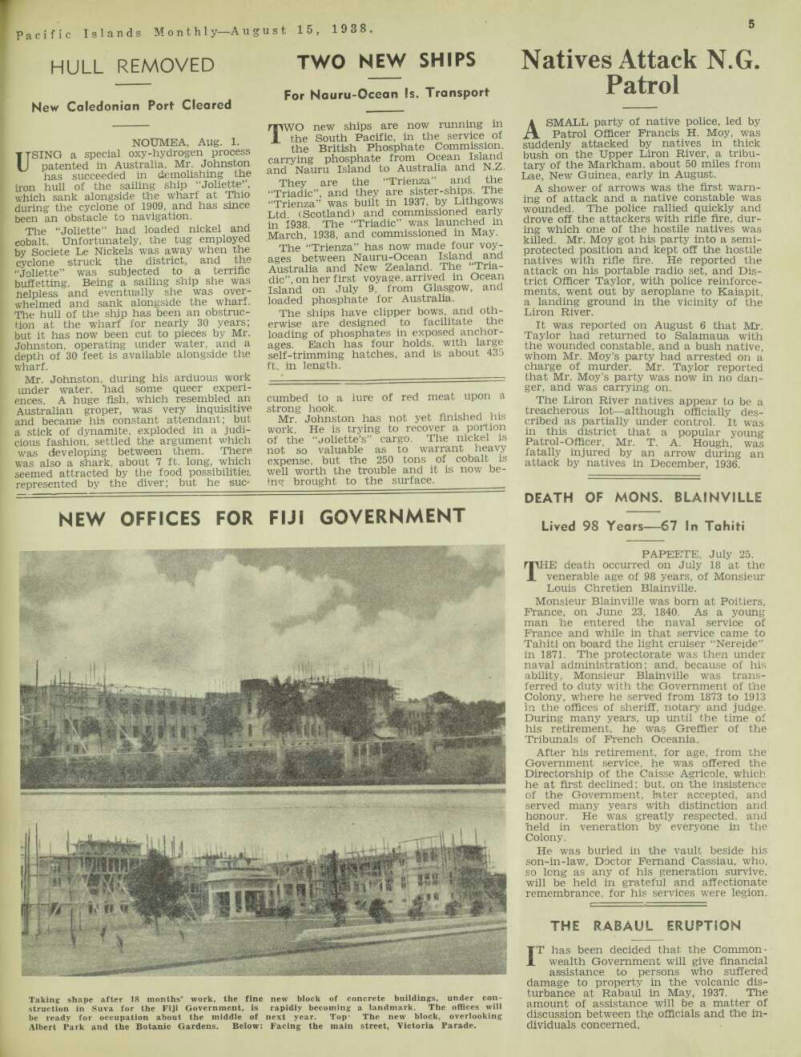
Taking shape after 18 months’ work, the fine new block of concrete buildings, under con struction in Suva for the Fiji Government, is rapidly becoming a landmark. The offices will be ready for occupation about the middle of next year. Top- The new block, overlooking Albert Park and the Botanic Gardens. Below: Facing the main street, Victoria Parade.
Two New Ships
For Nauru-Ocean Is. Transport
TWO new ships are now running in the South Pacific, in the service of the British Phosphate Commission, carrying phosphate from Ocean Island and Nauru Island to Australia and N.Z.
They are the “Trienza” and the “Triadic”, and they are sister-ships. The “Trienza” was built in 1937, by Lithgows Ltd (Scotland) and commissioned early in 1938. The “Triadic” was launched in March, 1938, and commissioned in May.
The “Trienza” has now made four voy ages between Nauru-Ocean Island and Australia and New Zealand. The “Tria dic”, on her first voyage, arrived in Ocean Island on July 9, from Glasgow, and loaded phosphate for Australia.
The ships have clipper bows, and oth erwise are designed to facilitate the loading of phosphates in exposed anchor ages. Each has four holds, with large self-trimming hatches, and is about 435 ft. in length.
Natives Attack N.G.
Patrol
A SMALL party of native police, led by Patrol Officer Francis H. Moy, was suddenly attacked by natives in thick bush on the Upper Liron River, a tribu tary of the Markham, about 50 miles from Lae, New Guinea, early in August.
A shower of arrows was the first warn ing of attack and a native constable was wounded. The police rallied quickly and drove off the attackers with rifle fire, dur ing which one of the hostile natives was killed. Mr. Moy got his party into a semi protected position and kept off the hostile natives with rifle fire. He reported the attack on his portable radio set, and Dis trict Officer Taylor, with police reinforce ments, went out by aeroplane to Kaiapit, a landing ground in the vicinity of the Liron River.
It was reported on August 6 that Mr.
Taylor had returned to Salamaua with the wounded constable, and a bush native, whom Mr. Moy’s party had arrested on a charge of murder. Mr. Taylor reported that Mr. Moy’s party was now in no dan ger, and was carrying on.
The Liron River natives appear to be a treacherous lot—although officially des cribed as partially under control. It was in this district that a popular young Patrol-Officer, Mr. T. A. Hough, was fatally injured by an arrow during an attack by natives in December, 1936.
Death Of Mons. Blainville
Lived 98 Years—67 In Tahiti
Papeete, July 25.
THE death occurred on July 18 at the venerable age of 98 years, of Monsieur Louis Chretien Blainville.
Monsieur Blainville was bom at Poitiers, France, on June 23, 1840. As a young man he entered the naval service of France and while in that service came to Tahiti on board the light cruiser “Nereide” in 1871. The protectorate was then under naval administration; and. because of his ability, Monsieur Blainville was trans ferred to duty with the Government of the Colony, where he served from 1873 to 1913 in the offices of sheriff, notary and judge.
During many years, up until the time of his retirement, h,e wa§ Greffier of the Tribunals of French Oceania.
After his retirement, for age, from the Government service, he was offered the Directorship of the Caisse Agricole, which he at first declined; but, on the insistence of the Government. Inter accepted, and served many years with distinction and honour. He was greatly respected, and held in veneration by everyone in the Colony.
He was buried in the vault beside his son-in-law, Doctor Fernand Cassiau, who, so long as any of his generation survive, will be held in grateful and affectionate remembrance, for his services were legion.
The Rabaul Eruption
IT has been decided that the Common wealth Government will give financial assistance to persons who suffered damage to property in the volcanic dis turbance at Rabaul in May, 1937. The amount of assistance will be a matter of discussion between th,e officials and the in dividuals concerned.
Tonga
Tax Reforms In
Prisoners Released on July 24
ALL persons who were in gaol in Tonga for failure to pay taxes—a very large number —were released on Sunday, July 24, as a result of a decision by the Ton gan Parliament.
New decisions made include the fol lowing:— Unlimited imprisonment for non-pay ment of taxes is abolished, and default ers instead will be employed on road work, for a maximum of 6 weeks (in stead of 8 months), at 2/- and one free meal per day. Six weeks’ roadwork wipes out one year’s tax.
Poll-tax is reduced from 36/- to 32/per annum. (It escaped abolition alto gether only on the casting vote of the Speaker.) The iniquitous fine of 5/- for each quarter during which the tax remains unpaid is abolished.
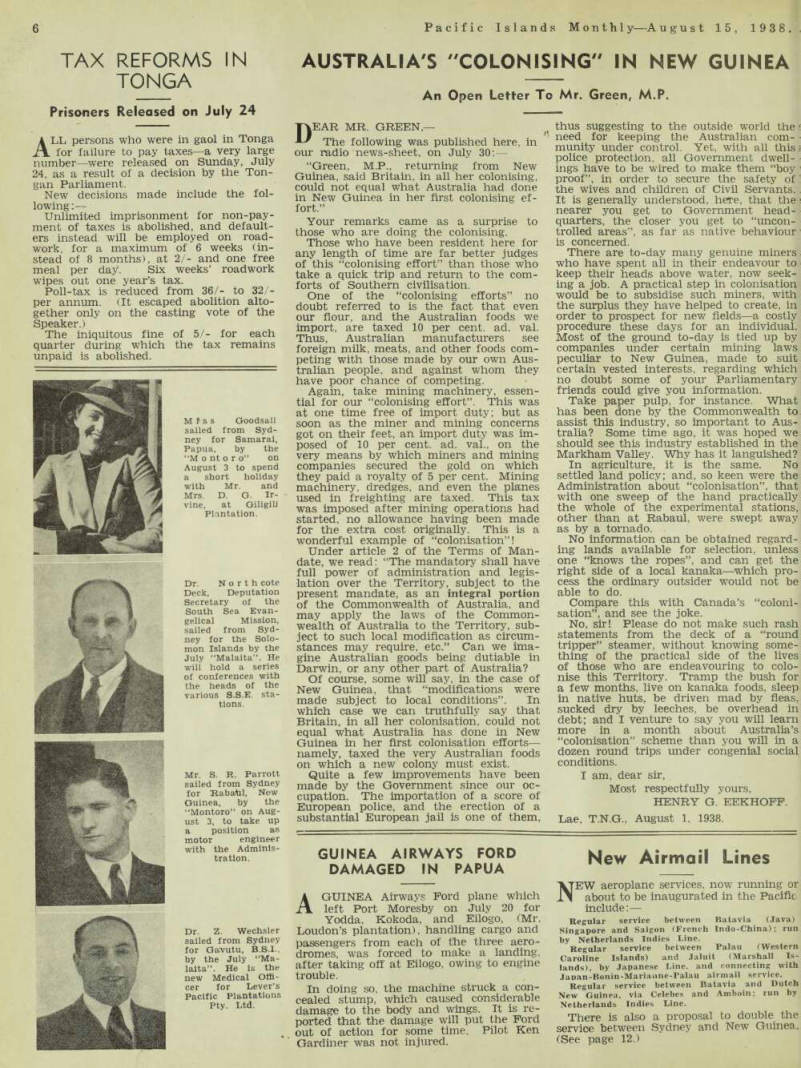
Mrss Goodsall sailed from Syd ney for Samarai, Papua, by the “Montoro” on August 3 to spend a short holiday with Mr. and Mrs. D. G. Ir vine, at Giligili Plantation.
Dr. North cote Deck, Deputation Secretary of the South Sea Evan gelical Mission, sailed from Syd ney for the Solo mon Islands by the July “Malaita”. He will hold a series of conferences with the heads of the various S.S.E. sta tions.
Mr. S. R. Parrott sailed from Sydney for Rabaul, New Guinea, by the “Montoro” on Aug ust 3, to take up a position as motor engineer with the Adminis tration.
Dr. Z. Wechsler sailed from Sydney for Gavutu, B.S.I., by the July “Ma laita”. He is the new Medical Offi cer for Lever’s Pacific Plantations Pty. Ltd,
Australia's "Colonising" In New Guinea
An Open Letter To Mr. Green, M.P.
Dear mr. green,— The following was published here, in our radio news-sheet, on July 30;— “Green, M.P., returning from New Guinea, said Britain, in all her colonising, could not equal what Australia had done in New Guinea in her first colonising ef fort.”
Your remarks came as a surprise to those who are doing the colonising.
Those who have been resident here for any length of time are far better judges of this “colonising effort” than those who take a quick trip and return to the com forts of Southern civilisation.
One of the “colonising efforts” no doubt referred to is the fact that even our flour, and the Australian foods we import, are taxed 10 per cent. ad. val.
Thus, Australian manufacturers see foreign milk, meats, and other foods com peting with those made by our own Aus tralian people, and against whom they have poor chance of competing.
Again, take mining machinery, essen tial for our “colonising effort”. This was at one time free of import duty; but as soon as the miner and mining concerns got on their feet, an import duty was im posed of 10 per cent. ad. val., on the very means by which miners and mining companies secured the gold on which they paid a royalty of 5 per cent. Mining machinery, dredges, and even the planes used in freighting are taxed. This tax was imposed after mining operations had started, no allowance having been made for the extra cost originally. This is a wonderful example of “colonisation”!
Under article 2 of the Terms of Man date, we read: “The mandatory shall have full power of administration and legis lation over the Territory, subject to the present mandate, as an integral portion of the Commonwealth of Australia, and may apply the laws of the Common wealth of Australia to the Territory, sub ject to such local modification as circum stances may require, etc.” Can we ima gine Australian goods being dutiable in Darwin, or any other part of Australia?
Of course, some will say, in the case of New Guinea, that “modifications were made subject to local conditions”. In which case we can truthfully say that Britain, in all her colonisation, could not equal what Australia has done in New Guinea in her first colonisation efforts— namely, taxed the very Australian foods on which a new colony must exist.
Quite a few improvements have been made by the Government since our oc cupation. The importation of a score of European police, and the erection of a substantial European jail is one of them,
thus suggesting to the outside world the £ need for keeping the Australian com- munity under control. Yet, with all this ? police protection, all Government dwell- ■ ings have to be wired to make them “boy 1 proof”, in order to secure the safety of ’ the wives and children of Civil Servants. .
It is generally understood, here, that the! nearer you get to Government head quarters, the closer you get to “uncon trolled areas”, as far as native behaviour ■ is concerned.
There are to-day many genuine miners i who have spent all in their endeavour to < keep their heads above water, now seek ing a job. A practical step in colonisation would be to subsidise such miners, with the surplus they have helped to create, in order to prospect for new fields —a costly procedure these days for an individual.
Most of the ground to-day is tied up by companies under certain mining laws peculiar to New Guinea, made to suit certain vested interests, regarding which no doubt some of your Parliamentary friends could give you information.
Take paper pulp, for instance. What has been done by the Commonwealth to assist this industry, so important to Aus tralia? Some time ago, it was hoped we should see this industry established in the Markham Valley. Why has it languished?
In agriculture, it is the same. No settled land policy; and, so keen were the Administration about “colonisation”, that with one sweep of the hand practically the whole of the experimental stations, other than at Rabaul, were swept away as by a tornado.
No information can be obtained regard ing lands available for selection, unless one “knows the ropes”, and can get the right side of a local kanaka—which pro cess the ordinary outsider would not be able to do.
Compare this with Canada’s “coloni sation”, and see the joke.
No, sir! Please do not make such rash statements from the deck of a “round tripper” steamer, without knowing some thing of the practical side of the lives of those who are endeavouring to colo nise this Territory. Tramp the bush for a few months, live on kanaka foods, sleep in native huts, be driven mad by fleas, sucked dry by leeches, be overhead in debt; and I venture to say you will learn more in a month about Australia’s “colonisation” scheme than you will in a dozen round trips under congenial social conditions.
I am, dear sir, Most respectfully yours,
Henry G. Eekhoff.
Lae, T.N.G., August 1, 1938.
Guinea Airways Ford
Damaged In Papua
A GUINEA Airways Ford plane which left Port Moresby on July 20 for Yodda. Kokoda, and Eilogo, (Mr.
Loudon’s plantation), handling cargo and passengers from each of the three aero dromes, was forced to make a landing, after taking off at Eilogo, owing to engine trouble.
In doing so, the machine struck a con cealed stump, which caused considerable damage to the body and wings. It is re ported that the damage will put the Ford out of action for some time. Pilot Ken Gardiner was not injured.
New Airmail Lines
NEW aeroplane services, now running or
about to be inaugurated in the Pacific include: — Regular service between Batavia (Java) Singapore and Saigon (French Indo-China); run by Netherlands Indies Line.
Regular service between Palau (Western Caroline Islands) and Jaluit (Marshall Is lands), by Japanese Line, and connecting with Janan-Bonin-Marianne-Palau airmail service.
Regular service between Batavia and Dutch New Guinea, via Celebes and Amboin; run by Netherlands Indies Line.
There is also a proposal to double the
service between Sydney and New Guinea.
(See page 12.)
Advertisements & other items, p. 10 (1 item)
6
Pacific Islands Monthl y—A ugust 15, 1938.
Fiji Gold
Mt. Kasi's Prospects Appear Bright
“T>ROSPECTS at Mt. Kasi mine never 1 looked better than they are to-day, and the Company is pushing ahead on sound developmental lines,” said Mr.
E J. Coote, chairman of directors of Mt.
Kasi Gold Mines, Ltd., who returned to Sydney by the “Niagara” on July 28. after an inspection visit to the workings in Fiji.
The mine is situated on the Company’s 1,000 acres of jungle property at Mount Kasi, near the Yanawai River, on Vanua Levu, and since the present company took over from Mt. Kasi Mining Co., N.L., in 1934 extensive alterations have been car ried’out, both to the mine and the mill ing plant. It is proposed shortly to double the power supply at the mill and to make further important alterations.
Although a progressive policy was fol lowed at the mine in 1937, progress was not as rapid as was desired, due mainly to a shortage of skilled machine operators. How ever, large ore reserves were accumulated and at April last these were estimated to be 261,000 tons. Last year, 6,901 oz. of ffold were recovered, valued at £A60,075.
" Adjacent to the workings, the Co.’s stall of 13 Europeans and some 400 Fijians have a well-laid out little settlement. It is complete with refrigeration and its own store. A picture show is to be erected in the near future.
Stranger Than Fiction!
Honolulu, July 25.
YOU doubt that two needles can be found side by side in a haystack?
Then listen to this true story from the haystack of life.
Two young blood brothers, who had not seen each other since childhood, nearly 20 years ago and who had lived thousands of miles apart, slept in adjoining beds in Honolulu one night this week without either knowing who the other was.
Theodore Galang, a Honolulu sailor, lately got into “jumping ship” difficulties in the South Pacific. He was shipped back here, and lodged in the U.S. immigration station for investigation.
The other youth, Ed. Young, arrived by liner from Hong Kong with his foster mother, a Chinese. The U.S. immigration office held Young for check-up.
The two youths met at the station, sat on their beds that night, swapped idle gossip, and turned in none the wiser.
Next day, amazed immigration officers put the files side by side, arched eyebrows, whistled in astonishment. Finally they worked out the explanation: Ed. Young was bom as Edward Galang in Honolulu, was taken into the Chinese Young family as a babe, and eventually went to China for schooling with his fos ter mother.
Brother Theodore remained with his mother, who lost track of her other son and Mrs. Young, the foster mother.
The foster mother and Ed. have gone to an outlying island of Hawaii, where the foster father has a store. Theodore re mains here.
Mr. George Davies, who for some years had charge of the butchery department of W. R. Carpenter and Co., Ltd., Rabaul, New Guinea,, died at Katoomba, N.S.W., in July.
W.R.C. Line
New Steamer Soon —Regular Call At Samoa
WHEN the new steamer now being built for Messrs. W. R. Carpenter and Co., Ltd., is brought into operation (it will be launched in August and comes into service in October) there may be import ant developments in connection with the W.R.C. Line.
At present, the service consists of two vessels, the “Salamaua” and the “Rabaul”, which, run on fairly regular timetables, picking up cargo and passengers in Pacific Islands ports, proceeding to Europe via South Africa and West Africa, and re turning via the Panama Canal.
Under the new arrangement, the three vessels—the new steamer, and the “Sala maua” and “Rabaul”—will run on a regu lar but more frequent timetable between Australia and Pacific Islands ports and European ports, on the same route —that is, via West Africa, going home, and via Panama coming out.
It is possible that the new timetable will provide for a regular call by the W.R.C. freighters at Apia (Western Samoa).
Another possibility is a regular call at Darwin.
The new steamer will be named “Suva”, and she will be a coal-burner, easily con vertible to oil. She has approximately 9,000 tonnage and she will have accommo dation for 8 passengers. The “Salamaua” can carry 17.
New Governor Of
Fiji
FJI’S new Governor, Sir Harry Luke, who has been Lieutenant-Governor of Malta for eight years, will arrive in Suva by the “Niagara” on September 16. from Vancouver. He will leave England for Canada by the “Empress of Britain” on August 20.
The retiring Governor (Sir Arthur Richards), K.C.M.G.. sailed on July 22 from Fiji for New Zealand, where he joined the “Rangitiki” for the West Indies.
Since the departure of Sir Arthur Richards, the Hon. Juxon Barton, C.M.G.. 0.8. E., has been acting as Governor; and the Colonial Treasurer, Hon. J. Craig, has temporarily taken over the position of Colonial Secretary of Fiji.
It was reported, late in July, that the British Administration of Malta was be ing attacked by the Italian newspaper “La Tribuna”.
Sir Harry Luke was especially singled out for attack. The decision to make Maltese the official language of the Law Courts, in place of Italian, still rankles.
Dwight Long
, young American ocean wanderer who in 1934-35-36 visited many Pacific islands in his 34-foot ketch, the “Idle Hour”, and later on pro ceeded to London via Australia, East Indies and the Suez Qanal, has reached the Madeira Islands. His craft at last is headed for his home in U.S.A., after sailing around the world. —Honolulu Cor respondent.
Acting Judge
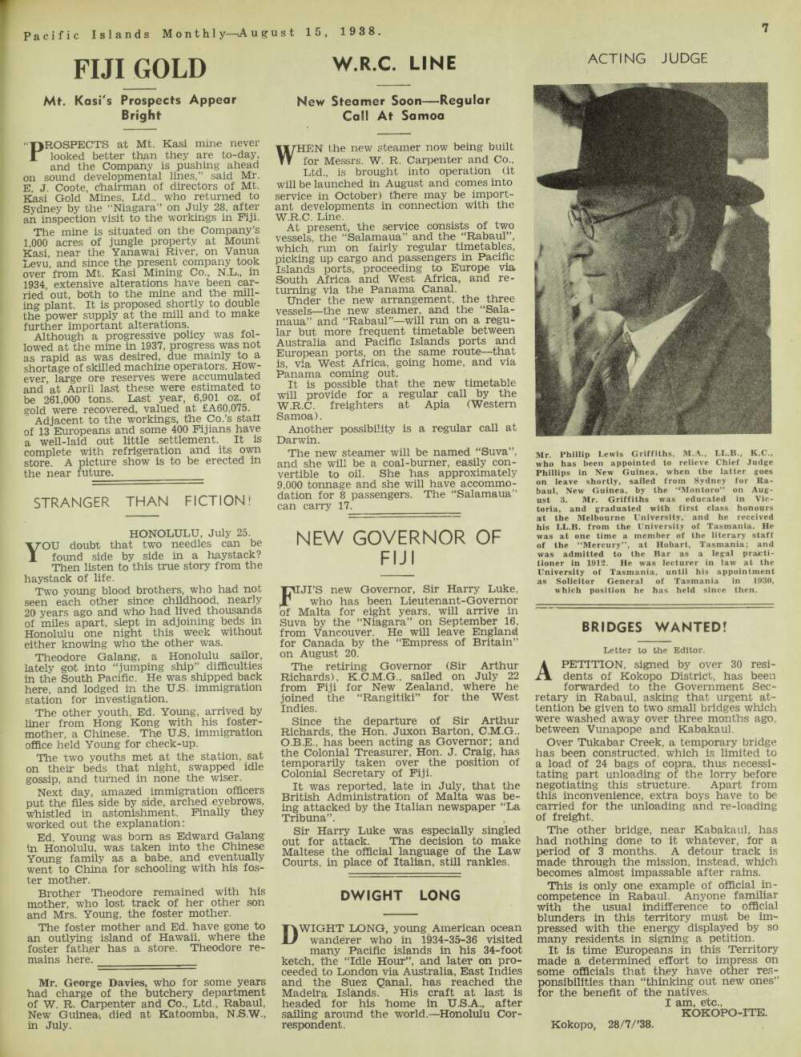
Mr. Phillip Lewis Griffiths, M.A., LL.B., K.C., who has been appointed to relieve Chief Judge Phillips in New Guinea, when the latter goes on leave shortly, sailed from Sydney for Ra baul, New Guinea, by the “Montoro” on Aug ust 3. Mr. Griffiths was educated in Vic toria, and graduated with first class honours at the Melbourne University, and he received his LL.B. from the University of Tasmania. He was at one time a member of the literary staff of the “Mercury”, at Hobart, Tasmania; and was admitted to the Bar as a legal practi tioner in 1912. He was lecturer in law at the University of Tasmania, until his appointment as Solicitor General of Tasmania in 1930, which position he has held since then.
Bridges Wanted!
Letter to the Editor.
A PETITION, signed by over 30 resi dents of Kokopo District, has been forwarded to the Government Sec retary in Rabaul, asking that urgent at tention be given to two small bridges which were washed away over three months ago, between Vunapope and Kabakaul.
Over Tukabar Creek, a temporary bridge has been constructed, which is limited to a load of 24 bags of copra, thus necessi tating part unloading of the lorry before negotiating this structure. Apart from this inconvenience, extra boys have to be carried for the unloading and re-loading of freight.
The other bridge, near Kabakaul, has had nothing done to it whatever, for a period of 3 months. A detour track is made through the mission, instead, which becomes almost impassable after rains.
This is only one example of official in competence in Rabaul. Anyone familiar with the usual indifference to official blunders in this territory must be im pressed with the energy displayed by so many residents in signing a petition.
It is time Europeans in this Territory made a determined effort to impress on some officials that they have other res ponsibilities than “thinking out new ones” for the benefit of the natives.
I am, etc.,
Kokopo-Ite.
Kokopo, 28/7/’3B.
Advertisements & other items, p. 11 (1 item)
7
Pacific Islands Monthl y—A ugust 15, 1938.
A Chorus of Criticism
Salamaua May Not Be Capital of N. Guinea
DURING the past three or four weeks, communications have been received in the “P.1.M.” office from many sources, dealing with the selection of Salamaua as the New Guinea capital site, and the decision to build a road between Wau and the coast.
Without exception, the Salamaua selec tion is condemned—not one word has been said in defence of Mr. Hughes’s plan.
The decision to build a road, however, is generally praised. The consensus of opinion is that, if a good route is picked, and the road made part of the main high way to the interior, it will represent a big step forward in the development of the Territory.
There is so much condemnation of Sala maua as the capital, from so many Quarters, that it is confidentlv predicted that what is called “the Hughes-Mc- Nicoll plan” will be abandoned, in favour of a site somewhere else—probably on the mainland, and preferably on a tableland.
The following press telegram from Rabaul, dated August 6, is typical:— “The Public Service Association last night decided that it views with alarm any departure from the recommendations contained in either the vulcanological or site-selecting committees’ reports. The selection of Salamaua is most unpopular with all classes of the Association, owing to the unhealthy situation and also the huge expenditure involved.”
In July, shortly after the Salamaua selection was announced, the Adminis trator went to Salamaua. with the Direc tor of Public Works (Mr. Field) and Lands Department officials, “to lay out the town”. What they found there gave them a headache: and when the party returned to Rabaul, it radiated depression.
It had found a swamp, which defied all the optimistic calculations of the “ Hughes- McNicoll plan”. Here is how one corres pondent put it:— “According to Government figures, it is going to cost £903,000 to create a capital at Salamaua. Thus:
“Can you see that money being ex pended, particularly as such vast sums are now needed at Australia’s front door (Darwin)?”
The suggestion that officialdom has only now awakened to the cost of swamp reclamation is quaint. Did the Minister and Administrator, aeroplaning around in June, overlook the swamp?
Another report says:— “Officially, the Administration is going ahead with the plan. Actually, I think it is clear they are just marking time, awaiting orders from Canberra. One can not imagine the Federal Government find ing another £250,000 for swamp reclama tion, when all the rest of New Guinea is available for the building of a town.”
One Morobe correspondent is bitter.
“Why on earth do they plan to fill in this pestilential swamp—which will take years to ‘settle down’ —when only 18 miles away there is the fine plateau recom
mended by the Griffiths Committee, where a model town could be built at a minimum of cost? The ways of official dom pass all understanding.”
This correspondent says that the dan ger of inundation at Salamaua cannot be exaggerated. “Even if they fill in the swamp, it will be only a few feet above sea-level”, he says. “Even now, the sea is threatening to come over the Salamaua isthmus.
“At present, as I write, they are trying to stem the erosion at the back of the Salamaua European Hospital. The steel retaining wall, recently put in at heavy cost, has been undermined at this point, and a pile-driver, which was sent to Lae to drive piles for bridges there, has been brought back with all speed to Salamaua.
“There is periodical flooding from the Frisco River, from the aerodrome towards the town; and so they are talking about
An article summarising, at length, the report of the Griffiths Committee, on the subject of the new capital site in New Guinea, is published in an other section of this issue.
straightening the river. They are talking of building on Kila Point, but there is much seepage from the mountains, in the foothills at the back of Kila.
“I am no prophet; but I am sure that, if the capital is placed at Salamaua, people for generations to come will curse the name of W. M. Hughes.”
From another correspondent: “In the past, it always has been most difficult to obtain land from the natives at Salamaua for European buildings. Have they re formed there lately? Anyway, even if they get all the native land, where are they going to make room for the local born Chinese, who are sure to come crowd ing in. and for a couple of thousand native house-boys, port-labourers, store workers, etc.?”
Retain Rabaul!
Naturally, the advocates of the reten tion of Rabaul as capital (with precau tions against another eruption) are mak ing the most of the situation. Thus Mr.
Gordon Thomas, writing from Rabaul early in August:— “Why not end all the pother by keep ing Rabaul as the capital, and avoiding these appalling costs? I would suggest that a 100 per cent, highway (concrete) be built, leading out of Rabaul to a sheltered spot near Tavui (just over the Namanula Hill) to enable people to make a rapid exit in case of eruption; also a properly-qualified vulcanological bureau, with experts, as used in Java, to give warning, and this would be of value, not only to the residents, but to the world in general.”
Wau-Salamaua Road
IT is expected that no time will be lost in commencing the construction of the new road from Salamaua to the gold field; and it is confidently predicted that the route will be along the coast from Salamaua towards Lae, thence up the Buang Valley, along the Buang Ranges, and somewhere along the Snake Valley to a point between Bulolo and Bulwa, joining up with the Wau-Bulolo-Sunshine Road.
It is reported that “finance is ready nothing now to wait for except selection of the route”.
One recent visitor to Sydney urged that the authorities, before starting construc tion, should invite tenders from the great road-making concerns overseas. “The idea that native labour is cheap, and so
a cheap road can be built, is a fallacy”, he declared. “It would be quite easy to get contractors, with long lines of native labour, to take on sections of the road.
But these Europeans do not know much about the real art of road-building. Their sole idea would be to drive the natives hard, scratch a passable track through the ranges, and collect their cheques. But the Morobe people wouldn’t have the kind of highway they deserve, after all these years. They should study the lesson learned on the Edie Creek and Bulolo Roads. They should insist on having this highway properly built, with good plant, by experienced roadbuilders”.
As against that, however, it is likely that the Administration will lend a sym pathetic ear to the argument that the building of this road will provide needed relief for many miners who have been having a hard time in New Guinea lately —men who can supervise gangs of native labourers on road-building operations.
Swamp reclamation Harbour improvements .
Buildings and transfer .
Rabaul safety zone £260.000 350.000 248.000 45,000 £903,000
N. Guinea!
Bring Water From
An Australian's Idea
A STARTLING plan was submitted publicly at a luncheon in Sydney by Mr. David M. Dow, formerly Aus tralian official secretary in the United States. He pointed out that vast areas in north-eastern Australia are arid and useless; whereas in New Guinea, on the other side of Torres Strait, there is so much rainfall that the territories are noted for the great size of their rivers.
Mr. Dow said that he had inspected some of the huge works in the United States, designed for water conservation land irrigation, and he had wondered whether it was not possible for Australian engineering genius to dam up some of th,e big rivers which flow from the New Guinea mountains into the Papuan Gulf —such as the Fly River —and in some manner syphon the fresh water across the Torres Strait and down the York Peninsula into the arid areas of Aus tralia. These areas, given a sufficient amount of fresh water, could be turned into a veritable garden.
Mr. Dow admitted cheerfully that his was “a super-colossal suggestion” and he could not indicate how the plan might be financed. But the fact was that there was too much fresh water in New Guinea and not nearly enough in north-eastern Australia.
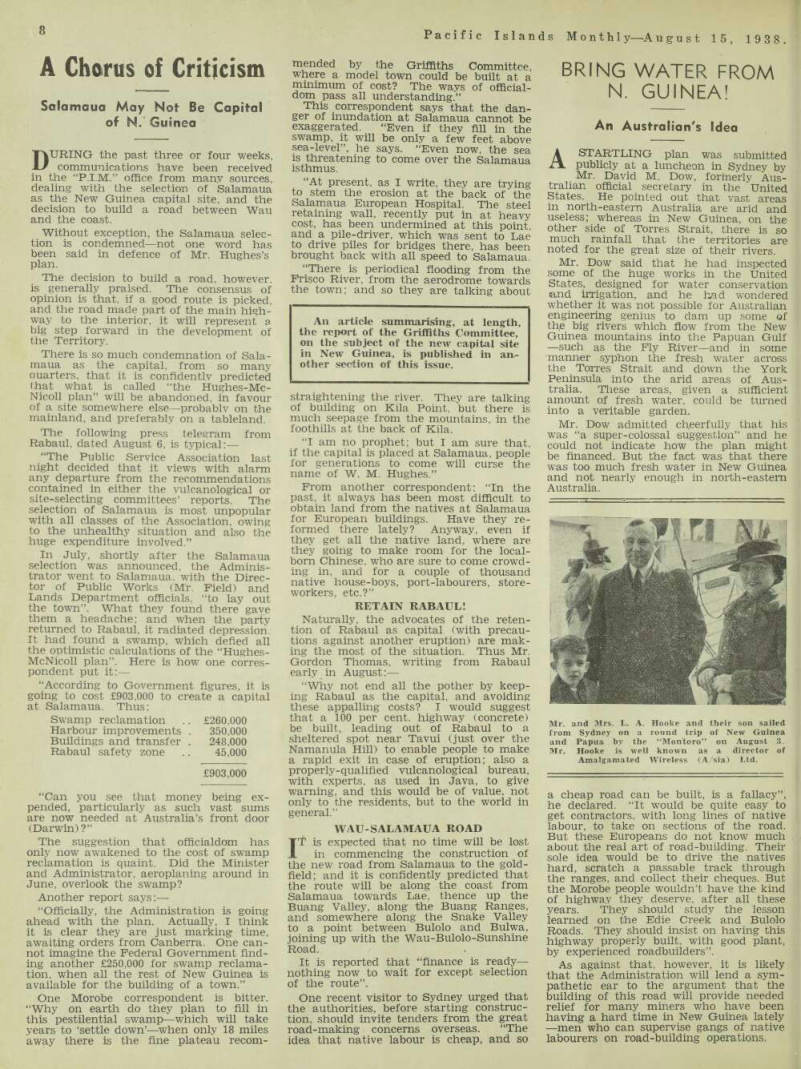
Mr. and Mrs. L. A. Hooke and their son sailed from Sydney on a round trip of New Guinea and Papua by the “Montoro” on August 3.
Mr. Hooke is well known as a director of Amalgamated Wireless (A/sia) Ltd.
Advertisements & other items, p. 12 (1 item)
8
Pacific Islands Monthl y—A ugust 15, 1938.
Tropicalities
STUART CAMPBELL, formerly aviator with the Ward Williams expedition in Papua, is now engaged in an en gineering job in Australia. When in London not long ago, he lectured before the Royal Geographical Society. One of his remarks, that a bushy beard, decorated with green beetles, was a re cognised sign of manhood among certain mountain tribes in New Guinea, received much attention from London humour writers. One let himself go, rather clever ly, in this fashion: — A bushy beard. New Guinea way.
Is what a man would fain display As stamping him a real he-man Before the beauties of his clan.
And more—his beard he decorates With brightly coloured beetles (states The Lecturer) to catch the eye Of girls who may be passing by.
The Noble Savage, thus, would be At home with femininity Which now, in London, decks its hair With jewelled insects rich and rare.
No more shall Kipling’s phrase obtain Among the cultured and the vain.
Oh. East was East, and West was West, But each is now a beetle’s nest. * ♦ * II ATE works oft-times in a strange 1 manner. Take, for instance, the way in which she juggled with the life of Ivan Parker. A steward in the Paci fic Division of Pan-American Airways service, he made the first trip on the “Samoa Clipper’’, down from Honolulu to Auckland, N.Z., and was actually scheduled to go on the ill-starred trip in January that ended in her being blown to pieces when dumping fuel in mid-air after engine trouble. He was withdrawn at the last minute because Captain Mustek’s giant airboat would have been overloaded if the steward had made the flight. Such a fateful escape from death in the clouds would perhaps have coax ed another man into keeping his feet on Mother Earth in future; but not Par ker. He merely grinned and busied him self with serving coffee and hot-cakes on the “Clippers” plying between ’Frisco and Manila. At the end of July, P.A.A.’s “Hawaii Clipper”, with a crew of 10 and six passengers, disappeared en route from Guam to the Philippines. The steward on board the “Clipper” was Ivan Parker -Fate had evened the score. * * ♦ AN Australian reviewer describing a new book on Tahiti by one, Cecil Lewis, says:— “It is, admittedly, a very tourist-soiled Eden, but the remains of an Eden —none the less. It was sufficiently like the Eden of Mr. Lewis’s imagination to astonish and dazzle him, so that he writes like one who reels under the impact of some stunning blow He feels that these care free, beautiful, and somewhat indolent Tahitians had hit upon a way of life which really did ensure peace and hap piness for all”. And there is reference to “a marvellous holiday, with lots of sunshine, bathing, wine, women, and song”.
The reviewer, who apparently knows Tahiti, says; “It was in Tahiti that Mr.
Lewis took leave of his youth, and in the recording thereof he has merely tem porarily taken leave of his senses”.
However, the book will be accepted as a true record; and, in due course, the French officials in Papeete will have to deal with and chase away a few more shop-soiled old daddies, who insist that they are still young in spirit, and that the sparkle in Polynesian eyes will more than counter the rheumatic tendencies of Anno Domini. Tahiti gives a warm welcome to tourists: but Tahiti official dom is very weary of the aged seekers after romance, who came sneaking in there from almost every country in the world. * * * AN isolated reader of the “P.1.M.”, writes to say that he would be grate ful to receive, from any coconut planter in the Pacific, details of small copra driers, similar to the type descri bed as “native village driers”, by Mr.
T V. Wallace, in the “P.1.M.” of No vember last. Our correspondent lives in Aroe Islands a small group off the south-west coast of Dutch New Guinea — and it is not easy for him to keep in touch with what is happening in the development of new types of driers. His address it: Mr. C. R. Sheldon, Dobo, Aroe Islands, Makasser, Dutch East Indies. * * * A NOTE from L.H.W , of Eastern Papua:— Having criticised, we leave ourselves open to criticism. We knew something would happen—and apparently it did.
In the June “P.1.M.”, camouflaged un der the nom de plume of “Overseer”, some gentleman inquired into our past.
Just the thing we don’t like people to delve into too deeply. It won’t stand it.
The family skeleton would probably come and haunt us for years after, if we told the truth. Another thing— “ Overseer” probably wouldn’t believe us.
No one ever does. However, the subject of debate (the handling of native la
hour) seems to overshadow any form of personal antagonism. Consequently, we won’t bother trying to find fault with “Overseer’s” article; but will hope that it will set people thinking and working towards an improvement. * * * I WAS passing the fortress-like French calaboose at Vila, New Hebrides, one evening at dusk and I saw a Tonk inese wearing the regulation prison togs, loudly knocking on th,e iron gates seeking admission.
It appears that the “Tonk” had been sent to do a job at a French official’s house, and had been kept late. He seemed rather peeved at being thus forgotten and
locked out.
p.
Books For Isolated N.G.
Settlers
From Our Own Correspondent.
Rabaul, Aug. 1.
IN April last, 540 non-fiction books were received under the Carnegie Library Scheme, reported the President (Lady McNicoll) at the annual meeting of the Agnes Wisdom Library, Rabaul, on July 22. As a result of this influx of good literature the membership has increased to 200. The institution has £77 in the bank.
One of the most important phases of the Library’s work is supplying reading matter to isolated settlers in the Territory.
During the year 200 parcels of magazines and nearly 1,400 books were sent to the outposts. The President praised the work of Mesdames Froggatt, Roberts, and Thomas in choosing the books, packing, and seeing to the despatch of th,e parcels by vessels calling at the out-stations.
Election of officers resulted; President, Lady McNicoll; Vice-presidents, Mesdames Thomas, Page, Maclean, Froggatt; Sec retary, Mrs. J. Bennie; Treasurer, Mr.
Siggins (in place of Mr. Quinton, re signed).
To be used by the British Phosphate Commission at Nauru Island, a 28 ft. motor boat was shipped last month from Auckland. The boat will be engaged in passenger and mail service between steamers in the roadstead at Nauru Is land and the shore, and will have to negotiate a surf-bound gap in a reef, and for this reason she has been built to an unusual design.
Advertisements & other items, pp. 13-14 (2 items)
9
Pacific Islands Monthl y—A ugust 15, 1938,
atlTgjf
S 5 ms
CREAM
Write for a Colour Card . . .
STERLING VARNISH CO.
Dries in half an hour on plaster walls, ceilings, cement, fibre, wood and iron.
Also Excellent as an Undercoat for lacquers, paints and enamels. 11 /- per gallon
HIGHLY DURABLE
Alexandria, N.S.W.
RECOR DS
Packed Free and sent C.O.D. without extra charges.
H.M. Voice Slightly-used Portables, delivered straight to your nearest port for .. £3/15/-.
Send for Latest Record Lists.
Taikeries Music Stores
451 Queen Victoria Buildings, Sydney
About Islands People
Mr. W. G. Johnson, a director of Brown and Joske, Ltd., Suva, Fiji, arrived in New Zealand by the July “Matua”. He will later spend a short holiday in Aus tralia.
Mr. H. M. Stuchberry, of the Fiji Veter inary Department arrived in Sydney early m August by the “Strathmore”, on trans fer to Tanganyika, British East Africa.
Mr. P. Dolan has been appointed Head Gaoler at the Badili Gaol, Port Moresby.
Papua, replacing Mr. Mahon who resigned a short time ago.
Rev. P. N. W. Strong, M.A., Bishop of New Guinea, will arrive in Sydney by the “Neptuna” on August 26 He will attend the meeting of bishops in Australia at Canberra, between September 5 and 12.
After a meeting of the A.B.M. at Sydney on September 13 and 15, he will proceed to Brisbane to be present at the Queensland Provincial Synod, after whjch he will en gage in deputation work before returning to his diocese in Papua.
Mrs. Morphy Morris and her two young
children, Digby and Mornay, arrived in Sydney by the “Niagara” on July 29. Mrs.
Morris, whose husband is an inspector in the Fiji Police Force at Nadi, will spend a holiday with her father Dr. F. W.
Wheatley, of Elizabeth Bay, Sydney.
Miss Erima Muir, of the Melanesian Mission, Torgil, New Hebrides, is at pre sent in St. Luke’s Hospital, Sydney, suf fering from acute anaemia. She will be unable to continue with her missionary duties, and, upon her recovery, will pro ceed to New Zealand.
Mr. and Mrs. J. S. Symington, of Kokopo New Guinea, returned to the Mandated Territory recently after a holi day in Sydney, where Mr. Symington made a quick recovery from a severe ill ness.
Miss Betty Paton sailed from Syd ney for Yandina, B.S.I., by the July “Malaita” to spend six months with her brother who is connected with Fairymead Sugar Co.
Mr. F. E. Wil liams, Papuan Govt. Anthropolo gist, sailed for Pt. Moresby by the “Montoro” on August 3, after three months’ furlough in Ade laide. He will re turn to Australia next January to attend a meeting of the Australian and N.Z. Associa tion for the Ad vancement of Sci ence,
Mr R. A. Harman sailed from Syd ney by the July “Malaita” for Ga vutu, B.S.I., where he will take up a position with Lev er’s Pacific Plan tations Pty. Ltd.
He was formerly in the Palestine Police Dept.
Mr. G. W. Jenner. of Burns Philp (S.S.) Co. Ltd.'s branch at Ba, Fiji, returned to the Colony by the “Monterey” on July 22, after spending short furlough in Syd ney.
Advertisements & other items, p. 14 (2 items)
10
Pacific Islands Mon t h 1 y—A ugust 15, 1938.
Dewars
3f The sea has a charm of its own, and so has DEWAR’S Whisky. As invigorating as the winds that blow from out of space, DEWAR’S, like a well-found ship, brings content; boundless and satisfying.
Ike SCOTCH WHISKY
About Islands People
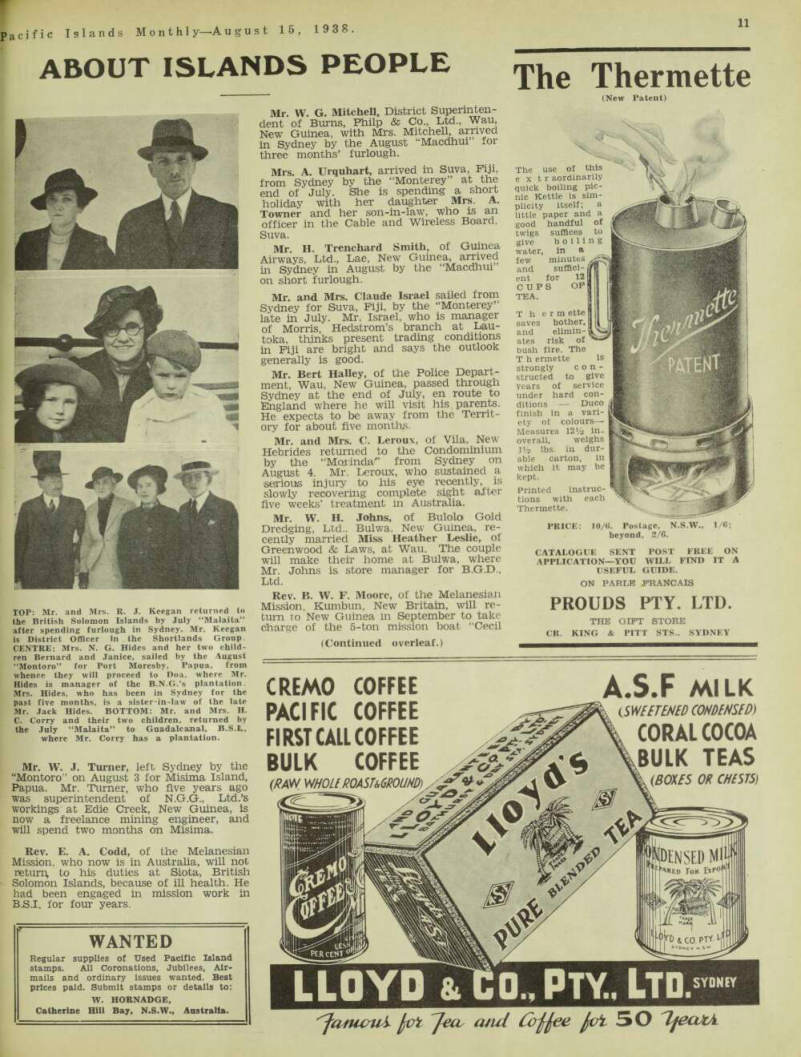
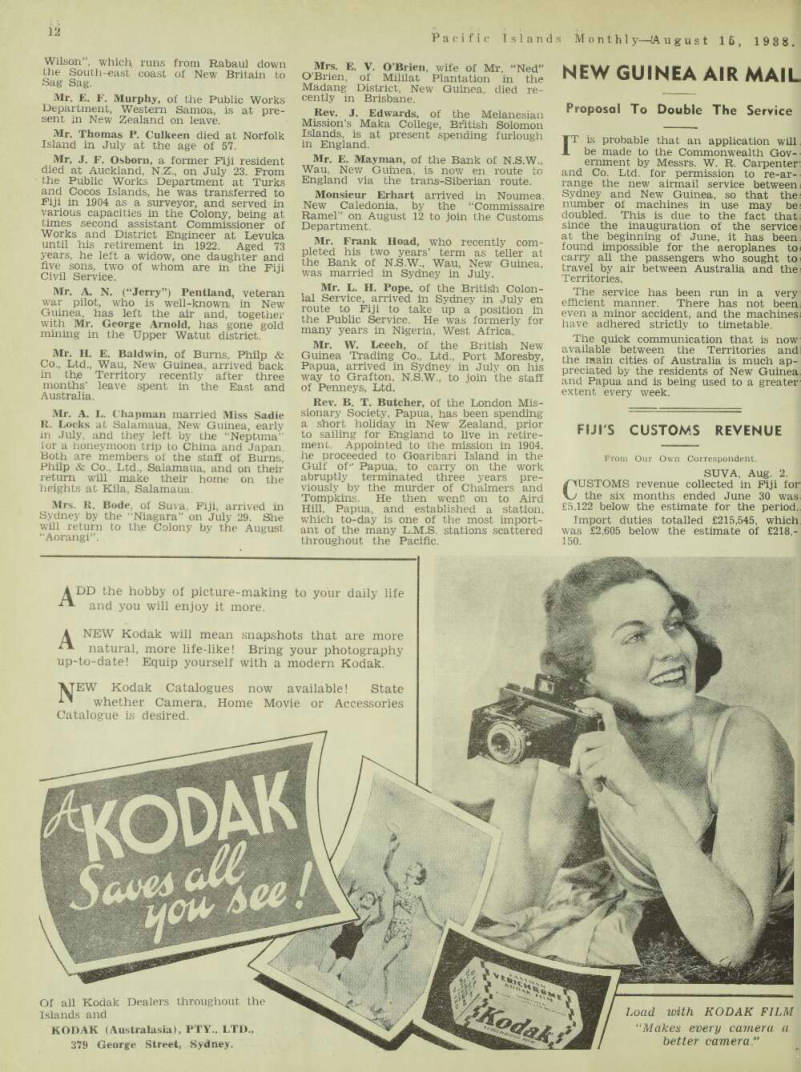
Mr. W. J. Turner, left Sydney by the “Montoro” on August 3 for Misima Island, Papua. Mr. Turner, who five years ago was superintendent of N.G.G., Ltd.’s workings at Edie Creek, New Guinea, is now a freelance mining engineer, and will spend two months on Misima.
Rev. E. A. Codd, of the Melanesian Mission, who now is in Australia, will not return, to his duties at Siota, British Solomon Islands, because of ill health. He had been engaged in mission work in 8.5.1. for four years.
Mr. W. G. Mitchell, District Superinten dent of Bums, Philp & Co., Ltd., Wau, New Guinea, with Mrs. Mitchell, arrived in Sydney by the August “Macdhui” for three months’ furlough.
Mrs. A. Urquhart, arrived in Suva, Fiji, from Sydney by the “Monterey” at the end of July. She is spending a short holiday with her daughter Mrs. A.
Towner and her son-in-law, who is an officer in the Cable and Wireless Board.
Suva.
Mr. H. Trenchard Smith, of Guinea Airways, Ltd., Lae, New Guinea, arrived in Sydney in August by the “Macdhui” on short furlough.
Mr. and Mrs. Claude Israel sailed from Sydney for Suva, Fiji, by the “Monterey” late in July. Mr. Israel, who is manager of Morris, Hedstrom’s branch at Lau toka, thinks present trading conditions in Fiji are bright and says the outlook generally is good.
Mr. Bert Halley, of the Police Depart ment, Wau, New Guinea, passed through Sydney at the end of July, en route to England where he will visit his parents.
He expects to be away from the Territ ory for about five month/s.
Mr. and Mrs. C. Leroux, of Vila, New Hebrides returned to the Condominium by the “Morinda” from Sydney on August 4. Mr. Leroux, who sustained a serious injury to his eye recently, is slowly recovering complete sight after five weeks’ treatment in Australia.
Mr. W. H. Johns, of Bulolo Gold Dredging, Ltd., Bulwa, New Guinea, re cently married Miss Heather Leslie, of Greenwood & Laws, at Wau. The couple will make their home at Bulwa, where Mr. Johns is store manager for 8.G.D., Ltd.
Rev. B. W. F. Moore, of the Melanesian Mission. Kumbun, New Britain, will re turn to New Guinea in September to take charge of the 5-ton mission boat “Cecil (Continued overleaf.)
TOP: Mr. and Mrs. R. J. Keegan returned to the British Solomon Islands by July “Malaita” after spending furlough in Sydney. Mr. Keegan is District Officer in the Shortlands Group.
CENTRE: Mrs. N. G. Hides and her two child ren Bernard and Janice, sailed by the August “Montoro” for Port Moresby, Papua. from whence they will proceed to Doa. where Mr.
Hides is manager of the B.N.G.’s plantation.
Mrs. Hides, who has been in Sydney for the past five months, is a sister-in-law of the late Mr. Jack Hides. BOTTOM: Mr. and Mrs. H.
C. Corry and their two children, returned by the July “Malaita” to Guadalcanal, B.S.I., where Mr. Corry has a plantation.
Wilson”, which runs from Rabaul down the South-east coast of New Britain to Sag Sag.
Mr. E. F. Murphy, of the Public Works Department, Western Samoa, is at pre sent in New Zealand on leave.
Mr. Thomas P. Culkeen died at Norfolk Island in July at the age of 57.
Mr, J. F. Osborn, a former Fiji resident died at Auckland, N.Z., on July 23. Prom the Public Works Department at Turks and Cocos Islands, he was transferred to Fiji in 1904 as a surveyor, and served in various capacities in the Colony, being at times second assistant Commissioner of Works and District Engineer at Levuka until his retirement in 1922. Aged 73 years, he left a widow, one daughter and five sons, two of whom are in the Fiji Civil Service.
Mr. A. N. (“Jerry”) Pentland, veteran war pilot, who is well-known in New Guinea, has left the air and, together with Mr. George Arnold, has gone gold mining in the Upper Watut district.
Mr. H. E. Baldwin, of Bums, Philp & Co., Ltd., Wau, New Guinea, arrived back in the Territory recently after three months’ leave spent in the East and Australia.
Mr. A. L. Chapman married Miss Sadie R. Locks at Salamaua, New Guinea, early in July, and they left by the “Neptuna” lor a honeymoon trip to China and Japan.
Both are members of the staff of Burns, Philp & Co., Ltd., Salamaua, and on their return will make their home on the heights at Kila, Salamaua.
Mrs. R. Bode, of Suva, Fiji, arrived in Sydney by the “Niagara” on July 29. She will return to the Colony by the August “Aorangi”.
Mrs. E. V. O’Brien, wife of Mr. “Ned”
O’Brien, of Mililat Plantation in the Madang District, New Guinea, died re cently in Brisbane.
Rev. J. Edwards, of the Melanesian Mission’s Maka College, British Solomon Islands, is at present spending furlough in England.
Mr. E. May man, of the Bank of N.S.W., Wau, New Guinea, is now en route to England via the trans-Siberian route.
Monsieur Erhart arrived in Noumea.
New Caledonia, by the “Commissaire Hamel” on August 12 to join the Customs Department.
Mr. Frank Hoad, who recently com pleted his two years’ term as teller at the Bank of N.S.W., Wau, New Guinea, was married in Sydney in July.
Mr. L. H. Pope, of the British Colon ial Service, arrived in Sydney in July en route to Fiji to take up a position in the Public Service. He was formerly for many years in Nigeria, West Africa.
Mr. W. Leech, of the British New Guinea Trading Co., Ltd., Port Moresby, Papua, arrived in Sydney in July on his way to Grafton, N.S.W., to join the staff of Penneys, Ltd.
Rev. B. T. Butcher, of the London Mis sionary Society, Papua, has been spending a short holiday in New Zealand, prior to sailing for England to live in retire ment. Appointed to the mission in 1904, he proceeded to Goaribari Island in the Gulf of*’ Papua, to carry on the work abruptly terminated three years pre viously by the murder of Chalmers and Tompkins. He then went} on to Aird Hill, Papua, and established a station, which to-day is one of the most import ant of the many L.M.S. stations scattered throughout the Pacific.
Advertisements & other items, p. 15 (1 item)
Pty. Ltd
The Thermette
(New Patent) The use of this e x t r aordinarily quick boiling picnic Kettle is simplicity itself; a little paper and a good handful of suffices to boi 1 i n in ft minutes sufflcifor 12 OP m * twigs give water, few and ent
CUPS
TEA.
Therm ette saves bother, and eliminates risk of bush fire. The T h ermette is strongly constructed to give years of service under hard conditions Duco finish in a variety of dolours — Measures 12 V2 in. overall, weighs JV 2 lbs. in durable carton, in which it may be kept.
Printed instructions with each Thermette.
PRICE: 10/6. Postage, N.S.W., 1/6; beyond. 2/G.
CATALOGUE SENT POST FREE ON
APPLICATION—YOU WILL FIND IT A
USEFUL GUIDE.
ON PARLE .FRANCAIS
PROUDS PTY. LTD.
THE GIFT STORE
CR. KING & PITT STS., SYDNEY
CREMO COFFEE
PACIFIC COFFEE
FIRSTCALL COFFEE
BULK COFFEE
(RAW WHOLE R
A.S.F MILK
(.SWEETENEDCONDENSED)
CORAL COCOA
BULK TEAS
(BOXES OK CHESTS)
& o A o o <7 V =55 V
IffiE
Ml
NSED
hr' 1 AKtt- For * '4 &
OVD
PTY
Pty. Ltd
SYDNEY
'junumA- jet 'Jew ami o>fjj€e jot 50 'TjeWtA.
WANTED
Regular supplies of Used Pacific Island stamps. All Coronations, Jubilees, Airmails and ordinary issues wanted. Best prices paid. Submit stamps or details to:
W. HOBNADGE,
Catherine Hill Bay, N.S.W., Anstralia.
New Guinea Airmail
Proposal To Double The Service
IT is probable that an application willJ be made to the Commonwealth Gov ernment by Messrs. W. R. Carpenter: and Co. Ltd. for permission to re-ar- ■ range the new airmail service between j Sydney and New Guinea, so that the; number of machines in use may be: doubled. This is due to the fact that; since the inauguration of the service; at the beginning of June, it has been, found impossible for the aeroplanes to< carry all the passengers who sought tO( travel by air between Australia and the; Territories.
The service has been run in a very efficient manner. There has not beenj even a minor accident, and the machines! have adhered strictly to timetable.
The quick communication that is now’ available between the Territories andl the main cities of Australia is much ap preciated by the residents of New Guinea, and Papua and is being used to a greater extent every week.
Fiji's Customs Revenue
Prom Our Own Correspondent.
Suva, Aug. 2.
CUSTOMS revenue collected In Fiji for the six months ended June 30 wasi £5,122 below the estimate for the period., Import duties totalled £215,545, which; was £2,605 below the estimate of £218.- 150.
Advertisements & other items, p. 16 (1 item)
DD the hobby of picture-making to your daily life
and you will enjoy it more.
A NEW Kodak will mean snapshots that are more natural, more life-like! Bring your photography up-to-date! Equip yourself with a modern Kodak.
VTEW Kodak Catalogues now available! State whether Camera, Home Movie or Accessories Catalogue is desired.
A %
IIL
s p - < f V* Of all Kodak Dealers throughout the Islands and KODAK (Australasia), PTY., LTD., 379 George Street, Sydney.
Load with KODAK FILM “Makes every camera a better camera
American Operations At Midway Island
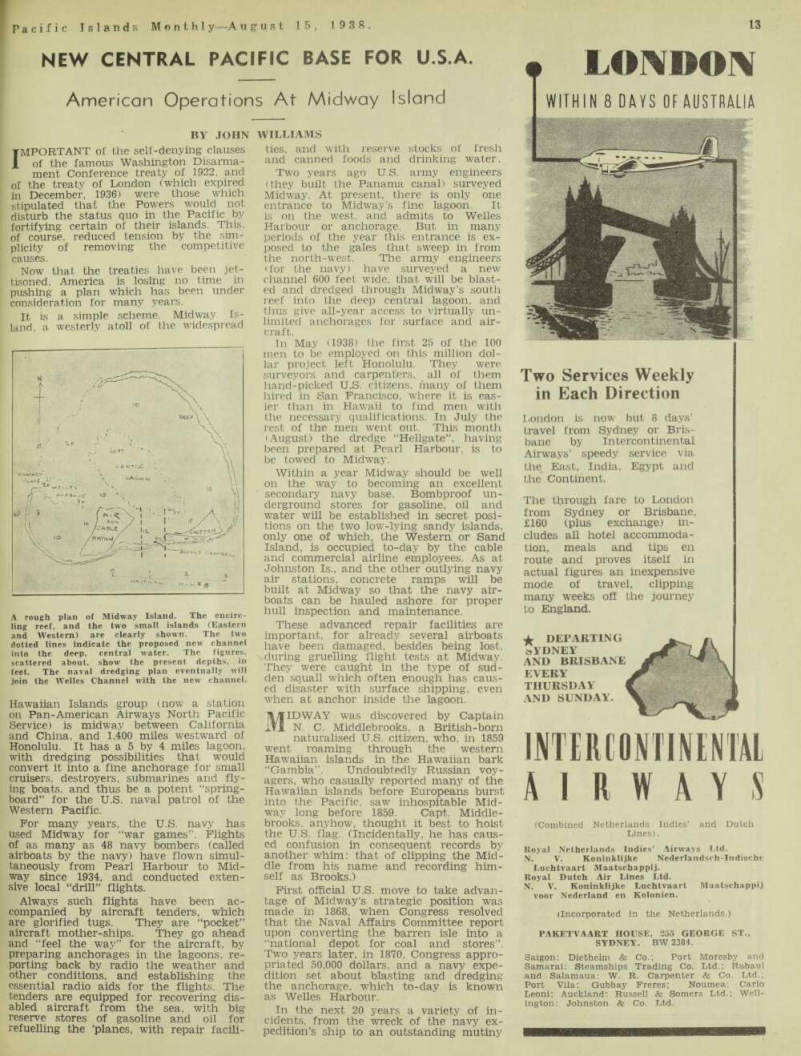
New Central Pacific Base For U.S.A,
By John Williams
IMPORTANT of the self-denying clauses of the famous Washington Disarma ment Conference treaty of 1922, and of the treaty of London (which expired in December, 1936) were those which stipulated that the Powers would not disturb the status quo in the Pacific by fortifying certain of their islands. This, of course, reduced tension by the sim plicity of removing the competitive causes.
Now that the treaties have been jet tisoned. America is losing no time in pushing a plan which has been under consideration for many years.
It is a simple scheme. Midway Is land. a westerly atoll of the widespread
Hawaiian Islands group (now a station on Pan-American Airways North Pacific Service) is midway between California and China, and 1,400 miles westward of Honolulu. It has a 5 by 4 miles lagoon, with dredging possibilities that would convert it into a fine anchorage for small cruisers, destroyers, submarines and fly ing boats, and thus be a potent “spring board” for the U.S. naval patrol of the Western Pacific.
For many years, the U.S. navy has used Midway for “war games”. Flights of as many as 48 navy bombers (called airboats by the navy) have flown simul taneously from Pearl Harbour to Mid way since 1934, and conducted exten sive local “drill” flights.
Always such flights have been ac companied by aircraft tenders, which are glorified tugs. They are “pocket” aircraft mother-ships. They go ahead and “feel the way” for the aircraft, by preparing anchorages in the lagoons, re porting back by radio the weather and other conditions, and establishing the essential radio aids for the flights. The tenders are equipped for recovering dis abled aircraft from the sea, with big reserve stores of gasoline and oil for refuelling the ’planes, with repair facili
ties, and with reserve stocks of fresh and canned foods and drinking water.
Two years ago U.S. army engineers (they built the Panama canal) surveyed Midway. At present, there is only one entrance to Midway's fine lagoon. It is on the west and admits to Welles Harbour or anchorage. But in many periods of the year this entrance is ex posed to the gales that sweep in from the north-west. The army engineers (for the navy) have surveyed a new channel 600 feet wide, that will be blast ed and dredged through Midway’s south reef into the deep central lagoon, and thus give all-year access to virtually un limited anchorages for surface and air craft.
In May (1938) the first 25 of the 100 men to be employed on this million dol lar project left Honolulu. They were surveyors and carpenters, all of them hand-picked U.S. citizens, many of them hired in San Francisco, where it is eas ier than in Hawaii to find men with the necessary qualifications. In July the rest of the men went out. This month (August) the dredge “Hellgate”. having been prepared at Pearl Harbour, is to be towed to Midway.
Within a year Midway should be well on the way to becoming an excellent secondary navy base. Bombproof un derground stores for gasoline, oil and water will be established in secret posi tions on the two low-lying sandy islands, only one of which, the Western or Sand Island, is occupied to-day by the cable and commercial airline employees. As at Johnston Is., and the other outlying navy air stations, concrete ramps will be built at Midway so that the navy air boats can be hauled ashore for proper hull inspection and maintenance.
These advanced repair facilities are important, for already several airboats have been damaged, besides being lost, during gruelling flight tests at Midway.
They were caught in the type of sud den squall which often enough has caus ed disaster with surface shipping, even when at anchor inside the lagoon.
MIDWAY was discovered by Captain N. C. Middlebrooks, a British-born naturalised U.S. citizen, who, in 1859 went roaming through the western Hawaiian islands in the Hawaiian bark “Gambia”. Undoubtedly Russian voy agers, who casually reported many of the Hawaiian islands before Europeans burst into the Pacific, saw inhospitable Mid way long before 1859, Capt. Middle brooks, anyhow, thought it best to hoist the U.S. flag. (Incidentally, he has caus ed confusion in consequent records by another whim: that of clipping the Mid dle from his name and recording him self as Brooks.) First official U.S. move to take advan tage of Midway’s strategic position was made in 1868, when Congress resolved that the Naval Affairs Committee report upon converting the barren isle into a “national depot for coal and stores”.
Two years later, in 1870, Congress appro priated 50,000 dollars, and a navy expe dition set about blasting and dredging the anchorage, which to-day is known as Welles Harbour.
In the next 20 years a variety of in cidents, from the wreck of the navy ex pedition’s ship to an outstanding mutiny
A rough plan of Midway Island. The encirc ling reef, and the two small islands (Eastern and Western) are clearly shown. The two dotted lines indicate the proposed new channel into the deep, central water. The figures, scattered about, show the present depths, in feet. The naval dredging plan eventually will join the Welles Channel with the new channel.
among another shipwrecked crew on Midway, caused unfavourable comment about Midway in Washmgton. There were several sea dramas at Midway; even a woman and her children were mvolved; and there was a startling mstance of fiendish revenge, man’s mhuinanity to man. .
A ft er Spanish-American war in 1903, President Roosevelt, placed Midway ler the jurisdiction of the navy. In 1904 he despatched a company of mannes. plus two six-pounders, to “defend’’ the cabie station which had been established at Midway.
J n . Midway was appointed an official U.S. weather observatory. First aerial consideration of Midway seems to have been made by the Americans, Messrs. William S. Brock and Edward F.
Schlee, who in 1927 proposed to fly from
Japan to America and use Midway as a wayside stop. The navy department then ridiculed the idea that a landplane could land and take off at Midway.
When the Midway scheme is comple ted, Uncle Sam will extend his strategic theory westward, again, to Wake Island and thus duplicate the Midway dredg ings and service facilities. Of course to day the facilities, already created at Mid way and Wake by Pan-American Air ways, would be taken over by the navy in the event of an emergency.
Methodically, base by base, Uncle Sam is getting into a better position along a strategic front. Midway is effec tively linked with the major scheme at Pearl Harbour by a series of anchorages for submarines, destroyers and airboats, notably at French Frigate Shoals and Pearl and Hermes Reef.
Advertisements & other items, pp. 17-18 (2 items)
13
Pacific Islands Monthl y—A ugust 15, 1 938.
Inte R C Ontinintal
LONDON
WITHIN 8 DAYS Of AUSTRALIA
s a mmat
Two Services Weekly
in Each Direction
London is now but. 8 days’ travel from Sydney or Brisbane by Intercontinental Airways’ speedy service via the East, India, Egypt and the Continent.
The through fare to London from Sydney or Brisbane, £l6O (plus exchange) includes all hotel accommodation, meals and tips en route and proves itself in actual figures an inexpensive mode of travel, clipping many weeks off the journey to England.
* DEPARTING
aVDNEY
AND BRISBANE
EVERY
THURSDAY
AND SUNDAY.
INTE R C ONTININTAL
AIRWAYS
(Combined Netherlands Indies’ and Dutch Lines).
Royal Netherlands Indies’ Airways Ltd.
N. V. Koninklijke Nederlandsrh-Indische Luchtvaart Maatschappij.
Royal Dutch Air Lines Ltd.
N. V. Koninklijke Luchtvaart Maatschappij voor Nederland en Kolonien. (Incorporated in the Netherlands.)
PAKETVAART HOUSE, 255 GEORGE ST.,
SYDNEY. BW 2384.
Saigon: Diethelm & Co.; Port Moresby and Samarai; Steamships Trading Co. Ltd.: Rabaul and Salamaua; W. R. Carpenter & Co. Ltd.; Port Vila: Gubbay Freres; Noumea; Carlo Leoni; Auckland: Russell & Somers Ltd.; Wellington: Johnston & Co. Ltd.
DELCO-LIGHT
The
Dependable,
Economical
Way to
Light Your
Home,
Camp,
or Boat
For over 20 years Delco-Light plants have rendered dependable and efficient service throughout the Islands. Though not as cheap as some lighting plants, the quality and durability of Delco-Light have been proved the best.
Model 2812 can be bought for £26/10/- (with 83 A.H. battery) or preferably for £29/10/- (with 105 A.H. battery, individual cells), thus making a remarkable offer to people not at present enjoying the use of electricity.
Generating 200 watts, 12 volts, the 2812 Delco-Light will supply eight 25 watt lamps from the generator or five from the 105 A.H. battery for 10 hours when fully charged. It will run for 16 hours on one gallon of petrol.
For complete information write to-day to Desk P.l.
Sizes range from 200 to 6,000 watts.
Distributors :
WARBURTON, FRANKI, LTD.
307-15 KENT STREET, SYDNEY
MELBOURNE BRISBANE
Papuan Sentenced
To Death
Pt. Moresby Gaol Murder
Prom Our Own Correspondent.
Pt. Moresby, July 30.
THE trial of two natives, Karo anoj Koaba, for the murder of Ume, war-i der at the Badili Goal, Pt. on June 6 was concluded in the Central Court before his Honour, Mr. Justice: Gorer on July 28. Karo was found guilty: and was sentenced to death. Koabas charged with being an accessory beforr the crime, was acquitted and sent bacM: to gaol to continue serving his life sen-j tence term commenced in 1931.
When Karo is hung on August 8, thiii will represent the fifth occasion oh< which a native has been executed in. the Territory.
The first case occurred on August 22 1893, in Sir William MacGregor’s timee when a Panelli Island native named; Babago, who was a prisoner undergoing] a short term sentence, murdered a mem-i ber of the Armed Constabulary. He hit! him on the head with a tomahawk and wounded a coxswain nearby.
The others, as noted in the Lieut.-.
Governor’s Annual Reports, were:— 1913/14—an ex-member of the Constabu-J lary, concerned in the killing of two' carriers near Pt. Moresby; 1914/15—three: Abau natives, convicted of murdering four members of the Armed Constabu-J lary; and 1915/16 —two Baruni men, in-j volved in a native murder within a few miles of Pt. Moresby.
Koaba Denies Knowledge Of
Crime
Koaba stated at the conclusion of thej evidence that he and Ume were close? relatives and good friends. He said thati he cried hard when he heard of Ume’s' death. Karo, he alleged, was always £8 wild man and talked a great deal about] killing. He denied all knowledge of thej crime and stated that at the time h© was ill with fever and knew nothing about it.
Mr. R. D. Bertie (Lor the accused) said) the onus of proof was on the Crown.r and argued that in this case there were so many conflicting statements and so; many doubts that it was impossible to convict Koaba.
Mr. E. B. Bignold (Crown Law Offi cer) stated that though the case wasj made up of a number of details, some unimportant in themselves, yet all the circumstantial evidence pointed to Koabas being an accessory before the fact.
In giving judgment, his Honour agree©: that statements made by Karo could noh be used in evidence and that several oft the witnesses’ statements had not im-i pressed him.
Mr. Dereck Crisp, chief pilot of Manr dated Airlines, New Guinea, married Miss?
Betty Tyerman, youngest daughter of thir late Mr. lan W. Tyerman and Mrs. Tyen man of Campbelltown, N.S.W., at Stic Stephen’s Church, Sydney, on August 3.
Sir Maynard and Lady Hedstrom, o: Suva, Fiji, arrived at Apia, Western Samoa* in July by the Swedish steamer “Eknaren’r on a short visit.
Mr. J. S. Horrax and Mr. C. R. Nettletom of the staff of the N.Z. Reparation Estates Western Samoa, arrived in New Zealand recently by the “Maui Pomare”.
Advertisements & other items, p. 19 (2 items)
15
Pacific Islands Monthl y —A ugust 15, 1938.
Bidomak
STARVED NERVES
CAUSE THESE COMPLAINTS
Weakness Exhausted Nerves Lack of Energy Liability to Colds Depression Poor Appetite Weak Digestion Constipation Head-
aches Sore Tongue Faintness Breathlessness Palpitation
Heart Pains Numbness Paleness Sallowness Falling Hair
Brittle Nails Skin Blemishes.
m mm
BIDOMAK
THE TONIC OF THE CENTURY—WILL BENEFIT YOU The debilitating influence of life in the tropics produces signs of “nerve starvation”, due to the loss of vital minerals from the system.
The result is a feeling of lethargy, lassitude and general run-down condition.
To restore full vigour, extra minerals must be taken into the system.
BIDOMAK SUPPLIES VITAL
MINERALS
Bidomak supplies these important mineral elements ferrum, calcium, potassium,
sodium, phosphates, glycerophosphates, and
sucrose.
When you take BIDOMAK, nerve troubles soon vanish, You feel fitter, and brighter—aches and pains leave you—work is no longer a burden.
You cease to feel depressed or run-down— the whole system is braced up and strengthened.
This is not magic—it is the natural result of revitalised nerves and blood-stream.
By feeding starved nerves BIDOMAK corrects the ailments which these cause. Therefore, there is no need for anyone, man, woman or child, to be unwell. For those of naturally weak constitution, BIDOMAK brings vitality and happiness often for the first time. And for men and women whose work is exacting, or who are worried by circumstances outside their control, BIDO- MAK brings the necessary vigorous health to overcome the obstacles of life.
WE PROVE OUR CLAIMS—
We make no claim for BIDOMAK which is not borne out by the hundreds of letters which we receive from grateful ex-sufferers, a few of which we quote in this announcement. Go to your chemist or store to-day, and get a bottle and take it as directed.
Within a few days you’ll notice an improvement and after a course of five or six bottles you will have built up your strength to a level where you’ll glory in vitality.
BIDOMAK will make you feel simply wonderful. Remember BIDOMAK contains no dangerous drugs, narcotics nor opiates. It’s so nice that you’ll like taking it. Get a bottle of BIDOMAK to-day!
Wonderful
Reports
From Users!
NERVE SUFFERING
ENDED AFTER YEARS.
Kew, Victoria.
For many years I have suffered with my nerves, especially the nerves of my heart. I got very little rest or sleep on account of its irregular beating, but since taking BIDOMAK I am sleeping and my heart’s action is regular. I also had poor blood circulation . my hands going quite dead and were very painful in the winter, but are entirely cured.
My appetite Is improving and I have gained in weight., I had expert treatment before taking your medicine but they could not do for me what your wonderful medicine did.
Very gratefully yours, (Signed) (Mrs. i I.L.
UNABLE TO WORK
from SLEEPLESSNESS and
NERVES—NOW WELL!
Richmond, Victoria, Dear Sir, — Fifteen months ago, I met with an accident to my stomach, causing bleeding Inwardly, which laid me up for months. Then I was hardly able to walk without getting knocked up, getting absolutely no sleep during the night. Tablets were given me to make me sleep, but they did not do much good, so it was decided to operate. I was not very keen on the idea so I put it off, and during that time I was told about BIDO- MAK, and after taking BIDOMAK for two weeks was able to sleep and started to pick up and put on weight. I have now started work after being twelve months absent from it. I have now taken eight (8) bottles of BIDOMAK and I believe it cured me. Yours truly, (Signed) H. LEE.
E Bidomak is a product of the DOUGLAS DRUG CO., Corner of Goulburn and Pelican Sts., SYDNEY.
OBTAINABLE THROUGH BURNS PHILP, CARPENTER'S, ETC.
Tonga's Duties
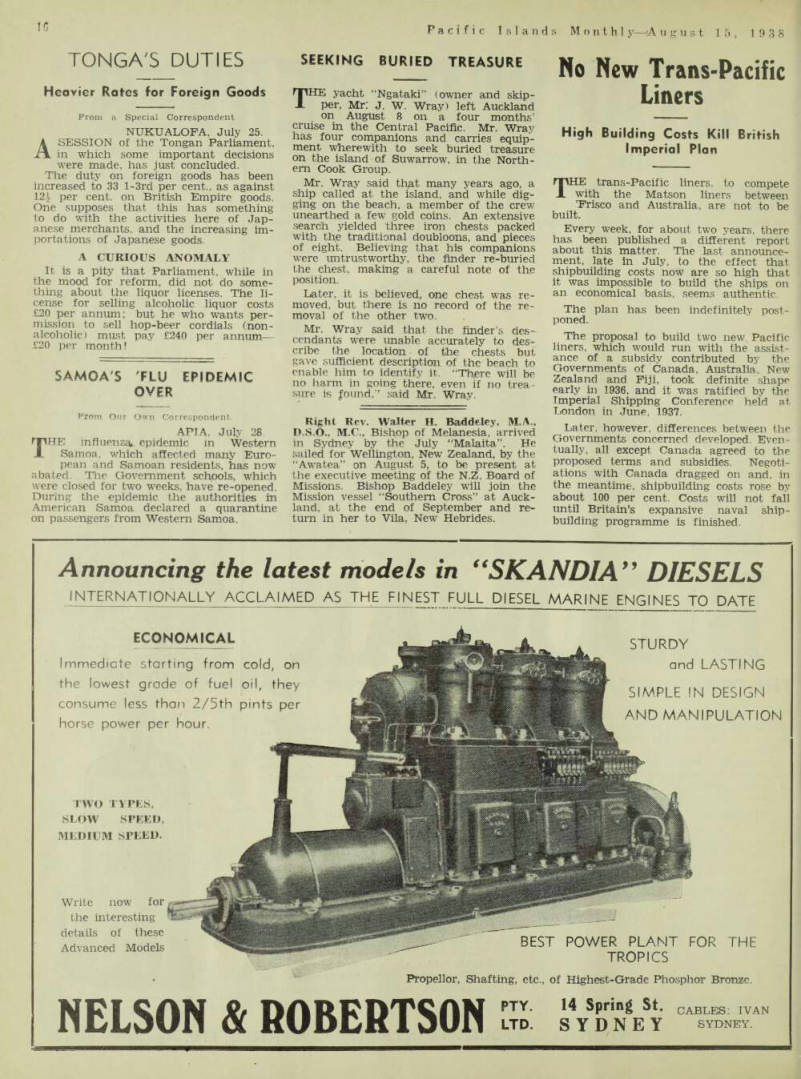
Heavier Rates for Foreign Goods
From a Special Correspondent
Nukualofa, July 25.
A SESSION of the Tongan Parliament, in which some important decisions were made, has just concluded.
The duty on foreign goods has been increased to 33 l-3rd per cent., as against 12 h per cent, on British Empire goods.
One supposes that this has something to do with the activities here of Jap anese merchants, and the increasing im portations of Japanese goods.
A Curious Anomaly
It is a pity that Parliament, while in the mood for reform, did not do some thing about the liquor licenses. The li cense for selling alcoholic liquor costs £2O per annum: but he who wants per mission to sell hop-beer cordials (non alcoholic) must pay £240 per annum £2o per month!
Samoa's 'Flu Epidemic
Over
Prom Our Own Correspondent.
APIA. July 28 f'pHE influenza* epidemic in Western 1. Samoa, which affected many Euro pean and Samoan residents, has now abated. The Government schools, which were closed for two weeks, have re-opened.
During the epidemic the authorities in American Samoa declared a quarantine on passengers from Western Samoa.
Seeking Buried Treasure
THE yacht “Ngataki” (owner and skip per, Mr; J. W. Wray) left Auckland on August 8 on a four months’ cruise in the Central Pacific. Mr. Wray has four companions and carries equip ment wherewith to seek buried treasure on the island of Suwarrow, in the North ern Cook Group.
Mr. Wray said that many years ago, a ship called at the island, and while dig ging on the beach, a member of the crew unearthed a few gold coins. An extensive search yielded three iron chests packed with th,e traditional doubloons, and pieces of eight. Believing that his companions were untrustworthy, the finder re-buried the chest, making a careful note of the position.
Later, it is believed, one chest was re moved, but there is no record of the re moval of the other two.
Mr. Wray said that the finder’s des cendants were unable accurately to des cribe the location of the chests but gave sufficient description of the beach to enable him to identify it. “There will be no harm in going there, even if no trea sure is found, ’’ said Mr. Wray.
Right Rev. Walter H. Baddeley. M.A..
D. 5.0.. M.C.. Bishop of Melanesia, arrived in Sydney by the July “Malaita”. He sailed for Wellington, New Zealand, by the “Awatea” on August 5, to be present at the executive meeting of the N.Z. Board of Missions. Bishop Baddeley will join the Mission vessel “Southern Cross” at Auck land, at the end of September and re turn in her to Vila, New Hebrides.
No New Trans-Pacific
Liners High Building Costs Kill British Imperial Plan
THE trans-Pacific liners, to compete with the Matson liners between ’Frisco and Australia, are not to be built.
Every week, for about two years, there has been published a different report about this matter. The last announce ment, late in July, to the effect that shipbuilding costs now are so high that it was impossible to build the ships on an economical basis, seems authentic.
The plan has been indefinitely post poned.
The proposal to build two new Pacific liners, which would run with the assist ance of a subsidy contributed by the Governments of Canada, Australia. New Zealand and Fiji, took definite shape early in 1936, and it was ratified by the Imperial Shipping Conference held at London in June. 1937.
Later, however, differences between the Governments concerned developed. Even tually, all except Canada agreed to the proposed terms and subsidies. Negoti ations with Canada dragged on and. in the meantime, shipbuilding costs rose by about 100 per cent. Costs will not fall until Britain’s expansive naval ship building programme is finished.
Advertisements & other items, p. 20 (2 items)
16
Pacific Islands Mont hi y—A ugust 15, 1938
Nelson & Robertson
Announcing the latest models in DIESELS
INTERNATIONALLY ACCLAIMED AS THE FINEST FULL DIESEL MARINE ENGINES TO DATE Jk : ■ fM
ECONOMICAL
Immediate starting from cold, on the lowest grade of fuel oil, they consume less than 2/sth pints per horse power per hour.
TWO TYPES,
SLOW SPEED,
MEDIUM SPEED.
Write now for the interesting details of these Advanced Models
STURDY
and LASTING
SIMPLE IN DESIGN
AND MANIPULATION
BEST POWER PLANT FOR THE
TROPICS
Propeller, Shafting, etc., of Highest-Grade Phosphor Bronze.
NELSON & ROBERTSON
PTY. 14 Spring St. cables: ivan
LTD. SYDNEY SYDNEY.
Another Attack On
Salamaua
Problem Of New Guinea Capital
ARGUMENTS against the establish ment of the new capital of New Guinea at Salamaua, and in favour of the retention of Rabaul as > the chief town, have been put forward in a letter to the “Rabaul Times” by Mr. E. V.
O’Brien, writing from Wooloowin, Bris bane.
Referring to Salamaua itself, Mr.
O’Brien says: “It certainly lies in a pic turesque setting, having rugged moun tains towering up to 12,000 ft. behind, the Huon Gulf in front and to the north west of it —in fact, it forms a pocket in the south-eastern end of Huon Gulf.
“Its harbour is very shallow, however, ships having to anchor out about a mile from shore, lightering passengers and freight thither. It would be a diffi cult matter to keep a dredged channel open to enable ships to berth alongside wharves anywhere in Salamaua bay, I should say, as the Markham River empties itself into the sea a few miles across the Gulf from Salamaua,. Being a large river, and there being prolific rains on its watershed, it must bring down considerable quantities of silt— sufficient to silt up the whole of the Gulf, in the course of time. However, this is but one of the problems for the new capital’s experts.
“Swamps will have to be filled in and the mountains at the back of Kila ter raced, for building purposes, while the aerodrome is frequently flooded out by the Francisco River during the wet season.
“To date, no mention has been made of what would happen to this grandiose scheme should the price of gold revert to its nonnal level. I venture to say that all activity, except that of Bulolo Gold Dredging Ltd. would cease. What then? Of what use would a £150,000 road and a £350,000 capital be to the Territory, in such a place? From an ag ricultural point of view, the Morobe dis trict is the most barren in the whole Territory.
“We have often heard of the wonder ful fertility of the Markham Valley, but to date, no development has taken place there. As far back as 1921, schemes were afoot for planting cocoa and cot ton in it, but nothing came of them.
“The wonderful Wahgi Valley plateaus will probably receive attention during the next 50-100 years, but their natural outlet is Madang. All staff movements and freights for Administration outposts in the Wahgi and Mt. Hagen regions are handled by air from Madang, It be ing the nearest centre.
“Intense cultivation has taken place all around Rabaul and many, who have invested their all in property there, will lose heavily if the capital is shifted.
These settlers are being ruthlessly sacri ficed and must inevitably be loaded up with taxation at a later date, to pay Canberra”.
Mr. and Mrs. Schmid-Burgk, who re cently sold their holding on the Lower Watut River, New Guinea, sailed from Rabaul by the July “Neptuna” en route to Germany for an extended holiday. Mr.
Schmid-Burgk had been a miner in Mor obe for nearly 13 years and prior to that was a planter for a long period.
Samoa As A Field For Historical Research
Historical Research
Letter to the Editor.
IF there are Pacific students seeking a field of research I would suggest that they would find Samoa a virgin territory.
There is in Samoa a wealth of mater ial, quite apart from the quarrels of the native factions, the war of the consuls, and the residence there of Robert Louis Stevenson.
For example, there might be an inves tigation of the early first migration of Polynesians who settled in Savaii; the latter waves of Polynesians, that drove the original settlers into the mountains:
the still later descent of the mountain inhabitants upon the coastal districts; the dispersion of these people through Polynesia and on to New Zealand: and a lot more of that period. Then there are the European discoverers, and so on. until we come to comparatively recent times.
I have a great deal of material about the Pacific in my collection, but I never have seen anything of abiding interest about Samoa, except the hackneyed re petitions of R.L.S. stories, and the in ternational quarrel over the possession of the islands.
People all over the world are inter ested in reading about Polynesia. Sa moa, as you know, is an interesting place and has a lot of history. . I am, etc.,
Islands Student.
Auckland, N.Z.
August 2, 1938.
Advertisements & other items, pp. 21-22 (2 items)
17
Pacific Islands Monthl y—A ugust 15, 1938.
Flag
* A r .'•<* V-'‘- S •”.>%'• M k v f ys
#/ Flto
ALE
JhkeHTo'ec
ADELAIDE
MELBOURNE
SYDNEY
TO BRISBANE
NEW GUINEA
DOOR TO DOOR
EXPRESS PARCEL DELIVERIES
BY
AIR MAIL
Via— Rockhampton . . . Townsville Cairns . . . Cooktown Port Moresby . . . Salamaua Rabaul.
Rates on application to
YELLOW EXPRESS
CARRIERS LTD.
103 Murray St., Pyrmont, Sydney Tel.: MW2551 in conjunction with
W. R. CARPENTER & CO., LTD.
ATTRACTIVE FOOD
FOR THE TROPICS
>!U*M?ILRATH’S
PRICE LISTS
Post &jree
cm dpplicatioTi
Australian LA. Sugar, 701 b. bags Australian LA. Sugar, 3 bag lots I.X.L. Best Assorted Jam, 12oz. (Case lots of 6 dozen) Crown Soap, wrapped, 60s. or 725.
Californian Asparagus Tips, 9£oz. 1/2 tin Gartside's Medium Mushrooms, 10oz 11 id tin Ozone Oysters, soz 7id tin Arnott’s Sao Biscuits, Boz. Sealed Packets Morton’s Asstd. Fish Pastes, loz. 2d tin Rosa Garden Honey, 21b 1/3 tin LX.L. Tomato Soup, Boz sid tin Selmore Fruit Saline, 16oz. .. 1/3 tin Mynor Fruit Cup, 260 z 1/9 bot Mercury Apple Cider, 240 z. .. 1/6 bot Mcllrath’s Special R.R. Dry
Sherry, 260 z 3/6 bot
French Zig Zag Cigarette Papers All Prices f.o.b. Sydney. 13/- bag 12/6 bag 5/6 doz. 24/- case 13/- doz. 11/3 doz. 7/3 doz. 6d pkt. 1/9 doz. 14/9 doz. 5/- doz. 14/6 doz. 20/- doz. 17/6 doz. 41/- doz. 9/6 box
G*jCS&Ltz//£i''£L. Qu&jUty
• • * -EXPORT DEPARTMENT • • •
202 PITT STREET.SYDNEY
NEW SOUTH WALES. AUSTRALIA.
Anglican Cathedral Being Built In Papua
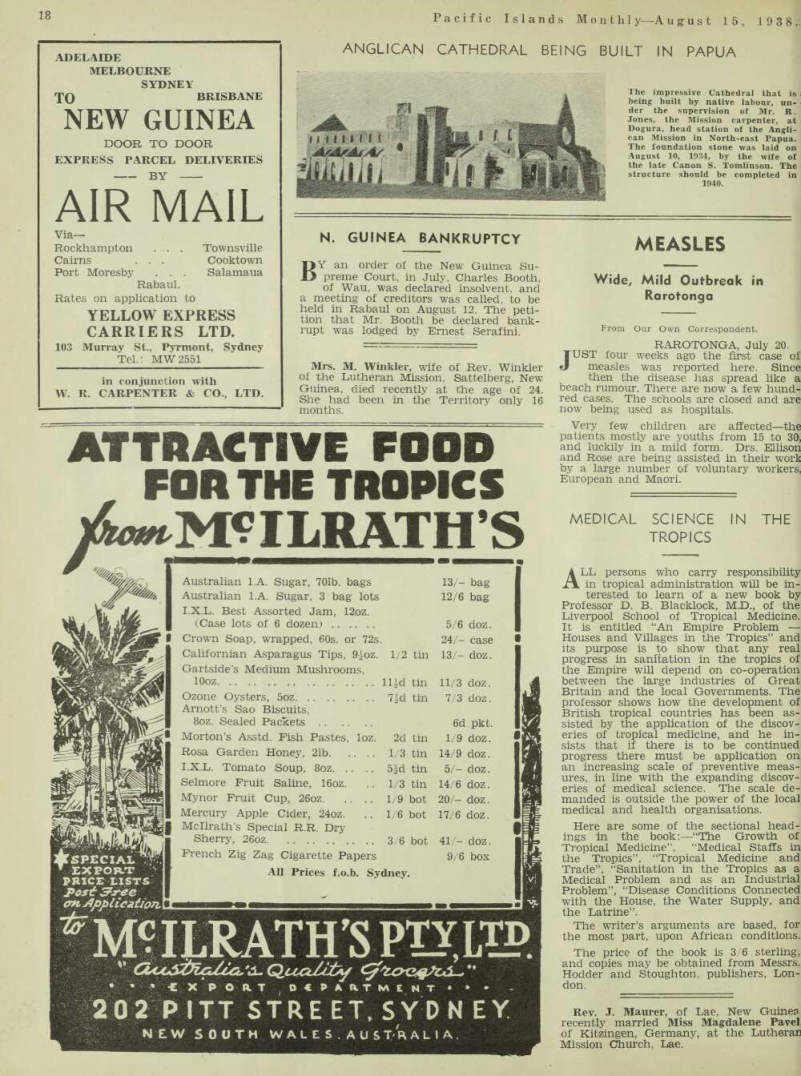
The impressive Cathedral that is being built by native labour, un der the supervision of Mr. R.
Jones, the Mission carpenter, at Dogura, head station of the Angli can Mission in North-east Papua.
The foundation stone was laid on August 10, 1934, by the wife of the late Canon S. Tomlinson. The structure should be completed in 1940.
N. Guinea Bankruptcy
BY an order of the New Guinea Su preme Court, in July, Charles Booth, of Wau, was declared insolvent, and a meeting of creditors was called, to be held in Rabaul on August 12. The peti tion that Mr. Booth be declared bank rupt was lodged by Ernest Serafini.
Mrs. M. Winkler, wife of Rev. Winkler of the Lutheran Mission, Sattelberg, New Guinea, died recently at the age of 24.
She had been in the Territory only 16 months.
Measles
Wide, Mild Outbreak in Rarotonga
From Our Own Correspondent.
Rarotonga, July 20.
JUST four weeks ago the first case of measles was reported here. Since then the disease has spread like a beach rumour. There are now a few hund red cases. The schools are closed and are now being used as hospitals.
Very few children are affected—the patients mostly are youths from 15 to 30, and luckily in a mild form. Drs. Ellison and Rose are being assisted in their work by a large number of voluntary workers, European and Maori.
Medical Science In The
Tropics
ALL persons who carry responsibility in tropical administration will be in terested to learn of a new book by Professor D. B. Blacklock, M.D., of the Liverpool School of Tropical Medicine.
It is entitled “An Empire Problem Houses and Villages in the Tropics” and its purpose is to show that any real progress in sanitation in the tropics of the Empire will depend on co-operation between the large industries of Great Britain and the local Governments. The professor shows how the development of British tropical countries has been as sisted by the application of the discov eries of tropical medicine, and he in sists that if there is to be continued progress there must be application on an increasing scale of preventive meas ures, in line with the expanding discov eries of medical science. The scale de manded is outside the power of the local medical and health organisations.
Here are some of the sectional head ings in the book:—“The Growth of Tropical Medicine”, “Medical Staffs in the" Tropics”, “Tropical Medicine and Trade”, “Sanitation in the Tropics as a Medical Problem and as an Industrial Problem”, “Disease Conditions Connected with the House, the Water Supply, and the Latrine”.
The writer’s arguments are based, for the most part, upon African conditions.
The price of the book is 3/6 sterling, and copies may be obtained from Messrs.
Hodder and Stoughton, publishers, Lon don.
Rev. J. Maurer, of Lae, New Guinea recently married Miss Magdalene Pavel of Kitzingen, Germany, at the Lutherar Mission Church, Lae.
Advertisements & other items, p. 22 (1 item)
18
Pacific Islands Monthl y—A ugust 15, 1938,
New Name For Wau?
WHEREVER the new capital of New Guinea may be situated on the mainland it seems certain that it will be connected by road with Wau.
This means for a certainty that Wau, situated so attractively in its green val ley at the cool height of 3,500 ft., will become the favourite holiday resort of that part of the world.
Visualising something of the sort, a writer in the “Rabaul Times” strongly urges that the name be changed. He implies that, at first hearing, “Wow” makes the average European giggle— and one is bound to admit that as a name it has a silly sound. The “Times” writer strongly urges “Koranga-Wau”.
Why not simply Koranga? It is a pleasant-sounding word, and its use would be amply justified, as the pretty little town of Wau is situated near the junc tion of famous Koranga Creek, and the Bulolo.
Bishop's Jubilee
New Towers For Fiji
From Our Own Correspondent.
SUVA, August 2.
EXTENSIVE additions have recently been made to the Sacred Heart Cathedral in Suva by the provision of two 85-feet towers, which add to the attractiveness of the building. It is hoped that funds soon will be found to make further additions.
It is interesting to note that work on the Cathedral was commenced in 1896, the sandstone from which it is built be ing brought from Australia as ballast.
It was opened for worship in 1903, and the present verandahs added in 1920, the latter being built of concrete.
As a result of experiments by the Whan Construction Company, who are responsible for the work, harmony in the shade of the new building has been obtained, and it is difficult to tell where the old sandstone ends and the new construction begins.
It is intended to offer the towers to the Bishop (Rt. Rev. Dr. C. J. Nicolas, S.M.) to mark his golden jubilee—fifty years as a priest and fifty years in Fiji —which falls on September 22.
Death Of Norfolk Island
Identity
FOR many years one of the leading citizens of Norfolk Island, Mr. Charles Chase Ray Nobbs, died on the island on July 31, aged 77. He was born on N.I. shortly after the migration of the Pitcairners, and he was a grandson of Rev. G. H. Nobbs, first minister on Pit cairn Island. Mr. Nobbs was educated in Sydney and, after some commercial experience in Australia, returned to Nor folk, where he acquired large farming and trading interests.
Activity Continues
Misma Is. Gold Mines
GOLDMINING continues active on Misima Island, Eastern Papua (writes a correspondent).
Cuthbert’s Misima Gold Mine is still producing fat dividends. Its neighbour, Gold Mines of Papua Ltd., has been meeting with some difficulties, in extrac tion and precipitation. However, it lately brought in several men, assayers and metallurgists, and they expect to over come these troubles in the near future.
A mining engineer has arrived for Quartz Mountain, and he has engaged several miners and is. according to local ideas, starting from the right end—that is, the development and testing of the mine itself. Too many mines are judg ed on the assay of 1,000 grains of stone, even if it may be from a single boulder in the creek.
Advertisements & other items, p. 23 (2 items)
Pike
IPost or (/our or msthcctionc to us.
Oar tfcc/ofoscnlat
u/<M meet /o until car cmc (/our orates. or conduct /on to our premises...
By Special Appointment
PIKE
BROTHERS LIMITED
Queen St., Brisbane.
sryr
When dancing
Wm/' "ft / d^X or at the theatre don’t forget now and then to dab a few drops of "4711 " Genuine Eau de Cologne on temples and feign forehead; it will refresh, invigorate, I revive. ✓ m
EAU DE Col 2
ECO
ss 4711) Eau ere
"Cologne
Springwood Ladies' College
At Blue Mountains—Springwood, N.S.W.
Est. 1897. Kindergarten to Leaving Certificate. Tennis, Riding, Swimming, Team Games. Unequalled climate. Pure Jersey Milk. Senior and Junior Houses. Open-air sleeping. Inclusive fees. Special vacation arrangements for Island pupils.
M. E. DURAND, Principal.
New Books

INTERESTING and intimate sketches of native life in Papua are given in
“Papuan Journey”, By H. L.
Hurst. Mr. Hurst is secretary of the London Missionary Society in Austra lia and he makes periodical visits to the Islands mission field. When he made his first visit to Papua, he set down his impressions—and they are the impressions of a widely-travelled man, who has visited the natives of many countries —in a series of letters; and those letters, gathered together, form the new book. It is pleasant reading, whether one knows the country or one does not; but, because it carries much description of village life, under conditions which are changing rapidly, it has a certain
scientific value. Our copy from the pub lishers, Angus and Robertson, Ltd., Sydney; price, 3/6.
In “Island Interlude”, The Au
thor (Stuart McDonald) has taken a beautiful island off the North Queens land coast; has added thereto a retired pearler and his pretty daughter; has cunningly introduced a handsome stranger (who has been washed up on the beach and found, of course, by the beautiful daughter) and a bunch of Australian villains; has discovered a hidden store of valuable pearls; and has garnished the lot with turquoise-blue sea, coral gardens, tropical love, and a setting of brilliant vegetation and lan guorous sunshine. It is a quick-mov ing tale, with plenty of incident —crime, passion, romance, and sheer, dirty plot ting—and it is written in an attractive fashion. Our copy from Deaton and Spencer Pty. Ltd., Sydney; price, 6/-.
Australia-N.G. Radiophone
Amalgamated wireless (Aust.) Ltd. advised on July 25 that the rate for wireless telephone conversations between Australia and Rabaul would be reduced forthwith to 10/- a minute, with a mini mum charge as for three minutes. The service was opened last December, and the rate was 15/- a minute.
Dr* Harriette Wilkie has taken over the practice of Dr. Hamilton Beattie, at Suva, Fiji. A graduate of Edinburgh, Dr.
Wilkie has practised in India, Burma, and New Zealand, and is the first lady doctor to practise at Suva for 20 years.
Mr. and Mrs. Harrie Standen, of the Bamu River Mission. Papua, were in Sydney during July.
By-Products
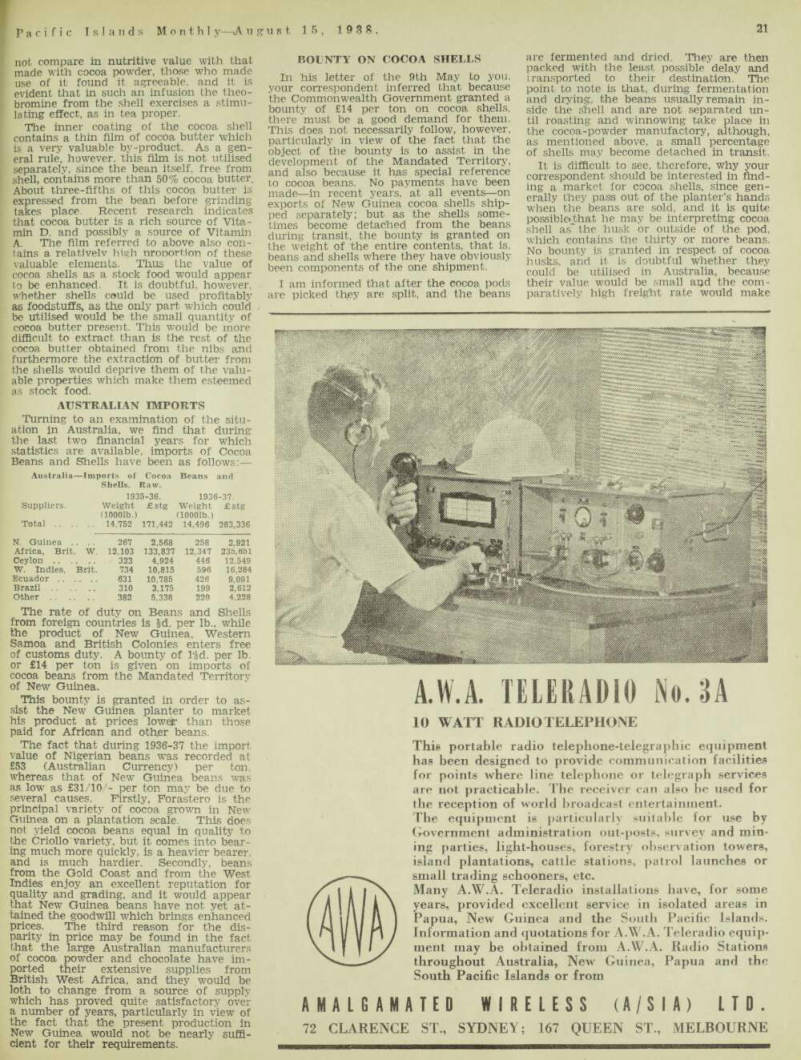
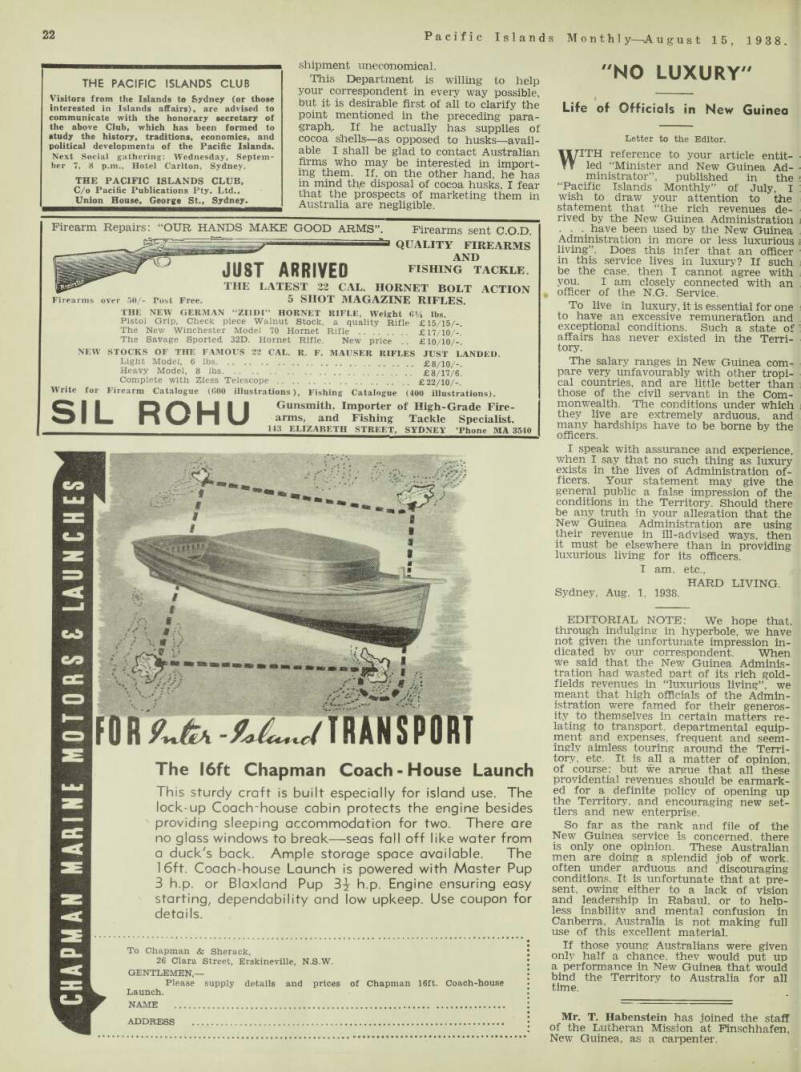
Cocoa And Its
Interesting Data About Value of Shell
In July, fallowing an inquiry by a New* Guinea planter interested in cocoa, wo asked the Department of Commerce, Can berra, for information about the value andb use of cocoa shell. The secretary of th« Department, very courteously, has suppliedß us with the following statement:— THE whole cocoa industry was the sub ject of a report by the Imperial Eco nomic Committee in 1932, and it is noted from this document that the prin cipal outlet of the shell is as a food fori livestock. It is .said to contain about 19 %o of albuminoids and 46% of digestible car bohydrates and when mixed with othen food in moderate quantities is valuable as an appetiser and growth stimulant.
Apart from its use as a fodder, cocoas shell yields about 67 lb. of potassium car bonate per ton, and has been success fully employed as a manure.
Cocoa shell contains about 1% theo bromine which is an important and valu able medicine, particularly as a heart! tonic for elderly people, and it has beenr found profitable to extract it for prepar ation as a drug.
Ordinarily speaking, cocoa is an emul sion not an infusion. In some countries* however, the practice h,as existed for many, years of making an infusion from thee cocoa shell known in Germany, e.g., as “cocoa tea”.
During the Great War, cocoa shell was sold in large quantities in England for thee same purpose. Though the beverage can
not compare in nutritive value with that made with cocoa powder, those who made use of it found it agreeable, and it is evident that in such an infusion the theo bromine from the shell exercises a stimu lating effect, as in tea proper.
The inner coating of the cocoa shell contains a thin film of cocoa butter which is a very valuable by-product. As a gen eral rule, however, this film is not utilised separately, since the bean itself, free from shell, contains more than 50% cocoa butter.
About three-fifths of this cocoa butter is expressed from the bean before grinding takes place. Recent research indicates that cocoa butter is a rich source of Vita min D. and possibly a source of Vitamin A. The film referred to above also con tains a relativelv high nronortion of these valuable elements. Thus the value of cocoa shells as a stock food would appear to be enhanced. It is doubtful, however, whether shells could be used profitably as foodstuffs, as the only part which could be utilised would be the small quantity of cocoa butter present. This would be more difficult to extract than is the rest of the cocoa butter obtained from the nibs and furthermore the extraction of butter from the shells would deprive them of the valu able properties which make them esteemed as stock food.
Australian Imports
Turning to an examination of the situ ation in Australia, we find that during the last two financial years for which statistics are available, imports of Cocoa Beans and Shells have been as follows: —
The rate of duty on Beans and Shells from foreign countries is id. per lb., while the product of New Guinea. Western Samoa and British Colonies enters free of customs duty. A bounty of I’id. per lb. or £l4 per ton is given on imports of cocoa beans from the Mandated Territory of New Guinea.
This bounty is granted in order to as sist the New Guinea planter to market his product at prices lowefc- than those paid for African and other beans.
The fact that during 1936-37 the import value of Nigerian beans was recorded at £53 (Australian Currency) per ton, whereas that of New Guinea beans was as low as £3l/10/- per ton may be due to several causes. Firstly, Forastero is the principal variety of cocoa grown in New Guinea on a plantation scale. This does not yield cocoa beans equal in quality to the Criollo variety, but it comes into bear ing much more quickly, is a heavier bearer, and Is much hardier. Secondly, beans from the Gold Coast and from the West Indies enjoy an excellent reputation for quality and grading, and it would appear that New Guinea beans have not yet at tained the goodwill which brings enhanced prices. The third reason for the dis parity in price may be found in the fact that the large Australian manufacturers of cocoa powder and chocolate have im ported their extensive supplies from British West Africa, and they would be loth to change from a source of supply which has proved quite satisfactory over a number of years, particularly in view of the fact that the present production in New Guinea would not be nearly suffi cient for their requirements.
Bounty On Cocoa Shells
In his letter of the 9th May to you. your correspondent inferred that because the Commonwealth Government granted a bounty of £l4 per ton on cocoa shells, there must be a good demand for them, This does not necessarily follow, however, particularly in view of the fact that the object of the bounty is to assist in the development of the Mandated Territory, and also because it has special reference io cocoa beans. No payments have been made—in recent years, atjail exports of New Guinea shells shipped separately, but as the shells sometimes become detached fiom the beans during transit,.the* ?!? the weight of the entire contents that is beans and shells where they have obviously been components of the one shipment.
I am informed that after the cocoa pods are picked th,ev are split, and the beans
are fermented and dried. They are then packed with the least possible delay and transported to their destination. The point to note is that, during fermentation and drying, the beans usually remain in side the shell and are not separated un> til roasting and winnowing take place in the cocoa-powder manufactory, although, as mentioned above, a small percentage of shells may become detached in transit, It ig difficult to see, therefore, why your correspondent should be interested in Aud jng. a mar^e t f o r cocoa shells, since gen erally they pass out of the planter’s hands W ien the beans are sold, and it is quite possible*that he may be interpreting cocoa shell as “ the husk or outside of the pod. which contains the thirty or more beans, No bounty is granted in respect of cocoa husks> an * d it g is doubtful whether they could be utilised in Australia, because their value would be small and the com paratively high freight rate would make
Australia —Imports of Cocoa Beans and Shells.
Raw. 1935-36. 1936-37.
Suppliers. Weight £stg Weight £stg (10001b.) (10001b.) Total 14.752 171,442 14,496 283,336 N. Guinea . . . . 267 2,568 258 2,921 Africa, Brit. W. 12,103 133,837 12.347 235,651 Ceylon 323 4,924 446 12,549 W. Indies, Brit. 734 10,815 596 16,284 Ecuador 631 10.785 426 9,091 Brazil 310 3,175 199 2,612 Other 382 5.338 220 4.228
shipment uneconomical.
This Department is willing to help your correspondent in every way possible, but it is desirable first of all to clarify the point mentioned in the preceding para graph,. If he actually has supplies of cocoa shells—as opposed to husks—avail able I shall be glad to contact Australian firms who may be interested in import ing them. If, on the other hand, he has in mind the disposal of cocoa husks, I fear that the prospects of marketing them in Australia are negligible.
Advertisements & other items, pp. 24-26 (4 items)
20
Pacific Islands Monthl ugust 15, 19 38.
Amazing Climbing
Tomato!
CLIMBING TOMATO (Imported). Amazing introduction. Climbs to 20 ft. on trellis, fence, netting. BEARS THROUGH-
OUT THE YEAR. Yields TWO BUSH-
ELS, large i 3 Vs in. x 2V 2 in.) red, meaty Tomatoes per plant. AMAZINGLY PRO- DUCTIVE. SOW NOW. Government tested seed, 2/6 packet
WHITE HEALTH TOMATO!
PURE WHITE HEALTH TOMATO! White
Beauty (Imported), only Tomato in existence 100 PER CENT. NON-ACID (a sensational achievement). DELICIOUS
FLAVOUR. DISEASE-FREE! DROUGHT-
PROOF! Large Fruit, Heavy bearer, easily grown anywhere. 2/6 packet, posted.
N S.W. SEED CO.
17a PITT STREET. SYDNEY.
Coleman
0 'CoJ^K/uiiJU ■ L.J (. o> <•«.*« • « I
“SUPPLY THE LIGHT FOR EVERY
OUTDOOR NEED AT NIGHT’’.
Coleman
HI-POWER
LANTERNS
300
CANDLE POWER
SUN-LIKE
PURE WHITE
BRILLIANCE
Known for their Sun-like, pure white brilliance. Not affected by wind, rain or storm.
Low cost of operation—l 2-15 hours on one quart of fuel.
Compact—only 1U inches high, and 3| lbs. in weight.
Equipped with genuine “Pyrex” bulge-type heat and rain resisting globe, with 30% more lighting surface. Uses Coleman ‘Hi-Power’’
Mantle No. 999.
No. 242-B. —INSTANT lighting for Petrol.
No. 247. For Kerosene (preheating) .
Take it down the Mine Shaft —Out on the Plantation—On the Verandah-—ln the Home.
DISTRIBUTORS IN THE PACIFIC ISLANDS:
All Branches of Burns. Philp & Co. Ltd.: W. R. Carpenter & Co. Ltd.; Philp (South Sea) Co. Ltd.; Morris, He dstrom Ltd.; Whitten Bros. Ltd.; ships Trading Co. Ltd., and many other firms throughout the Islands.
Burns Steam-
■ m
A.W.A. TEIERADIO No. SA
10 WATT RADIOTELEPHONE
This portable radio telephone-telegraphic equipment has been designed to provide communication facilities for points where line telephone or telegraph services are not practicable. The receiver can also be used for tiie reception of world broadcast entertainment.
The equipment is particularly suitable for use by (rovernmenl administration out-posts, survey and mining parties, light-houses, forestry observation towers, island plantations, cattle stations, patrol launches or small trading schooners, etc.
Many A.W.A. Teleradio installations have, for some years, provided excellent service in isolated areas in Papua, New Guinea and the South Pacific Islands.
Information and quotations for A.W.A. Teleradio equipment may be obtained from A.W.A. Radio Stations throughout Australia, New Guinea, Papua and the South Pacific Islands or from
AMALGAMATED WIRELESS (A/SIA) LTD.
72 CLARENCE ST., SYDNEY; 167 QUEEN ST., MELBOURNE
THE PACIFIC ISLANDS CLUB
Visitors from the Islands to Sydney (or those interested in Islands affairs), are advised to communicate with the honorary secretary of the above Club, which has been formed to study the history, traditions, economics, and political developments of the Pacific Islands.
Next Social gathering: Wednesday, September 7, 8 p.m., Hotel Carlton, Sydney.
THE PACIFIC ISLANDS CLUB.
C/o Pacific Publications Pty. Ltd., Union House, George St., Sydney.
Firearm Repairs: “OUR HANDS MAKE GOOD ARMS”.
Firearms over Firearms sent C.O.D.
QUALITY FIREARMS
AND
JUST ARRIVED FISHING TACKLE.
THE LATEST 22 CAL. HORNET BOLT ACTION
5 SHOT MAGAZINE RIFLES.
THE NEW GERMAN “ZI1DI” HORNET RIFLE, Weight 6*4 lbs Pistol Grip, Check piece Walnut Stock, a quality Rifle £l5/15/-.
The New Winchester Model 70 Hornet Rifle £l7/10/-.
The Savage Sported 32D. Hornet Rifle. New price .. £lO/10/-.
NEW STOCKS OF THE FAMOUS 22 CAL. R. F. MAUSER RIFLES JUST LANDED.
Light Model, 6 lbs £B/10/-.
Heavy Model, 8 lbs £B/17/e!
Complete with Ziess Telescope £22/10/-.' Write for Firearm Catalogue (600 illustrations). Fishing Catalogue (400 illustrations).
SD LJj I I Gunsmith, Importer of High-Grade Fire- |Lb Pi Ly arms, and Fishing Tackle Specialist. jj3 ELIZABETH STREET, SYDNEY Phone MA 3540
■ ♦ * M ;v « y
3FOR*U*
The 16ft Chapman Coach - House Launch This sturdy craft is built especially for island use. The lock-up Coach-house cabin protects the engine besides providing sleeping accommodation for two. There are no glass windows to break—seas fall off like water from a duck's back. Ample storage space available. The 16ft. Coach-house Launch is powered with Master Pup 3 h.p, or Blaxland Pup h.p. Engine ensuring easy starting, dependability and low upkeep. Use coupon for details.
To Chapman & Sherack, 26 Clara Street, Erskinevllle, N.S.W.
GENTLEMEN,—
Please supply details and prices of Chapman 16ft. Coach-house Launch.
NAME
ADDRESS
21
Pacific Islands Monthl y—A ugust 15, 1938
"No Luxury"
Life of Officials in New Guinea
Letter to the Editor.
WITH reference to your article entit led “Minister and New Guinea Ad ministrator”, published in the “Pacific Islands Monthly” of July, I wish to draw your attention to the statement that “the rich revenues de rived by the New Guinea Administration . . . have been used by the New Guinea Administration in more or less luxurious living”. Does this infer that an officer in this service lives in luxury? If such be the case, then I cannot agree with you. I am closely connected with an officer of the N.G. Service.
To live in luxury, it is essential for one to have an excessive remuneration and exceptional conditions. Such a state of affairs has never existed in the Terri tory.
The salary ranges in New Guinea com pare very unfavourably with other tropi cal countries, and are little better than those of the civil servant in the Com monwealth. The conditions under which they live are extremely arduous, and many hardships have to be borne by the officers.
I speak with assurance and experience, when I say that no such thing as luxury exists in the lives of Administration of ficers. Your statement may give the general public a false impression of the conditions in the Territory. Should there be any truth in your allegation that the New Guinea Administration are using their revenue in ill-advised ways, then it must be elsewhere than in providing luxurious living for its officers.
I am, (etc.,
Hard Living.
Sydney, Aug. 1, 1938.
EDITORIAL NOTE: We hope that, through indulging in hyperbole, we have not given the unfortunate impression in dicated by our correspondent. When we said that the New Guinea Adminis tration had wasted part of its rich gold fields revenues in “luxurious living”, we meant that high officials of the Admin istration were famed for their generos ity to themselves in certain matters re lating to transport, departmental equip ment and expenses, frequent and seem ingly aimless touring around the Terri tory, etc. It is all a matter of opinion, of course: but we argue that all these providential revenues should be earmark ed for a definite policy of opening up the Territory, and encouraging new set tlers and new enterprise.
So far as the rank and file of the New Guinea service is concerned, there is only one opinion. These Australian men are doing a splendid job of work, often under arduous and discouraging conditions. It is unfortunate that at pre sent, owing either to a lack of vision and leadership in Rabaul. or to help less inability and mental confusion in Canberra. Australia is not making full use of this excellent material.
If those young Australians were given only half a chance, they would put up a performance in New Guinea that would bind the Territory to Australia for all time.
Mr. T. Habenstein has joined the staff of the Lutheran Mission at Pinschhafen, New Guinea, as a carpenter.
Advertisements & other items, p. 26 (1 item)
22
Pacific Islands Monthl ugust 15, 1938.
Pacific Travellers
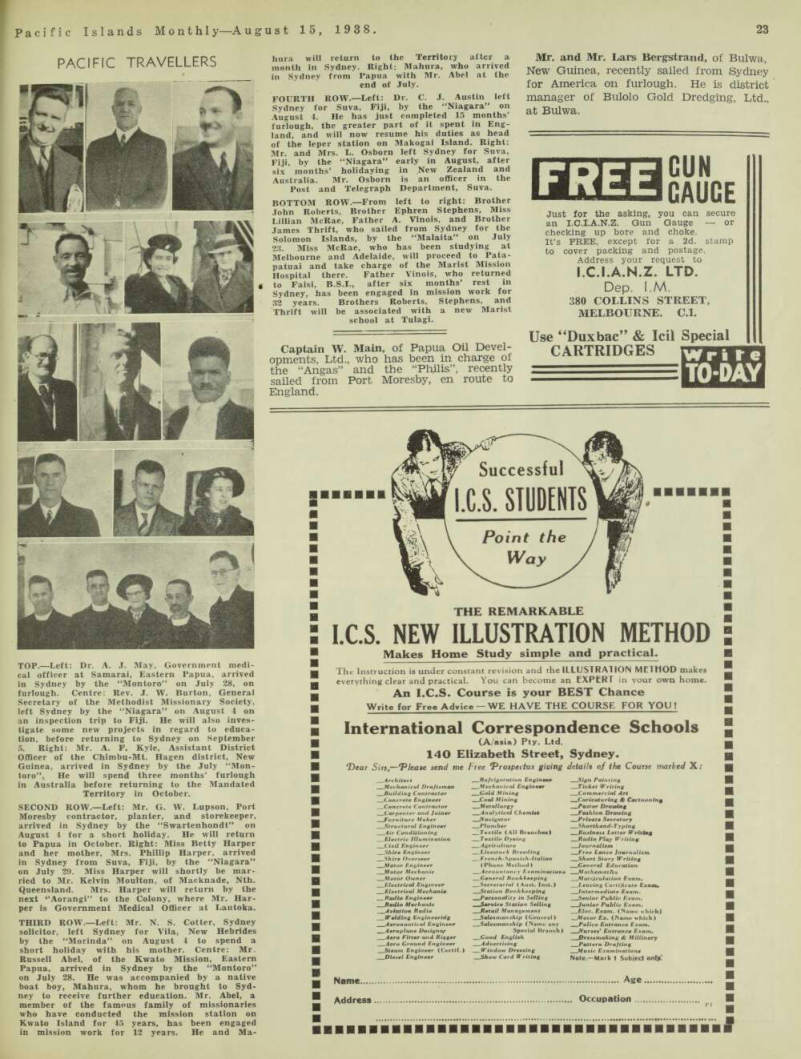
Captain W. Main, of Papua Oil Devel opments, Ltd., who has been in charge of the “Angas” and the “Philis”, recently sailed from Port Moresby, en route to England.
Mr. and Mr. Lai’s Bergstrand, of Bulwa, New Guinea, recently sailed from Sydney for America on furlough. He is district manager of Bulolo Gold Dredging, Ltd., at Bulwa.
hura will return to the Territory after a month in Sydney. Right: Mahura, who arrived in Sydney from Papua with Mr. Abel at the end of July.
FOURTH ROW. —Left: Dr. C. J. Austin left Sydney for Suva, Fiji, by the “Niagara” on August 4. He has just completed 15 months’ furlough, the greater part of it spent in Eng land, and will now resume his duties as head of the leper station on Makogai Island. Right: Mr. and Mrs. L. Osborn left Sydney for Suva, Fiji, by the “Niagara” early in August, after six months’ holidaying in New Zealand and Australia. Mr. Osborn is an officer in the Post and Telegraph Department, Suva.
BOTTOM ROW.—From left to right: Brother John Roberts, Brother Ephren Stephens, Miss Lillian McRae. Father A. Vinols, and Brother James Thrift, who sailed from Sydney for the Solomon Islands, by the “Malaita” on July 23. Miss McRae, who has been studying at Melbourne and Adelaide, will proceed to Pata patuai and take charge of the Marist Mission Hospital there. Father Vinois, who returned to Faisi, B.S.I., after six months’ rest in Sydney, has been engaged in mission work for 32 years. Brothers Roberts, Stephens, and Thrift will be associated with anew Marist school at Tulagi.
TOP.—Left: Dr. A. J. May, Government medi cal officer at Samarai, Eastern Papua, arrived in Sydney by the “Montoro” on July 28, on furlough. Centre: Rev. J. w. Burton, General Secretary of the Methodist Missionary Society, left Sydney by the “Niagara” on August 4 on an inspection trip to Fiji. He will also inves tigate some new projects in regard to educa tion, before returning to Sydney on September 5. Right: Mr. A. F. Kyle, Assistant District Officer of the Chimbu-Mt. Hagen district. New Guinea, arrived in Sydney by the July “Mon toro”. He will spend three months’ furlough in Australia before returning to the Mandated Territory in October.
SECOND ROW.—Left: Mr, G. W. Lupson, Port Moresby contractor, planter, and storekeeper, arrived in Sydney by the “Swartenhondt” on August 4 for a short holiday. He will return to Papua in October. Right: Miss Betty Harper and her mother, Mrs. Phillip Harper, arrived in Sydney from Suva, Fiji, by the “Niagara” on July 29. Miss Harper will shortly be mar ried to Mr. Kelvin Moulton, of Macknade, Nth.
Queensland. Mrs. Harper will return by the next “Aorangi” to the Colony, where Mr. Har per is Government Medical Officer at Lautoka.
THIRD ROW.—Left: Mr. N. S. Cotter, Sydney solicitor, left Sydney for Vila, New Hebrides by the “Morinda” on August 4 to spend a short holiday with his mother. Centre: Mr.
Russell Abel, of the Kwato Mission, Eastern Papua, arrived in Sydney by the “Montoro” on July 28. He was accompanied by a native boat boy, Mahura, whom he brought to Syd ney to receive further education. Mr. Abel, a member of the famous family of missionaries who have conducted the mission station on Kwato Island for 45 years, has been engaged in mission work for 12 years. He and Ma-
Advertisements & other items, p. 27 (1 item)
shSce
Just for the asking, you can secure an 1.C.1.A.N.Z. Gun Gauge or checking up bore and choke.
It’s FREE, except for a 2d. stamp to cover packing and postage.
Address your request to
1.C.1.A.N.Z. LTD.
Dep. I.M.
380 COLLINS STREET,
MELBOURNE. C.l.
Use “Duxbac” & Icil
CARTRIDGES
Special Wri re
TO-DAY
THE REMARKABLE
I.C.S. NEW ILLUSTRATION METHOD
Makes Home Study simple and practical.
The Instruction is under constant revision and the ILLUSTRATION METHOD makes everything clear and practical. You can become an EXPERT in your own home.
An I.C.S. Course is your BEST Chance Write for Free Advice - WE HAVE THE COURSE FOR YOU!
International Correspondence Schools
(A/asia) Pty. Ltd.
140 Elizabeth Street, Sydney.
•Dear Sira,—Please send we Free Prospectus giving details of the Course marked X; Architect Mechanical Draftsman Building Contractor Concrete Engineer Concrete Contractor Carpenter and Joiner Furniture Maher Structural Engineer Air Conditioning Electric Illumination Civil Engineer Shire Engineer Shire Overseer Motor Engineer Motor Mechanic Motor Owner Electrical Engineer Electrical Mechanic Radio Engineer Radio Mechanic Aviation Radio IT elding Engineeridg Aeronautical Engineer Aeroplane Detigng /■ Aero Filter and Rigger Aero Ground Engineer Steam Engineer (Certif. ) Diesel Engineer ___ReJrigeration Engineer Mechanical Engineer _jCold Mining Coal Mining Metallurgy Anal ytical Chemist _Navigator Plumber __Textile (All Branches!
Textile Dyeing __Agriculture Livestock Breeding F rcnch-Spanish-Italian ( Phone Method ) Accountancy Examinations General Bookkeeping Secretarial (Ausl. Inst.) Station Bookkeeping __Persontdity in Selling Service Station Selling Retail Management Salesmanship (General!
Salesmanship (Name any Special Branch) Good English Advertising Window Dressing Show Card Writing Sign Painting Ticket Writing Commercial Art _Caricaturing dt Cartooning _Poster Drawing Fashion Drawing Private Secretary Shorthand-Typing Business Letter Writing Radio Play Writing Journalism Free Lance Journalism Short Story Writing _J General Education Mathematicm Matriculation Exam .
Leaving Certificate Exaau lntermediate Exam.
Senior Public Exam, Junior Public Exam.
Elec. Exam. (Name which) Motor Ex. (Name which) Police Entrance Exam, Nurses* Entrance Exam.
Dressmaking & Millinery Pattern Drafting Music Examinations Note.—Mark 1 Subject on(y.'
Name.
Age
Address
Occupation
How Australia Annexed Papua
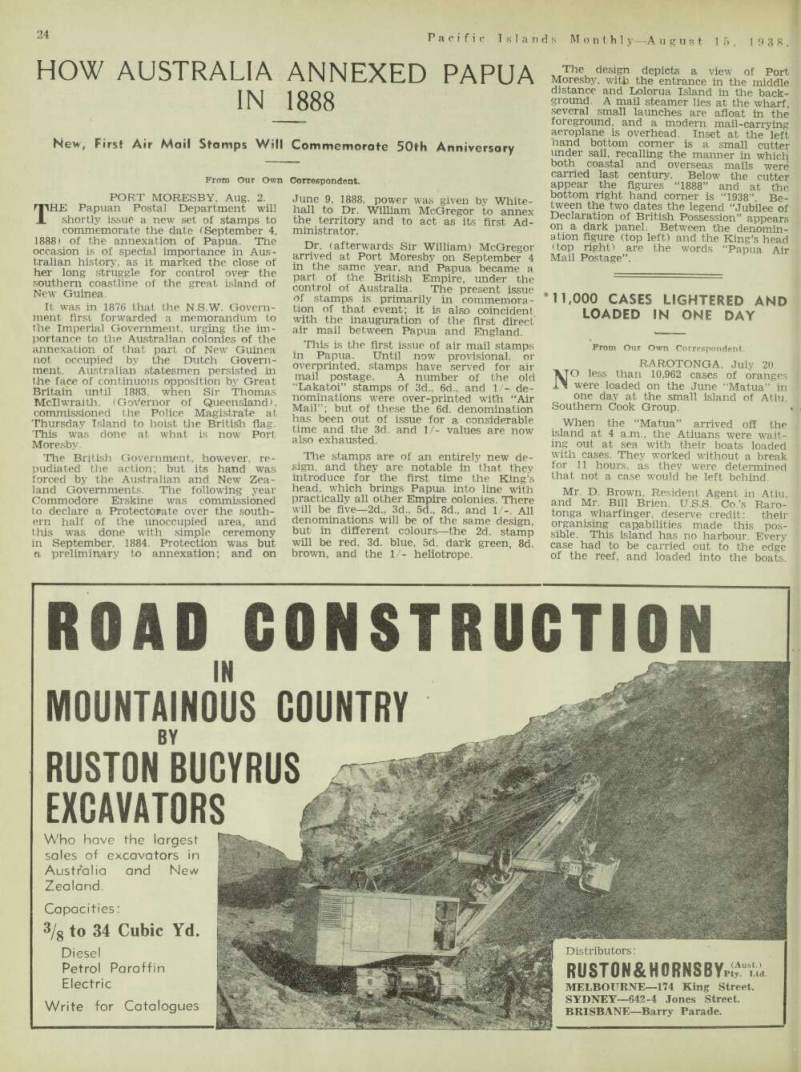
IN 1888 New, First Air Mail Stamps Will Commemorate 50th Anniversary
Prom Our Own Correspondent.
Port Moresby. Aug. 2.
THE Papuan Postal Department will shortly issue a new set of stamps to commemorate the date (September 4, 1888) of the annexation of Papua. The occasion is of special importance in Aus tralian history, as it marked the close of her long struggle for control over the southern coastline of the great island of New Guinea.
It was in 1876 that the N.S.W. Govern ment first forwarded a memorandum to the Imperial Government, urging the im portance to the Australian colonies of the annexation of that part of New Guinea not occupied by the Dutch Govern ment. Australian statesmen persisted in the face of continuous opposition by Great Britain until 1883, when Sir Thomas Mcllwraith. (GoVemor of Queensland), commissioned the Police Magistrate at Thursday Island to hoist the British flag.
This was done at what is now Port Moresby.
The British Government, however, re pudiated the action: but its hand was forced by the Australian and New Zea land Governments. The following year Commodore Erskine was commissioned to declare a Protectorate over the south ern half of the unoccupied area, and this was done with simple ceremony in September. 1884. Protection was but a preliminary to annexation; and on
June 9, 1888, power was given by White hall to Dr. William McGregor to annex the territory and to act as its first Ad ministrator.
Dr. (afterwards Sir William) McGregor arrived at Port Moresby on September 4 in the same year, and Papua became a part of the British Empire, under the control of Australia. The present issue of stamps is primarily in commemora tion of that event; it is also coincident with the inauguration of the first direct air mail between Papua and England.
This is the first issue of air mail stamps in Papua. Until now provisional, or overprinted, stamps have served for air mail postage. A number of the old “Lakatoi” stamps of 3d., 6d.. and Ide nominations were over-printed with “Air Mail”; but of these the 6d. denomination has been out of issue for a, considerable time and the 3d. and 1/- values are now also exhausted.
The stamps are of an entirely new de sign. and they are notable in that they introduce for the first time the King : s head, which brings Papua into line with practically all other Empire colonies. There will be five—2d., 3d.. 5d., Bd.. and 1/-. All denominations will be of the same design, but in different colours—the 2d. stamp will be red. 3d. blue, sd. dark green, Bd. brown, and the 1/- heliotrope.
The design depicts a view of Port Moresby, with the entrance in the middle distance and Lolorua Island in the back ground. A mail steamer lies at the wharf, several small launches are afloat in the foreground, and a modern mail-carrying aeroplane is overhead. Inset at the left hand bottom comer is a small cutter under sail, recalling the manner in which both coastal and overseas mails were carried last century. Below the cutter appear the figures “1888” and at the bottom right hand corner is “1938” Be tween the two dates the legend “Jubilee of Declaration of British Possession” appears on a dark panel. Between the denomin ation figure (top left) and the King’s head (top right) are the words “Papua Air Mail Postage”.
11,000 Cass Lighred And
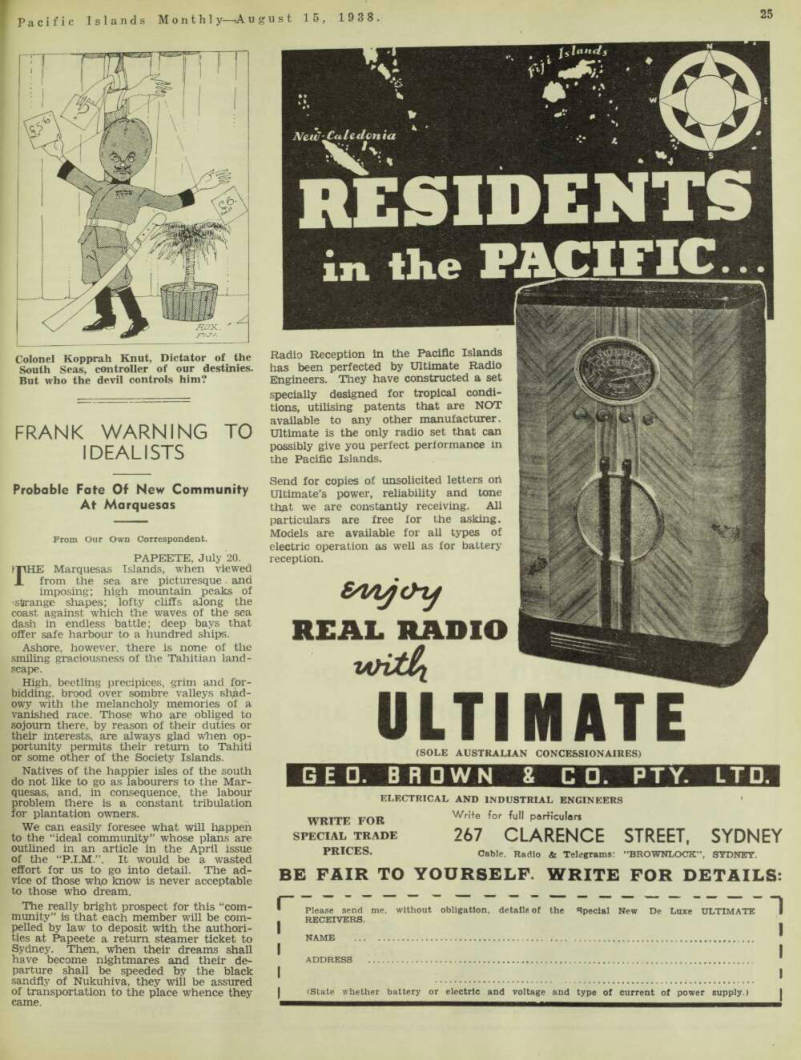
Loaded In One Day
From Our Own Correspondent.
Rarotonga. July 20.
NO less than 10,962 cases of oranges were loaded on the June “Matua" in one day at the small island of Atiu, Southern Cook Group.
When the “Matua” arrived off the island at 4 a.m., the Atiuans were wait ing out at sea with their boats loaded with cases. They worked without a break for 11 hours, as they were determined that not a case would be left behind.
Mr. D. Brown. Resident Agent in Atiu, and Mr. Bill Brien, U.S.S. Co.’s Raro tonga wharfinger, deserve credit: their organising capabilities made this pos sible. This island has no harbour. Every case had to be carried out to the edge of the reef, and loaded into the boats.
Colonel Kopprah Knut, Dictator of the South Seas, controller of our destinies.
But who the devil controls him?
Advertisements & other items, p. 28 (2 items)
24
Pacific Islands Monthl y—A ugust 15, 1 938.
Road Construction
Who hove the largest sales of excavators in Australia and New Zealand.
Capacities: 3/s to 34 Cubic Yd.
Diesel Petrol Paraffin Electric Write for Catalogues 3.
AM ■ •m ■ KJ i Wife IN
MOUNTAINOUS COUNTRY
BY
RUSTON BUCYRUS /r*-
EXGAVATORS
RUSTON&HORNSBYp^
MELBOURNE—I 74 King Street.
SYDNEY—642-4 Jones Street.
BRISBANE —Barry Parade.
Frank Warning To
Idealists
Probable Fate Of New Community At Marquesas
From Our Own Correspondent.
Papeete, July 20.
iTUIE Marquesas Islands, when viewed JL from the sea are picturesque and imposing; high mountain peaks of 'Stirange shapes; lofty cliffs along the coast against which the waves of the sea dash in endless battle; deep bays that offer safe harbour to a hundred ships.
Ashore, however, there is none of the smiling graciousness of the Tahitian land scape.
High, beetling precipices, grim and for bidding. brood over sombre valleys shad owy with the melancholy memories of a vanished race. Those who are obliged to sojourn there, by reason of their duties or their interests, are always glad when op portunity permits their return to Tahiti or some other of the Society Islands.
Natives of the happier isles of the south do not like to go as labourers to the Mar quesas, and, in consequence, the labour problem there is a constant tribulation for plantation owners.
We can easily foresee what will happen to the “ideal community” whose plans are outlined in an article in the April issue of the “P.1.M.”. It would be a wasted effort for us to go into detail. The ad vice of those wh,o know is never acceptable to those who dream.
The really bright prospect for this “com munity” is that each member will be com pelled by law to deposit with the authori ties at Papeete a return steamer ticket to Sydney. Then, when their dreams shall have become nightmares and their de parture shall be speeded by the black sandfly of Nukuhiva, they will be assured of transportation to the place whence they came.
Advertisements & other items, p. 29 (2 items)
25
Pacific Islands Monthl y—*A ugust 15, 1938.
Ultimate
Radio Reception in the Pacific Islands has been perfected by Ultimate Radio Engineers. They have constructed a set specially designed for tropical conditions, utilising patents that are NOT available to any other manufacturer.
Ultimate is the only radio set that can possibly give you perfect performance in the Pacific Islands.
Send for copies of unsolicited letters oh Ultimate’s power, reliability and tone that we are constantly receiving. All particulars are free for the asking.
Models are available for all types of electric operation as well as for battery reception.
REAL RADIO
L
ULTIMATE
(SOLE AUSTRALIAN CONCESSIONAIRES)
GEO. BROWN X CD. PTY. LTD
ELECTRICAL AND INDUSTRIAL ENGINEERS *
WRITE FOR Write for full pemculors
special trade 267 CLARENCE STREET, SYDNEY
PRICES. Cable. Radio & Telegrams: “BROWNLOCX”, SYDNEY.
BE FAIR TO YOURSELF. WRITE FOR DETAILS: Please send me, without obligation, details of the Special New De Luxe ULTIMATE
RECEIVERS.
NAME
I
ADDRESS 1
I I (State whether battery or electric and voltage and type of current of power supply.)
Criticism Of A Film
WE have received a number of letters commending the criticism we made of the film “Hurricane”, presented in cinema theatres throughout the world recently as an authentic cross-section of life in French Oceania.
“One crowning absurdity follows an other in the course of this film”, says one writer. “No one has ever seen a French Governor of the type depicted here. One or two queer persons have come into the Pacific in one guise and another, but none like the Governor de picted by Raymond Massey was ever despatched by the Government of France to any of her colonies.
“Such a scene as that shown in the Cercle Hibiscus’ is, in fact, impossible, as anyone who knows Papeete would say. A gendarme sits always at the first table just inside the door of such places, and any unruly people are re moved in a few moments.
“However, the outstanding error in the production of the film is the manner in w T hich the French establishments have been purged of Chinese. Fancy showing scenes from Tahiti —and not a single Chinese anywhere in sight!”
The War Of The “Capital Site”
Interesting Features of Griffiths Committee's Report on New Guinea Inquiry
RESIDENTS of New Guinea probably will be interested in the sequence of events—some of them of a strange character—which led to the selection of Salamaua as the new administrative headquarters of the Territory;— May 29, 1937. —Eruption of volcanoes compels complete evacuation of Rabaul.
June. 1937. —Large numbers of women and children from Rabaul are sent to Australia. Sharp exchanges between Ad ministrator and European civil popula tion, owing to former insisting that Ra baul was safe and suitable for re-occu pation.
July, 1937. —Commonwealth Govern ment announced that it would obtain, first, a report by expert vulcanologists as to whether Rabaul was safe and oc cupiable: and, if it were not, an expert committee would then be appointed to make an investigation and recommend a suitable site for a new “capital” in New
Guinea. Dr. C. E. Stehn (expert on volcanoes, from the Dutch East Indies), and Dr. W. G. Woolnough (Common wealth geologist), sailed from Brisbane for Rabaul on July 16.
August, 1937. —At a meeting of the Legislative Council, in Rabaul, certain leading officials informally brought up the question of a new capital site, dis cussed Salamaua, produced a large map of Salamaua, and invfted members to consider the claims of Salamaua as a suitable headquarters for the Adminis tration.
November, 1937. —Experts advise Com monwealth Government in emphatic terms, that volcanic activity may recur at any time at Rabaul, and recommend the early removal of the administrative centre to another site. Administrator called urgently to a conference in Can berra.
January, 1938. —After inexplicable de lay, it was unofficially announced that the “expert” committee to select the new site would not comprise experts at all.
Strong protests were made to the Prime Minister about the delay, and the failure to appoint the promised committee of ex perts. Finally, at the end of January, the appointment of Messrs. Griffiths (former Administrator) Thomas (finan cial adviser) and Thornton (engineer) was announced, and generally approved.
February 12 to April 21, 1938. —Griffiths committee visits New Guinea, care fully examines every suggested site, stud ies the probable requirements of the Territory in maintaining the present in dustries and developing new ones; and submits report to Commonwealth Gov ernment on April 27.
May, 1938. —Canberra “sits tight” on report until late in May. Meanwhile, the report and recommendation of the committee (the tableland at the back of Lae) were communicated to the Admin istrator at Rabaul; and it is evident that the latter made certain urgent represen tations to Canberra. On May 30, the new Minister for the Territories (who had never been in New Guinea before) left by aeroplane for Rabaul.
June 1-June 10, 1938.—Mr. Hughes and the Administrator fly hither and thither about the Territory, glimpsing a few suggested sites from the air. Mr, Hughes returns to Sydney on June 12; and, late in the month, Canberra announces that on Mr. Hughes’s recommendation, Sala maua has been selected as the “new capital site”. The expert committee’s re port is thrown aside. No men experien ced in tropical administration, or tropi cal hygiene, or civil engineering, appear to have been consulted. A very brief re port is made to Parliament, and the necessary enabling legislation is rushed through by Mr. Hughes in the last few hours of the session.
July, 1938. —The Administrator, accom panied by two or three officials of the Public Works and Lands Departments, proceeds forthwith to Salamaua “to lay out the new capital”. It is now reported from several sources that at least £250,- 000 will be needed to reclaim the malar ial swamps, before the building of the new town can be attempted; and no pro vision has been made in Mr. Hughes’s impulsive plan for any such expenditure.
Canberra is faced with the following al ternatives; (a) find another quarter mil lion or so for the establishment of the capital at Salamaua; or (b) seek a site other than Salamaua or Lae; or (c) re turn to the plan of the Griffiths com mittee; or (d) leave the capital at Ra baul, thus saving the Territory at least £500,000 of expenditure, and ignore the report of the vulcanologists, and the ap parent danger of another eruption.
Advertisements & other items, p. 30 (1 item)
Cordage and
Woven Wire for all Industry
COPRA DRYING TRAYS, FLOORS. Etc.
FRUIT DRYING TRAYS, MINING SCREENS
Heavy Mosquito Gauze in Phosphor Bronze and other Metals Impervious to Salt Sea Air WIRE DOOR MATS AND GENERAL WIRE WORKS
E. WRIGHT & CO. LTD.
Office and Work*: 148-152 Cleveland Street, Sydney, N.S.W.
Telegraphic Address: " Wrightmake," Chippendale
Scott’s “Renown” Brand Rope,
Cordage and
Binder
Twine
Cable Address Ropeyard Sydney
■MSI
of Every
Description
MANUFACTURED AT
MASCOT. N.S.W.
J. SCOTT
PTY. LTD.
Head Office and Store:
163 CLARENCE STREET,
SYDNEY
N.S.W.
Huon Pine Boat Planks
Practically Borer Proof and Everlasting, also Spotted Gum Timbers —Prices Right.
A >-n p 110 Miller St.i A. C. rryer p yrmo nt. n.s.w.
The Griffiths Report—Why Lae Was Recommended
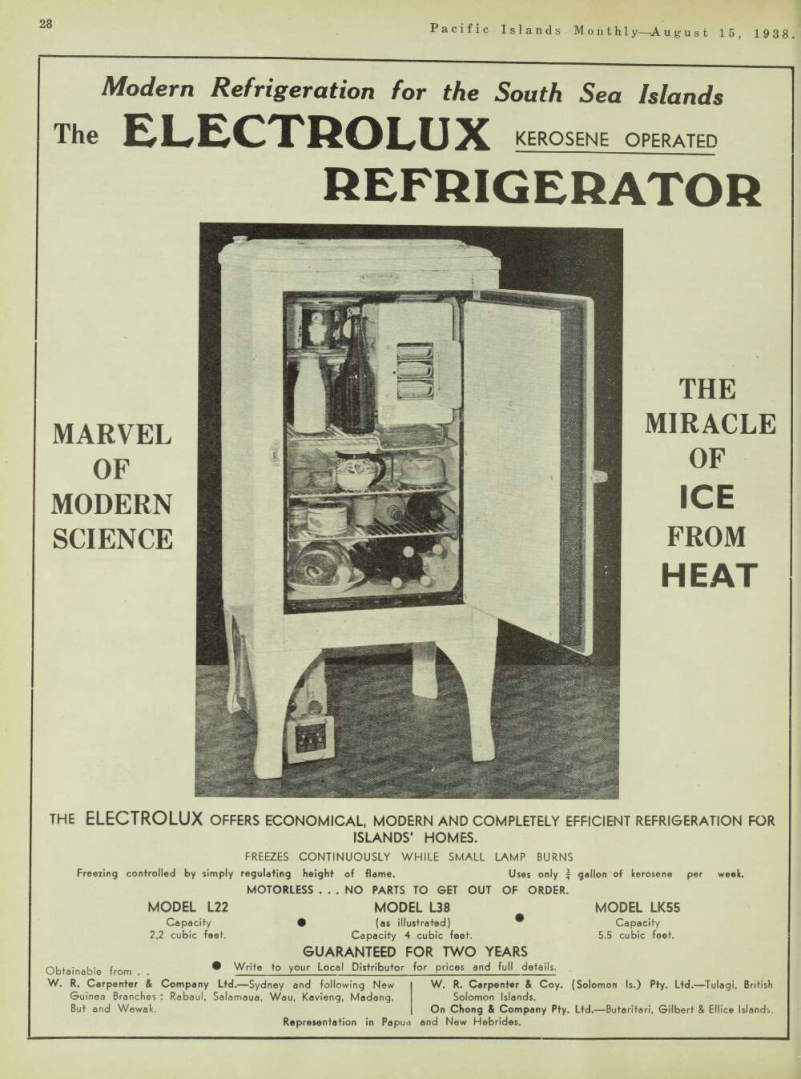
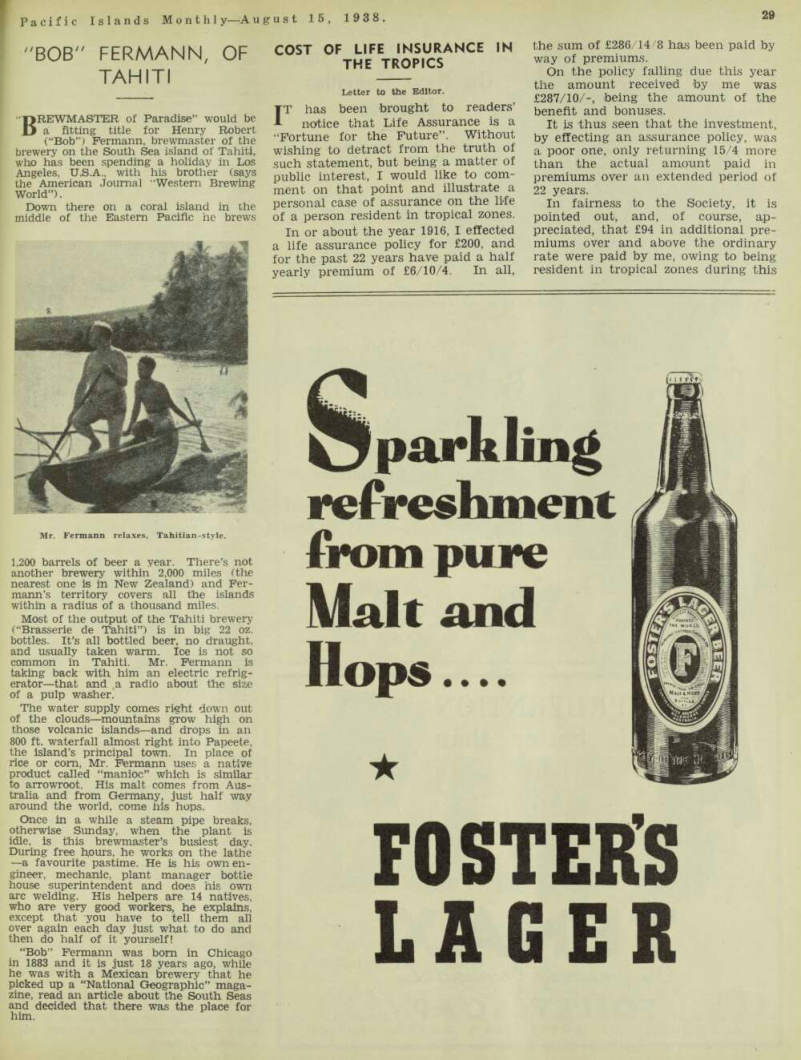
—Numerous Factors Considered
mHE tragedy of the Hughes-McNicoll X interference with the Griffiths report becomes evident as soon as the re port is perused.
With typical political cunning, Mr.
Hughes did not make the Griffiths report available to members of Parliament un til a few hours before he rushed through his enabling legislation, and no one had a chance to study it. If it had been printed and circulated, it is unlikely that the Hughes-McNicoll plan, to plant the administrative establishment in the swamps of Salamaua, would have been approved.
The “P.1.M.” did not see a copy of the report until late in July. It is impos sible to reproduce, in full, the lengthy and comprehensive document; but the following extracts will be of interest to all residents of New Guinea and Papua, and they will show how thoroughly the members of the Committee (Brig.-Gen eral T, Griffiths, Mr. W. C. Thomas and Mr. L. Thornton, 8.C.E., M.T.C.P.1.) did their work.
First, the nature of the instructions given to the Committee should be noted.
They are informed by Canberra that the report of the vulcanologists make it ne cessary that a new site for the adminis trative establishment be found; and the conditions for which they are to seek are clearly set forth. For instance: — “The Committee is required fully to inquire . . . having regard to suitability from the point of view of administration and the relations of the Administration with the Commercial, Agricultural, Min ing and other activities of the Territory.
It is desired that the Committee ap proach the matter not only from the point of the most suitable and conveni ent location for the present circumstan ces of the Territory, but also having in mind the probable expansion and devel opment of the Territory”.
Danger Of Tidal Waves
The Committee gave particular care to the following, from the vulcanologists’ re port:—
“Along all coast lines in the area, and especially the north coasts of New Guinea and New Britain, the possibility of dis astrous tidal waves, though not alarm ingly acute, must always be reckoned with. As far as possible, the business and residential areas of coastal towns should be kept back from the shore and should be not less than 100 feet above sea-level. It is recognised that this may involve a small recurrent charge for transportation of goods from ship to shore, but this should be regarded in the light of insurance against tidal wave risks. This consideration would appear to have considerable weight in reference to Salamaua”.
Mainland Favoured
The Committee carefully examined all the circumstances of suggested sites on other islands —especially Kavieng—but concluded that the new site must be on the mainland: — “The present stage of gold production on the mainland, the possibility of the extension of the now known life of the fields, the great agricultural and pas toral potentialities of the extensive val leys of the Markham and Ramu Rivers, and the immense timber resources, point unmistakably to the fact that the main land will provide the greatest future development of this Territory”.
The Committee then proceeded to con sider the various mainland sites, as fol lows: — “WAU: Situated at an altitude of about 3,500 feet, Wau has a pleasant, temperate climate. It is inaccessible ex cept by air, but that inaccessibility will disappear with the construction of a road to the coast. The great disadvantage of Wau from the point of view of a capital
(Continued on Page 57)
site is that it is predominantly a mining centre. The whole of the Wau and Bu lolo Valleys is held by companies and in dividuals under mining leases and claims, and there are not any large ag ricultural areas available to maintain a town when the mining wanes, as it must inevitably do. The representations of the Wau people, that it should be the capital were prompted in most cases, we found, by their desire for a road to Sala maua or Lae. They reason that such a road must be built at once if the Admin istrative centre is placed at Wau. ft ap pears to us, however, that the economic needs of the highly productive district require the construction of a road at no distant date, and that it does not need the location of the Central Administra tion at Wau to ensure this facility. The cost of early transfer to Wau would be particularly heavy, and the cost of ad ministering the Territory from that cen tre would be higher than in any other place except the Ramu district, in view of the necessity to use air transport pending the construction of a road to the coast. The surrounding area is an endemic focus for tropical ( endemic) typhus, many cases of which have oc curred (with deaths). The particular mite vector has not yet been discovered.
Although Wau township is fairly clear of malaria, the whole of the valleys of the Bulolo and Watut rivers are malarious.
The district is practically free from seis mic disturbance but the site does not otherwise possess those attributes which we think ought to be associated with the new capital.
“Ramu River Headwaters;
There is an extensive plateau on the upper Ramu River, reaching an altitude of about 5.000 feet, and the climate is reported to be mild. Such inquiries as we have been able to make indicate an excessive amount of low cloud formation mav have an adverse effect on health. There is not sufficient informa tion available to enable us to determine the health conditions of this area. The soil is evidently very fertile and the prospects of large agricultural and pas toral development seems to be distinctly promising. The existence of a large na tive population, however, would very likely preclude extensive white settle ment for which there is greater scope in the lower valleys. The position is remote and would necessitate a road either to Madang or Lae. This . road
would probably be about 150 miles in length if taken to Madang, and over 100 miles in length if taken to Lae; it would take time to construct, so that early transfer could not be commenced unless costly aeroplane transport were used.
The remoteness of this area, the lacK of definite knowledge of health conditions, and the length of time required for its development to a stage at which trans fer could be started render it unsuitable for present needs, and, as we are re quired to consider present as well as future requirements, we do not feel we can recommend this site. Development will undoubtedly occur here as time goes on. but present conditions are not fav ourable to its choice as a capital site.
Moreover, there is not sufficient reliable data available as to general and seismic conditions, though it should be practic ally free from volcanic disturbance.
“Markham River Headwaters;
Our remarks on the Ramu River head waters also apply generally to this area, except that there is not a large native population here, and white settlement could be more extensive.
“MADANG has extremely good har bour facilities and it could be developed into a first-class port. The area avail able for township extension is limited however, and the placing of the Central Administration here would necessitate costly resumption of private property.
Such resumption would be quite justified if Madang became the headquarters of the Administration, but the fact that Madang is so close to the line of vol canic weakness referred to in the Vul canological Report is, we think, a very great disadvantage. N. de M. Maclay. who visited this coast in 1871, 1876, and 1883. reported strong seismic activity in this area. Further, the site is on the coast, at sea-level, and is likely to suffer severely from a tidal wave of more than small dimensions.
“It has been represented to us that the suggestion in the Appendix to the Vulcanological Report that coastal towns should be at least 100 feet above sea level to avoid the effect of disastrous tidal waves is a counsel of perfection, and that it should not be a factor of vital importance in the choice of a site to replace Rabaul as the centre of gov ernment. It has to be remembered, how
ever, that tidal waves havq occurred on the New Guinea coast. In December, 1930, a tidal wave about 15 feet high was experienced at Gragat Island, in front of Madang Harbour. This wave was about 10 feet high at Modilon plan tation, which adjoins, and it caused a good deal of damage north of Madang.
The natives in this area stated that a similar occurrence was experienced about 40 years previously. We feel we cannot ignore the possibility of trouble of this nature overwhelming a coastal town not protected against it by adequate eleva tion.
“There is no suitable elevated terrain reasonably close to Madang, and to place the Administrative Headquarters on flat country far enough from the coast to break the effect of a large tidal wave and yet close enough for quick access to the port would necessitate wholesale dispossession of natives, with which the district is thickly populated. There is no need for the Committee to stress the undesirability of such a course, which would mean endless trouble with the na tives and be contrary to public opinion.
In and around Madang there is less variation in temperature and humidity (both day and night) thah in any other coastal town in the Territory, and hot nights are the rule, rather than the ex ception.
“FINSCHHAVEN is not well placed as regards the future development of the Territory and is too close to the volcanic region at the western end of New Britain to be considered as a capital site, while more advantageous sites are available.
“ALEXISHAVEN (Sek): Much the same comments may be made on Alexis haven, where there is a good harbour but practically no land not occupied by natives or given over to mission activi ties. There are also extensive swamp areas in the vicinity.
“The mouth of the SEPIK RIVER is also too close to the volcanic zone, is flat country very little above sea-level, contiguous to immense swamps, and could not be occupied without considerable development. The cost of making any portion of the lower Sepik medically fit for the establishment of a port or capi tal would be colossal.
“MOROBE has a fair harbour (ADOLFHAVEN) but here also are large swamp areas. Health conditions, as known, are not good, the elevated coun try in the vicinity is, for the most part, too steep to permit of use as a capital site, and it is further from the centre of development than two other places, which have greater advantages, namely, Salamaua and Lae.
“SALAMAUA is a port of call for oversea vessels. The harbour is not good, but is capable of being developed into a reasonably effective port. The existing town is built mostly on a low lying isthmus, and the other land avail able is distinctly circumscribed, there being insufficient area available for the expansion which would follow the es tablishment of the Administration Head quarters at this place.
“In our remarks on Madang we have referred to the question of protection from possible tidal waves. Such protec tion seems to be essential at Salamaua which is said to be susceptible to such phenomena. Mr. Fisher’s memorandum mentions a tidal wave of 30 feet in 1888 that probably affected this area. In our opinion, it would be unwise to use any of the flat land for town purposes.
There is elevated land at Parsee Point and also at Kila Point, but we doubt that there are sufficient areas at these points for the needs of the seat of Ad
ministration as it now stands, let alone the future growth which must be anti cipated. In our view, the elevated parts of Salamaua will be required for purely local needs, connected with the develop ment of Salamaua as a port.
“The aerodrome area and, to a less ex tent, the Kila area, is still definitely and continually malarious, in spite of anti malarial measures. The type of malaria is a malignant sub-tertian, with a ten dency to development of Blackwater fever.
Selection Of Lae
“LAE is situated on the coast, in Huon Gulf, about 20 miles from Salamaua, but close to the shore there is elevated land about 100 feet above sea-level. Series of terraces extend for a considerable dis tance and these are capable of accom modating a large town. In addition, a number of small spurs would provide de sirable sites for residences. Lae enjoys great freedom from seismic disturbances, and is the only suitable coastal site where there is no risk of inundation by tidal wave. Unfortunately, there is no harbour and the shore waters are too deep to provide safe anchorage in bad weather. Notwithstanding this disadvan tage, the Committee regards Lae as a suitable place for the Administrative Headquarters of the Territory and re commends its selection”.
The data on which this recommenda tion is based are set forth at length later on in the report. They may be sum marised thus:— 1. —Comparative freedom from seismic disturbances and volcanic activity. 2. —Healthy climate and comparative freedom from disease. 3. —Proximity to a suitable port. 4. —Freedom from tidal wave influence. 5. —Suitability from the point of view of administration and the relations of the Administration with the Commercial.
Agricultural. Mining and other activities of the Territory. 6. —Absence of a large native popula tion which would have to be dispossess ed of the site land. 7. —Suitable tonography for a city site, having in view future expansion. 8. —Prospects of a good water supply. 9. —Freedom from expensive existing development, involving costly resump tions.
10.—Availability in the locality of a plentiful supply of materials of construc
tion and sources of powen 11. Provision for possible Civil Aviation requirements 12. General suitability of site. 13. Possibility of early transfer of personnel from Rabaul.
The report proceeds:—
Salamaua As A Port
“We suggest that the port for the Administrative Headquarters be Salamaua.
By means of a road between the two places, people arriving by sea and desiring personal contact with the Administration could reach the administrative centre in a short time.
“If, however, Salamaua is to give proper service as a port, it will have to be developed. The choice of Lae as the administrative centre will, we believe. make Salamaua, in time, the chief port °* t] ? e . Territory We agree with the Administrator when he says that the chief administrative port is the front dpor of the Territory; that many overseas vessels will call but for a day at a time and will visit no other port; that many overseas passengers, visitors and tourists will see no more of the Territory than that port; and that its wharves. works, buildings, and general layout and appearance should be a source of pride to the Territory and to the Commonwealth Government.
“We think the first stages of development. such as the provision of wharves. should proceed hand-in-hand with the transfer of the administrative centre for Rabaul to Lae. Until wharves are built at Salamaua and a road constructed from the port to Lae, there is little doubt that overseas vessels would call at Lae to disembark passengers and discharge cargo for the administrative centre.
“In regard to the suggested road, we would say that Salamaua seems to be the only port possible in the district. and the Markham River Valley will have to be served by this port, as the Goldfields are now. A road from Salamaua, through the Markham River Val-
&S3S Sstjsgsi
f e malnfand^f o^^ 6 Guinea
Th * f . J
constructed^
on the Markham River whence a short section would connect with Lae w u WIWI ae -
Lae’S Geographical Importance
“The commercial centres at Madang and Salamaua are within easy reach of Lae.
The commercial interests at Rabaul will be at a considerable disadvantage compared with their present position, but we believe that the principal companies, with territory-wide interests, will make their own arrangements to fit the new circumstances. The agricultural centres of Rabaul, Kavieng and Kieta will be farther awav, but the agricultural and pastoral centres of the Markham and Ramu Rivers are within easy access of Lae i<? n „4. lpf fnr of the bv the Mark!
ham River tbl wS
and Bilolo rS tLtabled
inland Mount and the Dutch border, and embraced by the Upper Tauri, Vailala and Purari Rivers, which reach the Gulf of Papua, and the Ramu River, which flows through the Madang District. These areas offer exceptional possibilities for agricultural development.
The altitude of the fertile and wellwatered valleys provides a wide range of climate variation up to 5,000 feet, and also altitudes with the mountain systems reaching to a height of 15,000 feet.
“The large native population, estimated as at least 150,000 in the Upner Ramu and Purari Valleys, and 80,000 ih the country adjoining the Markham Valiev provides a potential labour supply for develon mental work » A rpnort nrpnarpd in iqos hv rvr r
S&Tssthj
dicate the Potentialities of the Markham River Valley. (This report appears as Appendix D.) ‘ <The min ing districts will be brought closer to the Central Administration, and the areas of probable oil discovery are capable of quick control from Lae.
“Should it be decided, at some future date, to place the Territories of Papua and New Guinea under one Administration, Lae would be a suitable centre from which to administer the combined Territories.”
Salamaua Versus L^E
™ Tl J e Committ ee make the following com
ment' 1
“The Administrator personally favours Salamaua as port and capital, or Sala maua as the port, and the capital at an inland site in one of the high river valleys, He thinks, however, that the expense in volved in an inland capital seems to be un necessary and unwise, having in mind additional cost of developing a port to serve the capital. This objection holds Cloned L ana nort, b vel °ped apart from the port at Sala
maua*
“ We have already given our reasons not selecting an inland site, and it * s our opinion that no saving of expen diture on necessary works over the cost °t the Lae selection would result from combing the capital with the port at Salamaua.
“The capital would necessarily have to
be placed at the rear of the low hills sur rounding Salamaua, if it were to be de signed so as to have the essential dignity and charm which should be inseparable from a seat of Government. If so sited, there would, owing to unsuitable topo graphy, be an excessive amount of ex penditure, for the expenditure ultim ately necesary for the port would be equally unavoidable.
“It is not considered that the cost of developing a town at Lae, plus a port at Salamaua, would be any greater than that of developing both capital and port at Salamaua. This does not take into account the cost of connecting a road between Lae and Salamaua, which will be necessary, in any case, to provide the connection to the port of the Markham Valley and adjacent areas.
“Salamaua has one big advantage over Lae in that it has a harbour which can be developed without great cost; while Lae, as we have pointed out, is an open roadstead. After most careful examin ation of the position, we give It our con sidered opinion that the port is Sala maua’s only advantage over Lae, and that other advantages which Lae has over Salamaua make it a better site for the new Administrative centre.”
The Morobe Road Problem
The Committee deals at length with the road problem, as affecting Wau, Sala maua, Lae, and the Markham-Ramu con nection: — “There is no doubt that a develop • mental road must sooner or later tra verse the Markham River Valley. Lae is the natural outlet of this valley but, ow ing to the unsuitability of Lae as a port, the road must be diverted to Salamaua.
“A road is also required to the gold fields.
“There are, to date, three propositions for a road from the coast to the goldfields.
The first (a), is the direct road from Salamaua to Wau —Bergin’s Survey or its variation via the Bitoi River throughout.
The second route (b) is via the coast from Salamaua to the Buang River, thence via that river to the Snake River, to link with the existing road from Wau to Sunshine (near Bulwa). The third route (c) is from Lae, via the Mark ham and Wampit Valleys, to link with the existing road at Sunshine.
“Assuming that the Administration in tends to use the first route (a) it is questionable whether it is wise to build that road before any others, having in mind considerations connected with the location of the Administrative Head quarters at Lae.
“The developmental road, to serve the Markham and Upper Ramu Valleys, was commenced some years ago, and about 20 miles have been cleared and formed.
Whether the road follows the best location is a matter for consideration in the light of the newest development, and will be referred to later. It is vital for develop ment that this road be put into suitable order for traffic at the earliest possible moment, and it will be essential to carry the road on to Salamaua as the only pos sible port. There is also the necessity for the early linking up of the proposed capi tal, Lae, with its port, Salamaua. Both of these considerations require the bridging of the Markham River as near its mouth as possible. Route <c) to the goldfields also requires the bridging of the Markham River, but not necessarily near its mouth.
“Some day, the potential agricultural land on the south side of the Markham River and its tributary valleys will also have to be connected with its outlet, Salamaua, “If a road system could be planned so
as to achieve all these objects, with the miniiVmolwork, the scheme obviously
Pi » e <?r
wha«v£or not alternative routes may come later 11C!
“The whole matter hinge on the site for the over the Markham River. We gave Partimar attention to this matter and located what we regard as the most favourable site from %
'tf&SSSS*
confirmed by inspection on me grouna.
“If the bridge were sited, as suggested, it would fulfil all the requirements enumerated above. Firstly, it would give the
mauaf 4 Secondlyf 0 it*
ivTarkham Valiev road to be diverted to MSSSS Itthe most favourable point,
namely nearest to Its outlet end. Thirdly, the Lae-Bulolo roaa (route c) could be n z bridge head to Gabansfc landing^und. stream of the Wampit River to Wampit landing ground, linking up there with the old rou t e , (c) to Bulolo. This proposal would automatically provide the shortest connection to Salamaua of the agrl cuitural land on the south side of the
M "r e tos asTMs
Sss“
Dredging , Limited and, at the time, a S it e between the junctions of the Erap Wampit Rivers with the Markham Ri ve r was favoured. . . .
"At this site the distance between per manent banks Is slightly over a mile, of which only 1450 feet were to be bridged.
The remainder consists of mud and gravel flats containing numerous water courses which the river occupies in flood time. There is no guarantee that the river will remain in its present channel and the bridge would then be rendered useless. Even assuming that the river does not move, there would doubtless be endless washouts and blockages to traffic with every flood.
“At the site we suggest, however, there are permanent banks at about 1,800 to 1,900 feet apart. This means a slightly longer bridge, but no likelihood of any troubles on the approach road.
“On the question of the present loca tion of the Markham road ... it will be necessary to construct a short new road connecting the bridge head with the exist ing Markhan road. It may, in our opinion be preferable to continue this road close along the northern end of the river to
serve the Markham Valley, rejoining the present road further west . .
Future Of Rabaul
“The Administration considers that a staff of approximately 54 will be needed to carry out the usual district services, and provision will have to be made for these people at some local area outside the influence of the Rabaul volcanoes.
We have not addressed ourselves to the question of finding a suitable place for this staff. The matter, we believe, can be dealt with as one of internal admini stration.
“The cost of establishing the Rabaul district services outside the volcanic area of this locality would be approximately £45,000. This estimate of cost is based on the staff residing out of Rabaul, but carrying on the district services from Rabaul itself. This arrangement may be satisfactory if regarded as a temporary
measure, having in view gradual trans fer to a site outside Rabaul. We think, that, as a permanent arrangement, it would not be in accordance with the Commonwealth Government’s wishes, and that it would be open to strong criticism in the event of another volcanic eruption at Rabaul.”
Advertisements & other items, pp. 31-32 (1 item)
Cfjris 49Craft
■maF
. . . Owned . . .
IN EVERY PART OF THE WORLD
A FEW DISTINGUISHED CLIENTS
WHO HAVE PURCHASED
Chris Craft Boats
H.H. The Sultan of Pehang.
His Grace The Duke of Sutherland.
Commander Lord Louis Mountbatten,
K.C.V.0., R.N.
The Earl Howe, P.C., C.8.E., V.D.,
R.N.V.R.
Lord Weir of Eastwood.
Sir Perclval Perry.
The Hon. J. Mlchelham Captain D’Arcy Rutherford.
Lt. Comdr. Glen Kidston, R.N.
Miss M. B. Carstairs.
T. O. M. Sopwith, Esq.
Captain J. A. Holder F. A. White, Esq.
G. Dick, Esq.
R. B. Pope, Esq.
Commander C. W. Craven.
E. Kingsman, Esq.
Baron Phillipe do Rothschild.
Sole Agents in Australia :
Or. E. Etchegoin (Champion of France.) M. Schoeller (President Yacht Moteur Club de Prance.) M. Lindenmeyer (Vice-President du Club de Marseille.) M. Girod (President du Cercle de lo Voile de Cannes.) Commodore Louis Beaumont.
L. J. Bentley, Esq M. Leon Volterra.
Telephone: BW 1851. PAUL AND GRAY, LIMITED. After Hours: PU8965.
82 SUSSEX STREET, SYDNEY.
Boatsheds and Slipways, Careening Cove. XB 3021.
RONDAHL LTD., RABAUL. SUB-AGENT; MANDATED TERRITORIES.
BRANCHES: MELBOURNE, BRISBANE, ADELAIDE, LONDON.
Modern Refrigeration for the South Sea Islands
The ELECTROLUX
KEROSENE OPERATED
MARVEL
OF
MODERN
SCIENCE
REFRIGERATOR
* mm & m . •x.::' tei. • • 0 I
THE
MIRACLE
OF
ICE
FROM
HEAT
t ■- &msmm THE ELECTROLUX OFFERS economical, modern and completely efficient refrigeration for
ISLANDS' HOMES.
FREEZES CONTINUOUSLY WHILE SMALL LAMP BURNS
Freezing controlled by simply regulating height of flame. Uses only gallon of kerosene per week.
MOTORLESS ... NO PARTS TO GET OUT OF ORDER.
MODEL L 22 MODEL L3B MODEL LKSS Capacity • (as illustrated) ® Capacity 2,2 cubic feet. Capacity 4 cubic feet. 5.5 cubic feet.
GUARANTEED FOR TWO YEARS
Obtainable from ® Write to your Local Distributor for prices and full details.
W. R. Carpenter & Company Ltd.—Sydney and following New Guinea Branches ; Rabaul, Salamaua, Wau, Kavieng, Madang, But and Wewak.
Representation in Papua and New Hebrides.
W. R. Carpenter & Coy. (Solomon Is.) Pty. Ltd.—Tulagi, British Solomon Islands.
On Chong & Company Pty. Ltd.—Butaritari, Gilbert & Ellice Islands.
"Bob" Fermann, Of
Tahiti
■ • TjREWMASTER of Paradise” would be 15 a fitting title for Henry Robert (“Bob”) Permann, brewmaster of the brewery on the South Sea island of Tahiti, who has been spending a holiday in Los Angeles, UJS.A., with his brother (says the American Journal -Western Brewing World”).
Down there on a coral island in the middle of the Eastern Pacific he brews
1,200 barrels of beer a year. There’s not another brewery within 2,000 miles (the nearest one is in New Zealand) and Fer mann’s territory covers all the islands within a radius of a thousand miles.
Most of the output of the Tahiti brewery (“Brasserie de Tahiti”) is in big 22 oz. bottles. It’s all bottled beer, no draught, and usually taken warm. Ice is not so common in Tahiti. Mr. Permann is taking back with him an electric refrig erator—that and a radio about the size of a pulp washer.
The water supply comes right down out of the clouds—mountains grow high on those volcanic islands—and drops in an 800 ft. waterfall almost right into Papeete, the island’s principal town. In place of rice or com, Mr. Fermann uses a native product called “manioc” which is similar to arrowroot. His malt comes from Aus tralia and from Germany, just half way around the world, come his hops.
Once in a while a steam pipe breaks, otherwise Sunday, when the plant is idle, is this brewmaster’s busiest day.
During free hours, he works on the lathe —a favourite pastime. He is his own en gineer, mechanic, plant manager bottle house superintendent and does his own arc welding. His helpers are 14 natives, who are very good workers, he explains, except that you have to tell them all over again each day just what to do and then do half of it yourself!
“Bob” Fermann was bom in Chicago in 1883 and it is just 18 years ago, while he was with a Mexican brewery that he picked up a “National Geographic” maga zine, read an article about the South Seas and decided that there was the place for him.
Mr. Fermann relaxes, Tahitian-style.
Cost Of Life Insurance In
The Tropics
Letter to the Editor.
IT has been brought to readers’ notice that Life Assurance is a “Fortune for the Future”. Without wishing to detract from the truth of such statement, but being a matter of public interest, I would like to com ment on that point and illustrate a personal case of assurance on the life of a person resident in tropical zones.
In or about the year 1916, I effected a life assurance policy for £2OO, and for the past 22 years have paid a half yearly premium of £6/10/4. In all,
the sum of £286/14/8 has been paid by way of premiums.
On the policy falling due this year the amount received by me was £287/10/-, being the amount of the benefit and bonuses.
It is thus seen that the investment, by effecting an assurance policy, was a poor one, only returning 15/4 more than the actual amount paid in premiums over an extended period of 22 years.
In fairness to the Society, it is pointed out, and, of course, ap preciated, that £94 in additional pre miums over and above the ordinary rate were paid by me, owing to being resident in tropical zones during this
period, and that the risk carried by the Society in the event of my death would be greater But even taking these facts into consideration, the policy as an investment shows a very small return.
Under ordinary circumstances of a person resident in temperate zones, such policy would have a return of approximately £95 in bonuses, and the fact that the assured resides within a tropical zone hardly war rants the loading of additional pre miums to diminish the return to so small an amount.
I am, etc.,
Percy J. Wood.
Samarai, Papua, June 25, 1938.
Advertisements & other items, pp. 33-34 (1 item)
Foster’S
park ling refreshment from pure Malt and Hops iiN m mi
LAGER
READ THE
B.P. MAGAZINE
SPRING NUMBER
On sale Ist. September Short Stories Pictures Travel Articles Pages for the Children Stage Latest Fashions Screen A
ONE SHILLING PER COPY
ON SALE AT ALL NEWSAGENTS AND BOOKSELLERS BP m m ID
E
Genuinely
Germicidal
PREVENTION
is better than
cure.
Disease germs such as those of Diphtheria, Malaria, Dhobie Itch, Tinea, or Surfer’s Foot cannot live under the lather of TE N A X. Besides which TEN A X, used constantly, will cure Tropical Skin Diseases.
TE N A X contains “Ti-Trol,” 11 times quicker than carbolic as a germicide, mm Containing Ti-Trol
but NON-POISONOUS and NON-IRRITANT.
“The Medical Journal of Australia” says: *’T E which may be recommended with confidence.”
N A X is a satisfactory germicidal soap
TENAX
0/u. tymuiraz/y (fyeAxnteicCajL-
TOlLET SOAP
A PRODUCT OF AUSTRALIAN SOAPS LIMITED
Effect of Christianity
On New Hebrides Natives Missionary Urges Plays And Danc ing To Combat Ennui
AFTER an absence of over 25 years, Rev. T. E. Riddle, an Auckland Pres byterian minister, recently returned to the New Hebrides to make an inspec tion visit, and on his return to N.Z. he made much interesting criticism of the present condition of the natives and ad vanced some valuable recommendations.
In contrast to anthropologists visiting
the Group, who turn their backs on the thriving communities of civilised natives and hasten to the untamed savages of Big Nambas and Santo, Mr. Riddle’s supreme interest was to study the impact of Christianity upon the natives who came under its sway. His Indian experience taught him to recognise that in presenting natives with the Christian outlook, linked with the amenities of civilisation, care must be taken to avoid denationalizing the native race and disrupting the social order.
Mr. Riddle made a careful scrutiny of the thorny question of native dances and was keenly interested to learn the reaction of young missionaries to ancestral customs and practices. Before the advent of the Missions, the chief pastime of the natives was the revelry associated with their heathen ceremonies, and naturally the early missionaries were wary about lend ing countenance to amusements which might lead to a recrudescence of heathen dancing.
In the intervening years there have grown up two generations of Christian converts ignorant of the heathen practices of their forefathers. Recognising the necessity of healthy snort to meet the growing requirements of her pupils, Miss Nettie Prater introduced drill and action songs into the curricula of the Epi and ■ J aama schools. But so conspicuous has been the all-round development of the Christian natives that Mr. Riddle con siders the time opportune for granting still greater privileges and freedom of action. Accordingly he has recommended the Presbyterian Mission Synod to en courage “the young people’s natural desire for amusement through play or expression through physical movement”.
In a letter to the Synod he contends “that the iconoclastic efforts of the early missionaries went too far, and not suffici ent effort was made to conserve what was harmless or capable of cleansing”. Mr.
Riddle is persuaded that a programme for the Christianizing of play is necess ary for the Christian communities, and believes that with the help of reliable chiefs, elders, and teachers “it should be possible to introduce controlled plays, action songs, dramatics, and folk dances that would supply the want the young people now feel”.
Mr. Riddle regards it as calamitous that after 30 years of Condominium rule no assistance has ever been given to educa tion, while the grants given for medical work were only the equivalent of fees for medical services. He asserts that the failure of the Colonial Office to give grants for primary education has resulted in the New Hebrides being the most back ward in education of all the British Groups in the Pacific. Mr. Riddle sug gests that the Synod should request the Aborigines Protection Society to have a question asked in the House of Commons as to why the Colonial Office has neg lected primary education in the New Hebrides and why no effective effort at welfare work has ever been undertaken.
Mr. Riddle maintains that provision for education of a more advanced nature than that sdven by the mission schools is urgently needed.
M.F.
Mr. Edward John Hawksley died In Suva recently, at the age of 73. Born in Sydney, he went to Fiji in 1872. After returning to New South Wales for a period, he again went to Suva in 1894 and fol lowed his profession as an accountant with various firms in the Colony. He had been living in retirement in recent years, and is survived by a widow and a grown-up family.
Advertisements & other items, pp. 34-35 (3 items)
30
Pacific Islands Monthl y—<A ugust 15, 1938.
31
Pacific Islands Mon t h 1 y—A ugu s t 15, 1938.
Swat Stuff
/r's * mm V A
THtS
gives amazing performance, smooth effortless Power with no knocks, faster pick-up and more miles to the gallon. Get a new driving thrill from your car while you Save Money. Fill up with PLUME, The Economy petrol.
VACUUM OIL COMPANY PTY. LTD.
Birthday Honours For
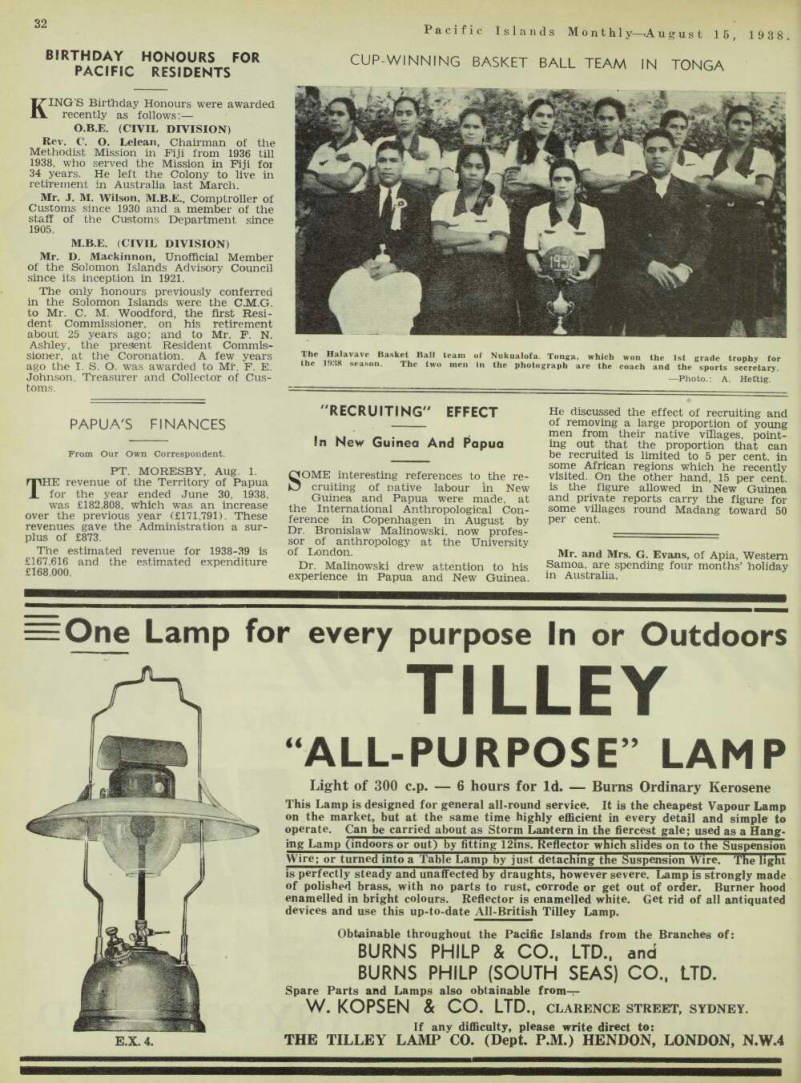
Pacific Residents
KING’S Birthday Honours were awarded recently as follows;
0.8. E. (Civil Division)
Rev. C. O. Lelean, Chairman of the Methodist Mission in Fiji from 1936 till 1938, who served the Mission in Fiji for 34 years. He left the Colony to live in retirement in Australia last March.
Mr. J. M. Wilson, M.8.E., Comptroller of Customs since 1930 and a member of the staff of the Customs Department since 1905.
M.B.E. (Civil Division)
Mr. D. Mackinnon, Unofficial Member of the Solomon Islands Advisory Council since its inception in 1921.
The only honours previously conferred in the Solomon Islands were the C.M.G. to Mr. C. M. Woodford, the first Resi dent Commissioner, on his retirement about 25 years ago; and to Mr. F. N.
Ashley, the present Resident Commis sioner, at the Coronation. A few years ago the I. S. O. was awarded to Mr. F. E.
Johnson. Treasurer and Collector of Cus toms.
Papua's Finances
From Our Own Correspondent.
Pt. Moresby, Aug. 1.
THE revenue of the Territory of Papua for the year ended June 30, 1938, was £182,808, which was an increase over the previous year (£171,791). These revenues gave the Administration a sur plus of £873.
The estimated revenue for 1938-39 is £167,616 and the estimated expenditure £168,000.
Cup-Winning Basket Ball Team In Tonga
Hal aVaVe Basket Ball team of Nukualofa. Tonga, which won the lst grade trophy for the 1938 season. The two men in the photograph are the coach and the sports secretary. —Photo.: A. Hettig.
"Recruiting" Effect
In New Guinea And Papua
SOME interesting references to the re cruiting of native labour in New Guinea and Papua were made, at the International Anthropological Con ference in Copenhagen in August by Dr. Bronislaw Malinowski, now profes sor of anthropology at the University of London.
Dr. Malinowski drew attention to his experience in Papua and New Guinea.
He discussed the effect of recruiting and of removing a large proportion of young men from their native villages, point ing out that the proportion that can be recruited is limited to 5 per cent, in some African regions which he recently visited. On the other hand, 15 per cent, is the figure allowed in New Guinea and private reports carry the figure for some villages round Madang toward 50 per cent.
Mr. and Mrs. G. Evans, of Apia, Western Samoa, are spending four months’ holiday in Australia.
Advertisements & other items, p. 36 (1 item)
Tilley
= One Lamp for every purpose In or Outdoors E.X. 4.
"ALL-PURPOSE” LAMP
Light of 300 c.p. 6 hours for Id. Burns Ordinary Kerosene This Lamp is designed for general all-round service. It is the cheapest Vapour Lamp on the market, but at the same time highly efficient in every detail and simple to operate. Can be carried about as Storm Lantern in the fiercest gale; used as a Hanging Lamp (indoors or out) by fitting 12ins. Reflector which slides on to the Suspension Wire; or turned into a Table Lamp by just detaching the Suspension Wire. The light is perfectly steady and unaffected by draughts, however severe. Lamp is strongly made of polished brass, with no parts to rust, corrode or get out of order. Burner hood enamelled in bright colours. Reflector is enamelled white. Get rid of all antiquated devices and use this up-to-date All-British Tilley Lamp.
Obtainable throughout the Pacific Islands from the Branches of:
BURNS PHILP & CO.. LTD., and
BURNS PHILP (SOUTH SEAS) CO.. LTD.
Spare Parts and Lamps also obtainable from— W. KOPSEN & CO. LTD., clarence street, Sydney.
If any difficulty, please write direct to: THE TILLEY LAMP CO. (Dept. P.M.) HENDON, LONDON, N.W.4
“Eukonbsian”
The Need For A New Word
Letter to the Editor, THE term “half-caste” is not a pleasant one. Sometimes it is also inaccurate, as when applied to “quarter-castes”. Moreover, the term gives no indication of racial deriva tion.
A new name is needed for peoples of mixed European and Pacific Islands races. We cannot have “Anglo- Polynesian”, because one parent may not have been English, but German, Scandinavian, or French; or, instead of Polynesian, one parent may have been Fijian, Papuan, Micronesian, or Melanesian.
Why not introduce the name “Euronesian”, instead of “half-caste”, or “persons of native and European descent”, as Fiji’s 1936 Census Report states? Euro-nesian, meaning of European and Islands origin, would be applicable to any “white” paren tage, and also would include all Poly nesian, Melanesian or Micronesian races. As a name for persons of mixed descent, it sounds far better than “half-caste”.
People born of European and East Indian parentage have long been called “Eurasian” (European and Asiatic), though during the past quarter of a century it has been the proper thing to refer to this com munity in India as “Anglo-Indian”.
But that is no reason why such people in the north-west Pacific should not be called “Eurasian”, if we can bring into general use “Euronesian”, along side Polynesian, Melanesian and Micronesian.
And, to complete and simplify the racial classification among the Pacific peoples, why not refer to “Sino nesians”, for the numerous offspring of Chinese'and Islands peoples; and maybe Japonesians for those with Japanese parentage?
In particular, I would like to re commend to your numerous readers the use of the tern* “Euronesian” in journalism, official reports, etc*., as passed on to me as a suggestion by one who has lived for many years among the “half-qastes” of Fiji, and esteems them highly, I am, etc.,
Anti-Caste.
Suva, Fiji, 17 July, 1938.
Editorial Note: The suggestion probably will comsmend Itself to everyone who knows the Pacific ter ritories, and who has felt diffidence in describing the usually attractive and intelligent people of mixed blood as
“half-castes”. There is no reproach, actual or implied, in “half-caste”, yet few people like it. In Western Samoa, for instance, the 3,000 or 4,000 people of mixed parentage—who unquestion ably are the best-looking and brightest community in that territory—are re ferred to always as “local-born”. It is a term that practically is meaning less —all children born in Samoa could be described as “local-born”— but it has been generally adopted as an alternative to “half-caste”, which is a word never used in Samoa.
There are many thousands of good class people in the Pacific Islands who are offspring of unions between Europeans, on the one side, and Poly nesians, Melanesians or Micronesians on the other—marriages between Europeans and Polynesians especially have been numerous—who are en titled to a better racial description and status than are indicated by the word “half-caste”.
We hope that the suggestion will find favour among the Administra tions, and among those who write frequently on Pacific Islands affairs.
New Club At Edie Creek
From Our Own Correspondent.
WAU, July 22.
A SUCCESSFUL dance inaugurated a new club at Edie Creek recently in the hall provided by New Guinea Goldfields, Ltd., as a social centre.
Membership is open to all residents of the district, in addition to N.G.G. employees. A billiards table has been installed and a bar established.
Nurse Beryl Coulson has been accept ed by the Sydney Board of the Methodist Mission for service in Papua.
Advertisements & other items, p. 37 (2 items)
33
Pacific Islands Monthl y—A ugu s t 16, 193 8.
“Top Dog”
When it’s
men’s wear
men swear
REGD
“TOP DOG”
Clormng, Hats, Shirts,
Pyjamas, Mercery
Hosiery and Knitted Goods will give full satisfaction They Look Well and They Wear Well •
EVERY GARMENT GUARANTEED
rO s>
AIRTIGHT TINS
—■ i — ,o"
ROUND AIRTIGHT
50’s MEDIUM &
FULL STRENGTH.
KEEP
THEM
CAPSTAN NAVY CUT
TOBACCO MADE
FROM THE FINEST
VIRGINIA LEAF
C 4334—8 J
Eternal Triangle In Tonga
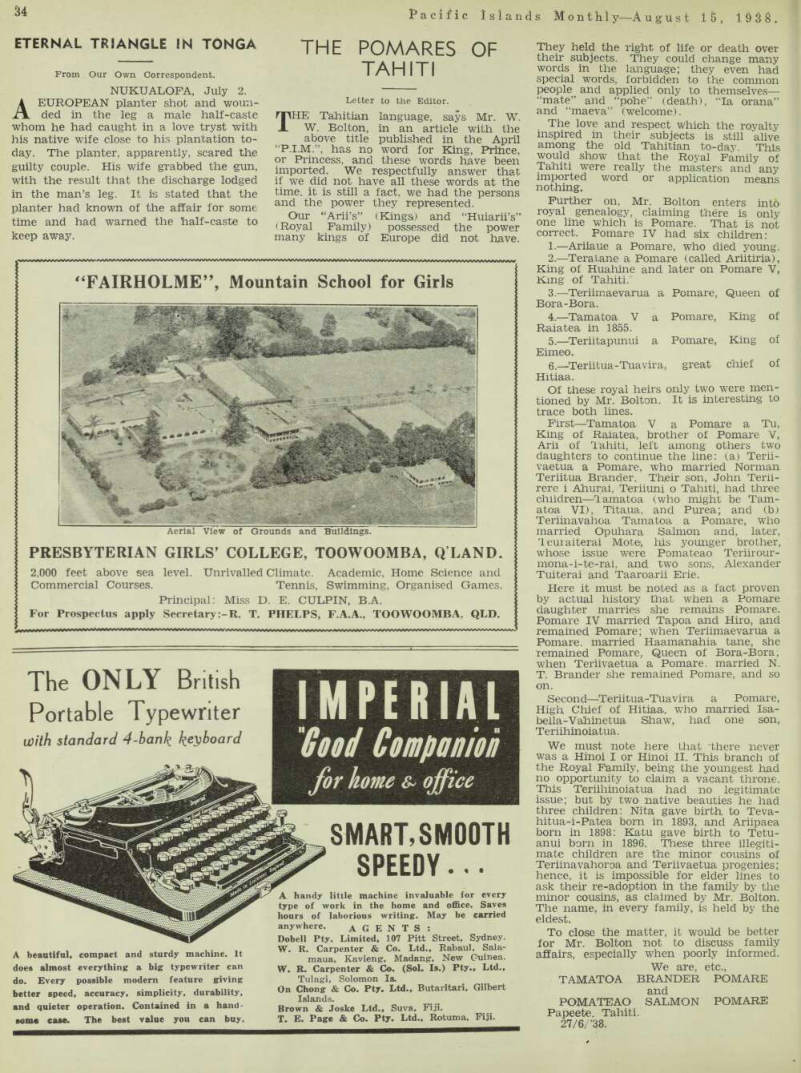
From Our Own Correspondent.
Nukualofa, July 2.
A EUROPEAN planter shot and woun ded in the leg a male half-caste whom he had caught in a love tryst with his native wife close to his plantation to day. The planter, apparently, scared the guilty couple. His wife grabbed the gun, with the result that the discharge lodged in the man’s leg. It is stated that the planter had known of the affair for some time and had warned the half-caste to keep away.
The Pomares Of
Tahiti
Letter to the Editor.
THE Tahitian language, says Mr. W.
W. Bolton, in an article with the above title published in the April “P.1.M.”, has no word for King, Prince, or Princess, and these words have been imported. We respectfully answer that if we did not have all these words at the time, it is still a fact, we had the persons and the power they represented.
Our “Arii’s” (Kings) and “Huiarii’s” ( Royal Family) possessed the power many kings of Europe did not have.
They held the right of life or death over their subjects. They could change many words in the language; they even had special words, forbidden to th,e common people and applied only to themselves— “mate” and “pohe” (death), “la orana” and “maeva” (welcome).
The love and respect which the royalty inspired in their subjects is still alive among the old Tahitian to-day. This would show that the Royal Family of Tahiti were really the masters and any imported word or application means nothing.
Further on, Mr. Bolton enters into royal genealogy, claiming there is only one line which is Pomare. That is not correct. Pomare IV had six children: 1. —Ariiaue a Pomare, who died young. 2. —Teratane a Pomare (called Ariitiria), King of Huahine and later on Pomare V, King of Tahiti. 3. —Teriimaevarua a Pomare, Queen of Bora-Bora. 4. —Tamatoa V a Pomare, King of Raiatea in 1855. 5. —Teriitapunui a Pomare, King of Eimeo. 6. Teriitua-Tuavira, great chief of Hitiaa.
Of these royal heirs only two were men tioned by Mr. Bolton. It is interesting to trace both lines.
First—Tamatoa V a Pomare a Tu, King of Raiatea, brother of Pomare V, Aril of Tahiti, left among others two daughters to continue the line: (a) Terii vaetua a Pomare, who married Norman Teriitua Brander. Their son, John Terii rere i Ahurai, Teriiuni o Tahiti, had three children —Tamatoa (who might be Tam atoa VI), Titaua, and Purea; and (b) Teriinavahoa Tamatoa a Pomare, who married Opuhara Salmon and, later, Teuraiterai Mote, his younger brother, whose issue were Pomateao Teriirour mona-i-te-rai, and two sons, Alexander Tuiterai and Taaroarii Erie.
Here it must be noted as a fact proven by actual history that when a Pomare daughter marries she remains Pomare.
Pomare IV married Tapoa and Hiro, and remained Pomare; when Teriimaevarua a Pomare. married Haamanahia tane, she remained Pomare, Queen of Bora-Bora, when Teriivaetua a Pomare. married N.
T. Brander she remained Pomare, and so on.
Second —Teriitua-Tuavira a Pomare, High Chief of Hitiaa, who married Isa bella-Vahinetua Shaw, had one son, Teriihinoiatua.
We must note here that ‘there never was a Hinoi I or Hinoi 11. This branch of the Royal Family, being the youngest had no opportunity to claim a vacant throne.
This Teriihinoiatua had no legitimate issue; but by two native beauties he had three children: Nita gave birth to Teva hitua-i-Patea born in 1893, and Ariipaea born in 1898: Katu gave birth to Tetu anui born in 1896. These three illegiti mate children are the minor cousins of Teriinavahoroa and Teriivaetua progenies; hence, it is impossible for elder lines to ask their re-adoption in the family by the minor cousins, as claimed by Mr. Bolton.
The name, in every family, is held by the eldest.
To close the matter, it would be better for Mr. Bolton not to discuss family affairs, especially when poorly informed.
We are, etc.,
Tamatoa Brander Pomare
and
Pomateao Salmon Pomare
Papeete. Tahiti. 27/6/’3B.
Advertisements & other items, p. 38 (2 items)
34
Pacific Islands Mon thl y—A ugu s t IS, 1938.
Imperial
“FAIRHOLME”, Mountain School for Girls
m & Vs- .
% * JR , >JS
Aerial View of Grounds and Buildings
PRESBYTERIAN GIRLS’ COLLEGE, TOOWOOMBA, Q’LAND.
2,000 feet above sea level. Unrivalled Climate. Academic, Home Science and Commercial Courses. Tennis, Swimming, Organised Games.
Principal: Miss D. E. CULPIN, B.A.
For Prospectus apply Secretary :-R. T. PHELPS, F.A.A., TOOWOOMBA, QLD.
The ONLY British
Portable Typewriter
with standard 4-hank ktyhoard
A beautiful, compact and sturdy machine. It does almost everything a big typewriter can do. Every possible modern feature giving better speed, accuracy, simplicity, durability, and quieter operation. Contained in a handsome case. The best value you can buy.
IMPERIAL
'Booi Companion
for home & office
SMART,SMOOTH
SPEEDY..•
handy little machine invaluable for every type of work in the home and office. Saves hours of laborious writing. May be carried anywhere. AGENTS : Dobell Pty. Limited, 107 Pitt Street, Sydney.
W. R. Carpenter & Co. Ltd., Rabaul, Salamaua, Kavieng, Madang, New Guinea.
W. R. Carpenter & Co. (Sol. Is.) Pty., Ltd., Tulagi, Solomon Is.
On Chong & Co. Pty. Ltd., Butaritari, Gilbert Islands.
Brown & Joske Ltd., Suva, Fiji.
T. E. Page & Co. Pty. Ltd., Rotuma, Fiji.
New Hebrides Burden
Joint Court Costs £10,000 Per Annum
DURING the year 1937, the Joint Court of the New Hebrides cost somewhere about £lO,OOO sterling— almost half the revenue of the Con dominium. It is generally felt that the cost of this expensive establish ment should be borne by the two Home Governments of the co- Sovereign Powers.
The Joint Court’s primary function is to examine land applications and grant titles If this great drain on the Con dominium Budget were removed there would be sufficient money to pay for improvements in the Condominium that are really worth-while.
Roads are an urgent necessity all over the Group; and the number of shipping accidents during the past few years points to the need of auto matic guiding lights at many of the tricky harbour entrances and chan nels in the northern islands.
A car owner in Vila, when asked what he paid per year for his car licence, replied: “One pound a mile”.
There are three miles of road, and the license costs £3.
Surmise
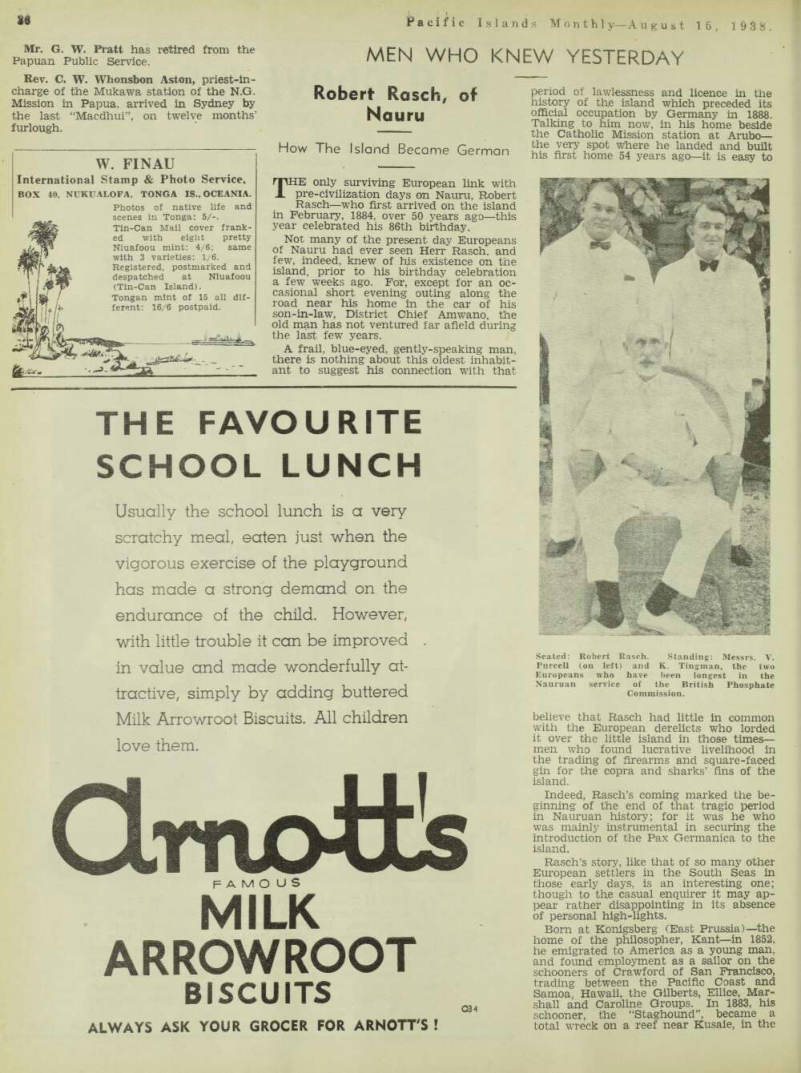
Silvery, shimmering, lovely starlight,
Magic, to enthrall the eyesight.
White stars, in millions, blazing down, A thousand miles from any town, And Man-u-er ...
As thigh to thigh and hand in hand, We two would race along the sand.
Splash in the sea, and dive and swim, Never a thought to naked limb, And then came splashing in to land And, quietly sitting on the sand, Decorous now, as you were dressed In a hibiscus for your best Tucked round one ear, I thought, my dear, There’d come to life a Galatea.
How sweet you were!
Silvery haze and lacy palm Will not have lost their ’witching charm.
But you’ll be in a Hubbard gown, All fearful of the Mission frown.
Pat babies will have rompers on— And I’ll be aching to be gone.
H. M. Rex.
Mr. and Mrs. F. W. Mantle and their two daughters, recently left Rabaul, New Guinea, by the W.R.C. vessel “Rabaul”, for England. Mr. Mantle who is on long leave, intends to spend some time travel ling around Europe.
Mr. P. Bums, recently engineer to the Municipal Council of Suva, Fiji, has been appointed to the position of engineer in the Public Works Department in Papua.
Rev. W. E. Moren, Anglican Chaplain at Apia, Western Samoa, recently re turned to the Territory after spending long furlough in England.
Mr. G. W. Pratt has retired from the Papuan Public Service.
Rev. C. W. Whonsbon Aston, priest-in charge of the Mukawa station of the N.G.
Mission in Papua, arrived in Sydney by the last “Macdhui”, on twelve months’ furlough.
Advertisements & other items, pp. 39-40 (2 items)
35
Pacific Islands Monthl y—A u gUst 15, 1938.
W. H. GROVE & Sons Ltd.
AUCKLAND
Islands Traders po. box 490 Telegraphic and Cable Address: “Grove,” Auckland.
Shippers of all classes of New Zealand Products, specially prepared for the Island trade.
Representing Rylands & Sons (Col.) Ltd., of London and Manchester. (Including the famous “Dacca” Mills Products.) Parbury Henty & Co. Pty. Ltd., of Sydney and Kobe.
“AGFA” Photographic Corporation, of Berlin.
J. Blair King, of London. World-famed Shirts.
Burrell & Co. Ltd., Millwall, London, E. 14. Oil, White Lead and all classes of Paints, including “FERROCENE” . their special Tropical Paint . . . PREVENTS CORROSION . . . made in RED, GREY, and GREEN.
't. or r> el <sa £
Agf a- B i 11y- Record
ONE would think that the camera was made from a single cast, so harmonious is the construction of the Speedex Record camera. Elegant appearance, easiness to carry in the case, extremely reliable lens and shutter, all help to make this camera one of the best of its kind. The correct choice of a camera is very important, for one does not buy a new camera every day, and it therefore has to be borne in mind that with the Speedex Record one is always fully equipped. As film use the all-weather Agfa Isochrom
W. FINAU
International Stamp & Photo Service,
BOX 40, NUKUALOFA, TONGA IS., OCEANIA.
Photos of native life and scenes in Tonga; 5/-.
Tin-Can Mail cover franked with eight pretty Niuafoou mint; 4/6; same with 3 varieties: 1/6.
Registered, postmarked and despatched at Niuafoou (Tin-Can Island).
Tongan mint of 15 all different: 16/6 postpaid. - - -VA'
fit
Nauru
Men Who Knew Yesterday
Robert Rosch, of Nauru How The Island Became German
THE only surviving European link with pre-civilization days on Nauru, Robert Rasch—who first arrived on the island in February, 1884. over 50 years ago—this year celebrated his 86th birthday.
Not many of the present day Europeans of Nauru had ever seen Herr Rasch. and few, indeed, knew of his existence on the island, prior to his birthday celebration a few weeks ago. For, except for an oc casional short evening outing along the road near his home in the car of his son-in-law, District Chief Amwano, the old man has not ventured far afield during the last few years.
A frail, blue-eyed, gently-speaking man, there is nothing about this oldest inhabit ant to suggest his connection with that
period of lawlessness and licence in the history of the island which preceded its official occupation by Germany in 1888.
Talking to him now, in his home beside the Catholic Mission station at Arubo— the very spot where he landed and built his first home 54 years ago—it is easy to
believe that Rasch had little in common with the European derelicts who lorded it over the little island in those times— men who found lucrative livelihood in the trading of firearms and square-faced gin for the copra and sharks’ fins of the island.
Indeed, Rasch’s coming marked the be ginning of the end of that tragic period in Nauruan history; for it was he who was mainly instrumental in securing the introduction of the Pax Germanica to the island.
Rasch’s story, like that of so many other European settlers in the South Seas in those early days, is an interesting one; though to the casual enquirer it may ap pear rather disappointing in its absence of personal high-lights.
Born at Konigsberg (East Prussia)—the home of the philosopher, Kant—in 1852, he emigrated to America as a young man, and found employment as a sailor on the schooners of Crawford of San Francisco, trading between the Pacific Coast and Samoa, Hawaii, the Gilberts, Ellice, Mar shall and Caroline Groups. In 1883, his schooner, the “Staghound”, became a total wreck on a reef near Kusaie, in the
Seated: Robert Rasch. Standing; Messrs. V.
Purcell (on left) and K. Tingman, the two Europeans who have been longest in the Nauruan service of the British Phosphate Commission.
Carolines, where he was later picked up with other survivors by another Ameri can schooner bound for Jaluit (Marshalls).
At Jaluit, Rasch decided to give up the roving life, with all its hardships and dangers and to settle down. A small, two masted sailing vessel, owned and manned by natives, being about to leave for Nauru (of which he had heard most enticing stories at Jaluit). Rasch secured passage; and he landed on the island some weeks later with a commission to purchase copra and to trade with the natives as agent for the well-known German South Seas firm of Hernsheim &' Co. (later Jaluit- Gesellschaft).
A Samoan-American, Halstead, accord ing to Rasch, was resident on the island at the time of his arrival, as well as a Nor wegian, Hansen; and Olsen, a Swede. The original William Harris, too, was well established as a trader, his station being in the Boe District, where numbers of his descent mav be found to-day. The names of all the above, except Hansen, are found in the census returns of the island to-day.
At the time of Rasch’s arrival, the nat ive wars, instigated by a few unscrupulous Europeans eager to find market for their firearms, were at their height. But Rasch found that the native showed no hostility whatever towards the decent white man or the ordinary trader.
Thirty-two years of age at the time of his arrival on the island, and with half a lifetime of adventure behind him, Rasch says smilingly that there was nothing he wanted to do at that time more than settle down to a quiet life. When, there fore, on the day after his arrival, the local Chief Denuwea brought along three comely native maidens for his selection of a wife, Rasch chose the youngest, a 15years-old girl called Ebagon, and settled down with her to build up his trading interests.
It is apparent, when one is talking with the old man now about his life, that a genuine attachment grew-up between him and Ebagon; for “I only ever had the one wife; and she a fine woman”, he says, with feeling. Indeed, the great tragedy of Rasch’s life was the fact that while he was home in Germany during the Great War, Ebagon died. There were four children of the marriage, including the wife of Chief Amwano: and a son, Gustav, who, with his family, resides with the old man and cares for him to day.
Rasch claims that, being a decent fel low. he could see the stupidity of the tribal-war situation on the island soon after his arrival. He therefore sent a com munication to the German Imperial Commissioners at Jaluit, suggesting that they arrange for the official occupation of the island by Germany.
Accordingly, in October, 1888. the Ger man man-o-war “Eber” arrived off the island, landed a party of marines, took possession of all firearms, and made Rasch the first representative of the German Government. It is with some pride that the old man speaks now of the German flag flying from his house; and the fact that passing vessels dipped their bunting in salute. His trading in terests, of course, gained a good deal as a result of his increased prestige in the eyes of the natives.
With the formal establishment of a German Bezirksamtmann (Government Resident) on the island some time later, Rasch’s official status disappeared. But his knowledge of the native people ana their customs, and the fact that he held their respect because of his record of just and decent dealings with them, were of great value to the early German Gov ernment officials, and had established
his own reputation on the little island.
Rasch was never an extravagant man, and although he says that he always felt satisfied to spend his life with his family on Nauru, in 1912 he went home to Ger many for a holiday. There he invested a good deal of his savings, his idea being to send one or more of his children to the Fatherland for education. His son, Gustav, with Ben Halstead and Edward Stephen, had been sent, in 1900, to the German Catholic Mission Training and Technical School at Jaluit. (These three are all employed as skilled artisans on Nauru to-day—Halstead with the Govern ment; Stephen, with the 8.P.C.; and Rasch, as a private carpenter). The outbreak of war broke into Rasch s plans, however, and kept him away from Nauru until 1924. when, after much trouble, he secured permission to rejoin his family on the island. Since his return, he has lived quietly with his family, smoking his pipe and keeping in touch with world affairs, but having little active interest in the industrialised and much changed Nauru of the present day.
The accompanying photograph was taken at the B.P.C. Messroom on the oc casion of his birthday, When he invited all Europeans who cared to come to be photographed with him. A large group photograph was taken also.
When I called upon him at his home on his birthday eve, I found him sitting quietly in a comfortable lounge chaii. in his own special room, while his num erous grandchildren played and chatted outside. Round the walls of the room were pictures of his German homeland
and members of his family; his shelves showed a good selection of reading matter.
And pride of place, above the writing table, was given to a framed portrait of Der Fuhrer, Adolf Hitler, in whose ability to direct the destinies of the Fatherland, Herr Rasch has a firm belief. —Contributed.
Mr. Geoffrey Cook, eldest son of Mrs.
B. A. Cook and the late Mr. P. P. Cook of Melbourne, recently married Miss Lorna Reynolds, only daughter of Mrs. Neal and step-daughter of the Hon. Norman Neal, at St. Augustine’s Church, Wau, New Guinea.
Advertisements & other items, pp. 40-42 (2 items)
36
Pacific Islands Monthl y—A ugust 15, 1938.
Clmofts
THE FAVOURITE
SCHOOL LUNCH
Usually the school lunch is a very scratchy meal, eaten just when the vigorous exercise of the playground has made a strong demand on the endurance of the child. However, with little trouble it can be improved . in value and made wonderfully attractive, simply by adding buttered Milk Arrowroot Biscuits. All children love them.
Clmofts
FAMOUS
MILK
ARROWROOT
BISCUITS
o: ALWAYS ASK YOUR GROCER FOR ARNOTT'S !
H.JONES &C 0
AUSTRiI^-
AUSTRALIA’S BEST
H. JONES & CO., LTD.
Darlington, Sydney Hobart, Tat.
Fruit, Vegetables, and Produce For — Fresh Islands Residents can rely on the old-established Shipping Providers: .TA** Island Agents Only Address; 421 Sussex Street. SYDNEY All Orders Promptly Attended
NELSON & ROBERTSON PTY. LTD.
ANCHOR FLOUR
THE STANDARD OF QUALITY
m '<■ i & ** -~i~ : .
HnßiPi
GILLESPIE BROS. PTY. LTD
SYDNEY - AUSTRALIA
PRESCOTT L T i> U y S E n X e S^ are sole wholesale agents fdr~
PINEAPPLE BACON 5 HANS
DAISY BRAND BUTTER
“37S BUTTER in TINS Ilb.-21b.-slb.si7«
LEA & PERRINS’ Sauces
and Most other Super-Quality Lines of the Trade
SWALLOW
llllllllllllllllillllllllllllilllillllllllllllllllllllllllllllllllllllll
& ARIELL’S
lllllllllllllllllllllllllllllllllilllllllllllllllllllllllllll|[|||l!llllllllllllllllllllllltlllllll
PLUM
PUDDINGS
i lb. : 1 lb. li lb. : 2 lb. and 3 lb.
Renowned for Quality
Manufactured at Port Melbourne, Australia
Hawaiian Japanese
Should They Be Used As American Colonists?
AN American friend, writing from Honolulu, appears perturbed be cause the American authorities, in sending Hawaiian-Americans to “colo nise” the mid-Pacific islands, refrained from including any Hawaiian-born Japanese in the parties, although the latter nominally are American sub jects. He says:— “The Government argument, in fluenced by army and navy opinions, which of necessity are unflinchingly anti-Japanese, is that the American born Japanese do not get along with the other youths, who mostly are part-Hawaiian, Chinese, Portuguese, and so on.
“This seems a strange argument, because the children get along to gether in the schools throughout the Hawaiian islands. Indeed, the schools feature the fact. It is only when the children leave school, and become ex posed to the bitter racial hatreds and complexes of the workaday and ser vice world, that any exception is taken to American-born Japanese youths.
“It seems they must remain un happy marginal people, pushed here and there. Especially in Hawaii, where the army and navy behind the scenes dominate so much of the policy concerning what is called the normal occupation of Pacific isles for commercial air service uses.”
This is typical of the sentimental twaddle which comes from a large section of American commentators.
Let us quote from Willard Price’s new book, “Japan Reaches Out”:— “More than half of the Japanese in Hawaii (about 152,000, now—Ed.
“P.1.M.”) were born there, and there fore are American citizens. Does this mean that they are not Japanese?
Japan still thinks of them essentially, if not legally, as her own—if we may judge from the fact that Japanese Government statistics, under the head of ‘Japanese Residing Abroad’, give the number for Hawaii as 150,832. That includes, not only Japanese citizens, and those who have dual Japanese and American citizen ship, but also all who are solely American citizens, and have no legal tie of any sort to their grandmother land. But Japan counts hearts, not votes, and she believes those hearts still beat for her. . . . Eighty-five per cent, of the Japanese children who attend the public schools also attend the Japanese schools, which open immediately after the day’s
work in the public schools is finished.”
All other races become assimilated in the great American republic, and their children and grandchildren are more than ready to forget racial hatreds and antagonisms. But not the Japanese. It is their own choice.
Any weeping for “unhappy marginal people” is so much balderdash.
Every American who lives in Hawaii, and keeps his feet on the earth and his head out of the clouds, knows that if ever American vigilance re laxes, Japan will try to seize Hawaii, and 99 per cent, of Japanese in Hawaii will help her. Nearly half the popu lation of Hawaii now is Japanese, and that community is increasing rapidly.
There is plenty of evidence that Japan hopes ultimately to control Hawaii, just as she plans domination of the Philippines—first by economic penetration, then by increasing migration, and finally by force of arms.
Britain has offered no serious ob jection to the “colonisation” by U.S.A. of Central Pacific islands which, for many decades, have been shown upon all maps—including American—as British. But the posi tion would change in a moment if America were to send Japanese to those islands in the guise of “colo nists”. Idealists may cackle about “Japanese Americans”; but the British know “there ain’t no such animal”.
In view of the clear and definite probabilities of the next decade, the distribution of Hawaiian Japanese among Central Pacific islands, which may be key-points in an American or British Imperial defence plan, would be sheer idiocy.
The stand taken by the American military and naval people, in regard to this matter, may be commended by all who know the Pacific, and the implications of the present inter national position, in the Pacific.
Advertisements & other items, p. 42 (1 item)
38
Pacific Islands Monthl y—A ugust 15, 1938.
Fiji-Built Tug Launched
From Our Own Correspondent.
SUVA, July 29.
BUILT at the Walu Bay Public Works Department, a new tug, No. 5, was launched recently. Lady Richards, wife of the departing Governor, performing the ceremony. Designed by Mr. W. Wilder, the vessel was constructed of Fiji kauri, under the supervision of Mr. A. Bentley.
Of 18 tons, with a length of 45 ft. and a breadth of 10! ft,, Tug No. 5 is an attractive sea-going craft. Her 36 b.h.p. full diesel engine gives her a nine-knots’ speed. She will be used mainly for towing in shallow rivers and on tidal flats.
Monsignor F. X. Gsell, 0.8. E., the new Bishop of Darwin, paid his first official visit to Thursday Island in July.
New 63 ft. Boat Launched by
Kwato Mission
From Our Own Correspondent.
Samarai, July 30.
BEFORE a large gathering of Samarai folk and all Kwato, the launching took place last month of the new M.V.
“Kwato” from the Mission’s slip. The Lieut.-Governor (Sir Hubert Murray) carried out the launching ceremony and Miss Phillis Abel christened the vessel.
Mr. Cecil Abel spoke on the growth of Kwato Mission and referred to the early days, when they had only one small boat.
To-day they have several and the “Kwato”, 63 ft. long with a beam of 15 ft., is the largest. Having a speed of 8 knots, she will engage in cargo-carrying, mostly on account of the Mission, which has large interests in Papua.
Sir Hubert Murray spoke of the early days when Mr. Abel, Snr., was alive, and referred to the way in which Kwato has grown since then. He remarked on the splendid workmanship of the natives who helped to build the new vessel, and par ticularly of the man responsible for the boat being completed, Mr. Arthur Swins field.
Mr. H. B. Sapsford has been appointed Acting Director of the Apia Observatory, Western Samoa, to fill the vacancy caused by the resignation of Mr. J. Wads worth, who left the Territory recently by the “Matua” for England.
Mr. E. W. Pearce, of the Methodist Mission, left Sydney by the July “Macdhui” for Rabaul, N.G.. He is Chairman’s Assistant and Accountant of the district.
Advertisements & other items, pp. 43-44 (2 items)
39
Pacific Islands Monthl y—A ugust 15, 1938.
Coral Brand
PURE RICE
STARCH
Always ask for . . .
CORAL BRAND
100% PURE
Noted for Its
QUALITY
and
WHITENESS
Goes Farthest and srives Lasting: Finish
WILL NOT
STICK TO
IRON
Obtainable from Leading: Island Stores Manufactured by
AUSTRALIAN RICE LTD.
Sydney, N.S.W.
E?""ggig
I*
CORAL BRAND
RICE STARCH
Australia*s Choicest Products: Brussels Sprout* White Turnip* Sweet Com Tomato Puree Tomato Sauce Tomato Soup Tutti Fruit Sauce (Worcestershire flavor) Beetroot Spinach Cabbage Carrots Parsnips Celery Green Peas French Beans Cauliflower V. ■i Always . . . make sure you have at hand
an ample
Reserve of these Delicious . .
Garden
Vale
Ready-to-
serve
Vegetables
YOU USE
WUtK
Sw EETENED CONI
ie»
BRAND
NEST
; ; Anglo-Swiss Condens
SYDNEY
For every occasion on which you use milk —-whether it's for the kiddies, for cooking, for tea, coffee or cocoa —use Nestle's Milk—the safest and purest milk you can buy. Nestle's Milk is rich country milk taken from selected herds. Being hermetically sealed, it cannot become contaminated, and it remains fresh indefinitely while unopened. Order a regular supply of Nestle's Milk and use it always.
NESTLES
FULL CREAM
MILK
Its Quality is Your Safeguard na.TviaKl JL.9&A J
1,500 Coolies And
200 Whites Why Administrator Of Nauru Retired
rFHERE has been much speculation as to the character of the recent disagreement between the Adminis trator of the Mandated Territory of Nauru and the Commonwealth Gov ernment, but no official explanation has been forthcoming.
We are informed by a visitor who has just returned from the island that the discord had its origin in the fact that Commander R. C. Garsia, a trained naval man, was concerned for the safety of the white community there. He took the view that the 200 Europeans on Nauru should be pro vided with sufficient arms and am munition to cope, if necessary, with any possible emergency arising from a disturbance by the 1,500 Chinese in dentured coolies engaged in the phos phate industry.
The Commonwealth authorities, viewing the situation from Canberra, replied that such a precaution seemed unnecessary, and that, in any case, Nauru under the terms of the Man date could not be fortified. The Ad ministrator’s retort was that the act of supplying firearms to responsible white residents, and instructing them in the use of same for their own de fence, could hardly be classed as “fortifying Mandated Territory”. But the Commonwealth Government maintained its attitude.
Thereupon (according to our in formant), Commander Garsia, being a man of some spirit, apparently de cided that he would rather relinquish the post than remain at Nauru and be fettered by the red tape of Can berra
Infantile Paralysis In
Papua
From Our Own Correspondent.
Port Moresby, July 27.
17K)UR cases of infantile paralysis, at r Mailu Island, in the Eastern Division of Papua, were reported to the Admini stration during July. The cases, which were diagnosed and treated by Dr. Ver non, of Port Glasgow, nearby, and the Samarai Native Hospital, have recovered.
Quarantine has been established in the Mailu district. No native child under 18 years of age is permitted to leave the island or district, and the natives are be ing closely watched.
Infantile paralysis is not unknown among the natives of Papua. From time to time, single cases have been reported from different districts. It is not thought that these cases at Mailu have any con nection with the late epidemic in Aus tralia.
Advertisements & other items, p. 44 (1 item)
40
Pacific Islands Monthl y—A ugust 15, 1938.
Rabaul Police On Parade
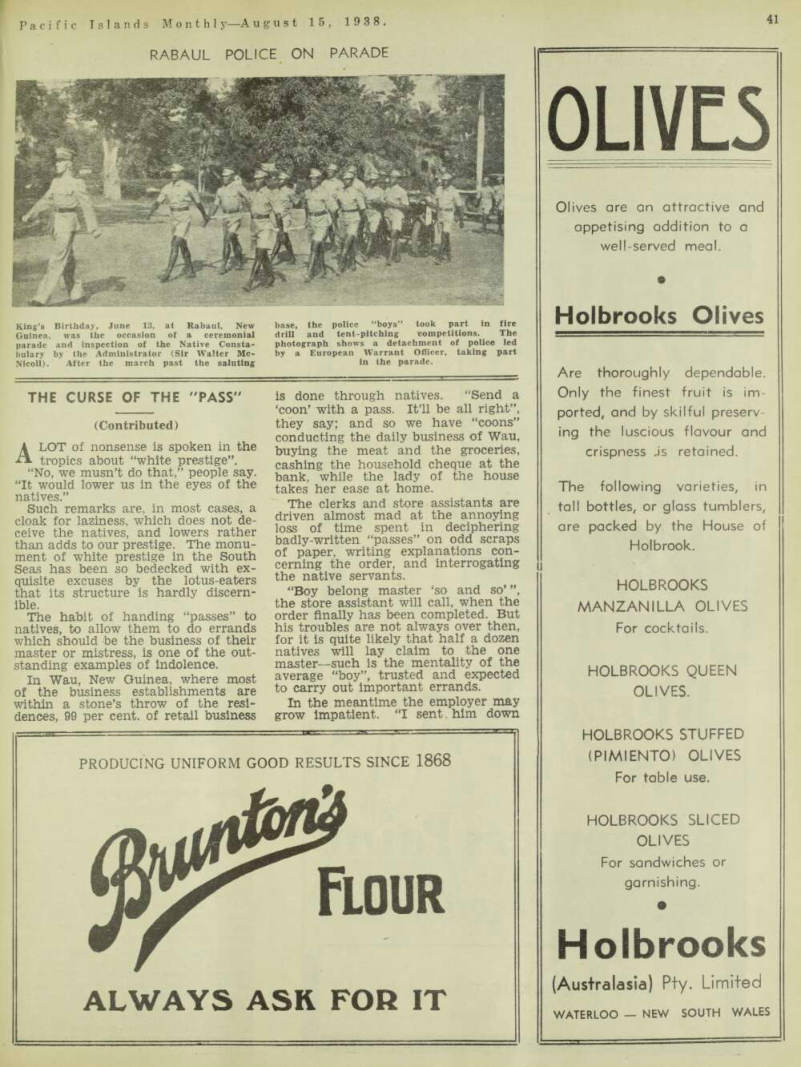
King’s Birthday, June 13, at Rabaul, New Guinea, was the occasion of a ceremonial parade and inspection of the Native Consta bulary by the Administrator (Sir Walter Me- Nicoll). After the march past the saluting
base, the police “boys” took part in fire drill and tent-pitching competitions. The photograph shows a detachment of police led by a European Warrant Officer, taking part in the parade.
The Curse Of The "Pass"
(Contributed) A LOT of nonsense is spoken in the tropics about “white prestige”.
“No, we musn’t do that,” people say.
“It would lower us in the eyes of the natives.”
Such remarks are, in most cases, a cloak for laziness, which does not de ceive the natives, and lowers rather than adds to our prestige. The monu ment of white prestige in the South Seas has been so bedecked with ex quisite excuses by the lotus-eaters that its structure is hardly discern ible.
The habit of handing “passes” to natives, to allow them to do errands which should be the business of their master or mistress, is one of the out standing examples of indolence.
In Wau, New Guinea, where most of the business establishments are within a stone’s throw of the resi dences, 99 per cent, of retail business
is done through natives. “Send a ‘coon’ with a pass. It’ll be all right”, they say; and so we have “coons” conducting the daily business of Wau, buying the meat and the groceries, cashing the household cheque at the bank, while the lady of the house takes her ease at home.
The clerks and store assistants are driven almost mad at the annoying loss of time spent in deciphering badly-written “passes” on odd scraps of paper, writing explanations con cerning the order, and interrogating the native servants.
“Boy belong master ‘so and so’”, the store assistant will call, when the order finally has been completed. But his troubles are not always over then, for it is quite likely that half a dozen natives will lay claim to the one master—such is the mentality of the average “boy”, trusted and expected to carry out important errands.
In the meantime the employer may grow Impatient. “I sent him down
to the store an hour ago—he’s not back yet, and I want him to put up my ‘wash-wash’”. They do not rea lise that if they attended to their own affairs, the time and temper of many people would be saved.
Let the native servant carry the groceries home, by all means; let him be a hewer of wood and a drawer of water; but do not pass on to him your responsibilities.
The cult of the “pass” has now be come the curse of the “pass” and has reached the height of bad manners, when “send a ‘coon’ with a pass” meets any emergency.
A new 74 ft. lighthouse has been erected recently on Euaiki Island, at the eastern entrance to Nukualofa Harbour, Tonga. Its beam flashes every four seconds from dark to dawn.
Advertisements & other items, pp. 45-46 (2 items)
41
Pacific Islands Monthl y—A ugust 15, 1938.
Olives
are an attractive and appetising addition to a well-served meal. 9
Holbrooks Olives
Are thoroughly dependable.
Only the finest fruit is imported, and by skilful preserving the luscious flavour and crispness Js retained.
The following varieties, in tall bottles, or glass tumblers, are packed by the House of Holbrook.
HOLBROOKS
MANZANILLA OLIVES
For cocktails.
HOLBROOKS QUEEN
OLIVES.
HOLBROOKS STUFFED
(PIMIENTO) OLIVES
For table use.
HOLBROOKS SLICED
OLIVES
For sandwiches or garnishing.
Holbrooks
(Australasia) Pty. Limited
WATERLOO NEW SOUTH WALES
PRODUCING UNIFORM GOOD RESULTS SINCE 1
Flour
ALWAYS ASK FOR IT
-YES./
but 4 —v
WHICH)
painf (
m
OF COURSE I
u
Buffers
(prepare d WmKM JCeeps on D(eeping oj%J
AGENTS THROUGHOUT THE ISLANDS,
Conservation Of
Old Tahiti
Prom Our Own Correspondent
Papeete, July 28.
ESIDENTS who have been in the islands long enough to have known me elder generations of Tahitians, their courtly manners and stately cere mony, the gracious hospitality which was ; their custom*, the beauty and unique idiom of their native music, are most u f earn of the measures init ated by the present Governor of French Oceania to preserve what is remaining of the old culture, restore to memory the ancient poetry, revive the splendour of the old chorus singing, inspire in the younger Tahitians a pride in their an cestors and the history of their race, con serve and extend their native handicrafts and protect the natives in the ownership of their ancestral lands.
His Excellency, by executive decree, has recently designated two more islands— Raivavae and Tubuai—to be closed as places of residence to all except natives of those islands.
Under His Excellency’s direction, “Te Vea Maohi”—heretofore the edition in the Tahitian language of the Official Journal—has been given a new form. The editorship has been conferred on Mon sieur Rene\ Pailloux, who has been a officer of the Administration during many years, and who is learned in the langu age, traditions and history of the Tahit ians. Henceforth this journal will present —in addition to the record of the official acts of the Government—articles con cerning the antiquities, the history, and the ancient lore of the islands, all of which are practically unknown to the average young Tahitian of the present day.
In accord with all who hold a sym pathetic interest in the welfare of the Tahitians, His Excellency is aware that the future weal of the South Sea native lies in the conservation of his land hold ings and the manner of life inherited from his forebears.
The Tahitian is an admirable Poly nesian; but a poor European. The gen ius of his mind is not adjustable to European habits of thought nor does his body thrive under European diet and manner of living. This is amply proven bv comparing the rather sickly native of Tahiti with the inhabitants of those is lands who continue to follow the diet and ways of life of their ancestors.
Delegation
Suva Body Invites N.Z. Trade Delegation
From Our Own Correspondent.
Auckland, July 28.
FOLLOWING recent references by the Auckland Chamber of Commerce to the decline in trade between N.Z. and Fiji, a suggestion has been made by the Suva chamber that a small trade dele gation should visit Fiji to study trade conditions and requirements.
The establishment of various local in dustries in Fiji and the inabilitv of New Zealand to compete with Australia in the supply of certain goods were among the factors to which the decline in trade was attributed. Other reasons were the rise in costs of production in the Dominion, the removal in 1932 of-preferential tariffs on New Zealand goods, and shipping difficulties.
Supply Of Native
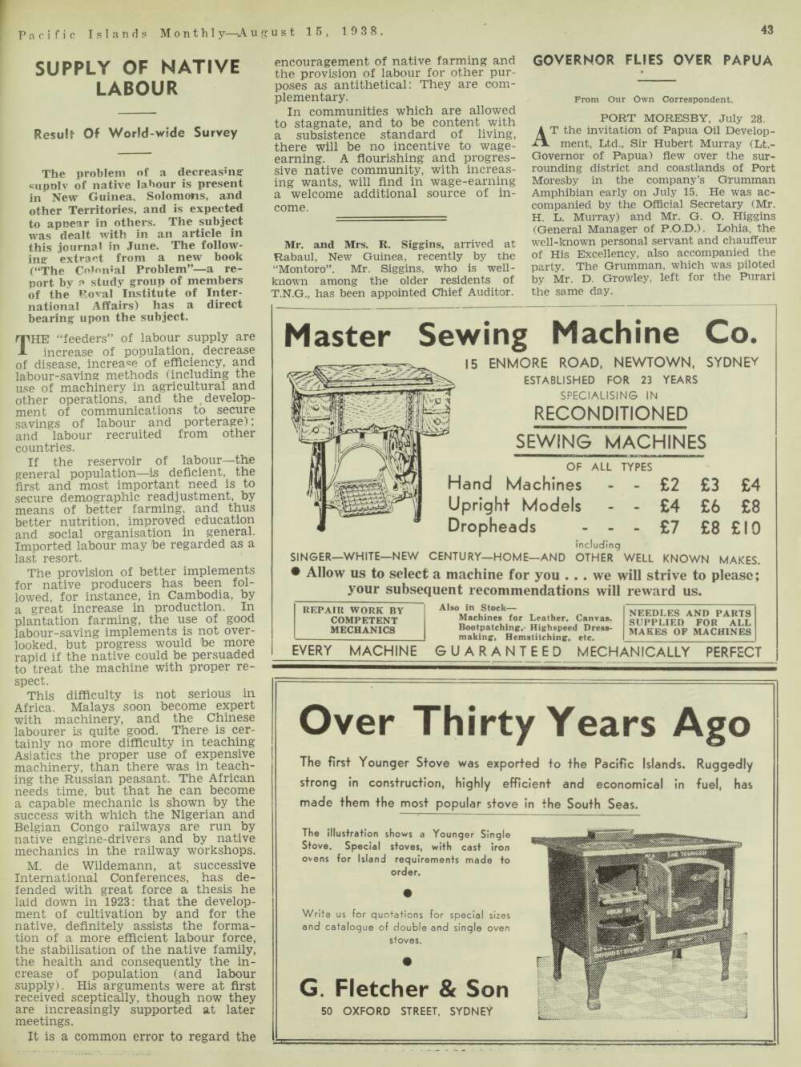
Labour
Result Of World-wide Survey
The problem of a decreasing «upolv of native labour is present in New Guinea, Solomons, and other Territories, and is expected to apnear in others. The subject was dealt with in an article in this journal in June. The follow ing extract from a new book (“The Colonial Problem” —a re port by a study group of members of the Roval Institute of Inter national Affairs) has a direct bearing upon the subject.
THE “feeders” of labour supply are increase of population, decrease of disease, increase of efficiency, and labour-saving methods (including the use of machinery in agricultural and other operations, and the develop ment of communications to secure savings of labour and porterage); and labour recruited from other countries.
If the reservoir of labour—the general population—is deficient, the first and most important need is to secure demographic readjustment, by means of better farming, and thus better nutrition, improved education and social organisation in general.
Imported labour may be regarded as a last resort.
The provision of better implements for native producers has been fol lowed, for instance, in Cambodia, by a great increase in production. In plantation farming, the use of good labour-saving implements is not over looked, but progress would be more rapid if the native could be persuaded to treat the machine with proper re spect.
This difficulty is not serious in Africa. Malays soon become expert with machinery, and the Chinese labourer is quite good. There is cer tainly no more difficulty in teaching Asiatics the proper use of expensive machinery, than there was in teach ing the Russian peasant. The African needs time, but that he can become a capable mechanic is shown by the success with which the Nigerian and Belgian Congo railways are run by native engine-drivers and by native mechanics in the railway workshops.
M. de Wildemann, at successive International Conferences, has de fended with great force a thesis he laid down in 1923: that the develop ment of cultivation by and for the native, definitely assists the forma tion of a more efficient labour force, the stabilisation of the native family, the health and consequently the in crease of population (and labour supply). His arguments were at first received sceptically, though now they are increasingly supported at later meetings.
It is a common error to regard the
encouragement of native farming and the provision of labour for other pur poses as antithetical: They are com plementary.
In communities which are allowed to stagnate, and to be content with a subsistence standard of living, there will be no incentive to wage earning. A flourishing and progres sive native community, with increas ing wants, will find in wage-earning a welcome additional source of in come.
Mr. and Mrs. R. Siggins, arrived at Rabaul, New Guinea, recently by the “Montoro”. Mr. Siggins, who is well known among the older residents of T.N.G., has been appointed Chief Auditor.
Governor Flies Over Papua
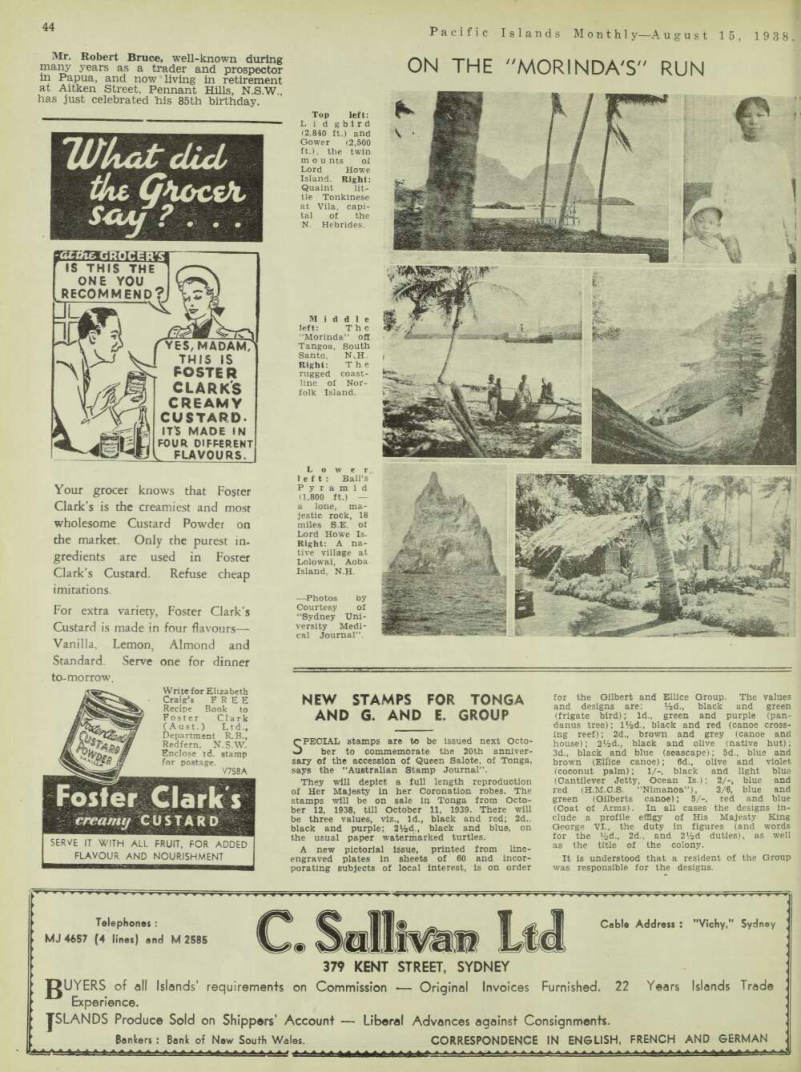
From Our Own Correspondent.
Port Moresby, July 28.
AT the invitation of Papua Oil Develop ment, Ltd., Sir Hubert Murray (Lt.- Governor of Papua) flew over the sur rounding district and coastlands of Port Moresby in the company’s Grumman Amphibian early on July 15. He was ac companied by the Official Secretary (Mr.
H. L. Murray) and Mr. G. O. Higgins (General Manager of P.0.D.). Lohia, the well-known personal servant and chauffeur of His Excellency, also accompanied the party. The Grumman, which was piloted by Mr. D. Growley, left for the Purari the same day.
Mr, Robert Bruce, well-known during many years as a trader and prospector in Papua, and now living in retirement at Aitken Street, Pennant Hills, N.S.W., has just celebrated his 85th birthday.
Advertisements & other items, pp. 47-48 (2 items)
43
Pacific Islands Monthl y—A ugust 15, 1938.
Over Thirty Years Ago
Master Sewing Machine Co.
15 ENMORE ROAD, NEWTOWN, SYDNEY
ESTABLISHED FOR 23 YEARS
h Vpi - SPECIALISING IN
RECONDITIONED
SEWING MACHINES
OF ALL TYPES
Hand Machines - - £2 £3 £4 Upright Models - - £4 £6 £8 Dropheads - - - £7 £8 £lO including
SINGER—WHITE—NEW CENTURY—HOME—AND OTHER WELL KNOWN MAKES.
• Allow us to select a machine for you ... we will strive to please; your subsequent recommendations will reward us. <Xr' Also in Stock— Machines for Leather, Canvas.
Bootpatching, Highspeed Dressmaking, Hemstitching, etc.
EVERY MACHINE GUARANTEED MECHANICALLY PERFECT
NEEDLES AND PARTS
SUPPLIED FOR ALL
MAKES OF MACHINES
REPAIR WORK BY
COMPETENT
MECHANICS
Over Thirty Years Ago
The first Younger Stove was exported to the Pacific Islands. Ruggedly strong in construction, highly efficient and economical in fuel, has made them the most popular stove in the South Seas.
The illustration shows a Younger Single Stove. Special stoves, with cast iron ovens for Island requirements made to order.
Write us for quotations for special sizes and catalogue of double and single oven stoves.
G. Fletcher & Son
50 OXFORD STREET, SYDNEY
r
»?J \
IS THIS THE 1
ONE YOU
RECOMMEND?]
r^: —nc
JL i 1 V
YtS, MADAM?
THIS IS
FOSTER
CLARKS
CREAMY
CUSTARD.
ITS MADE IN
four different!
FLAVOURS.
Your grocer knows that Foster Clark’s is the creamiest and most wholesome Custard Powder on the market. Only the purest ingredients are used in Foster Clark’s Custard. Refuse cheap imitations.
For extra variety, Foster Clark’s Custard is made in four flavours— Vanilla, Lemon, Almond and Standard. Serve one for dinner to-morrow, Write for Elizabeth Craig's FREE Recipe Book to Foster Clark (Aust.) Ltd., Department R. 8., Redfern, N.S.W.
Enclose id. stamp for postage.
V7SBA
Foster Clark's
creamy CUSTARD serve it with all fruit, for added
FLAVOUR AND NOURISHMENT
On The "Morinda's" Run
Top left: Lidgbird 12.840 ft.) and Gower (2,500 ft.), the twin mounts of Lord Howe Island. Right: Quaint lit tle Tonkinese at Vila, capi tal of the N. Hebrides.
Middle left: The “Morinda” off Tangoa, South Santo, N.H.
Right: The rugged coast line of Nor folk Island.
Lower left: Ball’s Pyramid (1,800 ft.)a lone, ma jestic rock, 18 miles S.E. of Lord Howe Is.
Right: A na tive village at Lolowai, Aoba Island, N.H. —Photos by Courtesy of “Sydney Uni versity Medi cal Journal”.
And G. And E. Group
New Stamps For Tokioa
SPECIAL stamps are to be issued next Octo ber to commemorate the 20th anniver sary of the accession of Queen Salote, of Tonga, says the “Australian Stamp Journal”.
They will depict a full length reproduction of Her Majesty in her Coronation robes. The stamps will be on sale in Tonga from Octo ber 12, 1938, till October 11, 1939. There wiU be three values, viz., Id., black and red; 2d., black and purple; 2V 2 d., black and blue, on the usual paper watermarked turtles.
A new pictorial issue, printed from line engraved plates in sheets of 60 and incor porating subjects of local interest, is on order
for the Gilbert and Ellice Group. The values and designs are: V 2 d., black and green (frigate bird); Id., green and purple (pan danus tree); IVfed., black and red (canoe cross ing reef); 2d., brown and grey (canoe and house); 2V 2 d., black and olive (native hut): 3d., black and blue (seascape); 5d., blue and brown (Ellice canoe); 6d., olive and violet (coconut palm); 1/-, black and light blue (Cantilever Jetty, Ocean Is); 2/-, blue and red (H.M.C.S. “Nimanoa”), 2/6, blue and green (Gilberts canoe); 5/-, red and blue (Coat of Arms). In all cases the designs in clude a profile efflgy of His Majesty King George VI., the duty in figures (and words for the V 2 d., 2d., and 2V 2 d duties), as well as the title of the colony.
It is understood that a resident of the Group was responsible for the designs.
Advertisements & other items, p. 48 (1 item)
Telephones :
MJ 4657 (4 lines) and M 2585 m u Ml Cable Address : "Vichy," Sydney
379 KENT STREET, SYDNEY
gUYERS of all Islands' requirements on Commission Original Invoices Furnished. 22 Years Islands Trade Experience.
JSLANDS Produce Sold on Shippers' Account Liberal Advances against Consignments.
Bankers : Bank of New South Wales. CORRESPONDENCE IN ENGLISH. FRENCH AND GERMAN
Fascinating Quest Of
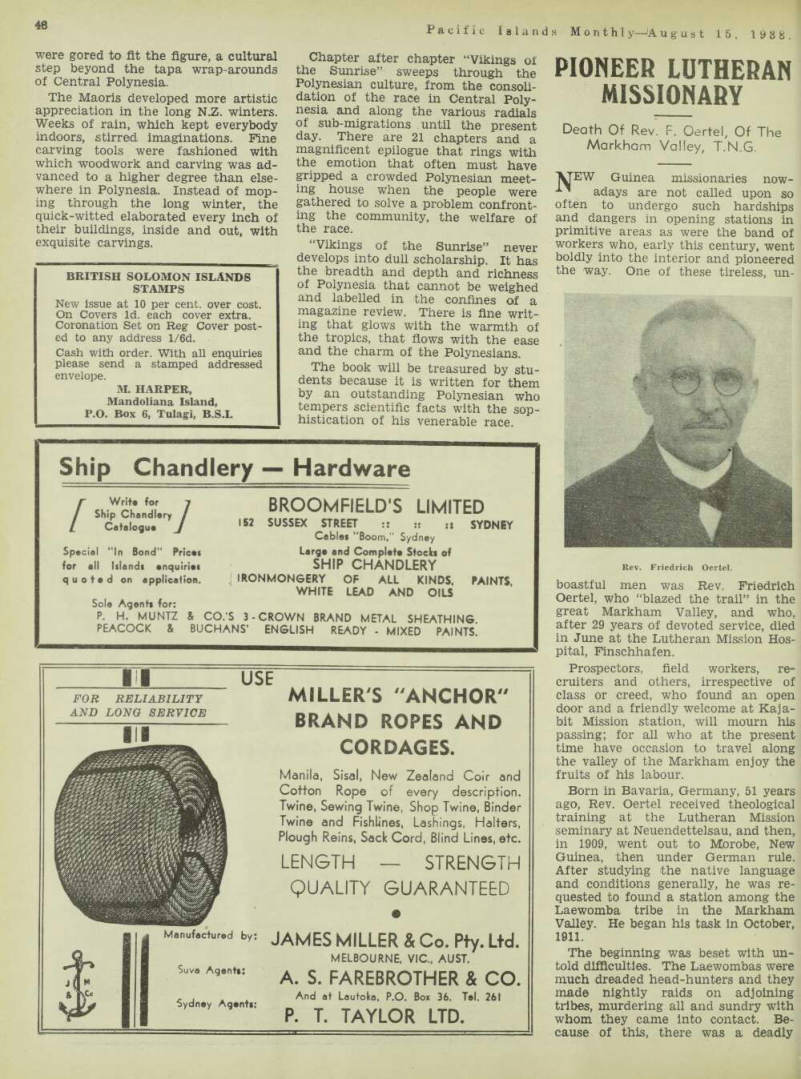
Dr. Peter H. Buck
Origin and History of The Polynesian Race
By John Williams
11HE period when the first men and • women and children, who were the progenitors of the great Poly nesian race, moved out from Indo nesia in their narrow, low canoes is a moot point which the astute scien tist will dodge if he can, but if corn ered probably he might admit maybe late B.C. or early A.D.
The evidence is based too much upon ancient and untrustworthy gene alogies.
However, once the general move ment out of Indonesia was under way, then the evidence became more convincing. It is at this point that Dr. Peter H. Buck (Te Rangi Hiroa), the New Zealand ethnologist, starts his new book, “Vikings of the Sun rise”, which is a descriptive study of Polynesia. Dr. Buck is himself a Polynesian—now, probably, the most famous living Maori.
Dr. Buck neatly confines the Poly nesians in what he calls the Poly nesian triangle: that is, all that area embraced within a line drawn from Hawaii on the north down to Easter Island, then back across to New Zea land and up to Hawaii again. So many thousands of square miles of the world’s greatest ocean are in volved that it is little wonder that Captain James Cook, the British navi gator, the first accurate observer and recorder of the Polynesian, marvelled at the wide distribution of the Poly nesian culture and, in admiration, described the race as the “most ex tensive nation on earth”.
The triangle forms a well-defined spearhead for Micronesia and Mel anesia, the two great cultural routes along which the Indo-Malayan peoples moved into the Pacific. The Society Islands are the approximate centre of the triangle. Dr. Buck pro vocatively places emphasis on the ori ginal movements into Polynesia along the Micronesia route, rather than along the Melanesian, and the later movements of the Polynesians from the Society Islands westward into Melanesia. It was while passing through the inhospitable atolls of Micronesia that the original culture lost a lot of things, and even the memory of them. For example: here were a Stone Age people who de pended upon stone for fashioning their adzes. There was no stone on the atolls. The imaginative people found shell substitutes.
From atoll to atoll, then from island
to island, these men and women kept the prows of their canoes steered “into the eye of the sun , moving eastward, ever eastward, across the great ocean into the Unknown. These were the centuries of the most mar vellous of all maritime achievements, of the excellence of human resource and endurance that survived un believable privations. The Stone Age le> by sheer grit> became the mo st 0 f ocean seamen, by develop ing ocean -g o ing canoes with sails.
The constant trade winds favoured their inventive genius. Strong cur rents swept them to distant isles, They developed remarkable powers of observation and reasoning. Their wise old men memorised the heavens anc j usec j the stars to guide the tire
less voyagers back whence they started, with the tidings of the new lands. All the knowledge was cherished with almost religious fervour in what we call myth and legend.
Within the triangle the Polynesians worked out their destiny, deliberately and calmly, and with daring imagination and the ability to learn by failures.
NEW islands meant new local environments, which differed vastly.
This meant important variations in material cultures, but always the wisdom of the race developed perfect adjustments which were not upset until the coming of the first Europeans. Dr, Buck revels in reporting these details, details of which he is the world’s chief authority.
In the tracks of these oceanic nomads the reader is swept with Dr.
Buck as guide. Here a piece of evi deuce is weighed in the light of an other piece found a thousand miles distant. It is a fascinating chain of almost forgotten canoes and foods anc * fish nets and hooks and methods of cooking.
Overgrown trails lead amid the crumbling remains of weather-worn temples, half buried in tropic sands or tumbled and moss-covered in Jungles of gnarled vines. There is evidence that bespeaks the affinity of a conim on Polynesian religion. Stone Sods were worshipped. To-day, all are fal * erL There is lonely Easter Island - Were those sprawling, “my sterious” stone images originally gods, or were they simply works of art?
Dr. Buck has many convincing answers because, as a scientist, he has spent more than 30 years voyag
ing along most of the Polynesian tracks, even to the most remote isles.
He was accepted everywhere as Te Rangi Hiroa. His skilled command of the Polynesian mother-tongue and its varied dialects, the tales from afar that he had to tell, assured him al ways of tribal acceptance and cour tesies according to the traditions of his, the Polynesian, race. Never were his hosts ill at ease before the inquiring earnestness of his science.
But as Te Rang! Hiroa filled field book upon field-book with satisfying notes coaxed from dimming memo ries, always over his shoulder watched the detached, restraining mind of Dr.
Peter Buck, the scientist. So was developed a unique collaboration that reaches great heights in “Vikings of the Sunrise”. Group by group, Poly nesia is almost clinically pondered, with unusual care. Theories, popular so long that they are almost accepted as gospel by superficial writers and speakers, have their wishful think ing exploded by the Polynesian academist, with proper scorn.
Incidentally, one of the pet theories disposed of is that of the Pacific’s alleged “sunken continent”, or archi pelagos.
TN a chapter called “The Trail of A Plants and Animals”, Dr. Buck brings up Easter Island and the sweet potato, one of Polynesia’s staple foods. Taro, yams, breadfruit, coco nut, bananas and many other foods widely known through Polynesia came from the Indo-Malayan area. The only outstanding food that definitely came from the Americas is the sweet potato.
How did it come? Imagine Easter Island, the lonely eastern corner of the Polynesian triangle. Many cen turies ago a bold and footloose voy ager, temporarily at “home” on Easter Island, probably sat upon the hills peering eastward, ever eastward, into the eye of the sun. At night, hour
upon hour, he memorised the stars and the course that he would set. He talked of his plan to voyage on east ward. Who would volunteer?
The start, one supposes, was de layed until the prevailing south-east trade wind swung to the west. It stays in the west for a comparatively short while, but enough, the voyager reckoned, to take his canoe to the islands which must lie in the eye of the sun. Off he set, confidently, as perhaps once he had sailed off to reach Easter Island.
Week after week the sturdy out rigger was kept moving eastward, and no land was sighted. This was un usual for isle-sprinkled Polynesia.
Was the voyager afraid? But day after day upon that immensity of the ageless ocean the sun rose to give the brave leader confidence and at night, in the engulfing canopy of the heavens in which lived his generous gods, were the stars, a great and magic carpet that beckoned the cour ageous ever eastward. . . .
The canoe at last came within sight of South America, the abrupt, tower ing coastline of Peru. Here were a new people, a totally different people, who had a culture as far from the Polynesian as to-day New York’s is from Tibet’s. The Polynesians un doubtedly were bewildered. There were new foods, new words, new weapons. There were sweet potatoes, satisfying and easy to grow. The Peruvians called them “Kumar”.
No matter how much the Poly nesians felt ill at ease in Peru, they could not escape. They could not voyage back to Easter Island in the teeth of the westerly wind. They had to mark time and wait until it swung back into the south-east.
They had a few sweet potatoes left when they got back to Easter Island.
They repeated the Peruvian name for them. From Easter Island the po tatoes were carried back along the trails throughout Polynesia, and the name was varied. To-day, for ex ample, the New Zealand Maoris call the potatoes “kumara”, but the Hawaiians say “uala”.
DR. BUCK moves upon more certain ground in his chapter upon the Maoris of New Zealand, Te Rangi Hiroa’s homeland. How the Maoris developed their remarkably high material culture cannot be properly understood, Dr. Buck contends, until the culture of central Polynesia, whence came the Maoris, is studied first.
For example: In Central Polynesia tapa beaten from the paper mulberry tree made a cloth sufficient for human requirements. So from central Poly nesia the Maoris (a word meaning aborigines) took along cuttings of the mulberry tree which grew readily
enough in New Zealand. But in this new land the Maoris first saw snow.
Tapa cloth was scarcely snug enough to keep out the chill winds.
There were great forests of trees and the low lands were overgrown with a tough flax. Once more the Polynesian inventive genius was stirred. The Maoris fashioned adzes from basalt and finer tools from greenstone. Trees were felled and hauled from the forests. Wooden houses, the stoutest in Polynesia, were developed. In them the people sheltered from the winter storms, and in them, too, the Maoris stored foods harvested from the fertile land in summer. This preservation of food against the want of winter was a new task for the Polynesian.
The Maoris found that the flax leaves, when stripped and scutched, had the toughest of fibre. So they invented a weaving, which was an adaptation of their fish-trap techni que, and wove splendid cloaks that
were gored to fit the figure, a cultural step beyond the tapa wrap-arounds of Central Polynesia.
The Maoris developed more artistic appreciation in the long N.Z. winters.
Weeks of rain, which kept everybody indoors, stirred imaginations. Fine carving tools were fashioned with which woodwork and carving was ad vanced to a higher degree than else where in Polynesia. Instead of mop ing through the long winter, the quick-witted elaborated every inch of their buildings, inside and out, with exquisite carvings.
Chapter after chapter “Vikings of the Sunrise” sweeps through the Polynesian culture, from the consoli dation of the race in Central Poly nesia and along the various radials of sub-migrations until the present day. There are 21 chapters and a magnificent epilogue that rings with the emotion that often must have gripped a crowded Polynesian meet ing house when the people were gathered to solve a problem confront ing the community, the welfare of the race.
“Vikings of the Sunrise” never develops into dull scholarship. It has the breadth and depth and richness of Polynesia that cannot be weighed and labelled in the confines of a magazine review. There is fine writ ing that glows with the warmth of the tropics, that flows with the ease and the charm of the Polynesians.
The book will be treasured by stu dents because it is written for them by an outstanding Polynesian who tempers scientific facts with the sop histication of his venerable race.
Advertisements & other items, pp. 49-52 (4 items)
45
“Pacific Islands Monthl y—A ugust 15. 1988.
Foods
Kork-N-Scal
FOR HOME USE
Hand Applied Airtight Pressure Proof
FOR ALL HOME BOTTLING
—THE LITTLE CAP THAT
will Re - seal 1.000 Times
KORK - N - SEAL (Aust.) LTD.
106 COMMONWEALTH STREET
SYDNEY, AUSTRALIA
q
C II I V
EPS
PURE
FOODS
GOLD MEDAL JAMS
CANNED ENGLISH FRUITS
CANNED ENGLISH VEGETABLES
CUSTARD POWDER
OLD ENGLISH MARMALADE
JELLY CRYSTALS. ETC.
Obtainable from all Leading Grocery Store* Write to Department A., Chivers and Sons Ltd.. Histon. Cambridge, England, for attractive Recipe Book.
E. 76
A
(SYDNEY)
TIME AMD MONEY
For Electrical and Radio Equipment you cannot do better than place your inquiries with Noyes Bros.
Crompton Coiled Coil and Single Coil Lamps . . . Kriesler AH electric and Battery-operated Radio . . . Ferranti Meters and Transformers . . . Simpson Electric Turntables . . .
Household Electric Appliances . . . Rodgers Cutlery . . .
Perfection Silverware . . . Electrical Fittings . . . Crompton Fans for home, office, store and factory . . . Callender Wires, Cables and Flexibles for indoor and outdoor installations . . . Seyon Floodlighting Equipment for tennis rnnrf s ofp
NOYES BROS. (**«) LTD.
115 CLARENCE ST.. SYDNEY
11 WATT ST., NEWCASTLE. 197 ELIZABETH ST., BRISBANE.
JAMES BUDGE
LTD
m) [f
REFRIGERATION...
“BUDGE" Automatic or Manually-controlled Refrigeration and Ice-making Plants, with or without insulated Cabinets or Rooms, ranging from 4 cubic feet to 1000 cubic feet or larger, using ammonia in the large and sulphur dioxide (SO2) in the small units.
Where electricity is not available, crude oil engines may be utilised for driving the larger plants and petrol engines for driving the smaller machines. The accompanying illustration is of a petrol engine driven SO2 unit. Enquirers please state power available (if any).' size of cabinet and amount of ice required per day,
JAMES BUDGE LIMITED
REFRIGERATION AND GENERAL ENGINEERS
McEvoy and Harley Streets
ALEXANDRIA SYDNEY
Established 1890
ENGINEERING WORKSHOPS
ALL CLASSES OF MACHINES MADE AND RECONDITIONED
Timber, Joinery
ETC.
PREPARED BUILDINGS ready for erection a speciality.
SHIP AND BOAT BUILDING.
TIMBERS specially catered for.
FIBROLITE, PLYWOODS. GALVANISED
IRON.
CONSIGNMENTS shipped
by RETURN STEAMERS
to the Islands.
John W. Eaton
PTY. LTD,
WEST CRESCENT STREET
NORTH SYDNEY
TELEPHONES: X 5051 (5 lines)
BITUMENOID ROOFING
MADE IN AUSTRALIA.
Bltumenoid Roofings, Dampcourse and Insulating Felts are made from the world’s best raw materials. Warranted to stand the most rigid tests.
BITUMENOID THE BEST
Roofing, 1. 2, 3-ply; Flooring, Waterproof Materials; Saturated Felt; Resilient Road Jointing: Natural Asphalt Dampcourse; 2 and 3-ply Dampcourse; 1-2 lb. Lead-core Dampcourse; Roofing Cement: Asphalt Paints; Roofing Compound.
SAMPLES AND PRICE LISTS ON APPLICATION.
MAXWELL PORTER & SON LTD.
ESTABLISHED 1888. BUILDERS’ SUPPLIES.
107 REDFERN ST., REDFERN, SYDNEY, N.S.W. ’Phone: M 3157, Cables Bitumenoid.
BUILD WITH
Fibrolite
ASBESTOS CEMENT SHEETS
By using this Economical, Fire Retardant and White Ant Proof building material for External and Internal Walls and Ceilings, you can build a comfortable and durable Bungalow Home—AT LOW COST! Supplied in big, sturdy building sheets in 44 handy stock sizes. "FIBROLITE" is easily and quickly erected. No waste.
Less labour. No painting.
For full information, write for illustrated "Fibrolite" Booklet F.6—FREE AND POST FREE!
JAMES HARDIE &COY. LTD.
ASBESTOS HOUSE, YORK ST., SYDNEY, N.S.W.
(Box 3935 V.. G.P.0., Sydney)
BRITISH SOLOMON ISLANDS
STAMPS
New Issue at 10 per cent, over cost.
On Covers Id. each cover extra.
Coronation Set on Reg Cover posted to any address l/6d.
Cash with order. With all enquiries please send a stamped addressed envelope.
M. HARPER,
Mandoliana Island, P.O. Box 6, Tulagi, B.S.L
Ship Chandlery Hardware
I Writ# for Ship Chandlery Catalogue j
BROOMFIELD'S LIMITED
152 SUSSEX STREET :: !t SYDNEY
Cables "Boom," Sydney Special "In Bond" Prices Large and Complete Stocks of for all Islands enquiries SHIP CHANDLERY quoted on application. IRONMONGERY OF ALL KINDS, PAINTS
WHITE LEAD AND OILS
Sole Agents for: P. H. MUNTZ & CO.S 3-CROWN BRAND METAL SHEATHING PEACOCK & BUCHANS’ ENGLISH READY - MIXED PAINTS.
n
USE
FOR RELIABILITY
AND LONG SERVICE
Manufactured by: Suva Agent*: Sydney Agent*;
MILLER'S "ANCHOR"
BRAND ROPES AND
CORDAGES.
Manila, Sisal, New Zealand Coir and Cotton Rope of every description.
Twine, Sewing Twine, Shop Twine, Binder Twine and Fishlines, Lashings, Halters, Plough Reins, Sack Cord, Blind Lines, etc.
LENGTH STRENGTH
QUALITY GUARANTEED
JAMES MILLER & Co. Pty. Ltd.
MELBOURNE, VIC., AUST.
A. S. FAREBROTHER & CO.
And at Lautolca, P.O. Box 36. Tel. 261
P. T. TAYLOR LTD.
46
Pacific Islands Mon t hi y—-A ugU s t 15, 1988.
47
Pacific Islands Moh t hi ugii s t 16, 19 3s.
Missionary

Pioneer Lutheran
Death Of Rev. F. Oertel, Of The Markham Valley, T.N.G.
MEW Guinea missionaries nowadays are not called upon so often to undergo such hardships and dangers in opening stations in primitive areas as were the band of workers who, early this century, went boldly into the interior and pioneered the way. One of these tireless, un-
boastful men was Rev. Friedrich Oertel, who “blazed the trail” in the great Markham Valley, and who, after 29 years of devoted service, died in June at the Lutheran Mission Hos pital, Finschhafen.
Prospectors, field workers, re cruiters and others, irrespective of class or creed, who found an open door and a friendly welcome at Kaja bit Mission station, will mourn his passing; for all who at the present time have occasion to travel along the valley of the Markham enjoy the fruits of his labour.
Born in Bavaria, Germany, 51 years ago, Rev. Oertel received theological training at the Lutheran Mission seminary at Neuendettelsau, and then, in 1909, went out to Morobe, New Guinea, then under German rule.
After studying the native language and conditions generally, he was re quested to found a station among the Laewomba tribe in the Markham Valley. He began his task in October, 1911.
The beginning was beset with un told difficulties. The Laewombas were much dreaded head-hunters and they made nightly raids on adjoining tribes, murdering all and sundry with whom they came into contact. Be cause of this, there was a deadly
Rev. Friedrich Oertel.
enmity between these fierce warriors and all coastal tribes, the latter standing in great dread of the bush men.
A German scientific expedition which had tried to visit the Lae wombas had become lost in the track less forest and was forced to return, such was the nature of the country.
Undaunted, Mr. Oertel set to with remarkable fortitude and studied the language and methods of the Lae wombas. It was no easy matter to gain their friendship. During the
first few years they frequently planned an attack on the station, which consequently had to be under guard day and night. After a period of eight years, however, the Gospel message found its way into the hearts of the tribesmen—they gave up their war-like intentions and went along to receive religious instruction.
Having got over the initial diffi culties at Gabmazung station, Mr.
Oertel received a commission in 1918 to go further into the interior, along the Markham, and extend his work
to the numerically strong Azera tribe, Just as formerly there had been no roads leading from the coast to the Laewombas, there were no roads leading from there to the Azeras; none even into the regions where the Laewombas made their murderous raids. In those days anyone desiring to get to the Azeras had to wind his way through dense kunai grass con siderably above the average height of man, which grew on plains without any shady trees and where one was constantly exposed to the rays of the tropical sun. The founding of a mission station among the Azera tribe 20 years ago was a daring enter prise and entailed innumerable hard ships, but by unflagging energy and determination Mr. Oertel won through.
To travel from the coast to the Lae wombas was a day and a half’s jour ney; from there it took another three days to get into the heart of the Azera region. There were no paths of any kind and no methods of trans port. It was Mr. Oertel who “blazed the track” from Gabmazung to Kaja bit Mission station and even further on, to outstations, and it was he who for years kept this track in order.
The character of the Azeras dif fered from the Laewombas insofar that they were not as war-like, but on the other hand they were leth argic and, in many respects, careless and indifferent. It required no small amount of perseverance on Mr.
Oertel’s part before he saw any re sults of his labours and before the Azeras abandoned a number of their heathen practices. In the course of years, however, Mr. Oertel mastered the Azera language and gained a knowledge of their ways, which en abled him to win their complete con fidence.
With the opening up of the Morobe Goldfield after the discovery of rich gold, Azera became the hunting ground of recruiters, and hundreds of natives were taken to the gold fields under indenture, thereby up setting the system of the whole tribe.
That, on the whole, they met the new situation calmly was due largely to Mr. Oertel’s influence among them.
For some time Mr. Oertel had been suffering from indisposition and re cently was suddenly compelled to seek medical aid. He was taken to the Mission Hospital at Finschhafen, but it was soon evident that he had held out too long and all medical skill proved unavailing. He passed away on June 12.
Mrs. Oertel and two children are in Germany, having left New Guinea about a year ago owing to ill-health.
Mr. Oertel had planned to join them shortly and spend a well-earned fur lough in the Fatherland.—D.P.
Advertisements & other items, pp. 52-54 (3 items)
48
Pacific Islands Monthl y—A ugust 15, 1938.
49
Pacific Islands Monthl y—A ugust 15, 1938.
Modern Oil
/ *4? /a a % m
DERN
need
V V V ■S' \f \
CARS
the
MODERN OIL
that gives efficient
, lubrication at all speeds
Specially blended from selected crudes, Shell Motor Oil is the perfect lubricant for today’s high-speed motors. Fast, it flies like a flash to every bearing or friction surface. Tough, it outlasts all ordinary oils. Free from oil “drag,” it speeds the pistons. 10.38/4E
MOTOR
OIL
NOW OPEN.
SYDNEY'S NEW AND FINEST GUEST HOUSE
BERNLY"
Springfield Avenue,
Potts Point
Situated In delightful locality ... 4 mins, from City.
MODERN BUILDING OF 4 STORIES, WITH ELEVATORS, AND INCORPORATING THE LATEST INNOVATIONS DESIGNED FOR THE COMFORT AND C O.N VENI E N C E OF DISCERNING GUESTS. 100 RICHLY FURNISHED ROOMS . . . MANY WITH PRIVATE SHOWERS HOT AND COLD WATER AND TELEPHONES ALL ROOMS
BILLIARDS AND ROOF GARDEN
CUISINE UNDER DIRECTION OF FIRST-CLASS CHEF.
TARIFF : From 3 gns. p.w. inclusive.
Proprietor: F. J. BERNE Telephone: FL2771 (3 lines)
HONESTY FIDELITY
When making gout Will
Safeguard your interests. Ensure their protection and security. Avail yourself of the advantages to be derived from the appointment of this Company as your trustees, in preference to any one individual. Write to or call on any Branch of Burns, Philp & Company Limited, or Burns Philp (South Sea) Company, Limited, for the folder which fully explains these advantages.
Give careful consideration to the benefits to be gained by appointing as your Executors—
BURNS PHILP TRUST CO. LTD.
DIRECTORS
JATIES BURNS LEWIS ARMSTRONG
ROBERT JOHN NOSWORTHY JOSEPH MITCHELL
Resident Commissioner Of
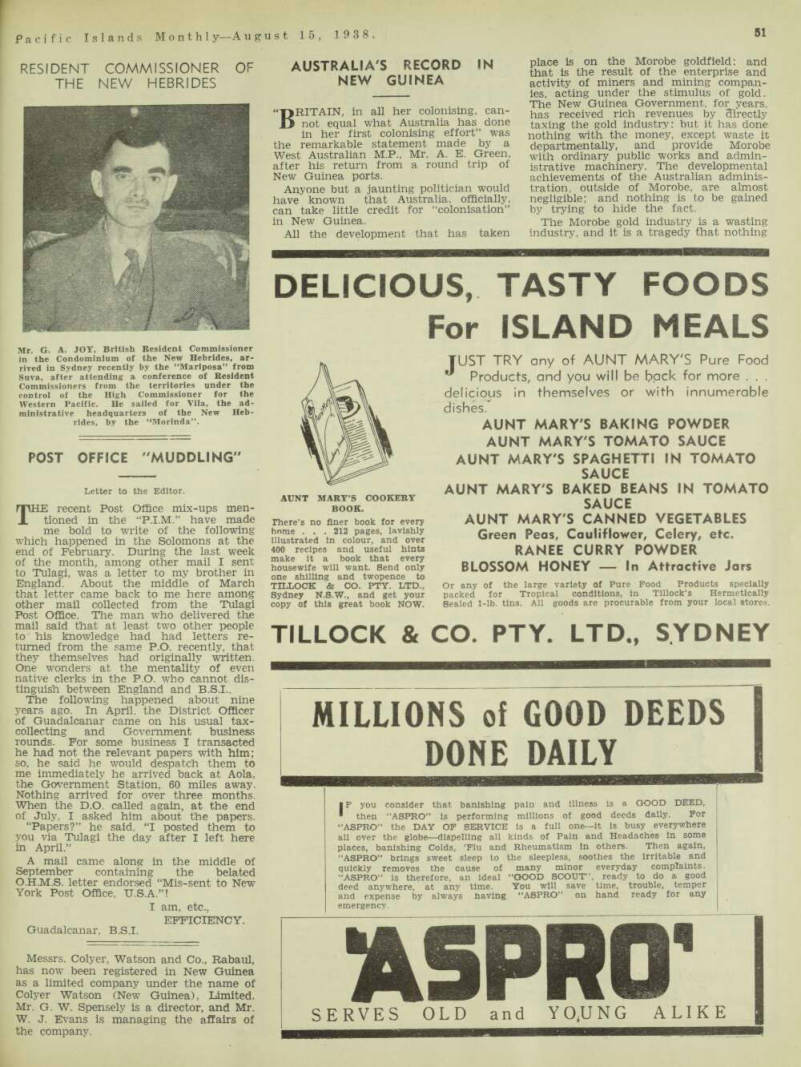
The New Hebrides
Mr. G. A. JOY, British Resident Commissioner in the Condominium of the New Hebrides, ar rived in Sydney recently by the “Mariposa” from Suva, after attending a conference of Resident Commissioners from the territories under the control of the High Commissioner for the Western Pacific. He sailed for Vila, the ad ministrative headquarters of the New Heb rides, by the “Morinda”.
Post Office "Muddling"
Letter to the Editor.
THE recent Post Office mix-ups men tioned in the “P.1.M.” have made me bold to write of the following which happened in the Solomons at the end of February. During the last week of the month, among other mail I sent to Tulagi, was a letter to my brother in England. About the middle of March that letter came back to me here among other mail collected from the Tulagi Post Office. The man who delivered the mail said that at least two other people to his knowledge had had letters re turned from the same P.O. recently, that they themselves had originally written.
One wonders at the mentality of even native clerks in the P.O. who cannot dis tinguish between England and 8.5.1..
The following happened about nine years ago. In April, the District Officer of Guadalcanar came on his usual tax collecting and Government business rounds. For some business I transacted he had not the relevant papers with him; so, he said he would despatch them to me immediately he arrived back at Aola, the Government Station, 60 miles away.
Nothing arrived for over three months.
When the D.O. called again, at the end of July, I asked him about the papers.
“Papers?” he said, “I posted them to you via Tulagi the day after I left here in April,”
A mail came along in the middle of September containing the belated O.H.M.S. letter endorsed “Mis-sent to New York Post Office, U.S.A.”!
I am, etc.,
Efficiency.
Guadalcanal 8.5.1.
Messrs. Colyer, Watson and Co., Rabaul, has now been registered in New Guinea as a limited company under the name of Colyer Watson (New Guinea), Limited.
Mr. G. W. Spensely is a director, and Mr.
W. J. Evans is managing the affairs of the company.
Australia's Record In
New Guinea
BRITAIN, in all her colonising, can not equal what Australia has done in her first colonising effort” was the remarkable statement made by a West Australian M.P., Mr, A. E. Green, after his return from a round trip of New Guinea ports.
Anyone but a jaunting politician would have known that Australia, officially, can take little credit for “colonisation” in New Guinea.
All the development that has taken
place is on the Morobe goldfield; and that is the result of the enterprise and activity of miners and mining compan ies, acting under the stimulus of gold.
The New Guinea Government, for years, has received rich revenues by directly taxing the gold industry: but it has done nothing with the money, except waste it departmentally, and provide Morobe with ordinary public works and admin istrative machinery. The developmental achievements of the Australian adminis tration, outside of Morobe, are almost negligible; and nothing is to be gained by trying to hide the fact.
The Morobe gold industry is a wasting industry, and it is a tragedy that nothing
should have been done with the public revenues it produced (according to a ministerial statement, probably £400,000 in royalties alone) to establish perman ent agricultural industries.
Mr. Green was on sounder ground when he praised the work of the young officials—especially the patrol officers— in New Guinea. There is accumulating evidence that the personnel of this ser vice is excellent, and a credit to Aus tralia. It is a pity that it is handicap ped by stupidity, inexperience, and a fiercely bureaucratic outlook in some of the higher ranks of the administration.
Mr. Phillip Henry Walmesley, a plan tation overseer on Ilia estate, Witu Island, New Guinea, died in July.
Advertisements & other items, p. 55 (2 items)
51
Pacific Islands Monthl y—A ugust 15, 1938.
Millions Of Good Deeds
DELICIOUS, TASTY FOODS
For ISLAND MEALS
AUNT MARY’S COOKERY
BOOK.
There’s no finer book for every home . . . 212 pages, lavishly Illustrated In colour, and over 400 recipes and useful hints make it a book that every housewife will want. Send only one shilling and twopence to
TILLOCK & CO. PTY. LTD.,
Sydney N.S.W., and get your copy of this great book NOW.
JUST TRY any of AUNT MARY'S Pure Food Products, and you will be bpck for more . . . delicious in themselves or with innumerable dishes.
AUNT MARY'S BAKING POWDER
AUNT MARY'S TOMATO SAUCE
AUNT MARY'S SPAGHETTI IN TOMATO
SAUCE
AUNT MARY'S BAKED BEANS IN TOMATO
SAUCE
AUNT MARY'S CANNED VEGETABLES
Green Peas, Cauliflower, Celery, etc.
RANEE CURRY POWDER
BLOSSOM HONEY In Attractive Jars Or any of the large variety of Pure Food Products specially packed for Tropical conditions, in Tlllock’s Hermetically Sealed 1-lb. tins. All goods are procurable from your local stores.
TILLOCK & CO. PTY. LTD., SYDNEY
MILLIONS of GOOD DEEDS
DONE DAILY
IF you consider that banishing pain and Illness is a GOOD DEED, then “ASPRO” Is performing millions of good deeds dally. For “ASPRO” the DAY OF SERVICE is a full one—it Is busy everywhere all over the globe—dispelling all kinds of Pain and Headaches in some places, banishing Colds, ’Flu and Rheumatism in others. Then again, “ASPRO” brings sweet sleep to the sleepless, soothes the irritable and quickly removes the cause of many minor everyday complaints.
“ASPRO” is therefore, an ideal “GOOD SCOUT”, ready to do a good deed anywhere, at any time. You will save time, trouble, temper and expense by always having “ASPRO” on hand ready for any ; emergency.
and
SERVES OLD
YOUNG ALIKE
Super Thrills
In Motoring
Whot Happens In Tahiti When The Brakes Fail
Prom Our Own Correspondent.
Papeete, July 28.
TRANSPORTATION of merchandise ana passengers, between Papeete and the several districts of Tahiti, is carried on by motor trucks. Some of them are new and modern; some of ancient vin tage. All are serviced in a rather sketchy manner—particularly in the matter of brake inspection.
On the comparatively level route along the west side of the island, a journey by truck is somewhat of an adventure. Along th,e rugged and perilous north and east coasts an expedition by truck is a hazard which would produce a shrinking and shuddering fear in an actuary, and chal lenges the gods of ch,ance.
Taharaa—likewise known as One Tree Hill—is one of the most formidable heights crossed bv this route. The descent on the eastward side of this hill is very steep. The roadway winds down between a clay embankment on the left and a drop into a valley on the right. Every now and again th,e brakes of a truck making this descent give out. Usualy the driver stops the vehicle before it has gained too much headway, by heading it into the embank ment, where it comes to rest with no more damage than a shaking up of the passengers, an aerial flight by the miscell aneous merchandise piled on the roof of the awning, and a twisted radiator.
On one occasion, however, the brakes of a truck heavily laden with passengers and wares, failed at the steepest declivity near the top of the hill. To have attempted to turn into the embankment at that point would have meant the overturn of the truck and severe injury to those on board. The driver decided to take the chance of keeping the truck on the road way and to trust in fate to stop it in the sands of the beach at the foot of the hill.
Half way down the hill a stout old gentleman seated in an ancient buggy was guiding his horse slowly and carefully down the steep descent.
Suddenly he became aware of a thun dering roar as of an avalanche down the flank of Katchinjunga. A hasty glance behind told him that speed—and speed alone—could save him from destruction.
That race down Taharaa became an epic.
The passengers on the truck—forgetful of their own danger—leaned out to watch and cheer the old gentleman, as he stood up lashing his galloping horse, while the buggy rocked and bounced over the in equalities of the roadway. He won the race by inches.
At the foot of the hill the road made a sharp turn to the right to follow the coast. The buggy rounded that turn on its two starboard wheels, just as the truck was about to overtake it.
The speed of the truck was such that it would have been madness to attempt the turn. Grazing the rear wheels oi the buggy, it dashed straight on, plunged through the sands of the beach, and fin ally stopped upright, half submerged in the shallows of the shore reef. No one was injured.
Every night at midnight, two big trucks leave Hitia’a on the east coast, and travel through the darkness along a nar row roadway which clings, high up, on the face of precipices at whose bases the mighty waves of the open sea beat etern ally; for there is no barrier reef on that part of the coast. There are many places where, when rounding the sharp curves at the headlands, the outer half of the truck’s tyres overhang the abyss.
Sometimes the lighting apparatus fails.
In that event, the driver attaches a couple of ordinary kerosene hurricane lanterns to the radiator, and steers by instinct. The passengers crowd aboard and hope for the best.
By some miracle they always get through, and those living on the roadway to Papeete, who do not sleep too soundly, hear their chime whistles each morning, just before dawn, announcing that the gods of chancel have, once more, been propitious.
Advertisements & other items, pp. 56-57 (3 items)
52
Pacific Islands Monthl y—-A ugust 15 ; 1938.
Burns Philp
(SOUTH SEA) CO. LTD.
Inc. in Fiji
Island Traders and Shipowners
Also Branches at:
Registered Office:
SUVA
FIJI
Code Address: "Burnsouth."
Fiji: Levuka, Lautoka, Labasa, Ba. Sigafoka, Rofuma.
Tonga: Nukualofa, Haapai, Vavau.
Samoa: Apia, Pago Pago (American Samoa).
Solomons: Makambo, Gizo, Faisi.
New Hebrides: Vila.
Gilberts: Tarawa.
Norfolk Is. Niue. Wallis Is. Futuna Is.
n Gain good results at the least expense — Making each choice in a careful test, Whatever they buy, they buy the best.
Plain, sane people in sensible ways Avoid the risks of unwise delays — For treatment of colds they all rely On Woods’ Great Peppermint Cure laid by.
Woods’ Great Peppermint Cure, For Children’s Hacking Cough.
FREEMANS
For Quality Goods at Low Prices
ESTABLISHED SINCE 1905
165-167 Castlereagh St., Sydney, N.S.W.
Sporting Goods.
GOLF SETS.
"J. A. Kirkwood’’ Hickory Shaft Matched Golf Sets; special rustless heads made in Scotland, including mid-iron, mashie, putter and brassie-driver, in leather mounted waterproof canvas bag 42/6.
“J. A. Kirkwood” Steel Shaft Matched Golf Sets; latest heavy ridged back design, rustless heads made in Scotland, including midiron, mashie, putter and brassie-driver, in leather mounted waterproof canvas bag. 69/6.
All well-known makes of Golf Equipment and Sporting Goods of every description always in stock. Enquiries invited for particulars of goods in which you are Interested.
WE STOCK EVERYTHING. WRITE FOR
YOUR REQUIREMENTS. GOODS FOR-
WARDED V.P.P. OR SIGHTDRAFT.
SERVICE AND SATISFACTION GUAR-
ANTEED. PLEASE ADD FREIGHT. ALL
PACKING FREE.
Saddlery.
We specialise in High-grade Saddles made of best quality materials t hrou ghout.
Strong guaranteed trees nnd first class workmanship.
All metal work guaranteed Solid Brass.
Strong High-grade Saduics in Stock, Kemp or Poiey styles. Strong guaranteed trees, narrow grip, firm pads, best quality flaps and skirts mounted with leathers, girth, & 3-bar N.P. Irons £3/19/6 High-grade Station Saddles, in Kemp or Poiey styles, deep comfortable kip seat, narrow grip, wide leather facings at back, strong firm pads, extra long kip flaps and skirts, mounted with leathers, girth, and 3bar N.P. irons £4/19/6.
Very Fine High-grade Super Station Stock Saddles, built on strongly plated, guaranteed trees, deep comfortable hogskin seat, with in. dip, narrow, grip, wide leather facings at back, very firm 5Va in. strong capped pads, raised thigh pads, extended leather points, extra long flaps and skirts made of long wearing flexible kip, mounted with bevelled leathers, girth, and 4-bar N.P. irons £6/19/6.
SPECIAL SADDLES MADE TO ORDER.
Jewellery Specials.
Gent’s Modern Shape "Starlex” Chrome Wrist Watches; Jewelled lever movement, luminous dial, leather strap 19/6.
Men’s Latest Square-shaped "York” Lever Wrist Watches; 15 Jewelled movement, Chrome Link Band 39/6.
Gent’s Chrome 7-Jewelled Lever Watches, on leather band 29/6.
Men’s 10-year Guaranteed Gold-filled Wrist Watches; 15 Jewels, 5 adjustments, very latest smart shapes 45/-.
Gent’s Solid Gold-filled Wrist Watches, modern shapes, 15 Jewelled movement, luminous dial, leather band, complete with presentation case 55/-.
“Fenchurch” Solid gold-filled Gent’s Wrist Watches, latest square shape, 15 Jewelled, shock-absorber movement, latest modern dial, Rolled-gold Link Band, complete with presentation case £4/16/-.
Lady’s Chrome Wrist Watches, latest miniature shapes, on chrome link band . 39/6.
Lady’s 9ct. Gold Wrist Watches, ultra smart shapes, 17 Jewelled movement, 5 adjustments, 44 hr. time-keepers’ 59/6.
Lady’s Solid Chrome Wrist Watches, brilliant studded bezel, dainty baguette shapes, complete with double-rope moire wristband, with presentation case 75/-.
Chrom. STOP WATCHES, Swiss made, 1-5.
“Floretla” Levers, Guaranteed accurate racing Time Pieces 27/6.
Postage Paid on all Jewellery Orders.
Musical Instruments.
Ukeleles: Complete with set of strings, Free Tutor 10/6.
Steel Guitars, beautiful tone. Free Tutor, 35/- “Harmony” Guitars, beautiful tone, nicely finished, Free Tutor £3/19/6 “Harmony” Guitars, professional model, pearl position dots, beautiful finish and tone.
With Free Tutor £6/6/-.
Guitar Cases, 19/6. Set of Picks, Steels, 4/6 per set.
Cameras.
1A Kodak Folding Cameras, double lens, slightly used 27/6.
Agfa “Speedex” Folding Cameras, 16 photos. built-in filter 37/6.
Agfa “Record” Folding Cameras, P 7.7 anastlgmat lens 57/6.
Voigtlander “Brilliant” Cameras, F 7.7 Voigtor lens £2/18/-.
“Welta Trio” Cameras, 4.5 lens, compur shutter, 1 sec. to l/250th £6/5/-.
Postage Paid on all Camera Orders.
Typewriter Bargains.
Slightly used.
Corona, 3-Bank, Portable Typewriters, in case, perfect order £5/19/6.
Corona, 4-Bank, Portable Typewriters, In case, perfect order £B/16/-.
Remington 4-Bank Portable Typewriters, in case, perfect order £B/16/-.
Powerful Field Glasses.
r s Extra-powerful Field Glasses, centre focus, complete In case 21/-.
“Lumiere” Paris, High-power, Field Glasses, centre focus, with case and strap ... 36/-.
Extra Hlgh-power, Marine Glasses, day and night use, centre focus 46/-.
High-power Super Dreadnought Marine Glasses, extra wide optics, with case, 50/-.
High-power “Loren” Field Glasses, centre focus, 4 x 36 wide vision, complete with leather strap and case 59/6.
“Audemair”, 8 x 30 Prismatic Field Glasses, extra-wide optics, central and individual focus, complete with strap and case, £6/10/- Carl Zeiss Field Glasses, 6 x magnification; slightly used, with case £6/19/6.
Carl Zeiss Field Glasses, 8 x 30 magnification, wide vision, slightly used .. .. £ll/15/-.
“Goerz” Field Glasses, 6 x 24, Individual focus, slightly used, with case .. .. £6/15/-.
Postage Paid on all Field Glass Orders.
Bicycles.
Gent’s Roadster Bicycle, free wheel, electric dynamo and lamp, handbrake, good tyres and tubes, slightly used: £3/15/-.
“Speedwell” Bicycle, Club-racer, brazed on back stays, free wheel, t a pered frame, hand - brake, slightly use d £4/19/6 Brand-new Gent’s “Oxford” Special Roadster Bicycle.
Equipment: Brake, lamp, tools, free wheel .. £5/19/6.
Good Strong Bicycles, slightly used, fixed or free wheel, with brake, in good order 46/-.
Gent’s Brand-new Oxford” Club-racer Bicycle, fully tapered frame and forks, brazedon seat stays. Equipment; “Fitz” H/bars, side-pull brake, doubl-sided hub, Endrlck rims, “Dunlop” black and white tyres, speedo. Complete Cycle £B/19/6.
Lady’s brand new “Oxford” Special Cycle, fitted with free wheel, dress nets, chain guard, mud guards, spring top saddle and handbrake. All English fittings throughout A variety of colors. At the amazing price of £6/19/6. )
FREEMANS
FOR PROMPT SERVICE
and
HONEST VALUE.
165-167 Castlereagh Street, SYDNEY, New South Wales.
53
Pacific Islands Mon t hi y— A ugu s t 15, 1938.
Wasn't!
A Rebellion That
Author As Hangman's Helpmate In 8.5.1.
Letter to the Editor.
AN account of the adventurous life oi Mr. Xavier Herbert, author of “Cap ricornia”, which was awarded first prize in the novel section of the 150th anniversary literary competition, was fea tured in the “Sydney Morning Herald” of April 2.
A statement attributed to Mr. Herbert merits attention as pointing to the pos session of a vivid and elastic imagin ation that must be an invaluable asset to the novelist in the literary career on which he has so auspiciously embarked, “In 1928”, he is reported as saying, “I went to the Solomon Islands. It was the time of the rebellion, and I found myself in charge of 750 prisoners. I used to pull the black cap over the heads of con demned men before they were hanged. I fell out with the authorities, and went back to Sydney, through Suva and the Gilberts.”
The reference to 8.5.1. evidently refers to the incident on Malaita in which two Govermhent officials and some native policemen were murdered, and which, by the way, occurred in 1927, the year pre vious to that in which Mr. Herbert claims to have visited the Solomons.
That there was a “rebellion” will come as a surprise to Solomon Islanders from Sinarango to Shortlands, and there will
be keen resentment that they have been kept in the dark all these years about the grave crisis that took place in their midst without an inkling of the fact being made known to them. Now that Mr. Herbert has kindly lifted the veil and exposed the callousness of the Government in failing to inform the inhabitants that a rebellion was afoot, something ought to be done about it.
Mr. Herbert, we learn, found himself in charge of 750 prisoners; blood-thirsty rebels to a man, no doubt! Small wonder that he passed unobserved in such a crowd. Some day, perhaps, he will en lighten us as to where he parked that mob —and himself—so secretly and incon spicuously. The information might prove useful in the event of another rebellion when, the gifted historian having fallen out with the authorities, he may not be disposed to take the job on again.
Pulling black caps over the heads of condemned men was another of Mr.
Herbert’s public-spirited activities that went unmarked, unhonoured, and unsung; so it is not surprising to learn that he fell out with the authorities, whose at titude seems to have been lacking in those finer feelings of gratitude and appreci ation rightfully due to a public benefactor.
Indeed, so complete and baffling has been official reticence over this mysterious affair, and so great the modesty and self-effacement of Mr. Herbert, that noth ing was known of the notable services he performed until he told uls himself! * I am. etc..
Solomonite.
Gizo. 8.3.1. 28/0/’3B.
Oil-Seeking Party Attacked
In Dutch N. Guinea
A GEOLOGICAL party making investi gations on behalf of the New Guinea Petroleum Co., was ambushed at the end of June by archers of the Randjis tribe near Waropen, Dutch New Guinea.
The attack lasted for three days, until a detachment of 15 field police, summoned by radio, arived by plane from Seroei.
No lives were lost.
The N.G. Petroleum Company is vigor ously pushing on with its oil-seeking ac tivities and is boring at Babo. Over 100 Europeans and 3,200 natives are employed at the three bases—Babo, Kasim, and Waropen.
Matson Changes
Honolulu, July 28.
THE Matson Navigation Company an nounces changes in the colours and names of 11 of its freighters employed in the Pacific.
Formerly red-brown the fleet will be given black hulls and white super-struc tures, trimmed in green and buff funnels, with blue stripes. Changes in the names are; “Golden Sun” to “Mokihana”; “Gen eral M. H. Sherman” to “Kaimoku”; “Golden Horn” to “Kainalu”; “Golden Cross” to “Kohala”; “Golden Club” to “Waimea”; “Golden Dragon” to “Mahi mahl”; “Golden Mountain” to “Olopana”; “Golden Kauri” to “Waipio”; “Constance Chandler” to “Liloa”; “Marion Otis Chan dler” to “Onomea”; and “Helen Whittier” to “Kalani”.
Advertisements & other items, p. 58 (1 item)
St. Ignatius College - Kiverview, Sydney
BOARDING and DAY SCHOOL Conducted by the Jesuit Fathers
ONE OF SYDNEY’S GREAT PUBLIC SCHOOLS.
OOYS prepared for Intermediate and Leaving Certificate Examinations and for Exhibitions, Scholarships and Bursaries at the University.
Boys are arranged in three divisions according to age and size. Each division has its own library, debating society, cricket and football field, tennis court.
Senior and Junior Rowing Sheds. Private Swimming Baths.
Prospectus and Further Particulars on application to the Rector,
REV. J. MEAGHER, S.J.
Telephone: JA 1106. *» H pi mV i m m i m mmm ; r..
Treasures Of Tahitian Tombs
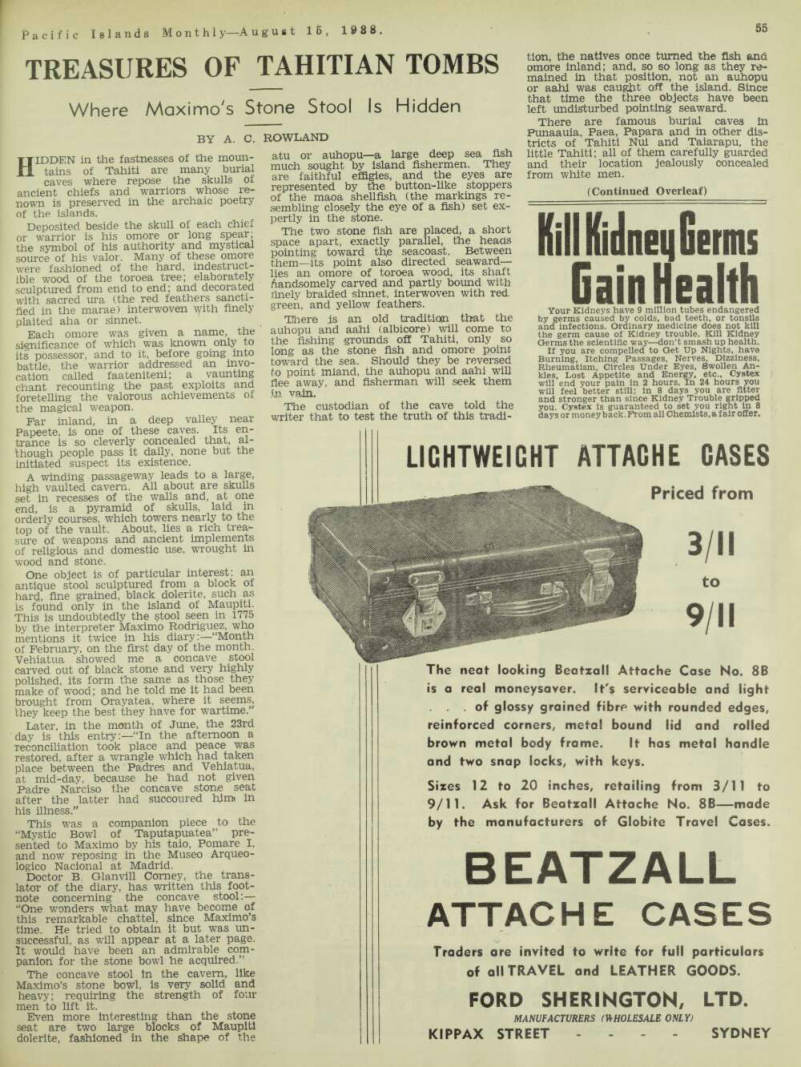
Where Maximo's Stone Stool Is Hidden
By A. C. Rowland
HIDDEN in the fastnesses of the moun tains of Tahiti are many burial caves where repose the skulls of ancient chiefs and warriors whose re nown is preserved in the archaic poetry of the islands.
Deposited beside the skull of each chief or warrior is his omore or long spear; the symbol of his authority and mystical source of his valor. Many of these omore were fashioned of the hard, indestruct ible wood of the toroea tree; elaborately sculptured from end to end; and decorated with sacred ura (the red feathers sancti fied in the marae) interwoven with finely plaited aha or sinnet.
Each omore was given a name, the significance of which was known only to its possessor, and to it, before going into battle, the warrior addressed an invo cation called faateniteni; a vaunting chant recounting the past exploits and foretelling the valorous achievements of the magical weapon.
Far inland, in a deep valley near Papeete, is one of these caves. Its en trance is so cleverly concealed that, al though people pass it daily, none but the initiated suspect its existence.
A winding passageway leads to a large, high vaulted cavern. All about are skulls set in recesses of the walls and, at one end, is a pyramid of skulls, laid in orderly courses, which towers nearly to the top of the vault. About, lies a rich trea sure of weapons and ancient implements of religious and domestic use, wrought in wood and stone.
One object is of particular interest: an antique stool sculptured from a block of hard, fine grained, black dolerite, such as is found only in the island of Maupiti.
This is undoubtedly the stool seen in 1775 by the interpreter Maximo Rodriguez, who mentions it twice in his diary‘Month of February, on the first day of the month.
Vehiatua showed me a concave stool carved out of black stone and very highly polished, its form the same as those they make of wood; and he told me it had been brought from Orayatea, where it seems, they keep the best they have for wartime."
Later, in the month of June, the 23rd day is this entry:—“ln the afternoon a reconciliation took place and peace was restored, after a wrangle which had taken place between the Padres and Vehiatua, at mid-day, because he had not given Padre Narciso the concave stone seat after the latter had succoured him* in his illness."
This was a companion piece to the “Mystic Bowl of Taputapuatea" pre sented to Maximo by his taio, Pomare I, and now reposing in the Museo Arqueo logico Nacional at Madrid.
Doctor B Glanvill Comey, the trans lator of the diary, has written this foot note concerning the concave stool; “One wonders what may have become of this remarkable chattel, since Maximo’s time. He tried to obtain it but was un successful, as will appear at a later page.
It would have been an admirable com panion for the stone bowl he acquired."
The concave stool In the cavern, like Maximo’s stone bowl, is very solid and heavy; requiring the strength of four men to lift it.
Even more interesting than the stone seat are two large blocks of Maupiti dolerite, fashioned in the shape of the
atu or auhopu—a large deep sea fish much sought by island fishermen. They are faithful effigies, and the eyes are represented by the button-like stoppers of the maoa shellfish, (the markings re sembling closely the eye of a fish) set ex pertly in the stone.
The two stone fish are placed, a short space apart, exactly parallel, the heads pointing toward the seacoast. Between them—its point also directed seaward — lies an omore of toroea wood, its shaft handsomely carved and partly bound with finely braided sinnet. interwoven with red. green, and yellow feathers.
There js an old tradition that the auhopu and aahi (albicore) will come to the fishing grounds off Tahiti, only so long as the stone fish and omore point toward the sea. Should they be reversed to point inland, the auhopu and aahi will flee away, and fisherman will seek them in vain.
The custodian of the cave told the writer that to test the truth of this tradi
tlon, the natives once turned the fish and omore Inland; and, so so long as they re mained in that position, not an auhopu or aahi was caught off the island. Since that time the three objects have been left undisturbed pointing seaward.
There are famous burial caves In Punaauia, Paea, Papara and in other dis tricts of Tahiti Nui and Taiarapu, the little Tahiti: all of them carefully guarded and their location jealously concealed from white men. (Continued Overleaf)
Years ago, some scientists were conducted to one of these caves, after giving their word of honour that they would disturb nothing. When they broke that word, and afterward went to the cave and looted it, the natives of Tahiti took an oath never again, l to disclose to a European any of their burial caves, and they have kept that oath to this day. ■ Mrs. Bliss, wife of Mr. G. Bliss, formerly SLJS? ,• N S' u A pi cu lture Department, arrived m Rabaul from Sydney by the July “Tanda” to join her husband. They will leave shortly for the mainland where Mr. Bliss will take over the managership of a large estate.
Advertisements & other items, p. 59 (1 item)
Kill KidnEij Germs
Gain Health
Your Kidneys have 9 million tubes endangered by germs caused by colds, bad teeth, or tonsils and infections. Ordinary medicine does not kill the germ cause of Kidney trouble. Kill Kidney Germs the scientific way—-don’t smash up health.
If you are compelled to Get Up Nights, have Burning, Itching Passages, Nerves, Dizziness, Rheumatism, Circles Under Eyes, Swollen Ankles, Lost Appetite and Energy, etc., Cystex will end your pain in 2 hours. In 24 hours you will feel better still; in 8 days you are fitter and stronger than since Kidney Trouble gripped you. Cystex is guaranteed to set you right to 8 days or money back. From all Chemists, a fair oner.
LIGHTWEIGHT ATTACHE GASES
The neat looking Beatzall Attache Case No. 8B is a real moneysaver. It's serviceable and light . . . of glossy grained fibre with rounded edges, reinforced corners, metal bound lid and rolled brown metal body frame. It has metal handle and two snap locks, with keys.
Sizes 12 to 20 inches, retailing from 3/11 to 9/11. Ask for Beatzall Attache No. BB—made by the manufacturers of Globite Travel Cases.
BEATZALL
ATTACHE CASES
Traders are invited to write for full particulars of all TRAVEL and LEATHER GOODS.
FORD SHERINGTON, LTD.
KIPPAX STREET ... SYDNEY
Priced from to
MANUFACTURERS WHOLESALE ONLYI
Keeping Track Of
Storms
Need For Meteorological Network
the well-known New Zealand rep » » resentative of Pan-American Air ways, Mr. Harold Gatty, was in Sydney recently, he said tlxat the most import ant work yet to be done, in providing for an efficient aviation service across J! n across the Central South was the crea “ tion of a complete meteorological organ isation.
No service could be run with confidence, here or anywhere else, unless the oper ators were provided with accurate re ports of the weather ahead. The wider the area covered, and the more numerous the reporting points, the more confident could the pilot be in setting out on his long flight over the oceans.
Mr. Gatty said that there were two main difficulties in the Pacific —the great number of small Administrations, whose activities had to be co-ordinated, and irregular reports. He, and others inter ested, had received the most willing as sistance from practically all Islands Ad ministrations; all that was needed was a central directing authority. But this was vital, and not much had yet been done in this direction.
The need for frequent, regular reports was obvious. There were times when some of the smaller and more isolated radio stations were closed, for short periods. That made accurate weather charting impossible—it might happen that the report of a particular station, on a particular day, would provide essential in formation about the extent and direction of a storm.
Advertisements & other items, p. 60 (1 item)
Near Noumea
The palm-lined avenue leading to St. Louis Mission Station, 10 miles from Noumea, New Caledonia. —Photo.: E. Dent.
Whaling Station For N.I.
THE Norfolk Island Whaling and Shark ing Co., Ltd., has been formed to build a depot and station at Ball Bay, on the eastern side of the island, in con nection with the proposed resuscitation of the whale and shark catching industry.
The project has the support of the Admini strator, Sir Charles Rosenthal, who has promised to seek the aid of the Federal Government to enable the industry to get under way.
Whaling at one time was N.l.’s only export industry, but it was superseded by farming, the last whaling operations ceasing in 1925. Shark fishing for com mercial purposes has not been carried on for three years.
Mr. John F. Surr, a member of the executive staff of the Melanesian Mission in the Solomon Islands, is spending leave in New Zealand. He will join the mission vessel “Southern Cross VII” when she arrives in New Zealand on August 30 and will return with her to 8.5.1.
Advertisements & other items, pp. 60-66 (7 items)
56
Pacific Islands Monthl y —i August 15, 1938.
lt£gSr
/ R
It's CHEAPER to PAINT
than to repair!
DISTRIBUTORS:
Greenwood & Laws Ltd., Rabanl and Wau.
Steamships Trading Co. Ltd., Port Moresby and Samarai.
Decay can do no damage if your home is properly protected with good paint.
Use “8.A.L.M.” Paint— “B.A.L.M.” Paint gives protection. And it wears down evenly and very slowly, lasting years longer than ordinary paint.
Decide now to save money by painting; and decide to make maximum savings by using - - - - “8.A.L.M.” Paint!
W uTsT GRADE PURE pjTWI
A Product of British Australian Lead Manufacturers Pty. Ltd.,
lt£gSr
Obtain a copy before you build.
It contains designs and plans — in colour—of Homes that can be inexpensively built with
WUNDERLICH DURABESTOS,
the indestructible asbestos-cement building sheeting. Write to
WUNDERLICH LIMITED
G.P.0., Box 474 aa, SYDNEY
FOR TROPI CAL BUILDINGS, SPECIFY
WUNDERLICH
\WvtkJ DU RABCSTCS
i ASBESTOS CEMENT BUILDING SHEETS
Site”
57
War of the “Capital Site”
The Griffiths Report (Continued from Page 27.)
Pacific Islands Month! y—A ugust 15, 1938.
44 Macleay Street
25 YEARS OF SERVICE
William E. Reed
(Established 1913)
BROKER & AGENT
Union House. 247 George St., Sydney For all Plantation and Trading Requirements. Enquiries welcome.
WHEN SPENDING YOUR VACATION IN SYDNEY YOUR CHOICE OF RESIDENCE IS A MAHER SO VITAL TO YOUR ENJOYMENT!
May we commend to you for All-round Excellence ...
SYDNEY'S MOST EXCLUSIVE PRIVATE HOTEL
44 MACLEAY STREET
Here for you await unrivalled Service and Cuisine—Suites with Private Baths H. & C. Water and Telephones in ail rooms—Magnificent Harbour Views Roof Garden Sun Room* Spacious Lounges ana Smoke Rooms and every modern convenience All under Personal Supervision of the Proprietress,
MISSM. E. BURROWS
sa I ik 7*
TARIFF: From £3/3/-
per week inclusive.
Radios:
’FORTY FOR"
Sydney.
Telephone: FL 2641
BULLIVANTS’ wire ropes
THE WORLD'S STANDARD
LARGEST STOCKS IN AUSTRALASIA : FOR ALL PURPOSES Also Blocks, Hooks, Shackles, Thimbles, Strand, Seizing, Aircraft Cord, etc.
Prompt Attention! Efficient Service!! Complete Satisfaction!!!«•«««—
BULLIVANTS' Australian Co. Pty., Ltd.
Letters; Incorporated in Victoria.
Box 1298 J, G.P.O. 331 KENT STREET, SYDNEY.
Telegrams: Sydney.
“Bullivants, Ltd.” $
WIN. BRECKWOLDT & CO.,
SOUTH SEA MERCHANTS
POSTAL ADDRESSES:—
NEW GUINEA:—P.O. Box 89, Rabaul. TAHITI:—P.O. Box 60, Papeete.
FIJI: —P.O. Box 111, Suva. SAMOA:—P.O. Box 124, Apia.
AGENTS FOR...
TRADE MARK
BREWO
MERCEDES - BENZ DIESEL
TRUCKS, HANOMAG tractors, D.K.W. motorcars, CONTINENTAL tyres and tubes, MERCEDES- BENZ marine engines.
A R ASPIRIN . . . ATEBRIN . . . YATREN PYRAMIDON . . . PLASMOCHIN . . .
MITIGAL . , .HELMITOL . . . NEOSAL- VARSAN . . . ETC., ETC. . . , Stocks always available at our Branches. Any orders will be executed at original “BAYER”
PRICES.
LAMPS AND
"PETROMAX"-
HURRICANE LANTERNS,
ACCESSORIES.
FROWO"-
HURRICANE LANTERNS, No. 45, 55, 65,
25, 85, Etc.
"TIGER BRAND"-
CORRUGATED AND FLAT GALVANISED
IRON.
TAIFUN"-
BICYCLES AND ACCESSORIES.
MAKE \ "TELEFUNKEN"-
RADIO SETS.
"ARARA"-
GAS STOVES
"ANCRE"-
CAST IRON SAUCEPANS.
ATRIAL-
APPLY
TO-DAY.
SWEDISH Axes and Hatchets . . . Bicycles . . .
Sewing Machines . . .
Knives . . . Razor Blades . . . Lavalavas . . . Toothpaste . . . Rea! Briar Tobacco Pipes . . Poundbeads . . . Seedbeads . . .
Cutbeads. also all kinds of
GERMAN, BRITISH
and
CONTINENTAL
GOODS.
BLANKETS
TWO LIONS"-
COPRA KNIVES, BUTCHERS' KNIVES
BECK'S-
"KEY BRAND" GERMAN LAGER.
"BIRKO"-
"POLISSE" and "POLO" RAZOR BLADES.
LOHSE,
URALT LAVENDER.
TORPEDO," "BIJOU" and "ERICA"
TVOfWRITCOt;
VESTA SEWING MACHINES
\ D« HENRIS
NU-VIGOR
1 1 l/C'ilV VITALITY
VITALITY
PILLS
$
NU-'j VIGOR
llli /triviwirnr
MEN
TAKE DR. HENRI’S
Nu-Vigor Vitality Pills
for loss of power and nervous exhaustion. They give wonderful results where overwork, worry, nerve weakness, etc., causes loss of those vital powers so necessary for the full enjoyment of life.
They are made in two strengths to suit individual cases. Week’s supply 3/6, one month’s treatment 10/6. Obstinate cases should try the Extra-Strong Prescription, 7/6 and 21/ —stimulates the organs.
Post FREE in plain wrapper. Call or Write for literature and Free Advice to
H. P. MICHAEL, M h p°s..
CHEMIST.
Michael’s Buildings, Cor. Elizabeth & Lonsdale Streets,
MELBOURNE.
MEDICAL GOODS
Best Quality. Lowest Prices.
AH Guaranteed.
Write for FREE “Book of Knowledge” Catalogue and Price Lists Medical Goods, etc. (Send 2d. if in Victoria). All Goods sent Post Free, plain wrapper, return mail. Strictly confidential.
IT ATTRACTS THEY EAT IT THEY DIE
IUSOLINE
err;ta *, nr ath
NEVER
KNOWN
TO FAIL !
V COCKROACH
\ DESTROYER
IT'S A PASTE
AUSOLINE CO.
314 CROWN STREET, SYDNEY
(Established 1919)
PRICES:
Mb. 5/- . . . 3lbs. 10/- Postage Extra.
Remit Cash with Order.
Obtainable also from Islands stores of:
BURNS, PHILP & Co. Ltd.
W. R. CARPENTER & Co. Ltd.
MODERN SLEEPING EQUIPMENT
ti bJ ,
, m I 1 -W. '
i JnMTi
TUBULAR STEEL FURNITURE
Address all Correspondence and Orders to — Australia's Largest Manufacturers of
STEEL BEDS
Hospital Beds and Equipment Ships' All-Steel Berths Lawn Hammocks Cabinet Beds Garden Seats Stretchers "Steelite-De-Luxe"
Mattresses "Aero" Spring- Filled Bedding "Morning Glory"
Bedding
NEWLANDS BROTHERS PTY, LTD.
Head Office & Works: Riley and Albion Sts. Sydney, N.S.W.
Cable and Telegraphic Address: “Newlandbed” Sydney
Champion
Outboard Motors
2-9 H.P. 1-9 M.P.H.
New light outboards weighing only 31 lbs., yet heavy and powerful enough for the unexpected hard going Champions are fitted with full float carburettor with idling jet ensuring maximum performance at all speeds. No vibration, little noise, easy starting, and economical.
More Horse Power at less cost.
Tilley Lamps
BRITISH MADE KEROSENE LAMPS, pro-
viding 300 to 500 C.P. clear, steady light. All TILLEY LAMPS are completely insect proof. Use only one mantle which is supported top and bottom and will not shake off. English Pyrex Globes.
Eleven Models, including Wall Lamps (illustrated), Table Lamps, Hanging Lamps, Storm Lanterns, etc.
Write for Catalogue.
Price only £l9/10/- (ex bond.) K
Renta
Marine Engines
Quality, precision-built Engines for all Boats up to 90 ft. in length. For Petrol, Kerosene or Heavy Oil. All Engines equipped wlh full Reverse Gears, force feed lubrication, and built for Marine work only.
Prices complete from £45.
Write for Catalogue, stating Horse Power required.
We have large and complete stocks of Shipchandlery and Mining Gear. Boat fittings of all descriptions manufactured in our own marine foundry.
We are manufacturers of the well known "Pioneer” brand Ash Oars and Tool Handles.
Write for free catalogue of any line which may Interest you.
W. KOPSEN
£r Co. Pty. Ltd.,
ESTABLISHED 1878
70 CLARENCE STREET,
SYDNEY
CABLES; KOPSEN, SYDNEY.
Your Tropical Rit
When you visit the Pacific Islands, whether on Business or Pleasure, you need Special Equipment—Light Suits of Correct Style, which fit well and launder easily; Tunic Shirts.
Silk Shirts, Light Underwear, White Shoes, etc.
WALTER HORNE & CO. LTD., established in 1885, specialise in this Service. Skilled Tailors make your Suits from First-class material within 24 hours. Complete equipment can be supplied from our Large Stocks at Reasonable, Moderate Prices.
BUY FROM THE FIRM WHICH UNDERSTANDS YOUR NEEDS AND
DRESSES YOU CORRECTLY
WALTER HORNE &' CO. LTD., carry a Full Range * of Drapery of all kinds; also Frocks, Millinery, Foundations and Lingerie, Hosiery, Shoes and Sandals, Ribbons and Laces, Household Drapery.
Men resident in any of the Pacific Territories can he supplied with Suitable Clothes.
Ladies' Hairdressing and Manicuring
WALTER HORNE &
Write to us and Describe your Requirements.
CO. LTD.
Drapers and Men's Wear Specialists
SUVA. FIJI
A. B. DONALD LTD.
AUCKLAND
ISLAND TRADERS :: GENERAL MERCHANTS
P. O. Box 1509 Cables and Telegrams; "Kingdom," Auckland Branches at Rarotonga and throughout the Cook Islands At Papeete and throughout the Society, Marquesas and Paumotu Islands trading as " ETABLISSEMENTS DONALD. TAHITI "
At Fiji: Trading as "Dominion Fruit C 0.," Suva
58
Pacific Islands Monthl ugust 15, 1938.
60
Pacific Islands Monthl y—A ugust 15, 1938.
61
Pacific Islands Month! y—A ugust 15, 1988.
Bowling Carnival At
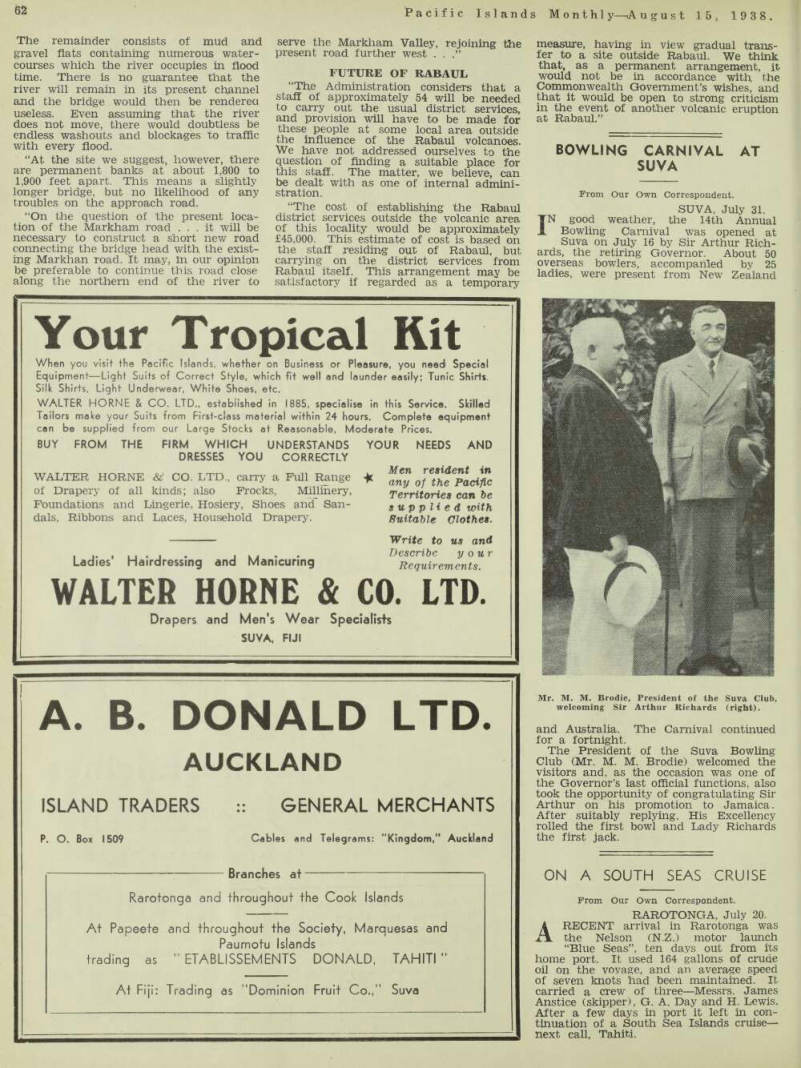
Suva
From Our Own Correspondent.
SUVA, July 31.
IN good weather, the 14th Annual Bowling Carnival was opened at Suva on July 16 by Sir Arthur Rich ards, the retiring Governor. About 50 overseas bowlers, accompanied by 25 ladies, were present from New Zealand
and Australia. The Carnival continued for a fortnight.
The President of the Suva Bowling Club (Mr. M. M. Brodie) welcomed the visitors and, as the occasion was one of the Governor’s last official functions, also took the opportunity of congratulating Sir Arthur on his promotion to Jamaica.
After suitably replying, His Excellency rolled the first bowl and Lady Richards the first jack.
Mr. M. M. Brodie, President of the Suva Club, welcoming Sir Arthur Richards (right).
On A South Seas Cruise
From Our Own Correspondent.
Rarotonga, July 20.
A RECENT arrival in Rarotonga was the Nelson (N.Z.) motor launch “Blue Seas”, ten days out from its home port. It used 164 gallons of crude oil on the voyage, and an average speed of seven knots had been maintained. It carried a crew of three —Messrs. James Anstice (skipper), G. A. Day and H. Lewis.
After a few days in port it left in con tinuation of a South Sea Islands cruise— next call, Tahiti,
Advertisements & other items, p. 66 (1 item)
62
Pacific Islands Monthl y—A ugust 15, 1938.
Apoplexy—Or
Patience!
The Trials Of A Tahitian Shipowner
From Our Own Correspondent.
Papeete, July 25.
WHEN a man transplants himself from the turmoil of civilization to the placid calm of the South Seas, his future is determined by his choice of two alternatives: The cultivation of an im pregnable patience or —apoplexy. This is particularly the case if he enters the is land industry of coconut planting.
We have an acquaintance who owns a distant island. As he indulges in varied activities which keep him at his office in Papeete, the management of his plan tation on the island is entrusted to an overseer.
To supply this overseer and workman and to bring away copra, our acquaint ance has a small schooner. Every three months he loads this vessel with a gen erous supply of provisions, engages a native captain, picks up a miscellaneous crew, and hopefully despatches his argosy to the far away atoll.
Two months ago the schooner was sent away under a new captain. Allowing for all eventualities, the time of the outward and inward voyages should not have ex ceeded three weeks.
Three weeks passed; then four, five, six, seven.
Finally, in the middle) of the eighth week, the schooner appeared with her hatches full and bags of copra piled mountain high, on her deck.
The owner, who long ago has achieved th,e virtue of patience, repaired joyously to the wharf to inspect the cargo.
“You are late.” he said to the captain, “but you have brought a fine cargo, and I am satisfied.”
The captain stretched his mouth into an ingratiating smile.
“Eiaha oe ia inoino (do not be vexed)”, he said. “But this is not your copra—ex cept two tons.”
“What do you mean—not my copra?” shouted the owner.
“It belongs to Andre Tamatahi of Kauataki”, said the captain.
“Kauataki!” roared the owner. “What in the name of a thousand devils were you doing at Kauataki?” (Kauataki is more than a hundred miles off the course to the owner’s island).
The captain spread his arms.
“It was like this”, he said. “We stop ped at Ravaheru, Harakoto and Nukureka to refresh ourselves, and then, one night, when I left one of the sailors at the tiller, so that I might rest for an hour below, he fell asleep and the schooner drifted on the reef at Kauataki. The people of Kauataki helped me to get the vessel off. There are only a few holes in the bottom—nothing to worry about. Then Andre Tamatahi asked me to bring his copra to Papeete, and here I am.”
When, after hearing this recital, the owner had figuratively executed a series of spectacular evolutions in the sub stratosphere, and had come back to earth,
he gasped; “Then you have been away all this time without going near my island?”
“E pal (surely)” quoth the captain.
“And the provisions?”
“It was a long voyage”, explained the captain. “We ate what we had need of, and the rest I traded at Kauataki for the two tons of copra.”
The owner stared at the captain for a moment; then raised his hands on high, turned on his heel, and went back to his office.
“Why didn’t you kill him?” inquired a friend to whom he had told the story.
“If I had” replied the schooner-owner, “I should be compelled to engage another captain. I have already tried five others and they are worse than this one. Most of the others would not have brought back the two tons of copra. There is nothing to do but repair the vessel and send it out again. Perhaps the captain will find my island next time.”
This gentleman will never die of apop lexy.
Rarotongans In New
Zealand
Prom Our Own Correspondent,
Rarotonga, July 20.
EACH “Matua” sees a few natives leav ing these shores to try their luck in New Zealand. The majority are girls in their twenties who, before leaving, have been promised employment as domestics.
It is time that a Polynesian Club was formed in Auckland. Besides the large number of Cook Islanders, Samoa, Tonga and Tahiti are well represented there.
Advertisements & other items, p. 67 (1 item)
m*
SM-**"
P* **l or*' 4 **“ d ,„ ial ei '" hoU r. >w des'tf'® **;:, *** ** »■ s <l. «^* « w :v»' *» *® t^" e 0 *e 0? ' CS ' A se rva " lS *a\tef s ®° „ ed to#** tra^ e . s^®-' 0 ' .. 6 V^ C» b ' e ’ „ t b »^ )b 9 er e^'°" S
Stamps For Revenue!
From Our Own Correspondent.
Rarotonga, July 20.
r.E sale of Cook Islands Coronation Stamps were: 737,572 penny stamps; 569,108 of the twopence halfpenny; and 541,657 sixpennies. Total value £22,552/15/-. One is reminded of that miniature Republic, San Marino, which has made stamp selling its chief source of revenue.
Mr. J. M. Gaffney arrived in Western Samoa recently to supervise the erection in Apia of a new copra shed for Bums Fhilp (S.S.) Co., Ltd. He was pre viously in the Territory several years ago in connection with the building of B.P.’s present merchandise store.
Church Collections
Tongan Taxation Versus Church Collections
Letter to the Editor.
KINDLY allow me space to reply to the “damning with faint praise” of Mr.
“Absolutely Correct Etena” in your June issue. “Ignorance” said Josh Billings, “consists in knowing so many things that ain’t so”. “Etena’s” knowledge of “things that ain’t so” is really marvellous.
I repeat my statement, “The collection realised some £620.” That statement is not “inaccurate, unfortunate”, nor “mis leading”; it contains no “discrepancy”, displays no “weakness”; neither does it convey a “false impression” to your readers.
The collection realised £604, a sum far below actual requirements. There was
also collected the sum of £24, for the maintenance of a Tongan missionary in the Solomon Islands, making an “abso lutely accurate” total of £628. Then what of “Etena’s” claim that £740 was collected?
About “the thousands collected by the Church”. Last year, in Tongatabu, there was collected a total (including tne £628) of £l,BOO. ±2,200 will be a very generous estimate for the rest of the group, which gives us approximately £4,000 Suppose we could induce the Austra lian Mission Board to add this sum to their present donation, and make an annual contribution of £5,000 —there would then be no “thousands pocketed by the Church”, and the expense, not being borne by the Tongans, could have no “bearing on the misery etc.”. Now Mr “Etena”, how long would it be before a “carefully planned and balanced” budget added this £5,000 to the already over filled coffers of the Tongan Treasury? I do hope you will try to answer my question.
I am etc..
A. Cowley.
Nukualofa, Tonga.
July 25, 1938.
"Some" Birthday Party!
Prom Our Own Correspondent.
Honolulu, Aug. 2.
CAN any other Pacific family beat this?
John K. Moses, a Hawaiian of Hono lulu, has his birthday on July 11.
He has five children, three girls and two boys, all with birthdays in July, too!
Father Moses claims there was nothing premeditated about the phenomenon, which tickle local astrologists.
Papa Moses and three of the children were bom under the sign of Cancer.
Therefore according to astrological pre dictions, they “are sensitive, domestic, emotional, tenacious, sentimental, pas sive, dramatic and reflective”.
A boy and a girl were born under the sign of Leo, which makes them “cour ageous, with a great love for their own; good providers, and very few are poor”.
Noting the “good provider” angle, Papa Moses wishes he had been born under Leo!
Celebrating the birthdays every July— no two fall on the same day—is a bit of a drag on the family. “It might have been worse”, says patient Mrs. Moses, who was bom in May. “It might have all, happened in DecemberT’
Fiji Wants Aeroplanes
For Defence
THERE is no territorial force in Fiji, and Mr. H. B. Gibson. M.L.C., of Fiji, who arrived in Auckland recent ly, told the newspapers there that the continued Pacific activities of Japan made it necessary that the British Gov ernment should take steps to recruit a Fijian airforce. Japanese sampans fre quently appeared in Fijian waters, espe cially on the more remote islands.
Mr. Francis Amos Witherow died in the Colonial War Memorial Hospital, Suva, Fiji, in July, at the age of 78. He was bom in Rewa, and had been an inmate of the Cottage Home for the last 13 years.
Miss Lotus Ellen Sutherland, of Suva, Fiji, was recently married to Mr. Ernest Gordon Jeffries, youngest son of Mr. and Mrs. C. Jeffries, of New Plymouth, New Zealand.
Advertisements & other items, p. 68 (2 items)
64
Pacific Islands Mont hi y — A ugust 15, 1938.
Morris, Hedstrom, Ltd.,
Registered Office - - Suva, Fiji.
BRANCHES THROUGHOUT FfJI. TONGA AND SAMOA
"T Agents for: V|
LLOYD'S
NOBELS (AUSTRALIA) LIMITED—EXPLOSIVES
MATSON NAVIGATION COMPANY
RUSTON & HORNSBY LIMITED
IMPERIAL CHEMICAL IN&USTRIES LIMITED
JOHN LYSAGHT (AUST.) LTD.
VACUUM OIL COMPANY PROP'TY. LIMITED
FORD MOTOR COMPANY LIMITED
.11 GOODYEAR TIRE & RUBBER EXPORT COY SYDNEY OFFICE; DALTON HOUSE, 115 PITT ST.
The popular light-steel plough!
The Victory combines maximum strength with minimum weight and draught.
Turns a furrow up to 6-ins. deep by 10-ins. wide. Weight 85 lbs.
We also supply numerous other types of ploughs and implements meeting all requirements, as well as lawn mowers, aerodrome equipment, steam engines, boilers, etc.
somcs
" VICTORY " PLOUGHS
boile
‘Ran
m Made by:—
RANSOMES. SIMS
& JEFFERIES LTD.,
IPSWICH.
ENGLAND.
Illustrated literature and all information from:
MORRIS,
HEDSTROM
LTD.
Suva, Lautolca and Ba
New Government Offices
In Suva
From Our Own Correspondent.
Suva, Aug. 2.
A FEW days prior to his departure for Jamaica, the retiring Governor (Sir Arthur Richards) paid a visit of in spection to the new Government offices, which are being erected in Suva.
Ample light and coolness seem to be prominent features of the new buildings, which will be a wonderful improvement on the present ancient collection of ram shackle wooden premises that house vari ous Government Departments. In some cases, the present congestion is so bad that senior officers are relegated to verandahs.
The new building includes a Legisla tive Council chamber, so that in the future there will be no need of the Su preme Court using the police court of fices while Council is in session, as fn the past.
The Architect in charge. Mr. W. F.
Hedges, plans to make the buildings a beauty spot in a portion of the town which was previously an eyesore. The grounds are being laid out in lawns, and provision made for a pond, with a fountain in the centre, on the Victoria Parade frontage.
Photograph on page 5, The subscription list, opened at the suggestion of the “Fiji Times and Herald”, to provide an appropriate piece of silver plate for H.M.S. “Fiji”, closed with a total of £92. The remaining amount nec essary to provide the moment© will be donated by the Government.
Hospital Service in Fiji
From Our Own Correspondent.
Suva, Aug. 2.
FURTHER progress in hospital services was noted in Suva on July 19, when a new nurses’ home and a new child ren’s ward were officially opened.
The new home, a concrete building, is fitted with every modem convenience, in cluding hot and cold water laid on to each sister’s bedroom. dining room, kitchen, etc., are located on the ground floor, while probationers’ rooms are on the first floor. Sisters are situated on the second floor. The Matron, Assistant Matron and House Sister have private suites.
Dr. McGusty has pointed out that it was owing to the generosity of Mr. E. G.
Theodore and his associates, who had given £5,000, that they now had a modem children’s ward. It is modem in every respect, and is divided into three sections —one for Europeans, one for natives and another for paying non-Europeans. Each section is divided by plate glass partitions into cubicles and there Is a spacious sun verandah on one side.
Mr. S. Elliott-Smith, Assistant Resident Magistrate at Kokoda. Northern Division, Papua, is spending long leave in Aus tralia. with his wife and small daughter.
Mr. A. C. Shaw has taken over the management of the Bank of N.S.W. branch, at Wau, New Guinea, replacing Mr. N. J. Thomas.
Mrs. Dealia Everitt died at Norfolk Island Hospital on July 16.
Samoa Banana Inquiry

May Be Resumed
From Our Own Correspondent.
APIA, July 28.
THE inquiry into the conduct of the Government Banana Scheme, which was closed after two days’ hearing owing to th,e unwillingness of Mau com plainants to proceed, is to be resumed, ac cording to reports.
Among Samoan and European banana shippers there is strong opposition to this attempted interference with the ban ana export industry. Native shippers have decided to send, by radio, a strong protest to the New Zealand Government against interference in the scheme by people outside the banana industry.
During three weeks in August, three steamers are expected to load about 27,000 cases of Samoan bananas for the New Zealand market.
The meeting of the. New Guinea Legis lative Council set down for August 9 was cancelled and the meeting will now be held at Rabaul on August 24.
Advertisements & other items, pp. 69-70 (2 items)
65
Pacific Islands Monthl y—A ugust 15. 1 938.
The British Kelvin Marine Diesel
SYDNEY'S LEADING
SAILMAKER
and RIGGER
Also Manufacturer of all Canvas and Rope Work ISLANDS WORK a Speciality
HARRY WEST
Balmain East, SYDNEY Tel. W 1105
-in the Islands, particularly, engine DEPEN is of vital THAT'S WHY MEN WHO KNOW ENGINES CHOOSE
THE BRITISH KELVIN MARINE DIESEL
They Know that Kelvin's outstanding feature is DEPENDABILITY.
Every KELVIN is tested by Lloyd's, and a Lloyd's Certificate of the actual test is supplied to every purchaser.
WRITE FOR
FULL DETAILS.
To a KELVIN owner is assured . . .
ENGINE RELIABILITY ... BIG RESERVE POWER
SIMPLICITY IN OPERATION . EASY ACCESS TO ALL PARTS
LOW RUNNING COSTS
For service in the South Sea Islands the KELVIN is the most suitable marine power plant yet produced.
MODELS FROM 26 TO 136 B.H.P.
SOLE AUSTRALIAN AND ISLANDS REPRESENTATIVE:
f Also Benzine and Kerosene Fngines from (i to 60 B.H.P.
GEORGE RUTHERFORD, 46 PITT st. SYDNEY, n.s.w.
“ALNWICK”
KINDERGARTEN
74 BUNDARRA ROAD,
BELLEVUE HILL, SYDNEY.
Boarding School for Children from 2 years.
Qualified Nurse and Teachers.
Special attention to health and diet.
Individual Training under ideal conditions of climate and environment.
MISS E. WARRELL, Principal.
Tel.: FM 5638.
Record Production Of
Phosphates
WITH the shipping of 153,000 tons of phosphate in June from Nauru and Ocean Islands the previous monthly record was easily exceeded,’’ said Sir Albert Ellis, New Zealand Commissioner on the British Phosphate Commission in Auckland recently. Sir Albert Ellis esti mated that for the year ending June 30, a record total of 1,200,000 tons would be exported.
More than 80 per cent, of the phosphate was imported into Australia and New Zea land.
The second of two surf boats ordered by the Union Steam Ship Company for lightering cargo at Rarotonga was ship ped from New Zealand to Rarotonga in June. The boat is 30 ft. long and has a beam of 9 ft.
Pattern Service
WE have arranged with a well-known Sydney firm of pattern-cutters to publish each month a diagram of a seasonable frock, patterns of which may be obtained by our readers direct from this office, post free, on payment of the sum stated under the diagram.
Address your letter to “Pattern”, Pacific Is lands Monthly, Box 3408 R, Sydney, and en close a note giving the number of the pattern wanted and bust size, and enclose also the price of the pattern in postal note or stamps.
The pattern will be sent by return mail.
An attractive, cool afternoon frock for the tropics. Material (for 36 in. bust): 3V Z yards 36 in. wide. Bust sizes 32 to 40 ins.
Mrs. Smith, wife of Mr. W. G. Smith, formerly of Kanacea, Fiji, was killed in a motor accident in Sydney early in July.
Mrs. Emily (“Aunt Maude”) Christian, widow of the late Fisher Christian, died at Norfolk Island on July 17, aged 74.
Miss Ellen Macdonald, third daughter of the late Mr. N. H. Macdonald, of Apia, Western Samoa, died recently at Pago Pago, American Samoa.
Mrs. J. C. Trivett, with her two small daughters) Janice and Robyn, and her mother, Mrs. A. S. Coburn, sailed from Sydney for Suva, Fiji, by the July “Mon terey”. Mrs. Cobum will pay a short visit to her daughter’s home at Lautoka, where Mr. Trivett is employed as a chemist by the Colonial Sugar Refining Company.
Frock, 4630—1s. 1d.
Advertisements & other items, p. 70 (1 item)
Ltfsxre
I Mi u x The feminine heart has never fluttered for more exquisite lingerie than LoNtre has created for the new season. colours, new fabrics, new styles— all contribute to joyous moments in the choosing of Lustre lingerie, and the wearing of it afterwards.
Obtainable from Burns Philp and all their Branches, or by Mail Order from all Good Stores in Australia. 5 A V V Look for the Lustre label on every garment.
J/Ilte
uicme
Fashion Hints for Islands Women
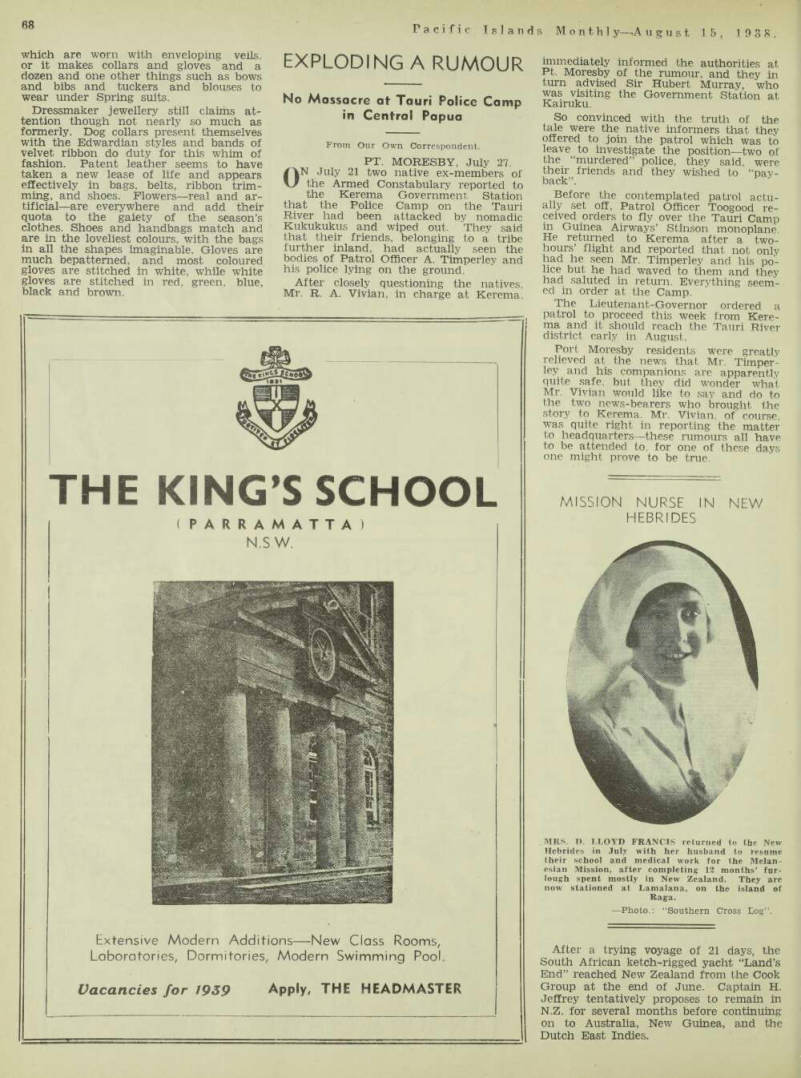
By Therese
DAME FASHION has excelled herself in gay clothes and accessories to greet the Spring.
Hats are truly delightful. They take us back to the “gay nineties” and their flower trimmings vie with the flower splashed materials with which manufac turers have enchanted us. The hats come in variety aplenty—quaint Dolly Var dens with clusters of flowers trimming the upturned sweep; crowns massed with blooms; single flowers perched precari ously on saucer brims; and cartwheel shapes with flowers and enveloping veils.
Whatever the styles, all are delightful.
Along with the new hats, hair is given careful consideration. Gone is the page boy bob and top-knots and little side clusters of curls, very appealing in their femininity, take their place.
Clothes have been softened into more becoming silhouettes, in line with the new headgear. Skirts are still short, and shoulders and sleeves are squared with out the puffs of previous seasons. Col our contrasts are as popular as ever, but daring contrasts that somehow must be seen for one to believe in their suc cess.
Violet and pink go hand in hand; green and wine show surprising possibili ties: yellow goes with wine-red; and bright purple-blue with scarlet. Indeed, one can take liberties with almost any colours and still be a success. Three and even four of them not only contrast, but blend enchantingly.
It takes thought, however, to achieve the right effect, but with a little prac tice the colour sense develops and de lightful individual schemes result.
Misty mauves and blues, and soft sweet pea shades are among the new Spring showings; also greens shading to turquoise, lovely com yellows, and beiges, and light browns. Pinks are from the palest pastels to the deepest rose.
The redingote continues to be a de lightful and economical garment. Change the accessories and the slip that is worn with it and it takes on a new per sonality, differing altogether from its original design. The redingote is also copied in frocks by the insertion of a panel of contrasting material, which is repeated in the bodice.
Stripes are deservedly popular. A frock of light or dark fabric takes unto itself a vividly striped sash, adds a bolero of the same striped silk, and im mediately becomes distinctive. Striped blouses are worn under plain boleros and whole frocks of brilliant stripes are delightful for both day and evening.
Navy is seen everywhere. A short sleeve navy frock with the skirt and bodice cut corselette fashion, swathes its waist with a geranium sash and adds a long sleeved bolero of blue patterned in a white lace design. Cerise also is used with navy with charming effect.
Beige nowadays goes with any colour one’s fancy pleases. A beige frock high to the throat is cut away in front to reveal a black cire satin inlet, and a cummerbund of the same satin is at the waist. A large black ballibuntle hat trimmed with cire is a fitting accom paniment.
A burgundy frock with a shirred front of turquoise is caught at the neckline
with a single diamante star and is worn with a wide leafed turquoise hat banded with burgundy and dusty pink. The same dusty pink is in a bolero jacket over a frock of burgundy. Tucks trim the jacket and half sleeves of the bolero.
Tunics are back again, and are worn successfully with pleated skirts. Pleats, by the way, are lovely for day and din ner wear, and shirring appears where
ever possible.
Bouffant gowns for evening are rem iniscent of grandma’s day and go so well with the new piled high coiffure.
Clusters of flowers trim the corsage and a top-knot is perched on the head, with charming effect. The off-the-shoulder line is decorative and has an Old World air.
The full pleated bodice and skirt of an evening gown has a wide corsoletted band and gleaming diamante shoulder straps. This is exquisite in pastel shades and when an accordeon pleated cape of two or three pastel shades is worn with it, it becomes a dream-like possession.
The classical line finds eaual favour with the bouffant gown, and makes a striking contrast to the gown of period ancestry. A slim fitting gown of black has a brassiere bodice of stripes and its flowing panel swirls widely at the back. This combination is extremely chic and demands wide attention.
Frocks with sleeves are suitable for dancing or dining and a little bolero can turn a formal evening gown into a cock tail or dinner frock. Boleros are always right.
Accessories are fascinating. Lace goes to the making of little cocktail hats
which are worn with enveloping veils, or it makes collars and gloves and a dozen and one other things such as bows and bibs and tuckers and blouses to wear under Spring suits.
Dressmaker jewellery still claims at tention though not nearly so much as formerly. Dog collars present themselves with the Edwardian styles and bands of velvet ribbon do duty for this whim of fashion. Patent leather seems to have taken a new lease of life and appears effectively in bags, belts, ribbon trim ming, and shoes. Flowers —real and ar tificial—are everywhere and add their quota to the gaiety of the season’s clothes. Shoes and handbags match and are in the loveliest colours, with the bags in all the shapes imaginable. Gloves are much bepatterned, and most coloured gloves are stitched in white, while white gloves are stitched in red. green, blue, black and brown.
Advertisements & other items, p. 71 (2 items)
67
Pacific Islands Monthl y —A ugust 15, 1988.
Ghe Gift that CDeans so CDuch
jcx
From £3
C.I.F. Sydney
W. M, REID ?o ri y n ou g Direct from the Up-To-Date Factory of Haid & Neu, at Karlsruhe, Baden.
Germany. PRECISION BUILX SEWING
MACHINES with a reputation maintained during “77 YEARS” for supreme workmanship and materials.
A patented hardening process guarantees smooth action and a long life free of repairs.
Needles, Bobbins, etc., can be 5 YEARS with other well r known sewing machines, guarantee x n f orTnat j on p arts Patterns and all dress materials are obtainable from the agent . . .
W. M. REID, “Reid House,” 75 King Street, Sydney, G.P.O. Box No. 137 CC.
Ghe Gift that CDeans so CDuch
You would like it to be GOOD. Then choose it here, —or from the many lovely Diamond Rings in Angus & Coote’s Catalogue.
Prices from 50/- each. € m £2O There s an intriguing Continental air about this handsome ring. The “squarecut” diamond is oblong in shape—and very modern and nice. There’s a round, bright diamond in each handsome shoulder. The chased mount is of 18ct.
White Gold, and the settings are of platinum. £27/10/ Words completely fail to convey the smartness, the grace, the beauty, and the brilliance of this ring. Never were diamonds more delightfully mounted, in a superb style which the enlarged illustration conveys to you.
It is 18ct. White Gold, and all the diamonds —including the six each side —are set securely in platinum. £l7/10/- The latest square settings, with two perfectlymatched centre diamonds, and also three bright diamonds in each shoulder. The ring is 18ct.
White Gold, and settings are of pure platinum. by Angus & Coote’s splendid Mail-Order Service.
Beautifully illustrated Catalogue contains an amazing range of everything in Jewellery.
Send for a FREE Copy.
LET IT BE YOUR
SHOP WINDOW.
Pages and pages of lovely things in natural colors. They speak for themselves —a n d make selection so easy. & E3O m
iSeatf Eii
m
SAPPHIRE and DIAMONDS.
A beautiful Blue Sapphire of up-to-date cutting, and genuine worth, is here combined with sparkling, white, double-cut diamonds. The ring is of 18ct. White Gold.
All the settings are platinum.
ANGUS & COOTE
PTY.
LTD.
£2O Excellent taste is expressed in this particularly beautiful and graceful ring. The platinum settings are designed to let the centre diamonds stand alone. Yet they’re utterly secure, and their beauty is enhanced by the diamond-studded ribbon ends of 18ct. White Gold, each side of the two coronet settings.
The House That Quality Built
500 George St., Sydney
Exploding A Rumour
No Massacre at Tauri Police Camp in Central Papua
From Our Own Correspondent.
Pt. Moresby, July 27.
ON July 21 two native ex-members of the Armed Constabulary reported to the Kerema Government Station that the Police Camp on the Tauri River had been attacked by nomadic Kukukukus and wiped out. They said that their friends, belonging to a tribe further inland, had actually seen the bodies of Patrol Officer A. Timperley and his police lying on the ground.
After closely questioning the natives, Mr. R. A. Vivian, in charge at Kerema,
immediately informed the authorities at Pt. Moresby of the rumour, and they in turn advised Sir Hubert Murray, who was visiting the Government Station at Kairuku.
So convinced with the truth of the tale were the native informers that they offered to join the patrol which was to leave to investigate the position—two of the “murdered” police, they said, were their friends and they wished to “pay back”.
Before the contemplated patrol actu ally set off. Patrol Officer Toogood re ceived orders to fly over the Tauri Camp in Guinea Airways’ Stinson monoplane.
He returned to Kerema after a two hours’ flight and reported that not only had he seen Mr. Timperley and his po lice but he had waved to them and they had saluted in return. Everything seem ed in order at the Camp.
The Lieutenant-Governor ordered a patrol to proceed this week from Kere ma and it should reach the Tauri River district early in August, Port Moresby residents were greatly relieved at the news that Mr. Timper ley and his companions are apparently quite safe, but they did wonder what Mr. Vivian would like to say and do to the two news-bearers who brought the story to Kerema. Mr. Vivian, of course, was quite right in reporting the matter to headquarters—these rumours all have to be attended to. for one of these days one might prove to be true.
Mission Nurse In New
Hebrides
After a trying voyage of 21 days, the South African ketch-rigged yacht “Land’s End” reached New Zealand from the Cook Group at the end of June. Captain H.
Jeffrey tentatively proposes to remain in N.Z. for several months before continuing on to Australia, New Guinea, and the Dutch East Indies.
MRS. D. LLOYD FRANCIS returned to the New Hebrides in July with her husband to resume their school and medical work for the Melan esian Mission, after completing 12 months’ fur lough spent mostly in New Zealand. They are now stationed at Lamalana, on the island of Raga. —Photo.: “Southern Cross Cog”.
Advertisements & other items, p. 72 (2 items)
68
Pacific Islands Month! y—A ugust 15, 1 938.
The King’S School
vg*iSj£Ho lBl (
( PARRAMATTA
N.S W.
1 Extensive Modern Additions—New Class Rooms, Laboratories, Dormitories, Modern Swimming Pool, Vacancies for 1939 Apply, THE HEADMASTER
Philippines Say "No"
To Japan
From Our Own Correspondent.
Honolulu, July 25.
OFFICIALS of the National Development Company of Manila, a Government agency, report that it has turned down a tempting Japanese offer. The Japanese wanted to exploit part of the famed Surigao iron mines, on a royalty basis.
The Japanese offered a royalty bait of 25 US cents per ton, which would have assured the Philippine commonwealth a clear profit of 12,500,000 dollars.
But no thank you said the Filipinos, who more and more are forgetting their independence plan. They are beginning to think that U.S. control of the islands is a fine idea, after all.
Annual Session Of Papuan
Legislative Council
From Our Own Correspondent.
Pt. Moresby, Aug. 8.
rpHE annual sittings of the Legislative I Council of Papua commenced at Pt.
Moresby on July 27. The following members attended: Sir Hubert Murray (presiding), Official Secretary (Hon. H.
L Murray), Director of Public Works (Hon A. P. Lyons), Commissioner for Lands (Hon. C. T. Wurth), Treasurer (Hon. S. Smith), and Hons. J. G. Nels son, A. Jewell and Rev. R. Lister Turner, Non-Official members.
There does not appear to have been
any outstanding legislation presented,
and the following is a summary of the measures dealt with: — Bills relating to Electric Light and Power in Port Moresby and Samarai were passed on July 28; also a Bill relating to the Diocese oi New Guinea and Customs Tariff.
The principal feature of the Bill to amend the Superannuation Ordinance is the provision for female officers in the scheme. Conditions will be the same as for male officers, except that upon marriage female officers shall re sign from the Service, contributions to the scheme being refunded.
Another to amend the law relating to the protection and collection of animals, birds, and native plants consolidates and amplifies the present Ordinance.
A Bill to amend the Police Offences Ordin ances, provides that any European Officer of the armed Constabulary or any two native members, one of whom is a sergeant, may at any time, day or night, search canoes without warrant.
A Bill to amend the Navigation Ordinance, relates to the carriage and storage of dyna mite.
The Council also passed a Bill to amend the Petroleum (Mining) Ordinance, which was forwarded from Canberra.
The Council concluded the session on Aug ust 8, when the Appropriation Bill for tne current year was dealt with.
Mr. Daniel Morrison, 71, most famed of the Pacific’s cable pioneers, died in Hono lulu on July 16. He joined the Commercial Cable Company in Glasgow in 1885. After serving 18 years at the Cape Canso sta tion, Nova Scotia, he came into the Pacific in ' 1903. At Midway Island he prepared for the landing of the trans pacific cable from California to the Orient.
In 1918 he was placed in charge of the company’s activities in Honolulu. Later on, he went to Guam for a short period.
He retired in 1928.
N Guinea Timber
Probable New Industry in Morobe
EFFORTS are being made by the New Guinea Administration to develop a timber milling industry on the New Guinea mainland, according to an an nouncement from Canberra on August 4.
The experiment, which was formally launched, follows an investigation of the timber resources of the Territory and the subsequent appointment of a small for estry staff. The survey revealed that the Territory contained large areas of valuable timber.
It was also announced that the Ad ministration had decided to throw open a large area of forest in the Bulolo Val ley for milling. The area is estimated to contain 50,000,000 super feet of com mercially useful hoop and Klinkii pines and a smaller quantity of cedar and secondary timbers.
The development of supplies of hoop pine from New Guinea may be of con siderable importance to the Australian butter industry. Experiments have shown that Queensland hoop pine, of which supplies are limited, is one of the best available substitutes for New Zea land white pine for the manufacture of export butter boxes. Restrictions are now threatened on the supply of white pine from New Zealand.
Advertisements & other items, pp. 73-74 (2 items)
69
Pacific Islands Mon t h 1 y—A ugu s t 15, 1938.
Pai Ms
“CINNAMOLIA”
PREPARATIONS.
“CINNAMOLIA”.
The new remedy for Dysentery, Diarrhoea and other bacillary infections of the alimentary canal.
Price: 3/- per bottle.
“CINNAMOLIA” OINTMENT.
For cuts, scratches, abrasions, ulcers, piles, etc.
Price: 1/6 per jar.
“CINNAMOLIA” INHALANT.
For -coughs, colds, catarrh, and other infections of the nasal and respiratory passages.
Price: 2/-per bottle. (With Dropper.) These remedies are guaranteed to contain no poisons or harmful drugs and are put up by the original makers at •‘Cinnamolia” Preparations, 17 Murray St., Waterloo, Sydney.
Every home in the tropics should have these excellent remedies always on hand.
Obtainable at—
FALKS PHARMACY,
238 GEORGE ST., SYDNEY.
For Wholesale rate quotations apply to “Cinnamolia” Preparations, 17 Murray St., Waterloo, N.S.W.
TEVIOT COLLEGE,
Kiliara, Sydney, N.S.W.
A Boarding School for Boys, 4to 15 years, situated in a healthy and ideal position on the North Shore heights.
The purpose of the School is to provide an education, calculated, to develop well-balanced minds and bodies, to encourage initiative and breadth of outlook, and to stimulate the formation of wholesome Christian character in a homely atmosphere.
Boys from THE ISLANDS may spend School Vacations at the School Seaside House. 3 C Clark Prospectus on application. Principals: y g
PAI MS
MASTER
Qxe^tfa
POWDERS &
TABLETS
1/6 AND 2/6.
SINGLES 2d. ra
STOPS SAFELY
HEADACHE
'FLU & COLDS
RHEUMATISM
NEURALGIA
SC I ATI C A
NEU RITIS
LUMBAGO
AND ALL NERVE AND
MUSCULAR PAINS
Over the past‘2o years thousands of men and women have proved Vincent’s A.P.C. to be the most effective remedy for relieving all pain. That is why there are more Vincent’s A.P.C.
Powders and Tablets sold in Australia to-day than all other similar preparations.
If you suffer from Headache, Rheumatism, Heat Exhaustion, Nervous Irritability.
Sleeplessness, or any nerve or muscular pain, get a packet of Vincent’s A.P.C. Powders or Tablets and take them as directed. Take Vincent’s A.P.C. also to relieve Feverishness and reduce temperature. You will be more than satisfied at the speedy, effective safety, as
FOR
relief Vincent’ s it does not
SAFETY
A.P.C. brings. Vincent’s A.P.C. can be taken with perfect affect the heart orleave any after-effects.
SAKE. SAY "VINCENT'S A. P. C."
Mining Ore
Treatment
Machinery
COMPLETE CYANIDE
PLANTS SUPPLIED
Dorr Classifiers Dorr Thickeners Dorr Agitators Oliver Filters Merril Crowe Zinc Dust Sold Precipitation Richardson Mine Fans •
FANS AND AIR HEATERS
For Ventilation, Copra Drying Rooms, etc. • Enquire from
CROSSLE, DUFF AND
MACINTOSH LTD.
52 Bridge Street, SYDNEY
Mining Shares
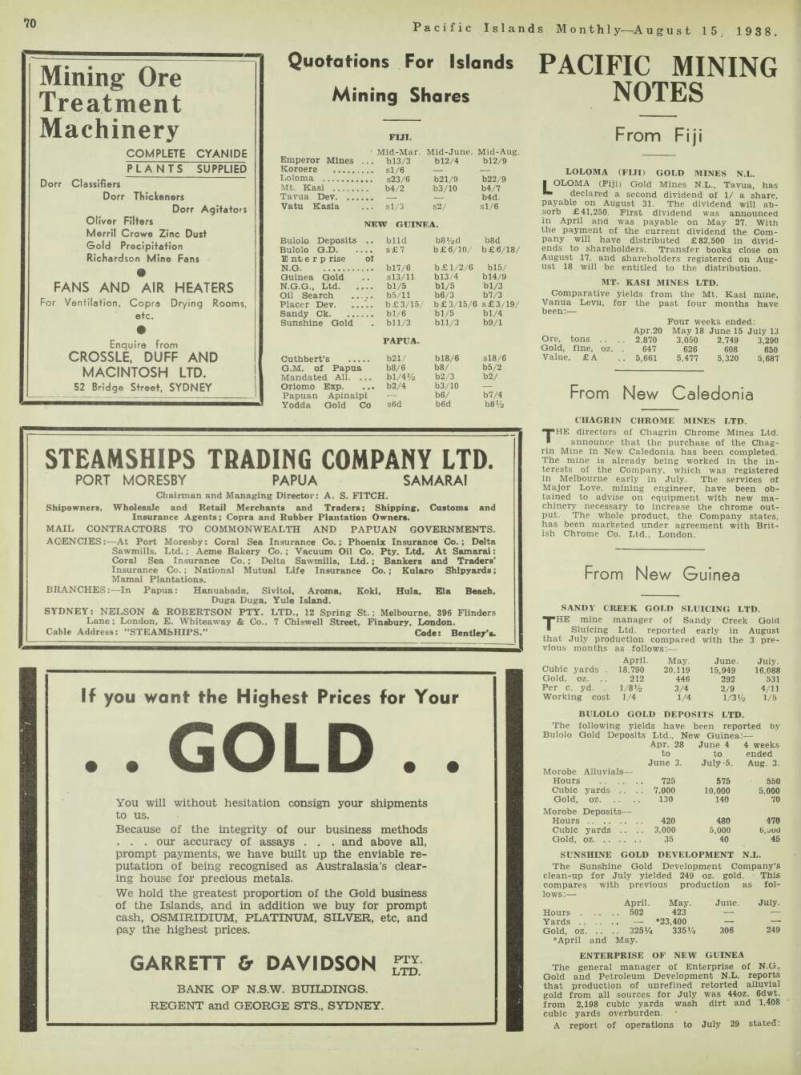
Quotations For Islands Mining Shares
Fiji.
Mid-Mar.
Mid-June.
Mid-Aug.
Emperor Mines ... bl3/3 b!2/4 bl2/9 Koroere sl/6 Loloma s23/6 b21/9 b22/9 Mt. Kasi b4/2 b3/10 b4/7 Tavua Dev b4d.
Vatu Kasla sl/3 s2/ sl/6
New Guinea.
Bulolo Deposits .. blld bsy 2 d b8d Bulolo G.D s £ 7 b £ 6/10/ b£6/18/ Enterp rise ol N.G bl7/6 b£ 1/2/6 bl5/ Guinea Gold S13/11 bl3/4 bl4/9 N.G.G., Ltd bl/5 bl/5 bl/3 Oil Search ... b5/ll b6/3 b7/3 Placer Dev. b £ 3/15/ b£ 3/15/6 s£3/19/ Sandy Ck bl/6 bl/5 bl/4 Sunshine Gold bll/3 bll/3 b9/l Cuthbert’s
Papua.
b21/ bl8/6 S18/6 G.M. of Papua b8/6 b8/ b5/2 Mandated All. ... bl/4»/ 2 b2/3 b2/ Oriomo Exp. b2/4 b3/10 — Papuan Apinaipi — b6/ b7/4 Yodda Gold Co s6d b6d b8V 2
Pacific Mining
Notes
From Fiji
Loloma (Fiji) Gold Mines N.L.
I OLOMA (Fiji) Gold Mines N.L., Tavua, has ■“ declared a second dividend of 1/ a share, payable on August 31. The dividend will ab sorb £41,250. First dividend was announced in April and was payable on May 27. With the payment of the current dividend the Com pany will have distributed £82,500 in divid ends to shareholders. Transfer books close on August 17, and shareholders registered on Aug ust 18 will be entitled to the distribution.
Mt. Kasi Mines Ltd.
Comparative yields from the Mt. Kasi mine, Vanua Levu, for the past four months have been:—
Four weeks ended: Apr.20 May 18 June 15 July 13 Ore, tons .. .. 2,870 3,050 2,749 3,290 Gold, fine, oz. . 647 626 608 650 Value, £ A .. 5,661 5,477 5,320 5,687
From New Caledonia
Chagrin Chrome Mines Ltd.
THE directors of Chagrin Chrome Mines Ltd.
" announce that the purchase of the Chag rin Mine in New Caledonia has been completed.
The mine is already being worked in the in terests of the Company, which was registered in Melbourne early in July. The services of Major Love, mining engineer, have been ob tained to advise on equipment with new ma chinery necessary to increase the chrome out put. The whole product, the Company states, has been marketed under agreement with Brit ish Chrome Co. Ltd., London.
From New Guinea
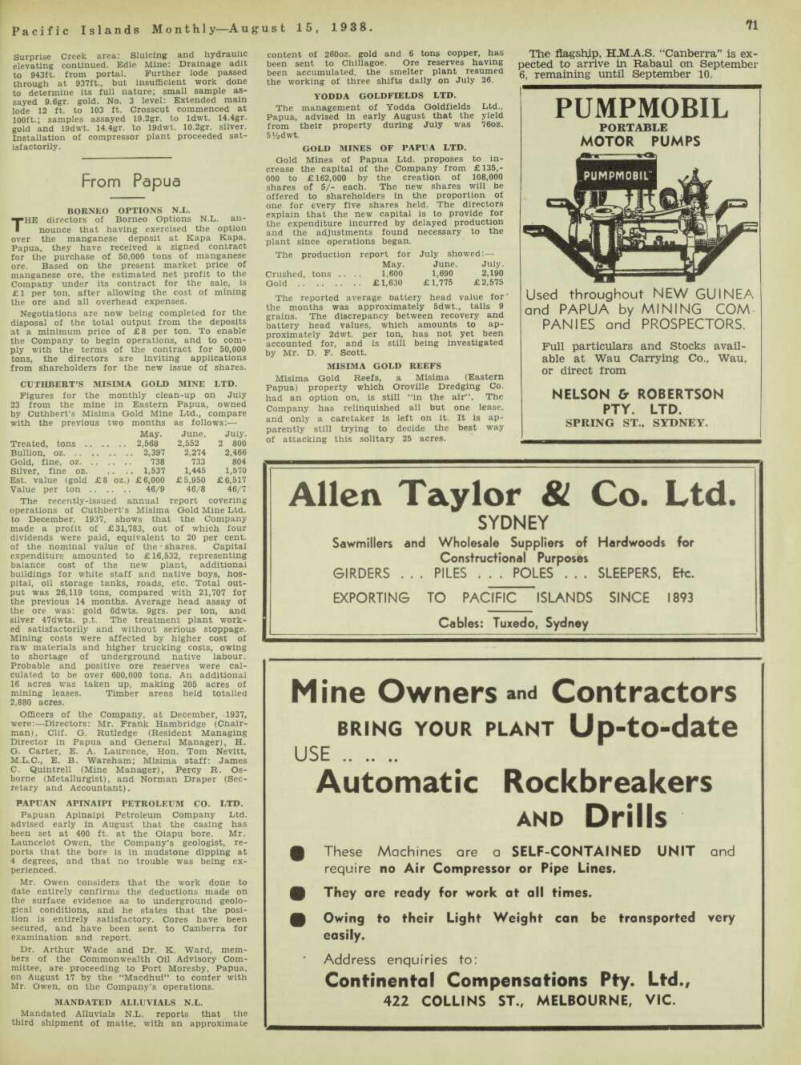
Sandy Creek Gold Sluicing Ltd.
THE mine manager of Sandy Creek Gold • Sluicing Ltd. reported early in August that July production compared with the 3 pre vious months as follows:
Bulolo Gold Deposits Ltd.
The following yields have been reported by Bulolo Gold Deposits Ltd., New Guinea:—
Sunshine Gold Development N.L.
The Sunshine Gold Development Company’s clean-up for July yielded 249 oz. gold. This compares with previous production as fol lows: —
Enterprise Of New Guinea
The general manager of Enterprise of N.G., Gold and Petroleum Development N.L. reports that production of unrefined retorted alluvial gold from all sources for July was 440 z. 6dwt. from 2,198 cubic yards wash dirt and 1,408 cubic yards overburden. • A report of operations to July 29 stated:
April. May. June. July.
Cubic yards . 18,790 20,119 15,949 16,088 Gold, oz. .. 212 446 292 531 Per c. yd. . 1/8V 2 3/4 2/9 4/11 Working cost 1/4 1/4 l/3>/ 2 1/5
Apr. 28 June 4 4 weeks to to ended June 3.
July'5.
Aug. 3.
Morobe Alluvials— Hours 725 575 550 Cubic yards .. . . 7,000 10,000 5,000 Gold, oz 130 140 70 Morobe Deposits— Hours 420 480 470 Cubic yards .. . . 3,000 5,000 6,ou0 Gold, oz 35 40 45
April. May. June. July.
Hours 502 423 — Yards — *23,400 — — Gold, oz 325V 4 335 Va 306 249 ♦April and May.
Surprise Creek area: Sluicing and hydraulic elevating continued. Edie Mine: Drainage adit to 943 ft. from portal. Further lode passed through at 937 ft., but insufficient work done to determine its full nature; small sample as sayed 9.6 gr. gold. No, 3 level: Extended main lode 12 ft. to 103 ft. Crosscut commenced at 100 ft.; samples assayed 19.2 gr. to Idwt. 14.4 gr. gold and 19dwt. 14.4 gr. to 19dwt. 10.2 gr. silver.
Installation of compressor plant proceeded sat isfactorily.
Advertisements & other items, p. 74 (2 items)
70
Pacific Islands Monthl y—A ugust 15, 1938.
.. Gold..
STEAMSHIPS TRADING COMPANY LTD.
PORT MORESBY PAPUA SAMARA!
Chairman and Managing Director: A. S. FITCH.
Shipowners. Wholesale and Retail Merchants and Traders; Shipping, Customs and Insurance Agents; Copra and Rubber Plantation Owners.
MAIL CONTRACTORS TO COMMONWEALTH AND PAPUAN GOVERNMENTS.
AGENCIES:—At Port Moresby; Coral Sea Insurance Co.; Phoenix Insurance Co.; Delta Sawmills, Ltd.; Acme Bakery Co. ; Vacuum Oil Co. Pty. Ltd. At Samarai: Coral Sea Insurance Co. ; Delta Sawmills, Ltd. ; Bankers and Traders’
Insurance Co.; National Mutual Life Insurance Co.; Kularo Shipyards; Mamai Plantations.
BRANCHES:—In Papua: Hanuabada, Sivitoi, Aroma, Eoki, Hula, Ela Beach, Duga Duga, Yule Island.
SYDNEY: NELSON & ROBERTSON PTY. LTD., 12 Spring St.: Melbourne, 396 Flinders Lane; London, E. Whiteaway & Co., 7 Chiswell Street, Finsbury, London.
Cable Address: “STEAMSHIPS.” Code: Bentley's.
If you want the Highest Prices tor Your
.. GOLD..
You will without hesitation consign your shipments to us.
Because of the integrity of our business methods . . . our accuracy of assays . . . and above all, prompt payments, we have built up the enviable reputation of being recognised as Australasia’s clearing house for precious metals.
We hold the greatest proportion of the Gold business of the Islands, and in addition we buy for prompt
cash, OSMIRIDIUM, PLATINUM, SILVER, etc, and
pay the highest prices.
GARRETT & DAVIDSON
BANK OF N.S.W. BUILDINGS.
REGENT and GEORGE STS., SYDNEY.
From Papua
Borneo Options N.L.
THE directors of Borneo Options N.L. an nounce that having exercised the option over the manganese deposit at Kapa Kapa, Papua, they have received a signed contract for the purchase of 50,000 tons of manganese ore. Based on the present market price of manganese ore. the estimated net profit to the Company under its contract for the sale, is £1 per ton, after allowing the cost of mining the ore and all overhead expenses.
Negotiations are now being completed for the disposal of the total output from the deposits at a minimum price of £8 per ton. To enable the Company to begin operations, and to com ply with the terms of the contract for 50,000 tons, the directors are inviting applications from shareholders for the new issue of shares.
Cuthbert’S Misima Gold Mine Ltd.
Figures for the monthly clean-up on July 23 from the mine in Eastern Papua, owned by Cuthbert’s Misima Gold Mine Ltd., compare with the previous two months as follows:
The recently-issued annual report covering operations of Cuthbert’s Misima Gold Mine Ltd. to December, 1937, shows that the Company made a profit of £31,783, out of which four dividends were paid, equivalent to 20 per cent, of the nominal value of the - shares. Capital expenditure amounted to £16,532, representing balance cost of the new plant, additional buildings for white staff and native boys, hos pital, oil storage tanks, roads, etc. Total out put was 26,119 tons, compared with 21,707 for the previous 14 months. Average head assay of the ore was: gold 6dwts. 9grs. per ton, and silver 47dwts. p.t. The treatment plant work ed satisfactorily and without serious stoppage.
Mining costs were affected by higher cost of raw materials and higher trucking costs, owing to shortage of underground native labour.
Probable and positive ore reserves were cal culated to be over 600,000 tons. An additional 16 acres was taken up, making 205 acres of mining leases. Timber areas held totalled 2,880 acres.
Officers of the Company, at December, 1937, were:—Directors: Mr. Frank Hambridge (Chair man), Clif. G. Rutledge (Resident Managing Director in Papua and General Manager), H.
G. Carter, E. A. Laurence, Hon. Tom Nevltt, M.L.C., E. B. Wareham; Misima staff: James C. Quintrell (Mine Manager), Percy R. Os borne (Metallurgist), and Norman Draper (Sec retary and Accountant).
Papuan Apinaipi Petroleum Co. Ltd.
Papuan Apinaipi Petroleum Company Ltd. advised early in August that the casing has been set at 400 ft. at the Oiapu bore. Mr.
Launcelot Owen, the Company’s geologist, re ports that the bore is in mudstone dipping at 4 degrees, and that no trouble was being ex perienced.
Mr. Owen considers that the work done to date entirely confirms the deductions made on the surface evidence as to underground geolo gical conditions, and he states that the posi tion is entirely satisfactory. Cores have been secured, and have been sent to Canberra for examination and report.
Dr. Arthur Wade and Dr. K. Ward, mem bers of the Commonwealth Oil Advisory Com mittee, are proceeding to Port Moresby, Papua, on August 17 by the “Macdhui” to confer with Mr. Owen, on the Company’s operations.
Mandated Alluvials N.L.
Mandated Alluvials N.L. reports that the third shipment of matte, with an approximate
content of 2600 z. gold and 6 tons copper, has been sent to Chillagoe. Ore reserves having been accumulated, the smelter plant resumed the working of three shifts daily on July 26.
Yodda Goldfields Ltd.
The management of Yodda Goldfields Ltd., Papua, advised in early August that the yield from their property during July was 760 z. 5y 2 dwt.
Gold Mines Of Papua Ltd.
Gold Mines of Papua Ltd. proposes to in crease the capital of the Company from £135,- 000 to £162,000 by the creation of 108,000 shares of 5/- each. The new shares will be offered to shareholders in the proportion of one for every five shares held. The directors explain that the new capital is to provide for the expenditure incurred by delayed production and the adjustments found necessary to the plant since operations began.
The production report for July showed: —
The reported average battery head value for the months was approximately sdwt., tails 9 grains. The discrepancy between recovery and battery head values, which amounts to ap proximately 2dwt. per ton, has not yet been accounted for, and is still being investigated by Mr. D. F. Scott.
Misima Gold Reefs
Misima Gold Reefs, a Misima (Eastern Papua) property which Oroville Dredging Co. had an option on, is still “in the air”. The Company has relinquished all but one lease, and only a caretaker is left on it. It is ap parently still trying to decide the best way of attacking this solitary 25 acres.
The flagship, H.M.A.S, “Canberra” is ex pected to arrive in Rabaul on September 6, remaining until September 10.
May.
June.
July.
Crushed, tons .. 1,600 1,690 2,190 Gold .. £1,630 £1,775 £2,575
May. June. July.
Treated, tons 2,568 2,552 2 800 Bullion, oz 2,397 2,274 2,466 Gold, fine, oz 738 733 804 Silver, fine oz 1,537 1,445 1,570 Est. value (gold £8 oz.) £6,000 £5,950 £6,517 Value per ton 46/9 46/8 46/7
Advertisements & other items, pp. 75-76 (3 items)
71
Pacific Islands M onthl y— Angus t 15, 1938.
Allen Taylor & Co. Ltd.
PUMPMOBIL
PORTABLE
MOTOR PUMPS
Used throughout NEW GUINEA
and PAPUA by MINING COM
PANIES and PROSPECTORS.
Full particulars and Stocks available at Wau Carrying Co., Wau, or direct from
NELSON Cr ROBERTSON
PTY. LTD.
SPRING ST., SYDNEY.
Allen Taylor & Co. Ltd.
SYDNEY
Sawmillers and Wholesale Suppliers of Hardwoods for Constructional Purposes GIRDERS . . . PILES . . . POLES . . . SLEEPERS. Etc.
EXPORTING TO PACIrC ISLANDS SINCE 1893
Cables: Tuxedo, Sydney
Mine Owners and Contractors
BRING YOUR PLANT Up-t O-date
USE
Automatic Rockbreakers
AND Drills
• These Machines are a SELF-CONTAINED UNIT and require no Air Compressor or Pipe Lines. 0 They are ready for work at all times. 0 Owing to their Light Weight can be transported very easily.
Address enquiries to:
Continental Compensations Pty. Ltd.,
422 COLLINS ST., MELBOURNE, VIC.
Radio Gramophone Electric Unit.
In Handsome Polished Cabinet.
Slide out. AC 240 Volts. Made in London: £9,710/ complete with Pick-up.
Electric Dry shavers for 240
A.C. D.C. El-
ectric supply. Write for full list.
“VICO” 75/.
Special price to traders. Write for prices. “Packard” 90/.
“Schick” £5/5/.
All Bakelite R o u 1 e tte Wheels British 25/-.
Cloths 4/6, 9/6, 12/6, 15/.
Other types of Roulettes 35/, 38/6, 48/6, 65/-, 75/, up to £l2/10/. Write for fullest particulars. Small Roulette glass tops with betting sheets, 3/6. In Wooden Types 12/6.
“Totem”, a wellmade little game, for Homes, Clubs, Hotels, etc. Push the starting knob and off spin the 2 reels, one the horses and the other the odds when the spin terminates the Winner and Win ner’s Price is clearly shown.
Cheat and fool-proof, 21/-.
Send for Leaflet.
Ventrlllos —Learn to throw your voice, 1/-. Send 2/8 for 2 Gigantic and Interesting Catalogues and Leaflets.
Fountain Pen size Microscope and Compass Combined 6/6.
Midget Razor Hones, for all Blades, 1/6. Joy Buzzer Hand Shakers, 3/3. Fountain Pen size Torch 2/3.
Put and Take Tops 2/-.
Model Outboard Electric Motors, 12/6 and 19/6. 4 in 1 Pen size Screwdriver 2/-.
Miscroscopes, 5/6, 6/6, and 9/6.
Microscope Kits 12/6.
Table Tennis Sets, .. 6/6, 8/6.
New 3 in 1 Roulette Game, Doggie, . Roulette, etc., with directions 3/9. 2/6,2/9, 3/6, Adjustable all way Morse Code Key as Illustrated. 12/6.
P M.G. Type, 19/6.. Buzzers A d j u s taoie Electric Forehead Torch.
Pits snugly; for Professional Men, B a n d s m en, Miners, etc.: 10/6. With separate Torch Battery Container: 18/6.
Electric 240 Volt A.C. Mantel Model Super Het. Radio, Midget Size. Neat Cloth Covered Cabinet. Perfect Tone. 12 months’
Guarantee: £l3/10/-. Value NOW £B/10/-.
CROWN AND ANCHOR SETS, 10/6.
5 Poker Dice, in box .. .. 7/6 and 10/6 In Leather Case 7/6, 10/6, 12/6 Head and Tail Dice. Sets of Five. 8/6 and 11/6. Large Transparent 1 to 6 Dice, 1/6 each. Extra Large 2/6.
Electric Train Sets, Loco., Tender, and 12 Rails, 65/, 75/-, 85/-, 95/-.
Transformers, 17/6, 21/-, 25/- Extra.
BULGIN
Aerial Lightning Switch.
British & Best.
Grade.
Solder Highest Electric Iron, 15/.
Heavy Duty Type, 22/6.
“Goldstone” Ju n i 0 r Electric Solder Irons, British 5/6.
With Flex and 2-pin Plug. '
PresEo*^
terious Coin-Box! — The most baffling Trick ever conceived* Borrow a coin; request owner to mark in a way he will Llke-a-flash Eliminoise’
Aerial Kit,
(sRKD®
CaKK££>
for short dual wave sets.
Aerial Pyty p e exchange for coin, hand him a small bakelite box bound up.
Ask him to open it. Inside he will find a match box, also securely bound. Inside this he will find a cloth bag, also bound up. When opened up, he finds the coin he marked, in the bag. This is one of the most mystifying Tricks ever performed. Price, complete with instructions 2/6, plus postage, 3d.
‘mnn-o-iupfr
RUBBER CLOD
AERIAL
4o sTßonbs
son, 5i
OO FT |Q4
w O"VOa
Insulators. transposition
blocks and 200 ft. aerial wire, 22/6. Eliminates unwanted aerial and hideous electrical noises from your dual-wave orsfaort-wave set.
Microphones. Sing, Play, Recite. Grealt Pun for Home, Dance, Party, etc., or for use in Factories, Stores, etc. Write for full rainge. Just plug leads of Pick-up into pick-up termidals of any set. 9/6 to £6/6/-.
ROLETTE. You back your fancy in the numbers and colors of three balls. The game ejects 3 colored balls. 55/. For homes, hotels clubs identifv it asain f tC l Complete with betting sheet and identity it again, in instructions. Send for Leaflet.
Table Type Interesting Pin Games: 12/6, 15/-. Competition Dart Boards 21/-. Others: 2/6, 8/11, 11/6. Compe tition Brass and Feathered Darts 3 for 5/6. Table Tennis Sets: 7/6 15/-. Model Aeroplane Kits, all types Write for leaflets. Draught Sets: 4/6, 6/6, 10/6. Monopoly Sets: 10/6, 16/6, 21/-. Bull and Bears (like Monopoly): 12/6.
SUPER AUDIO
TRAMSFORMERS
15- Pickup Heads, fit all standard Gramophone tone arms 10/6, 12/6.
English Cosmocord 11/6, 19/6.
English “Gold ring” 16/6, 18/6, 19/6, with selfcontained Vol ume Control 21/ and 25/- with separate volume control.
Build or buy assembled Lakes 1-valve All-wave Battery-operated Radio. Plug in coils for all wave lengths. Coils ready made. Easiway charts, 6d. Free with kit.
Parts 40/1, Valve 12/, Battery 11/9, Phones 30/. complete and built £5. >if/ H e adphones steering 4 0 0 0 ohms: 15/-. Lissen: 19/6. S.T.C. or 8.T.H., all British Makes: SO/- pair. Head- »/- Pair. 6 ft.
HEAD
mo»n
I Buy assembled or build the Air Patrol 2 - valve Battery - operated Radio for all short-wave stations and broadcasts. Easy to operate, change over switch. All parts £4/1/6, Valves 28/9, Batteries £2/15/9, Phones 30/-, Speaker 21/3.
The set assembled and complete, £l2/14/9. Easiway Charts 6d.
G r a phoscope 8/6. With it you can copy any Drawing or Photo up to size 6 x 4 in.
Focus s i n g Torches, 1,500 ft.. 5-cell. 6/6 Cosmocord” British 240 Volt AC Electric Gramophone Motor and all turntable fittings, 39/6.
Valves; we guarantee a cheaper price for any replacement. Just send along your order. w 60 OO As illustrated with long lead fitted. Splendid Reproducer.
Excel lent English Mic r 0 p h 0 ne, Table Model, with selfcontained pre - amplifier unit in Base; 39/6.
These Microphones suit all sets. The leads plug into the Pickup terminals of the set.
Write for full illustrated list of the finest range of micro phones available. of Interhouse Telephones for stores, farms, theatres, factories, etc.: 55/- Pair. Easily and quickly installed.
240 Volt ' Xc" Electric ivfa.s
sage Machine, with applicators in neat cases: 40/- and 42/-. Electric Shocking Coil Outfits for Medical, Muscular and Nervous Complaints: 63/-.
Write for full list of Abyssin ian Stamps. Just arrived. Also ask for other lists of Foreign Stamps ‘Radio Moderne”. The Greatest Battery Operated Dual Wave Radio Made. No idle boast. A real and established fact. “Radio Moderne” is specially designed for the Island trade £22/10/. Send for the latest illustrated leaflet.
COSMOCOBD*
2 “Like a Flash” British make Gramophone Pickups complete Richards, just arrived 25/- “ Cosmocord” 25A “Cosmocord” De Luxe 32/6 "Cosmocord” high definition ... ... 38/6 “Cosmocord” Super de Luxe ... 46/- Amplion (English) 28/6 B.T.H. Crystal Type 75/-.
Write for Full List. phone Rubber Pads; i ’Phone Cords: 1/6.
Billiard Sets: 32/6 for Table~up to 6 ft. x 3 ft. Billiard Sets; 42/6, for Table up to 8 ft. x 4 ft. Can be fitted to any table for accurate play, 3 Balls, Rubber Cushions, 2 cues. Pockets, Scoring Board, Rules and Chalk. Pitted and dismantled in a jiffy. Composition Bobs Balls; V 4 6/6; y 2, 8/6; %, 15/- Set. 6 Reds, 1 Black.
Write for Punch Board Leaflets
LEVENSON’S RADIO
GAMES. NOVELTIES AND HOBBIES
226 Pin STREET, SYDNEY
Manufacturers, Importers, and Exporters. fl e S* Branches: Radio Cheapside, 240 a Pitt St. eanet9
—N.S.W., AUSTRALIA
Cable address: “Leveradioh.” Goods forwarded V.P.P. or Sight Draft. Satisfaction, and Service Guaranteed. We can supply by mail all General Merchandise at a Better Price. Quotations with pleasure.
Please add freight and packing. Write for full list of interesting leaflets of Games, Hobbies, Novelties, and Electrical Goods.
72
Pacific Islands Month! y-—A ugust 15, 1938.
Australian Short Wave
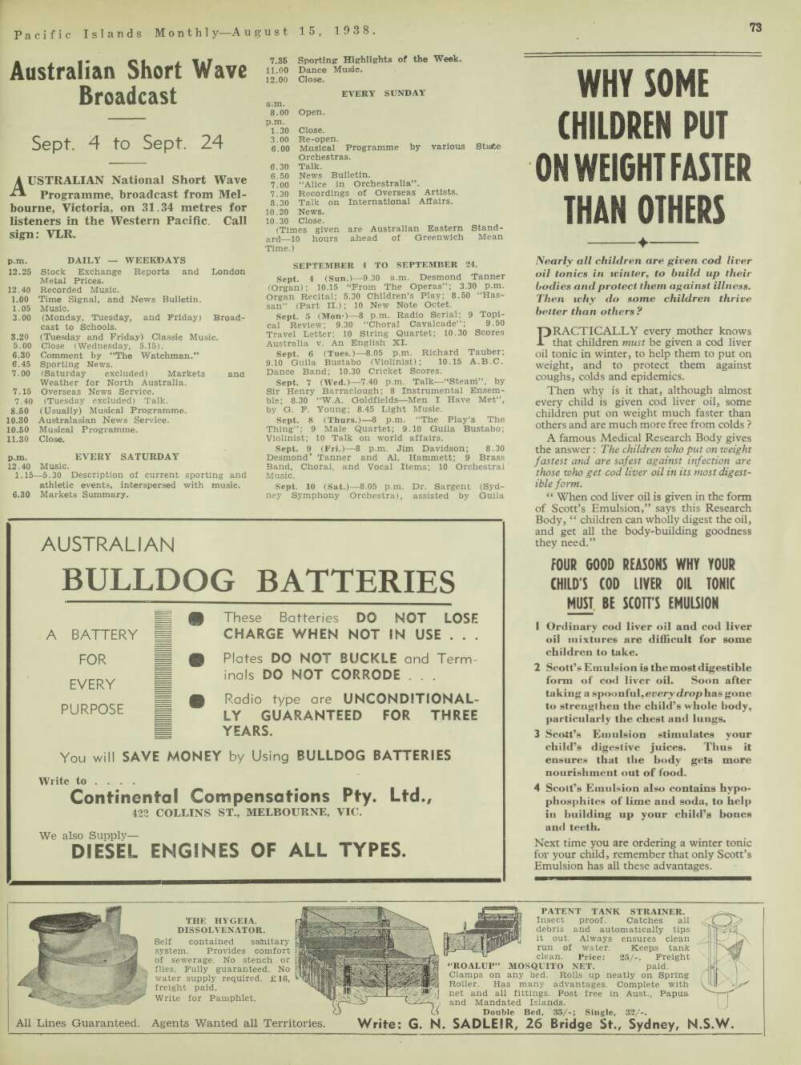
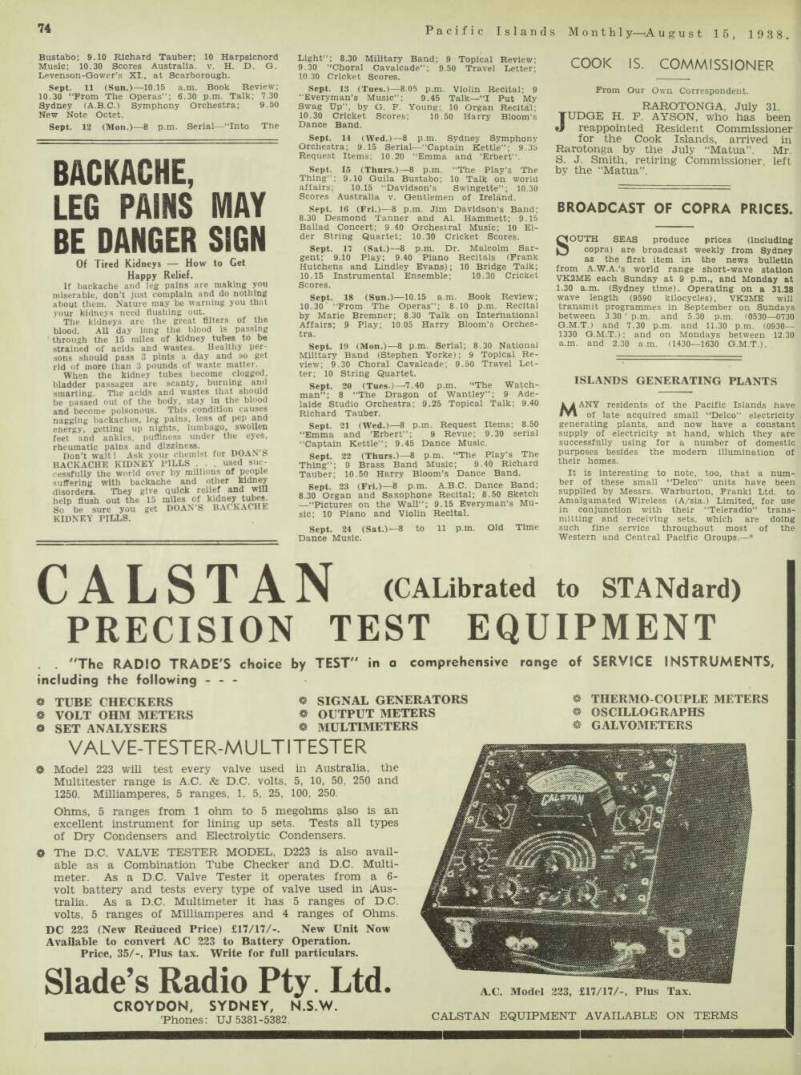
Broadcast Sept. 4 to Sept. 24
AUSTRALIAN National Short Wave
Programme, broadcast from Mel
bourne, Victoria, on 31.34 metres for
listeners in the Western Pacific. Call
sign: VLR.
P.M. Daily Weekdays
12.25 Stock Exchange Reports and London Metal Prices. 12.40 Recorded Music. 1,00 Time Signal, and News Bulletin. 1.05 Music. 3.00 (Monday, Tuesday, and Friday) Broad cast to Schools. 3.20 (Tuesday and Friday) Classic Music. 5.00 Close (Wednesday, 5.15). 6.30 Comment by “The Watchman.” 6.45 Sporting News. 7.00 (Saturday excluded) Markets and Weather for North Australia. 7.15 Overseas News Service. 7.40 (Tuesday excluded) Talk. 8.50 (Usually) Musical Programme. 10.30 Australasian News Service. 10.50 Musical Programme. 11.30 Close.
P.M. Every Saturday
12.40 Music. 1.15—5.30 Description of current sporting and athletic events, interspersed with music. 6.30 Markets Summary.
7.35 Sporting Highlights of the Week. 11.00 Dance Music. 12.00 Close.
Every Sunday
a.m. 8.00 Open, p.m. 1.30 Close. 3.00 Re-open. 6.00 Musical Programme by various Sta£e Orchestras. 6.30 Talk. 6.50 News Bulletin. 7.00 “Alice in Orchestralia”. 7.30 Recordings of Overseas Artists. 8.30 Talk on International Affairs. 10.20 News. 10.30 Close. (Times given are Australian Eastern Stand ard—lo hours ahead of Greenwich Mean Time.)
September 4 To September 24.
Sept. 4 (Sun.)—9.3o a.m. Desmond Tanner (Organ); 10.15 “From The Operas”; 3.30 p.m.
Organ Recital; 5.30 Children’s Play; 8.50 “Has san” (Part II.); 10 New Note Octet.
Sept. 5 (Mon - ) —8 p.m. Radio Serial; 9 Topi cal Review; 9.30 “Choral Cavalcade”; 9.50 Travel Letter; 10 String Quartet; 10.30 Scores Australia v. An English XI.
Sept. 6 (Tues.) —8.05 p.m. Richard Tauber; 9.10 Guila Bustabo (Violinist); 10.15 A.B.C.
Dance Band; 10.30 Cricket Scores.
Sept. 7 (Wed.)—7.4o p.m. Talk—“ Steam”, by Sir Henry Barraclough; 8 Instrumental Ensem ble; 8.30 “W.A. Goldfields—Men I Have Met”, by G. F. Young; 8.45 Light Music.
Sept. 8 (Thurs.) —8 p.m. “The Play’s The Thing”; 9 Male Quartet; 9.10 Guila Bustabo; Violinist; 10 Talk on world affairs.
Sept. 9 (Frl.) —8 p.m. Jim Davidson; 8.30 Desmond’ Tanner and Al. Hammett; 9 Brass Band, Choral, and Vocal Items; 10 Orchestral Music.
Sept. 10 (Sat.) —8.05 p.m. Dr. Sargent (Syd ney Symphony Orchestra), assisted by Guila
Bustabo: 9.10 Richard Tauber; 10 Harpsicnord Music; 10.30 Scores Australia, v. H. D. G.
Levenson-Gower’s XI., at Scarborough.
Sept, 11 (Sun.)—lo.ls a.m. Book Review: 10.30 “From The Operas”; 6.30 p.m. Talk; 7.30 Sydney (A.8.C.) Symphony Orchestra; 9.50 New Note Octet.
Sept. 12 (Mon.)—B p.m. Serial—“lnto The
Light”; 8.30 Military Band; 9 Topical Review; 9.30 “Choral Cavalcade”; 9.50 Travel Letter; 10.30 Cricket Scores.
Sept. 13 (Tues.) —8.05 p.m. Violin Recital; 9 “Everyman’s Music”; 9.45 Talk—“l Put My Swag Up”, by G. F. Young; 10 Organ Recital; 10.30 Cricket Scores; 10.50 Harry Bloom’s Dance Band.
Sept. 14 (Wed.) —8 p.m. Sydney Symphony Orchestra: 9.15 Serial—“ Captain Kettle”: 9.35 Request Items; 10.20 “Emma and ’Erbert”.
Sept. 15 (Thurs.) —8 p.m. “The Play’s The Thing”; 9.10 Guila Bustabo; 10 Talk on world affairs; 10.15 “Davidson’s Swingette”; 10.30 Scores Australia v. Gentlemen of Ireland.
Sept. 16 (Fri.) —8 p.m. Jim Davidson’s Band; 8.30 Desmond Tanner and Al. Hammett; 9.15 Ballad Concert; 9.40 Orchestral Music; 10 El der String Quartet; 10.30 Cricket Scores.
Sept. 17 (Sat.) —8 p.m. Dr. Malcolm Sar gent; 9.10 Play; 9.40 Piano Recitals (Frank Hutchens and Lindley Evans); 10 Bridge Talk; 10.15 Instrumental Ensemble; 10.30 Cricket Scores.
Sept. 18 (Sun.) —10.15 a.m. Book Review; 10.30' “From The Operas”; 8.10 p.m. Recital by Marie Bremner; 8.30 Talk on International Affairs; 9 Play; 10.05 Harry Bloom’s Orches tra.
Sept. 19 (Mon.) —8 p.m. Serial; 8.30 National Military Band (Stephen Yorke); 9 Topical Re view; 9.30 Choral Cavalcade; 9.50 Travel Let ter; 10 String Quartet.
Sept. 20 (Tues.) —7.40 p.m. “The Watch man”; 8 “The Dragon of Wantley”; 9 Ade laide Studio Orchestra: 9.25 Topical Talk; 9.40 Richard Tauber.
Sept. 21 (Wed.) —8 p.m. Request Items; 8.50 “Emma and ’Erbert”; 9 Revue; 9.30 serial “Captain Kettle”; 9.45 Dance Music.
Sept. 22 (Thurs.)—B p.m. “The Play’s The Thing”; 9 Brass Band Music; 9.40 Richard Tauber; 10.50 Harry Bloom’s Dance Band.
Sept. 23 (Fri.)—B p.m. A.B.C. Dance Band; 8.30 Organ and Saxophone Recital; 8.50 Sketch —“Pictures on the Wall”; 9.15 Everyman’s Mu sic; 10 Plano and Violin Recital.
Sept. 24 (Sat.)—B to 11 p.m. Old Time Dance Music.
Advertisements & other items, pp. 77-78 (2 items)
73
Pacific Islands Monthl y—A ugust 15, 1938.
Why Some
CHILDREN PUT
ON WEIGHT FASTER
THAN OTHERS
♦ Nearly all children are given cod liver oil tonics in winter , to build up their bodies and protect them against illness.
Then why do some children thrive better than others ?
PRACTICALLY every mother knows that children must be given a cod liver oil tonic in winter, to help them to put on weight, and to protect them against coughs, colds and epidemics.
Then why is it that, although almost every child is given cod liver oil, some children put on weight much faster than others and are much more free from colds ?
A famous Medical Research Body gives the answer : The children who put on weight fastest and are safest against infection are those who get cod liver oil in its most digest-
ible form.
“ When cod liver oil is given in the form of Scott’s Emulsion,” says this Research Body, <f children can wholly digest the oil, and get all the body-building goodness they need.”
FOUR GOOD REASONS WHY YOUR
(HILO'S (00 LIVER OIL TONIC
MUST BE SCOTT'S EMULSION
I Ordinary cod liver oil and cod liver oil mixtures are difficult for some children to take. 2 Scott’s Emulsion is the most digestible form of cod liver oil. Soon after taking a spoonful, erery drop has gone to strengthen the child’s whole body, particularly the chest and lungs. 3 Scott’s Emulsion stimulates your child’s digestive juices. Thus it ensures that the body gets more nourishment out of food. 4 Scott’s Emulsion also contains hypophosphites of lime and soda, to help in building up your child’s bones and teeth.
Next time you are ordering a winter tonic for your child, remember that only Scott’s Emulsion has all these advantages.
AUSTRALIAN
BULLDOG BATTERIES
A
BATTERY ■
FOR
EVERY
PURPOSE
These Batteries DO NOT LOSE CHARGE WHEN NOT IN USE . . .
Plates DO NOT BUCKLE and Term-
inals DO NOT CORRODE
Radio type are UNCONDITIONAL-
LY GUARANTEED FOR THREE
YEARS.
You will SAVE MONEY by Using BULLDOG BATTERIES Write to ... .
Continental Compensations Pty. Ltd.,
i 22 COLLINS ST., MELBOURNE, VIC.
We also Supply—
DIESEL ENGINES OF ALL TYPES.
THE HYGEIA.
DISSOLVENATOR.
Self contained safnitary system. Provides comfort of sewerage. No stench or flies. Fully guaranteed. No water supply required. £l6, t freight paid.
Write for Pamphlet.
All Lines Guaranteed. Agents Wanted all Territories.
PATENT TANK STRAINER.
Insect proof. Catches all debris and automatically tips it out. Always ensures clean run of water. Keeps tank clean. Price: 25/-. Freight
“ROALUP” MOSQUITO NET. paid.
Clamps on any bed. Rolls up neatly on Spring Roller. Has many advantages. Complete with net and all fittings. Post free in Aust., Papua and Mandated Islands.
Double Bed, 35/-; Single, 32/-.
Write: G. N. SADLEIR, 26 Bridge St., Sydney, N.S
BACKACHE,
LEG PAINS MAY
BE DANGER SIGN
Of Tired Kidneys How to Get
Happy Relief.
If backache and leg pains are making you miserable, don’t just complain and do nothing about them. Nature may be warning you that your kidneys need flushing out.
The kidneys are the great filters of the blood. All day long the blood is passing through the 15 miles of kidney tubes to be strained of acids and wastes. Healthy persons should pass 3 pints a day and so get rid of more than 3 pounds of waste matter.
When the kidney tubes become clogged, bladder passages are scanty, burning and smarting. The acids and wastes that should be passed out of the body, stay in the blood and become poisonous. This condition causes nagging backaches, leg pains, loss of pep and energy, getting up nights, lumbago, swollen feet and ankles, puffiness under the eyes, rheumatic pains and dizziness.
Don’t wait! Ask your chemist for DOAN S BACKACHE KIDNEY PILLS . . used successfully the world over by millions of people suffering with backache and other kidney disorders. They give quick relief and will help flush out the 15 miles of kidney So be sure you get DOAN’S BACKACHE
KIDNEY PILLS.
Cook Is. Commissioner
From Our Own Correspondent.
Rarotonga, July 31.
JUDGE H. F. AYSON, who has been reappointed Resident Commissioner for the Cook Islands, arrived in Rarotonga by the July “Matua”. Mr.
S. J. Smith, retiring Commissioner, left by the “Matua”.
Broadcast Of Copra Prices.
SOUTH SEAS produce prices (including copra) are broadcast weekly from Sydney as the first item in the news bulletin from A.W.A.’s world range short-wave station VK2ME each Sunday at 9 p.m., and Monday at 1.30 a.m. (Sydney time). Operating on a 31.28 wave length (9590 kilocycles), VK2ME will transmit programmes in September on Sundays between 330 ' p.m. and 5.30 p.m. (0530 —0730 G.M.T.) and 7.30 p.m. and 11.30 p.m. (0930 — 1330 G.M.T.); and on Mondays between 12.30 a.m. and 2.30 a.m. (1430 —1630 G.M.T.),
Islands Generating Plants
MANY residents of the Pacific Islands have of late acquired small “Delco” electricity generating plants, and now have a constant supply of electricity at hand, which they are successfully using for a number of domestic purposes besides the modern illumination of their homes.
It is interesting to note, too, that a num ber of these small “Delco” units have been supplied by Messrs. Warburton, Franki Ltd. to Amalgamated Wireless (A/sia.) Limited, for use in conjunction with their “Teleradio” trans mitting and receiving sets, which are doing such fine service throughout most of the Western and Central Pacific Groups.—*
Advertisements & other items, p. 78 (2 items)
74
Pacific Islands Monthl y—A ugust 15, 1938.
Precision Test Equipment
CALSTAN (CALibrated to STANdard)
. . "The RADIO TRADE'S choice by TEST" in a comprehensive range of SERVICE INSTRUMENTS, including the following - - -
& TUBE CHECKERS
© VOLT OHM METERS
& SET ANALYSERS
© SIGNAL GENERATORS
© OUTPUT METERS
© MULTIMETERS
« THERMO-COUPLE METERS
« OSCILLOGRAPHS
« GALVOMETERS
VALVE-TESTER-MULTITESTER
© Model 223 will test every valve used in Australia, the Multitester range is A.C. Sz D.C. volts, 5, 10, 50, 250 and 1250. Milliamperes, 5 ranges, 1. 5, 25, 100, 250.
Ohms, 5 ranges from 1 ohm to 5 megohms s,lso is an excellent instrument for lining up sets. Tests all types of Dry Condensers and Electrolytic Condensers. © The D.C. VALVE TESTER MODEL, D 223 is also available as a Combination Tube Checker and D.C. Multimeter. As a D.C. Valve Tester it operates from a 6volt battery and tests every type of valve used in iAustralia. As a D.C. Multimeter it has 5 ranges of D.C. volts, 5 ranges of Milliamperes and 4 ranges of Ohms.
DC 223 (New Reduced Price) £l7/17/-. New Unit Now Available to convert AC 223 to Battery Operation.
Price, 35/-, Plus tax. Write for full particulars.
Slade’s Radio Pty. Ltd.
CROYDON, SYDNEY, N.S.W.
’Phones: UJ 5381-5382 A.C. Model 223, £l7/17/-, Plus Tax.
CALSTAN EQUIPMENT AVAILABLE ON TERMS
Confidence in Future of Rabaul
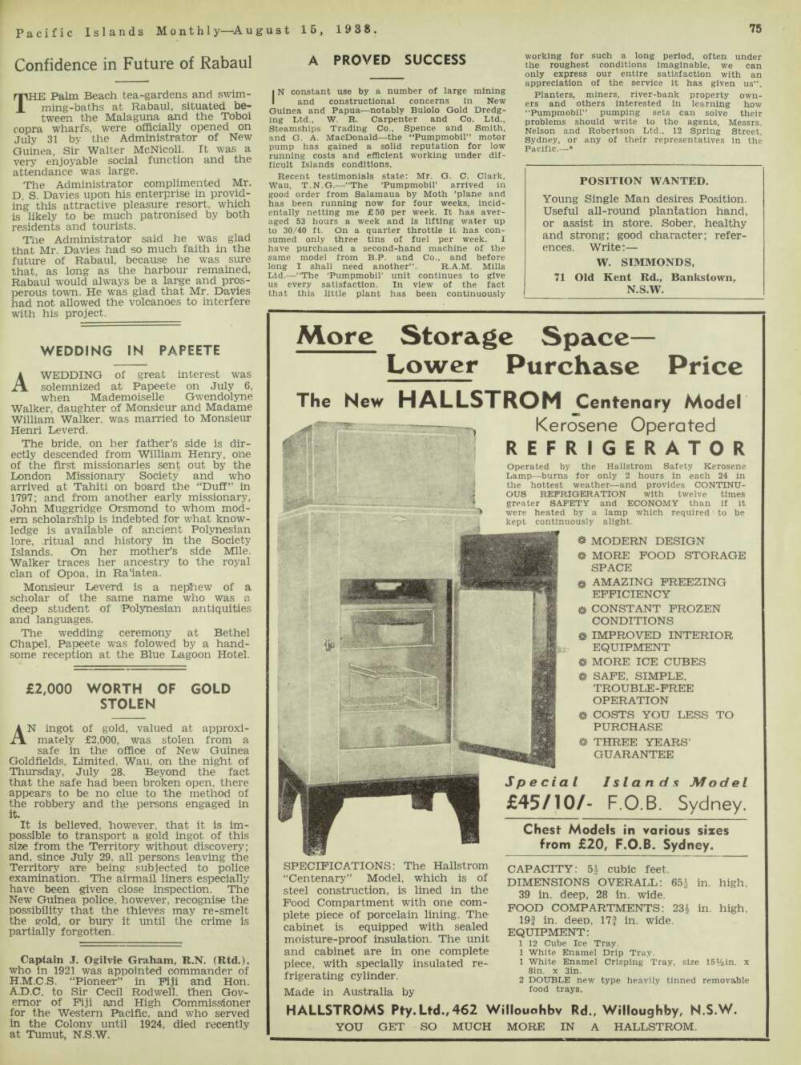
THE Palm Beach tea-gardens and swim ming-baths at Rabaul, situated be tween the Malaguna and the Toboi copra wharfs, were officially opened on July 31 by the Administrator of New Guinea, Sir Walter McNicoll. It was a very enjoyable social function and the attendance was large.
The Administrator complimented Mr.
D. S. Davies upon his enterprise in provid ing this attractive pleasure resort, which is likely to be much patronised by both residents and tourists.
The Administrator said he was glad that Mr. Davies had so much faith in the future of Rabaul, because he was sure that, as long as the harbour remained, Rabaul would always be a large and pros perous town. He was glad that Mr. Davies had not allowed the volcanoes to interfere with his project.
Wedding In Papeete
A WEDDING of great interest was solemnized at Papeete on July 6, when Mademoiselle Gwendolyne Walker, daughter of Monsieur and Madame William Walker, was married to Monsieur Henri Leverd.
The bride, on her father’s side is dir ectly descended from William Henry, one of the first missionaries sent out by the London Missionary Society and who arrived at Tahiti on board the “Duff” in 1797; and from another early missionary, John Muggridge Orsmond to whom mod em scholarship is indebted for what know ledge is available of ancient Polynesian lore, ritual and history in the Society Islands. On her mother’s side Mile.
Walker traces her ancestry to the royal clan of Opoa, in Ra’iatea.
Monsieur Leverd is a nephew of a scholar of the same name who was a, deep student of Polynesian antiquities and languages.
The wedding ceremony at Bethel Chapel. Papeete was folowed by a hand some reception at the Blue Lagoon Hotel.
£2,000 Worth Of Gold
Stolen
AN ingot of gold, valued at approxi mately £2,000, was stolen from a safe in the office of New Guinea Goldfields, Limited. Wau, on the night of Thursday, July 28. Beyond the fact that the safe had been broken open, there appears to be no clue to the method of the robbery and th,e persons engaged in it.
It is believed, however, that it is im possible to transport a gold ingot of this size from the Territory without discovery; and, since July 29. all persons leaving the Territory are being subjected to police examination. The airmail liners especially have been given close inspection. The New Guinea police, however, recognise the possibility that the thieves may re-smelt the gold, or bury it until the crime is partially forgotten.
Captain J. Ogilvie Graham, R.N. (Rtd.), who in 1921 was appointed commander of H.M.C.S. “Pioneer” in Fiji and Hon.
A.D.C. to Sir Cecil Rodwell, then Gov ernor of Fiji and High Commissioner for the Western Pacific, and who served in the Colony until 1924, died recently at Tumut, N.S.W.
A Proved Success
N constant use by a number of large mining I and constructional concerns in New Guinea and Papua—notably Bulolo Gold Dredg ing Ltd., W. R. Carpenter and Co. Ltd., Steamships Trading Co., Spence and Smith, and G. A. MacDonald—the “Pumpmobil” motor pump has gained a solid reputation for low running costs and efficient working under dif ficult Islands conditions.
Recent testimonials state: Mr. G. C. Clark, Wau, T.N.G.—“The ‘Pumpmobil’ arrived in good order from Salamaua by Moth ’plane and has been running now for four weeks, incid entally netting me £5O per week. It has aver aged 53 hours a week and is lifting water up to 30/40 ft. On a quarter throttle it has con sumed only three tins of fuel per week. I have purchased a second-hand machine of the same model from B.P. and Co., and before long I shall need another”. R.A.M. Mills Ltd.—“ The ‘Pumpmobil’ unit continues to give us every satisfaction. In view of the fact that this little plant has been continuously
working for such a long period, often under the roughest conditions imaginable, we can only express our entire satisfaction with an appreciation of the service it has given us”.
Planters, miners, river-bank property own ers and others interested in learning how “Pumpmobil” pumping sets can solve their problems should write to the agents, Messrs.
Nelson and Robertson Ltd., 12 Spring Street, Sydney, or any of their representatives in the Pacific. —♦
Advertisements & other items, p. 79 (1 item)
More Storage Space —
POSITION WANTED,
Young Single Man desires Position.
Useful all-round plantation hand, or assist in store. Sober, healthy and strong; good character; references. Write:—
W. SIMMONDS,
71 Old Kent Rd., Bankstown,
N.S.W.
More Storage Space —
Lower Purchase Price
The New HALLSTROM Centenary Model
Kerosene Operated
REFRIGERATOR
Operated by the Hallstrom Safety Kerosene Lamp—burns for only 2 hours In each 24 in the hottest weather—and provides CONTINU- OUS REFRIGERATION with twelve times greater SAFETY and ECONOMY than if it were heated by a lamp which required to be kept continuously alight.
0 MODERN DESIGN
0 MORE FOOD STORAGE
SPACE
$ AMAZING FREEZING
EFFICIENCY
O CONSTANT FROZEN
CONDITIONS
0 IMPROVED INTERIOR
EQUIPMENT
0 MORE ICE CUBES
0 SAFE, SIMPLE,
TROUBLE-FREE
OPERATION
0 COSTS YOU LESS TO
PURCHASE
0 THREE YEARS’
GUARANTEE
Special Islands Model
£45/10/- F. 0.8. Sydney.
Chest Models in various sizes
from £2O, F. 0.8. Sydney.
CAPACITY: 5* cubic feet.
DIMENSIONS OVERALL: 654 in. high,
39 in. deep, 28 in. wide.
FOOD COMPARTMENTS: 234 in. high,
in. deep, 17f in. wide.
EQUIPMENT:
1 12 Cube Ice Tray. 1 White Enamel Drip Tray. 1 White Enamel Crisping Tray, size ISVfein. x Sin. x Sin. 2 DOUBLE new type heavily tinned removable food trays.
SPECIFICATIONS: The Hallstrom “Centenary” Model, which is of steel construction, is lined in the Food Compartment with one complete piece of porcelain lining. The cabinet is equipped with sealed moisture-proof insulation. The unit and cabinet are in one complete piece, with specially insulated refrigerating cylinder.
Made in Australia by
HALLSTROMS Pty.Ltd.,462 Willouohbv Rd., Willoughby, N.S.W.
YOU GET SO MUCH MORE IN A HALLSTROM.
Exchange Rates
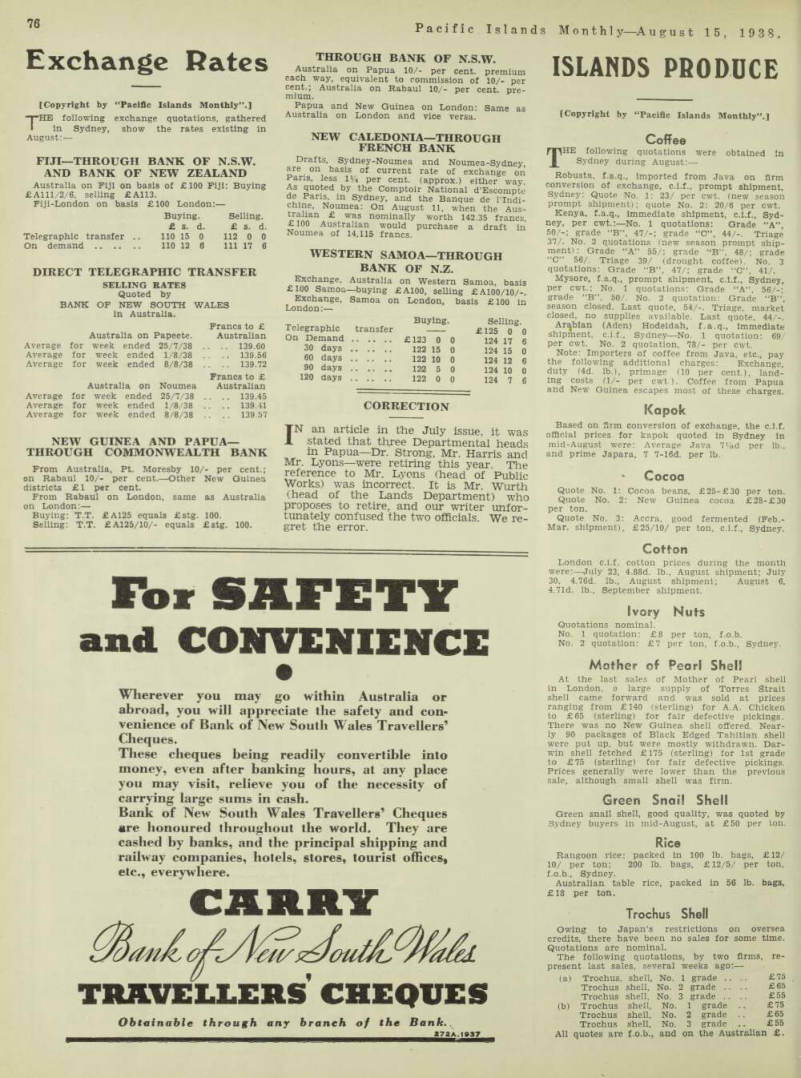
[Copyright by “Pacific Islands Monthly”.] THE following exchange quotations, gathered in Sydney, show the rates existing in August:—
Fiji—Through Bank Of N.S.W.
And Bank Of New Zealand
Australia on Fiji on basis of £lOO Fiji; Buying £ Alll/2/6, selling £AII3.
Piji-London on basis £lOO London:—
Direct Telegraphic Transfer
Selling Rates
Quoted by
Bank Op New South Wales
in Australia.
New Guinea And Papua
Through Commonwealth Bank
From Australia, Pt. Moresby 10/- per cent.; on Rabaul 10/- per cent.—Other New Guinea districts £1 per cent.
From Rabaul on London, same as Australia on London;— Buying: T.T. £AI2S equals £stg. 100.
Selling: T.T. £AI2S/10/- equals £stg. 100.
Through Bank Of N.S.W.
Australia on Papua 10/- per cent, premium each way, equivalent to commission of 10/- per cent.; Australia on Rabaul 10/- per cent, pre mium.
Papua and New Guinea on London: Same as Australia on London and vice versa.
New Caledonia—Through
French Bank
Drafts, Sydney-Noumea and Noumea-Sydney are on basis of current rate of exchange on Pans, less iy 4 per cent, (approx.) either way.
As quoted by the Comptoir National d’Escompte de Pans, in Sydney, and the Banque de I’lndi chme, Noumea: On August 11, when the Aus trahan £ was nominally worth 142.35 francs, £lOO Australian would purchase a draft in Noumea of 14,115 francs.
Western Samoa—Through
Bank Of N.Z.
Exchange, Australia on Western Samoa, basis £lOO Samoa—buying £AIOO, selling £AIOO/10/-.
Exchange, Samoa on London, basis £ 100 in London:—
Buying. Selling. £ s. d. £ s. d.
Telegraphic transfer .. 110 15 0 112 0 0 On demand 110 12 6 111 17 6
Francs to £ Australia on Papeete.
Australian Average for week ended 25/7/38 .. .. 139.60 Average for week ended 1/8/38 . . .. 139.56 Average for week ended 8/8/38 . . .. 139.72 Francs to £ Australia on Noumea Australian Average for week ended 25/7/38 .. .. 139.45 Average for week ended 1/8/38 . . .. 139.41 Average for week ended 8/8/38 .. .. 139.57
Telegraphic On Demand Buying. transfer Selling. £125 0 0 124 17 6 30 days 0 124 15 0 60 days 0 124 12 6 90 days 0 124 10 0 120 days 0 124 7 6
Correction
IN an article in the July issue, it was stated that thj-ee Departmental heads in Papua—Dr. Strong, Mr. Harris and Mr. Lyons—were retiring this year. The reference to Mr. Lyons (head of Public Works) was incorrect. It is Mr. Wurth (head of the Lands Department) who proposes to retire, and our writer unfor tunately confused the two officials. We re gret the error.
Islands Produce
[Copyright by “Pacific Islands Monthly”.]
Coffee
THE following quotations were obtained in Sydney during August:— Robusta, f.a.q., imported from Java on firm conversion of exchange, c.i.f., prompt shipment, Sydney: Quote No. 1; 23/ per cwt. (new season prompt shipment): quote No. 2; 20/6 per cwt.
Kenya, f.a.q., immediate shipment, c.i.f., Syd ney, per cwt.:—No. 1 quotations; Grade “A”, 50/-; grade “B”, 47/-; grade “C”, 44/-. Triage 37/. No. 2 quotations (new season prompt ship ment): Grade “A” 55/; grade “B”, 48/; grade “C” 56/. Triage 39/ (drought coffee). No. 3 quotations: Grade “B”, 47/; grade “C”, 41/.
Mysore, f.a.q., prompt shipment, c.i.f., Sydney, per cwt.; No. 1 quotations: Grade “A”. 56/-; grade “B”, 50/. No. 2 quotation: Grade “B”, season closed. Last quote, 54/-. Triage, market closed, no supplies available. Last quote, 44/-.
Arabian (Aden) Hodeidah, f.a.q., immediate shipment, c.i.f., Sydney—No. 1 quotation: 69/ per cwt. No. 2 quotation, 78/- per cwt.
Note: Importers of coffee from Java, etc., pay the following additional charges: Exchange, duty (4d. lb.), primage (10 per cent.), land ing costs (1/- per cwt). Coffee from Papua and New Guinea escapes most of these charges.
Kapok
Based on firm conversion of exchange, the c.i.f. official prices for kapok quoted in Sydney in mid-August were; Average Java 7ysd per lb., and prime Japara, 7 7-16 d. per lb.
* Cocoa
Quote No. 1: Cocoa beans, £25-£3O per ton.
Quote No. 2: New Guinea cocoa £2B-£3O per ton.
Quote No. 3: Accra, good fermented (Feb.- Mar. shipment), £25/10/ per ton, c.i.f., Sydney.
Cotton
London c.i.f. cotton prices during the month were:—July 23, 4.88 d. lb., August shipment; July 30, 4.76 d. lb., August shipment; August 6, 4.71 d. lb., September shipment.
Ivory Nuts
Quotations nominal.
No. 1 quotation: £8 per ton, f.o.b.
No. 2 quotation: £7 per ton, f.0.b., Sydney.
Mother of Pearl Shelf
At the last sales of Mother of Pearl shell in London, a large supply of Torres Strait shell came forward and was sold at prices ranging from £l4O (sterling) for A.A. Chicken to £65 (sterling) for fair defective pickings.
There was no New Guinea shell offered. Near ly 90 packages of Black Edged Tahitian shell were put up, but were mostly withdrawn. Dar win shell fetched £175 (sterling) for Ist grade to £75 (sterling) for fair defective pickings.
Prices generally were lower than the previous sale, although small shell was firm.
Green Snail Shell
Green snail shell, good quality, was quoted by Sydney buyers in mid-August, at £5O per ton.
Rice
Rangoon rice: packed in 100 lb. bags, £l2/ 10/ per ton; 200 lb. bags, £l2/5/ per ton, f.0.b., Sydney.
Australian table rice, packed in 56 lb. bags, £lB per ton.
Trochus Shell
Owing to Japan’s restrictions on oversea credits, there have been no sales for some time.
Quotations are nominal.
The following quotations, by two firms, re present last sales, several weeks ago:—
(a) Trochus, shell, No. 1 grade .. .. £75 Trochus shell, No. 2 grade .. .. £65 Trochus shell, No. 3 grade .. .. £ 55 (b) Trochus shell, No. 1 grade .. £75 Trochus shell, No. 2 grade .. £65 Trochus shell, No. 3 grade .. £55 All quotes are f.o.b., and on the Australian £.
Advertisements & other items, p. 80 (2 items)
76
Pacific Islands Monthl y—A ugust 15, 1938,
For Safety
and CONVENIENCE
Wherever you may go within Australia or abroad, you will appreciate the safety and convenience of Bank of New South Wales Travellers’
Cheques.
These cheques being readily convertible into money, even after banking hours, at any place you may visit, relieve you of the necessity of carrying large sums in cash.
Bank of New South Wales Travellers’ Cheques are honoured throughout the world. They are cashed by banks, and the principal shipping and railway companies, hotels, stores, tourist offices, etc., everywhere.
CARRY
TRAVELLERS CHEQUES
Obtainable through any branch of the Bank.. *7*A.l»37
Market Quotations
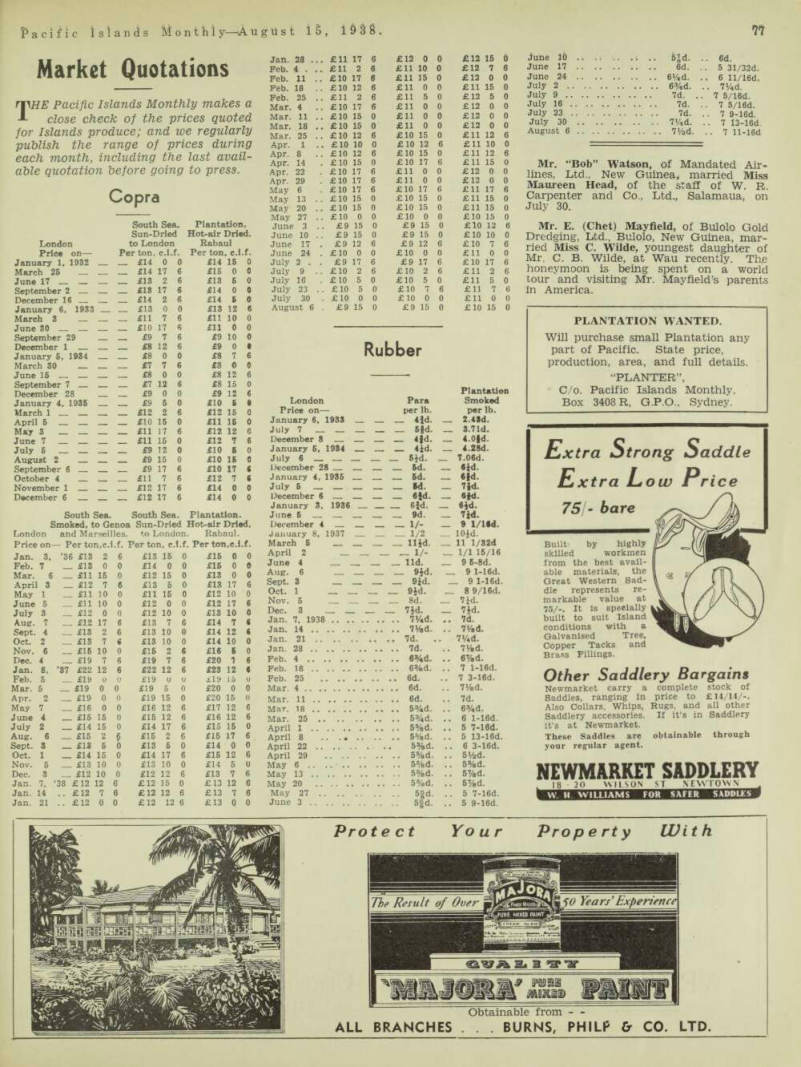
THE Pacific Islands Monthly makes a close check of the prices quoted for Islands produce; and we regularly publish the range of prices during each month, including the last avail able quotation before going to press.
Mr. “Bob” Watson, of Mandated Air lines, Ltd., New Guinea* married Miss Maureen Head, of the staff of W. R.
Carpenter and Co., Ltd., Salamaua, on July 30.
Mr. E. (Chet) Mayfield, of Bulolo Gold Dredging, Ltd., Bulolo, New Guinea, mar ried Miss C. Wilde, youngest daughter of Mr. C. B. Wilde, at Wau recently. The honeymoon is being spent on a world tour and visiting Mr. Mayfield’s parents In America.
Copra
South Sea, Plantation, Sun-Dried Hot-air Dried, London to London Rabaul Price on — Per ton, c.i.f.
Per ton . c.i.f.
January 1, 1932 £14 0 0 £14 15 0 March 25 £14 17 6 £15 0 0 June 17 — — — £13 2 6 £13 6 0 September 2 — £13 17 6 £14 0 0 December 16 — £14 2 6 £14 6 0 January 6, 1933 . £13 0 0 £13 12 6 March 3 £11 7 6 £11 10 0 June 30 — — £10 17 6 £11 0 0 September 29 £9 7 6 £9 10 0 December 1 — £8 12 6 £9 0 • January 5, 1984 £8 0 0 £8 7 6 March 30 — £7 7 6 £8 0 0 June 15 — — , £8 0 0 £8 12 6 September 7 — £7 12 6 £8 15 0 December 28 £9 0 0 £9 12 6 January 4, 1935 £9 6 0 £10 6 » March 1 £12 2 6 £12 16 0 April 5 — £10 15 0 £11 16 0 May 3 — — £11 17 6 £12 12 6 June 7 £11 15 0 £12 7 6 July 5 — — £9 12 0 £10 6 0 August 2 £9 15 0 £10 16 0 September 6 — £9 17 6 £10 17 6 October 4 £11 7 6 £12 7 6 November 1 £12 17 6 £14 0 0 December 6 — — £12 17 6 £14 0 0 South Sea.
South Sea.
Plantation.
Smoked, to Genoa . Sun-Dried Hot-air Dried, London and Marseilles. to London.
Rabaul.
Price on— Per ton.c.i.f. Per ton, c. l.f. Per ton.c.i.f.
Jan. 3, ’36 £13 2 6 £13 15 0 £15 0 0 Feb. 7 £13 0 0 £14 0 0 £16 0 0 Mar. 6 £11 15 0 £12 15 0 £13 0 0 April 3 £12 7 6 £13 6 0 £13 17 6 May 1 £11 10 0 £11 15 0 £12 10 0 June 5 „ £11 10 0 £12 0 0 £12 17 6 July 3 £12 0 0 £12 10 0 £13 10 0 Aug. 7 £12 17 6 £13 7 6 £14 7 « Sept. 4 £13 2 6 £13 10 0 £14 12 « Oct. 2 £13 7 i £13 10 0 £14 10 0 Nov. 6 £16 10 0 £16 2 6 £16 6 0 Dec. 4 £19 7 6 £19 7 6 £20 7 6 Jan. 8. '37 £22 12 6 £22 12 6 £23 12 < Feb. 5 „ £19 U 0 £19 U U £19 15 u Mar. 5 £19 0 0 £19 5 0 £20 0 0 Apr. 2 £19 0 0 £19 15 0 £20 15 0 May 7 £16 0 0 £16 12 6 £17 12 6 June 4 £15 15 0 £15 12 6 £16 12 6 July 2 £14 15 0 £14 17 6 £15 16 0 Aug. 6 £15 2 $ £16 2 6 £15 17 6 Sept. 8 £13 5 0 £13 6 0 £14 0 0 Oct. 1 — £14 15 0 £14 17 6 £15 12 6 Nov. 5 £13 10 0 £13 10 0 £14 5 0 Dec. 3 ._ £12 10 0 £12 12 6 £13 7 6 Jan. 7, ’38 £12 12 6 £12 15 0 £13 12 6 Jan. 14 .. £12 7 6 £12 12 6 £13 7 6 Jan. 21 .. £12 0 0 £12 12 6 £13 0 0
June 10 .. .. 5|d. .. 6d.
June 17 5 31/32d.
June 24 6 ll/16d.
July 2 7V 4 d.
July 9 7 5/16d.
July 16 7d. .. 7 5/16d.
July 23 7d. .. 7 9-16d.
July 30 7V 4 d. .. 7 I3-16d.
August 6 7V 2 d. . . 7 ll-16d
Jan. 28 ... £11 17 6 £12 0 0 £12 15 0 Feb. 4 . .. £11 2 6 £11 10 0 £12 7 6 Feb. 11 .. £10 17 6 £11 15 0 £12 0 0 Feb. 18 £10 12 6 £11 0 0 £11 15 0 Feb. 25 .. £11 2 6 £11 5 0 £12 5 0 Mar. 4 £10 17 6 £11 0 0 £12 0 0 Mar. 11 .. £10 15 0 £11 0 0 £12 0 0 Mar. 18 .. £10 15 0 £11 0 0 £12 0 0 Mar. 25 .. £10 12 6 £10 15 0 £11 12 6 Apr. 1 £10 10 0 £10 12 6 £11 10 0 Apr. 8 £10 12 6 £10 15 0 £11 12 6 Apr. 14 £10 15 0 £10 17 6 £11 15 0 Apr. 22 £10 17 6 £11 0 0 £12 0 0 Apr. 29 £10 17 6 £11 0 0 £12 0 0 May 6 £10 17 6 £10 17 6 £11 17 6 May 13 .. £10 15 0 £10 15 0 £11 15 0 May 20 .. £10 15 0 £10 15 0 £11 15 0 May 27 .. £10 0 0 £10 0 0 £10 15 0 June 3 .. £9 15 0 £9 15 0 £10 12 6 June 10 .. £9 15 0 £9 15 0 £10 10 0 June 17 . £9 12 6 £9 12 6 £10 7 6 June 24 . £10 0 0 £10 0 0 £11 0 0 July 2 . . £9 17 6 £9 17 6 £10 17 6 July 9 .. £10 2 6 £10 2 6 £11 2 6 July 16 £10 5 0 £10 5 0 £11 5 0 July 23 .. £10 5 0 £10 7 6 £11 7 6 July 30 £10 0 0 £10 0 0 £11 0 0 August 6 . £9 15 0 £9 15 0 £10 15 0 London Price on- January 6, 1933
Rubber
Para per lb. - - 4}d. Plantation Smoked per lb. 2.48d.
July 7
Bfd.
3.71d.
December 8 — ... 4|d. 4.0|d.
January 6. 1984 4id. 4.28d.
July 6 — Bid. 7.06d.
December 28 Bd. •id.
January 4, 1985 . Bd. — B|d.
July 5 Id. 7|d.
December 6 6Jd. «fd.
January 3, 1936 — Bfd. Bid.
June 5 9d. 7Jd.
December 4 - 1/- - 9 1/lCd.
January 8, 1937 , — 1/2 10id.
March 6 Hid. 11 l/32d April 2 - — 1/- — 1/1 1B/16 June 4 ,, „ ... lid. 9 5-8d.
Aug. 6 , 9id. . 9 l-16d.
Sept. 3 9Jd. . 9 l-16d.
Oct. 1 9id. „ 8 9/16d.
Nov. 5 8d. 7*d.
Dec. 3 7id. 7id.
Jan. 7. 1938 .. . .. md. .. 7d.
Jan. 14 .. 7V«d.
Jan. 21 .. ,. , , .. 7d. .. 7y 4 d.
Jan. 28 .. .. .. . , , , .. 7d. 7ttd.
Feb. 4 ..
BYsd.
Feb. 18 .. .. 6%d. .. 7 l-16d.
Feb. 25 . .. , , . . .. 6d. 7 3-16d.
Mar. 4 .. . .. 6d.
IVad.
Mar. 11 .. .. . , .. 6d. 7d.
Mar. 18 .. 6%d.
Mar. 25 .. 6 l-16d.
April 1 .. 5 7-16d.
April 8 . • . . .. 5%d. .. 5 13-16d.
April 22 .. .. . 5%d. .. 6 3-16d.
April 29 5Vad.
May 6 .. 5%d.
May 13 .. 5 7 /ad.
May 20 5 7 / a d.
May 27 . 5|d. .. 5 7-16d.
June 3 .. .. 5|d. .. 5 9-16d.
Advertisements & other items, p. 81 (2 items)
77
Pacific Islands Month! ugust 15,
Extra Strong
PLANTATION WANTED.
Will purchase small Plantation any part of Pacific. State price, production, area, and full details.
“PLANTER”,
C/o. Pacific Islands Monthly, Box 3408 R, G.P.0., Sydney.
Extra Strong
Extra Low
Saddle
rice
751- bare
Built by highly skilled workmen from the best available materials, the Great Western Saddle represents remarkable value at 75/-. It Is specially built to suit Island conditions with a Galvanised Tree, Copper Tacks and Brass Fillings.
Other Saddlery Bargains
Newmarket carry a complete stock of Saddles, ranging In price to £ 14/14/-.
Also Collars, Whips, Rugs, and all other Saddlery accessories. If it’s in Saddlery it’s at Newmarket.
These Saddles are obtainable through your regular agent.
NEWMARKET SADDLERY
18 20 WILSON ST NEWTOWN
W. H WILLIAMS FOR SAFER SADDLES
Protect Your Property With The Result of Over Year/Experience m Mm*® Obtainable from - ALL BRANCHES BURNS, PHILP & CO. LTD.
“Skandia” Engines For Papuan
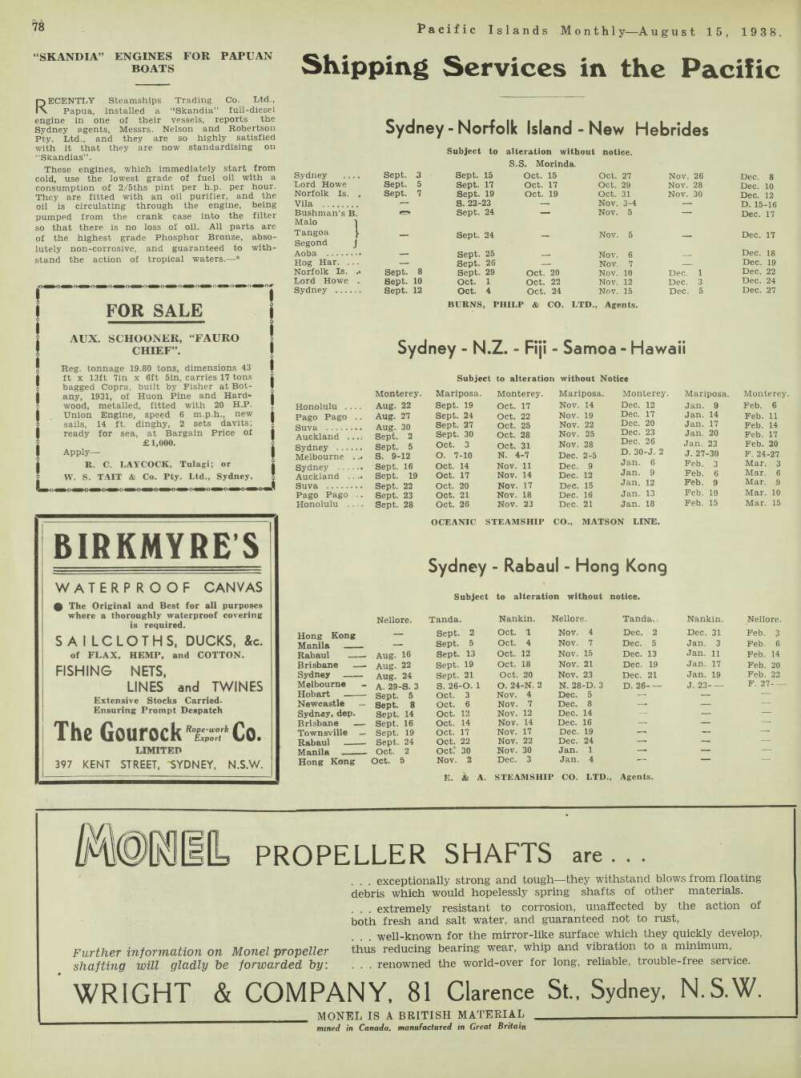
Boats
RECENTLY Steamships Trading Co. Ltd., Papua, installed a “Skandia” full-diesel engine in one of their vessels, reports the Sydney agents, Messrs. Nelson and Robertson Pty. Ltd., and they are so highly satisfied with it that they are now standardising on “Skandias”.
These engines, which immediately start from cold, use the lowest grade of fuel oil with a consumption of 2/sths pint per h.p. per hour.
They are fitted with an oil purifier, and the oil is circulating through the engine, being pumped from the crank case into the filter so that there is no loss of oil. All parts are of the highest grade Phosphor Bronze, abso lutely non-corrosive, and guaranteed to with stand the action of tropical waters. —*
Shipping Services in the Pacific
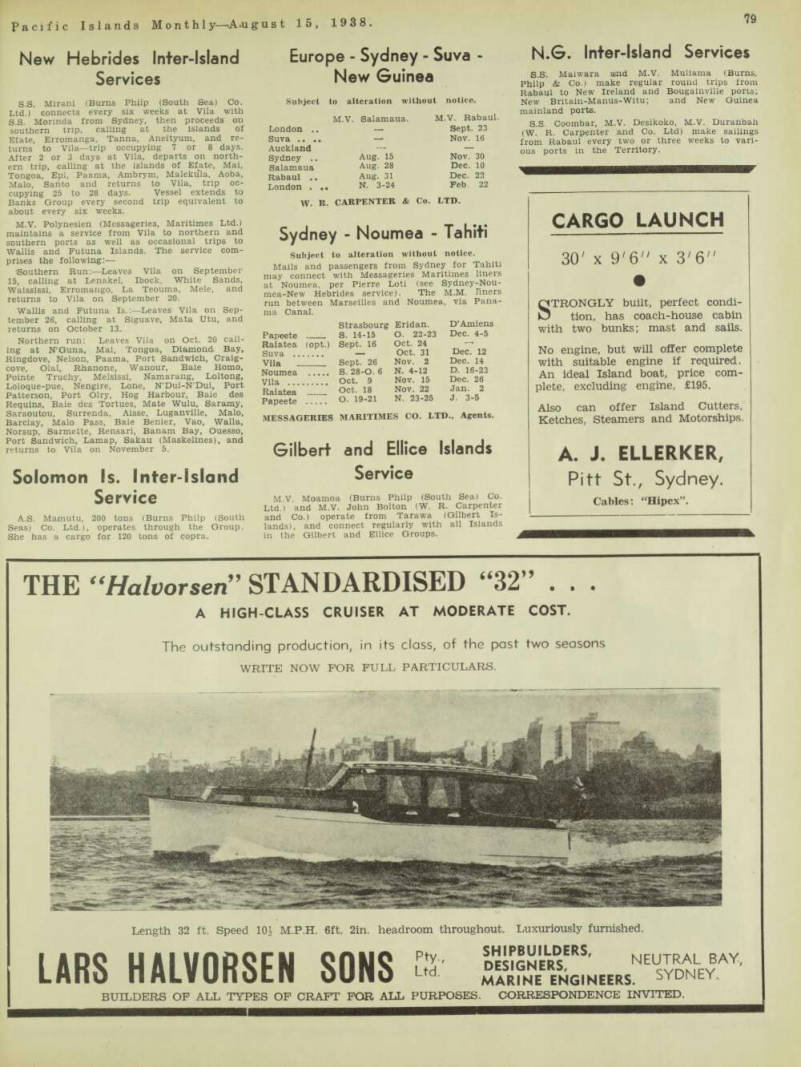
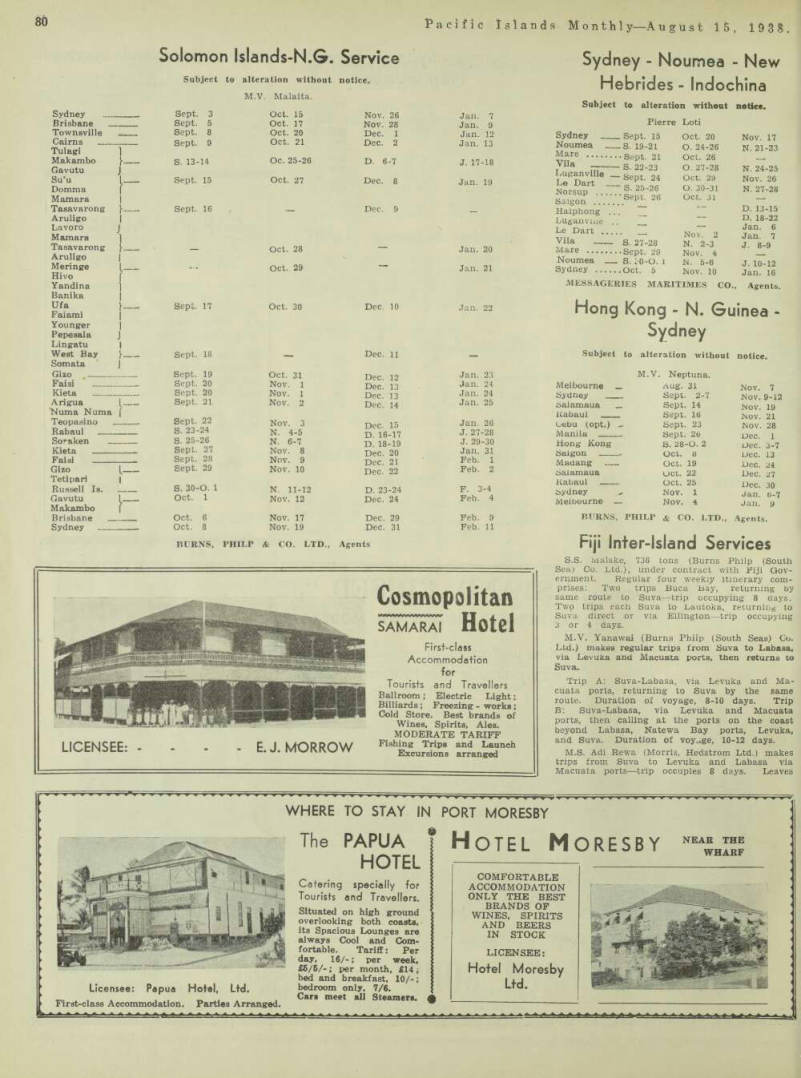
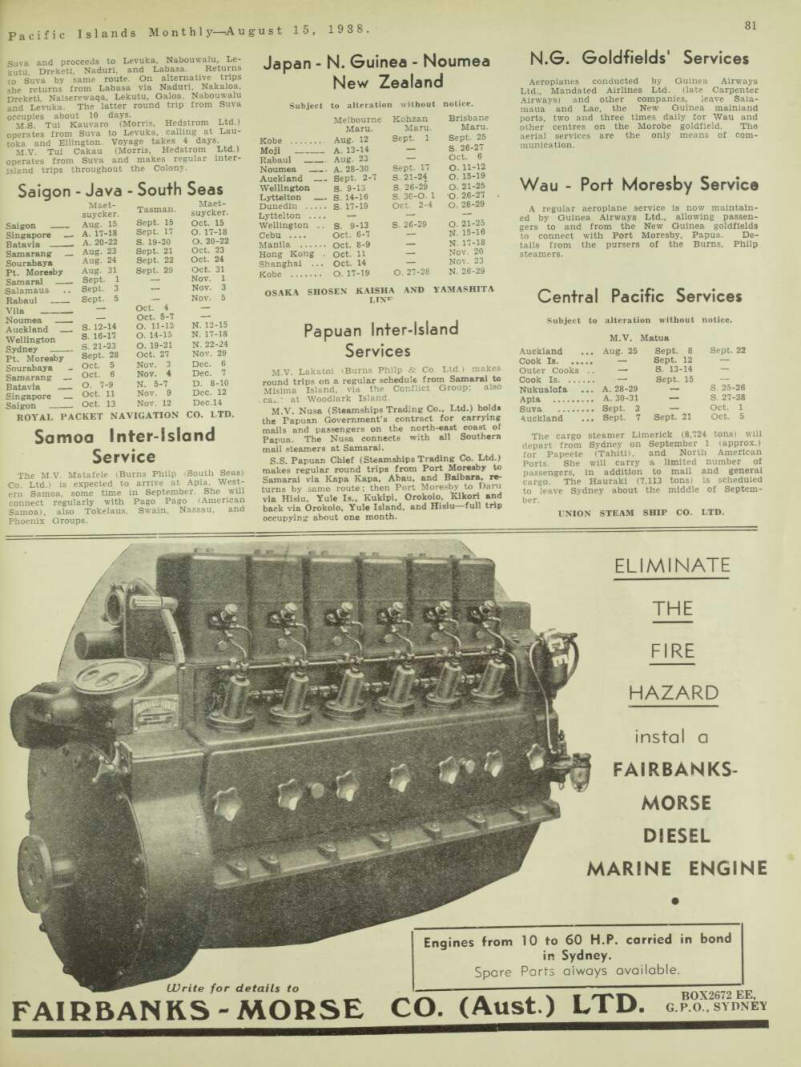
Sydney - Norfolk Island - New Hebrides
Sydney - N.Z. - Fiji - Samoa - Hawaii
Sydney - Rabaul - Hong Kong
Subject to alteration without notice.
S.S. Morinda Sydney ...
Sept. 3 Sept. 15 Oct. 15 Oct. 27 Nov. 26 Dec. 8 Lord Howe Sept. 5 Sept. 17 Oct. 17 Oct. 29 Nov. 28 Dec. 10 Norfolk Is. , Sept. 7 Sept. 19 Oct. 19 Oct. 31 Nov. 30 Dec. 12 Vila — S. 22-23 — Nov. 3-4 — D. 15 -16 Bushman’s B.
Sept. 24 — Nov. 5 — Dec. 17
Malo 1
Tangoa Sept. 24 Nov. 5 Dec. 17
Segond J
Aoba — Sept. 25 Nov. 6 Dec. 18 Hog Har. ... — Sept. 26 Nov. 7 Dec. 19 Norfolk Is. .* Sept. 8 Sept. 29 Oct. 20 Nov. 10 Dec. 1 Dec. 22 Lord Howe .
Sept. 10 Oct. 1 Oct. 22 Nov. 12 Dec. 3 Dec. 24 Sydney Sept. 12 Oct. 4 Oct. 24 Nov. 15 Dec. 5 Dec. 27
Burns, Philp & Co. Ltd.
, Agents.
Subject to alteration without Notice Monterey.
Mariposa.
Monterey.
Mariposa.
Monterey.
Mariposa.
Monterey.
Honolulu Aug. 22 Sept. 19 Oct. 17 Nov. 14 Dec. 12 Jan. 9 Feb. 6 Pago Pago ..
Aug. 27 Sept. 24 Oct. 22 Nov. 19 Dec. 17 Jan. 14 Feb. 11 Suva Aug. 30 Sept. 27 Oct. 25 Nov. 22 Dec. 20 Jan. 17 Feb. 14 Auckland ...
Sept. 2 Sept. 30 Oct. 28 Nov. 25 Dec. 23 Jan. 20 Feb. 17 Sydney Sept. 5 Oct. 3 Oct. 31 Nov. 28 Dec. 26 Jan. 23 Feb. 20 Melbourne ...
S. 9-12 O. 7-10 N. 4-7 Dec. 2-5 D. 30-J. 2 J. 27-30 F. 24-27 Sydney Sept. 16 Oct. 14 Nov. 11 Dec. 9 Jan. 6 Feb. 3 Mar. 3 Auckland ...
Sept. 19 Oct. 17 Nov. 14 Dec. 12 Jan. 9 Feb. 6 Mar. 6 Suva Sept. 22 Oct. 20 Nov. 17 Dec. 15 Jan. 12 Feb. 9 Mar. 9 Pago Pago ..
Sept. 23 Oct. 21 Nov. 18 Dec. 16 Jan. 13 Feb. 10 Mar. 10 Honolulu ...
Sept. 28 Oct. 26 Nov. 23 Dec. 21 Jan. 18 Feb. 15 Mar. 15
Oceanic Steamship Co., Matson Line.
Subject to alteration without notice.
Nellore.
Tanda.
Nankin.
Nellore.
Tanda..
Nankin.
Nellore.
Hong Kong Sept. 2 Oct. 1 Nov. 4 Dec. 2 Dec. 31 Feb. 3 Manila — Sept. 5 Oct. 4 Nov. 7 Dec. 5 Jan. 3 Feb. 6 Rabaul Aug. 16 Sept. 13 Oct. 12 Nov. 15 Dec. 13 Jan. H Feb. 14 Brisbane —- Aug. 22 Sept. 19 Oct. 18 Nov. 21 Dec. 19 Jan. 17 Feb. 20 Sydney Aug. 24 Sept. 21 Oct. 20 Nov. 23 Dec. 21 Jan. 19 Feb. 22 Melbourne - A. 29-S.3 S.26-0. 1 O.24-N. 2 N.28-D. 3 D. 26- — J. 23- — F. 27 Hobart Sept. 5 Oct. 3 Nov. 4 Dec. 5 — — — Newcastle — Sept. 8 Oct. 6 Nov. 7 Dec. 8 — — — Sydney, dep.
Sept. 14 Oct. 12 Nov. 12 Dec. 14 — — — Brisbane — Sept. 16 Oct. 14 Nov. 14 Dec. 16 — — — Townsville — Sept. 19 Oct. 17 Nov. 17 Dec. 19 — — — Rabaul Sept. 24 Oct. 22 Nov. 22 Dec. 24 —* — — Manila Oct. 2 octr 30 Nov. 30 Jan. 1 —• — — Hong Kong Oct. 5 Nov. 2 Dec. 3 Jan. 4 — — — E. & A.
Steamship Co. Ltd,
Agents.
New Hebrides Inter-Island
Services
S.S. Mirani (Burns Philp (South Sea) Co.
Ltd.) connects every six weeks at Vila with S.S. Morinda from Sydney, then proceeds on southern trip, calling at the islands of Efate, Erromanga, Tanna, Aneityum, and re turns to Vila—trip occupying 7 or 8 days.
After 2 or 3 days at Vila, departs on north ern trip, calling at the islands of Efate, Mai, Tongoa, Epi, Paama, Ambrym, Malekiila, Aoba, Malo, Santo and returns to Vila, trip oc cupying 25 to 28 days. Vessel extends to Banks Group every second trip equivalent to about every six weeks.
M.V. Polynesien (Messageries, Maritimes Ltd.) maintains a service from Vila to northern and southern ports as well as occasional trips to Wallis and Futuna Islands. The service com prises the following:— Southern Run: —Leaves Vila on September 15, calling at Lenakel, Ibock, White Sands, Waississi, Erromango, La Teouma, Mele, and returns to Vila on September 20.
Wallis and Futuna Is.: —Leaves Vila on Sep tember 26, calling at Siguave, Mata Utu, and returns on October 13.
Northern run: Leaves Vila on Oct. 20 call ing at N’Guna, Mai, Tongoa, Diamond Bay, Ringdove, Nelson, Paama, Port Sandwich, Craig cove, Olal, Rhanone, Wanour, Baie Homo.
Pointe Truchy, Melsissi, Namarang, Loltong, Loloque-pue, Nengire, Lone, N’Dui-N’Dui, Port Patterson, Port Olry, Hog Harbour, Baie des Requins, Baie des Tortues, Mate Wulu, Saramy, Saraoutou, Surrenda, Aisse, Luganville, Malo, Barclay, Malo Pass, Baie Benier, Vao, Walla, Norsup, Sarmette, Rensari, Banam Bay, Ouesso, Port Sandwich, Lamap, Sakau (Maskelines), and returns to Vila on November 5.
Solomon Is. Inter-Island
Service
A.S. Mamutu, 200 tons (Burns Philp (South Seas) Co. Ltd.), operates through the Group.
She has a cargo for 120 tons of copra.
Europe - Sydney - Suva - New Guinea Subject to alteration without notice.
Sydney - Noumea - Tahiti
Subject to alteration without notice.
Mails and passengers from Sydney for Tahiti may connect with Messageries Maritimes liners at Noumea, per Pierre Loti (see Sydney-Nou mea-New Hebrides service). The M.M. liners run between Marseilles and Noumea, via Pana ma Canal.
Gilbert and Ellice Islands
Service
MV. Moamoa (Burns Philp (South Sea) Co.
Ltd.) and M.V. John Bolton (W. R. Carpenter and Co.) operate from Tarawa (Gilbert Is lands), and connect regularly with all Islands in the Gilbert and Ellice Groups.
N.G. Inter-Island Services
5.5. Maiwara and M.V. Muliama (Burns.
Philp & Co.) make regular round trips from Rabaul to New Ireland and Bougainville ports; New Britain-Manus-Witu; and New Guinea mainland ports. 5.5. Coombar, M.V. Desikoko, M.V. Duranbah (W. R. Carpenter and Co. Ltd) make sailings from Rabaul every two or three weeks to vari ous ports in the Territory.
M.V. Salamaua.
M.V. Rabaul.
London .. — Sept. 23 Suva .. .. — Nov. 16 Auckland — — Sydney ..
Aug. 15 Nov. 30 Salamaua Aug. 28 Dec. 10 Rabaul ..
Aug. 31 Dec. 22 London . ..
N. 3-24 Feb 22 W. R.
Carpenter &
Co. Ltd.
Strasbourg Eridan.
D’Amiens Papeete S. 14-15 O. 22-23 Dec. 4-5 Raiatea (opt.) Sept. 16 Oct. 24 — Suva .. Oct. 31 Dec. 12 Vila ..
Sept. 26 Nov. 2 Dec. 14 Noumea S.28-0. 6 N. 4-12 D. 16-23 Vila ...
Oct. 9 Nov. 15 Dec. 26 Raiatea Oct. 18 Nov. 22 Jan. 2 Papeete O. 19-21 N. 23-25 J. 3-5
Messaoeries
Maritimes Co. Ltd., Agents.
Solomon Islands-N.G. Service Subject to alteration without notice.
Sydney - Noumea - New Hebrides - Indochina Subject to alteration without notice.
Hong Kong - N. Guinea -
Sydney
Subject to alteration without notice.
Fiji Inter-Island Services
S.S. Malake, 736 tons (Burns Philp (South Sea) Co. Ltd.), under contract with Fiji Gov ernment. Regular four weekly itinerary com prises: Two trips Buca Bay, returning by same route to Suva—trip occupying 8 days.
Two trips each Suva to Lautoka, returning to Suva direct or via Ellington—trip occupying 3 or 4 days.
M.V. Yanawai (Burns Philp (South Seas) Co.
Ltd.) makes regular trips from Suva to Labasa, via Levuka and Macuata ports, then returns to Suva.
Trip A: Suva-Labasa, via Levuka and Ma cuata ports, returning to Suva by the same route. Duration of voyage, 8-10 days. Trip B; Suva-Labasa, via Levuka and Macuata ports, then calling at the ports on the coast beyond Labasa, Natewa Bay ports, Levuka, and Suva. Duration of voyage, 10-12 days.
M.S. Adi Rewa (Morris, Hedstrom Ltd.) makes trips from Suva to Levuka and Labasa via Macuata ports—trip occupies 8 days. Leaves
M.V. Malaita.
Sydney Sept. 3 Oct. 15 Nov. 26 Jan. 7 Brisbane Sept. 5 Oct. 17 Nov. 28 Jan. 9 Townsville .
Sept. 8 Oct. 20 Dec. 1 Jan. 12 Cairns Sept. 9 Oct. 21 Dec. 2 Jan. 13 Tulagi 1 Makambo S. 13-14 Oc. 25-26 D. 6-7 J. 17-18 Gavutu J Su’u I— Sept. 15 Oct. 27 Dec. 8 Jan. 19 Domma f Mamara 1 Tasavarong \ Sept. 16 Dec. 9 Aruligo 1 Lavoro J Mamara 1 Tasavarong Oct. 28 — Jan. 20 Aruligo J Meringe I ...
Oct. 29 — Jan. 21 Hivo f Yandina 1 Banika 1 Ufa \ Sept. 17 Oct. 30 Dec. 10 Jan. 22 Faiami I Younger 1 Pepesala J Lingatu 1 West Bay Sept. 18 Dec. 11 Somata J Gizo , Sept. 19 Oct. 31 Dec. 12 Jan. 23 Faisi Sept. 20 Nov. 1 Dec. 13 Jan. 24 Kieta Sept. 20 Nov. 1 Dec. 13 Jan. 24 Arigua [ Sept. 21 Nov. 2 Dec. 14 Jan. 25 Numa Numa Teopasino Sept. 22 Nov. 3 Dec. 15 Jan. 26 Rabaul S. 23-24 N. 4-5 D. 16-17 J. 27-28 So*-aken S. 25-26 N. 6-7 D. 18-19 J. 29-30 Kieta Sept. 27 Nov. 8 Dec. 20 Jan. 31 Faisi Sept. 28 Nov. 9 Dec. 21 Feb. 1 Gizo I— Sept. 29 Nov. 10 Dec. 22 Feb. 2 Tetipari 1 Russell Is. .
S.30-0. 1 N. 11-12 D. 23-24 F. 3-4 Gavutu 1 Oct. 1 Nov. 12 Dec. 24 Feb. 4 Makambo f Brisbane Oct. 6 Nov. 17 Dec. 29 Feb. 9 Sydney Oct. 8 Nov. 19 Dec. 31 Feb. 11
Burns,
Philp & Co. Ltd.,
Agents
Pierre Loti Sydney Sept. 15 Oct. 20 Nov. 17 Noumea S. 19-21 O. 24-26 N. 21 -23 Mare Vila Luganville Le Dart Norsup Saigon ■Sept. 21 Oct. 26 S. 22-23 Sept. 24 O. 27-28 Oct. 29 N. 24 Nov. -25 26 S. 25-26 Sept. 26 O. 30-31 Oct. 31 N. 27 -28 Haiphong ...
D. 13 -15 Lusianviue ..
Le Dart ... — Nov. 2 D. 18 Jan.
Jan. -22 6 7 Vila S. 27-28 N. 2-3 J. 8- 9 Mare ■Sept. 29 Nov. 4 Noumea s.:o-o. i N. 5-6 J. 10- 12 Sydney Oct. 5
Nov. 10
Jan. 16
Messageries Maritimes Co.,
Agents.
M.V.
Neptuna.
Melbourne AUg. 31 Nov. 7 Sydney Sept. 2-7 Nov. 9-12 Salamaua Sept. 14 Nov. 19 Kabaul Sept. 16 Nov. 21 Cebu (opt.) - Sept. 23 Nov. 28 Manila Sept. 26 Dec. 1 Hong Kong S.28-0. 2 .Dec. 3-7 Saigon Oct. 8 Dec. 13 Madang Oct. 19 Dec. 24 Saiamaua UCt. 22 Dec. 27 Kabaul Oct. 25 Dec. 30 Sydney Nov. 1 Jan. b-7 Melbourne — Nov. 4 Jan. 9
Burns,
Philp
& Co. Ltd.,
Agents.
Suva and proceeds to Levuka. Nabouw r alu, Le kutu Dreketi, Naduri, and Labasa. Returns to Suva by same route. On alternative trips she returns from Labasa via Naduri, Nakaloa, Dreketi Naiserewaqa, Lekutu, Galoa. Nabouwalu and Levuka. The latter round trip from Suva occupies about 10 days. , _. . , M.S. Tui Kauvaro (Morris, Hedstrom Ltd.) operates from Suva to Levuka, calling at Lau toka and Ellington. Voyage takes 4 days M.V. Tui Cakau (Morris, Hedstrom Ltd.) operates from Suva and makes regular inter island trips throughout the Colony.
Saigon - Java - South Seas
Samoa !nter-!sland
Service
The M.V. Matafele (Burns Philp (South Seas) Co. Ltd.) is expected to arrive at Apia, West ern Samoa, some time in September. She will connect regularly with Pago Pago (American Samoa), also Tokelaus, Swain, Nassau, and Phoenix Groups.
Japan - N. Guinea - Noumea New Zealand Subject to alteration without notice.
Papuan Inter-Island
Services
M.V. Lakatoi (Burns Philp & Co. Ltd. i makes round trips on a regular schedule from Samarai to Misima Island, via the Conflict Group; also ca*.' at Woodlark Island.
M.V. Nusa (Steamships Trading Co., Ltd.) hold* the Papuan Government’s contract for carrying mails and passengers on the north-east coast of Papua. The Nusa connects with all Southern mail steamers at Samarai.
S.S. Papuan Chief (Steamships Trading Co. Ltd.) makes regular round trips from Port Moresby to Samarai via Kapa Kapa, Abau, and Baibara. re turns by same route; then Port Moresby to Daru via Hisiu, Yule Is.. Kukipi, Orokolo. Kikori and back via Orokolo, Yule Island, and Hisiu full trip occupying about one month.
N.G. Goldfields' Services
Aeroplanes conducted by Guinea Airways Ltd., Mandated Airlines Ltd. (late Carpenter Airways) and other companies, leave Sala maua and Lae, the New Guinea mainland ports, two and three times daily for Wau and other centres on the Morobe goldfield. The aerial services are the only means of com munication.
Wau - Port Moresby Service
A regular aeroplane service is now maintain ed by Guinea Airways Ltd., allowing passen gers to and from the New Guinea goldfields to connect with Port Moresby, Papua. De tails from the pursers of the Burns, Philp steamers.
Central Pacific Services Subject to alteration without notice.
The cargo steamer Limerick (8,724 tons) will depart from Sydney on September 1 (approx.) for Papeete (Tahiti), and North American Ports. She will carry a limited number of passengers, in addition to mail and general cargo. The Hauraki (7,113 tons) is scheduled to leave Sydney about the middle of Septem ber.
Union Steam Ship Co. Ltd.
Saigon Singapore — Batavia — Maetsuycker.
Aug. 15 A. 17-18 A. 20-22 Tasman.
Sept. 15 Sept. 17 S. 19-20 Maetsuycker.
Oct. 15 O. 17-18 O. 20-22 Samarang — Sourabaya Pt. Moresby Samarai Salamaua Aug. 23 Aug. 24 Aug. 31 Sept. 1 Sept. 3 Sept. 21 Sept. 22 Sept. 29 Oct. 23 Oct. 24 Oct. 31 Nov. 1 Nov. 3 Rabaul Vila Sept. 5 Oct. 4 Nov. 5 Noumea Auckland — Wellington Sydney S. 12-14 S. 16-17 S. 21-23 Oct. 5-7 O. 11-12 O. 14-15 O. 19-21 N. 12-15 N. 17-18 N. 22-24 Pt. Moresby Sourabaya Samarang — Batavia Singapore — Qoicrrm Sept. 28 Oct. 5 Oct. 6 O. 7-9 Oct. 11 Oct. 13 Oct. 27 Nov. 3 Nov. 4 N. 5-7 Nov. 9 Nov. 12 Nov. 29 Dec. 6 Dec. 7 D. 8-10 Dec. 12 Dec.14
Royal Packet Navigation
Co. Ltd
Melbourne Kohzan Brisbane Maru.
Maru.
Maru.
Kobe Aug. 12 Sept. 1 Sept. 25 Moji A. 13-14 — S. 26-27 Rabaul Aug. 23 — Oct. 6 Noumea A.28-30 Sept. 17 O. H-12 Auckland — Sept. 2-7 S. 21-24 O. 15-19 Wellington S. 9-13 S. 26-29 O. 21-25 Lyttelton — S. 14-16 S- 30-0. 1 O. 26-27 Dunedin S. 17-19 Oct. 2-4 O. 28-29 Lyttelton — — — Wellington ..
S. 9-13 S. 26-29 O. 21-25 Cebu Oct. 6-7 — N. 15-16 Manila Oct. 8-9 — N. 17-18 Hong Kong .
OCt. 11 —
Nov. 20
Shanghai ...
Oct. 14 — Nov. 23 Kobe O. 17-19 O. 27-28 N. 26-29
Osaka Shosen Kaisha And Yamashita
Lin 1 '
M.V. Matua Auckland ... Aug. 25 Sept. 8 Sept. 22 Cook Is — Sept. 12 — Outer Cooks .. — S. 13-14 — Cook Is — Sept. 15 — Nukualofa ... A. 28-29 — S. 25-26 Apia A. 30-31 — S. 27-28 Suva Sept. 3 — Oct. 1 Auckland ... Sept. 7 Sept. 21 Oct. 5
Sydney - N.Z. - Fiji - Hawaii Subject to alteration without notice.
N. Zealand - Samoa - Niue
Subject to alteration without notice.
The New Zealand Government’s steamer Maui Pomare (1 159 tons) ,<• nection between N.Z., the Mandated Territory of Western Samoa anr» mi,, t i° n !? dl .f con which carries mails, passengers, and cargo is controlled hv A d * lUe Isla . nd ' The vesseI ’ fairs at Wellington, where application should be made concerning etc™* 1
Sydney - Papua - New Guinea Subject to alteration without notice.
It « is J ex P®p ted that the n ew motor vessel Bulolo will be ready to replace the Montoro ? n Sydney-Papua-New Guinea run in mid-November. In that event, the schedule will be ir~^l Cdhul ’ d^ P ‘ Syd ' Nov - 2 ’ Bris - Nov - 4 - T ’ ville **ov. Cairns Nov. 8, thence to Papua and N.G. via the Montoro’s normal itinerary: Bulolo. dep. Sydney Nov. 19. Brisbane Nov. 21, and thence to Papua and N.G. by way of the Macdhui’s present itinerary.
Burns, Philp & Co. Ltd., Agents.
TT Niagara. Aorangi. Niagara. Aorangi. Niagara Aorano- Honolulu Sept. 7 Oct. 5 Nov. 2 Nov. 30 Dec 28 t Jt Niagara.
Suva Sept. 16 Oct. 14 Nov. 11 Dec. 9 ? a n' 2 « 2a Feb - 22 Auckland S. 19-20 O. 17-18 N. 14-15 D 12-13 to’ 10 2 Mar. 3 Sydney Sept. 24 Oct. 22 Nov. 19 Dec. 17 j* n 14 Zu „ Mar 6-7 Sydney, dep. Sept. 29 Oct. 27 Nov. 24 Dec 22 j«n iq Mar. 11 Auckland Oct. 3-4 o. 31-N. 1 N. 28-29 D 26-27 V oi 94 eb , n ™ Mar - 16 Suva Oct. 7 Nov. 4 Dec 2 Sec 30 An 27 S' 20 " 21 M 20-21 Honolulu Oct. 14 Nov. 11 Dec. 9 Tn. ££
Union S.S. Co. Ltd.. Agents.
M.V. Maui Pomare Wellington Aug. 9 Sept. 6 Oct. 4 Nov 1 Nov 99 Ap,a A. 16-18 S. 13-15 0.11-13 iT s-lO S 29 D 1 ,, 20 Sept. 17 oct. 15 Nov. 12 Sec ?
LytteJton Aug. 29 Sept. 26 o. 24-25 Nov. 21 Dec 12 Wellington Aug. 30 Sept. 27 Qct. 26 Nov. 22 d!c 13
Macdhui.
Montoro.
Macdhui.
Montoro.
Macdhui.
Sydney Aug. 17 Sept. 10 Sept, 12 Sept. 24 Sept. 26 Oct. 19 Oct. 21 Brisbane Aug. 19 Nov. 2 Nov. 4 Townsville Sept. 15 Oct. 24 Nov. 7 Nov. 8* Cairns — Sept. 16 Pt. Moresby .
Aug. 23 S. 18-19 Sept. 30 Oct. 27 Samarai Aug. 24 Sept. 21 Oct. 1 Oct. 29 Woodlark Is. . — Oct. 30 A. 26-27 S. 23-24 O. 3-4 Nov. l Nov. 2 Kavieng — — Sept. 25 Lindenhafen .
Aug. 28 — Oct. 5
Salamaua
A. 29-30 Lae r S. 27-28 Oct. 6-7 Nov. 4-5
Madang I
Alexishafen [ r Aug. 31 Sept. 29 Oct. 8 Nov. 6
Boram (
Wewak r Sept. 1 - O. 9-10 — Madang Finschafen - Sept. 2 Sept. 3 Sept. 29 Oct. 11 Oct. 12 Nov. 7 Salamaua Kavieng Sept. 3 Sept. 5 Sept. 30 Oct. 12 Oct. 14 Oct. 15 Oct. 17 Nov. 8 Pondo Sept. 6 Sept. 7 Rabaul Oct. 3 Nov. io Salamaua Samarai Pt. Moresby Sept. 8 Sept. 10 Sept. 12 Oct. 5 Oct. 6 Oct. 18 Oct. 20 Oct. 21 Nov. 12 Nov. 14 Cairns Oct. 8 Oct. 11 Brisbane Sept. 16 Oct. 25 Nov. 16 Nov. 19 Sydney Sept. 18 Oct. 13 Oct. 27 Nov. 21
Advertisements & other items, pp. 82-86 (5 items)
78
Pacific Islands Monthl y—A ugust 15, 1938.
Birkmyres
FOR SALE
AUX. SCHOONER, “FAURO
CHIEF”.
Reg. tonnage 19.80 tons, dimensions 43 ft x 13ft 7in x 6ft Sin, carries 17 tons bagged Copra, built by Fisher at Botany, 1931, of Huon Pine and Hardwood, metalled, fitted with 20 H.P.
Union Engine, speed 6 m.p.h., new sails, 14 ft. dinghy, 2 sets davits; ready for sea, at Bargain Price of
£l,OOO.
Apply— R. C. LAYCOCK, Tulagi; or W. S. TAIT & Co. Pty. Ltd., Sydney.
BIRKMYRES
WATERPROOF CANVAS
0 The Original and Best for all purposes where a thoroughly waterproof covering is required.
SAILCLOTHS, DUCKS, &c.
of FLAX, HEMP, and COTTON.
FISHING NETS,
LINES and TWINES
Extensive Stocks Carried- Ensuring Prompt Despatch The Gourock R r v z rk Co.
LIMITED
397 KENT STREET, "SYDNEY, N.S.W.
M@K3Iil Propeller Shafts Are
. exceptionally strong and tough—they withstand blows from floating debris which would hopelessly spring shafts of other materials. extremely resistant to corrosion, unaffected by the action of both fresh and salt water, and guaranteed not to rust, . well-known for the mirror-like surface which they quickly develop, Further information on Monel propeller thus reducing bearing wear, whip and vibration to a minimum, shafting will gladly he forwarded by: ... renowned the world-over for long, reliable, trouble-free service.
WRIGHT & COMPANY, 81 Clarence St., Sydney, N.S.W.
MONEL IS A BRITISH MATERIAL
mined in Canada, manufactured in Great Britain
CARGO LAUNCH
30' x 9'6" x 3'6"
STRONGLY built, perfect condition, has coach-house cabin with two bunks; mast and sails.
No engine, but will offer complete with suitable engine if required.
An ideal Island boat, price complete, excluding engine, £195.
Also can offer Island Cutters, Ketches, Steamers and Motorships.
A. J. ELLERKER,
Pitt St., Sydney.
Cables; “Hipex”.
THE “HaIvorsen” STANDARDISED “32” . . .
A HIGH-CLASS CRUISER AT MODERATE COST.
The outstanding production, in its class, of the past two seasons
WRITE NOW FOR FULL PARTICULARS.
•ye-.
Length 32 ft. Speed 101 M.P.H. 6ft. 2in. headroom throughout. Luxuriously furnished.
LARS HALVORSEN SONS
Pty., Ltd. designers EßS ' neutral bay,
MARINE ENGINEERS. SYDNEY.
BUILDERS OF ALL TYPES OF CRAFT FOR ALL PURPOSES. CORRESPONDENCE INVITED.
LICENSEE: -
E. J. MORROW
Cosmopolitan
SMMRAI Hotel
First-class Accommodation for Tourists and Travellers Ballroom ; Electric Light; Billiards ; Freezing - works; Cold Store. Best brands of Wines, Spirits, Ales.
MODERATE TARIFF
Fishing Trips and Launch Excursions arranged
WHERE TO STAY IN PORT MORESBY
Licensee: Papua Hotel, Ltd.
First-class Accommodation. Parties Arranged.
The PAPUA f
HOTEL
Catering specially for
Tourists and Travellers.
Situated on high ground overlooking both coasts, its Spacious Lounges are always Cool and Comfortable. Tariff: Per day, 16/-; per week, £5/5/- ; per month, £l4 ; bed and breakfast, 10/-: bedroom only, 7/6.
Cars meet all Steamers. £
Hotel Moresby nea “™
COMFORTABLE
ACCOMMODATION
ONLY THE BEST
BRANDS OF
WINES. SPIRITS
AND BEERS
IN STOCK
LICENSEE:
Hotel Moresby
Ltd.
Write for details to
FAIRBANKS - MORSE
ELIMINATE
FIRE
HAZARD
instal a
j FAIRBANKS-
MORSE
DIESEL
MARINE ENGINE
Engines from 10 to 60 H.P. carried in bond in Sydney.
Spare Parts always available.
CO. (Aust.) LTD. G.P.O X2 SYIWEY
NORDDEUTSCHER LLOYD, BREMEN
Hongkong—New Guinea—British Solomon Islands Service.
REGULAR SAILINGS BY
S.S. “FRIDERUN.”
Through Bills of Lading and Passage Tickets issued to all parts of the world.
For further particulars apply to MELCHERS & CO., General Agents, 423, Hongkong, China.
COLYER, WATSON & CO., N.D.L. Agents, Rabaul, New Guinea.
GILCHRIST, WATT & SANDERSON, LTD., N.D.L. Agents, Sydney.
79
Pacific Islands Monthl y—A.u gust 15, 1938.
80
Pacific Islands Mon t h 1 y—A ugti s t 15, 1935.
New Vessel Delayed
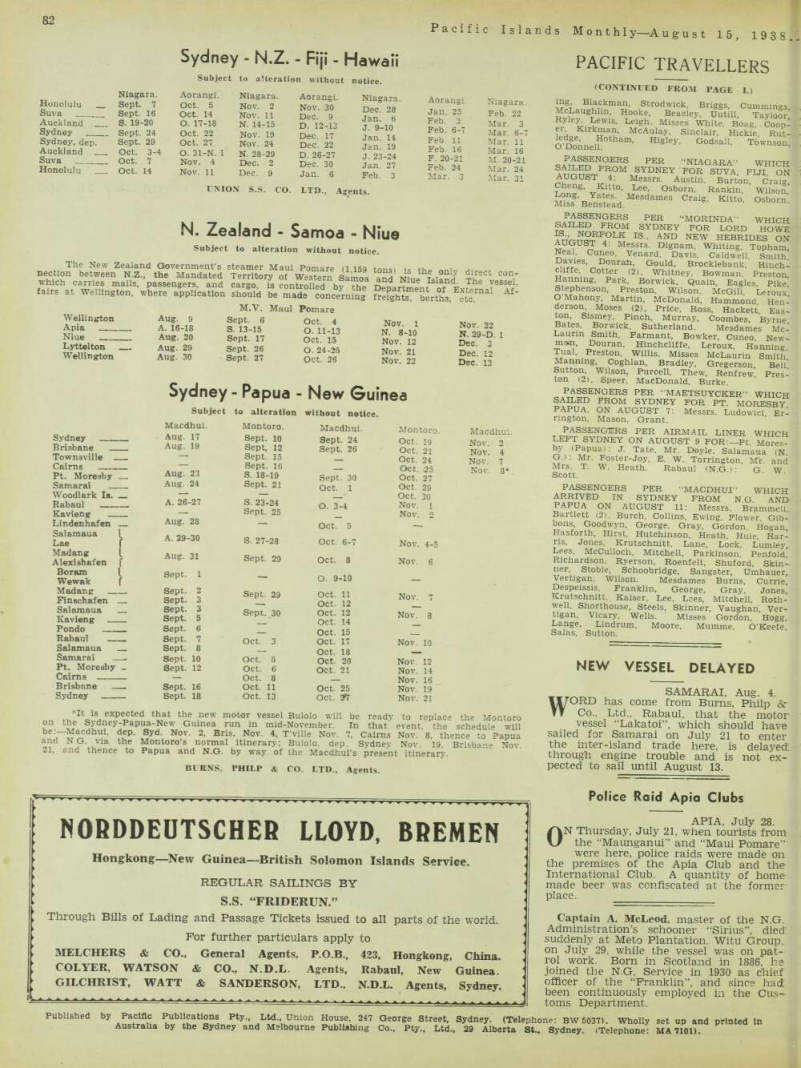
Samarai, Aug. 4.
11TORD has come from Bums, Philp &r ▼ f Co., Ltd., Rabaul, that the motor vessel “Lakatoi”, which should have sailed for Samarai on July 21 to enter the inter-island trade here, is delayed through engine trouble and is not ex pected to sail until August 13.
Police Raid Apia Clubs
APIA, July 28. r\N Thursday, July 21, when tourists from, the “Maunganui” and “Maui Pomare” were here, police raids were made on the premises of the Apia Club and the International Club. A quantity of home made beer was confiscated at the former place.
Captain A. McLeod, master of the N.G.
Administration’s schooner “Sirius”, died' suddenly at Meto Plantation. Witu Group, on July 29, while the vessel was on pat rol work. Bom in Scotland in 1886, he joined the N.G. Service in 1930 as chief officer of the “Franklin”, and since had been continuously employed in the Cus toms Department.
Advertisements & other items, pp. 86-88 (3 items)
Pacific Travellers
82
Pacific Islands Monthl y—A ugust 15, 1938.
(CONTINUED FROM PAGE I.)
Published by Pacific Publications Pty., Ltd., Union House, 247 George Street, Sydney. (Telephone: BW 5037). Wholly set up and printed In Australia by the Sydney and Melbourne Publishing Co., Pty., Ltd., 29 Alberta St.. Sydney. (Telephone: MA 7101). ?
Pacific Islands Monthl y—A ugust 15, 1938.
The Development
m m a
-UXH
mk
The Development
of the Territory
is linked up with GUINEA AIRWAYS
AIR TRANSPORT is responsible for New Guinea's rapid progress.
GUINEA AIRWAYS the pioneer Air Transport Company in New Guinea —has carried an aggregate of 63,619 passengers and 44,000 tons of cargo by air in the past ten years.
GUINEA AIRWAYS is the largest freight-carrying service in the world.
Every type of goods can be carried —with speed and safety —by Guinea Airways.
GUINEA AIRWAYS LIMITED operates regular air services in New Guinea and Papua, using over fifty aerodromes and landing grounds in the two Territories. =8 -GUINEA AIRWAYS PLANES depart from Port Moresby for the Goldfield on the arrival of each boat. Tickets are obtainable from the Purser.
Insist on flying with the pioneer Company both in New Guinea and in Australia.
Australian Services: Ask for particulars regarding the regular ADELAIDE- DARWIN Service.
LIMITED
LAE - SALAMAUA
Head Office: Austral Chambers, Currie Street, Adelaide, S.A.
BRANCH OFFICES AND
New Guinea Office: Lae, Mandated Territory of New Guinea
AGENTS AT WAU—SALAMAUA—PORT MORESBY AND SYDNEY.
J) ■2 8 z
7be more
SATISFACTION
you ll find
& W 1 ■:x AC
vass
3 % > V P' A O A UC v\pc° % o* k* •u the sun beats down with throatparching fierceness—when the air shimmers with the tropical heat—that's when you'll really appreciate the cooling, enjoyable qualities of K. 8.; for the hotter the weather, the more real refreshment there is in a cool, satisfying glass of TOOTH'S K.B. LAGER.