Pacific
Island
Monthly
Vol. VIII. No. 6.
January 24, 1938
VRei jfjsfer&S fit the G.P.0., Sydney, for transmission loy post as a newspaper .]
8 d
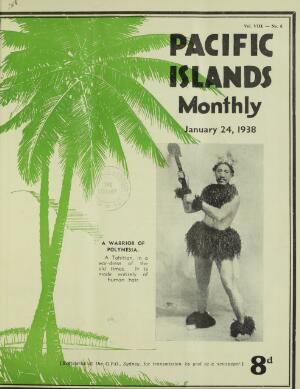
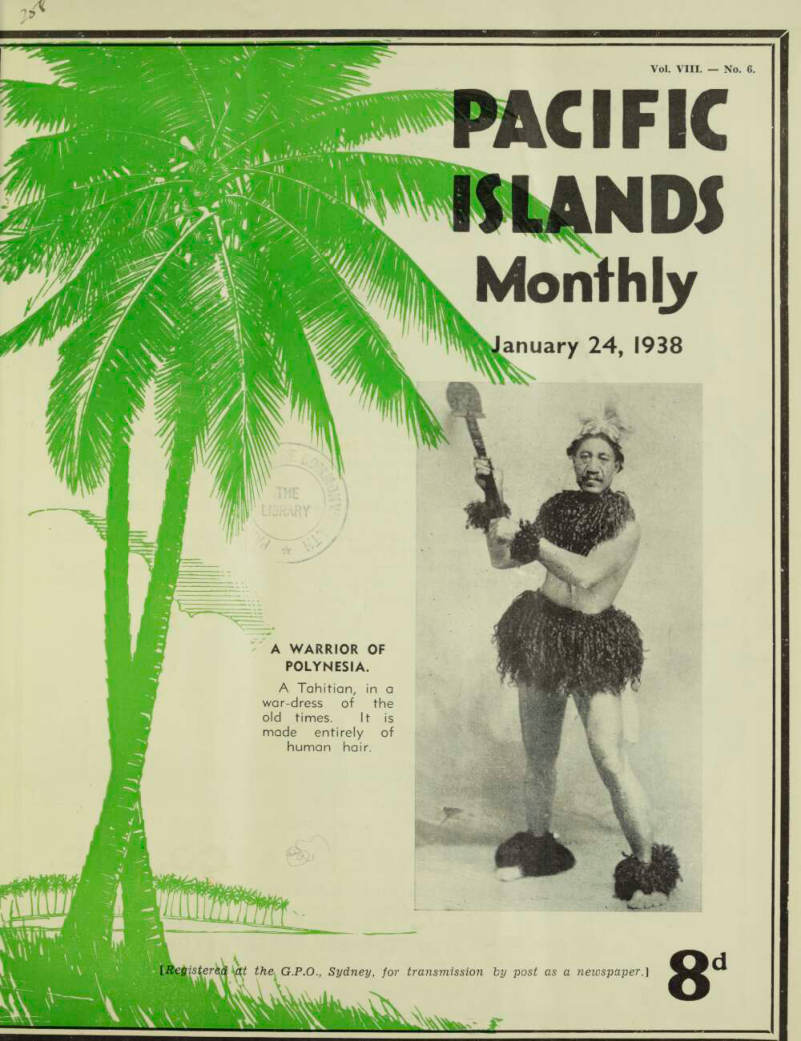
A Warrior Of
Polynesia.
A Tahitian, in a war-dress of the old times. It is made entirely of huan hair.
Advertisements & other items, p. 2 (1 item)
W. R. Carpenter & Co. Ltd.
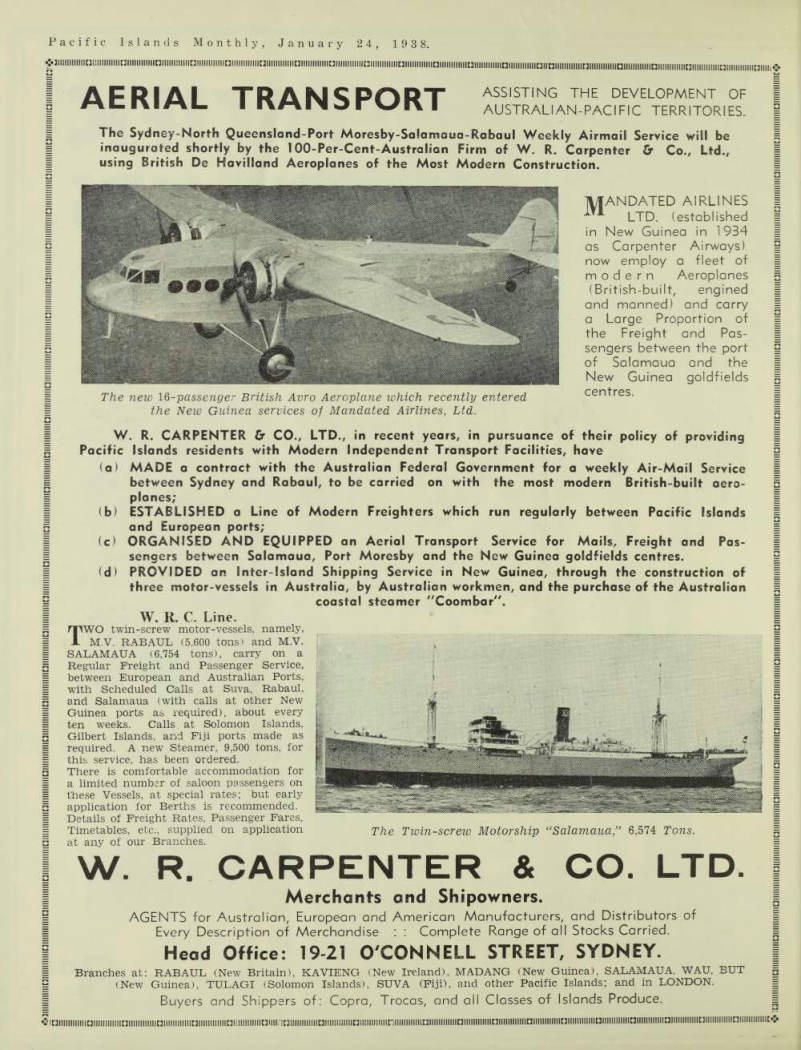
AERIAL TRANSPORT
ASSISTING THE DEVELOPMENT OF
AUSTRALIAN-PACIFIC TERRITORIES.
The Sydney-North Queensland-Port Moresby-Sa !a ma ua -Raba ul Weekly Airmail Service will be inaugurated shortly by the 1 00-Per-Cent-Australion Firm of W. R. Carpenter & Co., Ltd., using British De Havilland Aeroplanes of the Most Modern Construction.
MANDATED AIRLINES
LTD. (established in New Guinea in 1934 as Carpenter Airways) now employ a fleet of modern Aeroplanes (British-built, engined and manned) and carry a Large Proportion of the Freight and Passengers between the port of Salamaua and the New Guinea goldfields centres. the New Guinea services of Mandated Airlines, Ltd.
W. R. CARPENTER & CO., LTD., in recent years, in pursuance of their policy of providing Pacific Islands residents with Modern Independent Transport Facilities, have (a) MADE a contract with the Australian Federal Government for a weekly Air-Mail Service between Sydney and Rabaul, to be carried on with the most modern British-built aeroplanes; (b) ESTABLISHED a Line of Modern Freighters which run regularly between Pacific Islands and European ports; (c) ORGANISED AND EQUIPPED an Aerial Transport Service for Mails, Freight and Passengers between Salamaua, Port Moresby and the New Guinea goldfields centres. (d) PROVIDED an Inter-Island Shipping Service in New Guinea, through the construction of three motor-vessels in Australia, by Australian workmen, and the purchase of the Australian W. R. C. Line.
TWO twin-screw motor-vessels, namely, M.V. RABAUL (5,600 tons) and M.V.
SALAMAUA (6,754 tons), carry on a Regular Freight and Passenger Service, between European and Australian Ports, with Scheduled Calls at Suva, Rabaul, and Salamaua (with calls at other New Guinea ports as required), about every ten weeks. Calls at Solomon Islands, Gilbert Islands, and Fiji ports made as required. A new Steamer, 9,500 tons, for this service, has been ordered.
There is comfortable accommodation for a limited number of saloon passengers on these Vessels, at special rates; but early application for Berths is recommended.
Details of Freight Rates, Passenger Pares, Timetables, etc., supplied on application at any of our Branches.
W. R. CARPENTER & CO. LTD.
Merchants and Shipowners.
AGENTS for Australian, European and American Manufacturers, and Distributors of Every Description of Merchandise : : Complete Range of all Stocks Carried.
Head Office: 19-21 O'CONNELL STREET, SYDNEY,
Branches at: RABAUL (New Britain), KAVIENG (New Ireland), MADANG (New Guinea), SALAMAUA, WAU, BUT (New Guinea), TULAGI (Solomon Islands), SUVA (Fiji), and other Pacific Islands; and in LONDON.
Buyers and Shippers of: Copra, Trocas, and all Classes of Islands Produce. coastal steamer "Coombar' The Twin-screw Motorship “Salamaua,” 6,574 Tons.
M The new 1 6-passenger British Avro Aeroplane which recently entered
Pacific Islands Travellers
Passengers Per Van Rees Which Sail
Ed From Sydney For Pt. Moresby,
PAPUA, ON DECEMBER 22: Mr. and Mrs. P.
A. Bensted, Mr. and Mrs. A. van Bochove, C.
E. Dixon. Mrs. H. G. Nicholson, W. Nicholson, Misses J. and M. Nicholson, Miss J. Watson, A.
Wyborn.
Passengers per Morinda, which sailed from Sydney for Lord Howe Is., Norfolk Is., and New Hebrides on December 22: —Messrs. Arm strong, Bray, Caddy, Carew, Creer (2), Christ ian, Durie, Deasey, Dillon, Donaldson, Fitzgerald, Gill, Groetz, Gubbay, Hawkins, Holder, Julliard, Kalorib, Kelynack, Meares, Monaghan, Phillips, Roxburgh, Thompson, Woolley. Mesdames Arm strong, Creer (2), Grassick, Mueller, Monaghan, Thompson, Woolley. Misses Baldwin, Brunker, Collins, Chapman, Christian, De Mestre, Deasey, Fairbairns, Gubbay, Golding, Griffin, Hardman, Hindmarsh, Hopson (2), Jenkins, James, Little, McLean, Marshall, McDonald, Pryke, Rogers, Stout, Turnidge, Woodland, Wilson, Wren.
Passengers per Niagara, which sailed from Syd ney for Suva, Fiji, on December 23:—Miss D.
Ambramovich, Mrs. Bowman, Mr. and Mrs. S.
I. Bossley, Mr. and Mrs. E. C. Banks, Judge and Mrs. Clancy, W. J. Cunningham, J. Don aldson, L. Doubleday, Mrs. C. Doubleday, Mr.
and Mrs. Finlgan, Miss M. Finigan, S. C.
Ford, Mr. and Mrs. W. R. Harwood, Miss L.
Herrman, Miss W. Kearney, V. Kearney, E.
Kilner, Misses R. and A. Lange, Mrs. S. Lange, Miss R. Morgan, Miss I. G. Minchin, J. E.
Plimsoll, Father C. Verlingue, Mr. and Mrs. P.
G. Peard, Miss D. Pryor, Miss L. Richards, G.
E. Ross, Miss V. Roberts, Mrs. M. A. Sparks, Miss T. D. Sparks, W. F. Smith, R. Sinclair, R. R. Sinclair, Mr. and Mrs. E. P. M. Sheedy, H. B. Smith, S. G. Turrell, Miss O. Ward, Miss G. Walker, Miss R. Brown, Miss H. Brown, Mrs.
T. Braden, Father J. Chene, Mr. and Mrs. C.
H. Hunt, Miss B. Hunt, Mrs. C. K. Langdon, H. L. Sabben, W. Lela, W. P. H. Allan, Miss M. Clarke, Miss E. Day, Father A. Soubeyray.
Passengers per Macdhui, which sailed from Sydney for N.G. and Papua on December 22: Messrs. Bilston, Clarke, Tudor, Stewart, Boileau, Turner, Harris, Saddler, Low, Mackay, Ander son, Moore, Dillon, Clay, Clarke, Banks, Hew itt, Nixon, Drayson, McKenna, Wagner, Becker, Zimmer, Sherman, Schraders, Hutchens, Stein, Costa, Dance, Dean, Shanks, Wilkinson, Hirst, Gillespie, Gartrell, Lyon, McPherson, Herald, Adams, Milsom, Davies, Dunn, Wander.
Horlock, Hyde, Waterhouse, Crawford, Slee, Stephens, Noack, Davidson, Hind, Smith, Miller,
Mowatt, Fogarty. Mesdames Bllston, Turner, Anderson, Banks, Drayson, McKenna, Brackam, Scotland, Austin, Sherwin. Wild, Low, Powell, Bllston, Crawford, Slee, Hyde, Stephens, Wilkins.
Misses Wooderson, McGregor, Brenton, McLean, McCullough, Cook, MacArthur-Onslow, Swain, McMullen, Walker, Buckingham, Humphries, Ovens, Burston, Wllcocks, Simpson, Hanrahan, Ferguson, Scott, Kainz, Hyde, Davies.
Passengers per Malaita, which sailed from Sydney for N.G. and Solomon Islands ports on December 24: —Messrs. Callahan, Klibbe, Van Houle, Engberink, Stafford, Hiler, Stafford (2), Bird. Callahan, Summerland, Stronge, Isom.
Beach, Robertson, Comber, Hicks, Leadley, Kid nie, Sherwin, Mutch, McLellan, Wong, Spencer, Miltrup, Jones (2), Darlington, Belgina, Kuper.
Mesdames King, Callahan, Hicks, Klibbe, Staf ford, Bird, Isom, Leadley, Kidnie. Misses Win ning, Thornton, Miller, Knox, Field, Lindsay, Viv ian, Wilson (2), Thomas, Chandler, Atherton, McColl, Doherty, Minchinton, Golden, Cronin, Safstrom, Semmons, Barrett, Holmes, Hesse.
Passengers per Montoro, which arrived in Syd ney from N.G. and Papua on January 10: Messrs. Allan, Arnall, Ashcroft, Bell, Benham, Betts, Birrell. Black, Cannings, Champion, Clarkson, Dexter, Du Faur, Edwards, Elliott, Ewen, Fealy, Floyd, Gallaher, Hewitt, Hilder.
Mason-Jones, Kennedy, Klngdon, Leek, Lowe, McNamara, Mitchell, Nowlan, O’Brien, Pollard,
(Continued On Page 80.)
Setchell, Smith (2), Vial, Wilson, Wood (2).
Mesdames Arnall, Champion, Kennedy, Kerr, Leek, Marr, Setchell, Smith, Weston. Misses Cooper, Salas, Stanislaw.
Passengers per Morinda, which arrived in Syd ney from Lord Howe Is., Norfolk Is., and New Hebrides on January 12:—Messrs. Bray, Boyd, Caddy, Creer, Durie, Donaldson, Dillon, Prater, Fitzgerald, Gill, Hunter, Hollingsworth, Heath, Jones (2), Kelynack, Le Gay Brereton (2), Legge, Lawson, McKenzie-Grant, Meares, Monaghan, McGrath, Owens, Phillips, Ross, Troughton, Thomas, Woolley, Walker. Mesdames Creer, Grassick, Hollingsworth, Heath, Jones, McKenzie-Grant, McCoy, Norton, Stock, Taylor, Wood, Woolley, Walker. Misses Allan, Breush, Baldwin, Brunker, Buffet (2), Collins, Deasey, De Mestre, Pairbairn, Gall, Griffin, Hindmarsh, Hardman, Hopson (2), James, Little, MacDer mid, McLean, Marshall, McKenzie-Grant, Pryke, Rogers, Smyth, Stock, Thomas (2), Uren, Wil son, Woodland, Wren.
Passengers per Aorangi. which arrived in Syd ney from Suva, Fiji, on January 15:—S. Avin asanda, Mrs. C. M. Ahearn, C. G. P. Alison, Miss D. Abramovich, Mr. & Mrs. E. C. Banks, Judge & Mrs. J. S. Clancy, F. R. Charlton, Misses M. A. & J. M. Cozens, W. G. Cunning ham, Mrs. E. M. Master, D. H. Crawford, E.
O. N. Daly, L. C. Doubleday, Mrs. E. Double day, Mr. & Mrs. D. Finigan, Miss M. Finigan, Mr. & Mrs. W. H. Freeman, Masters. W. & D. Freeman, J. H. Goldfinch, G. F. Grahame, Mrs. M. H. Gamson, Masters D. E. & I. C. Gam son, A. C. E. Hill, Mrs. A. L. Hill, Miss K. N.
Hill, Mr. & Mrs. W. R. Harwood, Miss L. B.
A. Herrman, E. Kilner, V. J. Kearney, Miss N.
K. Kearney, Mr. & Mrs. W. E. Lindsay, Miss L. V. Lindsay, W. R. D. Leigh, Mrs. C. M.
Lynch, Misses M., P., & S. Lynch, Mrs. S.
Lange, Misses R. & A. Lange, Mrs. E. Millard, Miss I. G. Minchin, Miss R. Morgan, A. Mac kay, J. E. Plimsoll, Mr. & Mrs. P. G. Peard, Miss D. J. Pryor, Mrs. R. V. Rutter, Miss L.
M. Richards, Miss V. M. Roberts, Mrs. H. C.
Rourke, Misses P. H. & R. A. Rourke, Miss A.
M. Raine, Mrs. M. A. Sp'arkes, Miss T. D.
Sparkes, Mr. & Mrs. E. P. M. Sheedy, R. R.
Sinclair, R. Sinclair, H. W. Trickett, Mr. & Mrs. W. Thompson, Masters D. J. & G. P.
Thompson, S. G. Turrell, H. D. Upton, Mr. & Mrs. M. A. Wylie, Masters B. M. & R. A.
Wylie, B. Worledge, Miss O. M. Ward. Mr. & Mrs. G. L. Wignall, Miss M. Wignall, Masters J. & B. Wignall, Mrs. A. E. Bond, Miss W. B.
Bond, Master A. W. Bond, Mr. & Mrs. S. Coffey, Mrs. M. Livingstone, Masters J. L. and D. L.
Livingstone, Mr. & Mrs. G. G. Lenox, Miss D.
Llewellin, Mr. & Mrs. H. C. Melville, Mr. & Mrs. W. McCreadie, Miss J. M. Melville, Mr. and Mrs. J. Taylor.
Passengers per Aorangi which sailed from Syd ney for Suva, Fiji, on January 20: —Miss I. M.
Blennerhassett, Miss V. J. Chalmers, Miss C.
Dawe, A. E. Lister, A, Verge, S. R. Warman, Mr. and Mrs. A. Alcock, Miss J. Bailey, Mrs. E.
Brooks, Mr. Bradnam, Mrs. R. N. Cadwell, Misses A. and M. Cadwell, Mrs. F. Donkin, Miss E. Donkin, Miss I. E. Foulcher, R. C. Hart, Mr.
Inchboard, H. James, H. G. Nordenfeldt, Miss V. A. Wallace, Mr. and Mrs. C. A. williams, Miss L. Williams, Mrs. J. Beddoes, E, Kenyon.
Mr. F. R. Charlton, 0.8. E., Commis sioner of Lands in Fiji, arrived in Sydney from Suva by the “Aorangi” on
January 15 on long furlough, which
will be spent in Brisbane and Too
woomba (Queensland).
The Trienza, 435 ft. long, which is being built in Scotland by the British
Phosphate Commissioners to carry
phosphate between Ocean and Nauru
Islands, and Australia and N.Z., was
launched on December 17. Her speed
will be 12 knots.
Advertisements & other items, p. 3 (1 item)
your way to AUSTRALIA....
m * £ 35 Saigon Diethelm & Co. Port Moresby and Samarai. Steamships Trading Co, Ltd; Rabaul. W R Carpenter & Co. Ltd; Port Vila Gubbay Freres Noumea. Carlo Leoni; Auckland. Russell & Somers Ltd; Wellington Johnston & Co Ltd 1 *
iifi
m *
your way to AUSTRALIA...
On your way to Australia visit Auckland and Wellington . . . or plan a more leisurely stay visiting the scenic wonders of New Zealand . . . magnificent fjords . . . wild, icecapped mountains . . . hot springs and spouting geysers.
Sail by the splendid new motor vessel Maetsuycker or the tourist steamer Swartenhondt.
These fast K.P.M. vessels maintain regular monthly schedule from South Pacific Island ports; provide new direct travel facilities to New Zealand of exceptional comfort at economical fares.
S.S. SWARTENHONDT
K.P.M.
Details of sailings from your local agent.
M.V. MAETSUYCKER
SOUTH PACIFIC LINE
Royal Packet Navigation Co. Ltd. Paketvaart House, 255 George Street. Sydney. (N.V. Konmklijke Paketvaart Maatschappij—lncorporated in ttie Netherlands)
Advertisers.
“Alnwick” Kinder garten 73 Amalgamated Wire less of Aust. Ltd. 76 Angus & Coote Ltd. 21 Arnott’s Biscuits . 26 “Aspro’’ 57 “Ausoline” 53 Austral Stamps . 71 Baker, Ltd., Jno. . 73
B.A.L.M. Ltd. ... 64
Bank of N.S.W. .. 75 Berger & Sons Ltd. 52 “Bernly” Guest Hse 20 Blau (Aust.), Robt. 58 Broomfields, Ltd. . 44 B r otherton, Ltd., A. B 21 Brunton’s Flour .. 66 Bullivants, Ltd. . 54 Burns, Philp & Co. 2 Burns, Philp & Co. 20
B.P. (S.S.) Co. ... 64
Buzacott Pty. Ltd. 45, 46 Carpenter, W. R.
Limited ii.
Chapman & Sherack 55 drivers & Sons Ltd 37 Clarkson, L. B. .. 79 Clyde Engineering Co., Ltd 29 Coleman Lamp Co. 22 Coral Starch .. .. 34 Cosmopolitan Hotel 79 Crossle, Duff and Macintosh, Ltd. . 68 “Cystex” 63 Del Cott Pty., Ltd. . 56 Dewar’s Whisky .. 78 Doans’ Pills .. 54 Dobell Pty., Ltd. . 24 Donald, A. 8., Ltd. 62 Eaton, Ltd., J. W. 53 Electrolux Refrig erators 18 Elizabeth Bay Agency 74
Excelsior Supply Co 50 Fairbanks - Morse Limited 77 “Pairholm” College 24 Pinau, Wm 14 Fletcher & Sons 42 Ford Sherington Ltd 30 ‘>‘44 Macleay St.” 13 Foster Clark (Aus.) Limited 23 Fryer, A. C. ... 28 Garden Vale Pro ducts Ltd 34 Garrett & Davidson 68 Gillespie’s Flour . 36 Grand Pacific Hotel 61 Grove & Sons, W.
H 31 Guinea Airways Ltd iii.
Hallstroms Pty Ltd 22 Halvorsen Sons Ltd 65 Holbrook’s Ltd . 41 Horlicks Malted Milk 27 Hornadge, W. .. 24 Horne, W. & Co. . 60 Hotel Moresby . 79
1.C.1.A.N.Z. Ltd. . 32
Jantzen Ltd 12 Jones & Co Ltd, H. 39 Kodak Pty. Ltd. . 14 Kopsen & Co. Ltd. 67 Kork-N-Seal Ltd. . 37 Lane & Girvan Ltd 54 Levenson’s Radio . 72 Lloyd & , Co. Pty.
Ltd 13 Lustre Ltd 59 Mcllrath’s Ltd. . 16 McKay’s Bookstall 55 Maleham & Yeo mans, Ltd. ... 30 Master Sewing Machine Co. . 42 Maxwell Porter Ltd 53
Miller & Co. Pty.
Ltd 38 Morris, Hedstrom Limited 60
N.D.L 80
Nelson & Robertson Pty. Ltd. . 28, 69 Nestle’s Milk .. 40 Newland Bros. Ltd. 43 New Zealand Dis tributors Ltd. . 48 N.Z. Tourist Bu reau 12 Nordman, Oscar G. 63 Noyes Bros. Ltd. . 69 Olsson, T. A 74 Oxymel Oil and Paint Co. Ltd. . 47 Pabst Canned Beer 47
Pacific Is. Club . 77 Papua, Hotel, The 79 Pike Bros. Ltd. . 16 Prescott, Ltd. .. .35 Price’s Radio Serv. 51 Prouds, Ltd 15 Ransomes Sims & Jefferies, Ltd. 62 Reed, Wm. E. .. .26 Reid, W. M. . 36, 58 Reilingh, W 66 Riverstone Meat Co.
Limited 19 Rohu, Sil 19 Royal Packet Co. . 1 Ruston & Hornsby 49 Scott’s Emulsion . 17
Scott, Ltd., J. ... 44 Scott & Sons ... 53 Springwood L. Coll. 74 Stanley, Chris. .. 39 Stanley & Co. ... 71 Steamships Trg. Co 28 Sterling Varnish Co 11 Sullivan, Ltd., C. . 74 Sullivan, Ltd, J. J. 38 Swallow & Ariell . 35 Talkeries 50 Taylor & Co., A. 48 “Tenax” Soap ... 71 Thanks Notice .. 13 Thompson’s Eng’r. & Pipe Co. Ltd. 70 Tillock & Co. Ltd. 39 Tooheys, Ltd. .. .17
“Top Dog” Men’s Wear 57 Tooth & Co. .. . iv.
Vacuum Oil Co. .. 33 Vincent’s A.P.C. . 59 Warburton Franki Ltd 25 Webb & Co., A. .51 West, Harry ... 44 Weymark & Son . 37 Wills, W. D. and H. 0., Ltd. .. 73 Williams & Gos ling, Ltd 15 Williams, Ltd., S. . 47 Wright & Co. Ltd., ' E 48 Wunderlich, Ltd. . 68
Contents
Pacific Islands Travellers 1, 80 Official and Non-official Considera- ’ tions 3 No New Liners for Pacific 5 Prime Minister May Tour N.G 5 Fiji Governor’s Remarks Cause Stir .. 5 Unknown Heart of New Guinea ... 6 Samoan “Mission” in N.Z 7 “Samoa Clipper” Disaster 7 Rabaul’s Future 8 8.5.1. Wants Australian Rule 9 Tropicalities 11 About Islands People 12 Copra Market Puzzle 14 Bishop Vesters Honoured 15, 74 Control of Melanesian Natives 17 Tragedy of Choung Chong 19 Romantic History of Papeete’s Palaces 20 Taro Bread Industry 25 Australia and the New Hebrides ... 26
British Consuls in Tahiti .. 28 The Fate of La Perouse 36 Guam Is. Now in Marianas Group .. 41 Control of Malaria 42 Nott, the Bricklayer A Pioneer L.M.S. Missionary in Tahiti ..*... 45 Epic Voyage in Open Boat 47 Value of Mission Work in Polynesia . 50 Big Fire at Apia 54 Oscar Nordman—“Man of Informa tion” 56 Fashion Hints for Islands Women . 59 C.I. Banana Trade 60, 74 Life on Makogai, the Leper Station . 61 Preservation of L.M.S. Archives ... 64 Acute Labour Problem Paces Papua . 65 Islands Mining News 68 Short-wave Radio Programmes ... 73 Islands Produce Prices 75 Copra and Rubber Quotes 76 Pacific Shipping Timetables 77
Advertisements & other items, p. 4 (1 item)
qer
Pacific Islands Monthly
The Newspaper-Magazine of the South Seas
[Registered at the G.P.0., Sydney, for transmission by post as a newspaper. J Published Once Each Month and Circulated in Australia and New Zealand and in the following Pacific Territories and Islands Groups;
Crown Colony of Fiji.
Australian Territory of Papua.
Mandated Territory (Australia) of New Guinea.
Bismarck Archipelago and Northern Solomon Islands.
Mandated Territory (Japan) of Marshall, Caroline and Marianna Islands.
French Territory of New Caledonia.
British and French Condominium of New Hebrides.
American Territory of Eastern Samoa.
American Territory of Guam, Mandated Territory of Nauru.
British Crown Colony of Gilbert and Ellice Islands.
Mandated Territory (New Zealand) of Samoa.
British Solomon Islands Protectorate.
British Protectorate of Tongan Islands.
New Zealand Territory of Cook Islands, Australian Territory of Norfolk Island.
French Colony of Oceania (Tahiti, etc.).
American Territory of Hawaiian Islands.
Owned and Produced by Pacific Publications Pty. Ltd., Union House, 247 George Street, Sydney.
tttt TrPTtYVMir J Managing Director 8W5037 1 Business and Editorial MA7IOI
P.O. Box 3408 R
Registered Address of Telegrams, Radiograms, and Cables: “Pacpub,” Sydney.
Contributions
Articles, Stories, and Photographs dealing with Pacific Islands subjects are invited, and will be paid for on publication at usual rates.
Subscription Bates
Per Annum, within British Empire, Prepaid, Post Free 8/- Per Annum, elsewhere, prepaid, Post Free 10/- Single Copies Bd.
Editor and Publisher:
R. W. Robson. F.R.G.S.
Assisted by Selwyn Hughes.
Advertisements
Advertising Manager: L. W. Bailey.
Advertising office and Printing-House: 29 Alberta St., Sydney.
Advertising rates furnished on application.
Colours, etc. by Arrangement Process Blocks made at Advertiser’s expense when required. Screen, 100.
Changes of Advertising Copy should reach this Office by Bth of each month, otherwise previous advertisement may be repeated.
Agents
The following are authorised to receive subscrip tions for the Pacific Islands Monthly;— Islands Branches of Burns, Philp & Co. Ltd.. and Burns Philp (South Sea) Co., Ltd.
Islands Branches of W. R. Carpenter & Co., Ltd.
All Branches of Morris, Hedstrom & Co., Ltd.
G. Thomas & Co., Rabaul, New Guinea, T. A. Olsson, Wau, New Guinea.
Whitten Bros., Ltd., Samarai, Papua.
Steamships Trading Co., Papua. All Branches.
P. Costello, Suva, Fiji.
J. Muir, Suva, Fiji.
N. C. Mackenzie-Hunt, Wainunu, Bua, Fiji.
All Branches and Representatives of W. H. Grove and Sons, Ltd., Auckland, New Zealand.
Cook Islands Trading Co., Rarotonga, Cook Is.
A. C. Rowland, Papeete, Tahiti, Representative in London: W. C. HARVEY. Coronation Building. 4 Lloyds Avenue, London, E.C.2. from whom may be obtained copies of Pacific Islands Monthly, Pacific Islands Year Book, advertising schedules, etc.
Vol. VIII., No. 6.
Sydney, January 24, 1938.
Prirp ( 8d - Per Copy * rnce ( p repa id: 8/- p.a.
Official and Non-official Considerans
IN this issue there are reports from three different territories in the Pacific, each indicating some difference of opinion between the official and non- P s ’ One correspondent, writing about Papua, has complained that, while the territory urgently needs funds for the construction of certain public works— a water supply for Port Moresby especiaHy is referred to—the Government has allotted some thousands of pounds of public money for the support of the nnhlic servants’ snnerannnation fund public servants superannuation fund.
Another report says that there is some feeling among residents of the Solomon Islands because the Government there has ear-marked something over £2,000 for the “re-organisation of the public service”—although what is intended has not been disclosed. It is clear, however, that residents object on principle to plans under which public moneys may be used for the benefit of public servants, unless equal consideratmn is given to the needs of planters and traders.
The unfortunate incident in the Legislative Council of Fiji, which has
led to the resignation of Sir Maynard Hedstrom, had its origin in a con troversy based upon the same thing— namely, the determination of the Governor to provide, out of public funds, certain privileges (free quarters) for public servants. There has been criticism of this plan in Fiji, and some interesting argument has been produced on each side.
These and other incidents suggest that the time is coming when the rights and privileges of officials who govern Pacific territories will need more care ful consideration and clearer definition.
Public servants in the territories are in a position very different from that of Officials in countries where the public funds are directly controlled by elected Parliaments. If it is felt in an Austra lian State, for example, that civil ser vants are being given emoluments and powers in excess of what they are en titled to, the electors have the right, at regular intervals, of throwing out of office a Government which they think has permitted improprieties. In the territories there is no such remedy— petty bureaucrats may create an auto cracy of an outrageous kind, and quite a long time will elapse before the pro
tests of the oppressed classes can reach the Government in Europe, or Aus tralasia, or America, which is re sponsible for the administration.
Most of the Pacific territories main tain “Legislative Councils”. These are only advisory bodies—in every case, without exception, the “official mem bers”, who are the heads of Govern ment departments or nominees of the administrator, out-number and out-vote the non-official members (who may be either nominated or elected). The non official members in these various councils have the opportunity of protesting against the acts of officialdom—and they frequently do so protest—but the proceedings are dominated entirely *by the official members, who almost in variably vote en bloc, in accordance with the wish of the administrator.
It is clear, therefore, that the suc cess or failure of the system, and the future of the individual territories, de pends very much upon the quality of the particular administrator. Where he is a man of strong character, sound experience, clear vision and tactful undertaking, we usually have an ef ficient administration, which guards the natives during their critical change over from primitive to European con ditions, and guides the growth and development of the territory along sound lines. He will be especially care ful in seeing that the civil servants are
not given privileges which are in harsh contrast with the condition of the non official European residents.
An unwise or inexperienced adminis trator may get these matters out of focus, and, in regard to the public ser vice, may soon arouse the ill-will of the non-official Europeans. In the present instances, however, it is worth remem bering that both Papua and Fiji have been notable in the past for good and wise administration.
It should be remembered that in the British Pacific territories we see two administrative systems in operation: There is the British Colonial Service, wherein the highest and most re sponsible posts are filled by selections from among men who are trained and tested over long years. Men are trained and selected for appointment as administrators, to exercise autocratic powers, just as they are trained to be admirals, or postal directors, or railway superintendents. Then there is the system followed by Australia and New Zealand, under which the trained men of the administrative services are passed over when the post of adminis trator must be filled, and a political appointment is made—usually, a poli tician or ex-politician, who is without any experience of tropical government.
It is a vicious, rotten system, which in evitably must reflect back upon Aus tralian and New Zealand records in the South Seas. Many administrators have been appointed by Australia and N.Z. in the last five years; but in only three cases (Captain Garsia, at Nauru; Captain Pinney, at Norfolk Island; and Mr. Smith, at Cook Islands) were men selected from the trained services.
The administrators themselves, in seeking extra emoluments and privileges for their corps of officials, urge that it is most necessary that everything with in reason should be done to make the services attractive. Only in this way, they say, can they hope to attract a class of men competent to exercise the almost autocratic powers necessarily conferred upon officials in these Parlia ment-less territories. The point is well taken. It is a pity that it is ignored by Canberra and Wellington who, in successive appointments, prac tically have said that their public ser vices have failed to produce competent administrators.
Mr. and Mrs. Rodney Weaver arrived in Australia from New Guinea by the “Malaita” on December 17. They were married at St. George’s Church, Rabaul, on December 9, the bride being Miss Patsy Bryant. A member of the staff of the Bank of N.S.W., Mr. Weaver has been transferred from Rabaul to Sydney, where the couple now will make their home.
Mr. L. N. Tribolet, Islands inspector for Burns, Philp and Co., Ltd., departed from Sydney for Rabaul, New Guinea, by the “Montoro” on January 15.
Rev. N. G. Pardney, L.Th., principal of the Methodist Mission’s Piula College, Western Samoa, is at present spending leave in Australia, with his wife.
Hebrides.
New Vessel For New
MESSAGERIES Maritimes, Ltd., have purchased a new vessel, the “Polynesien”, for the New Hebrides inter-island trade. She was formerly the “Mygreta”, and was built in Shanghai in 1930. She is of 1,388 gross tons, with length of 217 ft., breadth, 35 ft. and depth, 20 ft. She is a twin screw vessel, and has a speed of 10 knots.
At present being refitted in Brisbane, the “Polynesien” will have a cargo capacity of 700 tons of copra. Pro vision is being made for 10 passengers, as well as accommodation for natives.
She is expected to leave Australia for Vila about the middle of March.
Mr. and Mrs. William McCreadie, of Suva, Fiji, arrived in Australia by the January “Aorangi”. Before his de parture from the Colony, Mr. McCreadie was given a send-off by the Government Printing Office.
Mr. J. B. Marillier, chief surveyor of the New Caledonian Mines Department, arrived in Sydney from Noumea by the January “Pierre Loti”.
Rain At Last!
From Our Own Correspondent.
Pt. Moresby, Jan. 6.
HEAVY rain has fallen at last to re lieve the serious shortage of water in Port Moresby.
On December 24 a cloud burst over the town and torrential rains fell throughout Christmas Day and intermittently during the following week, registering over six inches. The reservoir, supplied by a catchment on the hill above the town, which was recently cleaned, filled up well.
With rapidly-filling tanks, residents were glad that the anxiety over the water shortage had ceased.
The relief measures organised by the Government since November 1, by which each resident was supplied with fresh water from tanks on lorries, carted from the Loloki River, 16 miles distant, were ap preciated by residents.
The death occurred recently of Mr.
John Williams, a grandson of the late Mr. J. Williams, for 25 years Consul in Samoa, and the great-grandson of Rev.
John Williams, pioneer missionary of the London Missionary Society in the South Seas.
Advertisements & other items, p. 6 (1 item)
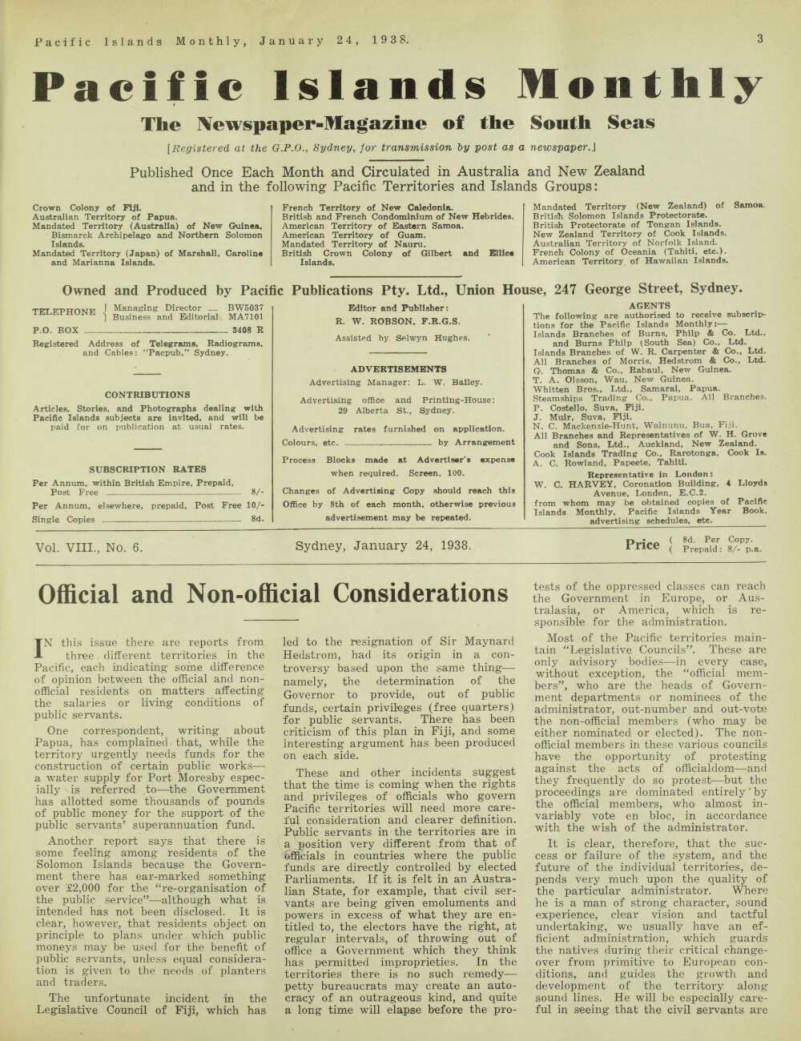
The Proverbial Hospitality Of Fiji.
X \ X X X X
X X X \
a (The public service of Fiji has been reorganised and divided, with the ‘result that British-born members of the British Colonial Service receive the important promotions and larger salaries, while those lucky Fiji-born men who may enter the Fiji public service have more limited opportunities, and a maximum salary of around £400 p.m.).
OLD MAN FIJI: Hail; Government servants both! To the blackcoated visitor within our gates, I shall give the large white pig. The humble son of our people shall have the black pig—if he is lucky.
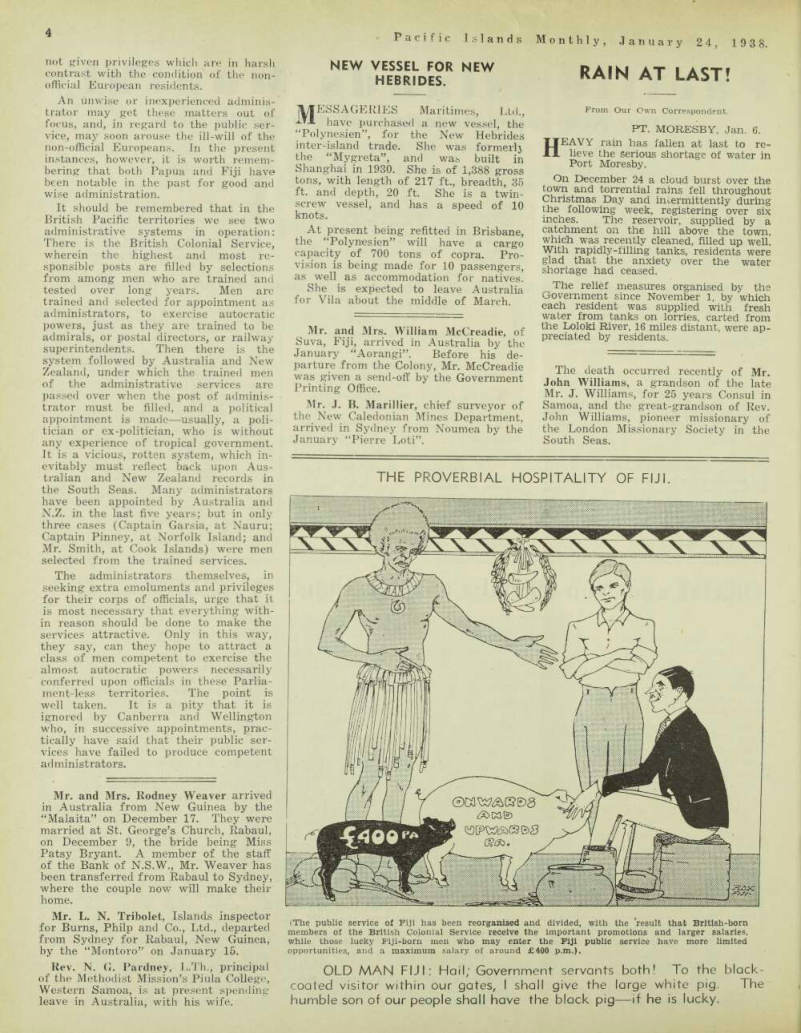
Interesting Development
Air Transport To
Plantations.
Interesting Development In Papua.
Prom Our Own Correspondent.
Pt. Moresby, Jan. 2.
ONE of the most interesting and sig nificant developments in connection with aerial transport in the South Seas occurred here recently. It is indica ted* that aeroplanes may take the place of motor-launches or lorries in maintain ing communication between Islands plan tations and the various shipping centres.
On December 14, a Guinea Airways Stinson plane, with Pilot Ross, inaugur ated an aerial transport service between Port Moresby and Eilogp Plantation, the coffee and rubber estate owned by the well-known planter of Papua, Mr. G. A.
Loudon, 30 or so miles, in behind the capital.
Twenty trips to and from the planta tion enabled all stores and produce in and out to be handled satisfactorily; and, as each trip occupied only a few minutes, the advantages of the service can be eas ily understood.
Mr. Loudon is the first planter in Papua to take advantage of aerial transport.
He recently made an excellent landing ground on his property, and it is under stood he arranged a satisfactory contract for the carrying in of all plantation sup plies and the carrying out of all produce,to meet incoming vessels, each month.
It is reported that other planters in this Territory, impressed with the ser vice, are contemplating similar arrange ments in the near future. It may be that the problems of transport, which have been uppermost in the more remote dis tricts of Papua will have their solution in aerial carriage.
May Tour New Guinea.
Prime Minister of Australia.
TT is reported that the Prime Minister A of Australia (Mr. J. A. Lyons) may make a tour of the Australian territories in the coming winter, going to the Northern Territory, Papua, and the Mandated Territory of New Guinea in that order. It is understood that Mr.
Lyons definitely will go to Darwin, and the extension of his tour to Papua and N.G. is being urged. It even has been suggested that while in New Guinea he might inaugurate the construction of the new capital. (It does not seem to occur to any one that the new capital has not been selected yet; and in fact the committee to select the new capital has not been appointed.—Ed., “P.1.M.”) Mr. N. Hagen, of Noumea, New Cale donia, who was in Sydney in January, stated that his company’s new motor vessel “Le Phoque” was functioning quite satisfactorily in the service be tween New Caledonia and the Loyalties.
The “Le Phoque” is the vessel of 200 tons which was brought to Sydney re cently from Holland as deck cargo on a large steamer.
No New Liners!
Trans-Pacific Plan May Be Affected by Far East Situation.
A GOOD deal of political and news paper snarling is going on over the fact that, apparently, the plan to build two ultra-modern 22,000-tons liners for the trans-Pacific service (to replace the “Niagara” and “Aorangi”) has been abandoned.
It was agreed that Britain, Canada, Australia, and New Zealand should jointly find £3,000,000 to “maintain British shipping prestige in the Pacific”.
A well-known London writer says that the plan has broken down because the N.Z. Labour Government insists on im posing certain embarrassing labour conditions in connection with the ship ping service. The impeachment has been sharply and angrily denied by the New Zealand Prime Minister (Mr.
Savage). He says that the cause of the delay is the huge increase in ship building costs.
Meanwhile, it is indicated that the Matson Line may build new ships for the Pacific service.
It is beyond doubt that the position is dominated by certain international considerations relating to Japan. Ob viously it is far more important that there should be Anglo-American co operation in maintaining the status quo in the Pacific, rather than that British and American shipping interests should squabble over trans-Pacific tfanspor f and the “prestige” of either the Red Ensign or the Stars and Stripes.
Fiji’S Sound Finances
Prom Our Own Correspondent
Suva, Jan. 1.
nPHE sound position of the finances of A Fiji was disclosed at the last session of the Legislative Council when the Budget for 1938 was approved. After a full discussion of the estimates the follow ing were the final figures arrived at; — Estimated Revenue £831,594 Estimated Expenditure 782,374 Surplus 49,220 Expenditure from Surplus Balances .. . 200,989 Excess of Expenditure over Revenue, to b© met from Surplus 151,769
“That Archaic
Trinity”
Governor’s Remark Causes Stir in Fiji
From Our Own Correspondent
Suva, Jan. 7.
Cir Maynard Hedstrom Has Re
° signed from the Legislative and Ex ecutive Councils of Fiji, in circumstances which caused something of a stir.
At the end of November, there was a debate in the Legislative Council on the Government’s estimates. Certain of the Indian members criticised the Governor’s proposal to spend public money in pro viding free quarters for public servants; and, in support of their arguments, they quoted speeches made in other years by European members. In reply the Gover nor (Sir Arthur Richards) said this: “The right to free quarters is not a newly created one.
“I was interested to hear that archaic trinity, Sir Henry Marks, Sir Henry Scott, and Sir Maynard Hedstrom, quoted once more in this Council, whose views on this subject are so notoriously out of date. They have an antiquarian interest, it is true, but it seems to me nothing more than that.
“It is a duty of Government to pro vide officers with quarters; it is a duty which has not been generally admitted in this Colony, but I hope that it is now admitted as a goal towards which we should strive, and so long as I am Governor of this Colony I shall continue to strive to provide Government officials with suitable quarters. It would be dif ferent if there were any houses suffi ciently good for renting in Suva, but there are no such houses. Therefore, it is necessary for Government to undertake a burden which private enterprise has not found suitably profitable, or possibly has neglected because of other better opportunities of investing its money.
Sir Maynard Hedstrom saw a report of this in Honolulu, on his way home from the Orient; and, in Suva, on December 22, he wrote to the Governor protesting strongly against “the con temptuous tone” of the remarks made by the King’s representative, when sneaking from his place in the Legis lative Council. He said: “I believe it is without precedent in this Colony for a Governor publicly to criticise in this
manner a member of the Legislative and Executive Councils. If I had been in my place in the Council, with an op portunity to reply, I would not have re garded the matter so seriously.”
The Governor replied, on December 24, that Sir Maynard had read into his re marks much that was not there.
“There was nothing contemptuous either in the tone or the matter of what I said in Council. I can find nothing contemptuous even in the ‘Fiji Times’ account, which you quote, taken out of its context and not professing to be a verbatim report. Nor was there any thing contemptuous in my intentions. I wanted to make clear my opinion that certain views publicly enunciated some years ago by certain gentlemen are out of date to-day. . .
His Excellency declared that his re marks were not contemptuous of or de rogatory to anyone.
Sir Maynard replied on December 30: “I regret I cannot accept the interpre tation which you give to your words, but must, accept rather the meaning placed upon'them by my friends and the public generally. The remainder of Your Excellency’s letter is irrelevant.
“I have served the Colony for 29 years as a member of Legislative Council, and for over 20 years as a member of Executive Council, and during tha.t period I have always received courtesy and re spect from successive Governors. I am not now prepared to serve a Governor who. during mv absence from the Colony, has spoken of me publicly in the way your Excellency has done.
“Therefore, I tender my resignation from the Legislative and Executive Councils and request that the corres pondence on this subject, be placed be fore the Right Honourable the Secretary of State for the Colonies at the earliest possible date.”
His Excellency replied accepting, with regret, Sir Maynard’s resignation, and he thanked him for past services.
Editorial Note.
Sir Maynard Hedstrom is head of the big firm of Morris Hedstrom Ltd.; Sir Henry Scott is Fiji’s leading lawyer; Sir Henry Marks is a merchant and has been 50 years in Fiji. All three men have given most notable services to the Colony, in all kinds of offices. During 40 years, Sir Henry Marks filled practically every position in public life to which the Government could appoint him. He is now a man of advanced years, and he is in poor health. The other two are robust men of middle age, capable still of rendering valuable public service.
In the circumstances. His Excellency’s choice of words was a little unfortunate.
He surely was entitled to say that the views quoted by the Indian Members were out of date; but, “that archaic trinity”—! The words have only one meaning, and they would strike 95 per cent, of people as having been used con temptuously.
There are features of the incident which are puzzling. One could under stand that this young and new governor was trapped by a liking for a happy phrase; but, having once recognised the very natural resentment of Sir Maynard and the other men dubbed “archaic,” he easily could have secured a mutually honour able peace by explanation and apology.
For some unknown reason, he took the opposite course.
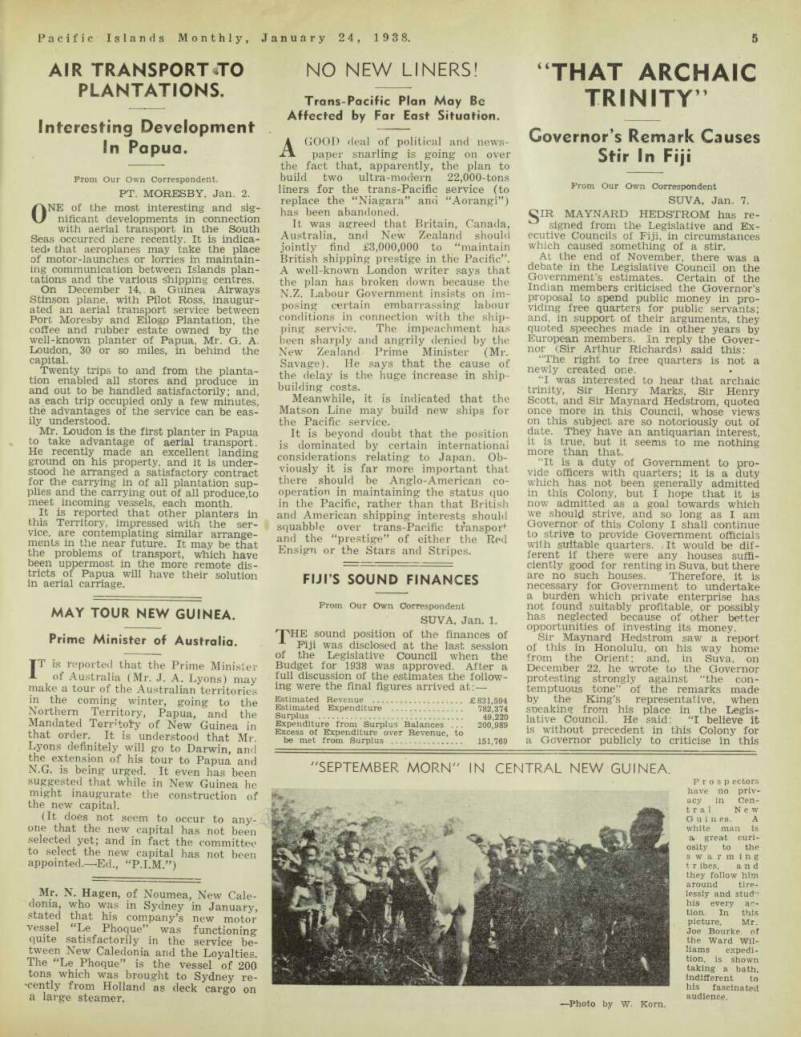
"September Morn" In Central New Guinea.
Photo by W. Korn,
Prospectors ave no priv acy in Gen tral New Guinea. A white man is a great curi osity to the swarming tribes, and they follow him around tire lessly and studv his every ac tion. In this picture, Mr.
Joe Bourke of the Ward Wil liams expedi tion, is shown taking a bath, indifferent to his fascinated audience,
“Sit 3 Sydney* for
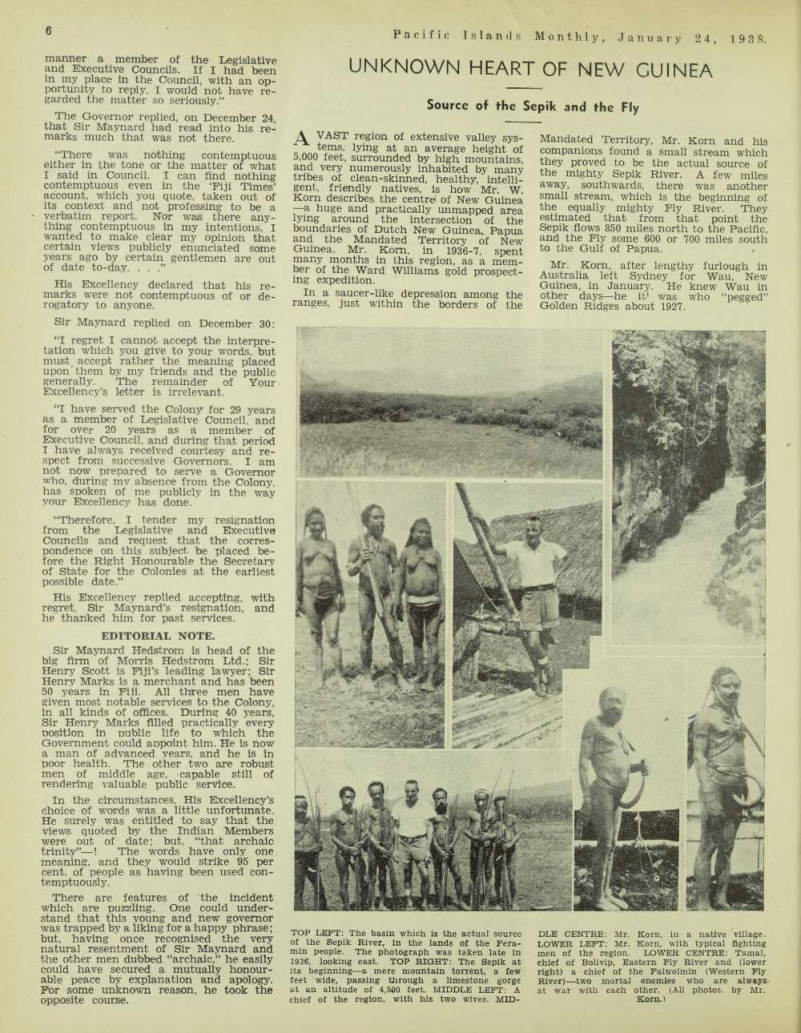
Unknown Heart Of New Guinea
Source of the Sepik and the Fly
A 7 AST , r ® giori of extensive valley sysc lymg an , average height of 5,000 feet, surrounded by high mountains, and very numerously inhabited by many tribes of clean-skinned healthy intelligent, friendly natives is how Mr W Korn describes the of New Guinea —a huge and practically unmapped area lying around the intersection of the boundaries of Dutch New Guinea,, Papua and the Mandated Territory of New Guinea. Mr. Kom, in 1936-7, spent many months in this region, as a mem- IS WUllamS S ° ld proSpeCt - T P ' .
In a saucer-like depression among the ranges, just within the borders of the
Mandated Territory, Mr. Korn and his companions found a small stream which they proved to be the actual souree of th P SL a / ■, f e Sepik River. A few miles awa ?’ south wards, there was another small stream, which is the beginning of th , e . dually mighty Fly River. They estimated that from that point the Sepik flows 850 miles north to the Pacific, and Fl y some 600 or 700 miles south to the Gulf of Papua, Mr Kom aftpr lpnfi + hv fnrimia-b in
“Sit 3 Sydney* for
Guinea, in January. He knew Wau in other days—he it J was who “pegged”
Golden Ridges about 1927.
TOP LEFT: The basin which is the actual source of the Sepik River, in the lands of the Fera min people. The photograph was taken late in 1936, looking east. TOP RIGHT: The Sepik at its beginning—a mere mountain torrent, a few feet wide, passing through a limestone gorge at an altitude of 4,500 feet. MIDDLE LEFT: A chief of the region, with his two wives. MID-
DLE CENTRE: Mr. Korn, in a native village.
LOWER LEFT: Mr. Korn, with typical fighting men of the region. LOWER CENTRE: Tamal, chief of Bolivip, Eastern Ply River and (lower right) a chief of the Faiwoimin (Western Ply River) —two mortal enemies who are always at war with each other. (All photos, by Mr.
Korn.)
Samoans In N.Z.
"Goodwill Mission" From
The Mau.
A PARTY of Samoan representatives left Apia in January to place be fore the Government of New Zealand certain requests that have been made during the past year by the Fono of Faipule and which have been refused.
The delegation consists of Taisi (Mr.
O. F. Nelson, Faatonu of the Samoans); Tamasese, President of the Mau; Alipia, Speaker of the Fono; Leiataua Mana, Faipule; Faalavaau, Secretary to the Mau; and Malienafau (Miss O. V.
Nelson, LL.B.), Legal Advisor, The delegation has been described as a “Goodwill Mission from the Samoans to New Zealand”. Actually, it is merely a “mission” from the Mau organisation (which dominates the Faipule) to the N.Z. Labour Government.
There is now a very large section of the Samoans which definitely does not associate itself with the Mau, and which maintains a separate organi sation.
The expenses of the delegation will be borne by the Samoans themselves; but the N.Z. Government has appointed Mr. Ralph Tattersall as an interpreter to accompany the delegation, and it will pay his expenses.
The delegation will spend 17 days in New Zealand and then will sail from Auckland on February 7.
The “Western Samoa Mail” on De cember 31, in a prominent article, de clares that “the Mau organisation and the Fono of Faipule have every con fidence in the present Government and will remain loyal to it”. That is a sur prising declaration. The Mau and its puppet-show, the Fono of Faipule, for a year or more, have nagged at the N.Z. Government and embarrassed it with unreasonable agitation when, in the circumstances, the least they could have done was to attempt to work in
helpful harmony with the Labour Ad ministration, which, in 1936, gave re cognition to the Mau and Mr. Nelson in so sensational a manner.
Labour Problem In Samoa
New Zealand newspapers continue sharply to attack the policy of the N.Z.
Labour Government, in Samoa, where planters—as a result of the Govern ment’s action in deporting Chinese labourers—have been left with a maxi mum of 259 Chinese coolies with which to work their plantations.
The Minister responsible for this policy (Mr. Langstone) in a statement early in January said the Government saw no necessity for the employment of imported Chinese as domestics or artisans, and felt that it was entitled to the co-operation of local employers in the provision and training of suit able labour in the territory.
This is a statement which is quite in accord with the degree of statesmanship exhibited by the N.Z. Government in relation to Samoa, and with the know ledge of tropical Islands conditions dis played by the same Minister when he visited Samoa in 1936 as one half of the famous “Goodwill Mission”.
George Robinson, an employee of the Colonial Sugar Refining Co., Ltd., died on December 25, as a result, it is al leged, of a fight at Nausori. Aged 35, he was married and had two children.
Another employee at the C.S.R. mill, Charles Streeter, has been arrested in connection with the affair.
Look on the Front
of Your Wrapper!
The figures stamped there (if any) show the date when your subscription expires.
This date will appear on wrappers of three issues preceding expiration, thereby giving 3 months’ notice. If, at the end of that time, we have not been instructed to continue to send the journal to you, it will be discontinued.
Your subscription (8/- per annum, or 10/- in the case of countries outside the British Empire—which includes postage) may be sent direct, or may be paid to any of our agents (listed on page 3.)
Postage Rates
The postage required for this issue is:— To Australia and New Zealand 2d To United Kingdom via All-sea routes ... 2d To United Kingdom via Prance 2d To other British Possessions 2d To U.S.A. and Foreign Countries 4d
Pacific Publications Pty. Ltd.
Union House, 247 George St., Sydney.
Count Von Luckner.
THE famous German ex-naval officer Count Felix von Luckner, with his wife, was in Tahiti in December. He was cordially greeted there, and his friendliness and charm of manner—so well remembered from the war years— made him many new friends in the French Colony. He went on to Western Samoa in his auxiliary yacht “See Teufel”, and arrived in Apia, via Pago Pago, on January 8. He intends to make a long stay in Samoa. The Countess von Luckner is petite, fair haired, and charming, and she appears to be as popular in the Islands ports as her distinguished husband.
Air Disaster
P.A.A. Flying-Boat and Crew Lost Near Samoa
'T'BE destruction of Pan-American Air ways 19-tons flying-boat “Samoa Clipper,” off the coast of American Samoa, on January 11 (Eastern time) has seriously dislocated arrangements that had been made for the inauguration of the air-mail service between the United States and New Zealand. The project is not abandoned, of course—it probably will take shape during the current year.
It was stated in this journal, in Decem ber, that an American flying-boat was expected to leave Honolulu about Decem ber 20 on a survey flight to Auckland; but that, owing to the refusal of the U.S. Government to provide a mail sub sidy, there was some uncertainty about the actual date of commencing a regular service.
On December 23, the Sikorsky S-428 flying-boat “Samoa Clipper” (formerly the “Hong Kong Clipper”), lefj Honolulu for N.Z. in charge of Captain Edwin C.
Musick, who had flown 1,500,000 miles in the service of Pan-American Airways and was regarded as their No. 1 pilot. The flying-boat proceeded via Kingman Reef and Pago Pago (American Samoa) to Auckland, without incident, arriving there on December 26.
An interesting feature of the visit was the arrival in Auckland at the same time of Imperial Airways flying-boat “Centaurus”; and the two great machines lay in Auckland Harbour together for a day or two.
On January 1, carrying 3751 b. of air mail and 81bs. of express freight, the “Samoa Clipper” left Auckland and flew back to Hawaii. The trip was made without incident.
There was still some uncertainty re garding the date of the commence ment of a regular service; but it was reported, apparently with authority, that a fortnightly service between Honolulu and Auckland, connecting at Hawaii with the North Pacific service of P.A.A. for San Francisco, would be commenced early in the New Year, carrying mails and cargo. It was thought that pas senger traffic would have to await the introduction to the service of the huge Boeing flying boats now being built.
On January 10, Captain Musick left again for Auckland in the “Samoa Clipper.” The previous flight had been essentially a survey flight; but on this
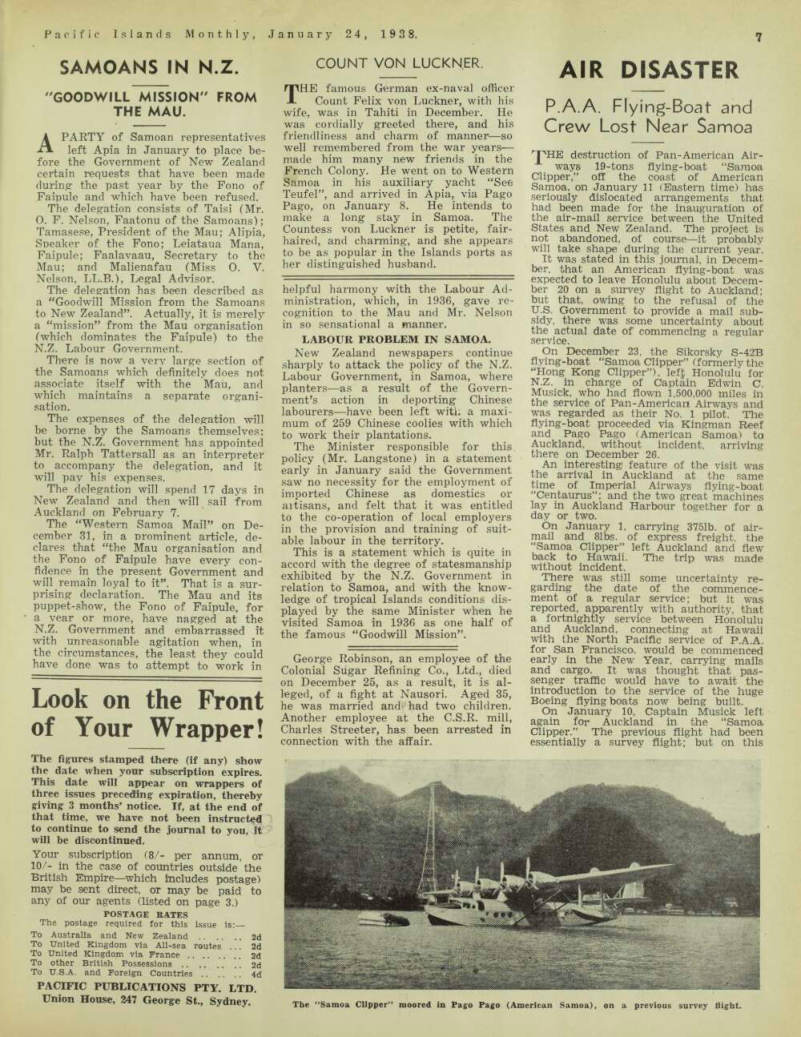
The “Samoa Clipper” moored in Pago Pago (American Samoa), on a previous survey flight.
occasion the flying-boat carried a quan tity of urgent cargo (especially cinema films) for New Zealand and Australia.
She flew without incident to Kingman Reef and Pago Pago; and left Pago Pago at dawn on January 11 for Auckland.
Then disaster occurred.
The “Clipper" maintained radio com munication with Pago. Thirty-eight minutes after departure, Captain Musick reported that an oil line feed on one engine had broken; that the engine had stopped; and that they were returning to the base. Thenceforward the “Clipper” and the land base exchanged constant messages; the “Clipper” apparently, for some unknown reason, took a circuitous course; the captain then reported that he was dumping his petrol preparatory to landing; and he asked that the ground crew get ready to receive him in Pago in a few minutes; and then there was complete silence.
The “Clipper” was momentarily ex pected, but she never appeared. After an hour or two, much alarm was felt, and the U.S.S. survey ship Avocet, which fortunately was in Pago Pago, went out to make a search.
Rumours of disaster gathered. Natives on an outlying island said that they had seen an aeroplane descend into the sea in clouds of smoke.
Within a few hours of commencing her search the Avocet found heavy oil on the water at latitude 18.8 South, longitude 170.51 West. A motor launch from the Avocet, following up this trail, quickly found clear evidence that the “Samoa Clipper” had been blown to pieces and the remains burned. Only very small pieces of wreckage and scorched cloth ing, of all descriptions, floated on the water.
Seven men lost their lives, including the famous Captain E. C. Musick, his first and second officers (Messrs. C. G.
Sellers and B. Brunk), and Messrs. F. J.
McLean (navigator), T. J. Findley (radio operator), J. W. Stickrod (engineering officer), and J. A. Brooks (assistant engineer).
There are many theories to account for the disaster, but what actually hap pened never will be known. There were appliances on the “Clipper” to permit of the dumping of petrol in an emerg ency, with reasonable safety; but it is believed that the escaping petrol was either ignited by a fire caused by the hot lubricating oil on the crippled engine, or by static electricity.
The accident caused dismay through out the Central Pacific, and especially in Honolulu, where the successful oper ation of these flying-boats on the weekly service between Hawaii and Asia during the past two years had created great confidence in the safety of air transoort.
Offers of help came from all directions when the “Clipper” was reported mis sing. Count von Luckner, the famous German navigator, who was in his yacht at Apia, immediately offered his services.
The British authorities offered the ser vices of the flying-boat “Centaurus,” which by that time had returned to Sydney.
There is much sympathy for Mr. Harold Gatty, who has worked indefatigably to organise and establish a Central Pacific air-mail service. His plan is not lost, however, only delayed.
The belief is growing that there soon will be a regular service across the Central Pacific in which both P.A.A. and British Imperial Airways will take part. * * * An interesting idea was given publicity during the month —namely, that instead of the South Pacific air-mail going north-east to Honolulu and North
America, it should take a more easterly course and travel via some of the Eastern Pacific islands (Christmas Is., Henderson Is., Ducie Is., or some of those) to Central America, and thence via Bermuda or some other of the West Indies to New York. If this idea were to be seriously considered it probably would be part of a plan for providing an Australian air-mail connection with North America through New Guinea and Guam (which is an important station on the North Pacific air-mail service, be tween Hong Kong and San Francisco).
Air Service To New Guinea.
THE airmail service from Sydney to New Guinea, to be operated by Messrs. W. R. Carpenter & Co., Ltd., should begin about the end of March.
The route is: Sydney, Brisbane, Rock hampton, Townsville, Cairns, Cooktown, Port Moresby, Salamaua, and Rabaul.
One trip will be made weekly in each direction.
The big De Havilland machines to be used in the service have arrived in Aus tralia, and it is probable that one will make a survey flight in February, or early in March. Messrs. Carpenters are ready to commence the service at any time —they are awaiting the pro vision of aerodromes and of necessary radio and meteorological equipment by the Commonwealth Government.
Mr. Nason Jones.
MR J. NASON-JONES, well-known in Papua and New Guinea as a geologist and prospector, arrived in Australia early in January. He said that he intends to settle down upon a sheep property in New South Wales.
He told reporters that he had mapped 15,000 square miles in the Territories while searching for oil and gold. He does lot think that any new goldfield will be discovered in Papua, but he does believe that a big goldfield will be found in the Mandated Territory. He would not indicate the locality he had in mind, but he said chat it was in the “uncontrolled” area.
"Montoro's" Steering
Gear Breaks In Storm.
EARLY in the morning of January 19, when steaming through a cyclonic storm on her way to Port Moresby, and when 200 miles north of Brisbane, the liner “Montoro” reported by radio that her steering-gear was damaged, and she urgently asked for help.
Radio inquiries showed that every ship in the vicinity was sheltering from the storm. Brisbane then made hasty preparations to send a powerful tug to the “Montoro’s” assistance.
At 4.10 a.m., however, Captain Rothery radio’d that repairs had been made, and that the “Montoro” would continue her voyage to Townsville. It was apparent that the officers and crew of the popular Islands steamer had spent a very lively and anxious two hours.
Rabaul's Future.
Extraordinary Delay In Selection of Committee.
WHEN the Administrator of New Guinea (Sir Walter McNicoll) sailed from Sydney for Rabaul on De cember 15, it was clearly understood that the Federal Government, within a day or two, would announce the names of the committee which was to be set up to select a site for a new capital for the Mandated Territory.
The terms of the report made by the expert vulcanologists allowed neither of argument nor delay. They strongly emphasised the danger of maintaining the administrative capital in Rabaul.
Canberra itself acknowledged that noth ing more was to be done, except to find another Administration site'.
Weeks passed, and nothing happened.
Finally, about January 10, someone be gan to ask questions. It was then dis covered that the new Minister for the Territories (Mr. W. M. Hughes) was resting at Palm Beach and expected that his colleagues would nominate the committee. His colleagues said they were waiting on Mr. Hughes.
The Prime Minister (Mr. J. A.
Lyons) gave some indication of annoy ance, and proceeded forthwith to select a committee. It was stated in “Sydney Morning Herald” of January 11 that the committee probably would consist of Mr. R. Halligan (Prime Minister’s Department), Mr. W. C. Thomas (for merly Custodian of Expropriated Pro perties), and another—probably a sur veyor-engineer from New Guinea.
A number of leading residents of New Britain and New Ireland are strongly protesting to the Federal Government against the proposal of re moving the Administration from Rabaul.
Their views are being presented to the Government by Mr. W. E. Grose, an in fluential New Guinea planter.
Mr. Hughes announced on January 22 that the committee would be appointed on January 27.
However, there is no official announce ment to indicate the cause of the extra ordinary delay.
Meanwhile, Vulcan has given Rabaul a further reminder of present-day con ditions. There was a sharp earthquake at 1.25 a.m. on January 8, which was felt in Rabaul, Kerevat, Toma, and Kokopo. Though lasting less than . secs., its intensity was severe. There was a smaller tremor at 5.30 a.m.
In the meantime, there is speculation concerning the merits of Salamaua, Madang, Gasmata, and various other expected and unexpected places. One tip, “right out of the horse’s mouth”, is the tableland at the back of Madang —Madang to be used as the port of the new capital, while the new capital itself, placed in or near the famous Ramu Valley, will serve to open the way to the rich central N.G. tablelands.
Practitioners.
B.S.I. Native Medical
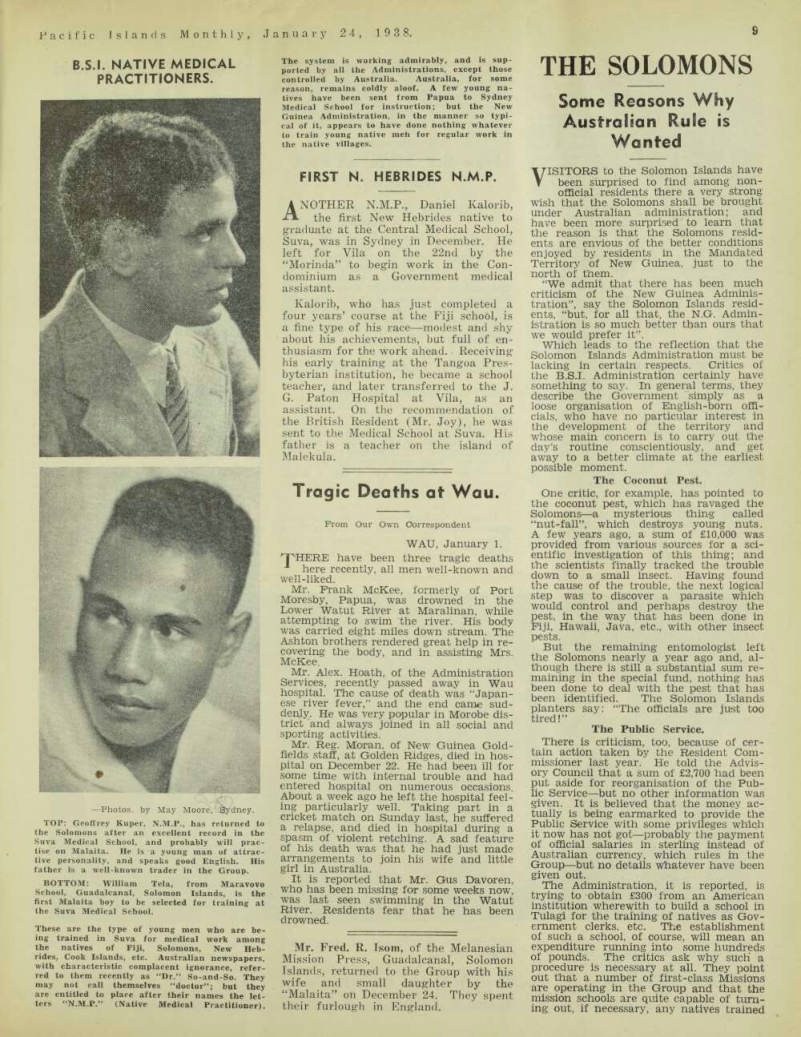
These are the type of young men who are be ing trained in Suva for medical work among the natives of Fiji, Solomons, New Heb rides, Cook Islands, etc. Australian newspapers, with characteristic complacent ignorance, refer red to them recently as “Dr.” So-and-So. They may not call themselves “doctor”; but they are entitled to place after their names the let ters “N.M.P.” (Native Medical Practitioner).
The system is working admirably, and is sup ported by all the Administrations, except those controlled by Australia. Australia, for some reason, remains coldly aloof. A few young na tives have been sent from Papua to Sydney Medical School for instruction; but the New Guinea Administration, in the manner so typi cal of it, appears to have done nothing whatever to train young native meh for regular work in the native villages.
Photos, by May Moore, sydney.
TOP: Geoffrey Kuper, N.M.P,, has returned to the Solomons after an excellent record in the Suva Medical School, and probably will prac tise on Malaita. He is a young man of attrac tive personality, and speaks good English. His father is a well-known trader in the Group.
BOTTOM: William Tela, from Maravovo School, Guadalcanal, Solomon Islands, is the first Malaita boy to be selected for training at the Suva Medical School.
First N. Hebrides N.M.P.
ANOTHER N.M.P., Daniel Kalorib, the first New Hebrides native to graduate at the Central Medical School, Suva, was in Sydney in December. He left for Vila on the 22nd by the “Morinda” to begin work in the Con dominium as a Government medical assistant.
Kalorib, who has just completed a four years’ course at the Fiji school, is a fine type of his race—modest and shy about his achievements, but full of en thusiasm for the work ahead. Receiving his early training at the Tangoa Pres byterian institution, he became a school teacher, and later transferred to the J.
G. Paton Hospital at Vila, as an assistant. On the recommendation of the British Resident (Mr. Joy), he was sent to the Medical School at Suva. His father is a teacher on the island of Malekula.
Tragic Deaths at Wau.
From Our Own Correspondent WAU, January 1. r pHERE have been three tragic deaths A here recently, all men well-known and well-liked.
Mr. Prank McKee, formerly of Port Moresby, Papua, was drowned in the Lower Watut River at Maralinan, while attempting to swim the river. His body was carried eight miles down stream. The Ashton brothers rendered great help in re covering the body, and in assisting Mrs.
McKee.
Mr. Alex. Hoath, of the Administration Services, recently passed away in Wau hospital. The cause of death was “Japan ese river fever,” and the end came sud denly. He was very popular in Morobe dis trict and always joined in all social and sporting activities.
Mr. Reg. Moran, of New Guinea Gold fields staff, at Golden Ridges, died in hos pital on December 22. He had been ill for some time with internal trouble and had entered hospital on numerous occasions.
About a week ago he left the hospital feel ing particularly well. Taking part in a cricket match on Sunday last, he suffered a relapse, and died in hospital during a spasm of violent retching. A sad feature of his death was that he had just made arrangements to join his wife and little girl in Australia.
It is reported that Mr. Gus Davoren, who has been missing for some weeks now, was last seen swimming in the Watut River. Residents fear that he has been drowned.
Mr. Fred. R. Isom, of the Melanesian
Mission Press, Guadalcanal, Solomon
Islands, returned to the Group with his wife and small daughter by the “Malaita” on December 24. They spent their furlough in England.
The Solomons
Some Reasons Why Australian Rule is Wonted
VISITORS to the Solomon Islands have been surprised to find among non official residents there a very strong wish that the Solomons shall be brought under Australian administration; and have been more surprised to learn that the reason is that the Solomons resid ents are envious of the better conditions enjoyed by residents in the Mandated Territory of New Guinea, just to the north of them.
“We admit that there has been much criticism of the New Guinea Adminis tration”, say the Solomon Islands resid ents, “but, for all that, the N.G. Admin istration is so much better than ours that we would prefer it”.
Which leads to the reflection that the Solomon Islands Administration must be lacking in certain respects. Critics of the 8.5.1. Administration certainly have something to say. In general terms, they describe the Government simply as a loose organisation of English-born offi cials, who have no particular interest in the development of the territory and whose main concern is to carry out the day’s routine conscientiously, and get away to a better climate at the earliest possible moment.
The Coconut Pest.
One critic, for example, has pointed to the coconut pest, which has ravaged the Solomons—a mysterious thing called “nut-fall”, which destroys young nuts.
A few years ago, a sum of £lO,OOO was provided from various sources for a sci entific investigation of this thing; and the scientists finally tracked the trouble down to a small insect. Having found the cause of the trouble, the next logical step was to discover a parasite which would control and perhaps destroy the pest, in the way that has been done in Fiji, Hawaii, Java, etc., with other insect pests.
But the remaining entomologist left the Solomons nearly a year ago and, al though there is still a substantial sum re maining in the special fund, nothing has been done to deal with the pest that has been identified. The Solomon Islands planters say: “The officials are just too tired!”
The Public Service.
There is criticism, too, because of cer tain action taken by the Resident Com missioner last year. He told the Advis ory Council that a sum of £2,700 had been put aside for reorganisation of the Pub lic Service—but no other information was given. It is believed that the money ac tually is being earmarked to provide the Public Service with some privileges which it now has not got—probably the payment of official salaries in sterling instead of Australian currency, which rules in the Group—but no details whatever have been given out.
The Administration, it is reported, is trying to obtain £3OO from an American institution wherewith to build a school in Tulagi for the training of natives as Gov ernment clerks, etc. The establishment of such a school, of course, will mean an expenditure running into some hundreds of pounds. The critics ask why such a procedure is necessary at all. They point out that a number of first-class Missions are operating in the Group and that the mission schools are quite capable of turn ing out, if necessary, any natives trained
in the manner proposed.
Another subject of criticism is the legal authority given to young officials who are in charge of districts. These young men preside at the lower Court sittings. Usu ally the charges dealt with are against natives; but now and again a European is involved, and these officials, who either have had no legal training or only a few hours’ tuition, must give important deci sions. There is no machinery provided for an appeal against their decisions.
Recent arrivals from the Solomons tell with malicious glee of the consternation caused there not long ago by a Miss Hackett, an Australian solicitor, who spent some time in Tulagi. She took over the defence of natives in a few cases and, with her alert mind and legal knowledge, she made some prominent officers of the Administration look ratjher ridiculous Miss Hackett returned to Australia re cently, but it is believed that she is going back to settle on a plantation somewhere near Tulagi. The critics of the Admin istration hope so, because they feel that a person with sufficient legal knowledge to stand up to the official adjudicators in the Group would be of considerable value.
Britain or Australia?
The whole situation, of course, resolves itself into this: That the Solomons are comparatively a very little Territory; that the British Colonial Office is obliged to administer the Territory as economically as possible; and that, so far as Britain is concerned, there is no reason why money should be spent there in encour aging settlement and development. The officials, who have been the subject of criticism, probably are as good officials as may be found anywhere in the Ser vice—and the British Colonial Service is notable throughout the world for its effi ciency and the fine character of its per sonnel. They are simply carrying out their job in the Solomons as they would carry it out in any other little isolated country.
The Group, however, is of great and growing importance to Australia in a strategic sense, and as its economic struc ture and activities already are 90 per cent. Australian, it seems to be a logical thing that the administration should be taken over by the Commonwealth Gov ernment.
Moresby.
New B.P. Hotel at Port Moresby.
From ° ur ° wn correspondent. wr T 0
Pt ’ Moresby. Jan. 8.
T|/F Essrs. Burns, Philp And Co.
IYI Ltd.’s new hotel, which is to be erected shortly in a prominent posi tion overlooking Pt. Moresby, and close by what is known as the Lower Hotel, will within a few weeks show signs of the imposing structure that will grace the town frontage. Plans and specifications already have been completed, and resid ents are looking forward eagerly to its establishment.
Guest House At Wau
Prom Our Own Correspondent WAU, Jan. 2.
'T'HE popular Wau hostess, Miss Alice Allan, has returned from a quick holi day trip to Sydney, and has taken over the management of the large new guest house which has been completed at Wau. It should be a success, for it fills a much needed want, providing board and resU dence for single men.
Messrs. G. Leg and M. R. Metzger, members of the Conseil-General of New
Caledonia, arrived in Sydney by the
“Pierre Loti” from Noumea on January 7.
Hides Expedition
Return of the Drilling Party
'T'HE drilling party sent to the Strick land River, Papua, under* Mr. Dufaur, to examine the dredging claims pegged in May last by Mr. Jack Hides and the late Mr. David Lyall, on behalf of Investors Ltd., returned to Sydney in January. No report has been made to shareholders, but it is believed that the results of the examination by drill were disappointing.
It is understood that Mr. Hides will re turn to New Guinea shortly, to continue his work for Investors Ltd.
Late Mr. David Lyall.
Mr. David Lyall, who died at Daru, Western Papua, on September, left an estate valued at £5,785 to his mother and younger brother.
Missionary Killed In Fiji
From Our Own Correspondent
Suva, Jan. 1.
A CAR containing six people skidded when rounding a bend on the Tailevu road on December 19, and fell 60 feet down a bank. Mr. H. A. Adrian, recently appointed secretary of the S.D.A. Mission in Fiji was killed; Mr. H. M. Lansdowne, head of the Wainibuka Mission School was slightly and his wife seriously in jured. The car was driven by Pastor W. T. Cooper, of the S.D.A. Mission. Mr.
Adrian, who was 34, had been only 3 weeks in the Colony.
Mr. and Mrs. G. A. Marshall departed from Sydney for Papua by the “Mon toro” on January 15. He is a plan tation manager at Aroa, Kairuku Dis trict.
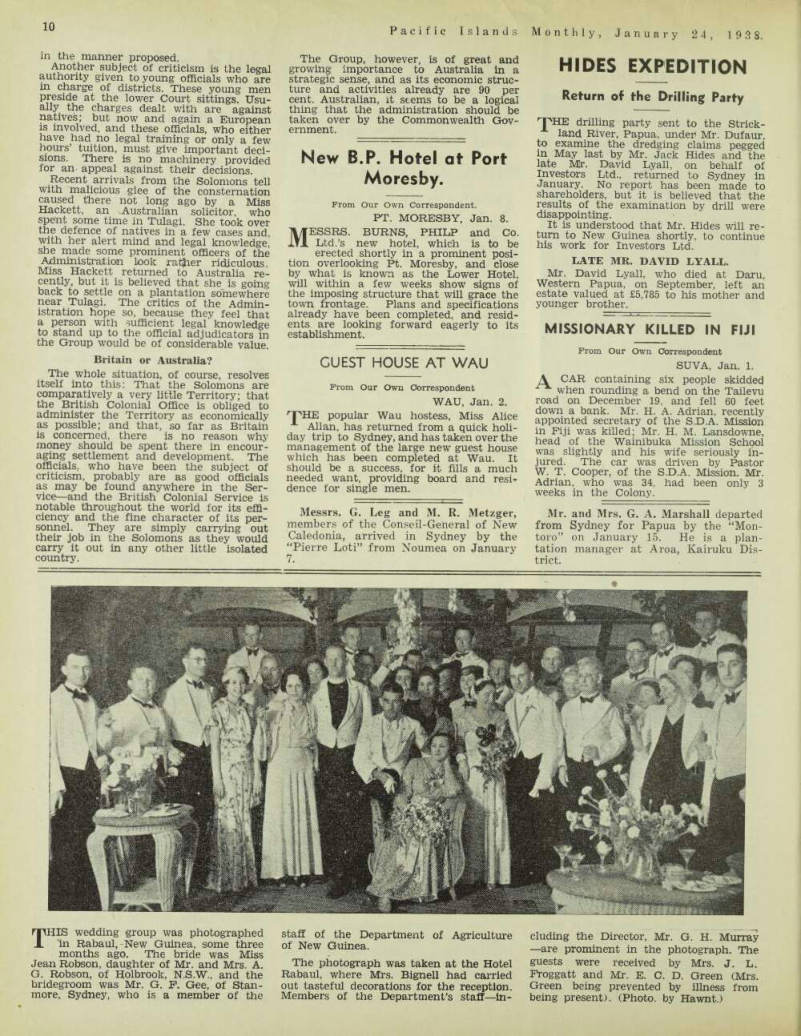
THIS wedding group was photographed in Rabaul, New Guinea, some three months ago. The bride was Miss Jean Robson, daughter of Mr. and Mrs. A.
G, Robson, of Holbrook, N.S.W., and the bridegroom was Mr. G. P. Gee, of Stan more, Sydney, who is a member of the
staff of the Department of Agriculture of New Guinea.
The photograph was taken at the Hotel Rabaul, where Mrs. Bignell had carried out tasteful decorations for the reception.
Members of the Department’s staff—in-
eluding the Director, Mr. G. H. Murray are prominent in the photograph. The guests were received by Mrs. J. L.
Froggatt and Mr. E. C. D. Green (Mrs.
Green being prevented by illness from being present). (Photo, by Hawnt.)
Tropicalities
SALAMAUA must have been a little startled to see itself described in Australian newspapers by a recent visitor as “a cool and healthy place”, with strong claims to be the future capital of New Guinea. * * * IT was siesta time in Rabaul —that hour when the tottery capital swelters and sweats. The opulent business man was relaxing. The phone rang; the sec retary answered, and then turned to her employer.
“Long distance calling, sir,” she said.
“It’s a radio-phone call—Sydney on the wire.”
“Let’s see,” murmured the B.M. “That’s about 2,000 miles from here.”
“Just about that, sir,” agreed the sec retary.
“Tnen hang up,” ordered the employer wearily. “I’m too tired to talk that far!” * * * TV/TR. A. J. MARSHALL, described as a scientist, was interviewed recently by the Melbourne Herald concerning the New Hebrides, and talked the usual pop pycock about conditions there. This, for instance: — “If that were the whole story, the con dominium might be tolerated. But its effect'on the natives and native life make it essential for something to be done immediately, unless the story of the Tas manian aborigines is to be repeated on a grander scale.
“On top of this is brutal exploitation under which the natives are being exter minated. The population of the largest island, Espiritu Santo, has dropped from 70,000 to 4,000 within 100 years.”
The suggestion that the French and British are exploiting and exterminating the New Hebrides natives is grotesque, and show how much reliance is to be placed upon Mr. Marshall and the books he is supposed to be writing about the Pacific Islands. There was an enormous decrease in the populations of all the Pacific groups between 1800 and 1900 —the inevitable effect of the impact of European “civilisa tion” upon primitive people—but in prac tically every group the process has been reversed, and for two decades the natives, especially the Polynesians, have been in creasing. In the New Hebrides, the posi tion is obscure; but if these primitive tribes are not increasing the fact certainly cannot be attributed to “exploitation.” If they are decreasing, the rate of decrease now is very slow, and the basic causes are psychological rather than physical. * • * T INDBERGH of the Pacific”—that was the title Captain Edwin C. Musick, who perished in the “Samoa Clipper” dis aster, had won by his record and exploits in commercial aviation. A modest, unas suming gentleman, there was nothing of the back-slapping trumpet-blowing Ameri can about this famous airman, who pro bably was the most experienced flying boat officer in the world. In addition to pioneering the N.Z. service, he made the first commercial crossing of the North Pacific, from San Francisco to Manila. He received the Harmon Trophy of 1935 as “the world’s most outstanding aviator.”
A tragic revelation of the accident was that the ill-fated trip was to have been Captain Musick’s last. On the previous trip he had with him Captain W. D. Cul bertson and on his final trip he was
accompanied by Captain Sellers. These two pilots were to take command of the “Clipper” on alternate flights in future.
Captain Sellers, first officer of the “Samoa Clipper,” had had extensive ser vice with P.A.A. in the Orient. In 1936, as pilot to General Chiang Kai-shek, the Chinese leader, he flew Madam Chiang with ransom money to Sian, when the dictator was kidnapped by Chiang Hsueh liang. Sellers’ widow is recovering from a serious illness —a few days before the “Clipper” took off from Honolulu he gave her a blood transfusion.
The assistant engineer (J. A. Brooks) lost his life because he wanted to spend Christmas with his family in Hawaii.
Normally, he would have been on another “Clipper” and so missed the fatal trip; but he asked for a month’s leave at the end of November in order to be with his wife and two young children during De cember. Reporting back to work, he was assigned to the N.Z. route instead of his usual job.
Messrs. McLean (navigator), Findley (radioman), and Stickrod (chief engineer) all had flown down to Auckland in the “Samoa Clipper” on previous flights. Mr.
B. Brunk, the second officer, had just joined the Pacific service after being on P.A.A.’s Miami route. * * * A WELL-KNOWN merchant of Tonga does not like the outlook there. This is what he says in a letter to the Editor, dated December 17:—“Things are pretty bad here again, owing to the ef fects of the hurricane, the low price of copra, and the rapacity of the Govern ment and the Wesleyan Mission. There is no sign, so far, of any Christmas trade”. * * * IV/TOST Islands people are familiar with the history of the Bulolo goldfield, T.N.G., and how, owing to its inaccessi bility, it was necessary to transport all the plant, machinery, stores, and men by aero
plane and to maintain regular communi cation with the coast. In December, Mr.
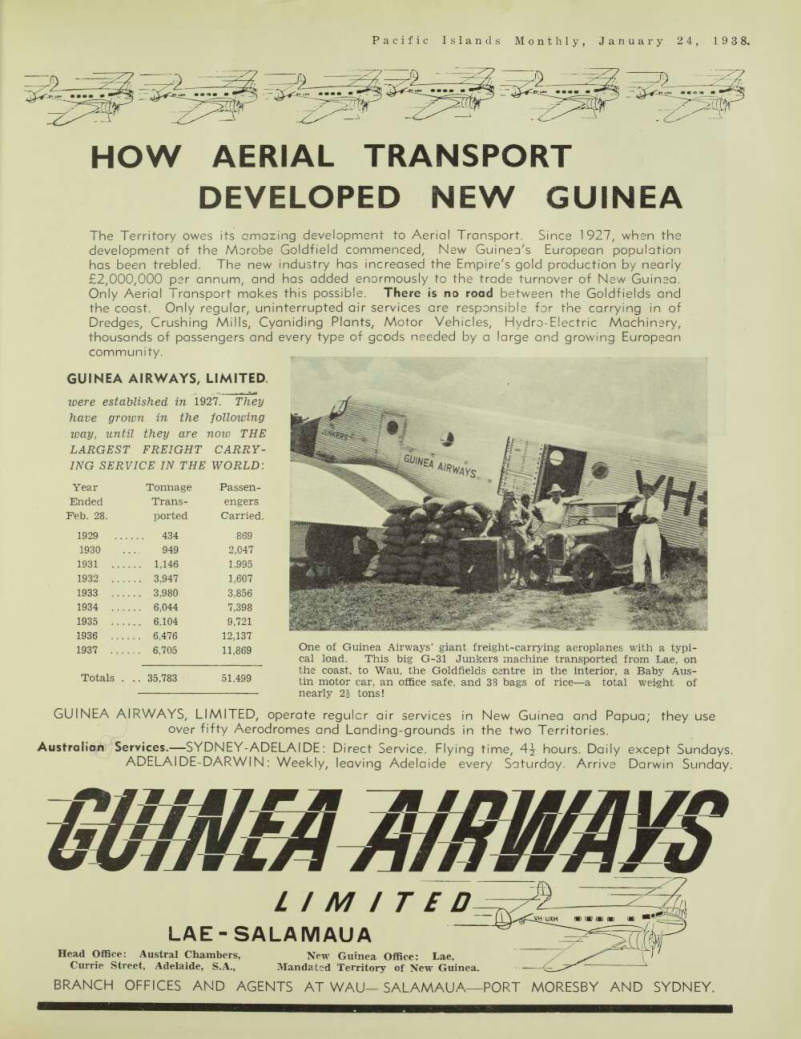
Charles A. Banks, managing director of Bulolo Gold Dredging Ltd., was in Sydney on his way to New Guinea to inspect B.D.G.’s workings, and he recalled that it was exactly seven years ago (December 29, 1930) since the first of the two huge cargo-carrying Junkers G3l planes landed at Salamaua to commence carrying in parts for the first dredge.
Concerning this aeroplane, Mr. Banks told an interesting little story. Mrs. Banks was with her husband in Germany when he bought the two all-metal Junkers planes for this service. They were in the company of Professor Junkers, who asked what names it was proposed to give to the machines.
My wife without hesitation replied “Peter” and “Paul”, Mr. Banks said, I asked her afterwards why “Peter” and “Paul”, and she reminded me of the ditty which runs— Two little dlckie birds sitting on a wall, One called Peter, the other called Paul; Ply away, Peter, fly away, Paul — Come back, Peter, come back, Paul.
The machines were named “Peter” and “Paul”, concluded Mr. Banks. They have flown away many times since then—and they have always flown back again. * * * “'X'HE article ‘Vicissitudes of a Car- A Engine,’ giving the ‘auto’-biography of Papua’s first motor car, reminds me of former times in Papeete, when the mania for speed had not as yet disturbed the calm graciousness of life in Tahiti,” writes a correspondent, “Mahaena.” “There were, indeed, two motor cars. The one, a modest little tonneau car whose single cylinder valiantly transported its owner over One Tree Hill once a week; the other, a thing of sound and fury (whenever, after much heaving, priming and profanity, it could be induced to function) that shook Pa peete to its foundations, but was always giving up the ghost at places distant from its home port. Our dependence for going and coming was on the horse. Ordinarily, it took three days to travel around the island. If, however, four or five days were required for the journey, no one was very much concerned.”
Advertisements & other items, pp. 13-14 (1 item)
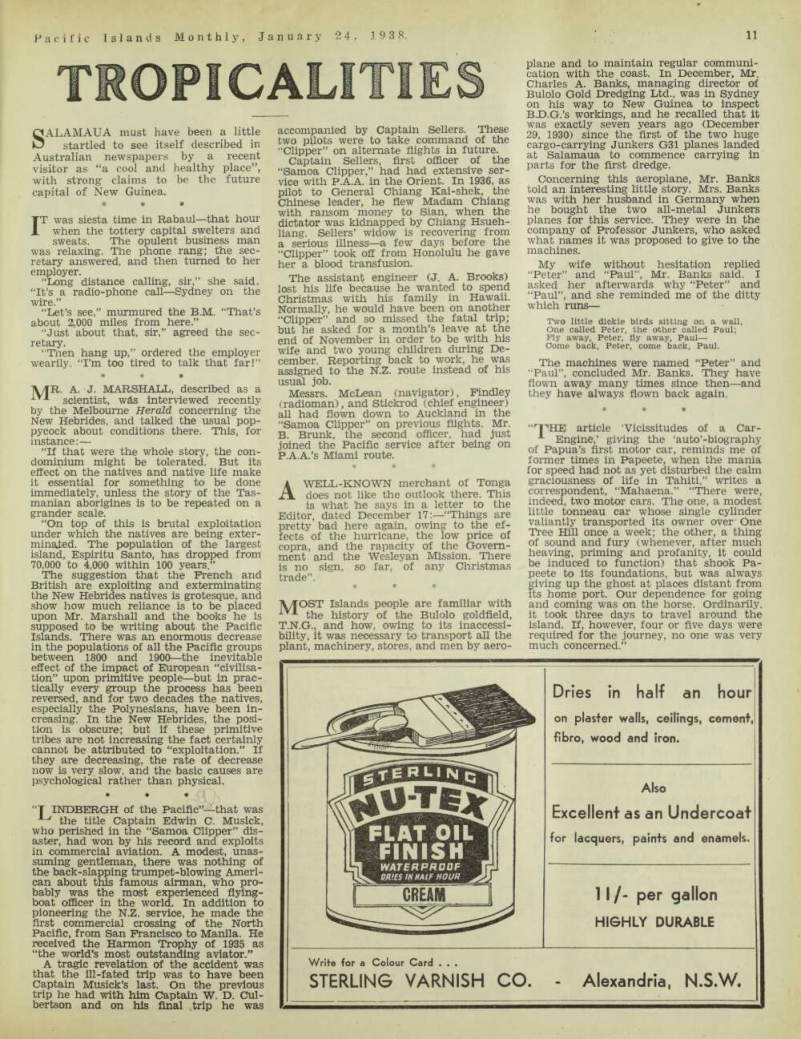
if r
miMW'J
CREAM
Write for a Colour Card . • .
STERLING VARNISH CO.
Dries in half an hour on plaster walls, ceilings, cement, fibre, wood and iron.
Also Excellent as an Undercoat for lacquers, paints and enamels. 11 /- per gallon
HIGHLY DURABLE
Alexandria, N.S.W.
mm
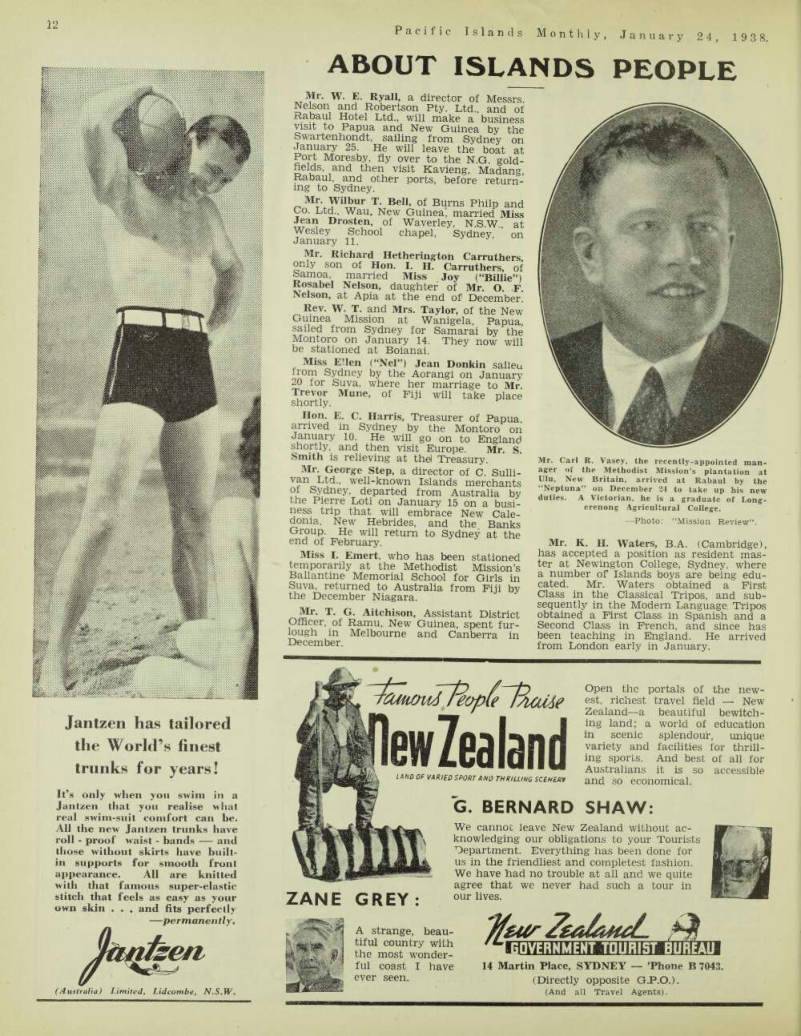
Jantzen has tailored
the World’s finest
trunks for years!
It’s only when yon swim in a Jantzen that yon realise what real swim-suit comfort can be.
All the new Jantzen trunks have roll - proof waist - bands and those without skirts have builtin supports for smooth front appearance. All are knitted with that famous super-elastic stitch that feels as easy as your own skin . . . and fits perfectly — permanently.
fatten
(Australia) Limited, Lidcombe, N.S.W.
About Islands People
Mr. W. E. Ryall, a director of Messrs.
Nelson and Robertson Pty. Ltd., and of R-abaul Hotel Ltd., will make a business visit to Papua and New Guinea by the Swartenhondt, sailing from Sydney on January 25. He will leave the boat at Port Moresby, fly over to the N.G. gold fields, and then visit Kavieng, Madanp- Rabaul, and other ports, before return ing to Sydney.
Mr. Wilbur T. Bell, of Burns Philp and Co. Ltd., Wau, New Guinea, married Miss Jean Drosten, of Waverley, N.S.W. at Wesley School chapel, Sydney, ’ on January 11.
Mr. Richard Hetherington Carruthers, only son of Hon. I. H. Carruthers, of Samoa, married Miss Joy (“Billie”) Rosabel Nelson, daughter of Mr. O F Nelson, at Apia at the end of December!
Rev. W. T. and Mrs. Taylor, of the New Guinea Mission at Wanigela, Papua sailed from Sydney for Samarai by the Montoro on January 14. They now will be stationed at Boianai.
Miss E’len (“Nel”) Jean Donkin saileu irom Sydney by the Aorangi on January 20 for Suva, where her marriage to Mr.
Trevor Mune, of Fiji will take place shortly.
Hon. E. C. Harris, Treasurer of Papua arrived in Sydney by the Montoro on January 10. He will go on to England shortly, and then visit Europe. Mr. S.
Smith is relieving at thel Treasury.
Mr. George Step, a director of C. Sulli van Ltd., well-known Islands merchants of Sydney, departed from Australia by the Pierre Loti on January 15 on a busi ness trip that will embrace New Cale donia, New Hebrides, and the Banks Group. He will return to Sydney at the end of February.
Miss I. Emert, who has been stationed temporarily at the Methodist Mission’s Ballantine Memorial School for Girls in Suva, returned to Australia from Fiji by the December Niagara.
Mr. T. G. Aitchison, Assistant District Officer, of Ramu, New Guinea, spent fur lough in Melbourne and Canberra in December.
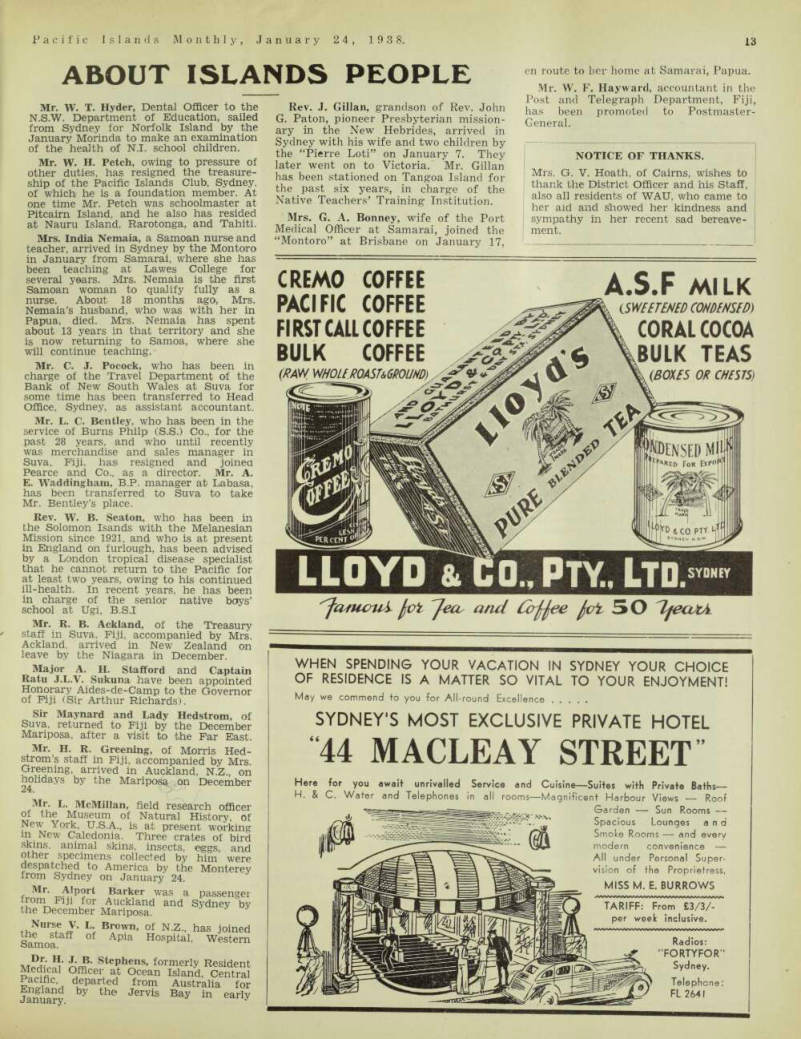
Mr. K, H. Waters, B.A. (Cambridge), has accepted a position as resident mas ter at Newington College, Sydney, where a number of Islands boys are being edu cated. Mr. Waters obtained a First Class in the Classical Tripos, and sub sequently in the Modern Language, Tripos obtained a First Class in Spanish and a Second Class in French, and since has been teaching in England. He arrived from London early in January.
Mr. Carl R. Vasey, the recently-appointedman ager of the Methodist Mission’s plantation at Ulu, New Britain, arrived at Rabaul by the “Neptuna” on December 24 to take up his new duties. A Victorian, he is a graduate of Long erenong Agricultural College.
Photo: “Mission Review”.
Mr. W. T. Hyder, Dental Officer to the N.S.W. Department of Education, sailed from Sydney for Norfolk Island by the January Morinda to make an examination of the health of N.I. school children.
Mr. W. H. Fetch, owing to pressure of other duties, has resigned the treasure ship of the Pacific Islands Club, Sydney, of which he is a foundation member. At one time Mr. Fetch was schoolmaster at Pitcairn Island, and he also has resided at Nauru Island, Rarotonga, and Tahiti.
Mrs. India Nemaia, a Samoan nurse and teacher, arrived in Sydney by the Montoro in January from Samarai, where she has been teaching at Lawes College for several years. Mrs. Nemaia is the first Samoan woman to qualify fully as a nurse. About 18 monthsi ago, Mrs.
Nemaia’s husband, who was with her in Papua, died. Mrs. Nemaia has spent about 13 years in that territory and she is now returning to Samoa, where she will continue teaching.
Mr. C. J. Pocock, who has been in charge of the Travel Department of the Bank of New South Wales at Suva for some time has been transferred to Head Office, Sydney, as assistant accountant.
Mr. L. C. Bentley, who has been in the service of Burns Philp (S.S.) Co., for the past 28 years, and who until recently was merchandise and sales manager in Suva, Fiji, has 1 resigned and joined Pearce and Co., as a director. Mr. A.
E. Waddingham, B.P. manager at Labasa, has been transferred to Suva to take Mr. Bentley’s place.
Rev. W. B. Seaton, who has been in the Solomon Isands with the Melanesian Mission since 1921, and who is at present in England on furlough, has been advised by a London tropical disease specialist that he cannot return to the Pacific for at least two years, owing to his continued ill-health. In recent years, he has been in charge of the senior native boys’ school at Ugi, 8.5.1 Mr. R. B. Ackland, of the Treasury staff in Suva, Fiji, accompanied by Mrs.
Ackland. arrived in New Zealand on leave by the Niagara in December.
Major A. H. Stafford and Captain Ratu J.L.V. Sukuna have been appointed Honorary Aides-de-Camp to the Governor of Fiji (Sir Arthur Richards).
Sir Maynard and Lady Hedstrom, of Suva, returned to Fiji by the December Mariposa, after a visit to the Far East.
Mr. H. R. Greening, of Morris Hed strom’s staff in Fiji, accompanied by Mrs.
Greening, arrived in Auckland, N.Z., on holidays by the Mariposa + on December Mr. L. McMillan, field research officer of the Museum of Natural History, of New York, U.S.A., is at present working m New Caledonia. Three crates of bird skins, animal skins, insects, eggs, and other specimens collected by him were despatched to America by the Monterey from Sydney on January 24.
Mr. Alport Barker was a passenger f£ on L Fl;il for Auckland and Sydney bv the December Mariposa.
H B ™wn, of N.Z., has joined Samoa taff ° f Apia Hospita1 ’ Western Stephens > formerly Resident Medical Officer at Ocean Island, Central PnSSn’ri d « d T from Austr alia for January. by the JerVlS Bay in early
Rev. J. Gillan, grandson of Rev. John G. Paton, pioneer Presbyterian mission ary in the New Hebrides, arrived in Sydney with his wife and two children by the “Pierre Loti” on January 7. They later went on to Victoria. Mr. Gillan has been stationed on Tangoa Island for the past six years, in charge of the Native Teachers’ Training Institution.
Mrs. G. A. Bonney, wife of the Port Medical Officer at Samarai, joined the “Montoro” at Brisbane on January 17,
en route to her home at Samarai, Papua.
Mr. W. F. Hayward, accountant in the Post and Telegraph Department, Fiji, has been promoted to Postmaster- General.
Advertisements & other items, pp. 14-15 (2 items)
ewZealand
LAND OF VARIED SPORT AND THRILLING SCENERY Open the portals of the newest, richest travel field New Zealand—a beautiful bewitching land; a world of education in scenic splendour, unique variety and facilities for thrilling sports. And best of all for Australians it is so accessible and so economical.
ZANE GREY
G. BERNARD SHAW:
We cannot leave New Zealand without acknowledging our obligations to your Tourists Department. Everything has been done for us in the friendliest and completest fashion.
We have had no trouble at all and we quite agree that we never had such a tour in our lives.
A strange, beautiful country with the most wonderful coast I ever seen. have 14 Martin Place, SYDNEY ’Phone B 7043. (Directly opposite G.P.0.). (And all Travel Agents).
NOTICE OF THANKS.
Mrs. G. V. Hoath, of Cairns, wishes to thank the District Officer and his Staff, also all residents of WAU, who came to her aid and showed her kindness and sympathy in her recent sad bereavement.
CREMO COFFEE
PACIFIC COFFEE
FIRSTCALL COFFEE
BULK COFFEE
(MW WHOLI ROAST & GROUND)
A.S.F MILK
(.SWEETENED CONDENSED)
CORAL COCOA
BULK TEAS
(BOXES OR CHESTS)
ar <9 6 A <r Cr o o V V Ml
ENSED
T a ßed For & ¥
OVD
PTY
CO
pty. ltd
SYDNEY
'famous fet feu and Coffee 50
WHEN SPENDING YOUR VACATION IN SYDNEY YOUR CHOICE OF RESIDENCE IS A MATTER SO VITAL TO YOUR ENJOYMENT!
May we commend to you for All-round Excellence
SYDNEY'S MOST EXCLUSIVE PRIVATE HOTEL
44 MACLEAY STREET
Here for you await unrivalled Service and Cuisine—Suites with Private Baths— H. & C. Water and Telephones in all rooms—Magnificent Harbour Views Roof Garden - Sun Rooms Spacious Lounges and Smoke Rooms and every modern convenience All under Personal Supervision of the Proprietress,
MISSM. E. BURROWS
TARIFF: From £3/3/-
3^ C> m K 4 per week inclusive.
AAAA/VWAAAA/WWV/VWW/W/VAAAAAA/'
Radios;
FORTYFOR”
Sydney.
Telephone: FL 2641
About Islands People
The Copra Market
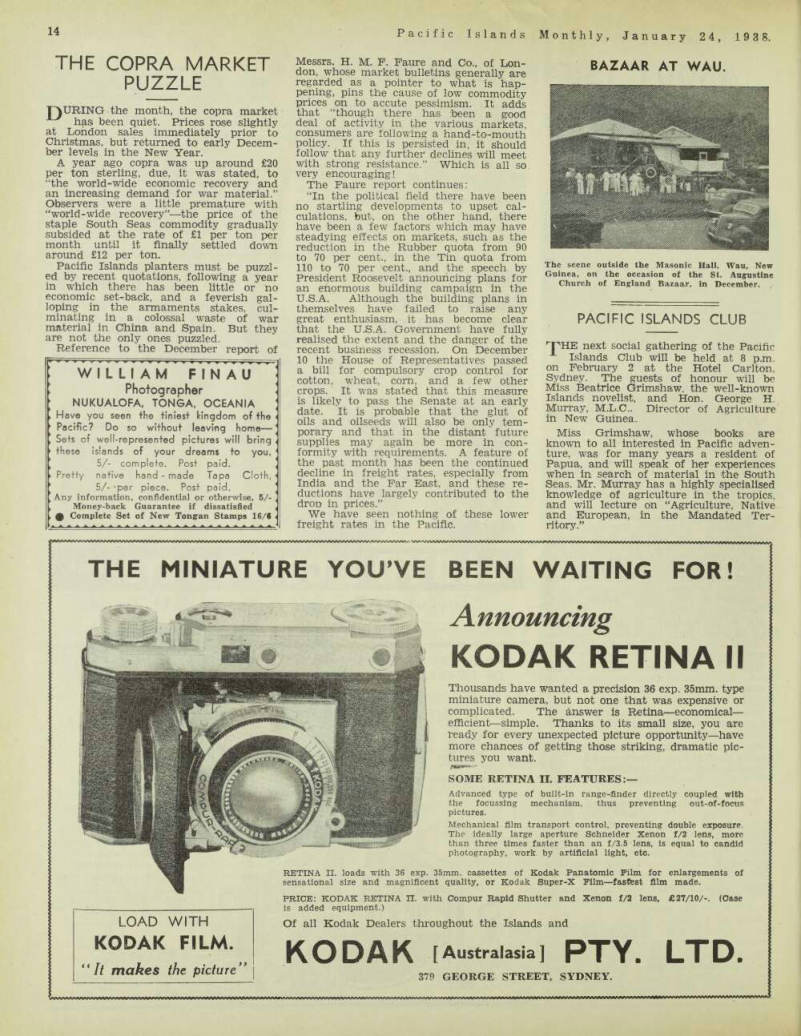
Puzzle
4-1, .. , , TOURING the month, the copra market has been quiet. Prices rose slightly at London sales immediately prior to Christmas, but returned to early Decern ber levels in the New Year.
A year ago copra was up around £2O per ton sterling, due, it was stated, to “the world-wide economic recovery and an increasing demand for war material.”
Observers were a little premature with “world-wide recovery”—the price of the staple South Seas commodity gradually subsided at the rate of £1 per ton per month until it finally settled down around £l2 per ton.
Pacific Islands planters must be puzzl ed by recent quotations, following a year in which there has been little or no economic set-back, and a feverish gal loping in the armaments stakes, cul minating in a colossal waste of war material in China and Spain. But they are not the only ones puzzled.
Reference to the December report of
Messrs. H, M. F. Faure and Co., of Lon don, whose market bulletins generally are regarded as a pointer to what is hap pening, pins the cause of low commodity prices on to accute pessimism. It adds that “though there has been a good deal of activity in the various markets, consumers are following a hand-to-mouth policy. If this is persisted in, it should follow that any further declines will meet with strong resistance.” Which is all so very encouraging!
The Faure report continues: “In the political field there have been no startling developments to upset cal culations, but, on the other hand, there have been a few factors which may have steadying effects on markets, such as the reduction in the Rubber quota from 90 to 70 per cent., in the Tin quota from 110 to 70 per cent., and the speech by President Roosevelt announcing plans for an enormous building campaign in the U.S.A. Although the building plans in themselves have failed to raise any great enthusiasm, it has become clear that the U.S.A. Government have fully realised the extent and the danger of the recent business recession. On December 10 the House of Representatives passed a bill for compulsory crop control for cotton, wheat, com, and a few other crops. It was stated that this measure is likely to pass the Senate at an early date. It is probable that the glut of oils and oilseeds will also be only tem porary and that in the distant future supplies may again be more in con formity with requirements. A feature of the past month has been the continued decline in freight rates, especially from India and the Far East, and these re ductions have largely contributed to the drop in prices.”
We have seen nothing of these lower freight rates in the Pacific.
Advertisements & other items, p. 16 (1 item)
Bazaar At Wau.
The scene outside the Masonic Hall, Wau, New Guinea, on the occasion of the St. Augustine Church of England Bazaar, in December.
Pacific Islands Club
'T'HE next social gathering of the Pacific A Islands Club will be held at 8 p.m. on February 2 at the Hotel Carlton.
Sydney. The guests of honour will be Miss Beatrice Grimshaw, the well-known Islands novelist, and Hon. George H.
Murray, M.L.C.. Director of Agriculture in New Guinea.
Miss Grimshaw, whose books are known to all interested in Pacific adven ture, was for many years a resident of Papua, and will speak of her experiences when in search of material in the South Seas. Mr. Murray has a highly specialised knowledge of agriculture in the tropics, and will lecture on “Agriculture, Native and European, in the Mandated Ter ritory.”
Advertisements & other items, p. 16 (1 item)
Announcing
WILLIAM FINAU
Photographer
NUKUALOFA, TONGA. OCEANIA
Have you seen the tiniest kingdom of the Pacific? Do so without leaving home— Sets of well-represented pictures will bring these islands of your dreams to you, 5/- complete. Post paid.
Pretty native hand - made Tapa Cloth, 5/- *per piece. Post paid.
Any information, confidential or otherwise, 5/- Money-back Guarantee if dissatisfied 0 Complete Set of New Tongan Stamps 16/«
THE MINIATURE YOU’VE BEEN WAITING FOR!
Announcing
KODAK RETINA II
Thousands have wanted a precision 36 exp. 35mm. type miniature camera, but not one that was expensive or complicated. The answer is Retina—economicalefficient—simple. Thanks to its small size, you are ready for every unexpected picture opportunity—have more chances of getting those striking, dramatic pictures you want.
SOME RETINA 11. FEATURES:—
Advanced type of built-in range-finder directly coupled with the focussing mechanism, thus preventing out-of-focus pictures.
Mechanical film transport control, preventing double exposure.
The ideally large aperture Schneider Xenon f/2 lens, more than three times faster than an f/3.5 lens, is equal to candid photography, work by artificial light, etc.
RETINA 11. loads with 36 exp. 35mm. cassettes of Kodak Panatomic Film for enlargements of sensational size and magnificent quality, or Kodak Super-X Film—fastest film made.
LOAD WITH
KODAK FILM.
“It makes the picture
PRICE: KODAK RETINA 11. with Compur Rapid Shutter and Xenon f/2 lens, £27/10/-. (Case is added equipment.) Of all Kodak Dealers throughout the Islands and
KODAK [ Australasia ] PTY. LTD
379 GEORGE STREET, SYDNEY.
Bishop Vesters, Of
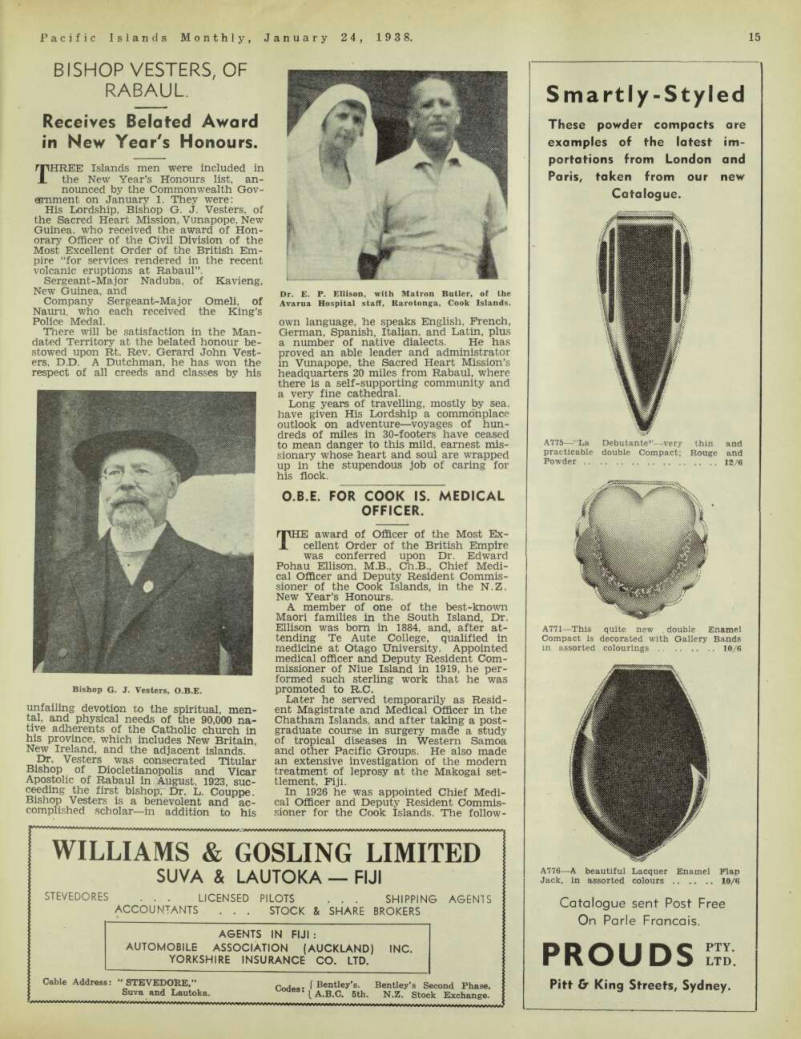
Rabaul.
Receives Belated Award in New Year's Honours.
THREE Islands men were included in the New Year’s Honours list, an nounced by the Commonwealth Gov eimment on January 1. They were: His Lordship, Bishop G. J. Vesters, of the Sacred Heart Mission, Vunapope, New Guinea, who received the award of Hon orary Officer of the Civil Division of the Most Excellent Order of the British Em pire “for services rendered in the recent volcanic eruptions at Rabaul”.
Sergeant-Major Naduba, of Kavieng, New Guinea, and Company Sergeant-Major Omeli, of Nauru, who each received the King’s Police Medal.
There will be satisfaction in the Man dated Territory at the belated honour be stowed upon Rt. Rev. Gerard John Vest ers, D.D. A Dutchman, he has won the respect of all creeds and classes by his
unfailing devotion to the spiritual, men tal, and physical needs of the 90,000 na tive adherents of the Catholic church in his province, which includes New Britain, New Ireland, and the adjacent islands.
Dr. Vesters was consecrated Titular Bishop of Diocletianopolis and Vicar Apostolic of Rabaul in August, 1923, suc ceeding the first bishopr Dr. L. Couppe.
Bishop Vesters is a benevolent and ac complished scholar—in addition to his
own language, he speaks English, French, German, Spanish, Italian, and Latin, plus a number of native dialects. He has proved an able leader and administrator in Vunapope, the Sacred Heart Mission’s headquarters 20 miles from Rabaul, where there is a self-supporting community and a very fine cathedral.
Long years of travelling, mostly by sea, have given His Lordship a commonplace outlook on adventure —voyages of hun dreds of miles in 30-footers have ceased to mean danger to this mild, earnest mis sionary whose heart and soul are wrapped up in the stupendous job of caring for his flock.
Bishop G. J, Vesters, O.B. E.
Dr. E. P. Ellison, with Matron Butler, of the Avarua Hospital staff, Rarotonga, Cook Islands.
O.B. E. For Cook Is. Medical
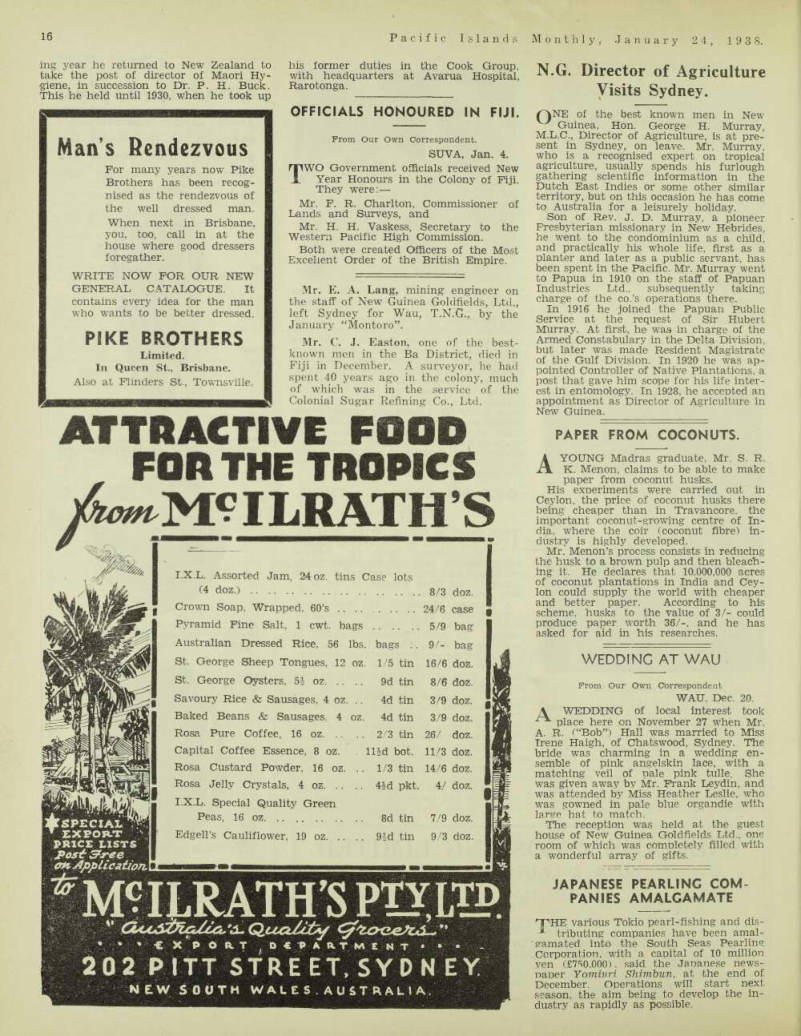
Officer.
fTTHE award of Officer of the Most Ex- X cellent Order of the British Empire was conferred upon Dr. Edward Pohau Ellison, M. 8., Ch.B., Chief Medi cal Officer and Deputy Resident Commis sioner of the Cook Islands, in the N.Z.
New Year’s Honours.
A member of one of the best-known Maori families in the South Island, Dr.
Ellison was bom in 1884, and, after at tending Te Aute College, qualified in medicine at Otago University. Appointed medical officer and Deputy Resident Com missioner of Niue Island in 1919, he per formed such sterling work that he was promoted to R.C.
Later he served temporarily as Resid ent Magistrate and Medical Officer in the Chatham Islands, and after taking a post graduate course in surgery made a study of tropical diseases in Western Samoa and other Pacific Groups. He also made an extensive investigation of the modern treatment of leprosy at the Makogai set tlement, Fiji.
In 1926 he was appointed Chief Medi cal Officer and Deputy Resident Commis sioner for the Cook Islands. The follow
ing year he returned to New Zealand to take the post of director of Maori Hy giene, in succession to Dr. P. H. Buck.
This he held until 1930, when he took up
his former duties in the Cook Group, with headquarters at Avarua Hospital, Rarotonga.
Advertisements & other items, pp. 17-18 (1 item)
Prouds Ltd
Smartly-Styled
These powder compacts are examples of the latest importations from London and Paris, taken from our new Catalogue.
A77s—“La Debutante’’—very thin and practicable double Compact; Rouge and Powder 12/6 r A 771 —This quite new double Enamel Compact is decorated with Gallery Bands in assorted colourings 10/6 A776—A beautiful Lacquer Enamel Flap Jack, in assorted colours 10/6 Catalogue sent Post Free On Parle Francois.
PROUDS LTD
Pitt & King Streets, Sydney.
WILLIAMS & GOSLING LIMITED
SUVA i LAUTOKA FIJI
STEVEDORES . . . LICENSED PILOTS . . . SHIPPING AGENTS ACCOUNTANTS . . . STOCK & SHARE BROKERS
AGENTS IN FIJI :
AUTOMOBILE ASSOCIATION (AUCKLAND) INC.
YORKSHIRE INSURANCE CO. LTD.
Cable Address: “ STEVEDORE,” r , f Bentley’s. Bentley’s Second Phase, Suva and Lautoka. ooaes * [ A.B.C. sth. N.Z. Stock Exchange.
Man’s Rendezvous
For many years now Pike Brothers has been recognised as the rendezvous of the well dressed man.
When next in Brisbane, you, too, call in at the house where good dressers foregather.
WRITE NOW FOR OUR NEW
GENERAL CATALOGUE. It
contains every idea for the man who wants to be better dressed.
P!KE BROTHERS
Limited.
In Queen St., Brisbane.
Also at Flinders St., Towmsville.
ATTRACTIVE POOD
FOR THE TROPICS
M^ILRATH’S
Officials Honoured In Fiji.
From Our Own Correspondent.
Suva, Jan. 4.
TWO Government officials received New Year Honours in the Colony of Fiji.
They were:— Mr. F. R. Charlton, Commissioner of Lands and Surveys, and Mr. H. H. Vaskess, Secretary to the Western Pacific High Commission.
Both were created Officers of the Most Excellent Order of the British Empire.
Mr. E. A. Lang, mining engineer on the staff of New Guinea Goldfields, Ltd., left Sydney for Wau, T.N.G., by the
January “Montoro”.
Mr. C. J. Easton, one of the best known men in the Ba District, died in Fiji in December. A surveyor, he had spent 40 years ago in the colony, much of which was in the service of the
Colonial Sugar Refining Co., Ltd.
Visits Sydney.
N.G. Director of Agriculture Visits Sydney.
/'ANE of the best known men in New w Guinea, Hon. George H. Murray, M.L.C., Director of Agriculture, is at pre sent in Sydney, on leave. Mr. Murray, who is a recognised expert on tropical agriculture, usually spends his furlough gathering scientific information in the Dutch East Indies or some other similar territory, but on this occasion he has come to Australia for a leisurely holiday.
Son of Rev. J. D. Murray, a pioneer Presbyterian missionary in New Hebrides, he went to the condominium as a child, and practically his whole life, first as a planter and later as a public servant, has been spent in the Pacific. Mr. Murray went to Papua in 1910 on the staff of Papuan Industries Ltd., subsequently taking charge of the co.’s operations there.
In 1916' he joined the Papuan Public Service at the request of Sir Hubert Murray. At first, he was in charge of the Armed Constabulary in the Delta Division, but later was made Resident Magistrate of the Gulf Division. In 1920 he was ap pointed Controller of Native Plantations, a post that gave him scope for his life inter est in entomology. In 1928, he accepted an appointment as Director of Agriculture in New Guinea.
Paper From Coconuts.
A YOUNG Madras graduate, Mr. S. R.
K. Menon, claims to be able to make paper from coconut husks.
His experiments were carried out in Ceylon, the price of coconut husks there being cheaper than in Travancore. the important coconut-growing centre of In dia. where the coir (coconut fibre) in dustry is highly developed.
Mr. Menon’s process consists in reducing the husk to a brown pulp and then bleach ing it. He declares that 10,000,000 acres of coconut plantations in India and Cey lon could supply the world with cheaper and better paper. According to his scheme, husks to the value of 3/- could produce paper worth 36/-, and he has asked for aid in his researches.
Wedding At Wau
Prom Our Own Correspondent WAU, Dec. 20.
A WEDDING of local interest took place here on November 27 when Mr.
A. R. ('“Bob”) Hall was married to Miss Irene Haigh, of Chatswood, Sydney. The bride was charming in a wedding en semble of pink angelskin lace, with a matching veil of pale pink tulle. She was given away bv Mr. Prank Leydin, and was attended by Miss Heather Leslie, who was gowned in pale blue organdie with laree hat to match.
The reception was held at the guest house of New Guinea Goldfields Ltd., one room of which was completely filled with a wonderful array of gifts.
Japanese Pearling Com
Panies Amalgamate
r PHE various Tokio pearl-fishing and dis * tributing companies have been amal ' gamated into the South Seas Pearling Corporation, with a capital of 10 million yen said the Jananese news naper Yomiuri Shirribun, at the end of December. Operations will start next season, the aim being to develop the in dustry as rapidly as possible.
Advertisements & other items, p. 18 (1 item)
16
Pacific Islands Mon t h ly, January 24, 193 8.
Control Of
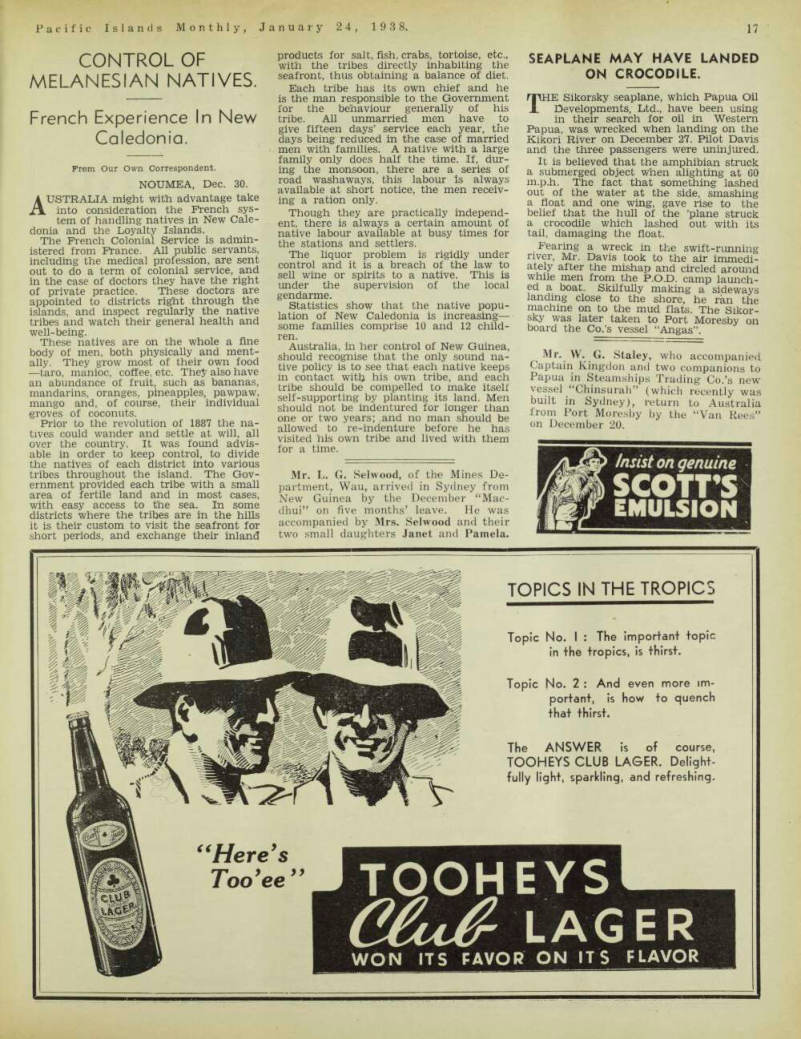
Melanesian Natives.
French Experience In New Caledonia.
From Our Own Correspondent.
Noumea, Dec. 30.
AUSTRALIA might with advantage take into consideration the French sys tem of handling natives in New Cale donia and the Loyalty Islands.
The French Colonial Service is admin istered from Prance. All public servants, including the medical profession, are sent out to do a term of colonial service, and in the case of doctors they have the right of private practice. These doctors are appointed to districts right through the islands, and inspect regularly the native tribes and watch their general health and well-being.
These natives are on the whole a fine body of men, both physically and ment ally. They grow most of their own food —taro, manioc, coffee, etc. They also have an abundance of fruit, such as bananas, mandarins, oranges, pineapples, pawpaw, mango and, of course, their individual groves of coconuts.
Prior to the revolution of 1887 the na tives could wander and settle at will, all over the country. It was found advis able in order to keep control, to divide the natives of each district into various tribes throughout the island. The Gov ernment provided each tribe with a small area of fertile land and in most cases, with easy access to the sea. In some districts where the tribes are in the hills it is their custom to visit the seafront for short periods, and exchange their inland
products for salt, fish, crabs, tortoise, etc., with the tribes directly inhabiting the seafront, thus obtaining a balance of diet.
Each tribe has its own chief and he is the man responsible to the Government for the behaviour generally of his tribe. All unmarried men have to give fifteen days’ service each year, the days being reduced in the case of married men with families. A native with a large family only does half the time. If, dur ing the monsoon, there are a series of road washaways, this labour Is always available at short notice, the men receiv ing a ration only.
Though they are practically independ ent, there is always a certain amount of native labour available at busy times for the stations and settlers.
The liquor problem is rigidly under control and it is a breach of the law to sell wine or spirits to a native. This is under the supervision of the local gendarme.
Statistics show that the native popu lation of New Caledonia is increasing— some families comprise 10 and 12 child ren.
Australia, in her control of New Guinea, should recognise that the only sound na tive policy is to see that each native keeps in contact witlj his own tribe, and each tribe should be compelled to make itself self-supporting by planting its land. Men should not be indentured for longer than one or two years; and no man should be allowed to re-indenture before he has visited his own tribe and lived with them for a time.
Mr. L. G. Selwood, of the Mines De
partment, Wau, arrived in Sydney from
New Guinea by the December “Mac dhui” on five months’ leave. He was accompanied by Mrs. Selwood and their two small daughters Janet and Pamela.
Seaplane May Have Landed
On Crocodile.
THE Sikorsky seaplane, which Papua Oil Developments, Ltd., have been using in their search for oil in Western Papua, was wrecked when landing on the Kikori River on December 27. Pilot Davis and the three passengers were uninjured.
It is believed that the amphibian struck a submerged object when alighting at 60 m.p.h. The fact that something lashed out of the water at the side, smashing a float and one wing, gave rise to the belief that the hull of the ’plane struck a crocodile which lashed out with its tail, damaging the float.
Fearing a wreck in the swift-running river, Mr. Davis took to the air immedi ately after the mishap and circled around while men from the P.O.D. camp launch ed a boat. Skilfully making a sideways landing close to the shore, he ran the machine on to the mud flats. The Sikor sky was later taken to Port Moresby on board the Co.’s vessel “Angas”.
Mr. W. G. Staley, who accompanied
Captain Kingdon and two companions to
Papua in Steamships Trading Co.’s new
vessel “Chinsurah” (which recently was built in Sydney), return to Australia from Port Moresby by the “Van Rees” on December 20.
Advertisements & other items, pp. 19-20 (1 item)
C£U£ Lager
Insist genuine
SCOTT
EMULSION
f
£ k 3. >- V *
“Here’s
Too’ee”
m
TOPICS IN THE TROPICS
Topic No. I : The important topic in the tropics, is thirst.
Topic No. 2 : And even more important, is how to quench that thirst.
The ANSWER is of course,
TOOHEYS CLUB LAGER. Delight-
fully light, sparkling, and refreshing.
TOOHEYS™
C£u£ LAGER
WON ITS FAVOR ON ITS FLAVOR
Modern Refrigeration for the South Sea Islands
The
ELECTROLUX
KEROSENE OPERATED
REFRIGERATOR
A
MARVEL
OF
MODERN
SCIENCE
£ -1 L rnm mm Wt i * m m ...
THE
MIRACLE
OF
ICE
FROM
HEAT
THE ELECTROLUX OFFERS economical, modern and completely efficient refrigeration for
ISLANDS' HOMES.
FREEZES CONTINUOUSLY WHILE SMALL LAMP BURNS
Freezing controlled by simply regulating height of flame. Uses only gallon of kerosene per week.
MOTORLESS ... NO PARTS TO GET OUT OF ORDER.
MODEL L 22 MODEL L3B
Capacity • (as illustrated) £ 2.2 cubic feet. Capacity 4 cubic feet.
GUARANTEED FOR TWO YEARS
• Write to your Local Distributor for prices arrd full details.
MODEL LKSS
Capacity 5.5 cubic feet.
Obtainable from . .
W. R. Carpenter & Company Ltd. —Sydney and following New Guinea Branches : Rabaul, Salamaua, Wau, Kavieng, Madang, But and Wewak.
Representation In Papua and New Hebrides.
W. R. Carpenter & Coy. (Solomon Is.) Pty. Ltd. —Tulagi, British Solomon Islands.
On Chong & Company Pty. Ltd. —Butaritari, Gilbert & Ellice Islands.
Choung Chong.
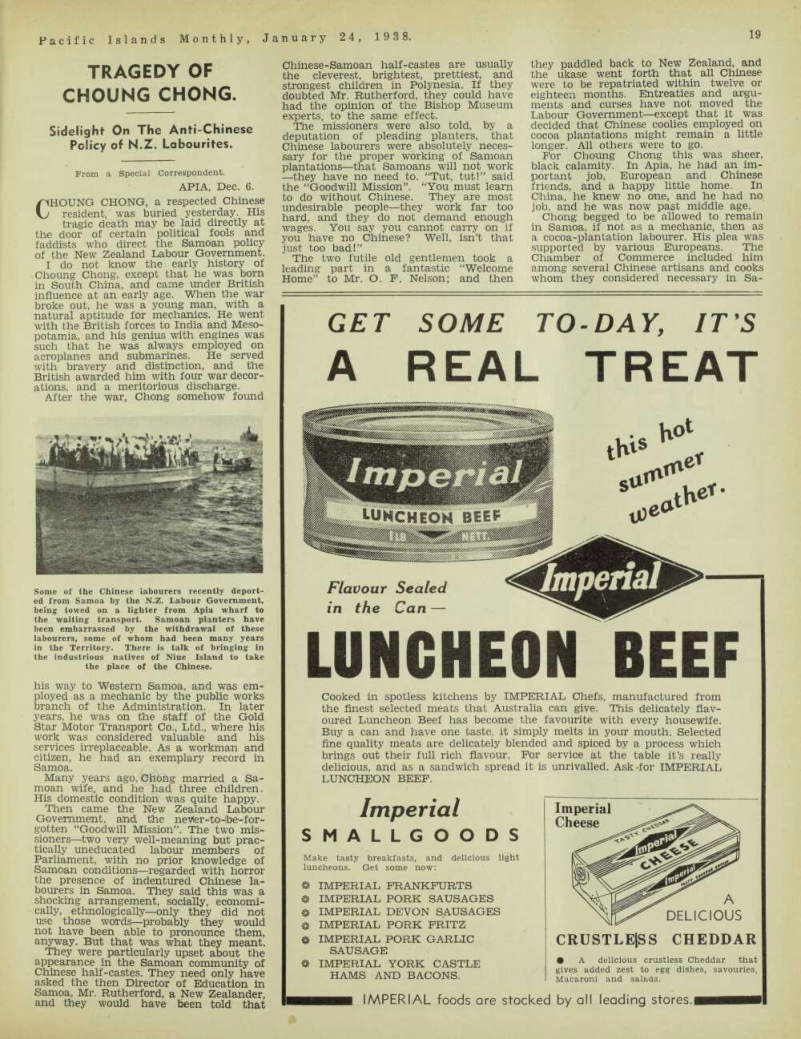
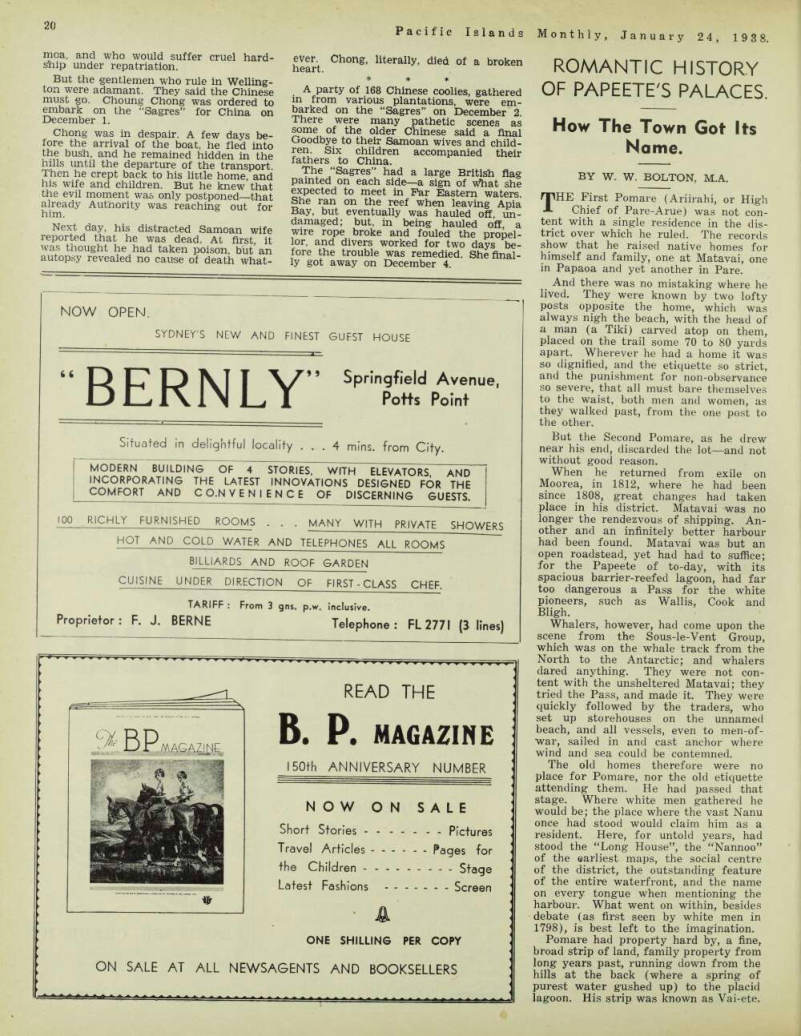
Tragedy Of
Sidelight On The Anti-Chinese Policy of N.Z. Labourites.
Prom a Special Correspondent.
Apia, Dec. 6.
CHOUNG CHONG, a respected Chinese resident, was buried yesterday. His tragic death may be laid directly at the door of certain political fools and faddists who direct the Samoan policy of the New Zealand Labour Government.
I do not know the early history of Choung Chong, except that he was born in South China, and came under British influence at an early age. When the war broke out, he was a young man, with a natural aptitude for mechanics. He went with the British forces to India and Meso potamia, and his genius with engines was such that he was always employed on aeroplanes and submarines. He served with bravery and distinction, and the British awarded him v/ith four war decor ations, and a meritorious discharge.
After the war, Chong somehow found
his way to Western Samoa, and was em ployed as a mechanic by the public works branch of the Administration. In later years, he was on the staff of the Gold Star Motor Transport Co., Ltd., where his work was considered valuable and his services irreplaceable. As a workman and citizen, he had an exemplary record in Samoa.
Many years ago, Chong married a Sa moan wife, and he had three children.
His domestic condition was quite happy.
Then came the New Zealand Labour Government, ahd the neVer-to-be-for gotten “Goodwill Mission”. The two mis sioners—two very well-meaning but prac tically uneducated labour members of Parliament, with no prior knowledge of Samoan conditions—regarded with horror the presence of indentured Chinese la bourers in Samoa. They said this was a shocking arrangement, socially, economi cally, ethnologically—only they did not use those words —probably they would not have been able to pronounce them, anyway. But that was what they meant.
They were particularly upset about the appearance in the Samoan community of Chinese half-castes. They need only have asked the then Director of Education in Samoa, Mr. Rutherford, a New Zealander, and they would have been told that
Chinese-Samoan half-castes are usually the cleverest, brightest, prettiest, and strongest children in Polynesia. If they doubted Mr. Rutherford, they could have had the opinion of the Bishop Museum experts, to the same effect.
The missioners were also told, by a deputation of pleading planters, that Chinese labourers were absolutely neces sary for the proper working of Samoan plantations—that Samoans will not work —they have no need to. “Tut, tut!” said the “Goodwill Mission”. “You must learn to do without Chinese. They are most undesirable people—they work far too hard, and they do not demand enough wages. You say you cannot carry on if you have no Chinese? Well, isn’t that just too bad!”
The two futile old gentlemen took a leading part in a fantastic “Welcome Home” to Mr, O. F. Nelson; and then
they paddled back to New Zealand, and the ukase went forth that all Chinese were to be repatriated within twelve or eighteen months. Entreaties and argu ments and curses have not moved the Labour Government —except that it was decided that Chinese coolies employed on cocoa plantations might remain a little longer. All others were to go.
For Choung Chong this was sheer, black calamity. In Apia, he had an im portant job, European and Chinese friends, and a happy little home. In China, he knew no one, and he had no job, and he was now past middle age.
Chong begged to be allowed to remain in Samoa, if not as a mechanic, then as a cocoa-plantation labourer. His plea was supported by various Europeans. The Chamber of Commerce included him among several Chinese artisans and cooks whom they considered necessary in Sa
Some of the Chinese labourers recently deport ed from Samoa by the N.Z. Labour Government, being towed on a lighter from Apia wharf to the waiting transport. Samoan planters have been embarrassed by the withdrawal of these labourers, some of whom had been many years in the Territory. There is talk of bringing in the industrious natives of Niue Island to take the place of the Chinese.
moa, and who would suffer cruel hard ship under repatriation.
But the gentlemen who rule in Welling ton were adamant. They said the Chinese must go. Choung Chong was ordered to embark on the “Sagres” for China on December 1.
Chong was in despair. A few days be fore the arrival of the boat, he fled into the bush, and he remained hidden in the hills until the departure of the transport.
Then he crept back to his little home, and his wife and children. But he knew that the evil moment was only postponed—that already Authority was reaching out for him.
Next day, his distracted Samoan wife reported that he was dead. At first, it was thought he had taken poison, but an autopsy revealed no cause of death what
ever Chong, literally, died of a broken heart. * * * A party of 168 Chinese coolies, gathered m from various plantations, were em barked on the “Sagres” on December 2 There were many pathetic scenes as some of the older Chinese said a final Goodbye to their Samoan wives and child ren. Six children accompanied their fathers to China.
The “Sagres” had a large British flag painted on each side—a sign of vtfhat she expected to meet in Par Eastern waters She ran on the reef when leaving Apia Bay, but eventually was hauled off un damaged; but, in being hauled off, a wire rope broke and fouled the propel ler, and divers worked for two days be fore the trouble was remedied. She final ly got away on December 4.
Advertisements & other items, pp. 21-22 (1 item)
Luncheon Beef
GET SOME TO-DAY, IT'S
A REAL TREAT
th*
stt,n th^
0
mjncmiom BEEF
Flavour Sealed
in the Can
LUNCHEON BEEF
Cooked in spotless kitchens by IMPERIAL Chefs, manufactured from the finest selected meats that Australia can give. This delicately flavoured Luncheon Beef has become the favourite with every housewife.
Buy a can and have one taste, it simply melts in your mouth. Selected fine quality meats are delicately blended and spiced by a process which brings out their full rich flavour. For service at the table it’s really delicious, and as a sandwich spread it is unrivalled. Ask‘for IMPERIAL
LUNCHEON BEEF.
Imperial
SMALLGOODS
Make tasty breakfasts, and delicious light luncheons. Get some now:
& IMPERIAL FRANKFURTS
& IMPERIAL PORK SAUSAGES
Q IMPERIAL DEVON SAUSAGES
@ IMPERIAL PORK FRITZ
$ IMPERIAL PORK GARLIC
SAUSAGE
« IMPERIAL YORK CASTLE
HAMS AND BACONS.
Imperial
Cheese
c A
DELICIOUS
CRUSTLEjSS CHEDDAR
• A delicious crustless Cheddar that gives added zest to egg dishes, savouries, Macaroni and salads.
IMPERIAL foods ore stocked by all leading stores.)
NOW OPEN.
SYDNEY'S NEW AND FINEST GUEST HOUSE
BERNLY'
Springfield Avenue,
Potts Point
Situated in delightful locality ... 4 mins, from City.
MODERN BUILDING OF 4 STORIES, WITH ELEVATORS AND INCORPORATING THE LATEST INNOVATIONS DESIGNED FOR THE COMFORT AND C O.N VENI E N C E OF DISCERNING GUESTS. 100 RICHLY FURNISHED ROOMS . . . MANY WITH PRIVATE SHOWERS HOT AND COLD WATER AND TELEPHONES ALL ROOMS
BILLIARDS AND ROOF GARDEN
CUISINE UNDER DIRECTION OF FIRST-CLASS CHEF.
TARIFF : From 3 gns. p.w. inclusive.
Proprietor: F. J. BERNE Telephone: FL2771 (3 lines)
READ THE
B. P. MAGAZINE
150th ANNIVERSARY NUMBER
NOW ON SALE
Short Stories Pictures Travel Articles Pages for the Children Stage Latest Fashions Screen
ONE SHILLING PER COPY
ON SALE AT ALL NEWSAGENTS AND BOOKSELLERS *BP
Romantic History
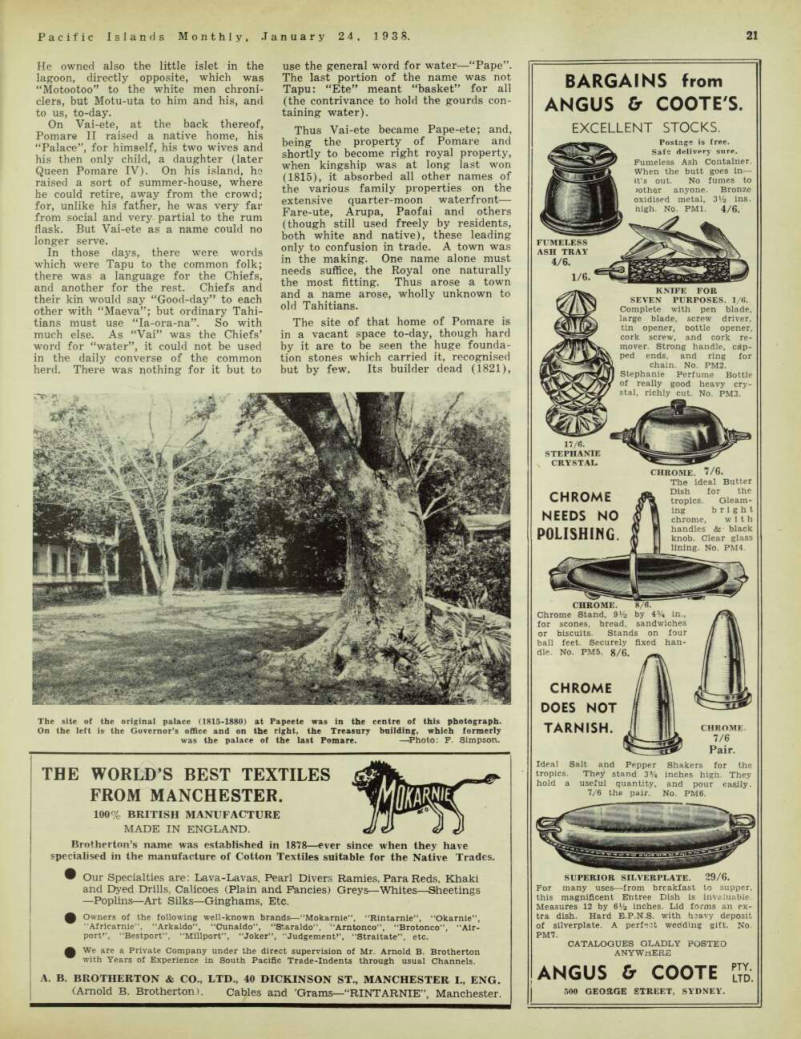
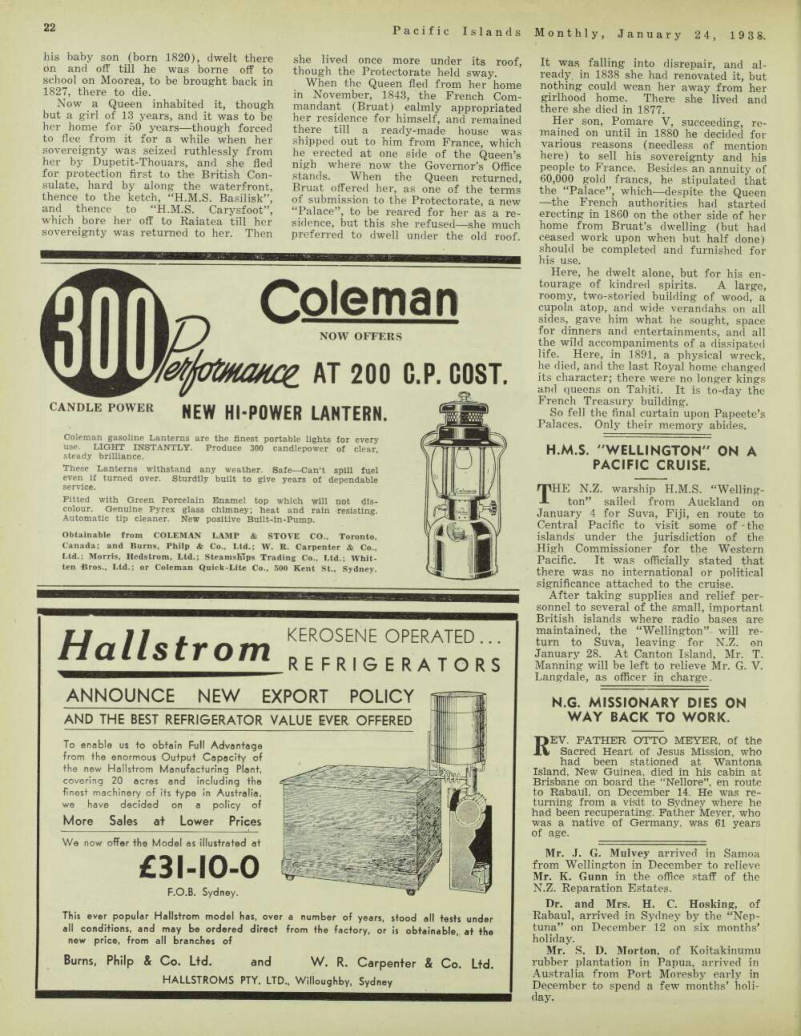
Of Papeete's Palaces.
How The Town Got Its Nome.
By W. W. Bolton, M.A.
T*HE First Pomare (Ariirahi, or High Chief of Pare-Arue) was not con tent with a single residence in the dis trict over which he ruled. The records show that he raised native homes for himself and family, one at Matavai, one in Papaoa and yet another in Pare.
And there was no mistaking where he lived. They were known by two lofty posts opposite the home, which was always nigh the beach, with the head of a man (a Tiki) carved atop on them, placed on the trail some 70 to 80 yards apart. Wherever he had a home it was so dignified, and the etiquette so strict, and the punishment for non-observance so severe, that all must bare themselves to the waist, both men and women, as they walked past, from the one post to the other.
But the Second Pomare, as he drew near his end, discarded the lot—and not without good reason.
When he returned from exile on Moorea, in 1812, where he had been since 1808, great changes had taken place in his district. Matavai was no longer the rendezvous of shipping. An other and an infinitely better harbour had been found. Matavai was but an open roadstead, yet had had to suffice; for the Papeete of to-day, with its spacious barrier-reefed lagoon, had far too dangerous a Pass for the white pioneers, such as Wallis, Cook and Bligh.
Whalers, however, had come upon the scene from the Sous-le-Vent Group, which was on the whale track from the North to the Antarctic; and whalers dared anything. They were not con tent with the unsheltered Matavai; they tried the Pass, and made it. They were quickly followed by the traders, who set up storehouses on the unnamed beach, and all vessels, even to men-of war, sailed in and cast anchor where wind and sea could be contemned.
The old homes therefore were no place for Pomare, nor the old etiquette attending them. He had passed that stage. Where white men gathered he would be; the place where the vast Nanu once had stood would claim him as a resident. Here, for untold years, had stood the “Long House”, the “Nannoo” of the earliest maps, the social centre of the district, the outstanding feature of the entire waterfront, and the name on every tongue when mentioning the harbour. What went on within, besides debate (as first seen by white men in 1798), is best left to the imagination.
Pomare had property hard by, a fine, broad strip of land, family property from long years past, running down from the hills at the back (where a spring of purest water gushed up) to the placid lagoon. His strip was known as Vai-ete.
He owned also the little islet in the lagoon, directly opposite, which was “Motootoo” to the white men chroniclers, but Motu-uta to him and his, and to us, to-day.
On Vai-ete, at the back thereof, Pomare II raised a native home, his “Palace”, for himself, his two wives and his then only child, a daughter (later ~,,, D „„.' 1 1.. ’ n ,- , '. .
Queen Pomare IV). On his island, hraised a sort of summer-house, where he could retire, away from the crowd; for, unlike his father, he was very far from social and very partial to the rum flask. But Vai-ete as a name could no longer serve In those'days, there were words which were Tapu to the common folk; there was a language for the Chiefs and another for the rest. Chiefs and their kin would say “Good-day” to each other with “Maeva”; but ordinary Tahitians must use “la-ora-na”. So with much else. As “Vai” was the Chiefs’ word for “water”, it could not be used in the daily converse of the common herd. There was nothing for it but to
use the general word for water—“Pape”, The last portion of the name was not Tapu: “Ete” meant “basket” for all (the contrivance to hold the gourds con taining water). h vai ete became p a p e .ete; and, , . p nmo J __j b 5 ir J5, . e uiL,JL , . shortly to become right royal property, when kingship was at long last won (1815), it absorbed all other names of (V '’ . , , ■ ... .. th « vanous fa ™l y p „ r ° p< extensive quarter-moon waterfronh- J re ' u , e ’ ... P , , . .. . < tb ? ug V? U used freely by residents both whlte and natlve )> these leading only to confusion in trade. A town was ln makmg l. °" e name " eeds su f ffi £ e -. the **oyal one naturally the . most Thus arose a tow "
T. d T a A a . me arose ’ wholly unknown to old la nitians.
The site of that home of Pomare is in a vacant space to-day, though hard by it are to be seen the huge founda tion stones which carried it, recognised but by few. Its builder dead (1821),
The site of the original palace (1815-1880) at Papeete was in the centre of this photograph.
On the left is the Governor’s office and on the right, the Treasury building, which formerly was the palace of the last Pomare. Photo: F. Simpson.
his baby son (born 1820), dwelt there on and off till he was borne off to school on Moorea, to be brought back in 1827, there to die.
Now a Queen inhabited it, though but a girl of 13 years, and it was to be her home for 50 years—though forced to flee from it for a while when her sovereignty was seized ruthlessly from her by Dupetit-Thouars, and she fled for protection first to the British Con sulate, hard by along the waterfront, thence to the ketch, “H.M.S. Basilisk”, and thence to “H.M.S. Carysfoot”, which bore her off to Raiatea till her sovereignty was returned to her. Then
she lived once more under its roof, though the Protectorate held sway.
When the Queen fled from her home in November, 1843, the French Com mandant (Bruat) ealmly appropriated her residence for himself, and remained there till a ready-made house was shipped out to him from France, which he erected at one side of the Queen’s nigh where now the Governor’s Office stands. When the Queen returned, Bruat offered her, as one of the terms of submission to the Protectorate, a new “Palace”, to be reared for her as a re sidence, but this she refused—she much preferred to dwell under the old roof.
It was falling into disrepair, and al ready. in 1838 she had renovated it, but nothing could wean her away from her girlhood home. There she lived and there she died in 1877.
Her son, Pomare V, succeeding, re mained on until in 1880 he decided for various reasons (needless of mention here) to sell his sovereignty and his people to France. Besides an annuity of 60,000 gold francs, he stipulated that the “Palace”, which—despite the Queen —the French authorities had started erecting in 1860 on the other side of her home from Bruat’s dwelling (but had ceased work upon when but half done) should be completed and furnished for his use.
Here, he dwelt alone, but for his en tourage of kindred spirits. A large, roomy, two-storied building of wood, a cupola atop, and wide verandahs on all sides, gave him what he sought, space for dinners and entertainments, and all the wild accompaniments of a dissipated life. Here, in 1891, a physical wreck, he died, and the last Royal home changed its character; there were no longer kings and queens on Tahiti. It is to-day the French Treasury building.
So fell the final curtain upon Papeete’s Palaces. Only their memory abides.
Advertisements & other items, pp. 23-24 (1 item)
Angus & Coote P Jtd
BARGAINS from
ANGUS & COOTE'S.
EXCELLENT STOCKS.
Postage is free.
Safe delivery sure.
Pumeless Ash Container.
When the butt goes in— it’s out. No fumes to )other anyone. Bronze oxidised metal, 3Vs ins. high. No. PMI. 4/6.
FUMELESS
ASH TRAY
4/6. 1/6.
Mm 17/6.
STEPHANIE
CRYSTAL.
KNIFE FOR
SEVEN PURPOSES. 1/6.
Complete with pen blade, large blade, screw driver, tin opener, bottle opener, cork screw, and cork remover. Strong handle, capped ends, and ring for chain. No. PM2.
Stephanie Perfume Bottle of really good heavy crystal, richly cut. No. PM3.
CHROME
NEEDS NO
POLISHING.
CHROME. 7/6.
The ideal Butter Dish for the tropics. Gleaming bright chrome, with handles & black knob. Clear glass lining. No. PM4.
CHROME. 8/6.
Chrome Stand, 9*/2 by 4% in., for scones, bread, sandwiches or biscuits. Stands on four ball feet. Securely fixed handle. No. PMS. 8/6.
CHROME
DOES NOT
TARNISH.
CHROME.
7/6
Pair.
Ideal Salt and Pepper Shakers for the tropics. They stand 3 3 / 4 inches high. They hold a useful quantity, and pour easily. 7/6 the pair. No. PM6.
SUPERIOR SILVERPLATE. 29/6.
For many uses—from breakfast to supper, this magnificent Entree Dish is invaluable.
Measures 12 by 6 Vt inches. Lid forms an extra dish. Hard B.P.N.S. with heavy deposit of silverplate. A perfect wedding gift. No.
PM7.
CATALOGUES GLADLY POSTED
ANYWHERE
ANGUS & COOTE p Jtd
500 GEORGE STREET, SYDNEY.
THE
WORLD’S BEST TEXTILES
FROM MANCHESTER.
100% BRITISH MANUFACTURE
MADE IN ENGLAND.
0 Brotherton’s name was established in 1878—ever since when they have specialised in the manufacture of Cotton Textiles suitable for the Native Trades.
Our Specialties are: Lava-Lavas, Pearl Divers Ramies, Para Reds, Khaki and Dyed Drills, Calicoes (Plain and Fancies) Greys—Whites—Sheetings —Poplins—Art Silks—Ginghams, Etc.
Owners of the following well-known brands—“Mokarnie”, “Rintarnie”, “Okarnie”, “Africarnie”, “Arkaldo”, “Cunaldo”, “Staraldo”, “Arntonco”, “Brotonco”, “Airport’’, “Bestport”, “Millport”, “Joker”, “Judgement’’, “Straitate”, etc.
We are a Private Company under the direct supervision of Mr. Arnold B. Brotherton with Years of Experience in South Pacific Trade-Indents through usual Channels.
A. B. BROTHERTON & CO., LTD., 40 DICKINSON ST., MANCHESTER 1., ENG. (Arnold B. Brotherton). Cables and ’Grams—“RINTARNIE”, Manchester.
fji Coleman
■ / / NOW OFFERS
ymjjotmoce, at 200 c.p. cost.
candle power N EW HI'POWER LANTERN.
Coleman gasoline Lanterns are the finest portable lights for every use. LIGHT INSTANTLY. Produce 300 candlepower of clear, steady brilliance.
These Lanterns withstand any weather. Safe—Can’t spill fuel even if turned over. Sturdily built to give years of dependable service.
Fitted with Green Porcelain Enamel top which will not discolour. Genuine Pyrex glass chimney; heat and rain resisting.
Automatic tip cleaner. New positive Built-In-Pump.
Obtainable from COLEMAN LAMP & STOVE CO., Toronto, Canada; and Burns, Philp & Co., Ltd.; W. R. Carpenter & Co., Ltd.; Morris, Hedstrom, Ltd.; Steamships Trading Co., Ltd.; Whitten Bros., Ltd.; or Coleman Quick-Lite Co., 500 Kent St., Sydney.
Hallstrom
KEROSENE OPERATED.
REFRIGERATORS
ANNOUNCE NEW EXPORT POLICY
AND THE BEST REFRIGERATOR VALUE EVER OFFERED To enable us to obtain Full Advantage from the enormous Output Capacity of the new Hallstrom Manufacturing Plant, covering 20 acres and including the finest machinery of its type in Australia, we have decided on a policy of More Sales at Lower Prices We now offer the Model as illustrated at £3l-10-0 F. 0.8. Sydney.
This ever popular Hallstrom model has, over a number of years, stood all tests under all conditions, and may be ordered direct from the factory, or is obtainable, at the new price, from all branches of Burns, Philp & Co. Ltd. and W. R. Carpenter & Co. Ltd.
HALLSTROMS PTY. LTD., Willoughby, Sydney
H.M.S. "Wellington" On A
Pacific Cruise.
The N.Z. warship H.M.S. “Welling ton” sailed from Auckland on January 4 for Suva, Fiji, en route to Central Pacific to visit some of - the islands under the jurisdiction of the High Commissioner for the Western Pacific. It was officially stated that there was no international or political significance attached to the cruise.
After taking supplies and relief per sonnel to several of the small, important British islands where radio bases are maintained, the “Wellington”- will re turn to Suva, leaving for N.Z. on January 28. At Canton Island, Mr. T.
Manning will be left to relieve Mr. G. V.
Langdale, as officer in charge.
N.G. Missionary Dies On
Way Back To Work.
Rev. Father Otto Meyer, Of The
Sacred Heart of Jesus Mission, who had been stationed at Wantona Island, New Guinea, died in his cabin at Brisbane on board the “Nellore”, en route to Rabaiil, on December 14. He was re turning from a visit to Sydney where he had been recuperating-. Father Meyer, who was a native of Germany, was 61 years of age.
Mr. J. G. Mulvey arrived in Samoa from Wellington in December to relieve Mr. K. Gunn in the office staff of the N.Z. Reparation Estates.
Dr. and Mrs. H. C. Hosking, of Rabaul, arrived in Sydney by the “Nep tuna” on December 12 on six months’ holiday.
Mr. S. D. Morton, of Koitakinumu rubber plantation in Papua, arrived in Australia from Port Moresby early in December to spend a few months’ holi day.
Advertisements & other items, p. 25 (1 item)
Boy Scout Movement In Tonga.
Boy Scouts and Girl Guides (Tongan) parading the streets of Nukualofa, Tonga. This is a new Scout movement, organised by the Mormon Mi ssion in Tonga. -Photo by Hettig.
Corsican Castaway's Encounter
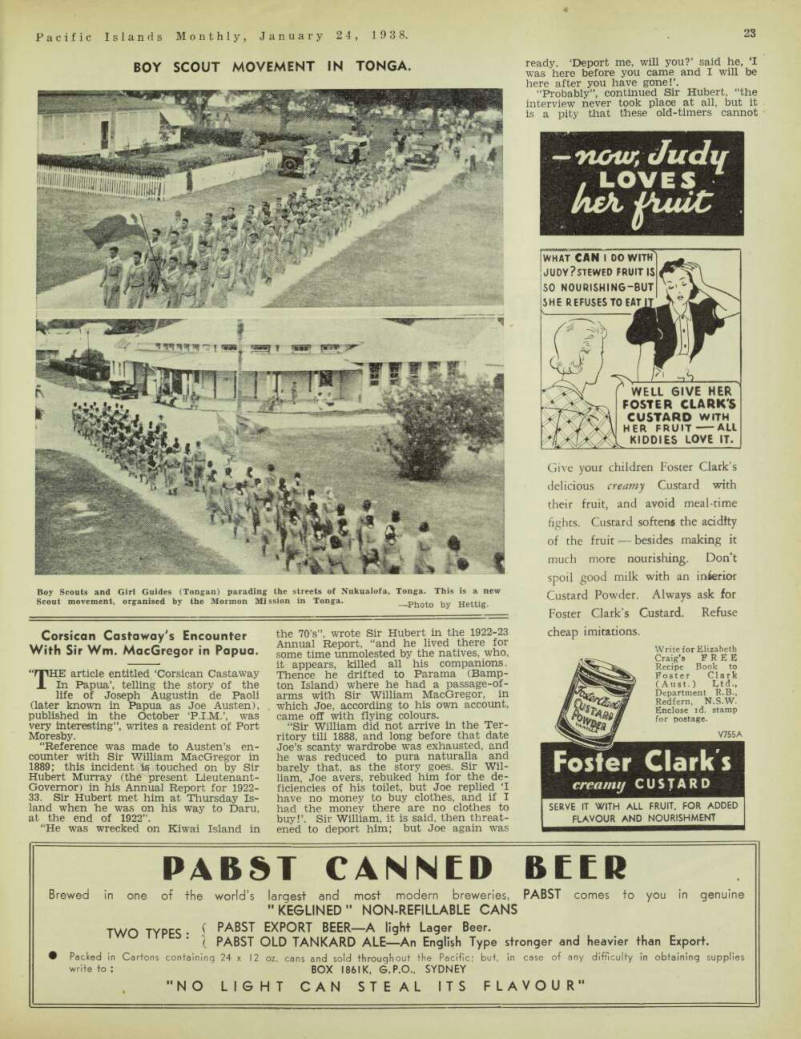
With Sir Wm. MacGregor in Papua.
‘TTHE article entitled ‘Corsican Castaway JL in Papua’, telling the story of the life of Joseph Augustin de Paoli (later known in Papua as Joe Austen), published in the October ‘P.I.M.’, was very interesting”, writes a resident of Port Moresby.
“Reference was made to Austen’s en counter with Sir William MacGregor in 1889; this incident is touched on by Sir Hubert Murray (the' present Lieutenant- Governor) in his Annual Report for 1922- 33. Sir Hubert met him at Thursday Is land when he was on his way to Daru, at the end of 1922”.
“He was wrecked on Kiwai Island in
the 70’s”, wrote Sir Hubert in the 1922-23 Annual Report, “and he lived there for some time unmolested by the natives, who, it appears, killed all his companions.
Thence he drifted to Parama (Hamp ton Island) where he had a passage-of arms with Sir William MacGregor, in which Joe, according to his own account, came off with flying colours.
“Sir William did not arrive in the Ter ritory till 1888, and long before that date Joe’s scanty wardrobe was exhausted, and he was reduced to pura naturalia and barely that, as the story goes. Sir Wil liam, Joe avers, rebuked him for the de ficiencies of his toilet, but Joe replied T have no money to buy clothes, and if I had the money there are no clothes to buy!’. Sir William, it is said, then threat ened to deport him; but Joe again was
ready. ‘Deport me, will you?’ said he, ‘I was here before you came and I will be here after you have gone!’.
“Probably”, continued Sir Hubert, “the interview never took place at all, but it is a pity that these old-timers cannot
tell their story in an intelligible and cred ible form. Joe must have much to tell, if one could only get sense out of him; but he is too old, and probably was too unobservant”.
Mr. N. (“Tibby”) Hagen, of Msessrs.
Hagen Brothers, Noumea, who is well known in New Caledonian and Australian commercial circles, arrived in Sydney by the January Pierre Loti on business. He returned to Noumea by the same vessel on January 15.
Miss C. McMillan, of St. John’s Mel anesian School, which is conducted by the Anglican Mission at Suva, Fiji, has resigned after two years’ service. She will leave shortly for England.
Advertisements & other items, pp. 25-26 (1 item)
Pab St Canned Beer
WHAT CAN I 00 WITH
JUOY?STEWED FRUIT IS
$0 NOURISHING-BUT
SHE REFUSES TO EAT
-ah
WELL GIVE HER
FOSTER CLARK'S
CUSTARD WITH
HER FRUIT ALL
KIDDIES LOVE IT.
Give your children Foster Clark’s delicious creamy Custard with their fruit, and avoid meal-time fights. Custard softens the acidity of the fruit besides making it much more nourishing. Don’t spoil good milk with an inferior Custard Powder. Always ask for Foster Clark’s Custard. Refuse
cheap imitations.
Write for Elizabeth Craig’s FREE Recipe Book to Poster Clark (Aust.) Ltd., Department R. 8., Redfern, N.S.W.
Enclose id. stamp for postage.
V755A
Foster Clark's
creamy CUSTARD SERVE IT WITH ALL FRUIT. FOR ADDED
FLAVOUR AND NOURISHMENT
PAB ST CANNED BEER
Brewed in one of the world's largest and most modern breweries, PABST comes to you in genuine
" KEGLINED " NON-REFILLABLE CANS
TWO TYPES $ EXPORT BEER—A light Lager Beer.
I PABST OLD TANKARD ALE—An English Type stronger and heavier than Export. • Packed in Cartons containing 24 x 12 oz. cans and sold throughout the Pacific; but, in case of any difficulty in obtaining supplies write to : BOX 1861 K. G.P.0., SYDNEY
"NO LIGHT CAN STEAL ITS FLAVOUR"
STAMPS
I am a prompt cash buyer of all types of Island stamps especially fine used New Guinea and Papua Pictorials and Airmail. Low or high values. Mint and used Coronation and Jubilee issues of all Islands sought. Permanent supplies of used current issues wanted.
Best Prices paid.
Stamp Collectors residing in any part of the Pacific Islands upon replying to this advt. will receive absolutely free enrolment in“ The South Seas Stamp Club”. All members will receive regularlv the well known Bi-monthly Journal ‘‘The Australian Stamp Collector”. This offer is made with the object of increasing Island membership in the club.
Apply W. HORNADGE, Manager,
Catherine Hill Bay, N. S.W., Australia
“FAIHHOLME”
PRESBYTERIAN GIRLS' COLLEGE
BOARDING SCHOOL FOR GIRLS—TOOWOOMBA, QLD.
Founded 1917.
Principal MISS D. E. CULPIN, B.A.
SCHEDULE OF FEES:
Tuition. Incid< 12 and over Under 12 Kindergarten NOTE: The fe £ s, d. 3 13 6 2 12 6 I 10 0 s. d. 12 6 12 6 2 6 zj zj • 1 ' utivj miuiiiui y oiQ I lUllciy, A reduction of \O/ o on all charges other than special subjects is allowed for sisters, and in all cases fees are chargeable from date of entry only.
COURSES AS PRESCRIBED FOR QUEENSLAND UNIVERSITY PUBLIC EXAMINATIONS (Academic, Home Science, Commercial) Provision is made tor the accommodation of boarders from distant parts during short vacations.
NEXT TERM COMMENCES Ist FEBRUARY, 1938
For further information apply to the Secretary . . .
MR. R. T. PHELPS, F.A.A., 491 Ruthven Street, Toowoomba, Qld.
The ONLY British
Portable Typewriter
with standard 4-bank k e ))board
A beautiful, compact and sturdy machine. It does almost everything a big typewriter can do. Every possible modern feature giving better speed, accuracy, simplicity, durability, and quieter operation. Contained in a handsome case. The best value you can buy.
! M PIRIAI
Good Companion
fir hme office
SMART,SMOOTH
SPEEDY.,.
A handy little machine invaluable for every type of work in the home and office. Saves hours of laborious writing. May be carried anywhere. AGENTS: Dobell Pty. Limited, 107 Pitt Street, Sydney.
W. R. Carpenter & Co. Ltd., Rabaul, Salamaua, Kavieng, Madang, New Guinea.
W. R. Carpenter & Co. (Sol. Is.) Pty., Ltd., Tulagi, Solomon Is.
On Chong & Co. Pty. Ltd., Butaritari, Gilbert Islands.
Brown & Joske Ltd., Suva, Fiji.
T. E. Page & Co. Pty. Ltd., Rotuma, Fiji.
N.Z.—Fiji Flight
Cancelled Imperial Airways Alter Itinerary of Airboat "Centaurus."
AT the last moment, when the giant British flying-boat ’ “Centaurus” was in New Zealand, the proposed flight from Auckland to Suva, Fiji, was can celled by Imperial Airways.
Officials announced that the flight had been called off because plans have now been completed for an Empire airboat to make a round-the-world flight in 1938. The “Centaurus” was also re quired to remain in N.Z. longer than had been at first anticipated.
It is likely that the flying-boat “Cam bria” will be made available for the forthcoming world flight. She is one of two airboats which are specially equipped for long range work, and can fly non-stop for more than 3,000 miles.
After flying to Australia on a route yet to be decided, the boat would pro ceed to N.Z., and from there make a survey of the Pacific Ocean to Van couver. Flying across Canada, the boat would make another Atlantic crossing to complete its voyage round the world.
The journey across the Pacific would be a leisurely survey with a view to estab lishing the most practical route for the trans-Pacific service.
Details of the flight, to take place probably in April or May, will be issued in March.
U.S. Warships Survey Pacific.
EN ROUTE to Sydney to attend the 150th Anniversary Celebrations, four United States cruisers carried out an aerial survey of portions of Central Pacific in January. The ships—“ Loui sville”, “Trenton”, “Memphis”, and “Milwaukee”—carried 10 seaplanes.
They visited Hawaii (January 9-11) and American Samoa (January 17-19), and are due in Australia on January 25.
Overland Trek To Lake
Kutubu.
From Our Own Correspondent.
Pt. Moresby, Jan. 4.
Patrol Officer C. J. Adamson,
attached to the Police Camp under Mr. Ivan Champion. A.R.M,, at Lake Kutubu, has travelled overland through Central Papua from the Kikori River by way of the Mobi. He arrived at the Lake camp on December 14, accompanied by ?0 native carriers. The journey was made in good time and under excellent conditions.
The capital of Morobe Gold Develop ments, Ltd., New Guinea, has been in creased from £5,000 to £7,000 by the creation of 2,000 new shares of £1 each.
By establishing a new agency at Vatu koula (Tavua), the Bank of New South Wales now has three 'branches—Suva, Lautoka, and Levuka —and four agencies in the Colony of Fiji.
Taro Bread.

Why Should Not New Hawaii Industry Spread to South Seas?
From Our Own Correspondent.
Honolulu, Dec. 7.
NEW uses for taro, the ancient staple food of many Pacific native peoples, are being found by research workers in the Hawaiian Islands which to-day im port at least 85 per cent, of their food stuffs.
The U.S. Army and Navy Forces in Hawaii, for better-defence reasons, aim to make the islands more self-supporting in the produce of diversified farming.
To show what can be done with an old food like taro, Major-General Andrew Moses, who commands the army in Hawaii,'invited civic leaders to a lunch eon this week at which every food eaten was an extract of taro.
The demonstration luncheon featured: Taro hotcakes, taro rolls, cookies, dough nuts, pudding, pie (crust and filling), raisin bread, cup cakes, various kinds of taro bread, taro ice cream and taroco, a taro drink flavoured with chocolate.
About 30 guests participated in the meal and pronounced the new flavour a distinct culinary victory for Uncle Sam.
In a speech covering the activities of the army in developing taro products, General Moses said: — “It appears that the development of a local taro products industry is valuable from an economic standpoint, is entirely practicable, will be beneficial to the health of all who may use it, and is a very important step in the development of this island to a greater degree of self sufficiency.
“This, in my opinion, is absolutely es sential to the business stability of this community and, most important, will as sist greatly in providing for the susten ance of the civilian population of this island in case of a major emergency.
“The feeding of the civilian population of Oahu is a matter which has given me much concern, for regardless of peace or war, the people must be adequately fed.
I have therefore watched with great in terest all developments leading to an increase in the production of diversified food crops in the islands”.
Taro bread, incidentally, is made from a blend of 15 per cent, of taro flour and 85 per cent, regular white flour.
Army doctors pointed out that some 20,000 soldiers in the islands eat taro products every day, especially taro bread.
The flour is milled at a new Honolulu factory. The taro bread served among the army equals one-third of each day’s bread rations.
Taro has been recognised in many scientific experiments in the islands for promoting proper growths, especially in children. Taro is rich in calcium and vitamins. It is an ideal starch food.
Some day, some enterprising person will start a taro industry in Queensland.
Mr. A. L. Armstrong, formerly Prin cipal Assistant Colonial Secretary in
Fiji, arrived in Nukualofa, Tonga, by
the December “Matua” to take up duties as British Agent and Consul, vice Mr.
J. S. Neill, who is now Administrator at Dominica (West Indies). Mr. Arm strong was accompanied by his wife.
Mr. Eric Chater, N.G. general manager for Guinea Airways, Limited, is at pre sent spending three months’ leave in Australia, with his wife.
Nauruan Scouts Educated
In Australia.
HAVING completed a 15 months’ course of semi-technical education at a Geelong school, Victoria, a party of Nauruan Boy Scouts sailed from Syd ney for their homes in Central Pacific at the end of December. Mr. H. Hurst, a Geelong Scout Commissioner, accompanied the lads, and will return to Australia in February with another party.
This development is part of the Nauru Administration’s policy to send selected youths to Australia for intensive educa tion and training for leadership. The plan is earned out in conjunction with the Scout movement.
The Handbook of the Fiji Government is on sale in Sydney, at 2/- per copy,
by Messrs. Dalgety & Co., Ltd.
Papua's Uncontrolled
Area.
From Our Own Correspondent.
Port Moresby, Jan. 5.
A GOVERNMENT proclamation, in the Gazette issued to-day, suspends the Uncontrolled Area Ordinance in re spect to persons entering the area in aircraft. It is provided, however, that neither persons nor aircraft may land within such area.
Mrs. Harold Taylour, wife of the manager of Enterprise of New Guinea Gold and Petroleum N.L., arrived in Sydney from Wau by the December “Neptuna” to spend Christmas with her husband and young son, who already had come South.
Mr. R. J. Stephen, manager of Messrs.
W. R. Carpenter & Co.’s hardware de partment at Rabaul, T.N.G., arrived in Sydney in December by the “Montoro”, on leave.
Mr. and Mrs. H. Warne Nicholls, of Solovi Estate, Nadi, Fiji, are at present in Victoria spending two months’ holi day.
Mr. Charles Banks, managing director of Bulolo Gold Dredging, Ltd., and Placer Development, Ltd., sailed from Sydney for New Guinea on a visit of inspection by the “Macdhui” on De cember 22. He was accompanied by Mr. L. V. Waterhouse, a director of both companies.
Advertisements & other items, pp. 27-28 (1 item)
Delco - Light
Electric
Light for
Your
Bungalow
Here’s a rugged and highly efficient lighting plant that will provide electricity to light your bungalow, camp or boat, also power for your radio.
Generating 200 watts, this remarkable 2812 Delco-Light plant will brilliantly light your home. It supplies power for eight 25 watt lamps from the generator or five from the 105 A.H, battery for 10 hours when fully charged. Economical, too, for on one gallon of petrol it will run for 16 hours.
Delco-Light is a product of General Motors Corporation, an institution whose reputation for fine mechanical products is world wide.
Write to-day to desk PI for complete informative literature regarding this 40 lb. “Package of Power”.
PRICES OF PLANTS—IN BOND, SYDNEY.
2812 (12 volt)—£26/10/-, with 83 A.H. battery (car type.) 2812 (12 volt)—£29/10/-, with 105 A.H. battery (individual cells.) 286 (6 volt)—£27, with 105 A.H. battery (individual cells.) Distributors: —
WARBURTON, FRANKI, LTD.
307-15 KENT STREET, SYDNEY.
MELBOURNE
BRISBANE.
TO PLANTERS AND TRADERS
William E. Reed
(Established 1913) Union House, 247 toeorge St., Sydney For all Island Requirements, Island produce sold.
Prices right. Enquiries welcomed.
THERE’S NO SUBSTITUTE
FOR QUALITY
CRISP and delicious, oven tinted to a rich but tender brown, baked to that final fraction of a second which holds perfect flavour without loss of protein or vitamin content.
Made of whole fine selected wheat grains. These appetising SHREDDED WHEATMEAL BISCUITS are the most tempting form of health food and extremely easy to digest.
TRY THEM WITH BUTTER,
CHEESE, JAM OR HONEY
ARNOTTiS
FAMOUS
SHREDDED
WHEATMEAL
BISCUITS
Always ask your Grocer for Arnoff’s
“THEY ARE BETTER THAN EVER”
Australia And The New Hebrides.
The Story of a Forgotten Gift of Land.
(The following article, by R. W. Robson, editor of the “Pacific Islands Monthly’’, was published in the “Sydney Morning Herald” on December 16.) THOSE acquainted with the history of the New Hebrides must have been glad to see the admirable leading article in the “Sydney Morning Herald” of November 27 and to realise that at long last the Commonwealth Government may take some part in the future de velopment of this group.
Your article outlined the history of the Condominium: but did not state one of the important reasons why Australian influence should be extended in that ter ritory. It is a fact —though probably not a score of people here know it—that the Commonwealth Government of Australia is the largest -single landowner in the New Hebrides. The story is an interest ing one.
Over fifty years ago the late Sir James Burns, founder of Messrs. Burns, Philp and Co. Limited, with that vision
and initiative that won him his conspicu ous place in Australian history, saw that the New Hebrides would be lost entirely to Britain unless vigorous action were taken. He failed to induce the Govern ments concerned to do anything; so, with that energy characteristic of him, he personally interviewed a number of his friends, leading men in Sydney and Mel bourne, and among them they formed the original Australasian and New Hebrides Co. Limited.
This company commenced trading and planting in the New Hebrides. Its first manager was the late Mr. J. G. Laing, for many years a leading executive of Messrs. D. and W, Murray Limited. An other early manager was Mr. Joseph Mitchell, now a director of Messrs. Burns.
Philp and Co. Ltd. The new company did not flourish. It was reconstructed two or three times and finally was con trolled by Messrs. Burns, Philp and Co.
Ltd. and carried on for a few years.
Finally it was wound up and its assets taken over by Burns, Philp and Co.
By then, it was the owner of large areas of good land on practically all of the islands of the New Hebrides. Right from the commencement of its opera tions, this company set out to acquire good plantation land, which, fo!r the most part, it purchased from the native owners. It was stated subsequently that it was the need for finding so much cash for its purchases that caused the finan cial collapse of the company. The land was obtained in various ways, but the transactions were all open and above board, and the Co.’s titles to the various areas were as clean as was possible un der the conditions which ruled in those days.
When the Co. was wound up, Sir James Burns handed over the whole of the land interests acquired by the Aus tralasian and New Hebrides Co. Ltd. to the Commonwealth Government. The action was characteristic of the long vis ion of this notable man. He knew that eventually Australia, if only for defence reasons, must take an interest in the control of the New Hebrides; and he saw that if Australia were actually a land owner in the group, she would be all the more likely to act. It is probable, also, that he saw that if Australian settlers were encouraged to go to the New Heb rides, the trading and transport busi ness of his big firm would be assisted. At any rate, the fact is that the Common wealth Government accepted those large land interests.
The Condominium Government began to function in the New Hebrides on November 2, 1907, and for the last 25 years the Joint Court of this government has been slowly and painfully scrutin ising land claims and issuing titles. It is a colossal task, and only a very little part of it has been completed. For the last 25 years, a solicitor appointed and paid by the Commonwealth Government has lived in Vila, his duty being to pro secute the Commonwealth Government’s land claims before the Joint Court and also to protect the Commonwealth Gov ernment’s land interests on the various islands against all sorts and conditions of people, who have sought to take posses sion of the choicest areas. For about 20 years, Mr. F. E. Wallace was the solicitor, residing in Port Vila, who carried out this duty, but he retired recently and another solicitor now represents the
Commonwealth Government there.
Between 1905-1912 some scores of Aus tralian people, encouraged by the Com monwealth Government, went to the New Hebrides and settled there on the Aus tralian land; but gradually Australia seemed to lose interest in the project and in the settlers. The reason that has been given is that planters in the New Heb rides cannot carry on successfully unless they have the assistance of indentured Asiatic labour. The native labour is unsuitable and unreliable. The French, realists always, brought in large num bers of Tonkinese as indentured labour ers and the French planters, assisted and encouraged in many ways by the French Government, flourished and became soundly established. The unfortunate British-Australian settlers got no such help. There came into power in Austra lia a series of Labour Governments, to whom the very name of indentured la bour was anathema, and they rejected all plans for helping the planters in New Hebrides.
Then came the War; and after the War Australian interests and Australian planters in the New Hebrides were vir tually forgotten. Within the first ten years after 1918, Australia sent a com mission to the New Hebrides to enquire concerning the vexed question of inden tured Asiatic labour; but by the time it had submitted its report (which was de finitely in favour of Asiatic labour) there had been another change of government in Australia, and the report was pigeon holed and has not been heard of from that day to this.
It is a tragic story of political stupidity and muddle. Several times in the last few years—notably in January, 1932, and in October, 1934 —a few of us brought the foregoing facts before certain members of the Federal Parliament, and tried to get something done; but it was like hammer ing against a stone wall. It is indeed gratifying that, at last, the Common wealth Government is inclined to act even if the reason for action is the need for building up strong defences against a potential foe in the North Pacific. Ac tually, if Australians would only realise it, all the facilities exist (including the ownership of large areas of valuable land) for providing young Australian men with a field for active and profitable enter prise.
EDITORIAL NOTE.—Commenting up on this article, Mr. Graham Kerr (of Messrs. Kerr Bros., Sydney) challenged two statements that had been made. He said that the Commonwealth Government is not the largest landowner (or land claimant) in the group: that title goes to the Societe de, Nouvelles Hebrides.
He said also that Australia cannot be blamed for the fact that British planters have been left without adequate labour —that the situation was controlled by the High Commissioner for the Western Pacific, at Suva. The point that Mr.
Robson intended to make—although he left it obscure—was that, while Austra lia had no authority whatever in the Con dominium, Australian Labour influence was strongly and actively against Asiatic indentured labour—just as it is in West ern Samoa to-day.
A wireless telephonic set has been installed at the headquarters of the New Guinea Mission (Anglican) at Dogura,
Papua, making possible communication
with the A.W.A. station at Samarai and with the various other Government and mission outposts.
Mr. and Mrs. Fred Godson, of Sogeri Plantation, Papua, were recently in California, and called upon Mr. George C. Dromgold, the American scientist, who visited Papua a couple of years ago.
Mrs. Godson, formerly Miss Gladys English, will appear in the pages of Mr.
Dromgold’s new book.
Rt. Rev. L. S. Kempthorne, M.A., Bishop of Polynesia, will leave Suva, Fiji, early in February on a visit to Tonga and Samoa.
Advertisements & other items, pp. 29-30 (1 item)
Horlicks
s
But I'm always
tired Doctor.
I even wake tired.
Think I need a
Tonic ?
Night-Starvations
your trouble, my
boy. What you
need is Horlicks
The demands of the day’s work require vitality body and mind refreshed and energised during sleep.
If you wake tired, it is impossible to concentrate properly or to do justice to your own capacity for good work.
Doctors describe this condition as Night Starvation that is, failure, to replace energy which is used up while you sleep.
If you wake “tired” Start taking Horlicks.
Horlicks taken regularly at bedtime, stores your body with the necessary vitality to meet the demands of the most exacting climate.
Horlicks already contains milk so where milk is scarce you may use water only but use rather more Horlicks to bring out the full flavour.
Horlicks may be taken either Hot or Cold according to your own taste.
Ask your Chemist or Storekeeper to-day for a bottle of Horlicks. (14\ oz. size costs 3/- in all main totcns throughout the British Pacific Islands.) Cm w. //, a DM f'e C/ Of f ink 'V // Plow *-S. u *6O Ctd }Q "/• **a y<i •Jje N /■ r ef JUc •it **th yo r es oh 7*l/ 1/ PC > Horlicks
HORLICKS
GUARDS AGAINST NIGHT-STARVATION
Huon Pine Boat Planks
Practically Borer Proof and Everlasting, also Spotted Gum Timbers—Prices Right. * /-* r 110 Miller St., A. rryer p yrmo nt. n.s.w.
STEAMSHIPS TRADING COMPANY LTD.
PORT MORESBY PAPUA SAMARA!
Chairman and Managing Director; A. S. FITCH.
Shipowners, Wholesale and Retail Merchants and Traders; Shipping, Customs and Insurance Agents; Copra and Rubber Plantation Owners.
MAIL CONTRACTORS TO COMMONWEALTH AND PAPUAN GOVERNMENTS.
AGENCIES:—At Port Moresby; Coral Sea Insurance Co.; Phoenix Insurance Co.; Delta Sawmills, Ltd.; Acme Bakery Co. ; Vacuum Oil Co. Pty. Ltd. At Samarai: Coral Sea Insurance Co. ; Delta Sawmills, Ltd.; Bankers and Traders’
Insurance Co.; National Mutual Life Insurance Co.; Kularo Shipyards; Mamai Plantations.
BRANCHES:—In Papua: Hanuabada, Sivitoi, Aroma, Koki, Hula. Ela Beach, Duga Duga, Yule Island.
SYDNEY: NELSON & ROBERTSON PTY. LTD., 12 Spring St.; Melbourne, 396 Flinders Lane; London, E. Whiteaway & Co., 7 Chiswell Street, Finsbury, London.
Cable Address: “STEAMSHIPS.” Code: Bentley’s.
1 M m i
SKANDIA
DIESEL
MARINE ENGINES
Highest Class. Prices Moderate.
Latest Installation " Chinsurah " 50 Horse Power Sydney - Port Moresby
12 Days
LOW CONSUMPTION FUEL AND LUBRICATING OIL
Australasian Distributors . . .
NELSON & ROBERTSON PTY. LTD.
12 SPRING STREET - - SYDNEY
British Consuls In
Tahiti.
By Eric Ramsden
THE interesting account of the British Consuls in Tahiti, which appeared in the December issue of the “P.1.M.”, by Mr. W. W. Bolton, M.A., of Papeete, filled in several blanks. How ever, as the writer himself admitted, the list was incomplete.
The British Foreign Office, at the re quest of Consul-General F. G. Gorton (our present official representative in Tahiti) has since supplied a detailed list of Consuls and Vice-Consuls and their periods of service, a copy of which has been made available through the cour tesy of the Mitchell Librarian at Sydney (Miss Ida Leeson, 8.A.). The list, which was despatched from London on Octo ber 25, 1937, is the first to be compiled and, coming from such a source is, nat
urally, of historical importance. It is as follows: Richard Charlton: Appointed Consul for the Sandwich, Society, and Friendly Islands, on September 23, 1824. The dis trict was reduced to exclude Tahiti on February 14, 1837.
Thomas Elley: Appointed honorary Vice-Consul in May, 1826. Resigned De cember, 1827.
George Pritchard: Appointed Consul, February 14, 1837. Transferred in 1844. (This brief biographical note, by the way, makes no mention of the historical im portance of Pritchard’s services in Tahiti.
No other British official there was ever such a controversial figure as Pritchard, who occupied a unique position as con fidential adviser to Pomare IV.).
C. B. Wilson: Appointed Acting-Con sul in the absence of G. Pritchard, June, 1841, to September, 1842. (Wilson was, of course, the son of one of the early missionaries. Herman Melville in “Typhee” has left a most amusing portrait of him.) William Miller: Appointed Consul- General for the Sandwich, Society, and Friendly Islands, and other Islands in the Pacific (resident at Honolulu) with supervision over Tahiti, August 16, 1843, until December, 1855, when his district was reduced to exclude Tahiti. Appoint ed his son George Charles Miller to be Acting- Consul on January 1, 1845. G. C. Miller remained Acting-Consul until April 9, 1850, when he was given the substantive appointment. He retired on pension on February 10, 1886. (It was Consul Miller who, from the outset, looked with dis favour on the Atimaono cotton growing project, under the direction of William Stewart, from the middle 60’s until the failure of the Tahiti Cotton and Sugar Plantation Co., Ltd., in 1872. Stewart made repeated efforts to have Miller dis missed. Much of the correspondence re lating to that period is now in the Mit chell Library.).
Andrew Gibson; Appointed Acting-Con sul during Miller’s leave from January 20, 1859, to June 25, 1859.
John Brander: Acting-Consul from April 5, 1864, to April 3, 1865, during Miller’s leave. (Brander was one of the leading British commercial men in his day, and married a daughter of Arii- Taimai and Alexander Salmon. He has descendants in Tahiti.) George Miller: Appointed honorary Vice-Consul on August 18, 1884. Acted as Consul from February 10, 1886, to June 9, 1886.
Captain C. A. P. Talbot: Appointed Consul November 24, 1885. Transferred October 1, 1889.
Albert G. S. Hawes: Appointed Consul, October 1, 1889, and transferred July 1, 1894.
Arthur J. Brander: Appointed honor ary Vice-Consul, December 17, 1800.
Acted as Consul from May 16, 1891, to November 1, 1891, and from June 11, 1894, to January 4, 1895. Resigned March 19, 1897. (After residing abroad for many years, Mr. Brander has now returned to Tahiti, where he acts as secretary for the Papeete Tourist Bureau. He is a son of John Brander, mentioned above.) Robert T. Simons: Appointed Consul, September 27, 1894, Transferred August 19, 1908.
John Hart: Appointed honorary Vice- Consul, March 19, 1897. Acted as Con sul from May 22, 1898, to December 29, 1898. He died on January 25, 1900.
John Augustus Phillips: Appointed hon orary Vice-Consul, December 17, 1900.
Acted as Consul from January 24, 1901, to April 2, 1901, and from August 23, 1903, to June 23, 1904. Resigned on Janu ary 6, 1906.
A. J. Du Temple: Appointed honorary Vice-Consul March 26, 1906. Acted as Consul in 1905-6-7-8. The Vice-Consul ate was abolished on July 14, 1910.
Arthur L. S. Rowley: Appointed Con sul, December 11, 1908. Transferred on January 8, 1912.
Herbert Arthur Richards: Appointed Consul on January 8, 1912. Transferred July 19, 1916.
Godfrey Arthur Fisher: Appointed Con sul, February 18, 1920. Employed in For eign Office from July, 1921.
Isaac Ernest Walker: Appointed hon orary Vice-Consul on September 28, 1922.
Consul in 1926-28. Resigned December 2, 1934.
Dr. W. J. Williams: Acted as Consul from 1916 to 1920, from May 11, 1921, to April 30, 1923, and from June 30, 1923, to March 5, 1928. Appointed Consul July 1, 1928, and resigned October 4, 1935.
Samuel Russell: Appointed honorary Vice-Consul on January 15, 1935. Acted as Consul that year, and died on Decem ber 28, 1936.
F. G. Gorton: Appointed honorary Consul with the rank of Consul-General March 2, 1936, and still in office.
Japanese Firm Expands In Central Pacific
Central Pacific.
From Our Own Correspondent.
Nukualofa, Dec. 15.
MR. Banno, the young Japanese who established here the well-known Japanese trading firm of Banno Brothers, which was recently formed into a limited company, arrived by the “Matua” from Auckland, N.Z., where he has been carrying on a flourishing import busi ness for some time.
The main purpose of his visit to Tonga was in connection with the proposed enlargement of his premises at Nukua lofa. A plan for a modern two-storied building has been approved. A large workshop and a garage are also to be erected. Mr. Banno will proceed to Samoa and Fiji where, it is rumoured, he will establish further branches.
These increased activities on the part of this fast-growing Japanese concern are viewed with no small alarm— especially when the whole civilised world is shockedvby the manner of Japan’s attack oh China.
Missed A Golden
Opportunity.
From Our Own Correspondent.
Rarotonga, Dec. 16.
THE local postmaster, Mr. R. L. Horn, has returned to New Zealand, after serving his three years’ term. If his farewell by the Bowling and Tennis Clubs was indication of his popularity he has left a place in the community’s esteem that will be hard to fill.
During his term, Mr. Horn handled something more valuable per ounce than platinum, namely, the Cook Island issue of the King George V. Jubilee stamps.
It will be an everlasting regret with him that he sent £4OO worth back to New Zealand to be destroyed. That amount of stamps to-day has a market value of £3,750 sterling!
O. F. Nelson In Reply.
Long Letter In Honolulu Journal.
COMMENT upon Samoan affairs, that is mostly sweeping and some times fierce, is contained in a long letter to the editor of the Honolulu “Star- Bulletin”, by Mr. 0. F. Nelson, pub lished on December 7.
Mr. Nelson challenges statements made in the “Star-Bulletin” by Mr. A.
M. Gurau, and, incidentally, traverses the whole field of Western Samoan politics. As Mr. Nelson in November took legal action against Mr. Gurau, based on the latter’s article in the
Honolulu paper, the publication of this letter on December 7 is surprising. It most clearly is sub judice—so much so that we cannot here summarise its most interesting points, much as we should like to do so.
The actions (two) which Mr. Nelson took against Mr. Gurau—one based on statements he was believed to have made in the “Pacific Islands Monthly”, and the other based on an article contri buted by Mr. Gurau to the Honolulu newspaper —were adjourned in Novem ber until January 25, 1938. The editor of the “Pacific Islands Monthly” has sent to Apia a sworn declaration, to the effect that he, and not Mr. Gurau, wrote the words published in the “Pacific Islands Monthly”, and complained of by Mr. Nelson.
Miss Geraldine Hogan, daughter of Hon. Gerald Hogan, Crown Law Officer in New Guinea, and Mrs. Hogan, arrived in Sydney by the December “Marella” after an absence of two years, the first part of which was spent with her parents in Rabaul and the last 10 months with relatives in Singapore.
Advertisements & other items, pp. 31-32 (1 item)
For Island Homes
SERVICES
You can have all the convenience of electric light and power, by installing a home lighting plant equipped with Clyde storage batteries. Clyde Plates are specially designed for slow discharge over long periods. At the snap of a switch, the unfailing power of Clyde Batteries will illuminate your home, operate your wireless, fans, refrigerators and other electrical appliances.
Clyde Home Lighting Batteries are fully guaranteed.
HOME -LIGHTING BATTERIES
Sales & Service Division, ® 61-65 Wentworth Ave., Sydney.
Island Agents: Burns, Philp & Co. Ltd. W. R. Carpenter & Co., Ltd.
Rabaul: John L. Peadon Ltd.
Fiji: Morris Hedstrom Ltd.
Maleham & Yeomans
LIMITED
BOWDEN STREET. SHEFFIELD, ENG.
Manufacturers of all kinds of Butchers', Sticking and Sheath Knives Razors and Scissors Specialty Hairdresser Scissors
PRICE LIST ON APPLICATION
Low-Priced Lightweight Cases
Travel light with these strongly-made, economical cases . . . there are sizes to meet all needs, from 12-inch attaches to 28-inch travel cases. The lids are reinforced with metal edges . . . the corners fitted with stout guards that prevent wear. Each Case has two nickel-plated English locks and keys.
BBX
12 20" r 22 24 N 9 77 Storekeepers everywhere can supply them . . . ask to see cases by Ford Sherington Ltd. At the price, they offer value unsurpassed.
SIZES:
No. 88, Attaches — 12, 14, 161, 18, and 20 inches.
No. 77, Suit Cases— -22, 24, 26, and 28 inches.
Traders are invited to write for full particulars of all TRAVEL and
LEATHER GOODS.
Ford Sherington, Ltd
MANUFACTURERS (Wholesale Only.)
KIPPAX STREET, SYDNEY.
Radio For Torres Strait
Missions.
HIGHLY successful tests were made in December with the first of a group of 16 radio stations being in stalled on Torres Strait Islands by Amalgamated Wireless (A/sia), Ltd., for the Queensland Chief Protector of Aborigines.
A.W.A. has fitted radio equipment at 15 Mission stations and posts where Government officials come in contact with the natives, and also on the Gov ernment ketch “Melbidir”. A central station has been provided at Thursday Island, from which the outlying stations are at distances varying up to 400 miles.
Low-powered transmitting equipment, which derives its energy from small en gine driven generators, is used. The trials revealed that one of the new stations can be heard quite clearly at Sydney—a distance of 1,600 miles—on an. ordinary three wave band radio re ceiver.
A Hardworked Missionary
on Holiday.
MISS ETHEL McMILLAN, a nursing sister on the staff of the Methodist Mission, in the British Solomon Is lands, arrived in Sydney on nine months’ furlough by the “Malaita” on December 17.
Miss McMillan has completed 23 years’ service with the Mission—most of the time on Choiseul, in charge of the Maternity and Girls’ Homes. In her earlier days on Choiseul it was the native custom to burn the newly-bom infant when the mother died in childbirth Sister McMillan res cued many of these unwanted infants, having on occasions as many as 17 in the home at one time. This gruesome custom has been abandoned, but the children are
still unwanted in the villages and are passed on to Miss McMillan’s care. The girls in the home are trained in cooking, sewing, basket-making and in native crafts, and devote a certain amount of time daily to the cultivation of native foods. Naturally, on completion of their training, they are in demand in the na tive matrimonial market, particularly with the natives of the Mission staff.
Miss McMillan originally did most of her travelling by canoe, manned by girls from the Home; but, following a capsize in a heavy sea, and a rescue by boys from the shore, the natives extracted a promise from her that in future men should be included in the crew. With the care of the infants, the girls’ home and the ma ternity ward, her work has been strenu ous and her long holiday well deserved.
Sister McMillan, with a group of her “unwanted”
Solomon Islands infants.
C.I. Schooners Delayed.
From Our Own Correspondent.
Rarotonga, Dec. 9.
THE two Cook Islands schooners “Tiare Taporo” and “Tagua” are in port at present waiting for cargo due by the “Matua”, which is a few days late on account of the watersiders’ strike in Auck land. The “Tiare” is due to sail for the Northern Cooks, while the “Tagua” will make one more trip around the Lower Group before leaving for Puka-Puka, Nas sau, and Mangarongaro. Both schooners remain in the Northern Cooks during the hurricane season.
Mr. Clarence E. Hart, manager of Lavoro Plantations, was a visitor to Australia during the Christmas holi
day season.
Mr. F. O. Moody, Copra Inspector in the N.G. Administration, reached Sydney in December on furlough.
Astray!
A Salute That Went
Douglas Fairbanks's Faux Pas At Papeete.
Letter to the Editor.
WITH reference to your Papeete cor respondent’s article, “Lese Majesty”, I beg a little space to give your widely-scattered readers an explanation which if not exactly interesting, is nevertheless an authentic and accurate one.
Ambitious to become a “Big Shot” on the occasion of his second visit to Tahiti, Mr. Douglas Fairbanks chartered the yacht “Caroline”, and with a brass “mu seum-piece” made a very big noise as the yacht entered Papeete Lagoon, by firing a Royal Salute of 21 guns.
As your correspondent records, the French Government allowed the world famous actor to risk dire consequences to his blood pressure, to his dignity and vocabulary, by coldly ignoring him.
Another incident, I wish to quote pro vides the surprising but quite natural ex planation.
Early in 1936 the French sloop “Savorg nan de Brazza”, visited Auckland, and a salute of 21 guns was given from the British Naval Authorities (New Zealand Squadron) in welcome.
Whereupon, to everybody’s surprise, the Commandant of the “Brazza” went to the British Naval Authorities and de manded an apology for an insult to the French Republic. They had greeted him, he declared, with a Royal Salute, where as a century and a half before the French people had had a revolution to abolish Royalty. They should have welcomed him with a Republican Salute of 11 guns. Apo logies were duly given, the offenders be rated for their error, and promises not to repeat the offence added.
Had Mr. Douglas Fairbanks known, as most citizens of a great sister Republic should be expected to know, that in an attempt to become a “Big Shot”, it is the quality of the shots that tells, rather than the quantity, undoubtedly Repub lique Francaise would have greeted him with something more cordial than the crushing coldness of stony silence. The only possible effect Mr. Douglas Fair banks’ cataclysm of noise could have had (besides shaking Papeete and re-echoeing down the verdant slopes of Oroheno) would have been to raise a sardonic and superior smile on the face of the British Consul for the compliment to himself, and the blunder to the Republic.
After the Assistant Chief of Police had explained these facts to me at Pa peete last July but one:— “What could we do?” he asked, with a gesture of contempt. ‘'He come here in the yacht ‘Caroline’ and behave like that . . . perhaps the British Consul . . . he like it. . . .”.
I am, etc.,
Edward C. Snow.
Pacific Islands Club, Sydney.
Rev. Robert Leek, who has been priest-in-charge and business agent for the Anglican New Guinea Mission at Samarai, Papua, since 1926, arrived in Sydney with Mrs. Leek by the “Mon toro” on January 10. Having reached the retiring age, he will not return for further work in the Territory.
Advertisements & other items, p. 33 (1 item)
W. H. GROVE & Sons Ltd.
AUCKLAND
Islands Traders p.o. box 490 Telegraphic and Cable Address: “Grove,” Auckland.
Shippers of all classes of New Zealand Products, specially prepared for the Island trade.
Representing
Rylands & Sons (Col.) Ltd., of London and Manchester. (Including the famous “Dacca” Mills Products.) Parbury Henty & Co. Pty. Ltd., of Sydney and Kobe.
“AGFA” Photographic Corporation, of Berlin.
J. Blair King, of London. World-famed Shirts.
Burrell & Co. Ltd., Millwall, London, E. 14. Oil, White Lead and all classes of Paints, including “FERROCENE” . their special Tropical Paint . . . PREVENTS CORROSION . . . made in RED, GREY, and GREEN. % or ONE would think that the camera was made from a single cast, so harmonious is the construction of the Speedex Record camera. Elegant appearance, easiness to carry in the case, extremely reliable lens and shutter, all help to make this camera one of the best of its kind. The correct choice of a camera is very important, for one does not buy a new camera every day, and it therefore has to be borne in mind that with the Speedex Record one is always fully equipped. As film use the all-weather Agfa Isochrom film.
New Caledonia's Trade.
Agreement with Australia Long Overdue.
THE Australian tariff on goods from New Caledonia is unnecessarily excessive, in the opinion of M. L.
Reverce, Premier of the Council- General of New Caledonia, president of Noumea, and mining engineer, who arrived from Noumea in the Pierre Loti on January 7 (says Sydney Morn ing Herald).
M. Reverce said that New Cale donia had additional quantities of kauri timber and manganese ore, which it could export to Australia if Australian tariffs were less. New Caledonia was a part of Australasia,
but its people were hardly made to feel that.
M. Reverce, who has interests in nickel and chrome mines in New Caledonia, said that business was brisk only in the nickel and chrome mines, because of the war in the East and the European situation. Other ore mines, in which he was interested, were lying dormant.
Editorial Note: The trade position between Australia and New Cale donia is an outstanding example of political stupidity—on both sides.
Each needs the products of the other, and New Caledonia is a large buyer; but each, as a matter of political habit, sets a ferocious tariff against the other. The negotiation of a trade agreement between the two is long overdue.
Pacific Educators
And Some Who Were Not So Pacific!
From Our Own Correspondent.
Honolulu, Dec. 16.
FOR five long weeks in the American summer of 1936, some 66 educators and social scientists gathered at the University of Hawaii, in Honolulu, and, excluding the press—because they declar ed the press does not “understand”— talked about social problems in countries bordering upon the Pacific.
Of course, there was plenty of back slapping and entertainment, and lots of epigrams and puns and familiar theories.
After all, what is an anthropologist?
There are some 1,400,000,000 peoples bordering upon the Pacific, so the educa ted gentlemen had plenty to talk about.
Most of what they talked about is sum marised in “Education in Pacific Coun tries”, which was written by Dr. Felix M.
Keesing of the University of Hawaii, who was one of the stage-managers of the conference. (Dr. Keesing is British-born, but for long knocked round in educa tional circles in Australia and New Zea land.) Dr. Keesing has done a good job of con densed reporting. He has reduced five weeks’ hodgepodge to 266 pages of read able material, a fine cross section of the 23 countries represented at the much quoted conference.
Strangely enough, the book was pub lished in war-torn Shanghai, by the firm of Kelly and Walsh, Ltd. It retails for six shillings.
The book does not tell the entire story: worthy of another book is the jealousies among the pet theorists, the politics, how there was much corn side-stepping. Why the book was -published in Shanghai would make a readable instance of how even 66 “educated” men cannot agree.
And they want to educate the natives of the great Pacific!
Death Of Captain

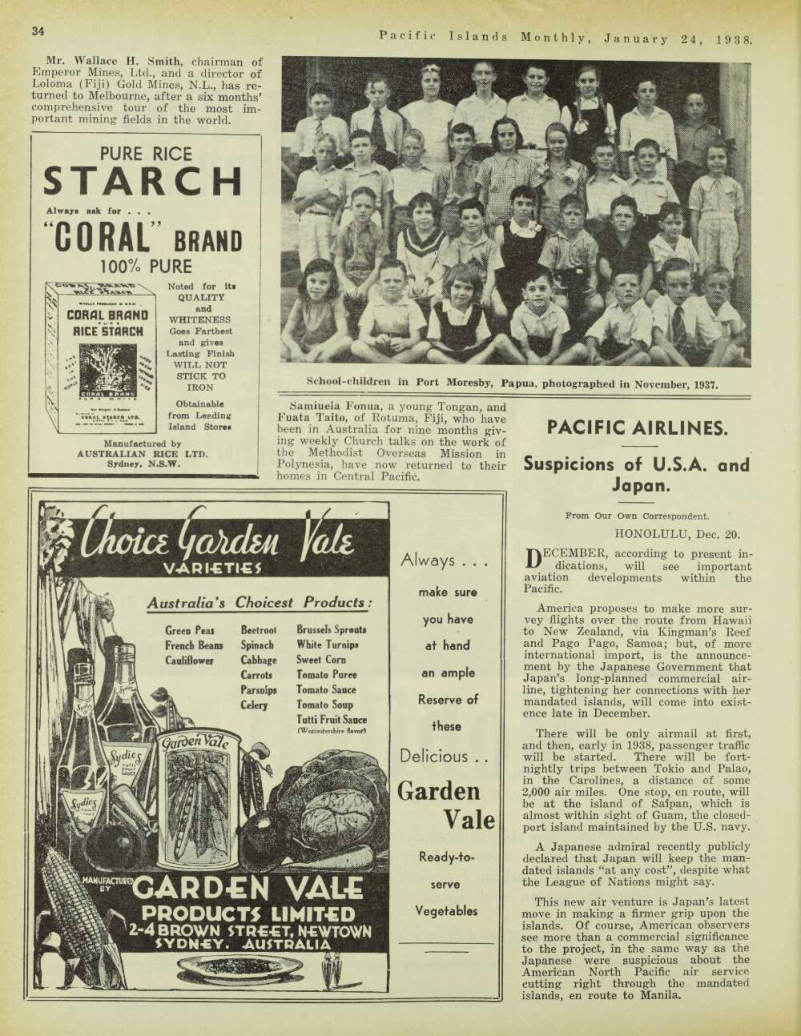
J. R. Mackay.
Captain John Ronald Mackay,
who, 40 years ago was a well known identity in the recruiting trade between Queensland and the South Seas, died at Brisbane on December 23, aged 78.
As chief mate of the Sybil and sub sequently as commander of the Hector, Captain Mackay was engaged in recruiting native labour for the Queensland canefields. In 1896 he joined the Queensland Pilot Service in which he remained for five years.
Later he went to Fiji, where as com mander of the Amrah, he carried on an inter-island mail service.
During his years of recruiting in Melanesia, Captain Mackay had many adventures. Once on Malaita he was made a native chief, and solemnly invested with the insignia of royalty— a shoulder strap of teeth and shells.
Mr. R. B. Jackson, Warrant Officer at Rabaul, New Guinea, has been ap pointed to take charge of the Adminis tration’s new motor vessel “Leander”, which will be stationed in the New Ire land District for patrol work.
Mr. Wallace H. Smith, chairman of Emperor Mines, Ltd., and a director of Loloma (Fiji) Gold Mines, N.L., has re turned to Melbourne, after a six months’ comprehensive tour of the most im portant mining fields in the world.
Samiuela Fonua, a young Tongan, and Fuata Taito, of Rotuma, Fiji, who have been in Australia for nine months giv ing weekly Church talks on the work of the Methodist Overseas Mission in Polynesia, have now returned to their homes in Central Pacific.
School-children in Port Moresby, Papua, photographed in November, 1937.
Advertisements & other items, pp. 34-36 (2 items)
“Icil Special'
Firearm Repairs: “OUR HANDS MAKE GOOD ARMS”. Firearms sent C.OD.
High-Grade
Second Hand Guaranteed Hammerless SHOTGUNS
I am continually receiving consignments from England. Among these in stock at present are:— Purdey, Jeffery, Lang, Greener, Boswell, Rigby, Evans, Cashmore, Holloway and Naughton, Hollis.
Second Hand English Hammer Guns from £5. Write for Second hand list. Also published separate list of Second Hand Hipower and low power Rifles. A chance to get a rebarrelled Rifle at a big cut on its original cost.
Firearms exchanged. Firearms over 50/-, post free. The Famous B.S.A. 12 Gauge Hammerless Gun, £l6/10/-. Write for Firearms Catalogue of 600 illustrations, and Fishing Tackle Catalogue of 300 illustrations, also second hand lists.
SIL ROHU Quality Firearms and Fishing Tackle, 143 ELIZABETH STREET, SYDNEY. (Near Market Street.) 'Phone;
’DUXBAC'and
“ICIL SPECIAL'
WATERPROOF CARTRIDGES
4* / A //7 Absolute reliability and certainty in performance —under all conditions —have firmly established them as The Most Popular of All With The Keenest Sportsmen.
Loaded with “Neoflak” Powder— the most modern and most successful of all shot gun propellants— both these brands combine High Velocity and Hard Hitting at Long Range. ozs. Shot in in. Shells.
Without Excessive Pressure or Recoil. 1 Obtainable
Everywhere.
POPULAR PRICES.
Use w DUXBAC"£ ICII SPECIAL- Wet Mates No Difference
MoMoil
THE GREATEST SELLING
OIL IN THE WORLD I
rv % fobiioi |‘AF mini Mobiloil = BB"
<&OYU
(>* % It \zV
Mobiloil
"A” x U ■
MtTT COWTtMTS M*fC»W- GHIXON
Vacuum Oil Company k I n i.i
MoMoil
MADE BY VACUUM S EXCLUSIVE CLEAROSOL PROCESS More Mobiloil is sold throughout the World to-day than any other motor oil. This is because Mobiloil gives:- Greater Oil Mileage, Practically NO Carbon, Freedom from Sludge and Gum, Complete Engine Protection at all Speeds and Temperatures.
VACUUM OIL COMPANY PTY. LTD. Throughout the Islands.
PURE RICE
STARCH
Always ask for . . .
CORAL BRAND
100% PURE
Noted for Its
QUALITY
and
WHITENESS
Goes Farthest and gives Lasting Finish
WILL NOT
STICK TO
IRON
Obtainable from Leading Island Stores
CORAL BRAND
RICE STARCH
CORAL •tA 1C R LTft.
Manufactured by
AUSTRALIAN RICE LTD.
Sydney, N.S.W.
Australia’s Choicest Products: Brussels Sprouts White Turnips Sweet Corn Tomato Puree Tomato Sauce Tomato Soup Tutti Fruit Sauce (Worcestershire flavor) Green Peas French Beans Cauliflower Beetroot Spinach Cabbage Carrots Parsnips Celery Qaften a
\-v«BS^-HANUFACTURra
CARD-EN VALE
mm
m;N PRODUCTS LIMITED
Z-iRDOU/W <TD-CJTT Kl-CM/TOV
2-4 BROWN STR€-ET, N-EWTOWN
SYDN-EY. -AUSTRALIA
U E Always . . . make sure you have at hand
an ample
Reserve of these Delicious . .
Garden
Yale
Ready-toserve Vegetables
Suspicions of U.S.A. and
Pacific Airlines.
Suspicions of U.S.A. and Japan.
From Our Own Correspondent.
Honolulu, Dec. 20.
DECEMBER, according to present in dications, will see important aviation developments within the Pacific.
America proposes to make more sur vey flights over the route from Hawaii to New Zealand, via Kingman’s Reef and Pago Pago, Samoa; but, of more international import, is the announce ment by the Japanese Government that Japan’s long-planned commercial air line, tightening her connections with her mandated islands, will come into exist ence late in December.
There will be only airmail at first, and then, early in 1938, passenger traffic will be started. There will be fort nightly trips between Tokio and Palao, in the Carolines, a distance of some 2,000 air miles. One stop, en route, will be at the island of Saipan, which is almost within sight of Guam, the closed port island maintained by the U.S. navy.
A Japanese admiral recently publicly declared that Japan will keep the man dated islands “at any cost”, despite what the League of Nations might say.
This new air venture is Japan’s latest move in making a firmer grip upon the islands. Of course, American observers see more than a commercial significance to the project, in the same way as the Japanese were suspicious about the American North Pacific air service cutting right through the mandated islands, en route to Manila.
“Highest Jobs With held
held from Trained Men”
Letter to the Editor.
IN your journal, in October, there ap peared a letter with the heading, “Highest Jobs Withheld From Trained Men”. The writer expressed his dis satisfaction with the appointment of administrators to Islands Governments, from sources outside the Islands ser vices.
This, according to your correspondent, appears to be the settled policy of the Commonwealth; and it may be of in terest to quote from a recently pub lished work of Sir Reginald St. Johnston, K.C.M.G., “From a Colonial Governor’s Note-book”, in which the author touches on much the same grievance, in relation to an appointment in the Colonial Ser vice some years back:— “I had made an application for the governorship of the Seychelles,” writes Sir Reginald St. Johnston, in referring to the time when, in May, 1922, he went on leave to England after three strenu ous years’ work in the tropics, as Colonial Secretary and Acting-Governor in the West Indies, “but I gathered on reaching England that a selection had already been made for this; and, soon afterwards, Sir Joseph Byrne’s appoint ment was gazetted. He had done good work as the head of the Royal Irish Constabulary, in a difficult period, and one could not grudge him this prompt governorship, though in principle it was very disheartening to the men in the Colonial Service, who had—to use a much worn expression—‘borne the bur den and the heat of the day’, to have outsiders put over their heads when ap proaching the time when they might justly expect a reward for their labours.
“In late years, however, there has been a change for the better, and a de finite pronouncement, satisfactory to the Colonial Service, was made on the sub ject at the Colonial Conference of 1930 in London.”
In view of this question in the Islands services to : day, it would per haps be helpful to discover what definite pronouncement, satisfactory to the Colonial Service, was made at the Colonial Conference in 1930.
At present, as your correspondent justly remarks, “there is no great in ducement for highly qualified young men to enter the service of either terri tory”. It certainly seems, as he adds, ‘ unwise to render thes.e services more unattractive by withholding the highest positions from the trained men”.
I am, etc.,
Fair Play.
Rabaul, New Guinea.
Editorial Note: The circumstances to which our correspondent refers are tnese. Within the last three years, the
Commonwealth Government has ap pointed three administrators to fill highly paid jobs in the Pacific—Sir W.
R. McNicoll, to New Guinea; Mr. Abbott, to the Northern Territory; and Sir Charles Rosenthal, to Norfolk Island.
Each of these men was either a member of Parliament, or an ex-member, and not one had had any special training in
tropical administration. On the other hand, there are several men in the Islands services who, apart from train ing, are qualified by character and per sonality to occupy the major positions.
Pastor S. W. Carr, of the S.D.A.
Mission in Fiji, arrived in Sydney from Suva by the “Niagara” on December 18.
Advertisements & other items, pp. 37-38 (2 items)
Canterbury
PRESCOTT LXP |y S D E NE S Y ar-e sole wholesale agents fbi'-
PINEAPPLE BACON s HANS
DAISY BRAND BUTTER
LEA& PERRINS’ H.P.Sauce
LEA & PERRINS’ Sauce
and Most other Super-Quality Lines of the Trade
Swallow & Arie M’s
WORLD RENOWNED
CANTERBURY
CARES
£XXXXXXXXX3
FRUIT
PLAIN
SEED
PLUM
ALMOND
cxxxxxxxxx: r*>
TCR9
Caic&
Melbourne, a txxxxxxxxxi
PRESERVED
GINGER
SULTANA
CHERRY
RIPE
GENOA
Each Cake is Enclosed, by special process, in air-tight tin, and is warranted to keep its condition for a considerable period.
The Fate Of La Perouse
The coast of Vanikoro, where the ships of La Perouse were wrecked 150 years ago. It is now the headquarters of the Vanikoro Timber Co.
How a Maritime Mystery was Solved on Vanikoro.
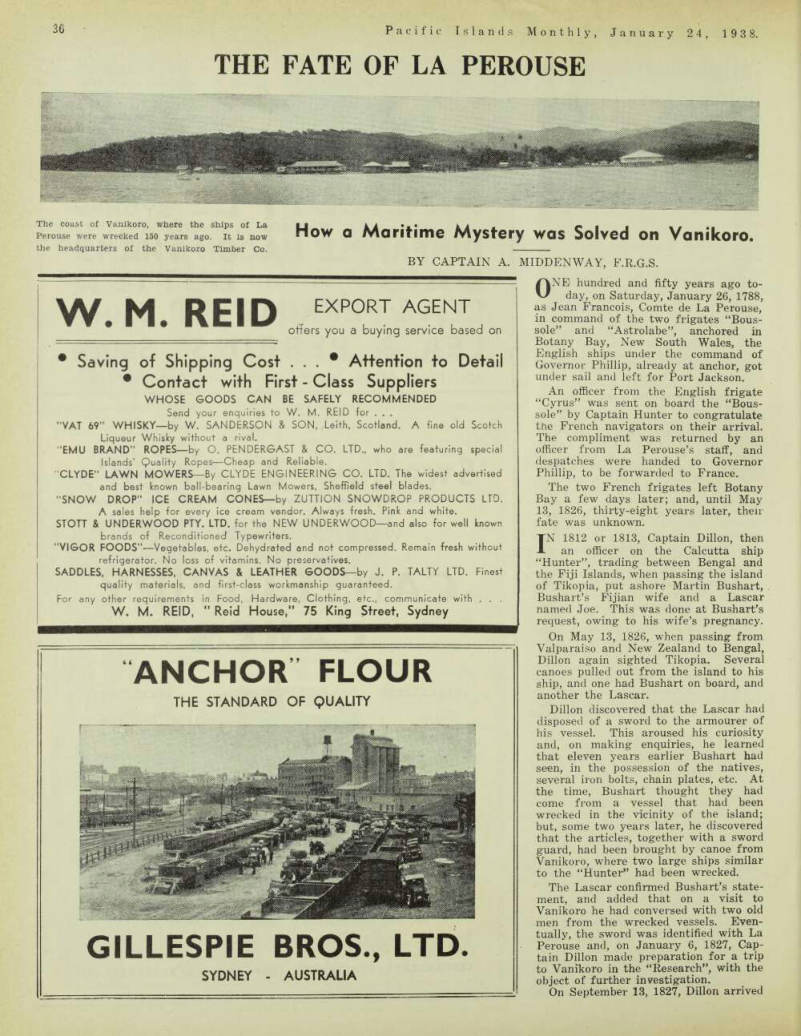
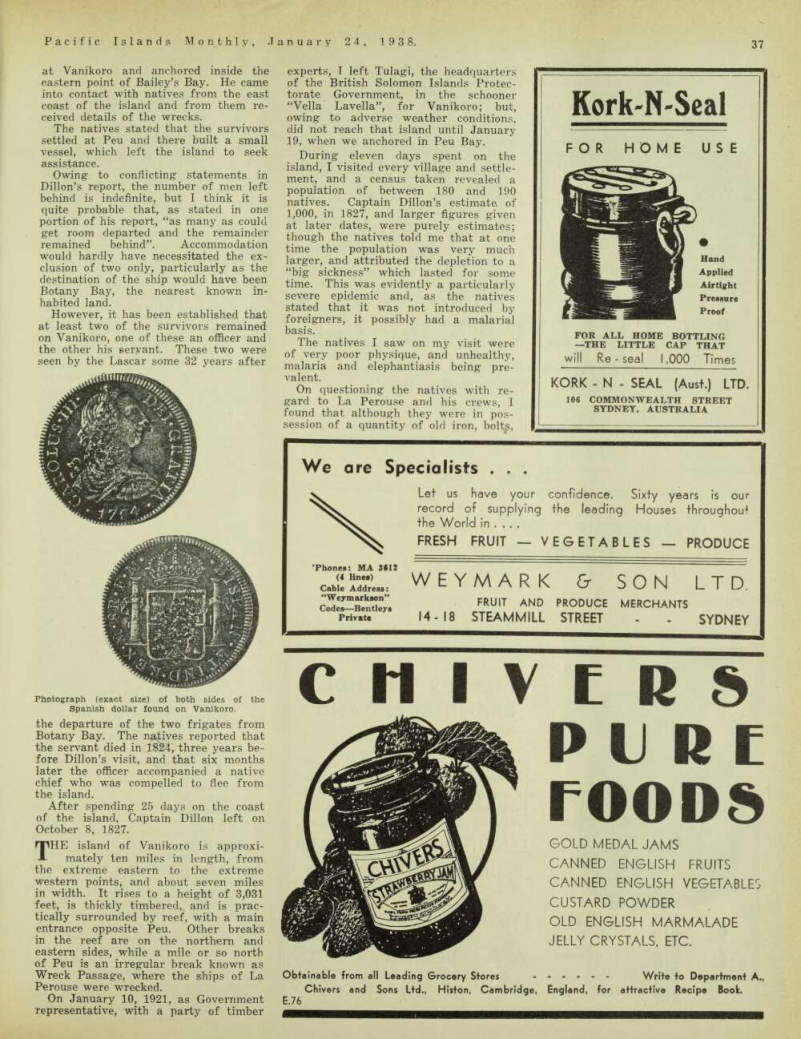
By Captain A. Middenway, F.R.G.S.
ONE hundred and fifty years ago to day, on Saturday, January 26, 1788, as Jean Francois, Comte de La Perouse, in command of the two frigates “Bous sole” and “Astrolabe”, anchored in Botany Bay, New South Wales, the English ships under the command of Governor Phillip, already at anchor, got under sail and left for Port Jackson.
An officer from the English frigate “Cyrus” was sent on board the “Bous sole” by Captain Hunter to congratulate the French navigators on their arrival.
The compliment was returned by an officer from La Perouse’s staff, and despatches were handed to Governor Phillip, to be forwarded to France.
The two French frigates left Botany Bay a few days later; and, until May 13, 1826, thirty-eight years later, their fate was unknown.
IN 1812 or 1813, Captain Dillon, then an officer on the Calcutta ship “Hunter”, trading between Bengal and the Fiji Islands, when passing the island of Tikopia, put ashore Martin Bushart, Bushart’s Fijian wife and a Lascar named Joe. This was done at Bushart’s request, owing to his wife’s pregnancy.
On May 13, 1826, when passing from Valparaiso and New Zealand to Bengal, Dillon again sighted Tikopia. Several canoes pulled out from the island to his ship, and one had Bushart on board, and another the Lascar.
Dillon discovered that the Lascar had disposed of a sword to the armourer of his vessel. This aroused his curiosity and, on making enquiries, he learned that eleven years earlier Bushart had seen, in the possession of the natives, several iron bolts, chain plates, etc. At the time, Bushart thought they had come from a vessel that had been wrecked in the vicinity of the island; but, some two years later, he discovered that the articles, together with a sword guard, had been brought by canoe from Vanikoro, where two large ships similar to the “Hunter” had been wrecked.
The Lascar confirmed Bushart’s state ment, and added that on a visit to Vanikoro he had conversed with two old men from the wrecked vessels. Even tually, the sword was identified with La Perouse and, on January 6, 1827, Cap tain Dillon made preparation for a trip to Vanikoro in the “Research”, with the object of further investigation.
On September 13, 1827, Dillon arrived
at Vanikoro and anchored inside the eastern point of Bailey’s Bay. He came into contact with natives from the east coast of the island and from them re ceived details of the wrecks.
The natives stated that the survivors settled at Peu and there built a small vessel, which left the island to seek assistance.
Owing to conflicting statements in Dillon’s report, the number of men left behind is indefinite, but I think it is quite probable that, as stated in one portion of his report, “as many as could get room departed and the remainder remained behind”. Accommodation would hardly have necessitated the ex clusion of two only, particularly as the destination of the ship would have been Botany Bay, the nearest known in habited land.
However, it has been established that at least two of the survivors remained on Vanikoro, one of these an officer and the other his servant. These two were seen by the Lascar some 32 years after
the departure of the two frigates from Botany Bay. The natives reported that the servant died in 1824, three years be fore Dillon’s visit, and that six months later the officer accompanied a native chief who was compelled to flee from the island.
After spending 25 days on the coast of the island, Captain Dillon left on October 8, 1827.
THE island of Vanikoro is approxi mately ten miles in length, from the extreme eastern to the extreme western points, and about seven miles in width. It rises to a height of 3,031 feet, is thickly timbered,, and is prac tically surrounded by reef, with a main entrance opposite Peu. Other breaks in the reef are on the northern and eastern sides, while a mile or so north of Peu is an irregular break known as Wreck Passage, where the ships of La Perouse were wrecked.
On January 10, 1921, as Government representative, with a party of timber
experts, I left Tulagi, the headquarters of the British Solomon Islands Protec torate Government, in the schooner “Vella Lavella”, for Vanikoro; but, owing to adverse weather conditions, did not reach that island until January 19, when we anchored in Peu Bay.
During eleven days spent on the island, I visited every village and settle ment, and a census taken revealed a population of between 180 and 190 natives. Captain Dillon’s estimate of 1,000, in 1827, and larger figures given at later dates, were purely estimates; though the natives told me that at one time the population was very much larger, and attributed the depletion to a “big sickness” which lasted for some time. This was evidently a particularly severe epidemic and, as the natives stated that it was not introduced by foreigners, it possibly had a malarial basis.
The natives I saw on my visit were of very poor physique, and unhealthy, malaria and elephantiasis being pre valent.
On questioning the natives with re gard to La Perouse and his crews, I found that although they were in pos session of a quantity of old iron, bolt^,
Photograph (exact size) of both sides of the Spanish dollar found on Vanikoro.
old hammers and ship’s gear, they could give no information at all of the fate of the survivors. They, however, could show me the spot where the vessels had been wrecked, and stated that they themselves had recovered some of the articles they had in their possession.
They also produced a number of Spanish Pilor dollars, one of which, dated 1784, I was fortunate enough to secure (see illustration). They informed me that some of the coins had been handed down to them by their own people, and others had been found at Peu, and on the banks of a river on the Tenua coast, b6en the larg6St VUlage IN September, 1926, I returned to Vanikoro as an administrative
officer of the Protectorate Government, and remained there until October, 1927.
By this time, the Vanikoro Timber Corn pany had established themselves at Peu, where, in putting down the foundations for their plant, they unearthed further coins and relics of La Perouse. Pre cautionary measures were being taken, but the island was decidedly unhealthy and badly infested by mosquitoes and sandflies—so much so that, to avoid these pests, the residential buildings of the Timber Company were erected on the shore reef some sixty or seventy yards from the beach.
During my residence on the island, I visited the site of the large village at Tenua. There were indications of a large settlement having been on this
site. I also visited the reef, at Wreck Passage. The natives stated that, in calm weather, wreckage could still be seen; and on several occasions I visited the spot in a canoe, but could not de finitely identify any wreckage. I was taken to five mounds of stones in the vicinity of Peu, and to two prominent mounds at Tenua, below the village site, which the natives claimed were the graves of white men. These mounds were in no way connected with the native burial grounds and their condi tion supported the natives’ contention that they were very old.
DURING the short period spent by Captain Dillon at Vanikoro, he ap pears to have left most of the investi gation to his ship’s officers, who were assisted by an interpreter from Tikopia.
In a letter of instruction to one of his officers, dated September 18, 1827, when he was leaving the ship for the village of Denimah, Dillon wrote: “At no time place confidence in the Tikopian who answers in a way that he thinks will please”. Apart from this lack of con fidence in the interpreter, there is no similarity in the languages of Tikopia and Vanikoro, the former having a Polynesian and the latter a Melanesian basis, and contact between the natives of these two islands must necessarily have been very limited owing to dis tance (some 120 miles of open sea), prevailing weather conditions and transport difficulties.
It is, therefore, more than probable that Dillon did not receive thoroughly reliable information. His report is de cidedly incomplete and in parts contra dictory, and it would appear that he made no effort to discover the names of the two white men who were seen by the Lascar, which would no doubt have been given in mutilated though recog nisable forms of the correct names, nor does he appear to have visited the site of the wrecks his investigations seem to have been confined to the east coast of the island, and to the identification of the wrecked vessels.
Confirmation of the details of Dillon’s report is, of course, impossible at the present time. I am quite certain that any information concerning the wreck of the vessels or the survivors that can be gathered from the natives of the present day has been acquired by them from other than natives sources. Neither native legend nor song has reference to the incident. Nevertheless, some of the statements in Dillon’s report can be reasonably disputed.
Referring to the disposal of the body of the white man who died on the island in 1824, Dillon states that the body was not buried but was thrown into the sea in accordance with native custom. I was assured that burial at sea was never the custom of the people, and I was shown many of their burial grounds and skull houses, as well as the graves of the white men. They told me that head hunting had never been practised on the island, and this is confirmed by Dr.
Codrington in his book, “Melanesians, their Anthropology and Folk-lore”. The heads in the skull houses were all in perfect condition and in striking con trast to those in the Western Solomons,
where many bore testimony of having been trophies of the hunt, and their statement that the heads preserved were those of deceased persons of rank and were kept as memorials of affection is undoubtedly correct.
In addition, I was informed that it had always been the practice to bury personal effects with the body, as is done in other parts of Melanesia, and that in this way many coins and relics of the wrecks had been disposed of.
Again, that the officer who remained behind after the departure of the locally constructed vessel left the island in the company of a native chief, who was com pelled to flee for safety, is also improb able. There is no record of inter-tribal strife on the island, and apparently there has always been one paramount chief. The size of the island would hardly permit of other conditions. The two white men apparently lived at Tenua, which was the headquarters of the paramount chief, and, not only is it unlikely that this chief would be com pelled to flee for safety, but there is no record of the incident on Vanikoro, or on any of the adjacent islands. It is more than probable that the departure of the white man was a story, con cocted by the natives, superstitious where death is concerned, to avoid ques tionings or complications, and Dillon appears to have accepted it without confirmation.
It is unfortunate that Dillon did not make any effort to identify the two sur vivors who were seen by the Lascar and who were on the island to within three years of his arrival, but that La Perouse could have been one of them is most improbable.
La Perouse was born on the 23rd August, 1741, and with the unusual and trying conditions under which he would have been compelled to live on Vanikoro, it is unlikely that he was alive in 1824 at the ripe old age of 83 years. There is, of course, the possibility that he left for Botany Bay with the party in search of assistance, but the fact that so many of his personal belongings, including his sword, were in the hands of the natives would suggest that he either did not reach the shore, or, having done so, died in a comparatively short time.
The two survivors Seen by the Lascar in approximately 1820 evidently died on the island and were buried there, pos sibly in the graves at Tenua.
Dillon does not appear to have in terested himself in the whereabouts of the ships’ records. Whether these were taken away or remained in the custody of the officer in charge of the shore party would, to an extent, depend on the seniority of the officer. If by any chance they remained on Vanikoro they would have been of no interest to the natives, and in all probability, in ac cordance with native custom, would have been buried with the last survivor.
While recognising the value of Cap tain Dillon]s report, it is to be regretted that the investigation was not more thorough, and one views those two mounds of stones at Tenua with rever ence and with an excusable speculative curiosity.
Advertisements & other items, pp. 38-40 (2 items)
Anchor Flour
W. M. REID , EXPO b RT AGEN b T , otters you a buying service based on • Saving of Shipping Cost . . . Attention to Detail Contact with First - Class Suppliers
WHOSE GOODS CAN BE SAFELY RECOMMENDED
Send your enquiries to W. M. REID for . . .
"VAT 69" WHISKY —by W. SANDERSON & SON, Leith, Scotland. A fine old Scotch Liqueur Whisky without a rival.
"EMU BRAND" ROPES —by O. PENDERGAST & CO. LTD., who are featuring special Islands’ Quality Ropes—Cheap and Reliable, "CLYDE" LAWN MOWERS— By CLYDE ENGINEERING CO. LTD. The widest advertised and best known ball-bearing Lawn Mowers, Sheffield steel blades.
"SNOW DROP" ICE CREAM CONES— by ZUTTION SNOWDROP PRODUCTS LTD.
A sales help for every ice cream vendor. Always fresh. Pink and white.
STOTT & UNDERWOOD PTY. LTD. for the NEW UNDERWOOD—and also for well known brands of Reconditioned Typewriters.
"VIGOR FOODS"' —Vegetables, etc. Dehydrated and not compressed. Remain fresh without refrigerator. No loss of vitamins. No preservatives.
SADDLES, HARNESSES. CANVAS & LEATHER GOODS— by J. P. TALTY LTD. Finest quality materials, and first-class workmanship guaranteed.
For any other requirements in Food, Hardware, Clothing, etc., communicate with . . .
W. M. REID, " Reid House," 75 King Street, Sydney
ANCHOR FLOUR
THE STANDARD OF QUALITY
I 1 H
GILLESPIE BROS., LTD.
SYDNEY - AUSTRALIA
Pure
Kork-N-Scal
FOR HOME USE
FOR ALL HOME BOTTLING
—THE LITTLE CAP THAT
will Re - seal 1,000 Times
KORK - N - SEAL (Aust.) LTD.
106 COMMONWEALTH STREET
SYDNEY, AUSTRALIA
Hand Applied Airtight Pressure Proof
We are Specialists . . .
'Phones: MA 3C12 (4 lines) Cable Address: “Weymarkson”
Codes—Bentleys Private Let us have your confidence. Sixty years is our record of supplying the leading Houses throughout the World in ... .
FRESH FRUIT VEGETABLES PRODUCE
WEYMARK & SON LTD.
FRUIT AND PRODUCE MERCHANTS
14-18 STEAMMILL STREET - . SYDNEY
C El I V
OS Obtainable from all Leading Grocery Stores Chivers and Sons Ltd., Histon, Cambridge, E. 76
EPS
PURE
FOODS
GOLD MEDAL JAMS
CANNED ENGLISH FRUITS
CANNED ENGLISH VEGETABLES
CUSTARD POWDER
OLD ENGLISH MARMALADE
JELLY CRYSTALS, ETC.
Write to Department A., England, for attractive Recipe Book.
J. J. SULLIVAN Pty. Ltd.
Sullivan's Buildings
168 -174 SUSSEX STREET, SYDNEY, N.S.W.
Cable and Telegraphic Address: “SULLGREN,” Sydney.
GENERAL MERCHANTS IMPORTERS
EXPORTERS SHIPPERS
ALL COMMODITIES HANDLED
• Best Roller Flour , . . Best Biscuit Flour
HIGHEST GRADE "CORAL" BRAND SHARPS
" Pony " Brand Oats.
Dried Fruits, Prunes, Sultanas, etc.
Canned Meats . . . Canned Fruits Jams, etc. • PROMPT ATTENTION TO CABLE AND MAIL ENQUIRIES. WHICH
ARE APPRECIATED
Telephone: M 6268 (3 lines)
■ II USE
FOR RELIABILITY
AND LONG SERVICE
Manufactured by: Suva Agents: Sydney Agents:
MILLER'S "ANCHOR"
BRAND ROPES AND
CORDAGES.
Manila, Sisal, New Zealand Coir and Cotton Rope of every description.
Twine, Sewing Twine, Shop Twine, Binder Twine and Fishlines, Lashings, Halters, Plough Reins, Sack Cord, Blind Lines, etc.
LENGTH STRENGTH
QUALITY GUARANTEED
JAMES MILLER & Co. Pty. Ltd.
MELBOURNE, VIC., AUST.
A. S. FAREBROTHER & CO.
And at Lautoka, P.O. Box 36. Tel. 261
P. T. TAYLOR LTD.
The Trees the Tourist Sees
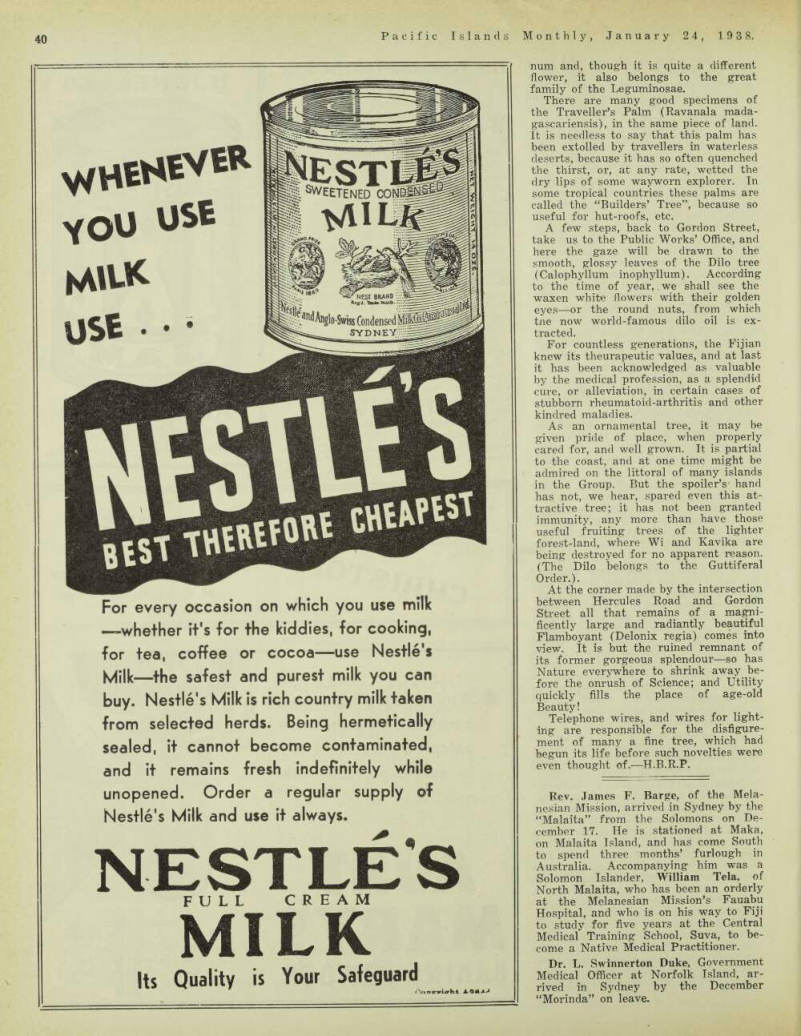
in Suva.
WHEN tourists are in town, one often is met by the question: “What is tne name of that splendid tree?” or “What do you call this flowering* shrub?”
Very often there is no answer ready, because after all, in this land of Malua, folk are inclined to put off the study of the trees, shrubs and creepers that beautify the gardens (public and pri vate) until a more convenient season!
For brilliancy of colour, few can sur pass the great red tulip-like flowers of the so-called Tulip tree (Spathodea campanulata). There are some very fine specimens of this imported tree, opposite the Government Buildings in McArthur Street. It is not indigenous, but comes from the tropical forests of West Africa.
The Tulip tree has taken very kindly to its new home in the Southern Pacific, however, and is now growing apace in many directions. •It can be raised, either from seed or a cutting. To world wanderers it may be known under its other name of Fountain Tree.
On the other side of the street there is a Cassia fistula (Sub. Ar. Caesal pinaecae) with long racemes of yellow flowers, which is reminiscent of Labur
num and, though it is quite a different flower, it also belongs to the great family of the Leguminosae.
There are many good specimens of the Traveller’s Palm (Ravanala mada gascariensis), in the same piece of land.
It is needless to say that this palm has been extolled by travellers in waterless deserts, because it has so often quenched the thirst, or, at any rate, wetted the dry lips of some wayworn explorer. In some tropical countries these palms are called the “Builders’ Tree”, because so useful for hut-roofs, etc.
A few steps, back to Gordon Street, take us to the Public Works’ Office, and here the gaze will be drawn to the smooth, glossy leaves of the Dilo tree (Calophyllum inophyllum). According to the time of year, we shall see the waxen white flowers with their golden eyes —or the round nuts, from which tne now world-famous dilo oil is ex tracted.
For countless generations, the Fijian knew its theurapeutic values, and at last it has been acknowledged as valuable by the medical profession, as a splendid cure, or alleviation, in certain cases of stubborn rheumatoid-arthritis and other kindred maladies.
As an ornamental tree, it may be given pride of place, when properly cared for, and well grown. It is partial to the coast, and at one time might be admired on the littoral of many islands in the Group. But the spoiler’s hand has not, we hear, spared even this at tractive tree; it has not been granted immunity, any more than have those useful fruiting trees of the lighter forest-land, where Wi and Kavika are being destroyed for no apparent reason. (The Dilo belongs to the Guttiferal Order.).
At the corner made by the intersection between Hercules Road and Gordon Street all that remains of a magni ficently large and radiantly beautiful Flamboyant (Delonix regia) comes into view. It is but the ruined remnant of its former gorgeous splendour—so has Nature everywhere to shrink away be fore the onrush of Science; and Utility quickly fills the place of age-old Beauty!
Telephone wires, and wires for light ing are responsible for the disfigure ment of many a fine tree, which had begun its life before such novelties were even thought of.—H.B.R.P.
Rev. James F. Barge, of the Mela nesian Mission, arrived in Sydney by the “Malaita” from the Solomons on De cember 17. He is stationed at Maka, on Malaita Island, and has come South to spend three months’ furlough in Australia. Accompanying him was a Solomon Islander, William Tela, of North Malaita, who has been an orderly at the Melanesian Mission’s Fauabu Hospital, and who is on his way to Fiji to study for five years at the Central Medical Training School, Suva, to be come a Native Medical Practitioner.
Dr. L. Swinnerton Duke, Government Medical Officer at Norfolk Island, ar rived in Sydney by the December “Morinda” on leave.
Advertisements & other items, pp. 41-42 (1 item)
Aunt
H.JONES &C 0
AUSTRALIA’S BEST
H. JONES & CO., LTD.
Darlington, Sydney Hobart, Ta«.
For— Fresh Fruit, Vegetables, and Produce Islands Residents can rely on the old-established Shipping Providers: CH Only Address: 421 Sussex Street, SYDNEY All Orders Promptly Attended Island Agents ; NELSON & ROBERTSON PTY. LTD.
A new, simple lid for your convenience; a new
patented parchment seal
to ensure perfect fresh-
ness.
AUNT
M A RY'S
BAKING POWDER
® Send I/- plus 2d. postage to Tillock and Co.
Ltd., Sydney, for "Aunt Mary's" Cookery Book.
It's the best.
YOVJ
SWEETENED con
si 5g
BRAND
NEST
m n Condensed
SYDNEY
For every occasion on which you use milk —whether it's for the kiddies, tor cooking, for tea, coffee or cocoa —use Nestle'* Milk —the safest and purest milk you can buy. Nestle's Milk is rich country milk taken from selected herds. Being hermetically sealed, it cannot become contaminated, and it remains fresh indefinitely while unopened. Order a regular supply of Nestle's Milk and use it always.
NESTLES
FULL CREAM
MILK
Us Quality is Your Safeguard (IniMwiirkl
Guam Island
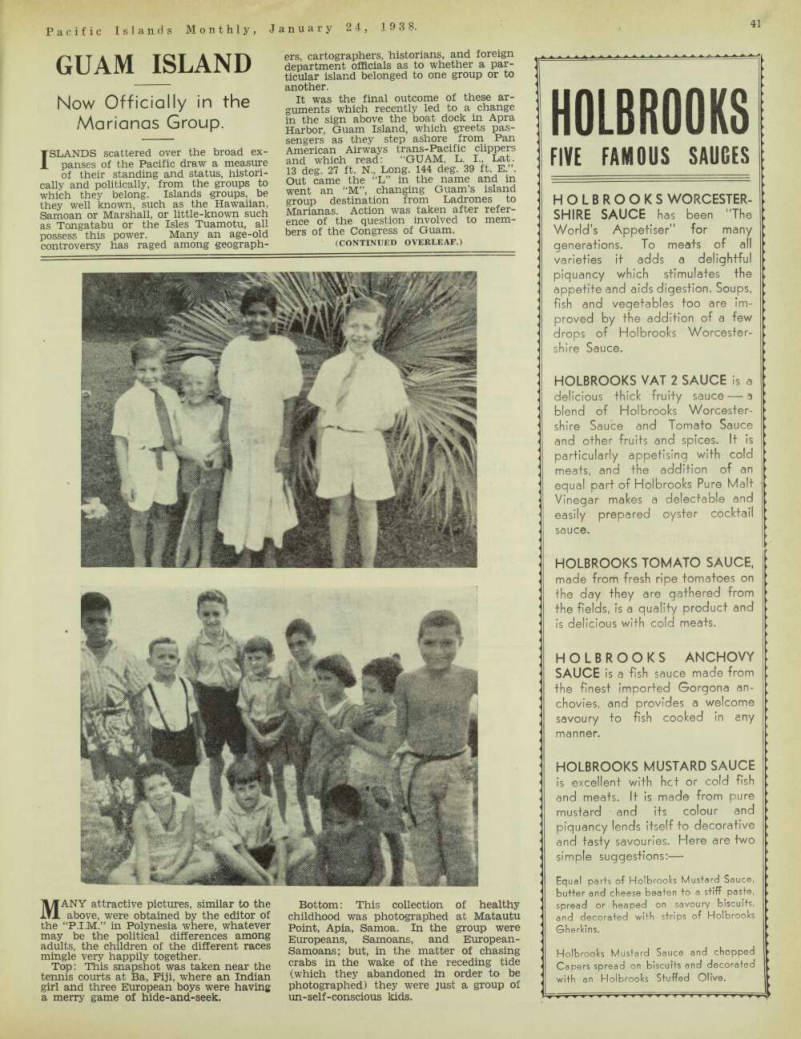
Now Officially in the Marianas Group.
ISLANDS scattered over the broad ex panses of the Pacific draw a measure of their standing and status, histon cally and politically, from the groups to which they belong. Islands groups, be they well known, such as the Hawaiian, Samoan or Marshall, or little-known such as Tongatabu or the Isles Tuamotu, all possess this power. Many an age-old controversy has raged among geograph
ers, cartographers, historians, and foreign department officials as to whether a par ticular island belonged to one group or to another.
It was the final outcome of these ar guments which recently led to a change in the sign above the boat dock in Apra Harbor, Guam Island, which greets pas sengers as they step ashore from Pan American Airways trans-Pacific clippers and which read: “GUAM, L. 1., Lat. 13 deg. 27 ft. N., Long. 144 deg. 39 ft. E.”.
Out came the “L” in the name and in went an “M”, changing Guam’s island group destination from Ladrones to Marianas. Action was taken after refer ence of the question involved to mem bers of the Congress of Guam.
(Continued Overleaf.)
MANY attractive pictures, similar to the above, were obtained by the editor of the “P.I.M.” in Polynesia where, whatever may be the political differences among adults, the children of the different races mingle very happily together.
Top: This snapshot was taken near the tennis courts at Ba, Fiji, where an Indian girl and three European boys were having a merry game of hide-and-seek.
Bottom: This collection of healthy childhood was photographed at Matautu Point, Apia, Samoa. In the group were Europeans, Samoans, and European- Samoans; but, in the matter of chasing crabs in the wake of the receding tide (which they abandoned in order to be photographed) they were just a group of un-self-conscious kids.
Behind this small but significant change was a series of circumstances wmch makes Guam’s island-group designation somewhat different from that involved m other Pacific island controversie t s .* It was due to a huff into which Ferdmand Magellan got over the original inhabitants of the islands, after he discovered them on March 6, 1521, that the group was given the somewhat opprobnous name “Ladrones”, which might be freely translated (and so Magellan intended)—“A lot of robbers”. Searles’s History of Guam” states, however, that m 1668 the name of “Las Marianas” was conferred on the group in honour of Maria Ana of Austria, widow of Philip IV. of s P^ m - .. ..
Despite the distasteful character of the original group name, the later designanon failed to take particularly well, either m official or unofficial circles. The new name merely added a measure of con-
fusion. On January 5, 1912 Order No 145 of the Guam Government directed that thereafter “Island of Guam, Mari anas”, be designated without further qualification as “Guam”. That appeared to be a step in the direction of simpli fication, but the U.S. Post Office Depart ment appeared to complicate matters sub sequently with a post office designation, Guam, GUAM, at the same time declin ing to attach it to the Marianas group, Since then, however, two recognised or ganisations have come to the support of the restoration of the second name given to the group. They are the Bernice P.
Bishop Museum of Honolulu and the Na tional Geographic Society, whose latest valuable map of the Pacific Ocean desig nates the group as the Marianas Islands.
The findings of these two authoritative bodies were taken into consideration when the House of Assembly approved the change in Guam’s trans-Pacific airway marker.
Advertisements & other items, pp. 43-44 (1 item)
Holbrooks
FIVE FAMOUS SAUCES
HOLBROOKS WORCESTER-
SHIRE SAUCE has been "The World's Appetiser" for many generations. To meats of all varieties it adds a delightful piquancy which stimulates the appetite and aids digestion. Soups, fish and vegetables too are improved by the addition of a few drops of Holbrooks Worcestershire Sauce.
HOLBROOKS VAT 2 SAUCE is a
delicious thick fruity sauce a blend of Holbrooks Worcestershire Sauce and Tomato Sauce and other fruits and spices. It is particularly appetising with cold meats, and the addition of an equal part of Holbrooks Pure Malt Vinegar makes a delectable and
easily prepared oyster cocktail
sauce.
HOLBROOKS TOMATO SAUCE.
made from fresh ripe tomatoes on
the day they are gathered from
the fields, Is a quality product and is delicious with cold meats.
HOLBROOKS ANCHOVY
SAUCE is a fish sauce made from the finest imported Gorgona anchovies, and provides a welcome savoury to fish cooked in any manner.
HOLBROOKS MUSTARD SAUCE
is excellent with hct or cold fish and meats. It is made from pure mustard and its colour and piquancy lends itself to decorative and tasty savouries. Here are two
simple suggestions:—
Equal parts of Holbrooks Mustard Sauce, butter and cheese beaten to a stiff paste, spread or heaped on savoury biscuits, and decorated with strips of Holbroolcs Sherlcins.
Holbrooks Mustard Sauce and chopped Capers spread on biscuits and decorated with an Holbrooks Stuffed Olive.
Master Sewing Machine Co.
15 ENMORE ROAD, NEWTOWN, SYDNEY
ESTABLISHED FOR 23 YEARS
f ■ SPECIALISING IN
RECONDITIONED
SEWING MACHINES
OF ALL TYPES
Hand Machines - - £2 £3 £4 Upright Models - - £4 £6 £8 Dropheads - - - £7 £8 £lO including
OTHER WELL
SINGER—WHITE—NEW CENTURY—HOME—AND OTHER WELL KNOWN MAKES.
• Allow us to select a machine for you ... we will strive to please; your subsequent recommendations will reward us.
REPAIR WORK BY
COMPETENT
MECHANICS
EVERY MACHINE
Also in Stock— Machines for Leather, Canvas Bootpatching, Highspeed Dressmaking, Hemstitching, etc.
GUARANTEED MECHANICALLY
NEEDLES AND PARTS
SUPPLIED FOR ALL
MAKES OF MACHINES
PERFECT
The No. 7W " Younger" Ranger can now be supplied fitted with Legs, as per illustration.
Do You Know that the Famous . . .
YOUNGER
STOVES and
RANGES
made with extended Firebox specially for long Wood fuel, are Self-Setting and, provided sufficient Flue Piping is attached, can be used in almost any position?
I Younger Stoves * are Widely Used Ask tor quotation for this Range, also Illustrated Catalogue Throughout the and Price List for both Single and Double Oven Stoves. Pacific Islands.
G. FLETCHER & SON 50 Oxford Street, Sydney
Malaria Control
-What Might Be Done In Pacific Where Actually No United Effort Has Yet Been Made.
Letter to the Editor.
IN my letter relating to “Planes as Germ Carriers”, precautionary mea sures (other than fumigation) and control measures in the event of yellow fever being introduced are suggested.
Possibly, the medical authorities in each service have plans, in the event of the introduction of yellow fever; but as such plans must depend upon the whole hearted support of the Europeans of the group, I have decided to submit the following.
The precautions could go hand in hand with fumigation, and in some instances might even make fumigation unneces sary.
Each airport would have its special peculiarities in regard to mosquito con trol. The common vector of yellow fever is aedes aegypti, and evidence exists from recent epidemics that a similar type of mosquito could transmit the disease. There may be other kindred mosquitoes capable of transmitting the disease; consequently thorough eradi cation of all types of mosquitoes at air ports should be the objective. Complete eradication would also eliminate malaria and filariasis.
This would rest with the sanitary en gineers; but eradication could commence with attacking the breeding grounds of the known vector of yellow fever, which exist in the vicinity of the airports. The common vector, aedes aegypti, breeds in artificial collections of clean water.
Tanks, water jugs, flower vases, water barrels, holes in trees, coconut husks, old tins and bottles are the principal breeding places. In most homes they breed in tanks, water-jugs, defective guttering, flower vases and water barrels; but, if denied these, they resort to other breeding-places mentioned.
It will be understood, therefore, that eradication of the known yellow fever mosquito would be a comparatively simple matter. Screening of tanks and water barrels, and the remedying of defective guttering, are permanent measures to be instituted. Usually, there are not many trees in the vicinity of airports; but garden plants, espec ially plants of the lily variety, and palms which will retain water in holes, or where the branches or fronds join the trunk, should not be grown.
Water jugs and flower vases can only breed mosquitoes if the water is un changed for such a period as to allow the mosquitoes to develop from eggs, larvae and pupae. Consequently, com plete emptying of jugs and vases should be done every morning before they are refilled. Tins should be well punctured, and bottles placed in such a position that they will not retain water. There are various ways of disposing of coco nut husks.
Usually, the vector of yellow fever is the chief annoying pest. It also carries dengue fever. They are always in the homes, and are the most difficult mos
quitoes to land direct hits on. Environ ment and much practice have made them most elusive. They are striped black and white, something like a tiger.
During daylight is their feeding time, but, if starved, will bite at night. Con sequently, people could visit houses where people are sick with yellow fever, with a fair degree of safety during the night. It usually remains in the house in which it breeds, but will make ex cursions to houses in the immediate vicinity. This is only of importance in villages.
A good rough method of determining whether aedes aegypti are breeding in tanks is: Strike the tank at water level a few times, wait a little while and then turn the tap on. The larvae of this mosquito are deep divers and, if present, some will come through the tap.
They can remain submerged for about one hour. The larvae have many natural enemies, such as fish, etc.
While in Tonga I was impressed by the absence of larvae in many un screened tanks and wells. A few natives told me that a water beetle was re sponsible for this. These water beetles lived chiefly in the mud, on the bottom.
One of these beetles was placed in a pickle bottle and fed on biscuits, and it then devoured 60 larvae in 12 hours. Of course, the larvae and beetle were only in a confined space.
A thorough investigation of natural enemies of the mosquito larvae would be most valuable.
No doubt I have omitted some “artificial collections of clean water” as breeding places. Canoes on the beach,
for instance. But, if any are interested, the house-boys could be shown larvae and then encouraged to report the existence of them. Don’t offer rewards.
The natives have been guided by Nature and environment, and they like a change from housework. This could also be done on plantations.
In the event of yellow fever being in troduced into any of the islands, the first concern of the medical authorities would probably be to prevent the vectors of yellow fever biting persons with the disease within the first three or four days (the infective stage). This may be done with mosquito nets and screen ing of hospitals. To prevent infected mosquitoes from biting others, fumi gation of houses of infected patients would be necessary. Probably fumi gation of whole villages or collection of villages would be better. Unless fumigation was rapid in effect, con siderable difficulty would be experienced in fumigating reed houses. If fumi gation was slow in action, infected mos quitoes would move to other houses.
I am, etc.,
William J. Tully.
16 Bridge Street, Sydney.
Editorial Note.
This contribution, and the one entitled “Why Is There No Malaria in Fiji?”, published in December, by Mr. W. J.
Tully, emphasise the apparent inability of the governing authorities in the Pacific Islands to make any concerted move for the public good—in connection with health or anything else. Mr. Tully
has indicated several ways in which war might be waged on malaria.
In the above letter, Mr. Tully refers to a most interesting thing—the exist ence of a water beetle which destroys mosquito larvae. It is only by ento mological methods—by using one insect to destroy another—that such diseases as malaria and yellow fever —ever will be controlled in the Pacific; and it would be so easy, by consultation and united effort, to test out these things. Yet the years pass, politicians and ex-politicians play and posture in the seats of the mighty, and nothing is done.
What is Being Done in
East Indies.
THE following is part of an article, “Malaria in the Netherlands Is lands”, by N. H. Swellengrebel, pub lished in a new quarterly magazine, “The Bulletin of the Colonial Institute” (63 Mauritskade, Amsterdam, Holland). It is an excellent compilation, produced by the Netherlands Pacific Institute, and dealing especially with the problems of the Netherlands Indies.
THE system of malaria-transmission is highly vulnerable because of its specialisation, for it is delegated, not to all mosquitoes, but to a special tribe, the anopheles, and among this tribe, to only a small number of species. So all man has to do is to destroy those ex perts in malaria-transmission. All other anopheles he simply ignores.
That is the reason why we see the department of malaria-control in the Netherlands Indies bent on knowing the species of anopheles they are dealing
with, and on finding out the ways and means to destroy the harmful species without having to go to the expense of killing all anopheles. The staff of this department has been blamed for being interested in entomology. One might as well find fault with an artillery-offi cer for being interested in mathematics!
There was a time, however, in the early twenties, when we thought we were all wrong in our dealings with the indivi dual species of anopheles. Facts were gradually accumulating to show that one and the same anopheline species may be
a dangerous carrier of malaria in one country and perfectly harmless in an other. The anopheles ludlowi, which is such a deadly carrier in the Netherlands Indies, can always be safely ignored in the Philippines and very often so in Malaya.
This is very serious. If we cannot count on our species of anopheles always behaving in the way we have learned to expect, how can we base our plan of ac tion on the assumption that they, and no other anopheles, carry malaria? I well remember, at that time, one of our stud ents protesting at being taught to identify the various species of Netherlands Indian anopheles, on the plea of its being a perfectly useless effort, as we should very soon be reverting to the old method of killing all anopheles (which really means killing none, as a fight sustained against all anopheles is much too costly).
At present, some sixteen years after that crisis, “species control”, i.e., the method of dealing with malaria by an ac tion directed against one species of ano pheles to the exclusion of all others, stands on a firmer basis than it ever did before.
This has been brought about by the concerted action of investigators in the department of malaria-control of the Netherlands Indies and in the two In stitutes of Tropical Hygiene, at Amster
dam and Leyden, each group of workers proceeding along its own lines, all of which, however, led to the same result, that can be briefly stated as follows. The principle of species control remains un shaken, but some of the so-called ano pheline species which had revealed them selves as dangerous malaria-carriers in one country and as harmless mosquitoes m another, were proved to be groups of two or more species, very much resembling each other in shape and design, but differing in their habits to such an extent as to render one an efficient malaria-car rier and another quite harmless.
It was a long way to go to obtain a result which can be stated in words so few as hardly to exceed, in number, the years it took to establish it. But the result was worth the trouble, first and foremost because it fully restored our con fidence in species control, and secondly, because it afforded an interesting exam ple of very effective, although quite un premeditated, collaboration between inves tigators in the Far East with those at home.
So the basis of malaria-control in the Netherlands Indies is sound and the re sults obtained are striking, as testified by the interest workers from neighbouring countries are taking in it. But these results are few and far apart, compared with all that still remains to be done.
Malaria remains a major scourge to the natives of those parts. It is to be hoped that improving economic condi tions will remove some of the obstacles which prevent that magnificent institu tion, the department of malaria-control in the Netherlands Indies, from display ing its activity unhampered.
Advertisements & other items, p. 45 (1 item)
Furniture
■f
TUBULAR
STEEL
FURNITURE
PRIVATE HOME, SYDNEY, N.S.W.
Chromium-plated Tables and Chairs with Black Carrara Tops and Green Mohair Coverings by Newlands. •
DESIGNED AND MANUFACTURED BY
Newlands Bros. Pty. Ltd. ri ley & albion sts., Sydney, n.s.w.
AUSTRALIA’S LARGEST MANUFACTURERS OF
STEEL BEDSTEADS, LAWN HAMMOCKS, "LISTER" HOSPITAL EQUIPMENT, SHIPS' BERTHS, WIRE MATTRESSES, "AERO" AND " MORNING GLORY" BEDDINGS, TUBULAR STEEL FURNITURE
Assisting Parents In Papua.
From Our Own Correspondent.
Port Moresby, Dec. 21.
ACCORDING to a notice recently pub lished by the Papuan Government Secretary’s Department, assistance is to be given to parents who find it difficult to meet the cost of educating their children by correspondence. This will be appreciated by parents in outlying districts who, through inadequate means, have been unable either to send their children to school, or to meet the cost of schooling by correspondence.
Missionaries For The
Islands.
ELEVEN Marist priests from Holland, France, and Germany, on their way to Pacific Islands mission stations, arrived in Sydney by the “Viminale” from Europe in mid-December. All have received special medical training. They expect to spend from 25 to 30 years in the South Seas, mainly Fiji.
Patrol Officer J. R. Black, of the New Guinea Administration, sailed from Sydney for Salamaua after furlough in Australia by the December “Neptuna”.
He will be a member of the party under Mr. J. L. Taylor, D. 0., which will leave shortly on a year’s trek through un known territory in Central and Northern New Guinea.
Mr. Harry Heath, headmaster of Middlegate School, Norfolk Island, re turned to Australia in January after two years’ service on N.I.
Advertisements & other items, p. 46 (1 item)
Cordage and
SYDNEY'S LEADING
SAILMARER
and RIGGER
Also Manufacturer of all Canvas and Rope Work ISLANDS WORK a Speciality
HARRY WEST
Balmain East, SYDNEY Tel. WIIOS
Ship Chandlery Hardware
/Write for 7 Ship Chandlery / Catalogue J
BROOMFIELD'S LIMITED
152 SUSSEX STREET :: :: :: SYDNEY Cables "Boom," Sydney Special "In Bond" Prices Large and Complete Stocks of for all Islands enquiries SHIP CHANDLERY quoted on application. IRONMONGERY OF ALL KINDS, PAINTS,
WHITE LEAD AND OILS
Sole Agents for: P. H. MUNTZ & CO.’S 3-CROWN BRAND METAL SHEATHING.
PEACOCK & BUCHANS’ ENGLISH READY - MIXED PAINTS.
Scott’s “Renown” Brand Rope,
Cordage and
Binder
Twine
Cable Address: Ropeyard, Sydney
of Every
Description
MANUFACTURED AT
MASCOT. N.S.W.
By
J. SCOTT
PTY. LTD.
Head Office and Store:
163 CLARENCE STREET,
SYDNEY
N.S.W.
Nott, The Bricklayer
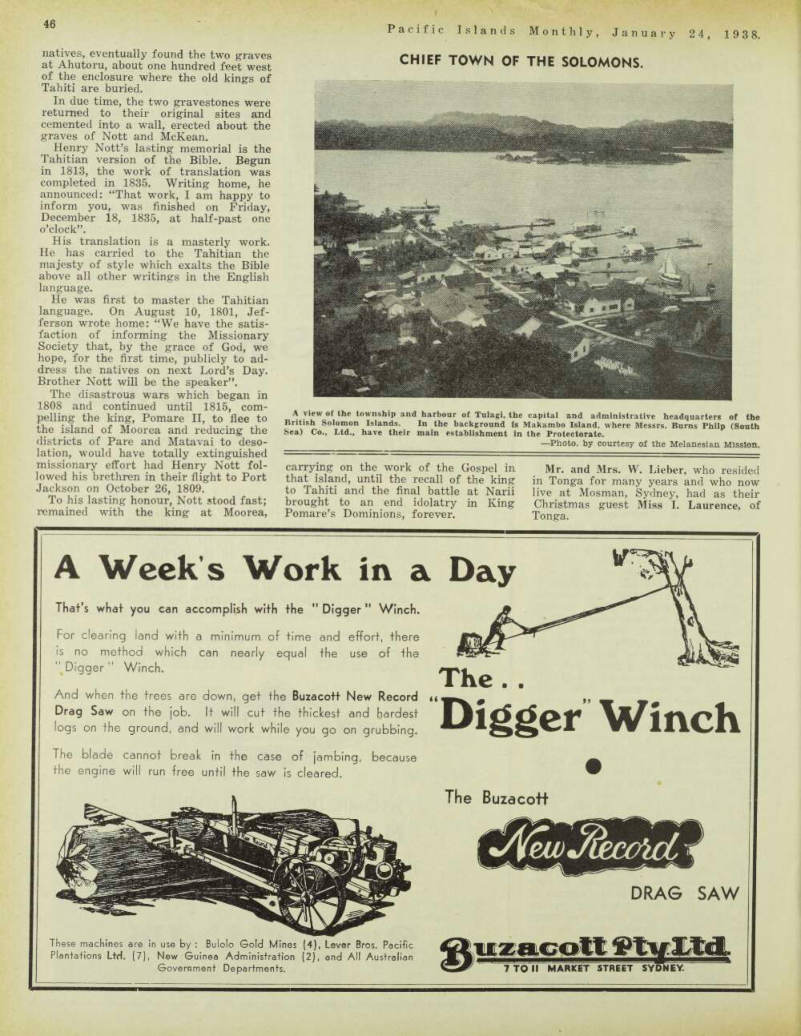
Pioneer Missionary Who Grows in Stature as the Years Pass.
By Our Tahiti Correspondent.
AMONG the missionaries who brought Christianity to the islands of the Pacific, the figure of Henry Nott con tinues to increase in stature with the passage of time.
During many years his memory had faded from the minds of men. The natives of Tahiti and French Oceania had forgotten him. The Register of the London Missionary Society listed him merely as one of its many faithful ser vants in the foreign field.
John Williams, of Raiatea, murdered by savages on the beach of Erromanga in the New Hebrides, had become illus trious as the Christian martyr of the South Pacific. The presence in the islands of the descendants of other mis sionaries had served to keep their memory green.
Our first knowledge of the pre eminence of Henry Nott came from the study of Ellis’ “Polynesian Researches”.
The roster of the ship “Duff” had re corded him only as Henry Nott, brick layer. Yet research into his history in the islands reveals a commanding por trait of a scholar, a great preacher, a diplomat, an administrator of unusual gifts, merged in the modest character of a devout servant of the Good Master.
A full record of his work in the mis sionary service would require a volume.
Here we can trace only an outline.
He was born in 1774. He arrived at Tahiti on March 6, 1797, and removed to Moorea in December, 1808. In 1812, he visited Port Jackson, where, in July, he married Miss A. Turner, and re turned to Moorea, October 5, 1812. He removed to Huahine in July, 1818, and to Matavai (Tahiti) in June, 1819. He visited England between 1825 and 1827.
Having in December, 1835, after twenty years’ labour, completed the Tahitian version of Scriptures, and, being in ill-health, he > left Tahiti on February 20, 1836, and returned with Mrs. Nott to England, arriving June 19, 1836. He then revised the M.S.S. of the Tahitian version of the entire Bible, and carried it through the press at the expense of the Bible Society. Taking the Bibles with him, he, with Mrs. Nott, returned to Tahiti. He arrived at Tahiti on September 12, 1840, and soon after retired from active service. He died at Tahiti on May 2, 1844.
ONE day, 20 years ago, the writer happened to be passing by the church at Outu Aiai, in the district of Arue, Tahiti. He saw lying on the ground near the church door two grave stones. One, of Sydney stone, was in scribed as follows: “Sacred to the memory of the Rev.
Henry Nott, Missionary, who departed from this life of sin and sorrow and entered into his rest on the 2nd day of
May, 1844, after having endured a great fight of afflictions. He had been, for 48 years, the faithful servant of the London Missionary Society, having been sent out by them to this island in the ship ‘Duff’, commanded by Captain James Wilson, in the year 1796. He was translator of the Sacred Scriptures into the Tahitian language.
“ T have fought a good fight. I have finished my course. I have kept the faith. Henceforth there is laid up for me a crown of righteousness which the Lord, the righteous Judge, shall give me in that day; and not for me only, but unto all them also that love His appearing’ . . . ‘And God shall wipe away all tears from their eyes; and there shall be no more death’.”
The other gravestone—a marble slab
—bore this inscription:—“Rev. T. S.
McKean, M.A., missionary of the Lon don Missionary Society—Shot at his door during the fight at Point Venus, June 30, 1844. Aged 37”.
The inscriptions, being in English, had no significance to the natives, who each Sunday attended the church, The writer communicated his dis covery to his friend, the late Mr. J. L.
Philips. Mr. Philips had long been at the task, both at Tahiti and London, of bringing to light and renewed remem brance the facts of Nott’s career, “We must find the place whence these gravestones have been taken,” said Mr.
Philips.
We associated with us Mr. Irving Smith, who lives in Arue, and the three of us, with the aid of some ancient
natives, eventually found the two graves at Ahutoru, about one hundred feet west of the enclosure where the old kings of Tahiti are buried.
In due time, the two gravestones were returned to their original sites and cemented into a wall, erected about the graves of Nott and McKean.
Henry Nott’s lasting memorial is the Tahitian version of the Bible. Begun in 1813, the work of translation was completed in 1835. Writing home, he announced: “That work, I am happy to inform you, was finished on Friday, December 18, 1835, at half-past one o’clock”.
His translation is a masterly work.
He has carried to the Tahitian the majesty of style which exalts the Bible above all other writings in the English language.
He was first to master the Tahitian language. On August 10, 1801, Jef ferson wrote home: “We have the satis faction of informing the Missionary Society that, by the grace of God, we hope, for the first time, publicly to ad dress the natives on next Lord’s Day.
Brother Nott will be the speaker”.
The disastrous wars which began in 1808 and continued until 1815, com pelling the king, Pomare 11, to flee to the island of Moorea and reducing the districts of Pare and Matavai to deso lation, would have totally extinguished missionary effort had Henry Nott fol lowed his brethren in their flight to Port Jackson on October 26, 1809.
To his lasting honour, Nott stood fast; remained with the king at Moorea,
carrying on the work of the Gospel in that island, until the recall of the king to Tahiti and the final battle at Narii brought to an end idolatry in King Pomare’s Dominions, forever.
Mr. and Mrs. W. Lieber, who resided in Tonga for many years and who now live at Mosman, Sydney, had as their Christmas guest Miss I. Laurence, of Tonga
Advertisements & other items, p. 47 (1 item)
Smooth
a nsi J
Power
The moderate speeds of the British-built "Fetter" Diesel Marine Engines and their simplicity of design assure a constant supply of smooth power over years of trouble free, economical operation. The extreme simplicity makes a breakdown most improbable, and the moderate speeds mean less wear, long life and low operating cost.
Put in a "Fetter"—the popular engine for all types of craft. New, illustrated literature on request. / 9
ATOMIC-DIESEL & SEMI-DIESEL
MARINE ENGINES
5 to 480 B.H.P.
These engines can be supplied ex-Bond, free of Australian Customs Duty.
7 TO II MARKET STREET SYDNEY
Chief Town Of The Solomons.
A view of the township and harbour of Tulagi, the capital and administrative headquarters of the British Solomon Islands. In the background is Makambo Island, where Messrs. Burns Philp (South Sea) Co., Ltd., have their main establishment in the Protectorate. -Photo, by courtesy of the Melanesian Mission.
Advertisements & other items, p. 48 (1 item)
Digger Winch
A Week s Work in a
That's what you can accomplish with the " Digger" Winch.
For clearing land with a minimum of time and effort, there is no method which can nearly equal the use of the " Digger " Winch.
And when the trees are down, get the Buzacott New Record << Drag Saw on the job. It will cut the thickest and hardest logs on the ground, and will work while you go on grubbing.
Day
The . .
Digger Winch
The blade cannot break in the case of jambing, because the engine will run free until the saw is cleared.
Lo ) w These machines are in use by : Buiolo Gold Mines (4), Lever Bros. Pacific Plantations Ltd. (7), New Guinea Administration (2), and All Australian Government Departments.
The Buzacott
2
DRAG SAW
uzaco
7TO II MARKET STREET SYDNEY.
Epic Voyage In Open Boat
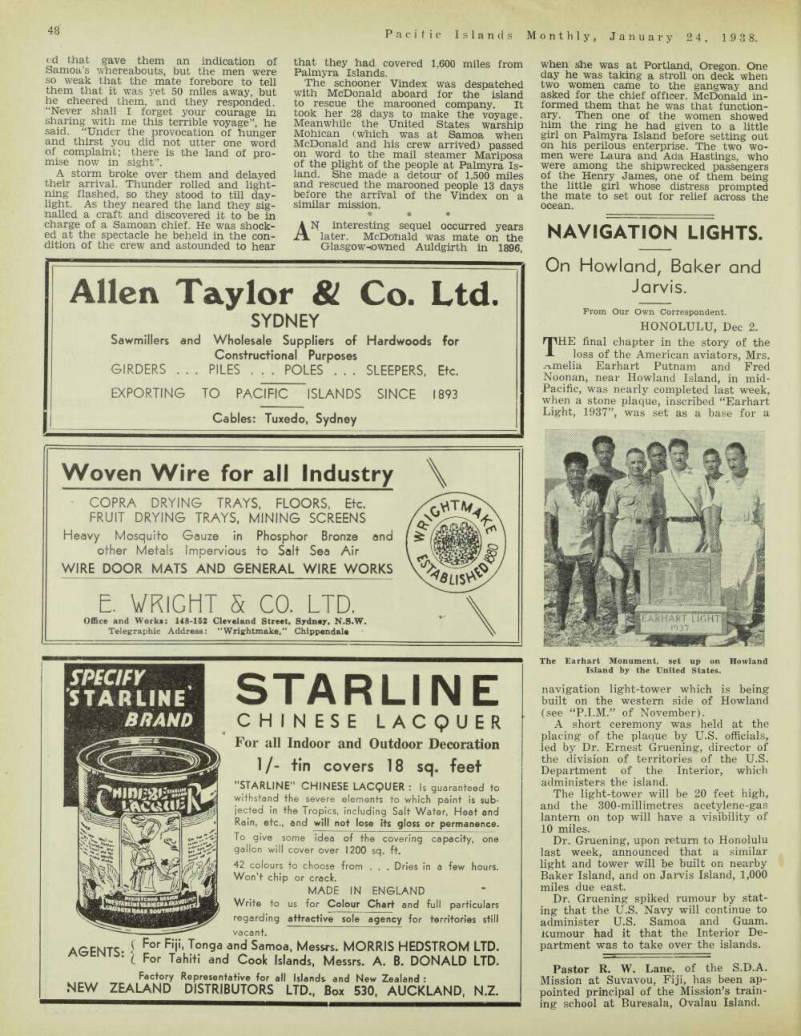
KINGMAN REEF, the second hop in the proposed Pacific air route from San Francisco to New Zea land, was the scene, nearly half a century ago of a wreck that was fol lowed by an epic sea voyage in a life boat that has few parallels in the history of sea navigation in the Pacific (said a writer in the Mel bourne “Herald” recently.) * * * AT Waitaki Boys’ High School, Oamaru, are preserved the memorials of that adventure. Captain Donald McDon ald, the hero of the exploit, on retiring from the sea in the late ’nineties, settled down to a quiet country life in the beau tiful district of North Otago. There he lived for 32 years till his death in 1931, beloved by all who knew the gallant old salt of the days of the wind-jammer.
Captain McDonald was mate of the bar que Henry James that set out from New castle (Australia) coal-laden for San Francisco in 1888. When the vessel struck the reef McDonald swung the foremasts round in the hope of getting the barque off but failed. As it was impossible to get the forward lifeboats, they had to be content with the two after boats.
The company delayed their departure from the doomed vessel in the hope of procuring from her food and clothing be fore their departure for the uninhabited island of Palmyra, some 50 miles away.
Because of rough seas they were unable to do this and set sail with meagre pro visions. The captain commanded the ship’s cutter with 20 of the crew and passengers aboard (the latter including women and children). The mate (Donald McDonald) took charge of the gig with ten seamen.
The latter craft was covering more mile age than the captain’s so that he sighted the land first, but awaited the captain's orders before attempting a landing. The captain, however, considered that the sea was too rough and the night too far ad vanced to land; he ordered the boats to lay to till the morning. McDonald thought otherwise, disobeyed orders and made for the shore. Taking two tacks, he landed successfully; the captain follow ed.
IF any measures were taken to mark the skipper’s displeasure at his orders be ing set at defiance, histpry does not record it. Subsequent events showed that he recognised in McDonald a mas ter mind. Palmyra Island provided no food beyond birds and fish, and, as far as could be ascertained, it was destitute of fresh water. Means to meet the des perate situation of the marooned com pany were considered and finally the captain expressed confidence in the abil ity of his mate to reach Samoa, which the captain indicated by the chart was 1,630 miles S.S.W. The hazardous nature of the enterprise set McDonald thinking, but he was spurred to the superhuman task by an incident he witnessed. To quote his own words:— “In the evening I returned to camp tired, hungry and miserable ... As I sat down one of the little girls was eat ing a raw bird. It ‘came against her’, and as she was exhausted with retching she threw herself in my lap and fell asleep. . . . The sight of the poor little girl gave me an inspiration—l was deter mined then and there to reach Samoa— but according to my own plan. I took my ring and gave it to her, saying: ‘Don’t cry, I’m going away with the boat to get you plenty of nice things to eat’”.
THE captain of the Henry James gave McDonald a free hand as to his course of action. The larger boat was loaded with coconuts, the masts and stays were strengthened and volunteers called for. Three Irishmen and one Ame rican responded, but as one of the for mer was considered rather young, a German took his place. The five men then fared forth on their perilous enter prise. The sea was rough and they had hardly got clear of the island when their rudder was carried away. The following few days saw the boat travelling well before a favouring breeze. It crossed the equator on the fifth day out, covering 150 miles the day before crossing. Tem pestuous weather again descended on the craft—the rain, wind and thunderstorms took the heart out of the company, but the mate heartened them to renewed ef forts when the sea abated.
FOR some days McDonald had follow ed a circuitous course to get the benefit of the trade winds, but mat ters became so desperate that he de cided to pick a straight course from the chart. After 19 days an island was sight
ed that gave them an indication of Samoa’s whereabouts, but the men were so weak that the mate forebore to tell them that it was yet 50 miles away, but he cheered them, and they responded.
“Never shall I forget your courage in sharing with me this terrible voyage”, he said. “Under the provocation of hunger and thirst you did not utter one word of complaint; there is the land of pro mise now in sight”.
A storm broke over them and delayed their arrival. Thunder rolled and light ning flashed, so they stood to till day light. As they neared the land they sig nalled a craft and discovered it to be in charge of a Samoan chief. He was shock ed at the spectacle he beheld in the con dition of the crew and astounded to hear
that they had covered 1,600 miles from Palmyra Islands.
The schooner Vindex was despatched with McDonald aboard for the island to rescue the marooned company. It took her 28 days to make the voyage.
Meanwhile the United States warship Mohican (which was at Samoa when McDonald and his crew arrived) passed on word to the mail steamer Mariposa of the plight of the people at Palmyra Is land. She made a detour of 1,500 miles and rescued the marooned people 13 days before the arrival of the Vindex on a similar mission. » * * AN interesting sequel occurred years later. McDonald was mate on the Glasgow-Downed Auldgirth in 1896,
when she was at Portland, Oregon. One day he was taking a stroll on deck when two women came to the gangway and asked for the chief officer. McDonald in formed them that he was that function ary. Then one of the women showed him the ring he had given to a little girl on Palmyra Island before setting out on his perilous enterprise. The two wo men were Laura and Ada Hastings, who were among the shipwrecked passengers of the Henry James, one of them being the little girl whose distress prompted the mate to set out for relief across the ocean.
Advertisements & other items, pp. 49-50 (1 item)
Oxymel
HIGH GRADE
TIME TESTED
HOME and SHIP
Paints, Enamels, Varnishes,
Lacquers, etc.
" OXYMEL" Co, have been manufacturing Paints, etc., for just on 30 years.
We require distributing agents for our products. They are not cheap, shoddy goods.
Catalogues, Colorcards and Leaflets, &c., on request from
THE OXYMEL OIL & PAINT
Co. Pfy. Ltd.
47-51 YARRA BANK ROAD, SOUTH
MELBOURNE. VICTORIA. AUSTRALIA
Telephone M 2375
r-
BUILD AN ATTRACTIVE PERMANENT
HOnE OR STEEL
TLLUSTRATED is an attractive “Comet"
A steel bungalow recently erected by us.
This building is in no sense a special order, but shows just what can be done with the patented "Comet" principle of Steel Building Construction.
The "Comet" Steel Building, by reason of its patented sectional construction, is easily enlarged and where required, conveniently portable.
The buildings are white-ant proof, fireresisting and economical to erect.
They have definitely proved themselves the best proposition for the islands.
SIDNEY WILLIAMS & CO. (PTY.) LTD.
Steel Building Specialists, Builders and Contractors
DULWICH HILL, SYDNEY.
ROCKHAMPTON BRISBANE TOWNSVILLE
(Incorporated in Queensland)
EMINENTLY SUITABLE
FOR:—
BUNGALOWS
STORES
WORKSHOPS
COPRA SHEDS
BOYS' HOUSES
HANGARS. ETC.
“COMET”
Steel Buildings
Allen Taylor 81 Co. Ltd.
SYDNEY
Sawmillers and Wholesale Suppliers of Hardwoods for Constructional Purposes GIRDERS . . . PILES . . . POLES . . . SLEEPERS. Etc.
EXPORTING TO PACIFIC ISLANDS SINCE 1893
Cables: Tuxedo, Sydney
Woven Wire for all Industry
COPRA DRYING TRAYS, FLOORS, Etc.
FRUIT DRYING TRAYS, MINING SCREENS
Heavy Mosquito Gauze in Phosphor Bronze and other Metals Impervious to Salt Sea Air WIRE DOOR MATS AND GENERAL WIRE WORKS
E. VRIGHT & CO. LTD.
Office and Works: 148-162 Cleveland Street, Sydney, N.S.W.
Telegraphic Address: “Wrightmake,” Chippendale 3r £ o
STARLINE
jr
CHINESE LACQUER
For all Indoor and Outdoor Decoration
1/- tin covers 18 sq. feet
"STARLINE" CHINESE LACQUER : Is guaranteed to
AGENTS:
withstand the severe elements to which paint is subjected in the Tropics, including Salt Water, Heat and Rain, etc., and will not lose its gloss or permanence.
To give some idea of the covering capacity, one gallon will cover over 1200 sq. ft. 42 colours to choose from . . . Dries in a few hours.
Won't chip or crack.
MADE IN ENGLAND
Write to us for Colour Chart and full particulars regarding attractive sole agency for territories still vacant.
For Fiji, Tonga and Samoa, Messrs. MORRIS HEDSTROM LTD.
For Tahiti and Cook Islands. Messrs. A. B. DONALD LTD.
Factory Representative for all Islands and New Zealand: NEW ZEALAND DISTRIBUTORS LTD., Box 530, AUCKLAND, N.Z.
Navigation Lights.
On Howland, Baker and Jarvis.
From Our Own Correspondent,
Honolulu, Dec 2.
THE final chapter in the story of the loss of the American aviators, Mrs. amelia Earhart Putnam and Fred Noonan, near Howland Island, in mid- Pacific, was nearly completed last week, when a stone plaque, inscribed “Earhart Light, 1937”, was set as a base for a
navigation light-tower which is being built on the western side of Howland (see “P.LM.” of November).
A short ceremony was held at the placing of the plaque by U.S. officials, led by Dr. Ernest Gruening, director of the division of territories of the U.S.
Department of the Interior, which administers the island.
The light-tower will be 20 feet high, and the 300-millimetres acetylene-gas lantern on top will have a visibility of 10 miles.
Dr. Gruening, upon return to Honolulu last week, announced that a similar light and tower will be built on nearby Baker Island, and on Jarvis Island, 1,000 miles due east.
Dr. Gruening spiked rumour by stat ing that the U.S. Navy will continue to administer U.S. Samoa and Guam, humour had it that the Interior De partment was to take over the islands.
Pastor R. W. Lane, of the S.D.A.
Mission at Suvavou, Fiji, has been ap pointed principal of the Mission’s train ing school at Buresala, Ovalau Island.
The Earhart Monument, set up on Howland Island by the United States.
Why A Japanese Consul
Seeking Spies In
Honolulu.
Why A Japanese Consul Moved On.
By John Williams.
PERHAPS it was just a gentle hint that Uncle Sam doesn’t intend to let anybody tweak his nose—and get away with it. Which is something in these war-hysteria days.
Anyhow, it happened in Honolulu, which is the general headquarters of the U.S.
West Pacific defence scheme.
Since the Hawaiian Islands formally were annexed by the U.S. in 1900, the U.S. Government has spent more than 900,000,000 dollars in army and navy de fence projects in the islands; and the is land of Oahu, upon which Honolulu stands, probably is the most highly for tified island in the world.
Every year, U.S. taxpayers disgorge at least 100,000,000 dollars for spending en tirely within the islands for maintenance and improvement of that “straight left”, poised before Japan’s chin.
It is quite natural, therefore, that Jap an’s militarists must be interested in what is going on in Hawaii. If Japan plans to invade the west coast of America, U.S. forces pivoted on Hawaii will be the most serious handicap to the scheme.
Lately, U.S. army and navy manoeuv res have found the Hawaii defences to be impregnable; and the defences are be ing improved out of sight by long-range plans involving expansions of navy, army and air force bases.
It is natural, too, that when you live in a highly militarised place like Hono
lulu you hear wild and woolly rumours.
And you hear, too, lots of facts. It is obvious to detached observers that the U.S. armed forces here have spy com plexes, similar to (although not so hys terical as the anti-spy complexes of the militarists in Japan.
While U.S. taxpayers every year pay out such tremendous amounts for the de fence of their democracy, they yet accept the policy of the great American oil In dustry in shipping oil, vital to Japan’s expansion, from California wells to Japan.
Japanese navy tankers have been cross ing the Pacific for years now, and, home ward bound, they call in at Honolulu and remain for at least a week.
It is said these tankers are officered by Japanese navy officers and reservists, and observers here declare that these officers remain on the tankers for a few voyages, the Japanese idea being to give as many as possible of their officers train ing in trans-Pacific routes.
Whenever one of these Nippon tankers comes into Honolulu, there is activity among the army and navy intelligence officers, who are assigned to watch the movements of visitors ashore from the tankers. This is rather old-fashioned, be cause modern spying goes on in more slick ways, so say men who should know.
The U.S. navy has nabbed Americans, even U.S. navy officers, in the pay of Tokio. Spying seems to be done more ef fectively in higher places than from visit ing tankers in Hawaii. However, the in telligence operators must obey orders to spy on the alleged spies.
For some time, for example, the Hono lulu newspapers used to photograph the officers of tankers, be courteous about it, and the Japanese would be courteous in return. They’d doll up in their gold braid and group before the news cameras with nice beaming smiles. This went on for a long time, until the Japanese tankers
were told (evidently by one of their local observers) that the newspapers promptly turned over the photos, to the U.S. in telligence officers.
So, a few months ago, a Japanese tanker arrived and the intelligence opera tors were itching to get photos, of the officers. There must have been some spe cial person aboard that they badly wanted “mugged”. The newspapers, meanwhile, had been told about offended Japanese feelings, so they refused to be brought in on this special occasion.
So a U.S. navy intelligence operator was told off. He went down to the tanker in plain clothes, and with a camera. It hap pened that the tanker officers were group ed on deck with the Japanese Consul of Honolulu. The Consul, who evidently knew the intelligence operator by sight, stalked over and tried to snatch the operator’s camera.
The operator tried to pose as an ordin ary American citizen, and gave a city ad dress. Navy authorities even did not in terfere when the operator insisted upon police protection when the Japanese want ed to remove the film from his camera.
Honolulu police ruled that the operator was not violating any law in photograph ing the Japanese. The Consul was deep ly offended, because actually he knew what was up, although openly he would not say so.
Admiral Murfin, red-blooded high mo gul of the local U.S. navy forces, was angered that one of his men had been “strong-armed”, especially by Japanese.
It is said that he protested so vigorously about the incident that Japan withdrew this Consul from Honolulu. That is the story behind the story of why he left late in November.
It is hard to reason out just what a closely-observed Japanese officer could do in Honolulu.
Mr. and Mrs. Ward Williams recently arrived in Los Angeles from Hawaii, en route to New York (writes Mr. George C. Dromgold, in a personal note to the editor). A short time later I received a letter from him, stating that he was leaving New York by plane for South America.
Rev. Walter Daniels, accompanied by his wife, will leave Sydney for Thurs day Island by the “Merkur” on February 7. He will take up duties as assistant priest of the Anglican Torres Strait Mission.
Advertisements & other items, pp. 51-52 (1 item)
Ruston
k © m
MARINE
DIESEL
OUTSTANDING
FEATURES
• ECONOMY
• EFFICIENCY
• RELIABILITY
• ACCESSIBILITY
MkiJ^
r f
SIZE RANGE
10 H.P. to 1000 H.P.
Multi - Cylinder
ENGINES
ONE of the most valued orders recently received for RUSTON marine engines was obtained from Sir Malcolm Campbell, who purchased 2-150 B.H.P. RUSTON units for his new yacht.
In addition to the propulsion engines a 10 H.P. auxilliary is also to be installed.
RUSTON & HORNSBY
(Aust.) Pty. Ltd.
MELBOURNE SYDNEY BRISBANE ADELAIDE Sole Agents for the Mandated Territory : 174 KING ST. 642-4 JONES ST. BARRY PDE, 20 FRANKLIN ST. BURNS PHILP& CO. LTD.. Rabaul. New Guinea
RECORDS
Packed Free and sent C.O.D. without extra charges.
H.M. Voice Slightly-used Portables, delivered straight to your nearest port tor £3/15/-
SKND FOR LATEST RECORD LISTS
Talkeries Music Stores
451 Queen Victoria Buildings
SYDNEY
EXCELSIOR SUPPLY CO. LTD.
The moat extensive Manufacturers in the British Empire of
RUBBER STAMPS,
INKS, STENCILS.
Marking Devices.
ACME STAMP PADS
We have a big range of Special
FRUIT CASE MARKING SETS
We also Manufacture or Supply a complete line of
Spraying Machines
for all purposes.
Let us know your requirements and we will quote you by return. Ask for our Big Catalogue.
Sole Australasian Distributors of the World Famous SHEAFFER FOUNTAIN
PENS and PENCILS.
EXCELSIOR SUPPLY CO, LTD
Value Of Mission Work
In Polynesia
Has There Been Unnecessary Interference With Native Life?
By Julian Hillas.
(The following article is written by a man who has lived many years in Polynesia, and who, while privately expressing a warm regard for in dividual missionaries, definitely dis likes the missionary system. We pub lish his article, not because we agree with it—actually, we disagree with a number of his arguments—but be cause we believe that it is good for the missionary bodies that they should be reminded of the opposition that they always are likely to meet.—Ed.
“P.1.M.”) TO-DAY, after a full century, mission work in the South Seas stands at the cross-roads with a large interro gation sign marking the future.
Supporters of missions are quick to point out how easy it is to ridicule much of the early work in this field, especially the misplaced zeal of those enthusiasts whose chief concern lay in clothing the nude bodies of brown brethren.
Frankly, mission work in the Islands got off from a bad start, and I think it is still an open question whether the leeway has been made up.
Many of the men first sent out were uneducated, bigoted and “puritanically minded”. With what now seems to us incredible stupidity, they set about de molishing the cultural and social life of the peoples among whom they found themselves. Lacking sympathy with native customs, and wholly ignorant of anthropology, they saw in the former only the outward manifestations of Satan and, as such, attacked them with a ferocity out of all proportion to their importance.
No one denies the good intentions of these men, nor desires to deprive them of credit due for services which they rendered—services which one cannot however help thinking would have come a little later from other and purely secular sources. As forerunners of the_ approaching tides of civilisation, the missionary movement served a use ful purpose to imperial and commercial interests by softening the impact and by preparing the native mind to accept the inevitable as part of a divinely ordained schedule.
CHANGES wrought by mission influ ence in the domestic life and habits of the people generally were perhaps most clearly seen in Tonga where, by the close of last century, the population had been dizened out in old bonnets, shapeless gowns, trousers and swallow tailed coats for Sunday, and in place of their cool spacious houses, their homes had become receptacles for accumulated rubbish, the chairs covered with hide ous anti-macassars and the tables loaded with round worsted mats.
Admittedly, a reaction set in later, and a more normal state of affairs now exists, but I have yet to learn that the impetus for this came from within the mission society responsible. From all reports, the latter have consistently re sisted reform, only yielding when pub lic opinion or Government pressure forced them to do so. From my own observations in the Cook Group, I am certain it is with the deepest regret that the London Missionary Society re gards the passing of its own temporal power, and would, if ever the oopor
tunity arose, eagerly revert to the legal code framed by John Williams in 1826.
It may be argued: If the innovations and changes brought about by mission aries were opposed to the customs and inclinations of the people, how was it that they succeeded in establishing themselves so completely and, moreover, gained such a substantial following?
The explanation, I think, lies in two factors.
The new teachings readily took seed in the fertile soil of Polynesian men tality. It was easy to substitute one supernatural belief for another in a people whose inner lives were passed on the threshold of an unseen, mysterious world, tenanted by ghostly and alarm ing beings and which was reflected in an elaborate succession of fears and taboos. In this connection it is interest ing to compare the pro rata success of missionary work in lands such as India and China, where the intelligence ratios are high and there already existed lofty ethical and religious con ceptions, with countries with a more primitive culture. The figures will be found instructive.
Secondly, and perhaps of greater significance, was the fact that the new religion offered to all, irrespective of class, positions formerly held exclusively by members of the priestly and ruling castes. In this way it assured itself of the support of the majority. Look ing back, one cannot but admire the policy which disputed and 6ne by one defeated the ancient forms of tribal and family authority, setting up in their place a church aristocracy which carried with it a graded scale of civil power.
From this it was a simple matter to fuse the social and religious life of the people into a homogeneous whole, in which it was virtually impossible to separate or distinguish the one from the other.
APART from its purely ecclesiastical side, mission work has always been concentrated on education, and it is here that its effect can best be judged.
Many Islands administrations have left this entire field to the missionary bodies within their territories-—a sen sible enough arrangement where other methods were too costly or otherwise impracticable. Missionaries in general, and the Catholic Fathers in particular, are adept at teaching. Their ability is not called into question, but rather to what extent their instruction coincides with the obligations which we, standing in loco parentis to a native race, have incurred.
In the past, and even to a certain extent to-day on the remoter atolls, there has been too great an insistence on the religious sentiments, too large a prominence given them in the curri culum. The outer needs of the man have been sacrificed to his problematical inner ones. For people coming fresh from a primitive type of culture to the elaborate mechanism of modern life, there is so much to learn that every moment of educational time should be directed towards assimilation of essen tial knowledge, and it is a moot point whether word-perfect familiarity with
the Old Testament constitutes a useful acquisition in these eminently practical days.
In Rakahanga (Cook Group), the London Missionary Society undertakes, in return for an annual Government subsidy of £5OO, to supply native teachers in the schools. (The subsidy also covers four other small islands.) And in Rakahanga at least two days in the week are devoted exclusively to Biblical reading alone. The teacher, in cidentally, receives a salary of £2O per annum. During the fourteen months which I speijt on the atoll, he was also pastor of the local church, but his in come from this work had been in ar rears for several years.
Instruction on these lines, accom panied as it is by considerable sectarian bitterness, ill accords with the meaning of the resolution passed by the com bined Educational Authorities of Island Groups at Wellington in January, 1935, and which reads:— “Nothing shall be taught that is not serviceable to the natives in their pre sent social state, or is not likely to be serviceable in the near future.”
One irreparable loss, and one for which missionaries must take their share of the blame, is the gradual dis appearance of the old native lore and craftsmanship. Tribal and family know ledge of a kind common enough a generation ago, is now all too rare.
Gone also is that pride of race and
person which was once so marked a trait of the Polynesian, its place taken by a subservient and, one often feels,
hypocritical gratitude for recognition.
ON the smaller islands, considerable influence is exerted by the native pastor. I have listened to a good many sermons preached by native pastors, and I have yet to hear one directed against current or local evils, against lying, stealing, scandal-mongering or covets ousness. Texts and contexts were almost invariably chosen from the chonological or genealogical tables of the Old Testament.
Their knowledge is a matter of words only, without the faintest conception of the country, the circumstances of the time or the people about whom they speak. The result is a kind of clever word-quibbling which, since there are often two and even three different de nominations active in one small com munity, is frequently carried into every day affairs.
Unpalatable as it may be in some quarters, the truth is that to 90 per
cent, of the natives religion represents nothing more than social cement, useful for holding together the two ends of their week, and capable of much plas tic adjustment in between.
TT has been said that before the ar rival of the missionary, life for primitive people was one long succes sion of taboos and superstitious fears.
That may have been so, but it would be hard to find other and more appro priate terms for some of the inter dictions and restraints placed on indivi dual liberty to-day.
The adherents of one sect which has a moderate following in most of the Groups are forbidden to eat pork or turtle flesh—incidentally, the only two “meats”, besides fowls, available on an atoll. Crabs, crayfish, prawns and eels are also taboo, as are tea and tobacco.
And, to complete this gloomy circle, games and dancing in any form are sternly discouraged. What exactly these unfortunates are expected to find in the way of light entertainment or serious nourishment has always been a mystery to me.
In certain islands, a Curfew Order deprives the inhabitants of the pleasure of their lovely moonlight nights, and in others a law which makes of “co habitation” a criminal offence, reduces the relationship between the younger people to a furtive, shame-faced af fair of nocturnal visits by the police, and appearances of both parties in Court. Yet, in these same islands, the illegitimacy rate averages 23 per cent, of the births!
BUT perhaps the worst charge which can be made against organised religion in the Islands is the innocu lation of these gentle, care-free people with the fear of death and its concomi tant, a sense of sin. That neither for merly existed is clear from the follow ing passage in Cook’s “Third Voyage of Discovery”, dealing with the Tahi tians:— “I never saw them, in any misfor tune, labour under the appearance of anxiety after the critical moment was past. Neither does care ever seem to wrinkle their brow. On the contrary, even the approach of death does not appear to alter their usual vivacity.”
If the same latitude is to be granted to missionary work, as it has been in the past, it should be under a definite guarantee that it will be used to pro mote more constructive and useful Quali ties than hitherto, and that it will be applied with tolerance and humanism.
By the latter, I mean the ability to look directly at life.
The Polynesian is far too fine a crea ture to be endowed with an unnecessary mental squint.
Miss I. McArthur, of the Government Secretary’s Department, Papua, is at present in Australia on three months’ furlough.
Mr. E. W. Pearce, of the Methodist Mission at Mulaguna, New Britain, ar rived in Australia by the December “Neptuna”. His wife recently died in Sydney.
Advertisements & other items, pp. 53-54 (1 item)
Radio Repairs
If you are unable to get your Set repaired locally
SHIP IT TO US
Regardless of the make or type of Radio, we guarantee to repair if, and return it to you in new condition.
We will attend to all Shipping and Customs matters at this end for you.
PRICE'S RADIO SERVICE
d. g. Mclntyre
5 and 6 ANGEL PLACE,
SYDNEY
Buy Direct from Manchester!
Pacific Traders can save money and obtain High Quality Goods and Dependable Service by writing to us for Quotations. We are manufacturers of—
GREY, WHITE AND COLOURED TEXTILES
Rami materials of every description.
Para Reds.
White and Blue Drills.
Grey and White Calicos.
Super Drill.
Ecru Tussore.
Dyed Poplins.
Woven-striped Poplins.
Table Cloths.
Serviettes.
Sheets.
Pillow Cases.
Quilts.
Bedspreads.
Art Silk Piece Goods.
Bath Wraps.
Glass Cloths.
Sweat Rags.
Bias Binding.
Braids.
Printed Calicos.
Poplins.
Woven Coloured Ginghams, etc. • It will be to your interest,
in the end, to Buy and
Distribute British - made
goods.
Extract from a letter sent to us by an Islands storekeeper who recently retired: — Milne Bay, Papua, 1/10/34.
“ . . . a success due —in a great measure—to the excellent service rendered for so many years by your firm. Yours faithfully,
H. DEXTER .”
A. Webb & Company (Manchester) Ltd.
86 SEORSE STREET - - MANCHESTER
Contractors to H.M. and Foreign Governments. Bentley's Code, and ABC Code ith and sth Editions. Telegraphic Address : “ WABToGKManchester.
■ ' Matone shades are washable, fadeless and are practically permanent.
The peculiar "wet edge" enables the operator to join each finished section perfectly leaving an unmarked expanse of soft, restful colour that does not reflect light with v,'-. ■ a glare.
Ask your Berger agent for the Matone colour card. It gives practical suggestions for interior decoration.
MS?
AGENTS THROUGHOUT THE ISLANDS.
N.Z. To Solomons.
Remarkable Migration of Small Birds.
THE mystery about the migration of the shining cuckoo from N.Z. in the winter is gradually being cleared up, according to a New Zealand journal.
So remote is N.Z. that even if birds fly by way of the islands—Norfolk, Lord Howe, and the Kermadecs—there are still unbroken stretches of hundreds of miles of ocean to be covered. Yet godwits leave in myriads every autumn from N.Z. for Siberia and return in the spring. When the total distance flown and the width of the sea spaces covered are considered, this is one of the most wonderful of large-scale bird migra tions.
The shining cuckoo has presented a different problem; it is a small bird, about the size of a thrush and, unlike the godwit, does not congregate in flocks. It disappears in the autumn and returns in the spring. It has al ways been believed that the cuckoo left N.Z., but in recent years some doubt has been cast on the theory, partly, perhaps, because it was hard to imagine so small a bird flying so far.
However, the Whitney South Seas expedition has found that the cuckoo winters in the Solomon Islands. Which ever way they go, the migration is amazing. On the average the young birds depart, according to many reports, later than the adults. The migration route is not shown them by other birds and their foster parents do not leave the country. Still, they leave and fly 1,100 miles across the sea to Australia, if they do not strike Lord Howe Island, which is 800 miles distant from N.Z.
Still more remarkable, after having reached the tropical Queensland coast, they do not stop there, but start flying again across another 950 miles of ocean till they finally reach the Solomon Islands or the Bismarck Archipelago.
The slightest error in the direction or in the strength of the migration and they probably would never see land again. r CZ
Rubber Investigations In
Papua.
Letter to the Editor.
A MESSAGE from your correspondent at Port Moresby, published in November, 1937, commenting on in quiries carried out by officials of this department into the cost of producing rubber in Papua, contains the following passage:— “We hear that some of the planters showed reluctance in giv ing their lowest costs; and, com paring the cost of production on the Government rubber plantation at the Kemp Welch River with the figures submitted by the planters, the officials came to the conclusion that extravagance might be a cause in some cases of an unsatisfactory condition.”
Contrary to the statement that some
planters showed reluctance in giving their lowest costs, planters generally ac corded the officials the utmost co operation and assistance, and did everything to facilitate the investi gations along lines planned by the officials.
As the statement is liable to place in an entirely false light the Planters’
Association and individual planters whose full co-operation, at considerable inconvenience to themselves and their staffs, was a pleasing feature of the official investigations, I wish to say that your correspondent’s comments do not reflect either the experiences or the conclusions of the officials.
I am, etc.,
E. Abbott,
Comptroller-General.
Department of Trade and Customs, Canberra.
Miss J. Barton, of the Methodist Mission’s Matavelo Girls’ School, Fiji, is at present spending furlough in South Australia.
Advertisements & other items, pp. 55-56 (1 item)
Usoline
Timber, Joinery
ETC.
PREPARED BUILDINGS ready for erection a speciality.
SHIP AND BOAT BUILDING.
TIMBERS specially catered for.
FIBROLITE, PLYWOODS. GALVANISED
IRON.
CONSIGNMENTS shipped
by RETURN STEAMERS
to the Islands.
John W. Eaton
PTY. LTD.
WEST CRESCENT STREET
NORTH SYDNEY
TELEPHONES: X 5051 (5 lines)
Copra Mats and Matting
Send your enquiries to us for Woven Wire Mesh in Rolls or framed for Copra Drying and all Screening purposes, Bird Cages, Sieves and Riddles, Builder’s Gravel Screens, Rat Traps, Door Mats, Garden Arches, Chain Wire Mesh, Crimped Wire Mesh for Window Guards, etc.
SCOTT AND SONS
WIREWORKS: RAILWAY PARADE AND MURRAY STREET MARRICKVILLE
BITUMENOID ROOFING
MADE IN AUSTRALIA.
Bitumenoid Roofings, Dampcourse and Insulating Felts are made from the world’s best raw materials. Warranted to stand the most rigid tests.
BITUMENOID THE BEST
Roofing, 1,2, 3-ply; Flooring, Waterproof Materials; Saturated Felt; Resilient Road Jointing; Natural Asphalt Dampcourse; 2 and 3-ply Dampcourse: 1-2 lb. Lead-core Dampcourse; Roofing Cement; Asphalt Paints; Roofing Compound.
SAMPLES AND PRICE LISTS ON APPLICATION.
MAXWELL PORTER & SON LTD.
ESTABLISHED 1888. BUILDERS’ SUPPLIES.
107 REDFERN ST., REDFERN, SYDNEY. N.S.W. Phone: M 3157. Cables Bitumenoid.
IT ATTRACTS THEY EAT IT THEY DIE
NEVER
KNOWN
TO FAIL!
USOLINE
V COCKROACH
\ DESTROYER
CERTAIN
DEATH
AUSOLINE CO.,
314 CROWN STREET, SYDNEY
(Established 1919)
IT'S A PASTE!
PRICES:
Mb. 5/- . . . 3ibs. 10/- Postage Extra.
Remit Cash with Order.
Obtainable also from Islands stores of:
BURNS, PHILP & Co. Ltd.
W. R. CARPENTER & Co. Ltd.
Poisons in
the Blood
caused by weak kidney action.
Backache, rheumatic pains and bladder weakness cause acute distress, especially during the night-time. What with the scalding urine, pains across the small of the back or dizzy attacks, kidney trouble destroys both peace and comfort.
Delay makes matters worse —just so long as the kidneys fail to filter the blood properly you cannot hope to be well. Stimulate your kidneys to renewed activity with Doan’s Backache Kidney Pills.
This special Kidney tonic has achieved great success throughout the world. “Thanks to Doan’s Pills all my kidney troubles have vanished,”
“I wish I had used them earlier,”
“I know now that much of my rheumatism was needless,” are eloquent tributes to the success of Doan’s Pills in relieving urinary disorder's, backache, rheumatism, lumbago, sciatica, renal dropsy and gravel.
DOAN’S
BACKACHE KIDNEY PILLS.
All-Chemists and Stores.
The
“Caledonia Dover”
A COOKING STOVE guaranteed to give complete satisfaction and now recognised as THE BEST on the market.
Suitable for coal, coke, or wood fuel.
Illustrated Catalogue on request.
LANE & GIRVAN, LTD.
BONNY BRIDGE. SCOTLAND
BULLIVANTS’ wire ropes £
THE WORLD'S STANDARD j
LARGEST STOCKS IN AUSTRALASIA :: FOR ALL PURPOSES Also Blocks, Hooks, Shackles, Thimbles, Strand, Seizing, Aircraft Cord, etc.
Prompt Attention! Efficient Service!! Complete Satisfaction!!! nr .. n
BULLIVANTS' Australian Co. Pty., Ltd.
Letters:
Box 1298 J, G.P.O.
Incorporated in Victoria.
331 KENT STREET. SYDNEY
Telegrams: Sydney “Bullivants Ltd.’ ♦
Big Apia Fire.
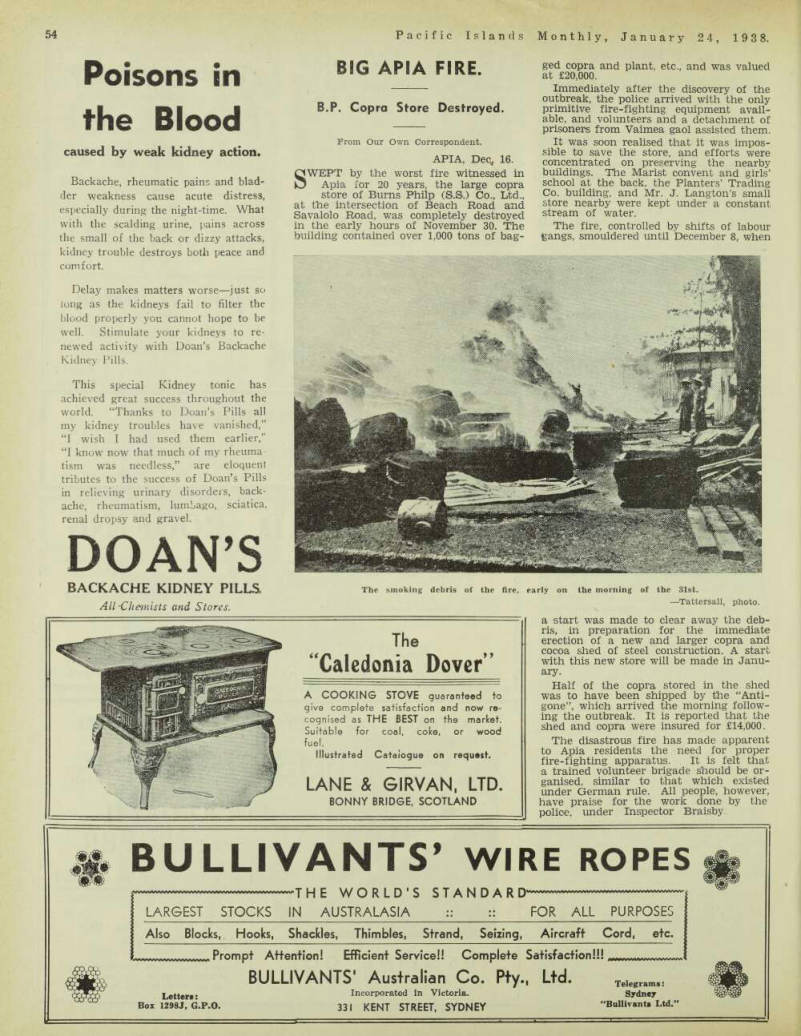
B.P. Copra Store Destroyed.
From Our Own Correspondent.
Apia, Dec, 16.
SWEPT by the worst fire witnessed in Apia for 20 years, the large copra store of Burns Philp (S.S.) Co., Ltd., at the intersection of Beach Road and Savalolo Road, was completely destroyed in the early hours of November 30. The building contained over 1,000 tons of bag
ged copra and plant, etc., and was valued at £20,000.
Immediately after the discovery of the outbreak, the police arrived with the only primitive fire-fighting equipment avail able, and volunteers and a detachment of prisoners from Vaimea gaol assisted them.
It was soon realised that it was impos sible to save the store, and efforts were concentrated on preserving the nearby buildings. The Marist convent and girls’ school at the back, the Planters’ Trading Co. building, and Mr. J. Langton’s small store nearby were kept under a constant stream of water.
The fire, controlled by shifts of labour gangs, smouldered until December 8, when
a start was made to clear away the deb ris, in preparation for the immediate erection of a new and larger copra and cocoa shed of steel construction. A start with this new store will be made in Janu ary.
Half of the copra stored in the shed was to have been shipped by the “Anti gone”, which arrived the morning follow ing the outbreak. It is reported that the shed and copra were insured for £14,000.
The disastrous fire has made apparent to Apia residents the need for proper fire-fighting apparatus. It is felt that a trained volunteer brigade should be or ganised, similar to that which existed under German rule. All people, however, have praise for the work done by the police, under Inspector Braisby.
The smoking debris of the fire, early on the morning of the 31st. —Tattersall, photo.
New Kind Of
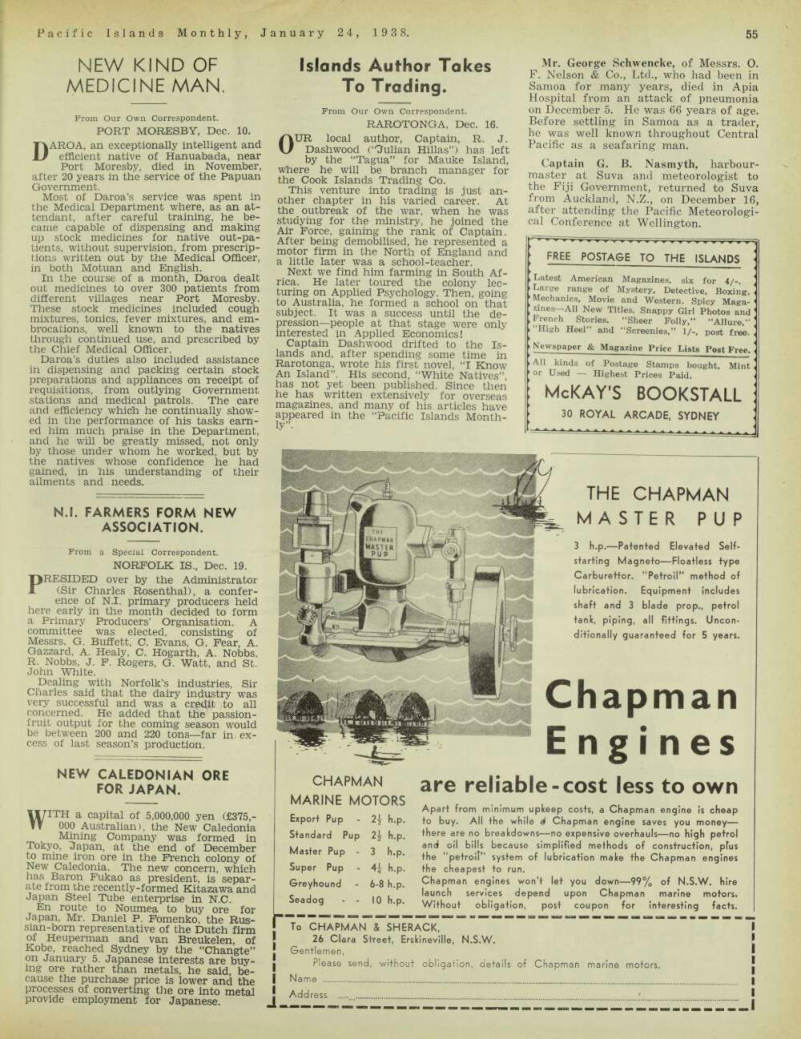
Medicine Man.
From Our Own Correspondent.
Port Moresby, Dec. 10.
DAROA, an exceptionally intelligent and efficient native of Hanuabada, near Port Moresby, died in November, after 20 years in the service of the Papuan Government.
Most of Daroa’s service was spent in the Medical Department where, as an at tendant, after careful training, he be came capable of dispensing and making up stock medicines for native out-pa tients, without supervision, from prescrip tions written out by the Medical Officer, in both Motuan and English.
In the course of a month, Daroa dealt out medicines to over 300 patients from different villages near Port Moresby.
These stock medicines included cough mixtures, tonics, fever mixtures, and em brocations, well known to the natives through continued use, and prescribed by the Chief Medical Officer.
Daroa’s duties also included assistance in dispensing and packing certain stock preparations and appliances on receipt of requisitions, from outlying Government stations and medical patrols. The care and efficiency which he continually show ed in the performance of his tasks earn ed him much praise in the Department, and he will be greatly missed, not only by those under whom he worked, but by the natives whose confidence he had gained, in his understanding of their ailments and needs.
N.I. Farmers Form New
Association.
From a Special Correspondent.
Norfolk Is., Dec. 19.
PRESIDED over by the Administrator (Sir Charles Rosenthal), a confer ence of N.I. primary producers held here early in the month decided to form a Primary Producers’ Organisation. A committee was elected, consisting of Messrs. G. Buffett, C. Evans, G. Fear, A.
Gazzard, A. Healy, C. Hogarth, A. Nobbs, R. Nobbs, J. F. Rogers, G. Watt, and St.
John White.
Dealing with Norfolk’s industries, Sir Charles said that the dairy industry was very successful and was a credit to all concerned. He added that the-’ passion fruit output for the coming season would be between 200 and 220 tons—far in ex cess of last season’s production.
New Caledonian Ore
For Japan.
WITH a capital of 5,000,000 yen (£375,- 000 Australian), the New Caledonia Mining Company was formed in Tokyo, Uapan, at the end of December to mine iron ore in the French colony of New Caledonia. The new concern, which has Baron Fukao as president, is separ ate from the recently-formed Kitazawa and Japan Steel Tube enterprise in N.C.
En route to Noumea to buy ore for Japan, Mr. Daniel P. Fomenko, the Rus sian-bom representative of the Dutch firm of Heuperman and van Breukelen, of Kobe, reached Sydney by the “Changte” on January 5. Japanese interests are buy ing ore rather than metals, he said, be cause the purchase price is lower and the processes of converting the ore into metal provide employment for Japanese.
To Trading.
Islands Author Takes To Trading.
From Our Own Correspondent.
Rarotonga, Dec. 16.
OUR local author, Captain, R. J.
Dashwood (“Julian Hillas”) has left by the “Tagua” for Mauke Island, where he will be branch manager for the Cook Islands Trading Co.
This venture into trading is just an other chapter in his varied career. At the outbreak of the war, when he was studying for the ministry, he joined the Air Force, gaining the rank of Captain.
After being demobilised, he represented a motor firm in the North of England and a little later was a school-teacher.
Next we find him farming in South Af rica. He later toured the colony lec turing on Applied Psychology. Then, going to Australia, he formed a school on that subject. It was a success until the de pression-people at that stage were only interested in Applied Economics!
Captain Dashwood drifted to the Is lands and, after spending some time in Rarotonga, wrote his first novel, “I Know An Island”. His second, “White Natives”, has not yet been published. Since then he has written extensively for overseas magazines, and many of his articles have appeared in the “Pacific Islands Month ly”.
Mr. George Schwencke, of Messrs. O.
F. Nelson & Co., Ltd., who had been in Samoa for many years, died in Apia Hospital from an attack of pneumonia on December 5. He was 66 years of age.
Before settling in Samoa as a trader, ke as well kn “ wa throughout Central Paclfic as a seafaring man.
Captain G B Nasmvth harbour q* ■; r ’ naroour master at Suva and meteorologist to y l6 *D I Government, returned to Suva Horn Auckland, N.Z., on December 16, after attending the Pacific Meteorologi cal Conference at Wellington.
Advertisements & other items, p. 57 (1 item)
Chapman
FREE POSTAGE TO THE ISLANDS
Latest American Magazines, six for 4/-.
Large range of Mystery, Detective, Boxing, Mechanics, Movie and Western. Spicy Magazines—All New Titles. Snappy Girl Photos and French Stories. “Sheer Folly,” “Allure,"
"High Heel” and “Screenies,” 1/-, post free.
Newspaper & Magazine Price Lists Post Free.
All kinds of Postage Stamps bought. Mint or Used Highest Prices Paid.
McKAY'S BOOKSTALL
30 ROYAL ARCADE, SYDNEY
master w
CHAPMAN
MARINE MOTORS
Export Pup Standard Pup Master Pup - Super Pup - Greyhound Seadog - - 2* h.p. 2* h.p. 3 h.p. h.p, 6-8 h.p. 10 h.p.
THE CHAPMAN
MASTER PUP
3 h.p.—Patented Elevated Selfstarting Magneto—Floatless type Carburettor. "Petroil” method of lubrication. Equipment includes shaft and 3 blade prop., petrol tank, piping, all fittings. Unconditionally guaranteed for 5 years.
Chapman
Engines
are reliable-cost less to own
Apart from minimum upkeep costs, a Chapman engine is cheap to buy. All the while d Chapman engine saves you money— there are no breakdowns—no expensive overhauls—no high petrol and oil bills because simplified methods of construction, plus the "petrol]” system of lubrication make the Chapman engines the cheapest to run.
Chapman engines won't let you down—99% of N.S.W. hire launch services depend upon Chapman marine motors.
Without obligation, post coupon for interesting facts.
To
CHAPMAN & SHERACK,
26 Clara Street, Erskineville, N.S.W.
Gentlemen, Please send, without obligation, details of Chapman marine motors.
Name Address •
Oscar Nordmcn
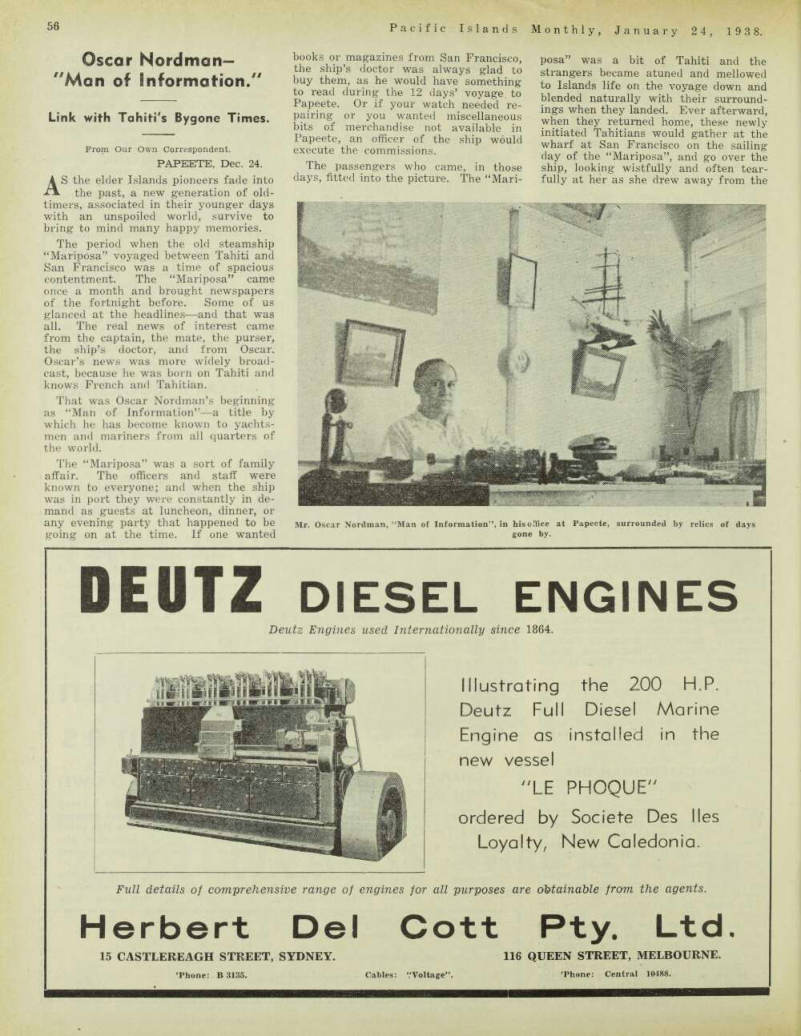

"Man of Information."
Link with Tahiti's Bygone Times.
From Our Own Correspondent.
Papeete, Dec. 24.
AS the elder Islands pioneers fade into the past, a new generation of old timers, associated in their younger days with an unspoiled world, survive to bring to mind many happy memories.
The period when the old steamship “Mariposa” voyaged between Tahiti and San Francisco was a time of spacious contentment. The “Mariposa” came once a month and brought newspapers of the fortnight before. Some of us glanced at the headlines—and that was all. The real news of interest came from the captain, the mate, the purser, the ship’s doctor, and from Oscar.
Oscar’s news was more widely broad cast, because he was born on Tahiti and knows French and Tahitian.
That was Oscar Nordman’s beginning as “Man of Information” —a title by which he has become known to yachts men and mariners from all quarters of the world.
The “Mariposa” was a sort of family affair. The officers and staff were known to everyone; and when the ship was in port they were constantly in de mand as guests at luncheon, dinner, or any evening party that happened to be going on at the time. If one wanted
books or magazines from San Francisco, the ship’s doctor was always glad to buy them, as he would have something to read during the 12 days’ voyage to Papeete. Or if your watch needed re pairing or you wanted miscellaneous bits of merchandise not available in Papeete, an officer of the ship would execute the commissions.
The passengers who came, in those days, fitted into the picture. The “Mari
posa” was a bit of Tahiti and the strangers became atuned and mellowed to Islands life on the voyage down and blended naturally with their surround ings when they landed. Ever afterward, when they returned home, these newly initiated Tahitians would gather at the wharf at San Francisco on the sailing day of the “Mariposa”, and go over the ship, looking wistfully and often tear fully at her as she drew away from the
Mr. Oscar Nordman, “Man of Information”, in hisoffice at Papeete, surrounded by relics of days gone by.
shore and disappeared through the Golden Gate.
Often, when we are heartily weary of dodging modern day sleek and silent motor-cars, of being deafened by aero plane engines overhead and radio broad casts and saxophones at every corner of every highway, we go to Oscar Nord man’s office in Papeete for a quiet chat.
He is the last link with the old “Mari posa”, for he served on her until she was withdrawn from the Tahiti run. He was also on other ships of the Oceanic Company, sailing to Samoa and Aus tralia, until the line merged with the Matson Steamship Company.
On the wall of his office is a painting of the “Mariposa” entering Papeete Harbour, and other souvenirs are about.
From Oscar’s lips come names of old sea captains and mates, and old friends and scenes from those spacious days when Tahiti was its own little world and the bickerings and confusions of distant countries came over the horizon only as a faint murmur, inaudible ex cept to those who wished to listen.
Advertisements & other items, pp. 58-59 (2 items)
Deutz Diesel Engines
Deutz Engines used Internationally since 1864.
Illustrating the 200 H.P.
Deutz Full Diesel Marine Engine as installed in the new vessel
"IE PHOQUE"
ordered by Societe Des lies Loyalty, New Caledonia.
Full details of comprehensive range of engines for all purposes are obtainable from the agents.
Herbert Del Cott Pty. Ltd.
15 CASTLEREAGH STREET, SYDNEY. 116 QUEEN STREET, MELBOURNE.
'Phone: B 3135. Cables: ‘‘Voltage”. 'Phone: Central 10488.
MllffililiW
Bakery At Wau.
The Morobe Bakery, Wau, New Guinea, which has just been equipped to undertake the manu facture of biscuits for the mandated labour forces on the goldfield.
A Parody Of Kipling.
Letter to the Editor.
ON reading “The Magistrate’s ‘IF’” in your November issue, one is disposed to congratulate the author on his modesty in apologising to Rudyard Kipling for his brilliant effusion.
When one realises the colossal hard ships that are the lot of the Papuan Magistrate, as enumerated by your re tiring poet, one can feel nothing but admiration for these stout defenders of the outposts of Empire. They sit in their offices from 9 a.m. until 4 p.m., daily wearing themselves out in the duty of King and Country, go out on patrol, braving the dangers of hostile cannibals with savage-looking arrows that could painfully penetrate the “gizzard”. (In delicate word, but I am sure that Kip ling would allow a little poetic license.) This they do, despite Sir Hubert Murray’s boast that one can walk from one end of Papua to the other with nothing more lethal than a walking stick.
It is also pleasing to note that these great Empire-builders are also experts
on copra and rubber production, and it must be of inestimable advantage to planters to have them on the spot to advise them in their many difficulties.
On such foundations are Empires born; and, while such men guide the destinies of a country in every branch of its activities, as your poet says they do, the British Empire is safe and Papua will become the most prosperous of the Commonwealth of Nations, and will con tinue as an example to the rest of the world. It is now apparent that one must hand most of the honour to this fine body of men.
May I, as a humble admirer of Kip ling, now transfer some of my affec tion to your unknown writer; and it is my hope that we will soon have a bigger and better recessional from his pen.
I am, etc.,
Port Moresby, 20/12/1937.
Koi Koi.
New Rarotonga Councillor.
From Our Own Correspondent.
Rarotonga, Dec. 9.
MR. Sam Bennett, prominent local business man, has been elected unopposed as European Member of the Rarotonga Island Council in place of Mr. D. Brown, the new Resident Agent of Atiu Island. Councillor Bennett has been a resident of the Cook Group for 10 years, and in that time he has gained an intimate knowledge of local affairs and requirements, which, combined with his keen business acumen, will be a valuable asset to the Council.
Mr. Victor Lisle, of the N.S.W. Edu cation Department, has been appointed headmaster of Norfolk Island public school.
Mr. William Knapton and Miss Bertha Christian, of Norfolk Island, were mar ried at N.I. on December 11. Canon Rook performed the ceremony.
Advertisements & other items, pp. 59-60 (1 item)
Aspro*
D Q hegd % V
Stylish Comfortable
and Faithfully Made from Tested Materia ii
TOP DOG”
Clothing, Hats, Shirts, Pyjamas, Mercery Hosiery and Knitted Goods will give full satisfaction They Look Well and They Wear Well
EVERY GARMENT GUARANTEED
SERVING HUMANITY
FOR 20 YEARS!
WHEN a commodity retains a world-wide demand for twenty years it is sound evidence that such a product lives up to its reputation and gives every satisfaction. There must be a sound reason for such continuous service. With ‘ASPRO r the reason is simply this: it is a medicine that has so many uses and its purity is its safety. All the members of a family can use ‘ASPRO’ for its various uses without any risk because ‘ASPRO’ is purity itself and it does not harm the heart or leave any injurious after effects. Furthermore, ‘ASPRO’ is as valuable in summer for headaches and nervous disorders as it is in winter for Colds, ’Flu and Rheumatism.
ASPRO*
Safety Protects all the Family through Summer and Winter
From £3
C.I.F. Sydney
W. M. REID BRINe
TO YOU
Direct from Europe’s most up-to-date Factory
SEWING
PRECISION BUILT
MACHINES with a reputation maintained during “77 YEARS’ for supreme workmanship and materials.
A patented hardening process guarantees smooth action and long life free of repairs.
Needles, Bobbins, eto», can be interchanged with other well known sewing machines.
Information, Parts, Patterns and all dress materials are obtainable from the agent . . .
W. M. REID, “Reid House,” 75 King Street, Sydney, G.P.O. Box No. 137 CC.
5 YEARS
Guarantee
Vat^ e
Ot^ sP o* u^ u ' X teep P Ae * V °l -47.1- G< f ' ot «* ato ' N 1
Lee °°
raa^ c & AV*t Vv^ V\ea tVie mT>'- Representatives
ROBERT BLAU (Aust.h
A.C.A. Building, Cnr. King & York Streets,
SYDNEY.
COLOO
EAU
DE 47/4 (**(«*?* »"!
“CIOCKENS
VII
v- -
Mission Trading In Papua

WE have another complaint, from a trader in Eastern Papua, about renewed trading activities by the well known mission station known as Kwato Extended Inc.
“About 18 months ago”, says our correspondent, “Mr. R. Fletcher, trader, of Normanby Island, wrote to you pro testing about the mission’s trading activities, which were putting white traders out of business. I was in and near Samarai a year ago, and I found that Kwato was very quiet.
“But, making a visit recently, 1 found that Kwato were in full swing again, trading at Duramu, and that they were buying and selling at prices I could not compete with. The result is that certain traders have got stores, but no customers.
Miss Mary Edwards, the well-known Sydney artist, returned to Australia by the Pierre Loti on January 7 from her fifth trip to New Hebrides and New Cale donia where she has been doing a great deal of painting.
Pattern Service
have arranged with a well-known Sydney " firm of pattern-cutters to publish each month a diagram of a seasonable frock, patterns of which may be obtained by our readers direct from this office, post free, on payment of the sum stated under the diagram. Address your letter to “Pat tern,” Pacific Islands Monthly, Box 3408 R.
Sydney, and enclose a note giving the number of the pattern wanted and bust size, and enclose also the price of the pattern in postal note or stamps. The pattern will be sent by return mail.
10,410—This nightdress in Empire style is cut on the cross. Square neck front is outlined with lace and gathered at the base where it joins the skirt part. Flared sleeves are edged with lace, matching the neck. Material (for 36 in. bust); S l /* yds. 36 ins. wide. Bust sizes 32 to 40 ins.
Nightdress, 10,410—10d Cut on cross
Special Service For Native
Servants.
From Our Own Correspondent.
Pt. Moresby, Jan. 10.
ANEW feature of the Port Moresby Post Office which was established in December is a separate office for the sale of stamps and postal notes to na tives. The office is in charge of a Papuan.
It has been created for the benefit of native messengers, who formerly, owing to the delay while European customers were being served, had to wait sometimes for hours at a time. These messengers now receive immediate attention, in their own department. The innovation has prov ed a boon to business houses and house holders.
Mrs. Helen McCoy, of Norfolk Island, reached Sydney on her first visit to Aus tralia by the Morinda on January 12. .A son—Robert Gordon —was bom at Charlepiount Hospital, Point Piper, Syd ney, to Mr. and Mrs. B. G. Edgell, of Pak Plantations, Manus, New Guinea, on December 27.
Fashion Hints for Islands Women
By Therese
CLOTHES that challenge gloom are a product of 1938. There is just that little something about modem clothes that makes a tremendous appeal to all women, and there is always some thing new hoving into view over fash ion’s horizon.
Colour is more important than ever.
Everywhere one sees evidence of this in the gaily patterned materials offered by manufacturers, and it is not unusual to see them splashed with more colours than an artist's palette. London tan, cobalt blue, and sabrina (a delicate duck egg shade), are some of the new colours that are demanding attention and re ceiving it, too, with quite a deal of en thusiasm.
White is always popular and some thing in which it is impossible to err; and with colours it leaves nothing to be desired. A gay scarf, a multi-coloured ’kerchief fluttering from pocket Or belt, a posy of vivid flowers, and you are right for all occasions. For evening wear, it is unsurpassed and nothing can compare with a white satin gown of classical lines, in which are combined a delightful trin ity-dignity, graciousness, and charm.
By clever draping (the skirt is gather ed on one side of the bodice to the hip) the uneven hemline is achieved; and a mauve satin gown of this type made with an off-the-shoulder decolletege clips a slender strap over its shoulder. There is charm about the exquisite pastel colours, and a heavy yellow crepe has detachable scarf that lends itself perfectly to classi cal folds.
Simplicity is the keynote of the wood land green dress that encircles its waist with a gold embroidered belt. Its tip tilted front pays tribute to the uneven hemline.
Correct dressing for cocktail parties, little dinner parties, and for the hundred and one semi-formal occasions that crop up in a busy and well-ordered life, is of the utmost importance, and it is made easy by the wide choice that is offered.
The blouse and skirt solves perfectly the query, “What shall I wear?” A skirt of heavy pansy-purple crepe allies itself with a blouse of pale violet chiffon and a silver ©lip holds the soft gathers in the bodice. The billowing sleeves are elbow length, and around the waist swathes a belt of the two colours. Many informal dresses are accompanied by coatees, some being heavily embroidered in Chinese de signs. Dresses of ebon hue have sleeves of contrasting colour, the same contrast being repeated in a corsage or belt posy of immense proportions.
Flowers are worn for day time, too, and the black and white combination is still on top of the world. A black frock has a braided hemline (six, seven, eight, or ten rows of braid). At the square fronted neckline, a cluster of marguer ites is worn, and a fringed sash of heavy white crepe continues the magpie effect.
Two white feathers slashed across the front of the upturned brim of the hat, in audacious style, make it a fitting ac companiment for the frock, and white gloves and bag add the finishing touches to a perfect toilette.
A formal gown of buttercup-yellow crepe patterned with self flowers boasts an extended shoulder line and swathes its waist with a sash that slots in front.
All the skirt’s fullness is drawn to the front.
Black is featured again in the frock of dull crepe with a draped and gathered bodice. A scarlet cord runs around the neckline and down each side of the bodice, gathering it into soft drapes and ending in two tassels at the waist. A
jaunty little hat perches on the side of the head and flaunts a scarlet trimming.
A frock of London tan takes liberties successfully, and an inlet vest of striped silk is new and unusual. The vest is gathered and is multi-coloured, as is the wide brimmed hat with which it is worn.
Suits are as popular as ever and offer a wide range of clever colour combina tions. Uncrushable silk linen that washes and wears well is a happy medium for their expression. A nautical air is achiev ed by a blue linen suit with brass but
tons which takes unto itself a Jack Tar sailor with tremendous success. Twotone shoes and white accessories accompany it. a butter coloured skirt dons a blue blouse and is topped by a, yellow and blue check coat, a boxy affair, the collar of which matches the skirt.
Blouses must be not overlooked as they form an important part of every woman’s wardrobe, and whether the occasion be day or evening, formal or informal, they are always right. A pink spotted blouse and a grey skirt are a delightful combination and when topped by a grey hat and black accessories leave nothing to be desired. A yellow tailored blouse flecked with green is worn with a green skirt and is right for all sporting occasions.
Trim little jumpers and white skirts are as cool to wear as they are to look at, and tailored hats of the same material are worn with them.
Hats are quaint and amusing and express more individuality than ever.
Chinese coolies with their twin baskets
are silhouetted in black on the brim of a red straw. Boomerangs lend an unusual note to the upturned brim of a navy hat. A simple blue band does duty for a head covering, matching the dress with which it is worn.
Ballet girls dance on the streamer ends of an Annabella hat and big yellow dais ies lend a summer air to a hat of oreen Baku straw. Small hats are worn in spite of sunny days when sunshades of every hue make up for their lack of pro tection from the sun.
Beach fashions are noteworthy because of their simplicity and gay colourings, and above all their adaptability. Brightly striped swim suits add coats lined with towelling, and well tailored play-suits have coats to match that button to the knees. A coolie hat and quaint beach sandals complete the scheme. White is as much used on the beach as for other occasions and white linen shorts and sun top are worn with an eye shade and white accessories.
Advertisements & other items, pp. 61-62 (1 item)
Pains
MASTER
POWDERS &
TABLETS
1/6 AND 2/6.
SINGLES 2d.eo.
STOPS SAFELY
HEADACHE
'FLU & COLDS
RHEUMATISM
NEURALGIA
SC I ATI C A
NEURITIS
LUMBAGO
AND ALL NERVE AND
MUSCULAR PAINS
Over the past 20 years thousands of (men and women have proved Vincent’s A.P.C. to be the most effective remedy for relieving all pain. That is why there are more Vincent’s A.P.C.
Powders and Tablets sold in Australia to-day than all other similar preparations.
If you suffer from Headache, Rheumatism, Heat Exhaustion, Nervous Irritability, Sleeplessness, or any nerve or muscular pain, get a packet of Vincent’s A.P.C. Powders or Tablets and take them as directed. You will be more than satisfied at the speedy, effective relief Vincent’s A.P.C. brings. Vincent’s A.P.C. can be taken with perfect safety, as it does not affect the heart or leave any after-effects.
FOR SAFETY'S SAKE, SAY "VINCENT’S A. P. C."
-—\ o ■J -\ \\
zluA
THE MOST DELIGHTFUL
J!ln ge tee BU RNS PH ILP at all their branches *h* Pacific
MORRIS, HEDSTROM, Ltd.,
Registered Office - - Suva, Fiji.
BRANCHES THROUGHOUT FIJI, TONGA AND SAMOA
Agents for; >
LLOYD'S
NOBELS (AUSTRALIA) LIMITED—EXPLOSIVES
MATSON NAVIGATION COMPANY
RUSTON &'HORNSBY LIMITED
IMPERIAL CHEMICAL INDUSTRIES LIMITED
JOHN LYSASHT (AUST.) LTD.
VACUUM OIL COMPANY PROP'TY. LIMITED
FORD MOTOR COMPANY LIMITED
GOODYEAR TIRE & RUBBER EXPORT COY. J.
SYDNEY OFFICE: DALTON HOUSE, 115 PITT ST.
Your Tropical Kit
When you visit the Pacific Islands, whether on Business or Pleasure, you need Special Equipment—Light Suits of Correct Style, which fit well and launder easily; Tunic Shirts, Silk Shirts, Light Underwear, White Shoes, etc.
WALTER HORNE & CO. LTD,, established in 1885, specialise in this Service. Skilled Tailors make your Suits from First-class material within 24 hours. Complete equipment can be supplied from our Large Stocks at Reasonable, Moderate Prices.
BUY FROM THE FIRM WHICH UNDERSTANDS YOUR NEEDS AND
DRESSES YOU CORRECTLY
WALTER HORNE & CO. LTD., carry a Full Range of Drapery of all "kinds; also Frocks, Millinery, Foundations and Lingerie, Hosiery, Shoes and Sandals, Ribbons and Laces, Household Drapery.
Men resident in any of the Pacific Territories can he supplied with Suitable Clothes.
Ladies' Hairdressing and Manicuring
WALTER HORN &
Write to us and Describe your Requirements.
CO. LTD.
Drapers and Men's Wear Specialists
SUVA. FIJI
Growers' Strike.
Illuminating Incident In Cook Islands Banana Trade.
THE lack of vision and co-operation among traders, which so frequently leads to State interference and Gov ernment control, were illustrated in New Zealand during the Christmas holidays.
It became known in Rarotonga, early m December, that New Zealand mer chants were prepared to pay only 5/- -per case in wharf sheds (equal to 2/- per case to the growers) for bananas due to arrive m N.Z. by the “Matua” at Christ mas time.
Rarotongan native growers, who pro vide most of the Cook Islands bananas, simply refused to ship.
T .he Resident Commissioner, Mr. S. J.
Smith (who has made fruit organisation and control his special concern) immedi ately called a meeting of interested part ies in Rarotonga; and the buying agents there, recognising the position, agreed to forego their buying commission and even to advance 6d. per case at their own per sonal risk, in order that the trade should not be dislocated. The Administration also withdrew certain inspection and other fees.
All these concessions brought the price to growers to 3/- a case, with the result that growers then provided a good sup ply of bananas for the “Matua’s” Christ mas shipment.
It was only as a result of these meas ures that the banana trade out of Raro tonga was not seriously dislocated. The incident almost certainly will serve as justification for the N.Z. Government, through the Cook Islands Commissioner, taking control of the banana trade, as it has done to the orange trade.
As far as we can see, the merchants have only themselves to, thank for this position. They must have known what would be the reaction to their proposed S/- per case. If they had consulted to gether and found some way of keeping growers satisfied, there need have been no trouble. In these days—and this ap plies to all distributors and not to N.Z. fruit merchants alone—it is impossible to follow the old rule of simply saying to a particular class of producers; “This is our price—take it or leave it!” There must be negotiation and explanation, and the pro ducer must be satisfied that the middle man is himself making the same sacrifices as he is asking of the producer.
Pictorial Stamps For Fiji.
Prom Our Own Correspondent.
Suva, Jan. 4.
COME time ago the Fiji invited •«* competitive designs for a set of pictorial postage stamps for Fiji. Several local artists entered and the designs were sent to England for judging and selection. The sum of £lO was offered for each design accepted and the results are as follow; Mrs. V. E. Ousey, Sigatoka, y 2 d, 1/-, and 2/6.
Miss C. D. Lovejoy, Labasa, Id, lV 2 d, and sd.
Mr. A. V. Guy, Suva, 2d, 6d, and 2/-.
Miss I. R. Stinson, Suva, 3d and 5/-.
The new set will have a face value of 12/1, and is expected to be ready for issue in March!
Rev. and Mrs. E. R. Elder and their
son John have been transferred from
Labasa, Fiji, to the Anglican mission
station at Levuka, Ovalau Island. Rev.
R. L. Crampton is now priest-in-charge
of the Indian mission at Labasa.
Life On Makogai, The Leper Island.
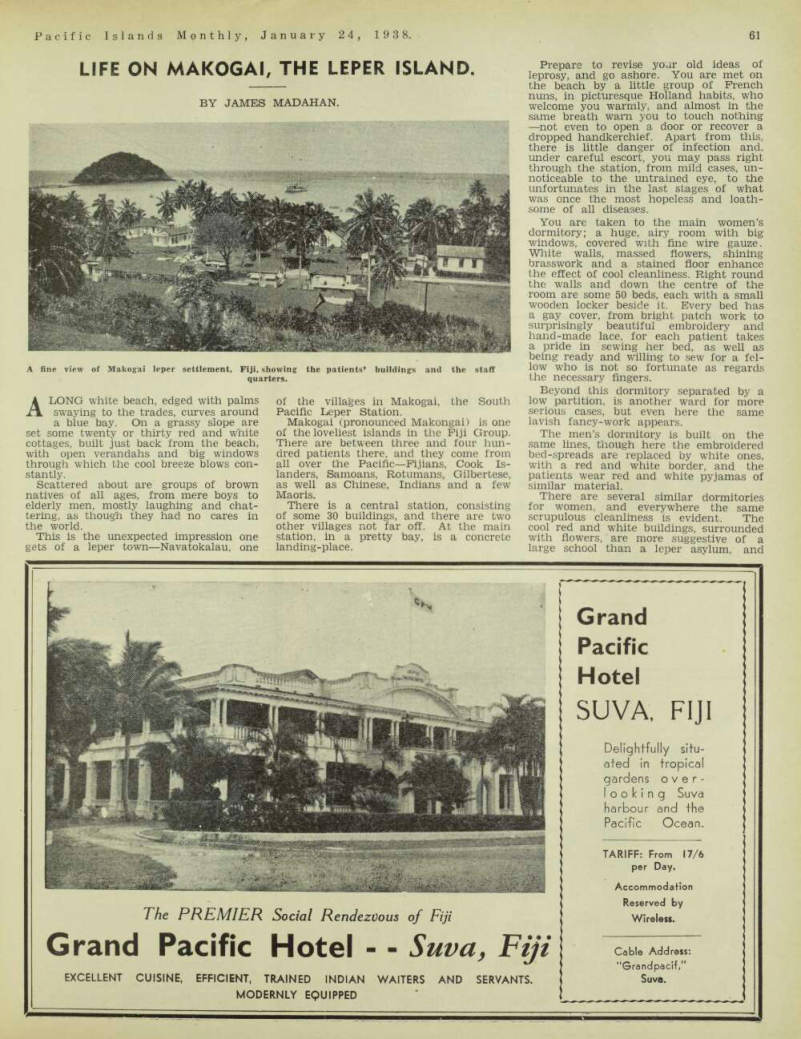
By James Madahan.
ALONG white beach, edged with palms swaying to the trades, curves around a blue bay. On a grassy slope are set some twenty or thirty red and white cottages, built just back from the beach, with open verandahs and big windows through which the cool breeze blows constantly.
Scattered about are groups of brown natives of all ages, from mere boys to elderly men, mostly laughing and chattering, as though they had no cares in the world.
This is the unexpected impression one gets of a leper town—Navatokalau, one
of the villages in Makogai, the South Pacific Leper Station.
Makogai (pronounced Makongai) is one of the loveliest islands in the Fiji Group.
There are between three and four hun dred patients there, and they come from all over the Pacific—Fijians, Cook Is landers, Samoans, Rotumans, Gilbertese, as well as Chinese, Indians and a few Maoris.
There is a central station, consisting of some 30 buildings, and there are two other villages not far off. At the main station, in a pretty bay, is a concrete landing-place.
Prepare to revise your old ideas of leprosy, and go ashore. You are met on the beach by a little group of French nuns, in picturesque Holland habits, who welcome you warmly, and almost in the same breath warn you to touch nothing —not even to open a door or recover a dropped handkerchief. Apart from this, there is little danger of infection and, under careful escort, you may pass right through the station, from mild cases, un noticeable to the untrained eye, to the unfortunates in the last stages of what was once the most hopeless and loath some of all diseases.
You are taken to the main women’s dormitory; a huge, airy room with big windows, covered with fine wire gauze.
White walls, massed flowers, shining brasswork and a stained floor enhance the effect of cool cleanliness. Right round the walls and down the centre of the room are some 50 beds, each with a small wooden locker beside it. Every bed has a gay cover, from bright patch work to surprisingly beautiful embroidery and hand-made lace, for each patient takes a pride in sewing her bed, as well as being ready and willing to sew for a fel low who is not so fortunate as regards the necessary fingers.
Beyond this dormitory separated by a low partition, is another ward for more serious cases, but even here the same lavish fancy-work appears.
The men’s dormitory is built on the same lines, though here the embroidered bed-spreads are replaced by white ones, with a red and white border, and the patients wear red and white pyjamas of similar material.
There are several similar dormitories for women, and everywhere the same scrupulous cleanliness is evident. The cool red and white buildings, surrounded with flowers, are more suggestive of a large school than a leper asylum, and
A fine view of Makogai leper settlement, Fiji, showing the patients’ buildings and the staff quarters.
when one remembers the uncleanliness of the average leper, and contrasts it with the attention given tq each one of these unfortunates, irrespective of colour, race, creed or sect, one appreciates the work of the sisters at Makogai.
There is nothing repulsive seen. Of course, there are many missing limbs, but all the wounds are either quite healed over or carefully dressed and bandaged.
Indeed, many of the people are quite healed and give no sign whatever, save a slight puffiness around eyes, that they are leprous.
There are three small houses, a little apart from the rest, where are the most serious cases. The sight of these old folks, mostly blind, all maimed and practically helpless, and yet clinging desperately to what is left of life, is very pitiful. But just speak a few words in their own language, and see their faces light up and hear their cheerful greetings to the strangers.
These hopeless cases are a very small minority; for, if taken in the early stages, and even later, leprosy now is by no means incurable. Here is an example. An Indian woman, in an advanced state of leprosy, was discovered in a native vil lage and sent to Makogai. Three months after her arrival she gave birth to a child, perfectly healthy and strong. The child was kept under observation for two years, and then was sent to her father, Each year, fifteen to twenty patients leave Makogai, cured. One who left some years ago was a Sister of Mercy from the Gilbert Islands, who contracted leprosy while working among the sick. After sev eral years at Makogai, she was cured and returned to her work in the Gilberts, One cannot speak too highly of the work the sisters are doing at Makogai. A little band of ten nuns, several of them quite young, have given up their lives to the care of the lepers. They spend hours tering the various Chaulmoogra oil pre
parations, yet they are never too tired or busy to trace off an embroidery pat tern for one woman, or admire the new dress of another, or comfort yet another because her daughter is not coming to see her by the next “Pioneer” (a Gov ernment boat which twice a year brings relations to visit the patients). They always are cheerful, whether the work to be done is assisting the doctor in charge with an operation, or working the small cinema which is one of the patients’ de lights.
Leprosy, once an incurable disease, the very name of which made one shudder, is being cured with modern methods of treatment. A few years ago, a man who developed leprosy was as one accursed, an outcast from his village and from the community, untouchable and helpless.
Now he is escorted to Makogai, to live with his fellow lepers, to be treated medi cally by the doctors and to be carefully nursed back to health by the devoted nuns.
Advertisements & other items, pp. 63-64 (1 item)
Suva, Fiji
■ ml m - 77ie PREMIER Social Rendezvous of Fiji Grand Pacific Hotel - - Suva, Fiji EXCELLENT CUISINE, EFFICIENT. TRAINED INDIAN WAITERS AND SERVANTS.
MODERNLY EQUIPPED
Grand
Pacific
Hotel
SUVA, FIJI
Delightfully situ-
ated in tropical gardens over-
looking Suva
harbour and the Pacific Ocean.
TARIFF: From 17/6
per Day.
Accommodation Reserved by Wireless.
Cable Address: "Srandpacif,"
Suva.
A. B. DONALD LTD
AUCKLAND
ISLAND TRADERS :: GENERAL MERCHANTS
P. O. Box 1509 Cables and Telegrams; "Kingdom," Auckland Branches at Rarotonga and throughout the Cook Islands At Papeete and throughout the Society, Marquesas and Paumotu Islands trading as " ETABLISSEMENTS DONALD. TAHITI "
At Fiji: Trading as "Dominion Fruit C 0.," Suva
Made in 5 Widths
7-Inch, 8-inch, 9-inch, 10-inch and 11-in. cut These ploughs will do good work in new or old land.
Ample clearance is provided for ploughing in
Mian
thick surface growth.
somes
“CUB”
PLOUGHS
Write for illustrated literature and all information.
MORRIS, HEDSTROM LTD. - Suva, Lautoka and Ba Made by: RANSOMES, SIMS & JEFFRIES, LTD., IPSWICH, ENGLAND
Control Over Foreigners In
New Caledonia.
From Our Own Correspondent,
Noumea, Dec. 30.
rpHE new law, compelling all mining and X other companies operating in New Caledonia to have French managers, is not directed against capital, as sug gested by Australian investors in the country.
With the increasing Japanese mining activity it was found necessary to keep a certain amount of control over foreign ers.
safely.
Wau Takes Dewar Cup From
Port Moresby.
Prom Our Own Correspondent.
Pt. Moresby, Jan. 6.
PORT MORESBY’S team of sportsmen returned home from Wau (New Guinea) by 'plane on December 28, having failed to retain the Dewar Cup, annually competed for between the two towns. They were, however, anything but down hearted: Wau hospitality is proverbial and the goldfields people surpassed themselves in ensur ing that every moment of their visitors’ stay was packed with enjoyment.
Cricket began on December 24. Pt. Moresby with 163 (Ewing 53 and Cadden 24) and 129 (Harris 41, n. 0., and Molloy 38) were outclassed by the Wau men, who scored 231 (Rich 63) in the Ist innings, and 62 without loss of wicket in the 2nd, Tennis was disastrous for Moresby —our players lost every set in both singles and doubles. Wau golfers also had their eye in and won every match, only one being close.
Although our team say that it would be im possible to contest the events in happier cir cumstances than the recent visit to Wau, they have vowed to go into strict training immediately in preparation for the matches to be held in Pt. Moresby in September next and for the Gargantuan hospitality with which they intend to bombard the Wau team.
The Union S.S. Co.’s trans-Pacific
cargo vessel “Limerick” (8,724 tons),
which arrived at Vancouver, via Fiji
and Tahiti, ran aground in the harbour on January 4. Damage was slight, and she was refloated and towed to dry dock. Her cargo of sugar was removed
safely.
Angabunga Plantations Limited, of
Papua, has been voluntarily wound-up.
At an extraordinary general meeting held
in Sydney on December 2, Messrs. D.
Manion and J. A. Cooney were appointed
liquidators.
Suva Yacht Club.
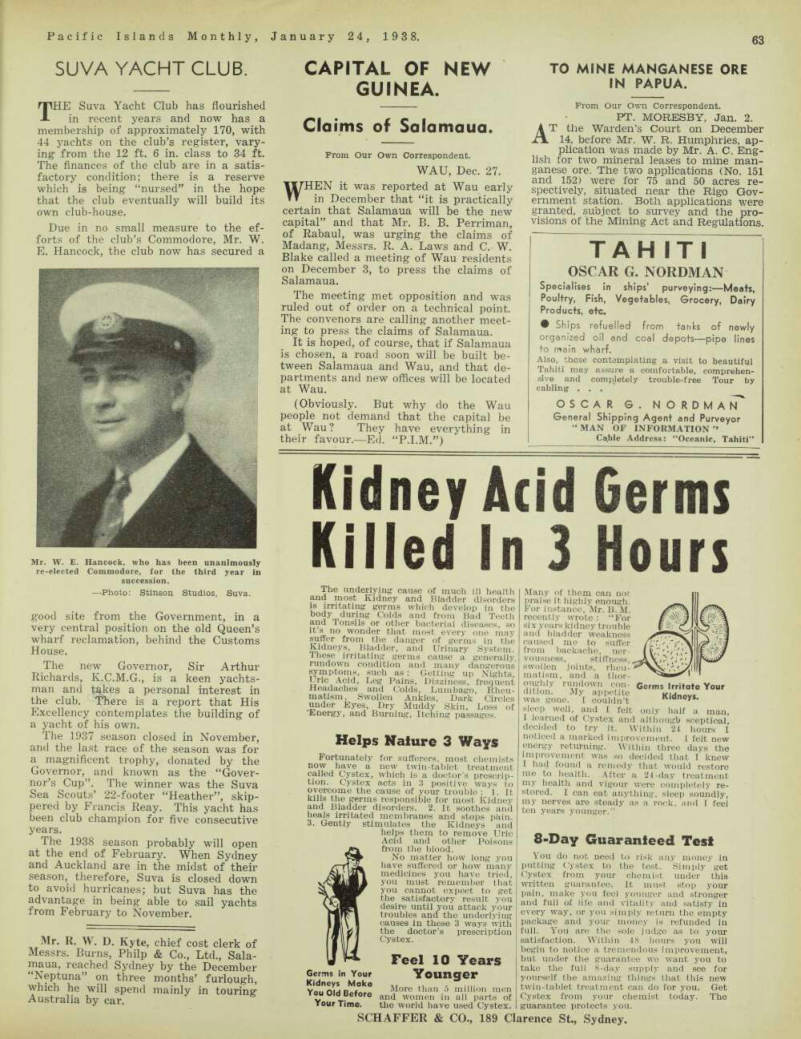
THE Suva Yacht Club has flourished in recent years and now has a membership of approximately 170, with 44 yachts on the club’s register, vary ing from the 12 ft. 6 in. class to 34 ft.
The finances of the club are in a satis factory condition; there is a reserve which is being “nursed” in the hope that the club eventually will build its own club-house.
Due in no small measure to the ef forts of the club’s Commodore, Mr. W.
E. Hancock, the club now has secured a
good site from the Government, in a very central position on the old Queen’s wharf reclamation, behind the Customs House.
The new Governor, Sir Arthur Richards, K.C.M.G., is a keen yachts man and tj|kes a personal interest in the club. There is a report that His Excellency contemplates the building of a yacht of his own.
The 1937 season closed in November, and the last race of the season was for a magnificent trophy, donated by the Governor, and known as the “Gover nor’s Cup”. The winner was the Suva Sea Scouts’ 22-footer “Heather”, skip pered by Francis Reay. This yacht has been club champion for five consecutive years.
The 1938 season probably will open at the end of February. When Sydney and Auckland are in the midst of their season, therefore, Suva is closed down to avoid hurricanes; but Suva has the advantage in being able to sail yachts from February to November.
Mr. R. W. D. Kyte, chief cost clerk of Messrs. Burns, Philp & Co., Ltd., Sala maua, reached Sydney by the December “Neptuna” on three months’ furlough, which he will spend mainly in touring Australia by car.
Mr. W. E. Hancock, who has been unanimously re-elected Commodore, for the third year in succession. —Photo: Stinson Studios, Suva.
Guinea.
Capital Of New
Claims of Salamaua.
Prom Our Own Correspondent.
WAU, Dec. 27.
WHEN it was reported at Wau early in December that “it is practically certain that Salamaua will be the new capital” and that Mr. B. B. Perriman, of Rabaul, was urging the claims of Madang, Messrs. R. A. Laws and C. W.
Blake called a meeting of Wau residents on December 3, to press the claims of Salamaua.
The meeting met opposition and was ruled out of order on a technical point.
The convenors are calling another meet ing to press the claims of Salamaua.
It is hoped, of course, that if Salamaua is chosen, a road soon will be built be tween Salamaua and Wau, and that de partments and new offices will be located at Wau. (Obviously. But why do the Wau people not demand that the capital be at Wau? They have everything in their favour.—Ed. “P.I.M.”)
To Mine Manganese Ore
In Papua.
From Our Own Correspondent.
Pt. Moresby, Jan. 2.
AT the Warden’s Court on December 14, before Mr. W. R. Humphries, ap plication was made by Mr. A. C. Eng lish for two mineral leases to mine man ganese ore. The two applications (No. 151 and 152) were for 75 and 50 acres re spectively, situated near the Rigo Gov ernment station. Both applications were granted, subject to survey and the pro visions of the Mining Act and Regulations.
Advertisements & other items, p. 65 (1 item)
Kidney Acid Germs
TAHITI
OSCAR G. NORDMAN
Specialises in ships' purveying:—Meats, Poultry, Fish. Vegetables, Grocery, Dairy Products, etc. • Ships refuelled from tanks of newly organized oil and coal depots —pipe lines to main wharf.
Also, those contemplating a visit to beautiful Tahiti may assure a comfortable, comprehensive and completely trouble-free Tour by cabling . . .
OSCAR G. NORDMAhT
General Shipping Agent and Purveyor
“MAN OF INFORMATION”
Cable Address: “Oceanic, Tahiti”
Kidney Acid Germs Killed In 3 Hours
The underlying cause of much ill health and most Kidney and Bladder disorders is irritating germs which develop in the body during Colds and from Bad Teeth and Tonsils or other bacterial diseases, so it s no wonder that most every one may fuj| er from the danger of germs in the Kidneys, Bladder, and Urinary System.
These irritating germs cause a generally rundown condition and many dangerous symptoms, such as : Getting up Nights, Uric Acid, Leg Pains, Dizziness, frequent Headaches and Colds, Lumbago, Rheumatism, Swollen Ankles, Dark Circles under Eyes, Dry Muddy Skin, Loss of Energy, and Burning, Itching passages.
Helps Nature 3 Ways
Fortunately for sufferers, most chemists now have a new twin-tablet treatment called Cystex, which is a doctor’s prescription. Cystex acts in 3 positive ways to overcome the cause of your trouble : 1. It kills the germs responsible for most Kidney and Bladder disorders. 2. It soothes and heals irritated membranes and stops pain. 3. Gently stimulates the Kidneys and helps them to remove Uric Acid and other Poisons from the blood.
No matter how long you have suffered or how many medicines you have tried, you must remember that you cannot expect to get the satisfactory result you desire until you attack your troubles and the underlying causes in these 3 ways with the doctor’s prescription Cystex.
Germs in Your Kidneys Make You Old Before
Feel 10 Years
Younger
More than 5 million men and women in all parts of Your Time, the world have used Cystex.
Many of them can not praise it highly enough.
For instance, Mr. B. M. recently wrote : “For six years kidney trouble and bladder weakness caused me to suffer from backache, nervousness, stiffness, swollen joints, rheumatism, and a thoroughly rundown condition. My appetite was gone. I couldn’t sleep well, and I felt only half a man.
I learned of Cystex and although sceptical, decided to try it. Within 24 hours I noticed a marked improvement. I felt new energy returning. Within three days the improvement was so decided that I knew I had found a remedy that would restore me to health. After a 24-day treatment my health and vigour were completely restored. I can eat anything, sleep soundly, my nerves are steady as a rock, and I feel ten years younger.”
Germs Irritate Your
Kidneys.
8-Day Guaranteed Test
You do not need to risk any money in putting Cystex to the test. Simply get Cystex from your chemist under this written guarantee. It must stop your pain, make you feel younger and stronger and full of life and vitality and satisfy in every way, or you simply return the empty package and your money is refunded in full. You are the sole judge as to your satisfaction. Within 48 hours you will begin to notice a tremendous improvement, but under the guarantee we want you to take the full 8-day supply and see for yourself the amazing things that this new twin-tablet treatment can do for you. Get Cystex from your chemist today. The guarantee protects you.
SCHAFFER & CO., 189 Clarence St., Sydney.
500,000 Documents.
Preservation of Early L.M.S. Archives.
THE Trustees of the Pilgrim Trust have granted £1,138 for the preservation and cataloguing of the archives and records of the London Missionary Society, which are housed in London at Living stone House, Broadway, Westminster.
Lord Macmillan, chairman of the Trust, has taken a personal interest in the pre servation of the original letters and docu ments relating to the Society’s work in Africa, India, China, South Seas, Mada gascar, Papua, and the West Indies. The archives consist of personal journals and letters from missionaries to officers of the Society.
Some of the most valuable of the ar chives relate to early days in the South ern Pacific. The first missionaries of the Society arrived at Tahiti on board the ship “Duff” in 1797, and their closely written but still legible journals are the only source of knowledge of the happen ings for many years in the Society Is lands.
The African records date from 1799, when J. T. Vanderkemp began to write home. Afterwards Dr. John Philip and others sent dispatches which are import ant for the early history of South Africa, and the Society’s notable stand on behalf of the Hottentots. Robert Moffat’s let ters describe his pioneer journeys into what is now Southern Rhodesia. His first visit was in 1829, many years before the arrival of other white settlers.
Perhaps the most valuable part of the collection is a batch of sixty letters from David Livingstone, written during the
period 1840 to 1857, when he was a mis sionary of the London Missionary Society in Africa. At this time Livingstone was spelling his name without the final “e”, and his writing has a curious backward slope. Writing from Lattako on October 30, 1843, he describes the founding of a new mission station among the Bakhatla people:— “No one out of this country can imag ine how grievously slow everything in it moves except time. But it cannot be otherwise so long as the heavy Dutch wagon and tedious pack-ox are the only permanent conveyances. This disadvan tage has a great effect on most mission ary movements, and not infrequently presses heavily on our spirits ... for though I believe the spot selected is the very best at present inhabited in the in terior . . . and although I should be de lighted to call it the centre of my labour, I shall try to hold myself in readiness to go anywhere provided it be forward”.
Other letters tell the story of those mis sionaries who lived among the slaves of British Guiana from 1807 onwards; with them is the original journal of John Smith, the Demerara martyr, whose death gave an impetus to the emancipation movement. A 4,000 miles’ sledge ride across Russia to Siberia, where the So ciety had a mission to the Mongols before 1841, is described in a series of letters from the hardy men who made the jour ney.
From 1807, Robert Morrison’s bold, clear handwriting records the early days in Canton, and how, while his life was in danger, he was preparing for his great work of translation. Other notable mis sionaries represented in the archives are James Chalmers, the Papuan mar tyr, John Williams, of the South Seas, and James Gilmour, of Mongolia.
The records are specially rich in ma terial relating to the early days of many parts of the Empire. South Africa, Southern and Northern Rhodesia, and the Bechuanaland Protectorate have been the subject of continual correspondence since the first days of white settlement, and the importance of the original letters is increasingly recognised by professors of history and research students.
The history of white settlement in the Territory of Papua is preserved in the archives through the letters of Lawes, the first white man to live on the main land, and Chalmers, who joined him in 1877. India, too, from the days of John Company onwards, provides a large pro portion of the documents; while much interesting light is thrown on the great French possession of Madagascar, where Protestant missionaries settled in 1820.
The gift of the Pilgrim Trust will en sure that the letters and Journals in the archives are classified under expert ex amination and carefully preserved in fireproof rooms. Altogether, some 500,000 documents will be re-arranged, and made easy to handle by students and research ers. It is expected that the scheme will be completed within two years.
Yen. H. Mayo Harris, Archdeacon of Fiji and Vicar of Holy Trinity Pro- Cathedral, Suva, who has been on long leave with his wife in Great Britain, is expected to return to Suva at the end of January. Mrs. Harris will remain in New Zealand until early in March.
Mr. H. O. Littlechild, Travelling Medical Assistant in the Papuan Ad ministration, arrived in Australia by the December “Montoro”. He is on long leave, at the end of which he will retire from the service.
Advertisements & other items, p. 66 (1 item)
Balm
BURNS PHILP
Registered (SOUTH SEA) CO. LTD. °"'• * • Inc. in Fiji SUVA Island Traders and Shipowners Also Branches at: Code Address: "Burnsouth."
Fiji: Levuka, Lautoka, Labasa, Ba, Sigatoka, Rotuma.
Tonga: Nukualofa, Haapai, Vavau.
Samoa: Apia, Pago Pago (American Samoa).
Solomons: Makambo, Gizo, Faisi.
New Hebrides: Vila.
Gilberts: Tarawa.
Norfolk Is. Niue. Wallis Is. Futuna Is.
BEAUTIFIES.. . PROTECTS and
PREVENTS BLACK MOULD
"8.A.L.M." Fungicidal Paint provides a decorative and colourful protection to timber and iron, and as it is specially formulated for use in the tropics It contains special materials to prevent black mould. "8.A.L.M."
Fungicidal Paint will beautify and preserve your property — It's cheaper to paint than to repair —so, use a durable, long-lasting paint that gives perfect protection and reduces repair bills to a minimum.
"8.A.L.M." Fungicidal Paint is available in Gloss for exterior use and Flat for Interior use. a
BALM
FUNGICIDAL
PAINT
A Product of British Australian Lead Manufacturers Pty. Ltd.
DISTRIBUTORS : Steamships Trading Co. Ltd., Port Moresby and Samara!.
Greenwood & Laws Ltd., Rabaul and Wau.
Schooner For Oil Search
In Papua.
ANOTHER vessel to aid the search for oil in Western Papua left Sydney un der her own power on December 31.
She is the “Panuco”, a 70 ft. auxiliary schooner, commanded by Captain C. J.
Beesley, with a crew of six, to be used for taking exploring parties up the Fly River.
Designed by a Melbourne naval archi tect, she was built at Neutral Bay, Syd ney, by Lars Halvorsen Sons, Pty., Ltd., for Islands Exploration, Pty., Ltd. The company (which is backed by the power ful Vacuum Oil Co.) has ordered three similar vessels, two of which will be equip ped as floating laboratories.
The “Panuco” is powered with a 120h.p. diesel engine and carries auxiliary sails. She is equipped with refrigeration, and a modern radio transmitting and re ceiving set, suitable for telegraphy and telephony, has been installed.
A photograph of the new vessel appears below, in the advertisement of Lars Hal vorsen Sons, Pty., Ltd.
Carpenters Move Into New
Salamaua Store
From Our Own Correspondent WAU, Dec. 20.
Messrs, w. r. carpenter and Co.
Ltd. have moved into their new store and offices at Salamaua. The fore shores of Salamaua are now looking par ticularly attractive and bright having been completely laid out with gardens and seats. The road extending the length of the isthmus has been reconstructed.
One of the new cruisers, which is to be built for the British Navy in 1938, will be named Fiji.
Acute Labour Problem
Faces Papua
Rubber Growers' Plea for Government Assistance.
Letter to the Editor.
T HAVE carefully read the article under A the head, “Papuan Rubber Growers May Lose Bounty” in your November issue. It is a pity that such untrue and destructive comments should be published without re ference to the growers and by one who apparently has so little knowledge of the subject.
Both Mr. Fletcher (the Commissioner dealing with Papuan rubber costs) and Mr. Wolfenburger (the Federal Account ant attached to the Commission) express ed thanks to all growers they met for the assistance given and for the freedom of access to their books, cost sheets, etc.
I personally noted the dissection and in vestigation of books and cost sheets at the offices of the various rubber companies, and these would represent about four fifths of the rubber areas of Papua. The investigation was most thorough and carefully carried out and complete freedom was given to the examiners.
In regard to overhead charges, such as depreciation, amortization, and head office expenses, the Planters’ Association of Papua adopted the ruling of the Rubber Growers’ Association of London, which is the standard of rubber costing throughout the world.
We all have to admit that Mr. Fletcher had a very difficult subject to deal with, for the reason that figures covered a long period of depression:— 1. During the depression no grower could afford to cultivate or keep his estate
clean. When rubber is at a profitable price growers in Papua allow from Id. to lid. per lb. on rubber produced each year to cover the costs of cultivation, weeding, pests and diseases. 2. The depression brought down the price of all native ration lines and estate stores, resulting in a lower rubber cost. 3. The cost of recruiting dropped by 500% because recruiters had to meet the planter and they forfeited their fees, so long as the native was returned to them to pay off. Further, the low cost of Japan ese goods helped recruiting. 4. I do not know of one plantation without a serious debit on profit and loss account or a mortgage to work off.
Since Mr. Fletcher’s visit, the price of rubber has dropped 35% and ration lines and other estate stores have in some in stances advanced that amount. You will therefore gather that it was no light mat ter for Mr. Fletcher to decide what would be a fair figure to assess, and at what price the Papuan rubber-grower would produce at a loss.
The idea of making a comparison with the Papuan Government plantation at the Kemp Welch River is of course absolutely absurd. Everything supplied to the estate is duty free, and free assistance is given in many directions by other departments of the Government, and the savings in this direction are many. In the opinion of many here, it is a disgrace that Kemp Welch plantation cannot get a lower cost than estates in Malay and Java, as they
have so many factors in their favour.
Your correspondent suggests growers’ costs are high owing to extravagance, During the depression, every grower either had his salary reduced 25% to 33% and in many instances the employees volunteered to reduce to whatever figure their employers could afford. Although the Papuan revenue was reduced to a very low figure in that period, not one Government official had his salary reduced. Kemp Welch, then producing at a loss, continued to pay its manager his usual salary. ■m m- a Tvrrr . . .
A/TANY are inclined to make a companson of rubber costs in and Java to the detriment of Papua; it is entirely an unfair comparison. I have recently returned from a motor tour through Malay States and Java; whilst there, I was the guest of the general manager of a concern operating 87,000 acres of rubber, I found that wages were lower and labour had to find its own food. In Papua, the planter has to supply rations, tobacco and sugar on a liberal scale. Estate requirements and stores can be bought at a lower
rate than in Sydney. Central hospitals, in charge of European doctors, are establish ed in every group of plantations and these are subsidised by the Governments.
Estates of 2,000 or 3,000 acres are managed and controlled by one European. The natives are docile, industrious and very easy to handle and work, and their skill in tapping rubber is wonderful, and it is rare to see a wounded tree. Often you will find three generations of a family working on the same estate.
In Papua, it requires a manager and from two to three assistants to run a 1,000-acre estate, with an overhead of from 4d. to 6d. for every unit of native labour employed.
You ask, why? In Papua, it is rare these days to get a tapping native to sign on for longer than 18 months. If your recruiter sends you 50 boys for tapping, you are lucky if you find 25% of them have tapped before. The balance of 75% have perhaps never worked before, and they have to be taught the very delicate operation of tap ping and then, perhaps, only a small per centage can be made into skilled tappers.
Who is there to teach them? We have no Chinese or Tamil boss-boys to give them tuition, and our European assistants have to break in these natives. They are ex tremely careless in their work and, unless constant supervision is carried out by the European staff, trees are damaged and production lost. Pew of them show any pride in their work.
When they are sick—and about 5% of labour are always sick—we have no doctor or medical assistants, so the work and treatment again falls on the European assistant. A really sick native has to be carried anything up to 100 miles to reach the only two hospitals (at Port Moresby or Samarai) where there' is a European Doctor.
We have no roads of any value, except around Port Moresby, so that, nearby estates have to transport by mule. Again the European assistant has to supervise, otherwise his team would soon be out of action with sore backs.
In Malay States and Java, they have excellent boss natives, who in many cases are intelligent enough to act as section managers. Estate costing and all clerical work is carried out by natives. Sick natives are immediately sent to central hospitals for treatment. Estate stores and rubber travel to Ports or Railway stations at 30 to 40 miles per hour, over excellent roads.
Twenty two years ago, the planters of Papua asked the Papuan Government to be allowed to import one Chinaman, for every 50 indentured Papuans employed.
Planters had the idea that an intermedi ary between the European and Papuan native would be the easiest method of overcoming many of their difficulties, and would quickly train up groups of Papuans.
The Chinese were to be skilled in the fol lowing, and were to be indentured for only three years:—Planting Boss boys, Car penters and Boat builders, Fitters, Laun dry, Cooks, Gardeners.
This request was emphatically turned down by the Papuan Government, with the result that there has always been a serious shortage in these departments; and now we find the oil companies, who are operating in a large way in Papua have to import Malays to fill these posi tions.
Some of the missions opened technical schools, but the Government subsidy was so small that little progress was made, except by the Kwato Mission under the capable management of the Abel family.
This mission have fine technical schools, under European instructors, and they teach and train carpenters, boatbuilders, fitters, printers, etc., and turn out good skilled artisans. The Government have now cancelled their subsidy and it is possible Kwato Mission will have to cur tail their operations.
TT is the duty of the Papuan Government 1 to teach the natives trades. If they neglect their obligations, surely revenue should provide the funds for others to carry on the good work. For we hear so much of the Government’s idealistic cry, “Papua for the Papuans.”
With a large surplus in 1936, what did they do? Did they increase the number of qualified medical officers, or the subsidy to the missions for technical schools? No, they took £lO,OOO for their pension fund, and drew up fancy plans for houses for themselves.
Papua has about 400,000 natives and about 1,200 whites. The Chief Medical Officer in Port Moresby is purely admini strative, leaving only two doctors, who rarely leave Port Moresby and Samarai.
I do not wish to appear too critical, but these are the days of youth, and I would
like to see the Commonwealth Govern ment carry out the same plan as the British Government have done in regard to the Army. Weed out all the old men and give youth a chance. Our Executive Council are all over the retiring age. No doubt, in an advisory capacity, they would be very useful, but unfortunately each of them controls a Government Department.
The next in seniority have become so tired of waiting that, immediately their pensions are due, they take them and leave the Territory, so that actually the service “jumps” one generation of officers.
'T'HE leading article in your issue of November 25 clearly shows how critical the situation in the East is becoming, and Singapore and the Dutch East Indies may be blockaded at any time.
Australia is spending millions in her defence, and a big factor will be mobile transport on land for military purposes, and for rapid transport of grain and other products to her cities, as an enemy would first blow up the railways. In such an event, where will Australia’s supply of rubber come from to supply tyres and a thousand and one other items? Papua at present supplies approximately 1,000 tons of the 13,000 to 15.000 tons consumed by Australia. She could supply all require ments, but the growers cannot do it unless they are given some protection from such countries as Java and Malay, where they enjoy such ideal conditions.
Papua has only two industries, coconuts and rubber. No coconuts have been plant ed for many years, and the old areas, owing to want of cultivation, due to the very low prices ruling for years, are de teriorating at a rapid rate.
Nobody will plant: the future is too un certain. Large trusts control the Copra market and the grower gets the husk.
Rubber is more or less the same, except
that some planters are opening up new country and, in nearly every instance, the plantings are to replace areas that are too old to tap.
The outlook for Papua is not at all bright, but there is one ray of sunshine and that is the appointment of the Hon.
W. M. Hughes as Minister for Territories.
When the news was flashed over the Wire less a feeling of hope spread throughout these Islands.
Mr. Hughes is a statesman, and a force ful one, and he will quickly see that unless Papua and New "Guinea are forced into a progressive path of development under young and strong leaders, the Common wealth will soon lose those Territories.
Which will win, “greed of land” or “land hunger?”
I am, etc.,
G. A. Loudon.
Pt. Moresby, 27/12/1937.
Advertisements & other items, pp. 67-68 (1 item)
HALVORSEN Yards Launch New Vessel for Papua
n i m i II I M Si . V! :
M.V. "PAMLICO"
70 ft.
Auxiliary Motor Vessel, powered by 120 H.P. Diesel Engine, is the first of four vessels ordered by Messrs. Islands Explorations, Pty., Ltd., for special service in the Tropics.
LARS HALVORSEN SONS Ltd. Marine Engineers. SYDNEY.
seth
PRODUCING UNIFORM GOOD RESULTS SINCE 1868
Flour
ALWAYS ASK FOR IT
Bulolo Road Troubles
Prom Our Own Correspondent WAU, Dec. 28.
A LARGE landslide occurred recently on the Edie Creek road and held up all traffic for several days. Eventually a track was cleared and cargo was taken up and then carried to trucks waiting on the other side of the landslide. After two weeks, the road is open once more to motor and regular traffic.
Bridge Across Bulolo
The Administration has at last started the construction of the new steel bridge across the Bulolo River at the power house. On the conclusion of this bridge, it will be possible to go right through to Bulwa by road from Wau.
Trading In Papua.
A STORE has recently been constructed by the well-known trader, Mr.
Percy R. Hinds, at Kukipi, at the mouth of the Lakekamu River, in the Gulf of Papua. Mr. Hinds, until a few years back, was at Daru, in the West, where he made his name as a trader, and suc cessfully handled a large volume of busi ness. The Papuan Gulf is noted for its long beaches, fringed with coconut palms.
Here, trading stores have been in exist ence since the early days of Papua. The natives drive hard bargains, and only men of experience should settle in the district.
The Coronation commemorative issue of P?vpuan postage stamps was withdrawn from sale on December 31, Large orders for this issue were continuous since their first appearance on May 14, 1937.
Advertisements & other items, pp. 69-70 (1 item)
W. Kopsen
TILLEY LAMPS
Burn Kerosene or Petrol with a light of 300 c.p.
Storm Proof, Insect Proof and Fool Proof. British made. New type mantle which is supported top and bottom, and will not shake off. Made of brass and will not corrode. There are II different models of Lamps suitable for every purpose.
Complete range of Lamps and Spare Parts available.
Send for Catalogue.
W. KOPSEN
SHIPCHANDLERS AND
We have large and complete stocks of Shipchandlery and Mining Gear. Boat fittings of all descriptions manufactured in our own marine foundry.
We are manufacturers of the well known "Pioneer” brand Ash Oars and Tool Handles.
Write for free catalogue of any line which may interest you.
AGENTS OR DISTRIBUTORS FOR . . . .
SKARSTEN MANUFACTURING CO.
SKARSTEN SCRAPERS
AKTIEBOLAGET PENTAVERKEN
PENTA MARINE ENGINES
TILLEY LAMP CO.
TILLEY LAMPS
COLTHURST & HARDING LTD.
PAINTS. OILS AND VARNISHES
R. HAYWARD & CO. LTD.
HAYWARD'S CANVAS
A. JEFFREY & CO.
JEFFREY'S SEAMFLEX AND GLUES
KOCKUMS
TYFON WH+STLES FOR AIR, Etc.
& Co. Pty. Ltd.
HARDWARE MERCHANTS
PENTA MARINE ENGINES
3-100 Horsepower, 1-6 Cylinders
PENTA have just produced a modern 4 and a modern 6, both with electric starter, generator, etc., and dashboard.
These models are particularly robust and compact and are a real marine job.
We have stocks of several models suitable for boats up to 30ft.
PENTA ENGINES are precision built, and will last the life of the boat.
Write for catalogue of all models and special export prices.
Cables: "Kopsen," Sydney. 7Q CLARENCE STREET SYDNEY Phone: BWIM4 (3 lines)
Mining Ore
Treatment
Machinery
COMPLETE CYANIDE
PLANTS SUPPLIED
Dorr Classifiers Dorr Thickeners Dorr Agitators Oliver Filters Merril Crowe Zinc Dust Gold Precipitation Richardson Mine Fans •
FANS AND AIR HEATERS
For Ventilation, Copra Drying Rooms, etc. • Enquire from
CROSSLE, DUFF AND
MACINTOSH LTD.
52 Bridge Street, SYDNEY
DURA T I L E
TKese asbestos cement sheets give walls a tiled appearance at less cost. See examples in our showrooms or write for leaflet.
WUNDERLICH LTD.
Crown & Cleveland Sts., Redfern, Sydney
REMEMBER THE NAME
DURATILE
We Pay the Highest
Prices
0 We can honestly claim to hold the greatest proportion of the gold business of the Islands, having among our many regular clients the leading gold mining companies of the Pacific.
We have, from our inception many years ago, steadily built our progressive business on the basic principles of accurate assays, prompt payment and integrity of methods; and we are now recognised as Australasia’s clearing house for precious metals.
We are assayers, bullion merchants, metallurgists of repute, and buy for prompt cash GOLD, OSMIRID- IUM, PLATINUM, SILVER, etc., and pay the highest prices.
SEND YOUR NEXT CONSIGNMENT TO US FOR PROMPT PAYMENT,
GARRETT & DAVIDSON
LTD,
BANK OF N.S.W. BUILDINGS.
REGENT and GEORGE STS., SYDNEY.
GOLD
Islands Mining
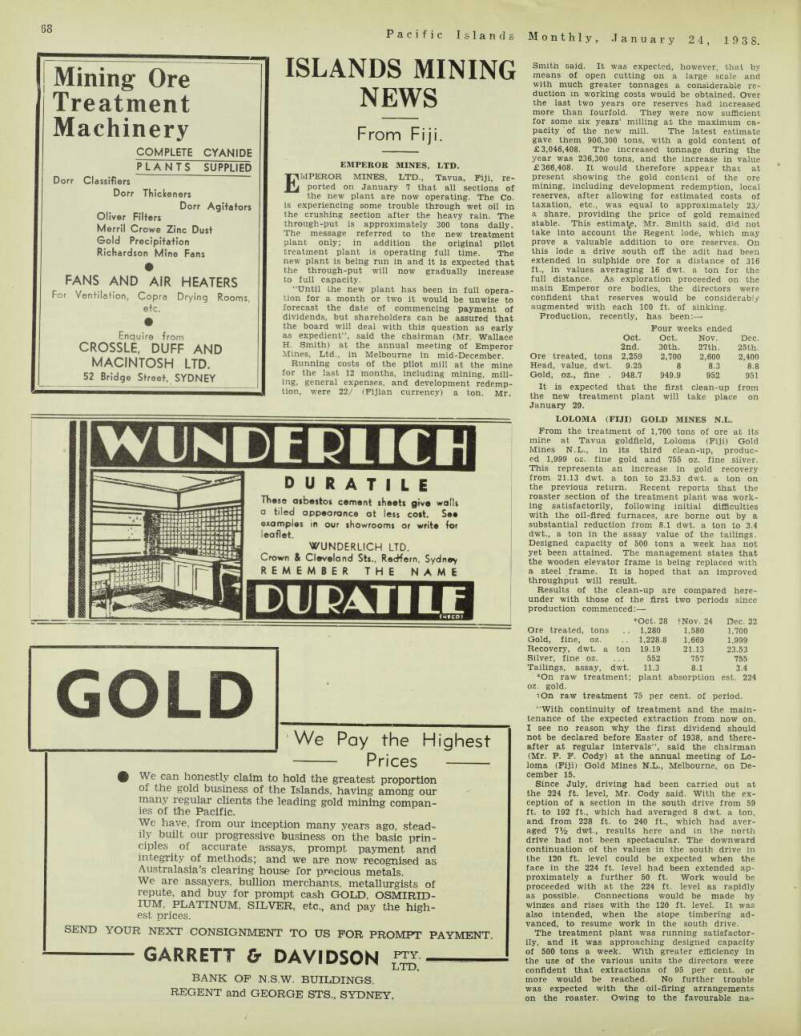
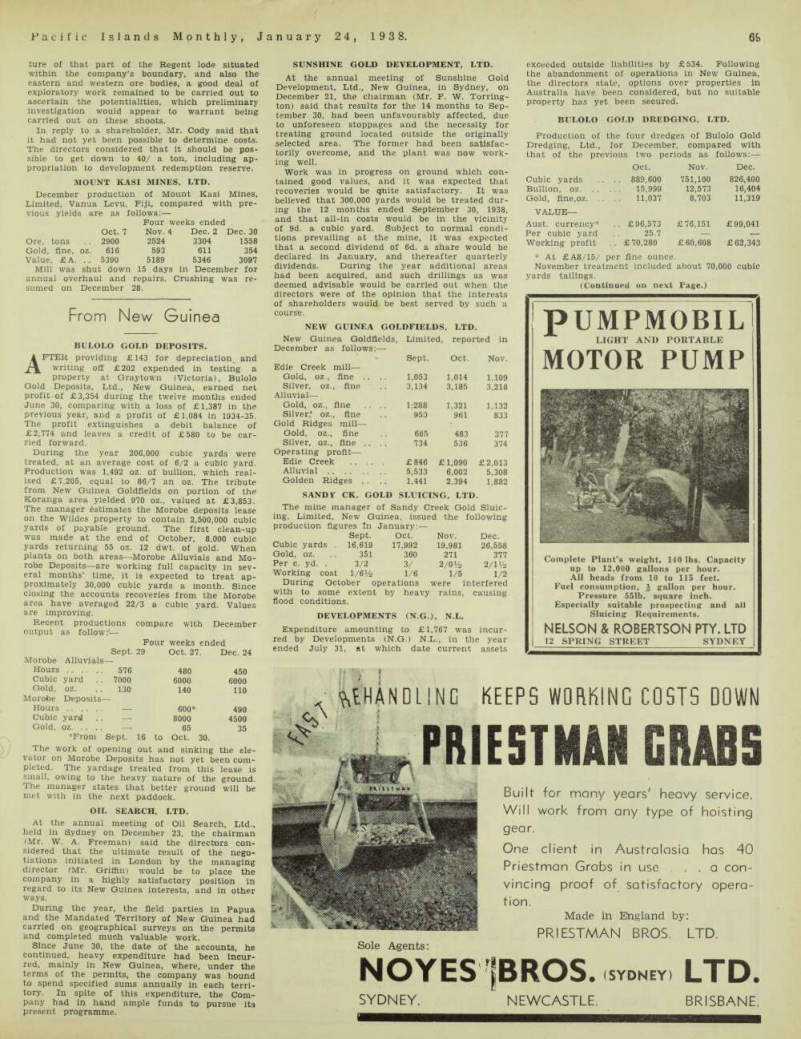
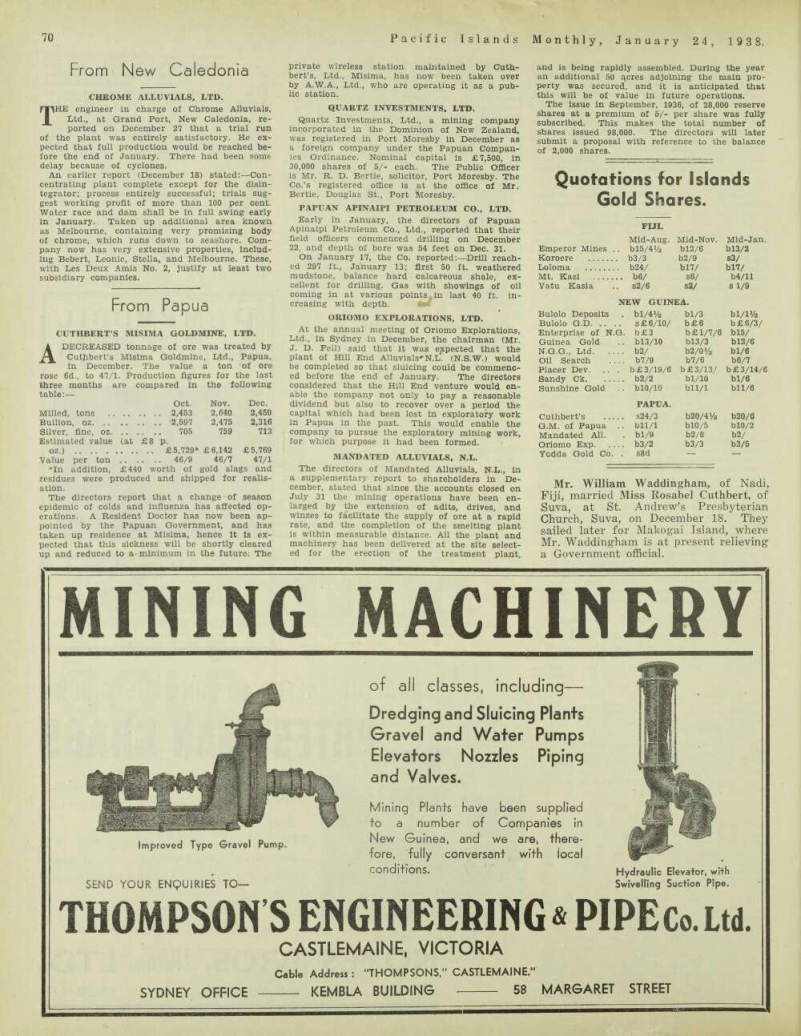
News
From Fiji.
Emperor Mines, Ltd.
EMPEROR MINES, LTD., Tavua, Fiji, re ported on January 7 that all sections of the new plant are now operating. The Co. is experiencing some trouble through wet oil in the crushing section after the heavy rain. The through-put is approximately 300 tons daily.
The message referred to the new treatment plant only; in addition the original pilot treatment plant is operating full time. The new plant is being run in and it is expected that the through-put will now gradually increase to full capacity.
“Until the new plant has been in full opera tion for a month or two it would be unwise to forecast the date of commencing payment of dividends, but shareholders can be assured that the board will deal with this question as early as expedient”, said the chairman (Mr. Wallace H. Smith) at the annual meeting of Emperor Mines, Ltd., in Melbourne in mid-December.
Running costs of the pilot mill at the mine for the last 12 months, including mining, mill ing, general expenses, and development redemp tion, were 22/ (Fijian currency) a ton. Mr.
Smith said. It was expected, however, that by means of open cutting on a large scale and with much greater tonnages a considerable re duction in working costs would be obtained. Over the last two years ore reserves had increased more than fourfold. They were now sufficient for some six years’ milling at the maximum ca pacity of the new mill. The latest estimate gave them 906,300 tons, with a gold content of £3,046,408. The increased tonnage during the year was 236,300 tons, and the increase in value £366,408. It would therefore appear that at present showing the gold content of the ore mining, including development redemption, local reserves, after allowing for estimated costs of taxation, etc., was equal to approximately 23/ a share, providing the price of gold remained stable. This estimate, Mr. Smith said, did not take into account the Regent lode, which may prove a valuable addition to ore reserves. On this lode a drive south off the adit had been extended in sulphide ore for a distance of 316 ft., in values averaging 16 dwt. a ton for the full distance. As exploration proceeded on the main Emperor ore bodies, the directors were confident that reserves would be considerably augmented with each ICO ft. of sinking.
Production, recently, has been:—
Loloma (Fiji) Gold Mines N.L.
From the treatment of 1,700 tons of ore at its mine at Tavua goldfield, Loloma (Fiji) Gold Mines N.L., in its third clean-up, produc ed 1,999 oz. fine gold and 755 oz. fine silver.
This represents an increase in gold recovery from 21.13 dwt. a ton to 23.53 dwt. a ton on the previous return. Recent reports that the roaster section of the treatment plant was work ing satisfactorily, following initial difficulties with the oil-fired furnaces, are borne out by a substantial reduction from 8.1 dwt. a ton to 3.4 dwt., a ton in the assay value of the tailings.
Designed capacity of 500 tons a week has not yet been attained. The management states that the wooden elevator frame is being replaced with a steel frame. It is hoped that an improved throughput will result.
Results of the clean-up are compared here under with those of the first two periods since production commenced; —
“With continuity of treatment and the main tenance of the expected extraction from now on, I see no reason why the first dividend should not be declared before Easter of 1938, and there after at regular intervals”, said the chairman (Mr. P. F. Cody) at the annual meeting of Lo loma (Fiji) Gold Mines N.L., Melbourne, on De cember 15.
Since July, driving had been carried out at the 224 ft. level, Mr. Cody said. With the ex ception of a section in the south drive from 59 ft. to 192 ft., which had averaged 8 dwt. a ton, and from 228 ft. to 240 ft., which had aver aged IV 2 dwt., results here and in the north drive had not been spectacular. The downward continuation of the values in the south drive in the 120 ft. level could be expected when the face in the 224 ft. level had been extended ap proximately a further 50 ft. Work would be proceeded with at the 224 ft. level as rapidly as possible. Connections would be made by winzes and rises with the 120 ft. level. It was also intended, when the stope timbering ad vanced. to resume work in the south drive.
The treatment plant was running satisfactor ily, and it was approaching designed capacity of 500 tons a week. With greater efficiency in the use of the various units the directors were confident that extractions of 95 per cent, or more would be reached. No further trouble was expected with the oil-firing arrangements on the roaster. Owing to the favourable na
Four weeks ended Oct. Oct. Nov. Dec. 2nd. 30th. 27th. 25th.
Ore treated, tons 2,259 2,700 2,600 2,400 Head, value, dwt. 9.25 8 8.3 8.8 Gold, oz., fine . 948.7 949.9 952 951 It is expected that the first clean-up from the new treatment plant will take place on January 29.
♦Oct. 28 tNov. 24 Dec. 22 Ore treated, tons 1,280 1,580 1,700 Gold, fine, oz. . . 1,228.8 1,669 1,999 Recovery, dwt. a ton 19.19 21.13 23.53 Silver, fine oz. ... 552 757 755 Tailings, assay, dwt. 11.3 8.1 3.4 ♦On raw treatment; plant absorption est. 224 oz. gold. lOn raw treatment 75 per cent, of period.
ture of that part of the Regent lode situated within the company’s boundary, and also the eastern and western ore bodies, a good deal of exploratory work remained to be carried out to ascertain the potentialities, which preliminary investigation would appear to warrant being carried out on these shoots.
In reply to a shareholder, Mr. Cody said that it had not yet been possible to determine costs.
The directors considered that it should be pos sible to get down to 40/ a ton, including ap propriation to development redemption reserve.
Mount Kasi Mines, Ltd.
December production of Mount Kasi Mines, Limited, Vanua Levu, Fiji, compared with pre vious yields are as follows: —
From New Guinea
Bulolo Gold Deposits.
AFTER providing £143 for depreciation, and writing off £202 expended in testing a property at Graytown (Victoria), Bulolo Gold Deposits, Ltd., New Guinea, earned net profit of £3,354 during the twelve months ended June 30, comparing with a loss of £1,387 in the previous year, and a profit of £1.084 in 1934-35.
The profit extinguishes a debit balance of £2,774 and leaves a credit of £5BO to be car ried forward.
During the year 206,000 cubic yards were treated, at an average cost of 6/2 a cubic yard.
Production was 1,492 oz. of bullion, which real ised £7,205, equal to 86/7 an oz. The tribute from New Guinea Goldfields on portion of the Koranga area yielded 970 oz., valued at £3,853.
The manager estimates the Morobe deposits lease on the Wildes property to contain 2,500,000 cubic yards of payable ground. The first clean-up was made at the end of October, 8,000 cubic yards returning 55 oz. 12 dwt. of gold. When plants on both areas—Morobe Alluvials and Mo robe Deposits—are working full capacity in sev eral months’ time, it is expected to treat ap proximately 30,000 cubic yards a month. Since closing the accounts recoveries from the Morobe area have averaged 22/3 a cubic yard. Values are improving.
Recent productions compare with December output as follow: 1
The work of opening out and sinking the ele vator on Morobe Deposits has not yet been com pleted. The yardage treated from this lease is small, owing to the heavy nature of the ground.
The manager states that better ground will be met with in the next paddock.
Oil Search, Ltd.
At the annual meeting of Oil Search, Ltd., held in Sydney on December 23, the chairman (Mr. W. A. Freeman) said the directors con sidered that the ultimate result of the nego tiations initiated in London by the managing director (Mr. Griffin) would be to place the company in a highly satisfactory position in regard to its New Guinea interests, and in other ways.
During the year, the field parties in Papua and the Mandated Territory of New Guinea had carried on geographical surveys on the permits and completed much valuable work.
Since June 30, the date of the accounts, he continued, heavy expenditure had been incur red, mainly in New Guinea, where, under the terms of the permits, the company was bound to spend specified sums annually in each terri tory. In spite of this expenditure, the Com pany had in hand ample funds to pursue its present programme.
Sunshine Gold Development, Ltd.
At the annual meeting of Sunshine Gold Development, Ltd., New Guinea, in Sydney, on December 21, the chairman (Mr. F. W. Torring ton) said that results for the 14 months to Sep tember 30, had been unfavourably affected, due to unforeseen stoppages and the necessity for treating ground located outside the originally selected area. The former had been satisfac torily overcome, and the plant was now work ing well.
Work was in progress on ground which con tained good values, and it was expected that recoveries would be quite satisfactory. It was believed that 300,000 yards would be treated dur ing the 12 months ended September 30, 1938, and that all-in costs would be in the vicinity of 9d. a cubic yard. Subject to normal condi tions prevailing at the mine, it was expected that a second dividend of 6d. a share would be declared in January, and thereafter quarterly dividends. During the year additional areas had been acquired, and such drillings as was deemed advisable would be carried out when the directors were of the opinion that the interests of shareholders would be best served by such a course.
New Guinea Goldfields, Ltd.
New Guinea Goldfields, Limited, reported in December as follows:
Sandv Ck. Gold Sluicing, Ltd.
The mine manager of Sandy Creek Gold Sluic ing, Limited, New Guinea, issued the following production figures In January:—
Developments (N.G.), N.L.
Expenditure amounting to £1,767 was incur red by Developments (N.G.) N.L., in the year ended July 31, at which date current assets
exceeded outside liabilities by £634. Following the abandonment of operations in New Guinea, the directors state, options over properties in Australia have been considered, but no suitable property has yet been secured.
Bulolo Gold Dredging, Ltd.
Production of the four dredges of Bulolo Gold Dredging, Ltd., for December, compared with that of the previous two periods as follows:
(Continued on next Page.)
Oct. 7 Pour weeks ended Nov. 4 Dec. 2 Dec. 30 Ore, tons .. 2900 2524 3304 1558 Go!d, fine, oz. 616 593 611 354 Value, £ A. .. 5390 5189 5346 3097 Mill was shut down 15 days in December for annual overhaul and repairs. Crushing was resumed on December 28.
Four weeks ended Sept. 29 Oct. 27.
Dec. 24 Morobe Alluvials— Hours 576 480 450 Cubic yard .. 7000 6000 6000 Gold, oz. .. 130 140 110 Morobe Deposits— Hours — 600* 490 Cubic yard .. — 8000 4500 Gold, oz — 65 35 ♦From Sept. 16 to Oct. 30.
Oct.
Nov.
Dec.
Cubic yards . .. 889,600 751,100 826,400 Bullion, oz. .. 15,999 12,573 16,404 Gold, fine.oz. . . .. 11,037 8,703 11,319
Value—
Aust. currency* .. £96,573 £76,151 £99,041 Per cubic yard 25.7 — — Working profit .. £70,280 £60,608 £62,343 * At £ A8/15/ per fine ounce.
November treatment included about 70,000 cubic yards tailings.
» Sept.
Oct.
Nov.
Edie Creek mill— Gold, oz , fine .. .. 1.053 1,014 1,109 Silver, oz., fine 3,134 3,185 3,218 Alluvial— Gold, oz., fine .. .. 1,288 1,321 1,132 Silver,* oz., fine 950 961 833 Gold Ridges mill— • Gold, oz., fine 685 483 377 Silver, oz., fine .. 734 536 374 Operating profit— Edie Creek £846 £1,090 £2,013 Alluvial 5,533 6,002 5,308 Golden Ridges 1,441 2,394 1,882
Sept.
Oct.
Nov.
Dec.
Cubic yards . 16,619 17,992 19,981 26,558 Gold, oz. 361 360 271 377 Per c. yd. . 3/2 3/ 2/01/ 2 2/1 ft Working cost 1/6 ft 1/6 1/5 1/2 During October operations were interfered with to some extent flood conditions. by heavy rains, causing
From New Caledonia
Chrome Alluvials. Ltd.
THE engineer in charge of Chrome Alluvials, Ltd., at Grand Port, New Caledonia, re ported on December 27 that a trial run of the plant was entirely satisfactory. He ex pected that full production would be reached be fore the end of January. There had been some delay because of cyclones.
An earlier report (December 18) stated;—Con centrating plant complete except for the disin tegrator; process entirely successful; trials sug gest working profit of more than 100 per cent.
Water race and dam shall be in full swing early in January. Taken up additional area known as Melbourne, containing very promising body of chrome, which runs down to seashore. Com pany now has very extensive properties, includ ing Bebert, Leonie, Stella, and Melbourne. These, with Les Deux Amis No. 2, justify at least two subsidiary companies.
From Papua
Cuthbert’S Misima Goldmine, Ltd.
A DECREASED tonnage of ore was treated by Cutfibert’s Mislma Goldmine, Ltd., Papua, in December. The value a ton of ore rose 6d., to 47/1. Production figures for the last three months are compared in the following table:—
The directors report that a change of season epidemic of colds and influenza has affected op erations. A Resident Doctor has now been ap pointed by the Papuan Government, and has taken up residence at Misima, hence It Is ex pected that this sickness will be shortly cleared up and reduced to a-minimum in the future. The
private wireless station maintained by Cuth bert’s, Ltd., Misima, has now been taken over by A.W.A., Ltd., who are operating it as a pub lic station.
Quartz Investments. Ltd.
Quartz Investments, Ltd., a mining company incorporated in the Dominion of New Zealand, was registered in Port Moresby in December as a foreign company under the Papuan Compan ies Ordinance. Nominal capital is £7,500, in 30,000 shares of 5/- each. The Public Officer is Mr. R. D. Bertie, solicitor, Port Moresby. The Co.’s registered office is at the office of Mr.
Bertie, Douglas St., Port Moresby.
Papuan Apinaipi Petroleum Co., Ltd.
Early in January, the directors of Papuan Apinaipi Petroleum Co., Ltd., reported that their field officers commenced drilling on December 22, and depth of bore was 54 feet on Dec. 31.
On January 17, the Co. reported:—Drill reach ed 297 ft., January 13; first 50 ft. weathered mudstone, balance hard calcareous shale, ex cellent for drilling. Gas with showings of oil coming in at various points ? in last 40 ft. in creasing with depth.
Oriomo Explorations, Ltd.
At the annual meeting of Oriomo Explorations, Ltd., in Sydney in December, the chairman (Mr.
J. D. Fell) said that it was expected that the plant of Hill End AUuvials* N.L. (N.S.W.) would be completed so that sluicing could be commenc ed before the end of January. The directors considered that the Hill End venture would en able the company not only to pay a reasonable dividend but also to recover over a period the capital which had been lost in exploratory work in Papua in the past. This would enable the company to pursue the exploratory mining work, for which purpose it had been formed.
Mandated Alluvials, N.L.
The directors of Mandated AUuvials, N.L., in a supplementary report to shareholders in De cember, stated that since the accounts closed on July 31 the mining operations have been en larged by the extension of adits, drives, and winzes to facilitate the supply of ore at a rapid rate, and the completion of the smelting plant is within measurable distance. All the plant and machinery has been delivered at the site select ed for the erection of the treatment plant,
and is being rapidly assembled. During the year an additional 50 acres adjoining the main pro perty was secured, and it is anticipated that this will be of value in future operations.
The issue in September, 1936, of 28,000 reserve shares at a premium of 5/- per share was fuUy subscribed. This makes the total number of shares issued 98,000. The directors will later submit a proposal with reference to the balance of 2,000 shares.
Oct.
Nov.
Dec.
Milled, tons 2,453 2,640 2,450 Bullion, oz. .. 2,597 2,475 2,316 Silver, fine, oz. 705 759 713 Estimated value (at £8 p. oz.) £5,729* £6,142 £5,769 Value per ton 46/9 46/7 47/1 *In addition. £440 worth of gold slags and residues were produced and shipped for realisation.
Advertisements & other items, pp. 71-72 (1 item)
Priestman Grabs
PUMPMOBIL
LIGHT AND PORTABLE
MOTOR PUMP
Complete Plant’s weight, 140 lbs. Capacity up to 12,000 gallons per hour.
All heads from 10 to 115 feet.
Fuel consumption, £ gallon per hour.
Pressure 551 b. square inch.
Especially suitable prospecting and all Sluicing Requirements.
NELSON & ROBERTSON PTY. LTD
12 SPRING STREET SYDNEY
h m U i
HANDLING KEEPS WORKING COSTS DOWN
PRIESTMAN GRABS
Built for many years' heavy service.
Will work from any type of hoisting gear.
One client in Australasia has 40 Priestman Grabs in use . . a convincing proof of satisfactory operation.
Made in England by:
PRIESTMAN BROS. LTD.
Sole Agents:
NOYES IBROS.
LTD.
SYDNEY.
(SYDNEY)
NEWCASTLE. BRISBANE,
MINING MACHINERY
m ■ Improved Type Gravel Pump.
SEND YOUR ENQUIRIES TO—
of all classes, including—
Dredging and Sluicing Plants
Gravel and Water Pumps
Elevators Nozzles Piping
and Valves.
Mining Plants have been supplied to a number of Companies in New Guinea, and we are, therefore, fully conversant with local conditions.
Hydraulic Elevator, with Swivelling Suction Pipe.
THOMPSON S ENGINEERING & PIPEco. Ltd.
CASTLEMAINE. VICTORIA
SYDNEY OFFICE
Cable Address: "THOMPSONS," CASTLEMAINE."
KEMBLA BUILDING 58 MARGARET STREET
Quotations for Islands
Gold Shares.
Mr. William Waddingham, of Nadi, Fiji, married Miss Rosabel Cuthbert, of Suva, at St. Andrew’s Presbyterian Church, Suva, on December 18. They sailed later for Makogai Island, where Mr. Waddingham is at present relieving a Government official.
Fiji.
Mid-Aug.
Mid-Nov.
Mid-Jan.
Emperor Mines . b 15/4y2 bl2/6 bl3/2 Koroere , b3/3 b2/9 s3/ Loloma . b24/ bl7/ bl7/ Mt. Kasi .. b6/ s6/ b4/ll Vatu Kasia s2/6 s2/ s 1/9 Bulolo Deposits
New Guinea.
. bl/4V 2 bl/3 bl/lV 2 Bulolo G.D. .. .. s£6/10/ b£ 6 b £ 6/3/ Enterprise of N.G. b£3 b£ 1/7/6 bl5/ Guinea Gold .. bl3/10 bl3/3 bl2/6 N.G.G., Ltd. .. ,.. b2/ b2/0V 2 bl/6 Oil Search ... b7/9 b7/6 b6/7 Placer Dev. . b£ 3/19/6 b£3/13/ b£ 3/14/6 Sandy Ck. ... b2/2 bl/10 bl/6 Sunshine Gold .. bl0/10 bll/1 bll/6 Cuthbert’s
Papua.
.. S24/3 b20/4Vi b20/6 G.M. of Papua .. bll/1 blO/5 blO/2 Mandated All. . bl/9 b2/8 b2/ Oriomo Exp. ... b3/2 b3/3 b3/5 Yodda Gold Co. s8d — —
Manager.
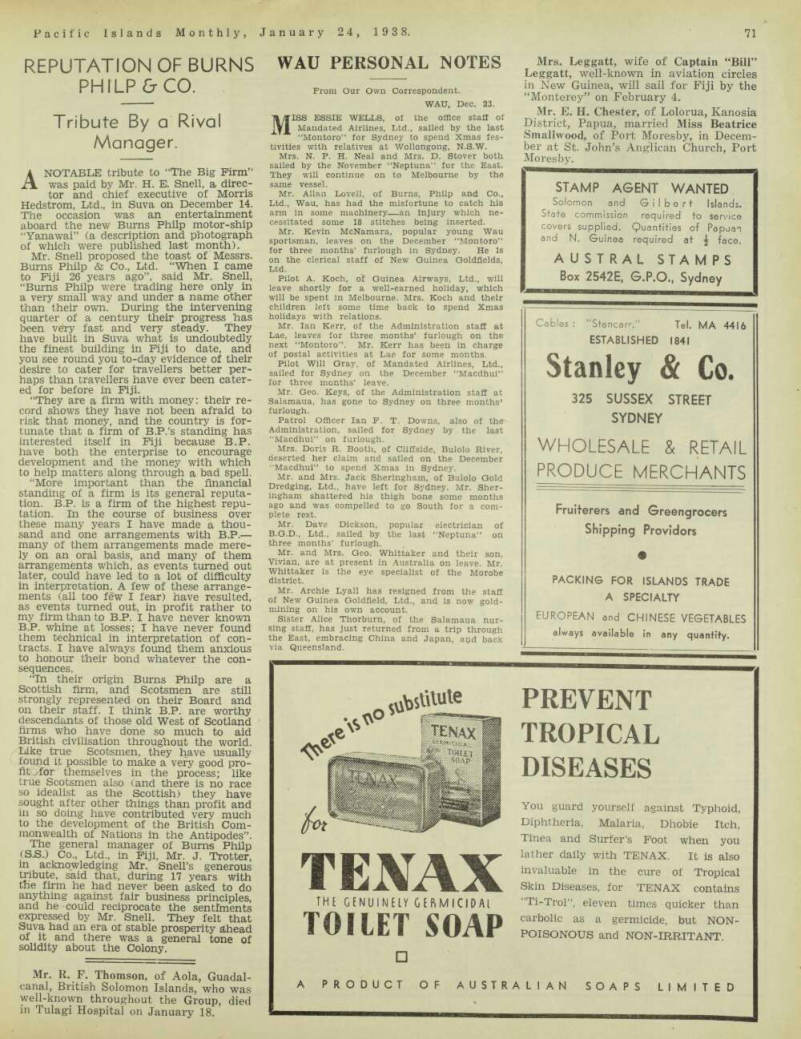
Reputation Of Burns
Philp & Co.
Tribute By a Rival Manager.
A NOTABLE tribute to “The Big Firm” was paid by Mr. H. E. Snell, a direc tor and chief executive of Morris Hedstrom, Ltd., in Suva on December 14.
The occasion was an entertainment aboard the new Burns Philp motor-ship "Yanawai” (a description and photograph of which were published last month).
Mr. Snell proposed the toast of Messrs.
Burns Philp & Co., Ltd. “When I came to Fiji 26 years ago”, said Mr. Snell, “Burns Philp were trading here only in a very small way and under a name other than their own. During the intervening quarter of a century their progress has been very fast and very steady. They have built in Suva what is undoubtedly the finest building in Fiji to date, and you see round you to-day evidence of their desire to cater for travellers better per haps than travellers have ever been cater ed for before in Fiji.
“They are a firm with money: their re cord shows they have not been afraid to risk that money, and the country is for tunate that a firm of B.P.’s standing has interested itself in Fiji because B.P. have both the enterprise to encourage development and the money with which to help matters along through a bad spell.
“More important than the financial standing of a firm is its general reputa tion. B.P. is a firm of the highest repu tation. In the course of business over these many years I have made a thou sand and one arrangements with B.P.— many of them arrangements made mere ly on an oral basis, and many of them arrangements which, as events turned out later, could have led to a lot of difficulty in interpretation. A few of these arrange ments (all too few T I fear) have resulted, as events turned out, in profit rather to my firm than to B.P. I have never known B.P. whine at losses; I have never found them technical in interpretation of con tracts. I have always found them anxious to honour their bond whatever the con sequences.
“In their origin Burns Philp are a Scottish firm, and Scotsmen are still strongly represented on their Board and on their staff. I think B.P. are worthy descendants of those old West of Scotland firms who have done so much to aid British civilisation throughout the world.
Like true Scotsmen, they have usually found it possible to make a very good pro fit themselves in the process; like true Scotsmen also (and there is no race so idealist as the Scottish) they have sought after other things than profit and in so doing have contributed very much to the development of the British Com monwealth of Nations in the Antipodes”.
The general manager of Burns Philp (S.S.) Co., Ltd., in Fiji, Mr. J. Trotter, in acknowledging Mr. Snell’s generous tribute, said that, during 17 years with the firm he had never been asked to do anything against fair business principles, and he could reciprocate the sentiments expressed by Mr. Snell. They felt that Suva had an era of stable prosperity ahead of it and there was a general tone of solidity about the Colony.
Mr. R. F. Thomson, of Aola, Guadal canal, British Solomon Islands, who was well-known throughout the Group, died
in Tulagi Hospital on January 18.
Wau Personal Notes
From Our Own Correspondent.
WAU, Dec. 23.
MISS ESSIE WELLS, of the office staff of Mandated Airlines, Ltd., sailed by the last “Montoro” for Sydney to spend Xmas fes tivities with relatives at Wollongong, N.S.W.
Mrs. N. P. H. Neal and Mrs. D. Stover both sailed by the November “Neptuna” for the East.
They will continue on to Melbourne by the same vessel.
Mr. Allan Lovell, of Burns, Philp and Co., Ltd., Wau, has had the misfortune to catch his arm in some machinery—an injury which ne cessitated some 18 stitches being inserted.
Mr. Kevin McNamara, popular young Wau sportsman, leaves on the December “Montoro” for three months’ furlough in Sydney. He is on the clerical staff of New Guinea Goldfields, Ltd.
Pilot A. Koch, of Guinea Airways, Ltd., will leave shortly for a well-earned holiday, which will be spent in Melbourne. Mrs. Koch and their children left some time back to spend Xmas holidays with relations.
Mr. lan Kerr, of the Administration staff at Lae, leaves for three months’ furlough on the next “Montoro”. Mr. Kerr has been in charge of postal activities at Lae for some months.
Pilot Will Gray, of Mandated Airlines, Ltd., sailed for Sydney on the December “Macdhui” for three months’ leave.
Mr. Geo. Keys, of the Administration staff at Salamaua, has gone to Sydney on three months* furlough.
Patrol Officer lan P. T. Downs, also of the Administration, sailed for Sydney by the last “Macdhui” on furlough.
Mrs. Doris R. Booth, of Cliffside, Bulolo River, deserted her claim and sailed on the December “Macdhui” to spend Xmas in Sydney.
Mr. and Mrs. Jack Sheringham, of Bulolo Gold Dredging, Ltd., have left for Sydney. Mr. Sher ingham shattered his thigh bone some months ago and was compelled to go South for a com plete rest.
Mr. Dave Dickson, popular electrician of 8.G.D., Ltd., sailed by the last “Neptuna” on three months’ furlough.
Mr. and Mrs. Geo. Whittaker and their son, Vivian, are at present in Australia on leave. Mr.
Whittaker is the eye specialist of the Morobe district.
Mr. Archie Lyall has resigned from the staff of New Guinea Goldfield, Ltd., and is now gold mining on his own account.
Sister Alice Thorburn, of the Salamaua nur sing staff, has just returned from a trip through the East, embracing China and Japan, apd back via Queensland.
Mrs. Leggatt, wife of Captain “Bill”
Leggatt, well-known in aviation circles in New Guinea, will sail for Fiji by the “Monterey” on February 4.
Mr. E. H. Chester, of Lolorua, Kanosia District, Papua, married Miss Beatrice Smallwood, of Port Moresby, in Decem ber at St. John’s Anglican Church, Port Moresby.
Advertisements & other items, pp. 73-74 (1 item)
Tenax
STAMP AGENT WANTED
Solomon and Gilbert Islands.
State commission required to service covers supplied. Quantities of Papuan and N. Guinea required at face.
AUSTRAL STAMPS
Box 2542 E, G.P.0., Sydney
Cables : "Stancarr." Tel. MA 4416
ESTABLISHED 1841
Stanley & Co.
325 SUSSEX STREET
SYDNEY
WHOLESALE & RETAIL
PRODUCE MERCHANTS
Fruiterers and Greengrocers
Shipping Providers
PACKING FOR ISLANDS TRADE
A SPECIALTY
EUROPEAN and CHINESE VEGETABLES
always available in any quantity.
bslUute
\S
TENAX
& v Ml**
ifvt
TENAX
THE GENUINELY GJftMICIOAI
TOILET SOAP
PREVENT
TROPICAL
DISEASES
You guard yourself against Typhoid, Diphtheria, Malaria, Dhobie Itch, Tinea and Surfer’s Foot when you lather daily with TENAX. It is also invaluable in the cure of Tropical Skin Diseases, for TENAX contains “Ti-Trol”, eleven times quicker than carbolic as a germicide, but NON-
POISONOUS and NON-IRRITANT.
PRODUCT OF AUSTRALIAN SOAPS LIMITED
J) ji V r k Like-a-Flash Games, as above, all indestructible moulded Bakelite.
“Totem” a betting game, showing winner and winner’s price, 21/-, with betting sheet. Push the lever —off they spin.
“Odds and Evens,” 21/-. Push the lever for results. 2 reds or 2 greens.
Greens for heads, reds for tails. 4 Spinning Wheel games, with instructions and betting sheets, 7/6 each, or set of 4 for 28/6.
“Crown and Anchor” Roulette. The Doncaster Handicap. The Newmarket Sweepstakes. Play them anywhere—everywhere. Always a thrill.
Games, Novelties and Hobbies for Home, Clubs, Hotels, etc., etc. Electric Speedway Race Games 20/-, 25/-. Winding Race Horse Game 15/6, 21/-, 30/-. Crown & Anchor Sets 10/6. Sydney Cup Race Game Wheel 63/-. Dart Boards 6/6, 8/6.
Housie Housie Sets 4/6, 6/6, 15/-, 25/-. Highest Grade Warpless Dart Board 38/6. Send for full list. 240 Volt AC Electric Gramophones, turntable and all plugs 39/6. With Pick-up Mounted 95/- and 105/-.
Electric Shavers, £6/15/-. Schick & Packard. Schick for all Electrical Currents. Packard 240 AC only. Write for wholesale list.
Model Electric Motors for Wet or Dry Battery Operation AC supply, etc., 5/6, 6/9, 8/6, 10/6, 12/6, 15/-. Electric Model Outboard Motor Boat Models 12/6, 19/6.
Roulette Wheels sin. Diam., with Glass Top, 3/6, with Betting Sheet also 19/6. Flat or upright types, sheet supplied. Other beautiful Bakelite Models 25/-. Other Makes 35/-, 45/-, 55/6, 65/-, 75/-, 85/-.
Cloths 6/6, 8/6, 10/6 extra.
Cigarette Making Machines. Everlasting and Simple. Best Made 7/6.
Radio Volt Meters 3/9, 4/6. Hydrometers Test for accumulators 2/6.
Junior Morse Code Practice Outfit 10/6 the pair with Morse Code. 1,500 ft. Electric Battery Operated Focussing Torches, 6/6 Complete.
Carborundum Wheels, 15/- value, NOW 10/6. Bench Vice 8/6 value NOW 5/6. 4 in 1 Metal Screw Drivers 1/6.
Radio Publications. Write for full list.
The Dictionary of Wireless 5/-. The Construction Wireless Encyclopedia 7/6. The Outline of Wireless 10/9. The Book of Practical Radio 7/6. The Book of Practical Television 7/6.
Portable Gramophones. We select and guarantee satisfaction, 55/-, 65/- 75/-. 85/-. 3 colour writing pencils, propelling type, 5/6. 4 colours 6/6, 8/6. Propelling alters colours to suit user.
Radio Moderne.
The Greatest B a ttery Operated Dual Wave Radio ever introduced, £22/10/ complete. Write for leaflet.
Just arrived.
Numbered Quoit Game. A great Pastime. 9 quoits on inclined numbered board, 25/.
Mantle Model Electric Superheterodyne Radios £l3/10/-. Value NOW £B/10/. 12 mths. g’tee.
Electric Super Het.
Radios, complete chassis, valves and speaker, £lO/10/-. Fitted in cabinets, 50/- extra. All sets guaranteed twelve months. buy assembled Lakes 1-valve All-wave Battery- Radio. Plug in coils for all wave lengths. All metal work ready drilled. Coils ready made. Easiway charts, 6d.
Free with kit. Parts 40/1, Valve 12/-, Battery 11/9, Phones 30/-, complete and built £5.
Build or buy ready made the Linguist 3, all-World Battery Operated Radio. Cover from 64 to 15 meters. All parts, 58/4; batteries, 19/-; Valves, 51/6; Phones. 32/6; Speaker, 20/-. If to be assembled by us add 30/- extra.
HOME BROADCASTING.
Microphones for speech or music, play into any radio, 25/-; circular type as illustrated. Hand holding and hanging type, 22/6. Others 12/6 and 15/. With N i c ke 1 1 e d stand 42/, 45/.
‘mpn-o-iupir
RUBBER CLRO
PERIPL
40 STRRnDS
SOFT. 5%
IOOFT (O'-
A Smart Little All World Radios. The Stratosphere 2 Valve B a ttery 79/- all V a 1 v es Batteries Phones 30/- and Cabinet S p e a ker Ready Set. parts, SO/-, 39/-, 19/6, 32/6, 15/-. 20/-, assem- £s/10/ Adjustable all way Morse Code Key as illustrated, 12/6. P.
M.G'. Type, 19/6. Buzzer. 2/6, 2/9, 3/6, 7/6. Siemens British P.M.G. Dept. Surplus Morse Set with Sullivan Special Low Resistance Headphones, 38/6 set. ’j* Buy assembled or build the Air Patrol 2 - valve Battery - operated Radio for all short-wave stations and broadcasts. Easy to operate, change over switch. All parts £4/1/6, Valves 28/9, Batteries £2/15/9, Phones 30/-, Speaker 21/3.
The set assembled and complete, £l2/14/9.
British Manufactured bell shaped Lightning Arresters, fixed in a jiffy for in or outside mounting, 6/3.
American Aeroplane Model Kits, Solid and Flying Types. Small (flying) Scale Models, 8 inch, 1/6. Fl 6, Sopwith Camel; F 6, Douglas Observer; Curtis Pursuit, Boeing, Yega, Aerenca.
“Flying” Scale Model Planes, 24 inch Wing Span, 3/6. C 2, Spad ; Cl 4, Hawker; Cl 7, Caudron, 20 in.; SES : C 4, Nieuport; C 5, Stinson; Cl 5 Curtis Hawk.
Solid (non-flying) Scale Model Planes, Sin. span, 1/6. S 9 Douglas Transport; Sl3, Hawker; Stinson U; SIS Martin Bomber;' China Clipper; 527, Stinson Sr.
Super Detailed, 8/8/8 (non-flying) Modern Scale Models, 5/6.
Waco, Navy Boeing, Taylor, Cub, Curtis Hawk.
Like-a-flash ‘Eliminoise’
Aerial Kit, for short or dual wave sets.
Aerial Pyrex type Insulators, transposi ti o n blocks and 200 ft. aerial wire, 22/6. Eliminates unwanted aerial and hideous electrical noises from your dual-wave or short-wave set.
Gccas©
imo*
HEAD
OMI
Ericssons Professional Phones, 32/6; B.T.H. and S.T.C., 30/-: all 400 ohms. 6ft. phone cords, 2/6. Rubber Phone Caps, 2/.
Lissen Headphones, 19/6.
Pyrex type G 3in., 1/- 4in., 3/6, sin., 6/6.
Glass egg type 3 for 1/-. 7£in.
Genuine Pyrex 30/ass Insulators:
3 INS
SO® -NS
MS
COSMOCOBD’
5 Gramophone Pickups complete Richards, just arrived 25/- “Cosmocord” 25/- “Cosmocord” De Luxe 32/6 “Cosmocord” high definition 38/6 “Cosmocord” Super de Luxe ..._ 45/- Amplion (English) 28/6 B.T.H. bakelite models 32/6 Radio Gramophone Pickup Heads fit all standard tone arms 11/6, 19/6, 10/6, 12/6. Separate volume control with leads fitted, 4/9.
Gramophone Tone Arms to suit pickup heads, 2/6. Pickup Oddments to complete pickups, 20/-.
LEVENSONS RADIO
GAMES, NOVELTIES AND HOBBIES xSem^nd
226 PITT STREET, SYDNEY Odds and
Manufacturers, Importers, and Exporters.
Branches; Radio Cheapside, 240 a Pitt St. eaneis
N.S.W., AUSTRALIA '
Cable address: “Leveradioh.” Goods forwarded V.P.P. or Sight Draft. Satisfaction and Service Guaranteed. We can supply by mail all General Merchandise at a Better Price. Quotations with pleasure.
Please add freight and packing.
Write for Punch Board Leaflets
Australian Short Wave
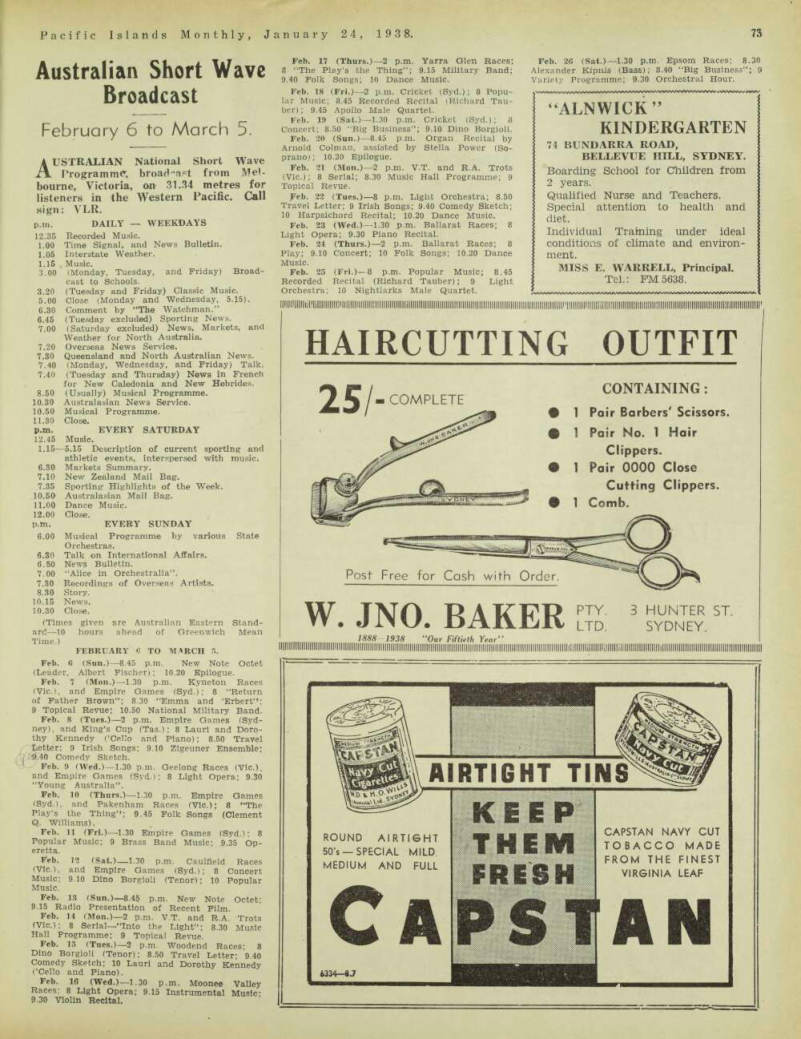
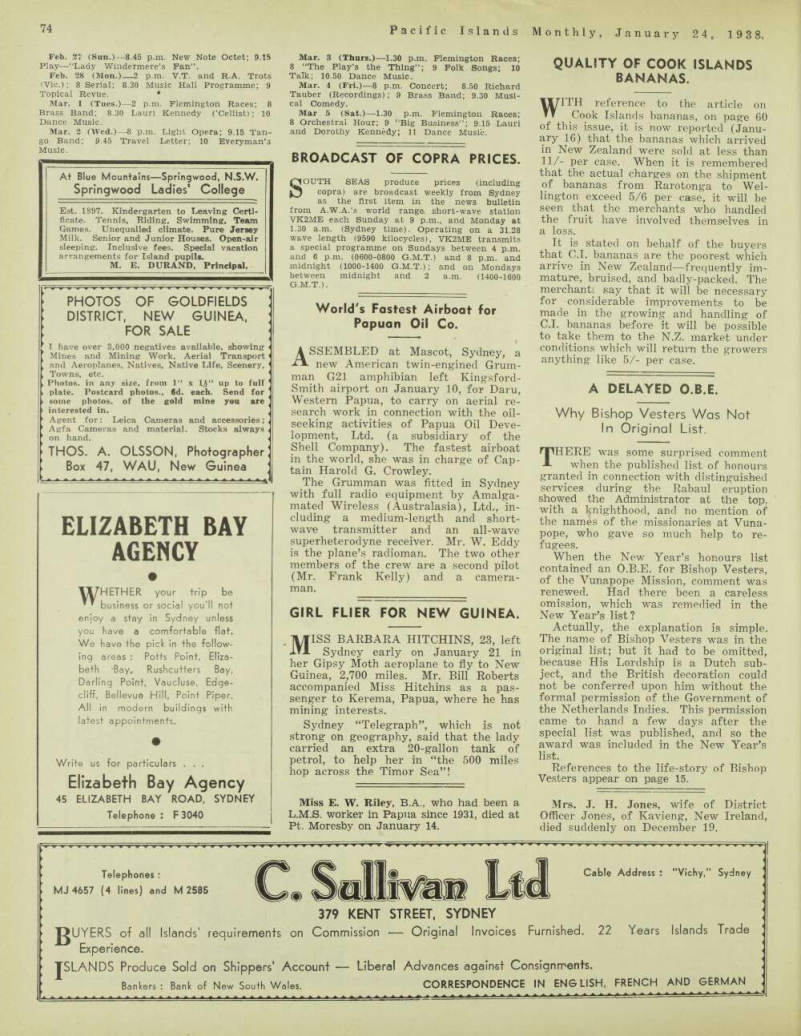
Broadcast February 6 to March 5.
AUSTRALIAN National Short Wave
Programme; broadcast from Mel
bourne, Victoria, on 31.34 metres for
listeners in the Western Pacific. Call
sign; VLR.
P.M. Daily Weekdays
12.35 Recorded Music. 1.00 Time Signal, and News Bulletin. 1.05 Interstate Weather. 1.15 Music. 3.00 (Monday, Tuesday, and Friday) Broad cast to Schools. 3.20 (Tuesday and Friday) Classic Music. 5.00 Close (Monday and Wednesday, 5.15). 6.30 Comment by “The Watchman.” 6.45 (Tuesday excluded) Sporting News. 7.00 (Saturday excluded) News, Markets, and Weather for North Australia. 7.20 Overseas News Service. 7.30 Queensland and North Australian News. 7.40 (Monday, Wednesday, and Friday) Talk. 7.40 (Tuesday and Thursday) News in French for New Caledonia and New Hebrides. 8.50 (Usually) Musical Programme. 10.30 Australasian News Service. 10.50 Musical Programme. 11.30 Close.
P.M. Every Saturday
12.45 Music. 1.15 —5.15 Description of current sporting and athletic events, interspersed with music. 6.30 Markets Summary. 7.10 New Zealand Mail Bag. 7.35 Sporting Highlights of the Week. 10.50 Australasian Mail Bag. 11.00 Dance Music. 12.00 Close.
P.M. Every Sunday
6.00 Musical Programme by various State Orchestras. 6.30 Talk on International Affairs. 6.50 News Bulletin. 7.00 “Alice in Orchestralia”. 7.30 Recordings of Overseas Artists. 8.30 Story. 10.15 News. 10,30 Close. (Times given are Australian Eastern Stand ard —10 hours ahead of Greenwich Mean Time.)
February 6 To March 5.
Feb. 6 (Sun.) —8.45 p.m. New Note Octet (Leader, Albert Fischer); 10.20 Epilogue.
Feb. 7 (Mon.) —1.30 p.m. Kyneton Races (Vic.), and Empire Games (Syd.); 8 “Return of Father Brown”; 8.30 “Emma and ’Erbert’’; 9 Topical Revue; 10.50 National Military Band.
Feb. 8 (Tues.) —2 p.m. Empire Games (Syd ney), and King’s Cup (Tas.); 8 Lauri and Doro thy Kennedy (’Cello and Plano); 8.50 Travel Letter; 9 Irish Songs; 9.10 Zigeuner Ensemble; •9.40 Comedy Sketch.
Feb. 9 (Wed.) —1.30 p.m. Geelong Races (Vic.), and Empire Games (Syd.): 8 Light Opera; 9.30 “Young Australia”.
Feb. 10 (Thurs.)—l.3o p.m. Empire Games (Syd.), and Pakenham Races (Vic.); 8 “The Play’s the Thing’’; 9.45 Folk Songs (Clement Q. Williams).
Feb. 11 (Fri.)—l.3o Empire Games (Syd.); 8 Popular Music; 9 Brass Band Music; 9.35 Op eretta.
Feb. 12 (Sat.)—l.3o p.m. Caulfield Races (Vic.), and Empire Games (Syd.); 8 Concert Music; 9.10 Dino Borgioli (Tenor); 10 Popular Music.
Feb. 13 (Sun.)—B.4s p.m. New Note Octet; 9.15 Radio Presentation of Recent Film.
Feb. 14 (Mon.)—2 p.m. V.T. and R.A. Trots (Vic.); 8 Serial—“lnto the Light”; 8.30 Music Hall Programme: 9 Topical Revue.
Feb. 15 (Tues.)—2 p.m. Woodend Races; 8 Dino Borgioli (Tenor); 8.50 Travel Letter; 9.40 Comedy Sketch; 10 Lauri and Dorothy Kennedy (’Cello and Piano).
Feb. 16 (Wed.)—l.3o p.m. Moonee Valley Races; 8 Light Opera; 9.15 Instrumental Music; 9.30 Violin Recital.
Feb. 17 (Thurs.) —2 p.m. Yarra Glen Races; 8 “The Play’s the Thing”; 9.15 Military Band; 9.40 Folk Songs; 10 Dance Music.
Feb. 18 (Fri.) —2 p.m. Cricket (Syd.); 8 Popu lar Music; 8.45 Recorded Recital (Richard Tau ber) ; 9.45 Apollo Male Quartet.
Feb. 19 (Sat.) —1.30 p.m. Cricket (Syd.); 8 Concert; 8.50 “Big Business”; 9.10 Dino Borgioli.
Feb. 20 (Sun.) —8.45 p.m. Organ Recital by Arnold Colman, assisted by Stella Power (So prano) ; 10.20 Epilogue.
Feb. 21 (Mon.)—2 p.m. V.T. and R.A. Trots (Vic.); 8 Serial; 8.30 Music Hall Programme; 9 Topical Revue.
Feb. 22 (Tues.)—B p.m. Light Orchestra; 8.50 Travel Letter; 9 Irish Songs; 9.40 Comedy Sketch; 10 Harpsichord Recital; 10.20 Dance Music.
Feb. 23 (Wed.) —1.30 p.m. Ballarat Races; 8 Light Opera; 9.30 Piano Recital.
Feb. 24 (Thurs.) —2 p.m. Ballarat Races; 8 Play; 9.10 Concert; 10 Folk Songs; 10.20 Dance Music.
Feb. 25 (Fri.)—B p.m. Popular Music; 8.45 Recorded Recital (Richard Tauber); 9 Light Orchestra; 10 Nightlarks Male Quartet.
Feb. 26 (Sat.) —1.30 p.m. Epsom Races; 8.30 Alexander Kipnis (Bass): 8.40 “Big Business”; 9 Variety Programme; 9.30 Orchestral Hour.
Feb. 27 (Sun.)—B.4s p.m. New Note Octet; 9.15 Play—“ Lady Windermere’s Fan”.
Feb. 28 (Mon.)—2 p.m. V.T. and R.A. Trots (Vic.); 8 Serial: 8.30 Music Hall Programme; 9 Topical Revue. • Mar. 1 (Tues.) —2 p.m. Flemington Races; 8 Brass Band; 8.30 Lauri Kennedy (’Cellist); 10 Dance Music.
Mar. 2 (Wed.) —8 p.m. Light Opera; 9.15 Tan go Band; 9.45 Travel Letter; 10 Everyman’s Music.
Mar. 3 (Thurs.) —1.30 p.m. Plemington Races; 8 “The Play’s the Thing”; 9 Folk Songs; 10 Talk; 10.50 Dance Music.
Mar. 4 (Fri.) —8 p.m. Concert; 8.50 Richard Tauber (Recordings); 9 Brass Band; 9.30 Musi cal Comedy.
Mar 5 (Sat.) —1.30 p.m. Flemington Races; 8 Orchestral Hour; 9 “Big Business”: 9.15 Lauri and Dorothy Kennedy; 11 Dance Music.
Advertisements & other items, pp. 75-76 (1 item)
Haircutting Outfit
“ALNWICK”
KINDERGARTEN
74 BUNDARRA ROAD,
BELLEVUE HILL, SYDNEY.
Boarding School for Children from 2 years.
Qualified Nurse and Teachers.
Special attention to health and diet.
Individual Training under ideal conditions of climate and environment.
MISS E. WARRELL, Principal.
Tel.: PM 5638.
HAIRCUTTING OUTFIT
COMPLETE
CONTAINING:
• 1 Pair Barbers' Scissors. • 1 Pair No. 1 Hair Clippers. • 1 Pair 0000 Close Cutting Clippers. • ] Comb.
Post Free for Cash with Order
W. JNO. BAKER
3 HUNTER ST.
SYDNEY.
1888 1938 “Our Fiftieth Year’
t®
AIRTIGHT TINS
xV
ROUND AIRTIGHT
50's —SPECIAL MILD
MEDIUM AND FULL
KEEP
THEM
FRESH
CAPSTAN NAVY CUT
TOBACCO MADE
FROM THE FINEST
VIRGINIA LEAF
6334—8.7
At Blue Mountains—Springwood, N.S.W.
Springwood Ladies' College
Est. 1897. Kindergarten to Leaving Certificate. Tennis, Riding, Swimming, Team Games. Unequalled climate. Pure Jersey Milk. Senior and Junior Houses. Open-air sleeping. Inclusive fees. Special vacation arrangements for Island pupils.
M. E. DURAND. Principal.
PHOTOS OF GOLDFIELDS
DISTRICT, NEW GUINEA,
FOR SALE
I have over 3.000 negatives available, showing Mines and Mining Work, Aerial Transport and Aeroplanes, Natives, Native Life, Scenery, Towns, etc.
Photos, in any size, from 1" x XI" up to full plate. Postcard photos., 6d. each. Send for some photos, of the gold mine you are interested in.
Agent for: Leica Cameras and accessories; Agfa Cameras and material. Stocks always on hand.
THOS. A. OLSSON, Photographer
Box 47, WAU, New Guinea
ELIZABETH BAY
AGENCY
• WHETHER your trip be " " business or social you'll not enjoy a stay in Sydney unless you have a comfortable flat.
We have the pick In the following areas : Potts Point, Elizabeth *Bay r Rushcutters Bay, Darling Point, Vaucluse, Edgecliff, Bellevue Hill, Point Piper.
All in modern buildings with latest appointments.
Write us for particulars . . .
Elizabeth Bay Agency
45 ELIZABETH BAY ROAD. SYDNEY
Telephone : F 3040
Telephones ; MJ 4657 (4 lines) and M 2585
C.SnlllVfcD Li
Cable Address : "Vichy," Sydney
379 KENT STREET, SYDNEY
JJUYERS of all Islands' requirements on Commission Original Invoices Furnished. 22 Years Islands Trade Experience.
ISLANDS Produce Sold on Shippers' Account Liberal Advances against Consignments.
Bankers: Bank of New South Wales. CORRESPONDENCE IN ENGLISH, FRENCH AND GERMAN
Broadcast Of Copra Prices.
SOUTH SEAS produce prices (including copra) are broadcast weekly from Sydney as the first item in the news bulletin from A.W.A.’s world range short-wave station VK2ME each Sunday at 9 p.m., and Monday at 1.30 a.m. (Sydney time). Operating on a 31.28 wave length (9590 kilocycles), VK2ME transmits a special programme on Sundays between 4 p.m. and 6 p.m. (0600-0800 G.M.T.) and 8 p.m. and midnight (1000-1400 G.M.T.); and on Mondays between midnight and 2 a.m. (1400-1600
G.M.T.).
World's Fastest Airboat for Papuan Oil Co
Papuan Oil Co.
ASSEMBLED at Mascot, Sydney, a new American twin-engined Grum man G2l amphibian left Kingsford- Smith airport on January 10, for Daru, Western Papua, to carry on aerial re search work in connection with the oil seeking activities of Papua Oil Deve lopment, Ltd. (a subsidiary of the Shell Company). The fastest airboat in the world, she was in charge of Cap tain Harold G. Crowley.
The Grumman was fitted in Sydney with full radio equipment by Amalga mated Wireless (Australasia), Ltd., in cluding a medium-length and short wave transmitter and an all-wave superheterodyne receiver. Mr. W. Eddy is the plane’s radioman. The two other members of the crew are a second pilot (Mr. Frank Kelly) and a camera man.
Girl Flier For New Guinea.
Miss Barbara Hitchins, 23, Left
Sydney early on January 21 in her Gipsy Moth aeroplane to fly to New Guinea, 2,700 miles. Mr. Bill Roberts accompanied Miss Hitchins as a pas senger to Kerema, Papua, where he has mining interests.
Sydney “Telegraph”, which is not strong on geography, said that the lady carried an extra 20-gallon tank of petrol, to help her in “the 500 miles hop across the Timor Sea”!
Miss E. W. Riley, 8.A., who had been a L.M.S. worker in Papua since 1931, died at Pt. Moresby on January 14.
Quality Of Cook Islands
Bananas.
WITH reference to the article on Cook Islands bananas, on page 60 of this issue, it is now reported (Janu ary 16) that the bananas which arrived in New Zealand were sold at less than 11/- per case. When it is remembered that the actual charges on the shipment of bananas from Rarotonga to Wel lington exceed 5/6 per case, it will be seen that the merchants who handled the fruit have involved themselves in a loss.
It is stated on behalf of the buyers that C.I. bananas are the poorest which arrive in New Zealand—frequently im mature, bruised, and badly-packed. The say that it will be necessary for considerable improvements to be made in the growing and handling of C.I. bananas before it will be possible to take them to the N.Z. market under conditions which will return the growers anything like 5/- per case.
Why Bishop Vesters Was Not
A Delayed O.B.E.
Why Bishop Vesters Was Not In Original List.
THERE was some surprised comment when the published list of honours granted in connection with distinguished services during the Rabaul eruption showed the Administrator at the top, with a knighthood, and no mention of the names of the missionaries at Vuna pope, who gave so much help to re fugees.
When the New Year’s honours list contained an 0.8. E. for Bishop Vesters, of the Vunapope Mission, comment was renewed. Had there been a careless omission, which was remedied in the New Year’s list?
Actually, the explanation is simple.
The name of Bishop Vesters was in the original list; but it had to be omitted, because His Lordship is a Dutch sub ject, and the British decoration could not be conferred upon him without the formal permission of the Government of the Netherlands Indies. This permission came to hand a few days after the special list was published, and so the award was included in the New Year’s list.
References to the life-story of Bishop Vesters appear on page 15.
Mrs. J. H. Jones, wife of District Officer Jones, of Kavieng, New Ireland, died suddenly on December 19.
Islands Produce
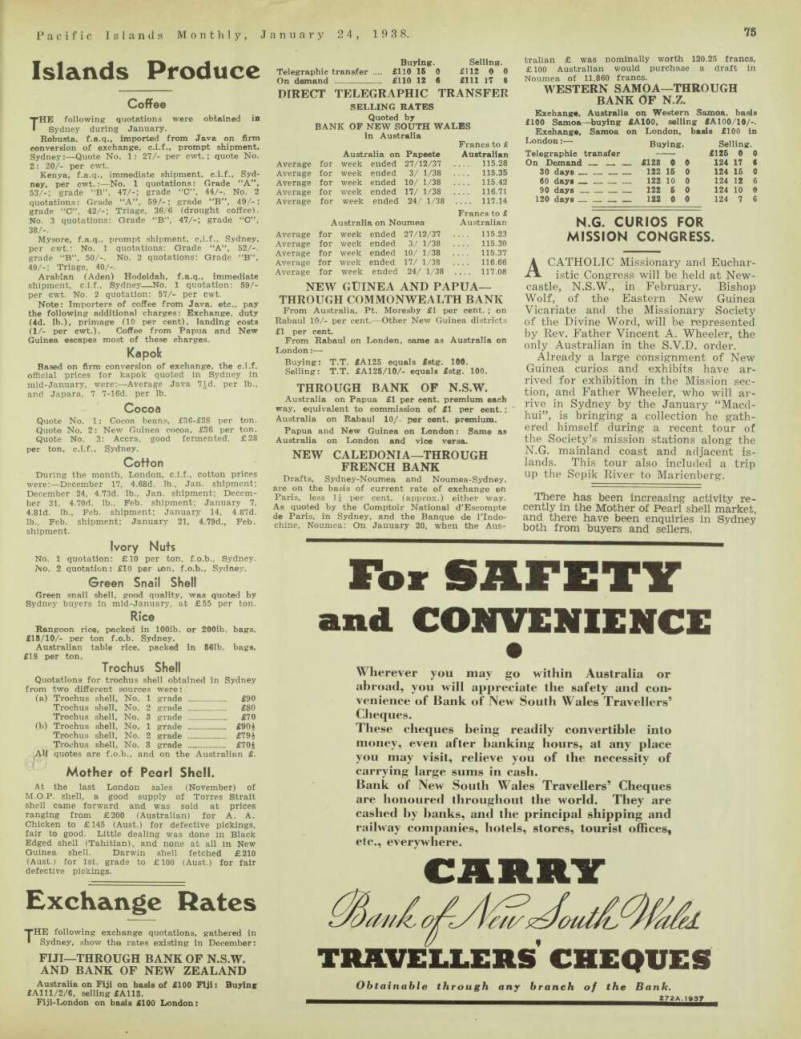
Coffee
THE following quotations were obtained in Sydney during January.
Robusta, f.a.q., imported from Java on firm conversion of exchange, c.i.f., prompt shipment, Sydney:—Quote No. 1: 27/- per cwt.; quote No. 2: 20/- per cwt.
Kenya, f.a.q., immediate shipment, c.i.f., Syd ney, per cwt.: —No. 1 quotations: Grade “A”, 53/-; grade “B”, 47/-; grade “C”, 44/-. No. 2 quotations: Grade “A”, 59/-: grade “B”, 49/-; grade “C”, 42/-; Triage, 36/6 (drought coffee).
No. 3 quotations: Grade “B”, 47/-; grade “C”, 38/-.
Mysore, f.a.q., prompt shipment, c.i.f., Sydney, per cwt.: No. 1 quotations: Grade “A”, 52/-. grade “B”, 50/-. No. 2 quotations; Grade “B”, 49/-; Triage, 40/-.
Arabian (Aden) Hodeidah, f.a.q., immediate shipment, c.i.f., Sydney—No. 1 quotation: 59/per cwt. No. 2 quotation: 57/- per cwt.
Note: Importers of coffee from Java, etc., pay the following additional charges: Exchange, duty (4d. lb.), primage (10 per cent), landing costs (1/- per ewt.). Coffee from Papua and New Guinea escapes most of these charges.
Kapok
Based on firm conversion of exchange, the c.i.f. official prices for kapok quoted in Sydney in mid-January, were;—Average Java 7Jd. per lb., and Japara, 7 7-16 d. per lb.
Cocoa
Quote No. 1: Cocoa beans, £36-£3B per ton.
Quote No. 2: New Guinea cocoa, £36 per ton.
Quote No. 3; Accra, good fermented, £2B per ton, c.i.f., Sydney.
Cotton
During the month, London, c.i.f., cotton prices were;—December 17, 4.68 d. lb., Jan. shipment; December 24. 4.73 d. lb., Jan. shipment; Decem ber 31, 4.70 d. lb., Peb. shipment; January 7, 4.81 d. lb., Feb. shipment; January 14, 4.87 d. lb., Feb. shipment: January 21, 4.79 d., Peb. shipment.
Ivory Nuts
No. 1 quotation: £lO per ton, f.0.b., Sydney.
No. 2 quotation: £lO per ton, f.0.b., Sydney.
Green Snail Shell
Green snail shell, good quality, was quoted by Sydney buyers in mid-January, at £55 per ton.
Rice
Rangoon rice, pecked in 1001 b. or 2001 b. bags, £lB/10/- per ton f.o.b. Sydney.
Australian table rice, packed in 561 b. bags, £lB per ton.
Trochus Shell
Quotations for trochus shell obtained in Sydney from two different sources were: (a) Trochus shell. No. 1 grade £9O Trochus shell, No. 2 grade £BO Trochus shell. No. 3 grade £7O (b) Trochus shell. No. 1 grade ..._ £9os Trochus shell, No. 2 grade £79s Trochus shell, No. 3 grade £7os ? AH quotes are f.0.b., and on the Australian £.
Mother of Pearl Shell.
At the last London sales (November) of M.O.P. shell, a good supply of Torres Strait shell came forward and was sold at prices ranging from £2OO (Australian) for A. A.
Chicken to £145 (Aust.) for defective pickings, fair to good. Little dealing was done in Black Edged shell (Tahitian), and none at all in New Guinea shell. Darwin shell fetched £2lO (Aust.) for Ist. grade to £lOO (Aust.) for fair defective pickings.
Direct Telegraphic Transfer
Selling Rates
Quoted by
Bank Of New South Wales
In Australia
New Guinea And Papua
Through Commonwealth Bank
From Australia, Pt. Moresby £1 per cent. ; on Rabaul 10/- per cent.—Other New Guinea districts £1 per cent.
From Rabaul on London, same as Australia on London:— Buying: T.T. £AI2S equals £stg. 100.
Selling: T.T. £AI26/10/- equals £stg. 100.
Through Bank Of N.S.W.
Australia on Papua £1 per cent, premium each way, equivalent to commission of £1 per eent. : Australia on Rabaul 10/- per cent, premium.
Papua and New Guinea on London: Same as Australia on London and vice versa.
New Caledonia—Through
French Bank
Drafts, Sydney-Noumea and Noumea-Sydney, are on the basis of current rate of exchange on Paris, less 1J per cent, (approx.) either way.
As quoted by the Comptoir National d’Escompte de Paris, in Sydney, and the Banque de ITndo chine, Noumea: On January 20, when the Aus
tralian £ was nominally worth 120.25 francs, £lOO Australian would purchase a draft in Noumea of 11,860 francs.
Western Samoa—Through
Bank Of N.Z.
Exchange, Australia on Western Samoa, basis £lOO Samoa—buying £AIOO, selling 4AIOO/10/-.
Exchange, Samoa on London, basis £lOO in London m
Buying.
Selling.
Telegraphic transfer — £110 IS 0 £112 0 0 On demand £110 12 « £111 17 6
Average for Australia on week ended Papeete 27/12/37 Francs to £ Australian 115.28 Average for week ended 3/ 1/38 ... 115.35 Average for week ended 10/ 1/38 ... 115.42 Average for week ended 17/ 1/38 116.71 Average for week ended 24/ 1/38 ... 117.14 Australia on Noumea Francs to f Australian Average for week ended 27/12/37 ... 115.23 Average for week ended 3/ 1/38 115.30 Average for week ended 10/ 1/38 ... 115.37 Average for week ended 17/ 1/38 ... 116.66 Average for week ended 24/ 1/38 117,08
London Buying. Selling.
Telegraphic transfer £125 0 0 On Demand £128 0 0 124 17 6 30 days 122 15 0 124 15 0 60 days 122 10 0 124 12 6 90 days 122 5 0 124 10 0 120 days 122 0 0 124 7 6
N.G. Curios For
Mission Congress.
A CATHOLIC Missionary and Euchar istic Congress will be held at New castle, N.S.W., in February. Bishop Wolf, of the Eastern New Guinea Vicariate and the Missionary Society of the Divine Word, will be represented by Rev. Father Vincent A. Wheeler, the only Australian in the S.V.D. order.
Already a large consignment of New Guinea curios and exhibits have ar rived for exhibition in the Mission sec tion, and Father Wheeler, who will ar rive in Sydney by the January “Macd hui”, is bringing a collection he gath ered himself during a recent tour of the Society’s mission stations along the N.G. mainland coast and adjacent is lands. This tour also included a trip up the Sepik River to Marienberg.
There has been increasing activity re cently in the Mother of Pearl shell market, and there have been enquiries in Sydney both from buyers and sellers.
Advertisements & other items, p. 77 (1 item)
For Safety
and CONVENIENCE
Wherever you may go within Australia or abroad, you will appreciate the safety and convenience of Bank of New South Wales Travellers’
Cheques.
These cheques being readily convertible into money, even after hanking hours, at any place you may visit, relieve you of the necessity of carrying large sums in cash.
Bank of New South Wales Travellers’ Cheques are honoured throughout the world. They are cashed by hanks, and the principal shipping and railway companies, hotels, stores, tourist offices, etc., everywhere.
CURRY
travellers' cheques
Obtainable through any branch of the Bank. - 272 A. 1937
Exchange Rates
THE following exchange quotations, gathered in * Sydney, show the rates existing in December:
FIJI—THROUGH BANK OF N.S.W.
AND BANK OF NEW ZEALAND
Australia on Fiji on basis of £lOO Fiji: Buying £Alll/2/6, selling £AII3.
Fiji-London on basis £lOO London:
Market Quotations
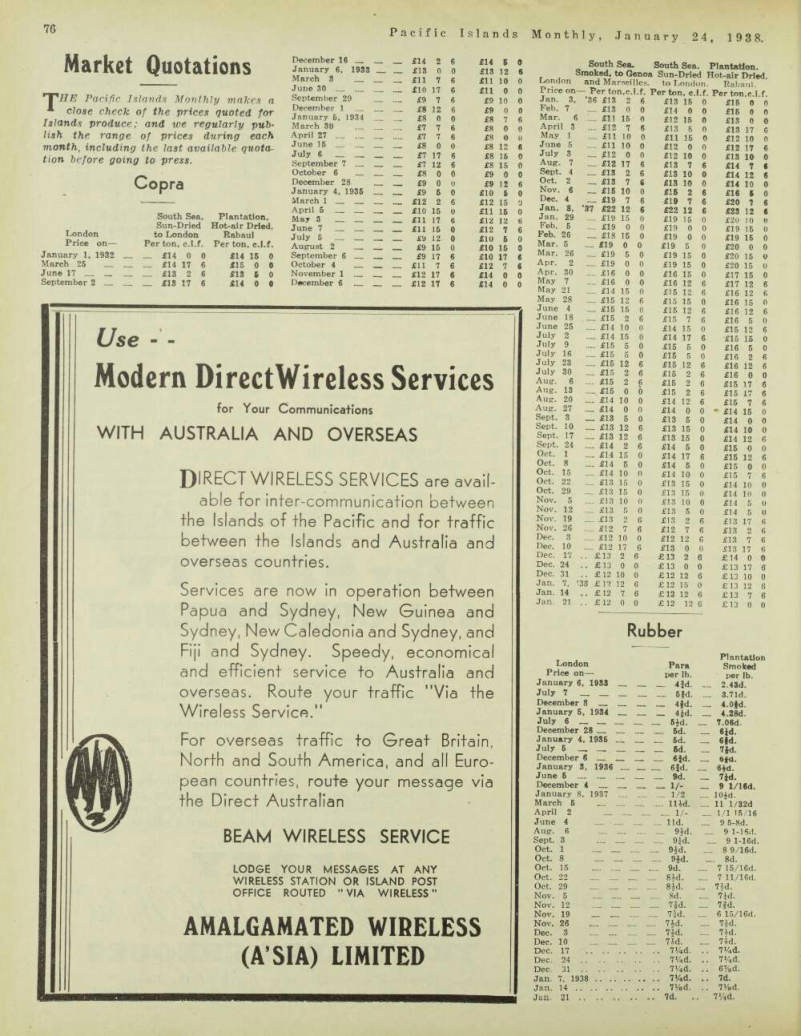
r T k HE Pacific Islands Monthly makes a * close check of the prices quoted for Islands produce: and we regularly pub lish the range of prices during each month, including the last available quota tion before going to press.
December 16 . £14 2 6 £14 6 0 January 6. 1983 £13 0 0 £13 12 6 March 3 £11 7 6 £11 10 0 June 30 £10 17 6 £11 0 0 September 29 £9 7 6 £9 10 0 December 1 £8 12 6 £9 0 0 January 5, 1934 £8 0 0 £8 7 6 March 30 £7 7 6 £8 0 0 April 27 £7 7 6 £8 0 0 June 15 — £8 0 0 £8 12 6 July 6 £7 17 6 £8 15 0 September 7 £7 12 6 £8 15 0 October 6 - £8 0 0 £9 0 0 December 28 £9 0 0 £9 12 6 January 4, 1935 £9 5 0 £10 5 0 March 1 £12 2 6 £12 15 0 April 5 £10 16 0 £11 15 0 May 3 — — £11 17 6 £12 12 6 June 7 £11 16 0 £12 7 6 July 5 — £9 12 0 £1U 5 0 August 2 £9 15 0 £10 15 0 September 6 , — £9 17 6 £10 17 6 October 4 £11 7 6 £12 7 6 November 1 . £12 17 6 £14 0 0 December 6 — £12 17 6 £14 0 0
South Sea.
South Ses i.
Plantation.
Smoked, to Genoa Sun-Dried Hot-air DH*d London and Marseilles. to London.
Rab; aul.
Price on- — Per ton.c. i.f.
Per ton. c. i.f.
Per ton.c.i .f.
Jan. 3, ’36 £13 2 6 £13 15 0 £16 0 0 Feb. 7 £13 0 0 £14 0 0 £15 0 o Mar. 6 — £11 15 0 £12 15 0 £13 0 0 April 3 ... £12 7 6 £13 5 0 £13 17 6 May 1 ... £11 10 0 £11 15 0 £12 10 0 June 5 ... £11 10 0 £12 0 0 £12 17 6 July 3 ... £12 0 0 £12 10 0 £13 10 0 Aug. , 7 ... £12 17 6 £13 7 6 £14 7 6 Sept . 4 £13 2 6 £13 10 0 £14 12 6 Oct. 2 ... £13 7 6 £13 10 0 £14 10 0 Nov, 6 £15 10 0 £16 2 6 £16 6 0 Dec. 4 — £19 7 6 £19 7 6 £20 7 6 Jan. 8. ’37 £22 12 6 £22 12 6 £23 12 6 Jan. 29 ... £19 15 0 £19 15 0 £20 10 0 Feb. 5 £19 0 0 £19 0 0 £19 15 0 Feb. 26 — £18 15 0 £19 0 0 £19 15 0 Mar. 5 — £19 0 0 £19 5 0 £20 0 0 Mar. 26 ... £19 5 0 £19 15 0 £20 15 0 Apr. 2 ... £19 0 0 £19 15 0 £20 15 0 Apr. 30 -... £16 0 0 £16 15 0 £17 15 0 May 7 ... £16 0 0 £16 12 6 £17 12 6 May 21 ... £14 15 0 £15 12 6 £16 12 6 May 28 _... £15 12 6 £15 15 0 £16 15 0 June 4 ... £15 15 0 £15 12 6 £16 12 6 June 18 ... £15 2 6 £15 7 6 £16 5 0 June 25 -.. £14 10 0 £14 15 0 £15 12 6 July 2 ... £14 15 0 £14 17 6 £15 15 0 July 9 — £15 5 0 £15 5 0 £16 5 0 July 16 ... £15 5 0 £15 5 0 £16 2 6 July 23 .-. £15 12 6 £15 12 6 £16 12 6 July 30 ... £15 2 6 £15 2 6 £16 0 0 Aug. 6 ... £15 2 6 £15 2 6 £15 17 6 Aug. 13 ... £15 0 0 £15 2 6 £15 17 6 Aug. 20 — £14 10 0 £14 12 6 £15 7 6 Aug. 27 — £14 0 0 £14 0 0 • £14 15 0 Sept. 3 — £13 5 0 £13 5 0 £14 0 0 Sept. 10 — £13 12 6 £13 15 0 £14 10 0 Sept. 17 — £13 12 6 £13 15 0 £14 12 6 Sept. 24 -.. £14 2 6 £14 5 0 £15 0 0 Oct. 1 ... £14 15 0 £14 17 6 £15 12 6 Oct. 8 — £14 5 0 £14 5 0 £15 0 0 Oct. 15 ... £14 10 0 £14 10 0 £15 7 6 Oct. 22 ... £13 15 0 £13 15 0 £14 10 0 Oct. 29 ... £13 15 0 £13 15 0 £14 10 0 Nov. 5 £13 10 0 £13 10 0 £14 5 0 Nov. 12 ... £13 5 0 £13 5 0 £14 5 0 Nov. 19 £13 2 6 £13 2 6 £13 17 6 Nov. 26 ... £12 7 6 £12 7 6 £13 2 6 Dec. 3 ... £12 10 0 £12 12 6 £13 7 6 Dec. 10 «... £12 17 6 £13 0 0 £13 17 6 Dec. 17 .. £13 2 6 £13 2 6 £14 0 0 Dec. 24 .. £13 0 0 £13 0 0 £13 17 6 Dec. 31 .. £12 10 0 £12 12 6 £13 10 0 Jan. 7, ’ 38 £12 12 6 £12 15 0 £13 12 6 Jan. 14 .. £12 7 6 £12 12 6 £13 7 6 Jan. 21 .. £12 0 0 £12 12 6 £13 0 0
Copra
South Sea, Plantation, London Sun-Dried Hot-air Dried, to London Rabaul Price on — Per ton, c.i.f.
Per ton, c.i.f.
January 1, 1932 £14 0 0 £14 15 0 March 25 £14 17 6 £15 0 0 June 17 — — £13 2 6 £13 5 0 September 2 — £18 17 6 £14 0 0
London
Rubber
Para Plantation Smoked Price on— per lb. per lb.
January 6, 1933 - _. 4 id. 2.43d.
July 7 - 5 |d. 3.71d.
December 8 — 4fd. 4.0fd.
January 5, 1934 — 4 id. 4.28d.
July 6 — Bid. 7.06d.
December 28 Bd. 6id.
January 4, 1935 — — 5d. 6»d.
July 6 — — Bd. 7$d.
December 6 — — 6 id. tt$d.
January 3, 1936 .. 6 |d. 6id.
June 5 ... 9d. 7id.
December 4 1/- 9 l/16d.
January 8, 1937 ... 1/2 10id.
March 5 Hid. 11 l/32d April 2 - ... 1/- ... 1/1 15/16 June 4 ... lid. 9 5-8d.
Aug. 6 9 id. ... . 9 1-16.1.
Sept. 3 ... 9id. ... 9 l-16d.
Oct. 1 ... ... ...» 9id. 8 9/16d.
Oct. 8 ..._ ... 9Jd. .. 8d.
Oct. 15 ... ... ... 9d. 7 15/16d.
Oct. 22 8id, 7 ll/16d.
Oct. 29 ... 8|d. , 7id.
Nov. 5 ... ... 8d. 7id.
Nov. 12 7Jd. 7fd.
Nov. 19 7 |d. 6 15/16d.
Nov. 26 ... ..._ 7id. 7id.
Dec. 3 7id. 7id.
Dec. 10 7 id. , 7id.
Dec. 17 .. . . 7!/4d. . .
IVtd.
Dec. 24 .. . . 7V 4 d. ., 7%d.
Dec. 31 .. .. 7V 4 d. . . 6%d.
Jan. 7, 1938 .. 7d.
Jan, 14 7Vsd.
Jan. 21 .. .. 7d. . , 7*/ 4 d.
Advertisements & other items, p. 78 (1 item)
Modern DircctWirclcss Services
Use
for Your Communications
WITH AUSTRALIA AND OVERSEAS
DIRECT WIRELESS SERVICES are avail-
able for inter-communication between the Islands of the Pacific and for traffic between the Islands and Australia and overseas countries.
Services are now In operation between Papua and Sydney, New Guinea and Sydney, New Caledonia and Sydney, and Fiji and Sydney. Speedy, economical and efficient service to Australia and overseas. Route your traffic "Via the Wireless Service."
For overseas traffic to Great Britain, North and South America, and all European countries, route your message via the Direct Australian
BEAM WIRELESS SERVICE
LODGE YOUR MESSAGES AT ANY
WIRELESS STATION OR ISLAND POST
OFFICE ROUTED "VIA WIRELESS"
AMALGAMATED WIRELESS
(A SIA) LIMITED
Shipping Services in the Pacific
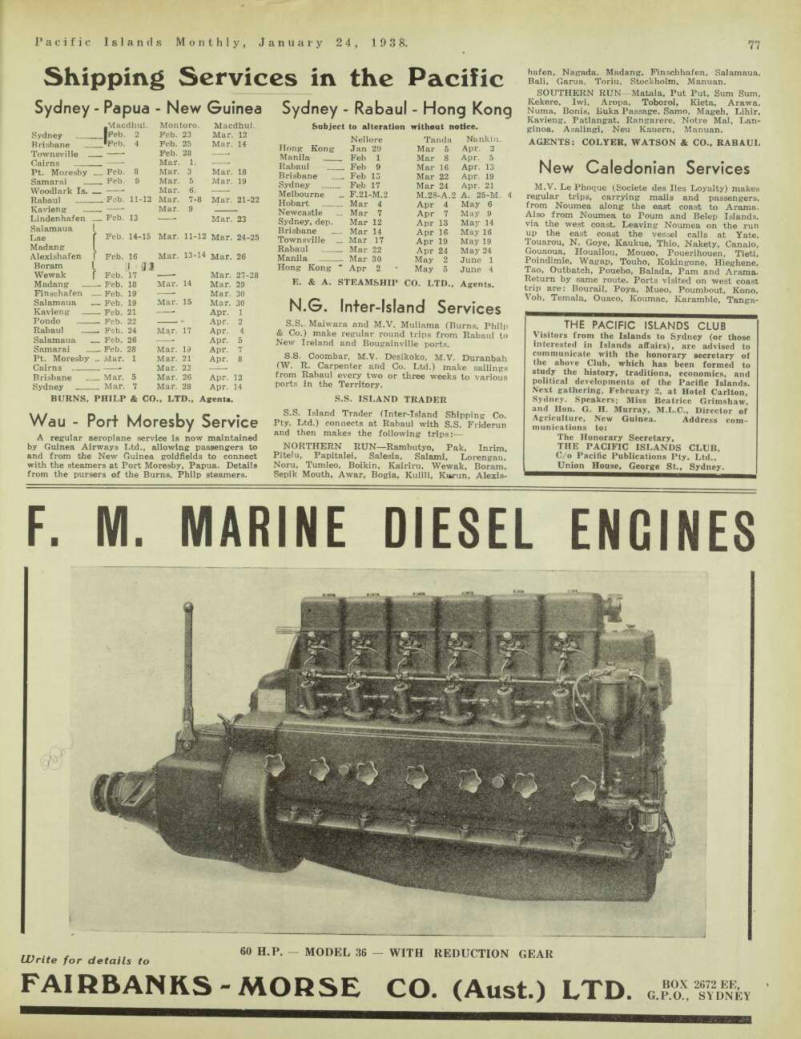
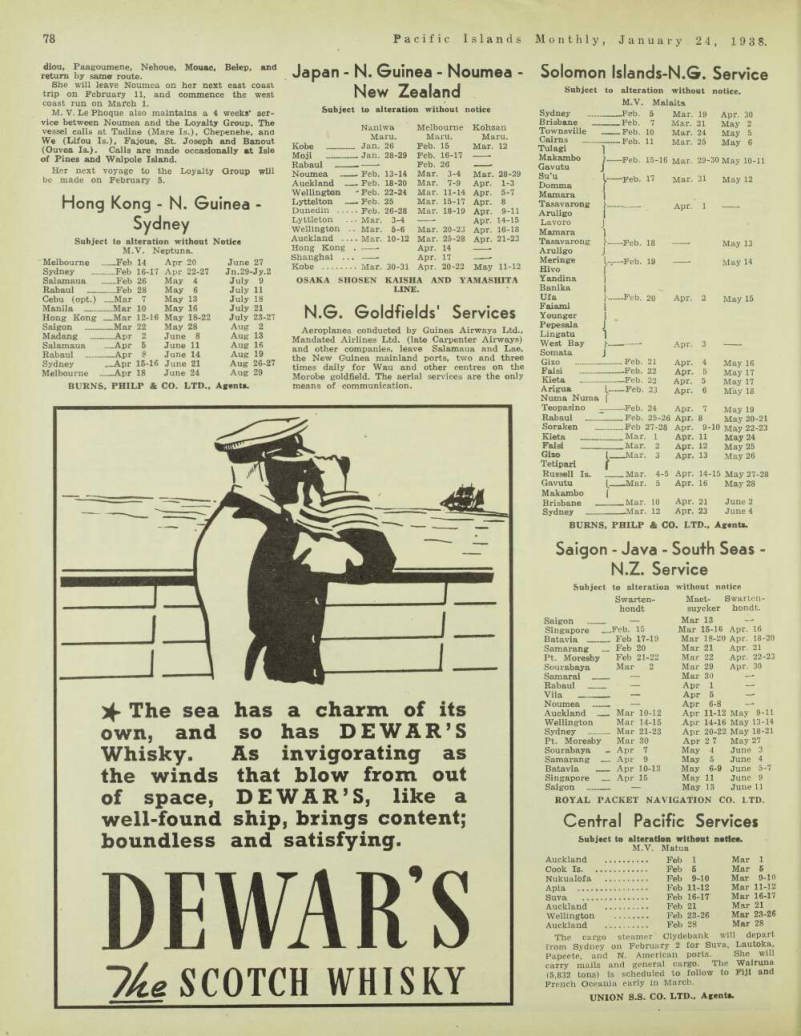
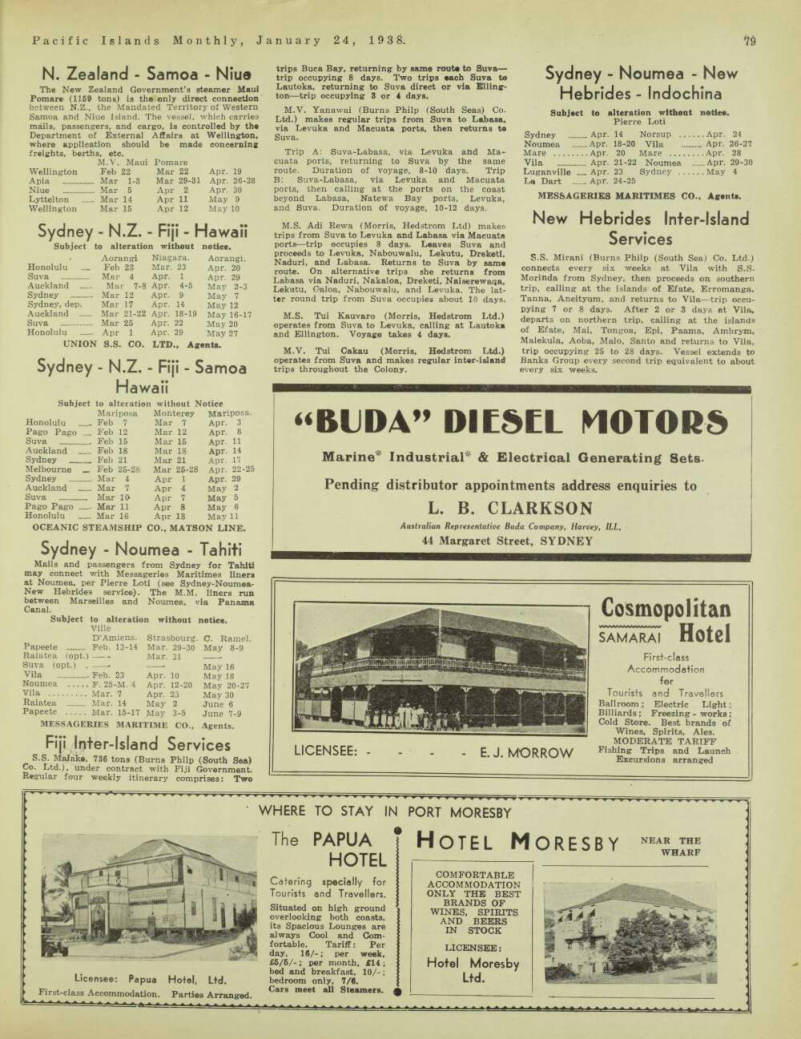
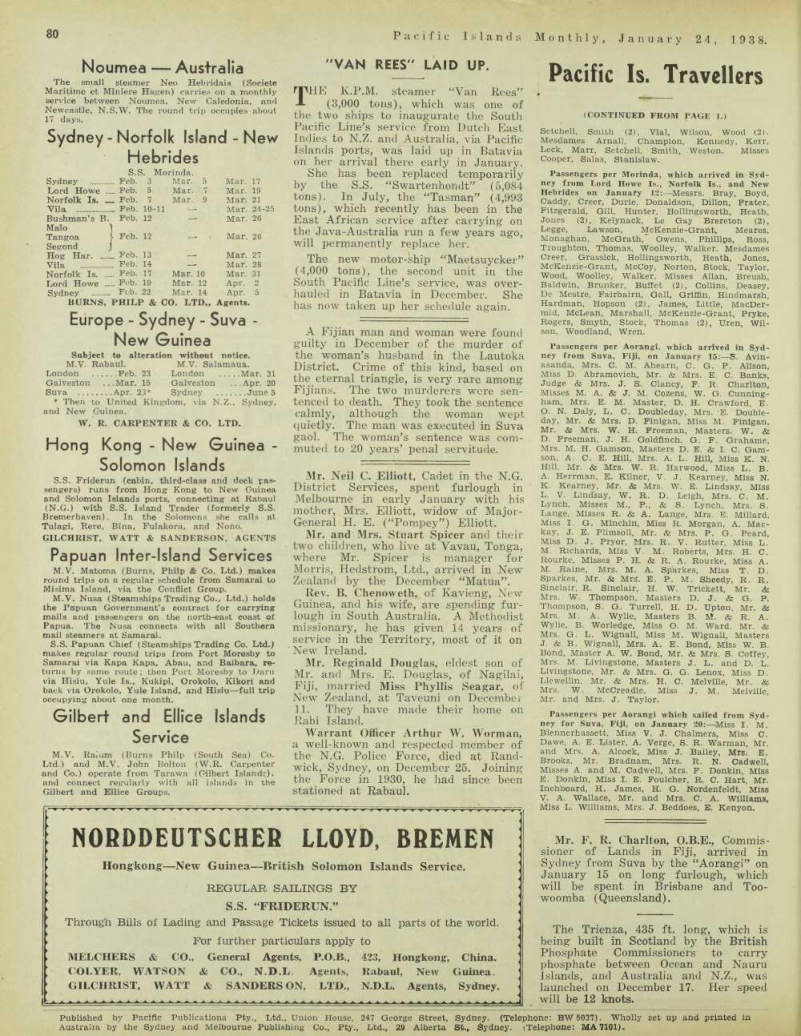
Sydney - Papua - New Guinea
Wau - Port Moresby Service
A regular aeroplane service is now maintained by Guinea Airways Ltd., allowing passengers to and from the New Guinea goldfields to connect with the steamers at Port Moresby, Papua. Details from the pursers of the Burns, Philp steamers.
Sydney - Rabaul - Hong Kong
N.G. Inter-Island Services
5.5. Maiwara and M.V. Muliama (Burns, Philp & Co.) make regular round trips from Rabaul to New Ireland and Bougainville ports. 5.5. Coombar, M.V. Desikoko, M.V. Duranbah (W. R. Carpenter and Co. Ltd.) make sailings from Rabaul every two or three weeks to various ports in the Territory.
S.S. Island Trader
5.5. Island Trader (Inter-Island Shipping Co.
Pty. Ltd.) connects at Rabaul with S.S. Friderun and then makes the following trips:— NORTHERN RUN—Rambutyo, Pak. Inrim.
Pitelu, Papitalei, Salesia, Salami, Lorengau, Noru, Tumleo, Boikin, Kairiru, Wewak, Boram, Sepik Mouth, Awar, Bogia, Kulili, Karan, Alexis
hafen, Nagada, Madang, Pinschhafen, Salamaua Bali, Garua, Toriu, Stockholm, Manuan.
SOUTHERN RUN—Matala, Put Put. Sum Sum Kekere, Iwi, Aropa, Toboroi, Kieta, Arawa Numa, Bonis, Euka Passage, Samo, Mageh, Lihir Kavieng, Patlangat, Rangarere, Notre Mai, Lan ginoa, Asalingi, Neu Kauern, Manuan.
Agents: Colyer, Watson & Co.. Rabaul
New Caledonian Services
M.V. Le Phoque (Societe des lies Loyalty) makes regular trips, carrying mails and passengers, from Noumea along the east coast to Arama.
Also from Noumea to Poum and Belep Islands, via the west coast. Leaving Noumea on the run up the east coast the vessel calls at Yate, Touarou, N. Goye, Kaukue, Thio, Nakety, Canalo, Gouaoua, Houailou, Moueo, Pouerihouen, Tieti, Poindimie, Wagap, Touho, Kokingone, Hieghene.
Tao, Outbatch, Pouebo, Balada, Pam and Arama.
Return by same route. Ports visited on west coast trip are: Bourail, Poya, Mueo, Poumbout, Kono, Voh, Temala. Ouaco, Koumac, Karamble, Tanga
-Macdhui.
Montoro.
Macdhul.
Sydney ■ Peb. 2 Peb. 23 Mar. 12 Brisbane Townsville •Feb. 4 Peb.
Feb.
Mar. 25 28 1.
Mar. 14 Pt. Moresby . Feb. 8 Mar. 3 Mar. 18 Samarai Woodlark Is. — Feb. 9 Mar.
Mar. 5 6.
Mar. 19 Rabaul . Feb. 11-12 Mar.
Mar. 7-8 g Mar. 21-22 Lindenhafen — Peb. 13 Mar. 23 Salamaua 1 Lae Feb. 14-15 Mar. 11-12 Mar. 24-25 Madanp:
Alexishafen f
Boram (
Peb. 16
i a j
Mar. 13-14 Mar. 26
Wewak f
Feb.'
17 Mar. 27-28 Madangr .
Feb. 18 Mar. 14 Mar. 29 Finschafen — Feb. 19 Mar. 30 Salamaua — Kavieng Feb.
Pnh 19 21 Mar. 15 Mar.
A nr 30 Pondo — r i.u< Feb.
Peb. 22 24 Apr. 1 2 Rabaul .
M^r. 17 Apr. 4 Salamaua Feb. 26 Apr. 5 Samarai —.
Feb. 28 Mar. 19 Apr. 7 Pt. Moresby Cairns Mar. 1 Mar.
Mar.
Mar. 21 23 26 Apr. 8 Brisbane Mar. 5 Apr. 12 Svdnev Mar. 7 Mar. 28 Apr. (Tents. 14
Burns, Philp & Co
L, Ltd., A
Subject to alteration without notice.
Nellore Tanda Nankin.
Hong Kong Jan 29 Mar 6 Apr. 2 Manila Feb 1 Mar 8 Apr. 5 Rabaul Feb 9 Mar 16 Apr. 13 Brisbane Feb 15 Mar 22 Apr. 19 Sydney Feb 17 Mar 24 Apr. 21 Melbourne F.21-M.2 M.28-A.2 A. 25-M. 4 Hobart Mar 4 Apr 4 May 6 Newcastle Mar 7 Apr 7 May 9 Sydney, dep.
Mar 12 Apr 13 May 14 Brisbane Mar 14 Apr 16 May 16 Townsville Mar 17 Apr 19 May 19 Rabaul Mar 22 Apr 24 May 24 Manila Mar 30 May 2 June 1 Hong Kong ”
Apr 2 May 5 June 4
E. & A. Steamship
Co. Ltd.,
Agents.
diou, Paagoumene, Nehoue, Mouac, Belep, and return by same route.
She will leave Noumea on her next east coasi trip on February 11, and commence the west coast run on March 1.
M. V. Le Phoque also maintains a 4 weeks’ ser vice between Noumea and the Loyalty Group. The vessel calls at Tadine (Mare Is.), Chepenehe, and We (Lifou Is.), Fajoue, St. Joseph and Banout (Ouvea Is.). Calls are made occasionally at Isle of Pines and Walpole Island.
Her next voyage to the Loyalty Group will be made on February 5.
Hong Kong - N. Guinea - Sydney
Japan - N. Guinea - Noumea - New Zealand
N.G. Goldfields' Services
Aeroplanes conducted by Guinea Airways Ltd., Mandated Airlines Ltd. (late Carpenter Airways) and other companies, leave Salamaua and Lae, the New Guinea mainland ports, two and three times daily for Wau and other centres on the Morobe goldfield. The aerial services are the only means of communication.
Solomon Islands-N.G. Service
Saigon - Java - South Seas - N.Z. Service
Central Pacific Services
Subject to alteration without Notice M.V. Neptuna.
Melbourne -Feb 14 Apr 20 June 27 Sydney Feb 16-17 Apr 22-27 Jn.29-Jy.2 Salamaua Feb 26 May 4 July 9 Rabaul — Feb 28 May 6 July 11 Cebu (opt.) —Mar 7 May 13 July 18 Manila Mar 10 May 16 July 21 Hong Kong Mar 12-16 May 18-22 July 23-27 Saigon Mar 22 May 28 Aug 2 Madang Apr 2 June 8 Aug 13 Salamaua —Apr 5 June 11 Aug 16 Rabaul Apr 8 June 14 Aug 19 Sydney _Apr 15-16 June 21 Aug 26-27 Melbourne -Apr 18 June 24 Aug 29
Burns. Philp & Co. Ltd.,
Agent*.
Subject to alteration without notice Naniwa Melbourne Kohzan Maru.
Maru.
Maru.
Kobe — Jan. 26 Feb. 15 Mar. 12 Moji Jan. 28-29 Feb. 16-17 Feb. 26 Mar. 3-4 Noumea Feb. 13-14 Mar. 28-29 Auckland — Feb. 18-20 Mar. 7-9 Apr. 1-3 Wellington Feb. 22-24 Mar. 11-14 Apr. 5-7 Lyttelton —.
Feb. 25 Mar. 15-17 Apr. 8 Dunedin Feb. 26-28 Mar. 18-19 Apr. 9-11 Lyttleton Mar. 3-4 Apr. 14-15 Wellington ..
Mar. 5-6 Mar. 20-23 Apr. 16-18 Auckland Mar. 10-12 Mar. 25-28 Apr. 21-23 Hong Kong .
Apr. 14 Shanghai ...
Apr. 17 • Kobe Mar. 30-31 Apr. 20-22 May 11-12
Osaka Shosen Kaisha And Yamashita
Line.
Subject to alteration without notice.
M.V. Malaita Sydney _Peb. 5 Mar. 19 Apr. 30 May 2 May 5 Tv/r q \r Brisbane Peb. 7 Mar.
Mar. 21 24 25 Townsville Peb. 10 Cairns pah i i Tulagi
Makambo j
Gavutu J
Feb. 15-16 Mar. 29ivicty o 30 May 10-11 Su’u Domma Mamara Tasavarong Aruligo Lavoro Mamara Tasavarong Aruligo j Meringe Hivo Yandina Banika Feb. 17 Peb. 18 L-s —Feb. 19 Mar.
Apr. 31 1 May 12 May 13 May 14 Ufa Faiami Younger
Pepesala J
Lingatu West Bay Somata J Gizo Feb. 20 1 Feb. 21 Apr. 2 3 May 15 Apr.
Apr.
Apr.
Apr. 4 May Jg Fa’R' _Peh. 22 5 May 17 May 17 May 18 Kieta - Feb. 22 5 Arigua Numa Numa t Peb. 23 r 6 Teopasino -Peb. 24 Apr. i Apr.
Apr.
Apr.
Apr.
Apr.
Apr.
Apr.
Apr. 7 May 19 May 20-21 •10 May 22-23 May 24 May 25 May 26 -15 May 27-28 May 28 June 2 Rabaul Peb. 25-26 8 Soraken _Feb 27-28 9- Kieta Mar. 1 11 Faisi Mar. 2 12 Gizo Tetipari Russell Is.
Gavutu Mar. 3 Mar. 4-5 L Mar. 5 13 14- 16 Makambo Brisbane 1 Mar. 10 21 Sydney Mar. 12 Apr. 23 June 4
Burns
, Philp & Co. Ltd..
Agent*.
Subject to alteration without notice Swarten- Maet- Swartenhondt suycker hondt.
Saigon — Mar 13 — Singapore Feb. 15 Mar 15-16 Apr. 16 Batavia Feb 17-19 Mar 18-20 Apr. 18-20 Samarang Feb 20 Mar 21 Apr. 21 Pt. Moresby Feb 21-22 Mar 22 Apr. 22-23 Sourabaya Mar 2 Mar 29 Apr. 30 Samarai — Mar 30 -— Rabaul — Apr 1 — Vila — Apr 5 Noumea , — Apr 6-8 Auckland Mar 10-12 Apr 11-12 May 9-11 Wellington Mar 14-15 Apr 14-16 May 13-14 Sydney Mar 21-23 Apr 20-22 May 18-21 Pt. Moresby Mar 30 Apr 2 7 May 27 Sourabaya Apr 7 May 4 June 3 Samarang — Apr 9 May 5 June 4 Batavia Apr 10-13 May 6-9 June 5-7 Singapore Apr 15 May 11 June 9 Saigon — May 13 June 11
Royal Packet Navigation Co. Ltd.
Subject to alteration without M.V. Matua notice.
Auckland Feb 1 Mar 1 Cook Is Feb 5 Mar 5 Feb 9-10 Mar 9-10 A pi a.
Feb 11-12 Mar 11-12 Suva.
Feb 16-17 Mar 16-17 Anr.kla.nd Feb 21 Mar 21 Wellington Auckland Feb 23-26 Mar 23-26 Feb 28 Mar 28 The cargo steamer Clydebank will depart from Sydney on February 2 for Suva, Lautoka.
Papeete, and N. American ports. She will carry mails and general cargo. The Wairuna (5,832 tons) is scheduled to follow to Fiji and French Oceania early in March.
Union S.S. Co. Ltd., Agent*.
N. Zealand - Samoa - Niuo
The New Zealand Government’s steamer Maui Pomare (1159 tons) is the only direct connection between N.Z., the Mandated Territory of Western Samoa and Niue Island. The vessel, which carries mails, passengers, and cargo, is controlled by the Department of External Affairs at Wellington, where application should be made concerning freights, berths, etc.
Sydney - N.Z. - Fiji - Hawaii
Sydney - N.Z. - Fiji - Samoa Hawaii
Sydney - Noumea - Tahiti
Mails and passengers from Sydney for Tahiti may connect with Messageries Maritimes liners at Noumea, per Pierre Loti (see Sydney-Noumea- New Hebrides service). The M.M. liners run between Marseilles and Noumea, via Panama Canal.
Subject to alteration without notice.
Messageries Maritime Co., Agents.
Fiji Inter-Island Services
S.S. Malake, 736 tons (Burns Philp (South Sea) Co. Ltd.), under contract with Fiji Government.
Regular four weekly itinerary comprises: Two
trips Buca Bay, returning by same route to Suva — trip occupying 8 days. Two trips each Suva to Lautoka, returning to Suva direct or via Elling ton —trip occupying 8 or 4 days.
M.V. Yanawai (Burns Philp (South Seas) Co.
Ltd.) makes regular trips from Suva to Labasa. via Levuka and Macuata ports, then returns to Suva.
Trip A: Suva-Labasa, via Levuka and Ma cuata ports, returning to Suva by the same route. Duration of voyage, 8-10 days. Trip B: Suva-Labasa, via Levuka and Macuata ports, then calling at the ports on the coast beyond Labasa, Natewa Bay ports, Levuka, and Suva. Duration of voyage, 10-12 days.
M.S. Adi Rewa (Morris, Hedstrom Ltd) makes trips from Suva to Levuka and Labasa via Macuata ports—trip occupies 8 days. Leaves Suva and proceeds to Levuka, Nabouwalu, Lekutu, Dreketi, Naduri, and Labasa. Returns to Suva by same route. On alternative trips she returns from Labasa via Naduri, Nakaloa, Dreketi, Naiserewaqa, Lekutu, G'aloa, Nabouwalu, and Levuka. The lat ter round trip from Suva occupies about 10 days.
M.S. Tui Kauvaro (Morris, Hedstrom Ltd.) operates from Suva to Levuka, calling at Lautoka and Ellington. Voyage takes 4 days.
M.V. Tui Cakau (Morris, Hedstrom Ltd.) operates from Suva and makes regular inter-island trips throughout the Colony.
Sydney - Noumea - New
Hebrides - Indochina
Subject to alteration without notice.
Pierre Loti Sydney Apr. 14 Norsup Apr. 24 Noumea Apr. 18-20 Vila Apr. 26-27 Mare Apr. 20 Mare Apr. 28 Vila Apr. 21-22 Noumea ..; Apr. 29-30 Luganville Apr. 23 Sydney May 4 La Dart „ Apr. 24-25
Messageries Maritimes Co.. Agent..
New Hebrides Inter-Island
Services
S.S. Mirani (Burns Philp (South Sea) Co. Ltd.) connects every six weeks at Vila with S.S.
Morinda from Sydney, then proceeds on southern trip, calling at the islands of Efate, Erromanga, Tanna, Aneityum, and returns to Vila—trip occu pying 7 or 8 days. After 2 or 3 days at Vila, departs on northern trip, calling at the islands of Efate, Mai, Tongoa, Epi, Paama, Ambrym, Malekula, Aoba, Malo, Santo and returns to Vila, trip occupying 25 to 28 days. Vessel extends to Banks Group every second trip equivalent to about every six weeks.
M.V. Maui Pom a re Wellington Feb 22 Mar 22 Apr. 19 Apia . ..
Mar 1-3 Mar 29-31 Apr. 26-28 Niue Mar 5 Apr 2 Apr. 30 Lyttelton Mar 14 Apr 11 May 9 Wellington Mar 15 Apr 12 May 10
Subject to alteration without notice.
Aorangi Niagara. Aorangi.
Honolulu Feb 23 Mar. 23 Apr. 20 Suva Mar 4 Apr. 1 Apr. 29 Auckland — Mar 7-8 Apr. 4-5 May 2-3 Sydney Mar 12 Apr. 9 May 7 Sydney, dep. Mar 17 Apr. 14 May 12 Auckland — Mar 21-22 Apr. 18-19 May 16-17 Suva Mar 25 Apr. 22 May 20 Honolulu — Apr 1 Apr. 29 May 27
Union S.S. Co. Ltd., Agent*.
Subject to alteration without Notice Mariposa Monterey Mariposa.
Honolulu Feb 7 Mar 7 Apr. 3 Pago Pago Feb 12 Mar 12 Apr. 8 Suva Feb 15 Mar 15 Apr. 11 Auckland Feb 18 Mar 18 Apr. 14 Sydney Feb 21 Mar 21 Apr. 17 Melbourne Feb 25-28 Mar 25-28 Apr. 22-25 Sydney Mar 4 Apr 1 Apr. 29 Auckland Mar 7 Apr 4 May 2 Suva .
Mar 10 Apr 7 May 5 Pago Pago — Mar 11 Apr 8 May 6 Honolulu Mar 16 Apr 13 May 11
Oceanic Steamship
Co., Matson Line.
Ville D’Amiens.
Strasbourg.
C. Ramel.
Papeete Feb. 13-14 Mar. 29-30 May 8-9 Raiatea (opt.) —— Mar. 31 Suva (opt.) . .
May 16 Vila ...Feb. 23 Apr. 10 May 18 Noumea . F. 25-M. 4 Apr. 12-20 May 20-27 Vila . Mar. 7 Apr. 23 May 30 Raiatea . Mar. 14 May 2 June 6 Papeete . Mar. 15-17 May 3-5 June 7-9
Noumea Australia
The small steamer Neo Hebridais (Societe Maritime et Miniere Hagen) carries on a monthly service between Noumea, New Caledonia, and Newcastle, N.S.W. The round trip occupies about 17 days.
Sydney - Norfolk Island - New
Hebrides
Europe - Sydney - Suva - New Guinea
Hong Kong - New Guinea -
Solomon Islands
5.5. Friderun (cabin, third-class and deck pas sengers) runs from Hong Kong to New Guinea and Solomon Islands ports, connecting at Rabaul (N.G.) with S.S. Island Trader (formerly S.S.
Bremerhaven). In the Solomons she calls at Tulagi, Here, Bina, Fulakora, and Nono.
Gilchrist, Watt & Sanderson, Agents
Papuan Inter-Island Services
M.V. Matoma (Burns, Philp & Co. Ltd.) makes round trips on a regular schedule from Samarai to Misima Island, via the Conflict Group.
M.V. Nusa (Steamships Trading Co., Ltd.) holds the Papuan Government's contract for carrying mails and passengers on the north-east coast of Papua. The Nusa connects with all Southern mail steamers at Samarai. 5.5. Papuan Chief (Steamships Trading Co. Ltd.) makes regular round trips from Port Moresby to Samarai via Kapa Kapa, Abau, and Baibara, re turns by same route ; then Port Moresby to Daru via Hisiu, Yule Is., Kukipi, Orokolo, Kikori and back via Orokolo, Yule Island, and Hisiu—full trip occupying about one month.
Gilbert and Ellice islands
Service
M.V. Raium (Burns Philp (South Sea) Co.
Ltd.) and M.V. John Bolton (W.R. Carpenter and Co.) operate from Tarawa (Gilbert Islands), and connect regularly with all islands in the Gilbert and Ellice Groups.
Sydney s.s.
Feb. 3 Morinda.
Mar. 5 Mar. 17 Lord Howe Feb. 5 Mar. 7 Mar. 19 Norfolk Is. Feb. 7 Mar. 9 Mar. 21 Vila Feb. 10- •11 ■— Mar. 24-25 Bushman’s B.
Feb. 12 — Mar. 26
Malo 1
Tangoa f Feb. 12 Mar. 26
Segond J
Hog Har.
Feb. 13 Mar. 27 Vila Feb. 14 —■ Mar. 28 Norfolk Is Feb. 17 Mar. 10 Mar. 31 Lord Howe ...
Fob. 19 Mar. 12 Apr. 2 Sydney Ft b. 22 Mar. 14 Apr. 5
Burns, Ph1Lp &
C Co. Ltd.,
Agents.
Subject to alteration without notice.
M.V. Rabaul.
M.V. Salamaua.
London Feb. 23 London Mar. 31 Galveston ...Mar. 15 Galveston . . . Apr. 20 Suva Apr. 23* Sydney June 5 * Then to United Kingdom, via N.Z., Sydney, and New Guinea.
W. R. Carpenter & Co. Ltd.
Advertisements & other items, pp. 79-84 (1 item)
Diesel Engines
THE PACIFIC ISLANDS CLUB
Visitors from the Islands to Sydney (or those interested in Islands affairs), are advised to communicate with the honorary secretary of the above Club, which has been formed to study the history, traditions, economics, and political developments of the Pacific Islands.
Next gathering, February 2, at Hotel Carlton, Sydney. Speakers: Miss Beatrice Grimshaw, and Hon. G. H. Murray, M.L.C., Director of Agriculture, New Guinea. Address communications to: The Honorary Secretary,
THE PACIFIC ISLANDS CLUB.
C/o Pacific Publications Pty. Ltd., Union House, George St., Sydney.
F. M. MARINE
60 H.P. MODEL 36
Write for details to
FAIRBANKS - MORSE
DIESEL ENGINES
WITH REDUCTION GEAR
CO. (Aust.) LTD.
BOX
G.P.0., 2672 EE,
SYDNEY
The sea has a charm of its own, and so has DEWAR’S Whisky. As invigorating as the winds that blow from out of space, DEWAR’S, like a well-found ship, brings content; boundless and satisfying.
DEWARS
scotch whisky
“BLDA” DIESEL MOTORS
Marine* Industrial & Electrical Generating Sets- Pending distributor appointments address enquiries to
L. B. CLARKSON
Australian Representative Buda Company, Harvey, ILL, 44 Margaret Street. SYDNEY
LICENSEE: -
- E.J. MORROW
Cosmopolitan
SAMARA! Hotel
First-class Accommodation fer Tourists and Travellers Ballroom ; Electric Light; Billiards; Freezing - works ; Cold Store. Best brands of Wines, Spirits, Ales.
MODERATE TARIFF
Fishing Trips and Launch Excursions arranged
WHERE TO STAY IN PORT MORESBY
Licensee: Papua Hotel, Ltd.
First-class Accommodation. Parties Arranged.
The PAPUA
HOTEL
Catering specially for
Tourists and Travellers.
Situated on high ground overlooking both coasts, its Spacious Lounges are always Cool and Comfortable. Tariff: Per day, 16/- ; per week, £5/6/- ; per month, £l4 , bed and breakfast, 10/-; bedroom only, 7/6.
Cars meet ail Steamers.
Hotel Moresby
NEAR THE
WHARF
COMFORTABLE
ACCOMMODATION
ONLY THE BEST
BRANDS OF
WINES. SPIRITS
AND BEERS
IN STOCK
LICENSEE:
Hotel Moresby
Ltd.
i*A * - 1 m
NORDDEUTSCHER LLOYD, BREMEN
Hongkong—New Guinea—British Solomon Islands Service.
REGULAR SAILINGS BY
S.S. “FRIDERUN.”
Through Bills of Lading and Passage Tickets issued to all parts of the world.
For further particulars apply to MELCHERS & CO., General Agents, P. 0.8., 423, Hongkong, China.
COLYER. WATSON & CO., N.D.L Agents, Rabaul, New Guinea.
GILCHRIST, WATT & SANDERS ON, LTD., N.D.L. Agents, Sydney.
HOW AERIAL TRANSPORT
DEVELOPED NEW GUINEA
The Territory owes its amazing development to Aerial Transport. Since 1927, when the development of the AvAorobe Goldfield commenced, New Guinea's European population has been trebled. The new industry has increased the Empire's gold production by nearly £2,000,000 per annum, and has added enormously to the trade turnover of New Guinea.
Only Aerial Transport makes this possible. There is no road between the Goldfields and the coast. Only regular, uninterrupted air services are responsible for the carrying in of Dredges, Crushing Mills, Cyaniding Plants, Motor Vehicles, Hydro-Electric Machinery, thousands of passengers and every type of gcods needed by a large and growing European community.
"'is*' . -
GUINEA AIRWAYS, LIMITED
were established in 1927. They have grown in the following way, until they are now THE
LARGEST FREIGHT CARRY-
ING SERVICE IN THE WORLD :
J One of Guinea Airways’ giant freight-carrying aeroplanes with a typical load. This big G-31 Junkers machine transported from Lae, on the coast, to Wau, the Goldfields centre in the interior, a Baby Austin motor car, an office safe, and 38 bags of rice—a total weight of nearly 2 h tons!
GUINEA AIRWAYS, LIMITED, operate regular air services in New Guinea and Papua; they use over fifty Aerodromes and Landing-grounds in the two Territories.
Australian Services. —SYDNEY-ADELAIDE; Direct Service. Flying time, 4-J hours. Daily except Sundays.
ADELAIDE-DARWIN: Weekly, leaving Adelaide every Saturday. Arrive Darwin Sunday. » /
LIMITED
LAE- SALAMAUA
Head Office: Austral Chambers, Currie Street, Adelaide, S.A., New Guinea Office: Lae, Mandated Territory of New Guinea
UXH
BRANCH OFFICES AND AGENTS AT WAU— SALAMAUA—PORT MORESBY AND SYDNEY.
<4 :*SS '.sb'V- - v >>'- .
TOOTH A CO LIMITED
WAVERLEY BREWERY
&*>ney A \ E 2\/J r AffTV tooth i co.u«' TE( _\yl
ensures a
PERFECT DRINK
andt/i£ cbawn 4ea/
PRESERVES THE FLAVOUR
When ordering lager, first look for the Diamondshaped Label—that is your guarantee of quality.
Then notice the “Spot” Crown Seal, it is designed to retain that quality, and ensure perfect freshness and flavour in any climate.
RESEHWIAGER
"Van Rees" Laid Up.
fFHE K.P.M. steamer “Van Rees” (3,000 tons), which was one of the two ships to inaugurate the South Pacific Line’s service from Dutch East Indies to N.Z. and Australia, via Pacific Islands ports, was laid up in Batavia on her arrival there early in January.
She has been replaced temporarily by the S.S. “Swartenhondt” (5,084 tons). In July, the “Tasman” (4,993 tons), which recently has been in the East African service after carrying on the Java-Australia run a few years ago, will permanently replace her.
The new motor-ship “Maetsuycker” (4,000 tons), the second unit in the South Pacific Line’s service, was over hauled in Batavia in December. She has now taken up her schedule again.
A Fijian man and woman were found guilty in December of the murder of the woman’s husband in the Lautoka District. Crime of this kind, based on the eternal triangle, is very rare among Fijians. The two murderers were sen tenced to death. They took the sentence calmly, although the woman wept quietly. The man was executed in Suva gaol. The woman’s sentence was com muted to 20 years’ penal servitude.
Mr. Neil C. Elliott, Cadet in the N.G.
District Services, spent furlough in Melbourne in early January with his mother, Mrs. Elliott, widow of Major- General H. E. (“Pompey”) Elliott.
Mr. and Mrs. Stuart Spicer and their two children, who live at Vavau, Tonga, where Mr. Spicer is manager for Morris, Hedstrom, Ltd., arrived in New’
Zealand by the December “Matua”.
Rev. B. Chenoweth, of Kavieng, New Guinea, and his wife, are spending fur lough in South Australia. A Methodist missionary, he has given 14 years of service in the Territory, most of it on New Ireland.
Mr. Reginald Douglas, eldest son of Mr. and Mrs. E. Douglas, of Nagilai, Fiji, married Miss Phyllis Seagar, of New Zealand, at Taveuni on December 11. They have made their home on Rabi Island.
Warrant Officer Arthur W. Worman, a well-known and respected member of the N.G. Police Force, died at Rand wick, Sydney, on December 25. Joining the Force in 1930, he had since been stationed at Rabaul.
Advertisements & other items, p. 82 (1 item)
Pacific Is. Travellers
80
(CONTINUED FROM PAGE 1.)
Pacific Islands Monthly, January 24, 193 8.
Published by Pacific Publications Pty., Ltd., Union House, 247 George Street, Sydney. (Telephone: BW 5037). Wholly set up and printed in Australia by the Sydney and Melbourne Publishing Co., Pty., Ltd., 29 Alberta St., Sydney. (Telephone: MA7101).