Islands
Pacific
Monthly
Vol. VII.—No. 1
Aii n§ t If), lf):*«
at the G.P.0., Sydney, for transmission by post as a newspaper .]
6 d
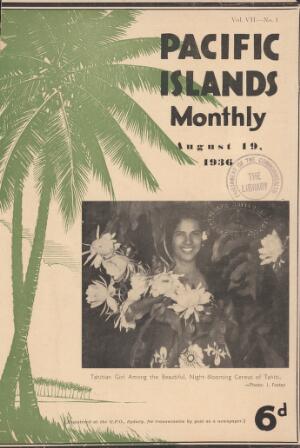
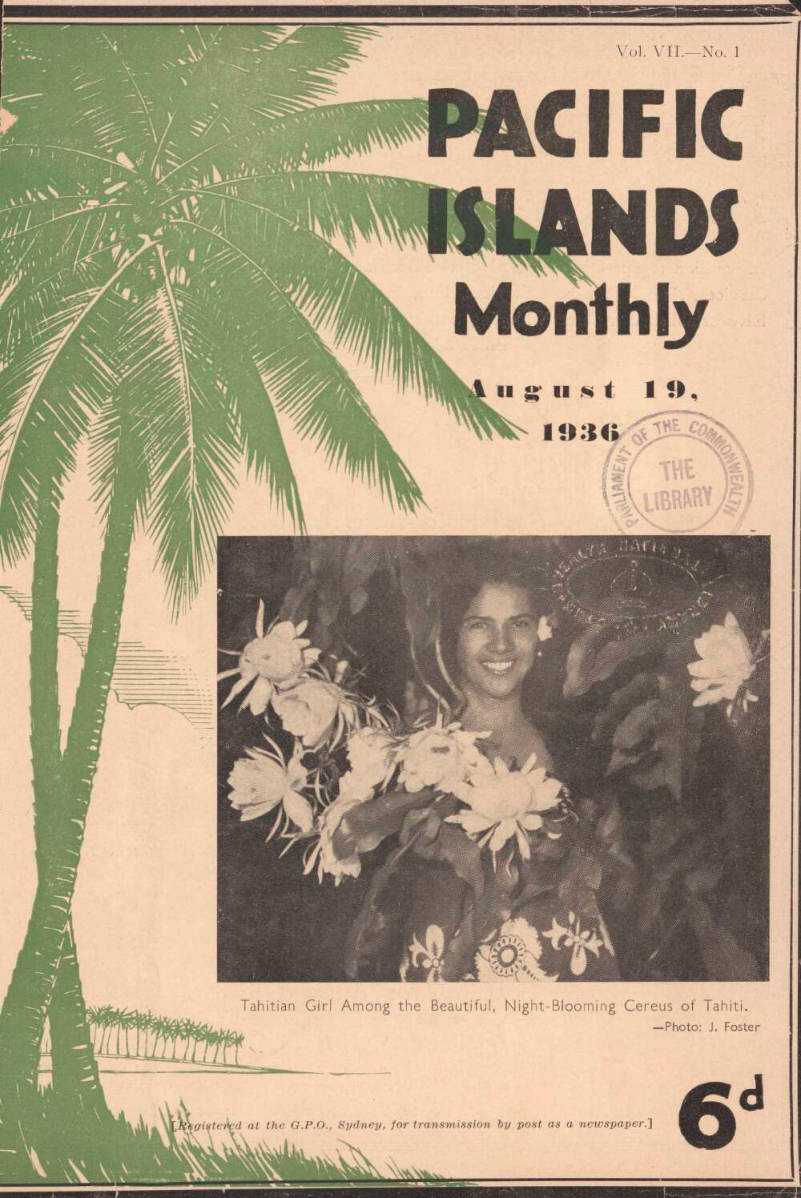
Tahitian Girl Among the Beautiful, Night-Blooming Cereus of Tahiti.
Photo: J. Foster
Advertisements & other items, p. 2 (1 item)
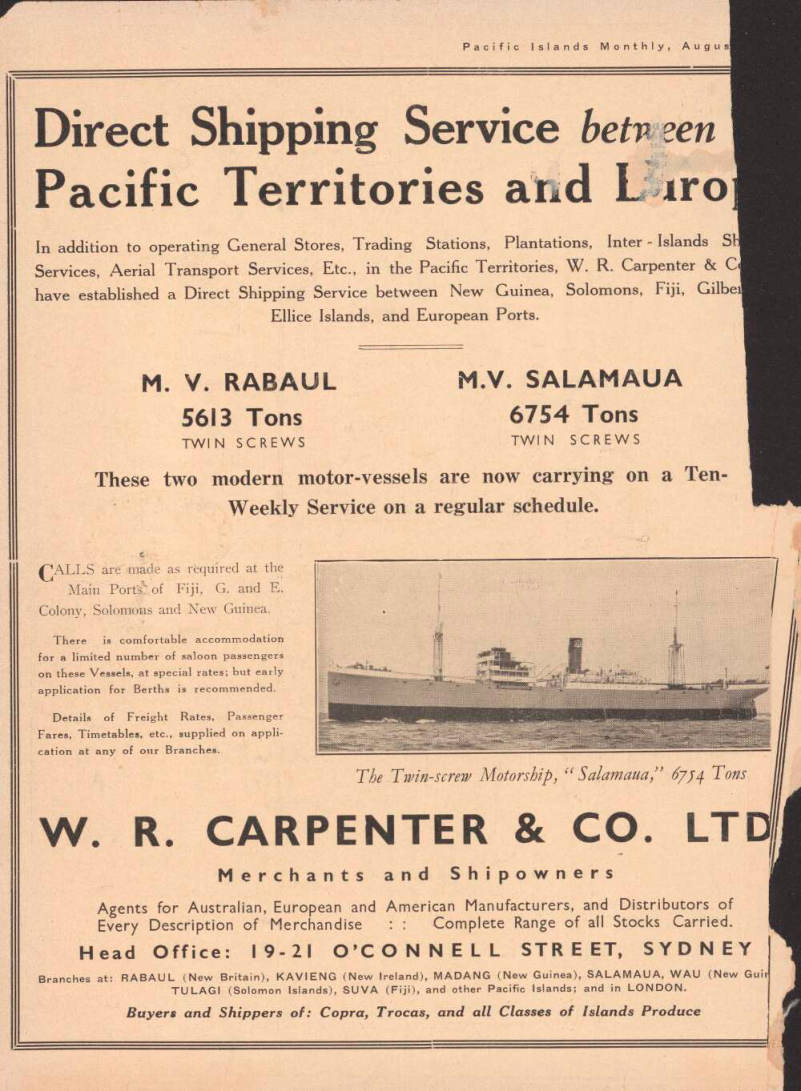
Direct Shipping Service ten
Pacific Territories and L iro
In addition to operating General Stores, Trading Stations, Plantations, Inter - Islands SI Services, Aerial Transport Services, Etc., in the Pacific Territories, W. R. Carpenter & O have established a Direct Shipping Service between New Guinea, Solomons, Fiji, Gilbei Ellice Islands, and European Ports.
M. V. RABAUL M.V. SALAMAUA
5613 Tons 6754 Tons
TWIN SCREWS TWIN SCREWS
These two modern motor-vessels are now carrying on a Ten- Weekly Service on a regular schedule. £VVLLS are made as required at the Main Ports' of Fiji, G. and E.
Colony, Solomons and New Guinea.
There is comfortable accommodation for a limited number of saloon passengers on these Vessels, at special rates; but early application for Berths is recommended.
Details of Freight Rates, Passenger Fares, Timetables, etc., supplied on application at any of our Branches.
The Twin-screw Motorship, “ Salamaua,” 6yj4 Tons
W. R. CARPENTER & CO. LT
Merchants and Shipowners Agents for Australian, European and American Manufacturers, and Distributors of Every Description of Merchandise ; : Complete Range of all Stocks Carried.
Head Office: 19-21 O’CONNELL STREET, SYDNEY
Branches at: RABAUL (New Britain), KAVIENG (New Ireland), MADANG (New Guinea), SALAMAUA, WAU (New Gi TULAGI (Solomon Islands), SUVA (Fiji), and other Pacific Islands; and in LONDON.
Buyers and Shippers of: Copra, Trocas, and all Classes of Islands Produce
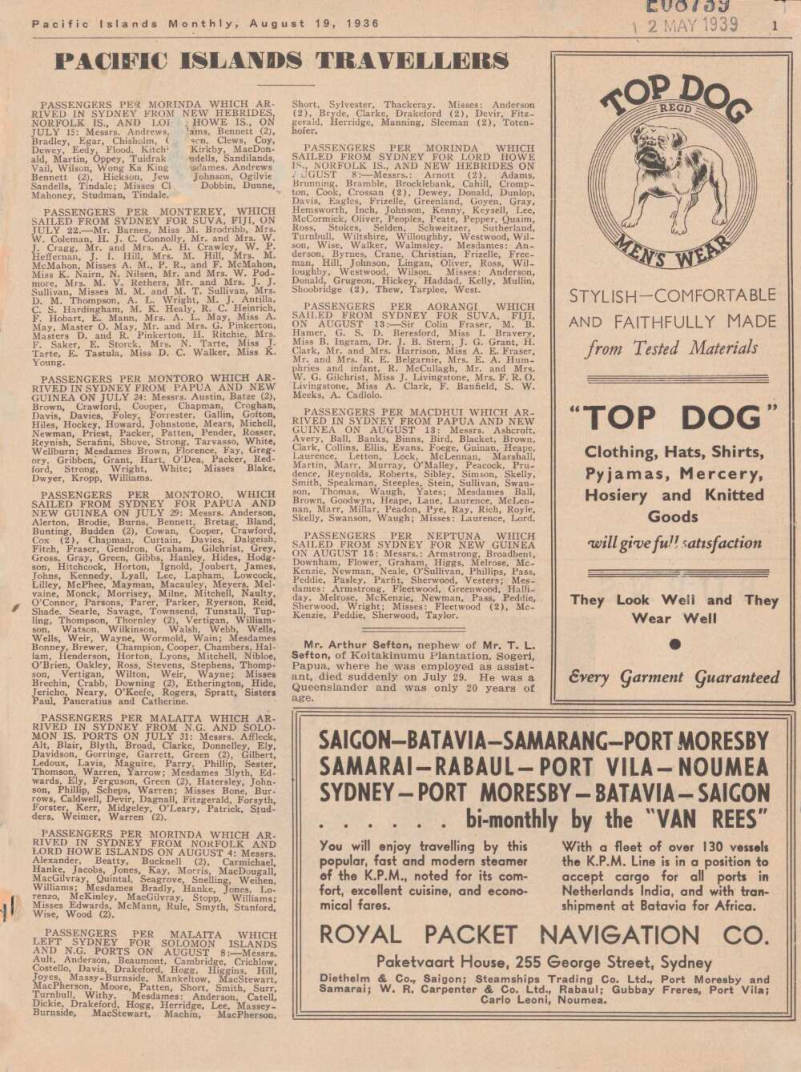
Pacific Islands Travellers
Passengers Per Morinda Which Ar
Rived In Sydney From New Hebrides.
NORFOLK IS., AND LOI HOWE IS., ON JULY 15: Messrs. Andrews, ’ams, Bennett (2), Bradley, Egar, Chisholm, ( sen, Clews, Coy, Dewey, Eedy, Flood, Kitch ; Kirkby, MacDon ald, Martin, Oppey, Tuidrak ndells, Sandilands, Vail, Wilson, Wong Ka King -sdames. Andrews Bennett (2), Hickson, Jew Johnson, Ogilvie Sandells, Tindale; Misses Cl Dobbin, Dunne, Mahoney, Studman, Tindale.
Passengers Per Monterey, Which
SAILED FROM SYDNEY FOR SUVA, FIJI, ON JULY 22. —Mr. Barnes, Miss M. Brodribb, Mrs.
W. Coleman, H. J. C. Connolly, Mr. and Mrs. W.
J. Cragg, Mr. and Mrs. A. H. Crawley, W. P.
Heffernan, J. I. Hill, Mrs. M. Hill, Mrs. M.
McMahon, Misses A. M., P. R., and F. McMahon, Miss K. Nairn, N. Nilsen, Mr. and Mrs. W. Pod more, Mrs. M. V. Rethers, Mr. and Mrs. J. J.
Sullivan, Misses M. M. and M. T. Sullivan, Mrs.
D. M. Thompson, A. L. Wright, M. J. A.ntilla, C. S. Hardingham, M. K. Healy, R. C. Heinrich, F. Hobart, E. Mann, Mrs. A. L. May, Miss A.
May, Master O. May, Mr. and Mrs. G. Pinkerton, Masters D. and R. Pinkerton, H. Ritchie, Mrs.
F. Saker, E. Storck, Mrs. N. Tarte, Miss J.
Tarte, E. Tastula, Miss D. C. Walker, Miss K.
Young.
Passengers Per Montoro Which Ar
RIVED IN SYDNEY FROM PAPUA AND NEW GUINEA ON JULY 24; Messrs. Austin, Batze (2), Brown, Crawford, Cooper, Chapman, Croghan, Davis, Davies, Foley, Forrester, Gallin, Gofton, Hiles, Hockey, Howard, Johnstone, Mears, Michell, Newman, Priest, Packer, Patten, Pender, Rosser, Reynish, Serafini, Shove, Strong, Tarvasso, White, Wellburn; Mesdames Brown, Florence, Fay, Greg ory, Gribben,' Grant, Hart, O’Dea, Packer, Red ford, Strong, Wright, White; Misses Blake, Dwyer, Kropp, Williams.
Passengers Per Montoro, Which
Sailed From Sydney For Papua And
NEW GUINEA ON JULY 29: Messrs. Anderson, Alerton, Brodie, Burns, Bennett, Bretag, Bland, Bunting, Budden (2), Cowan, Cooper, Crawford, Cox (2), Chapman, Curtain, Davies, Dalgeish, Fitch, Fraser, Gendron, Graham, Gilchrist, Grey, Gross, Gray, Green, Gibbs, Hanley, Hides, Hodg son, Hitchcock, Horton, Ignold, Joubert, James, Johns, Kennedy, Lyall, Lee, Lapham, Lowcock, Lilley, McPhee, Mayman, Macauley, Meyers, Mel vaine, Monck, Morrisey, Milne, Mitchell, Naulty, O’Connor, Parsons, Parer, Parker, Ryerson, Reid, Shade, Searle, Savage, Townsend, Tunstall, Tup ling, Thompson, Thornley (2), Vertigan, William son, Watson, Wilkinson, Walsh, Webb, Wells, Wells, Weir, Wayne, Wormold, Wain; Mesdames Bonney, Brewer, Champion, Cooper, Chambers, Hal lam, Henderson, Horton, Lyons, Mitchell, Nibloe, O’Brien, Oakley, Ross, Stevens, Stephens, Thomp son, Vertigan, Wilton, Weir, Wayne; Misses Brechin, Crabb, Downing (2), Etherington, Hide, Jericho, Neary, O’Keefe, Rogers, Spratt, Sisters Paul, Pancratius and Catherine.
Passengers Per Malaita Which Ar
RIVED IN SYDNEY FROM N.G. AND SOLO MON IS. PORTS ON JULY 31: Messrs. Affleck, Alt, Blair, Blyth, Broad, Clarke, Donnelley, Ely, Davidson, Gorringe, Garrett, Green (2), Gilbert, Ledoux, Lavis, Maguire, Parry, Phillip, Sester, Thomson, Warren, Yarrow; Mesdames Blyth, Ed wards, Ely, Ferguson, Green (2), Hatersley, John son, Phillip, Scheps, Warren; Misses Bone, Bur rows, Caldwell, Devir, Dagnall, Fitzgerald, Forsyth, Forster, Kerr, Midgeley, O’Leary, Patrick, Stud ders, Weimer, Warren (2).
Passengers Per Morinda Which Ar
Rived In Sydney From Norfolk And
LORD HOWE ISLANDS ON AUGUST 4: Messrs.
Alexander, Beatty, Bucknell (2), Carmichael, Hanke, Jacobs, Jones, Kay, Morris, MacDougall, MacGilvray, Quintal, Seagrove, Snelling, Weihen, Williams; Mesdames Bradly, Hanke, Jones, Lo renzo, McKinley, MacGilvray, Stopp, Williams; Misses Edwards, McMann, Rule, Smyth, Stanford.
Wise, Wood (2).
Passengers Per Malaita Which
Left Syouey For Solomon Islands
And N.G. Ports On August B:—Messrs.
Ault, Anderson, Beaumont, Cambridge, Crichlow, Costello, Davis, Drakeford, Hogg, Higgins, Hill, Joyes, Massy-Burnside, Mankeltow, Mac Stewart, MacPherson, Moore, Patten, Short, Smith. Surr.
Turnbull Withy. Mesdames: Anderson, Catell, Dickie, Drakeford, Hogg, Herridge, Lee, Massey- Burnside, Mac Stewart, Machin, MacPherson,
Short, Sylvester, Thackeray. Misses: Anderson (2), Bryde, Clarke, Drakeford (2), Devir, Fitz gerald, Herridge, Manning, Sleeman (2), Toten hofer.
Passengers Per Morinda Which
Sailed From Sydney For Lord Howe
IS., NORFOLK IS., AND NEW HEBRIDES ON 1 JGUST 8: —Messrs.; Arnott (2), Adams, Brunning, Bramble, Brocklebank, Cahill, Cromp ton, Cook, Crossan (2), Dewey, Donald, Dunlop, Davis, Eagles, Frizelle, Greenland, Goyen, Gray, Hemsworth, Inch, Johnson, Kenny, Keysell, Lee, McCormick, Oliver, Peoples, Peate, Pepper, Quaim, Ross, Stokes, Selden, Schweitzer, Sutherland, Turnbull, Wiltshire, Willoughby, Westwood, Wil son, Wise, Walker, Walmsley. Mesdames: An derson, Byrnes, Crane, Christian, Frizelle, Free man, Hill, Johnson, Lingan, Oliver, Ross, Wil loughby, Westwood, Wilson. Misses: Anderson, Donald, Grugeon, Hickey, Haddad, Kelly, Mullin, Shoobridge (2), Thew, Tarplee, West.
Passengers Per Aorangi Which
Sailed From Sydney For Suva, Fiji,
ON AUGUST 13:—Sir Colin Fraser, M. B.
Hamer, G. S. D. Beresford, Miss I. Bravery, Miss B. Ingram, Dr. J. B. Stern, J. G. Grant, H.
Clark, Mr. and Mrs. Harrison, Miss A. E. Fraser, Mr. and Mrs. R. E. Belgarnie, Mrs. E. A. Hum phries and infant, R. McCullagh, Mr. and Mrs.
W. G. Gilchrist, Miss J. Livingstone, Mrs. F. R. O.
Livingstone, Miss A. Clark, F. Banfield, S. W.
Meeks, A. Cadlolo.
Passengers Per Macdhui Which Ar
RIVED IN SYDNEY FROM PAPUA AND NEW GUINEA ON AUGUST 13; Messrs. Ashcroft, Avery, Ball, Banks, Binns, Bird, Blacket, Brown, Clark, Collins, Ellis, Evans, Foege, Guinan, Heape, Laurence, Letton, Lock, McLennan, Marshall, Martin, Marr, Murray, O’Malley, Peacock, Pru dence, Reynolds, Roberts, Sibley, Simson, Skelly, Smith, Speakman, Steeples, Stein, Sullivan, Swan son, Thomas, Waugh, Yates; Mesdames Ball, Brown, Goodwyn, Heape, Lane, Laurence, McLen nan, Marr, Millar, Peadon, Pye, Ray, Rich, Royle, Skelly, Swanson, Waugh; Misses; Laurence, Lord.
Passengers Per Neptuna Which
Sailed From Sydney For New Guinea
ON AUGUST 15: Messrs.: Armstrong, Broadbent, Downham, Flower, Graham, Higgs, Melrose, Mc- Kenzie, Newman, Neale, O’Sullivan, Phillips, Pass, Peddie, Pasley, Parfit, Sherwood, Vesters; Mes dames: Armstrong, Fleetwood, Greenwood, Halli day, Melrose, McKenzie, Newman, Pass, Peddie, Sherwood, Wright; Misses: Fleetwood (2), Mc- Kenzie, Peddie, Sherwood, Taylor.
Mr. Arthur Sefton, nephew of Mr. T. L.
Sefton, of Koitakinumu Plantation, Sogeri, Papua, where he was employed as assist ant, died suddenly on July 29. He was a Queenslander and was only 20 years of age.
Advertisements & other items, p. 3 (1 item)
Top Dog
1 ■p 4r. stylish—comfortable
AND FAITHFULLY MADE
from Tested Materials
TOP DOG
Clothing, Hats, Shirts, Pyjamas, Mercery, Hosiery and Knitted Goods •will give full satisfaction They Look WeSi and They Wear Well • Every Cjarment guaranteed
SAIGON—BATAVIA—SAMARANG—PORT MORESBY
SAMARAI-RABAUL- PORT VILA-NOUMEA
SYDNEY - PORT MORESBY - BATAVIA - SAIGON
bi-monthly by the "VAN REES"
You will enjoy travelling by this popular, fast and modern steamer of the K.P.M., noted for its comfort, excellent cuisine, and economical fares.
With a fleet of over 130 vessels the K.P.M. Line is in a position to accept cargo for all ports in Netherlands India, and with transhipment at Batavia for Africa.
ROYAL PACKET NAVIGATION CO.
Paketvaart House, 255 George Street, Sydney
Diethelm & Co., Saigon; Steamships Trading Co. Ltd., Port Moresby and Samara!; W. R. Carpenter & Co. Ltd., Rabaul; Gubbay Freres, Port Vila; Carlo Leoni, Noumea.
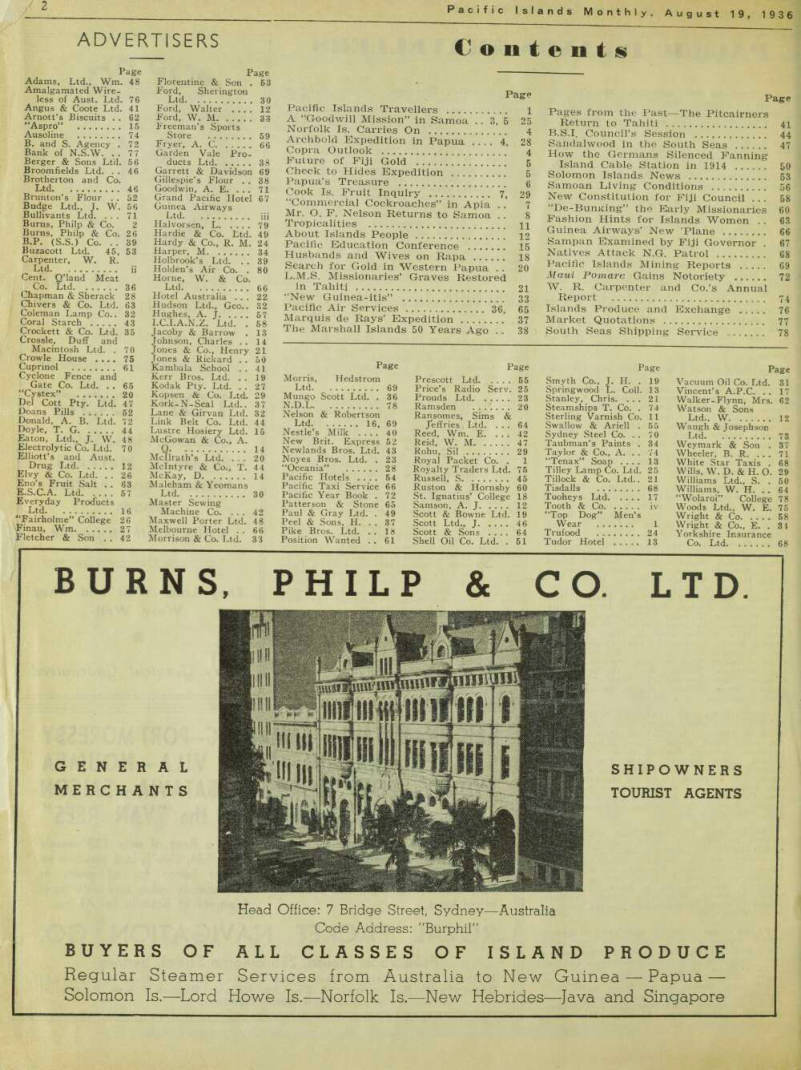
Advertisers
Page Adams, Ltd., Wm. 48 Amalgamated Wire less of Aust. Ltd. 76 Angus & Coote Ltd. 41 Arnott’s Biscuits . . 62 “Aspro” 15 Ausoline 74 B. and S. Agency . 72 Bank of N.S.W. . . 77 Berger & Sons Ltd. 56 Broomfields Ltd. . . 46 Brotherton and Co.
Ltd. 46 Brunton’s Flour . . 52 Budge Ltd., J. W. 56 Bullivants Ltd. ... 71 Burns, Philp & Co. 2 Burns, Philp & Co. 26
B.P. (S.S.) Co. . . 39
Buzacott Ltd. 45, 53 Carpenter, W. R.
Ltd ii Cent. Q’land Meat Co. Ltd 36 Chapman & Sherack 28 Chivers & Co. Ltd, 63 Coleman Lamp Co.. 32 Coral Starch 43 Crockett & Co. Ltd. 35 Crossle, Duff and Macintosh Ltd. . 70 Crowle House ... 75 Cuprinol 61 Cyclone Fence and Gate Co. Ltd. . . 65 “Cystex” 20 Del Cott Pty. Ltd. 47 Doans Pills 52 Donald, A. B. Ltd. 72 Doyle, T. G 44 Eaton, Ltd., J. W. 48 Electrolytic Co. Ltd. 70 Elliott’s and Aust.
Drug Ltd 12 Elvy & Co. Ltd. . . 26 Eno’s Fruit Salt . . 63
E.S.C.A. Ltd 57
Everyday Products Ltd 16 “Fairholme” College 26 Finau, Wm 27 Fletcher & Son , . 42
Page Florentine & Son . 53 Ford, Sherington Ltd 30 Ford, Walter ... 12 Ford, W. M 33 Freeman’s Sports Store 59 Fryer, A. C 66 Garden Vale Pro ducts Ltd 38 Garrett & Davidson 69 Gillespie’s Flour . . 38 Goodwin, A. E. ... 71 Grand Pacific Hotel 67 Guinea Airways Ltd iii Halvorsen, L 79 Hardie & Co. Ltd. 49 Hardy & Co., R. M. 24 Harper, M 34 Holbrook’s Ltd. . , 39 Holden’s Air Co. . 80 Horne. W. & Co.
Ltd 66 Hotel Australia ... 22 Hudson Ltd., Geo.. 32 Hughes, A. J 57
1.C.1.A.N.Z. Ltd. . 58
Jacoby & Barrow . 13
Johnson, Charles . . 14
Jones & Co., Henry 21 Jones & Rickard . . 50 Kambala School . . 41 Kerr Bros. Ltd. . . 19 Kodak Pty. Ltd. . . 27 Kopsen & Co. Ltd. 29 Kork-N-Seal Ltd.. 37 Lane & Girvan Ltd. 32 Link Belt Co. Ltd. 44 Lustre Hosiery Ltd. 15 McGowan & Co., A.
Q 14 Mcllrath’s Ltd. ... 20 Mclntyre & Co., T. 44 McKay, D 14 Maleham & Yeomans Ltd 30 Master Sewing Machine Co. ... 42 Maxwell Porter Ltd. 48 Melbourne Hotel . . 66 Morrison & Co. Ltd. 33
Page Morris, Hedstrom Ltd 69 Mungo Scott Ltd. . 36
N.D.L 78
Nelson & Robertson Ltd 16, 69 Nestle’s Milk ... 40 New Brit. Express 52 Newlands Bros. Ltd. 43 Noyes Bros. Ltd. . 23 “Oceania” 28 Pacific Hotels ... 54 Pacific Taxi Service 66 Pacific Year Book . 72 Patterson & Stone 65 Paul & Gray Ltd. . 49 Peel & Sons, H. . . 37 Pike Bros. Ltd. , . 18 Position Wanted . . 61
Page Prescott Ltd 55 Price’s Radio Serv. 25 Prouds Ltd 23 Ramsden ... 20 Ransomes, Sims & Jeffries, Ltd. ... 64 Reed, Wm. E. ... 42 Reid, W. M 47 Rohu, Sil ... 29 Royal Packet Co. . 1 Royalty Traders Ltd. 75 Russell, S 45 Ruston & Hornsby 60 St. Ignatius’ College 18 Samson, A, J 12 Scott & Bowne Ltd. 19 Scott Ltd., J 46 Scott & Sons ... 64 Shell Oil Co. Ltd. . 51
Page Smyth Co., J. H. . 19 Springwood L. Coll. 13 Stanley, Chris. ... 21 Steamships T. Co. . 74 Sterling Varnish Co. 11 Swallow & Ariell . 55 Sydney Steel Co. . . 70 Taubman’s Paints . 34 Taylor & Co., A. . . 74 “Tenax” Soap ... 13 Tilley Lamp Co. Ltd. 25 Tillock & Co. Ltd.. 21 Tisdalls 68 Tooheys Ltd 17 Tooth & Co iv “Top Dog” Men’s Wear 1 Trufood 24 Tudor Hotel 13
Page Vacuum Oil Co. Ltd. 31 Vincent’s A.P.C. . . 17 Walker-Flynn, Mrs. 62 Watson & Sons Ltd.. W. 12 Waugh & Josephson Ltd 7 3 Weymark & Son . 37 Wheeler, B. R. ... 71 White Star Taxis . 68 Wills, W. D. & H. O. 29 Williams Ltd., S. . 50 Williams, W. H. . . 64 “Wolaroi” College 78 Woods Ltd., W. E. 75 Wright & Co 58 Wright & Co., E. . 34 Yorkshire Insurance Co. Ltd. ... 68
Contents
Page Pacific Islands Travellers 1 A “Goodwill Mission” in Samoa .. 3, 5 25 Norfolk Is. Carries On 4 Archbold Expedition in Papua ... 4, 28 Copra Outlook 4 Future of Fiji Gold !!!.!!!.! 5 Check to Hides Expedition 5 Papua’s Treasure 6 Cook Is. Fruit Inquiry 7, 29 “Commercial Cockroaches” in Apia .. 7 Mr. O. F. Nelson Returns to Samoa .. 8 Tropicalities n About Islands People 12 Pacific Education Conference 15 Husbands and Wives on Rapa 18 Search for Gold in Western Papua . . 20 L.M.S. Missionaries’ Graves Restored in Tahiti 21 “New Guinea-itis” 33 Pacific Air Services 36, 65 Marquis de Rays’ Expedition 37 The Marshall Islands 50 Years Ago .. 38
Page Pages from the Past —The Pitcairners Return to Tahiti 41 8.5.1. Council’s Session 44 Sandalwood in the South Seas 47 How the Germans Silenced Fanning Island Cable Station in 1914 50 Solomon Islands News 53 Samoan Living Conditions 56 New Constitution for Fiji Council ... 68 “De-Bumdng” the Early Missionaries 60 Fashion Hints for Islands Women .. 63 Guinea Airways’ New ’Plane 66 Sampan Examined by Fiji Governor . 67 Natives Attack N.G. Patrol 68 Pacific Islands Mining Reports 69 Maui Pomare Gains Notoriety 72 W. R. Carpenter and Co.’s Annual Report 74 Islands Produce and Exchange 76 Market Quotations 77 South Seas Shipping Service 78
Advertisements & other items, p. 4 (1 item)
Burns, Philp & Co. Ltd.
GENERAL
MERCHANTS
I .* 111!
HU H
m 111
tin
m mi
Hi ill
Wl 1 a
SHIPOWNERS
TOURIST AGENTS
Head Office: 7 Bridge Street, Sydney—Australia Code Address: "Burphil"
BUYERS OF ALL CLASSES OF ISLAND PRODUCE Regular Steamer Services from Australia to New Guinea Papua Solomon Is.—Lord Howe Is. —Norfolk Is.—New Hebrides —lava and Singapore
Pacific Islands Monthly
The Newspaper-Magazine of the South Seas [Registered at the G.P.O. Sydney, for transmission by post as a newspaper.']
Published Once Each Month and Circulated in Australia and New Zealand and in the following Pacific Territories and Island Groups:
Crown Colony of Fiji.
Australian Territory of Papua.
Mandated Territory (Australia) of New Guinea, Bismarck Archipelago and Northern Solomon Islands.
Mandated Territory (Japan) of Marshall, Caroline and Marianna Islands.
French Territory of New Caledonia.
British and French Condominium of New Hebrides.
American Territory of Eastern Samoa.
American Territory of Guam.
Mandated Territory of Nauru.
British Crown Colony of Gilbert and Ellice Islands.
Mandated Territory (New Zealand) of Samoa.
British Solomon Islands Protectorate.
British Protectorate of Tongan Islands.
New Zealand Territory of Cook Islands.
Australian Territory of French Colony of Oceania (Tahiti, etc.).
American Territory of Hawaiian Islands.
Owned and Produced by Pacific Publications Ltd., Union House, 247 George Street, Sydney
Telephone Bw 5037
P.O. Box 3408 R
Registered Address of Telegrams, Radiograms, and Cables: “PACPUB,” Sydney.
Contributions Articles, Stories, and Photographs dealing with Pacific Islands subjects are invited, and will be paid for on publication at usual rates.
Subscription Rates
Per Annum, within British Empire, Prepaid, Post Free 6/- Pcr Annum, elsewhere, prepaid. Post Free 8/- Single Copies 6d.
Editor and Publisher:
R. W. Robson. F.R.G.S.
Advertisements
Advertising rates furnished on application.
Colours, etc by Arrangement.
Process Blocks made at Advertiser’s expense when required. Screen, 100.
Changes of Advertising Copy should reach this Office by Bth of each month, otherwise previous advertisement may be repeated.
Agents
The following are authorised to receive subscrip tions for the Pacific Islands Monthly:— Islands Branches of Burns, Philp & Co., Ltd., and Burns Philp (South Sea) Co., Ltd.
Islands Branches of W. R. Carpenter & Co., Ltd.
All Branches of Morris, Hedstrom & Co., Ltd.
G. Thomas & Co., Rabaul, New Guinea.
Whitten Bros., Ltd., Saraarai, Papua.
P. Costello, Suva, Fiji.
J. Muir, Suva, Fiji.
All Branches and Representatives of W. H. Grove and Sons, Ltd., Auckland, New Zealand.
S. Russell, Papeete, Tahiti.
Cook Islands Trading Co., Rarotonga, Cook Is.
W. H. Watson, Rarotonga, Cook Is.
Representative in London: W. C. HARVEY, Coronation Building, 4 Lloyds Avenue, London, E.C.2. from whom may be obtained copies of Pacific Islands Monthly, Pacific Islands Year Book. advertising schedules, etc.
Vol. Vll., No. 1.
Sydney, August 19, 1936
PI 6d ' Per Copy * I riCc Prepaid; 6/- p.a.
A “Goodwill Mission” In Samoa
'J’HE N.Z. Government’s “Goodwill Mission” to Samoa (Mr. Lang stone, Minister for Lands, and Mr.
O’Brien, Chairman of the Parlia mentary Committee on Native Affairs) returned to New Zealand on August 3, and issued to the New Zealand newspapers a statement claiming that, “as the result of our visit the mistrust, grievances and misunderstanding of the past have been cleared away and Samoa to day is a united people determined to work in harmony with the Admin istration.”
The Minister said that the follow ing ordinances, “repugnant to the Mau,” had been repealed:— The Samoan Offenders Ordinance, 1922, under w hich the Administration was empowered to banish individuals from their villages and to cancel Samoan titles.
Native Personal and Medical Tax Ordinances.
The proclamation under which the Mau was de dared a seditious organisation.
Restrictions upon free movement of individuals within the territory.
The Government had decided also to cancel arrears of native personal and medical taxes, amounting to almost £28,P00, to remit the balance
of the term of exile imposed on Mr. O. F. Nelson, and to increase by 6d. a case the price paid by the Administration to banana exporters, of whom 60 per cent, are Samoans.
The Mission announced that
thereafter it had reached “a com
plete understanding with the native
people,” on the following basis:—
Increase the number of Samoan representatives on the Legislative Council from two to four.
Pay to members of the Legislative Council, other them official members, an honorarium of £5O per annum.
Pay to fautuas (native advisors to the Ad ministrator) an honorarium of £lOO per annum.
Arrange for the setting up of a finance com mittee, consisting of three representatives of the Samoan race and one of the European community, before which committee will be placed full infor mation about public accounts, revenue, taxation, and expenditure.
Publish in “Savali” (the Samoan Gazette), in the native language, full information about the public accounts.
Make provision for the Legislative Council to disclose the estimates of the territory prior to despatch to New Zealand for the approval of the Government, and to forward recommendations by the council in regard to revenue and expenditure.
Revoke immediately the present fono of faipules (native advisory council), and to arrange the re election on September 30 next, so that, with the Mau participating, the fono will be fully repre sentative of the Samoan people.
Extend the present system of education in the administration of schools by providing for free tuition, a higher standard of education and the establishment of secondary schools.
Extend the present hospital and central system
throughout the territory with the view of bringing medical and hospital treatment within the reach of every Samoan.
Secure the services of a qualified dentist to pro vide free dental treatment for school children, and with a view later of establishing a complete school dental system for the mandated territory.
Arrange for the taking of a census at the end of the year.
The Minister, in his official report, made no reference to a most import ant decision; but his colleague, Mr.
O’Brien, announced that “the repat riation of Chinese and Melanesian labour at present in Samoa will be commenced by the New Zealand Government during the coming 12 months.
“Over 200 Chinese would leave Samoa in less than 12 months and other drafts of Chinese and Melan esians would be made from year to year until all outside labour had been removed. The delegation had formed the opinion that the Samoans could easily be brought to become industrious and, under proper Gov ernment supervision, could be al lowed to work out their own des tiny.”
Reference to this matter of Chin ese labour will be found elsewhere
in this issue. If the Chinese are removed, and the planters are not supplied with other labour (neither Samoans nor half-castes can be de pended upon to supply workers when they are most needed) the European 1 planting industry in Samoa will receive its final coup de grace, and there inevitably will develop an agitation for the removal of the Mandate from New Zealand.
The N.Z. Mission achieved noth ing in Samoa that is likely to bring about political peace or economic advancement. The reforms which were ordered were necessary, and long overdue, but they reached no where. The delegation’s recommen dations amount simply to a plan for giving the native Samoans a larger voice in the Legislative Council (purely an advisory body), and for enlarging the education and hospital services, which must mean a con siderable increase in the cost of ad ministration.
These things do not even touch the root of Samoa’s troubles —which may be found in the large half-caste population and in New Zealand’s failure to develop the country on sound economic lines —and there is no indication of how the increased costs are to be provided. Instead, by depriving the planters of labour, the Minister proposes to reduce con siderably the productive capacity of the country. The Minister’s atti tude towards the planters indicates that he recognises no responsibility on the part of N.Z. for the proper development of this rich Territory.
The “Goodwill Mission” did not achieve much goodwill. It may be taken as certain that there will be further political trouble among the natives—there were signs of it even before the Mission was back in Wel lington. It was apparent that Messrs. Langstone and O'Brien knew nothing of tropical islands conditions generally, and especially were they ignorant of the peculiari ties of the Dominion’s obligations in Samoa. They had no idea of how to approach the natives. The Editor of this journal, who was in Samoa at the time, heard those two well-in tentioned gentlemen one morning making a series of addresses to the children in the native schools. Each “missioner” spoke in each school for at least ten minutes, delivering in English a kind of politico-economic sermon. And it is doubtful whether
those little native children knew more than 20 words of English
among them!
There is a large and growing body of European opinion in Samoa in favour of a transfer of the mandate to Britain. The natives, of course, want a kind of protectorate, similar to Tonga; while the half-castes (mostly German - Samoans) are anxious to be parted from New Zea land. All interests probably would be happy if Samoa were brought under the British Colonial Office, through the High Commissioner for the Western Pacific, w r ho already governs or supervises Fiji, Tonga, Solomons, New Hebrides and the Gilbert and Ellice Groups in a very efficient manner.
Norfolk Is. Carries On
'P'CONOMIC conditions in Norfolk Is land have been receiving attention lately.
At one time Norfolk Island sold very large quantities of fruit to New Zealand.
Then New Zealand put an embargo on Australian fruit and as Norfolk Island is an Australian territory the embargo applied to N. 1., and the trade with New Zealand was killed. Australia appealed to the New Zealand Government, point ing out that mainland conditions do not apply to N. 1., but New Zealand, being em barrassed with the need for absorbing oranges and bananas from the Cook Is lands and Samoa, left the ban on Nor folk Is.
When the new Labour Government came into power in New Zealand an appeal was made by Australia against the ban; and the matter is now under consideration.
Recently it has been suggested that N.I. should be taken from Australia and placed under New Zealand control. It was pointed out that there is no market for N.I. produce in Australia, but that New Zealand always will take oranges and bananas.
Norfolk Island, having been desperately up against it in recent years, has found other means of carrying on. A butter in dustry has been established, which pro duces 5001 b. of butter every week; and there has been a remarkable extension of the business of growing passion fruit.
Mr. G. A. Flack, who operates a chain of grocery stores in the Manly district of Sydney, has established a factory in Nor folk Is. for the canning of passion fruit, which grows luxuriantly there; and it ap pears as if this new industry will flour ish.
Hon. P. F. Boyd, Postmaster-General in Fiji since 1928, has been transferred to Northern Rhodesia as Postmaster of that Colony. He left Suva by the Niagara on July 24.
Mr. Franz Stehr, an old identity of New Guinea, died after a short illness in Nama nula Hospital at the end of July, aged 84.
Mr. Stehr first went to the territory from Samoa in 1898; prior to that he had been living in Tonga. For some years he and his wife conducted the Tivoli Hotel at Apia.
Far Up Fly River
The Archbold Expedition
From Our Own Correspondent
Pt. Moresby, Aug. 1.
THE launch Maira, carrying provisions to assist the advance party of the Archbold Expedition, which is returning from the headwaters of the Upper Fly (Dr. Rand, Messrs. Brass, Tate and Willis and Patrol Officer Healy and police) had got only as far as Alligator Island on July 30, 150 miles up the Fly River, ow ing to strong currents and heavy weather and trouble with the engine.
It is understood that the Ronald 8., carrying the advance party of Mr. Ward Williams’ mining expedition, after they have secured recruits up the Ramu river, will go to the Maira on the Fly, and get in touch with the Archbold party at D’Albertis Junction, where they are ex pected to arrive on rafts.
The Maira will return to Port Moresby and the Ronald 8 ., after landing Mr. Wil liams’ party at their base camp, above D’Albertis Junction, will bring the Arch bold Party to Daru and Port Moresby.
Amalgamated Wireless have maintained radio communication with both parties. (Further reference to the Archbold Expedition will be found on page 28.)
Copra Outlook
Period of Plentiful Supplies Approaching
RECENT reviews of the world’s oil and fat markets, by Messrs, H. M. F.
Faure and Co. (whose forecasts usually are very accurate) indicate that there is little likelihood of any drop in prices for the time being; and that, in 1937 and 1938, there will be a period of more plen tiful supplies.
The passing of the Bailey Bill in the American Senate in June placed proces sing taxes upon whale oil and tallow, thus shutting out those commodities in favour of lard (home-grown) and palm-oil and copra (imported). The effect of this was to give a small fillip to copra prices; but also it certainly will encourage a larger production in America of lard and cotton seed oil. Meanwhile, whale oil and tallow, shut out of U.S.A., are seeking a market elsewhere, which might have a tendency to depress the copra price. Whale oil production seems to have fallen, however, and there definitely is a move to restrict the catch during the coming season.
There has been a falling-off in the quan tity of soya bean oil reaching the Euro pean market.
Copra being now at a price which re turns a small profit to the grower, one notes everywhere an increasing produc tion, which, possibly may mean over production again. As against that, the consumptive capacity of the world will grow, so long as the economic improve ment continues. Generally, the outlook is not discouraging.
Mrs. H. Luxmore, the well-known and popular manageress of the Rabaul Hotel, recently left Rabaul for Buka (Northern Solomons) to spend several weeks’ holi day. She has been suffering from very indifferent health for some time.
Fiji Gold
Future of The Field
THERE has been much speculation about the Fijian goldfield. There seems to be an impression that the bottom has fallen out of this new industry.
The Editor of the at the end of July, visited the Tavua goldfield, obtained details of the activities in progress there, and discussed the outlook with various people who should know what they are talking about.
The result of our investigations will appear in an article in the September issue.
In the meantime it may be said very briefly that, without doubt, the Fiji gold industry is going to be a big and profitable industry. Certain mines within the “charmed circle” at Tavua will become large producers of gold. ’Others will fade out.
The prospects of the Yanawai goldfield (over on the large island of Vanua Levu) are very good—Mount Kasi already is in the picture as a profitable producer. The development of various other mines ope rating in the Yanawai area should be watched.
“We Don’T Want
Samoa!”
THE “Goodwill Mission” met the repre sentatives of the Samoan natives at Vaimoso, near Apia, on July 20; and, ac cording to the report of the New Zealand Press Association, published in the N.Z. newspapers on July 22, the following occurred: — The High Chief Tamasese suggested that the delegation should recommend the Government to change Samoa from a mandated territory to a protectorate. It was the desire of Samoans, he said, to manage their own affairs.
“All right!” said Mr. Langstone (leader of the Mission), “if you are stupid enough to believe you would be better off that way—well, go right ahead. We don’t want Samoa. We don’t want your bananas.
We don’t want the Maui Pomare. When you get a protectorate see where it will land you. You will be in for a hot time, believe me.”
Tamasese said the Samoans were not concerned about money because thev could get along quite well without money.
They did not want to break away from Britain. They wanted the protection of the New Zealand Government, but the right to manage their own affairs.
Tuimalealiifano, an ancient high chief and an old friend of Robert Louis Steven son, begged the Minister not to be angry, and excite Samoa, because it was still sick.
Discussion was adjourned.
The delegation left Samoa- a couple of days later; and the Minister, on arrival in New Zealand, announced a “complete understanding.”
The Navy Department of the United States now has on order 60 giant flying patrol boats, which are intended to strengthen the 2,500 miles air link be tween the mainland and Hawaii. Those of the flying boats which are to be stationed in Hawaii will be flown there in groups of two or three.
Check To Hides Expedition
Explorer Forbidden to Lead Gold Search In Region Which He Discovered
T EADING the best equipped Islands expedition ever sent out of Australia, Mr. Jack Hides sailed from Sydney by the Montoro on July 29 for Poit Moiesby.
The expedition, it is understood, consists of two Europeans (Mr. Hides and Captain P. G. Taylor) and 60 natives, and the original plan was that it would gen- .. nvnojitinw W TT-J 6 track of the expedition led by Mr. Hides early in 1935— namely, up the Fly and Strickland Rivers and across the limestone barrier into the Tari Furoro and Waga Furari valleys. It was understood that Mr. Hides would endeayour to locate a goldfield somewhere in the region he had previously traversed. close to the border between the Mandated Territory and Papua.
Investors Limited was registered m June. It has an issued capital of £16,250 in £1 shares and its composition is as follows : DIRECTORS Cliff Minter (chairman), F. Clapp (G.M., Aust.
General Electric Ltd.), Rod Dangar (owner of Peter Pan), Captain P. G. Taylor (aviator).
Shareholders
C. Minter, head of Minter, Simpson and Co., well-known Sydney solicitors; Telford Simpson, Chairman of the Consultative Council; Rodney Dangar grazier and owner of Peter Pan; E. R.
Knox, Chairman of Directors of the Colonial Sugar Refining Co. Ltd.; F. B. Clapp, Managing Director of the Australian General Electric Co. Ltd.; E. P. (“Monty”) Walker, stockbroker (and the only stockbroker allowed to take shares) ; T. Church, General Manager of the National Bank of Austraha; A. C. Davidson, General Manager of the Bank of N.S.W.; A. H. Stuart. General Manager of the "Sydney Morning Herald”; R. A. Henderson. Assistant Manager of the "Sydney Morning Herald”; N. P. Hunt, merchant; P. G. Taylor, well-known aviator; J R McGregor, art connoisseur and one of Australia s biggest woolbrokers; P. and B. Dowling, well-known accountants; A.
R. Wilshire, General Manager of the Bank of Australasia; L. Burdekin, barrister; A. G. Pitt,
barrister; A. C. and C. H. Crammond, estate agents; L A. Hooke Ccncval Manager of Amal secretary of John Fairfax and Son Ltd.; Sir John McKelvey, famous surgeon; E. S. Wolfenden, well-known accountant; C. E. Munro, General Manager of Hoyts Theatres Ltd.; L. Armstrong, Sr e v e u a n Manager of Burns, Phdp and Co. Ltd.; J.
Mitchell, a director of Burns, Philp and Co. Ltd.; anc j ot h er well-known men, such as N. Hill, A.
McVernan. R. W. (i. Swinson, A. G. White. J.
Massie, R. C. Osborne. a glance at the list of names suggests that this is on * G f the most powerful and influential companies ever formed in Syd ney. The members of the company could, i£ required, provide funds running far into seven fibres. In such circum stances it would appear that Mr. Hides wag completely justified in resigning his assured position in the Papuan Adminis tration; and. setting out under such aus pices, the success of the expedition assured Troubles developed early, however. It had been reported that Mr. Hides was bound for the Waga Furari country. The Acting Lieutenant Governor of Papua soon afterwards promulgated an ordin ance declaring that the Waga country was an “uncontrolled region,” and that no t-, „ . ... , European might enter therein without a license. Shortly afterwards it was re ported that the Hides expedition was going to the Tari Furoro country, and not the Waga Furari district. Immediately thereafter there come the mminnopmbni ™ e VTis te * . ™ ( ame the * nnouncement that the 111 y 1 * uroro was also an 'uncon trolled area” and barred to Europeans.
All this happened while Mr. Hides was on his way f rom Sydney to Port Moresby, R , r . v .. . , , r TT ., th ? m * ddle ° f Al “ ust ’ Mr. Hides was b . us y m Port Moresby making prepara tions for an expedition into the interior:
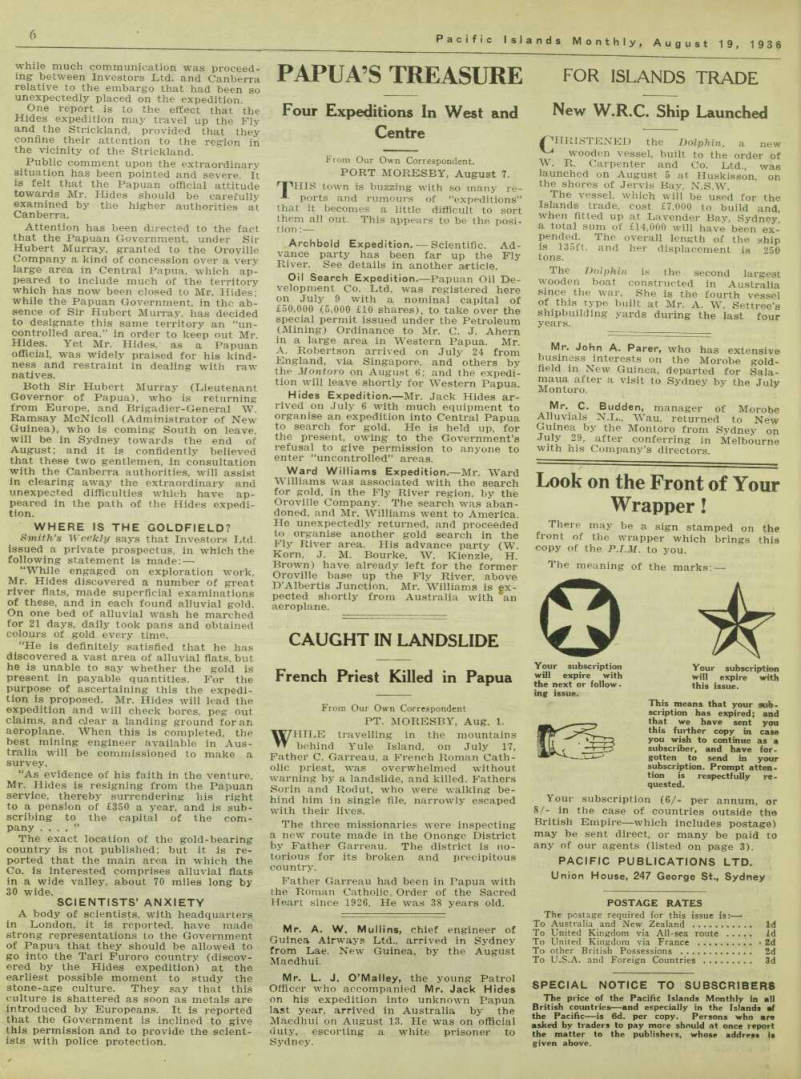
Two Japanese sampans captured in July while gathering trochus shell off the coast of New Cale donia were the subject of Court proceedings at Noumea on August 1. The captains were fined £60 each, and the vessels, fishing gear, and shell were confiscated by order of the Court. The Japanese have appealed to the Higher Court. The photograph shows one of the Japanese sampans tied up at the wharf at Noumea.
Photo: Marcel Medard
while much communication was proceed ing between Investors Ltd. and Canberra relative to the embargo that had been so unexpectedly placed on the expedition.
One report is to the effect that the Hides expedition may travel up the Fly and the Strickland, provided that they confine their attention to the region in the vicinity of the Strickland.
Public comment upon the extraordinary situation has been pointed and severe. It is felt that the Papuan official attitude towards Mr. Hides should be carefully examined by the higher authorities at Canberra.
Attention has been directed to the fact that the Papuan Government, under Sir Hubert Murray, granted to the Oroville Company a kind of concession over a very large area in Central Papua, which ap peared to include much of the territory which has now been closed to Mr. Hides; while the Papuan Government, in the ab sence of Sir Hubert Murray, has decided to designate this same territory an “un controlled area.” in order to keep out Mr.
Hides. Yet Mr. Hides, as a Papuan official, was widely praised for his kind ness and restraint in dealing with raw' natives.
Both Sir Hubert Murray (Lieutenant Governor of Papua), w r ho is returning from Europe, and Brigadier-General W, Ramsay McNicoll (Administrator of New' Guinea), who is coming South on leave, will be in Sydney towards the end of August; and it is confidently believed that these two gentlemen, in consultation with the Canberra authorities, will assist in clearing away the extraordinary and unexpected difficulties which have ap peared in the path of the Hides expedi tion.
Where Is The Goldfield?
Smith’s Weekly says that Investors Ltd. issued a private prospectus, in which the following statement is made: “While engaged on exploration w r ork.
Mr. Hides discovered a number of great river flats, made superficial examinations of these, and in each found alluvial gold.
On one bed of alluvial w*ash he marched for 21 days, daily took pans and obtained colours of gold every time.
“He is definitely satisfied that he has discovered a vast area of alluvial flats, but he is unable to say whether the gold is present in payable quantities. For the purpose of ascertaining this the expedi tion is proposed. Mr. Hides will lead the expedition and will check bores, peg out claims, and clear a landing ground for an aeroplane. When this is completed, the best mining engineer available in Aus tralia will be commissioned to make a survey.
“As evidence of his faith in the venture, Mr. Hides is resigning from the Papuan service, thereby surrendering his right to a pension of £350 a year, and is sub scribing to the capital of the com pany . . . . ”
The exact location of the gold-bearing country is not published; but it is re ported that the main area in which the Co. is interested comprises alluvial flats in a wide valley, about 70 miles long by 30 wide.
Scientists’ Anxiety
A body of scientists, with headquarters in London, it is reported, have made strong representations to the Government of Papua that they should be allowed to go into the Tari Furoro country (discov ered by the Hides expedition) at the earliest possible moment to study the stone-age culture. They say that this culture is shattered as soon as metals are introduced by Europeans. It is reported that the Government is inclined to give this permission and to provide the scient ists with police protection.
Papua’S Treasure
Four Expeditions In West and Centre
From Our Own Correspondent.
Port Moresby, August 7.
town is buzzing with so many re- A ports and rumours of “expeditions” that it becomes a little difficult to sort them all out. This appears to be the posi tion ; Archbold Expedition. Scientific. Ad vance party has been far up the Fly River. See details in another article.
Oil Search Expedition.—Papuan Oil De velopment Co. Ltd. was registered here on July 9 with a nominal capital of £50,000 (5,000 £lO shares), to take over the special permit issued under the Petroleum (Mining) Ordinance to Mr. C, J. Ahern in a large area in Western Papua. Mr.
A. Robertson arrived on July 24 from England, via Singapore, and others by the Montoro on August 6; and the expedi tion will leave shortly for Western Papua, Hides Expedition.—Mr. Jack Hides ar rived on July 6 with much equipment to organise an expedition into Central Papua to search for gold. He is held up, for the present, owing to the Government’s refusal to give permission to anyone to enter “uncontrolled” areas.
Ward Williams Expedition.—Mr. Ward Williams was associated with the search for gold, in the Fly River region, by the Oroville Company. The search was aban doned, and Mr. Williams went to America.
He unexpectedly returned, and proceeded to organise another gold search in the Fly River area. His advance party (W.
Korn, J. M, Bourke, W. Kienzle, H.
Brown) have already left for the former Oroville base up the Fly River, above D’Albertis Junction. Mr. Williams is ex pected shortly from Australia with an aeroplane.
Caught In Landslide
French Priest Killed in Papua
From Our Own Correspondent
Pt. Moresby, Aug. 1.
WHILE travelling in the mountains behind Yule Island, on July 17, Father C. Garreau, a French Roman Cath olic priest, was overwhelmed without warning by a landslide, and killed. Fathers Sorin and Rodut, who were walking be hind him in single file, narrowly escaped with their lives.
The three missionaries were inspecting a new route made in the Ononge District by Father Garreau. The district is no torious for its broken and precipitous country.
Father Garreau had been in Papua with the Roman Catholic. Order of the Sacred Heart since 1926, He was 38 years old.
Mr. A. W. Mull ins, chief engineer of Guinea Airways Ltd., arrived in Sydney from Lae, New Guinea, by the August Macdhui.
Mr. L. J. O’Malley, the young Patrol Officer who accompanied Mr. Jack Hides on his expedition into unknown Papua last year, arrived in Australia by the Macdhui on August 13. He was on official duty, escorting a white prisoner to Sydney.
New W.R.C. Ship Launched
For Islands Trade
the Dolphin, a new wooden vessel, built to the order of W. R. Carpenter and Co. Ltd., was launched on August 5 at Huskisson, on the shores of Jervis Bay, N.S.W.
The vessel, which will be used for the Islands trade, cost £7,000 to build and, when fitted up at Lavender Bav, Sydney’ a total sum of £14,000 will have been ex pended. The overall length of the ship is 135 ft. and her displacement is 250 tons.
The Dolphin is the second largest wooden boat constructed in Australia since the war. She is the fourth vessel of this type built at Mr. A. W. Settree’s shipbuilding yards during the last four years.
Mr. John A. Parer, who has extensive business interests on the Morobe gold field in New Guinea, departed for Sala maua after a visit to Sydney by the July Montoro.
Mr. C. Budden, manager of Morobe Alluvials N.L., Wau, returned to New Guinea by the Montoro from Sydney on July 29, after conferring in Melbourne with his Company’s directors.
Advertisements & other items, p. 8 (1 item)
Wrapper!
Look on the Front of Your
There may be a sign stamped on the front of the wrapper which brings this copy of the P.T.M. to you.
The meaning of the marks: 0 ★ Your subscription will expire with this issue.
This means that your sub scription has expired; and that we have sent you this further copy in case you wish to continue as a subscriber, and have forgotten to send in your subscription. Prompt attention is respectfully requested.
Your subscription (6/- per annum, or 8/- in the case of countries outside the British Empire—which includes postage) may be sent direct, or many be paid to any of our agents (listed on page 3).
PACIFIC PUBLICATIONS LTD.
Union House, 247 George St., Sydney Your subscription will expire with the next or following issue.
POSTAGE RATES
The postage required for this issue is:- To Australia and New Zealand To United Kingdom via All-sea route .
To United Kingdom via France To other British Possessions To U.S.A. and Foreign Countries Id Id • 2d 2d 3d
SPECIAL NOTICE TO SUBSCRIBERS
The price of the Pacific Islands Monthly in all British countries—and especially in the Islands af the Pacific—is 6d. per copy. Persons who are asked by traders to pay more should at once report the matter to the publishers, whose address is given above.
Mr. Nelson Returns To Samoa
15,000 Natives Greet the Mau Leader
From Our Own Correspondent
APIA, July 30.
'T'HE sun was shining brightly, and all the foreshores were packed with thousands of gaily-dressed Samoans when, on July 22, the Maui Pomare came into Apia Bay with Mr. O. F. Nelson and his three daughters aboard. Mr. Nelson, in 1934, was exiled as a result of alleged activities against the Government. The new Laboilr Government cancelled the ban, and sent the Mau leader back to Samoa, at the Government’s expense.
The steamer immediately was sur rounded by a large number of the long and graceful Samoan fautasis, all de corated and showing the purple Mau flags, with white cross and star, and each carrying 40 hefty Samoan oarsmen. An imitation of an ancient Samoan war canoe carried a throne and baldachin of flowers, under which pretty smiling Princess Sala, daughter of High Chief Faumuina, was seated, to bring Ta’isi ashore.
The New Zealand “Goodwill” delegation (Messrs. F, Langstone and J. O’Brien) joined the Acting Administrator of Samoa (Mr. A. C. Turnbull) and the highest Chiefs of Samoa in extending the first welcome to Mr. Nelson on board the steamer, Mr. Nelson finally landed, visibly im pressed and embarrassed by the unpre cedented greeting given him by his countrymen.
Mr. Nelson is 50 years old, is of Swed ish and Samoan descent, and is a British naturalised subject. He was born and educated in Samoa and by diligent work, endowed with high intelligence and com mercial ability, he greatly extended the commercial firm taken over after his father’s death. Since 1926, when he be came the power behind the Samoan national Movement (the Mau), working in strong opposition to the New Zealand Government and its Administration in
Samoa, Mr, Nelson has twice been exiled for his political activities. The last term of exile was for 10 years, from 1934.
Those years of exile and tribulation have left their indelible mark on the man. Political fights and personal an guish. sickness and worry over family and business matters in an uncongenial climate, have served to undermine his health and vigour.
Mr. Nelson, appears sincerely grateful to the New Zealand Government for their action towards him. and he will surely do all in his power to pave the way for a settlement and understanding between the New Zealand Government and the Samoan natives, on whom he exerts a very considerable influence. It may be taken as certain that he will use this influence to assist the Administration.
With the impulsive, suspicious and some times overbearing character of the Samoan natives, some moderating in fluence is at times very necessary.
On the day after his arrival in Samoa, Mr. Nelson assisted the “Goodwill” Dele gation (leaving on the same day on their return voyage) to bring about an under standing with the Samoan representa tives, in preparation for a complete settle ment of outstanding grievances.
Following this last meeting with the delegation, and after the departure of the Ministerial Party, the Samoans for some days gave monster ta'alolos (cere monial dance feasts) in honour of their returned leader. Crowds of natives in gaily-coloured dancing costumes, with chiefs and taupous (village virgins) in the picturesque tu’uigas (head-dresses), and with wooden or steel beheading knives, danced their ancient war-dances, to the tune of songs specially composed for the occasion. District after district passed in review before the national hero, in an endless procession of colour, beauty and rhythm. ,
It is estimated that not less than 15,000 Samoans, men and women, participated in these feasts and ceremonies, during which the needs of the body were by no means neglected and enormous quantities of food were devoured. Practically one third of Samoa’s total native population assembled to pay tribute to one man, Ta’isi—truly a unique tribute to the popularity of the leader.
The celebrations continued at Vaimoso, near Apia, until July 28. From then on, parties have been leaving for their homes in other parts of the group.
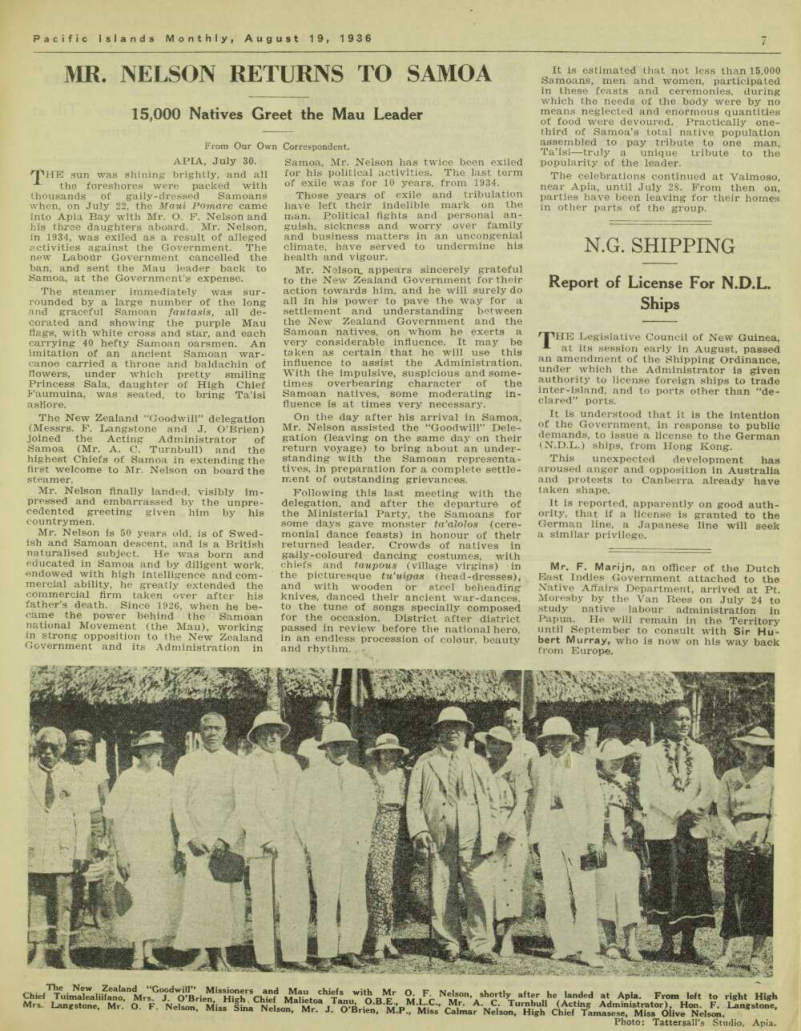
The New Zealand "Goodwill" Missioners and Mau chiefs with Mr O. F. Nelson, shortlu after he landed at Apis. From left to right High Chief Tuimalealiifano, Mrs. J. o'Brien, High Chief Malietoa Tanu, O.B.E, M.L.C., Mr. A. C. Turnbull(Acting Administrator), Hon.F. Langstone, Mrs. Langstone, Mr. O. F. Nelson, Miss Sina Nelson, Mr, J. O'Brien, M.P., Miss calmar Nelson, High Chief Tamases, Miss Olive Nelson.
Photo: Tattersall’s Studio, Apia.
N.G. Shipping
Report of License For N.D.L.
Ships
THHE Legislative Council of New Guinea, *- at its session early in August, passed an amendment of the Shipping Ordinance, under which the Administrator is given authority to license foreign ships to trade inter-island, and to ports other than “de clared” ports.
It is understood that it is the Intention of the Government, in response to public demands, to issue a license to the German (N.D.L.) ships, from Hong Kong.
This unexpected development has aroused anger and opposition in Australia and protests to Canberra already have taken shape.
It is reported, apparently on good auth ority, that if a license is granted to the German line, a Japanese line will seek a similar privilege.
Mr. F. Marijn, an officer of the Dutch East Indies Government attached to the Native Affairs Department, arrived at Pt.
Moresby by the Van Rees on July 24 to study native labour administration in Papua. He will remain in the Territory until September to consult with Sir Hu bert Murray, who is now on his way back from Europe.
Tracking the Orange to Its Lair N.Z
Its Lair N.Z. Parliamentarians’ Sunshine Cruise in Cook Is.
FWTHE New Zealand Parliamentary party, which recently travelled to Rarotonga at the New Zealand taxpayers’ expense to inquire into the conditions of the orange trade between the Cook Islands and New Zealand, appear to be enjoying themselves thoroughly.
As has been pointed out already in this journal, there was not the slightest need for this expedition. All the necessary in formation, and the evidence of the recent Parliamentary inquiry, already was in the hands of the Wellington departments, and it was a certainty, before the delega tion sailed, that the Dominion’s new Socialist Government will take control of the orange export trade, out of the hands of the agents and traders. However, three (more or less) deserving politicians were able to get away on a “sunshine cruise.”
A radio despatch from Rarotonga, in naive and charming terms, was published in the New Zealand newspapers on August 4. It reported that the mission was car rying out its inquiries thoroughly, indus triously, painstakingly, and tactfully; that the party had aroused so much ad miration among Rarotongan residents that the thing was positively “embarras sing,” and that the tour threatened to become “a complete success.” It had been decided that this splendid job of work could not be properly rounded off unless the party saw more of the beautiful Cook Islands, so they were on the point of de
parture for Aitutaki, Mangaia, Atiu, and Mauke, by the new Union liner Matua , which had arrived most opportunely.
A Slight Digestive Disorder
The despatch concludes on this happy and ingenuous note: “All the members of the delegation are well, with the exception of Mr. C. L. Hun ter, who has had a slight digestive dis order. Mr. S. G. Holland is keeping fit and is a prime favourite with all the chil dren on the island, “Mr. J. Robertson, chairman, on whom the heavy end of the work has fallen, is setting a good pace for his colleagues, and has done much by his tactful speech making, etc., to make the inquiry a suc cess.
“Mr. S. J. Smith, Secretary of the Cook Islands Department, a well-known figure in Rarotonga, accompanied the delegation in its activities and was responsible for carrying out most of the arrangements ”
Telephone
Use Of Wireless
From Our Own Correspondent
Rabaul, Aug. 1.
TNTERESTING tests with wireless tele phony were carried out recently by the Administrator, in the Bougainville dis trict. Leaving Rabaul in the Nereus, Gen eral McNicoll kept a schedule with two stations in Rabaul by telephone and Morse during the whole trip.
The Nereus rendered assistance to the Government schooner Eros (previously reported to have been wrecked), which had gone to the rescue of another Gov ernment ship, the Wandera. The latter vessel struck a reef near Lolabau Island and had to be abandoned.
Wedding At Ocean Island
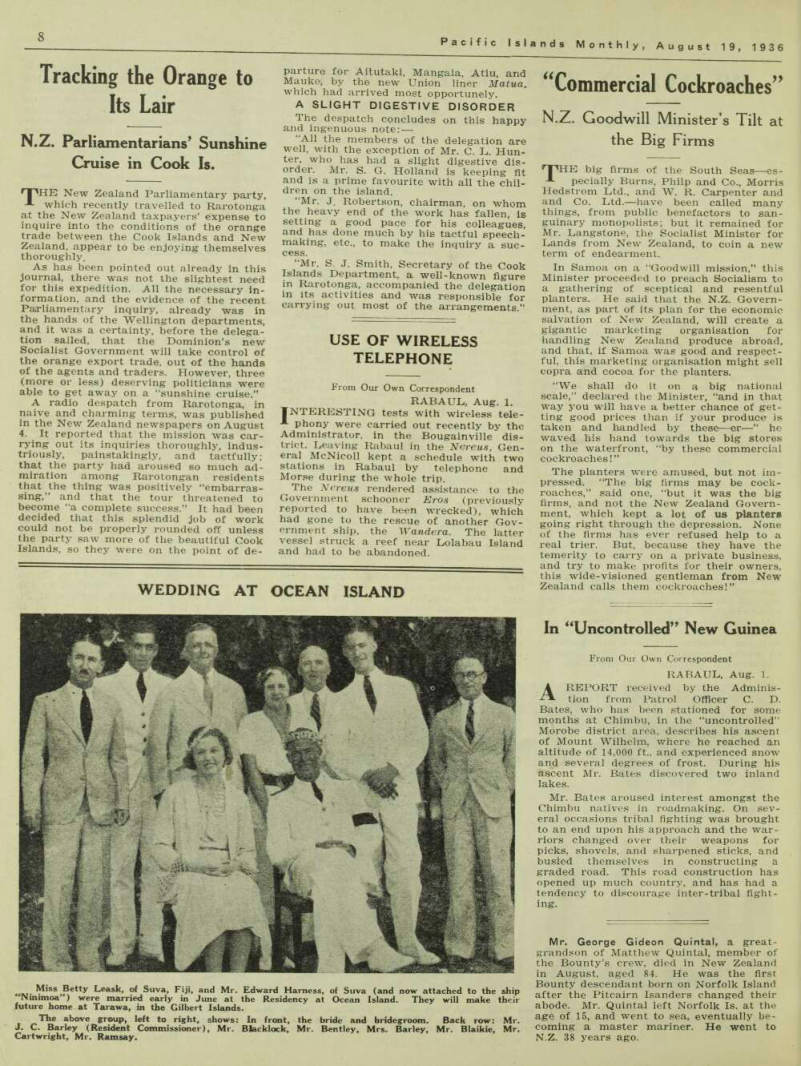
Miss Betty Leask, of Suva, Fiji, and Mr. Edward Harness, of Suva (and now attached to the ship "Nmimoa") were married early in June at the Residency at Ocean Island. They will make their future home at Tarawa, in the Gilbert Islands.
The above group, left to right, shows: In front, the bride and bridegroom. Back row: Mr.
J. C. Barley (Resident Commissioner), Mr. Blacklock, Mr. Bentley, Mrs. Barley, Mr. Blaikie, Mr.
Cartwright, Mr. Ramsay.
“Commercial Cockroaches”
N.Z. Goodwill Minister's Tilt at the Big Firms
HTHE big firms of the South Seas—es pecially Burns, Philp and Co., Morris Hedstrom Ltd., and W. R. Carpenter and and Co. Ltd. —have been called many things, from public benefactors to san guinary monopolists; but it remained for Mr. Langstone, the Socialist Minister for Lands from New Zealand, to coin a new term of endearment.
In Samoa on a “Goodwill mission,” this Minister proceeded to preach Socialism to a gathering of sceptical and resentful planters. He said that the N.Z. Govern ment, as part of its plan for the economic salvation of New Zealand, will create a gigantic marketing organisation for handling New Zealand produce abroad, and that, if Samoa was good and respect ful, this marketing organisation might sell copra and cocoa for the planters.
“We shall do it on a big national scale,” declared the Minister, “and in that way you will have a better chance of get ting good prices than if your produce is taken and handled by these—er—” he waved his hand towards the big stores on the waterfront, “by these commercial cockroaches!”
The planters were amused, but not im pressed. “The big firms may be cock roaches,” said one, “but it was the big firms, and not the New Zealand Govern ment, which kept a lot of us planters going right through the depression. None of the firms has ever refused help to a real trier. But, because they have the temerity to carry on a private business, and try to make profits for their owners, this wide-visioned gentleman from New Zealand calls them cockroaches!”
In “Uncontrolled” New Guinea
From Our Own Correspondent
Rabaul, Aug. 1.
A REPORT received by the Adminis tion from Patrol Officer C. D.
Bates, who has been stationed for some months at Chimbu, in the “uncontrolled”
Morobe district area, describes his ascent of Mount Wilhelm, where he reached an altitude of 14,000 ft., and experienced snow and several degrees of frost. During his ascent Mr. Bates discovered two inland lakes.
Mr. Bates aroused interest amongst the Chimbu natives in roadmaking. On sev eral occasions tribal fighting was brought to an end upon his approach and the war riors changed over their weapons for picks, shovels, and sharpened sticks, and busied themselves in constructing a graded road. This road construction has opened up much country, and has had a tendency to discourage inter-tribal fight ing.
Mr. George Gideon Quintal, a great grandson of Matthew Quintal, member of the Bounty’s crew, died in New Zealand in August, aged 84. He was the first Bounty descendant born on Norfolk Island after the Pitcairn Isanders changed their abode. Mr. Quintal left Norfolk Is. at the age of 15, and went to sea, eventually be coming a master mariner. He went to N.Z. 38 years ago.
Suva’S Mayoral Chain
Childishness in Public Life in Public Lire
SUVA, July 28.
ANE of the silliest law cases in the his tory of the South Seas has just ter minated in Suva. Three former Council lors, Messrs. J. T. Johnson, J. Muir, and Dr. I. H. Beattie, have been ordered to pay £l3/10/- to the new Town Board, being the value of a mayoral chain which the council presented to the retiring mayor, Mr. Alport Barker.
The Town Council of Suva (elective)
was abolished last year, and on January 1 its place was taken by the Suva Town Board (nominative). The change was opposed strongly by the mayor (Mr. Al port Barker) and a section of the council.
On December 30, 1935, the three coun cillors named attended the last meeting °f f be pouncil, and it was resolved that th . e reti ring mayor should be presented 'vith the chain of his office—a kind of sentimental gesture made on a notable occasion, The Town Board’s auditors regarded the expenditure as “unauthorised,” and re fused to certify the accounts ' ‘ ,
It obviously was a matter easy of adjust ment: yet it was not adjusted, and finally the auditors, acting automatically under the law, sued the councillors who had passed the expenditure, and obtained judgment against them.
The case has received a great deal of publicity, in which none of the parties concerned appears in a creditable light.
The whole silly business, of course, is a reflection of the bad feeling engendered by the abolition of the elective council and the substitution therefor of the nomi native board. If this incident throws a true light upon the intelligence and busi ness capacity of the late lamented council, one can only say that it was a very good
thing- it was abolished.
R.W.R.
Changes In Fiji-Indian Conditions After 20 Years
A MARKED improvement in the condi tion of the Indians’ community in Fiji was noted by the Rev. C. F. Andrews, an elderly man, who has devoted most of his life to work among the Indians, and who visited Fiji in May last.
Mr. Andrews went from India to Fiji in 1915 and again in 1917, to study the social state of Indians who were living in the Colony under the labour indenture system operated by the Fiji Government in co-operation with the Colonial Sugar Refining Co. Mr. Andrews found the con ditions deplorable, from his point of view; and the strongly-worded reports which he issued had a good deal to do with the abolition of the system as from January 1, 1920. Since then, a large Indian com munity (at least 85,000) has been settled in Fiji as peasant farmers, under a sys tem by which they are provided with land,
and grow sugar under contract with the
C.S.R. Co.
This year (1936) Mr. Andrews journeyed from India to Fiji to see what has hap pened to his Indians under the new con ditions —he had not visited the Colony since 1917. He has not issued any for mal report; but it is understood that he was delighted with the vast improvement in the condition of the Indians, Where before they were little better than slaves under the indenture system, they now have a home and a future; they are ac quiring property and a social status; the younger Indians are being educated; and, because of the cleaner and more spacious life, combined with an abundance of good food, the children are of an improving physical type.
Mr. Andrews, in a letter published in the
Fiji Times in May, made two important points. It had been said that the Indians who settled in Fiji were of an unsuit able class. On the contrary, said Mr. An drews, the great majority belonged to a good class of agricultural folk, from the •United Provinces of India. The other point was that the grave disproportion between the sexes, which had been so marked fifteen years or twenty years ago, and which caused various evils and dis abilities, had largely disappeared; with the result that home life was being regu larised, and certain social troubles were disappearing. These Fiji Indians were of a class who respected the marriage tie.
Mr. Andrews emphasised that the main problem before the Indians was that of obtaining sufficient land on a satisfactory tenure.
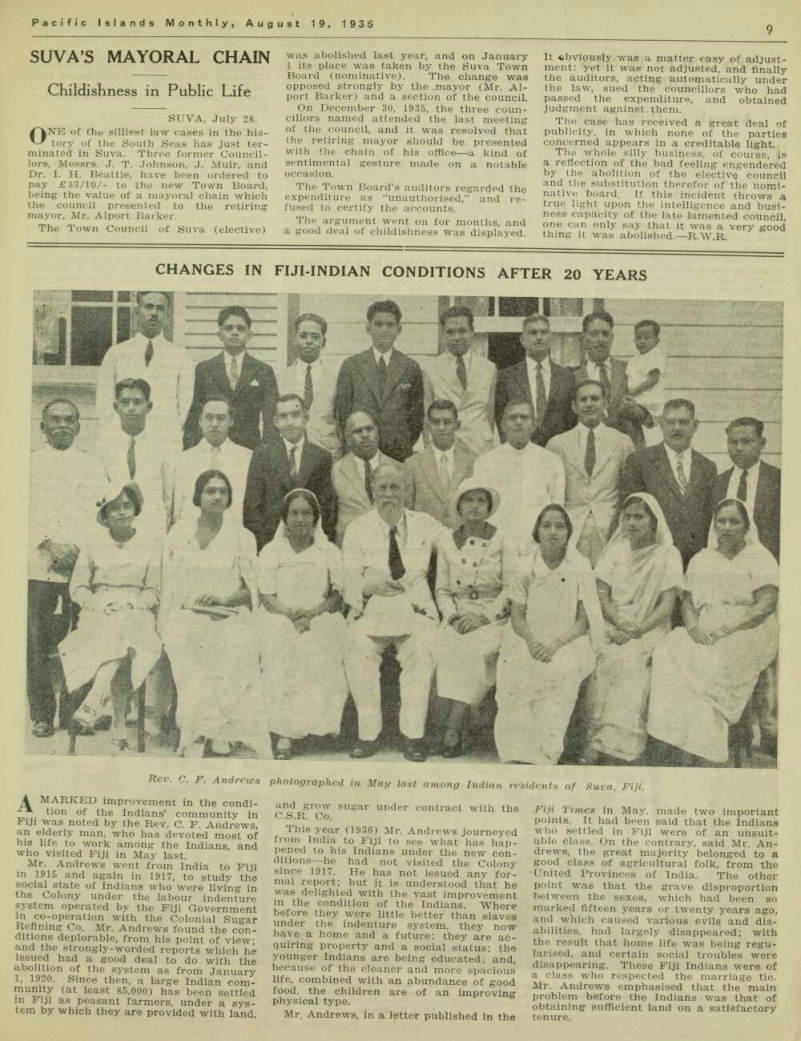
Rev. C. F. Andrews photographed in May last among Indian residents of Suva, Fiji.
Appeals to High Court
Sentences In New
Guinea
THE High Court of Australia, during the early part of August, was occu pied in hearing appeals by persons who had been sentenced to terms of imprison ment by the Supreme Court in New Guinea.
Appeal Application Dismissed
On August 6 the High Court refused leave to Rev. Henry Foege, of the New Guinea Lutheran Mission, to appeal against a sentence of two years’ hard labour imposed upon him by Judge Wan liss on June 10 for unlawfully depriving a native of his personal liberty.
It was explained that the missionary was working in “uncontrolled” territory; that three of his helpers were attacked and their goods stolen; and that the mis sionary, in the absence of an official, took prompt steps to recover his property. He seized a native from the offending tribe, and held him as hostage until his goods were returned, plus four pigs demanded as compensation. It was contended that Judge Wanliss took far too serious a view of Foege’s action.
Mr. Justice Starke said the sentence was essentially one for the discretion of Judge Wanliss, although the Court would express no opinion on whether the matter was one for the Executive Council.
Case Of Father Cranssen
The High Court was engaged on August 10 with an application for leave to appeal by Father Anthony Cranssen, a Roman Catholic missionary, who was sentenced by Judge Wanliss, New Guinea, on May
4 to five years’ imprisonment for coun selling certain persons to set fire to a dwelling house.
The incident occurred about the end of last year in “uncontrolled” country in the Ramu-Purari region. The missionary and his staff were threatened with attack by native teachers attached to another mission; and the missionary’s boys, in taking necessary protective action, burned down the huts of the mission teachers.
It was contended that the judge con sidered the case entirely on wrong lines; there had been no moral turpitude proved on the part of the prisoner; the sentence of five years was against all the prin ciples of punishment. The sentence was “an amazingly severe one.”
The Court reserved its decision.
Offence Against Native Girl
The High Court on August 11, in Syd ney, refused Henry Herbert Geoghegan, planter, of Old Massawa Plantation, Bain ings, leave to appeal against a judgment of the New Guinea Court sentencing him to two years and six months’ imprison ment for a serious offence against a native girl, aged about 14 years. The prisoner is in Long Bay Gaol, Sydney.
Mr. Justice Starke, the senior High Court Judge, in giving his decision, said that the evidence given against Geoghe gan clearly warranted the trial judge’s finding. Mr. Justice Dixon and Mr. Jus tice McTiernan concurred.
Niu, an indentured employee of the ac cused, it was stated, brought to Old Mas sawa two girls, Baimo and Taroa. The story of the girls was that they had been kidnapped by Niu, but Geoghegan, at his trial, said that Niu told him that one of the girls was his wife and the other his niece.
Mr. Clive Evatt, K.C. (for Geoghegan) submitted that had the trial taken place
before a jury the prisoner would have been acquitted, as the weight of evidence supported the defence of Geoghegan that that which had taken place between the prisoner and the girl Taroa was with her consent.
Charge Of Unlawful Killing
RABAUL, August 10.
Brother Lucidius Zimmer appeared be fore the Supreme Court to-day on a charge of having killed a native on Feb ruary 8, 1936. He pleaded not guilty.
The Crown Prosecutor (Mr. Woodhill) stated that the alleged offence occurred in the wild and mountainous Chimbu country, 7000 feet high, which was popu lated by warlike natives. During inter tribal fighting, some warriors desired to cross the Chimbu River over a mission bridge, the use of which was prohibited for fighting purposes. Many warriors obeyed the prohibition, but a disobedient one was shot dead by Brother Lucidius, he said.
Pastor G. Peacock, superintendent of S.D.A. missions in New Guinea, and Pastor W. N. Lock, S.D.A. superintendent in Papua, arrived in Sydney in mid-Aug ust by the Macdhui to attend a confer ence in Victoria.
Mr. R. B. Carpenter, a director of Messrs. W. R. Carpenter and Co. Ltd., arrived in Sydney from England, via the United States, by the Mariposa on August 10.
Dr. N. Crichlow, travelling medical officer in the Solomon Islands Administra tion, sailed from Sydney for Tulagi by the Malaita on August 8, after 10 months’ furlough. He has been in Group for 22 years.
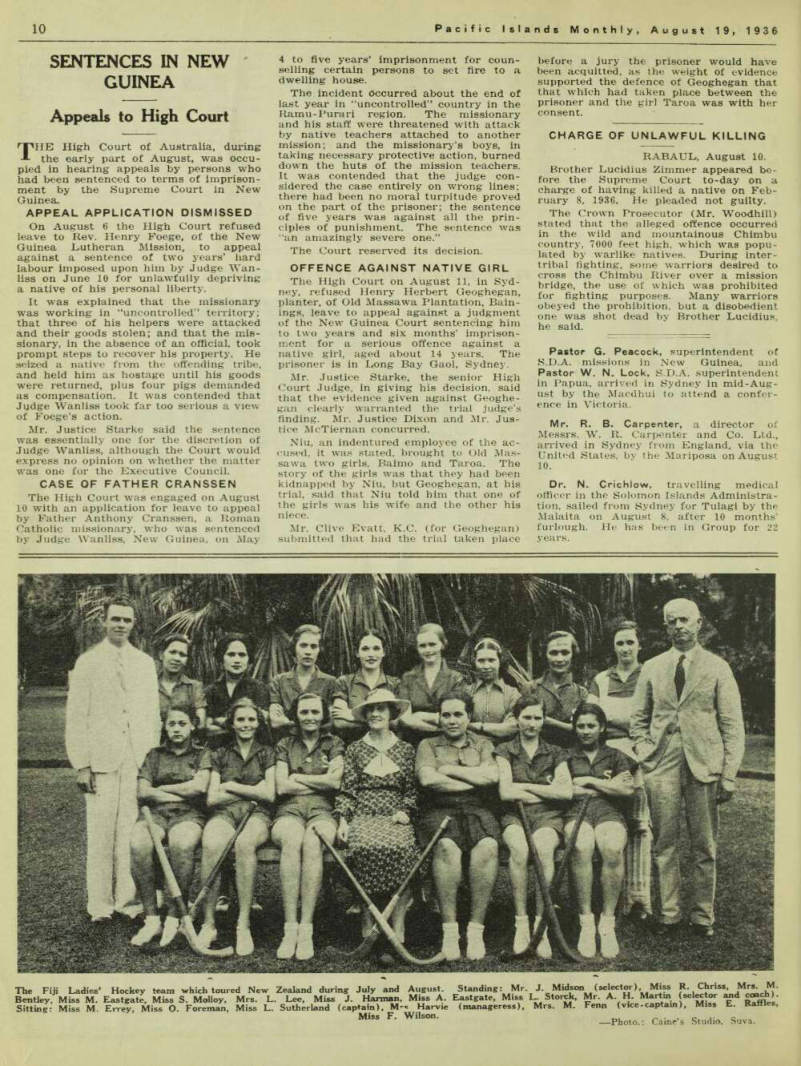
The Fiji Ladies’ Hockey team which toured New Zealand during July and August. Standing: Mr J. Midson (selector) Miss Mrs. M.
Bentley. Miss M. Eastgate. Miss S. Molloy. Mrs. L. Lee. Miss J. Harman. Miss A. Eastgate, Miss L. Storck. Mr. A. H. Martin (selector and coach ).
Sitting: Miss M. Errey, Miss O. Foreman, Miss L. Sutherland (captain), Mrs Harvie (manageress), Mrs. M. Fenn (vice- captain), Miss E. Rattles, Miss F. Wilson. -Photo: Caine’s Studio, Suva.
Troipicauties
TT was in the days when American youth A affected long hair and baggy peg-top trousers. One of the breed, so loved by traders and so abhorred by everyone else for its loud-mouthed blatancy, came ashore from the mail-steamer with the erroneous idea under his long and oily thatch that all pretty Polynesians are common prostitutes.
Seeing the slender Airini busily en gaged in holding up a store doorpost with her shoulder, the while she watched the passing traffic, he sidled up to her with an ingratiating smile, and suggested that they should take a walk.
Airini looked at him for, perhaps, twenty seconds, with her steady brown eyes. Then she called to the trader be hind the counter.
“Wiri, this feller he say me, we go walk about. What I say him?”
Wiri merely grinned. He knew Airini to be perfectly, not to say devastatingly, capable of looking after herself, thanks to her strain of white blood.
Said she, still looking at the intruder: “Wiri, you tell this long-hair thing, get him hair chop off. I dunno him to a par o’ tope ... an’ I didn’t went .”
But Wiri’s good services were not needed for, followed by a peal of laughter from other interested native girls in the store, Long-Hair swiftly found urgent affairs calling him elsewhere.
One more idea about “Islands girls,” acquired from best-sellers, had been shattered. —Te Ruau. * « * FIFTY years ago, a young man wandered ashore from a schooner at Pleasant Island —now called Nauru. His attention was attracted by some curiously shaped rocks, which did not seem to be rocks. He went back and examined the curious sub stance two or three times. Finally, as he was an enthusiastic and skilful photo grapher, he got his camera and photo graphed the things. The other day. in his store in Apia, I examined this clear photograph, marked “Pleasant Island, 1886.” The young man is now an old man—Mr. T. Andrew, respected and loved by everyone in Samoa. He has a reper toire of funny stories; but, as he himself says, he knows no funnier story than that of how he hung around those “rocks” and photographed them, and never dreamed that he was gazing upon phosphate that afterwards was valued at millions of pounds. “I found the phosphate on Nauru, and I never knew it,” he says, with a chuckle.—R. W. R. * * * A NY new evidence relating to that little known figure, Pomare 111., the boy king of Tahiti, is of importance to his torians. Hitherto, almost all information concerning him has been obtained from missionary sources. In the Sydney Gazette of November 22, 1822 (preserved in the Mitchell Library) is an account brought by Captain Hunter who had visit ed Tahiti that year in the Governor Mac quarie: ". . . The young King Pomarree is between two and three years of age, and the island of Otaheite is under the Regency of an old chief named Man-na noe, whom the subordinate chiefs eye with great insignificancy, supposing him be neath their notice. Each chief upon the island seems to be growing independent in consequence of the Royal authority being so enfeebled, and the present Kingly power is in danger of total annihilation unless some active and powerful chief
should shortly embrace the reins of Government on behalf of the infantine monarch, or personally usurp the helm of authority.” If that were not done, it was stated, it would “certainly be a miracle if ever young Pomarree is per mitted to sway his father’s sceptre.” A regency was later established by the Queen Mother; but the boy king never lived to rule, being succeeded by Aimata, his half-sister (known in history as Queen Pomare IV.).—“Eriki.” • • « THUS Sir William MacGregor to an en thusiastic young woman, who was on her way to Papua to visit, and, of course, “write a book”: “Aweel! So you’re going to Papua to write a book? Weel, weel! But let me tell you, young lady, that when you’ve been there six months ye wull know all about Papua, and its peoples, and their customs. When you’ve been there twelve months, ye wull ha’e yer doots. And when ye’ll have been there as long as I have, ye’ll realise that you don’t know the fir-r-rst thing about the people or their languages, or their customs—and ye’ll wish to goodness that you had tor-r-rn up the manuscript of that book and burrnt it!”—Te Ruau. * * * THE other afternoon (writes a woman reader in the New Hebrides) I over heard the following dialogue between my husband and our native cook-girl. Be it said that Himself has a rather uncompromising manner towards the natives; but, in view of the difficulty in obtaining—and holding—• labour, even he seems to find it possible sometimes to unbend a little—oh, a very little!—towards them. This was evid ently not an unbending day.
Scene: Himself busy in the workshop.
The girl seated on the adjacent kitchen steps, nursing the cat, and turning it over and about in a contemplative way.
Remarked the dusky one: “Puss-cat 'e come big feller now.”
Silence for a little; then came a short and sharp “Yes!” from the workshop.
She resumes: “Puss-cat ’e carry picca nin?”
A perfectly explosive “Yes!” from the workshop.
Then: “Master, Puss-cat ’e woman?”
Awful noises from the workshop, as of someone in pain, and of hammers and thing’s being violently thrown about.
Then a thoroughly exasperated voice yelled: “Yes, you dash, dash, and puce bone headed imbecile, ’e woman. Suppose sometime you find one man-cat he carry piccanin. You come quick and tell me.
Me want to look something allsame too much!”
Hurried flight of the dusky one, puss cat and all. Sounds from the workshop as though an earthquake had struck It.
Then gradually the afternoon resumed its wonted calm. —“Mrs. Marooned.” * * * RADIO is transforming life in the Pacific Islands. In Samoa, Fiji, Tonga, the story is the same—every European resid ent has a receiving set, and the tendency is to buy better and bigger sets, as they become available. Until recent times, Islands residents were without a daily or even a weekly news bulletin. Now, they do not worry—they tune in on any station bordering the Pacific, and listen to the news broadcasts, every night. Over in Samoa, well to the east, they connect mostly with Hawaii and the western States of America—Australia and New Zealand come through a bit too late. In Fiji, they use the Australian stations more fre quently. Our Australian friends should note that American manufacturers are going after this valuable Pacific market, and are trying, with a view to reducing cost, to introduce a good chassis, without a cabinet, leaving the purchaser to make his own arrangement in regard to enclos ing the instrument. —R.W.R.
Mr. C. R. Gurney, who for six years has been chief pilot for Guinea Airways Lim ited, in the Mandated Territory, arrived in Sydney in July. He has resigned from G A.’s staff and will shortly take up duties with Qantas Empire Airways Ltd. on the Singapore run.
Advertisements & other items, pp. 13-14 (1 item)
Home
STERLING
Guaranteed C=>
LOOKS
BETTER
LONGER
STEUZMO
Home
pi f-, n s, ■ H*\W ill-
PUR^j
PAINT
For
TROPICAL
SUN and
SALT-LADEN
AIR
MADE BY
STERLING VARNISH CO.
SYDNEY, N.S.W.
NEGLECT OF DEFECTIVE SIGHT
MAY CAUSE SERIOUS RESULTS
Take Care of Your Eyes Consult
WALTER FORD
D.5.0.A., M.0.0.A.
Optometrist and Optician 4th Floor, Challis House Martin Place, Sydney Established over 30 years Tel.: Most moderate charges BW 6131
Set up in 45 seconds &' j, u ■ * Melbourne, Brisbane, Adelaide,
“ amazed the
diagnostic
Users of the Watson Caldwell Portable X-Ray Apparatus frequently express their amazement at the power and diagnostic range provided by such a compact apparatus.
A self-contained and portable unit; the Watson “C.P.” is economical, efficient, easily operated equipment that is solving the radiographic problems of many Island Hospitals, such as Thursday Island, Nauru, Rabaul (New Britain) and King Island, Bass Strait.
Write in for full particulars.
Ctl/Wtlatson LtD.
(incorporated in N.S.W.) Watson House, Bligh Street, Sydney Newcastle, Perth, and New Zealand
BAILEI’S
FLUID MAGNESIA
A Product of
ELLIOTTS & AUSTRALIAN DRUG Ltd.
A Valuable Aid to Digestion Relieves —
HEARTBURN
DISPEPSIA
BILIOUSNESS, etc.
OBTAINABLE
AT ALL HIGH-CLASS CHEMISTS
AND STORES.
About Islands People
Right Rev. Thomas J. Wade (Bishop of the Northern Solomon Islands) arrived in Sydney after visiting Europe and the United States by the Mariposa on August 10. He attended the annual meeting of the Marist Medical Society on August IS. Bishop Wade will shortly return to his headquarters at Kieta, Bougainville.
Mr. T. Flower, who has been well known as a builder on the New Guinea goldfields and who left Australia recently with the object of engaging in building enterprises in India, returned to Australia in July. He was not satisfied with the prospects in North-west India and de cided to return immediately to the South
Seas. He departed from Sydney for New Guinea by the August Neptuna.
Right Rev. Henry Newton, who retired last year from the position of Bishop of New Guinea, is in poor health at present and his condition is causing some anxiety.
Although he had resigned, he has been carrying on his work in Papua and he is at present under treatment at the head station of the New Guinea Mission at Dogura, Eastern Papua. The post of Bishop of New Guinea was offered in June to the Rev. Cecil W. Alderson, of England, who accepted the appointment.
It was announced in July that owing to ill-health Mr. Alderson was compelled to cancel his acceptance. The Bishops of Australia have several other candidates under consideration, and a further ap pointment will be made shortly.
Brigadier-General W. R. McNicoll (Ad ministrator of New Guinea) left Rabaul by the Nellore on August 12 to spend three months’ leave in Australia. Accom panied by Mrs. McNicoll, he will arrive in Sydney on August 20.
Mr. H. J. C. Connolly, geologist of Wes tern Mining Corporation Ltd., sailed from Melbourne by the Monterey on July 18 for Fiji. About seven months ago he out lined a programme of development for the Emperor mine at Tavua, and the purpose of his present visit is to make a survey of the tonnage in sight and check the values of the mine. His report will prob ably be embraced in the annual report of Emperor Mines Ltd., which is due in a few months.
Major George E. Saundars, Sub- Inspector of Police in the British Solo mon Islands Administration, arrived in Sydney on his way back to Tulagi by the Port Townsville on July 31, after an nual leave spent in England.
Mr. F. J. Hennings, who was formerly in the Government Service in Fiji, left by the Strathaird on August 7 on a visit to his former home. Mr. Hennings has taken advantage of cruises to make three trips to Fiji within recent months. Now set tled in Sydney, he is a member of the executive of the Polynesian Club.
Mr. Mason Warner, special travel re presentative of the “Chicago Tribune,” joined the August Maunganui at Welling ton en route for San Francisco. It is his intention to collect material for articles in Rarotonga and Tahiti on his way back to the United States.
The death occurred, late in July, of Mr.
J. C. Irons, manager of the Canadian Pacific Line in Vancouver for 25 years.
He was well-known and highly esteemed in the Pacific Islands ports.
Mr. M. P. Curtain, mining engineer, sailed from Sydney for New Guinea by the Montoro at the end of July to join Oil Search Ltd’s party at Madang.
Advertisements & other items, p. 14 (1 item)
Kurrajong
Wheeny Creek Farm
Forty-five miles from Sydney Superior modern accommodation, abundance of cream, eggs, and poultry. 5 acre* orchard. Tennis, etc.
Tariff: Double, £2/2/- each; Single, £2/ lb • ’Phone; Kurrajong 42 Proprietor: A. J. SAMSON Formerly New Guinea Public Service
About Islands People
Sir Hubert Murray, K.C.M.G, (Lieuten ant Governor of Papua), who has been on a visit to England, left London on his way back to Port Moresby by the Rajputana in July. In Singapore he joined the Mar ella for Australia and is expected to reach Sydney on August 23. His Excellency will leave for Papua in September.
Mr. L. Pierre Ledoux, a representative of the Department of Anthropology of the American Museum of Natural History, returned to Australia on July 31 by the Malaita, after spending five months in Kaup village, near the Sepik River, New Guinea. Mr. Ledoux, who is a Bachelor of Science of the Harvard University, will publish the results of his research when he returns to the United States.
Mr. Harold Rabone, a grandson of the Rev. Stephen Rabone, the pioneer Metho dist missionary in Tonga, whose centen ary was observed this year, has been elected a member of the Polynesian Club of Sydney. Mr. Rabone has lived at Nor folk and Lord Howe Islands, and is now residing in Sydney.
Captain N. Paoli has taken over com mand of Messageries Maritimes Islands steamer Laperouse from Monsieur Vigier.
M. Paoli was chief officer on board the Dupleix which was engaged on the Syd ney-Noumea-New Hebrides run before the Laperouse entered the service. When the Laperouse reached Sydney on July 28, Madame Paoli and her two children disembarked to make their home for two years in Australia.
Mr. Leslie V. Waterhouse, technical director of Placer Development Co. Ltd. who has been visiting England and the Continent, will leave London on August 19 by the Queen Mary for New York.
After several weeks in San Francisco he will depart for Sydney by the Mariposa on September 15, arriving in Australia on October 5. Mr. Waterhouse originally intended to return to Australia via Manila and New Guinea, but in order to confer with his associates in America he was compelled to alter his itinerary.
Dr. P. Gilbert Rahm Liers, 0.5.8., pro fessor of biology at Fribourg, Switzerland, who has been travelling the world for two years under the auspices of the Rocke feller foundation Institute, arrived in Australia by the Gorgon in July. Last year he spent some time in the South Seas, particularly at Easter Island, study ing parasitology.
Mr. C. H. Hopewell, who was a well known resident of Suva, died on July 16.
Going to Fiji in his youth, Mr. Hopewell was for a time associated with Messrs.
Henry Marks and Co. After a period as manager of the Levuka branch, he went into partnership in a copra plantation with Mr. W. R. Carpenter (now Sir Walter). Of late years he had been in the Government service with the Customs and Stores Departments.
Mrs. I. Champion and her child sailed from Brisbane for Port Moresby by the Montoro on July 31. She is the wife of Mr. Ivan F. Champion, Assistant Resident Magistrate in the Papuan Administra tion, who is now leading an expedition through an unexplored portion of Central Papua.
Ratu Mosese Dranibaka, chieftain of the Ra Coast, Fiji, is ill with possible pneumonia at the Seventh Day Adventist Sanatorium, Wahroonga. The chief ar rived in Sydney by the Mariposa on August 10.
Miss lima Edwards, of Norfolk Island, arrived In Sydney on August 4 by the Morinda to spend a short holiday in Aus tralia.
Mr. J. P. B. Webster, chairman of New Guinea Goldfields Ltd., is a passenger to Australia by the Orford which is due in Sydney on August 26.
Mr. and Mrs. Val. Horton, accompanied by their young son, Glen, returned from Cairns to New Guinea after furlough in Australia by the Montoro on August 4.
Mr. Horton is manager at Madang for Messrs. Burns, Philp and Co. Limited.
Advertisements & other items, pp. 15-16 (1 item)
Tenax
AT BLUE MOUNTAINS
SPRINGWOOD, N.S.W.
Springwood Ladies’ College
Est. 1897. Kindergarten to Leaving Certificate. Tennis, Riding, Swimming, Team Games. Unequalled climate. Pure Jersey Milk. Senior and Junior Houses. Open-air sleeping. Inclusive fees. Special vacation arrangements for Island pupils.
M. E. DURAND, Principal.
PREVENTION
is better than
cure • Disease germs such as those of Diphtheria, Malaria, Dhobie Itch, or Tinea cannot live ■ i ] under the lather of TENAX.
Germicidia, j Besides which TENAX, used - —-> constantly, will cure Tropical Skin Diseases.
TENAX is the ONLY soap containing oil distilled and marketed by Australian Essential Oils Ltd. under the registered trade-mark of ‘Ti-TroT, eleven times quicker than carbolic as a germicide, but NON - POISONOUS and
NON-IRRITANT.
TENAX
o.'kcC/mMsuzuf &MAnceidoA~
TOILET SOAP
A PRODUCT OF AUSTRALIAN SOAPS LIMITED
4* ml r 9u m Containing ( Ti-Trol m Genuinely
ff
HANDYFREEZE
ICE CREAM CHURN
Makes delicious Ice Cream and Frozen Desserts electrically in 12 minutes. Easy to use and costs next to nothing to run.
Delightful for the home, and a money saver for Soft Drinks Shops.
Complete with 240 volts AC motor, drive gear assembly, heavily tinned cream can, self-adjusting wood bar beaters, kiln dried wood tub, etc. Can be had in 2 quart (PRICE £6/6/-) and 1 gallon (PRICE £9) sizes. F. 0.8. Sydney. • Distributors:
Jacoby «& Barrow
274-6 Kent Street, Sydney
Cables: “ACOB” Sydney n i i Trade enquiries for all electrical material and appliances invited.
TUDOR HOTEL
Room Only Rate, 5/- per day. Meals a la carte. Accommodation for 100 guests. One minute from G.P.O.
127 PHILLIP ST. Tel.: BW 2788
Next door to Martin Place
Sydney
A. Q. McGowan & Co.
SUVA, FIJI ISLANDS
Dealers in all Island Products, Exporters of Trocas Shells, Pearl Shells, Cowrie Shells and Curios, Kauri Varnish Gums, Bark, Mauritius Beans, Maize. Enquiries solicited.
Prisoners At Large
From Our Own Correspondent APIA, July 30.
A FEW days ago a number of prisoners escaped from Vaimea prison, carrying some rifles which they had stolen. For tunately they were unable to find the necessary ammunition for their weapons.
A rumour spread, in Apia, that they had vowed to shoot the Acting Administrator, the Chief of Police, and the Native Sec retary.
At the time of writing one of the prisoners has been recaptured, and it is hoped that the others will soon be brought back.
Champion Expedition
Somewhere In Papua
MYSTERIOUS rumours have reached us from Canberra relating to the route that ’has been taken by the Ivan Champion expedition.
It was understood, when this expedition left Port Moi'esby some three months ago, that it would go over much of the country discovered by the Hides expedition, and would check up on Mr. Hides’s observa tions and reports.
Report has it that the Champion ex pedition has not gone to the Tari Furoro country at all; but that, on its return trip, it will cross a portion of the route taken by Mr, Hides, near the Waga Furari country, before coming down the Purari River, in October.
There is some speculation as to where the Champion expedition is and what it is doing.
Mrs. Allen Innes
IITRS. ALLEN INNES, having disposed of the hotel at Salamaua, New Guinea, which she established about 1927 and conducted efficiently and profitably, has settled down in her new home at Alola Avenue, Vaucluse, Sydney. Her new residence has been built in the Is lafids style and is named “Salamaua.”
Mrs. Innes was noted for several things —especially her unvarying kindness, her hospitality, and her ability as a writer.
Some very vivid impressions of goldfields conditions in the early days were from her tireless pen. She had been ti'ained as a nursing sister and, without doubt, she saved the lives of several men in the pre hospital days. Numerous were the down and-out miners whom she succoured — often when they seemed to be in the last extremities of fever.
The Rahaul Times recently paid this well-deserved tribute to her: Mrs. Innes’ departure will be a loss to Salamaua, as she entered into everything, was always the first to welcome any new woman there and introduce her to the older residents, and during her residence in Salamaua has made no less than 80 bouquets for brides going there to be married. Her knowledge of nursing and advice in general has been of great as sistance to many, particularly to young mothers, Mrs. Innes can also talk most interestingly of her trip abroad. Besides her many other interests, this energetic woman has found time to indulge her flair for things literary.
Mr. George Allen Innes is remaining in New Guinea for the present, looking after his business, the Salamaua Trading Com pany.
Advertisements & other items, p. 16 (2 items)
Charles Johnson
THE TAILOR FOR MEN OF DISCRIMINATION
made thousands of men happy by the fit, value and satisfaction of their clothes.
And believe you me, it’s not only by their suitings that the Charles Johnson Garmented customers are known. The line up of accessories that he has is just a shame. You might go green with envy at the shirtings and the ties and handkerchiefs and other whathaveyous, but Charles being an enterprising and obliging fellow, will even let YOU go green in those said articles and you know how popular green is overseas, especially in Ireland.
You know a big store must generalise in its custom and that is one of Charles’ greatest bets. He is able to specialise and study the individual. His price is right, his store is the Acme of Satisfaction, the Pinnacle of Courtesy, the Highspot of the Just so much Better than others, to say nothing of it being the Home from Home.
The Store in Sydney where every demand of Man, in the Clothing line, can be met and where one is more than likely to meet the fellow from that other Pacific Isle, and while being fitted for those perfect garments, talk about that new Peanut idea at Norfolk Island.
CHARLES JOHNSON
The Face That Launched a Thousand Ships. Never let it be said. Who’s interested in ships anyhow? Rather the face that made a thousand suits, not that the face has anything to do with it. It was the hands, not showing in the photo, to say naught of the brain, also not shown in the photo, and the less said about the brain, the better. But that face that smiles out at you from this picture is the face that has
Tailor and SMercer
143 KING STREET, SYDNEY
Books, Magazines & Newspapers
TO ANY PART OF THE ISLANDS
BARGAIN OFFER.—We will send half a dozen latest American Monthly Magazines for 4/-, post free.
AMERICAN GAY BOOK, 1936
(Snappy Stories and Pictures) 1/6 Post Paid.
We specialise in selecting reading matter for those unable to choose personally. We specialise in Mail Orders. Parcels posted by every boat. Send for our price list and full particulars of this unusual service for Islands residents.
McKAY’S BOOKSTALL
ROYAL ARCADE, SYDNEY
Relations
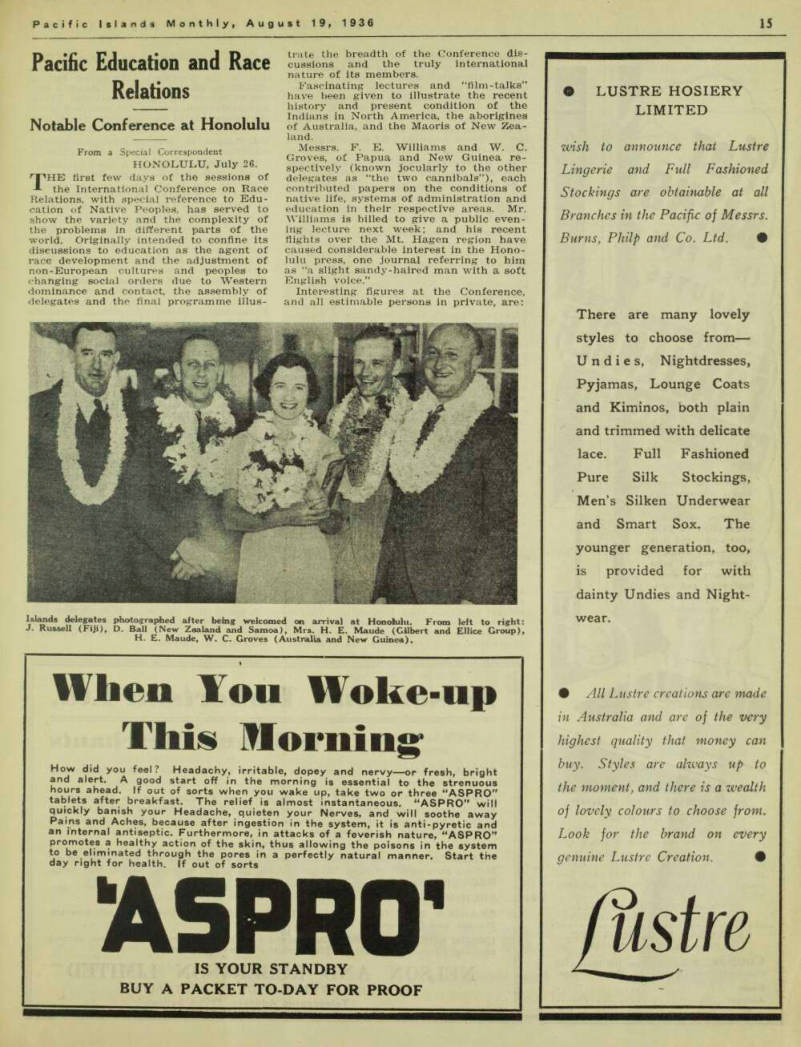
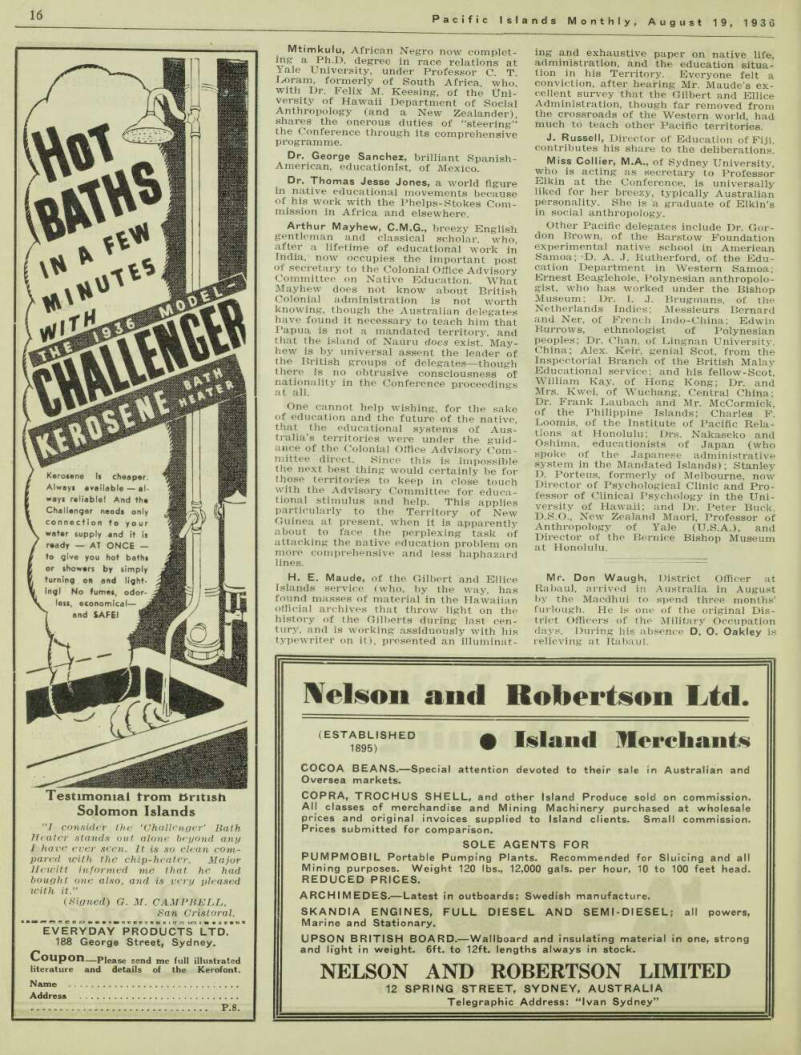
Pacific Education and Race Relations Notable Conference at Honolulu
From a Special Correspondent
Honolulu, July 26.
THE first few days of the sessions of the International Conference on Race Relations, with special reference to Edu cation of Native Peoples, has served to show the variety and the complexity of the problems in different parts of the world. Originally intended to confine its discussions to education as the agent of race development and the adjustment of non-European cultures and peoples to changing social orders due to Western dominance and contact, the assembly of delegates and the final programme illus
trate the breadth of the Conference dis cussions and the truly international nature of its members.
Fascinating lectures and “film-talks” have been given to illustrate the recent history and present condition of the Indians in North America, the aborigines of Australia, and the Maoris of New Zea land.
Messrs. F. E. Williams and W. C.
Groves, of Papua and New Guinea re spectively (known jocularly to the other delegates as “the two cannibals”), each contributed papers on the conditions of native life, systems of administration and education in their respective areas. Mr.
Williams is billed to give a public even ing lecture next week; and his recent flights over the Mt. Hagen region have caused considerable interest in the Hono lulu press, one journal referring to him as “a slight sandy-haired man with a soft English voice.”
Interesting figures at the Conference, and all estimable persons in private, are:
Islands delegates photographed after being welcomed on arrival at Honolulu. From left to right: J. Russell (Fiji), D. Ball (New Zealand and Samoa), Mrs. H. E. Maude (Gilbert and Ellice Group), H. E. Maude, W. C. Groves (Australia and New Guinea).
Mtimkulu, African Negro now complet ing a Ph.D. degree in race relations at Yale University, under Professor C. T.
Doram, formerly of South Africa, who. with Dr. Felix M. Keesing, of the Uni versity of Hawaii Department of Social Anthropology (and a New Zealander), shares the onerous duties of “steering” the Conference through its comprehensive programme.
Dr. George Sanchez, brilliant Spanish- American, educationist, of Mexico.
Dr. Thomas Jesse Jones, a world figure in native educational movements because of his work with the Phelps-Stokes Com mission in Africa and elsewhere.
Arthur Mayhew, C.M.G., breezy English gentleman and classical scholar, who, after a lifetime of educational work in India, now occupies the important post of secretary to the Colonial Office Advisory Committee on Native Education. What Mayhew does not know about British Colonial administration is not worth knowing, though the Australian delegates have found it necessary to teach him that Papua is not a mandated territory, and that the island of Nauru does exist. May hew is by universal assent the leader of the British groups of delegates—though there is no obtrusive consciousness of nationality in the Conference proceedings at all.
One cannot help wishing, for the sake of education and the future of the native, that the educational systems of Aus tralia’s territories were under the guid ance of the Colonial Office Advisory Com mittee direct. Since this is impossible the next best thing would certainly be for those territories to keep in close touch with the Advisory Committee for educa tional stimulus and help. This applies particularly to the Territory of New Guinea at present, when it is apparently about to face the perplexing task of attacking the native education problem on more comprehensive and less haphazard lines.
H. E. Maude, of the Gilbert and Ellice Islands service (who, by the way, has found masses of material in the Hawaiian official archives that throw light on the history of the Gilberts during last cen tury, and is working assiduously with his typewriter on it), presented an illuminat
ing and exhaustive paper on native life, administration, and the education situa tion in his Territory. Everyone felt a conviction, after hearing Mr. Maude’s ex cellent survey that the Gilbert and Ellice Administration, though far removed from the crossroads of the Western world, had much to teach other Pacific territories.
J. Russell, Director of Education of Fiji, contributes his share to the deliberations.
Miss Collier, M.A., of Sydney University, who is acting as secretary to Professor Elkin at the Conference, is universally liked for her breezy, typically Australian personality. She is a graduate of Elkin’s in social anthropology.
Other Pacific delegates include Dr. Gor don Brown, of the Barstow Foundation experimental native school in American Samoa; D. A. J. Rutherford, of the Edu cation Department in Western Samoa; Ernest Beaglehole, Polynesian anthropolo gist, who has worked under the Bishop Museum: Dr. I. J. Brugmans, of the Netherlands Indies; Messieurs Bernard and Ner, of French Indo-China; Edwin Burrows, ethnologist of Polynesian peoples; Dr. Chan, of Lingnan University, China; Alex. Keir, genial Scot, from the Inspectorial Branch of the British Malay Educational service; and his fellow-Scot, William Kay, of Hong Kong; Dr. and Mrs. Kwei, of Wuchang, Central China; Dr, Frank Daubach and Mr. McCormick, of the Philippine Islands; Charles F.
Doomis, of the Institute of Pacific Rela tions at Honolulu; Drs. Nakaseko and Oshima, educationists of Japan (who spoke of the Japanese administrative system in the Mandated Islands); Stanley D. Porteus, formerly of Melbourne, now Director of Psychological Clinic and Pro fessor of Clinical Psychology in the Uni versity of Hawaii; and Dr. Peter Buck.
D. 5.0., New Zealand Maori, Professor of Anthropology of Yale (U.S.A.), and Director of the Bernice Bishop Museum at Honolulu.
Mr. Don Waugh, District Officer at Rabaul, arrived in Australia in August by the Macdhui to spend three months’ furlough. He is one of the original Dis trict Officers of the Military Occupation days. During his absence D. O. Oakley is relieving at Rabaul.
Advertisements & other items, pp. 17-18 (1 item)
Aspro'
O LUSTRE HOSIERY
LIMITED
wish to announce that Lustre Lingerie and Full Fashioned Stockings are obtainable at all Branches in the Pacific of Messrs.
Burns, Philp and Co. Ltd. There are many lovely styles to choose from—
Undies, Nightdresses,
Pyjamas, Lounge Coats and Kiminos, both plain and trimmed with delicate lace. Full Fashioned Pure Silk Stockings, Men’s Silken Underwear and Smart Sox. The younger generation, too, is provided for with dainty Undies and Nightwear. All Lustre creations are made in Australia and are of the very highest quality that money can buy. Styles are always up to the moment, and there is a wealth of lovely colours to choose front.
Look for the brand on every genuine Lustre Creation.
fustre
Wlien You Woke-up
This Morning'
How did you feel? Headachy, irritable, dopey and nervy—or fresh, bright and alert. A good start off in the morning is essential to the strenuous hours ahead. If out of sorts when you wake up, take two or three “ASPRO” tablets after breakfast. The relief is almost instantaneous. “ASPRO” will quickly banish your Headache, quieten your Nerves, and will soothe away Pams and Aches, because after ingestion in the system, it is anti-pyretic and an internal antiseptic. Furthermore, in attacks of a feverish nature, “ASPRO” promotes a healthy action of the skin, thus allowing the poisons in the system to be eliminated through the pores in a perfectly natural manner. Start the day right for health. If out of sorts
ASPRO'
IS YOUR STANDBY
BUY A PACKET TO-DAY FOR PROOF
m = m * rd wi Kerosene it cheaper.
Always available alwayi reliable! And the Challenger need* only connection to your water supply and it is ready AT ONCE to give you hot baths or showers by simply turning on and lighting! No fumes, odorless, economical— . 1 and SAFE! « 3 Testimonial trom British
Solomon Islands
“I consider the ‘Challenger" Bath Heater stands out alone beyond any I have ever seen. It is so clean compared unfh the chip-heater. Major Hewitt informed me that he had bought one also, and is very pleased with it.” ( Signed ) G. M. CAMPBELL, San Cristoral.
I«« « « B ffl B I li3 AH aWWOBtIO*
EVERYDAY PRODUCTS LTD.
188 George Street, Sydney.
Coupon— Please send me full illustrated literature and details of the Kerofont.
Name Address P.B.
Nelson and Robertson Ltd.
(ESTABLISHED
1895)
• Island Merchants
COCOA BEANS.—Special attention devoted to their sale in Australian and Oversea markets.
COPRA, TROCHUS SHELL, and other Island Produce sold on commission.
All classes of merchandise and Mining Machinery purchased at wholesale prices and original invoices supplied to Island clients. Small commission.
Prices submitted for comparison.
SOLE AGENTS FOR
PUMPMOBIL Portable Pumping Plants. Recommended for Sluicing and all Mining purposes. Weight 120 lbs., 12,000 gals, per hour, 10 to 100 feet head.
REDUCED PRICES.
ARCHIMEDES.—Latest in outboards; Swedish manufacture.
SKANDIA ENGINES, FULL DIESEL AND SEMI-DIESEL; all powers, Marine and Stationary.
UPSON BRITISH BOARD.—Wallboard and insulating material in one, strong and light in weight. Oft. to 12ft. lengths always in stock.
NELSON AND ROBERTSON LIMITED
12 SPRING STREET, SYDNEY, AUSTRALIA
Telegraphic Address: “Ivan Sydney” 1
Levuka Chamber Of
Commerce
A REVIEW of trade and commercial conditions of Fiji in general and of Levuka in particular for the year ended December 31, 1935, was given by Mr. Cyril G. King, president of the Levuka Chamber of Commerce at the annual meeting on July 2.
The market for copra, which is the main industry of Levuka and the oldest in the Colony, improved considerably, said Mr.
King. Although prices did not measure up to the standard of prosperity before the Depression, there are reasonable grounds for confidence in the stability of the indus try.
During the period the districts surround ing Levuka continued to produce their quota of first-class bananas. Unfortun ately, the production had to be taken to Suva for export. Representations have been made to the Government to have the Union S.S. Co’s. Matua call at Levuka.
Of the secondary industries, it was pointed out that an enterprising settler at Ovalau is still exporting pineapples—export of fresh fruit, in 1935. totalled 986 cases, and canned fruit 114.7941 b. Nearly 5780 cases of mandarins and 3000 cases of oranges shipped during the year.
Levuka’s trade returns show that re venue for 1935 was £10.625, compared with £8996 for 1934. Imports totalled £22.922 (£17,676 in 1934), and exports were valued at £72,125 (£50,686).
At the close of the meeting an election of officers was held. The president (Mr.
C. G. King), vice-president (Mr. J. A.
Sword), and secretary (Mr. A. T. Acton) were unanimously re-elected.
Oil Search Concession In
Papua
From Our Own Correspondent.
Pt. Moresby, July 10.
THE first special permit under the Petro leum (Mining) Ordinance 1934-36 has been issued to Mr. C. J. Ahearn, a Mel bourne solicitor, who intends to form a company of which at least two-thirds of the shares will be held by British subjects.
The concession confers an exclusive right to search for oil in 20,000 square miles in the Western and Delta Divisions of Papua.
The permit is for 12 months from Sep tember 1. It contains special terms and conditions, among which is the guaran teed expenditure of large sums of money in the first and second periods of six months during the currency of the conces sion. Confidential reports of the company’s activities will be required by the Govern ment, and provision will be made to inspect the work done.
Leper Hospital for Penrhyn
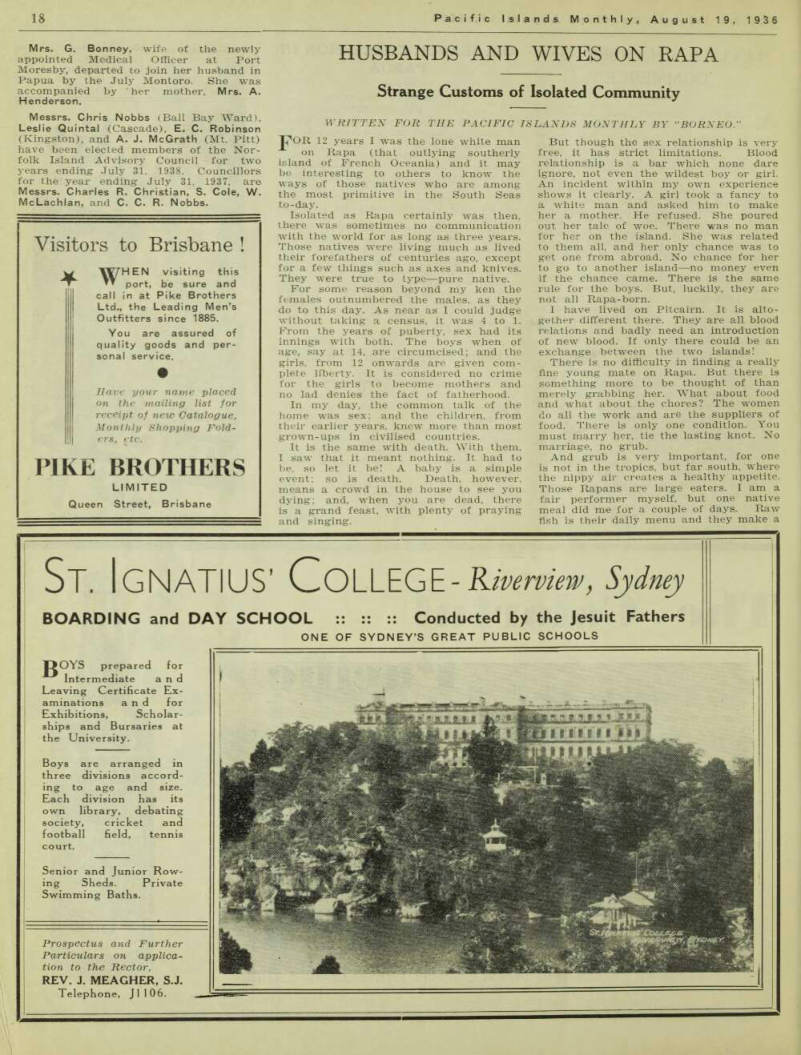
From Our Own Correspondent.
Rarotonga, July 12.
OFFICIAL information has been received that the N.Z. Government has ap proved of the erection at Penrhyn of a leper concentration hospital where cases from the whole Group may be treated prior to their removal to the Makogai settle ment in Fiji.
In the past over 100 lepers have been despatched from the Group to Makogai, and of these a substantial percentage have since returned cured to their respective islands.
Koitaki Para Rubber Estates Ltd., of Papua, reports that the output of dry rub ber from the company’s plantations for July was 40,4321 b. For the year ended June 30. production was 432.8191 b.
Mrs. G. Bonney, wife of the newly appointed Medical Officer at Port Moresby, departed to join her husband in Papua by the July Montoro. She was accompanied by her mother, Mrs. A.
Henderson.
Messrs. Chris Nobbs (Ball Bay Ward), Leslie Quintal (Cascade), E. C. Robinson (Kingston), and A. J. McGrath (Mt. Pitt) have been elected members of the Nor folk Island Advisory Council for two years ending July 31. 1938. Councillors for the year ending July 31. 1937, are Messrs. Charles R. Christian, S. Cole, W.
McLachlan, and C. C. R. Nobbs.
Advertisements & other items, pp. 19-20 (1 item)
Tooheys
ova*
sc te®' f S'*}' 3 b» te e ve*V n>, c . c<V> **& - \3^ ** . iaV « ? oV, f utf* c# n t tcb
tbtee. . lo# tant
GW®?, to"* 00 ' a"to aV ' paWB’ . bl b'V te ? iottV' c \ ta uo"» 2 '-?/*•** 5 •<£* 5 " -
FOR SAFETY’S SAKE. SAY “VINCENTS’
The Colorful
Pacific
The emerald green of the hillside, the sapphire blue of the sea, the silver strand of beach ... complete the color scheme with the golden amber (and creamy white head) of a glass of Tooheys Pilsener. It gives a rosy hue to life. Here’s To’ee!
TOOHEYS
PILSENER
IN THE BOTTLE WITH THE YELLOW LABEL. •I# tooheys^
LAGS
Visitors to Brisbane !
W EN visiting this port, be sure and call in at Pike Brothers Ltd., the Leading Men’s Outfitters since 1885.
You are assured of quality goods and personal service. • Have your name placed on the mailing list for receipt of new Catalogue, Monthly Shopping Fold- ers, etc.
PIKE BROTHERS
LIMITED
Queen Street, Brisbane
Husbands And Wives On Rapa
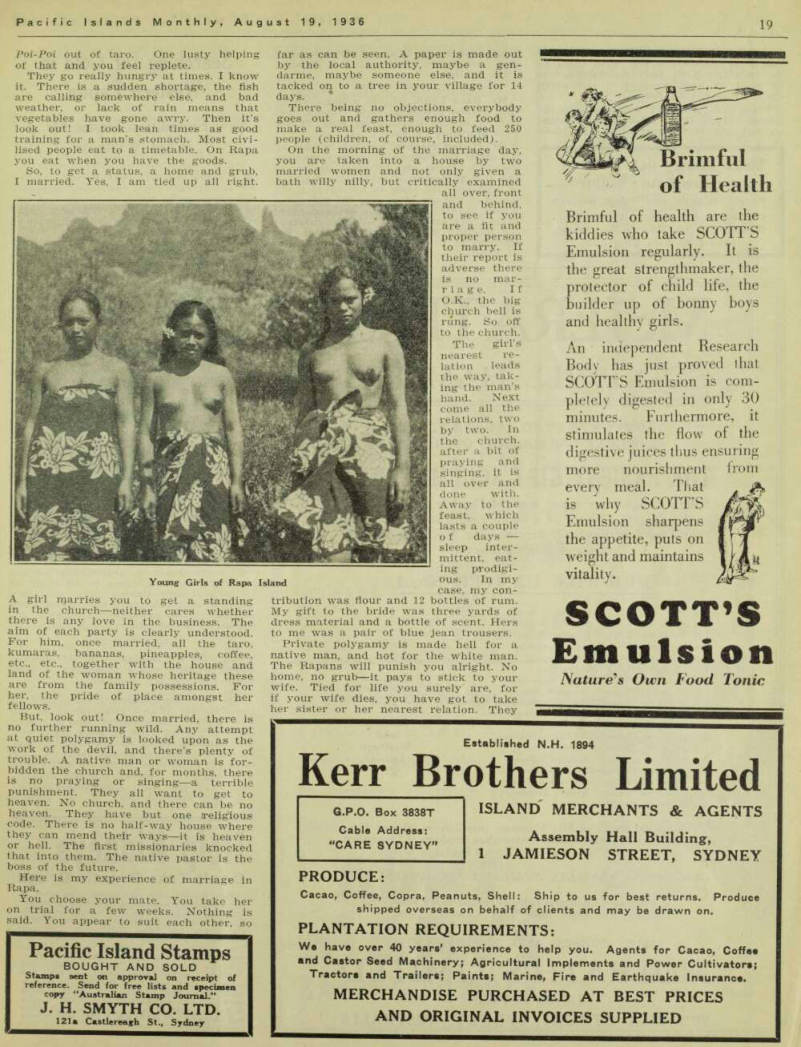
Strange Customs of Isolated Community
WRITTEN FOR THE PACIFIC ISLANDS MONTHLY BY “BORNEO ”
pOR 12 years I the lone white man on Rapa (that outlying southerly island of French Oceania) and it may be interesting to others to know the ways of those natives who are among the most primitive in the South Seas to-day.
Isolated as Rapa certainly was then, there was sometimes no communication with the world for as long as three years.
Those natives were living much as lived their forefathers of centuries ago, except for a few things such as axes and knives.
They were true to type—pure native.
For some reason beyond my ken the females outnumbered the males, as they do to this day. As near as I could judge without taking a census, it was 4 to 1.
From the years of puberty, sex had its innings with both. The boys when of age, say at 14, are circumcised; and the girls, from 12 onwards are given com plete liberty. It is considered no crime for the girls to become mothers and no lad denies the fact of fatherhood.
In my day, the common talk of the home was sex; and the children, from their earlier years, knew more than most grown-ups in civilised countries.
It is the same with death. With them, I saw that it meant nothing. It had to be, so let it be! A baby is a simple event; so is death. Death, however, means a crowd in the house to see you dying; and, when you are dead, there is a grand feast, with plenty of praying and singing.
But though the sex relationship is very free, it has strict limitations. Blood relationship is a bar which none dare ignore, not even the wildest boy or girl.
An incident within my own experience shows it clearly. A girl took a fancy to a white man and asked him to make her a mother. He refused. She poured out her tale of woe. There was no man for her on the island. She was related to them all, and her only chance was to get one from abroad. No chance for her to go to another island —no money even if the chance came. There is the same rule for the boys. But, luckily, they are not all Rapa-born.
I have lived on Pitcairn. It is alto gether different there. They are all blood relations and badly need an introduction of new blood. If only there could be an exchange between the two islands!
There is no difficulty in finding a really fine young mate on Rapa. But there is something more to be thought of than merely grabbing her. What about food and what about the chores? The women do all the work and are the suppliers of food. There is only one condition. You must marry her, tie the lasting knot. No marriage, no grub.
And grub is very important, for one is not in the tropics, but far south, where the nippy air creates a healthy appetite.
Those Rapans are large eaters. I am a fair performer myself, but one native meal did me for a couple of days. Raw fish is their daily menu and they make a
Poi-Poi out of taro. One lusty helping of that and you feel replete.
They go really hungry at times. I know it. There is a sudden shortage, the fish are calling somewhere else, and bad weather, or lack of rain means that vegetables have gone awry. Then it’s look out! I took lean times as good training for a man’s stomach. Most civi lised people eat to a timetable. On Rapa you eat when you have the goods.
So, to get a status, a home and grub, I married. Yes, I am tied up all right.
A girl marries you to get a standing in the church—neither cares whether there is any love in the business. The aim of each party is clearly understood.
For him, once married, all the taro, kumaras, bananas, pineapples, coffee, etc., etc., together with the house and land of the woman whose heritage these are from the family possessions. For her, the pride of place amongst her fellows.
But, look out! Once married, there is no further running wild. Any attempt at quiet polygamy is looked upon as the work of the devil, and there’s plenty of trouble. A native man or woman is for bidden the church and, for months, there is no praying or singing—a terrible punishment. They all want to get to heaven. No church, and there can be no heaven. They have but one ireligious code. There is no half-way house where they can mend their ways—it is heaven or hell. The first missionaries knocked that into them. The native pastor is the boss of the future.
Here is my experience of marriage in Rapa, You choose your mate. You take her on trial for a few weeks. Nothing is said. You appear to suit each other, so
far as can be seen, A paper is made out by the local authority, maybe a gen darme, maybe someone else, and it is tacked on to a tree in your village for 14 days. * There being no objections, everybody goes out and gathers enough food to make a real feast, enough to feed 250 people (children, of course, included).
On the morning of the marriage day, you are taken into a house by two married women and not only given a bath willy nilly, but critically examined
all over, front and behind, to see if you are a fit and proper person to marry. If their report is adverse there is no mar riage. If 0.K., the big church bell is rung. So off to the church.
The girl’s nearest re lation leads the way, tak ing the man’s hand. Next come all the relations, two by two. In the church, after a bit of praying and singing, it is all over and done with.
Away to the feast, which lasts a couple o f days sleep inter mittent, eat ing prodigi ous. In my case, my con
tribution was flour and 12 bottles of rum.
My gift to the bride was three yards of dress material and a bottle of scent. Hers to me was a pair of blue jean trousers.
Private polygamy is made hell for a native man, and hot for the white man.
The Rapans will punish you alright. No home, no grub—it pays to stick to your wife. Tied for life you surely are, for if your wife dies, you have got to take her sister or her nearest relation. They
Young Girls of Rapa Island
keep you in the family; no breaking away, no foolish business with them as to bewailing your loss. One woman is as good as another —love is not given even a thought on Rapa.
Thus was it when I was alone on the island. Since then, others have drifted in, but not (save one trader) to make
permanent stay. That is my privilege; and, once again, after a visit to Outside, I am At Home. Mr. Dave Lyall, who is well-known on the Morobe goldfield, New Guinea, left Sydney by the Montoro on July 29 for Port Moresby, Papua.
Dr. H. lan Hogbin, lecturer in anthro pology at the Sydney University, was the guest of honour and principal speaker at the July gathering of the Polynesian Club of Sydney. He took as his subject the island of Ontong Java, near the Solomons, which is inhabited by the descendants of early Polynesian rovers. Fellow guests at the meeting were Captain and Mrs. Pat Bowyer, of Chicago, who recently called at Tahiti.
Advertisements & other items, pp. 20-22 (1 item)
St, Ignatius’ College - Rive mew, Sydney
BOARDING and DAY SCHOOL :: :: :: Conducted by the Jesuit Fathers
ONE OF SYDNEY’S GREAT PUBLIC SCHOOLS
¥>OYS prepared for Intermediate and Leaving Certificate Examinations and for Exhibitions, Scholarships and Bursaries at the University.
Boys are arranged in three divisions according to age and size.
Each division has its own library, debating society, cricket and football field, tennis Senior and Junior Rowing Sheds. Private Swimming Baths.
Prospectus and Further Particulars on application to the Rector,
REV. J. MEAGHER, S.J.
Telephone, J 1 106.
T*
IMMI
: -A PM 1
IPI
Pi it A P F*. m » X ■ S G 11 W 1
KMI
m mm - r- ■ Jk
Brimful
of Health
Brimful of health are the kiddies who take SCOTT'S Emulsion regularly. It is the great strengthmaker, the protector of child life, the builder up of bonny boys An independent Research
Body has just proved that
SCOTT'S Emulsion is com-
pletely digested in only 30
minutes. Furthermore, it stimulates the flow of the digestive juices thus ensuring more nourishment from every meal. That A
SCOTT’S
Emulsion
Nature’s Own Food Tonic
and healthy girls.
is why SCOTT'S
Emulsion sharpens
the appetite, puts on weight and maintains
vitality.
Established N.H. 1894
Kerr Brothers Limited
ISLAND MERCHANTS & AGENTS
Assembly Hall Building,
1 JAMIESON STREET, SYDNEY
PRODUCE:
Cacao, Coffee, Copra, Peanuts, Shell: Ship to us for best returns. Produce shipped overseas on behalf of clients and may be drawn on.
PLANTATION REQUIREMENTS:
We have over 40 years’ experience to help you. Agents for Cacao, Coffee and Castor Seed Machinery; Agricultural Implements and Power Cultivators; Tractors and Trailers; Paints; Marine, Fire and Earthquake Insurance.
MERCHANDISE PURCHASED AT BEST PRICES
AND ORIGINAL INVOICES SUPPLIED
G.P.O. Box 3838 T
Cable Address:
“CARE SYDNEY"
Pacific Island Stamps
BOUGHT AND SOLD
Stamps sent on approval on receipt of reference. Send for free lists and specimen copy “Australian Stamp Journal."
J. H. SMYTH CO. LTD.
121 a Castlereagh St., Sydney
Make Money in J
your spare time • IVanted,,.
Pacific Islands and other postage stamps in any quantities for cash.
RAMSDEN, 18, New Oxford Street, London, W. 1., England.
McILRATH’S
GOODWILL HAMPERS
CONCENTRATED AUSTRALIAN
SUNSHINE FOR FRIENDS OVERSEAS
THE EASIEST GIFT SCHEME EVER!
Simply lodge your order with Mcllrath’s and they will guarantee safe delivery of a hamper right to the home of your friend in England, Scotland, or Northern Ireland without further charge.
GOODWILL HAMPER No. 1
1 x 30 oz. tin "1.X.L.” Peaches in Syrup. 1 x 30 oz. tin "1.X.L.” Apricots in Syrup. 1 x 30 oz. tin "1.X.L.” Pears in Syrup. 1 x 30 oz. tin "1.X.L.” Sliced Pineapple.
Ixl6 oz. tin "Ardmona” Grapes, lx 4 oz. tin "1.X.L.” Passionfruit.
Ixl6 oz. tin "V.C.” Tropical Fruit Salad.
Ixl2 oz. tin "1.X.L.” Pineapple Jam.
Ixl6 oz. tin "Summerland” Cape Gooseberry Jam. 1 x 12 oz. tin "1.X.L.” Melon and Ginger Jam. 1 x 32 oz. tin Best Western Honey.
Ixl2 oz. I a.- "Krownall” Mango Chutney.
Ixl6 oz. tin "Excello” Dripak Prunes. 1 x 16 oz. ca ton Best Sunraysed Sultanas.
Ixl6 oz. carton Best Sunraysed Currants.
Ixl6 oz. ca ton Best Sunraysed Raisins.
Ixl2 oz. tin "Victory” Sheep’s Tongues.
Ixl6 oz. tin Rex Pye.
You have the choice of Five Hampers, priced from 20/ to 43/—.
Nos. 1, 2 and 3 contain Assorted Australian Products of Unexcelled Quality, and Nos. 4 and 5 Assorted Penfold's Wines.
DESCRIPTIVE LEAFLETS AVAILABLE ON APPLICATION
To ensure Christmas delivery, please lodge your order not later than 17th October, 1936.
MAIL ORDERS AND ENQUIRIES TO
I London 20/- England (beyond London) 21/- Scotland and Northern Ireland 21/6
McILRATH’S LIMITED
HEAD OFFICE:
202 PITT STREET, SYDNEY, AUSTRALIA
Western Papua
Searching for Gold in Western Papua New Expedition Under Mr. J.
Ward Williams
AN expedition left Port Moresby at the end of July for a two years’ prospect ing campaign in Western Papua, and will be joined by Mr. J. Ward Williams, leader of the party towards the end of August or early in September.
Mr. Williams, who is at present in Syd ney, said that he had formed a syndicate overseas to finance the expedition. Both American and English interests were be hind the expedition, the head of the Eng lish group being the Selection Trust Ltd., of London, and the head of the American group being the Pardners Mines Corpora tion.
He said that four members of the ex pedition have left for a 950 miles sea and river journey to a base previously estab lished 550 miles up the Fly River. The members, Messrs. J. Bourke, W. Korn, J.
Kinsle, and wireless-operator Brown, travelled in a 30 ton boat, with 25 carriers.
About four months’ supplies were carried in addition to wireless equipment.
A Sikorsky amphibian ’plane has been purchased in New York, added Mr. Wil liams. On its arrival in Sydney it will be assembled at Mascot Aerodrome and later flown by Flight-Lieutenant Stuart Camp bell to the Fly River base.
Special arrangements have been made with Amalgamated Wireless for the equip ment of the ’plane with wireless. Mr.
Williams said that he would probably fly to Papua in the ’plane.
The main object of the expedition is to find large gold dredging areas, he said.
The party would be armed, but his ex perience, after six years in all parts of Papua and New Guinea, was that there would be no trouble with the natives. The success of the expedition, he added, de pended on the friendliness of the natives.
Mrs. E. W. Oakley, wife of District Officer Oakley, was a passenger to New Guinea by the last Montoro.
Mr. C. A. Berendsen, C.M.G., head of the External Affairs Department of the New Zealand Government, who has been intimately associated for some years with the administration of Western Samoa, joined the Niagara at Auckland in July, en route to Europe, where he will attend the League of Nations’ sessions in com pany with the High Commissioner-elect for New Zealand, Mr. W. J. Jordan, ex-M.P.
Advertisements & other items, p. 22 (1 item)
Help Kidneys
Don’t Take Drastic Drugs
Your kidneys have nine million tiny tubes or filters which are endangered by neglect or drastic, irritating drugs. Beware! If Kidney trouble or Bladder weakness makes you suffer from Getting Up Nights, Leg Pains, Nervousness, Dizziness, Stiffness, Rheumatism, Lumbago, Circles Under Eyes, Swollen Ankles, Neuralgia, Burning, Itching, Smarting, Acidity or Loss of Vigour, don’t delay.
Try the Doctor’s new discovery called Cystex (Siss-tex), Soothes, tones, cleans, and heals sick kidneys. Starts work in 15 minutes. Brings new health, youth and vitality in 48 hours. Cystex costs little and is guaranteed to end your troubles in 8 days or money back. Price 4/-, all Stores and Chemists. SCHAFFER & CO., 189 Clarence Street, Sydney.
The Downtrodden
Native
(By A.M.A.)
FT is just shameful the way traders in the Solomon Islands exploit the poor unsagacious native.
With the present high price of trochus, the trader is simply making it a “welter.”
He goes to Malaita with his vessel, the only plant he needs (worth no more than about £800), and after a lot of soft talk persuades the all-believing, innocent salt water natives to go diving with him. He agrees to feed and give them the trifling sum of 18/- a tin.
The native also needs his plant, or equipment, so the trader, without so much as a pang of conscience, sells him, on paper, a pair of diving glasses for 1/-, when they have only cost him 10/6 a dozen. After that wilful act of profiteer ing, they start out.
Now, it is only the good divers who can get their three tins of shell a day— the rest, after working for at least three or four hours, can only manage one and a half to two tins. So, taking the aggregate, they make only about 36/- a day each. As a rule, after several weeks of this slavery, the divers at last rebel—not so much for the reason that they have only made about 9/- an hour for their diving time, but that the trader has introduced another <Df his grasping methods by shaking a “full” tin down to three-quarters, after they have neatly stacked the shells to overflowing, with all the cones up.
The trader takes them home again and pays them their hard-earned pittance, which, as a rule, works out about £l5 per diver.
For his shell, the trader receives at Makambo £B5 per ton. With 70 tins to the ton, this is equal to 24/- a tin. Out of this he pays 18/- to the natives, plus his expenses for the trip—fuel, insurance, food, crew’s wages, etc.—which, excluding depreciation on vessel and heavy wear and tear on boats, amounts to no more than £25, bringing the cost up to around 22/- a tin. The gloating trader, there fore, makes a clear profit of 2/- a tin— in other words, the native diver gets, in cluding his food, 90 per cent., and the trader takes the rest.
Yes, something really should be done about such glaring exploitation!
Aerodrome
Site For Rabaul
From Our Own Correspondent.
Rabaul, July 14.
A GOVERNMENT officer is at present surveying an area at the south-eastern boundary of Kuraiba plantation, in the vicinity of Toma, to investigate its suit ability for an aerodrome. The site is about 14 miles from Rabaul, and is part of the mission property, Vunakanau.
If this land is suitable it will solve one of Rabaul’s major problems. Several pos sible sites have already been rejected. It was when the Administration was seeking an aerodrome site last year that the Ma tupi natives protested that their lands were being illegally seized by the Govern ment.
Commander C. J. R. Webb, Harbour master at Rabaul, returned to New Guinea by the July Montoro after fur lough.
Graves Restored
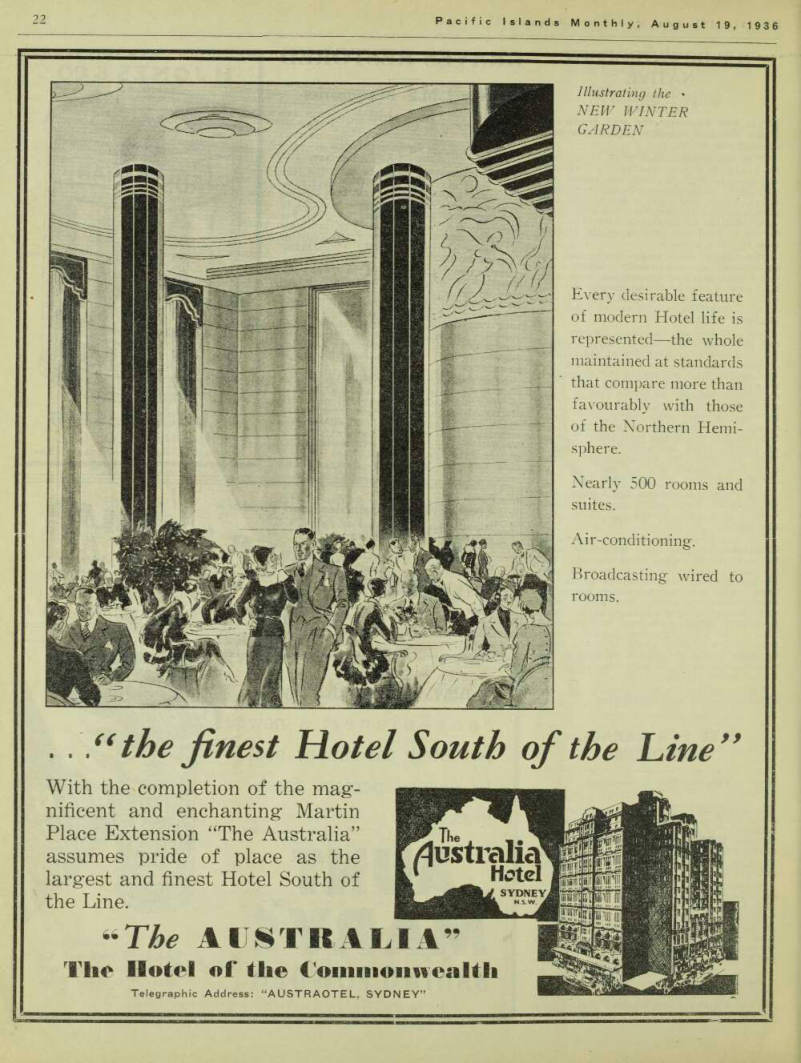
Early L.M.S. Missionaries In Tahiti
From Our Own Correspondent
Papeete, July 5.
THE interesting task of locating the A “lost” graves of Tahiti’s pioneer mis sionaries, whose bodies were laid to rest in the district of Papara, was brought to a satisfactory issue on May 29 when re inforced concrete gravestones, suitably inscribed, were placed over the remains of Tessier (buried in 1820) and Davies (buried in 1855).
Both these men arrived in Tahiti by the convict ship Royal Admiral, which was on its way to Botany Bay in 1801.
In 1808 both fled from the local disturb ances to the island of Huahine on the brig Perseverance, and from there sailed for Port Jackson by the Cyclops in 1810.
Davies returned first to the field, reaching Moorea in 1811, and Tessier followed in June, 1813.
After residing again in Huahine, Davies took the post at Papara held by Bicknell (a Buff man who had arrived in 1797).
He remained in charge there for 35 years, dying at the age of 84. Tessier,- after locating himself at Matavai, (Point Venus), on Tahiti, went to assist Bick nell in 1818. On July 23, 1820, Tessier died and was buried by Bicknell, who
himself died within a fortnight. Bicknell’s body was taken to Moorea to lie beside the grave of a favourite child.
Mr. W. W. Bolton, M.A., who has throughout been the most interested and energetic party in searching for these “lost” grave sites, states that he encoun tered no serious difficulties once a care ful search of the records in Sydney and London had been made. Lying in a large coconut plantation, which he discovered to be the burial ground of the early con verts to Christianity and the site of the first chapel, there were two graves en tirely different from all the rest. Instead of being marked by the usual boulders of black stone, these two were conspicuous among the many scores surrounding them.
Tessier’s was outlined with roughly cut coral blocks, whilst Davies’ was covered by two fiat coral slabs.
That these were the graves of white men was self-evident—even if it were not known definitely that the two w'hite men lay in Papara. That they were mis sionaries—but not of the Duff band—was soon learned. Here then lay the two fellow voyagers of the Royal Admiral, and as pioneers for the faith that was in them, honour was due. This has now been done.
The weighty gravestones were carried to Papara by truck and lowered into place by means of a derrick. There was a considerable gathering of interested folk to witness the ceremony, including chiefs and sub-chiefs, pastors and deacons of the Protestant Church, and a sprinkling of local white residents who had travelled far in order to be present. Suitable ad dresses were made by the French Pro testant clergymen, Messrs. Moreau and Vernier.
The Papara people accepted the future care of the graves with ready willingness, sending warmest thanks to the London Missionary Society for not only thus vividly recalling the past, but also for meeting the cost of the renovation.
Advertisements & other items, pp. 23-24 (1 item)
Baking Powder
H.JONES &C 0
c
AUSTRALIA'S BEST
H. JONES & CO.. LTD.
Darlington, Sydney Hobart, Tas.
For— Fresh Fruit, Vegetables, and Produce Islands Residents can rely on the old-established Shipping Providers;
tor
Only Address: 421 Sussex St., SYDNEY Islands . All Orders Promptly Attended Representatives: Nelson & Robertson Ltd. W. M. Reid
A new, simple lid for your.i
convenience; a new
patented parchment seal
to ensure perfect fresh-
ness.
A
BAKING POWDER
Send 1/- plus 2d. postage to Tillock and Co.
Ltd., Sydney, for “Aunt Mary’s" Cookery Book.
It’s the best.
in Si ss A m * Illustrating the •
NEW WINTER
GARDEN
Every desirable feature of modern Hotel life is represented—the whole maintained at standards that compare more than favourably with those of the Northern Hemisphere.
Nearly 500 rooms and suites.
Air-conditioning.
Broadcasting wired to rooms.
U
the finest Hotel South of the
With the completion of the magnificent and enchanting Martin Place Extension “The Australia” assumes pride of place as the largest and finest Hotel South of the Line.
“The AUSTRALIA”
The Hotel of the Commonwealth
Telegraphic Address: “AUSTRAOTEL, SYDNEY”
II m
Australia
I H/'itoi s mi
tel
Hunt if f
SYDNEY
Work of Mr. Bolton
Letter to the Editor I READ with interest in the July P.I.M.
A an article by the Rev. Cecil North cott, M.A., on early missionary days in Tahiti. I regret to notice, however, that Mr. Northcott, like many another present day writer on historical events, has not taken sufficient pains to ensure accuracy.
He states that the missionaries • who held on in 1798 were five in number, viz Mr. and Mrs. Eyre, and Messrs. Bickneli] Nott, and Jefferson. Actually, those who stuck to their post were Eyre (and wife), Bicknell, Nott, Jefferson, Harris Lewis and Broomhall. (See “Transactions of the Missionary Society,” Vol. 1.) Mr. Northcott further states that “Only recently Tahiti publicly restored the graves of the humble heroes who brought the Gospel to her.” Actually, the work of locating and restoring the graves (excepting those of Nott and McKean) , been done by my old friend, Mr.
W. W. Bolton, of Papeete. After long and painstaking search he has located the graves of Jefferson and Lewis at Matavai, and of Tessier and Davies at Papara. Mr. Bolton is now busy in con nection with the restoration of the graves of Jefferson and Lewis at Matavai. and the locating of the graves of Scott and Bicknell in the neighbourhood of Pape toai, Moorea.
AT Th J. S , Work is Purely a labour of love on Mr. Bolton’s part. He gratefully acknow
ledges the receipt of funds from the head quarters of the London Missionary Society to defray the cost of labour and material.
The graves of Nott and McKean at Arqe were located and restored some years ago by a small self-appointed com mittee of English and American residents.
They are now kept in good order by Mr.
Smith, one of the members of the com mittee, whose property adjoins the site of the graves. Had it not been for the activities of Mr. Bolton and the members of the committee the sites of the graves of the pioneer missionaries of the South Seas would probably to-day be unknown and unmarked.
An article in the Pacific Islands Monthly
of July 23, 1935, from your own correspon dent in Tahiti, gives a very good account of Mr. Bolton’s activities.
In conclusion, I would like to bring under the notice of those of your readers who may be interested in the early his tory of Tahiti and the adjoining islands that the Mitchell Library in Sydney has practically everything that has been written on this subject, including many original letters and diaries of the early missionaries.
I am, etc..
J. D. Mccomish.
“The Oriental,”
Cremorne Point, Sydney, July 27, 1936.
Advertisements & other items, pp. 25-26 (1 item)
Seyon
RADIO
RECEIVERS
Standard Models capable of outstanding performance in tropical conditions.
6 VALVE A.C. DUAL WAVE RECEIVER
37 Guineas
detail built Incorporating T , r « n I sformer . Special Celotex Baffle, Solid Australian Walnut Cabinet, Ferranti Tuning Meter, with many other exclusive features.
Full range of Battery, and All Electric Receivers available Price Range from 16 guineas to 115 guineas.
Write for particulars to:—
Noyes Bros. (Sydney) Ltd.
Designers and Engineers ll5 Clarence Street, Sydney &
T he Fortune Telling Tea
The Cup of Knowledge” has evolved from the very ancient Chinese mTramusement W Readi " g the CU P is ver >' easil >' and affords A fine quality English China (Aynsley production) with the cards in their proper colours. *
CATALOGUE SENT POST FREE
ON PARLE FRANCAIS
Printed instructions with each Cup and Saucer. Price complete, including postage, 4/6
Prouds Limited
Cr. King and Pitt Streets, Sydney
Get your
[HU copy
of the
NEW TRUFOOD
RECIPE BOOK
69 specially tested recipes—all kinds of new ideas for attractive things to cook cakes, pastry, puddings, custards, desserts, savouries, sauces, etc.
POST THIS COUPON TODAY
Recipe Department” c/- Box 4267 Y. G.P.0..
Sydney.
Please send me POST FREE, * copy of The Trufood Book of 69 Tempting Recipes Name
(BLOCK LETTERS)
Address
Plane Falls - Lives Lost
“No apparent
mechanical faults
found.”
Could the Pilot have been paralysed with the gripping, agonising pains of stomach disorder?
Read This:
Colonel J. Stacey, 31 Erskine Street, Sydney, N.S.W.
Dated February 10, 1933.
Mr. R. M. Hardy, Hardy’s Chambers, 5 Hunter Street, Sydney, N.S.W.
Dear Sir, —Some three months ago I was very ill, caused by severe ’Flu and Nervous Breakdown. I suffered intense pains in the stomach, my condition was serious for over a month and getting worse, I was advised to try your Indigestion and Stomach Remedy, and after ten days’ treatment all pains were gone and my nerves became normal. 1 regained my health, and feel that your Remedy is all you claim for it.
Yours truly,
COLONEL J. STACEY.
C
WHY RISK YOUR LIFE?
take
R. M. Hardy’s
Indigestion and Ulcerated
Stomach Remedy
Obtainable at All Burns, Phi Ip & Co. Stores.
Price: 3/9, 3/6, and 2/6 per Tin.
No Dieting—No Headaches —No Stabbing
Pains
Influenza’s Toll in the Cook
Islands
From Our Own Correspondent.
Rarotonga, July 4.
OFFICIAL returns for the six months ending March 31 now being available, it appears that the recent report concern ing influenza deaths in the Northern Group was slightly incorrect. The correct figures are 16 persons in Manihiki and S in Rakahanga, a total of 24 for the two islands, in place of those given in the May issue of the P.I.M.
£500,000 Project for Papua
New Paper Mill
THE establishment of a mill at Colling wood Bay in Papua for the manu facture of pulp and paper from grass in digenous to Papua and New Guinea, was outlined by Mr. P. R. Higgins, chairman of the British Australian Pulp and Paper Company, Ltd., at a luncheon on July 27, to Mr. Johnston Tait, paper mill engineer, on the eve of his departure for Edin burgh.
Mr. Higgins said that Mr. Tait had been engaged for some months, in co operation with Bertrams, Ltd., of Edin burgh, for the design of the company’s mill and plant for the manufacture of paper pulp at Collingwood Bay, Papua, and the company’s mill and plant for the manufacture of fine writing and printing paper, at Port Stephens, N.S.W.
“The first unit of plant, with an out put of 15,000 to 20,000 tons of bleached pulp each year, to be established at Col lingwood Bay,” Mr. Higgins said, “will alone represent a capital expenditure of approximately £500,000 in the territory.”
Adventures Of A Samoan
Stowaway
From Our Own Correspondent SUVA, July 16.
AT the Police Court on July 6, Pila Wilkes, a native of Western Samoa, was sent to gaol for six weeks with hard labour, then to be deported to Apia.
Wilkes has been having some hectic adventures. He stowed away at Apia on the steamer Cape Horn. At Vancouver he was deported and put on board the Aorangi. He escaped from the liner at Auckland, and two days later was re captured and sent to Wellington on board the Monowai for Sydney, In Australia he again disappeared, but was arrested at Circular Quay, Sydney, and failed to pass a dictation test in German.
Sub-Inspector Flower, of the Fiji Con stabulary, said that the next thing he heard of him was when he found him on the Cape Horn. He warned the captain not to allow Wilkes ashore at Fiji, but again the Samoan escaped. He remained free from June 26 till July 5, when a Punjabi police officer arrested him.
Southern Pacific Insurance Co.
A N issue early in August of 50,000 shares in Southern Pacific Insurance Co., Ltd., which was limited to registered shareholders in W. R. Carpenter and Co., Ltd., was over-subscribed approximately threefold.
Total issue comprised 75,000 ordinary shares of £1 each, of which 25,000 were to be taken up by W. R. Carpenter and Co., Ltd., and its associates, that company undertaking also to take up any of the shares offered to its shareholders which might not be applied for.
It is proposed to apply for listing of the shares on the Sydney Stock Ex change.
Mrs. J. F. Montague, of Auckland, New Zealand, is visiting Suva, where she is the guest of her son, Mr. Clive Montague, and his wife.
Savage Socialism For Samoa
“Goodwill Mission” Warns Planters that Chinese Labour System Must End
APIA, July 11.
I HAVE just come away from an amazing sight—a New Zealand Minister trying to persuade about 50 hard-headed Samoan planters to apply to their industry the principles of Savage Socialism; and then, when the planters did not fall enthusias tically into line, informing them that Socialist conditions are coming eventually, wh«ther they like it or not.
In German times this was a rich and flourishing territory. Planters and traders, both German and British, were encouraged to plant and trade, and gene rally make use of the exceedingly fertile soil. There is no labour available here.
The Samoan will not work. Why should he? He has ample land, and an extra ordinary abundance of every kind of food.
So the German authorities brought in in dentured Chinese labourers—thousands of them. A little time before the war there were some 4,000 Chinese—well-fed, well paid (for them), and happy enough— working the plantations. Everyone pros pered. The D.H. and P.G. paid an annual dividend of between 30 and 40 per cent.
Then came the war, and economic paralysis, followed by the “Old Granny Government” of New Zealand. For 16 years now Samoa has been governed by a numerous tribe of well-paid but quite unimaginative officials. They have “cleaned up” and partly educated the natives, and introduced good roads,
bridges, electric light, and water sup ply. But they have done nothing, or al most nothing, for the economic advance ment and development of the country. It is a fact that not one settler from New Zealand (apart from returned officials) has come to Samoa to engage in planting.
Some have come to Samoa and examined the position—and then have buttoned up their pockets and fled from the country.
I have never been in a richer Pacific territory than this. There is a most fer tile soil, ample rainfall, a comparative absence of pests and diseases. But I go from one end of the island to the other, and I And no prosperity and a discour aged and pessimistic community of planters. There has been a Depression, of course —but it is not enough to explain this condition of affairs. The answer is found in the attitude of some of the older Britishers, who say quite openly that this petty little Government from New Zea land is nothing short of a calamity, and urge that, since it is not possible to re establish pre-1914 conditions, an effort should be made to have Samoa taken over by the British Colonial Office.
There are many charges against the N.Z. authorities, all summed up in years of indifference of officialdom towards the needs of the planters and the possibilities of the planting industry.
Then* is, for instance, the matter of labour. When New Zealand took charge
here in 1920 there were perhaps 1,200 Chinese labourers. To-day there are 390.
New Zealand allowed many plantations to return to the jungle. Then the Depres sion reduced the labour needs of many plantations; but now that the market for
copra, cocoa, etc., is much improved, planters are looking around for more labour. The prospect is alarming.
A rumour ran along the beach last week that it had been decided that one way in which this Socialist Mission would ex press goodwill would be to banish the Chinese labour—not only the artisans of the town, but also the essential labourers from the plantations.
The planters were literally stunned by the news. Therefore, when it was made known that to-day the Goodwill Mission would meet the planters, to discuss pre sent conditions and future prospects, the attendance was large. About 50 planters, British and German, were there, and the manager of the Reparation Estates.
Perhaps it should be explained that when New Zealand occupied this country the German planters were returned to Germany, and their plantations were taken
over and operated by a Government insti tution called Reparation Estates, and the profits therefrom were credited to Ger many’s war-debt to the Allies. The Estates have provided comfortable jobs for some worthy and doubtless deserving officials; but their profits have not been a particularly startling quantity. Ger man planters who had married Samoan wives were allowed to remain in the country; and to-day they form an import ant section of the much reduced Samoan planting community.
To-day’s assembly was interesting.
Without exception they were a well-set up, capable-looking lot of men—l have not seen.a better looking lot of men in any Pacific territory. But they eyed the Minister with great uneasiness—what was he going to do to them? They placed before him their various requests—facts and figures were effectively marshalled to show the need for assisting the planting industry, both in removing restrictions on production, and in finding new markets.
And, of course, they laid weight upon the need for a dependable supply of planta tion labour.
The Minister’s reply can be summed up in half a dozen sentences. New Zealand’s obligation was first of all to the natives — the planting industry, and the welfare of the Europeans, while important, were sec ondary considerations. New Zealand would try to assist the planters by (1) consuming more Samoan bananas and paying a higher price for them; (2) seek ing, through the new New Zealand Socialist Government’s marketing organ isation a new and better foreign market for copra and cocoa. Chinese labour must go —not immediately perhaps, but even tually; and the possibility of using native and half-caste labour must be fully ex plored. The Mission was gravely con cerned over the long hours worked and low wages paid in Samoa—a 40-hours’ working week must be introduced, and there must be higher wages.
For a time the planters seemed speech less. Then there were some pointed in terjections.
When the Minister referred com placently to the banana position a planter said that, at present rates, there was mighty little profit in the banana trade.
Higher prices were essential.
The Minister replied, with some heat, that the N.Z. Government at considerable expense had put on the Maui Pomare to carry bananas, and thus had saved Samoa.
“Don’t think that Samoa is worth a penny piece to us,” he said, “or that we are getting anything out of it all. Samoa is worth nothing to New Zealand—we are simply trying to carry out our obliga tion.”
No one apparently had the courage to suggest what all were thinking—that if only New Zealand would retire from Samoa and give some other Government a chance everyone would be happy, in cluding New Zealand herself.
Some of the planters protested that if they were deprived of Chinese labour they would inevitably be ruined —the Samoans and European-Samoans cannot be de pended upon.
“I am sure that the Samoans will work,” said the Minister. “See how well the young men cultivate the gardens around their secondary schools, and how they work in the mission plantations.”
The planters pointed out, sadly, that the Samoans worked in those places not for money but for position. Mission students became pastors, for instance, and after that they would work no more as labourers.
The Minister, with the assurance born of ignorance and Socialist prejudice, said that he was sure that the Samoans even
tually could be induced to work, thus allowing the abolition of the hateful sys tem of using indentured Chinese coolies.
Other speakers declared that a 40hours’ week and larger wages were im possible—the planters barely could live under present conditions.
The Minister, in the manner of a kindly teacher, said that of course it was recognised that, if costs were to be in creased, income must be increased also.
Therefore, there would be more bananas consumed in New Zealand; and the Socialist Government’s brand-new plan for marketing New Zealand products over seas would also be responsible for bigger and better markets for Samoan copra and cocoa.
The audience sat stunned and silent.
No one asked how the little New Zealand Government, selling its little bit of Samoan copra, was going to deal with the Unilever combine, which sits atop of the vegetable oil-seeds market of the world. No one protested against the idea of tying poor, helpless Samoa to the tail of New Zealand’s “great Socialistic ex periment in marketing.”
The Minister argued that, as the Samoans “advanced and progressed,” they would abandon their present stan dard of life, and would need more articles of European manufacture, and therefore would work.
The audience listened, politely, to this Socialist idea of the commercial enslave ment of a people who now live free and happy, and able to provide with very little work for all their simple needs. They pointed out that the Samoan natives have plenty of land, and when they want money they will cultivate their land and sell the produce, instead of working for others.
The Minister’s companion, Mr. O’Brien, told the meeting about the early history
of the Queensland sugar industry to prove his contention that the removal of the Chinese labourers would not ruin Samoa, The sugar plantations were worked by kanakas and other indentured labourers, he said: and when they were all removed, and white labour substituted, everyone cried out that the industry would be de stroyed. Instead of that the industry to day is extremely prosperous.
No one present had the heart to remind the well-meaning gentleman that the cases are in no sense parallel—that Queensland sugar is consumed in Aus tralia, under a frightfully heavy tax which keeps all foreign sugar out and provides a bonus to allow surplus Queensland sugar to be exported. Samoa could no more consume its own products (copra, cocoa, bananas) than it could hop on one leg to Fiji.
“I must reaffirm, friends,” said the Minister, in conclusion, “that we are very concerned about the Chinese position, and the hours and wages position. However, we realise your position, and we are not going to make any sudden change—we want to help you.”
And with that the meeting dispersed, very gloomily.
Later.
Already the glad news is circulating.
The Chinese coolies are reported to be restless and demanding more money, as recommended by “big fella Minista.”
Yet, whenever it is known in Hong Kong and Canton that a couple of hundred Chinese are wanted for the Samoan plan tations (1/9 per day, with comfortable quarters and native Samoan wives, if re quired) recruits are available in tens of thousands.
H. W. Robson.
Advertisements & other items, pp. 27-28 (1 item)
Tilley
REPLACEMENT PARTS
FOR ALL RADIO SETS
SPECIALLY IMPREGNATED
AGAINST MOISTURE
j SPECIAL SETS MADE FOR
TROPICAL USE
KITS OF PARTS FOR ALL
TYPE RECEIVERS
WRITE FOR PRICE LIST AND
DESCRIPTION OF SPECIAL
TROPICAL BATTERY RECEIVER
c
PRIDE'S RADIO SERVICE
, 566 ANGEL PLACE SYDNEY AUSTRALIA
I
FOR BRILLIANT LIGHTING
USE
TILLEY
KEROSENE VAPOUR LAMPS AND LANTERNS
300 candle-power Light of 6 hours for Id.
To those living in the Pacific Islands, modern science now offers a new form of lighting in place of the old-fashioned methods. Tilley Lamps and Lanterns give you the best possible light at a minimum cost. British made throughout of the finest workmanship and designed to withstand rough usage. Absolutely safe and cannot explode. They burn ordinary kerosene under pressure, and are preheated by the same oil so that only one fuel is necessary. The Kerosene Lighter draws its oil supply from the container of the Lamp itself, and does away with the use of methylated spirit.
Give a brilliant illumination of 300 c.p. at a cost of Id. for 6 hours, without attention other than occasional pumping.
Obtainable throughout the Pacific Islands from the Branches of:
BURNS PHILP & CO., LTD., and
BURNS PHILP (SOUTH SEAS) CO., LTD.
also obtainable d f L r™- W. KOPSEN & CO., LTD., ’’ CLA s R y E d N n C e E y st -’
If any difficulty, please write direct to: TILLEY LAMP CO. (Dept. P.M.), HENDON, LONDON, N.W.4.
No {Vicks
No Chimneys
No Smell
Draught Proof
Insect Proof British Made
Throughout
fes® .
T.L. 10 TABLE LAMP.
The Tilley Table Lamp with its clear, white, steady light shows your room to the best advantage, as well as banishing eyestrain when reading or doing needlework. No smell or glare. Does not flicker when standing in a draught. Made throughout in lacquered brass and fitted with opal shade.
Free from danger and cannot explode even if overturned.
P.L. 54 STORM LAN-
TERN. Tilley Lantern is invaluable for all outdoor work; can be hung up, stood down or carried about just as required.
Will burn steadily anywhere, unaffected by weather, however severe, being wind and rainproof. Strongly made of brass. No parts to rust, corrode or get out of order. Get rid of all antiquated devices and use this up-to-date lantern.
ORDER
RECORDS
by MAIL
Use Elvy’s Special Gramophone Record Mail Department for Island residents.
Orders over £2 insured, posted FREE.
Write for free catalogues and lists NOW.
ELVY & CO. LTD
397 GEORGE STREET, SYDNEY
sdfsdf
BP
READ THE
B.P. MAGAZINE
SPRING NUMBER
ON SALE Ist SEPTEMBER
Short Stories . . . Pictures Travel Articles . . Pages for the Children Stage Latest Fashions ... Screen o
ONE SHILLING PER COPY
ON SALE AT ALL NEWSAGENTS AND BOOKSELLERS
“Joseph Conrad” at Sea Again
From Our Own Correspondent
Papeete, July 7.
THE three-masted, square-rigged sail ing ship, Joseph Conrad, arrived safely in Papeete in June, after a strenu ous passage of 79 days from Papua. News of her arrival was immediately tele graphed to Australia and America to allay the anxiety of the public over her where abouts.
After leaving Samarai in March, a call was made at Lord Howe Island to take in a supply of vegetables and live stock, and the vessel then proceeded to the south, where she ran into a heavy gale in Lat. 43.
In this storm the Conrad suffered some damage to her rigging and spars. One of the boats was washed overboard. Un doubtedly it was the wreckage of this— cast ashore in New Zealand—which gave rise to the reports of the vessel’s loss.
After repairing ship—done by her own crew—and taking in provisions for the remainder of the voyage, the sailer left on July 2 for New York by way of Cape Horn. The two lady passengers and two American cadets stayed over in Papeete, leaving only the British cadets aboard.
Captain Villiers expected to reach New York in about 95 days.
Sowani Paumau, First Native Medical Practitioner in the Gilbert and Ellice Islands, who for many years has done much fine work in Central Pacific, has retired from the service of the West ern Pacific High Commission.
Advertisements & other items, pp. 29-30 (1 item)
Kodak Catalogue
WILLIAM FINAL!
Photographer
FRIENDLY IS.. OCEANIA
* Tongan views and Natives’ ■■ life scenes, set, 5/3 prepaid ▼ anywhere. Tapacloth, large piece, 6/6 prepaid anywhere.
Kodak Catalogue
* < Of all Kodak Now in the Press. The most complete Catalogue ever issued.
Covers all the newest Kodaks, also an exceedingly wide variety of new and valuable photographic accessories.
Island readers should apply for their free copy by return post, thus assuring their reservation of a copy of this beautiful Book, which is size 10 x 7 inches, and approx. 64 pages.
The COUPLED %ANGE-FINDER. ..
Kodak Regent
Not only the world’s smartest camera, but the coupled range finder guarantees sharpness. It is completely built-in and directly coupled—is easily and accurately adjusted. A choice of two masks enables pictures to be made either 8 (pictures 2* x 3* inches) or 16 (pictures If x 2\ inches) at a loading. With F/3.8 lens in Compur Shutter, speed to 1- 250th second.
Pr,ce £l7/10/- Dealers throughout the Islands and
KODAK (Australasia) Ptj. Ltd.
379 GEORGE STREET, SYDNEY
OCEANIA
A Journal devoted to the study of the Native Peoples of Australia, New Guinea, and the Islands of the Pacific Ocean.
Editor : Dr. A. P. Elkin (Professor of Anthropologry at the University of Sydney); Assistant Editor: H. lan Hogbin.
Published Quarterly.
Subscription, 5/- per copy (£1 per annum) Published by the Australian National Research Council, Science House, Gloucester Street, Sydney,
N.S.W.
Swan-Song Of The
Aloha Co.’S.
THE announcement in July that share- M holders in Aloha Central Gold Mine, N.L., received a first and final dividend of 4/8 a share and Aloha Syndicate holders £6/4/5 a share marked the last of these sensational stocks. The legal manager (Mr. J. H. Roxburgh) stated in a circular to shareholders that with these payments “the existence of the companies is auto matically terminated.”
Aloha Syndicate £lO shares during the Fiji gold boom last year touched £650.
Shares in Aloha Central, an offset, reached £4O.
When a second offshoot, Aloha Alluvials, was floated in May, 1935, the £5 shares touched £l7. It was calculated that the rights and market valuation of each original Aloha Syndicate £lO share were worth in all £1,134 —three months after formation.
Aloha Alluvials, which was wound up at the beginning of this year, returned £3/13/9 a share of unexpended money on the final distribution Mr. and Mrs. A. Hallam-Roberts ar rived in Sydney from Suva with their son Richard by the Monterey on July 13.
Mr. Hallam-Roberts, Who was for some time Chief Police Magistrate in Fiji, has been transferred to Zanzibar.
Relief of Archbold Party
Pilot Koch’s Hazardous Flight Into Central N. Guinea
TO bring relief to the Archbold scien tific expedition, which was cut off in the interior of New Guinea, with a diminishing food supply and the petrol for the wireless transmitter exhausted when its Amphibian was wrecked at Pt.
Moresby, a Guinea Airways ’plan© made a 900-mile non-stop round flight in eight hours, and dropped food and gasoline by parachute.
The flight is regarded as one of the most successful in New Guinea aviation history, and great credit is due to the pilot, Mr. A. Koch. The country traversed contained mountains 8,000 to 14,000 feet high, where weather changes are frequent, and flying conditions can become very difficult and often impossible.
The advance field party of the American Museum of Natural History expedition was camped on the Blucher mountains, near the headwaters of the Strickland River, a tributary of the Fly. A ’plane was the only means of getting to them in reasonable time, as the expedition would have been in a rather bad way without immediate supplies.
Mr. Russell Rogers, the Archbold ex pedition’s pilot, flew across in a small ’plane from Pt. Moresby to Lae, to act as guide for Mr. Koch. Fitted with extra tankage to give a range of 1,000 miles, Guinea Airways’ tri-motor Ford left Lae on July 19 for Mount Hagen landing ground.
Carried Rice And Petrol
Carrying 1,500 lbs. of rice and a quan tity of petrol, the ’plane took off, and headed for Mount Blucher, in Central New Guinea.
A specially-prepared bed of kunai grass had been made, five feet deep, to receive the supplies when they were dropped from the air; but bad weather prevented them from being dropped where it was intended. Instead, they were dropped about two miles from the party’s camp, some from a height of 100 ft., some from 500 ft.
When the land party salvaged the gaso line, the transmitter was soon put into working order. Advice was sent that all the supplies dropped had been found.
Further supplies have been taken up the Fly River by the launch Maira, which left Port Moresby on July 14.
Party To Return To U.S.A.
It has been decided to abandon the scientific expedition for the present, and on their return from the interior the party will depart for America. The leader of the party (Dr. Richard Archbold) has in timated that he and companions will go back again to Papua next year, with a twin-enginbd Sikorsky flying boat.
Madame R. Guegan, of Noumea, arrived in Sydney from New Caledonia by the Laperouse on July 28, en route to France for a holiday. She was accompanied by her two children, Suzanne and Francois, Pastor H. L. Tolhurst, superintendent of S.D.A. mission work in Tonga, arrived in Sydney by the Marama on July 28 to attend an Adventist conference in Vic toria. He was accompanied by his wife and their five children. Mr. Tolhurst, whose headquarters are nine miles from Nukualofa, first went to the Friendly Islands as a missionary in 1915.
Advertisements & other items, p. 30 (1 item)
CHAPMAN pfo
ro ucej so CaiUnv / tnt 2 tte/ejd Ouur to dr yrtn irusuuf
Chapman Pup Engines
are World-famed as power plant for MOTOR LAUNCHES.
Thousands in use throughout Australasia. Owners from all parts continually writing praising their astounding simplicity, reliability, and Economy. Built in a number of different sizes from 2£ h.p. to 10 h.p. Write for leaflets and all information direct to the manufacturers—
CHAPMAN & SHERACK,
ENGINE MANUFACTURERS & LAUNCH
BUILDERS
ERSKINEVILLE, N.S.W., AUSTRALIA.
C.I. Fruit
M.P.’s Continue Inquiry
From Our Own Correspondent
Rarotonga, July 12.
/CONTINUING the inquiry into the Cook lslands fruit industry, three mem bers of the New Zealand Parliament arrived here on the Makura yesterday.
The delegation consists of Messrs. Rob ertson (Govt.), Hunter (Govt.), and Hol land (Opposition), accompanied by Mr.
Smith (Secretary for the Cook Is. De partment).
Officially welcoming the party, Judge Ayson, C.M.G. (Resident Commissioner) expressed confidence in the result of the visit and hoped that as a consequence 1936 would be remembered as the most important and brightest year in the his tory of the group. Stressing the cordial relationship which exists between the Maori and European population, the Com missioner trusted that in addition to their official duties the visitors would find time to see something of the internal life and conditions of Rarotonga.
Replying on behalf of his colleagues, Mr. Robertson prefaced his remarks by reading a message from the Prime Minis ter (Mr. Savage) to the Cook Islanders in which the former, using the picturesque phraseology customary under such cir cumstances, said that the Government had “received their prayer for assistance and had opened the doors of Parliament to their delegates.”
Referring to the members’ visit, Mr.
Savage in his message urged the people, irrespective of rank or position, to come forward freely and speak without fear.
If the Islanders would do their part by producing good fruit, by properly hand ling, picking, and packing same, the N.Z.
Government would also do its share by helping them to market it. Parliament’s decision in this matter would be made public before the end of the year.
Growers’ Association To Market
Their Own Produce
From Our Own Correspondent
Rarotonga, July 8.
(~)N June 2, the Fruit Growers’ Associa w tion held a meeting of all District Committees, over a 100 persons attending a four-hour session during which a num ber of important matters were dealt with.
Mr. William Mcßirney (Chairman) gave a detailed account of the recent visit to New Zealand by the Associa tion’s delegates. One outcome of this was the impending merger with the powerful N.Z. Fruitgrowers’ Federation, an action which the Chairman felt would greatly strengthen their own position.
Continuing, the Chairman said that it was now proposed to appoint Mr. Morrish, of Wellington, who was a former official of the Federation, to act as their dis tributing agent on an Inclusive commis sion of 6d per case for oranges and bananas, and 3d for tomatoes. The only further “charge” members would have, exclusive of freight, Govt, inspection fees, etc., would be one not exceeding 6d a case to meet the Association’s cost of handling. This, together with the pro posed commission levy/ would amount to a maximum charge of 1/ per case against an approximate 2/ under current condi tions.
The Association, moreover, would import its own cases—saving members 5d per box, inclusive of wrapping paper. The first 1,000 cases had already arrived and a further 2,000 were due on the next steamer.
Dealing with space allocations on the Union Go’s boats, Mr. Mcßirney contended that space should be at the command of growers and not, as was now the case, a virtual monopoly in the hands of fruit buyers. There were numerous instances in which growers, not owing money to any of the fruit exporting firms, had been unable to ship away their fruit,
the firms in question preferring to take their requirements from those producers who were in their debt, it was now proposed to submit a scheme to the Union Co. under which the whole of the shipping space would be under the control of the Director of Agri culture, who would make the necessary allocations after receiving notice of packing-shed requirements. This motion met with considerable applause, The last matter discussed was the organisation of the Association on a per manent footing, so that it might be brought into conformation with the rules
of the N.Z, Fruitgrowers’ Federation. It was proposed—and carried—that the capital should consist of 10,000 shares at 57 each, on which it was proposed to make an immediate call of 2/ per issued share. Minimum and maximum holdings per member were respectively two and 200 shares.
Interviewed later, the Chairman explained that it w T as his intention to build
up the Association—which contained over 800 members —to a position where it could successfully demonstrate 'the hand ling of fruit on a basis profitable to the grower. Orders for the coming steamer amounted to well over 1,000 cases at quite satisfactory prices. He could fore see no reason why an average of 5/ a case for oranges should not be steadily main tained.
Opinions gleaned from other sources indicate a feeling—by no means unreas onable —that it is premature at this stage to place the Association upon such a permanent basis. No one is as yet aware what form the findings of the Parliamen tary Committee will take, and there is always a possibility that the whole local fruit industry may come under direct Government control. In the latter case a large part of the Association’s present and suggested activities would automati cally cease. • Pastor A. G. Stewart, vice-president of the Australasian Union Conference of Seventh Day Adventists, returned to Aus tralia from a visit to Central Pacific by the Marama on July 28. After spending a month in Fiji, Mr. Stewart went across to Western Samoa to inspect S.D.A. mis sion stations there.
Advertisements & other items, pp. 31-32 (1 item)
Tilley Lamps
Firearm Repairs.
“OUR HANDS MAKE GOOD ARMS.”
A TELESCOPIC SIGHT
—will 'Long Shots, Short
The British Sniper Telescopic Sight is a Quality ’scope, 21 magnification and is most suitable for Voos up to 500 yards; has range drum, lateral adjustments in the telescope tube. Price, £4/10/-. The new English low set mounts for this ’scope only half inch above barrel, 50/- per pair, complete with blocks, screws, taps and drill, postage extra. Suitable for all rifles.
Gunsmith, Importer of High-grade Firearms and Fishing Tackle Specialist 143 Elizabeth Street, Sydney (near Market Street)
“FISHING TACKLE TO TACKLE FISHING.”
We can supply and fit this telescope to any rifle and shoot it in for £lO, plus return postage.
Write for my new catalogue.
SIL ROHU
W. KOPSEN & CO., LTD.
SHIPCHANDLERS AND GENERAL MERCHANTS
Tilley Lamps
Special Quotations for Island Trade GENUINE Tilley Parts 68-70 Clarence St., Sydney CABLES: E £ w SY im E 5 Y i
tM* ps
CAPSTAN
CIGARETTES
CORK-TIPPED
OR. PLA I N
I : il&
CAPSTAN
NAVY CUT TOBACCO
m/uk (ftcm the
(finest
Uinqimm leeyf
Maleham & Yeomans
Ltd.
BOWDON ST., SHEFFIELD, ENG.
Manufacturers of all kinds of
BUTCHERS', STICKING AND
SHEATH KNIVES
RAZORS AND SCISSORS
Specialty
HAIRDRESSER SCISSORS
PRICE LIST ON APPLICATION
Inexpensive TRAVEL CASES
BBX
r 18" 20' r ir 24 N? 7 7 12’
All sizes from 12-inch attaches 14 to 28-inch travel cases. These 16" cases are made with strong lids, with edges metal bound. The corners are reinforced, the handles stoutly riveted. Each case is fitted with two
nickel-plated English
locks and keys.
Sizes: No. 88, Attaches— -12, 14, 16, 18, and 20 inches.
No. 77, Suit Cases —22, 24, 26, and 28 inches.
Ask your storekeeper to show you these lightweight, economy cases. At the price, they offer value unsurpassed.
Traders are invited to write for full particulars of all travel and leather goods.
FORD. SIIFRLWIOIV Ltd.
Manufacturers (Wholesale only)
KIPPAX STREET, SYDNEY
May Create Unrest
Evolution of N.G. Native Copra Producers
From Our Own Correspondent
Rabaul, July 15.
residing in the vicinity of Rabaul have commenced erecting their own copra kilns on modern lines and are producing a high-grade copra equal to that made on European plantations.
Native producers are disposing of their copra direct to the exporters and con sequently are obtaining higher prices than when sold in small parcels to local traders.
The result of this step is that the small traders are being deprived of much of their former business and natives are becoming possessed of more money. This latter phase has a tendency to create unrest and dissatisfaction amongst natives working for wages in and around Rabaul.
Fears are expressed in some quarters that this policy of the natives dealing direct with the exporters, which is en couraged by the Administration, may have far-reaching effects and react to the detriment of the employers of native labour. The situation is looked upon as most ominous in certain quarters.
Sydney Men Discover New
Island
ANEW island has been discovered in the south-west Pacific by four Sydney men, Messrs. Norman K. Wallis, Henry Newton-Scott, John W. Forsyth, and Gil - Whitley (ichthyologist to the Aus tralian Museum).
Cruising in the schooner Wanderer, the party came upon the island lying in the four-mile-wide Elizabeth Reef, north of Lord Howe Island. It was taken posses sion of in the name of King Edward VIII, and called Forsyth Land, after Forsyth who forecast its use as a seaplane base on the Sydney-Fiji-America route.
In the opinion of Mr. Whitley, the new island is in the centre of the best big game fishing ground in the Pacific. He said that Elizabeth Reef had not been visited since a ship was wrecked there in 1909. The island had formed since, and is growing rapidly.
Sydney Fighting Cock Wins First
Battle in Tahiti
THE fighting cock of old English breed shipped to Tahiti in July by Mr. W.
M. Reid, Islands agent of Sydney, has won his first contest. His owner, Mr. Fred Haereaaroa, was so pleased that he cabled for two more like him.
Mr. Reid received this news on July 29 by cable, and two promising fighting cocks were shipped for Papeete the following day by the Maunganui.
The fight was held on the racecourse at Tahiti during the French 14th of July celebrations. Under Tahitian rules the battle is to the death. Apparently, the newcomer won handsomely from the de ceased champion, who also was born and bred in Sydney.
Mr. C. E, Monck, who has leased the Rabaul Hotel from Messrs. Nelson and Robertson Ltd., departed from Sydney for New Guinea, after a business visit by the Montoro on July 29.
Advertisements & other items, p. 33 (1 item)
V
*rsr* JT
YOU CAY
BAM
OKI
rum
The Economy Petrol
Cook Group’S New Dentist
From Our Own Correspondent.
Rarotonga, July 14.
MR. C. E. CLARKE arrived here to-day to take over the dental practice made vacant by the death last year of Mr. C.
O. Hodgkins.
Mr. Clarke will have charge of the School Dental Clinic during the forenoon and will practise privately in the afternoon.
It is to be hoped that with a permanent dentist in attendance the general condition Q f the children’s teeth will show marked improvement. In 1934, an inspection by the Medical Officer revealed 49.91 per cent. septic teeth present in local schools.
Castaway in Society Group
Causes Stir in Sydney
t’XCITEMENT was caused in Sydney in July when Mrs. C. T. P. Ulm. wife of the Australian airman who disappeared in 1934 while on a flight from California to Honolulu, announced that she believed the castaway seen in the Society Group by the Port Darvnn was her husband.
Captain Hudson, of the Port Darvnn. was immediately interviewed again, and re-told his story. He said that when the vessel was passing Motu Iti he noticed smoke coming from the island. Through glasses he saw a man waving his arms and piling brushwood on a fire to create more smoke. The weather was too unfav ourable to lower a boat, so he sent a wire less message to Tahiti.
The Australian newspapers seized upon Mrs. Ulm’s statement and gave it full prominence. For a week people were per suaded that Charles Ulm might be alive and a castaway on an uninhabited island in the Pacific.
The demand for information became so clamant that the Federal Government took a hand. Official cables were des patched to Papeete to find out if any at tempt had been made to rescue the man on Motu Iti. A reply came back that the island was at present inhabited by a group of Tahitians who were working for the lessee. The message stated that the concessionaire would visit the place at the end of July, Mr. W. M. Reid, Sydney exporter, who knows the Society Group well, expressed the opinion that if the person were delib erately signalling the ship, he was pro bably a native from nearby Bora Bora who has lost his canoe.
Gradually the stir subsided, and finally died out when a further perusal was made of the reports from Honolulu at the time when Ulm was lost.
The aviator’s last message flashed from the ’plane as the Star of Australia was going down, into the sea was that he was within 300 miles of the Hawaiian Group.
In view of this, if was fantastic to believe that the ’plane, even if it had floated, would have carried Ulm and the crew 2300 miles due south to the Society Group.
The Curse Of The South
Seas
HOW long- has the mosquito been known in the Pacific Islands?
The torturing, stinging, disease-carry ing pest is now found everywhere; but there is evidence that, a couple of hundred years ago, it was practically unknown.
Herman Melville, in Chapter 29 of “Typee,” said that the mosquito was known then only in the Sandwich Islands (Hawaii) and at one or two of the Society Islands (Tahiti). Mosquitoes were not then known in the Marquesas, where Mel ville lived. “The mosquitoes,” said Mel ville, “were accidentally introduced to the South Seas by Europeans and may yet be come a great pest.”
Dr. R. W. Cooper, of the Health Depart ment in New Guinea, returned to the Territory from long leave by the Mon toro from Sydney on July 29. Accom panying him were his wife and two daughters, Hilary and Cynthia.
Advertisements & other items, p. 34 (1 item)
Coleman Scout
THIS LANTERN WILL GIVE YOU 150
CANDLE POWER LIGHT AT A VERY
SMALL RUNNING COST
—BURNS KEROSENE OR PETROL
It is fitted with Self-cleaning Generator— Built-in Pump. Has a clear Pyrex heatresisting globe.
WIND-PROOF . . . RAIN-PROOF .
I NSECT-PROOF
Use it Inside or Out-of-doors.
Coleman Lamp & Stove Co.
Toronto, Canada 500 Kent Street, Sydney
The
“ Caledonia Dover ”
A COOKING STOVE guaranteed to give complete satisfaction and now recognised as THE BEST on the market. Suitable for coal, coke, or wood fuel.
Illustrated Catalogue on request.
LANE & GIRVAN, LTD.
BONNY BRIDGE, SCOTLAND
Hudson’s “Ready-Cut” Homes
Design No. 504 containing 5 large rooms, bathroom and wide verandahs. Materials ready-cut with weatherboard or asbestos cement walls, plaster lined, galvanised iron roof.
Price at wharf, Sydney, £382 HUDSON’S Ready - Cut System offers the most practical solution of the building of a home in distrjcts where skilled labour is difficult to obtain. The framework is prepared ready for erection, the doors and windows are fitted and hung in frames with locks, hinges, etc., ready for placing in position and all verandah posts, plates, barge boards, etc., are cut ready for fixing.
Waste is almost entirely eliminated and erection costs are reduced by half.
A very efficient plan service is provided which makes the work of erection a very simple matter, and it is not necessary to employ skilled labour.
We quote for your own or any design Send for latest catalogue containing many new designs.
GEORGE HUDSON LTD,
Timber Merchants, GLEBE, SYDNEY, N.S.W.
Ready-Cut Homes Department, 7 Castlereagh Street.
“New Guinea-itis”
Its Diagnosis and Treatment
By M.G.
"DABAUL Inertia” is an endemic disease affecting the populace of the capital of T.N.G. The germ was isolated and named, I think, by the P.I.M.
Whether the complaint is curable is at present unknown, but that some people are immune is proved by such “live wares” as Jack Mullaly (late M.L.C.).
Another complaint which should re ceive more attention is “New Guinea itis.”
This is a disease often contracted by residents of New Guinea within 12 months of their arrival. Being so com mon, like hookworm, it is often ignored with most serious results.
Symptoms: Onset gradual, often un noticed by the patient but apparent to observers. Patient shows a disposition to excessive thirst, only assuaged by beer cr whisky. This is followed by a dis inclination to engage in any serious exercise, particularly if such can be designated as work. Loss of interest in his favourite authors and a craving for Edgar Wallace and the yellow-backs.
Collars and ties become abhorrent, whilst a white jacket may bring on a fit. Shaving causes considerable irrita tion, and will only be undertaken every two or three days. Intelligent interest in the natives will be displaced by an in tense hatred but complete surrender to their intrigues and machinations.
The patient becomes languid; the memory fails; desire to acquire further knowledge of any description will dis
appear. “Pidgin” will cease to flow from the mouth, but a hybrid English will be noticed having a bluish tinge. Distinct signs of “agin the Government” will appear, and the word “Mission” will cause great agitation.
As the disease progresses, the thirst in creases considerably. Exercise is ap parently impossible. The appetite (for solids) is lost, and meals are partaken very irregularly. The waistline shows considerable distention. The face becomes yellow and flaccid.
A liking for debts appears. Balanced reasoning and sensible discussion is lost, and the patient constantly complains of malaria and B.P.’s. Death is usually sud den and generally is annotated “Black water.”
Treatment: If the disease is chronic there is little hope of recovery. A term of imprisonment may assist, but the only cure so far known to be effective is removal from the source of infection.
Great difficulty is found, however, in inducing the patient to undertake this treatment.
Prolonged unemployment followed by deportation has been used with success, but care is necessary to prevent the patient suiciding. The application of the “dog act” has been tried without marked results.
Prevention: A nagging wife, who is herself not infected, is the best prophy lactic. Dire poverty or ten kids may stave off the onset but again suicide must be expected. Epsom salts have not proved successful!
Mr. F. W. Kitching, of the Lord Howe Island Board of Control which manages the affairs of the little island, arrived In Sydney by the Morinda on July 15.
Thursday Is.
No Japanese Boat-builders for Thursday Is.
From Our Own Correspondent
Thursday Island, July 15.
of the local pearling fraternity recently joined together in a united request to the Commonwealth Govern ment for permission to employ indentured Japanese in the boat building and repairs industry. They stated that the Australian workmen here are unable to cope with the large amount of repair work before them.
The Minister for the Interior has re fused permission. He stated he was satisfied that the company at present em ploying only white labour could cope with the work in a satisfactory manner.
Messrs. Wallace H. Smith (chairman of Emperor Mines Ltd.), P. F. Cody (chair man of Loloma (Fiji) Gold Mines N.L.), and T. R. Victor (Melbourne mining engi neer) returned to Australia from a visit to the Tavua goldfield, Fiji, by the Mon terey on July 13.
Mr. D. W. Robertson, mining engineer v.-ith Mount Kasi Mines Limited in Fiji, arrived in Sydney on July 6 by the Nieuw Zeeland, after a holiday trip to Japan.
Advertisements & other items, pp. 35-36 (1 item)
andGREASES'
W. M. FORD
Ship, Yacht & Boat Builder
Berry’s Bay, North Sydney
(Established 1870) BUILDERS of all kinds of Island Craft from Dinghies to Auxiliary Schooners of any tonnage. New and Second-hand Island Craft of various types in stock. New and Secondhand Full Diesel, Crude Oil, Benzine and Kerosene Engines.
Please Send on Your Enquiries
MORRISON’S
OILS, TARS/*
andGREASES'
SPECIALITIES FOR THE ISLANDS include
“MASCOL”
MEDIUM AND
DARK
ARE USED
RIGHT
Thro
Australia
and the
PACIFIC
ISLANDS
The Most Effective WOOD PRESERVATIVE and STAIN for Tropical Conditions—the dreaded enemy of White Ants and Borers—stains wood an artistic brown color. , , , - —without doubt the best “BOTANITF” RUST preventer on ' 1 11 *” the MARKET!
A SPLENDID BLACK GLOSSY ENAMEL.
Invaluable for painting mining plant, pipes, tanks, guttering, in fact, all iron work that is subject to corrosion.
COAL TAR, STOCKHOLM TAR, CREOSOTE
WOOD PRESERVING OIL, NEATSFOOT
OIL, GREASES, PHENOLIC and
EUCALYPTUS DISINFECTANTS
REFUSE SUBSTITUTES—insist on having
M O it IS I SOS’S
PROCURABLE FROM ALL ISLAND AND GENERAL MERCHANTS Manufactured by
JAMES MORRISON & COY. LTD. Sydney
M. HARPER
M ANDOLI AN A ISLAND, GELA
P.O. Box 6, Tulagi, Solomon Islands
RECRUITING CONTRACTS
UNDERTAKEN
A. V. PAPARI AVAILABLE FOR
CHARTER a
Further details from
PACIFIC ISLANDS MONTHLY
Union House, 247 George St., Sydney
Shell Diver K Illed By
Shark
Thursday Is., July 12.
BUFFERING from terrible injuries in flicted by a shark, Willie, 16, an aboriginal employed at Aukubun Mission, died a few minutes after being dragged from the water off Nepean Island, near Thursday Island, on July 6. He had been diving for trochus shell on the reef.
His companion, Cockatoo, had a narrow escape. Standing in water up to his neck, he saw the shark swimming rapidly to wards him. He dived, and as the shark rushed past, he twisted his body and pushed the monster off with both hands.
He then dived into a hole in the coral where he remained until he could hold his breath no longer. Rising to the surface, he was assisted into the boat.
Urged
N.Z. Preferential Tariff Urged Judge Watson’s Lecture on Samoan Produce
From Our Own Correspondent APIA, July 1.
V N interesting lecture was given to Samoan planters at Apia recently by Chief Judge R. M. Watson, who has been in Samoa on circuit duty. Acting- Administrator Turnbull occupied the chair, while Mr. D. Eden (manager of N.Z. Reparation Estates) represented the Samoan Planters’ Association, sponsors of the address.
Introducing the lecturer, Mr. A. C.
Turnbull pointed out that Judge Watson had resided in Samoa twice, during the war and post war period, and was well known to old Samoan residents. He had taken great interest in Samoan affairs, and in his extensive travels abroad had visited many tropical countries and studied their agricultural products.
Opening his address, Judge Watson stated that he would confine himself to hard facts and statistical material. He had compiled a chart showing the actual products at present grown in Samoa. The main crops were coconuts and cocoa beans, of which copra was sold ex clusively on the European and American markets, while cocoabeans were supplied to Europe and America, and in smaller quantities to Australia and New Zealand.
For all other products (bananas, coffee, arrowroot, etc.) and possible products (sago, tapioca, vanilla, nutmegs, cinna mon and cloves) New Zealand was the only market. To compete with foreign and Empire products, the New Zealand Government should be approached to grant a preferential tariff for Samoan products. Without such a tariff, Samoa would be unable to stand up against Asiatic countries with their cheap labour and mass production.
Showing the position in regard to coffee, the lecturer gave official trade statistics of imports into New Zealand, proving that it should be possible for Samoa to support most or a substantial portion of the coffee consumed there. He added that Samoan coffee was far superior in quality to most of the brands now sold in New Zealand. It was, of course, necessary to establish a market in New Zealand, which should not be difficult once a preferential duty was granted by the Government.
The position was equally favourable in regard to desiccated coconut, which could be produced easily in Samoa in sufficient quantities to fill the whole of the demand in New Zealand.
Judge Watson then outlined his views on how Samoan products should be handled in New Zealand. It was planned to form a commercial company for that purpose, which could propagate and handle the sale of Samoan produce, charging only a small profit. With the Samoan growers co-operating and the N.Z. Government favourably inclined, the project would have fair prospects of success and should benefit Samoan planters considerably.
Complimenting the lecturer on his lucid and instructive address, Mr. D.
Eden (President of the Planters’ Asso ciation) pointed out that the production of desiccated coconut required special
machinery and, consequently, an outlay of capital which the private planter did not possess. Consequently it would fall to the N.Z. Reparation Estates to show the way. For several of the alternative products, conditions in Samoa were un suitable. One or two could probably be grown as a sideline by small planters.
There was a new settlement scheme now under consideration by the Admini stration, stated Mr. Eden, under which local men would be settled at Saleinoa on small blocks of land. The possibilities mentioned by Judge Watson might aid these new settlers to establish them selves.
Hon, I. H. Carruthers pointed out that before experimenting with new crops, it would be necessary to make certain of the preferential duties to be granted by New Zealand, else Samoa would be mov ing in a vicious circle. As mother country New Zealand was bound to assist in the development of Western Samoa, he added.
A Zeppelin service between Europe and Java (Dutch East Indies) will be opened in 1937, states Dr. Bronsing, chairman of the Dutch Zeppelin Syndicate. The scheduled time for the voyage will be under six days.
Advertisements & other items, p. 36 (1 item)
Br Akp Paint
Woven Wire for All Industry
COPRA DRYING TRAYS, FLOORS. Etc.
FRUIT DRYING TRAYS. MINING SCREENS
Heavy Mosquito Gauze in Phosphor Bronze and Other Metals Impervious to Salt Sea Air WIRE DOOR MATS AND GENERAL WIRE WORKS s Vi
*8 LI SV^
E. WKIOHT 4i (O. LTD.
Office and Works: 148-152 Cleveland St., Sydney, N.S.W.
Telegraphic Address: ‘‘Wrightmake.” Chippendale.
gwgs
IHL
Ik
RECOMMENDED!
"SUN” Brand Paint on your Home means
definite PROTECTION against tropical
sun and sea-moist air.
Sun Proof and Rain Proof on every Surface
BR aKP PAINT
W. R. CARPENTER & CO., LTD.
NEW GUINEA, SOLOMON ISLANDS
and all other South Sea Islands.
“Bounty” Descendant to Visit
Australia
A DESCENDANT of Eletcher Christian, leader of the Bounty mutineers, Mr.
Fred Christian, will leave Pitcairn Island late in August on a visit to Australia.
As an elder of the S.D.A. Church on Pit cairn. Mr. Christian has been invited to attend the Australasian Conference of Seventh Day Adventists, to begin in Mel bourne on August 31 and continue for a fortnight.
Early in July a passage order was posted from Sydney, to enable him to join ships of any line passing close to the island.
Pitcairn has a small wireless transmitter, and it is expected that this will be used in an endeavour to divert the first passing vessel after the order is received.
Mr. Christian has never before been near big cities in his life. He once made a trip to Tahiti, but his travels, otherwise have been in open boats chiefly to the uninhabited Henderson, Ducie and Oeno Islands. Pitcairn Islanders make occa sional and sometimes perilous journeys to those islands to gather coconuts and firewood.
The liner he may catch probably will terminate in Auckland, N.Z., and he will have to join the first vessel sailing from there for Australia.
Dr. Frances Harding, of the Seventh Day Adventist mission, returned to Syd ney by the July Monterey after a six weeks’ tour of Fiji. To report on the health of natives at S.D.A. mission sta tions in the Colony, she made a 1000 miles voyage through the group in a 48ft. boat. Dr. Harding found the natives’ health generally to be good, but many had very poor teeth.
Mr.Ragnar A. Lindahl, well-known as Swedish Consul at Rabaul, T.N.G. sends the accompanying photograph from Stock holm, Sweden, with the laconic statement: “Le Pou de Ciel—the Flying Flea.
Made by myself and flown, too.”
Advertisements & other items, p. 37 (1 item)
Clean Comfort,
INTO YOUR HOME
WITH
BUILD
COMFORT
COOLNESS
BEAUTY
The British Insulating Sound-Absorbing Building Board The Colour Figure and Texture of TEN/TEST provide the BEAUTY. The Heat-resisting and Sound-absorbing qualities of TEN/TEST provide the COOLNESS. QUIET. COMFORT, and CLEANLINESS.
Q o
TEN/TEST
is by far the most beautiful and the strongest and densest board made.
It has by far the highest resistance to moisture and the greatest sound absorption—just twice the moisture resistance of the American boards, and sixty per cent, more sound absorption, and, in addition
TEN/TEST
can be cleaned, kept clean and refreshed always by brushing with a stiff brush without showing any trace. Ten-test is unique in this. No other de?t r rnvpH\w e -f S ° e^ ed aga,n and again—their prepared surfaces are sound lahLrhin ’ pa ; ntmg b ®.®? me ? necessary, and painting destroys the sound absorbing surface by filling in the sound absorbing pores.
Agents for New Guinea;
W. R. CARPENTER & CO. LTD.
Rabaul and Salamaua Applications for Agencies invited from all other Islands Sheets 1/2in. thick, 3 and 4 feet wide, 5,6, 7,8, 9, 10, 11, 12 and 14 feet long. Price 30/- per 100 square feet.
F. 0.8. Sydney.
For COOL, QUIET,
CLEAN COMFORT,
BEAUTY AND
PERMANENCE
CROCKETT & CO. LTD., 379 Kent St., Sydney Cables: “Pinetree”
Makogai Lepers Given
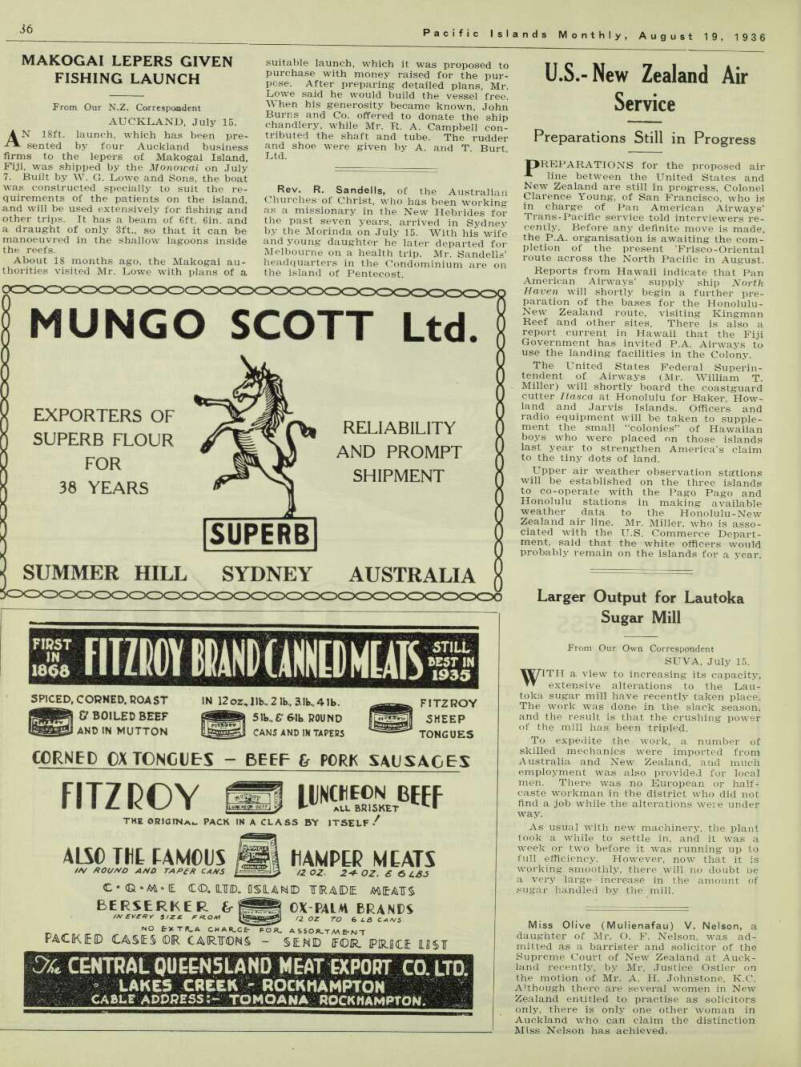
Fishing Launch
From Our N.Z. Correspondent
Auckland, July 15.
AN 18ft. launch, which has been pre sented by four Auckland business firms to the lepers of Makogai Island, Fiji, was shipped by the Monovoai on July 7. Built by W. G. Lowe and Sons, the boat was constructed specially to suit the re quirements of the patients on the island, and will be used extensively for fishing and other trips. It has a beam of 6ft. 6in. and a draught of only 3ft., so that it can be manoeuvred in the shallow lagoons inside the reefs.
About 18 months ago, the Makogai au thorities visited Mr. Lowe with plans of a
suitable launch, which it was proposed to purchase with money raised for the pur pose. After preparing detailed plans, Mr.
Lowe said he would build the vessel free.
When his generosity became known, John Burns and Co. offered to donate the ship chandlery, while Mr. R. A. Campbell con tributed the shaft and tube. The rudder and shoe were given by A. and T. Burt Ltd.
Rev. R. Sandells, of the Australian Churches of Christ, who has been working as a missionary in the New Hebrides for the past seven years, arrived in Sydney by the Morinda on July 15. With his wife and young daughter he later departed for Melbourne on a health trip. Mr. Sandells’ headquarters in the Condominium are on the island of Pentecost,
Service
U.S.-New Zealand Air Service Preparations Still in Progress
"PREPARATIONS for the proposed air A line between the United States and New Zealand are still in progress, Colonel Clarence Young, of San Francisco, who is in charge of Pan American Airways’
Trans-Pacific service told interviewers re cently. Before any definite move is made, the P.A. organisation is awaiting the com pletion of the present ’Frisco-Oriental route across the North Pacific in August.
Reports from Hawaii indicate that Pan American Airways’ supply ship North Haven will shortly begin a further pre paration of the bases for the Honolulu- New Zealand route, visiting Kingman Reef and other sites. There is also a report . current in Hawaii that the Fiji Government has invited P.A. Airways to use the landing facilities in the Colony.
The United States Federal Superin tendent of Airways (Mr. William T.
Miller) will shortly board the coastguard cutter Itasca at Honolulu for Baker. How land and Jarvis Islands. Officers and radio equipment will be taken to supple ment the small “colonies” of Hawaiian boys who were placed on those islands last year to strengthen America’s claim to the tiny dots of land.
Upper air weather observation stations will be established on the three islands to co-operate with the Pago Pago and Honolulu stations in making available weather data to the Honolulu-New Zealand air line. Mr. Miller, who is asso ciated with the U.S. Commerce Depart ment, said that the white officers would probably remain on the islands for a year.
Larger Output for Lautoka
Sugar Mill
From Our Own Correspondent SUVA, July 15.
U/ITH a view to increasing its capacity, extensive alterations to the Lau toka sugar mill have recently taken place.
The work was done in the slack season, and the result is that the crushing power of the mill has been tripled.
To expedite the work, a number of skilled mechanics were imported from Australia and New Zealand, and much employment was also provided for local men. There was no European or half caste workman in the district who did not find a job while the alterations were under way.
As usual with new machinery, the plant took a while to settle in, and it was a week or two before it was running up to full efficiency. However, now that it is working smoothly, there will no doubt be a very large increase in the amount of sugar handled by the mill.
Miss Olive (Mulienafau) V. Nelson, a daughter of Mr. O. F. Nelson, was ad mitted as a barrister and solicitor of the Supreme Court of New Zealand at Auck land recently, by Mr. Justice Ostler on the motion of Mr. A. H. Johnstone, K.C.
Although there are several women in New Zealand entitled to practise as solicitors only, there is only one other woman in Auckland who can claim the distinction Miss Nelson has achieved.
Advertisements & other items, p. 38 (1 item)
Mungo Scott Ltd.
EXPORTERS OF
SUPERB FLOUR
FOR
38 YEARS
SUPERB
RELIABILITY
AND PROMPT
SHIPMENT
SUMMER HILL SYDNEY AUSTRALIA
FIRST
IN 1868
SPICED, CORNED. ROAST
& BOILED BEEF
AND IN MUTTON
IN 12 oz y lib., 2 lb., 3.1 b.. 41b. slb, S' frlb ROUND
CANS AND IN TAPERS
FITZROY
SHEEP
TONGUES
CORNED OXTONGUES - BEEP & PORK SAUSAGES
FITZROY
/ THE ORIGINAL PACK IN A CLASS BY ITSELF
ALSO THE E AMOUS
AV POUND AND TAPER CANS
C°©» M • E
HAMPER MEATS
/ZOZ. 2+0Z.6GL85
C©. Jim (ISLAND TRADE MEATS
BERSERKER & plS| OXPAIAi BRANDS
tpevepy S/Z£ FR.OM , z oz TO 6 ls cahs
NO CMAR.CE- FOR. ASSOR.TME-NT
PACKED CASES OR CARTONS - SEND fOR PRICE IBS!
De Rays Expedition
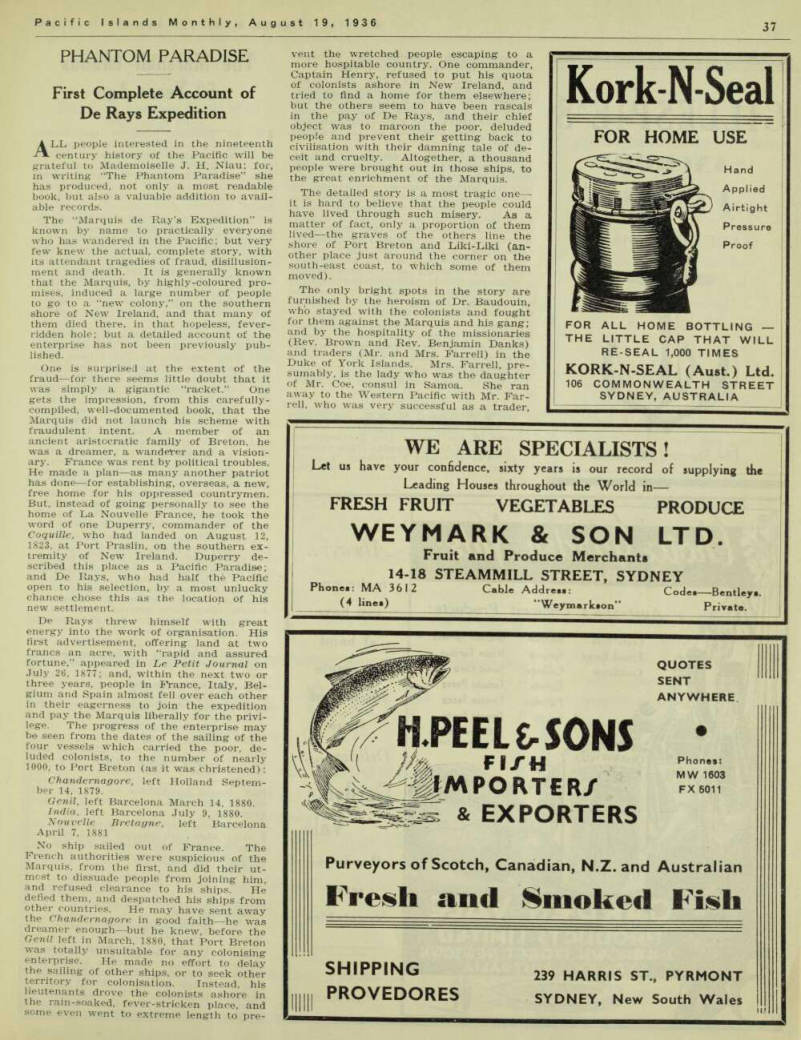
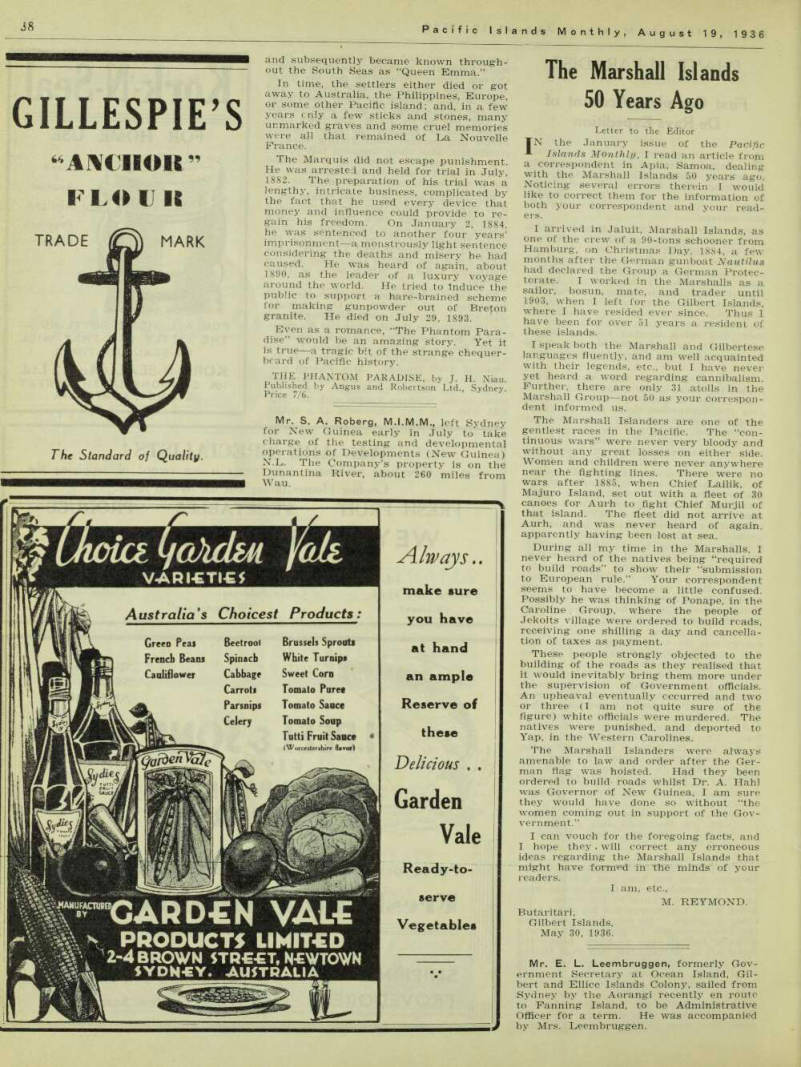
Phantom Paradise
First Complete Account of De Rays Expedition
ALL people interested In the nineteenth century history of the Pacific will be grateful to Mademoiselle J. H. Niau; for, in writing “The Phantom Paradise” she has produced, not only a most readable book, but also a valuable addition to avail able records.
The “Marquis de Ray’s Expedition” is known by name to practically everyone who has wandered in the Pacific; but very few knew the actual, complete story, with its attendant tragedies of fraud, disillusion ment and death. It is generally known that the Marquis, by highly-coloured pro mises, induced a large number of people to go to a “new colony,” on the southern shore of New Ireland, and that many of them died there, in that hopeless, fever ridden hole; but a detailed account of the enterprise has not been previously pub lished.
One is surprised at the extent of the fraud —for there seems little doubt that it was simply a gigantic “racket.” One gets the impression, from this carefully compiled, well-documented book, that the Marquis did not launch his scheme with fraudulent intent. A member of an ancient aristocratic family of Breton, he was a dreamer, a wanderer and a vision ary. France was rent by political troubles.
He made a plan—as many another patriot has done—for establishing, overseas, a new, free home for his oppressed countrymen.
But, instead of going personally to see the home of La Nouvelle France, he took the word of one Duperry, commander of the Coquille, who had landed on August 12, 1823, at Port Praslin, on the southern ex tremity of New Ireland. Duperry de scribed this place as a Pacific Paradise; and De Rays, who had half the Pacific open to his selection, by a most unlucky chance chose this as the location of his new settlement.
De Rays threw himself with great energy into the work of organisation. His first advertisement, offering land at two francs an acre, with “rapid and assured fortune,” appeared in Le Petit Journal on July 26, 1877; and, within the next two or three years, people in France, Italy, Bel gium and Spain almost fell over each other in their eagerness to join the expedition and pay the Marquis liberally for the privi lege. The progress of the enterprise may be seen from the dates of the sailing of the four vessels which carried the poor, de luded colonists, to the number of nearly 1000, to Port Breton (as it was christened); Chandernagore, left Holland Septem ber 14, 1879.
Genii, left Barcelona March 14, 1880.
India, left Barcelona July 9, 1880.
Nouvelle Bretagne, left Barcelona April 7, 1881 No ship sailed out of France. The French authorities were suspicious of the Marquis, from the first, and did their ut most to dissuade people from joining him, and refused clearance to his ships. He defied them, and despatched his ships from other countries. He may have sent away the Chandernagore in good faith—he was dreamer enough—but he knew, before the Genii left in March, 1880, that Port Breton was totally unsuitable for any colonising enterprise. He made no effort to delay the sailing of other ships, or to seek other territory for colonisation. Instead, his lieutenants drove the colonists ashore in the rain-soaked, fever-stricken place, and some even went to extreme length to pre
vent the wretched people escaping to a more hospitable country. One commander, Captain Henry, refused to put his quota of colonists ashore in New Ireland, and tried to find a home for them elsewhere; but the others seem to have been rascals in the pay of De Rays, and their chief object was to maroon the poor, deluded people and prevent their getting back to civilisation with their damning tale of de ceit and cruelty. Altogether, a thousand people were brought out in those ships, to the great enrichment of the Marquis.
The detailed story is a most tragic one— it is hard to believe that the people could have lived through such misery. As a matter of fact, only a proportion of them lived —the graves of the others line the shore of Port Breton and Liki-Liki (an other place just around the corner on the south-east coast, to which some of them moved).
The only bright spots in the story are furnished by the heroism of Dr. Baudouin, who stayed with the colonists and fought for them against the Marquis and his gang; and by the hospitality of the missionaries (Rev. Brown and Rev. Benjamin Danks) and traders (Mr. and Mrs. Farrell) in the Duke of York Islands. Mrs. Farrell, pre sumably, is the lady who was the daughter of Mr. Coe, consul in Samoa. She ran away to the Western Pacific with Mr. Far rell, who was very successful as a trader.
and subsequently became known through out the South Seas as “Queen Emma.”
In time, the settlers either died or got away to Australia, the Philippines, Europe, or some other Pacific island; and, in a few years only a few sticks and stones, many unmarked graves and some cruel memories were all that remained of La Nouvelle Prance.
The Marquis did not escape punishment.
He was arrested and held for trial in July, 1882. The preparation of his trial was a lengthy, intricate business, complicated by the fact that he used every device that money and influence could provide to re gain his freedom. On January 2, 1884, he was sentenced to another four years’ imprisonment—a monstrously light sentence considering the deaths and misery he had caused. He was heard of again, about 1890, as the leader of a luxury voyage around the world. He tried to Induce the public to support a hare-brained scheme for making gunpowder out of Breton granite. He died on July 29, 1893.
Even as a romance, “The Phantom Para dise” would be an amazing story. Yet it is true —a tragic bit of the strange chequer bcard of Pacific history.
THE PHANTOM PARADISE, by J. H. Niau.
Published by Angus and Robertson Ltd., Sydney Price 7/6.
Mr. S. A. Roberg, M.1.M.M., left Sydney for New Guinea early in July to take charge of the testing and developmental operations of Developments (New Guinea) N.L. The Company’s property is on the Dunantina River, about 260 miles from Wau.
Advertisements & other items, pp. 39-40 (1 item)
Kork-N-Seai
FOR ALL HOME BOTTLING
THE LITTLE CAP THAT WILL
RE-SEAL 1,000 TIMES
KORK-N-SEAL (Aust.) Ltd.
106 COMMONWEALTH STREET
SYDNEY, AUSTRALIA
FOR HOME USE
Applied Airtight Pressure Proof Hand
WE ARE SPECIALISTS!
Let us have your confidence, sixty years is our record of supplying the Leading Houses throughout the World in—
FRESH FRUIT VEGETABLES PRODUCE
WEYMARK & SON LTD.
Fruit and Produce Merchants
14-18 STEAMMILL STREET, SYDNEY
Phone.: MA 3612 Cable Addre..: Code. Bentley.. (4 line.) "Weymark.on” Private.
H.PEEL&SONS
QUOTES
SENT
ANYWHERE
Phones: MW 1603 FX 5011
FI/H
& EXPORTERS
Purveyors of Scotch, Canadian, N.Z. and Australian
Fresh and Smoked Fish
SHIPPING
PROVEDORES
239 HARRIS ST., PYRMONT
SYDNEY, New South Wales
GILLESPIE’S
“ANCHOR”
FLO C H
TRADE
MARK
The Standard of Quality.
Always..
make sure you have at hand an ample Reserve of these Delicious . .
Garden
Vale
Ready-to- Australia's Choicest Products Brussels Sprouts White Turnips Sweet Corn Tomato Puree Tomato Sauce Tomato Soup Tutti Fruit Sauce (Worcestershire flavor) Green Pea* French Beans Cauliflower Beetroot Spinach Cabbage Carrots Parsnips Celery & Garden i/di€c
J T uT7 I
IS feS I serve Vegetables • 1 •
EEC 3
The Marshall Islands
50 Years Ago
Letter to the Editor TN the January issue of the Pacific Islands Monthly, I read an article from a correspondent in Apia, Samoa, dealing with the Marshall Islands 50 years ago.
Noticing several errors therein I would like to correct them for the information of both your correspondent and your read ers.
I arrived in Jaluit, Marshall Islands, as one of the crew of a 90-tons schooner from Hamburg, on Christmas Day, 1884, a few months after the German gunboat Nautilus had declared the Group a German Protec torate. I worked in the Marshalls as a sailor, bosun, mate, and trader until 1903, when I left for the Gilbert Islands, where I have resided ever since. Thus I have been for over 51 years a resident of these islands.
I speak both the Marshall and Gilbertese languages fluently, and am well acquainted with their legends, etc., but I have never yet heard a word regarding cannibalism.
Further, there are only 31 atolls in the Marshall Group—not 50 as your correspon dent informed us.
The Marshall Islanders are one of the gentlest races in the Pacific. The “con tinuous wars” were never very bloody and without any great losses on either side.
Women and children were never anywhere near the fighting lines. There were no wars after 1885, when Chief Lailik, of Majuro Island, set out with a fleet of 30 canoes for Aurh to fight Chief Murjil of that island. The fleet did not arrive at Aurh, and was never heard of again, apparently having been lost at sea.
During all my time in the Marshalls, 1 never heard of the natives being “required to build roads” to show their “submission to European rule.” Your correspondent seems to have become a little confused.
Possibly he was thinking of Ponape, in the Caroline Group, where the people of Jekoits village were ordered to build roads, receiving one shilling a day and cancella tion of taxes as payment.
These people strongly objected to the building of the roads as they realised that it would inevitably bring them more under the supervision of Government officials.
An upheaval eventually occurred and two or three (I am not quite sure of the figure) white officials were murdered. The natives were punished, and deported to Yap, in the Western Carolines.
The Marshall Islanders were always amenable to law and order after the Ger man flag was hoisted. Had they been ordered to build roads whilst Dr. A. Hahl was Governor of New Guinea, I am sure they would have done so without “the women coming out in support of the Gov vernment.”
I can vouch for the foregoing facts, and I hope they. will correct any erroneous ideas regarding the Marshall Islands that might have formed in the minds of your readers.
I am, etc.,
M. Reymond.
Butaritari, Gilbert Islands, May 30, 1936.
Mr. E. L. Leembruggen, formerly Gov ernment Secretary at Ocean Island, Gil bert and Ellice Islands Colony, sailed from Sydney by the Aorangi recently en route to Fanning Island, to be Administrative Officer for a term. He was accompanied by Mrs. Leembruggen.
Ashes Scattered In
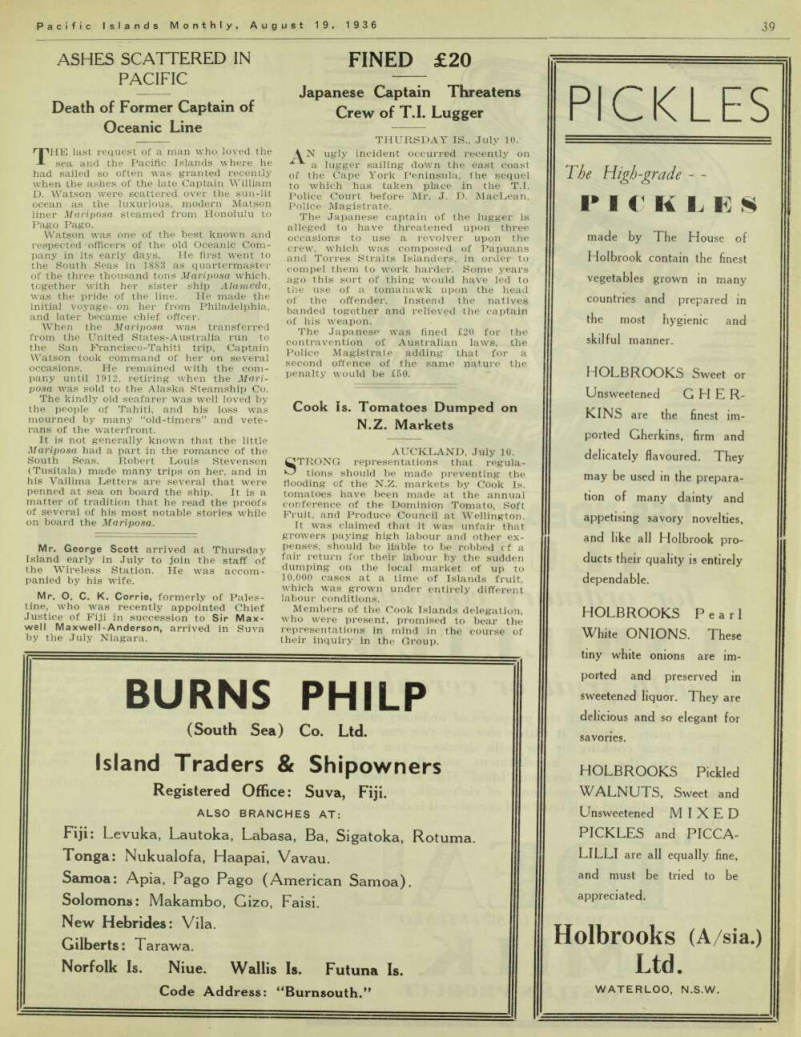
Pacific
Death of Former Captain of Oceanic Line
THE last request of a man who loved the sea and the Pacific Islands where he had sailed so often was granted recently when the ashes of the late Captain William D. Watson were scattered over the sun-lit ocean as the luxurious, modern Matson liner Mariposa steamed from Honolulu to Pago Pago.
Watson was one of the best known and respected officers of the old Oceanic Com pany in its early days. He first went to the South Seas in 1883 as quartermaster of the three thousand tons Mariposa which, together with her sister ship Alameda, was the pride of the line. He made the initial voyage. on her from Philadelphia, and later became chief offcer.
When the Mariposa was transferred from the United States-Australia run to the San Francisco-Tahiti trip, Captain Watson took command of her on several occasions. He remained with the com pany until 1912, retiring when the Mari posa was sold to the Alaska Steamship Co.
The kindly old seafarer was well loved by the people of Tahiti, and his loss was mourned by many “old-timers” and vete rans of the waterfront.
It is not generally known that the little Mariposa had a part in the romance of the South Seas. Robert Louis Stevenson (Tusitala) made many trips on her. and in his Vailima Letters are several that were penned at sea on board the ship. It is a matter of tradition that he read the proofs of several of his most notable stories while on board the Mariposa.
Mr. George Scott arrived at Thursday Island early in July to join the staff of the Wireless Station. He was accom panied by his wife.
Mr. O. C. K. Corrie, formerly of Pales tine, who was recently appointed Chief Justice of Fiji in succession to Sir Max well Maxwell-Anderson, arrived in Suva by the July Niagara.
Fined £20
Japanese Captain Threatens Crew of T.I. Lugger
Thursday Is., July 10.
4 N ugly incident occurred recently on a lugger sailing down the east coast of the Cape York Peninsula, the sequel to which has taken place in the T.I.
Police Court before Mr. J. D. Mac Lean, Police Magistrate.
The Japanese captain of the lugger is alleged to have threatened upon three occasions to use a revolver upon the crew, which was composed of Papuans and Torres Straits Islanders, in order to compel them to work harder. Some years ago this sort of thing would have led to the use of a tomahawk upon the head of the offender. Instead the natives banded together and relieved the captain of his weapon.
The Japanese was fined £2O for the contravention of Australian laws, the Police Magistrate adding that for a second offence of the same nature the penalty would be £5O.
Cook Is. Tomatoes Dumped on
N.Z. Markets
Auckland, July 10.
representations that regulations should be made preventing the flooding of the N.Z. markets by Cook Is. tomatoes have been made at the annual conference of the Dominion Tomato, Soft Fruit, and Produce Council at Wellington.
It was claimed that it was unfair that growers paying high labour and other ex penses, should be liable to be robbed cf a fair return for their labour by the sudden dumping on the local market of up to 10,000 cases at a time of Islands fruit, which was grown under entirely different labour conditions.
Members of the Cook Islands delegation, who were present, promised to bear the representations in mind in the course of their inquiry in the Group.
Advertisements & other items, pp. 41-42 (1 item)
Pickles
The High-grade - -
PICK C E S
made by The House of Holbrook contain the finest vegetables grown in many countries and prepared in the most hygienic and skilful manner.
HOLBROOKS Sweet or Unsweetened GHER- KINS are the finest imported Gherkins, firm and delicately flavoured. They may be used in the preparation of many dainty and appetising savory novelties, and like all Holbrook products their quality is entirely dependable.
HOLBROOKS Pearl
White ONIONS. These tiny white onions are imported and preserved in sweetened liquor. They are delicious and so elegant for savories.
HOLBROOKS Pickled WALNUTS, Sweet and Unsweetened MIXED
PICKLES and PICCA-
LILLI are all equally fine, and must be tried to be appreciated.
Holbrooks (A/sia.)
Ltd.
WATERLOO, N.S.W.
BURNS PHILP
(South Sea) Co. Ltd.
Island Traders & Shipowners
Registered Office: Suva, Fiji.
ALSO BRANCHES AT:
Fiji: Levuka, Lautoka, Labasa, Ba, Sigatoka, Rotuma.
Tonga: Nukualofa, Haapai, Vavau.
Samoa: Apia, Pago Pago (American Samoa).
Solomons: Makambo, Gizo, Faisi.
New Hebrides: Vila.
Gilberts: Tarawa.
Norfolk Is. Niue. Wallis Is. Futuna Is.
Code Address: “Burnsouth.”
USE "IDEAL” MILK
DILUTES!
for ordinary cooking
UNDILUTED
with fruit or cereals
“Ideal” Milk fulfils all the purposes of ordinary milk —and more. Dilute it with water and you can use it for your cooking or for milk drinks you will appreciate the extra nourishment anti flavour of “Ideal” Milk. Then, because “Ideal” Milk is reduced to almost twice the consistency of rich milk, you can serve it undiluted with fruit and cereals—it is delicious that way. u' - — yy
EVAPORATED UNSWEETENED
M I Ik
A NESTLE’S PRODUCT
Copyright 1144
Mr. A. J. Butler
T'HE subject of this photograph is known wherever prospectors gather in the goldfields end of New Guinea. Mr.
Al. Jacob Butler (known popularly as “But”—pronounced “Boot”) describes himself modestly as “miner”; but he is fully entitled to be described as an ex plorer and an authority on native life and customs.
Mr. Butler has lived many years in the Territory, and taken part in some stirring adventures. On one occasion he
was attacked by bush natives in the wilds of Kaipit. He defended himself des perately, with his back to a tree, and with spears embedded all around him in the wood. He was eventually saved by the devotion of a native woman, whose child he had treated for hookworm.
On another occasion, “But” had a hair raising experience, while returning to his home on Mt. Kaindi, Edie Creek, at sun down. He was pursued by an enormous python, of which there are very many in that region at certain times of the year.
Until recently, “But” was an en thusiastic amateur jockey. He has lived a life packed with adventures but, like all true pioneers, he is very diffident about relating his experiences.
“Old Timer.”
Mr. L. J. Davis has been appointed a director of Mandated Alluvials, N.L., which is now actively interested in the Astrolabe copper field in Papua.
Mr. W. Gordon, who has had 36 years’ experience in tea planting in Assam, India, arrived in Sydney by the Nankin on July 22. He is interested in stimu lating the tea planting industry in New Guinea and Australia.
Canon S. W. Williamson, rector of Tocumwal Anglican Church in the Aus tralian diocese of Rivprina, left Melbourne at the end of July for Nauru and Ocean Island. Each year the Australian Board of Missions sends a clergyman to those islands to hold services for the white residents and to give the children a course of Sunday school teaching over a period of three months.
Mr. A. J. Butler.
Pages From The Past

By Eric Ramsden
The Pitcairners Return to Tahiti
nPHOUGH the facts concerning the trans fer of the Pitcairners from their native island to Norfolk Island in 1856 are suffici ently well known, little has been placed on record concerning their former migration to Tahiti in 1831.
In the first week of March of that year the total inhabitants, numbering 87, em barked for Papeete, which was reached on the 23rd. The transfer was carried out by Captain Alexander A. Sandilands of His Majesty’s sloop Comet and the barque Lucy Anne, of Sydney (Captain J. Currey).
It was unfortunate, however, that the re moval took place that year because Tahiti was then on the brink of civil war. An epidemic soon reduced the ranks of the newcomers by 12. The change, too, in other respects was drastic. The immoral ity then rife in Tahiti appalled the Pit cairners: they were not happy until they returned to their own island that same year.
Everything possible was done to make the Pitcairners feel at home. Queen Pomare VI. (Aimata) who was then on the threshold of her chequered career, pro vided land for them, and ordered her fel low-countrymen to build them houses.
During their stay she also accommodated some of the Pitcairners in a large native house in Papeete.
“Although the island was in the most disturbed state on my arrival,” Captain Sandilands reported to the Governor of New South Wales (Sir Ralph Darling), “I was greatly relieved from the anxiety for the situation in which I was placed with the inhabitants of Pitcairn’s Island by re ceiving from the Queen and her chiefs on one side, and the hostile party on the other, assurances that the promises made by her father . . . would be most strictly exe cuted.”
In the early part of their stay the Pit cairners resided near the Queen’s own pro
perty at Papa-oa, a few miles distant from Papeete. Meanwhile, the missionaries and the naval officer's examined what they considered “a very eligible territory” for their future residence. The Queen as sembled the chiefs and gave them to under stand that the land selected had been given for all time to the newcomers. Through out the island, declared Captain Sandilands, the Tahitians manifested a feeling of ‘great regard” for the Pitcairners.
With considerable diligence, the local natives endeavoured to trace their relatives among the newcomers: half a century had passed since the Tahitian women had left the island with the Bounty mutineers. In one instance a native woman actually dis covered that one of the four remaining Tahitian women who had returned was her long lost sister.
From Sydney Sir Ralph Darling ack nowledged Captain Sandiland’s report on March 26, 1831. ‘‘The manner in which this service has been conducted,” he de clared, “cannot fail to prove highly satis factory to His Majesty’s Government.”
But when Captain Fremantle arrived at Tahiti some months later he found that all the Pitcairners had returned to their own island. Assistance in inducing an Ameri can vessel to convey them thither was given by the missionaries and other friends.
“It is an extraordinary circumstance,” reported the naval officer, “that many of the copper bolts of the Bounty which had been brought to Otaheiti from Pitcairn’s Island by the Islanders, were taken by the master of the vessel as part payment of their freight to the amount of 200 dollars.”
The Pitcairners’ own journal provides additional details.
Lucy Anne Quintal was born on the voyage to Tahiti, and died shortly after.
The journal records death after death. To wards the end of April, 1831, John Buffett and family, Robert and Frederick Young, and Edward, Joseph and Charles Christian sailed from Tahiti in a small schooner, but “owing to contrary winds, the afore said persons landed at Lord Hood’s Island, and the vessel returned to Tahiti.” Ed
ward Christian died at Lord Hood’s Island on June 3. His companions returned to Tahiti to find many relatives either dead or dying.
In June, Buffett and some others embarked in the French brig Bordeaux Packet and within six days were back at Pitcairn.
“During our absence our hogs have gone wild anJ destroyed our crops,” they re-
ported. “After our return we employed ourselves in destroying the hogs.”
It was not until September 2 that the American brig Charles Dagget, of Salem, arrived off the island with the remainder of the party. Until the end of that year (1831) there were additional deaths: it was cne of the most disastrous chapters in the history of the Islanders.
Lord Goderich, then Secretary of State for the Colonies, when informing Sir Richard Bourke in June, 1832, to furnish the Pitcairners with “a small supply of what they most needed,” remarked: “They have been compelled, from the unhealthi ness of Otaheiti, to return to their former island.” It was to be distinctly under stood, however, that the Governor of New soum Wales was not to incur “any great expense on this account.”
Commander G. H. Macmurdc, of H.M.S.
Z ehra, in a report to Bourke was more
explicit. He wrote, “Though every pos sible attention and kindness was shown by the Queen, tho chiefs, and the Tahitians in general, and although every want was amply provided for by the agent appointed to supply them, they (the Pitcairners) became so wretched and melancholy and pined so much after their native island that after five months’ residence here dur ing which period 12 of their number died, the missionaries (with that Christian feel ing which marks their character) raised a subscription of 650 Spanish dollars and chartered a vessel which took them back to Pitcairn’s Island in September last.”
One sequel to the Tahiti sojourn was that some of the Pitcairn Islanders imbibed a liking for strong drink —despite the short ness of their stay. Walter Brodie (later an Auckland merchant and New Zealand Parliamentarian), who visited the island in 1850, when the removal was fresh in the minds of the Pitcairners, says that on their return some of the men distilled spirits from the root of the ti-tree and “drank to excess.” However, in 1833 all stills on the island were destroyed. “Which was a great blessing to all,” he declared.
In succeeding years an effort was made to secure the return of the Pitcairners to the Society Islands. The Queen of Hua hine (then an independent island which had declined French sovereignty) offered to make land available for three families.
The offer was put forward for an interest ing reason. Puni, one of the original native women who had gone off with the Bounty mutineers, was a Huahine girl with considerable land on her own island.
As it so happened she was on a visit to Tahiti when the mutineers sailed, and, having fallen in love with one of the Eng lishmen, she accompanied him to Pitcairn.
Though Puni had long since been dead, the Queen of Huahine regarded her de scendants as the rightful owners of her land.
Offers of land were also received from Tahiti and Hawaii.
At one time the Pitcairners were inclined to settle on Juan Fernandez, but the fact that the island was Chilian territory was a bar. At all costs they were determined to remain British. At last, however, they accepted the British Government’s offer of Norfolk Island, and eventually removed to what was formerly a penal settlement.
Nevertheless, within a year some of them were pining for Pitcairn and were not happy until they returned to the island of their birth.
Advertisements & other items, pp. 43-44 (1 item)
Engagement Rings
Of Every Modern
Type
are illustrated in
Anglic A I'oote‘s
Free General Catalogue
This book is a useful shopping guide, freshly compiled annually. It is used and appreciated by the thousands throughout the Pacific Islands, who are obliged to shop by mail.
Promptness and a real interest in a customer’s requirements are distinguishing features of Angus & Coote’s service and this service is ever at your disposal. y/ £2O £25 £3O Rings in three styles at three prices, according to the size of the diamonds.
The lovely design offered here is really the ring of the moment. It's a solitaire. The flashing beauty of the large diamond is enhanced by the rich diamond studded mount.
This is made at £2O, £25, and £3O, according to the size of the centre diamond. Settings are platinum. Mount is 18ct. gold.
To the right thtre’s a stately two-stone design of 18 ct. white gold, with platinum settings.
This is made at £l5, £l7/10/-, and £2O. A pair of perfectly matched diamonds is set in the, centre and small
diamonds sparkle!
from the shoulders. 4/ £l5 £lB 10 - £l6 £l7/10 £2O/0 0 710 Three - stone diamond rings are steady favourites.
The beautifully chased 18ct. gold mount shown here is set with diamonds of three sizes at £ll/10/-, £l5 and £lB/10/-. Settings are platinum.
A signed guarantee of Quality is issued with every ring.
Angus & Coote
LIMITED
500 Geo/ge Street --- Sydney
KA9IBALA Church of England School for Qirls Founded 1887.
A Day and Boarding School for Girls Rose Bay,
SYDNEY, N.S.W.
Kindergarten to Leaving Certificate Resident Qualified Sports Mistress Prospectus on application to the Principal, Kambala School, Tivoli Heights, Rose Bay, Sydney.
Principal: MISS F. HAWTHORNE, B.A. Matron: Miss L. WHITE, A.T.N.A.
Your Sydney Agent?
William E. Reed
(Established 1913)
UNION HOUSE
247 GEORGE ST., SYDNEY
Shell sold, and goods supplied at wholesale prices, on commission.
Enquiries welcomed.
MASTER SEWING MACHINE CO.
ESTABLISHED FOR 23 YEARS
SSJ
I.- ~o Let us know your requirements.
We will be pleased to quote by return mail.
Reconditioned
SEWING MACHINES
For Industrial and Household use.
All Types for Sale.
From £3 Each
Every Machine Guaranteed Mechanically Perfect.
We have the most complete range of Sewing Machines in New South Wales.
Repairs promptly attended to by Competent Mechanics.
No Delays :: All Goods Carefully Packed
Master Sewing Machine Co.
15 Enmore Road, Newtown, Sydney
Over 30 Years Ago..
The first Younger Stove was exported to the Pacific Islands.
Ruggedly strong in construction, highly efficient and economical in fuel has made them the most popular stove in the South Seas.
The illustration shows a Younger Single Stove. Special stoves with cast iron ovens for Island requirements made to order.
Write us for quotations for special sizes and catalogue of double and single oven stoves.
G. Fletcher & Son
50 OXFORD STREET, SYDNEY
r
Linking Torres Straits Islands
With Radio
From Our Own Correspondent
Thursday Island, July 24.
further has eventuated of the proposal to link up the chief islands in Torres Straits with Thursday Island by means of radio.
The organisation in the centre of Australia that is maintained by the Australian Inland Mission for the bene fit of isolated stations and settlers is a proved success. With Mr. Alfred Traeger’s “Pedal Transceiver,” radio messages could be sent by an amateur to the proposed T.I. mother station. It would be of invaluable service to the scattered Europeans. The “powers that be” might well consider the installation of the necessary machines when funds are available.
Mr. B. H, McMahon, educational secre tary of the Seventh Day Adventist Mis sion. returned to Australia by the Mon terey on July 13, after a visit of inspection to Fiji.
Lightship
Japanese Sampan Finds Drifting Lightship
THE Torres Straits lightship, Carpen taria, which slipped her shackles and went off on a jaunt in April, was found near the Aru Islands, off the coast of Dutch New Guinea, in May. Her sister ship the Breaksea Spit lightship, which had broken away from her moorings a month previously and which was ulti mately given up for lost, has at last been found.
The vessel had drifted away before on several occasions, but was as often re covered and towed back to its anchorage off Sandy Cape. During a cyclone in, March, however, it again disappeared, and. despite a search by aeroplanes sent out by the Navigation Department, could not be found. Passing shipping was asked to keep a close look-out for the drifting vessel, but it was not traced.
Recently a Japanese sampan put into Townsville, Queensland. The captain ex plained that he had found a lightship in danger of drifting on to the Barrier Reef, and thinking it belonged to the Aus tralian authorities, had towed it to safety. Then he had decided to bring it back to the Australian cog,st, and had left it outside the town. The Townsville port authorities took possession of the vessel and towed it into port.
Bena Tuidraki, a Fijian medical prac titioner, who has been working in the New Hebrides for three years, arrived in Sydney on July 15 by the Morinda on his way to Suva for a holiday.
The Rising Of
Palolo
Letter to the Editor IREAD with interest an article in a recent issue by A.M.A. on the Palolo.
He is wrong, however, when he says that no European can tell for certain when it rises.
The accepted idea is that only the old natives know when it occurs. These na tives simply watch the moon to get their information. For many years I took note of the morning on which it rose, and every one was on the third quarter of the moon.
A.M.A. asserts that two days after full moon is the approximate date. Again he is wrong, for the third quarter is not until seven or eight days after full moon. To find the correct date of the third quarter, let A.M.A. use a calendar printed south of the line, otherwise if he takes the third quarter as stated on an English almanac he will arrive exactly a day late.
There are two risings—the small one and the big rising. The months differ—one year it will come up in October and No vember, and another in November and December. Anyhow A.M.A. will know by the smell cf the scum that rises a few days before the Palolo itself.
Very few people know that it is the change of tide on the third quarter of the moon that makes the Palolo rise at day light or later. It does not always rise at daylight, as I found out in 1933. I had gone to the outer patch where it comes up usually; all the signs were there—but no Palolo. I gave up waiting about eight o’clock and returned to the plantation. On my way home via the second patch I saw it rise at half-past eight.
The above information should save people many fruitless trips to the reef. To
save A.M.A. wasting his own time I sug gest that he should go out on November 4, 1936, when he will get Palolo for certain.
He has no hope of seeing any if he fol lows his own method of going out two days after full moon. Palolo will also rise this year on December 4.
I am, etc.,
Arthur Robinson.
Natovo Estate, Vanua Devu, Fiji.
Advertisements & other items, p. 45 (1 item)
Newlands Brothers Ltd
PURE RICE
STARCH
Always ask for . . .
“CORAL” Brand
100% PURE
Noted for its
QUALITY
and
WHITENESS
Goes Farthest and gives Lasting Finish
WILL NOT
STICK TO
IRON
Obtainable from Leading Island Stores
CORAL BRAND
RICE STARCH
Manufactured by
AUSTRALIAN RICE LTD.
Sydney, N.S.W.
n Produced in Australia by
STEEL BEDSTEADS
WIRE MATTRESSES
“MORNING GLORY” BEDDING
TUBULAR STEEL FURNITURE
“LISTER” HOSPITAL EQUIPMENT
SHIPS’ ALL METAL BERTHS
WE WILL GLADLY FORWARD OUR
COMPLETE SETS OF CATALOGUES
-m
Newlands Brothers Ltd
RILEY STREET :: SYDNEY, N.S.W.
Australia’s Largest Manufacturers of Modern Sleeping Equipment.
Cable address: “Newlandbed/ Sydney
and Papua
Pedal Radio Sets in N. Guinea and Papua
A FORM of radio which is increasingly coming into practice in the Islands is the “one native power” or pedal driven transmitter, which has been developed in Australia by Amalgamated Wireless (Aus tralasia) Ltd. especially for use in inacces sible districts. These little sets weigh about 1 cwt. and can be carried in sec tions. Power for th© electric generator is provided by an Islander who “rides” a bi cycle-like structure.
The sets have been found particularly suitable for the conditions of Papua and New Guinea where no fewer than 36 A.W.A. sets have been established. Some are used by Government officials on their journeys into remote places, thus enabling
constant touch to be maintained with headquarters. Planters and traders have lately learned of the value of this type of instrument, a call through which might save a journey of scores of miles over trackless territory.
Amalgamated Wireless reports that the pedal driven sets are admirable also as feeders of the main wireless lines of com munication between the territories and the outside world. Thus a planter or trader will transmit a message from his own locality to Rabaul or Moresby to be sent on to a business firm, perhaps, in Sydney or another Australian capital. From the point of view of the owner of a small transmitter the traffic is good business as the sender, instead of paying 2d. per word to get his message to the main station, has the right of retaining Id. for acting as his own telegraphist.
B.S.I. Council
Non-Official Members’ Vigorous Protest
From a Special Correspondent
Tulagi, July 2.
THE bi-annual session of the Advisory Council of the British Solomon Islands Protectorate opened at Tulagi on June 12.
Members present were:—Official: His Hon our the Acting Resident Commissioner (Captain N. S. B. Kidson), Treasurer (Mr.
F. E. Johnson, 1.5.0.), Senior Medical Officer (Dr. H. B. Hetherington), Acting Commissioner of Lands (Mr. A. H. Wil son). Non-official; Messrs. D. MacKin non, G. E. Clift, and J. C. M. Scott, and the Rev. S. G. Caulton.
In his address to the Council, the Pre sident stated that copra exported during 1935-36 amounted to 20,699 tons, an in crease of 2606 tons compared with the pre vious year. Trochus shell, at 349 tons, showed a decrease of 67 tons; and ivory nuts fell from 707 tons to 373 tons.
Revenue amounted to £58,465, and ex penditure to £49,224, leaving a surplus of £9,241.
The principal variations from estimated returns were;—Export duty on copra, an increase of £5100; import duty realised £lOOO less than anticipated; while the sale of stamps, mainly due to the demand for the Jubilee issue, was up £2OOO. Rents and royalties brought in £476 more than in the previous year.
Due to various vacant posts in the Public Service not being filled and by the exercise of economy in all departments, expenditure was less than the amount budgeted for by approximately £5OOO.
Inter-Island Wireless
The question of inter-island wireless communication, which was discussed at previous meetings of the Council, is receiv ing close attention. If proposals sub mitted to the High Commissioner for the Western Pacific relating to the establish ment of an experimental station are ap proved, and results are satisfactory, an extension of the service to outlying parts of the Group will be considered.
Premature Nut-Fall
Investigation of the serious problem of the premature fall of nuts is being in tensively prosecuted by the Government entomologist (Mr. R. J. Lever), in co operation with Dr. Phillips, of Lever’s Pacific Plantations Ltd. Experiments so far point to the green coconut bug, amhly pelta cocophaga China, being responsible for the trouble. A parasite to control amhlypelta is being sought for, and scien tists in Java have promised assistance.
Non-Official Recommendations
Non-official members in their reply to his Honour’s address submitted certain im portant recommendations. They stressed the urgent need of re-appointing a District Officer at Shortlands, in view of its being a proclaimed port of entry for shipping.
It is the nearest 8.5.1. port to New Guinea, with which there is considerable traffic.
They also represented the claims of the copra industry for some measure of relief in view of the improved state of Govern ment finances, and suggested a reduction of the export tax of 7/3 per ton. It was pointed out that in New Guinea the gradu ated scale on which the export tax was based called for no payment while the mar ket rate for copra was at the present level.
Attention was drawn to the serious in
roads made upon the shell-beds in 8.5.1. waters by poaching vessels of foreign na tionality. One such vessel was recently intercepted and taken into custody, but it was found that the maximum penalty which could be imposed was a fine of £lO.
Members recommended that power be obtained to inflict a more adequate and de terrent sentence in future cases.
Reduced Minimum Wage Rate
The chairman’s announcement that towards the end of the year an Ad visory Board would meet to recon sider the reduced minimum wage for labourers under indenture gave rise to a vigorous and emphatic pro test. When the Secretary of State for the Colonies sanctioned the reduction of the minimum wage as from December, 1934, he laid down the condition that the question should be reviewed at the end of 1936. To that no exception was taken, but non-offici al members protested in the strongest terms at the inferential slight placed upon the Advisory Council by the evident inten tion of the Administration to submit such an important question to a Board that does not at present exist. It was argued that the personnel of the proposed Board might not possess the knowledge and experience necessary to a thorough and comprehen sive investigation of the subject.
The Advisory Council, it was pointed out, is an approved, permanent component of the Protectorate Administration and is composed of members nominated by the Resident Commissioner to represent Go vernment. native interests, commerce, and industry. It is, in effect, a parliament charged with the responsibility of advising the Resident Commissioner on all proposed legislative enactments, and administrative policy generally.
Protest To High Commissioner
That so representative and experienced a Council should be superseded by an ex traneous Board to deal with such a vital question must give rise to serious consid eration as to the continued usefulness of a Nominated Council. In view of the potential political and economic aspect of the matter non-official members requested that their considered, unanimous protest be conveyed to the High Commissioner for the Western Pacific, and to the Secretary of State for the Colonies.
Business discussed during the session in cluded reconsideration of a recommenda tion that the licence fee for trading stores situated cutside certain business areas be reduced. A Government proposal to abol ish all trade licences, and in their stead substitute an increase in import and export duties was opposed by non-official mem bers. After debate, the latter unanimously recommended that the licences referred to should be issued at the flat rate of £3 per annum as against £lO (the existing rate) for stores within defined business areas.
The matter of granting exemption from light and harbour dues to visiting British yachts gave rise to the question of Pro tectorate author'tv to discriminate in the treatment of British and foreign vessels.
It was decided to submit the question to the Secretary cf State.
New Stamp Issue
The issue of pictorial postage stamps, previously recommended by the Council, was agreed to by the Colonial Secretary, at whose request members examined and approved certain designs for use on stamps of 12 denominations.
The session closed with a debate on an amendment to the Agriculture and Live Stock Regulation moved by Mr. G. E.
Clift, which, with minor alterations, was agreed to.
Advertisements & other items, p. 46 (1 item)
Link-Belt Co. Ltd.
PAINT
HORSE SHOE BRAND
IN PASTE OR READY
MIXED FORM
WHITE LEAD, WHITE ZINC
AND ALL COLOURS
Made in Scotland— CZ —therefore Reliable!
THOMAS MACINTYRE & CO. LTD., -GLASGOW, SCOTLAND
DOYLE’S famous VETERINARY REMEDIES
OOYLF*
i
ORES?
REDUCINE—Cures Your Lame Horse. Cures him painlessly and you can work him all the time.
Cures Splints, Curbs, Capped Hocks, Sprung Tendons, Bog Spavins, and all Bony and Bursal Enlargements. Price, 12/6 per can. Postage 1/-.
LARYNGINE] —A sure cure for Coughs. Colds, Strangles, etc. Price, 5/- per can. Postage, 1/-.
SKIN DRESSING.—A certain remedy for Mange and Allied Parasitic Skin Diseases in Horses, Dogs, etc. Price, 7/6 (large), 3/6 (small). Postage, 1/-.
DISTEMPER MIXTURE.—A safe and reliable remedy for Coughs, Colds, Asthma, etc. Price, 2/6. Postage, 9d.
T. G. DOYLE, V.S., 9 KING STREET, RANDWICK, N.S.W.
Write for Free Veterinary Advice and Booklet
LINK-BELT CO. LTD.
17 GOULBURN STREET, SYDNEY
o o
Centrifugal
Discharge
Bucket Elevator y O Modern Machinery Equipment for Elevating, Conveying and Mechanical Handling of Material.
Sole Agents in Australia for Ewart Chain Belting in Malleable or Steel.
Specialists in Power Transmission Machinery.
Large Stocks always kept of Steel Shafting, Cast Iron, Steel, or Wood Split Pulleys.
Plummer Blocks, Collars, Couplings, Leather Belting, Hangar Bearings.
Lubricators, Engineers’ Wrenches.
MANUFACTURING ENGINEERS
Polygamy Tabu—So
Native Killed His Wife
From Our Own Correspondent
Rabaul, July 2.
THERE w r as much criticism and bicker ing at the beginning of the year when the N. Guinea marriage laws were amend ed to make it impossible for a native to contract a European or Christian marriage.
In introducing the bill, the Government Secretary (Mr. H. H. Page) said that the majority of natives were not able yet to understand the obligations of matrimony.
In the Supreme Court last month, an interesting case showed the significance ascribed by natives to marriages made ac cording to mission rites.
A native, Sangar, was charged with wil fully killing his wife. He explained, as his
defence, that he wanted to take another woman as his spouse, but having been married by a missionary was unable to do so. He told the court that he solved the problem by murdering his wife!
Sangar was sentenced to death.
Captain A. S. Fitch, of Steamships Trading Co. Ltd., returned to Samarai, Papua, by the Montoro from Sydney on July 29, after a month’s business visit.
Advertisements & other items, p. 47 (1 item)
Clear those Idle Acres..
SAMUEL RUSSELL
ESTATE AND GENERAL AGENT
P.O. Box 64, Papeete, Tahiti
Heal Estate. Investments. Estate Management and Administration. Valuations and Reports. Houses & Lands for Lease or Sale.
Sole Proprietor; TAHITI PERFUMES.
Cables: Russell, Tahiti (Bentley’s Code)
Clear those Idle Acres..
—with these ONc-MAN OUTFITS
When you consider that with the Digger Winch one man can uproot trees feet in thickness without any preliminary root cutting even in the hardest ground; when you realise that one man can uproot eighty of those trees a day and doesn’t even have to shift his feet when pulling, you know how simple it makes the work. What a labour saver! You simply cannot break it—and yet it is so light it can be carried.
These pamphlets were printed to guide you
Write
for
them
When you appreciate that the New Record Drag Haw is a one-man outfit , so simple that even native labour cannot help but work it successfully; when you are assured that it can operate in swampy ground or on the side of a hill as simply as on hard level ground; when you credit that it can saw through logs on the ground (solid or hollow) from bins, thick to 7ft. and more, you can conceive how it puts profits into clearing —instead of costing money.
When you are satisfied that there are dozens giving service in the Islands, you will not hesitate longer but will start on the job yourself.
Don’t hesitate—write to-night for full particulars of these one-man outfits.
The “Buzacott”
/ £
Drag-Saw
Buzacott Co* Ltd
7-11 Market Street, Sydney
Ketch “Hurricane,”
World Cruiser,
Reaches Fiji
From Our Own Correspondent SUVA, July 12.
GY AGING around the world, the 17- T tons American ketch, Hurricane, arrived in Suva on June 24 to spend seve ral weeks in Fiji.
Built by the Captain, Mr. Ray Kauff
man, and Mr. Gerry Mefferd, she left Key West in April last year. She cruised to South America, thence through the Pana ma and around various islands in the Pacific, practically following the same course as the American scientific yacht, Director. Mr. R. Burrell joined the ketch in Tahiti, and Mr. Samuel H. Elbert joined her in Pago Pago, but has left the vessel here.
After Suva the Hurricane will go on to the New Hebrides and the Solomons, and thence to the United States, via the Cape of Good Hope.
Papua
The Uvi Uvi
Another Mysterious Fish of Papua
Letter to the Editor T N the May P.I.M. an article appeared re -1 gating to a mysterious fish seen in the Vari-Vari Islands. Allow me to say a few words about a similar monster.
I am in charge of the Maclaren King, running on the N.E. coast of Papua, and during the last 13 years I have seen a mysterious large fish five times. lam not a fisherman and, therefore, not inter ested in fish yarns. This fish has also been seen by His Lordship the Bishop of New Guinea, Colonel Hooper (Government Schools Inspector), and others who were with me on the several occasions.
About six months ago, I was 10 miles off Eroro, in Dyke Ackland Bay, when my boys (from Gcodenough Bay) informed me that a monstrous fish (they called it uvi uvi) was ahead. We passed it about 100 yards away; then just ahead another ap peared, slowly coming to the surface. I decided to ram it, but as I approached it, its enormous size scared me, and I quickly altered course. By doing so we came abreast of it, at a distance of about 10 feet.
The monster was lying on the surface, its back just awash, and the fin in the centre of its back was level with the rail of the boat, about three feet high. The top of the tail which was also vertical was slightly higher. Comparing it with the boat, its length was about 40ft. and its diameter about 10ft. It seemed to me to be round, similar to a barrel, with a very blunt head, the mouth not being visible.
In colour it was dark brown with yellowish spots. Just after passing it we saw another.
Only a few years ago a whale boat be longing to local natives left Taupota with seven boys to go to a place eight miles away; the sea was quite calm, with a light land breeze blowing. They never arrived at their destination, and sometime after wards the boat was washed up on the beach upside down, not far from where they had started. Nothing was ever heard of the natives.
Just previous to this mishap the uvi uvi was seen in that vicinity, and to this day the natives believe that the cause of the disaster was the giant fish. The whale boat was pulled up on the beach where it was washed ashore, and the natives were so scared that it was never used again.
It remained there and eventually fell to pieces.
I am, etc.,
F. C. Kennels.
Samarai, Papua. 15/6/36.
To Keep Playing Fields And
Aerodromes In Trim
THE first English firm to manufacture lawn mowers, Messrs. Ransomes, Sims and Jeff ries, Ltd., has issued its 1936 catalogue. This 52-page brochure, copiously illustrated, shows the large range of mowers made by the famous English concern.
There are lawn mowers of every conceivable size and type, from the ordinary hand-pushed cutter for small homes to the power-driven tractor hauling seven mowing machines for keeping aerodromes, golf courses, and playing fields in good order. The company also distributes tennis court and garden rollers, lawn sweepers, and bank cutters of its own manufacture.
Islands residents interested may obtain a copy of this comprehensive catalogue by writing direct to Messrs. Ransomes, Sims, and Jeffries, Ltd., Ips wich, England.***
Advertisements & other items, p. 48 (1 item)
Cordage and
SHIP CHANDLERY - HARDWARE
BROOMFIELDS LIMITED, 152 Sussex St., SYDNEY
Large and Complete Stocks of SHIP CHANDLERY.
Ironmongery of all kinds—Paints, White Lead and Oils.
Sole Agents for:
P. H. MUNTZ & CO.’S 3-
PEACOCK & BUCHANS’
CROWN BRAND METAL SHEATHING.
ENGLISH READY-MIXED PAINTS.
WRITE FOR SHIP CHANDLERY CATALOGUE
Special In Bond Prices for all Island enquiries quoted on application
CABLES: “BOOM,” SYDNEY
“Mokarnie” COTTON TEXTILES
A. B. Brotherton & Co. Ltd.
(Arnold B. Brotherton)
GOVERNMENT CONTRACTORS
40 DICKINSON STREET, MANCHESTER, 1
Manufacturers of “MOKARNIE" Fabrics, Joker-Brand, etc. Lava-Lavas, Pearl Divers’ Khaki Drills, Denims Shirtings, Longcloths, Italians, Linings, etc. suitable for the South Pacific Trade.
NO DIRECT TRADE.—Orders only through European Houses.
Scott’s Renown Brand Rope,
Cordage and
Binder
Twine
Cable Address: Ropeyard, Sydney, ■M - -.
of Every
Description
MANUFACTURED AT
MASCOT. N.S.W.
By
J. Scott Ltd.
Head Office and Store:
163 CLARENCE ST.,
SYDNEY, N.S.W.
Sunday Island
H.M.S. “Dunedin” Visits Two Modern Crusoes
From Our N.Z. Correspondent
Auckland. July 20.
4 VISIT to Sunday Island, where two New Zealanders went last year to live the life of modern Crusoes. was paid by H.M.S. Dunedin in the course of her present Pacific cruise. It was the first contact the two men. Mr. A. Bacon and Mr. B. Robertson had had with the out side world for many months. The war ship delivered mails from relatives in New Zealand.
A few short blasts on the siren brought the two men to the water’s edge, and they were, taken aboard the Dunedin in a whaler. One was wearing a singlet, shorts, and an old straw hat. and the other only a pair of shorts and a long ginger beard.
They had dinner on the warship.
Several of the naval men visited the shack on the island. They found it sur rounded by orange trees laden with fruit and healthy in growth. Other tropical fruits and vegetables were in cultivation nearby. The men were apparently en joying their lonely existence.
Mr. Bacon, it will be remembered, was one of a party which attempted to settle the island in 1926, but the venture ended in tragedy when one of the party died of tetanus. He now intends to pass the re mainder of his days there.
Mr. D. H. Vertigan, of the N.G. District Services Department, sailed from Sydney for Rabaul with his wife and two children by the Montoro at the end of July.
Sandalwood In The
South Seas
IN November, 1829, news was brought to Oahu (Hawaii) that an island rich in sandalwood had been discovered in New Hebrides. The Hawaiians had been doing a great trade with the East; but the extensive groves of Hawaiian sandal wood, which had been discovered in 1790, were almost depleted in 1824.
The Hawaiians were ready to exploit other islands, and two brigs were fitted out. Some 500 people, including ten foreigners, started for this Eldorado. They first called at Rotuma, north of Fiji; and from there they sailed for Erromanga, New Hebrides. The first brig, the Kame hameha, was never heard of again. The Becket reached Erromanga; but, fighting with the natives, they obtained no sandal wood; and as her sister ship did not arrive, the chief in command turned homeward.
Until the middle of the 18th century, all the commercial sandalwood had been col lected in the East Indies and from Southern India. But after Captain Cook described the Pacific Islands, the hardy traders knew that there was money to be made, and one of the first products they discovered was the sandalwood in Fiji.
The Tongan Islanders had been trading there before.
Then Australia took a hand. Sydney merchants fitted out brigs and schooners, manned with restless adventurers who, like the whalers, received a bonus on all the sandalwood collected, in addition to their wages. Sydney became a centre for its export to the East. Governor Bligh, looking for revenue, placed an import duty of £2/10/- a ton on all sandalwood
landed, but as it brought from £5O to £7O a ton, the industry was not seriously hampered. After the sandalwood in Fiji was exhausted, they turned their atten tion to the New Hebrides.
So thorough was the collecting of this wood in the Pacific Islands that when Captain Charles Wilkes, commander of the United States Exploring Expedition, visited Fiji in 1840, he found it difficult to obtain herbarium specimens for his botanist; and Berthold Seeman had to base his botanical description of Santalum Yasi on a specimen that the Rev. John Williams had planted in the garden of the Bua Mission Station.
Nowadays there is not much sandal wood left in the South Seas, except in certain parts of the New Hebrides. In quiries as to a market for the product have recently been received in Australia from the Condominium, and it has been ascertained that Sydney merchants for a variety of reasons do not care to handle it. The chief aversion to dealing in sandalwood appears to be that it has to be transhipped to Hong Kong where it remains in store for long periods before it is sold.
Official quotation has been granted by the Melbourne Stock Exchange to 100 fully paid shares of £lO each (issued to the vendors) in Mount Lawson Prospect ing and Option Syndicate N.L., of New Guinea.
Advertisements & other items, pp. 49-50 (1 item)
Deutz
W. n. ItEID
C/o. Robert Reid & Co., Ltd.
32-34 YORK STREET, SYDNEY
Wholesale Exporter of Goods of all Classes from Australia
DEUTZ
DIESEL
ENGINES
c Deutz Engines usedlnternationally since 1864
MARINE DIESEL “OM” TYPE
■Waae.
EUT
Range from 10 to 140 B.H.P.
Full information obtainable from the Agents
Herbert Del Cott Pty. Ltd.
15 CASTLEREAGH STREET, SYDNEY
’Phone: B 3135
“A p C* ” electrical
r\m L•VJ • EQUIPMENT
FREE ELECTRICITY!
with “A EG” Turbinamos
A “Turbinamo” working from a stream generates sufficient electricity for households, plantations or communities.
Simple to Instal Reliable Supply No Running Costs Looks After Itself Sizes 0.5 kw. to 40 kw.
Write for particulars. State head of water available and Electricity output required.
Cables ‘'Voltage” 116 QUEEN STREET, MELBOURNE ’Phone: Central 10488
Timber Joinery
ETC.
PREPARED BUILDINGS
ready for erection a speciality.
SHIP and BOAT BUILDING
TIMBERS specially catered for
FIBROLITE, PLYWOODS.
GALVANISED IRON.
CANEC.
O CONSIGNMENTS shipped
by RETURN STEAMERS
to the Islands.
John W. Eaton Ltd.
WEST CRESCENT ST.,
NORTH SYDNEY
TELEPHONES: X 5051 (5 lines)
New Caledonian Chrome in Demand
Demand
~rT VHE confused political situation in ■¥ Europe and ‘war-scares’ have given a great stimulus to the world demand for New Caledonian chrome,” said Mr. Enoch Perkins, mining engineer connected with the Mutual Chemical Company of America, on his arrival in Australia from New York by the Monterey on July 13. ‘‘Because of the increase in the manufac ture of aeroplanes there is a great de mand for chrome. Most of New Cale donia’s output goes to the United States, while Great Britain buys about 25 per cent.,” continued Mr. Perkins. ‘‘There are about 15,000 persons em ployed in the chrome and nickel industries in the French colony. The rpines are all controlled either by British or American capital,” he added.
Mr. Perkins departed from Sydney for Noumea to inspect his company’s proper ties by the Wanganella on July 18.
Mr. W. E. Rosser, who is a clerk in the Government Secretary’s Department at Port Moresby, arrived in Sydney by the Montoro from Papua on July 24. He is on six months’ leave.
Wanted—A Museum At
Apia
Letter to the Editor. ¥X a recent issue of the Apia paper, a New A Zealander, who during the war had served in Samoa, complained of the fact that the large Samoan War Canoe, a not able relic of the old days, which for years had been housed in a Samoan fale at Mulinu u, had, owing to carelessness and indifference of those in charge, deterior ated and had now altogether disappeared.
Numerous other valuable relics and sou venirs of old Samoa, which have been placed in charge of the Government, have also gone. It is deplorab.e that nobody seems to take the slightest interest in the preservation of ethnologically, historically and artistically most valuable specimens, most of which are irretrievably lost and cannot be replaced.
The same may be stated regarding the literature of Samoa. Hundreds of books have been written on Samoan life and his tory from the time the first missionaries reached Samoa over one hundred years ago until the present time. Many of these books, which have been written in Eng lish, German. French, and other lan guages, are now out of print and are hard to obtain. Nevertheless it should still be possible to obtain a fairly complete library of Samoan books.
Most of the white pioneers, resident in pre-war Samoa, have passed away, and these few remaining are going rapidly.
Many of these pioneers have valuable diaries, documents, and papers in their possession, which have historical value and should be preserved.
I wish to suggest that a Museum and Library be established in Apia to house the relics, books, records, and documents of value. I firmly believe that the Carnegie Foundation would willingly subsidise such a project. It is possible that the New Zea land Government would also help, while the Samoan Administration would be asked to supply suitable rooms to house the exhibits. In a Samoan Museum one room should be devoted to a collection of souvenirs and writings of that greatest of all celebrities connected forever with the name of Samoa—Robert Louis Stevenson.
There is no doubt, also, that a Museum would prove an additional attraction to visitors and tourists.
I am, etc.,
A. M. Gurau.
Apia, Samoa, 2/7/1936.
Study Of Polynesian
History And Languages
Auckland, July 16
l¥Y r the Monterey on July 10, a party of ■*-* Americans arrived in Auckland from Honolulu to study the similarity between the Macri language and customs and those of the Hawaiian people.
The group included Mr. H. P. Judd (Pro fessor of Hawaiian History and Language at the University of Hawaii), Mr. W. B.
Howe (former president of the U.S. Navy League), Mr. W. Howe, junr. (a student of anthropology at Harvard University), Messrs. T. H. and S. M. Ccoke (sons of the president of the Hawaii Senate), and Mr.
A. F. Judd, junr. (son of the president of the Bishop Museum, Honolulu).
They will spend a month in New Zea land, and then depart for Tahiti to carry out a similar research.
Advertisements & other items, p. 50 (1 item)
Ferrodor
BITUMENOID ROOFING
MADE IN AUSTRALIA
Bitumenoid Roofings, Dampcourses and Insulating Felts are made from the world’s best raw materials. Warranted to stand the most rigid tests.
BITUMENOID THE BEST
Roofing 1, 2 3-ply; Flooring, Waterproof Materials; Saturated Felt; Resilient Road Jointing; Natural Asphalt Dampcourse; 2 and 3-ply Dampcourse; l-21b. Lead-core Dampcourse; Roofing Cement; Asphalt Paints; Roofing Compound.
SAMPLES AND PRICE LISTS ON APPLICATION
MAXWELL PORTER & SON LTD.
ESTABLISHED 1888. BUILDERS’ SUPPLIES
107 REDFERN ST., REDFERN, SYDNEY, N.S.W. ’Phone, M 3157. Cables Bitumenoid
Ram
and Sun...
a§ doitrnetiie to
lloodwork as Fire!
Ram and dew cause unprotected woodwork to swell. The sun makes it shrink again.
Unprotected woodwork is in a state of constant movement, which affects the joints and also causes cracks which become centres for decay. Prevent the decay of YOUR property coat it with a paint that WILL protect it against rain and sun.
Use only—
FERRODOR
{ANTI-
CORROSIVE)
PAINT
First give woodwork (and ironwork) a priming coat of FERRODOR No. 29 NATURAL STEEL GREY, then follow it up with any of the 25 modern FERRODOR colours which are supplied in paste form or ready to use.
Obtain FERRODOR PAINT (colour card on request) at all leading merchants or the Sole Agents—
WILLIAM ADAMS L COMPANY
175 CLARENCE STREET, SYDNEY
N.Z. Labour Party
Branch Formed in Cook Group
From Our Own Correspondent
Rarotonga, July 14.
A PROGRESSIVE step in the native life of Rarotonga was mad© on July 1, when a branch of the New Zealand Labour Party was formed at Avarua.
The meeting in the Maraerenga Hall was well attended, at least 200 persons being present, the majority of whom were natives, together with a small number of Europeans and ,a sprinkling of half castes.
After announcing the object of the meeting and briefly explaining the aims of the Labour movement, Mr. William Mcßirney (the convener) called for nominations for a temporary president and secretary. These offices were filled by Mr. Dave Brown (manager for W. H.
Grove and Son) and Mr. R. J. Dashwood.
Mr. Brown, a resident of 10 years’ stand ing, was formerly associated with the Labour movement in New Zealand.
Mr. Brown, who proceeded to a further explanation of the work of the Labour Party, pointed out the advantages of a local branch, emphasising that apparently the present N.Z. Government is desirous of assisting and furthering the general welfare of the Islanders.
A motion that a local branch be formed was then put by the secretary and carried by a substantial majority.
Considerable interest was shown in a debate on the respective merits of an elected and a nominated Island Council, the general opinion of those present being in favour of the former. The possible advantages of political representation were also touched upon.
Before the meeting closed, a number of those present, including eight Europeans and one member of the Island Council, enrolled in the new branch.
“Important As Tavua”
Dr. Loftus Hills’ View of Yanawai Goldfield
WORK done on the Yanawai goldfield on ™ Vanua Levu, Fiji, during the last six months indicates that it will probably be as important a field as Tavua, according to an opinion expressed by Dr. Loftus Hills, consulting mining geologist to a number of Fijian companies, who arrived in New Zealand in mid-July by the Monowai. en route to Australia.
“Although discovered before Tavua, its development has not been so rapid,” said Dr. Hills. “But the stage has now been reached where an estimate of the possibili ties and extent, of the field could be ipade.”
Dr. Hills added that the area was more difficult to prospect than the Tavua field, as it was situated in the rainy district and was covered with heavy jungle. The lodes were similar to those of Tavua.
Miss Edith Twyford, who recently com pleted a course in anthropology at the George Brown College, Sydney, will shortly return to Papua to resume her work for the Methodist Missionary Society.
Advertisements & other items, pp. 51-52 (2 items)
Jtss “35
Norfolk Island Cable Repaired
THE cable steamer Recorder returned to Sydney on July 24, after having repaired the cable at Norfolk Island, which had been damaged during the re cent cyclone. Owing to the changeable weather, great difficulty was experienced in making the repairs, and when the weather was rough work had to be aban doned temporarily.
The cables from Suva (Fiji), Southport (Queensland), and Auckland (N.Z.) were damaged, and when repairs were com pleted it was found that coal supplies were dwindling. The vessel returned to
Sydney for fuel before leaving for Singa pore, where she will be stationed in future.
While the emergency cable between s s', dn ® y and New Zealand was being re-
JTSS “35
, . , , , . . / ’ , .r slllp raced back to port for medlcal aid.
During the voyage, the chief engineer, Mr. W. Foster, became ill, and was landed at Auckland, where he entered hospital for an operation. Mr. Foster is well known in Pacific Islands ports. He was one of the crew of the Iris which cap tured the famous Von Luckner in the Kermadec Group in 1917.
M. Lailheugue, who has had charge of the Health Department in New Cale donia since the beginning of last year, returned to Prance by the Ville d’Amiens in July.
Very Rev. J. M. Chabot, Vicar Delegate of the Sacred Heart Mission in Papua, arrived in Sydney by the Montoro on July 24. He has been a missionary in the Pacific for 36 years, during 14 of which he has been stationed at Yule Island.
Fibrolite
crntixoL
—FOR THE PROTECTION OF MARINE TIMBERS
Some six months ago Mr. Whereat, of Bulimba, Boat Builder, handed me a quantity of Cuprinol Putty especially- prepared for ships’ bottoms.
At Mr. Whereat’s request I used this Putty on my boat’s bottom in certain places and used my own mixture in other places, so that a comparative test could be made.
I have just had my boat out of the water, and I find that my own mixture of putty has been washed out and eaten by borers, and the Cuprinol Putty is just as good as the day it went in.
I have not the slightest doubt that Cuprinol Impregnated Putty will be a boon to owners of boats, either large or small, and will be very pleased if you will advise me of your prilces and sizes of containers, etc. as soon as possible.
I might mention that several planks have to be replaced in my boat, and it is my intention to treat the new timber with your Cuprinol Preservative.
I sincerely thank you for introducing Cuprinol to me, as it is definitely going to save me a lot of money and worry.
You may use this letter in any way you think fit.
The Manager, R. S. Exton & Co. Pty. Ltd., IX. aIUII IX LU. 1 iy L.IU., Brisbane, QUEENSLAND.
Dear Sir, McConnell Street,
BULIMBA.
11/3/1936.
Yours sincerely, (Signed) E. J. SMITH.
Full particulars from the Islands’ Distributors Paul *V Ltd., su s s " N x ey !T ""’
Shipchandlers & Hardware Merchants
BUILD WITH
Fibrolite
ASBESTOS CEMENT SHEETS
By using this Economical, Fire Retardant and White Ant Proof building material for External and Internal Walls and Ceilings, you can build a comfortable and durable Bungalow Home—AT LOW COST ! Supplied in big, sturdy building sheets in 44 handy stock sizes, FIBROLITE is easily, and quickly erected. No waste. Less labour. No painting.
For full information, write for Illustrated “Fibrolite” Booklet F.6—FREE AND POST FREE!
JAMES HARDIE & COV. LTD.
ASBESTOS HOUSE, YORK ST., SYDNEY, N.S.W.
(Box 3935 V., G.P.0., Sydney)
V. H. Jones & Rickard
Electrical Engineers
525 ELIZABETH STREET
SYDNEY
Specialists in rewinding and repairing all classes and sizes of electricaj machines and equipment.
Special treatment given to work for the tropics.
TELEPHONE; MA 1397
Build an Attractive PERMANENT
Home of STEEL
TLLUSTRATED is an attractive “Comet" steel bungalow recently erected by us.
This building is in no sense a special order, but shows just what can be done with the patented “Comet” principle of Steel Building Construction.
The “Comet” Steel Building, by reason of its patented sectional construction, is easily enlarged and where required, conveniently portable.
The buildings are white-ant proof, fireresisting and economical to erect.
They have definitely proved themselves the best proposition for the islands.
EMINENTLY SUITABLE
FOB-
BUNGALOWS
STORES
WORKSHOPS
COPRA SHEDS
BOYS' HOUSES
HANGARS, ETC.
COMET
Steel Buildings
SIDNEY WILLIAMS & CO. [PTY.] LTD.
Steel Building Specialists, Builders and Contractors
DULWICH HILL. SYDNEY
ROCKHAMPTON—BRISBANE—TOWNSVILLE
Tricked By The Germans

How the “Nurnburg'S"
Landing Party Silenced Fanning Island Cable Station in 1914
By Erle Wilson
“QAIL ho!”
At 10 a.m. on a morning in Septem ber, 1914, the cry that has electrified so many iso.ated Islands communities rang out at Napari on Fanning Island, bring ing the staff off duty at the Pacific Cable Station hurrying to the seaward verandahs and various vantage points with anticipa tion in their eyes ancf binoculars in their hands.
It was a halcyon day. The sea, sparkl ing beneath the breath of the trade that thrummed among the leaning palms, stretched away to a scarcely perceptible meeting with a limpid sky. Not a cloud was to be seen. At one point only, low down, the pure curve of the horizon was broken by a dark, unmistakable smudge.
Speculation was rife among the watchers on shore. What ship was it? There was
none due. Was she heading for Fanning, or merely passing away out there? Where, normally, contact with the outer world was made only at intervals of months the coming of any vessel never failed to mark a red letter day. Only those who have actually watched a distant “sail” under similar circumstances will understand the hopes that the sight awakened.
But, here and there among the watch ers were those who, mindful of the terrific struggle so newly raging in Europe and realizing Fanning Island’s importance in the chain of Empire communications, watched the distant vessel with some, misgiving. The battle of the Falklands was yet almost a month off, and Von Spee’s squadron was still at large.
It was soon apparent that the vessel was heading unusually rapidly for the island; and. almost as soon, the greyhound lines of a cruiser became recognizable. Excite ment spread among the watchers on shore.
Eyes giuei to binoculars searched for in dications of her nationality. She did not look British. Was she French?
Japanese? . . . German? . . .
Anxiously the cable superintendent. Mr.
A. Smith, looked for her colours. In the office, a few yards away, a pre-arranged code signal was waiting to be flashed to the two connecting stations —Suva (Fiji) and Bamfield (British Columbia) —should an enemy approach Ah! —There they were at last! . . .
The tricolour! . . . She’s French!
Greatly relieved, as the cruiser slowed down at the anchorage and put a boa! over the side, Mr. Smith hurried away to warn his wife to arrange a suitable recep tion for the French officers. Soon the who’.e staff, excepting those on duty, were gathered expectantly on the wharf. The Fanning Island Cable Station had a re putation for hospitality: this visit of an allied cruiser with the war scarcely a month old would be an occasion indeed!
Expense no object! Vive la France!
As a smart cutter put off from the cruiser, sun-burned men in shorts and singlets waiting on the wharf cast their minds back over varying periods of years to past school days in an effort to recol lect scraps of French once so painfully acquired. Somehow, “the book of my aunt,” “the pen of Charles.” “the hat of Robert,” even the fact that “the table is in the room” did not seem of much use for this occasion. Of course, if something, say a bottle or two. should be on that table! —But yes. this was an occasion!
“Hands Up!”
The command came as a bombshell to the waiting cable men, as the 'wicked muzzle of a machine-gun appeared sud denly over the cutter’s gunwale.
Germans! —Tricked completely! And the office unprepared!
Curiously enough none on shore had noticed that the uniform bonnets in the approaching boat did not bear the dis tinctive red “pom-pom” of the French sailor.
Briefly the officer in charge of the land ing party informed the superintendent that they were from His Imperial Germanic Majesty’s cruiser Nurnhurg and that th*> cable staff would not be harmed, so long
as they did not attempt any resistance.
Quickly they marched to the office where the staff on duty, still unaware of their visitors’ nationality, continued handling the unusual volume of work which had re sulted from the outbreak of war.
“Hands up!"
The English-speaking officer in command rapped out the order. Several of the busy operators grinned. It was a good joke; they kept on with their work.
“HANDS UP!” Again came the order in a more peremptory tone. The grins wavered.
"FOR . . . THE . . . THIRD . . . AND . . . LAST . . . TIME:
Hands Up!*'
There was no mistaking the deadly seri ousness of the deliberate warning.
An operator, realizing the true situation at last, had begun to send the pre-arrang ed warning signal to Suva when another of the staff —probably thereby saving his life—knocked him off his chair.
The invaders then took charge, and the wrecking of the station began. Efficiently wielded axes made short work of “siphon recorders” and other delicate instruments.
A number of sailors entered the battery room and began pushing over the batteries with their bare hands until biting acid made them retreat and finish the work from outside with long bamboo poles. That burning acid was the means of saving the “artificial line” (in a small room off the battery-room) from destruction. A for tunate circumstance: for, had it been des troyed it could not have been replaced until after the war. and the station must have remained idle in consequence.
The engine-room and freezer next re ceived the attention of the enemy. But. before wrecking them with dynamite, the wives and children of the staff were sent away. Out of consideration for their safety it appeared afterwards, but the ex plosions that presently wrecked the en gine and freezing plants caused great ap prehension to some of the women as they waited by the still, sunlit lagoon with de tails of German “atrocities” in France and Belgium fresh in their minds.
Their fears were groundless. None had been butchered. Instead, the German officer was asking whether he could buy some fowls for the officers’ mess aboard.
He was "profusely apologetic when it was explained that in dynamiting the freezer he had destroyed practically all the fresh
stores on the island. He protested that he had mistaken the plant for a wireless station.
Finally all papers were taken from the safe in the superintendent’s office, and then the cables were cut —in shallow water, as the German commander feared to delay too long. After expressing regret at having had to carry out such an unpleasant duty and admitting that they fully expected eventually to be sunk but that they would go down fighting, the landing party re turned to the Nurnhurg.
From the wharf, the superintendent and executive officers of the cable staff watched impatiently for the heaving of the anchor.
The cruiser once safely gone, no time would be lost in repairing the damage done and restoring communications with Suva and Bamfield by means of spare instru ments from a secret cache. Alas, for their hopes! In less than half-an-hour the Germans had returned, having found de tails of the cache and a conveniently clear plan of its location among the papers taken from the superintendent’s safe, where it had been put for safety!
After having unearthed and smashed the instruments and taken away £7OO in gold, buried in the same place, the Germans again embarked and, shortly afterwards, weighed anchor and headed at high speed from the island.
To the cable technical staff on shore fell the unenviable task of clearing up the mess and re-establishing communications.
With the assistance of Mr. Hugh Greig, who, by persistent diving, recovered the severed ends of the cables, they were able within a fortnight to speak again to the distant stations.
Three months later—on December 8, 1914—the German officer’s prophesy as to his ultimate fate was fulfilled in every particular; the Nurnhurg went down fighting gamely to the end, under the guns of Rear-Admiral Sturdee’s fleet at the battle of the Falklands.
Advertisements & other items, pp. 53-54 (1 item)
Motor Spirit
k
SHELL
gives you extra miles from every gallon. Besides maximum mileage, it gives outstanding performance: easier starting, quicker pick-up, and greater flexibility.
You can be sure of SHELL for definite savings, for better performance. to 57 to 8 N to § S
MOTOR SPIRIT
S 61
Weak Kidneys
are Serious!
Never was there greater need for a special kidney tonic—for a medicine to put an end to backache, urinary disorders, rheumatic twinges and other warnings of kidney weakness.
The times we live in are partially responsible. Worry and anxiety as well as colds and chills, help to strain the kidneys. You will not feel better until the kidneys are strong and active again, and the surest road to health is to use Doan’s Backache Kidney Pills.
Men and women of all ages Have obtained relief from Sciatica Rheumatism, Lumbago, Renal Dropsy, Backache and Urinary Disorders, thanks to DOAN'S.
Be sure to insist upon
Doan’s
Backache Kidney
Pills
PRODUCING UNIFORM GOOD RESULTS SINCE
9
Flour
ALWAYS ASK FOR IT
1868
Pope’S Gift To Vunapope
Mission Natives
A RADIO set given from the private purse of Pope Pius XI. is being proudly taken back to New Guinea by Bishop G. J.
Vesters, Vicar Apostolic at Rabaul, who arrived in Sydney by the Monterey on July 13, after having visited Rome.
“When I saw the Holy Father he asked whether my people at Vunapope had heard him speak on the radio. I said that they had had no chance to hear the voice of the ‘Great White Chief,’ as they call him, because they were too poor to buy a radio set, so he gave me one him self,” the Bishop said.
Mr. Sydney lon Bossley, of the Colonial Sugar Refining Co. ltd., at Penang, Fiji, married Miss Barbara Rose (“Pat") Israel, only daughter of Mr. and Mrs. C. S. Israel, of Lautoka. at the Methodist Church, Lau toka, on July 11.
Advertisements & other items, p. 54 (1 item)
Delivery
New Britain Express
GENERAL OVERSEAS AGENTS
GENERAL CARRIERS, BAGGAGE
AND FORWARDING AGENTS.
ROYAL MAIL CONTRACTORS.
Reliable Cars and Trucks
We aim to give quick and reliable Service at reasonable costs. P.O. Boa 111. ’Phone 141.
W. WALKER-FLYNN. Proprietor Malaguna Road, Rabaul, T.N.G.
Solomons News
“Flying Fox” Wrecked
From Our Own Correspondent
Tulagi, July 12.
THE south-easter this year has been one of the worst for a long time. For weeks : . there has been no easement in the wind, which has been accompanied by heavy rain squalls more like a nor’-wester.
A week ago Mr. H. C. Corrie’s vessel, the Flying Fox, went ashore on the Guadal canal coast, and in view of the weather raging it seems almost certain that the vessel will be a total wreck. The Flying Fox, a fine little vessel, was sailed down from the New Hebrides to the Solomons.
She was built of Islands kauri. It is only a month or two since the same vessel spent a few hours ashore further up the Guadalcanal coast.
Beef From Sydney
Since the establishment of our freezing works and butchery in Tulagi, there has until recently been a market for local beef.
Difficulties of transport, however, have so interfered with the local meat supply that the butchery is now importing its beef from Sydney.
Plantations on the Guadalcanal coast which have hitherto provided the meat will miss the weekly visit of the “butcher’s boat,’’ which was one of their most reliable means of communication with Tulagi.
Soil Expert For Gavutu
Again Levers’ plantations in the Solo mons are in the throes of annual inspec tion. In addition to its entomological activities the firm has now imported a soil expert and assistant, who will throw their weight into the battle against the poor production of copra.
The whole planting community must benefit from the activities of these various experts, and Levers are to be compli mented on their enterprise on behalf of the copra industry. That the expenditure on these scientific investigations at Gavutu is not wasted, is proved by the dividend paid by Levers.
Pioneer Gold Co. Carries On
Still very little news comes from the Pioneer Gold Company on Guadalcanal.
The fact that the “show” is still carrying on, and has increased its white staff by employing a local resident with mining ex perience, is in contrast with most of the other 8.5.1. gold ventures.
The prospectors who gave Malaita a rough look round have so far not reported gold there. There is some talk, however, of other minerals being discovered on the island.
New Tenants For Crown Lands
Already, with the optimism of slightly higher copra prices, fresh tenants are making for the Crown lands from which the original owners who put their all into the soil have been evicted.
The evictions are a tragedy, and worse, but if there is any hope of retrieving the plantations, it is better that they should not go back to the scrub. After all, a tenant who takes over anew plantation on which the original owner has spent five or six thousand pounds, should make a success of it.
Tulagi Waits For New Church
The proposed church on Tulagi seems no nearer than does the proposed hotel.
Bishopscourt, at Siota, has been renovated to receive Bishop Walter Baddeley upon his return, so perhaps it will be some while before the Bishop’s residence, at any rate, is erected in Tulagi. It had been hoped
that the building of the church would be proceeded with shortly after the Bishop’s return.
Mr. R. H. Brown, manager of Burns Philp (South Sea) Co.’s branch in Western Samoa, arrived at Apia with his wife by the Monowai on July 12, after extended furlough in New Zealand and Australia.
Advertisements & other items, pp. 55-56 (1 item)
PEIIIROH ehgines
Konkrete Paint
For EVERY SURFACE where Permanence is Imperative--!
Adaptability for the varying climatic conditions of the Pacific Islands has been abundantly proved by users.
KONKRETE Standard Gloss and Flat Colours for wood, brick, fibro, cement, iron and stone.
KONKRETE PAINT IS
THE SOLUTION
Complete price list and colour card from sole wholesale distributors for N.S.W. and Pacific Islands.
H. Florentine and Son
321 Pitt Street, Sydney, N.S.W.
The only tiling that matters
is performance /
m. r m L Fit a Petter in that launch you’re buying—or replace your worn-out engines with Fetters. Robust construction and simplicity have made the Petter engine popular throughout the world.
Remember that in situations where dependability is of paramount importance, the Petter Engine can always be relied upon—it never lets you down.
Write for particulars.
No matter what it is you buy, the only thing that really matters is the performance it will give: when it is an engine which will stand the years of wear and teai—of buffeting and stresses —the Petter Engine must commend itself to your attention.
When the years of solid service have made no impression on it and it is still as economical to run and as trouble-free as the day you installed it, you will have reason to be pleased with your judgment, in reflecting that it earned its cost many times over—and there are still no repair bills to face.
Atomic Diesel Semi-Diesel From 5 to
Marine or Stationary 540 b.h.p.
PEIIIROH ehgines
9 m THOUSANDS IN USE
Buzacott & Co. Ltd.
7-11 MARKET STREET. SYDNEY
WHERE TO STAY IN PORT MORESBY
Licensee: Papua Hotel, Ltd.
First-class Accommodation. Parties Arranged.
The PAPUA
HOTEL
Catering specially for Tourists and Travellers Situated on high ground overlooking both coasts, its Spacious Lounges are always Cool and Comfortable. Tariff: Per Day, 16/-; per week, £5/9/-; per month, £l4; bed and breakfast, 10/-; bedroom only, 7/6.
Cars meet all steamers. r c?
Hotel Ml
COMFORTABLE
ACCOMMODATION
ONLY THE BEST
BRANDS OF
WINES, SPIRITS
AND BEERS
IN STOCK
LICENSEE:
Hotel Moresby
Ltd.
ORESBY
NEAR THE
WHARF
'l^riSTa ■I’J
LICENSEE:
E. J. MORROW
Cosmopolitan
samara! Hotel
First-class Accommodation for Tourists and Travellers Ball-room; Electric Light; Billiards; Freezing - works; Cold Store. Best brands of Wines, Spirits, Ales.
MODERATE TARIFF
Fishing Trips and Launch Excursions arranged
TAHITI
AND
French Oceania
This book, by Samuel Russell, is a valuable work of reference. It gives, in relation to Tahiti and French Oceania, complete details of administration, commerce, sport, tourist resorts, industries, excursions, hotels, immigration and land laws, etc.
Yachtsmen and fishermen, who are visiting Tahiti in increasing numbers, will find this a most useful handbook.
It also supplies a fascinating account of life in Tahiti—one of the most delightful places of residence in the world.
Copies from: S. RUSSELL, Papeete, Tahiti. and
Pacific Publications Ltd.
247 George Street - - - Sydney Price in Australia (posted): Cloth bound, 6/-; paper-cover, 5/-.
Bound and Indexed Files of the
Pacific Islands Monthly
FOR SALE
We have for sale several bound files of Volume VI. of the “PACIFIC ISLANDS MONTHLY” (August, 1935, to July, 1936, inclusive).
The twelve numbers included in Volume VI. have been indexed, and the Index was published as part of July issue.
Price of Vol. VL. strongly bound and indexed, and posted to any address is— £2/2/0 Prompt ordering is recommended.
PACIFIC PUBLICATIONS LTD.
Union House, 247 George Street, Sydney.
Telegrams and Cables: PACPUB, Sydney
F
Samara! Hotel
The Rendezvous of the Miners of Eastern Papua Comfortable Accommodation for Tourists, Travellers and Residents. Best Brands of Spirits and Wines—Victorian Lager Beers.
FISHING EXCURSIONS ARRANGED
Licensee: Mrs. L. M. SKELLY.
HOTEL RABAUL
COOL AND SPACIOUS LOUNGES— COMFORTABLE
ROOMS—DINNER PARTIES SPECIALLY ARRANGED
Excellent Dance Floor and Music.
A Fish Story
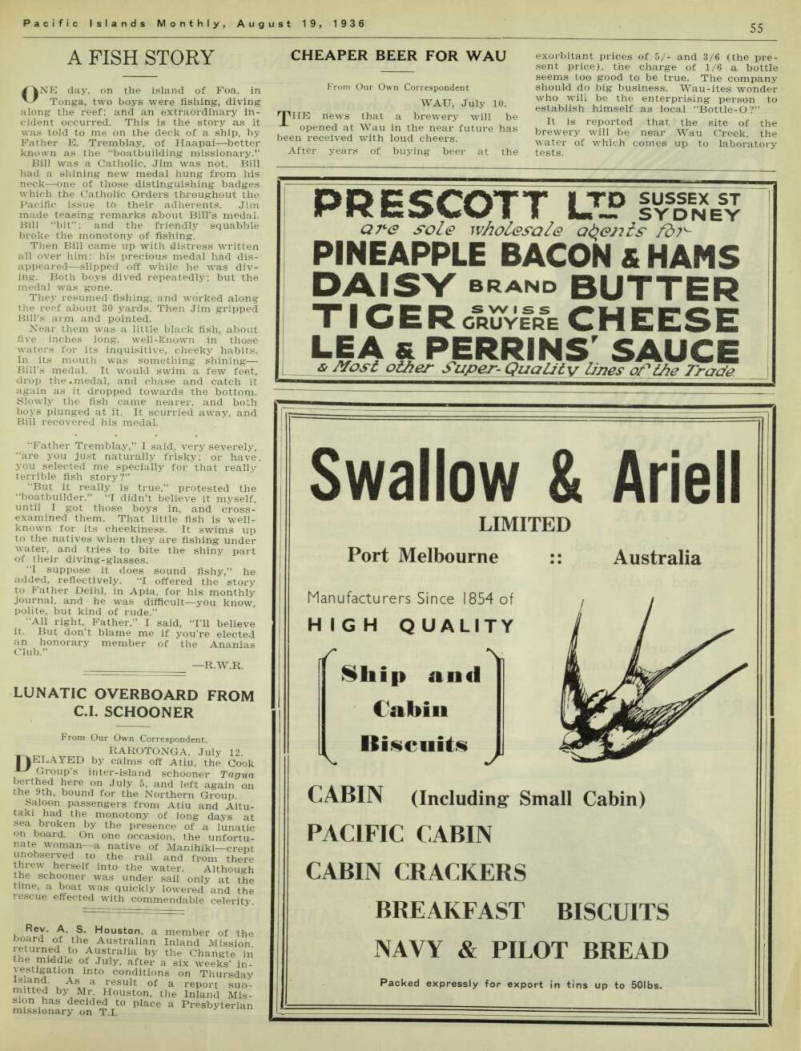
ONE day, on the island of Foa, in Tonga, two boys were fishing, diving along the reef; and an extraordinary in cident occurred. This is the story as it was told to me on the deck of a ship, by Father E. Tremblay, of Haapai—better known as the “boatbuilding missionary.”
Bill was a Catholic, Jim was not. Bill had a shining new medal hung from his neck —one of those distinguishing badges which the Catholic Orders throughout the Pacific issue to their adherents. Jim made teasing remarks about Bill’s medal.
Bill “bit”; and the friendly squabble broke the monotony of fishing.
Then Bill came up with distress written all over him: his precious medal had dis appeared—slipped off while he was div ing. Both boys dived repeatedly; but the medal was gone.
They resumed fishing, and worked along the reef about 30 yards. Then Jim gripped Bill’s arm and pointed.
Near them was a little black fish, about five inches long, well-known in those waters for its inquisitive, cheeky habits.
In its mouth was something shining— Bill’s medal. It would swim a few feet, drop the.medal, and chase and catch it again as it dropped towards the bottom.
Slowly the fish came nearer, and both boys plunged at it. It scurried away, and Bill recovered his medal.
“Father Tremblay,” I said, very severely, “are you just naturally frisky; or have, you selected me specially for that really terrible fish story?”
“But it really is true,” protested the “boatbuilder.” “I didn’t believe it myself, until I got those boys in, and cross examined them. That little fish is well known for its cheekiness. It swims up to the natives when they are fishing under water, and tries to bite the shiny part of their diving-glasses. ■I suppose it does sound fishy,” he added, reflectively. “I offered the story to Father Deihl, in Apia, for his monthly journal, and he was difficult—you know, polite, but kind of rude.”
“All right, Father,” I said, “I’ll believe it. But don’t blame me if you’re elected an honorary member of the Ananias Club.”
R.W.R.
Lunatic Overboard From
C.I. Schooner
From Our Own Correspondent.
D Rarotonga, July 12.
ELAYED by calms off Atiu, the Cook Group’s inter-island schooner Tagua berthed here on July 5, and left again on the 9th, bound for the Northern Group.
Saloon passengers from Atiu and Aitu taki had the monotony of long days at sea broken by the presence of a lunatic on board. On one occasion, the unfortu nate woman a native of Manihiki—crept unobserved to the rail and from there threw herself into the water. Although the schooner was under sail only at the time, a boat was quickly lowered and the rescue effected with commendable celerity.
Rev. A. S. Houston, a member of the board of the Australian Inland Mission returned to Australia by the Changte in the middle of July, after a six weeks’ in vestigation into conditions on Thursday m k A ™ a £ 6Sult of a re P° rt su mmed by Mr. Houston, the Inland Mis sion has decided to place a Presbyterian missionary on T.I. J
Advertisements & other items, pp. 57-58 (2 items)
'S'“ ~ - -su IK
CHEAPER BEER FOR WAU
From Our Own Correspondent WATT iniv- in rw , WAU ’ July lU ‘
SS' S
been received with loud cheers.
After years of buying beer at the
exorbitant prices of 5/- and 3/6 (the pre sent price), the charge of 1/6 a bottle seems too good to be true. The company should do big business. Wau-ites wonder who wili be the enterprising person to establish himself as local “Bottle-O?”
'S'“ - -su IK
water of which comes up to laboratory tests.
Mr. and Mrs. Hyla Bennett, of Norfolk Island, arrived in Sydney in July by the Morinda en route to New Zealand to make their future home in the Hawkes Bay district.
Swallow & Ariell
PRESCOTT SPgJS?
Q7 c e sole wholesale a den is fdi^
PINEAPPLE BACON & HAMS
DAISY BRAND BUTTER
TIGER cruylre
LEA s PERRINS
& Most other Super- Quality Lines of*the Trade
Swallow & Ariell
LIMITED
Port Melbourne :: Australia CABIN (Including Small Cabin)
PACIFIC CABIN
CABIN CRACKERS
BREAKFAST BISCUITS
NAVY & PILOT BREAD
Packed expressly for export in tins up to 50lbs.
Manufacturers Since 1854 of
HIGH QUALITY
§lii|i and Cabin Biscuits
ALSO
STA I N
SiLVE R
Q\i\CYs'
CLEAR
- for renewing woodwork and furniture easily
and quickly.
Agents throughout the Islands
DRY IN HOURS
Cheap Living In Samoa
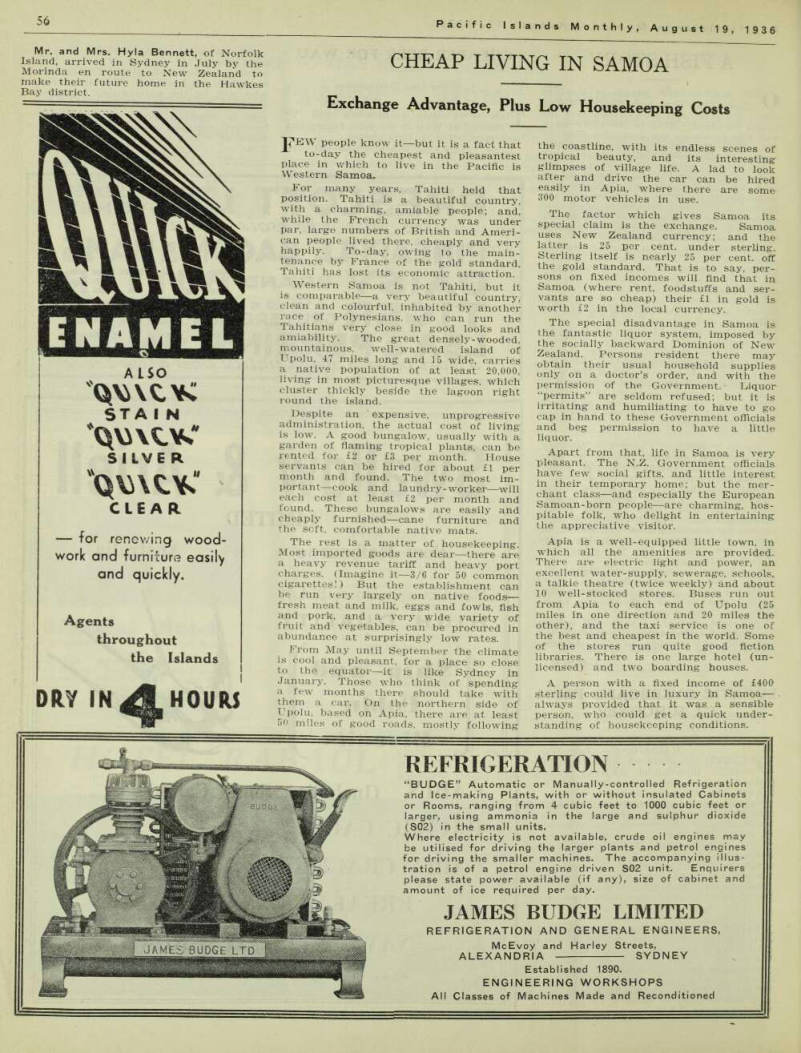
Exchange Advantage, Plus Low Housekeeping Costs
JPEW people know it—but it is a fact that to-day the cheapest and pleasantest place in which to live in the Pacific is Western Samoa.
For many years, Tahiti held that position. Tahiti is a beautiful country, with a charming, amiable people; and, while the French currency was under par, large numbers of British and Ameri can people lived there, cheaply and very happily. To-day, owing to the main tenance by France of the gold standard, Tahiti has lost its economic attraction.
Western Samoa is not Tahiti, but it is comparable—a very beautiful country, clean and colourful, inhabited by another race of Polynesians, who can run the Tahitians very close in good looks and amiability. The great densely-wooded, mountainous. island of Upolu, 47 miles long and 15 wide, carries a native population of at least 20,000, living in most picturesque villages, which cluster thickly beside the lagoon right round the island.
Despite an expensive, unprogressive administration, the actual cost of living is low. A good bungalow, usually with a garden of flaming tropical plants, can be rented for £2 or £3 per month. House servants can be hired for about £1 per month and found. The two most im portant—cook and laundry-worker—will each cost at least £2 per month and found. These bungalows are easily and cheaply furnished —cane furniture and the soft, comfortable native mats.
The rest is a matter of housekeeping.
Most imported goods are dear—there are a heavy revenue tariff and heavy port charges. (Imagine it —3/6 for 50 common cigarettes!) But the establishment can be run very largely on native foods— fresh meat and milk, eggs and fowls, fish and pork, and a very wide variety of fruit and vegetables, can be procured in abundance at surprisingly low rates.
From May until September the climate is cool and pleasant, for a place so close to the equator—it is like Sydney in January. Those who think of spending a few months there should take with them a car. On the northern side of Upolu, based on Apia, there are at least 50 miles of good roads, mostly following
the coastline, with its endless scenes of tropical beauty, and its interesting glimpses of village life. A lad to look after and drive the car can be hired easily in Apia, where there are some 300 motor vehicles in use.
The factor which gives Samoa its special claim is the exchange. Samoa uses New Zealand currency; and the latter is 25 per cent, under sterling.
Sterling itself is nearly 25 per cent, off the gold standard. That is to say, per sons on fixed incomes will find that in Samoa (where rent, foodstuffs and ser vants are so cheap) their £1 in gold is worth £2 in the local currency.
The special disadvantage in Samoa is the fantastic liquor system, imposed by the socially backward Dominion of New Zealand. Persons resident there may obtain their usual household supplies only on a doctor’s order, and with the permission of the Government. Liquor “permits” are seldom refused; but it is irritating and humiliating to have to go cap in hand to these Government officials and beg permission to have a little liquor.
Apart from that, life in Samoa is very pleasant. The N.Z. Government officials have few social gifts, and little interest in their temporary home; but the mer chant class —and especially the European Samoan-born people—are charming, hos pitable folk, who delight in entertaining the appreciative visitor.
Apia is a well-equipped little town, in which all the amenities are provided.
There are electric light and power, an excellent water-supply, sewerage, schools, a talkie theatre (twice weekly) and about 10 well-stocked stores. Buses run out from Apia to each end of Upolu (25 miles in one direction and 20 miles the other), and the taxi service is one of the best and cheapest in the world. Some of the stores run quite good fiction libraries. There is one large hotel (un licensed) and two boarding houses.
A person with a fixed income of £4OO sterling could live in luxury in Samoa— always provided that it was a sensible person, who could get a quick under standing of housekeeping conditions.
Advertisements & other items, p. 58 (1 item)
Refrigeration
JAMES BUDGE LTD
“BUDGE” Automatic or Manually-controlled Refrigeration and Ice-making Plants, with or without insulated Cabinets or Rooms, ranging from 4 cubic feet to 1000 cubic feet or larger, using ammonia in the large and sulphur dioxide (SO2) in the small units.
Where electricity is not available, crude oil engines may be utilised for driving the larger plants and petrol engines for driving the smaller machines. The accompanying illustration is of a petrol engine driven SO2 unit. Enquirers please state power available (if any), size of cabinet and amount of ice required per day.
JAMES BUDGE LIMITED
REFRIGERATION AND GENERAL ENGINEERS,
McEvoy and Harley Streets,
ALEXANDRIA SYDNEY
Established 1890.
ENGINEERING WORKSHOPS
All Classes of Machines Made and Reconditioned
Tariff Altered
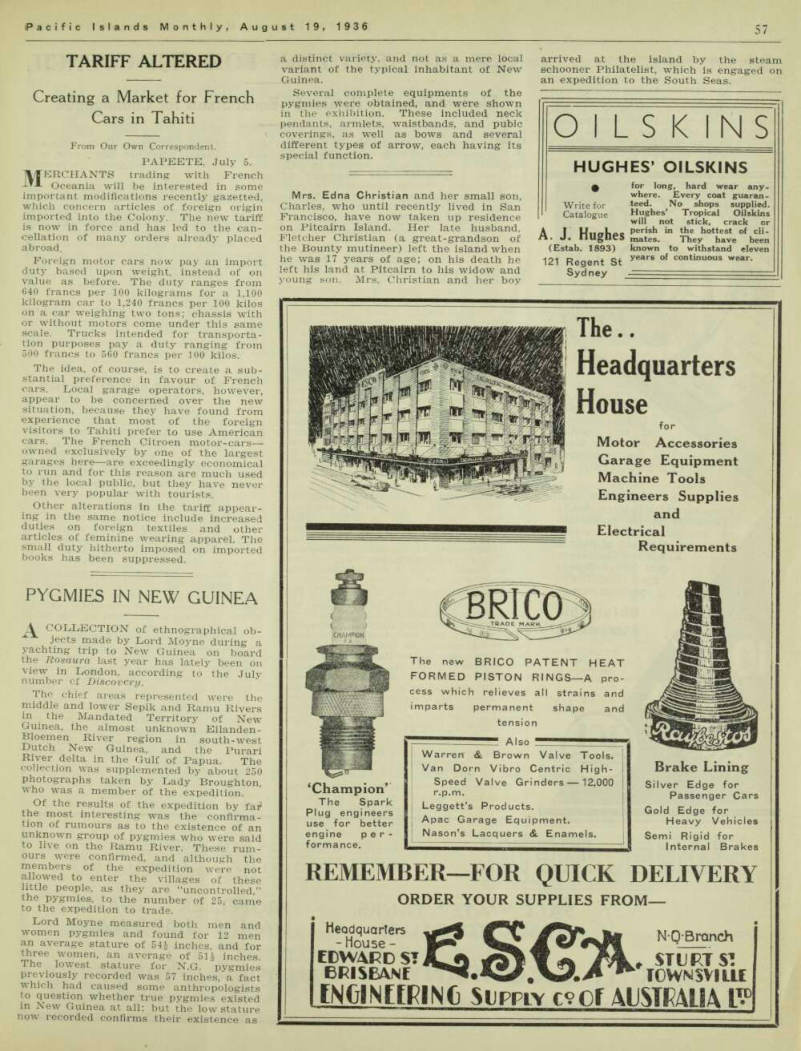
Creating a Market for French Cars in Tahiti
From Our Own Correspondent.
Papeete, July 5.
\IERCHANTS trading with French Oceania will be interested in some important modifications recently gazetted, which concern articles of foreign origin imported into the Colony. The new tariff is now in force and has led to the can cellation of many orders already placed abroad.
Foreign motor cars now pay an import duty based upon weight, instead of on value as before. The duty ranges from 640 francs per 100 kilograms for a 1,100 kilogram car to 1,240 francs per 100 kilos on a car weighing two tons; chassis with or without motors come under this same scale. Trucks intended for transporta tion purposes pay a duty ranging from 500 francs to 560 francs per 100 kilos.
The idea, of course, is to create a sub stantial preference in favour of French cars. Local garage operators, however, appear to be concerned over the new situation, because they have found from experience that most of the foreign visitors to Tahiti prefer to use American cars. The French Citroen motor-cars— owned exclusively by one of the largest garages here —are exceedingly economical to run and for this reason are much used by the local public, but they have never been very popular with tourists.
Other alterations in the tariff appear ing in the same notice include increased duties on foreign textiles and other articles of feminine wearing apparel. The small duty hitherto imposed on imported books has been suppressed.
Pygmies In New Guinea
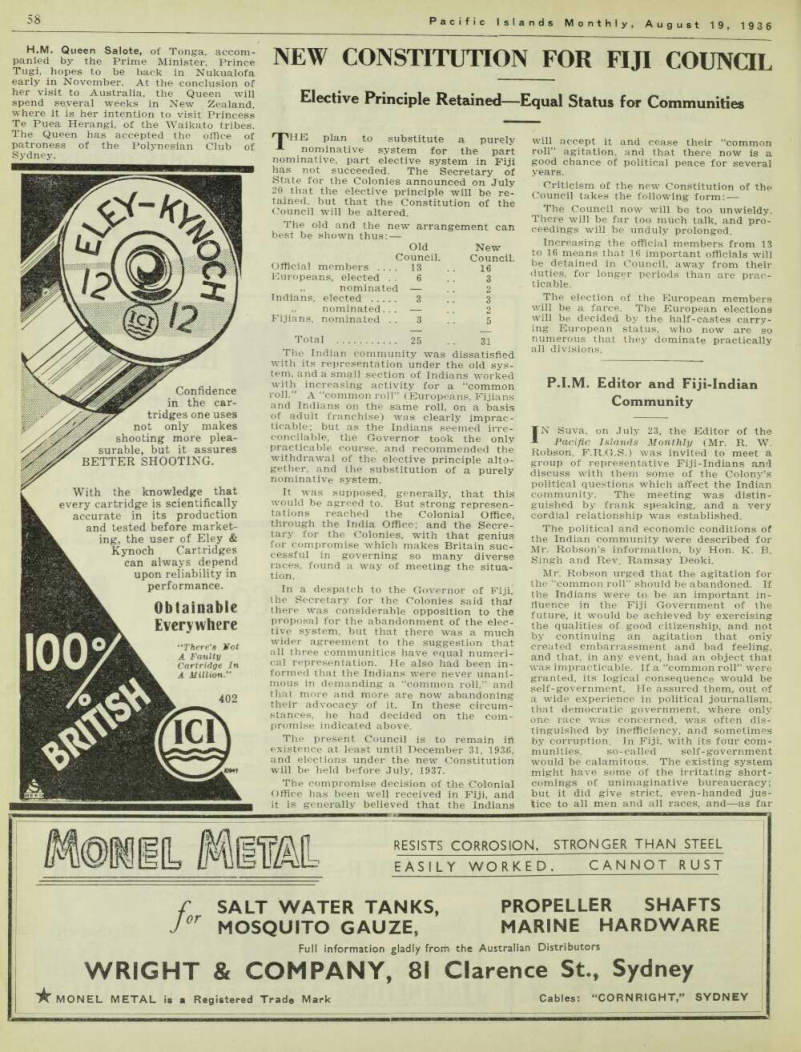
COLLECTION of ethnographical ob jects made by Lord Moyne during a yachting trip to New Guinea on board the Rosaura last year has lately been on view in London, according to the July number cf Discovery .
The chief areas represented were the middle and lower Sepik and Ramu Rivers in the Mandated Territory of New Guinea, the almost unknown Eilanden- Bloemen River region in south-west Dutch New Guinea, and the Purari River delta in the Gulf of Papua. The collection was supplemented by about 250 photographs taken by Lady Broughton, who was a member of the expedition.
Of the results of the expedition by far the most interesting was the confirma tion of rumours as to the existence of an unknown group of pygmies who were said to live on the Ramu River. These rum ours were confirmed, and although the members of the expedition were not allowed to enter the villages of these little people, as they are “uncontrolled,” the pygmies, to the number of 25, came to the expedition to trade.
Lord Moyne measured both men and women pygmies and found for 12 men an average stature of 54i Inches, and for three women, an average of 51 £ inches.
The lowest stature for N.G. pygmies previously recorded was 57 inches, a fact which had caused some anthropologists to question whether true pygmies existed in New Guinea at all; but the low stature now recorded confirms their existence as
a distinct variety, and not as a mere local variant of the typical inhabitant of New Guinea.
Several complete equipments of the pygmies were obtained, and were shown in the exhibition. These included neck pendants, armlets, waistbands, and pubic coverings, as well as bows and several different types of arrow, each having its special function.
Mrs. Edna Christian and her small son, Charles, who until recently lived in San Francisco, have now taken up residence on Pitcairn Island. Her late husband, Fletcher Christian (a great-grandson of the Bounty mutineer) left the island when he was 17 years of age; on his death he left his land at Pitcairn to his widow and young son. Mrs. Christian and her boy
arrived at the island by the steam schooner Philatelist, which is engaged on an expedition to the South Seas.
H.M. Queen Salote, of Tonga, accom panied by the Prime Minister, Prince Tugi, hopes to be back in Nukualofa early in November. At the conclusion of her visit to Australia, the Queen will spend several weeks in New Zealand, where it is her intention to visit Princess Te Puea Herangi, of the Waikato tribes.
The Queen has accepted the office of patroness of the Polynesian Club of Sydney.
Advertisements & other items, pp. 59-60 (1 item)
Lsk I N S
o
HUGHES' OILSKINS
£ for long, hard wear any. where. Every coat guaran.
Write for teed. No shops supplied.
Catalogue Hughes’ Tropical Oilskins will not stick, crack or A I HnaliPC » >erish 111 the hottest of cli.
J. nugnes mates. They have been (Estab. 1893) known to withstand eleven 121 Regent St years of continuous wear -
Sydney .
The..
Requirements
TRADE MARK
The new BRICO PATENT HEAT
FORMED PISTON RINGS—A pro-
cess which relieves all strains and imparts permanent shape and tension
‘Champion*
The Spark Plug engineers use for better engine performance.
Also Warren & Brown Valve Tools.
Van Dorn Vibro Centric High- Speed Valve Grinders 12,000 r.p.m.
Leggett’s Products.
Apac Garage Equipment.
Nason’s Lacquers & Enamels.
Brake Lining
Silver Edge for Passenger Cars Gold Edge for Heavy Vehicles Semi Rigid for Internal Brakes
REMEMBER—FOR QUICK DELIVERY
ORDER YOUR SUPPLIES FROM—
Headquarters
- House -
EDWARD ST
BRISBANE
NQBranch
STURT ST
TOWNSVILLE
tNOINIIPINC Suppiy C9pf ALSTFAIBA
0 Kk 'k V Uy % 12 a: 12
fey
Confidence in the cartridges one uses not only makes shooting more pleasurable, but it assures
BETTER SHOOTING.
With the knowledge that every cartridge is scientifically accurate in its production and tested before marketing, the user of Eley & Kynoch Cartridges can always depend upon reliability in performance.
Obtainable
Everywhere
402
ICI
«?*♦) “There's Vot A Faulty Cartridge In A Million.’’
NWll
wm r, p. nil
RESISTS CORROSION, STRONGER THAN STEEL
EASILY WORKED, CANNOT RUST
f SALT WATER TANKS, PROPELLER SHAFTS
J or MOSQUITO GAUZE, MARINE HARDWARE
Full information gladly from the Australian Distributors WRIGHT & COMPANY, 81 Clarence St., Sydney "k MONEL METAL is a Registered Trade Mark Cables: “CORNRIGHT,” SYDNEY
New Constitution For Fiji Council
Elective Principle Retained—Equal Status for Communities
T’HE plan to substitute a purely ± nominative system for the part nominative, part elective system in Fiji has not succeeded. The Secretary of State for the Colonies announced on July 20 that the elective principle will be re tained. but that the Constitution of the Council will be altered.
The old and the new arrangement can best be shown thus:
The Indian community was dissatisfied with its representation under the old sys tem, and a small section of Indians worked with increasing activity for a “common roll.” A “common roll” (Europeans, Fijians and Indians on the same roll, on a basis of adult franchise) was clearly imprac ticable; but as the Indians seemed irre concilable, the Governor took the only practicable course, and recommended the withdrawal of the elective principle alto gether, and the substitution of a purely nominative system.
It was supposed, generally, that this would be agreed to. But strong represen tations reached the Colonial Office, through the India Office; and the Secre tary for the Colonies, with that genius for compromise which makes Britain suc cessful in governing so many diverse races, found a way of meeting the situa tion.
In a despatch to the Governor of Fiji, the Secretary for the Colonies said that there was considerable opposition to the proposal for the abandonment of the elec tive system, but that there was a much wider agreement to the suggestion that all three communities have equal numeri cal representation. He also had been in formed that the Indians were never unani mous in demanding a “common roll,” and that more and more are now abandoning their advocacy of it. In these circum stances, he had decided on the com promise indicated above.
The present Council is to remain in existence at least until December 31, 1936, and elections under the new Constitution will be held before July, 1937.
The compromise decision of the Colonial Office has been well received in Fiji, and it is generally believed that the Indians
will accept it and cease their “common roll” agitation, and that there now is a good chance of political peace for several years.
Criticism of the new Constitution of the Council takes the following form: The Council now will be too unwieldy.
There will be far too much talk, and pro ceedings will be unduly prolonged.
Increasing the official members from 13 to 16 means that 16 important officials will be detained in Council, away from their duties, for longer periods than are prac ticable.
The election of the European members will be a farce. The European elections will be decided by the half-castes carry ing European status, who now are so numerous that they dominate practically all divisions.
Old New Council.
Council.
Official members . . .. 13 16 Europeans, elected 6 3 ,, nominated — 2 Indians, elected . .. 3 3 ., nominated. — 2 Fijians, nominated 3 5 Total . . 25 31
Community
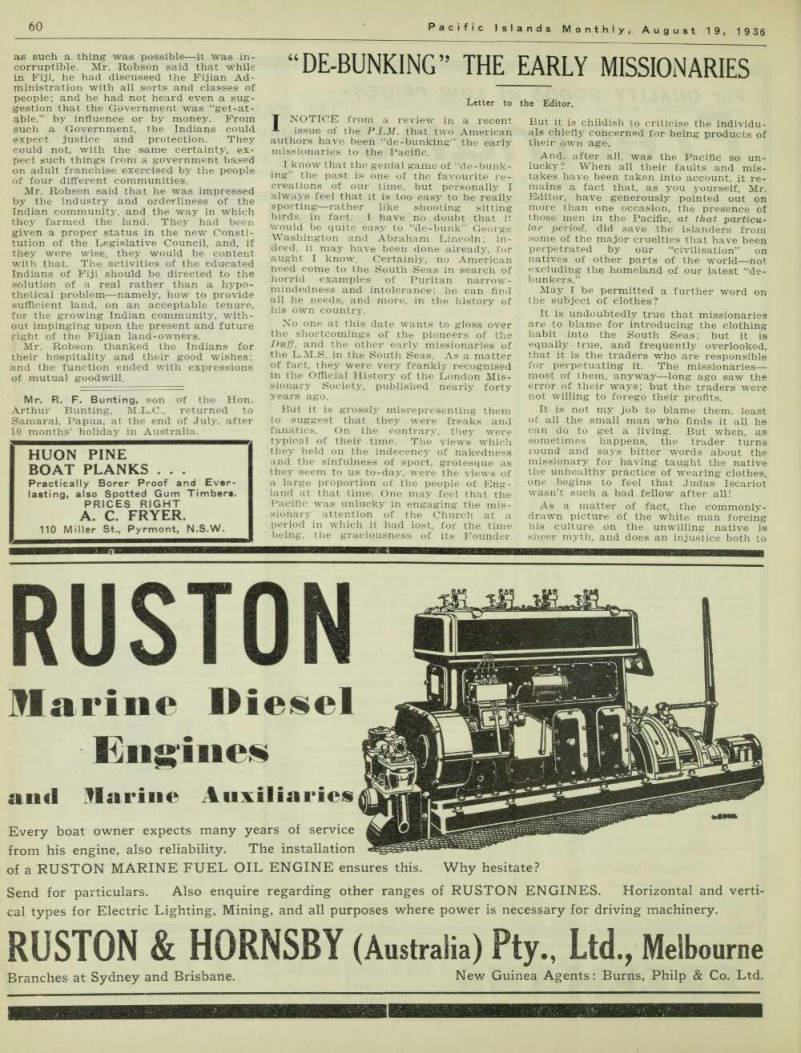
P.I.M. Editor and Fiji-Indian Community
IN Suva, on July 23, the Editor of the Pacific Islands Monthly (Mr. R. W.
Robson, F.R.G.S.) was invited to meet a group of representative Fiji-Indians and discuss with them some of the Colony’s political questions which affect the Indian community. The meeting was distin guished by frank speaking, and a very cordial relationship was established.
The political and economic conditions of the Indian community were described for Mr. Robson’s information, by Hon. K. B.
Singh and Rev. Ramsay Deoki.
Mr. Robson urged that the agitation for the “common roll” should be abandoned. If the Indians were to be an important in fluence in the Fiji Government of the future, it would be achieved by exercising the qualities of good citizenship, and not by continuing an agitation that only created embarrassment and bad feeling, and that, in any event, had an object that was impracticable. If a “common roll” were granted, its logical consequence would be self-government. He assured them, out of a wide experience in political journalism, that democratic government, where only one race was concerned, was often dis tinguished by inefficiency, and sometimes by corruption. In Fiji, with its four com munities, so-called self-government would be calamitous. The existing system might have some of the irritating short comings of unimaginative bureaucracy; but it did give strict, even-handed jus tice to all men and all races, and—as far
as such a thing was possible—it was in corruptible. Mr. Robson said that while in Fiji, he had discussed the Fijian Ad ministration with all sorts and classes of people: and he had not heard even a sug gestion that the Government was “get-at able,” by influence or by money. From such a Government, the Indians could expect justice and protection. They could not, with the same certainty, ex pect such things from a government based on adult franchise exercised by the people of four different communities.
Mr. Robson said that he was impressed by the industry and orderliness of the Indian community, and the way in which they farmed the land. They had been given a proper status in the new Consti tution of the Legislative Council, and, if they were wise, they would be content with that. The activities of the educated Indians of Fiji should be directed to the solution of a real rather than a hypo thetical problem—namely, how to provide sufficient land, on an acceptable tenure, for the growing Indian community, with out impinging upon the present and future right of the Fijian land-owners.
Mr. Robson thanked the Indians for their hospitality and their good wishes: and the function ended with expressions of mutual goodwill.
Mr. R. F. Bunting, son of the Hon.
Arthur Bunting, M.L.C., returned to Samarai, Papua, at the end of July, after 10 months’ holiday in Australia.
Advertisements & other items, pp. 61-62 (1 item)
Freemans
For QUALITY GOODS at LOW PRICES
(ESTABLISHED 1905 )
147 CASTLE REACH STREET,
SYDNEY - - New South Wales Right in the Centre of THE BLOCK Between Park and Market Streets.
Sporting? C*oo<ls
BRAND NEW BRAND NEW
GOLF SETS! GOLF SETS!
Free with every Golf Set purchased: One Dozen Tees and Two Golf Balls.
Matched Hickory Shaft Golf Sets, hand forged, including mid-iron, mashie, putter, and brassie-driver in leather mounted waterproof canvas bag 37/6 “J. Kirkwood” Hickory Shaft Matched Golf Sets, rustless Scotch heads, hand forged, including mid-iron, mashie, putter and brassiedriver, in leather mounted waterproof Canvas Bag 42/6 Steel Shaft Golf Sets, including mid-iron, mashie, putter and brassie driver, in leather mounted waterproof Canvas Bag 63/-
WE STOCK ALL SPORTING REQUISITES
Write for our Free Catalogue of the Sports needs in which you are interested.
Tents! Flys! Brand New
Strongly made and reinforced.
Extra heavy English Calico Tents: 3ft. walls, 6xB, 16/9; 8 x 10, 21/6; 10 x 12. 27/6.
Extra heavy English Calico Flys: 8 x 10, 10 6; 11 x 9, 13/6; 10 x 12, 16/6; 12 x 12, 19/6; 12 x 14, 22/6; 14 x 14. 25/-.
Extra heavy English lOoz. twisted Duck Tents, 3ft. walls, 6xB, 24/-; 8 x 10. 30/-; 10 x 12, 42/6.
Extra heavy English lOoz. twisted Duck Flys, 8 x 10, 12/6; 11 x 9. 16/6; 10 x 12. 19/6; 12 x 12. 22/6; 12 x 14, 25/-; 14 x 14, 27 6.
Folding Camp Stretchers, brand new, 14/6 ea.
Haversacks, strongly made of waterproof khaki 6/6 ea.
Auto Tents—Brand New
12 x 12 Marquee Auto Tents, extra heavy English 15oz. twisted duck roof, lOoz twisted duck walls, with calico partition, telescopic poles, ropes, pegs, and waterproof duck ba ff £6/10/0
Saddles Saddles
BRAND NEW—GUARANTEED TREES
High-grade Stock Saddles, built on strong guaranteed trees, very deep comfortable kip seat, narrow grip, wide leather facings at back, 4in. firm pads (set up high, giving greater security to the rider), extra long kip flaps and skirts, mounted with leathers, rolled girth, and 3-bar N.P. irons £4/10/0 Special Concessions to traders f and storekeepers for quantities, i Write for quotations. ]
Sewing Machines
Slightly Used.
Hand Sewing Machines, in good order and condition, always on hand. Prices range fr °™ 45/-
Musical Instruments
Special Bargains in High-grade Musical Instruments.
Brand New Imported Ukeleles, with pegs and strings, splendid tone. Free Tutor .. . 10/6 Brand New Imported Steel Guitars, magnificent tone. Free Steel Picks, Tutor ... 35/ - Brass Bugles, slightly used 19/6 Cval-back Mandolins, in case, slightly used.
Free Tutor 35/- Standard Banjos in case, good condition, free tutor 42/6 Brand New Chinese Temple Blocks, set of five 42/6 per set Very fine Violins, full size, with case and bow, slightly used, free tutor 45/- Very fine Tenor Banjos, in case, slightly used 50/- “Mandy Joe” Banjo Mandolins, in case, all metal, slightly used, free tutor 45 - Very fine “Stella” flat back Banjo Mandolins, in case, free tutor 45/ - Italian Oval-back Mandolins, pearl inlaid, slightly used 55/ - “Reliance” large size Banjo-Ukeleles, with resonator, in case, slightly used, free tutor, 55/ Magnificent Italian Flat-back Mandolins, mother-of-pearl inlaid, nearly new, free tutor 50/- Magnificent Silver-plated Trumpets, “Ambassador” make, quick change, A or B, in solid leather case, nearly new £9/10/- Silver-plated “Besson” Baritones, Class A, good condition £lO/10/- Magnificent Silver-plated “Higham” Trumpet, Champion Star model, quick change to A or B, in solid leather case, nearly new £ll/10/- Magnificent Standard Banjos, with fine resonator, 24 brackets, nearly new, in case, £5/10 - Very fine Old Violins, bow, case . £5/10/- Silver-plated “Conn” Cornets, class A, in case, nearly new £6/10/- Magnificent “Windsor” Tenor Banjos, “Pixie,” marvellous tone, complete in case, nearly new, cost £24; will sell £l2/10 - “Decca” Portable Gramophones, slightly used 35/- Columbia Portable Gramophones, slightly used 45 - “His Master’s Voice” Portable Gramophones, slightly used 79 6
Brand New Accordeons
Brand New high grade German Accordeons, steel bronze reeds, built on ebonised frames, 2 stop, 32/6; 3 stop, 39/6; 4 stop, 47/6.
Piano Accordeons
21 notes, 8 Sunken Basses, green pearloid finish body, 14 folded bellows, with nickelplated corner protectors, with free tutor, £6/15 Antonio Silvagni Piano Accordeons, 21 notes, 12 sunken Basses, dark blue pearloid finish body and sloping keyboard, rounded black keys, chromium plated key cover, 14 fold bellows, nickel-plated corners, protectors, strong leather bass & shoulder straps, with free tutor £7/15/- We Stock all kinds of Musical Instruments.
Write for our Free Catalogue.
Bicycles
Special Bargains in Used Bicycles Very Strong Bicycles, fixed or free wheel. handbrake, well shod 55/- Very strong. Red Painted Bicycles, free wheel, handbrake, in good order and condition . . £3 Strong Blue Painted Bicycles, free wheel, handbrake, in good order and condition £3 Very Strong Bicycles, fixed or free wheel, 2 handbrakes, good tyres and tubes . . £3/15/- Eadie Coaster Bicycles, good order . . . 75/ - Very Strong Red Painted Bicycles, tapered frame, handbrake, fixed wheel, well shod, 75/- Very Strong Eadie Coaster Bicycles, tapered frame, good order £4 Red Painted “Speedwell” Bicycles, free wheel, 2 handbrakes, nearly new condition, £5/10/- “Malvem Star” Club Racer Bicycles, tapered frame, fixed wheel, 2 handbrakes, in good order and condition £5/10/- Very fine “Carbine,” Blue Painted, Bicycles, Club Racer, tapered frame, 2 handbrakes, nearly new condition £5/19/6 Good, strong, slightly used Bicycles always in stock. Prices range from 55/-
Field and Race Glasses
Slightly Used.
Powerful Field Glasses 25/- Extra powerful Field Glasses 39 / 6 Powerful Field Glasses, in case 49/6 English Prismatic Binocular Field Glasses, 6x, in case 75/- “Colmont” Binocular Field Glasses, 6x, in case, very powerful £4/15/- “Ross” stereo prism Binocular Field Glasses, 6x, in case 95/- French Field Glasses, 8x £4/15/- English Field Glasses, 8x magnification, powerful, in case £5/15/- “Colmont” Binocular Race Glasses, Bx, extra powerful, in case £6/15/- “Carl Zeiss” Binocular Field Glasses, 6 x 30, in case, powerful £6/15/- “Carl Zeiss” Binocular Race Glasses, Silva mar, Bx, extra powerful £9/10/-
Slightly Used Cameras
Vest Pocket Kodak Cameras 15/- Kodak 1A Folding Cameras 20/- Kodak 2A Folding Cameras 27/6 Kodak 3A Folding Cameras 30/-
Slightly Used Typewriters
“Corona” Portable Typewriters, 3 bank, good order and condition £6/10/- “Corona,” 4 bank, Portable Typewriters, in case, slightly used £lO/10/- “Remington,” 4 bank Typewriters, good order and condition £7/10/- Remington Portable Typewriters, 4 bank, good order and condition £B/10/- Royal 4 bank Portable Typewriters, nearly new, in case £lO/10/- Monarch 4 bank Typewriters, good order and condition £6/10/-
All Mail Orders Promptly Attended to. We Guarantee you every satisfaction. WE STOCK EVERYTHING Inquiries invited. Kindly add carriage on all Mail Orders.
FREEMANS
For Prompt Service and Honest Value
147 Castlereagh Street,
Sydney, New South Wales
HUON PINE
BOAT PLANKS . . .
Practically Borer Proof and Everlasting, also Spotted Gum Timbers.
PRICES RIGHT
A. C. FRYER.
110 Miller St., Pyrmont, N.S.W.
“De-Bunking” The Early Missionaries
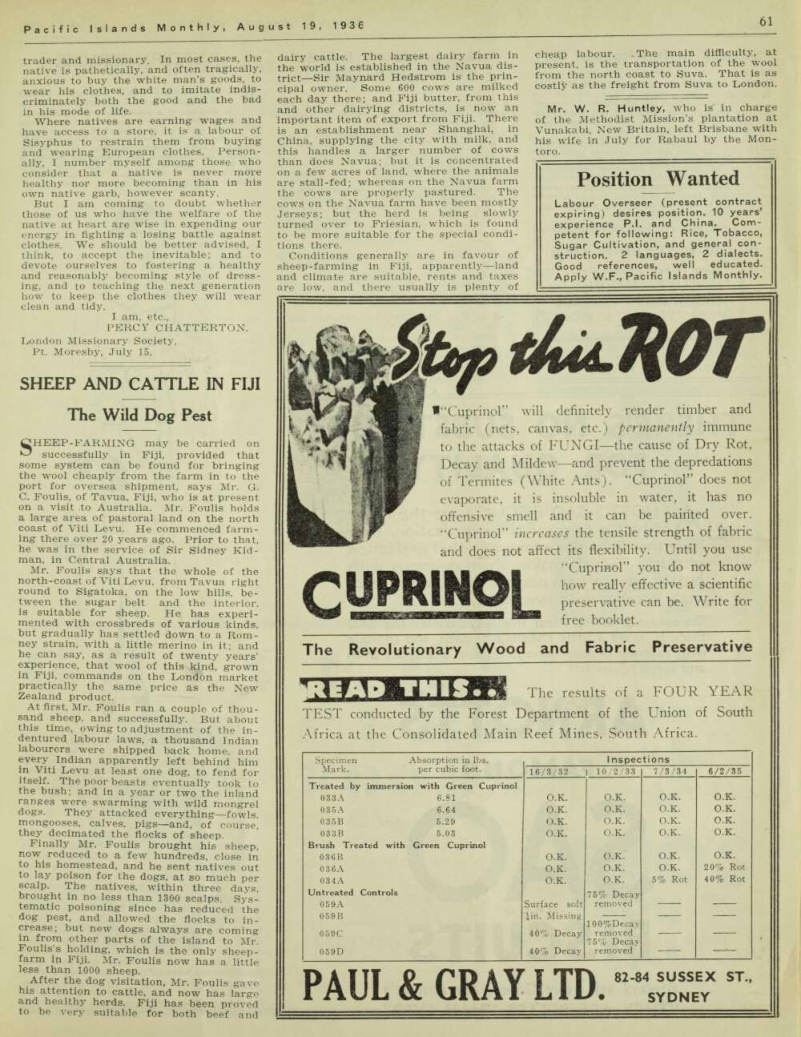
Letter to the Editor.
r NOTICE from a review in a recent issue of the P.I.M. that two American authors have been “de-bunking” the early missionaries to the Pacific.
I know that the genial game of “de-bunk ing” the past is one of the favourite re creations of our time, but personally I always feel that it is too easy to be really sporting—rather like shooting sitting birds, in fact. I have no doubt that it would be quite easy to “de-bunk” George Washington and Abraham Lincoln: in deed, it may have been done already, for aught I know. Certainly, no American need come to the South Seas in search of horrid examples of Puritan narrow mindedness and intolerance; he can find all he needs, and more, in the history of his own country.
No one at this date wants to gloss over the shortcomings of the pioneers of the Duff, and the other early missionaries of the L.M.S. in the South Seas. As a matter of fact, they were very frankly recognised in the Official History of the London Mis sionary Society, published nearly forty years ago.
But it is grossly misrepresenting them to suggest that they were freaks and fanatics. On the contrary, they were typical of their time. The views which they held on the indecency of nakedness and the sinfulness of sport, grotesque as they seem to us to-day, were the views of a large proportion of the people of Eng land at that time. One may feel that the Pacific was unlucky in engaging the mis sionary attention of the Church at a period in which it had lost, for the time being, the graciousness of its Founder.
But it is childish to criticise the individu als chiefly concerned for being products of their own age.
And, after all, was the Pacific so un lucky? When all their faults and mis takes have been taken into account, it re mains a fact that, as you yourself, Mr.
Editor, have generously pointed out on more than one occasion, the presence of those men in the Pacific, at that particu lar period, did save the islanders from some of the major cruelties that have been perpetrated by our “civilisation” on natives of other parts of the world—not excluding the homeland of our latest “de bunkers.”
May I be permitted a further word on the subject of clothes?
It is undoubtedly true that missionaries are to blame for introducing the clothing habit into the South Seas; but it is equally true, and frequently overlooked, that it is the traders who are responsible for perpetuating it. The missionaries— most of them, anyway—long ago saw the error of their ways; but the traders were not willing to forego their profits.
It is not my job to blame them, least of all the small man who finds it all he can do to get a living. But when, as sometimes happens, the trader turns round and says bitter words about the missionary for having taught the native the unhealthy practice of wearing clothes, one begins to feel that Judas Iscariot wasn’t such a bad fellow after all!
As a matter of fact, the commonly drawn picture of the white man forcing his culture on the unwilling native is sheer myth, and does an injustice both to
trader and missionary. In most cases, the native is pathetically, and often tragically, anxious to buy the white man’s goods, to wear his clothes, and to imitate indis criminately both the good and the bad in his mode of life.
Where natives are earning wages and have access to a store, it is a labour of Sisyphus to restrain them from buying and wearing European clothes. Person ally, I number myself among those who consider that a native is never more healthy nor more becoming than in his own native garb, however scanty.
But I am coming to doubt whether those of us who have the welfare of the native at heart are wise in expending our energy in fighting a losing battle against clothes. We should be better advised, I think, to accept the inevitable; and to devote ourselves to fostering a healthy and reasonably becoming style of dress ing, and to teaching the next generation how to keep the clothes they will wear clean and tidy.
I am, etc.,
Percy Chatterton.
London Missionary Society, Pt. Moresby, July 15.
Advertisements & other items, p. 62 (1 item)
Ruston
Marine Diesel
K nes
ami Marine Auxiliaries
Every boat owner expects many years of service from his engine, also reliability. The installation of a RUSTON MARINE FUEL OIL ENGINE ensures this. Why hesitate?
Send for particulars. Also enquire regarding other ranges of RUSTON ENGINES. Horizontal and vertical types for Electric Lighting, Mining, and all purposes where power is necessary for driving machinery.
RUSTON & HORNSBY (Australia) Pty., Ltd., Melbourne Branches at Sydney and Brisbane. New Guinea Agents: Burns, Philp & Co. Ltd.
Sheep And Cattle In Fiji
The Wild Dog Pest
SHEEP -FARMING may be carried on successfully in Fiji, provided that some system can be found for bringing the wool cheaply from the farm in to the port for oversea shipment, says Mr. G.
C. Foulis, of Tavua, Fiji, who is at present on a visit .to Australia. Mr. Foulis holds a large area of pastoral land on the north coast of Viti Levu. He commenced farm ing there over 20 years ago. Prior to that, he was in the service of Sir Sidney Kid man, in Central Australia.
Mr. Foulis says that the whole of the north-coast of Viti Levu, from Tavua right round to Sigatoka, on the low hills, be tween the sugar belt and the interior, is suitable for sheep. He has experi mented with crossbreds of various kinds, but gradually has settled down to a Rom ney strain, with a little merino in it; and he can say, as a result of twenty years’ experience, that wool of this kind, grown in Fiji, commands on the London market practically the same price as the New Zealand product.
At first, Mr. Foulis ran a couple of thou sand sheep, and successfully. But about this time, owing to adjustment of the in dentured labour laws, a thousand Indian labourers were shipped back home, and every Indian apparently left behind him in Viti Levu at least one dog, to fend for itself. The poor beasts eventually took to the bush; and in a year or two the inland ranges were swarming with wild mongrel dogs. They attacked everything—fowls, mongooses, calves, pigs—and, of course, they decimated the flocks of sheep.
Finally Mr. Foulis brought his sheep, now reduced to a few hundreds, close in to his homestead, and he sent natives out to lay poison for the dogs, at so much per scalp. The natives, within three days, brought in no less than 1300 scalps. Sys tematic poisoning since has reduced the dog pest, and allowed the flocks to in crease; but new dogs always are coming in from other parts of the island to Mr.
Foulis’s holding, which is the only sheep farm in Fiji. Mr. Foulis now has a little less than 1000 sheep.
After the dog visitation, Mr. Foulis gave his attention to cattle, and now has large and healthy herds. Fiji has been proved to be very suitable for both beef and
dairy cattle. The largest dairy farm in the world is established in the Navua dis trict —Sir Maynard Hedstrom is the prin cipal owner. Some 600 cows are milked each day there; and Fiji butter, from this and other dairying districts, is now an important item of export from Fiji. There is an establishment near Shanghai, in China, supplying the city with milk, and this handles a larger number of cows than does Navua; but it is concentrated on a few acres of land, where the animals are stall-fed; whereas on the Navua farm the cows are properly pastured. The cows on the Navua farm have been mostly Jerseys; but the herd is being slowly turned over to Friesian, which is found to be more suitable for the special condi tions there.
Conditions generally are in favour of sheep-farming in Fiji, apparently—land and climate are suitable, rents and taxes are low, and there usually is plenty of
cheap labour. .The main difficulty, at present, is the transportation of the wool from the north coast to Suva. That is as costly as the freight from Suva to London.
Mr. W. R. Huntley, who is in charge of the Methodist Mission’s plantation at Vunakabi, New Britain, left Brisbane with his wife in July for Rabaul by the Mon toro.
Advertisements & other items, p. 63 (1 item)
Ruprinoi
Position Wanted
Labour Overseer (present contract expiring) desires position. 10 years’ experience P.l. and China. Competent for following: Rice, Tobacco, Sugar Cultivation, and general construction, 2 languages, 2 dialects.
Good references, well educated.
Apply W.F., Pacific Islands Monthly.
rUPRINOI
• “Cuprinol" will definitely render timber and fabric (nets, canvas, etc.) permanently immune to the attacks of FUNGl—the cause of Dry Rot, Decay and Mildew —and prevent the depredations of Termites (White Ants). “Cuprinol” does not evaporate, it is insoluble in water, it has no offensive smell and it can be painted over.
“Cuprinol" increases the tensile strength of fabric and does not affect its flexibility. Until you use ‘‘Cuprinol” you do not know how really effective a scientific preservative can be. Write for free booklet.
The Revolutionary Wood and Fabric Preservative The results of a FOUR YEAR TEST conducted by the Forest Department of the Union of South Africa at the Consolidated Main Reef Mines, South Africa.
PAUL & GRAY LTD.
82-84 SUSSEX ST.,
SYDNEY
Solomon Is. Development Co.
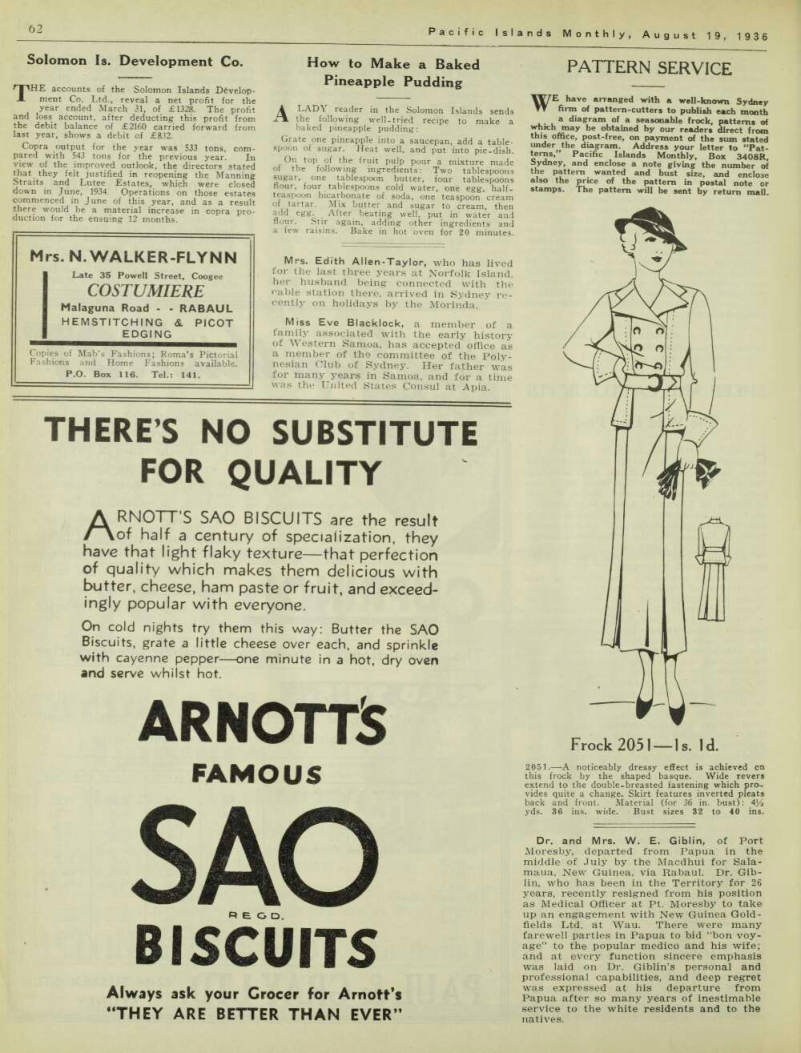
THE accounts of the Solomon Islands Develop ment Co. Ltd., reveal a net profit for the year ended March 31, of £1328. The profit and loss account, after deducting this profit from the debit balance of £2160 carried forward from last year, shows a debit of £832.
Copra output for the year was 533 tons, com pared with 543 tons for the previous year. In view of the improved outlook, the directors stated that they felt justified in reopening the Manning Straits and Lutee Estates, which were closed down in June, 1934. Operations on those estates commenced in June of this year, and as a result there would be a material increase in copra pro duction for the ensuing 12 months.
Pineapple Pudding
How to Make a Baked Pineapple Pudding
ALAD\ reader in the Solomon Islands sends the following well-tried recipe to make a baked pineapple pudding: Grate one pineapple into a saucepan, add a table spoon of sugar. Heat well, and put into pie-dish.
On top of the fruit pulp pour a mixture made of the following ingredients: Two tablespoons sugar, one tablespoon butter, four tablespoons flour, four tablespoons cold water, one egg, half teaspoon bicarbonate of soda, one teaspoon cream of tartar. Mix butter and sugar to cream, then add egg- After beating well, put in water and flour. Stir again, adding other ingredients and a few raisins. Bake in hot oven for 20 minutes.
Mrs. Edith Allen-Taylor, who has lived for the last three years at Norfolk Island, her husband being connected with the oable station there, arrived in Sydney re cently on holidays by the Morinda.
Miss Eve Blacklock, a member of a family associated with the early history of Western Samoa, has accepted office as a member of the committee of the Poly nesian Club of Sydney. Her father was for many years in Samoa, and for a time was the United States Consul at Apia.
Pattern Service
WE have arranged with a well-known Sydney firm of pattern-cutters to publish each month a diagram of a seasonable frock, patterns of which may be obtained by our readers direct from this office, post-free, on payment of the sum stated under the diagram. Address your letter to “Pat terns,” Pacific Islands Monthly, Box 3408 R, Sydney, and enclose a note giving the number of the pattern wanted and bust size, and enclose also the price of the pattern in postal note or stamps. The pattern will be sent by return mall.
Dr. and Mrs. W. E. Giblin, of Port Moresby, departed from Papua in the middle of July by the Macdhui for Sala maua, New Guinea, via Rabaul. Dr. Gib lin, who has been in the Territory for 26 years, recently resigned from his position as Medical Officer at Pt. Moresby to take up an engagement with New Guinea Gold fields Ltd. at Wau. There were many farewell parties in Papua to bid “bon voy age” to the popular medico and his wife; and at every function sincere emphasis was laid on Dr. Giblin’s personal and professional capabilities, and deep regret was expressed at his departure from Papua after so many years of inestimable service to the white residents and to the natives.
2051. —A noticeably dressy effect is achieved cn this frock by the shaped basque. Wide revers extend to the double-breasted fastening which pro vides quite a change. Skirt features inverted pleats back and front. Material (for 36 in. bust): 4½ yds. 36 ins. wide. Bust sizes 32 to 40 ins.
Advertisements & other items, p. 64 (2 items)
Costumiere
Mrs. N. WALKER-FLYNN
Late 35 Powell Street, Coogee
Malaguna Road - - RABAUL
HEMSTITCHING & PICOT
EDGING
Copies of Mab’s Fashions; Roma’s Pictorial Fashions and Home Fashions available.
P.O. Box 116. Tel.: 141.
Arnotts
THERE’S NO SUBSTITUTE
FOR QUALITY
RNOTT’S SAO BISCUITS are the result of half a century of specialization, they have that light flaky texture —that perfection of quality which makes them delicious with butter, cheese, ham paste or fruit, and exceedingly popular with everyone.
On cold nights try them this way: Butter the SAO Biscuits, grate a little cheese over each, and sprinkle with cayenne pepper—one minute in a hot, dry oven and serve whilst hot.
Always ask your Grocer for Arnott’s
•THEY ARE BETTER THAN EVER”
ARNOTTS
FAMOUS
SAO
BISCUITS
Fashion Hints for Islands Women
By Therese
SUMMER fashions are gay as a floral festival. Exotic blooms, old fashioned posies, flowers from old world gardens and colourful vegetables shorn of their hum ility, flaunt themselves over the new materials with glorious abandon.
An evening gown of printed crepe de chene splashed with enormous flowers is delightful with its off-the-shoulder line and accompanying net cape. Voiles and organdies fashion themselves into enchant ing frocks for all occasions. Broderie Anglaise in pastel shades makes the most divine evening frocks for tropical nights.
Taffeta petticoats rustle beneath, whisper ing romance, and a taffeta sash supplies lovely colour contrast.
You may not be an angel, but you can fool the world in the white gown of chiffon embroidered with crystal beads, whose draperies fall from shoulder to hemline and float ethereally with every movement.
Subtle colour contrast is in the coral pink gown of heavy crepe, slim as a column, and swathed with an olive green sash which falls gracefully to the floor.
Since grey is fashion’s dernier cri, a plum taffeta picture gown tip-tilts itself in front to reveal a froth of pearly grey tulle which foams again at the low decolletage as a last-minute concession to modesty.
Very sophisticated is the black slipper satin gown with slim skirt spreading widely at the hem and tiny fitted jacket tied at throat with an enormous lemon-leaf yellow scarf.
A strikingly unusual gown of black taffeta, bouffant of skirt, outlines its cross-over bodice with tartan taffeta and adds a tight fitting Edwardian jacket of the tartan buttoned high to its demure collar.
Crisp starched laces, swathe their waists
with taffeta sashes, and are lovely to be-tive
hold. Cool beyond belief, they are really marvellous possessions.
Evening wraps are glamorous to the nth degree. Renaissance capes sweep dramatically to the floor; net and tulle capes—-delicious confections —froth and foam about the wearer; pleated chiffon capes, romantic and beguiling flare out fanwise to the hem of the gown; ballerina jackets of taffeta or moire, of floral, plain or shot effect emphasise the pencil slim skirts beneath. Red Riding Hood bonnets of tulle attach themselves to evening capes and are absolutely devastating with their demure charm and are a wonderful device for keeping the coiffure in perfect order. Glazed printed linen evening coats finger tip length are crisp and flaring and dewy as a spring morning—and so they go on with a variety and charm that are infinite.
Day clothes are a delight. Crisp, cool materials go to their making and sim plicity is their key-note. They are gayed with lots of white—collars, cuffs, jabots, etc. A short-sleeved spectator frock is doubly assured of success by the addition of well chosen accessories. A white pig skin belt, holdall and gloves, two toned shoes, and a gaily patterned scarf, and all the joy of life is emphasised.
A foundation frock is an ever present need in one’s wardrobe. In the twinkling of an eye by virtue of lightning changes it becomes several frocks, each with an in dividuality all its own. Begin with cool draperies and belt: add a capelet; whisk it off, and a little jerkin goes its merry way: and so on ad infinitum but never ad nauseam.
A cross-over frock of green batiste, quaintly figured, trims its sailor collar with rick-rack braid. A white sailor hat with ribbon trim adds a jaunty note.
Check gingham frocks are gay and attrac
additions to the wardrobe. They wash
marvellously and retain their pristine freshness to the last thread. Coloured belts and buttons and shoes of patent make them unbelievably chic. A black overcheck on a white ground sports black buttons, belt, and two-tone shoes. Add a white hat with black patent trim and the result is charming.
A well-tailored white linen suit has a gillet front which leaves back and shoulders bare when the coat is doffed —the minimum of clothes with the maximum of respectability. What an accomplishment!
A red and grey check batiste blouse exudes charm in every thread when allied to a jacket suit of silver grey. It ties in a perky bow at the throat.
The lovely linens of to-day hold an ex alted place in fashion’s scheme of things.
Their use is universal—day clothes, even ing gowns, coats, gloves, hats, bags, belts, and even shoes hasten to fashion them selves with their various designs.
A pink linen collar trims the dress of silk patterned in zig-zag fashion, pink on a black ground and a pink linen hat gives further joy.
A string linen frock takes unto itself many scarves to help its change pro gramme. The scarves are tied cowl or sling fashion, or flutter gaily in the breeze, with equal success.
A lovely flower frock for summer days has shirred shoulders and puff sleeves. Its skirt fits snugly at the hips and flares to fullness at the front panel. Add a large, shady, straw trimmed with flowers and perfection is achieved.
Pastel shaded voiles are ideal and a number of voile frocks should be included in every tropical wardrobe. Voiles launder perfectly, always retaining their cool charm.
Fashion Highlights In Brief
Pleats for day and evening with shir rings sharing popularity.
Applique work makes for marvellous detail.
Loose sway back jackets are infectiously gay.
Trim little capes swing from shoulders with a nonchalant air.
Plenty of white touches for coolth —hats, gloves, bags, crisp pique flowers, etc.
Rick-rack braid trims collars, belts and cotton day and evening frocks.
Loose mesh weaves are ideal tropical wear.
Lace is well to the fore for blouses, dresses, trimmings, evening coats and capes.
Large chiffon handkerchiefs for even ing are diamante studded or initial em broidered.
Fans are fashionable—large and small.
Flowers for all occasions—perching on hat crowns, tumbling from brims, thrust at waist line, tucked in the hair.
Enormous scarves are delightful for evening.
Fan pleated chiffon sashes fall gracefully floorwards.
Square heeled shoes and square toes are increasing in popularity.
Rev. H. K. Bartlett, L.Th., of Misima Island, where he has been a Methodist missionary, arrived in Sydney by the Montoro on July 24. He left immediately for South Australia to join his wife, who came down from the Territory several months ago.
Advertisements & other items, pp. 65-66 (1 item)
€Hiv E R 8
m B i Health knows no season take OS
FRUIT
SALT"
The words Eno and “Fruit Salt’ are registered trade marks.
Au 63
€HIV E R 8
4 k m M -
PURE
FOODS
GOLD MEDAL JAMS
CANNED ENGLISH FRUITS
CANNED ENGLISH
VEGETABLES
CUSTARD POWDER
OLD ENGLISH MARMALADE
JELLY CRYSTALS, ETC.
Obtainable from all Leading Grocery Stores -- Write to Department A., Olivers and Sons Ltd., Histon, Cambridge, England, for attractive Recipe Book
Find out What’s Inside
before you buy a low-priced Saddle.
THE KING OF ’EM ALL
NARROW
Is a “Safer”
Saddle and Offers Sensational Advantages.
Being built on a Galvanised Tree, heavily bar plated, and strained with English web, riders are assured of its genuine foundation. Its soft, pliant kip flaps are hard-wearing, while the sweepy seat gives superb riding comfort.
FiVted with Best Leather, Folded Girth, VK/K/- Stirrups / Freight Free With Capped Pads, 15/- extra.
Write for Catalogue P 1935.
Sydney’s High-Class Saddler.
Newmarket Saddlery
W. H. Williams for “Safer” Saddles 18-20 Wilson St., Newtown, N.S.W.
Copra Mat* and Matting' . . .
Send your enquiries to us for Woven Wire Mesh in Rolls or framed for Copra Drying and all Screening purposes. Bird Cages, Sieves and Riddles, Builder’s Gravel Screens, Rat Traps, Door Mats, Garden Arches, Chain Wire Mesh, Crimped Wire Mesh for Window Guards, etc.
SCOTT AND SONS
WIREWORKS: RAILWAY PARADE AND MURRAY STREET MARRICKVILLE
The Popular Light Steel
Plough
The “Victory" combines maxistrength with minimum and draught. Turns a furrow up to 6-ins. deep by 10-ins. wide. Weight 85 lbs.
We also supply numerous other types of ploughs and implements meeting all requirements, as well as lawn mowers, aerodrome equipment, steam engines, boilers, etc.
Illustrated literature and ail information from:
Morris,
Hedstrom
Ltd.
Suva, Lautoka and Ba
ansomes “VICTORY” PLOUGH
Made by: —RANSOMES, SIMS & JEFFERIES, LTD., IPSWICH, ENGLAND
Life on Midway Island
Lone Woman
IVJIDWAY ISLAND, a five-miles-wide I*-*- atoll in the North Pacific, has come into prominence in recent months as a calling station on the Pan American Air ways’ route from California to the Philip pines.
Once occupied by only eight employees of the American cable station, the tiny island has now assumed great strategic importance. It now has a naval and cable station, weather bureau, lighthouse, quarters and workshop for the P.A. Air ways men, as well as a hostel for passen gers, should the large amphibians stay overnight at the island.
Mrs. George B. Perry, wife of the cable station manager, who is the only woman on the island among the present personnel of 35, was interviewed recently at Midway and gave some interesting glimpses of life there.
“While I have little housework and no cooking, I look after my two small chil dren, the only ones on the island, and the diversions of life fully occupy me,” she said.
“I play tennis or golf every day, swim in summer, and walk in the winter, when the water is too cold. A library at Honolulu sends us 100 books a month, together with all the latest reviews, magazines, and periodicals. Besides, I have my hand work.
“Our garden contains 24 vegetables,” continued Mrs. Perry. “That is, besides bananas, papaya and limes. Fish is plentiful. Our farmyard has chickens, ducks, pigeons, turkeys, cows and pigs.
“When we wish to prove our independ ence of cold-storage, we can produce a dinner of papaya cocktail, cream of fresh spinach soup, lettuce and egg salad, ulua (an Islands whiteflsh), chop suey, contain ing string beans, celery, and carrot, cot tage fried potatoes, with radishes and little green onions for garnish.
“Anywhere else but at Midway, it would seem rather ludicrous to run barefooted on the beach in a trailing dinner-dress, or to wear shorts to see the Clipper planes land and take off,” she added.
“But we are governed by our own con ditions of life. Behold me, then, on ‘movie night,’ with skirts held high, trudg ing through the sand for a quarter of a mile to Pan-Air’s supply-room, dumping my shoes on arrival, and sitting on a wooden bench.
“The motion picture is operated to the accompaniment of ‘wisecracks’ from the audience, and run backward to add variety to the programme!”
Mr. R. N. Wayne, manager of the Meth odist Mission’s plantation at Ulu, in the Duke of York Group, New Guinea, sailed from Sydney with his wife and small daughter by the Montoro on July 29. He has been in the Territory for 12 years.
Mr. Norman E. Toder, of Hanmer Springs, N.Z., where he was on the staff of the Queen Mary Hospital, recently was the recipient of a presentation, prior to his departure for Apia, Western Samoa.
Mr. C. F. R. Gilbert, late of the Witu Group, New Guinea, where he has been a plantation overseer for some years, arrived in Sydney by the Malaita from Rabaul on July 31. He has been in the Mandated Territory for 17 years. Mr.
Gilbert sailed for England to spend six months’ holiday by the Orsova on August
Pacific Air Services
Guam-New Guinea Link?
THE question of providing an air mail service across the Pacific, linking Australia with North America, appears to be receiving increasing attention from the two great Anglo-Saxon air companies— Imperial Airways Limited and Pan Ameri can Airways (which, it is understood, are working in co-operation).
It was originally proposed that, once the ’Frisco-Honolulu-Manila-China route was being regularly operated by Pan American Airways, a new service would be inaugurated between Honolulu and Auckland (New Zealand), via the Central Pacific groups (Samoa and Fiji). For some reason, however, Pan American Air ways appear to have lost their first en thusiasm for this latter proposal.
Since then it has been suggested that for the present an air-mail service with America might be operated, by using the present Imperial Airways’ service from Australia to Singapore; thence by special air liner to China; and thence using P.A.
Airways’ service from China across the North Pacific to San Francisco.
During the month a further plan has been presented. It is that British and American interests, in co-operation, should run a branch line due south from Guam (one of the stations on the North Pacific service between Honolulu and Manila) to the New Guinea mainland; and thence, via Wau and Port Moresby, to Australia.
One commentator says; “This would connect with the proposed Australia-New Guinea service, for which tenders are to be called.
“The completed links would bring Syd ney within seven days of the United States. New York would be an eight days’ journey.
“The likely tenderers for the New Guinea service are Guinea Airways Ltd., W. R. Carpenter and Co. Ltd., Airlines of Australia Ltd., and Qantas Empire Air ways Ltd.
"An extension from Guam Island—on the existing Pan American trans-Pacific route —to Port Moresby would be one day’s flight.”
It has been reported in certain quarters that the Commonwealth Government, on the advice of its defence authorities, is planning a route for the Australia-New Guinea air service which will not include Port Moresby at all.
This is because the authorities wish to place an important landing station at the northerly tip of Australia, on Cape York.
Thence, it is believed, the route will go directly across Torres Strait to Daru, and thence north-eastwards to the N.G. gold field; or, alternatively, it may go directly from the Cape York aerodrome to the Wame River, in the delta of the Purari River, on the Gulf of Papua; and thence east by north to the New Guinea gold field, with an emergency landing ground somewhere between the Wame and Wau.
Such a proposal is certain to arouse bitter protest from Port Moresby, which hitherto has been counting on becoming an important station on the air-mail route between New Guinea and Australia.
There were reports some months ago that Imperial Airways were planning an alternative route between Singapore and Australia—that they were contemplating the possibility of reaching Australia via Borneo and New Guinea, instead of via the East Indies and Darwin. Wq now have received authoritative advice from London that "Imperial Airways have no
intention of flying to Australia via New Guinea.”
An announcement about the inaugura tion of a new aerial transport service in Fiji may be expected at no distant date.
Fiji Residents’ Complaint
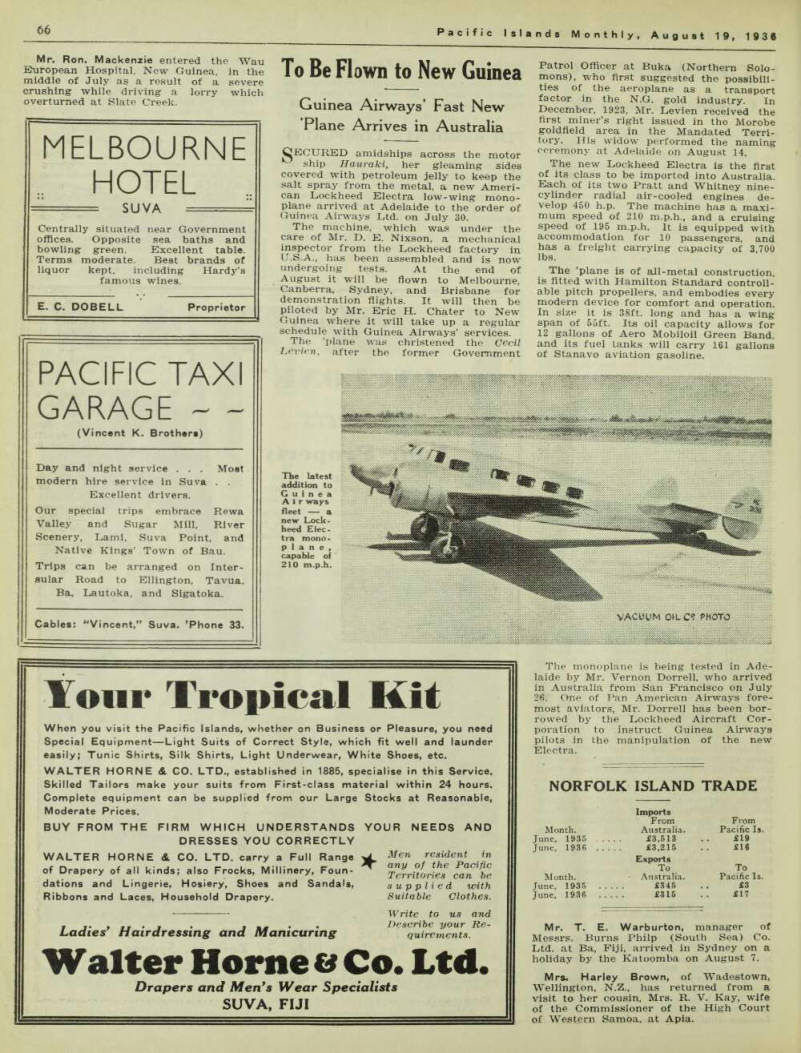
A RESIDENT of Nabouwalu, Bua, Fiji, writes to complain that although the Government yacht Pioneer, with the Act ing Governor aboard, spent some time at Nabouwalu in July, the white settlors and planters in the district were not inviled to meet the Vice-Regal party. They felt this the more because the Governor on previous visits had met them; and on this occasion they had certain matters they wished to place before His Excel lency.
“Are we not worthy of recognition,” asks our correspondent, “or was this an oversight due to there being no District Commissioner residing in this province through whom invitations might be issued? We should have been glad of this opportunity to meet the head of the Ad ministration, as few of us can afford to travel into Suva to lay our troubles be fore the authorities there.”
Mr. Ron. Mackenzie entered the Wau European Hospital, New Guinea, in the middle of July as a result of a severe crushing while driving a lorry which overturned at Slate Creek.
Advertisements & other items, pp. 67-68 (1 item)
protects
LEATHER BELTS
Cor NATIVES
' 'TDonufacturers i Specialists
PATTERSON & STONE, CRICHTON WORKS,
WALSALL, ENGL AND.
' i r p
€¥€LOft T ®
IS ••
protects
lour Property
The Cyclone” Rmglock Joint is immovable and unbreakable, whether by beast or any other strain of erecting or usage. Needs fewer posts and no droppers. Costs less in the long run, often less in the first place, than any other fence.
F m w u If Cl % Irf * m mm v* - CYCLONE FENCE & GATE CO. PTY. LTD.
The Grace Bldg., 77 York St., Sydney And at Melbourne & Adelaide Please send me by return mail your free, illustrated and priced Catalogue of Cyclone Metal Gates and Ring-lock Fences, and comparison of costs.
Name Address P. 1.8
MELBOURNE
HOTEL
■ ■ SUVA ■-■■■-- .
Centrally situated near Government offices. Opposite sea baths and bowling green. Excellent table.
Terms moderate. Best brands of liquor kept. including Hardy’s famous wines.
E. C. DOBELL
Proprietor
PACIFIC TAXI
GARAGE - -
(Vincent K. Brothers) Day and night service . . . Most modern hire service in Suva . .
Excellent drivers.
Our special trips embrace Rewa Valley and Sugar Mill, River Scenery, Lami, Suva Point, and Native Kings' Town of Bau.
Trips can be arranged on Intersular Road to Ellington, Tavua.
Ba, Lautoka, and Sigatoka.
Cables: “Vincent,” Suva. 'Phone 33.
Your Tropical Kit
When you visit the Pacific Islands, whether on Business or Pleasure, you need Special Equipment—Light Suits of Correct Style, which fit well and launder easily; Tunic Shirts, Silk Shirts, Light Underwear, White Shoes, etc.
WALTER HORNE & CO. LTD., established in 1885, specialise in this Service.
Skilled Tailors make your suits from First-class material within 24 hours.
Complete equipment can be supplied from our Large Stocks at Reasonable, Moderate Prices.
BUY FROM THE FIRM WHICH UNDERSTANDS YOUR NEEDS AND
DRESSES YOU CORRECTLY
WALTER HORNE & CO. LTD. carry a Full Range of Drapery of all kinds; also Frocks, Millinery, Foundations and Lingerie, Hosiery, Shoes and Sandals, Ribbons and Laces, Household Drapery.
Men resident in any of the Pacific Territories can be supplied with Suitable Clothes.
Ladies 9 Hairdressing and Manicuring
Write to us and Describe your Requirements.
Walter Horne & Co. Ltd.
Drapers and Men*s Wear Specialists
SUVA, FIJI
To Be Flown to New Guinea
Guinea Airways’ Fast New ’Plane Arrives in Australia
SECURED amidships across the motor ship Hauraki, her gleaming sides covered with petroleum jelly to keep the salt spray from the metal, a new American Lockheed Electra low-wing monoplane arrived at Adelaide to the order of Guinea Airways Ltd. on July 30.
The machine, which was under the care of Mr. D. E. Nixson, a mechanical inspector from the Lockheed factory in U.S.A., has been assembled and is now undergoing tests. At the end of August it will be flown to Melbourne, Canberra, Sydney, and Brisbane for demonstration flights. It will then be piloted by Mr. Eric H. Chater to New Guinea where it will take up a regular schedule with Guinea Airways’ services.
The ’plane was christened the Cecil Levien, after the former Government
Patrol Officer at Buka (Northern Solo mons), who first suggested the possibilities of the aeroplane as a transport factor in the N.G. gold industry. In December, 1923, Mr. Levien received the first miner’s right issued in the Morobe goldfield area in the Mandated Territory. His widow performed the naming ceremony at Adelaide on August 14.
The new Lockheed Electra is the first of its class to be imported into Australia.
Each of its two Pratt and Whitney nine cylinder radial air-cooled engines develop 450 h.p. The machine has a maximum speed of 210 m.p.h., and a cruising speed of 195 m.p.h. It is equipped with accommodation for 10 passengers, and has a freight carrying capacity of 3,700 lbs.
The ’plane is of all-metal construction, is fitted with Hamilton Standard controllable pitch propellers, and embodies every modern device for comfort and operation.
In size it is 38ft. long and has a wing span of 55ft. Its oil capacity allows for 12 gallons of Aero Mobiloil Green Band, and its fuel tanks will carry 161 gallons of Stanavo aviation gasoline.
The monoplane is being tested in Adelaide by Mr. Vernon Dorrell, who arrived in Australia from San Francisco on July 26. One of Pan American Airways foremost aviators, Mr. Dorrell has been borrowed by the Lockheed Aircraft Corporation to instruct Guinea Airways pilots in the manipulation of the new Electra.
The latest addition to Guinea Air ways fleet a new Lock heed Elec tra mono plane, capable of 210 m.p.h.
Norfolk Island Trade
Mr. T. E. Warburton, manager of Messrs. Burns Philp (South Sea) Co.
Ltd, at Ba, Fiji, arrived in Sydney on a holiday by the Katoomba on August 7.
Mrs. Harley Brown, of Wadestown, Wellington, N.Z., has returned from a visit to her cousin, Mrs. R. V. Kay, wife of the Commissioner of the High Court of Western Samoa, at Apia.
Imports From From Month. Australia. Pacific Is.
June, 1935 £3,513 .. £19 June, 1936 £3,215 .. £16 Exports To To Month. Australia. Pacific Is.
June, 1935 £345 .. £3 June, 1936 £315 .. £17
Examined by Fiji Governor
Mysterious Sampan
From Our Own Correspondent.
SUVA, July 31. r TVHE Fijian authorities made interesting *- contact with a Japanese vessel the other day.
The Acting-Governor (Mr. J. Barton) was on a visit of inspection on the Gov ernment vessel Pioneer, off the north coast of Vanua Levu, when a craft of peculiar appearance was observed, making for the reef near Labasa.
The Pioneer headed for the stranger, which thereupon turned and fled. The Pioneer dug up 12 knots from her reper toire and slowly overtook the foreigner, and signalled her to hoist her colours.
The stranger hoisted the Japanese flag.
The Pioneer ordered her to stop for exam ination. The stranger did not stop until it was plain that the Pioneer was over hauling her and was ostentatiously re moving the tarpaulin from her signalling guns. Then she lay to.
There was an officer of marines on the Pioneer; and he took a party aboard the sampan, and brought the Japanese cap tain and engineer on to the Government vessel for interrogation. Little was learned of the object of the sampan’s presence in those waters.
The sampan was about 100 feet long, and had powerful Diesel engines. She carried 28 men (which was regarded as excessive) and about 5000 gallons of oil.
She had evidently called somewhere along the coast, as freshly-cut bunches of bananas were noticed aboard.
The object of the sampan cruising in
Fijian waters is the subject of speculation.
She may have been seeking trochus-shell, but there was no indication of it.
The Pioneer could find nothing of an illegal character about the sampan; and, as she was then outside of territorial waters, she was not further delayed.
Since the report that the Pioneer sighted this vessel, word has been brought to Suva by the master of a cutter that he saw what is thought to be the same sam pan, apparently engaged in diving for shell off Udu Point. He stated that after the Pianeer left, the vessel returned near the coast and started diving. Later the Japanese boat worked down the coast and was last seen at the island of Kia, which is off the coast near Labasa.
A Chinese storekeeper at Udu Point said that the diving gear used consisted only of a head dress and goggles.
German Consul Visits
New Guinea Goldfield
From Our Own Correspondent.
WAU, July 22.
IVR. VV. HELLENTHAL of the German Consulate-General in Australia, paid an official visit to Wau on July 15, arriv ing by ’plane from Port Moresby. He was met on the Wau aerodrome by several prominent German residents.
A dinner was given in his honour the same evening at the Wau Hotel, Among those present were Mr. X. Penglase (A.D.0.), Mrs. Penglase, Mr. and Mrs. Neal.
M.L.C., Mr. C. L. B. Wilde, and Mr. Oscar Schwartz.
Dr. Hellenthal remained in the Morobe district several days, during which he made a tour of the outlying country.
For July 14 Festivities
Tourists Invade Tahiti
From Our Own Correspondent.
Papeete, July 7.
UPWARDS of a hundred tourists arrived in Tahiti by the Makura on June 13 and a further 150 have booked up for the Maunganui due to arrive here on July 11, in time to participate in the French National festivities of the 14th, the pre parations for which are now well under way.
Some anxiety was manifested by the executive of the Tourist Bureau lest the available accommodation might prove in sufficient for such an unusually large number of visitors at one time. Special arrangements have been made, however, and this difficulty has been satisfactorily overcome.
In order that round-trippers may have as much fun as possible during their short stay, the Fete this year will open on the evening of Sunday, the 12th, when a grand Pal Publiquc will be held at the Place du Marechal Joffre. This will be followed on the four succeeding days by the usual events consisting of singing and dancing by native troupes on the lawn in front of the Governor's Palace, sailing canoe races and other aquatic diver sions in the harbour, various sporting competitions, and a great display of fire works offered by the Governor.
The official part of the celebrations will take place on the 14th, when the local troops will be reviewed and the usual ceremony held at the monument to Tahitian soldiers, upon which wreaths will be placed by the Chief of the Colony.
The celebrations will end on July 19
Advertisements & other items, pp. 69-70 (1 item)
Grand
r 'WK The PREMIER Social Rendezvous of Fiji . . .
Grand Pacific Hotel - - Fiji
EXCELLENT CUISINE. EFFICIENT TRAINED INDIAN WAITERS AND SERVANTS.
MODERNLY EQUIPPED.
Grand
Pacific
Hotel
SUVA, FIJI
Delightfully situated in tropical gardens overlooking Suva harbour and the Pacific Ocean.
TARIFF: from 17/6 per Day Accommodation Reserved by Wireless Cable address: “Grandpacif,”
Suva.
Star
mm
TAXIS
Garage: Princes Street, Suva.
'Phone 322.
Cable Address: “Tillak.” G.P.O. Box 124, Suva.
AT YOUR SERVICE:
Sedan and Touring Cars. Latest Models equipped with radio.
Our Cars Meet all Steamers Motor Lorries & Launches for Hire.
General Carriers.
Quotes given for Immediate Transport to all parts of Island Suva Tavua • Lautoka—Sigatoka. Open always, including Sundays and Holidays.
Plume Motor Spirit and Gargoyle MobUoil Service Station.
Terms cash. Monthly accounts to approved customers only.
White Star Motor Garage
Tillak Bros., Proprietors
N.G. Public Service
RECENT staff movements in the New Guinea Administration were announced on July 16 as follows:
Transfers
Government Secretary’s Dept.: G. E. Walker, Clerk, Public Health Dept., to Central Administra tion; C. W. Hams, Clerk, Treasury Dept. (Stores Branch), to Public Health Dept.
Public Health Dept.: R. R. L. Foulkes, Medical Assistant, Rabaul to Namatanai; H. S. Roberts, Medical Officer, Salamaua to Kavieng; L. A. Hud son, Medical Assistant, Rabaul to Wewak; W. A- McAllister, Medical Assistant, Kavieng to Rabaul; B. A. Sinclair, Medical Officer, Rabaul to Sala maua; J. F. Collins, Medical Assistant, Wau to Rabaul; E. A. Holland, Medical Officer, Kavieng to Rabaul; R. T. Squires, Medical Assistant, Rabaul to Gasmata.
District Services and Native Affairs Dept.: L.
Pursehouse, Cadet, Salamaua to Wewak; N. Pen glase. Assistant District Officer, Rabaul to Sala maua; E. H. F. Mitchell, Cadet, Rabaul to Kavieng; E. C. Styants, Cadet, Kokopo to Talasea.
Temporary Employees
Engagements: Miss C. Love, Typiste, Dept, of Agriculture; Miss M. Thomas, Typiste, Public Health Dept.; C. G. Francis, Roadmaster (Koko po), Public Works Dept.; I. Crawford, Roadmaster (Wau), Public Works Dept.; Mrs. N. M. Turner, Typiste, Lands Dept.
Dr. E. A. Holland, Government Medical Officer in charge of the New Ireland dis trict, reached Australia by the Nankin at the end of July.
Unruly Natives
Night Attack on N.G. Patrol
/V PATROL led by Assistant District x Officer A. Nurton was attacked at night by hostile natives on the Rai coast, 40 miles south of Madang, in New Guinea, on July 23.
One native constable was killed and four were wounded, one seriously.
Two loaded rifles were stolen.
The patrol was engaged in ordinary administration work, including the taking of a census, and the attack took place while the party was asleep.
District Officer McDonald, of Madang, is investigating.
Long notorious for their ferocity, the natives of the Rai coast were deprived of their lands by the pre-war German ad ministration as a punishment for an abortive plot to attack Madang and massacre the German inhabitants.
Some years after the capture of New Guinea by the Australian forces, their lands were restored by the Administra tion of the Mandated Territory in conse quence of their having come readily under control.
“Fanaticism” Reported
From Our Own Correspondent.
Rabaul, July 14.
REPORTS have been received that Rai Coast natives are awaiting the second coming of Christ, who, it is stated by mission teachers, will arrive on a large white cloud.
The rumours are causing considerable interest amongst the local natives, who have been told that they must all remain in their villages in order to await the arrival of the Messiah. Natives who are absent from their homes at the time of the coming will not be “saved.”
Many indentured labourers are seeking permission to return to their homes, and recruiters are finding it impossible to ob tain recruits from this area.
Solomon Islander
Awarded O.B.E. Medal
From Our Own Correspondent
Tulagi, July 16.
THE Acting High Commissioner for the Western Pacific has notified the 8.5.1.
Administration that King Edward VIII has awarded the Medal of the Most Excellent Order of the British Empire to Lance-Cor poral Toni, of the Armed Constabulary.
Toni is non-commissioned officer in charge of the Santa Cruz detachment of the constabulary. He is stationed in the Reef Islands.
During the hurricane in Santa Oruz dis trict last December, Toni swam out through heavy seas and assisted in secur ing the safety of the Government auxiliary vessel Veronica, which was anchored off Tuo. On board the vessel were the Dis trict Officer and his wife.
Mr. W. L. Dunlop, constructional engi neer in charge of the Vacuum Oil Co.’s works in Fiji, recently arrived in Mel bourne with his wife on a health visit.
Advertisements & other items, p. 70 (1 item)
Tisdalls
The Yorkshire Insurance Coy. Ltd.
ESTABLISHED IN YORK— IB24
Agents and Attorneys throughout the Pacific Islands SUVA - - A. Q. McGowan & Co.
SALAMAUA A. Innes
K AVI ENG - F. V. Saunders
PAPUA
Port Moresby - - E. A. James Samara! - - E. J. Morrow
NEW GUINEA BRANCH: Park St., RABAUL.
Fire
Aeciilent
Hlarlue
Total Assets Exceed £15,000,000.
E. G. MacADAM, Manager.
Fishing Tackle
Firearms and Ammunition
All Sports Equipment
If contemplating a visit to New Zealand, write TISDALLS, who will forward their 120-page Anglers’ Handbook, and will supply all Fishing, Shooting & General Sports information desired.
TISDALLS
Largest Retailers of Sports Equipment in N.Z.
Branches at:
AUCKLAND, WELLINGTON, CHRISTCHURCH
AND HAMILTON
No connection with any business in Rotorua.
ASK FOR
PRICE LISTS
I
From Fiji
Pacific Islands Mining Reports
Emperor, Loloma And Koroere Mines
STATING that he was well satisfied with his visit, Mr. T. R. Victor, mining engineer, and a director of Loloma (Fiji) Gold Mines N.L., Emperor Mines Ltd., and Koroere Gold N.L., re turned to Australia by the Monterey in July, after an inspection of the three mines at Tavua, Fiji.
Mr. Victor stated that the Emperor mine was developing splendidly at the bottom level, 190 ft. in depth. The company had now driven on a strong fissure type of lode for close on 300 ft., carrying payable values. The shoot of gold at this level corresponded in position to No. 1 section of the upper level and the values, if anything, were better than the values above. As far as was known, the width was over 30ft. and flat makes of ore, similar in type to the flat makes at the upper level, were showing at the 190 ft. level, carrying payable values. These flat makes were a source of large additional tonnage to the main vertical lode. Other parts of the mine had de veloped satisfactorily, and the reserves of ore now in sight were considerably greater than the reserves shown in the prospectus. In addition to the 2000 tons a month, already treated, a milling plant capable of treating a further 10,000 tons monthly had been ordered from a Melbourne firm.
The Loloma mine, he said, was developing very satisfactorily at the south end of the 120 ft. shaft level. During recent weeks highly payable values were showing in this section, and during his visit from five to seven feet of good-grade ore was showing in the face. It was expected by the man agement that these values would continue for many hundreds of feet south of this level. At the main adit level south good values were showing, over four feet of ore being in the face. The length of the good-grade ore was now nearly 600 ft. long at this level. It had been decided not to open the Regent lode, where high values were showing, until the main adit level had been driven to a point opposite the Regent outcrop, when a cross cut would be put out to intercept the Regent lode, giving 100 ft. of backs. Tenders had already been called for the manufacture of a milling plant, capable of treating 500 tons weekly.
Discussing the Koroere mine, Mr. Victor stated that a boring campaign was being inaugurated to cut the Regent lode, the boundary lode, the Lo loma lode and three other known lodes, close to the Emperor and Loloma boundaries, at a depth of 300 ft. This boring campaign would be commenced shortly, and interesting developments were ex pected.
Tavua Power Pty. Ltd.
Directors of Tavua Power Pty. Ltd., Fiji, re port that the excavations for the power house and foundations for the compression and generating sets have been completed, the steel work of the power house buildings has been erected, and the clothing of the buildings in asbestos sheeting is well in hand. The air compressor and first generating set should arrive in Suva this month. Other work incidental to the power scheme is well up to schedule date. Shares in the company are held by Loloma (Fiji) Gold Mines N.L. and Emperor Mines Ltd., and electrical power will be supplied to the gold mines of these companies.
Emperor Mines Ltd.
Emperor Mines Ltd. treated ore of a slightly greater head value in the July-August period, but gold recovery was a little smaller. Tonnages of the last two crushings were about the same.
Four weeks ended June 13 July 11 Aug. 8 Treated, long tons . 1940 2275 2277 Head, value (dwt. a ton) 11.9 10.14 10.5 Gold won, fine oz. . 1070 1050.25 1048.19 Average dwt. a ton 11 9.23 9.21
Vees United N.L.
In the middle of July, telegraphic advice was received in Australia from Vees United’s attorney in Fiji (Sir Henry Scott, K.C.) notifying that Dr.
Loftus Hills (the Company’s consulting geologist) had advised the abandonment of the areas held under option.
Mr. J. N. Goodsir has resigned from the direc torate of the company.
Fiji Mining Corporation N.L.
Directors of Fiji Mining Corporation N.L. re port that it has been decided to suspend operations temporarily on prospecting licence 288, Tavua, Fiji, pending the result of operations by adjoining com panies. This information is expected to give the company valuable data on which to base its future development policy. Application has been made
to the Mining Board of Suva for exemption to protect the licence during the period of the shut down.
From Papua
Cuthbert’S Misima Gold Mine Ltd.
Mining and treatment operations have been carried on regularly by Cuthbert’s Misima Gold Mine Ltd., Misima Island, despite fairly constant heavy rains over the past two months, reported the secretary (Mr. C. C. Brown) in a circular to shareholders on July 31.
The mill is now treating at the rate of about 19,000 tons of ore a year. Mine development is well ahead of requirements, and the assay of lode faces shows up well. Ore is being won from 17 stope floors, besides all development faces, con sequently it is being spread over a large portion of the mine. Work for the enlarged plant is going ahead satisfactorily. The road to the new timber areas has been completed. It is estimated these areas contain sufficient timber for about 10 years.
In addition the company holds other timber areas.
At an arbitration sitting in Samarai the Co.’s claim for £763 against the vendor Co. for a pro portion of the gold in the vendor Co.’s final clean-up in October was successful, whilst a claim for £llO7 against the Co. by the vendors for certain native labour was not successful. The costs of arbitration are to be paid by the vendor Co.
The interim dividend of 6d. a share, payable on August 28, together with the five per cent.
bonus distribution among the Co.’s white staff, will absorb £7875.
The following report was issued on August 8:
Louisiade Gold N.L.
The activities of Louisiade Gold N.L. at Misima Island have ceased, and the plant has been removed to Sudest, according to an interim report issued to shareholders on July 17.
The first objective of the Co. was to place a small sluicing plant on alluvial leases at Misima held by a native named Gala. A party of five sailed from Sydney in October last to erect plant, clear the ground, and build a dam. Monsoonal rains delayed operations, but work was recom menced in March. It was found that the ground to be treated contained much clay and heavy boulders and in consequence recovery was diffi cult. More machinery was sent to the property, hut results were not commensurate with the time and money spent. In May the Board decided to withdraw from Misima and concentrate on Sudest.
Because gold to the value of only £lB4 has been received in Sydney, the manager has been requested to speed up production at Sudest. A
competent mining engineer is now inspecting the property, and will return to Australia in Septem ber to make his report to the Board.
May.
June,
July.*
Ore, tons 1436 1580 1305 Bullion, oz 1877 2396 1498 Gold, fine oz 499 499 348 Silver, fine oz 1336 1843 1150 Estimated value (gold at £A8 per oz.) £4095 £4122 £2844 Value per ton 57/- 52/2 43/7 * To July 18 instead of July 23.
Low recovery due to excessive rains flooding vats and causiner loss of solution. During the period 40 inches of ram fell, which is considerably above the average.
Shipped for realisation about £75 worth of auriferous sands and £500 worth of slags and . ashes.
Advertisements & other items, pp. 71-72 (1 item)
Gold
Piimpmobil
LIGHT and
Motor Pump
Complete Plant’s weight, 140 lbs. Capacityup to 12,000 gallons per hour.
All heads from 10 to 115 feet.
Fuel consumption, V 2 gallon per hour.
Pressure 55Ub. square inch.
Especially suitable prospecting and all Sluicing Requirements.
Nelson & Robertson Ltd.
12 SPRING STREET, SYDNEY
oAustralia’s Clearing House for the ‘Precious
BUYERS OF
GOLD
OSMIRIDIUM, PLATINUM, SILVER, &c.
GARRETT & DAVIDSON, LTD.
ASSAYERS, BULLION MERCHANTS, METALLURGISTS
Bank of N.S.W. Buildings, Regent Street, Sydney
MORRIS, HEDSTROM, Ltd.
FIJI
Sole Agents in Fiji for . . .
Vacuum Oil Company (Pty.) Limited
Imperial Chemical Industries Limited
Nobel (Australasia) Pty Ltd.—Explosives
Full Stocks of
MINERS AND PROSPECTORS’
REQUISITES
Also SODIUM CYANIDE, ZINC
DUST, Etc., Etc.
Sydney Office:
DALTON HOUSE, 115 PITT ST., SYDNEY
Branches throughout the gold hearing areas Lautoka, Ba, Tavua, Penang, Nadi, and Sigatoka
Mining Ore Treatment
Machinery
Complete Cyanide Plants Supplied.
Dorr Classifiers.
Dorr Thickeners.
Dorr Agitators.
Oliver Filters.
Merril Crowe Zinc Dust Gold Precipitation Richardson Mine Fans.
FANS AND AIR HEATERS
For Ventilation, Copra Drying Rooms, etc.
Enquire from
CROSSLE, DUFF AND
MACINTOSH LTD.
62 Bridge Street, SYDNEY
WE DID THE WHOLE CONTRACT
Your confidence in our service will not be misplaced.
NEW OVERHAUL
SHOP
AND STORE AT LAE
for
GUINEA AIRWAYS
LTD.
¥ N few undertakings 1 do reliability, expedition, and efficient service count more than in Structural Steel contracts.
The Sydney Steel Company Ltd. c^^ R S vl t L d^^ s ' w - Steel Merchants and Structural Engineers
GOLD
HIGHEST PRICES
PROMPT SETTLEMENTS
ACCURATE WEIGHTS AND
ASSAYS
are assured to producers and sellers of gold bullion who forward their consignments to The Electrolytic Refining and Smelting Co. of Aust. Ltd. for treatment and realisation.
RECORD PRICE.— On 6th March, 1935, this company paid to its clients at the rate of £9/4/6 net per fine ounce, which is the highest price ever paid for gold in Australia.
SPECIALLY ORGANISED SER-
VICE is available to clients in New Guinea, Fiji and other Pacific Island centres.
Address consignments from outside Australia to the Company's Sydney office.
Weighing a Pacific Islands consignment of gold bullion at an E.R. & 8. receiving office.
The Electrolytic Refining & Smelting Co.
OF AUSTRALIA LIMITED.
Melbourne; Works; Sydney: Collins House. Port Kembla, N.S.W. 25 O'Connell Street.
Purchasers and Refiners of Gold, Silver, Copper in any form BANKERS.—The English, Scottish and Australian Bank Ltd.
From New Guinea
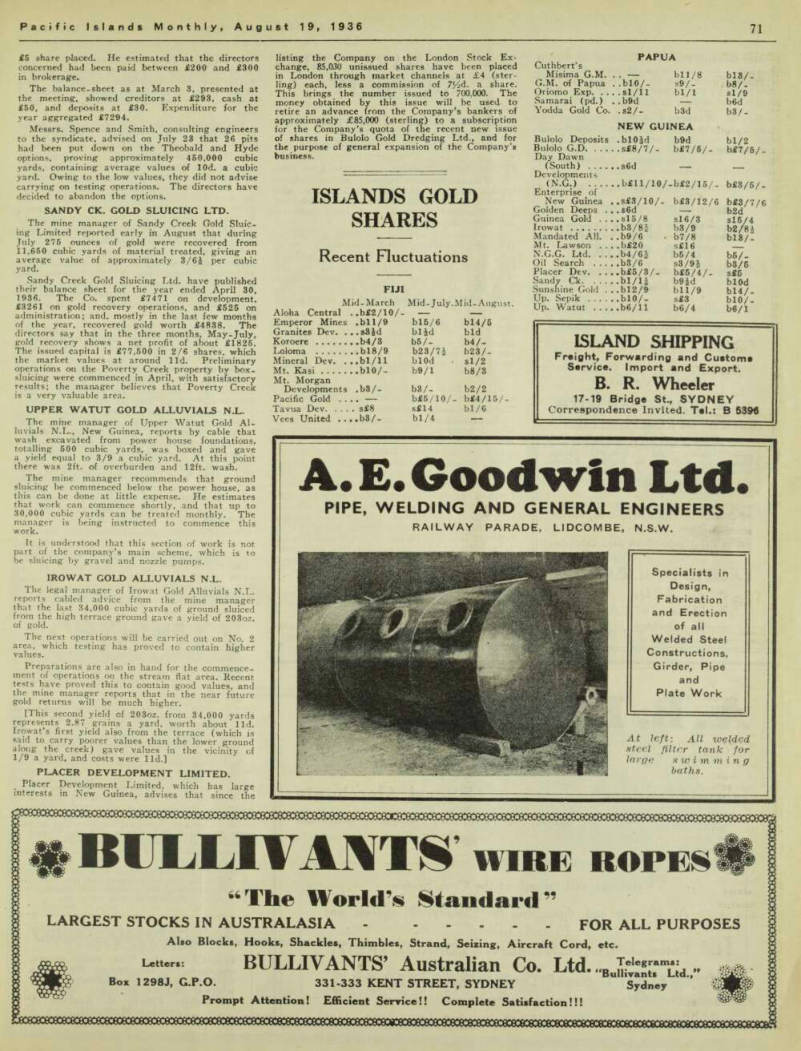
Sunshine Gold Development Ltd.
On August 10. the general manager in New Guinea of Sunshine Gold Development Ltd. ad vised by radio that the sluicing plant at Goldfoil is now in operation, with a full head of water.
The work had been delayed several months ago as a result of trouble with the siphon line.
Bulolo Gold Deposits Ltd.
The manager of Bulolo Gold Deposits Ltd., New Guinea, reported early in August that the com pany had cleaned up 3970 z. of gold for 345 working hours.
The company has obtained a tribute from New Guinea Goldfields Ltd., on satisfactory terms, ad joining the present workings. Work is being commenced on this area immediately, in conjunc tion with work on the Co/s own property.
Ramu (N.G.) Gold Syndicate N.L.
Shareholders of Ramu (New Guinea) Gold Syndicate N.L., at an extraordinary meeting in Melbourne on August 7, decided voluntarily to wind up the syndicate. There will not be any return to shareholders.
The company was formed in Victoria at the end of 1934 with a capital of £5OOO in 1000 shares of £5. Seven hundred were offered for public sub scription and 300 were held in trust for the vendors and promoters.
Messrs. Spence and Smith, of Wau, tested the Co. s leases on three tributaries of the Ramu River.
They recommended the abandonment of the areas in August, 1935.
New Guinea Goldfields Ltd.
The monthly returns of production and estimated profits of New Guinea Goldfields Ltd. are as follows;
Enterprise Of New Guinea N.L.
From the general manager of Enterprise of New Guinea N.L., the following cable was received on July 22: — “Further delay Surprise Creek-Watut area owing to heavy rain; some damage along water-race.
Developments of importance taking place at engine face, discovered what appears to be old river bed rock. Must do more development work before ex tent made known.”
Advice was received on August 4 by the Mel bourne management of the Company that water was running through the Iroa Creek-Watut water race. A sluicing face is being opened up.
Upper Sepik Gold Syndicate N.L.
Business at the first annual meeting of Upper Sepik Gold Syndicate N.L. early in July was monopolised by discussion about the company’s finances. Many sharp exchanges were passed be tween shareholders and the directors.
Shareholders asked the chairman (Mr. E. F. S.
England) to read a confidential report about the deficiency account shown in the accounts. This re port had been sent by the auditor to the directors.
Newspaper representatives were asked to leave the meeting while the report was read. However, after a long discussion it was decided that the contents of the report would not be disclosed to shareholders, and the press representatives were readmitted. The chairman said that the directors had acted upon recommendations made by the auditor in the report.
On the flotation of the company commission was paid to certain directors on the sale of shares.
As authority to draw commission was not given to the directors in the prospectus, shareholders were asked at this meeting to agree to a motion confirming the payment of brokerage to directors at the time of flotation. The motion was rejected.
The auditor (Mr. A. W. H. McEwan) said that the brokerage paid was 10/- for each fully paid
Edie Creek Mill— Apl.
May.
June.
Tons *3566 13448 Fine gold, oz 1172 1269 1161 Fine silver, oz 3249 3581 3037 Alluvial— Fine Gold, oz 1111 1088 1141 Fine silver, oz 838 826 863 Golden Ridges Mill— Fine Gold, oz 1489 1244 1599 Fine silver, oz 828 847 1039 Operating Profit— Alluvial £6127 £5478 £4600 Golden Ridges Mill . . 6605 5999 3782 Edie Creek mill 1867 3731 3704 t From April 14 to May 14. * From May 14 to June 14. f From June 14 to July 14.
£5 share placed. He estimated that the directors concerned had been paid between £2OO and £3OO in brokerage.
The balance-sheet as at March 3, presented at the meeting, showed creditors at £293, cash at £5O, and deposits at £3O. Expenditure for the year aggregated £7294.
Messrs. Spence and Smith, consulting engineers to the syndicate, advised on July 23 that 26 pits had been put down on the Theobald and Hyde options, proving approximately 450,000 cubic yards, containing average values of lOd. a cubic yard. Owing to the low values, they did not advise carrying on testing operations. The directors have decided to abandon the options.
Sandy Ck. Gold Sluicing Ltd.
The mine manager of Sandy Creek Gold Sluic ing Limited reported early in August that during July 275 ounces of gold were recovered from 11,650 cubic yards of material treated, giving an average value of approximately 3/6i per cubic yard.
Sandy Creek Gold Sluicing Ltd. have published their balance sheet for the year ended April 30, 1936. The Co. spent £7471 on development, £3261 on gold recovery operations, and £525 on administration; and, mostly in the last few months of the year, recovered gold worth £4838. The directors say that in the three months, May-July, gold recovery shows a net profit of about £1825.
The issued capital is £77,500 in 2/6 shares, which the market values at around lid. Preliminary operations on the Poverty Creek property by box sluicing were commenced in April, with satisfactory results; the manager believes that Poverty Creek is a very valuable area.
Upper Watut Gold Alluvials N.L.
The mine manager of Upper Watut Gold Al luvials N.L., New Guinea, reports by cable that wash excavated from power house foundations, totalling 500 cubic yards, was boxed and gave a yield equal to 3/9 a cubic yard. At this point there was 2ft. of overburden and 12ft. wash.
The mine manager recommends that ground sluicing be commenced below the power house, as this can be done at little expense. He estimates that work can commence shortly, and that up to 30,000 cubic yards can be treated monthly. The manager is being instructed to commence this work.
Tt is understood that this section of work is not part of the company’s main scheme, which is to be sluicing by gravel and nozzle pumps.
Irowat Gold Alluvials N.L.
The legal manager of Irowat Gold Alluvials N.L. reports cabled advice from the mine manager that the last 34,000 cubic yards of ground sluiced from the high terrace ground gave a yield of 2030 z. of gold.
The next operations will be carried out on No. 2 area, which testing has proved to contain higher values.
Preparations are also in hand for the commence ment of operations on the stream flat area. Recent tests have proved this to contain good values, and the mine manager reports that in the near future gold returns will be much higher. [This second yield of 2030 z. from 34,000 yards represents 2.87 grains a yard, worth about lid.
Irowat’s first yield also from the terrace (which is said to carry poorer values than the lower ground along the creek) gave values in the vicinity of 1/9 a yard, and costs were lid.]
Placer Development Limited.
Placer Development Limited, which has large interests in New Guinea, advises that since the
listing the Company on the London Stock Ex change, 85,030 unissued shares have been placed in London through market channels at £4 (ster ling) each, less a commission of a share.
This brings the number issued to 700,000. The money obtained by this issue will be used to retire an advance from the Company’s bankers of approximately £85,000 (sterling) to a subscription for the Company's quota of toe recent new issue of shares in Bulolo Gold Dredging Ltd., and for the purpose of general expansion of the Company’s business.
Islands Gold
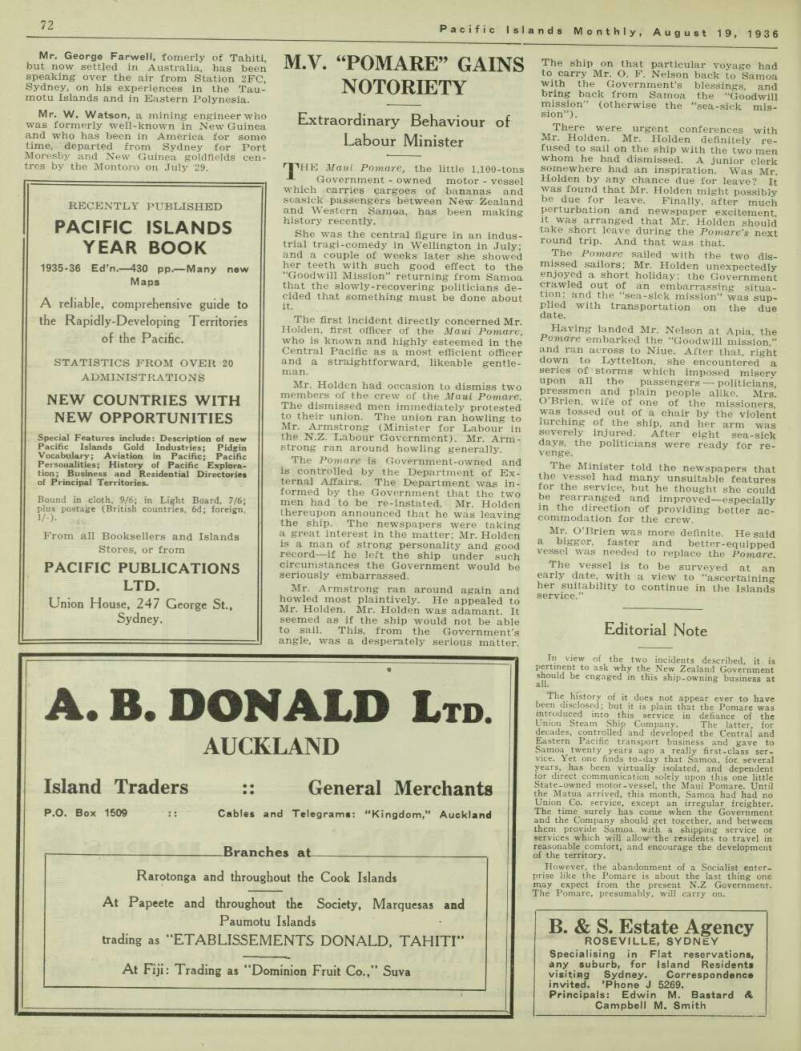
Shares
Recent Fluctuations
Fiji
Mid-March Mid-July. Mid-August.
Aloha Central ..b£2/10/- — — Emperor Mines .bll/9 b!5/6 b!4/5 Granites Dev. . ..s3Jd bl id bid Koroere b6/~ b4/- Loloma .,b!8/9 b23/7J b23/- Mineral Dev. . ..bl/11 blOd sl/2 Mt. Kasi b9/l b8/3 Mt. Morgan Developments .b8/. b3/b2/2 Pacific Gold . . . , — b£5/10/ - b£4/15/- Tavua Dev. . . . . s£8 s£ 14 bl/6 Vees United .. . .b3/bl/4 —
Cuthbert’s Misima G.M.
Papua
. — bll/8 bl3/- G.M. of Papua .blO/s9/b8/- Oriomo Exp. . . .sl/11 bl/I sl/9 Samarai (pd.) . b9d — b6d Yodda Gold Co. • s2/b3d b3/- Bulolo Deposits
New Guinea
.blOid b9d bl/2 Bulolo G.D Day Dawn . s£8/7/b£7/5/b£7/5/- (South) . s6d - , Developments (N.G.) Enterprise of New Guinea . .b£l1/10/ -b£2/16/b£8/5/- ,s£3/10/b£3/12/6 b£3/7/6 Golden Deeps . . . s6d —. b2d Guinea Gold . . . . sl5/8 sl6/3 sl5/4 Irowat .bS/8i b3/9 b2/8 h Mandated All. . . b9/6 b7/8 bl8/- Mt. Lawson . . . . b£20 s£16 N.G.G. Ltd. . . . .b4/6i b5/4 b6/- Oil Search . . . . .b3/6 s3/95 b3/5 Placer Dev. . .. ,b£5/8/b£5/4/s£5 Sandy Ck Sunsnine Gold . . .bl/U b9id blOd .bl2/9 bll/9 bl4/- Up. Sepik .blO/s£3 blO/- Up. Watut . . . . .b6/l1 b6/4 b6/l
Mr. George Farwell, fomerly of Tahiti, but now settled in Australia, has been speaking over the air from Station 2FC, Sydney, on his experiences in the Tau motu Islands and in Eastern Polynesia.
Mr. W. Watson, a mining engineer who was formerly well-known in New Guinea and who has been in America for some time, departed from Sydney for Port Moresby and New Guinea goldfields cen tres by the Montoro on July 29.
Advertisements & other items, pp. 73-74 (1 item)
# BULLJVAATS’ wire r«pgss
ISLAND SHIPPING
Freight, Forwarding and Cuetoma Service. Import and Export.
B. R. Wheeler 17-19 Bridge St., SYDNEY Correspondence Invited. Tel.; B 5396
A. E. Goodwin Ltd.
PIPE, WELDING AND GENERAL ENGINEERS
RAILWAY PARADE, LIDCOMBE, N.S.W.
Specialists in Design, Fabrication and Erection of all Welded Steel Constructions, Girder, Pipe and Plate Work At left: All welded steel filter tank for large swimming baths.
BULLJVAATS’ wire r«pgss
44 The World's Standard **
LARGEST STOCKS IN AUSTRALASIA
FOR ALL PURPOSES
Also Blocks, Hooks, Shackles, Thimbles, Strand, Seizing, Aircraft Cord, etc.
Letters: BULLIVANTS’ Australian Co. Ltd.
Box 1298 J, G.P.O. 331-333 KENT STREET, SYDNEY “ Sydney ’
Prompt Attention! Efficient Service!! Complete Satisfaction!!!
RECENTLY PUBLISHED
PACIFIC ISLANDS
YEAR BOOK
1935-36 Ed’n.—43o pp.—Many new Maps
A reliable, comprehensive guide to
the Rapidly-Developing Territories
of the Pacific.
STATISTICS FROM OVER 20
ADMINISTRATIONS
NEW COUNTRIES WITH
NEW OPPORTUNITIES
Special Features include: Description of new Pacific Islands Gold Industries; Pidgin Vocabulary; Aviation in Pacific; Pacific Personalities; History of Pacific Exploration; Business and Residential Directories of Principal Territories.
Bound in cloth, 9/6; in Light Board, 7/6; plus postage (British countries, 6d; foreign, V-).
From all Booksellers and Islands Stores, or from
PACIFIC PUBLICATIONS
LTD.
Union House, 247 George St.,
Sydney.
A. B. DONALD Ltd.
AUCKLAND
Island Traders General Merchants
P.O. Box 1509 :: Cables and Telegrams: "Kingdom," Auckland Branches at Rarotonga and throughout the Cook Islands At Papeete and throughout the Society, Marquesas and Paumotu Islands
trading as “ETABLISSEMENTS DONALD, TAHITI"
At Fiji: Trading as ‘‘Dominion Fruit C 0.," Suva
Notoriety
M.V. “Pomare” Gains
Extraordinary Behaviour of Labour Minister
THE Maui Pomare, the little 1,100-tons Government - owned motor - vessel which carries cargoes of bananas and seasick passengers between New Zealand and Western Samoa, has been making history recently.
She was the central figure in an indus trial tragi-comedy in Wellington in July; and a couple of weeks later she showed her teeth with such good effect to the “Goodwill Mission” returning from Samoa that the slowly-recovering politicians de cided that something must be done about it.
The first incident directly concerned Mr.
Holden, first officer of the Maui Pomare, who is known and highly esteemed in the Central Pacific as a most efficient officer and a straightforward, likeable gentle man.
Mr. Holden had occasion to dismiss two members of the crew of the Maui Pomare.
The dismissed men immediately protested to their union. The union ran howling to Mr. Armstrong (Minister for Labour in the N.Z. Labour Government). Mr. Arm strong ran around howling generally.
The Pomare is Government-owned and is controlled by the Department of Ex ternal Affairs. The Department was in formed by the Government that the two men had to be re-instated. Mr. Holden thereupon announced that he was leaving the ship. The newspapers were taking a great interest in the matter; Mr. Holden is a man of strong personality and good record—if he left the ship under such circumstances the Government would be seriously embarrassed.
Mr. Armstrong ran around again and howled most plaintively. He appealed to Mr. Holden. Mr. Holden was adamant. It seemed as if the ship would not be able to sail. This, from the Government’s angle, was a desperately serious matter.
The ship on that particular voyage had to carry Mr. O. F. Nelson back to Samoa with the Government’s blessings, and bring back from Samoa the “Goodwill mission” (otherwise the “sea-sick mis sion”).
There were urgent conferences with Mr. Holden. Mr. Holden definitely re fused to sail on the ship with the two men whom he had dismissed. A junior clerk somewhere had an inspiration. Was Mr.
Holden by any chance due for leave? It was found that Mr. Holden might possibly be due for leave. Finally, after much perturbation and newspaper excitement it was arranged that Mr. Holden should take short leave during the Pomare’s next round trip. And that was that.
The Pomare sailed with the two dis missed sailors: Mr. Holden unexpectedly enjoyed a short holiday; the Government crawled out of an embarrassing situa tion; and the “sea-sick mission” was sup plied with transportation on the due date.
Having landed Mr. Nelson at Apia, the Pomare embarked the “Goodwill mission,” and ran across to Niue. After that, right down to Lyttelton, she encountered a series of storms which imposed misery upon all the passengers politicians, pressmen and plain people alike. Mrs.
O Brien, wife of one of the missioners, was tossed out of a chair by the violent lurching of the ship, and her arm was severely injured. After eight sea-sick days, the politicians were ready for re venge.
The Minister told the newspapers that the vessel had many unsuitable features for the service, but he thought she could be rearranged and improved—especially in the direction of providing better ac commodation for the crew.
Mr, O’Brien was more definite. He said a bigger, faster and better-equipped vessel was needed to replace the Pomare.
The vessel is to be surveyed at an early date, with a view to “ascertaining her suitability to continue in the Islands service.”
Editorial Note
In view of the two incidents described, it is t° a §k why the New Zealand Government should be engaged in this ship-owning business at all.
The history of it does not appear ever to have been disclosed; but it is plain that the Pomare was introduced into this service in defiance of the Union Steam Ship Company. The latter, for decades, controlled and developed the Central and Eastern Pacific transport business and gave to Samoa twenty years ago a really first-class ser vice. Yet one finds to-day that Samoa, for several years, has been virtually isolated, and dependent for direct communication solely upon this one little State-owned motor-vessel, the Maui Pomare. Until the Matua arrived, this month, Samoa had had no Union Co. service, except an irregular freighter.
The time surely has come when the Government and the Company should get together, and between them provide Samoa with a shipping service or services which will allow the residents to travel in reasonable comfort, and encourage the development of the territory.
However, the abandonment of a Socialist enter prise like the Pomare is about the last thing one may expect from the present N.Z Government.
The Pomare, presumably, will carry on.
Advertisements & other items, p. 74 (1 item)
B. & S. Estate Agency
ROSEVILLE, SYDNEY
Specialising in Flat reservations, any suburb, for Island Residents visiting Sydney. Correspondence invited. ’Phone J 5269.
Principals: Edwin M. Bastard & Campbell M. Smith
Beauty of Polished Wood
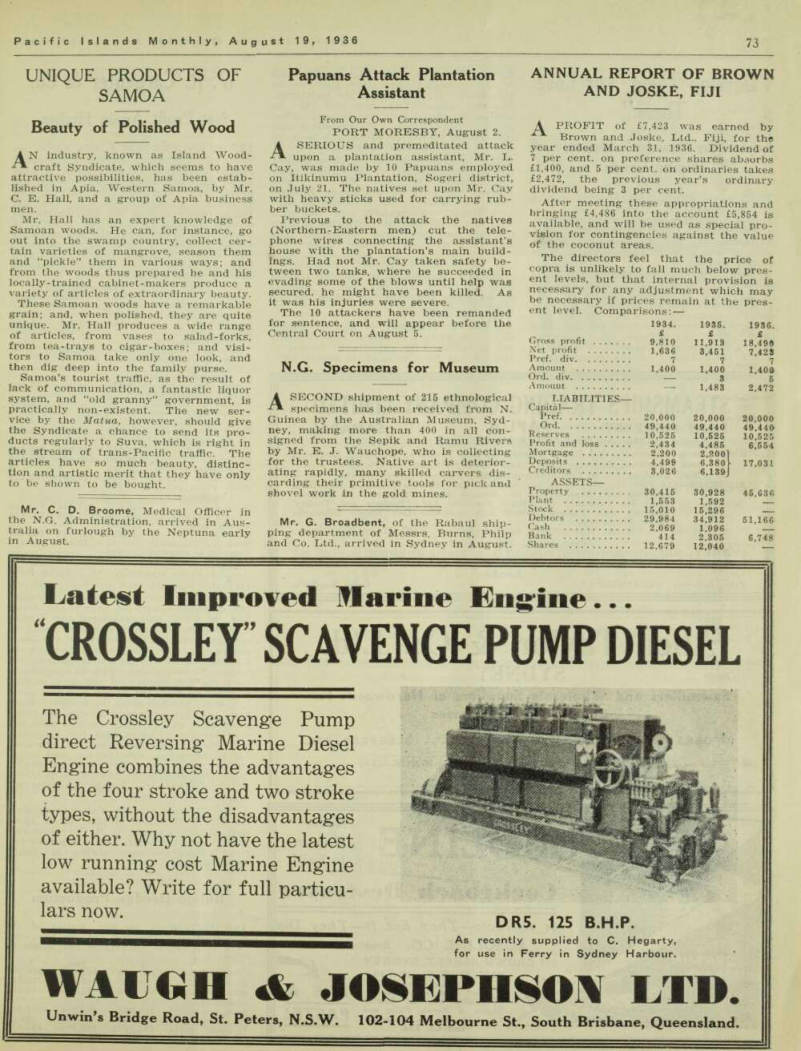
Unique Products Of
Samoa
AN industry, known as Island Wood craft Syndicate, which seems to have attractive possibilities, has been estab lished in Apia, Western Samoa, by Mr.
C. E. Hall, and a group of Apia business men.
Mr. Hall has an expert knowledge of Samoan woods. He can, for instance, go out into the swamp country, collect cer tain varieties of mangrove, season them and “pickle” them in various ways; and from the woods thus prepared he and his locally-trained cabinet-makers produce a variety of articles of extraordinary beauty.
These Samoan woods have a remarkable grain; and, when polished, they are quite unique. Mr. Hall produces a wide range of articles, from vases to salad-forks, from tea-trays to cigar-boxes; and visi tors to Samoa take only one look, and then dig deep into the family purse.
Samoa’s tourist traffic, as the result of lack of communication, a fantastic liquor system, and “old granny” government, is practically non-existent. The new ser vice by the Matua, however, should give the Syndicate a chance to send its pro ducts regularly to Suva, which is right in the stream of trans-Pacific traffic. The articles have so much beauty, distinc tion and artistic merit that they have only to be shown to be bought.
Mr. C. D. Broome, Medical Officer in the N.G. Administration, arrived in Aus tralia on furlough by the Neptuna early in August.
Assistant
Papuans Attack Plantation Assistant
From Our Own Correspondent
Port Moresby, August 2.
A SERIOUS and premeditated attack upon a plantation assistant, Mr. L.
Cay, was made by 10 Papuans employed on Itikinumu Plantation, Sogeri district, on July 21. The natives set upon Mr. Cay with heavy sticks used for carrying rub ber buckets.
Previous to the attack the natives (Northern-Eastern men) cut the tele phone wires connecting the assistant’s house with the plantation’s main build ings. Had not Mr. Cay taken safety be tween two tanks, where he succeeded in evading some of the blows until help was secured, he might have been killed. As it was his injuries were severe.
The 10 attackers have been remanded for sentence, and will appear before the Central Court on August 5.
N.G. Specimens for Museum
A SECOND shipment of 215 ethnological specimens has been received from N.
Guinea by the Australian Museum, Syd ney, making more than 400 in all con signed from the Sepik and Ramu Rivers by Mr. E. J. Wauchope, who is collecting for the trustees. Native art is deterior ating rapidly, many skilled carvers dis carding their primitive tools for pick and shovel work in the gold mines.
Mr. G. Broadbent, of the Rabaul ship ping department of Messrs. Burns, Philp and Co. Ltd., arrived in Sydney in August.
Annual Report Of Brown
And Joske, Fiji
Al PROFIT of £7,423 was earned by Brown and Joske, Ltd., Fiji, for the year ended March 31, 1936. Dividend of 7 per cent, on preference shares absorbs £1,400, and 5 per cent, on ordinaries takes £2,472, the previous year’s ordinary dividend being 3 per cent.
After meeting these appropriations and bringing £4,486 into the account £5,854 is available, and will be used as special pro vision for contingencies against the value of the coconut areas.
The directors feel that the price of copra is unlikely to fall much below pres ent levels, but that internal provision is necessary for any adjustment which may be necessary if prices remain at the pres ent level. Comparisons:
1934. 1935. 1936. £ £ £ Cross profit 9,810 11,913 18,490 Net profit 1,636 3,451 7,423 Pref. div 7 7 7 Amount 1,400 1,400 1,400 Ord. div 3 5 Amount — 1,483 2,472
Liabilities—
Capital— Pref 20,000 20,000 20,000 Ord 49.440 49,440 49.440 Reserves 10,525 10,525 10,525 Profit and loss 2,434 4,485 6,554 Mortgage 2,200 2,200 Deposits 4,499 6,380 • 17,031 Creditors 3,026 6,139
Assets—
Property 30,415 30,928 45,636 Plant 1,553 1,592 Stock 15,010 15,296 Debtors 29,984 34,912 51,166 Cash 2,069 1,096 Bank 414 2,305 6,748 Shares 12.679 12,040
Advertisements & other items, p. 75 (1 item)
Crossley” Scavenge Pump Diesel
Latest Improved Marine Engine
The Crossley Scavenge Pump direct Reversing Marine Diesel Engine combines the advantages of the four stroke and two stroke types, without the disadvantages of either. Why not have the latest low running cost Marine Engine available? Write for full particulars now.
WALCJH A JOSEPHSON LTD.
Unwin’s Bridge Road, St. Peters, N.S.W. 102-104 Melbourne St., South Brisbane, Queensland.
DRS. 125 B.H.P.
As recently supplied to C. Hegarty, for use in Ferry in Sydney Harbour.
“Develop Them —or Lose
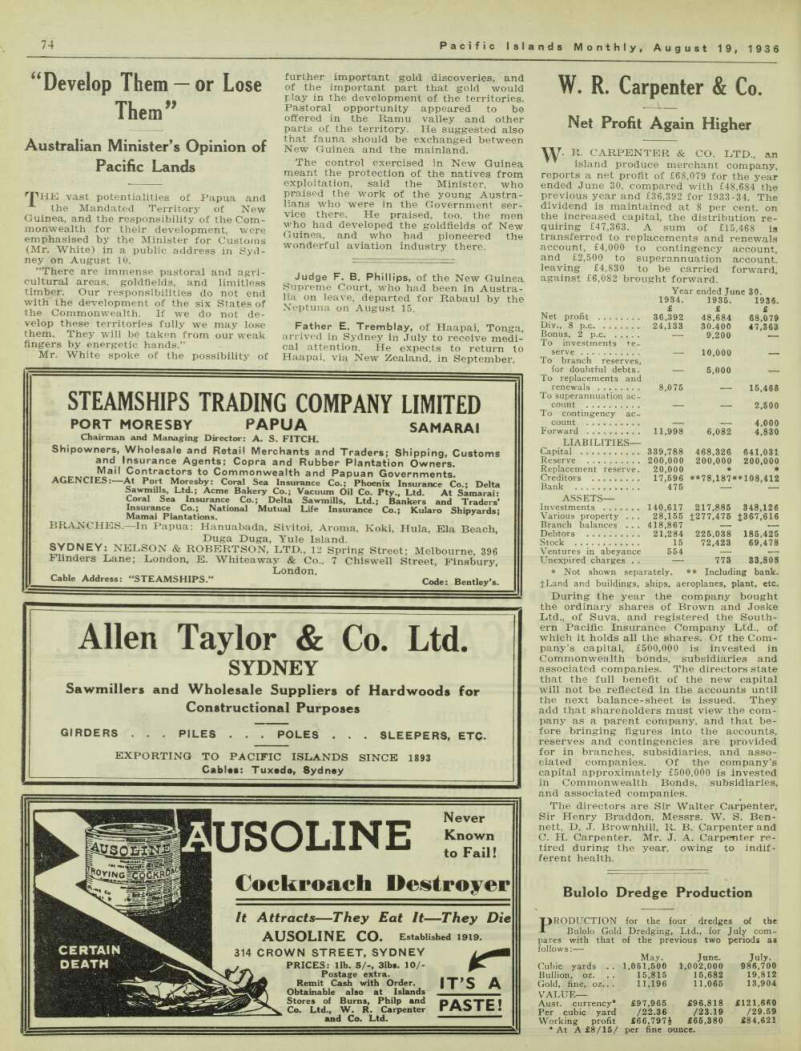
Them”
Australian Ministers Opinion of Pacific Lands
THE vast potentialities of Papua and A the Mandated Territory of New Guinea, and the responsibility of the Com monwealth for their development, were emphasised by the Minister for Customs (Mr. White) in a public address in Syd ney on August 10.
“There are immense pastoral and agri cultural areas, goldfields, and limitless timber. Our responsibilities do not end with the development of the six States of the Commonwealth. If we do not de velop these territories fully we may lose them. They will be taken from our weak fingers by energetic hands.’’
Mr. White spoke of the possibility of
further important gold discoveries, and of the important part that gold would play in the development of the territories.
Pastoral opportunity appeared to be offered in the Ramu valley and other parts of the territory. He suggested also that fauna should be exchanged between New Guinea and the mainland.
The control exercised in New Guinea meant the protection of the natives from exploitation, said the Minister, who praised the work of the young Austra lians who were in the Government ser vice there. He praised, too, the men who had developed the goldfields of New Guinea, and who had pioneered the wonderful aviation industry there.
Judge F. B. Phillips, of the New Guinea Supreme Court, who had been in Austra lia on leave, departed for Rabaul by the Neptuna on August 15.
Father E. Tremblay, of Haapai, Tonga, arrived in Sydney in July to receive medi cal attention. He expects to return to Haapai, via New Zealand, in September.
W.R. Carpenter & Co.
Net Profit Again Higher
W R. CARPENTER & CO. LTD., an island produce merchant company, reports a net profit of £68,079 for the year ended June 30, compared with £48,684 the previous year and £36,392 for 1933-34. The dividend is maintained at 8 per cent, on the increased capital, the distribution re quiring £47,363. A sum of £15,468 is transferred to replacements and renewals account, £4,000 to contingency account, and £2,500 to superannuation account, leaving £4,830 to be carried forward, against £6,082 brought forward.
During the year the company bought the ordinary shares of Brown and Joske Ltd., of Suva, and registered the South ern Pacific Insurance Company Ltd., of which it holds all the shares. Of the Com pany’s capital, £500,000 is invested in Commonwealth bonds, subsidiaries and associated companies. The directors state that the full benefit of the new capital will not be reflected in the accounts until the next balance-sheet is issued. They add that shareholders must view the com pany as a parent company, and that be fore bringing figures into the accounts, reserves and contingencies are provided for in branches, subsidiaries, and asso ciated companies. Of the company’s capital approximately £500,000 is invested in Commonwealth Bonds, subsidiaries, and associated companies.
The directors are Sir Walter Carpenter, Sir Henry Braddon, Messrs. W. S. Ben nett, D, .1. Brownhill, R. B, Carpenter and C. H. Carpenter. Mr. J, A. Carpenter re tired during the year, owing to indif ferent health.
Year ended Tune 30. 1984. 1935. 1936. £ £ £ Net profit 36,392 48,684 68,079 Div., 8 p.c 24,133 30.400 47,363 Bonus, 2 p.c — 9,200 To investments reserve — 10,000 To branch reserves. for doubtful debts. 5,000 To replacements and renewals 8,075 15,468 To superannuation account — — 2,500 To contingency account — — 4,000 Forward 11,998 6,082 4,830
Liabilities—
Capital 339,788 468,326 641,031 Reserve 200,000 200,000 200,000 Replacement reserve. 20,000 * • Creditors 17,596 **78.187**108,412 Bank 475 — —
Assets—
Investments 140,617 217,885 348,126 Various property . . . 28,155 $277,475 $367,616 Branch balances . . . 418,867 — — Debtors 21,284 225,038 185,425 Stock 15 72,423 69,478 Ventures in abeyance 554 —.
Unexpired charges . . — 773 33,808 * Not shown separately. ** Including bank. $Land and buildings. ships, aeroplanes, plant, etc.
Bulolo Dredge Production
PRODUCTION for the four dredges of the Bulolo Gold Dredging, Ltd., for July com pares with that of the previous two periods as follows:
May.
June.
July.
Cubic yards 1,051,500 1,002,000 986,700 Bullion, oz. 15,815 15,682 19,812 Gold, fine, oz.. . 11,196 11,065 13,904
Value—
Aust. currency* £97,965 £96,818 £121,660 Per cubic yard /22.36 /23.19 /29.59 Working profit £66,7971 £65,380 £84,621 * At A £8/15/ per fine ounce.
Advertisements & other items, p. 76 (1 item)
Usoline
STEAMSHIPS TRADING COMPANY LIMITED
PORT MORESBY PAPUA SAMARAI
Chairman and Managing Director: A. S. FITCH.
Shipowners, Wholesale and Retail Merchants and Traders; Shipping, Customs and Insurance Agents; Copra and Rubber Plantation Owners. p ontractors to Commonwealth and Papuan Governments.
AGENCIES:—At Port Moresby: Coral Sea Insurance Co.; Phoenix Insurance Co.; Delta Sawmills, Ltd.; Acme Bakery Co.; Vacuum Oil Co, Pty., Ltd, At Samarai: Coral Sea Insurance Co.; Delta Sawmills, Ltd.; Bankers and Traders’
Insurance Co.; National Mutual Life Insurance Co.; Kularo Shipyards: Mamai Plantations.
BRANCHES. —In Papua: Hanuabada, Sivitoi, Aroma, Koki, Hula, Ela Beach, w Duga Duga, Yule Island.
SYDNEY: NELSON & ROBERTSON, LTD., 12 Spring Street; Melbourne, 396 Flinders Lane; London, E. Whiteaway & Co., 7 Chiswell Street, Finsbury, .. London.
Cable Address: “STEAMSHIPS.” Code: Bentley’s.
Allen Taylor & Co. Ltd.
SYDNEY
Sawmillers and Wholesale Suppliers of Hardwoods for Constructional Purposes
GIRDERS
PILES . . . POLES . . . SLEEPERS, ETC.
EXPORTING TO PACIFIC ISLANDS SINCE 1893
Cables: Tuxedo, Sydney
USOLINE
Never Known to Fail!
Cockroach Destroyer
It Attracts—They Eat It—They Die AUSOLINE CO. Established 1919.
314 CROWN STREET, SYDNEY
PRICES: lib. 5/-, 3lbs. 10/- Postage extra.
Remit Cash with Order.
Obtainable also at Islands Stores of Burns, Philp and Co. Ltd., W. R. Carpenter and Co. Ltd.
IT’S A
PASTE!
New Guinea Public
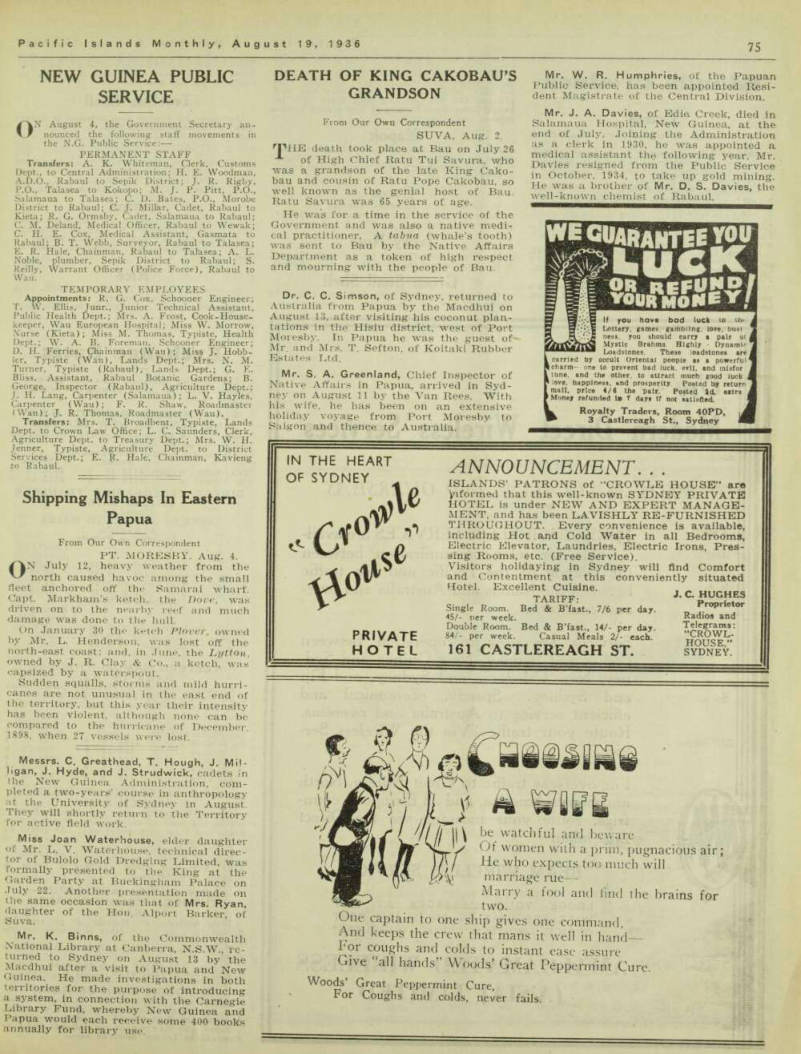
Service
ON August 4, the Government Secretary an nounced the following staff movements in the N.G. Public Service:—
Permanent Staff
Transfers: A. K. Whiteman, Clerk, Customs Dept., to Central Administration; H. E. Woodman, A.D.0., Rabaul to Sepik District; J. R. Rigby, P. 0., Talasea to Kokopo; M. J. P. Pitt, P. 0., Salamaua to Talasea; C. D. Bates, P. 0., Morobe District to Rabaul; C. J. Millar, Cadet, Rabaul to Kieta; R. G. Ormsby, Cadet, Salamaua to Rabaul; C. M. Deland, Medical Officer, Rabaul to Wewak; C. H. E. Cox, Medical Assistant, Gasmata to Rabaul; B. T. Webb, Surveyor, Rabaul to Talasea; E. R. Hale, Chainman, Rabaul to Talasea; A. L.
Noble, plumber, Sepik District to Rabaul; S.
Reilly, Warrant Officer (Police Force), Rabaul to Wau.
Temporary Employees
Appointments: R, G. Cox, Schooner Engineer; T. W. Ellis, Junr., Junior Technical Assistant, Public Health Dept.; Mrs. A. Frost, Cook-House keeper, Wau European Hospital; Miss W. Morrow, Nurse (Kieta); Miss M. Thomas, Typiste, Health Dept.; W. A. B. Foreman. Schooner Engineer; D, H. Ferries, Chainman (Wau); Miss J. Hobb ler, Typiste (Wau), Lands Dept.; Mrs. N. M.
Turner, Typiste (Rabaul), Lands Dept.; G. E.
Bliss, Assistant, Rabaul Botanic Gardens; B.
George, Inspector (Rabaul), Agriculture Dept.; J. H. Lang, Carpenter (Salamaua); L. V. Hayles, Carpenter (Wau); F. R. Shaw, Roadmaster (Wau); J. R. Thomas, Roadmaster (Wau).
Transfers: Mrs. T. Broadbent, Typiste, Lands Dept, to Crown Law Office; L. C. Saunders, Clerk, Agriculture Dept, to Treasury Dept.; Mrs. W. H.
Jenner, Typiste, Agriculture Dept, to District Services Dept.; E. R. Hale, Chainman, Kavieng to Rabaul.
Shipping Mishaps In Eastern
Papua
From Our Own Correspondent
Pt. Moresby. Aug. 4.
/~kN July 12, heavy weather from the ” north caused havoc among the small fleet anchored off the Samara! wharf.
Capt. Markham’s ketch, the Dove, was driven on to the nearby reef and much damage was done to the hull.
On January 30 the ketch Plover, owned by Mr. L. Henderson, was lost off the north-east coast; and, in June, the Lytton. owned by J. R. Clay & Co., a ketch, was capsized by a waterspout.
Sudden squalls, storms and mild hurri canes are not unusual in the east end of the territory, but this year their intensity has been violent, although none can be compared to the hurricane of December, 1898, when 27 vessels were lost.
Messrs. C. Greathead, T. Hough, J. Mil ligan, J. Hyde, and J. Strudwick, cadets in the New Guinea Administration, com pleted a two-years’ course in anthropology at the University of Sydney in August.
They will shortly return to the Territory for active field work.
Miss Joan Waterhouse, elder daughter of Mr. L. V. Waterhouse, technical direc tor of Bulolo Gold Dredging Limited, was formally presented to the King at the Garden Party at Buckingham Palace on July 22. Another presentation made on the same occasion was that of Mrs. Ryan, daughter of the Hon. Alport Barker, of Suva.
Mr. K. Binns, of the Commonwealth National Library at Canberra, N.S.W., re turned to Sydney on August 13 by’ the Macdhui after a visit to Papua and New Guinea. He made investigations in both territories for the purpose of introducing a system, in connection with the Carnegie Library Fund, whereby New Guinea and Papua would each receive some 400 books annually for library use.
Grandson
Death Of King Cakobau’S
From Our Own Correspondent
Suva, Aug. 2.
'T'HE death took place at Bau on July 26 A of High Chief Ratu Tui Savura, who was a grandson of the late King Cako bau and cousin of Ratu Pope Cakobau, so well known as the genial host of Bau.
Ratu Savura was 65 years of age.
He was for a time in the service of the Government and was also a native medi cal practitioner. A tabua (whale’s tooth) was sent to Bau by the Native Affairs Department as a token of high respect and mourning with the people of Bau.
Dr, C. C. Simson, of Sydney, returned to Australia from Papua by the Macdhui on August 13, after visiting his coconut plan tations in the Hisiu district, west of Port Moresby. In Papua he was the guest of Mr. and Mrs, T. Sefton, of Koitaki Rubber Estates Ltd.
Mr, S. A. Greenland, Chief Inspector of Native Affairs in Papua, arrived in Syd ney on August 11 by the Van Rees. With his wife, he has been on an extensive holiday voyage from Port Moresby to Saigon and thence to Australia.
Mr. W. R. Humphries, of the Papuan Public Service, has been appointed Resi dent Magistrate of the Central Division.
Mr. J. A. Davies, of Edie Creek, died in Salamaua Hospital, New Guinea, at the end of July. Joining the Administration as a clerk in 1930, he was appointed a medical assistant the following year. Mr.
Davies resigned from the Public Service in October, 1934, to take up gold mining.
He was a brother of Mr. D. S. Davies, the well-known chemist of Rabaul.
Advertisements & other items, p. 77 (1 item)
marriage rue—
If you have bad luck to U* Lottery, games gambling, love, busi ness, you should carry a pair ot Mystic Brahma Highly ■ Dynamic Loadstones. These loadstones are, carried by occult Oriental people as a powerful I charm- one to prevent bad luck. evil, and misfor . tune, and the other, to attract much good luck i love, happiness, and prosperity Posted by return mall, price 4/6 the pair. Posted 2d. eitra Money refunded is T days If not satisfied.
Royalty Traders, Room 40PD,
3 Castlereagh St., Sydney
IN THE HEART
OF SYDNEY
PRIVATE
HOTEL
ANNOUNCEMENT. . .
ISLANDS’ PATRONS of “CROWLE HOUSE” are
informed that this well-known SYDNEY PRIVATE HOTEL is under NEW AND EXPERT MANAGE- MENT. and has been LAVISHLY RE-FURNISHED THROUGHOUT. Every convenience is available, including Hot and Cold Water in all Bedrooms, Electric Elevator, Laundries, Electric Irons, Pressing Rooms, etc. (Free Service), Visitors holidaying in Sydney will find Comfort and Contentment at this conveniently situated Hotel. Excellent Cuisine.
TARIFF:
Single Room. Bed & B’fast., 7/6 per day. 45/- per week.
Double Room. Bed & B’fast., 14/- per day. 84/- per week. Casual Meals 2/- each.
161 CASTLEREAGH ST.
J. C. HUGHES
Proprietor Radios and Telegrams:
“GROWL-
HOUSE,"
SYDNEY.
rf\M
% h) f
A WE
be watchful and beware Of women with a prim, pugnacious air; He who expects too much will marriage rue— Marry a fool and find the brains for two.
One captain to one ship gives one command, And keeps the crew that mans it well in hand— bor coughs and colds to instant ease assure Give “all hands” Woods’ Great Peppermint Cure Woods’ Great Peppermint Cure, For Coughs and colds, never fails.
Islands Produce
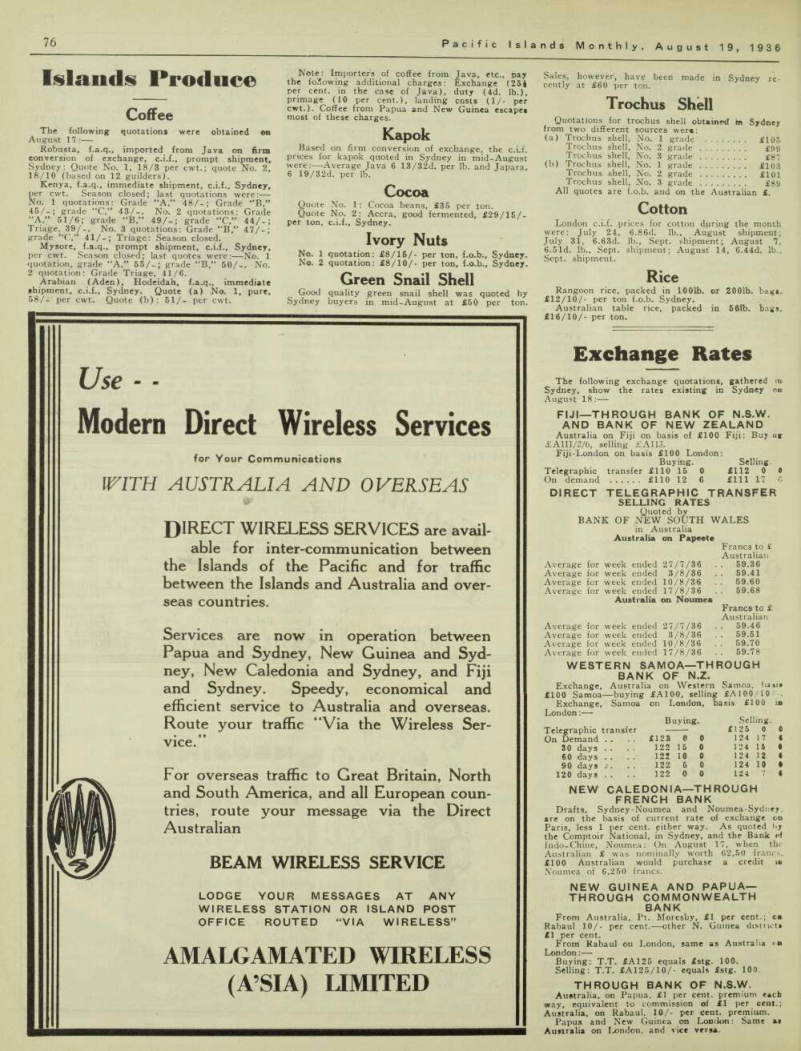
Coffee
The following quotations were obtained on August 17:—• Robusta, f.a.q., imported from Java on firm conversion of exchange, c.i.f., prompt shipment, Sydney: Quote No. 1, 18/3 per cwt.; quote No. 2, 18/10 (based on 12 guilders).
Kenya, f.a.q., immediate shipment, c.i.f., Sydney, per cwt. Season closed; last quotations were:— No. 1 quotations: Grade “A,” 48/-; Grade “B,” 45/-; grade “C,” 43/-. No. 2 quotations: Grade “A.” 51/6; grade “B,” 49/-; grade “C,” 44/-; Triage, 39/-. No. 3 quotations: Grade “B,” 47/-; grade “C,” 41/-; Triage: Season closed.
Mysore, f.a.q., prompt shipment, c.i.f., Sydney, per cwt. Season closed; last quotes were:—No. 1 quotation, grade “A,” 55/-; grade “B,” 50/-. No. 2 quotation: Grade Triage, 41/6, Arabian (Aden), Hodeidah, f.a.q., immediate shipment, c.i.f., Sydney. Quote (a) No. 1, pure, 58/- per cwt. Quote (b) : 51/- per cwt.
Note: Importers of coffee from Java, etc., pay the fo'owing additional charges; Exchange (25i per cent, in the case of Java), duty (4d. lb.), primage (10 per cent.), landing costs (1/- per cwt.). Coffee from Papua and New Guinea escapei most of these charges.
Kapok
Based on firm conversion of exchange, the c.i.f. prices for kapok quoted in Sydney in mid-August were:—Average Java 6 13/32d. per lb. and Japara, 6 19/32d. per lb.
Cocoa
Quote No. 1: Cocoa beans, £35 per ton.
Quote No. 2: Accra, good fermented, £29/15/per ton, c.i.f., Sydney.
Ivory Nuts
No. 1 quotation: £B/15/- per ton, f.0.b., Sydney.
No. 2 quotation: £B/10/- per ton, f.0.b., Sydney.
Green Snail Shell
Good quality green snail shell was quoted by Sydney buyers in mid-August at £5O per ton.
Sales, however, have been made in Sydney re cently at £6O per ton.
Trochus Shell
Quotations for trochus shell obtained m Sydney from two different sources were: (a) Trochus shell. No. 1 grade £lO5 Trochus shell. No. 2 grade £99 Trochus shell. No. 3 grade £B7 (b) Trochus shell. No. 1 grade £lO3 Trochus shell. No. 2 grade £lOl Trochus shell. No. 3 grade £B9 All quotes are f.o.b. and on the Australian £.
Cotton
London c.i.f. prices for cotton during the month were: July 24, 6.86 d. lb., August shipment; July 31, 6.63 d. lb.. Sept, shipment; August 7, 6.51 d. lb.. Sept, shipment; August 14, 6.44 d. lb..
Sept, shipment.
Rice
Rangoon rice, packed in 1001 b. cr 2001 b. bag*. £l2/10/- per ton f.o.b. Sydney.
Australian table rice, packed in 561 b. bags. £l6/10/- per ton.
Exchange Rates
The following exchange quotations, gathered in.
Sydney, show the rates existing in Sydney on August 18:
Fiji—Through Bank Of N.S.W.
And Bank Of New Zealand
Australia on Fiji on basis of £lOO Fiji: Buy uj £ All 1/2/6, selling £AII3.
Fiji-London on basis £lOO London:
Direct Telegraphic Transfer
Selling Rates
Quoted by
Bank Of New South Wales
in Australia
Western Samoa—Through
Bank Of N.Z.
Exchange, Australia on Western Samoa, ba*i* £lOO Samoa —buying £AIOO, selling £AIOO/10 .
Exchange, Samoa on London, basis £lOO is London: —
New Caledonia—Through
French Bank
Drafts, Sydney-Noumea and Noumea-Sydney, are on the basis of current rate of exchange on Paris, less 1 per cent, pither way. As quoted by the Comptoir National, in Sydney, and the Bank of Indo-Chine, Noumea: On August 17, when the Australian £ was nominally worth 62,50 francs. £lOO Australian would purchase a credit in Noumea of 6,250 francs.
New Guinea And Papua
Through Commonwealth
Bank
From Australia, Pt. Moresby, £1 per cent.; ca Rabaul 10/- per cent. —other N. Guinea district* £1 per cent.
From Rabaul on London, same as Australia <•> London:— Buying: T.T. £AI2S equals £stg. 100.
Selling: T.T. £AI2S/10/- equals £stg. 100.
Through Bank Of N.S.W.
Australia, on Papua, £1 per cent, premium each way, equivalent to commission of £1 per cent.; Australia, on Rabaul, 10/- per cent, premium.
Papua and New Guinea on London: Same a* Australia on London, and vice versa.
Buying. Selling.
Telegraphic transfer £110 15 0 £112 0 6 On demand £110 12 6 fill 17 C
Australia on Papeete Francs to £ Australian Average for week ended 27/7/36 . 69.36 Average for week ended 3/8/36 . . 59.41 Average for week ended 10/8/36 . . 59.60 Average for week ended 17/8/36 . 59.68 Australia on Noumea Francs to £ Australian Average for week ended 27/7/36 . . 59.46 Average for week ended 3/8/36 . . 59.51 Average for week ended 10/8/36 . 59.70 Average for week ended 17/8/36 . . 59.78
Buying. Selling.
Telegraphic transfer £125 0 C On Demand .. .. £123 0 0 124 17 « 30 days ... 122 15 0 124 16 « 60 days . . . . 122 10 0 124 12 1 90 days ... 122 6 0 124 10 • 120 days . . 122 0 0 124 7 *
Advertisements & other items, p. 78 (2 items)
76
Monthly, August 19, 1936
Pacific Island
Modern Direct Wireless Services
Use - -
for Your Communications
WITH AUSTRALIA AND OVERSEAS
DIRECT WIRELESS SERVICES are avail-
able for inter-communication between the Islands of the Pacific and for traffic between the Islands and Australia and overseas countries.
Services are now in operation between Papua and Sydney, New Guinea and Sydney, New Caledonia and Sydney, and Fiji and Sydney. Speedy, economical and efficient service to Australia and overseas.
Route your traffic “Via the Wireless Service.”
For overseas traffic to Great Britain, North and South America, and all European countries, route your message via the Direct Australian
BEAM WIRELESS SERVICE
LODGE YOUR MESSAGES AT ANY
WIRELESS STATION OR ISLAND POST
OFFICE ROUTED “VIA WIRELESS”
AMALGAMATED WIRELESS
(A’SIA) LIMITED
Market Quotations
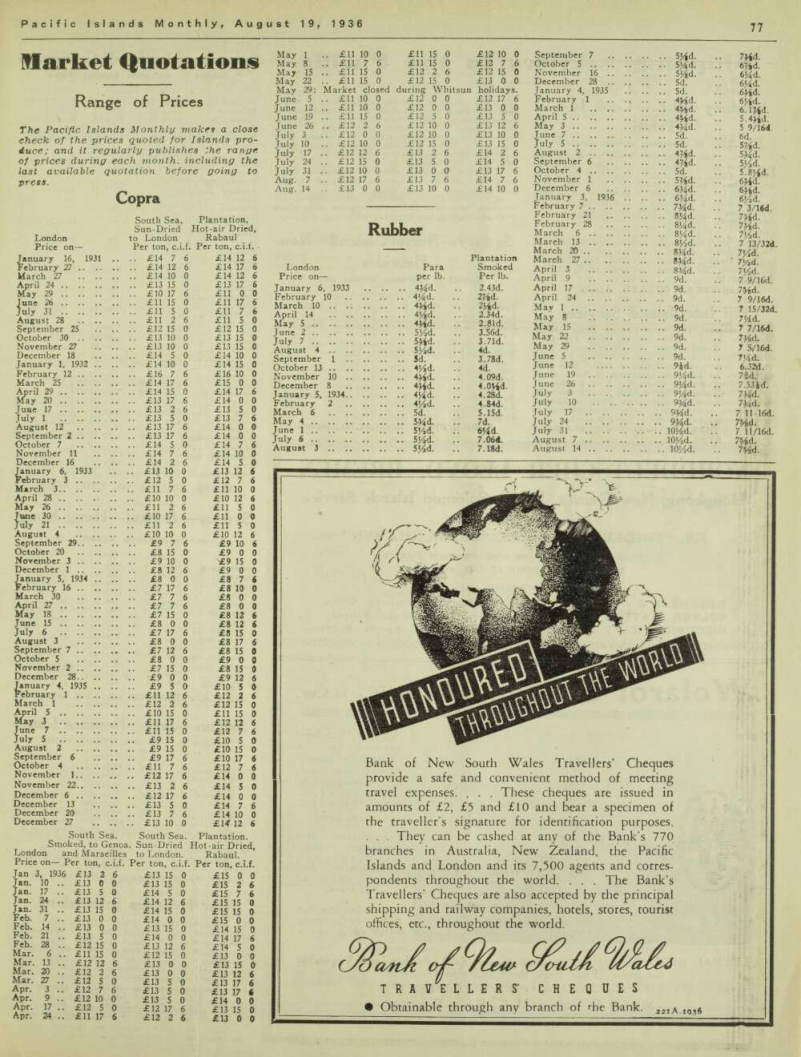
Range of Prices
The Pacific Islands Monthly makes a close check of the prices quoted for Islands pro duce; and it regularly publishes the range, of prices during each month, including the last available quotation before going to press.
May 1 .. £11 10 0 £11 IS 0 £12 10 0 May 8 .. £11 7 6 £11 15 0 £12 7 6 May 15 .. £11 15 0 £12 2 6 £12 15 0 May 22 .. £11 15 0 £12 IS 0 £13 0 0 May 29: Market closed during Whitsun holidays.
June 5 .. £11 10 0 £12 0 0 £12 17 6 June 12 .. £11 10 0 £12 0 0 £13 0 0 June 19 .. £11 15 0 £12 5 0 £13 5 0 June 26 .. £12 2 6 £12 10 0 £13 12 6 July 3 .. £12 0 0 £12 10 0 £13 10 0 July 10 .. £12 10 0 £12 15 0 £13 15 0 July 17 £12 12 6 £13 2 6 £14 2 6 July 24 .. £12 15 0 £13 5 0 £14 5 0 July 31 .. £12 10 0 £13 0 0 £13 17 6 Aug. 7 .. £12 17 6 £13 7 6 £14 7 6 Aug. 14 .. £13 0 0 £13 10 0 £14 10 0
September 7 .. .. .. .. 5*d. 7fid.
October 5 .. .. 5yd. 6Jid.
November 16 .. .. .. 5^d. (>y 4 d.
December 28 .. .. .. .. 5d. ey 4 d.
January 4, 1935 .. .. 5d.
February 1 .. .. 4^d. eyd.
March i .. .. 4^d. 6.VAd.
April 5 .. .. 4^d. 5.4^d.
May 3 5 9/16d.
Tune 7 .. .. 5d. 6d.
July 5 S^d.
August 2 sy 4 d.
September 6 .. .. .. .. 4«d. syd.
October 4 5.8}*d.
November 1 .. .. S7^d. 6Hd.
December 6 .. .. 6Xd. 6fid.
January 3, 1936 .. .. ey 4 d. 6yd.
February 7 .. .. 7Hd. 7 3/16d.
February 21 .. .. ■ • .. syd. 7#d.
February 28 .. .. .. .. 8yd. 7}id.
March 6 .. .. 8%d. 7yd.
March 13 .. .. 8yd. 7 13/32d.
March 20 .. .. 8Hd. 7'/A.
March 27 .. .. 8Hd.
' 7'Ad.
April 3 7yd.
April 9 7 9/16d.
April 17 75^d.
April 24 .. .. 9d. 7 9/16d.
May 1 .. .. 9d. 7 15/32d.
May 8 .. .. 9d. 7yd.
May 15 7 7/16d.
May 22 .. .. 9d. 7m. 7 5/16d.
May 29 June 5 .. .. 9d. 7yd.
June 12 .. .. 9Jd. 6.32d.
June 19 .. .. 9'Ad. 73d.
June 26 .. .. 9^d. 7.53Jd.
July 3 .. .. 9«4d. 7Hd.
July 10 .. .. 9^d. 7VA.
July 17 . .. 9*4d. 7 ll-16d.
July 24 . .. 9 y 4 d. 7^d. 7 ll/16d.
July 31 . .. 10J4d.
August 7 . .. 10/ 2 d. .. 7m.
August 14 .. .. 10^d. .. 7m.
London Price on — January 16, 1931
Copra
South Sea, Sun-Dried to London Per ton, c.i.f. .. .. £14 7 6 Plantation, Hot-air Dried, Rabaul Per ton, c.i.f. £14 12 6 February 27 .. .. £14 12 6 £14 17 6 March 27 .. .. £14 10 0 £14 12 6 April 24 .. .. £13 15 0 £13 17 6 May 29 .. .. .. £10 17 6 £11 0 0 June 26 .. .. .. £11 15 0 £11 17 6 July 31 .. .. .. £11 5 0 £11 7 6 August 28 .. £11 2 6 £11 5 0 September 25 .. £12 15 0 £12 15 0 October 30 .. .. £13 10 0 £13 15 0 November 27 .. £13 10 0 £13 IS 0 December 18 .. £14 5 0 £14 10 0 January 1, 1932 .. £14 10 0 £14 IS 0 February 12 .. .. £16 7 6 £16 10 0 March 25 .. .. £14 17 6 £15 0 0 April 29 .. ..
May 20 .. .. .. £14 15 0 £14 17 6 .. £13 17 6 £14 0 0 June 17 . . .. .. £13 2 6 £13 5 0 July 1 .. .. .. £13 5 0 £13 7 6 August 12 .. £13 17 6 £14 0 0 September 2 .. 6 £14 0 0 October 7 .. £14 5 0 £14 7 6 November 11 .. £14 7 6 £14 10 0 December 16 .. £14 2 6 £14 5 0 January 6. 1933 . . . £13 10 0 £13 12 6 February 3 .. .. £12 5 0 £12 7 6 March 3.. .. .. £11 7 6 £11 10 0 April 28 .. .. 0 £10 12 6 May 26 .. £11 2 6 £11 5 0
June 30 .. ..
6 £11 0 0 July 21 6 £11 5 0
August 4 ..
0 £10 12 6 September 29. . £9 7 6 £9 10 6 October 20 0 £9 0 0 November 3 .. £9 10 0 £9 IS 0 December 1 .. £8 12 6 £9 0 0 January 5, 1934 0 £8 7 6
February 16 ..
6 £8 10 0 March 30 6 £8 0 0 April 27 .. .. 6 £8 0 0 May 18 .. .. 0 £8 12 6 June 15 .. .. 0 £8 12 6 July 6 .. .. 6 £8 IS 0 August 3 0 £8 17 6 September 7 .. 6 £8 15 0 October S £8 0 0 £9 0 0 November 2 .. 0 £8 IS 0 December 28.. 0 £9 12 6 January 4, 1935 £9 5 0 £10 5 0 February 1 .. 6 £12 2 6 March 1 .. £12 2 6 £12 IS 0 April 5 .. .. 0 £11 15 0 May 3 .. .. 6 £12 12 6 June 7 .. 0 £12 7 6 July 5 .. .. 0 £10 S 0 August 2 0 £10 15 0
September 6
6 £10 17 6 October 4 6 £12 7 6 November 1.. , 6 £14 0 0 November 22.. 6 £14 S 0 December 6 ., 6 £14 0 0 December 13 0 £14 7 6 December 20 .. £13 7 6 £14 10 0 December 27 0 £14 12 6 South Sea.
South Sea.
Plantation.
Smoked, to Genoa. Sun-Dried !
Hot-air Dried.
London and Marseilles to London.
Rabaul.
Price on— Per ton, c.i.f.
Per ton, c. i.f.
Per ton, c.i.f.
Jan 3, 1936 £13 2 6 £13 15 0 £15 0 0 Jan. 10 .. £13 0 0 £13 IS 0 £15 2 6 Jan. 17 .. £13 5 0 £14 5 0 £15 7 6 Jan. 24 .. £13 12 6 £14 12 6 £15 15 0 Jan. 31 .. £13 IS 0 £14 15 0 £15 IS 0 Feb. 7 .. £13 0 0 £14 0 0 £15 0 0 Feb. 14 .. £13 0 0 £13 15 0 £14 15 0 Feb. 21 .. £13 5 0 £14 0 0 £14 17 6 Feb. 28 .. £12 15 0 £13 12 6 £14 5 0 Mar. 6 .. £11 IS 0 £12 15 0 £13 0 0 Mar. 13 .. £12 12 6 £13 0 0 £13 IS 0 Mar. 20 .. £12 2 6 £13 0 0 £13 12 6 Mar. 27 .. £12 5 0 £13 5 0 £13 17 6 Apr. 3 .. £12 7 6 £13 5 0 £13 17 i Apr. 9 .. £12 10 0 £13 5 0 £14 0 0 Apr. 17 .. £12 5 0 £12 17 6 £13 15 o Apr. 24 .. £11 17 6 £12 2 6 £13 0 0
Rubber
Plantation London Para Smoked Price on— per lb.
Per lb.
January 6, 1933 4tfd. 2.43d.
February 10 4'Ad. 27Ad.
March 10 .. .. 4*d. 2Hd.
April 14 4'Ad. 2.34d.
May 5 4*d. 2.81d.
June 2 S'Ad. 3.56d.
July 7 SHd. 3.71d.
August 4 .. ..
S'Ad. 4d.
September 1 5d. 3.78d.
October 13 .. .. 4'Ad. 4d.
November 10 .. 4tfd. 4.09d.
December 8 4*d. 4.0Hd.
January 5, 1934.. 4Ad. 4.28d.
February 2 4/ a d. 4.84d.
March 6 .. ..
Sd.
S.lSd.
May 4 5f*d. 7d.
June 1 S'Ad. 6Xd.
July 6 S'Ad. 7.064.
August 3 .. ..
S'Ad. 7.18d.
Advertisements & other items, p. 79 (1 item)
Bank of New South Wales Travellers’ Cheques
provide a safe and convenient method of meeting travel expenses. . . . These cheques are issued in amounts of £2, £5 and £lO and bear a specimen of the traveller’s signature for identification purposes. . . They can be cashed at any of the Bank’s 770 branches in Australia, New Zealand, the Pacific Islands and London and its 7,500 agents and correspondents throughout the world. . . . The Bank’s Travellers’ Cheques are also accepted by the principal shipping and railway companies, hotels, stores, tourist offices, etc., throughout the world.
TRAVELLERS' CHEQUES
• Obtainable through any branch of rhe Bank. 221A.10 36
Shipping Services in the Pacific
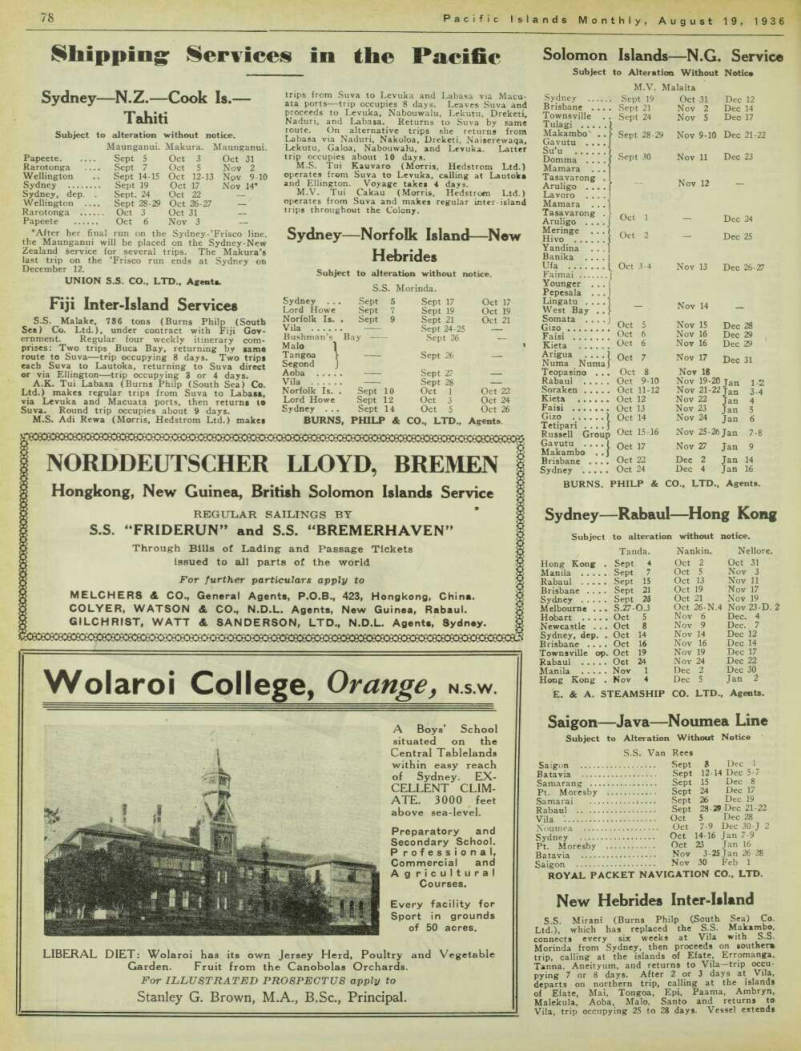
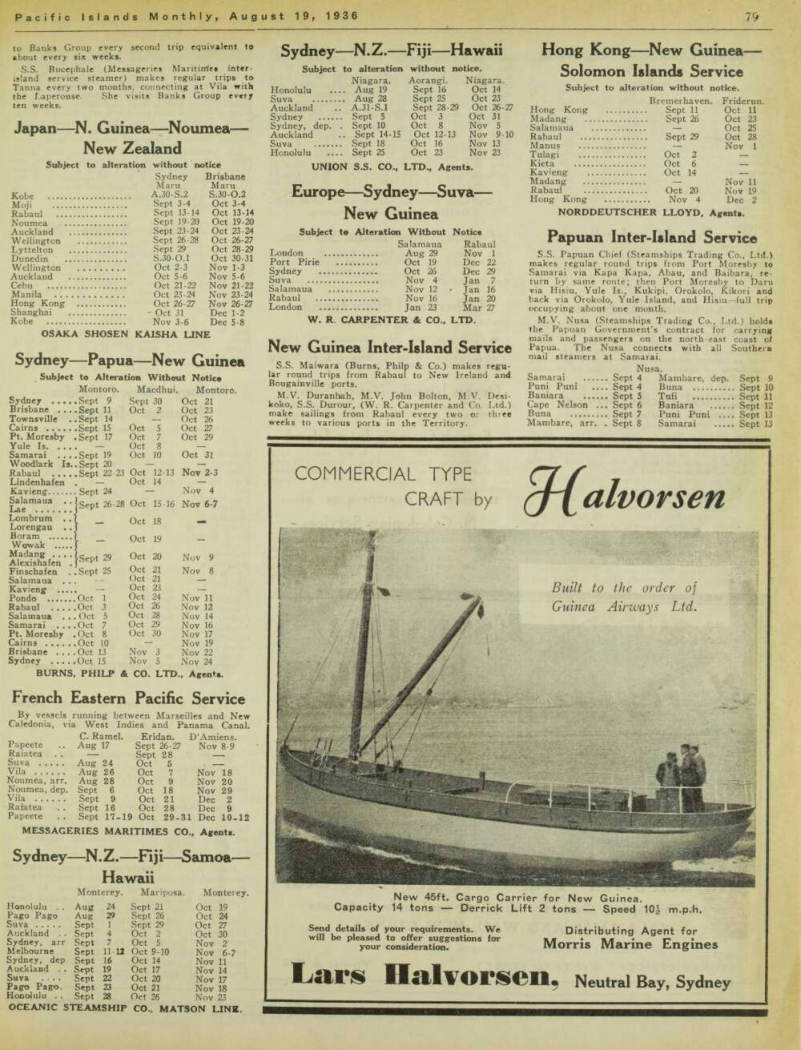
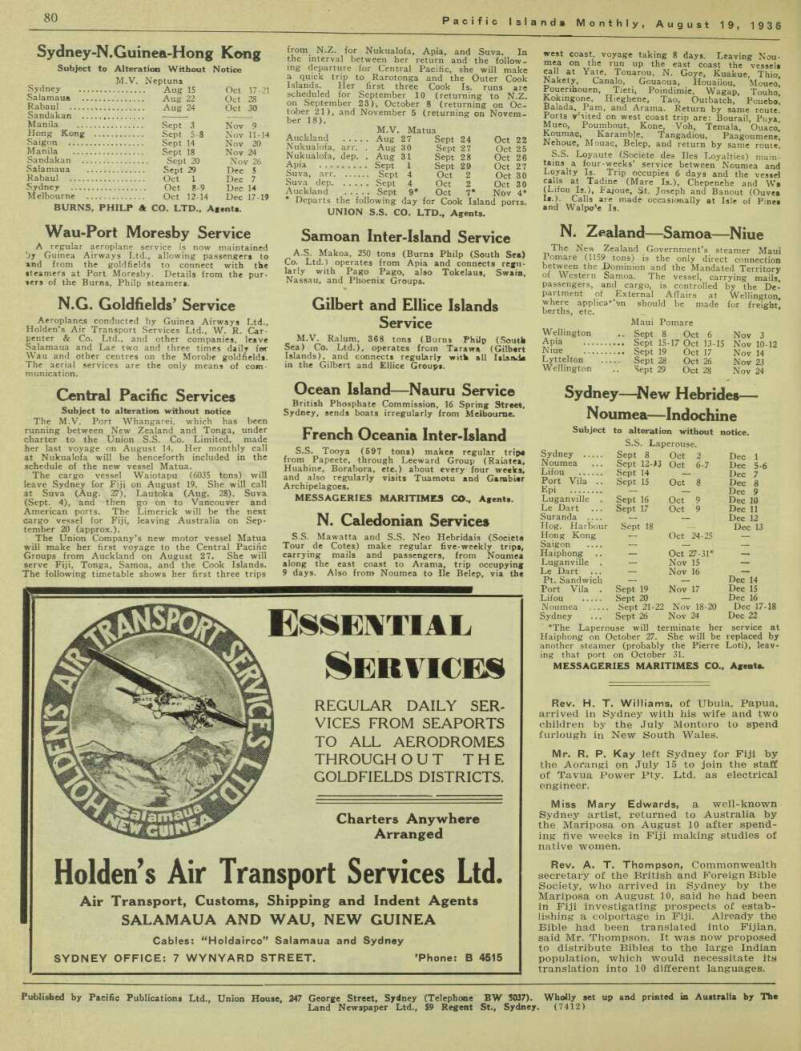
Sydney—N.Z.—Cook Is.— Tahiti Subject to alteration without notice.
Fiji Inter-Island Services
S.S. Malake, 786 tons (Burns Philp (South Sea) Co. Ltd.), under contract with Fiji Gov ernment. Regular four weekly itinerary com prises: Two trips Buca Bay, returning by sam« route to Suva—trip occupying 8 days. Two trips each Suva to Lautoka, returning to Suva direct or via Ellington—trip occupying 3 or 4 days.
A.K. Tui Labasa (Burns Philp (South Sea) Co.
Ltd.) makes regular trips from Suva to Labasa, via Levuka and Macuata ports, then returns to Suva. Round trip occupies about 9 days.
M.S. Adi Rewa (Morris, Hedstrom Ltd.) makes
trips from Suva to Levuka and Labasa via Macu ata ports —trip occupies 8 days. Leaves Suva and proceeds to Levuka, Nabouwalu, Lekutu, Dreketi, Naduri, and Labasa. Returns to Suva by same route. On alternative trips she returns from Labasa via Naduri, Nakoloa, Dreketi, Naiserewaqa, Lekutu, Galoa, Nabouwalu, and Levuka. Latter trip occupies about 10 days.
M.S. Tui Kauvaro (Morris, Hedstrom Ltd.) operates from Suva to Levuka, calling at Lautoka and Ellington. Voyage take* 4 days.
M.V. Tui Cakau (Morris, Hedstrom Ltd.) operates from Suva and makes regular inter-island trips throughout the Colony.
Sydney—Norfolk Island—New
Hebrides
Subject to alteration without notice.
Solomon Islands—N.G. Service Subject to Alteration Without Notica
Sydney—Rabaul—Hong Kong Subject to alteration without notice.
Saigon—Java—Noumea Line Subject to Alteration Without Notice
New Hebrides Inter-Island
S.S. Mirani (Burns Philp (South Sea) Co.
Ltd.), which has replaced the S.S. Makambo, connects every six weeks at Vila with S.S.
Morinda from Sydney, then proceeds on souther* trip, calling at the islands of Efate, Erromanga, Tanna, Aneityum, and returns to Vila —trip occu pying 7 or 8 days. After 2 or 3 days at Vila, departs on northern trip, calling at the islands of Efate, Mai, Tongoa, Epi, Paama, Ambryn, Malekula, Aoba, Malo, Santo and returns to Vila, trip occupying 25 to 28 days. Vessel extend*
M.V.
Malaita Sydney Brisbane . ..
Townsville .
Tulagi Sept 19 Sept 21 Sept 24 Oct 31 Nov 2 Nov S Dec 12 Dec 14 Dec 17 Makambo' . .
Gavutu ...
Su’u : Sept 28-29 Nov 9-10 Dec 21-22 Domma ...
Mamara Tasavarong .
Aruligo ...
Lavoro ...
Mamara Tasavarong .
Aruligo . . . .
Meringe . . .
Hivo Sept 30 Oct 1 Oct 2 Nov 11 Nov 12 Dec 23 Dec 24 Dec 25 Yandina . . .
Banika ...
Ufa Nov 13 Dec 26-27 Faimai L f 1 Oct 5 Younger . . .
Pepesala . . .
Lingatu West Bay . .
Somata . . . . : Gizo Nov 14 Nov 15 Dec 28 Faisi Oct 6 Nov 16 Dec 29 Kieta Oct 6 Nov 16 Dec 29 Arigua . .. . 1 Numa Numaj Teopasino . ..
Rabaul 1 Oct 7 Oct 8 Oct 9-10 Nov 17 Nov 18 Nov 19-20 Dec 31 Jan 1-2 Jan 3-4 Soraken Oct 11-12 Nov 21-22 Kieta Oct 12 Nov 22 Faisi ...
Oct 13 Oct 14 , Oct 15-16 Oct 17 Oct 22 Oct 24 Nov 23 Jan 5 Gizo 1 Nov 24 Nov 25-26 Nov 27 Dec 2 Dec 4 Tetipari , , . . J Russell Group Gavutu . . . . 1
Makambo . . j
Brisbane . . . .
Sydney Jan 6 Jan 7-8 Jan 9 Jan 14 Jan 16 Agents.
Burns.
Philp &
Co., Ltd.,
Maunganui. Makura. Maunganui.
Papeete Sept 5 Oct 3 Oct 31 Rarotonga ...
Sept 7 Oct 5 Nov 2 Wellington Sept 14-15 Oct 12-13 Nov 9-10 Sydney Sept 19 Oct 17 Nov 14* Sydney, dep. .
Sept. 24 Oct 22 — Wellington ...
Sept 28-29 Oct 26-27 — Rarotonga Oct 3 Oct 31 — Papeete Oct 6 Nov 3 — *After her final run on the Sydney-’Frisco line. the Maunganui will be placed on the Sydney-New Zealand Service for several trips. The Makura’s last trip on the ’Frisco run ends at Sydney on December 12.
Union S.S. Co., Ltd., Ageau.
S.S. Morinda.
Sydney Sept 5 Sept 17 Oct 17 Lord Howe Sept 7 Sept 19 Oct 19 Norfolk Is. . , Sept 9 Sept 21 Oct 21 Vila — Sept 24-25 Bushman’s Malo 1 Bay Sept 26 Tangoa Segond J — Sept 26 — Aoba — Sept 27 Vila — Sept 28 Norfolk Is. .
Sept 10 Oct 1 Oct 22 Lord Howe Sept 12 Oct 3 Oct 24 Sydney . . .
Sept 14 Oct 5 Oct 26
Burns
, Philp &
Co., Ltd.,
Agents.
Tanda.
Nankin.
Nellore.
Hong Kong . Sept 4 Oct 2 Oct 31 Manila . . .
Oct 5 Nov 3 Rabaul . . . . . Sept IS Oct 13 Nov 11 Brisbane . . . . Sept 21 Oct 19 Nov 17 Sydney . . .
Oct 21 Nov 19 Melbourne . .. S.27-0.3 Oct 26-N.4 Nov 23-D. 2 Hobart . . • . . Oct 5 Nov 6 Dec. 4 Newcastle . ..Oct 8 Nov 9 Dec. 7 Sydney, dep. . Oct 14 Nov 14 Dec 12 Brisbane . . . . Oct 16 Nov 16 Dec 14 Townsville op. Oct 19 Nov 19 Dec 17 Rabaul . . .
Nov 24 Dec 22 Manila Dec 2 Dec 30 Hong Kong . Nov 4 Dec 5 Jan 2 E. & A.
Steamship
Co. Ltd.,
Agents.
s.s . Van Rees Saigon 5 Dec 1 Batavia 12 14 Dec 5-7 Samarang 15 Dec 8 Pt. Moresby 24 Dec 17 lb Dec 19 Rabaul 28- » Dec 21-22 Vila 5 Dec 28 Noumea Oct 7-S i Dec 30-J 2 Sydney 14-16 Jan 7-9 Pt. Moresby 23 Jan 16 Batavia 3- 25 Tan 26-28 Saigon 30 Feb 1
Royal Packet
Navigation
Co., Ltd.
to Banks Group every second trip equivalent to about every six weeks.
S.S. Bucephale (Messageries Maritinfea inter island service steamer) makes regular trips to Tanna every two months, connecting at Vila with the JLaperouse. She visits Banks Group every ten weeks.
Japan—N. Guinea—Noumea—
New Zealand
Subject to alteration without notice
Sydney—Papua—New Guinea Subject to Alteration Without Notice
French Eastern Pacific Service
Sydney—N.Z.—Fiji—Samoa— Hawaii
Sydney—N. Z.—Fi j i—Hawaii Subject to alteration without notice.
Europe—Sydney—Suva— New Guinea Subject to Alteration Without Notice
New Guinea Inter-Island Service
S.S. Maiwara (Burns, Philp & Co.) makes regu lar round trips from Rabaul to New Ireland and Bougainville ports, M.V. Duranbah, M.V. John Bolton, M.V. Desi koko, S.S. Durour, (W. R. Carpenter and Co. Ltd.) make sailings from Rabaul every two or three weeks to various ports in the Territory.
Hong Kong—New Guinea— Solomon Islands Service Subject to alteration without notice.
Papuan Inter-Island Service
S.S. Papuan Chief (Steamships Trading Co., Ltd.) makes regular round trips from Port Moresby to Samarai via Kapa Kapa, Abau, and Baibara, re turn by same route; then Port Moresby to Daru via Hisiu, Yule Is., Kukipi, Orokolo, Kikori and back via Orokolo, Yule Island, and Hisiu—full trip occupying about one month.
M.V. Nusa (Steamships Trading Co., Ltd.) hold* the Papuan Government’s contract for carrying mails and passengers on the north-east coast of Papua. The Nusa connects with all Southern mail steamers at Samarai.
Nusa.
Samarai Sept 4 Mambare, dep. Sept 9 Puni Puni ... Sept 4 Buna Sept 10 Baniara Sept 5 Tufi Sept 11 Cape Nelson ... Sept 6 Baniara Sept 12 Buna Sept 7 Puni Puni ... Sept 13 Mambare, arr. . Sept 8 Samarai Sept 13
Sydney Brisbane Maru Maru Kobe A.30-S.2 S.30-O.2 Moji Sept 3-4 Oct 3-4 Rabaul Sept 13-14 Oct 13-14 Noumea Sept 19-20 Oct 19-20 Auckland Sept 23-24 Oct 23-24 Wellington Sept 26-28 Oct 26-27 Lyttelton Sept 29 Oct 28-29 Dunedin S.30-O.1 Oct 30-31 Wellington Oct 2-3 Nov 1-3 Auckland Oct 5-6 Nov 5-6 Cebu Oct 21-22 Nov 21-22 Manila Oct 23-24 Nov 23-24 Hong Kong Oct 26-27 Nov 26-27 Shanghai - Oct 31 Dec 1-2 Kobe Nov 3-6 Dec 5-8
Osaka Shosen
Ka1Sha Line
Niagara.
Aorangi.
Niagara.
Honolulu ...
Aug 19 Sept 16 Oct 14 Suva Aug 28 Sept 25 Oct 23 Auckland A.31-S.1 Sept 28-29 Oct 26-27 Sydney Sept 5 Oct 3 Oct 31 Sydney, dep. .
Sept 10 Oct 8 Nov 5 Auckland Sept 14-15 Oct 12-13 Nov 9-10 Suva Sept 18 Oct 16 Nov 13 Honolulu ...
Sept 25 Oct 23 Nov 23
Union
S.S. Co.,
LTD., Agents.
Salamaua Rabaul London Aug 29 Nov 1 Port Pirie Oct 19 Dec 22 Sydney Oct 26 Dec 29 Suva Nov 4 Jan 7 Salamaua Nov 12 • Jan 16 Rabaul Nov 16 Jan 20 London Jan 23 Mar 27
W. R Carpenter & Co.. Ltd.
Bremerhaven. Friderun.
Hong Kong Oct 11 Madang Oct 23 Salamaua Oct 25 Rabaul Oct 28 Manus — Nov 1 Tulagi Oct 2 Kieta — Kavieng Madang Nov 11 Rabaul Oct 20 Nov 19 Hong Kong ..., Dec 2
Norddeutscher Lloyd,
Agents.
Montoro.
Macdhui.
Montoro.
Sydney ...
Sept 9 Sept 30 Oct 21 Brisbane . ..
Sept 11 Oct 2 Oct 23 Townsville Sept 14 Oct 26 Cairns Sept 15 Oct 5 Oct 27 Pt. Moresby Sept 17 Oct 7 Oct 29 Yule Is. ... — Oct 8 — Samarai Sept 19 Oct 10 Oct 31 Woodlark Is.
Sept 20 — Rabaul ...
Sept 22-23 Oct 12-13 Nov 2-3 Lindenhafen — Oct 14 — Kavieng Sept 24 Sept 26-28 Nov 4 Salamaua . .
Oct 15-16 Nov 6-7 Lombrum . .
Oct 18 Lorengau . .
Boram Wewak — uct ly Madang ... .
Alexishafen .
Sept 29 Oct 20 Nov 9 Finschafen Sept 25 Oct 21 Nov 8 Salamaua . . .
Oct 21 —.
Kavieng — Oct 23 — Pondo Oct 1 Oct 24 Nov 11 Rabaul Oct 3 Oct 26 Nov 12 Salamaua . ..
Oct 5 Oct 28 Nov 14 Samarai . . . .
Oct 7 Oct 29 Nov 16 Pt. Moresby .
Oct 8 Oct 30 Nov 17 Cairns Oct 10 Nov 19 Brisbane . .. .Oct 13 Nov 3 Nov 22 Sydney Oct IS Nov 5 Nov 24
Burns,
Philp &
: CO.
LTD., Agents.
By vessels running between Marseilles and New Caledonia, via West Indies and Panama Canal.
C. Ramel . Eridan. D’Amiens.
Papeete Aug 17 Sept 26-27 Nov 8-9 Raiatea — Sept 28 Suva Aug 24 Oct 5 Vila Aug 26 Oct 7 Nov 18 Noumea, arr.
Aug 28 Oct 9 Nov 20 Noumea, dep.
Sept 6 Oct 18 Nov 29 Vila Sept 9 Oct 21 Dec 2 Raiatea Sept 16 Oct 28 Dec 9 Papeete Sept 17- 19 Oct 29-31 Dec 10-12
Messageries Maritimes Co.,
Agents.
Monterey.
Mariposa.
Monterey.
Honolulu . .
Aug 24 Sept 21 Oct 19 Pago Pago Aug 29 Sept 26 Oct 24 Suva Sept 1 Sept 29 Oct 27 Auckland . .
Sept 4 Oct 2 Oct 30 Sydney, arr Sept 7 Oct 5 Nov 2 Melbourne Sept 11 12 Oct 9-10 Nov 6-7 Sydney, dep Sept 16 Oct 14 Nov 11 Auckland . .
Sept 19 Oct 17 Nov 14 Suva ...
Sept 22 Oct 20 Nov 17 Pago Pago.
Sept 23 Oct 21 Nov 18 Honolulu . .
Sept 28 Oct 26 Nov 23
Oceanic Steamship
Co., Matson Line.
Sydney-N.Guinea-Hong Kong Subject to Alteration Without Notice
Wau-Port Moresby Service
A regular aeroplane service is now maintained by Guinea Airways Ltd., allowing passengers to and from the goldfields to connect with the steamers at Port Moresby. Details from the pur sers of the Burns, Philp steamers.
N.G. Goldfields’ Service
Aeroplanes conducted by Guinea Airways Ltd., Holden’s Air Transport Services Ltd., W. R. Car penter & Co. Ltd., and other companies, leave Salamaua and Lae two and three times daily for Wau and other centres on the Morobe goldfields.
The aerial services are the only means of com munication.
Central Pacific Services
Subject to alteration without notice The M.V. Port Whangarei, which has been running between New Zealand and Tonga, under charter to the Union S.S. Co. Limited, made her last voyage on August 14. Her monthly call at Nukualofa will be henceforth included in the schedule of the new vessel Matua.
The cargo vessel Waiotapu (6035 tons) will leave Sydney for Fiji on August 19. She will call at Suva (Aug. 27), Lautoka (Aug. 28), Suva (Sept. 4), and then go on to Vancouver and American ports. The Limerick will be the next cargo vessel for Fiji, leaving Australia on Sep tember 20 (approx.).
The Union Company’s new motor vessel Matua will make her first voyage to the Central Pacific Groups from Auckland on August 27. She will serve Fiji, Tonga, Samoa, and the Cook Islands.
The following timetable shows her first three trips
from N.Z. for Nukualofa, Apia, and Suva. In the interval between her return and the follow ing departure for Central Pacific, she will make a quick trip to Rarotonga and the Outer Cook Islands. Her first three Cook Is. runs are scheduled for September 10 (returning to N.Z. on September 23). October 8 (returning on Oc tober 21), and November 5 (returning on Novem ber 18).
Samoan Inter-Island Service
A.S. Makoa, 250 tons (Burns Philp (South Sea) Cos. Ltd.) operates from Apia and connects regu larly with Pago Pago, also Tokelaus, Swain, Nassau, and Phoenix Groups.
Gilbert and Ellice Islands
Service
M.V. Ralum, 368 tons (Burns Philp (South Sea) Cos. Ltd.), operates from Tarawa (Gilbert Islands), and connects regularly with all Island* in the Gilbert and Ellice Groups.
Ocean Island—Nauru Service
British Phosphate Commission, 16 Spring Street, Sydney, sends boats irregularly from Melbourne.
French Oceania Inter-Island
S.S. Tooya (597 tons) makes regular tripe from Papeete, through Leeward Group (Raiatea, Huahine, Borabora, etc.) about every four weeks, and also regularly visits Tuamotu and Garabier Archipelagoes.
Messageries Maritimes Co., Agents.
N. Caledonian Services
S.S. Mawatta and S.S. Neo Hebridais (Socicte Tour de Cotes) make regular five-weekly trips, carrying mails and passengers, from Noumea along the east coast to Arama, trip occupying 9 days. Also from Noumea to He Belep, via the
west coast, voyage taking 8 days. Leaving Nou mea on the run up the east coast the vessel* xt at Ya * e ’ Touarou * N - Goye, Kuakue, Thio, Nakety, Canalo, Gouaoua, Houailou, Moueo Pouenhouen, Tieti, Poindimie, Wagap, Touho.
Kokmgone, Hieghene, Tao, Outbatch, Pouebo, Balada, Pam, and Arama. Return by same route.
Ports on west coast trip are: Bourail, Poya Mueo, Poumbout, Kone, Voh, Temala, Ouaco Koumac, Karamble, Tangadiou, Paagoumene.
Nehoue, Mouac, Belep, and return by same route.
S.S. Loyaute (Societe des lies Loyalties) main tains a four-weeks’ service between Noumea and Loyalty Is. Trip occupies 6 days and the vessel calls at Tadine (Mare Is.), Chepenehe and W* (Lifou Is.), Fajoue, St. Joseph and Banout (Ouvea I*.). Calls are made occasionally at Isle of P;ne* and Walpo'e Is.
N. Zealand—Samoa—Niue
The New Zealand Government’s steamer Maui Pomare (1159 tons) is the only direct connection between the .Dominion and the Mandated Territory of Western Samoa. The vessel, carrying mails, passengers, and cargo, is controlled by the De partment of External Affairs at Wellington, where application should be made for freight, berths, etc.
Sydney—New Hebrides— Noumea—lndochine Subject to alteration without notice.
Rev. H. T. Williams, of Übuia, Papua, arrived in Sydney with his wife and two children by the July Montoro to spend furlough in New South Wales.
Mr. R. P. Kay left Sydney for Fiji by the Aorangi on July 15 to join the staff of Tavua Power Pty. Ltd. as electrical engineer.
Miss Mary Edwards, a well-known Sydney artist, returned to Australia by the Mariposa on August 10 after spend ing five weeks in Fiji making studies of native women.
Rev. A. T. Thompson, Commonwealth secretary of the British and Foreign Bible Society, who arrived in Sydney by the Mariposa on August 10, said he had been in Fiji investigating prospects of estab lishing a colportage in Fiji. Already the Bible had been translated into Fijian, said Mr. Thompson. It was now proposed to distribute Bibles to the large Indian population, which would necessitate its translation into 10 different languages.
Sydney ...
M.V. Neptuna Oct 17-21 Salamaua Oct 28 Rabaul Oct 30 Manila Nov 9 Hong Kong Sept 5-8 Nov 11-14 Saigon Nov 20 Manila Nov 24 Sandakan Nov 26 Salamaua Dec 5 Rabaul Dec 7 Sydney Dec 14 Melbourne Oct 12-14 Dec 17-19
Burns,
Philp A Co. Ltd., A*Enu.
M.V. Matua Auckland Aug 27 Sept 24 Oct 22 Nukualofa, arr. . Aug 30 Sept 27 Oct 25 Nukualofa, dep. . Aug 31 Sept 28 Oct 26 Apia Sept 1 Sept 29 Oct 27 Suva, arr Sept 4 Oct 2 Oct 30 Suva dep Sept 4 Oct 2 Oct 30 Auckland Sept 9* Oct 7* Nov 4* * Departs the following day for Cook Island ports.
Union S.S. Co. Ltd., Agents.
Maui Pomare Wellington .. Sept 8 Oct 6 Nov 3 Apia Sept 15-17 Oct 13-15 Nov 10-12 Nme Sept 19 Oct 17 Nov 14 Lyttehon Sept 28 Oct 26 Nov 23 Wellington .. Sept 29 Oot 28 Nov 24
Sydney S.S. Laperouse.
Sept 8 Oct 2 Dec 1 Noumea Sept 12-13 Oct 6-7 Dec 5-6 Lifou Sept 14 Dec 7 Port Vila ..
Sept 15 Oct 8 Dec 8 Epi — Dec 9 Luganville .
Sept 16 Oct 9 Dec 10 Le Dart Sept 17 Oct 9 Dec 11 Suranda — Dec 12 Hog. Harbour Sept 18 Dec 13 Hong Kong — Oct 24-25 Saigon ... — ■ Haiphong — Oct 27-31* — Luganville . — Nov IS — Le Dart — Nov 16 — Pt. Sandwich — Dec 14 Port Vila .
Sept 19 Nov 17 Dec IS Lifou Sept 20 — Dec 16 Noumea Sept 21-22 Nov 18-20 Dec 17-18 Sydney Sept 26 Nov 24 Dec 22 *The Laperouse will terminate her service at Haiphong on October 27.
She will be replaced by another steamer (probably the Pierre Loti), leaving that port on October 31.
Messaceries Maritimes Co.,
Ageat*.
Advertisements & other items, pp. 80-84 (2 items)
Norddeutscher Lloyd, Bremen
Hongkong, New Guinea, British Solomon Islands Service
REGULAR SAILINGS BY
S.S. “FRIDERUN” and S.S. “BREMERHAVEN”
Through Bills of Lading and Passage Tickets issued to all parts of the world For further particulars apply to MELCHERB &, CO., General Agents, P. 0.8., 423, Hongkong, China.
COLYER, WATSON & CO., N.D.L. Agents, New Guinea, Rabaul.
GILCHRIST, WATT & SANDERSON, LTD., N.D.L. Agents, Sydney.
Wolaroi College, n. s .w.
I M A Boys’ School situated on the Central Tablelands within easy reach of Sydney. EX-
CELLENT CLIM-
ATE. 3000 feet above sea-level.
Preparatory and Secondary School.
P rofessional, Commercial and A g ricultural Courses.
Every facility for Sport in grounds of 50 acres.
LIBERAL DIET: Wolaroi has its own Jersey Herd, Poultry and Vegetable Garden. Fruit from the Canobolas Orchards.
For ILLUSTRATED PROSPECTUS apply to
Stanley G. Brown, M.A., B.Sc., Principal.
COMMERCIAL TYPE
CRAFT by
(J~(alvorsen
Built to the order of Guinea Airways Ltd. ■: ‘ ft Vi m** - New 45ft. Cargo Carrier for New Guinea.
Capacity 14 tons Derrick Lift 2 tons Speed 10£ m.p.h.
Send details of your requirements. We will be pleased to offer suggestions for your consideration.
Distributing Agent for Morris Marine Engines
Lars Halvorsen,
Neutral Bay, Sydney
iSKSsfcv Essential
Services
REGULAR DAILY SER-
VICES FROM SEAPORTS
TO ALL AERODROMES
THROUGH OUT THE
GOLDFIELDS DISTRICTS.
Charters Anywhere Arranged
Holden’s Air Transport Services Ltd.
Air Transport, Customs, Shipping and Indent Agents
SALAMAUA AND WAU, NEW GUINEA
Cables: “Holdairco” Salamaua and Sydney SYDNEY OFFICE: 7 WYNYARD STREET. ’Phone; B 4515
THE WORLD’S LARGEST
AERIAL FREIGHTING SERVICE
G UINEA AIRWAYS LTD. was established in 1927; and it has grown in the following way, until it is to-day the largest freight-carrying air-service in the world: Guinea Airways Ltd. operates regular air services in New Guinea and Papua, and uses over 50 Aerodromes and Landing-grounds in the two Territories.
Unloading a Racehorse and Miscellaneous Cargo from a 3-engined Junker Monoplane, brought to Wau, New Guinea, by Guinea Airways Ltd. to.
Un V.
AERIAL-TRANSPORT Speedy, Safe and Dependable made possible the Rapid Development of the great Morobe Goldfield, and the Consequent Enrichment of the Mandated Territory. Aeroplanes, running on Regular Schedules, without Difficulty or Delay, carried in Dredges, Crushing Mills, Cyaniding Plants, Motor Vehicles, Hydro-Electric Machinery, and Every Kind of Goods Needed by a Large and Growing European Community.
GUINEA AIRWAYS L«
LAE • SALAMAUA
HEAD OFFICE:
BROOKMAN BUILDINGS
GRENFELL STREET
ADELAIDE, S.A.
NEW GUINEA OFFICE:
LAE
MANDATED TERRITORY OF
NEW GUINEA
BRANCH OFFICES AND AGENTS AT WAU, SALAMAUA, PORT MORESBY, AND SYDNEY
N > - /7Aa«f 2S 0 % I Resells Lager is protected hy the crown seal It refreshes and invigorates you as no other drink can. In Resch’s vou get all the original freshness and flavour, because it is fully protected against climatic conditions by the specially designed “Spot” Crown Seal.
RESCH'S&rIMR
80
Pacific Islands Monthly, August 19, 1936
Published by Pacific Publications Ltd., Union House, 247 George Street, Sydney (Telephone BW 5037). Wholly set up and printed in Australia by The Land Newspaper Ltd., 59 Regent St., Sydney. (7412)