Pacific
Islands
Monthly
Vol. VI.—No. 12
♦I ii I y 31, I »:*«
k[Meff\st\ed at the G.P.0.. Sydney, for transmission by post as a newspaper.]
6 d
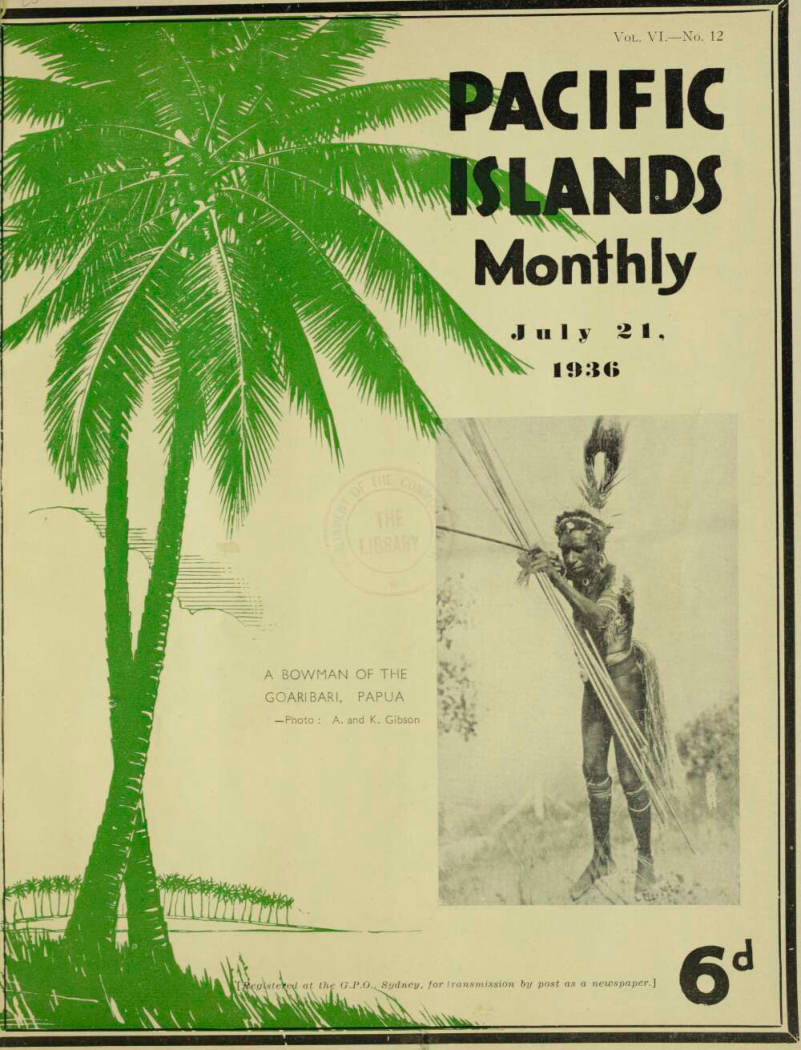
A Bowman Of The
Goaribari, Papua
—Photo: A. and K. Gibson
Advertisements & other items, p. 2 (1 item)
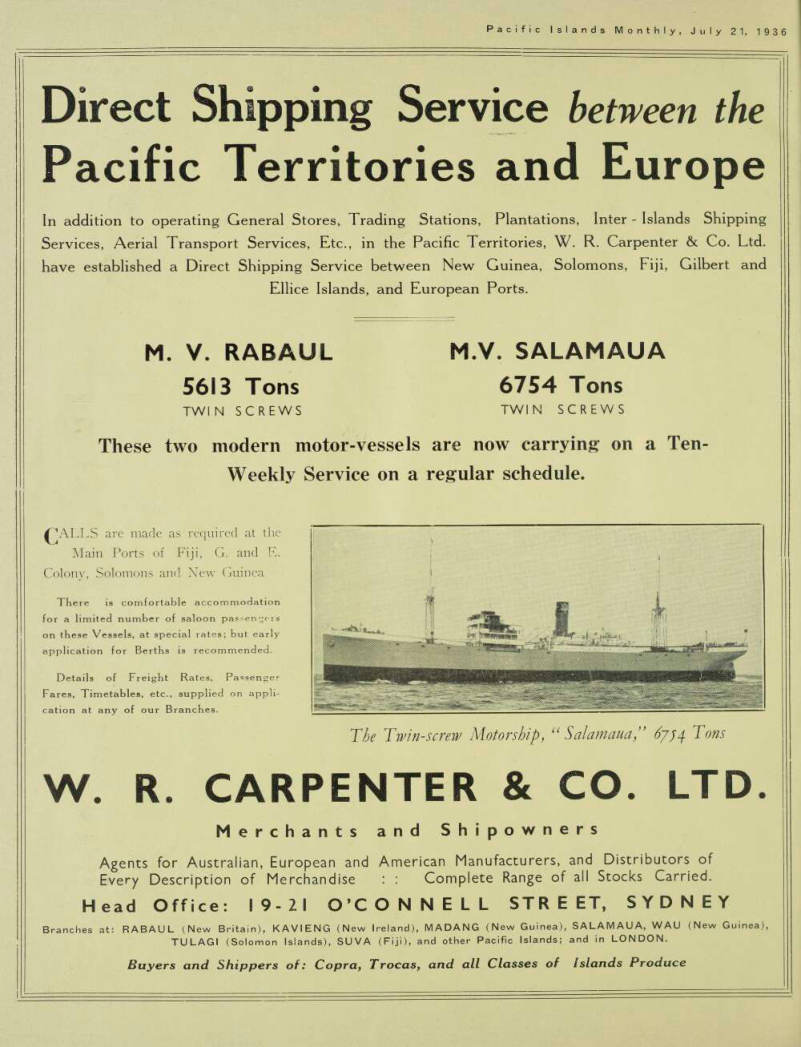
Pacific Territories and Europe
Direct Shipping Service between the
In addition to operating General Stores, Trading Stations, Plantations, Inter - Islands Shipping Services, Aerial Transport Services, Etc., in the Pacific Territories, W. R. Carpenter & Co. Ltd. have established a Direct Shipping Service between New Guinea, Solomons, Fiji, Gilbert and Ellice Islands, and European Ports.
M. V. RABAUL
5618 Tons
TWIN SCREWS
M.V. SALAMAUA
6754 Tons
TWIN SCREWS
These two modern motor-vessels are now carrying on a Ten- Weekly Service on a regular schedule. £JALLS are made as required at the Main Ports of Fiji, G. and E.
Colony, Solomons and New Guinea There is comfortable accommodation for a limited number of saloon passengers on these Vessels, at special rates; but early application for Berths is recommended.
Details of Freight Rates, Passenger Fares, Timetables, etc., supplied on application at any of our Branches.
W. R. CARPENTER & CO. LTD.
Merchants and Shipowners Agents for Australian, European and American Manufacturers, and Distributors of Every Description of Merchandise : : Complete Range of all Stocks Carried.
Head Office: 19-21 O’CONNELL STREET, SYDNEY
Branches at: RABAUL (New Britain), KAVIENG (New Ireland), MADANG (New Guinea), SALAMAUA, WAU (New Guinea), TULAGI (Solomon Islands), SUVA (Fiji), and other Pacific Islands; and in LONDON.
The Twin-screw Motorship, “Salamaua,” Tons Buyers and Shippers of: Copra, Trocas, and all Classes of Islands Produce
Pacific Islands Travellers
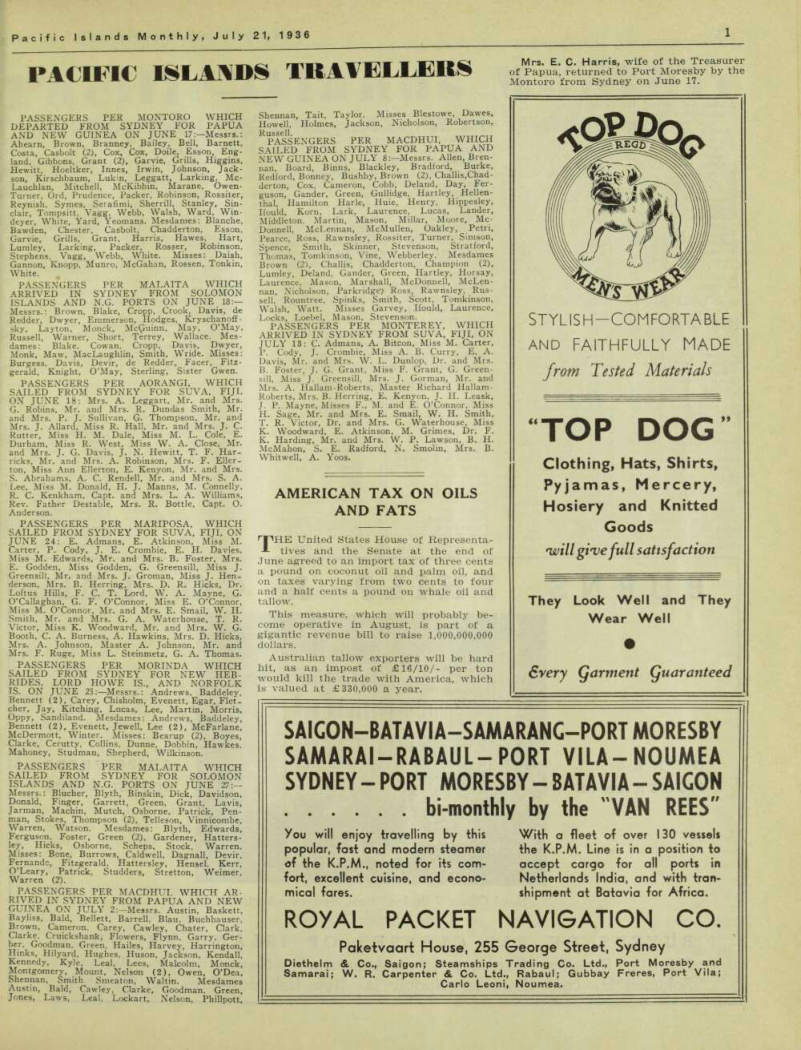
Passengers Per Montoro Which
Departed From Sydney For Papua
And New Guinea On June 17:—Messrs.;
Ahearn, Brown, Branney, Bailey, Bell, Barnett, Costa, Casbolt (2), Cox, Cox, Doile, Esson, Eng land, Gibbons, Grant (2), Garvie, Grills, Higgins, Hewitt, Hoeltker, Innes, Irwin, Johnson, Jack son, Kirschbaum, Lukin, Leggatt, Larking, Me- Lauchlan, Mitchell, McKibbin, Marane, Owen- Turner, Ord, Prudence, Packer, Robinson, Rossiter, Reynish, Symes, Serafimi, Sherrill, Stanley, Sin clair, Tompsitt, Vagg, Webb, Walsh, Ward, Win deyer, White, Yard, Yeomans. Mesdames: Blanche, Bawden, Chester, Casbolt, Chadderton, Esson, Garvie, Grills, Grant, Harris, Hawes, Hart, Lumley, Larking, Packer, Rosser, Robinson, Stephens. Vagg, Webb, White. Misses: Daish, Gannon, Knopp, Munro, McGahan, Rossen, Tonkin, White.
Passengers Per Malaita Which
Arrived In Sydney From Solomon
ISLANDS AND N.G. PORTS ON JUNE 18: Messrs.: Brown, Blake, Cropp, Crook, Davis, de Redder, Dwyer, Emmerson, Hodges, Kryschanoff sky, Layton, Monck, McQuinn, May, O’May, Russell, Warner, Short, Terrey, Wallace. Mes dames: Blake. Cowan, Cropp, Davis, Dwyer, Monk, Maw, MacLaughlin, Smith, Wride. Misses: Burgess, Davis, Devir, de Redder, Facer, Fitz gerald, Knight, O’May, Sterling, Sister Gwen.
Passengers Per Aorangi, Which
Sailed From Sydney For Suva, Fiji,
ON JUNE 18: Mrs. A. Leggart, Mr. and Mrs.
G. Robins, Mr. and Mrs. R. Dundas Smith, Mr. and Mrs. P. J. Sullivan, G. Thompson, Mr. and Mrs. J. Allard, Miss R. Hall, Mr. and Mrs. J. C.
Rutter, Miss H. M. Dale, Miss M. L. Cole, E.
Durham, Miss R. West, Miss W. A. Close, Mr. and Mrs. J. G. Davis, J. N. Hewitt, T. F. Har ricks, Mr. and Mrs. A. Robinson, Mrs. F. Eller ton. Miss Ann Ellerton, E. Kenyon, Mr. and Mrs.
S. Abrahams, A. C. Rendell, Mr. and Mrs. S. A.
Lee, Miss M. Donald, H. J. Manns, M. Connelly, R. C. Kenkham, Capt. and Mrs. L. A, Williams, Rev. Father Destable, Mrs. R. Bottle, Capt. O.
Anderson.
Passengers Per Mariposa. Which
SAILED FROM SYDNEY FOR SUVA. FIJI, ON JUNE 24: E. Admans, E. Atkinson, Miss M.
Carter, P. Cody, J. E. Crombie, E. H. Davies, Miss M. Edwards, Mr. and Mrs. B. Foster, Mrs.
E. Godden, Miss Godden, G. Greensill, Miss J.
Greensill, Mr. and Mrs. J. Groman, Miss J. Hen derson, Mrs. B. Herring, Mrs. D. R. Hicks, Dr.
Loftus Hills, F. C. T. Lord, W. A. Mayne, G.
O’Callaghan, G. F. O’Connor, Miss E. O’Connor, Miss M. O’Connor. Mr. and Mrs. E. Smail, W. 11.
Smith, Mr, and Mrs. G. A. Waterhouse, T. R.
Victor, Miss K. Woodward, Mr. and Mrs. W. G.
Booth, C. A. Burness, A. Hawkins, Mrs. D. Hicks, Mrs. A. Johnson, Master A. Johnson, Mr. and Mrs. F. Ruge, Miss L. Steinmetz, G. A. Thomas.
Passengers Per Morinda Which
Sailed From Sydney For New Heb
Rides, Lord Howe Is., And Norfolk
IS. ON JUNE 25: —Messrs.: Andrews, Baddeley, Bennett (2), Carey, Chisholm, Evenett, Egar, Flet cher, Jay, Kitching, Lucas, Lee, Martin, Morris, Oppy, Sandiland. Mesdames; Andrews, Baddeley, Bennett (2), Evenett, Jewell, Lee (2), McFarlane, McDermott, Winter. Misses: Bearup (2), Boyes, Clarke, Cerutty, Collins, Dunne, Dobbin, Hawkes, Mahoney, Studman, Shepherd, Wilkinson.
Passengers Per Malaita Which
Sailed From Sydney For Solomon
ISLANDS AND N.G. PORTS ON JUNE 27: Messrs.: Blucher, Blyth, Binskin, Dick, Davidson, Donald, Finger, Garrett, Green, Grant, Lavis, Jarman, Machin, Mutch, Osborne, Patrick, Pen man, Stokes, Thompson (2), Telleson, Vinnicombe, Warren, Watson. Mesdames: Blyth, Edwards, Ferguson. Foster, Green (2), Gardener, Hatters ley, Hicks, Osborne, Scheps, Stock, Warren.
Misses: Bone, Burrows, Caldwell, Dagnall, Devir, Fernande, Fitzgerald, Hattersley, Hensel, Kerr, O’Leary, Patrick, Studders, Stretton, Weimer, Warren (2).
Passengers Per Macdhui. Which Ar
RIVED IN SYDNEY FROM PAPUA AND NEW GUINEA ON JULY 2:—Messrs. Austin, Baskett, Bayliss, Bald, Bellett, Barrell, Blau, Buchhauser, Brown, Cameron, Carey, Cawley, Chater, Clark.
Clarke, Cruickshank, Flowers, Flynn, Garry, Ger ber, Goodman. Green, Hailes, Harvey, Harrington, Hinks, Hilyard, Hughes, Huson, Jackson, Kendall, Kennedy, Kyle, Leal, Lees, Malcolm, Monck, Montgomery, Mount, Nelson (2), Owen, O’Dea, Shennan, Smith Smeaton, Waltin. Mesdames Austin, Bald, Cawley, Clarke, Goodman, Green, Jones, Laws, Leal, Lockart, Nelson, Phillpott,
Shennan, Tait, Taylor. Misses Blestowe, Dawes, Howell, Holmes, Jackson, Nicholson, Robertson, Passengers per macdhui, which
Sailed From Sydney For Papua And
NEW GUINEA ON JULY B:— Messrs. Allen, Bren nan, Board, Binns, Blackley, Bradford, Burke, Bedford, Bonney, Bushby, Brown (2), Challis,Chad derton, Cox, Cameron, Cobb, Deland, Day, Fer guson, Gander, Green, Gullidge, Hartley, Hellen thal, Hamilton Harle, Huie, Henry, Hippesley, Ifould, Korn, Lark, Laurence, Lucas, Lander, Middleton, Martin, Mason, Millar, Moore, Mc- Donnell, McLennan, McMullen, Oakley, Petri, Pearce, Ross, Rawnsley, Rossiter, Turner, Simson, Spence, Smith, Skinner, Stevenson, Stratford, Thomas, Tomkinson, Vine, Webberley. Mesdames Brown (2), Challis, Chadderton, Champion (2), Lumley, Deland, Gander, Green, Hartley, Horsay, Laurence, Mason, Marshall, McDonnell, McLen nan, Nicholson, Parkridge? Ross, Rawnsley, Rus sell, Rountree, Spinks, Smith, Scott, Tomkinson, Walsh, Watt. Misses Garvey, Ifould, Laurence, Locks, Loebel, Mason, Stevenson.
Passengers Per Monterey, Which
ARRIVED IN SYDNEY FROM SUVA. FIJI, ON JULY 13: C. Admans, A. Bitcon, Miss M. Carter, P. Cody, J. Crombie, Miss A. B. Curry, E. A.
Davis, Mr. and Mrs. W. L. Dunlop, Dr. and Mrs.
B. Foster, J. G. Grant, Miss F. Grant, G. Green sill, Miss J. Greensill, Mrs. J. Gorman, Mr. and Mrs. A. Hallam-Roberts, Master Richard Hallam- Roberts, Mrs. B. Herring, E. Kenyon, J. H. Leask, J. P. Mayne, Misses F., M. and E. O’Connor, Miss H. Sage, Mr. and Mrs. E. Smail, W. H. Smith, T. R. Victor, Dr. and Mrs. G. Waterhouse, Miss K. Woodward, E. Atkinson, M. Grimes. Dr. F.
K. Harding, Mr. and Mrs. W. P. Lawson, B. H.
McMahon, S. E. Radford, N. Smolin, Mrs. B.
Whitwell, A. Yoos.
American Tax On Oils
And Fats
THE United States House of Representa tives and the Senate at the end of June agreed to an import tax of three cents a pound on coconut oil and palm oil, and on taxes varying from two cents to four and a half cents a pound on whale oil and tallow.
This measure, which will probably be come operative in August, is part of a gigantic revenue bill to raise 1,000,000,000 dollars.
Australian tallow exporters will be hard hit, as an impost of £l6/10/- per ton would kill the trade with America, which is valued at £330,000 a year.
Mrs. E. C. Harris, wife of the Treasurer of Papua, returned to Port Moresby by the Montoro from Sydney on June 17.
Advertisements & other items, p. 3 (1 item)
Top Dog
STYLISH-COMFORTABLE
AND FAITHFULLY MADE
from Tested Materials
TOP DOG
Clothing, Hats, Shirts, Pyjamas, Mercery, Hosiery and Knitted Goods 'will give full satisfaction They Look Well and They Wear Well Srery Qarment guaranteed
SAICON-BATAVIA-SAMARANG-PORT MORESBY
SAMARAI-RABAUL- PORT VILA-NOUMEA
SYDNEY - PORT MORESBY - BATAVIA - SAIGON
bi-monthly by the "VAN REES"
You will enjoy travelling by this popular, fast and modern steamer of the K.P.M., noted for its comfort, excellent cuisine, and economical fares.
With a fleet of over 130 vessels the K.P.M. Line is in a position to accept cargo for all ports in Netherlands India, and with transhipment at Batavia for Africa.
ROYAL PACKET NAVIGATION CO.
Paketvaart House, 255 George Street, Sydney Diet Helm & Co., Saigon; Steamships Trading Co. Ltd., Port Moresby and Samara!; W. R. Carpenter & Co. Ltd., Rabaul; Gubbay Freres, Port Vila; Carlo Leoni, Noumea.
Advertisers
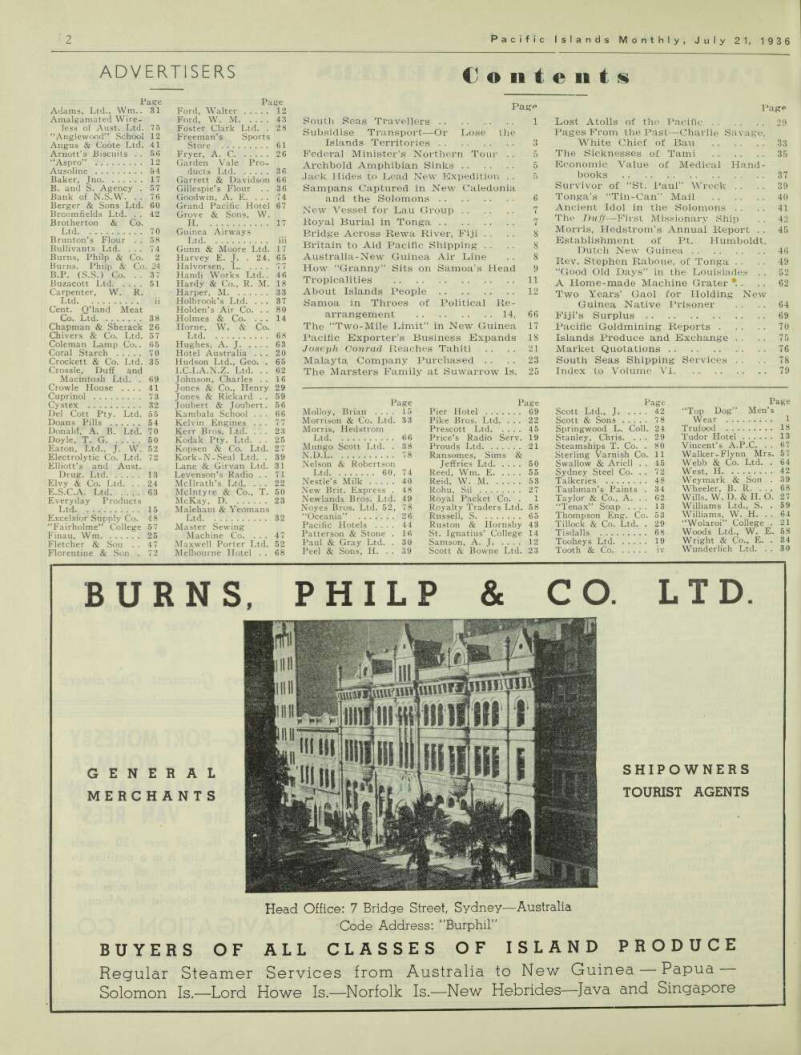
Page Adams, Ltd., Wm.. 31 Amalgamated Wire less of Aust. Ltd. 75 “Anglewood” School 12 Angus & Coote Ltd. 41 Arnott’s Biscuits . . 56 “Aspro” 12 Ausoline 54 Baker, Jno 17 B. and S. Agency . 57 Bank of N.S.W. . . 76 Berger & Sons Ltd. 60 Brcomfields Ltd. . . 42 Brotherton & Co.
Ltd 7 0 Brunton’s Flour . . 58 Bullivants Ltd. ... 74 Burns, Philp & Co. 2 Burns, Philp & Co. 24
B.P. (S.S.) Co. .. 37
Buzacott Ltd 51 Carpenter, W. R.
Ltd ii Cent. Q’land Meat Co. Ltd 38 Chapman & Sherack 26 Chivers & Co. Ltd. 57 Coleman Lamp Co.. 65 Coral Starch 70 Crockett & Co. Ltd. 35 Crossle, Duff and Macintosh Ltd. . 69 Crowle House ... 41 Cuprinol 73 Cystex 32 Del Cott Pty. Ltd. 55 Doans Pills 54 Donald, A. B. Ltd. 70 Doyle, T. G 50 Eaton, Ltd., J. W. 52 Electrolytic Co. Ltd. 72 Elliott’s and Aust.
Drug. Ltd 13 Elvy & Co. Ltd. . . 24
E.S.C.A. Ltd 63
Everyday Products Ltd 15 Excelsior Supply Co. 48 “Fairholme” College 57 Finau, Wm 25 Fletcher & Son . . 47 Florentine & Son . 72
Page Ford, Walter 12 Ford, W. M 43 Foster Clark Ltd. . 28 Freeman’s Sports Store 61 Fryer, A. C 26 Garden Vale Pro ducts Ltd 36 Garrett & Davidson 66 Gillespie’s Flour . . 36 Goodwin, A. E. ... 74 Grand Pacific Hotel 67 Grove & Sons, W.
H. 17 Guinea Airways Ltd iii Gunn & Moore Ltd. 17 Harvey E. J. . 24, 65 Halvorsen, L 7 7 Handi Works Ltd.. 46 Hardy & Co., R. M. 18 Harper, M 33 Holbrook’s Ltd. ... 37 Holden’s Air Co. . . 80 Holmes & Co. ... 14 Horne, W. & Co.
Ltd 68 Hughes, A. J 63 Hotel Australia ... 20 Hudson Ltd., Geo. . 65
1.C.1.A.N.Z. Ltd. . . 62
Johnson, Charles . . 16 Jones & Co., Henry 29 Jones & Rickard . . 59 Joubert & Joubert. 56 Kambala School ... 66 Kelvin Engines ... 77 Kerr Bros. Ltd. ... 23 Kodak Pty. Ltd. . . 25 Kopsen & Co. Ltd. 27 Kork-N-Seal Ltd. . 39 Lane & Girvan Ltd. 31 Levenson’s Radio . . 71 Mcllrath’s Ltd. ... 22 Mclntyre & Co., T. 50 McKay, D 23 Maleham & Yeomans Ltd 32 Master Sewnng Machine Co. ... 47 Maxwell Porter Ltd. 52 Melbourne Hotel . . 68
Page Molloy, Brian ... 15 Morrison & Co. Ltd. 33 Morris, Hedstrom Ltd 66 Mungo Scott Ltd. . 38
N.D.L 78
Nelson & Robertson Ltd 60, 74 Nestle’s Milk 40 New Brit. Express . 48 Newlands Bros. Ltd. 49 Noyes Bros. Ltd. 52, 78 “Oceania” 26 Pacific Hotels ... 44 Patterson & Stone .16 Paul & Gray Ltd. . 30 Peel & Sons, H. . . 39
Page Pier Hotel 69 Pike Bros. Ltd. ... 22 Prescott Ltd 45 Price’s Radio Serv. 19 Prouds Ltd 21 Ransomes, Sims & Jeffries Ltd 50 Reed, Wm. E 55 Reid, W. M 53 Rohu, Sil 27 Royal Packet Co. . 1 Royalty Traders Ltd. 58 Russell, S 65 Ruston & Hornsby 43 St. Ignatius’ College 14 Samson, A. J 12 Scott & Bowne Ltd. 23
Page Scott Ltd., J 42 Scott & Sons 78 Springwood L. Coll. 24 Stanley, Chris. ... 29 Steamships T. Co. . 80 Sterling Varnish Co. 11 Swallow & Ariell . . 45 Sydney Steel Co. . . 72 Talkeries 48 Taubman’s Paints . 34 Taylor & Co., A. . . 62 “Tenax” Soap ... 13 Thompson Eng. Co. 53 Tillock & Co. Ltd. . 29 Tisdalls 68 Tooheys Ltd 19 Tooth & Co iv
Page “Top Dog” Men’s Wear 1 Trufood 18 Tudor Hotel 13 Vincent’s A.P.C. . . 67 Walker-Flynn Mrs. 57 Webb & Co. Ltd. . 64 West, H 42 Weymark & Son . 39 Wheeler, B. R. ... 68 Wills, W. D. & H. O. 27 Williams Ltd., S. . 59 Williams, W. H. . . 64 “Wolaroi” College . 21 Woods Ltd., W. E. 58 Wright & Co., E. . 34 Wunderlich Ltd. . . 30
Contents
Page South Seas Travellers 1 Subsidise Transport—Or Lose the Islands Territories 3 Federal Minister’s Northern Tour .. 5 Archbold Amphibian Sinks 5 Jack Hides to Lead New Expedition . . 5 Sampans Captured in New Caledonia and the Solomons 6 New Vessel for Lau Group 7 Royal Burial in Tonga 7 Bridge Across Rewa River, Fiji . . . . 8 Britain to Aid Pacific Shipping .. . . 8 Australia-New Guinea Air Line .. 8 How “Granny” Sits on Samoa’s Head 9 Tropicalities 11 About Islands People 12 Samoa in Throes of Political Re arrangement 14, 66 The “Two-Mile Limit” in New Guinea 17 Pacific Exporter’s Business Expands 18 Joseph Conrad Reaches Tahiti . . .. 21 Malayta Company Purchased .. . . 23 The Marsters Family at Suwarrow Is. 25
Page Lost Atolls of the Pacific 29 Pages From the Past —Charlie Savage, White Chief of Ban 33 The Sicknesses of Tami 35 Economic Value of Medical Hand books 37 Survivor of “St. Paul” Wreck . . . . 39 Tonga’s “Tin-Can” Mail 40 Ancient Idol in the Solomons . . .. 41 The Duff —First Missionary Ship . . 42 Morris, Hedstrom’s Annual Report .. 45 Establishment of Pt, Humboldt, Dutch New Guinea 46 Rev. Stephen Rabone, of Tonga . . . . 49 “Good Old Days” in the Louisiades . . 52 A Home-made Machine Grater *.. .. 62 Two Years’ Gaol for Plolding New Guinea Native Prisoner . . .. 64 Fiji’s Surplus 69 Pacific Goldmining Reports 70 Islands Produce and Exchange . . .. 75 Market Quotations 76 South Seas Shipping Services . . .. 78 Index to Volume VI 79
Advertisements & other items, p. 4 (1 item)
Burns, Philp & Co. Ltd.
GENERAL
MERCHANTS
J S. immin Hill
liiiffttl
Mil
jj~3sSss^ in 111
Hill
mm % > iiiiii lilw Head Office: 7 Bridge Street, Sydney—Australia Code Address: "Burphil"
SHIPOWNERS
TOURIST AGENTS
BUYERS OF ALL CLASSES OF ISLAND PRODUCE Regular Steamer Services from Australia to New Guinea Papua Solomon Is.—Lord Howe Is. —Norfolk Is.—New Hebrides —lava and Singapore
Pacific Islands Monthly
The Newspaper-Magazine of the South Seas [ Registered at the G.P.O. Sydney, for transmission by post as a newspaper .]
Published Once Each Month and Circulated in Australia and New Zealand and in the following Pacific Territories and Island Groups:
Crown Colony of Fiji.
Australian Territory of Papua.
Mandated Territory (Australia) of New Guinea, Bismarck Archipelago and Northern Solomon Islands.
Mandated Territory (Japan) of Marshall, Caroline and Marianna Islands.
French Territory of New Caledonia.
British and French Condominium of New Hebrides.
American Territory of Eastern Samoa.
American Territory of Guam.
Mandated Territory of Nauru.
British Crown Colony of Gilbert and Ellice Islands.
Mandated Territory (New Zealand) of Samoa.
British Solomon Islands Protectorate.
British Protectorate of Tongan Islands.
New Zealand Territory of Cook Islands.
Australian Territory of Norfolk Island.
French Colony of Oceania (Tahiti, etc.).
American Territory of Hawaiian Islands.
Owned and Produced by Pacific Publications Ltd., Union House, 247 George Street, Sydney
Telephone Bw 5037
P.O. Box 3408 R
Registered Address of Telegrams. Radiograms, and Cables: “PACPUB,” Sydney.
Contributions Articles, Stories, and Photographs dealing with Pacific Islands Subjects are invited, and will be paid for on publication at usual rates.
Subscription Rates Per Annum, within British Empire, Prepaid, Post Free 6/ Per Annum, elsewhere, prepaid, Post Free 8/ Single Copies 6d.
Editor and Publisher:
R. W. Robson, F.R.G.S.
Advertisements
Advertising rates furnished on application.
Colours, etc by Arrangement.
Process Blocks made at Advertiser’s expense when required. Screen, 100.
Changes of Advertising Copy should reach this Office by Bth of each month, otherwise previous advertisement may be repeated.
Agents
The following are authorised to receive subscrip tions for the Pacific Islands Monthly:—• Islands Branches of Burns, Philp & Co., Ltd., and Burns Philp (South Sea) Co., Ltd.
Islands Branches of W. R. Carpenter & Co., Ltd.
All Branches of Morris, Hedstrom & Co., Ltd.
G. Thomas & Co.. Rabaul, New Guinea.
Whitten Bros., Ltd., Samarai, Papua.
P. Costello, Suva, Fiji.
J. Muir, Suva, Fiji.
All Branches and Representatives of W. H. Grove and Sons, Ltd., Auckland, New Zealand.
S. Russell. Papeete, Tahiti.
Cook Islands Trading Co., Rarotonga, Cook is.
Representative in London: W. C. HARVEY, Coronation Building, 4 Lloyds Avenue, London, E.C.2. from whom may be obtained copies of Pacific Islands Monthly, Pacific Islands Year Book, advertising schedules, etc.
Vol. VI.. No. 12.
Sydney, July 21, 1936
J 6d. Per Copy, rnce ( Prepaid: 6/- p.a.
Subsidise Transport—or Lose the Islands
Territories!
'J'HERE can be no real success in the administration and develop ment of the Pacific Territories unless transport facilities are abun dant and economical. That is true of most countries; but, in the peculiar conditions of the Pacific Islands, it is the fact that must be taken first into consideration in all plans for the future. There is nothing in the world like the Pacific Islands—an uncountable number of small areas of land, rich and for the most part incalculably productive, supporting very many small, isolated communities.
It may be argued that there is no need to “develop” these territories— that the real obligation upon the countries which hold them is to pro tect the natives against exploiters and criminals, and maintain an orderly social system. That may have been true, once; but to-day,
with armed and aggressive nations increasingly seeking new lands for their crowded millions, any terri tory which is capable of providing a home for additional people, and which is not being used, is regarded as a reproach and a temptation.
There is room in the tropical and sub-tropical islands for very many more people than live there now. If they are not developed and popu lated by the nations which hold them, it is inevitable that they will be taken, sooner or later, by other nations whose paramount need is more land.
Transport is the key to the future of the Islands. Their productivity is such that cheap communication soon will bring new settlement. The provision of adequate transport is the responsibility of the countries which hold the Islands Territories, and which desire to see the status quo maintained in the Pacific.
British Imperial interests —and especially Australia —cannot con template any change in the control of that fringe of Western Pacific Islands (New Guinea, Papua, Solo mons, New Hebrides) which now interpose a defensive barrier be tween Australia and overcrowded Asia. But, except for the establish ment of the gold industry in New Guinea, there has been very little commercial progress in those groups during the past two decades. France has shown, in carrying on her share of the New Hebrides administration, a vigorous readiness to use the re sources of the Mother Country in establishing her nationals in the group; but Britain and Australia have been quite careless of their obligations and indifferent towards certain obvious possibilities. Those island groups must be populated and developed; there can be no new population worth considering with out commercial progress; commer cial progress necessarily waits upon frequent, cheap transport; and the present responsibility for providing transport rests not upon commercial
interests, but directly upon those British and Dominions Governments which wish to keep the present posi tion unchanged in the Pacific.
The tendency, in the past, has been to leave the provision of trans port to those trading enterprises which hope to derive profits from the commercial development of the Islands Territories. That may have been sound, in the past; but, in the present condition of world affairs, it is a policy of sheer, inexcusable folly. If the British nations which now hold the Pacific Islands terri tories do not develop and populate and strengthen those territories, they will lose them; and, in losing them, they will bring to their front doors a menace that is now some thousands of miles away. To-day, Sydney and Brisbane and Auckland are fairly well protected, by isola tion, against attacks by bombing and gas-poisoning aeroplanes; but those cities might easily be wiped out by air forces based on the nearer Pacific Islands.
Since they dare not wait for the slow development that is based on ordinary commercial penetration, the British and Dominions Govern ments, as a matter of defence policy, should face the position, and hasten
development by providing transport,
even if the cost of same has to be charged to defence expenditure.
Among the Pacific Territories to day, there are several situations which should be brought into line with a transport and developmental policy based on Imperial defence requirements. It is reported, for example, that the Commonwealth Government is trying to reduce, in the new contract or contracts to be made shortly, the amount of the sub sidy (paid for many years past to Messrs. Burns, Philp and Co. Ltd.) for maintaining transport services between Australian and Islands ports. Some politicians have argued that, as the gold industry has been established in New Guinea, the B.P. ships may now be run profitably on the ordinary traffic. Such a policy, in view of the international situa tion, is short-sighted to the point of lunacy. The subsidy, instead of being reduced, should rather be in creased, on condition, of course, that cheaper and still cheaper transport be provided for all those Western Pacific Islands whose rapid develop ment and population are vital to the safety of Australia.
Messrs. W. R. Carpenter and Co.
Ltd. recently established, unaided, a line of motor-vessels between the Western Pacific Islands and Europe, to help in the quick and profitable marketing of Islands produce. Aus tralia should subsidise that line—not for any love of Carpenter and Co., but as part of the vital business of protecting and defending her Pacific Territories.
There have been arguments and squabbling over a shipping reorgani sation and a proposed readjustment of aviation transport conditions in New Guinea. In all these things, the essential point has been neglected— namely, that it is quite in accord with a sound defence policy to give special concessions, and even a direct subsidy, to all British Pacific transportation provided that no
dangerous monopolies are created,
and that the companies concerned give guarantee that they will pro vide the Islands people with cheaper and yet cheaper transport, so that settlement of good racial stock in the Islands may proceed as quickly and as efficiently as possible.
For instance, the New Guinea gold industry, which probably will be worked out in a decade or two, and which has established there a
large European population and
highly efficient aviation transport services, gives Australia almost a providential opportunity. If the goldfields revenues are used, with wisdom and vision, to subsidise the transport services, to give cheap and easy communication, a large Euro pean population can be settled per manently in New Guinea.
This line of argument may cause surprise in some quarters. If it does, it simply means that the surprised ones do not recognise the menace of the East. They should read a Tokio press despatch, published on June 15, describing Japan’s plans for the settlement of her nationals in For mosa and in her Mandated Islands.
This transport problem crops up in many places; and everywhere it is treated as if it were not a matter of vital importance to the Pacific portion of the British Empire. It would seem that our politicians, after futile babbling in Canberra, Wellington and London, are going to permit the abandonment of cer tain of the British trans-Pacific ser vices, for lack of an adequate sub sidy. The withdrawal of the Wel lington-’Erisco line would not have
much significance, as the only British Islands territory affected would be the Cooks; but any inter ference with the Auckland-Van couver Line would be a shipping calamity of the first magnitude. In the present condition of world trade and world politics, the Union Com pany should be liberally subsidised, within reason, and encouraged to provide cheap transport between the Central and Eastern Pacific groups and the bigger markets.
New Zealand, for instance, could absorb an immensely greater quan tity of the produce of the Cook Islands and Samoa. But those Islands growers cannot profitably get to the Dominion’s markets. There is little cold storage available on the
infrequent ships running between
the Cooks and New Zealand; while there is only one little Government owned vessel maintaining communi cation between Samoa and New Zealand. Samoa, under German rule, was a place of importance in the Central Pacific, and was served by lines of good ships; to-day, it is one of the most isolated and de pressed places in the Pacific. No regular liners call there—presum ably, because the N.Z. Government insists on competing in the shipping business. This short-sighted policy has deprived Samoa of transport and put a blight upon a place that is capable of supporting a much larger population of Empire-defenders.
It may be true that “trade (and settlement) follows the flag”; but there have been tremendous, and dangerous, changes in international relationships since that happy phrase was coined. If the British people do not use the Islands they will lose them. Cheaper and better transport will solve the problem, and that means subsidies, charged to defence. •
Society Group
Castaway On Island In
THE steamer, Port Darwin, which ar rived in Brisbane from New York on July 8, passed a man who appeared to be a castaway on an island of the Society Group.
Captain Hudson said that he was sur prised to see smoke coming from the island, which was thought to be unin habited. Through his glasses, as the ship drew nearer, he' saw a man waving his arms and piling brushwood on a fire to create more smoke. \ The weather was too unfavourable to lower a boat or to take the ship closer to the island, so a wireless message was sent to the Governor of Tahiti, 300 miles away.
The message was acknowledged.
Showered With
Protests
Minister on Tour in Papua and New Guinea
IN his official capacity as Commonwealth Minister for Trade and Customs, Colonel T. W. White made a tour of Australia’s territories in the north during June and July. He was accom panied by his wife and child, and Mrs. F.
M. Grant (private secretary).
In the middle of June, the Minister in quired into the pearling industry at Thursday Island. He went out in a lugger and descended in diving dress, a Japanese diver accompanying him below to show the method of gathering pearl shell. Before leaving for Cairns to join the Montoro for Papua and New Guinea, Mr. White said he was convinced that foreign poach ers were carrying out unlawful depreda tions in Torres Straits waters. He promised to station a large patrol launch at T.I.
Papua Wants Permanent
Rubber Bounty
In Papua, Colonel White met representa tives of the Planters’ Association, who acquainted him with their case for a per manent rubber bounty.
At Rabaul on July 1 he received depu tations from the Returned Soldiers’ Asso ciation and the Planters’ Association. They protested against the introduction of the Shipping Bill and against the proposed amendments to the trading regulations, abolishing the two mile protective limit.
The Minister was told that assistance had been requested from the Federal Gov ernment for the erection of a war memorial clock tower. He replied that it was not the practice of the Government to subscribe to war memorials. Other issues discussed in cluded the renewal of bounties on N.G. produce exported to Australia.
With Administrator To
Outports
Accompanied by the Administrator (Brigadier-General W. Ramsay McNicoll) and Mr. J. C. Mullaly (president of the Planters’ Association), Colonel White de parted the same evening for the outports.
At Kavieng he heard further representa tions from planters.
Disembarking from the Montoro at Sala maua on July 4, he flew to Wau where the Citizens’ Committee entered a protest against the proposed merger of aviation interests. After inspecting the Bulolo dredges and N.G.G. Ltd’s Edie Creek work ings, the Minister flew to Ramu and the Chimbu Valley country.
Returning, he spent some time at Lae and afterwards proceeded in a Guinea Air ways’ machine to Finschafen, the Lutheran Mission’s headquarters. Mr. White, whose distinguished war record as an aviator is well-known, piloted G.A.’s new Stinson most of the distance.
Rejoining the B.P. ship, he called at Ma dang. By launch he then visited Alexis hafen (headquarters of the Roman Catho lic Mission) to see New Guinea’s largest cathedral and inspect the busy mission centre. Continuing on by the Montoro, he touched at several other ports before re turning to Rabaul, from whence he pro ceeded to Salamaua for a further inspec tion of the goldfields area.
Mr. White than flew across from Wau to Pt. Moresby, where he was the guest of Messrs. T. L. Sefton and T. Nevitt at Koitaki Para Rubber Estates’ plantation.
In the middle of July he joined the Mon toro for Australia.
N.Z. Delegation
Investigating Cook Is. Fruit Trade
Auckland, July 9.
THE three members of the N.Z. House of Representatives appointed by the Government to investigate the Cook Is. £ rui l indus ‘ ry ’ left Wei mgton ™ Jdly , 6 by the Makura for Rarotonga, the deputation comprised Messrs. J Robertson and R *. Hunter (Labour), and S. G. Holland (National) and was accompanied by Mr.
S. J. Smith, of the Cook Is. Department.
The party will return to New Zealand on August 14 by the Union Company s new steamer Matua and will report to the Industnes and Commerce Committee of the House of Representatives.
Expedition
Jack Hides to Lead New Expedition
MR. JACK HIDES, Assistant Resident Magistrate in the Papuan Administra tion, who won distinction last year for his hazardous patrol into unknown Central Papua, has resigned from the service. He will shortly lead a party into the Strick land-Purari country in search of gold.
On his recent exploratory trip, Mr, Hides discovered country bearing a remarkable resemblance to the rich Morobe goldfield in New Guinea. A Sydney syndicate, In vestors Ltd., has been formed to send a party under Mr. Hides to examine closely this possible great new goldfield.
The expedition will clear a landing ground so that a ’plane, piloted by Cap tain P. G. Taylor, can land at the site, A foremost Australian mining expert will then thoroughly test the area.
Consisting of three white men and 60 natives, the expedition will be particularly well-equipped. It will carry a portable radio receiving and transmitting set.
Overturned in Squall
Archbold Party’s Seaplane Sinks at Pt. Moresby
From Our Own Correspondent
Pt. Moresby, July 13.
THE Fairchild amphibian belonging - to the American Museum of Natural His tory expedition overturned and sank in a sharp 60 m.p.h. squall in Pt. Moresby Har bour on July 9. The seaplane, which with equipment was valued at £20,000, was com pletely ruined.
The machine came in from Daru on July 8 for supplies. Before daylight the follow ing morning the pilot, Mr. Russell Rogers, and the radio operator, Mr. E. C. Julestedt, went down to fly the seaplane out to meet the tourist liner Orama. They found the machine upside down in the water, and almost submerged.
With the assistance of the captain of the Orama, and after a great deal of labour, she was towed to the ship, but, when they were endeavouring to lift her aboard, a wing broke and she went down again.
When brought up she was towed back to the landing buoy.
Arrangements are being made for a Guinea Airways’ ’plane to take supplies to the base camp 400 miles up the Fly River and to the advance party at Mount Blucher. A launch has been chartered to transport three months’ supplies to the camp, established by the Oroville Co.’s ex pedition last year, which is now occupied by the Archbold party.
Led by Dr. Richard Archbold, a noted American airman and scientist, the expedi tion arrived in the Territory in March to spend several months exploring the Upper Fly River in Western Papua, Rev. C. F. Andrews, noted religious writer and lecturer, arrived in Sydney by the Niagara on July 11, after a visit to Fiji to inquire into Indian conditions.
Nauruan Catches Giant Marlin
Putting to shame the famous anglers who use tackle worth hundreds of pounds, the Nauru native on the left of the photograph caught singlehanded this giant marlin, with a couple of shillings’ worth of “trade” fishing line. The Nauruan was paddling in his frail canoe when he hooked and played the 10ft. fish. A few days previously a similar big catch was made by the same native.
Chasing Sampan, French Aeroplane
Falls Into Sea
Audacious Japanese Poachers Captured in New Caledonia and the Solomons
THERE Have been dramatic events during the month in connection with the activities of Japanese shell-poachers in the Western Pacific.
An aeroplane, despatched by the Governor of New Caledonia to apprehend raiders, fell into the sea near the sampan it was pursuing. Rescuing the two aviators, the Japanese took them to Hienghene, where the vessel was arrested, and a quantity of shell seized.
A fortnight later another sampan was chased in New Caledonia by a motor ketch and, finally, captured.
On July 19, gendarmes in a fast launch caught a third poacher at Pouerihouen.
At Gizo, in the British Solomon Islands, 17 poachers caught while fishing on a reef were gaoled. After an exciting chase, the boat from which they were working was overtaken. The captain and his crew were subsequently fined £lO.
ON June 20 reports reached Noumea that foreign sampans were fishing for trochus shell at Touho and Pouebo. M.
Siadoux (Governor of the French Colony) asked the local Aero Club to send out their 'plane “Cagou” to investigate and compel the raiders to go to Noumea. Piloted by M. Beaumont with M. Martinet (president of the Aero Club) as observer, the machine flew along the east coast, armed with hand grenades and a Hock howitzer.
A poacher was sighted near the reefs off Cape Touho. three miles from the land.
The aviators dropped a message ordering the captain to go to the nearest port, and threatened to sink his ship with bombs if he disobeyed.
The sampan began to obey; but suddenly the aeroplane fell into the sea, the con trols becoming jammed by a bomb. One of the aviators was injured and fainted.
The other hoisted him on one of the wings.
The sampan then tried to escape, but, in response to the desperate signals of the aviators, returned, and rescued them. The poachers consented to take the men to port.
but only on condition that they themselves would be set at liberty.
M. Martinet had a rib broken and was unconscious for three hours. His com panion was slightly injured in the head.
The aeroplane sank and was a total loss.
The poachers took the injured men into Hienghene. There they were met by a launch carrying the local gendarmes who arrested the crew of 30 Japanese. The authorities seized the large sampan with its cargo of 30 tons of trochus shell.
After a few days’ detention the Japanese were released, as promised by the aviators.
In the belief that the trochus shell had been obtained unlawfully, the French officials kept half the cargo.
“Caledonien” Catches A Poacher
Early in July the motor ketch Caledonien came upon a Japanese vessel gathering trochus off Yate. near Noumea. After a 90 minutes’ chase, the French yacht caught the sampan.
Six natives, armed with tomahawks and spears, were put on board, and the vessel was taken to the nearest landing place.
It was finally towed to Noumea, where it was detained by the Customs authorities.
The vessel was of 30 tons, and had a 50 h.p. motor and a crew of 22 Japanese.
Seventy up-to-date charts of various Pacific Islands were found on board.
Third Sampan Captured
While poaching off the coast of New Caledonia, a third Japanese vessel was cap tured on July 19. Gendarmes and some settlers and natives set out from the town of Pouerihouen in a speedy launch and overtook the sampan as she was making off from the reefs. Six tons of trochus were seized.
The ship was of 80 tons, had a 100-h.p. motor, and carried a crew of 30 Japanese.
Many other similar vessels have been sighted off the New Caledonian coast and it has been learned that they are receiving supplies from a fast steamer of 800 tons.
Japanese Gaoled At Gizo
Great excitement was caused at Gizo, in the Solomon Islands, on June 6 by the appearance of a Japanese poacher in Fer guson Channel, between Wana Wana Lagoon and Gizo. Two small boats con taining 17 men put off and began fishing on the reef.
District Officer C. E. J. Wilson and two officials, in the Government launch Gizo, started off in pursuit of the sampan. The vessel soon out-distanced them, so they returned and eventually captured the men in the dinghies. The poachers were unable to speak English, so they were taken to port, where a domiciled Japanese trader acted as interpreter.
The Japanese were charged and then
imprisoned in the hospital. The local gaol was not big enough to accommodate 17 men.
Next morning the sampan was sighted some miles distant, evidently searching for the dinghies and divers. The District Officer again set out in pursuit, and a long chase followed. The sampan possessed the greater speed, and was slowly gaining ground when suddenly it altered course and slowed down, breaking the Japanese ensign.
The captain, it was learned, had decided that the better policy was to face an in quiry rather than lose the services of most of his crew. After much gesticulating and signs, the order to proceed into port in the wake of the Government launch was understood. The captain and his two companions were imprisoned with the other Japanese.
In court the following day, the master of the sampan stated that he had been a month out from Formosa and required food and water. He had dropped the dinghies on the reef to look for shell while he went ashore at Kolombangara Island for supplies.
He was charged under the Solomon Islands Fisheries Regulations, and fined the maximum of £lO. He was ordered to report to the Administration headquarters at Tulagi.
Great dissatisfaction has been expressed throughout the Solomon Islands at the inadequacy of the law. The Administra tion has been approached with a request to amend the regulation to provide for a more severe penalty in cases where poachers are caught red-handed.
Opened After 20 Years' Effort
Large Samoan Church
From Our Own Correspondent APIA, June 26.
ON Friday, June 19 the largest Catholic Church on the east coast of Upolu was consecrated and opened at Falefa with due ceremony by Bishop Darnaud and the clergy of the diocese, in the presence of a very large gathering of Europeans and natives from all parts of the group, esti mated at several thousand people. The Acting Administrator was present at the colourful and impressive ceremonies.
Falefa, a Samoan village about 15 miles east of Apia, started a fund for the new church about 20 years ago, and the people patiently continued their pious endeavours until 10 years ago, when they started to build. But it took them another 10 years to complete the project.
The usual Samoan feast was of truly gigantic dimensions. iu included 700 pigs and 400 cattle.
Shipping
New Guinea Inter-Island Shipping
IN the Commonwealth of Australia Ga zette on July 9, the Federal Govern ment invited tenders for the maintenance of an inter-island shipping service in New Guinea. Tenders close on October 30.
The announcement said that tenderers should state the annual subsidy required, and full particulars of the vessels that would be employed, including information as to the size and speed, accommodation for passengers, cargo capacity and re frigerator space.
Tenderers should state where any vessel proposed to be used in the service was built.
Advertisements & other items, p. 8 (1 item)
Wrapper!
Look on the Front of Your
There may be a sign stamped on the front of the wrapper which brings this copy of the P.I.M. to you.
The meaning of the marks: Your subscription (6/- per annum, or 8/- in the case of countries outside the British Empire—which includes postage) may be sent direct, or many be paid to any of our agents (listed on page 3).
PACIFIC PUBLICATIONS LTD.
Union House, 247 George St., Sydney Y our subscription will expire with the next or following issue.
Your subscription will expire with this issue.
This means that your subscription has expired; and that we have sent you this further copy in case you wish to continue as a subscriber, and have forgotten to send in your subscription. Prompt attention is respectfully requested.
Royal Funeral
In Tonga
Ancient Ceremonies Performed at Interment of Prince Tuku’aho
PRINCE William Tuku’aho, the 16-year old son of Queen Salote, ruler of the Kingdom of Tonga, and H.R.H. Prince Tugi, died of heart failure recently, and was buried in May at Mala’e Kula, the tomb of the Tongan kings.
It was entirely fitting that the young Prince who, throughout his brief life had made a deep study of Tongan customs and traditions, was interred with the highest ceremonial rites that have been performed for generations at the death of members of the ruling family.
Tuku’aho was well loved by the people, and his death was a sad event for all Tonga. Thousands of natives gathered to pay their respects at the graveside, and there were poignant scenes as the bier, decked with the Tongan Royal Standard, was carried to the burial-ground on the shoulders of commoners, through lanes of boys and girls of the Wesleyan, Catholic, and Government colleges.
The Rev. R. C. G. Page, of the Methodist Mission, officiated at the graveside.
The photographs reproduced below (taken by Mr. August Hettig, of Nukua lofa) show the picturesque ceremonies that attended the Royal funeral.
Top Left: The ancient custom of Buibui Tabu. This is the practice of screening
the grave with tapa cloth at the moment of burial. The rite is carried out only at the interment of very high chiefs. It is a sacred tabu —the eyes of the commoners must not see the last moment of burial when the coffin is lowered into the grave.
Lower Left: The bier, containing the coffin in the Palace grounds at Nukualofa.
It was carried shoulder high by the com mon people, tvho are shown resting before the cortege moved off to Mala’e Kula. The uniformed figure in the middle of the picture is Valai Tubou, the Queen’s A.D.C.
Standing next to him is Chief Tuiha’ateiho, Governor of Haapai.
Top Right: The ceremony of Takibo (lighting of fires at night). The grounds of the Palace, where Prince Tuku’aho’s body was lying-in-state for two days, were lit by thousands of lanterns. The cere mony of lighting fires around the Palace walls was performed by hundreds of people.
There is no definite explanation of this rite, but some old natives believe it is done to ward off evil influences.
Lower Right: Chief Kalanivalu, one .of the chief mourners. The photograph shows the style of deep mourning attire of the Tongan chiefs who attended the funeral.
Brother Daheim, of the Sacred Heart of Jesus Mission in the Mandated Terri tory, who came to Sydney in April for medical treatment, died in St. Vincent’s Hospital, Sydney, on May 27. He arrived in New Guinea in 1904 to undergo three years’ training at Vunapope as a carpen ter, and then built many mission stations in New Britain and Manus. In 1915 he was given command of the mission vessel Ludwig, and as her kindly and trust worthy captain was well-known through out the Territory.
For Lau Group
New Vessel Launched
SUVA, June 25.
ON June 1, the Seniceva, which has been constructed for the Province of Lau, was launched at the yards of the Public Works Department by Her Excel lency Mrs. Juxon Barton, wife of the Acting-Governor.
The launching ceremony was attended by the usual Fijian customs. The people of Lau provided a feast and vari ous gifts of cloth, tapa, etc., for the work men who constructed the Seniceva, which, to give it a free translation, means “Flower of the Trade Wind.”
After the vessel had run down the slip way, following the breaking of the tradi tional bottle of wine across the bows, the official guests were taken for a cruise around the harbour. As she approached the shore again, the Fijian crew dived overboard and raced to the beach, in accordance with an old Fijian custom.
The vessel is well suited for her duty of serving as a means of transport for the District Commissioner of the Lau Pro vince between the various islands of his scattered territory.
A feature of the new vessel is her fine figurehead. This was carved by one of the staff of the Public Works Department, and is a female Fijian head, which sets the ship off well, (Other details of the new vessel were published in the May issue of the "Pacific Islands Monthly.”) Mr. G. A. V. Stanley, of Oil Search Lim ited, was a passenger to Rabaul. New Guinea, by the Montoro from Australia in mid-June.
Across Rewa River
New Fiji Bridge Under Construction
From Our Own Correspondent SUVA, July 3.
THE bridge over the Rewa River, one of the largest public works ever un dertaken in Fjii, is now well advanced in construction, and it should not be long before the old pontoon service across the river is discontinued.
The bridge is a large steel structure, and latterly some difficulty has been ex perienced in sinking the piles. When work was proceeding on the Davuilevu side of the river, the sinking had to be done in hard sandstone, and there was a solid foundation for the piers when they were sunk.
On the Nausori side of the river there
is a soft bed, and in cases it was neces sary to go to a great depth before bottom was reached. A few days ago, one cylin der had to be sunk 105 feet below water level, or 123 ft. below the highest flood level. With a few exceptions, notably the Hawkesbury River bridge in Australia, where piers were sunk to a depth of 160 ft., this is a record depth for the Southern Hemisphere.
Much of the trouble in connection with this pier was due to the fact that at a depth of 95ft. granite boulders were en countered. This depth was too great for the men in the air cylinder to work in, as was done for the other piers, so a one and a half ton cutter was employed to break up the obstruction.
Before the pier was finally dropped into position, it weighed over 500 tons, and there was a weight of 90 tons of pig iron superimposed on this. The handling of such a huge mass required ceaseless care, but the task was successfully accom plished, and the pier placed in its correct position.
A recent photograph showing the progress made in the construction of the bridge across the Rewa River, Fiji.
Britain Agrees to Aid Pacific Shipping
With Dominions’ Assistance, Capital and Subsidy Will Be Provided to Meet Matson Competition
A FTER protracted negotiations in Lonbetween Australian, New Zealand, Canadian, and British representatives, the British Government plans to aid Pacific shipping by a form of capital assistance in the building of ships and an annual subsidy, in co-operation with the dominions concerned.
In announcing this development on July 15, it was stressed that this action is not in a spirit of antagonism to the United States, but is simply for reasons of self preservation.
It is likely that the construction of two 26,000-tons liners with a speed of 22 knots will be undertaken as soon as details of the subsidy are worked out.
These vessels will replace the Aorangi and Niagara on the Australia-N.Z.-Fiji- Vancouver run.
No definite indication has been given of the probable amount of the subsidy, but quotas mentioned in London during the talks on British shipping in the Pacific were: United Kingdom, £90,000; Canada, £80,000; Australia, £50,000; New Zealand,,,. £25,000; and Fiji, £10,000; mak ing a total of £255,000. The Matson Line
receives an annual grant of £148,000 from the American Government.
As the Union Co.’s Sydney-N.Z.-Cook Is.-Tahiti-’Frisco service is to be with drawn at the end of this year, it has been suggested that the two new vessels should call at San Francisco on their return trip from Vancouver to Australia.
To provide passenger and cargo facili ties from Australia and New Zealand to Tahiti, the U.S.S. vessels Limerick.
Hauraki, Waiotapu, and Wairuna will make regular calls at Papeete en route to American Pacific coast ports. Pas sengers and cargo for the Cook Islands will be catered for by the new Islands vessel Matua.
Queen Salote Tubou, D.8.E., of Tonga, who arrived in Australia in June to seek medical advice, has been resting in Syd ney during the month. Her Majesty’s health has improved considerably, and it is understood that she will not be com pelled to undergo treatment in hospital.
Queen Salote probably will return to Nukualofa in September.
Carpenters’ Sydney—N.G.
Air Service Postponed Federal Government to Call for Tenders
'X'HE inauguration of the air line between -*■ Australia and New Guinea, which had been planned by Messrs. W. R. Carpenter and Co. Ltd. for the end of June, was post poned when it was learned that the Federal Government would shortly invite tenders for a subsidised service.
The Federal Cabinet, on July 9, approved of tenders being called for a weekly two way air line between Sydney and the Man dated Territory, carrying mails and pas sengers. A good landing-ground will be made at Cooktown, and the provision of necessary facilities at other places along the route will be proceeded with immedi ately.
The ’planes, which may be of either sea or land types, will call at Brisbane, Rock hampton, Townsville, Cooktown, Horne Island (near Thursday Island), Daru (Western Papua), and Wau.
The Prime Minister’s Department advises that it is too early yet to give an indication when tenders will be published. The terms and conditions will be decided after consultation with the Civil Aviation Board and the Administrations of Papua and New Guinea.
Guinea Airways Or Carpenters?
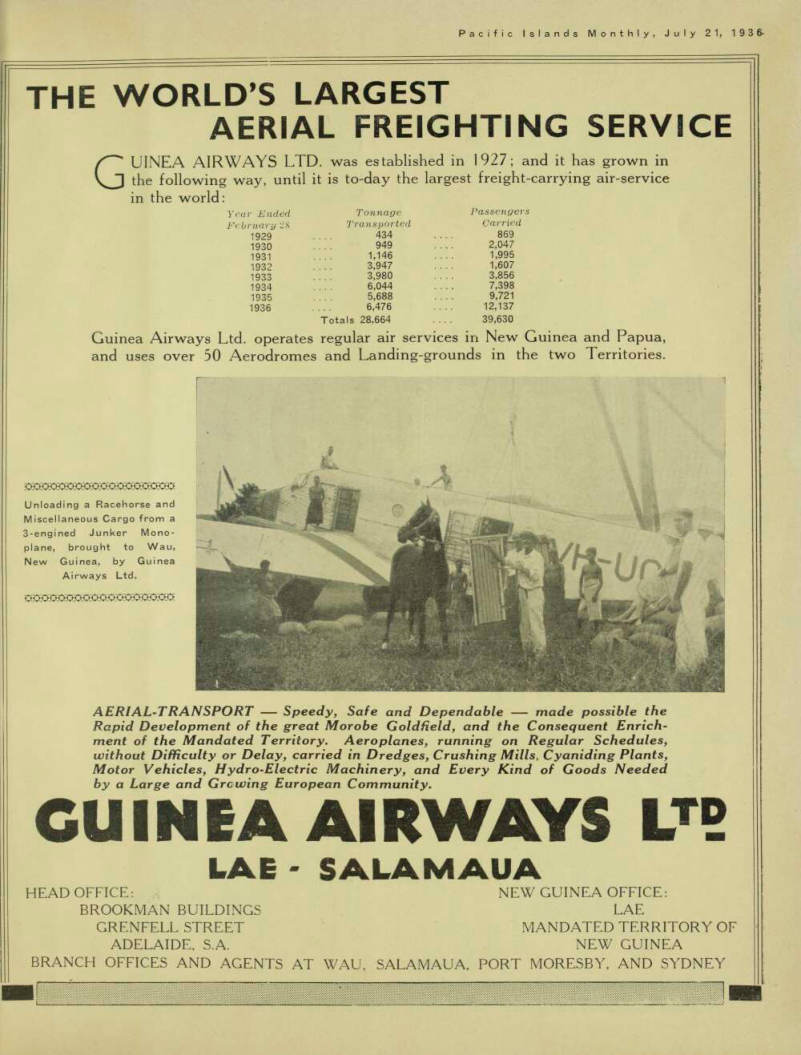
It is presumed that the only two seri ous contenders for this service will be Messrs. Guinea Airways Ltd. and Messrs.
W. R. Carpenter and Co, Ltd. Guinea Airways have an excellent ground organisa tion at Lae and other centres and have recently brought out from America four new, modern ’planes, the largest of which has accommodation for 10 passengers and has a speed of 215 m.p.h. Carpenter and Co. also have good ground equipment in New Guinea and several of their machines, including a new six-passenger Gannet just built in Australia, could be used for the service.
It will be interesting to note which com pany, if either, gets the contract. It is known that several members of the Com monwealth Government would look with disfavour upon any air link between Aus tralia and New Guinea using foreign ’planes. They are of opinion that this service is a necessary adjunct to Aus tralia’s defence and viewed in that light it would be unwise to subsidise a service that did not operate with Australian or British machines.
Islands Mining Engineer in Air Tragedy
Air Tragedy
C. J. Melrose’s Heston Phoenix ’ ’ monoplane broke into pieces in mid air and crashed at South Melton, Vic toria, on July 5, the owner and his passenger, Alexander George Campbell, aged 47, who had a distinguished career as a soldier and as an Islands mining engineer, were killed instantly.
Mr. Campbell, who had chartered the machine to fly to Darwin, via Adelaide, was well-known in Fiji and New Guinea, where he had reported on numerous projects. He was a director of Emperor Mines Ltd., Loloma (Fiji) Gold Mines N.L., and Developments (New Guinea) N.L. His fine war record won him the D. 5.0., and promotion to the rank of colonel.
How “Granny” Sits On Samoa’S Head
Lack of Transport, Plus Liquor Regulations, Have Made Tourist Traffic Impossible
By R. W. Robson
STOLID, unimaginative, well-intentioned New Zealand sits like a hroad-hottomed grandmother upon the head of gay and temperamental Samoa; and the resulting picture, while very funny, is a tragedy in administration.
Samoa kicks and screams; hut the only effect is that the dear old Presbyterian lady purses her mouth grimly, and settles herself more firmly in her corrective seat.
Samoa must either be good, or be smothered.
'VT OWHERE in the South Seas is there a place more colourful and charming than this island of Upolu. I am looking out, now, over the bay of Apia, and the
sheer beauty of it takes away my breath.
And, so far as the Pacific Islands are con cerned, I am “hard-boiled”.
Between the blue sea and the dark-blue mountains there is a variety of glowing colours that beggars description—green and sparkling lagoon, white coral beach, feathery palm-trees, picturesque brown native houses, a riot of gorgeous flowers; a clean-skinned, merry, laughing people; languorous scents and a profusion of tropical fruits —a tourists’ paradise.
But when a tourist arrives here, hav ing survived incredible difficulties of transportation, “Granny” either dances on his neck or kicks him in the pants.
For years, people have reached this Islands paradise through a transportation purgatory. The only way to get directly to Samoa is to travel from Wellington by the Maui Pomare, or be sworn in at Auck land or Suva as second assistant cabin boy on an occasional freighter. The other way is to go by Matson liner to Pago; and then spend twelve seasick, sun burned hours on a tiny launch, between Pago and Apia.
As for the Maui Pomare, she is about 1,100 tons, and can carry 22 passengers (with the aid of a shoe-horn and the in
genuity of a sardine-packer); and she is staffed by the cheeriest officers and most attentive stewards in the South Seas. But old Father Neptune was annoyed at the moment of her launching; and, ever since then, whenever she puts to sea, he pro duces the dirtiest weather in his reper toire. j n th e cabin next to mine there was a W oman tourist. I knew she was there be cause of the sounds of resigned regurgita tion which reached me from the time the Pomare left Wellington, and began to buck the steep, Antarctic rollers. There was no complaint, until we were off the Kermadecs. Then I heard a feeble, bitter
voice: “My God, to think that I paid money for this!”
The Maui Pomare, being only a little ship, does everything in a choppy sea ex cept bite her own tail; and the reactions which she can produce in a normal stomach deserve the pen of a Milton. If ever I travel on the Maui Pomare again it will be because I am curious to know whether the little ship can do again to my internal economy the extraordinary things she achieved in that bitter weather off the coast of New Zealand.
Tourists do travel on the Maui Pomare; but they seem to be mostly hard-bitten Scots from Dunedin way, who can appre ciate the “round trip reduction”, and for whose cast-iron, porridge-built interiors seasickness has no terrors.
Samoa deserves more than half a dozen Scottish tourists per three weeks. If these beautiful islands were in the hands of any country capable of understanding and catering for the pleasure-loving section of mankind, hundreds of travellers every month would be spending thousands of pounds here in making firsthand ac quaintance with the beauty and fascina tion of Samoa.
As it is, “Granny” seems deliberately to
put every obstacle in the way of the pleasure-seeker —doubtless on the hypo thesis that every pleasure-seeker is a potential sinner. When the Maui Pomare is in a quiet sea she is a jolly, comfort able, friendly little ship; and if she ran out of Auckland, northwards, much of the terror of the trip might be avoided.
But “Granny” resolutely sends her to Lyt telton and Wellington, which is the home of stormy weather; and the tourists cap able of tackling those seas in a little ship are not numerous.
The Matson Company might have been induced to drop a regular anchor in Apia roadstead, which would have brought into Samoa a flow of American dollars and Australian pounds. The Monterey and Mariposa already pass regularly within sight of this coast. But New Zealand did not encourage the idea —I do not know why.
The ferocious port charges which have ruled here for many years discourage any idea of shipping and tourist enter prise. When cruising liners like the Stella Polaris or Monowai come in here, packed with tourists eager to spend money in Samoa, “Granny” socks them with port charges in a manner that gives the managers heart failure. Although the port facilities are small —the ships anchor out in a roadstead sheltered by the natural reef, and there are lights at Apia and at four or five points along the coast —the charges are double those at Suva, where port facilities are considerable.
Last night, the freighter Limerick hung about all night out at sea —if she had come straight in, on arrival, and allowed her men an evening ashore, she would have been obliged to pay another £2O or so in port charges.
In the natural order of things, the transportation for Western Samoa would have been a job for the Union S.S. Co., v\ hich has innumerable interests in the South Seas. The Aorangi and Niagara pass within sight of the Upolu coast, every three or four weeks; and one would have expected to see the big British shipping concern, and the New Zealand Government co-operating in building up a tourist traffic for Samoa. But, for some reason that no one seems to know, the two institutions do not play in each other’s backyard. The Government runs its little Maui Pomare as a State enter prise, and the Union Co. sends an oc casional freighter into Samoan waters.
This is about to be altered. The Union Company’s fine new motor-vessel Matua is about to take up a new itinerary that will link the Fijian, Samoan, Tongan, and Cook Island ports with Auckland; and Samoa, for the first time for many years, thus will escape her crippling isolation.
BUT, if a profitable tourist industry is to be established in Samoa, “Granny” must be persuaded to relax her hold a little. The free-spending tourists de finitely do not like a “prohibition” com munity; and “Granny” long years ago, fastened upon helpless Samoa the most extraordinary liquor-control system I have seen.
“Granny” starts with the hypothesis that liquor is an evil, but may be necessary for medicinal purposes. Liquor, there fore, may not be regarded as a beverage or a pleasure; but, in order to ward off colds, colic, and snakebite, each Euro pean is entitled to two bottles of whisky per month.
So far, so good. But certain Europeans pointed out that they had trouble with their kidneys—could they not have gin?
“Granny” saw the point, and the rule be came “two bottles of whisky or gin.”
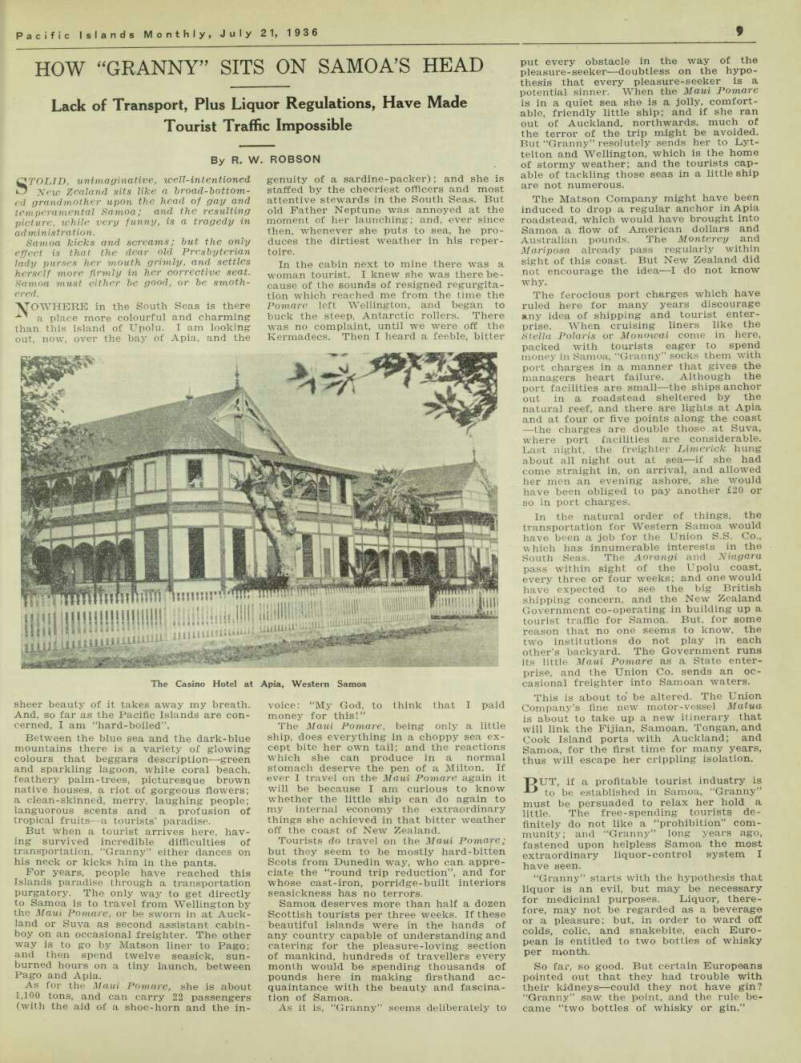
The Casino Hotel at Apia, Western Samoa
Certain pesky beach-dwellers still were not satisfied. They argued that as they could not drink whisky or gin, and as they found beer a nourishing food, they were entitled to beer instead of the dis tilled stuff. “Granny” rolled a very sus picious eye upon them, and sniffed disdainfully: but finally agreed that, if they wished, they could take it out in beer—three dozen of beer being regarded as the equivalent of two bottles of whisky or gin per month.
Some people like a good deal of liquor —others little. But all were entitled to the same quantity per head. The obvious thing was for the teetotallers to trade their liquor rights to the drinkers. But “Granny” saw to that. Every person who claimed monthly liquor rights had to go personally to the Customs-house and personally carry their bottles—there was to be no pooling of liquor rights through a centrally organised system.
And that, with some recent modifica tions, is the system which obtains to this day. The one hotel has no bar—one can purchase nothing stronger than lime juice. Because of the liquor disability, I presume, there is no club, except the un licensed German Concordia. The very hospitable European residents usually have liquor in their homes; but, because of the system under which they procure it, they produce it in a curious way—with a combination of pride, apology, and con spiracy.
The Europeans who, for medicinal reasons, obtain liquor from the Admini stration, have to pay for it at rates which return “Granny” a good margin of profit.
They have a limited choice of brands — “Granny” gives them what she thinks will be good for them. But she is a shrewd old lady. A N.Z. brewery fell into the hands of the Public Trustee; and the product of that brewery, a sour, offensive production, was sent to Samoa, to be doled out—as a medicinal necessity! until the harassed, thirst-wracked resi dents rebelled, and threatened to blow up the Customs-house.
I have been here a week, but I have not yet seen wine of any description.
A Dr. Cotterill—a rich man, with a good yacht—came here some time ago, with the intention of buying a home in this beauti ful tropical island. But when he found that he would have to plead with “Granny” to obtain two bottles of whisky or 36 bottles of beer per month, and undergo various similar humiliations, he departed for climes where a man’s private life is permitted to be his own affair.
The Casino Hotel was built by the Germans—a huge, attractively designed place, with large, airy rooms, balconies back and front, private flats—and set attractively amid palms, shrubberies and lawns. It easily could be made the social centre of Samoa, and a first-class, com fortable tourist resort. But it is three quarters empty—merely a home for a handful of public servants. Samoa resi dents seldom go there, because there is no liquor refreshment. Tourists cannot fill the place, because of “Granny.” If the Casino Hotel were functioning as it should, it would be distributing many thousands of pounds of tourist money annually in Samoa.
Nothing I have seen in Samoa seemed to throw greater ridicule upon the “Granny”
Government than this liquor system—a quaint survival of the Prohibition laws of New Zealand, which certain fanatics flogged to death a quarter-century ago.
There can be no worth-while tourist traffic in Samoa while such a system remains.
A TOP of all, there is the cost of living.
Samoa is compelled, by the stark facts of transportation, to buy much of her necessary goods from New Zealand.
New Zealand is not to any extent a manufacturing country, and herself im ports many of her requirements. These goods go on to Samoa, where they are subject to a flatfooted import duty of about 22§ per cent., and the iniquitous “port and service tax,” equal to about 5 per cent. Still, tourists would not worry unduly about that, if other facilities were adequate and reasonable. It is the resi dent of Samoa who takes it in the neck.
Many sweeping reforms are mooted — transport, port charges, liquor laws, etc., and perhaps it now is a little late to jeer at “Granny.” She has taken her job seriously in Samoa, and conscientiously has tried to do her very best for the Samoans. She has brought little joy into their lives, but medically she has cleaned them up in a truly marvellous way.
Judged from the point of view of per sonal hygiene, absence of skin diseases and general health, there are no cleaner and better-looking people in the Pacific: and they were not like that when New Zealand took charge of them 20 years ago.
And, if there had been no Maui Pomare, providing the Territory with a sound, three-weekly market for bananas in New Zealand, the Samoans would have had a thinner time than they did in the de pression years, when the bottom fell out of the copra and cocoa industries.
Many beach politicians in Samoa hope that, somehow, sometime, this Territory will get loose from New Zealand. I can not see it. For better or worse, until the status quo in the Pacific is completely destroyed, New Zealand and Samoa are joined. New Zealand, ultimately, may make Samoa a happy home for a model little lot of natives.
But I do wish that old “Granny” would get off the head of pretty little reckless Samoa, and encourage liveliness and some laughter, and give the profitable tourist trade a chance.
New Guinea
Dutch Priest Brought from New Guinea
THE young Dutch Roman Catholic A priest, Anthony Cranssen, who was sentenced to five years’ imprisonment with hard labour by Judge Wanliss in the Rabaul Supreme Court in May on a charge of arson, was brought to Sydney by the Tanda on June 24.
His escort, Captain F. W. As sistant District Officer in the Administra tion, said that Cranssen had pleaded guilty to the charge of having incited natives to burn the huts of a rival mis sion, and a heavy sentence had been im posed, The sentence was calculated to be a deterrent in a country fraught with many difficulties between white and native.
A priest of the Society of the Divine Word Mission, who met the prisoner, said that the term of imprisonment would be served in a New South Wales gaol.
On July 16, Messrs. Frank Brennan and Co., solicitors of Melbourne, gave notice to the Commonwealth Crown Solicitor of intention to apply to the High Court for leave to appeal against the sentence im posed on Father Cranssen. The hearing by the Full Court of the High Court has been fixed for August 10.
Mr. F. Mach in, manager of Kindar Estate, Solomon Islands, departed from Australia after leave by the Malaita at the end of June.
of Tonga
Polynesian Club
Kava Ceremony for Prince Tugi, of Tonga
the first time in the history of -*■ Sydney, the ancient Polynesian cere mony of the making and presentation of kava was performed on June 18 by mem bers of the Polynesian Club in honour of Prince Tugi, Consort of Queen Salote and Premier of Tonga.
The kava was made by Mrs. Alfred Page CLefuaoalii), a Samoan high chief tainess. Attired in native costume, Mrs.
Page seated herself on a mat of tapa cloth and proceeded to squeeze the juice of the kava root into a carved Islands bowl.
When the drink was ready, a native woman presented a cupful to Prince Tugi and to each of the principal guests of honour.
Prior to the kava ceremony, Mr. Harold Rabone, a grandson of the Rev. Stephen Rabone, pioneer missionary in Tonga, the centenary of whose arrival in the Pacific was celebrated in June, gave a short lec ture on Tonga’s geography and history.
The lecturer had been at Newington Col lege in Sydney with Prince Tugi.
The subsequent entertainment included many Islands songs and dances by Tahi tian, Samoan, Maori, and Rotuman mem bers of the Club. These were under the direction of Mr. Leonard Moran (presi dent) and Mr. Eric Ramsden.
Her Majesty Queen Salote, who did not attend the gathering owing to her recent bereavement, has been invited to become the Club’s patroness. Expressing him self delighted with the function, Prince Tugi said he believed that the Queen would give her consent.
O.B.E. For Hon. W. Wise,
Of Fiji
From Our Own Correspondent SUVA, July 3.
ON the birthday of His Majesty the King, the Hon. Juxon Barton, 0.8. E. (Acting-Governor) announced that the Hon. Wilfred Wise, Director of Public Works, had been appointed an Officer of the Most Excellent Order of the British Empire (Civil Division).
Mr. Wise, who is at present on leave in England, joined the Fiji Civil Service as an assistant engineer in 1921, and became head of his department in 1926.
Off Again
Norwegian Yacht “Ho Ho”
FTER being stranded at Norfolk Is land since August last year, when she went ashore at Ball Bay, the Norwegian yacht Ho Ho was recommissioned, and departed from N.L at the end of June for New Zealand.
It took a week to sail 540 miles to Auck land, where she arrived on July 5. Dur ing the latter half of the trip, a south west gale was encountered, and the Ho Ho was hove to for two days.
The crew consists of her owners, Messrs. T. Schyberg, B. Bryhn, and T.
Ostmoer, all aged 36. Four Norfolk Is landers were on board as guests. After a short stay in New Zealand, the vessel will return to Norway, via Norfolk Island.
Tropicalities
THE epitaph written by Robert Louis Stevenson for his own grave is known all over the world. But the full beauty of the verse cannot be appreciated until one has heard it sung by the choir of boys at Avatele, which is a sort of secondary school for the sons of chiefs, near Apia, Samoa. The school is just across a valley from the peaked hill where is Stevenson’s grave. The words have been set to music as a requiem, by the Samoan headmaster of a native school* To listen to the words of the master, there on the quiet hillside, within a mile or two of his grave, sung by the people he loved so well, is an experi ence never to be forgotten.—R. W. R. * * * THERE was a new medical officer in Rarotonga (which was nothing new in the old days) and Brown Brother had judged him by native methods and stan dards. Curious to know why the people avoided his really efficient ministratfbns, I asked one old man, and he said.
“I take te pottle. He gif me te vairakau (medicine); red kin’, an’ I no like him ’mell. Put ’im on te grart (grass) and bimeby I look. Grart ’im too dead all b up too mush dead. No good! He killem grart, what bout me? I no want dead. No fear! Heave pottle sea. Pinitsh!
Get one pucketi Maori kin’, all right, sick he gone. Good!” —Te Ruau. « ♦ • TWO young Aucklanders are still living on Sunday Island, a green, pleasant looking, place in the Kermadec group. Their names are Alfred Bacon and Bruce Robertson, and they have been there a year. The Maui Pomare called not long ago, and found them well, and staunchly bearded. They said they have an abundance of goatflesh, fish, vegetables and fruit—they wanted only kerosene and salt —and they are quite happy there, in their extreme isolation. We passed the island on Saturday, June 20, and could see their hut on the north coast. A yacht, far down on the northwest horizon, was just then beating towards the island and it was thought that this carried a couple of men from Sydney, who have been ex pected to join the Aucklanders. A Dr.
Ross, of Sydney, owns 750 acres on Sun day Island.—R.W.R. ♦ * * A SISTER ship of the old Countess of Ranfurly, Government schooner, hav ing been found bottom up in the Hauraki Gulf, a pessimistic Rarotongan shellback prophesied an early demise for the Coun tess, much to the captain’s disgust.
There followed a voyage to Mangaia, with the late Colonel Gudgeon and other very unhappy officials aboard, and a heavy gale en route, during which occu pants of the windward berths had a most unhappy time avoiding decantation to the deck.
The Colonel held out until after day light, and then he made the deck to “see about it”—to find a beaming captain bal ancing on the weather rail, and beaming with joy. Said he: “Morning, Colonel! Take a look at her!
Nowhere to shove another cloth and the old bitch simply WON’T tip over! Tender ship be damned!”
It took some time before the Colonel could gently but firmly get him to under stand that the Government was officially satisfied with the success of the experi ment, but wanted breakfast on an even keel.
To this day, the captain includes in the Colonel’s few demerits the fact that he
did not exhibit proper pride in the ship of which nominally and officially he was temporary “owner!” —Te Ruau. * ♦ * WHEN the late Sir Thomas Henley was visiting Samoa, he hired a native taxi man to drive him around. They passed a church. “That,” said the taxi-man, “is the Mormon Church.” “H’m, h’m, Mor mons, eh?” remarked Sir Thomas, with interest. “So they are here! Tell me, my man, do they practise polygamy here?”
“Oh, yes, sir,” replied the courteous Samoan. “It is every afternoon at four o’clock.” —R.W.R. * * ♦ SOME of the wives of officials who live for a time in Samoa may be excellent housekeepers, but they are not a good ad vertisement for the dignity of officialdom.
Idlers retail with glee, on the beach at Apia, the story of one extremely careful lady who ordered from a trader one pound of cheese. The .trader cut a piece off, and it was slightly overweight. “A little over —it will cost twopence more,” he said. "I asked for a pound, and I want a pound,” snapped the lady. The trader glared.
Then, “Puss, puss, puss,” he called, in an insinuating voice, and his cat came from the back of the store. He shaved the cheese down until it weighed exactly one pound, and fed the bits to his grateful cat.
The lady said nothing; but if looks could kill —! Another woman, wife of a very high official, received from the store a one-pound tin of salmon, instead of the half-pound tin she had ordered. She opened the tin, took out half a pound, and sent the remaining half-pound back to the storekeeper. The same woman ord ered some ham, to be fed to her guests at a party. She sent the ham back next day, with the message: “Please credit my account with this ham. I do not need it, as my guests did not turn up.”—R. W. R.
Lieutenant-Colonel J. S. Gamble, Inspec tor of Constabulary in Fiji, departed from Suva for furlough in England by the Aorangi on June 26.
Bishop Of Melanesia
Returns from England
A FTER a visit to England, the Bishop of A Melanesia (the Right Rev. Walter H.
Baddeley) accompanied by his wife, re turned to Australia en route to his head quarters in the Solomon Islands by the Wanganella on June 23.
His trip to England was primarily to re port on his diocese to the old-established Anglican committee which devotes itself to the maintenance of interest in oversea dioceses. This committee furnishes up to £lO,OOO per year for the work of Melan esian and other dioceses.
While he was in England, Bishop Badde ley undertook a strenuous programme, and engaged in deputation work throughout the country. He received many gifts for the furtherance of his work in the Islands, including sufficient money to meet the cost of a new mission station on New Britain.
The new station will be built at Lupun, near Gasmata, on the southern end of the island. The station will be largely a medical centre, and will have a trained nurse in attendance. While he was in England, Bishop Baddeley received many offers of service in the Pacific Islands from members of the Church. It is pos sible that he may bring out some recruits for service in New Guinea.
The Bishop and Mrs. Baddeley left Syd ney for the New Hebrides, via Norfolk Island, by the Morinda on June 25.
At Vila, they joined the Melanesian Mis sion’s vessel Southern Cross for Siota, Solomon Islands.
Dr. C. M. Deland, formerly Medical Officer at Kieta, New Guinea, who has been in Australia on 12 months’ leave, returned to thje Territory for a further term of service by the July Macdhui.
Mr. Leo Austen, Assistant Resident Magistrate, arrived in Sydney from Papua on leave by the Macdhui on July 2. For the past five years he has been stationed in the Trobriand Group. Mr. Austen holds a Diploma of Anthropology from the University of Sydney.
Advertisements & other items, pp. 13-14 (1 item)
Home
STERLING
PAINT
<o For
TROPICAL
SUN and
SALT-LADEN
AIR
MADE BY
STERLING VARNISH CO. - - SYDNEY, N.S.W.
HONG
Guaranteed
LOOKS
BETTER
LONGER
omos
HOME
NEGLECT OF DEFECTIVE SIGHT
MAY CAUSE SERIOUS RESULTS
Take Care of Your Eyes Consult
WALTER FORD
D.8.0.A., M.0.0.A.
Optometrist and Optician 4th Floor, Challis House Martin Place, Sydney Established over 30 years Tel.: Most moderate charges BW 61 3 1
FIVE MINUTES for RELIEF
There is nothing indefinite about “ASPRO.” Its service is QUlCK—safe, effective, and definite. It gives you relief in 5 to 10 minutes, and then goes on to dispel or dissolve the cause of the pain, allowing Nature to effect the desired relief. Furthermore, you get no harmful after effects from “ASPRO,” as it is speedily eliminated from the system a few hours after being taken. It neither dopes, deadens, nor drugs. ■
DOES NOT HARM THE HEART
Anglewood School for Boys
Bowral
N.S.W
(2200 feet altitude)
Boarding
16 acres Playing Fields Swi mmg Scientific .
Dietary Primary Secondary Curricula: English-trained Teachers.
Craft Work. Moderate Fees. Illustrated Prospectus.
Headmaster: T. O. KNOX, 8.A., M.R.S.T., Trinity Coll., Dublin.
About Islands People
Dr. C. C. Simson, chairman of the Pacific Islands Association, who has plantation interests in Papua, sailed from Sydney for Port Moresby on one of his periodical business trips by the Macdhui on July 8, Mr. C. R. Harley Nott, Acting Assistant Colonial Secretary for Fiji, returned to Suva from leave spent in England on June 2. He was accompanied by his wife.
Mr. and Mrs. William G. Sears, of the Latter Day Saints Mission, left Samoa for the United States in June after com pleting their third term of service. They have been succeeded by Elder and Mrs.
William M. Waddoups.
Mr, J. R. Kinnaird, of the London Mis sionary Society, arrived in Suva in June to join the mission vessel, John Williams V., as chief engineer.
Captain A. S. Fitch, managing director of Steamships Trading Co. Ltd., departed from Australia for Samarai, Papua, by the Macdhui at the beginning of July, Mr. W. R. Smith, clerk in the Customs Department at Rabaul, returned with his wife to New Guinea from leave in Aus tralia by the Macdhui on July 8.
Mr. Robert Norton Ginn died in Suva on June 26, at the age of 60. A popular resident for 30 years, he first went to the Colony from New Zealand to join the firm of Henry Marks and Co. Latterly, Mr.
Ginn had been in the dairying industry on his own account. He is survived by his widow, two daughters (Mrs. Peter Green wood and Miss Grace Ginn), and a son (Mr. Robert Ginn), all of Suva.
Mr. E. W. Oakley, District Officer in the N.G. Service, who was formerly stationed at Lorengau, returned to Rabaul after furlough by the July Macdhui.
Mr. Frank Mote, Deputy Superintendent of the Suva Fire Brigade, left Fiji for holidays in England by the Mariposa on June 30.
Mrs. H. W. Champion, wife of the Gov ernment Secretary of Papua, returned to her home at Port Moresby by the Macdhui from Sydney on July 8.
Dr. Loftus Hills, Victorian geologist, arrived in Fiji by the Mariposa on June 30 to carry out mining investigations at Tavua.
Mr. T. Grills, of Messrs. Siemens (Aust.) Pty, Ltd., sailed from Sydney with his wife by the Montoro on June 17 for Lae, New Guinea. He later went by ’plane to the property of Upper Watut Gold Allu vials N.L. to erect a water turbine in con nection with Upper Watut’s hydro-electric scheme.
Mr. E. J. Ifould, who has extensive plan tation interests in the Sepik district, New Guinea, sailed from Australia for Boram by the July Macdhui.
Mr. Walter D. Mason, of Fibres Limited, left Sydney for Port Moresby, Papua, with his wife, by the Macdhui early in July.
Fibres Ltd., of which Mr. Mason is engineer, is concerned with the project to erect pulp mills and manufacture paper pulp from the Kurukuru grasses of Papua and New Guinea, Mr. S. H. Gander, Seventh Day Adven tist missionary, who is stationed in the Upper Ramu country, returned to New Guinea by the last Macdhui after several months’ leave in Sydney.
Mr. R. W. Robson, F.R.G.S., editor of the “Pacific Islands Monthly,’’ who is on a three months’ visit to the Central Pacific groups, arrived at Suva, Fiji, by the Monowai from Western Samoa on July 17.
Advertisements & other items, p. 14 (1 item)
Kurrajong
Wheeny Creek Farm
Forty-five miles from Sydney Superior modern accommodation, abundance of cream, eggs, and poultry. 5 acres orchard. Tennis, etc.
Tariff: Double, £2/2/- each; Single, £2/10/- 'Phone: Kurrajong 42 Proprietor: A. J. SAMSON Formerly New Guinea Public Service
About Islands People
Mr. Ragnar Hyne, Chief Justice of Tonga, who left Nukualofa for New Zealand by the Port Whangarei at the end of June, reached Sydney by the Niagara on July 11. He departed the same day for Brisbane to spend a week’s holiday before continuing his journey to England, by way of South Africa. Mr.
Hyne, who was born in Norway, gradu ated at the Brisbane University, where he was admitted to the Bar.
Mr. Stan Baldy, of Wau, New Guinea, flew across to Salamaua in June to join the Neptuna for the East, en route to Berlin to attend the Olympic Games. Dur ing his absence his position with Messrs, W. R. Carpenter and Co. Ltd. will be filled by Mr. Dave Yarroll, who recently returned from leave.
Mrs. E. Taylor, wife of the District Officer at Salamaua, who has been in New Guinea for 10 years, arrived in Sydney by the Macdhui on July 2. She came South to undergo further treatment for a broken leg, caused by a fall after she had witnessed the opening of the workings of Irowat Gold Alluvials N.L. at the end of May. After the accident, Mrs.
Taylor was taken to Wau Hospital where she remained for six weeks. On medical advice, she has come to Australia for an indefinite period.
Mr. J. A. Todd, of the Australian National Research Council, arrived in Sydney by the Tanda on June 24, after completing three years* anthropological work among the natives on the south coast of New Britain. Mr. Todd brought back with him several cases of rare specimens, together with volumes of scientific data.
Major N. E. Cobbold, who has been visiting French Oceania and the Cook Islands, returned to Australia in June.
He came out to Australia from England earlier in the year on the Herzogin Cecilie, the four-masted barque which was recently wrecked on the Devon coast, and subsequently refloated.
Miss Tessie Boyes, of Tasmania, sailed from Sydney for the New Hebrides by the Morinda on June 24. On her arrival in Vila she was married to Mr. Louis Smith, of Messrs. Burns, Philp (S.S.) Co. Ltd.
Mr. and Mrs. L. Fontaine left Thursday Island at the end of June for a tour of Queensland, before proceeding to Sydney.
Mr. Fontaine has been transferred South from the T.I. Radio Station.
Dr. R. W. Cooper, Medical Officer in the N.G. Administration, who has been on long leave, visited Japan, China, and Cey lon before reaching Melbourne by the Maloja on July 6. He will return to the Mandated Territory with his wife at the end of July, Mr. K. Bi nns, librarian of the National Library at Canberra, left Sydney by the Macdhui on July 8 on a visit to Papua
and New Guinea to investigate proposals for the establishment of libraries. He will confer with the Administrators and Government officials in both territories and will report to the Federal Parliament on his return.
Rev. A. H. Cropp, of the Methodist Church of New Zealand, who is stationed at Buka Passage, Bougainville, New Guinea, arrived in Sydney on furlough by the Malaita on June 18.
Messrs. J. N. Montgomery and S. W.
Carey, of Oil Search Limited, arrived in Sydney from New Guinea by the Macdhui on July 2.
N.G. Government Vessel
Wrecked
From Our Own Correspondent
Rabaul, June 15.
NEWS was received early in June that the Government vessel Eros was wrecked on the Numa Numa reef, off Bougainville Island. The passengers and mails were taken off successfully. Later the crew and cargo were also landed safely.
It has not yet been learned whether the Eros is a total wreck.
This is the second mishap to Govern ment vessels in recent months. Last November the schooner Hermes was lost with all hands between Madang and Rabaul
Mr. Wladyslaw Wagner, the young Polish traveller who has been cruising about the South Seas for some years in his yacht Zjawa 11, which he sold early this year in Fiji, arrived at Auckland by the Monowai from Australia on July 6.
He left by the Mataroa a week later for Panama, en route to Equador, where he proposes to build another yacht to con tinue his voyages.
Advertisements & other items, pp. 15-16 (2 items)
Tenax
tolUule
•.c*° \S
e
TENAX
THE GENUINELY GERMICIDAL
TOILET SOAP
PREVENT
TROPICAL
DISEASES
You guard yourself against Typhoid, Diphtheria, Malaria, Dhobie Itch, and Tinea when you lather daily with TENAX. It is also invaluable in the cure of Tropical Skin Diseases, for TENAX is the ONLY soap containing oil distilled and marketed by Austra* lian Essential Oils Ltd. under the registered trade-mark of “Ti-Trol,” eleven times quicker than carbolic as a germicide, but NON - POISONOUS
and NON-IRRITANT.
A PRODUCT OF AUSTRALIAN SOAPS LIMITED
v* tm. <>? £2 *<v l>'> S%* \- V35&2
•VSVS
gf-Sfci £25 « e££
BAILEIS
FLUID MAGNESIA
A Product of
ELLIOTTS & AUSTRALIAN DRUG Ltd.
A Valuable Aid to Digestion
Relieves —
HEARTBURN
DISPEPSIA
BILIOUSNESS, etc.
OBTAINABLE
AT ALL HIGH-CLASS CHEMISTS
AND STORES.
Money
Can’t Buy
BETTER
Than the wonderful new 1936 Model
Gray Marine Engines
Prices, too, are so attractive— sizes from 15 h.p. to 180 h.p.
Then there’s the
“ R.N.” DIESEL
Britain's finest marine job.
Sizes from 7 h.p. to 60 h.p.
We would be glad to quote you.
W. L. Holmes & Co.
BOATBU l LDERS & ENGINEERS
SYDNEY
Cables: HOLMAC.
Tudor Hotel
Room Only Rate, 5/- per day. Meals a la carte. Accommodation for 100 guests. One minute from G.P.O.
127 PHILLIP ST. Tel.: BW 2788
Next door to Martin Place
Sydney
Re-Arrangement

Samoa In Throes Of Political
“Goodwill Mission” Makes Quick Superficial Clean-up
By R. W. Robson
APIA, July 2.
A N unlucky star was in the ascendant when I arranged this visit to Western Samoa; for the Maui Pomare voyage which I selected was selected also by the “Minis terial Goodwill Party”—sent by the New Zealand Labour Government to clean up the political situation ih the Mandated Territory. So, instead of quietness and peace, I have had the clamour of beach politics and the everlasting buzz of “coco nut wireless.”
The party consists of Mr. P. Langstone, Minister for Lands, and Mrs. Langstone; Mr. J. O’Brien, a Westland M.P., and chairman of the Native Affairs Committee, with Mrs. O’Brien; and Mr. Mulligan, sec retary to the Minister, and Mrs. Mulligan.
They were charming travelling compan ions; but I cannot understand why New Zealand selected them to come here and settle the Samoan native troubles. None of them had previously even seen a Pacific island. They are animated by good inten tions and kindly sentiment, and they carry a cart-load of indexed files and weighty documents, which they study with indus try; but of the real problems of Samoa— which mostly are biological and psycho logical—they know very little. And a little knowledge is a dangerous thing.
However, it is not my affair. New Zea land must bear the odium of any further
muddling by politicians an I fcr soldiers.
New Zealand is so small a country, and so very isolated, that she has neither the per sonnel nor the vision to administer suc cessfully this difficult little Territory. In my humble opinion, it clearly is a job for experienced men of the British Colonial Office. But when I say these things to
New Zealanders they usually become in dignant and angry. So I offer the opinion with diffidence.
I had hoped to see a quiet normal Sa moa; but, instead, I found the place in a state of political convulsion. 111-judged, untimely communications from Wellington had convinced the Samoans that the “Goodwill Mission” was coming to create a new heaven and a new earth; and when the Maui Fomare drew into Apia road stead, the beach was lined for miles by wildly excited people, while 26 longboats, flying the Mau flag (purple, with a white cross and star), each manned by some 40 men, made a lane through which the official party were brought ashore.
About 3000 well-drilled, uniformed men and women of the Mau (the anti-Govern ment party) took charge of the proceed ings ashore, and gave the Mission a flat tering welcome. The leaders of the Mau and the Malo (pro-Government party) fraternised, for the first time in history— a tribute to the tact of Acting-Adminis trator Turnbull. Greetings, smiling faces, gifts, everywhere met the delighted gaze of the “Goodwill Mission.”
This went on for two days. A welcome by the Malo at Mulinu’u; a welcome by the Mau at Vaimoso; official greetings every where. Oratory—endless, tedious hoqrs of it.
The Missioners, new to this gorgeously coloured tropical isle, and unaccustomed to the studied courtesy and eternal, disarming smile of the Samoan, reacted in the most satisfactory manner.
The Minister, Mr. Langstone, seemed to be happy. I heard him speak several times. His style was infectiously oratori cal: his manner was sweet, and kindly, and pleading: and his material, for the most part, was the tosh which habitual politicians usually supply to defenceless audiences in the backblocks. I cannot imagine anything less suited to the occa sion. The Polynesian races, for all their intelligence and amiability, do not want loving tenderness and an appeal to reason; and the man who tries to get things done in that fashion is doomed to bitter dis appointment. The Samoans, in these official relationships, appreciate and respect an impressive personality, dignified but grim strength, and strict, cold, impartial justice. In the quiet of the fale, they laugh at the European who pleads with them.
Older Europeans jeered. The Acting- Administrator and his clever wife sat silent
and impassive: I wondered many times what they were thinking. Function suc ceeded function—endless, wearying oratory.
Finally, after I had heard the Missioners preaching long-winded, involved economic sermons to groups of patient school children who knew little English, I kept away from the official proceedings. Life is really too short for that kind of thing.
Yet one cannot too highly praise the well meant sincerity of the Missioners.
However, so many undesirable things existed actively in connection with the Sa moan administration that the Missioners were given several opportunities for dramatic gestures of goodwill.
THE Mau, some t y ears a &o, was declared a seditious organisation, and it could not lawfully assemble in certain districts.
The Mission announced, with a flourish, that these laws were cancelled forthwith.
They were dead laws, anyway—they had not been invoked for years. But the Sa moans cheered, as they were expected to.
Many natives are in arrears with their taxes. The Administration, being without
imagination or vision, deducted these sums from the Samoans’ miserable earnings from banana-growing, road-making, etc.
“Is this fair?” they asked the Minister.
“No,” he answered at once. “It shall cease immediately.”
More cheers!
There is a large school for European and half-caste children —probably one of the best institutions of the kind in the South Seas. But the Administration, for some reason, has refused free education. The fee is £1 per quarter. Children who cannot pay, or whose fees are in arrears, are kept out, despite their pleading—a cruel, mon strous system.
“Can this not be altered?” the Minister was asked. “It can, and will be,” was his prompt reply.
All honour to the Missioners for the promise of such reforms. I believe that there will be reforms, also, in such mat ters as the liquor-permit system and the port charges—outstanding examples of in excusable, grandmotherly stupidity. But it is not so much a matter of giving credit
to the Missioners, who simply are sweeping away undesirable excrescences, as of placing blame upon the people who for so long have allowed such things to continue.
CO far as the political future of this country is concerned, I personally have neither faith, hope, nor charity.
The Missioners think that they may “effect a settlement,” A settlement of what? One understands that the Mau has placed before the Mission a list of demands a yard long. I have not seen it —I am told that it asks for such things as the setting up of a king of Samoa, for the appointment of a Samoan Administrator, and for the removal from Samoa of Messrs. Turnbull (Acting Administrator), Mackay (Native Affairs), and Braisby (Police)—who are the three outstanding officials who really have some knowledge of Samoan conditions.
Actually, no one appears to know what
the Mau wants—l doubt if it knows itself, Actually, the native Samoans are in a very happy, comfortable condition—they get from the European administration very ™ uch than they give In return. They y e win treSfd V The Sku woufd have had no life at all if there had not been this prim, grand motherly control from Wellington, which was made worse by periods of brainless ness at Vailima. The uselessness of Tate, the impatience of the very capable, dy namic Richardson, the futility of Allen, the terrifying inactivity of Hart, with the unforgivable muddling which caused the massacre in 1929—a1l these things exas perated the European and half-caste com munity, and encouraged’the formation of the Mau and kept it alive. One thoroughly capable Administrator, with adequate au thority (something, incidentally, which Wellington officialdom never will tolerate)
would have cleared away, long ago, the manifest injustices and absurdities under which Samoa suffers, and there would have been no “Samoan problem.”
The Mau does not constitute the “Sa moan problem”: it is created by the ineffi ciency and bad history of the New Zealand Administration, and their reactions upon communities other than the native com munity, Mau means “opposition to the govern ment or ruler.” There always has been a Mau in Samoa, and always there will be.
Every man with a knowledge of native life agrees with that. Talking, debates, flowery oratory—these things are the breath of life to a people whose simple, easy, comfort able life is made up of a little gardening, a little fishing, much ceremonial, and much sitting in idleness. If they can find a few grievances to which they can hang their talks, so much the better. But they will talk, anyway. 13ERHAPS by this time, the “Goodwill Mission” realises what it is up against.
The Missioners have little knowledge of Samoan history and psychology, but they are not fools. In the week since they arrived, they have met these long-winded Samoan gentlemen in Mulinu’u, Vaimoso, and elsewhere, and they must recognise now that they have not the least hope of bringing about reforms which will put the Mau out of existence. If that was ever their ideal, they should know that they made it impossible of attainment by the way in which they met the Mau—plead ingly, with many promises of reform—as man-to-man and brother-to-brother.
The Minister Mr. Langstone, put the cop ing stone on it when at Vaimoso, on the second day of his visit, he told the Mau that “he was commanded by the Right Honourable the Prime Minister of New Zealand” to tell the Samoans that their beloved Taisi (Mr. O. F. Nelson) would be returned from banishment, that his ex penses in returning to Samoa would be paid by the Government, and that the Goodwill Mission and the Administration would associate themselves with the Sa moans in giving welcome to Taisi on his return.
If the Minister thinks that the Samoans, on this momentous occasion, will try to express their gratitude to the N.Z. Gov ernment by promising to be good little boys, and urging Mr. Nelson to be the loyal friend of the Administrator of Samoa, he is due for disillusionment.
The Mau people are so cockahoop at what they regard as the capitulation of the Government that they are certain to demand a substantial share in the adminis trative control of the Territory; and when this is refused them, they will sulk and agitate. Mr. Nelson, probably, will be grateful and loyal; but he will want rather more wisdom and tact than his record in dicates that he possesses, if he is going to bring the Mau into line with the Malo as supporters of the Government.
Some believe that the Missioners will recommend that Samoans be given a larger representation in the constitution of the Legislative Council, and that this will satisfy the Mau’s political aspirations.
Such a development will not quieten the Mau. The Mau thinks that at last it has got the papalangi on the run; and that it
(Continued On Page 66)
need only keep on with its activities to achieve the object stated on its letterheads —namely Samoa mo Samoa (Samoa for the Samoans).
Mr. Nelson, if he has retained his influ ence over the Samoans, can help the Gov ernment very much in establishing com parative political quiet. I believe that Mr.
Nelson will “play the game”; but it doubt ful whether he will hold his influence with the Mau when he tries to find a compro mise between the Government and the Sa moans, on certain constitutional questions.
BY now, probably, the Missioners have learned that, while the Mau provides the agitation, the real hardships and in justices are suffered by the European and half-caste communities. Three separate groups have presented their requests for reforms to the Minister—the Europeans, through their elected representatives on the Legislative Council, Mr. Carruthers and Mr. Smythe; the planters; and the local-born (the usual name for the half caste people who live in European fashion) who have just banded themselves together as the “Samoan Labour Party”!
Their requests may be numbered in scores, and can be only summarised here.
By far the most important are those re lating to the local-born. There are at least 3,000 of these attractive people, and their condition is most tragic. They have beauty, intelligence, spirit; the culture and outlook of the Europeans; the European’s readi ness to work —yet they have no status as citizens of Samoa, • and there are no jobs for them. A good many of the men, recog nising the hopelessness of their outlook, turn to the native community, marry natives, acquire a native status, and are absorbed into native life.
But it is not so easy for the girls. Almost without exception, they are pretty, fastidi ous, gentle creatures, with marked social gifts, and taking a high degree of educa tion; and their comeliness and intelligence make of them quite admirable wives. But there are few husbands available for them.
There are only 400 white people in the Territory; and “Granny” in Wellington has informed the couple of score of young’ bachelors in the service here that if they so much as look at a local-born girl, they will be spanked and sent home.
The thing to do is to give these people a status and a place in Samoa; and what appears to be an admirable plan, to that end, has been worked out by the Acting- Administrator, Mr. A. C. Turnbull, with the assistance of some of the leading citizens.
It is proposed to use good lands (2500 acres of Reparation Estates, in the Salei moa district, 10 miles west of Apia, and several thousands of acres in the Faasale leaga district of Savaii, are especially men tioned) for group settlements of local-born lads. They will be maintained and trained by experts in bush-felling, clearing and planting suitable crops; and, when ready, each will be supplied with a small planta tion, which will be loaded with the cost of maintaining and training the lad. It is proposed that there shall be a little town, with all the amenities of modern life, near each group settlement. Each plantation, it is suggested, would comprise 25 acres or more —10 planted in bananas, cocoa or coffee, and 15 under bush, to provide for expansion.
There will be failures, of course —a pro portion of the local-born people are not
very industrious—but it might provide a solution for the most difficult —and most tragic—problem in Samoa.
The European residents are very strongly urging that, instead of men being brought from New Zealand, more of the local-born men and women should be more extensively used in all branches of admin istrative work, including the Reparation Estates.
European Requests
A meeting of European residents, presided over by Mr. A. G. Smythe and Mr. I. H. Carruthers, decided to ask the Goodwill Mission and the Administration for a number of things, including— Reform of the liquor laws (which are the quaintest in the South Seas, and are de scribed elsewhere).
The appointment of a Finance Board to assist the Administration in reducing ex penditure, so as to give taxpayers some relief. (It was urged that there is consid erable over-staffing—the Treasury, Native Department, Police and Prisons Depart ment being especially mentioned).
Abolition of port and service tax. and reduction of import duties.
Appointment of school and hospital com mittees, and the education of all children, whether able to pay school fees or not.
More rigid medical inspection of passen gers arriving in Samoa.
The franchise for every European over 21 years, who pays personal tax.
To Assist Planters
The Planters’ Association has a short but important list of matters for the attention of the Government.
Opportunity has been taken to urge the paramount importance of maintaining a supply of imported labour. Plantations cannot otherwise be worked, as neither
Samoans nor local-born men can be de pended upon for permanent labour. The Chinese are excellent labourers, but there is objection to them, in some quarters, be cause almost invariably, during their term here, they take a temporary Samoan wife; and, when they go, they usually leave a number of children here, to be absorbed into the mother’s family group. The plant ers seem to prefer Chinese; but their main concern is to have a dependable sup ply of labour.
An urgent necessity here at present is a cheaper supply of fertiliser. Many plan tations are deteriorating because of the very high cost of reviving them. It has been noted that the ships which carry Chinese labour between China and Samoa usually call at Ocean Island and Nauru, where the phosphate deposits also are worked by imported Chinese. It has been asked if it is not possible to arrange that the ships, when calling at those islands, shall pick up cargoes of phosphate for Samoa direct, thus greatly reducing the cost.
Other requests include a temporary sus pension of the monthly payments towards the Chinese Labour Overhead Expense Fund, which at present shows a large sur plus balance; further consideration of plantation rents; assistance in the pro vision of fertilizers; and a higher price for bananas exported to New Zealand.
Requests Of Samoan-Born
The Labour Party of Western Samoa (otherwise the local-born European - Samoans) submitted a list of 17 requests— most of them very fair and reasonable.
They included: A franchise for all tax payers; a larger Legislative Council; medi cal training, at the hospital, of local-born boys and girls (such invaluable training being now given to full-Samoans, yet with held from European-Samoans); appoint
ment of European-Samoans to the police and other services; provision for settle ment of local-born people upon the land; free education; reduction of hospital fees and provision of more accessible hospital services; European-Samoans to be trained
and used as artisans, instead of Chinese coolies; the Government to make an at tempt to establish better standards of wages and living for European-Samoans; relief from the 25 per cent, fine imposed where taxes have not been paid; assistance to widows and their families by granting free education, medical attention, etc.; reduction of electric-light and water charges; amendment of the law to allow persons who have the legal status of Euro peans to retain land rights received through their Samoan parent.
The only comment one can make on this modest list is to express surprise that 95 per cent, of the requests should have to be made at all—it would seem that they should have been granted long ago, as a matter of common justice and social de cency.
Result Of Goodwill Mission
So far as the native political trouble is concerned, it is most unlikely that the Goodwill Mission will achieve anything worth while. But I believe that the Minis ter, Mr. Langstone, and the M.P., Mr.
O’Brien—who are broadminded, sincere men—will achieve a great amount of good by sweeping away much of the stifling red tape which “Granny” Government has fas tended upon Samoa; by stirring up various petty, complacent officials to a sense of their obligations; and by initiating re forms which will be, in an economic sense, of value to the Territory.
New Administrator
The beach, with bated breath, awaits the appointment of a new Administrator. The Minister is as the Sphinx—not a word has come from him on which even a coconut wireless could be based. Nothing will be heard until he returns to Wellington.
Personally, I expect that Mr. Turnbull will be appointed. He has well and worth ily earned the honour; and greater respect is accorded to him and his wife by all classes here than has been given to a leading official for many years, if ever before. The Government cannot do better than place him in charge, with adequate authority, and with a clear understanding that he is not under the dictation of the Mau and its functionaries. But of that, more anon.
Advertisements & other items, pp. 16-18 (1 item)
St. Ignatius’ College - Kiverview, Sydney
CHRONOLOGY
Tuesday, June 23. —Goodwill Mission arrives in Apia; welcomed by about 4000 Samoans, who state they are now a united people, the Malo having joined the Mau.
Wednesday, June 24.—Mission meets Mau at Vaimoso; lengthy speeches.
Friday, June 26. to Monday, June 29.
Mission meets various deputations, especially representatives of European residents, local Labour Party, Samoan planters, etc., and promises various reforms, and consideration of others.
Tuesday, June 30. —Mission begins discussion of various proposed reforms with representatives of Samoan people (united Mau and Malo) at Mulinu’u. Adjourned until July 14.
July 1 to about July 20. —Mission engages in various discussions, and travels about in Upolu and Savaii, with view to formulating recommendations for submission to N.Z. Government.
St. Ignatius’ College - Kiverview, Sydney
BOARDING and DAY SCHOOL :: Conducted by the Jesuit Fathers
ONE OF SYDNEY’S GREAT PUBLIC SCHOOLS
gOYS prepared for Intermediate and Leaving Certificate Examinations and for Exhibitions, Scholarships and Bursaries at the University.
Boys are arranged in three divisions according to age and size.
Each division has its own library, debating society, cricket and football field, tennis court.
Senior and Junior Rowing Sheds. Private Swimming Baths.
Prospectus and Further Particulars on application to the Rector,
REV. J. MEAGHER, S.J.
Telephone, J 1 106. ■ V L> y *. m I ■ Wt AT. m ■■ ■ ■ w Wmmm Cl - ■
'jjg
a M .:
SupEr-Frßßxer
B NON - EIE CIRIC REfRICERATOR
I
The Super-Freezer (kerosene-
operated Refrigerator) will
bring to your home the essential health safeguards that only
perfect Refrigeration can give.
It will keep for long periods
meat, butter, cream, vegetables and all other food fresh and wholesome during the hottest weather.
Simple to operate. All you have to do is light a small kerosene lamp once a day to obtain continuous Refrigeration.
A necessity in your home — An investment that pays for itself In three different sizes and two different models:— (A) The Upright Cabinet de-Luxe Model, with door at front (illustrated). (B) The Chest Model, with lid at top.
Distributors in N.S.W.: —
EVERYDAY PRODUCTS LTD.
Showroom: 188 George-street, Sydney. ’Phone: 83090.
COUPON —Please send me full illustrated literature and details of the Super-Freezer.
Name Address P 1.7
W. Brian Molloy,
8.A., LL.B.
BARRISTER
AND
SOLICITOR
PORT MORESBY
PAPUA
Charles Johnson
THE TAILOR FOR MEN OF DISCRIMINATION
eyes Sydneywards, bear in mind that at my store you will find the ultimate in Tailoring, Service and Civility. In Sydney, it’s Charles Johnson, the Sartorial Epicure (among many other names the lads call me).
Only the Best is good enough for me, and if YOU can get the best at the right price, and feel your individuality is being carefully studied, that you can walk in and receive every courtesy and then walk out, even more smartly turned out than the other 20 per cent, of Sydneyites who do not come to my store; well, you might feel, perhaps, that Copra prices will rise, after all.
CHARLES JOHNSON
I MET YOU IN THE
PREVIOUS ISSUE.
This is my photo, but don’t let that discourage you. Nature might not have endowed me with Movie Star looks, But Mother Nature certainly handed me all there is to know in the Clothes line (and I don’t mean the one you hang out in the back yard).
When you get the urge for the big city and you cast your Tailor and gMercer
143 KING STREET, SYDNEY
LEATHER BELTS
Cor NATIVES
'Wan u factur ers & Specialists
PATTERSON & STONE, CRICHTON WORKS,
WALSALL, ENGL AND.
The “Two-Mile Limit”
A Trading Regulation in New Guinea
From Our Own Correspondent
Rabaul, June 18,
ALTHOUGH no actual regulation amending the Licensing Ordinance has been gazetted, it is officially under stood that the abolition of the “two-mile limit,” in respect to the location of trad ing sites, has been seriously considered by the Executive Council. Planters and traders have received an intimation to this effect from the Administration.
In the past, a protective regulation gave the holder of a trading station an exclusive right to purchase the coconuts or copra within a two-mile radius of his station. Lately, however, monopolies have come into existence in certain areas, and it is claimed by the Administration that in such instances the natives have not been receiving the benefit of the improv ed market conditions when disposing of their produce.
With so many interests in the Territory —especially around Rabaul—that have become self-appointed guardians of the “down-trodden” black any semblance of exploiting the native is availed of for two reasons: To curry favour with the natives; and to criticise the Administra tion in seeming dilatoriness in safeguard ing native interests. When such allega tions as neglecting the “sacred trust” are directed against the local authorities it forces their hand either to take action or prepare a defence of such charges for the perusal of the Permanent Mandates Com mission.
The Administration, in this instance, has decided to take action in order to eliminate any possibility of the existence of monopolies and to establish free trade among the copra-buyers. This decision has naturally been met unfavourably by planters and traders.
One of the main arguments put for ward by the 6 ona fide planter for the re tention of the protective area is that it obviates the likelihood of plantation pro duce being stolen and sold to nearby trad ing ventures. The establishment of a two-mile protective zone around planta tions was the idea originally put forward by the Expropriation Board in 1923, when, early in 1924, the old German trading sta tions were put up for tender. It is pro posed in the new regulations still to main tain this protective zone around planta tions, but the area has been reduced and the suggested zone will now, in all proba bility, be 1,000 metres.
The proposed regulations, however, will allow traders to operate at any point, ex cluding those areas situated within 1,000 metres of any plantation.
What effect exactly these innovations will have on trading is difficult to pro phesy. It would seem that it will encour age a price war for the purchase of native copra. Providing the overseas price is maintained and competition among buyers does not become too keen, traders should
be able to show a profit. The general price around Rabaul now being paid for coconuts is one stick of trade tobacco for 15 nuts. This works out at approximately 60 nuts for 1/- or £5 a ton; added to the purchase price is the cost of bags, curing and transport to place of shipment.
Another innovation affecting trade copra in the Rabaul neighbourhood is the erection by natives of hot air kilns, which turn out a No. 1 grade of Rabaul hot air copra and is sold direct to the overseas shippers by the native, eliminating the middle man—the small trader. The native owners of these kilns cure the copra of other natives and market the produce, presumably on commission. Natives, as yet, are not allowed to buy copra, though with the present rate of progress of native evolution it is not unlikely that this privi lege will be extended to them in the not distant future.
It is merely a matter of the effluxion of time when native kiln-owners will be handling the greater bulk of trade copra.
This will defeat one of the objects of the abolition of the “two-mile limit,” which is to create an avenue for the absorption of the unemployed Asiatic population which has already reached alarming dimensions.
Eliminate the middle-man trader and employment for the Asiatic buyer of copra is eliminated also. He will have to depend solely on the turnover from his mercantile store. This in time no doubt will meet the same fate as copra-buying, for natives in the next decade will probably be trade store owners as well as kiln-owners.
The wheels of evolution in New Guinea are turning very quickly—too quickly!
More Buildings For Wau
From Our Own Correspondent WAIT, June 23.
W A U is still expanding and the number of dwellings is on the increase.
Three new Administration bungalows are under way, the successful tenderer being Mr. W. Stewart. An Assay office is also being erected at the rear of the Lands and Mines building, the builder being A, P.
Dowsett.
Messrs. Currie and Fitzgerald are con structing an isolation ward for natives under Administration contract, and Messrs.
Mazlin and Taylor are busy erecting new nurses’ quarters at the European Hospital.
Advertisements & other items, pp. 19-20 (2 items)
W. H. GROVE & Sons Ltd.
Always
Have an Easy
Shave !
Stropping lifock BladeCamcr
W.UNO .BAKER 3 HUNTER ST SV.DNE y
Improved Allegro Sharpener
for Safety Razor Blades
automatically strops and hones both sides of blade without removing blade.
No skill required—just slide blade holder up and down.
Made in different models to fit the following types of blades.
For Gillett type only; for both Auto Strop and Gem; for both Star and large size Wilkinson; for Empire Model Wilkinson Blades.
Price in Black Enamel Finish, 25/each; Nickel plated, 28/- each.* N ickel - plated Machine for Durham Duplex or Sextoblade Blades, 28/each.* Please state for which type of Blade Machine is required.
Post Free for Cash with Order
W.Jno. Baker Ltd.
3 HUNTER STREET, SYDNEY
W. H. GROVE & Sons Ltd.
AUCKLAND
Islands Traders p-o. box 490 Telegraphic and Cable Address: “Grove,” Auckland.
Shippers of all classes of New Zealand Products, specially prepared for the Island trade.
Representing •Rylands & Sons (Col.) Ltd of London and Manchester (including the famous “Dacca” Mills Products). •Parbury Henty & Co. Pty. Ltd of Sydney and Kobe. •“AGFA” Photographic Corporation •J. Blair King, of London. •Sissons Bros. & Co. Ltd. Hull. All classes of paints.
Get your
FREE
COPY
of the
NEW TRUFOOD
RECIPE BOOK
69 specially tested recipes—all kinds of new ideas for attractive things to cook cakes, pastry, puddings, custards, desserts, savouries, sauces, etc.
POST THIS COUPON TODAY
Recipe Department" c/- Box 4267 Y. G.P.0., Sydney.
Please send me POST FREE, a copy of The Trufood Book of 69 Tempting Recipes Name -
(BLOCK LETTERS)
Address
w
m M
GUNN e MOORE ltd
for all Sports Goods Write far Interesting Free Catalogues
to GUNN lr MOORE LTD
CARRINGTON ST.. JlPtf '
NOTTINGHAM ENG.C'^Oj
“Idle Hour” Leaves Papua for London
London
From Our Own Correspondent
Port Moresby, June 24.
WIGHT LONG, the young American world tourer, arrived in Port Moresby in his ketch Idle Hour on June 16, and sailed again on the 23rd for Torres Strait, Singapore, and London. The journey from Sydney, up the Australian coast and across the Gulf of Papua, was without inci dent, and in pleasant contrast to the stress of the voyage from American Samoa to New Zealand.
The weather was very fine when he left Port Moresby; and although his engine apparently refused duty and left him adrift within 50 yards of the wharf, a light breeze got up a little later and carried him out of the harbour and out of our ken.
Like most adventurers, Mr. Long is far from “backward in coming forward.” While in Papua he wrote a letter to the King of England, asking that a seat might be re served for him in Westminster Abbey for the Coronation ceremony in May next year. He hopes to receive a reply in Singapore: and if it is favourable he will cut out contemplated calls in Egypt and Palestine, so as to make sure of being in London by the end of April.
Expands
W. M. Reid Ltd.
Pacific Exporter’s Business Expands
Jp'OUNDED in 1931 by an energetic businessman with his wife as secre tary, the firm of W. M. Reid, Pacific Is lands exporter, has grown amazingly in five years. Originally concerned only
with the Sydney-Tahiti trade, the busi ness now embraces almost every group in the South Seas.
For its further progress it was decided In June to form a limited liability com pany, under the designation of W. M. Reid Limited. Mr. Reid is now chairman of directors, and the firm still has the bene fit of the exceptional ability of Mrs. Reid, in an executive capacity. Mr. H. Van Dugteren, who has had considerable ex perience in Java and the East, has been appointed managing director.
To inaugurate the new regime and give an opportunity of congratulating the new managing director, Mr. and Mrs. Reid entertained their staff at their delightful Springwood home on June 21. Mr. Reid spoke of the change that had been made in the constitution of the firm, and ex pressed his appreciation of the loyal assistance of the employees.
One of the first commissions to be filled by the new firm was the securing of a fighting cock for a client in Tahiti. The world over, July 14 is a day of rejoicing for Frenchmen, and Mr. Fred Haereaaroa, of Papeete, requested Mr. Reid to send over a bird to take part in the cock fighting sports to be held on* that date.
By the Makura from Sydney on July 2, a gamecock was shipped to find death or glory in the arena on July 14, when the battles were to take place before a big crowd at the racecourse. Last year, Mr.
Reid sent across a Sydney bird of game breed which fought its way to the cham pionship. Mr. Haereaaroa, by last mail, asked him to ship across another bird capable of beating the present champion.
There was a hurried search in Sydney for a likely-looking contender, before Mr.
Reid found a wiry bird with fire in his flashing eyes.
Mr. W. M. Reid
Advertisements & other items, p. 20 (1 item)
R. M. Hardy’S
Suffered Acutely FOR
30 YEARS
First Dose
brought Relief
Extract from letter received from: G. E. Shrimpton, 21 Brisbane Street, Milson’s Point,
SYDNEY, N.S.W.
Mr. R. M. Hardy, Hardy’s Chambers, 5 Hunter St., Sydney, N.S.W.
Dear Sir: For the past thirty years I have been subject to acute stomach troubles of various kinds, my appetite dwindled to practically nothing- long ago, and my health in general was affected. I tried most of the many stomach remedies on the market, but obtained absolutely no relief from any one of them; therefore I decided that my ailments were incurable.
However, a friend advised me to try your product. After my first dose I obtained great relief, and now I can eat a hearty meal without fear of any inconvenience resulting. I am also much better in health and strength.
I have obtained a great and lasting benefit in every way.
Hoping you and your remedy enjoy the large measure of success it merits.
Yours faithfully,
(Signed) G. E. SHRIMPTON.
W Wm.
T ***&#* m This remarkable cure gives instant permanent relief in all stomach troubles, because it strikes at the root of the cause . . . acidity. . . . Suffer no longer. Get a tin of Hardy’s to-day.
R. M. HARDY’S
INDIGESTION AND ULCERATED
STOMACH REMEDY
Obtainable at all
Burns, Philp & Co.
Stores
Price 3/6 per 8 oz.
tin!
Note the generous size.
NO DIETING ... NO HEADACHES ... NO STABBING PAINS
Port Moresby’S M.O.
Resigns
From Our Own Correspondent
Pt. Moresby, June 25.
THE Government Medical Officer at Port Moresby, Dr. Eric Giblin, has resigned from the Public Service, and will leave for Wau, New Guinea, by the Macdhui on July 15. It is understood that he will be the successor to Dr. R. H. von der Borch as Medical Officer to New Guinea Goldfields Ltd.
Our loss is Wau’s gain; and we cer tainly do not grudge our doctor anything that promises to add to his satisfaction or prosperity. But his loss will be very severely felt.
During 26 years of active medical ser vice in Papua, he has made no enemies and very many friends. The general con fidence in his skill and readiness, though they constitute very high testimony, are not a whit more than his kindly con siderateness, and the wisdom and care with which he has treated each individual case, have deserved.
Rabaul Hotel Leased
From Our Own Correspondent
Rabaul, July 6.
fT'HE well-known Rabaul Hotel, which is owned by Messrs. Nelson and Robert son Limited, of Sydney, has been leased for three years from July 1 by Mr. E. C.
Monck.
The establishment is situated on the corner of Yara Avenue, opposite the cricket ground. A new bar was recently installed in the hotel, and six new bed rooms have been added.
22 Years After
Australian Soldier Returns German Souvenir Taken From Kieta
/~\N June 11, Dr. R. Asmis (Consul General in Australia for Germany) met by appointment an Australian “Digger,” who 22 years after the in cident, presented him with a German gold-plated war badge and German seals, in the hope that Dr. Asmis might locate the official in whose desk they were found in the former German possession of Northern Solomon Islands.
The story goes back to 1914, when Mr.
Alexander McKay, of Rozelle, was a member of the Australian garrison at Kieta, in the then German Solomons, and administrative headquarters of the Ger man possessions in the Western Pacific at that period. On the enemy surrendering, German officers in charge of the native troops, and officials were transferred to Rabaul.
War souvenirs were eagerly sought there as in other areas of hostility. It was in that way that Private McKay came across the little gold-plated badge, surmounted by a reproduction of the Im perial Eagle, and some small circular seals, inscribed “Kaiserliche Station, Kieta.” They were discovered in a desk in the office which had been occupied by the German administrator at Kieta.
Returning to Sydney, Mr. McKay put them away, before he re-enlisted for active service in Gallipoli and France. He forgot about them until early in June, when, fossicking among odds-and-ends, he came across them.
In the belief that they might be
treasured, sentimentally, by their right ful owner, if still alive, Mr. McKay de cided to hand them to Dr. Asmis, who has promised to get into touch with Germany in an attempt to trace the owner.
Advertisements & other items, pp. 21-22 (1 item)
room: vs
REPLACEMENT PARTS
FOR ALL RADIO SETS
SPECIALLY IMPREGNATED
AGAINST MOISTURE
SPECIAL SETS MADE FOR
TROPICAL USE
KITS OF PARTS FOR ALL
TYPE RECEIVERS
WRITE FOR PRICE LIST AND
DESCRIPTION OF SPECIAL
TROPICAL BATTERY RECEIVER
The Colorful
Pacific
The emerald green of the hillside, the sapphire blue of the sea, the silver strand of beach ... complete the color scheme with the golden amber (and creamy white head) of a glass of Tooheys Pilsener. It gives a rosy hue to life. Here’s To’ee!
room: vs
PILSENER
IN THE BOTTLE WITH THE YELLOW LABEL.
N m Worldfamous
FOR
The Brilliant Atmosphere m i m j&t.
I I rrr ; 111 The Splendid Appointments :nn The Notable Social Life The Convenient Imm Location 1 n The Worldfamous Cuisine % w
NOW OPEN
The Palatial
MARTIN PLACE EXTENSION!
Rooms and Suites are now available in this new and attractive section of the Hotel which is set back from the street frontage, and thus the maximum of sunshine and fresh air are secured.
Early reservations are essential Other Martin Place Features include the Modern, delightful:—
NEW WINTERGARDEN
NEW BANQUET HALL
NEW BEVERY
NEW BAR
These fine rooms an Air-Conditioned.
Telegraphic Address.
AUSTRAOTEL, SYDNEY.’
SYDNEY N.S.W
At Papeete
Sailing Ship “Joseph Conrad”
Arrives Safely
ALL fears for the safety of the small British full-rigged ship Joseph Con rad, which had been reported missing in the Pacific Ocean, were dispelled on June 20 when she arrived safely at Papeete, Tahiti.
Commanded by her owner, Captain Alan J. Villiers, the vessel left Lord Howe Island on May II for French Oceania, and on the 41 days’ voyage was sighted and identified only once, near New Zealand on May 22. Alarm was felt in certain quar ters on May 24 when an unconfirmed re port from Lord Howe stated that she had been lost with all hands.
On May 27 flares were seen off Maat suyker Island, the most southern Austra lian lighthouse, and it was thought that they might have been from the Conrad.
A search was conducted by the lighthouse steamer, Cape York, without result, and the rumours regarding her fate continued.
On June 4, a sailing ship was reported off the east coast of New Zealand, and, as no other such vessel was known to be in that area, it was assumed that it was the Conrad. Following a severe storm, wreck age, supposedly from a sailing vessel, was found at Poranghahau, and once again it was rumoured that the little British sailer had been lost. Shipping authorities, how ever, proved that the wreckage was not from the Conrad, thus deepening the mys tery of the vessel’s whereabouts,
Never In Serious Danger
In a cable message from Papeete to the Sydney Sun, Captain Villiers stated that the vessel and its crew were never at any time in serious distress after leaving Lord Howe. The only difficulty had been on the voyage down from Samarai (Papua) when the Conrad in a calm touched Wari Reef. The crew managed to hove the vessel off undamaged with their own gear.
Before reaching Tahiti they encoun tered eight days of heavy gale, resembling the “Roaring Forties.” The Conrad weathered the strain beautifully, standing up well to the repeated buffeting. A boat and a few deck fittings were lost. None of the crew was hurt, except Captain Vil liers, who received a few broken ribs during the height of the storm.
The sailing ship will remain at Tahiti for some time, repairing minor damages.
She will then sail south-eastwards to attempt the winter passage to New York via Cape Horn.
The Joseph Conrad is 188 tons gross register, and in addition to the master, carries three mates and 12 professional sailors, all men with sail experience, in cluding a carpenter, a sailmaker, and a boatswain. Twelve cadets, of English and American birth, complete the ship’s crew. She was formerly the Danish train ing ship Georg Stage, and has been in commission for more than 50 years.
Mr. Herbert Thomas Kienzle, manager of Yodda Goldfields Ltd., of Papua, married Miss Meryl Elma Holliday, of Croydon, N.S.W., at St. John’s Anglican Church, Port Moresby, on June 4. After a short honeymoon at Rona, they left for their new home at the Yodda. Mr.
Kienzle, who has been in the Territory for some years, was engaged in the plant ing industry prior to going to the Yodda field to take up mining.
Swimming Pool For Wad
From Our Own Correspondent WAU, June 26. 4 PART from a few private swimming pools of minor dimensions, Wau has felt for a long time the lack of swimming facilities. At last the matter has been taken up, as a business proposition.
Mr. Leo. Poland is busy with his labour,
constructing a pool adjoining the Big Wau Creek. Its opening is being looked for ward to eagerly by residents, particularly the younger ones of whom there are quite a number in Wau now. As yet, there are no organised sporting activities for them.
Dr. C. C. Bonney, who has been ap pointed Medical Officer at Port Moresby, left Sydney for Papua by the July Macdhui.
Advertisements & other items, pp. 23-24 (1 item)
The Fortune Telling
Woiaroi College, n.s.w.
$ A Boys’ School situated on the Central Tablelands within easy reach of Sydney. EX-
CELLENT CLIM-
ATE. 3000 feet above sea-level.
Preparatory and Secondary School.
P rof essional, Commercial and A g ricultural Courses.
Every facility for Sport in grounds of 50 acres.
LIBERAL DIET: Woiaroi has its own Jersey Herd, Poultry and Vegetable Garden. Fruit from the Canobolas Orchards.
For ILLUSTRATED PROSPECTUS apply to
Stanley G. Brown, M.A., B.Sc., Principal.
The Fortune Telling
dup
The “Cup of Knowledge” has evolved from the very ancient Chinese fortune telling bowl. Reading the cup is very easily learnt and affords much amusement.
A fine quality English China (Aynsley production ) with the cards in their proper colours.
' ■■ .-’vai Printed instructions with each Cup and Saucer. Price complete, including postage,
CATALOGUE SENT POST FREE
ON PARLE FRANCAIS
Pr olios Limited
Cr. King and Pitt Streets, Sydney
Simplifies Shaving ...
■£**■ *
The “Rolls Razor
Has hollow ground blade which is guaranteed for 5 years against defective material and workmanship.
Strops and hones itself. English make.
Price, 50/-
PIKE BROTHERS LTD.
Queen Street, Brisbane
MAKE YOUR MONEY GO FURTHER
By Sending Your Orders to
McILRATH’S
AUSTRALIA’S QUALITY GROCERS
I.X.L. Best Assorted Jam, 240 z. tins (4 doz.) 9/9 doz., 32/- case St. George Assorted Meats, 14oz. tins (4 doz.), 15/- doz., 56/- case Special Ration Tea, 51-lb. chests 10d lb.
Finest Roller Flour, 50-lb. bags 5/9 bag Pyramid Fine Salt, 1 cwt. bags 5/6 bag Capital Coffee and Chicory Essence, Boz. bots., ITJd bot., 11/3 doz.
Bournville Cocoa, 4oz. tins 6d tin, 5/9 doz.
Allowrie Cheddar Cheese, Boz. pkts. . . . 8-Jd pkt., 8/3 doz.
Arnott’s Sao Biscuits, No. 2 tins 1/6 tin, 17/6 doz.
Rosa Jelly Crystals, pint pkts 4Jd pkt., 4/- doz.
I.X.L. Fruit Salad, 16oz. tins 9d tin, 8/9 doz.
Rex Pork Sausages, 16oz. tins 1/1 tin, 12/6 doz.
Morton’s Assorted Fish Pastes, loz. tins ... 2d tin, 1/9 doz.
Holland Sprats, 20 in tin 1/9 tin, 20/6 doz.
I.X.L. Tomato Soup, 16oz. tins 8d tin, 7/9 doz.
Garden Vale Green Peas, 16oz. tins 8d tin, 7/6 doz.
I.X.L. Peas and Potatoes, 30oz. tins 1/1 2 tin, 13/- doz.
Special Vintage Dry Sherry, 260 z. bots. . 2/6 bot., 29/6 doz.
Yoga Tea, Special Ceylon Blend, 61b. tins 12/- tin Prices F. 0.8. Sydney Export Price Lists available on application
McILRATH’S LTD.
Export Department, 202 Pitt Street, Sydney, N.S.W., Australia.
Manihiki Island
Should Resident Agent be Experienced Islander or Technician?
From Our Own Correspondent
Rarotonga, June 13.
THE recent death of Captain John Me- Culloch has left Manihiki Island (Northern Cooks) temporarily without a Resident Agent, and rumour holds that the main* qualification for his successor will be a knowledge of wireless telegraphy.
Whether this is correct or not, a number of local residents have added their appli cations to those already before the authorities.
The post of Resident Agent on an iso lated atoll requires a combination of tem perament, qualities and experience not usually found among wireless operators.
In the opinion of many people it would be unwise to select an applicant princi pally on technical grounds rather than on those for which the position specifically calls.
In the past it was generally the custom to appoint men who had already spent a large part of their lives in the Islands.
Frequently, they were schooner captains grown weary of seafaring, but whose in clinations still bound them closely to their environment. Often thev had mar ried native women. They kn€w the lan guage and the habits of the people, their weaknesses, and foibles.
Under them it was certain that the spirit would always triumph over the pre cise letter of the law which they were there to administer. Almost without ex ception they expected to die in the land of their adoption. It was their “home”— not simply a halt on the road to some where, and it would be as unreasonable as it would be unlikely to find such views shared by the average young man of to-day.
Manihiki is approximately 650 miles N.N.W. of Rarotonga. It has a population of some 700, and, with the exception of a Catholic priest, there are no resident Europeans. There is no anchorage. The highest point of land is not more than 10 or 12ft. above sea level. The annual per capita wealth of the people is probably under £l.
It is, therefore, a little puzzling to know exactly why the erection of a wireless station should be thought necessary or beneficial. Assuredly it will not prove the latter if the kindly and sympathetic rule of a man familiar with native life is to be substituted for that of an inexperienced person for whom the novelty of his posi tion would be the only excuse for the ignorance which he might display.
American Yacht “Director”
On Scientific Cruise
Arrives in Fiji
From Our Own Correspondent SUVA, June 20. i'VN a scientific voyage through the South Seas, the 10 tons yacht Director reach ed Suva on June 14 from America, via Tahiti, Pago Pago, and ports. Under the leadership of Mr. Bruce Fahnestock, a party is collecting specimens for the American Museum of Natural History.
The expedition comprises Mr. B. Fahne stock, entomologist; Mr. Sheridan Fahne stock, master of the Director who speci alises in collecting fish specimens; Mr.
Dennis Puleston, an English ornithologist; Mr. Edward Dair, New York artist; and Mr. Lewis Hirshon, ethnologist. Mrs. M.
Fahnestock, mother of the leader of the party, acted as secretary to the expedition.
She will leave the Director at Suva and return to America by the next liner.
Leaving New York early in 1935, the Di rector sailed for the Galapagos Islands, via Panama. The party spent some time in the group carrying out hydrographic and geographic work. From there they jour neyed south-west to Papeete, staying al most nine months in French Oceania.
Before arriving at Suva, calls were made at Penrhyn Island, American Samoa, and Wallis Island.
After remaining in Fiji for three or four weeks, the Director will go on to the New Hebrides and the Solomon Islands. The expedition expects to carry out extensive entomological study in the Northern Solomons.
The party will then return to America, via the Cape of Good Hope, arriving in New York at the end of next year.
“Southward Ho!”
WHEN Captain James Cook, R.N., sail ed round half the world in the Whitby barque Endeavour to found an empire at the end of the 18th century, Britain sat up at night to read about the unknown South Seas. Twenty years later, inspired by Cook’s journal, a London merchant, Joseph Hardcastle, and his friend, the Rev. Thomas Haweie, established the Lon don Missionary Society to venture into the remote Pacific isles “to claim them for the Lord.”
The romantic story of the enterprise of the L.M.S. in the Pacific is now again told in a vivid, modern way in “South ward Ho!” by the Rev. Cecil Northcott, M.A. From the River Thames in 1796, when the little Duff, with Captain James Wilson pacing the quarter-deck, slipped into the open Channel bound for Tahiti, the adventurous tale is traced up to the present day.
The hardships of the Tahiti mission, the forlorn attempts to fan the flame of Christianity in Tonga, and the evangelis tic wanderings of the sea-minded John Williams, all have their place in the his tory of the South Seas, and are retold here with gusto.
Mr. Northcott deals enlighteningly with the church and its future in Samoa and the Gilbert and Ellice Group. In those islands the L.M.S. is deep-rooted, and the Society is endeavouring to build up self-supporting churches. The author pays tribute to the devotion and work of native pastors, and to the indispensa bility of the schooner John 'Williams V., which is the London Missionary Society’s greatest weapon in the outer islands in the struggle against revivals of heathen ism and secular indifference. —S.H, SOUTHWARD HOI, by the Rev. Cecil North cott, M.A. Published by the Livingstone Press, London. Price 1/-.
Tubercular Hospital
For Papuans
From Our Own Correspondent
Port Moresby, June 26.
THE plans and specifications for the hospital for native tubercular patients are now complete, and the building will soon be erected on an island by Hunter Passage at the entrance to the harbour.
The natives of Hanuabada objected to the hospital being erected in their village district, as their superstitious beliefs were against it. The Government, therefore, decided to erect it on the island instead.
Its isolated position will be greatly to the advantage of the natives.
Malayta Company
Absorbed by Fairy mead Sugar Co.
AT the end of June, Fairymead Sugar Company Limited, of Queensland, pur chased the assets of the Malayta Co. Ltd., as a going concern, in return for an issue of 95,000 fully paid shares in Fairymead.
The Malayta Co. has operated profitably in the Solomon Islands for 27 years.
The change of proprietorship will not in volve any alterations in the personnel or methods of conducting the former business of the Malayta Co., beyond that its admini stration as a department of the Fairymead Co. will be removed to Brisbane, a branch office remaining in Sydney. Although the Malayta Co. will probably be wound up, its name may be preserved in connection with the future conduct of Islands busi ness, in conjunction with that of the Fairymead Co.
The Malayta Company was established in 1909 by Messrs. Horace and Ernest Young, who, three years later, converted their sugar plantations and mill at Bunda berg into the present Fairymead Co. The Malayta Co., in fact, arose out of the re patriation of Solomon Islanders who, until that time, had been employed in the sugar fields at Fairymead.
The Company’s operations have consisted mostly of copra growing in the Solomon Islands, where it owned extensive areas, almost entirely freehold, planted under mature coconut palms. One of its planta tions was considered to be probably the finest in the Pacific. The combination of the operations of the Malayta Co. with those of the Fairymead Co. will provide the technical staff of the latter with a greater outlet for their energies and skill, enhancing the value of the Islands pro ducts.
At the annual meeting of Fairymead Sugar Co. on June 16, the nominal capital was raised from £300,000 (of which £265,000 was issued) to £500,000. Of the increased shares, 132,500 were absorbed in a bonus distribution to shareholders, 95,000 were earmarked to purchase the Malayta Co., and the balance of 7500 remained unissued.
For the year ended December 31 last, Fairymead Sugar Co. made a net profit of £29,857, a dividend of 10 per cent, being paid.
Advertisements & other items, pp. 25-26 (2 items)
Kerr Brothers Limited
Are you always
and well ?
fit
What a difference it makes to a man to be always fit, always keyed up to give of his best.
But the strain of life to-day weakens the strongest constitution—unless it is fortified with SCOTT’S Emulsion.
Nothing rebuilds wasted tissues, replenishes lost energy or restores vitality quicker than this famous food tonic. Nothing maintains resistance to coughs, colds and more serious illness with greater certainty than a regular course of genuine
SCOTT’S
Emulsion
Nature’s Own Food Tonic
Established N.H. 1894
Kerr Brothers Limited
G.P.O. Box 3838 T
Cable Address:
“CARE SYDNEY"
ISLAND MERCHANTS & AGENTS
Assembly Hall Building,
1 JAMIESON STREET, SYDNEY
PRODUCE:
Cacao, Coffee, Copra, Peanuts, Shell: Ship to us for best returns. Produce shipped overseas on behalf of clients and may be drawn on.
PLANTATION REQUIREMENTS:
We have over 40 years’ experience to help you. Agents for Cacao, Coffee and Castor Seed Machinery; Agricultural Implements and Power Cultivators; Tractors and Trailers; Paints; Marine, Fire and Earthquake Insurance.
MERCHANDISE PURCHASED AT BEST PRICES
AND ORIGINAL INVOICES SUPPLIED
ORDER
RECORDS
by MAIL
Use Elvy’s Special Gramophone Record Mail Department for Island residents.
Orders over £2 insured, posted FREE.
Write for free catalogues and lists NOW.
ELVY & CO. LTD.
397 GEORGE STREET, SYDNEY
ÜBSCRIBE to MAGAZINES the
POPULAR PUBLICATIONS SEAL
IT IS YOUR GUARANTEE OF THRILLING, GRIPPING.
EXTRA-VALUE
FICTION
►s m. i » 10/6 per annum. Post Free.
Dime Detective Detective Tales Dime Western 10 Story Western Dime Mystery Dime Sports Ace High Detective Ace High Western Rangeland Romances Spider Ace G-Man G-8 & his Battle Aces Dare Devil Aces 13/6 per annum.
Post Free.
Terror Tales Star Western Adventure Bi-monthly 7/- per annum.
Horror Stories 5/6 per annum.
Operator No. 5 Remit Subscriptions, payable in advance, to
E. J. HARVEY (Subscription Department)
Address all Correspondence to Box 3546 RR, G.P.0., Sydney Wholesale Distributor for Australia, New Zealand, and the Pacific Islands.
Address: 40 KING STREET, SYDNEY.
READ THE
B.P. MAGAZINE
WINTER NUMBER
NOW ON SALE
Short Stories . . . Pictures Travel Articles . . Pages for the Children Stage Latest Fashions ... Screen o
ONE SHILLING PER COPY
ON SALE AT ALL NEWSAGENTS AND BOOKSELLERS
Books, Magazines & Newspapers
TO ANY PART OF THE ISLANDS
BARGAIN OFFER.—We will send half a dozen latest American Monthly Magazines for 4/post free.
AMERICAN GAY BOOK, 1936
(Snappy Stories and Pictures) 1/6 Post Paid.
We specialise in selecting reading matter for those unable to choose personally. We specialise in Mail Orders. Parcels posted by every boat. Send for our price list and full particulars of this unusual service for Islands residents.
McKAY’S BOOKSTALL
ROYAL ARCADE, SYDNEY
of Bounty
Rubber Industry In
Papua
Planters Plead for Permanence of Bounty
From Our Own Correspondent
Port Moresby, June 23.
THE rubber planters of Papua are A taking advantage of the forthcoming visit of the Commonwealth Minister for Trade and Customs to advance a plea for the permanence of the rubber bounty which at present is paid from year to year and may be withdrawn at any time.
The deputation can do little more than repeat the arguments that Sir Hubert Murray has already used.
The position may be stated quite simply. With a satisfactory and assured price for rubber there is some hope that Papua may continue to produce market able products, and even that new capital may be invested here. Without such an assured price, not only will potential in vestors be discouraged, but existing plan tations must struggle to continue, and copra, Papua’s only other product, must suffer the burden of rising costs that the collapse of rubber .would cause.
Federal Govt.’S Proposal
A proposal was recently submitted to the Administration by the authorities at Canberra, with regard to the rubber bounty. The proposal is that payment of the bounty shall cease forthwith, in view of the satisfactory price of rubber on the market at the present time.
It is further proposed that a fund be created by payments from the Australian import duty on rubber; and that this fund shall be drawn upon to assist Papuan rubber planters at any time when a fall in the market price of rubber would otherwise inflict hardship upon them.
To the disinterested observer the pro posal seems adequate, as it ensures a profitable price for the product, what ever the state of the market. Thus it means security, which is exactly what planters have been asking for. If the details of the scheme are satisfactorily fixed, there should be ample encourage ment in the rubber industry for new in vestors.
Polynesian Adze Heads
Washed Up By Norfolk Island Floods
ONE interesting result of the cyclone which swept Norfolk Island in May was the discovery of a number of Poly nesian adze heads, washed up by the floods.
A local antiquarian believes that they be longed to an extinct line of islanders, and the finds are to be sent to the Australian Museum in Sydney for expert examination.
Also uncovered by the storm were several skeletons, including one of a woman with a silver chain around the neck. The woman, it is believed, was the original of Sylvia, heroine of Marcus Clarke’s story of Norfolk Island, “For the Term of His Natural Life.”
In the story, Sylvia, was the wife of the commandant. She loved the convict, Richard Devine (alias Rufus Dawes).
They fled in the Lady Franklin, but the vessel was wrecked, and Sylvia and Dawes were drowned.
Pitcairners, who are now living at the N.I. town of Kingston, remember an old tomb at Emily Bay, which, according to legend, was named after Emily, the original of Sylvia. The sea destroyed it 80 years ago. Emily’s history is broadly said to be that of Sylvia’s in the novel.
The output of dry rubber in June from the Papuan plantations of Koitaki Para Rubber Estates Ltd. was 38,5891 b.
Advertisements & other items, p. 26 (1 item)
Springwood Ladies’ College
AT BLUE MOUNTAINS
SPRINGWOOD, N.S.W.
Est. 1897. Kindergarten to Leaving Certificate. Tennis, Riding, Swimming, Team Games. Unequalled climate. Pure Jersey Milk. Senior and Junior Houses. Open-air sleeping. Inclusive fees. Special vacation arrangements for Island pupils.
M. E. DURAND, Principal.
The Marsters Family
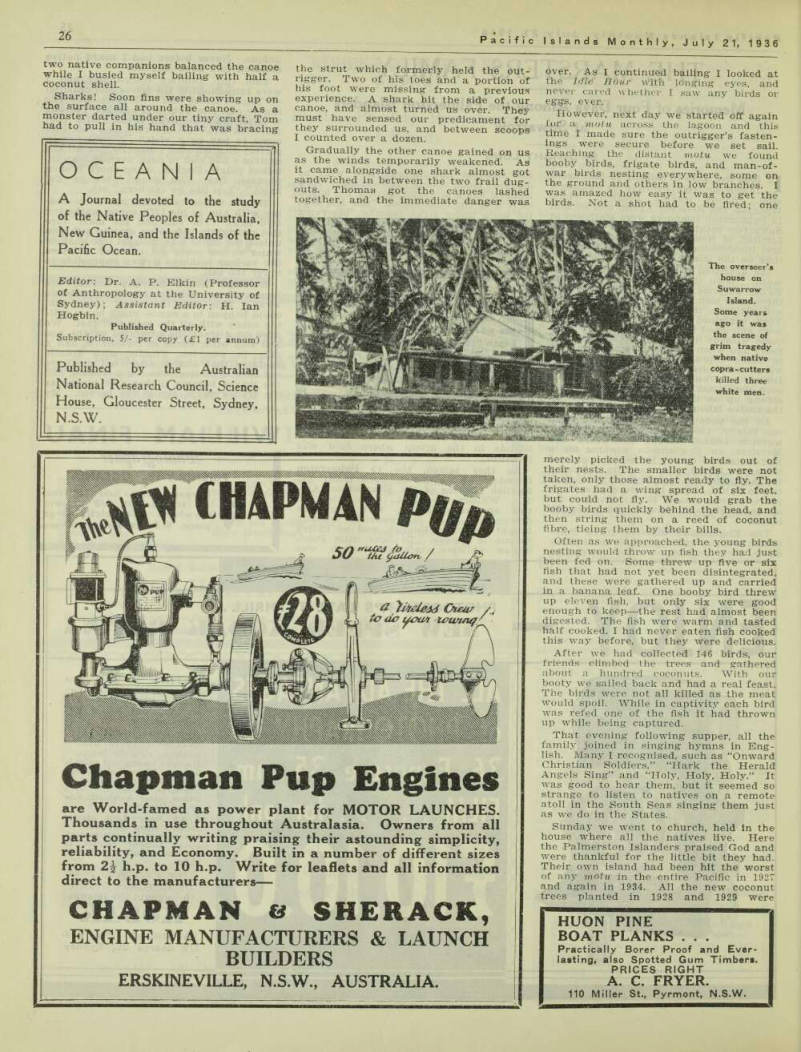
Memories of Four Days Among the Palmerston Islanders at Suwarrow
By Dwight Long
IT took five days to sail my 32-foot ketch Idle Hour from Penrhyn to Suwarrow atoll. Before leaving Penrhyn, Philip Woonton, the Resident Agent, told us that 19 Palmerston Islanders were stationed at Suwarrow making copra for A. B. Donald Limited, of New Zealand. They were the first inhabitants to live for any length of time on the island since 1905.
We anchored in the lee of the largest motu. Soon canoes put off to greet us.
To my surprise out of the 19 people only three were men. All the rest were women and children, the families of these men.
They explained that the Company they were employed by would not let any man come without his family, because several years ago when a party of men were sent to make copra, some came with their wives and some without. As at Pitcairn Island, only on a smaller scale, trouble soon developed. Three white men were strung up on the high coconut trees by the native labourers.
All the people at Suwarrow are from one family, the Marsters family of Pal merston Island. About 150 years ago Marsters, an Englishman working for a half-caste who owned Palmerston, planted the entire island with coconuts, following the orders of his employer who took a trip to Tahiti. Upon his return after three years he was unable to pay Marsters for all the work, and Marsters was given the island.
The Englishman married three Poly nesian women, and started three families. tbpn. ereneration after generation
has married and intermarried with no outside blood being introduced. New Zealand has a protectorate over the island as it is in the Cook Group. She has kept the motu under strict isolation, observing this unique family as an experiment, and apparently the intermarriage has not de generated the descendants to any marked degree. Recently a hurricane swept all
the coconuts off their isle of Palmerston, and the Cook Administration had to move many of the Marsters away to other islands in the group where food was plentiful.
As they talked, the 19 Palmerston Islanders at Suwarrow used many old English phrases of the Elizabethan Age.
Mr. William Marsters, the father of this enormous family, with over 200 descendants all intermarried, strictly taught his wives English, and no native tongue is spoken. To hear little Poly nesian children talking English was
unique. Never before had I heard native children talk good English!
Timi (my Tahitian companion) and I were introduced to the wives and children of Tom, Thomas and Ned Marsters. The family call one Tom and another Thomas to distinguish between them. Mrs. Tom Marsters said, “We are very glad you have come to pay us a visit.’’ A sentence in perfect English was a novelty, for all the natives I had met to date, even in Hawaii, talked pidgin-English, using short, broken phrases, like: “No good,” “Me go get knife,” “You like go eat here,” etc.
Thomas Marsters invited me to go sail ing with him in his 18ft. canoe, gathering bird eggs. The sail and the mast were tied up tightly before we started out, and unless the canoe was brought into shallow water so we could get out and unfasten the various lashings it was impossible to lower the sail.
We had sailed halfway across the lagoon when suddenly the outrigger broke away. This was the worst thing that could happen to a canoe, much less a sail ing canoe with all the sails tied fast. We tried to attract the attention of the one and only other canoe at Suwarrow, half a mile in our lee. Finally with frantic gestures that almost upset out craft we got their attention. The wind freshed, and the waves became higher and higher as the trades swept across the lagoon. My
two native companions balanced the canoe while I busied myself bailing with half a coconut shell.
Sharks! Soon fins were showing up on the surface all around the canoe. As a monster darted under our tiny craft, Tom had to pull in his hand that was bracing
the strut which formerly held the out rigger. Two of his toes and a portion of his foot were missing from a previous experience. A shark hit the side of our canoe, and almost turned us over. They must have sensed our predicament for they surrounded us, and between scoops I counted over a dozen.
Gradually the other canoe gained on us as the winds temporarily weakened. As it came alongside one shark almost got sandwiched in between the two frail dug outs. Thomas got the canoes lashed together, and the immediate danger was
over. As I continued bailing I looked at the Idle Hour with longing eyes, and never cared whether I saw any birds or eggs, ever.
However, next day we started off again for a motu across the lagoon and this time I made sure the outrigger’s fasten ings were secure before we set sail.
Reaching the distant motu we found booby birds, frigate birds, and man-of war birds nesting everywhere, some on the ground and others in low branches. I was amazed how easy it was to get the birds. Not a shot had to be fired; one
merely picked the young birds out of their nests. The smaller birds were not taken, only those almost ready to fly. The frigates had a wing spread of six feet, but could not fly. We would grab the booby birds quickly behind the head, and then string them on a reed of coconut fibre, tieing them by their bills.
Often as we approached, the young birds nesting would throw up fish they had just been fed on. Some threw up five or six fish that had not yet been disintegrated, and these were gathered up and carried in a banana leaf. One booby bird threw up eleven fish, but only six were good enough to keep—the rest had almost been digested. The fish were warm and tasted half cooked. I had never eaten fish cooked this way before, but they were delicious.
After we had collected 146 birds, our friends climbed the trees and gathered about a hundred coconuts. With our booty we sailed back and had a real feast.
The birds were not all killed as the meat would spoil. While in captivity each bird was refed one of the fish it had thrown up while being captured.
That evening following supper, all the family joined in singing hymns in Eng lish. Many I recognised, such as “Onward Christian Soldiers,” “Hark the Herald Angels Sing” and “Holy, Holy, Holy.” It was good to hear them, but it seemed so strange to listen to natives on a remote atoll in the South Seas singing them just as we do in the States.
Sunday we went to church, held in the house where all the natives live. Here the Palmerston Islanders praised God and were thankful for the little bit they had.
Their own island had been hit the worst of any motu in the entire Pacific in 1927 and again in 1934. All the new coconut trees planted in 1928 and 1929 were
The overseer’s house on Suwarrow Island.
Some years ago it was the scene of grim tragedy when native copra-cutters killed three white men.
washed out to sea as the hurricane swept over the inotu. Their houses and copra sheds vanished and the Islanders clung to coconut trees on the “Hill.” a 20-ft. sand mound, the highest land on their island.
Fortunately, or maybe unfortunately, only two were drowned.
A trading schooner calls at Palmerston once a year. After the seas had swept the island the poor people were without sufficient food for over three months until a schooner arrived with supplies. The Marsters community we visited at Suwar row had been removed from Palmerston about the same time as three other groups were taken to Penrhyn, Manihiki and Mauni —isles where the hurricane had not devastated the entire mytus. William Marsters, the son of the original Marsters, is now over 80 years old, and is still living with 60-odd members of his family on Palmerston. The Cook Island Govern ment has furnished them with food and sent along new coconut shoots so that they can replant the island.
After four days of unforgettable experi ences on Suwarrow Island we returned aboard the Idle Hour. Our calendar told us the sad story that we must up anchor and be on our way lest we be caught in the paths of oncoming hurricanes. We had become attached to this unique family and really regretted our departure as we bid farewell to the Palmerston Islanders, and sailed away from Suwarrow.
Advertisements & other items, pp. 27-28 (1 item)
Enjoy
This article was specially written for the “Pacific Islands Monthly" by Mr. Dwight Long, a young American sea adventurer who, after sailing his ketch “Idle Hour" across the Pacific from Seattle, is now en route to Europe, via Papua, Dutch East Indies, and the Suez Canal.
WILLIAM FINAU
Photographer
FRIENDLY IS., OCEANIA
■■ Tongan views and Natives’ ■■ life scenes, set, 5/3 prepaid ▼ anywhere. Tapacloth, large piece, 6/6 prepaid anywhere.
ENJOY
PHOTOGRAPHY’S LATEST ...
NEW SPEED KODAK RETINA
ALL THE ADVANTAGES
of PHOTOGRAPHY on
36 Exposure 35 mm.
FILM ... for only
I I (Australasia) Pty. Ltd. 379 George St., Sydney RETINA is that fine high - precision instrument you’ve always wanted, but could not previously afford.
And it’s a Kodak product easy to use nothing new to learn.
Daylight loading and unloading with 35mm Kodak Panatomic Film Cassette, for 36 exposures, picture size 36 x 24mm, using Automatic Exposure Counter.
F/3.S Xenar Lens assures needle - sharp definition for tremendous enlargement.
Speed Compur Shutter to 1/500th second, stops fastest action.
Write for special folder Of all Kodak Dealers throughout the Islands
KODAK
OCEANIA
A Journal devoted to the study of the Native Peoples of Australia, New Guinea, and the Islands of the Pacific Ocean.
Editor: Dr. A. P. Elkin (Professor of Anthropology at the University of Sydney); Assistant Editor : H. lan Hogbin.
Published Quarterly.
Subscription, 5/- per copy (£1 per annum) Published by the Australian National Research Council, Science House, Gloucester Street, Sydney.
N.S.W.
tff» CHAPMAN f>fa
fa SO (laifatv / tiU. 3 Omir
tO CU7
yowi towuuf.
Chapman Pup Engines
are World-famed as power plant for MOTOR LAUNCHES.
Thousands in use throughout Australasia. Owners from all parts continually writing praising their astounding simplicity, reliability, and Economy. Built in a number of different sizes from 22- h.p. to 10 h.p. Write for leaflets and all information direct to the manufacturers—
CHAPMAN & SHERACK,
ENGINE MANUFACTURERS & LAUNCH
BUILDERS
ERSKINEVILLE, N.S.W., AUSTRALIA.
HUON PINE
BOAT PLANKS . . .
Practically Borer Proof and Everlasting, also Spotted Gum Timbers.
PRICES RIGHT
A. C. FRYER.
110 Miller St., Pyrmont, N.S.W.
Fiji Enjoying Prosperity
Sugar, Copra And Gold
is destined to play an increasingly -*■* important part in the affairs of the Pacific,” said Major Clive Joske on his arrival in Sydney in June by the Aorangi.
“On one of the main highways of the world, it is well situated strategically to become a possible naval and air force base,” he added.
Major Joske is managing director of Brown and Joske Ltd., which recently amalgamated with W. R. Carpenter and Co. He said that the advent of Carpenter and Co. into Fiji meant that another large group of Australian shareholders is now interested commercially in the group. Fiji is enjoying prosperity at the present time; both sugar and copra crops promise to touch record tonnages for the year, and gold production is still increasing.
Fiji is at present in a strong financial position, continued Major Joske. Revenue has exceeded expenditure by a consider able margin over the past few years.
“Fiji issues its own currency, and the note issue is backed by investments in sterling which more than cover the issue,” remarked the Major. “In view of the healthy state of the Currency Fund and of Fijian finances and trade, it would not be surprising to see the Colonial Office in London restore the Fijian pound to parity with the pound sterling. At present it has been arbitrarily depreciated by the Government’s action to a point halfway between the Australian pound and the pound sterling.”
Mr. Mason Warner, special travel corre spondent of the Chicago “Tribune” return ed to Sydney by the Malaita on June 19 after visiting the Solomon Islands and Rabaul to gather material for American newspapers. He said that the voyage was one of the most fascinating he had under taken in 20 years of travelling. Mr. Warn er brought back with him a large number of spears and native curios which he will present to the Famous Adventurers’ Club in Chicago.
Union Co.’S Rarotonga
Manager Leaves For N.Z.
From Our Own Correspondent
Rarotonga, June 14.
MR. H. S. MANNING, manager at Rarotonga for the Union Steam Ship Co. since 1934, leaves for New Zealand with his family by to-morrow’s Makura.
Mr. Manning’s health has been troubling him for some months, and a transfer to a
less isolated post will no doubt be wel come.
Described on his arrival in the Cook Islands as “a man of very pleasant dis position,” Mr. Manning has lived up to his reputation. Congenial and convivial, he has maintained the best of relations with every class of local society. His genial personality will be greatly missed by all sections, particularly among his fel low members in the Bowling and Cricket Associations in Rarotonga.
Advertisements & other items, pp. 29-30 (1 item)
Tilley Lamps made
Firearm Repairs. “OUR HANDS MAKE GOOD ARMS.” Firearms sent C.O.D.
Two New Models of Mauser bolt action JUST ARRIVED cal. long cartridges.
Light Model, barrel, weight 61b.
Heavy Model, 26 1 2 \n. barrel, weight Blbs.
These Rifles group into |in. at 50 yards.
Price of either Rifle, £lO/10/-, post free.
Most accurate Rifles yet made.
Firearm or Fishing Tackle Catalogue sent on request.
CJTT T> /~\TTT T Gunsmith, Importer of High-grade Firearms ijlLi and Fishing Tackle Specialist
143 Elizabeth Street, Sydney
(near Market Street)
“FISHING TACKLE TO TACKLE FISHING.”
Also the Wonder Rifle
“WALTHER”
It is a single shot, repeater and automatic, ALL IN ONE
RIFLE.
Price ... £lO/10/-.
W. KOPSEN & CO., LTD.
SHIPCHANDLERS AND GENERAL MERCHANTS
Tilley Lamps made
Special Quotations for Island Trade GENUINE Tilley Parts 68-70 Clarence St., Sydney CABLES: tel® e bw Y m EY 6
p&t ■
CAPSTAN
CIGARETTES
CORK-TIPPED
p| " s n| /'¥
P LA I N
* W 'M%h - . -■ ". ■ ... vy' f y - tu^
CAPSTAN
NAVY CUT TOBAOOC
intuitfhcm the
(finest
Umumtut letvf
hiu 1
PST
’S moth&i
camztcr Ata
WELL, DARLING, MOTHER
WAS DELIGHTED WITH HER
STAY. SHE THINKS YOU'RE
A WONDERFUL COOK !
MY DEAR, I CANT
RESIST A SECOND
HELPING OF THIS/
WHAT DO YOU CALL
¥ ■"A i;
gg*JIMSOGLAD
LIKE IT
j£ CUSTARD BOWL]
ft MADE WITH I
foster clark's
CREAMY CUSTARD
SHE'S AN
ENTHUSIAST FOR
FOSTER CLARK'S
CUSTARD NOW-
ANO SO AM |.
3 DAYS LAT£R
RECIPE BOOK FREE
Write for Elizabeth Craig’s Recipe Book to Foster Clark (Australia) Ltd., Dept. R. 8., 17 Thurlow Street, Redfern, N.S.W. Enclose Id. stamp for postage. rUiinitfP v> VA Recipe for CUSTARD BOWL: 6 bananas i pt. cream One-half meringue li pts. FOSTER CLARK’S creamy
CUSTARD.
Make custard according to the directions. Pour into a basin. Stand 20 minutes. Peel and slice bananas into custard, stir gently, then turn into a pretty glass dish. Chill. Decorate with whipped sweetened cream flavoured with vanilla. Sprinkle with crushed meringue. The cream can be omitted, and the custard spiked with 2 oz. of split blanched almonds. If wanted for a party, serve in individual sundae glasses. Enough for 6 persons.
Serve Foster Clark’s creamy Custard with stewed fruit, puddings and pies. It’s one dish everybody likes.
FCS-185
Foster Clark s
creamy CUSTARD
Civilisation or Back to Nature?
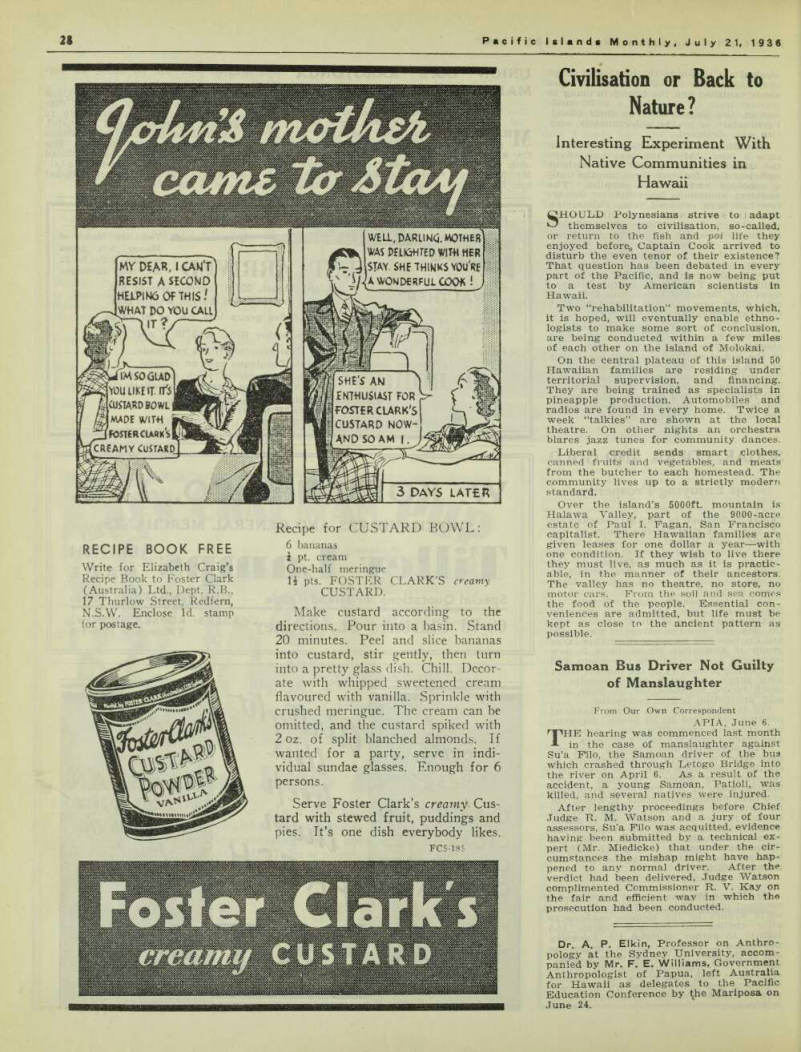
Nature?
Interesting Experiment With Native Communities in Hawaii
SHOULD Polynesians strive to adapt themselves to civilisation, so-called, or return to the fish and poi life they enjoyed before. Captain Cook arrived to disturb the even tenor of their existence?
That question has been debated in every part of the Pacific, and is now being put to a test by American scientists in Hawaii.
Two “rehabilitation” movements, which, it is hoped, will eventually enable ethno logists to make some sort of conclusion, are being conducted within a few miles of each other on the island of Molokai.
On the central plateau of this island 50 Hawaiian families are residing under territorial supervision, and financing.
They are being trained as specialists in pineapple production. Automobiles and radios are found in every home. Twice a week “talkies” are shown at the local theatre. On other nights an orchestra blares jazz tunes for community dances.
Liberal credit sends smart clothes, canned fruits and vegetables, and meats from the butcher to each homestead. The community lives up to a strictly modern standard.
Over the island’s 5000 ft. mountain is Halawa Valley, part of the 9000-acre estate of Paul I. Fagan, San Francisco capitalist. There Hawaiian families are given leases for one dollar a year—with one condition. If they wish to live there they must live, as much as it is practic able, in the manner of their ancestors.
The valley has no theatre, no store, no motor cars. From the soil and sea comes the food of the people. Essential con veniences are admitted, but life must be kept as close to the ancient pattern as possible.
of Manslaughter
Samoan Bus Driver Not Guilty of Manslaughter
From Our Own Correspondent APIA, June 6.
THE hearing was commenced last month in the case of manslaughter against Su’a Fllo, the Samoan driver of the bus which crashed through Letogo Bridge into the river on April 6. As a result of the accident, a young Samoan, Patioli, was killed, and several natives were injured.
After lengthy proceedings before Chief Judge R. M. Watson and a jury of four assessors, Su’a Filo was acquitted, evidence having been submitted by a technical ex pert (Mr. Miedicke) that under the cir cumstances the mishap might have hap pened to any normal driver. After the verdict had been delivered, Judge Watson complimented Commissioner R. V. Kay on the fair and efficient way in which the prosecution had been conducted.
Dr. A. P. Elkin, Professor on Anthro pology at the Sydney University, accom panied by Mr. F. E. Williams, Government Anthropologist of Papua, left Australia for Hawaii as delegates to the Pacific Education Conference by the Mariposa on June 24.
Lost Atolls Of The Pacific
The Mystery of Tuanaki and Victoria Islands
By Julian Hillas
ATLANTIS in the East; Lemuria in the West; continents as large and per haps even larger than the whole area of Europe disappeared without trace, leav ing behind no record beyond the rocky peaks of their highest mountain ranges.
Throughout history, like lesser satellites, numerous small Pacific Islands have been visited once or twice, and then lost forever in the dim twilight of travellers’ tales.
Among these may be counted the sunken atoll of Tuanaki, commonly sup posed to have existed some 300 miles south or south-west of Rarotonga in the Cook Group and to have consisted of three densely populated islets strung together on a connecting reef.
The first reference in print to Tuanaki is in the Rev. William Gill’s “Gems of the Coral Islands” which appeared in 1865.
Mention is made there to the arrival at Rarotonga in the year 1844 of a schooner from Rurutu which had been sent out under the direction of the Rev. G. Platt to search for an island known by report throughout the Group, but which had never been visited or definitely located by Europeans.
In the autobiography of the missionary Maretu —subsequently translated by Dr.
Wyatt Gill—is found an account of a fur ther attempt to reach the island, this time in a vessel belonging to John Williams, also, as far as can be made out from some confusion of dates, during 1844. The vessel in question called first at-Aitutaki and whilst there the Captain and Mr. Gill interviewed a native seaman named Toma who claimed to have seen Tuanaki while employed on board a whaling ship.
According to his account he had gone ashore there as one of a landing-party of seven, and after proceeding some distance inland came upon a house filled with men, amongst whom was the Ariki, or Chief.
Gifts of scissors, axes and head-dresses were presented by the visitors who, in exchange, received fowls, pigs, yams and bananas, which shows that although Tuanaki was only an atoll its soil must have been considerably better than the average. The ship remained six days, during which time Toma and his com panions stayed ashore as guests. He in formed Mr. Gill that the people were just like the Aitutakians in appearance, although their language and customs more closely resembled those of the Man gaians, who were in fact their nearest neighbours—it taking only a day and a night to reach that island.
After leaving Aitutaki, William’s vessel called at Mangaia and proceeding thence in the supposed direction of Tuanaki encountered such heavy weather that her boom and after mast were both broken, necessitating an immediate return to Rarotonga.
No further attempt seems to have been made to find the lost atoll, although it is on record that some time during the 40’s a trading vessel from Auckland used to visit an island of which the exact posi tion was kent secret, and w T hich subse quently disappeared.
But that Tuanaki formerly did exist appears fairly certain. To-day among the people of Rarotonga a particular reddish brown shade of hair is spoken of as the tu Tuanaki, rumour having it that this was the general colouring of that island, a belief to which substance is lent by the more southerly and temperate climate
Modern oceanic survey has moreover established the location of a shoal in lati tude 27.308, a distance of 360 miles from Rarotonga, a position in every way cor responding to the supposed site of Tuanaki. Writing in 1901, Lieut.-Colonel W. E. Gudgeon, then Resident Commis sioner at Rarotonga, believed that the island was in existence up to 70 years ago and disappeared as the result of a volcanic upheaval.
One can imagine the three islets, mere crumbs of land on a narrow riband of coral reef. Placid and uneventful days filled with small interests and cares —the perpetual motion of a self-contained life.
Maretu tells us that the Tuanakians knew nothing of warfare; they only knew how to dance and sing.
Perhaps it was night-time when the first tremor shook the atoll, sending the water in the lagoon surging ashore in angry waves among the palms. Strange marine fires may have lit the scene like great lamps burning in the ocean depths. ... A second tremor and the rending of the island’s coral foundations, followed by the rushing together of the waters. Darkness and the swirling cur rents; the shrill cries of women and children; and the hoarse gutteral shout
ing of men. And then dawn, pale and sickly, with heavy vapours, creeping across the eastern horizon: “Around, by lifting winds forgot, Resignedly beneath the sky The melancholy waters lie.” t hS Ct D °u r L a lP ? la i n ,?h .«**«*
S& tS
"north-east of Aitutaki in the Cook Groilp, and rumour held that it was rich in guano deposits. That these reports were considered authentic is evident from an inser-
tion which appeared in a Melbourne news paper in February, 1865. ‘‘WANTED. Single man to take charge of an island in the South Pacific. Apply B. B. Nichol son and Co., Ship Brokers, Elizabeth Street.” , . antwe?e e d Vo ? h t 1, a e d vSe m fn , ll rd « s re Tt ed a‘n he u a n P p P u°SeT “. . . he (Mr. Nicholson) said that he was going to Sandwich in the morning and would like me to go with him to see Captain Murphy of the barque Envoy
from Liverpool, to know \yhen he would be ready to start for the South Sea Islands.
“At 8 a.rn. we went and saw the barque, a fine new vessel of 500 tons. The Cap tain said he would be ready to sail on March 8. . . . Mr. Nicholson agreed to give me £l2 a month with all pro visions, tents, boat, and tools for prospect ing Victoria Island for guano. I was to find a man who could fix up the tents, row a boat, and cook. I soon found a sailor at £ 6 a month and on the following day we signed articles before the Shipping Master, I as Captain of Victoria Island and Woods as Mate.
“. . . The same evening we left (Aitutaki) to hunt for Victoria Island, which the Captain said was about 1000 miles distant. After a fortnight Captain Murphy said we were near the island and he sent a man aloft to look but. At day light next morning another man went aloft, but again no land was sighted.
Murp.hy said we were now within five miles and as we had strong trade-winds the barque was scudding along.
“About 9 a.m, the Captain and Mate took the sun and, working out the reck oning, declared that we had sailed right over the island. There were thousands of birds hovering around and most of us concluded that the island had gone down in that dreadful hurricane that had done so much damage in Aitutaki. However, we ploughed the ocean for 100 miles in all directions, but no land was to be seen, so we started for Malden Island where the barque was to load guano for Melbourne.
We arrived there correct. Captain Murphy was a splendid navigator—he could pick up an island if it was marked right on the chart. ...”
Old tales die hard and although Vic toria has never been definitely reported by a reliable authority, belief in its exist ence still lingers on, particularly among the inhabitants of Manihiki, who declare that as late as the 60’s their people used to rest at Victoria Island on the journeys between Manihiki and Malden. That this corresponds with the time when William Oliver was searching for the lost island is perhaps significant, insomuch as no mention after that date is again made to Victoria by the Manihikians. The presence of a large flock of gulls could very well be accounted for by shoal water—a shoal possibly quite recently formed by some marine subsidence.
Shrouded in conjecture, the histories of Tuanaki and Victoria add yet another link to the long chain of unsolved Pacific mys teries, watched over by the greatest enigma of all—those inscrutable stone faces forever glooming out across the waters from the barren hillsides of Easter Island.
Advertisements & other items, pp. 31-32 (1 item)
Aunt
H.JONES &C 0
AUSTRALIA’S BEST
H. JONES & CO.. LTD.
Darlington. Sydney Hobart, Tas.
For— Fresh Fruit, Vegetables, and Produce Island Residents can rely on the old-established Shipping Providers.
Island Representatives: Only Address: 421 Sussex St., SYDNEY All Orders Promptly Attended Nelson «t Robertson W. M. Reid
A new, simple lid for your,
convenience; a new
patented parchment seal
to ensure perfect fresh-
ness.
AUNT
■a H nw>
IVIAKTj
BAKING POWDER
m mar aft*
NG PO
Send 1/- plus 2d. postage to Tillock and Co.
Ltd., Sydney, fop "Aunt Mary’s” Cookery Book, it’s the best.
Ct PItINOL
Permanent Protection for Timber Against White Ants Cuprinol has been thoroughly tested and is being used
successfully in all parts of Australia.
Inspector-General of Prisons, Messrs. Cuprinol Ltd., Bombay, Presidency, London. Poona, Bth February, 1935.
Dear Sirs, — I would invite your attention to your letter No. FJB/EME dated the 21st February, 1934, under cover of which you sent me four samples of Cuprinol.
I have given your product a very exhaustive trial, experimenting with cane, bamboo, and various types of Indian timber. I have much pleasure in informing you that I am absolutely satisfied that any substance treated with Cuprinol is proof against the attacks of white ants—which in some parts of this Presidency are extremely destructive.
Thanks very much for your courtesy in sending me the samples.
Yours faithfully,
LT. COLONEL 1.M.5.,
Inspector-General of Prisons, Bombay Presidency, India.
Full particulars from the Islands’ Distributors
Paul A Gray Ltd,, ""
Shipchandlers & Hardware Merchants
BUILD
MODERN
HOME WITH
X % I
ASBESTOS CEMENT BUILDING SHEETS
Low cost with good appearance and endurance is assured when you specify Durabestos for wails and ceilings in new buildings or for additions or repairs to existing structures.
Write for literature illustrating the new horizontal application of Durabestos, in modern buildings.
WUNDERLICH LTD.,
Crown and Cleveland Sts., Redfern SYDNEY Durabestos does not require skilled labour to erect, and is most suitable for tropical dwellings.
DUD
86.DS
Pt. Moresby
Recreation Club Formed at Pt. Moresby
From Our Own Correspondent
Port Moresby, June 8.
ASIDELINE of the Port Moresby Insti tute Hall, a Recreation Club has been formed with Mr. E. J. Frame as pre sident, and is already in full swing - . Social games tournaments will be held reg-ularly, and a prominent outdoor sport of the Club will be canoe racing on the Harbour.
Mr. R. P. Barwick has been appointed secretary and treasurer and is indefatig able in his efforts to push forward this movement that promises to do much to wards providing entertainment and recrea tion *for the people of Port Moresby.
Mr. A. G. Former, of the Bank of New Zealand in Suva, left Fiji in June on trans fer to New Zealand.
Bulolo Monsters
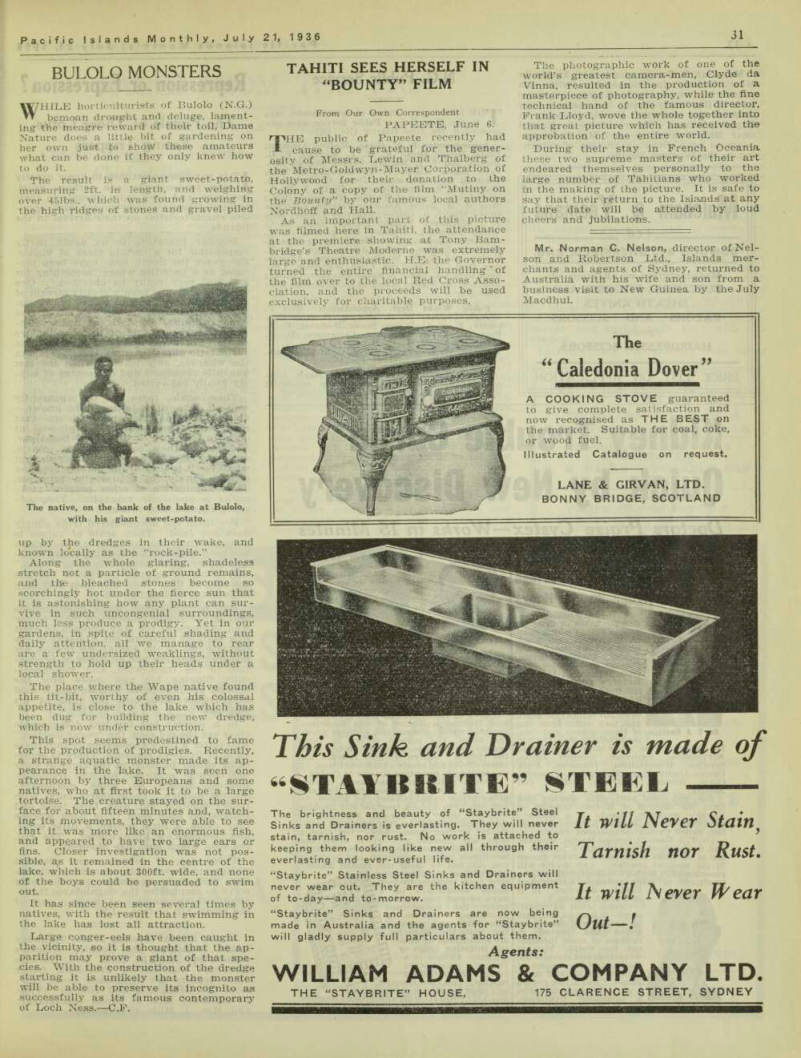
WHILE horticulturists of Bulolo (N.G.) bemoan drought and deluge, lament ing the meagre reward of their toil, Dame Nature does a little bit of gardening on her own just to show these amateurs what can be done if they only knew how to do it.
The result is a giant sweet-potato, measuring 2ft. in length, and weighing over 451b5., which was found growing in the high ridges of stones and gravel piled
up by the dredges in their wake, and known locally as the “rock-pile.”
Along the whole glaring, shadeless stretch not a particle of ground remains, and the bleached stones become so scorchingly hot under the fierce sun that it is astonishing how any plant can sur vive in such uncongenial surroundings, much less produce a prodigy. Yet in our gardens, in spite of careful shading and daily attention, all we manage to rear are a few undersized weaklings, without strength to hold up their heads under a local shower.
The place where the Wape native found this tit-bit, worthy of even his colossal appetite, is close to the lake which has been dug for building the new dredge, which is now under construction.
This spot seems predestined to fame for the production of prodigies. Recently, a strange aquatic monster made its ap pearance in the lake. It was seen one afternoon by three Europeans and some natives, who at first took it to be a large tortoise. The creature stayed on the sur face for about fifteen minutes and, watch ing its movements, they were able to see that it was more like an enormous fish, and appeared to have two large ears or fins. Closer investigation was not pos sible, as it remained in the centre of the lake, which is about 300 ft. wide, and none of the boys could be persuaded to swim out.
It has since been seen several times by natives, with the result that swimming in the lake has lost all attraction.
Large conger-eels have been caught in the vicinity, so it is thought that the ap parition may prove a giant of that spe cies. With the construction of the dredge starting it is unlikely that the monster will be able to preserve its incognito as successfully as its famous contemporary of Loch Ness.—C.F.
The native, on the bank of the lake at Bulolo, with his giant sweet-potato.
Tahiti Sees Herself In
“Bounty” Film
From Our Own Correspondent
Papeete, June 6.
THE public of Papeete recently had cause to be grateful for the gener osity of Messrs. Lewin and Thalberg of the Metro-Goldwyn-Mayer Corporation of Hollywood for their donation to the Colony of a copy of the film “Mutiny on the Bounty” by our famous local authors Nordhoff and Hall.
As an important part of this picture was filmed here in Tahiti, the attendance at the premiere showing at Tony Bam bridge’s Theatre Moderne was extremely large and enthusiastic. H.E; the Governor turned the entire financial handling *of the film over to the local Red Cross Asso ciation, and the proceeds will be used exclusively for charitable purposes.
The photographic work of one of the world’s greatest camera-men, Clyde da Vinna, resulted in the production of a masterpiece of photography, while the fine technical hand of the famous director, Frank Lloyd, wove the whole together into that great picture which has received the approbation of the entire world.
During their stay in French Oceania these two supreme masters of their art endeared themselves personally to the large number of Tahitians who worked in the making of the picture. It is safe to say that their return to the Islands at any future date will be attended by loud cheers and jubilations.
Mr. Norman C. Nelson, director of Nel son and Robertson Ltd., Islands mer chants and agents of Sydney, returned to Australia with his wife and son from a business visit to New Guinea by the July Macdhui.
Mr. Alan S. Cross, who is well known in New Guinea in connection with his pioneering work with Guinea Airways Ltd. in the "early days,” has taken a long lease of the renowned Keable property at Papeari, Tahiti. The residence is situated near Mauu’s hostelry, and Mr. Cross ap pears to have given up all idea of return ing to the Western Pacific.
Advertisements & other items, pp. 33-34 (1 item)
This Sink and Drainer is made of
m
The
“Caledonia Dover”
A COOKING STOVE guaranteed to give complete satisfaction and now recognised as THE BEST on the market. Suitable for coal, coke, or wood fuel.
Illustrated Catalogue on request.
LANE & GIRVAN, LTD.
BONNY BRIDGE, SCOTLAND
m % This Sink and Drainer is made of
“STATBKITE” STEEL
The brightness and beauty of “Staybrite” Steel Sinks and Drainers is everlasting. They will never stain, tarnish, nor rust. No work is attached to keeping them looking like new all through their everlasting and ever-useful life.
“Staybrite” Stainless Steel Sinks and Drainers will never wear out. They are the kitchen equipment of to-day—and to-morrow.
“Staybrite” Sinks and Drainers are now being made in Australia and the agents for “Staybrite” will gladly supply full particulars about them.
Agents:
It will Never
Tarnish nor Rust.
It will Never Wear
Out—!
WILLIAM ADAMS & COMPANY LTD
THE “STAYBRITE” HOUSE, 175 CLARENCE STREET, SYDNEY
Maleham & Yeomans
Ltd
BOWDON ST., SHEFFIELD, ENG.
Manufacturers of all kinds of
BUTCHERS’, STICKING AND
SHEATH KNIVES
RAZORS AND SCISSORS
Specialty
HAIRDRESSER SCISSORS
PRICE LIST ON APPLICATION
N.G. Public Service
THE following particulars of appointments, etc., to the New Guinea Public Service were an nounced in the June Gazette (No. 450); — Appointments: F. N. Green, Medical Assistant, Public Health Dept.; E. H. F. Mitchell, F. G.
Hutton, and J. J. Murphy, Cadets, District Ser vices Dept.; Misses V. Thwaite and I. Wall, Typistes, Govt. Secretary’s Dept.; C. Darbyshire, Draftsman, Registrar-General’s Dept.; J. H. L.
Waterhouse, Assistant Teacher, Education Dept.; Miss M. M. Byron, Assistant Teacher, Education Dept.; Miss J. A. Gridley, Relieving Typiste; Miss F. J. Mathieson, Typiste, Treasury Dept.; C. C.
Wood, Storeman, Treasury Dept.; Miss A. E.
Anderson, Typiste, Public Health Dept.; Miss E.
F. Kerr, Typiste, Native Affairs Dept.; G. E.
Guthrie and G. W. Stanley, Inspectors, Agricul ture Dept.; A. MacLeod, Clerk-Watchman, Cus toms Dept.; J. Laird, Schooner Engineer, Customs Dept.; J. R. Rigby, Acting A.D.0., District Ser vices Dept.
Public Works Dept. Appointments: Miss P.
Waugh, Typiste; W. H. Fleming, Foreman Car penter; R. A. L. Brown, Senior Mechanic; G. A.
Beer and L. H. Thompson, Carpenters; D. M.
Marr, Mechanic; H. P. Barrie, J. Gallin, J. G.
Hoffman, W. J. Stewart, and H. G. Strong, Road masters.
Termination of Services: M. A. Nagle (dis missed); R. B. McVilly (appointment annulled); Matron U. M. Garter, and A. Barnes (resigned).
Repression or Expression?
The Puzzle of Those Lotus- Eating Trippers
TT is puzzling sometimes to know exactly why persons who are perhaps quiet, generous, and even quite likeable in their habits at home should reveal such oppo site characteristics on their arrival In the Islands.
Popular literature is no doubt partly responsible for a certain class of visitor.
For years the South Seas have been pic tured as a paradise where "something for nothing” may really be obtained. One result of this has been a steady stream of small mendicant yachts whose crews ap pear to exist solely on the bunches of free bananas hung, for lack of space else where, in the rigging of their millimetre masts. For weeks and often months these peripatetic parasites moor their vessels to the wharves, only leaving when the last bunch is consumed and the source of sup ply finally exhausted.
Then, again, there are the apparently well-off, who, after letting it be known— always in the strictest confidence—that they really are "somebody,” proceed at once to disprove it by their behaviour.
Frequently they collect things, pearls, antiques, shells, or even seaweed, but whatever it is they argue fiercely over the price. Purely, of course, on principle.
Their admiration of other peoples’ nick nacks is positively magnetic. They ad mire, acquire, and retire.
For them the unconsidered trifle simply does not exist. Their scale of values is a descending one, and the article which has been obtained for nothing ranks high ly. If, by some singularly lucky "find,” they contrive to “make” a little towards the cost of their visit, then they feel they have not travelled in vain.
But perhaps even more objectionable still is the young unattached male visitor who throughout his stay appears to exist in a state of continual rut. Loosed in the playgrounds of the Pacific, he throws not merely discretion but all sense of propor tion to the trade-wind, and, metaphori cally flinging his new topee over the nearest coconut palm, bounds into a mad intemperate race with the time at his disposal.
In a similar but far less disagreeable class are the old men, the “sugar daddies," who totter a little apologetically into these verdant fields of romance. There is some thing rather pathetic in the sight of their too obvious gratitude for the transitory interest shown by some mercenary minded maiden. Their hearts burst with tender emotion, but, alas, false teeth and indigestion soon send them back whence they came, a little poorer, a little wiser, and, perhaps, a little sadder. The red, red rose which once has bloomed!
There are, of course, many pleasant visitors to leaven this unsavoury concoc tion, but their agreeable qualities only serve to emphasise the unpalatable ingre dients which compose so large a part of the whole bill of fare. —J.H.
At the annual meeting of the Thursday Island branch of the Country Women’s Association held in June, Mrs. Norman Hockings was elected President. Other office bearers are Mesdames Done, Har man, F. Hockings, and Nimmo (Vice- Presidents); Mrs. J. Broad (Secretary): and Mrs. J. Mills (Treasurer).
Advertisements & other items, p. 34 (1 item)
Quick by New Discovery
Kidney Trouble Cured Quick by New Discovery Doctors Praise Cystex—Works in 15 Minutes
Cleans Out Acids and Poisons
.. . Refreshes Blood ... Brings
New Vigour in 48 Hours
There are 9 million tiny, delicate tubes or filters in your Kidneys which must work every minute of the night and day cleaning out Acids, Disease Germs, Poisons, and Wastes from your blood. If your Kidneys or Bladder do not work right, your body gradually becomes poisoned, you feel old and worn-out before your time, and may suffer from any Dp. T. J. Rastelii of these serious and dangerous symptoms: Getting Up Nights, Loss of Vigour, Leg Pains, Nervousness, Lumbago, Swollen Joints, Sciatica, Rheumatism, Dizziness, Dark Circles Under Eyes, Headaches, Frequent Colds, Burning, Smarting, Itching, and Acidity.
But you need not suffer another day from the dangers of Kidney troubles or Bladder weakness, thanks to a Doctor’s discovery of the special Kidney prescription called Cystex (pronounced Siss-tex).
Dr. T. J. Rastelii, famous Doctor, Surgeon, and Scientist, of London, says ; “Cystex is one of the finest remedies I have ever known in my medical practice. Any doctor will recommend it for its definite benefits in the treatment of many common Kidney and Bladder disorders. It is safe and harmless.”
Cystex is not an experiment —it is quick and sure in action and has been tested and proved in millions of cases throughout the world. Because it combats and corrects the real underlying 1 causes of Kidney trouble and much illness, Cystex has gained a world-wide reputation as a successful treatment.
Dr. L. C. Charland Dr. L, C. Charland, emi-
'i nent Physician and Surgeon, of INI on treal, recently wrote: “ I have had excellent results by prescribing the same formula used for Cystex which is available at any chemists. As a hygienic aid to the treatment of many Kidney and Bladder ailments, I consider Cystex a prescription of merit.
Because it is a special prescription for the Kid- Dr. C. Z. Rendelle neys, Cystex starts work in 15 minutes to tone, soothe, and heal raw, sore, sick Kidneys and Bladder, and brings a new feeling of health, youth, and vigour in 48 hours.
Dr. C. Z. Rendelle, well-known Physician and Medical Examiner of San Francisco, recently wrote : “Since the Kidneys purify the blood, the poisons collect in these organs and must be promptly flushed from the system ; otherwise, they re-enter the blood stream and create a toxic condition. I can truthfully commend the use of Cystex.”
Because of its world-wide success, in even the most stubborn cases, the Doctor’s prescription called Cystex is offered to sufferers from Kidney troubles and Bladder weakness under the fair-play guarantee to stop your troubles to your complete satisfaction or your money back. Get Cystex from any chemist and try it under the money-back guarantee. See for yourself how much younger, stronger, and healthier you will feel by using this special Kidney prescription. Cystex must stop your troubles to your entire satisfaction in 8 days, or cost you nothing under the money-back guarantee. Beware of substitutes and remember that the Kidneys are endangered by drastic, irritating drugs or neglect. Cystex is a Doctor’s prescription guaranteed for Kidney trouble. Tell your chemist you must haveCystex(pronounced^-~^ Siss-tex). Price 4/ -, from all Stores & Chemists.
Schaffer & Co., 189 Clarence Street. Sydney.
Pages From The Past
Charlie Savage—The White Chief of Bau
By Erle Wilson
ONE of the most picturesque figures of Fiji’s “bad old days” was Charlie Savage, the young English seaman who became a chief of the Bau people and polygamous husband of chiefs’ daughters.
The story of his career —known to most old hands in the Group—is one of stirring adventure. Though his reign was brief, his influence on the political fortunes of more than one tribe in Na Viti Levu can be traced to-day more than 120 years after he was cast away on Mocea reef at Nairai when the brig Josephine was wrecked.
Savage and four companions were the only members of the crew to reach the shore alive. Without food, unarmed, and in rags, they might well have met the fate of so many other Europeans who fell helpless into the hands of Fijians even at a much later date. But, to the Kai Viti of that time, a white-man was a rara avis indeed, and the Tui Lawaki, into whose hands Savage and his companions fell, was astute enough to see that the possession of five such curiosities, alive, was likely to prove of more value than five dead, white-skinned strangers. It may have been, too, and subsequent events lend weight to the supposition, that Tui Lawaki was not a sufficiently high chief to keep such rare dainties to him self, for, shortly after their landing on
Nairai, the chief of Verata, passing through Lawaki, took Savage’s four com panions away to his town.
Why Charlie Savage was left is uncer tain. Perhaps, as he was but a youth, he was not thought of much worth, and the Tui Lawaki was allowed to keep him. In this the Verata peoplfe blundered. For before long the youthful Savage—soon to be a savage indeed —was to become their most powerful enemy, leading the war riors of the rival clan of Bau.
Shortly after the Verata men had left Lawaki, some Levuka people called there en route to Bau, of which state they were subject. When they moved on they took Savage with them as a present to a newly-installed War-Chief, Ratu Rama tenikutu.
Savage attached himself closely to the War-Chief and, far from showing com punction or reluctance he proved himself eager to join in the almost incessant fighting that went on against neighbour ing clans. He was a vigorous youth and acquitted himself well; but native weapons were evidently not deadly enough for him. Soon his mind turned back to the muskets which he knew had been aboard the Josephine and at last he persuaded Ratu Ramatenikutu to let him return to the wreck in the hope of finding them.
His search in the vicinity of the wreck was without result, but as he was about to return empty-handed to Bau he saw the rusted barrel of a musket projecting from the grass-thatched roof of Tul
JLawaki’s house. This he took, cleaned thoroughly and, having no powder, put away in readiness for the future. Wrecks, he knew, would become more frequent in those uncharted waters as European ships penetrated further into the Fiji Islands: from one of them he might pro cure the necessary powder and bullets.
He was right. Shortly afterwards, an unfortunate brig was driven ashore on Oneata and from it Savage procured the ammunition he needed, together with three more muskets.
Now was his chance to increase his already considerable prestige in the land.
His adopted clansmen had no knowledge of firearms. Chiefs and commoners alike were greatly impressed, not to say awed, when their white man drove a bullet through a stout canoe rest from several yards’ distance. The tribal medicine-man, seeing how things were going and fearing a rival, immediately claimed the musket for himself and, as custom disallowed the refusal of a claim from such a quarter, Savage had perforce to part with the weapon.
In those days the warriors were never
long inactive. Ratu Ramatenikutu called his men out against the town of Nakelo, and with them went Charlie Savage elated at the prospect of showing off his prowess with firearms against the unfortunate enemies of his brothers-in-arms.
Cautiously the painted fighters of Bau advanced on Nakelo but their approach was known: the gates were closed and the Bati-ni-koro—the Teeth-of-the-Town —crouched, waiting in readiness behind the war-fence.
Now was the opportunity of the white man. His bullets would have pierced the stockade, but ammunition was too valu able to use in random shooting. He directed the Bau warriors to erect a plat form on the edge of the bush, high enough to give him sight beyond the stockade.
It was quickly done and, mounting this platform, he opened fire on the Nakelo.
His first shot brought a shout of "A kuru siga!” (“A bolt from the blue!”)
from the defenders. Savage was an expert marksman. He fired carefully, each time dropping his man. Never before had a gun been used in war in Fiji: the astounded Nakelo fled, pursued by the equally astonished but exultant killers of Bau.
Verata at that time was the most powerful rival of Bau. Soon after the Nakelo fight, some Bau canoes with Charlie Savage aboard, met and routed a fleet of Verata fishermen near Macoi Point. In the fight that took place, Savage again distinguished himself by his shoot ing and courage. After the fight, the blooded warriors were streaked with black and red, and Savage also was painted according to custom, and given the honorific title of Koroinavunivalu.
In the opinion of the Bau High-Chiefs, Savage (now Koroinavunivalu) had proven his devotion to his adopted tribe and two women of rank were given to
him as wives: Adi Kakua, daughter of Roko Tui Bau (High-Chief of Bau) and another, daughter of Tui Lomaloma (Chief of Lomaloma), as well as a num ber of other wives of low degree.
The young ex-seaman now ranked as a Chief in the land; but, though he had fallen in so completely with native life, his thoughts often turned to his four erstwhile companions who had been taken to Verata. He knew they were still alive and at last he contrived to get a written message to them, urging them to join him at Bau. This they eventually did and they were welcomed and given a house for their own use. But they did not show Savage’s ability to adapt themselves to their circumstances. The fears of mas sacre which they must have felt at first had long since been allayed and, as time passed, they increasingly adopted a pose of superiority by virtue of their lighter skins alone.
Koroinavunivalu remonstrated with them to no effect and, eventually, annoyed at being excluded from a feast of warriors, they went by night to the rara and cut up the communal supply of yams.
The chiefs were angered, and it is an indication of the firm position Savage had won among them that they sought his permission before making a move to punish the presumptuous whites by death.
The permission was given. Whether readily or not we do not know, but there is nothing in Charlie Savage’s history to indicate the likelihood of any great reluct ance to abandon his old companions in order to preserve his own standing. Death had become a familiar thing to him, and the four were clearly not fitted to the Fijian way of life.
Armed with muskets, the seamen retired into their vale and barricaded the two narrow doors. A Bau Chief and a Soso man were shot before the vale was fired, and the four castaways suffocated in its smoke.
Koroinavunivalu continued to live the life of a fighting Chief of Bau. He had been with the clan about two years when the daughter of Tui Lomaloma bore him a daughter whom he named Maria.
About five years later a brig arrived at Bau and the captain asked Koroina vunivalu’s permission to cut sandalwood near Bau. The white Chief agreed and with several other Bau Chiefs accom panied the sailors to Navakasiga where they anchored near the town. For once Charlie Savage’s judgment was at fault.
While his party were busy felling trees with only their logging tools at hand, they were rushed by the warriors of Nava kasiga and massacred to a man.
That ambush was the beginning of a long and bitter war in which Navakasiga and several other towns were sacked, and Charlie Savage and the Bau Chiefs fiercely avenged. During the war, a young chief who had particularly distinguished himself was given the title of Koroijale (Koroi-Charlie) after the Fijian fashion of creating a living memorial to a fallen warrior Chief.
Maria, Savage’s daughter, later became the wife of a Rewa chief, Roko Tui Dreketi, and their only daughter, Adi Karalaini Lako, later married a Bau Chief, Ratu Isireli Tawakedina. Their son, Ratu Tomu, was taken to school in Australia by a Mr. G. A. Woods just prior to the hoisting of the British flag in Fiji in 1874. He did not return.
What became of him is not known and in him ended the line of Chiefs of Bau founded by Charlie Savage, one of the first Europeans to survive shipwreck on the beaches of Fiji.
Captain C. R. Pinney, M.C., has been reappointed Administrator and Chief Magistrate of Norfolk Island for a year from July 1.
Advertisements & other items, pp. 35-36 (1 item)
Oils, Tars
M. HARPER
MANDOLIANA ISLAND, GELA
P.O. Box 6, Tulagi, Solomon Islands
RECRUITING CONTRACTS
UNDERTAKEN
A. V. PAPARI AVAILABLE FOR
CHARTER
Further details from
PACIFIC ISLANDS MONTHLY
Union House, 247 George St., Sydney
MORRISONS
SPECIALITIES FOR THE ISLANDS include
"MASCOL" -..V
OILS, TARS
and GREASES
ARE USED
The Most Effective WOOD PRESERVATIVE and ' STAIN for Tropical Conditions —the dreaded enemy of White Ants and Borers —stains wood an artistic brown color.
“BOTANITE”
—without doubt the best
RUST PREVENTER on
the MARKET!
RIGHT
THRO’
Australia
A SPLENDID BLACK GLOSSY ENAMEL.
Invaluable for painting mining plant, pipes, tanks, guttering, in fact, all iron work that is subject to corrosion.
COAL TAR, STOCKHOLM TAR, CREOSOTE
WOOD PRESERVING OIL, - NEATSFOOT
OIL, GREASES, PHENOLIC and
EUCALYPTUS DISINFECTANTS
REFUSE SUBSTITUTES—insist on having and the
M O R ISISO UTS
PACIFIC
ISLANDS
PROCURABLE FROM ALL ISLAND AND GENERAL MERCHANTS Manufactured JAMES MORRISON & COY. LTD. Sydney
Woven Wire for All Industry
COPRA DRYING TRAYS, FLOORS. Etc.
FRUIT DRYING TRAYS. MINING SCREENS
Heavy Mosquito Gauze in Phosphor Bronze and Other Metals Impervious to Salt Sea Air WIRE DOOR MATS AND GENERAL WIRE WORKS
E. W RIGHT <& CO. LTD.
Office and Works: 148-152 Cleveland St., Sydney, N.S.W.
Telegraphic Address: “Wrightmake,” Chippendale.
Tt Q: £ tn A
f*L, SV^
ess: m; rn l
RECOMMENDED!
"SUN” Brand Paint on your Home means
definite PROTECTION against tropical
sun and sea-moist air.
Sun Proof and Rain Proof on every Surface
W. R. CARPENTER & CO., LTD.
NEW GUINEA, SOLOMON ISLANDS
and all other South Sea Islands.
Papua
New Landing Ground In
From a Special Correspondent
Kikori, June 4.
A LTHOUGH Papua may never ex perience the aviation activity of New Guinea, the territory Is certainly becom ing air-minded. Aerodromes have already been established at Port Moresby, Ko koda, Yodda, loma, Kubuna, and Bapual.
Land has aleo been purchased for a ground at Dam, and there Is another aerodrome actually under construction near the sawmill on Wame River In the Delta Division. -H The site of the Wame ’drome is known as Port Romilly. The landing ground will be 700 yards by 100 yards, running N.N.W. and S.S.E. By the end of the year, it is hoped that at least 500 yards will have been smoothed and grassed. The approach and take-off for the new aerodrome are being cleared of obstructions to give air craft a free passage.
Most of the work connected with this landing ground will fall on Mr. Charles McKinnon, manager of the Sawmill. He will be assisted by Government prison labour.
Mr. E. Folks returned to Sydney from Lord Howe Island by the Morinda on June 22, after serving as schoolmaster for two and a half years. He said residents were very interested in the proposals which had been made for the provision of continuous medical service on the island.
Mrs. Folks had been the official nurse on Lord Howe, and on several occasions had felt the responsibility keenly.
The Sicknesses Of Tami
By Te Ruau
IN his thatched, pebble-floored cookhouse I found Tami, ex-sailor, ex-tallyboy and Mate’s pimp, presently store-boy absent without leave (but of course virtuously expecting un-docked wages at the end of the month). He was squatting on a mat not too brilliantly clean, with a glass, a wide-mouthed bottle containing a white powder, and a small enamelled bowl in front of him. In his hand he held a des sert-spoon, bearing on its handle the engraved house-flag of a famous shipping company.
A man of many, mostly imaginary, sicknesses (when not real and due to a mixed and extensive diet in which fat half cooked pork and anciently-cooked fish fig ured largely), Tami greeted me cheerlessly, if politely, and proceeded to dip from the bottle two dessert-spoons of the white powder.
Becoming interested as I perched on the edge of the doorboard, I was informed that the gentleman was suffering from “piwa” (fever) for which he was about to consume “kinyin.” It was prescribed by his latest medical adviser, a returned native mission ary from Papua, who had there learned many of the white man’s ways, convert ing the heathen by methods in which black twist tobacco seems to have figured largely as an aid to grace. For “piwa” one table spoon, mixed to a cream with cold water, was regarded as a permanent cure for the Cook Islander’s main ills.
We argued more or less calmly. It was white man’s medicine, and Tami was free to admit that it would be very strong; but he persisted in upholding missionary know ledge, as a prominent church light him self, against that of any trader. But,
finally, and most reluctantly, he agreed (on my remarking that under no circum stances did I propose to provide any ship's biscuit, kegged salt beef, or coffin-timber, with “silver” fittings therefor, for the obsequies of any permanently-cured store boy, however holy or intellectual) to re duce that quinine dose to one teaspoon ful. But he was quite sure that it would not meet the needs of his case.
Having done my best, it was with mixed feelings that saw him prepare the potion, swallow, choke, spit, and grimace hor ribly. Then I left, that I might not be held as an accessory before a Tribal Court; for in those days it was a foregone conclusion that all the family would unite to swear away the liberty of anyone, so be that the sacred person of a missionary, with all the chiefs well to heel, might not be brought into the limelight.
I need not have worried. Hourly re ports supplied by a native friend not only assured me that Tami was alive and sweating profusely under piled covers, but also that six hours later he had assimi lated, under the direct supervision of the missionary aforesaid, another and larger dose. He was back at work, next morning, refusing to admit that his ears were fitted with bells or that he felt other than ex ceptionally fit and well.
The dosage tables of the British Phar macopoeia, seemingly, were not compiled to guide Brown Brother!
TAMI was again sick. Nothing concrete, but indefinite pains of wind, water, and tide —probably due to Tahiti rum, seven days from a still formed from a large iron kettle, a piece of bamboo with sundry packings of not over-clean rag, and, of course, the sugarcane molasSes or Juice “mash.” That the rum was smuggled goes perhaps without saying.
The more cocksure but less reliably in
formed might have suggested fllaria, ma laria or hookworm; and fish warmed-over in a native oven, for four consecutive days, is also worthy of consideration.
Tami’s latest Ta’unga Maori thought of none of these, but supplied him, at the direction of his ghost or familiar spirit, a weird and untranslatable name distinctly of the non-parlour variety, and provided Tami with an evil-looking olive-green mixture wherein fragments of bark and leaf were afloat, strange argosies on an unknown sea, in a not-very-inviting kero sene tin, autumnal in hue.
Decantation was suggested on Tami’s arrival with his load at the store door at 7 a.m. So he procured a No. 12 bucket from the stock (mine), an enamel basin (mine), and perched the whole on a con venient case of tinned beef (also mine) in the back storeroom.
Calling Tami and breaking the news to him that one bucket and one bowl were duly debited against his prospective wages (whereat he said dolefully “whooooo”) and that one case of beef, if wetted, would sidle underneath these entries, I learned that the mess had to be swallowed before sundown, roughly 6 p.m., else it would not effect a cure.
Tami was hopeful on all counts; but removed the apparatus to an empty beef case, to be sure of one phase.
Noon saw him visibly wilting and not feeding up to form. But, between us, we managed to keep him resolute; and at 4 p.m.
Tami and his bucket were put out Into the yard, as we wanted to close the store.
He had then a good third of the bucket to go, and made the remark: “Py Klaish!
He one damn pig pucketi, ol lite.”
I do not know whether he played fair, but I should imagine he did, for three very interested natives were hanging about (stimulated thereto by a gift of twist to bacco from me). Akama, or shame, would do the rest, I thought. He would not empty the bucket on the grass and go home, in the circumstances.
I nearly forgot to mention that on and off during the day, I had, unbeknown to Tami, been adding sundry cups of water from the tap to Tami’s bucket, to help the good work along.
Tami is an unsuspicious soul, for a fo’c’stle graduate—but he changed his doc tor next day and he has not been violently worshipful of me since. Tami’s medical adviser usually lasted a week, and his real friendships a little longer; therefore, I imagine, he must have smelt a rat.
HTAMI had a lodger—one of those queer fowl, reputedly monied, who drift in and out of the Islands, live native and seem, to say the least, “careful!”
This one had been down many times before, arriving with a bag of oatmeal, kerosene, a tin of what he called “grease,” and some canned skimmed milk for pro vender —buying his rice and sugar locally “to help local trade.”
This time he had brought along a large tin of raisins, which aroused Tami’s curi osity.
“Why you bring that?” he asked.
“Oh,” said the lodger, “I got ’em for a song, so I took ’em.”
Tami made no remark. But he took time off to consider the amazing news—and, next day, to a white friend, he said: “You know that fellow sing?”
The white man laughed. “No! not very much” —and laughed again.
Said Tami: “True, I tell you. He get the raisin for the. song, he tell me. Py crlpes, I not know he can sing, this long time!”
Advertisements & other items, pp. 37-38 (1 item)
Clean Comfort,
INTO YOUR HOME
WITH
BUILD
COMFORT
COOLNESS
BEAUTY
The British Insulating Sound-Absorbing Building Board The Colour, Figure and Texture of TEN/TEST provide the BEAUTY. The Heat-resisting and Sound-absorbing qualities of TEN/TEST provide the COOLNESS, QUIET. COMFORT, and CLEANLINESS. o
TEN/TEST
is by far the most beautiful and the strongest and densest board made.
It has by far the highest resistance to moisture and the greatest sound absorption—just twice the moisture resistance of the American boards, and sixty per cent, more sound absorption, and, in addition,
TEN/TEST
can be cleaned, kept clean and refreshed always by brushing with a stiff brush without showing any trace. Ten-test is unique in this. No other board can be so treated again and again—their prepared surfaces are destroyed by it, painting becomes necessary, and painting destroys the sound absorbing surface by filling in the sound absorbing pores.
Agents for New Guinea:
W. R. CARPENTER & CO. LTD.
Rabaul and Salamaua Sheets 1/2in. thick, 3 and 4 feat wide, 5,6, 7,8, 9, 10, 11, 12 and 14 feet long. Price 30/- per 100 square feet.
F. 0.8. Sydney.
Applications for Agencies invited from all Islands other O
For COOL, QUIET,
CLEAN COMFORT,
BEAUTY AND
PERMANENCE
CROCKETT & CO. LTD., 379 Kent St., Sydney Cables: “Pinetree”
GILLESPIE’S
“ANCHOR ”
FLO IJ R
TRADE
MARK
The Standard of Quality.
Australia’s Choicest Products Green Peas French Beans Cauliflower 9 U
garden
CARDCN
vv..;. ... 7
K PRODUCTS LIMITED
2-4 BROWN STRCCT, N-EWTOWN
SYDN-EY. AUSTRALIA
Always..
make sure you have at hand an ample Reserve of these Delicious . .
Garden
Vale
Ready-toserve Vegetable*
Indian Land Leases In Fiji
From Our N.Z. Correspondent..
Auckland, June 12.
AFTER a month’s visit to Fiji in the interests of Indians resident there, the Rev. C. P. Andrew’s noted religious mystic, author, and friend of the Indian people, returned to New Zealand by the Aorangi on June 8.
Mr. Andrews said a remarkable improve ment had taken place in conditions for In dians in Fiji since his previous visits.
The abolition of indentured labour had al lowed the Indians to become peasant pro prietors. They had proved themselves good cultivators of sugar, and the Colonial Sugar Refining Co. had done wisely in making them its chief farmers.
The main problem he had been con fronted with had been the renewal of Fijian leases held by Indians, which were now expiring. This had caused a critical situation, involving endless bargaining and the expenditure of large sums of money, since the Indians had to make presents to the leading members of the tribe, the land being held by the tribe as a whole. The process was leading to great demoralisa tion. He was now working on the problem of a just and simple method of lease re newal.
His inquiries into the education of In dians had revealed that remarkable pro gress had been made. The third question, that of the abolition of the franchise for the Legislative Council, was in his opinion a mistake, and he gave his view as strongly in favour of it being retained.
Economical Value of Medical
Handbooks
By R. F. Thompson, F.R.G.S., F.R.A.I.
A CELEBRATED medical man in Aus tralia, Philip E. Muskett, published in the year 1903 The Illustrated Australian Medical Guide in two volumes. The great urge for this work was that the only similar works obtainable in Australia had been written in England or America and were quite valueless to the Australian people.
Muskett’s volumes are still to be found all over Australia and in all sorts of homes. People in isolated homesteads, far from medical aid, find Muskett a reliable old friend of 33 years’ standing.
Dave of the outback, for example, is bitten by a poisonous snake and is kept alive by Sarah who has hastily verified that the bite is from a venomous reptile by observ ing only two punctures instead of several as left by the non-venomous variety. She seizes the whip that Dave is carrying and ties the lash above the bitten part, ignor ing the while the advice of an obstinate old swaggy who insists that Dave should be made as drunk as a lord. Muskett is emphatic that there is no sense in mak ing the patient intoxicated. Dave con tinues his fencing job that afternoon feel ing none the worse for the experience.
In the Solomon Islands, Muskett’s Aus tralian publication, like English and American works in Australia, has a lessened value. Typhoid does not exist in the Solomons. Poisonous snakes are very rare, but centipedes, scorpions, and many poisonous fish are found. Yaws, from which most of the native children suffer, are known by their framboesial appearance.
There are many tropical complaints such as “mango toe*’ and nasty abscess formations that need constant attention out on the lonely plantations, away from any medical help whatever. Nathaniel Crichlow, M. 8., Ch.B., Glasgow, who has been for a long time a Government Medi cal Officer in the Solomons, published in 1921 a small handbook entitled “A Brief Medical Guide for the Solomon Islands’’
wherein the important diseases such as Blackwater, Malaria, Dysentery and pul monary complaints are dealt with very fullv. Many deaths have been averted by the aid of this small Medical Guide of only 109 pages. Hundreds of labourers have annually been cured of sicknesses, thus ensuring the continued production of hundreds of tons of copra and other pro duce.
The Medical Guide is kept on every plantation in the Solomons, and is the inspiration of the planter in times when ill-health hovers at his door. These Medi cal Guides, therefore, have a great econo mic value apart from other things, but it is evident that locality governs their use fulness.
More
Why Umio Snores No
From Our Own Correspondent
Pt. Moresby, June 6.
THE unpleasant habit of snoring was checked rather drastically in Rigo re cently, when the deep vibrations of an elderly native, Faula Umio, were unfor tunately mistaken for those of a pig, and he was speared to death before the mis take became known.
It seems that in a hunt for pigs, one night at Rigo, Umio was charged with guarding the trap while his companions dispersed. The night was dark, and the waiting tedious. Umio’s old bones ached, and soon he was snoring, with grunts so thick and vigorous that no other animal than a pig could produce them.
Guided by the sound, the party crept back, and one, Tagugaina, stealthily drove his spear home. To his dismay he found later on that the dark form lying dead on the ground was no pig, but his old uncle, Umio!
Tagugaina was charged in the Central Court with murder, but under the circum stances was found not guilty and dis charged.
Mr. E. A. Laurence and Mr. E. B. Ware- Ham have been appointed additional direc tors of Cuthbert’s Misima Goldmine Limit ed, Papua.
Advertisements & other items, p. 39 (1 item)
Sauces!!
The House of
HOLBROOK
is FAMOUS for its Sauces
HOLBROOKS
WORCESTERSHIRE
SAUCE
has been “The World’s Appetiser” for many generations. To meats of all varieties it adds a delightful piquancy, which stimulates the appetite and aids digestion. Soups, fish and vegetables, too, are improved by the addition of a few drops of Holbrooks Worcestershire Sauce.
HOLBROOKS
TOMATO
SAUCE.
made from fresh ripe tomatoes on the day they arc gathered from the fields, is a quality product and is delicious with cold meats.
Many culinary triumphs may be achieved by its use in the kitchen whenever a true tomato flavor is desired.
HOLBROOKS
ANCHOVY
SAUCE
is a fish sauce made from the finest imported Gorgona anchovies, and provides a welcome savory to fish cooked in any manner.
Holbrooks (A/sia.)
Ltd.
WATERLOO, N.S.W.
BURNS PHILP
(South Sea) Co. Ltd.
Island Traders & Shipowners Registered Office: Suva, Fiji.
ALSO BRANCHES AT:
Fiji: Levuka, Lautoka, Labasa, Ba, Sigatoka, Rotuma.
Tonga: Nukualofa, Haapai, Vavau.
Samoa: Apia, Pago Pago (American Samoa).
Solomons: Makambo, Gizo, Faisi.
New Hebrides: Vila.
Gilberts: Tarawa.
Norfolk Is. Niue. Wallis Is. Futuna Is.
Code Address: “Burnsouth.”
Voyage
Bligh’S Open Boat
Interesting Relics in New Zealand
* I 'HKOUGH the cinema, books, and news paper articles much prominence has been given in recent months to the Bounty mutiny and Captain Bligh’s subsequent amazing voyage in an open boat to Timor.
The fierce spotlight of publicity has now uncovered the interesting fact that one of Bligh’s grandsons lives at Inglewood, near New Plymouth, in New Zealand.
He is Dr. E. S. Nutting, and in his pos session are the historic gourd, cup, bullet,
and compass used on the epic sea journey after the loyal men had been cast adrift by the mutineers.
The gourd from which Bligh ate his allowance of bread and water on the voya &e in the Bounty's launch is fashioned from the shell of a coconut. On it are faintly penned the words, “The cup I eat my miserable allowance out of.” The small cup made from the horn of some animal measured the water, one gill served to each written^Th^hniiAt ° f n bullet * 3 a]] ' b f e pf a lb - was the wh i cb sup Pp rted 18 three time! ,f er ™? d to each pe^ 30a with which B^ PaSS tha l f rorn Tftf ope^L.boat ste ®f ed Besides Timor ' 3618 mfies. b f to s. lc mementoes. Dr.
Nutting has a collection of sketches by Captain Bligh. These are artistically and minutely drawn.
Restlessness In
New Guinea
Is Bureaucracy in the Saddle Again?
Letter to the Editor.
T\o the people down South know that Bureaucracy has been completely re established in New Guinea, and that the morale of the service is being undermined by petty, harassing tactics? Do you know that all the fine work done by General Griffiths, in forming a policy of progress and development, and in checking the more autocratic officials, has been de stroyed, and that there is murmuring and discontent all through the Territory?
The belief here is that the new Adminis trator leaves most of the important de cisions to Canberra, and that our Depart ment in Canberra is being run by the janitor and the office cat. I have not heard a good word for the Government for months, and I am in daily contact with officials, traders, planters and miners.
The main complaint of the responsible officials is that they are treated like naughty children by a gentleman who, whatever may have been his military record, has not had one-tenth of their experience of tropical administration.
Why cannot Australia, in filling these positions, get an experienced Colonial Gov ernor from the British Colonial Office?
This is done, as a matter of policy, by other British countries—why does not Australia do the same?
If someone in authority in Australia does not soon become aware of what is hap pening here, and take steps accordingly, there will be a first-class row, which will not be much credit to Australia’s adminis tration of the mandate.
I am. etc..
Trader.
Rabaul,
New Guinea, 9/5/36.
EDITORIAL NOTE: We publish the above letter not because we subscribe to the views expressed, but because it is only one of half-a dozen of the same character recently received.
We do not know exactly what it is that our correspondent complains of. Apparently there has been a good deal of pin-pricking in certain sections of the Public Service, and the officials are irritated and restless. General Griffiths was a kindly, humane man, who valued the personal contact method of doing things, rather than the harsher method of discipline, routine, and official formality. General McNicoll belongs to the official school; and no matter how just and conscientious he may be, the people make a comparison, and do not like the result.
There is nothing to show that there is anything very seriously wrong in the New Guinea Ad ministration. If there is any trouble, it can be traced to what our correspondent calls the re establishment of bureaucracy in New Guinea, The Administrator necessarily leaves much to his departmental heads; and some of those officials have been too long in New Guinea, and have been spoiled by having too much authority. They are good, capable officers, no doubt, but they should be moved on. But how, and where?
Here is where one sees the merit of the “Tropical Service Corps” idea, put forward by Sir Charles Marr, when he was Minister. Under such a plan, the trouble in New Guinea would end when two or three prominent officials were moved to other responsible posts. As it is, we suppose that unconscious bureaucracy will con tinue unchecked on its distressing way; and the life of the Administrator will be made increasingly miserable by the discontent within his service, and the growling of the populace without.
A tropical territory cannot be run like a military camp. They found that out in Samoa — but too late to prevent an administrative scandal.
Advertisements & other items, p. 40 (1 item)
Mungo Scott Ltd.
EXPORTERS OF
SUPERB FLOUR
FOR
38 YEARS
SUPERB
RELIABILITY
AND PROMPT
SHIPMENT
SUMMER HILL SYDNEY AUSTRALIA
SPICED, CORNED. ROAST
a BOILED BEEF
AND IN MUTTON
IN 12or, 11b, 2 lb, aib, 4 lb. slb, 6'64b ROUND
CANS AND IK TAPERS
FITZROY
SHEEP
TONGUES
CORNED CX TONGUES - BEEP & PORK S4USACEX
FITZ ROY flap iwgsauwtf
THE ORIGINAL PACK IN A CLASS BY ITSELF/
ALSO THE EAMOUS B HAMPER MEATS
W POUND AND TAP£R CANS /2 OZ- 24 OZ. 6 6 LBD
C»<D»M*(E C<D. LID. OSQ.ANID TRADE MEATS
BERSERKER & OX-PALM BRANDS
/HeveRYSIXE PROM /2 OZ TO 6 LB, CANS NO tXTLA CM A R.C Br FOR, ASSORTMENT PACKED CASES (DR CAR.TONS - SEND EOR. PRDCE LBSTT
Wreck
Survivor of “St. Paul”
Wreck Sequel to Rossel Islanders' Massacre of Chinese
following article has been for xcarded by the Rev. W. H. MacFarlane, who, before retiring in 1933, served for 17 years in the Torres Strait Islands as a Church of England missionary. Mr.
MacFarlane, who is now rector at Scots dalc, Tasmania, has compiled from vari ous sources this strange sequel to the ghastly story of Papuan cannibalism in the ’fifties folloxving upon the wreck of the “St. Paul,” as related in the May issue of the “Pacific Islands Monthly."
ICAME across this sequel when search ing through some of the age-scarred re cords of the old settlement of Somerset, on Cape York Peninsula —first formed as a port of refuge for shipwrecked voyagers in the days when the nearest European settlement was about 1000 miles away.
In the handwriting of the then Govern ment Resident, it was told how the pearl ing brig John Bell sailed into Somerset on© day in 1875, having on board a white man whom the crew had found living with the blacks in the vicinity of Cape Sidmouth.
His name was given as Narcisse Peltier, a Frenchman. He had almost forgotten his mother tongue, and his body was marked with lacerations which denoted his tribal degree. For 17 years he had lived with the tribe of blacks into which he had been initiated.
After a while he was able to tell his story. He was one of the company of the French ship St. Paul, which had been wrecked on Rossel Island. A very few of the ship’s company had escaped, and with them he had managed to reach the mainland of Australia. Going ashore for water, he had wandered away from the others, into the bush; and had been left behind. Blacks had found him, had treated him kindly, and he had been one of themselves ever since.
After being looked after at Somerset for some little time, the Frenchman was sent to Brisbane.
At Albury, a couple of years ago, I had opportunity of examining some old files of the Border Post. In the issue of June 9, 1875, were details of the discovery of a white man who had just recently been dis covered amongst Cape York aboriginals.
The following notes, which I extracted may be of interest as supplementing the story previously related.
Narcisse Pierre Pallatier was the son of a shoemaker of Bordeaux, and was cabin boy in the French ship St. Paul bound from China in 1858 with 350 Chinese. The vessel wias wrecked on a ln the Louisiad© Group, and all hands got ashore on an uninhabited island. As the Europeans feared that the Chinese would eat them, they sailed to another Island, where they were attacked by natives, and three men were killed. They then re turned to where they had left the Chinese.
At night they sailed away, hoping to reach Australia. After a journey of 600 miles, with terrible sufferings they landed near Cape Direction. On getting ashore they found a waterhole. The men drank all the water, leaving none for the boy who went off into the bush. Eventually they sailed without him, and a tribe of blacks, following the tracks of the party found him and treated him kindly.
He was discovered by the crew of the John Bell, stark naked and with his body scarified, an ear being ornamented with a piece of wood. He did not want to leave the blacks. At Somerset, where he was taken, he tried to escape; but while there made some clever sketches of Australian animals. After he was taken to Brisbane, a subscription list was opened to enable him to return home.
An earlier issue, May 22, of the same newspaper, records that the mate and crew of the St. Paul had been picked up by the Rose of Denmark, and landed at New Caledonia. The newspaper clipping reprinted in the P.I.M. states that the Prince of Denmark was the rescuing vessel.
Mr. A. R. Broadhurst, of Messrs. Burns Philp and Co. Ltd., Rabaul, New Guinea, married Miss Mavis McLaren, daughter of Captain G. McLaren (formerly in charge of the Seventh Day Adventist Mission at Matupi) at Rabaul on June 8.
Mr. William C. Groves, 8.A., of Kew, Victoria, sailed from Sydney by the Aorangi on June 18 for Hawaii to attend the International Conference on Education and Anthropology, as one of Australia’s representatives. Mr. Groves, who is well known in New Guinea where he has done much anthropological work, expects to return to Sydney in September.
Advertisements & other items, pp. 41-42 (1 item)
Kork-N-Seal
FOR ALL HOME BOTTLING
THE LITTLE CAP THAT WILL
RE-SEAL 1,000 TIMES
KORK-N-SEAL (Aust.) Ltd.
106 COMMONWEALTH STREET
SYDNEY, AUSTRALIA
FOR HOME USE
Applied Airtight Pressure Proof Hand
WE ARE SPECIALISTS!
Let us have your confidence, sixty years is our record of supplying the Leading Houses throughout the World in—
FRESH FRUIT VEGETABLES PRODUCE
WEYMARK & SON LTD.
Fruit and Produce Merchants
14-18 STEAMMILL STREET, SYDNEY
Phones: MA 3612 Cable Address: Codes Bentleys. (4 lines) “Weymarkson” Private.
H.PEEL&SONS
m. fi m
& EXPORTERS
QUOTES
SENT
ANYWHERE
& Phones: MW 1603 FX 5011 Purveyors of Scotch, Canadian, N.Z. and Australian
Fresh and Smoked Fish
u
SHIPPING 239 HARRIS ST., PYRMONT
mill PROVEDORES SYDNEY, New South Wales
J [I
SMI
D I Li F¥
IS MAINTAINED
AND GUARANTEED
IN EVERY TIN
OF NESTLES
MILK
vu
BRAND
Milk is the most important of a foods, yet the most easily contaminated, Amazing precautions are taken to ensure the purity of Nestle's Milk precautions that might seem more than are necessary were it not for the fact that you cannot be too careful with milk. The milk supplied to Nestle’s comes from chosen herds. It is tested on arrival at the Condensery, condensed under the most hygienic conditions and by the most scientific methods, and then put into hermetically sealed containers. It cannot sour or become contaminated while unopened. That is why Nestle’s Milk Is the safest, purest and most economical milk that you can use.
NESTLES
FULL CREAM
MILK
BEST. THEREFORE CHEAPEST Copyright A262e
“Tin-Can” Mail
First Delivery at Niuafoou for a Year
THE “tin-can” mail was delivered at - B- Niuafoou Island in the Tongan Group for the first time for over a year in the middle of July. The Monowai on a cruise in Central Pacific called at the little island to drop eagerly-awaited letters.
The novelty of the “tin-can” mail has always attracted philatelists, and the steamer carried a large batch of letters sent by Australian and New Zealand stamp collectors. Niuafoou is dependent for its mail on very infrequent visits of itinerant schooners, and consequently the stamps and postmark are highly valued by collectors.
To obtain the Niuafoou postmark on en velopes, letters were addressed to an in tended recipient and sent in another envelope to the Union Co., together with loose Australian or New Zealand stamps for 6d. Of this amount 2|d was for the Tongan stamp and the balance for the Islanders’ service in handling the mail.
The envelopes were taken to the island by the Monowai, and after being dealt with there are to be returned by a later boat.
Some months may elapse before the letters reach the addressee, for, apart from the infrequency of vessels calling there, occa sionally delay is caused by the island’s supply of Tongan stamps running short.
The population of Niuafoou is about 1000 natives, and one or two Europeans. It has no harbour, and until recently the natives swam out to sea for the mail which was put in a sealed tin, thrown overboard, and then retrieved by the swimmers. Since one of the natives was carried off by a shark this practice has been discontinued. Now adays the natives paddle out in canoes to pick up the tin. The name of the “tin can” mail has extended to Niuafoou it self, and it is frequently referred to as “Tin-Can Island.”
Niuafoou is a volcanic island about five miles in diameter, and the entire centre is comprised of a crater lake surrounded by steep cliffs. It produces some of the big gest coconuts in the Pacific, and one of its few birds, the malua, lays the largest egg in proportion to its size of any bird in the world.
Those Spanish Coins
Letter to the Editor TN the May number of the P.I.M. there A are references to old Spanish coins found near Wau, but no mention is made of any dates on them. It would seem strange if among all the coins found in and around New Guinea there was none in a good enough state of preservation to show the date. A date would give some idea of the period when they were ob tained by the natives.
It is well known that both gold and silver Spanish coins were current in Aus tralia in the early days—in fact they were the only coins that could be used to purchase goods in the East by ships that went there from Sydney.
In recent years I have seen Spanish dollars over 100 years old that are still used in China.
I am, etc.,
Sydney,
William Dixson.
Miss Mary Edwards, the clever Aus tralian artist who recently returned to Sydney frcm a visit to New Caledonia left for Fiji, by the Monterey on June 24 to paint native subjects.
May 25, 1936.
Ancient Idol In The Solomons
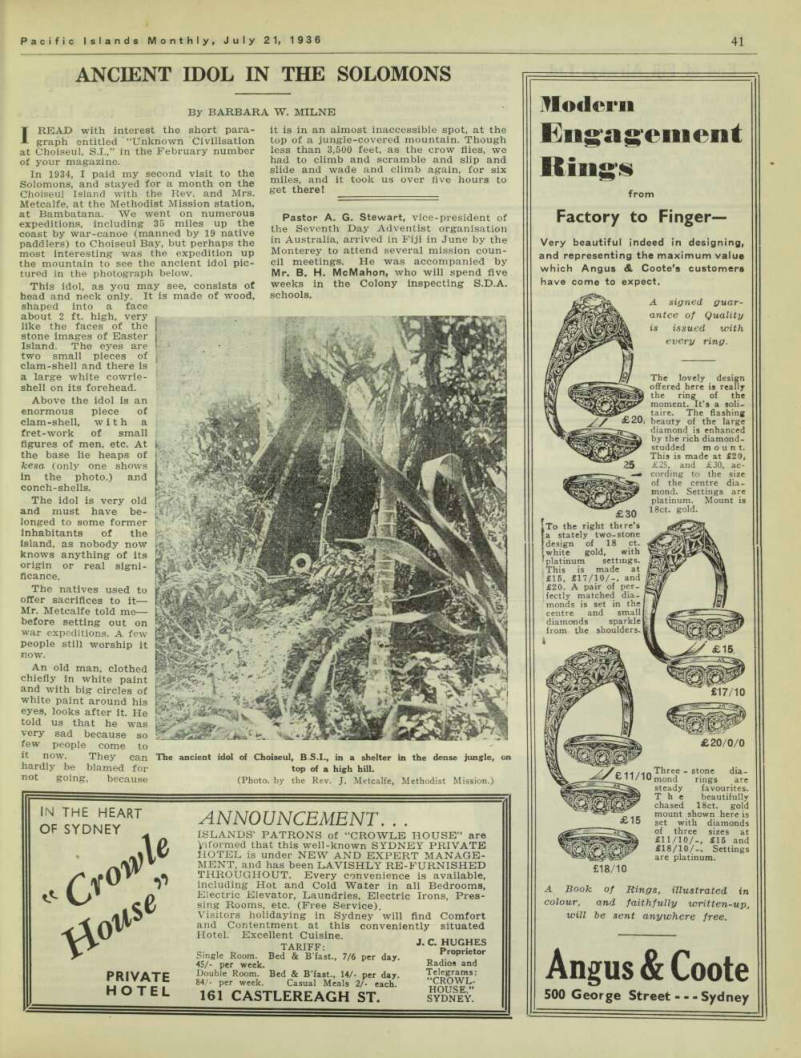
By Barbara W. Milne
IREAD with interest the short para graph entitled “Unknown Civilisation at Choiseul, 5.1.,” in the February number of your magazine.
In 1934, I paid my second visit to the Solomons, and stayed for a month on the Choiseul Island with the Rev. and Mrs.
Metcalfe, at the Methodist Mission station, at Bambatana. We went on numerous expeditions, including 35 miles up the coast by war-canoe (manned by 19 native paddlers) to Choiseul Bay, but perhaps the most interesting was the expedition up the mountain to see the ancient idol pic tured in the photograph below.
This idol, as you may see, consists of head and neck only. It is made of wood,
shaped into a face about 2 ft. high, very like the faces of the stone images of Easter Island. The eyes are two small pieces of clam-shell and there is a large white cowrie shell on its forehead.
Above the idol is an enormous piece of clam-shell, with a fret-work of small figures of men, etc. At the base lie heaps of kesa (only one shows in the photo.) and conch-shells.
The idol is very old and must have be longed to some former inhabitants of the island, as nobody now knows anything of its origin or real signi ficance.
The natives used to offer sacrifices to it— Mr. Metcalfe told me— before setting out on war expeditions. A few people still worship it now.
An old man, clothed chiefly in white paint and with big circles of white paint around his eyes, looks after it. He told us that he was very sad because so few people come to it now. They can hardly be blamed for not going, because
it is in an almost inaccessible spot, at the top of a jungle-covered mountain. Though less than 3,500 feet, as the crow flies, we had to climb and scramble and slip and slide and wade and climb again, for six miles, and it took us over five hours to get there!
Pastor A. G. Stewart, vice-president of the Seventh Day Adventist organisation in Australia, arrived in Fiji in June by the Monterey to attend several mission coun cil meetings. He was accompanied by Mr. B. H. McMahon, who will spend five weeks in the Colony inspecting S.D.A. schools.
The ancient idol of Choiseul, B.S.I., in a shelter in the dense jungle, on top of a high hill. (Photo. by the Rev. J. Metcalfe, Methodist Mission.)
Advertisements & other items, p. 43 (1 item)
Angus & Coote
Modciii
Engagement
Kings
from
Factory to Finger—
Very beautiful indeed in designing, and representing the maximum value which Angus & Coote's customers have come to expect. £2O Z/ r A signed guarantee of Quality is issued with every ring. £3O ■To the right thtre’s a stately two-stone design of 18 ct. white gold, with 'platinum settings. ,This is made at £l5, £l7/10/-, and £2O. A pair of perfectly matched diamonds is set in the centre and small diamonds sparkle from the shoulders.
The lovely design offered here is really the ring of the moment. It’s a solitaire. The flashing beauty of the large diamond is enhanced by the rich diamondstudded mount.
This is made at £2O, £25, and £3O, according to the size of the centre diamond. Settings are platinum. Mount is 18ct. gold.
O 5 £l5 £lB/10 & £l5 £l7/10
Wmw
£2O/0/0 11/m Three - stone diall/10mond rings are steady favourites.
The beautifully chased 18ct. gold mount shown here is set with diamonds of three sizes at £ll/10/-, £l5 and £lB/10/-. Settings are platinum.
A Book of Rings, illustrated in colour, and faithfully written-up, will ~be sent anywhere free.
Angus & Coote
500 George Street --- Sydney
IN THE HEART
OF SYDNEY
c</
PRIVATE
HOTEL
ANNOUNCEMENT. .
ISLANDS’ PATRONS of “CROWLE HOUSE” are
informed that this well-known SYDNEY PRIVATE HOTEL is under NEW AND EXPERT MANAGE- MENT, and has been LAVISHLY RE-FURNISHED THROUGHOUT. Every convenience is available, including Hot and Cold Water in all Bedrooms, Electric Elevator, Laundries, Electric Irons, Pressing Rooms, etc, (Free Service).
Visitors holidaying in Sydney will find Comfort and Contentment at this conveniently situated Hotel. Excellent Cuisine.
TARIFF:
Single Room. Bed & B’fast., 7/6 per day. 45/- per week.
Double Room. Bed & B’fast., 14/- per day. 84/- per week. Casual Meals 2/- each.
161 CASTLEREAGH ST.
J. C. HUGHES
Proprietor Radios and Telegrams:
“CROWL-
HOUSE,”
SYDNEY.
End of Fiji Airways Ltd.
THE last chapter in a notable effort to establish an inter-island seaplane ser vice in Fiji is now being written.
At a special meeting of shareholders of Fiji Airways Limited held at the office of the company in Adelaide, South Austra lia, on June 19, it was announced that the company’s affairs had reached a position where liquidation could be completed. A call of 8d a share would be necessary to
finalise matters. The resignation of Mr.
A. E. H. Evans as liquidator was accepted, and in his place Mr. H. M. Smith, public accountant of the firm of A. E. H. Evans M was a PPointed.
A subsidiary concern of Guinea Airways Limited, Fiji Airways Ltd. was formed in 1932 and commenced operations with three seaplanes, receiving a small Government grant. For a year a mail and passenger service was carried on, but owing to official indifference and lack of public support it was ‘eventually withdrawn.
First Missionary Ship
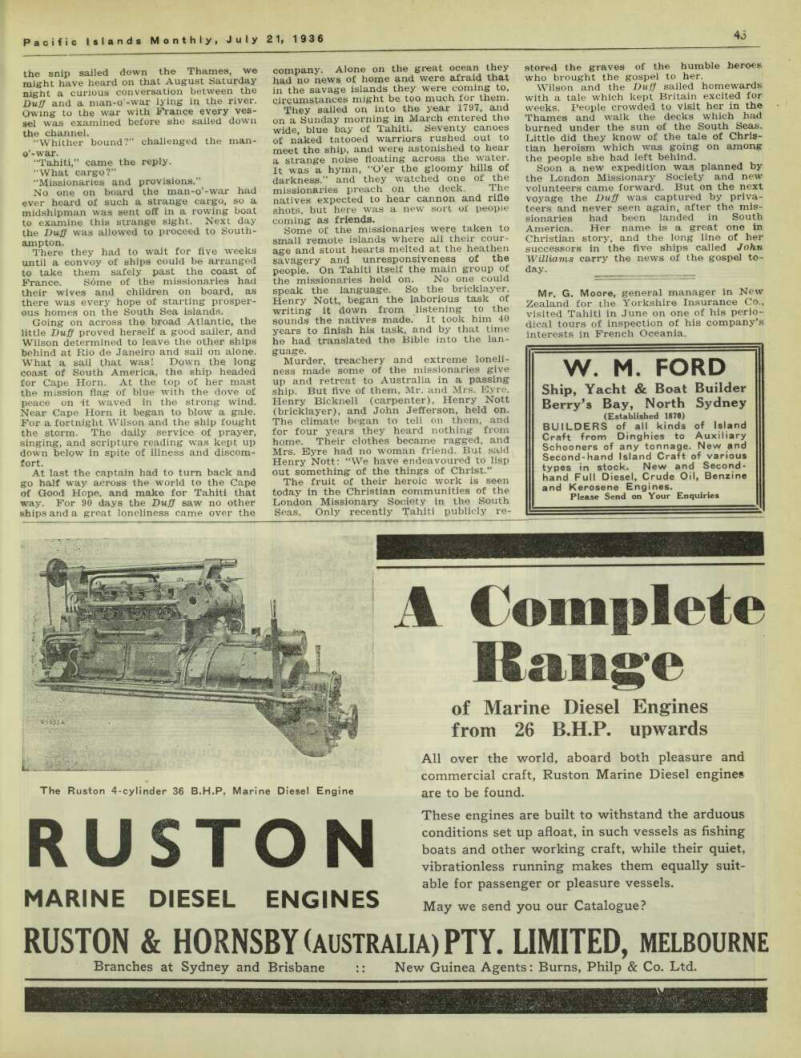
How the “Duff” took L.M.S.
Evangelists to Tahiti
By The Rev. Cecil Northcott, M.A.
THERE are two missionary ships to-day which sail among the small islands in the South Seas —one is the Southern Cross VII. of the Melanesian Mission, and the other the John Williams V. of the London Missionary Society, named after the pio neer John Williams, who met his death at the hands of savage New Hebrides na tives.
The exciting story of missionary ships goes back 140 years for it was on August 10, 1796, that the first missionary ship, the Duff, sailed down the Thames for the Pacific.
One of the reasons why the Duff set sail with the gospel was that Captain Cook had come home from the South Seas with won derful tales of beautiful islands and savage peoples. English people had just begun to think of the great world which as yet was untouched by the gospel. The “inspired cobbler,” William Carey, had reached India and his letters had stirred the people’s in terest.
So a group of ministers and laymen join ed together in London to form the London Missionary Society whose sole object was to “preach the gospel of the blessed God.”
But how were the first missionaries to go to the South Seas? England was at war with France and everybody said it was a foolish time to begin foreign missionary work. But the pioneers were undaunted, and they looked round for a ship and a captain.
The captain came first. Down at Horn dean in Hampshire there was living James Wilson, a handsome man in the prime of life. He had come from a family of 19 children born on Tyneside and had run away to sea. At 15 he was present at the famous battle of Bunker Hill when young America gave a heavy blow to the old country. Then he went out to India on one of the great majestic clipper ships of those days. He was captured in a battle there after swimming a river full of croco diles. The tyrant Hyder Ali kept him in a dungeon chained between dead men for two years. He and the other prisoners were forced to eat the vermin crawling on the walls and floor in order to keep alive.
But Wilson was one of the few who came out alive.
Wilson had never taken much interest in religion. But one Sunday evening he went to service in the little Baptist Chapel at Horndean and heard a sermon which stirred his heart. He was converted and at once wanted to do something to show his faith. He volunteered to be the cap tain of the first missionary ship.
He helped to find the ship. She was lying in the Thames down at Blackwall. and Wilson recommended the Society to buy her for £5,000. She was 267 tons, with a fine copper bottom to withstand the weeds of the sea. So the little? Duff was fitted out, and up and down the country all sorts of people volunteered to sail in her as missionaries to the unknown South Seas.
The people chosen were a curious as sortment for missionary work. There was a shoemaker, a harness-maker, a tailor, a man described as a hatter, a linen draper, a bricklayer, carpenter, surgeon, cabinet maker. gardener, blacksmith, cooper, butcher, weaver, cotton manufacturer, shopkeeper, and five ministers. Many of them had given up their jobs to volunteer for this great adventure.
If we had been living at Gravesend, as
the snip sailed down the Thames, we might have heard on that August Saturday night a curious conversation between the Duff and a man-o’-war lying in the river.
Owing to the war with France every ves sel was examined before she sailed down the channel.
“Whither bound?” challenged the man o'-war.
“Tahiti,” came the reply.
“What cargo?”
“Missionaries and provisions.”
No one on board the man-o’-war had ever heard of such a strange cargo, so a midshipman was sent off in a rowing boat to examine this strange sight. Next day the Duff was allowed to proceed to South ampton.
There they had to wait for five weeks until a convoy of ships could be arranged to take them safely past the coast of France. Some of the missionaries had their wives and children on board, as there was every hope of starting prosper ous homes on the South Sea islands.
Going on across the broad Atlantic, the little Duff proved herself a good sailer, and Wilson determined to leave the other ships behind at Rio do Janeiro and sail on alone.
What a sail that was! Down the long coast of South America, the ship headed for Cape Horn. At the top of her mast the mission flag of blue with the dove of peace on -it waved in the strong wind.
Near Cape Horn it began to blow a gale.
For a fortnight Wilson and the ship fought the storm. The daily service of prayer, singing, and scripture reading was kept up down below in spite of illness and discom fort.
At last the captain had to turn back and go half way across the w'orld to the Cape of Good Hope, and make for Tahiti that way. For 90 days the Duff saw no other ships and a great loneliness came over the
company. Alone on the great ocean they had no news of home and were afraid that in the savage islands they were coming to, circumstances might be too much for them.
They sailed on into the year 1797, and on a Sunday morning in March entered the wide, blue bay of Tahiti. Seventy canoes of naked tatooed warriors rushed out to meet the ship, and were astonished to hear a strange noise floating across the water.
It was a hymn, “O’er the gloomy hills of darkness.” and they watched one of the missionaries preach on the deck. The natives expected to hear cannon and rifle shots, but here was a new sort of people coming as friends.
Some of the missionaries were taken to small remote islands where all their cour age and stout hearts melted at the heathen savagery and unresponsiveness of the people. On Tahiti itself the main group of the missionaries held on. No one could speak the language. So the bricklayer.
Henry Nott, began the laborious task of writing it down from listening to the sounds the natives made. It took him 40 years to finish his task, and by that time he had translated the Bible into the lan guage.
Murder, treachery and extreme loneli ness made some of the missionaries give up and retreat to Australia in a passing ship. But five of them, Mr. and Mrs. Eyre, Henry Bicknell (carpenter), Henry Nott (bricklayer), and John Jefferson, held on.
The climate began to tell on them, and for four years they heard nothing from home. Their clothes became ragged, and Mrs. Eyre had no woman friend. But said Henry Nott: “We have endeavoured to lisp out something of the things of Christ.”
The fruit of their heroic work is seen today in the Christian communities of the London Missionary Society in the South Seas. Only recently Tahiti publicly re
stored the graves of the humble heroes who brought the gospel to her.
Wilson and the Duff sailed homewards with a tale which kept Britain excited for weeks. People crowded to visit her in the Thames and walk the decks which had burned under the sun of the South Seas.
Little did they know of the tale of Chris tian heroism which was going on among the people she had left behind.
Soon a new expedition was. planned by the London Missionary Society and new volunteers came forward. But on the next voyage the Duff was captured by priva teers and never seen again, after the mis sionaries had been landed in South America. Her name is a great one in Christian story, and the long line of her successors in the five ships called John Williams carry the news of the gospel to day.
Mr. G. Moore, general manager in New Zealand for the Yorkshire Insurance Co., visited Tahiti in June on one of his perio dical tours of inspection of his company’s interests in French Oceania,
Advertisements & other items, pp. 44-46 (2 items)
Cordage and
SHIP CHANDLERY - HARDWARE
BROOMFIELDS LIMITED, 152 Sussex St., SYDNEY
Large and Complete Stocks of SHIP CHANDLERY.
Ironmongery of all kinds—Paints, White Lead and Oils.
Sole Agents for : P. H. MUNTZ & CO.’S 3-CROWN BRAND METAL SHEATHING
PEACOCK & BUCHANS’ ENGLISH READY-MIXED PAINTS.
WRITE FOR SHIP CHANDLERY CATALOGUE
Special “In Bond" Prices for all Island enquiries quoted on application
CABLES: "BOOM," SYDNEY
llABtltl WEST - - Sydney’s
Caters for every class of
SAIL, CANVAS,
ROPE & WIRE
EQUIPMENT
Send your enquiries to us
ADDRESS:
BALMAIN,
SYDNEY
111 a* btU i ioim ur- UUR SAIL LOFT
Scott’s Renown Brand Rope,
Cordage and
Binder
Twine
Cable Address Ropeyard, Sydney. w.
of Every
Description
MANUFACTURED AT
MASCOT, N.S.W.
By
J. Scott Ltd.
Head Office and Store:
163 CLARENCE ST.,
SYDNEY, N.S.W.
A Complete
W. M. FORD
Ship, Yacht & Boat Builder
Berry’s Bay, North Sydney
(Established 1870) BUILDERS of all kinds of Island Craft from Dinghies to Auxiliary Schooners of any tonnage. New and Second-hand Island Craft of various types in stock. New and Secondhand Full Diesel, Crude Oil, Benzine and Kerosene Engines.
Please Send on Your Enquiries
- 7 ' The Ruston 4-cylinder 36 B.H.P. Marine Diesel Engine
A Complete
Range
of Marine Diesel Engines
from 26 B.H.P. upwards
All over the world, aboard both pleasure and commercial craft, Ruston Marine Diesel engines are to be found.
RUSTON
MARINE DIESEL ENGINES
These engines are built to withstand the arduous conditions set up afloat, in such vessels as fishing boats and other working craft, while their quiet, vibrationless running makes them equally suitable for passenger or pleasure vessels.
May we send you our Catalogue?
RUSTON & HORNSBY (AUSTRALIA) PTY. LIMITED, MELBOURNE Branches at Sydney and Brisbane :: New Guinea Agents: Burns, Philp & Co. Ltd.
WHERE TO STAY IN PORT MORESBY
Licensee: Papua Hotel, Ltd.
First-class Accommodation. Parties Arranged.
The PAPUA
HOTEL
Catering specially for Tourists and Travellers Situated on high ground overlooking both coasts, its Spacious Lounges are always Cool and Comfortable. Tariff: Per Day, 16/-; per week, £5/5/-; per month, £l4; bed and breakfast, 10/-; bedroom only, 7/6.
Cars meet all steamers.
II Hotel Moresby ne ZZ e
COMFORTABLE
ACCOMMODATION
ONLY THE BEST
BRANDS OF
WINES, SPIRITS
AND BEERS
IN STOCK
LICENSEE:
Hotel Moresby
Ltd.
LICENSEE: — —
— E. J. MORROW
Cosmopolitan
samaraT Hotel
First-class Accommodation for Tourists and Travellers Ball-room; Electric Light; Billiards; Freezing - works; Cold Store. Best brands of Wines, Spirits, Ales.
MODERATE TARIFF
Fishing Trips and Launch Excursions arranged
TAHITI
AND
French Oceania
This book, by Samuel Russell, is a valuable work of reference. It gives, in relation to Tahiti and French Oceania, complete details of administration, commerce, sport, tourist resorts, industries, excursions, hotels, immigration and land laws, etc.
Yachtsmen and fishermen, who are visiting Tahiti in increasing numbers, will find this a most useful handbook.
It also supplies a fascinating account of life in Tahiti—one of the most delightful places of residence in the world.
Copies from: S. RUSSELL, Papeete, Tahitiand
Pacific Publications Ltd.
247 George Street - - - Sydney Price in Australia (posted); Cloth bound, 6/-; paper-cover, 5/-.
Bound and Indexed Files of the
Pacific Islands Monthly
FOR SALE
We shall have for sale, if promptly ordered, several bound files of Volume VI. of the
“PACIFIC ISLANDS MONTHLY”
(August 1935 to July 1936 inclusive).
The twelve numbers included in Volume VI. have been indexed, and the Index is published as part of this issue.
Price of Vol. VI., strongly bound and indexed, and posted to any address is— £2/2/0 Prompt ordering is recommended.
PACIFIC PUBLICATIONS LTD.
Union House, 247 George Street, Sydney.
Telegrams and Cables: PACPUB, Sydney
r
Samara! Hotel
The Rendezvous of the Miners of Eastern Papua Comfortable Accommodation for Tourists, Travellers and Residents. Best Brands of Spirits and Wines—Victorian Lager Beers.
FISHING EXCURSIONS ARRANGED
Licensee: Mrs. L. M. SKELLY.
HOTEL RABAUL
COOL AND SPACIOUS LOUNGES— COMFORTABLE
ROOMS—DINNER PARTIES SPECIALLY ARRANGED
Excellent Dance Floor and Music.
Profit Higher
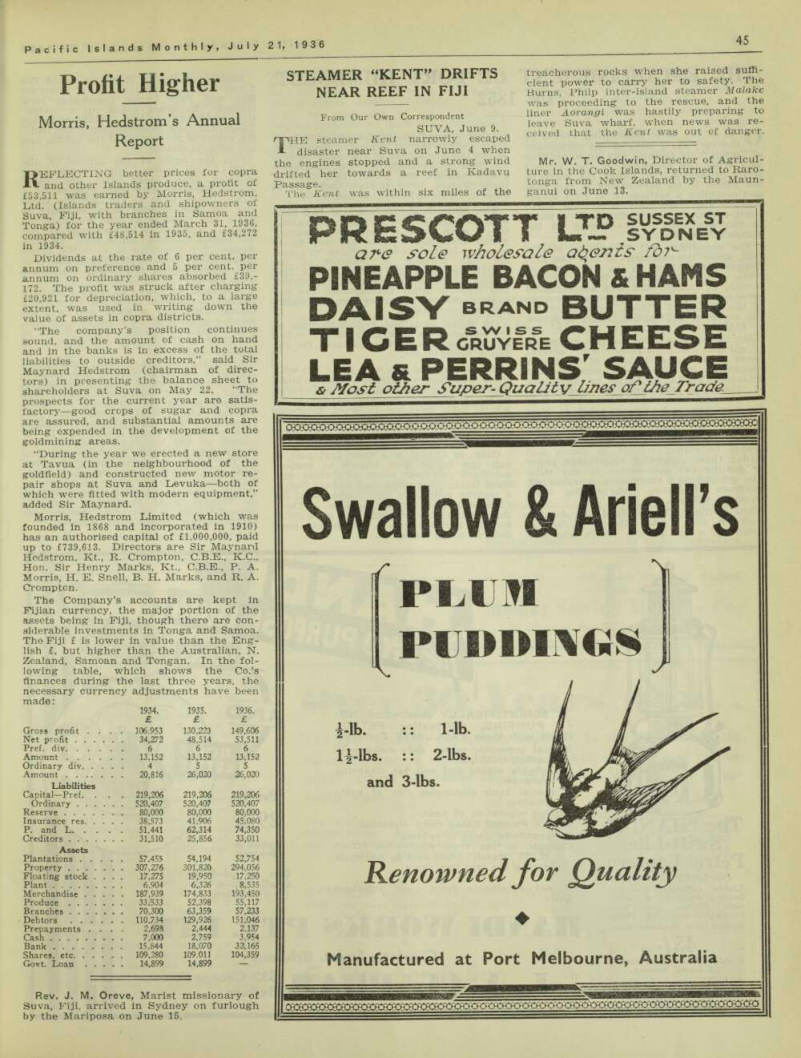
Morris, Hedstrom's Annual Report
REFLECTING better prices for copra and other Islands produce, a profit of £53,511 was earned by Morris, Hedstrom, Ltd. (Islands traders and shipowners of Suva, Fiji, with branches in Samoa and Tonga) for the year ended March 31, 1936, compared with £48,514 in 1935, and £34,272 in 1934.
Dividends at the rate of 6 per cent, per annum on preference and 5 per cent, per annum on ordinary shares absorbed £39,- 172. The profit was struck after charging £20.921 for depreciation, which, to a large extent, was used in writing down the value of assets in copra districts.
“The company’s position continues sound, and the amount of cash on hand and in the banks is in excess of the total liabilities to outside creditors,” said Sir Maynard Hedstrom (chairman of direc tors) in presenting the balance sheet to shareholders at Suva on May 22. “The prospects for the current year are satis factory—good crops of sugar and copra are assured, and substantial amounts are being expended in the development of the goldmining areas.
“During the year we erected a new store at Tavua (in the neighbourhood of the goldfield) and constructed new motor re pair shops at Suva and Levuka —both of which were fitted with modern equipment,” added Sir Maynard.
Morris, Hedstrom Limited (which was founded in 1868 and Incorporated in 1910) has an authorised capital of £1,000,000, paid up to £739,613. Directors are Sir Maynard Hedstrom, Kt., R. Crompton, C.8.E., K.C., Hon. Sir Henry Marks, Kt., C.8.E., P. A.
Morris, H. E. Snell, B. H. Marks, and R. A.
Crompton.
The Company’s accounts are kept in Fijian currency, the major portion of the assets being in Fiji, though there are con siderable Investments in Tonga and Samoa.
The Fiji £ is lower in value than the Eng lish £. but higher than the Australian, N.
Zealand, Samoan and Tongan. In the fol lowing table, which shows the Co.’s finances during the last three years, the necessary currency adjustments have been made:
Rev. J. M. Oreve, Marist missionary of Suva, Fiji, arrived in Sydney on furlough by the Mariposa on June 15.
1934. 1935. 1936. £ £ £ Gross profit . . . . 106,953 130,223 149,606 Net profit . 34,272 48,514 53,511 Pref. div 6 6 6 Amount . 13,152 13,152 13,152 Ordinary div. . . . 4 5 5 Amount 20,816 26,020 26,020 Liabilities Capital—Pref. . 219,206 219,206 219,206
Ordinary
. 520,407 520,407 520,407 Reserve . 80,000 80,000 80,000 Insurance res. . . . 38,573 41,906 45,080 P. and L. . . . 51,441 62,314 74,350 Creditors . 31,510 25,856 33,011 Assets Plantations . . . . 57.455 54,194 52,754 Property 301,820 294.056 Floating stock . . . 17,275 19,950 17,250 Plant 6,326 ,8,535 Merchandise . . . . . 187,939 174,833 193,450 Produce 33/533 52,398 55,117 Branches . 70,300 63,359 57,233 Debtors 129,926 151,046 Prepayments . . . 2,698 2,444 2,137 Cash 7,000 2,759 3,954 Bank 15,844 18,070 32,165 Shares, etc 109.011 104,359 Govt. Loan . . . . 14,899 14,899 —
Steamer “Kent” Drifts
Near Reef In Fiji
From Our Own Correspondent SUVA, June 9.
THE steamer Kent narrowly escaped disaster near Suva on June 4 when the engines stopped and a strong wind drifted her towards a reef in Kadavu Passage.
The Kent was within six miles of the
treacherous rocks when she raised suffi cient power to carry her to safety. The Burns, Philp inter-island steamer Malake was proceeding 1 to the rescue, and the liner Aorangi was hastily preparing to leave Suva wharf, when news was re ceived that the Kent was out of danger.
Mr. W. T. Goodwin, Director of Agricul ture in the Cook Islands, returned to Raro tonga from New Zealand by the Maun ganui on June 13.
Advertisements & other items, p. 47 (1 item)
Swallow & Ariell’s
PRESCOTT L T J? |y S I^NE S V Q7 c e sole wholesale afyenis fbi^-
PINEAPPLE BACON & HAMS
DAISY BRAND BUTTER
TIC E R cruyere CHEESE
LEA s PERRINS' SAUCE
& Most other Super- QuaUt v lines oS the Trade
Swallow & Ariell’s
y v
PLUM
IMSMMV4.S
Mb. :: Mb. :: 2-lbs. and 3-Ibs.
Renowned for Quality
Manufactured at Port Melbourne, Australia
The Establishment Of Port Humboldt
IN 1852
ONE of the most interesting events of the very early days of the occupation of Dutch New Guinea was an expedition sent from the Moluccas by the Nether lands Government to annex the north of the island to its possessions in the East and establish a settlement at Port Hum boldt. Port Humboldt is on the north coast of Dutch New Guinea, a few miles to the westward of the border of the Mandated Territory.
The expedition left Ternate in March, 1850, under the command of Mr. Van Den Dungen Gronovious, in the war schooner Circe, with Lieutenant Brutel de la Riviere in charge, and was accompanied by a small flotilla of war praus belonging to the Sultan of Tidore, represented for the occasion by Captain Amir, a prince of Tidore.
Mr. Gronovious stood in high repute as a colonial administrator. For several years he had been Resident of the Dutch possession, in Timor. He was invested with some kind of authority by the Sultan of Tidore, a pensioner of the Dutch Government, who claimed suzerainty over the northern and eastern coast of New Guinea. The Sultan had for many years enforced his claim by sending forth periodically a flotilla of Hongi (or war praus) to collect tribute in slaves and trade; these generally maintained order by dealing out destruction to any tribe who offered any resistance, carrying off hundreds of slaves and burning their principal villages.
The natives acknowledged this domin ance on the whole without ill-feeling, excepting a few remote tribes who had
not yet learned the wisdom of obedience.
They were in favour of placing themselves under the protection of the most power ful chief in the neighbourhood, as a safe guard against the piracy that infested these waters, even though they had to submit to his arbitrary measures.
The Netherlands Government had like wise encouraged the Sultan’s suzerainty, for it gave them a claim to a country which they might some day see fit to occupy. Indeed, this expedition was sent for this purpose. A transfer of the suzerainty from the Sultan was a for mality which could easily be negotiated, and Captain Amir accompanied the ex pedition for the object of formally hand ing over possession.
On these occasions, representatives of the Sultan were invariably present when new settlements were established for the Dutch Government.
The expedition was well fitted out with trade and presents for the native chiefs.
The officials also carried a number of iron plates displaying the Netherlands arms, which they intended to erect wherever they visited along the coast. These, apparently, were erected at each new settlement of the Netherlands Indies.
Giby, or Gebby, was their first port of call (an island well known to ancient mariners on their route to China) and from Gebby they proceeded to Port Dorey, a trading post from time immemorial for Chinese and traders of the East. There they remained from April 1 to 20, waiting for the Sultan’s flotilla, which had been delayed along the coast.
Lieutenant Bruijn Kops, on board the Circe, describes the natives of Geelvink Bay and Port Dorey (northwest New Guinea), in great detail, in a narra tive published in the “Natuurkundige Tijdschrift voor Nederlandsch Indie, 1851.”
He writes of the arrival of the flotilla, and the panic it caused.
“On the news of the arrival of the flotilla,” he states, “the women and children took flight with the small canoes, carrying with them everything of value. They went to the opposite shore and into the interior bays, in order to avoid the rapacity of the crews of the flotilla. It is not to be wondered at that the flotilla instils so much fear,” he con tinues, “for wherever it goes the crews pillage and steal, destroying plantations and appropriating everything that takes their fancy.”
The chief of Dorey at once presented himself to Captain Amir on his arrival, taking with him a slave and a great number of birds-of-paradise, as a present, which was apart from the yearly tax of the chief to the Sultan—one slave, three praus, and provisions.
According to the general opinion of travellers in New Guinea, the Dorians were taken to be of very mixed origin, owing to their intercourse with more civilised people for hundreds of years.
To this Lieut. Bruijn Kops could not agree. He considered that people of mixed race were to be found everywhere in the islands of the Moluccan seas, but very rarely in Papua itself; which he explained by the traffic in slaves, hundreds, even thousands, having been exported west ward for ages past, while no brown or yellow people ever settled in New Guinea, or became even temporary residents beyond the limits of trading stations, ex cepting a few Mohammedan priests.
Bruijn Kops went further. He con
sidered that the Papuans he encountered were beyond all comparison superior in mental and physical vigour to those tribes in the East Indies with whom they were brought into contact. He was greatly impressed with these people. He found them friendly and hospitable and he con sidered that they owed their reputation for bloodthirsty truculence to the early explorers who, like Dampier in 1700, asserted with vexation that the natives of New Guinea when fired upon, did not scruple to retaliate.
"Get animal est tres-mechant!
Quand on I’attaque il se defend”
Bruijn Kops deals at length with the customs, habits, arts and agriculture of the Dorians. “The manners and customs, he writes, “of the Dorians are much less barbarous than might be expected from these rude uncivilised races. On the con trary, in general, they gave evidence of a mild disposition, of an inclination to right and justice, and strong moral principles.”
Though kidnapping was general, and was followed as a branch of trade, there was no dishonour attached to it. Indeed, the chief trade at that time, besides odiferous bark and birds-of-paradise, was in slaves; the slave being the standard of value throughout the western parts of New Guinea. The captives from New Guinea were held in high esteem, fetching higher prices than even those from Bali, Lombok and Sumbawa.
One of their arts which took his atten tion was the working of iron, by means of a forge, consisting of a bellows com posed of two large bamboos about four feet long, from which the air was expelled by means of two pistons with bunches of feathers at the end, worked in the manner of hand pumps. This instrument was identical with the bellows he had seen in use among the natives of the Malay Archipelago, from whom no doubt the custom was borrowed.
They also made rings, bracelets and ear rings from copper and silver, and from Spanish coins which they had obtained from the French surveying ships Astro labe and Z elee when they visited the dis trict in 1840.
After the formalities over the transfer had been completed, the expedition pro ceeded to Run, an island situated in the “Great Bay” of Geelvink. Here, they found the natives had little or no know ledge of the outside world and therefore did not flee in terror at sight of the flotilla. It had only recently been opened as a trading post, and was rarely visited except by an Englishman named Captain Deighton, who had been for many years a trader in the Moluccas and had traded on the north coast of New Guinea since 1820. He was well known to all inhabi tants and held in high esteem.
“The frankness with which I was re ceived,” wrote Bruijn Kops, “struck me, as it was entirely unexpected.” He attri buted their friendly attitude towards the expedition to the honourable character of Captain Deighton and his honest dealings with the natives. It was in marked con trast with the fear and suspicion they encountered at Dorey.
Captain Deighton, according to Bruijn Kops, appeared to be the one check on the rapacity of the Tidore tribute collectors in these waters. Fearing that he would report them to the authorities, they refrained from committing their worst atrocities.
Kurudu, an important trading station to the extreme N.B. of Geelvink Bay (or Great Bay, as Lieutenant Bruijn Kops named it) was next visited, and probably for the first time by an European vessel.
Here, again, they were received in a cautious, but by no means unfriendly, manner, although only a few years pre
viously their villages had been destroyed and 200 of their members carried away into captivity by a dependant of the Sultan of Tidore, Singaji of Gebby.
On the approach of the Circe the natives gathered on the shore fully armed, but the weapons were soon laid aside on landing, and a friendly intercourse was established, which however was rudely shattered by the firing of the evening gun from the schooner. The natives fled in terror immediately, and the next morning no sign of them was to be seen, “The entire population, from the village to the mainland,” had disappeared into thin air, and only a few dogs remained, whose melancholy bowlings added to the exasperation of the Dutch officers.
Bruijn Kops found the inhabitants of Kurudu altogether different from those at Dorey and Run; he took them to be more of a Polynesian than a Malayan character.
He thought that the Great Bay (Qeel vink) might possibly be the dividing line between the Papuans of the Pacific and those of the Indian Archipelago.
Leaving Kurudu, the expedition passed eastwards for more than a hundred miles past the delta of a large river, named Ambermo by the natives. From its many outlets muddy water poured out to sea, and for thirty miles shoals and sand banks hindered the passage of the Circe as she pushed her way carefully towards Humboldt Bay.
The chief object of the expedition was to examine Port Humboldt (Hollandia), L a t. 2.205, Long. 140.47 E, and to ascertain whether the existing conditions merited the formation of a settlement. But, un fortunately, on arriving, a strong S.E. squall prevented the Circe from making an entrance into the harbour, and they were forced to turn back to Amboina.
However, the information gathered by Mr. Van Den Dungen Gronovious seemed to be sufficiently encouraging for the Netherlands to decide upon an establishment: for one reads that in 1852 a garrison consisting of a party of burghers, or native militia from Ternate were sent to Port Humboldt for that purpose. ‘‘A class of men,” writes a traveller of that time (G. Windsor Earl) “who though capable of holding their own in this inhospitable region, were by no means calculated to
inspire respect in the stalwart and ener getic Papuans.”
It seemed that the Dutch Government hoped that the settlement, apart from its administrative value, might be looked upon as a haven for shipping employed in the commerce of the Far East, and would open up the 1,400 miles of inhospit able coastland of New Guinea for vessels crossing from America. Shipping would attract trade and, perhaps, settlement, which would eventually lead to the estab lishment being placed on a more sub stantial footing.
It is over 80 years since Port Humboldt was established, and the rewards of the enterprise so far have not borne much fruit. The inhospitable nature of the country, and its isolation, offer little inducement for development. It is only to-day that one hears, among the big developments that are taking place in Dutch New Guinea, that colonists have settled near the scene of the old Post of 1852, and are making a living at farming —a peaceful occupation in contrast to the livelier one of slave-raiding which, until 1879, formed one of the principal occupa tions of the Archipelago, and the north coast of New Guinea.—M.L.
Mrs. Frank Hockings, of Thursday Island, returned to T.I. in June from a visit to her parents at Roma, Queensland.
Advertisements & other items, pp. 48-50 (1 item)
" L A. Clapiiam
m
The “HANDI”
Swift-Lite
Petrol Lantern
300 CANDLE POWER
Lights instantly (no preheating required), automatic steel pricker, also flame regulator. Built in Pump.
Sycfaey and Brisbane price: 45/- 1 gallon Petrol does approx. 72 hours’ burning.
AGENTS required in all centres. Storekeepers write for special export price.
If not write * L
IRONS
AND
Price;
29/6 Sydney or Brisbane A SCIENTIFICALLY constructed, NO- PUMPING, self-heating PETROL IRON with these EXCLUSIVE Features: Special generator which does away with carbon troubles.
Detachable nipple and coil for cleansing purposes.
A special tank eliminates risk of overflowing.
Perfect regulation of heat.
Double Pointed base; fully nickelled.
No expensive parts to renew.
Cheaper to use than electricity. Over 12,000 “Handi” Irons sold in Australia during the last two years. obtainable from your storekeeper, Can be used as small stove, as illustrated.
HANDI WORKS PTY. LTD.
Charlotte Street, Brisbane
" L A. CLAPIIAM
Sydney
MASTER SEWING MACHINE CO.
ESTABLISHED FOR 23 YEARS
A Reconditioned
SEWING MACHINES
For Industrial and Household use.
All Types for Sale.
From £3 Each
Every Machine Guaranteed Mechanically Perfect.
We have the most complete range of Sewing Machines in New South Wales.
Repairs promptly attended to by Competent Mechanics.
Let us know your requirements.
We will be pleased to quote by return mail.
No Delays All Goods Carefully Packed
Master Sewing Machine Co.
15 Enmore Road, Newtown, Sydney
Over 30 Years Ago
The first Younger Stove was exported to the Pacific Islands.
Ruggedly strong in construction, highly efficient and economical in fuel has made them the most popular stove in the
South Seas.
The illustration shows a Younger Single Stove. Special stoves with cast iron ovens for Island requirements made to order.
Write us for quotations for special sizes and catalogue of double and single oven stoves.
G. Fletcher & Son
50 OXFORD STREET, SYDNEY
RECORDS
Our Island Service is unbeatable.
Every Record available and sent same day as order received.
Goods are packed free and sent if desired V.P.P., and by this method they can remain at Post Office till you are ready for them.
Talkeries Music Stores
451 Queen Victoria Buildings,
SYDNEY
EXCELSIOR SUPPLY CO. LTD.
The most extensive Manufacturers in the British Empire of
RUBBER STAMPS,
INKS, STENCILS.
Marking Devices.
ACME STAMP PADS
We have a big range ol Special
FRUIT CASE MARKING SETS
I We also Manufacture or Supply a complete line of
Spraying Machines
for all purposes.
Let us know your requirements and we will quote you by return. Ask for our Big Catalogue.
Sole Australasian Distributors of the World Famous SHEAFFER FOUNTAIN
PENS and PENCILS.
EXCELSIOR SUPPLY CO. LTD.
Head Office 160 BROADWAY,
SYDNEY. N.S.W.
Peanuts
New Crop for Norfolk Island
QNE result of the visit to Australia of Mr. Charles Bennett, well-known grower on Norfolk Island, is that the Island is likely to possess another industry in the near future. Mr. Bennett was sur prised to find in Sydney a factory, employ ing 200 hands, which deals exclusively in peanuts and the by-products of that nut.
He was assured of a market for all the peanuts that can be grown on N.I. This nut has been cultivated with much success and profit in recent years in the Northern Territox-y of Australia.
Hitherto, peanuts have not been grown commercially on Norfolk Island. Mr. Ben nett took back with him by the June Mo rinda some of the best examples of Spanish and Brazil peanuts, which he is confident will,/in the near future, be a source of potential wealth to his fellow-growers on the Island.
“While it is not likely that growers will give up their profitable crops of beans,” he explained, “I think that some portions of N.I. are most suitable for peanut growing, and that the crop should do exceedingly well on the Island.”
Mr, Bennett also interviewed the N.Z.
Trade Commissioner (Mr. W. Taylor) and put forward a strong plea for the exclusion of Norfolk from the present fruit embargo that exists between Australia and New Zealand. “Our fruit is absolutely clean,” he declared, “and there is no reason why it should be restricted in any form. As a result of the restriction some growers are in reduced financial circumstances. In deed, some of the families are actually on the bread line.”
The existing condition of N.I, affairs he contended was due to inefficient and costly administration, and a disregard of their trusteeship by Australian Federal Minis ters. Administration charges, he said, totalled £14,000 annually, while the Island ers submitted that they could run their own affairs for £5,000 and leave a surplus with which to develop the Island.
Mr. Bennett said that Norfolk Island was not part and parcel of the Common wealth, but had been handed over by Downing Street as a trust to the Austra lian Government. The visit of Sir George Pearce had not improved the situation, and some Islanders were urging a change in administration. At present the Officer in Charge of the Administration acted in a dual capacity as prosecutor and judge. The Islanders, who now number 1,000, had no representation in Federal Parliament.
Mr. Frank R. Hewitt, general manager of Lever’s Pacific Plantations Pty. Ltd., left Sydney by the Montoro on June 17 for Samarai, Papua, to visit Giligili Plan tation. Later he joined Lever’s vessel for Gavutu, British Solomon Islands, to in spect the Company’s plantations in the Group. He will return to Australia by the Malaita in September.
Advertisements & other items, p. 50 (1 item)
Delivery
New Britain Express
GENERAL OVERSEAS AGENTS
GENERAL CARRIERS, BAGGAGE
AND FORWARDING AGENTS.
ROYAL MAIL CONTRACTORS.
Reliable Cars and Truck*
We aim to give quick and reliable Service at reasonable costs. P.O. Box Hi. ’Phone 141.
W. WALKER-FLYNN, Proprietor.
Malaguna Road, Rabaul, T.N.G.
Stephen Rabone
Centenary of Pioneer Tongan Missionary
THE centenary fell in June of the arrival in Tonga of the Rev. Stephen Rabone, who laboured for 14 years in the Friendly Islands, and for a short time was acting principal of Newington College, an insti tution which to-day preserves its early associations with the only remaining in dependent kingdom in the Pacific (wrote Mr. Eric Ramsden in the Sydney Morning Herald on June 27). Newingtoh’s students include the Crown Prince Taufa’ahau, a direct descendant of the great Taufa’ahau (George Tubou I.), one of the first to wel come Stephen Rabone to Tonga in 1836.
Rabone’s first attempt to reach Tonga resulted in shipwreck off the island of Bona Vista, in the Verde Group, in De cember, 1834. Undaunted, the Wesleyan Methodist missionary and his young wife returned to England, and again sailed on the Rubicon, a sailing vessel of 450 tons, on April 17, 1835. Hobart Town was reached after an uneventful voyage in the following August.
Mr. and Mrs. Rabone remained there for six months (during which period their eldest child was born), and arrived in Sydney in February, 1836. Six weeks later they sailed for Neiafu, Vavau, and later settled at Feleatoa. The vessel in which they travelled was the old Active, which the Rev. Samuel Marsden had employed so successfully in the Pacific. On the re turn voyage the Active went on a reef and became a total wreck.
Tongatabu was sighted on June 9, 1936.
“Oh, what were our feelings while looking at this island, which has engaged every feeling of our hearts for years past,” de clared the missionary in his unpublished journal (the original of which is in the Mitchell Library, Sydney). “The scenery as you approach surpasses everything we have seen or could imagine.”
“Where you from? Have you mission ary?” inquired an English-speaking Ton gan from a canoe, when the Active lay off Vavau on June 14. “Which him? Which him?” eagerly inquired the native. The Tongan proved to be a man who had lived for some years with the Rev. John Thomas. Rabone and Thomas were doubly related; the newly-married missionary was a step-brother of Mrs. Thomas and his wife was Thomas’s sister. Mr. and Mrs. Thomas had arrived at Hihifo as early as 1826. Before returning to Eng land in 1851 they spent a quarter of a cen tury in the Islands. Four years later they returned to spend another five years there before finally retiring.
King George Tubou’S Famous
Whale Tooth
When Queen Salote returned to Tonga from Sydney last year she carried with her a famous whale tooth, yellow with age, which King George Tubou I. had exhibited at a missionary meeting in Wes ley Church, Chippendale, Sydney, in 1853, The tooth was a priceless relic of the old pagan days. No more precious gift in Tongan eyes could possibly be imagined when the king handed it to Rabone, “to show the people of Australia what the Tongan worshipped prior to accepting Christianity.” Queen Salote was naturally delighted to find that it was still in the possession of the Rabone family, and re marked that she could trace it back to the grandfather of George Tubou I. The year previous to the missionary’s arrival
in Tonga the king had freed his slaves, and ancestral carved spears were con verted into communion rails.
On behalf of members of his family.
Mr. W. T. Rabone (a grandson of the Rev. Stephen Rabone) handed it to the Queen, to be returned to her kingdom. It is now in the Royal Palace at Nukualofa.
A century ago, Tonga was by no means the model Christian State it is to-day. At the time of Rabone’s arrival the mission aries were still meeting with a great deal of opposition. As had Kamehameha in Hawaii, and Pomare 11. in Tahiti, George Tubou I. had to consolidate his kingdom; though the king was a Christian, many of his fellow-countrymen were not prepared to accept the new creed, and were ready to die in defence of the old gods.
Lawless Europeans
European traders were also a cause of anxiety to the missionaries. In one of the first entries in his journal Rabone makes reference to a certain captain who, after taking a Tongan girl to sea, in a state of intoxication threw her overboard, and then forcibly took another young woman, the betrothed of an important chieftain.
In a subsequent altercation the captain killed the aggrieved native. Such men, declared the missionary, made him ashamed “of the name of Englishman.”
King George, declared Rabone, was “in deed a fine man, body and soul.” At the opening of anew church, in 1837, he ap peared in “a suit of English clothes,” to read Solomon’s prayer at the dedication of the Temple. “His remarks, I am told, were judicious and well placed,” com mented the newcomer, “his zeal as mani fest was worthy of a king in so good a cause.” The king, who was the political force behind the Christian cause, lived until 1893. At that time, however, he was
about to visit Hapaii, where, it was hoped, he would deliver a deathblow to “the re maining cause of heathenism in Tonga.”
On December 31, 1836, the young mis sionary was present at a native watch night service. Two days later the mis sionaries were alarmed at hearing the beating of the lali or war drum. The call announced the arrival of a canoe from Tongatabu, which brought information that King George wanted all “strong and healthy men” to proceed to that island, “in case the heathen should be foolish enough to fight, that he might have a force to meet them, and, in the name of the Lord, put them to flight.” The heathen, as a matter of fact, put up a determined resistance and many lives were lost in the fighting that ensued.
That same year the missionary and his
wife were homeless as the result of a devastating hurricane. “Last night it came on to blow very hard, with heavy rain, which before daylight had well filled our bedroom,” he wrote on March 8.
“With the day the wind increased, so that it was soon necessary for my dear wife and child to leave the house. Part of the roof was soon cai'ried away In attempting to walk I was nearly car ried away. About 9 o’clock, our house and every building on the premises were down level with the earth . ” Describ ing the scene next day, he declared; “Oh, what destruction is visible all round!
Scarcely a house, however proverbially strong, but is brought to the earth. Trees of very great size are broken off short and uprooted; many of these have endured the blasts and storms of bygone generations. The nut trees are all stripped of their fruit, every banana tree is flat on the earth, so
that we fear there will be considerable. scarcity felt by the natives, ... It is little more than iwo 'years since we were cast upon the island of Bona Vista, where we lost everything we had except what we stood in, and now by land we are partially Stripped again. Thy will be done! Amen.”
On walking to Neiafu that week, he was astounded “at the scene of barren ness and destruction.” The hurricane had left its mark on every tree and plant.
“Many of them are shrivelled up as if scorched,” he declared. On leaving the village the lali again began to beat, an nouncing the arrival of a sail off the coast.
Fortunately, it proved to be a brig fj*om Sydney with supplies for the missionaries.
The Minerva had been driven off the island, thrown on her beam ends, and the crew had to cut away the masts.
The Tui Tonga
In February of the following year (1838) Rabone recorded the arrival of the Tui Tonga, the revered religious head of for mer days. “He is the greatest personage on the island,” he wrote, “but what a creature of imagination, what a monstrous cypher! He had a handful of people only, cannot speak a word in reference to the government of the island nor anything that concernis it. It is not lawful to eat in his presence . . . and there is lan guage only applicable to this useless being, as much utility to the island as a large mole to a man’s face!”
The old Tonga was passing. The power of the Tui Tonga was already in the hands of George Tubou, ally of the missionaries.
Rabone and his wife later decided to remove to Nukualofa (now the capital).
Then followed patient years of hard mis sionary work.
Following the triumph of Christianity in Tonga, the family removed to Australia.
Later Stephen Rabone’s son decided to offer himself as a missionary. Uhder the tuition of his father (who became a noted Tongan scholar and was responsible for compiling a vocabulary printed in Vavau in 1845 and now keenly sought after by collectors), the Rev. W. T. Rabone became so proficient in the tongue he had known as a child that, on the first Sunday after his return, he was able to preach in Ton gan.
Stephen Rabone collapsed in a Sydney street on July 27, 1872, when on his way to the Wesley Church, Chippendale, and died that day. His funeral sermon was preached by the Rev. James Watkin, who was in Tonga when the former arrived there in 1836. An appeal for funds for a memorial, to which many Tongans sub scribed, resulted in £2OOO being raised.
However, no memorial has yet been com pleted to honour the memory of a worthy pioneer of the Methodist Church in the Pacific and Australia.
Advertisements & other items, pp. 51-52 (1 item)
Newlands Brothers Ltd
Produced in Australia by
STEEL BEDSTEADS
WIRE MATTRESSES
“MORNING GLORY” BEDDING
TUBULAR STEEL FURNITURE
“LISTER”HOSPITAL EQUIPMENT
SHIPS’ ALL METAL BERTHS
WE WILL GLADLY FORWARD OUR
COMPLETE SETS OF CATALOGUES
Newlands Brothers Ltd
RILEY STREET :: SYDNEY, N.S.W.
Australia’s Largest Manufacturers of Modern Sleeping Equipment.
Cable address: “Newlandbed,”
Sydney
PASNT HORSE SHOE BRAND
IN PASTE OR READY
MIXED FORM
Made in Scotland— O
WHITE LEAD, WHITE ZINC.
AND ALL COLOURS
—therefore Reliable!
Thomas Mcintyre & Co. Ltd., Glasgow, Scotland
DOYLE’S famous VETERINARY REMEDIES
REDUCINE—Cures Your Lame Horse. Cures him painlessly and you can work him all the time.
Cures Splints, Curbs, Capped Hocks, Sprung Tendons, Bog Spavins, and all Bony and Bursal Enlargments. Price, 12/6 per can. Postage 1/-. f •' LARYNGINEi—A sure cure for Coughs, Colds, . Strangles, etc. Price, 5/- per can. Postage, I/-.
SKIN DRESSING.—A certain remedy for Mange and Allied Parasitic Skin Diseases in Horses, Dogs, etc. Price, 7/6 (large), 3/6 (small). Postage, 1/-.
DISTEMPER MIXTURE.—A safe and reliable 3 ''' remedy for Coughs, Colds, Asthma, etc. Price, 2/6. Postage, 9d.
T. G. DOYLE, V.S., 9 KING STREET, RANDWICK, N.S.W.
Write for Free Veterinary Advice and Booklet s
can be carried out with
these Light Steel Cultivators
Special Features: Suitable for one bullock or horse. Can be supplied with a wide range of reversible points and shares.
Made in 3 sizes: “MIDGET" (fixed), with 5 tines covering 24ins. BTSL (single lever) adjustable for width from Made by: Ransomes, Sims & Jefferies, Ltd.
Ipswich, England 14ins. ta 24ins. BTDL (2 levers) with 5 or 7 tines.
Mxansomes
The BTSL.
Light Steel Cultivators
Illustrated literature and all information will be sent on application.
Agents for: Fiji, Samoa and Tonga,
MORRIS,
HEDSTROM, LTD.,
Suva, Lautoka, and Ba.
Pedigree Stock For
Tavua Farm
From Our Own Correspondent SUVA, July 1.
BY the Waipahi on June 20, Mr. Basil Chalmers arrived in Fiji, bringing with him six pedigree Friesian heifers for Waidranu Farm, Vatia Point, Tavua.
This breed is becoming very popular in Fiji, and the new beasts will be an asset to Waidranu.
The farm is being developed by Mr. N.
C. Chalmers for his son, Mr. Basil Chal mers. who has just completed a course of training at the Government Agricultural College, Ruakura, New Zealand.
The heifers are from Mr. A. H. Court’s Hobson Farm, Helensville, which is re puted to be one of the finest N.Z. Friesian stud farms.
Papua
Planters’ Association of Papua First Bulletin Issued
THE Planters’ Association of Papua, which was formed in January, issued its first bulletin to members on June 7.
The following is a summary of the infor mation contained therein: Captain A. S. Fitch has resigned. He found that his business interests conflicted with the aims of the Association.
The Association has written to the Agricultural Adviser to the Colonial Office, London, for as sistance in obtaining the services for the Adminis tration of an Agricultural Expert, with practical field experience. Members have agreed that the appointee should be given a seat on the Legisla tive Council.
The Hon. T. Nevitt recently interviewed the Minister for Customs in Australia in an endeavour to accelerate rubber bounty payments. The Minis ter promised to see that there was no further delay.
Experiments in rubber packing have been carried out at Eilpgo Estate. The produce was packed in one cover of heavy type Japanese calico.
It reached Sydney in good order, but Melbourne wharf lumpers used cargo hooks on it, completely disrobing it. According to the Hon. T. Nevitt, the Dunlop Perdriau Rubber Co. insists on rubber being baled in hessian wrappers with an inside covering of light calico. Dunlops say that a light sprinkling of french chalk should be given the bale before wrapping, to prevent the cover from stick ing to the rubber.
The Association, in a letter to the Director of Agriculture, has pointed out that there are plenty of suitable places in Papua for tea growing, but want of roads prevents such development. The only labour available (prisoners) for district roads is now being enrolled for carrying on patrol work.
The Council views with concern the expenditure of revenue in this direction and the neglect of out side public works.
On his own initiative, the Hon. Arthur Jewell has installed a telephone radio station at Lolurua.
The Council has asked the Government what radio stations it intends to erect, as some members are about to instal land telephones to nearby shipping ports. They cannot make a move until they know the Government’s programme.
Representation has been made to the directors of Messrs. Burns, Philp and Co., Ltd., in an en deavour to bring about a cheaper form of handling copra and other produce at Port Moresby.
Ten years ago the Federal Government granted Papua a preferential tariff and the sum of £25,000 per annum for 10 years. Hardly any of the items of the tariff have been grown in any quantity, with the result that very little of the £250,000 set aside has been touched. Planters at the time complained that the principal product, rubber, which should have been included, was left out.
The term for the preferential tariff has expired and the Federal Cabinet is now considering a new one. The Planters’ Association suggests that rub ber should be definitely included. A more simple method would be for Australia to grant a long term bounty of 20 to 30 years. With such a guar antee, many investors would put capital into Papua, and in the course of years the Common wealth’s rubber requirements would be solely sup plied by the Territory.
Crime In Lautoka
From Our Own Correspondent SUVA, July 2.
THERE has been an increase in crime in Lautoka. On a recent night, thieves entered Johnson’s butchery, and removed the safe, containing some £3O.
Mr. W. Shirley’s Shamrock Hotel was also broken into, and five cases of whisky stolen from the storeroom. An attempt was made on Morris, Hedstrom’s store, but this was unsuccessful. A Chinese store was entered, and about £3 stolen.
Foreign Soap
Tahiti Raises Duty On
From Our Own Correspondent
Papeete, June 7.
SOME months ago, as reported in the Pacific Islands Monthly, the Papeete Chamber of Commerce discussed the question of raising the import duty on foreign soap to afford protection to Mar seilles soap and to the local soap factories.
The proposition, however, did not secure the support of the Chamber, but was sub sequently taken up again by the “Con seil Prive.” As a result this measure has now been approved by the home authori ties.
By a decree dated March 18, 1936, and published in the Journal Official of Tahiti on June 1, the duty on foreign laun
dry soap is now 150 francs per 100 kilo grammes. Most of the laundry soap im ported at present comes from New Zea land which will, therefore, be the chief sufferer from the new decree.
Another interesting item in the same announcement is that which prohibits the importation of bees from abroad. This appears to the resu.t of research work who the coursl of his work discovered that the Tahitian entirely free from the disease ’inToTahlU' * intr ° dUCti ° n ° £ loul t> roocl into xan . .
Miss M. Byron, of the Department of Education in Queensland has joined the staff of the European school at Rabaul.
New Guinea.
Advertisements & other items, pp. 53-54 (1 item)
T hey’re so Simple!
I \
No other engine is so simple or has its parts so easily accessible as the Fetter Engine.
It is giving reliable service in every country of the world, and the intrinsic worth of any engine is measured by its service and
dependabilitv.
Low upkeep, easy free running from low speed to high, low fuel consumption and robust construction are features which have made the Fetter Bmgine so popular throughout the world.
Write for particulars Atomic Diesel Semi-Diesel
OIL ENGINES
Marine and Stationary From 5 to 540 B.H.P.
Thousands in Use It earns its Famous
LOW PRICE
in a Few Days Write for c Catalogue
WITH A
“DIGGER" WINCH
A Man can uproot more Trees and Stumps in a Day than he womd dig out in Ten Days u
Iluzacott Co. Ltd.
7-11 MARKET STREET, SYDNEY
Timber Joinery
ETC.
PREPARED BUILDINGS
ready for erection a speciality.
SHIP and BOAT BUILDING
TIMBERS specially catered for
FIBROLITE, PLYWOODS,
GALVANISED IRON,
CANEC.
O CONSIGNMENTS shipped
by RETURN STEAMERS
to the Islands.
John W. Eaton Ltd.
WEST CRESCENT ST.,
NORTH SYDNEY
TELEPHONES: X 5051 (5 lines)
BITUMENOID ROOFING
MADE IN AUSTRALIA
Bitumenoid Roofings, Dampcourses and Insulating Felts are made from the world’s best raw materials. Warranted to stand the most rigid tests.
BITUMENOID THE BEST
Roofing, 1, 2, 3-ply; Flooring, Waterproof Materials; Saturated Felt; Resilient Road Jointing; Natural Asphalt Dampcourse; 2 and 3-ply Dampcourse; l-21b. Lead-core Dampcourse; Roofing Cement; Asphalt Paints; Roofing Compound.
SAMPLES AND PRICE LISTS ON APPLICATION
MAXWELL PORTER & SON LTD.
ESTABLISHED 1888. BUILDERS’ SUPPLIES
107 REDFERN ST., REDFERN, SYDNEY, N.S.W. ’Phone, M 3157. Cables Bitumenoid
Ask for detailed pamphlets covering spacing and mounting charts, prices, etc.
SEYON Industrial
LIGHTING EQUIPMENT
Produced from best quality British steel, finest Vitreous Enamel Finish.
Available in a full range of types for interior or outdoor illumination. Seyon reflectors comply with B.E.S.A. as to Angle of Light cut-off, etc.
Sole Distributors:
NOYES BROS. (Sydney) LTD.
115 CLARENCE STREET, SYDNEY
11 WATT STREET, NEWCASTLE
197 ELIZABETH STREET, BRISBANE
“Good Old Days” In The Louisiades
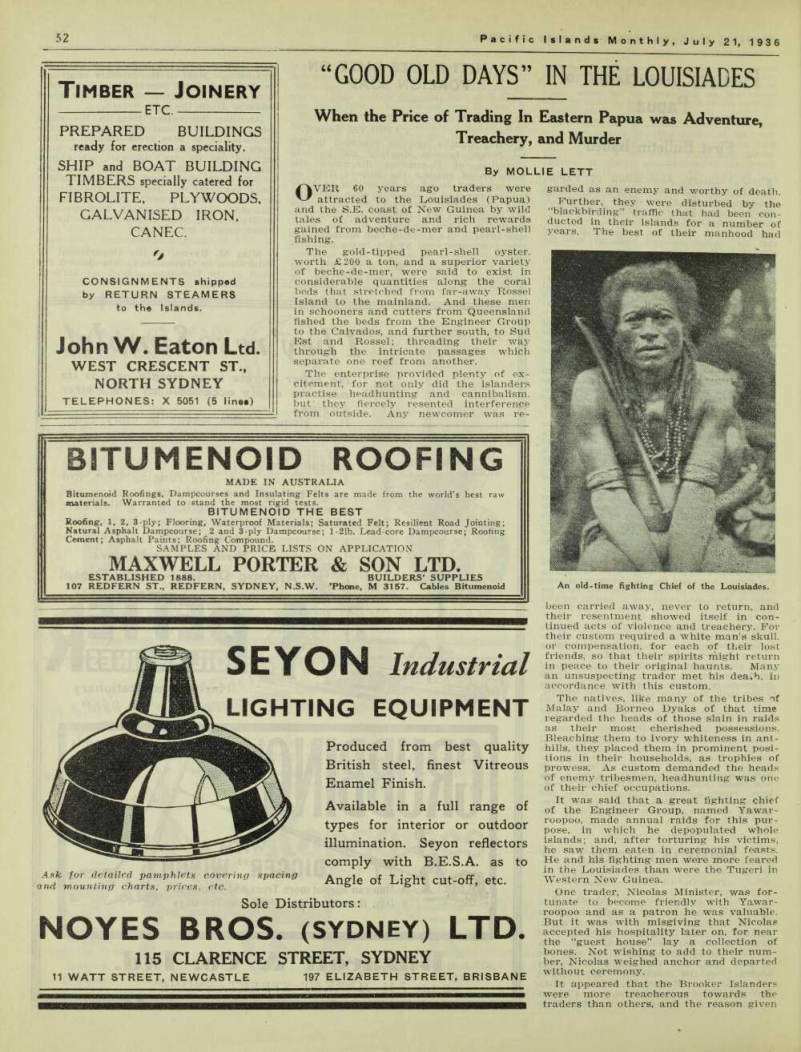
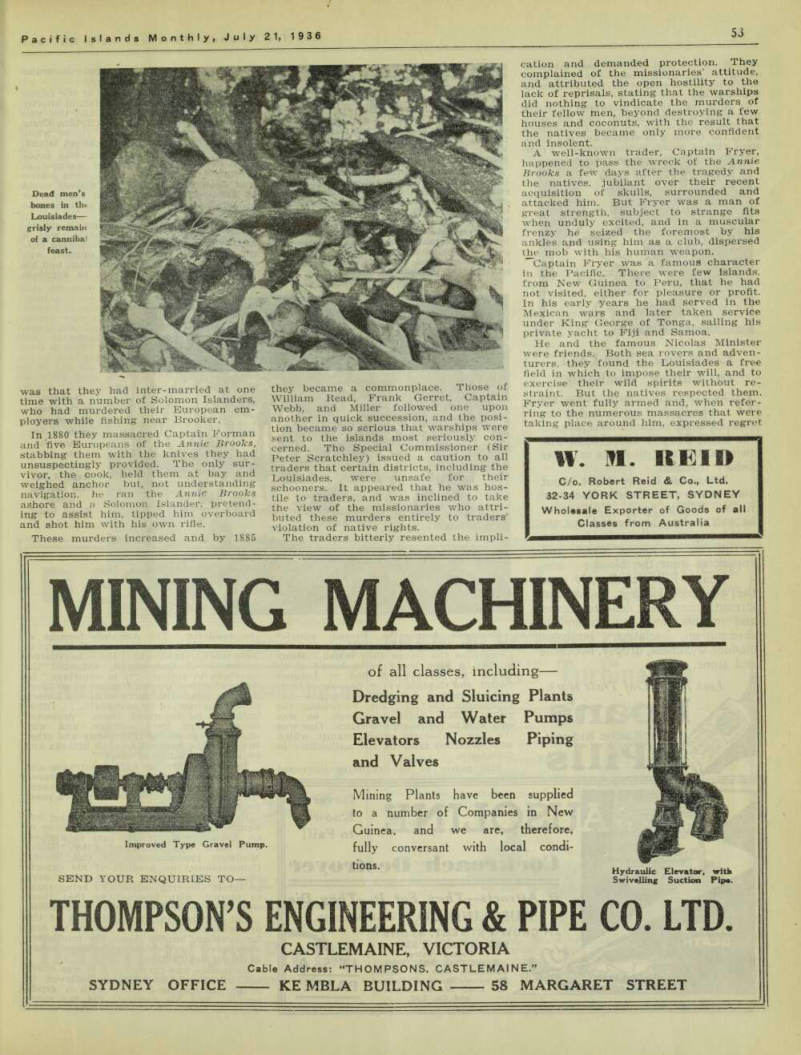
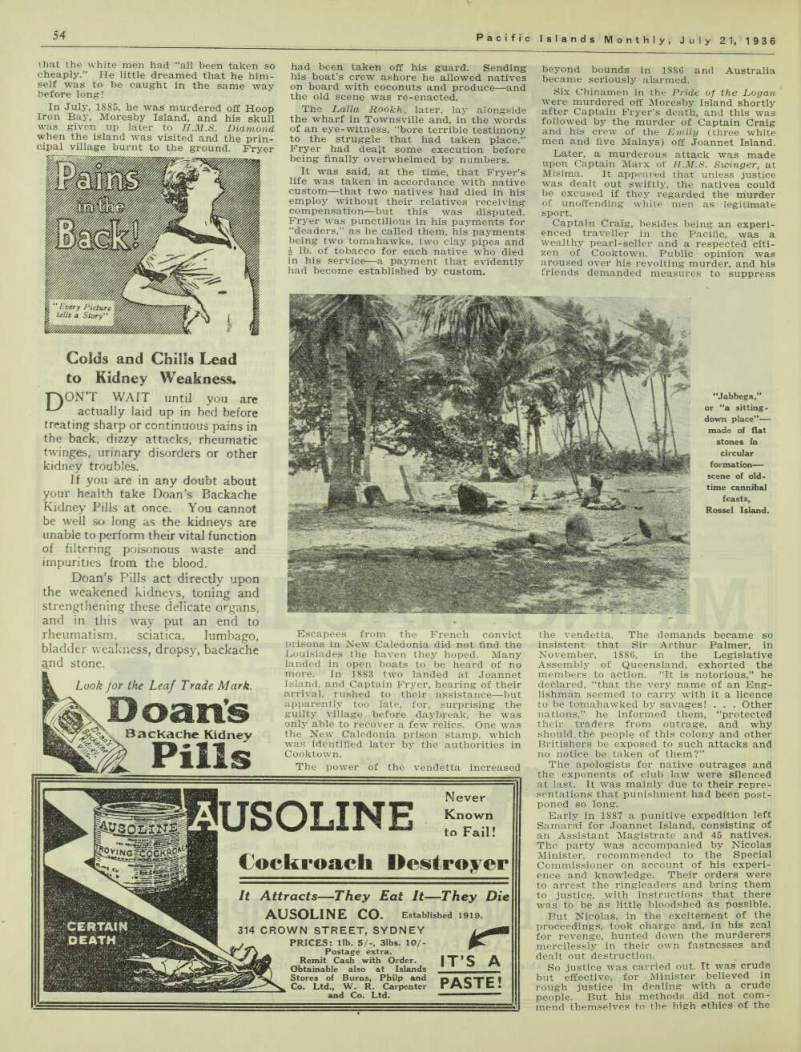
When the Price of Trading In Eastern Papua was Adventure, Treachery, and Murder
By Molde Lett
OVER 60 years ago traders were attracted to the Louisiades (Papua) and the S.E. coast of New Guinea by wild tales of adventure and rich rewards gained from beche-de-mer and pearl-shell fishing.
The gold-tipped pearl-shell oyster, worth £2OO a ton, and a superior variety of beche-de-mer, were said to exist in considerable quantities along the coral beds that sketched from far-away Rossel Island to the mainland. And these men in schooners and cutters from Queensland fished the beds from the Engineer Group to the Calvados, and further south, to Sud Est and Rossel; threading their way through the intricate passages which separate one reef from another.
The enterprise provided plenty of ex citement, for not only did the islanders practise headhunting and cannibalism, but they fiercely resented interference from outside. Any newcomer was re
garded as an enemy and worthy of death.
Further, they were disturbed by the “blackbirding” traffic that had been con ducted in their islands for a number of years. The best of their manhood had
been carried away, never to return, and their resentment showed itself in con tinued acts of violence and treachery. For their custom required a white man’s skull, or compensation, for each of their lost friends, so that their spirits might return in peace to their original haunts. Many an unsuspecting trader met his dea k h. in accordance with this custom.
The natives, like many of the tribes of Malay and Borneo Dyaks of that time regarded the heads of those slain in raids as their most cherished possessions.
Bleaching them to ivory whiteness in ant hills, they placed them in prominent posi tions in their households, as trophies of prowess. As custom demanded the heads of enemy tribesmen, headhunting was one of their chief occupations.
It was said that a great fighting chief of the Engineer Group, named Yawar roopoo, made annual raids for this pur pose, in which he depopulated whole islands; and, after torturing his victims, he saw them eaten in ceremonial feasts.
He and his fighting men were more feared in the Louisiades than were the Tugeri in Western New Guinea.
One trader, Nicolas Minister, was for tunate to become friendly with Yawar roopoo and as a patron he was valuable.
But it was with misgiving that Nicolas accepted his hospitality later on, for near the “guest house” lay a collection of bones. Not wishing to add to their num ber, Nicolas weighed anchor and departed without ceremony.
It appeared that the Brooker Islanders were more treacherous towards the traders than others, and the reason given
An old-time fighting Chief of the Louisiades.
was that they had inter-married at one time with a number of Solomon Islanders, who had murdered their European employers while fishing near Brooker. , „ , .
In 1880 they massacred Captain Forman and five Europeans of the Annie Brooks, stabbing them with the kmves they had unsuspectingly provided. The only survivor, the cook, held them at bay and weighed anchor but, not understanding navigation, he ran the Annie Brooks ashore and a Solomon Islander, pretending to assist him, tipped him overboard and shot him with his own rifle.
These murders increased and by 1885
they became a commonplace. Those of William Read, Frank Gerret, Captam Webb, and Miller followed one upon another in quick succession, and the posi tion became so serious that warships were sent the i s i an( j s most seriously con cerne(j. The Special Commissioner (Sir p e ter Scratchley) issued a caution to all traders that certain districts, including the Louisiades, were unsafe for their schooners. It appeared that he was hos tije to traders, and was inclined to take v j ew G f the missionaries who attri buted these murders entirely to traders’ violation of native rights.
The traders bitterly resented the impli
cation and demanded protection. They complained of the missionaries’ attitude, and attributed the open hostility to the lack of reprisals, stating that the warships did nothing to vindicate the murders of their fellow men, beyond destroying a few houses and coconuts, with the result that the natives became only more confident and insolent.
A well-known trader, Captain Fryer, happened to pass the wreck of the Annie Brooks a few days after the tragedy and the natives, jubilant over their recent acquisition of skulls, surrounded and attacked him. But Fryer was a man of great strength, subject to strange fits when unduly excited, and in a muscular frenzy he seized the foremost by his ankles and using him as a club, dispersed the mob with his human weapon.
Captain Fryer was a famous character in the Pacific. There were few Islands, from New Guinea to Peru, that he had not visited, either for pleasure or profit.
In his early years he had served in the Mexican wars and later taken service under King George of Tonga, sailing his private yacht to Fiji and Samoa.
He and the famous Nicolas Minister were friends. Both sea rovers and adven turers. they found the Louisiades a free field in which to impose their will, and to exercise their wild spirits without re straint. But the natives respected them.
Fryer went fully armed and, when refer ring to the numerous massacres that were taking place around him, expressed regret
Dead men’s bones in the Louisiades — grisly remain of a cannibal feast.
that the white men had “all been taken so cheaply.” He little dreamed that he him self was to be caught in the same way before long!
In July, 1885, he was murdered off Hoop Iron Bay, Moresby Island, and his skull was given up later to H.M.S. Diamond when the island was visited and the prin cipal village burnt to the ground. Fryer
had been taken off his guard. Sending his boat’s crew ashore he allowed natives on board with coconuts and produce—and the old scene was re-enacted.
The Lalla Rookh, later, lay alongside the wharf in Townsville and, in the words of an eye-witness, “bore terrible testimony to the struggle that had taken place."
Fryer had deajt some execution before being finally overwhelmed by numbers.
It was said, at the time, that Fryer’s life was taken in accordance with native custom —that two natives had died in his employ without their relatives receiving compensation—but this was disputed.
Fryer was punctilious in his payments for “deaders,” as he called them, his payments being two tomahawks, two clay pipes and i lb. of tobacco for each native who died in his service—a payment that evidently had become established by custom.
Escapees from the French convict prisons in New Caledonia did not find the Louisiades the haven they hoped. Many landed in open boats to be heard of no more. In 1883 two landed at Joannet Island, and Captain Fryer, hearing of their arrival, rushed to their assistance—but apparently too late, for, surprising the guilty village before daybreak, he was only able to recover a few relics. One was the New Caledonia prison stamp, which was identified later the authorities in Cooktown.
The power of the vendetta increased
beyond bounds in 1886 and Australia became seriously alarmed.
Six Chinamen in the Pride of the Logan were murdered oft Moresby Island shortly after Captain Fryer’s death, and this was followed by the murder of Captain Craig and his crew of the Emily (three white men and five Malays) off Joannet Island.
Later, a murderous attack was made upon Captain Marx of H.M.S. Swinger, at Misima. It appeared that unless justice was dealt out swiftly, the natives could be excused if they regarded the murder of unoffending white men as legitimate sport.
Captain Craig, besides being an experi enced traveller in the Pacific, was a wealthy pearl-seller and a respected citi zen of Cooktown. Public opinion was aroused over his revolting murder, and his friends demanded measures to suppress
the vendetta. The demands became so insistent that Sir Arthur Palmer, in November, 1886, in the Legislative Assembly of Queensland, exhorted the members to action. “It is notorious,” he declared, “that the very name of an Eng lishman seemed to carry with it a licence to be tomahawked by savages! . . , Other nations,” he informed them, “protected their traders from outrage, and why should, the people of this colony and other Britishers be exposed to such attacks and no notice be taken of them?”
Th e apologists for native outrages and the exponents of club law were silenced at last. It was mainly due to their repre poneVsoVil. pums men a eenpost Early in 1887 a punitive expedition left Samarai for Joannet Island, consisting of an Assistant Magistrate and 45 natives.
Minister, recommended to the Special Commissioner on account of his experi ence and knowledge. Their orders were to justice, with^ instructions that there But Nicolas, in the excitement of the proceedings, took charge and, in his zeal for reve nge, hunted down the murderers mercilessly in their own fastnesses and So j ust i ce was carried out. It was crude but effective, for Minister believed in rough justice in dealing with a crude people. But his methods did not com mend themselves to the high ethics of the
“Jabbega,” or “a sitting down place"— made of flat stones in circular formation— scene of old time cannibal feasts, Rossel Island.
Special Commissioner, John Douglas, and the expedition was severely censored. But thereafter “the murders of unoffending Europeans went out of fashion as one of the fine arts of the Louisiades.”
Thus were the traders left in peace.
But, unfortunately for most of them, it was the peace of death. What their com ments might have been can hardly be recorded. As with the Oysters, in the “Walrus and the Carpenter”: But answers came there none.
And this was scarcely odd because They’d eaten everyone.
For want of men the industry of beche de-mer and pearl-shell fishing gradually declined. The Louisiades had been given a bad name and a wide berth. Already other islands in the Pacific had offered traders greater attractions and richer rewards than a place of honour for their whitened skulls. The beautiful islands were deserted.
But not for long. Gold had been dis covered at Joannet and Sud Est, and soon miners were looking eagerly towards the Louisiades, however savage their reputa tion. Hundreds crossed over from Cook town to make their fortunes. By 1888 the era of gold mining in the Louisiades had set in and the old trading days and their tragedies were forgotten in changed con ditions and new and even more exciting experiences.
Advertisements & other items, pp. 55-56 (1 item)
Mining Machinery
W. 91. It Hill
C/o. Robert Reid & Co., Ltd.
32-34 YORK STREET, SYDNEY
Wholesale Exporter of Goods of all Classes from Australia
MINING MACHINERY
Improved Type Gravel Pump.
SEND YOUR ENQUIRIES TO—
of all classes, including—
Dredging and Sluicing Plants
Gravel and Water Pumps Elevators Nozzles Piping and Valves Mining Plants have been supplied to a number of Companies in New Guinea, and we are, therefore, fully conversant with local conditions.
Hydraulic Elevator, witk Swivelling Suction Pipe.
THOMPSON’S ENGINEERING & PIPE CO. LTD.
CASTLEMAINE, VICTORIA
Cable Address: “THOMPSONS. CASTLEMAINE.”
SYDNEY OFFICE KE MBLA BUILDING 58 MARGARET STREET
Colds and Chills Lead to Kidney Weakness. ]")ON’T WAIT until you are actually laid up in bed before treating sharp or continuous pains in the back, dizzy attacks, rheumatic twinges, urinary disorders or other kidney troubles.
If you are in any doubt about your health take Doan’s Backache Kidney Pills at once. You cannot be well so long as the kidneys are unable to perform their vital function of filtering poisonous waste and impurities from the blood.
Doan’s Pills act directly upon the weakened kidneys, toning and strengthening these delicate organs, and in this way put an end to rheumatism. sciatica, lumbago, bladder weakness, dropsy, backache and stone.
Look jor the Leaf Trade Mark.
Doan's
Backache Kidney
Pills
ifii
USOLINE
Never Known to Fail!
Cockroach Destroyer
It Attracts—They Eat It—They Die AUSOLINE CO. Established 1919.
314 CROWN STREET, SYDNEY
PRICES: lib. 5/-, 3lbs. 10/- Postage extra.
Remit Cash with Order.
Obtainable also at Islands Stores of Burns, Philp and Co. Ltd., W. R. Carpenter and Co. Ltd.
IT’S A
PASTE!
Norfolk Island Trade
Imports From From Month. Australia. Pacific Is.
May, 1935 £1027 . . £25 May, 1936 £3218 . . £20 Exports To To Month. Australia. Pacific Is.
May, 1935 £812 .. £22 May. 1936 £498 £11
Tahiti Radio Club
Efforts to Attract Tourists
From Our Own Correspondent
Papeete, June 5.
THAT the Papeete Radio Club (Radio Club Oceanien) has become something more than a distraction for the local popu lation is evidenced by the number of let ters received from many far-away points such as Cuba, Japan, and the United States. Originally started by a few en thusiasts as a purely local experiment, the Club now has a membership of over 60.
Most of them are very surprised to find that their more or less haphazard pro grammes are being picked up by listeners thousands of miles distant from French Oceania.
It is understood that a much more powerful transmitter has been ordered and will soon be installed. A serious effort is also being made to improve the standard of the items broadcast for lis teners abroad. This question was the subject of discussion by the Tourist Bureau recently when a substantial amount was voted to the funds of the Club and proposals put forward for the proper control of the programmes.
It is now realised that radio can become a powerful agent for popularising Tahiti abitjad, thus resulting eventually in a greater influx of tourists. It is, however, considered essential that the items broad cast for listeners abroad —on special even ings, at least —should be of a true Tahi tian character, American jazz and imita tion Hawaiian melodies being barred from the programmes on such occasions.
In order to bring about this desirable
result it was decided to solicit the co operation of the Societe des Etudes Oceaniennes (which concerns itself with the preservation of the Polynesian culture, including - music) and also to encourage the native performers in the perfection of their music and singing. All this will require time and organisation as well as more funds than are available now, but it is hoped that the Tourist Bureau will be able to contribute a much larger sum next year.
The call letters of the Radio Club Oceanien are FOBAA. Broadcasts are made on Tuesday and Friday evenings, operating on 7.1 megacycles. The presi dent of the organisation is Mr. Alfred Poroi, Mr. Harold Wells, of Messrs. Sargood Gardiner Ltd., will leave Sydney for Papua and New Guinea by the Montoro at the end of July, and return to Aus tralia through the Solomon Islands by the Malaita. For 20 years, Mr. Wells has been handling Sargood Gardiner’s Islands business at the Sydney end, and, as this is his first visit to the Western Pacific groups, he shall be able to meet personally the clients with whom he has been deal ing for so many years.
Advertisements & other items, pp. 57-58 (1 item)
Deutz
Your Sydney Agent?
William E. Reed
(Established 1913)
UNION HOUSE
247 GEORGE ST., SYDNEY
Shell sold, and goods supplied at wholesale prices, on commission.
Enquiries welcomed.
DEUTZ
DIESEL
ENGINES
c Deutz Engines used Internationally since 1864
MARINE DIESEL “OM” TYPE
I
CUT
Range from 10 to 140 B.H.P.
Full information obtainable from the Agents
Herbert Del Cott Pty. Ltd.
15 CASTLEREAGH STREET, SYDNEY
’Phone; B 3135
(t JS p 9* ELECTRICAL
r\» £• Vj • EQUIPMENT
FREE ELECTRICITY!
with “A E G”Turbinamos
A “Turbinamo” working from a stream generates sufficient electricity for households, plantations or communities.
Simple to Instal Reliable Supply No Running Costs Looks After Itself Sizes 0.5 kw. to 40 kw.
Write for particulars. State head of water available and Electricity output required.
Cables “Voltage” 116 QUEEN STREET, MELBOURNE ’Phone: Centra! 10488
AVOID INERT CREAMS
What woman does not sigh after this radiant freshness, this juvenile tint that excites admiration? CREME SIMON makes the skin lovely, —it is always active and is delicately perfumed.
For Perfect Beauty use
CREME SIMON
also
POUDRE SIMON
{7 Shades), and
SIMON SOAP
CREME
s MON
PARIS
Obtainable Chemists and Stores Sole Agents: Joubert&» Joubert Pty. Ltd., Mel bourne
THERE’S NO SUBSTITUTE
FOR QUALITY
ARNOTTS SAO BISCUITS are the result of half a century of specialization, they have that light flaky texture —that perfection of quality which makes them delicious with butter, cheese, ham paste or fruit, and exceedingly popular with everyone.
On cold nights try them this way: Butter the SAO Biscuits, grate a little cheese over each, and sprinkle with cayenne pepper—one minute in a hot, dry oven and serve whilst hot.
ARNOTTS
FAMOUS
SAO
R E. G D.
BISCUITS
Always ask your Grocer for Arnott’*
“THEY ARE BETTER THAN EVER”
New Fishing Launch For
Lord Howe Is.
A NEW fishing launch, Venture 11., is nearing completion at Goddard’s Yards, Palm Beach, Sydney, for Mr.
Gower C. Wilson, of Lord Howe Island. It has been specially designed for deep-sea fishing around Lord Howe Is., the poten tialities of which are, as yet, unexploited.
The launch will be 33ft. long, with a 9ft. 6in. beam, and powered by a 30-h.p.
Thornycroft engine. It will also carry sail, and will have all conveniences, including sleeping accommodation for a party of prominent anglers expected to visit the Island at the end of the year.
Mr. Wilson does not intend to sail the Venture 11. to Lord Howe until about October.
Mr. and Mrs. A. E. Laurence, accom panied by their daughter, departed from Sydney by the Macdhui early in July. Mr.
Laurence, who is a director of Cuthbert’s Misima Goldmine Ltd., left the boat at Samarai, in order to go on to Misima Island, while Mrs. and Miss Laurence made the round trip back to Australia.
Returning Delegates Satisfied
Cook Is. Fruit
Industry
Returning Delegates Satisfied with N.Z. Inquiry
From Our Own Correspondent
Rarotonga, June 14.
DESPITE a slight drizzle an unusually large crowd gathered last evening on the Avarua wharf to greet the returning members of the delegation which submit ted evidence in connection with the Cook Is. fruit industry before the Parliamen tary Committee in Wellington.
First to land from the Maunganui was the party headed by Mr. William Mcßir ney, chairman of the Growers’ Associa tion. Although it is as yet premature to attempt any estimate of the work per formed by these gentlemen it is safe to assume from their general air of satisfac tion that they regard the future with a confident eye.
From those who advocated the forma tion of a Fruit Control Board one gathers that their proposals, and indeed the whole position of local growers, received an un commonly sympathetic hearing from the committee, who were, it appeared, sur prisingly well-informed on conditions generally in the Cook Islands. This almost unprecedented attitude on the part of the Government, coupled to the sincerity of its desire to effect results, created in turn an equally unprecedented feeling of con fidence among the delegates. What, under less auspicious conditions, might have been a battleground for the contend ing interests of middleman and producer developed rather into a conference for the betterment of the latter.
It is also understood that the delegates from the Growers’ Association have made a number of contacts of a business nature which will, they hope, eventually be the means of bringing about a better state of things in connection with the supply of fruit boxes and other subsidiary aspects of the industry.
Local interest is now focussed on the arrival in July of the three committee members detailed by Parliament to inves tigate matters personally in Rarotonga.
With a sympathetic Government in power there has never previously been such an opportunity for growers to lay their troubles before the one quarter from which relief can come. The Labour Party is to be congratulated both on its deter mination to see matters put right and in its choice of such straight-forward methods of setting about doing so.
Were these Islands politically represent ed in New Zealand there is no question to-day for which side the population could be relied upon to vote.
Nurse L. G. McMillan, daughter of Mr. and Mrs. A. W. McMillan, of Suva, Fiji, has been appointed as a nurse in Papua with the London Missionary Society.
Previously she had served on the staff of the Colonial War Memorial Hospital in Suva.
Dr. D. L. Muir, Assistant Superinten dent at the Auckland Hospital, arrived in Rarotonga recently to put in the winter working with the Cook Islands Medical Officer, Dr, E, P. Ellison. Dr. Muir’s health has been unsatisfactory for some time and it was with the object of escap ing the N.Z. winter that he went north to the Cooks. Specialising in gynecology, he will find plenty to keep him occupied in the Cook Group.
Fashion Hints for Islands Women
By Therese
'TiAY clothes are full of piquancy and verve, with the accent on youth. They are simple and well cut with original touches that give them character and charm.
Flowers, prints, dots, kitten-ear bows of crisp pique and muslin, smocked panels, and pleated collars, are all in league to bring joy to living.
The Spanish trend shows its influence in the bolero, so newly returned to favour. A short well-tailored bolero jacket suit of string linen with slim wrap over skirt, sports a brown blouse, and swathes its waist with fandango sash, thus accentuating the skirt’s slimness.
A blue linen two piece frock, wide of lapel, has pockets, short sleeves and lapels closely stitched. White buttons fasten the jacket and a wide white belt adds a further note of coolness.
An extra coat is made with a yoke from which box pleats fall to the hips, and is chic contrast to the severely tailored skirt.
White pique coats, loose and swaying, cover darker frocks and look delightfully cool and attractive for any occasion, day or night.
Slipping quickly on and off like a coat, the square necked double breasted frock is the tropical dream come true. No dis arrangement of the coiffure in the last minute rush, no frayed nerves, just bliss ful and utter content in the knowledge of perfection. A mushroom pink frock of this type trims itself with enormous white buttons. White hat, gloves, and shoes are the delightful accessories.
Charming prints make delightful holi day frocks—crease resisting materials that wash easily, and wear to the last thread. A flowered print takes unto itself a peplum which peps the interest tre mendously by the addition of a kick pleat, twin to the one in its slim brief skirt.
Gaugings trim the demure high neck line, youthful puff sleeves, and front panel of the skirt of a gaily flowered voile. A large shady hat of straw, posy trimmed, pays its compliment to so much beauty.
Envelope flaps of crisp pique at neck line, pocket, and sleeve trim a navy spotted frock made on well cut plain lines. White gloves, the new square toed and heeled shoes of navy, and a pancake sailor straw of navy, with white ribbon trim, make an outfit that would grace any occasion. The addition of a white pique coat means further chic.
Tunic coats are worn over blouses and skirts. Usually they match the skirt, depending on the blouse for colour con trast: but any liberty one chooses may be taken with the colour scheme.
Blouses and skirts are necessities for
limited incomes; but necessities with a virtue that is full of charm. For sports, formal, or evening wear they run the gamut of every hour.
Perfectly adorable blouses —dear little bits of femininity—come in chiffons, silks, soft voiles, crisp muslins, and figured dimities. High of neck, with demure puritan collar, or no collar at all, pleated, befrilled, or severely tailored there is no end to their diversity.
Skirts are severe, well cut, and brief —
simple two-piece skirts with slightly flared hems; pencil slim skirts with kick pleats for freedom of movement; and skirts box pleated all round as in child hood days. Each finds several blouses as its perfect complement.
Sports and beach clothes grow more and more intriguing as they grow less and less. A beach beauty story is told
in the sun bask frock of linen, red spotted on a cream ground. A puritan collar is a paradoxical addition. Worn with a red belt and a red coat to cover her sun-tan
back, the wearer steps forth smartly clad for more formal occasions.
A tailored dress in linen or pique is buttoned right down the front and be comes a coat when worn over a backless play suit.
Trousers still persist; but to be really in the forefront of fashion they must reach just below the calf. Butcher blue trousers with orange shirt to form the delightful colour contrast, have a Mexican sombrero and sandals to complete the picture.
If there is no appeal in the trousered mode, a beach skirt buttoning to the hem may be your choice. Coloured bands trim its hem and its sun-tan top repeats the colour scheme.
Evening gowns are magnificent. Lovely materials go towards their making and the designers offer such infinite variety for individual choice that even the most critical among us is happy and satisfied.
Frothing, frilling, tulle continues on its romantic way. Yards and yards of this
drift-down stuff metamorphose into frocks that are a combination of sophis tication and innocence. Gauging and cording lend themselves admirably to the achieving of the fulness so loved by the ingenue, which is in startling contrast to the sophisticated slimness of the slips beneath.
An evening gown of misty mauve chiffon pleated from neck to hem is the darling of the gods, and is heavenly in its fragile loveliness. A jewelled clasp gleams from the soft swathings of its waist.
Youthful as a spring morning is the gown of flower sprinkled taffeta, smooth of shoulder, frilled of epaulette and with the hip line beautifully moulded. A full flaring skirt, swishing and rustling, breathes romance in every fold.
A lovely gown of white lace, moulding the figure to undreamed of perfection, spreads itself into a gracious train. Its soft cowl neck line and tight fitting sleeves give it a dignity almost regal. It would be an ideal bridal array. Clouds of tulle form a veil which is caught with a coronet of pearls.
Making the attendant as lovely as the bride is the gown of printed chiffon with ethereal puffed sleeves and delightful frilly cape, which may be detached at will. Velvet ribbon ties in a bow at the waist and falls to the hem of the skirt.
An absurdly lovely little head-dress of flowers perches on the side of the head, and ties under the chin with a velvet ribbon bow.
For those who crave slim, svelte sophistication there is the slim column of black crepe with draped panel falling from the shoulders or thrown over the head sari-wise. A massive Oriental belt and bangle add further Eastern allure.
Suave tailored frocks for evening wear gain popularity. A soft cdllar buttons in front, high or low, and the new high back is slit to the waist.
A dramatic entry is made by the silver gown of lame ruffled at the throat over which is thrown a Fra Angelica cape of purple velvet.
Delightfully jeune fille is the frothing frock of cyclamen pink net scattered with gold sequins which outline the neck to the waist-low decolletage. A belt of the same glittering discs encircles the slim waist.
Advertisements & other items, pp. 59-60 (1 item)
Chive It S
B. & S. Estate Agency
ROSEVILLE, SYDNEY
Specialising in Flat reservations, any suburb, for Island Residents visiting Sydney. Correspondence invited. 'Rhone J 5269.
Principals: Edwin M. Bastard & Campbell M. Smith
"FA IR HOL M E A Mountain Schoolfor Girls »«« CQ s Dormitory Wing and Staff Residence
PRESBYTERIAN GIRLS’ COLLEGE, Toowoomba, Q’ld.
Principal: MISS D. E. CULPIN, B.A.
ASSISTED BY A STAFF OF UNIVERSITY GRADUATES.
ACADEMIC. HOME SCIENCE AND COMMERCIAL
COURSES.
Prospectus on application to the Secretary: Mr. R. T. Phelps, F.A.A. 491 Ruthven St., Toowoomba.
CHIVE It S
FAMOUS ENGLISH PRODUCTS
CANNED ENGLISH VEGETABLES
CANNED ENGLISH FRUITS
OLDE ENGLISH MARMALADE
GOLD MEDAL JAMS
JELLY CRYSTALS, ETC.
Obtainable from all leading Grocery Stores
WRITE TO DEPARTMENT “A”
CHIVERS & SONS LTD.
Histon, Cambs., Eng.
FOR ATTRACTIVE RECIPE BOOK
c< mi
null
SHIVERS I
CO LD
standard
fresh
ENGLISH
PEAS
S; ■iitiieKtt) AMO PACM£
Mrs. N. WALKER-FLYNN
Late 35 POWELL STREET, COOGEE
COSTUMIERE
MALAGUNA ROAD, RABAUL
HEMSTITCHING AND PICOT
EDGING
Copies of Mab*s Fashions; Roma’s Pictorial Fashions and Horae Fashions available.
P.O. Box 116. Tel.: 141
If you hove bad luck in the Lottery, games, gambling, lore, bus! nest, you should carry a pair of t Mystic Brahma Highly • Dynamic Loadstones. These loadstones are, carried by occult Oriental people as a powerful* I charm—one to prevent bad luck, evil, and misfortune, and the other, to attract much good luck, i love, happiness, and prosperity. Posted by return mall, price 4/6 the pair. Posted 3d. extra 'Money refunded in 7 days if not satisfied.
Royalty Traders, Room 40PD,
3 Castlereagh St., Sydney
S' r ¥ & \
WASHIM®
bat
Steam and a sudden chill; Tuesday, dear mother was fat from gay; Wednesday rather ill; Thursday, the pater was anxious quite, Got Woods’ Great Peppermint Cure; Friday, dear mother was well and bright, Went to a dance, for sure!
First aid for coughs, colds and influenza, Woods’ Great Peppermint Cure.
PRODUCING UNIFORM GOOD RESULTS SINCE 1868
Flour
ALWAYS ASK FOR IT
Wedding At Samarai
From a Special Correspondent
Samarai, June 26.
\ WEDDING of interest was celebrated at the Catholic Church here on June 20. The bride was Mrs. Lena von Bremen, one of Samarai’s most popular women, and the bridegroom, Mr, J. B. Roche, of Sydney. Rev. Father Francis Lyons officiated at the ceremony.
Looking graceful in a silver grey de lustred satin gown trimmed with grey and pink, the bride was given away by an intimate friend, Mr. E. Skelly. Mrs. A. W.
Broodbank was matron of honour, and the duties of best man were carried out by Mr. P. Wood. After the ceremony, the breakfast was held at the Samarai Hotel.
Mr. and Mrs. Roche will remain in Papua for some time before leaving for Australia to make their future home in Sydney.
Mr. F. T. O’Dea, manager of Holden’s Air Transport Services Ltd. in New Guinea, arrived in Sydney on a short business visit by the Macdhui on July 2.
Langley Duncan
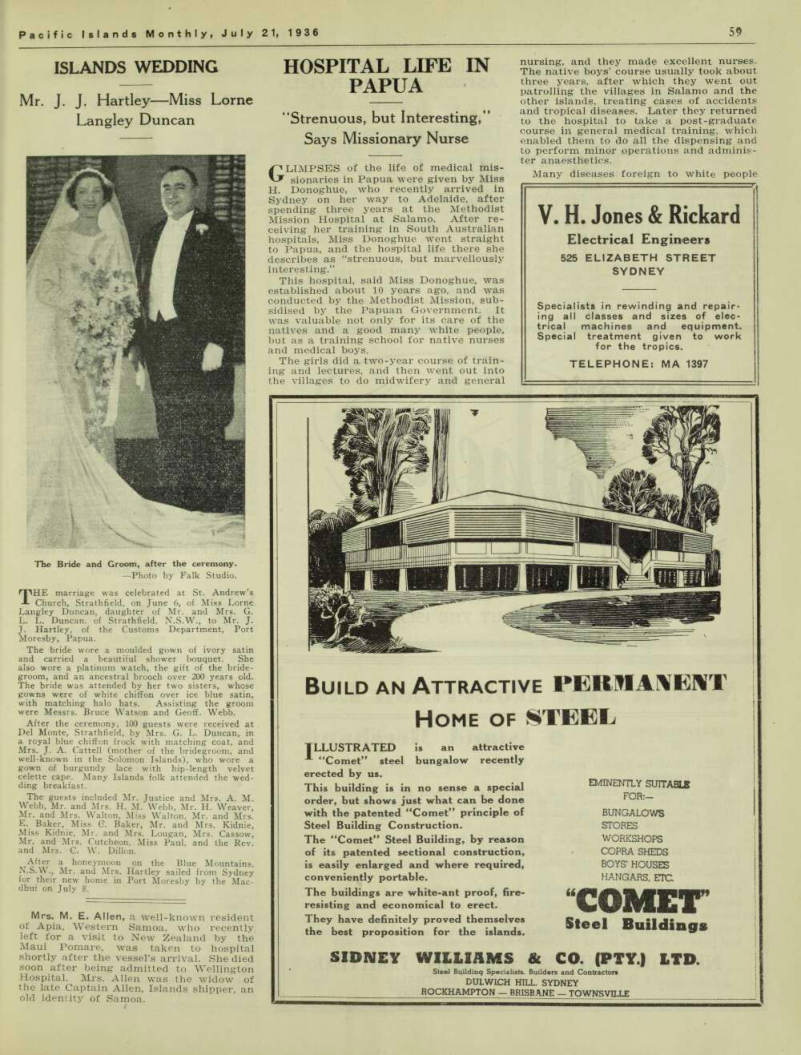
Islands Wedding
Mr. J. J. Hartley—Miss Lorne Langley Duncan
THE marriage was celebrated at St. Andrew’s Church, Strathfield, on June 6, of Miss Lome Langley Duncan, daughter of Mr. and Mrs. G.
L. L. Duncan, of Strathfield, N.S.W., to Mr. J.
T. Hartley, of the Customs Department, Port Moresby, Papua.
The bride wore a moulded gown of ivory satin and carried a beautiful shower bouquet. She also wore a platinum watch, the gift of the bride groom, and an ancestral brooch over 200 years old.
The bride was attended by her two sisters, whose gowns were of white chiffon over ice blue satin, with matching halo hats. Assisting the groom were Messrs. Bruce Watson and Geoff. Webb.
After the ceremony, 100 guests were received at Del Monte, Strathfield, by Mrs. G. L. Duncan, in a royal blue chiffon frock with matching coat, and Mrs. J. A. Cattell (mother of the bridegroom, and well-known in the Solomon Islands), who wore a gown of burgundy lace with hip-length velvet celette cape. Many Islands folk attended the wed ding breakfast.
The guests included Mr. Justice and Mrs. A. M.
Webb, Mr. and Mrs. H. M. Webb, Mr. H. Weaver, Mr. and Mrs. Walton, Miss Walton, Mr. and Mrs.
E. Baker, Miss C. Baker, Mr. and Mrs. Kidnie, Miss Kidnie, Mr. and Mrs. Lougan, Mrs. Cassow, Mr. and Mrs. Cutcheon, Miss Paul, and the Rev. and Mrs. C. W. Dillon.
After a honeymoon on the Blue Mountains, N.S.W., Mr. and Mrs. Hartley sailed from Sydney for their new home in Port Moresby by the Mac dhui on July 8.
Mrs. M. E. Allen, a well-known resident of Apia, Western Samoa, who recently left for a visit to New Zealand by the Maui Pomare, was taken to hospital shortly after the vessel’s arrival. She died soon after being admitted to Wellington Hospital. Mrs. Allen was the widow of the late Captain Allen, Islands shipper, an old identity of Samoa.
The Bride and Groom, after the ceremony. —Photo by Falk Studio.
Papua
Hospital Life In
“Strenuous, but Interesting,”
Says Missionary Nurse
GLIMPSES of the life of medical mis sionaries in Papua were given by Miss H, Donoghue, who recently arrived in Sydney on her way to Adelaide, after spending three years at the Methodist Mission Hospital at Salamo. After re ceiving her training in South Australian hospitals, Miss Donoghue went straight to Papua, and the hospital life there she describes as “strenuous, but marvellously interesting.”
This hospital, said Miss Donoghue, was established about 10 years ago, and was conducted by the Methodist Mission, sub sidised by the Papuan Government. It was valuable not only for its care of the natives and a good many white people, but as a training school for native nurses and medical boys.
The girls did a two-year course of train ing and lectures, and then went out into the villages to do midwifery and general
nursing, and they made excellent nurses.
The native boys’ course usually took about three years, after which they went out patrolling the villages in Salamo and the other islands, treating cases of accidents and tropical diseases. Later they returned to the hospital to take a post-graduate course in general medical training, which enabled them to do all the dispensing and to perform minor operations and adminis ter anaesthetics.
Many diseases foreign to white people
were treated at this hospital, continued Sister Donoghue. Tropical ulcers were quite common. There were usually several lepers undergoing treatment in the com pound, and there was always a very large percentage of cases of accidents due to attacks by wild pigs and crocodiles. Mid wifery cases accounted for a large pro portion of the hospital work and these averaged between 40 and 50 a year. The biggest work of all, however, was that of the waif baby department.
It is still the custom in some parts of Papua when the mother of a newly-born infant dies to bury the baby alive in the mother’s grave. The work of the Salamo Hospital is to rescue these babies and bring them up until they are old enough to eat native food, and then return them to their people. “There is an average of seven waifs in the hospital all the time,” said Sister Donoghue. “The death roll among these children is very heavy, as by the time the hospital rescues them they are often starved almost to death.”
Advertisements & other items, p. 61 (1 item)
“Comet”
V. H. Jones & Rickard
Electrical Engineers
525 ELIZABETH STREET
SYDNEY
Specialists in rewinding and repairing all classes and sizes of electrical machines and equipment.
Special treatment given to work for the tropics.
TELEPHONE: MA 1397
Build an Attractive PERMANENT
Home of STEEL
ILLUSTRATED is an attractive “Comet” steel bungalow recently erected by us.
This building is in no sense a special order, but shows just what can be done with the patented “Comet” principle of Steel Building Construction.
The “Comet” Steel Building, by reason of its patented sectional construction, is easily enlarged and where required, conveniently portable.
The buildings are white-ant proof, fireresisting and economical to erect.
They have definitely proved themselves the best proposition for the islands.
EMINENTLY SUITABLE
FOR:-
BUNGALOWS
STORES
WORKSHOPS
COPRA SHEDS
BOYS' HOUSES
HANGARS. ETC
“COMET”
Steel Buildings
SIDNEY WILLIAMS & CO. (PTY.) LTD.
Steel Building Specialists. Builders and Contractors
DULWICH HILL. SYDNEY
ROCKHAMPTON BRISBANE TC
Bright Prospects For
Astrolabe Copper Field
From Our Own Correspondent
Port Moresby, June 22.
nPHERE are indications that the Astro labe copper field, near the Laloki River, which many years ago attracted at tention on account of its rich copper lodes, will develop into a big “show.”
In the old days the copper lodes showed a percentage of gold and silver, and it is reported that a sample shipment from the Moresby King mine has produced two ounces of gold to the ton. Even with the price of copper at £36 per ton, ore contain ing two ounces of gold to the ton might well be payable.
Mandated Alluvials N.L. is the main con cern interested in the Astrolabe properties.
It is rumoured in Port Moresby that an other strong company will be formed shortly to take up various areas on the field.
"No Mystery,” Says French
Easter Island
"No Mystery,” Says French Scientist
1 1 1 HE colossal statues on Easter Island are not such problems as has been believed and the “mystery” of the Island has been grossly overplayed is the opinion of Dr. Alfred Metraux, French ethnologist, who recently joined the staff of the Bishop Museum in Honolulu.
The figures weigh only five or six tons and could easily have been moved from their local quarries and set in place on the seashore by hand labour, he declared.
Four hundred men could drag them with ropes of native weaving.
The inhabitants of Easter, sometimes conjectured to be the remnant of the population of a lost continent, are identi fied by Dr. Metraux as related to the Maoris of New Zealand and other Poly nesians. He calculates they came to Easter Island in about the 12th century.
Lack of timber and an abundance of soft rock, easily carved, modified their culture.
The Easter Island “script” on wooden tablets, which has been the subject of much speculation, is considered by Dr.
Metraux to be not a true written language, but rather a device to aid the memory in reciting sacred legends.
Monsieur Metraux visited Easter Island last year as a representative of the Paris Museum of Ethnology, with an expedition, aboard the Belgian training ship Mercator.
He joined the Bishop Museum because he believes it is the only place for a thorough study of the archaelogical and ethnologi cal history of the South Seas.
More Capital
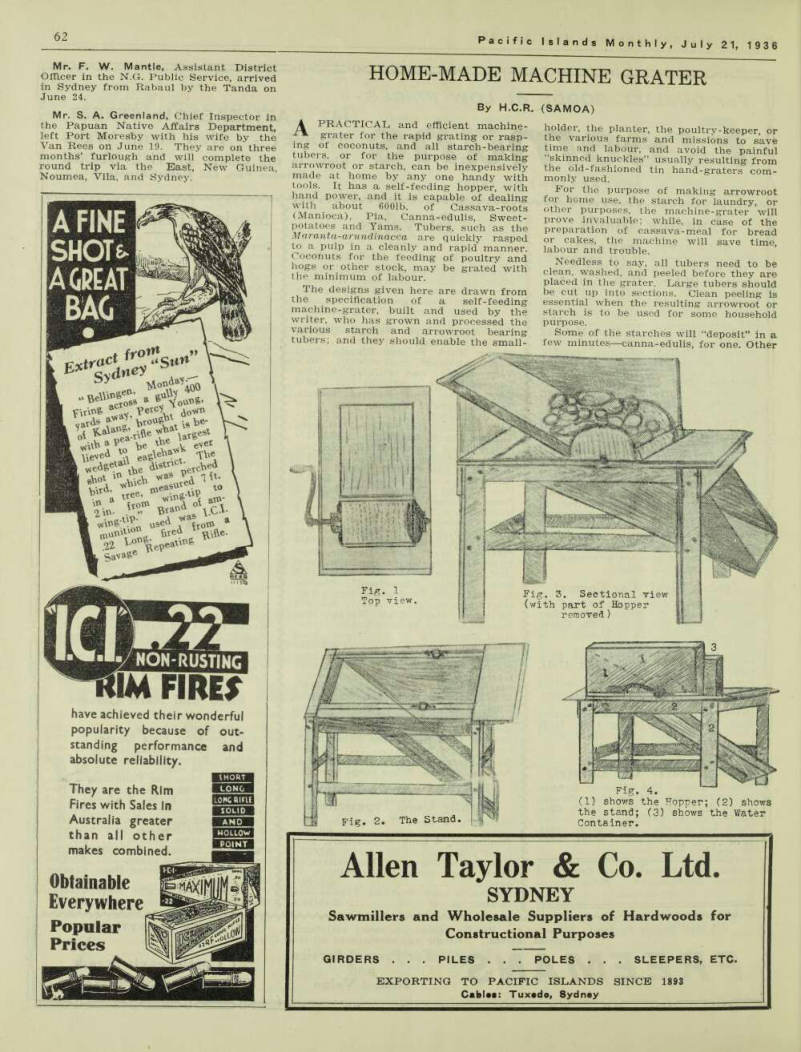
South Pacific Insurance to Issue More Capital
Southern Pacific Insurance
CO., LTD., which was registered in August, 1935, with an authorised capital of £250,000 in £1 shares, has been operat ing on a paid-up capital of £25,000 in fully-paid shares, the whole of which were subscribed by W. R. Carpenter and Co., Ltd. The capital is more than re presented by liquid assets.
It is now intended to issue another 75,000 ordinary shares of £1 each, payable 2/6 on application and 2/6 on allotment.
It is not anticipated that more will be required for some time.
W. R. Carpenter and Co. Ltd. and its associates will take up 25,000 of these additional shares, and individual share holders of W. R. Carpenter and Co. will be given the first opportunity of making application for the remaining 50,000 shares..
The Co. is following the usual sound practice of reinsurance, and only carries a minimum risk in respect of any one line. With additional capital the direc tors anticipate that they will be able to seek and obtain increased outside busi ness, in addition to the profitable Islands connections which they now enjoy.
The company has operated profitably to the close of its financial year on March 31 last, and the directors consider that the investment should be dividend paying from its inception.
Mr. J. Binskin, of Bagga Plantation, Vella Lavella, in the Northern Solomon Islands, returned from Sydney by the Malaita on June 27.
Mr. F. W. Mantle, Assistant District Officer in the N.G. Public Service, arrived in Sydney from Rabaul by the Tanda on June 24.
Mr. S. A. Greenland, Chief Inspector in the Papuan Native Affairs Department, left Port Moresby with his wife by the Van Rees on June 19. They are on three months’ furlough and will complete the round trip via the East, New Guinea, Noumea, Vila, and Sydney.
Advertisements & other items, pp. 62-64 (2 items)
Berbers
Full Gloss Super Finish for everything that travels/
AGENTS THROUGHOUT THE ISLANDS
Nelson and Robertson Ltd.
(ESTABLISHED
1895)
Island Merchants
COCOA BEANS. —Special attention devoted to their sale in Australian and Oversea markets.
COPRA, TROCHUS SHELL, and other Island Produce sold on commission.
All classes of merchandise and Mining Machinery purchased at wholesale prices and original invoices supplied to Island clients. Small commission.
Prices submitted for comparison.
SOLE AGENTS FOR
PUMPMOBIL Portable Pumping Plants. Recommended for Sluicing and all Mining purposes. Weight 120 lbs., 12,000 gals, per hour, 10 to 100 feet head.
REDUCED PRICES.
ARCHIMEDES.—Latest in outboards; Swedish manufacture.
SKANDIA ENGINES, FULL DIESEL AND SEMI-DIESEL; all powers, Marine and Stationary.
UPSON BRITISH BOARD.—Wallboard and insulating material in one, strong and light in weight. Oft. to 12ft. lengths always in stock.
NELSON AND ROBERTSON LIMITED
12 SPRING STREET, SYDNEY, AUSTRALIA
Telegraphic Address: “Ivan Sydney”
Freemans
For QUALITY GOODS at LOW PRICES-
(ESTABLISHED 1 905)
147 CASTLE REACH STREET,
SYDNEY - - New South Wales Right in the Centre of THE BLOCK Between Park and Market Streets.
Bicycles
Special Bargains in Used Bicycles Very strong Blue Painted Bicycle, fixed wheel, handbrake, good order 55/- Very strong Red Painted Bicycle, free wheel, handbrake, good order £3 Very strong “Marathon” Bicycle, Eadie coaster. Good order 65/- Very strong Red Painted Bicycle, wheel, handbrake, good order 65/- Strong Black Painted Bicycle, fixed wheel, handbrake, good order ... 65/- Very strong Red Painted Bicycle, Tapered Frame, handbrake 69/6 Very strong Blue Painted Bicycle, Tapered Welded Frame, good order and condition £3/15/- Very strong Red Painted Bicycle, Tapered Frame, handbrake £3/15/- Blue Painted “Speedwell” Bicycle, free wheel, handbrake . £4/5/- Very fine “Baker” bicycle, fixed wheel, handbrake, good order £4/5/- Blue Painted “Triumph” Bicycle, Club Racer, Tapered Welded Frame, fixed wheel, nearly new £4/19/6 Blue Painted “British Star” Bicycle, Club Racer, tapered welded frame, two handbrakes, good order, £4/19/6 “Malvern Star” Eadie Coaster, Blue Painted Bicycle, good condition, well shod, good order £4/19/6 Blue Painted “Speedwell” Bicycle, popular model, fixed wheel, handbrake. nearly new £4/19/6 “Malvern Star” Club Racer, Blue Painted Bicycle, tapered welded frame, fixed wheel, two (2) handbrakes, good order, nearly new £5/10/- “Malvern Star” Club Racer, Blue Painted Bicycle, tapered welded frame, free wheel, 2 handbrakes, good order, nearly new £5/10/- Blue Painted “Speedwell” Bicycle, Club Racer, tapered welded frame, handbrake, good order £5/10/- Very fine Blue Painted “Carbine”
Bicycle, Club Racer, free wheel, handbrake, nearly new £5/19/6 Good Strong, Slightly Used Bicycles Always in Stock. Prices range from 55/.
Slightly Used Typewriters
Monarch, 4 bank Typewriters, good order £6/10/- Remington, 4 bank Typewriters, good order £7/10/- Remington Portable Typewriters, 4 bank, good order and condition, in case £B/10/- Corona, 4 bank Portable Typewriters, in case, nearly new £lO/10/-
Musical Instruments !
Brand New Ukuleles, complete with strings, Free Tutor 10/6 Steel Guitars, beautiful tone, complete with steel, picks, free tutor 35/- Banjo Mandolins, complete in case, with Free Tutor, slightly used .. 37/6 I Standard Banjos, complete in case, I with Free Tutor, slightly used .. 45/- Violins, full size, bow, in case, splen- > did tone, Free Tutor 45/- j Columbia Portable Gramophones, per- I feet order, slightly used 45/- I His Master’s Voice Portable Gramo- I phones, in perfect order, slightly ; used £3/19/6 '
Piano Accordeons
21 notes, 8 Sunken Basses, green pearloid finish body, 14 folded bellows, with ( nickel-plated corner protectors, with ' free tutor £6/15/- Antonio Silvagni Piano Accordeon, 21 notes, 12 sunken basses, dark blue pearloid finish body and sloping keyboard, rounded black keys, chromiumplated key cover, 14 fold bellows, nickel-plated corner protectors, strong leather bass straps and shoulder straps, with free tutor £7/15/- We Stock all Kinds of Musical Instruments.
Write for Our Free Catalogue.
Slightly Used Cameras
Vest Pocket Kodak Cameras ... 15/- Kodak 1A Folding Cameras 20/- Kodak Post Card size Cameras . . 22/6 Kodak 2A Folding Cameras, double lens • • 27/6 Kodak 3A Folding Cameras 30/- Kodak 6.3 Lens Folding Cameras, 37/6 Zeiss Ikon Cameras, 1.11 lens ... 50/-
Field and Race Glasses
Slightly used.
Powerful Field Glasses 25/- Extra Powerful Field Glasses . . 39/6 Powerful Field Glasses in case .. 49/6 English Prismatic Binocular Field Glasses, 6x, case £3/15/ “Colmont” Binocular Field Glasses, 6x in case, very powerful £4/15/ “Ross” Stereo Prism Binocular Field Glasses, 6x, in case £4/15/ French Field Glasses, Bx, ... £4/15/ English Field Glasses, very powerful 8x magnification, in case £5/15/ “Colmont” Binocular Race Glasses, 8x extra powerful, in case £6/15/ “Carl Zeiss” Binocular Race Glasses 6x30, in case £6/15/ “Carl Zeiss” Binocular Race Glasses Silvamar, Bx, extra powerful . £B/10/
Sporting Goods
GOLF SETS! GOLF SETS!
Free tenth every Golf Set purchased: One dozen Tees and tmo Golf Balls.
Matched Hickory Shaft Golf Sets, hand forged, including mid-iron, mashie, putter and brassie-driver, in leather mounted waterproof canvas bag 37/6 “J. Kirkwood” Hickory Shaft Matched Golf Sets, Rustless Scotch Heads, hand forged, including mid-iron, mashie, putter an« brassie-driver, in leather mounted waterproof canvas bag . 42/6 Steelshaft Golf Sets, including midiron, mashie, putter and brassie-driver, in leather mounted waterproof canvas bag 63/- “J. Kirkwood” Matched Steelshaft Golf Sets, Rustless Scotch Heads, hand forged, including mid-iron, mashie, putter and brassie-driver, in leather mounted waterproof canvas bag, 69/6 SPECIAL—Left-hand Steelshaft Golf Sets. Spalding’s Registered Cushion Necks. Kroflite “Sweetspot” mid-iron, mashie, putter and brassie-driver, in waterproof leather mounted canvas bag £3/15/- We stock all sporting requisites.
Write for our free catalogue in the sports needs you are interested.
Tents! Flys! Car Covers!
Strongly made and reinforced. Take advantage of these prices before they rise. Extra heavy English Calico Tents, 3ft. Walls. 6xB, 16/9; Bxlo, 21/6; 10x12, 27/6.
Extra heavy English Calico Flys. Bxlo, 10/6; 11x9, 13/6; 10x12, 16/6; 12x12, 19/6; 12x14, 22/6; 14x14, 25/-.
Extra heavy English lOoz. twisted Duck Tents, 3ft. Walls. 6xB, 24/-; Bxlo, 30/-; 10x12, 42/6.
Extra heavy English lOoz. twisted Duck Flys. Bxlo, 12/6; 11x9, 16/6; 10x12, 19/6; 12x12, 22/6; 12x14, 25/-; 14x14, 27/6.
Car Covers! Car Covers!
Roped Edges and Strong Eyelets.
Heavy English Calico Car Covers. 12x16, 25/-; 14x16, 27/6; 15x18, 30/-.
Extra heavy English lOoz. twisted Duck Car Covers. 12x15, 27/6; 12x18, 35/-; 14x16. 39/6; 15x18, 42/6; 16x20, 45/-; 18x20, 50/-.
Special Concessions to Traders and Storekeepers. Write for Quotations.
All Mail Orders Promptly Attended to. We Guarantee you every satisfaction.
Inquiries invited. Kindly add carriage on all Mail
FREEMANS
For Prompt Service and Honest Value
WE STOCK EVERYTHING
Orders.
147 Castlereagh Street,
Sydney, New South Wales
ANNE
SHOTe-
A CPE AT
BAG
Sydney
act *3sT»° “ Bett T«o"s » fitinS »®J, VetcV d0 «n f* J bto u^ l t u be* 01, \ieve4 «» tfee *£%*&* L-l>P- tt9 ed rlto® • bteA e . » n.^ 6 Savafe® !M
FIRE*
have achieved their wonderful popularity because of outstanding performance and absolute reliability.
They are the Rim Fires with Sales in Australia greater than all other makes combined.
Obtainable
Everywhere
Popular Prices K.i-'tujn m ttf-2 IB
Home-Made Machine Grater
By H.C.R. (Samoa)
A PRACTICAL and efficient machine- T*- grater for the rapid grating or rasp ing of coconuts, and all starch-bearing tubers, or for the purpose of making arrowroot or starch, can be inexpensively made at home by any one handy with tools. It has a self-feeding hopper, with hand power, and it is capable of dealing with about 6001 b. of Cassava-roots (Manioca), Pia, Canna-edulis, Sweet potatoes and Yams. Tubers, such as the Maranta-arundinacea are quickly rasped to a pulp in a cleanly and rapid manner.
Coconuts for the feeding of poultry and hogs or other stock, may be grated with the minimum of labour.
The designs given here are drawn from the specification of a self-feeding machine-grater, built and used by the writer, who has grown and processed the various starch and arrowroot bearing tubers; and they should enable the small
holder, the planter, the poultry-keeper, or the various farms and missions to save time and labour, and avoid the painful “skinned knuckles” usually resulting from the old-fashioned tin hand-graters com monly used.
For the purpose of making arrowroot for home use, the starch for laundry, or other purposes, the machine-grater will prove invaluable; while, in case of the preparation of cassava-meal for bread or cakes, the machine will save time, labour and trouble.
Needless to say, all tubers need to be clean, washed, and peeled before they are placed in the grater. Large tubers should be cut up into sections. Clean peeling is essential when the resulting arrowroot or starch is to be used for some household purpose.
Some of the starches will “deposit” in a few minutes—canna-edulis, for one. Other
tuber-starches may take several hours to settle or deposit. In order that the wheel grater may be free from “clogging” during the grating process, a small container holding sufficient water to moisten the grated mass is provided. This prevents the pulp adhering to the grater.
Illustration No. 1 gives some idea of the machine ready for use, seen as one looks down upon it.
How To Build The Grater
The machine consists of a “stand,” height 2ft. €in.; length, 3ft. 6in.; width, 2ft. This is merely a table with four legs, upon which is mounted the hopper-box.
Inside the hopper-box is fitted a piece of wood; at an angle which allows the cut-up tubers to slide down by their own weight on to a re volving metal grater. The grater may be made by punching holes closely together, all over a sheet of tin, such as a flattened-out benzine tin. The holes can be punched out with a stout nail by laying the tin over a piece of soft wood, and using a hammer.
For the grater, a piece of suitable wood is needed —a section of .an old mangle-roller would do; but the job is best done by having a small log turned down to suitable size, say 12 inches by 8 inches, and a hole bored through the centre to take a rod or spindle, to which is fitted a wheel, such as an old mangle wheel (or one cut from a tree-trunk).
A metal wheel is best, of any suitable size and not too heavy. The metal is tacked or nailed on to the roller with 1-inch nails, and can be renewed in time, when worn.
The grater revolves, and should be mounted in metal bearings (see Fig. 1).
The hopper may be simply a box of suitable size to cover the grater. In the case of a grater of less than 9| inches in width, a benzine-case will make a suitable hopper. But with a grater of larger dimensions, the hopper of suitable size can be adapted from a box or packing case.
Where it is difficult to obtain or turn a piece of wood suitable for the grater, it is advisable to construct a roller by nailing battens of 1| inches in width, closely together, on two round sections of circular wood to form the roller upon which the punched-tin grater is to be fitted.
The dotted line inside the hopper indicates the position of the board which conveys the tubers to the grater-wheel, and the size of the hopper should be in accordance with your requirements.
Where it is desired to rasp or grate coconuts, the machine will need to be of sturdy construc tion, well-braced, and bolted together with carriage-bolts and screws. The nuts must be halved; and care should be taken to prevent the “shells” getting ihto contact with the metal grater, or damage will ensue.
If a regular dripping of water can be maintained, so as to fall on to the revolving grater, so much the better. But this is not absolutely necessary, as a little water can be applied occasionally, during the grating process, by the worker.
The revolving grater is bolted down to the stand as shown; and the hopper-box fits as a separate unit, and may be secured to the stand by means of either a couple of small screws or by buttons.
This allows for washing or cleaning of the hopper box, and grater, at any time.
The diagrams illustrate the needful parts and fittings of the machine.
Advertisements & other items, p. 64 (1 item)
Allen Taylor & Co. Ltd.
Fig. 1 Top view Fig. 3. Sectional view (with part of Hopper removed) Wm Fig. 2. The Stand.
Fig. 4. (1) shows the Hopper; (2) shows the stand; (3) shows the Water Container.
SYDNEY
Sawmillers and Wholesale Suppliers of Hardwoods for Constructional Purposes GIRDERS . . . PILES . . . POLES . . . SLEEPERS, ETC.
EXPORTING TO PACIFIC ISLANDS SINCE 1893
Cables: Tuxedo, Sydney
Fire At Wau, T.N.G.
From Our Own Correspondent WAU, June 24.
THE total loss by fire on June 16 of the house occupied by Mr. H. G. Strong, roadmaster in the Administration has caused widespread regret in Wau. The cause of the fire, which was noticed early in the afternoon, is not known, although it is thought that a flying spark from burn ing kunai, some distance away, may have started the outbreak.
The kunai-grass roof prevented any attempt to save the structure. Fortun ately no one was in the dwelling at the time. The house was not insured, and all contents were totally destroyed.
Mr. and Mrs. P. Taylor returned to Thursday Island in June after 12 months’ leave. They later proceeded to the C.M.S. station on Groot© Eylandt (Great Island) in the Gulf of Carpentaria.
G.A.’S New Stinsons Take
To The Air
From Our Own Correspondent WAU, June 24.
THE arrival on the field of several new modern Stinson ’planes, augmenting the fleet of Guinea Airways Ltd., has caus ed much interest at Wau, as nothing of their class has previously been seen on the ’drome. They are now in commission, and are flying perfectly.
To the layman they appear first-class machines, with perfect finish and fittings.
Their cruising speed is 130 miles per hour, and this may have a revolutionary effect on flying in the Morobe goldfields area.
It is rumoured that the new ’planes might be used for an Australian —New Guinea service, should Guinea Airways enter this field.
Mr. J. Ahearn, who was formerly mana ger at Rabaul for the Vacuum Oil Co. Pty.
Ltd., left Brisbane for Port Moresby, Papua, by the Montoro on June 19.
Mr. George Freimann, of the Thursday Islands Customs Department, has been transferred to Brisbane, Queensland.
Advertisements & other items, pp. 65-66 (1 item)
■ Machinery
OILS K I N S
HUGHES’ OILSKINS
Write for Catalogue
A. J! Hughes
(Estab. 1893) 121 Regent St Sydney for long, hard wear anywhere. Every coat guaranteed. No shops supplied.
Hughes’ Tropical Oilskins will not stick, crack or perish in the hottest of climates. They have been known to withstand eleven years of continuous wear.
ftr m m *»
The..
Headquarters
House for
Mining
■ Machinery
Ingersoll Rand Pneumatic
Jack Hammer Drills Drifter Drills All Types of Mountings Hand or Automatically Rotated Stopehammers Drill Steel Hand Blacksmiths Tools and Shanking Devices for Drill Steel Air Hose and Fittings also Gold Retorts with condenser pipe or Water Jacketed Condenser from 3 to 12 in. diameter.
Bullion Moulds, Battery Screens, Copper Plates for Amalgamating Tables.
Wvc
- 5*
REMEMBER—FOR QUICK DELIVERY
ORDER YOUR SUPPLIES FROM—
Headquarters
- House -
EDWARD ST
BRISBANE
N-QBranch
, STURTS’.
- . fOWNSVIUI
INCINttEINC SUPPLY tv Of AUSTEMIA I?
Find out What’s Inside
before you buy a low-priced Saddle.
THE KING OF 'EM ALL
NARROW
“Safer Saddle and Offers Sensational Advantages * Being built on a Galvanised Tree, heavily bar plated, and strained with English web, riders are assured of its genuine foundation. Its soft, pliant kip flaps are hard-wearing, while the sweepy seat gives superb riding comfort.
Fivted with Best Leather, Folded Girth, £5/5/_ Freight Free With Capped Pads, 15/- extra.
Write for Catalogue P 1935.
Sydney's High-Class Saddler.
Newmarket Saddlery
W. H. Williams for “Safer” Saddles 18-20 Wilson St., Newtown, N.S.W.
Stirrups
Buy Direct from Manchester!
Pacific Traders can save money and obtain High Quality Goods and Dependable Service by writing to us for Quotations. We are manufacturers of—
GREY, WHITE AND COLOURED TEXTILES
Rami materials of Super Dril every description.
Para Reds.
White and Blue Drills.
Grey and White Calicos.
Ecru Tussore.
Dyed Poplins.
Woven-striped Poplins, Table Cloths.
Serviettes.
Sheets.
Pillow Cases.
Quilts.
Bedspreads.
Art Silk Piece Goods.
Bath Wraps.
Glass Cloths.* Sweat Rags.
Bias Binding.
Braids.
Printed Calicos.
Poplins.
Woven Coloured Ginghams, etc. It will be to your in-
terest, in the end, to
Buy and Distribute
British-made goods.
Extract from a letter sent to us by an Islands storekeeper who recently retired: Milne Bay, Papua. 1/10/34.
". . .a success due—in a great measure —to the excellent service rendered for so many years ly your firm. Yours faithfully, H. DEXTER.”
A, Webb & Company (Manchester) Ltd.
86 GEORGE STREET, MANCHESTER
Contractors to H.M. and Foreign Governments. Bentley’s Code, and ABC Code 4th and sth Editions. Telegraphic Address: “WASTOCK” Manchester.
Native Prisoner
Two Years’ Gaol for Holding N.G.
Native Prisoner Lutheran Missionary’s Version of the Crime
From Our Own Correspondent
Rabaud, June 17.
TTENRY POBGB, an American Lutheran missionary stationed in the uncontrolled” area of Wahgi-Mt Hagen, in the Morobe District, appeared before His Honour the Chief Judge in the Supreme Court on June 3 charged with unlawfully depriving a native of his liberty. , The accused pleaded guilty. He made an unsworn statement from the box in which he related how three of his native mission helpers had been assaulted and robbed by natives in the Danga district « h ho rr r> w - s • beyond . th< k ar<^ T in which he ! had permission, under the Uncontrolled” Areas Ordinance, to reside and carry on mission work.
According to the accused, he and his workers decided to recover the stolen goods and for this purpose preparations were made. In his statement, he explained how on receiving news of the assault he and his colleagues carefully went into the matter and decided that the Danga attitude of boldness and avariciousness must be stopped. . , , . J „ Continuing With his statement Foege said: — “On the morning of January 10, I started for the Danga territory with 10 helpers in compliance
with previous instructions that if we should have to leave our station to carry with us five or six guns and about 10 civilised natives. We took six guns. Arriving at the Dagal mission two of the helpers remained there, whilst the rest climbed up a ridge towards the Danga territory. We came upon some Damba natives who are a clan of the larger Danga tribe, but were not of the clan that had committed the robbery. These continued with us to the first house of the guilty clan.
“Upon our arrival some members of the guilty clan were fleeing; we called to them to bring back the articles they had stolen. There was no re sponse. We then asked the Damba natives to call them in their own dialect. Soon the Danga na tives appeared with some of the stolen articles.
They deposited them within 200 yds. of us, and thereupon beat a hasty retreat.
“Since it was already late in the afternoon, we returned to the Danga mission post, with the retrieved articles. As we had not recovered all the stolen goods and had not talked with the Danga natives we went back the following morn ing. Upon arriving at the first house of the guilty tribe we found it deserted. We called, but there was no response. We left three helpers there to intercept any of the Danga natives. The rest of us continued some distance further to see if we could meet the Danga people. After a short time the helpers who had remained at the house called out that they had taken a native.
“Upon our arrival one of the three helpers who had been pursued identified this native as one of the pursuers, although not one of the actual per petrators of the robbery. After having tied his hands behind his back we asked him where the rest of his clan were. He said they had fled.
We told him to call out to his people to return the remainder of the stolen goods and a pig each as an expiatory gift for having pursued and pounded the three mission helpers. This he did.
“After waiting some time rain threatened and we retreated some distance to a house of the Damba clan, taking the native lad with us. We waited some hours for the Danga people. At first we were stern towards the captive and told him that he and his people were bad. He asked us to take off the adornments he was wearing as they were inconveniencing him while he was tied.
Thereafter I sat with him and took down words of his dialect, which he gave me. Towards evening some of the Damba clan, acting as intermediaries for the guilty Danga tribe, returned more of the stolen articles, as well as two pigs. However, no representative of the Danga tribe itself came along.
“We told these intermediaries that we would not accept the pigs since we had not been able to speak with the guilty clan, and that we would now go down to the Dagal mission post, taking the boy with us. We said we would return the following morning with the lad. We then went down to the mission station at Dagal, taking the tied Danga native with us.
“At Dagal there were some natives around and since these Dagals are more or less hostile to the Dangas we took special precaution in keeping the prisoner tied lest he escape during the night and possibly come to grief at the hands of the Dagals; especially since these Dagals had intimated that we might kill him, as it was their custom to kill.
“We trussed his legs with rope, and the helpers put mats down near the fire for him to sleep on.
The end of the rope, with which his hands were tied, was fastened to a post supporting the plat form. There was ample length of rope to permit him to change his position. We conversed with the boy for some time during the evening, and he showed no fear.
“The following morning we again started out for the Danga country, taking the boy with us. As we drew near the house, where we had captured him the previous day, we stopped upon the sug gestion of some Damba natives who had come with us. The Damba representatives said they would go ahead and convince the Danga people they need not be afraid to meet us. Later these Damba people told us that the Dangas had brought pigs, but that they were unable to retrieve the remainder of the stolen goods. The Dangas were therefore afraid to come up to us.
“We called back that if it were true they could not recover the goods they should bring a pig or
something else in lieu of this. The Damba inter mediary came and told us that they had brought another pig, but were still reluctant to come di rectly to us. Noticing that it was only fear that kept them away we conclusively demonstrated to them that we had no evil intention, by tying our guns in a bundle and laying them aside. Slowly the first Dangas came up to us and shook hands.
They then also laid their bows and arrows aside.
“Meanwhile some of our helpers killed and dis sected a pig, one half of which they put before the Danga natives and we kept the other half. We then asked the Dangas what this meant, and they said we wanted to eat a peace meal. We told them we had not come to take revenge like they would in such a case, that we wished to be their friends.
“I asked them whether they had mistreated the mission helpers for a valid reason; whether those mission helpers had ever trampled over their fields, or misused their women. Thereupon the Chiefs said that the helpers had never done any thing like that, and that their people who had pursued and robbed them were bad. We said that two helpers who were pursued and attacked were still suffering from their injuries at Kerewa. The Dangas reiterated that their boys who committed the misdeeds were bad, and that they wished to have mission helpers stationed in their midst.
“We then untied their boy and I put a small handful of gire gire (native money) into his hand.
He then asked us to come to his house where he would give us his younger brother to take back to our mission station, so that we might learn the Danga dialect. We refused to take the boy alone since the Parau tribe was hostile towards these Dangas and this boy might be harmed while at the station. The Danga Chiefs then pointed out a site to build a helpers’ station. We were unable to comply with their wishes, as this was beyond the ‘closed area’ regulations.
“After conversing with them for awhile longer, we demonstrated to them that our relations in the future would be peaceful by breaking an arrow in two, giving one half of the broken arrow to the Dangas, and keeping the other half ourselves. We told them that this broken arrow was to remind them that whenever Europeans passed through their country they should treat them well by sup plying them with food, and not stealing from them. We then parted after shaking hands.”
On June 10, the Chief Judge, after carefully reviewing the regulations re garding “Uncontrolled” Areas and the evi dence which had been placed before the Court expressed the opinion that Foege’s evidence had been highly coloured regard ing some matters.
“You say you feel humiliated,” said His Honour, “but you have brought shame on us efforts and hindering the Administra tor in its work. Your Counsel has ably said all that could be said on your behalf but I cannot vindicate the law without punishing you.”
His Honour then sentenced the accused to two years’ imprisonment with hard labour.
Cniu-i ®f P i ica ! io 7. for le ® v ? to appeal to the High of thl R A n raha was l°Jged in Sydney on behalf Thnn,/ on July 16. Messrs. Reginald r™™? 31 ? i S w ’ 8 °i Icl !? rs > h ave briefed a King’s F«ge“' bThalf, M " J - W - Sh “* “> »»Pe.r S .„ Mr. F. W. Eggleston, of Victoria, who is Australia’s representative on the Executive Council of the Institute of Pacific Relations, will lead a delegation of six prominent Australians to attend the Institute’s sixth conference shortly to be held in California, U.S.A. The conference win discuss problems relating to the South Seas and the Far East, giving special notice to the changing balance of political forces in the Pacific.
Death of Well-known Fijian
From Our Own Correspondent SUVA June 20.
YVTALKING home from the Defence Force parade on the night of June 11, Rupeni Semi Tabilai collapsed in the street and died. Rupeni, as the native was generally known, was a very familiar figure in Suva, having been messenger for the Bank of New Zealand for 30 years.
Enlisting in the Fiji Defence Force in January, 1917, Rupeni had long service with the militia. In 1920 he was pro moted to lance corporal, and four years later became a sergeant. He held the efficiency medal and clasp.
A good citizen and a trustworthy Fijian, Rupeni will be missed around Suva. He was 58 years of age, and came from Dravo village, in the Tailevu Dis trict.
Mr. Frank Fraser, of Ingham, Queens land, paid a visit to Wau, New Guinea, in June to attend to his business interests in the Morobe District.
Advertisements & other items, pp. 67-70 (3 items)
Hudson’s “Ready-Cut” Homes
OUR CONQUEST
OF THE PACIFIC
The Narrative of the 7400 Mile Flight from San Francisco to Brisbane in three Ocean Hops.
By the late Air Commodore Sir Charles Kingsford-Smith and the late Flight- Lieutenant C. T. P. Ulm.
With 28 Illustrations.
Being the issue of the National Geographic Magazine for October, 1928, of which only a limited number of copies are available—the issue being “out of print.”
Sent Post Free in Australia, to New Zealand or the Pacific Islands for 1/9 to
C. S. HARVEY
Box 3546 RR, G.P.0., Sydney.
A limited number of copies of the issue containing “Australia’s Wild Wonderland” by M. P. Greenwood Adams. With 37 illus. (out of print). 1/6 post free.
Remittances by Stamps in Australia, or by Money Order from N.Z. or the Islands.
lamp Coleman lantern
TWO IN ONE
Coleman Duo-Lite is both Lamp & Lantern It is just the finest Room or Reading Lamp, giving splendid Brilliance—yet soft to the eyes.
Lifted from the Base with Shade off it is just the handiest, safest and most radiant night chaser imaginable.
No Gale can affect it—No Insect can penetrate.
For Island Use this Great Little Job is unbeatable —or Benzine. -It Burns Kerosene Ask your Island Storekeeper for Catalogue or Demonstration.
COLEMAN LAMP & STOVE CO. LTD.
Toronto, Canada.
500 Kent Street, Sydney.
Hudson’s “Ready-Cut” Homes
Design No. 504 containing 5 large rooms, bathroom and wide verandahs. Materials ready-cut with weatherboard or asbestos cement walls, plaster lined, galvanised iron roof.
Price at wharf, Sydney, £382 LIU DSON’S Ready - Cut System offers the most practical solution of the building of a home in districts where skilled labour is difficult to obtain. The framework is prepared ready for erection, the doors and windows are fitted and hung in frames with locks, hinges, etc., ready for placing in position and all verandah posts, plates, barge boards, etc., are cut ready for fixing.
Waste is almost entirely eliminated and erection costs are reduced by half.
A very efficient plan service is provided which makes the work of erection a very simple matter, and it is not necessary to employ skilled labour.
We quote for your own or any design Send for latest catalogue containing many new designs.
GEORGE HUDSON LTD,
Timber Merchants, GLEBE, SYDNEY, N.S.W.
Ready-Cut Homes Department, 7 Castlereagh Street. 1
c 'Australia’s Clearing House for the Precious
BUYERS OF
6 © E# D
OSMIRIDIUM, PLATINUM, SILVER, &c.
GARRETT & DAVIDSON, LTD.
ASSAYERS, BULLION MERCHANTS, METALLURGISTS
Bank of N.S.W. Buildings, Regent Street, Sydney
MORRIS, HEDSTROM, Ltd.
FU, Sole Agents in Fiji for . . .
Vacuum Oil Company (Pty.) Limited
Imperial Chemical Industries Limited
Nobel (Australasia) Pty Ltd.—Explosives
Full Stocks of
MINERS AND PROSPECTORS’
REQUISITES
Also SODIUM CYANIDE. ZINC
DUST. Etc., Etc.
Sydney Office:
DALTON HOUSE, 115 PITT ST., SYDNEY
Branches throughout the gold hearing areas Lautoka, Ba, Tavua, Penang, Nadi, and Sigatoka
KAMI! ALA Church of England School for Cjirls Founded 1887. l A Day and Boarding School for Girls Rose Bay,
SYDNEY, N.S.W.
Kindergarten to Leaving Certificate Resident Qualified Sports Mistress Prospectus on application to the Principal, Kambala School, Tivoli Heights, Rose Bay, Sydney.
Principal: MISS F. HAWTHORNE, B.A. Matron: Miss L. WHITE, A.T.N.A.
D Y taking genuine Vincent’s A.P.C. Used sue ccssfully in past ’flu epidemics. Recommended by the medical profession. Pow ders and Tablets; 1/6 and 2/6.
All chemists and stores or direct from the Vincent Chemical Company Limited, 76-78 Liverpool St., Sydney. g « 0^ ot*
FOR SAFETY'S SAKE. SAY “VINCEN
N
. '-iSM&S&M&Z
v w T s >;%*.. X ,<. v -. tt , w-. i; The PREMIER Social Rendezvous of Fiji . . .
Grand Pacific Hotel - - Fiji
EXCELLENT CUISINE. EFFICIENT TRAINED INDIAN WAITERS AND SERVANTS.
MODERNLY EQUIPPED.
Grand
Pacific
Hotel
SUVA, F! J
Delightfully situated in tropical gardens overlooking Suva harbour and the Pacific Ocean.
TARIFF: from 17/6 per Day Accommodation Reserved by Wireless Cable address: “Grandpacif,”
Suva.
MELBOURNE
HOTEL
■■t= SUVA ■
Centrally situated near Government offices. Opposite sea baths and bowling green. Excellent table.
Terms moderate. Best brands of liquor kept, including Hardy’s famous wines.
E. C. DOBELL Proprietor
Suva’s Fashion Rendezvous
WALTER HORN E & Co. Ltd.
PREMIER DRAPERS. LADIES’. CHILDREN’S
AND MEN’S WEAR SPECIALISTS
LADIES’ HAIRDRESSING AND MANICURING
Frocks M illinery Foundations and Lingerie Hosiery Ladies’ Shoes & Sandals Ribbons and Laces Hairdressing Manicuring Dress Fabrics and Silks Household Drapery Clothing Tailoring Mercery Men's Boots & Shoes •Men’s Hats & Caps Island Curios
“IF IT’S NEW...
HORNE’S WILL SHOW IT”
Dependable Merchandise Reasonably Priced
Fishing Tackle
Firearms and Ammunition ASK FOR
All Sports Equipment I price lists
If contemplating a visit to New Zealand, write TISDALLS, who will forward their 120-page Anglers* Handbook, and will supply all Fishing, Shooting & General Sports information desired.
TISDALLS
Largest Retailers of Sports Equipment in N.Z.
Branches at:
AUCKLAND, WELLINGTON, CHRISTCHURCH
AND HAMILTON
No connection with any business in Rotorua.
Samuel Russell
ESTATE AND GENERAL AGENT
P.O. Box 64, Papeete, Tahiti
Real Estate. Investments. Estate Management and Administration. Valuations and Reports. Houses & Lands for Lease or Sale.
Sole Proprietor: TAHITI PERFUMES.
Cables: Russell, Tahiti (Bentley’s Code)
Political Re-arrangement
66
Samoa in Throes of
(CONTINUED FROM PAGE 16)
Pacific Islands Monthly, July 21, 1936
Mau Is All Samoa
From Our Own Correspondent APIA, June 23.
TT must be considered a favourable A omen for a satisfactory settlement of long standing political native troubles, that after nearly 10 years’ dissension the two opposing factions—the pro-Govern ment faction under High Chief Malietoa Tanu, and the Mau (or anti-Government movement) under High Chief Faumuina Piame —a few days ago effected a com plete reconciliation—mainly due to the advice and the good services of Acting Administrator A. C. Turnbull.
Malietoa Tanu, after the recent death of Mataafa, the only remaining Fautua (or Native Adviser of the Administration) and Native Member of the Legislative Council, called at the headquarters of the Mau at Lepea (the residence of Fau muina) dressed in a Mau uniform lava lava, blue with white stripes, and asked to be accepted as a member of the Mau movement, for himself, the Faipules (or members of the native Parliament) and all their followers. They were duly accepted by the Mau leaders. In con sequence, the N.Z. Goodwill Mission was welcomed by a united Samoa—the Mau movement now comprising the whole of the Samoan native population.
Mr. and Mrs. Rupert Bentley arrived in Sydney from Fiji on their honeymoon by the Aorangi on June 13. They were mar ried quietly at Suva on June 3, the bride being Miss Evelyn Agnes Watson, daugh ter of Mr. R. B. S. Watson, of Wakaya, and the late Mrs. Watson.
Advertisements & other items, p. 70 (1 item)
Island Shipping
Freight, Forwarding and Customs Service. Import and Export.
B. R. Wheeler 17-19 Bridge St., SYDNEY Correspondence Invited. Tel.: B 5396
Fiji’S Surplus
£92,231 in 1933 Makes Record Accumulated Funds
From Oar Own Correspondent SUVA, July 3.
THERE was little important business transacted by the Fiji Legislative Council at its first business meeting of 1936, held on June 24 and 25.
The opening address of His Excellency the Acting Governor (Hon. Juxon Barton) was briefer than the usual inaugural ad dress, and stressed the fact that there was little new legislation to come before the Council.
Referring to Fiji’s financial position, His Excellency said that ordinary revenue for 1935 was £710,222 (£lOB,BBB more than estimated), being £109,065 more than in 1934. Extraordinary revenue amounted to £23,310, being a transfer of surplus funds from the currency note security fund. The total of ordinary and extraordinary re venue was £733,432. The Customs re venue, which amounted to £394,453, was £70,703 in excess of the estimate.
Total expenditure for the year was £641,181, of which £35,734 was expended from the accumulated surplus balances upon public works. The result of the year’s working was therefore a net sur plus of £92,251 of revenue over expendi ture.
The accumulated surplus funds were thus increased to the record figure of £353,416 at December 31. In addition, the Colony possessed reserves of £246,636
in the Immigration Fund Proceeds account and in the reserve fund. Grants from the Colonial Development fund, totalling £11,394, were received on account of the Rewa bridge and roads on Viti Levu.
The usual procedure with Legislative Council meetings is to adjourn for at least two days after the presentation of the Governor’s address. His Excellency surprised members by going right ahead with the business, with the result that there was only one bill left to deal with when the Council adjourned until the following morning.
Most of the business transacted was of a routine nature, there being one or two amendments of a minor kind made to certain ordinances. An important motion before the Council was that the salary of the Governor shall be £2500 a year in Fijian currency, with a duty allowance of £F7SO a year, payable while on service in the Colony or within the limits of the Western Pacific High Commission. This has the effect of placing the Governor on the same basis as other officers on salar ies in Fijian currency. The present salary of the Fiji Governor, apart from the post of High Commissioner for the Western Pacific, is £3OOO per annum.
A bill was passed controlling boxing and wrestling contests. It gives wide powers to the police in respect of the sport, mak ing it necessary to obtain a permit and police approval before any contest is held.
It is modelled on the N.Z. Act, and the regulation will be drafted so that in future when professional wrestlers appear there will be definite control over them.
The authorities will have power to veto any match. This means that, if con sidered necessary, there will be no diffi culty in stopping inter-racial wrestling, which has given rise to bad feeling in the past.
Captain and Mrs. G. E. Warner, of Eng land, recently paid a visit to Cook Islands.
The former has had a distinguished career as skipper of a number of crack White Star liners. His eldest son, who was also in Rarotonga on business at the time of their visit, has a large circle of acquain tances in those Pacific Groups which he visits periodically as travelling represen tative of Messrs. W. H. Grove and Son.
Advertisements & other items, pp. 71-72 (1 item)
Rewa Hotel Rewa
Mining Ore Treatment
Machinery
Complete Cyanide Plants Supplied.
Dorr Classifiers.
Dorr Thickeners.
Dorr Agitators.
Oliver Filters.
Merril Crowe Zinc Dust Gold Precipitation Richardson Mine Fans.
FANS AND AIR HEATERS
For Ventilation, Copra Drying Rooms, etc.
Enquire from
CROSSLE, DUFF AND
MACINTOSH LTD.
52 Bridge Street, SYDNEY
In Suva . . . Stay at
The Pier Hotel
( Licensee : D. B. COSTELLO )
The Rendezvous of the Miners
Situated in hub of city. Absolutely fireproof building. Commodious and comfortable rooms. Excellent cuisine. All the best brands of drinks stocked.
Tariff ill 6 P er day
Cable address; “Pier," Suva.
HI r ■ i
UNDER SAME MANAGEMENT
REWA HOTEL Rewa
Picturesquely Situated in the Cane Country on the Rewa River Motor trips arranged around Island. Modern cars driven hy expert drivers.
Have the advantage of staying in either Hotel on same Tariff
FREE TRANSPORT BETWEEN THE TWO HOTELS
PURE RICE
STARCH
Always ask for . . .
“CORAL” Brand
100% PURE
Noted for its
QUALITY
and
WHITENESS
Goes Farthest and gives Lasting Finish
WILL NOT
STICK TO
IRON
Obtainable from Leading Island Stores Manufactured by
AUSTRALIAN RICE LTD.
Sydney, N.S.W. £
CORAL BRAND
RICE STARCH
CORAL • TARC M LTD.
“Mokarme” COTTON Textiles
A. B. Brotherton & Co. Ltd.
(Arnold B. Brotherton)
GOVERNMENT CONTRACTORS
40 DICKINSON STREET, MANCHESTER, 1
Manufacturers of “MOKARNIE” Fabrics, Joker-Brand, etc. Lava-Lavas, Pearl Divers’ Khaki Drills, Denims Shirtings, Longcloths, Italians, Linings, etc. suitable for the South Pacific Trade.
NO DIRECT TRADE.—Orders only through European Houses.
A. B. DONALD Ltd.
AUCKLAND
Island Traders :: General Merchants
P.O. Box 1509 Cables and Telegrams: “Kingdom," Auckland Branches at Rarotonga and throughout the Cook Islands At Papeete and throughout the Society, Marquesas and Paumotu Islands
trading as “ETABLISSEMENTS DONALD, TAHITI”
At Fiji: Trading as ‘‘Dominion Fruit C 0.,” Suva
Pacific Islands Mining Notes
From Fiji
Loloma (Fiji) Gold Mine N.L
DIRECTORS of Loloma (Fiji) Gold Mine report that the Company’s consulting metallurgist (Mr. A. E. Paton), of Kalgoorlie, Western Australia, has approved of the plans and speci fications for the Company’s treatment plant. Ten ders for the supply, delivery, and erection of the plant have been called in Australia and London.
The plant has been designed to handle a minimum of 500 tons of ore weekly. The treatment method will be roasting and cyanidition. A site has been selected for the plant, and it is considered likely that production will begin about the end of this year or early in 1937.
Mr. F. W. R. Godden, late of Placer Development Ltd., is in charge of operations at the Loloma Mine. A party of Melbourne mining men is now looking over the Company’s property on the Tavua field.
Pacific Gold N.L.
The directors of Pacific Gold N.L. received the following cablegram on June 20 from the field superintendent in FijiWainivesi area: Both adits 12ft. apart; free gold in both faces. Values, east ern wall, 14dwt. North drive; No. 2 adit to 42ft.; first 30ft. average lldwt.; face sample 2oz. and 15dwt. Width of lode 120 ft.; length exposed 450 ft.; dish prospects over full distance.
The cablegram setting out developments and values is related to the operations mentioned in a
recent circular to shareholders. This circular stated that prospects were reported to be promising, but no opinion could be expressed for about three months. Assays up till then had ranged from 19 grains to 10 dwts. 20 grains.
Mr. T. R. Victor, who left by the June Mari posa, has been engaged by the company to make a thorough investigation and report on the pro perty.
Mt. Kasi Mines Ltd.
The mine manager of Mount Kasi Mines Limited in Fiji reported on June 16 as follows, for the period from May 10 to June 4 (25 days):—Mill treated 730 tons for 407 ozs. of bullion. The esti mated value was £A3026. The mill was stopped for seven days for alteration of the position of the ball mill. Weather has been bad, and the ore slimy, causing considerable delays in filtration.
An additional filter has now arrived.
Fiji Mining Corporation N.L.
At the first annual meeting of Fiji Mining Cor poration N.L., Tavua, Fiji, held in Melbourne on June 30, Mr. J. Dunlop said it had been decided to concentrate work on No. 3 shaft, with a view to picking up the downward extension of the rich stone cut in that shaft about 35 feet from the sur face. The lode had been intercepted in both the east and west drives off the bottom level of this shaft at 110 feet, which was as deep as any working on the Tavua field. Values disclosed to date were encouraging, a 10 feet seam on the south wall in the east drive giving a value last week of 14 dwt., and this week of 7 dwt. a ton. It was considered the area was promising, but further prospecting was necessary to prove its value.
The Directors, in their annual report, state that they have exercised the option over prospecting licence No. 288 at Tavua, and development is pro ceeding under the supervision of Mr. D. M. Deane.
The future operations of the company from No. 3 shaft and the further development of the eastern lode are fraught with great possibilities and directors are hopeful that the property will prove as valuable as the Emperor and Loloma. Mr. E.
G. Theodore has been appointed a local director.
Australian Gold Development, N.L.
During the 12 months ended March 21, Australian Gold Development N.L. was offered options over various gold properties in Fiji and New Guinea.
The consulting engineer (Mr. T. R. Victor) exam ined and reported on most of those submitted, but they were found to be of no value to the company.
Shareholders were enabled to participate in the Emperor Mines Ltd. flotation to the extent of 50,000 shares, which were offered in the proportion of 25 Emperor shares for each share held. Expen diture for the period was £3900, and £74 was received in interest on deposits, leaving a debit balance of £3826. At the close of the year current assets exceeded liabilities by £2566, excluding shares in other companies, valued at £625.
Emperor Mines Limited.
The following table compares the monthly out put of Emperor Mines Limited for May and June:
May 16.
June 13.
Long tons treated ... .. 1900 1940 Head value .. 11.75 dwt. 11.9 dwt.
Fine gold 1070 ozs.
Gold yield 11 dwt.
From Papua

Oceanic Gold Exploration N.L.
Shareholders of Oceanic Gold Explorations N.L., at an extraordinary general meeting on June 17, voluntarily decided to wind up. It is expected there will be a return to shareholders of 13/4 a share. The Company was formed with a nominal capital of £lO,OOO, in 2000 shares of £5 each, of which 1500 were issued at £2 a share, and 500 were in reserve.
The Company sent an expedition to Papua aboard the sailing ship Joseph Conrad early this year. Results at the property inspected in the South Eastern Division of the Territory, were negative, and the party returned by steamer to Australia.
New Misima Gold Mines Ltd.
Mr. F. W. Cuthbert, liquidator of New Misima Gold Mines Limited (in liquidation), of Papua, reported on June 19 that Liquidation Dividend Number Three of £l/-/- per share had been declared. It was payable on June 22.
Cuthbert’S Misima Goldmine Ltd.
Mr. Clif G. Rutledge, who was recently ap pointed general manager of Cuthbert’s Misima Goldmine Ltd., arrived at Misima on June 12.
He reported to his principals in Sydney on June 21 that the mill was running regularly and had crushed to June 13, 1200 tons. Mine faces are looking satisfactory, and there is no difficulty in keeping up production. About one-third of the excava tions for enlarged plant is completed. He expected to have new timber road completed and ready for motor truck within four weeks.
Output for the last three months was:
April 23. May 23. June 23.
Ore treated, tons . . 1,790 1,436 1,580 Bullion, oz 2,139 1,877 — ♦Estimated value . . £4,590 £4,095 £4,122 * Based on gold at £8 an oz.
Advertisements & other items, pp. 73-74 (1 item)
Radio Moderne'
Introducing —
n y <# z&fX I ffitS K The Assembled Chassis Designed in June last for 100 per cent, service in the Pacific Islands. Pay cash and save at least 33 1-3 off competitors’ prices. Radio Moderne is the newest, finest and most up-to-the-moment 5-valve batteryoperated superhet. ever introduced for the Pacific Islands. That’s a sweeping statement, but we stand behind every word of it.
Hear all Australasian stations, plus London, Paris, Berlin, Moscow, Tokyo, New York, etc., etc.
Radio Moderne E x c 1 u s ively Built to suit Pacific Islands conditions. Humidity, etc.
Not a Mass Product ion Product, each Set individually Built bY Senior Mechanics, Tuned up, and Air Tested before despatch. / Levenson’s Raaio Bargain Bulletin for 1936. 120 pages.
Bd, post free. Also Levenson’s Radio Buyer’s Guide and Assembly Chart Handbook, 2/-, post free.
New, tested, charged 12 months’ guarantee.
Add 1/6 packing plus freight 2 Volt 100 Amp. . . 12/6 4 Volt 40 Amp . . 14/6 4 Volt 60 Amp . . 16/6 4 Volt 85 Amp ... 24/6 6 Volt 40 Amp ... 19/6 6 Volt 60 Amp ... 21/- Batteryless Microphones. Just plug into pick-up terminals of set for reproduction, music or speech. 45/-, now 25/-.
Portable Gramophones, leading makers. Samples always in stock. Brand new. We select for you and guarantee 45/-, 48/6, 55/-. 100 per cent, satisfaction.
Trade-in reconditioned as perfect, Console Model Gramophones, leading makes. We select for you and guarantee satisfaction. 35/-, 37/6, 40/-, 50/-, plus 5/6 packing and add freight.
Cash Price. £ZZ/lo
Radio Moderne incorporates every wanted, technically correct improvement, all latest type Phillips valves, 3 Like-a-flash triple duty B batteries, best grade 100 amp. 2 volt accumulator, automatic volume control, latest Amplion permagnetic speaker. Perfect tone, equal to any electric set. Latest calibrated aero dial, showing Australian and overseas stations, extraordinarily low “B” battery consumption, approximately 10 to 12 ma. “A” battery (accumulator) consumption .65 amps. Selectivity and Sensitivity 100 per cent, packing 6/6 extra plus freight, 12 months’ guarantee all parts and speaker, 90 days’ valves.
WONDER. ONE-
IDE
ME K The greatest little battery-operated Radio ever introduced. Build it yourself or buy it ready assembled. Easiway Charts, 6d, Free with Kit. All-world reception. All Parts, 36/4. Valve, 16/-. 100 amp. hr. 2v. Accumulator, 12/6, 60v.
Light Duty B Battery, 9/6. ’Phones, 10/6, or 22/- line, now 18/-, or Ericsson professional type 28/6. Cost of assembling, 12/6, if required.
B.T.H.A**
32^6 Amplion (English) 27/6.
Gramophone Pickups. B.T.H.
Bakelite Model 32/6.
“Cosmocord” 25/-.
“Cosmocord” De Luxe 32/6. ‘Cosmocord’ Super de luxe 45/.
Valve replacements, to suit all sets. We guarantee 100 per cent, service and splendid reductions off all standard prices. Leave it to us. 21/ 21/
'iftimoM'
HEAD
PHOMS
J&ii&jA.
PROFESSIONALS
Also Brown’s Adjustable Diaphragms professional Phones. ex Naval Stores. In perfect order. 30/-. $ a “Pin-Tables,” Rapid Moneymakers. Large stocks available. Write for leaflet.
Models £lO, £-12/10/-, £l5 and £2O. We select for you and guarantee satisfaction.
For Sale A Wide Range to select from Person Weighling Machines, Talkies, Silent and Ticket Issuers. Write for leaflets please.
Coin - operated Match & Cigarette Vendors and hundreds of others for sale.
Levenson’s supply clubs, biliard rooms, hairdressers, hotels and social and charity organisations with moneymaking novelties of all types, coin operated machines, etc., etc. Illustrated leaflets for those interested for the writing.
Punch-Boards, great moneygetters. Write for leaflet. 100 Holes 4/- 300 Holes 10/- 500 Holes 15/- 1000 Holes 21/- 33 1/3% off dozen lots. m Copper Aerials 3 wires, 3/20: 50ft. 1/-, 80ft. 1/4, 100 ft. 1/8. 7 wires, 7/20: 50ft. 1/9, 80ft. 2/9, 100 ft. 3/6.
Double Clad Insulated Rubber Aerial, 30 strands: 50ft. 2/6, 100 ft. 5/-. 40 strands: 50ft. 5/6, 100 ft. 10/-.
Play “Totem” the most fascinating game yet presented. All the thrills of a race track, plus quicker results.
Press the starting knob and off they go, ’til the finishing post is reached, then the winner and price appears in the result windows. 21/- each.
Write for illustrated leaflet.
Prices in trade lots, etc., etc. 4- The “Air Patrol” 2 valve all wave battery set. Covers from 15.5 to 8 3 5 metres. £ll/17/1 complete with speaker, ’phones and all accessories a midget in name only, but a giant in performance. Receives local, interstate and overseas broadcasts. iiiiiiiiiiiiiiiiii Write for Punch Board Leaflets 1111111111111111 l
LEVENSON’S RADIO
(Dept. P.S.)
226 PITT ST, SYDNEY
N.S.W., AUSTRALIA
Branch: Radio Cheapside, 240 a Pitt St. fiiiiiiiiiaiiiina Write for Pin-Game Leaflets ’Phones, M 2525 and M 2526. Cable address, “Leveradioh.” Goods forwarded V.P.P. or Sight Draft. Satisfaction and Service Guaranteed. We can supply by mail all General Merchandise at a Better Price. Quotations with pleasure. Please add freight and packing.
Konkrete Paint
For EVERY SURFACE where Permanence is Imperative--!
Adaptability for the varying climatic conditions of the Pacific Islands has been abundantly proved by users.
KONKRETE Standard Gloss and Flat Colours for wood, brick, fibro, cement, iron and stone.
KONKRETE PAINT IS
THE SOLUTION
Complete price list and colour card from sole wholesale distributors for N.S.W. and Pacific Islands.
H. Florentine and Son
321 Pitt Street, Sydney, N.S.W.
WE DID THE WHOLE CONTRACT
. V Your confidence in our service icill not be misplaced.
NEW OVERHAUL
SHOP
AND STORE AT LAE
for
GUINEA AIRWAYS
LTD.
IN few undertakings do reliability, expedition, and efficient service count more than in Structural Steel contracts.
The Sydney Steel Company Ltd.
Steel Merchants and Structural Engineers
GOLD
HIGHEST PRICES
PROMPT SETTLEMENTS
ACCURATE WEIGHTS AND
ASSAYS
are assured to producers and sellers of gold bullion who forward their consianments to The Electrolytic Refining and Smelting Co. of Aust. Ltd. for treatment and realisation.
RECORD PRICE.— On 6th March, 1935, this company paid to its clients at the rate of £9/4/6 net per fine ounce, which is the highest price ever paid for gold in Australia.
SPECIALLY ORGANISED SER-
VICE is available to clients in New Guinea, Fiji and other Pacific Island centres.
Address consignments from outside Australia to the Company’s Sydney office.
Weighing a Pacific Islands consignment of gold bullion at an E.R. & S. receiving office.
The Electrolytic Refining & Smelting Co.
OF AUSTRALIA LIMITED.
Melbourne: Works: Sydney: Collins House. Port Kembla, N.S.W. 25 O’Connell Street.
Purchasers and Refiners of Gold, Silver, Copper in any form BANKERS.—The English, Scottish and Australian Bank Ltd.
From New Guinea
Morobe Alluvials N.L.
Mr. C. Budden, general manager of Morobe Alluvials N.L., New Guinea, conferred in Mel bourne in June with the directors regarding future operations, and the equipment of the company’s property at Wau. The directors decided to adopt Mr. Sudden’s recommendations to instal additional up-to-date plant, for which the Company has ample funds in hand. Mr. Budden will return immediately to New Guinea to supervise the in stallation of the plant. When it is completed, the monthly output will be considerably increased.
Mr. Budden estimates there is at least eight years’ profitable work ahead.
Upper Watut Gold Alluvials N.L.
Following protracted negotiations, Upper Watut Gold Alluvials N.L., has acquired an option of purchase over the Mainka lease, adjoining the company’s present area. This information is con tained in the director’s half-yearly report, issued on June 16. It is understood that tributors on the area have signed their respective agreements and a cabled acceptance has been received from the owner in Germany. The new ground contains over 5 million yards downstream from the present area. Values are expected to be around 2/6 a yard. Work in the last 12 months by tributors on selected sections is said to have produced about 4/- a yard. Although no plans for working have yet been announced, it is possible that this will be by drag-line shovel and scow washing plants, which are operating extensively in America at costs lower than sluicing and in some cases practically comparable with bucket dredging costs.
The possibility of additional ground was hinted at when the company announced earlier this year its association with Bulolo Gold Dredging Ltd.
In the event of Bulolo exercising its option with Upper Watut, the new ground will be included.
The first amount of £4OOO in payment for shares in terms of its option agreement is payable by Bulolo on September 3, unless in the meantime it decides not to exercise its option.
The Company’s hydro-electric scheme will pro vide 1860 horse power. Civil and hydraulic work on the electric power scheme is practically com plete, and the main pressure pipe line from the surge tank (at the end of the water race) to the power station is in hand. Generating plant has arrived. Steel pontoons and gravel pumps have been shipped.
To February 29, £66,267 had been spent on mine development and construction account. Cash in hand »and fixed deposits were £14,442. Sundry creditors were £8986.
Directors report that commencement of sluicing operations will be to scheduled time. It is under stood that the rate of progress of plant erection will depend on the suitability of flying conditions for aerial transport of the heavy machinery. The gear will be erected and ready to produce in August.
New Guinea Goldfields Ltd.
Scout drilling by New Guinea Goldfields, Limited, of the alluvials in the Wau area indicates the presence within the Company’s leases of ancient auriferous gravels, possibly of river formation, underlying the more recent alluvial deposits.
Where encountered, the depths and results (per cubic yard in Australian currency) have been as follows; Hole No. K 9; Depth 85ft.-88ft., value 38/1; at 88ft. -159 ft., 4/3; at 159ft.-188ft., 2/10. Hole Jl9 : 200ft.-210ft., 46/4; at 210ft.-245ft., 18/6. Hole Kl: 87ft.-94ft., 45/9. Hole H 18: 86ft.-94ft., 8/1; at 94ft.-97ft., 24/3; at 97ft.-102ft., 3/1. Hole MLI4: 114ft.-124ft.. 19/4. Hole JKI4: 145ft.-175ft., 4/8; at 175ft.-177ft., 26/3; at 177ft.-205ft., 17/1; at 205 ft . 8/1.
The overlying alluvial contains but small values, the values from the surface in each hole average as follows: —Hole No. K 9; Total depth, 188 ft., average per cub. yd., /19. Hole Jl9: 245 ft., /62.
Hole Kl; 160 ft., /25. Hole H 18; 102 ft., /21. Hole MI. 14; 200 ft., /17. Hole JKI4; 235 ft., /44. In view of these results, a programme of drilling at regular intervals has been commenced, in order to de-limit the area of these gravels.
The Company’s monthly returns of production and estimated profits are as follows: —
Irowat Gold Alluvials N.L
From the New Guinea area of Irowat Gold Alluvials, N.L., a cabled report was received on July 1 stating that a clean-up of two workings is proceeding. Officials estimate that 20,000 cubic yards lie treated, plus 3500 cubic yards in tail race, No. 1 working. No. 2 main pipe column has been completed, and No. 3 steel boxes have been set up. The No. 4 boxes have also been completed. It is stated that the yardage treated has been affected by the opening up of_ initial paddocks, which factor will disappear. This, and the Installation of elevators, will enable the estimated yardage to be treated in future opera tions.
March.
April.
May.
Edie Creek Mill— Tons ... t3,425 J3,000 *3,566 Fine gold, oz. .. 1,153 1,172 1,269 Fine silver, oz. .. 3,818 3,249 3,581 Alluvial— Fine gold, oz. .. 1,227 1,111 1,088 Fine silver, oz. .. 953 838 826 Golden Ridges Mill- Fine gold, oz. .. 1,426 1,489 1,244 Fine silver, oz. .. 791 828 847 Feb.
Mar.
Apl.
Alluvial ... £6,045 £6,127 £5,478 Golden Ridges Mill 4,995 6,605 5,999 Edie Creek Mill .. ... — 1,867 3,731 fFrom March 14 to April 14. tFrom April 14 to May 14. *From May 14 to June 14.
Mining Trust Ltd.
A schedule of its shares and interests in other companies shows that the Mining Trust Ltd., of London, held at December 31 last, 843,147 fully paid shares of 5/- each in New Guinea Goldfields, Limited, this being 18.8 per cent, of the issued capital. The holding was originally 1,838,147 shares, *>ut in 1934 the Company offered its shareholders 1,000,000 shares at 5/3 each.
Bulolo Gold Deposits Ltd.
The manager of Bulolo Gold Deposits Limited in New Guinea reported on July 3 that a clean-up of the property resulted in the recovery of 179 ounces of gold for approximately five and a half week’s work.
Sandy Creek Gold Sluicing Ltd.
The mine manager of Sandy Creek Gold Sluicing Limited, New Guinea, reports that during June. 202 ounces of gold were recovered from 11,675 cubic yards of material treated, giving an average value of approximately 2/7 a cubic yard.
The following table shows the comparison be tween April, May, and June productions:
Upper Sepik Gold Syndicate N.L.
In a progress report by letter, dated June 24 to Upper Sepik Gold Syndicate N.L., Mr. J. M.
Spence, mining engineer, advises that five pits have been put down on the area in New Guinea, to a depth of 15ft., for values of 7d. a cubic yard. Ten pits, incomplete, ranging from 7 feet 4 inches to 19 feet and not bottomed, averaged 1/9 a cubic yard. Mr. Spence states the first few pits were patchy, but the pits at present in progress show the wash, excluding overburden which averages 6 feet, without having bottomed, as going 1/- to nearly 8/- a cubic yard, based on the present price of gold.
Shareholders at the annual meeting of the Company on July 3 passed a resolution to ex clude members of the Press while a discussion took place on a confidential report by the auditor, prepared for the directors at their request. The meeting was told that Messrs. Spence and Smith are testing portions of an area of 325 acres on the Watut River.
Enterprise Of New Guinea N.L.
Accounts of Enterprise of New Guinea N.L., New Guinea, for the 12 months ended October 31 last, disclose a loss of £6528. At the close of the year there was a surplus of current assets over liabilities of £12,280. The greater portion of activities, the directors report, have been con centrated on building the water race from Iroa Creek to the site of the Surprise Creek workings, a distance of over three miles, to enable sluicing on a large scale to be carried on at that area.
Unavoidable delays have occurred, but production is expected to commence shortly, when good re turns are confidently expected by the directors.
The saw-milling plant installed at Surprise Creek has sawn the native timber for the construction of the water race. Prospecting by hand sluicing has been carried out almost continuously on the Oriabanda area, and while it has not been on an extensive basis, it has proved to be of a highly payable nature. Work on this area has suffered by disastrous floods from time to time, with re sultant washing away of sluicing and other gear.
Systematic prospecting has been carried on, and a topographical survey is in progress. It is hoped some valuable formations will be discovered.
The Warden’s Court has recommended that an area at Oriabanda, containing about 12 Yi square miles, be granted, but no official intimation has been received of its being gazetted. The petroleum ordinance for the Papuan area became operative in April last, but the New Guinea one is not yet in operation, though it is expected to become so shortly. The position is being carefully watched, and the interests of the Company safeguarded.
From April 8, 1935 to March 31 last, 3342 cubic yards of wash was treated at Oriabanda for a recovery of 183 oz. 11 dwt. of unrefined retorted gold. A sluicing plant at Surprise Creek removed since August 14 last 4250 cubic yards of over burden and 985 cubic yards of wash for a recovery of 54J oz, of unrefined retorted gold. Production from tributing recently commenced on the Lula Creek claim, returned 3 oz. 13 dwt. of unrefined gold to March 31 from 150 cubic yards of wash.
Mr. H. Taylour (general manager) reports as follows for the period May 14 to May 30:—Surprise Creek area: Timber getting, saw milling, prepa ration of timber, and distribution of same for flume construction continued. Of the seven flumes required on main water race two were completed, and work on another three commenced. Clearing and excavating for pressure pipe line started.
Well advanced. Minor accidents and malarial fever delayed work somewhat. In Oriabanda area.
flood damage was repaired, and box sluicing resumed in a small way. Creek diversion wall and channel been constructed. This will permit about one quarter mile of main creek to be worked.
Prospecting continued. For May 9 oz. 11 dwt. of retorted gold produced from 569 cubic yards treated.
The report from May 31 to June 23 stated:— Five flumes completed. Work well in hand on remaining two. Lines of pipes bolted into posi tion, sand traps constructed, and sluice gates erected on intake section of race. Unstable por tions of race lined with timber. Further progress made on outlet end of race. Saw mill worked two shifts during latter portion period. Box sluicing commenced on Company’s property near junction of Surprise Creek with Watut River. In the Oriabanda area, alluvial mining and prospect ing been under way during earlier part of period.
Latterly, labour force has been transferred to more urgent work elsewhere. On gold mining leases at Edie Creek, surface prospecting been in progress.
Developments (N.G.) N.L.
A written communication received from the engineers by the management of Developments
(New Guinea) N.L., confirms their report by cablegram that to date, pits and bores on the dredging area ui New Guinea down to 20 feet averaged 1/3 a yard, with gold at £4/5/- an oz.
They state that they bottomed on mud rock, adding, “as the local rock outcrops are practically all limestone, there is a big possibility that we are on a false bottom.” This development is considered by the directors to be important, and boring instructions have been given to attempt to drill through the mud rock.
Mr. F. A. Roberg, has been engaged as engineer by the Company and has arrived in New Guinea, to take charge of testing and de velopment operations on the Company’s Dunan tina River property. Mr. Roberg has had extensive dredging experience in the East. The property is about 260 miles from Wau, and is reached by aeroplane. Four white men and a number of natives are already on the property.
Bulolo Gold Dredging Ltd.
Details of the new issue of 60,000 shares of S dollars (Canadian) each in Bulolo Gold Dredging, Ltd., of New Guinea, at a premium of 15 dollars, show that the amount of 20 dollars per share is payable in two instalments of 10 dollars each,
April.
May.
June.
Cubic Yards 4850 7350 11,675 Gold, oz 139 162 202 Average, cub. yd 4/3^ 3/3*4 2/7
based upon 20 dollars equalling The issue is in the proportion of one new share for every 16 shares held at June 10. The directors will sell shares representing fractions at or about the market price, p.nd the surplus of about 20 dollars per share realised will be distributed among shareholders entitled pro rata to holdings.
Production for the company’s dredges for June compares with that of the previous two periods as follows:
Mr. L. E. Ford, a resident of 12 years’ standing in the Cook Islands, left at the end of May for London, accompanied by his wife. Mr. Ford was formerly in the employ of A. B. Donald and Co., from which firm he resigned in 1931 to take up the position of secretary and accountant to the Rarotonga Fruit Company. It is understood that he will undertake work of a literary nature in connection with a new magazine shortly to appear in Eng land. Both Mr. and Mrs. Ford are at tempting their hands at novels with an Islands background.
Value-
April May June Cubic yards 974,800 1,051,500 1,002,000 Bullion, oz. 17,398 15,815 15,682 Gold, fine, oz. . 12,265 11,196 11,065
Value—
Aust. currency* .. £107.318 £97,965 £96,818 Per cubic yard .
Z26.42 Z22.36 /23.19 Working profit . ... £72,931 £66,79754 £65,380 "At £ A8/15/per fine ounce.
Advertisements & other items, pp. 75-76 (1 item)
Ruprinqi
The Revolutionary Wood & Fabric Preservative
will Save Timber from
White Ants
WOODWORK or TIMBER of any description can be made PERMANENTLY immune to the attacks of Termites (White Ants) and Dry Rot (caused by Fungi) by spraying or painting with “CUPRINOL.” Timber which has already been attacked can be treated to prevent the decay
spreading.
“CUPRINOL” is the most powerful insecticide and fungicide known to science. It has no offensive smell, it is insoluble in water, it can be painted or varnished over . . . and its preservative effects last jorever.
Write for literature.
REAP THIS TESTIMONIAL
The Manager, Wingadee Shire, “Cuprinol” Dept. Coonamble, British Australian Lead Manufacturers Pty. Ltd., 12th May, 1936.
Box 21,
CENTRAL CONCORD.
Dear Sir, In reply to your letter dated 7th May, 1936, I have to advise having tested “Cuprinol” as follows: Eight pieces of imported softwood taken from a case were sharpened and four soaked in “Cuprinol” solution. All were then driven into ant-infested ground a few inches apart, untreated pieces being placed alternatively with those which had been treated.
After six weeks the test pieces were examined and those treated with “Cuprinol” were untouched while the others were very badly eaten.
The softwood mentioned is very vulnerable to the attacks of the local termites and I feel sure that “Cuprinol” will give ample protection to any timbers likely to be used for building purposes.
Yours faithfully, (Signed) W. A. C. DALE, 8.E., Shire Engineer.
ISLANDS DISTRIBUTORS;
Paul A Gray Ltd.
82-84 Sussex Street, Sydney, N.S.W.
LIGHT and PORTABLE
Pump
m Complete Plant’s weight, 140 lbs Capacity up to 12,000 gallons per hour.
All heads from 10 to 115 feet.
Fuel consumption. V 2 gallon per hour.
Pressure 55Ub. square inch.
Especially suitable prospecting and all Sluicing Requirements.
Nelson & Robertson
12 SPRING STREET, SYDNEY
7 7in. U Bend for B.H.P. Ltd., Newcastle
PIPEWORK
Increase your Efficiency by Eliminating Flanged Joints wherever possible.
Consult us now for Design, Fabrication, and Erection of your future Steam Mains, Machines & Welded Constructions.
A. E. GOODWIN LTD.
Pipe, Welding and General Engineers Railway Pde., Lidcombe, N.S.W. UX 7941
Fierce Fight
One Killed and Several Injured in Samoan Brawl
From Our Own Correspondent APIA, June 26.
A BREACH of native etiquette led to a brawl, the death of a man, and a charge of murder, during festivities which followed the opening of a new church in the east coast district.
A Po Pese (or singing competition) took place between the choirs of the Catholic churches from the villages of Siumu, Nofoalii and Safata; and the prize, two calves, was won by Siumu. A Samoan of Nofoalii, for some reason, started to beat a calf which was tied to a tree together with the two prize calves.
The third calf belonged to Falefa village.
The beating of an animal belonging to a Samoan by another Samoan is, according' to ancient Samoan custom, considered . a deadly insult. So a Falefa native attempted to stop the Nofoalii man from maltreating the Falefa calf.
A fierce fight developed in which immedi ately the men of both villages took part.
Stones, sticks and knives were used.
A few minutes after, when priests and chiefs rushed in to stop the fight, a number of wounded men lay on the ground. Also, a Nofoalii matai, who was struck by a stone on the temple and also hit at the base of the head with a stick, subsequently died from his injuries. Other Samoans were injured more or less seriously, but not fatally.
The police made an arrest.
The chiefs of Falefa and other east coast villages have gone to Nofoalii, home of the killed man for the ceremony of ifoga (or peace offering and atonement) and are asking for the pardon of the offended village and families, and offering fine mats as a peace offering.
Papuan Visitor Robbed
In Melbourne
ON a visit to her daughters in Victoria, Mrs. D. Irvine, of Giligili Plantation.
Samarai, Papua, was robbed of jewellery valued at more than £2OO by a thief who late at night entered her East Melbourne flat early in July.
Gaining entrance through a window, the intruder took Mrs. Irvine’s pearls and diamonds, including a pearl worth £l5O.
Earlier in the evening, one of her daugh ters heard a noise in the bedroom, but on investigating found nothing amiss.
Advertisements & other items, p. 76 (1 item)
# Butov Amts Wire Ropes#
BUTOV AMTS WIRE ROPES#
44 The World’* Standard”
LARGEST STOCKS IN AUSTRALASIA - FOR ALL PURPOSES Also Blocks, Hooks, Shackles, Thimbles, Strand, Seizing, Aircraft Cord, etc.
Letters: BULLIVANTS’ Australian Co. Ltd... Bu , Box 1298 J, G.P.O. 331-333 KENT STREET, SYDNEY Prompt Attention! Efficient Service!! Complete Satisfaction!!!
Exchange Rates
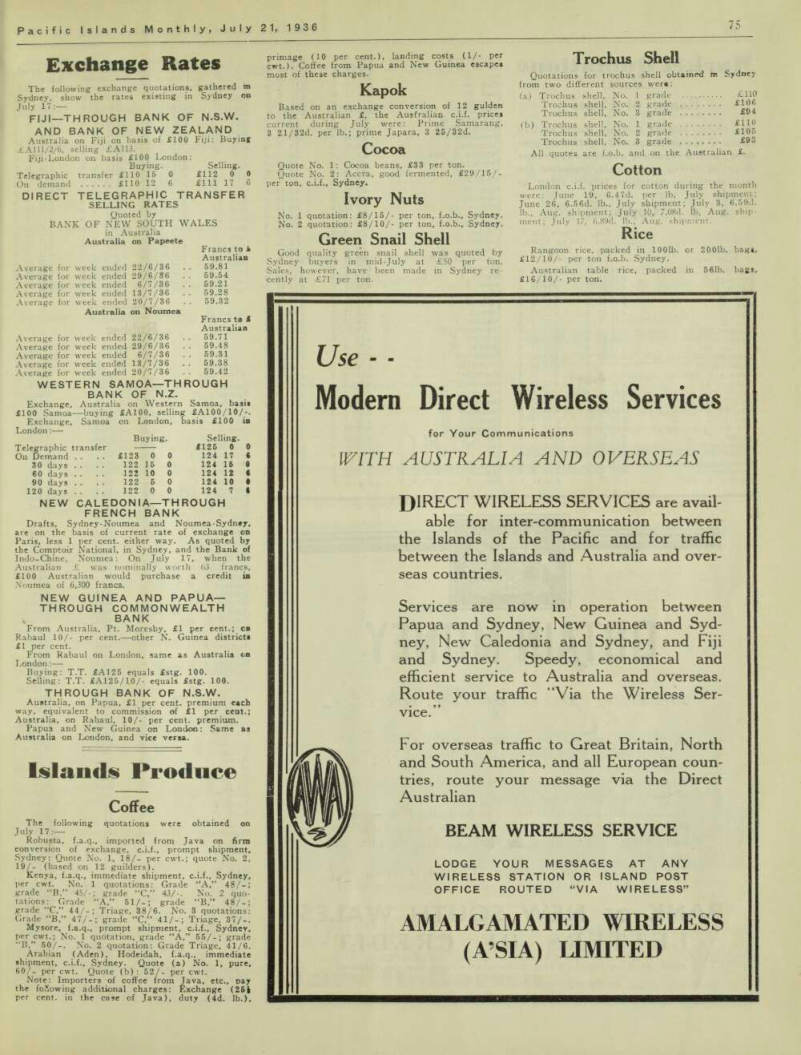
The following exchange quotations, gathered m Sydney, show the rates existing in Sydney on July 17: —
Fiji—Through Bank Of N.S.W.
And Bank Of New Zealand
Australia on Fiji on basis of £lOO Fiji: Buying £Alll/2/6, selling £AII3.
Fiji-London on basis £lOO London: Buying. Selling.
Telegraphic transfer £llO 15 0 £ll2 0 0 On demand £llO 12 6 £lll 17 6
Direct Telegraphic Transfer
Selling Rates
Quoted by
Bank Of New South Wales
in Australia
Western Samoa—Through
Bank Of N.Z.
Exchange, Australia on Western Samoa, basi» £lOO Samoa —buying £AIOO, selling £AIOO/10/-.
Exchange, Samoa on London, basis £lOO in London:—
New Caledonia—Through
French Bank
Drafts, Sydney-Noumea and Noumea-Sydney, are on the basis of current rate of exchange on Paris, less 1 per cent, either way. As quoted by the Comptoir National, in Sydney, and the Bank of Indo-Chine, Noumea: On July 17, when the Australian £ was nominally worth 63 francs, £lOO Australian would purchase a credit to Noumea of 6,300 francs.
New Guinea And Papua
Through Commonwealth
Bank
From Australia, Pt. Moresby, £1 per cent.; co Rabaul 10/- per cent. —other N, Guinea district* £1 per cent.
From Rabaul on London, same as Australia on London:— Buying: T.T. £AI2S equals £stg. 100.
Selling: T.T. £AI2S/1.0/- equals £stg. 100.
Through Bank Of N.S.W.
Australia, on Papua, £1 per cent, premium each way, equivalent to commission of £1 per cent.; Australia, on Rabaul, 10/- per cent, premium.
Papua and New Guinea on London: Same as Australia on London, and vice versa.
Average Australia on Papeete for week ended 22/6/36 Francs to k Australian 59.81 Average for week ended 29/6/36 59.54 Average for week ended 6/7/36 59.21 Average for week ended 13/7/36 59.28 Average for week ended 20/7/36 59.32 Average Australia on Noumea for week ended 22/6/36 . .
Francs to 1 Australian 59.71 Average for week ended 29/6/36 59.48 Average for week ended 6/7/36 59.31 Average for week ended 13/7/36 . . 59.38 Average for week ended 20/7/36 . . 59.42
Buying. Selling.
Telegraphic transfer £126 0 0 On Demand . . . . £123 0 0 124 17 € 30 days ... 122 IB 0 124 16 0 60 days . . . . 122 10 0 124 12 « 90 days ... 122 5 0 124 10 • 120 days ... 122 0 0 124 7 I
Islands Produce
Coffee
The following quotations were obtained on July 17:— Robusta, f.a.q., imported from Java on firm conversion of exchange, c.i.f., prompt shipment.
Sydney: Quote No. 1, 18/- per cwt.; quote No. 2, 19/- (based on 12 guilders).
Kenya, f.a.q., immediate shipment, c.i.f., Sydney, per cwt. No. 1 quotations: Grade “A,” 48/-; grade “B,” 45/-; grade “C,” 43/-. No. 2 quo tations: Grade “A,” 51/-; grade “B,” 48/-; grade “C,” 44/-; Triage, 38/6. No. 3 quotations; Grade “B.” 47/-; grade “C,” 41/-; Triage, 37/-.
Mysore, f.a.q., prompt shipment, c.i.f., Sydney, per cwt.; No. 1 quotation, grade “A,” 55/-; grade “B,” 50/-. No. 2 quotation; Grade Triage, 41/6.
Arabian (Aden), Hodeidah, f.a.q., immediate shipment, c.i.f., Sydney. Quote (a) No. 1, pure, 60/- per cwt. Quote (b) : 52/- per cwt.
Note; Importers of coffee from Java, etc., pay the following additional charges; Exchange (251 per cent, in the case of Java), duty (4d. lb.).
primage (10 per cent.), landing costs (1/- per cwt.). Coffee from Papua and New Guinea escape* most of these charges.
Kapok
Based on an exchange conversion of 12 gulden to the Australian £, the Australian c.i.f. prices current during July were: Prime Samarang, 3 21/32d. per lb.; prime Japara, 3 25/32d.
Cocoa
Quote No. 1: Cocoa beans, £33 per ton.
Quote No. 2: Accra, good fermented, £29/15/per ton, c.i.f., Sydney.
Ivory Nuts
No. 1 quotation; £B/15/- per ton, f.0.b., Sydney.
No. 2 quotation: £B/10/- per ton, f.0.b., Sydney.
Green Snail Shell
Good quality green snail shell was quoted by Sydney buyers in mid-July at £5O per ton.
Sales, however, have been made in Sydney re cently at £7l per ton.
Trochus Shell
Quotations for trochus shell obtained m Sydney from two different sources were: (a) Trochus shell, No. 1 grade £llO Trochus shell, No. 2 grade £lO6 Trochus shell. No. 3 grade £94 (b) Trochus shell, No. 1 grade £llO Trochus shell. No. 2 grade £lO5 Trochus shell. No. 3 grade £93 All quotes are f.o.b. and on the Australian £.
Cotton
London c.i.f. prices for cotton during the month were: June 19, 6.47 d. per lb, July shipment; June 26, 6.56 d. lb., July shipment; July 3,6.59 d. lb., Aug. shipment; July 10, 7.08 d. lb, Aug. ship ment; July 17, 6.89 d. lb., Aug. shipment.
Rice
Rangoon rice, packed in 1001 b. or 2001 b. bag*, £l2/10/- per ton f.o.b. Sydney.
Australian table rice, packed in 561 b. bags, £l6/10/- per ton.
Advertisements & other items, p. 77 (1 item)
Modern Direct Wireless Services
Use - ■
for Your Communications
WITH AUSTRALIA AND OVERSEAS
DIRECT WIRELESS SERVICES are avail-
able for inter-communication between the Islands of the Pacific and for traffic between the Islands and Australia and overseas countries.
Services are now in operation between Papua and Sydney, New Guinea and Sydney, New Caledonia and Sydney, and Fiji and Sydney. Speedy, economical and efficient service to Australia and overseas.
Route your traffic “Via the Wireless Service.”
For overseas traffic to Great Britain, North and South America, and all European countries, route your message via the Direct Australian
BEAM WIRELESS SERVICE
LODGE YOUR MESSAGES AT ANY
WIRELESS STATION OR ISLAND POST
OFFICE ROUTED “VIA WIRELESS”
AMALGAMATED WIRELESS
(ASIA) LIMITED
Market Quotations
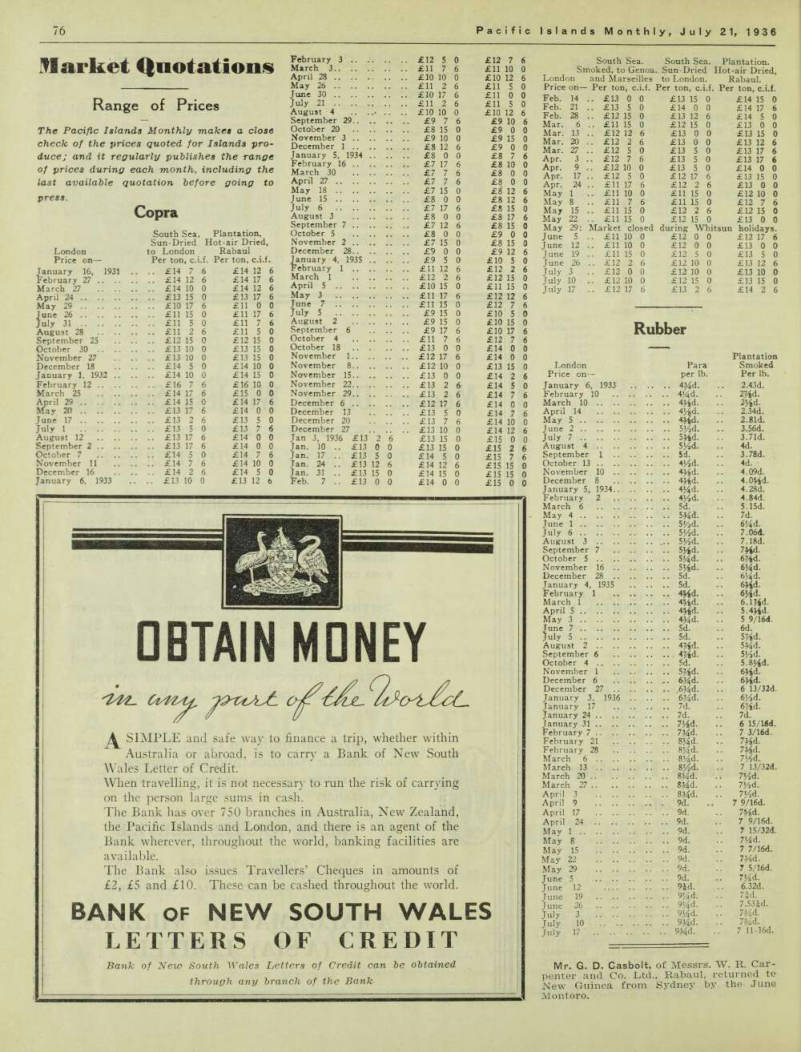
Range of Prices
The Pacific Islands Monthly makes a close check of the prices quoted for Islands pro duce; and it regularly publishes the range of prices during each month, including the last available quotation before going to press.
Copra
Mr. G. D. Casbolt, of Messrs. W. R. Car penter and Co. Ltd., Rabaul, returned to New Guinea from Sydney by the June Montoro.
London Price on— South Sea, Plantation, Sun-Dried Hot-air Dried, to London Rabaul Per ton, c.i.f. Per ton, c.i.f.
January 16, 1931 . .. £14 7 6 £14 12 6 February 27 . .. £14 12 6 £14 17 6 March 27 . .. £14 10 0 £14 12 6 April 24 . .. £13 15 0 £13 17 6 May 29 . .. £10 17 6 £11 0 0 June 26 . .. £11 IS 0 £11 17 6
July 31
. .. £11 5 0 £11 7 6 August 28 . .. £11 2 6 £11 5 0 September 25 .. . . .. £12 15 0 £12 15 0 October 30 . .. £13 10 0 £13 15 0 November 27 .. . . .. £13 10 0 £13 15 0 December 18 .. . . .. £14 5 0 £14 10 0 January 1, 1932 .. . . .. £14 10 0 £14 15 0
February 12
. .. £16 7 6 £16 10 0 March 25 . .. £14 17 6 £15 0 0
April 29
May 20 . .. £14 15 0 £14 17 6 . .. £13 17 6 £14 0 0 June 17 . .. £13 2 6 £13 5 0 July 1 . .. £13 5 0 £13 7 6 August 12 . .. £13 17 6 £14 0 0 September 2 . .. £13 17 6 £14 0 0 October 7 . .. £14 5 0 £14 7 6 November 11 .. . . .. £14 7 6 £14 10 0 December 16 . . .. £14 2 6 £14 5 0 January 6, 1933 . .. £13 10 0 £13 12 6
South Sea.
South Sea. Plantation.
Smoked, to Genoa. Sun-Dried Hot-air Dried.
London and Marseilles to London.
Rabaul.
Price on— Per ton, c.i.f. Per ton, c.i.f. Per ton, c.i.f.
Feb. 14 . . £13 0 0 £13 15 0 £14 15 0 Feb. 21 . . £13 5 0 £14 0 0 £14 17 6 Feb. 28 . . £12 15 0 £13 12 6 £14 5 0 Mar. 6 . . £11 15 0 £12 15 0 £13 0 0 Mar. 13 . . £12 12 6 £13 0 0 £13 15 0 Mar. 20 . £12 2 6 £13 0 0 £13 12 6 Mar. 27 . £12 5 0 £13 5 0 £13 17 6 Apr. 3 . £12 7 6 £13 5 0 £13 17 6
Apr. 9 .
£12 10 0 £13 5 0 £14 0 0 Apr. 17 . . £12 5 0 £12 17 6 £13 15 0 Apr. 24 . . £11 17 6 £12 2 6 £13 0 0 May 1 . £11 10 0 £11 IS 0 £12 10 0 May 8 . . £11 7 6 £11 15 0 £12 7 6 May IS . . £11 15 0 £12 2 6 £12 15 0 May 22 . . £11 15 0 £12 15 0 £13 0 0 May 29: Market closed during Whitsun holidays.
June 5 . . £11 10 0 £12 0 0 £12 17 6 June 12 . . £11 10 0 £12 0 0 £13 0 0 J une 19 . . £11 15 0 £12 5 0 £13 5 0 June 26 . . £12 2 6 £12 10 0 £13 12 6 July 3 . . £12 0 0 £12 10 0 £13 10 0 July 10 . . £12 10 0 £12 IS 0 £13 15 0 July 17 . . £12 17 6 £13 2 6 £14 2 6
Rubber
Plantation London Para Smoked Price onper lb.
Per lb.
January 6 1933 .. .. .. 4**d. 2.43d.
February 10 ... .. .. 4%d. 27Ad.
March 10 .. .. 4^d. 2'/ t d.
April 14 .. .. 4*4d. 2.34d.
May 5 .. .. .. 4&1. 2.81d.
June 2 .. .. .. sy 2 d. 3.56d.
July 7 .. .. .. Stfd. 3.71d.
August 4 .. .. 5/ 3 d. 4d.
September 1 .. .. .. .. 5d. 3.78d.
October 13 .. .. 4>4d. 4d.
November 10 .. .. .. .. 4tfd. 4.09d.
December 8 ... .. .. 4tfd. 4.0**d.
January 5, 1934.. .. .. .. A'Ad. 4.28d.
February 2 .. .. .. .. 4/ a d. 4.84d.
March 6 .. .. 5d. 5.15d.
May 4 .. .. .. 5Hd. 7d.
June 1 .. .. .. S'M. 6Ad.
July 6 .. .. .. 554d. 7.06d.
August 3 .. ... 5/ a d. 7.18d.
September 7 .. .. .. .. 5*d. 7Hd.
October 5 .. .. sy A d. 6J%d.
November 16 .. .. .. .. 5'Ad. ey A d.
December 28 .. .. .. .. 5d. 6'Ad.
January 4, 1935 .. .. .. 5d. 6Jid.
February 1 .. .. .. .. 4*id. 6><d.
March 1 .. .. 4H<i. e.nAd.
April 5 .. .. .. AHd. 5.4*d.
May 3 .. .. .. iHd. 5 9/16d.
June 7 .. .. ,. 5d. 6d.
July 5 .. .. .. 5d.
VAd.
August 2 .. .. 4^d. sy A d.
September 6 W. 5'Ad.
October 4 .. .. 5d.
S.8'Ad.
November 1 ... .. .. 5^d. 6Ad.
December 6 ... .. .. 6Hd. 6Hd.
December 27 .. .. .. .. ey 4 d. 6 13/32d.
January 3. 1936 .. .. .. 6-Kd. 6'Ad.
January 17 .. .. 7d. 6Hd.
January 24 .. .. 7d. 7d.
January 31 .. .. 7^d. 6 15/16d.
February 7 .. .. ?y 4 d. 7 3/16d.
February : 21 ... .. .. 8^d. 7Hd.
February 28 ... .. .. 8'Ad. 7Hd.
March 6 .. .. 8'/ 4 d. 7'A d.
March 13 .. .. sy 2 d. 7 13/32d.
March 20 .. .. 83^d. ?yd.
March 27 .. .. 8Ad. 7VA.
April 3 .. .. sy 4 d. 7'Ad.
April 9 .. . 9d. .. 7 9/16d.
April 17 .. .. 9d. 7Hd.
April 24 .. .. 9d. 7 9/16d.
Mav 1 .. .. .. 9d. 7 15/32d.
May 8 .. .. 9d. 7'Ad.
May 15 .. .. 9d. 7 7/16d.
May 22 .. .. 9d. 7Hd.
May 29 .. .. 9d. 7 5/16d.
June 5 .. .. 9d. 7'Ad.
June 12 .. .. 9id. 6.32d.
June 19 .. .. 9Ad. 7gd.
June 26 .. .. 9'/ 4 d. 7.534d.
July 3 .. .. 9'Ad. 7Vxd.
July 10 .. .. 9Ad. 7y 4 d.
July 17 .. .. 9^d. 7 ll-16d.
February 3 .. £12 5 0 £12 7 6 March 3.. .. £11 7 6 £11 10 0 April 28 .. .. £10 10 0 £10 12 6 May 26 £11 2 6 £11 5 0 June 30 .. .. £10 17 6 £11 0 0 July 21 .. .. £11 2 6 £11 5 0 August 4 £10 10 0 £10 12 6 September 29.. £9 7 6 £9 10 6 October 20 £8 15 0 £9 0 0 November 3 .. £9 10 0 £9 15 0 December 1 .. £8 12 6 £9 0 0 January 5, 1934 £8 0 0 £8 7 6 February 16 .. £7 17 6 £8 10 0 March 30 £7 7 6 £8 0 0 April 27 .. .. £7 7 6 £8 0 0 May 18 .. .. £7 15 0 £8 12 6 June 15 .. .. £8 0 0 £8 12 6 July 6 ... £7 17 6 £8 IS 0 August 3 £8 0 0 £8 17 6 September 7 .. £7 12 6 £8 IS 0 October 5 £8 0 0 £9 0 0 November 2 .. £7 IS 0 £8 15 0 December 28.. £9 0 0 £9 12 6 January 4, 1935 £9 5 0 £10 5 0 February 1 .. £11 12 6 £12 2 6 March 1 £12 2 6 £12 IS 0 April 5 .. .. £10 15 0 £11 15 0 May 3 £11 17 6 £12 12 6 June 7 .. .. £11 15 0 £12 7 6 July 5 .. .. £9 IS 0 £10 5 0 August 2 £9 15 0 £10 15 0 September 6 £9 17 6 £10 17 6 October 4 £11 7 6 £12 7 6 October 18 £13 0 0 £14 0 0 November 1.. £12 17 6 £14 0 0 November 8.. £12 10 0 £13 15 0 November IS.. £13 0 0 £14 2 6 November 22.. £13 2 6 £14 5 0 November 29.. £13 2 6 £14 7 6 December 6 .. £12 17 6 £14 0 0 December 13 £13 5 0 £14 7 6 December 20 £13 7 6 £14 10 0 December 27 £13 10 0 £14 12 6 Jan 3, 1936 £13 2 6 £13 15 0 £15 0 0 Jan. 10 .. £13 0 0 £13 15 0 £15 2 6 Jan. 17 .. £13 5 0 £14 5 0 £15 7 6 Jan. 24 .. £13 12 6 £14 12 6 £15 IS 0 Jan. 31 .. £13 15 0 £14 15 0 £15 IS 0 Feb. 7 .. £13 0 0 £14 0 0 £15 0 0
Advertisements & other items, p. 78 (1 item)
Obtain Money
SIMPLE and safe way to finance a trip, whether within Australia or abroad, is to carry a Bank of New South Wales Letter of Credit.
When travelling, it is not necessary to run the risk of carrying on the person large sums in cash.
The Bank has over 750 branches in Australia, New Zealand, the Pacific Islands and London, and there is an agent of the Bank wherever, throughout the world, banking facilities are available.
The Bank also issues Travellers’ Cheques in amounts of £2, £5 and £lO. These can be cashed throughout the world.
BANK of NEW SOUTH WALES
LETTERS OF CREDIT
Bank of New South Wales Letters of Credit can be obtained through any branch of the Bank
Sydney—Rabaul—Hong Kong
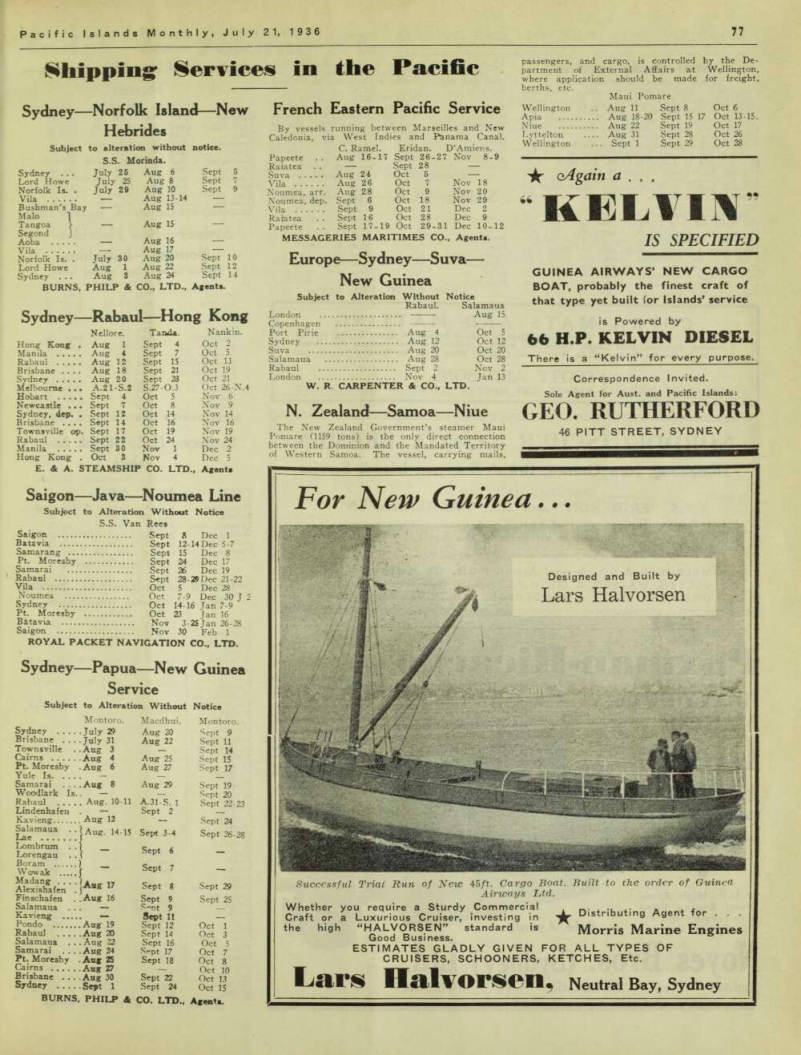
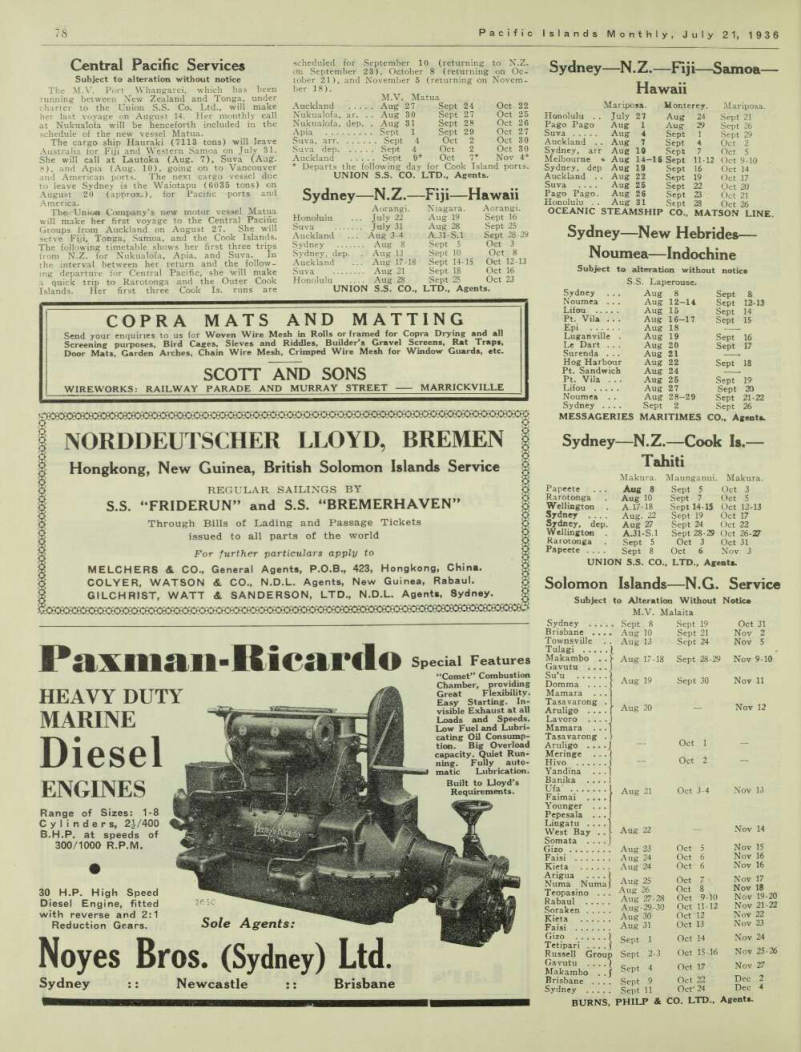
Shipping: Services in the Pacific
Sydney—Norfolk Island —New Hebrides Subject to alteration without notice.
Saigon—Java—Noumea Line Subject to Alteration Without Notice
Sydney—Papua—New Guinea Service Subject to Alteration Without Notice
French Eastern Pacific Service
Europe—Sydney—Suva— New Guinea Subject to Alteration Without Notice
N. Zealand—Samoa—Niue
The New Zealand Government’s steamer Maui Pomare (1159 tons) is the only direct connection between the Dominion and the Mandated Territory of Western Samoa. The vessel, carrying mails,
passengers, and cargo, is controlled by the De partment of External Affairs at Wellington, where application should be made for freight, berths, etc.
Maui Pomare Wellington .. Aug 11 Sept 8 Oct 6 Apia Aug 18-20 Sept 15 17 Oct 13-15.
Niue Aug 22 Sept 19 Oct 17 Lyttelton Aug 31 Sept 28 Oct 26 Wellington ... Sept 1 Sept 29 Oct 28
S.S. Morinda.
Sydney . . .
July 25 Aug 6 Sept 5 Lord Howe July 25 Aug 8 Sept 7 Norfolk Is. .
July 29 Aug 10 Sept 9 Vila — Aug 13-14 — Bushman's Bay Malo 1 — Aug IS —
Tangoa
Scgond J — Aug IS Aoba — Aug 16 — Vila — Aug 17 — Norfolk Is. .
July 30 Aug 20 Sept 10 Lord Howe Aug 1 Aug 22 Sept 12 Sydney . . .
Aug 3 Aug 24 Sept 14
Burns, Philp &
Co., Ltd.,
Agents.
Nellore.
Tanda.
Nankin.
Hong Kong .
Aug 1 Sept 4 Oct 2 Manila Aug 4 Sept 7 Oct 5 Rabaul Aug 12 Sept 15 Oct 13 Brisbane ...
Aug 18 Sept 21 Oct 19 Sydney Aug 20 Sept 23 Oct 21 Melbourne . ..
A.21-S.2 5.27-0.3 Oct 26-N.4 Hobart Sept 4 Oct 5 Nov 6 Newcastle ...
Sept 7 Oct 8 Nov 9 Sydney, dep. .
Sept 12 Oct 14 Nov 14 Brisbane ...
Sept 14 Oct 16 Nov 16 Townsville op.
Sept 17 Oct 19 Nov 19 Rabaul Sept 22 Oct 24 Nov 24 Manila Sept 30 Nov 1 Dec 2 Hong Kong .
Oct 3 Nov 4 Dec S
E. & A. Steamship
Co. Ltd.,
Agents
s.s. . Van Rees Saigon 8 Dec 1 Batavia 12- 14 Dec 5-7
Samarang
15 Dec 8 Pt. Moresby 24 Dec 17 Samarai 26 Dec 19 Rabanl 28- 29 Dec 21-22 Vila 5 Dec 28 Noumea 7-9 ► Dec 30 J 2 Sydney 14-16 Tan 7-9 Pt. Moresby 23 Tan 16 Batavia 3- 25 Jan 26-28
Saigon
30 Feb 1
Royal Packet
Navigation
Co., Ltd.
Montoro.
Macdhui.
Montoro.
Sydney . . . . • July 29 Aug 20 Sept 9 Brisbane . . . • July 31 Aug 22 Sept 11 Townsville • Aug 3 — Sept 14 Cairns Aug 4 Aug 25 Sept IS Pt. Moresby • Aug 6 Aug 27 Sept 17 Yule Is. . . . — Samara! . . . . Aug 8 Aug 29 Sept 19 Woodlark Is. — — Sept 20 Rabaul . . . . . Aug. 10-11 A.31-S. 1 Sept 22-23 Lindenhafen — Sept 2 Kavieng . Aug 12 — Sept 24 Salamaua Lae
|Aug. 14-15
Sept 3-4 Sept 26-28 Lombrum . .
Lorengau . . - Sept 6 — Boram Wewak - Sept 7 — Madang . . . .
Alcxishafen .
|Aug 17
.Aug 16 Sept 8 Sept 29 Finschafen Sept 9 Sept 25 Salamaua . . — S*ot 9 Kavieng ... — Sept 11 Pondo .Aug 19 Sept 12 Oct 1 Rabaul . .. . .Aug 20 Sept 14 Oct 3 Salamaua . . . Aug 22 Sept 16 Oct 5 Samara! . . .
Aug 24 S*pt 17 Oct 7 Pt. Moresby Aug 25 Sept 18 Oct 8 Cairns Aug 27 Oct 10 Brisbane . . .
Aug 30 Sept 22 Oct 13 Sydney . . . . •Sept 1 Sept 24 Oct 15
Burns. Philp *
CO. LTD., Agents.
By vessels running between Marseilles and New Caledonia, via West Indies and Panama Canal.
C. Ramel.
Eridan. D’Amiens.
Papeete Aug 16-17 Sept 26-27 Nov 8-9 Raiatea — Sept 28 — Suva Aug 24 Oct 5 — Vila Aug 26 Oct 7 Nov 18 Noumea, arr.
Aug 28 Oct 9 Nov 20 Noumea, dep.
Sept 6 Oct 18 Nov 29 Vila Sept 9 Oct 21 Dec 2 Rafatea Sept 16 Oct 28 Dec 9 Papeete Sept 17-19 Oct 29-31 Dec 10-12
Messageries Maritimes Co., Agents.
Rabaul. Salamaua London Aug 15 Copenhagen Port Pirie Aug 4 Oct 5 Sydney Aug 12 Oct 12 Suva Aug 20 Oct 20 Salamaua Aug 28 Oct 28 Rabaul Sept 2 Nov 2 London Nov 4 Jan 13
W. R Carpenter & Co., Ltd.
Central Pacific Services
Subject to alteration without notice The M.V. Port Whangarei, which has been running between New Zealand and Tonga, under charter to the Union S.S. Co. Ltd., will make her last voyage on August 14. Her monthly call at Nukualofa will be henceforth included in the schedule of the new vessel Matua.
The cargo ship Hauraki (7113 tons) will leave Australia for Fiji and Western Samoa on July 31.
She will call at Lautoka (Aug. 7), Suva (Aug. 8), and Apia (Aug. 10), going on to Vancouver and American ports. The next cargo vessel due to leave Sydney is the Waiotapu (6035 tons) on August 20 (approx.), for Pacific ports and America.
The Union Company’s new motor vessel Matua will make her first voyage to the Central Pacific Groups from Auckland on August 27. She will serve Fiji, Tonga, Samoa, and the Cook Islands.
The following timetable shows her first three trips from N.Z. for Nukualofa, Apia, and Suva. In the interval between her return and the follow ing departure for Central Pacific, she will make a quick trip to Rarotonga and the Outer Cook Islands. Her first three Cook Is. runs are
Sydney—N.Z.—Fiji—Hawaii
Sydney—N.Z.—Fiji—Samoa— Hawaii
Sydney—New Hebrides— Noumea—lndochine Subject to alteration without notice
Sydney—N.Z.—Cook Is.— Tahiti
Solomon Islands —N.G. Service Subject to Alteration Without Notice
Mariposa.
Monterey.
Mariposa.
Honolulu . . July 2 7 Aug 24 Sept 21 Pago Pago Aug 1 Aug 29 Sept 26 Suva Aug 4 Sept 1 Sept 29 Auckland . . Aug 7 Sept 4 Oct 2 Sydney, arr Aug 10 Sept 7 Oct 5 Melbourne * Aug 14—16 Sept 11-12 Oct 9-10 Sydney, dep Aug 19 Sept 16 Oct 14 Auckland . . Aug 22 Sept 19 Oct 17 Suva Aug 25 Sept 22 Oct 20 Pago Pago.
Aug 26 Sept 23 Oct 21 Honolulu . . . Aug 31 Sept 28 Oct 26
Oceanic
Steamship
CO.,
Matson Line.
S.S. Laperouse.
Sydney Aug 8 Sept 8 Noumea . . .
Aug 12—14 Sept 12-13 Lifou Aug 15 Sept 14 Pt. Vila . . .
Aug 16-17 Sept 15 Epi Aug 18 Luganville .
Aug 19 Sept 16 Le Dart . . .
Aug 20 Sept 17 Surenda ...
Aug 21 , Hog Harbour Aug 22 Sept 18 Pt. Sandwich Aug 24 Pt. Vila . . .
Aug 25 Sept 19 Lifou Aug 27 Sept 20 Noumea . .
Aug 28-29 Sept 21-22 Sydney ...
Sept 2 Sept 26
Messageries
Maritimes
CO., Agents.
Makura.
Maunganui.
Makura.
Papeete Aug 8 Sept 5 Oct 3 Rarotonga Aug 10 Sept 7 Oct 5 Wellington A.17-18 Sept 14-15 Oct 12-13 Sydney ...
Aug. 22 Sept 19 Oct 17 de P- Aug 27 Sept 24 Oct 22 Wellington A.31-S.1 Sept 28-29 Oct 26-27 Rarotonga Sept 5 Oct 3 Oct 31 Papeete ...
Sept 8 Oct 6 Nov 3
Union S.S. Co.
LTD., Agent*.
M.V. Malaita Sydney ...
Brisbane . ..
Townsville Tulagi . Sept 8 Aug 10 Aug 13 Sept 19 Sept 21 Sept 24 Oct 31 Nov 2 Nov 5 Makambo . .
Gavutu ...
Su'u : Aug 17-18 Sept 28-29 Nov 9-10 Domma ...
Mamara Tasavarong .
Aruligo ...
Lavoro ...
Mamara Tasavarong .
Aruligo ...
Meringe Hivo Aug 19 ’ Aug 20 — Sept 30 Oct 1 Oct 2 Nov 11 Nov 12 Yandina . . .
Banika ...
Ufa , Aug 21 . Aug 22 Aug 23 Aug 24 Aug 24 Aug 25 Aug 26 Aug 27-28 Oct 3-4 Oct 5 Nov Nov Nov 13 14 15 Faimai ...
Younger . . .
Pepesala . . .
Lingatu . . . ."
West Bay . .
Somata . . . .
Gizo Faisi Oct 6 Nov 16 Kieta Oct 6 Nov 16 Arigua . . . . ) Numa Numaj Teopasino . .
Rabaul ...
Oct 7 Oct 8 Oct 9-10 Nov 17 Nov 18 Nov 19-20 Nov 21-22 Nov 22 Soraken ...
Aug-29-30 Oct 11-12 Kieta Aug 30 Oct 12 Faisi Aug 31 Oct 13 Nov 23 Gizo \ j- Sept 1 > Sept 2-3 Sept 4 Sept 9 Sept 11
Philp &
Oct 14 Oct 15-16 Oct 17 Oct 22 Oct* 24 Nov 24 Nov 25-26 Nov 27 Dec 2 Dec 4 Tetipari . . . . J Russell Grouj Gavutu . . . . ]
Makambo . . J
Brisbane Sydney
Burns,
Co. Ltd.,
Agents.
scheduled for September 10 (returning to N.Z.
On September 23), October 8 (returning on October 21), and November 5 (returning on November 18).
M.V, Matua Auckland . . .
Sept 24 Oct 22 Nukualofa, ar. .. Aug 30 Sept 27 Oct 25 Nukualofa, dep . . Aug 31 Sept 28 Oct 26 Apia Sept 29 Oct 27 Suva, arr. . . .
Oct 2 Oct 30 Suva dep. . . .
Oct 2 Oct 30 Auckland . . . Sept 9* Oct 7* Nov 4* * Departs the following day for Cook Island ports.
Union S.S. Co. Ltd., Agents.
Aorangi. Niagara. Aorangi.
Honolulu ... July 22 Aug 19 Sept 16 Suva July 31 Aug 28 Sept 25 Auckland ... Aug 3-4 A.31-S.1 Sept 28-29 Sydney Aug 8 Sept 5 Oct 3 Sydney, dep. . Aug 13 Sept 10 Oct 8 Auckland ... Aug 17-18 Sept 14-15 Oct 12-13 Suva Aug 21 Sept 18 Oct 16 Honolulu Aug 28 Sept 25 Oct 23
Union S.S. Co., Ltd., Agents.
Advertisements & other items, pp. 79-80 (1 item)
Kelvin”
★ oAgain a . . .
IS SPECIFIED
GUINEA AIRWAYS’ NEW CARGO
BOAT, probably the finest craft of that type yet built for Islands' service is Powered by
66 H.P. KELVIN DIESEL
There is a "Kelvin” for every purpose.
Correspondence Invited.
Sole Agent for Aust. and Pacific Islands:
GEO. RUTHERFORD
46 PITT STREET, SYDNEY
For New Guinea ...
Designed and Built by
Lars Halvorsen
/ Successful Trial Run of New 45 ft. Cargo Boat. Built to the order of Guinea Airways Ltd.
Whether you require a Sturdy Commercial . . . L Craft or a Luxurious Cruiser; investing in + Distributing Agent for . . . the high “HALVORSEN” standard is Morris Marine Engines Good Business.
ESTIMATES GLADLY GIVEN FOR ALL TYPES OF
CRUISERS, SCHOONERS, KETCHES, Etc.
Lars Halvorsen.
Neutral Bay, Sydney
COPRA MATS AND MATTING
Send your enquiries to us for Woven Wire Mesh in Rolls or framed for Screening purposes. Bird Cages, Sieves and Riddles, Builder's Gravel Door Mats, Garden Arches, Chain Wire Mesh, Crimped Wire Mesh for
SCOTT AND SONS
WIREWORKS: RAILWAY PARADE AND MURRAY STREET
Copra Drying and all Screens, Rat Traps, Window Guards, etc.
MARRICKVILLE
NORDDEUTSCHER LLOYD, BREMEN
Hongkong, New Guinea, British Solomon Islands Service
REGULAR SAILINGS BY
S.S. “FRIDERUN” and S.S. “BREMERHAVEN”
Through Bills of Lading and Passage Tickets issued to all parts of the world For further particulars apply to MELCHERS & CO., General Agents, P. 0.8., 423, Hongkong, China.
COLYER, WATSON & CO., N.D.L. Agents, New Guinea, Rabaul.
GILCHRIST, WATT & SANDERSON, LTD., N.D.L. Agents, Sydney.
Paxnian-Rieardo
HEAVY DUTY
MARINE
Diesel
ENGINES
Range of Sizes: 1-8 Cylinders, B.H.P. at speeds of
300/1000 R.P.M.
30 H.P. High Speed Diesel Engine, fitted with reverse and 2:1 Reduction Gears.
Noyes Bros. (Sydney) Ltd.
265 c
Sole Agents
Special Features
“Comet” Combustion Chamber, providing Great Flexibility.
Easy Starting. Invisible Exhaust at all Loads and Speeds.
Low Fuel and Lubricating Oil Consumption. Big Overload capacity. Quiet Running. Fully automatic Lubrication.
Built to Lloyd’s Requirements.
Sydney
Newcastle
Brisbane
Index to Volume VI.
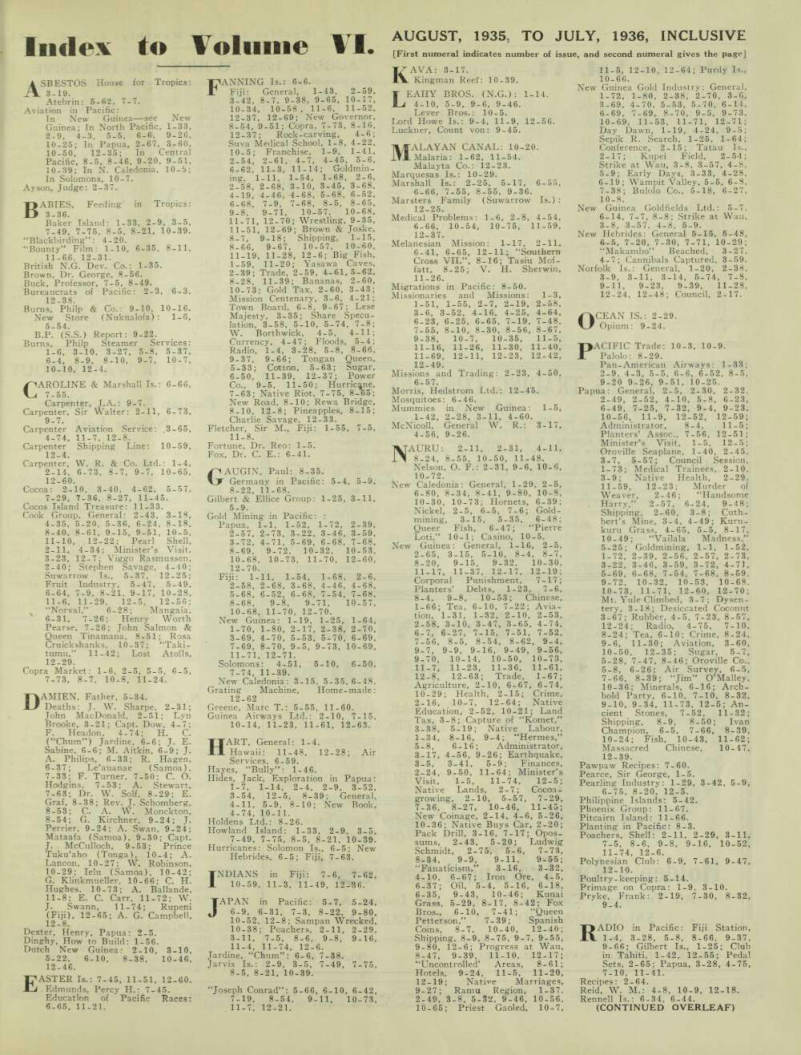
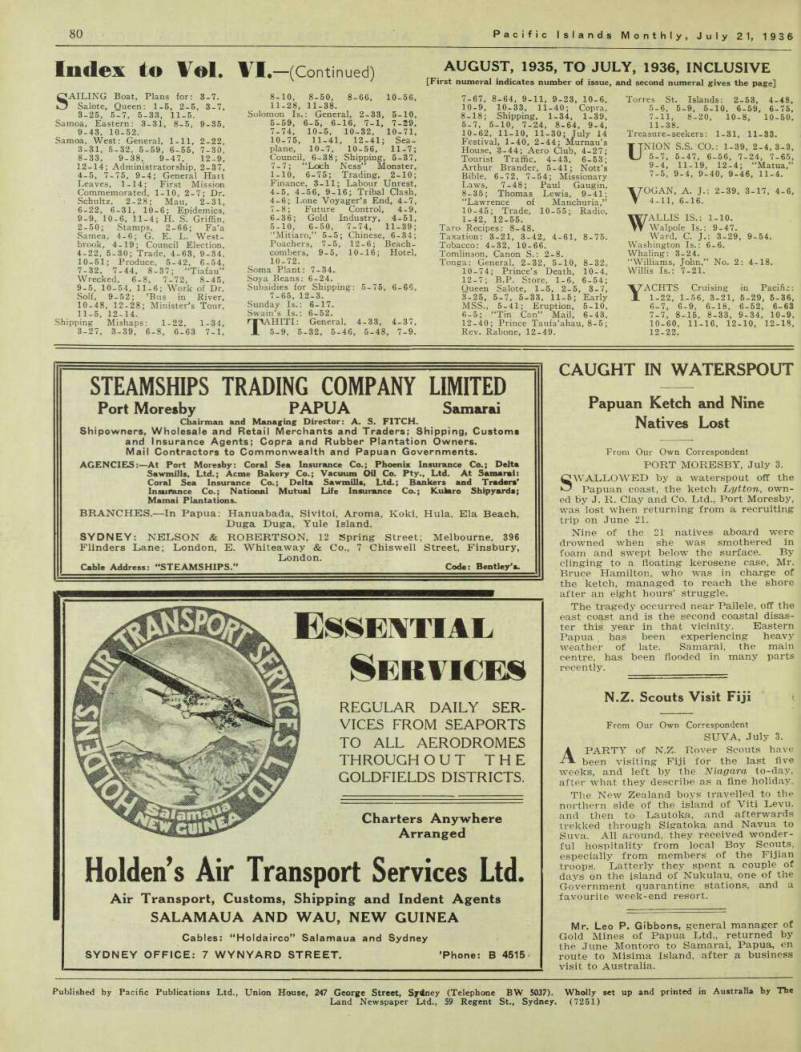
August, 1935, To July, 1936, Inclusive
[First numeral indicates number of issue, and second numeral gives the page]
ASBESTOS House for Tropics: 3-19.
Atebrin: 5-62, 7-7.
Aviation in Pacific: In New Guinea —see New Guinea; In North Pacific, 1-33, 2-9, 4-3, 5-5, 6-6, 9-26, 10-25; In Papua, 2-67, 3-60, 10-50, 12-35; In Central Pacific. 8-5, 8-46, 9-20, 9-51, 10-39; In N. Caledonia, 10-5; In Solomons, 10-7.
Ay son. Judge: 2-37. g ABIES, Feeding in Tropics: Baker Island: 1-33, 2-9, 3-5, 7-49, 7-75, 8-5, 8-21, 10-39.
“Blackbirding”: 4-20.
“Bounty” Film: 1-10, 6-35, 8-11, 11-66. 12-31.
British N.G. Dev. Co.: 1-35.
Brown, Dr. George, 8-56.
Buck, Professor, 7-5, 8-49.
Bureaucrats of Pacific: 2-3, 6-3, 12-38 Burns, "Philp & Co.; 9-10, 10-16.
New Store (Nukualofa); 1-6, 5-54.
B.P. (S.S.) Report: 9-22.
Burns, Philp Steamer Services: 1-6, 3-10, 3-27, 5-8, 5-37, 6-4, 8-9, 8-10, 9-7, 10-7, 10-10, 12-4.
CAROLINE & Marshall Is.: 6-66, 7-55.
Carpenter, J.A.: 9-7.
Carpenter, Sir Walter; 2-11, 6-73, 9-7.
Carpenter Aviation Service: .3-65, 4-74, 11-7, 12-8.
Carpenter Shipping Line: 10-59, 12-4.
Carpenter, W. R. & Co. Ltd.: 1-4, 2-14, 6-73, 8-7, 9-7, 10-65, 12-60.
Cocoa; 2-10, 3-40, 4-62, 5-57. 7-29, 7-36, 8-27, 11-45.
Cocos Island Treasure: 11-33.
Cook Group, General: 2-43, 3-18, 4-35, 5-20, 5-36, 6-24, 8-18, 8-40, 8-61, 9-15, 9-51, 10-5, 11-10, 12-22; Pearl Shell, 2-11, 4-34; Minister’s Visit, 3-23, 12-7; Viggo Rasmussen, 2-40; Stephen Savage, 4-40; Suwarrow Is., 5-37, 12-25; Fruit Industry, 5-47, 5-49, 6-64, 7-9, 8-21, 9-17, 10-23, 11-6, 11-29, 12-5, 12-56; “Norval,” 6-28; Mangaia, ' 6-31, 7-26; Henry Worth Pearse, 7-26; John Salmon & Queen Tinamana, 8-51; Rosa Cruickshanks, 10-37; “Taki tumu,” 11-42; Lost Atolls, 12-29.
Copra Market: 1-6, 2-5, 5-5, 6-5, 7-73, 8-7, 10-8, 11-24.
Damien, Father, 5-34.
Deaths: J. W. Sharpe, 2-31; John MacDonald, 2-51; Lyn Brooke, 3-21; Capt. Dow, 4-7; F. Headon, 4-74; H. C. (“Chum”) Jardine, 6-6; J. E.
Sabine, 6-6; M. Aitkin, 6-9; J.
A. Philips, 6-33; R. Hagen, 6-37; Le’auanae (Samoa), 7-33; F. Turner, 7-50; C. O.
Hodgins, 7-53; A. Stewart, 7-63; Dr. W. Solf, 8-29: E.
Graf, 8-38; Rev. J. Schomberg, 8-53; C. A. W. Monckton, 8-54; G. Kirchner, 9-24; J.
Perrier, 9-24; A. Swan, 9-24; Mataafa (Samoa), 9-30; Capt.
J. McCulloch, 9-53; Prince Tuku’aho (Tonga), 10-4; A.
Lancon, 10-27; W. Robinson, 10-29; lelu (Samoa), 10-42; G. Klinkmueller, 10-66; C. H.
Hughes. 10-73; A. Ballande. 11-8; E. C. Carr, 11-72; W.
J. Swann, 11-74; Rupeni (Fiji), 12-65; A. G. Campbell, 12-8.
Dexter, Henry, Papua: 2-5.
Dinghy, How to Build: 1-56.
Dutch New Guinea: 2-10, 3-10, 5-22, 6-10, 8-38, 10-46, 12-46.
Easter is.; 7-45, 11-51. 12-60.
Edmunds, Percy H.: 7-45.
Education of Pacific Races: 6-65, 11-21.
Fanning is.: e-e.
Fiji: General, 1-43, 2-59, 3-42, 8-7, 9-38, 9-65, 10-17, 10-34, 10-58 , 11-6, 11-52, 12-37, 12-69; New Governor, 8-54, 9-51; Copra, 7-73, 8-16, 12-37; Rock-carving, 4-6; Suva Medical School, 1-8, 4-22, 10-5; Franchise, 1-9, 1-41, 2-54, 2-61, 4-7, 4-45, 5-6, 6-62, 11-3, 11-14; Goldmin ing, 1-11, 1-54, 1-68, 2-6, 2-58, 2-68, 3-10, 3-45, 3-68, 4-19, 4-46, 4-68, 5-68, 6-52, 6-68, 7-9, 7-68, 8-5, 8-65, 9-8, 9-71, 10-57, 10-68, 11-71, 12-70; Wrestling, 9-35, 11-51, 12-69; Brown & Joske, 8-7, 9-18; Shipping, 1-15, 8-66, 9-67, 10-57, 10-60, 11-19, 11-28, 12-6; Big Fish, 1-59, 11-20; Yasawa Caves, 2-39; Trade, 2-59, 4-61, 5-62, 8-28, 11-39; Bananas, 2-60, 10-73; Gold Tax, 2-60, 3-43; Mission Centenary, 3-6, 4-21; Town Board, 6-8, 9-67; Lese Majesty, 3-35; Share Specu lation, 3-58, 5-10, 5-74, 7-8; W. Borthwick, 4-5, 4-11; Currency, 4-47; Floods, 5-4; Radio, 1-4, 3-28, 5-8, 8-66, 9-37, 9-66; Tongan Queen, 5-33; Cotton, 5-63; Sugar, 6-50, 11-39, 12-37; Power Co., 9-5, 11-50; Hurricane, 7-63; Native Riot, 7-75, 8-65; New Road, 8-10; Rewa Bridge, 8-10, 12-8; Pineapples, 8-15; Charlie Savage, 12-33.
Fletcher, Sir M., Fiji: 1-55, 7-5, 11-8.
Fortune, Dr. Reo: 1-5.
Fox, Dr. C. E.: 6-41. ("'i AUGIN, Paul: 8-35. ~W Germany in Pacific: 5-4, 5-9, 8-22, 11-68.
Gilbert & Ellice Group: 1-25, 3-11, 5-9.
Gold Mining in Pacific; : Papua. 1-1, 1-52, 1-72, 2-39, 2-57, 2-73, 3-22, 3-46, 3-59, 3-72, 4-71, 5-69, 6-68, 7-68, 8-69, 9-72, 10-32, 10-53, 10-68, 10-73, 11-70, 12-60, 12-70.
Fiji; 1-11, 1-54, 1-68, 2-6, 2-58, 2-68, 3-68, 4-46, 4-68, 5-68, 6-52, 6-68, 7-54, 7-68, 8-68, 9-8, 9-71, 10-57, 10-68, 11-70, 12-70.
New Guinea: 1-19, 1-25, 1-64, 1-70, 1-80, 2-17, 2-38, 2-70, 3-69, 4-70, 5-53, 5-70, 6-69, 7-69, 8-70, 9-5, 9-73, 10-69, 11-71, 12-71.
Solomons: 4-51, 5-10, 6-50, 7-74, 11-39, New Caledonia: 3-15, 5-35.6-48.
Grating Machine, Home-made: 12-62 Greene, Marc T.: 5-55, 11-60.
Guinea Airways Ltd.: 2-10, 7-15, 10-14, 11-23, 11-61, 12-63.
HART, General: 1-4.
Hawaii: 11-48, 12-28; Air Services, 6-59.
Hayes, “Bully”: 1-46.
Hides, Jack, Exploration in Papua: 1-7, 1-14, 2-4, 2-9, 3-52, 3-54, 12-5, 8-39; General, 4-11, 5-9, 8-10; New Book. 4-74, 10-11.
Holdens Ltd.: 8-26.
Howland Island: 1-33, 2-9, 3-5, 7-49, 7-75, 8-5, 8-21, 10-39.
Hurricanes: Solomon Is., 6-5; New Hebrides, 6-5; Fiji, 7-63.
INDIANS in Fiji: 7-6, 7-62, 10-59, 11-3, 11-49, 12-86.
JAPAN in Pacific: 5-7, 5-24, 6-9, 6-31, 7-3, 8-22, 9-80, 10-52, 12-8; Sampan Wrecked, 10-38; Poachers, 2-11, 2-29, 3-11. 7-5, 8-6, 9-8, 9-16, 11-4, 11-74, 12-6.
Jardine, “Chum”: 6-6, 7-38.
Jarvis Is.: 2-9, 3-5, 7-49, 7-75, 8-5, 8-21, 10-39.
“Joseph Conrad”: 5-66, 6-10, 6-42, 7-19, 8-54, 9-11, 10-73, 11-7, 12-21.
Kava: 3-17.
Kingman Reef: 10-39.
Leahy bros. (n.g.): 1-14. 4-10, 5-9, 9-6, 9-46.
Lever Bros.; 10-5.
Lord Howe Is.: 9-4, 11-9, 12-56.
Luckner, Count von: 9-45.
Tl/Talayan Canal: 10-20.
ITJ. Malaria: 1-62, 11-54.
Malayta Co.: 12-23.
Marquesas Is.: 10-29.
Marshall Is.: 2-25, 5-17, 6-55, 6-66, 7-55, 8-55, 9-36.
Marsters Family (Suwarrow Is.) : 12-25.
Medical Problems: 1-6, 2-8, 4-54, 6-66, 10-54, 10-75, 11-59, 12-37.
Melanesian Mission: 1-17, 2-11, 6-41, 6-65, 12-11; “Southern Cross VII.”, 8-16; Tasiu Mof fatt, 8-25; V. H. Sherwin, 11-26, Migrations in Pacific: 8-50.
Missionaries and Missions: 1-3, 1-51, 1-55, 2-7, 2-19, 2-58, 3-6, 3-52, 4-16, 4-25, 4-64, 6-23, 6-25, 6-65, 7-19, 7-48. 7-55, 8-10, 8-30, 8-56, 8-67, 9-38, 10-7, 10-35, 11-5, 11-16, 11-26, 11-30, 11-40, 11-69, 12-11, 12-23, 12-42, 12-49.
Missions and Trading; 2-23, 4-50, 6-57.
Morris, Hedstrom Ltd.: 12-45.
Mosquitoes: 6-4 6.
Mummies in New Guinea: 1-5, 1-42, 2-28, 3-11, 4-60.
McNicoll, General W. R.; 3-17, 4-56, 9-26.
Nauru: 2-11, 2-31, 4-11,
8-24, 8-55, 10-50, 11-48.
Nelson, O. F.: 2-31, 9-6, 10-6, 10-72.
New Caledonia: General, 1-29, 2-5, 6-80, 8-34, 8-41, 9-80, 10-8, 10-30, 10-73; Hornets, 6-39; Nickel, 2-5, 6-5, 7-6; Gold mining, 3-15, 5-35, 6-48; Queer Fish, 6-47; “Pierre Loti,” 10-1; Casino, 10-5.
New Guinea: General, 1-16, 2-5, 2-65, 3-15, 5-10, 8-4, 8-7, 8-20, 9-15, 9-32, 10-30, 11-17, 11-37, 12-17, 12-19; Corporal Punishment, 7-17; Planters’ Debts, 1-23, 7-6, 8-4, 9-8, 10-53; Chinese, 1-66; Tea. 6-10, 7-22; Avia tion, 1-31, 1-32, 2-10, 2-53, 2-58, 3-10, 3-47, 3-65, 4-74, 6-7, 6-27, 7-15, 7-51, 7-52, 7-56, 8-5, 8-54, 8-62, 9-4, 9-7, 9-9, 9-16, 9-49, 9-56, 9-70, 10-14, 10-50, 10-73, 11-7, 11-23, 11-36, 11-61, 12-8, 12-63; Trade, 1-67; Agriculture, 2-10, 6-67, 6-74, 10-29; Health, 2-15; Crime, 2-16, 10-7, 12-64; Native Education, 2-52, 10-21; Land Tax, 3-8; Capture of “Komet,” 3-38, 5-19; Native Labour, 1-34, 8-16, 9-4; “Hermes.” 5-8, 6-16; Administrator, 3-17, 4-56, 9-26; Earthquake, 3-5, 3-41, 5-9; Finances, 2-24, 9-50, 11-64; Minister’s Visit, 1-5, 11-74, 12-5; Native Lands, 2-7; Cocoa growing, 2-10, 5-57, 7-29, 7-36, 8-27, 10-46, 11-45; New Coinage, 2-14, 4-6, 5-26, 10-36; Native Buys Car, 2-20; Pack Drill, 3-16, 7-17; Opos sums, 2-43, 5-20; Ludwig Schmidt, 2-75, 5-6, 7-73, 8-34, 9-9, 9-11, 9-55; “Fanaticism,” 3-16, 3-32, 4-10, 6-67; Iron Ore. 4-5, 6-37; Oil. 5-4, 5-16, 6-18, 6-35, 9-43, 10-46; Kunai Grass, 5-29, 8-17, 8-42; Fox Bros., 6-10, 7-41; “Queen Petterson,” 7-39; Spanish Coins, 8-7, 10-40, 12-40; Shipping, 8-9, 8-75, 9-7, 9-55, 9-80, 12-6; Progress at Wau, 8-47, 9-39, 11-10, 12-17; “Uncontrolled’ Areas, 8-61; Hotels, 9-24, 11-5, 11-20, 12-19; Native Marriages, 9-27; Ramu Region, 1-37, 2-49, 3-8, 5-32, 9-46, 10-56, 10-65; Priest Gaoled, 10-7,
11- 12-10, 12-64; Purdy Is., 10-66.
New Guinea Gold Industry: General, 1- 1-80, 2-38, 2-70, 3-G, 3-69, 4-70, 5-53, 5-70, 6-14, 6-69, 7-69, 8-70, 9-5, 9-73, 10-69, 11-53, 11-71, 12-71; Day Dawn, 1-19, 4-24, 9-5; Sepik R. Search, 1-25, 1-64; Conference, 2-15; Tatau Is., 2- Kupei Field, 2-54; Strike at Wau, 3-8, 3-57, 4-8, 5- Early Days, 3-33, 4-28, 6- Wampit Valley, 5-5, 6-8, 7- Bulolo Co., 5-18, 6-27, 10-8.
New Guinea Goldfields Ltd.: 5-7, 6-14, 7-7, 8-8; Strike at Wau. 3- 3-57, 4-8, 5-9.
New Hebrides: General 5-15, 5-48, 6-5, 7-20, 7-30, 7-71, 10-29; “Makambo” Beached, 3-27. 4- Cannibals Captured, 3-59.
Norfolk Is.: General, 1-20, 2-38, 3-9, 3-11, 3-14, 5-74, 7-8, 9-11, 9-23, 9-39, 11-28, 12- 12-48; Council. 2-17.
Ocean Is.: 2-29.
Opium; 9-24.
PACIFIC Trade: 10-3, 10-9.
Palolo: 8-29.
Pan-American Airways: 1-33; 2-9, 4-3, 5-5, 6-6, 6-52, 8-5, 9-20 9-26, 9-51, 10-25.
Papua; General, 2-5, 2-30, 2-32, 2-49, 2-52, 4-10, 5-8, 6-23, 6-49, 7-25, 7-32, 9-4, 9-23. 10-56, 11-9, 12-52, 12-59; Administrator, 8-4, 11-5; Planters’ Assoc., 7-56, 12-51; Minister’s Visit, 1-5, 12-5; Oroville Seaplane, 1-40, 2-45, 3-7, 5-57; Council Session, 1-73; Medical Trainees, 2-10, 3-9; Native Health, 2-29, 11-59, 12-23; Murder of Weaver, 2-46; “Handsome Harry,” 2-57, 6-24, 9-48; Shipping;, 2-60, 3-8; Cuth bert’s Mine, 3-4, 4-49; Kuru kuru Grass, 4-65, 5-5, 8-17, 10-49; “Vailala Madness,” 5-25; Goldmining, 1-1, 1-52, 1-72, 2-39, 2-56, 2-57, 2-73, 3-22, 3-46, 3-59, 3-72, 4-71, 5-69, 6-68, 7-54, 7-68, 8-59, 9-72, 10-32, 10-53, 10-68, 10-73, 11-71, 12-60, 12-70; Mt. Yule Climbed, 3-7; Dysen tery, 3-18; Desiccated Coconut 3-67; Rubber, 4-5, 7-23, 8-57, 12-24; Radio, 4-75, 7-10. 8-24; Tea, 6-10; Crime, 8-24, 9-6, 11-30; Aviation, 3-60, 10-50, 12-35; Sugar, 5-7, 5-28, 7-47, 8-46; Oroville Co., 5-8, 6-26; Air Survey, 6-5, 7-66, 8-39; “Jim” O’Malley, 10-36; Minerals, 6-16; Arch bold Party. 6-10, 7-10, 8-32, 9-10, 9-34, 11-73, 12-5; An cient Stones, 7-52, 11-32; Shipping, 8-9, 8-50; Ivan Champion, 6-5, 7-66, 8-39, 10-24; Fish. 10-43, 11-62; Massacred Chinese, 10-47, 12-39.
Pawpaw Recipes; 7-60.
Pearce, Sir George, 1-5.
Pearling Industry: 1-29, 3-42, 5-9, 6-75, 8-20, 12-5.
Philippine Islands: 5-42.
Phoenix Group; 11-67.
Pitcairn Island: 11-66.
Planting in Pacific; 8-3.
Poachers, Shell; 2-11, 2-29, 3-11, 7-5, 8-6, 9-8, 9-16, 10-52, 11-74, 12-6.
Polynesian Club; 6-9, 7-61, 9-47, 12-10.
Poultry - keeping: 5-14.
Primage on Copra: 1-9, 3-10.
Pryke, Frank: 2-19, 7-30, 8-32, 9-4.
RADIO in Pacific; Fiji Station, 1-4, 3-28, 5-8, 8-66, 9-37, 9-66; Gilbert Is.. 1-25; Club in Tahiti, 1-42, 12-55; Pedal Sets, 2-65; Papua, 3-28, 4-75, 7-10, 11-41.
Recipes: 2-64.
Reid, W. M.: 4-8, 10-9, 12-18.
Rennell Is.: 6-34, 6-44.
(Continued Overleaf)
August, 1935, To July, 1936, Inclusive
[First numeral indicates number of issue, and second numeral gives the page]
SAILING Boat, Plans for: 3-7.
Salote, Queen: 1-5, 2-5, 3-7, 3-25, 5-7, 5-33, 11-5.
Samoa, Eastern: 3-31, 8-5, 9-35, 9-43, 10-52.
Samoa, West: General, 1-11, 2-22, 3-31, 5-32, 5-59, 6-55, 7-30, 8-33, 9-38, 9-47, 12-9, 12-14; Administratorship, 2-37, 4-5, 7-75, 9-4; General Hart Leaves, 1-14; First Mission Commemorated, 1-10, 2-7; Dr.
Schultz, 2-28; Mau, 2-31, 6-22, 6-31, 10-6; Epidemics, 9-9, 10-6, 11-4; H. S. Griffin. 2-50; Stamps, 2-66; Fa’a Samea, 4-6; G. E. L. West brook, 4-19; Council Election, 4-22, 5-30; Trade, 4-63, 9-34, 10-51; Produce, 5-42, 6-54, 7-32, 7-44, 8-37; “Tiafau”
Wrecked, 6-8, 7-72, 8-45, 9-5, 10-54, 11-6; Work of Dr.
Solf, 9-52; ’Bus in River, 10-48, 12-28; Minister’s Tour, 11-5, 12-14.
Shipping Mishaps: 1-22, 1-34, 3-27, 3-39, 6-8, 6-63 7-1,
8-10, 8-50, 8-66, 10-56, 11-28, 11-38.
Solomon Is.: General, 2-33, 5-10, 5- 6-5, 6-16, 7-1, 7-29, 7-74, 10-5, 10-32, 10-71, 10-75, 11-41, 12-41; Sea plane, 10-7, 10-56, 11-7; Council, 6-38; Shipping, 5-37, 7-7; “Lolch Ness” Monster, 1-10, 6-75; Trading, 2-10; Finance, 3-11; Labour Unrest, 4-5, 4-56, 9-16; Tribal Clash, 4- Lone Voyager’s End, 4-7, 7-8; Future Control, 4-9, 6- Gold Industry, 4-51, 5- 6-50, 7-74, 11-39; “Mitiaro,” 5-5; Chinese, 6-34; Poachers, 7-5, 12-6; Beach combers, 9-5, 10-16; Hotel, 10-72.
Soma Plant: 7-34.
Soya Beans: 6-24.
Subsidies for Shipping: 5-75, 6-66, 7- 12-3.
Sunday Is.: 6-17.
Swain’s Is.: 6-52.
TAHITI: General. 4-33, 4-37, 5-9, 5-32, 5-46, 5-48, 7-9.
7- 8-64, 9-11, 9-23, 10-6, 10-9, 10-33, 11-40; Copra, 8- Shipping, 1-34, 1-39, 5- 5-10, 7-24, 8-64, 9-4, 10-62, 11-10, 11-30; July 14 Festival, 1-40, 2-44; Murnau’s House, 3-44; Aero Club, 4-27; Tourist Traffic, 4-43, 6-53; Arthur Brander, 5-41; Nott’s Bible, 6-72, 7-54; Missionary Laws, 7-48; Paul Gaugin, 8-35; Thomas Lewis, 9-41; “Lawrence of Manchuria,” 10-45; Trade, 10-55; Radio, 1-42, 12-55.
Taro Recipes: 8-48.
Taxation; 3-21, 3-42, 4-61, 8-75.
Tobacco: 4-32, 10-66.
Tomlinson, Canon S.: 2-8.
Tonga: General, 2-32, 5-10, 8-32, 10-74; Prince’s Death, 10-4, 12-7; B.P. Store, 1-6, 6-54; Queen Salote, 1-5, 2-5, 3-7, 3-25, 5-7, 5-33, 11-5; Early MSS., 5-41; Eruption, 5-10, 6- “Tin Can” Mail, 6-43, 12-40; Prince Taufa’ahau, 8-5; Rev. Rabone, 12-49.
Torres St. Islands: 2-53, 4-48, 5-6, 5-9, 5-10, 6-59, 6-75, 7-11, 8-20, 10-8, 10-50, 11-38.
Treasure-seekers: 1-31, 11-33.
Union S.S. Co.; 1-39, 2-4, 3-3,
5-7, 5-47, 6-56, 7-24, 7-65, 9-4, 11-19, 12-4; “Matua,” 7-5, 9-4, 9-40, 9-46, 11-4.
Yogan, A. J.: 2-39, 3-17, 4-6,
4-11, 6-16.
Wallis Is.: 1-10.
Walpole Is.; 9-47.
Ward, C. J.; 3-29, 9-54.
Washington Is.: 6-6.
Whaling: 3-24.
“Williams, John,” No. 2: 4-18.
Willis Is.: 7-21.
YACHTS Cruising in Pacific: 1-22, 1-56, 3-21, 5-29, 5-36, 6-7, 6-9, 6-18, 6-52, 6-63 7-7, 8-15, 8-33, 9-34, 10-9, 10-60, 11-16, 12-10, 12-18, 12-22.
Caught In Waterspout
Papuan Ketch and Nine Natives Lost
From Our Own Correspondent
Port Moresby, July 3.
SWALLOWED by a waterspout off the Papuan coast, the ketch Lytton, own ed by J. R. Clay and Co. Ltd., Port Moresby, was lost when returning from a recruiting trip on June 21.
Nine of the 21 natives aboard were drowned when she was smothered in foam and swept below the surface. By clinging to a floating kerosene case, Mr.
Bruce Hamilton, who was in charge of the ketch, managed to reach the shore after an eight hours’ struggle.
The tragedy occurred near Pailele, off the east coast and is the second coastal disas ter this year in that vicinity. Eastern Papua has been experiencing heavy weather of late. Samarai, the main centre, has been flooded in many parts recently.
N.Z. Scouts Visit Fiji
From Our Own Correspondent SUVA, July 3.
A PARTY of N.Z. Rover Scouts have been visiting Fiji for the last five weeks, and left by the Niagara to-day, after what they describe as a fine holiday.
The New Zealand boys travelled to the northern side of the island of Viti Levu. and then to Lautoka, and afterwards trekked through Sigatoka and Navua to Suva. All around, they received wonder ful hospitality from local Boy Scouts, especially from members of the Fijian troops. Latterly they spent a couple of days on the island of Nukulau, one of the Government quarantine stations, and a favourite week-end resort.
Mr. Leo P. Gibbons, general manager of Gold Mines of Papua Ltd., returned by the June Montoro to Samarai, Papua, en route to Misima Island, after a business visit to Australia.
Advertisements & other items, pp. 82-84 (3 items)
Index to Vol. Vl.— (Continued)
80
Pacific Islands Monthly, July 21, 1936
Published by Pacific Publications Ltd., Union House, 247 George Street, Sydney (Telephone BW 5037). Wholly set up and printed in Australia by The Land Newspaper Ltd., 59 Regent St., Sydney. (7251)
Services
STEAMSHIPS TRADING COMPANY LIMITED
Port Moresby PAPUA Samarai
Chairman and Managing Director: A. S. FITCH.
Shipowners, Wholesale and Retail Merchants and Traders; Shipping, Customs and Insurance Agents; Copra and Rubber Plantation Owners.
Mail Contractors to Commonwealth and Papuan Governments.
AGENCIES:—At Port Moresby: Coral Sea Insurance Co.; Phoenix Insurance Co.; Delta Sawmills, Ltd.; Acme Bakery Co.; Vacuum Oil Co. Pty., Ltd. At Samarai: Coral Sea Insurance Co.; Delta Sawmills, Ltd.; Bankers and Traders’
Insurance Co.; National Mutual Life Insurance Co.; Kularo Shipyards; Mamai Plantations.
BRANCHES.—In Papua: Hanuabada, Sivitoi, Aroma, Koki, Hula, Ela Beach, Duga Duga, Yule Island.
SYDNEY: NELSON & ROBERTSON, 12 Spring Street; Melbourne, 396 Flinders Lane; London, E. Whiteaway & Co., 7 Chiswell Street, Finsbury, London.
Cable Address: “STEAMSHIPS.” Code: Bentley’s.
0 L %■ #•
Essential
Services
REGULAR DAILY SER-
VICES FROM SEAPORTS
TO ALL AERODROMES
THROUGH OUT THE
GOLDFIELDS DISTRICTS.
Charters Anywhere Arranged
Holden’s Air Transport Services Ltd.
Air Transport, Customs, Shipping and Indent Agents
SALAMAUA AND WAU, NEW GUINEA
Cables: “Holdairco” Salamaua and Sydney SYDNEY OFFICE: 7 WYNYARD STREET. 'Phone: B 4515
Guinea Airways Its
THE WORLD’S LARGEST
AERIAL FREIGHTING SERVICE
GUINEA AIRWAYS LTD. was established in 1927; and it has grown in the following way, until it is to-day the largest freight-carrying air-service in the world: Guinea Airways Ltd. operates regular air services in New Guinea and Papua, and uses over 50 Aerodromes and Landing-grounds in the two Territories.
Unloading a Racehorse and Miscellaneous Cargo from a 3-engined Junker Monoplane, brought to Wau, New Guinea, by Guinea Airways Ltd.
A m- ' * ■ ; ? i f *rl AERIAL-TRANSPORT Speedy, Safe and Dependable made possible the Rapid Development of the great Morobe Goldfield, and the Consequent Enrichment of the Mandated Territory. Aeroplanes, running on Regular Schedules, without Difficulty or Delay, carried in Dredges, Crushing Mills , Cyaniding Plants, Motor Vehicles, Hydro-Electric Machinery, and Every Kind of Goods Needed by a Large and Growing European Community .
GUINEA AIRWAYS ITS
LAE • SALAMAUA
HEAD OFFICE: NEW GUINEA OFFICE:
BROOKMAN BUILDINGS LAE
GRENFELL STREET MANDATED TERRITORY OF
ADELAIDE, S.A. NEW GUINEA
BRANCH OFFICES AND AGENTS AT WAU, SALAMAUA, PORT MORESBY, AND SYDNEY
PIISEM
ER
long bollle!
SCHS
ȣ3AL EXPO
J-
KSENE
VDN
PILSENER
§ 5 = When two long thirsts equal one M What’s yours ?” ”Resch's PUsenet * "So’s mine."
When you ask for Pilsener insist ; on the long bottle.
RESCH'S
p 10 27